EP2590177A2 - Organic vehicle for electroconductive paste - Google Patents
Organic vehicle for electroconductive paste Download PDFInfo
- Publication number
- EP2590177A2 EP2590177A2 EP12007476.0A EP12007476A EP2590177A2 EP 2590177 A2 EP2590177 A2 EP 2590177A2 EP 12007476 A EP12007476 A EP 12007476A EP 2590177 A2 EP2590177 A2 EP 2590177A2
- Authority
- EP
- European Patent Office
- Prior art keywords
- organic vehicle
- paste
- electroconductive paste
- organic
- surfactant
- Prior art date
- Legal status (The legal status is an assumption and is not a legal conclusion. Google has not performed a legal analysis and makes no representation as to the accuracy of the status listed.)
- Granted
Links
- 239000011521 glass Substances 0.000 claims abstract description 30
- 239000011230 binding agent Substances 0.000 claims abstract description 27
- 239000004094 surface-active agent Substances 0.000 claims abstract description 27
- 239000013528 metallic particle Substances 0.000 claims abstract description 19
- 239000003960 organic solvent Substances 0.000 claims abstract description 18
- 229920003229 poly(methyl methacrylate) Polymers 0.000 claims abstract description 17
- 239000004926 polymethyl methacrylate Substances 0.000 claims abstract description 17
- BQCADISMDOOEFD-UHFFFAOYSA-N Silver Chemical compound [Ag] BQCADISMDOOEFD-UHFFFAOYSA-N 0.000 claims abstract description 14
- 229910052709 silver Inorganic materials 0.000 claims abstract description 14
- 239000004332 silver Substances 0.000 claims abstract description 14
- 239000003981 vehicle Substances 0.000 claims description 80
- XUIMIQQOPSSXEZ-UHFFFAOYSA-N Silicon Chemical compound [Si] XUIMIQQOPSSXEZ-UHFFFAOYSA-N 0.000 claims description 24
- 229910052710 silicon Inorganic materials 0.000 claims description 24
- 239000010703 silicon Substances 0.000 claims description 24
- 229920000036 polyvinylpyrrolidone Polymers 0.000 claims description 16
- 239000001267 polyvinylpyrrolidone Substances 0.000 claims description 16
- 235000013855 polyvinylpyrrolidone Nutrition 0.000 claims description 16
- 239000003795 chemical substances by application Substances 0.000 claims description 12
- 239000000049 pigment Substances 0.000 claims description 12
- 150000001875 compounds Chemical class 0.000 claims description 7
- PXHVJJICTQNCMI-UHFFFAOYSA-N Nickel Chemical compound [Ni] PXHVJJICTQNCMI-UHFFFAOYSA-N 0.000 claims description 6
- 238000010304 firing Methods 0.000 claims description 6
- WUOACPNHFRMFPN-UHFFFAOYSA-N alpha-terpineol Chemical compound CC1=CCC(C(C)(C)O)CC1 WUOACPNHFRMFPN-UHFFFAOYSA-N 0.000 claims description 5
- SQIFACVGCPWBQZ-UHFFFAOYSA-N delta-terpineol Natural products CC(C)(O)C1CCC(=C)CC1 SQIFACVGCPWBQZ-UHFFFAOYSA-N 0.000 claims description 5
- 229940116411 terpineol Drugs 0.000 claims description 5
- DAFHKNAQFPVRKR-UHFFFAOYSA-N (3-hydroxy-2,2,4-trimethylpentyl) 2-methylpropanoate Chemical compound CC(C)C(O)C(C)(C)COC(=O)C(C)C DAFHKNAQFPVRKR-UHFFFAOYSA-N 0.000 claims description 3
- OAYXUHPQHDHDDZ-UHFFFAOYSA-N 2-(2-butoxyethoxy)ethanol Chemical compound CCCCOCCOCCO OAYXUHPQHDHDDZ-UHFFFAOYSA-N 0.000 claims description 3
- VXQBJTKSVGFQOL-UHFFFAOYSA-N 2-(2-butoxyethoxy)ethyl acetate Chemical compound CCCCOCCOCCOC(C)=O VXQBJTKSVGFQOL-UHFFFAOYSA-N 0.000 claims description 3
- GZMAAYIALGURDQ-UHFFFAOYSA-N 2-(2-hexoxyethoxy)ethanol Chemical compound CCCCCCOCCOCCO GZMAAYIALGURDQ-UHFFFAOYSA-N 0.000 claims description 3
- RYGMFSIKBFXOCR-UHFFFAOYSA-N Copper Chemical compound [Cu] RYGMFSIKBFXOCR-UHFFFAOYSA-N 0.000 claims description 3
- UDSFAEKRVUSQDD-UHFFFAOYSA-N Dimethyl adipate Chemical compound COC(=O)CCCCC(=O)OC UDSFAEKRVUSQDD-UHFFFAOYSA-N 0.000 claims description 3
- 239000004721 Polyphenylene oxide Substances 0.000 claims description 3
- 150000001733 carboxylic acid esters Chemical class 0.000 claims description 3
- 229920001577 copolymer Polymers 0.000 claims description 3
- 239000010949 copper Substances 0.000 claims description 3
- 229910052802 copper Inorganic materials 0.000 claims description 3
- 238000005516 engineering process Methods 0.000 claims description 3
- PCHJSUWPFVWCPO-UHFFFAOYSA-N gold Chemical compound [Au] PCHJSUWPFVWCPO-UHFFFAOYSA-N 0.000 claims description 3
- 229910052737 gold Inorganic materials 0.000 claims description 3
- 239000010931 gold Substances 0.000 claims description 3
- 229910052759 nickel Inorganic materials 0.000 claims description 3
- 229920000570 polyether Polymers 0.000 claims description 3
- 239000000203 mixture Substances 0.000 abstract description 19
- 238000004519 manufacturing process Methods 0.000 abstract description 3
- 210000004027 cell Anatomy 0.000 description 35
- 239000010410 layer Substances 0.000 description 10
- 239000004065 semiconductor Substances 0.000 description 10
- 239000000463 material Substances 0.000 description 9
- 229910052751 metal Inorganic materials 0.000 description 9
- 239000002245 particle Substances 0.000 description 9
- 239000000758 substrate Substances 0.000 description 9
- 239000002184 metal Substances 0.000 description 8
- 239000000843 powder Substances 0.000 description 8
- 229910052782 aluminium Inorganic materials 0.000 description 7
- XAGFODPZIPBFFR-UHFFFAOYSA-N aluminium Chemical compound [Al] XAGFODPZIPBFFR-UHFFFAOYSA-N 0.000 description 7
- 239000001856 Ethyl cellulose Substances 0.000 description 6
- ZZSNKZQZMQGXPY-UHFFFAOYSA-N Ethyl cellulose Chemical compound CCOCC1OC(OC)C(OCC)C(OCC)C1OC1C(O)C(O)C(OC)C(CO)O1 ZZSNKZQZMQGXPY-UHFFFAOYSA-N 0.000 description 6
- 229920001249 ethyl cellulose Polymers 0.000 description 6
- 235000019325 ethyl cellulose Nutrition 0.000 description 6
- 238000000034 method Methods 0.000 description 6
- 239000002019 doping agent Substances 0.000 description 5
- 239000002800 charge carrier Substances 0.000 description 3
- 239000000088 plastic resin Substances 0.000 description 3
- -1 polyethylene terephthalate Polymers 0.000 description 3
- ZOXJGFHDIHLPTG-UHFFFAOYSA-N Boron Chemical compound [B] ZOXJGFHDIHLPTG-UHFFFAOYSA-N 0.000 description 2
- VYPSYNLAJGMNEJ-UHFFFAOYSA-N Silicium dioxide Chemical compound O=[Si]=O VYPSYNLAJGMNEJ-UHFFFAOYSA-N 0.000 description 2
- PNEYBMLMFCGWSK-UHFFFAOYSA-N aluminium oxide Inorganic materials [O-2].[O-2].[O-2].[Al+3].[Al+3] PNEYBMLMFCGWSK-UHFFFAOYSA-N 0.000 description 2
- 229910052796 boron Inorganic materials 0.000 description 2
- 238000009792 diffusion process Methods 0.000 description 2
- 230000000694 effects Effects 0.000 description 2
- 230000005611 electricity Effects 0.000 description 2
- 239000000839 emulsion Substances 0.000 description 2
- 238000010438 heat treatment Methods 0.000 description 2
- 150000004679 hydroxides Chemical class 0.000 description 2
- 229910000464 lead oxide Inorganic materials 0.000 description 2
- 239000000155 melt Substances 0.000 description 2
- 229910000000 metal hydroxide Inorganic materials 0.000 description 2
- 229910044991 metal oxide Inorganic materials 0.000 description 2
- 150000004706 metal oxides Chemical class 0.000 description 2
- 238000012986 modification Methods 0.000 description 2
- 230000004048 modification Effects 0.000 description 2
- BASFCYQUMIYNBI-UHFFFAOYSA-N platinum Chemical compound [Pt] BASFCYQUMIYNBI-UHFFFAOYSA-N 0.000 description 2
- 238000007650 screen-printing Methods 0.000 description 2
- 239000007787 solid Substances 0.000 description 2
- 238000003756 stirring Methods 0.000 description 2
- OGIDPMRJRNCKJF-UHFFFAOYSA-N titanium oxide Inorganic materials [Ti]=O OGIDPMRJRNCKJF-UHFFFAOYSA-N 0.000 description 2
- MFEVGQHCNVXMER-UHFFFAOYSA-L 1,3,2$l^{2}-dioxaplumbetan-4-one Chemical compound [Pb+2].[O-]C([O-])=O MFEVGQHCNVXMER-UHFFFAOYSA-L 0.000 description 1
- QPLDLSVMHZLSFG-UHFFFAOYSA-N Copper oxide Chemical class [Cu]=O QPLDLSVMHZLSFG-UHFFFAOYSA-N 0.000 description 1
- DGAQECJNVWCQMB-PUAWFVPOSA-M Ilexoside XXIX Chemical compound C[C@@H]1CC[C@@]2(CC[C@@]3(C(=CC[C@H]4[C@]3(CC[C@@H]5[C@@]4(CC[C@@H](C5(C)C)OS(=O)(=O)[O-])C)C)[C@@H]2[C@]1(C)O)C)C(=O)O[C@H]6[C@@H]([C@H]([C@@H]([C@H](O6)CO)O)O)O.[Na+] DGAQECJNVWCQMB-PUAWFVPOSA-M 0.000 description 1
- 229910000003 Lead carbonate Inorganic materials 0.000 description 1
- WHXSMMKQMYFTQS-UHFFFAOYSA-N Lithium Chemical compound [Li] WHXSMMKQMYFTQS-UHFFFAOYSA-N 0.000 description 1
- FYYHWMGAXLPEAU-UHFFFAOYSA-N Magnesium Chemical compound [Mg] FYYHWMGAXLPEAU-UHFFFAOYSA-N 0.000 description 1
- 101100341868 Mus musculus Kcp gene Proteins 0.000 description 1
- OAICVXFJPJFONN-UHFFFAOYSA-N Phosphorus Chemical compound [P] OAICVXFJPJFONN-UHFFFAOYSA-N 0.000 description 1
- 229910052581 Si3N4 Inorganic materials 0.000 description 1
- ATJFFYVFTNAWJD-UHFFFAOYSA-N Tin Chemical compound [Sn] ATJFFYVFTNAWJD-UHFFFAOYSA-N 0.000 description 1
- GWEVSGVZZGPLCZ-UHFFFAOYSA-N Titan oxide Chemical compound O=[Ti]=O GWEVSGVZZGPLCZ-UHFFFAOYSA-N 0.000 description 1
- RTAQQCXQSZGOHL-UHFFFAOYSA-N Titanium Chemical compound [Ti] RTAQQCXQSZGOHL-UHFFFAOYSA-N 0.000 description 1
- 101100341869 Xenopus laevis kcp gene Proteins 0.000 description 1
- HCHKCACWOHOZIP-UHFFFAOYSA-N Zinc Chemical compound [Zn] HCHKCACWOHOZIP-UHFFFAOYSA-N 0.000 description 1
- XHCLAFWTIXFWPH-UHFFFAOYSA-N [O-2].[O-2].[O-2].[O-2].[O-2].[V+5].[V+5] Chemical compound [O-2].[O-2].[O-2].[O-2].[O-2].[V+5].[V+5] XHCLAFWTIXFWPH-UHFFFAOYSA-N 0.000 description 1
- 239000000654 additive Substances 0.000 description 1
- 230000000996 additive effect Effects 0.000 description 1
- 229910052784 alkaline earth metal Inorganic materials 0.000 description 1
- 150000001342 alkaline earth metals Chemical class 0.000 description 1
- 229910052787 antimony Inorganic materials 0.000 description 1
- WATWJIUSRGPENY-UHFFFAOYSA-N antimony atom Chemical compound [Sb] WATWJIUSRGPENY-UHFFFAOYSA-N 0.000 description 1
- 229910052785 arsenic Inorganic materials 0.000 description 1
- RQNWIZPPADIBDY-UHFFFAOYSA-N arsenic atom Chemical compound [As] RQNWIZPPADIBDY-UHFFFAOYSA-N 0.000 description 1
- 239000012298 atmosphere Substances 0.000 description 1
- QVGXLLKOCUKJST-UHFFFAOYSA-N atomic oxygen Chemical compound [O] QVGXLLKOCUKJST-UHFFFAOYSA-N 0.000 description 1
- 238000000498 ball milling Methods 0.000 description 1
- 229910052788 barium Inorganic materials 0.000 description 1
- 229910052790 beryllium Inorganic materials 0.000 description 1
- 230000015572 biosynthetic process Effects 0.000 description 1
- HUTDDBSSHVOYJR-UHFFFAOYSA-H bis[(2-oxo-1,3,2$l^{5},4$l^{2}-dioxaphosphaplumbetan-2-yl)oxy]lead Chemical compound [Pb+2].[Pb+2].[Pb+2].[O-]P([O-])([O-])=O.[O-]P([O-])([O-])=O HUTDDBSSHVOYJR-UHFFFAOYSA-H 0.000 description 1
- 229910052797 bismuth Inorganic materials 0.000 description 1
- JCXGWMGPZLAOME-UHFFFAOYSA-N bismuth atom Chemical compound [Bi] JCXGWMGPZLAOME-UHFFFAOYSA-N 0.000 description 1
- DQXBYHZEEUGOBF-UHFFFAOYSA-N but-3-enoic acid;ethene Chemical compound C=C.OC(=O)CC=C DQXBYHZEEUGOBF-UHFFFAOYSA-N 0.000 description 1
- 239000006227 byproduct Substances 0.000 description 1
- 229910052792 caesium Inorganic materials 0.000 description 1
- 229910052791 calcium Inorganic materials 0.000 description 1
- 239000004359 castor oil Substances 0.000 description 1
- 235000019438 castor oil Nutrition 0.000 description 1
- 150000001768 cations Chemical class 0.000 description 1
- 229910000420 cerium oxide Inorganic materials 0.000 description 1
- DRVWBEJJZZTIGJ-UHFFFAOYSA-N cerium(3+);oxygen(2-) Chemical class [O-2].[O-2].[O-2].[Ce+3].[Ce+3] DRVWBEJJZZTIGJ-UHFFFAOYSA-N 0.000 description 1
- 150000004770 chalcogenides Chemical class 0.000 description 1
- 239000003638 chemical reducing agent Substances 0.000 description 1
- UOUJSJZBMCDAEU-UHFFFAOYSA-N chromium(3+);oxygen(2-) Chemical class [O-2].[O-2].[O-2].[Cr+3].[Cr+3] UOUJSJZBMCDAEU-UHFFFAOYSA-N 0.000 description 1
- 238000000975 co-precipitation Methods 0.000 description 1
- 239000011248 coating agent Substances 0.000 description 1
- 239000011247 coating layer Substances 0.000 description 1
- 238000000576 coating method Methods 0.000 description 1
- 239000013078 crystal Substances 0.000 description 1
- 239000005038 ethylene vinyl acetate Substances 0.000 description 1
- 150000002222 fluorine compounds Chemical class 0.000 description 1
- 238000009472 formulation Methods 0.000 description 1
- 239000005350 fused silica glass Substances 0.000 description 1
- 229910052732 germanium Inorganic materials 0.000 description 1
- GNPVGFCGXDBREM-UHFFFAOYSA-N germanium atom Chemical compound [Ge] GNPVGFCGXDBREM-UHFFFAOYSA-N 0.000 description 1
- YBMRDBCBODYGJE-UHFFFAOYSA-N germanium oxide Inorganic materials O=[Ge]=O YBMRDBCBODYGJE-UHFFFAOYSA-N 0.000 description 1
- ZEMPKEQAKRGZGQ-XOQCFJPHSA-N glycerol triricinoleate Natural products CCCCCC[C@@H](O)CC=CCCCCCCCC(=O)OC[C@@H](COC(=O)CCCCCCCC=CC[C@@H](O)CCCCCC)OC(=O)CCCCCCCC=CC[C@H](O)CCCCCC ZEMPKEQAKRGZGQ-XOQCFJPHSA-N 0.000 description 1
- 238000000227 grinding Methods 0.000 description 1
- 229910021478 group 5 element Inorganic materials 0.000 description 1
- 150000004820 halides Chemical class 0.000 description 1
- BHEPBYXIRTUNPN-UHFFFAOYSA-N hydridophosphorus(.) (triplet) Chemical compound [PH] BHEPBYXIRTUNPN-UHFFFAOYSA-N 0.000 description 1
- 229910003437 indium oxide Inorganic materials 0.000 description 1
- PJXISJQVUVHSOJ-UHFFFAOYSA-N indium(iii) oxide Chemical class [O-2].[O-2].[O-2].[In+3].[In+3] PJXISJQVUVHSOJ-UHFFFAOYSA-N 0.000 description 1
- 239000004615 ingredient Substances 0.000 description 1
- 238000007130 inorganic reaction Methods 0.000 description 1
- MRELNEQAGSRDBK-UHFFFAOYSA-N lanthanum oxide Inorganic materials [O-2].[O-2].[O-2].[La+3].[La+3] MRELNEQAGSRDBK-UHFFFAOYSA-N 0.000 description 1
- RLJMLMKIBZAXJO-UHFFFAOYSA-N lead nitrate Chemical compound [O-][N+](=O)O[Pb]O[N+]([O-])=O RLJMLMKIBZAXJO-UHFFFAOYSA-N 0.000 description 1
- PIJPYDMVFNTHIP-UHFFFAOYSA-L lead sulfate Chemical compound [PbH4+2].[O-]S([O-])(=O)=O PIJPYDMVFNTHIP-UHFFFAOYSA-L 0.000 description 1
- 239000007788 liquid Substances 0.000 description 1
- 229910052744 lithium Inorganic materials 0.000 description 1
- 229910052749 magnesium Inorganic materials 0.000 description 1
- 239000011777 magnesium Substances 0.000 description 1
- 239000011159 matrix material Substances 0.000 description 1
- 238000000691 measurement method Methods 0.000 description 1
- 229910001507 metal halide Inorganic materials 0.000 description 1
- 150000005309 metal halides Chemical class 0.000 description 1
- 229910001463 metal phosphate Inorganic materials 0.000 description 1
- 238000001465 metallisation Methods 0.000 description 1
- 150000002739 metals Chemical class 0.000 description 1
- 238000002156 mixing Methods 0.000 description 1
- 239000003607 modifier Substances 0.000 description 1
- 229910000476 molybdenum oxide Inorganic materials 0.000 description 1
- 229910000484 niobium oxide Inorganic materials 0.000 description 1
- URLJKFSTXLNXLG-UHFFFAOYSA-N niobium(5+);oxygen(2-) Chemical class [O-2].[O-2].[O-2].[O-2].[O-2].[Nb+5].[Nb+5] URLJKFSTXLNXLG-UHFFFAOYSA-N 0.000 description 1
- QGLKJKCYBOYXKC-UHFFFAOYSA-N nonaoxidotritungsten Chemical compound O=[W]1(=O)O[W](=O)(=O)O[W](=O)(=O)O1 QGLKJKCYBOYXKC-UHFFFAOYSA-N 0.000 description 1
- KTUFCUMIWABKDW-UHFFFAOYSA-N oxo(oxolanthaniooxy)lanthanum Chemical compound O=[La]O[La]=O KTUFCUMIWABKDW-UHFFFAOYSA-N 0.000 description 1
- PVADDRMAFCOOPC-UHFFFAOYSA-N oxogermanium Chemical compound [Ge]=O PVADDRMAFCOOPC-UHFFFAOYSA-N 0.000 description 1
- YEXPOXQUZXUXJW-UHFFFAOYSA-N oxolead Chemical compound [Pb]=O YEXPOXQUZXUXJW-UHFFFAOYSA-N 0.000 description 1
- PQQKPALAQIIWST-UHFFFAOYSA-N oxomolybdenum Chemical class [Mo]=O PQQKPALAQIIWST-UHFFFAOYSA-N 0.000 description 1
- 229910052760 oxygen Inorganic materials 0.000 description 1
- 239000001301 oxygen Substances 0.000 description 1
- RVTZCBVAJQQJTK-UHFFFAOYSA-N oxygen(2-);zirconium(4+) Chemical class [O-2].[O-2].[Zr+4] RVTZCBVAJQQJTK-UHFFFAOYSA-N 0.000 description 1
- 229910052698 phosphorus Inorganic materials 0.000 description 1
- 239000011574 phosphorus Substances 0.000 description 1
- 229910001392 phosphorus oxide Inorganic materials 0.000 description 1
- LFGREXWGYUGZLY-UHFFFAOYSA-N phosphoryl Chemical class [P]=O LFGREXWGYUGZLY-UHFFFAOYSA-N 0.000 description 1
- 229910052697 platinum Inorganic materials 0.000 description 1
- 229920001200 poly(ethylene-vinyl acetate) Polymers 0.000 description 1
- 229920000139 polyethylene terephthalate Polymers 0.000 description 1
- 239000005020 polyethylene terephthalate Substances 0.000 description 1
- 229920002620 polyvinyl fluoride Polymers 0.000 description 1
- 229910052700 potassium Inorganic materials 0.000 description 1
- 239000002244 precipitate Substances 0.000 description 1
- 238000002360 preparation method Methods 0.000 description 1
- 238000003825 pressing Methods 0.000 description 1
- 238000010791 quenching Methods 0.000 description 1
- 230000000171 quenching effect Effects 0.000 description 1
- 229910001404 rare earth metal oxide Inorganic materials 0.000 description 1
- 239000002994 raw material Substances 0.000 description 1
- 238000005215 recombination Methods 0.000 description 1
- 230000006798 recombination Effects 0.000 description 1
- 238000011160 research Methods 0.000 description 1
- 229910052701 rubidium Inorganic materials 0.000 description 1
- 150000003839 salts Chemical class 0.000 description 1
- 238000012216 screening Methods 0.000 description 1
- HQVNEWCFYHHQES-UHFFFAOYSA-N silicon nitride Chemical compound N12[Si]34N5[Si]62N3[Si]51N64 HQVNEWCFYHHQES-UHFFFAOYSA-N 0.000 description 1
- 229910052814 silicon oxide Inorganic materials 0.000 description 1
- 229920002379 silicone rubber Polymers 0.000 description 1
- 229910052708 sodium Inorganic materials 0.000 description 1
- 239000011734 sodium Substances 0.000 description 1
- 238000005476 soldering Methods 0.000 description 1
- 238000003746 solid phase reaction Methods 0.000 description 1
- 238000010671 solid-state reaction Methods 0.000 description 1
- 229910052712 strontium Inorganic materials 0.000 description 1
- 238000006467 substitution reaction Methods 0.000 description 1
- 238000003786 synthesis reaction Methods 0.000 description 1
- 229910052715 tantalum Inorganic materials 0.000 description 1
- GUVRBAGPIYLISA-UHFFFAOYSA-N tantalum atom Chemical compound [Ta] GUVRBAGPIYLISA-UHFFFAOYSA-N 0.000 description 1
- 238000005979 thermal decomposition reaction Methods 0.000 description 1
- 229910052718 tin Inorganic materials 0.000 description 1
- 229910001887 tin oxide Inorganic materials 0.000 description 1
- QHGNHLZPVBIIPX-UHFFFAOYSA-N tin(ii) oxide Chemical class [Sn]=O QHGNHLZPVBIIPX-UHFFFAOYSA-N 0.000 description 1
- 239000010936 titanium Substances 0.000 description 1
- 229910000314 transition metal oxide Inorganic materials 0.000 description 1
- 229910001930 tungsten oxide Inorganic materials 0.000 description 1
- 229910001935 vanadium oxide Inorganic materials 0.000 description 1
- 229910052725 zinc Inorganic materials 0.000 description 1
- 239000011701 zinc Substances 0.000 description 1
- BHHYHSUAOQUXJK-UHFFFAOYSA-L zinc fluoride Chemical class F[Zn]F BHHYHSUAOQUXJK-UHFFFAOYSA-L 0.000 description 1
- 229910001928 zirconium oxide Inorganic materials 0.000 description 1
Images
Classifications
-
- C—CHEMISTRY; METALLURGY
- C09—DYES; PAINTS; POLISHES; NATURAL RESINS; ADHESIVES; COMPOSITIONS NOT OTHERWISE PROVIDED FOR; APPLICATIONS OF MATERIALS NOT OTHERWISE PROVIDED FOR
- C09D—COATING COMPOSITIONS, e.g. PAINTS, VARNISHES OR LACQUERS; FILLING PASTES; CHEMICAL PAINT OR INK REMOVERS; INKS; CORRECTING FLUIDS; WOODSTAINS; PASTES OR SOLIDS FOR COLOURING OR PRINTING; USE OF MATERIALS THEREFOR
- C09D5/00—Coating compositions, e.g. paints, varnishes or lacquers, characterised by their physical nature or the effects produced; Filling pastes
- C09D5/24—Electrically-conducting paints
-
- C—CHEMISTRY; METALLURGY
- C09—DYES; PAINTS; POLISHES; NATURAL RESINS; ADHESIVES; COMPOSITIONS NOT OTHERWISE PROVIDED FOR; APPLICATIONS OF MATERIALS NOT OTHERWISE PROVIDED FOR
- C09D—COATING COMPOSITIONS, e.g. PAINTS, VARNISHES OR LACQUERS; FILLING PASTES; CHEMICAL PAINT OR INK REMOVERS; INKS; CORRECTING FLUIDS; WOODSTAINS; PASTES OR SOLIDS FOR COLOURING OR PRINTING; USE OF MATERIALS THEREFOR
- C09D129/00—Coating compositions based on homopolymers or copolymers of compounds having one or more unsaturated aliphatic radicals, each having only one carbon-to-carbon double bond, and at least one being terminated by an alcohol, ether, aldehydo, ketonic, acetal, or ketal radical; Coating compositions based on hydrolysed polymers of esters of unsaturated alcohols with saturated carboxylic acids; Coating compositions based on derivatives of such polymers
- C09D129/12—Homopolymers or copolymers of unsaturated ketones
-
- C—CHEMISTRY; METALLURGY
- C09—DYES; PAINTS; POLISHES; NATURAL RESINS; ADHESIVES; COMPOSITIONS NOT OTHERWISE PROVIDED FOR; APPLICATIONS OF MATERIALS NOT OTHERWISE PROVIDED FOR
- C09D—COATING COMPOSITIONS, e.g. PAINTS, VARNISHES OR LACQUERS; FILLING PASTES; CHEMICAL PAINT OR INK REMOVERS; INKS; CORRECTING FLUIDS; WOODSTAINS; PASTES OR SOLIDS FOR COLOURING OR PRINTING; USE OF MATERIALS THEREFOR
- C09D139/00—Coating compositions based on homopolymers or copolymers of compounds having one or more unsaturated aliphatic radicals, each having only one carbon-to-carbon double bond, and at least one being terminated by a single or double bond to nitrogen or by a heterocyclic ring containing nitrogen; Coating compositions based on derivatives of such polymers
- C09D139/04—Homopolymers or copolymers of monomers containing heterocyclic rings having nitrogen as ring member
- C09D139/06—Homopolymers or copolymers of N-vinyl-pyrrolidones
-
- C—CHEMISTRY; METALLURGY
- C09—DYES; PAINTS; POLISHES; NATURAL RESINS; ADHESIVES; COMPOSITIONS NOT OTHERWISE PROVIDED FOR; APPLICATIONS OF MATERIALS NOT OTHERWISE PROVIDED FOR
- C09D—COATING COMPOSITIONS, e.g. PAINTS, VARNISHES OR LACQUERS; FILLING PASTES; CHEMICAL PAINT OR INK REMOVERS; INKS; CORRECTING FLUIDS; WOODSTAINS; PASTES OR SOLIDS FOR COLOURING OR PRINTING; USE OF MATERIALS THEREFOR
- C09D7/00—Features of coating compositions, not provided for in group C09D5/00; Processes for incorporating ingredients in coating compositions
- C09D7/40—Additives
-
- H—ELECTRICITY
- H01—ELECTRIC ELEMENTS
- H01B—CABLES; CONDUCTORS; INSULATORS; SELECTION OF MATERIALS FOR THEIR CONDUCTIVE, INSULATING OR DIELECTRIC PROPERTIES
- H01B1/00—Conductors or conductive bodies characterised by the conductive materials; Selection of materials as conductors
- H01B1/02—Conductors or conductive bodies characterised by the conductive materials; Selection of materials as conductors mainly consisting of metals or alloys
-
- H—ELECTRICITY
- H01—ELECTRIC ELEMENTS
- H01B—CABLES; CONDUCTORS; INSULATORS; SELECTION OF MATERIALS FOR THEIR CONDUCTIVE, INSULATING OR DIELECTRIC PROPERTIES
- H01B1/00—Conductors or conductive bodies characterised by the conductive materials; Selection of materials as conductors
- H01B1/06—Conductors or conductive bodies characterised by the conductive materials; Selection of materials as conductors mainly consisting of other non-metallic substances
- H01B1/12—Conductors or conductive bodies characterised by the conductive materials; Selection of materials as conductors mainly consisting of other non-metallic substances organic substances
-
- H—ELECTRICITY
- H01—ELECTRIC ELEMENTS
- H01B—CABLES; CONDUCTORS; INSULATORS; SELECTION OF MATERIALS FOR THEIR CONDUCTIVE, INSULATING OR DIELECTRIC PROPERTIES
- H01B1/00—Conductors or conductive bodies characterised by the conductive materials; Selection of materials as conductors
- H01B1/20—Conductive material dispersed in non-conductive organic material
- H01B1/22—Conductive material dispersed in non-conductive organic material the conductive material comprising metals or alloys
-
- H—ELECTRICITY
- H10—SEMICONDUCTOR DEVICES; ELECTRIC SOLID-STATE DEVICES NOT OTHERWISE PROVIDED FOR
- H10F—INORGANIC SEMICONDUCTOR DEVICES SENSITIVE TO INFRARED RADIATION, LIGHT, ELECTROMAGNETIC RADIATION OF SHORTER WAVELENGTH OR CORPUSCULAR RADIATION
- H10F10/00—Individual photovoltaic cells, e.g. solar cells
-
- H—ELECTRICITY
- H10—SEMICONDUCTOR DEVICES; ELECTRIC SOLID-STATE DEVICES NOT OTHERWISE PROVIDED FOR
- H10F—INORGANIC SEMICONDUCTOR DEVICES SENSITIVE TO INFRARED RADIATION, LIGHT, ELECTROMAGNETIC RADIATION OF SHORTER WAVELENGTH OR CORPUSCULAR RADIATION
- H10F77/00—Constructional details of devices covered by this subclass
- H10F77/20—Electrodes
- H10F77/206—Electrodes for devices having potential barriers
- H10F77/211—Electrodes for devices having potential barriers for photovoltaic cells
-
- H—ELECTRICITY
- H10—SEMICONDUCTOR DEVICES; ELECTRIC SOLID-STATE DEVICES NOT OTHERWISE PROVIDED FOR
- H10F—INORGANIC SEMICONDUCTOR DEVICES SENSITIVE TO INFRARED RADIATION, LIGHT, ELECTROMAGNETIC RADIATION OF SHORTER WAVELENGTH OR CORPUSCULAR RADIATION
- H10F77/00—Constructional details of devices covered by this subclass
- H10F77/30—Coatings
- H10F77/306—Coatings for devices having potential barriers
- H10F77/311—Coatings for devices having potential barriers for photovoltaic cells
-
- Y—GENERAL TAGGING OF NEW TECHNOLOGICAL DEVELOPMENTS; GENERAL TAGGING OF CROSS-SECTIONAL TECHNOLOGIES SPANNING OVER SEVERAL SECTIONS OF THE IPC; TECHNICAL SUBJECTS COVERED BY FORMER USPC CROSS-REFERENCE ART COLLECTIONS [XRACs] AND DIGESTS
- Y02—TECHNOLOGIES OR APPLICATIONS FOR MITIGATION OR ADAPTATION AGAINST CLIMATE CHANGE
- Y02E—REDUCTION OF GREENHOUSE GAS [GHG] EMISSIONS, RELATED TO ENERGY GENERATION, TRANSMISSION OR DISTRIBUTION
- Y02E10/00—Energy generation through renewable energy sources
- Y02E10/50—Photovoltaic [PV] energy
Definitions
- This invention relates to electroconductive pastes as utilized in solar panel technology. Specifically, in one aspect, the invention relates to an organic vehicle used in the formulation of an electroconductive paste. Another aspect of the invention relates to an electroconductive paste composition. Another aspect of the invention relates to a solar cell produced by applying an electroconductive paste comprised of metallic particles, glass frit, and an organic vehicle.
- Solar cells are devices that convert the energy of light into electricity using the photovoltaic effect. Solar power is an attractive green energy source because it is sustainable and produces only non-polluting by-products. Accordingly, a great deal of research is currently being devoted to developing solar cells with enhanced efficiency while continuously lowering material and manufacturing costs.
- a solar cell When light hits a solar cell, a fraction of the incident light is reflected by the surface and the remainder is transmitted into the solar cell.
- the photons of the transmitted light are absorbed by the solar cell, which is usually made of a semiconducting material such as silicon.
- the energy from the absorbed photons excites electrons of the semiconducting material from their atoms, generating electron-hole pairs. These electron-hole pairs are then separated by p-n junctions and collected by conductive electrodes which are applied on the solar cell surface.
- the most common solar cells are those based on silicon, more particularly, a p-n junction made from silicon by applying an n-type diffusion layer onto a p-type silicon substrate, coupled with two electrical contact layers or electrodes.
- a p-type semiconductor dopant atoms are added to the semiconductor in order to increase the number of free charge carriers (positive holes).
- a trivalent atom is substituted into the crystal lattice. Essentially, the doping material takes away weakly bound outer electrons from the semiconductor atoms.
- a p-type semiconductor is silicon with a boron or aluminum dopant.
- Solar cells can also be made from n-type semiconductors.
- the dopant atoms provide extra electrons to the host substrate, creating an excess of negative electron charge carriers.
- Such doping atoms usually have one more valence electron than one type of the host atoms.
- group IV solids silicon, germanium, tin
- group V elements phosphorus, arsenic, antimony
- One example of an n-type semiconductor is silicon with a phosphorous dopant.
- an antireflection coating such as silicon nitride, silicon oxide, alumina oxide or titanium oxide, is applied to the n-type or p-type diffusion layer to increase the amount of light coupled into the solar cell.
- the ARC is typically non-conductive and may also passivate the surface of the silicon substrate.
- Silicon solar cells typically have electroconductive pastes applied to both their front and back surfaces.
- a rear contact is typically first applied to the silicon substrate, such as by screen printing a back side silver paste or silver/aluminum paste to form soldering pads.
- an aluminum paste is applied to the entire back side of the substrate to form a back surface field (BSF), and the cell is then dried.
- BSF back surface field
- a metal contact may be screen printed onto the front side antireflection layer to serve as a front electrode.
- This electrical contact layer on the face or front of the cell, where light enters, is typically present in a grid pattern made of "finger lines" and “bus bars,” rather than a complete layer, because the metal grid materials are typically not transparent to light.
- the silicon substrate with printed front side and back side paste is then fired at a temperature of approximately 700-975°C. After firing, the front side paste etches through the antireflection layer, forms electrical contact between the metal grid and the semiconductor, and converts the metal pastes to metal electrodes.
- the aluminum diffuses into the silicon substrate, acting as a dopant which creates the BSF. The resulting metallic electrodes allow electricity to flow to and from solar cells connected in a solar panel.
- the solar cells are typically encapsulated in a transparent thermal plastic resin, such as silicon rubber or ethylene vinyl acetate.
- a transparent sheet of glass is placed on the front surface of the encapsulating transparent thermal plastic resin.
- a back protecting material for example, a sheet of polyethylene terephthalate coated with a film of polyvinyl fluoride having good mechanical properties and good weather resistance, is placed under the encapsulating thermal plastic resin.
- These layered materials may be heated in an appropriate vacuum furnace to remove air, and then integrated into one body by heating and pressing.
- solar cells are typically left in the open air for a long time, it is desirable to cover the circumference of the solar cell with a frame material consisting of aluminum or the like.
- a typical electroconductive paste contains metallic particles, glass frit (glass particles), and an organic vehicle. These components must be carefully selected to take full advantage of the potential of the resulting solar cell. For example, it is necessary to maximize the contact between the metallic paste and silicon surface, and the metallic particles themselves, so that the charge carriers can flow through the interface and finger lines to the bus bars.
- the glass particles in the composition etch through the antireflection coating layer, helping to build contacts between the metal and the n+ type Si. On the other hand, the glass must not be so aggressive that it shunts the p-n junction after firing. Thus, minimizing contact resistance is desired with the p-n junction kept intact so as to achieve improved efficiency.
- compositions have high contact resistance due to the insulating effect of the glass in the interface of the metallic layer and silicon wafer, as well as other disadvantages such as high recombination in the contact area.
- the composition of the organic vehicle can affect the potential of the resulting solar cell as well.
- the organic vehicle can affect the viscosity of the electroconductive paste, thus affecting its printability. It can also affect the properties of the printed lines, thereby affecting the overall efficiency of the solar cells produced. Accordingly, there is a need for an organic vehicle composition that optimizes the viscosity of an electroconductive paste.
- the invention provides an organic vehicle for use in an electroconductive paste comprising a binder comprising at least one of polyvinylpyrrolidone (PVP), polymethylmethacrylate (PMMA), or polyvinylbutylate (PVB), a surfactant and an organic solvent.
- the organic vehicle further comprises a thixatropic agent.
- the binder is about 1-10 wt. %.
- the surfactant is about 1-20 wt. % of organic vehicle. According to another embodiment, the surfactant is about 1-10 wt. % of organic vehicle. According to a further aspect of the invention, the surfactant is at least one of DISPERBYK®-108, DISPERBYK®-116, TEGO® DISPERS 665, or TEGO® DISPERS 662 C. According to another aspect, the surfactant is at least one of hydroxyfunctional carboxylic acid ester with pigment affinic groups, acrylate copolymer with pigment affinic groups, modified polyether with pigment affinic groups or compounds with groups of pigment affinity.
- the organic solvent is at least one of carbitol, terpineol, hexyl carbitol, texanol, butyl carbitol, butyl carbitol acetate, or dimethyl adipate.
- the invention also provides an electroconductive paste for use in solar cell technology comprising metallic particles, glass frit, and an organic vehicle comprising a binder comprising at least one of PVP, PMMA, or PVB, a surfactant, and an organic solvent.
- the metallic particles are about 60-90 wt. % of paste. Preferably, the metallic particles are about 80 wt. % of paste. According to another aspect of the invention, the metallic particles are at least one of silver, gold, copper, and nickel.
- the glass frit is about 1-10 wt. % of paste. Preferably, the glass frit is about 5 wt. %.
- the organic vehicle is about 1-20 wt. % of paste.
- the organic vehicle is about 15 wt. % of paste.
- the organic vehicle further comprises a thixatropic agent.
- the organic vehicle comprises 1-10 wt. % (of organic vehicle) binder.
- the organic vehicle comprises 1-20 wt. % (of organic vehicle) surfactant. According to another embodiment, the organic vehicle comprises 1-10 wt. % (of organic vehicle) surfactant.
- the invention further provides a solar cell produced by applying an electroconductive paste of the invention to a silicon wafer, and firing the silicon wafer.
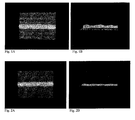
- FIG. 1A is a top-view photograph of a dried silver finger line of an exemplary electroconductive paste according to Example 1 printed on a silicon wafer;
- FIG. 1B is an elevation-view photograph of the dried silver finger line as shown in FIG 1A , taken perpendicular to the line;
- FIG. 2A is a top-view photograph of a fired silver finger line of an exemplary electroconductive paste according to Example 2 printed on a silicon wafer;
- FIG. 2B is an elevation-view photograph of the dried silver finger line as shown in FIG 2A , taken perpendicular to the line.
- Electroconductive paste compositions typically comprise: metallic particles, glass frit, and an organic vehicle. While not limited to such an application, such pastes may be used to form an electrical contact layer or electrode in a solar cell. Specifically, the pastes may be applied to the front side of a solar cell or to the back side of a solar cell.
- a desired organic vehicle is one which is low in viscosity, allowing for fine line printability, and has optimal stability when combined with metallic particles.
- the organic vehicle is typically comprised of an organic binder, an organic solvent, and a surfactant.
- an organic vehicle comprises a binder, a surfactant and an organic solvent.
- the binder comprises at least one of polyvinylpyrrolidone (PVP), polymethylmethacrylate (PMMA), or polyvinylbutylate (PVB).
- the preferred embodiment of the organic vehicle consists of about 1-10 wt. % polyvinyl pyrrolidone (PVP) as the organic binder, preferably with molecular weight from 5000 to 5000000 Dalton, about 1-10 wt. % surfactant, about 50-70 wt. % organic solvent.
- the organic vehicle may include about 1-10 wt. % ethyl cellulose as an additional binder. All weight percents are expressed in weight percent of organic vehicle.
- PVP polyvinyl pyrrolidone
- the inclusion of PVP enhances the paste's ability to be dispersed uniformly, and it is highly compatible with silver particles.
- the surfactant can be any of the following: hydroxyfunctional carboxylic acid ester with pigment affinic groups (including, but not limited to, DISPERBYK®-108, manufactured by BYK USA, Inc.), acrylate copolymer with pigment affinic groups (including, but not limited to, DISPERBYK®-116, manufactured by BYK USA, Inc.), modified polyether with pigment affinic groups (including, but not limited to, TEGO ® DISPERS 655, manufactured by Evonik Tego Chemie GmbH), or surfactant with groups of high pigment affinity (including, but not limited to, TEGO® DISPERS 662 C, manufactured by Evonik Tego Chemie GmbH).
- hydroxyfunctional carboxylic acid ester with pigment affinic groups including, but not limited to, DISPERBYK®-108, manufactured by BYK USA, Inc.
- acrylate copolymer with pigment affinic groups including, but not limited to, DISPERBYK®-116, manufactured by B
- the organic solvent may be any of carbitol, terpineol, hexyl carbitol, texanol, butyl carbitol, butyl carbitol acetate, or dimethyladipate.
- the organic vehicle may also comprise a thixatropic agent. Any thixatropic agents familiar to one having ordinary skill in the art may be used with the organic vehicle of the invention.
- thixatropic agents may be derived from natural origin, e.g., castor oil, or they may be synthesized. Commercially available thixatropic agents can also be used with the invention.
- the organic vehicle according to the preferred embodiment typically exhibits a viscosity range of 140-200 kcPs, and a thixatropic index of 5-10.
- the organic vehicle comprises about 1-10 wt. % polyvinyl pyrrolidone (PVP) as the organic binder, preferably with molecular weight from 5000 to 5000000 Dalton, about 1-20 wt. % surfactant, about 50-70 wt. % organic solvent.
- the organic vehicle may include about 1-10 wt. % ethyl cellulose as an additional binder. All weight percents are expressed in weight percent of organic vehicle.
- the organic vehicle may comprise at least one of polymethylmethacrylate (PMMA) or polyvinylbutylate (PVB) as organic binder.
- the organic vehicle comprises about 1-10 wt. % polymethylmethacrylate (PMMA) or polyvinylbutylate (PVB) as the organic binder, as well as about 1-10 wt. % surfactant, about 50-70 wt. % organic solvent, and about 1-10 wt. % ethyl cellulose as additional binder. All weight percents are expressed in weight percent of organic vehicle.
- the organic vehicle also may comprise a thixatropic agent as known to one skilled in the art.
- the organic vehicle comprises about 1-10 wt. % polymethylmethacrylate (PMMA) or polyvinylbutylate (PVB) as the organic binder, as well as about 1-20 wt. % surfactant and about 50-70 wt. % organic solvent. Additionally, the organic vehicle may comprise about 1-10 wt. % ethyl cellulose as additional binder. All weight percents are expressed in weight percent of organic vehicle.
- the organic vehicle also may comprise a thixatropic agent as known to one skilled in the art.
- An electroconductive paste composition comprises about 80 wt. % (of paste) metallic particles, about 5 wt. % (of paste) glass frit, and about 15 wt. % (of paste) organic vehicle.
- the organic vehicle in the electroconductive paste comprises about 1-10 wt. % (of organic vehicle) binder, about 1-10 wt. % (of organic vehicle) surfactant, and about 50-70 wt. % (of organic vehicle) organic solvent.
- the binder can be any of PVP, PMMA, or PVB.
- a thixatropic agent known to one skilled in the art, may also be included in the organic vehicle.
- the metallic particles are preferably silver, but can be aluminum, gold particles, copper, nickel particles, or other conductive metallic particles known to one skilled in the art, or a combination thereof.
- the metallic particles make up about 60-90 wt. % of the total paste, and are preferably silver.
- the glass frit is about 1-10 wt. % of paste, and may be lead-based or lead-free.
- the lead-based glass frit comprises lead oxide or other lead-based compounds including, but not limited to, salts of lead halides, lead chalcogenides, lead carbonate, lead sulfate, lead phosphate, lead nitrate and organometallic lead compounds or compounds that can form lead oxides or slats during thermal decomposition.
- the lead-free glass frit may include other oxides or compounds known to one skilled in the art. For example, silicon, boron, aluminum, bismuth, lithium, sodium, magnesium, zinc, titanium, or zirconium oxides or compounds may be used.
- glass matrix formers or glass modifiers such as germanium oxide, vanadium oxide, tungsten oxide, molybdenum oxides, niobium oxides, tin oxides, indium oxides, other alkaline and alkaline earth metal (such as K, Rb, Cs and Be, Ca, Sr, Ba) compounds, rare earth oxides (such as La 2 O 3 , cerium oxides), phosphorus oxides or metal phosphates, transition metal oxides (such as copper oxides and chromium oxides), or metal halides (such as lead fluorides and zinc fluorides) may also be part of the glass composition.
- the glass frit may be made by any process known to one skilled in the art. For example, without limitation, by mixing the appropriate amounts of powders of the individual ingredients, heating the powder mixture in air or in an oxygen-containing atmosphere to form a melt, quenching the melt, grinding and ball milling the quenched material and screening the milled material to provide a powder with the desired particle size.
- glass frit components in powder form, may be mixed together in a V-comb blender. The mixture may then be heated (e.g., to around 800-1200°C) for about 30-40 minutes. The glass may then be quenched, taking on a sand-like consistency. This coarse glass powder may then be milled, such as in a ball mill or jet mill, until a fine powder results.
- the glass frit may be milled to an average particle size of 0.01-10 ⁇ m, preferably 0.1-5 ⁇ m.
- conventional solid state synthesis may be used to prepare the glass frits described herein.
- raw materials are sealed in a fused-quartz tube or tantalum or platinum tube under vacuum, and then heated to about 700-1200°C. The materials dwell at this elevated temperature for about 12-48 hours and then are slowly cooled (about 0.1°C/minute) to room temperature.
- solid state reactions may be carried out in an alumina crucible in air.
- co-precipitation may be used to form the inorganic reaction systems.
- the metal elements are reduced and co-precipitated with other metal oxides or hydroxides to from a solution containing metal cations by adjusting the pH levels or by incorporating reducing agents.
- the precipitates of these metals, metal oxides or hydroxides are then dried and fired under vacuum at about 400-600°C to form a fine powder.
- the organic vehicle is about 1-20 wt. % of total paste.
- the organic vehicle itself comprises about 1-10 wt. % binder, about 1-20 wt. % surfactant, and about 50-70 wt. % organic solvent.
- a thixatropic agent known to one skilled in the art, may also be included in the organic vehicle.
- the electroconductive paste composition may be prepared by any method for preparing a paste composition known in the art or to be developed.
- the method of preparation is not critical, as long as it results in a homogenously dispersed paste.
- the paste components may then be mixed, such as with a mixer, then passed through a three roll mill, for example, to make a dispersed uniform paste. It is within the scope of the invention to include the additive in powder form or suspended in a liquid medium.
- Such a paste may then be utilized to form a solar cell by application of the paste to the antireflection layer on a silicon substrate, such as by screen printing, and then firing to form an electrode (electrical contact) on the silicon substrate.
- One organic vehicle was prepared by combining 60 wt. % terpineol (of organic solvent), 5 wt. % PVP, 20 wt. % Dispers655, 1-10 wt. % ethyl cellulose, and 5 wt. % thixotrope. The mixture was heated to a temperature of 80°C while stirring, and then maintained for a total of 30 minutes. The vehicle was then cooled and milled using a three-roll mill until it reached a homogeneous consistency. The vehicle, at up to 20 wt. % (of paste), was then mixed with about 80 wt. % (of paste) silver particles and about 5 wt. % (of paste) glass frit using a speed mixer.
- the mixture was then milled using a three-roll mill until it became a dispersed uniform paste.
- the resulting paste was screen printed onto a solar wafer at a speed of 150 mm/s, using screen 325 (mesh) * 0.9 (mil, wire diameter) * 0.6 (mil, emulsion thickness) * 50 ⁇ m (finger line opening) (Calendar screen), and the printed wafer was then fired at the appropriate profile.
- Another organic vehicle was prepared by combining about 60 wt. % terpineol (of organic vehicle), 5 wt. % PVP, 20 wt. % BYK662C, 1-10 wt. % ethyl cellulose, and 5 wt. % thixatrope. The mixture was heated to a temperature of 80°C while stirring, and then maintained for a total of 30 minutes. The vehicle was then cooled and milled using a three-roll mill until it reached a homogenous consistency. The vehicle, at up to 20 wt. % (of paste), was then mixed with about 80 wt. % (of paste) silver particles and about 5 wt. % (of paste) glass frit using a speed mixer.
- the mixture was then milled using a three-roll mill until it became a dispersed uniform paste.
- the resulting paste was screen printed onto a solar wafer at a speed of 150 mm/s, using screen 325 (mesh) * 0.9 (mil, wire diameter) * 0.6 (mil, emulsion thickness) * 50 ⁇ m (finger line opening) (Calendar screen), and the printed wafer was then fired at the appropriate profile.
- Figures 1A and 1B show a dried finger line printed using an exemplary paste according to Example 1.
- the dried line has a width of 77.3 ⁇ m, and height of 17.7 ⁇ m.
- the lines are of great longitudinal edge uniformity, and exhibit little variance in height of the finger line, i.e., without peaks and valleys.
- the same finger line, after firing, retains the longitudinal edge and height uniformity.
- the fired line has a width of 80 ⁇ m, and height of 13.0 ⁇ m.
- the solar cells produced using the exemplary electroconductive pastes were tested using an I-V tester.
- a Xe arc lamp in the I-V tester was used to simulate sunlight with a known intensity and the front surface of the solar cell was irradiated to generate the I-V curve.
- various parameters common to this measurement method which provide for electrical performance comparison were determined, including NCell (efficiency of solar cell), short circuit current density (Isc), open circuit voltage (Voc), Fill Factor (FF), series resistance (Rs), series resistance under three standard lighting intensities (Rs3), and front grid resistance (GRFr3 or Rfront). All data are compiled in Table 1. Table 1.
Landscapes
- Chemical & Material Sciences (AREA)
- Engineering & Computer Science (AREA)
- Life Sciences & Earth Sciences (AREA)
- Physics & Mathematics (AREA)
- Spectroscopy & Molecular Physics (AREA)
- Organic Chemistry (AREA)
- Materials Engineering (AREA)
- Wood Science & Technology (AREA)
- Dispersion Chemistry (AREA)
- Conductive Materials (AREA)
- Photovoltaic Devices (AREA)
- Compositions Of Macromolecular Compounds (AREA)
- Sustainable Development (AREA)
- Sustainable Energy (AREA)
- Paints Or Removers (AREA)
- Electrodes Of Semiconductors (AREA)
Abstract
Description
- This application claims priority to
U.S. Provisional Patent Application No. 61/555,858, filed on November 4, 2011 - This invention relates to electroconductive pastes as utilized in solar panel technology. Specifically, in one aspect, the invention relates to an organic vehicle used in the formulation of an electroconductive paste. Another aspect of the invention relates to an electroconductive paste composition. Another aspect of the invention relates to a solar cell produced by applying an electroconductive paste comprised of metallic particles, glass frit, and an organic vehicle.
- Solar cells are devices that convert the energy of light into electricity using the photovoltaic effect. Solar power is an attractive green energy source because it is sustainable and produces only non-polluting by-products. Accordingly, a great deal of research is currently being devoted to developing solar cells with enhanced efficiency while continuously lowering material and manufacturing costs. When light hits a solar cell, a fraction of the incident light is reflected by the surface and the remainder is transmitted into the solar cell. The photons of the transmitted light are absorbed by the solar cell, which is usually made of a semiconducting material such as silicon. The energy from the absorbed photons excites electrons of the semiconducting material from their atoms, generating electron-hole pairs. These electron-hole pairs are then separated by p-n junctions and collected by conductive electrodes which are applied on the solar cell surface.
- The most common solar cells are those based on silicon, more particularly, a p-n junction made from silicon by applying an n-type diffusion layer onto a p-type silicon substrate, coupled with two electrical contact layers or electrodes. In a p-type semiconductor, dopant atoms are added to the semiconductor in order to increase the number of free charge carriers (positive holes). In the case of silicon, a trivalent atom is substituted into the crystal lattice. Essentially, the doping material takes away weakly bound outer electrons from the semiconductor atoms. One example of a p-type semiconductor is silicon with a boron or aluminum dopant. Solar cells can also be made from n-type semiconductors. In an n-type semiconductor, the dopant atoms provide extra electrons to the host substrate, creating an excess of negative electron charge carriers. Such doping atoms usually have one more valence electron than one type of the host atoms. The most common example is atomic substitution in group IV solids (silicon, germanium, tin), which contain four valence electrons, by group V elements (phosphorus, arsenic, antimony), which contain five loosely bound valence electrons. One example of an n-type semiconductor is silicon with a phosphorous dopant.
- In order to minimize reflection of the sunlight by the solar cell, an antireflection coating (ARC), such as silicon nitride, silicon oxide, alumina oxide or titanium oxide, is applied to the n-type or p-type diffusion layer to increase the amount of light coupled into the solar cell. The ARC is typically non-conductive and may also passivate the surface of the silicon substrate.
- Silicon solar cells typically have electroconductive pastes applied to both their front and back surfaces. As part of the metallization process, a rear contact is typically first applied to the silicon substrate, such as by screen printing a back side silver paste or silver/aluminum paste to form soldering pads. Next, an aluminum paste is applied to the entire back side of the substrate to form a back surface field (BSF), and the cell is then dried. Next, using a different type of electroconductive paste, a metal contact may be screen printed onto the front side antireflection layer to serve as a front electrode. This electrical contact layer on the face or front of the cell, where light enters, is typically present in a grid pattern made of "finger lines" and "bus bars," rather than a complete layer, because the metal grid materials are typically not transparent to light. The silicon substrate with printed front side and back side paste is then fired at a temperature of approximately 700-975°C. After firing, the front side paste etches through the antireflection layer, forms electrical contact between the metal grid and the semiconductor, and converts the metal pastes to metal electrodes. On the back side, the aluminum diffuses into the silicon substrate, acting as a dopant which creates the BSF. The resulting metallic electrodes allow electricity to flow to and from solar cells connected in a solar panel.
- A description of a typical solar cell and the fabrication method thereof may be found, for example, in European Patent Application Publication No.
1 713 093 . - To assemble a panel, multiple solar cells are connected in series and/or in parallel and the ends of the electrodes of the first cell and the last cell are preferably connected to output wiring. The solar cells are typically encapsulated in a transparent thermal plastic resin, such as silicon rubber or ethylene vinyl acetate. A transparent sheet of glass is placed on the front surface of the encapsulating transparent thermal plastic resin. A back protecting material, for example, a sheet of polyethylene terephthalate coated with a film of polyvinyl fluoride having good mechanical properties and good weather resistance, is placed under the encapsulating thermal plastic resin. These layered materials may be heated in an appropriate vacuum furnace to remove air, and then integrated into one body by heating and pressing. Furthermore, since solar cells are typically left in the open air for a long time, it is desirable to cover the circumference of the solar cell with a frame material consisting of aluminum or the like.
- A typical electroconductive paste contains metallic particles, glass frit (glass particles), and an organic vehicle. These components must be carefully selected to take full advantage of the potential of the resulting solar cell. For example, it is necessary to maximize the contact between the metallic paste and silicon surface, and the metallic particles themselves, so that the charge carriers can flow through the interface and finger lines to the bus bars. The glass particles in the composition etch through the antireflection coating layer, helping to build contacts between the metal and the n+ type Si. On the other hand, the glass must not be so aggressive that it shunts the p-n junction after firing. Thus, minimizing contact resistance is desired with the p-n junction kept intact so as to achieve improved efficiency. Known compositions have high contact resistance due to the insulating effect of the glass in the interface of the metallic layer and silicon wafer, as well as other disadvantages such as high recombination in the contact area. Further, the composition of the organic vehicle can affect the potential of the resulting solar cell as well. The organic vehicle can affect the viscosity of the electroconductive paste, thus affecting its printability. It can also affect the properties of the printed lines, thereby affecting the overall efficiency of the solar cells produced. Accordingly, there is a need for an organic vehicle composition that optimizes the viscosity of an electroconductive paste.
- The invention provides an organic vehicle for use in an electroconductive paste comprising a binder comprising at least one of polyvinylpyrrolidone (PVP), polymethylmethacrylate (PMMA), or polyvinylbutylate (PVB), a surfactant and an organic solvent. According to another embodiment, the organic vehicle further comprises a thixatropic agent.
- According to one aspect of the invention, the binder is about 1-10 wt. %.
- According to another aspect of the invention, the surfactant is about 1-20 wt. % of organic vehicle. According to another embodiment, the surfactant is about 1-10 wt. % of organic vehicle. According to a further aspect of the invention, the surfactant is at least one of DISPERBYK®-108, DISPERBYK®-116, TEGO® DISPERS 665, or TEGO® DISPERS 662 C. According to another aspect, the surfactant is at least one of hydroxyfunctional carboxylic acid ester with pigment affinic groups, acrylate copolymer with pigment affinic groups, modified polyether with pigment affinic groups or compounds with groups of pigment affinity.
- According to a further aspect of the invention, the organic solvent is at least one of carbitol, terpineol, hexyl carbitol, texanol, butyl carbitol, butyl carbitol acetate, or dimethyl adipate.
- The invention also provides an electroconductive paste for use in solar cell technology comprising metallic particles, glass frit, and an organic vehicle comprising a binder comprising at least one of PVP, PMMA, or PVB, a surfactant, and an organic solvent.
- According to one aspect of the invention, the metallic particles are about 60-90 wt. % of paste. Preferably, the metallic particles are about 80 wt. % of paste. According to another aspect of the invention, the metallic particles are at least one of silver, gold, copper, and nickel.
- According to another aspect of the invention, the glass frit is about 1-10 wt. % of paste. Preferably, the glass frit is about 5 wt. %.
- According to a further aspect of the invention, wherein the organic vehicle is about 1-20 wt. % of paste. Preferably, the organic vehicle is about 15 wt. % of paste. According to another aspect of the invention, the organic vehicle further comprises a thixatropic agent.
- According to another aspect of the invention, the organic vehicle comprises 1-10 wt. % (of organic vehicle) binder.
- According to another aspect of the invention, the organic vehicle comprises 1-20 wt. % (of organic vehicle) surfactant. According to another embodiment, the organic vehicle comprises 1-10 wt. % (of organic vehicle) surfactant.
- The invention further provides a solar cell produced by applying an electroconductive paste of the invention to a silicon wafer, and firing the silicon wafer.
-
FIG. 1A is a top-view photograph of a dried silver finger line of an exemplary electroconductive paste according to Example 1 printed on a silicon wafer; -
FIG. 1B is an elevation-view photograph of the dried silver finger line as shown inFIG 1A , taken perpendicular to the line; -
FIG. 2A is a top-view photograph of a fired silver finger line of an exemplary electroconductive paste according to Example 2 printed on a silicon wafer; and -
FIG. 2B is an elevation-view photograph of the dried silver finger line as shown inFIG 2A , taken perpendicular to the line. - The invention teaches an organic vehicle as used in an electroconductive paste. Electroconductive paste compositions typically comprise: metallic particles, glass frit, and an organic vehicle. While not limited to such an application, such pastes may be used to form an electrical contact layer or electrode in a solar cell. Specifically, the pastes may be applied to the front side of a solar cell or to the back side of a solar cell.
- One aspect of the invention relates to the composition of the organic vehicle component of the electroconductive paste. A desired organic vehicle is one which is low in viscosity, allowing for fine line printability, and has optimal stability when combined with metallic particles. The organic vehicle is typically comprised of an organic binder, an organic solvent, and a surfactant.
- According to one embodiment, an organic vehicle comprises a binder, a surfactant and an organic solvent. The binder comprises at least one of polyvinylpyrrolidone (PVP), polymethylmethacrylate (PMMA), or polyvinylbutylate (PVB).
- The preferred embodiment of the organic vehicle consists of about 1-10 wt. % polyvinyl pyrrolidone (PVP) as the organic binder, preferably with molecular weight from 5000 to 5000000 Dalton, about 1-10 wt. % surfactant, about 50-70 wt. % organic solvent. The organic vehicle may include about 1-10 wt. % ethyl cellulose as an additional binder. All weight percents are expressed in weight percent of organic vehicle. The inclusion of PVP enhances the paste's ability to be dispersed uniformly, and it is highly compatible with silver particles. According to another preferred embedment, the surfactant can be any of the following: hydroxyfunctional carboxylic acid ester with pigment affinic groups (including, but not limited to, DISPERBYK®-108, manufactured by BYK USA, Inc.), acrylate copolymer with pigment affinic groups (including, but not limited to, DISPERBYK®-116, manufactured by BYK USA, Inc.), modified polyether with pigment affinic groups (including, but not limited to, TEGO ® DISPERS 655, manufactured by Evonik Tego Chemie GmbH), or surfactant with groups of high pigment affinity (including, but not limited to, TEGO® DISPERS 662 C, manufactured by Evonik Tego Chemie GmbH). Further, the organic solvent may be any of carbitol, terpineol, hexyl carbitol, texanol, butyl carbitol, butyl carbitol acetate, or dimethyladipate. The organic vehicle may also comprise a thixatropic agent. Any thixatropic agents familiar to one having ordinary skill in the art may be used with the organic vehicle of the invention. For example, without limitation, thixatropic agents may be derived from natural origin, e.g., castor oil, or they may be synthesized. Commercially available thixatropic agents can also be used with the invention. The organic vehicle according to the preferred embodiment typically exhibits a viscosity range of 140-200 kcPs, and a thixatropic index of 5-10.
- Another preferred embodiment of the organic vehicle comprises about 1-10 wt. % polyvinyl pyrrolidone (PVP) as the organic binder, preferably with molecular weight from 5000 to 5000000 Dalton, about 1-20 wt. % surfactant, about 50-70 wt. % organic solvent. The organic vehicle may include about 1-10 wt. % ethyl cellulose as an additional binder. All weight percents are expressed in weight percent of organic vehicle.
- Other organic binders also exhibit the desired printability and compatibility for use in electroconductive pastes. The organic vehicle may comprise at least one of polymethylmethacrylate (PMMA) or polyvinylbutylate (PVB) as organic binder. In another embodiment, the organic vehicle comprises about 1-10 wt. % polymethylmethacrylate (PMMA) or polyvinylbutylate (PVB) as the organic binder, as well as about 1-10 wt. % surfactant, about 50-70 wt. % organic solvent, and about 1-10 wt. % ethyl cellulose as additional binder. All weight percents are expressed in weight percent of organic vehicle. The organic vehicle also may comprise a thixatropic agent as known to one skilled in the art.
- In yet another embodiment, the organic vehicle comprises about 1-10 wt. % polymethylmethacrylate (PMMA) or polyvinylbutylate (PVB) as the organic binder, as well as about 1-20 wt. % surfactant and about 50-70 wt. % organic solvent. Additionally, the organic vehicle may comprise about 1-10 wt. % ethyl cellulose as additional binder. All weight percents are expressed in weight percent of organic vehicle. The organic vehicle also may comprise a thixatropic agent as known to one skilled in the art.
- Another aspect of the invention relates to an electroconductive paste. An electroconductive paste composition comprises about 80 wt. % (of paste) metallic particles, about 5 wt. % (of paste) glass frit, and about 15 wt. % (of paste) organic vehicle. The organic vehicle in the electroconductive paste comprises about 1-10 wt. % (of organic vehicle) binder, about 1-10 wt. % (of organic vehicle) surfactant, and about 50-70 wt. % (of organic vehicle) organic solvent. According to one embodiment, the binder can be any of PVP, PMMA, or PVB. A thixatropic agent, known to one skilled in the art, may also be included in the organic vehicle. The metallic particles are preferably silver, but can be aluminum, gold particles, copper, nickel particles, or other conductive metallic particles known to one skilled in the art, or a combination thereof.
- According to another embodiment, the metallic particles make up about 60-90 wt. % of the total paste, and are preferably silver.
- The glass frit is about 1-10 wt. % of paste, and may be lead-based or lead-free. The lead-based glass frit comprises lead oxide or other lead-based compounds including, but not limited to, salts of lead halides, lead chalcogenides, lead carbonate, lead sulfate, lead phosphate, lead nitrate and organometallic lead compounds or compounds that can form lead oxides or slats during thermal decomposition. The lead-free glass frit may include other oxides or compounds known to one skilled in the art. For example, silicon, boron, aluminum, bismuth, lithium, sodium, magnesium, zinc, titanium, or zirconium oxides or compounds may be used. Other glass matrix formers or glass modifiers, such as germanium oxide, vanadium oxide, tungsten oxide, molybdenum oxides, niobium oxides, tin oxides, indium oxides, other alkaline and alkaline earth metal (such as K, Rb, Cs and Be, Ca, Sr, Ba) compounds, rare earth oxides (such as La2O3, cerium oxides), phosphorus oxides or metal phosphates, transition metal oxides (such as copper oxides and chromium oxides), or metal halides (such as lead fluorides and zinc fluorides) may also be part of the glass composition.
- The glass frit may be made by any process known to one skilled in the art. For example, without limitation, by mixing the appropriate amounts of powders of the individual ingredients, heating the powder mixture in air or in an oxygen-containing atmosphere to form a melt, quenching the melt, grinding and ball milling the quenched material and screening the milled material to provide a powder with the desired particle size. For example, glass frit components, in powder form, may be mixed together in a V-comb blender. The mixture may then be heated (e.g., to around 800-1200°C) for about 30-40 minutes. The glass may then be quenched, taking on a sand-like consistency. This coarse glass powder may then be milled, such as in a ball mill or jet mill, until a fine powder results. Typically, the glass frit may be milled to an average particle size of 0.01-10µm, preferably 0.1-5µm.
- In another example, conventional solid state synthesis may be used to prepare the glass frits described herein. In this case, raw materials are sealed in a fused-quartz tube or tantalum or platinum tube under vacuum, and then heated to about 700-1200°C. The materials dwell at this elevated temperature for about 12-48 hours and then are slowly cooled (about 0.1°C/minute) to room temperature. In some cases, solid state reactions may be carried out in an alumina crucible in air.
- In another example, co-precipitation may be used to form the inorganic reaction systems. In this process, the metal elements are reduced and co-precipitated with other metal oxides or hydroxides to from a solution containing metal cations by adjusting the pH levels or by incorporating reducing agents. The precipitates of these metals, metal oxides or hydroxides are then dried and fired under vacuum at about 400-600°C to form a fine powder.
- The organic vehicle is about 1-20 wt. % of total paste. The organic vehicle itself comprises about 1-10 wt. % binder, about 1-20 wt. % surfactant, and about 50-70 wt. % organic solvent. A thixatropic agent, known to one skilled in the art, may also be included in the organic vehicle.
- The electroconductive paste composition may be prepared by any method for preparing a paste composition known in the art or to be developed. The method of preparation is not critical, as long as it results in a homogenously dispersed paste. As an example, without limitation, the paste components may then be mixed, such as with a mixer, then passed through a three roll mill, for example, to make a dispersed uniform paste. It is within the scope of the invention to include the additive in powder form or suspended in a liquid medium. Such a paste may then be utilized to form a solar cell by application of the paste to the antireflection layer on a silicon substrate, such as by screen printing, and then firing to form an electrode (electrical contact) on the silicon substrate.
- One organic vehicle was prepared by combining 60 wt. % terpineol (of organic solvent), 5 wt. % PVP, 20 wt. % Dispers655, 1-10 wt. % ethyl cellulose, and 5 wt. % thixotrope. The mixture was heated to a temperature of 80°C while stirring, and then maintained for a total of 30 minutes. The vehicle was then cooled and milled using a three-roll mill until it reached a homogeneous consistency. The vehicle, at up to 20 wt. % (of paste), was then mixed with about 80 wt. % (of paste) silver particles and about 5 wt. % (of paste) glass frit using a speed mixer. The mixture was then milled using a three-roll mill until it became a dispersed uniform paste. The resulting paste was screen printed onto a solar wafer at a speed of 150 mm/s, using screen 325 (mesh) * 0.9 (mil, wire diameter) * 0.6 (mil, emulsion thickness) * 50 µm (finger line opening) (Calendar screen), and the printed wafer was then fired at the appropriate profile.
- Another organic vehicle was prepared by combining about 60 wt. % terpineol (of organic vehicle), 5 wt. % PVP, 20 wt. % BYK662C, 1-10 wt. % ethyl cellulose, and 5 wt. % thixatrope. The mixture was heated to a temperature of 80°C while stirring, and then maintained for a total of 30 minutes. The vehicle was then cooled and milled using a three-roll mill until it reached a homogenous consistency. The vehicle, at up to 20 wt. % (of paste), was then mixed with about 80 wt. % (of paste) silver particles and about 5 wt. % (of paste) glass frit using a speed mixer. The mixture was then milled using a three-roll mill until it became a dispersed uniform paste. The resulting paste was screen printed onto a solar wafer at a speed of 150 mm/s, using screen 325 (mesh) * 0.9 (mil, wire diameter) * 0.6 (mil, emulsion thickness) * 50 µm (finger line opening) (Calendar screen), and the printed wafer was then fired at the appropriate profile.
-
Figures 1A and 1B show a dried finger line printed using an exemplary paste according to Example 1. The dried line has a width of 77.3 µm, and height of 17.7 µm. The lines are of great longitudinal edge uniformity, and exhibit little variance in height of the finger line, i.e., without peaks and valleys. InFigures 2A and 2B , the same finger line, after firing, retains the longitudinal edge and height uniformity. The fired line has a width of 80 µm, and height of 13.0 µm. - The solar cells produced using the exemplary electroconductive pastes were tested using an I-V tester. A Xe arc lamp in the I-V tester was used to simulate sunlight with a known intensity and the front surface of the solar cell was irradiated to generate the I-V curve. Using this curve, various parameters common to this measurement method which provide for electrical performance comparison were determined, including NCell (efficiency of solar cell), short circuit current density (Isc), open circuit voltage (Voc), Fill Factor (FF), series resistance (Rs), series resistance under three standard lighting intensities (Rs3), and front grid resistance (GRFr3 or Rfront). All data are compiled in Table 1.
Table 1. Electrical Performance of Exemplary Pastes Paste NCell(%) Isc(mA) Voc(V) FF (%) Rs(Ω) Rs3(Ω) GRFr3(mΩ) Rfront(Ω) Example 1 17.04 8.52 0.6203 78.34 0.00498 0.00294 56.997 - Example 2 16.72 8.62 0.6178 76.44 0.00428 - - 0.04079 - As shown through the results listed in Table 1, the experimental pastes exhibited acceptable series resistance (Rs) and front grid resistance (GRFr3 or Rfront), allowing for better conductivity and overall solar cell efficiency (NCell).
- These and other advantages of the invention will be apparent to those skilled in the art from the foregoing specification. Accordingly, it will be recognized by those skilled in the art that changes or modifications may be made to the above described embodiments without departing from the broad inventive concepts of the invention. Specific dimensions of any particular embodiment are described for illustration purposes only. It should therefore be understood that this invention is not limited to the particular embodiments described herein, but is intended to include all changes and modifications that are within the scope and spirit of the invention.
Claims (20)
- An organic vehicle for use in an electroconductive paste comprising:a binder, comprising at least one of polyvinylpyrrolidone (PVP),polymethylmethacrylate (PMMA), or polyvinylbutylate (PVB);a surfactant; andan organic solvent.
- The organic vehicle according to claim 1, wherein the organic vehicle further comprises a thixatropic agent.
- The organic vehicle according to any of the preceding claims, wherein the binder is about 1-10 wt. % of organic vehicle.
- The organic vehicle according to any of the preceding claims, wherein the surfactant is about 1-20 wt. % of organic vehicle.
- The organic vehicle according to any of the preceding claims, wherein the surfactant is about 1-10 wt. % of organic vehicle.
- The organic vehicle according to any of the preceding claims, wherein the surfactant is at least one of hydroxyfunctional carboxylic acid ester with pigment affinic groups, acrylate copolymer with pigment affinic groups, modified polyether with pigment affinic groups or compounds with groups of pigment affinity.
- The organic vehicle according to any of the preceding claims, wherein the organic solvent is at least one of carbitol, terpineol, hexyl carbitol, texanol, butyl carbitol, butyl carbitol acetate, or dimethyl adipate.
- An electroconductive paste for use in solar cell technology comprising:metallic particles;glass frit; andan organic vehicle comprising a binder comprising at least one of PVP, PMMA,or PVB, a surfactant, and an organic solvent.
- The electroconductive paste as in claim 8, wherein the metallic particles are about 60-60 wt. % of paste.
- The electroconductive paste according to claims 8-9, wherein the metallic particles are about 80 wt. % of paste.
- The electroconductive paste according to claims 8-10, wherein the metallic particles are at least one of silver, gold, copper, and nickel.
- The electroconductive paste according to claims 8-11, wherein the glass frit is about 1-10 wt. % of paste.
- The electroconductive paste according to claims 8-12, wherein the glass frit is about 5 wt. % of paste.
- The electroconductive paste according to claims 8-13, wherein the organic vehicle is about 1-20 wt. % of paste.
- The electroconductive paste according to claims 8-14, wherein the organic vehicle is about 15 wt. % of paste.
- The electroconductive paste according to claims 8-15, wherein the organic vehicle further comprises a thixatropic agent.
- The electroconductive paste according to claims 8-16, wherein the organic vehicle comprises 1-10 wt. % (of organic vehicle) binder.
- The electroconductive paste according to claims 8-17, wherein the organic vehicle comprises about 1-20 wt. % (of organic vehicle) surfactant.
- The electroconductive paste according to claims 8-18, wherein the organic vehicle comprises 1-10 wt. % (of organic vehicle) surfactant.
- A solar cell produced by applying an electroconductive paste according claims 8-19 to a silicon wafer, and firing the silicon wafer.
Applications Claiming Priority (1)
| Application Number | Priority Date | Filing Date | Title |
|---|---|---|---|
| US201161555858P | 2011-11-04 | 2011-11-04 |
Publications (3)
| Publication Number | Publication Date |
|---|---|
| EP2590177A2 true EP2590177A2 (en) | 2013-05-08 |
| EP2590177A3 EP2590177A3 (en) | 2013-06-26 |
| EP2590177B1 EP2590177B1 (en) | 2015-08-12 |
Family
ID=47146143
Family Applications (1)
| Application Number | Title | Priority Date | Filing Date |
|---|---|---|---|
| EP12007476.0A Not-in-force EP2590177B1 (en) | 2011-11-04 | 2012-11-02 | Organic vehicle for electroconductive paste |
Country Status (8)
| Country | Link |
|---|---|
| US (1) | US10170645B2 (en) |
| EP (1) | EP2590177B1 (en) |
| JP (1) | JP6185229B2 (en) |
| KR (1) | KR20130049751A (en) |
| CN (1) | CN103709572B (en) |
| SG (1) | SG189677A1 (en) |
| TW (1) | TWI574280B (en) |
| ZA (1) | ZA201208283B (en) |
Cited By (5)
| Publication number | Priority date | Publication date | Assignee | Title |
|---|---|---|---|---|
| EP2654085A1 (en) * | 2012-04-17 | 2013-10-23 | Heraeus Precious Metals North America Conshohocken LLC | Inorganic reaction system for electroconductive paste composition |
| WO2015089188A1 (en) * | 2013-12-11 | 2015-06-18 | Heraeus Precious Metals North America Conshohocken Llc | Acrylic resin-containing organic vehicle for electroconductive paste |
| WO2015196045A1 (en) * | 2014-06-20 | 2015-12-23 | Heraeus Precious Metals North America Conshohocken Llc | Organic vehicle for electroconductive paste |
| EP3267491A1 (en) | 2016-07-06 | 2018-01-10 | Karlsruher Institut für Technologie | Process for producing highly conductive, printable pastes from capillary suspensions |
| US10014418B2 (en) | 2012-04-17 | 2018-07-03 | Heraeus Precious Metals North America Conshohocken Llc | Conductive thick film paste for solar cell contacts |
Families Citing this family (15)
| Publication number | Priority date | Publication date | Assignee | Title |
|---|---|---|---|---|
| US20140374672A1 (en) * | 2013-06-24 | 2014-12-25 | Xerox Corporation | Conductive metal inks with polyvinylbutyral binder |
| US20140374671A1 (en) * | 2013-06-24 | 2014-12-25 | Xerox Corporation | Conductive metal inks with polyvinylbutyral and polyvinylpyrrolidone binder |
| US9374907B2 (en) * | 2013-06-24 | 2016-06-21 | Xerox Corporation | Method of improving sheet resistivity of printed conductive inks |
| KR101648253B1 (en) * | 2013-09-13 | 2016-08-12 | 제일모직주식회사 | Composition for forming solar cell and electrode prepared using the same |
| DE102014104272A1 (en) * | 2014-03-26 | 2015-10-01 | Heraeus Deutschland GmbH & Co. KG | Carrier and clip each for a semiconductor element, method of manufacture, use and sintering paste |
| CN103943167B (en) * | 2014-04-18 | 2016-06-08 | 西安交通大学 | A kind of Ag (V, Nb)/rare earth crystal-silicon solar cell alloy pulp and preparation method thereof |
| EP2952486A1 (en) | 2014-06-03 | 2015-12-09 | Heraeus Precious Metals North America Conshohocken LLC | Dielectric glass composition |
| JP6753675B2 (en) * | 2015-08-20 | 2020-09-09 | 三星エスディアイ株式会社Samsung SDI Co., Ltd. | Electrode forming composition, and electrodes and solar cells manufactured using the composition. |
| KR101733161B1 (en) * | 2015-10-31 | 2017-05-08 | 엘에스니꼬동제련 주식회사 | Electrode Paste Composition For Solar Cell's Electrode And Solar Cell |
| KR102220531B1 (en) * | 2018-04-23 | 2021-02-24 | 삼성에스디아이 주식회사 | Composition for forming electrode, electrode manufactured using the same and solar cell |
| KR102214471B1 (en) * | 2019-02-08 | 2021-02-08 | 순천대학교 산학협력단 | Method for providing printed electrochemical sensor tags using roll-to-roll gravure printing scheme |
| CN114049985B (en) * | 2021-08-18 | 2022-12-02 | 中南大学 | Conductive paste organic carrier and preparation and application thereof |
| CN114843004A (en) * | 2022-04-15 | 2022-08-02 | 北京大学深圳研究生院 | Conductive silver paste and preparation method and application thereof |
| CN115975323B (en) * | 2022-12-02 | 2023-12-12 | 广州市儒兴科技股份有限公司 | Organic carrier for conductive paste and preparation method thereof |
| CN118629690B (en) * | 2024-04-08 | 2025-07-08 | 环晟光伏(江苏)有限公司 | Photovoltaic nickel paste, preparation method and application thereof in preparing nickel grid lines of photovoltaic cells |
Citations (1)
| Publication number | Priority date | Publication date | Assignee | Title |
|---|---|---|---|---|
| EP1713093A2 (en) | 2005-04-14 | 2006-10-18 | E.I.Du pont de nemours and company | Electroconductive thick film composition, electrode, and solar cell formed therefrom |
Family Cites Families (22)
| Publication number | Priority date | Publication date | Assignee | Title |
|---|---|---|---|---|
| EP0452118B1 (en) * | 1990-04-12 | 1996-08-21 | Matsushita Electric Industrial Co., Ltd. | Conductive ink composition and method of forming a conductive thick film pattern |
| JP2943362B2 (en) * | 1990-04-12 | 1999-08-30 | 松下電器産業株式会社 | Electrically conductive ink and method for formation of electrically conductive thick film pattern |
| US5242623A (en) * | 1991-08-13 | 1993-09-07 | E. I. Du Pont De Nemours And Company | Screen-printable thick film paste composition |
| DE69431173T2 (en) * | 1993-06-16 | 2003-05-08 | E.I. Du Pont De Nemours And Co., Wilmington | Water-cleanable thick film paste composition |
| JP3767362B2 (en) * | 1999-12-13 | 2006-04-19 | 株式会社村田製作所 | Manufacturing method of multilayer ceramic electronic component |
| US7736693B2 (en) * | 2002-06-13 | 2010-06-15 | Cima Nanotech Israel Ltd. | Nano-powder-based coating and ink compositions |
| JP4487542B2 (en) * | 2003-11-27 | 2010-06-23 | Tdk株式会社 | Conductor paste for multilayer ceramic electronic component and method for manufacturing multilayer unit for multilayer ceramic electronic component |
| JP2008513565A (en) * | 2004-09-14 | 2008-05-01 | シーマ ナノ テック イスラエル リミティド | Composition capable of inkjet printing |
| US20070144577A1 (en) * | 2005-12-23 | 2007-06-28 | Rubin George L | Solar cell with physically separated distributed electrical contacts |
| US20080145633A1 (en) * | 2006-06-19 | 2008-06-19 | Cabot Corporation | Photovoltaic conductive features and processes for forming same |
| EP2052043B1 (en) * | 2006-08-07 | 2016-10-12 | Inktec Co., Ltd. | Process for preparation of silver nanoparticles, and the compositions of silver ink containing the same |
| KR101623597B1 (en) * | 2007-04-25 | 2016-05-23 | 헤레우스 프레셔스 메탈즈 노스 아메리카 콘쇼호켄 엘엘씨 | Thick film conductor formulations comprising silver and nickel or silver and nickel alloys and solar cells made therefrom |
| KR20080112624A (en) * | 2007-06-21 | 2008-12-26 | 동우 화인켐 주식회사 | Micro Pattern Formation Method for Electromagnetic Shielding Filter |
| KR101316253B1 (en) | 2007-06-27 | 2013-10-08 | 동우 화인켐 주식회사 | Conductive paste composition, electrode including the same and fabrication method of the electrode |
| US7736546B2 (en) * | 2008-01-30 | 2010-06-15 | Basf Se | Glass frits |
| US8506849B2 (en) * | 2008-03-05 | 2013-08-13 | Applied Nanotech Holdings, Inc. | Additives and modifiers for solvent- and water-based metallic conductive inks |
| CA2728055C (en) * | 2008-06-18 | 2017-04-04 | Basf Se | Process for producing electrodes for solar cells |
| EP2295507A4 (en) * | 2008-06-30 | 2012-10-31 | Univ Keio | Ink composition |
| US8294024B2 (en) * | 2008-08-13 | 2012-10-23 | E I Du Pont De Nemours And Company | Processes for forming photovoltaic devices |
| KR20110025614A (en) * | 2009-09-04 | 2011-03-10 | 동우 화인켐 주식회사 | Aluminum paste for solar cell back electrode |
| KR20110117390A (en) * | 2010-04-21 | 2011-10-27 | 에스에스씨피 주식회사 | Electrode paste for solar cell and solar cell manufactured using same |
| CN103038186B (en) | 2010-05-04 | 2018-11-09 | E·I·内穆尔杜邦公司 | Thick film pastes comprising lead oxide and tellurium oxide and their use in the manufacture of semiconductor devices |
-
2012
- 2012-11-02 TW TW101140867A patent/TWI574280B/en not_active IP Right Cessation
- 2012-11-02 US US13/667,293 patent/US10170645B2/en not_active Expired - Fee Related
- 2012-11-02 EP EP12007476.0A patent/EP2590177B1/en not_active Not-in-force
- 2012-11-02 KR KR1020120123760A patent/KR20130049751A/en not_active Abandoned
- 2012-11-02 JP JP2012242472A patent/JP6185229B2/en not_active Expired - Fee Related
- 2012-11-02 ZA ZA2012/08283A patent/ZA201208283B/en unknown
- 2012-11-05 CN CN201210435426.0A patent/CN103709572B/en not_active Expired - Fee Related
- 2012-11-08 SG SG2012082889A patent/SG189677A1/en unknown
Patent Citations (1)
| Publication number | Priority date | Publication date | Assignee | Title |
|---|---|---|---|---|
| EP1713093A2 (en) | 2005-04-14 | 2006-10-18 | E.I.Du pont de nemours and company | Electroconductive thick film composition, electrode, and solar cell formed therefrom |
Cited By (9)
| Publication number | Priority date | Publication date | Assignee | Title |
|---|---|---|---|---|
| EP2654085A1 (en) * | 2012-04-17 | 2013-10-23 | Heraeus Precious Metals North America Conshohocken LLC | Inorganic reaction system for electroconductive paste composition |
| US9029692B2 (en) | 2012-04-17 | 2015-05-12 | Heraeus Precious Metals North America Conshohocken Llc | Tellurium inorganic reaction systems for conductive thick film paste for solar cell contacts |
| US9257578B2 (en) | 2012-04-17 | 2016-02-09 | Heraeus Precious Metals North America Conshohocken Llc | Inorganic reaction system for electroconductive paste composition |
| US10014418B2 (en) | 2012-04-17 | 2018-07-03 | Heraeus Precious Metals North America Conshohocken Llc | Conductive thick film paste for solar cell contacts |
| WO2015089188A1 (en) * | 2013-12-11 | 2015-06-18 | Heraeus Precious Metals North America Conshohocken Llc | Acrylic resin-containing organic vehicle for electroconductive paste |
| WO2015196045A1 (en) * | 2014-06-20 | 2015-12-23 | Heraeus Precious Metals North America Conshohocken Llc | Organic vehicle for electroconductive paste |
| CN106415736A (en) * | 2014-06-20 | 2017-02-15 | 贺利氏贵金属北美康舍霍肯有限责任公司 | Organic vehicle for electroconductive paste |
| EP3267491A1 (en) | 2016-07-06 | 2018-01-10 | Karlsruher Institut für Technologie | Process for producing highly conductive, printable pastes from capillary suspensions |
| WO2018006990A1 (en) | 2016-07-06 | 2018-01-11 | Karlsruher Institut für Technologie | Process for producing highly conductive, printable pastes from capillary suspensions |
Also Published As
| Publication number | Publication date |
|---|---|
| TW201335949A (en) | 2013-09-01 |
| TWI574280B (en) | 2017-03-11 |
| KR20130049751A (en) | 2013-05-14 |
| EP2590177A3 (en) | 2013-06-26 |
| CN103709572B (en) | 2019-03-19 |
| EP2590177B1 (en) | 2015-08-12 |
| ZA201208283B (en) | 2013-07-31 |
| JP6185229B2 (en) | 2017-08-23 |
| US10170645B2 (en) | 2019-01-01 |
| JP2013165056A (en) | 2013-08-22 |
| US20130112261A1 (en) | 2013-05-09 |
| SG189677A1 (en) | 2013-05-31 |
| CN103709572A (en) | 2014-04-09 |
Similar Documents
| Publication | Publication Date | Title |
|---|---|---|
| EP2590177B1 (en) | Organic vehicle for electroconductive paste | |
| EP2654087B1 (en) | Tellurium inorganic reaction systems for conductive thick film paste for solar cell contacts | |
| EP2654086B1 (en) | Conductive thick film paste for solar cell contacts | |
| JP6096468B2 (en) | Electrically conductive paste composition containing metal nanoparticles | |
| JP6347577B2 (en) | Low metal content conductive paste composition | |
| KR101859017B1 (en) | Method of forming electrode, electrode manufactured therefrom and solar cell | |
| KR20170128029A (en) | Composition for forming solar cell electrode and electrode prepared using the same | |
| US20190115117A1 (en) | Conductive paste composition, method for preparing the composition and electrode formed by the composition | |
| BR102012028301A2 (en) | ORGANIC VEHICLE, ELECTRODUCTIVE FOLDER AND SOLAR CELL | |
| KR20180090669A (en) | Method for manufacturing finger electrode for solar cell and finger electrode for solar cell prepared thereby | |
| KR101991976B1 (en) | Composition for forming solar cell electrode and electrode prepared using the same |
Legal Events
| Date | Code | Title | Description |
|---|---|---|---|
| PUAI | Public reference made under article 153(3) epc to a published international application that has entered the european phase |
Free format text: ORIGINAL CODE: 0009012 |
|
| AK | Designated contracting states |
Kind code of ref document: A2 Designated state(s): AL AT BE BG CH CY CZ DE DK EE ES FI FR GB GR HR HU IE IS IT LI LT LU LV MC MK MT NL NO PL PT RO RS SE SI SK SM TR |
|
| AX | Request for extension of the european patent |
Extension state: BA ME |
|
| PUAL | Search report despatched |
Free format text: ORIGINAL CODE: 0009013 |
|
| AK | Designated contracting states |
Kind code of ref document: A3 Designated state(s): AL AT BE BG CH CY CZ DE DK EE ES FI FR GB GR HR HU IE IS IT LI LT LU LV MC MK MT NL NO PL PT RO RS SE SI SK SM TR |
|
| AX | Request for extension of the european patent |
Extension state: BA ME |
|
| RIC1 | Information provided on ipc code assigned before grant |
Ipc: H01B 1/22 20060101AFI20130521BHEP |
|
| 17P | Request for examination filed |
Effective date: 20131223 |
|
| RBV | Designated contracting states (corrected) |
Designated state(s): AL AT BE BG CH CY CZ DE DK EE ES FI FR GB GR HR HU IE IS IT LI LT LU LV MC MK MT NL NO PL PT RO RS SE SI SK SM TR |
|
| 17Q | First examination report despatched |
Effective date: 20140217 |
|
| GRAP | Despatch of communication of intention to grant a patent |
Free format text: ORIGINAL CODE: EPIDOSNIGR1 |
|
| INTG | Intention to grant announced |
Effective date: 20150302 |
|
| GRAS | Grant fee paid |
Free format text: ORIGINAL CODE: EPIDOSNIGR3 |
|
| GRAA | (expected) grant |
Free format text: ORIGINAL CODE: 0009210 |
|
| AK | Designated contracting states |
Kind code of ref document: B1 Designated state(s): AL AT BE BG CH CY CZ DE DK EE ES FI FR GB GR HR HU IE IS IT LI LT LU LV MC MK MT NL NO PL PT RO RS SE SI SK SM TR |
|
| REG | Reference to a national code |
Ref country code: GB Ref legal event code: FG4D |
|
| REG | Reference to a national code |
Ref country code: CH Ref legal event code: EP |
|
| REG | Reference to a national code |
Ref country code: AT Ref legal event code: REF Ref document number: 742774 Country of ref document: AT Kind code of ref document: T Effective date: 20150815 |
|
| REG | Reference to a national code |
Ref country code: IE Ref legal event code: FG4D |
|
| REG | Reference to a national code |
Ref country code: DE Ref legal event code: R096 Ref document number: 602012009426 Country of ref document: DE |
|
| REG | Reference to a national code |
Ref country code: FR Ref legal event code: PLFP Year of fee payment: 4 |
|
| REG | Reference to a national code |
Ref country code: LT Ref legal event code: MG4D |
|
| REG | Reference to a national code |
Ref country code: AT Ref legal event code: MK05 Ref document number: 742774 Country of ref document: AT Kind code of ref document: T Effective date: 20150812 |
|
| REG | Reference to a national code |
Ref country code: NL Ref legal event code: MP Effective date: 20150812 |
|
| PG25 | Lapsed in a contracting state [announced via postgrant information from national office to epo] |
Ref country code: LT Free format text: LAPSE BECAUSE OF FAILURE TO SUBMIT A TRANSLATION OF THE DESCRIPTION OR TO PAY THE FEE WITHIN THE PRESCRIBED TIME-LIMIT Effective date: 20150812 Ref country code: GR Free format text: LAPSE BECAUSE OF FAILURE TO SUBMIT A TRANSLATION OF THE DESCRIPTION OR TO PAY THE FEE WITHIN THE PRESCRIBED TIME-LIMIT Effective date: 20151113 Ref country code: LV Free format text: LAPSE BECAUSE OF FAILURE TO SUBMIT A TRANSLATION OF THE DESCRIPTION OR TO PAY THE FEE WITHIN THE PRESCRIBED TIME-LIMIT Effective date: 20150812 Ref country code: FI Free format text: LAPSE BECAUSE OF FAILURE TO SUBMIT A TRANSLATION OF THE DESCRIPTION OR TO PAY THE FEE WITHIN THE PRESCRIBED TIME-LIMIT Effective date: 20150812 Ref country code: NO Free format text: LAPSE BECAUSE OF FAILURE TO SUBMIT A TRANSLATION OF THE DESCRIPTION OR TO PAY THE FEE WITHIN THE PRESCRIBED TIME-LIMIT Effective date: 20151112 |
|
| PG25 | Lapsed in a contracting state [announced via postgrant information from national office to epo] |
Ref country code: PL Free format text: LAPSE BECAUSE OF FAILURE TO SUBMIT A TRANSLATION OF THE DESCRIPTION OR TO PAY THE FEE WITHIN THE PRESCRIBED TIME-LIMIT Effective date: 20150812 Ref country code: IS Free format text: LAPSE BECAUSE OF FAILURE TO SUBMIT A TRANSLATION OF THE DESCRIPTION OR TO PAY THE FEE WITHIN THE PRESCRIBED TIME-LIMIT Effective date: 20151212 Ref country code: SE Free format text: LAPSE BECAUSE OF FAILURE TO SUBMIT A TRANSLATION OF THE DESCRIPTION OR TO PAY THE FEE WITHIN THE PRESCRIBED TIME-LIMIT Effective date: 20150812 Ref country code: HR Free format text: LAPSE BECAUSE OF FAILURE TO SUBMIT A TRANSLATION OF THE DESCRIPTION OR TO PAY THE FEE WITHIN THE PRESCRIBED TIME-LIMIT Effective date: 20150812 Ref country code: RS Free format text: LAPSE BECAUSE OF FAILURE TO SUBMIT A TRANSLATION OF THE DESCRIPTION OR TO PAY THE FEE WITHIN THE PRESCRIBED TIME-LIMIT Effective date: 20150812 Ref country code: AT Free format text: LAPSE BECAUSE OF FAILURE TO SUBMIT A TRANSLATION OF THE DESCRIPTION OR TO PAY THE FEE WITHIN THE PRESCRIBED TIME-LIMIT Effective date: 20150812 Ref country code: PT Free format text: LAPSE BECAUSE OF FAILURE TO SUBMIT A TRANSLATION OF THE DESCRIPTION OR TO PAY THE FEE WITHIN THE PRESCRIBED TIME-LIMIT Effective date: 20151214 Ref country code: ES Free format text: LAPSE BECAUSE OF FAILURE TO SUBMIT A TRANSLATION OF THE DESCRIPTION OR TO PAY THE FEE WITHIN THE PRESCRIBED TIME-LIMIT Effective date: 20150812 |
|
| PG25 | Lapsed in a contracting state [announced via postgrant information from national office to epo] |
Ref country code: NL Free format text: LAPSE BECAUSE OF FAILURE TO SUBMIT A TRANSLATION OF THE DESCRIPTION OR TO PAY THE FEE WITHIN THE PRESCRIBED TIME-LIMIT Effective date: 20150812 |
|
| PG25 | Lapsed in a contracting state [announced via postgrant information from national office to epo] |
Ref country code: EE Free format text: LAPSE BECAUSE OF FAILURE TO SUBMIT A TRANSLATION OF THE DESCRIPTION OR TO PAY THE FEE WITHIN THE PRESCRIBED TIME-LIMIT Effective date: 20150812 Ref country code: SK Free format text: LAPSE BECAUSE OF FAILURE TO SUBMIT A TRANSLATION OF THE DESCRIPTION OR TO PAY THE FEE WITHIN THE PRESCRIBED TIME-LIMIT Effective date: 20150812 Ref country code: CZ Free format text: LAPSE BECAUSE OF FAILURE TO SUBMIT A TRANSLATION OF THE DESCRIPTION OR TO PAY THE FEE WITHIN THE PRESCRIBED TIME-LIMIT Effective date: 20150812 Ref country code: IT Free format text: LAPSE BECAUSE OF FAILURE TO SUBMIT A TRANSLATION OF THE DESCRIPTION OR TO PAY THE FEE WITHIN THE PRESCRIBED TIME-LIMIT Effective date: 20150812 Ref country code: DK Free format text: LAPSE BECAUSE OF FAILURE TO SUBMIT A TRANSLATION OF THE DESCRIPTION OR TO PAY THE FEE WITHIN THE PRESCRIBED TIME-LIMIT Effective date: 20150812 |
|
| REG | Reference to a national code |
Ref country code: DE Ref legal event code: R097 Ref document number: 602012009426 Country of ref document: DE |
|
| PG25 | Lapsed in a contracting state [announced via postgrant information from national office to epo] |
Ref country code: RO Free format text: LAPSE BECAUSE OF FAILURE TO SUBMIT A TRANSLATION OF THE DESCRIPTION OR TO PAY THE FEE WITHIN THE PRESCRIBED TIME-LIMIT Effective date: 20150812 |
|
| PLBE | No opposition filed within time limit |
Free format text: ORIGINAL CODE: 0009261 |
|
| STAA | Information on the status of an ep patent application or granted ep patent |
Free format text: STATUS: NO OPPOSITION FILED WITHIN TIME LIMIT |
|
| PG25 | Lapsed in a contracting state [announced via postgrant information from national office to epo] |
Ref country code: MC Free format text: LAPSE BECAUSE OF FAILURE TO SUBMIT A TRANSLATION OF THE DESCRIPTION OR TO PAY THE FEE WITHIN THE PRESCRIBED TIME-LIMIT Effective date: 20150812 Ref country code: LU Free format text: LAPSE BECAUSE OF FAILURE TO SUBMIT A TRANSLATION OF THE DESCRIPTION OR TO PAY THE FEE WITHIN THE PRESCRIBED TIME-LIMIT Effective date: 20151102 |
|
| REG | Reference to a national code |
Ref country code: CH Ref legal event code: PL |
|
| 26N | No opposition filed |
Effective date: 20160513 |
|
| PG25 | Lapsed in a contracting state [announced via postgrant information from national office to epo] |
Ref country code: CH Free format text: LAPSE BECAUSE OF NON-PAYMENT OF DUE FEES Effective date: 20151130 Ref country code: LI Free format text: LAPSE BECAUSE OF NON-PAYMENT OF DUE FEES Effective date: 20151130 |
|
| REG | Reference to a national code |
Ref country code: IE Ref legal event code: MM4A |
|
| PG25 | Lapsed in a contracting state [announced via postgrant information from national office to epo] |
Ref country code: SI Free format text: LAPSE BECAUSE OF FAILURE TO SUBMIT A TRANSLATION OF THE DESCRIPTION OR TO PAY THE FEE WITHIN THE PRESCRIBED TIME-LIMIT Effective date: 20150812 |
|
| PG25 | Lapsed in a contracting state [announced via postgrant information from national office to epo] |
Ref country code: IE Free format text: LAPSE BECAUSE OF NON-PAYMENT OF DUE FEES Effective date: 20151102 |
|
| REG | Reference to a national code |
Ref country code: FR Ref legal event code: PLFP Year of fee payment: 5 |
|
| PG25 | Lapsed in a contracting state [announced via postgrant information from national office to epo] |
Ref country code: BE Free format text: LAPSE BECAUSE OF FAILURE TO SUBMIT A TRANSLATION OF THE DESCRIPTION OR TO PAY THE FEE WITHIN THE PRESCRIBED TIME-LIMIT Effective date: 20150812 |
|
| PG25 | Lapsed in a contracting state [announced via postgrant information from national office to epo] |
Ref country code: HU Free format text: LAPSE BECAUSE OF FAILURE TO SUBMIT A TRANSLATION OF THE DESCRIPTION OR TO PAY THE FEE WITHIN THE PRESCRIBED TIME-LIMIT; INVALID AB INITIO Effective date: 20121102 Ref country code: BG Free format text: LAPSE BECAUSE OF FAILURE TO SUBMIT A TRANSLATION OF THE DESCRIPTION OR TO PAY THE FEE WITHIN THE PRESCRIBED TIME-LIMIT Effective date: 20150812 Ref country code: SM Free format text: LAPSE BECAUSE OF FAILURE TO SUBMIT A TRANSLATION OF THE DESCRIPTION OR TO PAY THE FEE WITHIN THE PRESCRIBED TIME-LIMIT Effective date: 20150812 |
|
| PG25 | Lapsed in a contracting state [announced via postgrant information from national office to epo] |
Ref country code: CY Free format text: LAPSE BECAUSE OF FAILURE TO SUBMIT A TRANSLATION OF THE DESCRIPTION OR TO PAY THE FEE WITHIN THE PRESCRIBED TIME-LIMIT Effective date: 20150812 |
|
| PG25 | Lapsed in a contracting state [announced via postgrant information from national office to epo] |
Ref country code: MT Free format text: LAPSE BECAUSE OF FAILURE TO SUBMIT A TRANSLATION OF THE DESCRIPTION OR TO PAY THE FEE WITHIN THE PRESCRIBED TIME-LIMIT Effective date: 20150812 |
|
| REG | Reference to a national code |
Ref country code: FR Ref legal event code: PLFP Year of fee payment: 6 |
|
| PG25 | Lapsed in a contracting state [announced via postgrant information from national office to epo] |
Ref country code: TR Free format text: LAPSE BECAUSE OF FAILURE TO SUBMIT A TRANSLATION OF THE DESCRIPTION OR TO PAY THE FEE WITHIN THE PRESCRIBED TIME-LIMIT Effective date: 20150812 Ref country code: MK Free format text: LAPSE BECAUSE OF FAILURE TO SUBMIT A TRANSLATION OF THE DESCRIPTION OR TO PAY THE FEE WITHIN THE PRESCRIBED TIME-LIMIT Effective date: 20150812 |
|
| PG25 | Lapsed in a contracting state [announced via postgrant information from national office to epo] |
Ref country code: AL Free format text: LAPSE BECAUSE OF FAILURE TO SUBMIT A TRANSLATION OF THE DESCRIPTION OR TO PAY THE FEE WITHIN THE PRESCRIBED TIME-LIMIT Effective date: 20150812 |
|
| PGFP | Annual fee paid to national office [announced via postgrant information from national office to epo] |
Ref country code: DE Payment date: 20181120 Year of fee payment: 7 |
|
| PGFP | Annual fee paid to national office [announced via postgrant information from national office to epo] |
Ref country code: FR Payment date: 20181123 Year of fee payment: 7 Ref country code: GB Payment date: 20181120 Year of fee payment: 7 |
|
| REG | Reference to a national code |
Ref country code: DE Ref legal event code: R082 Ref document number: 602012009426 Country of ref document: DE Representative=s name: HERZOG IP PATENTANWALTS GMBH, DE |
|
| REG | Reference to a national code |
Ref country code: DE Ref legal event code: R119 Ref document number: 602012009426 Country of ref document: DE |
|
| GBPC | Gb: european patent ceased through non-payment of renewal fee |
Effective date: 20191102 |
|
| PG25 | Lapsed in a contracting state [announced via postgrant information from national office to epo] |
Ref country code: FR Free format text: LAPSE BECAUSE OF NON-PAYMENT OF DUE FEES Effective date: 20191130 Ref country code: GB Free format text: LAPSE BECAUSE OF NON-PAYMENT OF DUE FEES Effective date: 20191102 Ref country code: DE Free format text: LAPSE BECAUSE OF NON-PAYMENT OF DUE FEES Effective date: 20200603 |