EP2590026A1 - Colored resin powder and toner using the colored resin powder - Google Patents
Colored resin powder and toner using the colored resin powder Download PDFInfo
- Publication number
- EP2590026A1 EP2590026A1 EP12189908.2A EP12189908A EP2590026A1 EP 2590026 A1 EP2590026 A1 EP 2590026A1 EP 12189908 A EP12189908 A EP 12189908A EP 2590026 A1 EP2590026 A1 EP 2590026A1
- Authority
- EP
- European Patent Office
- Prior art keywords
- toner
- compound
- group
- acid
- colored resin
- Prior art date
- Legal status (The legal status is an assumption and is not a legal conclusion. Google has not performed a legal analysis and makes no representation as to the accuracy of the status listed.)
- Withdrawn
Links
- 229920005989 resin Polymers 0.000 title claims abstract description 165
- 239000011347 resin Substances 0.000 title claims abstract description 165
- 239000000843 powder Substances 0.000 title claims abstract description 73
- 150000001875 compounds Chemical class 0.000 claims abstract description 138
- 238000004040 coloring Methods 0.000 claims abstract description 28
- 239000011230 binding agent Substances 0.000 claims abstract description 22
- 125000000217 alkyl group Chemical group 0.000 claims abstract description 18
- 125000003118 aryl group Chemical group 0.000 claims abstract description 12
- 125000003545 alkoxy group Chemical group 0.000 claims abstract description 8
- -1 2-ethylhexyl group Chemical group 0.000 claims description 59
- 125000001997 phenyl group Chemical group [H]C1=C([H])C([H])=C(*)C([H])=C1[H] 0.000 claims description 17
- 125000002496 methyl group Chemical group [H]C([H])([H])* 0.000 claims description 14
- 125000000484 butyl group Chemical group [H]C([*])([H])C([H])([H])C([H])([H])C([H])([H])[H] 0.000 claims description 4
- 125000004172 4-methoxyphenyl group Chemical group [H]C1=C([H])C(OC([H])([H])[H])=C([H])C([H])=C1* 0.000 claims description 3
- 230000003595 spectral effect Effects 0.000 abstract description 12
- 239000002245 particle Substances 0.000 description 160
- 239000006185 dispersion Substances 0.000 description 68
- 238000004519 manufacturing process Methods 0.000 description 66
- 238000000034 method Methods 0.000 description 55
- 230000008569 process Effects 0.000 description 55
- 239000003086 colorant Substances 0.000 description 48
- 239000001993 wax Substances 0.000 description 42
- 230000000052 comparative effect Effects 0.000 description 33
- 239000000178 monomer Substances 0.000 description 31
- XLYOFNOQVPJJNP-UHFFFAOYSA-N water Substances O XLYOFNOQVPJJNP-UHFFFAOYSA-N 0.000 description 28
- 238000004220 aggregation Methods 0.000 description 23
- 230000002776 aggregation Effects 0.000 description 23
- HEDRZPFGACZZDS-MICDWDOJSA-N Trichloro(2H)methane Chemical compound [2H]C(Cl)(Cl)Cl HEDRZPFGACZZDS-MICDWDOJSA-N 0.000 description 22
- 239000003795 chemical substances by application Substances 0.000 description 21
- 239000000203 mixture Substances 0.000 description 21
- 239000004094 surface-active agent Substances 0.000 description 19
- 238000006243 chemical reaction Methods 0.000 description 17
- 239000007788 liquid Substances 0.000 description 17
- 229920001225 polyester resin Polymers 0.000 description 17
- 238000010298 pulverizing process Methods 0.000 description 17
- 125000000391 vinyl group Chemical group [H]C([*])=C([H])[H] 0.000 description 17
- 239000002253 acid Substances 0.000 description 16
- 238000011156 evaluation Methods 0.000 description 16
- RFFLAFLAYFXFSW-UHFFFAOYSA-N 1,2-dichlorobenzene Chemical compound ClC1=CC=CC=C1Cl RFFLAFLAYFXFSW-UHFFFAOYSA-N 0.000 description 15
- 238000004945 emulsification Methods 0.000 description 15
- 229920002554 vinyl polymer Polymers 0.000 description 15
- PPBRXRYQALVLMV-UHFFFAOYSA-N Styrene Chemical compound C=CC1=CC=CC=C1 PPBRXRYQALVLMV-UHFFFAOYSA-N 0.000 description 14
- 239000000470 constituent Substances 0.000 description 14
- 238000002156 mixing Methods 0.000 description 14
- 238000003786 synthesis reaction Methods 0.000 description 14
- 239000012736 aqueous medium Substances 0.000 description 13
- 230000015572 biosynthetic process Effects 0.000 description 13
- 238000009833 condensation Methods 0.000 description 13
- 230000005494 condensation Effects 0.000 description 13
- YXFVVABEGXRONW-UHFFFAOYSA-N Toluene Chemical compound CC1=CC=CC=C1 YXFVVABEGXRONW-UHFFFAOYSA-N 0.000 description 12
- 238000004458 analytical method Methods 0.000 description 12
- 229910052751 metal Inorganic materials 0.000 description 12
- 239000002184 metal Substances 0.000 description 12
- VLKZOEOYAKHREP-UHFFFAOYSA-N n-Hexane Chemical compound CCCCCC VLKZOEOYAKHREP-UHFFFAOYSA-N 0.000 description 12
- 239000004645 polyester resin Substances 0.000 description 12
- 239000003381 stabilizer Substances 0.000 description 12
- 238000005160 1H NMR spectroscopy Methods 0.000 description 10
- CDBYLPFSWZWCQE-UHFFFAOYSA-L Sodium Carbonate Chemical compound [Na+].[Na+].[O-]C([O-])=O CDBYLPFSWZWCQE-UHFFFAOYSA-L 0.000 description 10
- 238000004949 mass spectrometry Methods 0.000 description 10
- 238000005259 measurement Methods 0.000 description 10
- 238000003756 stirring Methods 0.000 description 10
- 238000000870 ultraviolet spectroscopy Methods 0.000 description 10
- LFQSCWFLJHTTHZ-UHFFFAOYSA-N Ethanol Chemical compound CCO LFQSCWFLJHTTHZ-UHFFFAOYSA-N 0.000 description 9
- VYPSYNLAJGMNEJ-UHFFFAOYSA-N Silicium dioxide Chemical compound O=[Si]=O VYPSYNLAJGMNEJ-UHFFFAOYSA-N 0.000 description 9
- 229920001577 copolymer Polymers 0.000 description 9
- 238000011161 development Methods 0.000 description 9
- 235000014113 dietary fatty acids Nutrition 0.000 description 9
- XYIBRDXRRQCHLP-UHFFFAOYSA-N ethyl acetoacetate Chemical compound CCOC(=O)CC(C)=O XYIBRDXRRQCHLP-UHFFFAOYSA-N 0.000 description 9
- 239000000194 fatty acid Substances 0.000 description 9
- 229930195729 fatty acid Natural products 0.000 description 9
- 239000000047 product Substances 0.000 description 9
- 239000000243 solution Substances 0.000 description 9
- 238000005406 washing Methods 0.000 description 9
- OFOBLEOULBTSOW-UHFFFAOYSA-N Malonic acid Chemical compound OC(=O)CC(O)=O OFOBLEOULBTSOW-UHFFFAOYSA-N 0.000 description 8
- 239000008367 deionised water Substances 0.000 description 8
- 229910021641 deionized water Inorganic materials 0.000 description 8
- 229920001519 homopolymer Polymers 0.000 description 8
- 238000004898 kneading Methods 0.000 description 8
- 239000000049 pigment Substances 0.000 description 8
- 239000003505 polymerization initiator Substances 0.000 description 8
- MEKOFIRRDATTAG-UHFFFAOYSA-N 2,2,5,8-tetramethyl-3,4-dihydrochromen-6-ol Chemical compound C1CC(C)(C)OC2=C1C(C)=C(O)C=C2C MEKOFIRRDATTAG-UHFFFAOYSA-N 0.000 description 7
- 229940126062 Compound A Drugs 0.000 description 7
- NLDMNSXOCDLTTB-UHFFFAOYSA-N Heterophylliin A Natural products O1C2COC(=O)C3=CC(O)=C(O)C(O)=C3C3=C(O)C(O)=C(O)C=C3C(=O)OC2C(OC(=O)C=2C=C(O)C(O)=C(O)C=2)C(O)C1OC(=O)C1=CC(O)=C(O)C(O)=C1 NLDMNSXOCDLTTB-UHFFFAOYSA-N 0.000 description 7
- 229920003171 Poly (ethylene oxide) Polymers 0.000 description 7
- 238000001035 drying Methods 0.000 description 7
- 239000000706 filtrate Substances 0.000 description 7
- 230000004927 fusion Effects 0.000 description 7
- LVTJOONKWUXEFR-FZRMHRINSA-N protoneodioscin Natural products O(C[C@@H](CC[C@]1(O)[C@H](C)[C@@H]2[C@]3(C)[C@H]([C@H]4[C@@H]([C@]5(C)C(=CC4)C[C@@H](O[C@@H]4[C@H](O[C@H]6[C@@H](O)[C@@H](O)[C@@H](O)[C@H](C)O6)[C@@H](O)[C@H](O[C@H]6[C@@H](O)[C@@H](O)[C@@H](O)[C@H](C)O6)[C@H](CO)O4)CC5)CC3)C[C@@H]2O1)C)[C@H]1[C@H](O)[C@H](O)[C@H](O)[C@@H](CO)O1 LVTJOONKWUXEFR-FZRMHRINSA-N 0.000 description 7
- 238000007363 ring formation reaction Methods 0.000 description 7
- 125000001424 substituent group Chemical group 0.000 description 7
- 0 *C(C(C(N(*)c1ccc2N*)=O)=C(c3ccccc33)c1c2C3=O)=O Chemical compound *C(C(C(N(*)c1ccc2N*)=O)=C(c3ccccc33)c1c2C3=O)=O 0.000 description 6
- JLIDVCMBCGBIEY-UHFFFAOYSA-N 1-penten-3-one Chemical compound CCC(=O)C=C JLIDVCMBCGBIEY-UHFFFAOYSA-N 0.000 description 6
- QTBSBXVTEAMEQO-UHFFFAOYSA-N Acetic acid Chemical compound CC(O)=O QTBSBXVTEAMEQO-UHFFFAOYSA-N 0.000 description 6
- UHOVQNZJYSORNB-UHFFFAOYSA-N Benzene Chemical compound C1=CC=CC=C1 UHOVQNZJYSORNB-UHFFFAOYSA-N 0.000 description 6
- VTYYLEPIZMXCLO-UHFFFAOYSA-L Calcium carbonate Chemical compound [Ca+2].[O-]C([O-])=O VTYYLEPIZMXCLO-UHFFFAOYSA-L 0.000 description 6
- GKKZMYDNDDMXSE-UHFFFAOYSA-N Ethyl 3-oxo-3-phenylpropanoate Chemical compound CCOC(=O)CC(=O)C1=CC=CC=C1 GKKZMYDNDDMXSE-UHFFFAOYSA-N 0.000 description 6
- XEKOWRVHYACXOJ-UHFFFAOYSA-N Ethyl acetate Chemical compound CCOC(C)=O XEKOWRVHYACXOJ-UHFFFAOYSA-N 0.000 description 6
- LYCAIKOWRPUZTN-UHFFFAOYSA-N Ethylene glycol Chemical compound OCCO LYCAIKOWRPUZTN-UHFFFAOYSA-N 0.000 description 6
- CSNNHWWHGAXBCP-UHFFFAOYSA-L Magnesium sulfate Chemical compound [Mg+2].[O-][S+2]([O-])([O-])[O-] CSNNHWWHGAXBCP-UHFFFAOYSA-L 0.000 description 6
- BAPJBEWLBFYGME-UHFFFAOYSA-N Methyl acrylate Chemical compound COC(=O)C=C BAPJBEWLBFYGME-UHFFFAOYSA-N 0.000 description 6
- ZMXDDKWLCZADIW-UHFFFAOYSA-N N,N-Dimethylformamide Chemical compound CN(C)C=O ZMXDDKWLCZADIW-UHFFFAOYSA-N 0.000 description 6
- FAPWRFPIFSIZLT-UHFFFAOYSA-M Sodium chloride Chemical compound [Na+].[Cl-] FAPWRFPIFSIZLT-UHFFFAOYSA-M 0.000 description 6
- WYURNTSHIVDZCO-UHFFFAOYSA-N Tetrahydrofuran Chemical compound C1CCOC1 WYURNTSHIVDZCO-UHFFFAOYSA-N 0.000 description 6
- OSGAYBCDTDRGGQ-UHFFFAOYSA-L calcium sulfate Chemical compound [Ca+2].[O-]S([O-])(=O)=O OSGAYBCDTDRGGQ-UHFFFAOYSA-L 0.000 description 6
- MVPPADPHJFYWMZ-UHFFFAOYSA-N chlorobenzene Chemical compound ClC1=CC=CC=C1 MVPPADPHJFYWMZ-UHFFFAOYSA-N 0.000 description 6
- 150000004665 fatty acids Chemical class 0.000 description 6
- 238000001914 filtration Methods 0.000 description 6
- 238000010438 heat treatment Methods 0.000 description 6
- 238000002844 melting Methods 0.000 description 6
- 230000008018 melting Effects 0.000 description 6
- 239000003960 organic solvent Substances 0.000 description 6
- 150000003839 salts Chemical class 0.000 description 6
- 239000007787 solid Substances 0.000 description 6
- 239000002904 solvent Substances 0.000 description 6
- ZLDZWFGZFQPVMZ-UHFFFAOYSA-N 1-bromo-4-(butylamino)anthracene-9,10-dione Chemical compound O=C1C2=CC=CC=C2C(=O)C2=C1C(Br)=CC=C2NCCCC ZLDZWFGZFQPVMZ-UHFFFAOYSA-N 0.000 description 5
- KFZMGEQAYNKOFK-UHFFFAOYSA-N Isopropanol Chemical compound CC(C)O KFZMGEQAYNKOFK-UHFFFAOYSA-N 0.000 description 5
- 125000001931 aliphatic group Chemical group 0.000 description 5
- 239000003431 cross linking reagent Substances 0.000 description 5
- 239000000975 dye Substances 0.000 description 5
- 239000000839 emulsion Substances 0.000 description 5
- 230000009477 glass transition Effects 0.000 description 5
- 230000006872 improvement Effects 0.000 description 5
- 229910000029 sodium carbonate Inorganic materials 0.000 description 5
- 235000017550 sodium carbonate Nutrition 0.000 description 5
- 239000004215 Carbon black (E152) Substances 0.000 description 4
- YNQLUTRBYVCPMQ-UHFFFAOYSA-N Ethylbenzene Chemical compound CCC1=CC=CC=C1 YNQLUTRBYVCPMQ-UHFFFAOYSA-N 0.000 description 4
- TWRXJAOTZQYOKJ-UHFFFAOYSA-L Magnesium chloride Chemical compound [Mg+2].[Cl-].[Cl-] TWRXJAOTZQYOKJ-UHFFFAOYSA-L 0.000 description 4
- LRHPLDYGYMQRHN-UHFFFAOYSA-N N-Butanol Chemical compound CCCCO LRHPLDYGYMQRHN-UHFFFAOYSA-N 0.000 description 4
- NBIIXXVUZAFLBC-UHFFFAOYSA-N Phosphoric acid Chemical compound OP(O)(O)=O NBIIXXVUZAFLBC-UHFFFAOYSA-N 0.000 description 4
- ATUOYWHBWRKTHZ-UHFFFAOYSA-N Propane Chemical compound CCC ATUOYWHBWRKTHZ-UHFFFAOYSA-N 0.000 description 4
- UIIMBOGNXHQVGW-UHFFFAOYSA-M Sodium bicarbonate Chemical compound [Na+].OC([O-])=O UIIMBOGNXHQVGW-UHFFFAOYSA-M 0.000 description 4
- WQDUMFSSJAZKTM-UHFFFAOYSA-N Sodium methoxide Chemical compound [Na+].[O-]C WQDUMFSSJAZKTM-UHFFFAOYSA-N 0.000 description 4
- 239000003945 anionic surfactant Substances 0.000 description 4
- 239000007864 aqueous solution Substances 0.000 description 4
- AYJRCSIUFZENHW-UHFFFAOYSA-L barium carbonate Chemical compound [Ba+2].[O-]C([O-])=O AYJRCSIUFZENHW-UHFFFAOYSA-L 0.000 description 4
- 239000000571 coke Substances 0.000 description 4
- 238000001816 cooling Methods 0.000 description 4
- 239000000539 dimer Substances 0.000 description 4
- 238000002296 dynamic light scattering Methods 0.000 description 4
- 230000000694 effects Effects 0.000 description 4
- 125000001301 ethoxy group Chemical group [H]C([H])([H])C([H])([H])O* 0.000 description 4
- 125000001495 ethyl group Chemical group [H]C([H])([H])C([H])([H])* 0.000 description 4
- 239000010419 fine particle Substances 0.000 description 4
- 229930195733 hydrocarbon Natural products 0.000 description 4
- 125000002887 hydroxy group Chemical group [H]O* 0.000 description 4
- 239000003999 initiator Substances 0.000 description 4
- 239000000463 material Substances 0.000 description 4
- 239000002609 medium Substances 0.000 description 4
- 125000004108 n-butyl group Chemical group [H]C([H])([H])C([H])([H])C([H])([H])C([H])([H])* 0.000 description 4
- 229910052757 nitrogen Inorganic materials 0.000 description 4
- 239000002736 nonionic surfactant Substances 0.000 description 4
- 239000003002 pH adjusting agent Substances 0.000 description 4
- 238000006116 polymerization reaction Methods 0.000 description 4
- SCVFZCLFOSHCOH-UHFFFAOYSA-M potassium acetate Chemical compound [K+].CC([O-])=O SCVFZCLFOSHCOH-UHFFFAOYSA-M 0.000 description 4
- 229920006395 saturated elastomer Polymers 0.000 description 4
- 238000010557 suspension polymerization reaction Methods 0.000 description 4
- JOXIMZWYDAKGHI-UHFFFAOYSA-N toluene-4-sulfonic acid Chemical compound CC1=CC=C(S(O)(=O)=O)C=C1 JOXIMZWYDAKGHI-UHFFFAOYSA-N 0.000 description 4
- GITSJWCHNMHFJB-UHFFFAOYSA-N 1-bromo-4-(2-ethylhexylamino)anthracene-9,10-dione Chemical compound O=C1C2=CC=CC=C2C(=O)C2=C1C(Br)=CC=C2NCC(CC)CCCC GITSJWCHNMHFJB-UHFFFAOYSA-N 0.000 description 3
- KTZVZZJJVJQZHV-UHFFFAOYSA-N 1-chloro-4-ethenylbenzene Chemical compound ClC1=CC=C(C=C)C=C1 KTZVZZJJVJQZHV-UHFFFAOYSA-N 0.000 description 3
- OZCMOJQQLBXBKI-UHFFFAOYSA-N 1-ethenoxy-2-methylpropane Chemical compound CC(C)COC=C OZCMOJQQLBXBKI-UHFFFAOYSA-N 0.000 description 3
- GQHTUMJGOHRCHB-UHFFFAOYSA-N 2,3,4,6,7,8,9,10-octahydropyrimido[1,2-a]azepine Chemical compound C1CCCCN2CCCN=C21 GQHTUMJGOHRCHB-UHFFFAOYSA-N 0.000 description 3
- FAMRTHHQYMFCBD-UHFFFAOYSA-N 2-(4-bromo-2-fluorophenyl)-2-hydroxyacetic acid Chemical compound OC(=O)C(O)C1=CC=C(Br)C=C1F FAMRTHHQYMFCBD-UHFFFAOYSA-N 0.000 description 3
- GOXQRTZXKQZDDN-UHFFFAOYSA-N 2-Ethylhexyl acrylate Chemical compound CCCCC(CC)COC(=O)C=C GOXQRTZXKQZDDN-UHFFFAOYSA-N 0.000 description 3
- LTHNHFOGQMKPOV-UHFFFAOYSA-N 2-ethylhexan-1-amine Chemical compound CCCCC(CC)CN LTHNHFOGQMKPOV-UHFFFAOYSA-N 0.000 description 3
- WDQMWEYDKDCEHT-UHFFFAOYSA-N 2-ethylhexyl 2-methylprop-2-enoate Chemical compound CCCCC(CC)COC(=O)C(C)=C WDQMWEYDKDCEHT-UHFFFAOYSA-N 0.000 description 3
- XVTXLKJBAYGTJS-UHFFFAOYSA-N 2-methylpenta-1,4-dien-3-one Chemical compound CC(=C)C(=O)C=C XVTXLKJBAYGTJS-UHFFFAOYSA-N 0.000 description 3
- WEVYAHXRMPXWCK-UHFFFAOYSA-N Acetonitrile Chemical compound CC#N WEVYAHXRMPXWCK-UHFFFAOYSA-N 0.000 description 3
- NLHHRLWOUZZQLW-UHFFFAOYSA-N Acrylonitrile Chemical compound C=CC#N NLHHRLWOUZZQLW-UHFFFAOYSA-N 0.000 description 3
- JIGUQPWFLRLWPJ-UHFFFAOYSA-N Ethyl acrylate Chemical compound CCOC(=O)C=C JIGUQPWFLRLWPJ-UHFFFAOYSA-N 0.000 description 3
- OKKJLVBELUTLKV-UHFFFAOYSA-N Methanol Chemical compound OC OKKJLVBELUTLKV-UHFFFAOYSA-N 0.000 description 3
- VVQNEPGJFQJSBK-UHFFFAOYSA-N Methyl methacrylate Chemical compound COC(=O)C(C)=C VVQNEPGJFQJSBK-UHFFFAOYSA-N 0.000 description 3
- GYCMBHHDWRMZGG-UHFFFAOYSA-N Methylacrylonitrile Chemical compound CC(=C)C#N GYCMBHHDWRMZGG-UHFFFAOYSA-N 0.000 description 3
- CTQNGGLPUBDAKN-UHFFFAOYSA-N O-Xylene Chemical compound CC1=CC=CC=C1C CTQNGGLPUBDAKN-UHFFFAOYSA-N 0.000 description 3
- MUBZPKHOEPUJKR-UHFFFAOYSA-N Oxalic acid Chemical compound OC(=O)C(O)=O MUBZPKHOEPUJKR-UHFFFAOYSA-N 0.000 description 3
- 239000004372 Polyvinyl alcohol Substances 0.000 description 3
- HEMHJVSKTPXQMS-UHFFFAOYSA-M Sodium hydroxide Chemical compound [OH-].[Na+] HEMHJVSKTPXQMS-UHFFFAOYSA-M 0.000 description 3
- BCKXLBQYZLBQEK-KVVVOXFISA-M Sodium oleate Chemical compound [Na+].CCCCCCCC\C=C/CCCCCCCC([O-])=O BCKXLBQYZLBQEK-KVVVOXFISA-M 0.000 description 3
- ZMANZCXQSJIPKH-UHFFFAOYSA-N Triethylamine Chemical compound CCN(CC)CC ZMANZCXQSJIPKH-UHFFFAOYSA-N 0.000 description 3
- 238000010751 Ullmann type reaction Methods 0.000 description 3
- QYKIQEUNHZKYBP-UHFFFAOYSA-N Vinyl ether Chemical class C=COC=C QYKIQEUNHZKYBP-UHFFFAOYSA-N 0.000 description 3
- 150000007513 acids Chemical class 0.000 description 3
- 239000000654 additive Substances 0.000 description 3
- XYLMUPLGERFSHI-UHFFFAOYSA-N alpha-Methylstyrene Chemical compound CC(=C)C1=CC=CC=C1 XYLMUPLGERFSHI-UHFFFAOYSA-N 0.000 description 3
- WNROFYMDJYEPJX-UHFFFAOYSA-K aluminium hydroxide Chemical compound [OH-].[OH-].[OH-].[Al+3] WNROFYMDJYEPJX-UHFFFAOYSA-K 0.000 description 3
- 150000001408 amides Chemical class 0.000 description 3
- JFDZBHWFFUWGJE-UHFFFAOYSA-N benzonitrile Chemical compound N#CC1=CC=CC=C1 JFDZBHWFFUWGJE-UHFFFAOYSA-N 0.000 description 3
- 125000004106 butoxy group Chemical group [*]OC([H])([H])C([H])([H])C(C([H])([H])[H])([H])[H] 0.000 description 3
- 229910000019 calcium carbonate Inorganic materials 0.000 description 3
- 239000001506 calcium phosphate Substances 0.000 description 3
- 239000003093 cationic surfactant Substances 0.000 description 3
- KRKNYBCHXYNGOX-UHFFFAOYSA-N citric acid Chemical compound OC(=O)CC(O)(C(O)=O)CC(O)=O KRKNYBCHXYNGOX-UHFFFAOYSA-N 0.000 description 3
- 238000004440 column chromatography Methods 0.000 description 3
- 125000000113 cyclohexyl group Chemical group [H]C1([H])C([H])([H])C([H])([H])C([H])(*)C([H])([H])C1([H])[H] 0.000 description 3
- 125000004386 diacrylate group Chemical group 0.000 description 3
- MTHSVFCYNBDYFN-UHFFFAOYSA-N diethylene glycol Chemical compound OCCOCCO MTHSVFCYNBDYFN-UHFFFAOYSA-N 0.000 description 3
- GMSCBRSQMRDRCD-UHFFFAOYSA-N dodecyl 2-methylprop-2-enoate Chemical compound CCCCCCCCCCCCOC(=O)C(C)=C GMSCBRSQMRDRCD-UHFFFAOYSA-N 0.000 description 3
- GVGUFUZHNYFZLC-UHFFFAOYSA-N dodecyl benzenesulfonate;sodium Chemical compound [Na].CCCCCCCCCCCCOS(=O)(=O)C1=CC=CC=C1 GVGUFUZHNYFZLC-UHFFFAOYSA-N 0.000 description 3
- 125000003438 dodecyl group Chemical group [H]C([H])([H])C([H])([H])C([H])([H])C([H])([H])C([H])([H])C([H])([H])C([H])([H])C([H])([H])C([H])([H])C([H])([H])C([H])([H])C([H])([H])* 0.000 description 3
- 238000007720 emulsion polymerization reaction Methods 0.000 description 3
- 150000002148 esters Chemical class 0.000 description 3
- SUPCQIBBMFXVTL-UHFFFAOYSA-N ethyl 2-methylprop-2-enoate Chemical compound CCOC(=O)C(C)=C SUPCQIBBMFXVTL-UHFFFAOYSA-N 0.000 description 3
- PBZROIMXDZTJDF-UHFFFAOYSA-N hepta-1,6-dien-4-one Chemical compound C=CCC(=O)CC=C PBZROIMXDZTJDF-UHFFFAOYSA-N 0.000 description 3
- 150000002430 hydrocarbons Chemical class 0.000 description 3
- 150000002484 inorganic compounds Chemical class 0.000 description 3
- 229910010272 inorganic material Inorganic materials 0.000 description 3
- 239000002563 ionic surfactant Substances 0.000 description 3
- PBOSTUDLECTMNL-UHFFFAOYSA-N lauryl acrylate Chemical compound CCCCCCCCCCCCOC(=O)C=C PBOSTUDLECTMNL-UHFFFAOYSA-N 0.000 description 3
- 229910052943 magnesium sulfate Inorganic materials 0.000 description 3
- 235000019341 magnesium sulphate Nutrition 0.000 description 3
- AUHZEENZYGFFBQ-UHFFFAOYSA-N mesitylene Substances CC1=CC(C)=CC(C)=C1 AUHZEENZYGFFBQ-UHFFFAOYSA-N 0.000 description 3
- 125000001827 mesitylenyl group Chemical group [H]C1=C(C(*)=C(C([H])=C1C([H])([H])[H])C([H])([H])[H])C([H])([H])[H] 0.000 description 3
- 150000002739 metals Chemical class 0.000 description 3
- 125000000956 methoxy group Chemical group [H]C([H])([H])O* 0.000 description 3
- 229920000609 methyl cellulose Polymers 0.000 description 3
- 239000001923 methylcellulose Substances 0.000 description 3
- 125000002347 octyl group Chemical group [H]C([*])([H])C([H])([H])C([H])([H])C([H])([H])C([H])([H])C([H])([H])C([H])([H])C([H])([H])[H] 0.000 description 3
- PNJWIWWMYCMZRO-UHFFFAOYSA-N pent‐4‐en‐2‐one Natural products CC(=O)CC=C PNJWIWWMYCMZRO-UHFFFAOYSA-N 0.000 description 3
- 229920002451 polyvinyl alcohol Polymers 0.000 description 3
- 229940114930 potassium stearate Drugs 0.000 description 3
- ANBFRLKBEIFNQU-UHFFFAOYSA-M potassium;octadecanoate Chemical compound [K+].CCCCCCCCCCCCCCCCCC([O-])=O ANBFRLKBEIFNQU-UHFFFAOYSA-M 0.000 description 3
- NHARPDSAXCBDDR-UHFFFAOYSA-N propyl 2-methylprop-2-enoate Chemical compound CCCOC(=O)C(C)=C NHARPDSAXCBDDR-UHFFFAOYSA-N 0.000 description 3
- 125000001436 propyl group Chemical group [H]C([*])([H])C([H])([H])C([H])([H])[H] 0.000 description 3
- PNXMTCDJUBJHQJ-UHFFFAOYSA-N propyl prop-2-enoate Chemical compound CCCOC(=O)C=C PNXMTCDJUBJHQJ-UHFFFAOYSA-N 0.000 description 3
- 230000009467 reduction Effects 0.000 description 3
- 239000004576 sand Substances 0.000 description 3
- 238000010008 shearing Methods 0.000 description 3
- 239000000377 silicon dioxide Substances 0.000 description 3
- 239000011780 sodium chloride Substances 0.000 description 3
- BTURAGWYSMTVOW-UHFFFAOYSA-M sodium dodecanoate Chemical compound [Na+].CCCCCCCCCCCC([O-])=O BTURAGWYSMTVOW-UHFFFAOYSA-M 0.000 description 3
- 229940080264 sodium dodecylbenzenesulfonate Drugs 0.000 description 3
- 229940082004 sodium laurate Drugs 0.000 description 3
- 150000003440 styrenes Chemical class 0.000 description 3
- 239000000126 substance Substances 0.000 description 3
- 125000000542 sulfonic acid group Chemical group 0.000 description 3
- 239000000725 suspension Substances 0.000 description 3
- QORWJWZARLRLPR-UHFFFAOYSA-H tricalcium bis(phosphate) Chemical compound [Ca+2].[Ca+2].[Ca+2].[O-]P([O-])([O-])=O.[O-]P([O-])([O-])=O QORWJWZARLRLPR-UHFFFAOYSA-H 0.000 description 3
- FUSUHKVFWTUUBE-UHFFFAOYSA-N vinyl methyl ketone Natural products CC(=O)C=C FUSUHKVFWTUUBE-UHFFFAOYSA-N 0.000 description 3
- 229920003169 water-soluble polymer Polymers 0.000 description 3
- 239000008096 xylene Substances 0.000 description 3
- MYRTYDVEIRVNKP-UHFFFAOYSA-N 1,2-Divinylbenzene Chemical compound C=CC1=CC=CC=C1C=C MYRTYDVEIRVNKP-UHFFFAOYSA-N 0.000 description 2
- PGMMMHFNKZSYEP-UHFFFAOYSA-N 1,20-Eicosanediol Chemical compound OCCCCCCCCCCCCCCCCCCCCO PGMMMHFNKZSYEP-UHFFFAOYSA-N 0.000 description 2
- LTMRRSWNXVJMBA-UHFFFAOYSA-L 2,2-diethylpropanedioate Chemical compound CCC(CC)(C([O-])=O)C([O-])=O LTMRRSWNXVJMBA-UHFFFAOYSA-L 0.000 description 2
- SMZOUWXMTYCWNB-UHFFFAOYSA-N 2-(2-methoxy-5-methylphenyl)ethanamine Chemical compound COC1=CC=C(C)C=C1CCN SMZOUWXMTYCWNB-UHFFFAOYSA-N 0.000 description 2
- LEJBBGNFPAFPKQ-UHFFFAOYSA-N 2-(2-prop-2-enoyloxyethoxy)ethyl prop-2-enoate Chemical compound C=CC(=O)OCCOCCOC(=O)C=C LEJBBGNFPAFPKQ-UHFFFAOYSA-N 0.000 description 2
- NIXOWILDQLNWCW-UHFFFAOYSA-N 2-Propenoic acid Natural products OC(=O)C=C NIXOWILDQLNWCW-UHFFFAOYSA-N 0.000 description 2
- INQDDHNZXOAFFD-UHFFFAOYSA-N 2-[2-(2-prop-2-enoyloxyethoxy)ethoxy]ethyl prop-2-enoate Chemical compound C=CC(=O)OCCOCCOCCOC(=O)C=C INQDDHNZXOAFFD-UHFFFAOYSA-N 0.000 description 2
- HCLJOFJIQIJXHS-UHFFFAOYSA-N 2-[2-[2-(2-prop-2-enoyloxyethoxy)ethoxy]ethoxy]ethyl prop-2-enoate Chemical compound C=CC(=O)OCCOCCOCCOCCOC(=O)C=C HCLJOFJIQIJXHS-UHFFFAOYSA-N 0.000 description 2
- 125000004204 2-methoxyphenyl group Chemical group [H]C1=C([H])C(*)=C(OC([H])([H])[H])C([H])=C1[H] 0.000 description 2
- BSKHPKMHTQYZBB-UHFFFAOYSA-N 2-methylpyridine Chemical compound CC1=CC=CC=N1 BSKHPKMHTQYZBB-UHFFFAOYSA-N 0.000 description 2
- KUDUQBURMYMBIJ-UHFFFAOYSA-N 2-prop-2-enoyloxyethyl prop-2-enoate Chemical compound C=CC(=O)OCCOC(=O)C=C KUDUQBURMYMBIJ-UHFFFAOYSA-N 0.000 description 2
- GJCOSYZMQJWQCA-UHFFFAOYSA-N 9H-xanthene Chemical compound C1=CC=C2CC3=CC=CC=C3OC2=C1 GJCOSYZMQJWQCA-UHFFFAOYSA-N 0.000 description 2
- RSWGJHLUYNHPMX-UHFFFAOYSA-N Abietic-Saeure Natural products C12CCC(C(C)C)=CC2=CCC2C1(C)CCCC2(C)C(O)=O RSWGJHLUYNHPMX-UHFFFAOYSA-N 0.000 description 2
- KWOLFJPFCHCOCG-UHFFFAOYSA-N Acetophenone Chemical compound CC(=O)C1=CC=CC=C1 KWOLFJPFCHCOCG-UHFFFAOYSA-N 0.000 description 2
- QGZKDVFQNNGYKY-UHFFFAOYSA-N Ammonia Chemical compound N QGZKDVFQNNGYKY-UHFFFAOYSA-N 0.000 description 2
- IJGRMHOSHXDMSA-UHFFFAOYSA-N Atomic nitrogen Chemical compound N#N IJGRMHOSHXDMSA-UHFFFAOYSA-N 0.000 description 2
- KAKZBPTYRLMSJV-UHFFFAOYSA-N Butadiene Chemical compound C=CC=C KAKZBPTYRLMSJV-UHFFFAOYSA-N 0.000 description 2
- 229920002134 Carboxymethyl cellulose Polymers 0.000 description 2
- HEDRZPFGACZZDS-UHFFFAOYSA-N Chloroform Chemical compound ClC(Cl)Cl HEDRZPFGACZZDS-UHFFFAOYSA-N 0.000 description 2
- IAZDPXIOMUYVGZ-UHFFFAOYSA-N Dimethylsulphoxide Chemical compound CS(C)=O IAZDPXIOMUYVGZ-UHFFFAOYSA-N 0.000 description 2
- VEXZGXHMUGYJMC-UHFFFAOYSA-N Hydrochloric acid Chemical compound Cl VEXZGXHMUGYJMC-UHFFFAOYSA-N 0.000 description 2
- RRHGJUQNOFWUDK-UHFFFAOYSA-N Isoprene Chemical compound CC(=C)C=C RRHGJUQNOFWUDK-UHFFFAOYSA-N 0.000 description 2
- 239000004594 Masterbatch (MB) Substances 0.000 description 2
- BZLVMXJERCGZMT-UHFFFAOYSA-N Methyl tert-butyl ether Chemical compound COC(C)(C)C BZLVMXJERCGZMT-UHFFFAOYSA-N 0.000 description 2
- MZRVEZGGRBJDDB-UHFFFAOYSA-N N-Butyllithium Chemical compound [Li]CCCC MZRVEZGGRBJDDB-UHFFFAOYSA-N 0.000 description 2
- 238000005481 NMR spectroscopy Methods 0.000 description 2
- OFBQJSOFQDEBGM-UHFFFAOYSA-N Pentane Chemical compound CCCCC OFBQJSOFQDEBGM-UHFFFAOYSA-N 0.000 description 2
- ISWSIDIOOBJBQZ-UHFFFAOYSA-N Phenol Chemical compound OC1=CC=CC=C1 ISWSIDIOOBJBQZ-UHFFFAOYSA-N 0.000 description 2
- NQRYJNQNLNOLGT-UHFFFAOYSA-N Piperidine Chemical compound C1CCNCC1 NQRYJNQNLNOLGT-UHFFFAOYSA-N 0.000 description 2
- 239000004721 Polyphenylene oxide Substances 0.000 description 2
- JUJWROOIHBZHMG-UHFFFAOYSA-N Pyridine Chemical compound C1=CC=NC=C1 JUJWROOIHBZHMG-UHFFFAOYSA-N 0.000 description 2
- KHPCPRHQVVSZAH-HUOMCSJISA-N Rosin Natural products O(C/C=C/c1ccccc1)[C@H]1[C@H](O)[C@@H](O)[C@@H](O)[C@@H](CO)O1 KHPCPRHQVVSZAH-HUOMCSJISA-N 0.000 description 2
- QAOWNCQODCNURD-UHFFFAOYSA-N Sulfuric acid Chemical compound OS(O)(=O)=O QAOWNCQODCNURD-UHFFFAOYSA-N 0.000 description 2
- DTQVDTLACAAQTR-UHFFFAOYSA-N Trifluoroacetic acid Chemical compound OC(=O)C(F)(F)F DTQVDTLACAAQTR-UHFFFAOYSA-N 0.000 description 2
- 235000011054 acetic acid Nutrition 0.000 description 2
- 230000000996 additive effect Effects 0.000 description 2
- WNLRTRBMVRJNCN-UHFFFAOYSA-N adipic acid Chemical compound OC(=O)CCCCC(O)=O WNLRTRBMVRJNCN-UHFFFAOYSA-N 0.000 description 2
- 230000004931 aggregating effect Effects 0.000 description 2
- 150000001298 alcohols Chemical class 0.000 description 2
- 150000001338 aliphatic hydrocarbons Chemical class 0.000 description 2
- 150000001336 alkenes Chemical class 0.000 description 2
- 150000003973 alkyl amines Chemical class 0.000 description 2
- 150000005215 alkyl ethers Chemical class 0.000 description 2
- PNEYBMLMFCGWSK-UHFFFAOYSA-N aluminium oxide Inorganic materials [O-2].[O-2].[O-2].[Al+3].[Al+3] PNEYBMLMFCGWSK-UHFFFAOYSA-N 0.000 description 2
- 229910000147 aluminium phosphate Inorganic materials 0.000 description 2
- 239000002280 amphoteric surfactant Substances 0.000 description 2
- 239000003849 aromatic solvent Substances 0.000 description 2
- TZCXTZWJZNENPQ-UHFFFAOYSA-L barium sulfate Chemical compound [Ba+2].[O-]S([O-])(=O)=O TZCXTZWJZNENPQ-UHFFFAOYSA-L 0.000 description 2
- WERYXYBDKMZEQL-UHFFFAOYSA-N butane-1,4-diol Chemical compound OCCCCO WERYXYBDKMZEQL-UHFFFAOYSA-N 0.000 description 2
- CQEYYJKEWSMYFG-UHFFFAOYSA-N butyl acrylate Chemical compound CCCCOC(=O)C=C CQEYYJKEWSMYFG-UHFFFAOYSA-N 0.000 description 2
- 229910052799 carbon Inorganic materials 0.000 description 2
- 125000004432 carbon atom Chemical group C* 0.000 description 2
- 239000001768 carboxy methyl cellulose Substances 0.000 description 2
- 235000010948 carboxy methyl cellulose Nutrition 0.000 description 2
- 239000008112 carboxymethyl-cellulose Substances 0.000 description 2
- 239000004203 carnauba wax Substances 0.000 description 2
- 235000013869 carnauba wax Nutrition 0.000 description 2
- 239000012461 cellulose resin Substances 0.000 description 2
- 229920001429 chelating resin Polymers 0.000 description 2
- ORTQZVOHEJQUHG-UHFFFAOYSA-L copper(II) chloride Chemical compound Cl[Cu]Cl ORTQZVOHEJQUHG-UHFFFAOYSA-L 0.000 description 2
- QTMDXZNDVAMKGV-UHFFFAOYSA-L copper(ii) bromide Chemical compound [Cu+2].[Br-].[Br-] QTMDXZNDVAMKGV-UHFFFAOYSA-L 0.000 description 2
- GBRBMTNGQBKBQE-UHFFFAOYSA-L copper;diiodide Chemical compound I[Cu]I GBRBMTNGQBKBQE-UHFFFAOYSA-L 0.000 description 2
- 125000004093 cyano group Chemical group *C#N 0.000 description 2
- 125000001995 cyclobutyl group Chemical group [H]C1([H])C([H])([H])C([H])(*)C1([H])[H] 0.000 description 2
- PAFZNILMFXTMIY-UHFFFAOYSA-N cyclohexylamine Chemical compound NC1CCCCC1 PAFZNILMFXTMIY-UHFFFAOYSA-N 0.000 description 2
- 125000001511 cyclopentyl group Chemical group [H]C1([H])C([H])([H])C([H])([H])C([H])(*)C1([H])[H] 0.000 description 2
- DIOQZVSQGTUSAI-UHFFFAOYSA-N decane Chemical compound CCCCCCCCCC DIOQZVSQGTUSAI-UHFFFAOYSA-N 0.000 description 2
- 238000000354 decomposition reaction Methods 0.000 description 2
- 230000006866 deterioration Effects 0.000 description 2
- 238000000113 differential scanning calorimetry Methods 0.000 description 2
- 238000001938 differential scanning calorimetry curve Methods 0.000 description 2
- 125000002147 dimethylamino group Chemical group [H]C([H])([H])N(*)C([H])([H])[H] 0.000 description 2
- XBDQKXXYIPTUBI-UHFFFAOYSA-N dimethylselenoniopropionate Natural products CCC(O)=O XBDQKXXYIPTUBI-UHFFFAOYSA-N 0.000 description 2
- 239000002270 dispersing agent Substances 0.000 description 2
- 239000002612 dispersion medium Substances 0.000 description 2
- 238000009826 distribution Methods 0.000 description 2
- NOPFSRXAKWQILS-UHFFFAOYSA-N docosan-1-ol Chemical compound CCCCCCCCCCCCCCCCCCCCCCO NOPFSRXAKWQILS-UHFFFAOYSA-N 0.000 description 2
- SNRUBQQJIBEYMU-UHFFFAOYSA-N dodecane Chemical compound CCCCCCCCCCCC SNRUBQQJIBEYMU-UHFFFAOYSA-N 0.000 description 2
- TVIDDXQYHWJXFK-UHFFFAOYSA-N dodecanedioic acid Chemical compound OC(=O)CCCCCCCCCCC(O)=O TVIDDXQYHWJXFK-UHFFFAOYSA-N 0.000 description 2
- POULHZVOKOAJMA-UHFFFAOYSA-N dodecanoic acid Chemical compound CCCCCCCCCCCC(O)=O POULHZVOKOAJMA-UHFFFAOYSA-N 0.000 description 2
- DDXLVDQZPFLQMZ-UHFFFAOYSA-M dodecyl(trimethyl)azanium;chloride Chemical compound [Cl-].CCCCCCCCCCCC[N+](C)(C)C DDXLVDQZPFLQMZ-UHFFFAOYSA-M 0.000 description 2
- HBRNMIYLJIXXEE-UHFFFAOYSA-N dodecylazanium;acetate Chemical compound CC(O)=O.CCCCCCCCCCCCN HBRNMIYLJIXXEE-UHFFFAOYSA-N 0.000 description 2
- SYELZBGXAIXKHU-UHFFFAOYSA-N dodecyldimethylamine N-oxide Chemical compound CCCCCCCCCCCC[N+](C)(C)[O-] SYELZBGXAIXKHU-UHFFFAOYSA-N 0.000 description 2
- 239000008151 electrolyte solution Substances 0.000 description 2
- 230000007613 environmental effect Effects 0.000 description 2
- 239000003822 epoxy resin Substances 0.000 description 2
- FJKIXWOMBXYWOQ-UHFFFAOYSA-N ethenoxyethane Chemical compound CCOC=C FJKIXWOMBXYWOQ-UHFFFAOYSA-N 0.000 description 2
- RTZKZFJDLAIYFH-UHFFFAOYSA-N ether Substances CCOCC RTZKZFJDLAIYFH-UHFFFAOYSA-N 0.000 description 2
- LNTHITQWFMADLM-UHFFFAOYSA-N gallic acid Chemical compound OC(=O)C1=CC(O)=C(O)C(O)=C1 LNTHITQWFMADLM-UHFFFAOYSA-N 0.000 description 2
- 229920000578 graft copolymer Polymers 0.000 description 2
- IRHTZOCLLONTOC-UHFFFAOYSA-N hexacosan-1-ol Chemical compound CCCCCCCCCCCCCCCCCCCCCCCCCCO IRHTZOCLLONTOC-UHFFFAOYSA-N 0.000 description 2
- QQHJDPROMQRDLA-UHFFFAOYSA-N hexadecanedioic acid Chemical compound OC(=O)CCCCCCCCCCCCCCC(O)=O QQHJDPROMQRDLA-UHFFFAOYSA-N 0.000 description 2
- IPCSVZSSVZVIGE-UHFFFAOYSA-N hexadecanoic acid Chemical compound CCCCCCCCCCCCCCCC(O)=O IPCSVZSSVZVIGE-UHFFFAOYSA-N 0.000 description 2
- JJOJFIHJIRWASH-UHFFFAOYSA-N icosanedioic acid Chemical compound OC(=O)CCCCCCCCCCCCCCCCCCC(O)=O JJOJFIHJIRWASH-UHFFFAOYSA-N 0.000 description 2
- UQSXHKLRYXJYBZ-UHFFFAOYSA-N iron oxide Inorganic materials [Fe]=O UQSXHKLRYXJYBZ-UHFFFAOYSA-N 0.000 description 2
- 235000013980 iron oxide Nutrition 0.000 description 2
- VBMVTYDPPZVILR-UHFFFAOYSA-N iron(2+);oxygen(2-) Chemical class [O-2].[Fe+2] VBMVTYDPPZVILR-UHFFFAOYSA-N 0.000 description 2
- QDLAGTHXVHQKRE-UHFFFAOYSA-N lichenxanthone Natural products COC1=CC(O)=C2C(=O)C3=C(C)C=C(OC)C=C3OC2=C1 QDLAGTHXVHQKRE-UHFFFAOYSA-N 0.000 description 2
- ZLNQQNXFFQJAID-UHFFFAOYSA-L magnesium carbonate Chemical compound [Mg+2].[O-]C([O-])=O ZLNQQNXFFQJAID-UHFFFAOYSA-L 0.000 description 2
- 239000001095 magnesium carbonate Substances 0.000 description 2
- 229910000021 magnesium carbonate Inorganic materials 0.000 description 2
- 229910001629 magnesium chloride Inorganic materials 0.000 description 2
- YIXJRHPUWRPCBB-UHFFFAOYSA-N magnesium nitrate Chemical compound [Mg+2].[O-][N+]([O-])=O.[O-][N+]([O-])=O YIXJRHPUWRPCBB-UHFFFAOYSA-N 0.000 description 2
- HQKMJHAJHXVSDF-UHFFFAOYSA-L magnesium stearate Chemical compound [Mg+2].CCCCCCCCCCCCCCCCCC([O-])=O.CCCCCCCCCCCCCCCCCC([O-])=O HQKMJHAJHXVSDF-UHFFFAOYSA-L 0.000 description 2
- 239000000696 magnetic material Substances 0.000 description 2
- 229910052748 manganese Inorganic materials 0.000 description 2
- 239000000155 melt Substances 0.000 description 2
- BDAGIHXWWSANSR-UHFFFAOYSA-N methanoic acid Natural products OC=O BDAGIHXWWSANSR-UHFFFAOYSA-N 0.000 description 2
- XJRBAMWJDBPFIM-UHFFFAOYSA-N methyl vinyl ether Chemical compound COC=C XJRBAMWJDBPFIM-UHFFFAOYSA-N 0.000 description 2
- 125000000250 methylamino group Chemical group [H]N(*)C([H])([H])[H] 0.000 description 2
- 229910052759 nickel Inorganic materials 0.000 description 2
- PXHVJJICTQNCMI-UHFFFAOYSA-N nickel Substances [Ni] PXHVJJICTQNCMI-UHFFFAOYSA-N 0.000 description 2
- LQNUZADURLCDLV-UHFFFAOYSA-N nitrobenzene Chemical compound [O-][N+](=O)C1=CC=CC=C1 LQNUZADURLCDLV-UHFFFAOYSA-N 0.000 description 2
- 125000001196 nonadecyl group Chemical group [H]C([*])([H])C([H])([H])C([H])([H])C([H])([H])C([H])([H])C([H])([H])C([H])([H])C([H])([H])C([H])([H])C([H])([H])C([H])([H])C([H])([H])C([H])([H])C([H])([H])C([H])([H])C([H])([H])C([H])([H])C([H])([H])C([H])([H])[H] 0.000 description 2
- BKIMMITUMNQMOS-UHFFFAOYSA-N nonane Chemical compound CCCCCCCCC BKIMMITUMNQMOS-UHFFFAOYSA-N 0.000 description 2
- BDJRBEYXGGNYIS-UHFFFAOYSA-N nonanedioic acid Chemical compound OC(=O)CCCCCCCC(O)=O BDJRBEYXGGNYIS-UHFFFAOYSA-N 0.000 description 2
- UTOPWMOLSKOLTQ-UHFFFAOYSA-N octacosanoic acid Chemical compound CCCCCCCCCCCCCCCCCCCCCCCCCCCC(O)=O UTOPWMOLSKOLTQ-UHFFFAOYSA-N 0.000 description 2
- GLDOVTGHNKAZLK-UHFFFAOYSA-N octadecan-1-ol Chemical compound CCCCCCCCCCCCCCCCCCO GLDOVTGHNKAZLK-UHFFFAOYSA-N 0.000 description 2
- LUUFSCNUZAYHAT-UHFFFAOYSA-N octadecane-1,18-diol Chemical compound OCCCCCCCCCCCCCCCCCCO LUUFSCNUZAYHAT-UHFFFAOYSA-N 0.000 description 2
- BNJOQKFENDDGSC-UHFFFAOYSA-N octadecanedioic acid Chemical compound OC(=O)CCCCCCCCCCCCCCCCC(O)=O BNJOQKFENDDGSC-UHFFFAOYSA-N 0.000 description 2
- 230000003287 optical effect Effects 0.000 description 2
- 150000001451 organic peroxides Chemical class 0.000 description 2
- 239000012188 paraffin wax Substances 0.000 description 2
- IJTNSXPMYKJZPR-UHFFFAOYSA-N parinaric acid Chemical compound CCC=CC=CC=CC=CCCCCCCCC(O)=O IJTNSXPMYKJZPR-UHFFFAOYSA-N 0.000 description 2
- UCUUFSAXZMGPGH-UHFFFAOYSA-N penta-1,4-dien-3-one Chemical compound C=CC(=O)C=C UCUUFSAXZMGPGH-UHFFFAOYSA-N 0.000 description 2
- 150000002978 peroxides Chemical class 0.000 description 2
- CSHWQDPOILHKBI-UHFFFAOYSA-N peryrene Natural products C1=CC(C2=CC=CC=3C2=C2C=CC=3)=C3C2=CC=CC3=C1 CSHWQDPOILHKBI-UHFFFAOYSA-N 0.000 description 2
- WLJVNTCWHIRURA-UHFFFAOYSA-N pimelic acid Chemical compound OC(=O)CCCCCC(O)=O WLJVNTCWHIRURA-UHFFFAOYSA-N 0.000 description 2
- 229920001495 poly(sodium acrylate) polymer Polymers 0.000 description 2
- 229920006122 polyamide resin Polymers 0.000 description 2
- 229920000647 polyepoxide Polymers 0.000 description 2
- 229920000570 polyether Polymers 0.000 description 2
- 229920005749 polyurethane resin Polymers 0.000 description 2
- 235000011056 potassium acetate Nutrition 0.000 description 2
- USHAGKDGDHPEEY-UHFFFAOYSA-L potassium persulfate Chemical compound [K+].[K+].[O-]S(=O)(=O)OOS([O-])(=O)=O USHAGKDGDHPEEY-UHFFFAOYSA-L 0.000 description 2
- BDERNNFJNOPAEC-UHFFFAOYSA-N propan-1-ol Chemical compound CCCO BDERNNFJNOPAEC-UHFFFAOYSA-N 0.000 description 2
- 239000001294 propane Substances 0.000 description 2
- 125000002572 propoxy group Chemical group [*]OC([H])([H])C(C([H])([H])[H])([H])[H] 0.000 description 2
- 125000006308 propyl amino group Chemical group 0.000 description 2
- 238000000425 proton nuclear magnetic resonance spectrum Methods 0.000 description 2
- 150000003242 quaternary ammonium salts Chemical class 0.000 description 2
- 239000012966 redox initiator Substances 0.000 description 2
- 230000003578 releasing effect Effects 0.000 description 2
- CXMXRPHRNRROMY-UHFFFAOYSA-N sebacic acid Chemical compound OC(=O)CCCCCCCCC(O)=O CXMXRPHRNRROMY-UHFFFAOYSA-N 0.000 description 2
- 125000002914 sec-butyl group Chemical group [H]C([H])([H])C([H])([H])C([H])(*)C([H])([H])[H] 0.000 description 2
- 235000017557 sodium bicarbonate Nutrition 0.000 description 2
- 229910000030 sodium bicarbonate Inorganic materials 0.000 description 2
- QDRKDTQENPPHOJ-UHFFFAOYSA-N sodium ethoxide Chemical compound [Na+].CC[O-] QDRKDTQENPPHOJ-UHFFFAOYSA-N 0.000 description 2
- NNMHYFLPFNGQFZ-UHFFFAOYSA-M sodium polyacrylate Chemical compound [Na+].[O-]C(=O)C=C NNMHYFLPFNGQFZ-UHFFFAOYSA-M 0.000 description 2
- MFRIHAYPQRLWNB-UHFFFAOYSA-N sodium tert-butoxide Chemical compound [Na+].CC(C)(C)[O-] MFRIHAYPQRLWNB-UHFFFAOYSA-N 0.000 description 2
- NWZBFJYXRGSRGD-UHFFFAOYSA-M sodium;octadecyl sulfate Chemical compound [Na+].CCCCCCCCCCCCCCCCCCOS([O-])(=O)=O NWZBFJYXRGSRGD-UHFFFAOYSA-M 0.000 description 2
- 238000007711 solidification Methods 0.000 description 2
- 230000008023 solidification Effects 0.000 description 2
- 239000007921 spray Substances 0.000 description 2
- TYFQFVWCELRYAO-UHFFFAOYSA-N suberic acid Chemical compound OC(=O)CCCCCCC(O)=O TYFQFVWCELRYAO-UHFFFAOYSA-N 0.000 description 2
- 150000005846 sugar alcohols Polymers 0.000 description 2
- HQHCYKULIHKCEB-UHFFFAOYSA-N tetradecanedioic acid Chemical compound OC(=O)CCCCCCCCCCCCC(O)=O HQHCYKULIHKCEB-UHFFFAOYSA-N 0.000 description 2
- YLQBMQCUIZJEEH-UHFFFAOYSA-N tetrahydrofuran Natural products C=1C=COC=1 YLQBMQCUIZJEEH-UHFFFAOYSA-N 0.000 description 2
- KHPCPRHQVVSZAH-UHFFFAOYSA-N trans-cinnamyl beta-D-glucopyranoside Natural products OC1C(O)C(O)C(CO)OC1OCC=CC1=CC=CC=C1 KHPCPRHQVVSZAH-UHFFFAOYSA-N 0.000 description 2
- REZQBEBOWJAQKS-UHFFFAOYSA-N triacontan-1-ol Chemical compound CCCCCCCCCCCCCCCCCCCCCCCCCCCCCCO REZQBEBOWJAQKS-UHFFFAOYSA-N 0.000 description 2
- 229910000391 tricalcium phosphate Inorganic materials 0.000 description 2
- 235000019731 tricalcium phosphate Nutrition 0.000 description 2
- 229940078499 tricalcium phosphate Drugs 0.000 description 2
- HCEPYODGJFPWOI-UHFFFAOYSA-N tridecane-1,13-diol Chemical compound OCCCCCCCCCCCCCO HCEPYODGJFPWOI-UHFFFAOYSA-N 0.000 description 2
- RSJKGSCJYJTIGS-UHFFFAOYSA-N undecane Chemical compound CCCCCCCCCCC RSJKGSCJYJTIGS-UHFFFAOYSA-N 0.000 description 2
- LWBHHRRTOZQPDM-UHFFFAOYSA-N undecanedioic acid Chemical compound OC(=O)CCCCCCCCCC(O)=O LWBHHRRTOZQPDM-UHFFFAOYSA-N 0.000 description 2
- 150000004670 unsaturated fatty acids Chemical class 0.000 description 2
- 235000021122 unsaturated fatty acids Nutrition 0.000 description 2
- 238000001291 vacuum drying Methods 0.000 description 2
- DNIAPMSPPWPWGF-VKHMYHEASA-N (+)-propylene glycol Chemical compound C[C@H](O)CO DNIAPMSPPWPWGF-VKHMYHEASA-N 0.000 description 1
- PUPZLCDOIYMWBV-UHFFFAOYSA-N (+/-)-1,3-Butanediol Chemical compound CC(O)CCO PUPZLCDOIYMWBV-UHFFFAOYSA-N 0.000 description 1
- CUXYLFPMQMFGPL-UHFFFAOYSA-N (9Z,11E,13E)-9,11,13-Octadecatrienoic acid Natural products CCCCC=CC=CC=CCCCCCCCC(O)=O CUXYLFPMQMFGPL-UHFFFAOYSA-N 0.000 description 1
- MXJJJAKXVVAHKI-WRBBJXAJSA-N (9z,29z)-octatriaconta-9,29-dienediamide Chemical compound NC(=O)CCCCCCC\C=C/CCCCCCCCCCCCCCCCCC\C=C/CCCCCCCC(N)=O MXJJJAKXVVAHKI-WRBBJXAJSA-N 0.000 description 1
- CPUBMKFFRRFXIP-YPAXQUSRSA-N (9z,33z)-dotetraconta-9,33-dienediamide Chemical compound NC(=O)CCCCCCC\C=C/CCCCCCCCCCCCCCCCCCCCCC\C=C/CCCCCCCC(N)=O CPUBMKFFRRFXIP-YPAXQUSRSA-N 0.000 description 1
- RELMFMZEBKVZJC-UHFFFAOYSA-N 1,2,3-trichlorobenzene Chemical compound ClC1=CC=CC(Cl)=C1Cl RELMFMZEBKVZJC-UHFFFAOYSA-N 0.000 description 1
- KOMNUTZXSVSERR-UHFFFAOYSA-N 1,3,5-tris(prop-2-enyl)-1,3,5-triazinane-2,4,6-trione Chemical compound C=CCN1C(=O)N(CC=C)C(=O)N(CC=C)C1=O KOMNUTZXSVSERR-UHFFFAOYSA-N 0.000 description 1
- YPFDHNVEDLHUCE-UHFFFAOYSA-N 1,3-propanediol Substances OCCCO YPFDHNVEDLHUCE-UHFFFAOYSA-N 0.000 description 1
- 229940035437 1,3-propanediol Drugs 0.000 description 1
- OCQDPIXQTSYZJL-UHFFFAOYSA-N 1,4-bis(butylamino)anthracene-9,10-dione Chemical compound O=C1C2=CC=CC=C2C(=O)C2=C1C(NCCCC)=CC=C2NCCCC OCQDPIXQTSYZJL-UHFFFAOYSA-N 0.000 description 1
- OCJBOOLMMGQPQU-UHFFFAOYSA-N 1,4-dichlorobenzene Chemical compound ClC1=CC=C(Cl)C=C1 OCJBOOLMMGQPQU-UHFFFAOYSA-N 0.000 description 1
- ALVZNPYWJMLXKV-UHFFFAOYSA-N 1,9-Nonanediol Chemical compound OCCCCCCCCCO ALVZNPYWJMLXKV-UHFFFAOYSA-N 0.000 description 1
- TUSDEZXZIZRFGC-UHFFFAOYSA-N 1-O-galloyl-3,6-(R)-HHDP-beta-D-glucose Natural products OC1C(O2)COC(=O)C3=CC(O)=C(O)C(O)=C3C3=C(O)C(O)=C(O)C=C3C(=O)OC1C(O)C2OC(=O)C1=CC(O)=C(O)C(O)=C1 TUSDEZXZIZRFGC-UHFFFAOYSA-N 0.000 description 1
- OKMWKBLSFKFYGZ-UHFFFAOYSA-N 1-behenoylglycerol Chemical compound CCCCCCCCCCCCCCCCCCCCCC(=O)OCC(O)CO OKMWKBLSFKFYGZ-UHFFFAOYSA-N 0.000 description 1
- IIPRUQZTMZETSL-UHFFFAOYSA-N 1-bromo-4-(methylamino)anthracene-9,10-dione Chemical compound O=C1C2=CC=CC=C2C(=O)C2=C1C(Br)=CC=C2NC IIPRUQZTMZETSL-UHFFFAOYSA-N 0.000 description 1
- JLPULHDHAOZNQI-ZTIMHPMXSA-N 1-hexadecanoyl-2-(9Z,12Z-octadecadienoyl)-sn-glycero-3-phosphocholine Chemical compound CCCCCCCCCCCCCCCC(=O)OC[C@H](COP([O-])(=O)OCC[N+](C)(C)C)OC(=O)CCCCCCC\C=C/C\C=C/CCCCC JLPULHDHAOZNQI-ZTIMHPMXSA-N 0.000 description 1
- UTHDGOQKIWLLCO-UHFFFAOYSA-N 1-hydroxyhexyl prop-2-enoate Chemical compound CCCCCC(O)OC(=O)C=C UTHDGOQKIWLLCO-UHFFFAOYSA-N 0.000 description 1
- RTBFRGCFXZNCOE-UHFFFAOYSA-N 1-methylsulfonylpiperidin-4-one Chemical compound CS(=O)(=O)N1CCC(=O)CC1 RTBFRGCFXZNCOE-UHFFFAOYSA-N 0.000 description 1
- LNETULKMXZVUST-UHFFFAOYSA-N 1-naphthoic acid Chemical compound C1=CC=C2C(C(=O)O)=CC=CC2=C1 LNETULKMXZVUST-UHFFFAOYSA-N 0.000 description 1
- HATTZHMQPNVHPK-UHFFFAOYSA-N 18-[3-(18-amino-18-oxooctadecyl)-2,4-dimethylphenyl]octadecanoic acid Chemical compound CC1=CC=C(CCCCCCCCCCCCCCCCCC(O)=O)C(C)=C1CCCCCCCCCCCCCCCCCC(N)=O HATTZHMQPNVHPK-UHFFFAOYSA-N 0.000 description 1
- GZBSIABKXVPBFY-UHFFFAOYSA-N 2,2-bis(hydroxymethyl)propane-1,3-diol;prop-2-enoic acid Chemical compound OC(=O)C=C.OC(=O)C=C.OC(=O)C=C.OC(=O)C=C.OCC(CO)(CO)CO GZBSIABKXVPBFY-UHFFFAOYSA-N 0.000 description 1
- BJELTSYBAHKXRW-UHFFFAOYSA-N 2,4,6-triallyloxy-1,3,5-triazine Chemical compound C=CCOC1=NC(OCC=C)=NC(OCC=C)=N1 BJELTSYBAHKXRW-UHFFFAOYSA-N 0.000 description 1
- AVTLBBWTUPQRAY-UHFFFAOYSA-N 2-(2-cyanobutan-2-yldiazenyl)-2-methylbutanenitrile Chemical compound CCC(C)(C#N)N=NC(C)(CC)C#N AVTLBBWTUPQRAY-UHFFFAOYSA-N 0.000 description 1
- OZAIFHULBGXAKX-UHFFFAOYSA-N 2-(2-cyanopropan-2-yldiazenyl)-2-methylpropanenitrile Chemical compound N#CC(C)(C)N=NC(C)(C)C#N OZAIFHULBGXAKX-UHFFFAOYSA-N 0.000 description 1
- PFHOSZAOXCYAGJ-UHFFFAOYSA-N 2-[(2-cyano-4-methoxy-4-methylpentan-2-yl)diazenyl]-4-methoxy-2,4-dimethylpentanenitrile Chemical compound COC(C)(C)CC(C)(C#N)N=NC(C)(C#N)CC(C)(C)OC PFHOSZAOXCYAGJ-UHFFFAOYSA-N 0.000 description 1
- WYGWHHGCAGTUCH-UHFFFAOYSA-N 2-[(2-cyano-4-methylpentan-2-yl)diazenyl]-2,4-dimethylpentanenitrile Chemical compound CC(C)CC(C)(C#N)N=NC(C)(C#N)CC(C)C WYGWHHGCAGTUCH-UHFFFAOYSA-N 0.000 description 1
- NLGDWWCZQDIASO-UHFFFAOYSA-N 2-hydroxy-1-(7-oxabicyclo[4.1.0]hepta-1,3,5-trien-2-yl)-2-phenylethanone Chemical compound OC(C(=O)c1cccc2Oc12)c1ccccc1 NLGDWWCZQDIASO-UHFFFAOYSA-N 0.000 description 1
- IGWJYZPOUDOTIK-UHFFFAOYSA-N 2-methylpentan-2-yloxy benzenecarboperoxoate Chemical compound CCCC(C)(C)OOOC(=O)C1=CC=CC=C1 IGWJYZPOUDOTIK-UHFFFAOYSA-N 0.000 description 1
- BQARUDWASOOSRH-UHFFFAOYSA-N 2-tert-butylperoxypropan-2-yl hydrogen carbonate Chemical compound CC(C)(C)OOC(C)(C)OC(O)=O BQARUDWASOOSRH-UHFFFAOYSA-N 0.000 description 1
- LPUBRQWGZPPVBS-UHFFFAOYSA-N 3-butoxypropan-1-amine Chemical compound CCCCOCCCN LPUBRQWGZPPVBS-UHFFFAOYSA-N 0.000 description 1
- FQMIAEWUVYWVNB-UHFFFAOYSA-N 3-prop-2-enoyloxybutyl prop-2-enoate Chemical compound C=CC(=O)OC(C)CCOC(=O)C=C FQMIAEWUVYWVNB-UHFFFAOYSA-N 0.000 description 1
- OSWFIVFLDKOXQC-UHFFFAOYSA-N 4-(3-methoxyphenyl)aniline Chemical compound COC1=CC=CC(C=2C=CC(N)=CC=2)=C1 OSWFIVFLDKOXQC-UHFFFAOYSA-N 0.000 description 1
- JHWGFJBTMHEZME-UHFFFAOYSA-N 4-prop-2-enoyloxybutyl prop-2-enoate Chemical compound C=CC(=O)OCCCCOC(=O)C=C JHWGFJBTMHEZME-UHFFFAOYSA-N 0.000 description 1
- XAMCLRBWHRRBCN-UHFFFAOYSA-N 5-prop-2-enoyloxypentyl prop-2-enoate Chemical compound C=CC(=O)OCCCCCOC(=O)C=C XAMCLRBWHRRBCN-UHFFFAOYSA-N 0.000 description 1
- FIHBHSQYSYVZQE-UHFFFAOYSA-N 6-prop-2-enoyloxyhexyl prop-2-enoate Chemical compound C=CC(=O)OCCCCCCOC(=O)C=C FIHBHSQYSYVZQE-UHFFFAOYSA-N 0.000 description 1
- NIXOWILDQLNWCW-UHFFFAOYSA-M Acrylate Chemical compound [O-]C(=O)C=C NIXOWILDQLNWCW-UHFFFAOYSA-M 0.000 description 1
- USFZMSVCRYTOJT-UHFFFAOYSA-N Ammonium acetate Chemical compound N.CC(O)=O USFZMSVCRYTOJT-UHFFFAOYSA-N 0.000 description 1
- 239000005695 Ammonium acetate Substances 0.000 description 1
- 239000004342 Benzoyl peroxide Substances 0.000 description 1
- OMPJBNCRMGITSC-UHFFFAOYSA-N Benzoylperoxide Chemical compound C=1C=CC=CC=1C(=O)OOC(=O)C1=CC=CC=C1 OMPJBNCRMGITSC-UHFFFAOYSA-N 0.000 description 1
- ROFVEXUMMXZLPA-UHFFFAOYSA-N Bipyridyl Chemical group N1=CC=CC=C1C1=CC=CC=N1 ROFVEXUMMXZLPA-UHFFFAOYSA-N 0.000 description 1
- 229930185605 Bisphenol Natural products 0.000 description 1
- DPUOLQHDNGRHBS-UHFFFAOYSA-N Brassidinsaeure Natural products CCCCCCCCC=CCCCCCCCCCCCC(O)=O DPUOLQHDNGRHBS-UHFFFAOYSA-N 0.000 description 1
- UXVMQQNJUSDDNG-UHFFFAOYSA-L Calcium chloride Chemical compound [Cl-].[Cl-].[Ca+2] UXVMQQNJUSDDNG-UHFFFAOYSA-L 0.000 description 1
- RYGMFSIKBFXOCR-UHFFFAOYSA-N Copper Chemical compound [Cu] RYGMFSIKBFXOCR-UHFFFAOYSA-N 0.000 description 1
- 239000005749 Copper compound Substances 0.000 description 1
- 229910021589 Copper(I) bromide Inorganic materials 0.000 description 1
- 229910021591 Copper(I) chloride Inorganic materials 0.000 description 1
- 229910021595 Copper(I) iodide Inorganic materials 0.000 description 1
- 229910021590 Copper(II) bromide Inorganic materials 0.000 description 1
- FBPFZTCFMRRESA-FSIIMWSLSA-N D-Glucitol Natural products OC[C@H](O)[C@H](O)[C@@H](O)[C@H](O)CO FBPFZTCFMRRESA-FSIIMWSLSA-N 0.000 description 1
- 239000004641 Diallyl-phthalate Substances 0.000 description 1
- ZAFNJMIOTHYJRJ-UHFFFAOYSA-N Diisopropyl ether Chemical compound CC(C)OC(C)C ZAFNJMIOTHYJRJ-UHFFFAOYSA-N 0.000 description 1
- 239000004593 Epoxy Substances 0.000 description 1
- 239000001856 Ethyl cellulose Substances 0.000 description 1
- ZZSNKZQZMQGXPY-UHFFFAOYSA-N Ethyl cellulose Chemical compound CCOCC1OC(OC)C(OCC)C(OCC)C1OC1C(O)C(O)C(OC)C(CO)O1 ZZSNKZQZMQGXPY-UHFFFAOYSA-N 0.000 description 1
- 239000001263 FEMA 3042 Substances 0.000 description 1
- 108010010803 Gelatin Proteins 0.000 description 1
- DGAQECJNVWCQMB-PUAWFVPOSA-M Ilexoside XXIX Chemical compound C[C@@H]1CC[C@@]2(CC[C@@]3(C(=CC[C@H]4[C@]3(CC[C@@H]5[C@@]4(CC[C@@H](C5(C)C)OS(=O)(=O)[O-])C)C)[C@@H]2[C@]1(C)O)C)C(=O)O[C@H]6[C@@H]([C@H]([C@@H]([C@H](O6)CO)O)O)O.[Na+] DGAQECJNVWCQMB-PUAWFVPOSA-M 0.000 description 1
- 239000005639 Lauric acid Substances 0.000 description 1
- CERQOIWHTDAKMF-UHFFFAOYSA-M Methacrylate Chemical compound CC(=C)C([O-])=O CERQOIWHTDAKMF-UHFFFAOYSA-M 0.000 description 1
- FXHOOIRPVKKKFG-UHFFFAOYSA-N N,N-Dimethylacetamide Chemical compound CN(C)C(C)=O FXHOOIRPVKKKFG-UHFFFAOYSA-N 0.000 description 1
- SECXISVLQFMRJM-UHFFFAOYSA-N N-Methylpyrrolidone Chemical compound CN1CCCC1=O SECXISVLQFMRJM-UHFFFAOYSA-N 0.000 description 1
- GRYLNZFGIOXLOG-UHFFFAOYSA-N Nitric acid Chemical compound O[N+]([O-])=O GRYLNZFGIOXLOG-UHFFFAOYSA-N 0.000 description 1
- 235000021314 Palmitic acid Nutrition 0.000 description 1
- LRBQNJMCXXYXIU-PPKXGCFTSA-N Penta-digallate-beta-D-glucose Natural products OC1=C(O)C(O)=CC(C(=O)OC=2C(=C(O)C=C(C=2)C(=O)OC[C@@H]2[C@H]([C@H](OC(=O)C=3C=C(OC(=O)C=4C=C(O)C(O)=C(O)C=4)C(O)=C(O)C=3)[C@@H](OC(=O)C=3C=C(OC(=O)C=4C=C(O)C(O)=C(O)C=4)C(O)=C(O)C=3)[C@H](OC(=O)C=3C=C(OC(=O)C=4C=C(O)C(O)=C(O)C=4)C(O)=C(O)C=3)O2)OC(=O)C=2C=C(OC(=O)C=3C=C(O)C(O)=C(O)C=3)C(O)=C(O)C=2)O)=C1 LRBQNJMCXXYXIU-PPKXGCFTSA-N 0.000 description 1
- BTZVDPWKGXMQFW-UHFFFAOYSA-N Pentadecanedioic acid Chemical compound OC(=O)CCCCCCCCCCCCCC(O)=O BTZVDPWKGXMQFW-UHFFFAOYSA-N 0.000 description 1
- ALQSHHUCVQOPAS-UHFFFAOYSA-N Pentane-1,5-diol Chemical compound OCCCCCO ALQSHHUCVQOPAS-UHFFFAOYSA-N 0.000 description 1
- 239000004698 Polyethylene Substances 0.000 description 1
- 239000004743 Polypropylene Substances 0.000 description 1
- NRCMAYZCPIVABH-UHFFFAOYSA-N Quinacridone Chemical compound N1C2=CC=CC=C2C(=O)C2=C1C=C1C(=O)C3=CC=CC=C3NC1=C2 NRCMAYZCPIVABH-UHFFFAOYSA-N 0.000 description 1
- KEAYESYHFKHZAL-UHFFFAOYSA-N Sodium Chemical compound [Na] KEAYESYHFKHZAL-UHFFFAOYSA-N 0.000 description 1
- DBMJMQXJHONAFJ-UHFFFAOYSA-M Sodium laurylsulphate Chemical compound [Na+].CCCCCCCCCCCCOS([O-])(=O)=O DBMJMQXJHONAFJ-UHFFFAOYSA-M 0.000 description 1
- 229920002472 Starch Polymers 0.000 description 1
- 235000021355 Stearic acid Nutrition 0.000 description 1
- KDYFGRWQOYBRFD-UHFFFAOYSA-N Succinic acid Natural products OC(=O)CCC(O)=O KDYFGRWQOYBRFD-UHFFFAOYSA-N 0.000 description 1
- GWEVSGVZZGPLCZ-UHFFFAOYSA-N Titan oxide Chemical compound O=[Ti]=O GWEVSGVZZGPLCZ-UHFFFAOYSA-N 0.000 description 1
- DAKWPKUUDNSNPN-UHFFFAOYSA-N Trimethylolpropane triacrylate Chemical compound C=CC(=O)OCC(CC)(COC(=O)C=C)COC(=O)C=C DAKWPKUUDNSNPN-UHFFFAOYSA-N 0.000 description 1
- DGEZNRSVGBDHLK-UHFFFAOYSA-N [1,10]phenanthroline Chemical compound C1=CN=C2C3=NC=CC=C3C=CC2=C1 DGEZNRSVGBDHLK-UHFFFAOYSA-N 0.000 description 1
- HVVWZTWDBSEWIH-UHFFFAOYSA-N [2-(hydroxymethyl)-3-prop-2-enoyloxy-2-(prop-2-enoyloxymethyl)propyl] prop-2-enoate Chemical compound C=CC(=O)OCC(CO)(COC(=O)C=C)COC(=O)C=C HVVWZTWDBSEWIH-UHFFFAOYSA-N 0.000 description 1
- HSZUHSXXAOWGQY-UHFFFAOYSA-N [2-methyl-3-prop-2-enoyloxy-2-(prop-2-enoyloxymethyl)propyl] prop-2-enoate Chemical compound C=CC(=O)OCC(C)(COC(=O)C=C)COC(=O)C=C HSZUHSXXAOWGQY-UHFFFAOYSA-N 0.000 description 1
- OAJHWYJGCSAOTQ-UHFFFAOYSA-N [Zr].CCCCCCCCO.CCCCCCCCO.CCCCCCCCO.CCCCCCCCO Chemical compound [Zr].CCCCCCCCO.CCCCCCCCO.CCCCCCCCO.CCCCCCCCO OAJHWYJGCSAOTQ-UHFFFAOYSA-N 0.000 description 1
- DPXJVFZANSGRMM-UHFFFAOYSA-N acetic acid;2,3,4,5,6-pentahydroxyhexanal;sodium Chemical compound [Na].CC(O)=O.OCC(O)C(O)C(O)C(O)C=O DPXJVFZANSGRMM-UHFFFAOYSA-N 0.000 description 1
- YRKCREAYFQTBPV-UHFFFAOYSA-N acetylacetone Natural products CC(=O)CC(C)=O YRKCREAYFQTBPV-UHFFFAOYSA-N 0.000 description 1
- 150000008065 acid anhydrides Chemical class 0.000 description 1
- 230000002378 acidificating effect Effects 0.000 description 1
- 125000005396 acrylic acid ester group Chemical group 0.000 description 1
- 239000001361 adipic acid Substances 0.000 description 1
- 235000011037 adipic acid Nutrition 0.000 description 1
- 239000005456 alcohol based solvent Substances 0.000 description 1
- 150000004703 alkoxides Chemical class 0.000 description 1
- 125000005907 alkyl ester group Chemical group 0.000 description 1
- 125000005233 alkylalcohol group Chemical group 0.000 description 1
- CUXYLFPMQMFGPL-SUTYWZMXSA-N all-trans-octadeca-9,11,13-trienoic acid Chemical compound CCCC\C=C\C=C\C=C\CCCCCCCC(O)=O CUXYLFPMQMFGPL-SUTYWZMXSA-N 0.000 description 1
- 229910045601 alloy Inorganic materials 0.000 description 1
- 239000000956 alloy Substances 0.000 description 1
- IJTNSXPMYKJZPR-WVRBZULHSA-N alpha-parinaric acid Natural products CCC=C/C=C/C=C/C=CCCCCCCCC(=O)O IJTNSXPMYKJZPR-WVRBZULHSA-N 0.000 description 1
- 229910052782 aluminium Inorganic materials 0.000 description 1
- ILRRQNADMUWWFW-UHFFFAOYSA-K aluminium phosphate Chemical compound O1[Al]2OP1(=O)O2 ILRRQNADMUWWFW-UHFFFAOYSA-K 0.000 description 1
- DIZPMCHEQGEION-UHFFFAOYSA-H aluminium sulfate (anhydrous) Chemical compound [Al+3].[Al+3].[O-]S([O-])(=O)=O.[O-]S([O-])(=O)=O.[O-]S([O-])(=O)=O DIZPMCHEQGEION-UHFFFAOYSA-H 0.000 description 1
- 238000005576 amination reaction Methods 0.000 description 1
- 125000003277 amino group Chemical group 0.000 description 1
- 229910021529 ammonia Inorganic materials 0.000 description 1
- 235000019257 ammonium acetate Nutrition 0.000 description 1
- 229940043376 ammonium acetate Drugs 0.000 description 1
- VZTDIZULWFCMLS-UHFFFAOYSA-N ammonium formate Chemical compound [NH4+].[O-]C=O VZTDIZULWFCMLS-UHFFFAOYSA-N 0.000 description 1
- ROOXNKNUYICQNP-UHFFFAOYSA-N ammonium peroxydisulfate Substances [NH4+].[NH4+].[O-]S(=O)(=O)OOS([O-])(=O)=O ROOXNKNUYICQNP-UHFFFAOYSA-N 0.000 description 1
- VAZSKTXWXKYQJF-UHFFFAOYSA-N ammonium persulfate Chemical compound [NH4+].[NH4+].[O-]S(=O)OOS([O-])=O VAZSKTXWXKYQJF-UHFFFAOYSA-N 0.000 description 1
- 229910001870 ammonium persulfate Inorganic materials 0.000 description 1
- 150000008064 anhydrides Chemical class 0.000 description 1
- JFCQEDHGNNZCLN-UHFFFAOYSA-N anhydrous glutaric acid Natural products OC(=O)CCCC(O)=O JFCQEDHGNNZCLN-UHFFFAOYSA-N 0.000 description 1
- 125000000129 anionic group Chemical group 0.000 description 1
- PYKYMHQGRFAEBM-UHFFFAOYSA-N anthraquinone Natural products CCC(=O)c1c(O)c2C(=O)C3C(C=CC=C3O)C(=O)c2cc1CC(=O)OC PYKYMHQGRFAEBM-UHFFFAOYSA-N 0.000 description 1
- 229910052787 antimony Inorganic materials 0.000 description 1
- 125000004429 atom Chemical group 0.000 description 1
- 239000000981 basic dye Substances 0.000 description 1
- 239000000440 bentonite Substances 0.000 description 1
- 229910000278 bentonite Inorganic materials 0.000 description 1
- SVPXDRXYRYOSEX-UHFFFAOYSA-N bentoquatam Chemical compound O.O=[Si]=O.O=[Al]O[Al]=O SVPXDRXYRYOSEX-UHFFFAOYSA-N 0.000 description 1
- 235000019400 benzoyl peroxide Nutrition 0.000 description 1
- ZCGHEBMEQXMRQL-UHFFFAOYSA-N benzyl 2-carbamoylpyrrolidine-1-carboxylate Chemical compound NC(=O)C1CCCN1C(=O)OCC1=CC=CC=C1 ZCGHEBMEQXMRQL-UHFFFAOYSA-N 0.000 description 1
- QSRFYFHZPSGRQX-UHFFFAOYSA-N benzyl(tributyl)azanium Chemical compound CCCC[N+](CCCC)(CCCC)CC1=CC=CC=C1 QSRFYFHZPSGRQX-UHFFFAOYSA-N 0.000 description 1
- 229910052790 beryllium Inorganic materials 0.000 description 1
- QUDWYFHPNIMBFC-UHFFFAOYSA-N bis(prop-2-enyl) benzene-1,2-dicarboxylate Chemical compound C=CCOC(=O)C1=CC=CC=C1C(=O)OCC=C QUDWYFHPNIMBFC-UHFFFAOYSA-N 0.000 description 1
- IISBACLAFKSPIT-UHFFFAOYSA-N bisphenol A Chemical compound C=1C=C(O)C=CC=1C(C)(C)C1=CC=C(O)C=C1 IISBACLAFKSPIT-UHFFFAOYSA-N 0.000 description 1
- 229920001400 block copolymer Polymers 0.000 description 1
- 230000000903 blocking effect Effects 0.000 description 1
- 238000009835 boiling Methods 0.000 description 1
- 150000001639 boron compounds Chemical class 0.000 description 1
- 150000001642 boronic acid derivatives Chemical class 0.000 description 1
- KDYFGRWQOYBRFD-NUQCWPJISA-N butanedioic acid Chemical compound O[14C](=O)CC[14C](O)=O KDYFGRWQOYBRFD-NUQCWPJISA-N 0.000 description 1
- 229910052791 calcium Inorganic materials 0.000 description 1
- 239000011575 calcium Substances 0.000 description 1
- 239000001110 calcium chloride Substances 0.000 description 1
- 229910001628 calcium chloride Inorganic materials 0.000 description 1
- AXCZMVOFGPJBDE-UHFFFAOYSA-L calcium dihydroxide Chemical compound [OH-].[OH-].[Ca+2] AXCZMVOFGPJBDE-UHFFFAOYSA-L 0.000 description 1
- 239000000920 calcium hydroxide Substances 0.000 description 1
- 229910001861 calcium hydroxide Inorganic materials 0.000 description 1
- 229910000389 calcium phosphate Inorganic materials 0.000 description 1
- 235000011010 calcium phosphates Nutrition 0.000 description 1
- 235000012241 calcium silicate Nutrition 0.000 description 1
- 229910052918 calcium silicate Inorganic materials 0.000 description 1
- CJZGTCYPCWQAJB-UHFFFAOYSA-L calcium stearate Chemical compound [Ca+2].CCCCCCCCCCCCCCCCCC([O-])=O.CCCCCCCCCCCCCCCCCC([O-])=O CJZGTCYPCWQAJB-UHFFFAOYSA-L 0.000 description 1
- 235000013539 calcium stearate Nutrition 0.000 description 1
- 239000008116 calcium stearate Substances 0.000 description 1
- OOCMUZJPDXYRFD-UHFFFAOYSA-L calcium;2-dodecylbenzenesulfonate Chemical compound [Ca+2].CCCCCCCCCCCCC1=CC=CC=C1S([O-])(=O)=O.CCCCCCCCCCCCC1=CC=CC=C1S([O-])(=O)=O OOCMUZJPDXYRFD-UHFFFAOYSA-L 0.000 description 1
- OYACROKNLOSFPA-UHFFFAOYSA-N calcium;dioxido(oxo)silane Chemical compound [Ca+2].[O-][Si]([O-])=O OYACROKNLOSFPA-UHFFFAOYSA-N 0.000 description 1
- HIAAVKYLDRCDFQ-UHFFFAOYSA-L calcium;dodecanoate Chemical compound [Ca+2].CCCCCCCCCCCC([O-])=O.CCCCCCCCCCCC([O-])=O HIAAVKYLDRCDFQ-UHFFFAOYSA-L 0.000 description 1
- ZCZLQYAECBEUBH-UHFFFAOYSA-L calcium;octadec-9-enoate Chemical compound [Ca+2].CCCCCCCCC=CCCCCCCCC([O-])=O.CCCCCCCCC=CCCCCCCCC([O-])=O ZCZLQYAECBEUBH-UHFFFAOYSA-L 0.000 description 1
- VTJUKNSKBAOEHE-UHFFFAOYSA-N calixarene Chemical compound COC(=O)COC1=C(CC=2C(=C(CC=3C(=C(C4)C=C(C=3)C(C)(C)C)OCC(=O)OC)C=C(C=2)C(C)(C)C)OCC(=O)OC)C=C(C(C)(C)C)C=C1CC1=C(OCC(=O)OC)C4=CC(C(C)(C)C)=C1 VTJUKNSKBAOEHE-UHFFFAOYSA-N 0.000 description 1
- 150000001732 carboxylic acid derivatives Chemical class 0.000 description 1
- ITZXULOAYIAYNU-UHFFFAOYSA-N cerium(4+) Chemical class [Ce+4] ITZXULOAYIAYNU-UHFFFAOYSA-N 0.000 description 1
- 239000012295 chemical reaction liquid Substances 0.000 description 1
- 239000007795 chemical reaction product Substances 0.000 description 1
- 239000007810 chemical reaction solvent Substances 0.000 description 1
- 238000004140 cleaning Methods 0.000 description 1
- 238000000576 coating method Methods 0.000 description 1
- 229910017052 cobalt Inorganic materials 0.000 description 1
- 239000010941 cobalt Substances 0.000 description 1
- GUTLYIVDDKVIGB-UHFFFAOYSA-N cobalt atom Chemical compound [Co] GUTLYIVDDKVIGB-UHFFFAOYSA-N 0.000 description 1
- LHEFLUZWISWYSQ-CVBJKYQLSA-L cobalt(2+);(z)-octadec-9-enoate Chemical compound [Co+2].CCCCCCCC\C=C/CCCCCCCC([O-])=O.CCCCCCCC\C=C/CCCCCCCC([O-])=O LHEFLUZWISWYSQ-CVBJKYQLSA-L 0.000 description 1
- JNGZXGGOCLZBFB-IVCQMTBJSA-N compound E Chemical compound N([C@@H](C)C(=O)N[C@@H]1C(N(C)C2=CC=CC=C2C(C=2C=CC=CC=2)=N1)=O)C(=O)CC1=CC(F)=CC(F)=C1 JNGZXGGOCLZBFB-IVCQMTBJSA-N 0.000 description 1
- 150000004696 coordination complex Chemical class 0.000 description 1
- 229910052802 copper Inorganic materials 0.000 description 1
- 239000010949 copper Substances 0.000 description 1
- 150000001880 copper compounds Chemical class 0.000 description 1
- 229940120693 copper naphthenate Drugs 0.000 description 1
- 229910000365 copper sulfate Inorganic materials 0.000 description 1
- OXBLHERUFWYNTN-UHFFFAOYSA-M copper(I) chloride Chemical compound [Cu]Cl OXBLHERUFWYNTN-UHFFFAOYSA-M 0.000 description 1
- ARUVKPQLZAKDPS-UHFFFAOYSA-L copper(II) sulfate Chemical compound [Cu+2].[O-][S+2]([O-])([O-])[O-] ARUVKPQLZAKDPS-UHFFFAOYSA-L 0.000 description 1
- NKNDPYCGAZPOFS-UHFFFAOYSA-M copper(i) bromide Chemical compound Br[Cu] NKNDPYCGAZPOFS-UHFFFAOYSA-M 0.000 description 1
- LSXDOTMGLUJQCM-UHFFFAOYSA-M copper(i) iodide Chemical compound I[Cu] LSXDOTMGLUJQCM-UHFFFAOYSA-M 0.000 description 1
- OPQARKPSCNTWTJ-UHFFFAOYSA-L copper(ii) acetate Chemical compound [Cu+2].CC([O-])=O.CC([O-])=O OPQARKPSCNTWTJ-UHFFFAOYSA-L 0.000 description 1
- SVOAENZIOKPANY-CVBJKYQLSA-L copper;(z)-octadec-9-enoate Chemical compound [Cu+2].CCCCCCCC\C=C/CCCCCCCC([O-])=O.CCCCCCCC\C=C/CCCCCCCC([O-])=O SVOAENZIOKPANY-CVBJKYQLSA-L 0.000 description 1
- SEVNKWFHTNVOLD-UHFFFAOYSA-L copper;3-(4-ethylcyclohexyl)propanoate;3-(3-ethylcyclopentyl)propanoate Chemical compound [Cu+2].CCC1CCC(CCC([O-])=O)C1.CCC1CCC(CCC([O-])=O)CC1 SEVNKWFHTNVOLD-UHFFFAOYSA-L 0.000 description 1
- 239000011258 core-shell material Substances 0.000 description 1
- 230000001186 cumulative effect Effects 0.000 description 1
- 229960003280 cupric chloride Drugs 0.000 description 1
- 229940045803 cuprous chloride Drugs 0.000 description 1
- 125000006165 cyclic alkyl group Chemical group 0.000 description 1
- 125000004122 cyclic group Chemical group 0.000 description 1
- FOTKYAAJKYLFFN-UHFFFAOYSA-N decane-1,10-diol Chemical compound OCCCCCCCCCCO FOTKYAAJKYLFFN-UHFFFAOYSA-N 0.000 description 1
- 230000007547 defect Effects 0.000 description 1
- 238000010511 deprotection reaction Methods 0.000 description 1
- LSXWFXONGKSEMY-UHFFFAOYSA-N di-tert-butyl peroxide Chemical compound CC(C)(C)OOC(C)(C)C LSXWFXONGKSEMY-UHFFFAOYSA-N 0.000 description 1
- JGFBRKRYDCGYKD-UHFFFAOYSA-N dibutyl(oxo)tin Chemical compound CCCC[Sn](=O)CCCC JGFBRKRYDCGYKD-UHFFFAOYSA-N 0.000 description 1
- 125000004915 dibutylamino group Chemical group C(CCC)N(CCCC)* 0.000 description 1
- WCRDXYSYPCEIAK-UHFFFAOYSA-N dibutylstannane Chemical compound CCCC[SnH2]CCCC WCRDXYSYPCEIAK-UHFFFAOYSA-N 0.000 description 1
- 229940117389 dichlorobenzene Drugs 0.000 description 1
- QULMZVWEGVTWJY-UHFFFAOYSA-N dicyclohexyl(oxo)tin Chemical compound C1CCCCC1[Sn](=O)C1CCCCC1 QULMZVWEGVTWJY-UHFFFAOYSA-N 0.000 description 1
- BRCGUTSVMPKEKH-UHFFFAOYSA-N dicyclohexyltin Chemical compound C1CCCCC1[Sn]C1CCCCC1 BRCGUTSVMPKEKH-UHFFFAOYSA-N 0.000 description 1
- HPNMFZURTQLUMO-UHFFFAOYSA-N diethylamine Chemical compound CCNCC HPNMFZURTQLUMO-UHFFFAOYSA-N 0.000 description 1
- 238000007865 diluting Methods 0.000 description 1
- LQRUPWUPINJLMU-UHFFFAOYSA-N dioctyl(oxo)tin Chemical compound CCCCCCCC[Sn](=O)CCCCCCCC LQRUPWUPINJLMU-UHFFFAOYSA-N 0.000 description 1
- HGQSXVKHVMGQRG-UHFFFAOYSA-N dioctyltin Chemical compound CCCCCCCC[Sn]CCCCCCCC HGQSXVKHVMGQRG-UHFFFAOYSA-N 0.000 description 1
- 150000002009 diols Chemical class 0.000 description 1
- 125000004914 dipropylamino group Chemical group C(CC)N(CCC)* 0.000 description 1
- 239000012153 distilled water Substances 0.000 description 1
- 229960000735 docosanol Drugs 0.000 description 1
- ILRSCQWREDREME-UHFFFAOYSA-N dodecanamide Chemical compound CCCCCCCCCCCC(N)=O ILRSCQWREDREME-UHFFFAOYSA-N 0.000 description 1
- MHTWXBYRJHQAET-UHFFFAOYSA-N dodecane-1,11-diol Chemical compound CC(O)CCCCCCCCCCO MHTWXBYRJHQAET-UHFFFAOYSA-N 0.000 description 1
- WNAHIZMDSQCWRP-UHFFFAOYSA-N dodecane-1-thiol Chemical compound CCCCCCCCCCCCS WNAHIZMDSQCWRP-UHFFFAOYSA-N 0.000 description 1
- LJZKUDYOSCNJPU-UHFFFAOYSA-N dotetracontanediamide Chemical compound NC(=O)CCCCCCCCCCCCCCCCCCCCCCCCCCCCCCCCCCCCCCCCC(N)=O LJZKUDYOSCNJPU-UHFFFAOYSA-N 0.000 description 1
- 238000000132 electrospray ionisation Methods 0.000 description 1
- 238000005516 engineering process Methods 0.000 description 1
- 239000004210 ether based solvent Substances 0.000 description 1
- 229920001249 ethyl cellulose Polymers 0.000 description 1
- 235000019325 ethyl cellulose Nutrition 0.000 description 1
- 238000001825 field-flow fractionation Methods 0.000 description 1
- PTCGDEVVHUXTMP-UHFFFAOYSA-N flutolanil Chemical compound CC(C)OC1=CC=CC(NC(=O)C=2C(=CC=CC=2)C(F)(F)F)=C1 PTCGDEVVHUXTMP-UHFFFAOYSA-N 0.000 description 1
- 235000019253 formic acid Nutrition 0.000 description 1
- 125000000524 functional group Chemical group 0.000 description 1
- 235000004515 gallic acid Nutrition 0.000 description 1
- 229940074391 gallic acid Drugs 0.000 description 1
- LRBQNJMCXXYXIU-QWKBTXIPSA-N gallotannic acid Chemical compound OC1=C(O)C(O)=CC(C(=O)OC=2C(=C(O)C=C(C=2)C(=O)OC[C@H]2[C@@H]([C@@H](OC(=O)C=3C=C(OC(=O)C=4C=C(O)C(O)=C(O)C=4)C(O)=C(O)C=3)[C@H](OC(=O)C=3C=C(OC(=O)C=4C=C(O)C(O)=C(O)C=4)C(O)=C(O)C=3)[C@@H](OC(=O)C=3C=C(OC(=O)C=4C=C(O)C(O)=C(O)C=4)C(O)=C(O)C=3)O2)OC(=O)C=2C=C(OC(=O)C=3C=C(O)C(O)=C(O)C=3)C(O)=C(O)C=2)O)=C1 LRBQNJMCXXYXIU-QWKBTXIPSA-N 0.000 description 1
- 229920000159 gelatin Polymers 0.000 description 1
- 239000008273 gelatin Substances 0.000 description 1
- 235000019322 gelatine Nutrition 0.000 description 1
- 235000011852 gelatine desserts Nutrition 0.000 description 1
- 238000005469 granulation Methods 0.000 description 1
- 230000003179 granulation Effects 0.000 description 1
- 150000002357 guanidines Chemical class 0.000 description 1
- SXCBDZAEHILGLM-UHFFFAOYSA-N heptane-1,7-diol Chemical compound OCCCCCCCO SXCBDZAEHILGLM-UHFFFAOYSA-N 0.000 description 1
- FEEPBTVZSYQUDP-UHFFFAOYSA-N heptatriacontanediamide Chemical compound NC(=O)CCCCCCCCCCCCCCCCCCCCCCCCCCCCCCCCCCCC(N)=O FEEPBTVZSYQUDP-UHFFFAOYSA-N 0.000 description 1
- RKVQXYMNVZNJHZ-UHFFFAOYSA-N hexacosanediamide Chemical compound NC(=O)CCCCCCCCCCCCCCCCCCCCCCCCC(N)=O RKVQXYMNVZNJHZ-UHFFFAOYSA-N 0.000 description 1
- XXMIOPMDWAUFGU-UHFFFAOYSA-N hexane-1,6-diol Chemical compound OCCCCCCO XXMIOPMDWAUFGU-UHFFFAOYSA-N 0.000 description 1
- 239000001257 hydrogen Substances 0.000 description 1
- 229910052739 hydrogen Inorganic materials 0.000 description 1
- 125000004435 hydrogen atom Chemical class [H]* 0.000 description 1
- 238000005984 hydrogenation reaction Methods 0.000 description 1
- 230000007062 hydrolysis Effects 0.000 description 1
- 238000006460 hydrolysis reaction Methods 0.000 description 1
- 150000002460 imidazoles Chemical class 0.000 description 1
- 230000005764 inhibitory process Effects 0.000 description 1
- 150000007529 inorganic bases Chemical class 0.000 description 1
- 239000003456 ion exchange resin Substances 0.000 description 1
- 229920003303 ion-exchange polymer Polymers 0.000 description 1
- 238000000752 ionisation method Methods 0.000 description 1
- XEEYBQQBJWHFJM-UHFFFAOYSA-N iron Substances [Fe] XEEYBQQBJWHFJM-UHFFFAOYSA-N 0.000 description 1
- 229910052742 iron Inorganic materials 0.000 description 1
- SZVJSHCCFOBDDC-UHFFFAOYSA-N iron(II,III) oxide Inorganic materials O=[Fe]O[Fe]O[Fe]=O SZVJSHCCFOBDDC-UHFFFAOYSA-N 0.000 description 1
- JEIPFZHSYJVQDO-UHFFFAOYSA-N iron(III) oxide Inorganic materials O=[Fe]O[Fe]=O JEIPFZHSYJVQDO-UHFFFAOYSA-N 0.000 description 1
- 125000001449 isopropyl group Chemical group [H]C([H])([H])C([H])(*)C([H])([H])[H] 0.000 description 1
- 150000002576 ketones Chemical class 0.000 description 1
- 239000004816 latex Substances 0.000 description 1
- 229920000126 latex Polymers 0.000 description 1
- 229940033355 lauric acid Drugs 0.000 description 1
- 229910052745 lead Inorganic materials 0.000 description 1
- 239000011133 lead Substances 0.000 description 1
- SFIHQZFZMWZOJV-HZJYTTRNSA-N linoleamide Chemical compound CCCCC\C=C/C\C=C/CCCCCCCC(N)=O SFIHQZFZMWZOJV-HZJYTTRNSA-N 0.000 description 1
- 238000012792 lyophilization process Methods 0.000 description 1
- 229910052749 magnesium Inorganic materials 0.000 description 1
- 239000011777 magnesium Substances 0.000 description 1
- VTHJTEIRLNZDEV-UHFFFAOYSA-L magnesium dihydroxide Chemical compound [OH-].[OH-].[Mg+2] VTHJTEIRLNZDEV-UHFFFAOYSA-L 0.000 description 1
- 239000000347 magnesium hydroxide Substances 0.000 description 1
- 229910001862 magnesium hydroxide Inorganic materials 0.000 description 1
- GVALZJMUIHGIMD-UHFFFAOYSA-H magnesium phosphate Chemical compound [Mg+2].[Mg+2].[Mg+2].[O-]P([O-])([O-])=O.[O-]P([O-])([O-])=O GVALZJMUIHGIMD-UHFFFAOYSA-H 0.000 description 1
- 239000004137 magnesium phosphate Substances 0.000 description 1
- 229910000157 magnesium phosphate Inorganic materials 0.000 description 1
- 229960002261 magnesium phosphate Drugs 0.000 description 1
- 235000010994 magnesium phosphates Nutrition 0.000 description 1
- 235000019359 magnesium stearate Nutrition 0.000 description 1
- 239000011572 manganese Substances 0.000 description 1
- 229910044991 metal oxide Inorganic materials 0.000 description 1
- 150000004706 metal oxides Chemical class 0.000 description 1
- NYGZLYXAPMMJTE-UHFFFAOYSA-M metanil yellow Chemical group [Na+].[O-]S(=O)(=O)C1=CC=CC(N=NC=2C=CC(NC=3C=CC=CC=3)=CC=2)=C1 NYGZLYXAPMMJTE-UHFFFAOYSA-M 0.000 description 1
- 125000005397 methacrylic acid ester group Chemical group 0.000 description 1
- YDKNBNOOCSNPNS-UHFFFAOYSA-N methyl 1,3-benzoxazole-2-carboxylate Chemical compound C1=CC=C2OC(C(=O)OC)=NC2=C1 YDKNBNOOCSNPNS-UHFFFAOYSA-N 0.000 description 1
- ZQMHJBXHRFJKOT-UHFFFAOYSA-N methyl 2-[(1-methoxy-2-methyl-1-oxopropan-2-yl)diazenyl]-2-methylpropanoate Chemical compound COC(=O)C(C)(C)N=NC(C)(C)C(=O)OC ZQMHJBXHRFJKOT-UHFFFAOYSA-N 0.000 description 1
- 239000004200 microcrystalline wax Substances 0.000 description 1
- 235000019808 microcrystalline wax Nutrition 0.000 description 1
- 150000007522 mineralic acids Chemical class 0.000 description 1
- 238000012986 modification Methods 0.000 description 1
- 230000004048 modification Effects 0.000 description 1
- VLAPMBHFAWRUQP-UHFFFAOYSA-L molybdic acid Chemical compound O[Mo](O)(=O)=O VLAPMBHFAWRUQP-UHFFFAOYSA-L 0.000 description 1
- 235000013872 montan acid ester Nutrition 0.000 description 1
- GEMHFKXPOCTAIP-UHFFFAOYSA-N n,n-dimethyl-n'-phenylcarbamimidoyl chloride Chemical compound CN(C)C(Cl)=NC1=CC=CC=C1 GEMHFKXPOCTAIP-UHFFFAOYSA-N 0.000 description 1
- WQEPLUUGTLDZJY-UHFFFAOYSA-N n-Pentadecanoic acid Natural products CCCCCCCCCCCCCCC(O)=O WQEPLUUGTLDZJY-UHFFFAOYSA-N 0.000 description 1
- KYMPOPAPQCIHEG-UHFFFAOYSA-N n-[2-(decanoylamino)ethyl]decanamide Chemical compound CCCCCCCCCC(=O)NCCNC(=O)CCCCCCCCC KYMPOPAPQCIHEG-UHFFFAOYSA-N 0.000 description 1
- RIVIDPPYRINTTH-UHFFFAOYSA-N n-ethylpropan-2-amine Chemical compound CCNC(C)C RIVIDPPYRINTTH-UHFFFAOYSA-N 0.000 description 1
- GOQYKNQRPGWPLP-UHFFFAOYSA-N n-heptadecyl alcohol Natural products CCCCCCCCCCCCCCCCCO GOQYKNQRPGWPLP-UHFFFAOYSA-N 0.000 description 1
- 125000004123 n-propyl group Chemical group [H]C([H])([H])C([H])([H])C([H])([H])* 0.000 description 1
- 125000001624 naphthyl group Chemical group 0.000 description 1
- 229910017604 nitric acid Inorganic materials 0.000 description 1
- 150000002825 nitriles Chemical class 0.000 description 1
- QIQXTHQIDYTFRH-UHFFFAOYSA-N octadecanoic acid Chemical compound CCCCCCCCCCCCCCCCCC(O)=O QIQXTHQIDYTFRH-UHFFFAOYSA-N 0.000 description 1
- OQCDKBAXFALNLD-UHFFFAOYSA-N octadecanoic acid Natural products CCCCCCCC(C)CCCCCCCCC(O)=O OQCDKBAXFALNLD-UHFFFAOYSA-N 0.000 description 1
- TVMXDCGIABBOFY-UHFFFAOYSA-N octane Chemical compound CCCCCCCC TVMXDCGIABBOFY-UHFFFAOYSA-N 0.000 description 1
- OEIJHBUUFURJLI-UHFFFAOYSA-N octane-1,8-diol Chemical compound OCCCCCCCCO OEIJHBUUFURJLI-UHFFFAOYSA-N 0.000 description 1
- WWZKQHOCKIZLMA-UHFFFAOYSA-N octanoic acid Chemical compound CCCCCCCC(O)=O WWZKQHOCKIZLMA-UHFFFAOYSA-N 0.000 description 1
- 239000003921 oil Substances 0.000 description 1
- FATBGEAMYMYZAF-KTKRTIGZSA-N oleamide Chemical compound CCCCCCCC\C=C/CCCCCCCC(N)=O FATBGEAMYMYZAF-KTKRTIGZSA-N 0.000 description 1
- JRZJOMJEPLMPRA-UHFFFAOYSA-N olefin Natural products CCCCCCCC=C JRZJOMJEPLMPRA-UHFFFAOYSA-N 0.000 description 1
- 229920002601 oligoester Polymers 0.000 description 1
- 150000007524 organic acids Chemical class 0.000 description 1
- 235000005985 organic acids Nutrition 0.000 description 1
- 150000007530 organic bases Chemical class 0.000 description 1
- 150000002902 organometallic compounds Chemical class 0.000 description 1
- 235000006408 oxalic acid Nutrition 0.000 description 1
- 238000007415 particle size distribution analysis Methods 0.000 description 1
- 125000002080 perylenyl group Chemical group C1(=CC=C2C=CC=C3C4=CC=CC5=CC=CC(C1=C23)=C45)* 0.000 description 1
- 239000003208 petroleum Substances 0.000 description 1
- 150000002989 phenols Chemical class 0.000 description 1
- 150000004714 phosphonium salts Chemical class 0.000 description 1
- DHRLEVQXOMLTIM-UHFFFAOYSA-N phosphoric acid;trioxomolybdenum Chemical compound O=[Mo](=O)=O.O=[Mo](=O)=O.O=[Mo](=O)=O.O=[Mo](=O)=O.O=[Mo](=O)=O.O=[Mo](=O)=O.O=[Mo](=O)=O.O=[Mo](=O)=O.O=[Mo](=O)=O.O=[Mo](=O)=O.O=[Mo](=O)=O.O=[Mo](=O)=O.OP(O)(O)=O DHRLEVQXOMLTIM-UHFFFAOYSA-N 0.000 description 1
- IYDGMDWEHDFVQI-UHFFFAOYSA-N phosphoric acid;trioxotungsten Chemical compound O=[W](=O)=O.O=[W](=O)=O.O=[W](=O)=O.O=[W](=O)=O.O=[W](=O)=O.O=[W](=O)=O.O=[W](=O)=O.O=[W](=O)=O.O=[W](=O)=O.O=[W](=O)=O.O=[W](=O)=O.O=[W](=O)=O.OP(O)(O)=O IYDGMDWEHDFVQI-UHFFFAOYSA-N 0.000 description 1
- FSDNTQSJGHSJBG-UHFFFAOYSA-N piperidine-4-carbonitrile Chemical compound N#CC1CCNCC1 FSDNTQSJGHSJBG-UHFFFAOYSA-N 0.000 description 1
- 229920002037 poly(vinyl butyral) polymer Polymers 0.000 description 1
- 229920000573 polyethylene Polymers 0.000 description 1
- 229920001223 polyethylene glycol Polymers 0.000 description 1
- 229920000642 polymer Polymers 0.000 description 1
- 239000005518 polymer electrolyte Substances 0.000 description 1
- 230000000379 polymerizing effect Effects 0.000 description 1
- 229920000098 polyolefin Polymers 0.000 description 1
- 229920001155 polypropylene Polymers 0.000 description 1
- 229920005650 polypropylene glycol diacrylate Polymers 0.000 description 1
- 229920005990 polystyrene resin Polymers 0.000 description 1
- 229920000166 polytrimethylene carbonate Polymers 0.000 description 1
- 229920002635 polyurethane Polymers 0.000 description 1
- 239000004814 polyurethane Substances 0.000 description 1
- LPNYRYFBWFDTMA-UHFFFAOYSA-N potassium tert-butoxide Chemical compound [K+].CC(C)(C)[O-] LPNYRYFBWFDTMA-UHFFFAOYSA-N 0.000 description 1
- 238000002360 preparation method Methods 0.000 description 1
- 235000019260 propionic acid Nutrition 0.000 description 1
- FVSKHRXBFJPNKK-UHFFFAOYSA-N propionitrile Chemical compound CCC#N FVSKHRXBFJPNKK-UHFFFAOYSA-N 0.000 description 1
- 238000010926 purge Methods 0.000 description 1
- 238000000746 purification Methods 0.000 description 1
- UMJSCPRVCHMLSP-UHFFFAOYSA-N pyridine Natural products COC1=CC=CN=C1 UMJSCPRVCHMLSP-UHFFFAOYSA-N 0.000 description 1
- FYNROBRQIVCIQF-UHFFFAOYSA-N pyrrolo[3,2-b]pyrrole-5,6-dione Chemical compound C1=CN=C2C(=O)C(=O)N=C21 FYNROBRQIVCIQF-UHFFFAOYSA-N 0.000 description 1
- IUVKMZGDUIUOCP-BTNSXGMBSA-N quinbolone Chemical compound O([C@H]1CC[C@H]2[C@H]3[C@@H]([C@]4(C=CC(=O)C=C4CC3)C)CC[C@@]21C)C1=CCCC1 IUVKMZGDUIUOCP-BTNSXGMBSA-N 0.000 description 1
- 239000002994 raw material Substances 0.000 description 1
- 238000001953 recrystallisation Methods 0.000 description 1
- 238000007634 remodeling Methods 0.000 description 1
- 238000001226 reprecipitation Methods 0.000 description 1
- 150000003872 salicylic acid derivatives Chemical class 0.000 description 1
- 150000004671 saturated fatty acids Chemical class 0.000 description 1
- 238000004062 sedimentation Methods 0.000 description 1
- 238000000926 separation method Methods 0.000 description 1
- 229920002050 silicone resin Polymers 0.000 description 1
- 239000000344 soap Substances 0.000 description 1
- 239000011734 sodium Substances 0.000 description 1
- 229910052708 sodium Inorganic materials 0.000 description 1
- 239000012279 sodium borohydride Substances 0.000 description 1
- 229910000033 sodium borohydride Inorganic materials 0.000 description 1
- 235000019812 sodium carboxymethyl cellulose Nutrition 0.000 description 1
- 239000012312 sodium hydride Substances 0.000 description 1
- 229910000104 sodium hydride Inorganic materials 0.000 description 1
- 229940067741 sodium octyl sulfate Drugs 0.000 description 1
- 229960000776 sodium tetradecyl sulfate Drugs 0.000 description 1
- WFRKJMRGXGWHBM-UHFFFAOYSA-M sodium;octyl sulfate Chemical compound [Na+].CCCCCCCCOS([O-])(=O)=O WFRKJMRGXGWHBM-UHFFFAOYSA-M 0.000 description 1
- SMECTXYFLVLAJE-UHFFFAOYSA-M sodium;pentadecyl sulfate Chemical compound [Na+].CCCCCCCCCCCCCCCOS([O-])(=O)=O SMECTXYFLVLAJE-UHFFFAOYSA-M 0.000 description 1
- UPUIQOIQVMNQAP-UHFFFAOYSA-M sodium;tetradecyl sulfate Chemical compound [Na+].CCCCCCCCCCCCCCOS([O-])(=O)=O UPUIQOIQVMNQAP-UHFFFAOYSA-M 0.000 description 1
- 239000000600 sorbitol Substances 0.000 description 1
- 229940083466 soybean lecithin Drugs 0.000 description 1
- 238000010183 spectrum analysis Methods 0.000 description 1
- 230000006641 stabilisation Effects 0.000 description 1
- 238000011105 stabilization Methods 0.000 description 1
- 239000008107 starch Substances 0.000 description 1
- 235000019698 starch Nutrition 0.000 description 1
- 239000008117 stearic acid Substances 0.000 description 1
- 239000000758 substrate Substances 0.000 description 1
- HXJUTPCZVOIRIF-UHFFFAOYSA-N sulfolane Chemical compound O=S1(=O)CCCC1 HXJUTPCZVOIRIF-UHFFFAOYSA-N 0.000 description 1
- 125000002130 sulfonic acid ester group Chemical group 0.000 description 1
- 230000002459 sustained effect Effects 0.000 description 1
- 235000015523 tannic acid Nutrition 0.000 description 1
- 229940033123 tannic acid Drugs 0.000 description 1
- 229920002258 tannic acid Polymers 0.000 description 1
- 150000003505 terpenes Chemical class 0.000 description 1
- 235000007586 terpenes Nutrition 0.000 description 1
- GJBRNHKUVLOCEB-UHFFFAOYSA-N tert-butyl benzenecarboperoxoate Chemical compound CC(C)(C)OOC(=O)C1=CC=CC=C1 GJBRNHKUVLOCEB-UHFFFAOYSA-N 0.000 description 1
- 125000000999 tert-butyl group Chemical group [H]C([H])([H])C(*)(C([H])([H])[H])C([H])([H])[H] 0.000 description 1
- 238000012360 testing method Methods 0.000 description 1
- XLKZJJVNBQCVIX-UHFFFAOYSA-N tetradecane-1,14-diol Chemical compound OCCCCCCCCCCCCCCO XLKZJJVNBQCVIX-UHFFFAOYSA-N 0.000 description 1
- 229920001169 thermoplastic Polymers 0.000 description 1
- 229920005992 thermoplastic resin Polymers 0.000 description 1
- 239000004416 thermosoftening plastic Substances 0.000 description 1
- JOUDBUYBGJYFFP-FOCLMDBBSA-N thioindigo Chemical compound S\1C2=CC=CC=C2C(=O)C/1=C1/C(=O)C2=CC=CC=C2S1 JOUDBUYBGJYFFP-FOCLMDBBSA-N 0.000 description 1
- 229910052718 tin Inorganic materials 0.000 description 1
- 239000011135 tin Substances 0.000 description 1
- OGIDPMRJRNCKJF-UHFFFAOYSA-N titanium oxide Inorganic materials [Ti]=O OGIDPMRJRNCKJF-UHFFFAOYSA-N 0.000 description 1
- DPUOLQHDNGRHBS-MDZDMXLPSA-N trans-Brassidic acid Chemical compound CCCCCCCC\C=C\CCCCCCCCCCCC(O)=O DPUOLQHDNGRHBS-MDZDMXLPSA-N 0.000 description 1
- 238000012546 transfer Methods 0.000 description 1
- DXNCZXXFRKPEPY-UHFFFAOYSA-N tridecanedioic acid Chemical compound OC(=O)CCCCCCCCCCCC(O)=O DXNCZXXFRKPEPY-UHFFFAOYSA-N 0.000 description 1
- AAAQKTZKLRYKHR-UHFFFAOYSA-N triphenylmethane Chemical compound C1=CC=CC=C1C(C=1C=CC=CC=1)C1=CC=CC=C1 AAAQKTZKLRYKHR-UHFFFAOYSA-N 0.000 description 1
- GRPURDFRFHUDSP-UHFFFAOYSA-N tris(prop-2-enyl) benzene-1,2,4-tricarboxylate Chemical compound C=CCOC(=O)C1=CC=C(C(=O)OCC=C)C(C(=O)OCC=C)=C1 GRPURDFRFHUDSP-UHFFFAOYSA-N 0.000 description 1
- 229910052721 tungsten Inorganic materials 0.000 description 1
- 150000003672 ureas Chemical class 0.000 description 1
- 229910052720 vanadium Inorganic materials 0.000 description 1
- 235000015112 vegetable and seed oil Nutrition 0.000 description 1
- 235000019871 vegetable fat Nutrition 0.000 description 1
- 229910052725 zinc Inorganic materials 0.000 description 1
- 239000011701 zinc Substances 0.000 description 1
- LRXTYHSAJDENHV-UHFFFAOYSA-H zinc phosphate Chemical compound [Zn+2].[Zn+2].[Zn+2].[O-]P([O-])([O-])=O.[O-]P([O-])([O-])=O LRXTYHSAJDENHV-UHFFFAOYSA-H 0.000 description 1
- 229910000165 zinc phosphate Inorganic materials 0.000 description 1
- XOOUIPVCVHRTMJ-UHFFFAOYSA-L zinc stearate Chemical compound [Zn+2].CCCCCCCCCCCCCCCCCC([O-])=O.CCCCCCCCCCCCCCCCCC([O-])=O XOOUIPVCVHRTMJ-UHFFFAOYSA-L 0.000 description 1
- 229910000859 α-Fe Inorganic materials 0.000 description 1
Images
Classifications
-
- G—PHYSICS
- G03—PHOTOGRAPHY; CINEMATOGRAPHY; ANALOGOUS TECHNIQUES USING WAVES OTHER THAN OPTICAL WAVES; ELECTROGRAPHY; HOLOGRAPHY
- G03G—ELECTROGRAPHY; ELECTROPHOTOGRAPHY; MAGNETOGRAPHY
- G03G9/00—Developers
- G03G9/08—Developers with toner particles
- G03G9/09—Colouring agents for toner particles
- G03G9/0906—Organic dyes
- G03G9/092—Quinacridones
-
- C—CHEMISTRY; METALLURGY
- C09—DYES; PAINTS; POLISHES; NATURAL RESINS; ADHESIVES; COMPOSITIONS NOT OTHERWISE PROVIDED FOR; APPLICATIONS OF MATERIALS NOT OTHERWISE PROVIDED FOR
- C09B—ORGANIC DYES OR CLOSELY-RELATED COMPOUNDS FOR PRODUCING DYES, e.g. PIGMENTS; MORDANTS; LAKES
- C09B5/00—Dyes with an anthracene nucleus condensed with one or more heterocyclic rings with or without carbocyclic rings
- C09B5/24—Dyes with an anthracene nucleus condensed with one or more heterocyclic rings with or without carbocyclic rings the heterocyclic rings being only condensed with an anthraquinone nucleus in 1-2 or 2-3 position
- C09B5/42—Pyridino anthraquinones
-
- C—CHEMISTRY; METALLURGY
- C09—DYES; PAINTS; POLISHES; NATURAL RESINS; ADHESIVES; COMPOSITIONS NOT OTHERWISE PROVIDED FOR; APPLICATIONS OF MATERIALS NOT OTHERWISE PROVIDED FOR
- C09B—ORGANIC DYES OR CLOSELY-RELATED COMPOUNDS FOR PRODUCING DYES, e.g. PIGMENTS; MORDANTS; LAKES
- C09B67/00—Influencing the physical, e.g. the dyeing or printing properties of dyestuffs without chemical reactions, e.g. by treating with solvents grinding or grinding assistants, coating of pigments or dyes; Process features in the making of dyestuff preparations; Dyestuff preparations of a special physical nature, e.g. tablets, films
- C09B67/0071—Process features in the making of dyestuff preparations; Dehydrating agents; Dispersing agents; Dustfree compositions
- C09B67/0084—Dispersions of dyes
-
- G—PHYSICS
- G03—PHOTOGRAPHY; CINEMATOGRAPHY; ANALOGOUS TECHNIQUES USING WAVES OTHER THAN OPTICAL WAVES; ELECTROGRAPHY; HOLOGRAPHY
- G03G—ELECTROGRAPHY; ELECTROPHOTOGRAPHY; MAGNETOGRAPHY
- G03G9/00—Developers
- G03G9/08—Developers with toner particles
-
- G—PHYSICS
- G03—PHOTOGRAPHY; CINEMATOGRAPHY; ANALOGOUS TECHNIQUES USING WAVES OTHER THAN OPTICAL WAVES; ELECTROGRAPHY; HOLOGRAPHY
- G03G—ELECTROGRAPHY; ELECTROPHOTOGRAPHY; MAGNETOGRAPHY
- G03G9/00—Developers
- G03G9/08—Developers with toner particles
- G03G9/09—Colouring agents for toner particles
- G03G9/0906—Organic dyes
- G03G9/0922—Formazane dyes; Nitro and Nitroso dyes; Quinone imides; Azomethine dyes
-
- G—PHYSICS
- G03—PHOTOGRAPHY; CINEMATOGRAPHY; ANALOGOUS TECHNIQUES USING WAVES OTHER THAN OPTICAL WAVES; ELECTROGRAPHY; HOLOGRAPHY
- G03G—ELECTROGRAPHY; ELECTROPHOTOGRAPHY; MAGNETOGRAPHY
- G03G9/00—Developers
- G03G9/08—Developers with toner particles
- G03G9/09—Colouring agents for toner particles
- G03G9/0906—Organic dyes
- G03G9/0924—Dyes characterised by specific substituents
Definitions
- the present invention relates to a colored resin powder to be used in a recording process such as an electrophotographic process, an electrostatic recording process, a magnetic recording process, a toner jet process, or a liquid development process, and to a toner using the colored resin powder.
- a magenta toner is important for reproducing a skin color.
- a skin color tone in a portrait is a halftone, and hence excellent developability is also required.
- a coloring agent for the magenta toner there have been conventionally known a quinacridone-based coloring agent, a thioindigo-based coloring agent, a xanthene-based coloring agent, a monoazo-based coloring agent, a perylene-based coloring agent, and a diketopyrrolopyrrole-based coloring agent.
- a dye when used as the coloring agent for the magenta toner, although a bright magenta color is exhibited at an initial stage, stability to light is low, and a variation in color tint after leaving to stand is large. Further, a clear image having high lightness is obtained in a pale color, but it is difficult to obtain a sufficient image density in a region having a deep color. Particularly in the case of mixing colors and reproducing red and blue as deep colors, a color development range is liable to become narrow.
- the xanthene-based coloring agent is a coloring agent satisfactory in color reproducibility and excellent in color tone.
- magenta coloring agent when used in a solution state, its light fastness becomes remarkably poor, and thus various contrivances are required (see Japanese Patent Application Laid-Open No. 9-255882 and Japanese Patent Application Laid-Open No. 5-117536 ).
- magenta coloring agent is satisfactory in compatibility with a binder resin and light fastness and provides a magenta toner excellent in tribocharging characteristic and color tone in a fashion.
- a magenta toner having more additionally improved color tone, saturation, and electrophotographic characteristics in order to obtain an image which satisfies transparency and is more faithful to an original image.
- an object of the present invention is to provide a colored resin powder which can express even a region having high lightness and saturation and has spectral reflectance characteristic having a wide gamut.
- Another object of the present invention is to provide a toner containing the colored resin powder.
- the present invention relates to a colored resin powder, including a water-insoluble coloring matter compound represented by the following general formula (1) and a binder resin.
- the present invention also relates to a toner, including at least the colored resin powder.
- R 1 and R 2 each independently represent an alkyl group
- R 3 represents one of an alkyl group, an aryl group, and an alkoxy group.
- the colored resin powder which can express even a region having high lightness and saturation and has spectral reflectance characteristic having a wide gamut, and the toner containing the colored resin powder.
- FIG. 1 shows a 1 H NMR spectrum at 400 MHz of a compound (1) represented by the general formula (1) of the present invention in CHCl 3 at room temperature.
- a colored resin powder containing a water-insoluble coloring matter compound represented by the following general formula (1) and a binder resin shows satisfactory improvements in lightness and saturation and has spectral reflectance characteristic having a wide gamut.
- the inventors have also found that the use of the colored resin powder provides a toner which can satisfactorily express even a region having high lightness and saturation and has spectral reflectance characteristic having a wide gamut.
- R 1 and R 2 each independently represent an alkyl group
- R 3 represents one of an alkyl group, an aryl group, and an alkoxy group.
- a colored resin powder of the present invention is described.
- the size of the colored resin powder of the present invention may be adjusted depending on applications, but one having a particle diameter of about 0.01 ⁇ m to 1,000 ⁇ m in terms of area-equivalent circle diameter is envisaged.
- the colored resin powder of the present invention can express even a region having high lightness and saturation and has spectral reflectance characteristic having a wide gamut, and hence is suitable for a toner application.
- the colored resin powder of the present invention contains a water-insoluble coloring matter compound represented by the general formula (1) and a binder resin.
- the colored resin powder is not particularly limited as long as it is a mixture of the water-insoluble coloring matter compound represented by the general formula (1) and the binder resin.
- specific examples thereof include: one obtained by mixing the components by kneading, followed by pulverization; one obtained by melt-kneading the components, followed by dispersion in liquid with a dispersing machine; and one obtained by aggregating the water-insoluble coloring matter compound represented by the general formula (1) and the binder resin formed into fine particles in advance, followed by powderization.
- the water-insoluble coloring matter compound represented by the general formula (1) is mixed into the binder resin to form a masterbatch, even in the case of using the water-insoluble coloring matter compound represented by the general formula (1) in a large amount, dispersibility does not deteriorate. Further, when the masterbatch is used for a toner, dispersibility in toner particles is improved and color reproducibility such as color mixing property or transparency is excellent. Further, a toner having large covering power on a transfer material may be obtained. Further, through an improvement in dispersibility of a coloring agent, endurance stability of toner charging property is excellent, and an image having image quality kept at a high level can be obtained.
- the use amount of the water-insoluble coloring matter compound represented by the general formula (1) is preferably 0.1 to 30 parts by mass, more preferably 0.5 to 20 parts by mass, most preferably 3 to 15 parts by mass, with respect to 100 parts by mass of the binder resin.
- the water-insoluble coloring matter compound represented by the general formula (1) of the present invention has high compatibility with an organic solvent. It should be noted that the "water-insoluble” in the present invention refers to a water solubility of less than 1% in terms of mass percentage.
- R 1 and R 2 represent an alkyl group.
- the alkyl group represented by R 1 and R 2 in the general formula (1) is not particularly limited and examples thereof include linear, branched, or cyclic primary to tertiary alkyl groups having 1 to 20 atoms such as a methyl group, an ethyl group, an n-propyl group, an iso-propyl group, an n-butyl group, a sec-butyl group, a tert-butyl group, an octyl group, a dodecyl group, a nonadecyl group, a cyclobutyl group, a cyclopentyl group, a cyclohexyl group, a methylcyclohexyl group, a 2-ethylpropyl group, a 2-ethylhexyl group, and a cyclohexenylethyl group.
- R 1 represents a bulky secondary or tertiary alkyl group
- a cyclization step hardly proceeds, resulting in a small yield in the production.
- a primary alkyl group such as a methyl group, a propyl group, a butyl group, an octyl group, or a 2-ethylhexyl group is preferred.
- a methyl group, an n-butyl group, or a 2-ethylhexyl group is particularly preferred for the production.
- R 2 represents an ethyl group, an n-butyl group, a sec-butyl group, a dodecyl group, a cyclohexyl group, a methylcyclohexyl group, a 2-ethylpropyl group, a 2-ethylhexyl group, or a cyclohexenylethyl group is preferred because even a region having high lightness and saturation of the compound can be expressed. Of those, an n-butyl group or a 2-ethylhexyl group is particularly preferred.
- the alkyl group represented by R 1 and R 2 may further have a substituent.
- the substituent is not particularly limited as long as it does not remarkably inhibit increases in the lightness and saturation of the compound, and examples thereof include: alkoxy groups such as a methoxy group, a ethoxy group, a propoxy group, a butoxy group and a 2-ethylhexyloxy group; mono-substituted amino groups such as a methylamino group and a propylamino group; di-substituted amino groups such as a dimethylamino group, a dibutylamino group, and an N-ethyl-N-phenyl group; and a cyano group.
- the alkyl group represented by R 3 in the general formula (1) is not particularly limited and examples thereof include linear, branched, or cyclic alkyl groups having 1 to 20 carbon atoms such as a methyl group, an ethyl group, a propyl group, a butyl group, an octyl group, a dodecyl group, a nonadecyl group, a cyclobutyl group, a cyclopentyl group, a cyclohexyl group, a methylcyclohexyl group, and an ethylhexyl group.
- the aryl group represented by R 3 is not particularly limited and examples thereof include a phenyl group and a naphthyl group.
- the alkoxy group represented by R 3 is not particularly limited and examples thereof include a methoxy group, an ethoxy group, a propoxy group, and a butoxy group.
- R 3 may further have a substituent.
- the substituent is not particularly limited as long as it does not remarkably inhibit increases in the lightness and saturation of the compound, and examples thereof include: alkyl groups such as a methyl group, an ethyl group, a propyl group, and a butyl group; aryl groups such as a phenyl group; alkoxy groups such as a methoxy group, an ethoxy group, and a butoxy group; mono-substituted amino groups such as a methylamino group and a propylamino group; di-substituted amino groups such as a dimethylamino group, a dipropylamino group, and an N-ethyl-N-phenyl group; an amino group; and a cyano group.
- R 3 represents a methyl group, a phenyl group, a 2-methoxyphenyl group, a 4-methoxyphenyl group, or an ethoxy group is preferred.
- a phenyl group, a 2-methoxyphenyl group, or a 4-methoxyphenyl group is particularly preferred because of large increases in the lightness and saturation of the compound.
- the compound represented by the general formula (1) according to the present invention may be synthesized, for example, with reference to a known process as described in Japanese Patent Application Laid-Open No. 2005-320480 .
- R 1 to R 3 in the compounds A to D and the general formula (1) have the same meanings as in the cases of R 1 to R 3 in the above-mentioned general formula (1).
- the use amount of the compound B in this step is 0.1 to 10-fold mol, preferably 0.5 to 5-fold mol, more preferably 0.8 to 5-fold mol, with respect to the compound A.
- the solvent is not particularly limited as long as it is not involved in the reaction, and examples thereof include: nitrile-based solvents such as acetonitrile, propionitrile, and benzonitrile; aromatic solvents such as benzene, toluene, xylene, ethylbenzene, chlorobenzene, 1,2-dichlorobenzene, and mesitylene; ether-based solvents such as diisopropyl ether, methyl tert-butyl ether, and tetrahydrofuran; and alcohol-based solvents such as butyl alcohol and diethylene glycol.
- aromatic solvents such as benzene, toluene, xylene, ethylbenzene, chlorobenzene, 1,2-dichlorobenzene, and mesitylene are preferred, and 1,2-dichlorobenzene, mesitylene, and the like are particularly preferred.
- two or more kinds of solvents may be used as a mixture, and a mixing ratio upon use of the mixture may be arbitrarily determined.
- the use amount of the reaction solvent falls within a range of 0.1 to 1,000-fold mass, preferably 0.5 to 500-fold mass, more preferably 1.0 to 150-fold mass, with respect to the compound A.
- the reaction temperature at which this step is performed falls within a range of -80 to 300°C, preferably -20 to 250°C, more preferably 0 to 220°C. In general, the reaction is completed within 48 hours.
- the reaction rapidly proceeds by the addition of an acid or a base as necessary.
- the acid to be used is not particularly limited as long as it is not involved in the reaction, and examples thereof include: inorganic acids such as hydrochloric acid, sulfuric acid, and phosphoric acid; organic acids such as p-toluenesulfonic acid, formic acid, acetic acid, propionic acid, and trifluoroacetic acid; strongly acidic ionexchange resins such as Amberlite (Rohm and Haas Company) and Amberlyst (Rohm and Haas Company); and inorganic acid salts such as ammonium formate and ammonium acetate. Of those, phosphoric acid, p-toluenesulfonic acid, acetic acid, and the like are preferred.
- the use amount of the acid is 0.1 to 50-fold mol, preferably 1 to 30-fold mol, more preferably 2 to 10-fold mol, with respect to the compound A.
- the base to be used in this step include: metal alkoxides such as potassium tert-butoxide, sodium tert-butoxide, sodium methoxide, and sodium ethoxide; organic bases such as piperidine, pyridine, 2-methylpyridine, diethylamine, triethylamine, isopropylethylamine, potassium acetate, and 1,8-diazabicyclo[5.4.0]undeca-7-ene (DBU); n-butyl lithium; and inorganic bases such as magnesium chloride, sodium borohydride, metallic sodium, sodium hydride, sodium carbonate, and sodium hydrogen carbonate. Of those, sodium methoxide, sodium ethoxide, potassium acetate, sodium carbonate, sodium hydrogen carbonate, and the like are preferred.
- the use amount of the base is 0.1 to 15-fold mol, preferably 1 to 8-fold mol, more preferably 1.4 to 5-fold mol, with respect the compound A.
- the condensation step falls within the category of a known reaction to be classified as an Ullmann condensation reaction ( Chem. Ber., 36, 2382 (1902 )). That is, the compound C and a compound D (amine compound) are subjected to condensation to yield the general formula (1) of the present invention.
- Ullmann condensation reaction Chem. Ber., 36, 2382 (1902 )
- the compound C and a compound D are subjected to condensation to yield the general formula (1) of the present invention.
- a specific amination reaction for example, a process shown below is given.
- the use amount of the compound D in this step is 0.1 to 10-fold mol, preferably 0.5 to 5-fold mol, more preferably 0.8 to 5-fold mol, with respect to the compound C.
- a condensation agent to be used in this step is not particularly limited and a condensation agent to be generally used in the Ullmann condensation reaction may be used.
- a condensation agent to be generally used in the Ullmann condensation reaction may be used.
- Examples thereof include copper powder and copper compounds such as cuprous chloride, cupric chloride, cuprous bromide, cupric bromide, copper iodide, copper acetate, and copper sulfate.
- Preferred examples thereof include copper iodide.
- the use amount of the condensation agent is preferably 0.0005 to 0.1 mol, more preferably 0.001 to 0.05 mol, with respect to 1 mol of the compound C.
- a promoter for the condensation agent may be used in this step.
- the promoter for the condensation agent is not particularly limited as long as it is used in the known reaction to be classified as the Ullmann condensation reaction.
- 2,2'-bipyridyl and 1,10-phenanthroline are preferred because they are inexpensive and are easily utilized.
- the organic solvent which may be used in this step is not particularly limited as long as the organic solvent is not involved in the reaction, and there may be used, for example, methanol, ethanol, n-propanol, isopropanol, n-butanol, toluene, xylene, ethylene glycol, N-methylpyrrolidone, N,N-dimethylacetamide, N,N-dimethylformamide, dimethyl sulfoxide, sulfolane, chlorobenzene, dichlorobenzene, trichlorobenzene, and nitrobenzene alone or in combination of two or more kinds thereof depending on the solubility of the substrate.
- This step is generally performed within a temperature range of 0 to 220°C and is generally completed within 24 hours.
- a reaction temperature in the condensation step preferably falls within a range of 5 to 180°C, and is more preferably 10 to 120°C.
- a temperature of less than 0°C is not preferred because the progress of the reaction becomes remarkably slow. Further, a temperature of more than 220°C is not preferred because the decomposition of the compound may occur.
- the resultant compound represented by the general formula (1) may be treated according to a general post-treating process for an organic synthesis reaction and then subjected to purification such as recrystallization, reprecipitation, or column chromatography to yield a high-purity water-insoluble coloring matter compound.
- the water-insoluble coloring matter compound represented by the general formula (1) may be identified through the use of, for example, 1 H nuclear magnetic resonance spectral analysis, LC/TOF MS, or a UV/Vis spectrophotometer.
- the compound represented by the general formula (1) of the present invention may be obtained by subjecting a compound E and the compound B to cyclization as shown below. This cyclization step may be performed in the same manner as in the cyclization step of subjecting the compound A and the compound B to cyclization to manufacture the compound C.
- the compound represented by the general formula (1) of the present invention may be used alone or may be used in combination of two or more kinds thereof in order to adjust a color tone and the like depending on purposes of use applications.
- two or more kinds of known pigments and dyes may be used in combination.
- Water-insoluble coloring matter compounds (1) to (21) are shown below as preferred specific examples of the water-insoluble coloring matter compound of the present invention. However, the water-insoluble coloring matter compound is not limited to the following examples. It should be noted that the water-insoluble coloring matter compounds (1) to (21) are obtained by adopting substituents in Table 1 as R 1 , R 2 , and R 3 in the following general formula. "*" represents a bonding site of a substituent.
- a binder resin to be used in the present invention is not particularly limited and examples thereof may include a thermoplastic resin.
- styrene-based resins examples include: homopolymers or copolymers of styrenes such as styrene, p-chlorostyrene, and ⁇ -methylstyrene (styrene-based resins); homopolymers or copolymers of esters having a vinyl group, such as methyl acrylate, ethyl acrylate, n-propyl acrylate, n-butyl acrylate, lauryl acrylate, 2-ethylhexyl acrylate, methyl methacrylate, ethyl methacrylate, n-propyl methacrylate, lauryl methacrylate, and 2-ethylhexyl methacrylate (vinyl-based resins); homopolymers or copolymers of vinylnitriles such as acrylonitrile and methacrylonitrile (vinyl-based resins); homopolymers or copolymers of vinyl ether
- the polyester resin is synthesized from an acid-derived constituent component (dicarboxylic acid) and an alcohol-derived constituent component (diol).
- the "acid-derived constituent component” refers to a constituent part which has been an acid component before the synthesis of the polyester resin
- the "alcohol-derived constituent component” refers to a constituent part which has been an alcohol component before the synthesis of the polyester resin.
- the acid-derived constituent component of the present invention is not particularly limited and examples thereof include a constituent component derived from an aliphatic dicarboxylic acid, a constituent component derived from a dicarboxylic acid having a double bond, and a constituent component derived from a dicarboxylic acid having a sulfonic acid group.
- oxalic acid examples thereof include oxalic acid, malonic acid, succinic acid, glutaric acid, adipic acid, pimelic acid, suberic acid, azelaic acid, sebacic acid, 1,9-nonanedicarboxylic acid, 1,10-decanedicarboxylic acid, 1,11-undecanedicarboxylic acid, 1,12-dodecanedicarboxylic acid, 1,13-tridecanedicarboxylic acid, 1,14-tetradecanedicarboxylic acid, 1,16-hexadecanedicarboxylic acid, and 1,18-octadecanedicarboxylic acid, and lower alkyl esters and acid anhydrides thereof.
- a constituent component derived from an aliphatic dicarboxylic acid is desirable, and further, an aliphatic moiety in the aliphatic dicarboxylic acid is preferably a saturated carboxylic acid.
- the alcohol-derived constituent component is not particularly limited but is desirably an aliphatic diol.
- examples thereof include ethylene glycol, 1,3- propanediol, 1,4-butanediol, 1,5-pentanediol, 1,6-hexanediol, 1,7-heptanediol, 1,8-octanediol, 1,9-nonanediol, 1,10-decanediol, 1,11-dodecanediol, 1,12-undecanediol, 1,13-tridecanediol, 1,14-tetradecanediol, 1,18-octadecanediol, and 1,20- eicosanediol.
- a crosslinking agent may be used at the time of the synthesis of the binding resin for improving the mechanical strength of the colored resin powder, and at the same time, for controlling its molecular weight.
- the crosslinking agent to be used in a toner is not particularly limited and examples thereof include bifunctonal crosslinking agents such as divinylbenzene, bis(4-acryloxypolyethoxyphenyl)propane, ethylene glycol diacrylate, 1,3-butylene glycol diacrylate, 1,4-butanediol diacrylate, 1,5-pentanediol diacrylate, 1,6-hexanediol diacrylate, neopentyl glycol diacrylate, diethylene glycol diacrylate, triethylene glycol diacrylate, tetraethylene glycol diacrylate, diacrylates of polyethylene glycols #200, #400, and #600, dipropylene glycol diacrylate, polypropylene glycol diacrylate, polyester-type diacrylates, and ones obtained by changing the diacrylates to dimethacrylates.
- bifunctonal crosslinking agents such as divinylbenzene, bis(4-acryloxypolyethoxypheny
- a polyfunctional crosslinking agent is not particularly limited and examples thereof include pentaerythritol triacrylate, trimethylolethane triacrylate, trimethylolpropane triacrylate, tetramethylolmethane tetraacrylate, oligoester acrylate and methacrylate thereof, 2,2-bis(4-mathacryloxyphenyl)propane, diallyl phthalate, triallyl cyanurate, triallyl isocyanurate, and triallyl trimellitate.
- crosslinking agent is used in an amount of preferably 0.05 to 10 parts by mass, more preferably 0.1 to 5 parts by mass, with respect to 100 parts by mass of the monomer.
- the colored resin powder of the present invention may be manufactured with a known manufacturing apparatus such as a mixing machine or a heat kneading machine.
- a binder resin and the water-insoluble coloring matter compound of the present invention are mixed well with a mixing machine such as a Henschel mixer or a ball mill.
- a mixing machine such as a Henschel mixer or a ball mill.
- the mixture is melted with a heat kneading machine such as a roll, a kneader, or an extruder.
- the melt is milled and kneaded to dissolve the resins with each other. After solidification by cooling, the resultant can be pulverized to yield a colored resin powder.
- the colored resin powder according to the present invention does not cause any deterioration in colorant performance of the water-insoluble coloring matter compound and can provide stable color development in a sustained manner over a long period of time as compared to the case of using the water-insoluble coloring matter compound alone.
- the colored resin powder of the present invention may be used in combination with a pigment or a dye as a coloring agent as long as the dispersibility of constituent components and a hue of interest are not inhibited.
- the toner of the present invention is a toner containing the colored resin powder.
- a manufacturing process for toner particles constituting the toner of the present invention is, for example, a pulverization process, an emulsion polymerization process, or an emulsion aggregation process.
- the toner particles are preferably manufactured by an emulsion aggregation process among those manufacturing processes, which involves granulation mainly in an aqueous medium.
- the colored resin powder of the present invention may be used for a developer to be used in a liquid development process (hereinafter, referred to as liquid developer).
- the toner particles contain, in addition to the binder resin, a coloring agent, a wax, a charge controlling agent, and the like, as necessary. Further, an external additive is preferably added to the toner particles.
- the wax means a material to be used for the purpose of preventing offset in the fixation of the toner.
- the following waxes are used in many cases: hydrocarbon-based waxes such as a low-molecular weight polyethylene, a low-molecular weight polypropylene, a microcrystalline wax, and a paraffin wax; oxides of hydrocarbon-based waxes such as a polyethylene oxide wax or block copolymers thereof; fatty acid ester-based waxes such as a carnauba wax, a sasol wax, and a montanic acid ester wax; partially or wholly deacidified fatty acid esters such as a deacidified carnauba wax; saturated linear fatty acids such as palmitic acid, stearic acid, and montanic acid; unsaturated fatty acids such as brassidic acid, eleostearic acid, and parinaric acid; saturated alcohols such as stearyl alcohol, aralkyl alcohol, behenyl alcohol
- hydrocarbon-based waxes fatty acid ester-based waxes, and saturated alcohols are mentioned as preferred examples from the viewpoint of a balance between mold releasability and dispersibility in a resin.
- one kind of those waxes may be used alone, or two or more kinds thereof may be used in combination as necessary.
- the content of the wax of the present invention in the toner is preferably 1 to 25 parts by mass, more preferably 3 to 20 parts by mass, with respect to 100 parts by mass of the toner particles.
- the wax component is less than 1 part by mass, a releasing effect as the wax lowers.
- the wax component is more than 25 parts by mass, although releasing property is satisfied, developability lowers, and a negative effect such as fusion of the toner on a surface of a developing sleeve or an electrostatic latent image bearing member is liable to occur.
- the wax of the present invention is preferably one having a melting point of 50°C or more and 200°C or less, more preferably one having a melting point of 55°C or more and 150°C or less. It should be noted that, when the melting point of the wax is less than 50°C, the blocking resistance property of the toner may lower, and when the melting point is more than 200°C, the exudation property of the wax upon fixation lowers, and releasability in oilless fixation may lower.
- the melting point in the present invention refers to a main endothermic peak temperature in a differential scanning calorimetry (DSC) curve measured in conformity with ASTM D3418-82.
- DSC differential scanning calorimetry
- a DSC curve within a temperature range of 30 to 200°C is obtained by the second temperature increasing process under a normal-temperature and normal-humidity environment through the use of a differential scanning calorimeter (manufactured by Mettler Toledo International Inc.: DSC822) within a measurement temperature range of 30 to 200°C at a rate of temperature increase of 5°C/min, and the melting point of the wax is a main endothermic peak temperature in the resultant DSC curve.
- the addition amount of the wax of the present invention falls within preferably a range of 2.5 to 15.0 parts by mass, more preferably a range of 3.0 to 10.0 parts by mass, with respect to 100 parts by mass of the binder resin.
- the addition amount of the wax is less than 2.5 parts by mass, oilless fixation becomes difficult.
- the addition amount is more than 15.0 parts by mass, the amount of the wax in the toner particles is too large, and an excessive wax is present in a large amount on a toner particle surface, which may inhibit desired charging property. Thus, both the cases are not preferred.
- Coloring agents to be used may be used in combination as long as the hue of the water-insoluble coloring matter compound contained in the colored resin powder of the present invention is not inhibited.
- the coloring agents may be exemplified by a condensed azo compound, an azo metal complex, a diketopyrrolopyrrole compound, an anthraquinone compound, a quinacridone compound, a basic dye lake compound, a naphthol compound, a benzimidazolone compound, a thioindigo compound, a perylene compound, a methine compound, and an allylamide compound, but need to be carefully selected.
- the content of the coloring agent is preferably 1 to 20 parts by mass with respect to 100 parts by mass of the resin. When the content is less than 1 part by mass, it may be difficult to ensure a sufficient toner density. When the content is more than 20 parts by mass, the coloring agent to be excluded from the toner particles tends to increase.
- the charge controlling agent a known one may be utilized, and a charge controlling agent which has a high charging speed and can stably maintain a certain charging amount is particularly preferred.
- a charge controlling agent which has low polymerization inhibition property and is substantially free of any substance soluble in an aqueous dispersion medium is particularly preferred.
- the charge controlling agent is exemplified by charge controlling agents for controlling the toner so as to have a negative charge, such as a polymer or copolymer having a sulfonic acid group, a sulfonic acid salt group, or a sulfonic acid ester group, a salicylic acid derivative and a metal complex thereof, a monoazo metal compound, an acetylacetone metal compound, an aromatic oxycarboxylic acid, aromatic mono- and polycarboxylic acids and metal salts, anhydrides, and esters thereof, phenol derivatives such as bisphenol, a urea derivative, a metal-containing naphthoic acid-based compound, a boron compound, a quaternary ammonium salt, a calixarene, and a resin-based charge controlling agent.
- charge controlling agents for controlling the toner so as to have a negative charge such as a polymer or copolymer having a sulfonic acid group, a sulfonic acid
- the charge controlling agent is also exemplified by charge controlling agents for controlling the toner so as to have a positive charge, such as: nigrosine-modified products with nigrosine, fatty acid metal salts, and the like; guanidine compounds; imidazole compounds; quaternary ammonium salts such as tributylbenzylammonium 1-hydroxy-4-naphthosulfonate and tetrabutylammonium tetrafluoroborate, and analogues thereof including onium salts such as phosphonium salts and lake pigments thereof; triphenylmethane dyes and lake pigments thereof (laking agents include phosphotungstic acid, phosphomolybdic acid, phosphotungstic molybdic acid, tannic acid, lauric acid, gallic acid, ferricyanides, and ferrocyanides); metal salts of higher fatty acids; diorganotin oxides such as dibutyl tin oxide, dioctyl t
- Inorganic fine powder may be added as an external additive to the toner of the present invention.
- Fine powder of, for example, silica, titanium oxide, alumina, or a complex oxide thereof, or a product obtained by treating the surface of any such oxide may be used as the inorganic fine powder.
- resin particles of a vinyl-based resin, a polyester resin, a silicone resin, or the like may be added. Those inorganic fine powders and resin particles function as a fluidity aid, a cleaning aid, and the like.
- the toner of the present invention has preferably a weight-average particle diameter D4 of 4.0 to 9.0 ⁇ m and a ratio of the weight-average particle diameter D4 to a number-average particle diameter D1 (hereinafter, also referred to as weight-average particle diameter D4/number-average particle diameter D1 or D4/D1) of 1.35 or less, more preferably a weight-average particle diameter D4 of 4.9 to 7.5 ⁇ m and a ratio of weight-average particle diameter D4/number-average particle diameter D1 of 1.30 or less.
- the toner of the present invention has an average circularity of the toner of preferably 0.930 to 0.995, more preferably 0.960 to 0.990, which is measured with a flow-type particle image analyzer, because the transferability of the toner is improved to a great extent.
- the toner of the present invention may be any of a magnetic toner and a non-magnetic toner.
- toner particles constituting the toner of the present invention may be mixed with a magnetic material before use.
- the magnetic material include iron oxides such as magnetite, maghemite, and ferrite or iron oxides containing other metal oxides, metals such as Fe, Co, and Ni or alloys of these metals and metals such as Al, Co, Cu, Pb, Mg, Ni, Sn, Zn, Sb, Be, Bi, Cd, Ca, Mn, Se, Ti, W, and V, and mixtures thereof.
- toner in addition to the colored resin powder, a magnetic substance, a wax, a charge controlling agent, other additives, and the like are used, as necessary.
- the pulverization process toner may be manufactured with a manufacturing apparatus known to a person skilled in the art, such as a mixing machine, a heat kneading machine, or a classification machine.
- those materials are mixed well with a mixing machine such as a Henschel mixer or a ball mill.
- a mixing machine such as a Henschel mixer or a ball mill.
- the mixture is melted with a heat kneading machine such as a roll, a kneader, or an extruder.
- the melt is milled and kneaded to dissolve the resins with each other, and a wax and a magnetic substance are dispersed therein.
- the resultant can be pulverized and classified to yield a toner.
- binder resin to be used in the pulverization process toner examples include a vinyl-based resin, a polyester-based resin, an epoxy-based resin, a polyurethane-based resin, a polyvinyl butyral-based resin, a terpene-based resin, a phenol-based resin, an aliphatic or alicyclic hydrocarbon-based resin, an aromatic petroleum-based resin, rosin, and modified rosin.
- a vinyl-based resin and a polyester-based resin are more preferred from the viewpoints of charging property and fixability.
- a polyester-based resin is particularly preferably used because the effects of charging property and fixability become large.
- One kind of those resins may be used alone or two or more kinds thereof may be used in combination.
- resins having different molecular weights be mixed in order to control the viscoelastic property of the toner.
- the glass transition temperature of the binder resin to be used for the pulverization process toner is preferably 45 to 80°C, more preferably 55 to 70°C, the number-average molecular weight (Mn) thereof is preferably 2,500 to 50,000, and the weight-average molecular weight (Mw) thereof is preferably 10,000 to 1,000,000.
- the polyester-based resin is not particularly limited but is particularly preferably one having a molar ratio of an alcohol component to an acid component of 45/55 to 55/45 among all the components.
- the acid value is preferably 90 mg KOH/g or less, more preferably 50 mg KOH/g or less. Further, the hydroxyl value is preferably 50 mg KOH/g or less, more preferably 30 mg KOH/g or less.
- the glass transition temperature of the polyester resin is preferably 50 to 75°C, more preferably 55 to 65°C.
- the number-average molecular weight (Mn) thereof is preferably 1,500 to 50,000, more preferably 2,000 to 20,000.
- the weight average molecular weight (Mw) thereof is preferably 6,000 to 100,000, more preferably 10,000 to 90,000.
- Toner particles to be manufactured by a suspension polymerization process of the present invention are manufactured as described below, for example.
- a water-insoluble coloring matter compound, a polymerizable monomer, a wax component, a polymerization initiator, and the like are mixed to prepare a polymerizable monomer composition.
- the polymerizable monomer composition is dispersed in an aqueous medium to form particles of the polymerizable monomer composition.
- the polymerizable monomer in the particles of the polymerizable monomer composition is polymerized in an aqueous medium to yield toner particles.
- the polymerizable monomer composition in the above-mentioned step is preferably prepared by mixing a dispersion, which is obtained by dispersing the above-mentioned water-insoluble coloring matter compound in a first polymerizable monomer, with a second polymerizable monomer. That is, the water-insoluble coloring matter compound is sufficiently dispersed by the first polymerizable monomer and then mixed with the second polymerizable monomer together with other toner materials. Thus, the water-insoluble coloring matter compound can be present in the toner particles in a more satisfactory dispersion state.
- Examples of the polymerizable monomer may include: styrenes such as styrene, p-chlorostyrene, and ⁇ -methylstyrene; acrylic acid ester monomers or methacrylic acid ester monomers such as methyl acrylate, ethyl acrylate, n-propyl acrylate, lauryl acrylate, 2-ethylhexyl acrylate, methyl methacrylate, ethyl methacrylate, n-propyl methacrylate, lauryl methacrylate, 2-ethylhexyl methacrylate, acrylonitrile, and methacrylonitrile; vinyl ether-based monomers such as vinyl methyl ether and vinyl isobutyl ether; and vinyl ketone-based monomers such as vinyl methyl ketone, vinyl ethyl ketone, and vinyl isopropenyl ketone.
- styrenes such as styren
- a known polymerization initiator may be given as the polymerization initiator to be used in the suspension polymerization process, and examples thereof include an azo compound, an organic peroxide, an inorganic peroxide, an organometallic compound, and a photopolymerization initiator.
- azo-based polymerization initiators such as 2,2'-azobis(isobutyronitrile), 2,2'-azobis(2-methylbutyronitrile), 2,2'-azobis(4-methoxy-2,4-dimethylvaleronitrile), 2,2'-azobis(2,4-dimethylvaleronitrile), and dimethyl 2,2'-azobis(isobutyrate); organic peroxide-based polymerization initiators such as benzoyl peroxide, di-tert-butyl peroxide, tert-butylperoxyisopropyl monocarbonate, tert-hexylperoxy benzoate, and tert-butylperoxy benzoate; inorganic peroxide-based polymerization initiators such as potassium persulfate and ammonium persulfate; and redox initiators such as hydrogen peroxide-ferrous, BPO-dimethylaniline-based, and cerium(IV) salt-alcohol
- the concentration of the polymerization initiator falls within a range of 0.1 to 20 parts by mass with respect to 100 parts by mass of the polymerizable monomer is preferred.
- the case where the concentration falls within a range of 0.1 to 10 parts by mass is more preferred.
- the polymerizable initiator the kind of which slightly varies depending on a polymerization process, is used alone or as a mixture with reference to its 10-hour half-life temperature.
- a dispersion stabilizer is preferably incorporated into the aqueous medium to be used in the suspension polymerization process.
- the dispersion stabilizer known inorganic and organic dispersion stabilizers may be used.
- the inorganic dispersion stabilizer include calcium phosphate, magnesium phosphate, aluminum phosphate, zinc phosphate, magnesium carbonate, calcium carbonate, calcium hydroxide, magnesium hydroxide, aluminum hydroxide, calcium metasilicate, calcium sulfate, barium sulfate, bentonite, silica, and alumina.
- organic dispersion stabilizer examples include polyvinyl alcohol, gelatin, methylcellulose, methylhydroxypropylcellulose, ethylcellulose, a sodium salt of carboxymethylcellulose, and starch.
- nonionic, anionic, and cationic surfactants may also be utilized, and examples thereof include sodium dodecyl sulfate, sodium tetradecyl sulfate, sodium pentadecyl sulfate, sodium octyl sulfate, sodium oleate, sodium laurate, potassium stearate, and calcium oleate.
- a hardly water-soluble, inorganic dispersion stabilizer that is soluble in an acid is preferably used in the present invention.
- such dispersion stabilizer is preferably used at a ratio in a range of 0.2 to 2.0 parts by mass with respect to 100 parts by mass of the polymerizable monomer in terms of the droplet stability of the polymerizable monomer composition in the aqueous medium.
- the aqueous medium is preferably prepared with water whose amount ranges from 300 to 3,000 parts by mass with respect to 100 parts by mass of the polymerizable monomer composition.
- a mixed liquid containing the colored resin powder of the present invention and a wax dispersion is prepared.
- a resin particle dispersion, a coloring agent particle dispersion, and other toner components may be further mixed, as necessary.
- a step of aggregating a mixed liquid thereof to form aggregate particles (aggregation step), a step of fusing the aggregate particles by heating (fusion step), a washing step, and a drying step are performed to yield toner particles.
- a dispersant such as a surfactant may be used.
- the coloring agent particle dispersion is obtained by dispersing a coloring agent in an aqueous medium together with a surfactant.
- Coloring agent particles are dispersed by a known process, and for example, a medium type dispersing machine such as a rotation shearing type homogenizer, a ball mill, a sand mill, or an attritor, or a high-pressure counter collision type dispersing machine is preferably used.
- the surfactant examples include a water-soluble polymer, an inorganic compound, and an ionic or non-ionic surfactant.
- an ionic surfactant having high dispersibility is preferably used from the viewpoint of dispersibility, and an anionic surfactant is particularly preferably used.
- the molecular weight of the surfactant is preferably 100 to 10,000, more preferably 200 to 5,000, from the viewpoints of washing property and surface active performance.
- the surfactant include: water-soluble polymers such as polyvinyl alcohol, methylcellulose, carboxymethylcellulose, and sodium polyacrylate; surfactants including anionic surfactants such as sodium dodecylbenzenesulfonate, sodium octadecylsulfate, sodium oleate, sodium laurate, and potassium stearate, cationic surfactants such as laurylamine acetate and lauryltrimethylammonium chloride, amphoteric surfactants such as lauryldimethylamine oxide, and nonionic surfactants such as a polyoxyethylene alkyl ether, a polyoxyethylene alkylphenyl ether, and a polyoxyethylene alkylamine; and inorganic compounds such as tricalcium phosphate, aluminum hydroxide, calcium sulfate, calcium carbonate, and barium carbonate.
- anionic surfactants such as sodium dodecylbenzenesulfonate, sodium octadecyls
- a wax dispersion of the present invention is obtained by dispersing a wax in an aqueous medium.
- the wax dispersion is prepared by a known process.
- a resin particle dispersion to be used in the present invention is obtained by dispersing resin particles in an aqueous medium.
- the aqueous medium means a medium containing water as a main component.
- Specific examples of the aqueous medium include water itself, water supplemented with a pH adjuster, and water supplemented with an organic solvent.
- a resin constituting the resin particles contained in the resin particle dispersion is not particularly limited as long as the resin is suitable for a toner and is preferably a thermoplastic binder resin having a glass transition temperature equal to or lower than a fixation temperature in an electrophotographic apparatus.
- Specific examples thereof may include: homopolymers of, or copolymers obtained by combining two or more kinds of, styrenes such as styrene, p-chlorostyrene, and ⁇ -methylstyrene, vinyl group-based monomers such as methyl acrylate, ethyl acrylate, n-propyl acrylate, lauryl acrylate, 2-ethylhexyl acrylate, methyl methacrylate, ethyl methacrylate, n-propyl methacrylate, lauryl methacrylate, 2-ethylhexyl methacrylate, acrylonitrile, and methacrylonitrile, vinyl ether-based monomers such as vinyl methyl ether and vinyl isobutyl ether, vinyl ketone-based monomers such as vinyl methyl ketone, vinyl ethyl ketone, and vinyl isopropenyl ketone, and polyolefin-based monomers such
- the resin particle dispersion to be used in the present invention is obtained by dispersing resin particles in an aqueous medium.
- the resin particle dispersion is prepared by a known process.
- the resin particle dispersion may be prepared by subjecting the monomer to emulsion polymerization with a surfactant or the like.
- the resin is dispersed in water together with an ionic surfactant and a polymer electrolyte through the use of a dispersing machine such as a homogenizer. After that, the solvent can be evaporated to produce a resin particle dispersion.
- the resin particle dispersion may be prepared by a process involving adding a surfactant to a resin, followed by emulsion dispersion in water with a dispersing machine such as a homogenizer, a phase inversion emulsification process, or the like.
- the median diameter on a volume basis of the resin particles in the resin particle dispersion is preferably 0.005 to 1.0 ⁇ m, more preferably 0.01 to 0.4 ⁇ m.
- the median diameter is 1.0 ⁇ m or more, it becomes difficult to obtain toner particles having a weight-average particle diameter of 3.0 to 7.5 ⁇ m as appropriate toner particles.
- the average particle diameter of the resin particles may be measured, for example, by a dynamic light scattering process (DLS), a laser scattering process, a centrifugal sedimentation process, a field-flow fractionation process, or an electrical sensing zone process.
- D50 50% cumulative particle diameter value (D50) on a volume basis, which is measured by a dynamic light scattering process (DLS)/laser Doppler process at 20°C and at a solid concentration of 0.01 mass% as described later, unless otherwise stated.
- a coloring agent particle dispersion of the present invention is obtained by dispersing a coloring agent in an aqueous medium together with a surfactant.
- Coloring agent particles are dispersed by a known process, and for example, a medium type dispersing machine such as a rotation shearing type homogenizer, a ball mill, a sand mill, or an attritor, or a high-pressure counter collision type dispersing machine is preferably used.
- the amount of the surfactant to be used is 0.01 to 10 parts by mass, preferably 0.1 to 5.0 parts by mass, with respect to 100 parts by mass of the coloring agent.
- the surfactant is particularly preferably used at 0.5 part by mass to 3.0 parts by mass because the removal of the surfactant in the toner particles becomes easy. As a result, the amount of the surfactant remaining in the resultant toner becomes small, resulting in such effects that the image density of the toner is high and fogging hardly occurs.
- a process for forming aggregate particles is not particularly limited and may be suitably exemplified by a process involving adding and mixing a pH adjuster, a flocculant, a stabilizer, and the like into the above-mentioned mixed liquid and appropriately applying a temperature, mechanical power (stirring), and the like.
- the pH adjuster of the present invention is not particularly limited and examples thereof include alkalis such as ammonia and sodium hydroxide and acids such as nitric acid and citric acid.
- the flocculant of the present invention is not particularly limited and examples thereof include divalent or higher valent metal complexes as well as inorganic metal salts such as sodium chloride, magnesium carbonate, magnesium chloride, magnesium nitrate, magnesium sulfate, calcium chloride, and aluminum sulfate.
- Examples of the stabilizer of the present invention mainly include surfactants.
- the surfactants are not particularly limited and examples thereof include: water-soluble polymers such as polyvinyl alcohol, methylcellulose, carboxymethylcellulose, and sodium polyacrylate; surfactants including anionic surfactants such as sodium dodecylbenzenesulfonate, sodium octadecylsulfate, sodium oleate, sodium laurate, and potassium stearate, cationic surfactants such as laurylamine acetate and lauryltrimethylammonium chloride, amphoteric surfactants such as lauryldimethylamine oxide, and nonionic surfactants such as a polyoxyethylene alkyl ether, a polyoxyethylene alkylphenyl ether, and a polyoxyethylene alkylamine; and inorganic compounds such as tricalcium phosphate, aluminum hydroxide, calcium sulfate, calcium carbonate, and barium carbonate. It should be noted that one kind of those stabilizers may be used alone, or two or more kinds thereof may be used in combination
- the average particle diameter of the aggregation particles to be formed in this step is not particularly limited but is generally recommended to be controlled to one similar to the average particle diameter of toner particles to be obtained.
- the control may be easily performed, for example, by appropriately setting and changing a temperature at the time of the addition and mixing of the flocculant and the like and conditions for the above-mentioned mixing with stirring.
- the pH adjuster, the surfactant, and the like may be appropriately loaded.
- the aggregate particles are fused by heating to form toner particles.
- a temperature for the heating has only to fall within a range from the glass transition temperature (Tg) of a resin contained in the aggregate particles to the decomposition temperature of the resin.
- Tg glass transition temperature
- the progress of the aggregation is stopped by the addition of a surfactant, the adjustment of a pH, and the like, and the aggregate particles are caused to fuse and coalesce by heating to a temperature equal to or higher than the glass transition temperature of the resin in the resin particles.
- a time for the heating has only to be such a time that the fusion is sufficiently caused. Specifically, the heating has only to be performed for about 10 minutes to 10 hours.
- a step including adding and mixing a fine particle dispersion, which is obtained by dispersing fine particles, to allow the fine particles to adhere to the aggregate particles, thereby forming a core-shell structure may be further included before or after the fusion step.
- the toner particles obtained after the fusion step are subjected to washing, filtration, drying, and the like under appropriate conditions to yield toner particles.
- a washing process is not limited, and for example, a suspension containing toner particles is filtered, and the resultant filtration residue is washed by stirring with distilled water and further filtered. From the viewpoint of charging property of a toner, the washing is repeated until the electrical conductivity of the filtrate reaches 150 ⁇ S/cm or less. When the electrical conductivity is more than 150 ⁇ S/cm, the charging property of a toner lowers, with the result that defects such as fogging and a reduction in image density occur.
- Drying may be performed by a generally known process such as a vibration type fluidized drying process, a spray dry process, a lyophilization process, or a flash jet process.
- the moisture content of the toner particles after the drying is preferably 1.5 mass% or less, more preferably 1.0 mass% or less.
- a charge controlling agent may also be mixed with toner base particles before use, as necessary. This allows the control of an optimal tribocharging amount depending on a development system.
- the liquid developer of the present invention is manufactured by dispersing or dissolving a colored resin powder, and as necessary, a charge controlling agent, a wax, and other aids in an electrical insulating carrier liquid.
- the liquid developer may be prepared by a double-stage process involving first preparing a concentrated toner and diluting the toner with an electrical insulating carrier liquid to prepare a developer.
- a dispersing machine to be used in the present invention is not particularly limited, and for example, a medium type dispersing machine such as a rotation shearing type homogenizer, a ball mill, a sand mill, or an attritor, or a high-pressure counter collision type dispersing machine is preferably used.
- a medium type dispersing machine such as a rotation shearing type homogenizer, a ball mill, a sand mill, or an attritor, or a high-pressure counter collision type dispersing machine is preferably used.
- a known coloring agent such as a pigment or a dye may be further added alone or two or more kinds thereof may be further added in combination to the colored resin powder of the present invention before use.
- the wax and the coloring agent to be used in the present invention are the same as described above.
- the charge controlling agent to be used in the present invention is not particularly limited as long as it is used for a liquid developer for electrostatic charge development, and examples thereof include cobalt naphthenate, copper naphthenate, copper oleate, cobalt oleate, zirconium octylate, cobalt octylate, sodium dodecylbenzenesulfonate, calcium dodecylbenzenesulfonate, soybean lecithin, and aluminum octoate.
- the electrical insulating carrier liquid to be used in the present invention is not particularly limited, and for example, an organic solvent having as high an electrical resistance as 10 9 ⁇ cm or more and as low a dielectric constant as 3 or less is preferably used.
- Preferred specific examples thereof include ones having a boiling point within a temperature range of 68 to 250°C including an aliphatic hydrocarbon solvent such as hexane, pentane, octane, nonane, decane, undecane, or dodecane, ISOPAR H, G, K, L, or M (manufactured by Exxon Mobil Corporation), and LINEALENE DIMER A-20 or A-20H (manufactured by Idemitsu Kosan Co., Ltd.). They may be used alone or in combination of two or more kinds thereof in such a range that the viscosity of a system does not become high.
- an aliphatic hydrocarbon solvent such as hexane, pentane, octane, nonane, decane, undecane, or dodecane
- ISOPAR H, G, K, L, or M manufactured by Exxon Mobil Corporation
- LINEALENE DIMER A-20 or A-20H manufactured by Idemits
- the resultant reaction products were identified by multiple analysis processes using the following devices. That is, the following analysis devices were used: a 1 H nuclear magnetic resonance spectrometer (ECA-400, manufactured by JEOL Ltd.); an LC/TOF MS (LC/MSD TOF, manufactured by Agilent Technologies); and a UV/Vis spectrophotometer (UV-36000 type spectrophotometer, Shimadzu Corporation). It should be noted that an electrospray ionization process (ESI) was applied as an ionization process in the LC/TOF MS.
- ECA-400 nuclear magnetic resonance spectrometer
- LC/TOF MS LC/MSD TOF, manufactured by Agilent Technologies
- UV/Vis spectrophotometer UV-36000 type spectrophotometer
- the compound represented by the general formula (1) of the present invention may be synthesized by a known process.
- the compound represented by the general formula (1) of the present invention was manufactured by a process to be described below.
- FIG. 1 shows a 1 H NMR spectrum at 400 MHz of the compound (1) in CDCl 3 at room temperature.
- solubility of the compound in water at room temperature and 60°C was confirmed. As a result, the solubility was found to be less than 1% in terms of mass percentage.
- solubility of the compound in water at room temperature and 60°C was confirmed. As a result, the solubility was found to be less than 1% in terms of mass percentage.
- solubility of the compound in water at room temperature and 60°C was confirmed. As a result, the solubility was found to be less than 1% in terms of mass percentage.
- 3.9 g (17% yield) of a compound (8) were obtained by the same operation as in the manufacturing example 1 except that, in the manufacturing example 1, 4-bromo-1-butylaminoanthraquinone was changed to 4-bromo-1-(2-ethylhexyl)aminoanthraquinone and ethyl acetoacetate was changed to ethyl benzoylacetate.
- solubility of the compound in water at room temperature and 60°C was confirmed. As a result, the solubility was found to be less than 1% in terms of mass percentage.
- 4.6 g (21% yield) of a compound (9) were obtained by the same operation as in the manufacturing example 1 except that, in the manufacturing example 1, 4-bromo-1-butylaminoanthraquinone was changed to 4-bromo-1-(2-ethylhexyl)aminoanthraquinone and ethyl acetoacetate was changed to diethyl malonate.
- solubility of the compound in water at room temperature and 60°C was confirmed. As a result, the solubility was found to be less than 1% in terms of mass percentage.
- a compound (10) were obtained by the same operation as in the manufacturing example 1 except that, in the manufacturing example 1, 4-bromo-1-butylaminoanthraquinone was changed to 4-bromo-1-(2-ethylhexyl)aminoanthraquinone, ethyl acetoacetate was changed to ethyl benzoylacetate, ethyl acetoacetate was changed to diethyl malonate, and 2-ethylhexylamine was changed to 3-butoxy-propylamine.
- solubility of the compound in water at room temperature and 60°C was confirmed. As a result, the solubility was found to be less than 1% in terms of mass percentage.
- solubility of the compound in water at room temperature and 60°C was confirmed. As a result, the solubility was found to be less than 1% in terms of mass percentage.
- solubility of the compound in water at room temperature and 60°C was confirmed. As a result, the solubility was found to be less than 1% in terms of mass percentage.
- solubility of the compound in water at room temperature and 60°C was confirmed. As a result, the solubility was found to be less than 1% in terms of mass percentage.
- solubility of the compound in water at room temperature and 60°C was confirmed. As a result, the solubility was found to be less than 1% in terms of mass percentage.
- binder resin polymer resin
- Tg 55°C
- acid value 20 mg KOH/g
- hydroxyl value 16 mg KOH/g
- molecular weight Mp 4,500, Mn 2,300, Mw 38,000
- PCM-45 type twin-screw kneading machine
- the resultant kneaded product was cooled, roughly pulverized with a hammer mill, and then finely pulverized with a mechanical pulverizing machine (T-250: manufactured by FREUND-TURBO CORPORATION) at a feed amount of 20 kg/hr to yield a colored resin powder (1).
- Colored resin powders (2) and (3) were obtained by the same operation as in the manufacturing example of the colored resin powder (1) except that, in the manufacturing example of the colored resin powder (1), the compound (1) was changed to the compounds (4) and (6), respectively.
- Comparative colored resin powders (1) and (2) were obtained by the same operation as in the manufacturing example of the colored resin powder (1) except that, in the manufacturing example of the colored resin powder (1), the compound (1) was changed to comparative compounds (1) and (2), respectively.
- A a* of 75 or more and b* of -15 or less (very wide gamut)
- the colored resin powders obtained in the present invention have high lightness and saturation and spectral reflectance characteristic having a wide gamut as compared to the comparative colored resin powders.
- the mixture was subjected to emulsion polymerization at 70°C for 6 hours. After the completion of the polymerization, the reaction liquid was cooled to room temperature and supplemented with deionized water to yield a resin particle dispersion (1) having a solid concentration of 12.5 mass% and a median diameter on a volume basis of 0.2 ⁇ m.
- a resin particle dispersion (2) was obtained by the same process as in the manufacturing example of the resin particle dispersion (1) with the exception that, in the manufacturing example of the resin particle dispersion (1), a solution obtained by further adding and dissolving 5 parts of the compound (1) was used as a raw material.
- a coloring agent particle dispersion (1) 100 parts of the compound (1) and 15 parts of NEOGEN RK were mixed into 885 parts of deionized water, and dispersed with a wet jet mill JN100 (manufactured by JOKOH CO., LTD.) for about 1 hour to yield a coloring agent particle dispersion (1).
- the median diameter on a volume basis of coloring agent particles in the coloring agent particle dispersion was 0.2 ⁇ m and the concentration of the coloring agent particles was 10 mass%.
- the toner of the present invention and toners for comparison were manufactured by processes described below.
- the electrical conductivity of the filtrate was calculated according to Japanese Patent Application Laid-Open No. 2006-243064 . That is, 30 parts of the initial filtrate were discarded, the remainder was set to a temperature of 25 ⁇ 0.5°C, and then the electrical conductivity of the filtrate was measured with an electrical conductivity meter (manufactured by HORIBA, Ltd.: ES-12). The electrical conductivity of a sample was calculated with the following equation.
- the deionized water used was one having an electrical conductivity of 5 ⁇ S/cm or less and a pH of 7.0 ⁇ 1.0.
- binder resin polyester resin
- Tg 55°C
- acid value 20 mg KOH/g
- hydroxyl value 16 mg KOH/g
- molecular weight Mp: 4,500
- Mn 2,300, Mw: 38,000
- a paraffin wax maximum endothermic peak temperature: 78°C
- a Henschel mixer FM-75J type, manufactured by NIPPON COKE & ENGINEERING Co., LTD.
- PCM-45 type twin-screw kneading machine set to a temperature of 130°C at a feed amount of 60 kg/hr (the kneaded product at the time of ejection had a temperature of about 150°C).
- the resultant kneaded product was cooled, roughly pulverized with a hammer mill, and then finely pulverized with a mechanical pulverizing machine (T-250: manufactured by FREUND-TURBO CORPORATION) at a feed amount of 20 kg/hr.
- a mechanical pulverizing machine T-250: manufactured by FREUND-TURBO CORPORATION
- the resultant toner finely pulverized product was further classified with a multi-division classifying machine utilizing the Coanda effect to yield toner base particles (3).
- the resultant toner base particles (3) had a weight-average particle diameter (D4) of 6.0 ⁇ m and contained 30.2 number% of particles having a particle diameter of 4.0 ⁇ m or less and 0.6 volume% of particles having a particle diameter of 10.1 ⁇ m or more.
- Coloring agent particle dispersions were prepared in the same manner as in the manufacturing example of the coloring agent particle dispersion (1) except that the compound (1) was not used but changed to the compounds (4), (6), (9), and (15), respectively. Toner base particles (4), (7), (11), and (14) were obtained by the same operation as in Example 1 through the use of the resultant coloring agent particle dispersions.
- Resin particle dispersions were prepared in the same manner as in the manufacturing example of the resin particle dispersion (2) except that the compound (1) was not used but changed to the compounds (4), (6), (10), and (20), respectively. Toner base particles (5), (8), (12), and (15) were obtained by the same operation as in Example 2 through the use of the resultant resin particle dispersions.
- Toner base particles (6), (9), (10), (13), and (16) were obtained in the same manner as in Example 3 except that the compound (1) was not used but changed to the compounds (4), (6), (8), (14), and (21) shown in Table 1, respectively.
- Coloring agent particle dispersions were prepared in the same manner as in the manufacturing example of the coloring agent particle dispersion (1) except that the compound (1) was not used but changed to the comparative compounds (1) and (2), respectively. Comparative toner base particles (1) and (4) were obtained by the same operation as in Example 1 through the use of the resultant coloring agent particle dispersions.
- Resin particle dispersions were prepared in the same manner as in the manufacturing example of the resin particle dispersion (2) except that the compound (1) was not used but changed to the comparative compounds (1) and (2), respectively.
- Comparative toner base particles (2) and (5) were obtained by the same operation as in Example 2 through the use of the resultant resin particle dispersions.
- Comparative toner base particles (3) and (6) were obtained in the same manner as in Example 3 except that the compound (1) was not used but changed to the comparative compounds (1) and (2), respectively.
- toner base particles and toner base particles for comparison 100 parts each of the above-mentioned toner base particles and toner base particles for comparison were dry-mixed with 1.8 parts of hydrophobically treated silica fine powder having a specific surface area, which was measured by a BET process, of 200 m 2 /g with a Henschel mixer (manufactured by NIPPON COKE & ENGINEERING Co., LTD.) to yield toners (1) to (16) and toners for comparison (1) to (6), respectively.
- a Henschel mixer manufactured by NIPPON COKE & ENGINEERING Co., LTD.
- the number-average particle diameter (D1) and weight-average particle diameter (D4) of the above-mentioned toner particles were measured by particle size distribution analysis based on a Coulter process.
- Coulter Counter TA-II or Coulter Multisizer II manufactured by Beckman Coulter, Inc. was used as a measurement device, and the measurement was performed according to the instruction manual of the device.
- As an electrolytic solution first grade sodium chloride was used to prepare an aqueous solution containing about 1% of sodium chloride. For example, ISOTON-II (manufactured by Coulter Scientific Japan) may be used.
- a surfactant preferably an alkylbenzene sulfonate
- a measurement sample toner particles.
- the electrolytic solution in which the sample is suspended is subjected to dispersion treatment with an ultrasonic disperser for about 1 to 3 minutes.
- the resultant dispersion-treated liquid is measured for its volume and number of toner particles having a diameter of 2.00 ⁇ m or more with the measurement device equipped with a 100- ⁇ m aperture as an aperture, to thereby calculate the volume distribution and number distribution of the toner.
- the number-average particle diameter (D1) and weight-average particle diameter (D4) of the toner (median for each channel is defined as a representative value for each channel) and D4/D1 are determined.
- Used as the channels are the following thirteen channels: 2.00 to 2.52 ⁇ m, 2.52 to 3.17 ⁇ m, 3.17 to 4.00 ⁇ m, 4.00 to 5.04 ⁇ m, 5.04 to 6.35 ⁇ m, 6.35 to 8.00 ⁇ m, 8.00 to 10.08 ⁇ m, 10.08 to 12.70 ⁇ m, 12.70 to 16.00 ⁇ m, 16.00 to 20.20 ⁇ m, 20.20 to 25.40 ⁇ m, 25.40 to 32.00 ⁇ m, and 32.00 to 40.30 ⁇ m. Further, as apparent from Table 1, the ratios of coarse powder and fine powder were found to be increased in Comparative Examples as compared to Examples.
- the term “particle projected area” refers to the area of a binarized toner particle image
- the term “circumferential length of particle projected image” is defined as the length of a borderline obtained by connecting the edge points of the toner particle image.
- the circularity is an indicator for the degree of surface unevenness of a particle. The circularity is 1.000 when the particle is of a completely spherical shape. As the surface shape of the particle becomes more complicated, the circularity becomes lower.
- Image samples were output with the resultant toners and evaluated for their lightness and saturation. It should be noted that, in the comparison of image properties, a paper-feeding test using a remodeled machine of LBP-5300 (manufactured by Canon Inc.) as an image-forming apparatus (hereinafter, abbreviated as LBP) was performed.
- LBP-5300 manufactured by Canon Inc.
- the remodeling was performed as follows: a developing blade in a process cartridge (hereinafter, referred to as CRG) was exchanged to an SUS blade having a thickness of 8 ( ⁇ m); and the application of a blade bias of -200 (V) with respect to a developing bias to be applied to a developing roller as a toner bearing member was made possible.
- A a* of 75 or more and b* of -15 or less (very wide gamut)
- the toners obtained in the present invention have high lightness and saturation and spectral reflectance characteristic having a wide gamut as compared to the comparative toners.
- toners manufactured in the present invention were found to provide satisfactory contrast without causing any image fogging in output images.
- LINEALENE DIMER A-20 160 parts of LINEALENE DIMER A-20 (manufactured by Idemitsu Kosan Co., Ltd.) were mixed into 16 parts of a polyester resin and dispersed with an attritor (NIPPON COKE & ENGINEERING Co., LTD.) for 1 hour. A solution of 3 parts of the compound (1) and 20 parts of LINEALENE DIMER A-20 was further added in small portions to yield a colored resin dispersion. 2 parts of zirconium naphthenate (nonvolatile content: 49 mass%, manufactured by DIC Corporation) were further added and then the mixture was diluted 8-fold with LINEALENE DIMER A-20 to yield a liquid developer. The volume-average particle diameter was 5.5 ⁇ m.
- the colored resin powder which can reproduce even high lightness and saturation and has spectral reflectance characteristic having a wide gamut. It is also possible to provide the toner using the colored resin powder.
- the toner of the present invention not only may be applied to an image forming apparatus which adopts an electrophotographic mode but also may be used as an ink for electrostatic spray, a latex ink, a toner for a toner display to be used in electronic paper, or a toner for forming a digital fabrication circuit pattern.
- the colored resin powder includes a water-insoluble coloring matter compound represented by the following general formula (1) and a binder resin: in which in the general formula (1), R 1 and R 2 each independently represent an alkyl group, and R 3 represents one of an alkyl group, an aryl group, and an alkoxy group.
Landscapes
- Physics & Mathematics (AREA)
- General Physics & Mathematics (AREA)
- Chemical & Material Sciences (AREA)
- Organic Chemistry (AREA)
- Dispersion Chemistry (AREA)
- Chemical Kinetics & Catalysis (AREA)
- Developing Agents For Electrophotography (AREA)
- Pigments, Carbon Blacks, Or Wood Stains (AREA)
Abstract
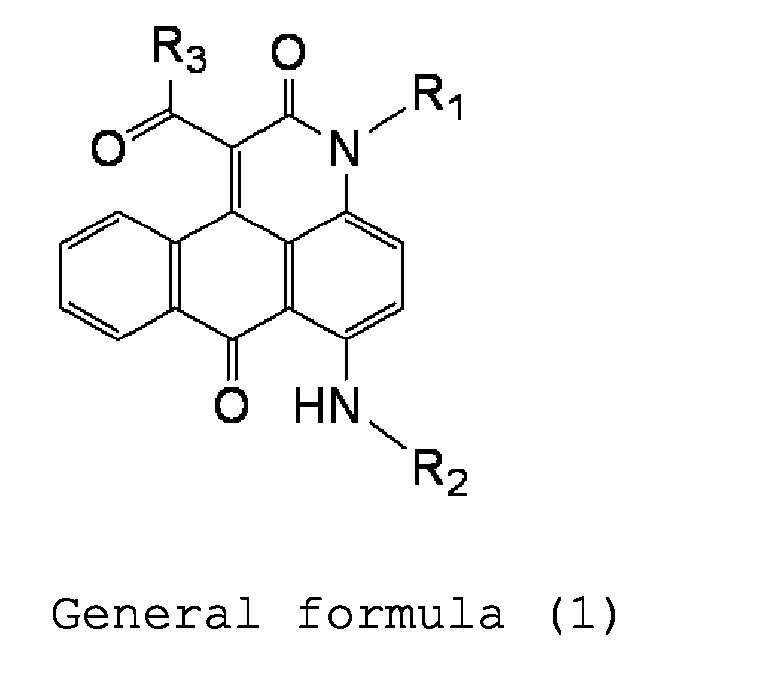
Description
- The present invention relates to a colored resin powder to be used in a recording process such as an electrophotographic process, an electrostatic recording process, a magnetic recording process, a toner jet process, or a liquid development process, and to a toner using the colored resin powder.
- In recent years, there has been an increasing demand for an improvement in image quality along with increasing popularity of a color image. In a digital full color copying machine or printer, a color original image is subjected to color separation with filters for blue, green, and red colors, and latent images corresponding to the original image are then developed with developers for magenta, cyan, and black colors. Therefore, a coloring agent in the developer for each color has a large influence on image quality. In general, when a pigment is dispersed in various media, it is difficult to sufficiently micronize the pigment and to homogeneously disperse the pigment.
- Out of color toners, a magenta toner is important for reproducing a skin color. In addition, a skin color tone in a portrait is a halftone, and hence excellent developability is also required. As a coloring agent for the magenta toner, there have been conventionally known a quinacridone-based coloring agent, a thioindigo-based coloring agent, a xanthene-based coloring agent, a monoazo-based coloring agent, a perylene-based coloring agent, and a diketopyrrolopyrrole-based coloring agent.
- Further, when a dye is used as the coloring agent for the magenta toner, although a bright magenta color is exhibited at an initial stage, stability to light is low, and a variation in color tint after leaving to stand is large. Further, a clear image having high lightness is obtained in a pale color, but it is difficult to obtain a sufficient image density in a region having a deep color. Particularly in the case of mixing colors and reproducing red and blue as deep colors, a color development range is liable to become narrow. The xanthene-based coloring agent is a coloring agent satisfactory in color reproducibility and excellent in color tone. However, when the coloring agent is used in a solution state, its light fastness becomes remarkably poor, and thus various contrivances are required (see Japanese Patent Application Laid-Open No.
9-255882 5-117536 - The present invention has been made in order to solve the problems. That is, an object of the present invention is to provide a colored resin powder which can express even a region having high lightness and saturation and has spectral reflectance characteristic having a wide gamut. Another object of the present invention is to provide a toner containing the colored resin powder.
- The objects are achieved by the present invention described below.
- That is, the present invention relates to a colored resin powder, including a water-insoluble coloring matter compound represented by the following general formula (1) and a binder resin.
- The present invention also relates to a toner, including at least the colored resin powder.

- In the general formula (1), R1 and R2 each independently represent an alkyl group, and R3 represents one of an alkyl group, an aryl group, and an alkoxy group.
- According to the present invention, it is possible to provide the colored resin powder which can express even a region having high lightness and saturation and has spectral reflectance characteristic having a wide gamut, and the toner containing the colored resin powder.
- Further features of the present invention will become apparent from the following description of exemplary embodiments with reference to the attached drawing.
-
FIG. 1 shows a 1H NMR spectrum at 400 MHz of a compound (1) represented by the general formula (1) of the present invention in CHCl3 at room temperature. - Hereinafter, the present invention is described in detail by way of embodiments. The inventors of the present invention have made extensive studies in order to solve the problems of the related art. As a result, the inventors have found that a colored resin powder containing a water-insoluble coloring matter compound represented by the following general formula (1) and a binder resin shows satisfactory improvements in lightness and saturation and has spectral reflectance characteristic having a wide gamut. The inventors have also found that the use of the colored resin powder provides a toner which can satisfactorily express even a region having high lightness and saturation and has spectral reflectance characteristic having a wide gamut.

- In the general formula (1), R1 and R2 each independently represent an alkyl group, and R3 represents one of an alkyl group, an aryl group, and an alkoxy group.
- <With regard to colored resin powder>
- A colored resin powder of the present invention is described. The size of the colored resin powder of the present invention may be adjusted depending on applications, but one having a particle diameter of about 0.01 µm to 1,000 µm in terms of area-equivalent circle diameter is envisaged.
- The colored resin powder of the present invention can express even a region having high lightness and saturation and has spectral reflectance characteristic having a wide gamut, and hence is suitable for a toner application.
- The colored resin powder of the present invention contains a water-insoluble coloring matter compound represented by the general formula (1) and a binder resin.
- The colored resin powder is not particularly limited as long as it is a mixture of the water-insoluble coloring matter compound represented by the general formula (1) and the binder resin. However, specific examples thereof include: one obtained by mixing the components by kneading, followed by pulverization; one obtained by melt-kneading the components, followed by dispersion in liquid with a dispersing machine; and one obtained by aggregating the water-insoluble coloring matter compound represented by the general formula (1) and the binder resin formed into fine particles in advance, followed by powderization.
- When the water-insoluble coloring matter compound represented by the general formula (1) is mixed into the binder resin to form a masterbatch, even in the case of using the water-insoluble coloring matter compound represented by the general formula (1) in a large amount, dispersibility does not deteriorate. Further, when the masterbatch is used for a toner, dispersibility in toner particles is improved and color reproducibility such as color mixing property or transparency is excellent. Further, a toner having large covering power on a transfer material may be obtained. Further, through an improvement in dispersibility of a coloring agent, endurance stability of toner charging property is excellent, and an image having image quality kept at a high level can be obtained.
- The use amount of the water-insoluble coloring matter compound represented by the general formula (1) is preferably 0.1 to 30 parts by mass, more preferably 0.5 to 20 parts by mass, most preferably 3 to 15 parts by mass, with respect to 100 parts by mass of the binder resin.
- First, the water-insoluble coloring matter compound represented by the general formula (1) is described.
- The water-insoluble coloring matter compound represented by the general formula (1) of the present invention has high compatibility with an organic solvent. It should be noted that the "water-insoluble" in the present invention refers to a water solubility of less than 1% in terms of mass percentage.
- In the general formula (1), R1 and R2 represent an alkyl group.
- The alkyl group represented by R1 and R2 in the general formula (1) is not particularly limited and examples thereof include linear, branched, or cyclic primary to tertiary alkyl groups having 1 to 20 atoms such as a methyl group, an ethyl group, an n-propyl group, an iso-propyl group, an n-butyl group, a sec-butyl group, a tert-butyl group, an octyl group, a dodecyl group, a nonadecyl group, a cyclobutyl group, a cyclopentyl group, a cyclohexyl group, a methylcyclohexyl group, a 2-ethylpropyl group, a 2-ethylhexyl group, and a cyclohexenylethyl group.
- When R1 represents a bulky secondary or tertiary alkyl group, a cyclization step hardly proceeds, resulting in a small yield in the production. Hence, a primary alkyl group such as a methyl group, a propyl group, a butyl group, an octyl group, or a 2-ethylhexyl group is preferred. Of those, a methyl group, an n-butyl group, or a 2-ethylhexyl group is particularly preferred for the production.
- A case where R2 represents an ethyl group, an n-butyl group, a sec-butyl group, a dodecyl group, a cyclohexyl group, a methylcyclohexyl group, a 2-ethylpropyl group, a 2-ethylhexyl group, or a cyclohexenylethyl group is preferred because even a region having high lightness and saturation of the compound can be expressed. Of those, an n-butyl group or a 2-ethylhexyl group is particularly preferred.
- The alkyl group represented by R1 and R2 may further have a substituent. The substituent is not particularly limited as long as it does not remarkably inhibit increases in the lightness and saturation of the compound, and examples thereof include: alkoxy groups such as a methoxy group, a ethoxy group, a propoxy group, a butoxy group and a 2-ethylhexyloxy group; mono-substituted amino groups such as a methylamino group and a propylamino group; di-substituted amino groups such as a dimethylamino group, a dibutylamino group, and an N-ethyl-N-phenyl group; and a cyano group.
- The alkyl group represented by R3 in the general formula (1) is not particularly limited and examples thereof include linear, branched, or cyclic alkyl groups having 1 to 20 carbon atoms such as a methyl group, an ethyl group, a propyl group, a butyl group, an octyl group, a dodecyl group, a nonadecyl group, a cyclobutyl group, a cyclopentyl group, a cyclohexyl group, a methylcyclohexyl group, and an ethylhexyl group.
- The aryl group represented by R3 is not particularly limited and examples thereof include a phenyl group and a naphthyl group.
- The alkoxy group represented by R3 is not particularly limited and examples thereof include a methoxy group, an ethoxy group, a propoxy group, and a butoxy group.
- R3 may further have a substituent. The substituent is not particularly limited as long as it does not remarkably inhibit increases in the lightness and saturation of the compound, and examples thereof include: alkyl groups such as a methyl group, an ethyl group, a propyl group, and a butyl group; aryl groups such as a phenyl group; alkoxy groups such as a methoxy group, an ethoxy group, and a butoxy group; mono-substituted amino groups such as a methylamino group and a propylamino group; di-substituted amino groups such as a dimethylamino group, a dipropylamino group, and an N-ethyl-N-phenyl group; an amino group; and a cyano group.
- A case where R3 represents a methyl group, a phenyl group, a 2-methoxyphenyl group, a 4-methoxyphenyl group, or an ethoxy group is preferred. Of those, a phenyl group, a 2-methoxyphenyl group, or a 4-methoxyphenyl group is particularly preferred because of large increases in the lightness and saturation of the compound.
- The compound represented by the general formula (1) according to the present invention may be synthesized, for example, with reference to a known process as described in Japanese Patent Application Laid-Open No.
2005-320480 - An aspect of a manufacturing process for the compound represented by the general formula (1) of the present invention is shown. However, the manufacturing process is not limited thereto.

- R1 to R3 in the compounds A to D and the general formula (1) have the same meanings as in the cases of R1 to R3 in the above-mentioned general formula (1).
- First, a cyclization step of subjecting a compound A and a compound B to cyclization to manufacture a compound C is described.
- Many kinds of commercially available products are known and easily available as the compound A to be used in the present invention.
- The use amount of the compound B in this step is 0.1 to 10-fold mol, preferably 0.5 to 5-fold mol, more preferably 0.8 to 5-fold mol, with respect to the compound A.
- This step is preferably performed in the presence of a solvent. The solvent is not particularly limited as long as it is not involved in the reaction, and examples thereof include: nitrile-based solvents such as acetonitrile, propionitrile, and benzonitrile; aromatic solvents such as benzene, toluene, xylene, ethylbenzene, chlorobenzene, 1,2-dichlorobenzene, and mesitylene; ether-based solvents such as diisopropyl ether, methyl tert-butyl ether, and tetrahydrofuran; and alcohol-based solvents such as butyl alcohol and diethylene glycol. Of those, aromatic solvents such as benzene, toluene, xylene, ethylbenzene, chlorobenzene, 1,2-dichlorobenzene, and mesitylene are preferred, and 1,2-dichlorobenzene, mesitylene, and the like are particularly preferred. Further, two or more kinds of solvents may be used as a mixture, and a mixing ratio upon use of the mixture may be arbitrarily determined.
- The use amount of the reaction solvent falls within a range of 0.1 to 1,000-fold mass, preferably 0.5 to 500-fold mass, more preferably 1.0 to 150-fold mass, with respect to the compound A.
- The reaction temperature at which this step is performed falls within a range of -80 to 300°C, preferably -20 to 250°C, more preferably 0 to 220°C. In general, the reaction is completed within 48 hours.
- In this step, the reaction rapidly proceeds by the addition of an acid or a base as necessary. The acid to be used is not particularly limited as long as it is not involved in the reaction, and examples thereof include: inorganic acids such as hydrochloric acid, sulfuric acid, and phosphoric acid; organic acids such as p-toluenesulfonic acid, formic acid, acetic acid, propionic acid, and trifluoroacetic acid; strongly acidic ionexchange resins such as Amberlite (Rohm and Haas Company) and Amberlyst (Rohm and Haas Company); and inorganic acid salts such as ammonium formate and ammonium acetate. Of those, phosphoric acid, p-toluenesulfonic acid, acetic acid, and the like are preferred.
- The use amount of the acid is 0.1 to 50-fold mol, preferably 1 to 30-fold mol, more preferably 2 to 10-fold mol, with respect to the compound A.
- Specific examples of the base to be used in this step include: metal alkoxides such as potassium tert-butoxide, sodium tert-butoxide, sodium methoxide, and sodium ethoxide; organic bases such as piperidine, pyridine, 2-methylpyridine, diethylamine, triethylamine, isopropylethylamine, potassium acetate, and 1,8-diazabicyclo[5.4.0]undeca-7-ene (DBU); n-butyl lithium; and inorganic bases such as magnesium chloride, sodium borohydride, metallic sodium, sodium hydride, sodium carbonate, and sodium hydrogen carbonate. Of those, sodium methoxide, sodium ethoxide, potassium acetate, sodium carbonate, sodium hydrogen carbonate, and the like are preferred.
- The use amount of the base is 0.1 to 15-fold mol, preferably 1 to 8-fold mol, more preferably 1.4 to 5-fold mol, with respect the compound A.
- After the completion of the reaction, the resultant is diluted with 2-propyl alcohol and hexane, and a precipitated solid can be filtered to yield a compound C.
- Next, a condensation step is described. The condensation step falls within the category of a known reaction to be classified as an Ullmann condensation reaction (Chem. Ber., 36, 2382 (1902)). That is, the compound C and a compound D (amine compound) are subjected to condensation to yield the general formula (1) of the present invention. As a specific amination reaction, for example, a process shown below is given.
- The use amount of the compound D in this step is 0.1 to 10-fold mol, preferably 0.5 to 5-fold mol, more preferably 0.8 to 5-fold mol, with respect to the compound C.
- A condensation agent to be used in this step is not particularly limited and a condensation agent to be generally used in the Ullmann condensation reaction may be used. Examples thereof include copper powder and copper compounds such as cuprous chloride, cupric chloride, cuprous bromide, cupric bromide, copper iodide, copper acetate, and copper sulfate. Preferred examples thereof include copper iodide.
- The use amount of the condensation agent is preferably 0.0005 to 0.1 mol, more preferably 0.001 to 0.05 mol, with respect to 1 mol of the compound C.
- In order to promote the reaction, a promoter for the condensation agent may be used in this step.
- The promoter for the condensation agent is not particularly limited as long as it is used in the known reaction to be classified as the Ullmann condensation reaction. For example, 2,2'-bipyridyl and 1,10-phenanthroline are preferred because they are inexpensive and are easily utilized.
- An organic solvent to be used in the condensation step is described.
- The organic solvent which may be used in this step is not particularly limited as long as the organic solvent is not involved in the reaction, and there may be used, for example, methanol, ethanol, n-propanol, isopropanol, n-butanol, toluene, xylene, ethylene glycol, N-methylpyrrolidone, N,N-dimethylacetamide, N,N-dimethylformamide, dimethyl sulfoxide, sulfolane, chlorobenzene, dichlorobenzene, trichlorobenzene, and nitrobenzene alone or in combination of two or more kinds thereof depending on the solubility of the substrate.
- This step is generally performed within a temperature range of 0 to 220°C and is generally completed within 24 hours.
- A reaction temperature in the condensation step preferably falls within a range of 5 to 180°C, and is more preferably 10 to 120°C. A temperature of less than 0°C is not preferred because the progress of the reaction becomes remarkably slow. Further, a temperature of more than 220°C is not preferred because the decomposition of the compound may occur.
- The resultant compound represented by the general formula (1) may be treated according to a general post-treating process for an organic synthesis reaction and then subjected to purification such as recrystallization, reprecipitation, or column chromatography to yield a high-purity water-insoluble coloring matter compound. The water-insoluble coloring matter compound represented by the general formula (1) may be identified through the use of, for example, 1H nuclear magnetic resonance spectral analysis, LC/TOF MS, or a UV/Vis spectrophotometer.
- It may be appropriately selected by a person skilled in the art to add known protection and deprotection reactions, hydrolysis, and other reactions in a functional group of each compound, as necessary.
- Further, when the substituents R1 and R2 are the same, the compound represented by the general formula (1) of the present invention may be obtained by subjecting a compound E and the compound B to cyclization as shown below. This cyclization step may be performed in the same manner as in the cyclization step of subjecting the compound A and the compound B to cyclization to manufacture the compound C.

- The compound represented by the general formula (1) of the present invention may be used alone or may be used in combination of two or more kinds thereof in order to adjust a color tone and the like depending on purposes of use applications. In addition, two or more kinds of known pigments and dyes may be used in combination.
- Water-insoluble coloring matter compounds (1) to (21) are shown below as preferred specific examples of the water-insoluble coloring matter compound of the present invention. However, the water-insoluble coloring matter compound is not limited to the following examples. It should be noted that the water-insoluble coloring matter compounds (1) to (21) are obtained by adopting substituents in Table 1 as R1, R2, and R3 in the following general formula. "*" represents a bonding site of a substituent.

-
Table 1 Water- insoluble compound R1 R2 R3 1 CH3CH2CH2CH2- * 
CH3 2 
CH3CH2CH2CH2- * CH3 3 CH3 
CH3 4 CH3CH2CH2CH2- * 
C6H5 5 CH3CH2CH2CH2- * 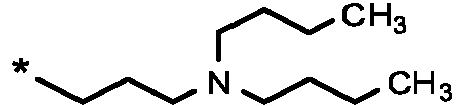
C6H5 6 CH3CH2CH2CH2- * 

7 n- C8H17- * CH3CH2CH2CH2- * 
8 

C6H5 9 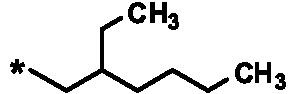

* - OCH2CH3 10 

C6H5 11 

C6H5 12 

* - OCH2CH3 13 CH3 

14 CH3 
C6H5 15 

C6H5 16 
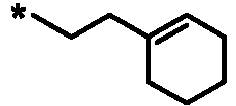
C6H5 17 CH3 n-C12H25- * C6H5 18 

C6H5 19 

C6H5 20 CH3CH2CH2CH2- * CH3CH2CH2CH2- * 
21 CH3CH2CH2CH2- * CH3CH2CH2CH2- * C6H5 - <Binder resin>
- A binder resin to be used in the present invention is not particularly limited and examples thereof may include a thermoplastic resin.
- Specific examples thereof include: homopolymers or copolymers of styrenes such as styrene, p-chlorostyrene, and α-methylstyrene (styrene-based resins); homopolymers or copolymers of esters having a vinyl group, such as methyl acrylate, ethyl acrylate, n-propyl acrylate, n-butyl acrylate, lauryl acrylate, 2-ethylhexyl acrylate, methyl methacrylate, ethyl methacrylate, n-propyl methacrylate, lauryl methacrylate, and 2-ethylhexyl methacrylate (vinyl-based resins); homopolymers or copolymers of vinylnitriles such as acrylonitrile and methacrylonitrile (vinyl-based resins); homopolymers or copolymers of vinyl ethers such as vinyl ethyl ether and vinyl isobutyl ether (vinyl-based resins); homopolymers or copolymers of ketones such as vinyl methyl ketone, vinyl ethyl ketone, and vinyl isopropenyl ketone (vinyl-based resins); homopolymers or copolymers of olefins such as ethylene, propylene, butadiene, and isoprene (olefin-based resins); and non-vinyl condensation resins such as an epoxy resin, a polyester resin, a polyurethane resin, a polyamide resin, a cellulose resin, and a polyether resin, and graft polymers of these non-vinyl condensation resins and vinyl-based monomers. One kind of those resins may be used alone, or two or more kinds thereof may be used in combination.
- Further, the polyester resin is synthesized from an acid-derived constituent component (dicarboxylic acid) and an alcohol-derived constituent component (diol). In the present invention, the "acid-derived constituent component" refers to a constituent part which has been an acid component before the synthesis of the polyester resin, and the "alcohol-derived constituent component" refers to a constituent part which has been an alcohol component before the synthesis of the polyester resin.
- The acid-derived constituent component of the present invention is not particularly limited and examples thereof include a constituent component derived from an aliphatic dicarboxylic acid, a constituent component derived from a dicarboxylic acid having a double bond, and a constituent component derived from a dicarboxylic acid having a sulfonic acid group. Specific examples thereof include oxalic acid, malonic acid, succinic acid, glutaric acid, adipic acid, pimelic acid, suberic acid, azelaic acid, sebacic acid, 1,9-nonanedicarboxylic acid, 1,10-decanedicarboxylic acid, 1,11-undecanedicarboxylic acid, 1,12-dodecanedicarboxylic acid, 1,13-tridecanedicarboxylic acid, 1,14-tetradecanedicarboxylic acid, 1,16-hexadecanedicarboxylic acid, and 1,18-octadecanedicarboxylic acid, and lower alkyl esters and acid anhydrides thereof. In particular, a constituent component derived from an aliphatic dicarboxylic acid is desirable, and further, an aliphatic moiety in the aliphatic dicarboxylic acid is preferably a saturated carboxylic acid.
- The alcohol-derived constituent component is not particularly limited but is desirably an aliphatic diol. Examples thereof include ethylene glycol, 1,3- propanediol, 1,4-butanediol, 1,5-pentanediol, 1,6-hexanediol, 1,7-heptanediol, 1,8-octanediol, 1,9-nonanediol, 1,10-decanediol, 1,11-dodecanediol, 1,12-undecanediol, 1,13-tridecanediol, 1,14-tetradecanediol, 1,18-octadecanediol, and 1,20- eicosanediol.
- In the present invention, a crosslinking agent may be used at the time of the synthesis of the binding resin for improving the mechanical strength of the colored resin powder, and at the same time, for controlling its molecular weight.
- The crosslinking agent to be used in a toner is not particularly limited and examples thereof include bifunctonal crosslinking agents such as divinylbenzene, bis(4-acryloxypolyethoxyphenyl)propane, ethylene glycol diacrylate, 1,3-butylene glycol diacrylate, 1,4-butanediol diacrylate, 1,5-pentanediol diacrylate, 1,6-hexanediol diacrylate, neopentyl glycol diacrylate, diethylene glycol diacrylate, triethylene glycol diacrylate, tetraethylene glycol diacrylate, diacrylates of polyethylene glycols #200, #400, and #600, dipropylene glycol diacrylate, polypropylene glycol diacrylate, polyester-type diacrylates, and ones obtained by changing the diacrylates to dimethacrylates.
- A polyfunctional crosslinking agent is not particularly limited and examples thereof include pentaerythritol triacrylate, trimethylolethane triacrylate, trimethylolpropane triacrylate, tetramethylolmethane tetraacrylate, oligoester acrylate and methacrylate thereof, 2,2-bis(4-mathacryloxyphenyl)propane, diallyl phthalate, triallyl cyanurate, triallyl isocyanurate, and triallyl trimellitate.
- Any such crosslinking agent is used in an amount of preferably 0.05 to 10 parts by mass, more preferably 0.1 to 5 parts by mass, with respect to 100 parts by mass of the monomer.
- <Preparation process for colored resin powder>
- The colored resin powder of the present invention may be manufactured with a known manufacturing apparatus such as a mixing machine or a heat kneading machine.
- First, a binder resin and the water-insoluble coloring matter compound of the present invention are mixed well with a mixing machine such as a Henschel mixer or a ball mill. Next, the mixture is melted with a heat kneading machine such as a roll, a kneader, or an extruder. The melt is milled and kneaded to dissolve the resins with each other. After solidification by cooling, the resultant can be pulverized to yield a colored resin powder.
- Further, by virtue of mixing the water-insoluble coloring matter compound represented by the general formula (1) with the binder resin, the colored resin powder according to the present invention does not cause any deterioration in colorant performance of the water-insoluble coloring matter compound and can provide stable color development in a sustained manner over a long period of time as compared to the case of using the water-insoluble coloring matter compound alone.
- The colored resin powder of the present invention may be used in combination with a pigment or a dye as a coloring agent as long as the dispersibility of constituent components and a hue of interest are not inhibited.
- Next, a toner of the present invention is described.
- The toner of the present invention is a toner containing the colored resin powder.
- A manufacturing process for toner particles constituting the toner of the present invention is, for example, a pulverization process, an emulsion polymerization process, or an emulsion aggregation process. From the viewpoints of an environmental load at the time of the manufacture and the controllability of a particle diameter, the toner particles are preferably manufactured by an emulsion aggregation process among those manufacturing processes, which involves granulation mainly in an aqueous medium. Further, the colored resin powder of the present invention may be used for a developer to be used in a liquid development process (hereinafter, referred to as liquid developer).
- The toner particles contain, in addition to the binder resin, a coloring agent, a wax, a charge controlling agent, and the like, as necessary. Further, an external additive is preferably added to the toner particles.
- The wax means a material to be used for the purpose of preventing offset in the fixation of the toner. Specifically, for example, the following waxes are used in many cases: hydrocarbon-based waxes such as a low-molecular weight polyethylene, a low-molecular weight polypropylene, a microcrystalline wax, and a paraffin wax; oxides of hydrocarbon-based waxes such as a polyethylene oxide wax or block copolymers thereof; fatty acid ester-based waxes such as a carnauba wax, a sasol wax, and a montanic acid ester wax; partially or wholly deacidified fatty acid esters such as a deacidified carnauba wax; saturated linear fatty acids such as palmitic acid, stearic acid, and montanic acid; unsaturated fatty acids such as brassidic acid, eleostearic acid, and parinaric acid; saturated alcohols such as stearyl alcohol, aralkyl alcohol, behenyl alcohol, carnaubyl alcohol, ceryl alcohol, and melissyl alcohol; polyhydric alcohols such as sorbitol; fatty acid amides such as linoleic acid amide, oleic acid amide, and lauric acid amide; saturated fatty acid bisamides such as methylenebisstearic acid amide, ethylenebiscapric acid amide, ethylenebislauric acid amide, and hexamethylenebisstearic acid amide; unsaturated fatty acid amides such as ethylenebisoleic acid amide, hexamethylenebisoleic acid amide, N,N'-dioleyladipic acid amide, and N,N'-dioleylsebacic acid amide; aromatic bisamides such as m-xylenebisstearic acid amide and N,N'-distearylisophthalic acid amide; fatty acid metal salts (generally referred to as metal soaps) such as calcium stearate, calcium laurate, zinc stearate, and magnesium stearate; waxes obtained by grafting aliphatic hydrocarbon-based waxes with vinyl-based monomers such as styrene and acrylic acid; partially esterified products of fatty acids and polyhydric alcohols, such as behenic monoglyceride; methyl ester compounds having a hydroxyl group obtained by the hydrogenation of vegetable fats and oils; and long-chain alkyl alcohols or long-chain alkylcarboxylic acids having 12 or more carbon atoms. Of those, hydrocarbon-based waxes, fatty acid ester-based waxes, and saturated alcohols are mentioned as preferred examples from the viewpoint of a balance between mold releasability and dispersibility in a resin. Further, one kind of those waxes may be used alone, or two or more kinds thereof may be used in combination as necessary.
- The content of the wax of the present invention in the toner is preferably 1 to 25 parts by mass, more preferably 3 to 20 parts by mass, with respect to 100 parts by mass of the toner particles. When the wax component is less than 1 part by mass, a releasing effect as the wax lowers. On the other hand, when the wax component is more than 25 parts by mass, although releasing property is satisfied, developability lowers, and a negative effect such as fusion of the toner on a surface of a developing sleeve or an electrostatic latent image bearing member is liable to occur.
- The wax of the present invention is preferably one having a melting point of 50°C or more and 200°C or less, more preferably one having a melting point of 55°C or more and 150°C or less. It should be noted that, when the melting point of the wax is less than 50°C, the blocking resistance property of the toner may lower, and when the melting point is more than 200°C, the exudation property of the wax upon fixation lowers, and releasability in oilless fixation may lower.
- It should be noted that the melting point in the present invention refers to a main endothermic peak temperature in a differential scanning calorimetry (DSC) curve measured in conformity with ASTM D3418-82. Specifically, a DSC curve within a temperature range of 30 to 200°C is obtained by the second temperature increasing process under a normal-temperature and normal-humidity environment through the use of a differential scanning calorimeter (manufactured by Mettler Toledo International Inc.: DSC822) within a measurement temperature range of 30 to 200°C at a rate of temperature increase of 5°C/min, and the melting point of the wax is a main endothermic peak temperature in the resultant DSC curve.
- The addition amount of the wax of the present invention falls within preferably a range of 2.5 to 15.0 parts by mass, more preferably a range of 3.0 to 10.0 parts by mass, with respect to 100 parts by mass of the binder resin. When the addition amount of the wax is less than 2.5 parts by mass, oilless fixation becomes difficult. When the addition amount is more than 15.0 parts by mass, the amount of the wax in the toner particles is too large, and an excessive wax is present in a large amount on a toner particle surface, which may inhibit desired charging property. Thus, both the cases are not preferred.
- Coloring agents to be used may be used in combination as long as the hue of the water-insoluble coloring matter compound contained in the colored resin powder of the present invention is not inhibited. The coloring agents may be exemplified by a condensed azo compound, an azo metal complex, a diketopyrrolopyrrole compound, an anthraquinone compound, a quinacridone compound, a basic dye lake compound, a naphthol compound, a benzimidazolone compound, a thioindigo compound, a perylene compound, a methine compound, and an allylamide compound, but need to be carefully selected.
- The content of the coloring agent is preferably 1 to 20 parts by mass with respect to 100 parts by mass of the resin. When the content is less than 1 part by mass, it may be difficult to ensure a sufficient toner density. When the content is more than 20 parts by mass, the coloring agent to be excluded from the toner particles tends to increase.
- As the charge controlling agent, a known one may be utilized, and a charge controlling agent which has a high charging speed and can stably maintain a certain charging amount is particularly preferred. In addition, when the toner is manufactured by a direct polymerization process, a charge controlling agent which has low polymerization inhibition property and is substantially free of any substance soluble in an aqueous dispersion medium is particularly preferred.
- The charge controlling agent is exemplified by charge controlling agents for controlling the toner so as to have a negative charge, such as a polymer or copolymer having a sulfonic acid group, a sulfonic acid salt group, or a sulfonic acid ester group, a salicylic acid derivative and a metal complex thereof, a monoazo metal compound, an acetylacetone metal compound, an aromatic oxycarboxylic acid, aromatic mono- and polycarboxylic acids and metal salts, anhydrides, and esters thereof, phenol derivatives such as bisphenol, a urea derivative, a metal-containing naphthoic acid-based compound, a boron compound, a quaternary ammonium salt, a calixarene, and a resin-based charge controlling agent.
- The charge controlling agent is also exemplified by charge controlling agents for controlling the toner so as to have a positive charge, such as: nigrosine-modified products with nigrosine, fatty acid metal salts, and the like; guanidine compounds; imidazole compounds; quaternary ammonium salts such as tributylbenzylammonium 1-hydroxy-4-naphthosulfonate and tetrabutylammonium tetrafluoroborate, and analogues thereof including onium salts such as phosphonium salts and lake pigments thereof; triphenylmethane dyes and lake pigments thereof (laking agents include phosphotungstic acid, phosphomolybdic acid, phosphotungstic molybdic acid, tannic acid, lauric acid, gallic acid, ferricyanides, and ferrocyanides); metal salts of higher fatty acids; diorganotin oxides such as dibutyl tin oxide, dioctyl tin oxide, and dicyclohexyl tin oxide; diorganotin borates such as dibutyl tin borate, dioctyl tin borate, and dicyclohexyl tin borate; and a resin-based charge controlling agent. One kind of those charge controlling agents may be used alone, or two or more kinds thereof may be used in combination.
- Inorganic fine powder may be added as an external additive to the toner of the present invention. Fine powder of, for example, silica, titanium oxide, alumina, or a complex oxide thereof, or a product obtained by treating the surface of any such oxide may be used as the inorganic fine powder. Further, resin particles of a vinyl-based resin, a polyester resin, a silicone resin, or the like may be added. Those inorganic fine powders and resin particles function as a fluidity aid, a cleaning aid, and the like.
- The toner of the present invention has preferably a weight-average particle diameter D4 of 4.0 to 9.0 µm and a ratio of the weight-average particle diameter D4 to a number-average particle diameter D1 (hereinafter, also referred to as weight-average particle diameter D4/number-average particle diameter D1 or D4/D1) of 1.35 or less, more preferably a weight-average particle diameter D4 of 4.9 to 7.5 µm and a ratio of weight-average particle diameter D4/number-average particle diameter D1 of 1.30 or less. When the ratio of less than 4.0 µm increases in a value for the weight-average particle diameter D4, in the case of applying the toner to an electrophotographic development system, it becomes difficult to achieve charging stabilization, and image deterioration such as image fogging or a development stripe is liable to occur in the continuous development operation (endurance operation) of a large number of images. In particular, when fine powder having a diameter of 2.5 um or less increases, such tendency becomes remarkable. Further, when the ratio of a weight-average particle diameter D4 of more than 8.0 µm increases, the reproducibility of a halftone portion drastically lowers, and the resultant image is a rough image, which is not preferred. In particular, when coarse powder having a diameter of 10.0 µm or more increases, such tendency appears remarkably. When the ratio of weight-average particle diameter D4/number-average particle diameter D1 is more than 1.35, fogging or a reduction in transferability occurs, and a variation in width of a line such as a thin line becomes large (hereinafter, referred to as reduction in sharpness).
- The toner of the present invention has an average circularity of the toner of preferably 0.930 to 0.995, more preferably 0.960 to 0.990, which is measured with a flow-type particle image analyzer, because the transferability of the toner is improved to a great extent.
- The toner of the present invention may be any of a magnetic toner and a non-magnetic toner. When the toner is used as the magnetic toner, toner particles constituting the toner of the present invention may be mixed with a magnetic material before use. Examples of the magnetic material include iron oxides such as magnetite, maghemite, and ferrite or iron oxides containing other metal oxides, metals such as Fe, Co, and Ni or alloys of these metals and metals such as Al, Co, Cu, Pb, Mg, Ni, Sn, Zn, Sb, Be, Bi, Cd, Ca, Mn, Se, Ti, W, and V, and mixtures thereof.
- <Manufacturing process for pulverization process toner>
- In a pulverization process toner, in addition to the colored resin powder, a magnetic substance, a wax, a charge controlling agent, other additives, and the like are used, as necessary.
- The pulverization process toner may be manufactured with a manufacturing apparatus known to a person skilled in the art, such as a mixing machine, a heat kneading machine, or a classification machine.
- First, those materials are mixed well with a mixing machine such as a Henschel mixer or a ball mill. Next, the mixture is melted with a heat kneading machine such as a roll, a kneader, or an extruder. The melt is milled and kneaded to dissolve the resins with each other, and a wax and a magnetic substance are dispersed therein. After solidification by cooling, the resultant can be pulverized and classified to yield a toner.
- Examples of the binder resin to be used in the pulverization process toner include a vinyl-based resin, a polyester-based resin, an epoxy-based resin, a polyurethane-based resin, a polyvinyl butyral-based resin, a terpene-based resin, a phenol-based resin, an aliphatic or alicyclic hydrocarbon-based resin, an aromatic petroleum-based resin, rosin, and modified rosin. Of those, a vinyl-based resin and a polyester-based resin are more preferred from the viewpoints of charging property and fixability. A polyester-based resin is particularly preferably used because the effects of charging property and fixability become large.
- One kind of those resins may be used alone or two or more kinds thereof may be used in combination.
- In the case where two or more kinds of resins are mixed to be used, it is preferred that resins having different molecular weights be mixed in order to control the viscoelastic property of the toner.
- The glass transition temperature of the binder resin to be used for the pulverization process toner is preferably 45 to 80°C, more preferably 55 to 70°C, the number-average molecular weight (Mn) thereof is preferably 2,500 to 50,000, and the weight-average molecular weight (Mw) thereof is preferably 10,000 to 1,000,000.
- The polyester-based resin is not particularly limited but is particularly preferably one having a molar ratio of an alcohol component to an acid component of 45/55 to 55/45 among all the components.
- In the polyester-based resin, the environmental dependency of the charging property of the toner becomes larger as the number of terminal groups in a molecular chain becomes larger. Therefore, the acid value is preferably 90 mg KOH/g or less, more preferably 50 mg KOH/g or less. Further, the hydroxyl value is preferably 50 mg KOH/g or less, more preferably 30 mg KOH/g or less.
- The glass transition temperature of the polyester resin is preferably 50 to 75°C, more preferably 55 to 65°C.
- In addition, the number-average molecular weight (Mn) thereof is preferably 1,500 to 50,000, more preferably 2,000 to 20,000.
- Further, the weight average molecular weight (Mw) thereof is preferably 6,000 to 100,000, more preferably 10,000 to 90,000.
- <Manufacturing process for suspension polymerization process toner>
- Toner particles to be manufactured by a suspension polymerization process of the present invention are manufactured as described below, for example. First, a water-insoluble coloring matter compound, a polymerizable monomer, a wax component, a polymerization initiator, and the like are mixed to prepare a polymerizable monomer composition. Next, the polymerizable monomer composition is dispersed in an aqueous medium to form particles of the polymerizable monomer composition. Then, the polymerizable monomer in the particles of the polymerizable monomer composition is polymerized in an aqueous medium to yield toner particles.
- The polymerizable monomer composition in the above-mentioned step is preferably prepared by mixing a dispersion, which is obtained by dispersing the above-mentioned water-insoluble coloring matter compound in a first polymerizable monomer, with a second polymerizable monomer. That is, the water-insoluble coloring matter compound is sufficiently dispersed by the first polymerizable monomer and then mixed with the second polymerizable monomer together with other toner materials. Thus, the water-insoluble coloring matter compound can be present in the toner particles in a more satisfactory dispersion state.
- Examples of the polymerizable monomer may include: styrenes such as styrene, p-chlorostyrene, and α-methylstyrene; acrylic acid ester monomers or methacrylic acid ester monomers such as methyl acrylate, ethyl acrylate, n-propyl acrylate, lauryl acrylate, 2-ethylhexyl acrylate, methyl methacrylate, ethyl methacrylate, n-propyl methacrylate, lauryl methacrylate, 2-ethylhexyl methacrylate, acrylonitrile, and methacrylonitrile; vinyl ether-based monomers such as vinyl methyl ether and vinyl isobutyl ether; and vinyl ketone-based monomers such as vinyl methyl ketone, vinyl ethyl ketone, and vinyl isopropenyl ketone.
- A known polymerization initiator may be given as the polymerization initiator to be used in the suspension polymerization process, and examples thereof include an azo compound, an organic peroxide, an inorganic peroxide, an organometallic compound, and a photopolymerization initiator. More specific examples thereof include: azo-based polymerization initiators such as 2,2'-azobis(isobutyronitrile), 2,2'-azobis(2-methylbutyronitrile), 2,2'-azobis(4-methoxy-2,4-dimethylvaleronitrile), 2,2'-azobis(2,4-dimethylvaleronitrile), and dimethyl 2,2'-azobis(isobutyrate); organic peroxide-based polymerization initiators such as benzoyl peroxide, di-tert-butyl peroxide, tert-butylperoxyisopropyl monocarbonate, tert-hexylperoxy benzoate, and tert-butylperoxy benzoate; inorganic peroxide-based polymerization initiators such as potassium persulfate and ammonium persulfate; and redox initiators such as hydrogen peroxide-ferrous, BPO-dimethylaniline-based, and cerium(IV) salt-alcohol-based redox initiators. Examples of the photopolymerization initiator include acetophenone-based, benzoin ether-based, and ketal-based photopolymerization initiators. Those polymerization initiators may be used alone, or in combination of two or more thereof.
- The case where the concentration of the polymerization initiator falls within a range of 0.1 to 20 parts by mass with respect to 100 parts by mass of the polymerizable monomer is preferred. The case where the concentration falls within a range of 0.1 to 10 parts by mass is more preferred. The polymerizable initiator, the kind of which slightly varies depending on a polymerization process, is used alone or as a mixture with reference to its 10-hour half-life temperature.
- A dispersion stabilizer is preferably incorporated into the aqueous medium to be used in the suspension polymerization process. As the dispersion stabilizer, known inorganic and organic dispersion stabilizers may be used. Examples of the inorganic dispersion stabilizer include calcium phosphate, magnesium phosphate, aluminum phosphate, zinc phosphate, magnesium carbonate, calcium carbonate, calcium hydroxide, magnesium hydroxide, aluminum hydroxide, calcium metasilicate, calcium sulfate, barium sulfate, bentonite, silica, and alumina. Examples of the organic dispersion stabilizer include polyvinyl alcohol, gelatin, methylcellulose, methylhydroxypropylcellulose, ethylcellulose, a sodium salt of carboxymethylcellulose, and starch. In addition, nonionic, anionic, and cationic surfactants may also be utilized, and examples thereof include sodium dodecyl sulfate, sodium tetradecyl sulfate, sodium pentadecyl sulfate, sodium octyl sulfate, sodium oleate, sodium laurate, potassium stearate, and calcium oleate.
- Of the dispersion stabilizers, a hardly water-soluble, inorganic dispersion stabilizer that is soluble in an acid is preferably used in the present invention. In addition, in the present invention, when an aqueous dispersion medium is prepared with the hardly water-soluble, inorganic dispersion stabilizer, such dispersion stabilizer is preferably used at a ratio in a range of 0.2 to 2.0 parts by mass with respect to 100 parts by mass of the polymerizable monomer in terms of the droplet stability of the polymerizable monomer composition in the aqueous medium. In addition, in the present invention, the aqueous medium is preferably prepared with water whose amount ranges from 300 to 3,000 parts by mass with respect to 100 parts by mass of the polymerizable monomer composition.
- <Manufacturing process for emulsion aggregation process toner>
- Next, a manufacturing process for toner particles by an emulsion aggregation process is described.
- First, a mixed liquid containing the colored resin powder of the present invention and a wax dispersion is prepared. At this time, a resin particle dispersion, a coloring agent particle dispersion, and other toner components may be further mixed, as necessary.
- A step of aggregating a mixed liquid thereof to form aggregate particles (aggregation step), a step of fusing the aggregate particles by heating (fusion step), a washing step, and a drying step are performed to yield toner particles.
- In each of the particle dispersions, a dispersant such as a surfactant may be used. Specifically, the coloring agent particle dispersion is obtained by dispersing a coloring agent in an aqueous medium together with a surfactant. Coloring agent particles are dispersed by a known process, and for example, a medium type dispersing machine such as a rotation shearing type homogenizer, a ball mill, a sand mill, or an attritor, or a high-pressure counter collision type dispersing machine is preferably used.
- Examples of the surfactant include a water-soluble polymer, an inorganic compound, and an ionic or non-ionic surfactant. In particular, an ionic surfactant having high dispersibility is preferably used from the viewpoint of dispersibility, and an anionic surfactant is particularly preferably used.
- Further, the molecular weight of the surfactant is preferably 100 to 10,000, more preferably 200 to 5,000, from the viewpoints of washing property and surface active performance.
- Specific examples of the surfactant include: water-soluble polymers such as polyvinyl alcohol, methylcellulose, carboxymethylcellulose, and sodium polyacrylate; surfactants including anionic surfactants such as sodium dodecylbenzenesulfonate, sodium octadecylsulfate, sodium oleate, sodium laurate, and potassium stearate, cationic surfactants such as laurylamine acetate and lauryltrimethylammonium chloride, amphoteric surfactants such as lauryldimethylamine oxide, and nonionic surfactants such as a polyoxyethylene alkyl ether, a polyoxyethylene alkylphenyl ether, and a polyoxyethylene alkylamine; and inorganic compounds such as tricalcium phosphate, aluminum hydroxide, calcium sulfate, calcium carbonate, and barium carbonate.
- It should be noted that one kind thereof may be used alone or two or more kinds thereof may be used in combination, as necessary.
- (Wax dispersion)
- A wax dispersion of the present invention is obtained by dispersing a wax in an aqueous medium. The wax dispersion is prepared by a known process.
- (Resin particle dispersion)
- A resin particle dispersion to be used in the present invention is obtained by dispersing resin particles in an aqueous medium.
- In the present invention, the aqueous medium means a medium containing water as a main component. Specific examples of the aqueous medium include water itself, water supplemented with a pH adjuster, and water supplemented with an organic solvent.
- A resin constituting the resin particles contained in the resin particle dispersion is not particularly limited as long as the resin is suitable for a toner and is preferably a thermoplastic binder resin having a glass transition temperature equal to or lower than a fixation temperature in an electrophotographic apparatus.
- Specific examples thereof may include: homopolymers of, or copolymers obtained by combining two or more kinds of, styrenes such as styrene, p-chlorostyrene, and α-methylstyrene, vinyl group-based monomers such as methyl acrylate, ethyl acrylate, n-propyl acrylate, lauryl acrylate, 2-ethylhexyl acrylate, methyl methacrylate, ethyl methacrylate, n-propyl methacrylate, lauryl methacrylate, 2-ethylhexyl methacrylate, acrylonitrile, and methacrylonitrile, vinyl ether-based monomers such as vinyl methyl ether and vinyl isobutyl ether, vinyl ketone-based monomers such as vinyl methyl ketone, vinyl ethyl ketone, and vinyl isopropenyl ketone, and polyolefin-based monomers such as ethylene, propylene, and butadiene, and mixtures of the homopolymers and the copolymers; an epoxy resin, a polyester resin, a polyurethane resin, a polyamide resin, a cellulose resin, a polyether resin, and a non-vinyl condensation resin, mixtures of these resins and the vinyl-based resins, and graft polymers obtained by polymerizing vinyl-based monomers in the presence of these resins. In particular, from the viewpoints of fixability and charging performance of a toner, a polystyrene resin or a polyester resin is particularly preferably used. One kind of those resins may be used alone, or two or more kinds thereof may be used in combination.
- The resin particle dispersion to be used in the present invention is obtained by dispersing resin particles in an aqueous medium. The resin particle dispersion is prepared by a known process. For example, in the case of a resin particle dispersion containing resin particles containing as a constituent element a vinyl-based monomer, particularly a styrene-based monomer, the resin particle dispersion may be prepared by subjecting the monomer to emulsion polymerization with a surfactant or the like.
- Further, in the case of a resin (e.g., a polyester resin) produced by another process, the resin is dispersed in water together with an ionic surfactant and a polymer electrolyte through the use of a dispersing machine such as a homogenizer. After that, the solvent can be evaporated to produce a resin particle dispersion. Further, the resin particle dispersion may be prepared by a process involving adding a surfactant to a resin, followed by emulsion dispersion in water with a dispersing machine such as a homogenizer, a phase inversion emulsification process, or the like.
- The median diameter on a volume basis of the resin particles in the resin particle dispersion is preferably 0.005 to 1.0 µm, more preferably 0.01 to 0.4 µm. When the median diameter is 1.0 µm or more, it becomes difficult to obtain toner particles having a weight-average particle diameter of 3.0 to 7.5 µm as appropriate toner particles.
- The average particle diameter of the resin particles may be measured, for example, by a dynamic light scattering process (DLS), a laser scattering process, a centrifugal sedimentation process, a field-flow fractionation process, or an electrical sensing zone process. It should be noted that the average particle diameter in the present invention means a 50% cumulative particle diameter value (D50) on a volume basis, which is measured by a dynamic light scattering process (DLS)/laser Doppler process at 20°C and at a solid concentration of 0.01 mass% as described later, unless otherwise stated.
- (Coloring agent particle dispersion)
- A coloring agent particle dispersion of the present invention is obtained by dispersing a coloring agent in an aqueous medium together with a surfactant. Coloring agent particles are dispersed by a known process, and for example, a medium type dispersing machine such as a rotation shearing type homogenizer, a ball mill, a sand mill, or an attritor, or a high-pressure counter collision type dispersing machine is preferably used.
- The amount of the surfactant to be used is 0.01 to 10 parts by mass, preferably 0.1 to 5.0 parts by mass, with respect to 100 parts by mass of the coloring agent. The surfactant is particularly preferably used at 0.5 part by mass to 3.0 parts by mass because the removal of the surfactant in the toner particles becomes easy. As a result, the amount of the surfactant remaining in the resultant toner becomes small, resulting in such effects that the image density of the toner is high and fogging hardly occurs.
- (Aggregation step)
- A process for forming aggregate particles is not particularly limited and may be suitably exemplified by a process involving adding and mixing a pH adjuster, a flocculant, a stabilizer, and the like into the above-mentioned mixed liquid and appropriately applying a temperature, mechanical power (stirring), and the like.
- The pH adjuster of the present invention is not particularly limited and examples thereof include alkalis such as ammonia and sodium hydroxide and acids such as nitric acid and citric acid.
- The flocculant of the present invention is not particularly limited and examples thereof include divalent or higher valent metal complexes as well as inorganic metal salts such as sodium chloride, magnesium carbonate, magnesium chloride, magnesium nitrate, magnesium sulfate, calcium chloride, and aluminum sulfate.
- Examples of the stabilizer of the present invention mainly include surfactants.
- The surfactants are not particularly limited and examples thereof include: water-soluble polymers such as polyvinyl alcohol, methylcellulose, carboxymethylcellulose, and sodium polyacrylate; surfactants including anionic surfactants such as sodium dodecylbenzenesulfonate, sodium octadecylsulfate, sodium oleate, sodium laurate, and potassium stearate, cationic surfactants such as laurylamine acetate and lauryltrimethylammonium chloride, amphoteric surfactants such as lauryldimethylamine oxide, and nonionic surfactants such as a polyoxyethylene alkyl ether, a polyoxyethylene alkylphenyl ether, and a polyoxyethylene alkylamine; and inorganic compounds such as tricalcium phosphate, aluminum hydroxide, calcium sulfate, calcium carbonate, and barium carbonate. It should be noted that one kind of those stabilizers may be used alone, or two or more kinds thereof may be used in combination as necessary.
- The average particle diameter of the aggregation particles to be formed in this step is not particularly limited but is generally recommended to be controlled to one similar to the average particle diameter of toner particles to be obtained. The control may be easily performed, for example, by appropriately setting and changing a temperature at the time of the addition and mixing of the flocculant and the like and conditions for the above-mentioned mixing with stirring. In addition, in order to prevent the toner particles from being fused to each other, the pH adjuster, the surfactant, and the like may be appropriately loaded.
- (Fusion step)
- In a fusion step, the aggregate particles are fused by heating to form toner particles.
- A temperature for the heating has only to fall within a range from the glass transition temperature (Tg) of a resin contained in the aggregate particles to the decomposition temperature of the resin. For example, under stirring in the same manner as in the aggregation step, the progress of the aggregation is stopped by the addition of a surfactant, the adjustment of a pH, and the like, and the aggregate particles are caused to fuse and coalesce by heating to a temperature equal to or higher than the glass transition temperature of the resin in the resin particles.
- A time for the heating has only to be such a time that the fusion is sufficiently caused. Specifically, the heating has only to be performed for about 10 minutes to 10 hours.
- Further, a step including adding and mixing a fine particle dispersion, which is obtained by dispersing fine particles, to allow the fine particles to adhere to the aggregate particles, thereby forming a core-shell structure (adhesion step) may be further included before or after the fusion step.
- (Washing step)
- In the present invention, the toner particles obtained after the fusion step are subjected to washing, filtration, drying, and the like under appropriate conditions to yield toner particles. In this case, it is preferred to sufficiently wash the toner particles in order to ensure charging property and reliability sufficient as a toner.
- A washing process is not limited, and for example, a suspension containing toner particles is filtered, and the resultant filtration residue is washed by stirring with distilled water and further filtered. From the viewpoint of charging property of a toner, the washing is repeated until the electrical conductivity of the filtrate reaches 150 µS/cm or less. When the electrical conductivity is more than 150 µS/cm, the charging property of a toner lowers, with the result that defects such as fogging and a reduction in image density occur.
- (Drying step)
- Drying may be performed by a generally known process such as a vibration type fluidized drying process, a spray dry process, a lyophilization process, or a flash jet process. The moisture content of the toner particles after the drying is preferably 1.5 mass% or less, more preferably 1.0 mass% or less.
- In the toner of the present invention, a charge controlling agent may also be mixed with toner base particles before use, as necessary. This allows the control of an optimal tribocharging amount depending on a development system.
- <Manufacturing process for liquid developer>
- Hereinafter, a manufacturing process for a liquid developer is described as the manufacturing process of the present invention.
- First, the liquid developer of the present invention is manufactured by dispersing or dissolving a colored resin powder, and as necessary, a charge controlling agent, a wax, and other aids in an electrical insulating carrier liquid. Alternatively, the liquid developer may be prepared by a double-stage process involving first preparing a concentrated toner and diluting the toner with an electrical insulating carrier liquid to prepare a developer.
- A dispersing machine to be used in the present invention is not particularly limited, and for example, a medium type dispersing machine such as a rotation shearing type homogenizer, a ball mill, a sand mill, or an attritor, or a high-pressure counter collision type dispersing machine is preferably used.
- A known coloring agent such as a pigment or a dye may be further added alone or two or more kinds thereof may be further added in combination to the colored resin powder of the present invention before use.
- The wax and the coloring agent to be used in the present invention are the same as described above.
- The charge controlling agent to be used in the present invention is not particularly limited as long as it is used for a liquid developer for electrostatic charge development, and examples thereof include cobalt naphthenate, copper naphthenate, copper oleate, cobalt oleate, zirconium octylate, cobalt octylate, sodium dodecylbenzenesulfonate, calcium dodecylbenzenesulfonate, soybean lecithin, and aluminum octoate.
- The electrical insulating carrier liquid to be used in the present invention is not particularly limited, and for example, an organic solvent having as high an electrical resistance as 109 Ω·cm or more and as low a dielectric constant as 3 or less is preferably used.
- Preferred specific examples thereof include ones having a boiling point within a temperature range of 68 to 250°C including an aliphatic hydrocarbon solvent such as hexane, pentane, octane, nonane, decane, undecane, or dodecane, ISOPAR H, G, K, L, or M (manufactured by Exxon Mobil Corporation), and LINEALENE DIMER A-20 or A-20H (manufactured by Idemitsu Kosan Co., Ltd.). They may be used alone or in combination of two or more kinds thereof in such a range that the viscosity of a system does not become high.
- (Examples)
- Hereinafter, the present invention is described in more detail by way of examples and comparative examples. However, the present invention is not limited to these examples. It should be noted that the terms "part(s)" and "%" in the following description refer to "part(s) by mass" and "mass%" unless otherwise stated.
- The resultant reaction products were identified by multiple analysis processes using the following devices. That is, the following analysis devices were used: a 1H nuclear magnetic resonance spectrometer (ECA-400, manufactured by JEOL Ltd.); an LC/TOF MS (LC/MSD TOF, manufactured by Agilent Technologies); and a UV/Vis spectrophotometer (UV-36000 type spectrophotometer, Shimadzu Corporation). It should be noted that an electrospray ionization process (ESI) was applied as an ionization process in the LC/TOF MS.
- (Manufacture of compound represented by general formula (1))
- The compound represented by the general formula (1) of the present invention may be synthesized by a known process.
- The compound represented by the general formula (1) of the present invention was manufactured by a process to be described below.
- <Synthesis Example 1: manufacturing example of compound (1) >
- 10.4 g (80 mmol) of ethyl acetoacetate and 0.7 g (6.4 mmol) of sodium carbonate were suspended in a solution of 14.3 g (40 mmol) of 4-bromo-1-butylaminoanthraquinone in 40 mL of 1,2-dichlorobenzene, and the suspension was stirred at 175°C for 24 hours. After the completion of the reaction, the resultant was cooled to room temperature and then diluted with 50 mL of 2-propyl alcohol and 50 mL of hexane. The solid was filtered and then washed with 100 mL of 2-propyl alcohol. After that, 8 g of an intermediate (1) corresponding to the compound C were obtained. To a solution of 7 g (14.6 mmol) of the intermediate (1) in 75 mL of dimethylformamide were added 3.6 mL of 2-ethylhexylamine, 292 mg of copper(I) iodide, and 4.7 g of sodium carbonate, and the mixture was subjected to a reaction at 100°C for 2 hours. After the completion of the reaction, the resultant was cooled and diluted with 200 mL of ethyl acetate, followed by filtration. The filtration residue was purified by column chromatography (toluene/THF) to yield 5.7 g (30% yield) of a compound (1).
FIG. 1 shows a 1H NMR spectrum at 400 MHz of the compound (1) in CDCl3 at room temperature. - Further, the solubility of the compound in water at room temperature and 60°C was confirmed. As a result, the solubility was found to be less than 1% in terms of mass percentage.
- (Results of analysis of compound (1))
- [1] 1H NMR (400 MHz, CDCl3, room temperature): δ [ppm]=0.97 (tt, 9H, J=20.6, 7.25 Hz), 1.32 (td, 4H, J=15.0, 14.2 Hz), 1.62-4.46 (m, 6H), 1.74-1.83 (m, 3H), 2.73 (s, 3H), 3.36 (m, 2H), 4.40 (t, 2H, J=7.79 Hz), 7.28 (d, 2H, J=9.62 Hz), 7.61-7.70 (m, 3H), 8.03 (d, 1H, J=7.79 Hz), 8.59 (dd, 1H, J=7.79, 1.83 Hz), 10.8 (s, 1H)
- [2] Mass spectrometry (ESI-TOF): m/z=473.2898 (M+H)+
- [3] UV/Vis spectroscopy: λmax=556 nm
- <Synthesis Example 2: manufacturing example of compound (4) >
- 6.8 g (32% yield) of a compound (4) were obtained by the same operation as in the manufacturing example 1 except that, in the manufacturing example 1, ethyl acetoacetate was changed to ethyl benzoylacetate.
- Further, the solubility of the compound in water at room temperature and 60°C was confirmed. As a result, the solubility was found to be less than 1% in terms of mass percentage.
- (Results of analysis of compound (4))
- [1] 1H NMR (400 MHz, CDCl3 room temperature): δ [ppm]=0.96 (dt, 9H, J=25.0, 7.21 Hz), 1.36-1.39 (m, 4H), 1.45-1.61 (m, 6H), 1.79 (t, 3H, J=6.18 Hz), 3.37-3.41 (m, 2H), 4.39 (s, 2H), 7.32-7.47 (m, 4H), 4.75 (tt, 2 Hz, J=7.56, 2.44 Hz), 7.72 (d, 1H, J=10.1 Hz), 7.97-8.03 (m, 3H), 8.55 (dd, 1H, J=7.79, 1.37 Hz), 10.9 (s, 1H)
- [2] Mass spectrometry (ESI-TOF): m/z=535.3001 (M+H)+ [3] UV/Vis spectroscopy: λmax=558 nm
- <Synthesis Example 3: manufacturing example of compound (6) >
- 5.4 g (24% yield) of a compound (6) were obtained by the same operation as in the manufacturing example 1 except that, in the manufacturing example 1, ethyl acetoacetate was changed to ethyl 4-methoxybenzoylacetate.
- Further, the solubility of the compound in water at room temperature and 60°C was confirmed. As a result, the solubility was found to be less than 1% in terms of mass percentage.
- (Results of analysis of compound (6))
- [1] 1H NMR (400 MHz, CDCl3, room temperature): δ [ppm]=0.90 (dt, 9H, J=24.9, 7.21 Hz), 1.31 (t, 4H, J=3.66 Hz), 1.44 (dd, 4H, J=14.9, 7.56 Hz), 1.52 (dd, 2H, J=16.5, 7.33 Hz), 1.73 (t, 3H, J=6.18 Hz), 3.78 (s, 1H), 4.33 (d, 2H, 43.1 Hz), 6.86 (d, 2H, J=9.16 Hz), 7.24 (t, 1H, J=11.5 Hz), 7.34 (t, 1H, J=7.79 Hz), 7.51 (t, 1H, J=7.56 Hz), 7.65 (d, 1H, J=9.62 Hz), 7.92 (d, 2H, J=8.70 Hz), 8.01 (d, 1H, J=8.24 Hz), 10.8 (s, 1H)
- [2] Mass spectrometry (ESI-TOF): m/z=565.3048 (M+H)+ [3] UV/Vis spectroscopy: λmax=557 nm
- <Synthesis Example 4: manufacturing example of compound (8)>
- 3.9 g (17% yield) of a compound (8) were obtained by the same operation as in the manufacturing example 1 except that, in the manufacturing example 1, 4-bromo-1-butylaminoanthraquinone was changed to 4-bromo-1-(2-ethylhexyl)aminoanthraquinone and ethyl acetoacetate was changed to ethyl benzoylacetate.
- Further, the solubility of the compound in water at room temperature and 60°C was confirmed. As a result, the solubility was found to be less than 1% in terms of mass percentage.
- (Results of analysis of compound (8))
- [1] 1H NMR (400 MHz, CDCl3, room temperature): δ [ppm]=0.88 (dq, 12H, J=41.1, 10.1 Hz), 1.19-1.34 (m, 12H), 1.49 (dt, 4H, J=22.3, 8.24 Hz), 1.74 (t, 1H, J=6.18 Hz), 1.91 (s, 1H), 3.32 (t, 2H, J=4.12 Hz), 4.34 (br, 2H), 7.24 (t, 1H, J=10.3 Hz), 7.32-7.42 (m, 3H), 7.50-7.54 (m, 2H), 7.67 (d, 1H, J=9.62 Hz), 7.95 (dd, 3H, J=15.1, 7.79 Hz), 8.50 (d, 1H, J=6.87 Hz), 10.8 (s, 1H)
- [2] Mass spectrometry (ESI-TOF): m/z=591.3567 (M+H)+ [3] UV/Vis spectroscopy: λmax=559 nm
- <Synthesis Example 5: manufacturing example of compound (9)>
- 4.6 g (21% yield) of a compound (9) were obtained by the same operation as in the manufacturing example 1 except that, in the manufacturing example 1, 4-bromo-1-butylaminoanthraquinone was changed to 4-bromo-1-(2-ethylhexyl)aminoanthraquinone and ethyl acetoacetate was changed to diethyl malonate.
- Further, the solubility of the compound in water at room temperature and 60°C was confirmed. As a result, the solubility was found to be less than 1% in terms of mass percentage.
- (Results of analysis of compound (9))
- [1] 1H NMR (400 MHz, CDCl3, room temperature): δ [ppm]=0.90 (tt, 12H, J=19.0, 7.02 Hz), 1.23-1.55 (m, 19H), 1.74 (t, 1H, J=6.18 Hz), 1.93 (d, 1H, J=3.66 Hz), 3.32 (s, 2H), 4.38 (d, 2H, J=23.8 Hz), 4.54 (q, 2H, J=6.72 Hz), 7.23 (d, 1H, J=9.62 Hz), 7.64 (dq, 3H, J=16.3, 4.73 Hz), 8.19 (d, 1H, J=7.79 Hz), 8.55 (t, 1H, J=4.58 Hz), 10.8 (s, 1H)
- [2] Mass spectrometry (ESI-TOF): m/z=559.3497 (M+H)+ [3] UV/Vis spectroscopy: λmax=559 nm
- <Synthesis Example 6: manufacturing example of compound (10)>
- 5.2 g (22% yield) of a compound (10) were obtained by the same operation as in the manufacturing example 1 except that, in the manufacturing example 1, 4-bromo-1-butylaminoanthraquinone was changed to 4-bromo-1-(2-ethylhexyl)aminoanthraquinone, ethyl acetoacetate was changed to ethyl benzoylacetate, ethyl acetoacetate was changed to diethyl malonate, and 2-ethylhexylamine was changed to 3-butoxy-propylamine.
- Further, the solubility of the compound in water at room temperature and 60°C was confirmed. As a result, the solubility was found to be less than 1% in terms of mass percentage.
- (Results of analysis of compound (10))
- [1] 1H NMR (400 MHz, CDCl3, room temperature): δ [ppm]=0.84-0.94 (m, 9H), 1.24-1.42 (m, 10H), 1.58 (td, 2H, J=14.3, 7.48 Hz), 1.93 (s, 1H), 2.02-2.08 (m, 2H), 3.45 (t, 2H, J=6.64 Hz), 3.58 (q, 4H, J=6.72 Hz), 4.37 (br, 2H), 7.32-7.45 (m, 4H), 7.53-7.57 (m, 2H), 7.70 (d, 1H, J=9.62 Hz), 7.98 (dd, 3H, J=18.3, 7.79 Hz), 8.51 (d, 1H, J=6.41 Hz), 10.8 (s, 1H) [2] Mass spectrometry (ESI-TOF): m/z=593.3361 (M+H)+ [3] UV/Vis spectroscopy: λmax=555 nm
- <Synthesis Example 7: manufacturing example of compound (14)>
- 5.0 g (25% yield) of a compound (10) were obtained by the same operation as in the manufacturing example 1 except that, in the manufacturing example 1, 4-bromo-1-butylaminoanthraquinone was changed to 4-bromo-1-methylaminoanthraquinone and ethyl acetoacetate was changed to ethyl benzoylacetate.
- Further, the solubility of the compound in water at room temperature and 60°C was confirmed. As a result, the solubility was found to be less than 1% in terms of mass percentage.
- (Results of analysis of compound (14))
- [1] 1H NMR (400 MHz, CDCl3, room temperature): δ [ppm]=0.91 (t, 3H, J=6.87 Hz), 0.97 (t, 3H, J=7.56 Hz), 1.34 (t, 4H, J=3.66 Hz), 1.52 (m, 4H), 1.77 (t, 1H, 6.18 Hz), 3.35 (t, 2H, J=4.35 Hz), 3.84 (s, 3H), 7.30 (d, 1H, J=9.62 Hz), 7.40 (td, 3H, J=15.2, 7.94 Hz), 7.55 (t, 2H, J=7.10 Hz), 7.72 (d, 1H, J=9.62 Hz), 7.98 (dd, 3H, J=10.7, 8.70 Hz), 8.53 (d, 1H, J=7.79 Hz), 10.8 (s, 1H)
- [2] Mass spectrometry (ESI-TOF): m/z=493.2504 (M+H)+ [3] UV/Vis spectroscopy: λmax=560 nm
- <Synthesis Example 8: manufacturing example of compound (15)>
- 6.8 g (30% yield) of a compound (15) were obtained by the same operation as in the manufacturing example 1 except that, in the manufacturing example 1, ethyl acetoacetate was changed to ethyl benzoylacetate and 2-ethylhexylamine was changed to cyclohexylamine.
- Further, the solubility of the compound in water at room temperature and 60°C was confirmed. As a result, the solubility was found to be less than 1% in terms of mass percentage.
- (Results of analysis of compound (15))
- [1] 1H NMR (400 MHz, CDCl3, room temperature): δ [ppm]=0.87 (t, 6H, J=11.0 Hz), 1.24-1.66 (m, 14H), 1.88 (s, 3H), 2.10 (s, 2H), 3.68 (s, 1H), 4.37 (s, 1H), 7.36 (dq, 4H, J=32.9, 8.93 Hz), 7.55 (dd, 2H, J=10.3, 4.81 Hz), 7.68 (d, 1H, J=9.62 Hz), 7.95-8.00 (m, 3H), 8.52 (d, 1H, J=6.41 Hz), 10.9 (d, 1H, J=7.79 Hz), 10.9 (d, 1H, J=7.79 Hz)
- [2] Mass spectrometry (ESI-TOF): m/z=561.3055 (M+H)+ [3] UV/Vis spectroscopy: λmax=547 nm
- <Synthesis Example 9: manufacturing example of compound (20)>
- 15.3 mL (40 mmol) of ethyl 4-methoxybenzoylacetate and 0.7 g (6.4 mmol) of sodium carbonate were suspended in a solution of 14 g (40 mmol) of 1,4-dibutylaminoanthracene-9,10-dione in 40 mL of 1,2-dichlorobenzene, and the suspension was stirred at 175°C for 24 hours. After the completion of the reaction, the resultant was cooled to room temperature and then purified by column chromatography (hexane/ethyl acetate) to yield 4.8 g (24% yield) of a compound (20).
- Further, the solubility of the compound in water at room temperature and 60°C was confirmed. As a result, the solubility was found to be less than 1% in terms of mass percentage.
- (Results of analysis of compound (20))
- [1] 1H NMR (400 MHz, CDCl3, room temperature): δ [ppm]=0.96 (dt, 6H, J=16.6, 7.44 Hz), 1.48 (dq, 4H, J=29.7, 7.48 Hz), 1.73-1.81 (m, 4H), 3.41 (dd, 2H, J=11.9, 6.87 Hz), 3.79 (s, 3H), 4.34 (d, 1H, J=44.4 Hz), 6.87 (d, 2H, J=9.16 Hz), 7.25 (d, 1H, J=9.62 Hz), 7.35 (t, 1H, J=6.87 Hz), 7.52 (t, 1H, J=7.56 Hz), 7.35 (t, 1H, J=6.87 Hz), 7.52 (t, 1H, J=7.56 Hz), 7.66 (d, 1H, J=9.62 Hz), 7.93 (d, 2H, J=8.70 Hz), 8.01 (d, 1H, J=8.24 Hz), 8.48 (d, 1H, J=6.41 Hz), 10.7 (s, 1H)
- [2] Mass spectrometry (ESI-TOF): m/z=509.2389 (M+H)+ [3] UV/Vis spectroscopy: λmax=555 nm
- <Synthesis Example 10: manufacturing example of compound (21)>
- 8.5 g (45% yield) of a compound (21) were obtained by the same operation as in the manufacturing example 9 except that, in the manufacturing example 9, ethyl 4-methoxybenzoylacetate was changed to ethyl benzoylacetate.
- Further, the solubility of the compound in water at room temperature and 60°C was confirmed. As a result, the solubility was found to be less than 1% in terms of mass percentage.
- (Results of analysis of compound (21))
- [1] 1H NMR (400 MHz, CDCl3, room temperature): δ [ppm]=0.99 (dt, 6H, J=18.3, 7.33 Hz), 1.44-1.58 (m, 4H), 1.80 (dd, 4H, J=14.7, 7.33 Hz), 3.45 (d, 2H, J=5.50 Hz), 4.36 (br, 2H), 7.30 (d, 1H, J=9.62 Hz), 7.37 (t, 1H, J=7.79 Hz), 7.43 (t, 2H, J=7.79 Hz), 7.55 (t, 2H, J=5.72 Hz), 7.70 (d, 1H, J=9.62 Hz), 7.98 (dd, 3H, J=16.9, 7.79 Hz), 8.52 (d, 1H, J=9.62 Hz), 10.8 (s, 1H)
- [2] Mass spectrometry (ESI-TOF): m/z=479.2304 (M+H)+ [3] UV/Vis spectroscopy: λmax=556 nm
- <Manufacturing example of colored resin powder (1)>
- 100 parts of a binder resin (polyester resin) (Tg: 55°C; acid value: 20 mg KOH/g; hydroxyl value: 16 mg KOH/g; molecular weight: Mp 4,500, Mn 2,300, Mw 38,000) and the compound (1) were mixed well with a Henschel mixer (FM-75J type, manufactured by NIPPON COKE & ENGINEERING Co., LTD.) and then kneaded with a twin-screw kneading machine (PCM-45 type, manufactured by Ikegai Corp) set to a temperature of 130°C at a feed amount of 60 kg/hr (the temperature of the kneaded product at the time of ejection was about 150°C). The resultant kneaded product was cooled, roughly pulverized with a hammer mill, and then finely pulverized with a mechanical pulverizing machine (T-250: manufactured by FREUND-TURBO CORPORATION) at a feed amount of 20 kg/hr to yield a colored resin powder (1).
- <Manufacturing examples of colored resin powders (2) and (3)>
- Colored resin powders (2) and (3) were obtained by the same operation as in the manufacturing example of the colored resin powder (1) except that, in the manufacturing example of the colored resin powder (1), the compound (1) was changed to the compounds (4) and (6), respectively.
- <Manufacturing examples of comparative colored resin powders (1) and (2)>
- Comparative colored resin powders (1) and (2) were obtained by the same operation as in the manufacturing example of the colored resin powder (1) except that, in the manufacturing example of the colored resin powder (1), the compound (1) was changed to comparative compounds (1) and (2), respectively.
-

- The above-mentioned colored resin powders were evaluated as described below. It should be noted that the evaluation results were shown in Table 2 to be described later.
- (Evaluation of colored resin powder for lightness and saturation)
- Under room temperature, 0.5 g each of the colored resin powders (1) to (3) and the comparative colored resin powders (1) and (2) was dissolved in 4.5 g of tetrahydrofuran, applied onto a hiding power chart by a bar coating process (Bar Nos. 4, 6, 8, 10, 12, 14, 16, 18, and 20), and dried in air overnight to produce an image sample.
- An optical density and chromaticity (L*,a*,b*) in an L*a*b* colorimetric system were measured with SpectroLino manufactured by Gretag Macbeth.
- In an Lab space, a higher value for chromaticity in a magenta gamut direction at a predetermined value for L* indicates spectral reflectance characteristic having a wider gamut. An evaluation was made with values for a* and b* at L* of 55.
- A: a* of 75 or more and b* of -15 or less (very wide gamut)
- B: a* of 60 or more and less than 75 and b* of - 15 or less (wide gamut)
- C: a* of less than 60 and b* of -15 or less (narrow gamut)
- In addition, a larger value for C* indicates more satisfactory saturation. Hence, the following evaluation was made.
- A: C* of 80 or more (very excellent in saturation)
- B: C* of 70 or more and less than 80 in terms of improvement ratio (excellent in saturation)
- C: C* of less than 70 (poor in saturation)
-

-
Table 2 Evaluation results of colored resin powder Compound number a*/b*/color tone evaluation at L*=55 c*/saturation evaluation Colored resin powder (1) Compound (1) 78.6/-24.6/A 82.3/A Colored resin powder (2) Compound (4) 82.1/-29.3/A 87.2/A Colored resin powder (3) Compound (6) 81.1/-24.8/A 84.8/A Comparative colored resin powder (1) Comparative compound (1) 37.5/-17.5/C 41.4/C Comparative colored resin powder (2) Comparative compound (2) 42.9/-18.8/C 46.9/C - As apparent from Table 2, the colored resin powders obtained in the present invention have high lightness and saturation and spectral reflectance characteristic having a wide gamut as compared to the comparative colored resin powders.
- <Manufacturing example of resin particle dispersion (1)>
- 82.6 parts of styrene, 9.2 parts of n-butyl acrylate, 1.3 parts of acrylic acid, 0.4 part of hexanediol acrylate, and 3.2 parts of n-laurylmercaptan were mixed and dissolved. To the solution was added an aqueous solution of 1.5 parts of NEOGEN RK (manufactured by Dai-ichi Kogyo Seiyaku Co., Ltd.) in 150 parts of deionized water, followed by dispersion. Then, an aqueous solution of 0.15 part of potassium persulfate in 10 parts of deionized water was added while the dispersion was slowly stirred for 10 minutes. After purging with nitrogen, the mixture was subjected to emulsion polymerization at 70°C for 6 hours. After the completion of the polymerization, the reaction liquid was cooled to room temperature and supplemented with deionized water to yield a resin particle dispersion (1) having a solid concentration of 12.5 mass% and a median diameter on a volume basis of 0.2 µm.
- <Manufacturing example of resin particle dispersion (2)>
- A resin particle dispersion (2) was obtained by the same process as in the manufacturing example of the resin particle dispersion (1) with the exception that, in the manufacturing example of the resin particle dispersion (1), a solution obtained by further adding and dissolving 5 parts of the compound (1) was used as a raw material.
- <Manufacturing example of coloring agent particle dispersion (1)>
- 100 parts of the compound (1) and 15 parts of NEOGEN RK were mixed into 885 parts of deionized water, and dispersed with a wet jet mill JN100 (manufactured by JOKOH CO., LTD.) for about 1 hour to yield a coloring agent particle dispersion (1). The median diameter on a volume basis of coloring agent particles in the coloring agent particle dispersion was 0.2 µm and the concentration of the coloring agent particles was 10 mass%.
- <Manufacturing example of wax dispersion>
- 100 parts of an ester wax (peak temperature of the maximum endothermic peak in DSC measurement=70°C, Mn=704) and 15 parts of NEOGEN RK were mixed into 385 parts of deionized water and dispersed with a wet jet mill JN100 (manufactured by JOKOH CO., LTD.) for about 1 hour to yield a wax dispersion (1). The concentration of the wax particle dispersion was 20 mass%.
- (Manufacture of toner)
- The toner of the present invention and toners for comparison were manufactured by processes described below.
- (Example 1)
- 160 parts of the resin particle dispersion (1), 10 parts of the coloring agent particle dispersion (1), 10 parts by mass of the wax dispersion (1), and 0.2 part of magnesium sulfate were dispersed with a homogenizer (manufactured by IKA: ULTRA-TURRAX T50) and then heated to 65°C with stirring. After stirring at 65°C for 1 hour, the resultant was observed with a light microscope. As a result, it was found that aggregate particles having an average particle diameter of about 6.0 µm were formed. 2.2 parts of NEOGEN RK (manufactured by Dai-ichi Kogyo Seiyaku Co., Ltd.) were added and then the mixture was heated to 80°C and stirred for 120 minutes to yield fused spherical toner particles. After cooling, the resultant was filtered. The solid separated by the filtration was washed by stirring with 720 parts of deionized water for 60 minutes. The solution containing toner particles was filtered, and washing was repeated in the same manner as described above until the electrical conductivity of the filtrate reached 150 µS/cm or less. The toner particles were dried with a vacuum drying machine to yield toner base particles (1).
- It should be noted that the electrical conductivity of the filtrate was calculated according to Japanese Patent Application Laid-Open No.
2006-243064 - (Equation): Electrical conductivity (µS/cm)=A-B
- A: Electrical conductivity of filtrate
- B: Electrical conductivity of water used for washing
- It should be noted that the deionized water used was one having an electrical conductivity of 5 µS/cm or less and a pH of 7.0±1.0.
- (Example 2)
- 170 parts of the resin particle dispersion (2), 10 parts by mass of the wax dispersion (1), and 0.2 part of magnesium sulfate were dispersed with a homogenizer (manufactured by IKA: ULTRA-TURRAX T50) and then heated to 65°C with stirring. After stirring at 65°C for 1 hour, the resultant was observed with a light microscope. As a result, it was found that aggregate particles having an average particle diameter of about 6.0 µm were formed. 2.2 parts of NEOGEN RK (manufactured by Dai-ichi Kogyo Seiyaku Co., Ltd.) were added and then the mixture was heated to 80°C and stirred for 120 minutes to yield fused spherical toner particles. After cooling, the resultant was filtered. The solid separated by the filtration was washed by stirring with 720 parts of deionized water for 60 minutes. The solution containing toner particles was filtered, and washing was repeated in the same manner as described above until the electrical conductivity of the filtrate reached 150 µS/cm or less. The toner particles were dried with a vacuum drying machine to yield toner base particles (2).
- (Example 3)
- 100 parts by mass of a binder resin (polyester resin) (Tg: 55°C; acid value: 20 mg KOH/g; hydroxyl value: 16 mg KOH/g; molecular weight: Mp: 4,500, Mn: 2,300, Mw: 38,000), 5 parts by mass of the compound (1), 0.5 part by mass of an aluminum 1,4-di-t-butylsalicylate compound, and 5 parts by mass of a paraffin wax (maximum endothermic peak temperature: 78°C) were mixed well with a Henschel mixer (FM-75J type, manufactured by NIPPON COKE & ENGINEERING Co., LTD.) and then kneaded with a twin-screw kneading machine (PCM-45 type, manufactured by Ikegai Corp) set to a temperature of 130°C at a feed amount of 60 kg/hr (the kneaded product at the time of ejection had a temperature of about 150°C). The resultant kneaded product was cooled, roughly pulverized with a hammer mill, and then finely pulverized with a mechanical pulverizing machine (T-250: manufactured by FREUND-TURBO CORPORATION) at a feed amount of 20 kg/hr.
- The resultant toner finely pulverized product was further classified with a multi-division classifying machine utilizing the Coanda effect to yield toner base particles (3).
- The resultant toner base particles (3) had a weight-average particle diameter (D4) of 6.0 µm and contained 30.2 number% of particles having a particle diameter of 4.0 µm or less and 0.6 volume% of particles having a particle diameter of 10.1 µm or more.
- (Examples 4 to 7)
- Coloring agent particle dispersions were prepared in the same manner as in the manufacturing example of the coloring agent particle dispersion (1) except that the compound (1) was not used but changed to the compounds (4), (6), (9), and (15), respectively. Toner base particles (4), (7), (11), and (14) were obtained by the same operation as in Example 1 through the use of the resultant coloring agent particle dispersions.
- (Examples 8 to 11)
- Resin particle dispersions were prepared in the same manner as in the manufacturing example of the resin particle dispersion (2) except that the compound (1) was not used but changed to the compounds (4), (6), (10), and (20), respectively. Toner base particles (5), (8), (12), and (15) were obtained by the same operation as in Example 2 through the use of the resultant resin particle dispersions.
- <Examples 12 to 16>
- Toner base particles (6), (9), (10), (13), and (16) were obtained in the same manner as in Example 3 except that the compound (1) was not used but changed to the compounds (4), (6), (8), (14), and (21) shown in Table 1, respectively.
- (Comparative Examples 1 and 2)
- Coloring agent particle dispersions were prepared in the same manner as in the manufacturing example of the coloring agent particle dispersion (1) except that the compound (1) was not used but changed to the comparative compounds (1) and (2), respectively. Comparative toner base particles (1) and (4) were obtained by the same operation as in Example 1 through the use of the resultant coloring agent particle dispersions.
- (Comparative Examples 3 and 4)
- Resin particle dispersions were prepared in the same manner as in the manufacturing example of the resin particle dispersion (2) except that the compound (1) was not used but changed to the comparative compounds (1) and (2), respectively. Comparative toner base particles (2) and (5) were obtained by the same operation as in Example 2 through the use of the resultant resin particle dispersions.
- (Comparative Examples 5 and 6)
- Comparative toner base particles (3) and (6) were obtained in the same manner as in Example 3 except that the compound (1) was not used but changed to the comparative compounds (1) and (2), respectively.
- 100 parts each of the above-mentioned toner base particles and toner base particles for comparison were dry-mixed with 1.8 parts of hydrophobically treated silica fine powder having a specific surface area, which was measured by a BET process, of 200 m2/g with a Henschel mixer (manufactured by NIPPON COKE & ENGINEERING Co., LTD.) to yield toners (1) to (16) and toners for comparison (1) to (6), respectively.
- The above-mentioned toners were evaluated as described below. It should be noted that the evaluation results were shown in Table 3 to be described later.
- (Measurement of toner for weight-average particle diameter D4 and number-average particle diameter D1)
- The number-average particle diameter (D1) and weight-average particle diameter (D4) of the above-mentioned toner particles were measured by particle size distribution analysis based on a Coulter process. Coulter Counter TA-II or Coulter Multisizer II (manufactured by Beckman Coulter, Inc.) was used as a measurement device, and the measurement was performed according to the instruction manual of the device. As an electrolytic solution, first grade sodium chloride was used to prepare an aqueous solution containing about 1% of sodium chloride. For example, ISOTON-II (manufactured by Coulter Scientific Japan) may be used. As a specific measurement process, to 100 to 150 ml of the electrolytic aqueous solution are added 0.1 to 5 ml of a surfactant (preferably an alkylbenzene sulfonate) as a dispersant and are further added 2 to 20 mg of a measurement sample (toner particles). The electrolytic solution in which the sample is suspended is subjected to dispersion treatment with an ultrasonic disperser for about 1 to 3 minutes. The resultant dispersion-treated liquid is measured for its volume and number of toner particles having a diameter of 2.00 µm or more with the measurement device equipped with a 100-µm aperture as an aperture, to thereby calculate the volume distribution and number distribution of the toner. Then, the number-average particle diameter (D1) and weight-average particle diameter (D4) of the toner (median for each channel is defined as a representative value for each channel) and D4/D1 are determined.
- Used as the channels are the following thirteen channels: 2.00 to 2.52 µm, 2.52 to 3.17 µm, 3.17 to 4.00 µm, 4.00 to 5.04 µm, 5.04 to 6.35 µm, 6.35 to 8.00 µm, 8.00 to 10.08 µm, 10.08 to 12.70 µm, 12.70 to 16.00 µm, 16.00 to 20.20 µm, 20.20 to 25.40 µm, 25.40 to 32.00 µm, and 32.00 to 40.30 µm. Further, as apparent from Table 1, the ratios of coarse powder and fine powder were found to be increased in Comparative Examples as compared to Examples.
- (Measurement of average circularity of toner)
- Measurement was performed using a flow-type particle image measuring apparatus "FPIA-2100" (manufactured by Sysmex Corporation). The average circularity of toner was calculated using the following equations.

Circularity=Circumferential length of circle having same area as particle projected area/Circumferential length of particle projected image - In the equations, the term "particle projected area" refers to the area of a binarized toner particle image, and the term "circumferential length of particle projected image" is defined as the length of a borderline obtained by connecting the edge points of the toner particle image. The circularity is an indicator for the degree of surface unevenness of a particle. The circularity is 1.000 when the particle is of a completely spherical shape. As the surface shape of the particle becomes more complicated, the circularity becomes lower.
- (Evaluation of image sample for lightness and saturation)
- Image samples were output with the resultant toners and evaluated for their lightness and saturation. It should be noted that, in the comparison of image properties, a paper-feeding test using a remodeled machine of LBP-5300 (manufactured by Canon Inc.) as an image-forming apparatus (hereinafter, abbreviated as LBP) was performed. The remodeling was performed as follows: a developing blade in a process cartridge (hereinafter, referred to as CRG) was exchanged to an SUS blade having a thickness of 8 (µm); and the application of a blade bias of -200 (V) with respect to a developing bias to be applied to a developing roller as a toner bearing member was made possible.
- An optical density and chromaticity (L*,a*,b*) in an L*a*b* colorimetric system were measured with SpectroLino manufactured by Gretag Macbeth.
- In an Lab space, a higher value for chromaticity in a magenta gamut direction at a predetermined value for L* indicates spectral reflectance characteristic having a wider gamut. An evaluation was made with values for a* and b* at L* of 55.
- A: a* of 75 or more and b* of -15 or less (very wide gamut)
- B: a* of 60 or more and less than 75 and b* of - 15 or less (wide gamut)
- C: a* of less than 60 and b* of -15 or less (narrow gamut)
- In addition, a larger value for C* indicates more satisfactory saturation. Hence, the following evaluation was made.
- A: C* of 80 or more (very excellent in saturation)
- B: C* of 70 or more and less than 80 in terms of improvement ratio (excellent in saturation)
- C: C* of less than 70 (poor in saturation)
-
Table 3 Evaluation results of toner Compound Number Manufacturing process D50 D4/D1 Average circularity a*/b*/color tone evaluation at L*=55 c*/saturation evaluation Toner (1) Compound (1) Emulsification aggregation 5.98 1.24 0.974 76.2/-16.1/A 77.9/B Toner (2) Compound (1) (Co)emulsification aggregation 6.02 1.28 0.980 77.3/-16.8/A 79.1/B Toner (3) Compound (1) Pulverization 5.64 1.25 0.930 75.2/-17.1/A 77.1/B Toner (4) Compound (4) Emulsification aggregation 7.66 1.18 0.962 79.8/-20.8/A 82.5/A Toner (5) Compound (4) (Co)emulsification aggregation 6.24 1.23 0.950 80.9/-21.5/A 83.7/A Toner (6) Compound (4) Pulverization 5.61 1.17 0.933 78.4/-20.1/A 80.9/A Toner (7) Compound (6) Emulsification aggregation 4.63 1.28 0.984 81.0/-18.9/A 83.2/A Toner (8) Compound (6) (Co)emulsification aggregation 5.23 1.18 0.988 80.0/-19.2/A 82.3/A Toner (9) Compound (6) Pulverization 6.35 1.23 0.936 77.2/-20.4/A 79.8/B Toner (10) Compound (8) Pulverization 6.68 1.21 0.930 82.4/-18.2/A 85.4/A Toner (11) Compound (9) Emulsification aggregation 6.02 1.20 0.958 78.9/-18.8/A 81.1/A Toner (12) Compound (10) (Co)emulsification aggregation 5.98 1.26 0.964 81.5/-19.4/A 83.8/A Toner (13) Compound (14) Pulverization 5.29 1.19 0.938 79.5/-22.3/A 82.6/A Toner (14) Compound (15) Emulsification aggregation 6.33 1.31 0.979 77.8/-21.3/A 80.7/A Toner (15) Compound (20) (Co)emulsification aggregation 6.81 1.26 0.981 81.3/-19.9/A 83.7/A Toner (16) Compound (21) Pulverization 6.28 1.27 0.923 80.3/-21.8/A 83.2/A Compound Number Manufacturing process D50 D4/D1 Average circularity a*/b*/color tone evaluation at L*=55 c*/saturation evaluation Comparative Toner (1) Comparative Compound (1) Emulsification aggregation 6.78 1.29 0.928 35.2/-9.0/C 36.3/C Comparative Toner (2) Comparative Compound (1) (Co)emulsification aggregation 6.88 1.34 0.956 34.9/-10.1/C 36.3/C Comparative Toner (3) Comparative Compound (1) Pulverization 7.38 1.98 0.916 35.9/-12.2/C 37.9/C Comparative Toner (4) Comparative Compound (2) Emulsification aggregation 6.64 1.37 0.956 38.0/-10.3/C 39.4/C Comparative Toner (5) Comparative Compound (2) (Co)emulsification aggregation 6.95 1.64 0.979 37.5/-12.2/C 39.4/C Comparative Toner (6) Comparative Compound (2) Pulverization 6.95 2.18 0.939 37.9/-6.8/C 38.5/C - As apparent from Table 3, the toners obtained in the present invention have high lightness and saturation and spectral reflectance characteristic having a wide gamut as compared to the comparative toners.
- Further, the toners manufactured in the present invention were found to provide satisfactory contrast without causing any image fogging in output images.
- (Example 17)
- 160 parts of LINEALENE DIMER A-20 (manufactured by Idemitsu Kosan Co., Ltd.) were mixed into 16 parts of a polyester resin and dispersed with an attritor (NIPPON COKE & ENGINEERING Co., LTD.) for 1 hour. A solution of 3 parts of the compound (1) and 20 parts of LINEALENE DIMER A-20 was further added in small portions to yield a colored resin dispersion. 2 parts of zirconium naphthenate (nonvolatile content: 49 mass%, manufactured by DIC Corporation) were further added and then the mixture was diluted 8-fold with LINEALENE DIMER A-20 to yield a liquid developer. The volume-average particle diameter was 5.5 µm.
- According to the present invention, it is possible to provide the colored resin powder which can reproduce even high lightness and saturation and has spectral reflectance characteristic having a wide gamut. It is also possible to provide the toner using the colored resin powder. The toner of the present invention not only may be applied to an image forming apparatus which adopts an electrophotographic mode but also may be used as an ink for electrostatic spray, a latex ink, a toner for a toner display to be used in electronic paper, or a toner for forming a digital fabrication circuit pattern.
- While the present invention has been described with reference to exemplary embodiments, it is to be understood that the invention is not limited to the disclosed exemplary embodiments. The scope of the following claims is to be accorded the broadest interpretation so as to encompass all such modifications and equivalent structures and functions.
Provided is a colored resin powder which can reproduce even high lightness and saturation and has spectral reflectance characteristic having a wide gamut. The colored resin powder includes a water-insoluble coloring matter compound represented by the following general formula (1) and a binder resin:
Claims (5)
- A colored resin powder, comprising a water-insoluble coloring matter compound represented by the following general formula (1) and a binder resin:

- The colored resin powder according to claim 1, wherein R3 in the general formula (1) represents an aryl group.
- The colored resin powder according to claim 1, wherein R3 in the general formula (1) represents one of a phenyl group and a 4-methoxyphenyl group.
- The colored resin powder according to any one of claims 1 to 3, wherein R1 in the general formula (1) represents one of a methyl group, a butyl group, and a 2-ethylhexyl group.
- A toner, comprising the colored resin powder according to any one of claims 1 to 4.
Applications Claiming Priority (1)
| Application Number | Priority Date | Filing Date | Title |
|---|---|---|---|
| JP2011240744 | 2011-11-02 |
Publications (1)
| Publication Number | Publication Date |
|---|---|
| EP2590026A1 true EP2590026A1 (en) | 2013-05-08 |
Family
ID=47088702
Family Applications (1)
| Application Number | Title | Priority Date | Filing Date |
|---|---|---|---|
| EP12189908.2A Withdrawn EP2590026A1 (en) | 2011-11-02 | 2012-10-25 | Colored resin powder and toner using the colored resin powder |
Country Status (5)
| Country | Link |
|---|---|
| US (1) | US8906587B2 (en) |
| EP (1) | EP2590026A1 (en) |
| JP (1) | JP2013117022A (en) |
| KR (1) | KR20130048701A (en) |
| CN (1) | CN103092016A (en) |
Families Citing this family (6)
| Publication number | Priority date | Publication date | Assignee | Title |
|---|---|---|---|---|
| US9244373B2 (en) | 2012-08-22 | 2016-01-26 | Canon Kabushiki Kaisha | Toner and method of producing toner |
| US8927185B2 (en) | 2012-08-22 | 2015-01-06 | Canon Kabushiki Kaisha | Toner and toner production method |
| WO2015187181A1 (en) | 2014-06-06 | 2015-12-10 | Hewlett-Packard Development Company, L.P. | Ink composition |
| KR102092533B1 (en) | 2014-06-06 | 2020-04-23 | 휴렛-팩커드 디벨롭먼트 컴퍼니, 엘.피. | Ink composition |
| WO2015187179A1 (en) | 2014-06-06 | 2015-12-10 | Hewlett-Packard Development Company, L.P. | Ink composition |
| CN113502120A (en) * | 2021-08-02 | 2021-10-15 | 广东宝伯力新材料科技有限公司 | Polyurethane colored finish paint and preparation method thereof |
Citations (8)
| Publication number | Priority date | Publication date | Assignee | Title |
|---|---|---|---|---|
| US3126280A (en) * | 1961-11-07 | 1964-03-24 | O nh-ch-oh | |
| US4740581A (en) * | 1987-02-24 | 1988-04-26 | Eastman Kodak Company | Condensation copolymers containing copolymerized isoquinoline derivative colorants and products therefrom |
| JPH05117536A (en) | 1991-04-08 | 1993-05-14 | Polaroid Corp | Sulfonated xanthene dye |
| US5384377A (en) * | 1993-09-03 | 1995-01-24 | Eastman Chemical Company | Toners for polyesters |
| JPH09255882A (en) | 1996-03-22 | 1997-09-30 | Konica Corp | Xanthene-based pigment and ink jet recording liquid containing the same pigment |
| US20050065247A1 (en) * | 2003-09-19 | 2005-03-24 | Carico Douglas Weldon | Liquid coating compositions having improved whiteness |
| JP2005320480A (en) | 2004-05-11 | 2005-11-17 | Canon Inc | Anthrapyridone compound, aqueous ink containing the same, and ink jet recording method using the same |
| JP2006243064A (en) | 2005-02-28 | 2006-09-14 | Nippon Zeon Co Ltd | Toner for developing electrostatic image and method for producing the same |
Family Cites Families (9)
| Publication number | Priority date | Publication date | Assignee | Title |
|---|---|---|---|---|
| US3076808A (en) * | 1961-11-07 | 1963-02-05 | Polaroid Corp | Anthrapyridone dye developers |
| JP4115221B2 (en) | 2001-09-20 | 2008-07-09 | キヤノン株式会社 | Image forming method and apparatus |
| WO2005085958A1 (en) | 2004-03-03 | 2005-09-15 | Canon Kabushiki Kaisha | Magenta toner and process for producing magenta toner |
| WO2006088170A1 (en) | 2005-02-15 | 2006-08-24 | Canon Kabushiki Kaisha | Cyan toner and method for producing cyan toner |
| WO2008069045A1 (en) | 2006-11-30 | 2008-06-12 | Canon Kabushiki Kaisha | Dye compound, and yellow toner comprising the dye compound |
| WO2008114886A1 (en) | 2007-03-19 | 2008-09-25 | Canon Kabushiki Kaisha | Dye compound, yellow toner, thermal transfer recording sheet, and ink |
| KR101251750B1 (en) | 2008-06-02 | 2013-04-05 | 캐논 가부시끼가이샤 | Fine resin particle aqueous dispersion, method for producing same and method for producing toner particles |
| JP4999997B2 (en) | 2010-08-27 | 2012-08-15 | キヤノン株式会社 | Azo compound, pigment dispersant, pigment composition, pigment dispersion and toner containing the azo compound |
| EP2615142A4 (en) | 2010-09-07 | 2015-07-01 | Canon Kk | Azo compound, and pigment dispersant, pigment composition, pigment dispersion and toner comprising azo compound |
-
2012
- 2012-10-23 US US13/658,754 patent/US8906587B2/en not_active Expired - Fee Related
- 2012-10-25 EP EP12189908.2A patent/EP2590026A1/en not_active Withdrawn
- 2012-11-01 KR KR1020120122867A patent/KR20130048701A/en not_active Withdrawn
- 2012-11-02 JP JP2012242518A patent/JP2013117022A/en active Pending
- 2012-11-02 CN CN2012104323722A patent/CN103092016A/en not_active Withdrawn
Patent Citations (8)
| Publication number | Priority date | Publication date | Assignee | Title |
|---|---|---|---|---|
| US3126280A (en) * | 1961-11-07 | 1964-03-24 | O nh-ch-oh | |
| US4740581A (en) * | 1987-02-24 | 1988-04-26 | Eastman Kodak Company | Condensation copolymers containing copolymerized isoquinoline derivative colorants and products therefrom |
| JPH05117536A (en) | 1991-04-08 | 1993-05-14 | Polaroid Corp | Sulfonated xanthene dye |
| US5384377A (en) * | 1993-09-03 | 1995-01-24 | Eastman Chemical Company | Toners for polyesters |
| JPH09255882A (en) | 1996-03-22 | 1997-09-30 | Konica Corp | Xanthene-based pigment and ink jet recording liquid containing the same pigment |
| US20050065247A1 (en) * | 2003-09-19 | 2005-03-24 | Carico Douglas Weldon | Liquid coating compositions having improved whiteness |
| JP2005320480A (en) | 2004-05-11 | 2005-11-17 | Canon Inc | Anthrapyridone compound, aqueous ink containing the same, and ink jet recording method using the same |
| JP2006243064A (en) | 2005-02-28 | 2006-09-14 | Nippon Zeon Co Ltd | Toner for developing electrostatic image and method for producing the same |
Non-Patent Citations (1)
| Title |
|---|
| CHEM. BER., vol. 36, 1902, pages 2382 |
Also Published As
| Publication number | Publication date |
|---|---|
| JP2013117022A (en) | 2013-06-13 |
| US20130108952A1 (en) | 2013-05-02 |
| US8906587B2 (en) | 2014-12-09 |
| KR20130048701A (en) | 2013-05-10 |
| CN103092016A (en) | 2013-05-08 |
Similar Documents
| Publication | Publication Date | Title |
|---|---|---|
| US9323168B2 (en) | Yellow toner and process for producing the yellow toner | |
| US20140170552A1 (en) | Toner | |
| US9069274B2 (en) | Toner | |
| JP6182022B2 (en) | Yellow toner | |
| US8906587B2 (en) | Colored resin powder and toner using the colored resin powder | |
| JP6355378B2 (en) | Yellow toner and method for producing the same | |
| US9069273B2 (en) | Yellow toner and method for producing the yellow toner | |
| US8927185B2 (en) | Toner and toner production method | |
| US9134639B2 (en) | Magenta toner | |
| JP2014029520A (en) | Yellow toner | |
| JP2014059554A (en) | Toner and method of producing toner | |
| US9658553B2 (en) | Toner | |
| US9751872B2 (en) | Coloring compound and toner |
Legal Events
| Date | Code | Title | Description |
|---|---|---|---|
| PUAI | Public reference made under article 153(3) epc to a published international application that has entered the european phase |
Free format text: ORIGINAL CODE: 0009012 |
|
| AK | Designated contracting states |
Kind code of ref document: A1 Designated state(s): AL AT BE BG CH CY CZ DE DK EE ES FI FR GB GR HR HU IE IS IT LI LT LU LV MC MK MT NL NO PL PT RO RS SE SI SK SM TR |
|
| AX | Request for extension of the european patent |
Extension state: BA ME |
|
| 17P | Request for examination filed |
Effective date: 20131108 |
|
| RBV | Designated contracting states (corrected) |
Designated state(s): AL AT BE BG CH CY CZ DE DK EE ES FI FR GB GR HR HU IE IS IT LI LT LU LV MC MK MT NL NO PL PT RO RS SE SI SK SM TR |
|
| STAA | Information on the status of an ep patent application or granted ep patent |
Free format text: STATUS: THE APPLICATION HAS BEEN WITHDRAWN |
|
| 18W | Application withdrawn |
Effective date: 20141030 |