EP2589781A2 - Hollow fan blade tuning using distinct filler materials - Google Patents
Hollow fan blade tuning using distinct filler materials Download PDFInfo
- Publication number
- EP2589781A2 EP2589781A2 EP12190239.9A EP12190239A EP2589781A2 EP 2589781 A2 EP2589781 A2 EP 2589781A2 EP 12190239 A EP12190239 A EP 12190239A EP 2589781 A2 EP2589781 A2 EP 2589781A2
- Authority
- EP
- European Patent Office
- Prior art keywords
- fan blade
- channels
- set forth
- main body
- fan
- Prior art date
- Legal status (The legal status is an assumption and is not a legal conclusion. Google has not performed a legal analysis and makes no representation as to the accuracy of the status listed.)
- Granted
Links
Images


Classifications
-
- F—MECHANICAL ENGINEERING; LIGHTING; HEATING; WEAPONS; BLASTING
- F02—COMBUSTION ENGINES; HOT-GAS OR COMBUSTION-PRODUCT ENGINE PLANTS
- F02K—JET-PROPULSION PLANTS
- F02K3/00—Plants including a gas turbine driving a compressor or a ducted fan
- F02K3/02—Plants including a gas turbine driving a compressor or a ducted fan in which part of the working fluid by-passes the turbine and combustion chamber
- F02K3/04—Plants including a gas turbine driving a compressor or a ducted fan in which part of the working fluid by-passes the turbine and combustion chamber the plant including ducted fans, i.e. fans with high volume, low pressure outputs, for augmenting the jet thrust, e.g. of double-flow type
- F02K3/06—Plants including a gas turbine driving a compressor or a ducted fan in which part of the working fluid by-passes the turbine and combustion chamber the plant including ducted fans, i.e. fans with high volume, low pressure outputs, for augmenting the jet thrust, e.g. of double-flow type with front fan
-
- F—MECHANICAL ENGINEERING; LIGHTING; HEATING; WEAPONS; BLASTING
- F01—MACHINES OR ENGINES IN GENERAL; ENGINE PLANTS IN GENERAL; STEAM ENGINES
- F01D—NON-POSITIVE DISPLACEMENT MACHINES OR ENGINES, e.g. STEAM TURBINES
- F01D5/00—Blades; Blade-carrying members; Heating, heat-insulating, cooling or antivibration means on the blades or the members
- F01D5/12—Blades
- F01D5/14—Form or construction
- F01D5/18—Hollow blades, i.e. blades with cooling or heating channels or cavities; Heating, heat-insulating or cooling means on blades
-
- F—MECHANICAL ENGINEERING; LIGHTING; HEATING; WEAPONS; BLASTING
- F01—MACHINES OR ENGINES IN GENERAL; ENGINE PLANTS IN GENERAL; STEAM ENGINES
- F01D—NON-POSITIVE DISPLACEMENT MACHINES OR ENGINES, e.g. STEAM TURBINES
- F01D5/00—Blades; Blade-carrying members; Heating, heat-insulating, cooling or antivibration means on the blades or the members
- F01D5/12—Blades
- F01D5/26—Antivibration means not restricted to blade form or construction or to blade-to-blade connections or to the use of particular materials
-
- F—MECHANICAL ENGINEERING; LIGHTING; HEATING; WEAPONS; BLASTING
- F01—MACHINES OR ENGINES IN GENERAL; ENGINE PLANTS IN GENERAL; STEAM ENGINES
- F01D—NON-POSITIVE DISPLACEMENT MACHINES OR ENGINES, e.g. STEAM TURBINES
- F01D5/00—Blades; Blade-carrying members; Heating, heat-insulating, cooling or antivibration means on the blades or the members
- F01D5/12—Blades
- F01D5/28—Selecting particular materials; Particular measures relating thereto; Measures against erosion or corrosion
-
- F—MECHANICAL ENGINEERING; LIGHTING; HEATING; WEAPONS; BLASTING
- F02—COMBUSTION ENGINES; HOT-GAS OR COMBUSTION-PRODUCT ENGINE PLANTS
- F02C—GAS-TURBINE PLANTS; AIR INTAKES FOR JET-PROPULSION PLANTS; CONTROLLING FUEL SUPPLY IN AIR-BREATHING JET-PROPULSION PLANTS
- F02C7/00—Features, components parts, details or accessories, not provided for in, or of interest apart form groups F02C1/00 - F02C6/00; Air intakes for jet-propulsion plants
-
- F—MECHANICAL ENGINEERING; LIGHTING; HEATING; WEAPONS; BLASTING
- F05—INDEXING SCHEMES RELATING TO ENGINES OR PUMPS IN VARIOUS SUBCLASSES OF CLASSES F01-F04
- F05D—INDEXING SCHEME FOR ASPECTS RELATING TO NON-POSITIVE-DISPLACEMENT MACHINES OR ENGINES, GAS-TURBINES OR JET-PROPULSION PLANTS
- F05D2260/00—Function
- F05D2260/94—Functionality given by mechanical stress related aspects such as low cycle fatigue [LCF] of high cycle fatigue [HCF]
-
- Y—GENERAL TAGGING OF NEW TECHNOLOGICAL DEVELOPMENTS; GENERAL TAGGING OF CROSS-SECTIONAL TECHNOLOGIES SPANNING OVER SEVERAL SECTIONS OF THE IPC; TECHNICAL SUBJECTS COVERED BY FORMER USPC CROSS-REFERENCE ART COLLECTIONS [XRACs] AND DIGESTS
- Y10—TECHNICAL SUBJECTS COVERED BY FORMER USPC
- Y10T—TECHNICAL SUBJECTS COVERED BY FORMER US CLASSIFICATION
- Y10T29/00—Metal working
- Y10T29/49—Method of mechanical manufacture
- Y10T29/49316—Impeller making
- Y10T29/49336—Blade making
- Y10T29/49339—Hollow blade
Definitions
- Gas turbine engines may be provided with a fan for delivering air to a compressor section. From the compressor section, the air is compressed and delivered into a combustion section. The combustion section mixes fuel with the air and combusts the combination. Products of the combustion pass downstream over turbine rotors which are driven to rotate and in turn rotate the compressor and fan.
- the fan may include a rotor having a plurality of blades.
- One type of fan blade is a hollow fan blade having a plurality of channels defined by intermediate ribs in a main fan blade body. An outer skin is attached over the main fan blade body to close off the channels.
- the blades are subject to a number of challenges, including internal stresses that vary along the length of the fan blade.
- stiffening filler materials into the channels.
- the stiffening materials may be honeycomb, corrugated or metal foam.
- An embodiment addresses a fan blade that includes, among other possible things, a main body extending between a leading edge and a trailing edge. Channels are formed into the main body, with a plurality of ribs extending intermediate the channels.
- the fan blade has a dovetail, and an airfoil extending radially outwardly from the dovetail. Material is deposited within the channels, with one type of material being selected to provide additional stiffness to the fan blade, and a second type of material being selected for having good damping characteristics.
- At least one of the channels may extend into the main body to a closed end, from an open end.
- the fan blade may additionally or alternatively include a cover skin bonded to at least one of the ribs.
- the cover skin may cover the open end of the at least one channel.
- the first material may be utilized in a channel adjacent radially inner locations, while said second material may be utilized within the same channel at radially outer locations.
- At least one of the channels may include only said first material.
- At least one other of the channels may include only said second material.
- the second material may be a rubber foam.
- the first material may be a metal foam.
- the first material may be both radially outwardly and radially inwardly of the second material in the channel associated with the node.
- both the first and the second material may be of a lower density than the material forming said main body.
- the first material may have a greater stiffness relative to said second material, and said second material may have better damping characteristics than the first material.
- Another embodiment addresses a method of designing a fan blade that includes, among other possible steps: identifying areas within a hollow fan blade that would benefit from additional stiffening, and other areas which would benefit from additional damping; placing a damping material in channels formed within the fan blade at the locations which will benefit from additional damping; and placing a stiffening material at locations within the channel that will benefit from additional stiffness.
- the method may include identifying a vibrational node in the hollow fan blade,
- the method may include placing a damping material in the channels at an area associated with said node.
- FIG. 1 Another embodiment addresses a gas turbine engine that includes a fan section delivering air into a compressor section. Air is compressed by the compressor section and delivered into a combustor where it is mixed with fuel and combusted. Products of the combustion pass downstream over a turbine section.
- the fan section includes a plurality of fan blades which include a main body extending between a leading edge and a trailing edge, and channels formed into the main body. A plurality of ribs extend intermediate the channels.
- the fan blade has a dovetail, and an airfoil extending radially outwardly from the dovetail. At least two materials are deposited within the channels, with a first material selected to provide additional stiffness to the fan blade, and a second material selected for damping characteristics.
- At least one of the channels extends into the main body to a closed end, from an open end.
- a cover skin is bonded to at least one of the ribs.
- a gas turbine engine 210 is shown in Figure 1A .
- the engine 210 includes a fan 250 (which includes a plurality of fan blades 20), a compressor section 254 (which includes both a low pressure compressor 256 and a high pressure compressor 258), a combustor 260, and a turbine section 262 (which includes both a high pressure turbine 264 and a low pressure turbine 266).
- the high pressure compressor 258 is driven, via a first spool 268, by the high pressure turbine 264.
- the low pressure compressor 256 is driven, via a second spool 270, by the low pressure turbine 266.
- Also driven by the low pressure turbine 266 are the fan blades 20 of the fan 250, which fan is coupled to the second spool 270 via a gear 272.
- the fan 250 delivers air into compressor section 254. Air compressed by the compressor section is delivered into combustor 260. Products of the combustion in the combustor pass downstream over turbine section 262.
- Figure 2 shows a cross-section of the fan blade 20, at the airfoil 18.
- the leading edge 21 carries a cap 37 secured to a main body 28.
- a cover skin 32 closes off cavities or channels 30 in the main body 28.
- the main body 28, the cap 37, and the skin 32 may all be formed of aluminum or various aluminum alloys. Other materials, such as titanium, titanium alloys or appropriate metals may alternatively be utilized.
- the fan blade is shown having one cover, and the channels 30 having a closed inner end, it is also possible that the main body would provide a channel extending across its entire thickness, with covers at each side.
- a plurality of ribs 26 separate channels 30 in the cross-section illustrated in Figure 2 .
- filler material 100 may be deposited within the channels 30.
- the filler material would typically be of a lighter weight than the main body 28.
- distinct types of filler materials are utilized across the areas of the fan blade 20. While the drawing shows the material 100 completely filling channels 30, of course it need not do so.
- a filler material 100 is deposited within the channel.
- the filler material has only been utilized to provide stiffness.
- the filler material can be provided by two distinct materials 102 and 104 as shown in Figure 3 .
- channels such as channel 101 which extends only for a portion of the radial extent of the main body 28 may be filled with only material 102.
- Material 102 may be selected to provide additional stiffness.
- One possible material is a metal foam such as an aluminum foam.
- corrugated material may be used.
- Other channels, such as channel 103, which extends somewhat further radially outwardly may have a portion filled with stiffness material 102, but also a portion of material 104 which is selected for damping characteristics.
- Such a dampening material may be a rubber foam.
- each of the channels can be provided with distinct characteristics based upon their location across the airfoil.
- the material 104 allows a designer to achieve desired characteristics.
- the material 102 provides greater opportunities.
- some channels may have no material, if appropriate.
- Channel 300 is an example.
- this Application recognizes that there may be areas within the hollow fan blade that will benefit from each of the two types of materials.
- the invention would extend to three or more types of distinct materials, again each selected for the challenges raised at the particular location.
- materials 102 and 104 would both be significantly lighter weight or lighter density than the material of the main body 28. Thus, they do not increase the overall mass of the main body to the extent it would be increased if the main body was simply solid.
- the material 102 would have greater stiffness than the material 104, and the material 104 would have better damping characteristics than the material 102.
- One stiffening product that could be used is Duocel aluminum foam, from ERG Aerospace Corp.
- An appropriate damping material is AMS-3356 silicone rubber compound. Of course, other materials can be used.
Landscapes
- Engineering & Computer Science (AREA)
- Mechanical Engineering (AREA)
- General Engineering & Computer Science (AREA)
- Chemical & Material Sciences (AREA)
- Combustion & Propulsion (AREA)
- Materials Engineering (AREA)
- Structures Of Non-Positive Displacement Pumps (AREA)
- Turbine Rotor Nozzle Sealing (AREA)
Abstract
Description
- This application relates to a hollow fan blade for a gas turbine engine.
- Gas turbine engines may be provided with a fan for delivering air to a compressor section. From the compressor section, the air is compressed and delivered into a combustion section. The combustion section mixes fuel with the air and combusts the combination. Products of the combustion pass downstream over turbine rotors which are driven to rotate and in turn rotate the compressor and fan.
- The fan may include a rotor having a plurality of blades.
- One type of fan blade is a hollow fan blade having a plurality of channels defined by intermediate ribs in a main fan blade body. An outer skin is attached over the main fan blade body to close off the channels. The blades are subject to a number of challenges, including internal stresses that vary along the length of the fan blade.
- It is known to include stiffening filler materials into the channels. The stiffening materials may be honeycomb, corrugated or metal foam.
- An embodiment addresses a fan blade that includes, among other possible things, a main body extending between a leading edge and a trailing edge. Channels are formed into the main body, with a plurality of ribs extending intermediate the channels. The fan blade has a dovetail, and an airfoil extending radially outwardly from the dovetail. Material is deposited within the channels, with one type of material being selected to provide additional stiffness to the fan blade, and a second type of material being selected for having good damping characteristics.
- In a further embodiment of the forgoing fan blade, at least one of the channels may extend into the main body to a closed end, from an open end.
- In another further embodiment of either of the forgoing fan blades, the fan blade may additionally or alternatively include a cover skin bonded to at least one of the ribs.
- In another further embodiment of any of the forgoing fan blades, the cover skin may cover the open end of the at least one channel.
- In another further embodiment of any of the forgoing fan blades, the first material may be utilized in a channel adjacent radially inner locations, while said second material may be utilized within the same channel at radially outer locations.
- In another further embodiment of any of the forgoing fan blades, at least one of the channels may include only said first material.
- In another further embodiment of any of the forgoing fan blades, at least one other of the channels may include only said second material.
- In another further embodiment of any of the forgoing fan blades, the second material may be a rubber foam.
- In another further embodiment of any of the forgoing fan blades, the first material may be a metal foam.
- In another further embodiment of any of the forgoing fan blades, a node may be identified on an area of bending concern along said airfoil, and said second material may be included in at least one of said channels at a location selected to support said airfoil at said node.
- In another further embodiment of any of the forgoing fan blades, the first material may be both radially outwardly and radially inwardly of the second material in the channel associated with the node.
- In another further embodiment of any of the forgoing fan blades, both the first and the second material may be of a lower density than the material forming said main body.
- In another further embodiment of any of the forgoing fan blades, the first material may have a greater stiffness relative to said second material, and said second material may have better damping characteristics than the first material.
- Another embodiment addresses a method of designing a fan blade that includes, among other possible steps: identifying areas within a hollow fan blade that would benefit from additional stiffening, and other areas which would benefit from additional damping; placing a damping material in channels formed within the fan blade at the locations which will benefit from additional damping; and placing a stiffening material at locations within the channel that will benefit from additional stiffness.
- In a further embodiment of the forgoing method, the method may include identifying a vibrational node in the hollow fan blade,
- In another further embodiment of either of the foregoing methods, the method may include placing a damping material in the channels at an area associated with said node.
- Another embodiment addresses a gas turbine engine that includes a fan section delivering air into a compressor section. Air is compressed by the compressor section and delivered into a combustor where it is mixed with fuel and combusted. Products of the combustion pass downstream over a turbine section. The fan section includes a plurality of fan blades which include a main body extending between a leading edge and a trailing edge, and channels formed into the main body. A plurality of ribs extend intermediate the channels. The fan blade has a dovetail, and an airfoil extending radially outwardly from the dovetail. At least two materials are deposited within the channels, with a first material selected to provide additional stiffness to the fan blade, and a second material selected for damping characteristics.
- In a further embodiment of the foregoing gas turbine engine, at least one of the channels extends into the main body to a closed end, from an open end.
- In a further embodiment of either of the foregoing gas turbine engines, a cover skin is bonded to at least one of the ribs.
- These and other features of the invention will be better understood from the following specification and drawings, the following of which is a brief description.
-
-
Figure 1A shows a gas turbine engine. -
Figure 1B shows an embodiment of a fan blade. -
Figure 1C shows another feature of theFigure 1A fan blade. -
Figure 2 is a cross-sectional view along line 2-2 as shown inFigure 1A . -
Figure 3 shows a main body of theFigure 1A fan blade. - A
gas turbine engine 210 is shown inFigure 1A . As shown, theengine 210 includes a fan 250 (which includes a plurality of fan blades 20), a compressor section 254 (which includes both alow pressure compressor 256 and a high pressure compressor 258), acombustor 260, and a turbine section 262 (which includes both ahigh pressure turbine 264 and a low pressure turbine 266). Thehigh pressure compressor 258 is driven, via afirst spool 268, by thehigh pressure turbine 264. Thelow pressure compressor 256 is driven, via asecond spool 270, by thelow pressure turbine 266. Also driven by thelow pressure turbine 266 are thefan blades 20 of thefan 250, which fan is coupled to thesecond spool 270 via agear 272. - The
fan 250 delivers air intocompressor section 254. Air compressed by the compressor section is delivered intocombustor 260. Products of the combustion in the combustor pass downstream overturbine section 262. - A
fan blade 20 is illustrated inFigure 1B having anairfoil 18 extending radially outwardly from adovetail 24. A leadingedge 21 and atrailing edge 22 define the forward and rear limits of theairfoil 18. - As shown in
Figure 1C , afan rotor 16 receives thedovetail 24 to mount the fan blade with theairfoil 18 extending radially outwardly. As the rotor is driven to rotate, it carries the fan blade with it. There are higher stresses infan blade 20 adjacent to therotor 16 then occur radially outwardly. -
Figure 2 shows a cross-section of thefan blade 20, at theairfoil 18. As shown, the leadingedge 21 carries acap 37 secured to amain body 28. Acover skin 32 closes off cavities orchannels 30 in themain body 28. Themain body 28, thecap 37, and theskin 32 may all be formed of aluminum or various aluminum alloys. Other materials, such as titanium, titanium alloys or appropriate metals may alternatively be utilized. - In addition, while the fan blade is shown having one cover, and the
channels 30 having a closed inner end, it is also possible that the main body would provide a channel extending across its entire thickness, with covers at each side. - As shown, a plurality of
ribs 26separate channels 30 in the cross-section illustrated inFigure 2 . As shown,filler material 100 may be deposited within thechannels 30. The filler material would typically be of a lighter weight than themain body 28. As will be discussed below, in this application, distinct types of filler materials are utilized across the areas of thefan blade 20. While the drawing shows thematerial 100 completely fillingchannels 30, of course it need not do so. -
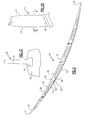
Figure 3 shows themain body 28. There are a plurality ofchannels 30 spaced from the front or leadingedge 21 to the back or trailingedge 22, and varying from the radially inner end toward the radially outer tip. As shown, some of thechannels 30 extend generally radially upwardly. Other channels, such aschannel 40, bend toward the leadingedge 21.Channel 41 simply extends generally from the middle of themain body 28 toward the leadingedge 21. - To reduce the weight, it is desirable to maximize the amount of channels and minimize the amount of rib. However, there is also a need for additional stiffness adjacent the radially
inner edge 42, to provide greater durability, and minimize blade stress. - It is also desirable to form a blade which avoids certain operational nodes across the engine operating range. Additional mass toward the tip or outer edge of the blade raises challenges against tuning away from fundamental nodes.
- As can be appreciated in
Figure 2 , afiller material 100 is deposited within the channel. In the prior art, the filler material has only been utilized to provide stiffness. - The present application realizes that the filler material can be provided by two
distinct materials Figure 3 . Thus, channels such aschannel 101 which extends only for a portion of the radial extent of themain body 28 may be filled withonly material 102.Material 102 may be selected to provide additional stiffness. One possible material is a metal foam such as an aluminum foam. Also, corrugated material may be used. Other channels, such aschannel 103, which extends somewhat further radially outwardly may have a portion filled withstiffness material 102, but also a portion ofmaterial 104 which is selected for damping characteristics. Such a dampening material may be a rubber foam. -
Channel 41 is shown provided only with the dampingmaterial 104. - In this manner, each of the channels can be provided with distinct characteristics based upon their location across the airfoil. At the radially outer ends, where damping to avoid fundamental nodes is most important, the
material 104 allows a designer to achieve desired characteristics. On the other hand, at radially inner portions, where stiffness is more important, thematerial 102 provides greater opportunities. Of course, some channels may have no material, if appropriate.Channel 300 is an example. - Another way of utilizing the two types of material is shown in the
channel 110. In this example, a node, or area of significant bending due to vibration, has been identified at thelocation 112. Of course, more than one node may be identified. The dampingmaterial 104 may be provided at that location, while astiffening material 102 is utilized at radially inner and outer locations relative toarea 112. - Speaking generally, this Application recognizes that there may be areas within the hollow fan blade that will benefit from each of the two types of materials. Of course, the invention would extend to three or more types of distinct materials, again each selected for the challenges raised at the particular location.
- In general,
materials main body 28. Thus, they do not increase the overall mass of the main body to the extent it would be increased if the main body was simply solid. - In addition, the
material 102 would have greater stiffness than thematerial 104, and thematerial 104 would have better damping characteristics than thematerial 102. One stiffening product that could be used is Duocel aluminum foam, from ERG Aerospace Corp. An appropriate damping material is AMS-3356 silicone rubber compound. Of course, other materials can be used. - Although embodiments of this invention have been disclosed, a worker of ordinary skill in this art would recognize that certain modifications would come within the scope of this invention. For that reason, the following claims should be studied to determine the true scope and content of this invention.
Claims (15)
- A fan blade (20) comprising:a main body extending between a leading edge (21) and a trailing edge (22), and channels (30) formed into said main body, with a plurality of ribs (26) extending intermediate the channels (30), the fan blade (20) having a dovetail (24), and an airfoil (18) extending radially outwardly from said dovetail (24); andat least two materials deposited within said channels (30), with a first material (102) being selected to provide additional stiffness to the fan blade (20), and a second material (104) being selected for damping characteristics.
- The fan blade (20) as set forth in claim 1, wherein said first material (102) is utilized in a channel (30) at radially inner locations, while said second material (104) is utilized within the same channel (30) at radially outer locations.
- The fan blade (20) as set forth in claim 1 or 2, wherein at least one of the channels (30) includes only said first material (102).
- The fan blade (20) as set forth in any preceding claim, wherein at least one of the channels (30) includes only said second material (104).
- The fan blade (20) as set forth in any preceding claim, wherein said second material (104) is a rubber foam.
- The fan blade (20) as set forth in any preceding claim, wherein said first material (102) is a metal foam.
- The fan blade (20) as set forth in any preceding claim, wherein a node is identified on an area of bending concern along said airfoil (18), and said second material (104) is included in at least one of said channels (30) at a location selected to support said airfoil (18) at said node, and optionally wherein there is said first material (102) both radially outwardly and radially inwardly of said second material (104) in the channel associated with said node.
- The fan blade (20) as set forth in any preceding claim, wherein both said first and second material (102, 104) are of a lower density than the material forming said main body.
- The fan blade (20) as set forth in any preceding claim, wherein said first material (102) has a greater stiffness relative to said second material (104), and said second material (104) has better damping characteristics than said first material (102).
- The fan blade as set forth in any preceding claim, wherein at least one channel (30) has no material.
- A method of designing a fan blade (20) comprising the steps of:identifying areas within a hollow fan blade (20) that would benefit from additional stiffening, and other areas which would benefit from additional damping;placing a damping material (104) in channels (30) formed within the fan blade (20) at the locations which will benefit from additional damping; andplacing a stiffening material (102) at locations within the channel (30) that will benefit from additional stiffness.
- The method as set forth in claim 11, further comprising identifying a vibrational node in the hollow fan blade, and optionally placing a damping material (104) in said channels (30) at an area associated with said node.
- A gas turbine engine (210) comprising a fan section (250) delivering air into a compressor section (254), air is compressed by the compressor section (254) and delivered into a combustor (260) where it is mixed with fuel and combusted, products of the combustion pass downstream over a turbine section (262), said fan section (250) including a plurality of fan blades (20), said fan blades (20) comprising a main body extending between a leading edge (21) and a trailing edge (22), and channels (30) formed into said main body, with a plurality of ribs (26) extending intermediate the channels (30), the fan blade (20) having a dovetail (24), and an airfoil (18) extending radially outwardly from said dovetail (24), and at least two materials (102, 104) deposited within said channels (30), with a first material (102) being selected to provide additional stiffness to the fan blade (20), and a second material (104) being selected for damping characteristics.
- The fan blade (20) or gas turbine engine (210) as set forth in any of claims 1 to 10 or 13, wherein at least one of said channels (30) extends into the main body to a closed end from an open end.
- The fan blade (20) or gas turbine engine (210) as set forth in claim 14, further comprising a cover skin (32) bonded to at least one of the ribs (26), and optionally wherein the cover skin covers (32) the open end of the at least one channel (30).
Applications Claiming Priority (1)
| Application Number | Priority Date | Filing Date | Title |
|---|---|---|---|
| US13/288,250 US8763360B2 (en) | 2011-11-03 | 2011-11-03 | Hollow fan blade tuning using distinct filler materials |
Publications (3)
| Publication Number | Publication Date |
|---|---|
| EP2589781A2 true EP2589781A2 (en) | 2013-05-08 |
| EP2589781A3 EP2589781A3 (en) | 2017-05-31 |
| EP2589781B1 EP2589781B1 (en) | 2020-01-01 |
Family
ID=47227456
Family Applications (1)
| Application Number | Title | Priority Date | Filing Date |
|---|---|---|---|
| EP12190239.9A Active EP2589781B1 (en) | 2011-11-03 | 2012-10-26 | Hollow fan blade tuning using distinct filler materials and method of designing such a fan blade |
Country Status (7)
| Country | Link |
|---|---|
| US (1) | US8763360B2 (en) |
| EP (1) | EP2589781B1 (en) |
| JP (1) | JP2013096416A (en) |
| KR (1) | KR20130049151A (en) |
| CA (1) | CA2794013C (en) |
| IL (1) | IL222795A (en) |
| SG (1) | SG189616A1 (en) |
Cited By (1)
| Publication number | Priority date | Publication date | Assignee | Title |
|---|---|---|---|---|
| US9932840B2 (en) | 2014-05-07 | 2018-04-03 | Rolls-Royce Corporation | Rotor for a gas turbine engine |
Families Citing this family (22)
| Publication number | Priority date | Publication date | Assignee | Title |
|---|---|---|---|---|
| US8997494B2 (en) * | 2012-09-28 | 2015-04-07 | United Technologies Corporation | Gas turbine engine fan blade airfoil profile |
| US10371165B2 (en) * | 2013-10-30 | 2019-08-06 | United Technologies Corporation | Fan blade composite ribs |
| US10808718B2 (en) | 2013-10-30 | 2020-10-20 | Raytheon Technologies Corporation | Fan blade composite segments |
| US10316670B2 (en) | 2013-12-05 | 2019-06-11 | United Technologies Corporation | Hollow blade having internal damper |
| US20160177732A1 (en) * | 2014-07-22 | 2016-06-23 | United Technologies Corporation | Hollow fan blade for a gas turbine engine |
| US9737930B2 (en) | 2015-01-20 | 2017-08-22 | United Technologies Corporation | Dual investment shelled solid mold casting of reticulated metal foams |
| US9789536B2 (en) | 2015-01-20 | 2017-10-17 | United Technologies Corporation | Dual investment technique for solid mold casting of reticulated metal foams |
| US9789534B2 (en) | 2015-01-20 | 2017-10-17 | United Technologies Corporation | Investment technique for solid mold casting of reticulated metal foams |
| US9884363B2 (en) | 2015-06-30 | 2018-02-06 | United Technologies Corporation | Variable diameter investment casting mold for casting of reticulated metal foams |
| US9731342B2 (en) | 2015-07-07 | 2017-08-15 | United Technologies Corporation | Chill plate for equiax casting solidification control for solid mold casting of reticulated metal foams |
| US20170370375A1 (en) * | 2016-06-22 | 2017-12-28 | United Technologies Corporation | Fan blade filler |
| US20180038386A1 (en) * | 2016-08-08 | 2018-02-08 | United Technologies Corporation | Fan blade with composite cover |
| US10557353B2 (en) | 2017-10-18 | 2020-02-11 | United Technologies Corporation | Hollow fan blade constrained layer damper |
| US11015461B2 (en) | 2017-12-21 | 2021-05-25 | General Electric Company | Composite hollow blade and a method of forming the composite hollow blade |
| FR3081370B1 (en) * | 2018-05-22 | 2020-06-05 | Safran Aircraft Engines | BLADE BODY AND BLADE OF COMPOSITE MATERIAL HAVING FIBROUS REINFORCEMENT COMPOSED OF THREE-DIMENSIONAL WEAVING AND SHORT FIBERS AND THEIR MANUFACTURING METHOD |
| US11136888B2 (en) * | 2018-10-18 | 2021-10-05 | Raytheon Technologies Corporation | Rotor assembly with active damping for gas turbine engines |
| US10995632B2 (en) | 2019-03-11 | 2021-05-04 | Raytheon Technologies Corporation | Damped airfoil for a gas turbine engine |
| US11371358B2 (en) | 2020-02-19 | 2022-06-28 | General Electric Company | Turbine damper |
| US11624287B2 (en) * | 2020-02-21 | 2023-04-11 | Raytheon Technologies Corporation | Ceramic matrix composite component having low density core and method of making |
| US11365636B2 (en) | 2020-05-25 | 2022-06-21 | General Electric Company | Fan blade with intrinsic damping characteristics |
| US12203390B1 (en) * | 2023-07-07 | 2025-01-21 | General Electric Company | Composite airfoil assembly for a turbine engine |
| US12571314B2 (en) | 2023-07-07 | 2026-03-10 | General Electric Company | Composite airfoil assembly for a turbine engine |
Family Cites Families (19)
| Publication number | Priority date | Publication date | Assignee | Title |
|---|---|---|---|---|
| US4118147A (en) * | 1976-12-22 | 1978-10-03 | General Electric Company | Composite reinforcement of metallic airfoils |
| JPH08307946A (en) * | 1995-05-12 | 1996-11-22 | Nec Corp | Phs terminal invalidating system |
| US5931641A (en) * | 1997-04-25 | 1999-08-03 | General Electric Company | Steam turbine blade having areas of different densities |
| US6039542A (en) * | 1997-12-24 | 2000-03-21 | General Electric Company | Panel damped hybrid blade |
| US6033186A (en) * | 1999-04-16 | 2000-03-07 | General Electric Company | Frequency tuned hybrid blade |
| US6910483B2 (en) * | 2001-12-10 | 2005-06-28 | Resmed Limited | Double-ended blower and volutes therefor |
| DE10301755A1 (en) * | 2003-01-18 | 2004-07-29 | Rolls-Royce Deutschland Ltd & Co Kg | Fan blade for a gas turbine engine |
| US7147437B2 (en) | 2004-08-09 | 2006-12-12 | General Electric Company | Mixed tuned hybrid blade related method |
| CN101137841B (en) | 2005-02-03 | 2013-01-09 | 维斯塔斯风力系统有限公司 | Method of manufacturing a wind turbine blade shell member |
| US7278830B2 (en) | 2005-05-18 | 2007-10-09 | Allison Advanced Development Company, Inc. | Composite filled gas turbine engine blade with gas film damper |
| US7334997B2 (en) * | 2005-09-16 | 2008-02-26 | General Electric Company | Hybrid blisk |
| GB0601220D0 (en) * | 2006-01-21 | 2006-03-01 | Rolls Royce Plc | Aerofoils for gas turbine engines |
| US7429165B2 (en) * | 2006-06-14 | 2008-09-30 | General Electric Company | Hybrid blade for a steam turbine |
| US7828526B2 (en) * | 2007-04-11 | 2010-11-09 | General Electric Company | Metallic blade having a composite inlay |
| US20100004369A1 (en) | 2008-07-01 | 2010-01-07 | Ppg Industries Ohio, Inc. | Low density viscoelastic composition having damping properties |
| US8172541B2 (en) * | 2009-02-27 | 2012-05-08 | General Electric Company | Internally-damped airfoil and method therefor |
| GB0904571D0 (en) * | 2009-03-18 | 2009-08-12 | Rolls Royce Plc | A method of manufacturing a component comprising an internal structure |
| US8083489B2 (en) * | 2009-04-16 | 2011-12-27 | United Technologies Corporation | Hybrid structure fan blade |
| GB0917229D0 (en) | 2009-10-02 | 2009-11-18 | Rolls Royce Plc | Hollow turbine blade |
-
2011
- 2011-11-03 US US13/288,250 patent/US8763360B2/en active Active
-
2012
- 2012-09-18 SG SG2012069332A patent/SG189616A1/en unknown
- 2012-10-19 KR KR1020120116318A patent/KR20130049151A/en not_active Ceased
- 2012-10-26 EP EP12190239.9A patent/EP2589781B1/en active Active
- 2012-10-29 CA CA2794013A patent/CA2794013C/en active Active
- 2012-11-01 IL IL222795A patent/IL222795A/en active IP Right Grant
- 2012-11-01 JP JP2012241532A patent/JP2013096416A/en active Pending
Non-Patent Citations (1)
| Title |
|---|
| None |
Cited By (1)
| Publication number | Priority date | Publication date | Assignee | Title |
|---|---|---|---|---|
| US9932840B2 (en) | 2014-05-07 | 2018-04-03 | Rolls-Royce Corporation | Rotor for a gas turbine engine |
Also Published As
| Publication number | Publication date |
|---|---|
| US8763360B2 (en) | 2014-07-01 |
| US20130111907A1 (en) | 2013-05-09 |
| EP2589781A3 (en) | 2017-05-31 |
| SG189616A1 (en) | 2013-05-31 |
| JP2013096416A (en) | 2013-05-20 |
| IL222795A (en) | 2016-06-30 |
| KR20130049151A (en) | 2013-05-13 |
| EP2589781B1 (en) | 2020-01-01 |
| CA2794013A1 (en) | 2013-05-03 |
| CA2794013C (en) | 2016-01-19 |
Similar Documents
| Publication | Publication Date | Title |
|---|---|---|
| US8763360B2 (en) | Hollow fan blade tuning using distinct filler materials | |
| US9221120B2 (en) | Aluminum fan blade construction with welded cover | |
| EP3077625B1 (en) | Hollow blade having internal damper | |
| EP2568116A2 (en) | An aerofoil assembly in a gas turbine | |
| EP3428399A1 (en) | Hollow fan blade with braided fabric tubes | |
| US20160177732A1 (en) | Hollow fan blade for a gas turbine engine | |
| US9828864B2 (en) | Fan blade tall dovetail for individually bladed rotors | |
| US10215027B2 (en) | Aluminum fan blade construction with welded cover | |
| WO2012130341A1 (en) | Blade arrangement for a turbo engine | |
| US9441496B2 (en) | Structural guide vane internal topology | |
| EP3428394B1 (en) | Gas turbine engine fan blade and method of designing a fan blade | |
| CN115485457A (en) | Platform for a fan rotor of an aircraft turbine engine and associated aircraft turbine engine | |
| EP3772567A1 (en) | Gas turbine engine and corresponding method of designing a fan blade | |
| EP2573321B1 (en) | Fan blade | |
| EP2573324B1 (en) | Fan blade | |
| EP2573322B1 (en) | Fan blade | |
| EP2573323B1 (en) | Fan blade |
Legal Events
| Date | Code | Title | Description |
|---|---|---|---|
| PUAI | Public reference made under article 153(3) epc to a published international application that has entered the european phase |
Free format text: ORIGINAL CODE: 0009012 |
|
| AK | Designated contracting states |
Kind code of ref document: A2 Designated state(s): AL AT BE BG CH CY CZ DE DK EE ES FI FR GB GR HR HU IE IS IT LI LT LU LV MC MK MT NL NO PL PT RO RS SE SI SK SM TR |
|
| AX | Request for extension of the european patent |
Extension state: BA ME |
|
| RAP1 | Party data changed (applicant data changed or rights of an application transferred) |
Owner name: UNITED TECHNOLOGIES CORPORATION |
|
| PUAL | Search report despatched |
Free format text: ORIGINAL CODE: 0009013 |
|
| AK | Designated contracting states |
Kind code of ref document: A3 Designated state(s): AL AT BE BG CH CY CZ DE DK EE ES FI FR GB GR HR HU IE IS IT LI LT LU LV MC MK MT NL NO PL PT RO RS SE SI SK SM TR |
|
| AX | Request for extension of the european patent |
Extension state: BA ME |
|
| RIC1 | Information provided on ipc code assigned before grant |
Ipc: F01D 5/26 20060101ALI20170426BHEP Ipc: F01D 5/18 20060101ALI20170426BHEP Ipc: F02K 3/06 20060101AFI20170426BHEP |
|
| STAA | Information on the status of an ep patent application or granted ep patent |
Free format text: STATUS: REQUEST FOR EXAMINATION WAS MADE |
|
| 17P | Request for examination filed |
Effective date: 20171130 |
|
| RBV | Designated contracting states (corrected) |
Designated state(s): AL AT BE BG CH CY CZ DE DK EE ES FI FR GB GR HR HU IE IS IT LI LT LU LV MC MK MT NL NO PL PT RO RS SE SI SK SM TR |
|
| STAA | Information on the status of an ep patent application or granted ep patent |
Free format text: STATUS: EXAMINATION IS IN PROGRESS |
|
| 17Q | First examination report despatched |
Effective date: 20180430 |
|
| GRAP | Despatch of communication of intention to grant a patent |
Free format text: ORIGINAL CODE: EPIDOSNIGR1 |
|
| STAA | Information on the status of an ep patent application or granted ep patent |
Free format text: STATUS: GRANT OF PATENT IS INTENDED |
|
| INTG | Intention to grant announced |
Effective date: 20190103 |
|
| GRAJ | Information related to disapproval of communication of intention to grant by the applicant or resumption of examination proceedings by the epo deleted |
Free format text: ORIGINAL CODE: EPIDOSDIGR1 |
|
| STAA | Information on the status of an ep patent application or granted ep patent |
Free format text: STATUS: EXAMINATION IS IN PROGRESS |
|
| INTC | Intention to grant announced (deleted) | ||
| GRAP | Despatch of communication of intention to grant a patent |
Free format text: ORIGINAL CODE: EPIDOSNIGR1 |
|
| STAA | Information on the status of an ep patent application or granted ep patent |
Free format text: STATUS: GRANT OF PATENT IS INTENDED |
|
| INTG | Intention to grant announced |
Effective date: 20190711 |
|
| GRAS | Grant fee paid |
Free format text: ORIGINAL CODE: EPIDOSNIGR3 |
|
| GRAA | (expected) grant |
Free format text: ORIGINAL CODE: 0009210 |
|
| STAA | Information on the status of an ep patent application or granted ep patent |
Free format text: STATUS: THE PATENT HAS BEEN GRANTED |
|
| AK | Designated contracting states |
Kind code of ref document: B1 Designated state(s): AL AT BE BG CH CY CZ DE DK EE ES FI FR GB GR HR HU IE IS IT LI LT LU LV MC MK MT NL NO PL PT RO RS SE SI SK SM TR |
|
| REG | Reference to a national code |
Ref country code: GB Ref legal event code: FG4D |
|
| REG | Reference to a national code |
Ref country code: CH Ref legal event code: EP Ref country code: AT Ref legal event code: REF Ref document number: 1220068 Country of ref document: AT Kind code of ref document: T Effective date: 20200115 |
|
| REG | Reference to a national code |
Ref country code: IE Ref legal event code: FG4D |
|
| REG | Reference to a national code |
Ref country code: DE Ref legal event code: R096 Ref document number: 602012066856 Country of ref document: DE |
|
| REG | Reference to a national code |
Ref country code: NL Ref legal event code: MP Effective date: 20200101 |
|
| REG | Reference to a national code |
Ref country code: LT Ref legal event code: MG4D |
|
| PG25 | Lapsed in a contracting state [announced via postgrant information from national office to epo] |
Ref country code: FI Free format text: LAPSE BECAUSE OF FAILURE TO SUBMIT A TRANSLATION OF THE DESCRIPTION OR TO PAY THE FEE WITHIN THE PRESCRIBED TIME-LIMIT Effective date: 20200101 Ref country code: NO Free format text: LAPSE BECAUSE OF FAILURE TO SUBMIT A TRANSLATION OF THE DESCRIPTION OR TO PAY THE FEE WITHIN THE PRESCRIBED TIME-LIMIT Effective date: 20200401 Ref country code: NL Free format text: LAPSE BECAUSE OF FAILURE TO SUBMIT A TRANSLATION OF THE DESCRIPTION OR TO PAY THE FEE WITHIN THE PRESCRIBED TIME-LIMIT Effective date: 20200101 Ref country code: PT Free format text: LAPSE BECAUSE OF FAILURE TO SUBMIT A TRANSLATION OF THE DESCRIPTION OR TO PAY THE FEE WITHIN THE PRESCRIBED TIME-LIMIT Effective date: 20200527 Ref country code: CZ Free format text: LAPSE BECAUSE OF FAILURE TO SUBMIT A TRANSLATION OF THE DESCRIPTION OR TO PAY THE FEE WITHIN THE PRESCRIBED TIME-LIMIT Effective date: 20200101 Ref country code: LT Free format text: LAPSE BECAUSE OF FAILURE TO SUBMIT A TRANSLATION OF THE DESCRIPTION OR TO PAY THE FEE WITHIN THE PRESCRIBED TIME-LIMIT Effective date: 20200101 Ref country code: RS Free format text: LAPSE BECAUSE OF FAILURE TO SUBMIT A TRANSLATION OF THE DESCRIPTION OR TO PAY THE FEE WITHIN THE PRESCRIBED TIME-LIMIT Effective date: 20200101 |
|
| PG25 | Lapsed in a contracting state [announced via postgrant information from national office to epo] |
Ref country code: HR Free format text: LAPSE BECAUSE OF FAILURE TO SUBMIT A TRANSLATION OF THE DESCRIPTION OR TO PAY THE FEE WITHIN THE PRESCRIBED TIME-LIMIT Effective date: 20200101 Ref country code: GR Free format text: LAPSE BECAUSE OF FAILURE TO SUBMIT A TRANSLATION OF THE DESCRIPTION OR TO PAY THE FEE WITHIN THE PRESCRIBED TIME-LIMIT Effective date: 20200402 Ref country code: SE Free format text: LAPSE BECAUSE OF FAILURE TO SUBMIT A TRANSLATION OF THE DESCRIPTION OR TO PAY THE FEE WITHIN THE PRESCRIBED TIME-LIMIT Effective date: 20200101 Ref country code: LV Free format text: LAPSE BECAUSE OF FAILURE TO SUBMIT A TRANSLATION OF THE DESCRIPTION OR TO PAY THE FEE WITHIN THE PRESCRIBED TIME-LIMIT Effective date: 20200101 Ref country code: IS Free format text: LAPSE BECAUSE OF FAILURE TO SUBMIT A TRANSLATION OF THE DESCRIPTION OR TO PAY THE FEE WITHIN THE PRESCRIBED TIME-LIMIT Effective date: 20200501 Ref country code: BG Free format text: LAPSE BECAUSE OF FAILURE TO SUBMIT A TRANSLATION OF THE DESCRIPTION OR TO PAY THE FEE WITHIN THE PRESCRIBED TIME-LIMIT Effective date: 20200401 |
|
| REG | Reference to a national code |
Ref country code: DE Ref legal event code: R097 Ref document number: 602012066856 Country of ref document: DE |
|
| PG25 | Lapsed in a contracting state [announced via postgrant information from national office to epo] |
Ref country code: ES Free format text: LAPSE BECAUSE OF FAILURE TO SUBMIT A TRANSLATION OF THE DESCRIPTION OR TO PAY THE FEE WITHIN THE PRESCRIBED TIME-LIMIT Effective date: 20200101 Ref country code: RO Free format text: LAPSE BECAUSE OF FAILURE TO SUBMIT A TRANSLATION OF THE DESCRIPTION OR TO PAY THE FEE WITHIN THE PRESCRIBED TIME-LIMIT Effective date: 20200101 Ref country code: EE Free format text: LAPSE BECAUSE OF FAILURE TO SUBMIT A TRANSLATION OF THE DESCRIPTION OR TO PAY THE FEE WITHIN THE PRESCRIBED TIME-LIMIT Effective date: 20200101 Ref country code: SM Free format text: LAPSE BECAUSE OF FAILURE TO SUBMIT A TRANSLATION OF THE DESCRIPTION OR TO PAY THE FEE WITHIN THE PRESCRIBED TIME-LIMIT Effective date: 20200101 Ref country code: DK Free format text: LAPSE BECAUSE OF FAILURE TO SUBMIT A TRANSLATION OF THE DESCRIPTION OR TO PAY THE FEE WITHIN THE PRESCRIBED TIME-LIMIT Effective date: 20200101 Ref country code: SK Free format text: LAPSE BECAUSE OF FAILURE TO SUBMIT A TRANSLATION OF THE DESCRIPTION OR TO PAY THE FEE WITHIN THE PRESCRIBED TIME-LIMIT Effective date: 20200101 |
|
| PLBE | No opposition filed within time limit |
Free format text: ORIGINAL CODE: 0009261 |
|
| STAA | Information on the status of an ep patent application or granted ep patent |
Free format text: STATUS: NO OPPOSITION FILED WITHIN TIME LIMIT |
|
| REG | Reference to a national code |
Ref country code: AT Ref legal event code: MK05 Ref document number: 1220068 Country of ref document: AT Kind code of ref document: T Effective date: 20200101 |
|
| 26N | No opposition filed |
Effective date: 20201002 |
|
| PG25 | Lapsed in a contracting state [announced via postgrant information from national office to epo] |
Ref country code: AT Free format text: LAPSE BECAUSE OF FAILURE TO SUBMIT A TRANSLATION OF THE DESCRIPTION OR TO PAY THE FEE WITHIN THE PRESCRIBED TIME-LIMIT Effective date: 20200101 Ref country code: IT Free format text: LAPSE BECAUSE OF FAILURE TO SUBMIT A TRANSLATION OF THE DESCRIPTION OR TO PAY THE FEE WITHIN THE PRESCRIBED TIME-LIMIT Effective date: 20200101 |
|
| PG25 | Lapsed in a contracting state [announced via postgrant information from national office to epo] |
Ref country code: PL Free format text: LAPSE BECAUSE OF FAILURE TO SUBMIT A TRANSLATION OF THE DESCRIPTION OR TO PAY THE FEE WITHIN THE PRESCRIBED TIME-LIMIT Effective date: 20200101 Ref country code: SI Free format text: LAPSE BECAUSE OF FAILURE TO SUBMIT A TRANSLATION OF THE DESCRIPTION OR TO PAY THE FEE WITHIN THE PRESCRIBED TIME-LIMIT Effective date: 20200101 |
|
| REG | Reference to a national code |
Ref country code: CH Ref legal event code: PL |
|
| PG25 | Lapsed in a contracting state [announced via postgrant information from national office to epo] |
Ref country code: MC Free format text: LAPSE BECAUSE OF FAILURE TO SUBMIT A TRANSLATION OF THE DESCRIPTION OR TO PAY THE FEE WITHIN THE PRESCRIBED TIME-LIMIT Effective date: 20200101 Ref country code: LU Free format text: LAPSE BECAUSE OF NON-PAYMENT OF DUE FEES Effective date: 20201026 |
|
| REG | Reference to a national code |
Ref country code: BE Ref legal event code: MM Effective date: 20201031 |
|
| PG25 | Lapsed in a contracting state [announced via postgrant information from national office to epo] |
Ref country code: LI Free format text: LAPSE BECAUSE OF NON-PAYMENT OF DUE FEES Effective date: 20201031 Ref country code: CH Free format text: LAPSE BECAUSE OF NON-PAYMENT OF DUE FEES Effective date: 20201031 Ref country code: BE Free format text: LAPSE BECAUSE OF NON-PAYMENT OF DUE FEES Effective date: 20201031 |
|
| PG25 | Lapsed in a contracting state [announced via postgrant information from national office to epo] |
Ref country code: IE Free format text: LAPSE BECAUSE OF NON-PAYMENT OF DUE FEES Effective date: 20201026 |
|
| PG25 | Lapsed in a contracting state [announced via postgrant information from national office to epo] |
Ref country code: TR Free format text: LAPSE BECAUSE OF FAILURE TO SUBMIT A TRANSLATION OF THE DESCRIPTION OR TO PAY THE FEE WITHIN THE PRESCRIBED TIME-LIMIT Effective date: 20200101 Ref country code: MT Free format text: LAPSE BECAUSE OF FAILURE TO SUBMIT A TRANSLATION OF THE DESCRIPTION OR TO PAY THE FEE WITHIN THE PRESCRIBED TIME-LIMIT Effective date: 20200101 Ref country code: CY Free format text: LAPSE BECAUSE OF FAILURE TO SUBMIT A TRANSLATION OF THE DESCRIPTION OR TO PAY THE FEE WITHIN THE PRESCRIBED TIME-LIMIT Effective date: 20200101 |
|
| PG25 | Lapsed in a contracting state [announced via postgrant information from national office to epo] |
Ref country code: MK Free format text: LAPSE BECAUSE OF FAILURE TO SUBMIT A TRANSLATION OF THE DESCRIPTION OR TO PAY THE FEE WITHIN THE PRESCRIBED TIME-LIMIT Effective date: 20200101 Ref country code: AL Free format text: LAPSE BECAUSE OF FAILURE TO SUBMIT A TRANSLATION OF THE DESCRIPTION OR TO PAY THE FEE WITHIN THE PRESCRIBED TIME-LIMIT Effective date: 20200101 |
|
| REG | Reference to a national code |
Ref country code: DE Ref legal event code: R081 Ref document number: 602012066856 Country of ref document: DE Owner name: RAYTHEON TECHNOLOGIES CORPORATION (N.D.GES.D.S, US Free format text: FORMER OWNER: UNITED TECHNOLOGIES CORPORATION, FARMINGTON, CONN., US Ref country code: DE Ref legal event code: R081 Ref document number: 602012066856 Country of ref document: DE Owner name: RTX CORPORATION (N.D.GES.D. STAATES DELAWARE),, US Free format text: FORMER OWNER: UNITED TECHNOLOGIES CORPORATION, FARMINGTON, CONN., US |
|
| P01 | Opt-out of the competence of the unified patent court (upc) registered |
Effective date: 20230520 |
|
| PGFP | Annual fee paid to national office [announced via postgrant information from national office to epo] |
Ref country code: GB Payment date: 20250923 Year of fee payment: 14 |
|
| PGFP | Annual fee paid to national office [announced via postgrant information from national office to epo] |
Ref country code: FR Payment date: 20250923 Year of fee payment: 14 |
|
| REG | Reference to a national code |
Ref country code: DE Ref legal event code: R081 Ref document number: 602012066856 Country of ref document: DE Owner name: RTX CORPORATION (N.D.GES.D. STAATES DELAWARE),, US Free format text: FORMER OWNER: RAYTHEON TECHNOLOGIES CORPORATION (N.D.GES.D.STAATES DELAWARE), ARLINGTON, VA, US |
|
| PGFP | Annual fee paid to national office [announced via postgrant information from national office to epo] |
Ref country code: DE Payment date: 20250923 Year of fee payment: 14 |