EP2589692A1 - Nanofibre laminate sheet - Google Patents
Nanofibre laminate sheet Download PDFInfo
- Publication number
- EP2589692A1 EP2589692A1 EP11800855.6A EP11800855A EP2589692A1 EP 2589692 A1 EP2589692 A1 EP 2589692A1 EP 11800855 A EP11800855 A EP 11800855A EP 2589692 A1 EP2589692 A1 EP 2589692A1
- Authority
- EP
- European Patent Office
- Prior art keywords
- nanofiber
- water soluble
- layer
- base layer
- soluble base
- Prior art date
- Legal status (The legal status is an assumption and is not a legal conclusion. Google has not performed a legal analysis and makes no representation as to the accuracy of the status listed.)
- Granted
Links
Images

Classifications
-
- A—HUMAN NECESSITIES
- A61—MEDICAL OR VETERINARY SCIENCE; HYGIENE
- A61K—PREPARATIONS FOR MEDICAL, DENTAL OR TOILETRY PURPOSES
- A61K9/00—Medicinal preparations characterised by special physical form
- A61K9/70—Web, sheet or filament bases ; Films; Fibres of the matrix type containing drug
- A61K9/7007—Drug-containing films, membranes or sheets
-
- A—HUMAN NECESSITIES
- A61—MEDICAL OR VETERINARY SCIENCE; HYGIENE
- A61K—PREPARATIONS FOR MEDICAL, DENTAL OR TOILETRY PURPOSES
- A61K8/00—Cosmetics or similar toiletry preparations
- A61K8/02—Cosmetics or similar toiletry preparations characterised by special physical form
- A61K8/0208—Tissues; Wipes; Patches
-
- A—HUMAN NECESSITIES
- A61—MEDICAL OR VETERINARY SCIENCE; HYGIENE
- A61K—PREPARATIONS FOR MEDICAL, DENTAL OR TOILETRY PURPOSES
- A61K8/00—Cosmetics or similar toiletry preparations
- A61K8/02—Cosmetics or similar toiletry preparations characterised by special physical form
- A61K8/0216—Solid or semisolid forms
- A61K8/0233—Distinct layers, e.g. core/shell sticks
-
- A—HUMAN NECESSITIES
- A61—MEDICAL OR VETERINARY SCIENCE; HYGIENE
- A61K—PREPARATIONS FOR MEDICAL, DENTAL OR TOILETRY PURPOSES
- A61K8/00—Cosmetics or similar toiletry preparations
- A61K8/02—Cosmetics or similar toiletry preparations characterised by special physical form
- A61K8/0241—Containing particulates characterized by their shape and/or structure
- A61K8/027—Fibers; Fibrils
-
- A—HUMAN NECESSITIES
- A61—MEDICAL OR VETERINARY SCIENCE; HYGIENE
- A61K—PREPARATIONS FOR MEDICAL, DENTAL OR TOILETRY PURPOSES
- A61K8/00—Cosmetics or similar toiletry preparations
- A61K8/18—Cosmetics or similar toiletry preparations characterised by the composition
- A61K8/30—Cosmetics or similar toiletry preparations characterised by the composition containing organic compounds
- A61K8/67—Vitamins
- A61K8/676—Ascorbic acid, i.e. vitamin C
-
- A—HUMAN NECESSITIES
- A61—MEDICAL OR VETERINARY SCIENCE; HYGIENE
- A61K—PREPARATIONS FOR MEDICAL, DENTAL OR TOILETRY PURPOSES
- A61K8/00—Cosmetics or similar toiletry preparations
- A61K8/18—Cosmetics or similar toiletry preparations characterised by the composition
- A61K8/72—Cosmetics or similar toiletry preparations characterised by the composition containing organic macromolecular compounds
- A61K8/73—Polysaccharides
-
- A—HUMAN NECESSITIES
- A61—MEDICAL OR VETERINARY SCIENCE; HYGIENE
- A61K—PREPARATIONS FOR MEDICAL, DENTAL OR TOILETRY PURPOSES
- A61K8/00—Cosmetics or similar toiletry preparations
- A61K8/18—Cosmetics or similar toiletry preparations characterised by the composition
- A61K8/72—Cosmetics or similar toiletry preparations characterised by the composition containing organic macromolecular compounds
- A61K8/81—Cosmetics or similar toiletry preparations characterised by the composition containing organic macromolecular compounds obtained by reactions involving only carbon-to-carbon unsaturated bonds
- A61K8/8129—Compositions of homopolymers or copolymers of compounds having one or more unsaturated aliphatic radicals, each having only one carbon-to-carbon double bond, and at least one being terminated by an alcohol, ether, aldehydo, ketonic, acetal or ketal radical; Compositions of hydrolysed polymers or esters of unsaturated alcohols with saturated carboxylic acids; Compositions of derivatives of such polymers, e.g. polyvinylmethylether
-
- A—HUMAN NECESSITIES
- A61—MEDICAL OR VETERINARY SCIENCE; HYGIENE
- A61K—PREPARATIONS FOR MEDICAL, DENTAL OR TOILETRY PURPOSES
- A61K9/00—Medicinal preparations characterised by special physical form
- A61K9/0012—Galenical forms characterised by the site of application
- A61K9/0014—Skin, i.e. galenical aspects of topical compositions
-
- A—HUMAN NECESSITIES
- A61—MEDICAL OR VETERINARY SCIENCE; HYGIENE
- A61K—PREPARATIONS FOR MEDICAL, DENTAL OR TOILETRY PURPOSES
- A61K9/00—Medicinal preparations characterised by special physical form
- A61K9/0012—Galenical forms characterised by the site of application
- A61K9/0053—Mouth and digestive tract, i.e. intraoral and peroral administration
- A61K9/0063—Periodont
-
- A—HUMAN NECESSITIES
- A61—MEDICAL OR VETERINARY SCIENCE; HYGIENE
- A61Q—SPECIFIC USE OF COSMETICS OR SIMILAR TOILETRY PREPARATIONS
- A61Q19/00—Preparations for care of the skin
-
- A—HUMAN NECESSITIES
- A61—MEDICAL OR VETERINARY SCIENCE; HYGIENE
- A61Q—SPECIFIC USE OF COSMETICS OR SIMILAR TOILETRY PREPARATIONS
- A61Q19/00—Preparations for care of the skin
- A61Q19/02—Preparations for care of the skin for chemically bleaching or whitening the skin
-
- A—HUMAN NECESSITIES
- A61—MEDICAL OR VETERINARY SCIENCE; HYGIENE
- A61K—PREPARATIONS FOR MEDICAL, DENTAL OR TOILETRY PURPOSES
- A61K2800/00—Properties of cosmetic compositions or active ingredients thereof or formulation aids used therein and process related aspects
- A61K2800/40—Chemical, physico-chemical or functional or structural properties of particular ingredients
- A61K2800/41—Particular ingredients further characterized by their size
- A61K2800/413—Nanosized, i.e. having sizes below 100 nm
Definitions
- the present invention relates to a laminate sheet composed of a nanofiber layer and a water soluble base layer.
- Nanofibers are applied to the fields demanding optical characteristics such as high transparency, where the nano-size effect of nanofibers are taken advantage of.
- nanofibers with a diameter equal to or below the wavelength of visible light provide transparent fabric.
- nanofibers the diameter of which is equal to the wavelength of visible light structural color may be exhibited.
- Nanofibers have also been studied for their applicability to the fields demanding superabsorbent characteristics or high surface activity, where the high specific surface area effect of nanofibers is taken advantage of, and to the fields demanding mechanical characteristics such as tensile strength and electrical characteristics such as high conductivity, where the supramolecular arrangement effect of nanofibers is made use of.
- Nanofibers having such characteristics have been used in the form of, for example, not only single fibers but aggregates (i.e., fabrics) or composites.
- Patent literature 1 alleges that the cosmetic sheet has not only improved adhesion or comfort to the user's face, hand, or leg but also storage stability.
- Patent literature 2 describes that a functional component, such as an emulsifying component, a stabilizing component, a bactericidal component, a moisturizing component, and so on, may be added to a nanofiber sheet.
- a nanofiber prepared from a water soluble polymer exhibits higher water solubility than in its bulk form on account of the large specific surface area and, therefore, easily dissolves with water, e.g., of perspiration just upon being touched with a finger. It is likely that the nanofiber sheet dissolves or gets a hole in it before it is attached to an object. That is, the water soluble polymer-based nanofiber sheet is less than easy to handle.
- the invention settles the above discussed problem by providing a nanofiber laminate sheet composed of a layer of a nanofiber (hereinafter a nanofiber layer) containing a cosmetic component or a medicinal component and a water soluble base layer located on at least one side of the nanofiber layer.
- the water soluble base layer is less water-soluble than the nanofiber layer.
- the invention includes the following subject matter.
- the invention provides a nanofiber sheet, which has hitherto been less than easy to handle, having markedly improved handling so as to be attached to the surface of an object with ease.
- the nanofiber laminate sheet of the invention (hereinafter also simply referred to as the laminate sheet) is basically composed of a layer of a nanofiber (hereinafter referred to as a nanofiber layer) and a water soluble base layer.
- the water soluble base layer is disposed on at least one side of the nanofiber layer.
- the water soluble base layer may be located on both sides of the nanofiber layer.
- the water soluble base layer on one side of the nanofiber layer and that on the other side may be the same or different.
- the water soluble base layer preferably adjoins the nanofiber layer.
- between the nanofiber layer and the water soluble base layer there may be a layer different from either.
- the nanofiber layer is preferably made solely of a nanofiber.
- the nanofiber layer may contain other components in addition to a nanofiber.
- the nanofiber has a thickness usually of 10 to 3000 nm, preferably 10 to 1000 nm, in terms of circle equivalent diameter.
- the thickness of nanofibers is measured by, for example, observation using a scanning electron microscope (SEM). Specifically, a two-dimensional micrograph at a magnification of 10000 is processed by deleting defects (lumps of nanofibers, intersections of nanofibers, and polymer droplets), randomly choosing ten fibers, drawing a line perpendicular to the longitudinal direction of each fiber chosen, and directly reading the length of the line segment crossing the fiber.
- SEM scanning electron microscope
- the length of the nanofiber is not critical in the invention and may have any appropriate length depending on the method of nanofiber manufacturing.
- a nanofiber is called a "fiber" when it is 100 or more times as long as it is thick.
- the nanofiber may be unidirectionally or randomly aligned in the nanofiber layer. While the nanofiber is generally a solid fiber, a hollow nanofiber or a flattened or ribbon-like hollow nanofiber having a collapsed cross-section is useful as well.
- the nanofiber layer may have a thickness decided as appropriate to the intended use of the laminate sheet.
- the thickness of the nanofiber layer is preferably 50 nm to 1 mm, more preferably 500 nm to 500 ⁇ m.
- the thickness of the nanofiber layer may be measured using a contact thickness gauge Litematic VL-50A from Mitutoyo Corp. with a spherical carbide contact point of 5 mm in radius. A load of 0.01 N is applied to the sheet in the thickness measurement.
- the nanofiber layer may have a basis weight decided as appropriate to the intended use of the laminate sheet.
- the basis weight of the nanofiber layer is preferably 0.01 to 100 g/m 2 , more preferably 0.1 to 50 g/m 2 .
- nanofibers in the nanofiber layer are bonded to one another at the intersections thereof or intertwined with one another, whereby the nanofiber layer is self-supporting to retain its sheet form. Whether the nanofibers are bonded to or intertwined with one another depends on the method of manufacturing the nanofiber layer.
- the nanofiber is prepared from a polymer.
- the polymer may be a naturally occurring polymer or a synthetic polymer.
- the polymer is preferably water soluble.
- water soluble polymer denotes a polymer having solubility such that, when a sample polymer weighing 1 g is immersed in 10 g of ion-exchanged water for 24 hours at 23°C and atmospheric pressure, at least 0.5 g of the immersed polymer dissolves in the ion-exchanged water.
- water soluble polymer examples include naturally occurring polymers, such as mucopolysaccharides, e.g., pullulan, hyaluronic acid, chondroitin sulfate, poly- ⁇ -glutamic acid, modified corn starch, ⁇ -glucan, gluco-oligosaccharides, heparin, and keratosulfate, cellulose, pectin, xylan, lignin, glucomannan, galacturonic acid, psyllium seed gum, tamarind seed gum, gum arabic, tragacanth gum, soybean water-soluble polysaccharides, alginic acid, carrageenan, laminaran, agar (agarose), fucoidan, methyl cellulose, hydroxypropyl cellulose, and hydroxypropylmethyl cellulose; and synthetic polymers, such as partially saponified polyvinyl alcohol (usable in the absence of a crosslinking agent hereinafter described), low-saponified polyvin
- water soluble polymers may be used either individually or in combination of two or more thereof.
- Preferred of them are pullulan and synthetic polymers, such as partially saponified polyvinyl alcohol, low-saponified polyvinyl alcohol, polyvinylpyrrolidone, and polyethylene oxide, in view of ease of conversion to nanofibers.
- the nanofiber contains a cosmetic component or a medicinal component.
- the nanofiber layer containing such an active ingredient produces the advantageous effect attributed to the active ingredient.
- the cosmetic or medicinal component examples include a blood circulation improving agent selected from acid mucopolysaccharides, chamomile, buckeye, ginkgo, witch hazel extract, vitamin E, nicotinic acid derivatives, and alkaloid compounds; an edema reducing agent selected from buckeye, flavone derivatives, naphthalenesulfonic acid derivatives, anthocyanin, vitamin P, calendula, concholytic acid, silanol, terminalia, visnaga, and majus; a slimming agent selected from aminophylline, tea extract, caffeine, xanthine derivatives, inositol, dextransulfuric acid derivatives, buckeye, aescin, anthocyanidin, organoiodine compounds, hypericum, Filipendula multijuga, field horsetail, rosemary, ginseng, ivy, thiomucase, and hyaluronidase; a painkiller selected from indom
- extracts of Japanese elk horn ceder Thijopsis dolabrata
- balloon flower root eucalyptus, birch, ginger, yuzu (Citrus junos), etc.
- tranexamic acid allantoin
- stearyl glycyrrhetinate niacinamide
- 1-menthol niacinamide
- vitamins such as vitamin C
- the content of the active ingredient in the nanofiber is usually in the range of from 0.01 % to 70% by mass, while varying according to the kind.
- the active ingredient content may be determined by liquid chromatography or thermogravimetry.
- the nanofiber may further contain other components in addition to the above described components.
- Such components include a crosslinking agent, a pigment, a filler, a surfactant, an antistatic agent, and a foaming agent.
- a crosslinking agent is used to crosslink and insolubilize, for example, the partially saponified polyvinyl alcohol described above.
- a pigment is used to color the nanofiber.
- the water soluble base layer provided on at least one side of the nanofiber layer is constructed of a layer containing a water soluble material.
- water soluble as used herein is as previously defined.
- One of the characteristics of the water soluble base layer is a difference in water solubility from the nanofiber layer. Specifically, the water solubility of the water soluble base layer is relatively lower than that of the nanofiber layer. In other words, the water soluble base layer is less water-soluble than the nanofiber layer. Therefore, when the laminate sheet of the invention is taken, for example, between fingers and attached to a desired part, dissolution of the nanofiber layer due to the water, e.g., of perspiration is prevented by the water soluble base layer until it is successfully attached.
- the less water-solubility of the water soluble base layer than that of the nanofiber layer brings about improvement on the handling of the nanofiber layer with respect to the behavior to water. Since the water soluble base layer is water soluble per se, it dissolves in water and disappears after the elapse of a prescribed period of time so that it gives no adverse influences on the nanofiber layer. In the case where the water soluble base layer is provided on both sides of the nanofiber layer, the nanofiber layer is blocked by the two water soluble base layers, so that the active ingredient in the nanofiber layer is slowly released to advantage for a prolonged period of time.
- the water soluble base layer is “less water soluble” than the nanofiber layer is equivalent to say that the water soluble base layer is “less soluble” than the nanofiber layer.
- the solubility difference between the water soluble base layer and the nanofiber layer is evaluated by, for example, methods I or II below.
- a sample sheet measuring 4 cm by 6 cm is cut out of each of the water soluble base layer and the nanofiber layer before they are laminated with each other.
- the sample sheet is stuck to a 0.2 mm thick polyethylene terephthalate film using a double sided adhesive tape.
- An ultrasonic humidifier KX-80UP from CCP Co., Ltd. having a 30 mm diameter outlet is turned on to generate water vapor at a rate of 90 ml/hr.
- the sample sheet is fixed at a distance of 10 mm from the outlet, and the time required for the sheet to turn transparent as observed with naked eyes is taken as a dissolving time.
- the dissolving time of the nanofiber layer as measured by the method I is preferably 120 seconds or shorter, more preferably 10 to 60 seconds.
- the dissolving time of the water soluble base layer as measured by the method I is preferably 30 seconds or longer, more preferably 35 to 180 seconds, even more preferably 40 to 100 seconds.
- the dissolving time ratio of water soluble base layer to nanofiber layer is preferably 1.1 or greater, more preferably 1.1 to 50.
- the method I is also applicable to a nanofiber laminate sheet after laminating the water soluble base layer and the nanofiber layer to each other.
- FIG. 1 An orally disintegrating tablet tester ODT-101 from Toyama Sangyo Co., Ltd. was used.
- the tester has a plate-shaped, sample fixing frame 10 having a circular hole 10a at the center and a detection sheet 11.
- the detection sheet 11 is composed of a pair of semicircular metal sheets 11a and 11b with their straight edges facing each other at a prescribed clearance therebetween to form a slit (not shown).
- the detection sheet 11 has a number of small holes 12 in its central portion.
- Each of the water soluble base layer and the nanofiber layer before lamination is cut to measure 4 cm by 4 cm to prepare a sample sheet 13.
- the sample sheet 13 is fixed between the sample fixing frame 10 and the detection sheet 11 as shown in Fig. 2(a) .
- a metal plumb 14 is positioned above the circular hole of the sample fixing frame 10. As shown in Fig. 2(b) , the plumb 14 is, while being rotated in a horizontal plane, let down into the circular hole 10a, where the rotating plumb 14 is brought into contact with the exposed part of the sample sheet 13. Simultaneously with the contact, water 15 is made to seep through the slit 14 from the back side of the detection sheet 11 to wet the sample sheet 13. This point of time is taken as a starting point of measurement. The sample sheet 13 gradually dissolves by the action of wetting with water and rotation of the rotating plumb 14. The time point when the sample sheet 13 dissolves completely to allow the lower side of the plumb 14 to touch the detection sheet 11 as shown in Fig.
- the time from the start to end of measurement is the dissolving time.
- the dissolving time of the nanofiber layer as measured by the method II is preferably 100 seconds or less, more preferably 0.1 to 50 seconds.
- the dissolving time of the water soluble base layer as measured by the method II is preferably 5 seconds or more, more preferably 5 to 600 seconds, even more preferably 5 to 90 seconds.
- the dissolving time ratio of water soluble base layer to nanofiber layer is preferably 1.1 or greater, more preferably 1.1 to 200.
- the nanofiber layer dissolves earlier than the water soluble base layer so that the cosmetic or medicinal component in the nanofiber layer may be imparted to the object, and the water soluble base layer covers the cosmetic or medicinal component to prevent the cosmetic or medicinal component from running over other than the object. Improvement is also expected on the penetrability of the cosmetic or medicinal component into the object. As time advances, the water soluble base layer also dissolves, leaving no waste to be disposed of This will provide a better usage of the laminate sheet.
- a water soluble base layer having lower water solubility than a nanofiber layer is obtainable, for example, by means (a) in which the water soluble base layer is made from a material having lower water solubility than the material making the nanofiber except a water insoluble material.
- the water soluble base layer is made of the same material as used to make the nanofiber layer, means (b) is adopted, in which a water soluble base layer is formed to have a smaller specific surface area than the nanofiber layer.
- the means (a) and (b) may be used in combination.
- the water soluble base layer may have an air permeable structure.
- the water soluble base layer is formed of a poreless or porous film or a mesh.
- the water solubility of the water soluble base layer is adjusted as desired by properly selecting the thickness and basis weight of the film or the size and number of the pores, and the like.
- the thickness, the basis weight, and the size and number of the pores are decided by those skilled in the art within the range of ordinary knowledge.
- Specific examples of useful water soluble base layers are films of polysaccharide materials, such as oblate and pullulan, polyvinyl alcohol, agar, or carrageenan.
- the film does not always need to be totally water soluble. It is only necessary that the film disintegrate easily in the presence of water. That is, when the water soluble base layer is water soluble, the layer may dissolve with water completely or the layer may lose its sheet form on contact with water.
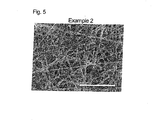
- the water soluble base layer may be composed of nanofiber portions mingled with portions causing reduction of specific surface area of the water soluble base layer, for example, the cohesive filmy portions shown in Figs. 4 and 5 hereinafter described.
- the area ratio of the nanofiber portions to the filmy portions in a plan view is preferably 90:10 to 10:90, more preferably 85:15 to 10:90, in terms of desired water solubility.
- the area ratio is determined by observing a water soluble base layer under an SEM at a magnification of 100 and processing the micrograph by background extraction and automatic binarization using image processing software Image-ProPlus from Roper Industries, Japan. In the case when no filmy portions appear in spots, the water soluble base layer is then observed under an SEM at a magnification increased to 1000, and the micrograph is processed in the same manner to obtain the area ratio.
- the active ingredient contained in the nanofiber is not precluded from being present in the water soluble base layer. However, no particular effect is expected of the presence of the active ingredient in the water soluble base layer. Therefore, the water soluble base layer does not usually have to contain the active ingredient.
- the laminate sheet of the invention may contain a volatile functional agent.
- a volatile functional agent may be present in either one or both of the nanofiber layer and the water soluble base layer of the laminate sheet.
- the volatile functional agent is at least one member selected from the group consisting of a fragrance, a whitening agent, and a taste corrector.
- the "fragrance” means a substance capable of imparting a pleasant scent to air at ambient temperature and atmospheric pressure and having a "fragrant function”.
- the "whitening agent” means a substance which is, when applied to human skin, capable of whitening the skin or maintaining the skin in a youthful and healthy condition and has a "whitening function".
- the "taste corrector” means a substance capable of changing or diminishing a taste and having a “taste correcting function".
- a taste corrector may change bitterness or sourness to another taste, e.g., sweetness, or reducing a taste.
- These functional agents are volatile substances vaporizing at ambient temperature and atmospheric pressure.
- ambient temperature and atmospheric pressure usually means a condition of a temperature of 23°C and an atmospheric pressure of 101.325 kPa.
- the volatile functional agent preferably has a vapor pressure at 20°C of 13.3 Pa or less, more preferably 0.0013 to 10.7 Pa, even more preferably 0.0133 to 6.7 Pa. With the vapor pressure at 20°C of the volatile functional agent falling within that range, the laminate sheet of the invention will exhibit a useful function attributed to the volatile functional agent at ambient temperature and atmospheric pressure.
- a laminate sheet of the invention containing a fragrance as a volatile functional agent is a fragranced sheet capable of releasing a fragrance into air at ambient temperature and atmospheric pressure thereby to make a user feel exhilarated, refreshed, cleaned, or relaxed and also produce a deodorizing effect, an anesthetic (analgesic) effect, or a like effect.
- the laminate sheet of the invention is produced by electrospinning (a method for producing the nanofiber, hereinafter described) using a stock polymer solution containing a volatile functional agent whose vapor pressure at 20°C exceeds 13.3 Pa (hereinafter also referred to as an easily volatile functional agent), the easily volatile functional agent tends to vaporize during electrospinning because of its high volatility. It can follow that the resulting nanofiber fails to retain a sufficient amount of the easily volatile functional agent for performing the function expected of the use of the functional agent, for example, a fragrant function of an easily volatile fragrance. Nevertheless, it is possible to impart the function of such an easily volatile functional agent to a nanofiber by timely adding the easily volatile functional agent (the timely addition will be described later).
- the vapor pressure of a volatile functional agent is obtained from the data base provided by Research Institute for Fragrance Materials.
- the volatile functional agent content in the laminate sheet is preferably 0.001 % to 30%, more preferably 0.01% to 5%, by mass.
- the recited range of the volatile functional agent content assures production of a nanofiber performing a useful function of the volatile functional agent, such as fragrance release, and achieves reduction in the amount of the volatile functional agent to be used, leading to a reduced cost of production.
- the nanofiber layer of the laminate sheet is suitably produced by, for example, depositing a nanofiber by electrospinning on a smooth surface of a substrate.
- Fig. 3 illustrates an apparatus 30 for carrying out electrospinning deposition.
- the apparatus 30 includes a syringe 31, a high voltage supply 32, and a conductive collector 33.
- the syringe 31 has a cylinder 31 a, a plunger 31b, and a capillary 31c.
- the capillary 31c has an inner diameter of about 10 to 1000 ⁇ m.
- the cylinder 31a is filled with a stock solution containing a polymer and an active ingredient, the raw material of a nanofiber.
- the solvent of the stock solution is selected from water, an organic solvent, and a mixture of water and a water-compatible organic solvent according to the kind of the polymer.
- the high voltage supply 32 is, for example, a 10 to 30 kV direct voltage source.
- the positive pole of the high voltage supply 32 is electrically connected to the polymer solution in the syringe 31, with the negative pole grounded.
- the conductive collector 33 is, e.g., a metal plate that is grounded.
- the distance between the tip of the capillary 31c of the syringe 31 and the conductive collector 33 is set at, e.g., about 30 to 300 mm.
- the apparatus 30 shown in Fig. 3 may be operated in the atmosphere.
- the operative environment is not particularly limited and may be, for example, 20° to 40°C and 10 to 50% RH.
- the plunger 31b of the syringe 31 is slowly forced into the cylinder 31a to eject the polymer solution from the tip of the capillary 31c.
- the solvent of the extruded solution vaporizes, and the solute (i.e., the polymer) is drawn into a nanofiber while solidifying and attracted onto the conductive collector 33 by the difference in electrical potential.
- the thus formed nanofiber is a continuous filament of infinite length.
- a hollow nanofiber is obtained by, for example, using a double barreled capillary as the capillary 31 c and feeding incompatible solutions in the core and the sheath.
- the water soluble base layer is a poreless or porous film or a mesh
- a poreless or porous film or a mesh is used as the substrate on which the nanofiber layer is deposited to make a laminate sheet having one water soluble base layer and one nanofiber layer.
- a water soluble base layer containing a nanofiber is formed on the surface of a separately prepared substrate, and a nanofiber layer is then formed thereon to provide a laminate sheet having one water soluble base layer and one nanofiber layer.
- a water soluble base layer may be formed on the thus formed nanofiber layer to provide a three-layered laminate sheet having the water soluble base layer on both sides of one nanofiber layer. Formation of the water soluble base layer and the nanofiber layer may be achieved by, for example, using two syringes.
- a solution for forming the water soluble base layer is ejected from one of the syringes, and thereafter a solution for forming the nanofiber layer is ejected from the other syringe.
- the resulting laminate sheet exhibits a clear boundary between the composition of the water soluble base layer and that of the nanofiber layer in the laminate sheet thickness direction.
- a solution for forming the water soluble base layer is ejected from one of the syringes at a gradually increasing rate of ejection starting from 0 up to a predetermined rate.
- a solution for forming the nanofiber layer is ejected from the other syringe at a gradually decreasing rate of ejection starting from a predetermined rate to zero.
- a laminate sheet obtained by this system has a composition gradually varying from the composition of the water soluble base layer to that of the nanofiber layer in its thickness direction.
- a solution for forming the nanofiber layer is ejected from one of the syringes at a gradually increasing rate of ejection starting from 0 up to a predetermined rate and, at the same time, a solution for forming the water soluble base layer is ejected from the other syringe at a gradually decreasing rate of ejection starting from a predetermined rate to zero.
- the nanofiber layer has a prolonged dissolving time, which is advantageous in that the active ingredient is slowly released over an extended period of time.
- the water soluble base layer when the water soluble base layer contains a nanofiber, it is preferred that the water soluble base layer be composed of nanofiber portions and portions causing reduction of specific surface area of the water soluble base layer, for example, cohesive filmy portions mingled with each other. Formation of the filmy portions as well as the nanofiber portions by the above discussed electrospinning process is achieved by, for example, the following methods (i) and (ii).
- the distance between the tip of the capillary 31C and the substrate for deposition is reduced and/or the rate of ejection is increased so that part of the nanofibers traveling in air may deposit on the substrate for deposition while containing the solvent.
- the distance between the tip of the capillary 31c and the substrate for deposition is reduced and/or the rate of ejection is increased so that part of droplets of the solution extruded from the capillary 31 c deposit on the substrate for deposition before they are drawn into a nanofiber.
- the nanofibers dissolve at their intersections to become filmy to reflect the dissolved state in the resulting water soluble base layer.
- the resulting water soluble base layer includes not only the nanofibers but also dot-shaped filmy portions to reflect the droplets.
- the dot-shaped filmy portions exist independently of the intersections of the nanofibers.
- the size of the dot-shaped filmy portion is 5 to 500 ⁇ m in terms of circle-equivalent diameter, while varying depending on the electrospinning conditions.
- a water soluble base layer having desired water solubility is obtained by properly adjusting the distance between the tip of the capillary 31C and the substrate for deposition and/or the rate of ejection of the solution according to the method (i) or (ii).
- the volatile functional agent is incorporated into the polymer solution used to form a nanofiber layer by electrospinning.
- the water soluble base layer is made of nanofibers.
- a nanofiber is formed by electrospinning using the polymer solution containing the volatile functional agent, vaporization of the volatile functional agent is effectively prevented because the vapor pressure at 20°C of the volatile functional agent is 13.3 Pa or less as previously noted.
- a volatile functional agent whose vapor pressure at 20°C exceeds 13.3 Pa hereinafter also referred to as an easily volatile functional agent
- the easily volatile functional agent is allowed to be imparted to a nanofiber by timely adding the easily volatile functional agent. More specifically, a laminate sheet provided with the function of an easily volatile functional agent is obtainable according to the following methods A and B.
- the nanofiber layer making step of the methods A and B is carried out by the electrospinning process shown in Fig. 3 .
- the easily volatile functional agent may be applied to the nanofiber layer either before or after the water soluble base layer is formed on the nanofiber layer.
- the solution containing an easily volatile functional agent for use in the solution addition step of the method A is prepared by dissolving or dispersing the easily volatile component in a solvent.
- the solvent is preferably uninfluential on the nanofiber, specifically the water soluble polymer making up the nanofiber.
- the solvent is selected from water, an organic solvent, and a mixture of water and a water-compatible organic solvent according to the kind of the polymer.
- Application of the solution containing the easily volatile functional agent to the nanofiber layer may be achieved by, for example, spraying the solution to the nanofiber layer or immersing the nanofiber layer in the solution.
- the easily volatile functional agent transfer step of the method B is a step in which the nanofiber layer and the easily volatile functional agent are brought close to but not in contact with each other thereby to cause the vapor of the easily volatile functional agent to transfer to the nanofiber layer. If the nanofiber layer and the easily volatile functional agent are brought into contact with each other, the water soluble polymer constituting the nanofiber can dissolve or swell to lose its fibrous form.
- the easily volatile functional agent placed close to the nanofiber layer may be exposed to open air or be enclosed in an air permeable bag or like enclosure. Unintentional direct contact of the nanofiber layer with the easily volatile functional agent is certainly avoided by enclosing the easily volatile functional agent.
- the period of time that the easily volatile functional agent is left to stand close to the nanofiber layer is decided as appropriate to the type of the easily volatile functional agent and the like. In general, the higher the volatility of the functional agent, the shorter the time needed.
- the thus obtained laminate sheet of the invention is used as attached to, for example, the skin, tooth, or gum of humans, the skin, tooth, or gum of non-human mammals, and the surface of plant parts, such as foliage.
- the laminate sheet which is composed of one nanofiber layer and one water soluble base layer is attached to an object with the nanofiber layer inside.
- the laminate sheet which has a water soluble base layer on either side of the nanofiber layer is attached to an object with either water soluble base layer inside.
- the surface of the object Before the laminate sheet is applied to the surface of an object, the surface of the object may be wetted with a liquid so that the laminate sheet successfully adheres to the surface with the surface tension taken advantage of. Alternately, the surface of the laminate sheet (the side to face the object) may be wetted with a liquid.
- the surface of an object may be wetted by, for example, spreading or spraying a liquid of various kinds to the surface.
- the liquid to be spread or sprayed is a substance containing a component that is liquid at a temperature of attaching the laminate sheet and having a viscosity of about 5000 mPa ⁇ s or less at that temperature as measured with a com-plate rotational viscometer.
- a liquid is exemplified by water, an aqueous liquid, e.g., an aqueous solution or an aqueous dispersion, a nonaqueous solvent, and a solution or dispersion containing a nonaqueous solvent.
- Emulsions including O/W emulsions and W/O emulsions, and liquids thickened with a thickener, such as a thickening polysaccharide, are also useful. More specifically, in the case when the laminate sheet of the invention is a cosmetic article to be attached to human skin, a skin lotion or a beauty cream is useful as a liquid wetting the surface of the object (skin).
- a thickener such as a thickening polysaccharide
- the nanofiber formed is deposited on the conductive collector 33 of plate shape
- a conductive rotating drum may be used instead of the plate-shaped collector, in which case the nanofiber is deposited on the peripheral surface of the rotating drum.
- Pullulan available from Hayashibara Shoji Inc. was used as a nanofiber layer material. Pullulan was dissolved in 80°C water to make a 15% solution. The solution was cooled to room temperature, and ascorbic acid was dissolved therein in a concentration of 5% to prepare a stock solution for electrospinning. The stock solution was electrospun by the use of the apparatus shown in Fig. 3 in which 30 ⁇ m thick aluminum foil was placed on the surface of the collector 33 to form a 53 ⁇ m-thick water-soluble nanofiber layer on the aluminum foil. The electrospinning conditions are described below. Applied voltage: 25 kV Capillary-collector distance: 185 mm Rate of ejection: 1.0 ml/hr Environment: 26°C, 40% RH
- Pullulan available from Hayashibara Shoji Inc. was used as a water soluble base layer material. Pullulan was dissolved in 80°C water to make a 15% solution, which was cooled to room temperature to prepare a stock solution. The stock solution was electrospun onto the surface of the water-soluble nanofiber layer prepared above to form a 48 ⁇ m-thick water-soluble base layer thereby to produce a laminate sheet. The resulting laminate sheet had a thickness of 101 ⁇ m. The electrospinning conditions are described below. The rate of ejecting the stock solution was increased over that used in the formation of the nanofiber layer so that part of the solution droplets deposited without being drawn to create dot-shaped filmy portions reflecting the droplets.
- a nanofiber layer was formed using the same stock solution and the same substrate under the same conditions as in Example 1.
- the thickness of the nanofiber layer was 53 ⁇ m.
- a water soluble base layer was formed by electrospinning the same stock solution as used in Example 1 onto the nanofiber layer to a thickness of 51 ⁇ m. The electrospinning conditions are described below. Compared with the conditions employed in the nanofiber layer formation, the distance between the tip of the capillary 31c and the nanofiber layer was reduced, and the rate of ejecting the stock solution was increased, so that part of the nanofibers deposited while containing the solvent to create filmy portions at the intersections of the nanofibers where the nanofibers dissolved. The thus obtained nanofiber laminate sheet had a thickness of 104 ⁇ m.
- a commercially available film of oblate (basis weight: 25 g/m 2 ; thickness: 30 ⁇ m) was used as a water soluble base layer.
- a nanofiber layer was formed by electrospinning using the same stock solution and the same conditions as in Example 1 onto the water soluble base layer as a substrate to a thickness of 53 ⁇ m.
- the thickness of the resulting nanofiber laminate sheet was 83 ⁇ m.
- the thickness of the nanofibers in the nanofiber layer was measured by SEM observation. The results obtained are shown in Table 1.
- a nanofiber layer was formed using the same stock solution and the same substrate under the same conditions as in Example 1.
- the thickness of the nanofiber layer was 53 ⁇ m.
- a water soluble base layer was formed by electrospinning the same stock solution as used in Example 1 onto the nanofiber layer to a thickness of 55 ⁇ m. The electrospinning conditions are described below. Compared with the conditions employed in the nanofiber layer formation, the rate of ejecting the stock solution was increased so that part of the droplets deposited without being drawn to create dot-shaped filmy portions reflecting the droplets. The thus obtained nanofiber laminate sheet had a thickness of 108 ⁇ m.
- a polyvinyl alcohol film Hi-Rhythm M-250 from The Nippon Synthetic Chemical Industry (thickness: 22 ⁇ m) was used as a water soluble base layer.
- a nanofiber layer was formed by electrospinning using the same stock solution and the same conditions as used in Example 1 on the water soluble base layer as a substrate to a thickness of 53 ⁇ m.
- the thickness of the resulting nanofiber laminate sheet was 75 ⁇ m. There was thus obtained a laminate sheet composed of one nanofiber layer and one water soluble base layer of film form.
- the thickness of the nanofibers in the nanofiber layer was measured by SEM observation. The results obtained are shown in Table 1.
- a nanofiber sheet having a thickness of 110 ⁇ m was formed by electrospinning using the same stock solution, conditions, and the substrate as in Example 1.
- a nanofiber layer and a water soluble base layer were formed separately.
- a sample sheet measuring 4 cm by 6 cm was cut out of each of the water soluble base layer and the nanofiber layer.
- the sample sheet was stuck to a 0.2 mm thick polyethylene terephthalate film using a double sided adhesive tape.
- An ultrasonic humidifier KX-80UP from CCP Co., Ltd. having a 30 mm diameter outlet was turned on to generate water vapor at a rate of 90 ml/hr.
- the sample sheet was fixed at a distance of 10 mm from the outlet, and the time required for the sheet to turn transparent as observed with naked eyes was taken as a dissolving time I. The measurement was made in triplicate to obtain an average time.
- FIG. 1 and 2 An orally disintegrating tablet tester ODT-101 from Toyama Sangyo Co., Ltd. shown in Figs. 1 and 2 was used. Each of the water soluble base layer and the nanofiber layer which were prepared separately was cut to measure 4 cm by 4 cm to prepare a sample sheet. The sample sheet was fixed to the tester. The plumb 14 had a diameter of 20 mm and a weight of 15 g. The rotational speed of the plumb 14 was 5 rpm. The water temperature was 23°C. The dissolving time as measured by this method was taken as a dissolving time II.
- the surface of the water soluble base layer (the nanofiber layer in Comparative Example 1) was pressed for 3 seconds with a finger having been thoroughly wiped with a cotton wipe to remove any moisture. After the finger was removed, the change of the surface of the sheet was observed with naked eyes and rated as follows. Good: A slight change is observed, such as formation of a small hole in part of the region where the finger has been placed. Poor: A change is observed, such as formation of small holes over the entire region where the finger has been placed.
- the laminate sheets of Examples (of the invention) prove to have markedly improved handling properties with respect to dissolving with water as compared with the nanofiber sheet of Comparative Example.
Landscapes
- Health & Medical Sciences (AREA)
- Life Sciences & Earth Sciences (AREA)
- Animal Behavior & Ethology (AREA)
- General Health & Medical Sciences (AREA)
- Public Health (AREA)
- Veterinary Medicine (AREA)
- Epidemiology (AREA)
- Birds (AREA)
- Engineering & Computer Science (AREA)
- Chemical & Material Sciences (AREA)
- Medicinal Chemistry (AREA)
- Pharmacology & Pharmacy (AREA)
- Dermatology (AREA)
- Bioinformatics & Cheminformatics (AREA)
- Nutrition Science (AREA)
- Physiology (AREA)
- Biomedical Technology (AREA)
- Cosmetics (AREA)
- Laminated Bodies (AREA)
- Artificial Filaments (AREA)
- Medicinal Preparation (AREA)
- Nonwoven Fabrics (AREA)
Abstract
Description
- The present invention relates to a laminate sheet composed of a nanofiber layer and a water soluble base layer.
- Nanofibers are applied to the fields demanding optical characteristics such as high transparency, where the nano-size effect of nanofibers are taken advantage of. For example, nanofibers with a diameter equal to or below the wavelength of visible light provide transparent fabric. By the use of nanofibers the diameter of which is equal to the wavelength of visible light, structural color may be exhibited. Nanofibers have also been studied for their applicability to the fields demanding superabsorbent characteristics or high surface activity, where the high specific surface area effect of nanofibers is taken advantage of, and to the fields demanding mechanical characteristics such as tensile strength and electrical characteristics such as high conductivity, where the supramolecular arrangement effect of nanofibers is made use of. Nanofibers having such characteristics have been used in the form of, for example, not only single fibers but aggregates (i.e., fabrics) or composites.
- Applications of nanofibers that have been proposed include a cosmetic sheet comprising a network structure made of a water soluble polymer nanofiber and a cosmetic or a cosmetic component, such as ascorbic acid, held in the network structure as disclosed in
patent literature 1 below.Patent literature 1 alleges that the cosmetic sheet has not only improved adhesion or comfort to the user's face, hand, or leg but also storage stability.Patent literature 2 below describes that a functional component, such as an emulsifying component, a stabilizing component, a bactericidal component, a moisturizing component, and so on, may be added to a nanofiber sheet. -
- Patent literature 1:
JP 2008-179629A - Patent literature 2:
WO 2009/031620A1 - A nanofiber prepared from a water soluble polymer exhibits higher water solubility than in its bulk form on account of the large specific surface area and, therefore, easily dissolves with water, e.g., of perspiration just upon being touched with a finger. It is likely that the nanofiber sheet dissolves or gets a hole in it before it is attached to an object. That is, the water soluble polymer-based nanofiber sheet is less than easy to handle.
- The invention settles the above discussed problem by providing a nanofiber laminate sheet composed of a layer of a nanofiber (hereinafter a nanofiber layer) containing a cosmetic component or a medicinal component and a water soluble base layer located on at least one side of the nanofiber layer. The water soluble base layer is less water-soluble than the nanofiber layer.
- The invention includes the following subject matter.
- [1] A nanofiber laminate sheet comprising a nanofiber layer containing a cosmetic component or a medicinal component and a water soluble base layer located on at least one side of the nanofiber layer, the water soluble base layer being less water-soluble than the nanofiber layer.
- [2] The nanofiber laminate sheet set forth in [1] above, wherein the dissolving time ratio of water soluble base layer to nanofiber layer is 1.1 or greater, the dissolving time being measured by the method I described later.
- [3] The nanofiber laminate sheet set forth in [2] above, wherein the dissolving time ratio of water soluble base layer to nanofiber layer is 1.1 to 50, the dissolving time being measured by the method I described later.
- [4] The nanofiber laminate sheet set forth in [1], wherein the dissolving time ratio of water soluble base layer to nanofiber layer is 1.1 or greater, the dissolving time being measured by the method II described later.
- [5] The nanofiber laminate sheet set forth in [4], wherein the dissolving time ratio of water soluble base layer to nanofiber layer is 1.1 to 200, the dissolving time being measured by the method II described later.
- [6] The nanofiber laminate sheet set forth in any one of [1] to [5], wherein the water soluble base layer and the nanofiber comprise the same material, the water soluble base layer has a smaller specific surface area than the nanofiber layer, and the water soluble base layer comprises a poreless film, a porous film, or a mesh.
- [7] Te nanofiber laminate sheet set forth in any one of [1] to [6], wherein the nanofiber comprises a water soluble polymer, and the water soluble polymer is one of, or a combination of two or more of, naturally occurring polymers, such as mucopolysaccharides, e.g., pullulan, hyaluronic acid, chondroitin sulfate, poly-γ-glutamic acid, modified corn starch, β-glucan, gluco-oligosaccharides, heparin, and keratosulfate, cellulose, pectin, xylan, lignin, glucomannan, galacturonic acid, psyllium seed gum, tamarind seed gum, gum arabic, tragacanth gum, soybean water-soluble polysaccharides, alginic acid, carrageenan, laminaran, agar (agarose), fucoidan, methyl cellulose, hydroxypropyl cellulose, and hydroxypropylmethyl cellulose; partially saponified polyvinyl alcohol (usable in the absence of a crosslinking agent), low-saponified polyvinyl alcohol, polyvinylpyrrolidone (PVP), polyethylene oxide, and sodium polyacrylate, preferably, pullulan, partially saponified polyvinyl alcohol, low-saponified polyvinyl alcohol, polyvinylpyrrolidone, or polyethylene oxide.
- [8] The nanofiber laminate sheet set forth in [7], wherein pullulan is used as a nanofiber.
- [9] The nanofiber laminate sheet set forth in any one of [1] to [8], wherein the water soluble base layer is a film prepared from a polysaccharide material, such as oblate and pullulan, polyvinyl alcohol, agar, or carrageenan.
- [10] The nanofiber laminate sheet set forth in [9], wherein pullulan is used as the water soluble base layer.
- [11] The nanofiber laminate sheet set forth in [9], wherein the water soluble base layer is a oblate film.
- [12] The nanofiber laminate sheet set forth in [9], wherein the water soluble base layer is a polyvinyl alcohol film.
- [13] The nanofiber laminate sheet set forth in any one of [1] to [12], wherein the cosmetic component or a medicinal component is a blood circulation improving agent selected from acid mucopolysaccharides, chamomile, buckeye, ginkgo, witch hazel extract, vitamin E, nicotinic acid derivatives, and alkaloid compounds; an edema reducing agent selected from buckeye, flavone derivatives, naphthalenesulfonic acid derivatives, anthocyanin, vitamin P, calendula, concholytic acid, silanol, terminalia, visnaga, and majus; a slimming agent selected from aminophylline, tea extract, caffeine, xanthine derivatives, inositol, dextransulfuric acid derivatives, buckeye, aescin, anthocyanidin, organoiodine compounds, hypericum, Filipendula multijuga, field horsetail, rosemary, ginseng, ivy, thiomucase, and hyaluronidase; a painkiller selected from indometacin, diclofenac, dl-camphor, flurbiprofen, ketoprofen, capsicum extract, piroxicam, felbinac, methyl salicylate, and glycol salicylate; a moisturizing agent selected from polyols, ceramids, and collagens; a peeling gent including a protease; a depilatory agent including calcium thioglycolate; an autonomic regulatory agent including γ-oryzanol; an extract of Japanese elk horn ceder (Thujopsis dolabrata), balloon flower root, eucalyptus, birch, ginger, yuzu (Citrus junos), etc.; tranexamic acid, allantoin, stearyl glycyrrhetinate, niacinamide, 1-menthol, and avitamin, such as vitamin C.
- [14] The nanofiber laminate sheet set forth in any one of [1] and [13], wherein the content of the cosmetic component or the medicinal component in the nanofiber is in the range of from 0.01 % to 70% by mass.
- [15] The nanofiber laminate sheet set forth in any one of [1] to [14], wherein the water soluble base layer is composed of a nanofiber portion and a filmy portion, the nanofiber portion and the filmy portion being mingled with each other.
- [16] The nanofiber laminate sheet set forth in any one of [1] to [14], wherein the water soluble base layer is a layer of nanofibers in which the nanofibers cohere to each other to form the filmy portions at the intersections.
- [17] The nanofiber laminate sheet set forth in [15] or [16], wherein the area ratio of nanofiber portions to filmy portions in a plan view is 90:10 to 10:90.
- [18] The nanofiber laminate sheet set forth in [17], wherein the area ratio of nanofiber portions to filmy portions in a plan view is 85:15 to 10:90.
- [19] The nanofiber laminate sheet set forth in any one of [1] to [18], having its composition gradually varying from the composition of the water soluble base layer to that of the nanofiber layer in its thickness direction.
- [20] The nanofiber laminate sheet set forth I any one of [1] to [18], having a clear boundary between the composition of the water soluble base layer and that of the nanofiber in its thickness direction.
- [21] The nanofiber laminate sheet set forth in any one of [1] to [20], containing a volatile functional agent having a vapor pressure of 13.3 Pa or less at 20°C.
- [22] A method for making a nanofiber laminate sheet having a nanofiber layer containing a cosmetic component or a medicinal component, and a water soluble base layer located on at least one side of the nanofiber layer, the water soluble base layer being less water-soluble than the nanofiber layer, and the water soluble base layer containing a nanofiber,
the method comprising electrospinning a solution of a water soluble polymer in a solvent to deposit the water soluble base layer containing a nanofiber on a substrate for deposition in a manner such that part of the nanofiber traveling in air is deposited on the substrate while containing the solvent by decreasing the distance between the tip of a capillary and the substrate and/or increasing the rate of ejecting the water soluble polymer solution thereby to form a filmy portion as well as a nanofiber portion in the water soluble base layer. - [23] A method for making a nanofiber laminate sheet having a nanofiber layer containing a cosmetic component or a medicinal component, and a water soluble base layer located on at least one side of the nanofiber layer, the water soluble base layer being less water-soluble than the nanofiber layer, and the water soluble base layer containing a nanofiber,
the method comprising electrospinning a water soluble polymer solution to deposit the water soluble base layer containing a nanofiber on a substrate for deposition in a manner such that part of droplets of the solution extruded from a capillary deposit on the substrate before they are drawn into nanofibers thereby to form a filmy portion as well as a nanofiber portion in the water soluble base layer. - [24] A method for making a nanofiber laminate sheet having a nanofiber layer containing a cosmetic component or a medicinal component, and a water soluble base layer located on at least one side of the nanofiber layer, the water soluble base layer being less water-soluble than the nanofiber layer, and the water soluble base layer containing a nanofiber,
the method comprising simultaneously electrospinning a solution for forming the water soluble base layer from one of two syringes at a gradually increasing rate of ejection starting from 0 up to a predetermined rate and a solution for forming the nanofiber layer from the other syringe at a gradually decreasing rate of ejection starting from a predetermined rate to zero to form the nanofiber laminate sheet which has a composition gradually varying from the composition of the water soluble base layer to the composition of the nanofiber layer. - [25] A method for making a nanofiber laminate sheet having a nanofiber layer containing a cosmetic component or a medicinal component, and a water soluble base layer located on at least one side of the nanofiber layer, the water soluble base layer being less water-soluble than the nanofiber layer and containing an easily volatile functional agent having a vapor pressure exceeding 13.3 Pa at 20°C,
the method comprising a step of applying the easily volatile functional agent to the nanofiber layer. - [26] A method for making a nanofiber laminate sheet having a nanofiber layer containing a cosmetic component or a medicinal component, and a water soluble base layer located on at least one side of the nanofiber layer, the water soluble base layer being less water-soluble than the nanofiber layer and containing an easily volatile functional agent having a vapor pressure exceeding 13.3 Pa at 20°C,
the method comprising a step of leaving the easily volatile functional agent to stand close to the nanofiber layer to cause the easily volatile functional agent to transfer to the nanofiber layer. - The invention provides a nanofiber sheet, which has hitherto been less than easy to handle, having markedly improved handling so as to be attached to the surface of an object with ease.
-
- [
Fig. 1] Fig. 1 is a perspective illustrating part of a device for measuring the dissolving time each of a nanofiber layer and a water soluble base layer. - [
Fig. 2] Fig. 2(a), Fig. 2(b), and Fig. 2(c) schematically show the procedure for measuring the dissolving time each of a nanofiber layer and a water soluble base layer by the use of the device shown inFig. 1 . - [
Fig. 3] Fig. 3 schematically illustrates an apparatus suitably used to produce the nanofiber laminate sheet according to the invention. - [
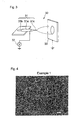
Fig. 4] Fig. 4 is a scanning electron micrograph of the water soluble base layer of the nanofiber laminate sheet obtained in Example 1. - [
Fig. 5] Fig. 5 is a scanning electron micrograph of the water soluble base layer of the nanofiber laminate sheet obtained in Example 2. - The invention will be described based on its preferred embodiments. The nanofiber laminate sheet of the invention (hereinafter also simply referred to as the laminate sheet) is basically composed of a layer of a nanofiber (hereinafter referred to as a nanofiber layer) and a water soluble base layer. The water soluble base layer is disposed on at least one side of the nanofiber layer. Depending on the use of the laminate sheet, the water soluble base layer may be located on both sides of the nanofiber layer. In this case, the water soluble base layer on one side of the nanofiber layer and that on the other side may be the same or different. Whether provided on one side or both sides, the water soluble base layer preferably adjoins the nanofiber layer. For some uses, between the nanofiber layer and the water soluble base layer there may be a layer different from either.
- The nanofiber layer is preferably made solely of a nanofiber. The nanofiber layer may contain other components in addition to a nanofiber. The nanofiber has a thickness usually of 10 to 3000 nm, preferably 10 to 1000 nm, in terms of circle equivalent diameter. The thickness of nanofibers is measured by, for example, observation using a scanning electron microscope (SEM). Specifically, a two-dimensional micrograph at a magnification of 10000 is processed by deleting defects (lumps of nanofibers, intersections of nanofibers, and polymer droplets), randomly choosing ten fibers, drawing a line perpendicular to the longitudinal direction of each fiber chosen, and directly reading the length of the line segment crossing the fiber.
- The length of the nanofiber is not critical in the invention and may have any appropriate length depending on the method of nanofiber manufacturing. A nanofiber is called a "fiber" when it is 100 or more times as long as it is thick. The nanofiber may be unidirectionally or randomly aligned in the nanofiber layer. While the nanofiber is generally a solid fiber, a hollow nanofiber or a flattened or ribbon-like hollow nanofiber having a collapsed cross-section is useful as well.
- The nanofiber layer may have a thickness decided as appropriate to the intended use of the laminate sheet. For example, for use as attached to human skin, tooth, or gum, the thickness of the nanofiber layer is preferably 50 nm to 1 mm, more preferably 500 nm to 500 µm. The thickness of the nanofiber layer may be measured using a contact thickness gauge Litematic VL-50A from Mitutoyo Corp. with a spherical carbide contact point of 5 mm in radius. A load of 0.01 N is applied to the sheet in the thickness measurement.
- The nanofiber layer may have a basis weight decided as appropriate to the intended use of the laminate sheet. For example, for use as attached to human skin, tooth, or gum, the basis weight of the nanofiber layer is preferably 0.01 to 100 g/m2, more preferably 0.1 to 50 g/m2.
- The nanofibers in the nanofiber layer are bonded to one another at the intersections thereof or intertwined with one another, whereby the nanofiber layer is self-supporting to retain its sheet form. Whether the nanofibers are bonded to or intertwined with one another depends on the method of manufacturing the nanofiber layer.
- The nanofiber is prepared from a polymer. The polymer may be a naturally occurring polymer or a synthetic polymer. The polymer is preferably water soluble.
- As used herein, the term "water soluble polymer" denotes a polymer having solubility such that, when a sample polymer weighing 1 g is immersed in 10 g of ion-exchanged water for 24 hours at 23°C and atmospheric pressure, at least 0.5 g of the immersed polymer dissolves in the ion-exchanged water.
- Examples of the water soluble polymer include naturally occurring polymers, such as mucopolysaccharides, e.g., pullulan, hyaluronic acid, chondroitin sulfate, poly-γ-glutamic acid, modified corn starch, β-glucan, gluco-oligosaccharides, heparin, and keratosulfate, cellulose, pectin, xylan, lignin, glucomannan, galacturonic acid, psyllium seed gum, tamarind seed gum, gum arabic, tragacanth gum, soybean water-soluble polysaccharides, alginic acid, carrageenan, laminaran, agar (agarose), fucoidan, methyl cellulose, hydroxypropyl cellulose, and hydroxypropylmethyl cellulose; and synthetic polymers, such as partially saponified polyvinyl alcohol (usable in the absence of a crosslinking agent hereinafter described), low-saponified polyvinyl alcohol, polyvinylpyrrolidone (PVP), polyethylene oxide, and sodium polyacrylate. These water soluble polymers may be used either individually or in combination of two or more thereof. Preferred of them are pullulan and synthetic polymers, such as partially saponified polyvinyl alcohol, low-saponified polyvinyl alcohol, polyvinylpyrrolidone, and polyethylene oxide, in view of ease of conversion to nanofibers.
- The nanofiber contains a cosmetic component or a medicinal component. As attached to, e.g., human skin, tooth, or gum, the nanofiber layer containing such an active ingredient produces the advantageous effect attributed to the active ingredient.
- Examples of the cosmetic or medicinal component include a blood circulation improving agent selected from acid mucopolysaccharides, chamomile, buckeye, ginkgo, witch hazel extract, vitamin E, nicotinic acid derivatives, and alkaloid compounds; an edema reducing agent selected from buckeye, flavone derivatives, naphthalenesulfonic acid derivatives, anthocyanin, vitamin P, calendula, concholytic acid, silanol, terminalia, visnaga, and majus; a slimming agent selected from aminophylline, tea extract, caffeine, xanthine derivatives, inositol, dextransulfuric acid derivatives, buckeye, aescin, anthocyanidin, organoiodine compounds, hypericum, Filipendula multijuga, field horsetail, rosemary, ginseng, ivy, thiomucase, and hyaluronidase; a painkiller selected from indometacin, diclofenac, dl-camphor, flurbiprofen, ketoprofen, capsicum extract, piroxicam, felbinac, methyl salicylate, and glycol salicylate; a moisturizing agent selected from polyols, ceramids, and collagens; a peeling gent including a protease; a depilatory agent including calcium thioglycolate; and an autonomic regulatory agent including γ-oryzanol. Additionally, extracts of Japanese elk horn ceder (Thujopsis dolabrata), balloon flower root, eucalyptus, birch, ginger, yuzu (Citrus junos), etc.; tranexamic acid, allantoin, stearyl glycyrrhetinate, niacinamide, 1-menthol, and vitamins such as vitamin C are also included in the cosmetic or medicinal component. The content of the active ingredient in the nanofiber is usually in the range of from 0.01 % to 70% by mass, while varying according to the kind. The active ingredient content may be determined by liquid chromatography or thermogravimetry.
- The nanofiber may further contain other components in addition to the above described components. Such components include a crosslinking agent, a pigment, a filler, a surfactant, an antistatic agent, and a foaming agent. A crosslinking agent is used to crosslink and insolubilize, for example, the partially saponified polyvinyl alcohol described above. A pigment is used to color the nanofiber.
- The water soluble base layer provided on at least one side of the nanofiber layer is constructed of a layer containing a water soluble material. The term "water soluble" as used herein is as previously defined. One of the characteristics of the water soluble base layer is a difference in water solubility from the nanofiber layer. Specifically, the water solubility of the water soluble base layer is relatively lower than that of the nanofiber layer. In other words, the water soluble base layer is less water-soluble than the nanofiber layer. Therefore, when the laminate sheet of the invention is taken, for example, between fingers and attached to a desired part, dissolution of the nanofiber layer due to the water, e.g., of perspiration is prevented by the water soluble base layer until it is successfully attached. The less water-solubility of the water soluble base layer than that of the nanofiber layer brings about improvement on the handling of the nanofiber layer with respect to the behavior to water. Since the water soluble base layer is water soluble per se, it dissolves in water and disappears after the elapse of a prescribed period of time so that it gives no adverse influences on the nanofiber layer. In the case where the water soluble base layer is provided on both sides of the nanofiber layer, the nanofiber layer is blocked by the two water soluble base layers, so that the active ingredient in the nanofiber layer is slowly released to advantage for a prolonged period of time.
- To say that the water soluble base layer is "less water soluble" than the nanofiber layer is equivalent to say that the water soluble base layer is "less soluble" than the nanofiber layer. The solubility difference between the water soluble base layer and the nanofiber layer is evaluated by, for example, methods I or II below.
- A sample sheet measuring 4 cm by 6 cm is cut out of each of the water soluble base layer and the nanofiber layer before they are laminated with each other. The sample sheet is stuck to a 0.2 mm thick polyethylene terephthalate film using a double sided adhesive tape. An ultrasonic humidifier KX-80UP from CCP Co., Ltd. having a 30 mm diameter outlet is turned on to generate water vapor at a rate of 90 ml/hr. The sample sheet is fixed at a distance of 10 mm from the outlet, and the time required for the sheet to turn transparent as observed with naked eyes is taken as a dissolving time. The dissolving time of the nanofiber layer as measured by the method I is preferably 120 seconds or shorter, more preferably 10 to 60 seconds. The dissolving time of the water soluble base layer as measured by the method I is preferably 30 seconds or longer, more preferably 35 to 180 seconds, even more preferably 40 to 100 seconds. The dissolving time ratio of water soluble base layer to nanofiber layer is preferably 1.1 or greater, more preferably 1.1 to 50. The method I is also applicable to a nanofiber laminate sheet after laminating the water soluble base layer and the nanofiber layer to each other.
- An orally disintegrating tablet tester ODT-101 from Toyama Sangyo Co., Ltd. was used. As shown in
Fig. 1 , the tester has a plate-shaped,sample fixing frame 10 having acircular hole 10a at the center and adetection sheet 11. Thedetection sheet 11 is composed of a pair ofsemicircular metal sheets detection sheet 11 has a number ofsmall holes 12 in its central portion. Each of the water soluble base layer and the nanofiber layer before lamination is cut to measure 4 cm by 4 cm to prepare asample sheet 13. Thesample sheet 13 is fixed between thesample fixing frame 10 and thedetection sheet 11 as shown inFig. 2(a) . A metal plumb 14 is positioned above the circular hole of thesample fixing frame 10. As shown inFig. 2(b) , the plumb 14 is, while being rotated in a horizontal plane, let down into thecircular hole 10a, where the rotating plumb 14 is brought into contact with the exposed part of thesample sheet 13. Simultaneously with the contact,water 15 is made to seep through theslit 14 from the back side of thedetection sheet 11 to wet thesample sheet 13. This point of time is taken as a starting point of measurement. Thesample sheet 13 gradually dissolves by the action of wetting with water and rotation of the rotating plumb 14. The time point when thesample sheet 13 dissolves completely to allow the lower side of the plumb 14 to touch thedetection sheet 11 as shown inFig. 2(c) is the end of measurement. The time from the start to end of measurement is the dissolving time. The dissolving time of the nanofiber layer as measured by the method II is preferably 100 seconds or less, more preferably 0.1 to 50 seconds. The dissolving time of the water soluble base layer as measured by the method II is preferably 5 seconds or more, more preferably 5 to 600 seconds, even more preferably 5 to 90 seconds. The dissolving time ratio of water soluble base layer to nanofiber layer is preferably 1.1 or greater, more preferably 1.1 to 200.
The following advantages accrue from the dissolving times of the nanofiber layer and the water soluble base layer being in the respective ranges recited. The laminate sheet of the nanofiber layer and the water soluble base layer is easy to handle by hand. When the nanofiber laminate sheet is attached to an object with the nanofiber layer inside, the nanofiber layer dissolves earlier than the water soluble base layer so that the cosmetic or medicinal component in the nanofiber layer may be imparted to the object, and the water soluble base layer covers the cosmetic or medicinal component to prevent the cosmetic or medicinal component from running over other than the object. Improvement is also expected on the penetrability of the cosmetic or medicinal component into the object. As time advances, the water soluble base layer also dissolves, leaving no waste to be disposed of This will provide a better usage of the laminate sheet. - A water soluble base layer having lower water solubility than a nanofiber layer is obtainable, for example, by means (a) in which the water soluble base layer is made from a material having lower water solubility than the material making the nanofiber except a water insoluble material. When the water soluble base layer is made of the same material as used to make the nanofiber layer, means (b) is adopted, in which a water soluble base layer is formed to have a smaller specific surface area than the nanofiber layer. The means (a) and (b) may be used in combination. The water soluble base layer may have an air permeable structure.
- In using the means (b), the water soluble base layer is formed of a poreless or porous film or a mesh. The water solubility of the water soluble base layer is adjusted as desired by properly selecting the thickness and basis weight of the film or the size and number of the pores, and the like. The thickness, the basis weight, and the size and number of the pores are decided by those skilled in the art within the range of ordinary knowledge. Specific examples of useful water soluble base layers are films of polysaccharide materials, such as oblate and pullulan, polyvinyl alcohol, agar, or carrageenan. The film does not always need to be totally water soluble. It is only necessary that the film disintegrate easily in the presence of water. That is, when the water soluble base layer is water soluble, the layer may dissolve with water completely or the layer may lose its sheet form on contact with water.
- When the means (b) is adopted and when the water soluble base layer contains a nanofiber, the water soluble base layer may be composed of nanofiber portions mingled with portions causing reduction of specific surface area of the water soluble base layer, for example, the cohesive filmy portions shown in
Figs. 4 and5 hereinafter described. When the water soluble base layer is constructed of nanofiber portions and filmy portions, the area ratio of the nanofiber portions to the filmy portions in a plan view is preferably 90:10 to 10:90, more preferably 85:15 to 10:90, in terms of desired water solubility. The area ratio is determined by observing a water soluble base layer under an SEM at a magnification of 100 and processing the micrograph by background extraction and automatic binarization using image processing software Image-ProPlus from Roper Industries, Japan. In the case when no filmy portions appear in spots, the water soluble base layer is then observed under an SEM at a magnification increased to 1000, and the micrograph is processed in the same manner to obtain the area ratio. - The active ingredient contained in the nanofiber is not precluded from being present in the water soluble base layer. However, no particular effect is expected of the presence of the active ingredient in the water soluble base layer. Therefore, the water soluble base layer does not usually have to contain the active ingredient.
- The laminate sheet of the invention may contain a volatile functional agent. A volatile functional agent may be present in either one or both of the nanofiber layer and the water soluble base layer of the laminate sheet. The volatile functional agent is at least one member selected from the group consisting of a fragrance, a whitening agent, and a taste corrector. As used herein, the "fragrance" means a substance capable of imparting a pleasant scent to air at ambient temperature and atmospheric pressure and having a "fragrant function". As used herein, the "whitening agent" means a substance which is, when applied to human skin, capable of whitening the skin or maintaining the skin in a youthful and healthy condition and has a "whitening function". As sued herein, the "taste corrector" means a substance capable of changing or diminishing a taste and having a "taste correcting function". For example, a taste corrector may change bitterness or sourness to another taste, e.g., sweetness, or reducing a taste. These functional agents are volatile substances vaporizing at ambient temperature and atmospheric pressure. As used herein, the term "ambient temperature and atmospheric pressure" usually means a condition of a temperature of 23°C and an atmospheric pressure of 101.325 kPa.
- The volatile functional agent preferably has a vapor pressure at 20°C of 13.3 Pa or less, more preferably 0.0013 to 10.7 Pa, even more preferably 0.0133 to 6.7 Pa. With the vapor pressure at 20°C of the volatile functional agent falling within that range, the laminate sheet of the invention will exhibit a useful function attributed to the volatile functional agent at ambient temperature and atmospheric pressure. For instance, a laminate sheet of the invention containing a fragrance as a volatile functional agent is a fragranced sheet capable of releasing a fragrance into air at ambient temperature and atmospheric pressure thereby to make a user feel exhilarated, refreshed, cleaned, or relaxed and also produce a deodorizing effect, an anesthetic (analgesic) effect, or a like effect.
- When the laminate sheet of the invention is produced by electrospinning (a method for producing the nanofiber, hereinafter described) using a stock polymer solution containing a volatile functional agent whose vapor pressure at 20°C exceeds 13.3 Pa (hereinafter also referred to as an easily volatile functional agent), the easily volatile functional agent tends to vaporize during electrospinning because of its high volatility. It can follow that the resulting nanofiber fails to retain a sufficient amount of the easily volatile functional agent for performing the function expected of the use of the functional agent, for example, a fragrant function of an easily volatile fragrance. Nevertheless, it is possible to impart the function of such an easily volatile functional agent to a nanofiber by timely adding the easily volatile functional agent (the timely addition will be described later). The vapor pressure of a volatile functional agent is obtained from the data base provided by Research Institute for Fragrance Materials.
- Examples of fragrances that can be used as a volatile functional agent include vanillin, methyl jasmonate, γ-undecalactone, and phenylethyl alcohol. These volatile functional agents may be used either individually or in combination of two or more thereof.
- The volatile functional agent content in the laminate sheet is preferably 0.001 % to 30%, more preferably 0.01% to 5%, by mass. The recited range of the volatile functional agent content assures production of a nanofiber performing a useful function of the volatile functional agent, such as fragrance release, and achieves reduction in the amount of the volatile functional agent to be used, leading to a reduced cost of production.
- A preferred method for producing the laminate sheet of the invention will then be described. The nanofiber layer of the laminate sheet is suitably produced by, for example, depositing a nanofiber by electrospinning on a smooth surface of a substrate.
Fig. 3 illustrates anapparatus 30 for carrying out electrospinning deposition. Theapparatus 30 includes asyringe 31, ahigh voltage supply 32, and aconductive collector 33. Thesyringe 31 has acylinder 31 a, aplunger 31b, and a capillary 31c. The capillary 31c has an inner diameter of about 10 to 1000 µm. Thecylinder 31a is filled with a stock solution containing a polymer and an active ingredient, the raw material of a nanofiber. The solvent of the stock solution is selected from water, an organic solvent, and a mixture of water and a water-compatible organic solvent according to the kind of the polymer. Thehigh voltage supply 32 is, for example, a 10 to 30 kV direct voltage source. The positive pole of thehigh voltage supply 32 is electrically connected to the polymer solution in thesyringe 31, with the negative pole grounded. Theconductive collector 33 is, e.g., a metal plate that is grounded. The distance between the tip of the capillary 31c of thesyringe 31 and theconductive collector 33 is set at, e.g., about 30 to 300 mm. Theapparatus 30 shown inFig. 3 may be operated in the atmosphere. The operative environment is not particularly limited and may be, for example, 20° to 40°C and 10 to 50% RH. - With a voltage applied between the
syringe 31 and theconductive collector 33, theplunger 31b of thesyringe 31 is slowly forced into thecylinder 31a to eject the polymer solution from the tip of the capillary 31c. The solvent of the extruded solution vaporizes, and the solute (i.e., the polymer) is drawn into a nanofiber while solidifying and attracted onto theconductive collector 33 by the difference in electrical potential. From the principle of the production process, the thus formed nanofiber is a continuous filament of infinite length. A hollow nanofiber is obtained by, for example, using a double barreled capillary as the capillary 31 c and feeding incompatible solutions in the core and the sheath. - When the water soluble base layer is a poreless or porous film or a mesh, such a poreless or porous film or a mesh is used as the substrate on which the nanofiber layer is deposited to make a laminate sheet having one water soluble base layer and one nanofiber layer.
- When the water soluble base layer contains a nanofiber, a water soluble base layer containing a nanofiber is formed on the surface of a separately prepared substrate, and a nanofiber layer is then formed thereon to provide a laminate sheet having one water soluble base layer and one nanofiber layer. If desired, a water soluble base layer may be formed on the thus formed nanofiber layer to provide a three-layered laminate sheet having the water soluble base layer on both sides of one nanofiber layer. Formation of the water soluble base layer and the nanofiber layer may be achieved by, for example, using two syringes. A solution for forming the water soluble base layer is ejected from one of the syringes, and thereafter a solution for forming the nanofiber layer is ejected from the other syringe. In this case, the resulting laminate sheet exhibits a clear boundary between the composition of the water soluble base layer and that of the nanofiber layer in the laminate sheet thickness direction.
- Instead of the above discussed system of ejection, the two syringes may operate simultaneously. A solution for forming the water soluble base layer is ejected from one of the syringes at a gradually increasing rate of ejection starting from 0 up to a predetermined rate. A solution for forming the nanofiber layer is ejected from the other syringe at a gradually decreasing rate of ejection starting from a predetermined rate to zero. A laminate sheet obtained by this system has a composition gradually varying from the composition of the water soluble base layer to that of the nanofiber layer in its thickness direction. Alternately, a solution for forming the nanofiber layer is ejected from one of the syringes at a gradually increasing rate of ejection starting from 0 up to a predetermined rate and, at the same time, a solution for forming the water soluble base layer is ejected from the other syringe at a gradually decreasing rate of ejection starting from a predetermined rate to zero. When the laminate sheet does not have a distinct boundary between the water soluble base layer and the nanofiber layer as with the cases discussed above, the nanofiber layer has a prolonged dissolving time, which is advantageous in that the active ingredient is slowly released over an extended period of time.
- As stated earlier, when the water soluble base layer contains a nanofiber, it is preferred that the water soluble base layer be composed of nanofiber portions and portions causing reduction of specific surface area of the water soluble base layer, for example, cohesive filmy portions mingled with each other. Formation of the filmy portions as well as the nanofiber portions by the above discussed electrospinning process is achieved by, for example, the following methods (i) and (ii).
- In carrying out electrospinning, the distance between the tip of the capillary 31C and the substrate for deposition is reduced and/or the rate of ejection is increased so that part of the nanofibers traveling in air may deposit on the substrate for deposition while containing the solvent.
- In carrying out electrospinning, the distance between the tip of the capillary 31c and the substrate for deposition is reduced and/or the rate of ejection is increased so that part of droplets of the solution extruded from the capillary 31 c deposit on the substrate for deposition before they are drawn into a nanofiber.
- In following the method (i), since part of the nanofibers deposit while containing the solvent, the nanofibers dissolve at their intersections to become filmy to reflect the dissolved state in the resulting water soluble base layer.
- When the method (ii) is followed, since part of the solution droplets deposit without being drawn, the resulting water soluble base layer includes not only the nanofibers but also dot-shaped filmy portions to reflect the droplets. The dot-shaped filmy portions exist independently of the intersections of the nanofibers. The size of the dot-shaped filmy portion is 5 to 500 µm in terms of circle-equivalent diameter, while varying depending on the electrospinning conditions.
- Thus, a water soluble base layer having desired water solubility is obtained by properly adjusting the distance between the tip of the capillary 31C and the substrate for deposition and/or the rate of ejection of the solution according to the method (i) or (ii).
- In the case when the laminate sheet of the invention contains the above described volatile functional agent, the volatile functional agent is incorporated into the polymer solution used to form a nanofiber layer by electrospinning. The same applies to the case when the water soluble base layer is made of nanofibers. When a nanofiber is formed by electrospinning using the polymer solution containing the volatile functional agent, vaporization of the volatile functional agent is effectively prevented because the vapor pressure at 20°C of the volatile functional agent is 13.3 Pa or less as previously noted. On the other hand, when a volatile functional agent whose vapor pressure at 20°C exceeds 13.3 Pa (hereinafter also referred to as an easily volatile functional agent) is used, the easily volatile functional agent is allowed to be imparted to a nanofiber by timely adding the easily volatile functional agent. More specifically, a laminate sheet provided with the function of an easily volatile functional agent is obtainable according to the following methods A and B.
-
- Method A: A method for producing a laminate sheet including a step of making a nanofiber layer containing a polymer nanofiber (nanofiber layer making step) and a step of applying a solution containing an easily volatile functional agent to the nanofiber layer (solution addition step).
- Method B: A method for producing a laminate sheet including a step of making a nanofiber layer containing a polymer nanofiber (nanofiber layer making step) and a step of leaving an easily volatile functional agent to stand close to the nanofiber layer for a prescribed period of time (easily volatile functional agent transfer step).
- The nanofiber layer making step of the methods A and B is carried out by the electrospinning process shown in
Fig. 3 . The easily volatile functional agent may be applied to the nanofiber layer either before or after the water soluble base layer is formed on the nanofiber layer. - The solution containing an easily volatile functional agent for use in the solution addition step of the method A is prepared by dissolving or dispersing the easily volatile component in a solvent. The solvent is preferably uninfluential on the nanofiber, specifically the water soluble polymer making up the nanofiber. For example, the solvent is selected from water, an organic solvent, and a mixture of water and a water-compatible organic solvent according to the kind of the polymer. Application of the solution containing the easily volatile functional agent to the nanofiber layer may be achieved by, for example, spraying the solution to the nanofiber layer or immersing the nanofiber layer in the solution.
- The easily volatile functional agent transfer step of the method B is a step in which the nanofiber layer and the easily volatile functional agent are brought close to but not in contact with each other thereby to cause the vapor of the easily volatile functional agent to transfer to the nanofiber layer. If the nanofiber layer and the easily volatile functional agent are brought into contact with each other, the water soluble polymer constituting the nanofiber can dissolve or swell to lose its fibrous form. The easily volatile functional agent placed close to the nanofiber layer may be exposed to open air or be enclosed in an air permeable bag or like enclosure. Unintentional direct contact of the nanofiber layer with the easily volatile functional agent is certainly avoided by enclosing the easily volatile functional agent. The period of time that the easily volatile functional agent is left to stand close to the nanofiber layer is decided as appropriate to the type of the easily volatile functional agent and the like. In general, the higher the volatility of the functional agent, the shorter the time needed.
- The thus obtained laminate sheet of the invention is used as attached to, for example, the skin, tooth, or gum of humans, the skin, tooth, or gum of non-human mammals, and the surface of plant parts, such as foliage. The laminate sheet which is composed of one nanofiber layer and one water soluble base layer is attached to an object with the nanofiber layer inside. The laminate sheet which has a water soluble base layer on either side of the nanofiber layer is attached to an object with either water soluble base layer inside.
- Before the laminate sheet is applied to the surface of an object, the surface of the object may be wetted with a liquid so that the laminate sheet successfully adheres to the surface with the surface tension taken advantage of. Alternately, the surface of the laminate sheet (the side to face the object) may be wetted with a liquid.
- The surface of an object may be wetted by, for example, spreading or spraying a liquid of various kinds to the surface. The liquid to be spread or sprayed is a substance containing a component that is liquid at a temperature of attaching the laminate sheet and having a viscosity of about 5000 mPa·s or less at that temperature as measured with a com-plate rotational viscometer. Such a liquid is exemplified by water, an aqueous liquid, e.g., an aqueous solution or an aqueous dispersion, a nonaqueous solvent, and a solution or dispersion containing a nonaqueous solvent. Emulsions, including O/W emulsions and W/O emulsions, and liquids thickened with a thickener, such as a thickening polysaccharide, are also useful. More specifically, in the case when the laminate sheet of the invention is a cosmetic article to be attached to human skin, a skin lotion or a beauty cream is useful as a liquid wetting the surface of the object (skin).
- While the invention has been described with reference to its preferred embodiments, it should be understood that the invention is not limited to these embodiments. For example, while the method for producing the nanofiber has been described with particular reference to electrospinning deposition, the method for producing the nanofiber is not limited thereto.
- While, according to the electrospinning technique shown in
Fig. 3 , the nanofiber formed is deposited on theconductive collector 33 of plate shape, a conductive rotating drum may be used instead of the plate-shaped collector, in which case the nanofiber is deposited on the peripheral surface of the rotating drum. - The invention will now be illustrated in greater detail by way of Examples, but it should be understood that the scope of the invention is not limited thereto. Unless otherwise noted, all the percents are by mass.
- Pullulan available from Hayashibara Shoji Inc. was used as a nanofiber layer material. Pullulan was dissolved in 80°C water to make a 15% solution. The solution was cooled to room temperature, and ascorbic acid was dissolved therein in a concentration of 5% to prepare a stock solution for electrospinning. The stock solution was electrospun by the use of the apparatus shown in
Fig. 3 in which 30 µm thick aluminum foil was placed on the surface of thecollector 33 to form a 53 µm-thick water-soluble nanofiber layer on the aluminum foil. The electrospinning conditions are described below.
Applied voltage: 25 kV
Capillary-collector distance: 185 mm
Rate of ejection: 1.0 ml/hr
Environment: 26°C, 40% RH - Pullulan available from Hayashibara Shoji Inc. was used as a water soluble base layer material. Pullulan was dissolved in 80°C water to make a 15% solution, which was cooled to room temperature to prepare a stock solution. The stock solution was electrospun onto the surface of the water-soluble nanofiber layer prepared above to form a 48 µm-thick water-soluble base layer thereby to produce a laminate sheet. The resulting laminate sheet had a thickness of 101 µm. The electrospinning conditions are described below. The rate of ejecting the stock solution was increased over that used in the formation of the nanofiber layer so that part of the solution droplets deposited without being drawn to create dot-shaped filmy portions reflecting the droplets.
Applied voltage: 25 kV
Capillary-collector distance: 185 mm
Rate of ejection: 15.0 ml/hr
Environment: 26°C, 40% RH
There was thus obtained a laminate sheet having one nanofiber layer and one water soluble base layer composed of nanofibers. The nanofibers in each layer were found to have the thickness shown in Table 1 below as a result of SEM observation. An SEM image of the water soluble base layer of the laminate sheet is shown inFig. 4 . As is apparent fromFig. 4 , many dot-shaped filmy portions are formed in the water soluble base layer. The ratio of the nanofiber portions in the water soluble base layer was determined by the method described supra. The results obtained are also shown in Table 1. - A nanofiber layer was formed using the same stock solution and the same substrate under the same conditions as in Example 1. The thickness of the nanofiber layer was 53 µm. A water soluble base layer was formed by electrospinning the same stock solution as used in Example 1 onto the nanofiber layer to a thickness of 51 µm. The electrospinning conditions are described below. Compared with the conditions employed in the nanofiber layer formation, the distance between the tip of the capillary 31c and the nanofiber layer was reduced, and the rate of ejecting the stock solution was increased, so that part of the nanofibers deposited while containing the solvent to create filmy portions at the intersections of the nanofibers where the nanofibers dissolved. The thus obtained nanofiber laminate sheet had a thickness of 104 µm.
Applied voltage: 25 kV
Capillary-collector distance: 90 mm
Rate of ejection: 4.0 ml/hr
Environment: 26°C, 40% RH
There was thus obtained a laminate sheet having one nanofiber layer and one water soluble base layer composed of nanofibers. The nanofibers in each layer were found to have the thickness shown in Table 1 below as a result of SEM observation. An SEM image of the water soluble base layer of the laminate sheet is shown inFig. 5 . As is apparent fromFig. 5 , many filmy portions reflecting the dissolved state of nanofibers are formed at the intersections of the nanofibers in the water soluble base layer. The ratio of the nanofiber portions in the water soluble base layer was determined by the method described supra. The results obtained are also shown in Table 1. - A commercially available film of oblate (basis weight: 25 g/m2; thickness: 30 µm) was used as a water soluble base layer. A nanofiber layer was formed by electrospinning using the same stock solution and the same conditions as in Example 1 onto the water soluble base layer as a substrate to a thickness of 53 µm. The thickness of the resulting nanofiber laminate sheet was 83 µm. There was thus obtained a laminate sheet composed of one nanofiber layer and one water soluble base layer of film form. The thickness of the nanofibers in the nanofiber layer was measured by SEM observation. The results obtained are shown in Table 1.
- A nanofiber layer was formed using the same stock solution and the same substrate under the same conditions as in Example 1. The thickness of the nanofiber layer was 53 µm. A water soluble base layer was formed by electrospinning the same stock solution as used in Example 1 onto the nanofiber layer to a thickness of 55 µm. The electrospinning conditions are described below. Compared with the conditions employed in the nanofiber layer formation, the rate of ejecting the stock solution was increased so that part of the droplets deposited without being drawn to create dot-shaped filmy portions reflecting the droplets. The thus obtained nanofiber laminate sheet had a thickness of 108 µm.
Applied voltage: 25 kV
Capillary-collector distance: 185 mm
Rate of ejection: 11.0 ml/hr
Environment: 26°C, 40% RH
There was thus obtained a laminate sheet having one nanofiber layer and one water soluble base layer composed of nanofibers. The nanofibers in each layer were found to have the thickness shown in Table 1 below as a result of SEM observation. The ratio of the nanofiber portions in the water soluble base layer was determined by the method described supra. The results obtained are also shown in Table 1. - A polyvinyl alcohol film Hi-Selon M-250 from The Nippon Synthetic Chemical Industry (thickness: 22 µm) was used as a water soluble base layer. A nanofiber layer was formed by electrospinning using the same stock solution and the same conditions as used in Example 1 on the water soluble base layer as a substrate to a thickness of 53 µm. The thickness of the resulting nanofiber laminate sheet was 75 µm. There was thus obtained a laminate sheet composed of one nanofiber layer and one water soluble base layer of film form. The thickness of the nanofibers in the nanofiber layer was measured by SEM observation. The results obtained are shown in Table 1.
- A nanofiber sheet having a thickness of 110 µm was formed by electrospinning using the same stock solution, conditions, and the substrate as in Example 1.
- The sheets obtained in Examples and Comparative Example were each evaluated for solubility of the nanofiber layer and the water soluble base layer and handling of the sheet in accordance with the methods described below. The results of evaluation are shown in Table 1.
- A nanofiber layer and a water soluble base layer were formed separately. A sample sheet measuring 4 cm by 6 cm was cut out of each of the water soluble base layer and the nanofiber layer. The sample sheet was stuck to a 0.2 mm thick polyethylene terephthalate film using a double sided adhesive tape. An ultrasonic humidifier KX-80UP from CCP Co., Ltd. having a 30 mm diameter outlet was turned on to generate water vapor at a rate of 90 ml/hr. The sample sheet was fixed at a distance of 10 mm from the outlet, and the time required for the sheet to turn transparent as observed with naked eyes was taken as a dissolving time I. The measurement was made in triplicate to obtain an average time.
- An orally disintegrating tablet tester ODT-101 from Toyama Sangyo Co., Ltd. shown in
Figs. 1 and 2 was used. Each of the water soluble base layer and the nanofiber layer which were prepared separately was cut to measure 4 cm by 4 cm to prepare a sample sheet. The sample sheet was fixed to the tester. The plumb 14 had a diameter of 20 mm and a weight of 15 g. The rotational speed of the plumb 14 was 5 rpm. The water temperature was 23°C. The dissolving time as measured by this method was taken as a dissolving time II. - The surface of the water soluble base layer (the nanofiber layer in Comparative Example 1) was pressed for 3 seconds with a finger having been thoroughly wiped with a cotton wipe to remove any moisture. After the finger was removed, the change of the surface of the sheet was observed with naked eyes and rated as follows.
Good: A slight change is observed, such as formation of a small hole in part of the region where the finger has been placed.
Poor: A change is observed, such as formation of small holes over the entire region where the finger has been placed. -
Table 1 Example 1 Example 2 Example 3 Example 4 Example 5 Comparative Example 1 Nanofiber Layer Kind pullulan + ascorbic acid pullulan + ascorbic acid pullulan + ascorbic acid pullulan + ascorbic acid pullulan + ascorbic acid pullulan + ascorbic acid Active Ingredient Concentration (%) 26 26 26 26 26 26 Fiber Thickness (nm) 452 452 452 452 452 452 Layer Thickness (µm) 53 53 53 53 53 110 Dissolving Time I (s) 25 25 25 25 25 32 Dissolving Time II (s) 6.22 6.22 6.22 6.22 6.22 7.98 Water Soluble Base Layer Kind nanofiber layer (pullulan) + dot-shaped filmy portions nanofiber layer (pullulan) + filmy portions by dissolving at intersections oblate film nanofiber layer (pullulan) + dot-shaped filmy portions polyvinyl alcohol film - Fiber Thickness (nm) 674 1366 - 587 - Layer Thickness (µm) 48 51 30 55 22 Ratio of Nanofiber Portions 46 75 - 82 - Dissolving Time I (s) 81 45 ≥180 58 ≥180 Dissolving Time II (s) 9.6 8.1 ≥600 8.4 95.6 Evaluation Handling good good good good good poor - As is apparent from the results in Table 1, the laminate sheets of Examples (of the invention) prove to have markedly improved handling properties with respect to dissolving with water as compared with the nanofiber sheet of Comparative Example.
Claims (6)
- A nanofiber laminate sheet comprising a nanofiber layer containing a cosmetic component or a medicinal component, and a water soluble base layer located on at least one side of the nanofiber layer, the water soluble base layer being less water-soluble than the nanofiber layer.
- The nanofiber laminate sheet according to claim 1, wherein the water soluble base layer is constructed of a nanofiber portion and a filmy portion, the nanofiber portion and the filmy portion being mingled with each other.
- The nanofiber laminate sheet according to claim 2, wherein the water soluble base layer is a layer of nanofibers in which nanofibers cohere to each other to form the filmy portions at their intersections.
- The nanofiber laminate sheet according to claim 2 or 3, wherein the area ratio of nanofiber portions to filmy portions in a plan view is 90:10 to 10:90.
- The nanofiber laminate sheet according to any one of claims 1 to 4, having its composition gradually varying from the composition of the water soluble base layer to that of the nanofiber layer in its thickness direction.
- The nanofiber laminate sheet according to any one of claims 1 to 4, having a clear boundary between the composition of the water soluble base layer and that of the nanofiber layer in its thickness direction.
Applications Claiming Priority (3)
| Application Number | Priority Date | Filing Date | Title |
|---|---|---|---|
| JP2010148304 | 2010-06-29 | ||
| JP2011139753A JP5651076B2 (en) | 2010-06-29 | 2011-06-23 | Nanofiber laminated sheet |
| PCT/JP2011/064811 WO2012002391A1 (en) | 2010-06-29 | 2011-06-28 | Nanofibre laminate sheet |
Publications (3)
| Publication Number | Publication Date |
|---|---|
| EP2589692A1 true EP2589692A1 (en) | 2013-05-08 |
| EP2589692A4 EP2589692A4 (en) | 2013-12-04 |
| EP2589692B1 EP2589692B1 (en) | 2018-07-11 |
Family
ID=45402098
Family Applications (1)
| Application Number | Title | Priority Date | Filing Date |
|---|---|---|---|
| EP11800855.6A Active EP2589692B1 (en) | 2010-06-29 | 2011-06-28 | Nanofibre laminate sheet |
Country Status (5)
| Country | Link |
|---|---|
| US (1) | US20130122069A1 (en) |
| EP (1) | EP2589692B1 (en) |
| JP (1) | JP5651076B2 (en) |
| CN (1) | CN102959148B (en) |
| WO (1) | WO2012002391A1 (en) |
Cited By (3)
| Publication number | Priority date | Publication date | Assignee | Title |
|---|---|---|---|---|
| CN102926016A (en) * | 2012-10-31 | 2013-02-13 | 西南科技大学 | Method for preparing modified konjac glucomannan fiber by electrostatic spinning |
| WO2014089650A1 (en) * | 2012-12-14 | 2014-06-19 | Instituto De Pesquisas Tecnológicas Do Estado De São Paulo S/A | Method and nanofibres produced by electrospinning containing active substances for controlled release cosmetic application |
| WO2017130141A1 (en) * | 2016-01-27 | 2017-08-03 | Instar Technologies A.S. | Oromucosal nanofiber carriers for therapeutic treatment |
Families Citing this family (15)
| Publication number | Priority date | Publication date | Assignee | Title |
|---|---|---|---|---|
| JP6213975B2 (en) * | 2012-09-13 | 2017-10-18 | テイカ製薬株式会社 | Drug-containing ultrafine fiber and use thereof |
| KR101454421B1 (en) * | 2012-10-25 | 2014-11-03 | 주식회사 아모그린텍 | Cosmetic Sheets Made of Self-melting type Nanofibers and Method for Manufacturing the Same |
| WO2014098764A1 (en) * | 2012-12-21 | 2014-06-26 | Conifer Living Formulas Pte Ltd | Topical treatment delivery system |
| JP2014128523A (en) * | 2012-12-30 | 2014-07-10 | Shinshu Univ | Face mask and method for manufacturing face mask |
| JP2014129312A (en) * | 2012-12-30 | 2014-07-10 | Shinshu Univ | Base material for sheet-like pack and sheet-like pack |
| JP6103594B2 (en) * | 2013-07-12 | 2017-03-29 | 花王株式会社 | Nanofiber sheet and manufacturing method thereof |
| EP3132927B1 (en) * | 2014-03-31 | 2020-05-06 | Toray Industries, Inc. | Multilayer sheet, integrated sheet using same, and manufacturing method therefor |
| WO2015194616A1 (en) * | 2014-06-18 | 2015-12-23 | 東レ株式会社 | Laminate and production method therefor |
| KR102157057B1 (en) * | 2016-03-23 | 2020-09-17 | 도레이 카부시키가이샤 | Laminate |
| JP6853994B2 (en) | 2016-04-28 | 2021-04-07 | コスメディ製薬株式会社 | Cosmetic alcogel sheet and its manufacturing method |
| JP7193072B2 (en) * | 2018-03-13 | 2022-12-20 | 富山県 | Adhesives and adhesive products |
| TWI869471B (en) * | 2019-10-24 | 2025-01-11 | 美商美國琳得科股份有限公司 | Nanofiber filtered films and soluble substrate processing |
| US11773512B2 (en) * | 2019-10-28 | 2023-10-03 | Kao Corporation | Fiber deposit production method, membrane production method, and membrane adhesion method |
| WO2021085393A1 (en) * | 2019-10-28 | 2021-05-06 | 花王株式会社 | Method for manufacturing fiber deposition body, method for manufacturing film, and method for attaching film |
| JP7458234B2 (en) * | 2020-04-15 | 2024-03-29 | 日本バイリーン株式会社 | Nanofiber laminate sheet and manufacturing method thereof |
Family Cites Families (11)
| Publication number | Priority date | Publication date | Assignee | Title |
|---|---|---|---|---|
| US4915950A (en) * | 1988-02-12 | 1990-04-10 | Cygnus Research Corporation | Printed transdermal drug delivery device |
| US7491407B2 (en) * | 2001-10-31 | 2009-02-17 | North Carolina State University | Fiber-based nano drug delivery systems (NDDS) |
| US20080069845A1 (en) * | 2004-08-11 | 2008-03-20 | Daiwabo Co., Ltd. | Skin Covering Sheet for Cosmetic Preparation Impregnation and Process for Producing the Same , and Face Mask Using Sheet |
| JP5042025B2 (en) * | 2004-09-29 | 2012-10-03 | ナショナル ユニヴァーシティー オブ シンガポール | COMPOSITE, COMPOSITE MANUFACTURING METHOD, AND USE THEREOF |
| JP2008179629A (en) * | 2006-12-27 | 2008-08-07 | Snt Co | Cosmetic sheet |
| KR100937625B1 (en) * | 2007-08-10 | 2010-01-20 | 주식회사 제닉 | Soluble web air gap film and manufacturing method thereof |
| WO2009031620A1 (en) | 2007-09-05 | 2009-03-12 | Taiyokagaku Co., Ltd. | Water-soluble electrospun sheet |
| JP5201532B2 (en) * | 2008-03-19 | 2013-06-05 | Jnc株式会社 | Elastic laminate sheet |
| US9233080B2 (en) * | 2008-03-27 | 2016-01-12 | Agigma, Inc. | Compositions and methods for the delivery of agents |
| CN101390814A (en) * | 2008-10-29 | 2009-03-25 | 东南大学 | Beauty masks based on electrospun nanofibers |
| EP2394670A1 (en) * | 2010-06-04 | 2011-12-14 | Université de Liège | Chitosan-based biomimetic scaffolds and methods for preparing the same |
-
2011
- 2011-06-23 JP JP2011139753A patent/JP5651076B2/en active Active
- 2011-06-28 CN CN201180028992.3A patent/CN102959148B/en active Active
- 2011-06-28 WO PCT/JP2011/064811 patent/WO2012002391A1/en not_active Ceased
- 2011-06-28 EP EP11800855.6A patent/EP2589692B1/en active Active
- 2011-06-28 US US13/807,682 patent/US20130122069A1/en not_active Abandoned
Cited By (5)
| Publication number | Priority date | Publication date | Assignee | Title |
|---|---|---|---|---|
| CN102926016A (en) * | 2012-10-31 | 2013-02-13 | 西南科技大学 | Method for preparing modified konjac glucomannan fiber by electrostatic spinning |
| WO2014089650A1 (en) * | 2012-12-14 | 2014-06-19 | Instituto De Pesquisas Tecnológicas Do Estado De São Paulo S/A | Method and nanofibres produced by electrospinning containing active substances for controlled release cosmetic application |
| WO2017130141A1 (en) * | 2016-01-27 | 2017-08-03 | Instar Technologies A.S. | Oromucosal nanofiber carriers for therapeutic treatment |
| AU2017211684B2 (en) * | 2016-01-27 | 2022-10-06 | Instar Technologies A.S. | Oromucosal nanofiber carriers for therapeutic treatment |
| US12194158B2 (en) | 2016-01-27 | 2025-01-14 | Instar Technologies A.S. | Oromucosal nanofiber carriers for therapeutic treatment |
Also Published As
| Publication number | Publication date |
|---|---|
| EP2589692A4 (en) | 2013-12-04 |
| JP5651076B2 (en) | 2015-01-07 |
| EP2589692B1 (en) | 2018-07-11 |
| WO2012002391A1 (en) | 2012-01-05 |
| JP2012030581A (en) | 2012-02-16 |
| CN102959148B (en) | 2016-07-06 |
| CN102959148A (en) | 2013-03-06 |
| US20130122069A1 (en) | 2013-05-16 |
Similar Documents
| Publication | Publication Date | Title |
|---|---|---|
| EP2589692B1 (en) | Nanofibre laminate sheet | |
| JP5580670B2 (en) | Nanofiber laminated sheet | |
| EP2589693B1 (en) | Nanofiber | |
| AU2018200406B2 (en) | Liquid-retaining sheet and face mask | |
| EP2589373B1 (en) | Nanofiber laminate sheet | |
| JP2008179629A (en) | Cosmetic sheet | |
| JP7544041B2 (en) | Nanomesh laminate, method for manufacturing conductive circuit, and nanomesh attachment kit | |
| JP6480335B2 (en) | Antibacterial non-woven sheet, liquid-containing sheet, and face mask | |
| CN110769945A (en) | Cosmetic care film comprising a water-soluble layer and a vapor-deposited coating | |
| JP6315659B2 (en) | Nanofiber laminated sheet | |
| CN108056934A (en) | Film comprising core-shell nanofibers, method for producing same and corresponding polymers | |
| US20180360701A1 (en) | Stacked body and sheet for application to skin | |
| JP2017114030A (en) | Laminate sheet having water-soluble nanofiber layer | |
| EP4103139B1 (en) | Cosmetic product | |
| KR101614324B1 (en) | Biocompatible nanofiber web and manufacturing method thereof | |
| JP6795317B2 (en) | Method for manufacturing a laminated sheet having a gel precursor layer | |
| JP2012012710A (en) | Nanofiber sheet | |
| JP2023056617A (en) | Nanomesh laminate and manufacturing method thereof | |
| JPH03223213A (en) | Production of hydrated gel sheet of alginic acid salt | |
| KR102274598B1 (en) | Nanofiber Mask sheet composed of soluble and insoluble polymers | |
| JP2022087612A (en) | Nanomesh laminate | |
| JP2023175357A (en) | Thin film laminate | |
| JP2005336124A (en) | Square plug removal sheet pack |
Legal Events
| Date | Code | Title | Description |
|---|---|---|---|
| PUAI | Public reference made under article 153(3) epc to a published international application that has entered the european phase |
Free format text: ORIGINAL CODE: 0009012 |
|
| 17P | Request for examination filed |
Effective date: 20130125 |
|
| AK | Designated contracting states |
Kind code of ref document: A1 Designated state(s): AL AT BE BG CH CY CZ DE DK EE ES FI FR GB GR HR HU IE IS IT LI LT LU LV MC MK MT NL NO PL PT RO RS SE SI SK SM TR |
|
| DAX | Request for extension of the european patent (deleted) | ||
| A4 | Supplementary search report drawn up and despatched |
Effective date: 20131106 |
|
| RIC1 | Information provided on ipc code assigned before grant |
Ipc: A61K 8/02 20060101ALI20131030BHEP Ipc: D04H 1/72 20120101ALI20131030BHEP Ipc: A61K 8/73 20060101ALI20131030BHEP Ipc: A61K 8/67 20060101ALI20131030BHEP Ipc: A61K 9/70 20060101ALI20131030BHEP Ipc: A61K 47/36 20060101ALI20131030BHEP Ipc: A61K 9/00 20060101ALI20131030BHEP Ipc: A61Q 19/00 20060101ALI20131030BHEP Ipc: A61K 8/81 20060101ALI20131030BHEP Ipc: B32B 5/26 20060101ALI20131030BHEP Ipc: D04H 1/42 20120101AFI20131030BHEP Ipc: A61Q 19/02 20060101ALI20131030BHEP |
|
| GRAP | Despatch of communication of intention to grant a patent |
Free format text: ORIGINAL CODE: EPIDOSNIGR1 |
|
| STAA | Information on the status of an ep patent application or granted ep patent |
Free format text: STATUS: GRANT OF PATENT IS INTENDED |
|
| INTG | Intention to grant announced |
Effective date: 20170524 |
|
| GRAS | Grant fee paid |
Free format text: ORIGINAL CODE: EPIDOSNIGR3 |
|
| GRAJ | Information related to disapproval of communication of intention to grant by the applicant or resumption of examination proceedings by the epo deleted |
Free format text: ORIGINAL CODE: EPIDOSDIGR1 |
|
| GRAL | Information related to payment of fee for publishing/printing deleted |
Free format text: ORIGINAL CODE: EPIDOSDIGR3 |
|
| STAA | Information on the status of an ep patent application or granted ep patent |
Free format text: STATUS: REQUEST FOR EXAMINATION WAS MADE |
|
| INTC | Intention to grant announced (deleted) | ||
| STAA | Information on the status of an ep patent application or granted ep patent |
Free format text: STATUS: EXAMINATION IS IN PROGRESS |
|
| 17Q | First examination report despatched |
Effective date: 20171211 |
|
| GRAP | Despatch of communication of intention to grant a patent |
Free format text: ORIGINAL CODE: EPIDOSNIGR1 |
|
| STAA | Information on the status of an ep patent application or granted ep patent |
Free format text: STATUS: GRANT OF PATENT IS INTENDED |
|
| INTG | Intention to grant announced |
Effective date: 20180323 |
|
| GRAA | (expected) grant |
Free format text: ORIGINAL CODE: 0009210 |
|
| STAA | Information on the status of an ep patent application or granted ep patent |
Free format text: STATUS: THE PATENT HAS BEEN GRANTED |
|
| AK | Designated contracting states |
Kind code of ref document: B1 Designated state(s): AL AT BE BG CH CY CZ DE DK EE ES FI FR GB GR HR HU IE IS IT LI LT LU LV MC MK MT NL NO PL PT RO RS SE SI SK SM TR |
|
| REG | Reference to a national code |
Ref country code: GB Ref legal event code: FG4D |
|
| REG | Reference to a national code |
Ref country code: CH Ref legal event code: EP |
|
| REG | Reference to a national code |
Ref country code: AT Ref legal event code: REF Ref document number: 1016983 Country of ref document: AT Kind code of ref document: T Effective date: 20180715 |
|
| REG | Reference to a national code |
Ref country code: IE Ref legal event code: FG4D |
|
| REG | Reference to a national code |
Ref country code: DE Ref legal event code: R096 Ref document number: 602011050016 Country of ref document: DE |
|
| REG | Reference to a national code |
Ref country code: NL Ref legal event code: MP Effective date: 20180711 |
|
| REG | Reference to a national code |
Ref country code: LT Ref legal event code: MG4D |
|
| REG | Reference to a national code |
Ref country code: AT Ref legal event code: MK05 Ref document number: 1016983 Country of ref document: AT Kind code of ref document: T Effective date: 20180711 |
|
| PG25 | Lapsed in a contracting state [announced via postgrant information from national office to epo] |
Ref country code: NL Free format text: LAPSE BECAUSE OF FAILURE TO SUBMIT A TRANSLATION OF THE DESCRIPTION OR TO PAY THE FEE WITHIN THE PRESCRIBED TIME-LIMIT Effective date: 20180711 |
|
| PG25 | Lapsed in a contracting state [announced via postgrant information from national office to epo] |
Ref country code: LT Free format text: LAPSE BECAUSE OF FAILURE TO SUBMIT A TRANSLATION OF THE DESCRIPTION OR TO PAY THE FEE WITHIN THE PRESCRIBED TIME-LIMIT Effective date: 20180711 Ref country code: RS Free format text: LAPSE BECAUSE OF FAILURE TO SUBMIT A TRANSLATION OF THE DESCRIPTION OR TO PAY THE FEE WITHIN THE PRESCRIBED TIME-LIMIT Effective date: 20180711 Ref country code: BG Free format text: LAPSE BECAUSE OF FAILURE TO SUBMIT A TRANSLATION OF THE DESCRIPTION OR TO PAY THE FEE WITHIN THE PRESCRIBED TIME-LIMIT Effective date: 20181011 Ref country code: SE Free format text: LAPSE BECAUSE OF FAILURE TO SUBMIT A TRANSLATION OF THE DESCRIPTION OR TO PAY THE FEE WITHIN THE PRESCRIBED TIME-LIMIT Effective date: 20180711 Ref country code: NO Free format text: LAPSE BECAUSE OF FAILURE TO SUBMIT A TRANSLATION OF THE DESCRIPTION OR TO PAY THE FEE WITHIN THE PRESCRIBED TIME-LIMIT Effective date: 20181011 Ref country code: PL Free format text: LAPSE BECAUSE OF FAILURE TO SUBMIT A TRANSLATION OF THE DESCRIPTION OR TO PAY THE FEE WITHIN THE PRESCRIBED TIME-LIMIT Effective date: 20180711 Ref country code: IS Free format text: LAPSE BECAUSE OF FAILURE TO SUBMIT A TRANSLATION OF THE DESCRIPTION OR TO PAY THE FEE WITHIN THE PRESCRIBED TIME-LIMIT Effective date: 20181111 Ref country code: AT Free format text: LAPSE BECAUSE OF FAILURE TO SUBMIT A TRANSLATION OF THE DESCRIPTION OR TO PAY THE FEE WITHIN THE PRESCRIBED TIME-LIMIT Effective date: 20180711 Ref country code: GR Free format text: LAPSE BECAUSE OF FAILURE TO SUBMIT A TRANSLATION OF THE DESCRIPTION OR TO PAY THE FEE WITHIN THE PRESCRIBED TIME-LIMIT Effective date: 20181012 Ref country code: FI Free format text: LAPSE BECAUSE OF FAILURE TO SUBMIT A TRANSLATION OF THE DESCRIPTION OR TO PAY THE FEE WITHIN THE PRESCRIBED TIME-LIMIT Effective date: 20180711 |
|
| PG25 | Lapsed in a contracting state [announced via postgrant information from national office to epo] |
Ref country code: LV Free format text: LAPSE BECAUSE OF FAILURE TO SUBMIT A TRANSLATION OF THE DESCRIPTION OR TO PAY THE FEE WITHIN THE PRESCRIBED TIME-LIMIT Effective date: 20180711 Ref country code: ES Free format text: LAPSE BECAUSE OF FAILURE TO SUBMIT A TRANSLATION OF THE DESCRIPTION OR TO PAY THE FEE WITHIN THE PRESCRIBED TIME-LIMIT Effective date: 20180711 Ref country code: AL Free format text: LAPSE BECAUSE OF FAILURE TO SUBMIT A TRANSLATION OF THE DESCRIPTION OR TO PAY THE FEE WITHIN THE PRESCRIBED TIME-LIMIT Effective date: 20180711 Ref country code: HR Free format text: LAPSE BECAUSE OF FAILURE TO SUBMIT A TRANSLATION OF THE DESCRIPTION OR TO PAY THE FEE WITHIN THE PRESCRIBED TIME-LIMIT Effective date: 20180711 |
|
| REG | Reference to a national code |
Ref country code: DE Ref legal event code: R097 Ref document number: 602011050016 Country of ref document: DE |
|
| PG25 | Lapsed in a contracting state [announced via postgrant information from national office to epo] |
Ref country code: EE Free format text: LAPSE BECAUSE OF FAILURE TO SUBMIT A TRANSLATION OF THE DESCRIPTION OR TO PAY THE FEE WITHIN THE PRESCRIBED TIME-LIMIT Effective date: 20180711 Ref country code: RO Free format text: LAPSE BECAUSE OF FAILURE TO SUBMIT A TRANSLATION OF THE DESCRIPTION OR TO PAY THE FEE WITHIN THE PRESCRIBED TIME-LIMIT Effective date: 20180711 Ref country code: IT Free format text: LAPSE BECAUSE OF FAILURE TO SUBMIT A TRANSLATION OF THE DESCRIPTION OR TO PAY THE FEE WITHIN THE PRESCRIBED TIME-LIMIT Effective date: 20180711 Ref country code: CZ Free format text: LAPSE BECAUSE OF FAILURE TO SUBMIT A TRANSLATION OF THE DESCRIPTION OR TO PAY THE FEE WITHIN THE PRESCRIBED TIME-LIMIT Effective date: 20180711 |
|
| PLBE | No opposition filed within time limit |
Free format text: ORIGINAL CODE: 0009261 |
|
| STAA | Information on the status of an ep patent application or granted ep patent |
Free format text: STATUS: NO OPPOSITION FILED WITHIN TIME LIMIT |
|
| PG25 | Lapsed in a contracting state [announced via postgrant information from national office to epo] |
Ref country code: SM Free format text: LAPSE BECAUSE OF FAILURE TO SUBMIT A TRANSLATION OF THE DESCRIPTION OR TO PAY THE FEE WITHIN THE PRESCRIBED TIME-LIMIT Effective date: 20180711 Ref country code: SK Free format text: LAPSE BECAUSE OF FAILURE TO SUBMIT A TRANSLATION OF THE DESCRIPTION OR TO PAY THE FEE WITHIN THE PRESCRIBED TIME-LIMIT Effective date: 20180711 Ref country code: DK Free format text: LAPSE BECAUSE OF FAILURE TO SUBMIT A TRANSLATION OF THE DESCRIPTION OR TO PAY THE FEE WITHIN THE PRESCRIBED TIME-LIMIT Effective date: 20180711 |
|
| 26N | No opposition filed |
Effective date: 20190412 |
|
| PG25 | Lapsed in a contracting state [announced via postgrant information from national office to epo] |
Ref country code: SI Free format text: LAPSE BECAUSE OF FAILURE TO SUBMIT A TRANSLATION OF THE DESCRIPTION OR TO PAY THE FEE WITHIN THE PRESCRIBED TIME-LIMIT Effective date: 20180711 |
|
| PG25 | Lapsed in a contracting state [announced via postgrant information from national office to epo] |
Ref country code: MC Free format text: LAPSE BECAUSE OF FAILURE TO SUBMIT A TRANSLATION OF THE DESCRIPTION OR TO PAY THE FEE WITHIN THE PRESCRIBED TIME-LIMIT Effective date: 20180711 |
|
| REG | Reference to a national code |
Ref country code: CH Ref legal event code: PL |
|
| REG | Reference to a national code |
Ref country code: BE Ref legal event code: MM Effective date: 20190630 |
|
| PG25 | Lapsed in a contracting state [announced via postgrant information from national office to epo] |
Ref country code: TR Free format text: LAPSE BECAUSE OF FAILURE TO SUBMIT A TRANSLATION OF THE DESCRIPTION OR TO PAY THE FEE WITHIN THE PRESCRIBED TIME-LIMIT Effective date: 20180711 |
|
| PG25 | Lapsed in a contracting state [announced via postgrant information from national office to epo] |
Ref country code: IE Free format text: LAPSE BECAUSE OF NON-PAYMENT OF DUE FEES Effective date: 20190628 |
|
| PG25 | Lapsed in a contracting state [announced via postgrant information from national office to epo] |
Ref country code: CH Free format text: LAPSE BECAUSE OF NON-PAYMENT OF DUE FEES Effective date: 20190630 Ref country code: LU Free format text: LAPSE BECAUSE OF NON-PAYMENT OF DUE FEES Effective date: 20190628 Ref country code: BE Free format text: LAPSE BECAUSE OF NON-PAYMENT OF DUE FEES Effective date: 20190630 Ref country code: LI Free format text: LAPSE BECAUSE OF NON-PAYMENT OF DUE FEES Effective date: 20190630 |
|
| PG25 | Lapsed in a contracting state [announced via postgrant information from national office to epo] |
Ref country code: PT Free format text: LAPSE BECAUSE OF FAILURE TO SUBMIT A TRANSLATION OF THE DESCRIPTION OR TO PAY THE FEE WITHIN THE PRESCRIBED TIME-LIMIT Effective date: 20181111 |
|
| PG25 | Lapsed in a contracting state [announced via postgrant information from national office to epo] |
Ref country code: CY Free format text: LAPSE BECAUSE OF FAILURE TO SUBMIT A TRANSLATION OF THE DESCRIPTION OR TO PAY THE FEE WITHIN THE PRESCRIBED TIME-LIMIT Effective date: 20180711 |
|
| PG25 | Lapsed in a contracting state [announced via postgrant information from national office to epo] |
Ref country code: MT Free format text: LAPSE BECAUSE OF FAILURE TO SUBMIT A TRANSLATION OF THE DESCRIPTION OR TO PAY THE FEE WITHIN THE PRESCRIBED TIME-LIMIT Effective date: 20180711 Ref country code: HU Free format text: LAPSE BECAUSE OF FAILURE TO SUBMIT A TRANSLATION OF THE DESCRIPTION OR TO PAY THE FEE WITHIN THE PRESCRIBED TIME-LIMIT; INVALID AB INITIO Effective date: 20110628 |
|
| PG25 | Lapsed in a contracting state [announced via postgrant information from national office to epo] |
Ref country code: MK Free format text: LAPSE BECAUSE OF FAILURE TO SUBMIT A TRANSLATION OF THE DESCRIPTION OR TO PAY THE FEE WITHIN THE PRESCRIBED TIME-LIMIT Effective date: 20180711 |
|
| P01 | Opt-out of the competence of the unified patent court (upc) registered |
Effective date: 20230522 |
|
| PGFP | Annual fee paid to national office [announced via postgrant information from national office to epo] |
Ref country code: DE Payment date: 20250507 Year of fee payment: 15 |
|
| PGFP | Annual fee paid to national office [announced via postgrant information from national office to epo] |
Ref country code: GB Payment date: 20250508 Year of fee payment: 15 |
|
| PGFP | Annual fee paid to national office [announced via postgrant information from national office to epo] |
Ref country code: FR Payment date: 20250508 Year of fee payment: 15 |