EP2589629A1 - Enzyme curable alkyd composition - Google Patents
Enzyme curable alkyd composition Download PDFInfo
- Publication number
- EP2589629A1 EP2589629A1 EP12188887.9A EP12188887A EP2589629A1 EP 2589629 A1 EP2589629 A1 EP 2589629A1 EP 12188887 A EP12188887 A EP 12188887A EP 2589629 A1 EP2589629 A1 EP 2589629A1
- Authority
- EP
- European Patent Office
- Prior art keywords
- composition
- group
- alkyd
- acid
- anhydride
- Prior art date
- Legal status (The legal status is an assumption and is not a legal conclusion. Google has not performed a legal analysis and makes no representation as to the accuracy of the status listed.)
- Granted
Links
Classifications
-
- C—CHEMISTRY; METALLURGY
- C09—DYES; PAINTS; POLISHES; NATURAL RESINS; ADHESIVES; COMPOSITIONS NOT OTHERWISE PROVIDED FOR; APPLICATIONS OF MATERIALS NOT OTHERWISE PROVIDED FOR
- C09D—COATING COMPOSITIONS, e.g. PAINTS, VARNISHES OR LACQUERS; FILLING PASTES; CHEMICAL PAINT OR INK REMOVERS; INKS; CORRECTING FLUIDS; WOODSTAINS; PASTES OR SOLIDS FOR COLOURING OR PRINTING; USE OF MATERIALS THEREFOR
- C09D167/00—Coating compositions based on polyesters obtained by reactions forming a carboxylic ester link in the main chain; Coating compositions based on derivatives of such polymers
- C09D167/08—Polyesters modified with higher fatty oils or their acids, or with natural resins or resin acids
-
- C—CHEMISTRY; METALLURGY
- C09—DYES; PAINTS; POLISHES; NATURAL RESINS; ADHESIVES; COMPOSITIONS NOT OTHERWISE PROVIDED FOR; APPLICATIONS OF MATERIALS NOT OTHERWISE PROVIDED FOR
- C09D—COATING COMPOSITIONS, e.g. PAINTS, VARNISHES OR LACQUERS; FILLING PASTES; CHEMICAL PAINT OR INK REMOVERS; INKS; CORRECTING FLUIDS; WOODSTAINS; PASTES OR SOLIDS FOR COLOURING OR PRINTING; USE OF MATERIALS THEREFOR
- C09D4/00—Coating compositions, e.g. paints, varnishes or lacquers, based on organic non-macromolecular compounds having at least one polymerisable carbon-to-carbon unsaturated bond ; Coating compositions, based on monomers of macromolecular compounds of groups C09D183/00 - C09D183/16
- C09D4/06—Organic non-macromolecular compounds having at least one polymerisable carbon-to-carbon unsaturated bond in combination with a macromolecular compound other than an unsaturated polymer of groups C09D159/00 - C09D187/00
-
- C—CHEMISTRY; METALLURGY
- C08—ORGANIC MACROMOLECULAR COMPOUNDS; THEIR PREPARATION OR CHEMICAL WORKING-UP; COMPOSITIONS BASED THEREON
- C08K—Use of inorganic or non-macromolecular organic substances as compounding ingredients
- C08K3/00—Use of inorganic substances as compounding ingredients
- C08K3/01—Use of inorganic substances as compounding ingredients characterized by their specific function
- C08K3/013—Fillers, pigments or reinforcing additives
-
- C—CHEMISTRY; METALLURGY
- C08—ORGANIC MACROMOLECULAR COMPOUNDS; THEIR PREPARATION OR CHEMICAL WORKING-UP; COMPOSITIONS BASED THEREON
- C08K—Use of inorganic or non-macromolecular organic substances as compounding ingredients
- C08K5/00—Use of organic ingredients
- C08K5/0091—Complexes with metal-heteroatom-bonds
-
- C—CHEMISTRY; METALLURGY
- C08—ORGANIC MACROMOLECULAR COMPOUNDS; THEIR PREPARATION OR CHEMICAL WORKING-UP; COMPOSITIONS BASED THEREON
- C08L—COMPOSITIONS OF MACROMOLECULAR COMPOUNDS
- C08L89/00—Compositions of proteins; Compositions of derivatives thereof
Definitions
- the present invention relates to an enzyme curable alkyd composition, particularly an alkyd composition cured with a radical producing oxidoreductase.
- the quality and degree of ambient film formation in coatings is critical to performance. Film formation is typically achieved by evaporation, coalescence, or crosslinking, and combinations thereof. Evaporation-based film formation (also known as lacquer) is based on low solids content and large amounts of organic solvents. Though evaporation is one of the fastest and simplest methods of achieving film formation, it is severely limited by environmental legislation that limits the release of large quantities of solvent into the atmosphere. As a green alternative, film formation by coalescence has become more main stream. Nevertheless, coalescent methods, especially for high Tg polymers, can require the inclusion of a small amount of a volatile solvent to plasticize the polymer, thereby promoting film formation. Low Tg polymers (soft polymers), while not requiring solvent to promote film formation, produce films with inherently poorer performance.
- materials and compounds used to produce ambient temperature cross-linked polymers include drying oils, benzophenone, diacetone acrylamide/adipic dihydrazide, carbodiimide, ambient epoxy/acids, isocyanates, aminoplasts, and silanes.
- these precursors provide performance benefits, such as improvements in hardness, mar, print, dirt pickup, and chemical resistance, each has associated pitfalls such as pre-cross-linking, reliance on 2-component architecture, and potential toxicity as with metal driers like cobalt naphthenate.
- WO2004/067582 describes a method of introducing functional groups into a polymer to promote enzymatic oxidative curing.
- the method also requires a multi-component system and a thiol-functional compound, e.g., pentaerythritol tetrakis(3-mercaptoproprionate).
- thiol functionality into coating compositions is known to have adverse effects on pot-life (thiols are known to initiate premature cross-linking), as well as odor.
- the present invention provides a coatings composition
- a coatings composition comprising an alkyd, a pigment, a rheology modifier, a radical producing oxidoreductase, and one or more additives selected from the group consisting of fillers, biocides, surfactants, coalescents, dispersants, defoamers, and neutralizing agents; wherein the alkyd contains at least one C 6-30 -C(O)O- group having at least one diallylic group.
- composition of the present invention addresses a need in the art by providing a shelf-stable formulation that is film forming at ambient temperature and cures relatively quickly without odor-producing crosslinking agents such as thiols, dithiols, or diisocyanates.
- the present invention is a coatings composition
- a coatings composition comprising an alkyd, a pigment, a rheology modifier, a radical producing oxidoreductase, and one or more additives selected from the group consisting of fillers, biocides, surfactants, coalescents, dispersants, defoamers, and neutralizing agents; wherein the alkyd contains at least one C 6-30 -C(O)O- group having at least one diallylic group.
- the alkyd of the composition of the present invention contains structural units of: 1) a triol or tetraol, preferably a triol such as glycerol, trimethylol propane, or pentaerythritol or a combination thereof; 2) a dicarboxylic acid or carboxylic acid anhydride, preferably an aromatic dicarboxylic acid or aromatic carboxylic acid anhydride such as maleic anhydride, maleic acid, phthalic anhydride, or phthalic acid, or a combination thereof; and 3) a diallylic containing carboxylic acid of the type C 6-30 -COOH, such as linoleic acid.
- a triol or tetraol preferably a triol such as glycerol, trimethylol propane, or pentaerythritol or a combination thereof
- a dicarboxylic acid or carboxylic acid anhydride preferably an aromatic dicarboxylic acid or aromatic carboxylic acid anhydride such
- structural units of a particular compound refers to the remnant of that compound found in the product of interest.
- a structural unit of glycerol is illustrated: where the dashed lines represent the points of attachment.
- a structural unit of a compound does not necessarily imply that the product must be made using that compound.
- a structural unit of a diallylic containing carboxylic acid can be formed through the corresponding ester (C 6-30 -COOR) or acid halide (C 6-30 -COX).
- a structural unit of a carboxylic acid is synonymous with a structural unit of the corresponding ester or acid halide.
- a structural unit of phthalic acid is synonymous with a structural unit of the corresponding diester, diacid halide, or anhydride.
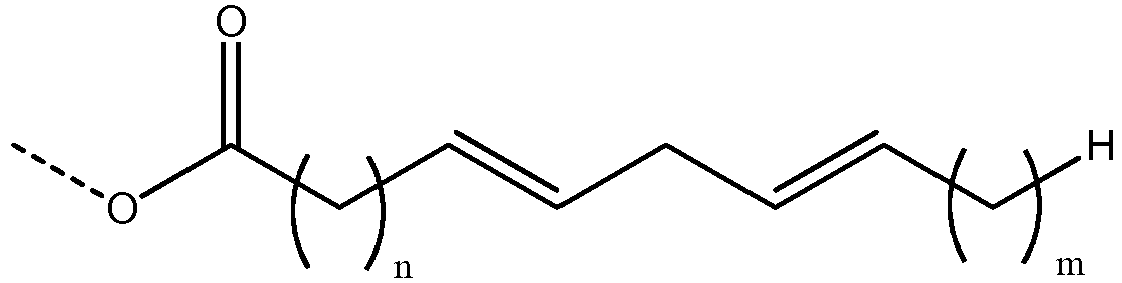
- a preferred C 6-30 -C(O)O- group is represented by the following formula: where n is 1 to 25 and m is 0 to 24, with the proviso that n + m is not greater than 25; wherein the composition is a one-pack curable coatings composition.
- the term "radical producing oxidoreductase” refers to any oxidoreductase (EC1) that generates free radicals during catalysis, preferably EC1.11.1.7 (peroxidases) and EC1.10.3.2 (laccases).
- Peroxidases are a group of iron-porphyrin enzymes that catalyze the oxidation of a variety of organic substrates, using hydrogen peroxide, or an organic peroxide, as the oxidant.
- the laccase molecule as an active holoenzyme form, is a dimeric or tetrameric glycoprotein, usually containing - per molecule - four copper atoms bound to three redox sites (Type 1, Type 2, and Type 3 Cu pair). The molecular mass of the monomer ranges from about 50 to 100 kDa, with an acidic isoelectric point around pH 4.0.
- the composition of the present invention includes a laccase
- curing of the coating composition is advantageously accelerated by the presence of a chemical mediator, which is a small molecule that acts as an intermediate substrate for the laccase; the oxidized radical forms of the mediator are able to interact more efficiently than the laccase with the target.
- the chemical mediator is dispersed in a suitable surfactant, preferably an anionic surfactant such as sodium dodecylsulfate. A reduction in the yellowing of the cured paint is observed when the chemical mediator is added to the formulation as a dispersion in a surfactant.
- laccase chemical mediators examples include hydroxyanthranilic acid; 2, 2'-azino-bis-(3-ethylbenzothiazoline-6-sulfonic acid) (ABTS); N-hydroxybenzotriazole; N-hydroxyphthalimide; violuric acid; N-hydroxyacetanilide; 4-hydroxy-3,5-dimethoxy-benzoic acid, methyl ester; and 2,2,6,6-tetramethylpiperidine-1-yloxy free radical (TEMPO).
- Preferred chemical mediators are violuric acid and N-hydroxybenzotriazole.
- the concentration of alkyd in the formulation varies depending on the application but typically in the range of about 25 to 60 weight percent, more preferably in the range of 30 to 40 weight percent, based on the weight of the coatings composition. It is preferred that the alkyd be added to the coatings formulation as a stable aqueous dispersion (i.e., an alkyd latex) at about 40 to 60 weight percent, based on the weight of the dispersion. Preparation of such alkyd dispersions are described, for example, in W02011/053904 A1 , pages 15-24.
- the composition of the present invention further includes a rheology modifier and a pigment.
- rheology modifiers include associative and non-associative thickeners such as HASE, HEUR, and HEC thickeners.
- pigments include titanium dioxide, mica, calcium carbonate, silica, zinc oxide, milled glass, aluminum trihydrate, talc, antimony trioxide, fly ash, and clay; polymer encapsulated pigments, such as polymer-encapsulated or partially encapsulated pigment particles such as titanium dioxide, zinc oxide, or lithopone particles; polymers or polymer emulsions adsorbing or bonding to the surface of pigments; and hollow pigments, including pigments having one or more voids.
- compositions of the present invention achieve acceptable properties without the use of crosslinking agents or organic solvents, thereby creating a green alternative to presently used drying systems.
- the composition preferably contains a substantial absence of a thiol functional promoting compound, such as those described in WO 2004/067582 , including pentaerythritol tetrakis(3-mercaptoproprionate) and trimethylol propane tris(3-mercaptoproprionate).
- a thiol functional promoting compound such as those described in WO 2004/067582 , including pentaerythritol tetrakis(3-mercaptoproprionate) and trimethylol propane tris(3-mercaptoproprionate).
- the composition contains less than 1%, and more preferably less than 0.1 % of any thiol functional promoting compound based on the weight of the radical producing oxidoreductase; most preferably, the composition does not include any thiol functional promoting compound.
- the composition further includes any of a number of additives suitable for a paint composition including fillers; dispersants, such as aminoalcohols and polycarboxylates; surfactants; defoamers; preservatives, such as biocides, mildewcides, fungicides, algaecides, and combinations thereof; flow agents; leveling agents; and neutralizing agents, such as hydroxides, amines, ammonia, and carbonates.
- the composition may include an organic solvent but it is preferred that the composition is substantially free of solvent.
- alkyd dispersion (Alkyd binder) was prepared substantially as described in W02011/053904 A1 , pp. 23-24 (inventive examples 12 and 13) except that amount of pentaerythritol was 24%; isophthalic acid, 12%; phthalic anhydride. 18%; and sunflower oil, 46%, trimethylol propane 0%.
- the acid value was titrated at 8 mg KOH/g of sample; the polymer was heated to 95 °C prior to introduction into the rotor stator; NH 4 OH was added to neutralize the acid value, and the resultant pH of the final dispersion was 8.8; the dispersion was stabilized with 4% by weight E-sperse 100 surfactant, based on the weight of the resin; the particle size of the resin in the latex was 165 nm with a polydispersity index of 0.615 (calculated as: (D 90 - D 10 )/D 50 ); the percent solids of the dispersion was 51.81%; and the viscosity was 1336 cP.
- the ingredients were added in the following order: pigment grind was added to the binder letdown, followed by addition of the drier package, and a final adjustment of the paint thickness.
- Enzymes Novozyme 51003 laccase and DSM peroxidase liquid formulations were used as is; Amano Y120 laccase (Amano Enzyme), powdered formulation, was dissolved in water to 50 mg solid/mL prior to use.
- Protein concentration was determined using the bicinchoninic acid (BCA) protein assay kit (Sigma-Aldrich p/n BCA1).
- a master paint was prepared according to a standard water-based alkyd paint formulation (Table 1). Water, Natrosol Plus 330 HMHEC thickener, Bentone EW rheology modifier, and AMPTM 95 Co-dispersant and Neutralizing Amine (A Trademark of The Dow Chemical Company or its affiliates) were pre-mixed; Disperbyk 190 wetting and dispersing additive, Triton CF-10 surfactant, water, Rhodoline 643 defoamer, and ACRYSOLTM RM 8W Rheology Modifier (A Trademark of The Dow Chemical Company or its affiliates), were pre-mixed separately and both premixes were combined in a grind pot.
- the blend was dispersed using a Cowles disperser and Ti-Pure R-706 was added to form the Pigment Grind.
- the Pigment Grind was added to the Let Down with stirring and the master paint was aliquoted into a series of samples (116 g each).
- Table 1 - Master Paint Formulation Pigment Grind (g) Water 104.52 Natrosol Plus 330 HMHEC thickener 0.91 Bentone EW rheology modifier 1.30 AMPTM-95 co-dispersant and neutralizing amine 0.78 Disperbyk 190 wetting and dispersing additive 3.12 Triton CF-10 surfactant 0.91 Water 38.35 Rhodoline 643 defoamer 0.65 ACRYSOLTM RM-8W rheology modifier 3.77 Ti-Pure R-706 pigment 454.48 Let Down: (g) Alkyd binder 904.67 BYK-011 defoamer 1.69 Chemguard S764P fluorosurfactant,block additive 2.08 Water 2.08
- Drier packages (enzymes with or without mediators) were added to the paint aliquots (Examples 1-6, Table 2). Final adjustments to rheology were made using a 1:1 dilution of ACRYSOLTM RM-2020NPR Rheology Modifier (A Trademark of The Dow Chemical Company or its affiliates) in water.
- PG refers to propylene glycol.
- Comp. 1 refers to comparative example 1, which was prepared without enzyme.
- Drawdowns of the paints (5 mil wet on A1 panels) were prepared for Konig and print resistance testing. Drawdowns (20 mil wet on release paper) were also prepared for tensile testing. Konig testing was done using the Byk Mallinckrodt Konig Pendulum Hardness Tester. Each value reported was the average of two measurements. Print resistance testing was done by covering each drawdown with a piece of aida cloth and four #8 rubber stoppers. Weights were then placed on the stoppers and the panels were left at 60 °C for 1 h. Following removal of weights and stoppers, the panels were allowed to cool to room temperature prior to removal of the cloth. The extent of print resistance was rated according to the scale shown in Table 3.
- Formulations that had been stored for 6 months using the same formulation as outlined in Table 1 (and a similar alkyd binder) were evaluated for film hardness. As illustrated in Table 5, the formulations maintained acceptable Konig hardness and print resistance properties, indicating that they were shelf-stable for at least 6 months.
- Table 5 - Film Hardness and Print Resistance for Paint Aged 6 Months Paint: Comp. 2 Ex. 7 Ex. 8 Drier Package: No Drier DSM *Y120/HBT Konig Values (s) 3 days n.d. 11.2 9.1 7 days n.d. 11.2 10.5 Print Resistance 7 days 1.0 9.0 9.0 n.d. not determined because film was too tacky; *Y120 used at 0.3%, based on binder solids
Landscapes
- Chemical & Material Sciences (AREA)
- Life Sciences & Earth Sciences (AREA)
- Engineering & Computer Science (AREA)
- Materials Engineering (AREA)
- Wood Science & Technology (AREA)
- Organic Chemistry (AREA)
- Oil, Petroleum & Natural Gas (AREA)
- Chemical Kinetics & Catalysis (AREA)
- Paints Or Removers (AREA)
Description
- The present invention relates to an enzyme curable alkyd composition, particularly an alkyd composition cured with a radical producing oxidoreductase.
- The quality and degree of ambient film formation in coatings is critical to performance. Film formation is typically achieved by evaporation, coalescence, or crosslinking, and combinations thereof. Evaporation-based film formation (also known as lacquer) is based on low solids content and large amounts of organic solvents. Though evaporation is one of the fastest and simplest methods of achieving film formation, it is severely limited by environmental legislation that limits the release of large quantities of solvent into the atmosphere. As a green alternative, film formation by coalescence has become more main stream. Nevertheless, coalescent methods, especially for high Tg polymers, can require the inclusion of a small amount of a volatile solvent to plasticize the polymer, thereby promoting film formation. Low Tg polymers (soft polymers), while not requiring solvent to promote film formation, produce films with inherently poorer performance.
- To counteract the problems associated with softness, manufacturers of high-performance coatings rely on reactive polymer precursors to build up three-dimensionally cross-linked networks. Materials and compounds used to produce ambient temperature cross-linked polymers include drying oils, benzophenone, diacetone acrylamide/adipic dihydrazide, carbodiimide, ambient epoxy/acids, isocyanates, aminoplasts, and silanes. Although these precursors provide performance benefits, such as improvements in hardness, mar, print, dirt pickup, and chemical resistance, each has associated pitfalls such as pre-cross-linking, reliance on 2-component architecture, and potential toxicity as with metal driers like cobalt naphthenate.
- In another approach,
WO2004/067582 describes a method of introducing functional groups into a polymer to promote enzymatic oxidative curing. The method also requires a multi-component system and a thiol-functional compound, e.g., pentaerythritol tetrakis(3-mercaptoproprionate). However, introduction of thiol functionality into coating compositions is known to have adverse effects on pot-life (thiols are known to initiate premature cross-linking), as well as odor. - It would therefore be an advance in the art of ambient temperature cured coatings to find a curable film forming composition that has long shelf stability and a reasonably fast cure time, and does not require VOCs or malodorous chemicals.
- The present invention provides a coatings composition comprising an alkyd, a pigment, a rheology modifier, a radical producing oxidoreductase, and one or more additives selected from the group consisting of fillers, biocides, surfactants, coalescents, dispersants, defoamers, and neutralizing agents; wherein the alkyd contains at least one C6-30-C(O)O- group having at least one diallylic group.
- The composition of the present invention addresses a need in the art by providing a shelf-stable formulation that is film forming at ambient temperature and cures relatively quickly without odor-producing crosslinking agents such as thiols, dithiols, or diisocyanates.
- The present invention is a coatings composition comprising an alkyd, a pigment, a rheology modifier, a radical producing oxidoreductase, and one or more additives selected from the group consisting of fillers, biocides, surfactants, coalescents, dispersants, defoamers, and neutralizing agents; wherein the alkyd contains at least one C6-30-C(O)O- group having at least one diallylic group.
- The alkyd of the composition of the present invention contains structural units of: 1) a triol or tetraol, preferably a triol such as glycerol, trimethylol propane, or pentaerythritol or a combination thereof; 2) a dicarboxylic acid or carboxylic acid anhydride, preferably an aromatic dicarboxylic acid or aromatic carboxylic acid anhydride such as maleic anhydride, maleic acid, phthalic anhydride, or phthalic acid, or a combination thereof; and 3) a diallylic containing carboxylic acid of the type C6-30-COOH, such as linoleic acid.
- As used herein, the term "structural units of" a particular compound refers to the remnant of that compound found in the product of interest. For example, a structural unit of glycerol is illustrated:

- It is understood that the structural unit of a compound does not necessarily imply that the product must be made using that compound. For example, a structural unit of a diallylic containing carboxylic acid can be formed through the corresponding ester (C6-30-COOR) or acid halide (C6-30-COX). Thus, a structural unit of a carboxylic acid is synonymous with a structural unit of the corresponding ester or acid halide. Similarly, a structural unit of phthalic acid is synonymous with a structural unit of the corresponding diester, diacid halide, or anhydride.
- A preferred C6-30-C(O)O- group is represented by the following formula:
- As used herein the term "radical producing oxidoreductase" refers to any oxidoreductase (EC1) that generates free radicals during catalysis, preferably EC1.11.1.7 (peroxidases) and EC1.10.3.2 (laccases). Peroxidases are a group of iron-porphyrin enzymes that catalyze the oxidation of a variety of organic substrates, using hydrogen peroxide, or an organic peroxide, as the oxidant. The laccase molecule, as an active holoenzyme form, is a dimeric or tetrameric glycoprotein, usually containing - per molecule - four copper atoms bound to three redox sites (Type 1, Type 2, and Type 3 Cu pair). The molecular mass of the monomer ranges from about 50 to 100 kDa, with an acidic isoelectric point around pH 4.0.
- When the composition of the present invention includes a laccase, curing of the coating composition is advantageously accelerated by the presence of a chemical mediator, which is a small molecule that acts as an intermediate substrate for the laccase; the oxidized radical forms of the mediator are able to interact more efficiently than the laccase with the target. Preferably, the chemical mediator is dispersed in a suitable surfactant, preferably an anionic surfactant such as sodium dodecylsulfate. A reduction in the yellowing of the cured paint is observed when the chemical mediator is added to the formulation as a dispersion in a surfactant.
- Examples of suitable laccase chemical mediators include hydroxyanthranilic acid; 2, 2'-azino-bis-(3-ethylbenzothiazoline-6-sulfonic acid) (ABTS); N-hydroxybenzotriazole; N-hydroxyphthalimide; violuric acid; N-hydroxyacetanilide; 4-hydroxy-3,5-dimethoxy-benzoic acid, methyl ester; and 2,2,6,6-tetramethylpiperidine-1-yloxy free radical (TEMPO). Preferred chemical mediators are violuric acid and N-hydroxybenzotriazole.
- The concentration of alkyd in the formulation varies depending on the application but typically in the range of about 25 to 60 weight percent, more preferably in the range of 30 to 40 weight percent, based on the weight of the coatings composition. It is preferred that the alkyd be added to the coatings formulation as a stable aqueous dispersion (i.e., an alkyd latex) at about 40 to 60 weight percent, based on the weight of the dispersion. Preparation of such alkyd dispersions are described, for example, in
W02011/053904 A1 , pages 15-24. - The composition of the present invention further includes a rheology modifier and a pigment. Examples of rheology modifiers include associative and non-associative thickeners such as HASE, HEUR, and HEC thickeners. Examples of pigments include titanium dioxide, mica, calcium carbonate, silica, zinc oxide, milled glass, aluminum trihydrate, talc, antimony trioxide, fly ash, and clay; polymer encapsulated pigments, such as polymer-encapsulated or partially encapsulated pigment particles such as titanium dioxide, zinc oxide, or lithopone particles; polymers or polymer emulsions adsorbing or bonding to the surface of pigments; and hollow pigments, including pigments having one or more voids.
- It has been discovered that compositions of the present invention achieve acceptable properties without the use of crosslinking agents or organic solvents, thereby creating a green alternative to presently used drying systems. More particularly, the composition preferably contains a substantial absence of a thiol functional promoting compound, such as those described in
WO 2004/067582 , including pentaerythritol tetrakis(3-mercaptoproprionate) and trimethylol propane tris(3-mercaptoproprionate). Preferably, the composition contains less than 1%, and more preferably less than 0.1 % of any thiol functional promoting compound based on the weight of the radical producing oxidoreductase; most preferably, the composition does not include any thiol functional promoting compound. - Though not bound by theory, it is believed that curing of the composition of the present invention occurs efficiently and without the need for ancillary crosslinking agents because of the presence, in the alkyd, of an exquisitely active target: The methylene group of the diallylic moiety:

- The composition further includes any of a number of additives suitable for a paint composition including fillers; dispersants, such as aminoalcohols and polycarboxylates; surfactants; defoamers; preservatives, such as biocides, mildewcides, fungicides, algaecides, and combinations thereof; flow agents; leveling agents; and neutralizing agents, such as hydroxides, amines, ammonia, and carbonates. The composition may include an organic solvent but it is preferred that the composition is substantially free of solvent.
- The following examples are for illustrative purposes only and are not intended to limit the scope of the invention.
- The alkyd dispersion (Alkyd binder) was prepared substantially as described in
W02011/053904 A1 , pp. 23-24 (inventive examples 12 and 13) except that amount of pentaerythritol was 24%; isophthalic acid, 12%; phthalic anhydride. 18%; and sunflower oil, 46%, trimethylol propane 0%. The acid value was titrated at 8 mg KOH/g of sample; the polymer was heated to 95 °C prior to introduction into the rotor stator; NH4OH was added to neutralize the acid value, and the resultant pH of the final dispersion was 8.8; the dispersion was stabilized with 4% by weight E-sperse 100 surfactant, based on the weight of the resin; the particle size of the resin in the latex was 165 nm with a polydispersity index of 0.615 (calculated as: (D90 - D10)/D50); the percent solids of the dispersion was 51.81%; and the viscosity was 1336 cP. - For the following composition, the ingredients were added in the following order: pigment grind was added to the binder letdown, followed by addition of the drier package, and a final adjustment of the paint thickness.
- Enzymes: Novozyme 51003 laccase and DSM peroxidase liquid formulations were used as is; Amano Y120 laccase (Amano Enzyme), powdered formulation, was dissolved in water to 50 mg solid/mL prior to use.
- Protein Concentration Assays: Protein concentration was determined using the bicinchoninic acid (BCA) protein assay kit (Sigma-Aldrich p/n BCA1).
- A master paint was prepared according to a standard water-based alkyd paint formulation (Table 1). Water, Natrosol Plus 330 HMHEC thickener, Bentone EW rheology modifier, and AMP™ 95 Co-dispersant and Neutralizing Amine (A Trademark of The Dow Chemical Company or its Affiliates) were pre-mixed; Disperbyk 190 wetting and dispersing additive, Triton CF-10 surfactant, water, Rhodoline 643 defoamer, and ACRYSOL™ RM 8W Rheology Modifier (A Trademark of The Dow Chemical Company or its Affiliates), were pre-mixed separately and both premixes were combined in a grind pot. The blend was dispersed using a Cowles disperser and Ti-Pure R-706 was added to form the Pigment Grind. The Pigment Grind was added to the Let Down with stirring and the master paint was aliquoted into a series of samples (116 g each).
Table 1 - Master Paint Formulation Pigment Grind: (g) Water 104.52 Natrosol Plus 330 HMHEC thickener 0.91 Bentone EW rheology modifier 1.30 AMP™-95 co-dispersant and neutralizing amine 0.78 Disperbyk 190 wetting and dispersing additive 3.12 Triton CF-10 surfactant 0.91 Water 38.35 Rhodoline 643 defoamer 0.65 ACRYSOL™ RM-8W rheology modifier 3.77 Ti-Pure R-706 pigment 454.48 Let Down: (g) Alkyd binder 904.67 BYK-011 defoamer 1.69 Chemguard S764P fluorosurfactant,block additive 2.08 Water 2.08 - Drier packages (enzymes with or without mediators) were added to the paint aliquots (Examples 1-6, Table 2). Final adjustments to rheology were made using a 1:1 dilution of ACRYSOL™ RM-2020NPR Rheology Modifier (A Trademark of The Dow Chemical Company or its Affiliates) in water. PG refers to propylene glycol. Comp. 1 refers to comparative example 1, which was prepared without enzyme.
- The following levels of enzymes were used, based on binder solids: Novozyme 51003 laccase (1.5%, 51003), Amano Y120 laccase (0.16%, Y120), DSM peroxidase (1.1 %, DSM). In all cases, these levels were based on measured protein concentrations, where the amount of protein that is actually the enzyme of interest is unknown. The following levels of mediators were used, based on binder solids: Hydroxybenzotriazole (HBT, 0.15%, assuming 20 wt % of the HBT was water), violuric acid (VA, ~0.05 - 0.15%).
Table 2 - Formulation of Drier Packages, Viscosity Adjustment, and Properties Paint: Comp. 1 Ex. 1 Ex. 2 Ex. 3 Ex. 4 Ex. 5 Ex. 6 Drier Pkg: No Drier Y120 Y120/ HBT Y120/ VA 51003 51003/ HBT DSM Enzyme Pre-mix: Enzyme (g) 0.50 0.50 0.50 10.00 10.00 10.00 Water (g) 10.00 10.00 10.00 10.00 Mediator Pre-mix: PG (g) 0.67 0.67 0.67 0.67 0.67 0.67 0.67 Water (g) 0.66 0.66 0.66 0.66 0.66 0.66 0.66 Ethanol (g) 0.67 0.67 0.67 0.67 0.67 0.67 0.67 Mediator (g) 0.068 0.062 0.068 Water (g) 1.00 1.00 1.00 1.00 1.00 1.00 1.00 Viscosity Adjustment: ACRYSOL™ RM-2020NPR (g) 2.50 2.35 2.32 2.36 2.63 2.58 2.65 Water (g) 2.85 2.35 2.32 2.36 2.63 2.58 2.65 Properties: pH 7.59 7.41 7.08 7.21 7.67 7.38 7.11 KU (cP) 94.6 95.3 97.1 99.0 98.0 96.8 104.8 ICI (cP) 1.465 1.350 1.505 1.505 1.685 1.550 1.180 - Drawdowns of the paints (5 mil wet on A1 panels) were prepared for Konig and print resistance testing. Drawdowns (20 mil wet on release paper) were also prepared for tensile testing. Konig testing was done using the Byk Mallinckrodt Konig Pendulum Hardness Tester. Each value reported was the average of two measurements. Print resistance testing was done by covering each drawdown with a piece of aida cloth and four #8 rubber stoppers. Weights were then placed on the stoppers and the panels were left at 60 °C for 1 h. Following removal of weights and stoppers, the panels were allowed to cool to room temperature prior to removal of the cloth. The extent of print resistance was rated according to the scale shown in Table 3. Tensile testing was done on the Tinius Olsen Tensile Tester, using ASTM D882 as a general procedure. The gauge length used was 50 mm and the strain rate was 10 per min (500 mm/min for 50 mm gauge). Tensile testing was done, in duplicate or triplicate, on films that had cured for 2-4 weeks.
Table 3 - Print Testing Rating System Based on Extent of Imprint on Film Surface Rating: 300 g mass 200 g mass 100 g mass 50 g mass 10 none none none none 9 slight none none none 8 moderate slight none none 7 moderate moderate slight none 6 moderate moderate slight slight 5 strong moderate moderate slight 4 strong strong moderate slight 3 strong strong moderate moderate 2 strong strong strong moderate 1 strong strong strong strong - Film hardness, print resistance and tensile strength for the coatings are shown in Table 4.
Table 4 - Film Hardness, Print Resistance, and Tensile Strength Data Paint: Comp. 1 Ex. 1 Ex. 2 Ex. 3 Ex. 4 Ex. 5 Ex. 6 Drier Package: No Drier Y120 Y120/ HBT Y120/ VA 51003 51003/ HBT DSM Konig Values (s) 1 day n.d. n.d. 11.2 9.1 n.d. n.d. 4.9 3-5 days 4.9 7.0 15.4 15.4 5.6 14.0 12.6 7 days 5.6 9.8 15.4 16.1 7.0 14.7 14.0 Print Resistance 1 day 3.0 4.5 8.0 8.0 7.0 7.5 1.0 3-5 days 2.0 7.0 8.5 8.5 7.0 8.0 8.0 7 days 4.5 8.0 9.5 9.5 8.0 9.5 8.5 Tensile Modulus (MPa) 2-4 weeks n.d. 4 14 18 n.d. 21 14 n.d. = not determined because film was too tacky - The results show that film hardness, print resistance, and tensile strength are greatly improved for coatings containing the enzyme; furthermore, the properties of the coatings containing Y120 and 51003 laccases are markedly improved by the inclusion of a chemical mediator. The results show that curing was effectively complete (dry-to-the-touch) within 2-3 days.
- Formulations that had been stored for 6 months using the same formulation as outlined in Table 1 (and a similar alkyd binder) were evaluated for film hardness. As illustrated in Table 5, the formulations maintained acceptable Konig hardness and print resistance properties, indicating that they were shelf-stable for at least 6 months.
Table 5 - Film Hardness and Print Resistance for Paint Aged 6 Months Paint: Comp. 2 Ex. 7 Ex. 8 Drier Package: No Drier DSM *Y120/HBT Konig Values (s) 3 days n.d. 11.2 9.1 7 days n.d. 11.2 10.5 Print Resistance 7 days 1.0 9.0 9.0 n.d. = not determined because film was too tacky; *Y120 used at 0.3%, based on binder solids
Claims (9)
- A coatings composition comprising an alkyd, a pigment, a rheology modifier, a radical producing oxidoreductase, and one or more additives selected from the group consisting of fillers, biocides, surfactants, coalescents, dispersants, defoamers, and neutralizing agents; wherein the alkyd contains at least one C6-30-C(O)O- group having at least one diallylic group.
- The coatings composition of Claim 1 wherein the C6-30-C(O)O- group is represented by the following formula:

- The composition of Claim 1 wherein the alkyd is further characterized by structural units of: a) an aromatic anhydride or a diacid; and b) a triol.
- The composition of Claim 3 wherein the triol is glycerol, trimethyol propane, or pentaerythritol or a combination thereof; the anhydride or acid is maleic anhydride, maleic acid, phthalic anhydride, or phthalic acid, or a combination thereof; and the radical producing oxidoreductase is a laccase or a peroxidase.
- The composition of any of Claims 1 to 4 wherein C6-30-C(O)O- group is represented by the following formula:

- The composition of either of Claims 4 or 5, wherein the radical producing oxidoreductase is a laccase and the composition further includes a chemical mediator.
- The composition of Claim 6 wherein the chemical mediator is N-hydroxybenzotriazole and violuric acid.
- The composition of any of Claims 1 to 7, which comprises less than 1% of a thiol functional crosslink-promoting compound based on the weight of radical producing oxidoreductase.
- The composition of either of Claims 6 or 7 wherein the chemical mediator is dispersed in an anionic surfactant.
Applications Claiming Priority (1)
| Application Number | Priority Date | Filing Date | Title |
|---|---|---|---|
| US201161554705P | 2011-11-02 | 2011-11-02 |
Publications (2)
| Publication Number | Publication Date |
|---|---|
| EP2589629A1 true EP2589629A1 (en) | 2013-05-08 |
| EP2589629B1 EP2589629B1 (en) | 2016-12-14 |
Family
ID=47022582
Family Applications (1)
| Application Number | Title | Priority Date | Filing Date |
|---|---|---|---|
| EP12188887.9A Active EP2589629B1 (en) | 2011-11-02 | 2012-10-17 | Enzyme curable alkyd composition |
Country Status (5)
| Country | Link |
|---|---|
| EP (1) | EP2589629B1 (en) |
| KR (1) | KR101436527B1 (en) |
| CN (1) | CN103087618B (en) |
| AU (1) | AU2012244174A1 (en) |
| BR (1) | BR102012027773B1 (en) |
Cited By (1)
| Publication number | Priority date | Publication date | Assignee | Title |
|---|---|---|---|---|
| EP2835398A1 (en) | 2013-07-30 | 2015-02-11 | Rohm and Haas Company | One pot biocatalytic peroxide mediated cure |
Families Citing this family (1)
| Publication number | Priority date | Publication date | Assignee | Title |
|---|---|---|---|---|
| PL3997166T3 (en) * | 2019-07-11 | 2024-04-08 | Byk-Chemie Gmbh | Curable composition |
Citations (4)
| Publication number | Priority date | Publication date | Assignee | Title |
|---|---|---|---|---|
| EP0321872A2 (en) * | 1987-12-19 | 1989-06-28 | Herberts Gesellschaft mit beschränkter Haftung | Process for the polymerisation or copolymerisation of monomers polymerisable by a free radical, dissolved or dispersed by aqueous systems with the use of a free radical initiator |
| US6306991B1 (en) * | 1998-04-13 | 2001-10-23 | Rohm And Haas Company | Method of catalytic crosslinking of polymers and two-pack composition used therein |
| WO2004067582A1 (en) | 2003-01-28 | 2004-08-12 | Akzo Nobel Coatings International B.V. | Curable composition comprising a compound having radically polymerizable olefinically unsaturated groups, an oxidation-reduction enzyme, and a thiol-functional compound |
| WO2011053904A1 (en) | 2009-10-30 | 2011-05-05 | Dow Global Technologies Inc. | Alkyd dispersion, and a process for producing the same |
-
2012
- 2012-10-17 EP EP12188887.9A patent/EP2589629B1/en active Active
- 2012-10-24 AU AU2012244174A patent/AU2012244174A1/en not_active Abandoned
- 2012-10-25 KR KR1020120119242A patent/KR101436527B1/en active Active
- 2012-10-29 BR BR102012027773-5A patent/BR102012027773B1/en not_active IP Right Cessation
- 2012-11-01 CN CN201210431431.4A patent/CN103087618B/en active Active
Patent Citations (4)
| Publication number | Priority date | Publication date | Assignee | Title |
|---|---|---|---|---|
| EP0321872A2 (en) * | 1987-12-19 | 1989-06-28 | Herberts Gesellschaft mit beschränkter Haftung | Process for the polymerisation or copolymerisation of monomers polymerisable by a free radical, dissolved or dispersed by aqueous systems with the use of a free radical initiator |
| US6306991B1 (en) * | 1998-04-13 | 2001-10-23 | Rohm And Haas Company | Method of catalytic crosslinking of polymers and two-pack composition used therein |
| WO2004067582A1 (en) | 2003-01-28 | 2004-08-12 | Akzo Nobel Coatings International B.V. | Curable composition comprising a compound having radically polymerizable olefinically unsaturated groups, an oxidation-reduction enzyme, and a thiol-functional compound |
| WO2011053904A1 (en) | 2009-10-30 | 2011-05-05 | Dow Global Technologies Inc. | Alkyd dispersion, and a process for producing the same |
Cited By (2)
| Publication number | Priority date | Publication date | Assignee | Title |
|---|---|---|---|---|
| EP2835398A1 (en) | 2013-07-30 | 2015-02-11 | Rohm and Haas Company | One pot biocatalytic peroxide mediated cure |
| US9150751B2 (en) | 2013-07-30 | 2015-10-06 | Rohm And Haas Company | One pot biocatalytic peroxide mediated cure |
Also Published As
| Publication number | Publication date |
|---|---|
| BR102012027773A2 (en) | 2013-12-10 |
| KR20130048694A (en) | 2013-05-10 |
| CN103087618A (en) | 2013-05-08 |
| KR101436527B1 (en) | 2014-09-01 |
| AU2012244174A1 (en) | 2013-05-16 |
| BR102012027773B1 (en) | 2021-02-02 |
| EP2589629B1 (en) | 2016-12-14 |
| CN103087618B (en) | 2015-08-05 |
Similar Documents
| Publication | Publication Date | Title |
|---|---|---|
| EP2545124B1 (en) | Radiation curable aqueous coating compositions | |
| AU2007251591B2 (en) | Aqueous dispersion of an auto-oxidatively drying polyurethane | |
| CN102686638B (en) | Alkyd dispersion, and a process for producing the same | |
| EP1554349B1 (en) | Air drying waterborne resin composition | |
| EP2639272A1 (en) | Active energy ray curable aqueous emulsions | |
| WO2013077267A1 (en) | Curing accelerator for oxidative polymerization type unsaturated resins, printing ink and coating material | |
| EP1999217B1 (en) | Coating composition comprising a reactive diluent of malonate | |
| TW201335294A (en) | Water dispersible, self-crosslinkable prepolymer composition | |
| EP2589629B1 (en) | Enzyme curable alkyd composition | |
| US8841360B2 (en) | Enzyme curable alkyd composition | |
| CN107849335B (en) | Polyamide compositions for sealants and high solids paints | |
| EP4165136B1 (en) | Two-component aqueous coating composition and wooden article | |
| KR102263132B1 (en) | Water-soluble base coat composition | |
| EP4288489B1 (en) | Crosslinkable acrylic-modified epoxy coating composition | |
| EP0546417A1 (en) | Use of octadienyl ethers as reactive diluent | |
| CN110128637B (en) | Ketone-aldehyde modified resin and preparation method thereof | |
| EP3856746B1 (en) | Cyclic ether- and hydroxyl-containing compositions useful for producing fast dry alkyd polymers and methods for making such cyclic ether- and hydroxyl-containing compositions | |
| JPH0139456B2 (en) | ||
| JPS60179451A (en) | Maleinized alkyd resin emulsion composition | |
| EP1950237B1 (en) | Process for making modifed alkyd resins | |
| CN122037768A (en) | Environment-friendly water-based paint coating and preparation method thereof | |
| HK1080883B (en) | Air drying waterborne resin composition | |
| JPS60179452A (en) | Production of maleinized alkyd resin emulsion | |
| JPS61252227A (en) | Ordinary temperature drying alkyd resin composition |
Legal Events
| Date | Code | Title | Description |
|---|---|---|---|
| PUAI | Public reference made under article 153(3) epc to a published international application that has entered the european phase |
Free format text: ORIGINAL CODE: 0009012 |
|
| 17P | Request for examination filed |
Effective date: 20121017 |
|
| AK | Designated contracting states |
Kind code of ref document: A1 Designated state(s): AL AT BE BG CH CY CZ DE DK EE ES FI FR GB GR HR HU IE IS IT LI LT LU LV MC MK MT NL NO PL PT RO RS SE SI SK SM TR |
|
| AX | Request for extension of the european patent |
Extension state: BA ME |
|
| GRAP | Despatch of communication of intention to grant a patent |
Free format text: ORIGINAL CODE: EPIDOSNIGR1 |
|
| RIC1 | Information provided on ipc code assigned before grant |
Ipc: C09D 4/06 20060101AFI20160706BHEP Ipc: C08K 5/00 20060101ALI20160706BHEP Ipc: C09D 167/08 20060101ALI20160706BHEP |
|
| INTG | Intention to grant announced |
Effective date: 20160801 |
|
| GRAS | Grant fee paid |
Free format text: ORIGINAL CODE: EPIDOSNIGR3 |
|
| GRAA | (expected) grant |
Free format text: ORIGINAL CODE: 0009210 |
|
| AK | Designated contracting states |
Kind code of ref document: B1 Designated state(s): AL AT BE BG CH CY CZ DE DK EE ES FI FR GB GR HR HU IE IS IT LI LT LU LV MC MK MT NL NO PL PT RO RS SE SI SK SM TR |
|
| REG | Reference to a national code |
Ref country code: GB Ref legal event code: FG4D |
|
| REG | Reference to a national code |
Ref country code: CH Ref legal event code: EP |
|
| REG | Reference to a national code |
Ref country code: IE Ref legal event code: FG4D |
|
| REG | Reference to a national code |
Ref country code: AT Ref legal event code: REF Ref document number: 853568 Country of ref document: AT Kind code of ref document: T Effective date: 20170115 |
|
| REG | Reference to a national code |
Ref country code: DE Ref legal event code: R096 Ref document number: 602012026538 Country of ref document: DE |
|
| PG25 | Lapsed in a contracting state [announced via postgrant information from national office to epo] |
Ref country code: LV Free format text: LAPSE BECAUSE OF FAILURE TO SUBMIT A TRANSLATION OF THE DESCRIPTION OR TO PAY THE FEE WITHIN THE PRESCRIBED TIME-LIMIT Effective date: 20161214 |
|
| REG | Reference to a national code |
Ref country code: SE Ref legal event code: TRGR |
|
| REG | Reference to a national code |
Ref country code: LT Ref legal event code: MG4D |
|
| REG | Reference to a national code |
Ref country code: NL Ref legal event code: MP Effective date: 20161214 |
|
| PG25 | Lapsed in a contracting state [announced via postgrant information from national office to epo] |
Ref country code: NO Free format text: LAPSE BECAUSE OF FAILURE TO SUBMIT A TRANSLATION OF THE DESCRIPTION OR TO PAY THE FEE WITHIN THE PRESCRIBED TIME-LIMIT Effective date: 20170314 Ref country code: GR Free format text: LAPSE BECAUSE OF FAILURE TO SUBMIT A TRANSLATION OF THE DESCRIPTION OR TO PAY THE FEE WITHIN THE PRESCRIBED TIME-LIMIT Effective date: 20170315 Ref country code: LT Free format text: LAPSE BECAUSE OF FAILURE TO SUBMIT A TRANSLATION OF THE DESCRIPTION OR TO PAY THE FEE WITHIN THE PRESCRIBED TIME-LIMIT Effective date: 20161214 |
|
| REG | Reference to a national code |
Ref country code: AT Ref legal event code: MK05 Ref document number: 853568 Country of ref document: AT Kind code of ref document: T Effective date: 20161214 |
|
| PG25 | Lapsed in a contracting state [announced via postgrant information from national office to epo] |
Ref country code: FI Free format text: LAPSE BECAUSE OF FAILURE TO SUBMIT A TRANSLATION OF THE DESCRIPTION OR TO PAY THE FEE WITHIN THE PRESCRIBED TIME-LIMIT Effective date: 20161214 Ref country code: RS Free format text: LAPSE BECAUSE OF FAILURE TO SUBMIT A TRANSLATION OF THE DESCRIPTION OR TO PAY THE FEE WITHIN THE PRESCRIBED TIME-LIMIT Effective date: 20161214 Ref country code: HR Free format text: LAPSE BECAUSE OF FAILURE TO SUBMIT A TRANSLATION OF THE DESCRIPTION OR TO PAY THE FEE WITHIN THE PRESCRIBED TIME-LIMIT Effective date: 20161214 |
|
| PG25 | Lapsed in a contracting state [announced via postgrant information from national office to epo] |
Ref country code: NL Free format text: LAPSE BECAUSE OF FAILURE TO SUBMIT A TRANSLATION OF THE DESCRIPTION OR TO PAY THE FEE WITHIN THE PRESCRIBED TIME-LIMIT Effective date: 20161214 |
|
| PG25 | Lapsed in a contracting state [announced via postgrant information from national office to epo] |
Ref country code: IS Free format text: LAPSE BECAUSE OF FAILURE TO SUBMIT A TRANSLATION OF THE DESCRIPTION OR TO PAY THE FEE WITHIN THE PRESCRIBED TIME-LIMIT Effective date: 20170414 Ref country code: CZ Free format text: LAPSE BECAUSE OF FAILURE TO SUBMIT A TRANSLATION OF THE DESCRIPTION OR TO PAY THE FEE WITHIN THE PRESCRIBED TIME-LIMIT Effective date: 20161214 Ref country code: SK Free format text: LAPSE BECAUSE OF FAILURE TO SUBMIT A TRANSLATION OF THE DESCRIPTION OR TO PAY THE FEE WITHIN THE PRESCRIBED TIME-LIMIT Effective date: 20161214 Ref country code: EE Free format text: LAPSE BECAUSE OF FAILURE TO SUBMIT A TRANSLATION OF THE DESCRIPTION OR TO PAY THE FEE WITHIN THE PRESCRIBED TIME-LIMIT Effective date: 20161214 Ref country code: RO Free format text: LAPSE BECAUSE OF FAILURE TO SUBMIT A TRANSLATION OF THE DESCRIPTION OR TO PAY THE FEE WITHIN THE PRESCRIBED TIME-LIMIT Effective date: 20161214 |
|
| PG25 | Lapsed in a contracting state [announced via postgrant information from national office to epo] |
Ref country code: AT Free format text: LAPSE BECAUSE OF FAILURE TO SUBMIT A TRANSLATION OF THE DESCRIPTION OR TO PAY THE FEE WITHIN THE PRESCRIBED TIME-LIMIT Effective date: 20161214 Ref country code: IT Free format text: LAPSE BECAUSE OF FAILURE TO SUBMIT A TRANSLATION OF THE DESCRIPTION OR TO PAY THE FEE WITHIN THE PRESCRIBED TIME-LIMIT Effective date: 20161214 Ref country code: BE Free format text: LAPSE BECAUSE OF FAILURE TO SUBMIT A TRANSLATION OF THE DESCRIPTION OR TO PAY THE FEE WITHIN THE PRESCRIBED TIME-LIMIT Effective date: 20161214 Ref country code: ES Free format text: LAPSE BECAUSE OF FAILURE TO SUBMIT A TRANSLATION OF THE DESCRIPTION OR TO PAY THE FEE WITHIN THE PRESCRIBED TIME-LIMIT Effective date: 20161214 Ref country code: SM Free format text: LAPSE BECAUSE OF FAILURE TO SUBMIT A TRANSLATION OF THE DESCRIPTION OR TO PAY THE FEE WITHIN THE PRESCRIBED TIME-LIMIT Effective date: 20161214 Ref country code: PT Free format text: LAPSE BECAUSE OF FAILURE TO SUBMIT A TRANSLATION OF THE DESCRIPTION OR TO PAY THE FEE WITHIN THE PRESCRIBED TIME-LIMIT Effective date: 20170414 Ref country code: BG Free format text: LAPSE BECAUSE OF FAILURE TO SUBMIT A TRANSLATION OF THE DESCRIPTION OR TO PAY THE FEE WITHIN THE PRESCRIBED TIME-LIMIT Effective date: 20170314 Ref country code: PL Free format text: LAPSE BECAUSE OF FAILURE TO SUBMIT A TRANSLATION OF THE DESCRIPTION OR TO PAY THE FEE WITHIN THE PRESCRIBED TIME-LIMIT Effective date: 20161214 |
|
| REG | Reference to a national code |
Ref country code: DE Ref legal event code: R097 Ref document number: 602012026538 Country of ref document: DE |
|
| REG | Reference to a national code |
Ref country code: FR Ref legal event code: PLFP Year of fee payment: 6 |
|
| PLBE | No opposition filed within time limit |
Free format text: ORIGINAL CODE: 0009261 |
|
| STAA | Information on the status of an ep patent application or granted ep patent |
Free format text: STATUS: NO OPPOSITION FILED WITHIN TIME LIMIT |
|
| 26N | No opposition filed |
Effective date: 20170915 |
|
| PG25 | Lapsed in a contracting state [announced via postgrant information from national office to epo] |
Ref country code: DK Free format text: LAPSE BECAUSE OF FAILURE TO SUBMIT A TRANSLATION OF THE DESCRIPTION OR TO PAY THE FEE WITHIN THE PRESCRIBED TIME-LIMIT Effective date: 20161214 |
|
| PG25 | Lapsed in a contracting state [announced via postgrant information from national office to epo] |
Ref country code: SI Free format text: LAPSE BECAUSE OF FAILURE TO SUBMIT A TRANSLATION OF THE DESCRIPTION OR TO PAY THE FEE WITHIN THE PRESCRIBED TIME-LIMIT Effective date: 20161214 |
|
| PG25 | Lapsed in a contracting state [announced via postgrant information from national office to epo] |
Ref country code: MC Free format text: LAPSE BECAUSE OF FAILURE TO SUBMIT A TRANSLATION OF THE DESCRIPTION OR TO PAY THE FEE WITHIN THE PRESCRIBED TIME-LIMIT Effective date: 20161214 |
|
| REG | Reference to a national code |
Ref country code: CH Ref legal event code: PL |
|
| REG | Reference to a national code |
Ref country code: IE Ref legal event code: MM4A |
|
| PG25 | Lapsed in a contracting state [announced via postgrant information from national office to epo] |
Ref country code: CH Free format text: LAPSE BECAUSE OF NON-PAYMENT OF DUE FEES Effective date: 20171031 Ref country code: LI Free format text: LAPSE BECAUSE OF NON-PAYMENT OF DUE FEES Effective date: 20171031 Ref country code: LU Free format text: LAPSE BECAUSE OF NON-PAYMENT OF DUE FEES Effective date: 20171017 |
|
| REG | Reference to a national code |
Ref country code: FR Ref legal event code: PLFP Year of fee payment: 7 |
|
| PG25 | Lapsed in a contracting state [announced via postgrant information from national office to epo] |
Ref country code: MT Free format text: LAPSE BECAUSE OF NON-PAYMENT OF DUE FEES Effective date: 20171017 |
|
| PG25 | Lapsed in a contracting state [announced via postgrant information from national office to epo] |
Ref country code: IE Free format text: LAPSE BECAUSE OF NON-PAYMENT OF DUE FEES Effective date: 20171017 |
|
| PG25 | Lapsed in a contracting state [announced via postgrant information from national office to epo] |
Ref country code: HU Free format text: LAPSE BECAUSE OF FAILURE TO SUBMIT A TRANSLATION OF THE DESCRIPTION OR TO PAY THE FEE WITHIN THE PRESCRIBED TIME-LIMIT; INVALID AB INITIO Effective date: 20121017 |
|
| PG25 | Lapsed in a contracting state [announced via postgrant information from national office to epo] |
Ref country code: CY Free format text: LAPSE BECAUSE OF NON-PAYMENT OF DUE FEES Effective date: 20161214 |
|
| PG25 | Lapsed in a contracting state [announced via postgrant information from national office to epo] |
Ref country code: MK Free format text: LAPSE BECAUSE OF FAILURE TO SUBMIT A TRANSLATION OF THE DESCRIPTION OR TO PAY THE FEE WITHIN THE PRESCRIBED TIME-LIMIT Effective date: 20161214 |
|
| PG25 | Lapsed in a contracting state [announced via postgrant information from national office to epo] |
Ref country code: TR Free format text: LAPSE BECAUSE OF FAILURE TO SUBMIT A TRANSLATION OF THE DESCRIPTION OR TO PAY THE FEE WITHIN THE PRESCRIBED TIME-LIMIT Effective date: 20161214 |
|
| PG25 | Lapsed in a contracting state [announced via postgrant information from national office to epo] |
Ref country code: AL Free format text: LAPSE BECAUSE OF FAILURE TO SUBMIT A TRANSLATION OF THE DESCRIPTION OR TO PAY THE FEE WITHIN THE PRESCRIBED TIME-LIMIT Effective date: 20161214 |
|
| P01 | Opt-out of the competence of the unified patent court (upc) registered |
Effective date: 20230525 |
|
| PGFP | Annual fee paid to national office [announced via postgrant information from national office to epo] |
Ref country code: SE Payment date: 20230830 Year of fee payment: 12 |
|
| PGFP | Annual fee paid to national office [announced via postgrant information from national office to epo] |
Ref country code: GB Payment date: 20240829 Year of fee payment: 13 |
|
| PGFP | Annual fee paid to national office [announced via postgrant information from national office to epo] |
Ref country code: FR Payment date: 20240909 Year of fee payment: 13 |
|
| PGFP | Annual fee paid to national office [announced via postgrant information from national office to epo] |
Ref country code: DE Payment date: 20240904 Year of fee payment: 13 |
|
| REG | Reference to a national code |
Ref country code: SE Ref legal event code: EUG |
|
| PG25 | Lapsed in a contracting state [announced via postgrant information from national office to epo] |
Ref country code: SE Free format text: LAPSE BECAUSE OF NON-PAYMENT OF DUE FEES Effective date: 20241018 |