EP2586863A1 - High-speed maturation method for an oligonucleotide library for the purpose of preparing a protein library - Google Patents
High-speed maturation method for an oligonucleotide library for the purpose of preparing a protein library Download PDFInfo
- Publication number
- EP2586863A1 EP2586863A1 EP11798236.3A EP11798236A EP2586863A1 EP 2586863 A1 EP2586863 A1 EP 2586863A1 EP 11798236 A EP11798236 A EP 11798236A EP 2586863 A1 EP2586863 A1 EP 2586863A1
- Authority
- EP
- European Patent Office
- Prior art keywords
- sequence
- oligonucleotide library
- library
- vitro
- oligonucleotide
- Prior art date
- Legal status (The legal status is an assumption and is not a legal conclusion. Google has not performed a legal analysis and makes no representation as to the accuracy of the status listed.)
- Granted
Links
Images
Classifications
-
- C—CHEMISTRY; METALLURGY
- C12—BIOCHEMISTRY; BEER; SPIRITS; WINE; VINEGAR; MICROBIOLOGY; ENZYMOLOGY; MUTATION OR GENETIC ENGINEERING
- C12N—MICROORGANISMS OR ENZYMES; COMPOSITIONS THEREOF; PROPAGATING, PRESERVING, OR MAINTAINING MICROORGANISMS; MUTATION OR GENETIC ENGINEERING; CULTURE MEDIA
- C12N15/00—Mutation or genetic engineering; DNA or RNA concerning genetic engineering, vectors, e.g. plasmids, or their isolation, preparation or purification; Use of hosts therefor
- C12N15/09—Recombinant DNA-technology
- C12N15/10—Processes for the isolation, preparation or purification of DNA or RNA
- C12N15/1034—Isolating an individual clone by screening libraries
- C12N15/1065—Preparation or screening of tagged libraries, e.g. tagged microorganisms by STM-mutagenesis, tagged polynucleotides, gene tags
-
- C—CHEMISTRY; METALLURGY
- C12—BIOCHEMISTRY; BEER; SPIRITS; WINE; VINEGAR; MICROBIOLOGY; ENZYMOLOGY; MUTATION OR GENETIC ENGINEERING
- C12N—MICROORGANISMS OR ENZYMES; COMPOSITIONS THEREOF; PROPAGATING, PRESERVING, OR MAINTAINING MICROORGANISMS; MUTATION OR GENETIC ENGINEERING; CULTURE MEDIA
- C12N15/00—Mutation or genetic engineering; DNA or RNA concerning genetic engineering, vectors, e.g. plasmids, or their isolation, preparation or purification; Use of hosts therefor
- C12N15/09—Recombinant DNA-technology
- C12N15/10—Processes for the isolation, preparation or purification of DNA or RNA
- C12N15/1034—Isolating an individual clone by screening libraries
- C12N15/1041—Ribosome/Polysome display, e.g. SPERT, ARM
-
- C—CHEMISTRY; METALLURGY
- C12—BIOCHEMISTRY; BEER; SPIRITS; WINE; VINEGAR; MICROBIOLOGY; ENZYMOLOGY; MUTATION OR GENETIC ENGINEERING
- C12N—MICROORGANISMS OR ENZYMES; COMPOSITIONS THEREOF; PROPAGATING, PRESERVING, OR MAINTAINING MICROORGANISMS; MUTATION OR GENETIC ENGINEERING; CULTURE MEDIA
- C12N15/00—Mutation or genetic engineering; DNA or RNA concerning genetic engineering, vectors, e.g. plasmids, or their isolation, preparation or purification; Use of hosts therefor
- C12N15/09—Recombinant DNA-technology
- C12N15/10—Processes for the isolation, preparation or purification of DNA or RNA
- C12N15/1034—Isolating an individual clone by screening libraries
- C12N15/1093—General methods of preparing gene libraries, not provided for in other subgroups
-
- C—CHEMISTRY; METALLURGY
- C12—BIOCHEMISTRY; BEER; SPIRITS; WINE; VINEGAR; MICROBIOLOGY; ENZYMOLOGY; MUTATION OR GENETIC ENGINEERING
- C12N—MICROORGANISMS OR ENZYMES; COMPOSITIONS THEREOF; PROPAGATING, PRESERVING, OR MAINTAINING MICROORGANISMS; MUTATION OR GENETIC ENGINEERING; CULTURE MEDIA
- C12N15/00—Mutation or genetic engineering; DNA or RNA concerning genetic engineering, vectors, e.g. plasmids, or their isolation, preparation or purification; Use of hosts therefor
- C12N15/09—Recombinant DNA-technology
- C12N15/63—Introduction of foreign genetic material using vectors; Vectors; Use of hosts therefor; Regulation of expression
- C12N15/67—General methods for enhancing the expression
Definitions
- the present invention relates to a fast maturation method of an oligonucleotide library, which aims to prepare a protein library.
- oligonucleotides synthesized at random are introduced into the gene of the protein.
- NNN sequence an introduced sequence is synthesized completely at random
- a stop codon emerges at a ratio of about 1/21.
- synthesized an oligonucleotide to be introduced is a long strand, an oligonucleotide having deleted or inserted bases is found in a proportion of a few percent. Since they markedly reduce the diversity of the resulting protein library, those oligonucleotides need to be removed during preparation of the oligonucleotide library.
- a method for removing such unnecessary oligonucleotides from a synthesized oligonucleotide library a method utilizing antibiotic drug selection can be mentioned.
- a random oligonucleotide library to be the maturation target is ligated to the 5' terminus of a drug resistance gene such as ⁇ -lactamase, and introduced into a plasmid. Escherichia coli is transformed with this plasmid and applied to an agar plate containing the corresponding antibiotic.
- the period that the present inventors required to maturate an oligonucleotide library having 10 8 diversities by this method was about 1 week.
- an oligonucleotide library encoding an antibody gene library wherein 6 CDRs (complementary-determining regions) of the antibody are randomized is prepared, oligonucleotide libraries encoding each of these 6 CDRs are sequentially maturated, and maturation of the whole oligonucleotide library encoding the antibody gene library requires about 6 weeks.
- patent document 1 discloses a ribosome display.
- patent document 1, paragraph [0051] discloses mRNA having a sequence encoding a translation reaction elongation arrest sequence of Escherichia coli SecM at the downstream of a spacer sequence.
- patent document 1 JP-A-2008-271903
- the present invention aims to provide a production method of a maturated oligonucleotide library, which can conveniently produce many kinds of maturated oligonucleotide libraries at once in a short time at a low cost.
- the present invention aims to provide an efficient maturation method of a random oligonucleotide library using a ribosome display of an in vitro selection system ( JP-A-2008-271903 ).
- the present invention is based on the finding that, in maturation of a random oligonucleotide library, the in-frame ratio can be improved by adding an arrest sequence (e.g., SecM sequence) to the 3' terminus of oligonucleotide, and maturation can be achieved extremely efficiently.
- an arrest sequence e.g., SecM sequence
- the first aspect of the present invention relates to a production method of a maturated oligonucleotide library.
- a tag sequence is added to the 5' terminus of a maturation target oligonucleotide library and an arrest sequence (e.g., SecM sequence) is added to the 3' terminus thereof to give a terminal-modified product of a maturation target oligonucleotide library (terminal-modified sequence product).
- the maturation target oligonucleotide library is a random oligonucleotide library. Examples of the random oligonucleotide library include an oligonucleotide library containing an NNS sequence.
- NNS sequence examples include an NNS sequence containing a codon corresponding to 31 amino acids.
- the maturation target oligonucleotide library is a completely random oligonucleotide library, a stop codon emerges at a rate of about 1/21. Therefore, the random oligonucleotide library is preferably free of a completely random sequence (NNN).
- transcript of the terminal-modified sequence product is obtained by transcription thereof. Thereafter, the transcript is translated in vitro.
- the tag sequence is exemplified by FLAG sequences.
- the resultant product can be easily recovered by using beads on which an anti-FLAG antibody is immobilized.
- a transcript in vitro it is preferable to translate a transcript in vitro by using a cell-free translation system. Since the treatment is completely performed in vitro, the maturation efficiency of the oligonucleotide library can be improved.
- the cell-free translation system include an Escherichia coli cell-free translation system.
- Preferred as a cell-free translation system is a reconstituted cell-free translation system, i.e., PURE system.
- a reconstituted cell-free protein synthesis system that has been developed by a group including the present inventor is a synthesis system consisting exclusively of specified factors involved in protein synthesis reaction, such as translation factors and ribosome.
- Ribosome display is a method that includes forming an mRNA-ribosome-oligopeptide ternary complex (ribosome display complex) in in vitro translation system and selecting a protein encoding a polypeptide having a specific function.
- the terminal-modified product of the present invention has an arrest sequence at the 3' terminus of the maturation target oligonucleotide library.
- oligonucleotide having a stop codon introduced therein or an oligonucleotide containing a frame shift fails to form a ternary complex of mRNA-ribosome-oligopeptide.
- an in-frame oligonucleotide translated up to the arrest sequence can be selected by, for example, selecting such complex with an antibody to the introduced tag sequence.
- an oligonucleotide library having high diversity e.g., not less than 10 11 - 10 12 diversities
- the production method of a maturated oligonucleotide library of the present invention includes convenient and efficient operations, and therefore, for example, 8 kinds of maturation target oligonucleotide libraries individually formed can be simultaneously maturated in one day. This is a remarkable difference from conventional methods that require about 1 week for maturation of one kind of oligonucleotide library.
- the production method of a maturated oligonucleotide library of the present invention can simultaneously achieve reduction of cost, since it does not require a large amount of expensive enzymes.
- the first aspect of the present invention relates to a production method of a maturated oligonucleotide library.
- a tag sequence is added to the 5' terminus of a maturation target oligonucleotide library and an arrest sequence (e.g., SecM sequence) is added to the 3' terminus thereof to give a terminal-modified sequence product of a maturation target oligonucleotide library.
- an arrest sequence e.g., SecM sequence
- “maturation” refers to removing oligonucleotides containing a stop codon and a frame shift due to the deletion or insertion of bases from an oligonucleotide library.
- the “maturation target oligonucleotide library” means a mixture of oligonucleotides that can be maturated.
- the “random oligonucleotide library” means a mixture of oligonucleotides having various sequences as defined below.
- the “maturated oligonucleotide library” means a mixture of maturated oligonucleotides.
- the maturation target oligonucleotide library is exemplified by a random oligonucleotide library.
- the random oligonucleotide library is exemplified by an oligonucleotide library containing an NNS sequence.
- NNS sequence is exemplified by an NNS sequence containing 31 amino acid codons.
- a stop codon emerges at a ratio of about 1/21. Therefore, a random oligonucleotide library is preferably free of a completely random sequence (NNN).
- Such random sequence is exemplified by NNK sequence, NNS sequence and NNY sequence.
- N means any of adenine (A), guanine (G), cytosine (C) and thymine (T).
- K means any of guanine (G) and thymine (T).
- S means any of cytosine (C) and guanine (G).
- Y means any of cytosine (C) and thymine (T).
- the "NNK sequence” refers to an oligonucleotide sequence containing a plurality of "NNK” (i.e., "NNK" ⁇ m (m is an integer of 2 or more)) successively.
- NNS sequence refers to an oligonucleotide sequence containing a plurality of “NNS” (i.e., “NNS” ⁇ m (m is an integer of 2 or more)) successively.
- NNY sequence refers to an oligonucleotide sequence containing a plurality of "NNY” (i.e., “NNY” ⁇ m (m is an integer of 2 or more)) successively.
- the random oligonucleotide library is an oligonucleotide library containing repeats of NNK sequence, NNS sequence or NNY sequence.
- the "oligonucleotide library containing repeats of NNK sequence, NNS sequence or NNY sequence” refers to an oligonucleotide containing a plurality of random sequences selected from NNK sequence, NNS sequence and NNY sequence in one oligonucleotide.
- a plurality of NNK sequence, NNS sequence or NNY sequence may be contained, or a plurality of mutually different random sequences may be contained so that both NNK sequence and NNS sequence are contained.
- the oligonucleotide constituting the random oligonucleotide library in the present specification has, for example, 3 ⁇ n bases. Examples of n include not less than 5 and not more than 20, and not less than 7 and not more than 11. A specific example of n is 9.
- a method for synthesizing a random nucleotide library is known. Therefore, a random nucleotide library may be produced by a known method.
- the tag sequence to be added to the 5' terminus of the maturation target oligonucleotide library is exemplified by FLAG sequence.
- the tag sequence is not limited to FLAG sequence.
- Other example of the tag sequence is Myc sequence.
- An antibody that specifically binds to FLAG tag and Myc tag is already commercially available. Therefore, a protein fused with such tag can be easily labeled and purified using an antibody or a substance having an immobilized antibody.
- a ribosome display complex containing the maturated oligonucleotide library of the present invention has FLAG tag, the ribosome display complex can be easily recovered and purified using beads with an immobilized anti-FLAG antibody.
- the arrest sequence is a sequence that stalls the translation on ribosome on the way.
- An arrest sequence derived from Escherichia coli is exemplified by SecM sequence ( Nakatogawa and Ito (2002) Cell, vol. 108, p. 629-636 ) and TnaC sequence ( Gong et al, (2002) Science, vol.297, p.1864-1867 ).
- an artificially synthesized arrest sequence for Escherichia coli is exemplified by the sequence reported by Tanner et al. ( Tanner et al, (2009) J. Biol. Chem, vol.284, p.34809-34818 ).
- a eukaryote-derived arrest sequence is exemplified by uORF sequence ( Hood et al, (2009) Annu. Rev. Microbiol, vol.63, p.385-409 ).
- a terminal-modified sequence product is transcribed to give a transcript.
- the transcription step is known in the field of biotechnology. Thus, the transcription step can be performed based on a known method.
- the transcript is translated in vitro.
- This translation step is exemplified by translation of a transcript in vitro using a cell-free translation system.
- the maturation efficiency of oligonucleotide can be improved by performing the treatment completely in vitro.
- a preferable cell-free translation system is, for example, an Escherichia coli cell-free translation system.
- a preferable cell-free translation system is a reconstituted cell-free translation system, namely, PURE system (see, for example, “ Shimizu Y, Inoue A, Tomari Y, Suzuki T, Yokogawa T, Nishikawa K, Ueda T (2001) Cell-free translation reconstituted with purified components. Nature Biotechnology 19, 751-755 ").
- PURE system is a cell-free translation system reconstituted with independently prepared factors necessary for translation. PURE system is almost free of contamination with nuclease and protease that decrease efficiency of ribosome display. Therefore, higher selection efficiency has been reported by using PURE system than a cell-free translation system of a cell extract type ( Villemagne et al, (2006) J. Immunol. Methods, vol.313, p.140-148 ). On the other hand, many organisms are provided with a means to bypass translation stalling on ribosome that occurs during translation.
- tmRNA 10S-RNA
- SmpB protein a reaction called trans-translation involving 10S-RNA (tmRNA) and SmpB protein occurs, and ribosome stalling is cancelled ( Moore and Sauer (2007) Annu. Rev. Biochem., vol. 76, p.101-124 ).
- tmRNA 10S-RNA
- a general cell-free translation system of a cell-extract type containing an intracellular component also includes such bypass component in the system. Therefore, the formation efficiency of ribosome display complex is considered to decrease when a cell-free translation system of a cell-extract type is used.
- a cell-free translation system has an energy regeneration system and at least one amino acid.
- Energy regeneration system means factors involved in the regeneration of energy sources necessary for protein synthesis such as ATP, GTP and the like. Examples of substances of the energy regeneration system include enzymes involved in ATP regeneration (creatinine kinase, pyruvate kinase etc.), and substrates thereof (phosphocreatine, phosphoenolpyruvate etc.).
- a cell-free translation system contains at least one kind of amino acid, preferably naturally-occurring 20 kinds of amino acids.
- a cell-free translation system may further contain a non-natural amino acid.
- a cell-free translation system may contain, for example, buffers (e.g., HEPES-potassium, Tris-acetate etc.), various salts, surfactants, RNA polymerases (T7, T3, and SP6 RNA polymerases etc.), chaperone proteins (DnaJ, DnaK, GroE, GroEL, GroES, and HSP70 etc.), RNA (mRNA, tRNA etc.), protease inhibitors, or (ribo)nuclease inhibitors.
- buffers e.g., HEPES-potassium, Tris-acetate etc.
- various salts e.g., surfactants, RNA polymerases (T7, T3, and SP6 RNA polymerases etc.), chaperone proteins (DnaJ, DnaK, GroE, GroEL, GroES, and HSP70 etc.), RNA (mRNA, tRNA etc.), protease inhibitors, or (ribo)nucle
- Ribosome display is a method that includes forming an mRNA-ribosome-oligopeptide ternary complex in in vitro translation system and selecting a protein encoding a polypeptide having a specific function.
- the terminal-modified sequence product of the present invention has an arrest sequence at the 3' terminus of the maturation target oligonucleotide library.
- oligonucleotide constituting a random oligonucleotide library introduced into an in vitro translation system contains a stop codon, or when a frame shift exists due to the deletion or insertion of bases, normal translation up to the arrest sequence is not available during translation.
- translation of an oligonucleotide having a stop codon introduced therein or an oligonucleotide containing a frame shift fails to form a ternary complex of mRNA-ribosome-oligopeptide.
- only an in-frame oligonucleotide translated up to the arrest sequence can be selected by, for example, selecting such complex with an antibody to the introduced tag sequence.
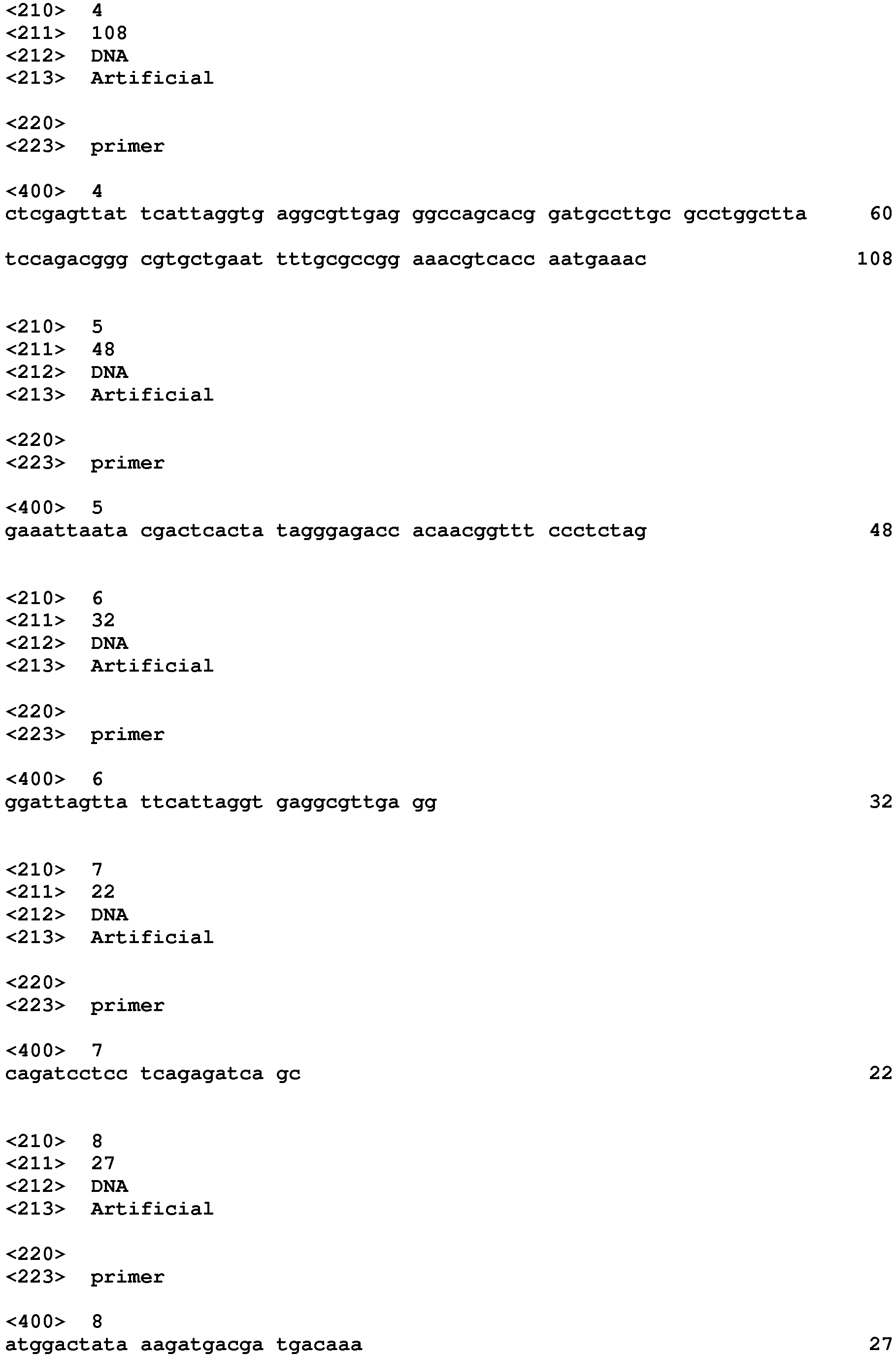
- the partial sequence (220-326-position amino acid residues) of gene III of M13 phage was amplified by PCR with KOD Plus DNA Polymerase (manufactured by TOYOBO) (denaturation: 94°C, 15 seconds, annealing: 57°C, 30 seconds, extension: 68°C, 60 seconds, 25 cycles) using a phage genome derived from M13KO7 as a template and primer Myc-g3p (SEQ ID NO: 3: GAGCAGAAGCTGATCTCTGAGGAGGATCTGGAATATCAAGGCCAATCGTCTGAC) and primer g3p-SecMstop (SEQ ID NO: 4: CTCGAGTTATTCATTAGGTGAGGCGTTGAGGGCCAGCACGGATGCCTTGCGCCTGGCTTATC CAGACGGGCGTGCTGAATTTTGCGCCGGAAACGTCACCAATGAAAC), and purified with a purification column manufactured by Qiagen.
- KOD Plus DNA Polymerase manufactured by TOYO
- a PCR reaction solution containing the three kinds of DNAs (5' UTR, random oligonucleotide library and g3p, each 1 pmol), 5' primer (SEQ ID NO: 5: gaaattaatacgactcactatagggagaccacaacggtttccctctag) (10 pmol), SecM stop sequence (SEQ ID NO: 6: ggattagttattcattaggtgaggcgttgagg) (10 pmol) and KOD Plus DNA polymerase was prepared, and subjected to 10 cycles of PCR reaction (denaturation: 94°C, 15 seconds, annealing: 57°C, 30 seconds, extension: 68°C, 60 seconds).
- the band was excised and purified with a column manufactured by Qiagen to finally give a maturation target oligonucleotide library containing the random sequence.
- the purified maturation target oligonucleotide library DNA (1 ⁇ g) was transcribed into mRNA with 20 ⁇ l of in vitro transcription kit (Ribomax TM Large Scale RNA Production System-T7, Promega), and purified with a column (RNeasy mini column, Qiagen).
- An ice-cooled Wash buffer (50 mM Tris-OAc, pH 7.5, 150 mM NaCl, 50 mM Mg(OAc) 2 , 0.5% Tween 20, 10 ⁇ g/ml budding yeast (Saccharomyces cereviseae) total RNA (manufactured by Sigma)) (500 ⁇ L), a Blocking buffer (50 mM Tris-OAc, pH 7.5, 150 mM NaCl, 50 mM Mg(OAc) 2 , 0.5% Tween 20, 10 ⁇ g/ml budding yeast (Saccharomyces cereviseae) total RNA (manufactured by Sigma), and 5% SuperBlock (Pierce)) (500 ⁇ L) were added.
- a Blocking buffer 50 mM Tris-OAc, pH 7.5, 150 mM NaCl, 50 mM Mg(OAc) 2 , 0.5% Tween 20, 10 ⁇ g/ml budding yeast (S
- a FLAG M2 carrier (50 ⁇ L slurry, manufactured by Sigma) which was blocked with 5% SuperBlock at 4°C overnight in advance was washed twice with 500 ⁇ l of Wash buffer using MicroSpin (registered trade mark) column (manufactured by GE Healthcare), after which translation reaction solution was added to the recovered FLAG M2 carrier, and the mixture was stirred by rotation at 4°C for 1 hr. The supernatant was discarded using MicroSpin (registered trademark) column (manufactured by GE Healthcare); 1 mL of Wash buffer was added to the recovered FLAG M2 carrier, and stirred by rotation at 4°C for 5 min.
- MicroSpin registered trademark
- the recovered mRNA was processed into cDNA with Transcription High Fidelity cDNA Synthesis Kit (Roche), and subjected to a PCR reaction using KOD Plus DNA polymerase (denaturation: 94°C, 15 seconds; annealing: 57°C, 30 seconds; extension: 68°C, 60 seconds; 20 cycles).
- KOD Plus DNA polymerase denaturation: 94°C, 15 seconds; annealing: 57°C, 30 seconds; extension: 68°C, 60 seconds; 20 cycles.
- the primers used are shown below.
- DNA 100 ng
- rTaq DNA polymerase manufactured by TOYOBO
- subcloning was performed using a TOPO TA cloning kit (manufactured by Invitrogen). The subcloning was performed based on the explanation of this kit.
- Escherichia coli single colony after transformation (each 20 colonies) was cultured in 3 ml of LB medium, and plasmid was recovered from the amplified Escherichia coli and used for DNA sequence analysis.
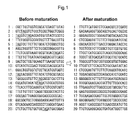
- Fig. 1 shows random oligonucleotide library (NNS sequence) before and after maturation.
- NGS sequence random oligonucleotide library
- SEQ ID NO: 1 oligonucleotide n shows optional base. s shows guanine or cytosine.
- SEQ ID NO: 2 oligonucleotide comprising T7 promoter, SD sequence and initiation codon
- SEQ ID NOs: 3 - 8 primer Industrial Applicability
- the production method of a maturated oligonucleotide library of the present invention can be utilized in, for example, biochemical industry and protein drug industry.
Landscapes
- Life Sciences & Earth Sciences (AREA)
- Health & Medical Sciences (AREA)
- Genetics & Genomics (AREA)
- Engineering & Computer Science (AREA)
- Chemical & Material Sciences (AREA)
- Biomedical Technology (AREA)
- Organic Chemistry (AREA)
- Biotechnology (AREA)
- General Engineering & Computer Science (AREA)
- Zoology (AREA)
- Wood Science & Technology (AREA)
- Bioinformatics & Cheminformatics (AREA)
- Microbiology (AREA)
- Plant Pathology (AREA)
- Molecular Biology (AREA)
- Physics & Mathematics (AREA)
- Biochemistry (AREA)
- General Health & Medical Sciences (AREA)
- Biophysics (AREA)
- Bioinformatics & Computational Biology (AREA)
- Crystallography & Structural Chemistry (AREA)
- Preparation Of Compounds By Using Micro-Organisms (AREA)
Abstract
Description
- The present invention relates to a fast maturation method of an oligonucleotide library, which aims to prepare a protein library.
- When plural random amino acid sequences are introduced into one site of a protein, oligonucleotides synthesized at random are introduced into the gene of the protein. However, when an introduced sequence is synthesized completely at random (NNN sequence), a stop codon emerges at a ratio of about 1/21. In addition, when synthesized an oligonucleotide to be introduced is a long strand, an oligonucleotide having deleted or inserted bases is found in a proportion of a few percent. Since they markedly reduce the diversity of the resulting protein library, those oligonucleotides need to be removed during preparation of the oligonucleotide library.
- As a method for removing such unnecessary oligonucleotides from a synthesized oligonucleotide library, a method utilizing antibiotic drug selection can be mentioned. For example, a random oligonucleotide library to be the maturation target is ligated to the 5' terminus of a drug resistance gene such as β-lactamase, and introduced into a plasmid. Escherichia coli is transformed with this plasmid and applied to an agar plate containing the corresponding antibiotic. As a result, only Escherichia coli having an in-frame gene without a stop codon or a frame shift due to deletion or insertion of bases can grow as a colony on the plate, since such Escherichia coli can express a drug resistance protein. Therefore, by recovering a gene from such colonies, a maturated oligonucleotide library free of unnecessary oligonucleotides can be obtained.
- However, this method has some problems. Firstly, it is difficult to form a large number of colonies by a general method, since the number of colonies of Escherichia coli varies depending on the ligation efficiency of oligonucleotide library to a vector and transformation efficiency of Escherichia coli. Secondly, to obtain a large number of colonies, the corresponding number of samples needs to be prepared, which requires a lot of efforts and time.
- The period that the present inventors required to maturate an oligonucleotide library having 108 diversities by this method was about 1 week. When an oligonucleotide library encoding an antibody gene library wherein 6 CDRs (complementary-determining regions) of the antibody are randomized is prepared, oligonucleotide libraries encoding each of these 6 CDRs are sequentially maturated, and maturation of the whole oligonucleotide library encoding the antibody gene library requires about 6 weeks.
- Furthermore, since the above-mentioned manipulation requires large amounts of expensive reagents (enzymes etc.), the method is extremely costly.
- On the other hand,
patent document 1 discloses a ribosome display. In addition,patent document 1, paragraph [0051], discloses mRNA having a sequence encoding a translation reaction elongation arrest sequence of Escherichia coli SecM at the downstream of a spacer sequence. - patent document 1:
JP-A-2008-271903 - The present invention aims to provide a production method of a maturated oligonucleotide library, which can conveniently produce many kinds of maturated oligonucleotide libraries at once in a short time at a low cost.
- In addition, the present invention aims to provide an efficient maturation method of a random oligonucleotide library using a ribosome display of an in vitro selection system (
JP-A-2008-271903 - The present invention is based on the finding that, in maturation of a random oligonucleotide library, the in-frame ratio can be improved by adding an arrest sequence (e.g., SecM sequence) to the 3' terminus of oligonucleotide, and maturation can be achieved extremely efficiently.
- The first aspect of the present invention relates to a production method of a maturated oligonucleotide library. In this method, first, a tag sequence is added to the 5' terminus of a maturation target oligonucleotide library and an arrest sequence (e.g., SecM sequence) is added to the 3' terminus thereof to give a terminal-modified product of a maturation target oligonucleotide library (terminal-modified sequence product). The maturation target oligonucleotide library is a random oligonucleotide library. Examples of the random oligonucleotide library include an oligonucleotide library containing an NNS sequence. Examples of the NNS sequence include an NNS sequence containing a codon corresponding to 31 amino acids. When the maturation target oligonucleotide library is a completely random oligonucleotide library, a stop codon emerges at a rate of about 1/21. Therefore, the random oligonucleotide library is preferably free of a completely random sequence (NNN).
- Then, a transcript of the terminal-modified sequence product is obtained by transcription thereof. Thereafter, the transcript is translated in vitro.
- In the above-mentioned method, the tag sequence is exemplified by FLAG sequences. For example, the resultant product can be easily recovered by using beads on which an anti-FLAG antibody is immobilized.
- In the above-mentioned method, it is preferable to translate a transcript in vitro by using a cell-free translation system. Since the treatment is completely performed in vitro, the maturation efficiency of the oligonucleotide library can be improved. Examples of the cell-free translation system include an Escherichia coli cell-free translation system. Preferred as a cell-free translation system is a reconstituted cell-free translation system, i.e., PURE system. A reconstituted cell-free protein synthesis system that has been developed by a group including the present inventor is a synthesis system consisting exclusively of specified factors involved in protein synthesis reaction, such as translation factors and ribosome.
- Ribosome display is a method that includes forming an mRNA-ribosome-oligopeptide ternary complex (ribosome display complex) in in vitro translation system and selecting a protein encoding a polypeptide having a specific function. As mentioned above, the terminal-modified product of the present invention has an arrest sequence at the 3' terminus of the maturation target oligonucleotide library. When an oligonucleotide constituting a random oligonucleotide library introduced into an in vitro translation system contains a stop codon, or when a frame shift exists due to the deletion or insertion of bases, normal translation up to the arrest sequence is not available during translation. Thus, translation of an oligonucleotide having a stop codon introduced therein or an oligonucleotide containing a frame shift fails to form a ternary complex of mRNA-ribosome-oligopeptide. Thus, only an in-frame oligonucleotide translated up to the arrest sequence can be selected by, for example, selecting such complex with an antibody to the introduced tag sequence.
- In the production method of the maturated oligonucleotide library of the present invention, the treatment is performed completely in vitro, and therefore, an oligonucleotide library having high diversity (e.g., not less than 1011 - 1012diversities) can be the target of selection.
- The production method of a maturated oligonucleotide library of the present invention includes convenient and efficient operations, and therefore, for example, 8 kinds of maturation target oligonucleotide libraries individually formed can be simultaneously maturated in one day. This is a remarkable difference from conventional methods that require about 1 week for maturation of one kind of oligonucleotide library.
- Furthermore, the production method of a maturated oligonucleotide library of the present invention can simultaneously achieve reduction of cost, since it does not require a large amount of expensive enzymes.
-
-
Fig. 1 shows a random oligonucleotide library (NNS sequence) before and after maturation. - The first aspect of the present invention relates to a production method of a maturated oligonucleotide library. In this method, first, a tag sequence is added to the 5' terminus of a maturation target oligonucleotide library and an arrest sequence (e.g., SecM sequence) is added to the 3' terminus thereof to give a terminal-modified sequence product of a maturation target oligonucleotide library.
- In the present specification, "maturation" refers to removing oligonucleotides containing a stop codon and a frame shift due to the deletion or insertion of bases from an oligonucleotide library. The "maturation target oligonucleotide library" means a mixture of oligonucleotides that can be maturated. The "random oligonucleotide library" means a mixture of oligonucleotides having various sequences as defined below. The "maturated oligonucleotide library" means a mixture of maturated oligonucleotides.
- The maturation target oligonucleotide library is exemplified by a random oligonucleotide library. The random oligonucleotide library is exemplified by an oligonucleotide library containing an NNS sequence. NNS sequence is exemplified by an NNS sequence containing 31 amino acid codons. When the maturation target oligonucleotide library is a completely random oligonucleotide library, a stop codon emerges at a ratio of about 1/21. Therefore, a random oligonucleotide library is preferably free of a completely random sequence (NNN). Such random sequence (incomplete random sequence) is exemplified by NNK sequence, NNS sequence and NNY sequence. Here, N means any of adenine (A), guanine (G), cytosine (C) and thymine (T). K means any of guanine (G) and thymine (T). S means any of cytosine (C) and guanine (G). Y means any of cytosine (C) and thymine (T). In the present specification, the "NNK sequence" refers to an oligonucleotide sequence containing a plurality of "NNK" (i.e., "NNK"×m (m is an integer of 2 or more)) successively. In the present specification, "NNS sequence" refers to an oligonucleotide sequence containing a plurality of "NNS" (i.e., "NNS"×m (m is an integer of 2 or more)) successively. In the present specification, "NNY sequence" refers to an oligonucleotide sequence containing a plurality of "NNY" (i.e., "NNY"×m (m is an integer of 2 or more)) successively. In one embodiment, the random oligonucleotide library is an oligonucleotide library containing repeats of NNK sequence, NNS sequence or NNY sequence. The "oligonucleotide library containing repeats of NNK sequence, NNS sequence or NNY sequence" refers to an oligonucleotide containing a plurality of random sequences selected from NNK sequence, NNS sequence and NNY sequence in one oligonucleotide. In this case, a plurality of NNK sequence, NNS sequence or NNY sequence may be contained, or a plurality of mutually different random sequences may be contained so that both NNK sequence and NNS sequence are contained. The oligonucleotide constituting the random oligonucleotide library in the present specification has, for example, 3×n bases. Examples of n include not less than 5 and not more than 20, and not less than 7 and not more than 11. A specific example of n is 9. A method for synthesizing a random nucleotide library is known. Therefore, a random nucleotide library may be produced by a known method.
- In the above-mentioned method, the tag sequence to be added to the 5' terminus of the maturation target oligonucleotide library is exemplified by FLAG sequence. The tag sequence is not limited to FLAG sequence. Other example of the tag sequence is Myc sequence. An antibody that specifically binds to FLAG tag and Myc tag is already commercially available. Therefore, a protein fused with such tag can be easily labeled and purified using an antibody or a substance having an immobilized antibody. For example, when a ribosome display complex containing the maturated oligonucleotide library of the present invention has FLAG tag, the ribosome display complex can be easily recovered and purified using beads with an immobilized anti-FLAG antibody.
- The arrest sequence is a sequence that stalls the translation on ribosome on the way. An arrest sequence derived from Escherichia coli is exemplified by SecM sequence (Nakatogawa and Ito (2002) Cell, vol. 108, p. 629-636) and TnaC sequence (Gong et al, (2002) Science, vol.297, p.1864-1867). In addition, an artificially synthesized arrest sequence for Escherichia coli is exemplified by the sequence reported by Tanner et al. (Tanner et al, (2009) J. Biol. Chem, vol.284, p.34809-34818). Furthermore, a eukaryote-derived arrest sequence is exemplified by uORF sequence (Hood et al, (2009) Annu. Rev. Microbiol, vol.63, p.385-409).
- Then, a terminal-modified sequence product is transcribed to give a transcript. The transcription step is known in the field of biotechnology. Thus, the transcription step can be performed based on a known method.
- Thereafter, the transcript is translated in vitro. This translation step is exemplified by translation of a transcript in vitro using a cell-free translation system. In this case, the maturation efficiency of oligonucleotide can be improved by performing the treatment completely in vitro. When a sequence derived from Escherichia coli is used as an arrest sequence, a preferable cell-free translation system is, for example, an Escherichia coli cell-free translation system. A preferable cell-free translation system is a reconstituted cell-free translation system, namely, PURE system (see, for example, "Shimizu Y, Inoue A, Tomari Y, Suzuki T, Yokogawa T, Nishikawa K, Ueda T (2001) Cell-free translation reconstituted with purified components. ").
- PURE system is a cell-free translation system reconstituted with independently prepared factors necessary for translation. PURE system is almost free of contamination with nuclease and protease that decrease efficiency of ribosome display. Therefore, higher selection efficiency has been reported by using PURE system than a cell-free translation system of a cell extract type (Villemagne et al, (2006) J. Immunol. Methods, vol.313, p.140-148). On the other hand, many organisms are provided with a means to bypass translation stalling on ribosome that occurs during translation. In the case of Escherichia coli, for example, a reaction called trans-translation involving 10S-RNA (tmRNA) and SmpB protein occurs, and ribosome stalling is cancelled (Moore and Sauer (2007) Annu. Rev. Biochem., vol. 76, p.101-124). A general cell-free translation system of a cell-extract type containing an intracellular component also includes such bypass component in the system. Therefore, the formation efficiency of ribosome display complex is considered to decrease when a cell-free translation system of a cell-extract type is used. In fact, it has been reported that the formation efficiency of ribosome display complex increases by adding an antisense sequence of 10S-RNA to a cell-free translation system of an Escherichia coli-extract system (Hanes et al, (1997) Proc. Natl. Acad. Sci. USA, vol.94, p.4937-4942). That is, in the present invention, a PURE system free of the bypass component explained above is an optimal cell-free translation system.
- A cell-free translation system has an energy regeneration system and at least one amino acid. Energy regeneration system means factors involved in the regeneration of energy sources necessary for protein synthesis such as ATP, GTP and the like. Examples of substances of the energy regeneration system include enzymes involved in ATP regeneration (creatinine kinase, pyruvate kinase etc.), and substrates thereof (phosphocreatine, phosphoenolpyruvate etc.). A cell-free translation system contains at least one kind of amino acid, preferably naturally-occurring 20 kinds of amino acids. A cell-free translation system may further contain a non-natural amino acid. A cell-free translation system may contain, for example, buffers (e.g., HEPES-potassium, Tris-acetate etc.), various salts, surfactants, RNA polymerases (T7, T3, and SP6 RNA polymerases etc.), chaperone proteins (DnaJ, DnaK, GroE, GroEL, GroES, and HSP70 etc.), RNA (mRNA, tRNA etc.), protease inhibitors, or (ribo)nuclease inhibitors.
- As explained above, preferable use of the present invention is a method of maturation of a random oligonucleotide library using ribosome display. Ribosome display is a method that includes forming an mRNA-ribosome-oligopeptide ternary complex in in vitro translation system and selecting a protein encoding a polypeptide having a specific function. As mentioned above, the terminal-modified sequence product of the present invention has an arrest sequence at the 3' terminus of the maturation target oligonucleotide library. When an oligonucleotide constituting a random oligonucleotide library introduced into an in vitro translation system contains a stop codon, or when a frame shift exists due to the deletion or insertion of bases, normal translation up to the arrest sequence is not available during translation. Thus, translation of an oligonucleotide having a stop codon introduced therein or an oligonucleotide containing a frame shift fails to form a ternary complex of mRNA-ribosome-oligopeptide.
- For example, only an in-frame oligonucleotide translated up to the arrest sequence can be selected by, for example, selecting such complex with an antibody to the introduced tag sequence.
- The present invention is explained in more detail in the following by referring to Examples, which are not to be construed as limitative.
- A maturation target random oligonucleotide library containing codons encoding 9 amino acids, which is added with a FLAG sequence at the 5' terminus and added with a Myc sequence at the 3' terminus, was prepared by DNA synthesis (SEQ ID NO: 1: ATGGACTATAAAGATGACGATGACAAAnnsnnsnnsnnsnnsnnsnnsnnsnnsGAGCAGAA GCTGATCTCTGAGGAGGATCTG). A 5' UTR sequence comprising a T7 promoter and an SD sequence, which is added with a FLAG sequence at the 3' terminus, was also prepared by DNA synthesis (SEQ ID NO: 2: gaaattaatacgactcactatagggagaccacaacggtttccctctagaaataattttgttt aactttaagaaggagatataccaatggactataaagatgacgatgacaaa). The partial sequence (220-326-position amino acid residues) of gene III of M13 phage was amplified by PCR with KOD Plus DNA Polymerase (manufactured by TOYOBO) (denaturation: 94°C, 15 seconds, annealing: 57°C, 30 seconds, extension: 68°C, 60 seconds, 25 cycles) using a phage genome derived from M13KO7 as a template and primer Myc-g3p (SEQ ID NO: 3: GAGCAGAAGCTGATCTCTGAGGAGGATCTGGAATATCAAGGCCAATCGTCTGAC) and primer g3p-SecMstop (SEQ ID NO: 4: CTCGAGTTATTCATTAGGTGAGGCGTTGAGGGCCAGCACGGATGCCTTGCGCCTGGCTTATC CAGACGGGCGTGCTGAATTTTGCGCCGGAAACGTCACCAATGAAAC), and purified with a purification column manufactured by Qiagen. A PCR reaction solution containing the three kinds of DNAs (5' UTR, random oligonucleotide library and g3p, each 1 pmol), 5' primer (SEQ ID NO: 5: gaaattaatacgactcactatagggagaccacaacggtttccctctag) (10 pmol), SecM stop sequence (SEQ ID NO: 6: ggattagttattcattaggtgaggcgttgagg) (10 pmol) and KOD Plus DNA polymerase was prepared, and subjected to 10 cycles of PCR reaction (denaturation: 94°C, 15 seconds, annealing: 57°C, 30 seconds, extension: 68°C, 60 seconds). After confirmation of a band containing three genes linked together by electrophoresis using 1% agarose gel, the band was excised and purified with a column manufactured by Qiagen to finally give a maturation target oligonucleotide library containing the random sequence.
- The purified maturation target oligonucleotide library DNA (1 µg) was transcribed into mRNA with 20 µl of in vitro transcription kit (Ribomax™ Large Scale RNA Production System-T7, Promega), and purified with a column (RNeasy mini column, Qiagen).
- In vitro translation using a cell-free translation system (construction of ribosome-Peptide-mRNA complex): a cell-free translation system (PURE system), which is a protein synthesis reaction reagent, was prepared according to the previous report (Shimizu et al. (2005) Methods, vol.36, p.299-304). To the prepared reaction solution (100 µl) was added maturation target oligonucleotide library mRNA (100 pmol), and the mixture was incubated at 37°C for 30 min. An ice-cooled Wash buffer (50 mM Tris-OAc, pH 7.5, 150 mM NaCl, 50 mM Mg(OAc)2, 0.5
% Tween % Tween - A FLAG M2 carrier (50 µL slurry, manufactured by Sigma) which was blocked with 5% SuperBlock at 4°C overnight in advance was washed twice with 500 µl of Wash buffer using MicroSpin (registered trade mark) column (manufactured by GE Healthcare), after which translation reaction solution was added to the recovered FLAG M2 carrier, and the mixture was stirred by rotation at 4°C for 1 hr. The supernatant was discarded using MicroSpin (registered trademark) column (manufactured by GE Healthcare); 1 mL of Wash buffer was added to the recovered FLAG M2 carrier, and stirred by rotation at 4°C for 5 min. After this process was repeated 20 times, 100 µl of Elution buffer (50 mM Tris-OAc, pH 7.5, 150 mM NaCl, 50 µg of FLAG peptide (Sigma)) was added to the recovered FLAG M2 carrier, and the mixture was allowed to stand at 4°C for 15 minutes. Thus, the complex was separated from the FLAG M2 carrier. The supernatant was recovered with MicroSpin (registered trade mark) column (manufactured by GE Healthcare), and mRNA was recovered and purified with RNeasy Micro (manufactured by Qiagen).
- The recovered mRNA was processed into cDNA with Transcription High Fidelity cDNA Synthesis Kit (Roche), and subjected to a PCR reaction using KOD Plus DNA polymerase (denaturation: 94°C, 15 seconds; annealing: 57°C, 30 seconds; extension: 68°C, 60 seconds; 20 cycles). The primers used are shown below.
- reverse transcription reverse primer: Myc-R (SEQ ID NO: 7: CAGATCCTCCTCAGAGATCAGC)
- PCR primer:
- FLAG-F (SEQ ID NO: 8: atggactataaagatgacgatgacaaa)
- Myc-R (SEQ ID NO: 7: CAGATCCTCCTCAGAGATCAGC)
- DNA (100 ng) before and after selection were added with A at the 3' terminus with rTaq DNA polymerase (manufactured by TOYOBO). Thereafter, subcloning was performed using a TOPO TA cloning kit (manufactured by Invitrogen). The subcloning was performed based on the explanation of this kit. Escherichia coli single colony after transformation (each 20 colonies) was cultured in 3 ml of LB medium, and plasmid was recovered from the amplified Escherichia coli and used for DNA sequence analysis.
-
Fig. 1 shows random oligonucleotide library (NNS sequence) before and after maturation.
As shown inFig. 1 , as a result of the DNA sequence analysis before maturation, the appearance frequency of oligonucleotide containing stop codon (TAG) was 40% (8/20), deletion of base was 5% (1/20), insertion of base was 0% (0/20), and the appearance frequency of finally complete in-frame oligonucleotide was 55% (11/20). In addition, after maturation, appearance frequency of those containing stop codon, and deletion and insertion of bases was 0% (0/20), and all oligonucleotides were confirmed to be in-frame. These results show that the selection of in-frame oligonucleotide has been almost completely achieved by the present method, and the effectiveness of the present method has been verified. - SEQ ID NO: 1: oligonucleotide
n shows optional base.
s shows guanine or cytosine.
SEQ ID NO: 2: oligonucleotide comprising T7 promoter, SD sequence and initiation codon
SEQ ID NOs: 3 - 8: primer Industrial Applicability - The production method of a maturated oligonucleotide library of the present invention can be utilized in, for example, biochemical industry and protein drug industry.
- This application is based on a patent application No.
2010-142470 
Claims (7)
- A method of producing a maturated oligonucleotide library, comprising
a step of obtaining a terminal-modified product of a maturation target oligonucleotide library, comprising adding a tag sequence to the 5' terminus of said maturation target oligonucleotide library and an arrest sequence, which stalls translation elongation on a ribosome, to the 3' terminus of said maturation target oligonucleotide library,
a step of transcribing said terminal-modified sequence product to give a transcript, and
a step of in vitro translation for translating said transcript in vitro,
wherein said maturation target oligonucleotide library is a random oligonucleotide library. - The method of claim 1, wherein said random oligonucleotide library is an oligonucleotide library containing NNK sequence, NNS sequence or NNY sequence.
- The method of claim 1 or 2, wherein said arrest sequence is SecM sequence.
- The method of any one of claims 1 to 3, wherein said tag sequence is FLAG sequence.
- The method of any one of claims 1 to 4, wherein said in vitro translation step is a step of translating said transcript in vitro using a cell-free translation system.
- The method of any one of claims 1 to 5, wherein said in vitro translation step is a step of translating said transcript in vitro using an Escherichia coli cell-free translation system.
- The method of any one of claims 1 to 5, wherein said in vitro translation step is a step of translating said transcript in vitro using a reconstituted cell-free translation system.
Applications Claiming Priority (2)
| Application Number | Priority Date | Filing Date | Title |
|---|---|---|---|
| JP2010142470 | 2010-06-23 | ||
| PCT/JP2011/064455 WO2011162355A1 (en) | 2010-06-23 | 2011-06-23 | High-speed maturation method for an oligonucleotide library for the purpose of preparing a protein library |
Publications (3)
| Publication Number | Publication Date |
|---|---|
| EP2586863A1 true EP2586863A1 (en) | 2013-05-01 |
| EP2586863A4 EP2586863A4 (en) | 2013-12-25 |
| EP2586863B1 EP2586863B1 (en) | 2017-05-03 |
Family
ID=45371521
Family Applications (1)
| Application Number | Title | Priority Date | Filing Date |
|---|---|---|---|
| EP11798236.3A Active EP2586863B1 (en) | 2010-06-23 | 2011-06-23 | High-speed maturation method for an oligonucleotide library for the purpose of preparing a protein library |
Country Status (4)
| Country | Link |
|---|---|
| US (1) | US9133452B2 (en) |
| EP (1) | EP2586863B1 (en) |
| JP (1) | JP5850460B2 (en) |
| WO (1) | WO2011162355A1 (en) |
Families Citing this family (1)
| Publication number | Priority date | Publication date | Assignee | Title |
|---|---|---|---|---|
| WO2020215044A1 (en) * | 2019-04-17 | 2020-10-22 | The Regents Of The University Of California | Small molecule-based control of immune cell receptor expression |
Family Cites Families (5)
| Publication number | Priority date | Publication date | Assignee | Title |
|---|---|---|---|---|
| EP1848733B1 (en) * | 2005-02-07 | 2017-06-21 | Basf Se | Novel hydrophobin fusion products, production and use thereof |
| JP4953046B2 (en) * | 2005-07-29 | 2012-06-13 | 独立行政法人産業技術総合研究所 | A novel functional peptide creation system that combines a random peptide library or a peptide library that mimics an antibody hypervariable region and an in vitro peptide selection method using RNA-binding proteins |
| JP4931135B2 (en) | 2007-05-02 | 2012-05-16 | 国立大学法人 東京大学 | Ribosome display |
| JP2009112286A (en) * | 2007-11-09 | 2009-05-28 | Takuya Ueda | Method for selecting polypeptide binding to target polypeptide |
| JP5920835B2 (en) | 2010-12-01 | 2016-05-18 | 田辺三菱製薬株式会社 | Polynucleotide construct capable of presenting Fab in cell-free translation system, and Fab production method and screening method using the same |
-
2011
- 2011-06-23 JP JP2012521538A patent/JP5850460B2/en active Active
- 2011-06-23 EP EP11798236.3A patent/EP2586863B1/en active Active
- 2011-06-23 US US13/806,470 patent/US9133452B2/en active Active
- 2011-06-23 WO PCT/JP2011/064455 patent/WO2011162355A1/en not_active Ceased
Non-Patent Citations (4)
| Title |
|---|
| ERIKO OSADA ET AL: "Epitope Mapping Using Ribosome Display in a Reconstituted Cell-Free Protein Synthesis System", JOURNAL OF BIOCHEMISTRY, JAPANESE BIOCHEMICAL SOCIETY / OUP, TOKYO; JP , vol. 145, no. 5 1 May 2009 (2009-05-01), pages 693-700, XP002677147, ISSN: 0021-924X, DOI: 10.1093/JB/MVP027 Retrieved from the Internet: URL:http://jb.oxfordjournals.org/content/145/5/693 [retrieved on 2009-02-19] * |
| OHASHI ET AL: "Efficient protein selection based on ribosome display system with purified components", BIOCHEMICAL AND BIOPHYSICAL RESEARCH COMMUNICATIONS, ACADEMIC PRESS INC. ORLANDO, FL, US, vol. 352, no. 1, 30 November 2006 (2006-11-30), pages 270-276, XP005727956, ISSN: 0006-291X, DOI: 10.1016/J.BBRC.2006.11.017 * |
| See also references of WO2011162355A1 * |
| SHIMIZU Y ET AL: "Protein synthesis by pure translation systems", METHODS : A COMPANION TO METHODS IN ENZYMOLOGY, ACADEMIC PRESS INC., NEW YORK, NY, US, vol. 36, no. 3, 1 July 2005 (2005-07-01), pages 299-304, XP027216576, ISSN: 1046-2023 [retrieved on 2005-07-31] * |
Also Published As
| Publication number | Publication date |
|---|---|
| US9133452B2 (en) | 2015-09-15 |
| JPWO2011162355A1 (en) | 2013-08-22 |
| EP2586863B1 (en) | 2017-05-03 |
| WO2011162355A1 (en) | 2011-12-29 |
| EP2586863A4 (en) | 2013-12-25 |
| US20130143773A1 (en) | 2013-06-06 |
| JP5850460B2 (en) | 2016-02-03 |
Similar Documents
| Publication | Publication Date | Title |
|---|---|---|
| US6312927B1 (en) | Methods for producing nucleic acids lacking 3'-untranslated regions and optimizing cellular RNA-protein fusion formation | |
| JP7058839B2 (en) | Cell-free protein expression using rolling circle amplification products | |
| US20210214783A1 (en) | Method for constructing sequencing library, obtained sequencing library and sequencing method | |
| US7622248B2 (en) | Ribozymes with broad tRNA aminoacylation activity | |
| CN110637086B (en) | Method for producing complex of RNA molecule and peptide, and use thereof | |
| EP3665286B1 (en) | Cell-free protein expression using double-stranded concatameric dna | |
| JP2011522552A (en) | Method for enzymatic synthesis of chemically modified RNA | |
| Balakin et al. | Unusual ribosome binding properties of mRNA encoding bacteriophage λ repressor | |
| Shibata et al. | Cloning full-length, cap-trapper-selected cDNAs by using the single-strand linker ligation method | |
| US10301618B2 (en) | Efficient method for displaying protein multimer | |
| EP1350845A1 (en) | Molecule correspondent to genotype and phenotype, composing elements thereof, method of producing the corespondent molecule and method of using the same | |
| EP3143050A1 (en) | Barcoded peptides | |
| EP2586863B1 (en) | High-speed maturation method for an oligonucleotide library for the purpose of preparing a protein library | |
| EP3090049B1 (en) | Enrichment of full-length oligonucleotides via transcription/translation-mediated purification | |
| US10301605B2 (en) | Poly(UG) polymerase, constructs, and methods of making and using the same | |
| EP2554681B1 (en) | Constitution of tool for analyzing biomolecular interaction and analysis method using same | |
| US20190284249A1 (en) | Beta-catenin barcoded peptides | |
| CN120310879A (en) | Kit and method for preparing mRNA transcription template | |
| Thom | Ribosomal display | |
| 上野真吾 et al. | Development of mRNA-protein fusion at N-terminus for evolutionary protein engineering | |
| AU2004200998A1 (en) | Methods for producing nucleic acids lacking 3'-untranslated regions and optimizing cellular RNA-protein fusion formation |
Legal Events
| Date | Code | Title | Description |
|---|---|---|---|
| PUAI | Public reference made under article 153(3) epc to a published international application that has entered the european phase |
Free format text: ORIGINAL CODE: 0009012 |
|
| 17P | Request for examination filed |
Effective date: 20130104 |
|
| AK | Designated contracting states |
Kind code of ref document: A1 Designated state(s): AL AT BE BG CH CY CZ DE DK EE ES FI FR GB GR HR HU IE IS IT LI LT LU LV MC MK MT NL NO PL PT RO RS SE SI SK SM TR |
|
| RIN1 | Information on inventor provided before grant (corrected) |
Inventor name: KOJOH, KANEHISA Inventor name: MIYAKOSHI, AKIRA Inventor name: UEDA, TAKUYA Inventor name: KATOH, SHIZUE Inventor name: KANAMORI, TAKASHI |
|
| DAX | Request for extension of the european patent (deleted) | ||
| REG | Reference to a national code |
Ref country code: DE Ref legal event code: R079 Ref document number: 602011037635 Country of ref document: DE Free format text: PREVIOUS MAIN CLASS: C12N0015090000 Ipc: C12N0015100000 |
|
| A4 | Supplementary search report drawn up and despatched |
Effective date: 20131127 |
|
| RIC1 | Information provided on ipc code assigned before grant |
Ipc: C12N 15/10 20060101AFI20131121BHEP |
|
| 17Q | First examination report despatched |
Effective date: 20150928 |
|
| GRAP | Despatch of communication of intention to grant a patent |
Free format text: ORIGINAL CODE: EPIDOSNIGR1 |
|
| INTG | Intention to grant announced |
Effective date: 20161026 |
|
| GRAS | Grant fee paid |
Free format text: ORIGINAL CODE: EPIDOSNIGR3 |
|
| STAA | Information on the status of an ep patent application or granted ep patent |
Free format text: STATUS: GRANT OF PATENT IS INTENDED |
|
| GRAJ | Information related to disapproval of communication of intention to grant by the applicant or resumption of examination proceedings by the epo deleted |
Free format text: ORIGINAL CODE: EPIDOSDIGR1 |
|
| GRAL | Information related to payment of fee for publishing/printing deleted |
Free format text: ORIGINAL CODE: EPIDOSDIGR3 |
|
| STAA | Information on the status of an ep patent application or granted ep patent |
Free format text: STATUS: EXAMINATION IS IN PROGRESS |
|
| RAP1 | Party data changed (applicant data changed or rights of an application transferred) |
Owner name: THE UNIVERSITY OF TOKYO Owner name: GENEFRONTIER CORPORATION |
|
| RIN1 | Information on inventor provided before grant (corrected) |
Inventor name: KANAMORI, TAKASHI Inventor name: KATOH, SHIZUE Inventor name: KOJOH, KANEHISA Inventor name: UEDA, TAKUYA Inventor name: MIYAKOSHI, AKIRA |
|
| GRAR | Information related to intention to grant a patent recorded |
Free format text: ORIGINAL CODE: EPIDOSNIGR71 |
|
| STAA | Information on the status of an ep patent application or granted ep patent |
Free format text: STATUS: GRANT OF PATENT IS INTENDED |
|
| GRAA | (expected) grant |
Free format text: ORIGINAL CODE: 0009210 |
|
| STAA | Information on the status of an ep patent application or granted ep patent |
Free format text: STATUS: THE PATENT HAS BEEN GRANTED |
|
| INTC | Intention to grant announced (deleted) | ||
| AK | Designated contracting states |
Kind code of ref document: B1 Designated state(s): AL AT BE BG CH CY CZ DE DK EE ES FI FR GB GR HR HU IE IS IT LI LT LU LV MC MK MT NL NO PL PT RO RS SE SI SK SM TR |
|
| INTG | Intention to grant announced |
Effective date: 20170324 |
|
| REG | Reference to a national code |
Ref country code: GB Ref legal event code: FG4D |
|
| REG | Reference to a national code |
Ref country code: AT Ref legal event code: REF Ref document number: 890018 Country of ref document: AT Kind code of ref document: T Effective date: 20170515 Ref country code: CH Ref legal event code: EP |
|
| REG | Reference to a national code |
Ref country code: IE Ref legal event code: FG4D |
|
| REG | Reference to a national code |
Ref country code: DE Ref legal event code: R096 Ref document number: 602011037635 Country of ref document: DE |
|
| REG | Reference to a national code |
Ref country code: CH Ref legal event code: NV Representative=s name: BOHEST AG, CH |
|
| REG | Reference to a national code |
Ref country code: FR Ref legal event code: PLFP Year of fee payment: 7 |
|
| REG | Reference to a national code |
Ref country code: NL Ref legal event code: MP Effective date: 20170503 |
|
| REG | Reference to a national code |
Ref country code: AT Ref legal event code: MK05 Ref document number: 890018 Country of ref document: AT Kind code of ref document: T Effective date: 20170503 |
|
| REG | Reference to a national code |
Ref country code: LT Ref legal event code: MG4D |
|
| PG25 | Lapsed in a contracting state [announced via postgrant information from national office to epo] |
Ref country code: LT Free format text: LAPSE BECAUSE OF FAILURE TO SUBMIT A TRANSLATION OF THE DESCRIPTION OR TO PAY THE FEE WITHIN THE PRESCRIBED TIME-LIMIT Effective date: 20170503 Ref country code: NO Free format text: LAPSE BECAUSE OF FAILURE TO SUBMIT A TRANSLATION OF THE DESCRIPTION OR TO PAY THE FEE WITHIN THE PRESCRIBED TIME-LIMIT Effective date: 20170803 Ref country code: FI Free format text: LAPSE BECAUSE OF FAILURE TO SUBMIT A TRANSLATION OF THE DESCRIPTION OR TO PAY THE FEE WITHIN THE PRESCRIBED TIME-LIMIT Effective date: 20170503 Ref country code: GR Free format text: LAPSE BECAUSE OF FAILURE TO SUBMIT A TRANSLATION OF THE DESCRIPTION OR TO PAY THE FEE WITHIN THE PRESCRIBED TIME-LIMIT Effective date: 20170804 Ref country code: AT Free format text: LAPSE BECAUSE OF FAILURE TO SUBMIT A TRANSLATION OF THE DESCRIPTION OR TO PAY THE FEE WITHIN THE PRESCRIBED TIME-LIMIT Effective date: 20170503 Ref country code: ES Free format text: LAPSE BECAUSE OF FAILURE TO SUBMIT A TRANSLATION OF THE DESCRIPTION OR TO PAY THE FEE WITHIN THE PRESCRIBED TIME-LIMIT Effective date: 20170503 Ref country code: HR Free format text: LAPSE BECAUSE OF FAILURE TO SUBMIT A TRANSLATION OF THE DESCRIPTION OR TO PAY THE FEE WITHIN THE PRESCRIBED TIME-LIMIT Effective date: 20170503 |
|
| PG25 | Lapsed in a contracting state [announced via postgrant information from national office to epo] |
Ref country code: BG Free format text: LAPSE BECAUSE OF FAILURE TO SUBMIT A TRANSLATION OF THE DESCRIPTION OR TO PAY THE FEE WITHIN THE PRESCRIBED TIME-LIMIT Effective date: 20170803 Ref country code: LV Free format text: LAPSE BECAUSE OF FAILURE TO SUBMIT A TRANSLATION OF THE DESCRIPTION OR TO PAY THE FEE WITHIN THE PRESCRIBED TIME-LIMIT Effective date: 20170503 Ref country code: NL Free format text: LAPSE BECAUSE OF FAILURE TO SUBMIT A TRANSLATION OF THE DESCRIPTION OR TO PAY THE FEE WITHIN THE PRESCRIBED TIME-LIMIT Effective date: 20170503 Ref country code: RS Free format text: LAPSE BECAUSE OF FAILURE TO SUBMIT A TRANSLATION OF THE DESCRIPTION OR TO PAY THE FEE WITHIN THE PRESCRIBED TIME-LIMIT Effective date: 20170503 Ref country code: SE Free format text: LAPSE BECAUSE OF FAILURE TO SUBMIT A TRANSLATION OF THE DESCRIPTION OR TO PAY THE FEE WITHIN THE PRESCRIBED TIME-LIMIT Effective date: 20170503 Ref country code: IS Free format text: LAPSE BECAUSE OF FAILURE TO SUBMIT A TRANSLATION OF THE DESCRIPTION OR TO PAY THE FEE WITHIN THE PRESCRIBED TIME-LIMIT Effective date: 20170903 Ref country code: PL Free format text: LAPSE BECAUSE OF FAILURE TO SUBMIT A TRANSLATION OF THE DESCRIPTION OR TO PAY THE FEE WITHIN THE PRESCRIBED TIME-LIMIT Effective date: 20170503 |
|
| PG25 | Lapsed in a contracting state [announced via postgrant information from national office to epo] |
Ref country code: CZ Free format text: LAPSE BECAUSE OF FAILURE TO SUBMIT A TRANSLATION OF THE DESCRIPTION OR TO PAY THE FEE WITHIN THE PRESCRIBED TIME-LIMIT Effective date: 20170503 Ref country code: RO Free format text: LAPSE BECAUSE OF FAILURE TO SUBMIT A TRANSLATION OF THE DESCRIPTION OR TO PAY THE FEE WITHIN THE PRESCRIBED TIME-LIMIT Effective date: 20170503 Ref country code: SK Free format text: LAPSE BECAUSE OF FAILURE TO SUBMIT A TRANSLATION OF THE DESCRIPTION OR TO PAY THE FEE WITHIN THE PRESCRIBED TIME-LIMIT Effective date: 20170503 Ref country code: DK Free format text: LAPSE BECAUSE OF FAILURE TO SUBMIT A TRANSLATION OF THE DESCRIPTION OR TO PAY THE FEE WITHIN THE PRESCRIBED TIME-LIMIT Effective date: 20170503 Ref country code: EE Free format text: LAPSE BECAUSE OF FAILURE TO SUBMIT A TRANSLATION OF THE DESCRIPTION OR TO PAY THE FEE WITHIN THE PRESCRIBED TIME-LIMIT Effective date: 20170503 |
|
| REG | Reference to a national code |
Ref country code: DE Ref legal event code: R097 Ref document number: 602011037635 Country of ref document: DE |
|
| PG25 | Lapsed in a contracting state [announced via postgrant information from national office to epo] |
Ref country code: SM Free format text: LAPSE BECAUSE OF FAILURE TO SUBMIT A TRANSLATION OF THE DESCRIPTION OR TO PAY THE FEE WITHIN THE PRESCRIBED TIME-LIMIT Effective date: 20170503 Ref country code: IT Free format text: LAPSE BECAUSE OF FAILURE TO SUBMIT A TRANSLATION OF THE DESCRIPTION OR TO PAY THE FEE WITHIN THE PRESCRIBED TIME-LIMIT Effective date: 20170503 |
|
| PLBE | No opposition filed within time limit |
Free format text: ORIGINAL CODE: 0009261 |
|
| STAA | Information on the status of an ep patent application or granted ep patent |
Free format text: STATUS: NO OPPOSITION FILED WITHIN TIME LIMIT |
|
| REG | Reference to a national code |
Ref country code: IE Ref legal event code: MM4A |
|
| 26N | No opposition filed |
Effective date: 20180206 |
|
| PG25 | Lapsed in a contracting state [announced via postgrant information from national office to epo] |
Ref country code: LU Free format text: LAPSE BECAUSE OF NON-PAYMENT OF DUE FEES Effective date: 20170623 Ref country code: IE Free format text: LAPSE BECAUSE OF NON-PAYMENT OF DUE FEES Effective date: 20170623 |
|
| PG25 | Lapsed in a contracting state [announced via postgrant information from national office to epo] |
Ref country code: SI Free format text: LAPSE BECAUSE OF FAILURE TO SUBMIT A TRANSLATION OF THE DESCRIPTION OR TO PAY THE FEE WITHIN THE PRESCRIBED TIME-LIMIT Effective date: 20170503 |
|
| REG | Reference to a national code |
Ref country code: FR Ref legal event code: PLFP Year of fee payment: 8 |
|
| PG25 | Lapsed in a contracting state [announced via postgrant information from national office to epo] |
Ref country code: MT Free format text: LAPSE BECAUSE OF NON-PAYMENT OF DUE FEES Effective date: 20170623 |
|
| PG25 | Lapsed in a contracting state [announced via postgrant information from national office to epo] |
Ref country code: HU Free format text: LAPSE BECAUSE OF FAILURE TO SUBMIT A TRANSLATION OF THE DESCRIPTION OR TO PAY THE FEE WITHIN THE PRESCRIBED TIME-LIMIT; INVALID AB INITIO Effective date: 20110623 Ref country code: MC Free format text: LAPSE BECAUSE OF FAILURE TO SUBMIT A TRANSLATION OF THE DESCRIPTION OR TO PAY THE FEE WITHIN THE PRESCRIBED TIME-LIMIT Effective date: 20170503 |
|
| PG25 | Lapsed in a contracting state [announced via postgrant information from national office to epo] |
Ref country code: CY Free format text: LAPSE BECAUSE OF NON-PAYMENT OF DUE FEES Effective date: 20170503 |
|
| PG25 | Lapsed in a contracting state [announced via postgrant information from national office to epo] |
Ref country code: MK Free format text: LAPSE BECAUSE OF FAILURE TO SUBMIT A TRANSLATION OF THE DESCRIPTION OR TO PAY THE FEE WITHIN THE PRESCRIBED TIME-LIMIT Effective date: 20170503 |
|
| PG25 | Lapsed in a contracting state [announced via postgrant information from national office to epo] |
Ref country code: TR Free format text: LAPSE BECAUSE OF FAILURE TO SUBMIT A TRANSLATION OF THE DESCRIPTION OR TO PAY THE FEE WITHIN THE PRESCRIBED TIME-LIMIT Effective date: 20170503 |
|
| PG25 | Lapsed in a contracting state [announced via postgrant information from national office to epo] |
Ref country code: PT Free format text: LAPSE BECAUSE OF FAILURE TO SUBMIT A TRANSLATION OF THE DESCRIPTION OR TO PAY THE FEE WITHIN THE PRESCRIBED TIME-LIMIT Effective date: 20170503 |
|
| PG25 | Lapsed in a contracting state [announced via postgrant information from national office to epo] |
Ref country code: AL Free format text: LAPSE BECAUSE OF FAILURE TO SUBMIT A TRANSLATION OF THE DESCRIPTION OR TO PAY THE FEE WITHIN THE PRESCRIBED TIME-LIMIT Effective date: 20170503 |
|
| P01 | Opt-out of the competence of the unified patent court (upc) registered |
Effective date: 20230403 |
|
| PGFP | Annual fee paid to national office [announced via postgrant information from national office to epo] |
Ref country code: CH Payment date: 20250701 Year of fee payment: 15 |
|
| REG | Reference to a national code |
Ref country code: CH Ref legal event code: U11 Free format text: ST27 STATUS EVENT CODE: U-0-0-U10-U11 (AS PROVIDED BY THE NATIONAL OFFICE) Effective date: 20260701 |
|
| PGFP | Annual fee paid to national office [announced via postgrant information from national office to epo] |
Ref country code: GB Payment date: 20260526 Year of fee payment: 16 |
|
| PGFP | Annual fee paid to national office [announced via postgrant information from national office to epo] |
Ref country code: DE Payment date: 20260526 Year of fee payment: 16 |
|
| PGFP | Annual fee paid to national office [announced via postgrant information from national office to epo] |
Ref country code: BE Payment date: 20260519 Year of fee payment: 16 |
|
| PGFP | Annual fee paid to national office [announced via postgrant information from national office to epo] |
Ref country code: FR Payment date: 20260526 Year of fee payment: 16 |