EP2586528B1 - Catalyst having monolithic structure for manufacturing ethylene glycol by oxalate hydrogenation, preparation method and application thereof - Google Patents
Catalyst having monolithic structure for manufacturing ethylene glycol by oxalate hydrogenation, preparation method and application thereof Download PDFInfo
- Publication number
- EP2586528B1 EP2586528B1 EP11797608.4A EP11797608A EP2586528B1 EP 2586528 B1 EP2586528 B1 EP 2586528B1 EP 11797608 A EP11797608 A EP 11797608A EP 2586528 B1 EP2586528 B1 EP 2586528B1
- Authority
- EP
- European Patent Office
- Prior art keywords
- catalyst
- hours
- dmo
- ethylene glycol
- hydrogenation
- Prior art date
- Legal status (The legal status is an assumption and is not a legal conclusion. Google has not performed a legal analysis and makes no representation as to the accuracy of the status listed.)
- Active
Links
Images

Classifications
-
- C—CHEMISTRY; METALLURGY
- C07—ORGANIC CHEMISTRY
- C07C—ACYCLIC OR CARBOCYCLIC COMPOUNDS
- C07C29/00—Preparation of compounds having hydroxy or O-metal groups bound to a carbon atom not belonging to a six-membered aromatic ring
- C07C29/132—Preparation of compounds having hydroxy or O-metal groups bound to a carbon atom not belonging to a six-membered aromatic ring by reduction of an oxygen containing functional group
- C07C29/136—Preparation of compounds having hydroxy or O-metal groups bound to a carbon atom not belonging to a six-membered aromatic ring by reduction of an oxygen containing functional group of >C=O containing groups, e.g. —COOH
- C07C29/147—Preparation of compounds having hydroxy or O-metal groups bound to a carbon atom not belonging to a six-membered aromatic ring by reduction of an oxygen containing functional group of >C=O containing groups, e.g. —COOH of carboxylic acids or derivatives thereof
- C07C29/149—Preparation of compounds having hydroxy or O-metal groups bound to a carbon atom not belonging to a six-membered aromatic ring by reduction of an oxygen containing functional group of >C=O containing groups, e.g. —COOH of carboxylic acids or derivatives thereof with hydrogen or hydrogen-containing gases
-
- B—PERFORMING OPERATIONS; TRANSPORTING
- B01—PHYSICAL OR CHEMICAL PROCESSES OR APPARATUS IN GENERAL
- B01J—CHEMICAL OR PHYSICAL PROCESSES, e.g. CATALYSIS OR COLLOID CHEMISTRY; THEIR RELEVANT APPARATUS
- B01J23/00—Catalysts comprising metals or metal oxides or hydroxides, not provided for in group B01J21/00
- B01J23/70—Catalysts comprising metals or metal oxides or hydroxides, not provided for in group B01J21/00 of the iron group metals or copper
- B01J23/72—Copper
-
- B—PERFORMING OPERATIONS; TRANSPORTING
- B01—PHYSICAL OR CHEMICAL PROCESSES OR APPARATUS IN GENERAL
- B01J—CHEMICAL OR PHYSICAL PROCESSES, e.g. CATALYSIS OR COLLOID CHEMISTRY; THEIR RELEVANT APPARATUS
- B01J23/00—Catalysts comprising metals or metal oxides or hydroxides, not provided for in group B01J21/00
- B01J23/70—Catalysts comprising metals or metal oxides or hydroxides, not provided for in group B01J21/00 of the iron group metals or copper
- B01J23/76—Catalysts comprising metals or metal oxides or hydroxides, not provided for in group B01J21/00 of the iron group metals or copper combined with metals, oxides or hydroxides provided for in groups B01J23/02 - B01J23/36
-
- B—PERFORMING OPERATIONS; TRANSPORTING
- B01—PHYSICAL OR CHEMICAL PROCESSES OR APPARATUS IN GENERAL
- B01J—CHEMICAL OR PHYSICAL PROCESSES, e.g. CATALYSIS OR COLLOID CHEMISTRY; THEIR RELEVANT APPARATUS
- B01J23/00—Catalysts comprising metals or metal oxides or hydroxides, not provided for in group B01J21/00
- B01J23/70—Catalysts comprising metals or metal oxides or hydroxides, not provided for in group B01J21/00 of the iron group metals or copper
- B01J23/76—Catalysts comprising metals or metal oxides or hydroxides, not provided for in group B01J21/00 of the iron group metals or copper combined with metals, oxides or hydroxides provided for in groups B01J23/02 - B01J23/36
- B01J23/80—Catalysts comprising metals or metal oxides or hydroxides, not provided for in group B01J21/00 of the iron group metals or copper combined with metals, oxides or hydroxides provided for in groups B01J23/02 - B01J23/36 with zinc, cadmium or mercury
-
- B—PERFORMING OPERATIONS; TRANSPORTING
- B01—PHYSICAL OR CHEMICAL PROCESSES OR APPARATUS IN GENERAL
- B01J—CHEMICAL OR PHYSICAL PROCESSES, e.g. CATALYSIS OR COLLOID CHEMISTRY; THEIR RELEVANT APPARATUS
- B01J23/00—Catalysts comprising metals or metal oxides or hydroxides, not provided for in group B01J21/00
- B01J23/70—Catalysts comprising metals or metal oxides or hydroxides, not provided for in group B01J21/00 of the iron group metals or copper
- B01J23/76—Catalysts comprising metals or metal oxides or hydroxides, not provided for in group B01J21/00 of the iron group metals or copper combined with metals, oxides or hydroxides provided for in groups B01J23/02 - B01J23/36
- B01J23/83—Catalysts comprising metals or metal oxides or hydroxides, not provided for in group B01J21/00 of the iron group metals or copper combined with metals, oxides or hydroxides provided for in groups B01J23/02 - B01J23/36 with rare earths or actinides
-
- B—PERFORMING OPERATIONS; TRANSPORTING
- B01—PHYSICAL OR CHEMICAL PROCESSES OR APPARATUS IN GENERAL
- B01J—CHEMICAL OR PHYSICAL PROCESSES, e.g. CATALYSIS OR COLLOID CHEMISTRY; THEIR RELEVANT APPARATUS
- B01J23/00—Catalysts comprising metals or metal oxides or hydroxides, not provided for in group B01J21/00
- B01J23/70—Catalysts comprising metals or metal oxides or hydroxides, not provided for in group B01J21/00 of the iron group metals or copper
- B01J23/76—Catalysts comprising metals or metal oxides or hydroxides, not provided for in group B01J21/00 of the iron group metals or copper combined with metals, oxides or hydroxides provided for in groups B01J23/02 - B01J23/36
- B01J23/84—Catalysts comprising metals or metal oxides or hydroxides, not provided for in group B01J21/00 of the iron group metals or copper combined with metals, oxides or hydroxides provided for in groups B01J23/02 - B01J23/36 with arsenic, antimony, bismuth, vanadium, niobium, tantalum, polonium, chromium, molybdenum, tungsten, manganese, technetium or rhenium
- B01J23/889—Manganese, technetium or rhenium
- B01J23/8892—Manganese
-
- B—PERFORMING OPERATIONS; TRANSPORTING
- B01—PHYSICAL OR CHEMICAL PROCESSES OR APPARATUS IN GENERAL
- B01J—CHEMICAL OR PHYSICAL PROCESSES, e.g. CATALYSIS OR COLLOID CHEMISTRY; THEIR RELEVANT APPARATUS
- B01J35/00—Catalysts, in general, characterised by their form or physical properties
- B01J35/50—Catalysts, in general, characterised by their form or physical properties characterised by their shape or configuration
- B01J35/56—Foraminous structures having flow-through passages or channels, e.g. grids or three-dimensional [3D] monoliths
- B01J35/57—Honeycombs
-
- B—PERFORMING OPERATIONS; TRANSPORTING
- B01—PHYSICAL OR CHEMICAL PROCESSES OR APPARATUS IN GENERAL
- B01J—CHEMICAL OR PHYSICAL PROCESSES, e.g. CATALYSIS OR COLLOID CHEMISTRY; THEIR RELEVANT APPARATUS
- B01J37/00—Processes, in general, for preparing catalysts; Processes, in general, for activation of catalysts
- B01J37/02—Impregnation, coating or precipitation
- B01J37/0215—Coating
-
- Y—GENERAL TAGGING OF NEW TECHNOLOGICAL DEVELOPMENTS; GENERAL TAGGING OF CROSS-SECTIONAL TECHNOLOGIES SPANNING OVER SEVERAL SECTIONS OF THE IPC; TECHNICAL SUBJECTS COVERED BY FORMER USPC CROSS-REFERENCE ART COLLECTIONS [XRACs] AND DIGESTS
- Y02—TECHNOLOGIES OR APPLICATIONS FOR MITIGATION OR ADAPTATION AGAINST CLIMATE CHANGE
- Y02P—CLIMATE CHANGE MITIGATION TECHNOLOGIES IN THE PRODUCTION OR PROCESSING OF GOODS
- Y02P20/00—Technologies relating to chemical industry
- Y02P20/50—Improvements relating to the production of bulk chemicals
- Y02P20/52—Improvements relating to the production of bulk chemicals using catalysts, e.g. selective catalysts
Definitions
- the invention relates to a preparation method of a monolithic structure catalyst for producing ethylene glycol by hydrogenation of dimethyl oxalate, DMO, and the application of the catalyst for producing ethylene glycol by hydrogenation of dimethyl oxalate in a fixed bed reactor.
- Ethylene glycol is an important basic organic material. It was first made by Wurtz in 1859 through hydrogenation of ethylene acetate catalyzed by potassium hydroxide. During the World War I, ethylene nitrate was used as substitute of glycerin to produce explosive because it could lower the freezing point of glycerin. Soon afterward, several feasible processes were developed. Hydrogenation of dichloromethane was used in Germany; chlorohydrin was used as raw stuff in America for the rapid growth of application of antifreeze with the development of automobile industry in the 1920s; ethylene and ethylene oxide was introduced as material which accelerated the process since polyester was developed and this process is widely used around the world mainly in Shell, UCC and Halcon-SD at present. The production capacity of these three companies takes up 90% of the world, followed by Japan catalytic Chemical Company, the Dow Chemical company, Mitsui East Asia Company and ICI Company.
- the process of ethylene oxide hydration has several defects, such as longer process, high mole ratio of water and ethylene oxide, large energy consumption and low selectivity of EG.
- the process using syngas as material is mainly divided into two categories: direct synthesis and indirect synthesis.
- the promising method mainly contains formaldehyde dimerization, formaldehyde electrochemical hydrogenation dimer method, formaldehyde hydrogen formylation, glycolic acid method, formaldehyde condensation method, oxalate method and etc.
- the process of oxalate hydrogenation has several advantages such as mild reaction condition and high selectivity which is the most promising process to realize industrialization.
- the process includes two key technologies: oxalate synthesis and hydrogenation of oxalate.
- the oxalate is generated though a circulate catalytic process composed of coupling and regeneration with the attending of nitrite and CO, produced from coal gasification and the following separation process of pressure swing adsorption (PSA).
- PSA pressure swing adsorption
- DMO production process is a cycle system which has a mild reaction condition, good stability, high selectivity and low pollution.
- the produced oxalate is catalysis hydrogenation to ethylene glycol with hydrogen produced via PSA process.
- This process is a complex reaction system, mainly including the following reactions: ROOCCOOR + 2H 2 ⁇ ROOCCH 2 OH + ROH ROOCCH 2 OH + 2H 2 ⁇ HOCH 2 CH 2 OH + ROH HOCH 2 CH 2 OH + H 2 ⁇ C 2 H 5 OH + H 2 O
- Fudan University reported mesoporous zeolite supported copper catalysts modified with additives such as magnesium, manganese, chromium, or aluminum in patent [ CN 101455976 ]. Conversion of oxalic ester reached 100% and selectivity of ethylene glycol achieved 96% on the catalyst under reaction conditions of temperature 210°C, pressure 3 MPa, hydrogen ester ratio 180, space velocity 0.5 h -1 .
- Dan Jin coal reported alumina supported copper catalyst modified with additives such as zinc, manganese, magnesium and chromium in patent [ 101524646 ].
- CN101879448 A discloses a monolithic structure catalyst and a method for producing ethylene glycol using said catalyst.
- An object of the present invention is to provide monolithic structure catalyst for producing ethylene glycol by hydrogenation of dimethyl oxalate. Active components of copper dispersed uniformly in the catalyst coating and the coating with thin layer form is evenly attached to the pore surface of cordierite honeycomb with monolithic structure. It effectively reduces the resistance of internal diffusion and improves the activity and selectivity in the hydrogenation of oxalic ester to ethylene glycol.
- An additional object of the invention is to provide a method for preparing a monolithic structure catalyst for producing ethylene glycol by hydrogenation of dimethyl oxalate.
- the method comprises following steps: first copper based catalyst powder is prepared by precipitation method, from which a catalyst slurry is further acquired, and then coated the catalyst slurry directly on the surface of the cordierite honeycomb support to form the copper supported monolithic structure catalyst.
- the method ensures high dispersion of active component copper in the catalyst coating and enhances catalytic activity and thermal stability.
- Another object of the invention is to provide a method for producing ethylene glycol by hydrogenation of dimethyl oxalate using a monolithic structure catalyst.
- the monolithic catalyst is used for hydrogenation of oxalic ester to ethylene glycol instead of particle catalyst, as it can reduce the cost by greatly reducing the pressure drop of the catalyst bed and decreasing the depletion of the catalyst, resulting from the abrasion during packing and reaction process.
- the provided monolithic catalyst has high catalytic activity, low resistance, convenient and quick replacement, which will benefit the realization of large-scale engineering amplification.
- the invention provides a monolithic structure catalyst for producing ethylene glycol by hydrogenation of dimethyl oxalate, the catalyst denoted as Cu/SiO 2 /cordierite, comprising a carrier, an additive, and an active component, the carrier being cordierite honeycomb of 400 cells per square inch (cpsi) and having particle size ⁇ 15 ⁇ 25mm, the additive being silicate , the active component being copper, and the copper and silicate being coated on the cordierite to form a coating layer, wherein
- the silicate accounts for 5-90 wt. % of the cordierite , the copper accounts for 1-40 wt. % of the cordierite , and the copper accounts for 5-50 wt. % of the coating layer.
- the catalyst is prepared according to the following steps:
- the prepared monolithic catalyst Cu/SiO 2 /cordierite is placed in a fix-bed reactor and reduced by 20% H 2 /N 2 under the following conditions: hydrogen flow rate 50 mL/min, temperature 250°C for 20 h; after reduction, the system is filled with pure hydrogen and controlled under the following conditions: temperature 250°C and pressure 2.0 MPa, 20 wt. % DMO in methanol is pumped into the system; the LHSV of DMO is controlled at 1.5 -1 and the molar ratio of H 2 /DMO is 150.
- This invention further provides a method for preparing a monolithic structure catalyst denoted as Cu/SiO 2 /cordierite for producing ethylene glycol by hydrogenation of dimethyl oxalate, the method comprising the steps of:
- This invention provides a method for producing ethylene glycol by hydrogenation of an oxalate using a monolithic structure catalyst, which comprises: putting the monolithic structured catalyst of type Cu/SiO 2 /cordierite into a fixed bed reactor, performing a reduction reaction in the presence of 20% H 2 /N 2 at 250°C for 20 hours with hydrogen flow rate 50mL/min, after reduction introducing pure hydrogen into the reactor, maintaining a reaction temperature at 250 °C and a reaction pressure at 2.0 MPa, vaporizing methanol solution comprising 20 wt. % DMO in an evaporator, preheating, and introducing 20 wt.% DMO into the reactor, the liquid hourly space velocity (LHSV) of DMO being 1.5 g. mL -1 .h -1 , and a molar ratio of H 2 /ester 150.
- LHSV liquid hourly space velocity
- the copper based monolithic catalyst in this invention is used in the hydrogenation of dimethyl oxalate to ethylene glycol for the first time, which provides a new approach for the preparation of the catalyst used for the hydrogenation of dimethyl oxalate to ethylene glycol.
- the monolithic catalyst in this invention shortens the internal diffusion path, improves the gas-solid mass transfer efficiency, and increases the effective contact area between reactant and catalyst. As a result, the catalyst increases the reactivity and selectivity of EG.
- the active component copper is dispersed uniformly in the coating layer supported on the honeycomb carrier.
- the catalyst has higher thermal stability.
- the monolithic catalyst in this invention has lower bed resistant than granular catalyst, so it can work at the conditions of larger height-diameter ratio and high hydrogen-ester ratio. As a result, the catalytic performance and temperature distribution are improved, and the hot-spot temperature is decreased effectively.
- the monolithic catalyst in this invention has high conversion of DMO and selectivity of EG in the hydrogenation of DMO to ethylene glycol, and it doubles the LHSV which presents higher production capacity.
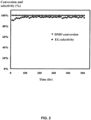
- the monolithic catalyst in this invention runs for 500 hours stably in the hydrogenation of DMO to ethylene glycol, average conversion of DMO reaches 100% and selectivity of EG is higher than 96%, which presents high hydrogenation activity and stability.
- the monolithic catalyst in this invention is more convenient to be packed and replaced.
- the monolithic catalyst in this invention contains no Cr and other toxic element, which is environmentally friendly.
- Part of the catalyst powder was squeezed and sieved to 40-60 meshes. 8.0 g of squeezed catalyst, 8.0 g of catalyst powder, 0.5 g of pseudoboehmite and 50 mL of water was added in the ball mill can to ball mill at 200 rpm for 2 hours to get the catalyst slurry.
- Cordierite carrier ( ⁇ 15 ⁇ 25 mm) of 400 cpsi was impregnated in the slurry for 5 min, then extra slurry on the carrier was blew off and dried at 120°C for 12 hours, the coated cordierite carrier was then weighed. The above operation was repeated until the content of coat reached 20 wt. %.
- the as prepared catalyst was calcined at 450°C for 6 hours to get the monolithic catalyst denoted as Cu/SiO 2 /cordierite.
- Example 1 The monolithic catalyst prepared in Example 1 is placed in the fix-bed reactor and reduced by 20% H 2 /N 2 under the following conditions: hydrogen flow rate 50 mL/min, temperature 250°C for 20 h. After reduction, the system is filled with pure hydrogen and controlled under the following conditions: temperature 250°C and pressure 2.0 MPa. 20 wt. % DMO in methanol is pumped into the system. The LHSV of DMO is controlled at 1.5 -1 and the ratio of H 2 /DMO is 50. C DMO and S EG are calculated from timing analysis results of production components with GC. The result is listed in Table 1. Table 1 Performance of catalysts at different ratios of H 2 /DMO Ratio of H 2 /DMO C DMO /% S EG /% Example 1 50 100 93 Example 2 150 100 96 Example 3 200 100 91
- Example 1 The implementary conditions are the same as Example 1 except that that the ratio of H 2 /DMO is 150. The result is listed in Table 1.
- Example 1 The implementary conditions are the same as Example 1 except that that the ratio of H 2 /DMO is 200. The result is listed in Table 1.
- the above Cu/SiO 2 catalyst powder is extruded to ⁇ 5 ⁇ 4 mm particles.
- 2.00 mL as prepared catalyst is reduced by 20% H 2 /N 2 with hydrogen flow rate of 50 mL/min in the fixed bed reactor at 350°C for 4 hours.
- the system is filled with pure hydrogen and controlled under the following conditions: temperature 200°C and pressure 2.5 MPa.
- 20 wt. % DMO in methanol is pumped into the system.
- the LHSV of DMO is controlled at 0.4h -1 and the ratio of H 2 /DMO is 90.
- C DMO and S EG are calculated from timing analysis results of production components with GC. The result is that C DMO is 98% and S EG is 90%.
- the monolithic catalyst provided by the invention is applied in the synthesis process of EG via hydrogenation of DMO. Compared with supported granular catalyst (Comparative Example 1), the monolithic catalyst shows a better performance in C DMO and S EG . Furthermore, the technology using monolithic catalyst can get a larger production of EG due to that LHSV of DMO and STY of EG are twice the conventional supported catalyst.
Landscapes
- Chemical & Material Sciences (AREA)
- Organic Chemistry (AREA)
- Engineering & Computer Science (AREA)
- Materials Engineering (AREA)
- Chemical Kinetics & Catalysis (AREA)
- Catalysts (AREA)
- Organic Low-Molecular-Weight Compounds And Preparation Thereof (AREA)
Description
- The invention relates to a preparation method of a monolithic structure catalyst for producing ethylene glycol by hydrogenation of dimethyl oxalate, DMO, and the application of the catalyst for producing ethylene glycol by hydrogenation of dimethyl oxalate in a fixed bed reactor.
- Ethylene glycol (EG) is an important basic organic material. It was first made by Wurtz in 1859 through hydrogenation of ethylene acetate catalyzed by potassium hydroxide. During the World War I, ethylene nitrate was used as substitute of glycerin to produce explosive because it could lower the freezing point of glycerin. Soon afterward, several feasible processes were developed. Hydrogenation of dichloromethane was used in Germany; chlorohydrin was used as raw stuff in America for the rapid growth of application of antifreeze with the development of automobile industry in the 1920s; ethylene and ethylene oxide was introduced as material which accelerated the process since polyester was developed and this process is widely used around the world mainly in Shell, UCC and Halcon-SD at present. The production capacity of these three companies takes up 90% of the world, followed by Japan catalytic Chemical Company, the Dow Chemical company, Mitsui East Asia Company and ICI Company.
- The process of ethylene oxide hydration has several defects, such as longer process, high mole ratio of water and ethylene oxide, large energy consumption and low selectivity of EG. With the exhausting of oil around the world, experts are paying close attention to the processes without oil especially to the ones that using cheap resource as raw stuff. The process using syngas as material is mainly divided into two categories: direct synthesis and indirect synthesis. The promising method mainly contains formaldehyde dimerization, formaldehyde electrochemical hydrogenation dimer method, formaldehyde hydrogen formylation, glycolic acid method, formaldehyde condensation method, oxalate method and etc. The process of oxalate hydrogenation has several advantages such as mild reaction condition and high selectivity which is the most promising process to realize industrialization.
- The process includes two key technologies: oxalate synthesis and hydrogenation of oxalate. For the oxalate production technology, the oxalate is generated though a circulate catalytic process composed of coupling and regeneration with the attending of nitrite and CO, produced from coal gasification and the following separation process of pressure swing adsorption (PSA). DMO production process is a cycle system which has a mild reaction condition, good stability, high selectivity and low pollution. For the ethylene glycol production process: the produced oxalate is catalysis hydrogenation to ethylene glycol with hydrogen produced via PSA process. This process is a complex reaction system, mainly including the following reactions:
ROOCCOOR + 2H2 → ROOCCH2OH + ROH
ROOCCH2OH + 2H2→ HOCH2CH2OH + ROH
HOCH2CH2OH + H2→ C2H5OH + H2O
- The process that on studying mainly use noble mental such as ruthenium as catalyst in liquid phase and copper as catalyst in gaseous phase. Because of the high pressure and the difficulty of the catalyst separation from liquid phase, people are concentration on hydrogenation in gaseous phase on copper catalyst. ARCO Company of America [
US 4112245 ] uses CuCr as catalyst which runs for 460 h and the conversion of diethyl oxalate reached 100%, selectivity of ethylene glycol excesses 95%. But because of Cr has great harm on human body and environmental impact, research of Cr-free catalyst gradually become the trend of catalyst for hydrogenation of oxalic ester. Ube prepared CuMOkBapOx catalyst using mixed ball milling process in 1985 and was recorded in the United States Patent [US 4551565 ]. Conversion of diethyl oxalate was 100% and yield of ethylene glycol reached as high as 97.7% on this catalyst. Ube reported a Cu/SiO2 catalyst in patent [US 4585890 ] in 1986. With silica sol and copper ammonia solution as precursors and heated in the mixing state after mixing evenly to remove most of the water, resulted in the precipitation of copper and silicon oxide. After washing, drying and calcination, we prepared the catalyst. Conversion of diethyl oxalate was 100% and selectivity of ethylene glycol was 97.2% on the catalyst under reaction conditions of pressure 3 MPa, temperature 215°C, hydrogen ester ratio 30. American UCC [US 4677234 ,US 4628128 ,US 4649226 ] has done a lot of research n capper-based chromium-free catalysts. They inspected different supporters (Al2O3, SiO2, La2O5 etc), additives (Ag, Mo, Ba etc.) and preparation methods on the effect of catalytic reactivity and selectivity. Yield of ethylene glycol was up to 95% and time on stream was 466 h on the catalyst. UCC [US 4628128 ] regarded the annular catalyst with a central hole as the ideal catalyst for oxalic ester hydrogenation to ethylene glycol. The special structure had better diffusion characteristics which can reduce local overheat. Fudan University reported mesoporous zeolite supported copper catalysts modified with additives such as magnesium, manganese, chromium, or aluminum in patent [CN 101455976 ]. Conversion of oxalic ester reached 100% and selectivity of ethylene glycol achieved 96% on the catalyst under reaction conditions of temperature 210°C, pressure 3 MPa, hydrogen ester ratio 180, space velocity 0.5 h-1. Dan Jin coal reported alumina supported copper catalyst modified with additives such as zinc, manganese, magnesium and chromium in patent [101524646 CN101879448 A discloses a monolithic structure catalyst and a method for producing ethylene glycol using said catalyst. - Researchers have achieved particular progress on catalyst used for hydrogenation of oxalic ester to ethylene glycol, but some problems still exist in further engineering scale up. Larger ratio of height to diameter of the catalyst bed will benefit the uniform distribution and easy control of the bed temperature, since the hydrogenation of oxalic ester to ethylene glycol is a temperature sensitive reaction. However, the increase in the height to diameter ratio will result in the increase of bed resistance. Additionally, the increase in particle size of the catalyst will easily cause local-pot overheat and enhanced side reactions. These factors severely restrict the industrialization process of hydrogenation of oxalic ester to ethylene glycol technology.
- An object of the present invention is to provide monolithic structure catalyst for producing ethylene glycol by hydrogenation of dimethyl oxalate. Active components of copper dispersed uniformly in the catalyst coating and the coating with thin layer form is evenly attached to the pore surface of cordierite honeycomb with monolithic structure. It effectively reduces the resistance of internal diffusion and improves the activity and selectivity in the hydrogenation of oxalic ester to ethylene glycol.
- An additional object of the invention is to provide a method for preparing a monolithic structure catalyst for producing ethylene glycol by hydrogenation of dimethyl oxalate. The method comprises following steps: first copper based catalyst powder is prepared by precipitation method, from which a catalyst slurry is further acquired, and then coated the catalyst slurry directly on the surface of the cordierite honeycomb support to form the copper supported monolithic structure catalyst. The method ensures high dispersion of active component copper in the catalyst coating and enhances catalytic activity and thermal stability.
- Another object of the invention is to provide a method for producing ethylene glycol by hydrogenation of dimethyl oxalate using a monolithic structure catalyst. The monolithic catalyst is used for hydrogenation of oxalic ester to ethylene glycol instead of particle catalyst, as it can reduce the cost by greatly reducing the pressure drop of the catalyst bed and decreasing the depletion of the catalyst, resulting from the abrasion during packing and reaction process. The provided monolithic catalyst has high catalytic activity, low resistance, convenient and quick replacement, which will benefit the realization of large-scale engineering amplification.
- The invention provides a monolithic structure catalyst for producing ethylene glycol by hydrogenation of dimethyl oxalate, the catalyst denoted as Cu/SiO2/cordierite, comprising a carrier, an additive, and an active component, the carrier being cordierite honeycomb of 400 cells per square inch (cpsi) and having particle size φ 15 × 25mm, the additive being silicate , the active component being copper, and the copper and silicate being coated on the cordierite to form a coating layer, wherein
- The silicate accounts for 5-90 wt. % of the cordierite , the copper accounts for 1-40 wt. % of the cordierite , and the copper accounts for 5-50 wt. % of the coating layer.
- The catalyst is prepared according to the following steps:
- a) dissolving 15.5g of a soluble copper precursor Cu (NO3)2·5H2O with 150 mL water to yield 0.37 M solution A ;
- b) employing 25 wt.% ammonia aqueous solution as a precipitant and mixing with the solution A, the copper ammonia complex;
- c) adding silicate precursor, 45 mL of 30 wt. % silica sol, into the solution A, stirring for 4 hours, heating to 95°C for precipitating the copper and additive, stopping heating when a pH of the solution is less than 7, filtering, washing with deionized water for 3 times, drying at 120°C for 12 hours, and calcinating a resulting precipitate at 450°C for 4 hours to obtain a catalyst powder B;
- d) squeezing, granulating, and sieving part of the catalyst powder B to form a granular catalyst C having 40-60 meshes, mechanically mixing another part of catalyst powder B in quantity of 8.0g, 8.0g of the squeezed granular catalyst C, 0.5g of pseudoboehmite , and 50mL of water to form a catalyst slurry D , mixing time being 2 hours, rotating speed being 200 rpm to get the catalyst slurry D;
- e) impregnating cordierite honeycomb of 400 cpsi, having particle size φ 15 × 25mm, in the catalyst slurry D for 5 min, blowing off the extra slurry from the carrier and then coating the catalyst slurry D onto the cordierite honeycomb using a dip coating method, drying at 120°C for 12 hours, and calcinating at 450°C for 6 hours to form a monolithic catalyst E.
- The prepared monolithic catalyst Cu/SiO2/cordierite is placed in a fix-bed reactor and reduced by 20% H2/N2 under the following conditions: hydrogen flow rate 50 mL/min, temperature 250°C for 20 h; after reduction, the system is filled with pure hydrogen and controlled under the following conditions: temperature 250°C and pressure 2.0 MPa, 20 wt. % DMO in methanol is pumped into the system; the LHSV of DMO is controlled at 1.5-1 and the molar ratio of H2/DMO is 150.
- This invention further provides a method for preparing a monolithic structure catalyst denoted as Cu/SiO2/cordierite for producing ethylene glycol by hydrogenation of dimethyl oxalate, the method comprising the steps of:
- a) dissolving 15.5 g of a soluble copper precursor Cu (NO3)2·5H2O with 150 mL water to yield a 0.37 M solution A;
- b) employing 25 wt.% ammonia aqueous solution as a precipitant and mixing with the solution A ;
- c) adding silicate precursor, 45 mL of 30 wt. % silica sol, into the solution A, the copper ammonia complex , stirring for 4 hours, heating to 95 °C for precipitating the copper and silicate , stopping heating when a pH of the solution is less than 7, filtering, washing with deionized water for 3 times, drying at 120°C for 12 hours, and calcinating a resulting precipitate at 450°C for 4 hours to obtain a catalyst powder B;
- d) squeezing, granulating, and sieving part of the catalyst powder B to form a granular catalyst C having 40-60 meshes, mechanically mixing another part of catalyst powder B in quantity of 8.0g, 8.0g of the squeezed granular catalyst C, 0.5g of pseudoboehmite , and 50mL of water to form a catalyst slurry D, mixing time being 2 hours, rotating speed is 200 rpm;
- e) impregnating cordierite honeycomb of 400 cpsi, having particle size φ 15 × 25mm, in the catalyst slurry D for 5 min, blowing off the extra slurry from the carrier and then coating the catalyst slurry D onto the cordierite honeycomb using a dip coating method, drying at 120 °C for 12 hours, and calcinating at 450°C for 6 hours to form a monolithic catalyst E denoted as Cu/SiO2/cordierite.
- This invention provides a method for producing ethylene glycol by hydrogenation of an oxalate using a monolithic structure catalyst, which comprises:
putting the monolithic structured catalyst of type Cu/SiO2/cordierite into a fixed bed reactor, performing a reduction reaction in the presence of 20% H2/N2 at 250°C for 20 hours with hydrogen flow rate 50mL/min, after reduction introducing pure hydrogen into the reactor, maintaining a reaction temperature at 250 °C and a reaction pressure at 2.0 MPa, vaporizing methanol solution comprising 20 wt. % DMO in an evaporator, preheating, and introducing 20 wt.% DMO into the reactor, the liquid hourly space velocity (LHSV) of DMO being 1.5 g. mL-1.h-1, and a molar ratio of H2 /ester 150. - Compared with the well known conventional technology, advantages of the invention are summarized below:
The copper based monolithic catalyst in this invention is used in the hydrogenation of dimethyl oxalate to ethylene glycol for the first time, which provides a new approach for the preparation of the catalyst used for the hydrogenation of dimethyl oxalate to ethylene glycol. - Compared with granular catalysts, the monolithic catalyst in this invention shortens the internal diffusion path, improves the gas-solid mass transfer efficiency, and increases the effective contact area between reactant and catalyst. As a result, the catalyst increases the reactivity and selectivity of EG.
- In the monolithic catalyst provided by this invention, the active component copper is dispersed uniformly in the coating layer supported on the honeycomb carrier. Thus, the catalyst has higher thermal stability.
- The monolithic catalyst in this invention has lower bed resistant than granular catalyst, so it can work at the conditions of larger height-diameter ratio and high hydrogen-ester ratio. As a result, the catalytic performance and temperature distribution are improved, and the hot-spot temperature is decreased effectively.
- Compared with granular catalyst, the monolithic catalyst in this invention has high conversion of DMO and selectivity of EG in the hydrogenation of DMO to ethylene glycol, and it doubles the LHSV which presents higher production capacity.
- The monolithic catalyst in this invention runs for 500 hours stably in the hydrogenation of DMO to ethylene glycol, average conversion of DMO reaches 100% and selectivity of EG is higher than 96%, which presents high hydrogenation activity and stability.
- Compared with granular catalysts, the monolithic catalyst in this invention is more convenient to be packed and replaced.
- The monolithic catalyst in this invention contains no Cr and other toxic element, which is environmentally friendly.
-
FIG. 1 shows an SEM image of a radial section of a monolithic catalyst; and -
FIG. 2 shows stable data of a monolithic structure catalyst for producing ethylene glycol by hydrogenation of an oxalate. - For further illustrating the invention, experiments detailing a monolithic catalyst, a method for preparing and applying the same are described below. It should be noted that the following examples are intended to describe and not to limit the invention.
- 15.5 g of Cu(NO3)2·5H2O was dissolved in 150 mL water. 52 mL of 25 wt. % ammonia aqueous solution was added. Then 45 mL of 30 wt. % silica sol was added to the copper ammonia complex solution and aged by stirring for another 4 hours. The temperature was raised to 95°C to allow for the precipitation of copper and silicate. The filtrate was washed with deionized water for 3 times, dried at 120°C for 12 hours and calcined at 450°C for 4 hours to form catalyst powder with Cu content of 20 wt. %.
- Part of the catalyst powder was squeezed and sieved to 40-60 meshes. 8.0 g of squeezed catalyst, 8.0 g of catalyst powder, 0.5 g of pseudoboehmite and 50 mL of water was added in the ball mill can to ball mill at 200 rpm for 2 hours to get the catalyst slurry.
- Cordierite carrier (Φ15 × 25 mm) of 400 cpsi was impregnated in the slurry for 5 min, then extra slurry on the carrier was blew off and dried at 120°C for 12 hours, the coated cordierite carrier was then weighed. The above operation was repeated until the content of coat reached 20 wt. %. The as prepared catalyst was calcined at 450°C for 6 hours to get the monolithic catalyst denoted as Cu/SiO2/cordierite.
- The monolithic catalyst prepared in Example 1 is placed in the fix-bed reactor and reduced by 20% H2/N2 under the following conditions: hydrogen flow rate 50 mL/min, temperature 250°C for 20 h. After reduction, the system is filled with pure hydrogen and controlled under the following conditions: temperature 250°C and pressure 2.0 MPa. 20 wt. % DMO in methanol is pumped into the system. The LHSV of DMO is controlled at 1.5-1 and the ratio of H2/DMO is 50. CDMO and SEG are calculated from timing analysis results of production components with GC. The result is listed in Table 1.
Table 1 Performance of catalysts at different ratios of H2/DMO Ratio of H2/DMO CDMO /% SEG /% Example 1 50 100 93 Example 2 150 100 96 Example 3 200 100 91 - The implementary conditions are the same as Example 1 except that that the ratio of H2/DMO is 150. The result is listed in Table 1.
- The implementary conditions are the same as Example 1 except that that the ratio of H2/DMO is 200. The result is listed in Table 1.
- 15.5 g of Cu(NO3)2 ·5H2O was dissolved in 150 mL water. 52 mL of 25 wt. % ammonia aqueous solution was added. Then 45 mL of 30 wt. % silica sol was added to the copper ammonia complex solution and aged by stirring for another 4 hours. The temperature was raised to 95°C to allow for the precipitation of copper and silica. The filtrate was washed with deionized water for 3 times, dried at 120°C for 12 hours and calcined at 450°C for 4 hours to form catalyst powder with Cu content of 20 wt. %.
- The above Cu/SiO2 catalyst powder is extruded to Φ5 × 4 mm particles. 2.00 mL as prepared catalyst is reduced by 20% H2/N2 with hydrogen flow rate of 50 mL/min in the fixed bed reactor at 350°C for 4 hours. After reduction, the system is filled with pure hydrogen and controlled under the following conditions:
temperature 200°C and pressure 2.5 MPa. 20 wt. % DMO in methanol is pumped into the system. The LHSV of DMO is controlled at 0.4h-1 and the ratio of H2/DMO is 90. CDMO and SEG are calculated from timing analysis results of production components with GC. The result is that CDMO is 98% and SEG is 90%. - The monolithic catalyst provided by the invention is applied in the synthesis process of EG via hydrogenation of DMO. Compared with supported granular catalyst (Comparative Example 1), the monolithic catalyst shows a better performance in CDMO and SEG. Furthermore, the technology using monolithic catalyst can get a larger production of EG due to that LHSV of DMO and STY of EG are twice the conventional supported catalyst.
Claims (2)
- A method for preparing a monolithic structure catalyst for producing ethylene glycol by hydrogenation of dimethyl oxalate, comprising the steps of:a) dissolving 15.5g of the soluble copper precursor Cu (NO3)2·5H2O with 150 mL water to yield 0.37 M solution A;b) employing 25 wt.% ammonia aqueous solution as the precipitant and mixing with the solution A which is the copper ammonia complex;c) adding the silicate precursor, 45 mL of 30 wt. % silica sol, into the solution A, the copper ammonia complex, stirring for 4 hours, heating to 95°C for precipitating the copper and silicate, stopping heating when a pH of the solution is less than 7, filtering, washing with deionized water for 3 times, drying at 120°C for 12 hours, and calcinating a resulting precipitate at 450°C for 4 hours to obtain the catalyst powder B;d) squeezing, granulating and sieving part of the catalyst powder B to form the granular catalyst C having 40-60 meshes, mechanically mixing another part of catalyst powder B in quantity of 8.0g, 8.0g of the squeezed granular catalyst C, 0.5g of pseudoboehmite, and 50mL of water to form the catalyst slurry D, mixing time being 2 hours, rotating speed is 200 rpm;e) impregnating cordierite honeycomb of 400 cpsi, having particle size φ 15 × 25mm, in the catalyst slurry D for 5 min, blowing off the extra slurry from the carrier and then coating the catalyst slurry D onto the cordierite honeycomb using a dip coating method, drying at 120°C for 12 hours, and calcinating at 450°C for 6 hours to form the monolithic catalyst E denoted as Cu/SiO2/cordierite.
- A method for producing ethylene glycol by hydrogenation of dimethyl oxalate, DMO, using the monolithic structure catalyst prepared by the method of claim 1, the method comprising the steps of:
putting monolithic structure catalyst of type Cu/SiO2/cordierite into a fixed bed reactor, performing a reduction reaction in the presence of 20% H2/N2 at 250° C for 20 hours with hydrogen flow rate 50mL/min, after reduction introducing pure hydrogen into the reactor, maintaining a reaction temperature at 250°C, and a reaction pressure at 2.0 MPa, vaporizing methanol solution comprising 20 wt. % DMO in an evaporator, preheating, and introducing 20 wt.% DMO into the reactor, the liquid hourly space velocity (LHSV) of DMO being 1.5 g.mL-1.h-1, and a molar ratio of H2/ester being 150.
Applications Claiming Priority (2)
| Application Number | Priority Date | Filing Date | Title |
|---|---|---|---|
| CN2010102076948A CN101879448B (en) | 2010-06-24 | 2010-06-24 | Regular structure catalyst for hydrogenation of oxalate to ethylene glycol and preparation method thereof |
| PCT/CN2011/076038 WO2011160577A1 (en) | 2010-06-24 | 2011-06-21 | Catalyst having monolithic structure for manufacturing ethylene glycol by oxalate hydrogenation, preparation method and application thereof |
Publications (3)
| Publication Number | Publication Date |
|---|---|
| EP2586528A1 EP2586528A1 (en) | 2013-05-01 |
| EP2586528A4 EP2586528A4 (en) | 2015-12-30 |
| EP2586528B1 true EP2586528B1 (en) | 2024-09-25 |
Family
ID=43051659
Family Applications (1)
| Application Number | Title | Priority Date | Filing Date |
|---|---|---|---|
| EP11797608.4A Active EP2586528B1 (en) | 2010-06-24 | 2011-06-21 | Catalyst having monolithic structure for manufacturing ethylene glycol by oxalate hydrogenation, preparation method and application thereof |
Country Status (4)
| Country | Link |
|---|---|
| US (1) | US20130123550A1 (en) |
| EP (1) | EP2586528B1 (en) |
| CN (1) | CN101879448B (en) |
| WO (1) | WO2011160577A1 (en) |
Families Citing this family (46)
| Publication number | Priority date | Publication date | Assignee | Title |
|---|---|---|---|---|
| CA2749136A1 (en) | 2009-01-29 | 2010-08-05 | Princeton University | Conversion of carbon dioxide to organic products |
| US8500987B2 (en) | 2010-03-19 | 2013-08-06 | Liquid Light, Inc. | Purification of carbon dioxide from a mixture of gases |
| US8721866B2 (en) | 2010-03-19 | 2014-05-13 | Liquid Light, Inc. | Electrochemical production of synthesis gas from carbon dioxide |
| US8845877B2 (en) | 2010-03-19 | 2014-09-30 | Liquid Light, Inc. | Heterocycle catalyzed electrochemical process |
| CN101879448B (en) * | 2010-06-24 | 2012-05-23 | 天津大学 | Regular structure catalyst for hydrogenation of oxalate to ethylene glycol and preparation method thereof |
| US8845878B2 (en) | 2010-07-29 | 2014-09-30 | Liquid Light, Inc. | Reducing carbon dioxide to products |
| US8961774B2 (en) | 2010-11-30 | 2015-02-24 | Liquid Light, Inc. | Electrochemical production of butanol from carbon dioxide and water |
| US8568581B2 (en) | 2010-11-30 | 2013-10-29 | Liquid Light, Inc. | Heterocycle catalyzed carbonylation and hydroformylation with carbon dioxide |
| US9090976B2 (en) | 2010-12-30 | 2015-07-28 | The Trustees Of Princeton University | Advanced aromatic amine heterocyclic catalysts for carbon dioxide reduction |
| CN102649075B (en) * | 2011-02-25 | 2015-01-07 | 中国石油化工股份有限公司 | Method for producing ethylene glycol by oxalate through fluidized bed catalytic reaction |
| WO2012113267A1 (en) * | 2011-02-25 | 2012-08-30 | 中国石油化工股份有限公司 | Method for producing ethylene glycol through fluidized bed catalytic reaction of oxalate |
| CN102649076B (en) * | 2011-02-25 | 2014-03-05 | 中国石油化工股份有限公司 | Fluidized bed catalyst for catalytic hydrogenation of oxalate to ethylene glycol |
| CN102649064B (en) * | 2011-02-25 | 2014-05-28 | 中国石油化工股份有限公司 | Method for generating ethylene glycol through fluidized-bed reaction of oxalate |
| CN102649073A (en) * | 2011-02-25 | 2012-08-29 | 中国石油化工股份有限公司 | Preparation method of fluid catalyst for production of ethanediol by oxalate through hydrogenation |
| CN102649071B (en) * | 2011-02-25 | 2014-05-28 | 中国石油化工股份有限公司 | Fluidized bed catalyst used in catalytic reaction of oxalate into ethylene glycol |
| CN102350358B (en) * | 2011-08-10 | 2013-08-21 | 天津大学 | Preparation method and application of catalyst for preparing ethanol by oxalate hydrogenation |
| GB201205764D0 (en) * | 2012-03-30 | 2012-05-16 | Johnson Matthey Plc | Catalyst and method of manufacture |
| US10329676B2 (en) | 2012-07-26 | 2019-06-25 | Avantium Knowledge Centre B.V. | Method and system for electrochemical reduction of carbon dioxide employing a gas diffusion electrode |
| US20130105304A1 (en) | 2012-07-26 | 2013-05-02 | Liquid Light, Inc. | System and High Surface Area Electrodes for the Electrochemical Reduction of Carbon Dioxide |
| US9303324B2 (en) | 2012-07-26 | 2016-04-05 | Liquid Light, Inc. | Electrochemical co-production of chemicals with sulfur-based reactant feeds to anode |
| US8641885B2 (en) | 2012-07-26 | 2014-02-04 | Liquid Light, Inc. | Multiphase electrochemical reduction of CO2 |
| US9175407B2 (en) | 2012-07-26 | 2015-11-03 | Liquid Light, Inc. | Integrated process for producing carboxylic acids from carbon dioxide |
| CA2895253C (en) * | 2012-12-21 | 2022-03-01 | Liquid Light, Inc. | Method and system for production of oxalic acid and oxalic acid reduction products |
| CN104028280B (en) * | 2014-06-20 | 2016-05-25 | 北京神雾环境能源科技集团股份有限公司 | Be used for metal base monolithic catalyst of methane preparing synthetic gas and preparation method thereof |
| CN105363459B (en) * | 2014-08-27 | 2018-10-23 | 中国石油化工股份有限公司 | Ester through hydrogenation copper catalyst |
| CN104857962B (en) * | 2015-05-19 | 2017-07-21 | 吉林市道特化工科技有限责任公司 | A kind of catalyst of aldehydes or ketones hydrogenation production alcohol |
| CN105126845B (en) * | 2015-08-28 | 2017-08-25 | 天津大学 | Catalyst and preparation method for preparing ethanol by oxalate hydrogenation |
| CN105688910B (en) * | 2016-03-18 | 2017-11-07 | 厦门大学 | Preparation method for the copper Si catalyst of preparing ethylene glycol by using dimethyl oxalate plus hydrogen |
| CN109092310B (en) * | 2017-06-20 | 2023-03-10 | 高化学株式会社 | Copper-based catalyst, preparation method thereof and method for preparing etherification-grade ethylene glycol by using copper-based catalyst |
| US10894756B2 (en) * | 2017-07-13 | 2021-01-19 | Tianjin University | Method for catalytically hydrogenating oxalates |
| CN107626320A (en) * | 2017-09-30 | 2018-01-26 | 内蒙古科技大学 | Oxalic ester hydrogenation synthesizing of ethylene glycol catalyst and preparation method and application |
| CN112512993A (en) * | 2018-08-10 | 2021-03-16 | 日本碍子株式会社 | Honeycomb structure, exhaust gas purifying apparatus, exhaust system, and method for manufacturing honeycomb structure |
| AU2018447034B2 (en) * | 2018-10-22 | 2023-07-27 | Pujing Chemical Industry Co., Ltd | Ultra high selective hydrogenation catalyst and preparation thereof |
| CN111346655B (en) * | 2018-12-20 | 2022-11-15 | 中国石油化工股份有限公司 | Regular structure catalyst, preparation method and application thereof, and treatment method of incomplete regenerated flue gas |
| CN111686742A (en) * | 2019-03-14 | 2020-09-22 | 上海诺哈尔化工技术有限公司 | Copper-based catalyst and preparation method thereof |
| CN112742410B (en) * | 2019-10-31 | 2022-08-12 | 中国石油化工股份有限公司 | Composite carrier inorganic membrane catalyst and preparation method and application thereof |
| CN111135835B (en) * | 2019-12-17 | 2023-04-07 | 安徽元琛环保科技股份有限公司 | Carbon monoxide catalytic oxidation catalyst and preparation method and application thereof |
| CN113430559B (en) * | 2021-06-15 | 2022-09-09 | 华东理工大学 | Application of a copper-based catalyst in electrocatalytic hydrogenation |
| CN113430545B (en) * | 2021-06-15 | 2022-09-06 | 华东理工大学 | Copper-based catalyst and preparation method and application thereof |
| CN115608377B (en) * | 2022-10-25 | 2024-07-12 | 中国石油大学(华东) | Preparation method and application of monolithic CO selective oxidation catalyst |
| CN116328776B (en) * | 2023-01-06 | 2024-03-19 | 武汉科林化工集团有限公司 | Catalyst for preparing ethanol by methyl acetate hydrogenation |
| CN117225412B (en) * | 2023-09-08 | 2026-03-24 | 江苏金聚合金材料有限公司 | An extruded ester hydrogenation catalyst |
| CN117720954B (en) * | 2024-01-25 | 2024-05-28 | 青岛康洁聚能科技有限公司 | Non-noble metal carbon monoxide combustion improver and preparation method thereof |
| CN118179506A (en) * | 2024-04-15 | 2024-06-14 | 西安凯立新材料股份有限公司 | A method for preparing a monolithic copper/silicon oxide catalyst |
| CN118217990B (en) * | 2024-04-18 | 2025-07-11 | 浙江大学 | Reverse phase catalyst rich in surface oxygen vacancy defects and preparation method and application thereof |
| CN121819865A (en) * | 2026-03-12 | 2026-04-10 | 中溶科技股份有限公司 | Catalyst and application thereof in preparation of ethanol by ester hydrogenation |
Citations (2)
| Publication number | Priority date | Publication date | Assignee | Title |
|---|---|---|---|---|
| CN101318138A (en) * | 2008-07-07 | 2008-12-10 | 浙江师范大学 | A kind of bifunctional catalyst with ceramic honeycomb as carrier and preparation method thereof |
| CN101445426A (en) * | 2008-12-19 | 2009-06-03 | 上海工程技术大学 | Method for preparing ethylene glycol by using dimethyl oxalate plus hydrogen |
Family Cites Families (16)
| Publication number | Priority date | Publication date | Assignee | Title |
|---|---|---|---|---|
| JPS5338714B2 (en) * | 1971-10-04 | 1978-10-17 | ||
| US4112245A (en) | 1976-08-18 | 1978-09-05 | Atlantic Richfield Company | Process for the preparation of ethylene glycol |
| JPS57122940A (en) | 1981-01-26 | 1982-07-31 | Ube Ind Ltd | Hydrogenation catalyst of oxalic diester |
| JPS6045938B2 (en) | 1981-04-30 | 1985-10-12 | 宇部興産株式会社 | Method for producing oxalic acid diester hydrogenation catalyst |
| US4628128A (en) | 1985-02-04 | 1986-12-09 | Union Carbide Corporation | Process for the preparation of ethylene glycol by catalytic hydrogenation |
| US4677234A (en) | 1985-02-04 | 1987-06-30 | Union Carbide Corporation | Process for the preparation of ethylene glycol |
| US4649226A (en) | 1986-03-27 | 1987-03-10 | Union Carbide Corporation | Hydrogenation of alkyl oxalates |
| EP0689478B1 (en) * | 1993-03-19 | 1999-06-02 | Implico B.V. | Catalyst for the synthesis of higher alcohols |
| CN100423838C (en) * | 2006-04-18 | 2008-10-08 | 天津大学 | Preparation method of copper-cerium catalyst coated on FeCrAl carrier |
| CN101342489A (en) * | 2007-07-12 | 2009-01-14 | 上海焦化有限公司 | Hydrogenation reaction catalyst, preparation and application thereof |
| CN101138725B (en) * | 2007-10-10 | 2010-08-18 | 天津大学 | Catalyzer for the oxalic ester hydrogenation synthesizing of ethylene glycol and method of preparing the same |
| CN101455976A (en) | 2008-12-16 | 2009-06-17 | 上海焦化有限公司 | Effective catalyst used in hydrogenation of dimethyl oxalate to synthesizing ethylene glycol and production method thereof |
| JP2012517333A (en) * | 2009-02-09 | 2012-08-02 | ビーエーエスエフ ソシエタス・ヨーロピア | Method for improving the catalytic activity of a monolith catalyst |
| CN101524646A (en) | 2009-04-16 | 2009-09-09 | 丹阳市丹化金煤化工有限公司 | Glycol catalyst synthesized by hydrogenating oxalic ester and preparation method and application thereof |
| CN101590407B (en) * | 2009-07-13 | 2011-06-01 | 西南化工研究设计院 | Catalyst for preparing divalent alcohol by hydrogenating dibasic acid ester and preparation method and application thereof |
| CN101879448B (en) * | 2010-06-24 | 2012-05-23 | 天津大学 | Regular structure catalyst for hydrogenation of oxalate to ethylene glycol and preparation method thereof |
-
2010
- 2010-06-24 CN CN2010102076948A patent/CN101879448B/en active Active
-
2011
- 2011-06-21 EP EP11797608.4A patent/EP2586528B1/en active Active
- 2011-06-21 WO PCT/CN2011/076038 patent/WO2011160577A1/en not_active Ceased
-
2012
- 2012-12-21 US US13/723,221 patent/US20130123550A1/en not_active Abandoned
Patent Citations (2)
| Publication number | Priority date | Publication date | Assignee | Title |
|---|---|---|---|---|
| CN101318138A (en) * | 2008-07-07 | 2008-12-10 | 浙江师范大学 | A kind of bifunctional catalyst with ceramic honeycomb as carrier and preparation method thereof |
| CN101445426A (en) * | 2008-12-19 | 2009-06-03 | 上海工程技术大学 | Method for preparing ethylene glycol by using dimethyl oxalate plus hydrogen |
Also Published As
| Publication number | Publication date |
|---|---|
| WO2011160577A1 (en) | 2011-12-29 |
| EP2586528A4 (en) | 2015-12-30 |
| EP2586528A1 (en) | 2013-05-01 |
| US20130123550A1 (en) | 2013-05-16 |
| CN101879448B (en) | 2012-05-23 |
| CN101879448A (en) | 2010-11-10 |
Similar Documents
| Publication | Publication Date | Title |
|---|---|---|
| EP2586528A1 (en) | Catalyst having monolithic structure for manufacturing ethylene glycol by oxalate hydrogenation, preparation method and application thereof | |
| JP5584891B2 (en) | Exothermic catalyst carrier and catalyst produced from the carrier | |
| CN104148065B (en) | Catalyst used for methanation of carbon dioxide, preparation method therefor and applications thereof | |
| CN101851160B (en) | Preparation method of oxalate by CO gas phase coupling synthesis using regular catalyst | |
| CN102513105A (en) | Hydrogen production catalyst | |
| CN111905755B (en) | Catalyst for hydrogenation of 2,2,4, 4-tetramethyl-1, 3-cyclobutanedione and preparation method and application thereof | |
| CN109833897B (en) | A kind of catalyst for producing furfuryl alcohol and method for preparing and producing furfuryl alcohol | |
| CN101491758B (en) | Catalyst for H2 selective oxidation in styrene production | |
| CN101992101A (en) | Precious metal catalyst | |
| CN101269326A (en) | Monolith catalyst for benzene hydrogenation to cyclohexene and preparation method thereof | |
| CN105597772B (en) | Cobalt-base catalyst of nucleocapsid and preparation method thereof | |
| CN114917912B (en) | Catalyst for preparing methanol and co-producing ethylene glycol through ethylene carbonate hydrogenation, preparation method and use method | |
| CN102974342B (en) | Catalyst for preparing cyclohexene from benzene by selective hydrogenation and preparation method thereof | |
| CN100418625C (en) | Catalyst for synthesizing indole and preparation method thereof | |
| CN116747879B (en) | Preparation of active carbon supported solid super acidic catalyst and application of active carbon supported solid super acidic catalyst in hydrogenolysis of aromatic ether C-O bond | |
| WO2011150834A1 (en) | Regular catalyst for synthesizing oxalate by carbon monoxide gaseous-phase coupling, preparation method and use thereof | |
| CN113649049A (en) | Maleic anhydride selective hydrogenation catalyst, and preparation method and application method thereof | |
| CN101306389B (en) | Laminar compound carrier containing spinel | |
| CN102989521B (en) | Zirconium-containing spinel supported honeycomb monolithic catalyst for selective hydrogenation of benzene and preparation method for same | |
| CN111039756B (en) | Methods and systems for preparing 1,3-propanediol | |
| CN1305566C (en) | Integral catalyst for preparation hydrogen by methyl alcohot reformation and its preparation method | |
| CN117326952B (en) | Method for synthesizing aniline | |
| CN107537489B (en) | Porous composite catalyst, preparation method and application thereof | |
| CN105833883A (en) | Previous metal modified catalyst for fischer-tropsch synthesis and preparation method thereof | |
| CN117619388A (en) | A core-shell structure NiFe@C catalyst for hydrogenation of cinnamaldehyde to 3-phenylpropionaldehyde and its preparation method and use |
Legal Events
| Date | Code | Title | Description |
|---|---|---|---|
| PUAI | Public reference made under article 153(3) epc to a published international application that has entered the european phase |
Free format text: ORIGINAL CODE: 0009012 |
|
| 17P | Request for examination filed |
Effective date: 20130124 |
|
| AK | Designated contracting states |
Kind code of ref document: A1 Designated state(s): AL AT BE BG CH CY CZ DE DK EE ES FI FR GB GR HR HU IE IS IT LI LT LU LV MC MK MT NL NO PL PT RO RS SE SI SK SM TR |
|
| DAX | Request for extension of the european patent (deleted) | ||
| RA4 | Supplementary search report drawn up and despatched (corrected) |
Effective date: 20151130 |
|
| RIC1 | Information provided on ipc code assigned before grant |
Ipc: B01J 23/72 20060101AFI20151124BHEP Ipc: B01J 23/889 20060101ALI20151124BHEP Ipc: C07C 29/149 20060101ALI20151124BHEP Ipc: B01J 37/02 20060101ALI20151124BHEP Ipc: B01J 23/83 20060101ALI20151124BHEP Ipc: B01J 23/80 20060101ALI20151124BHEP Ipc: C07C 31/20 20060101ALI20151124BHEP |
|
| STAA | Information on the status of an ep patent application or granted ep patent |
Free format text: STATUS: EXAMINATION IS IN PROGRESS |
|
| 17Q | First examination report despatched |
Effective date: 20180426 |
|
| GRAP | Despatch of communication of intention to grant a patent |
Free format text: ORIGINAL CODE: EPIDOSNIGR1 |
|
| STAA | Information on the status of an ep patent application or granted ep patent |
Free format text: STATUS: GRANT OF PATENT IS INTENDED |
|
| INTG | Intention to grant announced |
Effective date: 20240425 |
|
| GRAS | Grant fee paid |
Free format text: ORIGINAL CODE: EPIDOSNIGR3 |
|
| GRAA | (expected) grant |
Free format text: ORIGINAL CODE: 0009210 |
|
| STAA | Information on the status of an ep patent application or granted ep patent |
Free format text: STATUS: THE PATENT HAS BEEN GRANTED |
|
| AK | Designated contracting states |
Kind code of ref document: B1 Designated state(s): AL AT BE BG CH CY CZ DE DK EE ES FI FR GB GR HR HU IE IS IT LI LT LU LV MC MK MT NL NO PL PT RO RS SE SI SK SM TR |
|
| REG | Reference to a national code |
Ref country code: GB Ref legal event code: FG4D |
|
| REG | Reference to a national code |
Ref country code: CH Ref legal event code: EP |
|
| REG | Reference to a national code |
Ref country code: DE Ref legal event code: R096 Ref document number: 602011075003 Country of ref document: DE |
|
| REG | Reference to a national code |
Ref country code: IE Ref legal event code: FG4D |
|
| REG | Reference to a national code |
Ref country code: LT Ref legal event code: MG9D |
|
| PG25 | Lapsed in a contracting state [announced via postgrant information from national office to epo] |
Ref country code: NO Free format text: LAPSE BECAUSE OF FAILURE TO SUBMIT A TRANSLATION OF THE DESCRIPTION OR TO PAY THE FEE WITHIN THE PRESCRIBED TIME-LIMIT Effective date: 20241225 |
|
| PG25 | Lapsed in a contracting state [announced via postgrant information from national office to epo] |
Ref country code: GR Free format text: LAPSE BECAUSE OF FAILURE TO SUBMIT A TRANSLATION OF THE DESCRIPTION OR TO PAY THE FEE WITHIN THE PRESCRIBED TIME-LIMIT Effective date: 20241226 Ref country code: FI Free format text: LAPSE BECAUSE OF FAILURE TO SUBMIT A TRANSLATION OF THE DESCRIPTION OR TO PAY THE FEE WITHIN THE PRESCRIBED TIME-LIMIT Effective date: 20240925 |
|
| PG25 | Lapsed in a contracting state [announced via postgrant information from national office to epo] |
Ref country code: BG Free format text: LAPSE BECAUSE OF FAILURE TO SUBMIT A TRANSLATION OF THE DESCRIPTION OR TO PAY THE FEE WITHIN THE PRESCRIBED TIME-LIMIT Effective date: 20240925 |
|
| PG25 | Lapsed in a contracting state [announced via postgrant information from national office to epo] |
Ref country code: LV Free format text: LAPSE BECAUSE OF FAILURE TO SUBMIT A TRANSLATION OF THE DESCRIPTION OR TO PAY THE FEE WITHIN THE PRESCRIBED TIME-LIMIT Effective date: 20240925 |
|
| PG25 | Lapsed in a contracting state [announced via postgrant information from national office to epo] |
Ref country code: RS Free format text: LAPSE BECAUSE OF FAILURE TO SUBMIT A TRANSLATION OF THE DESCRIPTION OR TO PAY THE FEE WITHIN THE PRESCRIBED TIME-LIMIT Effective date: 20241225 |
|
| REG | Reference to a national code |
Ref country code: NL Ref legal event code: MP Effective date: 20240925 |
|
| PG25 | Lapsed in a contracting state [announced via postgrant information from national office to epo] |
Ref country code: RS Free format text: LAPSE BECAUSE OF FAILURE TO SUBMIT A TRANSLATION OF THE DESCRIPTION OR TO PAY THE FEE WITHIN THE PRESCRIBED TIME-LIMIT Effective date: 20241225 Ref country code: NO Free format text: LAPSE BECAUSE OF FAILURE TO SUBMIT A TRANSLATION OF THE DESCRIPTION OR TO PAY THE FEE WITHIN THE PRESCRIBED TIME-LIMIT Effective date: 20241225 Ref country code: LV Free format text: LAPSE BECAUSE OF FAILURE TO SUBMIT A TRANSLATION OF THE DESCRIPTION OR TO PAY THE FEE WITHIN THE PRESCRIBED TIME-LIMIT Effective date: 20240925 Ref country code: GR Free format text: LAPSE BECAUSE OF FAILURE TO SUBMIT A TRANSLATION OF THE DESCRIPTION OR TO PAY THE FEE WITHIN THE PRESCRIBED TIME-LIMIT Effective date: 20241226 Ref country code: FI Free format text: LAPSE BECAUSE OF FAILURE TO SUBMIT A TRANSLATION OF THE DESCRIPTION OR TO PAY THE FEE WITHIN THE PRESCRIBED TIME-LIMIT Effective date: 20240925 Ref country code: BG Free format text: LAPSE BECAUSE OF FAILURE TO SUBMIT A TRANSLATION OF THE DESCRIPTION OR TO PAY THE FEE WITHIN THE PRESCRIBED TIME-LIMIT Effective date: 20240925 |
|
| REG | Reference to a national code |
Ref country code: AT Ref legal event code: MK05 Ref document number: 1726223 Country of ref document: AT Kind code of ref document: T Effective date: 20240925 |
|
| PG25 | Lapsed in a contracting state [announced via postgrant information from national office to epo] |
Ref country code: NL Free format text: LAPSE BECAUSE OF FAILURE TO SUBMIT A TRANSLATION OF THE DESCRIPTION OR TO PAY THE FEE WITHIN THE PRESCRIBED TIME-LIMIT Effective date: 20240925 |
|
| PG25 | Lapsed in a contracting state [announced via postgrant information from national office to epo] |
Ref country code: IS Free format text: LAPSE BECAUSE OF FAILURE TO SUBMIT A TRANSLATION OF THE DESCRIPTION OR TO PAY THE FEE WITHIN THE PRESCRIBED TIME-LIMIT Effective date: 20250125 Ref country code: PT Free format text: LAPSE BECAUSE OF FAILURE TO SUBMIT A TRANSLATION OF THE DESCRIPTION OR TO PAY THE FEE WITHIN THE PRESCRIBED TIME-LIMIT Effective date: 20250127 |
|
| PG25 | Lapsed in a contracting state [announced via postgrant information from national office to epo] |
Ref country code: RO Free format text: LAPSE BECAUSE OF FAILURE TO SUBMIT A TRANSLATION OF THE DESCRIPTION OR TO PAY THE FEE WITHIN THE PRESCRIBED TIME-LIMIT Effective date: 20240925 Ref country code: SM Free format text: LAPSE BECAUSE OF FAILURE TO SUBMIT A TRANSLATION OF THE DESCRIPTION OR TO PAY THE FEE WITHIN THE PRESCRIBED TIME-LIMIT Effective date: 20240925 |
|
| PG25 | Lapsed in a contracting state [announced via postgrant information from national office to epo] |
Ref country code: ES Free format text: LAPSE BECAUSE OF FAILURE TO SUBMIT A TRANSLATION OF THE DESCRIPTION OR TO PAY THE FEE WITHIN THE PRESCRIBED TIME-LIMIT Effective date: 20240925 |
|
| PG25 | Lapsed in a contracting state [announced via postgrant information from national office to epo] |
Ref country code: EE Free format text: LAPSE BECAUSE OF FAILURE TO SUBMIT A TRANSLATION OF THE DESCRIPTION OR TO PAY THE FEE WITHIN THE PRESCRIBED TIME-LIMIT Effective date: 20240925 Ref country code: AT Free format text: LAPSE BECAUSE OF FAILURE TO SUBMIT A TRANSLATION OF THE DESCRIPTION OR TO PAY THE FEE WITHIN THE PRESCRIBED TIME-LIMIT Effective date: 20240925 |
|
| PG25 | Lapsed in a contracting state [announced via postgrant information from national office to epo] |
Ref country code: PL Free format text: LAPSE BECAUSE OF FAILURE TO SUBMIT A TRANSLATION OF THE DESCRIPTION OR TO PAY THE FEE WITHIN THE PRESCRIBED TIME-LIMIT Effective date: 20240925 Ref country code: CZ Free format text: LAPSE BECAUSE OF FAILURE TO SUBMIT A TRANSLATION OF THE DESCRIPTION OR TO PAY THE FEE WITHIN THE PRESCRIBED TIME-LIMIT Effective date: 20240925 |
|
| PG25 | Lapsed in a contracting state [announced via postgrant information from national office to epo] |
Ref country code: IT Free format text: LAPSE BECAUSE OF FAILURE TO SUBMIT A TRANSLATION OF THE DESCRIPTION OR TO PAY THE FEE WITHIN THE PRESCRIBED TIME-LIMIT Effective date: 20240925 Ref country code: SK Free format text: LAPSE BECAUSE OF FAILURE TO SUBMIT A TRANSLATION OF THE DESCRIPTION OR TO PAY THE FEE WITHIN THE PRESCRIBED TIME-LIMIT Effective date: 20240925 |
|
| REG | Reference to a national code |
Ref country code: DE Ref legal event code: R097 Ref document number: 602011075003 Country of ref document: DE |
|
| PG25 | Lapsed in a contracting state [announced via postgrant information from national office to epo] |
Ref country code: DK Free format text: LAPSE BECAUSE OF FAILURE TO SUBMIT A TRANSLATION OF THE DESCRIPTION OR TO PAY THE FEE WITHIN THE PRESCRIBED TIME-LIMIT Effective date: 20240925 |
|
| PGFP | Annual fee paid to national office [announced via postgrant information from national office to epo] |
Ref country code: FR Payment date: 20250630 Year of fee payment: 15 |
|
| PLBE | No opposition filed within time limit |
Free format text: ORIGINAL CODE: 0009261 |
|
| STAA | Information on the status of an ep patent application or granted ep patent |
Free format text: STATUS: NO OPPOSITION FILED WITHIN TIME LIMIT |
|
| 26N | No opposition filed |
Effective date: 20250626 |
|
| PG25 | Lapsed in a contracting state [announced via postgrant information from national office to epo] |
Ref country code: SE Free format text: LAPSE BECAUSE OF FAILURE TO SUBMIT A TRANSLATION OF THE DESCRIPTION OR TO PAY THE FEE WITHIN THE PRESCRIBED TIME-LIMIT Effective date: 20240925 |
|
| PGFP | Annual fee paid to national office [announced via postgrant information from national office to epo] |
Ref country code: DE Payment date: 20250711 Year of fee payment: 15 |
|
| PG25 | Lapsed in a contracting state [announced via postgrant information from national office to epo] |
Ref country code: HR Free format text: LAPSE BECAUSE OF FAILURE TO SUBMIT A TRANSLATION OF THE DESCRIPTION OR TO PAY THE FEE WITHIN THE PRESCRIBED TIME-LIMIT Effective date: 20240925 |
|
| REG | Reference to a national code |
Ref country code: CH Ref legal event code: H13 Free format text: ST27 STATUS EVENT CODE: U-0-0-H10-H13 (AS PROVIDED BY THE NATIONAL OFFICE) Effective date: 20260127 |
|
| PG25 | Lapsed in a contracting state [announced via postgrant information from national office to epo] |
Ref country code: MC Free format text: LAPSE BECAUSE OF FAILURE TO SUBMIT A TRANSLATION OF THE DESCRIPTION OR TO PAY THE FEE WITHIN THE PRESCRIBED TIME-LIMIT Effective date: 20240925 |
|
| PG25 | Lapsed in a contracting state [announced via postgrant information from national office to epo] |
Ref country code: LU Free format text: LAPSE BECAUSE OF NON-PAYMENT OF DUE FEES Effective date: 20250621 |
|
| GBPC | Gb: european patent ceased through non-payment of renewal fee |
Effective date: 20250621 |
|
| REG | Reference to a national code |
Ref country code: BE Ref legal event code: MM Effective date: 20250630 |
|
| PG25 | Lapsed in a contracting state [announced via postgrant information from national office to epo] |
Ref country code: GB Free format text: LAPSE BECAUSE OF NON-PAYMENT OF DUE FEES Effective date: 20250621 |
|
| PG25 | Lapsed in a contracting state [announced via postgrant information from national office to epo] |
Ref country code: IE Free format text: LAPSE BECAUSE OF NON-PAYMENT OF DUE FEES Effective date: 20250621 |
|
| PG25 | Lapsed in a contracting state [announced via postgrant information from national office to epo] |
Ref country code: BE Free format text: LAPSE BECAUSE OF NON-PAYMENT OF DUE FEES Effective date: 20250630 |
|
| PG25 | Lapsed in a contracting state [announced via postgrant information from national office to epo] |
Ref country code: CH Free format text: LAPSE BECAUSE OF NON-PAYMENT OF DUE FEES Effective date: 20250630 |