EP2585943B1 - A parallel multi-pipeline systolic array for complex singular value decomposition on a multi-processor device - Google Patents
A parallel multi-pipeline systolic array for complex singular value decomposition on a multi-processor device Download PDFInfo
- Publication number
- EP2585943B1 EP2585943B1 EP11748589.6A EP11748589A EP2585943B1 EP 2585943 B1 EP2585943 B1 EP 2585943B1 EP 11748589 A EP11748589 A EP 11748589A EP 2585943 B1 EP2585943 B1 EP 2585943B1
- Authority
- EP
- European Patent Office
- Prior art keywords
- hardware block
- matrices
- matrix
- block
- consecutive
- Prior art date
- Legal status (The legal status is an assumption and is not a legal conclusion. Google has not performed a legal analysis and makes no representation as to the accuracy of the status listed.)
- Not-in-force
Links
Images




Classifications
-
- G—PHYSICS
- G06—COMPUTING OR CALCULATING; COUNTING
- G06F—ELECTRIC DIGITAL DATA PROCESSING
- G06F17/00—Digital computing or data processing equipment or methods, specially adapted for specific functions
- G06F17/10—Complex mathematical operations
- G06F17/16—Matrix or vector computation, e.g. matrix-matrix or matrix-vector multiplication, matrix factorization
Definitions
- the present invention refers to the field of wireless communications and more specifically to the design of a P arallel M ulti-Pipeline S ystolic A rray (PMSA) architecture that implements Complex Singular Value Decomposition (CSVD) on a multi-processor device.
- CSVD is an important matrix factorization technique of a complex matrix P into a product of three matrices, i.e. a Hermitian unitary matrix of eigenvectors U , a diagonal matrix of eigenvalues ⁇ and a matrix of eigenvectors V, with several applications in Digital signal processing and wireless communications.
- the object of the invention is to propose a method and an apparatus, which is more efficient in terms of execution speed than the conventional mesh connected systolic array architecture such that it can decompose fast and efficiently a number of consecutive matrices on a multi-processor array device.
- the proposed architecture decomposes the CSVD problem into several parallel pipeline branches, where each pipeline branch is dedicated to process a sub-matrix of each one of the consecutive input matrices.
- Each sub-matrix of each input matrix input is supplied to the corresponding pipeline branch and is subjected to two passes or steps, Pass 1 and Pass 2, and a further swap and exchange step.
- Each branch at each pass implements a specific systolic array structure thus forming a pipeline which is fed by the corresponding sub-matrix of each consecutive input matrix.
- the rotational matrices computed in the diagonal pipelines at each pass are supplied as known data to the off-diagonal pipelines.
- Pass 1 performs QR decomposition
- Pass 2 completes the diagonalization on each of the diagonal sub-matrices while performing the necessary computations on the off-diagonal sub-matrices using the rotational matrices calculated at each individual pass.
- the method and apparatus according to the invention which implement a PMSA architecture achieve a significant throughput advantage in comparison to known methods.
- the pipeline streams are implemented on a large array of interconnected processor elements. This allows for optimum design partitioning and eliminates the need for a dedicated swap & exchange unit by replacing these operations with simple signal interconnections.
- Using this technique it is possible to achieve optimized performance and significant increase in throughput such that when the previous matrix P ( k -1) is being processed in Pass 2, the current matrix P ( k ) is simultaneously processed in Pass 1.
- the current embodiment of the design uses the CORDIC algorithm and achieves a CSVD for each consecutive matrix within about 5 ⁇ sec (800 cycles of 160MHz clock) given a certain pipeline latency which is insignificant for a large number of matrices.
- the throughput can be further enhanced by applying lookup tables at the expense of memory or precision.
- the Jacobi algorithm is commonly used due to its numerical stability and high degree of parallelism.
- the two sided rotation method makes use of a sequence of plane rotations to diagonalize the matrix P kl .
- U kl L 2 kl ⁇ L 1 kl
- V kl R 1 kl H ⁇ R 2 kl H
- the first transformation multiplies P kl with a hermitian Jacobi rotation on the left and a complex Jacobi on the right to produce P kl' such that the lower left component is nulled and the lower right component is real.
- the method is applicable to any NxN matrix, which may be partitioned into 2x2 sub-matrix units.
- a sequence of 4x4 matrices P ( k ) is considered, such that each matrix P ( k ) is partitioned to sub-matrices P 11 ( k ), P 12 ( k ), P 21 ( k ), P 22 ( k ).
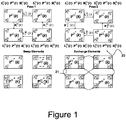
- a sequence of three steps namely, Pass 1, Pass 2, Swap and Exchange as shown in Figure 1 is referred to as a ⁇ -sweep and there exists one pipeline per sub-matrix as shown in Figure 2 .
- a sweep is composed from a ⁇ -sweep, a U-sweep and a V-sweep.
- the ⁇ -sweep calculates the diagonal singular value matrix ⁇
- the U-sweep calculates the unitary U matrix
- the V-sweep calculates the unitary V matrix.
- the number of sweeps must be a multiple of three and it is determined that an acceptable convergence is attained after nine sweeps for the specific embodiment 110 as shown in Figure 10 .
- Figure 2 presents a single ⁇ -sweep of a ⁇ -PMSA structure which accepts as input a number of consecutive 4x4 matrices P ( k ) partitioned to sub-matrices P 11 ( k ), P 12 ( k ), P 21 ( k ), P 22 ( k ) and performs CSVD to calculate the diagonal eigenvalue matrix ⁇ ( k ).
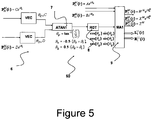
- ⁇ kl ( k ) matrix singular values can be obtained from the ⁇ -sweep following the subsequent procedure: PASS 1: As shown in Figure 5 first we calculate the angles required to obtain equation 5.
- Figure 5 shows the implementation of Pass 1.
- Figure 5 displays the connection of each Processor Array Element (PAE) of the hardware device, corresponding to the implementation of PASS 1.
- PAE Processor Array Element
- VEC 6 are operating in CORDIC vectoring mode. Each take as input a complex number and output the angle and magnitude of each of the complex elements corresponding to the bottom row of the 2x2 sub-matrix. These are subsequently forwarded to PAE ATAN1 7 which operates in CORDIC Vectoring mode to produce equation 9 and also calculates equation 8.
- the angles are forwarded to the ROT PAE 8 which operates in cordic rotational mode such that it computes the sine and cosine of the input angle.
- PAE MA1 9 performs the left and right transformations in equation 7 on sub-matrix P 11 ( k ) to produce matrix P 11' ( k ) and computes the left and right transformation matrices in equation 14 associated with Pass 1.
- sub-matrix P 22 ( k ) which in parallel produces matrix P 22' ( k ) using a separate structure of the form in 60 with corresponding inputs and outputs as shown in Figure 2 .
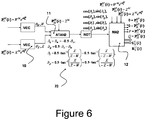
- PASS 2 As shown in Figure 6 first we calculate the angles required to obtain equation 6.
- Figure 6 shows the implementation of Pass 2.
- the two PAE's named VEC 10 operating in CORDIC vectoring mode each take as input a complex number and output the angle and magnitude of each of the complex elements corresponding to the top row of the 2x2 matrix from the Pass 1 output.
- PAE ATAN2 11 which operates in CORDIC Vectoring mode to produce equation 11 and also calculates equations 12 and 13.
- the angles are forwarded to the ROT PAE's which operate in cordic rotational mode such that they compute the sine and cosine of the input angles.
- PAE MA2 12 performs the left and right transformations in equation 10 on sub-matrix P 11' ( k ) to produce matrix P 11" ( k ) as shown in Figure 2 . It also computes the left and right transformation matrices in equation 18 associated with Pass 2.
- sub-matrix P 22' ( k ) which in parallel with the previous produces matrix P 22" ( k ) as shown in Figure 2 .
- SWAP & EXCHANGE ELEMENTS Subsequently, the elements within each sub-matrix are swapped together as shown in Figure 1 . In P 12" ( k ) the horizontal elements are swapped amongst themselves. In P 21" ( k ) the vertical elements are swapped amongst themselves and in P 22" ( k ) the diagonal elements are swapped amongst themselves. Sub-matrix P 11" ( k ) remains unaffected at this stage.
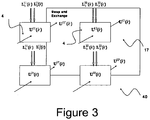
- Figure 3 presents a single U-sweep of a PMSA structure with input a number of consecutive 4x4 matrices U ( k ) partitioned to sub-matrices U 11 ( k ), U 12 ( k ), U 21 ( k ), U 22 ( k ) and performs CSVD to calculate the eigenvector unitary matrix U ( k ).
- the first U-sweep in the pipeline stream has constant input the identity matrix I 4 x 4 and subsequent sweeps take as input the previous sweep output.
- the rotational matrices L 1 kl , L 2 kl calculated in 20 are supplied to the corresponding systolic structures in 40.
- Figure 4 presents a single V-sweep of a PMSA structure with input a number of consecutive 4x4 matrices V ( k ) partitioned to sub-matrices V 11 ( k ), V 12 ( k ), V 21 ( k ), V 22 ( k ) and performs CSVD to calculate the eigenvector unitary matrix V ( k ).
- the first V-sweep in the pipeline stream has constant input the identity matrix I 4 x 4 and subsequent sweeps take as input the previous sweep output.
- the rotational matrices R 1 kl , R 2 kl calculated 1 2 in 20 are supplied to the corresponding systolic structures in 50.
- the U kl ( k ) and V k ( k ) matrices are originally both equal to the identity matrix and subdivided into sub-matrices U 11 ( k ), U 12 ( k ), U 21 ( k ), U 22 ( k ) and V 11 ( k ), V 12 ( k ), V 21 ( k ), V 22 ( k ).
- the complex rotational matrices in equations 14, 15, 18, 19 generated in a sweep are forwarded to the corresponding U kl ( k ), V kl ( k ) sub-matrix PAE MA4 4, 5 correspondingly in Figure 8 and Figure 9 .
- the following calculations are performed at each U and V sweeps.
- U 11 ′ k U 11 k ⁇ L 2 11 k ⁇ L 1 11 k H
- U 12 ′ k U 12 k ⁇ L 2 22 k ⁇ L 1 22 k H
- U 21 ′ k U 21 k ⁇ L 2 11 k ⁇ L 1 11 k H
- U 22 ′ k U 22 k ⁇ L 2 22 k ⁇ L 1 22 k H
- V 11 ′ k V 11 k ⁇ R 1 11 k H ⁇ R 2 11 k H
- V 12 ′ k V 12 k ⁇ R 1 22 k H ⁇ R 2 22 k H
- V 21 ′ k V 21 k ⁇ R 1 11 k H ⁇ R 2 11 k H
- V 22 ′ k V 22 k ⁇ R 1 22 k H ⁇ R 2 22 k H
- Figure 10 displays the current SVD implementation.
- the precision requirements at the expense of hardware allocation allow for up to nine sweeps.
Landscapes
- Engineering & Computer Science (AREA)
- Physics & Mathematics (AREA)
- General Physics & Mathematics (AREA)
- Mathematical Physics (AREA)
- Pure & Applied Mathematics (AREA)
- Mathematical Analysis (AREA)
- Mathematical Optimization (AREA)
- Computational Mathematics (AREA)
- Data Mining & Analysis (AREA)
- Theoretical Computer Science (AREA)
- Computing Systems (AREA)
- Algebra (AREA)
- Databases & Information Systems (AREA)
- Software Systems (AREA)
- General Engineering & Computer Science (AREA)
- Complex Calculations (AREA)
- Multi Processors (AREA)
Description
- The present invention refers to the field of wireless communications and more specifically to the design of a Parallel Multi-Pipeline Systolic Array (PMSA) architecture that implements Complex Singular Value Decomposition (CSVD) on a multi-processor device. CSVD is an important matrix factorization technique of a complex matrix P into a product of three matrices, i.e. a Hermitian unitary matrix of eigenvectors U , a diagonal matrix of eigenvalues ∑ and a matrix of eigenvectors V, with several applications in Digital signal processing and wireless communications.
- A method for CSVD decomposition is known from " N. D. Hemkumar, J. R. Cavalaro, "A Systolic VLSI Architecture for Complex SVD" IEEE International Symposium on Circuits and Systems (ISCAS), May 1992, Page(s):1061-1064 ". According to this document the inversion matrix is partitioned such that a dedicated processor element is allocated to each sub-matrix thus increasing significantly the time needed to compute a single matrix without allowing for a pipelined approach to optimally process a number of consecutive matrices.
- The object of the invention is to propose a method and an apparatus, which is more efficient in terms of execution speed than the conventional mesh connected systolic array architecture such that it can decompose fast and efficiently a number of consecutive matrices on a multi-processor array device.
- The invention is defined in the
independent claims - The proposed architecture decomposes the CSVD problem into several parallel pipeline branches, where each pipeline branch is dedicated to process a sub-matrix of each one of the consecutive input matrices. Each sub-matrix of each input matrix input is supplied to the corresponding pipeline branch and is subjected to two passes or steps,
Pass 1 andPass 2, and a further swap and exchange step. Each branch at each pass implements a specific systolic array structure thus forming a pipeline which is fed by the corresponding sub-matrix of each consecutive input matrix. The rotational matrices computed in the diagonal pipelines at each pass, are supplied as known data to the off-diagonal pipelines.Pass 1 performs QR decomposition andPass 2 completes the diagonalization on each of the diagonal sub-matrices while performing the necessary computations on the off-diagonal sub-matrices using the rotational matrices calculated at each individual pass. - The method and apparatus according to the invention which implement a PMSA architecture achieve a significant throughput advantage in comparison to known methods. In the proposed PMSA architecture the pipeline streams are implemented on a large array of interconnected processor elements. This allows for optimum design partitioning and eliminates the need for a dedicated swap & exchange unit by replacing these operations with simple signal interconnections. Using this technique it is possible to achieve optimized performance and significant increase in throughput such that when the previous matrix P(k-1) is being processed in
Pass 2, the current matrix P(k) is simultaneously processed inPass 1. The current embodiment of the design uses the CORDIC algorithm and achieves a CSVD for each consecutive matrix within about 5µsec (800 cycles of 160MHz clock) given a certain pipeline latency which is insignificant for a large number of matrices. The throughput can be further enhanced by applying lookup tables at the expense of memory or precision. - The dependent claims define particular embodiments offering further advantages.
- Preferred embodiments of the invention will be described with reference to
figures 1 to 10 . In particular: -
Figure 1 presents the three successive steps conceptually comprising a Σ-sweep, i.e. the sequence of steps for the calculation of the diagonal matrix Σ. -
Figure 2 presents a single Σ-sweep of a Σ-PMSA structure. -
Figure 3 presents a single U-sweep of a U-PMSA structure, i.e. the sequence of steps for the calculation of matrix U. -
Figure 4 presents a single V-sweep of a V-PMSA structure, i.e. the sequence of steps for the calculation of matrix V. -
Figure 5 presents the systolic array structure corresponding toPass 1. -
Figure 6 presents the systolic array structure corresponding toPass 2. -
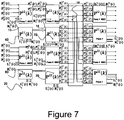
Figure 7 presents the signals required to perform the swap and exchange algorithm and the connection of the previous sweep to the following sweep for the computation of the eigenvalue diagonal matrix ∑(k). -
Figures 8 and9 present the signals required to perform the swap and exchange algorithm and the connection of the previous sweep to the following sweep for the computation of the eigenvector unitary matrices U(k) and V(k). -
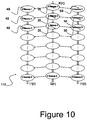
Figure 10 presents the complete PMSA architecture comprising in total nine sweeps. - We assume a complex NxN matrix P, which is partitioned into 2x2 complex sub-matrices of the form


- Such that,





- The first transformation multiplies P kl with a hermitian Jacobi rotation on the left and a complex Jacobi on the right to produce P kl' such that the lower left component is nulled and the lower right component is real.

- The second transformation completes the diagonalization by nulling the upper diagonal element

- The method is applicable to any NxN matrix, which may be partitioned into 2x2 sub-matrix units. As an example, a sequence of 4x4 matrices P(k) is considered, such that each matrix P(k) is partitioned to sub-matrices P 11(k),P 12(k),P 21(k),P 22(k). A sequence of three steps namely,
Pass 1,Pass 2, Swap and Exchange as shown inFigure 1 is referred to as a Σ-sweep and there exists one pipeline per sub-matrix as shown inFigure 2 . As shown inFigure 10 a sweep is composed from a Σ-sweep, a U-sweep and a V-sweep. The Σ-sweep calculates the diagonal singular value matrix Σ, the U-sweep calculates the unitary U matrix and the V-sweep calculates the unitary V matrix. - The number of sweeps must be a multiple of three and it is determined that an acceptable convergence is attained after nine sweeps for the
specific embodiment 110 as shown inFigure 10 . -
Figure 2 presents a single Σ-sweep of a Σ-PMSA structure which accepts as input a number of consecutive 4x4 matrices P(k) partitioned to sub-matrices P 11(k),P 12(k),P 21(k),P 22(k) and performs CSVD to calculate the diagonal eigenvalue matrix Σ(k). - The Σ kl (k) matrix singular values can be obtained from the Σ-sweep following the subsequent procedure:
PASS 1: As shown inFigure 5 first we calculate the angles required to obtainequation 5.Figure 5 shows the implementation ofPass 1.Figure 5 displays the connection of each Processor Array Element (PAE) of the hardware device, corresponding to the implementation ofPASS 1. The two PAE's named VEC 6 are operating in CORDIC vectoring mode. Each take as input a complex number and output the angle and magnitude of each of the complex elements corresponding to the bottom row of the 2x2 sub-matrix. These are subsequently forwarded to PAE ATAN1 7 which operates in CORDIC Vectoring mode to produceequation 9 and also calculatesequation 8. The angles are forwarded to theROT PAE 8 which operates in cordic rotational mode such that it computes the sine and cosine of the input angle. Subsequently PAEMA1 9 performs the left and right transformations inequation 7 on sub-matrix P 11(k) to produce matrix P 11'(k) and computes the left and right transformation matrices inequation 14 associated withPass 1. The left and right transformation matrices that correspond to each diagonal sub-matrix P 11(k) are
- The same applies to sub-matrix P 22(k) which in parallel produces matrix P 22'(k) using a separate structure of the form in 60 with corresponding inputs and outputs as shown in
Figure 2 . The left and right transformation matrices that correspond to diagonal sub-matrix P22(k) are
- The calculated rotation matrices together with P 12(k) and P 21(k) are subsequently forwarded to PAEs Pass1 MA3 (Multiply-Accumulate) 13, which in parallel perform the
following transformations 

- PASS 2: As shown in
Figure 6 first we calculate the angles required to obtainequation 6.Figure 6 shows the implementation ofPass 2. Again, the two PAE's named VEC 10 operating in CORDIC vectoring mode, each take as input a complex number and output the angle and magnitude of each of the complex elements corresponding to the top row of the 2x2 matrix from thePass 1 output. These are subsequently forwarded toPAE ATAN2 11 which operates in CORDIC Vectoring mode to produceequation 11 and also calculatesequations PAE MA2 12 performs the left and right transformations inequation 10 on sub-matrix P 11'(k) to produce matrix P 11"(k) as shown inFigure 2 . It also computes the left and right transformation matrices in equation 18 associated withPass 2. The left and right transformation matrices corresponding to the diagonal sub-matrix P 11'(k) are
- The same implementation applies to sub-matrix P 22'(k) which in parallel with the previous produces matrix P 22"(k) as shown in
Figure 2 . The left and right transformation matrices that correspond to diagonal sub-matrix P 22'(k) are
- The calculated rotation matrices are subsequently forwarded to
PAE Pass 2MA3 14 inFigure 7 corresponding to sub-matrix P 12'(k) and P 21'(k) which perform in parallel the next set oftransformations 

- SWAP & EXCHANGE ELEMENTS: Subsequently, the elements within each sub-matrix are swapped together as shown in
Figure 1 . In P 12"(k) the horizontal elements are swapped amongst themselves. In P 21"(k) the vertical elements are swapped amongst themselves and in P 22"(k) the diagonal elements are swapped amongst themselves. Sub-matrix P 11"(k) remains unaffected at this stage. The elements
Figure 7 , which shows the Σ sweep, where, superscript kl is the corresponding sub-matrix and subscript ij is the corresponding element within sub-matrix kl, are swapped and exchanged in 15 between sub-matrices according to the following rules as shown inFigure 1 





- Thus, the method constructs the
4x4 matrix 21 illustrated inFigure 1 under "Exchange Elements". Subsequently, the singular vectors U kl (k) and V kl (k) are obtained as shown inFigure 3 andFigure 4 correspondingly, where each figure corresponds to a single U-sweep and V-sweep respectively. -
Figure 3 presents a single U-sweep of a PMSA structure with input a number of consecutive 4x4 matrices U(k) partitioned to sub-matrices U 11(k),U 12(k),U 21(k),U 22(k) and performs CSVD to calculate the eigenvector unitary matrix U(k). The first U-sweep in the pipeline stream has constant input the identity matrix I 4x4 and subsequent sweeps take as input the previous sweep output. Therotational matrices 

-
Figure 4 presents a single V-sweep of a PMSA structure with input a number of consecutive 4x4 matrices V(k) partitioned to sub-matrices V 11(k),V 12(k),V 21(k),V 22(k) and performs CSVD to calculate the eigenvector unitary matrix V(k). The first V-sweep in the pipeline stream has constant input the identity matrix I 4x4 and subsequent sweeps take as input the previous sweep output. Therotational matrices 

- The U kl (k) and V k (k) matrices are originally both equal to the identity matrix and subdivided into sub-matrices U 11(k),U 12(k),U 21(k),U 22(k) and V 11(k),V 12(k),V 21(k),V 22(k). At each pass, the complex rotational matrices in
equations sub-matrix PAE MA4 Figure 8 andFigure 9 . The following calculations are performed at each U and V sweeps.


- Finally the elements


Figure 8 andFigure 9 , where superscript kl is the corresponding sub-matrix and subscript ij is the corresponding element within sub-matrix kl, are exchanged in 17, 19 between sub-matrices according to the same rule shown inFigure 1 . -
Figure 10 displays the current SVD implementation. The precision requirements at the expense of hardware allocation allow for up to nine sweeps.
Claims (12)
- Apparatus for Complex Singular Value Decomposition of either a single or a number of consecutive matrices, to either a single or a number of consecutive Hermitian unitary matrices of eigenvectors respectively, a single or a number of consecutive diagonal matrices of eigenvalues respectively and a single or a number of consecutive unitary matrices of eigenvectors respectively, including a first structure configured to calculate the diagonal matrices of eigenvalues, characterized in that the apparatus further includes a second structure configured to calculate the Hermitian unitary matrices of eigenvectors and a third structure configured to calculate the unitary matrices of eigenvectors, whereby the first structure includes at least one set of blocks (20), with each set of blocks of the first structure comprising a first hardware block (60, 13), a second hardware block (70, 14) other than the first hardware block and a third hardware block (15) other than the first hardware block and the second hardware block and✔ the first hardware block (60, 13) includes means to transform a 2x2 square matrix to a 2x2 upper triangular square matrix,✔ the second hardware block (70, 14) includes means to transform a 2×2 upper triangular matrix to a to a 2x2 diagonal square matrix,✔ the third hardware block (15) includes means to swap and exchange elements of matrices,✔ the first structure comprises means to link the first hardware block to the second hardware block, so that the output of the first hardware block is inputted to the second hardware block and the apparatus further comprises means to link the second hardware block to the third hardware block, so that the output of the second hardware block is inputted to the third hardware block,✔ the second structure includes an equal number of sets of blocks (40) with the sets of blocks (20) of the first structure, with each set of block of the second structure (40) having means (4) configured to input data from output means provided to a corresponding set of block (20) of the first structure, and the third structure includes an equal number of sets of blocks (50) with the set of blocks (20) of the first structure, with each set of block of the third structure (20) having means (5) configured to input data from output means provided to a corresponding set of block (20) of the first structure.
- Apparatus according to claim 1, whereby the first structure includes n sets of blocks, with n being a multiple of three, with each said set of blocks comprising a first hardware block (60, 13), a second hardware block (70, 14) other than the first hardware block and a third hardware block (15) other than the first hardware block and the second hardware block; whereby✔ the first hardware block (60, 13) of each of the said n sets of blocks includes means to transform a 2x2 square matrix to a 2x2 upper triangular square matrix,✔ the second hardware block (70, 14) of each of the said n sets of blocks includes means to transform a 2×2 upper triangular matrix to a to a 2×2 diagonal square matrix,✔ the third hardware block (15) of each of the said n sets of blocks includes means to swap and exchange elements of matrices,✔ the first structure includes means to transmit the output of the i-th set of blocks, with i equals 1 to n-1, to the i+1 set of blocks, and✔ the apparatus includes means to process a plurality of consecutive matrices simultaneously.
- Apparatus according to claim 1 or claim 2, whereby the means to swap and exchange elements of matrices are wiring connections.
- Apparatus according to claim 1 or claim 2, whereby the means to swap and exchange elements of matrices are software means.
- Apparatus according to any one of claims 1 to 4, for Complex Singular Value Decomposition of a number of consecutive 4×4 matrices, whereby✔ the first hardware block (60, 13) includes four distinct systolic array structures, with each one of the four systolic array structures configured to process a 2x2 square matrix,✔ the second hardware block (70, 14) includes four distinct systolic array structures, with each one of the four systolic array structures configured to process a 2x2 square matrix,✔ each one of the four distinct systolic array structures of the first hardware block (60, 13) and each one of the four distinct systolic array structures of the second hardware block (70, 14) comprise complementary means that link the first hardware block to the second hardware block.
- Method for Complex Singular Value Decomposition of a number of at least two consecutive matrices, to a number of consecutive Hermitian unitary matrices of eigenvectors, a number of consecutive diagonal matrices of eigenvalues and a number of consecutive unitary matrices of eigenvectors, whereby✔ each consecutive matrix undergoes a number of iter identical iterations in a first structure, with the output of each iteration being rotational matrices and the diagonal matrix of eigenvalues,✔ the diagonal matrix of eigenvalues of the j-th iteration with j = 1 to iter-1 is the input to the j+1 iteration,✔ each iteration includes a first step and a second step other than the first step, with the output of the first step being input to the second step, characterized in that✔ when a matrix is processed in the second step of its i-th iteration, with i equals 1 to iter, the following matrix of the consecutive matrices is processed in the first step of its i-th iteration,✔ each one of the first step and the second step are performed in distinct hardware blocks, so that the first step is performed in a first hardware block and the second step is performed in a second hardware block, other than the first hardware block, and the output of the first step is input to the second block,✔ during each iteration, the rotational matrices are supplied to a second structure provided for the calculation of the Hermitian unitary matrices and to a third structure provided for the calculation of the unitary matrices of eigenvectors, with the first structure, the second structure and the third structure being distinct from each other.
- Method according to claim 6, whereby each iteration includes a third step other than the first step and the second step, with the output of the second step being input to the third step and the output of the third step of the l-th iteration with l being equal to 1 to iter-1 being input to the first step of iteration l+1, and whereby iter is a multiple of three.
- Method according to claim 7, whereby the third step is performed in a third block other than the first block and the second block and the output second step is input to the third block.
- Method according to claim 7 or claim 8, whereby the third step performs a swap and exchange of matrices' elements.
- Method according to any of the claims 6 to 9, whereby the first step performs a transformation of a 2x2 square matrix to a 2x2 upper triangular square matrix and the second step transforms a 2×2 upper triangular matrix to a to a 2x2 diagonal square matrix.
- Method according to any one of claims 6 to 10 for Complex Singular Value Decomposition of a number of 4x4 consecutive matrices.
- Method according to claim 9, whereby the swap and exchange of matrices' elements is effected by signal interconnections.
Applications Claiming Priority (2)
| Application Number | Priority Date | Filing Date | Title |
|---|---|---|---|
| GR20100100361A GR1007932B (en) | 2010-06-25 | 2010-06-25 | A parallel multi-pipeline systolic array for complex singular value decomposition on a multi-processor device. |
| PCT/EP2011/060527 WO2011161202A2 (en) | 2010-06-25 | 2011-06-22 | A parallel multi-pipeline systolic array for complex singular value decomposition on a multi-processor device |
Publications (2)
| Publication Number | Publication Date |
|---|---|
| EP2585943A2 EP2585943A2 (en) | 2013-05-01 |
| EP2585943B1 true EP2585943B1 (en) | 2020-12-09 |
Family
ID=44021982
Family Applications (1)
| Application Number | Title | Priority Date | Filing Date |
|---|---|---|---|
| EP11748589.6A Not-in-force EP2585943B1 (en) | 2010-06-25 | 2011-06-22 | A parallel multi-pipeline systolic array for complex singular value decomposition on a multi-processor device |
Country Status (3)
| Country | Link |
|---|---|
| EP (1) | EP2585943B1 (en) |
| GR (1) | GR1007932B (en) |
| WO (1) | WO2011161202A2 (en) |
Families Citing this family (3)
| Publication number | Priority date | Publication date | Assignee | Title |
|---|---|---|---|---|
| CN102737010B (en) * | 2012-04-09 | 2014-12-17 | 深圳大学 | Parallel matrix multiplication method and system with Mohr diagram serving as topological structure |
| US9054870B2 (en) * | 2012-10-22 | 2015-06-09 | Donatello Apelusion Gassi | Information security based on eigendecomposition |
| CN109301429B (en) * | 2018-09-27 | 2021-02-09 | 江苏赛博防务技术有限公司 | Lossy network matrix expansion method and novel six-port junction |
Family Cites Families (1)
| Publication number | Priority date | Publication date | Assignee | Title |
|---|---|---|---|---|
| GR1007291B (en) * | 2009-10-01 | 2011-06-01 | Intracom Telecom, | Matrix inversion using qr decoposition on a parallel pipelined systolic array |
-
2010
- 2010-06-25 GR GR20100100361A patent/GR1007932B/en active IP Right Grant
-
2011
- 2011-06-22 EP EP11748589.6A patent/EP2585943B1/en not_active Not-in-force
- 2011-06-22 WO PCT/EP2011/060527 patent/WO2011161202A2/en not_active Ceased
Non-Patent Citations (1)
| Title |
|---|
| None * |
Also Published As
| Publication number | Publication date |
|---|---|
| GR20100100361A (en) | 2012-01-31 |
| EP2585943A2 (en) | 2013-05-01 |
| GR1007932B (en) | 2013-07-04 |
| WO2011161202A3 (en) | 2013-01-17 |
| WO2011161202A2 (en) | 2011-12-29 |
Similar Documents
| Publication | Publication Date | Title |
|---|---|---|
| US8417758B1 (en) | Left and right matrix multiplication using a systolic array | |
| EP2484068B1 (en) | Matrix inversion using qr decomposition on a parallel pipelined systolic array | |
| CN108228536B (en) | Method for realizing Hermitian matrix decomposition by using FPGA (field programmable Gate array) | |
| CN106526565B (en) | A Single-Bit Spatial Spectrum Estimation Method Based on Support Vector Machines | |
| US20180373677A1 (en) | Apparatus and Methods of Providing Efficient Data Parallelization for Multi-Dimensional FFTs | |
| EP2585943A2 (en) | A parallel multi-pipeline systolic array for complex singular value decomposition on a multi-processor device | |
| Liu et al. | Real-valued sparse Bayesian learning algorithm for off-grid DOA estimation in the beamspace | |
| Greif et al. | Iterative solution of cyclically reduced systems arising from discretization of the three-dimensional convection-diffusion equation | |
| Egho et al. | Adaptive hyperspectral image compression using the KLT and integer KLT algorithms | |
| Pranic et al. | Rational Gauss quadrature | |
| Deng et al. | Least squares solution of BXAT= T over symmetric, skew-symmetric, and positive semidefinite X | |
| Li et al. | A parallel structured banded DC algorithm for symmetric eigenvalue problems | |
| Brust et al. | Computationally efficient decompositions of oblique projection matrices | |
| König et al. | Computing eigenvectors of block tridiagonal matrices based on twisted block factorizations | |
| Mi et al. | Behavioral Implementation of SVD on FPGA | |
| Bojanczyk et al. | A novel MVDR beamforming algorithm | |
| JP7058810B2 (en) | Signal processing system | |
| Delosme | Bit-level systolic algorithm for the symmetric eigenvalue problem | |
| Barada et al. | Systolic architecture for matrix triangularisation with partial pivoting | |
| CN106154245A (en) | Centralized MIMO radar array design methodology based on equivalent array directional diagram | |
| Shi et al. | Sparsity-based DOA estimation of coherent and uncorrelated targets with co-prime MIMO radar | |
| Ding et al. | A Fast Structure-Preserving Method for Dual Quaternion Singular Value Decomposition | |
| Jamshidpour et al. | A coarray processing technique for nested vector-sensor arrays with improved resolution capabilities | |
| Wyrzykowski | Processor arrays for matrix triangularisation with partial pivoting | |
| Doukhnitch et al. | Hardware-oriented algorithm for quaternion-valued matrix decomposition |
Legal Events
| Date | Code | Title | Description |
|---|---|---|---|
| PUAI | Public reference made under article 153(3) epc to a published international application that has entered the european phase |
Free format text: ORIGINAL CODE: 0009012 |
|
| 17P | Request for examination filed |
Effective date: 20121211 |
|
| AK | Designated contracting states |
Kind code of ref document: A2 Designated state(s): AL AT BE BG CH CY CZ DE DK EE ES FI FR GB GR HR HU IE IS IT LI LT LU LV MC MK MT NL NO PL PT RO RS SE SI SK SM TR |
|
| DAX | Request for extension of the european patent (deleted) | ||
| STAA | Information on the status of an ep patent application or granted ep patent |
Free format text: STATUS: EXAMINATION IS IN PROGRESS |
|
| 17Q | First examination report despatched |
Effective date: 20190205 |
|
| GRAP | Despatch of communication of intention to grant a patent |
Free format text: ORIGINAL CODE: EPIDOSNIGR1 |
|
| STAA | Information on the status of an ep patent application or granted ep patent |
Free format text: STATUS: GRANT OF PATENT IS INTENDED |
|
| RIC1 | Information provided on ipc code assigned before grant |
Ipc: G06F 17/16 20060101AFI20200102BHEP |
|
| INTG | Intention to grant announced |
Effective date: 20200124 |
|
| RAP1 | Party data changed (applicant data changed or rights of an application transferred) |
Owner name: INTRACOM S.A. TELECOM SOLUTIONS |
|
| GRAS | Grant fee paid |
Free format text: ORIGINAL CODE: EPIDOSNIGR3 |
|
| GRAA | (expected) grant |
Free format text: ORIGINAL CODE: 0009210 |
|
| STAA | Information on the status of an ep patent application or granted ep patent |
Free format text: STATUS: THE PATENT HAS BEEN GRANTED |
|
| AK | Designated contracting states |
Kind code of ref document: B1 Designated state(s): AL AT BE BG CH CY CZ DE DK EE ES FI FR GB GR HR HU IE IS IT LI LT LU LV MC MK MT NL NO PL PT RO RS SE SI SK SM TR |
|
| REG | Reference to a national code |
Ref country code: GB Ref legal event code: FG4D |
|
| REG | Reference to a national code |
Ref country code: AT Ref legal event code: REF Ref document number: 1344133 Country of ref document: AT Kind code of ref document: T Effective date: 20201215 Ref country code: CH Ref legal event code: EP |
|
| REG | Reference to a national code |
Ref country code: DE Ref legal event code: R096 Ref document number: 602011069584 Country of ref document: DE |
|
| REG | Reference to a national code |
Ref country code: IE Ref legal event code: FG4D |
|
| PG25 | Lapsed in a contracting state [announced via postgrant information from national office to epo] |
Ref country code: NO Free format text: LAPSE BECAUSE OF FAILURE TO SUBMIT A TRANSLATION OF THE DESCRIPTION OR TO PAY THE FEE WITHIN THE PRESCRIBED TIME-LIMIT Effective date: 20210309 Ref country code: RS Free format text: LAPSE BECAUSE OF FAILURE TO SUBMIT A TRANSLATION OF THE DESCRIPTION OR TO PAY THE FEE WITHIN THE PRESCRIBED TIME-LIMIT Effective date: 20201209 Ref country code: FI Free format text: LAPSE BECAUSE OF FAILURE TO SUBMIT A TRANSLATION OF THE DESCRIPTION OR TO PAY THE FEE WITHIN THE PRESCRIBED TIME-LIMIT Effective date: 20201209 Ref country code: GR Free format text: LAPSE BECAUSE OF FAILURE TO SUBMIT A TRANSLATION OF THE DESCRIPTION OR TO PAY THE FEE WITHIN THE PRESCRIBED TIME-LIMIT Effective date: 20210310 |
|
| REG | Reference to a national code |
Ref country code: AT Ref legal event code: MK05 Ref document number: 1344133 Country of ref document: AT Kind code of ref document: T Effective date: 20201209 |
|
| PG25 | Lapsed in a contracting state [announced via postgrant information from national office to epo] |
Ref country code: BG Free format text: LAPSE BECAUSE OF FAILURE TO SUBMIT A TRANSLATION OF THE DESCRIPTION OR TO PAY THE FEE WITHIN THE PRESCRIBED TIME-LIMIT Effective date: 20210309 Ref country code: LV Free format text: LAPSE BECAUSE OF FAILURE TO SUBMIT A TRANSLATION OF THE DESCRIPTION OR TO PAY THE FEE WITHIN THE PRESCRIBED TIME-LIMIT Effective date: 20201209 Ref country code: SE Free format text: LAPSE BECAUSE OF FAILURE TO SUBMIT A TRANSLATION OF THE DESCRIPTION OR TO PAY THE FEE WITHIN THE PRESCRIBED TIME-LIMIT Effective date: 20201209 |
|
| REG | Reference to a national code |
Ref country code: NL Ref legal event code: MP Effective date: 20201209 |
|
| PG25 | Lapsed in a contracting state [announced via postgrant information from national office to epo] |
Ref country code: NL Free format text: LAPSE BECAUSE OF FAILURE TO SUBMIT A TRANSLATION OF THE DESCRIPTION OR TO PAY THE FEE WITHIN THE PRESCRIBED TIME-LIMIT Effective date: 20201209 Ref country code: HR Free format text: LAPSE BECAUSE OF FAILURE TO SUBMIT A TRANSLATION OF THE DESCRIPTION OR TO PAY THE FEE WITHIN THE PRESCRIBED TIME-LIMIT Effective date: 20201209 |
|
| REG | Reference to a national code |
Ref country code: LT Ref legal event code: MG9D |
|
| PG25 | Lapsed in a contracting state [announced via postgrant information from national office to epo] |
Ref country code: SM Free format text: LAPSE BECAUSE OF FAILURE TO SUBMIT A TRANSLATION OF THE DESCRIPTION OR TO PAY THE FEE WITHIN THE PRESCRIBED TIME-LIMIT Effective date: 20201209 Ref country code: CZ Free format text: LAPSE BECAUSE OF FAILURE TO SUBMIT A TRANSLATION OF THE DESCRIPTION OR TO PAY THE FEE WITHIN THE PRESCRIBED TIME-LIMIT Effective date: 20201209 Ref country code: EE Free format text: LAPSE BECAUSE OF FAILURE TO SUBMIT A TRANSLATION OF THE DESCRIPTION OR TO PAY THE FEE WITHIN THE PRESCRIBED TIME-LIMIT Effective date: 20201209 Ref country code: PT Free format text: LAPSE BECAUSE OF FAILURE TO SUBMIT A TRANSLATION OF THE DESCRIPTION OR TO PAY THE FEE WITHIN THE PRESCRIBED TIME-LIMIT Effective date: 20210409 Ref country code: RO Free format text: LAPSE BECAUSE OF FAILURE TO SUBMIT A TRANSLATION OF THE DESCRIPTION OR TO PAY THE FEE WITHIN THE PRESCRIBED TIME-LIMIT Effective date: 20201209 Ref country code: SK Free format text: LAPSE BECAUSE OF FAILURE TO SUBMIT A TRANSLATION OF THE DESCRIPTION OR TO PAY THE FEE WITHIN THE PRESCRIBED TIME-LIMIT Effective date: 20201209 Ref country code: LT Free format text: LAPSE BECAUSE OF FAILURE TO SUBMIT A TRANSLATION OF THE DESCRIPTION OR TO PAY THE FEE WITHIN THE PRESCRIBED TIME-LIMIT Effective date: 20201209 |
|
| PGFP | Annual fee paid to national office [announced via postgrant information from national office to epo] |
Ref country code: DE Payment date: 20210615 Year of fee payment: 11 |
|
| PG25 | Lapsed in a contracting state [announced via postgrant information from national office to epo] |
Ref country code: AT Free format text: LAPSE BECAUSE OF FAILURE TO SUBMIT A TRANSLATION OF THE DESCRIPTION OR TO PAY THE FEE WITHIN THE PRESCRIBED TIME-LIMIT Effective date: 20201209 Ref country code: PL Free format text: LAPSE BECAUSE OF FAILURE TO SUBMIT A TRANSLATION OF THE DESCRIPTION OR TO PAY THE FEE WITHIN THE PRESCRIBED TIME-LIMIT Effective date: 20201209 |
|
| PGFP | Annual fee paid to national office [announced via postgrant information from national office to epo] |
Ref country code: GB Payment date: 20210615 Year of fee payment: 11 |
|
| REG | Reference to a national code |
Ref country code: DE Ref legal event code: R097 Ref document number: 602011069584 Country of ref document: DE |
|
| PG25 | Lapsed in a contracting state [announced via postgrant information from national office to epo] |
Ref country code: IS Free format text: LAPSE BECAUSE OF FAILURE TO SUBMIT A TRANSLATION OF THE DESCRIPTION OR TO PAY THE FEE WITHIN THE PRESCRIBED TIME-LIMIT Effective date: 20210409 |
|
| PLBE | No opposition filed within time limit |
Free format text: ORIGINAL CODE: 0009261 |
|
| STAA | Information on the status of an ep patent application or granted ep patent |
Free format text: STATUS: NO OPPOSITION FILED WITHIN TIME LIMIT |
|
| PG25 | Lapsed in a contracting state [announced via postgrant information from national office to epo] |
Ref country code: IT Free format text: LAPSE BECAUSE OF FAILURE TO SUBMIT A TRANSLATION OF THE DESCRIPTION OR TO PAY THE FEE WITHIN THE PRESCRIBED TIME-LIMIT Effective date: 20201209 Ref country code: AL Free format text: LAPSE BECAUSE OF FAILURE TO SUBMIT A TRANSLATION OF THE DESCRIPTION OR TO PAY THE FEE WITHIN THE PRESCRIBED TIME-LIMIT Effective date: 20201209 |
|
| 26N | No opposition filed |
Effective date: 20210910 |
|
| PG25 | Lapsed in a contracting state [announced via postgrant information from national office to epo] |
Ref country code: SI Free format text: LAPSE BECAUSE OF FAILURE TO SUBMIT A TRANSLATION OF THE DESCRIPTION OR TO PAY THE FEE WITHIN THE PRESCRIBED TIME-LIMIT Effective date: 20201209 Ref country code: DK Free format text: LAPSE BECAUSE OF FAILURE TO SUBMIT A TRANSLATION OF THE DESCRIPTION OR TO PAY THE FEE WITHIN THE PRESCRIBED TIME-LIMIT Effective date: 20201209 Ref country code: ES Free format text: LAPSE BECAUSE OF FAILURE TO SUBMIT A TRANSLATION OF THE DESCRIPTION OR TO PAY THE FEE WITHIN THE PRESCRIBED TIME-LIMIT Effective date: 20201209 |
|
| PG25 | Lapsed in a contracting state [announced via postgrant information from national office to epo] |
Ref country code: MC Free format text: LAPSE BECAUSE OF FAILURE TO SUBMIT A TRANSLATION OF THE DESCRIPTION OR TO PAY THE FEE WITHIN THE PRESCRIBED TIME-LIMIT Effective date: 20201209 |
|
| REG | Reference to a national code |
Ref country code: CH Ref legal event code: PL |
|
| REG | Reference to a national code |
Ref country code: BE Ref legal event code: MM Effective date: 20210630 |
|
| PG25 | Lapsed in a contracting state [announced via postgrant information from national office to epo] |
Ref country code: LU Free format text: LAPSE BECAUSE OF NON-PAYMENT OF DUE FEES Effective date: 20210622 |
|
| PG25 | Lapsed in a contracting state [announced via postgrant information from national office to epo] |
Ref country code: LI Free format text: LAPSE BECAUSE OF NON-PAYMENT OF DUE FEES Effective date: 20210630 Ref country code: IE Free format text: LAPSE BECAUSE OF NON-PAYMENT OF DUE FEES Effective date: 20210622 Ref country code: CH Free format text: LAPSE BECAUSE OF NON-PAYMENT OF DUE FEES Effective date: 20210630 |
|
| PG25 | Lapsed in a contracting state [announced via postgrant information from national office to epo] |
Ref country code: IS Free format text: LAPSE BECAUSE OF FAILURE TO SUBMIT A TRANSLATION OF THE DESCRIPTION OR TO PAY THE FEE WITHIN THE PRESCRIBED TIME-LIMIT Effective date: 20210409 Ref country code: FR Free format text: LAPSE BECAUSE OF NON-PAYMENT OF DUE FEES Effective date: 20210630 |
|
| PG25 | Lapsed in a contracting state [announced via postgrant information from national office to epo] |
Ref country code: BE Free format text: LAPSE BECAUSE OF NON-PAYMENT OF DUE FEES Effective date: 20210630 |
|
| REG | Reference to a national code |
Ref country code: DE Ref legal event code: R119 Ref document number: 602011069584 Country of ref document: DE |
|
| GBPC | Gb: european patent ceased through non-payment of renewal fee |
Effective date: 20220622 |
|
| PG25 | Lapsed in a contracting state [announced via postgrant information from national office to epo] |
Ref country code: HU Free format text: LAPSE BECAUSE OF FAILURE TO SUBMIT A TRANSLATION OF THE DESCRIPTION OR TO PAY THE FEE WITHIN THE PRESCRIBED TIME-LIMIT; INVALID AB INITIO Effective date: 20110622 Ref country code: GB Free format text: LAPSE BECAUSE OF NON-PAYMENT OF DUE FEES Effective date: 20220622 Ref country code: DE Free format text: LAPSE BECAUSE OF NON-PAYMENT OF DUE FEES Effective date: 20230103 Ref country code: CY Free format text: LAPSE BECAUSE OF FAILURE TO SUBMIT A TRANSLATION OF THE DESCRIPTION OR TO PAY THE FEE WITHIN THE PRESCRIBED TIME-LIMIT Effective date: 20201209 |
|
| PG25 | Lapsed in a contracting state [announced via postgrant information from national office to epo] |
Ref country code: MK Free format text: LAPSE BECAUSE OF FAILURE TO SUBMIT A TRANSLATION OF THE DESCRIPTION OR TO PAY THE FEE WITHIN THE PRESCRIBED TIME-LIMIT Effective date: 20201209 |
|
| PG25 | Lapsed in a contracting state [announced via postgrant information from national office to epo] |
Ref country code: MT Free format text: LAPSE BECAUSE OF FAILURE TO SUBMIT A TRANSLATION OF THE DESCRIPTION OR TO PAY THE FEE WITHIN THE PRESCRIBED TIME-LIMIT Effective date: 20201209 |
|
| PG25 | Lapsed in a contracting state [announced via postgrant information from national office to epo] |
Ref country code: TR Free format text: LAPSE BECAUSE OF FAILURE TO SUBMIT A TRANSLATION OF THE DESCRIPTION OR TO PAY THE FEE WITHIN THE PRESCRIBED TIME-LIMIT Effective date: 20201209 |