EP2584916B1 - Organic compounds - Google Patents
Organic compounds Download PDFInfo
- Publication number
- EP2584916B1 EP2584916B1 EP11728241.8A EP11728241A EP2584916B1 EP 2584916 B1 EP2584916 B1 EP 2584916B1 EP 11728241 A EP11728241 A EP 11728241A EP 2584916 B1 EP2584916 B1 EP 2584916B1
- Authority
- EP
- European Patent Office
- Prior art keywords
- flavor
- tetrahydroquinoline
- cyclopenta
- dihydro
- pyridine
- Prior art date
- Legal status (The legal status is an assumption and is not a legal conclusion. Google has not performed a legal analysis and makes no representation as to the accuracy of the status listed.)
- Active
Links
Classifications
-
- A—HUMAN NECESSITIES
- A61—MEDICAL OR VETERINARY SCIENCE; HYGIENE
- A61K—PREPARATIONS FOR MEDICAL, DENTAL OR TOILETRY PURPOSES
- A61K8/00—Cosmetics or similar toiletry preparations
- A61K8/18—Cosmetics or similar toiletry preparations characterised by the composition
- A61K8/30—Cosmetics or similar toiletry preparations characterised by the composition containing organic compounds
- A61K8/49—Cosmetics or similar toiletry preparations characterised by the composition containing organic compounds containing heterocyclic compounds
- A61K8/4906—Cosmetics or similar toiletry preparations characterised by the composition containing organic compounds containing heterocyclic compounds with one nitrogen as the only hetero atom
- A61K8/4926—Cosmetics or similar toiletry preparations characterised by the composition containing organic compounds containing heterocyclic compounds with one nitrogen as the only hetero atom having six membered rings
-
- C—CHEMISTRY; METALLURGY
- C07—ORGANIC CHEMISTRY
- C07D—HETEROCYCLIC COMPOUNDS
- C07D215/00—Heterocyclic compounds containing quinoline or hydrogenated quinoline ring systems
- C07D215/02—Heterocyclic compounds containing quinoline or hydrogenated quinoline ring systems having no bond between the ring nitrogen atom and a non-ring member or having only hydrogen atoms or carbon atoms directly attached to the ring nitrogen atom
- C07D215/04—Heterocyclic compounds containing quinoline or hydrogenated quinoline ring systems having no bond between the ring nitrogen atom and a non-ring member or having only hydrogen atoms or carbon atoms directly attached to the ring nitrogen atom with only hydrogen atoms or radicals containing only hydrogen and carbon atoms, directly attached to the ring carbon atoms
-
- A—HUMAN NECESSITIES
- A23—FOODS OR FOODSTUFFS; TREATMENT THEREOF, NOT COVERED BY OTHER CLASSES
- A23L—FOODS, FOODSTUFFS OR NON-ALCOHOLIC BEVERAGES, NOT OTHERWISE PROVIDED FOR; PREPARATION OR TREATMENT THEREOF
- A23L27/00—Spices; Flavouring agents or condiments; Artificial sweetening agents; Table salts; Dietetic salt substitutes; Preparation or treatment thereof
- A23L27/20—Synthetic spices, flavouring agents or condiments
- A23L27/205—Heterocyclic compounds
- A23L27/2054—Heterocyclic compounds having nitrogen as the only hetero atom
-
- A—HUMAN NECESSITIES
- A61—MEDICAL OR VETERINARY SCIENCE; HYGIENE
- A61Q—SPECIFIC USE OF COSMETICS OR SIMILAR TOILETRY PREPARATIONS
- A61Q13/00—Formulations or additives for perfume preparations
-
- A—HUMAN NECESSITIES
- A61—MEDICAL OR VETERINARY SCIENCE; HYGIENE
- A61Q—SPECIFIC USE OF COSMETICS OR SIMILAR TOILETRY PREPARATIONS
- A61Q15/00—Anti-perspirants or body deodorants
-
- A—HUMAN NECESSITIES
- A61—MEDICAL OR VETERINARY SCIENCE; HYGIENE
- A61Q—SPECIFIC USE OF COSMETICS OR SIMILAR TOILETRY PREPARATIONS
- A61Q5/00—Preparations for care of the hair
-
- A—HUMAN NECESSITIES
- A61—MEDICAL OR VETERINARY SCIENCE; HYGIENE
- A61Q—SPECIFIC USE OF COSMETICS OR SIMILAR TOILETRY PREPARATIONS
- A61Q5/00—Preparations for care of the hair
- A61Q5/02—Preparations for cleaning the hair
-
- C—CHEMISTRY; METALLURGY
- C07—ORGANIC CHEMISTRY
- C07D—HETEROCYCLIC COMPOUNDS
- C07D221/00—Heterocyclic compounds containing six-membered rings having one nitrogen atom as the only ring hetero atom, not provided for by groups C07D211/00 - C07D219/00
- C07D221/02—Heterocyclic compounds containing six-membered rings having one nitrogen atom as the only ring hetero atom, not provided for by groups C07D211/00 - C07D219/00 condensed with carbocyclic rings or ring systems
- C07D221/04—Ortho- or peri-condensed ring systems
-
- C—CHEMISTRY; METALLURGY
- C11—ANIMAL OR VEGETABLE OILS, FATS, FATTY SUBSTANCES OR WAXES; FATTY ACIDS THEREFROM; DETERGENTS; CANDLES
- C11B—PRODUCING, e.g. BY PRESSING RAW MATERIALS OR BY EXTRACTION FROM WASTE MATERIALS, REFINING OR PRESERVING FATS, FATTY SUBSTANCES, e.g. LANOLIN, FATTY OILS OR WAXES; ESSENTIAL OILS; PERFUMES
- C11B9/00—Essential oils; Perfumes
- C11B9/0069—Heterocyclic compounds
- C11B9/0092—Heterocyclic compounds containing only N as heteroatom
-
- C—CHEMISTRY; METALLURGY
- C11—ANIMAL OR VEGETABLE OILS, FATS, FATTY SUBSTANCES OR WAXES; FATTY ACIDS THEREFROM; DETERGENTS; CANDLES
- C11D—DETERGENT COMPOSITIONS; USE OF SINGLE SUBSTANCES AS DETERGENTS; SOAP OR SOAP-MAKING; RESIN SOAPS; RECOVERY OF GLYCEROL
- C11D3/00—Other compounding ingredients of detergent compositions covered in group C11D1/00
- C11D3/50—Perfumes
Definitions
- the present invention relates to fragrance and flavour ingredients that can deliver herbal-green odours.
- Fragrance and flavour ingredients are known that are in the herbal-green family.
- Some examples of commercially available herbal-green ingredients include cis-3-hexenol, galbanum, pyrazines, perilla aldehyde and certain pyridines disclosed in WO2004048336 .
- Quinolines would not be considered to be a class of molecule that would provide odourants or flavourants falling into the herbal-green family.
- 2-isobutylquinoline has a minty, earthy, woody odour
- pyralone has an earthy, leathery woody, tobacco-like odour. Both of these materials are fully aromatic quinolines.
- flavour and fragrance ingredients that can be added to the palette of perfumers and flavourists alike, which impart herbal-green aspects to products to which they are applied.
- Applicant had investigated the hedonics of other substituted 5,6,7,8-tetrahydroquinoline compounds. Specifically, it was found that those materials substituted at the 8-position with a methyl group were found to have rather unpleasant chemical odours redolent of picoline, harsh minty notes that were not very desirable. Similarly, 8,8-disubstituted derivatives were found to be very weak odourants and undesirable for that reason. Furthermore, those materials substituted at the 2-position with a methyl group exhibited very weak and uninteresting odours.
- Preferred compounds of the formula (I) are:
- the compounds of formula (I) can be prepared by alkylation of commercially available starting materials 5,6,7,8-tetrahydroquinoline,6,7-dihydro-5 H- cyclopenta [b] pyridines) or 6,7,8,9-tetrahydro-5 H -cyclohepta [b] pyridine according to Scheme 1.
- the compounds of formula (I) are suitable for use as fragrance ingredients in all manner of perfumery applications. Similarly, their odours may also add aroma to foodstuffs beverages and oral care products making them suitable as flavourant ingredients
- a method to confer, enhance, improve or modify the hedonic properties of a perfuming composition or of a perfumed article, or of a flavour composition or flavoured article comprises adding to said composition or article a compound of formula (I).
- the present invention provides in another of its aspects a fragrance or flavour composition or a flavoured or perfumed article comprising a compound of formula (I).
- Said fragrance or flavour composition may also comprise carrier materials for the compounds of the formula (I); a perfumery or flavour base; and other adjuvants useful in fragrance and flavour formulations.
- carrier materials refers to materials that are neutral or practically neutral from a fragrance or flavour point of view, that is, the material does not significantly after the organoleptic properties of perfuming or flavour ingredients.
- an emulsifying system i. e. a solvent and a surfactant system, or a solvent commonly used in perfumery or flavours applications.
- a solvent and a surfactant system or a solvent commonly used in perfumery or flavours applications.
- a detailed description of the nature and type of solvents commonly used in perfumery or the flavours industry cannot be exhaustive.
- solvents useful in perfumery dipropyleneglycol, diethyl phthalate, isopropyl myristate, benzyl benzoate, 2- (2-ethoxyethoxy)-1-ethanol or ethyl citrate.
- Carrier materials may also include absorbing gums or polymers, or encapsulating materials. Encapsulation is a well known process to a person skilled in the art, and may be performed, for instance, using techniques such as spray-drying, agglomeration or wet extrusion, or by coacervation or complex coacervation techniques.
- perfumery or flavour base means a composition comprising at least one perfuming or flavourant co-ingredient that is different from a compound of formula (I).
- the co-ingredients are used to impart a hedonic effect.
- a co-ingredient if it is to be considered as being a perfuming co-ingredient, must be recognized by a person skilled in the art as being able to impart or modify in a positive or pleasant way the odor of a composition, and not just as having an odor.
- the co-ingredient is a flavourant it is recognised by a person skilled in the art as being able to create, modify or enhance a flavour accord.
- perfuming co-ingredients belong to chemical classes as varied as alcohols, aldehydes, ketones, esters, ethers, acetates, nitriles, terpene hydrocarbons, nitrogenous or sulphurous heterocyclic compounds and essential oils, and said perfuming co-ingredients can be of natural or synthetic origin. Many of these co-ingredients are in any case listed in reference texts such as the book by S. Arctander, Perfume and Flavor Chemicals, 1969, Montclair, New Jersey, USA , or its more recent versions, or in other works of a similar nature, as well as in the abundant patent literature in the field of perfumery. It is also understood that said co-ingredients may also be compounds known to release in a controlled manner various types of perfuming compounds.
- flavour co-ingredients may include but are not limited to natural flavors, artificial flavors, spices, seasonings, and the like.
- Exemplary flavoring co-ingredients include synthetic flavor oils and flavoring aromatics and/or oils, oleoresins, essences, distillates, and extracts derived from plants, leaves, flowers, fruits, and so forth, and a combination comprising at least one of the foregoing.
- Exemplary flavor oils include spearmint oil, cinnamon oil, oil of wintergreen (methyl salicylate), peppermint oil, Japanese mint oil, clove oil, bay oil, anise oil, eucalyptus oil, thyme oil, cedar leaf oil, oil of nutmeg, allspice, oil of sage, mace, oil of bitter almonds, and cassia oil; useful flavoring agents include artificial, natural and synthetic fruit flavors such as vanilla, and citrus oils including lemon, orange, lime, grapefruit, yuzu, sudachi, and fruit essences including apple, pear, peach, grape, blueberry, strawberry, raspberry, cherry, plum, prune, raisin, cola, guarana, neroli, pineapple, apricot, banana, melon, apricot, ume, cherry, raspberry, blackberry, tropical fruit, mango, mangosteen, pomegranate, papaya and so forth.
- useful flavoring agents include artificial, natural and synthetic fruit flavors such as vanilla, and citrus oils including lemon,
- Additional exemplary flavors imparted by a flavoring agent include a milk flavor, a butter flavor, a cheese flavor, a cream flavor, and a yogurt flavor; a vanilla flavor; tea or coffee flavors, such as a green tea flavor, an oolong tea flavor, a tea flavor, a cocoa flavor, a chocolate flavor, and a coffee flavor; mint flavors, such as a peppermint flavor, a spearmint flavor, and a Japanese mint flavor; spicy flavors, such as an asafetida flavor, an ajowan flavor, an anise flavor, an angelica flavor, a fennel flavor, an allspice flavor, a cinnamon flavor, a chamomile flavor, a mustard flavor, a cardamom flavor, a caraway flavor, a cumin flavor, a clove flavor, a pepper flavor, a coriander flavor, a sassafras flavor, a savory flavor, a Zanthoxyli Fructus flavor, a perilla flavor
- Flavour co-ingredients may include aldehydes and esters such as cinnamyl acetate, cinnamaldehyde, citral diethylacetal, dihydrocarvyl acetate, eugenyl 49 formate, p-methylamisol, and so forth can be used.
- aldehyde flavorings include acetaldehyde (apple), benzaldehyde (cherry, almond), anisic aldehyde (licorice, anise), cinnamic aldehyde (cinnamon), citral, i.e., alpha-citral (lemon, lime), neral, i.e., beta-citral (lemon, lime), decanal (orange, lemon), ethyl vanillin (vanilla, cream), heliotrope, i.e., piperonal (vanilla, cream), vanillin (vanilla, cream), alpha-amyl cinnamaldehyde (spicy fruity flavors), butyraldehyde (butter, cheese), valeraldehyde (butter, cheese), citronellal (modifies, many types), decanal (citrus fruits), aldehyde C-8 (citrus fruits), aldehyde
- adjuvant means an ingredient that affects the performance of a composition other than its hedonic performance.
- an adjuvant may be an ingredient that acts as an aid to processing a composition or article containing a composition, or it may improve handling or storage of said composition or article. It might also be an ingredient that provides additional benefits such as imparting colour or texture to a composition or article. It might also be an ingredient that imparts light resistance or chemical stability to one or more ingredients contained in the composition or article.
- a detailed description of the nature and type of adjuvant commonly used in perfuming and flavourant compositions cannot be exhaustive, but it has to be mentioned that said ingredients are well known to a person skilled in the art.
- adjuvants include solvents and co-solvents; surfactants and emulsifiers; viscosity and rheology modifiers; thickening and gelling agents; preservative materials; pigments, dyestuffs and colouring matters; extenders, fillers and reinforcing agents; stabilisers against the detrimental effects of heat and light, bulking agents, acidulants, buffering agents and antioxidants.
- the compounds of formula (I) can be used in all the fields of modern perfumery and flavour technology to positively impart or modify the odour of a composition or article into which said compound (I) is added. Consequently, a perfumed or flavoured article comprising at least one compound of formula constitutes another aspect of the present invention.
- suitable article examples include consumer products that may include solid or liquid detergents and fabric softeners as well as all the other articles common in perfumery, namely perfumes, colognes or after-shave lotions, perfumed soaps, shower or bath salts, mousses, oils or gels, hygiene products or hair care products such as shampoos, body-care products, deodorants or antiperspirants, air fresheners and also cosmetic preparations.
- perfumes there are intended applications such as detergent compositions or cleaning products for washing up or for cleaning various surfaces, e. g. intended for textile, dish or hard-surface treatment, whether they are intended for domestic or industrial use.
- Other perfumed articles are fabric refreshers, ironing waters, papers, wipes or bleaches.
- Consumer products may also include any solid or liquid composition that is consumed for at least one of nourishment and pleasure, or intended to be held in the mouth for a period of time before being discarded.
- a broad general list includes, but is not limited to, foodstuffs of all kinds, confectionery, baked goods, sweet goods, dairy products and beverages, and oral care products.
- consumer product bases may represent an aggressive medium for compounds of the formula (I), so that it may be necessary to protect the latter from premature decomposition, for example by encapsulation.
- the proportions in which the compounds of formula (I) can be incorporated into the various aforementioned articles or compositions vary within a wide range of values. These values are dependent on the nature of the article to be perfumed and on the desired organoleptic effect as well as the nature of the co-ingredients in a given base when the compounds according to the invention are mixed with perfuming or flavourant co- ingredients, solvents or additives commonly used in the art.
- concentrations are in the order of 0.01 % to 3 % by weight, or even more, of the compounds of formula (I) based on the weight of the composition into which they are incorporated. Concentrations lower than these, such as in the order of 0.0001 % to 0.5 % by weight, can be used when these compounds,are incorporated into perfumed articles.
- flavourant compositions typical concentrations are in the order of 0.01 % to 3 % by weight, or even more, of the compounds of formula (I) based on the weight of the composition into which they are incorporated. Concentrations lower than these, such as in the order of 0.0001 % to 0.05 % by weight, can be used when these compounds are incorporated into flavoured articles.
- Odor green, herbaceous, American ginseng, ginger, tomato leaves, garden peas 2 Isomers in a ratio of 4:6.
- Odor herbal, metallic, green and ginseng, fruity.
- Odor fruity, earthy, orange flower, green and herbal.
- Odor green, floral, muguet-like, cologne with petitgrain notes.
- Odor green, herbaceous, pyrazine, earthy and American ginseng.
- Odor green, leaf, fresh, camphorated, touch orange blossom and ginseng.
- Odor green, tomato leaf, herbaceous, American ginseng and pyrazine-like
- Odor green, herbal, ginseng and pyrazine-like, fruity, citrus and earthy
- Odor green, herbaceous, green bean-like, oranger flower, petitgrain
- Odor green, leafy, fruity and petitgrain-like, powerful.
- Odor green, leafy with pea note, fruity, slightly camphoraceous.
- Odor green, herbaceous, aromatic, floral (lily of the valley), less ginseng and pyrazine-like.
- Odor green, tomato leaf, aromatic, herbaceous, floral (lily of the valley), less ginseng and pyrazine-like.
- Odor green, orange flower (neroli), pungent.
- Odor green, earthy, ginseng.
- Odor green, leafy, floral, orange flower, petitgrain.
- Odor green, herbal, fruity, ginseng and pyrazine-like.
- Odor green, floral, pyrazine, hyacinth-like, powerful.
- Odor green, herbaceous, green bean, petitgrain-like.
Landscapes
- Chemical & Material Sciences (AREA)
- Organic Chemistry (AREA)
- Life Sciences & Earth Sciences (AREA)
- Health & Medical Sciences (AREA)
- Animal Behavior & Ethology (AREA)
- Veterinary Medicine (AREA)
- Public Health (AREA)
- General Health & Medical Sciences (AREA)
- Engineering & Computer Science (AREA)
- Wood Science & Technology (AREA)
- Oil, Petroleum & Natural Gas (AREA)
- Chemical Kinetics & Catalysis (AREA)
- Food Science & Technology (AREA)
- Nutrition Science (AREA)
- Polymers & Plastics (AREA)
- Epidemiology (AREA)
- Birds (AREA)
- Fats And Perfumes (AREA)
- Cosmetics (AREA)
- Other In-Based Heterocyclic Compounds (AREA)
- Seasonings (AREA)
- Organic Low-Molecular-Weight Compounds And Preparation Thereof (AREA)
Description
- The present invention relates to fragrance and flavour ingredients that can deliver herbal-green odours.
- Fragrance and flavour ingredients are known that are in the herbal-green family. Some examples of commercially available herbal-green ingredients include cis-3-hexenol, galbanum, pyrazines, perilla aldehyde and certain pyridines disclosed in
WO2004048336 . - Quinolines, however, would not be considered to be a class of molecule that would provide odourants or flavourants falling into the herbal-green family. For example, 2-isobutylquinoline has a minty, earthy, woody odour, whereas pyralone has an earthy, leathery woody, tobacco-like odour. Both of these materials are fully aromatic quinolines.
- 5,6,7,8-tetrahydroquinoline derivatives have been disclosed in the literature. Certain 5,6,7,8-tetrahydroquinoline derivatives have been disclosed in Monatshefte fuer Chemie 1984, 115, 1219; J. Chem Soc. Perkin Tr. 1, 1980, 1933), however their odour descriptions were not depicted.
- Other 5,6,7,8-tetrahydroquinoline derivatives have been disclosed (structures shown below), but likewise, in respect of each of these compounds, no odour description was reported.

-
DE2437901 , on the other hand, does describe the odour of a tri-substituted tetrahydroquinoline. More specifically this document describes 2,5-dimethyl-8-isopropyl-5,6,7,8-tetrahydroquinoline as having a distinctly spicy slightly amber-like odour, that is, quite unlike the characteristics of a herbal-green ingredient. - There remains a need to provide new flavour and fragrance ingredients that can be added to the palette of perfumers and flavourists alike, which impart herbal-green aspects to products to which they are applied.
- Surprisingly applicant has found that certain 8-substitued 5,6,7,8-tetrahydroquinoline compounds agreeing with the formula (I) exhibit desirable herbal-green odours making them suitable for use in fragrance or flavour applications

- n = 0,1,2,3 and
- R = C2-C6 linear and branched alkyl, alkenyl and cycloalkyl substituents, provided very desirable odour profiles in the direction of fresh, green tomato leaf, ginseng and petitgrain odour, making these materials eminently suitable in applications in perfumery and flavours industry.
- Applicant had investigated the hedonics of other substituted 5,6,7,8-tetrahydroquinoline compounds. Specifically, it was found that those materials substituted at the 8-position with a methyl group were found to have rather unpleasant chemical odours redolent of picoline, harsh minty notes that were not very desirable. Similarly, 8,8-disubstituted derivatives were found to be very weak odourants and undesirable for that reason. Furthermore, those materials substituted at the 2-position with a methyl group exhibited very weak and uninteresting odours.
- Accordingly, in a first aspect of this present invention there is provided the use of compounds of formula (I) as flavour or fragrance ingredients.
- As was discussed above, certain compounds falling within the formula (I) are known but their odours have never be described.
- Accordingly, in yet another aspect of the present invention there is provided a compound of formula (I)

- n = 0,1,2,3, and
- R = C2-C6 linear and branched alkyl, alkenyl and cycloalkyl substituents
- Preferred compounds of the formula (I) are:
- 8-sec-Butyl-5,6,7,8-tetrahydroquinoline
- 8-((Pentan-2-yl)-5,6, 7,8-tetrahyd roqui noline
- 8-((Pentan-3-yl)-5,6,7,8-tetrahydroquinoline
- 7-sec-Butyl-6,7-dihydro-5H-cyclopenta[b]pyridine
- 7-((Pentan-2-yl)-6,7-dihydro-5H-cyclopenta[b]pyridine
- 7-((Pentan-3-yl)-6,7-dihydro-5H-cyclopenta[b]pyridine
- 7-((3-Methylbut-2-enyl)-6,7-dihydro-5H-cyclopenta[b]pyridine
- The compounds of formula (I) can be prepared by alkylation of commercially available starting materials 5,6,7,8-tetrahydroquinoline,6,7-dihydro-5H-cyclopenta[b]pyridines) or 6,7,8,9-tetrahydro-5H-cyclohepta[b]pyridine according to Scheme 1.

- Further description of the synthetic route into specific compounds of the formula (I) is set out in the examples below.
- Due to their desirable odour profiles, the compounds of formula (I) are suitable for use as fragrance ingredients in all manner of perfumery applications. Similarly, their odours may also add aroma to foodstuffs beverages and oral care products making them suitable as flavourant ingredients
- Accordingly, in another aspect of the invention there is provided a method to confer, enhance, improve or modify the hedonic properties of a perfuming composition or of a perfumed article, or of a flavour composition or flavoured article, which method comprises adding to said composition or article a compound of formula (I).
- Due to the surprising properties of the compounds of formula (I), the present invention provides in another of its aspects a fragrance or flavour composition or a flavoured or perfumed article comprising a compound of formula (I).
- Said fragrance or flavour composition may also comprise carrier materials for the compounds of the formula (I); a perfumery or flavour base; and other adjuvants useful in fragrance and flavour formulations.
- The term "carrier materials" as used herein refers to materials that are neutral or practically neutral from a fragrance or flavour point of view, that is, the material does not significantly after the organoleptic properties of perfuming or flavour ingredients.
- As carrier materials one can mention, an emulsifying system, i. e. a solvent and a surfactant system, or a solvent commonly used in perfumery or flavours applications. A detailed description of the nature and type of solvents commonly used in perfumery or the flavours industry cannot be exhaustive. However, one can cite as non-limiting examples of solvents useful in perfumery dipropyleneglycol, diethyl phthalate, isopropyl myristate, benzyl benzoate, 2- (2-ethoxyethoxy)-1-ethanol or ethyl citrate.
- Carrier materials may also include absorbing gums or polymers, or encapsulating materials. Encapsulation is a well known process to a person skilled in the art, and may be performed, for instance, using techniques such as spray-drying, agglomeration or wet extrusion, or by coacervation or complex coacervation techniques.
- The term "perfumery or flavour base" as used herein means a composition comprising at least one perfuming or flavourant co-ingredient that is different from a compound of formula (I).
- Moreover, the co-ingredients are used to impart a hedonic effect. For example, such a co-ingredient, if it is to be considered as being a perfuming co-ingredient, must be recognized by a person skilled in the art as being able to impart or modify in a positive or pleasant way the odor of a composition, and not just as having an odor. Similarly, if the co-ingredient is a flavourant it is recognised by a person skilled in the art as being able to create, modify or enhance a flavour accord.
- The nature and type of the perfuming or flavourant co-ingredients present in the base do not warrant a more detailed description here, which in any case would not be exhaustive, the skilled person being able to select them on the basis of its general knowledge and according to intended use or application and the desired organoleptic effect.
- In general terms, perfuming co-ingredients belong to chemical classes as varied as alcohols, aldehydes, ketones, esters, ethers, acetates, nitriles, terpene hydrocarbons, nitrogenous or sulphurous heterocyclic compounds and essential oils, and said perfuming co-ingredients can be of natural or synthetic origin. Many of these co-ingredients are in any case listed in reference texts such as the book by S. Arctander, Perfume and Flavor Chemicals, 1969, Montclair, New Jersey, USA, or its more recent versions, or in other works of a similar nature, as well as in the abundant patent literature in the field of perfumery. It is also understood that said co-ingredients may also be compounds known to release in a controlled manner various types of perfuming compounds.
- Specific examples of flavour co-ingredients may include but are not limited to natural flavors, artificial flavors, spices, seasonings, and the like. Exemplary flavoring co-ingredients include synthetic flavor oils and flavoring aromatics and/or oils, oleoresins, essences, distillates, and extracts derived from plants, leaves, flowers, fruits, and so forth, and a combination comprising at least one of the foregoing.
- Exemplary flavor oils include spearmint oil, cinnamon oil, oil of wintergreen (methyl salicylate), peppermint oil, Japanese mint oil, clove oil, bay oil, anise oil, eucalyptus oil, thyme oil, cedar leaf oil, oil of nutmeg, allspice, oil of sage, mace, oil of bitter almonds, and cassia oil; useful flavoring agents include artificial, natural and synthetic fruit flavors such as vanilla, and citrus oils including lemon, orange, lime, grapefruit, yuzu, sudachi, and fruit essences including apple, pear, peach, grape, blueberry, strawberry, raspberry, cherry, plum, prune, raisin, cola, guarana, neroli, pineapple, apricot, banana, melon, apricot, ume, cherry, raspberry, blackberry, tropical fruit, mango, mangosteen, pomegranate, papaya and so forth. Additional exemplary flavors imparted by a flavoring agent include a milk flavor, a butter flavor, a cheese flavor, a cream flavor, and a yogurt flavor; a vanilla flavor; tea or coffee flavors, such as a green tea flavor, an oolong tea flavor, a tea flavor, a cocoa flavor, a chocolate flavor, and a coffee flavor; mint flavors, such as a peppermint flavor, a spearmint flavor, and a Japanese mint flavor; spicy flavors, such as an asafetida flavor, an ajowan flavor, an anise flavor, an angelica flavor, a fennel flavor, an allspice flavor, a cinnamon flavor, a chamomile flavor, a mustard flavor, a cardamom flavor, a caraway flavor, a cumin flavor, a clove flavor, a pepper flavor, a coriander flavor, a sassafras flavor, a savory flavor, a Zanthoxyli Fructus flavor, a perilla flavor, a juniper berry flavor, a ginger flavor, a star anise flavor, a horseradish flavor, a thyme flavor, a tarragon flavor, a dill flavor, a capsicum flavor, a nutmeg flavor, a basil flavor, a marjoram flavor, a rosemary flavor, a bayleaf flavor, and a wasabi (Japanese horseradish) flavor; a nut flavor such as an almond flavor, a hazelnut flavor, a macadamia nut flavor, a peanut flavor, a pecan flavor, a pistachio flavor, and a walnut flavor; alcoholic flavors, such as a wine flavor, a whisky flavor, a brandy flavor, a rum flavor, a gin flavor, and a liqueur flavor; floral flavors; and vegetable flavors, such as an onion flavor, a garlic flavor, a cabbage flavor, a carrot flavor, a celery flavor, mushroom flavor, and a tomato flavor.
- Flavour co-ingredients may include aldehydes and esters such as cinnamyl acetate, cinnamaldehyde, citral diethylacetal, dihydrocarvyl acetate, eugenyl 49 formate, p-methylamisol, and so forth can be used. Further examples of aldehyde flavorings include acetaldehyde (apple), benzaldehyde (cherry, almond), anisic aldehyde (licorice, anise), cinnamic aldehyde (cinnamon), citral, i.e., alpha-citral (lemon, lime), neral, i.e., beta-citral (lemon, lime), decanal (orange, lemon), ethyl vanillin (vanilla, cream), heliotrope, i.e., piperonal (vanilla, cream), vanillin (vanilla, cream), alpha-amyl cinnamaldehyde (spicy fruity flavors), butyraldehyde (butter, cheese), valeraldehyde (butter, cheese), citronellal (modifies, many types), decanal (citrus fruits), aldehyde C-8 (citrus fruits), aldehyde C-9 (citrus fruits), aldehyde C-12 (citrus fruits), 2-ethyl butyraldehyde (berry fruits), hexenal, i.e., trans-2 (berry fruits), tolyl aldehyde (cherry, almond), veratraldehyde (vanilla), 2,6-dimethyl-5-heptenal, i.e., melonal (melon), 2,6-dimethyloctanal (green fruit), and 2-dodecenal (citrus, mandarin), and the like. Generally any flavoring or food additive such as those described in Chemicals Used in Food Processing, publication 1274, pages 63-258, by the National Academy of Sciences, can be used. This publication is incorporated herein by reference.
- The term "adjuvant" as used herein means an ingredient that affects the performance of a composition other than its hedonic performance. For example, an adjuvant may be an ingredient that acts as an aid to processing a composition or article containing a composition, or it may improve handling or storage of said composition or article. It might also be an ingredient that provides additional benefits such as imparting colour or texture to a composition or article. It might also be an ingredient that imparts light resistance or chemical stability to one or more ingredients contained in the composition or article. A detailed description of the nature and type of adjuvant commonly used in perfuming and flavourant compositions cannot be exhaustive, but it has to be mentioned that said ingredients are well known to a person skilled in the art. Examples of adjuvants include solvents and co-solvents; surfactants and emulsifiers; viscosity and rheology modifiers; thickening and gelling agents; preservative materials; pigments, dyestuffs and colouring matters; extenders, fillers and reinforcing agents; stabilisers against the detrimental effects of heat and light, bulking agents, acidulants, buffering agents and antioxidants.
- Furthermore, the compounds of formula (I) can be used in all the fields of modern perfumery and flavour technology to positively impart or modify the odour of a composition or article into which said compound (I) is added. Consequently, a perfumed or flavoured article comprising at least one compound of formula constitutes another aspect of the present invention.
- The nature and type of the constituents of the article do not warrant a more detailed description here, which in any case would not be exhaustive, the skilled person being able to select them on the basis of its general knowledge and according to the nature and the desired effect of said product.
- Examples of suitable article include consumer products that may include solid or liquid detergents and fabric softeners as well as all the other articles common in perfumery, namely perfumes, colognes or after-shave lotions, perfumed soaps, shower or bath salts, mousses, oils or gels, hygiene products or hair care products such as shampoos, body-care products, deodorants or antiperspirants, air fresheners and also cosmetic preparations. As detergents there are intended applications such as detergent compositions or cleaning products for washing up or for cleaning various surfaces, e. g. intended for textile, dish or hard-surface treatment, whether they are intended for domestic or industrial use. Other perfumed articles are fabric refreshers, ironing waters, papers, wipes or bleaches.
- Consumer products may also include any solid or liquid composition that is consumed for at least one of nourishment and pleasure, or intended to be held in the mouth for a period of time before being discarded. A broad general list includes, but is not limited to, foodstuffs of all kinds, confectionery, baked goods, sweet goods, dairy products and beverages, and oral care products.
- Some of the above-mentioned consumer product bases may represent an aggressive medium for compounds of the formula (I), so that it may be necessary to protect the latter from premature decomposition, for example by encapsulation.
- The proportions in which the compounds of formula (I) can be incorporated into the various aforementioned articles or compositions vary within a wide range of values. These values are dependent on the nature of the article to be perfumed and on the desired organoleptic effect as well as the nature of the co-ingredients in a given base when the compounds according to the invention are mixed with perfuming or flavourant co- ingredients, solvents or additives commonly used in the art.
- For example, in the case of perfuming compositions, typical concentrations are in the order of 0.01 % to 3 % by weight, or even more, of the compounds of formula (I) based on the weight of the composition into which they are incorporated. Concentrations lower than these, such as in the order of 0.0001 % to 0.5 % by weight, can be used when these compounds,are incorporated into perfumed articles.
- In the case of flavourant compositions typical concentrations are in the order of 0.01 % to 3 % by weight, or even more, of the compounds of formula (I) based on the weight of the composition into which they are incorporated. Concentrations lower than these, such as in the order of 0.0001 % to 0.05 % by weight, can be used when these compounds are incorporated into flavoured articles.
- There now follows a series of examples that serve to illustrate the invention.
-

- A solution of BuLi (6.8 ml, 1.6 M in hexane) was added dropwise to a cold (-78°C) solution of 5,6,7,8-tetrahydroquinoline (1.33 g, 10 mmol) in THF (20 ml). The mixture was stirred for 10 min at -78°C and sec-butyl bromide (1.51g, 11 mmol) was added dropwise. The mixture was allowed to warm up to room temperature during 1h, was then carefully quenched with water and extracted with MTBE (3 x 50 ml). The combined organic phases were washed with water and brine, dried (MgS04) and concentrated in vacuo. The brown residue was distilled bulb-to-bulb to yield 1.69 g (89%) of the title compound as a colorless oil. This is a general synthetic procedure and the other compounds exemplified were made according to this procedure, duly modified to employ the appropriate alkyl halide alkylating agent in order to add the correct alkyl group at the 8-position.
- Odor: green, herbaceous, American ginseng, ginger, tomato leaves, garden peas 2 Isomers in a ratio of 4:6.
- 1H-NMR (300 MHz, CDCl3): 8.42-8.38 (m, 1H), 7.30-7.27 (m, 1 H), 6.98-6.94 (m, 1 H), 3.05-2.45 (m, 4H), 2.05-1.85 (m, 2H), 1.68-1.52 (m, 2H), 1.51-1.28 (m, 1 H), 1.10-.097 (m, 4H (isomer A/B)), 0.78 (t, J = 7.2 Hz, 3/2H (Isomer A), 0.59 (d, J = 6.7 Hz, 3/2H (Isomer B)) ppm. 13C-NMR (75 MHz, CDCl3): 160.1, 160.0 (s), 146.8, 146.6 (d), 136.2 (d), 133.4, 133.2 (s), 120.3, 120.2 (d), 46.4, 44.3 (d), 37.5, 27.1 (d), 29.7, 29.6, 27.7, 24.6, 23.6, 22.5, 22.0, 21.8 (4t), 17.4, 14.1 (q), 12.5, 12.3 (q) ppm. GC/MS (EI), major-isomer: 189 (M+, 14), 174 (74), 160 (23), 146 (25), 133 (100), 117 (23), 77 (6), 39 (4).
-

- Odor: herbal, metallic, green and ginseng, fruity.
- Two isomers in a ratio of 8:2.
- 1H-NMR (300 MHz, CDCl3): 8.42-8.39 (m, 1 H), 7.34-7.28 (m, 1 H), 7.02-6.94 (m, 1 H), 6.06-5.92 (m, 1 H), 5.12-5.00 (m, 2H), 3.50-3.39 (m, 1H), 3.09-2.95 (m, 1H), 2.74-2.64 (m, 2H), 1.97-1.82 (m, 2H), 1.67-1.52 (m, 2H), 0.76 (t, J = 6.9 Hz, 3H) ppm. 13C-NMR (75 MHz, CDCl3) major isomer: 158.9 (s), 146.8 (d), 143.6 (d), 136.4 (d), 133.4 (s), 120.6 (d), 113.1 (t), 45.1 (d), 39.3 (d), 29.6 (t), 23.3 (t), 21.9 (t), 13.0 (q) ppm. GC/MS (EI): 187 (M+, 80), 172 (100), 158 (38), 144 (39), 132 (60), 117 (45), 103 (6), 91 (5), 77 (11), 65 (6), 51 (6), 39 (7).
-

- Odor: fruity, earthy, orange flower, green and herbal.
- Mixture of (E,Z)-isomers in a ratio of 9:1.
- 1H-NMR (300 MHz, CDCl3) (E)-isomer: 8.39 (d, J = 4.9 Hz, 1H), 7.30 (d, J = 7.6 Hz, 1H), 6.98 (dd, J = 7.6, 4.9 Hz, 1 H), 5.51-5.40 (m, 2H), 2.94-2.81 (m, 1 H), 2.79-2.65 (m, 3H), 2.28-2.14 (m, 1 H), 1.91-1.56 (m, 7H) ppm. 13C-NMR (75 MHz, CDCl3): 160.0 (s), 146.8 (d), 136.6 (d), 132.3 (s), 129.8 (d), 126.5 (d), 120.7 (d), 40.7 (d), 38.2 (t), 29.2 (t), 26.9 (t), 19.6 (t), 17.9 (q) ppm. GC/MS (El): 187 (M+, 44), 172 (100), 158 (43), 144 (54), 132(92), 117 (67), 103 (8), 91 (6), 77 (19), 65 (8), 51 (8), 39 (11).
-

- Odor: green, floral, muguet-like, cologne with petitgrain notes.
- 1H-NMR (300 MHz, CDCl3): 8.42-8.40 (m, 1 H), 7.35-7.32 (m, 1 H), 7.03-6.98 (m, 1 H), 3.08-2.98 (m, 1H), 2.8-2.71 (m, 2H), 2.65-2.57 (m, 1 H), 2.47-2.38 (m, 1 H), 1.95-1.61 (m, 4H), 1.74, (s, 3H), 1.69 (s, 3H), 1.68 (s, 3H) ppm. GC/MS (EI): 215 (M+, 38), 200 (38), 172 (39), 133 (100), 117 (25), 103 (4), 77 (7), 55 (10), 41 (9).
-
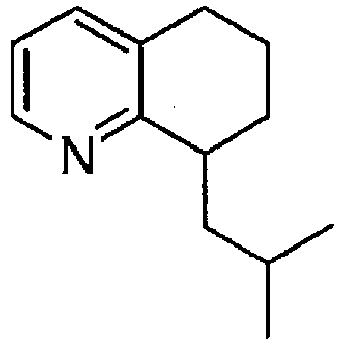
- Odor: green, herbaceous, pyrazine, earthy and American ginseng.
- 1H-NMR (300 MHz, CDCl3): 8.32 (d, J = 4.5 Hz, 1H), 6.24 (d, J = 7.4 Hz, 1H), 6.92 (dd, J = 7.4, 4.5 Hz, 1 H), 2.90-2.80 (m, 1H), 2.70-2.62 (m, 2H), 1.92-1.60 (m, 6H), 1.42-1.29 (m, 1H), 0.92 (d, J = 6.0 Hz, 3H), 0.87 (d, J = 6.0 Hz, 3H) ppm. 13C-NMR (75 MHz, CDCl3): 160.3 (s), 145.8 (d), 135.6 (d), 131.0 (s), 119.6 (d), 43.3 (t), 37.3 (d), 28.2 (t), 26.1 (t), 24.2 (d), 23.1 (q), 20.1 (q), 18.5 (t) ppm. GC/MS (EI): 189 (M+, 4), 174 (21), 160 (4), 146 (47), 133 (100), 118 (25), 103 (3), 91 (3), 77 (6), 65 (4), 39 (4).
-

- Odor: green, leaf, fresh, camphorated, touch orange blossom and ginseng.
- 1H-NMR (300 MHz, CDCl3): 8.33 (d, J = 4.5 Hz, 1H), 7.23 (d, J = 7.5 Hz, 1H), 6.91 (dd, J = 7.5, 4.5 Hz, 1H), 2.80-2.62 (m, 4H), 1.89-1.80 (m, 3H), 1.59-1.51 (m, 2H), 0.97 (d, J = 6.8 Hz, 3H), 0.58 (d, J = 6.8 Hz, 3H) ppm. 13C-NMR (75 MHz, CDCl3): 159.0 (s), 145.7 (d), 135.4 (d), 132.2 (s), 119.4 (d), 45.1 (d), 29.3 (d), 28.6 (t), 21.8 (t), 20.7 (t), 19.9 (q), 15.9 (q) ppm. GC/MS (EI): 175 (M+, 12), 160 (15), 147 (8), 132 (100), 117 (23), 103 (4), 91 (4), 77 (8), 65 (5), 51 (5), 39 (6).
-

- Odor: green, tomato leaf, herbaceous, American ginseng and pyrazine-like
- Two Isomers in a ratio of (1:1).
- 1H-NMR (300 MHz, CDCl3): 8.42-8.39 (m, 1H), 7.32-7.29 (m, 1 H), 7.00-6.96 (m, 1H), 2.98-2.84 (m, 1 H), 2.78-2.58 (m, 3H), 2.01-1.87 (m, 2H), 1.69-1.53 (m, 2H), 1.48-1.23 (m, 2H), 1.13-0.90 (m, 1H), 1.02, 0.59 (2t, J = 7.9 Hz, 3H), 0.95, 0.76 (2t, J = 7.0 Hz, 3H) ppm. 13C-NMR (75 MHz, CDCl3): 160.2, 160.0 (s), 146.8, 146.7 (d), 136.3 (d), 133.4, 133.2 (s), 120.3, 120.2 (d), 46.5, 44.6 (d), 37.5, 34.3 (t), 35.4, 35.1 (d), 29.7 (t), 23.6, 22.6 (t), 22.1, 21.9 (t), 21.0, 20.9 (t), 18.0, 14.3 (q), 14.5 (q) ppm. GC/MS (EI): 203 (M+, 7), 188 (70), 174 (25), 160 (18), 146 (8), 133 (100), 117 (21), 103 (2), 91 (2), 77 (4), 65 (2), 29 (2).
-

- Odor: green, herbal, ginseng and pyrazine-like, fruity, citrus and earthy
- 1H-NMR (300 MHz, CDCl3): 8.41 (d, J = 4.1 Hz, 1H), 7.30 (d, J = 7.6 Hz, 1H), 6.98 (dd, J = 7.6, 4.1 Hz, 1H), 3.11-3.01 (m, 1H), 2.75-2.65 (m, 2H), 2.38-2.28 (m, 1H), 2.00-1.88 (m, 2H), 1.66-1.49 (m, 3H), 1.36-1.21 (m, 1 H), 1.13-0.92 (m, 2H), 1.00 (t, J = 7.5 Hz, 3H), 0.72 (t, J = 7.5 Hz, 3H) ppm. 13C-NMR (75 MHz, CDCl3): 160.6 (s), 146.7 (d), 136.2 (d), 133.5 (s), 120.2 (d), 44.2 (d), 42.5 (d), 29.8 (t), 24.2 (t), 23.4 (t), 23.3 (t), 22.1 (t), 12.8 (q), 12.3 (q) ppm. GC/MS (EI): 203 (M+, 7), 188 (72), 174 (22), 160 (20), 146 (9), 133 (100), 117 (25), 103 (2), 77 (5), 65 (3), 39 (3).
-

- Odor: green, herbaceous, green bean-like, oranger flower, petitgrain
- 1H-NMR (300 MHz, CDCl3): 8.41 (d, J = 4.7 Hz, 1H), 7.31 (d, J = 7.5 Hz, 1H), 6.98 (dd, J = 7.5, 4.7 Hz, 1H), 2.86-2.80 (m, 1H), 2.73-2.65 (m, 2H), 2.39-2.30 (m, 1H), 1.95-1.87 (m, 2H), 1.78-1.59 (m, 6H), 1.44-0.96 (m, 6H) ppm. 13C-NMR (75 MHz, CDCl3): 159.9 (s), 146.7 (d), 136.3 (d), 133.2 (s), 120.3 (d), 45.9 (d), 41.4 (d), 31.6 (t), 29.5 (t), 27.7 (t), 27.0 (t), 26.8 (t), 26.7 (t), 24.1 (t), 21.6 (t) ppm. GC/MS (EI): 215 (M+, 8), 187 (6), 172 (11), 158 (5), 144 (6), 133 (100), 117 (12), 77 (4), 55 (4), 41 (4).
-

- Odor: fruity, earthy, oranger flower, green and herbal
- 1H-NMR (300 MHz, CDCl3): 8.40 (d, J = 4.7 Hz, 1H), 7.33 (d, J = 7.5 Hz, 1H), 7.00 (dd, J = 7.5, 4.7 Hz, 1 H), 4.81 (s, 1H), 4.73 (s, 1H), 3.09-3.01 (m, 1H), 2.84 (bdd, J = 13.6, 3.6 Hz, 1H), 2.68-2.72 (m, 2H), 2.18 (dd, J = 13.6, 11.5 Hz, 1H), 1.90-1.66 (m, 4H), 1.80 (s, 3H) ppm. 13C-NMR (75 MHz, CDCl3): 160.2 (s), 146.9 (d), 144.4 (s), 136.6 (d), 132.2 (s), 120.8 (d), 112.1 (t), 43.6 (t), 38.1 (d), 29.2 (t), 26.3 (t), 21.7 (q), 19.2 (t) ppm. GC/MS (EI): 187 (M+, 83), 186 (100), 172 (81), 159 (46), 144 (45), 130 (59), 117 (58), 103 (8), 91 (7), 77 (17), 65 (10), 51 (8), 39 (12).
-

- Odor: green, leafy, fruity and petitgrain-like, powerful.
- 1H-NMR (300 MHz, CDCl3): 8.39 (d, J = 4.7 Hz, 1 H), 7.31 (d, J = 7.5 Hz, 1H), 6.98 (dd, J = 7.5, 4.7 Hz, 1H), 2.89-2.78 (m, 1 H), 2.77-2.69 (m, 2H), 2.05-1.25 (m, 14H), 0.88 (t, J = 6.8 Hz, 3H) ppm. 13C-NMR (75 MHz, CDCl3): 160.9 (s), 146.8 (d), 136.5 (d), 132.0 (s), 120.6 (d), 40.7 (d), 35.3 (t), 31.9 (t), 29.5 (t), 29.2 (t), 27.4 (t), 27.3 (t), 22.6 (t), 19.7 (t), 14.0 (q) ppm. GC/MS (EI): 217 (M+, 9), 188 (2), 160 (13), 146 (32),133 (100), 118 (13), 103 (1), 77 (2), 39 (1).
-

- Odor: green, leafy with pea note, fruity, slightly camphoraceous.
- 2 Isomers in a ratio of 1:1)
- 1H-NMR (300 MHz, CDCl3): 8.31 (bs, 1 H), 7.40-7.37 (m, 1H), 6.95-6.91 (m, 1 H), 3.26-3.09 (m, 1H), 2.87-2.74 (m, 2H), 2.19-1.75 (m, 3H), 1.47-0.98 (m, 2H), 0.90, 0.59 (2d, J = 6.8 Hz, 3H), 0.92, 0.78 (2t, J = 7.4 Hz, 3H) ppm. GC/MS (EI): 175 (M+, 2), 160 (4), 146 (13), 130 (7), 119 (100), 91 (10), 77 (3), 65 (5), 39 (5).
-

- Odor: green, herbaceous, aromatic, floral (lily of the valley), less ginseng and pyrazine-like.
- Mixture of 2 isomers in a ratio of 1:1).
- 1H-NMR (300 MHz, CDCl3): 8.38 (bs), 7.47-7.45 (m, 1 H), 7.03-6.99 (m, 1 H), 3.31-3.24, 3.21-3.14 (2m, 1 H), 2.95-2.76 (m, 2H), 2.40-1.83 (m, 3H), 1.48-1.07 (m, 4H), 1.00, 0.65 (2d, J = 7.0 Hz, 3H), 0.94, 0.82 (2t, J = 7.0 Hz, 3H) ppm. 13C-NMR (75 MHz, CDCl3): 167.2, 167.0 (s), 147.5, 147.4 (d), 137.5, 137.4 (s), 1.31.8, 131.7 (d), 120.8 (d), 51.2, 49.6 (d), 37.9, 34.4 (t), 35.5, 34.4 (d), 29.4 (t), 25.1, 23.3 (t), 20.7, 20.6 (t), 17.8, 14.3 (q), 14.3 (q) ppm. GC/MS (EI): 189 (M+, 5), 174 (5), 160 (3), 146 (26), 119 (100), 91 (9), 77 (2), 65 (3), 39 (3).
-

- Odor: green, tomato leaf, aromatic, herbaceous, floral (lily of the valley), less ginseng and pyrazine-like.
- 1H-NMR (300 MHz, CDCl3): 8.38 (d, J = 4.9 Hz, 1H), 7.44 (d, J = 7.1 Hz, 1 H), 6.99 (dd, J = 7.1, 4.9 Hz, 1H), 3.42-3.36 (m, 1 H), 2.94-2.76 (m, 2H), 2.17-2.05 (m, 1 H), 1.99-1.81 (m, 2H), 1.68-1.54 (m, 1 H), 1.37-1.23 (m, 1 H), 1.15-1.06 (m, 2H), 1.00 (t, J = 7.5 Hz, 3H), 0.81 (t, J = 7.5 Hz, 3H) ppm. 13C-NMR (75 MHz, CDCl3): 167.6 (s), 147.5 (d), 137.5 (s), 131.7 (d), 120.8 (d), 47.5 (d), 43.7 (d), 29.4 (t), 24.5 (t), 24.1 (t), 22.6 (t), 12.4 (q), 12.1 (q) ppm. GC/MS (EI): 189 (M+, 2), 160 (23), 132 (4), 119 (100), 91 (4), 77 (1), 65 (2), 39 (2).
-

- Odor: green, orange flower (neroli), pungent.
- 1H-NMR (300 MHz, CDCl3): 8.37 (d, J = 4.9 Hz, 1 H), 7.47 (d, J = 7.9 Hz, 1 H), 7.02 (dd, J = 7.9, 4.9 Hz, 1 H), 4.80 (s, 1H), 4.76 (s, 1H), 3.38-3.28 (m, 1 H), 2.95-2.77 (m, 3H), 2.32-2.21 (m, 1 H), 2.05 (dd, J = 14.0, 11.2 Hz, 1H), 1.83-1.71 (m, 1 H), 1.80 (s, 3H) ppm. 13C-NMR (75 MHz, CDCl3): 167.4 (s), 147.52 (d), 144.4 (s), 136.7 (s), 132.1 (d), 121.2 (d), 111.4 (t), 43.5 (d), 42.2 (t), 29.3 (t), 28.8 (t), 22.4 (q) ppm. GC/MS (EI): 173 (M+, 62), 172 (77), 158 (50), 144 (10), 132 (32), 118 (100), 91 (25), 77 (7), 65 (9), 51 (5), 39 (10).
-

- Odor: green, earthy, ginseng.
- 1H-NMR (300 MHz, CDCl3): 8.36 (d, J = 4.9 Hz, 1H), 7.47 (d, J = 7.3 Hz, 1H), 7.01 (dd, J = 4.9, 7.3 Hz, 1 H), 3.23-3.13 (m, 1 H), 2.96-2.77 (m, 2H), 2.40-2.29 (m, 1 H), 1.98-1.64 (m, 3H), 1.38-1.29 (m, 1 H), 0.9 (d, J = 6.4 Hz, 3H), 0.8 (d, J = 6.4 Hz, 3H) ppm. GC/MS (EI): 175 (M+, 4), 160 (7), 132 (61), 118 (110), 107 (3), 91 (10), 77 (5), 65 (5), 39 (6).
-

- Odor: green, leafy, floral, orange flower, petitgrain.
- 1H-NMR (300 MHz, CDCl3): 8.37 (d, J = 4.9 Hz, 1H), 7.47 (d, J = 7.4 Hz, 1 H), 7.02 (dd, J = 7.4, 4.9 Hz, 1H), 5.22-5.17 (m, 1H), 3.22-3.12 (m, 1 H), 3.03-2.66 (m, 3H), 3.32-2.09 (m, 2H), 1.82-1.69 (m, 1 H), 1.70 (s, 3H), 1.62 (s, 3H) ppm. GC/MS (EI): 187 (M+, 18), 172 (37), 144 (7), 130 (8), 118 (100), 91 (12), 69 (6), 41 (11).
-

- Odor: green, herbal, fruity, ginseng and pyrazine-like.
- Two Isomers in a ratio of 2:8.
- 1H-NMR (300 MHz, CDCl3) major isomer: 8.39 (d, J = 4.2 Hz, 1 H), 7.47 (d, J = 7.4 Hz, 1 H), 7.02 (dd, J = 7.4, 4.2 Hz, 1 H), 5.92 (ddd, J = 17.4, 10.4, 6.6 Hz, 1H), 5.08 (d, J = 17.4 Hz, 1H), 5.02 (d, J = 10.4 Hz, 1 H), 3.36-3.30 (m, 1 H), 3.04-2.79 (m, 3H), 2.19-2.06 (m, 1H), 1.97-1.85 (m, 1 H), 0.86 (d, J = 6.8 Hz, 3H) ppm. 13C-NMR (75 MHz, CDCl3): 166.2 (s), 147.6 (d), 143.0 (d), 137.6 (s), 132.0 (d), 113.2 (t), 49.8 (d), 39.6 (d), 29.4 (t), 24.3 (t), 13.9 (q) ppm. GC/MS (EI): 173 (M+, 24), 172 (24), 158 (53),118 (100), 91 (20), 77 (5), 65 (7), 51 (4), 39 (7).
-

- Odor: green, floral, pyrazine, hyacinth-like, powerful.
- 1H-NMR (300 MHz, CDCl3): 8.36 (d, J = 4.5 Hz, 1 H), 7.47 (d, J = 7.3 Hz, 1 H), 7.01 (dd, J = &.3, 4.5 Hz, 1H), 3.15-3.05 (m, 1H), 2.96-2.77 (m, 2H), 2.39-2.27 (m, 1 H), 2.14-1.98 (m, 1 H), 1.79-1.67 (m, 1 H), 1.50-1.29 (m, 7H), 0.89 (t, J = 6.9 Hz, 3H) ppm. 13C-NMR (75 MHz, CDCl3): 168.0 (s), 147.4 (d), 136.8 (s), 132.0 (d), 121.0 (d), 45.5 (d), 33.8 (t), 32.0 (t), 30.0 (t), 29.1 (t), 27.2 (t), 22.6 (t), 14.1 (q) ppm. GC/MS (EI): 189 (M+, 7), 132 (45), 119 (100), 91 (8), 77 (3), 65 (3), 39 (3).
-

- Odor: green, herbaceous, green bean, petitgrain-like.
- 1H-NMR (300 MHz, CDCl3): 8.28 (d, J = 4.9 Hz, 1H), 7.34 (d, J = 7.5 Hz, 1H), 6.89 (dd, J = 7.5, 4.9 Hz, 1 H), 3.03-2.97 (m, 1H), 2.83-2.65 (m, 2H), 2.09-1.79 (m, 3H), 1.73-1.55 (m, 4H), 1.30-0.91 (m, 6H) ppm. 13C-NMR (75 MHz, CDCl3): 166.9 (s), 147.4 (d), 137.3 (s), 131.7 (d), 120.8 (d), 50-.9 (d), 40.8 (d), 31.7 (t), 29.5 (t), 27.9 (t), 26.7 (t), 26.6 (t), 26.4 (t), 25.1 (t) ppm. GC/MS (EI): 200 (M-1, 1), 158 (3), 130 (3), 119 (100), 91 (6), 77 (2), 55 (4), 41 (4).
- An organic spicy, ginger perfume application in which 8-sec-butyl-5,6,7,8-tetrahydroquinoline enhances the citrus character, gives freshness and creates a natural green aspect.
Benzyl acetate 25.00 Bornyl acetate 8.00 Phenyl ethyl acetate 2.00 Phenoxy ethyl alcohol 45.00 Phenylethyl alcohol 82.00 Cyclamen aldehyde 20.00 Ambrofix 3.00 Bergamote ess. 200.00 Bergamote ess. Italie 100.00 Citral lemarome 5.00 Citron ess. Italie Orpur 100.00 Citronellol extra 52.00 Cosmone 4.00 Coumarine 15.50 gamma-Decalactone 5.00 Dipropylene glycol 27.00 Ethyl linalool 50.00 Eucalyptol 2.00 Eugenol pure 5.00 Galaxolide 100.00 Ginger purple extract Orpur 70.00 Ginger root fresh cut 1.50 Hedione 200.00 Heliotropine 5.00 Isorealdeine 70 20.00 cis-Jasmone 1.00 Miel Blanc2/20 4.00 Opalal 50.00 Orange ess Brasil 20.00 Peche pure at 10% in DPG 5.00 Rajanol super 8.00 Terpineol pure 10.00 8-sec-butyl-5,6,7,8-tetrahydroquinoline 5.00 Total 1250.00

Claims (6)
- The use of a compound of formula (I)
 n = 0,1,2,3 andR = C2-C6 linear and branched alkyl, alkenyl and cycloalkyl substituentsas a flavour or fragrance ingredient.
 - Use according to claim 1 wherein the compound of formula (I) is selected from the group consisting of8-sec-Butyl-5,6,7,8-tetrahydroquinoline8-((Pentan-2-yl)-5,6,7,8-tetrahydroquinoline8-((Pentan-3-yl)-5,6,7,8-tetrahydroquinoline7-sec-Butyl-6,7-dihydro-5H-cyclopenta[b]pyridine7-((Pentan-2-yl)-6,7-dihydro-5H-cyclopenta[b]pyridine7-((Pentan-3-yl)-6,7-dihydro-5H-cyclopenta[b]pyridine7-((3-Methylbut-2-enyl)-6,7-dihydro-5H-cyclopenta[b]pyridine
- A fragrance or flavour composition or a flavoured or perfumed article comprising a compound of formula (I).
- A method to confer, enhance, improve or modify the hedonic properties of a perfuming composition or of a perfumed article, or of a flavour composition or flavoured article, which method comprises adding to said composition or article a compound of formula (I).
- A compound of formula (I) with the proviso that said compound is not

- A compound according to claim 5 selected from the group consisting of8-sec-Butyl-5,6,7,8-tetrahydroquinoline8-((Pentan-2-yl)-5,6,7,8-tetrahydroquinoline8-((Pentan-3-yl)-5,6,7,8-tetrahydroquinoline7-sec-Butyl-6,7-dihydro-5H-cyclopenta[b]pyridine7-((Pentan-2-yl)-6,7-dihydro-5H-cyclopenta[b]pyridine7-((Pentan-3-yl)-6,7-dihydro-5H-cyclopenta[b]pyridine7-((3-Methylbut-2-enyl)-6,7-dihydro-5H-cyclopenta[b]pyridine
Applications Claiming Priority (2)
| Application Number | Priority Date | Filing Date | Title |
|---|---|---|---|
| PCT/CN2010/000914 WO2011160254A1 (en) | 2010-06-22 | 2010-06-22 | Organic compounds |
| PCT/EP2011/060451 WO2011161163A1 (en) | 2010-06-22 | 2011-06-22 | Organic compounds |
Publications (2)
| Publication Number | Publication Date |
|---|---|
| EP2584916A1 EP2584916A1 (en) | 2013-05-01 |
| EP2584916B1 true EP2584916B1 (en) | 2014-04-02 |
Family
ID=44540126
Family Applications (1)
| Application Number | Title | Priority Date | Filing Date |
|---|---|---|---|
| EP11728241.8A Active EP2584916B1 (en) | 2010-06-22 | 2011-06-22 | Organic compounds |
Country Status (8)
| Country | Link |
|---|---|
| US (1) | US8933231B2 (en) |
| EP (1) | EP2584916B1 (en) |
| JP (1) | JP5877198B2 (en) |
| BR (1) | BR112012032733B1 (en) |
| ES (1) | ES2464291T3 (en) |
| MX (1) | MX2012013823A (en) |
| SG (1) | SG186067A1 (en) |
| WO (2) | WO2011160254A1 (en) |
Families Citing this family (5)
| Publication number | Priority date | Publication date | Assignee | Title |
|---|---|---|---|---|
| BR112017006180B1 (en) * | 2014-10-14 | 2020-11-17 | Givaudan Sa | bad odor reduction composition, consumer product, and hair coloring composition |
| DE102015217874A1 (en) * | 2015-09-17 | 2017-03-23 | Henkel Ag & Co. Kgaa | Perfume composition with odor modulator compounds and 1-aza-3,7-dioxabicyclol [3.3.0] octane compounds to increase and prolong fragrance intensity |
| DE102015217867A1 (en) * | 2015-09-17 | 2017-03-23 | Henkel Ag & Co. Kgaa | Perfume composition with odor modulator compounds to increase fragrance intensity |
| DE102015217878A1 (en) * | 2015-09-17 | 2017-03-23 | Henkel Ag & Co. Kgaa | Perfume composition with odor modulator compound, aminoalcohol and fragrance aldehyde and / or fragrance ketone for increasing and prolonging the fragrance intensity |
| DE102015217870A1 (en) * | 2015-09-17 | 2017-03-23 | Henkel Ag & Co. Kgaa | Perfume composition with odor modulator compounds to increase fragrance intensity |
Family Cites Families (8)
| Publication number | Priority date | Publication date | Assignee | Title |
|---|---|---|---|---|
| CH579912A5 (en) * | 1973-03-22 | 1976-09-30 | Roure Bertrand Dupont Sa | |
| US4160094A (en) * | 1974-04-11 | 1979-07-03 | John Wyeth & Brother Limited | Tetrahydroquinoline derivatives |
| DE2639702C2 (en) * | 1976-09-03 | 1984-03-08 | Degussa Ag, 6000 Frankfurt | Process for the preparation of 2,3-cycloalkenopyridines |
| JPS63112562A (en) * | 1986-10-28 | 1988-05-17 | Nippon Steel Chem Co Ltd | Method for producing 5,6,7,8-tetrahydroquinolines |
| GB8814458D0 (en) * | 1988-06-17 | 1988-07-20 | Wyeth John & Brother Ltd | Heterocyclic compounds |
| JPH0399063A (en) * | 1989-09-12 | 1991-04-24 | Kawasaki Steel Corp | Production of 5,6,7,8-tetrahydroquinoline |
| JPH06157461A (en) * | 1992-11-20 | 1994-06-03 | Sumikin Chem Co Ltd | Production of 5,6,7,8-tetrahydroquinolines |
| GB0227253D0 (en) | 2002-11-22 | 2002-12-31 | Quest Int | Novel fragrance compounds |
-
2010
- 2010-06-22 WO PCT/CN2010/000914 patent/WO2011160254A1/en not_active Ceased
-
2011
- 2011-06-22 SG SG2012086385A patent/SG186067A1/en unknown
- 2011-06-22 US US13/699,448 patent/US8933231B2/en active Active
- 2011-06-22 BR BR112012032733A patent/BR112012032733B1/en active IP Right Grant
- 2011-06-22 ES ES11728241.8T patent/ES2464291T3/en active Active
- 2011-06-22 EP EP11728241.8A patent/EP2584916B1/en active Active
- 2011-06-22 MX MX2012013823A patent/MX2012013823A/en active IP Right Grant
- 2011-06-22 WO PCT/EP2011/060451 patent/WO2011161163A1/en not_active Ceased
- 2011-06-22 JP JP2013515885A patent/JP5877198B2/en active Active
Also Published As
| Publication number | Publication date |
|---|---|
| MX2012013823A (en) | 2013-01-28 |
| BR112012032733B1 (en) | 2018-10-16 |
| JP5877198B2 (en) | 2016-03-02 |
| WO2011161163A1 (en) | 2011-12-29 |
| WO2011160254A1 (en) | 2011-12-29 |
| US20130129655A1 (en) | 2013-05-23 |
| SG186067A1 (en) | 2013-01-30 |
| ES2464291T3 (en) | 2014-06-02 |
| BR112012032733A2 (en) | 2015-09-08 |
| US8933231B2 (en) | 2015-01-13 |
| EP2584916A1 (en) | 2013-05-01 |
| JP2013531098A (en) | 2013-08-01 |
Similar Documents
| Publication | Publication Date | Title |
|---|---|---|
| US8933231B2 (en) | Organic compounds | |
| US8652452B2 (en) | 2,4-disubstituted pyridines as perfuming ingredients | |
| EP2561051B1 (en) | Organic carbonates with vanilla odor | |
| US8178732B2 (en) | Perfuming ingredients imparting sap and/or earthy type notes | |
| EP2723842B1 (en) | Cyclododecadienone derivatives as perfuming ingredients | |
| US20120010114A1 (en) | Acetals as perfuming ingredients | |
| US6559109B2 (en) | 1,3-Oxathianes as perfuming and flavoring ingredients | |
| CN102946741B (en) | Organic compounds | |
| EP3931290B1 (en) | Improvements in or relating to derivatives of rotundone | |
| EP2685959A2 (en) | Saffron odorants | |
| EP2935180B1 (en) | Sage odorant | |
| EP1784374B1 (en) | Unsaturated ethers as perfuming ingredients | |
| US10023514B2 (en) | Odorants of the violet type | |
| WO2011110614A1 (en) | Organic compounds | |
| JPS6217984B2 (en) | ||
| WO2012045697A1 (en) | Esters as perfuming ingredients |
Legal Events
| Date | Code | Title | Description |
|---|---|---|---|
| PUAI | Public reference made under article 153(3) epc to a published international application that has entered the european phase |
Free format text: ORIGINAL CODE: 0009012 |
|
| 17P | Request for examination filed |
Effective date: 20121116 |
|
| AK | Designated contracting states |
Kind code of ref document: A1 Designated state(s): AL AT BE BG CH CY CZ DE DK EE ES FI FR GB GR HR HU IE IS IT LI LT LU LV MC MK MT NL NO PL PT RO RS SE SI SK SM TR |
|
| DAX | Request for extension of the european patent (deleted) | ||
| REG | Reference to a national code |
Ref country code: DE Ref legal event code: R079 Ref document number: 602011005942 Country of ref document: DE Free format text: PREVIOUS MAIN CLASS: A23L0001226000 Ipc: C11B0009000000 |
|
| GRAP | Despatch of communication of intention to grant a patent |
Free format text: ORIGINAL CODE: EPIDOSNIGR1 |
|
| RIC1 | Information provided on ipc code assigned before grant |
Ipc: C07D 215/04 20060101ALI20131031BHEP Ipc: C07D 221/04 20060101ALI20131031BHEP Ipc: A23L 1/226 20060101ALI20131031BHEP Ipc: C11B 9/00 20060101AFI20131031BHEP |
|
| INTG | Intention to grant announced |
Effective date: 20131121 |
|
| GRAS | Grant fee paid |
Free format text: ORIGINAL CODE: EPIDOSNIGR3 |
|
| GRAA | (expected) grant |
Free format text: ORIGINAL CODE: 0009210 |
|
| AK | Designated contracting states |
Kind code of ref document: B1 Designated state(s): AL AT BE BG CH CY CZ DE DK EE ES FI FR GB GR HR HU IE IS IT LI LT LU LV MC MK MT NL NO PL PT RO RS SE SI SK SM TR |
|
| REG | Reference to a national code |
Ref country code: GB Ref legal event code: FG4D |
|
| REG | Reference to a national code |
Ref country code: CH Ref legal event code: EP Ref country code: AT Ref legal event code: REF Ref document number: 660149 Country of ref document: AT Kind code of ref document: T Effective date: 20140415 |
|
| REG | Reference to a national code |
Ref country code: IE Ref legal event code: FG4D |
|
| REG | Reference to a national code |
Ref country code: CH Ref legal event code: NV Representative=s name: GIVAUDAN SCHWEIZ AG GLOBAL PATENTS, CH Ref country code: DE Ref legal event code: R096 Ref document number: 602011005942 Country of ref document: DE Effective date: 20140515 |
|
| REG | Reference to a national code |
Ref country code: ES Ref legal event code: FG2A Ref document number: 2464291 Country of ref document: ES Kind code of ref document: T3 Effective date: 20140602 |
|
| REG | Reference to a national code |
Ref country code: NL Ref legal event code: T3 |
|
| REG | Reference to a national code |
Ref country code: AT Ref legal event code: MK05 Ref document number: 660149 Country of ref document: AT Kind code of ref document: T Effective date: 20140402 |
|
| REG | Reference to a national code |
Ref country code: LT Ref legal event code: MG4D |
|
| PG25 | Lapsed in a contracting state [announced via postgrant information from national office to epo] |
Ref country code: GR Free format text: LAPSE BECAUSE OF FAILURE TO SUBMIT A TRANSLATION OF THE DESCRIPTION OR TO PAY THE FEE WITHIN THE PRESCRIBED TIME-LIMIT Effective date: 20140703 Ref country code: IS Free format text: LAPSE BECAUSE OF FAILURE TO SUBMIT A TRANSLATION OF THE DESCRIPTION OR TO PAY THE FEE WITHIN THE PRESCRIBED TIME-LIMIT Effective date: 20140802 Ref country code: NO Free format text: LAPSE BECAUSE OF FAILURE TO SUBMIT A TRANSLATION OF THE DESCRIPTION OR TO PAY THE FEE WITHIN THE PRESCRIBED TIME-LIMIT Effective date: 20140702 Ref country code: CZ Free format text: LAPSE BECAUSE OF FAILURE TO SUBMIT A TRANSLATION OF THE DESCRIPTION OR TO PAY THE FEE WITHIN THE PRESCRIBED TIME-LIMIT Effective date: 20140402 Ref country code: BG Free format text: LAPSE BECAUSE OF FAILURE TO SUBMIT A TRANSLATION OF THE DESCRIPTION OR TO PAY THE FEE WITHIN THE PRESCRIBED TIME-LIMIT Effective date: 20140702 Ref country code: LT Free format text: LAPSE BECAUSE OF FAILURE TO SUBMIT A TRANSLATION OF THE DESCRIPTION OR TO PAY THE FEE WITHIN THE PRESCRIBED TIME-LIMIT Effective date: 20140402 Ref country code: CY Free format text: LAPSE BECAUSE OF FAILURE TO SUBMIT A TRANSLATION OF THE DESCRIPTION OR TO PAY THE FEE WITHIN THE PRESCRIBED TIME-LIMIT Effective date: 20140402 Ref country code: FI Free format text: LAPSE BECAUSE OF FAILURE TO SUBMIT A TRANSLATION OF THE DESCRIPTION OR TO PAY THE FEE WITHIN THE PRESCRIBED TIME-LIMIT Effective date: 20140402 |
|
| PG25 | Lapsed in a contracting state [announced via postgrant information from national office to epo] |
Ref country code: SE Free format text: LAPSE BECAUSE OF FAILURE TO SUBMIT A TRANSLATION OF THE DESCRIPTION OR TO PAY THE FEE WITHIN THE PRESCRIBED TIME-LIMIT Effective date: 20140402 Ref country code: HR Free format text: LAPSE BECAUSE OF FAILURE TO SUBMIT A TRANSLATION OF THE DESCRIPTION OR TO PAY THE FEE WITHIN THE PRESCRIBED TIME-LIMIT Effective date: 20140402 Ref country code: LV Free format text: LAPSE BECAUSE OF FAILURE TO SUBMIT A TRANSLATION OF THE DESCRIPTION OR TO PAY THE FEE WITHIN THE PRESCRIBED TIME-LIMIT Effective date: 20140402 Ref country code: RS Free format text: LAPSE BECAUSE OF FAILURE TO SUBMIT A TRANSLATION OF THE DESCRIPTION OR TO PAY THE FEE WITHIN THE PRESCRIBED TIME-LIMIT Effective date: 20140402 Ref country code: AT Free format text: LAPSE BECAUSE OF FAILURE TO SUBMIT A TRANSLATION OF THE DESCRIPTION OR TO PAY THE FEE WITHIN THE PRESCRIBED TIME-LIMIT Effective date: 20140402 Ref country code: PL Free format text: LAPSE BECAUSE OF FAILURE TO SUBMIT A TRANSLATION OF THE DESCRIPTION OR TO PAY THE FEE WITHIN THE PRESCRIBED TIME-LIMIT Effective date: 20140402 |
|
| PG25 | Lapsed in a contracting state [announced via postgrant information from national office to epo] |
Ref country code: PT Free format text: LAPSE BECAUSE OF FAILURE TO SUBMIT A TRANSLATION OF THE DESCRIPTION OR TO PAY THE FEE WITHIN THE PRESCRIBED TIME-LIMIT Effective date: 20140804 |
|
| REG | Reference to a national code |
Ref country code: DE Ref legal event code: R097 Ref document number: 602011005942 Country of ref document: DE |
|
| PG25 | Lapsed in a contracting state [announced via postgrant information from national office to epo] |
Ref country code: DK Free format text: LAPSE BECAUSE OF FAILURE TO SUBMIT A TRANSLATION OF THE DESCRIPTION OR TO PAY THE FEE WITHIN THE PRESCRIBED TIME-LIMIT Effective date: 20140402 Ref country code: EE Free format text: LAPSE BECAUSE OF FAILURE TO SUBMIT A TRANSLATION OF THE DESCRIPTION OR TO PAY THE FEE WITHIN THE PRESCRIBED TIME-LIMIT Effective date: 20140402 Ref country code: LU Free format text: LAPSE BECAUSE OF FAILURE TO SUBMIT A TRANSLATION OF THE DESCRIPTION OR TO PAY THE FEE WITHIN THE PRESCRIBED TIME-LIMIT Effective date: 20140622 Ref country code: SK Free format text: LAPSE BECAUSE OF FAILURE TO SUBMIT A TRANSLATION OF THE DESCRIPTION OR TO PAY THE FEE WITHIN THE PRESCRIBED TIME-LIMIT Effective date: 20140402 Ref country code: RO Free format text: LAPSE BECAUSE OF FAILURE TO SUBMIT A TRANSLATION OF THE DESCRIPTION OR TO PAY THE FEE WITHIN THE PRESCRIBED TIME-LIMIT Effective date: 20140402 Ref country code: BE Free format text: LAPSE BECAUSE OF FAILURE TO SUBMIT A TRANSLATION OF THE DESCRIPTION OR TO PAY THE FEE WITHIN THE PRESCRIBED TIME-LIMIT Effective date: 20140402 Ref country code: MC Free format text: LAPSE BECAUSE OF FAILURE TO SUBMIT A TRANSLATION OF THE DESCRIPTION OR TO PAY THE FEE WITHIN THE PRESCRIBED TIME-LIMIT Effective date: 20140402 |
|
| PLBE | No opposition filed within time limit |
Free format text: ORIGINAL CODE: 0009261 |
|
| STAA | Information on the status of an ep patent application or granted ep patent |
Free format text: STATUS: NO OPPOSITION FILED WITHIN TIME LIMIT |
|
| 26N | No opposition filed |
Effective date: 20150106 |
|
| REG | Reference to a national code |
Ref country code: IE Ref legal event code: MM4A |
|
| REG | Reference to a national code |
Ref country code: DE Ref legal event code: R097 Ref document number: 602011005942 Country of ref document: DE Effective date: 20150106 |
|
| PG25 | Lapsed in a contracting state [announced via postgrant information from national office to epo] |
Ref country code: IE Free format text: LAPSE BECAUSE OF NON-PAYMENT OF DUE FEES Effective date: 20140622 |
|
| PG25 | Lapsed in a contracting state [announced via postgrant information from national office to epo] |
Ref country code: RS Free format text: LAPSE BECAUSE OF FAILURE TO SUBMIT A TRANSLATION OF THE DESCRIPTION OR TO PAY THE FEE WITHIN THE PRESCRIBED TIME-LIMIT Effective date: 20141119 |
|
| REG | Reference to a national code |
Ref country code: FR Ref legal event code: PLFP Year of fee payment: 5 |
|
| PG25 | Lapsed in a contracting state [announced via postgrant information from national office to epo] |
Ref country code: SI Free format text: LAPSE BECAUSE OF FAILURE TO SUBMIT A TRANSLATION OF THE DESCRIPTION OR TO PAY THE FEE WITHIN THE PRESCRIBED TIME-LIMIT Effective date: 20140402 |
|
| PG25 | Lapsed in a contracting state [announced via postgrant information from national office to epo] |
Ref country code: MT Free format text: LAPSE BECAUSE OF FAILURE TO SUBMIT A TRANSLATION OF THE DESCRIPTION OR TO PAY THE FEE WITHIN THE PRESCRIBED TIME-LIMIT Effective date: 20140402 |
|
| PG25 | Lapsed in a contracting state [announced via postgrant information from national office to epo] |
Ref country code: SM Free format text: LAPSE BECAUSE OF FAILURE TO SUBMIT A TRANSLATION OF THE DESCRIPTION OR TO PAY THE FEE WITHIN THE PRESCRIBED TIME-LIMIT Effective date: 20140402 |
|
| REG | Reference to a national code |
Ref country code: FR Ref legal event code: PLFP Year of fee payment: 6 |
|
| PG25 | Lapsed in a contracting state [announced via postgrant information from national office to epo] |
Ref country code: HU Free format text: LAPSE BECAUSE OF FAILURE TO SUBMIT A TRANSLATION OF THE DESCRIPTION OR TO PAY THE FEE WITHIN THE PRESCRIBED TIME-LIMIT; INVALID AB INITIO Effective date: 20110622 Ref country code: TR Free format text: LAPSE BECAUSE OF FAILURE TO SUBMIT A TRANSLATION OF THE DESCRIPTION OR TO PAY THE FEE WITHIN THE PRESCRIBED TIME-LIMIT Effective date: 20140402 |
|
| REG | Reference to a national code |
Ref country code: FR Ref legal event code: PLFP Year of fee payment: 7 |
|
| REG | Reference to a national code |
Ref country code: FR Ref legal event code: PLFP Year of fee payment: 8 |
|
| PG25 | Lapsed in a contracting state [announced via postgrant information from national office to epo] |
Ref country code: MK Free format text: LAPSE BECAUSE OF FAILURE TO SUBMIT A TRANSLATION OF THE DESCRIPTION OR TO PAY THE FEE WITHIN THE PRESCRIBED TIME-LIMIT Effective date: 20140402 |
|
| PG25 | Lapsed in a contracting state [announced via postgrant information from national office to epo] |
Ref country code: AL Free format text: LAPSE BECAUSE OF FAILURE TO SUBMIT A TRANSLATION OF THE DESCRIPTION OR TO PAY THE FEE WITHIN THE PRESCRIBED TIME-LIMIT Effective date: 20140402 |
|
| REG | Reference to a national code |
Ref country code: CH Ref legal event code: NV Representative=s name: GIVAUDAN INTERNATIONAL SA GLOBAL PATENTS, CH |
|
| P01 | Opt-out of the competence of the unified patent court (upc) registered |
Effective date: 20230427 |
|
| PGFP | Annual fee paid to national office [announced via postgrant information from national office to epo] |
Ref country code: DE Payment date: 20250618 Year of fee payment: 15 |
|
| PGFP | Annual fee paid to national office [announced via postgrant information from national office to epo] |
Ref country code: GB Payment date: 20250618 Year of fee payment: 15 |
|
| PGFP | Annual fee paid to national office [announced via postgrant information from national office to epo] |
Ref country code: NL Payment date: 20250618 Year of fee payment: 15 |
|
| PGFP | Annual fee paid to national office [announced via postgrant information from national office to epo] |
Ref country code: FR Payment date: 20250624 Year of fee payment: 15 |
|
| PGFP | Annual fee paid to national office [announced via postgrant information from national office to epo] |
Ref country code: ES Payment date: 20250728 Year of fee payment: 15 |
|
| PGFP | Annual fee paid to national office [announced via postgrant information from national office to epo] |
Ref country code: IT Payment date: 20250624 Year of fee payment: 15 |
|
| PGFP | Annual fee paid to national office [announced via postgrant information from national office to epo] |
Ref country code: CH Payment date: 20250701 Year of fee payment: 15 |