EP2584780A1 - Method and device for encoding a video frame, method and device for decoding a video frame and storage medium - Google Patents
Method and device for encoding a video frame, method and device for decoding a video frame and storage medium Download PDFInfo
- Publication number
- EP2584780A1 EP2584780A1 EP12186238.7A EP12186238A EP2584780A1 EP 2584780 A1 EP2584780 A1 EP 2584780A1 EP 12186238 A EP12186238 A EP 12186238A EP 2584780 A1 EP2584780 A1 EP 2584780A1
- Authority
- EP
- European Patent Office
- Prior art keywords
- video frame
- bit depth
- values
- pixels
- offsets
- Prior art date
- Legal status (The legal status is an assumption and is not a legal conclusion. Google has not performed a legal analysis and makes no representation as to the accuracy of the status listed.)
- Granted
Links
- 238000000034 method Methods 0.000 title claims abstract description 33
- 238000012545 processing Methods 0.000 claims abstract description 6
- 230000003044 adaptive effect Effects 0.000 abstract description 14
- 230000007480 spreading Effects 0.000 description 4
- 238000001914 filtration Methods 0.000 description 3
- 230000004048 modification Effects 0.000 description 3
- 238000012986 modification Methods 0.000 description 3
- 230000000694 effects Effects 0.000 description 2
- 230000008569 process Effects 0.000 description 2
- 230000009467 reduction Effects 0.000 description 2
- 230000006835 compression Effects 0.000 description 1
- 238000007906 compression Methods 0.000 description 1
- 230000001419 dependent effect Effects 0.000 description 1
- 238000012805 post-processing Methods 0.000 description 1
- 238000013139 quantization Methods 0.000 description 1
- 230000002123 temporal effect Effects 0.000 description 1
- 238000012360 testing method Methods 0.000 description 1
- 230000009466 transformation Effects 0.000 description 1
- 230000001131 transforming effect Effects 0.000 description 1
Images





Classifications
-
- H—ELECTRICITY
- H04—ELECTRIC COMMUNICATION TECHNIQUE
- H04N—PICTORIAL COMMUNICATION, e.g. TELEVISION
- H04N19/00—Methods or arrangements for coding, decoding, compressing or decompressing digital video signals
- H04N19/85—Methods or arrangements for coding, decoding, compressing or decompressing digital video signals using pre-processing or post-processing specially adapted for video compression
-
- H—ELECTRICITY
- H04—ELECTRIC COMMUNICATION TECHNIQUE
- H04N—PICTORIAL COMMUNICATION, e.g. TELEVISION
- H04N19/00—Methods or arrangements for coding, decoding, compressing or decompressing digital video signals
- H04N19/10—Methods or arrangements for coding, decoding, compressing or decompressing digital video signals using adaptive coding
- H04N19/102—Methods or arrangements for coding, decoding, compressing or decompressing digital video signals using adaptive coding characterised by the element, parameter or selection affected or controlled by the adaptive coding
- H04N19/117—Filters, e.g. for pre-processing or post-processing
-
- H—ELECTRICITY
- H04—ELECTRIC COMMUNICATION TECHNIQUE
- H04N—PICTORIAL COMMUNICATION, e.g. TELEVISION
- H04N19/00—Methods or arrangements for coding, decoding, compressing or decompressing digital video signals
- H04N19/10—Methods or arrangements for coding, decoding, compressing or decompressing digital video signals using adaptive coding
- H04N19/102—Methods or arrangements for coding, decoding, compressing or decompressing digital video signals using adaptive coding characterised by the element, parameter or selection affected or controlled by the adaptive coding
- H04N19/124—Quantisation
-
- H—ELECTRICITY
- H04—ELECTRIC COMMUNICATION TECHNIQUE
- H04N—PICTORIAL COMMUNICATION, e.g. TELEVISION
- H04N19/00—Methods or arrangements for coding, decoding, compressing or decompressing digital video signals
- H04N19/10—Methods or arrangements for coding, decoding, compressing or decompressing digital video signals using adaptive coding
- H04N19/134—Methods or arrangements for coding, decoding, compressing or decompressing digital video signals using adaptive coding characterised by the element, parameter or criterion affecting or controlling the adaptive coding
-
- H—ELECTRICITY
- H04—ELECTRIC COMMUNICATION TECHNIQUE
- H04N—PICTORIAL COMMUNICATION, e.g. TELEVISION
- H04N19/00—Methods or arrangements for coding, decoding, compressing or decompressing digital video signals
- H04N19/10—Methods or arrangements for coding, decoding, compressing or decompressing digital video signals using adaptive coding
- H04N19/134—Methods or arrangements for coding, decoding, compressing or decompressing digital video signals using adaptive coding characterised by the element, parameter or criterion affecting or controlling the adaptive coding
- H04N19/136—Incoming video signal characteristics or properties
-
- H—ELECTRICITY
- H04—ELECTRIC COMMUNICATION TECHNIQUE
- H04N—PICTORIAL COMMUNICATION, e.g. TELEVISION
- H04N19/00—Methods or arrangements for coding, decoding, compressing or decompressing digital video signals
- H04N19/10—Methods or arrangements for coding, decoding, compressing or decompressing digital video signals using adaptive coding
- H04N19/169—Methods or arrangements for coding, decoding, compressing or decompressing digital video signals using adaptive coding characterised by the coding unit, i.e. the structural portion or semantic portion of the video signal being the object or the subject of the adaptive coding
- H04N19/182—Methods or arrangements for coding, decoding, compressing or decompressing digital video signals using adaptive coding characterised by the coding unit, i.e. the structural portion or semantic portion of the video signal being the object or the subject of the adaptive coding the unit being a pixel
-
- H—ELECTRICITY
- H04—ELECTRIC COMMUNICATION TECHNIQUE
- H04N—PICTORIAL COMMUNICATION, e.g. TELEVISION
- H04N19/00—Methods or arrangements for coding, decoding, compressing or decompressing digital video signals
- H04N19/10—Methods or arrangements for coding, decoding, compressing or decompressing digital video signals using adaptive coding
- H04N19/169—Methods or arrangements for coding, decoding, compressing or decompressing digital video signals using adaptive coding characterised by the coding unit, i.e. the structural portion or semantic portion of the video signal being the object or the subject of the adaptive coding
- H04N19/184—Methods or arrangements for coding, decoding, compressing or decompressing digital video signals using adaptive coding characterised by the coding unit, i.e. the structural portion or semantic portion of the video signal being the object or the subject of the adaptive coding the unit being bits, e.g. of the compressed video stream
-
- H—ELECTRICITY
- H04—ELECTRIC COMMUNICATION TECHNIQUE
- H04N—PICTORIAL COMMUNICATION, e.g. TELEVISION
- H04N19/00—Methods or arrangements for coding, decoding, compressing or decompressing digital video signals
- H04N19/42—Methods or arrangements for coding, decoding, compressing or decompressing digital video signals characterised by implementation details or hardware specially adapted for video compression or decompression, e.g. dedicated software implementation
- H04N19/423—Methods or arrangements for coding, decoding, compressing or decompressing digital video signals characterised by implementation details or hardware specially adapted for video compression or decompression, e.g. dedicated software implementation characterised by memory arrangements
-
- H—ELECTRICITY
- H04—ELECTRIC COMMUNICATION TECHNIQUE
- H04N—PICTORIAL COMMUNICATION, e.g. TELEVISION
- H04N19/00—Methods or arrangements for coding, decoding, compressing or decompressing digital video signals
- H04N19/80—Details of filtering operations specially adapted for video compression, e.g. for pixel interpolation
Definitions
- the invention is made in the field of video frame encoding. More precisely, the invention is concerned with encoding and decoding of video frames using Internal Bit Depth Increase (IBDI).
- IBDI Internal Bit Depth Increase
- IBDI Internal Bit Depth Increase
- IBDI is to increase the original bit depth of the original frame samples VID of an InputBitDepth by bitIncrement to an increased bit depth.
- bold arrows depict flow of data of increased bit depth while normal arrows depict flow of data of original bit depth.
- IBDI is done prior to transforming and quantizing TQ a residual with respect to a prediction PRED for encoding ENC into a bit stream BS.
- reconstructed reference frames of increased bit depth are used, the reconstructed reference frames resulting from inverse quantization and inverse transformation ITIQ and are subjected to a de-blocking and in-loop filtering FILT before being buffered BUF.
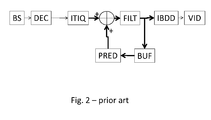
- an internal bit depth decrease IBDD is applied, after a bit stream BS is received, decoded DEC, inverse quantized and inverse transformed ITIQ, combined with a prediction PRED coming from a buffer BUF and filtered with the de-blocking and in-loop filtering FILT.
- bit depth decrease IBDD the video is output.
- the decoded residuals and the reference frames used for prediction are of said increased bit depth and first a reconstructed frame of said increased bit depth is reconstructed which is then bit depth reduced to regain the frame.
- the increase of bit depth can be achieved by left shifting (i.e. adding bitIncrement zeroes on the right of the sample value), for instance.
- coding efficiency may be reduced.
- the proposed method comprises using processing means for executing the step of offsetting the pixel values of increased bit depth with offsets, the offsets depending on a spatial neighbourhood of the pixel to-be-offset.
- the device comprising said processing means for executing the step of offsetting the pixel values.
- the offsets depend on values of neighbouring pixels in the spatial neighbourhoods.
- the offsets may depend on numbers of those of the neighbouring pixels which have pixel values larger than the value of the pixel to-be-offset.
- the offsets are no larger than a maximum offset, the maximum offset depending on a number of bits by which bit depth is increased.
- Said encoding method comprises modifying the video frame according the proposed method for video frame modification or one of the embodiments thereof.
- the reference video frame used for residual encoding is also modified according the proposed method for video frame modification or one of the embodiments thereof.
- a non-transitory storage medium is also proposed, the non-transitory storage medium carrying an encoded video frame, the video frame being encoded according to the proposed method for video frame encoding or the embodiment of this method.
- the invention may be realized on any electronic device comprising a processing means correspondingly adapted.
- the invention may be realized in a television, a mobile videophone, a personal computer, a digital video camera, a navigation system or a car video system.
- a first exemplary embodiment exemplarily depicted in Fig. 3 it is proposed to modify at encoder side the "Bit-Depth-Increase" function with an IBDI post-processing (also called IBDI Filter or adaptive offsetting) in order to reduce the range of the non-zero differences, also called gaps, between adjacent samples in a frame of increased bit depth.
- IBDI post-processing also called IBDI Filter or adaptive offsetting
- the adaptive IBDI Filter function has the property that most significant bits remain unchanged wherein the most significant bits of the sample are the bits prior to IBDI.
- the IBDI Filter is a non-linear low pass filter adding an offset which depends on values of adjacently neighboring samples.
- the offset value is in the range [0; (2 bitIncrement -1)] wherein bitIncrement is the difference between the original bit depth and the increased bit depth.
- Offset x cur Min ( a * 2 bitIncrement ; 2 bitIncrement - 1 wherein
- the IBDI filter process is also applied to pixel values of reference video frames used for inter prediction also known as temporal prediction. This is exemplarily depicted in fig. 4 and fig. 10 .
- the IBDI filter process can also be applied to pixel values of reference video frames of a different view wherein the reference video frames are used for inter-view prediction.
- Inter prediction and inter-view prediction makes use of reconstructed reference frames stored in a reference frame buffer BUF.
- the reconstructed reference frames can be stored with original bit depth or with a bit depth larger than the original bit depth but smaller than the increased bit depth, in order to save storage capacity.
- reconstructed reference frames retrieved from the buffer can be bit depth increased IBDI and filtered FILT before using them for prediction PRED, at encoder side as exemplarily depicted in fig. 4 and fig. 5 , and at decoder side, as exemplarily depicted in fig. 8 .
- the reconstructed reference frames can be stored with increased bit depth wherein the offset is either maintained, or, for better compression, amended or removed.
- reconstructed reference frames retrieved from the buffer can be filtered before using them for prediction, at encoder side as exemplarily depicted in fig. 6 and fig. 7 , and at decoder side, as exemplarily depicted in fig. 9 .
- Tests of this invention on various video encoders and decoders show that for a given quality level (PSNR) the bit stream size can be reduced significantly, in particular for devices using increased bit depth according to high efficient video codec (HEVC) and/or according to key technology areas (KTA) reference software codec.
- PSNR quality level
- HEVC high efficient video codec
- KTA key technology areas
- Fig. 10 The principle of adaptive filtering is exemplarily depicted in Fig. 10 wherein Fig. 10a depicts an exemplarily original signal value, Fig. 10b depicts the spreading of the exemplarily signal values due to increasing the bit depth and Fig. 10c exemplarily depicts reduction of said spreading due to the proposed adaptive offsetting.
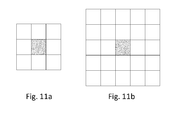
- Fig. 11 gives to examples of neighbourhoods.
- Fig. 11a depicts a neighbourhood consisting of the eight pixels directly adjacent to the pixel to-be-filtered which is depicted in grey;
- Fig. 11b depicts a larger neighbourhood further comprising all pixels adjacent to the pixels of the neighbourhood depicted in fig. 11a , with exception of the pixel to-be-filtered.
Landscapes
- Engineering & Computer Science (AREA)
- Multimedia (AREA)
- Signal Processing (AREA)
- Compression Or Coding Systems Of Tv Signals (AREA)
Abstract
Description
- The invention is made in the field of video frame encoding. More precisely, the invention is concerned with encoding and decoding of video frames using Internal Bit Depth Increase (IBDI).
- Internal Bit Depth Increase (IBDI) allows extending transforms precision and reference frames buffer precision and can be used for improving codecs' performances significantly.
- As exemplarily depicted in
Fig. 1 , the principle of IBDI is to increase the original bit depth of the original frame samples VID of an InputBitDepth by bitIncrement to an increased bit depth. In the Figure, bold arrows depict flow of data of increased bit depth while normal arrows depict flow of data of original bit depth. IBDI is done prior to transforming and quantizing TQ a residual with respect to a prediction PRED for encoding ENC into a bit stream BS. For prediction, reconstructed reference frames of increased bit depth are used, the reconstructed reference frames resulting from inverse quantization and inverse transformation ITIQ and are subjected to a de-blocking and in-loop filtering FILT before being buffered BUF. - At decoder side, as exemplarily depicted in
Fig. 2 , an internal bit depth decrease IBDD is applied, after a bit stream BS is received, decoded DEC, inverse quantized and inverse transformed ITIQ, combined with a prediction PRED coming from a buffer BUF and filtered with the de-blocking and in-loop filtering FILT. After bit depth decrease IBDD the video is output. The decoded residuals and the reference frames used for prediction are of said increased bit depth and first a reconstructed frame of said increased bit depth is reconstructed which is then bit depth reduced to regain the frame. - The increase of bit depth can be achieved by left shifting (i.e. adding bitIncrement zeroes on the right of the sample value), for instance.
- The inventors recognized that bit depth increase by, e.g., left shifting actually spreads the non-zero differences between consecutive spatial samples, e.g. a bit shift by one bit doubles a non-zero difference between consecutive samples, which begets fronts and leads to emphasized high frequencies in the transform domain. Thus, coding efficiency may be reduced.
- Therefore, it is proposed a method according to
claim 1 and a device according to claim 9 for modifying a video frame for encoding or decoding wherein values of pixels of the video frame are represented an increased bit depth. The proposed method comprises using processing means for executing the step of offsetting the pixel values of increased bit depth with offsets, the offsets depending on a spatial neighbourhood of the pixel to-be-offset. The device comprising said processing means for executing the step of offsetting the pixel values. - Such local adaptive offsetting of pixel values de-emphasizes high frequencies in the transform domain of bit depth increased signals.
- In an embodiment, the offsets depend on values of neighbouring pixels in the spatial neighbourhoods.
- In said embodiment the offsets may depend on numbers of those of the neighbouring pixels which have pixel values larger than the value of the pixel to-be-offset.
- In a further embodiment the offsets are no larger than a maximum offset, the maximum offset depending on a number of bits by which bit depth is increased.
- It is further proposed a method, as well as a corresponding device, for encoding a video frame wherein values of pixels of the video frame are represented an increased bit depth. Said encoding method comprises modifying the video frame according the proposed method for video frame modification or one of the embodiments thereof.
- In an embodiment, the reference video frame used for residual encoding is also modified according the proposed method for video frame modification or one of the embodiments thereof.
- It is further proposed a method, as well as a corresponding device, for decoding a video frame wherein values of pixels of the video frame are represented with an increased bit depth, said method comprising modifying a reference video frame according the proposed method for video frame modification or one of the embodiments thereof and reconstructing the video frame using a decoded residual and the modified reference video frame.
- A non-transitory storage medium is also proposed, the non-transitory storage medium carrying an encoded video frame, the video frame being encoded according to the proposed method for video frame encoding or the embodiment of this method.
- The features of further advantageous embodiments are specified in the dependent claims.
- Exemplary embodiments of the invention are illustrated in the drawings and are explained in more detail in the following description. The exemplary embodiments are explained only for elucidating the invention, but not for limiting the invention's disclosure or scope defined in the claims.
- In the figures:
- Fig. 1
- depicts an exemplary prior art encoder architecture;
- Fig. 2
- depicts an exemplary prior art decoder architecture;
- Fig. 3
- depicts a first exemplary application of the proposed adaptive offsetting in an encoder,
- Fig. 4
- depicts a second exemplary application of the proposed adaptive offsetting in an encoder,
- Fig. 5
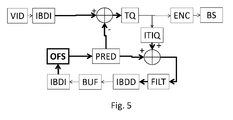
- depicts a third exemplary application of the proposed adaptive offsetting in an encoder,
- Fig. 6
- depicts a fourth exemplary application of the proposed adaptive offsetting in an encoder,
- Fig. 7
- depicts a fithfth exemplary application of the proposed adaptive offsetting in an encoder,
- Fig. 8
- depicts a first exemplary application of the proposed adaptive offsetting in a decoder,
- Fig. 9
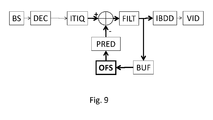
- depicts a second exemplary application of the proposed adaptive offsetting in a decoder,
- Fig. 10
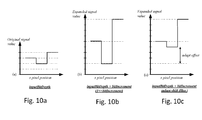
- exemplarily illustrates the effect of non-zero difference spreading due to bit depth increase and reduction of the effect of said non-zero difference spreading due to the proposed adaptive offsetting;
- Fig. 11
- depict exemplary neighbourhoods of a current pixel.
- The invention may be realized on any electronic device comprising a processing means correspondingly adapted. For instance, the invention may be realized in a television, a mobile videophone, a personal computer, a digital video camera, a navigation system or a car video system.
- In a first exemplary embodiment exemplarily depicted in
Fig. 3 , it is proposed to modify at encoder side the "Bit-Depth-Increase" function with an IBDI post-processing (also called IBDI Filter or adaptive offsetting) in order to reduce the range of the non-zero differences, also called gaps, between adjacent samples in a frame of increased bit depth. This is done by applying the filter IBDI to the video signal of increased bit depth prior to determination of a residual between the video signal of increased bit depth and a prediction PRED thereof. - Advantageously but not necessarily, the adaptive IBDI Filter function has the property that most significant bits remain unchanged wherein the most significant bits of the sample are the bits prior to IBDI.
- Many filter designs are possible. In an exemplary embodiment, the IBDI Filter is a non-linear low pass filter adding an offset which depends on values of adjacently neighboring samples. The offset value is in the range [0; (2bitIncrement-1)] wherein bitIncrement is the difference between the original bit depth and the increased bit depth.
- An example of such non-linear low pass filter adding an offset is the following offset function:

wherein - xcur denotes the position of a given pixel in the frame,
- N(xcur ) denotes the set of pixel positions in the neighborhood of xcur without xcur,
- Nb(xcur) denotes the number of pixel in the neighborhood N(xcur) (Nb(xcur)-connexity), Nb(xcur) = # ( { N(xcur) } )
- C(x) denotes the original component sample value before "Bit-Depth-Increase" at the position x in the frame,
- Cpt(xcur) denotes the number of pixels in the neighborhood of xcur with component value greater than the component value of xcur :

- Advantageously but not necessarily, the IBDI filter process is also applied to pixel values of reference video frames used for inter prediction also known as temporal prediction. This is exemplarily depicted in
fig. 4 andfig. 10 . In a multi view coding context, the IBDI filter process can also be applied to pixel values of reference video frames of a different view wherein the reference video frames are used for inter-view prediction. - Inter prediction and inter-view prediction makes use of reconstructed reference frames stored in a reference frame buffer BUF.
- The reconstructed reference frames can be stored with original bit depth or with a bit depth larger than the original bit depth but smaller than the increased bit depth, in order to save storage capacity. In this case, reconstructed reference frames retrieved from the buffer can be bit depth increased IBDI and filtered FILT before using them for prediction PRED, at encoder side as exemplarily depicted in
fig. 4 andfig. 5 , and at decoder side, as exemplarily depicted infig. 8 . - The reconstructed reference frames can be stored with increased bit depth wherein the offset is either maintained, or, for better compression, amended or removed. In this case of storage with increased bit depth, reconstructed reference frames retrieved from the buffer can be filtered before using them for prediction, at encoder side as exemplarily depicted in
fig. 6 andfig. 7 , and at decoder side, as exemplarily depicted infig. 9 . - Tests of this invention on various video encoders and decoders show that for a given quality level (PSNR) the bit stream size can be reduced significantly, in particular for devices using increased bit depth according to high efficient video codec (HEVC) and/or according to key technology areas (KTA) reference software codec.
- The principle of adaptive filtering is exemplarily depicted in
Fig. 10 whereinFig. 10a depicts an exemplarily original signal value,Fig. 10b depicts the spreading of the exemplarily signal values due to increasing the bit depth andFig. 10c exemplarily depicts reduction of said spreading due to the proposed adaptive offsetting. -
Fig. 11 gives to examples of neighbourhoods.Fig. 11a depicts a neighbourhood consisting of the eight pixels directly adjacent to the pixel to-be-filtered which is depicted in grey;Fig. 11b depicts a larger neighbourhood further comprising all pixels adjacent to the pixels of the neighbourhood depicted infig. 11a , with exception of the pixel to-be-filtered.
Claims (14)
- Method for modifying a video frame intended to be used in an inter-frame encoding or decoding method wherein values of pixels of the video frame are represented in bit depth, said method comprising using processing means for executing the step of- offsetting the pixel values of bit depth with offsets, the offsets depending on a spatial neighborhood consisting of pixels directly adjacent to the pixel to-be-offset.
- Method of claim 1, wherein the offsets depend on values of neighboring pixels in the spatial neighborhoods.
- Method of claim 2, wherein the offsets depend on numbers of those of the neighboring pixels which have pixel values larger than the value of the pixel to-be-offset.
- Method of claim 1, 2 or 3 wherein the offsets are no larger than a maximum offset, the maximum offset depending on a number of bits by which bit depth is increased.
- Method for inter-frame encoding a video frame wherein values of pixels of the video frame are represented in bit depth, said method comprising modifying the video frame according to the method of one of claims 1-4 prior to determining a residual between the modified video frame and a reference video frame.
- Method of claim 5 further comprising modifying the reference video frame according to the method of one of claims 1-4.
- Method for inter-frame decoding a video frame wherein values of pixels of the video frame are represented in bit depth, said method comprising modifying a reference video frame according to the method of one of claims 1-4 and reconstructing the video frame using a decoded residual and the modified reference video frame.
- Device for modifying a video frame intended to be used in an inter-frame encoding or decoding method wherein values of pixels of the video frame are represented in bit depth, said device comprising processing means for executing the step- of-offsetting the pixel values of bit depth with offsets, the offsets depending on a spatial neighborhood consisting of pixels directly adjacent to the pixel to-be-offset.
- Device of claim 8, wherein the offsets depend on values of neighboring pixels in the spatial neighborhoods.
- Device of claim 9, wherein the offsets depend on numbers of those of the neighboring pixels which have pixel values larger than the value of the pixel to-be-offset.
- Device of claim 8, 9 or 10 wherein the offsets are no larger than a maximum offset, the maximum offset depending on a number of bits by which bit depth is increased.
- Device for inter-frame encoding a video frame wherein values of pixels of the video frame are represented in bit depth, said device comprising the device for modifying the video frame according to one of claims 8-11, said device further comprising means for residual encoding the modified video frame using a reference video frame.
- Device for inter-frame decoding a video frame wherein values of pixels of the video frame are represented in bit depth, said device comprising the device for modifying a video frame according to one of claims 8-11, said modifying device being used for modifying a reference video frame, said decoding device further comprising means for reconstructing the video frame using a decoded residual and the modified reference video frame.
- Non-transitory storage medium carrying an encoded video frame, the video frame being encoded according to the method of claim 5.
Priority Applications (1)
| Application Number | Priority Date | Filing Date | Title |
|---|---|---|---|
| EP12186238.7A EP2584780B1 (en) | 2011-10-20 | 2012-09-27 | Method and device for encoding a video frame, method and device for decoding a video frame and storage medium |
Applications Claiming Priority (2)
| Application Number | Priority Date | Filing Date | Title |
|---|---|---|---|
| EP11306356.4A EP2584779A1 (en) | 2011-10-20 | 2011-10-20 | Method and device for encoding a video frame, method and device for decoding a video frame and storage medium |
| EP12186238.7A EP2584780B1 (en) | 2011-10-20 | 2012-09-27 | Method and device for encoding a video frame, method and device for decoding a video frame and storage medium |
Publications (2)
| Publication Number | Publication Date |
|---|---|
| EP2584780A1 true EP2584780A1 (en) | 2013-04-24 |
| EP2584780B1 EP2584780B1 (en) | 2019-04-17 |
Family
ID=46880638
Family Applications (2)
| Application Number | Title | Priority Date | Filing Date |
|---|---|---|---|
| EP11306356.4A Withdrawn EP2584779A1 (en) | 2011-10-20 | 2011-10-20 | Method and device for encoding a video frame, method and device for decoding a video frame and storage medium |
| EP12186238.7A Active EP2584780B1 (en) | 2011-10-20 | 2012-09-27 | Method and device for encoding a video frame, method and device for decoding a video frame and storage medium |
Family Applications Before (1)
| Application Number | Title | Priority Date | Filing Date |
|---|---|---|---|
| EP11306356.4A Withdrawn EP2584779A1 (en) | 2011-10-20 | 2011-10-20 | Method and device for encoding a video frame, method and device for decoding a video frame and storage medium |
Country Status (1)
| Country | Link |
|---|---|
| EP (2) | EP2584779A1 (en) |
Citations (2)
| Publication number | Priority date | Publication date | Assignee | Title |
|---|---|---|---|---|
| US20090097561A1 (en) * | 2007-10-15 | 2009-04-16 | Yi-Jen Chiu | Bit depth enhancement for scalable video coding |
| EP2169657A1 (en) * | 2007-07-04 | 2010-03-31 | Nec Corporation | Image processing device, display, image processing method, and program |
-
2011
- 2011-10-20 EP EP11306356.4A patent/EP2584779A1/en not_active Withdrawn
-
2012
- 2012-09-27 EP EP12186238.7A patent/EP2584780B1/en active Active
Patent Citations (2)
| Publication number | Priority date | Publication date | Assignee | Title |
|---|---|---|---|---|
| EP2169657A1 (en) * | 2007-07-04 | 2010-03-31 | Nec Corporation | Image processing device, display, image processing method, and program |
| US20090097561A1 (en) * | 2007-10-15 | 2009-04-16 | Yi-Jen Chiu | Bit depth enhancement for scalable video coding |
Non-Patent Citations (5)
| Title |
|---|
| CHEUK-HONG CHENG ET AL: "Bit-depth expansion by contour region reconstruction", CIRCUITS AND SYSTEMS, 2009. ISCAS 2009. IEEE INTERNATIONAL SYMPOSIUM ON, IEEE, PISCATAWAY, NJ, USA, 24 May 2009 (2009-05-24), pages 944 - 947, XP031479355, ISBN: 978-1-4244-3827-3 * |
| CHUJOH (TOSHIBA) T ET AL: "Video coding technology proposal by Toshiba", 1. JCT-VC MEETING; 15-4-2010 - 23-4-2010; DRESDEN; (JOINTCOLLABORATIVE TEAM ON VIDEO CODING OF ISO/IEC JTC1/SC29/WG11 AND ITU-TSG.16 ); URL: HTTP://WFTP3.ITU.INT/AV-ARCH/JCTVC-SITE/,, no. XP030007558, 18 April 2010 (2010-04-18), XP030007559, ISSN: 0000-0049 * |
| CHUN HUNG LIU ET AL: "Bit-depth expansion by adaptive filter", CIRCUITS AND SYSTEMS, 2008. ISCAS 2008. IEEE INTERNATIONAL SYMPOSIUM ON, IEEE, PISCATAWAY, NJ, USA, 18 May 2008 (2008-05-18), pages 496 - 499, XP031392018, ISBN: 978-1-4244-1683-7 * |
| HOANG (ZENVERGE) D: "Unified scaling with adaptive offset for reference frame compression with IBDI", 95. MPEG MEETING; 24-1-2011 - 28-1-2011; DAEGU; (MOTION PICTURE EXPERT GROUP OR ISO/IEC JTC1/SC29/WG11),, no. m18782, 21 January 2011 (2011-01-21), XP030047352 * |
| LIU S ET AL: "Bit-depth scalable coding for high dynamic range video", PROCEEDINGS OF SPIE, SPIE, US, vol. 6822, no. 2, 29 January 2008 (2008-01-29), pages 68220O - 1, XP002517655, ISSN: 0277-786X, DOI: 10.1117/12.766601 * |
Also Published As
| Publication number | Publication date |
|---|---|
| EP2584779A1 (en) | 2013-04-24 |
| EP2584780B1 (en) | 2019-04-17 |
Similar Documents
| Publication | Publication Date | Title |
|---|---|---|
| KR101619975B1 (en) | Apparatus and method for image coding and decoding using skip coding | |
| EP3021578B1 (en) | Sub-sampling of reference pixels for chroma prediction based on luma intra prediction mode | |
| US9479791B2 (en) | Image-filtering method and apparatus, and encoding/decoding method and apparatus using same | |
| CN103283231B (en) | The compression and decompression of reference picture in video encoder | |
| KR100973657B1 (en) | Method and apparatus for transcoding between codecs including deblocking filtering | |
| US10609417B2 (en) | High efficiency adaptive loop filter processing for video coding | |
| US20120087595A1 (en) | Image encoding device, image decoding device, image encoding method, and image decoding method | |
| EP3456051B1 (en) | A method and a device for decoding an intra predicted block of a picture and corresponding coding method and coding device | |
| EP3991410B1 (en) | Video decoder, video encoder, methods for encoding and decoding video signals and computer program adjusting one or more denoising operations | |
| Zhang et al. | A novel image/video coding method based on compressed sensing theory | |
| CN1998152A (en) | Conditional lapped transform | |
| TWI771705B (en) | Encoder, decoder, methods and computer programs for an improved lossless compression | |
| KR20130098122A (en) | Device and method for encoding/decoding | |
| JP2013509024A5 (en) | ||
| KR101253156B1 (en) | Method for encoding/decoding video signal | |
| WO2005057933A1 (en) | Spatial scalable compression scheme with a dead zone | |
| KR20070074453A (en) | Method for encoding and decoding video signal | |
| US9621890B2 (en) | Method and device for encoding a video frame, method and device for decoding a video frame and storage medium | |
| EP2584780B1 (en) | Method and device for encoding a video frame, method and device for decoding a video frame and storage medium | |
| US20120230395A1 (en) | Video decoder with reduced dynamic range transform with quantization matricies | |
| US20160330486A1 (en) | Method and apparatus for processing video signal for reducing visibility of blocking artifacts | |
| KR20150113523A (en) | Image decoding device for improved subjective quality and method thereof | |
| JP5298487B2 (en) | Image encoding device, image decoding device, and image encoding method | |
| JP2005260989A (en) | Image processing apparatus and image processing method | |
| KR20130049603A (en) | Hexc Deblocking Filter Parallel Processing Algorithm and How Hexc Deblocking Filter Enables Parallel Processing |
Legal Events
| Date | Code | Title | Description |
|---|---|---|---|
| PUAI | Public reference made under article 153(3) epc to a published international application that has entered the european phase |
Free format text: ORIGINAL CODE: 0009012 |
|
| AK | Designated contracting states |
Kind code of ref document: A1 Designated state(s): AL AT BE BG CH CY CZ DE DK EE ES FI FR GB GR HR HU IE IS IT LI LT LU LV MC MK MT NL NO PL PT RO RS SE SI SK SM TR |
|
| AX | Request for extension of the european patent |
Extension state: BA ME |
|
| 17P | Request for examination filed |
Effective date: 20131008 |
|
| RBV | Designated contracting states (corrected) |
Designated state(s): AL AT BE BG CH CY CZ DE DK EE ES FI FR GB GR HR HU IE IS IT LI LT LU LV MC MK MT NL NO PL PT RO RS SE SI SK SM TR |
|
| STAA | Information on the status of an ep patent application or granted ep patent |
Free format text: STATUS: EXAMINATION IS IN PROGRESS |
|
| 17Q | First examination report despatched |
Effective date: 20170103 |
|
| RAP1 | Party data changed (applicant data changed or rights of an application transferred) |
Owner name: THOMSON LICENSING DTV |
|
| RAP1 | Party data changed (applicant data changed or rights of an application transferred) |
Owner name: INTERDIGITAL MADISON PATENT HOLDINGS |
|
| REG | Reference to a national code |
Ref country code: DE Ref legal event code: R079 Ref document number: 602012059033 Country of ref document: DE Free format text: PREVIOUS MAIN CLASS: H04N0007260000 Ipc: H04N0019117000 |
|
| GRAP | Despatch of communication of intention to grant a patent |
Free format text: ORIGINAL CODE: EPIDOSNIGR1 |
|
| STAA | Information on the status of an ep patent application or granted ep patent |
Free format text: STATUS: GRANT OF PATENT IS INTENDED |
|
| RIC1 | Information provided on ipc code assigned before grant |
Ipc: H04N 19/85 20130424ALI20181031BHEP Ipc: H04N 19/117 20130424AFI20181031BHEP Ipc: H04N 19/182 20130424ALI20181031BHEP Ipc: H04N 19/136 20130424ALI20181031BHEP Ipc: H04N 19/80 20130424ALI20181031BHEP Ipc: H04N 19/423 20130424ALI20181031BHEP Ipc: H04N 19/124 20130424ALI20181031BHEP Ipc: H04N 19/82 20130424ALI20181031BHEP |
|
| INTG | Intention to grant announced |
Effective date: 20181120 |
|
| RIC1 | Information provided on ipc code assigned before grant |
Ipc: H04N 19/182 20140101ALI20181031BHEP Ipc: H04N 19/136 20140101ALI20181031BHEP Ipc: H04N 19/85 20140101ALI20181031BHEP Ipc: H04N 19/80 20140101ALI20181031BHEP Ipc: H04N 19/117 20140101AFI20181031BHEP Ipc: H04N 19/124 20140101ALI20181031BHEP Ipc: H04N 19/423 20140101ALI20181031BHEP Ipc: H04N 19/82 20140101ALI20181031BHEP |
|
| RIC1 | Information provided on ipc code assigned before grant |
Ipc: H04N 19/80 20140101ALI20181031BHEP Ipc: H04N 19/182 20140101ALI20181031BHEP Ipc: H04N 19/85 20140101ALI20181031BHEP Ipc: H04N 19/124 20140101ALI20181031BHEP Ipc: H04N 19/82 20140101ALI20181031BHEP Ipc: H04N 19/423 20140101ALI20181031BHEP Ipc: H04N 19/117 20140101AFI20181031BHEP Ipc: H04N 19/136 20140101ALI20181031BHEP |
|
| GRAS | Grant fee paid |
Free format text: ORIGINAL CODE: EPIDOSNIGR3 |
|
| GRAA | (expected) grant |
Free format text: ORIGINAL CODE: 0009210 |
|
| STAA | Information on the status of an ep patent application or granted ep patent |
Free format text: STATUS: THE PATENT HAS BEEN GRANTED |
|
| AK | Designated contracting states |
Kind code of ref document: B1 Designated state(s): AL AT BE BG CH CY CZ DE DK EE ES FI FR GB GR HR HU IE IS IT LI LT LU LV MC MK MT NL NO PL PT RO RS SE SI SK SM TR |
|
| REG | Reference to a national code |
Ref country code: GB Ref legal event code: FG4D |
|
| REG | Reference to a national code |
Ref country code: CH Ref legal event code: EP |
|
| REG | Reference to a national code |
Ref country code: DE Ref legal event code: R096 Ref document number: 602012059033 Country of ref document: DE |
|
| REG | Reference to a national code |
Ref country code: AT Ref legal event code: REF Ref document number: 1122830 Country of ref document: AT Kind code of ref document: T Effective date: 20190515 Ref country code: IE Ref legal event code: FG4D |
|
| REG | Reference to a national code |
Ref country code: NL Ref legal event code: MP Effective date: 20190417 |
|
| REG | Reference to a national code |
Ref country code: LT Ref legal event code: MG4D |
|
| PG25 | Lapsed in a contracting state [announced via postgrant information from national office to epo] |
Ref country code: NL Free format text: LAPSE BECAUSE OF FAILURE TO SUBMIT A TRANSLATION OF THE DESCRIPTION OR TO PAY THE FEE WITHIN THE PRESCRIBED TIME-LIMIT Effective date: 20190417 |
|
| PG25 | Lapsed in a contracting state [announced via postgrant information from national office to epo] |
Ref country code: HR Free format text: LAPSE BECAUSE OF FAILURE TO SUBMIT A TRANSLATION OF THE DESCRIPTION OR TO PAY THE FEE WITHIN THE PRESCRIBED TIME-LIMIT Effective date: 20190417 Ref country code: LT Free format text: LAPSE BECAUSE OF FAILURE TO SUBMIT A TRANSLATION OF THE DESCRIPTION OR TO PAY THE FEE WITHIN THE PRESCRIBED TIME-LIMIT Effective date: 20190417 Ref country code: NO Free format text: LAPSE BECAUSE OF FAILURE TO SUBMIT A TRANSLATION OF THE DESCRIPTION OR TO PAY THE FEE WITHIN THE PRESCRIBED TIME-LIMIT Effective date: 20190717 Ref country code: FI Free format text: LAPSE BECAUSE OF FAILURE TO SUBMIT A TRANSLATION OF THE DESCRIPTION OR TO PAY THE FEE WITHIN THE PRESCRIBED TIME-LIMIT Effective date: 20190417 Ref country code: PT Free format text: LAPSE BECAUSE OF FAILURE TO SUBMIT A TRANSLATION OF THE DESCRIPTION OR TO PAY THE FEE WITHIN THE PRESCRIBED TIME-LIMIT Effective date: 20190817 Ref country code: AL Free format text: LAPSE BECAUSE OF FAILURE TO SUBMIT A TRANSLATION OF THE DESCRIPTION OR TO PAY THE FEE WITHIN THE PRESCRIBED TIME-LIMIT Effective date: 20190417 Ref country code: SE Free format text: LAPSE BECAUSE OF FAILURE TO SUBMIT A TRANSLATION OF THE DESCRIPTION OR TO PAY THE FEE WITHIN THE PRESCRIBED TIME-LIMIT Effective date: 20190417 Ref country code: ES Free format text: LAPSE BECAUSE OF FAILURE TO SUBMIT A TRANSLATION OF THE DESCRIPTION OR TO PAY THE FEE WITHIN THE PRESCRIBED TIME-LIMIT Effective date: 20190417 |
|
| PG25 | Lapsed in a contracting state [announced via postgrant information from national office to epo] |
Ref country code: GR Free format text: LAPSE BECAUSE OF FAILURE TO SUBMIT A TRANSLATION OF THE DESCRIPTION OR TO PAY THE FEE WITHIN THE PRESCRIBED TIME-LIMIT Effective date: 20190718 Ref country code: RS Free format text: LAPSE BECAUSE OF FAILURE TO SUBMIT A TRANSLATION OF THE DESCRIPTION OR TO PAY THE FEE WITHIN THE PRESCRIBED TIME-LIMIT Effective date: 20190417 Ref country code: BG Free format text: LAPSE BECAUSE OF FAILURE TO SUBMIT A TRANSLATION OF THE DESCRIPTION OR TO PAY THE FEE WITHIN THE PRESCRIBED TIME-LIMIT Effective date: 20190717 Ref country code: LV Free format text: LAPSE BECAUSE OF FAILURE TO SUBMIT A TRANSLATION OF THE DESCRIPTION OR TO PAY THE FEE WITHIN THE PRESCRIBED TIME-LIMIT Effective date: 20190417 Ref country code: PL Free format text: LAPSE BECAUSE OF FAILURE TO SUBMIT A TRANSLATION OF THE DESCRIPTION OR TO PAY THE FEE WITHIN THE PRESCRIBED TIME-LIMIT Effective date: 20190417 |
|
| REG | Reference to a national code |
Ref country code: AT Ref legal event code: MK05 Ref document number: 1122830 Country of ref document: AT Kind code of ref document: T Effective date: 20190417 |
|
| PG25 | Lapsed in a contracting state [announced via postgrant information from national office to epo] |
Ref country code: IS Free format text: LAPSE BECAUSE OF FAILURE TO SUBMIT A TRANSLATION OF THE DESCRIPTION OR TO PAY THE FEE WITHIN THE PRESCRIBED TIME-LIMIT Effective date: 20190817 |
|
| REG | Reference to a national code |
Ref country code: DE Ref legal event code: R097 Ref document number: 602012059033 Country of ref document: DE |
|
| PG25 | Lapsed in a contracting state [announced via postgrant information from national office to epo] |
Ref country code: AT Free format text: LAPSE BECAUSE OF FAILURE TO SUBMIT A TRANSLATION OF THE DESCRIPTION OR TO PAY THE FEE WITHIN THE PRESCRIBED TIME-LIMIT Effective date: 20190417 Ref country code: EE Free format text: LAPSE BECAUSE OF FAILURE TO SUBMIT A TRANSLATION OF THE DESCRIPTION OR TO PAY THE FEE WITHIN THE PRESCRIBED TIME-LIMIT Effective date: 20190417 Ref country code: SK Free format text: LAPSE BECAUSE OF FAILURE TO SUBMIT A TRANSLATION OF THE DESCRIPTION OR TO PAY THE FEE WITHIN THE PRESCRIBED TIME-LIMIT Effective date: 20190417 Ref country code: DK Free format text: LAPSE BECAUSE OF FAILURE TO SUBMIT A TRANSLATION OF THE DESCRIPTION OR TO PAY THE FEE WITHIN THE PRESCRIBED TIME-LIMIT Effective date: 20190417 Ref country code: RO Free format text: LAPSE BECAUSE OF FAILURE TO SUBMIT A TRANSLATION OF THE DESCRIPTION OR TO PAY THE FEE WITHIN THE PRESCRIBED TIME-LIMIT Effective date: 20190417 Ref country code: CZ Free format text: LAPSE BECAUSE OF FAILURE TO SUBMIT A TRANSLATION OF THE DESCRIPTION OR TO PAY THE FEE WITHIN THE PRESCRIBED TIME-LIMIT Effective date: 20190417 |
|
| PLBE | No opposition filed within time limit |
Free format text: ORIGINAL CODE: 0009261 |
|
| STAA | Information on the status of an ep patent application or granted ep patent |
Free format text: STATUS: NO OPPOSITION FILED WITHIN TIME LIMIT |
|
| PG25 | Lapsed in a contracting state [announced via postgrant information from national office to epo] |
Ref country code: SM Free format text: LAPSE BECAUSE OF FAILURE TO SUBMIT A TRANSLATION OF THE DESCRIPTION OR TO PAY THE FEE WITHIN THE PRESCRIBED TIME-LIMIT Effective date: 20190417 Ref country code: IT Free format text: LAPSE BECAUSE OF FAILURE TO SUBMIT A TRANSLATION OF THE DESCRIPTION OR TO PAY THE FEE WITHIN THE PRESCRIBED TIME-LIMIT Effective date: 20190417 |
|
| 26N | No opposition filed |
Effective date: 20200120 |
|
| PG25 | Lapsed in a contracting state [announced via postgrant information from national office to epo] |
Ref country code: TR Free format text: LAPSE BECAUSE OF FAILURE TO SUBMIT A TRANSLATION OF THE DESCRIPTION OR TO PAY THE FEE WITHIN THE PRESCRIBED TIME-LIMIT Effective date: 20190417 |
|
| PG25 | Lapsed in a contracting state [announced via postgrant information from national office to epo] |
Ref country code: SI Free format text: LAPSE BECAUSE OF FAILURE TO SUBMIT A TRANSLATION OF THE DESCRIPTION OR TO PAY THE FEE WITHIN THE PRESCRIBED TIME-LIMIT Effective date: 20190417 Ref country code: MC Free format text: LAPSE BECAUSE OF FAILURE TO SUBMIT A TRANSLATION OF THE DESCRIPTION OR TO PAY THE FEE WITHIN THE PRESCRIBED TIME-LIMIT Effective date: 20190417 |
|
| REG | Reference to a national code |
Ref country code: CH Ref legal event code: PL |
|
| PG25 | Lapsed in a contracting state [announced via postgrant information from national office to epo] |
Ref country code: LI Free format text: LAPSE BECAUSE OF NON-PAYMENT OF DUE FEES Effective date: 20190930 Ref country code: LU Free format text: LAPSE BECAUSE OF NON-PAYMENT OF DUE FEES Effective date: 20190927 Ref country code: CH Free format text: LAPSE BECAUSE OF NON-PAYMENT OF DUE FEES Effective date: 20190930 Ref country code: IE Free format text: LAPSE BECAUSE OF NON-PAYMENT OF DUE FEES Effective date: 20190927 |
|
| REG | Reference to a national code |
Ref country code: BE Ref legal event code: MM Effective date: 20190930 |
|
| PG25 | Lapsed in a contracting state [announced via postgrant information from national office to epo] |
Ref country code: BE Free format text: LAPSE BECAUSE OF NON-PAYMENT OF DUE FEES Effective date: 20190930 |
|
| GBPC | Gb: european patent ceased through non-payment of renewal fee |
Effective date: 20190927 |
|
| PG25 | Lapsed in a contracting state [announced via postgrant information from national office to epo] |
Ref country code: GB Free format text: LAPSE BECAUSE OF NON-PAYMENT OF DUE FEES Effective date: 20190927 |
|
| PG25 | Lapsed in a contracting state [announced via postgrant information from national office to epo] |
Ref country code: CY Free format text: LAPSE BECAUSE OF FAILURE TO SUBMIT A TRANSLATION OF THE DESCRIPTION OR TO PAY THE FEE WITHIN THE PRESCRIBED TIME-LIMIT Effective date: 20190417 |
|
| PG25 | Lapsed in a contracting state [announced via postgrant information from national office to epo] |
Ref country code: HU Free format text: LAPSE BECAUSE OF FAILURE TO SUBMIT A TRANSLATION OF THE DESCRIPTION OR TO PAY THE FEE WITHIN THE PRESCRIBED TIME-LIMIT; INVALID AB INITIO Effective date: 20120927 Ref country code: MT Free format text: LAPSE BECAUSE OF FAILURE TO SUBMIT A TRANSLATION OF THE DESCRIPTION OR TO PAY THE FEE WITHIN THE PRESCRIBED TIME-LIMIT Effective date: 20190417 |
|
| PG25 | Lapsed in a contracting state [announced via postgrant information from national office to epo] |
Ref country code: MK Free format text: LAPSE BECAUSE OF FAILURE TO SUBMIT A TRANSLATION OF THE DESCRIPTION OR TO PAY THE FEE WITHIN THE PRESCRIBED TIME-LIMIT Effective date: 20190417 |
|
| P01 | Opt-out of the competence of the unified patent court (upc) registered |
Effective date: 20230514 |
|
| PGFP | Annual fee paid to national office [announced via postgrant information from national office to epo] |
Ref country code: DE Payment date: 20240926 Year of fee payment: 13 |
|
| PGFP | Annual fee paid to national office [announced via postgrant information from national office to epo] |
Ref country code: FR Payment date: 20240925 Year of fee payment: 13 |