EP2584016A1 - Single phase silicone acrylate formulation - Google Patents
Single phase silicone acrylate formulation Download PDFInfo
- Publication number
- EP2584016A1 EP2584016A1 EP12189221.0A EP12189221A EP2584016A1 EP 2584016 A1 EP2584016 A1 EP 2584016A1 EP 12189221 A EP12189221 A EP 12189221A EP 2584016 A1 EP2584016 A1 EP 2584016A1
- Authority
- EP
- European Patent Office
- Prior art keywords
- silicone
- acrylate
- silicon
- pressure sensitive
- sensitive adhesive
- Prior art date
- Legal status (The legal status is an assumption and is not a legal conclusion. Google has not performed a legal analysis and makes no representation as to the accuracy of the status listed.)
- Withdrawn
Links
- 239000000203 mixture Substances 0.000 title claims abstract description 182
- NIXOWILDQLNWCW-UHFFFAOYSA-M Acrylate Chemical compound [O-]C(=O)C=C NIXOWILDQLNWCW-UHFFFAOYSA-M 0.000 title claims abstract description 151
- 229920001296 polysiloxane Polymers 0.000 title claims abstract description 150
- 238000009472 formulation Methods 0.000 title claims abstract description 54
- 239000003795 chemical substances by application Substances 0.000 claims abstract description 173
- 239000004820 Pressure-sensitive adhesive Substances 0.000 claims abstract description 133
- XUIMIQQOPSSXEZ-UHFFFAOYSA-N Silicon Chemical compound [Si] XUIMIQQOPSSXEZ-UHFFFAOYSA-N 0.000 claims abstract description 93
- 229910052710 silicon Inorganic materials 0.000 claims abstract description 93
- 239000010703 silicon Substances 0.000 claims abstract description 93
- 238000000034 method Methods 0.000 claims abstract description 33
- 238000005191 phase separation Methods 0.000 claims abstract description 33
- 239000003999 initiator Substances 0.000 claims abstract description 23
- 239000007795 chemical reaction product Substances 0.000 claims abstract description 17
- 239000013543 active substance Substances 0.000 claims description 67
- -1 polydimethylsiloxane Polymers 0.000 claims description 67
- 239000000178 monomer Substances 0.000 claims description 64
- 229920002050 silicone resin Polymers 0.000 claims description 34
- 229920005573 silicon-containing polymer Polymers 0.000 claims description 32
- VOXZDWNPVJITMN-ZBRFXRBCSA-N 17β-estradiol Chemical compound OC1=CC=C2[C@H]3CC[C@](C)([C@H](CC4)O)[C@@H]4[C@@H]3CCC2=C1 VOXZDWNPVJITMN-ZBRFXRBCSA-N 0.000 claims description 20
- 229920005989 resin Polymers 0.000 claims description 20
- 239000011347 resin Substances 0.000 claims description 20
- 239000000546 pharmaceutical excipient Substances 0.000 claims description 19
- CERQOIWHTDAKMF-UHFFFAOYSA-M Methacrylate Chemical compound CC(=C)C([O-])=O CERQOIWHTDAKMF-UHFFFAOYSA-M 0.000 claims description 17
- 238000009833 condensation Methods 0.000 claims description 13
- 230000005494 condensation Effects 0.000 claims description 13
- 229960005309 estradiol Drugs 0.000 claims description 13
- 239000003054 catalyst Substances 0.000 claims description 12
- 239000004205 dimethyl polysiloxane Substances 0.000 claims description 12
- 229920000435 poly(dimethylsiloxane) Polymers 0.000 claims description 12
- 238000006482 condensation reaction Methods 0.000 claims description 10
- 238000011065 in-situ storage Methods 0.000 claims description 8
- 229930182833 estradiol Natural products 0.000 claims description 7
- 239000002480 mineral oil Substances 0.000 claims description 7
- 235000010446 mineral oil Nutrition 0.000 claims description 7
- GJSURZIOUXUGAL-UHFFFAOYSA-N Clonidine Chemical compound ClC1=CC=CC(Cl)=C1NC1=NCCN1 GJSURZIOUXUGAL-UHFFFAOYSA-N 0.000 claims description 6
- 229960002896 clonidine Drugs 0.000 claims description 6
- SZXQTJUDPRGNJN-UHFFFAOYSA-N dipropylene glycol Chemical compound OCCCOCCCO SZXQTJUDPRGNJN-UHFFFAOYSA-N 0.000 claims description 6
- DKYWVDODHFEZIM-UHFFFAOYSA-N ketoprofen Chemical compound OC(=O)C(C)C1=CC=CC(C(=O)C=2C=CC=CC=2)=C1 DKYWVDODHFEZIM-UHFFFAOYSA-N 0.000 claims description 6
- 229960000991 ketoprofen Drugs 0.000 claims description 6
- SCPYDCQAZCOKTP-UHFFFAOYSA-N silanol Chemical compound [SiH3]O SCPYDCQAZCOKTP-UHFFFAOYSA-N 0.000 claims description 6
- GOXQRTZXKQZDDN-UHFFFAOYSA-N 2-Ethylhexyl acrylate Chemical compound CCCCC(CC)COC(=O)C=C GOXQRTZXKQZDDN-UHFFFAOYSA-N 0.000 claims description 5
- BPQQTUXANYXVAA-UHFFFAOYSA-N Orthosilicate Chemical compound [O-][Si]([O-])([O-])[O-] BPQQTUXANYXVAA-UHFFFAOYSA-N 0.000 claims description 5
- ZQPPMHVWECSIRJ-KTKRTIGZSA-N oleic acid Chemical compound CCCCCCCC\C=C/CCCCCCCC(O)=O ZQPPMHVWECSIRJ-KTKRTIGZSA-N 0.000 claims description 5
- ALSTYHKOOCGGFT-KTKRTIGZSA-N (9Z)-octadecen-1-ol Chemical compound CCCCCCCC\C=C/CCCCCCCCO ALSTYHKOOCGGFT-KTKRTIGZSA-N 0.000 claims description 4
- WRIDQFICGBMAFQ-UHFFFAOYSA-N (E)-8-Octadecenoic acid Natural products CCCCCCCCCC=CCCCCCCC(O)=O WRIDQFICGBMAFQ-UHFFFAOYSA-N 0.000 claims description 4
- LQJBNNIYVWPHFW-UHFFFAOYSA-N 20:1omega9c fatty acid Natural products CCCCCCCCCCC=CCCCCCCCC(O)=O LQJBNNIYVWPHFW-UHFFFAOYSA-N 0.000 claims description 4
- QSBYPNXLFMSGKH-UHFFFAOYSA-N 9-Heptadecensaeure Natural products CCCCCCCC=CCCCCCCCC(O)=O QSBYPNXLFMSGKH-UHFFFAOYSA-N 0.000 claims description 4
- 239000005642 Oleic acid Substances 0.000 claims description 4
- ZQPPMHVWECSIRJ-UHFFFAOYSA-N Oleic acid Natural products CCCCCCCCC=CCCCCCCCC(O)=O ZQPPMHVWECSIRJ-UHFFFAOYSA-N 0.000 claims description 4
- QXJSBBXBKPUZAA-UHFFFAOYSA-N isooleic acid Natural products CCCCCCCC=CCCCCCCCCC(O)=O QXJSBBXBKPUZAA-UHFFFAOYSA-N 0.000 claims description 4
- 229940055577 oleyl alcohol Drugs 0.000 claims description 4
- XMLQWXUVTXCDDL-UHFFFAOYSA-N oleyl alcohol Natural products CCCCCCC=CCCCCCCCCCCO XMLQWXUVTXCDDL-UHFFFAOYSA-N 0.000 claims description 4
- XEKOWRVHYACXOJ-UHFFFAOYSA-N Ethyl acetate Chemical compound CCOC(C)=O XEKOWRVHYACXOJ-UHFFFAOYSA-N 0.000 description 102
- 238000006243 chemical reaction Methods 0.000 description 51
- 239000011541 reaction mixture Substances 0.000 description 44
- 239000002904 solvent Substances 0.000 description 39
- 150000003254 radicals Chemical class 0.000 description 31
- 238000002156 mixing Methods 0.000 description 29
- IJGRMHOSHXDMSA-UHFFFAOYSA-N Atomic nitrogen Chemical compound N#N IJGRMHOSHXDMSA-UHFFFAOYSA-N 0.000 description 28
- 238000010438 heat treatment Methods 0.000 description 27
- 239000003814 drug Substances 0.000 description 23
- 239000011521 glass Substances 0.000 description 23
- 229940079593 drug Drugs 0.000 description 22
- 238000003756 stirring Methods 0.000 description 22
- 229910020388 SiO1/2 Inorganic materials 0.000 description 21
- 239000000758 substrate Substances 0.000 description 18
- NIXOWILDQLNWCW-UHFFFAOYSA-N acrylic acid group Chemical group C(C=C)(=O)O NIXOWILDQLNWCW-UHFFFAOYSA-N 0.000 description 17
- 239000000463 material Substances 0.000 description 17
- OZAIFHULBGXAKX-UHFFFAOYSA-N 2-(2-cyanopropan-2-yldiazenyl)-2-methylpropanenitrile Chemical group N#CC(C)(C)N=NC(C)(C)C#N OZAIFHULBGXAKX-UHFFFAOYSA-N 0.000 description 16
- 229910052757 nitrogen Inorganic materials 0.000 description 16
- 239000007787 solid Substances 0.000 description 16
- 150000001875 compounds Chemical class 0.000 description 15
- 239000000498 cooling water Substances 0.000 description 14
- 239000012467 final product Substances 0.000 description 14
- 238000010926 purge Methods 0.000 description 14
- 238000013271 transdermal drug delivery Methods 0.000 description 14
- FFUAGWLWBBFQJT-UHFFFAOYSA-N hexamethyldisilazane Chemical compound C[Si](C)(C)N[Si](C)(C)C FFUAGWLWBBFQJT-UHFFFAOYSA-N 0.000 description 13
- 125000004432 carbon atom Chemical group C* 0.000 description 12
- 238000006116 polymerization reaction Methods 0.000 description 12
- CTQNGGLPUBDAKN-UHFFFAOYSA-N O-Xylene Chemical compound CC1=CC=CC=C1C CTQNGGLPUBDAKN-UHFFFAOYSA-N 0.000 description 11
- 229920001577 copolymer Polymers 0.000 description 11
- 210000003491 skin Anatomy 0.000 description 11
- 239000008096 xylene Substances 0.000 description 11
- 230000000052 comparative effect Effects 0.000 description 10
- 239000000853 adhesive Substances 0.000 description 9
- 230000001070 adhesive effect Effects 0.000 description 9
- 230000015572 biosynthetic process Effects 0.000 description 9
- BAPJBEWLBFYGME-UHFFFAOYSA-N Methyl acrylate Chemical compound COC(=O)C=C BAPJBEWLBFYGME-UHFFFAOYSA-N 0.000 description 8
- 229910020485 SiO4/2 Inorganic materials 0.000 description 8
- UIIMBOGNXHQVGW-UHFFFAOYSA-M Sodium bicarbonate Chemical compound [Na+].OC([O-])=O UIIMBOGNXHQVGW-UHFFFAOYSA-M 0.000 description 8
- 239000000839 emulsion Substances 0.000 description 8
- 125000002887 hydroxy group Chemical group [H]O* 0.000 description 8
- 150000002978 peroxides Chemical class 0.000 description 8
- 239000000047 product Substances 0.000 description 8
- OMPJBNCRMGITSC-UHFFFAOYSA-N Benzoylperoxide Chemical compound C=1C=CC=CC=1C(=O)OOC(=O)C1=CC=CC=C1 OMPJBNCRMGITSC-UHFFFAOYSA-N 0.000 description 7
- 235000019400 benzoyl peroxide Nutrition 0.000 description 7
- 239000003431 cross linking reagent Substances 0.000 description 7
- 239000004971 Cross linker Substances 0.000 description 6
- KFZMGEQAYNKOFK-UHFFFAOYSA-N Isopropanol Chemical compound CC(C)O KFZMGEQAYNKOFK-UHFFFAOYSA-N 0.000 description 6
- DNIAPMSPPWPWGF-UHFFFAOYSA-N Propylene glycol Chemical compound CC(O)CO DNIAPMSPPWPWGF-UHFFFAOYSA-N 0.000 description 6
- 150000001252 acrylic acid derivatives Chemical class 0.000 description 6
- 230000008859 change Effects 0.000 description 6
- 238000001035 drying Methods 0.000 description 6
- 230000037317 transdermal delivery Effects 0.000 description 6
- XMAYWYJOQHXEEK-OZXSUGGESA-N (2R,4S)-ketoconazole Chemical compound C1CN(C(=O)C)CCN1C(C=C1)=CC=C1OC[C@@H]1O[C@@](CN2C=NC=C2)(C=2C(=CC(Cl)=CC=2)Cl)OC1 XMAYWYJOQHXEEK-OZXSUGGESA-N 0.000 description 5
- 239000004342 Benzoyl peroxide Substances 0.000 description 5
- DFPAKSUCGFBDDF-UHFFFAOYSA-N Nicotinamide Chemical compound NC(=O)C1=CC=CN=C1 DFPAKSUCGFBDDF-UHFFFAOYSA-N 0.000 description 5
- 150000004945 aromatic hydrocarbons Chemical class 0.000 description 5
- 229920006026 co-polymeric resin Polymers 0.000 description 5
- 230000001419 dependent effect Effects 0.000 description 5
- 239000003623 enhancer Substances 0.000 description 5
- 150000002148 esters Chemical class 0.000 description 5
- 239000012530 fluid Substances 0.000 description 5
- 229960004125 ketoconazole Drugs 0.000 description 5
- 125000002496 methyl group Chemical group [H]C([H])([H])* 0.000 description 5
- 229960003966 nicotinamide Drugs 0.000 description 5
- 235000005152 nicotinamide Nutrition 0.000 description 5
- 239000011570 nicotinamide Substances 0.000 description 5
- 229920002635 polyurethane Polymers 0.000 description 5
- 239000004814 polyurethane Substances 0.000 description 5
- NKANXQFJJICGDU-QPLCGJKRSA-N Tamoxifen Chemical compound C=1C=CC=CC=1C(/CC)=C(C=1C=CC(OCCN(C)C)=CC=1)/C1=CC=CC=C1 NKANXQFJJICGDU-QPLCGJKRSA-N 0.000 description 4
- 239000000654 additive Substances 0.000 description 4
- 150000001338 aliphatic hydrocarbons Chemical class 0.000 description 4
- 238000005516 engineering process Methods 0.000 description 4
- LNEPOXFFQSENCJ-UHFFFAOYSA-N haloperidol Chemical compound C1CC(O)(C=2C=CC(Cl)=CC=2)CCN1CCCC(=O)C1=CC=C(F)C=C1 LNEPOXFFQSENCJ-UHFFFAOYSA-N 0.000 description 4
- 230000007246 mechanism Effects 0.000 description 4
- 125000005641 methacryl group Chemical group 0.000 description 4
- 238000006386 neutralization reaction Methods 0.000 description 4
- 230000008569 process Effects 0.000 description 4
- YGSDEFSMJLZEOE-UHFFFAOYSA-N salicylic acid Chemical compound OC(=O)C1=CC=CC=C1O YGSDEFSMJLZEOE-UHFFFAOYSA-N 0.000 description 4
- 229910000030 sodium bicarbonate Inorganic materials 0.000 description 4
- 235000017557 sodium bicarbonate Nutrition 0.000 description 4
- 238000012546 transfer Methods 0.000 description 4
- XLYOFNOQVPJJNP-UHFFFAOYSA-N water Substances O XLYOFNOQVPJJNP-UHFFFAOYSA-N 0.000 description 4
- ZWEHNKRNPOVVGH-UHFFFAOYSA-N 2-Butanone Chemical compound CCC(C)=O ZWEHNKRNPOVVGH-UHFFFAOYSA-N 0.000 description 3
- XBIUWALDKXACEA-UHFFFAOYSA-N 3-[bis(2,4-dioxopentan-3-yl)alumanyl]pentane-2,4-dione Chemical group CC(=O)C(C(C)=O)[Al](C(C(C)=O)C(C)=O)C(C(C)=O)C(C)=O XBIUWALDKXACEA-UHFFFAOYSA-N 0.000 description 3
- CSCPPACGZOOCGX-UHFFFAOYSA-N Acetone Chemical compound CC(C)=O CSCPPACGZOOCGX-UHFFFAOYSA-N 0.000 description 3
- 229930003347 Atropine Natural products 0.000 description 3
- UHOVQNZJYSORNB-UHFFFAOYSA-N Benzene Chemical compound C1=CC=CC=C1 UHOVQNZJYSORNB-UHFFFAOYSA-N 0.000 description 3
- 239000004215 Carbon black (E152) Substances 0.000 description 3
- YMWUJEATGCHHMB-UHFFFAOYSA-N Dichloromethane Chemical compound ClCCl YMWUJEATGCHHMB-UHFFFAOYSA-N 0.000 description 3
- LFQSCWFLJHTTHZ-UHFFFAOYSA-N Ethanol Chemical compound CCO LFQSCWFLJHTTHZ-UHFFFAOYSA-N 0.000 description 3
- RKUNBYITZUJHSG-UHFFFAOYSA-N Hyosciamin-hydrochlorid Natural products CN1C(C2)CCC1CC2OC(=O)C(CO)C1=CC=CC=C1 RKUNBYITZUJHSG-UHFFFAOYSA-N 0.000 description 3
- 102000011782 Keratins Human genes 0.000 description 3
- 108010076876 Keratins Proteins 0.000 description 3
- OKKJLVBELUTLKV-UHFFFAOYSA-N Methanol Chemical compound OC OKKJLVBELUTLKV-UHFFFAOYSA-N 0.000 description 3
- ZMXDDKWLCZADIW-UHFFFAOYSA-N N,N-Dimethylformamide Chemical compound CN(C)C=O ZMXDDKWLCZADIW-UHFFFAOYSA-N 0.000 description 3
- RGCVKNLCSQQDEP-UHFFFAOYSA-N Perphenazine Chemical compound C1CN(CCO)CCN1CCCN1C2=CC(Cl)=CC=C2SC2=CC=CC=C21 RGCVKNLCSQQDEP-UHFFFAOYSA-N 0.000 description 3
- YXFVVABEGXRONW-UHFFFAOYSA-N Toluene Chemical compound CC1=CC=CC=C1 YXFVVABEGXRONW-UHFFFAOYSA-N 0.000 description 3
- 230000009471 action Effects 0.000 description 3
- 230000002924 anti-infective effect Effects 0.000 description 3
- 229960005475 antiinfective agent Drugs 0.000 description 3
- RKUNBYITZUJHSG-SPUOUPEWSA-N atropine Chemical compound O([C@H]1C[C@H]2CC[C@@H](C1)N2C)C(=O)C(CO)C1=CC=CC=C1 RKUNBYITZUJHSG-SPUOUPEWSA-N 0.000 description 3
- 229960000396 atropine Drugs 0.000 description 3
- ZPEIMTDSQAKGNT-UHFFFAOYSA-N chlorpromazine Chemical compound C1=C(Cl)C=C2N(CCCN(C)C)C3=CC=CC=C3SC2=C1 ZPEIMTDSQAKGNT-UHFFFAOYSA-N 0.000 description 3
- 229960001076 chlorpromazine Drugs 0.000 description 3
- 238000000576 coating method Methods 0.000 description 3
- 238000004132 cross linking Methods 0.000 description 3
- 238000001723 curing Methods 0.000 description 3
- 238000013016 damping Methods 0.000 description 3
- 239000003995 emulsifying agent Substances 0.000 description 3
- 229940011871 estrogen Drugs 0.000 description 3
- 239000000262 estrogen Substances 0.000 description 3
- 238000011156 evaluation Methods 0.000 description 3
- 239000004744 fabric Substances 0.000 description 3
- 229920000578 graft copolymer Polymers 0.000 description 3
- 229930195733 hydrocarbon Natural products 0.000 description 3
- 229910052751 metal Inorganic materials 0.000 description 3
- 239000002184 metal Substances 0.000 description 3
- VLKZOEOYAKHREP-UHFFFAOYSA-N n-Hexane Chemical compound CCCCCC VLKZOEOYAKHREP-UHFFFAOYSA-N 0.000 description 3
- 235000021313 oleic acid Nutrition 0.000 description 3
- 239000003960 organic solvent Substances 0.000 description 3
- 229960000762 perphenazine Drugs 0.000 description 3
- 239000004014 plasticizer Substances 0.000 description 3
- 229920001343 polytetrafluoroethylene Polymers 0.000 description 3
- 239000004810 polytetrafluoroethylene Substances 0.000 description 3
- 239000000376 reactant Substances 0.000 description 3
- 230000000284 resting effect Effects 0.000 description 3
- 150000004756 silanes Chemical class 0.000 description 3
- 125000004469 siloxy group Chemical group [SiH3]O* 0.000 description 3
- 241000894007 species Species 0.000 description 3
- QCHFTSOMWOSFHM-WPRPVWTQSA-N (+)-Pilocarpine Chemical compound C1OC(=O)[C@@H](CC)[C@H]1CC1=CN=CN1C QCHFTSOMWOSFHM-WPRPVWTQSA-N 0.000 description 2
- KWGRBVOPPLSCSI-WPRPVWTQSA-N (-)-ephedrine Chemical compound CN[C@@H](C)[C@H](O)C1=CC=CC=C1 KWGRBVOPPLSCSI-WPRPVWTQSA-N 0.000 description 2
- KWTSXDURSIMDCE-QMMMGPOBSA-N (S)-amphetamine Chemical compound C[C@H](N)CC1=CC=CC=C1 KWTSXDURSIMDCE-QMMMGPOBSA-N 0.000 description 2
- CNIIGCLFLJGOGP-UHFFFAOYSA-N 2-(1-naphthalenylmethyl)-4,5-dihydro-1H-imidazole Chemical compound C=1C=CC2=CC=CC=C2C=1CC1=NCCN1 CNIIGCLFLJGOGP-UHFFFAOYSA-N 0.000 description 2
- QSAVEGSLJISCDF-UHFFFAOYSA-N 2-hydroxy-2-phenylacetic acid (1,2,2,6-tetramethyl-4-piperidinyl) ester Chemical compound C1C(C)(C)N(C)C(C)CC1OC(=O)C(O)C1=CC=CC=C1 QSAVEGSLJISCDF-UHFFFAOYSA-N 0.000 description 2
- OKQXCDUCLYWRHA-UHFFFAOYSA-N 3-[chloro(dimethyl)silyl]propyl 2-methylprop-2-enoate Chemical compound CC(=C)C(=O)OCCC[Si](C)(C)Cl OKQXCDUCLYWRHA-UHFFFAOYSA-N 0.000 description 2
- GIKNHHRFLCDOEU-UHFFFAOYSA-N 4-(2-aminopropyl)phenol Chemical compound CC(N)CC1=CC=C(O)C=C1 GIKNHHRFLCDOEU-UHFFFAOYSA-N 0.000 description 2
- 229930000680 A04AD01 - Scopolamine Natural products 0.000 description 2
- RZVAJINKPMORJF-UHFFFAOYSA-N Acetaminophen Chemical compound CC(=O)NC1=CC=C(O)C=C1 RZVAJINKPMORJF-UHFFFAOYSA-N 0.000 description 2
- QGZKDVFQNNGYKY-UHFFFAOYSA-N Ammonia Chemical compound N QGZKDVFQNNGYKY-UHFFFAOYSA-N 0.000 description 2
- BSYNRYMUTXBXSQ-UHFFFAOYSA-N Aspirin Chemical compound CC(=O)OC1=CC=CC=C1C(O)=O BSYNRYMUTXBXSQ-UHFFFAOYSA-N 0.000 description 2
- IRIAEXORFWYRCZ-UHFFFAOYSA-N Butylbenzyl phthalate Chemical compound CCCCOC(=O)C1=CC=CC=C1C(=O)OCC1=CC=CC=C1 IRIAEXORFWYRCZ-UHFFFAOYSA-N 0.000 description 2
- SOGAXMICEFXMKE-UHFFFAOYSA-N Butylmethacrylate Chemical compound CCCCOC(=O)C(C)=C SOGAXMICEFXMKE-UHFFFAOYSA-N 0.000 description 2
- VTYYLEPIZMXCLO-UHFFFAOYSA-L Calcium carbonate Chemical compound [Ca+2].[O-]C([O-])=O VTYYLEPIZMXCLO-UHFFFAOYSA-L 0.000 description 2
- OKTJSMMVPCPJKN-UHFFFAOYSA-N Carbon Chemical compound [C] OKTJSMMVPCPJKN-UHFFFAOYSA-N 0.000 description 2
- 239000005046 Chlorosilane Substances 0.000 description 2
- IAZDPXIOMUYVGZ-UHFFFAOYSA-N Dimethylsulphoxide Chemical compound CS(C)=O IAZDPXIOMUYVGZ-UHFFFAOYSA-N 0.000 description 2
- ULGZDMOVFRHVEP-RWJQBGPGSA-N Erythromycin Chemical compound O([C@@H]1[C@@H](C)C(=O)O[C@@H]([C@@]([C@H](O)[C@@H](C)C(=O)[C@H](C)C[C@@](C)(O)[C@H](O[C@H]2[C@@H]([C@H](C[C@@H](C)O2)N(C)C)O)[C@H]1C)(C)O)CC)[C@H]1C[C@@](C)(OC)[C@@H](O)[C@H](C)O1 ULGZDMOVFRHVEP-RWJQBGPGSA-N 0.000 description 2
- PLDUPXSUYLZYBN-UHFFFAOYSA-N Fluphenazine Chemical compound C1CN(CCO)CCN1CCCN1C2=CC(C(F)(F)F)=CC=C2SC2=CC=CC=C21 PLDUPXSUYLZYBN-UHFFFAOYSA-N 0.000 description 2
- ZTVIKZXZYLEVOL-MCOXGKPRSA-N Homatropine Chemical compound O([C@H]1C[C@H]2CC[C@@H](C1)N2C)C(=O)C(O)C1=CC=CC=C1 ZTVIKZXZYLEVOL-MCOXGKPRSA-N 0.000 description 2
- UFHFLCQGNIYNRP-UHFFFAOYSA-N Hydrogen Chemical compound [H][H] UFHFLCQGNIYNRP-UHFFFAOYSA-N 0.000 description 2
- DOMWKUIIPQCAJU-LJHIYBGHSA-N Hydroxyprogesterone caproate Chemical compound C1CC2=CC(=O)CC[C@]2(C)[C@@H]2[C@@H]1[C@@H]1CC[C@@](C(C)=O)(OC(=O)CCCCC)[C@@]1(C)CC2 DOMWKUIIPQCAJU-LJHIYBGHSA-N 0.000 description 2
- STECJAGHUSJQJN-GAUPFVANSA-N Hyoscine Natural products C1([C@H](CO)C(=O)OC2C[C@@H]3N([C@H](C2)[C@@H]2[C@H]3O2)C)=CC=CC=C1 STECJAGHUSJQJN-GAUPFVANSA-N 0.000 description 2
- SIKJAQJRHWYJAI-UHFFFAOYSA-N Indole Chemical compound C1=CC=C2NC=CC2=C1 SIKJAQJRHWYJAI-UHFFFAOYSA-N 0.000 description 2
- PWWVAXIEGOYWEE-UHFFFAOYSA-N Isophenergan Chemical compound C1=CC=C2N(CC(C)N(C)C)C3=CC=CC=C3SC2=C1 PWWVAXIEGOYWEE-UHFFFAOYSA-N 0.000 description 2
- GZHFODJQISUKAY-UHFFFAOYSA-N Methantheline Chemical compound C1=CC=C2C(C(=O)OCC[N+](C)(CC)CC)C3=CC=CC=C3OC2=C1 GZHFODJQISUKAY-UHFFFAOYSA-N 0.000 description 2
- VVQNEPGJFQJSBK-UHFFFAOYSA-N Methyl methacrylate Chemical compound COC(=O)C(C)=C VVQNEPGJFQJSBK-UHFFFAOYSA-N 0.000 description 2
- 208000007101 Muscle Cramp Diseases 0.000 description 2
- 208000008238 Muscle Spasticity Diseases 0.000 description 2
- LRHPLDYGYMQRHN-UHFFFAOYSA-N N-Butanol Chemical compound CCCCO LRHPLDYGYMQRHN-UHFFFAOYSA-N 0.000 description 2
- IMNFDUFMRHMDMM-UHFFFAOYSA-N N-Heptane Chemical compound CCCCCCC IMNFDUFMRHMDMM-UHFFFAOYSA-N 0.000 description 2
- STECJAGHUSJQJN-UHFFFAOYSA-N N-Methyl-scopolamin Natural products C1C(C2C3O2)N(C)C3CC1OC(=O)C(CO)C1=CC=CC=C1 STECJAGHUSJQJN-UHFFFAOYSA-N 0.000 description 2
- CMWTZPSULFXXJA-UHFFFAOYSA-N Naproxen Natural products C1=C(C(C)C(O)=O)C=CC2=CC(OC)=CC=C21 CMWTZPSULFXXJA-UHFFFAOYSA-N 0.000 description 2
- SNIOPGDIGTZGOP-UHFFFAOYSA-N Nitroglycerin Chemical compound [O-][N+](=O)OCC(O[N+]([O-])=O)CO[N+]([O-])=O SNIOPGDIGTZGOP-UHFFFAOYSA-N 0.000 description 2
- 239000000006 Nitroglycerin Substances 0.000 description 2
- 208000018737 Parkinson disease Diseases 0.000 description 2
- RJKFOVLPORLFTN-LEKSSAKUSA-N Progesterone Chemical compound C1CC2=CC(=O)CC[C@]2(C)[C@@H]2[C@@H]1[C@@H]1CC[C@H](C(=O)C)[C@@]1(C)CC2 RJKFOVLPORLFTN-LEKSSAKUSA-N 0.000 description 2
- 241000220010 Rhode Species 0.000 description 2
- QCHFTSOMWOSFHM-UHFFFAOYSA-N SJ000285536 Natural products C1OC(=O)C(CC)C1CC1=CN=CN1C QCHFTSOMWOSFHM-UHFFFAOYSA-N 0.000 description 2
- VYPSYNLAJGMNEJ-UHFFFAOYSA-N Silicium dioxide Chemical compound O=[Si]=O VYPSYNLAJGMNEJ-UHFFFAOYSA-N 0.000 description 2
- 208000005392 Spasm Diseases 0.000 description 2
- 239000000150 Sympathomimetic Substances 0.000 description 2
- MUMGGOZAMZWBJJ-DYKIIFRCSA-N Testostosterone Chemical compound O=C1CC[C@]2(C)[C@H]3CC[C@](C)([C@H](CC4)O)[C@@H]4[C@@H]3CCC2=C1 MUMGGOZAMZWBJJ-DYKIIFRCSA-N 0.000 description 2
- 244000269722 Thea sinensis Species 0.000 description 2
- DTQVDTLACAAQTR-UHFFFAOYSA-N Trifluoroacetic acid Chemical compound OC(=O)C(F)(F)F DTQVDTLACAAQTR-UHFFFAOYSA-N 0.000 description 2
- ZZHLYYDVIOPZBE-UHFFFAOYSA-N Trimeprazine Chemical compound C1=CC=C2N(CC(CN(C)C)C)C3=CC=CC=C3SC2=C1 ZZHLYYDVIOPZBE-UHFFFAOYSA-N 0.000 description 2
- BGDKAVGWHJFAGW-UHFFFAOYSA-N Tropicamide Chemical compound C=1C=CC=CC=1C(CO)C(=O)N(CC)CC1=CC=NC=C1 BGDKAVGWHJFAGW-UHFFFAOYSA-N 0.000 description 2
- XSQUKJJJFZCRTK-UHFFFAOYSA-N Urea Chemical compound NC(N)=O XSQUKJJJFZCRTK-UHFFFAOYSA-N 0.000 description 2
- 206010047700 Vomiting Diseases 0.000 description 2
- CIUQDSCDWFSTQR-UHFFFAOYSA-N [C]1=CC=CC=C1 Chemical group [C]1=CC=CC=C1 CIUQDSCDWFSTQR-UHFFFAOYSA-N 0.000 description 2
- 125000005595 acetylacetonate group Chemical group 0.000 description 2
- 229960001138 acetylsalicylic acid Drugs 0.000 description 2
- 239000002253 acid Substances 0.000 description 2
- 230000001154 acute effect Effects 0.000 description 2
- 150000001298 alcohols Chemical class 0.000 description 2
- POJWUDADGALRAB-UHFFFAOYSA-N allantoin Chemical compound NC(=O)NC1NC(=O)NC1=O POJWUDADGALRAB-UHFFFAOYSA-N 0.000 description 2
- 238000004458 analytical method Methods 0.000 description 2
- 230000001548 androgenic effect Effects 0.000 description 2
- 125000000129 anionic group Chemical group 0.000 description 2
- 230000001539 anorectic effect Effects 0.000 description 2
- 230000003178 anti-diabetic effect Effects 0.000 description 2
- 229940046836 anti-estrogen Drugs 0.000 description 2
- 230000001833 anti-estrogenic effect Effects 0.000 description 2
- 230000003388 anti-hormonal effect Effects 0.000 description 2
- 229940121363 anti-inflammatory agent Drugs 0.000 description 2
- 239000002260 anti-inflammatory agent Substances 0.000 description 2
- 230000000078 anti-malarial effect Effects 0.000 description 2
- 230000001022 anti-muscarinic effect Effects 0.000 description 2
- 230000001754 anti-pyretic effect Effects 0.000 description 2
- 230000002921 anti-spasmodic effect Effects 0.000 description 2
- 230000000767 anti-ulcer Effects 0.000 description 2
- 229940088710 antibiotic agent Drugs 0.000 description 2
- 239000000935 antidepressant agent Substances 0.000 description 2
- 229940125715 antihistaminic agent Drugs 0.000 description 2
- 239000000739 antihistaminic agent Substances 0.000 description 2
- 239000003430 antimalarial agent Substances 0.000 description 2
- 229940033495 antimalarials Drugs 0.000 description 2
- 239000000164 antipsychotic agent Substances 0.000 description 2
- 229940005529 antipsychotics Drugs 0.000 description 2
- 239000002221 antipyretic Substances 0.000 description 2
- 229940125716 antipyretic agent Drugs 0.000 description 2
- 229940124575 antispasmodic agent Drugs 0.000 description 2
- 239000002249 anxiolytic agent Substances 0.000 description 2
- HJJPJSXJAXAIPN-UHFFFAOYSA-N arecoline Chemical compound COC(=O)C1=CCCN(C)C1 HJJPJSXJAXAIPN-UHFFFAOYSA-N 0.000 description 2
- BLFLLBZGZJTVJG-UHFFFAOYSA-N benzocaine Chemical compound CCOC(=O)C1=CC=C(N)C=C1 BLFLLBZGZJTVJG-UHFFFAOYSA-N 0.000 description 2
- KVYGGMBOZFWZBQ-UHFFFAOYSA-N benzyl nicotinate Chemical compound C=1C=CN=CC=1C(=O)OCC1=CC=CC=C1 KVYGGMBOZFWZBQ-UHFFFAOYSA-N 0.000 description 2
- DKPFZGUDAPQIHT-UHFFFAOYSA-N butyl acetate Chemical compound CCCCOC(C)=O DKPFZGUDAPQIHT-UHFFFAOYSA-N 0.000 description 2
- RYYVLZVUVIJVGH-UHFFFAOYSA-N caffeine Chemical compound CN1C(=O)N(C)C(=O)C2=C1N=CN2C RYYVLZVUVIJVGH-UHFFFAOYSA-N 0.000 description 2
- 229910052799 carbon Inorganic materials 0.000 description 2
- 238000005266 casting Methods 0.000 description 2
- 230000003197 catalytic effect Effects 0.000 description 2
- 210000003169 central nervous system Anatomy 0.000 description 2
- 239000012986 chain transfer agent Substances 0.000 description 2
- KOPOQZFJUQMUML-UHFFFAOYSA-N chlorosilane Chemical compound Cl[SiH3] KOPOQZFJUQMUML-UHFFFAOYSA-N 0.000 description 2
- 229960003291 chlorphenamine Drugs 0.000 description 2
- SOYKEARSMXGVTM-UHFFFAOYSA-N chlorphenamine Chemical compound C=1C=CC=NC=1C(CCN(C)C)C1=CC=C(Cl)C=C1 SOYKEARSMXGVTM-UHFFFAOYSA-N 0.000 description 2
- 239000000064 cholinergic agonist Substances 0.000 description 2
- 239000000812 cholinergic antagonist Substances 0.000 description 2
- 238000003776 cleavage reaction Methods 0.000 description 2
- 239000011248 coating agent Substances 0.000 description 2
- ZPUCINDJVBIVPJ-LJISPDSOSA-N cocaine Chemical compound O([C@H]1C[C@@H]2CC[C@@H](N2C)[C@H]1C(=O)OC)C(=O)C1=CC=CC=C1 ZPUCINDJVBIVPJ-LJISPDSOSA-N 0.000 description 2
- OROGSEYTTFOCAN-DNJOTXNNSA-N codeine Chemical compound C([C@H]1[C@H](N(CC[C@@]112)C)C3)=C[C@H](O)[C@@H]1OC1=C2C3=CC=C1OC OROGSEYTTFOCAN-DNJOTXNNSA-N 0.000 description 2
- 238000010924 continuous production Methods 0.000 description 2
- SKYSRIRYMSLOIN-UHFFFAOYSA-N cyclopentolate Chemical compound C1CCCC1(O)C(C(=O)OCCN(C)C)C1=CC=CC=C1 SKYSRIRYMSLOIN-UHFFFAOYSA-N 0.000 description 2
- 229960001815 cyclopentolate Drugs 0.000 description 2
- GVJHHUAWPYXKBD-UHFFFAOYSA-N d-alpha-tocopherol Natural products OC1=C(C)C(C)=C2OC(CCCC(C)CCCC(C)CCCC(C)C)(C)CCC2=C1C GVJHHUAWPYXKBD-UHFFFAOYSA-N 0.000 description 2
- KWGRBVOPPLSCSI-UHFFFAOYSA-N d-ephedrine Natural products CNC(C)C(O)C1=CC=CC=C1 KWGRBVOPPLSCSI-UHFFFAOYSA-N 0.000 description 2
- 239000000850 decongestant Substances 0.000 description 2
- 229940124581 decongestants Drugs 0.000 description 2
- 206010061428 decreased appetite Diseases 0.000 description 2
- 229940000033 dermatological agent Drugs 0.000 description 2
- 239000003241 dermatological agent Substances 0.000 description 2
- 229960003529 diazepam Drugs 0.000 description 2
- AAOVKJBEBIDNHE-UHFFFAOYSA-N diazepam Chemical compound N=1CC(=O)N(C)C2=CC=C(Cl)C=C2C=1C1=CC=CC=C1 AAOVKJBEBIDNHE-UHFFFAOYSA-N 0.000 description 2
- DLNKOYKMWOXYQA-UHFFFAOYSA-N dl-pseudophenylpropanolamine Natural products CC(N)C(O)C1=CC=CC=C1 DLNKOYKMWOXYQA-UHFFFAOYSA-N 0.000 description 2
- VYFYYTLLBUKUHU-UHFFFAOYSA-N dopamine Chemical compound NCCC1=CC=C(O)C(O)=C1 VYFYYTLLBUKUHU-UHFFFAOYSA-N 0.000 description 2
- 238000012377 drug delivery Methods 0.000 description 2
- 229920001971 elastomer Polymers 0.000 description 2
- 239000000328 estrogen antagonist Substances 0.000 description 2
- SUPCQIBBMFXVTL-UHFFFAOYSA-N ethyl 2-methylprop-2-enoate Chemical compound CCOC(=O)C(C)=C SUPCQIBBMFXVTL-UHFFFAOYSA-N 0.000 description 2
- 125000001495 ethyl group Chemical group [H]C([H])([H])C([H])([H])* 0.000 description 2
- 229950002420 eucatropine Drugs 0.000 description 2
- 229960002690 fluphenazine Drugs 0.000 description 2
- 229960003711 glyceryl trinitrate Drugs 0.000 description 2
- 210000003780 hair follicle Anatomy 0.000 description 2
- 150000005826 halohydrocarbons Chemical class 0.000 description 2
- 229960003878 haloperidol Drugs 0.000 description 2
- 229960000857 homatropine Drugs 0.000 description 2
- 229940088597 hormone Drugs 0.000 description 2
- 239000005556 hormone Substances 0.000 description 2
- JYGXADMDTFJGBT-VWUMJDOOSA-N hydrocortisone Chemical compound O=C1CC[C@]2(C)[C@H]3[C@@H](O)C[C@](C)([C@@](CC4)(O)C(=O)CO)[C@@H]4[C@@H]3CCC2=C1 JYGXADMDTFJGBT-VWUMJDOOSA-N 0.000 description 2
- 229910052739 hydrogen Inorganic materials 0.000 description 2
- 239000001257 hydrogen Substances 0.000 description 2
- 229950000801 hydroxyprogesterone caproate Drugs 0.000 description 2
- CGIGDMFJXJATDK-UHFFFAOYSA-N indomethacin Chemical compound CC1=C(CC(O)=O)C2=CC(OC)=CC=C2N1C(=O)C1=CC=C(Cl)C=C1 CGIGDMFJXJATDK-UHFFFAOYSA-N 0.000 description 2
- 239000004615 ingredient Substances 0.000 description 2
- 230000000977 initiatory effect Effects 0.000 description 2
- NOESYZHRGYRDHS-UHFFFAOYSA-N insulin Chemical compound N1C(=O)C(NC(=O)C(CCC(N)=O)NC(=O)C(CCC(O)=O)NC(=O)C(C(C)C)NC(=O)C(NC(=O)CN)C(C)CC)CSSCC(C(NC(CO)C(=O)NC(CC(C)C)C(=O)NC(CC=2C=CC(O)=CC=2)C(=O)NC(CCC(N)=O)C(=O)NC(CC(C)C)C(=O)NC(CCC(O)=O)C(=O)NC(CC(N)=O)C(=O)NC(CC=2C=CC(O)=CC=2)C(=O)NC(CSSCC(NC(=O)C(C(C)C)NC(=O)C(CC(C)C)NC(=O)C(CC=2C=CC(O)=CC=2)NC(=O)C(CC(C)C)NC(=O)C(C)NC(=O)C(CCC(O)=O)NC(=O)C(C(C)C)NC(=O)C(CC(C)C)NC(=O)C(CC=2NC=NC=2)NC(=O)C(CO)NC(=O)CNC2=O)C(=O)NCC(=O)NC(CCC(O)=O)C(=O)NC(CCCNC(N)=N)C(=O)NCC(=O)NC(CC=3C=CC=CC=3)C(=O)NC(CC=3C=CC=CC=3)C(=O)NC(CC=3C=CC(O)=CC=3)C(=O)NC(C(C)O)C(=O)N3C(CCC3)C(=O)NC(CCCCN)C(=O)NC(C)C(O)=O)C(=O)NC(CC(N)=O)C(O)=O)=O)NC(=O)C(C(C)CC)NC(=O)C(CO)NC(=O)C(C(C)O)NC(=O)C1CSSCC2NC(=O)C(CC(C)C)NC(=O)C(NC(=O)C(CCC(N)=O)NC(=O)C(CC(N)=O)NC(=O)C(NC(=O)C(N)CC=1C=CC=CC=1)C(C)C)CC1=CN=CN1 NOESYZHRGYRDHS-UHFFFAOYSA-N 0.000 description 2
- GJRQTCIYDGXPES-UHFFFAOYSA-N isobutyl acetate Chemical compound CC(C)COC(C)=O GJRQTCIYDGXPES-UHFFFAOYSA-N 0.000 description 2
- 239000012939 laminating adhesive Substances 0.000 description 2
- 238000004519 manufacturing process Methods 0.000 description 2
- 238000002483 medication Methods 0.000 description 2
- 229960000582 mepyramine Drugs 0.000 description 2
- YECBIJXISLIIDS-UHFFFAOYSA-N mepyramine Chemical compound C1=CC(OC)=CC=C1CN(CCN(C)C)C1=CC=CC=N1 YECBIJXISLIIDS-UHFFFAOYSA-N 0.000 description 2
- 150000002734 metacrylic acid derivatives Chemical class 0.000 description 2
- MYWUZJCMWCOHBA-VIFPVBQESA-N methamphetamine Chemical group CN[C@@H](C)CC1=CC=CC=C1 MYWUZJCMWCOHBA-VIFPVBQESA-N 0.000 description 2
- 229960001470 methantheline Drugs 0.000 description 2
- LZCOQTDXKCNBEE-IKIFYQGPSA-N methscopolamine Chemical compound C1([C@@H](CO)C(=O)O[C@H]2C[C@@H]3[N+]([C@H](C2)[C@@H]2[C@H]3O2)(C)C)=CC=CC=C1 LZCOQTDXKCNBEE-IKIFYQGPSA-N 0.000 description 2
- OJLOPKGSLYJEMD-URPKTTJQSA-N methyl 7-[(1r,2r,3r)-3-hydroxy-2-[(1e)-4-hydroxy-4-methyloct-1-en-1-yl]-5-oxocyclopentyl]heptanoate Chemical compound CCCCC(C)(O)C\C=C\[C@H]1[C@H](O)CC(=O)[C@@H]1CCCCCCC(=O)OC OJLOPKGSLYJEMD-URPKTTJQSA-N 0.000 description 2
- OSWPMRLSEDHDFF-UHFFFAOYSA-N methyl salicylate Chemical compound COC(=O)C1=CC=CC=C1O OSWPMRLSEDHDFF-UHFFFAOYSA-N 0.000 description 2
- 229960001383 methylscopolamine Drugs 0.000 description 2
- 230000003547 miosis Effects 0.000 description 2
- 239000003604 miotic agent Substances 0.000 description 2
- 229960005249 misoprostol Drugs 0.000 description 2
- 238000000465 moulding Methods 0.000 description 2
- 230000003551 muscarinic effect Effects 0.000 description 2
- 239000002637 mydriatic agent Substances 0.000 description 2
- 230000002911 mydriatic effect Effects 0.000 description 2
- 229960002009 naproxen Drugs 0.000 description 2
- CMWTZPSULFXXJA-VIFPVBQESA-N naproxen Chemical compound C1=C([C@H](C)C(O)=O)C=CC2=CC(OC)=CC=C21 CMWTZPSULFXXJA-VIFPVBQESA-N 0.000 description 2
- 235000016709 nutrition Nutrition 0.000 description 2
- 239000003921 oil Substances 0.000 description 2
- 235000019198 oils Nutrition 0.000 description 2
- FJKROLUGYXJWQN-UHFFFAOYSA-N papa-hydroxy-benzoic acid Natural products OC(=O)C1=CC=C(O)C=C1 FJKROLUGYXJWQN-UHFFFAOYSA-N 0.000 description 2
- XQYZDYMELSJDRZ-UHFFFAOYSA-N papaverine Chemical compound C1=C(OC)C(OC)=CC=C1CC1=NC=CC2=CC(OC)=C(OC)C=C12 XQYZDYMELSJDRZ-UHFFFAOYSA-N 0.000 description 2
- 230000035515 penetration Effects 0.000 description 2
- WEXRUCMBJFQVBZ-UHFFFAOYSA-N pentobarbital Chemical compound CCCC(C)C1(CC)C(=O)NC(=O)NC1=O WEXRUCMBJFQVBZ-UHFFFAOYSA-N 0.000 description 2
- 239000010702 perfluoropolyether Substances 0.000 description 2
- DHHVAGZRUROJKS-UHFFFAOYSA-N phentermine Chemical compound CC(C)(N)CC1=CC=CC=C1 DHHVAGZRUROJKS-UHFFFAOYSA-N 0.000 description 2
- 125000001997 phenyl group Chemical group [H]C1=C([H])C([H])=C(*)C([H])=C1[H] 0.000 description 2
- 229960001802 phenylephrine Drugs 0.000 description 2
- SONNWYBIRXJNDC-VIFPVBQESA-N phenylephrine Chemical compound CNC[C@H](O)C1=CC=CC(O)=C1 SONNWYBIRXJNDC-VIFPVBQESA-N 0.000 description 2
- 229960000395 phenylpropanolamine Drugs 0.000 description 2
- DLNKOYKMWOXYQA-APPZFPTMSA-N phenylpropanolamine Chemical compound C[C@@H](N)[C@H](O)C1=CC=CC=C1 DLNKOYKMWOXYQA-APPZFPTMSA-N 0.000 description 2
- 229960001416 pilocarpine Drugs 0.000 description 2
- 229920001228 polyisocyanate Polymers 0.000 description 2
- 239000005056 polyisocyanate Substances 0.000 description 2
- 229920000642 polymer Polymers 0.000 description 2
- 102000004196 processed proteins & peptides Human genes 0.000 description 2
- 108090000765 processed proteins & peptides Proteins 0.000 description 2
- 239000000583 progesterone congener Substances 0.000 description 2
- 229960003910 promethazine Drugs 0.000 description 2
- AQHHHDLHHXJYJD-UHFFFAOYSA-N propranolol Chemical compound C1=CC=C2C(OCC(O)CNC(C)C)=CC=CC2=C1 AQHHHDLHHXJYJD-UHFFFAOYSA-N 0.000 description 2
- 235000013772 propylene glycol Nutrition 0.000 description 2
- 230000005855 radiation Effects 0.000 description 2
- 238000010526 radical polymerization reaction Methods 0.000 description 2
- 238000010992 reflux Methods 0.000 description 2
- 230000000241 respiratory effect Effects 0.000 description 2
- 239000005060 rubber Substances 0.000 description 2
- 229960004889 salicylic acid Drugs 0.000 description 2
- 150000003839 salts Chemical class 0.000 description 2
- 229960002646 scopolamine Drugs 0.000 description 2
- STECJAGHUSJQJN-FWXGHANASA-N scopolamine Chemical compound C1([C@@H](CO)C(=O)O[C@H]2C[C@@H]3N([C@H](C2)[C@@H]2[C@H]3O2)C)=CC=CC=C1 STECJAGHUSJQJN-FWXGHANASA-N 0.000 description 2
- MEZLKOACVSPNER-GFCCVEGCSA-N selegiline Chemical compound C#CCN(C)[C@H](C)CC1=CC=CC=C1 MEZLKOACVSPNER-GFCCVEGCSA-N 0.000 description 2
- 150000004819 silanols Chemical class 0.000 description 2
- 208000018198 spasticity Diseases 0.000 description 2
- 230000003068 static effect Effects 0.000 description 2
- 150000003431 steroids Chemical class 0.000 description 2
- 230000001975 sympathomimetic effect Effects 0.000 description 2
- 229940064707 sympathomimetics Drugs 0.000 description 2
- 229920003051 synthetic elastomer Polymers 0.000 description 2
- 239000005061 synthetic rubber Substances 0.000 description 2
- 229960001603 tamoxifen Drugs 0.000 description 2
- BYJAVTDNIXVSPW-UHFFFAOYSA-N tetryzoline Chemical compound N1CCN=C1C1C2=CC=CC=C2CCC1 BYJAVTDNIXVSPW-UHFFFAOYSA-N 0.000 description 2
- ZFXYFBGIUFBOJW-UHFFFAOYSA-N theophylline Chemical compound O=C1N(C)C(=O)N(C)C2=C1NC=N2 ZFXYFBGIUFBOJW-UHFFFAOYSA-N 0.000 description 2
- 238000002560 therapeutic procedure Methods 0.000 description 2
- 235000010384 tocopherol Nutrition 0.000 description 2
- 229960001295 tocopherol Drugs 0.000 description 2
- 229930003799 tocopherol Natural products 0.000 description 2
- 239000011732 tocopherol Substances 0.000 description 2
- 239000003204 tranquilizing agent Substances 0.000 description 2
- 230000002936 tranquilizing effect Effects 0.000 description 2
- URAYPUMNDPQOKB-UHFFFAOYSA-N triacetin Chemical compound CC(=O)OCC(OC(C)=O)COC(C)=O URAYPUMNDPQOKB-UHFFFAOYSA-N 0.000 description 2
- XSCGXQMFQXDFCW-UHFFFAOYSA-N triflupromazine Chemical compound C1=C(C(F)(F)F)C=C2N(CCCN(C)C)C3=CC=CC=C3SC2=C1 XSCGXQMFQXDFCW-UHFFFAOYSA-N 0.000 description 2
- 229960003904 triflupromazine Drugs 0.000 description 2
- 229960004791 tropicamide Drugs 0.000 description 2
- 125000000391 vinyl group Chemical group [H]C([*])=C([H])[H] 0.000 description 2
- 229920002554 vinyl polymer Polymers 0.000 description 2
- 230000000007 visual effect Effects 0.000 description 2
- GVJHHUAWPYXKBD-IEOSBIPESA-N α-tocopherol Chemical compound OC1=C(C)C(C)=C2O[C@@](CCC[C@H](C)CCC[C@H](C)CCCC(C)C)(C)CCC2=C1C GVJHHUAWPYXKBD-IEOSBIPESA-N 0.000 description 2
- AHOUBRCZNHFOSL-YOEHRIQHSA-N (+)-Casbol Chemical compound C1=CC(F)=CC=C1[C@H]1[C@H](COC=2C=C3OCOC3=CC=2)CNCC1 AHOUBRCZNHFOSL-YOEHRIQHSA-N 0.000 description 1
- NOOLISFMXDJSKH-UTLUCORTSA-N (+)-Neomenthol Chemical compound CC(C)[C@@H]1CC[C@@H](C)C[C@@H]1O NOOLISFMXDJSKH-UTLUCORTSA-N 0.000 description 1
- WWYNJERNGUHSAO-XUDSTZEESA-N (+)-Norgestrel Chemical compound O=C1CC[C@@H]2[C@H]3CC[C@](CC)([C@](CC4)(O)C#C)[C@@H]4[C@@H]3CCC2=C1 WWYNJERNGUHSAO-XUDSTZEESA-N 0.000 description 1
- DNXHEGUUPJUMQT-UHFFFAOYSA-N (+)-estrone Natural products OC1=CC=C2C3CCC(C)(C(CC4)=O)C4C3CCC2=C1 DNXHEGUUPJUMQT-UHFFFAOYSA-N 0.000 description 1
- DBGIVFWFUFKIQN-UHFFFAOYSA-N (+-)-Fenfluramine Chemical compound CCNC(C)CC1=CC=CC(C(F)(F)F)=C1 DBGIVFWFUFKIQN-UHFFFAOYSA-N 0.000 description 1
- XWTYSIMOBUGWOL-UHFFFAOYSA-N (+-)-Terbutaline Chemical compound CC(C)(C)NCC(O)C1=CC(O)=CC(O)=C1 XWTYSIMOBUGWOL-UHFFFAOYSA-N 0.000 description 1
- SNICXCGAKADSCV-JTQLQIEISA-N (-)-Nicotine Chemical compound CN1CCC[C@H]1C1=CC=CN=C1 SNICXCGAKADSCV-JTQLQIEISA-N 0.000 description 1
- SFLSHLFXELFNJZ-QMMMGPOBSA-N (-)-norepinephrine Chemical compound NC[C@H](O)C1=CC=C(O)C(O)=C1 SFLSHLFXELFNJZ-QMMMGPOBSA-N 0.000 description 1
- AGSIRJFXAANBMW-UHFFFAOYSA-N (1-hydroxynaphthalen-2-yl)iminourea Chemical compound NC(=O)N=NC1=C(O)C2=CC=CC=C2C=C1 AGSIRJFXAANBMW-UHFFFAOYSA-N 0.000 description 1
- PROQIPRRNZUXQM-UHFFFAOYSA-N (16alpha,17betaOH)-Estra-1,3,5(10)-triene-3,16,17-triol Natural products OC1=CC=C2C3CCC(C)(C(C(O)C4)O)C4C3CCC2=C1 PROQIPRRNZUXQM-UHFFFAOYSA-N 0.000 description 1
- IGLYMJRIWWIQQE-QUOODJBBSA-N (1S,2R)-2-phenylcyclopropan-1-amine (1R,2S)-2-phenylcyclopropan-1-amine Chemical compound N[C@H]1C[C@@H]1C1=CC=CC=C1.N[C@@H]1C[C@H]1C1=CC=CC=C1 IGLYMJRIWWIQQE-QUOODJBBSA-N 0.000 description 1
- WRXCBRHBHGNNQA-UHFFFAOYSA-N (2,4-dichlorobenzoyl) 2,4-dichlorobenzenecarboperoxoate Chemical compound ClC1=CC(Cl)=CC=C1C(=O)OOC(=O)C1=CC=C(Cl)C=C1Cl WRXCBRHBHGNNQA-UHFFFAOYSA-N 0.000 description 1
- RJMIEHBSYVWVIN-LLVKDONJSA-N (2r)-2-[4-(3-oxo-1h-isoindol-2-yl)phenyl]propanoic acid Chemical compound C1=CC([C@H](C(O)=O)C)=CC=C1N1C(=O)C2=CC=CC=C2C1 RJMIEHBSYVWVIN-LLVKDONJSA-N 0.000 description 1
- RDJGLLICXDHJDY-NSHDSACASA-N (2s)-2-(3-phenoxyphenyl)propanoic acid Chemical compound OC(=O)[C@@H](C)C1=CC=CC(OC=2C=CC=CC=2)=C1 RDJGLLICXDHJDY-NSHDSACASA-N 0.000 description 1
- MDKGKXOCJGEUJW-VIFPVBQESA-N (2s)-2-[4-(thiophene-2-carbonyl)phenyl]propanoic acid Chemical compound C1=CC([C@@H](C(O)=O)C)=CC=C1C(=O)C1=CC=CS1 MDKGKXOCJGEUJW-VIFPVBQESA-N 0.000 description 1
- DNXIKVLOVZVMQF-UHFFFAOYSA-N (3beta,16beta,17alpha,18beta,20alpha)-17-hydroxy-11-methoxy-18-[(3,4,5-trimethoxybenzoyl)oxy]-yohimban-16-carboxylic acid, methyl ester Natural products C1C2CN3CCC(C4=CC=C(OC)C=C4N4)=C4C3CC2C(C(=O)OC)C(O)C1OC(=O)C1=CC(OC)=C(OC)C(OC)=C1 DNXIKVLOVZVMQF-UHFFFAOYSA-N 0.000 description 1
- DIWRORZWFLOCLC-HNNXBMFYSA-N (3s)-7-chloro-5-(2-chlorophenyl)-3-hydroxy-1,3-dihydro-1,4-benzodiazepin-2-one Chemical compound N([C@H](C(NC1=CC=C(Cl)C=C11)=O)O)=C1C1=CC=CC=C1Cl DIWRORZWFLOCLC-HNNXBMFYSA-N 0.000 description 1
- YYGNTYWPHWGJRM-UHFFFAOYSA-N (6E,10E,14E,18E)-2,6,10,15,19,23-hexamethyltetracosa-2,6,10,14,18,22-hexaene Chemical compound CC(C)=CCCC(C)=CCCC(C)=CCCC=C(C)CCC=C(C)CCC=C(C)C YYGNTYWPHWGJRM-UHFFFAOYSA-N 0.000 description 1
- GMVPRGQOIOIIMI-UHFFFAOYSA-N (8R,11R,12R,13E,15S)-11,15-Dihydroxy-9-oxo-13-prostenoic acid Natural products CCCCCC(O)C=CC1C(O)CC(=O)C1CCCCCCC(O)=O GMVPRGQOIOIIMI-UHFFFAOYSA-N 0.000 description 1
- BFPYWIDHMRZLRN-SWBPCFCJSA-N (8r,9s,13s,14s,17s)-17-ethynyl-13-methyl-7,8,9,11,12,14,15,16-octahydro-6h-cyclopenta[a]phenanthrene-3,17-diol Chemical compound OC1=CC=C2[C@H]3CC[C@](C)([C@@](CC4)(O)C#C)[C@@H]4[C@@H]3CCC2=C1 BFPYWIDHMRZLRN-SWBPCFCJSA-N 0.000 description 1
- 229920002818 (Hydroxyethyl)methacrylate Polymers 0.000 description 1
- UCTWMZQNUQWSLP-VIFPVBQESA-N (R)-adrenaline Chemical compound CNC[C@H](O)C1=CC=C(O)C(O)=C1 UCTWMZQNUQWSLP-VIFPVBQESA-N 0.000 description 1
- 229930182837 (R)-adrenaline Natural products 0.000 description 1
- DSSYKIVIOFKYAU-XCBNKYQSSA-N (R)-camphor Chemical compound C1C[C@@]2(C)C(=O)C[C@@H]1C2(C)C DSSYKIVIOFKYAU-XCBNKYQSSA-N 0.000 description 1
- WHTVZRBIWZFKQO-AWEZNQCLSA-N (S)-chloroquine Chemical compound ClC1=CC=C2C(N[C@@H](C)CCCN(CC)CC)=CC=NC2=C1 WHTVZRBIWZFKQO-AWEZNQCLSA-N 0.000 description 1
- TWBNMYSKRDRHAT-RCWTXCDDSA-N (S)-timolol hemihydrate Chemical compound O.CC(C)(C)NC[C@H](O)COC1=NSN=C1N1CCOCC1.CC(C)(C)NC[C@H](O)COC1=NSN=C1N1CCOCC1 TWBNMYSKRDRHAT-RCWTXCDDSA-N 0.000 description 1
- WSPOMRSOLSGNFJ-AUWJEWJLSA-N (Z)-chlorprothixene Chemical compound C1=C(Cl)C=C2C(=C/CCN(C)C)\C3=CC=CC=C3SC2=C1 WSPOMRSOLSGNFJ-AUWJEWJLSA-N 0.000 description 1
- FFJCNSLCJOQHKM-CLFAGFIQSA-N (z)-1-[(z)-octadec-9-enoxy]octadec-9-ene Chemical compound CCCCCCCC\C=C/CCCCCCCCOCCCCCCCC\C=C/CCCCCCCC FFJCNSLCJOQHKM-CLFAGFIQSA-N 0.000 description 1
- WFNAKBGANONZEQ-UHFFFAOYSA-N 1-[(4-chlorophenyl)-phenylmethyl]-4-methylpiperazine Chemical compound C1CN(C)CCN1C(C=1C=CC(Cl)=CC=1)C1=CC=CC=C1 WFNAKBGANONZEQ-UHFFFAOYSA-N 0.000 description 1
- OZOMQRBLCMDCEG-CHHVJCJISA-N 1-[(z)-[5-(4-nitrophenyl)furan-2-yl]methylideneamino]imidazolidine-2,4-dione Chemical compound C1=CC([N+](=O)[O-])=CC=C1C(O1)=CC=C1\C=N/N1C(=O)NC(=O)C1 OZOMQRBLCMDCEG-CHHVJCJISA-N 0.000 description 1
- BTFMCMVEUCGQDX-UHFFFAOYSA-N 1-[10-[3-[4-(2-hydroxyethyl)-1-piperidinyl]propyl]-2-phenothiazinyl]ethanone Chemical compound C12=CC(C(=O)C)=CC=C2SC2=CC=CC=C2N1CCCN1CCC(CCO)CC1 BTFMCMVEUCGQDX-UHFFFAOYSA-N 0.000 description 1
- LEBVLXFERQHONN-UHFFFAOYSA-N 1-butyl-N-(2,6-dimethylphenyl)piperidine-2-carboxamide Chemical compound CCCCN1CCCCC1C(=O)NC1=C(C)C=CC=C1C LEBVLXFERQHONN-UHFFFAOYSA-N 0.000 description 1
- NJPQAIBZIHNJDO-UHFFFAOYSA-N 1-dodecylpyrrolidin-2-one Chemical compound CCCCCCCCCCCCN1CCCC1=O NJPQAIBZIHNJDO-UHFFFAOYSA-N 0.000 description 1
- GJHKWLSRHNWTAN-UHFFFAOYSA-N 1-ethoxy-4-(4-pentylcyclohexyl)benzene Chemical compound C1CC(CCCCC)CCC1C1=CC=C(OCC)C=C1 GJHKWLSRHNWTAN-UHFFFAOYSA-N 0.000 description 1
- FDCJDKXCCYFOCV-UHFFFAOYSA-N 1-hexadecoxyhexadecane Chemical compound CCCCCCCCCCCCCCCCOCCCCCCCCCCCCCCCC FDCJDKXCCYFOCV-UHFFFAOYSA-N 0.000 description 1
- NZJXADCEESMBPW-UHFFFAOYSA-N 1-methylsulfinyldecane Chemical compound CCCCCCCCCCS(C)=O NZJXADCEESMBPW-UHFFFAOYSA-N 0.000 description 1
- PVVATGNFHKTPTA-UHFFFAOYSA-N 1-methylsulfinyloctane Chemical compound CCCCCCCCS(C)=O PVVATGNFHKTPTA-UHFFFAOYSA-N 0.000 description 1
- IIZPXYDJLKNOIY-JXPKJXOSSA-N 1-palmitoyl-2-arachidonoyl-sn-glycero-3-phosphocholine Chemical compound CCCCCCCCCCCCCCCC(=O)OC[C@H](COP([O-])(=O)OCC[N+](C)(C)C)OC(=O)CCC\C=C/C\C=C/C\C=C/C\C=C/CCCCC IIZPXYDJLKNOIY-JXPKJXOSSA-N 0.000 description 1
- FUFLCEKSBBHCMO-UHFFFAOYSA-N 11-dehydrocorticosterone Natural products O=C1CCC2(C)C3C(=O)CC(C)(C(CC4)C(=O)CO)C4C3CCC2=C1 FUFLCEKSBBHCMO-UHFFFAOYSA-N 0.000 description 1
- DBPWSSGDRRHUNT-UHFFFAOYSA-N 17alpha-hydroxy progesterone Natural products C1CC2=CC(=O)CCC2(C)C2C1C1CCC(C(=O)C)(O)C1(C)CC2 DBPWSSGDRRHUNT-UHFFFAOYSA-N 0.000 description 1
- GCKMFJBGXUYNAG-UHFFFAOYSA-N 17alpha-methyltestosterone Natural products C1CC2=CC(=O)CCC2(C)C2C1C1CCC(C)(O)C1(C)CC2 GCKMFJBGXUYNAG-UHFFFAOYSA-N 0.000 description 1
- NVUUMOOKVFONOM-GPBSYSOESA-N 19-Norprogesterone Chemical compound C1CC2=CC(=O)CC[C@@H]2[C@@H]2[C@@H]1[C@@H]1CC[C@H](C(=O)C)[C@@]1(C)CC2 NVUUMOOKVFONOM-GPBSYSOESA-N 0.000 description 1
- AVTLBBWTUPQRAY-UHFFFAOYSA-N 2-(2-cyanobutan-2-yldiazenyl)-2-methylbutanenitrile Chemical compound CCC(C)(C#N)N=NC(C)(CC)C#N AVTLBBWTUPQRAY-UHFFFAOYSA-N 0.000 description 1
- SMZOUWXMTYCWNB-UHFFFAOYSA-N 2-(2-methoxy-5-methylphenyl)ethanamine Chemical compound COC1=CC=C(C)C=C1CCN SMZOUWXMTYCWNB-UHFFFAOYSA-N 0.000 description 1
- SGTNSNPWRIOYBX-UHFFFAOYSA-N 2-(3,4-dimethoxyphenyl)-5-{[2-(3,4-dimethoxyphenyl)ethyl](methyl)amino}-2-(propan-2-yl)pentanenitrile Chemical compound C1=C(OC)C(OC)=CC=C1CCN(C)CCCC(C#N)(C(C)C)C1=CC=C(OC)C(OC)=C1 SGTNSNPWRIOYBX-UHFFFAOYSA-N 0.000 description 1
- YMJMZFPZRVMNCH-FMIVXFBMSA-N 2-[methyl-[(e)-3-phenylprop-2-enyl]amino]-1-phenylpropan-1-ol Chemical compound C=1C=CC=CC=1/C=C/CN(C)C(C)C(O)C1=CC=CC=C1 YMJMZFPZRVMNCH-FMIVXFBMSA-N 0.000 description 1
- QLIBJPGWWSHWBF-UHFFFAOYSA-N 2-aminoethyl methacrylate Chemical compound CC(=C)C(=O)OCCN QLIBJPGWWSHWBF-UHFFFAOYSA-N 0.000 description 1
- UGIJCMNGQCUTPI-UHFFFAOYSA-N 2-aminoethyl prop-2-enoate Chemical compound NCCOC(=O)C=C UGIJCMNGQCUTPI-UHFFFAOYSA-N 0.000 description 1
- SPCKHVPPRJWQRZ-UHFFFAOYSA-N 2-benzhydryloxy-n,n-dimethylethanamine;2-hydroxypropane-1,2,3-tricarboxylic acid Chemical compound OC(=O)CC(O)(C(O)=O)CC(O)=O.C=1C=CC=CC=1C(OCCN(C)C)C1=CC=CC=C1 SPCKHVPPRJWQRZ-UHFFFAOYSA-N 0.000 description 1
- WDQMWEYDKDCEHT-UHFFFAOYSA-N 2-ethylhexyl 2-methylprop-2-enoate Chemical compound CCCCC(CC)COC(=O)C(C)=C WDQMWEYDKDCEHT-UHFFFAOYSA-N 0.000 description 1
- OMIGHNLMNHATMP-UHFFFAOYSA-N 2-hydroxyethyl prop-2-enoate Chemical compound OCCOC(=O)C=C OMIGHNLMNHATMP-UHFFFAOYSA-N 0.000 description 1
- YXYJVFYWCLAXHO-UHFFFAOYSA-N 2-methoxyethyl 2-methylprop-2-enoate Chemical compound COCCOC(=O)C(C)=C YXYJVFYWCLAXHO-UHFFFAOYSA-N 0.000 description 1
- HFCUBKYHMMPGBY-UHFFFAOYSA-N 2-methoxyethyl prop-2-enoate Chemical compound COCCOC(=O)C=C HFCUBKYHMMPGBY-UHFFFAOYSA-N 0.000 description 1
- RUMACXVDVNRZJZ-UHFFFAOYSA-N 2-methylpropyl 2-methylprop-2-enoate Chemical compound CC(C)COC(=O)C(C)=C RUMACXVDVNRZJZ-UHFFFAOYSA-N 0.000 description 1
- CFVWNXQPGQOHRJ-UHFFFAOYSA-N 2-methylpropyl prop-2-enoate Chemical compound CC(C)COC(=O)C=C CFVWNXQPGQOHRJ-UHFFFAOYSA-N 0.000 description 1
- 125000003903 2-propenyl group Chemical group [H]C([*])([H])C([H])=C([H])[H] 0.000 description 1
- FDVCQFAKOKLXGE-UHFFFAOYSA-N 216978-79-9 Chemical compound C1CC(C)(C)C2=CC(C=O)=CC3=C2N1CCC3(C)C FDVCQFAKOKLXGE-UHFFFAOYSA-N 0.000 description 1
- PYSICVOJSJMFKP-UHFFFAOYSA-N 3,5-dibromo-2-chloropyridine Chemical compound ClC1=NC=C(Br)C=C1Br PYSICVOJSJMFKP-UHFFFAOYSA-N 0.000 description 1
- ADLSCVWTZAQRNJ-UHFFFAOYSA-N 3-[3-(2-methylprop-2-enoyloxy)propyl-[methyl(trimethylsilyl)amino]silyl]propyl 2-methylprop-2-enoate Chemical compound CC(=C)C(=O)OCCC[SiH](N(C)[Si](C)(C)C)CCCOC(=O)C(C)=C ADLSCVWTZAQRNJ-UHFFFAOYSA-N 0.000 description 1
- ZIFLDVXQTMSDJE-UHFFFAOYSA-N 3-[[dimethyl-[3-(2-methylprop-2-enoyloxy)propyl]silyl]oxy-dimethylsilyl]propyl 2-methylprop-2-enoate Chemical compound CC(=C)C(=O)OCCC[Si](C)(C)O[Si](C)(C)CCCOC(=O)C(C)=C ZIFLDVXQTMSDJE-UHFFFAOYSA-N 0.000 description 1
- RVLTVGORELXNBE-UHFFFAOYSA-N 3-[[methyl(trimethylsilyl)amino]-(3-prop-2-enoyloxypropyl)silyl]propyl prop-2-enoate Chemical compound C=CC(=O)OCCC[SiH](N(C)[Si](C)(C)C)CCCOC(=O)C=C RVLTVGORELXNBE-UHFFFAOYSA-N 0.000 description 1
- CSBJCQMIXISILC-UHFFFAOYSA-N 3-[chloro(dimethyl)silyl]propyl prop-2-enoate Chemical compound C[Si](C)(Cl)CCCOC(=O)C=C CSBJCQMIXISILC-UHFFFAOYSA-N 0.000 description 1
- DOYKFSOCSXVQAN-UHFFFAOYSA-N 3-[diethoxy(methyl)silyl]propyl 2-methylprop-2-enoate Chemical compound CCO[Si](C)(OCC)CCCOC(=O)C(C)=C DOYKFSOCSXVQAN-UHFFFAOYSA-N 0.000 description 1
- LZMNXXQIQIHFGC-UHFFFAOYSA-N 3-[dimethoxy(methyl)silyl]propyl 2-methylprop-2-enoate Chemical compound CO[Si](C)(OC)CCCOC(=O)C(C)=C LZMNXXQIQIHFGC-UHFFFAOYSA-N 0.000 description 1
- MCDBEBOBROAQSH-UHFFFAOYSA-N 3-[dimethoxy(methyl)silyl]propyl prop-2-enoate Chemical compound CO[Si](C)(OC)CCCOC(=O)C=C MCDBEBOBROAQSH-UHFFFAOYSA-N 0.000 description 1
- JSOZORWBKQSQCJ-UHFFFAOYSA-N 3-[ethoxy(dimethyl)silyl]propyl 2-methylprop-2-enoate Chemical compound CCO[Si](C)(C)CCCOC(=O)C(C)=C JSOZORWBKQSQCJ-UHFFFAOYSA-N 0.000 description 1
- JBDMKOVTOUIKFI-UHFFFAOYSA-N 3-[methoxy(dimethyl)silyl]propyl 2-methylprop-2-enoate Chemical compound CO[Si](C)(C)CCCOC(=O)C(C)=C JBDMKOVTOUIKFI-UHFFFAOYSA-N 0.000 description 1
- ZCRUJAKCJLCJCP-UHFFFAOYSA-N 3-[methoxy(dimethyl)silyl]propyl prop-2-enoate Chemical compound CO[Si](C)(C)CCCOC(=O)C=C ZCRUJAKCJLCJCP-UHFFFAOYSA-N 0.000 description 1
- UGJOKEOWFRIAAS-UHFFFAOYSA-N 3-[methyl-(3-prop-2-enoyloxypropyl)-trimethylsilyloxysilyl]propyl prop-2-enoate Chemical compound C=CC(=O)OCCC[Si](C)(O[Si](C)(C)C)CCCOC(=O)C=C UGJOKEOWFRIAAS-UHFFFAOYSA-N 0.000 description 1
- WSTUVNFPZRHHKB-UHFFFAOYSA-N 3-dichlorosilylpropyl 2-methylprop-2-enoate Chemical compound CC(=C)C(=O)OCCC[SiH](Cl)Cl WSTUVNFPZRHHKB-UHFFFAOYSA-N 0.000 description 1
- GNSFRPWPOGYVLO-UHFFFAOYSA-N 3-hydroxypropyl 2-methylprop-2-enoate Chemical compound CC(=C)C(=O)OCCCO GNSFRPWPOGYVLO-UHFFFAOYSA-N 0.000 description 1
- QZPSOSOOLFHYRR-UHFFFAOYSA-N 3-hydroxypropyl prop-2-enoate Chemical compound OCCCOC(=O)C=C QZPSOSOOLFHYRR-UHFFFAOYSA-N 0.000 description 1
- ULYIFEQRRINMJQ-UHFFFAOYSA-N 3-methylbutyl 2-methylprop-2-enoate Chemical compound CC(C)CCOC(=O)C(C)=C ULYIFEQRRINMJQ-UHFFFAOYSA-N 0.000 description 1
- ZVYGIPWYVVJFRW-UHFFFAOYSA-N 3-methylbutyl prop-2-enoate Chemical compound CC(C)CCOC(=O)C=C ZVYGIPWYVVJFRW-UHFFFAOYSA-N 0.000 description 1
- CHPNMYQJQQGAJS-UHFFFAOYSA-N 3-tri(propan-2-yloxy)silylpropyl 2-methylprop-2-enoate Chemical compound CC(C)O[Si](OC(C)C)(OC(C)C)CCCOC(=O)C(C)=C CHPNMYQJQQGAJS-UHFFFAOYSA-N 0.000 description 1
- DOGMJCPBZJUYGB-UHFFFAOYSA-N 3-trichlorosilylpropyl 2-methylprop-2-enoate Chemical compound CC(=C)C(=O)OCCC[Si](Cl)(Cl)Cl DOGMJCPBZJUYGB-UHFFFAOYSA-N 0.000 description 1
- LEPRPXBFZRAOGU-UHFFFAOYSA-N 3-trichlorosilylpropyl prop-2-enoate Chemical compound Cl[Si](Cl)(Cl)CCCOC(=O)C=C LEPRPXBFZRAOGU-UHFFFAOYSA-N 0.000 description 1
- URDOJQUSEUXVRP-UHFFFAOYSA-N 3-triethoxysilylpropyl 2-methylprop-2-enoate Chemical compound CCO[Si](OCC)(OCC)CCCOC(=O)C(C)=C URDOJQUSEUXVRP-UHFFFAOYSA-N 0.000 description 1
- XDLMVUHYZWKMMD-UHFFFAOYSA-N 3-trimethoxysilylpropyl 2-methylprop-2-enoate Chemical compound CO[Si](OC)(OC)CCCOC(=O)C(C)=C XDLMVUHYZWKMMD-UHFFFAOYSA-N 0.000 description 1
- KBQVDAIIQCXKPI-UHFFFAOYSA-N 3-trimethoxysilylpropyl prop-2-enoate Chemical compound CO[Si](OC)(OC)CCCOC(=O)C=C KBQVDAIIQCXKPI-UHFFFAOYSA-N 0.000 description 1
- 150000005011 4-aminoquinolines Chemical class 0.000 description 1
- HIQIXEFWDLTDED-UHFFFAOYSA-N 4-hydroxy-1-piperidin-4-ylpyrrolidin-2-one Chemical compound O=C1CC(O)CN1C1CCNCC1 HIQIXEFWDLTDED-UHFFFAOYSA-N 0.000 description 1
- PJJGZPJJTHBVMX-UHFFFAOYSA-N 5,7-Dihydroxyisoflavone Chemical compound C=1C(O)=CC(O)=C(C2=O)C=1OC=C2C1=CC=CC=C1 PJJGZPJJTHBVMX-UHFFFAOYSA-N 0.000 description 1
- LSLYOANBFKQKPT-DIFFPNOSSA-N 5-[(1r)-1-hydroxy-2-[[(2r)-1-(4-hydroxyphenyl)propan-2-yl]amino]ethyl]benzene-1,3-diol Chemical compound C([C@@H](C)NC[C@H](O)C=1C=C(O)C=C(O)C=1)C1=CC=C(O)C=C1 LSLYOANBFKQKPT-DIFFPNOSSA-N 0.000 description 1
- RSDQHEMTUCMUPQ-UHFFFAOYSA-N 5-[1-hydroxy-2-(propan-2-ylamino)ethyl]quinolin-8-ol Chemical compound C1=CC=C2C(C(O)CNC(C)C)=CC=C(O)C2=N1 RSDQHEMTUCMUPQ-UHFFFAOYSA-N 0.000 description 1
- JTHZUSWLNCPZLX-UHFFFAOYSA-N 6-fluoro-3-methyl-2h-indazole Chemical compound FC1=CC=C2C(C)=NNC2=C1 JTHZUSWLNCPZLX-UHFFFAOYSA-N 0.000 description 1
- NQSLZEHVGKWKAY-UHFFFAOYSA-N 6-methylheptyl 2-methylprop-2-enoate Chemical compound CC(C)CCCCCOC(=O)C(C)=C NQSLZEHVGKWKAY-UHFFFAOYSA-N 0.000 description 1
- DXPPIEDUBFUSEZ-UHFFFAOYSA-N 6-methylheptyl prop-2-enoate Chemical compound CC(C)CCCCCOC(=O)C=C DXPPIEDUBFUSEZ-UHFFFAOYSA-N 0.000 description 1
- VHRSUDSXCMQTMA-PJHHCJLFSA-N 6alpha-methylprednisolone Chemical compound C([C@@]12C)=CC(=O)C=C1[C@@H](C)C[C@@H]1[C@@H]2[C@@H](O)C[C@]2(C)[C@@](O)(C(=O)CO)CC[C@H]21 VHRSUDSXCMQTMA-PJHHCJLFSA-N 0.000 description 1
- XFZOHDFQOOTHRH-UHFFFAOYSA-N 7-methyloctyl 2-methylprop-2-enoate Chemical compound CC(C)CCCCCCOC(=O)C(C)=C XFZOHDFQOOTHRH-UHFFFAOYSA-N 0.000 description 1
- CUXGDKOCSSIRKK-UHFFFAOYSA-N 7-methyloctyl prop-2-enoate Chemical compound CC(C)CCCCCCOC(=O)C=C CUXGDKOCSSIRKK-UHFFFAOYSA-N 0.000 description 1
- 229930008281 A03AD01 - Papaverine Natural products 0.000 description 1
- POJWUDADGALRAB-PVQJCKRUSA-N Allantoin Natural products NC(=O)N[C@@H]1NC(=O)NC1=O POJWUDADGALRAB-PVQJCKRUSA-N 0.000 description 1
- CIWBSHSKHKDKBQ-JLAZNSOCSA-N Ascorbic acid Natural products OC[C@H](O)[C@H]1OC(=O)C(O)=C1O CIWBSHSKHKDKBQ-JLAZNSOCSA-N 0.000 description 1
- KPYSYYIEGFHWSV-UHFFFAOYSA-N Baclofen Chemical compound OC(=O)CC(CN)C1=CC=C(Cl)C=C1 KPYSYYIEGFHWSV-UHFFFAOYSA-N 0.000 description 1
- 235000003717 Boswellia sacra Nutrition 0.000 description 1
- 240000007551 Boswellia serrata Species 0.000 description 1
- 235000012035 Boswellia serrata Nutrition 0.000 description 1
- RKLNONIVDFXQRX-UHFFFAOYSA-N Bromperidol Chemical compound C1CC(O)(C=2C=CC(Br)=CC=2)CCN1CCCC(=O)C1=CC=C(F)C=C1 RKLNONIVDFXQRX-UHFFFAOYSA-N 0.000 description 1
- 239000004322 Butylated hydroxytoluene Substances 0.000 description 1
- NLZUEZXRPGMBCV-UHFFFAOYSA-N Butylhydroxytoluene Chemical compound CC1=CC(C(C)(C)C)=C(O)C(C(C)(C)C)=C1 NLZUEZXRPGMBCV-UHFFFAOYSA-N 0.000 description 1
- XYJQBHCHAZPWHA-UHFFFAOYSA-N CC(C)C([CH2-])=O Chemical compound CC(C)C([CH2-])=O XYJQBHCHAZPWHA-UHFFFAOYSA-N 0.000 description 1
- JZUFKLXOESDKRF-UHFFFAOYSA-N Chlorothiazide Chemical compound C1=C(Cl)C(S(=O)(=O)N)=CC2=C1NCNS2(=O)=O JZUFKLXOESDKRF-UHFFFAOYSA-N 0.000 description 1
- 102000011022 Chorionic Gonadotropin Human genes 0.000 description 1
- 108010062540 Chorionic Gonadotropin Proteins 0.000 description 1
- 241000723346 Cinnamomum camphora Species 0.000 description 1
- JDXRWNLZDJHMAX-UHFFFAOYSA-N Cl[SiH](Cl)CCCOC(=O)C=C Chemical compound Cl[SiH](Cl)CCCOC(=O)C=C JDXRWNLZDJHMAX-UHFFFAOYSA-N 0.000 description 1
- OMFXVFTZEKFJBZ-UHFFFAOYSA-N Corticosterone Natural products O=C1CCC2(C)C3C(O)CC(C)(C(CC4)C(=O)CO)C4C3CCC2=C1 OMFXVFTZEKFJBZ-UHFFFAOYSA-N 0.000 description 1
- MFYSYFVPBJMHGN-ZPOLXVRWSA-N Cortisone Chemical compound O=C1CC[C@]2(C)[C@H]3C(=O)C[C@](C)([C@@](CC4)(O)C(=O)CO)[C@@H]4[C@@H]3CCC2=C1 MFYSYFVPBJMHGN-ZPOLXVRWSA-N 0.000 description 1
- MFYSYFVPBJMHGN-UHFFFAOYSA-N Cortisone Natural products O=C1CCC2(C)C3C(=O)CC(C)(C(CC4)(O)C(=O)CO)C4C3CCC2=C1 MFYSYFVPBJMHGN-UHFFFAOYSA-N 0.000 description 1
- ZAKOWWREFLAJOT-CEFNRUSXSA-N D-alpha-tocopherylacetate Chemical compound CC(=O)OC1=C(C)C(C)=C2O[C@@](CCC[C@H](C)CCC[C@H](C)CCCC(C)C)(C)CCC2=C1C ZAKOWWREFLAJOT-CEFNRUSXSA-N 0.000 description 1
- SNPLKNRPJHDVJA-ZETCQYMHSA-N D-panthenol Chemical compound OCC(C)(C)[C@@H](O)C(=O)NCCCO SNPLKNRPJHDVJA-ZETCQYMHSA-N 0.000 description 1
- NOOLISFMXDJSKH-UHFFFAOYSA-N DL-menthol Natural products CC(C)C1CCC(C)CC1O NOOLISFMXDJSKH-UHFFFAOYSA-N 0.000 description 1
- MQJKPEGWNLWLTK-UHFFFAOYSA-N Dapsone Chemical compound C1=CC(N)=CC=C1S(=O)(=O)C1=CC=C(N)C=C1 MQJKPEGWNLWLTK-UHFFFAOYSA-N 0.000 description 1
- XMSXQFUHVRWGNA-UHFFFAOYSA-N Decamethylcyclopentasiloxane Chemical compound C[Si]1(C)O[Si](C)(C)O[Si](C)(C)O[Si](C)(C)O[Si](C)(C)O1 XMSXQFUHVRWGNA-UHFFFAOYSA-N 0.000 description 1
- HCYAFALTSJYZDH-UHFFFAOYSA-N Desimpramine Chemical compound C1CC2=CC=CC=C2N(CCCNC)C2=CC=CC=C21 HCYAFALTSJYZDH-UHFFFAOYSA-N 0.000 description 1
- RWSOTUBLDIXVET-UHFFFAOYSA-N Dihydrogen sulfide Chemical class S RWSOTUBLDIXVET-UHFFFAOYSA-N 0.000 description 1
- LVHOURKCKUYIGK-RGUJTQARSA-N Dimethisterone Chemical compound C1([C@@H](C)C2)=CC(=O)CC[C@]1(C)[C@@H]1[C@@H]2[C@@H]2CC[C@](C#CC)(O)[C@@]2(C)CC1 LVHOURKCKUYIGK-RGUJTQARSA-N 0.000 description 1
- WKRLQDKEXYKHJB-UHFFFAOYSA-N Equilin Natural products OC1=CC=C2C3CCC(C)(C(CC4)=O)C4C3=CCC2=C1 WKRLQDKEXYKHJB-UHFFFAOYSA-N 0.000 description 1
- DNXHEGUUPJUMQT-CBZIJGRNSA-N Estrone Chemical compound OC1=CC=C2[C@H]3CC[C@](C)(C(CC4)=O)[C@@H]4[C@@H]3CCC2=C1 DNXHEGUUPJUMQT-CBZIJGRNSA-N 0.000 description 1
- JIGUQPWFLRLWPJ-UHFFFAOYSA-N Ethyl acrylate Chemical compound CCOC(=O)C=C JIGUQPWFLRLWPJ-UHFFFAOYSA-N 0.000 description 1
- VTUSIVBDOCDNHS-UHFFFAOYSA-N Etidocaine Chemical compound CCCN(CC)C(CC)C(=O)NC1=C(C)C=CC=C1C VTUSIVBDOCDNHS-UHFFFAOYSA-N 0.000 description 1
- UUOUOERPONYGOS-CLCRDYEYSA-N Fluocinolone Chemical compound O=C1C=C[C@]2(C)[C@@]3(F)[C@@H](O)C[C@](C)([C@@]([C@H](O)C4)(O)C(=O)CO)[C@@H]4[C@@H]3C[C@H](F)C2=C1 UUOUOERPONYGOS-CLCRDYEYSA-N 0.000 description 1
- POPFMWWJOGLOIF-XWCQMRHXSA-N Flurandrenolide Chemical compound C1([C@@H](F)C2)=CC(=O)CC[C@]1(C)[C@@H]1[C@@H]2[C@@H]2C[C@H]3OC(C)(C)O[C@@]3(C(=O)CO)[C@@]2(C)C[C@@H]1O POPFMWWJOGLOIF-XWCQMRHXSA-N 0.000 description 1
- 239000004863 Frankincense Substances 0.000 description 1
- WYCLKVQLVUQKNZ-UHFFFAOYSA-N Halazepam Chemical compound N=1CC(=O)N(CC(F)(F)F)C2=CC=C(Cl)C=C2C=1C1=CC=CC=C1 WYCLKVQLVUQKNZ-UHFFFAOYSA-N 0.000 description 1
- MUQNGPZZQDCDFT-JNQJZLCISA-N Halcinonide Chemical compound C1CC2=CC(=O)CC[C@]2(C)[C@]2(F)[C@@H]1[C@@H]1C[C@H]3OC(C)(C)O[C@@]3(C(=O)CCl)[C@@]1(C)C[C@@H]2O MUQNGPZZQDCDFT-JNQJZLCISA-N 0.000 description 1
- 241000208680 Hamamelis mollis Species 0.000 description 1
- 244000043261 Hevea brasiliensis Species 0.000 description 1
- WOBHKFSMXKNTIM-UHFFFAOYSA-N Hydroxyethyl methacrylate Chemical compound CC(=C)C(=O)OCCO WOBHKFSMXKNTIM-UHFFFAOYSA-N 0.000 description 1
- XQFRJNBWHJMXHO-RRKCRQDMSA-N IDUR Chemical compound C1[C@H](O)[C@@H](CO)O[C@H]1N1C(=O)NC(=O)C(I)=C1 XQFRJNBWHJMXHO-RRKCRQDMSA-N 0.000 description 1
- HEFNNWSXXWATRW-UHFFFAOYSA-N Ibuprofen Chemical compound CC(C)CC1=CC=C(C(C)C(O)=O)C=C1 HEFNNWSXXWATRW-UHFFFAOYSA-N 0.000 description 1
- 102000004877 Insulin Human genes 0.000 description 1
- 108090001061 Insulin Proteins 0.000 description 1
- LPHGQDQBBGAPDZ-UHFFFAOYSA-N Isocaffeine Natural products CN1C(=O)N(C)C(=O)C2=C1N(C)C=N2 LPHGQDQBBGAPDZ-UHFFFAOYSA-N 0.000 description 1
- KLDXJTOLSGUMSJ-JGWLITMVSA-N Isosorbide Chemical compound O[C@@H]1CO[C@@H]2[C@@H](O)CO[C@@H]21 KLDXJTOLSGUMSJ-JGWLITMVSA-N 0.000 description 1
- 241000721662 Juniperus Species 0.000 description 1
- WTDRDQBEARUVNC-LURJTMIESA-N L-DOPA Chemical compound OC(=O)[C@@H](N)CC1=CC=C(O)C(O)=C1 WTDRDQBEARUVNC-LURJTMIESA-N 0.000 description 1
- WTDRDQBEARUVNC-UHFFFAOYSA-N L-Dopa Natural products OC(=O)C(N)CC1=CC=C(O)C(O)=C1 WTDRDQBEARUVNC-UHFFFAOYSA-N 0.000 description 1
- FBOZXECLQNJBKD-ZDUSSCGKSA-N L-methotrexate Chemical compound C=1N=C2N=C(N)N=C(N)C2=NC=1CN(C)C1=CC=C(C(=O)N[C@@H](CCC(O)=O)C(O)=O)C=C1 FBOZXECLQNJBKD-ZDUSSCGKSA-N 0.000 description 1
- 239000004166 Lanolin Substances 0.000 description 1
- NNJVILVZKWQKPM-UHFFFAOYSA-N Lidocaine Chemical compound CCN(CC)CC(=O)NC1=C(C)C=CC=C1C NNJVILVZKWQKPM-UHFFFAOYSA-N 0.000 description 1
- YNVGQYHLRCDXFQ-XGXHKTLJSA-N Lynestrenol Chemical compound C1CC[C@@H]2[C@H]3CC[C@](C)([C@](CC4)(O)C#C)[C@@H]4[C@@H]3CCC2=C1 YNVGQYHLRCDXFQ-XGXHKTLJSA-N 0.000 description 1
- ZPXSCAKFGYXMGA-UHFFFAOYSA-N Mazindol Chemical compound N12CCN=C2C2=CC=CC=C2C1(O)C1=CC=C(Cl)C=C1 ZPXSCAKFGYXMGA-UHFFFAOYSA-N 0.000 description 1
- OCJYIGYOJCODJL-UHFFFAOYSA-N Meclizine Chemical compound CC1=CC=CC(CN2CCN(CC2)C(C=2C=CC=CC=2)C=2C=CC(Cl)=CC=2)=C1 OCJYIGYOJCODJL-UHFFFAOYSA-N 0.000 description 1
- GZENKSODFLBBHQ-ILSZZQPISA-N Medrysone Chemical compound C([C@@]12C)CC(=O)C=C1[C@@H](C)C[C@@H]1[C@@H]2[C@@H](O)C[C@]2(C)[C@@H](C(C)=O)CC[C@H]21 GZENKSODFLBBHQ-ILSZZQPISA-N 0.000 description 1
- CERQOIWHTDAKMF-UHFFFAOYSA-N Methacrylic acid Chemical compound CC(=C)C(O)=O CERQOIWHTDAKMF-UHFFFAOYSA-N 0.000 description 1
- NTIZESTWPVYFNL-UHFFFAOYSA-N Methyl isobutyl ketone Chemical compound CC(C)CC(C)=O NTIZESTWPVYFNL-UHFFFAOYSA-N 0.000 description 1
- UIHCLUNTQKBZGK-UHFFFAOYSA-N Methyl isobutyl ketone Natural products CCC(C)C(C)=O UIHCLUNTQKBZGK-UHFFFAOYSA-N 0.000 description 1
- GCKMFJBGXUYNAG-HLXURNFRSA-N Methyltestosterone Chemical compound C1CC2=CC(=O)CC[C@]2(C)[C@@H]2[C@@H]1[C@@H]1CC[C@](C)(O)[C@@]1(C)CC2 GCKMFJBGXUYNAG-HLXURNFRSA-N 0.000 description 1
- KLPWJLBORRMFGK-UHFFFAOYSA-N Molindone Chemical compound O=C1C=2C(CC)=C(C)NC=2CCC1CN1CCOCC1 KLPWJLBORRMFGK-UHFFFAOYSA-N 0.000 description 1
- UQOFGTXDASPNLL-XHNCKOQMSA-N Muscarine Chemical compound C[C@@H]1O[C@H](C[N+](C)(C)C)C[C@H]1O UQOFGTXDASPNLL-XHNCKOQMSA-N 0.000 description 1
- IJHNSHDBIRRJRN-UHFFFAOYSA-N N,N-dimethyl-3-phenyl-3-(2-pyridinyl)-1-propanamine Chemical compound C=1C=CC=NC=1C(CCN(C)C)C1=CC=CC=C1 IJHNSHDBIRRJRN-UHFFFAOYSA-N 0.000 description 1
- ZBBHBTPTTSWHBA-UHFFFAOYSA-N Nicardipine Chemical compound COC(=O)C1=C(C)NC(C)=C(C(=O)OCCN(C)CC=2C=CC=CC=2)C1C1=CC=CC([N+]([O-])=O)=C1 ZBBHBTPTTSWHBA-UHFFFAOYSA-N 0.000 description 1
- IMONTRJLAWHYGT-ZCPXKWAGSA-N Norethindrone Acetate Chemical compound C1CC2=CC(=O)CC[C@@H]2[C@@H]2[C@@H]1[C@@H]1CC[C@](C#C)(OC(=O)C)[C@@]1(C)CC2 IMONTRJLAWHYGT-ZCPXKWAGSA-N 0.000 description 1
- ICTXHFFSOAJUMG-SLHNCBLASA-N Norethynodrel Chemical compound C1CC(=O)CC2=C1[C@H]1CC[C@](C)([C@](CC3)(O)C#C)[C@@H]3[C@@H]1CC2 ICTXHFFSOAJUMG-SLHNCBLASA-N 0.000 description 1
- PHVGLTMQBUFIQQ-UHFFFAOYSA-N Nortryptiline Chemical compound C1CC2=CC=CC=C2C(=CCCNC)C2=CC=CC=C21 PHVGLTMQBUFIQQ-UHFFFAOYSA-N 0.000 description 1
- MKPDWECBUAZOHP-AFYJWTTESA-N Paramethasone Chemical compound C1([C@@H](F)C2)=CC(=O)C=C[C@]1(C)[C@@H]1[C@@H]2[C@@H]2C[C@@H](C)[C@@](C(=O)CO)(O)[C@@]2(C)C[C@@H]1O MKPDWECBUAZOHP-AFYJWTTESA-N 0.000 description 1
- AHOUBRCZNHFOSL-UHFFFAOYSA-N Paroxetine hydrochloride Natural products C1=CC(F)=CC=C1C1C(COC=2C=C3OCOC3=CC=2)CNCC1 AHOUBRCZNHFOSL-UHFFFAOYSA-N 0.000 description 1
- 229930182555 Penicillin Natural products 0.000 description 1
- JGSARLDLIJGVTE-MBNYWOFBSA-N Penicillin G Chemical compound N([C@H]1[C@H]2SC([C@@H](N2C1=O)C(O)=O)(C)C)C(=O)CC1=CC=CC=C1 JGSARLDLIJGVTE-MBNYWOFBSA-N 0.000 description 1
- CYTYCFOTNPOANT-UHFFFAOYSA-N Perchloroethylene Chemical group ClC(Cl)=C(Cl)Cl CYTYCFOTNPOANT-UHFFFAOYSA-N 0.000 description 1
- RMUCZJUITONUFY-UHFFFAOYSA-N Phenelzine Chemical compound NNCCC1=CC=CC=C1 RMUCZJUITONUFY-UHFFFAOYSA-N 0.000 description 1
- 239000004698 Polyethylene Substances 0.000 description 1
- 239000002202 Polyethylene glycol Substances 0.000 description 1
- 239000004642 Polyimide Substances 0.000 description 1
- 239000004743 Polypropylene Substances 0.000 description 1
- MWQCHHACWWAQLJ-UHFFFAOYSA-N Prazepam Chemical compound O=C1CN=C(C=2C=CC=CC=2)C2=CC(Cl)=CC=C2N1CC1CC1 MWQCHHACWWAQLJ-UHFFFAOYSA-N 0.000 description 1
- VVWYOYDLCMFIEM-UHFFFAOYSA-N Propantheline Chemical compound C1=CC=C2C(C(=O)OCC[N+](C)(C(C)C)C(C)C)C3=CC=CC=C3OC2=C1 VVWYOYDLCMFIEM-UHFFFAOYSA-N 0.000 description 1
- LCQMZZCPPSWADO-UHFFFAOYSA-N Reserpilin Natural products COC(=O)C1COCC2CN3CCc4c([nH]c5cc(OC)c(OC)cc45)C3CC12 LCQMZZCPPSWADO-UHFFFAOYSA-N 0.000 description 1
- QEVHRUUCFGRFIF-SFWBKIHZSA-N Reserpine Natural products O=C(OC)[C@@H]1[C@H](OC)[C@H](OC(=O)c2cc(OC)c(OC)c(OC)c2)C[C@H]2[C@@H]1C[C@H]1N(C2)CCc2c3c([nH]c12)cc(OC)cc3 QEVHRUUCFGRFIF-SFWBKIHZSA-N 0.000 description 1
- SKZKKFZAGNVIMN-UHFFFAOYSA-N Salicilamide Chemical compound NC(=O)C1=CC=CC=C1O SKZKKFZAGNVIMN-UHFFFAOYSA-N 0.000 description 1
- NHUHCSRWZMLRLA-UHFFFAOYSA-N Sulfisoxazole Chemical compound CC1=NOC(NS(=O)(=O)C=2C=CC(N)=CC=2)=C1C NHUHCSRWZMLRLA-UHFFFAOYSA-N 0.000 description 1
- 239000004098 Tetracycline Substances 0.000 description 1
- BHEOSNUKNHRBNM-UHFFFAOYSA-N Tetramethylsqualene Natural products CC(=C)C(C)CCC(=C)C(C)CCC(C)=CCCC=C(C)CCC(C)C(=C)CCC(C)C(C)=C BHEOSNUKNHRBNM-UHFFFAOYSA-N 0.000 description 1
- KLBQZWRITKRQQV-UHFFFAOYSA-N Thioridazine Chemical compound C12=CC(SC)=CC=C2SC2=CC=CC=C2N1CCC1CCCCN1C KLBQZWRITKRQQV-UHFFFAOYSA-N 0.000 description 1
- GFBKORZTTCHDGY-UWVJOHFNSA-N Thiothixene Chemical compound C12=CC(S(=O)(=O)N(C)C)=CC=C2SC2=CC=CC=C2\C1=C\CCN1CCN(C)CC1 GFBKORZTTCHDGY-UWVJOHFNSA-N 0.000 description 1
- UFLGIAIHIAPJJC-UHFFFAOYSA-N Tripelennamine Chemical compound C=1C=CC=NC=1N(CCN(C)C)CC1=CC=CC=C1 UFLGIAIHIAPJJC-UHFFFAOYSA-N 0.000 description 1
- 238000003848 UV Light-Curing Methods 0.000 description 1
- OFUHPGMOWVHNPN-QWZFGMNQSA-N [(2r)-2,5,7,8-tetramethyl-2-[(4r,8r)-4,8,12-trimethyltridecyl]-3,4-dihydrochromen-6-yl] (9z,12z)-octadeca-9,12-dienoate Chemical compound O1[C@](C)(CCC[C@H](C)CCC[C@H](C)CCCC(C)C)CCC2=C(C)C(OC(=O)CCCCCCC\C=C/C\C=C/CCCCC)=C(C)C(C)=C21 OFUHPGMOWVHNPN-QWZFGMNQSA-N 0.000 description 1
- GXDZOSLIAABYHM-UHFFFAOYSA-N [diethoxy(methyl)silyl]methyl 2-methylprop-2-enoate Chemical compound CCO[Si](C)(OCC)COC(=O)C(C)=C GXDZOSLIAABYHM-UHFFFAOYSA-N 0.000 description 1
- YBUIRAZOPRQNDE-UHFFFAOYSA-N [dimethoxy(methyl)silyl]methyl 2-methylprop-2-enoate Chemical compound CO[Si](C)(OC)COC(=O)C(C)=C YBUIRAZOPRQNDE-UHFFFAOYSA-N 0.000 description 1
- DNQFCBLYUTWWCH-UHFFFAOYSA-N [ethoxy(dimethyl)silyl]methyl 2-methylprop-2-enoate Chemical compound CCO[Si](C)(C)COC(=O)C(C)=C DNQFCBLYUTWWCH-UHFFFAOYSA-N 0.000 description 1
- HZIABGAGAIMOQZ-UHFFFAOYSA-N [methoxy(dimethyl)silyl]methyl 2-methylprop-2-enoate Chemical compound CO[Si](C)(C)COC(=O)C(C)=C HZIABGAGAIMOQZ-UHFFFAOYSA-N 0.000 description 1
- 238000010521 absorption reaction Methods 0.000 description 1
- 229960000276 acetophenazine Drugs 0.000 description 1
- WNTYBHLDCKXEOT-UHFFFAOYSA-N acetophenazine Chemical compound C12=CC(C(=O)C)=CC=C2SC2=CC=CC=C2N1CCCN1CCN(CCO)CC1 WNTYBHLDCKXEOT-UHFFFAOYSA-N 0.000 description 1
- OIPILFWXSMYKGL-UHFFFAOYSA-N acetylcholine Chemical compound CC(=O)OCC[N+](C)(C)C OIPILFWXSMYKGL-UHFFFAOYSA-N 0.000 description 1
- 229960004373 acetylcholine Drugs 0.000 description 1
- 239000002671 adjuvant Substances 0.000 description 1
- 239000000674 adrenergic antagonist Substances 0.000 description 1
- 239000000808 adrenergic beta-agonist Substances 0.000 description 1
- NDAUXUAQIAJITI-UHFFFAOYSA-N albuterol Chemical compound CC(C)(C)NCC(O)C1=CC=C(O)C(CO)=C1 NDAUXUAQIAJITI-UHFFFAOYSA-N 0.000 description 1
- 229960003790 alimemazine Drugs 0.000 description 1
- 125000001931 aliphatic group Chemical group 0.000 description 1
- 125000003545 alkoxy group Chemical group 0.000 description 1
- 229960000458 allantoin Drugs 0.000 description 1
- 229960004538 alprazolam Drugs 0.000 description 1
- VREFGVBLTWBCJP-UHFFFAOYSA-N alprazolam Chemical compound C12=CC(Cl)=CC=C2N2C(C)=NN=C2CN=C1C1=CC=CC=C1 VREFGVBLTWBCJP-UHFFFAOYSA-N 0.000 description 1
- 229960000711 alprostadil Drugs 0.000 description 1
- DKNWSYNQZKUICI-UHFFFAOYSA-N amantadine Chemical compound C1C(C2)CC3CC2CC1(N)C3 DKNWSYNQZKUICI-UHFFFAOYSA-N 0.000 description 1
- 229960003805 amantadine Drugs 0.000 description 1
- 150000001413 amino acids Chemical class 0.000 description 1
- 229960000836 amitriptyline Drugs 0.000 description 1
- KRMDCWKBEZIMAB-UHFFFAOYSA-N amitriptyline Chemical compound C1CC2=CC=CC=C2C(=CCCN(C)C)C2=CC=CC=C21 KRMDCWKBEZIMAB-UHFFFAOYSA-N 0.000 description 1
- 229910021529 ammonia Inorganic materials 0.000 description 1
- 229960002519 amoxapine Drugs 0.000 description 1
- QWGDMFLQWFTERH-UHFFFAOYSA-N amoxapine Chemical compound C12=CC(Cl)=CC=C2OC2=CC=CC=C2N=C1N1CCNCC1 QWGDMFLQWFTERH-UHFFFAOYSA-N 0.000 description 1
- 229940025084 amphetamine Drugs 0.000 description 1
- 229940035676 analgesics Drugs 0.000 description 1
- 229940005553 analgesics and anesthetics Drugs 0.000 description 1
- 229940118324 anisotropine Drugs 0.000 description 1
- 239000000730 antalgic agent Substances 0.000 description 1
- 229960002469 antazoline Drugs 0.000 description 1
- REYFJDPCWQRWAA-UHFFFAOYSA-N antazoline Chemical compound N=1CCNC=1CN(C=1C=CC=CC=1)CC1=CC=CC=C1 REYFJDPCWQRWAA-UHFFFAOYSA-N 0.000 description 1
- 239000003242 anti bacterial agent Substances 0.000 description 1
- 230000000049 anti-anxiety effect Effects 0.000 description 1
- 230000000844 anti-bacterial effect Effects 0.000 description 1
- 230000000843 anti-fungal effect Effects 0.000 description 1
- 239000003472 antidiabetic agent Substances 0.000 description 1
- 239000002518 antifoaming agent Substances 0.000 description 1
- 229940121375 antifungal agent Drugs 0.000 description 1
- 239000002246 antineoplastic agent Substances 0.000 description 1
- 229940041181 antineoplastic drug Drugs 0.000 description 1
- 239000003963 antioxidant agent Substances 0.000 description 1
- 239000003443 antiviral agent Substances 0.000 description 1
- 229940121357 antivirals Drugs 0.000 description 1
- 229960004046 apomorphine Drugs 0.000 description 1
- VMWNQDUVQKEIOC-CYBMUJFWSA-N apomorphine Chemical compound C([C@H]1N(C)CC2)C3=CC=C(O)C(O)=C3C3=C1C2=CC=C3 VMWNQDUVQKEIOC-CYBMUJFWSA-N 0.000 description 1
- 235000010323 ascorbic acid Nutrition 0.000 description 1
- 229960005070 ascorbic acid Drugs 0.000 description 1
- 239000011668 ascorbic acid Substances 0.000 description 1
- 239000012298 atmosphere Substances 0.000 description 1
- 229960000794 baclofen Drugs 0.000 description 1
- 239000002585 base Substances 0.000 description 1
- 238000010923 batch production Methods 0.000 description 1
- 229960003515 bendroflumethiazide Drugs 0.000 description 1
- HDWIHXWEUNVBIY-UHFFFAOYSA-N bendroflumethiazidum Chemical compound C1=C(C(F)(F)F)C(S(=O)(=O)N)=CC(S(N2)(=O)=O)=C1NC2CC1=CC=CC=C1 HDWIHXWEUNVBIY-UHFFFAOYSA-N 0.000 description 1
- CPFJLLXFNPCTDW-BWSPSPBFSA-N benzatropine mesylate Chemical compound CS([O-])(=O)=O.O([C@H]1C[C@H]2CC[C@@H](C1)[NH+]2C)C(C=1C=CC=CC=1)C1=CC=CC=C1 CPFJLLXFNPCTDW-BWSPSPBFSA-N 0.000 description 1
- 229960005274 benzocaine Drugs 0.000 description 1
- 229940049706 benzodiazepine Drugs 0.000 description 1
- 150000001557 benzodiazepines Chemical class 0.000 description 1
- 229940024774 benztropine mesylate Drugs 0.000 description 1
- 229950004580 benzyl nicotinate Drugs 0.000 description 1
- 229960002537 betamethasone Drugs 0.000 description 1
- UREBDLICKHMUKA-DVTGEIKXSA-N betamethasone Chemical compound C1CC2=CC(=O)C=C[C@]2(C)[C@]2(F)[C@@H]1[C@@H]1C[C@H](C)[C@@](C(=O)CO)(O)[C@@]1(C)C[C@@H]2O UREBDLICKHMUKA-DVTGEIKXSA-N 0.000 description 1
- NZUPCNDJBJXXRF-UHFFFAOYSA-O bethanechol Chemical compound C[N+](C)(C)CC(C)OC(N)=O NZUPCNDJBJXXRF-UHFFFAOYSA-O 0.000 description 1
- 229960000910 bethanechol Drugs 0.000 description 1
- 238000009835 boiling Methods 0.000 description 1
- 229960002802 bromocriptine Drugs 0.000 description 1
- OZVBMTJYIDMWIL-AYFBDAFISA-N bromocriptine Chemical compound C1=CC(C=2[C@H](N(C)C[C@@H](C=2)C(=O)N[C@]2(C(=O)N3[C@H](C(N4CCC[C@H]4[C@]3(O)O2)=O)CC(C)C)C(C)C)C2)=C3C2=C(Br)NC3=C1 OZVBMTJYIDMWIL-AYFBDAFISA-N 0.000 description 1
- 229960004037 bromperidol Drugs 0.000 description 1
- ZDIGNSYAACHWNL-UHFFFAOYSA-N brompheniramine Chemical compound C=1C=CC=NC=1C(CCN(C)C)C1=CC=C(Br)C=C1 ZDIGNSYAACHWNL-UHFFFAOYSA-N 0.000 description 1
- 229960000725 brompheniramine Drugs 0.000 description 1
- 229960003150 bupivacaine Drugs 0.000 description 1
- RMRJXGBAOAMLHD-IHFGGWKQSA-N buprenorphine Chemical compound C([C@]12[C@H]3OC=4C(O)=CC=C(C2=4)C[C@@H]2[C@]11CC[C@]3([C@H](C1)[C@](C)(O)C(C)(C)C)OC)CN2CC1CC1 RMRJXGBAOAMLHD-IHFGGWKQSA-N 0.000 description 1
- 229960001736 buprenorphine Drugs 0.000 description 1
- WQAQPCDUOCURKW-UHFFFAOYSA-N butanethiol Chemical compound CCCCS WQAQPCDUOCURKW-UHFFFAOYSA-N 0.000 description 1
- CQEYYJKEWSMYFG-UHFFFAOYSA-N butyl acrylate Chemical compound CCCCOC(=O)C=C CQEYYJKEWSMYFG-UHFFFAOYSA-N 0.000 description 1
- 125000000484 butyl group Chemical group [H]C([*])([H])C([H])([H])C([H])([H])C([H])([H])[H] 0.000 description 1
- 235000010354 butylated hydroxytoluene Nutrition 0.000 description 1
- 229940095259 butylated hydroxytoluene Drugs 0.000 description 1
- 239000006227 byproduct Substances 0.000 description 1
- 229960001948 caffeine Drugs 0.000 description 1
- VJEONQKOZGKCAK-UHFFFAOYSA-N caffeine Natural products CN1C(=O)N(C)C(=O)C2=C1C=CN2C VJEONQKOZGKCAK-UHFFFAOYSA-N 0.000 description 1
- 229910000019 calcium carbonate Inorganic materials 0.000 description 1
- 229960000846 camphor Drugs 0.000 description 1
- 229930008380 camphor Natural products 0.000 description 1
- 229940007061 capsicum extract Drugs 0.000 description 1
- 239000001943 capsicum frutescens fruit extract Substances 0.000 description 1
- FAKRSMQSSFJEIM-RQJHMYQMSA-N captopril Chemical compound SC[C@@H](C)C(=O)N1CCC[C@H]1C(O)=O FAKRSMQSSFJEIM-RQJHMYQMSA-N 0.000 description 1
- 229960000830 captopril Drugs 0.000 description 1
- 229960004484 carbachol Drugs 0.000 description 1
- AIXAANGOTKPUOY-UHFFFAOYSA-N carbachol Chemical compound [Cl-].C[N+](C)(C)CCOC(N)=O AIXAANGOTKPUOY-UHFFFAOYSA-N 0.000 description 1
- 239000004202 carbamide Substances 0.000 description 1
- 229960004205 carbidopa Drugs 0.000 description 1
- TZFNLOMSOLWIDK-JTQLQIEISA-N carbidopa (anhydrous) Chemical compound NN[C@@](C(O)=O)(C)CC1=CC=C(O)C(O)=C1 TZFNLOMSOLWIDK-JTQLQIEISA-N 0.000 description 1
- OJFSXZCBGQGRNV-UHFFFAOYSA-N carbinoxamine Chemical compound C=1C=CC=NC=1C(OCCN(C)C)C1=CC=C(Cl)C=C1 OJFSXZCBGQGRNV-UHFFFAOYSA-N 0.000 description 1
- 229960000428 carbinoxamine Drugs 0.000 description 1
- 229960001386 carbuterol Drugs 0.000 description 1
- KEMXXQOFIRIICG-UHFFFAOYSA-N carbuterol Chemical compound CC(C)(C)NCC(O)C1=CC=C(O)C(NC(N)=O)=C1 KEMXXQOFIRIICG-UHFFFAOYSA-N 0.000 description 1
- 125000002091 cationic group Chemical group 0.000 description 1
- XGGHHHBGPSNXFE-ZSHCYNCHSA-N chembl1186610 Chemical compound C1[C@H](OC(=O)C(CCC)CCC)C[C@@H]2CC[C@H]1[N+]2(C)C XGGHHHBGPSNXFE-ZSHCYNCHSA-N 0.000 description 1
- FUFVKLQESJNNAN-RIMUKSHESA-M chembl1200851 Chemical compound [Br-].O([C@H]1C[C@H]2CC[C@@H](C1)[N+]2(C)C)C(=O)C(O)C1=CC=CC=C1 FUFVKLQESJNNAN-RIMUKSHESA-M 0.000 description 1
- 229960005091 chloramphenicol Drugs 0.000 description 1
- WIIZWVCIJKGZOK-RKDXNWHRSA-N chloramphenicol Chemical compound ClC(Cl)C(=O)N[C@H](CO)[C@H](O)C1=CC=C([N+]([O-])=O)C=C1 WIIZWVCIJKGZOK-RKDXNWHRSA-N 0.000 description 1
- 229960004831 chlorcyclizine Drugs 0.000 description 1
- 229960004782 chlordiazepoxide Drugs 0.000 description 1
- ANTSCNMPPGJYLG-UHFFFAOYSA-N chlordiazepoxide Chemical compound O=N=1CC(NC)=NC2=CC=C(Cl)C=C2C=1C1=CC=CC=C1 ANTSCNMPPGJYLG-UHFFFAOYSA-N 0.000 description 1
- 229960003996 chlormadinone Drugs 0.000 description 1
- VUHJZBBCZGVNDZ-TTYLFXKOSA-N chlormadinone Chemical compound C1=C(Cl)C2=CC(=O)CC[C@]2(C)[C@@H]2[C@@H]1[C@@H]1CC[C@@](C(=O)C)(O)[C@@]1(C)CC2 VUHJZBBCZGVNDZ-TTYLFXKOSA-N 0.000 description 1
- 125000004218 chloromethyl group Chemical group [H]C([H])(Cl)* 0.000 description 1
- 229960003677 chloroquine Drugs 0.000 description 1
- WHTVZRBIWZFKQO-UHFFFAOYSA-N chloroquine Natural products ClC1=CC=C2C(NC(C)CCCN(CC)CC)=CC=NC2=C1 WHTVZRBIWZFKQO-UHFFFAOYSA-N 0.000 description 1
- 229960002155 chlorothiazide Drugs 0.000 description 1
- IJOOHPMOJXWVHK-UHFFFAOYSA-N chlorotrimethylsilane Chemical compound C[Si](C)(C)Cl IJOOHPMOJXWVHK-UHFFFAOYSA-N 0.000 description 1
- 229960001552 chlorprothixene Drugs 0.000 description 1
- OEYIOHPDSNJKLS-UHFFFAOYSA-N choline Chemical compound C[N+](C)(C)CCO OEYIOHPDSNJKLS-UHFFFAOYSA-N 0.000 description 1
- 229960001231 choline Drugs 0.000 description 1
- SCKYRAXSEDYPSA-UHFFFAOYSA-N ciclopirox Chemical compound ON1C(=O)C=C(C)C=C1C1CCCCC1 SCKYRAXSEDYPSA-UHFFFAOYSA-N 0.000 description 1
- 229960001747 cinchocaine Drugs 0.000 description 1
- PUFQVTATUTYEAL-UHFFFAOYSA-N cinchocaine Chemical compound C1=CC=CC2=NC(OCCCC)=CC(C(=O)NCCN(CC)CC)=C21 PUFQVTATUTYEAL-UHFFFAOYSA-N 0.000 description 1
- 229960001750 cinnamedrine Drugs 0.000 description 1
- AGOYDEPGAOXOCK-KCBOHYOISA-N clarithromycin Chemical compound O([C@@H]1[C@@H](C)C(=O)O[C@@H]([C@@]([C@H](O)[C@@H](C)C(=O)[C@H](C)C[C@](C)([C@H](O[C@H]2[C@@H]([C@H](C[C@@H](C)O2)N(C)C)O)[C@H]1C)OC)(C)O)CC)[C@H]1C[C@@](C)(OC)[C@@H](O)[C@H](C)O1 AGOYDEPGAOXOCK-KCBOHYOISA-N 0.000 description 1
- 229960002626 clarithromycin Drugs 0.000 description 1
- 229960003120 clonazepam Drugs 0.000 description 1
- DGBIGWXXNGSACT-UHFFFAOYSA-N clonazepam Chemical compound C12=CC([N+](=O)[O-])=CC=C2NC(=O)CN=C1C1=CC=CC=C1Cl DGBIGWXXNGSACT-UHFFFAOYSA-N 0.000 description 1
- 229960003920 cocaine Drugs 0.000 description 1
- 229960004126 codeine Drugs 0.000 description 1
- 229940035811 conjugated estrogen Drugs 0.000 description 1
- OMFXVFTZEKFJBZ-HJTSIMOOSA-N corticosterone Chemical compound O=C1CC[C@]2(C)[C@H]3[C@@H](O)C[C@](C)([C@H](CC4)C(=O)CO)[C@@H]4[C@@H]3CCC2=C1 OMFXVFTZEKFJBZ-HJTSIMOOSA-N 0.000 description 1
- 229960004544 cortisone Drugs 0.000 description 1
- 239000002537 cosmetic Substances 0.000 description 1
- 239000006184 cosolvent Substances 0.000 description 1
- 125000004122 cyclic group Chemical group 0.000 description 1
- 229960003564 cyclizine Drugs 0.000 description 1
- UVKZSORBKUEBAZ-UHFFFAOYSA-N cyclizine Chemical compound C1CN(C)CCN1C(C=1C=CC=CC=1)C1=CC=CC=C1 UVKZSORBKUEBAZ-UHFFFAOYSA-N 0.000 description 1
- OIWOHHBRDFKZNC-UHFFFAOYSA-N cyclohexyl 2-methylprop-2-enoate Chemical compound CC(=C)C(=O)OC1CCCCC1 OIWOHHBRDFKZNC-UHFFFAOYSA-N 0.000 description 1
- 125000000113 cyclohexyl group Chemical group [H]C1([H])C([H])([H])C([H])([H])C([H])(*)C([H])([H])C1([H])[H] 0.000 description 1
- KBLWLMPSVYBVDK-UHFFFAOYSA-N cyclohexyl prop-2-enoate Chemical compound C=CC(=O)OC1CCCCC1 KBLWLMPSVYBVDK-UHFFFAOYSA-N 0.000 description 1
- ZAKOWWREFLAJOT-UHFFFAOYSA-N d-alpha-Tocopheryl acetate Natural products CC(=O)OC1=C(C)C(C)=C2OC(CCCC(C)CCCC(C)CCCC(C)C)(C)CCC2=C1C ZAKOWWREFLAJOT-UHFFFAOYSA-N 0.000 description 1
- 229960001987 dantrolene Drugs 0.000 description 1
- 229960000860 dapsone Drugs 0.000 description 1
- 229960001853 demegestone Drugs 0.000 description 1
- JWAHBTQSSMYISL-MHTWAQMVSA-N demegestone Chemical compound C1CC2=CC(=O)CCC2=C2[C@@H]1[C@@H]1CC[C@@](C(=O)C)(C)[C@@]1(C)CC2 JWAHBTQSSMYISL-MHTWAQMVSA-N 0.000 description 1
- 229960003914 desipramine Drugs 0.000 description 1
- 229960003957 dexamethasone Drugs 0.000 description 1
- UREBDLICKHMUKA-CXSFZGCWSA-N dexamethasone Chemical compound C1CC2=CC(=O)C=C[C@]2(C)[C@]2(F)[C@@H]1[C@@H]1C[C@@H](C)[C@@](C(=O)CO)(O)[C@@]1(C)C[C@@H]2O UREBDLICKHMUKA-CXSFZGCWSA-N 0.000 description 1
- 229960000632 dexamfetamine Drugs 0.000 description 1
- CURUTKGFNZGFSE-UHFFFAOYSA-N dicyclomine Chemical compound C1CCCCC1C1(C(=O)OCCN(CC)CC)CCCCC1 CURUTKGFNZGFSE-UHFFFAOYSA-N 0.000 description 1
- 229960002777 dicycloverine Drugs 0.000 description 1
- 235000014113 dietary fatty acids Nutrition 0.000 description 1
- XXEPPPIWZFICOJ-UHFFFAOYSA-N diethylpropion Chemical compound CCN(CC)C(C)C(=O)C1=CC=CC=C1 XXEPPPIWZFICOJ-UHFFFAOYSA-N 0.000 description 1
- 229960004890 diethylpropion Drugs 0.000 description 1
- RGLYKWWBQGJZGM-ISLYRVAYSA-N diethylstilbestrol Chemical compound C=1C=C(O)C=CC=1C(/CC)=C(\CC)C1=CC=C(O)C=C1 RGLYKWWBQGJZGM-ISLYRVAYSA-N 0.000 description 1
- 229960000452 diethylstilbestrol Drugs 0.000 description 1
- 229960000616 diflunisal Drugs 0.000 description 1
- HUPFGZXOMWLGNK-UHFFFAOYSA-N diflunisal Chemical compound C1=C(O)C(C(=O)O)=CC(C=2C(=CC(F)=CC=2)F)=C1 HUPFGZXOMWLGNK-UHFFFAOYSA-N 0.000 description 1
- HESHRHUZIWVEAJ-JGRZULCMSA-N dihydroergotamine Chemical compound C([C@H]1C(=O)N2CCC[C@H]2[C@]2(O)O[C@@](C(N21)=O)(C)NC(=O)[C@H]1CN([C@H]2[C@@H](C3=CC=CC4=NC=C([C]34)C2)C1)C)C1=CC=CC=C1 HESHRHUZIWVEAJ-JGRZULCMSA-N 0.000 description 1
- 229960004704 dihydroergotamine Drugs 0.000 description 1
- 229960004166 diltiazem Drugs 0.000 description 1
- HSUGRBWQSSZJOP-RTWAWAEBSA-N diltiazem Chemical compound C1=CC(OC)=CC=C1[C@H]1[C@@H](OC(C)=O)C(=O)N(CCN(C)C)C2=CC=CC=C2S1 HSUGRBWQSSZJOP-RTWAWAEBSA-N 0.000 description 1
- MZDOIJOUFRQXHC-UHFFFAOYSA-N dimenhydrinate Chemical compound O=C1N(C)C(=O)N(C)C2=NC(Cl)=N[C]21.C=1C=CC=CC=1C(OCCN(C)C)C1=CC=CC=C1 MZDOIJOUFRQXHC-UHFFFAOYSA-N 0.000 description 1
- 229960004993 dimenhydrinate Drugs 0.000 description 1
- 229950006690 dimethisterone Drugs 0.000 description 1
- 229960000520 diphenhydramine Drugs 0.000 description 1
- 229940113120 dipropylene glycol Drugs 0.000 description 1
- PRAKJMSDJKAYCZ-UHFFFAOYSA-N dodecahydrosqualene Natural products CC(C)CCCC(C)CCCC(C)CCCCC(C)CCCC(C)CCCC(C)C PRAKJMSDJKAYCZ-UHFFFAOYSA-N 0.000 description 1
- WNAHIZMDSQCWRP-UHFFFAOYSA-N dodecane-1-thiol Chemical compound CCCCCCCCCCCCS WNAHIZMDSQCWRP-UHFFFAOYSA-N 0.000 description 1
- GMSCBRSQMRDRCD-UHFFFAOYSA-N dodecyl 2-methylprop-2-enoate Chemical compound CCCCCCCCCCCCOC(=O)C(C)=C GMSCBRSQMRDRCD-UHFFFAOYSA-N 0.000 description 1
- MOTZDAYCYVMXPC-UHFFFAOYSA-N dodecyl hydrogen sulfate Chemical class CCCCCCCCCCCCOS(O)(=O)=O MOTZDAYCYVMXPC-UHFFFAOYSA-N 0.000 description 1
- 229960003638 dopamine Drugs 0.000 description 1
- 229960005426 doxepin Drugs 0.000 description 1
- ODQWQRRAPPTVAG-GZTJUZNOSA-N doxepin Chemical compound C1OC2=CC=CC=C2C(=C/CCN(C)C)/C2=CC=CC=C21 ODQWQRRAPPTVAG-GZTJUZNOSA-N 0.000 description 1
- 229960000385 dyclonine Drugs 0.000 description 1
- BZEWSEKUUPWQDQ-UHFFFAOYSA-N dyclonine Chemical compound C1=CC(OCCCC)=CC=C1C(=O)CCN1CCCCC1 BZEWSEKUUPWQDQ-UHFFFAOYSA-N 0.000 description 1
- 229960004913 dydrogesterone Drugs 0.000 description 1
- JGMOKGBVKVMRFX-HQZYFCCVSA-N dydrogesterone Chemical compound C1=CC2=CC(=O)CC[C@@]2(C)[C@H]2[C@@H]1[C@@H]1CC[C@H](C(=O)C)[C@@]1(C)CC2 JGMOKGBVKVMRFX-HQZYFCCVSA-N 0.000 description 1
- 229960003559 enprostil Drugs 0.000 description 1
- 229960002179 ephedrine Drugs 0.000 description 1
- 229960005139 epinephrine Drugs 0.000 description 1
- WKRLQDKEXYKHJB-HFTRVMKXSA-N equilin Chemical compound OC1=CC=C2[C@H]3CC[C@](C)(C(CC4)=O)[C@@H]4C3=CCC2=C1 WKRLQDKEXYKHJB-HFTRVMKXSA-N 0.000 description 1
- 229960003276 erythromycin Drugs 0.000 description 1
- 239000003797 essential amino acid Substances 0.000 description 1
- 235000020776 essential amino acid Nutrition 0.000 description 1
- PROQIPRRNZUXQM-ZXXIGWHRSA-N estriol Chemical compound OC1=CC=C2[C@H]3CC[C@](C)([C@H]([C@H](O)C4)O)[C@@H]4[C@@H]3CCC2=C1 PROQIPRRNZUXQM-ZXXIGWHRSA-N 0.000 description 1
- 229960001348 estriol Drugs 0.000 description 1
- 229960003399 estrone Drugs 0.000 description 1
- 229940081345 estropipate Drugs 0.000 description 1
- HZEQBCVBILBTEP-ZFINNJDLSA-N estropipate Chemical compound C1CNCCN1.OS(=O)(=O)OC1=CC=C2[C@H]3CC[C@](C)(C(CC4)=O)[C@@H]4[C@@H]3CCC2=C1 HZEQBCVBILBTEP-ZFINNJDLSA-N 0.000 description 1
- CHNXZKVNWQUJIB-CEGNMAFCSA-N ethisterone Chemical compound O=C1CC[C@]2(C)[C@H]3CC[C@](C)([C@](CC4)(O)C#C)[C@@H]4[C@@H]3CCC2=C1 CHNXZKVNWQUJIB-CEGNMAFCSA-N 0.000 description 1
- 229960000445 ethisterone Drugs 0.000 description 1
- 229940012028 ethynodiol diacetate Drugs 0.000 description 1
- ONKUMRGIYFNPJW-KIEAKMPYSA-N ethynodiol diacetate Chemical compound C1C[C@]2(C)[C@@](C#C)(OC(C)=O)CC[C@H]2[C@@H]2CCC3=C[C@@H](OC(=O)C)CC[C@@H]3[C@H]21 ONKUMRGIYFNPJW-KIEAKMPYSA-N 0.000 description 1
- 229960003976 etidocaine Drugs 0.000 description 1
- ZXUMUPVQYAFTLF-UHFFFAOYSA-N etryptamine Chemical compound C1=CC=C2C(CC(N)CC)=CNC2=C1 ZXUMUPVQYAFTLF-UHFFFAOYSA-N 0.000 description 1
- 239000000284 extract Substances 0.000 description 1
- 239000003925 fat Substances 0.000 description 1
- 235000019197 fats Nutrition 0.000 description 1
- 239000000194 fatty acid Substances 0.000 description 1
- 229930195729 fatty acid Natural products 0.000 description 1
- 150000002195 fatty ethers Chemical class 0.000 description 1
- ZPAKPRAICRBAOD-UHFFFAOYSA-N fenbufen Chemical compound C1=CC(C(=O)CCC(=O)O)=CC=C1C1=CC=CC=C1 ZPAKPRAICRBAOD-UHFFFAOYSA-N 0.000 description 1
- 229960001395 fenbufen Drugs 0.000 description 1
- 229960001582 fenfluramine Drugs 0.000 description 1
- 229960001419 fenoprofen Drugs 0.000 description 1
- 229960001022 fenoterol Drugs 0.000 description 1
- 229960002428 fentanyl Drugs 0.000 description 1
- IVLVTNPOHDFFCJ-UHFFFAOYSA-N fentanyl citrate Chemical compound OC(=O)CC(O)(C(O)=O)CC(O)=O.C=1C=CC=CC=1N(C(=O)CC)C(CC1)CCN1CCC1=CC=CC=C1 IVLVTNPOHDFFCJ-UHFFFAOYSA-N 0.000 description 1
- 239000000945 filler Substances 0.000 description 1
- 239000000834 fixative Substances 0.000 description 1
- AAXVEMMRQDVLJB-BULBTXNYSA-N fludrocortisone Chemical compound O=C1CC[C@]2(C)[C@@]3(F)[C@@H](O)C[C@](C)([C@@](CC4)(O)C(=O)CO)[C@@H]4[C@@H]3CCC2=C1 AAXVEMMRQDVLJB-BULBTXNYSA-N 0.000 description 1
- 229960002011 fludrocortisone Drugs 0.000 description 1
- 229960004511 fludroxycortide Drugs 0.000 description 1
- 229940043075 fluocinolone Drugs 0.000 description 1
- YLRFCQOZQXIBAB-RBZZARIASA-N fluoxymesterone Chemical compound C1CC2=CC(=O)CC[C@]2(C)[C@]2(F)[C@@H]1[C@@H]1CC[C@](C)(O)[C@@]1(C)C[C@@H]2O YLRFCQOZQXIBAB-RBZZARIASA-N 0.000 description 1
- 229960001751 fluoxymesterone Drugs 0.000 description 1
- SAADBVWGJQAEFS-UHFFFAOYSA-N flurazepam Chemical compound N=1CC(=O)N(CCN(CC)CC)C2=CC=C(Cl)C=C2C=1C1=CC=CC=C1F SAADBVWGJQAEFS-UHFFFAOYSA-N 0.000 description 1
- 229960003528 flurazepam Drugs 0.000 description 1
- 229960002390 flurbiprofen Drugs 0.000 description 1
- SYTBZMRGLBWNTM-UHFFFAOYSA-N flurbiprofen Chemical compound FC1=CC(C(C(O)=O)C)=CC=C1C1=CC=CC=C1 SYTBZMRGLBWNTM-UHFFFAOYSA-N 0.000 description 1
- 239000006260 foam Substances 0.000 description 1
- 239000011888 foil Substances 0.000 description 1
- 239000012458 free base Substances 0.000 description 1
- 125000000524 functional group Chemical group 0.000 description 1
- FOYKKGHVWRFIBD-UHFFFAOYSA-N gamma-tocopherol acetate Natural products CC(=O)OC1=C(C)C(C)=C2OC(CCCC(C)CCCC(C)CCCC(C)C)(C)CCC2=C1 FOYKKGHVWRFIBD-UHFFFAOYSA-N 0.000 description 1
- 230000009477 glass transition Effects 0.000 description 1
- 235000013773 glyceryl triacetate Nutrition 0.000 description 1
- 239000001087 glyceryl triacetate Substances 0.000 description 1
- 235000009569 green tea Nutrition 0.000 description 1
- 210000004209 hair Anatomy 0.000 description 1
- 239000008266 hair spray Substances 0.000 description 1
- 229960002158 halazepam Drugs 0.000 description 1
- 229960002383 halcinonide Drugs 0.000 description 1
- 229910052736 halogen Inorganic materials 0.000 description 1
- 150000002367 halogens Chemical class 0.000 description 1
- UQEAIHBTYFGYIE-UHFFFAOYSA-N hexamethyldisiloxane Chemical compound C[Si](C)(C)O[Si](C)(C)C UQEAIHBTYFGYIE-UHFFFAOYSA-N 0.000 description 1
- 125000006038 hexenyl group Chemical group 0.000 description 1
- LNCPIMCVTKXXOY-UHFFFAOYSA-N hexyl 2-methylprop-2-enoate Chemical compound CCCCCCOC(=O)C(C)=C LNCPIMCVTKXXOY-UHFFFAOYSA-N 0.000 description 1
- 125000004051 hexyl group Chemical group [H]C([H])([H])C([H])([H])C([H])([H])C([H])([H])C([H])([H])C([H])([H])* 0.000 description 1
- LNMQRPPRQDGUDR-UHFFFAOYSA-N hexyl prop-2-enoate Chemical compound CCCCCCOC(=O)C=C LNMQRPPRQDGUDR-UHFFFAOYSA-N 0.000 description 1
- 229960003246 homatropine methylbromide Drugs 0.000 description 1
- 239000008240 homogeneous mixture Substances 0.000 description 1
- 229940084986 human chorionic gonadotropin Drugs 0.000 description 1
- OROGSEYTTFOCAN-UHFFFAOYSA-N hydrocodone Natural products C1C(N(CCC234)C)C2C=CC(O)C3OC2=C4C1=CC=C2OC OROGSEYTTFOCAN-UHFFFAOYSA-N 0.000 description 1
- 229960000890 hydrocortisone Drugs 0.000 description 1
- 229950005360 hydroxyamfetamine Drugs 0.000 description 1
- TUJKJAMUKRIRHC-UHFFFAOYSA-N hydroxyl Chemical compound [OH] TUJKJAMUKRIRHC-UHFFFAOYSA-N 0.000 description 1
- 229960000930 hydroxyzine Drugs 0.000 description 1
- ZQDWXGKKHFNSQK-UHFFFAOYSA-N hydroxyzine Chemical compound C1CN(CCOCCO)CCN1C(C=1C=CC(Cl)=CC=1)C1=CC=CC=C1 ZQDWXGKKHFNSQK-UHFFFAOYSA-N 0.000 description 1
- 229960001680 ibuprofen Drugs 0.000 description 1
- 229960004716 idoxuridine Drugs 0.000 description 1
- 229960004801 imipramine Drugs 0.000 description 1
- BCGWQEUPMDMJNV-UHFFFAOYSA-N imipramine Chemical compound C1CC2=CC=CC=C2N(CCCN(C)C)C2=CC=CC=C21 BCGWQEUPMDMJNV-UHFFFAOYSA-N 0.000 description 1
- 238000010348 incorporation Methods 0.000 description 1
- PZOUSPYUWWUPPK-UHFFFAOYSA-N indole Natural products CC1=CC=CC2=C1C=CN2 PZOUSPYUWWUPPK-UHFFFAOYSA-N 0.000 description 1
- RKJUIXBNRJVNHR-UHFFFAOYSA-N indolenine Natural products C1=CC=C2CC=NC2=C1 RKJUIXBNRJVNHR-UHFFFAOYSA-N 0.000 description 1
- 229960000905 indomethacin Drugs 0.000 description 1
- 229960004187 indoprofen Drugs 0.000 description 1
- 229910052500 inorganic mineral Inorganic materials 0.000 description 1
- 229940125396 insulin Drugs 0.000 description 1
- 125000000959 isobutyl group Chemical group [H]C([H])([H])C([H])(C([H])([H])[H])C([H])([H])* 0.000 description 1
- 125000001449 isopropyl group Chemical group [H]C([H])([H])C([H])(*)C([H])([H])[H] 0.000 description 1
- XUGNVMKQXJXZCD-UHFFFAOYSA-N isopropyl palmitate Chemical compound CCCCCCCCCCCCCCCC(=O)OC(C)C XUGNVMKQXJXZCD-UHFFFAOYSA-N 0.000 description 1
- 229960002479 isosorbide Drugs 0.000 description 1
- MOYKHGMNXAOIAT-JGWLITMVSA-N isosorbide dinitrate Chemical compound [O-][N+](=O)O[C@H]1CO[C@@H]2[C@H](O[N+](=O)[O-])CO[C@@H]21 MOYKHGMNXAOIAT-JGWLITMVSA-N 0.000 description 1
- 229960000201 isosorbide dinitrate Drugs 0.000 description 1
- 150000002576 ketones Chemical class 0.000 description 1
- TYQCGQRIZGCHNB-JLAZNSOCSA-N l-ascorbic acid Chemical compound OC[C@H](O)[C@H]1OC(O)=C(O)C1=O TYQCGQRIZGCHNB-JLAZNSOCSA-N 0.000 description 1
- 229940039717 lanolin Drugs 0.000 description 1
- 235000019388 lanolin Nutrition 0.000 description 1
- PBOSTUDLECTMNL-UHFFFAOYSA-N lauryl acrylate Chemical compound CCCCCCCCCCCCOC(=O)C=C PBOSTUDLECTMNL-UHFFFAOYSA-N 0.000 description 1
- 239000000787 lecithin Substances 0.000 description 1
- 229940067606 lecithin Drugs 0.000 description 1
- 235000010445 lecithin Nutrition 0.000 description 1
- 229960004502 levodopa Drugs 0.000 description 1
- 229960004400 levonorgestrel Drugs 0.000 description 1
- 229960004194 lidocaine Drugs 0.000 description 1
- 235000020778 linoleic acid Nutrition 0.000 description 1
- OYHQOLUKZRVURQ-HZJYTTRNSA-N linoleic acid group Chemical group C(CCCCCCC\C=C/C\C=C/CCCCC)(=O)O OYHQOLUKZRVURQ-HZJYTTRNSA-N 0.000 description 1
- 239000007788 liquid Substances 0.000 description 1
- 229960004391 lorazepam Drugs 0.000 description 1
- 229960000423 loxapine Drugs 0.000 description 1
- XJGVXQDUIWGIRW-UHFFFAOYSA-N loxapine Chemical compound C1CN(C)CCN1C1=NC2=CC=CC=C2OC2=CC=C(Cl)C=C12 XJGVXQDUIWGIRW-UHFFFAOYSA-N 0.000 description 1
- 229960004090 maprotiline Drugs 0.000 description 1
- QSLMDECMDJKHMQ-GSXCWMCISA-N maprotiline Chemical compound C12=CC=CC=C2[C@@]2(CCCNC)C3=CC=CC=C3[C@@H]1CC2 QSLMDECMDJKHMQ-GSXCWMCISA-N 0.000 description 1
- 229960000299 mazindol Drugs 0.000 description 1
- 230000010534 mechanism of action Effects 0.000 description 1
- 229960001474 meclozine Drugs 0.000 description 1
- 229960002985 medroxyprogesterone acetate Drugs 0.000 description 1
- PSGAAPLEWMOORI-PEINSRQWSA-N medroxyprogesterone acetate Chemical compound C([C@@]12C)CC(=O)C=C1[C@@H](C)C[C@@H]1[C@@H]2CC[C@]2(C)[C@@](OC(C)=O)(C(C)=O)CC[C@H]21 PSGAAPLEWMOORI-PEINSRQWSA-N 0.000 description 1
- 229960001011 medrysone Drugs 0.000 description 1
- 229960003464 mefenamic acid Drugs 0.000 description 1
- 229960004296 megestrol acetate Drugs 0.000 description 1
- RQZAXGRLVPAYTJ-GQFGMJRRSA-N megestrol acetate Chemical compound C1=C(C)C2=CC(=O)CC[C@]2(C)[C@@H]2[C@@H]1[C@@H]1CC[C@@](C(C)=O)(OC(=O)C)[C@@]1(C)CC2 RQZAXGRLVPAYTJ-GQFGMJRRSA-N 0.000 description 1
- 229960004805 melengestrol Drugs 0.000 description 1
- OKHAOBQKCCIRLO-IBVJIVQJSA-N melengestrol Chemical compound C1=C(C)C2=CC(=O)CC[C@]2(C)[C@@H]2[C@@H]1[C@@H]1CC(=C)[C@@](C(=O)C)(O)[C@@]1(C)CC2 OKHAOBQKCCIRLO-IBVJIVQJSA-N 0.000 description 1
- 229940041616 menthol Drugs 0.000 description 1
- 229960002409 mepivacaine Drugs 0.000 description 1
- INWLQCZOYSRPNW-UHFFFAOYSA-N mepivacaine Chemical compound CN1CCCCC1C(=O)NC1=C(C)C=CC=C1C INWLQCZOYSRPNW-UHFFFAOYSA-N 0.000 description 1
- SLVMESMUVMCQIY-UHFFFAOYSA-N mesoridazine Chemical compound CN1CCCCC1CCN1C2=CC(S(C)=O)=CC=C2SC2=CC=CC=C21 SLVMESMUVMCQIY-UHFFFAOYSA-N 0.000 description 1
- 229960000300 mesoridazine Drugs 0.000 description 1
- IMSSROKUHAOUJS-MJCUULBUSA-N mestranol Chemical compound C1C[C@]2(C)[C@@](C#C)(O)CC[C@H]2[C@@H]2CCC3=CC(OC)=CC=C3[C@H]21 IMSSROKUHAOUJS-MJCUULBUSA-N 0.000 description 1
- 229960001390 mestranol Drugs 0.000 description 1
- LMOINURANNBYCM-UHFFFAOYSA-N metaproterenol Chemical compound CC(C)NCC(O)C1=CC(O)=CC(O)=C1 LMOINURANNBYCM-UHFFFAOYSA-N 0.000 description 1
- NZWOPGCLSHLLPA-UHFFFAOYSA-N methacholine Chemical compound C[N+](C)(C)CC(C)OC(C)=O NZWOPGCLSHLLPA-UHFFFAOYSA-N 0.000 description 1
- 229960002329 methacholine Drugs 0.000 description 1
- 125000005395 methacrylic acid group Chemical group 0.000 description 1
- 229960001252 methamphetamine Drugs 0.000 description 1
- 229960001869 methapyrilene Drugs 0.000 description 1
- HNJJXZKZRAWDPF-UHFFFAOYSA-N methapyrilene Chemical compound C=1C=CC=NC=1N(CCN(C)C)CC1=CC=CS1 HNJJXZKZRAWDPF-UHFFFAOYSA-N 0.000 description 1
- 229960000485 methotrexate Drugs 0.000 description 1
- PTOJVMZPWPAXER-VFJVYMGBSA-N methyl 7-[(1r,2r,3r)-3-hydroxy-2-[(e,3r)-3-hydroxy-4-phenoxybut-1-enyl]-5-oxocyclopentyl]hepta-4,5-dienoate Chemical compound O[C@@H]1CC(=O)[C@H](CC=C=CCCC(=O)OC)[C@H]1\C=C\[C@@H](O)COC1=CC=CC=C1 PTOJVMZPWPAXER-VFJVYMGBSA-N 0.000 description 1
- 229960001047 methyl salicylate Drugs 0.000 description 1
- 229960004584 methylprednisolone Drugs 0.000 description 1
- 229960001566 methyltestosterone Drugs 0.000 description 1
- 239000011707 mineral Substances 0.000 description 1
- 235000010755 mineral Nutrition 0.000 description 1
- 238000005065 mining Methods 0.000 description 1
- 238000012986 modification Methods 0.000 description 1
- 230000004048 modification Effects 0.000 description 1
- 229960004938 molindone Drugs 0.000 description 1
- HHRNQOGXBRYCHF-UHFFFAOYSA-N n-[2-hydroxy-5-[1-hydroxy-2-(propan-2-ylamino)ethyl]phenyl]methanesulfonamide Chemical compound CC(C)NCC(O)C1=CC=C(O)C(NS(C)(=O)=O)=C1 HHRNQOGXBRYCHF-UHFFFAOYSA-N 0.000 description 1
- WKWOFMSUGVVZIV-UHFFFAOYSA-N n-bis(ethenyl)silyl-n-trimethylsilylmethanamine Chemical compound C[Si](C)(C)N(C)[SiH](C=C)C=C WKWOFMSUGVVZIV-UHFFFAOYSA-N 0.000 description 1
- 125000004123 n-propyl group Chemical group [H]C([H])([H])C([H])([H])C([H])([H])* 0.000 description 1
- 229960004127 naloxone Drugs 0.000 description 1
- UZHSEJADLWPNLE-GRGSLBFTSA-N naloxone Chemical compound O=C([C@@H]1O2)CC[C@@]3(O)[C@H]4CC5=CC=C(O)C2=C5[C@@]13CCN4CC=C UZHSEJADLWPNLE-GRGSLBFTSA-N 0.000 description 1
- 229960005016 naphazoline Drugs 0.000 description 1
- 229920003052 natural elastomer Polymers 0.000 description 1
- 229920001194 natural rubber Polymers 0.000 description 1
- 229960001783 nicardipine Drugs 0.000 description 1
- 229960002715 nicotine Drugs 0.000 description 1
- SNICXCGAKADSCV-UHFFFAOYSA-N nicotine Natural products CN1CCCC1C1=CC=CN=C1 SNICXCGAKADSCV-UHFFFAOYSA-N 0.000 description 1
- HYIMSNHJOBLJNT-UHFFFAOYSA-N nifedipine Chemical compound COC(=O)C1=C(C)NC(C)=C(C(=O)OC)C1C1=CC=CC=C1[N+]([O-])=O HYIMSNHJOBLJNT-UHFFFAOYSA-N 0.000 description 1
- 229960001597 nifedipine Drugs 0.000 description 1
- IAIWVQXQOWNYOU-FPYGCLRLSA-N nitrofural Chemical compound NC(=O)N\N=C\C1=CC=C([N+]([O-])=O)O1 IAIWVQXQOWNYOU-FPYGCLRLSA-N 0.000 description 1
- 229960001907 nitrofurazone Drugs 0.000 description 1
- 239000012299 nitrogen atmosphere Substances 0.000 description 1
- 229960002748 norepinephrine Drugs 0.000 description 1
- SFLSHLFXELFNJZ-UHFFFAOYSA-N norepinephrine Natural products NCC(O)C1=CC=C(O)C(O)=C1 SFLSHLFXELFNJZ-UHFFFAOYSA-N 0.000 description 1
- 229940053934 norethindrone Drugs 0.000 description 1
- 229960001652 norethindrone acetate Drugs 0.000 description 1
- VIKNJXKGJWUCNN-XGXHKTLJSA-N norethisterone Chemical compound O=C1CC[C@@H]2[C@H]3CC[C@](C)([C@](CC4)(O)C#C)[C@@H]4[C@@H]3CCC2=C1 VIKNJXKGJWUCNN-XGXHKTLJSA-N 0.000 description 1
- 229960001858 norethynodrel Drugs 0.000 description 1
- 229960001158 nortriptyline Drugs 0.000 description 1
- HMZGPNHSPWNGEP-UHFFFAOYSA-N octadecyl 2-methylprop-2-enoate Chemical compound CCCCCCCCCCCCCCCCCCOC(=O)C(C)=C HMZGPNHSPWNGEP-UHFFFAOYSA-N 0.000 description 1
- HMMGMWAXVFQUOA-UHFFFAOYSA-N octamethylcyclotetrasiloxane Chemical compound C[Si]1(C)O[Si](C)(C)O[Si](C)(C)O[Si](C)(C)O1 HMMGMWAXVFQUOA-UHFFFAOYSA-N 0.000 description 1
- 235000008390 olive oil Nutrition 0.000 description 1
- 239000004006 olive oil Substances 0.000 description 1
- SBQLYHNEIUGQKH-UHFFFAOYSA-N omeprazole Chemical compound N1=C2[CH]C(OC)=CC=C2N=C1S(=O)CC1=NC=C(C)C(OC)=C1C SBQLYHNEIUGQKH-UHFFFAOYSA-N 0.000 description 1
- 229960000381 omeprazole Drugs 0.000 description 1
- 229960002657 orciprenaline Drugs 0.000 description 1
- 229940082615 organic nitrates used in cardiac disease Drugs 0.000 description 1
- 150000001451 organic peroxides Chemical class 0.000 description 1
- 229960004535 oxazepam Drugs 0.000 description 1
- ADIMAYPTOBDMTL-UHFFFAOYSA-N oxazepam Chemical compound C12=CC(Cl)=CC=C2NC(=O)C(O)N=C1C1=CC=CC=C1 ADIMAYPTOBDMTL-UHFFFAOYSA-N 0.000 description 1
- 229940094443 oxytocics prostaglandins Drugs 0.000 description 1
- 229940101267 panthenol Drugs 0.000 description 1
- 235000020957 pantothenol Nutrition 0.000 description 1
- 239000011619 pantothenol Substances 0.000 description 1
- 229960001789 papaverine Drugs 0.000 description 1
- 229960005489 paracetamol Drugs 0.000 description 1
- 229960002858 paramethasone Drugs 0.000 description 1
- 229960002296 paroxetine Drugs 0.000 description 1
- 229940049954 penicillin Drugs 0.000 description 1
- 229960001412 pentobarbital Drugs 0.000 description 1
- PNJWIWWMYCMZRO-UHFFFAOYSA-N pent‐4‐en‐2‐one Natural products CC(=O)CC=C PNJWIWWMYCMZRO-UHFFFAOYSA-N 0.000 description 1
- 230000035699 permeability Effects 0.000 description 1
- 229960000964 phenelzine Drugs 0.000 description 1
- 229960001190 pheniramine Drugs 0.000 description 1
- DDBREPKUVSBGFI-UHFFFAOYSA-N phenobarbital Chemical compound C=1C=CC=CC=1C1(CC)C(=O)NC(=O)NC1=O DDBREPKUVSBGFI-UHFFFAOYSA-N 0.000 description 1
- 229960002695 phenobarbital Drugs 0.000 description 1
- 229960003562 phentermine Drugs 0.000 description 1
- 229960002895 phenylbutazone Drugs 0.000 description 1
- VYMDGNCVAMGZFE-UHFFFAOYSA-N phenylbutazonum Chemical compound O=C1C(CCCC)C(=O)N(C=2C=CC=CC=2)N1C1=CC=CC=C1 VYMDGNCVAMGZFE-UHFFFAOYSA-N 0.000 description 1
- 230000000704 physical effect Effects 0.000 description 1
- 239000000049 pigment Substances 0.000 description 1
- 229960004265 piperacetazine Drugs 0.000 description 1
- 229960002702 piroxicam Drugs 0.000 description 1
- QYSPLQLAKJAUJT-UHFFFAOYSA-N piroxicam Chemical compound OC=1C2=CC=CC=C2S(=O)(=O)N(C)C=1C(=O)NC1=CC=CC=N1 QYSPLQLAKJAUJT-UHFFFAOYSA-N 0.000 description 1
- 229960004572 pizotifen Drugs 0.000 description 1
- FIADGNVRKBPQEU-UHFFFAOYSA-N pizotifen Chemical compound C1CN(C)CCC1=C1C2=CC=CC=C2CCC2=C1C=CS2 FIADGNVRKBPQEU-UHFFFAOYSA-N 0.000 description 1
- 239000002798 polar solvent Substances 0.000 description 1
- 229920001084 poly(chloroprene) Polymers 0.000 description 1
- 229920000728 polyester Polymers 0.000 description 1
- 229920000573 polyethylene Polymers 0.000 description 1
- 229920001223 polyethylene glycol Polymers 0.000 description 1
- 229920001721 polyimide Polymers 0.000 description 1
- 230000000379 polymerizing effect Effects 0.000 description 1
- 229920000098 polyolefin Polymers 0.000 description 1
- 229920001155 polypropylene Polymers 0.000 description 1
- 150000003097 polyterpenes Chemical class 0.000 description 1
- 229960004856 prazepam Drugs 0.000 description 1
- IENZQIKPVFGBNW-UHFFFAOYSA-N prazosin Chemical compound N=1C(N)=C2C=C(OC)C(OC)=CC2=NC=1N(CC1)CCN1C(=O)C1=CC=CO1 IENZQIKPVFGBNW-UHFFFAOYSA-N 0.000 description 1
- 229960001289 prazosin Drugs 0.000 description 1
- 229960005205 prednisolone Drugs 0.000 description 1
- OIGNJSKKLXVSLS-VWUMJDOOSA-N prednisolone Chemical compound O=C1C=C[C@]2(C)[C@H]3[C@@H](O)C[C@](C)([C@@](CC4)(O)C(=O)CO)[C@@H]4[C@@H]3CCC2=C1 OIGNJSKKLXVSLS-VWUMJDOOSA-N 0.000 description 1
- XOFYZVNMUHMLCC-ZPOLXVRWSA-N prednisone Chemical compound O=C1C=C[C@]2(C)[C@H]3C(=O)C[C@](C)([C@@](CC4)(O)C(=O)CO)[C@@H]4[C@@H]3CCC2=C1 XOFYZVNMUHMLCC-ZPOLXVRWSA-N 0.000 description 1
- 229960004618 prednisone Drugs 0.000 description 1
- 230000002028 premature Effects 0.000 description 1
- 229960001807 prilocaine Drugs 0.000 description 1
- MVFGUOIZUNYYSO-UHFFFAOYSA-N prilocaine Chemical compound CCCNC(C)C(=O)NC1=CC=CC=C1C MVFGUOIZUNYYSO-UHFFFAOYSA-N 0.000 description 1
- 125000002924 primary amino group Chemical group [H]N([H])* 0.000 description 1
- 230000037452 priming Effects 0.000 description 1
- 229960000244 procainamide Drugs 0.000 description 1
- REQCZEXYDRLIBE-UHFFFAOYSA-N procainamide Chemical compound CCN(CC)CCNC(=O)C1=CC=C(N)C=C1 REQCZEXYDRLIBE-UHFFFAOYSA-N 0.000 description 1
- 229960004919 procaine Drugs 0.000 description 1
- MFDFERRIHVXMIY-UHFFFAOYSA-N procaine Chemical compound CCN(CC)CCOC(=O)C1=CC=C(N)C=C1 MFDFERRIHVXMIY-UHFFFAOYSA-N 0.000 description 1
- 229960003111 prochlorperazine Drugs 0.000 description 1
- WIKYUJGCLQQFNW-UHFFFAOYSA-N prochlorperazine Chemical compound C1CN(C)CCN1CCCN1C2=CC(Cl)=CC=C2SC2=CC=CC=C21 WIKYUJGCLQQFNW-UHFFFAOYSA-N 0.000 description 1
- 229960005360 procyclidine hydrochloride Drugs 0.000 description 1
- 229960003387 progesterone Drugs 0.000 description 1
- 239000000186 progesterone Substances 0.000 description 1
- 230000002035 prolonged effect Effects 0.000 description 1
- 229960001584 promegestone Drugs 0.000 description 1
- QFFCYTLOTYIJMR-XMGTWHOFSA-N promegestone Chemical compound C1CC2=CC(=O)CCC2=C2[C@@H]1[C@@H]1CC[C@@](C(=O)CC)(C)[C@@]1(C)CC2 QFFCYTLOTYIJMR-XMGTWHOFSA-N 0.000 description 1
- 229960000697 propantheline Drugs 0.000 description 1
- 125000004368 propenyl group Chemical group C(=CC)* 0.000 description 1
- 229960003712 propranolol Drugs 0.000 description 1
- NHARPDSAXCBDDR-UHFFFAOYSA-N propyl 2-methylprop-2-enoate Chemical compound CCCOC(=O)C(C)=C NHARPDSAXCBDDR-UHFFFAOYSA-N 0.000 description 1
- 125000001436 propyl group Chemical group [H]C([*])([H])C([H])([H])C([H])([H])[H] 0.000 description 1
- PNXMTCDJUBJHQJ-UHFFFAOYSA-N propyl prop-2-enoate Chemical compound CCCOC(=O)C=C PNXMTCDJUBJHQJ-UHFFFAOYSA-N 0.000 description 1
- 229960004063 propylene glycol Drugs 0.000 description 1
- 229960000786 propylhexedrine Drugs 0.000 description 1
- JCRIVQIOJSSCQD-UHFFFAOYSA-N propylhexedrine Chemical compound CNC(C)CC1CCCCC1 JCRIVQIOJSSCQD-UHFFFAOYSA-N 0.000 description 1
- GMVPRGQOIOIIMI-DWKJAMRDSA-N prostaglandin E1 Chemical compound CCCCC[C@H](O)\C=C\[C@H]1[C@H](O)CC(=O)[C@@H]1CCCCCCC(O)=O GMVPRGQOIOIIMI-DWKJAMRDSA-N 0.000 description 1
- 150000003165 prostaglandin E1 derivatives Chemical class 0.000 description 1
- 150000003180 prostaglandins Chemical class 0.000 description 1
- 229960002601 protriptyline Drugs 0.000 description 1
- BWPIARFWQZKAIA-UHFFFAOYSA-N protriptyline Chemical compound C1=CC2=CC=CC=C2C(CCCNC)C2=CC=CC=C21 BWPIARFWQZKAIA-UHFFFAOYSA-N 0.000 description 1
- KWGRBVOPPLSCSI-WCBMZHEXSA-N pseudoephedrine Chemical compound CN[C@@H](C)[C@@H](O)C1=CC=CC=C1 KWGRBVOPPLSCSI-WCBMZHEXSA-N 0.000 description 1
- 229960003908 pseudoephedrine Drugs 0.000 description 1
- WKSAUQYGYAYLPV-UHFFFAOYSA-N pyrimethamine Chemical compound CCC1=NC(N)=NC(N)=C1C1=CC=C(Cl)C=C1 WKSAUQYGYAYLPV-UHFFFAOYSA-N 0.000 description 1
- 229960000611 pyrimethamine Drugs 0.000 description 1
- 229960001424 quinestrol Drugs 0.000 description 1
- PWZUUYSISTUNDW-VAFBSOEGSA-N quinestrol Chemical compound C([C@@H]1[C@@H](C2=CC=3)CC[C@]4([C@H]1CC[C@@]4(O)C#C)C)CC2=CC=3OC1CCCC1 PWZUUYSISTUNDW-VAFBSOEGSA-N 0.000 description 1
- 229960004482 quinidine sulfate Drugs 0.000 description 1
- 238000009790 rate-determining step (RDS) Methods 0.000 description 1
- 239000012966 redox initiator Substances 0.000 description 1
- 239000003488 releasing hormone Substances 0.000 description 1
- BJOIZNZVOZKDIG-MDEJGZGSSA-N reserpine Chemical compound O([C@H]1[C@@H]([C@H]([C@H]2C[C@@H]3C4=C([C]5C=CC(OC)=CC5=N4)CCN3C[C@H]2C1)C(=O)OC)OC)C(=O)C1=CC(OC)=C(OC)C(OC)=C1 BJOIZNZVOZKDIG-MDEJGZGSSA-N 0.000 description 1
- 229960003147 reserpine Drugs 0.000 description 1
- 239000012260 resinous material Substances 0.000 description 1
- 150000004609 retinol derivatives Chemical class 0.000 description 1
- 229960001457 rimiterol Drugs 0.000 description 1
- IYMMESGOJVNCKV-SKDRFNHKSA-N rimiterol Chemical compound C([C@@H]1[C@@H](O)C=2C=C(O)C(O)=CC=2)CCCN1 IYMMESGOJVNCKV-SKDRFNHKSA-N 0.000 description 1
- 229960001634 ritodrine Drugs 0.000 description 1
- IOVGROKTTNBUGK-SJCJKPOMSA-N ritodrine Chemical compound N([C@@H](C)[C@H](O)C=1C=CC(O)=CC=1)CCC1=CC=C(O)C=C1 IOVGROKTTNBUGK-SJCJKPOMSA-N 0.000 description 1
- MDMGHDFNKNZPAU-UHFFFAOYSA-N roserpine Natural products C1C2CN3CCC(C4=CC=C(OC)C=C4N4)=C4C3CC2C(OC(C)=O)C(OC)C1OC(=O)C1=CC(OC)=C(OC)C(OC)=C1 MDMGHDFNKNZPAU-UHFFFAOYSA-N 0.000 description 1
- 229960002052 salbutamol Drugs 0.000 description 1
- 229960000581 salicylamide Drugs 0.000 description 1
- 229920006395 saturated elastomer Polymers 0.000 description 1
- 150000004671 saturated fatty acids Chemical class 0.000 description 1
- 235000003441 saturated fatty acids Nutrition 0.000 description 1
- 230000007017 scission Effects 0.000 description 1
- DCKVNWZUADLDEH-UHFFFAOYSA-N sec-butyl acetate Chemical compound CCC(C)OC(C)=O DCKVNWZUADLDEH-UHFFFAOYSA-N 0.000 description 1
- 229960002060 secobarbital Drugs 0.000 description 1
- KQPKPCNLIDLUMF-UHFFFAOYSA-N secobarbital Chemical compound CCCC(C)C1(CC=C)C(=O)NC(=O)NC1=O KQPKPCNLIDLUMF-UHFFFAOYSA-N 0.000 description 1
- 229940125723 sedative agent Drugs 0.000 description 1
- 239000000932 sedative agent Substances 0.000 description 1
- 229960003946 selegiline Drugs 0.000 description 1
- 229910000077 silane Inorganic materials 0.000 description 1
- 239000000377 silicon dioxide Substances 0.000 description 1
- 229920002545 silicone oil Polymers 0.000 description 1
- 231100000245 skin permeability Toxicity 0.000 description 1
- 238000001179 sorption measurement Methods 0.000 description 1
- 229950010289 soterenol Drugs 0.000 description 1
- 235000015096 spirit Nutrition 0.000 description 1
- 229940031439 squalene Drugs 0.000 description 1
- TUHBEKDERLKLEC-UHFFFAOYSA-N squalene Natural products CC(=CCCC(=CCCC(=CCCC=C(/C)CCC=C(/C)CC=C(C)C)C)C)C TUHBEKDERLKLEC-UHFFFAOYSA-N 0.000 description 1
- 238000003860 storage Methods 0.000 description 1
- 210000000434 stratum corneum Anatomy 0.000 description 1
- 239000000126 substance Substances 0.000 description 1
- 150000005846 sugar alcohols Polymers 0.000 description 1
- 229960002673 sulfacetamide Drugs 0.000 description 1
- SKIVFJLNDNKQPD-UHFFFAOYSA-N sulfacetamide Chemical compound CC(=O)NS(=O)(=O)C1=CC=C(N)C=C1 SKIVFJLNDNKQPD-UHFFFAOYSA-N 0.000 description 1
- 229960004306 sulfadiazine Drugs 0.000 description 1
- SEEPANYCNGTZFQ-UHFFFAOYSA-N sulfadiazine Chemical compound C1=CC(N)=CC=C1S(=O)(=O)NC1=NC=CC=N1 SEEPANYCNGTZFQ-UHFFFAOYSA-N 0.000 description 1
- 229960000654 sulfafurazole Drugs 0.000 description 1
- 229960005404 sulfamethoxazole Drugs 0.000 description 1
- 229960000894 sulindac Drugs 0.000 description 1
- MLKXDPUZXIRXEP-MFOYZWKCSA-N sulindac Chemical compound CC1=C(CC(O)=O)C2=CC(F)=CC=C2\C1=C/C1=CC=C(S(C)=O)C=C1 MLKXDPUZXIRXEP-MFOYZWKCSA-N 0.000 description 1
- JLKIGFTWXXRPMT-UHFFFAOYSA-N sulphamethoxazole Chemical compound O1C(C)=CC(NS(=O)(=O)C=2C=CC(N)=CC=2)=N1 JLKIGFTWXXRPMT-UHFFFAOYSA-N 0.000 description 1
- 230000000153 supplemental effect Effects 0.000 description 1
- 229960004492 suprofen Drugs 0.000 description 1
- 239000004094 surface-active agent Substances 0.000 description 1
- 235000013616 tea Nutrition 0.000 description 1
- 229960000195 terbutaline Drugs 0.000 description 1
- SJMYWORNLPSJQO-UHFFFAOYSA-N tert-butyl 2-methylprop-2-enoate Chemical compound CC(=C)C(=O)OC(C)(C)C SJMYWORNLPSJQO-UHFFFAOYSA-N 0.000 description 1
- ISXSCDLOGDJUNJ-UHFFFAOYSA-N tert-butyl prop-2-enoate Chemical compound CC(C)(C)OC(=O)C=C ISXSCDLOGDJUNJ-UHFFFAOYSA-N 0.000 description 1
- 229960003604 testosterone Drugs 0.000 description 1
- 229960002372 tetracaine Drugs 0.000 description 1
- GKCBAIGFKIBETG-UHFFFAOYSA-N tetracaine Chemical compound CCCCNC1=CC=C(C(=O)OCCN(C)C)C=C1 GKCBAIGFKIBETG-UHFFFAOYSA-N 0.000 description 1
- 229960002180 tetracycline Drugs 0.000 description 1
- 229930101283 tetracycline Natural products 0.000 description 1
- 235000019364 tetracycline Nutrition 0.000 description 1
- 150000003522 tetracyclines Chemical class 0.000 description 1
- 229960000337 tetryzoline Drugs 0.000 description 1
- 229960000278 theophylline Drugs 0.000 description 1
- 229940124597 therapeutic agent Drugs 0.000 description 1
- 230000001225 therapeutic effect Effects 0.000 description 1
- 239000003451 thiazide diuretic agent Substances 0.000 description 1
- 229960004728 thiopropazate Drugs 0.000 description 1
- AIUHRQHVWSUTGJ-UHFFFAOYSA-N thiopropazate Chemical compound C1CN(CCOC(=O)C)CCN1CCCN1C2=CC(Cl)=CC=C2SC2=CC=CC=C21 AIUHRQHVWSUTGJ-UHFFFAOYSA-N 0.000 description 1
- 229960002784 thioridazine Drugs 0.000 description 1
- 229960004605 timolol Drugs 0.000 description 1
- 229960005013 tiotixene Drugs 0.000 description 1
- 230000000699 topical effect Effects 0.000 description 1
- 229960003741 tranylcypromine Drugs 0.000 description 1
- 229960003991 trazodone Drugs 0.000 description 1
- PHLBKPHSAVXXEF-UHFFFAOYSA-N trazodone Chemical compound ClC1=CC=CC(N2CCN(CCCN3C(N4C=CC=CC4=N3)=O)CC2)=C1 PHLBKPHSAVXXEF-UHFFFAOYSA-N 0.000 description 1
- 229960005204 tretoquinol Drugs 0.000 description 1
- RGVPOXRFEPSFGH-AWEZNQCLSA-N tretoquinol Chemical compound COC1=C(OC)C(OC)=CC(C[C@H]2C3=CC(O)=C(O)C=C3CCN2)=C1 RGVPOXRFEPSFGH-AWEZNQCLSA-N 0.000 description 1
- 229960002622 triacetin Drugs 0.000 description 1
- 229960005294 triamcinolone Drugs 0.000 description 1
- GFNANZIMVAIWHM-OBYCQNJPSA-N triamcinolone Chemical compound O=C1C=C[C@]2(C)[C@@]3(F)[C@@H](O)C[C@](C)([C@@]([C@H](O)C4)(O)C(=O)CO)[C@@H]4[C@@H]3CCC2=C1 GFNANZIMVAIWHM-OBYCQNJPSA-N 0.000 description 1
- JOFWLTCLBGQGBO-UHFFFAOYSA-N triazolam Chemical compound C12=CC(Cl)=CC=C2N2C(C)=NN=C2CN=C1C1=CC=CC=C1Cl JOFWLTCLBGQGBO-UHFFFAOYSA-N 0.000 description 1
- 229960003386 triazolam Drugs 0.000 description 1
- HFFLGKNGCAIQMO-UHFFFAOYSA-N trichloroacetaldehyde Chemical compound ClC(Cl)(Cl)C=O HFFLGKNGCAIQMO-UHFFFAOYSA-N 0.000 description 1
- KEROTHRUZYBWCY-UHFFFAOYSA-N tridecyl 2-methylprop-2-enoate Chemical compound CCCCCCCCCCCCCOC(=O)C(C)=C KEROTHRUZYBWCY-UHFFFAOYSA-N 0.000 description 1
- XOALFFJGWSCQEO-UHFFFAOYSA-N tridecyl prop-2-enoate Chemical compound CCCCCCCCCCCCCOC(=O)C=C XOALFFJGWSCQEO-UHFFFAOYSA-N 0.000 description 1
- UZIAQVMNAXPCJQ-UHFFFAOYSA-N triethoxysilylmethyl 2-methylprop-2-enoate Chemical compound CCO[Si](OCC)(OCC)COC(=O)C(C)=C UZIAQVMNAXPCJQ-UHFFFAOYSA-N 0.000 description 1
- 229960002324 trifluoperazine Drugs 0.000 description 1
- ZEWQUBUPAILYHI-UHFFFAOYSA-N trifluoperazine Chemical compound C1CN(C)CCN1CCCN1C2=CC(C(F)(F)F)=CC=C2SC2=CC=CC=C21 ZEWQUBUPAILYHI-UHFFFAOYSA-N 0.000 description 1
- 229960004479 trihexyphenidyl hydrochloride Drugs 0.000 description 1
- QDWJJTJNXAKQKD-UHFFFAOYSA-N trihexyphenidyl hydrochloride Chemical compound Cl.C1CCCCC1C(C=1C=CC=CC=1)(O)CCN1CCCCC1 QDWJJTJNXAKQKD-UHFFFAOYSA-N 0.000 description 1
- UOKUUKOEIMCYAI-UHFFFAOYSA-N trimethoxysilylmethyl 2-methylprop-2-enoate Chemical compound CO[Si](OC)(OC)COC(=O)C(C)=C UOKUUKOEIMCYAI-UHFFFAOYSA-N 0.000 description 1
- 229960002431 trimipramine Drugs 0.000 description 1
- ZSCDBOWYZJWBIY-UHFFFAOYSA-N trimipramine Chemical compound C1CC2=CC=CC=C2N(CC(CN(C)C)C)C2=CC=CC=C21 ZSCDBOWYZJWBIY-UHFFFAOYSA-N 0.000 description 1
- 229960003223 tripelennamine Drugs 0.000 description 1
- CBEQULMOCCWAQT-WOJGMQOQSA-N triprolidine Chemical compound C1=CC(C)=CC=C1C(\C=1N=CC=CC=1)=C/CN1CCCC1 CBEQULMOCCWAQT-WOJGMQOQSA-N 0.000 description 1
- 229960001128 triprolidine Drugs 0.000 description 1
- 150000004670 unsaturated fatty acids Chemical class 0.000 description 1
- 235000021122 unsaturated fatty acids Nutrition 0.000 description 1
- 150000003672 ureas Chemical class 0.000 description 1
- 229940070710 valerate Drugs 0.000 description 1
- 229940124549 vasodilator Drugs 0.000 description 1
- 239000003071 vasodilator agent Substances 0.000 description 1
- 229960001722 verapamil Drugs 0.000 description 1
- ORGHESHFQPYLAO-UHFFFAOYSA-N vinyl radical Chemical group C=[CH] ORGHESHFQPYLAO-UHFFFAOYSA-N 0.000 description 1
- 239000004034 viscosity adjusting agent Substances 0.000 description 1
- 229940088594 vitamin Drugs 0.000 description 1
- 235000013343 vitamin Nutrition 0.000 description 1
- 239000011782 vitamin Substances 0.000 description 1
- 229930003231 vitamin Natural products 0.000 description 1
- 235000019154 vitamin C Nutrition 0.000 description 1
- 239000011718 vitamin C Substances 0.000 description 1
- 235000019165 vitamin E Nutrition 0.000 description 1
- 239000011709 vitamin E Substances 0.000 description 1
- 239000000080 wetting agent Substances 0.000 description 1
- 229940118846 witch hazel Drugs 0.000 description 1
- 239000002023 wood Substances 0.000 description 1
Classifications
-
- C—CHEMISTRY; METALLURGY
- C09—DYES; PAINTS; POLISHES; NATURAL RESINS; ADHESIVES; COMPOSITIONS NOT OTHERWISE PROVIDED FOR; APPLICATIONS OF MATERIALS NOT OTHERWISE PROVIDED FOR
- C09J—ADHESIVES; NON-MECHANICAL ASPECTS OF ADHESIVE PROCESSES IN GENERAL; ADHESIVE PROCESSES NOT PROVIDED FOR ELSEWHERE; USE OF MATERIALS AS ADHESIVES
- C09J183/00—Adhesives based on macromolecular compounds obtained by reactions forming in the main chain of the macromolecule a linkage containing silicon, with or without sulfur, nitrogen, oxygen, or carbon only; Adhesives based on derivatives of such polymers
- C09J183/10—Block or graft copolymers containing polysiloxane sequences
-
- C—CHEMISTRY; METALLURGY
- C09—DYES; PAINTS; POLISHES; NATURAL RESINS; ADHESIVES; COMPOSITIONS NOT OTHERWISE PROVIDED FOR; APPLICATIONS OF MATERIALS NOT OTHERWISE PROVIDED FOR
- C09J—ADHESIVES; NON-MECHANICAL ASPECTS OF ADHESIVE PROCESSES IN GENERAL; ADHESIVE PROCESSES NOT PROVIDED FOR ELSEWHERE; USE OF MATERIALS AS ADHESIVES
- C09J183/00—Adhesives based on macromolecular compounds obtained by reactions forming in the main chain of the macromolecule a linkage containing silicon, with or without sulfur, nitrogen, oxygen, or carbon only; Adhesives based on derivatives of such polymers
- C09J183/04—Polysiloxanes
-
- A—HUMAN NECESSITIES
- A61—MEDICAL OR VETERINARY SCIENCE; HYGIENE
- A61K—PREPARATIONS FOR MEDICAL, DENTAL OR TOILETRY PURPOSES
- A61K31/00—Medicinal preparations containing organic active ingredients
- A61K31/185—Acids; Anhydrides, halides or salts thereof, e.g. sulfur acids, imidic, hydrazonic or hydroximic acids
- A61K31/19—Carboxylic acids, e.g. valproic acid
- A61K31/192—Carboxylic acids, e.g. valproic acid having aromatic groups, e.g. sulindac, 2-aryl-propionic acids, ethacrynic acid
-
- A—HUMAN NECESSITIES
- A61—MEDICAL OR VETERINARY SCIENCE; HYGIENE
- A61K—PREPARATIONS FOR MEDICAL, DENTAL OR TOILETRY PURPOSES
- A61K31/00—Medicinal preparations containing organic active ingredients
- A61K31/33—Heterocyclic compounds
- A61K31/395—Heterocyclic compounds having nitrogen as a ring hetero atom, e.g. guanethidine or rifamycins
- A61K31/41—Heterocyclic compounds having nitrogen as a ring hetero atom, e.g. guanethidine or rifamycins having five-membered rings with two or more ring hetero atoms, at least one of which being nitrogen, e.g. tetrazole
- A61K31/4164—1,3-Diazoles
- A61K31/4168—1,3-Diazoles having a nitrogen attached in position 2, e.g. clonidine
-
- A—HUMAN NECESSITIES
- A61—MEDICAL OR VETERINARY SCIENCE; HYGIENE
- A61K—PREPARATIONS FOR MEDICAL, DENTAL OR TOILETRY PURPOSES
- A61K31/00—Medicinal preparations containing organic active ingredients
- A61K31/56—Compounds containing cyclopenta[a]hydrophenanthrene ring systems; Derivatives thereof, e.g. steroids
- A61K31/565—Compounds containing cyclopenta[a]hydrophenanthrene ring systems; Derivatives thereof, e.g. steroids not substituted in position 17 beta by a carbon atom, e.g. estrane, estradiol
-
- A—HUMAN NECESSITIES
- A61—MEDICAL OR VETERINARY SCIENCE; HYGIENE
- A61K—PREPARATIONS FOR MEDICAL, DENTAL OR TOILETRY PURPOSES
- A61K47/00—Medicinal preparations characterised by the non-active ingredients used, e.g. carriers or inert additives; Targeting or modifying agents chemically bound to the active ingredient
- A61K47/06—Organic compounds, e.g. natural or synthetic hydrocarbons, polyolefins, mineral oil, petrolatum or ozokerite
- A61K47/24—Organic compounds, e.g. natural or synthetic hydrocarbons, polyolefins, mineral oil, petrolatum or ozokerite containing atoms other than carbon, hydrogen, oxygen, halogen, nitrogen or sulfur, e.g. cyclomethicone or phospholipids
-
- A—HUMAN NECESSITIES
- A61—MEDICAL OR VETERINARY SCIENCE; HYGIENE
- A61K—PREPARATIONS FOR MEDICAL, DENTAL OR TOILETRY PURPOSES
- A61K9/00—Medicinal preparations characterised by special physical form
- A61K9/70—Web, sheet or filament bases ; Films; Fibres of the matrix type containing drug
- A61K9/7023—Transdermal patches and similar drug-containing composite devices, e.g. cataplasms
- A61K9/703—Transdermal patches and similar drug-containing composite devices, e.g. cataplasms characterised by shape or structure; Details concerning release liner or backing; Refillable patches; User-activated patches
- A61K9/7038—Transdermal patches of the drug-in-adhesive type, i.e. comprising drug in the skin-adhesive layer
- A61K9/7046—Transdermal patches of the drug-in-adhesive type, i.e. comprising drug in the skin-adhesive layer the adhesive comprising macromolecular compounds
- A61K9/7053—Transdermal patches of the drug-in-adhesive type, i.e. comprising drug in the skin-adhesive layer the adhesive comprising macromolecular compounds obtained by reactions only involving carbon to carbon unsaturated bonds, e.g. polyvinyl, polyisobutylene, polystyrene
- A61K9/7061—Polyacrylates
-
- A—HUMAN NECESSITIES
- A61—MEDICAL OR VETERINARY SCIENCE; HYGIENE
- A61K—PREPARATIONS FOR MEDICAL, DENTAL OR TOILETRY PURPOSES
- A61K9/00—Medicinal preparations characterised by special physical form
- A61K9/70—Web, sheet or filament bases ; Films; Fibres of the matrix type containing drug
- A61K9/7023—Transdermal patches and similar drug-containing composite devices, e.g. cataplasms
- A61K9/703—Transdermal patches and similar drug-containing composite devices, e.g. cataplasms characterised by shape or structure; Details concerning release liner or backing; Refillable patches; User-activated patches
- A61K9/7038—Transdermal patches of the drug-in-adhesive type, i.e. comprising drug in the skin-adhesive layer
- A61K9/7046—Transdermal patches of the drug-in-adhesive type, i.e. comprising drug in the skin-adhesive layer the adhesive comprising macromolecular compounds
- A61K9/7069—Transdermal patches of the drug-in-adhesive type, i.e. comprising drug in the skin-adhesive layer the adhesive comprising macromolecular compounds obtained otherwise than by reactions only involving carbon to carbon unsaturated bonds, e.g. polysiloxane, polyesters, polyurethane, polyethylene oxide
-
- C—CHEMISTRY; METALLURGY
- C08—ORGANIC MACROMOLECULAR COMPOUNDS; THEIR PREPARATION OR CHEMICAL WORKING-UP; COMPOSITIONS BASED THEREON
- C08L—COMPOSITIONS OF MACROMOLECULAR COMPOUNDS
- C08L33/00—Compositions of homopolymers or copolymers of compounds having one or more unsaturated aliphatic radicals, each having only one carbon-to-carbon double bond, and only one being terminated by only one carboxyl radical, or of salts, anhydrides, esters, amides, imides or nitriles thereof; Compositions of derivatives of such polymers
- C08L33/04—Homopolymers or copolymers of esters
-
- C—CHEMISTRY; METALLURGY
- C08—ORGANIC MACROMOLECULAR COMPOUNDS; THEIR PREPARATION OR CHEMICAL WORKING-UP; COMPOSITIONS BASED THEREON
- C08L—COMPOSITIONS OF MACROMOLECULAR COMPOUNDS
- C08L43/00—Compositions of homopolymers or copolymers of compounds having one or more unsaturated aliphatic radicals, each having only one carbon-to-carbon double bond, and containing boron, silicon, phosphorus, selenium, tellurium or a metal; Compositions of derivatives of such polymers
- C08L43/04—Homopolymers or copolymers of monomers containing silicon
-
- C—CHEMISTRY; METALLURGY
- C09—DYES; PAINTS; POLISHES; NATURAL RESINS; ADHESIVES; COMPOSITIONS NOT OTHERWISE PROVIDED FOR; APPLICATIONS OF MATERIALS NOT OTHERWISE PROVIDED FOR
- C09J—ADHESIVES; NON-MECHANICAL ASPECTS OF ADHESIVE PROCESSES IN GENERAL; ADHESIVE PROCESSES NOT PROVIDED FOR ELSEWHERE; USE OF MATERIALS AS ADHESIVES
- C09J143/00—Adhesives based on homopolymers or copolymers of compounds having one or more unsaturated aliphatic radicals, each having only one carbon-to-carbon double bond, and containing boron, silicon, phosphorus, selenium, tellurium, or a metal; Adhesives based on derivatives of such polymers
- C09J143/04—Homopolymers or copolymers of monomers containing silicon
-
- C—CHEMISTRY; METALLURGY
- C09—DYES; PAINTS; POLISHES; NATURAL RESINS; ADHESIVES; COMPOSITIONS NOT OTHERWISE PROVIDED FOR; APPLICATIONS OF MATERIALS NOT OTHERWISE PROVIDED FOR
- C09J—ADHESIVES; NON-MECHANICAL ASPECTS OF ADHESIVE PROCESSES IN GENERAL; ADHESIVE PROCESSES NOT PROVIDED FOR ELSEWHERE; USE OF MATERIALS AS ADHESIVES
- C09J151/00—Adhesives based on graft polymers in which the grafted component is obtained by reactions only involving carbon-to-carbon unsaturated bonds; Adhesives based on derivatives of such polymers
- C09J151/08—Adhesives based on graft polymers in which the grafted component is obtained by reactions only involving carbon-to-carbon unsaturated bonds; Adhesives based on derivatives of such polymers grafted on to macromolecular compounds obtained otherwise than by reactions only involving carbon-to-carbon unsaturated bonds
- C09J151/085—Adhesives based on graft polymers in which the grafted component is obtained by reactions only involving carbon-to-carbon unsaturated bonds; Adhesives based on derivatives of such polymers grafted on to macromolecular compounds obtained otherwise than by reactions only involving carbon-to-carbon unsaturated bonds on to polysiloxanes
-
- C—CHEMISTRY; METALLURGY
- C08—ORGANIC MACROMOLECULAR COMPOUNDS; THEIR PREPARATION OR CHEMICAL WORKING-UP; COMPOSITIONS BASED THEREON
- C08G—MACROMOLECULAR COMPOUNDS OBTAINED OTHERWISE THAN BY REACTIONS ONLY INVOLVING UNSATURATED CARBON-TO-CARBON BONDS
- C08G77/00—Macromolecular compounds obtained by reactions forming a linkage containing silicon with or without sulfur, nitrogen, oxygen or carbon in the main chain of the macromolecule
- C08G77/04—Polysiloxanes
- C08G77/14—Polysiloxanes containing silicon bound to oxygen-containing groups
-
- C—CHEMISTRY; METALLURGY
- C09—DYES; PAINTS; POLISHES; NATURAL RESINS; ADHESIVES; COMPOSITIONS NOT OTHERWISE PROVIDED FOR; APPLICATIONS OF MATERIALS NOT OTHERWISE PROVIDED FOR
- C09J—ADHESIVES; NON-MECHANICAL ASPECTS OF ADHESIVE PROCESSES IN GENERAL; ADHESIVE PROCESSES NOT PROVIDED FOR ELSEWHERE; USE OF MATERIALS AS ADHESIVES
- C09J2301/00—Additional features of adhesives in the form of films or foils
- C09J2301/30—Additional features of adhesives in the form of films or foils characterized by the chemical, physicochemical or physical properties of the adhesive or the carrier
- C09J2301/302—Additional features of adhesives in the form of films or foils characterized by the chemical, physicochemical or physical properties of the adhesive or the carrier the adhesive being pressure-sensitive, i.e. tacky at temperatures inferior to 30°C
Definitions
- the present invention generally relates to a single phase silicone acrylate formulation and a method of reducing phase separation of the single phase silicone acrylate formulation.
- the single phase silicone acrylate formulation includes a silicone acrylate hybrid compatibilizing agent that is the reaction product of a silicon-containing pressure sensitive adhesive composition, a (meth)acrylate monomer, and an initiator.
- PSAs Pressure sensitive adhesives
- Some of the more common types of PSAs are formulations based on acrylates, polyurethanes, natural rubbers, synthetic rubbers, and silicones. These PSAs are typically formulated for end use and find utility in a wide variety of applications including tapes, labels, bandages, transdermal drug delivery systems (e.g. patches), laminating adhesives, and transfer adhesives.
- Acrylate-based PSAs also referred to throughout as acrylate PSAs, are broadly used in these applications due to the fact that they are relatively low in cost when compared to other PSAs, solubilize many types of functional drugs for transdermal patches, adhere well to a variety of different surfaces, and can be formulated to build adhesion to a surface, if necessary.
- the disadvantages of acrylate-based PSAs include poor high temperature performance, poor low temperature performance, inability to adhere to surfaces with low surface energies, and the potential to build excessive adhesion to the skin in medical tape applications which can result in painful removal for the user. Examples of such acrylate-based PSAs are disclosed in United States Patent No. RE 24,906 .
- Silicone-based PSAs are typically produced by either blending or condensing together a silicone resin and a silicone polymer, such as polydimethylsiloxane (PDMS). Silicone materials by nature are very stable at high temperatures and the low glass transition temperature (Tg) of PDMS (less than -115°C) ultimately provides a PSA that can find use in temperatures ranging from -100°C to 265°C. Silicone-based PSAs also have excellent chemical inertness, electrical insulating properties, biocompatibility, and the ability to adhere to low surface energy substrates such as silicone release liners, polytetrafluoroethylene, and fluorohalocarbon materials.
- silicone release liners such as silicone release liners, polytetrafluoroethylene, and fluorohalocarbon materials.
- silicone-based PSAs are their high cost compared to other technologies.
- Other limitations include lower tack and limited adhesion build (when necessary) in comparison to acrylate-based PSAs. Examples of such silicone-based PSAs are disclosed in United States Patent Nos. 2,736,721 ; 2,814,601 ; 2,857,356 ; and 3,528,940 .
- silicone pressure sensitive adhesives are frequently applied in the transdermal drug delivery systems.
- these systems typically include an active agent and the silicone pressure sensitive adhesive.
- the active agent for example a pharmaceutical drug
- the pressure sensitive adhesive functions to maintain contact between the system and the substrate for extended periods of time such that the active agent can be delivered to the substrate. Examples of such systems can be found in United States Patent Nos. 3,731,683 ; 3,797,494 ; 4,031,894 ; and 4,336,243 .
- the transdermal drug delivery systems of this prior art do not sufficiently optimize the solubility of the active agent in the pressure sensitive adhesives.
- the rate at which the active agent is released from the system for delivery to the substrate and also the total amount of the active agent that is ultimately released and delivered to the substrate are not optimized in this prior art.
- phase separation is generally caused by the incompatibility of two dissimilar materials, such as in the simple example of oil and water.
- the lower surface energy of the silicone PSA becomes incompatible with the higher surface energy of the acrylate PSA and phase separation occurs.
- Phase separation is also commonly referred to as instability. This instability limits the effective use time of the acrylate pressure sensitive adhesive/silicone pressure sensitive adhesive blend prior to and during application before phase separation occurs.
- the size of the domains can potentially change as the two distinct PSAs try to reach an equilibrium state. This can lead to changes in properties such as tack, skin adhesion, and release from liner with time.
- JP 62-295982 to Toyoda Gosei Co. LTD, describes a mounting system for an automotive application that consists of a molding and a PSA made by combining a silicone-based PSA, an acrylate-based PSA, and a polyurethane and/or polyisocyanate crosslinker together.
- the purpose of this mounting system is to provide a composition to mount a molding to an automobile main frame.
- a third polymeric species specifically the polyurethane and/or polyisocyanate crosslinker, must be used to react the separate phases together.
- the disadvantages of this system include the requirement for the third polymeric species, a limited formulated pot life due to immediate reaction of the crosslinker, and unstable shelf-life stability of the coated product as the system will continue to crosslink with age, i.e., over time.
- United States Patent No. 4,791,163 to General Electric Company describes an emulsion that comprises (a) 100 parts by weight of water; (b) 10 to 400 parts by weight of PSA comprising: (i) from about 50 to 99% by weight of an organic PSA; (ii) from 1 to about 50% by weight of a silicone PSA; and (c) an effective amount of emulsifying agent to maintain the emulsion.
- the silicone-based PSA in solvent is first emulsified and then subsequently added to the organic PSA to provide the final composition.
- EP 0 289 929 B1 also to the General Electric Company, describes the same emulsion as in the '163 patent with the addition of an effective amount of organic peroxide or alkoxy silane crosslinking agent to increase the shear strength of the emulsion through crosslinking within the silicone phase. Again, the emulsion requires the careful control of the emulsifying agent to prevent gross phase separation of the emulsion prior to and during the drying step.
- JP 63-291971 to Nitto Electric Ind. Co. LTD, describes an adhesive that comprises a mixture of a silicone PSA, an acrylate PSA, and a silicone-acrylic graft copolymer.
- the silicone-acrylic graft copolymer is formed by the reaction of a silicone macromonomer with acrylic monomers during a polymerization reaction.
- the silicone-acrylic graft copolymer is then added to a blend of silicone PSA and acrylic PSA composition to act as a compatibilizer between the two different PSA phases. Because there is no actual chemical reaction between the PSAs, there still remains the potential for phase separation.
- a pressure sensitive adhesive composition preferably consists of acrylic monomer, a silicone pressure-sensitive adhesive, optional photoinitiator and optional crosslinker.
- Another series of 3M patents relating to vibration damping disclose this same composition (see WO 92/20752 , and United States Patent Nos. 5,464,6659 and 5,624,763 ).
- the goal of these compositions is to provide a solventless, radiation curable composition for use in PSA or vibration damping applications.
- the commercially available silicone PSA is first dried of all solvent. The solid silicone PSA mass is then dissolved in the desired monomer(s) followed by the addition of the photoinitiator and the crosslinker.
- composition is then coated onto a substrate and cured into a final product by exposure to UV radiation.
- a crosslinker can be added, the composition is essentially an interpenetrating network where the acrylic monomer reacts while dispersed within the preformed silicone PSA network.
- the advantages of this composition are the ability to control the silicone PSA to acrylate ratio and also the ratio of acrylate monomer(s) within the acrylate itself depending on final use properties.
- the components of the composition are selected such that when the silicone PSA has been dispersed into the monomers to form a homogeneous mixture, the components will not exhibit phase separation when left at room temperature over a period of 12 hours. This still is a disadvantage in the fact that the materials will eventually phase separate with time.
- a single phase silicone acrylate formulation that resists phase separation includes (A) at least one of a silicone, an acrylate, and combinations thereof.
- the formulation also includes (B) a silicone acrylate hybrid compatibilizing agent including silicone functionality and (meth)acrylate functionality and is the reaction product of a silicon-containing pressure sensitive adhesive composition, a (meth)acrylate monomer, and an initiator.
- a method of minimizing phase separation of the single phase silicone acrylate formulation includes the step of combining (A) and (B) to form the single phase silicone acrylate formulation.
- the silicone acrylate hybrid compatibilizing agent integrates the advantageous functionalities associated with both acrylate and silicone chemistries into the single phase silicone acrylate formulation that resists phase separation.
- This invention provides a single phase silicone acrylate formulation (hereinafter referred to as the single phase formulation).
- the single phase formulation resists phase separation, is one phase, and is not bi-phasic or a two phase system. In other words, the single phase formulation is not phase separated. Most typically, the single phase formulation does not phase separate, as determined using visual evaluation, after resting for 1 hour, 24 hours, 3 to 7 days, 1 week, 2 weeks, 3 weeks, 4 weeks, or after 1 month, at about room temperature. It is contemplated that the single phase formulation may resist phase separation and not phase separate after resting for 2, 3, 4, 5, or 6 months, from 6 months to one year, after one year, or ever, at room temperature.
- the single phase formulation is a homogenous or dispersed mixture or combination of (A) least one of a silicone, an acrylate, and combinations thereof and (B) a silicone acrylate hybrid compatibilizing agent (hereinafter referred to as the compatibilizing agent).
- (A) is present in a greater weight or volume percent than (B).
- (B) may be present in a greater weight or volume percent than (A).
- (A) is present in an amount of from about 10 to about 90, from about 20 to about 80, from about 30 to about 70, from about 40 to about 60, or about 50, weight percent of the total formation.
- (B) is present in an amount of from about 10 to about 90, from about 20 to about 80, from about 30 to about 70, from about 40 to about 60, or about 50, weight percent of the total formation.
- the single phase formulation that resists phase separation may further comprise one or both, typically both, of (C) an excipient, e.g. selected from the group of dipropylene glycol, oleic acid, oleyl alcohol, mineral oil, and combinations thereof and (D) a pharmaceutically active agent, e.g. selected from the group of ketoprofen, estradiol, clonidine, and combinations thereof.
- C an excipient
- oleic acid e.g. selected from the group of dipropylene glycol, oleic acid, oleyl alcohol, mineral oil, and combinations thereof
- D a pharmaceutically active agent, e.g. selected from the group of ketoprofen, estradiol, clonidine, and combinations thereof.
- suitable (A) silicones and acrylates include silicone pressure sensitive adhesive compositions, acrylic pressure sensitive adhesive compositions, and physical blends thereof.
- One such blend is a blend of acrylic and rubber pressure sensitive adhesive compositions.
- Even additional non-limiting examples are disclosed in United States Patent Nos. 5,474,783 ; 5,656,286 ; 6,024,976 ; 6,221,383 ; 6,235,306 ; 6,465,004 ; 6,638,528 ; 5,464,659 ; and 5,624,763 , the disclosures of which are hereby incorporated by reference in their entirety.
- the (B) compatibilizing agent comprises silicone functionality and (meth)acrylate functionality.
- the silicone and/or (meth)acrylate functionality may alternatively be described as silicone and/or (meth)acrylate content or as a silicone and/or (meth)acrylate polymeric or polymerized group of the (B) compatibilizing agent.
- the silicone functionality is typically represented in the compatibilizing agent as -Si-O-Si- bonds/groups which may be M, D, T, or Q units, as known in the art. It is to be understood that the compatibilizing agent can include acrylate functionality, methacrylate functionality, or both acrylate functionality and methacrylate functionality.
- the (B) compatibilizing agent is (or includes) the reaction product of silicon-containing pressure sensitive adhesive composition, a (meth)acrylate monomer, and an initiator (i.e., in the presence of the initiator). That is, the (B) compatibilizing agent is the product of the chemical reaction between these reactants (the silicon-containing pressure sensitive adhesive composition, the (meth)acrylate monomer, and the initiator).
- the (B) compatibilizing agent of the present invention may also be referred to as a silicone acrylic compatibilizing agent as the terms acrylate and acrylic are generally used interchangeably throughout this description.
- silicone acrylate and silicone acrylic are intended to denote more than a simple blend of a silicone-based sub-species and an acrylate-based sub-species. Instead, these terms denote a polymerized hybrid species that includes silicone-based sub-species and acrylate-based sub-species that have been polymerized together.
- the silicon-containing pressure sensitive adhesive composition may also be referred to as the silicon-containing PSA composition.
- the silicon-containing pressure sensitive adhesive composition is typically reacted with the (meth)acrylate monomer to form the (B) compatibilizing agent in an amount of from 5 to 95, more typically 25 to 75, parts by weight based on 100 parts by weight of the (B) compatibilizing agent.
- the silicon-containing pressure sensitive adhesive composition itself comprises the condensation reaction product of a pressure sensitive adhesive and a silicon-containing capping agent.
- the silicon-containing capping agent may provide acrylate or methacrylate functionality to the silicon-containing pressure sensitive adhesive. It is to be understood that, in the context of the description of the present invention, the term 'pressure sensitive adhesive' is distinguishable from the term 'silicon-containing pressure sensitive adhesive composition'.
- the silicon-containing pressure sensitive adhesive composition may be the reaction product of the pressure sensitive adhesive and a silicon-containing capping agent or the condensation reaction product of a silicone resin, a silicone polymer, and a first and/or a second silicon-containing capping agent.
- the silicon-containing pressure sensitive adhesive composition may be a pressure sensitive adhesive that has been capped or endblocked with the capping agent or agents described herein. The capping agent and the pressure sensitive adhesive may react to form the silicon-containing pressure sensitive adhesive composition.
- the pressure sensitive adhesive (before reaction with the capping agent) comprises the condensation reaction product of the silicone resin and the silicone polymer, which may optionally react in the presence of a catalyst, such as a condensation catalyst, e.g. an acid or base catalyst.
- a catalyst such as a condensation catalyst, e.g. an acid or base catalyst.
- the capping agent may provide an in-situ catalyst upon reaction, e.g. as HCl generated from chlorosilane.
- an independent catalyst may be used or may be omitted.
- the silicone resin reacts in an amount of from 30 to 80 parts by weight to form the pressure sensitive adhesive
- the silicone polymer reacts in an amount of from 20 to 70 parts by weight to form the pressure sensitive adhesive. Both of these parts by weight are based on 100 parts by weight of the pressure sensitive adhesive.
- the pressure sensitive adhesive may comprise a catalytic amount of a condensation catalyst.
- Suitable silicone resins and silicone polymers include, but are not limited to, those disclosed and described in United States Patent No. 6,337,086 to Kanios et al. , the disclosure of which is incorporated by reference herein in its entirety.
- One silicone resin comprises a copolymer comprising triorganosiloxy units of the formula R 3 3 SiO 1/2 and tetrafunctional siloxy units of the formula SiO 4/2 in a ratio of about 0.6 to 0.9 triorganosiloxy units for each tetrafunctional siloxy unit, wherein each R 3 independently denotes a monovalent hydrocarbon radical having from 1 to 6 carbon atoms, and a typical silicone polymer comprises at least one polydiorganosiloxane comprising AR 3 SiO units terminated with endblocking TR 3 ASiO1/2 units, wherein the polydiorganosiloxane has a viscosity of from about 100 centipoise to about 30,000,000 centipoise at 25°C, each A radical is independently selected from R 3 or halohydro-carbon radicals having from 1 to 6 carbon atoms, each T radical is independently selected from the group consisting of R 3 , OH, H or OR 4 , and each R 4 is independently an alkyl radical having
- one type of pressure sensitive adhesive is made by:
- the pressure sensitive adhesives are typically made in accordance with the present invention using from 30 to 80 inclusive parts by weight of silicone copolymer resins (i) and from 20 to 70 parts by weight of polydiorganosiloxane (ii) of the type which have been used in the past to make such adhesives. More typical are compositions employing from 40 to 75 parts by weight of resin copolymer (i) and from 25 to 60 parts by weight of polydiorganosiloxane (ii).
- the silicone resin copolymers (i) contain silicon-bonded hydroxyl radicals in amounts which typically range from about 1 to 4 weight percent of silicon-bonded hydroxyl radicals and comprise triorganosiloxy units of the formula R 3 3 SiO 1/2 and tetrafunctional siloxy units of the formula SiO 4/2 in a mole ratio of from 0.6 to 0.9 R 3 3 SiO 1/2 units for each SiO 4/2 unit present. Blends of two or more such copolymers may also be used. There should be at least some and typically at least 0.5% silicon-bonded hydroxyl content to enable the polydiorganosiloxane component to copolymerize with the copolymer resin and/or to react with the endblocking agent being added to chemically treat the pressure sensitive adhesive.
- resin copolymers are generally benzenesoluble resinous materials which are typically solids at room temperature and are prepared as, and usually, but not necessarily used as, a solution in an organic solvent.
- Typical organic solvents used to dissolve resin copolymer (i) include benzene, toluene, xylene, methylene chloride, perchloroethylene, naphtha mineral spirits and mixtures of these.
- Resin copolymer (i) consists essentially of from 0.6 to 0.9 R 3 3 SiO 1/2 units for every SiO 4/2 unit in the copolymer. There may also be a few mole percent of R 3 2 SiO units present in the copolymer provided that the presence of such units does not cause the ultimate product of this process to lose its ability to function as a PSA.
- Each R 3 denotes, independently, a monovalent hydrocarbon radical having from 1 to 6 inclusive carbon atoms such as methyl, ethyl, propyl, isopropyl, hexyl, hexenyl, cyclohexyl, vinyl, allyl, propenyl and phenyl.
- the R 3 3 SiO 1/2 units are Me 3 SiO 1/2 units and/or Me 2 R 1 SiO 1/2 units wherein is R 1 is a vinyl ("Vi") or phenyl ("Ph") radical. More typically, no more than 10 mole percent of the R 3 3 SiO 1/2 units present in resin copolymer (i) are Me 2 R 2 SiO 1/2 units and the remaining units are Me 3 SiO 1/2 units where each R 2 is a vinyl radical. Most typically, the R 3 3 SiO 1/2 units are Me 3 SiO 1/2 units.
- the mole ratio of R 3 3 SiO 1/2 and SiO 4/2 units can be determined simply from knowledge of the identity of the R 3 radicals in the R 3 3 SiO 1/2 units and the percent carbon analysis of the resin copolymer.
- the carbon analysis has a value of from 19.8 to 24.4 percent by weight.
- Resin copolymer (i) may be prepared according to Daudt et al., U.S. Pat. No. 2,676,182 (issued Apr. 20, 1954 and hereby incorporated by reference) whereby a silica hydrosol is treated at a low pH with a source of R 3 3 SiO 1/2 units such as a hexaorganodisiloxane such as Me 3 SiOSiMe 3 , ViMe 2 SiOSiMe 2 Vi or MeViPhSiOSiPhViMe or triorganosilane such as Me 3 SiCl, Me 2 ViSiCl or MeViPhSiCl.
- a source of R 3 3 SiO 1/2 units such as a hexaorganodisiloxane such as Me 3 SiOSiMe 3 , ViMe 2 SiOSiMe 2 Vi or MeViPhSiOSiPhViMe or triorganosilane such as Me 3 SiCl, Me 2 Vi
- Such copolymer resins are typically made such that the copolymer resin contains about 1 to 4 weight percent of silicon-bonded hydroxyl radicals.
- a mixture of suitable hydrolyzable silanes free of R 3 radicals may be cohydrolyzed and condensed.
- the resin copolymers employed contain from about 1 to 4 weight percent of silicon-bonded hydroxyl radicals.
- Ingredient (ii) is one or more polydiorganosiloxanes comprising AR 3 SiO units terminated with endblocking TR 3 ASiO1/2 units, each of which polydiorganosiloxanes has a viscosity of from 100 centipoise to 30,000,000 centipoise at 25°C (100 millipascal-seconds to 30,000 pascal seconds (Pa.s) where 1 centipoise equals 1 millipascal second).
- viscosity is directly related to the average number of diorganosiloxane units present for a series of polydiorganosiloxanes of varying molecular weights which have the same endblocking units.
- Polydiorganosiloxanes having a viscosity of from about 100 to 100,000 centipoise at 25°C range from fluids to somewhat viscous polymers. These polydiorganosiloxanes are typically prereacted with resin copolymer (i) prior to condensation in the presence of endblocking agent (iii) to improve the tack and adhesion properties of the resulting pressure sensitive adhesive as will be further described. Polydiorganosiloxanes having viscosities in excess of 100,000 centipoise can typically be subjected to the condensation/endblocking step without prereaction.
- Polydiorganosiloxanes having viscosities in excess of 1,000,000 centipoise are highly viscous products often referred to as gums and the viscosity is often expressed in terms of a Williams Plasticity value (polydimethylsiloxane gums of about 10,000,000 centipoise viscosity typically have a Williams Plasticity Value of about 50 mils (1.27 mm) or more at 25°C).
- the polydiorganosiloxanes of (ii) consist essentially of AR 3 SiO units where each R 3 is as defined above.
- Each A radical is selected from radicals such as R 3 or halohydro-carbon radicals of from 1 to 6 inclusive carbon atoms such a chloromethyl, chloropropyl, 1-chloro-2-methylpropyl, 3,3,3-trifluoropropyl and F 3 C(CH 2 ) 5 radicals.
- the polydiorganosiloxane can contain Me 2 SiO units, PhMeSiO units, MeViSiO units, Ph 2 SiO units, methylethylsiloxy units, 3,3,3-trifluoropropyl units and 1-chloro, 2-methylpropyl units and the like.
- the AR 3 SiO units are selected from the group consisting of R 3 2 SiOR 3 R 4 SiO units, Ph 2 SiO units and combinations of both where R 3 and R 4 are as above, at least 50 mole percent of the R 4 radicals present in the polydiorganosiloxane (ii) are methyl radicals and no more than 50 mole percent of the total moles of AR 3 SiO units present in each polydiorganosiloxane of (ii) are Ph 2 SiO units.
- no more than 10 mole percent of the AR 3 SiO units present in each polydiorganosiloxane (ii) are MeR 3 SiO units where R 3 is as above defined and the remaining AR 3 SiO units present in each polydiorganosiloxane are Me 2 SiO units. Most typically, substantially all of the AR 3 SiO units are Me 2 SiO units.
- Each polydiorganosiloxane (ii) is terminated with endblocking units of the unit formula TR 3 ASiO 1/2 where R 3 and A are as defined above and each T radical is R 3 , OH, H or OR 4 radicals where each R 4 is an alkyl radical of from 1 to 4 inclusive carbon atoms such as methyl, ethyl, n-propyl, and isobutyl radicals.
- H, OH and OR 4 provide a site for reaction with the acrylate or methacrylate functional silicon-containing capping agent and also provide a site for condensation with other such radicals on polydiorganosiloxanes (ii) or with the silicon-bonded hydroxyl groups present in resin copolymer (i).
- polydiorganosiloxanes where T is OH are most typical because the polydiorganosiloxane (ii) can then readily copolymerize with the resin copolymer (i).
- an appropriate catalyst such as HCl, which is generated when chlorosilanes are used, or ammonia, which is generated when organosilazanes are used as endblocking agents
- triorganosiloxy e.g., R 3 3 SiO 1/2 such as (CH 3 ) 3 SiO 1/2 or CH 2 CH(CH 3 ) 2 SiO 1/2
- R 3 3 SiO 1/2 such as (CH 3 ) 3 SiO 1/2 or CH 2 CH(CH 3 ) 2 SiO 1/2
- the cleavage exposes a silicon-bonded hydroxyl radical which can then condense with silicon-bonded hydroxyl radicals in the copolymer resin, with endblocking triorganosilyl units or with other polydiorganosiloxanes containing H, OH or OR 4 radicals or silicon-bonded hydroxyl radicals exposed by cleavage reactions. Mixtures of polydiorganosiloxanes containing different substituent radicals may also be used.
- the pressure sensitive adhesive may include a concentration of silicon bonded hydroxyl groups (i.e., silanols) and the silicon-containing capping agent is an endblocking agent.
- the terms endblocking agents and capping agents are used interchangeably throughout the art and in the subject description.
- the endblocking agent and the pressure sensitive adhesive may be condensed to produce the silicon-containing pressure sensitive adhesive composition. More specifically, the endblocking agent may react with the concentration of silicon bonded hydroxyl groups to cap the pressure sensitive adhesive.
- the concentration of silanols in the composition is from 5,000 to 15,000, more typically from 8,000 to 13,000, ppm.
- the pressure sensitive adhesive is typically present in the silicon-containing pressure sensitive adhesive composition in an amount of from 85.0 to 99.9 parts by weight based on weight % solids of the pressure sensitive adhesive
- the silicon-containing capping agent is typically present in the silicon-containing pressure sensitive adhesive composition in an amount of from 0.1 to 15 parts by weight based on weight % solids of the pressure sensitive adhesive.
- the pressure sensitive adhesive is present in the silicon-containing pressure sensitive adhesive composition in an amount of from 90.0 to 99.8 parts by weight based on weight % solids of the pressure sensitive adhesive
- the silicon-containing capping agent is typically present in the silicon-containing pressure sensitive adhesive composition in an amount of from 0.2 to 10 parts by weight based on weight % solids of the pressure sensitive adhesive.
- the pressure sensitive adhesive has a weight % solids of from 50 to 65%, more typically 60%.
- the endblocking agent can be introduced to react with the pressure sensitive adhesive after the pressure sensitive adhesive has already been formed, i.e., after the silicone resin and the silicone polymer which make up the pressure sensitive adhesive have reacted.
- the silicon-containing capping agent reacts with the pressure sensitive adhesive after the silicone resin and the silicone polymer have been condensation reacted to form the pressure sensitive adhesive.
- the endblocking agent can be reacted in situ with the silicone resin and/or the silicone polymer such that the endblocking agent is present as the silicone resin and the silicone polymer are reacting. That is, in this in situ scenario, the endblocking agent may be introduced either prior to or during the reaction of the silicone resin and the silicone polymer. In any event, in this in situ scenario, the silicone resin and the silicone polymer are reacted in the presence of the silicon-containing capping agent, and the silicon-containing capping agent is reacted in situ with the silicone resin and the silicone polymer as the silicone resin and the silicone polymer are condensation reacting to form the pressure sensitive adhesive.
- the silicon-containing capping agent is selected from the group of acrylate functional silanes, acrylate functional silazanes, acrylate functional disilazanes, acrylate functional disiloxanes, methacrylate functional silanes, methacrylate functional silazanes, methacrylate functional disilazanes, methacrylate functional disiloxanes, and combinations thereof.
- the endblocking agent may be described to be of the general formula (XYR 2 Si) 2 D wherein X is a monovalent radical of the general formula AE- where E is -O- or -NH- and A is an acryl group or a methacryl group, Y is a divalent alkylene radical having from 1 to 6 carbon atoms, R is a methyl or a phenyl radical, and D is a divalent or a trivalent organic hydrolyzable radical. Typically, D is -O- or -NH-.
- this particular endblocking agent is selected from the group of Bis(3-methacryloxypropyl)tetramethyldisilazane, Bis(3-acryloxypropyl)tetramethyl disilazane, Bis(3-methacryloxypropyl)tetramethyldisiloxane, Bis(3-acryloxypropyl) tetramethyldisiloxane, and combinations thereof.
- the acryl group provides the silicon-containing capping agent with acrylate functionality and the methacryl group provides the silicon-containing capping agent with the methacrylate functionality.
- the acryl group can be generically represented as
- the methacryl group can be generally represented as
- the endblocking agent may be described to be of the general formula XYR' b SiZ 3-b wherein X is a monovalent radical of the general formula AE- where E is -O- or -NH- and A is an acryl group or a methacryl group as set forth above, Y is a divalent alkylene radical having from 1 to 6 carbon atoms, R' is a methyl or a phenyl radical, Z is a monovalent hydrolyzable organic radical or a halogen, and b is 0, 1, or 2.
- the monovalent hydrolyzable organic radical is of the general formula R"O- where R" is an alkylene radical.
- this particular endblocking agent is selected from the group of 3-methacryloxypropyldimethylchlorosilane, 3-methacryloxypropyldichlorosilane, 3-methacryloxypropyltrichlorosilane, 3-methacryloxypropyldimethylmethoxysilane, 3-methacryloxypropylmethyldimethoxysilane, 3-methacryloxypropyltrimethoxysilane, 3-methacryloxypropyldimethylethoxysilane, 3-methacryloxypropylmethyldiethoxysilane, 3-methacryloxypropyltrietho xys ilane, (methacryloxymethyl)dimethylmethoxysilane, (methacryloxymethyl)methyldimethoxysilane, (methacryloxymethyl)trimethoxysilane, (methacryloxymethyl)dimethylethoxysilane, (methacryloxymethyl)methyldiethoxysilane, methacryloxymethyl
- a second silicon-containing capping agent can be used in conjunction with the silicon-containing capping, or endblocking, agent of the present invention.
- This second silicon-containing capping agent is distinguishable from the silicon-containing capping agent in that the second silicon-containing capping agent is typically free of acrylate and methacrylate functionality.
- the second silicon-containing capping agent, an organosilicon endblocking agent is along with the silicon-containing capping agent and the pressure sensitive adhesive a reaction product that forms the composition.
- the second silicon-containing capping agent is typically capable of generating an endblocking triorganosilyl unit.
- Suitable second silicon-containing capping agents include, but are not limited to, those described in United States Patent No. 6,337,086 to Kanios et al. , the disclosure of which has already been incorporated by reference in its entirety.
- the (meth)acrylate monomer is a reactant that, along with the silicon-containing pressure sensitive adhesive and the initiator, reacts to form the (B) compatibilizing agent.
- the (meth)acrylate monomer and the silicon-containing pressure sensitive adhesive composition are polymerized in the presence of the initiator.
- the (meth)acrylate monomer is typically reacted to form the (B) compatibilizing agent in an amount of from 5 to 95, more typically from 25 to 75, parts by weight based on 100 parts by weight of the (B) compatibilizing agent.
- the acrylic portion of the subject (B) compatibilizing agent formed via the reaction of the (meth)acrylate monomer and the silicon-containing pressure sensitive adhesive, is typically formed similar to acrylate-based PSAs with a combination of monomers that can be broadly described as a main monomer and a modifying monomer as is described extensively in Chapter 19 of the Handbook of Pressure Sensitive Adhesive Technology, Third Edition, Donatas Satas, Satas & Associates, 1999, Warwick, Rhode Island.
- the (meth)acrylate monomer can be any monomer having at least one acrylate functional group and/or at least one methacrylate functional group.
- the terminology "(meth)" describes that the "meth” group is optional and not required.
- the monomer may be an acrylate monomer or a methacrylate monomer. It is typical that the (meth)acrylate monomer used in the present invention is a compound selected from the group of aliphatic acrylates, aliphatic methacrylates, cycloaliphatic acrylates, cycloaliphatic methacrylates, and combinations thereof.
- each of the compounds, the aliphatic acrylates, the aliphatic methacrylates, the cycloaliphatic acrylates, and the cycloaliphatic methacrylates include an alkyl radical.
- the alkyl radicals of these compounds can include up to 20 carbon atoms.
- the aliphatic acrylates that may be selected as one of the (meth)acrylate monomers are selected from the group consisting of methyl acrylate, ethyl acrylate, propyl acrylate, n-butyl acrylate, iso-butyl acrylate, tert-butyl acrylate, hexyl acrylate, 2-ethylhexyl acrylate, iso-octyl acrylate, iso-nonyl acrylate, iso-pentyl acrylate, tridecyl acrylate, stearyl acrylate, lauryl acrylate, and mixtures thereof.
- the aliphatic methacrylates that may be selected as one of the (meth)acrylate monomers are selected from the group consisting of methyl methacrylate, ethyl methacrylate, propyl methacrylate, n-butyl methacrylate, iso-butyl methacrylate, tert-butyl methacrylate, hexyl methacrylate, 2-ethylhexyl methacrylate, iso-octyl methacrylate, iso-nonyl methacrylate, iso-pentyl methacrylate, tridecyl methacrylate, stearyl methacrylate, lauryl methacrylate, and mixtures thereof.
- the cycloaliphatic acrylate that may be selected as one of the (meth)acrylate monomers is cyclohexyl acrylate
- the cycloaliphatic methacrylate that may be selected as one of the (meth)acrylate monomers is cyclohexyl methacrylate.
- polar monomers may be used as the (meth)acrylate monomer and may include supplemental functionality such as hydroxyl functionality.
- a polar monomer as used herein is an acrylic or methacrylic monomer having at least one polar group such as hydroxyl, alkoxy, amino, and alkenyl heterocycles. Examples of these polar monomers that are useful in the present invention include, but are not limited to, hydrophilic (meth)acrylate monomers of an amphoteric, anionic, cationic or anionic nature which are polymerizable by radical polymerization.
- polar monomers include, but are not limited to, acrylic acid, methacrylic acid, hydroxy ethyl acrylate, hydroxy ethyl methacrylate, hydroxy propyl acrylate, hydroxy propyl methacrylate, methoxyethyl acrylate, methoxyethyl methacrylate, aminoethyl acrylate, aminoethyl methacrylate, 2-N,N,N-trimethylammonium ethyl acrylate, 2-N,N,N-trimethylammonium ethyl methacrylate, or salts thereof and the like.
- the (meth)acrylate monomer and the silicon-containing pressure sensitive adhesive composition are typically polymerized in the presence of the initiator. It is generally typical that the polymerization of the (meth)acrylate monomer and the silicon-containing pressure sensitive adhesive composition in the presence of the initiator is conducted at a temperature of from 50 to 100°C, more typically of from 65 to 90°C. It is to be understood that the method of the present invention can be employed in a batch process, semi-continuous process, or continuous process. The method of the present invention is also 'flexible' in that the method accounts for rate controlled addition of the (meth)acrylate monomer or monomers which also contributes to the ability to control the silicone to acrylic ratio as described below.
- the silicon-containing pressure sensitive adhesive composition, the (meth)acrylate monomer, and the initiator may be mixed to form a pre-reaction mixture prior to the step of polymerizing and this pre-reaction mixture may be combined with a solvent prior to the step of polymerization. If these optional steps are conducted, then the polymerization obviously occurs with the components in the pre-reaction mixture after the pre-reaction mixture has been combined with the solvent.
- initiation mechanisms contemplated for use in the present invention to initiate the polymerization of the silicon-containing pressure sensitive adhesive composition and the (meth)acrylate monomer there are many different initiation mechanisms contemplated for use in the present invention to initiate the polymerization of the silicon-containing pressure sensitive adhesive composition and the (meth)acrylate monomer.
- the typical initiator is that known throughout the art as a free radical initiator and is detailed in Chapter 3 of Principles of Polymerization, Fourth Edition, George Odian, Wiley-Interscience, 2004 , New Jersey.
- free radical initiators include peroxides, azo compounds, redox initiators, and photo-initiators.
- the most typical free radical initiators for application in the present invention are selected from the group of peroxides, azo compounds, and combinations thereof.
- the initiator is typically present in the (B) compatibilizing agent in an amount of from 0.005 to 3, more typically from 0.01 to 2, parts by weight based on 100 parts by weight of the (B) compatibilizing agent.
- peroxides can serve additional functions in the context of the present invention not relating to initiation. Specifically, peroxides can function has cross-linking agents as described additionally below.
- the silicone to acrylic ratio can be sufficiently controlled and optimized as desired. Controlling the silicone to acrylic ratio is desirable because the (B) compatibilizing agent can be optimized dependent on the end application for the (B) compatibilizing agent.
- the silicone to acrylic ratio can be controlled by a wide variety of mechanisms in and during the method. An illustrative example of one such mechanism is the rate controlled addition of the (meth)acrylate monomer or monomers to the silicon-containing pressure sensitive adhesive composition. In certain applications, it may be desirable to have the silicone-based sub-species, or the overall silicone content, to exceed the acrylate-based sub-species, or the overall acrylic content. In other applications, it may be desirable for the opposite to be true. Independent of the end application, the silicon-containing pressure sensitive adhesive composition is typically present in the (B) compatibilizing agent in an amount of from 5 to 95, more typically from 25 to 75, parts by weight based on 100 parts by weight of the (B) compatibilizing agent.
- a solvent is used during the polymerization to make the (B) compatibilizing agent to decrease the viscosity of the reaction mixture which allows for adequate mixing and heat transfer.
- the solvent may be any suitable material which is inert to the reaction ingredients and does not interfere with the reaction itself.
- Suitable solvents include, but are not limited to, aliphatic hydrocarbons such as hexane and heptane; alcohols such as methanol, ethanol and butanol; ketones such as acetone, methyl ethyl ketone and methyl isobutyl ketone; esters such as ethyl acetate, n-butyl acetate and i-butyl acetate; low viscosity silicone oils with linear, cyclic or branched structures which have a boiling point below 250°C and a viscosity below 100 centistokes such as octamethylcyclotetrasiloxane, decamethylcyclopentasiloxane and hexamethyldisiloxane; and mixtures of two or more of the above mentioned solvents. If utilized, the amount of solvent is typically present in an amount of from 30 to 95, more typically 40 to 70, parts by weight based on the total amount of the reactants and solvent.
- a chain transfer agent may be used.
- Chain transfer agents are known in the art and can include mercaptans, such as 1-butanethiol and dodecanethiol. If utilized, the amount of the chain transfer agent is typically from about 0 to 0.5 parts by weight per 100 parts by weight of the (B) compatibilizing agent.
- the (B) compatibilizing agents described herein can be used as prepared to prepare PSA films for use as tapes or transdermal drug delivery systems in accordance with well-known coating, or application, techniques.
- an application requires higher shear strength (i.e., cohesive strength) than is afforded by the neat (B) compatibilizing agent
- the crosslink density of the film resulting from the (B) compatibilizing agent can be increased in accordance with well-known procedures for both pure acrylate-based PSAs and pure silicone-based PSAs, which are described in Chapters 19 and 21, respectively, of the Handbook of Pressure Sensitive Adhesive Technology, Third Edition, Donatas Satas, Satas & Associates, 1999, Warwick, Rhode Isl and.
- crosslink density is when various metal acetyl acetonates and orthoalkyl titanates are added prior to casting, i.e., coating. As is understood in the art, crosslink density is an indicator of static shear and cohesive strength.
- Such metal acetyl acetonates and orthoalkyl titanates are often referred to in the art as cross-linking agents.
- One specific suitable example of such a cross-linking agent is aluminum acetyl acetonate (AlAcAc). AlAcAc is used below in Example 29.
- a peroxide cross-linking agent such as dibenzoyl peroxide (BPO) or 2,4-dichlorobenzoylperoxide, based on the non-volatile content of the (B) compatibilizing agent, can be added to the (B) compatibilizing agent prior to casting.
- BPO dibenzoyl peroxide
- 2,4-dichlorobenzoylperoxide 2,4-dichlorobenzoylperoxide
- the peroxide cross-linking agent effectively extracts hydrogen off of one chain of the (B) compatibilizing agent and another hydrogen off of another chain of the (B) compatibilizing agent, and these two chains will then chemically react.
- One specific suitable example of a peroxide cross-linking agent is BPO.
- BPO is used below in Example 30.
- the backing layer can be any of the typical substrates used for tapes such as those selected from polymeric films (e.g. polyethylene, polyester, polyimide, polyolefins, polypropylene, polyurethane, PTFE, etc.), metal foils, glass cloth, PTFE-coated glass cloth, paper (e.g. crepe, super-calendared craft, etc.), cloth, nonwoven materials, foams (e.g. polyurethane, acrylate, silicone, neoprene, etc.) and rubbers (e.g. silicone, butyl, etc.).
- polymeric films e.g. polyethylene, polyester, polyimide, polyolefins, polypropylene, polyurethane, PTFE, etc.
- metal foils e.g. polyethylene, polyester, polyimide, polyolefins, polypropylene, polyurethane, PTFE, etc.
- metal foils e.g. polyurethane, acrylate, silicone,
- Release liners are generally supplied on a backing such as paper or film and are applied to the (B) compatibilizing agent after the drying and/or curing steps are complete.
- Three general types of release coatings the are suitable for use with both silicone-based PSAs and acrylate-based PSAs, and also with the (B) compatibilizing agent of the present invention are known in the art and are commercially available: silicone-based release liners (e.g. Dow Corning® Syl-offTM 7680), perfluoropolyether-based release liners (e.g. 3M SCOTCH-PAK® 1022 Release Liner) and fluorosilicone-based release liners (e.g. Dow Corning® Syl-offTM Q2-7785).
- silicone-based release liners e.g. Dow Corning® Syl-offTM 7680
- perfluoropolyether-based release liners e.g. 3M SCOTCH-PAK® 1022 Release Liner
- the release liner for a particular application will be dependant upon the ratio of silicone-to-acrylate in the (B) compatibilizing agent.
- a silicone-based release liner can be used. If the (B) compatibilizing agent contains a high level of silicone-containing PSA as compared to the (meth)acrylate monomer (e.g. 80 parts silicon-containing PSA and 20 parts (meth)acrylate monomer), then either a perfluoropolyether-based or fluorosilicone-based liner should be chosen.
- the system includes an active agent and the (B) compatibilizing agent of the present invention functioning as a pressure sensitive adhesive.
- the active agent and its relationship to the (B) compatibilizing agent in the context of the system are described in detail below.
- the system is structural and can be in many forms including, but not limited to, patches, films, multi-layer dressings, reservoir systems, and combinations thereof.
- the active agent is in the system for controlled transdermal delivery to a substrate.
- the system may include a backing layer for supporting the (B) compatibilizing agent, and/or a release liner for protecting the (B) compatibilizing agent and/or the active agent prior to the controlled transdermal delivery of the active agent to the substrate.
- a backing layer for supporting the (B) compatibilizing agent, and/or a release liner for protecting the (B) compatibilizing agent and/or the active agent prior to the controlled transdermal delivery of the active agent to the substrate.
- One typical application of the transdermal drug delivery system of the present invention is to treat a user, or patient, with the active agent.
- the substrate is typically the skin of the user and, in this typical application, the user applies and wears the system on their skin.
- the active agent can be any component suitable for transdermal delivery to a substrate.
- Suitable active agents include, but are not limited to, those active agents disclosed and described in United States Patent No. 5,474,783 to Miranda et al. , the disclosure of which is incorporated by reference herein in its entirety.
- active agents include, but are not limited to, cardioactive medications, androgenic steroids, estrogens, hormones, progestational agents, drugs having an action on the central nervous system, nutritional agents, anti-inflammatory agents, antihistamines, respiratory agents, sympathomimetics, miotics, cholinergic agonists, antimuscarinic or muscarinic cholinergic blocking agents, mydriatics, psychicenergizers, anti-infectives, dermatological agents, humoral agents, antispasmodics, antidepressant drugs, anti-diabetic, anorectic drugs, anti-allergenics, tranquilizers, antipsychotics, decongestants, antipyretics, antimigrane agents, drugs for treating nausea and vomiting, anti-malarials, anti-ulcerative agents, peptides, drugs for Parkinson's disease, drugs for spasticity, drugs for acute muscle spasms, anti-estrogen, anti-hormone agents, therapeutic agents, and combinations thereof.
- active agents outlined above that are suitable for implementation as the active agent in the present invention include:
- the active agent is selected from the group of ketoprofen, estradiol, clonidine, and combinations thereof.
- the particular active agent is not limited to those recited above.
- suitable active agents for use in the systems will be apparent to those skilled in the art (See, for example, pages 149-217 of Yie Chien's treatise entitled "Novel Drug Delivery Systems” which is Volume 14 of Drugs and the Pharmaceutical Sciences, Marcel Dekker, Inc., New York, N.Y. 10016 (1982 )).
- the active agents can be present in the system in different forms, depending on which form yields optimum delivery characteristic, such as the release rate and the total amount released as described below.
- the drug in its free base or acid form, or in the form of salts, esters, or any other pharmacologically acceptable derivatives, or even as components of molecular complexes.
- the amount of the active agent incorporated into the system varies depending on many factors including, but not limited to, the particular active agent, the desired therapeutic effect, and the time span for which the system is to provide therapy.
- the passage of the active agent through the skin is the rate-limiting step in transdermal delivery.
- the amount of the active agent and the rate of release are typically selected so as to provide transdermal delivery characterized by a zero order time dependency for a prolonged period of time.
- the minimum amount of active agent in the system is selected based on the amount of active agent which passes through the skin, or other substrate, in the time span for which the system is to provide therapy.
- the amount of active agent in the system varies from about 0.1% up to about 60% by weight of the system, more typically from about 0.3% up to about 50% by weight of the system, and for the lower drug doses permitted by this invention, most typically from about 1.0% up to about 30% by weight of the system.
- the weight of the system is, at a minimum, the combined weight of the active agent and the (B) compatibilizing agent. Specific examples of these weight % ranges for the amount of active agent in the system are provided immediately below in the context of three typical active agents, specifically 17- ⁇ estradiol, niacinamide, and ketoconazole.
- the 17- ⁇ estradiol is typically present in an amount of 1.5 to 2.5, 4 to 6, or 7 to 13, parts by weight based on 100 parts by weight of the system depending on the particular drug dosage desired. 2, 5, or 10 parts by weight on this same basis are more typical values for the 17- ⁇ estradiol as the active agent.
- the niacinamide is typically present in an amount of 1.5 to 2.5, 4 to 6, or 7 to 13, parts by weight based on 100 parts by weight of the system depending on the particular drug dosage desired. 2, 5, or 10 parts by weight on this same basis are more typical values for the niacinamide as the active agent.
- the ketoconazole is typically present in an amount of 1.5 to 2.5, 4 to 6, or 7 to 13, parts by weight based on 100 parts by weight of the system depending on the particular drug dosage desired. 2, 5, or 10 parts by weight on this same basis are more typical values for the ketoconazole as the active agent.
- weight percentages are not limiting and the weight percentage of any one or more active agents may be selected by one of skill in the art. Additional typical, but non-limiting weight percentages of various active agents, are from about 0.1 to about 20, from about 1 to about 10, from about 2 to about 8, from about 3 to about 9, from about 4 to about 6, or about 5, parts by weight per 100 parts by weight of the formulation.
- the active agent is most typically disposed in the (B) compatibilizing agent.
- the active agent and the (B) compatibilizing agent may coexist in the system in discrete layers. That is, in certain embodiments, the active agent is not disposed, or directly incorporated, into the (B) compatibilizing agent.
- the transdermal drug delivery system can also contain other agents known to accelerate the delivery of the active agent through the skin or other substrate.
- agents are also referred to in the art as skin-penetration or permeation enhancers, excipients, accelerants, adjuvants, and sorption promoters, and are collectively referred herein simply as "enhancers”.
- enhancers includes those with diverse mechanisms of action including those which have the function of improving the solubility and diffusibility of the active agent within the (B) compatibilizing agent and those which improve percutaneous absorption, for example, by changing the ability of the stratum corneum to retain moisture, softening the skin, improving the skin's permeability, acting as penetration assistants or hair-follicle openers or changing the state of the skin including the boundary layer.
- Some of these enhancers have more than one mechanism of action, but in essence they serve to enhance the delivery of the active agent to the substrate.
- enhancers are polyhydric alcohols such as dipropylene glycol, propylene glycol, and polyethylene glycol which enhance solubility of the active agent, oils such as olive oil, squalene, and lanolin; fatty ethers such as cetyl ether and oleyl ether; fatty acid esters such as isopropyl myristate which enhance diffusibility of the active agent; urea and urea derivatives such as allantoin which affect the ability of keratin to retain moisture; polar solvents such as dimethyldecylphosphoxide, methyloctylsulfoxide, dimethyllaurylamide, dodecylpyrrolidone, isosorbitol, dimethylacetonide, dimethylsulfoxide, decylmethylsulfoxide, and dimethylformamide which affect keratin permeability; salicylic acid which softens the keratin; amino acids which are penetration assistants; benzyl nicot
- agents include oleic and linoleic acids, ascorbic acid, panthenol, butylated hydroxytoluene, tocopherol, tocopheryl acetate, tocopheryl linoleate, propyl oleate, and isopropyl palmitate.
- a plasticizer or tackifying agent may be incorporated into the system, typically into the composition, to improve the adhesive characteristics of the (B) compatibilizing agent.
- a tackifying agent is particularly useful in those embodiments in which the active agent does not plasticize the silicone polymer.
- Suitable tackifying agents are those known in the art including: (1) aliphatic hydrocarbons; (2) mixed aliphatic and aromatic hydrocarbons; (3) aromatic hydrocarbons; (4) substituted aromatic hydrocarbons; (5) hydrogenated esters; (6) polyterpenes; and (7) hydrogenated wood rosins.
- the tackifying agent employed is typically compatible with the other components in the composition.
- suitable tackifying agents are silicone fluids (e.g., Q7-9120 Silicone Fluid, available from Dow Corning Corporation, Midland, Michigan), silicone resins (e.g., Q2-7466 INT, available from Dow Corning Corporation, Midland, Michigan), or mineral oil. Silicone fluids and silicone resins are useful for blends comprising polysiloxane as a major component. In other embodiments, where a synthetic rubber, for example, is a major component, mineral oil is a useful tackifying agent.
- silicone fluids e.g., Q7-9120 Silicone Fluid, available from Dow Corning Corporation, Midland, Michigan
- silicone resins e.g., Q2-7466 INT, available from Dow Corning Corporation, Midland, Michigan
- mineral oil is a useful tackifying agent.
- active agents such as vasodilator nitroglycerin
- plasticizers for active agents which are not readily soluble in the components, a co-solvent for the active agent and other components can be added.
- Co-solvents such as lecithin, retinol derivatives, tocopherol, dipropylene glycol, triacetin, propylene glycol, saturated and unsaturated fatty acids, mineral oil, silicone fluid, alcohols, butyl benzyl phthalate, and the like are useful in the practice of the instant invention depending on the solubility of the active agent in the composition.
- the (B) compatibilizing agent may maintain contact between the system and the substrate.
- the (B) compatibilizing agent may be an adhesive that possesses sufficient tack and cohesive strength so that it can be adhered with mild pressure and also removed and the adhered again (to the same or another).
- the (B) compatibilizing agent may include a variety of other formulation additives that are known in the art. These additives are typically included in small amounts to influence a select physical property or to improve a certain performance feature of the (B) compatibilizing agent. Examples of these additives include, but are not limited to, fillers, such as silicas or calcium carbonate, pigments, antioxidant agents, defoaming agents, wetting agents, and viscosity adjusting agents. These additives are applicable whether the (B) compatibilizing agent of the present invention is being used in a transdermal drug delivery system or not.
- the single phase formulation that resists phase separation comprises at least one of (A) the silicone, the acrylate, and combinations thereof.
- the formulation also includes the (B) silicone acrylate hybrid compatibilizing agent that comprises silicone functionality and (meth)acrylate functionality and that is (or comprises) the reaction product of a silicon-containing pressure sensitive adhesive composition, and a (meth)acrylate monomer, in the presence of an initiator.
- the silicon-containing pressure sensitive adhesive composition comprises the condensation reaction product of the silicone resin, the silicone polymer, and the silicon-containing capping agent, optionally in the presence of a catalyst, e.g. a condensation catalyst, as described above.
- the silicone resin and the silicone polymer are reacted to form the pressure sensitive adhesive wherein the silicon-containing capping agent is introduced prior to, during, or after the silicone resin and the silicone polymer react.
- the silicon-containing capping agent reacts with the pressure sensitive adhesive after the silicone resin and the silicone polymer have been condensation reacted to form the pressure sensitive adhesive, or the silicon-containing capping agent reacts in-situ with the silicone resin and the silicone polymer.
- the formulation includes from about 10 to about 90, from about 20 to about 80, from about 30 to about 70, from about 40 to about 60, or about 50, weight percent of acrylate.
- the formulation may have a weight percent of acrylate functionality, acrylate content, and/or acrylate groups having a weight percentage within one of the aforementioned ranges.
- the formulation may include from about 10 to about 90, from about 20 to about 80, from about 30 to about 70, from about 40 to about 60, or about 50, weight percent of silicone.
- the formulation, as a whole may have a weight percent of silicone functionality, silicone content, and/or silicone groups (e.g.
- the formulation as a whole, has a weight percent of silicone functionality and/or groups of about 50 weight percent and a weight percent of acrylate functionality and/or groups of about 50 weight percent.
- this component may also include from about 10 to about 90, from about 20 to about 80, from about 30 to about 70, from about 40 to about 60, or about 50, weight percent of acrylate, as described above. Similarly, this component may also include from about 10 to about 90, from about 20 to about 80, from about 30 to about 70, from about 40 to about 60, or about 50, weight percent of silicone, as described above.
- the (B) compatibilizing agent itself has about 25 weight percent of silicone and about 75 weight percent of acrylate. In another embodiment, the (B) compatibilizing agent itself has about 25 weight percent of acrylate and about 75 weight percent of silicone.
- the (B) compatibilizing agent itself has about 50 weight percent of silicone and about 50 weight percent of acrylate.
- the formulation includes an excipient, e.g. selected from the group of dipropylene glycol, oleic acid, oleyl alcohol, mineral oil, and combinations thereof.
- the formulation includes a pharmaceutically active agent, e.g. selected from the group of ketoprofen, estradiol, clonidine, and combinations thereof.
- (B) compatibilizing agent examples include, but are not limited to, tapes, labels, notes, bandages, transdermal drug delivery systems (e.g. patches), lipstick, hair spray, hair fixatives, and other cosmetic products, transfer adhesives, laminating adhesives, surface priming, and vibration damping.
- Examples 1-60 A series of single phase formulations (Examples 1-60) are formed according to this invention. A series of comparative formulations (Comparative Examples 1-54), which phase separate, are also formed. These comparative formulations do not include any of the silicone acrylate hybrid composition of this invention.
- each of the Examples and the Comparative Examples are allowed to stand for approximately one month at room temperature.
- the vials are periodically visually evaluated to determine if phase separation occurs.
- phase separation occurs in a time between 1 hour and 7 days. If phase separation is indicated as not occurring, then that evaluation is made after one month. Said differently, the Examples below which do not phase separate remain as a single phase after one month of standing at room temperature in the vials.
- Hybrid 1 is formed using the following method. To a 16 ounce jar, 74.58 g of 2-EHA, 60.97 g of MA, 214.01 g of a silicon-containing pressure sensitive adhesive composition, 32.72 g of ethyl acetate solvent and 0.196 g Vazo® 67 are added to form a pre-reaction mixture.
- the silicon-containing pressure sensitive adhesive composition used herein is 60% weight solids in ethyl acetate and is produced via a condensation reaction of a silanol endblocked polydimethylsiloxane (PDMS) with a silicate resin and that is endblocked with a silicon-containing capping agent.
- PDMS silanol endblocked polydimethylsiloxane
- 2-EHA is an ethylenically unsaturated monomer, specifically 2-ethylhexyl acrylate commercially available from Aldrich.
- MA is an ethylenically unsaturated monomer, specifically methyl acrylate commercially available from Aldrich.
- Vazo ® 67 is a free radical initiator, specifically 2,2'-azobis(methylbutyronitrile) commercially available from DuPont.
- the materials in the pre-reaction mixture are allowed to stir 15 minutes until thoroughly homogeneous. After mixing, 86.93 g of the pre-reaction mixture and 263.0 g of ethyl acetate solvent are added to a 4-neck glass reactor equipped with a heating mantle, stirring blade/shaft, nitrogen purge, condenser with cooling water and a thermocouple. The remaining portion of the pre-reaction mixture is added to a separate pear-shaped glass reservoir. Heating and mixing is then begun on the mixture in the reactor. The reaction temperature is set at 78°C. As soon as the reaction temperature is achieved, the mixture is allowed to react for 65 minutes prior to adding more of the pre-reaction mixture to the reactor.
- the mixture in the reservoir is then added at a rate of 1.69 grams/minutes for 175 minutes using a metering pump until the mixture in the reservoir is finished.
- the mixture in the reactor is then reacted at 78°C for an additional 498 minutes to form the hybrid.
- the hybrid is allowed to cool to room temperature before removing the hybrid from the reactor. The final product is opaque.
- Hybrid 2 is formed using the following method. To a 16 ounce jar, 75.93 g of 2-EHA, 50.55 g of MA, 201.5 g of a first capped compound described below, 28.5 g of ethyl acetate solvent and 0.183 g Vazo ® 67 are added to form a pre-reaction mixture. The 2-EHA, MA, and Vazo ® 67 are as described above.
- the materials in the pre-reaction mixture are allowed to stir 15 minutes until thoroughly homogeneous. After mixing, 85.4 g of the pre-reaction mixture and 245.0 g of ethyl acetate solvent are added to a 4-neck glass reactor equipped with a heating mantle, stirring blade/shaft, nitrogen purge, condenser with cooling water and a thermocouple. The remaining portion of the pre-reaction mixture is added to a separate pear-shaped glass reservoir. Heating and mixing is then begun on the mixture in the reactor. The reaction temperature is set at 78°C. As soon as the reaction temperature is achieved, the mixture is allowed to react for 60 minutes prior to adding more of the pre-reaction mixture to the reactor.
- the mixture in the reservoir is then added at a rate of 1.51 grams/minutes for 180 minutes using a metering pump until the mixture in the reservoir is finished.
- the mixture in the reactor is then reacted at 78°C for an additional 1140 minutes to form the hybrid.
- the hybrid is allowed to cool to room temperature before removing the hybrid from the reactor. The final product is opaque.
- Hybrid 3 is formed using the following method. To a 16 ounce jar, 44.0 g of 2-EHA, 44.0 g of MA, 140.51 g of a second capped compound also described below, 13.9 g of ethyl acetate solvent and 0.126 g Vazo® 67 are added to form a pre-reaction mixture. The 2-EHA, MA, and Vazo ® 67 are as described above.
- the materials in the pre-reaction mixture are allowed to stir 15 minutes until thoroughly homogeneous. After mixing, 56.03 g of the pre-reaction mixture and 162.5 g of ethyl acetate solvent are added to a 4-neck glass reactor equipped with a heating mantle, stirring blade/shaft, nitrogen purge, condenser with cooling water and a thermocouple. The remaining portion of the pre-reaction mixture is added to a separate pear-shaped glass reservoir. Heating and mixing is then begun on the mixture in the reactor. The reaction temperature is set at 78°C. As soon as the reaction temperature is achieved, the mixture is allowed to react for 60 minutes prior to adding more of the pre-reaction mixture to the reactor.
- the mixture in the reservoir is then added at a rate of 1.43 grams/minutes for 130 minutes using a metering pump until the mixture in the reservoir is finished.
- the mixture in the reactor is then reacted at 78°C for an additional 570 minutes to form the hybrid.
- the hybrid is allowed to cool to room temperature before removing the hybrid from the reactor. The final product is opaque.
- Hybrid 4 is formed using the following method. To a 16 ounce jar, 75.62 g of 2-EHA, 51.4 g of MA, 198.01 g of a third capped compound also described below, 31.02 g of ethyl acetate solvent and 0.183 g Vazo® 67 are added to form a pre-reaction mixture. The 2-EHA, MA, and Vazo ® 67 are as described above.
- the materials in the pre-reaction mixture are allowed to stir 15 minutes until thoroughly homogeneous. After mixing, 90.06 g of the pre-reaction mixture and 245.0 g of ethyl acetate solvent are added to a 4-neck glass reactor equipped with a heating mantle, stirring blade/shaft, nitrogen purge, condenser with cooling water and a thermocouple. The remaining portion of the pre-reaction mixture is added to a separate pear-shaped glass reservoir. Heating and mixing is then begun on the mixture in the reactor. The reaction temperature is set at 78°C. As soon as the reaction temperature is achieved, the mixture is allowed to react for 60 minutes prior to adding more of the pre-reaction mixture to the reactor.
- the mixture in the reservoir is then added at a rate of 1.48 grams/minutes for 180 minutes using a metering pump until the mixture in the reservoir is finished.
- the mixture in the reactor is then reacted at 78°C for an additional 1140 minutes to form the hybrid.
- the hybrid is allowed to cool to room temperature before removing the hybrid from the reactor. The final product is opaque.
- Hybrid 5 is formed using the following method. To a 16 ounce jar, 63.4 g of 2-EHA, 42.4 g of MA, 150.3 g of a fourth capped compound also described below, 26.6 g of ethyl acetate solvent and 0.152 g Vazo® 67 are added to form a pre-reaction mixture. The 2-EHA, MA, and Vazo ® 67 are as described above.
- the materials in this pre-reaction mixture are allowed to stir 15 minutes until thoroughly homogeneous.
- 67.48 g of the pre-reaction mixture and 204.09 g of ethyl acetate solvent are added to a 4-neck glass reactor equipped with a heating mantle, stirring blade/shaft, nitrogen purge, condenser with cooling water and a thermocouple.
- the remaining portion of the pre-reaction mixture is added to a separate pear-shaped glass reservoir. Heating and mixing is then begun on the mixture in the reactor.
- the reaction temperature is set at 78°C. As soon as the reaction temperature is achieved, the mixture is allowed to react for 60 minutes prior to adding more of the pre-reaction mixture to the reactor.
- the mixture in the reservoir is then added at a rate of 1.27 grams/minutes for 170 minutes using a metering pump until the mixture in the reservoir is finished.
- the mixture in the reactor is then reacted at 78°C for an additional 1150 minutes to form the hybrid.
- the hybrid is allowed to cool to room temperature before removing the hybrid from the reactor. The final product is opaque.
- Hybrid 6 is a silicone acrylate hybrid that is produced through a radical polymerization between a silicon-containing PSA, 2-ethylhexyl acrylate and methyl acrylate and is 42% solids in ethyl acetate. More specifically, Hybrid 6 is formed using 32.91% of the silicone-containing PSA, 14.00% of the 2-EHA, 7.54% of the methyl acrylate, 0.03% of Vazo 67, and 45.52% of ethyl acetate.
- Hybrid 7 is formed using the following method. To a 16 ounce jar, 88.5 g of 2-EHA, 48.0 g of MA, 213.53 g of the silicon-containing pressure sensitive adhesive composition used to form Hybrid 1, 32.72 g of ethyl acetate solvent and 0.197 g Vazo® 67 are added to form a pre-reaction mixture. The 2-EHA, MA, and Vazo ® 67 are as described above.
- the materials in the pre-reaction mixture are allowed to stir 15 minutes until thoroughly homogeneous. After mixing, 90.3 g of the pre-reaction mixture and 263.9 g of ethyl acetate solvent are added to a 4-neck glass reactor equipped with a heating mantle, stirring blade/shaft, nitrogen purge, condenser with cooling water and a thermocouple. The remaining portion of the pre-reaction mixture is added to a separate pear-shaped glass reservoir. Heating and mixing is then begun on the mixture in the reactor. The reaction temperature is set at 78°C. As soon as the reaction temperature is achieved, the mixture is allowed to react for 63 minutes prior to adding more of the pre-reaction mixture to the reactor.
- the mixture in the reservoir is then added at a rate of 1.49 grams/minutes for 197 minutes using a metering pump until the mixture in the reservoir is finished.
- the mixture in the reactor is then reacted at 78°C for an additional 447 minutes to form the hybrid.
- the hybrid is allowed to cool to room temperature before removing the hybrid from the reactor. The final product is opaque.
- Hybrid 8 is formed using the following method. To a 16 ounce jar, 81.36 g of 2-EHA, 87.02 g of MA, 213.9 g of the silicon-containing pressure sensitive adhesive composition used to form Hybrid 1, 32.77 g of ethyl acetate solvent and 0.195 g Vazo® 67 are added to form a pre-reaction mixture. The materials in this pre-reaction mixture are allowed to stir 15 minutes until thoroughly homogeneous. After mixing, 92.1 g of the pre-reaction mixture and 263.4 g of ethyl acetate solvent are added to a 4-neck glass reactor equipped with a heating mantle, stirring blade/shaft, nitrogen purge, condenser with cooling water and a thermocouple.
- the remaining portion of the pre-reaction mixture is added to a separate pear-shaped glass reservoir. Heating and mixing is then begun on the mixture in the reactor.
- the reaction temperature is set at 78°C. As soon as the reaction temperature is achieved, the mixture is allowed to react for 60 minutes prior to adding more of the pre-reaction mixture to the reactor. Once 60 minutes elapses, the mixture in the reservoir is then added at a rate of 1.27 grams/minutes for 255 minutes using a metering pump until the mixture in the reservoir is finished.
- the mixture in the reactor is then reacted at 78°C for an additional 437 minutes to form the hybrid. Upon completion, the hybrid is allowed to cool to room temperature before removing the hybrid from the reactor. The final product is opaque.
- Hybrid 9 is formed using the following method. To a 32 ounce jar, 682.9 g of 2-EHA, 682.6 g of MA, 2128.4 g of a silicon-containing pressure sensitive adhesive composition used to form Hybrid 1, and 353.6 g of ethyl acetate solvent are added to form pre-reaction mixture A. To a second 32 ounce jar, 1.987 g of Vazo® 67 and 822.41 g of ethyl acetate solvent are added to form pre-reaction mixture B. The 2-EHA, MA, silicon-containing pressure sensitive adhesive composition used to form Hybrid 1 and Vazo® 67 are as described above. Both A and B are allowed to stir 15 minutes until thoroughly homogeneous.
- the mixtures in the reservoirs are added to the reactor using metering pumps at a rate of 11.38 grams/min for A and 3.16 grams/min for B until the reservoirs are empty.
- the mixture in the reactor is reacted at 78°C for an additional 1200 minutes.
- 79.69 g HMDZ and 2.49 g of trifluoroacetic acid are then added to the reactor and the mixture is reacted at 78°C for an additional 240 minutes.
- 406.25 g of water and 82.1 g of isopropyl alcohol are then added to the reactor and the mixture is reacted at 78°C for an additional 60 minutes.
- the water and isopropyl alcohol is removed from the mixture by collection in a Dean-Starke trap.
- the Hybrid is allowed to cool to room temperature before removal from the reactor.
- the final product is opaque.
- the first capped compound is formed using the following method. Approximately 700 grams of Silicone 1, described below, is dried in a forced air oven at 150°C for 120 minutes to remove ethyl acetate solvent. Then, 360.0 grams of the Silicone 1 and 240.0 grams of xylene are loaded into a 4-neck glass reactor equipped with a heating mantle, stirring blade/shaft, nitrogen purge, condenser with cooling water and a thermocouple. The components are allowed to mix until thoroughly homogeneous. 19.47 grams of HMDZ is then added to the reactor and heating is applied to the system. The reaction temperature is set at 115°C. Once the target temperature is reached, the mixture is allowed to react for 11.25 hours to ensure completion of the reaction.
- the contents of the reaction are allowed to cool to room temperature before removal from the reactor.
- the contents of the reaction are then dried in a forced air oven at 200°C for 2 hours to remove the xylene solvent.
- 314.0 grams of the contents of the reaction and 190.0 grams of ethyl acetate are added to a 32 ounce jar and allowed to mix overnight on a mixing wheel until homogeneous.
- 470.0 grams of the solution and 2.89 grams of CA are added to a 16 ounce jar and the material is allowed to mix overnight on a mixing wheel.
- Generation of HCl is immediate as indicated by pH paper color change.
- 35.0 grams of sodium bicarbonate is added to aid in the neutralization of the HCl.
- the sample is allowed to mix overnight.
- HMDZ is a silicon-containing capping agent which provides trimethylsiloxy functionality and is, more specifically, hexamethyldisilazane.
- CA is a silicon-containing capping agent and is, more specifically, 3-methacryloxypropyldimethylchlorosilane commercially available from Gelest.
- the second capped compound is formed using the following method. Approximately 500 grams of Silicone 1, described both above and below, is dried in a forced air oven at 150°C for 120 minutes to remove the ethyl acetate solvent. Then 180.71 grams of the dried silicone and 120.47 grams of xylene are loaded into a 4-neck glass reactor equipped with a heating mantle, stirring blade/shaft, nitrogen purge, condenser with cooling water and a thermocouple. The components are allowed to mix until thoroughly homogeneous. 9.74 grams of HMDZ, also described above, is then added to the reactor and heating is applied to the system. The reaction temperature is set at 115°C. Once the target temperature is reached, the mixture is allowed to react for 491 minutes to ensure completion of the reaction.
- the contents of the reaction are allowed to cool before removal from the reactor.
- the contents of the reaction are then dried in a forced air oven at 200°C for 1.5 hours to remove the xylene solvent.
- 174.33 grams of the contents of the reaction and 116.30 grams of ethyl acetate are added to a 16 ounce jar and allowed to mix overnight on a mixing wheel until homogeneous.
- 259.71 grams of the solution and 1.58 grams of CA, also described above, are added to a 3-neck flask equipped with a stirring blade/shaft, nitrogen purge, condenser with cooling water and a thermocouple and allowed to mix for 24 hours.
- Generation of HCl is immediate as indicated by pH paper color change.
- 50.0 grams of sodium bicarbonate is added to the flask to aid in the neutralization of the HCl.
- the sample is allowed to mix for 21 hours.
- the sample is then pressure filtered to remove particulate.
- the final product is clear.
- the third capped compound is formed using the following method. Approximately 700 grams of Silicone 1, described both above and below, is dried in a forced air oven at 150°C for 120 minutes to remove the ethyl acetate solvent. Then 360.0 grams of the dried silicone and 240.0 grams of xylene are loaded into a 4-neck glass reactor equipped with a heating mantle, stirring blade/shaft, nitrogen purge, condenser with cooling water and a thermocouple. The components are allowed to mix until thoroughly homogeneous. 23.76 grams of HMDZ is then added to the reactor and heating is applied to the system. The reaction temperature is set at 115°C. Once the target temperature is reached, the mixture is allowed to react for 11.25 hours to ensure completion of the reaction.
- the contents of the reaction are allowed to cool to room temperature before removal from the reactor.
- the contents of the reaction are then dried in a forced air oven at 200°C for 2 hours to remove the xylene solvent.
- 300.87 grams of the contents of the reaction and 178.0 grams of ethyl acetate are added to a 32 ounce jar and allowed to mix overnight on a mixing wheel until homogeneous.
- 429.0 grams of the solution and 2.61 grams of CA are added to a 16 ounce jar and the material is allowed to mix overnight on a mixing wheel.
- Generation of HCl is immediate as indicated by pH paper color change.
- 35.0 grams of sodium bicarbonate is added to aid in the neutralization of the HCl.
- the sample is allowed to mix overnight.
- the sample is then pressure filtered to remove particulate.
- the final product is clear.
- the HMDZ and CA are as described above.
- the fourth capped compound is formed using the following method. Approximately 700 grams of Silicone 1, described both above and below, is dried in a forced air oven at 150°C for 120 minutes to remove the ethyl acetate solvent. Then 360.0 grams of the dried silicone and 240.0 grams of xylene are loaded into a 4-neck glass reactor equipped with a heating mantle, stirring blade/shaft, nitrogen purge, condenser with cooling water and a thermocouple. The components are allowed to mix until thoroughly homogeneous. 15.20 grams of HMDZ is then added to the reactor and heating is applied to the system. The reaction temperature is set at 115°C. Once the target temperature is reached, the mixture is allowed to react for 11.25 hours to ensure completion of the reaction.
- the contents of the reaction are allowed to cool to room temperature before removal from the reactor.
- the contents of the reaction are then dried in a forced air oven at 200°C for 2 hours to remove the xylene solvent.
- 308.0 grams of the contents of the reaction and 185.0 grams of ethyl acetate are added to a 32 ounce jar and allowed to mix overnight on a mixing wheel until homogeneous.
- 459.0 grams of the solution and 2.79 grams of CA are added to a 16 ounce jar and the material is allowed to mix overnight on a mixing wheel.
- Generation of HCl is immediate as indicated by pH paper color change.
- 35.0 grams of sodium bicarbonate is added to aid in the neutralization of the HCl.
- the sample is allowed to mix overnight.
- the sample is then pressure filtered to remove particulate.
- the final product is clear.
- the HMDZ and CA are as described above.
- Silicone 1 is a conventional, i.e., uncapped, silicone PSA that is produced through a condensation reaction of a silanol endblocked polydimethylsiloxane (PDMS) with a silicate resin and is 60% weight solids in ethyl acetate.
- PDMS silanol endblocked polydimethylsiloxane
- Silicone 2 which is utilized in the Examples below, is formed using the following method. Approximately 1000 grams of Silicone 1 is dried in a forced air oven at 150°C for 120 minutes to remove the ethyl acetate solvent. Then, 506.2 grams of dried Silicone 1 and 338.3 grams of xylene are loaded into a 4-neck glass reactor equipped with a heating mantle, stirring blade/shaft, nitrogen purge, condenser with cooling water and a thermocouple. The components are allowed to mix until thoroughly homogeneous. 111.0 grams of HMDZ is then added to the reactor and heating is applied to the system. The reaction temperature is set at 145°C. As soon as a solvent reflux is achieved, the mixture is allowed to reflux for 15 hours to ensure completion of the reaction.
- the adhesive is allowed to cool to room temperature before removal from the reactor.
- the adhesive is then dried in a forced air oven at 80°C for 11.5 hours to remove the xylene solvent.
- the resulting adhesive solids are then resolvated in ethyl acetate at 60% solids.
- the final product is clear.
- Copolymer is VA 64 commercially available from BASF Corporation.
- Each of Examples 1-60 is formed by adding one of the aforementioned hybrids into a vial. Subsequently, Silicone 1 and/or 2 or Acrylate 1 is also added to the vial. One or more excipients and/or pharmaceutically active agents is also added, dependent on Example. Additionally, ethyl acetate is added, if needed, to adjust a percent solids to between 45% and 50% solids. Then, each vial is blended using a process rotator to ensure mixing. The weight percentages of the hybrids, the silicones and acrylates, the excipients, and pharmaceutically active agents are set forth in the Tables below.
- Each of the Comparative Examples 1-54 is formed by adding Silicone 1 and/or 2 or Acrylate 1 to a vial without any of the hybrids. The same one or more excipients and/or pharmaceutically active agents is also added, dependent on Example. Ethyl acetate, if needed, is then added to adjust a percent solids to between 45% and 50% solids. Then, each vial is blended using a process rotator to ensure mixing.
- the weight percentages of the hybrids, the silicones and acrylates, the excipients, and pharmaceutically active agents are set forth in the Tables below.
- each of the comparative examples phase separates after short amounts of time (e.g. 1 hour to 7 days) while the inventive examples tend to resist phase separation after one month of resting at room temperature. Even more specifically, the inventive examples remain in a single phase even using multiple pharmaceutically active agents and excipients. Conversely, the comparative examples tend to phase separate which, as described above, can cause many problems during creation, storage, and use of the formulations.
Landscapes
- Health & Medical Sciences (AREA)
- Chemical & Material Sciences (AREA)
- Engineering & Computer Science (AREA)
- Bioinformatics & Cheminformatics (AREA)
- Medicinal Chemistry (AREA)
- Life Sciences & Earth Sciences (AREA)
- Animal Behavior & Ethology (AREA)
- Veterinary Medicine (AREA)
- Public Health (AREA)
- General Health & Medical Sciences (AREA)
- Pharmacology & Pharmacy (AREA)
- Epidemiology (AREA)
- Chemical Kinetics & Catalysis (AREA)
- Dermatology (AREA)
- Organic Chemistry (AREA)
- Polymers & Plastics (AREA)
- Oil, Petroleum & Natural Gas (AREA)
- General Chemical & Material Sciences (AREA)
- Molecular Biology (AREA)
- Biophysics (AREA)
- Adhesives Or Adhesive Processes (AREA)
- Medicinal Preparation (AREA)
- Pharmaceuticals Containing Other Organic And Inorganic Compounds (AREA)
- Acyclic And Carbocyclic Compounds In Medicinal Compositions (AREA)
Abstract
Description
- The present invention generally relates to a single phase silicone acrylate formulation and a method of reducing phase separation of the single phase silicone acrylate formulation. More specifically, the single phase silicone acrylate formulation includes a silicone acrylate hybrid compatibilizing agent that is the reaction product of a silicon-containing pressure sensitive adhesive composition, a (meth)acrylate monomer, and an initiator.
- Pressure sensitive adhesives, also referred to as "PSAs", are known in the art and are commercially available. Some of the more common types of PSAs are formulations based on acrylates, polyurethanes, natural rubbers, synthetic rubbers, and silicones. These PSAs are typically formulated for end use and find utility in a wide variety of applications including tapes, labels, bandages, transdermal drug delivery systems (e.g. patches), laminating adhesives, and transfer adhesives.
- Acrylate-based PSAs, also referred to throughout as acrylate PSAs, are broadly used in these applications due to the fact that they are relatively low in cost when compared to other PSAs, solubilize many types of functional drugs for transdermal patches, adhere well to a variety of different surfaces, and can be formulated to build adhesion to a surface, if necessary. The disadvantages of acrylate-based PSAs include poor high temperature performance, poor low temperature performance, inability to adhere to surfaces with low surface energies, and the potential to build excessive adhesion to the skin in medical tape applications which can result in painful removal for the user. Examples of such acrylate-based PSAs are disclosed in United States Patent No.
RE 24,906 . - Silicone-based PSAs, also referred to throughout as silicone PSAs, are typically produced by either blending or condensing together a silicone resin and a silicone polymer, such as polydimethylsiloxane (PDMS). Silicone materials by nature are very stable at high temperatures and the low glass transition temperature (Tg) of PDMS (less than -115°C) ultimately provides a PSA that can find use in temperatures ranging from -100°C to 265°C. Silicone-based PSAs also have excellent chemical inertness, electrical insulating properties, biocompatibility, and the ability to adhere to low surface energy substrates such as silicone release liners, polytetrafluoroethylene, and fluorohalocarbon materials. The primary disadvantage of silicone-based PSAs is their high cost compared to other technologies. Other limitations include lower tack and limited adhesion build (when necessary) in comparison to acrylate-based PSAs. Examples of such silicone-based PSAs are disclosed in United States Patent Nos.
2,736,721 ;2,814,601 ;2,857,356 ; and3,528,940 . - There have been many attempts to combine acrylate PSAs and silicone PSAs to gain the advantages of both technologies. As a more specific example of one particular application, silicone pressure sensitive adhesives are frequently applied in the transdermal drug delivery systems. As is known, these systems typically include an active agent and the silicone pressure sensitive adhesive. The active agent, for example a pharmaceutical drug, is for controlled transdermal delivery or release to a substrate, such as the skin of a user of the system. The pressure sensitive adhesive functions to maintain contact between the system and the substrate for extended periods of time such that the active agent can be delivered to the substrate. Examples of such systems can be found in United States Patent Nos.
3,731,683 ;3,797,494 ;4,031,894 ; and4,336,243 . Due to the particular silicone pressure sensitive adhesives used, the transdermal drug delivery systems of this prior art do not sufficiently optimize the solubility of the active agent in the pressure sensitive adhesives. As a result, the rate at which the active agent is released from the system for delivery to the substrate and also the total amount of the active agent that is ultimately released and delivered to the substrate are not optimized in this prior art. - In United States Patent Nos.
5,474,783 ;5,656,286 ;6,024,976 ;6,221,383 ;6,235,306 ;6,465,004 ; and6,638,528 , all to Noven Pharmaceuticals, Inc., the solubility of an active agent in a transdermal drug delivery system is optimized by simply blending acrylate pressure sensitive adhesives and silicone pressure sensitive adhesives together in varying ratios. However, because the two, separate PSAs are not actually chemically reacted together, domains of one PSA form within the continuous phase of the other PSA. In essence, gross phase separation occurs between the silicone-based PSA and the acrylate-based PSA both in liquid form and upon drying. As is known in the art, phase separation is generally caused by the incompatibility of two dissimilar materials, such as in the simple example of oil and water. In this particular case, the lower surface energy of the silicone PSA becomes incompatible with the higher surface energy of the acrylate PSA and phase separation occurs. Phase separation is also commonly referred to as instability. This instability limits the effective use time of the acrylate pressure sensitive adhesive/silicone pressure sensitive adhesive blend prior to and during application before phase separation occurs. Also, upon drying and as the blend ages over time, the size of the domains can potentially change as the two distinct PSAs try to reach an equilibrium state. This can lead to changes in properties such as tack, skin adhesion, and release from liner with time. - In another example,
JP 62-295982 - United States Patent No.
4,791,163 to General Electric Company describes an emulsion that comprises (a) 100 parts by weight of water; (b) 10 to 400 parts by weight of PSA comprising: (i) from about 50 to 99% by weight of an organic PSA; (ii) from 1 to about 50% by weight of a silicone PSA; and (c) an effective amount of emulsifying agent to maintain the emulsion. The silicone-based PSA in solvent is first emulsified and then subsequently added to the organic PSA to provide the final composition. In this example, it is necessary to have careful control of the emulsifying agent and drying conditions to prevent premature phase separation of the emulsion prior to and during the drying step. Once the emulsion has been dried, there is no actual chemical reaction that occurs between the silicone PSA and the organic PSA. - Another example,
EP 0 289 929 B1 also to the General Electric Company, describes the same emulsion as in the '163 patent with the addition of an effective amount of organic peroxide or alkoxy silane crosslinking agent to increase the shear strength of the emulsion through crosslinking within the silicone phase. Again, the emulsion requires the careful control of the emulsifying agent to prevent gross phase separation of the emulsion prior to and during the drying step. - In another example,
JP 63-291971 - In
WO 92/20751 WO 92/20752 5,464,6659 5,624,763 ). The goal of these compositions is to provide a solventless, radiation curable composition for use in PSA or vibration damping applications. The commercially available silicone PSA is first dried of all solvent. The solid silicone PSA mass is then dissolved in the desired monomer(s) followed by the addition of the photoinitiator and the crosslinker. The composition is then coated onto a substrate and cured into a final product by exposure to UV radiation. Although a crosslinker can be added, the composition is essentially an interpenetrating network where the acrylic monomer reacts while dispersed within the preformed silicone PSA network. The advantages of this composition are the ability to control the silicone PSA to acrylate ratio and also the ratio of acrylate monomer(s) within the acrylate itself depending on final use properties. As is clearly stated throughout these patents, the components of the composition are selected such that when the silicone PSA has been dispersed into the monomers to form a homogeneous mixture, the components will not exhibit phase separation when left at room temperature over a period of 12 hours. This still is a disadvantage in the fact that the materials will eventually phase separate with time. Another distinct disadvantage is that this system is typically cured in a substantially oxygen-free atmosphere or a nitrogen atmosphere. Therefore, handling becomes more complicated and pot-life of the formulated material becomes limited. Lastly, the use of photoinitiators in the UV-curing composition and their potential by-products almost certainly precludes its use in applications such as transdermal drug delivery systems which are loaded with active agents that could react or degrade in such environments. As alluded to above, there remains a need to improve upon the pressure sensitive adhesives of the prior art. - A single phase silicone acrylate formulation that resists phase separation includes (A) at least one of a silicone, an acrylate, and combinations thereof. The formulation also includes (B) a silicone acrylate hybrid compatibilizing agent including silicone functionality and (meth)acrylate functionality and is the reaction product of a silicon-containing pressure sensitive adhesive composition, a (meth)acrylate monomer, and an initiator. A method of minimizing phase separation of the single phase silicone acrylate formulation includes the step of combining (A) and (B) to form the single phase silicone acrylate formulation. The silicone acrylate hybrid compatibilizing agent integrates the advantageous functionalities associated with both acrylate and silicone chemistries into the single phase silicone acrylate formulation that resists phase separation.
- This invention provides a single phase silicone acrylate formulation (hereinafter referred to as the single phase formulation). The single phase formulation resists phase separation, is one phase, and is not bi-phasic or a two phase system. In other words, the single phase formulation is not phase separated. Most typically, the single phase formulation does not phase separate, as determined using visual evaluation, after resting for 1 hour, 24 hours, 3 to 7 days, 1 week, 2 weeks, 3 weeks, 4 weeks, or after 1 month, at about room temperature. It is contemplated that the single phase formulation may resist phase separation and not phase separate after resting for 2, 3, 4, 5, or 6 months, from 6 months to one year, after one year, or ever, at room temperature.
- Typically, the single phase formulation is a homogenous or dispersed mixture or combination of (A) least one of a silicone, an acrylate, and combinations thereof and (B) a silicone acrylate hybrid compatibilizing agent (hereinafter referred to as the compatibilizing agent). In one embodiment, (A) is present in a greater weight or volume percent than (B). Alternatively, (B) may be present in a greater weight or volume percent than (A). In various embodiments, (A) is present in an amount of from about 10 to about 90, from about 20 to about 80, from about 30 to about 70, from about 40 to about 60, or about 50, weight percent of the total formation. In other embodiments, (B) is present in an amount of from about 10 to about 90, from about 20 to about 80, from about 30 to about 70, from about 40 to about 60, or about 50, weight percent of the total formation.
- In one embodiment, the single phase formulation that resists phase separation may further comprise one or both, typically both, of (C) an excipient, e.g. selected from the group of dipropylene glycol, oleic acid, oleyl alcohol, mineral oil, and combinations thereof and (D) a pharmaceutically active agent, e.g. selected from the group of ketoprofen, estradiol, clonidine, and combinations thereof.
- (A) is not particularly limited and may include any silicone or acrylate known in the art. Suitable non-limiting examples of the (A) silicone include polysiloxanes such as PDMS, silicones that include one or more M, D, T, and/or Q units, a (condensation) reaction product of a silanol endblocked PDMS and a silicate resin, trimethylsiloxy capped derivates thereof, and combinations thereof. In one embodiment, the (A) silicone is a pressure sensitive adhesive, as known in the art. The (A) acrylate is typically a polymer that is typically formed from the polymerization of one or more acrylate monomers. The acrylate monomers are not particularly limited and may be any known in the art such as acrylate, methacrylate, methylmethacrylate, and the like. In one embodiment, the (A) acrylate includes 2-ethylhexyl acrylate and methacrylate.
- Additional non-limiting examples of suitable (A) silicones and acrylates include silicone pressure sensitive adhesive compositions, acrylic pressure sensitive adhesive compositions, and physical blends thereof. One such blend is a blend of acrylic and rubber pressure sensitive adhesive compositions. Even additional non-limiting examples are disclosed in United States Patent Nos.
5,474,783 ;5,656,286 ;6,024,976 ;6,221,383 ;6,235,306 ;6,465,004 ;6,638,528 ;5,464,659 ; and5,624,763 , the disclosures of which are hereby incorporated by reference in their entirety. - Referring back, the (B) compatibilizing agent comprises silicone functionality and (meth)acrylate functionality. The silicone and/or (meth)acrylate functionality may alternatively be described as silicone and/or (meth)acrylate content or as a silicone and/or (meth)acrylate polymeric or polymerized group of the (B) compatibilizing agent. The silicone functionality is typically represented in the compatibilizing agent as -Si-O-Si- bonds/groups which may be M, D, T, or Q units, as known in the art. It is to be understood that the compatibilizing agent can include acrylate functionality, methacrylate functionality, or both acrylate functionality and methacrylate functionality.
- The (B) compatibilizing agent is (or includes) the reaction product of silicon-containing pressure sensitive adhesive composition, a (meth)acrylate monomer, and an initiator (i.e., in the presence of the initiator). That is, the (B) compatibilizing agent is the product of the chemical reaction between these reactants (the silicon-containing pressure sensitive adhesive composition, the (meth)acrylate monomer, and the initiator). The (B) compatibilizing agent of the present invention may also be referred to as a silicone acrylic compatibilizing agent as the terms acrylate and acrylic are generally used interchangeably throughout this description. As used in the description of the present invention, the terms silicone acrylate and silicone acrylic are intended to denote more than a simple blend of a silicone-based sub-species and an acrylate-based sub-species. Instead, these terms denote a polymerized hybrid species that includes silicone-based sub-species and acrylate-based sub-species that have been polymerized together.
- The term 'pressure sensitive adhesive' and the acronym 'PSA' are used interchangeably throughout the subject description. As just one example, the silicon-containing pressure sensitive adhesive composition may also be referred to as the silicon-containing PSA composition. The silicon-containing pressure sensitive adhesive composition is typically reacted with the (meth)acrylate monomer to form the (B) compatibilizing agent in an amount of from 5 to 95, more typically 25 to 75, parts by weight based on 100 parts by weight of the (B) compatibilizing agent.
- In one embodiment, the silicon-containing pressure sensitive adhesive composition itself comprises the condensation reaction product of a pressure sensitive adhesive and a silicon-containing capping agent. As also explained additionally below, the silicon-containing capping agent may provide acrylate or methacrylate functionality to the silicon-containing pressure sensitive adhesive. It is to be understood that, in the context of the description of the present invention, the term 'pressure sensitive adhesive' is distinguishable from the term 'silicon-containing pressure sensitive adhesive composition'.
- The silicon-containing pressure sensitive adhesive composition, as described above, may be the reaction product of the pressure sensitive adhesive and a silicon-containing capping agent or the condensation reaction product of a silicone resin, a silicone polymer, and a first and/or a second silicon-containing capping agent. The silicon-containing pressure sensitive adhesive composition may be a pressure sensitive adhesive that has been capped or endblocked with the capping agent or agents described herein. The capping agent and the pressure sensitive adhesive may react to form the silicon-containing pressure sensitive adhesive composition.
- In one embodiment, the pressure sensitive adhesive (before reaction with the capping agent) comprises the condensation reaction product of the silicone resin and the silicone polymer, which may optionally react in the presence of a catalyst, such as a condensation catalyst, e.g. an acid or base catalyst. Alternatively, the capping agent may provide an in-situ catalyst upon reaction, e.g. as HCl generated from chlorosilane. In this embodiment, an independent catalyst may be used or may be omitted. Typically, the silicone resin reacts in an amount of from 30 to 80 parts by weight to form the pressure sensitive adhesive, and the silicone polymer reacts in an amount of from 20 to 70 parts by weight to form the pressure sensitive adhesive. Both of these parts by weight are based on 100 parts by weight of the pressure sensitive adhesive. Although not required, the pressure sensitive adhesive may comprise a catalytic amount of a condensation catalyst.
- There is a wide array of silicone resins and silicone polymers that are suitable. Suitable silicone resins and silicone polymers include, but are not limited to, those disclosed and described in United States Patent No.
6,337,086 to Kanios et al. , the disclosure of which is incorporated by reference herein in its entirety. - One silicone resin comprises a copolymer comprising triorganosiloxy units of the formula R3 3SiO1/2 and tetrafunctional siloxy units of the formula SiO4/2 in a ratio of about 0.6 to 0.9 triorganosiloxy units for each tetrafunctional siloxy unit, wherein each R3 independently denotes a monovalent hydrocarbon radical having from 1 to 6 carbon atoms, and a typical silicone polymer comprises at least one polydiorganosiloxane comprising AR3SiO units terminated with endblocking TR3ASiO1/2 units, wherein the polydiorganosiloxane has a viscosity of from about 100 centipoise to about 30,000,000 centipoise at 25°C, each A radical is independently selected from R3 or halohydro-carbon radicals having from 1 to 6 carbon atoms, each T radical is independently selected from the group consisting of R3, OH, H or OR4, and each R4 is independently an alkyl radical having from 1 to 4 carbon atoms.
- As an example using forms of this silicone resin and this silicone polymer, one type of pressure sensitive adhesive is made by:
- mixing (i) from 30 to 80 inclusive parts by weight of at least one resin copolymer containing silicon-bonded hydroxyl radicals and consisting essentially of R3 3SiO1/2 units and SiO4/2 units in a mole ratio of 0.6 to 0.9 R3 3SiO1/2 units for each SiO4/2 unit present, (ii) between about 20 and about 70 parts by weight of at least one polydiorganosiloxane comprising AR3SiO units terminated with endblocking TR3ASiO1/2 units, wherein the polydiorganosiloxane has a viscosity of from about 100 centipoise to about 30,000,000 centipoise at 25°C and each R3 is a monovalent organic radical selected from the group consisting of hydrocarbon radicals of from 1 to 6 inclusive carbon atoms, each A radical is independently selected from R3 or halohydrocarbon radicals having from 1 to 6 inclusive carbon atoms, each T radical is independently selected from the group consisting of R3, OH, H or OR4, and each R4 is independently an alkyl radical of from 1 to 4 inclusive carbon atoms; a sufficient amount of (iii) at least one of the silicon-containing capping agents, also referred to throughout as endblocking agents, described below and capable of providing a silanol content, or concentration, in the range of 5,000 to 15,000, more typically 8,000 to 13,000, ppm, when desirable an additional catalytic amount of (iv) a mild silanol condensation catalyst in the event that none is provided by (ii), and when necessary, an effective amount of (v) an organic solvent which is inert with respect to (i), (ii), (iii) and (iv) to reduce the viscosity of a mixture of (i), (ii), (iii), and (iv), and condensing the mixture of (i), (ii), (iii) and (iv) at least until a substantial amount of the silicon-containing capping agent or agents have reacted with the silicon-bonded hydroxyl radicals and T radicals of (i) and (ii). Additional organosilicon endblocking agents can be used in conjunction with the silicon-containing capping agent or agents (iii) of the present invention. Such additional organosilicon endblocking agents, also referred to herein as a second silicon-containing capping agent, are described additionally below.
- The pressure sensitive adhesives are typically made in accordance with the present invention using from 30 to 80 inclusive parts by weight of silicone copolymer resins (i) and from 20 to 70 parts by weight of polydiorganosiloxane (ii) of the type which have been used in the past to make such adhesives. More typical are compositions employing from 40 to 75 parts by weight of resin copolymer (i) and from 25 to 60 parts by weight of polydiorganosiloxane (ii).
- The silicone resin copolymers (i) contain silicon-bonded hydroxyl radicals in amounts which typically range from about 1 to 4 weight percent of silicon-bonded hydroxyl radicals and comprise triorganosiloxy units of the formula R3 3SiO1/2 and tetrafunctional siloxy units of the formula SiO4/2 in a mole ratio of from 0.6 to 0.9 R3 3SiO1/2 units for each SiO4/2 unit present. Blends of two or more such copolymers may also be used. There should be at least some and typically at least 0.5% silicon-bonded hydroxyl content to enable the polydiorganosiloxane component to copolymerize with the copolymer resin and/or to react with the endblocking agent being added to chemically treat the pressure sensitive adhesive. These resin copolymers are generally benzenesoluble resinous materials which are typically solids at room temperature and are prepared as, and usually, but not necessarily used as, a solution in an organic solvent. Typical organic solvents used to dissolve resin copolymer (i) include benzene, toluene, xylene, methylene chloride, perchloroethylene, naphtha mineral spirits and mixtures of these.
- Resin copolymer (i) consists essentially of from 0.6 to 0.9 R3 3SiO1/2 units for every SiO4/2 unit in the copolymer. There may also be a few mole percent of R3 2SiO units present in the copolymer provided that the presence of such units does not cause the ultimate product of this process to lose its ability to function as a PSA. Each R3 denotes, independently, a monovalent hydrocarbon radical having from 1 to 6 inclusive carbon atoms such as methyl, ethyl, propyl, isopropyl, hexyl, hexenyl, cyclohexyl, vinyl, allyl, propenyl and phenyl. Typically, the R3 3SiO1/2 units are Me3SiO1/2 units and/or Me2R1SiO1/2 units wherein is R1 is a vinyl ("Vi") or phenyl ("Ph") radical. More typically, no more than 10 mole percent of the R3 3SiO1/2 units present in resin copolymer (i) are Me2R2SiO1/2 units and the remaining units are Me3SiO1/2 units where each R2 is a vinyl radical. Most typically, the R3 3SiO1/2 units are Me3SiO1/2 units.
- The mole ratio of R3 3SiO1/2 and SiO4/2 units can be determined simply from knowledge of the identity of the R3 radicals in the R3 3SiO1/2 units and the percent carbon analysis of the resin copolymer. In the typical resin copolymer consisting of from 0.6 to 0.9 Me3SiO1/2 units for every SiO4/2 unit, the carbon analysis has a value of from 19.8 to 24.4 percent by weight.
- Resin copolymer (i) may be prepared according to
Daudt et al., U.S. Pat. No. 2,676,182 (issued Apr. 20, 1954 and hereby incorporated by reference) whereby a silica hydrosol is treated at a low pH with a source of R3 3SiO1/2 units such as a hexaorganodisiloxane such as Me3SiOSiMe3, ViMe2SiOSiMe2Vi or MeViPhSiOSiPhViMe or triorganosilane such as Me3SiCl, Me2ViSiCl or MeViPhSiCl. Such copolymer resins are typically made such that the copolymer resin contains about 1 to 4 weight percent of silicon-bonded hydroxyl radicals. Alternatively, a mixture of suitable hydrolyzable silanes free of R3 radicals may be cohydrolyzed and condensed. In this alternative procedure, it is a typical practice to further treat the copolymer product with a suitable silylating agent, such as hexamethyldisilazane or divinyltetramethyldisilazane, to reduce the silicon-bonded hydroxyl content of the copolymer product to less that 1 percent by weight. This step would not be necessary, but could be used, in the process now being described. Typically, the resin copolymers employed contain from about 1 to 4 weight percent of silicon-bonded hydroxyl radicals. - Ingredient (ii) is one or more polydiorganosiloxanes comprising AR3SiO units terminated with endblocking TR3ASiO1/2 units, each of which polydiorganosiloxanes has a viscosity of from 100 centipoise to 30,000,000 centipoise at 25°C (100 millipascal-seconds to 30,000 pascal seconds (Pa.s) where 1 centipoise equals 1 millipascal second). As is well-known, viscosity is directly related to the average number of diorganosiloxane units present for a series of polydiorganosiloxanes of varying molecular weights which have the same endblocking units. Polydiorganosiloxanes having a viscosity of from about 100 to 100,000 centipoise at 25°C range from fluids to somewhat viscous polymers. These polydiorganosiloxanes are typically prereacted with resin copolymer (i) prior to condensation in the presence of endblocking agent (iii) to improve the tack and adhesion properties of the resulting pressure sensitive adhesive as will be further described. Polydiorganosiloxanes having viscosities in excess of 100,000 centipoise can typically be subjected to the condensation/endblocking step without prereaction. Polydiorganosiloxanes having viscosities in excess of 1,000,000 centipoise are highly viscous products often referred to as gums and the viscosity is often expressed in terms of a Williams Plasticity value (polydimethylsiloxane gums of about 10,000,000 centipoise viscosity typically have a Williams Plasticity Value of about 50 mils (1.27 mm) or more at 25°C).
- The polydiorganosiloxanes of (ii) consist essentially of AR3SiO units where each R3 is as defined above. Each A radical is selected from radicals such as R3 or halohydro-carbon radicals of from 1 to 6 inclusive carbon atoms such a chloromethyl, chloropropyl, 1-chloro-2-methylpropyl, 3,3,3-trifluoropropyl and F3C(CH2)5 radicals. Thus, the polydiorganosiloxane can contain Me2SiO units, PhMeSiO units, MeViSiO units, Ph2SiO units, methylethylsiloxy units, 3,3,3-trifluoropropyl units and 1-chloro, 2-methylpropyl units and the like. Typically, the AR3SiO units are selected from the group consisting of R3 2SiOR3R4SiO units, Ph2SiO units and combinations of both where R3 and R4 are as above, at least 50 mole percent of the R4 radicals present in the polydiorganosiloxane (ii) are methyl radicals and no more than 50 mole percent of the total moles of AR3SiO units present in each polydiorganosiloxane of (ii) are Ph2SiO units. More typically, no more than 10 mole percent of the AR3SiO units present in each polydiorganosiloxane (ii) are MeR3SiO units where R3 is as above defined and the remaining AR3SiO units present in each polydiorganosiloxane are Me2SiO units. Most typically, substantially all of the AR3SiO units are Me2SiO units.
- Each polydiorganosiloxane (ii) is terminated with endblocking units of the unit formula TR3ASiO1/2 where R3 and A are as defined above and each T radical is R3, OH, H or OR4 radicals where each R4 is an alkyl radical of from 1 to 4 inclusive carbon atoms such as methyl, ethyl, n-propyl, and isobutyl radicals. H, OH and OR4 provide a site for reaction with the acrylate or methacrylate functional silicon-containing capping agent and also provide a site for condensation with other such radicals on polydiorganosiloxanes (ii) or with the silicon-bonded hydroxyl groups present in resin copolymer (i). Use of polydiorganosiloxanes where T is OH is most typical because the polydiorganosiloxane (ii) can then readily copolymerize with the resin copolymer (i). When an appropriate catalyst such as HCl, which is generated when chlorosilanes are used, or ammonia, which is generated when organosilazanes are used as endblocking agents, then triorganosiloxy (e.g., R3 3SiO1/2 such as (CH3)3SiO1/2 or CH2CH(CH3)2 SiO1/2) unit terminated polydiorganosiloxanes can be employed because some of the triorganosiloxy units can be cleaved when the condensation reaction is conducted with heating. The cleavage exposes a silicon-bonded hydroxyl radical which can then condense with silicon-bonded hydroxyl radicals in the copolymer resin, with endblocking triorganosilyl units or with other polydiorganosiloxanes containing H, OH or OR4 radicals or silicon-bonded hydroxyl radicals exposed by cleavage reactions. Mixtures of polydiorganosiloxanes containing different substituent radicals may also be used.
- Methods for the manufacture of such polydiorganosiloxanes are well known as exemplified by the following
U.S. Patent Nos.: 2,490,357 (Hyde );2,542,334 (Hyde );2,927,907 (Polmanteer );3,002,951 (Johannson );3,161,614 (Brown, et al. );3,186,967 (Nitzche, et al. );3,509,191 (Atwell ), and3,697,473 (Polmanteer, et al. ) which are hereby incorporated by reference. - To obtain pressure sensitive adhesives which are to be cured by peroxide or through aliphatically unsaturated radicals present in resin copolymer (i) or polydiorganosiloxane (ii), if resin copolymer (i) contains aliphatically unsaturated radicals, then polydiorganosiloxane (ii) should be free of such radicals and vice-versa. If both components contain aliphatically unsaturated radicals, curing through such radicals can result in products which do not act as pressure sensitive adhesives.
- As alluded to above, the pressure sensitive adhesive may include a concentration of silicon bonded hydroxyl groups (i.e., silanols) and the silicon-containing capping agent is an endblocking agent. Once again, the terms endblocking agents and capping agents are used interchangeably throughout the art and in the subject description. The endblocking agent and the pressure sensitive adhesive may be condensed to produce the silicon-containing pressure sensitive adhesive composition. More specifically, the endblocking agent may react with the concentration of silicon bonded hydroxyl groups to cap the pressure sensitive adhesive. As generally alluded to above, if the endblocking agent reacts with the pressure sensitive adhesive, the concentration of silanols in the composition is from 5,000 to 15,000, more typically from 8,000 to 13,000, ppm.
- Although not required, the pressure sensitive adhesive is typically present in the silicon-containing pressure sensitive adhesive composition in an amount of from 85.0 to 99.9 parts by weight based on weight % solids of the pressure sensitive adhesive, and the silicon-containing capping agent is typically present in the silicon-containing pressure sensitive adhesive composition in an amount of from 0.1 to 15 parts by weight based on weight % solids of the pressure sensitive adhesive. More typically, the pressure sensitive adhesive is present in the silicon-containing pressure sensitive adhesive composition in an amount of from 90.0 to 99.8 parts by weight based on weight % solids of the pressure sensitive adhesive, and the silicon-containing capping agent is typically present in the silicon-containing pressure sensitive adhesive composition in an amount of from 0.2 to 10 parts by weight based on weight % solids of the pressure sensitive adhesive. Typically, the pressure sensitive adhesive has a weight % solids of from 50 to 65%, more typically 60%.
- The endblocking agent can be introduced to react with the pressure sensitive adhesive after the pressure sensitive adhesive has already been formed, i.e., after the silicone resin and the silicone polymer which make up the pressure sensitive adhesive have reacted. In this case, the silicon-containing capping agent reacts with the pressure sensitive adhesive after the silicone resin and the silicone polymer have been condensation reacted to form the pressure sensitive adhesive.
- Alternatively, the endblocking agent can be reacted in situ with the silicone resin and/or the silicone polymer such that the endblocking agent is present as the silicone resin and the silicone polymer are reacting. That is, in this in situ scenario, the endblocking agent may be introduced either prior to or during the reaction of the silicone resin and the silicone polymer. In any event, in this in situ scenario, the silicone resin and the silicone polymer are reacted in the presence of the silicon-containing capping agent, and the silicon-containing capping agent is reacted in situ with the silicone resin and the silicone polymer as the silicone resin and the silicone polymer are condensation reacting to form the pressure sensitive adhesive.
- In one embodiment of the present invention, the silicon-containing capping agent is selected from the group of acrylate functional silanes, acrylate functional silazanes, acrylate functional disilazanes, acrylate functional disiloxanes, methacrylate functional silanes, methacrylate functional silazanes, methacrylate functional disilazanes, methacrylate functional disiloxanes, and combinations thereof.
- Alternatively, the endblocking agent may be described to be of the general formula (XYR2Si)2D wherein X is a monovalent radical of the general formula AE- where E is -O- or -NH- and A is an acryl group or a methacryl group, Y is a divalent alkylene radical having from 1 to 6 carbon atoms, R is a methyl or a phenyl radical, and D is a divalent or a trivalent organic hydrolyzable radical. Typically, D is -O- or -NH-. Most typically, this particular endblocking agent is selected from the group of Bis(3-methacryloxypropyl)tetramethyldisilazane, Bis(3-acryloxypropyl)tetramethyl disilazane, Bis(3-methacryloxypropyl)tetramethyldisiloxane, Bis(3-acryloxypropyl) tetramethyldisiloxane, and combinations thereof.
- The acryl group provides the silicon-containing capping agent with acrylate functionality and the methacryl group provides the silicon-containing capping agent with the methacrylate functionality. Those skilled in the art recognize that the acryl group can be generically represented as

- The methacryl group can be generally represented as

- Even further, the endblocking agent may be described to be of the general formula XYR'bSiZ3-b wherein X is a monovalent radical of the general formula AE- where E is -O- or -NH- and A is an acryl group or a methacryl group as set forth above, Y is a divalent alkylene radical having from 1 to 6 carbon atoms, R' is a methyl or a phenyl radical, Z is a monovalent hydrolyzable organic radical or a halogen, and b is 0, 1, or 2. Typically, the monovalent hydrolyzable organic radical is of the general formula R"O- where R" is an alkylene radical. Most typically, this particular endblocking agent is selected from the group of 3-methacryloxypropyldimethylchlorosilane, 3-methacryloxypropyldichlorosilane, 3-methacryloxypropyltrichlorosilane, 3-methacryloxypropyldimethylmethoxysilane, 3-methacryloxypropylmethyldimethoxysilane, 3-methacryloxypropyltrimethoxysilane, 3-methacryloxypropyldimethylethoxysilane, 3-methacryloxypropylmethyldiethoxysilane, 3-methacryloxypropyltrietho xys ilane, (methacryloxymethyl)dimethylmethoxysilane, (methacryloxymethyl)methyldimethoxysilane, (methacryloxymethyl)trimethoxysilane, (methacryloxymethyl)dimethylethoxysilane, (methacryloxymethyl)methyldiethoxysilane, methacryloxymethyltriethoxysilane, methacryloxypropyltriisopropoxysilane, 3-methacryloxypropyldimethylsilazane, 3-acryloxypropyldimethylchlorosilane, 3-acryloxypropyldichlorosilane, 3 -acryloxypropyltrichlo ro silane, 3-acryloxypropyldimethylmethoxysilane, 3-acryloxypropylmethyldimethoxysilane, 3-acryloxypropyltrimethoxysilane, 3-acryloxypropyldimethylsilazane, and combinations thereof.
- As alluded to above, a second silicon-containing capping agent can be used in conjunction with the silicon-containing capping, or endblocking, agent of the present invention. This second silicon-containing capping agent is distinguishable from the silicon-containing capping agent in that the second silicon-containing capping agent is typically free of acrylate and methacrylate functionality. If included, the second silicon-containing capping agent, an organosilicon endblocking agent, is along with the silicon-containing capping agent and the pressure sensitive adhesive a reaction product that forms the composition. The second silicon-containing capping agent is typically capable of generating an endblocking triorganosilyl unit. Suitable second silicon-containing capping agents include, but are not limited to, those described in United States Patent No.
6,337,086 to Kanios et al. , the disclosure of which has already been incorporated by reference in its entirety. - Referring back, the (meth)acrylate monomer is a reactant that, along with the silicon-containing pressure sensitive adhesive and the initiator, reacts to form the (B) compatibilizing agent. Typically, the (meth)acrylate monomer and the silicon-containing pressure sensitive adhesive composition are polymerized in the presence of the initiator. The (meth)acrylate monomer is typically reacted to form the (B) compatibilizing agent in an amount of from 5 to 95, more typically from 25 to 75, parts by weight based on 100 parts by weight of the (B) compatibilizing agent. Although the present invention is described primarily in the context of one (meth)acrylate monomer, it is to be understood that more than one (meth)acrylate monomer, i.e., a combination of (meth)acrylate monomers, may be polymerized, more specifically co-polymerized, along with the silicon-containing pressure sensitive adhesive and the initiator. Generally, the acrylic portion of the subject (B) compatibilizing agent, formed via the reaction of the (meth)acrylate monomer and the silicon-containing pressure sensitive adhesive, is typically formed similar to acrylate-based PSAs with a combination of monomers that can be broadly described as a main monomer and a modifying monomer as is described extensively in Chapter 19 of the Handbook of Pressure Sensitive Adhesive Technology, Third Edition, Donatas Satas, Satas & Associates, 1999, Warwick, Rhode Island.
- The (meth)acrylate monomer can be any monomer having at least one acrylate functional group and/or at least one methacrylate functional group. In other words, the terminology "(meth)" describes that the "meth" group is optional and not required. Thus, the monomer may be an acrylate monomer or a methacrylate monomer. It is typical that the (meth)acrylate monomer used in the present invention is a compound selected from the group of aliphatic acrylates, aliphatic methacrylates, cycloaliphatic acrylates, cycloaliphatic methacrylates, and combinations thereof. It is to be understood that each of the compounds, the aliphatic acrylates, the aliphatic methacrylates, the cycloaliphatic acrylates, and the cycloaliphatic methacrylates, include an alkyl radical. The alkyl radicals of these compounds can include up to 20 carbon atoms.
- The aliphatic acrylates that may be selected as one of the (meth)acrylate monomers are selected from the group consisting of methyl acrylate, ethyl acrylate, propyl acrylate, n-butyl acrylate, iso-butyl acrylate, tert-butyl acrylate, hexyl acrylate, 2-ethylhexyl acrylate, iso-octyl acrylate, iso-nonyl acrylate, iso-pentyl acrylate, tridecyl acrylate, stearyl acrylate, lauryl acrylate, and mixtures thereof. The aliphatic methacrylates that may be selected as one of the (meth)acrylate monomers are selected from the group consisting of methyl methacrylate, ethyl methacrylate, propyl methacrylate, n-butyl methacrylate, iso-butyl methacrylate, tert-butyl methacrylate, hexyl methacrylate, 2-ethylhexyl methacrylate, iso-octyl methacrylate, iso-nonyl methacrylate, iso-pentyl methacrylate, tridecyl methacrylate, stearyl methacrylate, lauryl methacrylate, and mixtures thereof. The cycloaliphatic acrylate that may be selected as one of the (meth)acrylate monomers is cyclohexyl acrylate, and the cycloaliphatic methacrylate that may be selected as one of the (meth)acrylate monomers is cyclohexyl methacrylate.
- Certain other monomers, described herein as polar monomers, may be used as the (meth)acrylate monomer and may include supplemental functionality such as hydroxyl functionality. A polar monomer as used herein is an acrylic or methacrylic monomer having at least one polar group such as hydroxyl, alkoxy, amino, and alkenyl heterocycles. Examples of these polar monomers that are useful in the present invention include, but are not limited to, hydrophilic (meth)acrylate monomers of an amphoteric, anionic, cationic or anionic nature which are polymerizable by radical polymerization. More specific examples of these polar monomers include, but are not limited to, acrylic acid, methacrylic acid, hydroxy ethyl acrylate, hydroxy ethyl methacrylate, hydroxy propyl acrylate, hydroxy propyl methacrylate, methoxyethyl acrylate, methoxyethyl methacrylate, aminoethyl acrylate, aminoethyl methacrylate, 2-N,N,N-trimethylammonium ethyl acrylate, 2-N,N,N-trimethylammonium ethyl methacrylate, or salts thereof and the like.
- The (meth)acrylate monomer and the silicon-containing pressure sensitive adhesive composition are typically polymerized in the presence of the initiator. It is generally typical that the polymerization of the (meth)acrylate monomer and the silicon-containing pressure sensitive adhesive composition in the presence of the initiator is conducted at a temperature of from 50 to 100°C, more typically of from 65 to 90°C. It is to be understood that the method of the present invention can be employed in a batch process, semi-continuous process, or continuous process. The method of the present invention is also 'flexible' in that the method accounts for rate controlled addition of the (meth)acrylate monomer or monomers which also contributes to the ability to control the silicone to acrylic ratio as described below.
- Although not required, the silicon-containing pressure sensitive adhesive composition, the (meth)acrylate monomer, and the initiator may be mixed to form a pre-reaction mixture prior to the step of polymerizing and this pre-reaction mixture may be combined with a solvent prior to the step of polymerization. If these optional steps are conducted, then the polymerization obviously occurs with the components in the pre-reaction mixture after the pre-reaction mixture has been combined with the solvent.
- It is to be understood that there are many different initiation mechanisms contemplated for use in the present invention to initiate the polymerization of the silicon-containing pressure sensitive adhesive composition and the (meth)acrylate monomer. However, the typical initiator is that known throughout the art as a free radical initiator and is detailed in Chapter 3 of Principles of Polymerization, Fourth Edition, George Odian, Wiley-Interscience, 2004, New Jersey. Generally, free radical initiators include peroxides, azo compounds, redox initiators, and photo-initiators. The most typical free radical initiators for application in the present invention are selected from the group of peroxides, azo compounds, and combinations thereof. The initiator is typically present in the (B) compatibilizing agent in an amount of from 0.005 to 3, more typically from 0.01 to 2, parts by weight based on 100 parts by weight of the (B) compatibilizing agent. Notably, once the (B) compatibilizing agent is formed, peroxides can serve additional functions in the context of the present invention not relating to initiation. Specifically, peroxides can function has cross-linking agents as described additionally below.
- For descriptive purposes only, a generic representation is included below to generally illustrate the polymerization of the silicon-containing pressure sensitive and the (meth)acrylate monomer in the presence of the initiator to make the inventive (B) compatibilizing agent.

- During the polymerization of the (meth)acrylate monomer and the silicon-containing pressure sensitive adhesive, the silicone to acrylic ratio can be sufficiently controlled and optimized as desired. Controlling the silicone to acrylic ratio is desirable because the (B) compatibilizing agent can be optimized dependent on the end application for the (B) compatibilizing agent. The silicone to acrylic ratio can be controlled by a wide variety of mechanisms in and during the method. An illustrative example of one such mechanism is the rate controlled addition of the (meth)acrylate monomer or monomers to the silicon-containing pressure sensitive adhesive composition. In certain applications, it may be desirable to have the silicone-based sub-species, or the overall silicone content, to exceed the acrylate-based sub-species, or the overall acrylic content. In other applications, it may be desirable for the opposite to be true. Independent of the end application, the silicon-containing pressure sensitive adhesive composition is typically present in the (B) compatibilizing agent in an amount of from 5 to 95, more typically from 25 to 75, parts by weight based on 100 parts by weight of the (B) compatibilizing agent.
- Typically, a solvent is used during the polymerization to make the (B) compatibilizing agent to decrease the viscosity of the reaction mixture which allows for adequate mixing and heat transfer. The solvent may be any suitable material which is inert to the reaction ingredients and does not interfere with the reaction itself. Suitable solvents include, but are not limited to, aliphatic hydrocarbons such as hexane and heptane; alcohols such as methanol, ethanol and butanol; ketones such as acetone, methyl ethyl ketone and methyl isobutyl ketone; esters such as ethyl acetate, n-butyl acetate and i-butyl acetate; low viscosity silicone oils with linear, cyclic or branched structures which have a boiling point below 250°C and a viscosity below 100 centistokes such as octamethylcyclotetrasiloxane, decamethylcyclopentasiloxane and hexamethyldisiloxane; and mixtures of two or more of the above mentioned solvents. If utilized, the amount of solvent is typically present in an amount of from 30 to 95, more typically 40 to 70, parts by weight based on the total amount of the reactants and solvent.
- For cases where the molecular weight of the polymerization is to be controlled or limited, a chain transfer agent may be used. Chain transfer agents are known in the art and can include mercaptans, such as 1-butanethiol and dodecanethiol. If utilized, the amount of the chain transfer agent is typically from about 0 to 0.5 parts by weight per 100 parts by weight of the (B) compatibilizing agent.
- The (B) compatibilizing agents described herein can be used as prepared to prepare PSA films for use as tapes or transdermal drug delivery systems in accordance with well-known coating, or application, techniques. Optionally, when an application requires higher shear strength (i.e., cohesive strength) than is afforded by the neat (B) compatibilizing agent, the crosslink density of the film resulting from the (B) compatibilizing agent can be increased in accordance with well-known procedures for both pure acrylate-based PSAs and pure silicone-based PSAs, which are described in Chapters 19 and 21, respectively, of the Handbook of Pressure Sensitive Adhesive Technology, Third Edition, Donatas Satas, Satas & Associates, 1999, Warwick, Rhode Island.
- When using the crosslinking techniques known for traditional acrylate PSAs for the (B) compatibilizing agents of the present invention, it is important to ensure that an amount of hydroxy or carboxylic functional monomer is incorporated into the initial polymerization steps for the (B) compatibilizing agent. The amount of this functional monomer should be present from 0.5 to 20 parts by weight based on total amount of monomer. If, for example, functional groups resulting from the incorporation of these functional monomers are available in the (B) compatibilizing agent, then the crosslink density is when various metal acetyl acetonates and orthoalkyl titanates are added prior to casting, i.e., coating. As is understood in the art, crosslink density is an indicator of static shear and cohesive strength. Such metal acetyl acetonates and orthoalkyl titanates are often referred to in the art as cross-linking agents. One specific suitable example of such a cross-linking agent is aluminum acetyl acetonate (AlAcAc). AlAcAc is used below in Example 29.
- If the technique for curing, i.e., cross-linking, traditional silicone PSAs is used for the (B) compatibilizing agents of the present invention to improve static shear, then about 0.25 to 3.0% by weight of a peroxide cross-linking agent, such as dibenzoyl peroxide (BPO) or 2,4-dichlorobenzoylperoxide, based on the non-volatile content of the (B) compatibilizing agent, can be added to the (B) compatibilizing agent prior to casting. Once casted, the film can be cured at 110°C to 175°C for 1 to 10 minutes. As is known in the art, the peroxide cross-linking agent effectively extracts hydrogen off of one chain of the (B) compatibilizing agent and another hydrogen off of another chain of the (B) compatibilizing agent, and these two chains will then chemically react. One specific suitable example of a peroxide cross-linking agent is BPO. BPO is used below in Example 30.
- In many of the applications described in the present invention, including tapes, labels and transdermal drug delivery systems, it is often necessary to use a backing layer and a release layer. The backing layer can be any of the typical substrates used for tapes such as those selected from polymeric films (e.g. polyethylene, polyester, polyimide, polyolefins, polypropylene, polyurethane, PTFE, etc.), metal foils, glass cloth, PTFE-coated glass cloth, paper (e.g. crepe, super-calendared craft, etc.), cloth, nonwoven materials, foams (e.g. polyurethane, acrylate, silicone, neoprene, etc.) and rubbers (e.g. silicone, butyl, etc.). Release liners are generally supplied on a backing such as paper or film and are applied to the (B) compatibilizing agent after the drying and/or curing steps are complete. Three general types of release coatings the are suitable for use with both silicone-based PSAs and acrylate-based PSAs, and also with the (B) compatibilizing agent of the present invention are known in the art and are commercially available: silicone-based release liners (e.g. Dow Corning® Syl-off™ 7680), perfluoropolyether-based release liners (e.g. 3M SCOTCH-PAK® 1022 Release Liner) and fluorosilicone-based release liners (e.g. Dow Corning® Syl-off™ Q2-7785). The release liner for a particular application will be dependant upon the ratio of silicone-to-acrylate in the (B) compatibilizing agent. For a (B) compatibilizing agent that contains a low level of silicon-containing PSA as compared to the (meth)acrylate monomer (e.g. 20 parts silicon-containing PSA and 80 parts (meth)acrylate monomer), a silicone-based release liner can be used. If the (B) compatibilizing agent contains a high level of silicone-containing PSA as compared to the (meth)acrylate monomer (e.g. 80 parts silicon-containing PSA and 20 parts (meth)acrylate monomer), then either a perfluoropolyether-based or fluorosilicone-based liner should be chosen.
- One particularly important application for the (B) compatibilizing agent of the present invention is in a transdermal or a topical drug delivery system. The system includes an active agent and the (B) compatibilizing agent of the present invention functioning as a pressure sensitive adhesive. The active agent and its relationship to the (B) compatibilizing agent in the context of the system are described in detail below. As those skilled in the art appreciate, the system is structural and can be in many forms including, but not limited to, patches, films, multi-layer dressings, reservoir systems, and combinations thereof. The active agent is in the system for controlled transdermal delivery to a substrate. It is also possible, but not required, for the system to include a backing layer for supporting the (B) compatibilizing agent, and/or a release liner for protecting the (B) compatibilizing agent and/or the active agent prior to the controlled transdermal delivery of the active agent to the substrate. One typical application of the transdermal drug delivery system of the present invention is to treat a user, or patient, with the active agent. As a result, the substrate is typically the skin of the user and, in this typical application, the user applies and wears the system on their skin.
- The active agent can be any component suitable for transdermal delivery to a substrate. Suitable active agents include, but are not limited to, those active agents disclosed and described in United States Patent No.
5,474,783 to Miranda et al. , the disclosure of which is incorporated by reference herein in its entirety. These active agents include, but are not limited to, cardioactive medications, androgenic steroids, estrogens, hormones, progestational agents, drugs having an action on the central nervous system, nutritional agents, anti-inflammatory agents, antihistamines, respiratory agents, sympathomimetics, miotics, cholinergic agonists, antimuscarinic or muscarinic cholinergic blocking agents, mydriatics, psychicenergizers, anti-infectives, dermatological agents, humoral agents, antispasmodics, antidepressant drugs, anti-diabetic, anorectic drugs, anti-allergenics, tranquilizers, antipsychotics, decongestants, antipyretics, antimigrane agents, drugs for treating nausea and vomiting, anti-malarials, anti-ulcerative agents, peptides, drugs for Parkinson's disease, drugs for spasticity, drugs for acute muscle spasms, anti-estrogen, anti-hormone agents, therapeutic agents, and combinations thereof. - More specific examples of the active agents outlined above that are suitable for implementation as the active agent in the present invention include:
- Cardioactive medications, illustratively, organic nitrates such as nitroglycerin, isosorbide dinitrate and, isosorbide mononitrates; quinidine sulfate; procainamide; thiazides such as bendroflumethiazide, chlorothiazide, and hydrochlorothyazide; nifedipine; nicardipine; adrenergic blocking agents, such as timolol, and propranolol; verapamil; diltiazem; captopril; clonidine and prazosin;
- Androgenic steroids, such as testosterone, methyltestosterone and fluoxymesterone;
- Estrogens, such as, conjugated estrogens, esterified estrogens, quinestrol, estropipate, 17-β estradiol, 17-β estradiol valerate, equilin, mestranol, estrone, estriol, 17-β ethinyl estradiol, and diethylstilbestrol;
- Progestational agents, such as progesterone, 19-norprogesterone, norethindrone, norethindrone acetate, melengestrol, chlormadinone, ethisterone, medroxyprogesterone acetate, hydroxyprogesterone caproate, ethynodiol diacetate, norethynodrel, 17-alpha-hydroxyprogesterone, dydrogesterone, dimethisterone, ethinylestrenol, norgestrel, demegestone, promegestone, and megestrol acetate;
- Drugs having an action on the central nervous system, for example sedatives, hyponotics, antianxiety agents, analgesics and anesthetics, such as chloral, buprenorphine, naloxone, haloperidol, fluphenazine, pentobarbital, phenobarbital, secobarbital, codeine, lidocaine, tetracaine, dyclonine, dibucaine, cocaine, procaine, mepivacaine, bupivacaine, etidocaine, prilocaine, benzocaine, fentanyl, and nicotine;
- Nutritional agents, such as vitamins (e.g. niacinamide), essential amino acids and essential fats;
- Anti-inflammatory agents, such as hydrocortisone, cortisone, dexamethasone, fluocinolone, triamcinolone, medrysone, prednisolone, flurandrenolide, prednisone, halcinonide, methylprednisolone, fludrocortisone, corticosterone, paramethasone, betamethasone, ibuprofen, naproxen, fenoprofen, fenbufen, flurbiprofen, acetaminophen, indoprofen, ketoprofen, suprofen, indomethacin, piroxicam, aspirin, salicylic acid, diflunisal, methyl salicylate, phenylbutazone, sulindac, mefenamic acid, meclofenamate sodium, naproxen, and the like;
- External analgesics, such as camphor, menthol, capsicum extract, frankincense, green tea, juniper tea, and caffeine;
- Antihistamines, such as diphenhydramine, dimenhydrinate, perphenazine, triprolidine, pyrilamine, chlorcyclizine, promethazine, carbinoxamine, tripelennamine, brompheniramine, hydroxyzine, cyclizine, meclizine, terrenadine, and chlorpheniramine;
- Respiratory agents, such as theophylline and Beta-adrenergic agonists such as albuterol, terbutaline, metaproterenol, ritodrine, carbuterol, fenoterol, quinterenol, rimiterol, solmefamol, soterenol, and tretoquinol;
- Sympathomimetics such as dopamine, norepinephrine, phenylpropanolamine, phenylephrine, pseudoephedrine, amphetamine, propylhexedrine and epinephrine;
- Miotics such as pilocarpine, and the like;
- Cholinergic agonists, such as choline, acetylcholine, methacholine, carbachol, bethanechol, pilocarpine, muscarine, and arecoline;
- Antimuscarinic or muscarinic cholinergic blocking agents, such as atropine, scopolamine, homatropine, methscopolamine, homatropine methylbromide, methantheline, cyclopentolate, tropicamide, propantheline, anisotropine, dicyclomine, and eucatropine;
- Mydriatics, such as atropine, cyclopentolate, homatropine, scopolamine, tropicamide, eucatropine and hydroxyamphetamine;
- Psychicenergizers, such as 3-(2-aminopropy)indole, 3-(2-aminobutyl)indole, and the like;
- Anti-infectives, such as antibiotics, including penicillin, tetracycline, chloramphenicol, sulfacetamide, sulfadiazine, sulfamethoxazole and sulfisoxazole; antivirals, including idoxuridine; antibacterials, such as erythromycin and clarithromycin; anti-fungals, such as ketoconazole, and other anti-infectives including nitrofurazone, cyclopirox, terbafine, witch hazel, and the like;
- Dermatological agents, such as retinoids; vitamins C and E; benzoyl peroxide (BPO) (also commonly referred to as dibenzoyl peroxide) and dapsone;
- Humoral agents, such as the prostaglandins, natural and synthetic, for example PGE1, PGE 2-alpha, and PGF 2-alpha, and the PGE1 analog misoprostol;
- Antispasmodics, such as atropine, methantheline, papaverine, cinnamedrine, and methscopolamine;
- Antidepressant drugs, such as paroxetine, phenelzine, tranylcypromine, imipramine, amitriptyline, trimipramine, doxepin, desipramine, nortriptyline, protriptyline, amoxapine, maprotiline, and trazodone;
- Anti-diabetics, such as insulin, and anticancer drugs such as tamoxifen and methotrexate;
- Anorectic drugs, such as, dextroamphetamine, methamphetamine, phenylpropanolamine, fenfluramine, diethylpropion, mazindol, and phentermine.
- Anti-allergenics, such as antazoline, methapyrilene, chlorpheniramine, pyrilamine and pheniramine;
- Tranquilizers, such as reserpine, chlorpromazine, and antianxiety benzodiazepines such as alprazolam, chlordiazepoxide, clorazeptate, halazepam, oxazepam, prazepam, clonazepam, flurazepam, triazolam, lorazepam and diazepam;
- Antipsychotics, such as thiopropazate, chlorpromazine, triflupromazine, mesoridazine, piperacetazine, thioridazine, acetophenazine, fluphenazine, perphenazine, trifluoperazine, chlorprothixene, thiothixene, haloperidol, bromperidol, loxapine, and molindone;
- Decongestants, such as phenylephrine, ephedrine, naphazoline, tetrahydrozoline;
- Antipyretics, such as aspirin, salicylamide, and the like;
- Antimigrane agents, such as dihydroergotamine and pizotyline;
- Drugs for treating nausea and vomiting, such as chlorpromazine, perphenazine, prochlorperazine, promethazine, triethylperazine, triflupromazine, and trimeprazine;
- Anti-malarials, such as the 4-aminoquinolines, alphaaminoquinolines, chloroquine, and pyrimethamine;
- Anti-ulcerative agents, such as misoprostol, omeprazole, and enprostil;
- Peptides, such as growth releasing factor;
- Drugs for Parkinson's disease, spasticity, and acute muscle spasms such as levodopa, carbidopa, amantadine, apomorphine, bromocriptine, selegiline (deprenyl), trihexyphenidyl hydrochloride, benztropine mesylate, procyclidine hydrochloride, baclofen, diazepam, and dantrolene; and
- Anti-estrogen or hormone agents, such as tamoxifen or human chorionic gonadotropin.
- In one embodiment, the active agent is selected from the group of ketoprofen, estradiol, clonidine, and combinations thereof.
- As indicated above, the particular active agent is not limited to those recited above. Other examples of suitable active agents for use in the systems will be apparent to those skilled in the art (See, for example, pages 149-217 of Yie Chien's treatise entitled "Novel Drug Delivery Systems" which is Volume 14 of Drugs and the Pharmaceutical Sciences, Marcel Dekker, Inc., New York, N.Y. 10016 (1982 )).
- As those skilled in the art appreciate, the active agents can be present in the system in different forms, depending on which form yields optimum delivery characteristic, such as the release rate and the total amount released as described below. For example, in the case of drugs, the drug can be in its free base or acid form, or in the form of salts, esters, or any other pharmacologically acceptable derivatives, or even as components of molecular complexes.
- The amount of the active agent incorporated into the system varies depending on many factors including, but not limited to, the particular active agent, the desired therapeutic effect, and the time span for which the system is to provide therapy. For most active agents, the passage of the active agent through the skin is the rate-limiting step in transdermal delivery. Thus, the amount of the active agent and the rate of release are typically selected so as to provide transdermal delivery characterized by a zero order time dependency for a prolonged period of time. The minimum amount of active agent in the system is selected based on the amount of active agent which passes through the skin, or other substrate, in the time span for which the system is to provide therapy. Typically, the amount of active agent in the system varies from about 0.1% up to about 60% by weight of the system, more typically from about 0.3% up to about 50% by weight of the system, and for the lower drug doses permitted by this invention, most typically from about 1.0% up to about 30% by weight of the system. The weight of the system is, at a minimum, the combined weight of the active agent and the (B) compatibilizing agent. Specific examples of these weight % ranges for the amount of active agent in the system are provided immediately below in the context of three typical active agents, specifically 17-β estradiol, niacinamide, and ketoconazole.
- When the active agent comprises 17-β estradiol, the 17-β estradiol is typically present in an amount of 1.5 to 2.5, 4 to 6, or 7 to 13, parts by weight based on 100 parts by weight of the system depending on the particular drug dosage desired. 2, 5, or 10 parts by weight on this same basis are more typical values for the 17-β estradiol as the active agent.
- When the active agent comprises niacinamide, the niacinamide is typically present in an amount of 1.5 to 2.5, 4 to 6, or 7 to 13, parts by weight based on 100 parts by weight of the system depending on the particular drug dosage desired. 2, 5, or 10 parts by weight on this same basis are more typical values for the niacinamide as the active agent.
- When the active agent comprises ketoconazole, the ketoconazole is typically present in an amount of 1.5 to 2.5, 4 to 6, or 7 to 13, parts by weight based on 100 parts by weight of the system depending on the particular drug dosage desired. 2, 5, or 10 parts by weight on this same basis are more typical values for the ketoconazole as the active agent.
- The aforementioned weight percentages are not limiting and the weight percentage of any one or more active agents may be selected by one of skill in the art. Additional typical, but non-limiting weight percentages of various active agents, are from about 0.1 to about 20, from about 1 to about 10, from about 2 to about 8, from about 3 to about 9, from about 4 to about 6, or about 5, parts by weight per 100 parts by weight of the formulation.
- Furthermore, relative to the active agent, it is to be recognized that the active agent is most typically disposed in the (B) compatibilizing agent. However, it is also to be understood that the active agent and the (B) compatibilizing agent may coexist in the system in discrete layers. That is, in certain embodiments, the active agent is not disposed, or directly incorporated, into the (B) compatibilizing agent.
- Of course, the transdermal drug delivery system can also contain other agents known to accelerate the delivery of the active agent through the skin or other substrate. These other agents are also referred to in the art as skin-penetration or permeation enhancers, excipients, accelerants, adjuvants, and sorption promoters, and are collectively referred herein simply as "enhancers". These enhancers includes those with diverse mechanisms of action including those which have the function of improving the solubility and diffusibility of the active agent within the (B) compatibilizing agent and those which improve percutaneous absorption, for example, by changing the ability of the stratum corneum to retain moisture, softening the skin, improving the skin's permeability, acting as penetration assistants or hair-follicle openers or changing the state of the skin including the boundary layer. Some of these enhancers have more than one mechanism of action, but in essence they serve to enhance the delivery of the active agent to the substrate.
- Some examples of enhancers are polyhydric alcohols such as dipropylene glycol, propylene glycol, and polyethylene glycol which enhance solubility of the active agent, oils such as olive oil, squalene, and lanolin; fatty ethers such as cetyl ether and oleyl ether; fatty acid esters such as isopropyl myristate which enhance diffusibility of the active agent; urea and urea derivatives such as allantoin which affect the ability of keratin to retain moisture; polar solvents such as dimethyldecylphosphoxide, methyloctylsulfoxide, dimethyllaurylamide, dodecylpyrrolidone, isosorbitol, dimethylacetonide, dimethylsulfoxide, decylmethylsulfoxide, and dimethylformamide which affect keratin permeability; salicylic acid which softens the keratin; amino acids which are penetration assistants; benzyl nicotinate which is a hair follicle opener; and higher molecular weight aliphatic surfactants such as lauryl sulfate salts which change the surface state of the substrate, e.g. skin, and the active agents administered. Other agents include oleic and linoleic acids, ascorbic acid, panthenol, butylated hydroxytoluene, tocopherol, tocopheryl acetate, tocopheryl linoleate, propyl oleate, and isopropyl palmitate.
- In certain embodiments of the invention, a plasticizer or tackifying agent may be incorporated into the system, typically into the composition, to improve the adhesive characteristics of the (B) compatibilizing agent. A tackifying agent is particularly useful in those embodiments in which the active agent does not plasticize the silicone polymer. Suitable tackifying agents are those known in the art including: (1) aliphatic hydrocarbons; (2) mixed aliphatic and aromatic hydrocarbons; (3) aromatic hydrocarbons; (4) substituted aromatic hydrocarbons; (5) hydrogenated esters; (6) polyterpenes; and (7) hydrogenated wood rosins. The tackifying agent employed is typically compatible with the other components in the composition. Examples of suitable tackifying agents are silicone fluids (e.g., Q7-9120 Silicone Fluid, available from Dow Corning Corporation, Midland, Michigan), silicone resins (e.g., Q2-7466 INT, available from Dow Corning Corporation, Midland, Michigan), or mineral oil. Silicone fluids and silicone resins are useful for blends comprising polysiloxane as a major component. In other embodiments, where a synthetic rubber, for example, is a major component, mineral oil is a useful tackifying agent.
- Notably some active agents, such as vasodilator nitroglycerin, function as plasticizers in the composition because they are soluble to a certain degree in the components of the composition. For active agents which are not readily soluble in the components, a co-solvent for the active agent and other components can be added. Co-solvents, such as lecithin, retinol derivatives, tocopherol, dipropylene glycol, triacetin, propylene glycol, saturated and unsaturated fatty acids, mineral oil, silicone fluid, alcohols, butyl benzyl phthalate, and the like are useful in the practice of the instant invention depending on the solubility of the active agent in the composition.
- Independent of, or in conjunction with, the tackifying agent, the (B) compatibilizing agent may maintain contact between the system and the substrate. The (B) compatibilizing agent may be an adhesive that possesses sufficient tack and cohesive strength so that it can be adhered with mild pressure and also removed and the adhered again (to the same or another).
- In addition to the above described plasticizers and tackifying agents, the (B) compatibilizing agent may include a variety of other formulation additives that are known in the art. These additives are typically included in small amounts to influence a select physical property or to improve a certain performance feature of the (B) compatibilizing agent. Examples of these additives include, but are not limited to, fillers, such as silicas or calcium carbonate, pigments, antioxidant agents, defoaming agents, wetting agents, and viscosity adjusting agents. These additives are applicable whether the (B) compatibilizing agent of the present invention is being used in a transdermal drug delivery system or not.
- In one embodiment, the single phase formulation that resists phase separation comprises at least one of (A) the silicone, the acrylate, and combinations thereof. In this embodiment, the formulation also includes the (B) silicone acrylate hybrid compatibilizing agent that comprises silicone functionality and (meth)acrylate functionality and that is (or comprises) the reaction product of a silicon-containing pressure sensitive adhesive composition, and a (meth)acrylate monomer, in the presence of an initiator. Moreover, in this embodiment, the silicon-containing pressure sensitive adhesive composition comprises the condensation reaction product of the silicone resin, the silicone polymer, and the silicon-containing capping agent, optionally in the presence of a catalyst, e.g. a condensation catalyst, as described above. Furthermore in this embodiment, the silicone resin and the silicone polymer are reacted to form the pressure sensitive adhesive wherein the silicon-containing capping agent is introduced prior to, during, or after the silicone resin and the silicone polymer react. In addition, in this embodiment, the silicon-containing capping agent reacts with the pressure sensitive adhesive after the silicone resin and the silicone polymer have been condensation reacted to form the pressure sensitive adhesive, or the silicon-containing capping agent reacts in-situ with the silicone resin and the silicone polymer.
- In additional embodiments, the formulation includes from about 10 to about 90, from about 20 to about 80, from about 30 to about 70, from about 40 to about 60, or about 50, weight percent of acrylate. Said differently, the formulation, as a whole, may have a weight percent of acrylate functionality, acrylate content, and/or acrylate groups having a weight percentage within one of the aforementioned ranges. Alternatively, or in addition, the formulation may include from about 10 to about 90, from about 20 to about 80, from about 30 to about 70, from about 40 to about 60, or about 50, weight percent of silicone. Said differently, the formulation, as a whole, may have a weight percent of silicone functionality, silicone content, and/or silicone groups (e.g. M, D, T, and/or Q units) having a weight percentage within one of the aforementioned ranges. In still another embodiment, the formulation, as a whole, has a weight percent of silicone functionality and/or groups of about 50 weight percent and a weight percent of acrylate functionality and/or groups of about 50 weight percent.
- Referring back to the (B) compatibilizing agent itself, this component may also include from about 10 to about 90, from about 20 to about 80, from about 30 to about 70, from about 40 to about 60, or about 50, weight percent of acrylate, as described above. Similarly, this component may also include from about 10 to about 90, from about 20 to about 80, from about 30 to about 70, from about 40 to about 60, or about 50, weight percent of silicone, as described above. In one embodiment, the (B) compatibilizing agent itself has about 25 weight percent of silicone and about 75 weight percent of acrylate. In another embodiment, the (B) compatibilizing agent itself has about 25 weight percent of acrylate and about 75 weight percent of silicone. In still another embodiment, the (B) compatibilizing agent itself has about 50 weight percent of silicone and about 50 weight percent of acrylate. In other embodiments, the formulation includes an excipient, e.g. selected from the group of dipropylene glycol, oleic acid, oleyl alcohol, mineral oil, and combinations thereof. In even other embodiments, the formulation includes a pharmaceutically active agent, e.g. selected from the group of ketoprofen, estradiol, clonidine, and combinations thereof.
- Aside from the transdermal drug delivery system described above which uses the (B) compatibilizing agent, there is a wide array of advantages associated with this (B) compatibilizing agent in a wide variety of applications that is not found by using solely a silicone-based PSA or an acrylate-based PSA. Some of the advantages include, but are not limited to, effective adherence to substrates with a broad range of surface energies, improved solubility of a broader range of drugs, a larger effective temperature use range as compared to a pure acrylate-based PSA, and lower potential cost when compared to a pure silicone-based PSA.
- Other applications for the (B) compatibilizing agent include, but are not limited to, tapes, labels, notes, bandages, transdermal drug delivery systems (e.g. patches), lipstick, hair spray, hair fixatives, and other cosmetic products, transfer adhesives, laminating adhesives, surface priming, and vibration damping.
- Several features of the present invention including, but not limited to, the pressure sensitive adhesive (i), the silicon-containing capping agent (ii), the second silicon-containing capping agent, and the features of the transdermal drug delivery system are also described in United States Provisional Patent Application Serial No.
60/730,070 PCT/US2006/041430 , which was filed on October 24, 2006, both of which are entitled "TRANSDERMAL DRUG DELIVERY SYSTEM WITH ACRYLATE OR METHACRYLATE FUNCTIONAL PRESSURE SENSITIVE ADHESIVE COMPOSITION" and the disclosures of which are both hereby incorporated by reference in their entirety. - A series of single phase formulations (Examples 1-60) are formed according to this invention. A series of comparative formulations (Comparative Examples 1-54), which phase separate, are also formed. These comparative formulations do not include any of the silicone acrylate hybrid composition of this invention.
- After formation, each of the Examples and the Comparative Examples are allowed to stand for approximately one month at room temperature. During this time, the vials are periodically visually evaluated to determine if phase separation occurs. In the following Examples, if phase separation is indicated, the phase separation occurred in a time between 1 hour and 7 days. If phase separation is indicated as not occurring, then that evaluation is made after one month. Said differently, the Examples below which do not phase separate remain as a single phase after one month of standing at room temperature in the vials.
- One or more of the following components may be used in the Examples.
- Hybrid 1 is formed using the following method. To a 16 ounce jar, 74.58 g of 2-EHA, 60.97 g of MA, 214.01 g of a silicon-containing pressure sensitive adhesive composition, 32.72 g of ethyl acetate solvent and 0.196 g Vazo® 67 are added to form a pre-reaction mixture.
- The silicon-containing pressure sensitive adhesive composition used herein is 60% weight solids in ethyl acetate and is produced via a condensation reaction of a silanol endblocked polydimethylsiloxane (PDMS) with a silicate resin and that is endblocked with a silicon-containing capping agent. 2-EHA is an ethylenically unsaturated monomer, specifically 2-ethylhexyl acrylate commercially available from Aldrich. MA is an ethylenically unsaturated monomer, specifically methyl acrylate commercially available from Aldrich. Vazo® 67 is a free radical initiator, specifically 2,2'-azobis(methylbutyronitrile) commercially available from DuPont.
- The materials in the pre-reaction mixture are allowed to stir 15 minutes until thoroughly homogeneous. After mixing, 86.93 g of the pre-reaction mixture and 263.0 g of ethyl acetate solvent are added to a 4-neck glass reactor equipped with a heating mantle, stirring blade/shaft, nitrogen purge, condenser with cooling water and a thermocouple. The remaining portion of the pre-reaction mixture is added to a separate pear-shaped glass reservoir. Heating and mixing is then begun on the mixture in the reactor. The reaction temperature is set at 78°C. As soon as the reaction temperature is achieved, the mixture is allowed to react for 65 minutes prior to adding more of the pre-reaction mixture to the reactor. Once 65 minutes elapses, the mixture in the reservoir is then added at a rate of 1.69 grams/minutes for 175 minutes using a metering pump until the mixture in the reservoir is finished. The mixture in the reactor is then reacted at 78°C for an additional 498 minutes to form the hybrid. Upon completion, the hybrid is allowed to cool to room temperature before removing the hybrid from the reactor. The final product is opaque.
- Hybrid 2 is formed using the following method. To a 16 ounce jar, 75.93 g of 2-EHA, 50.55 g of MA, 201.5 g of a first capped compound described below, 28.5 g of ethyl acetate solvent and 0.183 g Vazo® 67 are added to form a pre-reaction mixture. The 2-EHA, MA, and Vazo® 67 are as described above.
- The materials in the pre-reaction mixture are allowed to stir 15 minutes until thoroughly homogeneous. After mixing, 85.4 g of the pre-reaction mixture and 245.0 g of ethyl acetate solvent are added to a 4-neck glass reactor equipped with a heating mantle, stirring blade/shaft, nitrogen purge, condenser with cooling water and a thermocouple. The remaining portion of the pre-reaction mixture is added to a separate pear-shaped glass reservoir. Heating and mixing is then begun on the mixture in the reactor. The reaction temperature is set at 78°C. As soon as the reaction temperature is achieved, the mixture is allowed to react for 60 minutes prior to adding more of the pre-reaction mixture to the reactor. Once 60 minutes elapses, the mixture in the reservoir is then added at a rate of 1.51 grams/minutes for 180 minutes using a metering pump until the mixture in the reservoir is finished. The mixture in the reactor is then reacted at 78°C for an additional 1140 minutes to form the hybrid. Upon completion, the hybrid is allowed to cool to room temperature before removing the hybrid from the reactor. The final product is opaque.
- Hybrid 3 is formed using the following method. To a 16 ounce jar, 44.0 g of 2-EHA, 44.0 g of MA, 140.51 g of a second capped compound also described below, 13.9 g of ethyl acetate solvent and 0.126 g Vazo® 67 are added to form a pre-reaction mixture. The 2-EHA, MA, and Vazo® 67 are as described above.
- The materials in the pre-reaction mixture are allowed to stir 15 minutes until thoroughly homogeneous. After mixing, 56.03 g of the pre-reaction mixture and 162.5 g of ethyl acetate solvent are added to a 4-neck glass reactor equipped with a heating mantle, stirring blade/shaft, nitrogen purge, condenser with cooling water and a thermocouple. The remaining portion of the pre-reaction mixture is added to a separate pear-shaped glass reservoir. Heating and mixing is then begun on the mixture in the reactor. The reaction temperature is set at 78°C. As soon as the reaction temperature is achieved, the mixture is allowed to react for 60 minutes prior to adding more of the pre-reaction mixture to the reactor. Once 60 minutes elapses, the mixture in the reservoir is then added at a rate of 1.43 grams/minutes for 130 minutes using a metering pump until the mixture in the reservoir is finished. The mixture in the reactor is then reacted at 78°C for an additional 570 minutes to form the hybrid. Upon completion, the hybrid is allowed to cool to room temperature before removing the hybrid from the reactor. The final product is opaque.
- Hybrid 4 is formed using the following method. To a 16 ounce jar, 75.62 g of 2-EHA, 51.4 g of MA, 198.01 g of a third capped compound also described below, 31.02 g of ethyl acetate solvent and 0.183 g Vazo® 67 are added to form a pre-reaction mixture. The 2-EHA, MA, and Vazo® 67 are as described above.
- The materials in the pre-reaction mixture are allowed to stir 15 minutes until thoroughly homogeneous. After mixing, 90.06 g of the pre-reaction mixture and 245.0 g of ethyl acetate solvent are added to a 4-neck glass reactor equipped with a heating mantle, stirring blade/shaft, nitrogen purge, condenser with cooling water and a thermocouple. The remaining portion of the pre-reaction mixture is added to a separate pear-shaped glass reservoir. Heating and mixing is then begun on the mixture in the reactor. The reaction temperature is set at 78°C. As soon as the reaction temperature is achieved, the mixture is allowed to react for 60 minutes prior to adding more of the pre-reaction mixture to the reactor. Once 60 minutes elapses, the mixture in the reservoir is then added at a rate of 1.48 grams/minutes for 180 minutes using a metering pump until the mixture in the reservoir is finished. The mixture in the reactor is then reacted at 78°C for an additional 1140 minutes to form the hybrid. Upon completion, the hybrid is allowed to cool to room temperature before removing the hybrid from the reactor. The final product is opaque.
- Hybrid 5 is formed using the following method. To a 16 ounce jar, 63.4 g of 2-EHA, 42.4 g of MA, 150.3 g of a fourth capped compound also described below, 26.6 g of ethyl acetate solvent and 0.152 g Vazo® 67 are added to form a pre-reaction mixture. The 2-EHA, MA, and Vazo® 67 are as described above.
- Referring back to the pre-reaction mixture described above, the materials in this pre-reaction mixture are allowed to stir 15 minutes until thoroughly homogeneous. After mixing, 67.48 g of the pre-reaction mixture and 204.09 g of ethyl acetate solvent are added to a 4-neck glass reactor equipped with a heating mantle, stirring blade/shaft, nitrogen purge, condenser with cooling water and a thermocouple. The remaining portion of the pre-reaction mixture is added to a separate pear-shaped glass reservoir. Heating and mixing is then begun on the mixture in the reactor. The reaction temperature is set at 78°C. As soon as the reaction temperature is achieved, the mixture is allowed to react for 60 minutes prior to adding more of the pre-reaction mixture to the reactor. Once 60 minutes elapses, the mixture in the reservoir is then added at a rate of 1.27 grams/minutes for 170 minutes using a metering pump until the mixture in the reservoir is finished. The mixture in the reactor is then reacted at 78°C for an additional 1150 minutes to form the hybrid. Upon completion, the hybrid is allowed to cool to room temperature before removing the hybrid from the reactor. The final product is opaque.
- Hybrid 6 is a silicone acrylate hybrid that is produced through a radical polymerization between a silicon-containing PSA, 2-ethylhexyl acrylate and methyl acrylate and is 42% solids in ethyl acetate. More specifically, Hybrid 6 is formed using 32.91% of the silicone-containing PSA, 14.00% of the 2-EHA, 7.54% of the methyl acrylate, 0.03% of Vazo 67, and 45.52% of ethyl acetate.
- Hybrid 7 is formed using the following method. To a 16 ounce jar, 88.5 g of 2-EHA, 48.0 g of MA, 213.53 g of the silicon-containing pressure sensitive adhesive composition used to form Hybrid 1, 32.72 g of ethyl acetate solvent and 0.197 g Vazo® 67 are added to form a pre-reaction mixture. The 2-EHA, MA, and Vazo® 67 are as described above.
- The materials in the pre-reaction mixture are allowed to stir 15 minutes until thoroughly homogeneous. After mixing, 90.3 g of the pre-reaction mixture and 263.9 g of ethyl acetate solvent are added to a 4-neck glass reactor equipped with a heating mantle, stirring blade/shaft, nitrogen purge, condenser with cooling water and a thermocouple. The remaining portion of the pre-reaction mixture is added to a separate pear-shaped glass reservoir. Heating and mixing is then begun on the mixture in the reactor. The reaction temperature is set at 78°C. As soon as the reaction temperature is achieved, the mixture is allowed to react for 63 minutes prior to adding more of the pre-reaction mixture to the reactor. Once 63 minutes elapses, the mixture in the reservoir is then added at a rate of 1.49 grams/minutes for 197 minutes using a metering pump until the mixture in the reservoir is finished. The mixture in the reactor is then reacted at 78°C for an additional 447 minutes to form the hybrid. Upon completion, the hybrid is allowed to cool to room temperature before removing the hybrid from the reactor. The final product is opaque.
- Hybrid 8 is formed using the following method. To a 16 ounce jar, 81.36 g of 2-EHA, 87.02 g of MA, 213.9 g of the silicon-containing pressure sensitive adhesive composition used to form Hybrid 1, 32.77 g of ethyl acetate solvent and 0.195 g Vazo® 67 are added to form a pre-reaction mixture. The materials in this pre-reaction mixture are allowed to stir 15 minutes until thoroughly homogeneous. After mixing, 92.1 g of the pre-reaction mixture and 263.4 g of ethyl acetate solvent are added to a 4-neck glass reactor equipped with a heating mantle, stirring blade/shaft, nitrogen purge, condenser with cooling water and a thermocouple. The remaining portion of the pre-reaction mixture is added to a separate pear-shaped glass reservoir. Heating and mixing is then begun on the mixture in the reactor. The reaction temperature is set at 78°C. As soon as the reaction temperature is achieved, the mixture is allowed to react for 60 minutes prior to adding more of the pre-reaction mixture to the reactor. Once 60 minutes elapses, the mixture in the reservoir is then added at a rate of 1.27 grams/minutes for 255 minutes using a metering pump until the mixture in the reservoir is finished. The mixture in the reactor is then reacted at 78°C for an additional 437 minutes to form the hybrid. Upon completion, the hybrid is allowed to cool to room temperature before removing the hybrid from the reactor. The final product is opaque.
- Hybrid 9 is formed using the following method. To a 32 ounce jar, 682.9 g of 2-EHA, 682.6 g of MA, 2128.4 g of a silicon-containing pressure sensitive adhesive composition used to form Hybrid 1, and 353.6 g of ethyl acetate solvent are added to form pre-reaction mixture A. To a second 32 ounce jar, 1.987 g of Vazo® 67 and 822.41 g of ethyl acetate solvent are added to form pre-reaction mixture B. The 2-EHA, MA, silicon-containing pressure sensitive adhesive composition used to form Hybrid 1 and Vazo® 67 are as described above. Both A and B are allowed to stir 15 minutes until thoroughly homogeneous. After mixing, 1047.0 g of A, 206.0 g of B and 1831.2 g of ethyl acetate solvent are added to a 4-neck glass reactor equipped with a heating jacket, stirring blade/shaft, nitrogen purge, condenser with cooling water and a thermocouple. The remaining portions of A and B are added to separate pear-shaped glass reservoirs. Heating and mixing is then begun on the mixture in the reactor. The reaction temperature is set at 78°C. As soon as the reaction temperature is achieved, the mixture is allowed to react for 60 minutes prior to adding more of the pre-reaction mixtures to the reactor. Once 60 minutes elapses, the mixtures in the reservoirs are added to the reactor using metering pumps at a rate of 11.38 grams/min for A and 3.16 grams/min for B until the reservoirs are empty. The mixture in the reactor is reacted at 78°C for an additional 1200 minutes. 79.69 g HMDZ and 2.49 g of trifluoroacetic acid are then added to the reactor and the mixture is reacted at 78°C for an additional 240 minutes. 406.25 g of water and 82.1 g of isopropyl alcohol are then added to the reactor and the mixture is reacted at 78°C for an additional 60 minutes. Following the final 60 minutes of reaction, the water and isopropyl alcohol is removed from the mixture by collection in a Dean-Starke trap. Upon completion, the Hybrid is allowed to cool to room temperature before removal from the reactor. The final product is opaque.
- The first capped compound is formed using the following method. Approximately 700 grams of Silicone 1, described below, is dried in a forced air oven at 150°C for 120 minutes to remove ethyl acetate solvent. Then, 360.0 grams of the Silicone 1 and 240.0 grams of xylene are loaded into a 4-neck glass reactor equipped with a heating mantle, stirring blade/shaft, nitrogen purge, condenser with cooling water and a thermocouple. The components are allowed to mix until thoroughly homogeneous. 19.47 grams of HMDZ is then added to the reactor and heating is applied to the system. The reaction temperature is set at 115°C. Once the target temperature is reached, the mixture is allowed to react for 11.25 hours to ensure completion of the reaction. The contents of the reaction are allowed to cool to room temperature before removal from the reactor. The contents of the reaction are then dried in a forced air oven at 200°C for 2 hours to remove the xylene solvent. 314.0 grams of the contents of the reaction and 190.0 grams of ethyl acetate are added to a 32 ounce jar and allowed to mix overnight on a mixing wheel until homogeneous. 470.0 grams of the solution and 2.89 grams of CA are added to a 16 ounce jar and the material is allowed to mix overnight on a mixing wheel. Generation of HCl is immediate as indicated by pH paper color change. The next day, 35.0 grams of sodium bicarbonate is added to aid in the neutralization of the HCl. The sample is allowed to mix overnight. The sample is then pressure filtered to remove particulate. The final product is clear. In this example, HMDZ is a silicon-containing capping agent which provides trimethylsiloxy functionality and is, more specifically, hexamethyldisilazane. In addition, in this example, CA is a silicon-containing capping agent and is, more specifically, 3-methacryloxypropyldimethylchlorosilane commercially available from Gelest.
- The second capped compound is formed using the following method. Approximately 500 grams of Silicone 1, described both above and below, is dried in a forced air oven at 150°C for 120 minutes to remove the ethyl acetate solvent. Then 180.71 grams of the dried silicone and 120.47 grams of xylene are loaded into a 4-neck glass reactor equipped with a heating mantle, stirring blade/shaft, nitrogen purge, condenser with cooling water and a thermocouple. The components are allowed to mix until thoroughly homogeneous. 9.74 grams of HMDZ, also described above, is then added to the reactor and heating is applied to the system. The reaction temperature is set at 115°C. Once the target temperature is reached, the mixture is allowed to react for 491 minutes to ensure completion of the reaction. The contents of the reaction are allowed to cool before removal from the reactor. The contents of the reaction are then dried in a forced air oven at 200°C for 1.5 hours to remove the xylene solvent. 174.33 grams of the contents of the reaction and 116.30 grams of ethyl acetate are added to a 16 ounce jar and allowed to mix overnight on a mixing wheel until homogeneous. 259.71 grams of the solution and 1.58 grams of CA, also described above, are added to a 3-neck flask equipped with a stirring blade/shaft, nitrogen purge, condenser with cooling water and a thermocouple and allowed to mix for 24 hours. Generation of HCl is immediate as indicated by pH paper color change. 50.0 grams of sodium bicarbonate is added to the flask to aid in the neutralization of the HCl. The sample is allowed to mix for 21 hours. The sample is then pressure filtered to remove particulate. The final product is clear.
- The third capped compound is formed using the following method. Approximately 700 grams of Silicone 1, described both above and below, is dried in a forced air oven at 150°C for 120 minutes to remove the ethyl acetate solvent. Then 360.0 grams of the dried silicone and 240.0 grams of xylene are loaded into a 4-neck glass reactor equipped with a heating mantle, stirring blade/shaft, nitrogen purge, condenser with cooling water and a thermocouple. The components are allowed to mix until thoroughly homogeneous. 23.76 grams of HMDZ is then added to the reactor and heating is applied to the system. The reaction temperature is set at 115°C. Once the target temperature is reached, the mixture is allowed to react for 11.25 hours to ensure completion of the reaction. The contents of the reaction are allowed to cool to room temperature before removal from the reactor. The contents of the reaction are then dried in a forced air oven at 200°C for 2 hours to remove the xylene solvent. 300.87 grams of the contents of the reaction and 178.0 grams of ethyl acetate are added to a 32 ounce jar and allowed to mix overnight on a mixing wheel until homogeneous. 429.0 grams of the solution and 2.61 grams of CA are added to a 16 ounce jar and the material is allowed to mix overnight on a mixing wheel. Generation of HCl is immediate as indicated by pH paper color change. The next day, 35.0 grams of sodium bicarbonate is added to aid in the neutralization of the HCl. The sample is allowed to mix overnight. The sample is then pressure filtered to remove particulate. The final product is clear. The HMDZ and CA are as described above.
- The fourth capped compound is formed using the following method. Approximately 700 grams of Silicone 1, described both above and below, is dried in a forced air oven at 150°C for 120 minutes to remove the ethyl acetate solvent. Then 360.0 grams of the dried silicone and 240.0 grams of xylene are loaded into a 4-neck glass reactor equipped with a heating mantle, stirring blade/shaft, nitrogen purge, condenser with cooling water and a thermocouple. The components are allowed to mix until thoroughly homogeneous. 15.20 grams of HMDZ is then added to the reactor and heating is applied to the system. The reaction temperature is set at 115°C. Once the target temperature is reached, the mixture is allowed to react for 11.25 hours to ensure completion of the reaction. The contents of the reaction are allowed to cool to room temperature before removal from the reactor. The contents of the reaction are then dried in a forced air oven at 200°C for 2 hours to remove the xylene solvent. 308.0 grams of the contents of the reaction and 185.0 grams of ethyl acetate are added to a 32 ounce jar and allowed to mix overnight on a mixing wheel until homogeneous. 459.0 grams of the solution and 2.79 grams of CA are added to a 16 ounce jar and the material is allowed to mix overnight on a mixing wheel. Generation of HCl is immediate as indicated by pH paper color change. The next day, 35.0 grams of sodium bicarbonate is added to aid in the neutralization of the HCl. The sample is allowed to mix overnight. The sample is then pressure filtered to remove particulate. The final product is clear. The HMDZ and CA are as described above.
- Silicone 1, first introduced above, is a conventional, i.e., uncapped, silicone PSA that is produced through a condensation reaction of a silanol endblocked polydimethylsiloxane (PDMS) with a silicate resin and is 60% weight solids in ethyl acetate.
- Silicone 2, which is utilized in the Examples below, is formed using the following method. Approximately 1000 grams of Silicone 1 is dried in a forced air oven at 150°C for 120 minutes to remove the ethyl acetate solvent. Then, 506.2 grams of dried Silicone 1 and 338.3 grams of xylene are loaded into a 4-neck glass reactor equipped with a heating mantle, stirring blade/shaft, nitrogen purge, condenser with cooling water and a thermocouple. The components are allowed to mix until thoroughly homogeneous. 111.0 grams of HMDZ is then added to the reactor and heating is applied to the system. The reaction temperature is set at 145°C. As soon as a solvent reflux is achieved, the mixture is allowed to reflux for 15 hours to ensure completion of the reaction. The adhesive is allowed to cool to room temperature before removal from the reactor. The adhesive is then dried in a forced air oven at 80°C for 11.5 hours to remove the xylene solvent. The resulting adhesive solids are then resolvated in ethyl acetate at 60% solids. The final product is clear.
- Acrylate 1, which is also utilized in the Examples below, is Gelva 3083 that is commercially available from Cytec Industries Inc of Woodland Park, NJ.
- Copolymer is VA 64 commercially available from BASF Corporation.
- Each of Examples 1-60 is formed by adding one of the aforementioned hybrids into a vial. Subsequently, Silicone 1 and/or 2 or Acrylate 1 is also added to the vial. One or more excipients and/or pharmaceutically active agents is also added, dependent on Example. Additionally, ethyl acetate is added, if needed, to adjust a percent solids to between 45% and 50% solids. Then, each vial is blended using a process rotator to ensure mixing. The weight percentages of the hybrids, the silicones and acrylates, the excipients, and pharmaceutically active agents are set forth in the Tables below.
- Each of the Comparative Examples 1-54 is formed by adding Silicone 1 and/or 2 or Acrylate 1 to a vial without any of the hybrids. The same one or more excipients and/or pharmaceutically active agents is also added, dependent on Example. Ethyl acetate, if needed, is then added to adjust a percent solids to between 45% and 50% solids. Then, each vial is blended using a process rotator to ensure mixing. The weight percentages of the hybrids, the silicones and acrylates, the excipients, and pharmaceutically active agents are set forth in the Tables below.
- After formation, each of the Examples and the Comparative Examples are allowed to stand as described above, after which each is visually evaluated to determine whether phase separation occurs. The data associated with the visual evaluations is set forth in the Tables below.


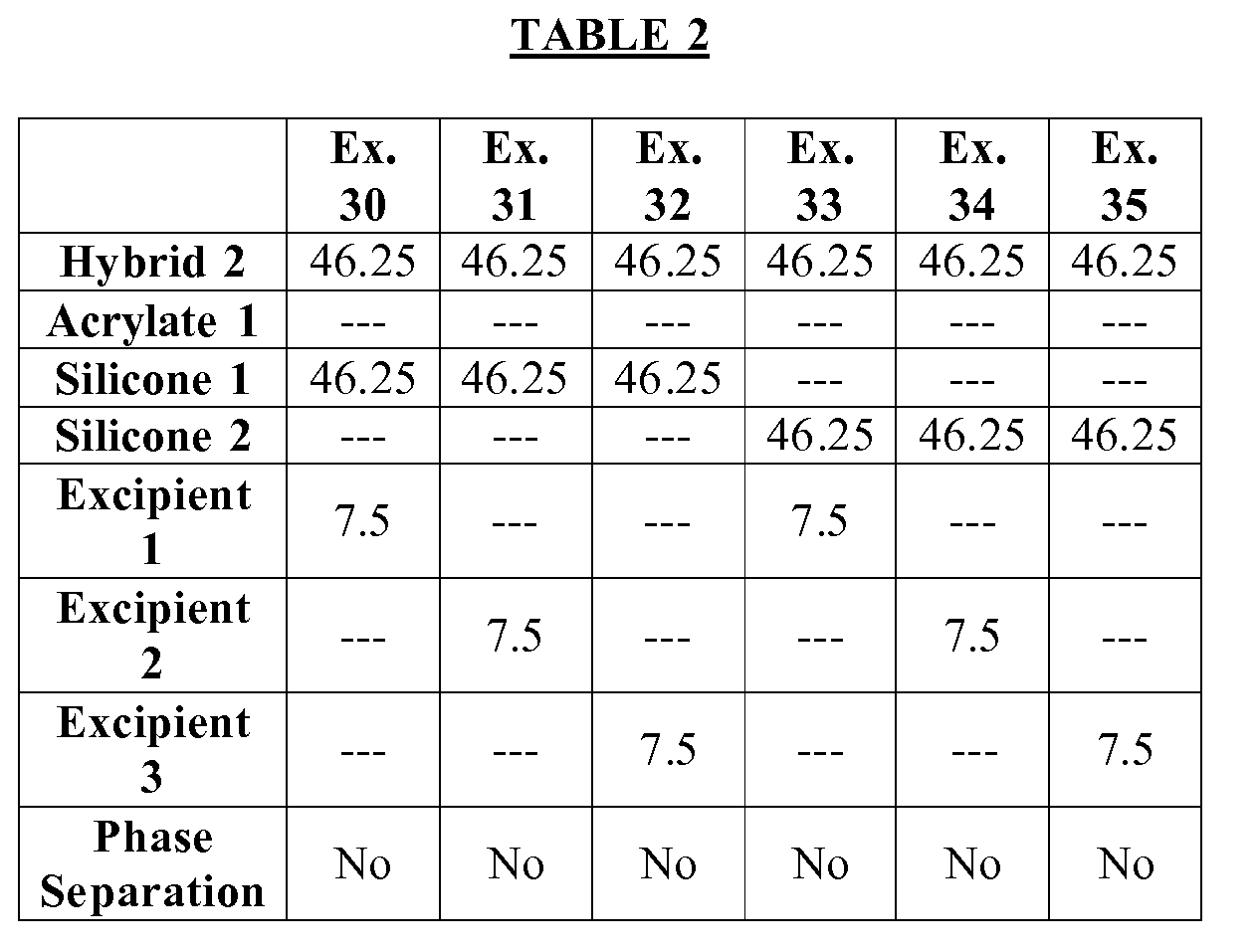


TABLE 4 Comp Ex.44 Comp Ex.45 Comp Ex.46 Comp Ex.47 Acrylate 1 48.25 24.125 9.65 47.5 Silicone 2 48.25 72.35 86.85 47.5 Excipient 1 2.5 2.5 2.5 2.5 Clonidine 1 1 1 2.5 Phase Separation Yes Yes Yes Yes TABLE 5 Ex. 38 Ex. 39 Comp Ex.48 Comp Ex.49 Comp Ex.50 Hybrid 8 38 15.2 --- --- --- Acrylate 1 --- --- 38 19 7.6 Silicone 1 38 60.8 38 57 68.4 Excipient 2 9 9 9 9 9 Excipient 4 6 6 6 6 6 Copolymer 7.5 7.5 7.5 7.5 7.5 Estradiol 1.5 1.5 1.5 1.5 1.5 Phase Separation No No Yes Yes Yes TABLE 6 Ex. 40 Ex. 41 Ex. 42 Comp Ex.51 Comp Ex.52 Comp Ex.53 Comp Ex.54 Hybrid 3 38 38.25 38.5 --- --- --- --- Acrylate 1 --- --- --- 38 19 19.13 19.25 Silicone 2 38 38.25 38.5 38 57 57.37 57.75 Excipient 2 9 9 9 9 9 9 9 Excipient 4 6 6 6 6 6 6 6 Copolymer 7.5 7.5 7.5 7.5 7.5 7.5 7.5 Estradiol 1.5 1 0.5 1.5 1.5 1 0.5 Phase Separation No No No Yes Yes Yes Yes 
TABLE 8 Ex. 55 Ex. 56 Ex. 57 Hybrid 9 38 15.2 38 Acrylate 1 --- --- 38 Silicone 2 38 60.8 --- Excipient 2 9 9 9 Excipient 4 6 6 6 Copolymer 7.5 7.5 7.5 Estradiol 1.5 1.5 1.5 Phase Separation No No No TABLE 9 Ex. 58 Ex. 59 Ex. 60 Hybrid 9 35 14 35 Acrylate 1 --- --- 35 Silicone 2 35 56 --- Excipient 3 10 10 10 Copolymer 10 10 10 Ketoprofen 10 10 10 Phase Separation No No No - The data set forth above indicates that the single phase formulation of this invention resists phase separation as compared to the comparative examples. More specifically, each of the comparative examples phase separates after short amounts of time (e.g. 1 hour to 7 days) while the inventive examples tend to resist phase separation after one month of resting at room temperature. Even more specifically, the inventive examples remain in a single phase even using multiple pharmaceutically active agents and excipients. Conversely, the comparative examples tend to phase separate which, as described above, can cause many problems during creation, storage, and use of the formulations.
- One or more of the values described above may vary by ± 5%, ± 10%, ± 15%, ± 20%, ± 25%, etc. so long as the variance remains within the scope of the disclosure. Unexpected results may be obtained from each member of a Markush group independent from all other members. Each member may be relied upon individually and or in combination and provides adequate support for specific embodiments within the scope of the appended claims. The subject matter of all combinations of independent and dependent claims, both singly and multiply dependent, is herein expressly contemplated. The disclosure is illustrative including words of description rather than of limitation. Many modifications and variations of the present disclosure are possible in light of the above teachings, and the disclosure may be practiced otherwise than as specifically described herein.
Claims (15)
- A single phase silicone acrylate formulation that resists phase separation and comprises:A. at least one of a silicone, an acrylate, and combinations thereof; andB. a silicone acrylate hybrid compatibilizing agent comprising silicone functionality and (meth)acrylate functionality and that is the reaction product of;(1) a silicon-containing pressure sensitive adhesive composition, and(2) a (meth)acrylate monomer, in the presence of(3) an initiator,
wherein said (1) silicon-containing pressure sensitive adhesive composition comprises the condensation reaction product of;(a) a silicone resin,(b) a silicone polymer, and(c) a silicon-containing capping agent,
optionally in the presence of a catalyst,
wherein said (a) silicone resin and said (b) silicone polymer are reacted to form a pressure sensitive adhesive,
wherein said (c) silicon-containing capping agent is introduced prior to, during, or after said (a) silicone resin and (b) silicone polymer react, and
wherein;
said (c) silicon-containing capping agent reacts with said pressure sensitive adhesive after said (a) silicone resin and said (b) silicone polymer have been condensation reacted to form said pressure sensitive adhesive, or
said (c) silicon-containing capping agent reacts in-situ with said (a) silicone resin and said (b) silicone polymer. - A single phase formulation according to claim 1 comprising from about 10 to about 90 weight percent of acrylate content.
- A single phase formulation according to claim 1 or 2 comprising from about 10 to about 90 weight percent of silicone content.
- A single phase formulation according to claim 1 wherein said silicone acrylate hybrid compatibilizing agent comprises about 50 weight percent of silicone content and about 50 weight percent of (meth)acrylate content.
- A single phase formulation according to claim 1 wherein said silicone acrylate hybrid compatibilizing agent comprises about 25 weight percent of silicone content and about 75 weight percent of (meth)acrylate content.
- A single phase formulation according to claim 1 wherein said silicone acrylate hybrid compatibilizing agent comprises about 75 weight percent of silicone content and about 25 weight percent of (meth)acrylate content.
- A single phase formulation according to any one of claims 1 to 6 further comprising an excipient.
- A single phase formulation according to claim 7 wherein said excipient is selected from the group of dipropylene glycol, oleic acid, oleyl alcohol, mineral oil, and combinations thereof.
- A single phase formulation according to any one of claims 1 to 8 further comprising a pharmaceutically active agent.
- A single phase formulation according to claim 9 wherein said pharmaceutically active agent is selected from the group of ketoprofen, estradiol, clonidine, and combinations thereof.
- A single phase formulation according to any one of claims 1 to 10 wherein said (A) silicone is the condensation reaction product of a silanol endblocked polydimethylsiloxane and a silicate resin.
- A single phase formulation according to claim 11 I wherein said polydimethylsiloxane and/or said silicate resin is capped with trimethylsiloxy functionality.
- A single phase formulation according to any one of claims 1 to 12 wherein said (A) acrylate comprises a combination of 2-ethylhexyl acrylate and methacrylate.
- A method of minimizing phase separation of a single phase silicone acrylate formulation that comprises (A) at least one of a silicone, an acrylate, and combinations thereof and (B) a silicone acrylate hybrid compatibilizing agent comprising silicone functionality and (meth)acrylate functionality, said method comprising the step of combining (A) and (B) to form the single phase silicone acrylate formulation wherein the (B) silicone acrylate hybrid compatibilizing agent is the reaction product of;(1) a silicon-containing pressure sensitive adhesive composition, and(2) a (meth)acrylate monomer, in the presence of(3) an initiator,
wherein the (1) silicon-containing pressure sensitive adhesive composition comprises the condensation reaction product of;(a) a silicone resin,(b) a silicone polymer, and(c) a silicon-containing capping agent,
optionally in the presence of a catalyst,
wherein the (a) silicone resin and the (b) silicone polymer are reacted to form a pressure sensitive adhesive,
wherein the (c) silicon-containing capping agent is introduced prior to, during, or after the (a) silicone resin and (b) silicone polymer react, and
wherein;
the (c) silicon-containing capping agent reacts with the pressure sensitive adhesive after the (a) silicone resin and the (b) silicone polymer have been condensation reacted to form the pressure sensitive adhesive, or
the (c) silicon-containing capping agent reacts in-situ with the (a) silicone resin and the (b) silicone polymer. - A method according to claim 14 wherein the single phase silicone acrylate formulation further comprises an excipient selected from the group of dipropylene glycol, oleic acid, oleyl alcohol, mineral oil, and combinations thereof.
Applications Claiming Priority (1)
| Application Number | Priority Date | Filing Date | Title |
|---|---|---|---|
| US13/278,979 US8569416B2 (en) | 2006-06-06 | 2011-10-21 | Single phase silicone acrylate formulation |
Publications (1)
| Publication Number | Publication Date |
|---|---|
| EP2584016A1 true EP2584016A1 (en) | 2013-04-24 |
Family
ID=47046446
Family Applications (1)
| Application Number | Title | Priority Date | Filing Date |
|---|---|---|---|
| EP12189221.0A Withdrawn EP2584016A1 (en) | 2011-10-21 | 2012-10-19 | Single phase silicone acrylate formulation |
Country Status (4)
| Country | Link |
|---|---|
| EP (1) | EP2584016A1 (en) |
| JP (1) | JP6108759B2 (en) |
| KR (1) | KR20130044380A (en) |
| CN (1) | CN103055315A (en) |
Cited By (2)
| Publication number | Priority date | Publication date | Assignee | Title |
|---|---|---|---|---|
| CN103342782A (en) * | 2013-07-02 | 2013-10-09 | 广东海顺新材料科技有限公司 | Organosilicone modified acrylate emulsion, preparation method thereof and water-based artificial stone prepared from organosilicone modified acrylate emulsion |
| EP3256504A4 (en) * | 2015-02-09 | 2018-08-01 | Dow Silicones Corporation | Multi-phase silicone acrylic hybrid visco-elastic compositions and methods of making same |
Families Citing this family (8)
| Publication number | Priority date | Publication date | Assignee | Title |
|---|---|---|---|---|
| EP3250618A4 (en) * | 2015-01-29 | 2018-07-18 | Dow Silicones Corporation | Silicone acrylate compositions and methods of preparing the same |
| CN111094483A (en) * | 2017-08-31 | 2020-05-01 | 三星Sdi株式会社 | Adhesive film and optical member including the same |
| WO2019072997A1 (en) | 2017-10-11 | 2019-04-18 | Lts Lohmann Therapie-Systeme Ag | Transdermal therapeutic system for the transdermal administration of guanfacine comprising a silicone polymer |
| US12048770B2 (en) | 2017-10-11 | 2024-07-30 | Lts Lohmann Therapie-Systeme Ag | Transdermal therapeutic system for the transdermal administration of guanfacine comprising a silicone acrylic hybrid polymer |
| BR112020007011A2 (en) | 2017-10-11 | 2020-10-06 | Lts Lohmann Therapie-Systeme Ag | transdermal therapeutic system for transdermal guanfacine administration comprising at least one additive |
| TWI846695B (en) * | 2018-05-16 | 2024-07-01 | 德商漢高股份有限及兩合公司 | A one-pot process of making silicone-acrylic hybrid pressure sensitive adhesive compositions |
| KR102430601B1 (en) | 2020-03-03 | 2022-08-08 | 삼성에스디아이 주식회사 | Adhesive film, optical member comprising the same and optical display apparatus comprising the same |
| KR102527459B1 (en) | 2020-05-29 | 2023-04-28 | 삼성에스디아이 주식회사 | Adhesive protective film, optical member comprising the same and optical display apparatus comprising the same |
Citations (30)
| Publication number | Priority date | Publication date | Assignee | Title |
|---|---|---|---|---|
| US2490357A (en) | 1946-04-24 | 1949-12-06 | Corning Glass Works | Polymerization of siloxanes |
| US2542334A (en) | 1946-04-24 | 1951-02-20 | Corning Glass Works | Condensation of siloxanes |
| US2676182A (en) | 1950-09-13 | 1954-04-20 | Dow Corning | Copolymeric siloxanes and methods of preparing them |
| US2736721A (en) | 1952-10-08 | 1956-02-28 | Optionally | |
| US2814601A (en) | 1954-04-29 | 1957-11-26 | Dow Corning | Organopolysiloxane adhesive and pressure-sensitive adhesive tape containing same |
| US2857356A (en) | 1954-07-08 | 1958-10-21 | Gen Electric | Organopolysiloxane compositions having pressure-sensitive adhesive properties |
| US2927907A (en) | 1957-01-07 | 1960-03-08 | Dow Corning | Siloxane elastomers |
| USRE24906E (en) | 1955-11-18 | 1960-12-13 | Pressure-sensitive adhesive sheet material | |
| US3002951A (en) | 1959-04-27 | 1961-10-03 | Dow Corning | Method of polymerizing cyclic diorganosiloxanes |
| US3161614A (en) | 1961-10-16 | 1964-12-15 | Dow Corning | Polyfunctional alkoxy endblocked polysiloxanes and their cured compositions |
| US3186967A (en) | 1961-04-12 | 1965-06-01 | Wacker Chemie Gmbh | Method of preparing high molecular weight organosiloxane polymers |
| US3509191A (en) | 1968-04-29 | 1970-04-28 | Dow Corning | Silacyclopentenes and a method for making same |
| US3528940A (en) | 1966-12-15 | 1970-09-15 | Gen Electric | Silicone pressure-sensitive adhesive of improved strength |
| US3697473A (en) | 1971-01-04 | 1972-10-10 | Dow Corning | Composition curable through si-h and si-ch equals ch2 with improved properties |
| US3731683A (en) | 1971-06-04 | 1973-05-08 | Alza Corp | Bandage for the controlled metering of topical drugs to the skin |
| US3797494A (en) | 1969-04-01 | 1974-03-19 | Alza Corp | Bandage for the administration of drug by controlled metering through microporous materials |
| US4031894A (en) | 1975-12-08 | 1977-06-28 | Alza Corporation | Bandage for transdermally administering scopolamine to prevent nausea |
| US4336243A (en) | 1980-08-11 | 1982-06-22 | G. D. Searle & Co. | Transdermal nitroglycerin pad |
| JPS62295982A (en) | 1986-06-13 | 1987-12-23 | Toyoda Gosei Co Ltd | Molding mounting structure |
| JPS63291971A (en) | 1987-05-23 | 1988-11-29 | Nitto Electric Ind Co Ltd | Pressure-sensitive adhesive |
| US4791163A (en) | 1987-05-06 | 1988-12-13 | General Electric Company | Silicone adhesive and organic adhesive emulsions |
| WO1992020751A1 (en) | 1991-05-23 | 1992-11-26 | Minnesota Mining And Manufacturing Company | Pressure-sensitive adhesives |
| US5464659A (en) | 1991-05-23 | 1995-11-07 | Minnesota Mining And Manufacturing Company | Silicone/acrylate vibration dampers |
| US5474783A (en) | 1988-03-04 | 1995-12-12 | Noven Pharmaceuticals, Inc. | Solubility parameter based drug delivery system and method for altering drug saturation concentration |
| US5656286A (en) | 1988-03-04 | 1997-08-12 | Noven Pharmaceuticals, Inc. | Solubility parameter based drug delivery system and method for altering drug saturation concentration |
| US6337086B1 (en) | 1999-02-06 | 2002-01-08 | Dow Corning Corporation | Pressure sensitive adhesive compositions for transdermal drug delivery devices |
| US6465004B1 (en) | 1999-06-05 | 2002-10-15 | Noven Pharmaceuticals, Inc. | Solubility enhancement of drugs in transdermal drug delivery systems and methods of use |
| US6638528B1 (en) | 2000-01-20 | 2003-10-28 | Noven Pharmaceuticals, Inc. | Compositions and methods to effect the release profile in the transdermal administration of active agents |
| WO2007145996A2 (en) * | 2006-06-06 | 2007-12-21 | Dow Corning Corporation | A silicone acrylate hybrid composition |
| WO2010124187A2 (en) * | 2009-04-24 | 2010-10-28 | Henkel Corporation | Silicone acrylic hybrid polymer-based adhesives |
Family Cites Families (1)
| Publication number | Priority date | Publication date | Assignee | Title |
|---|---|---|---|---|
| JPH0959152A (en) * | 1995-08-18 | 1997-03-04 | Teisan Seiyaku Kk | Isosorbide dinitrate-containing plaster |
-
2012
- 2012-10-19 EP EP12189221.0A patent/EP2584016A1/en not_active Withdrawn
- 2012-10-22 CN CN2012104045182A patent/CN103055315A/en active Pending
- 2012-10-22 JP JP2012233020A patent/JP6108759B2/en active Active
- 2012-10-22 KR KR1020120117546A patent/KR20130044380A/en not_active Ceased
Patent Citations (36)
| Publication number | Priority date | Publication date | Assignee | Title |
|---|---|---|---|---|
| US2490357A (en) | 1946-04-24 | 1949-12-06 | Corning Glass Works | Polymerization of siloxanes |
| US2542334A (en) | 1946-04-24 | 1951-02-20 | Corning Glass Works | Condensation of siloxanes |
| US2676182A (en) | 1950-09-13 | 1954-04-20 | Dow Corning | Copolymeric siloxanes and methods of preparing them |
| US2736721A (en) | 1952-10-08 | 1956-02-28 | Optionally | |
| US2814601A (en) | 1954-04-29 | 1957-11-26 | Dow Corning | Organopolysiloxane adhesive and pressure-sensitive adhesive tape containing same |
| US2857356A (en) | 1954-07-08 | 1958-10-21 | Gen Electric | Organopolysiloxane compositions having pressure-sensitive adhesive properties |
| USRE24906E (en) | 1955-11-18 | 1960-12-13 | Pressure-sensitive adhesive sheet material | |
| US2927907A (en) | 1957-01-07 | 1960-03-08 | Dow Corning | Siloxane elastomers |
| US3002951A (en) | 1959-04-27 | 1961-10-03 | Dow Corning | Method of polymerizing cyclic diorganosiloxanes |
| US3186967A (en) | 1961-04-12 | 1965-06-01 | Wacker Chemie Gmbh | Method of preparing high molecular weight organosiloxane polymers |
| US3161614A (en) | 1961-10-16 | 1964-12-15 | Dow Corning | Polyfunctional alkoxy endblocked polysiloxanes and their cured compositions |
| US3528940A (en) | 1966-12-15 | 1970-09-15 | Gen Electric | Silicone pressure-sensitive adhesive of improved strength |
| US3509191A (en) | 1968-04-29 | 1970-04-28 | Dow Corning | Silacyclopentenes and a method for making same |
| US3797494A (en) | 1969-04-01 | 1974-03-19 | Alza Corp | Bandage for the administration of drug by controlled metering through microporous materials |
| US3697473A (en) | 1971-01-04 | 1972-10-10 | Dow Corning | Composition curable through si-h and si-ch equals ch2 with improved properties |
| US3731683A (en) | 1971-06-04 | 1973-05-08 | Alza Corp | Bandage for the controlled metering of topical drugs to the skin |
| US4031894A (en) | 1975-12-08 | 1977-06-28 | Alza Corporation | Bandage for transdermally administering scopolamine to prevent nausea |
| US4336243A (en) | 1980-08-11 | 1982-06-22 | G. D. Searle & Co. | Transdermal nitroglycerin pad |
| JPS62295982A (en) | 1986-06-13 | 1987-12-23 | Toyoda Gosei Co Ltd | Molding mounting structure |
| EP0289929B1 (en) | 1987-05-06 | 1993-08-18 | General Electric Company | Silicone adhesive and organic adhesive emulsion |
| US4791163A (en) | 1987-05-06 | 1988-12-13 | General Electric Company | Silicone adhesive and organic adhesive emulsions |
| JPS63291971A (en) | 1987-05-23 | 1988-11-29 | Nitto Electric Ind Co Ltd | Pressure-sensitive adhesive |
| US5656286A (en) | 1988-03-04 | 1997-08-12 | Noven Pharmaceuticals, Inc. | Solubility parameter based drug delivery system and method for altering drug saturation concentration |
| US5474783A (en) | 1988-03-04 | 1995-12-12 | Noven Pharmaceuticals, Inc. | Solubility parameter based drug delivery system and method for altering drug saturation concentration |
| US6024976A (en) | 1988-03-04 | 2000-02-15 | Noven Pharmaceuticals, Inc. | Solubility parameter based drug delivery system and method for altering drug saturation concentration |
| US5464659A (en) | 1991-05-23 | 1995-11-07 | Minnesota Mining And Manufacturing Company | Silicone/acrylate vibration dampers |
| US5624763A (en) | 1991-05-23 | 1997-04-29 | Minnesota Mining And Manufacturing Company | Silicone/acrylate vibration dampers |
| WO1992020751A1 (en) | 1991-05-23 | 1992-11-26 | Minnesota Mining And Manufacturing Company | Pressure-sensitive adhesives |
| WO1992020752A1 (en) | 1991-05-23 | 1992-11-26 | Minnesota Mining And Manufacturing Company | Silicone/acrylate vibration dampers |
| US6235306B1 (en) | 1991-06-27 | 2001-05-22 | Noven Pharmaceuticals, Inc. | Solubility parameter based drug delivery system and method for altering drug saturation concentration |
| US6221383B1 (en) | 1994-01-07 | 2001-04-24 | Noven Pharmaceuticals, Inc. | Solubility parameter based drug delivery system and method for altering drug saturation concentration |
| US6337086B1 (en) | 1999-02-06 | 2002-01-08 | Dow Corning Corporation | Pressure sensitive adhesive compositions for transdermal drug delivery devices |
| US6465004B1 (en) | 1999-06-05 | 2002-10-15 | Noven Pharmaceuticals, Inc. | Solubility enhancement of drugs in transdermal drug delivery systems and methods of use |
| US6638528B1 (en) | 2000-01-20 | 2003-10-28 | Noven Pharmaceuticals, Inc. | Compositions and methods to effect the release profile in the transdermal administration of active agents |
| WO2007145996A2 (en) * | 2006-06-06 | 2007-12-21 | Dow Corning Corporation | A silicone acrylate hybrid composition |
| WO2010124187A2 (en) * | 2009-04-24 | 2010-10-28 | Henkel Corporation | Silicone acrylic hybrid polymer-based adhesives |
Non-Patent Citations (3)
| Title |
|---|
| "Drugs and the Pharmaceutical Sciences", vol. 14, 1982, MARCEL DEKKER, INC., article "Novel Drug Delivery Systems", pages: 149 - 217 |
| DONATAS SATAS: "Handbook of Pressure Sensitive Adhesive Technology, Third Edition,", 1999, SATAS & ASSOCIATES |
| GEORGE ODIAN: "Principles of Polymerization, Fourth Edition,", 2004, WILEY-INTERSCIENCE |
Cited By (4)
| Publication number | Priority date | Publication date | Assignee | Title |
|---|---|---|---|---|
| CN103342782A (en) * | 2013-07-02 | 2013-10-09 | 广东海顺新材料科技有限公司 | Organosilicone modified acrylate emulsion, preparation method thereof and water-based artificial stone prepared from organosilicone modified acrylate emulsion |
| CN103342782B (en) * | 2013-07-02 | 2014-06-25 | 广东海顺新材料科技有限公司 | Organosilicone modified acrylate emulsion, preparation method thereof and water-based artificial stone prepared from organosilicone modified acrylate emulsion |
| EP3256504A4 (en) * | 2015-02-09 | 2018-08-01 | Dow Silicones Corporation | Multi-phase silicone acrylic hybrid visco-elastic compositions and methods of making same |
| US10316228B2 (en) | 2015-02-09 | 2019-06-11 | Dow Silicones Corporation | Multi-phase silicone acrylic hybrid visco-elastic compositions and methods of making same |
Also Published As
| Publication number | Publication date |
|---|---|
| JP6108759B2 (en) | 2017-04-05 |
| KR20130044380A (en) | 2013-05-02 |
| JP2013087289A (en) | 2013-05-13 |
| CN103055315A (en) | 2013-04-24 |
Similar Documents
| Publication | Publication Date | Title |
|---|---|---|
| US8124689B2 (en) | Silicone acrylate hybride composition and method of making same | |
| US8614278B2 (en) | Silicone acrylate hybrid composition and method of making same | |
| US8569416B2 (en) | Single phase silicone acrylate formulation | |
| EP2599847A1 (en) | A Silicone Acrylate Hybrid Composition and Method of Making Same | |
| EP2584016A1 (en) | Single phase silicone acrylate formulation | |
| EP2467133B1 (en) | Multi-layer transdermal patch | |
| EP2421928B1 (en) | Silicone acrylic hybrid polymer-based adhesives | |
| CN100457064C (en) | transdermal drug delivery device | |
| KR102929680B1 (en) | Patch | |
| JPH06510279A (en) | Drug delivery system and method for varying drug saturation concentration based on solubility parameters | |
| WO2007050580A2 (en) | Transdermal drug delivery system with acrylate or methacrylate functional pressure sensitive adhesive composition | |
| CN111867569A (en) | Transdermal Therapeutic Systems Containing Silicone Acrylic Hybrid Polymers | |
| JP2021517572A (en) | Transdermal treatment system containing silicone acrylic hybrid polymer | |
| AU2008204710B2 (en) | Medically active plaster | |
| WO2025117719A1 (en) | Silicone-polyester copolymers and adhesive compositions including the same |
Legal Events
| Date | Code | Title | Description |
|---|---|---|---|
| PUAI | Public reference made under article 153(3) epc to a published international application that has entered the european phase |
Free format text: ORIGINAL CODE: 0009012 |
|
| AK | Designated contracting states |
Kind code of ref document: A1 Designated state(s): AL AT BE BG CH CY CZ DE DK EE ES FI FR GB GR HR HU IE IS IT LI LT LU LV MC MK MT NL NO PL PT RO RS SE SI SK SM TR |
|
| AX | Request for extension of the european patent |
Extension state: BA ME |
|
| 17P | Request for examination filed |
Effective date: 20131024 |
|
| RBV | Designated contracting states (corrected) |
Designated state(s): AL AT BE BG CH CY CZ DE DK EE ES FI FR GB GR HR HU IE IS IT LI LT LU LV MC MK MT NL NO PL PT RO RS SE SI SK SM TR |
|
| 17Q | First examination report despatched |
Effective date: 20141201 |
|
| STAA | Information on the status of an ep patent application or granted ep patent |
Free format text: STATUS: THE APPLICATION IS DEEMED TO BE WITHDRAWN |
|
| 18D | Application deemed to be withdrawn |
Effective date: 20150414 |