EP2583956A2 - A method of preparation of polycyclic, fused aromatic and heteroaromatic hydrocarbons and intermediates - Google Patents
A method of preparation of polycyclic, fused aromatic and heteroaromatic hydrocarbons and intermediates Download PDFInfo
- Publication number
- EP2583956A2 EP2583956A2 EP12187708.8A EP12187708A EP2583956A2 EP 2583956 A2 EP2583956 A2 EP 2583956A2 EP 12187708 A EP12187708 A EP 12187708A EP 2583956 A2 EP2583956 A2 EP 2583956A2
- Authority
- EP
- European Patent Office
- Prior art keywords
- och
- reaction
- compounds
- alkyl
- formula
- Prior art date
- Legal status (The legal status is an assumption and is not a legal conclusion. Google has not performed a legal analysis and makes no representation as to the accuracy of the status listed.)
- Granted
Links
- 238000000034 method Methods 0.000 title claims abstract description 76
- 125000003367 polycyclic group Chemical group 0.000 title claims abstract description 38
- -1 heteroaromatic hydrocarbons Chemical class 0.000 title claims description 30
- 125000003118 aryl group Chemical group 0.000 title claims description 28
- 238000002360 preparation method Methods 0.000 title claims description 13
- 229930195733 hydrocarbon Natural products 0.000 title claims description 9
- 239000000543 intermediate Substances 0.000 title description 8
- 238000006243 chemical reaction Methods 0.000 claims abstract description 62
- 150000004945 aromatic hydrocarbons Chemical class 0.000 claims abstract description 32
- 125000005842 heteroatom Chemical group 0.000 claims abstract description 32
- 230000035484 reaction time Effects 0.000 claims abstract description 29
- 239000012445 acidic reagent Substances 0.000 claims abstract description 28
- 230000002378 acidificating effect Effects 0.000 claims abstract description 21
- 239000013067 intermediate product Substances 0.000 claims abstract description 11
- 238000000926 separation method Methods 0.000 claims abstract description 11
- 238000004519 manufacturing process Methods 0.000 claims abstract description 9
- 238000012986 modification Methods 0.000 claims abstract description 7
- 230000004048 modification Effects 0.000 claims abstract description 7
- 230000009466 transformation Effects 0.000 claims abstract description 7
- 229910052799 carbon Inorganic materials 0.000 claims description 107
- 150000001875 compounds Chemical class 0.000 claims description 86
- 229910052760 oxygen Inorganic materials 0.000 claims description 64
- XLYOFNOQVPJJNP-UHFFFAOYSA-N water Substances O XLYOFNOQVPJJNP-UHFFFAOYSA-N 0.000 claims description 63
- 125000004429 atom Chemical group 0.000 claims description 48
- 238000002604 ultrasonography Methods 0.000 claims description 40
- UHOVQNZJYSORNB-UHFFFAOYSA-N Benzene Chemical compound C1=CC=CC=C1 UHOVQNZJYSORNB-UHFFFAOYSA-N 0.000 claims description 35
- 125000000217 alkyl group Chemical group 0.000 claims description 35
- OKTJSMMVPCPJKN-UHFFFAOYSA-N Carbon Chemical compound [C] OKTJSMMVPCPJKN-UHFFFAOYSA-N 0.000 claims description 33
- 239000003960 organic solvent Substances 0.000 claims description 33
- 239000002253 acid Substances 0.000 claims description 26
- 125000002485 formyl group Chemical class [H]C(*)=O 0.000 claims description 26
- 125000001072 heteroaryl group Chemical group 0.000 claims description 25
- OKKJLVBELUTLKV-UHFFFAOYSA-N Methanol Chemical compound OC OKKJLVBELUTLKV-UHFFFAOYSA-N 0.000 claims description 24
- YXFVVABEGXRONW-UHFFFAOYSA-N Toluene Chemical compound CC1=CC=CC=C1 YXFVVABEGXRONW-UHFFFAOYSA-N 0.000 claims description 20
- 125000003903 2-propenyl group Chemical group [H]C([*])([H])C([H])=C([H])[H] 0.000 claims description 19
- 125000001797 benzyl group Chemical group [H]C1=C([H])C([H])=C(C([H])=C1[H])C([H])([H])* 0.000 claims description 19
- IJGRMHOSHXDMSA-UHFFFAOYSA-N Atomic nitrogen Chemical compound N#N IJGRMHOSHXDMSA-UHFFFAOYSA-N 0.000 claims description 18
- 239000002904 solvent Substances 0.000 claims description 18
- 239000000203 mixture Substances 0.000 claims description 17
- CSCPPACGZOOCGX-UHFFFAOYSA-N Acetone Chemical compound CC(C)=O CSCPPACGZOOCGX-UHFFFAOYSA-N 0.000 claims description 16
- FAPWRFPIFSIZLT-UHFFFAOYSA-M Sodium chloride Chemical compound [Na+].[Cl-] FAPWRFPIFSIZLT-UHFFFAOYSA-M 0.000 claims description 16
- 239000003456 ion exchange resin Substances 0.000 claims description 16
- 229920003303 ion-exchange polymer Polymers 0.000 claims description 16
- QTBSBXVTEAMEQO-UHFFFAOYSA-N Acetic acid Chemical compound CC(O)=O QTBSBXVTEAMEQO-UHFFFAOYSA-N 0.000 claims description 15
- 238000000746 purification Methods 0.000 claims description 15
- 239000007787 solid Substances 0.000 claims description 14
- NWUYHJFMYQTDRP-UHFFFAOYSA-N 1,2-bis(ethenyl)benzene;1-ethenyl-2-ethylbenzene;styrene Chemical compound C=CC1=CC=CC=C1.CCC1=CC=CC=C1C=C.C=CC1=CC=CC=C1C=C NWUYHJFMYQTDRP-UHFFFAOYSA-N 0.000 claims description 13
- 125000003545 alkoxy group Chemical group 0.000 claims description 13
- 238000004440 column chromatography Methods 0.000 claims description 13
- WYURNTSHIVDZCO-UHFFFAOYSA-N Tetrahydrofuran Chemical compound C1CCOC1 WYURNTSHIVDZCO-UHFFFAOYSA-N 0.000 claims description 12
- 125000002252 acyl group Chemical group 0.000 claims description 12
- QVGXLLKOCUKJST-UHFFFAOYSA-N atomic oxygen Chemical compound [O] QVGXLLKOCUKJST-UHFFFAOYSA-N 0.000 claims description 12
- 229910052739 hydrogen Inorganic materials 0.000 claims description 12
- 239000001257 hydrogen Substances 0.000 claims description 12
- 125000004435 hydrogen atom Chemical class [H]* 0.000 claims description 12
- 239000001301 oxygen Substances 0.000 claims description 12
- VYPSYNLAJGMNEJ-UHFFFAOYSA-N Silicium dioxide Chemical compound O=[Si]=O VYPSYNLAJGMNEJ-UHFFFAOYSA-N 0.000 claims description 11
- 239000012451 post-reaction mixture Substances 0.000 claims description 11
- 239000000741 silica gel Substances 0.000 claims description 11
- 229910002027 silica gel Inorganic materials 0.000 claims description 11
- NINIDFKCEFEMDL-UHFFFAOYSA-N Sulfur Chemical compound [S] NINIDFKCEFEMDL-UHFFFAOYSA-N 0.000 claims description 10
- 239000007788 liquid Substances 0.000 claims description 10
- 239000000047 product Substances 0.000 claims description 10
- 125000003107 substituted aryl group Chemical group 0.000 claims description 10
- 238000010626 work up procedure Methods 0.000 claims description 10
- 229910052757 nitrogen Inorganic materials 0.000 claims description 9
- 229910052717 sulfur Inorganic materials 0.000 claims description 9
- 239000011593 sulfur Substances 0.000 claims description 9
- FCEHBMOGCRZNNI-UHFFFAOYSA-N 1-benzothiophene Chemical compound C1=CC=C2SC=CC2=C1 FCEHBMOGCRZNNI-UHFFFAOYSA-N 0.000 claims description 8
- YLQBMQCUIZJEEH-UHFFFAOYSA-N Furan Chemical compound C=1C=COC=1 YLQBMQCUIZJEEH-UHFFFAOYSA-N 0.000 claims description 8
- SIKJAQJRHWYJAI-UHFFFAOYSA-N Indole Chemical compound C1=CC=C2NC=CC2=C1 SIKJAQJRHWYJAI-UHFFFAOYSA-N 0.000 claims description 8
- 239000002841 Lewis acid Substances 0.000 claims description 8
- KAESVJOAVNADME-UHFFFAOYSA-N Pyrrole Chemical compound C=1C=CNC=1 KAESVJOAVNADME-UHFFFAOYSA-N 0.000 claims description 8
- YTPLMLYBLZKORZ-UHFFFAOYSA-N Thiophene Chemical compound C=1C=CSC=1 YTPLMLYBLZKORZ-UHFFFAOYSA-N 0.000 claims description 8
- MWPLVEDNUUSJAV-UHFFFAOYSA-N anthracene Chemical compound C1=CC=CC2=CC3=CC=CC=C3C=C21 MWPLVEDNUUSJAV-UHFFFAOYSA-N 0.000 claims description 8
- 125000004104 aryloxy group Chemical group 0.000 claims description 8
- 150000002576 ketones Chemical class 0.000 claims description 7
- 239000011780 sodium chloride Substances 0.000 claims description 7
- UFWIBTONFRDIAS-UHFFFAOYSA-N Naphthalene Chemical compound C1=CC=CC2=CC=CC=C21 UFWIBTONFRDIAS-UHFFFAOYSA-N 0.000 claims description 6
- 125000005265 dialkylamine group Chemical group 0.000 claims description 6
- 125000005266 diarylamine group Chemical group 0.000 claims description 6
- 150000004820 halides Chemical group 0.000 claims description 6
- 125000000449 nitro group Chemical group [O-][N+](*)=O 0.000 claims description 6
- YNPNZTXNASCQKK-UHFFFAOYSA-N phenanthrene Chemical compound C1=CC=C2C3=CC=CC=C3C=CC2=C1 YNPNZTXNASCQKK-UHFFFAOYSA-N 0.000 claims description 6
- 125000001997 phenyl group Chemical group [H]C1=C([H])C([H])=C(*)C([H])=C1[H] 0.000 claims description 6
- BBEAQIROQSPTKN-UHFFFAOYSA-N pyrene Chemical compound C1=CC=C2C=CC3=CC=CC4=CC=C1C2=C43 BBEAQIROQSPTKN-UHFFFAOYSA-N 0.000 claims description 6
- 125000001544 thienyl group Chemical group 0.000 claims description 6
- 238000009835 boiling Methods 0.000 claims description 5
- 238000002425 crystallisation Methods 0.000 claims description 5
- 230000008025 crystallization Effects 0.000 claims description 5
- 150000007517 lewis acids Chemical class 0.000 claims description 5
- 150000002825 nitriles Chemical class 0.000 claims description 5
- OAICVXFJPJFONN-UHFFFAOYSA-N Phosphorus Chemical compound [P] OAICVXFJPJFONN-UHFFFAOYSA-N 0.000 claims description 4
- JUJWROOIHBZHMG-UHFFFAOYSA-N Pyridine Chemical compound C1=CC=NC=C1 JUJWROOIHBZHMG-UHFFFAOYSA-N 0.000 claims description 4
- 125000004122 cyclic group Chemical group 0.000 claims description 4
- PZOUSPYUWWUPPK-UHFFFAOYSA-N indole Natural products CC1=CC=CC2=C1C=CN2 PZOUSPYUWWUPPK-UHFFFAOYSA-N 0.000 claims description 4
- RKJUIXBNRJVNHR-UHFFFAOYSA-N indolenine Natural products C1=CC=C2CC=NC2=C1 RKJUIXBNRJVNHR-UHFFFAOYSA-N 0.000 claims description 4
- 125000001624 naphthyl group Chemical group 0.000 claims description 4
- 229910052698 phosphorus Inorganic materials 0.000 claims description 4
- 239000011574 phosphorus Substances 0.000 claims description 4
- 125000001725 pyrenyl group Chemical group 0.000 claims description 4
- 125000004076 pyridyl group Chemical group 0.000 claims description 4
- 229930192474 thiophene Natural products 0.000 claims description 4
- DJMUYABFXCIYSC-UHFFFAOYSA-N 1H-phosphole Chemical compound C=1C=CPC=1 DJMUYABFXCIYSC-UHFFFAOYSA-N 0.000 claims description 3
- AELZBFQHFNMGJS-UHFFFAOYSA-N 1h-1-benzosilole Chemical compound C1=CC=C2[SiH2]C=CC2=C1 AELZBFQHFNMGJS-UHFFFAOYSA-N 0.000 claims description 3
- KHGHGZPESHUYCR-UHFFFAOYSA-N 1h-phosphindole Chemical compound C1=CC=C2PC=CC2=C1 KHGHGZPESHUYCR-UHFFFAOYSA-N 0.000 claims description 3
- MGADZUXDNSDTHW-UHFFFAOYSA-N 2H-pyran Chemical compound C1OC=CC=C1 MGADZUXDNSDTHW-UHFFFAOYSA-N 0.000 claims description 3
- ILBONRFSLATCRE-UHFFFAOYSA-N Phosfolan Chemical compound CCOP(=O)(OCC)N=C1SCCS1 ILBONRFSLATCRE-UHFFFAOYSA-N 0.000 claims description 3
- CZPWVGJYEJSRLH-UHFFFAOYSA-N Pyrimidine Chemical compound C1=CN=CN=C1 CZPWVGJYEJSRLH-UHFFFAOYSA-N 0.000 claims description 3
- XUIMIQQOPSSXEZ-UHFFFAOYSA-N Silicon Chemical compound [Si] XUIMIQQOPSSXEZ-UHFFFAOYSA-N 0.000 claims description 3
- 229910021626 Tin(II) chloride Inorganic materials 0.000 claims description 3
- RFRXIWQYSOIBDI-UHFFFAOYSA-N benzarone Chemical compound CCC=1OC2=CC=CC=C2C=1C(=O)C1=CC=C(O)C=C1 RFRXIWQYSOIBDI-UHFFFAOYSA-N 0.000 claims description 3
- 125000003178 carboxy group Chemical group [H]OC(*)=O 0.000 claims description 3
- 229920001429 chelating resin Polymers 0.000 claims description 3
- GVEPBJHOBDJJJI-UHFFFAOYSA-N fluoranthrene Natural products C1=CC(C2=CC=CC=C22)=C3C2=CC=CC3=C1 GVEPBJHOBDJJJI-UHFFFAOYSA-N 0.000 claims description 3
- 150000002466 imines Chemical class 0.000 claims description 3
- DLEDOFVPSDKWEF-UHFFFAOYSA-N lithium butane Chemical compound [Li+].CCC[CH2-] DLEDOFVPSDKWEF-UHFFFAOYSA-N 0.000 claims description 3
- MZRVEZGGRBJDDB-UHFFFAOYSA-N n-Butyllithium Substances [Li]CCCC MZRVEZGGRBJDDB-UHFFFAOYSA-N 0.000 claims description 3
- 125000001181 organosilyl group Chemical group [SiH3]* 0.000 claims description 3
- 150000002926 oxygen Chemical class 0.000 claims description 3
- 125000005561 phenanthryl group Chemical group 0.000 claims description 3
- LFGREXWGYUGZLY-UHFFFAOYSA-N phosphoryl Chemical group [P]=O LFGREXWGYUGZLY-UHFFFAOYSA-N 0.000 claims description 3
- 229920001467 poly(styrenesulfonates) Polymers 0.000 claims description 3
- 125000000168 pyrrolyl group Chemical group 0.000 claims description 3
- YYMBJDOZVAITBP-UHFFFAOYSA-N rubrene Chemical compound C1=CC=CC=C1C(C1=C(C=2C=CC=CC=2)C2=CC=CC=C2C(C=2C=CC=CC=2)=C11)=C(C=CC=C2)C2=C1C1=CC=CC=C1 YYMBJDOZVAITBP-UHFFFAOYSA-N 0.000 claims description 3
- 238000005185 salting out Methods 0.000 claims description 3
- 229910052710 silicon Inorganic materials 0.000 claims description 3
- 239000010703 silicon Substances 0.000 claims description 3
- 125000000472 sulfonyl group Chemical group *S(*)(=O)=O 0.000 claims description 3
- IBBLKSWSCDAPIF-UHFFFAOYSA-N thiopyran Chemical compound S1C=CC=C=C1 IBBLKSWSCDAPIF-UHFFFAOYSA-N 0.000 claims description 3
- AXZWODMDQAVCJE-UHFFFAOYSA-L tin(II) chloride (anhydrous) Chemical compound [Cl-].[Cl-].[Sn+2] AXZWODMDQAVCJE-UHFFFAOYSA-L 0.000 claims description 3
- YZUPZGFPHUVJKC-UHFFFAOYSA-N 1-bromo-2-methoxyethane Chemical compound COCCBr YZUPZGFPHUVJKC-UHFFFAOYSA-N 0.000 claims description 2
- 229910021578 Iron(III) chloride Inorganic materials 0.000 claims description 2
- NBIIXXVUZAFLBC-UHFFFAOYSA-N Phosphoric acid Chemical compound OP(O)(O)=O NBIIXXVUZAFLBC-UHFFFAOYSA-N 0.000 claims description 2
- QAOWNCQODCNURD-UHFFFAOYSA-N Sulfuric acid Chemical compound OS(O)(=O)=O QAOWNCQODCNURD-UHFFFAOYSA-N 0.000 claims description 2
- 229910021627 Tin(IV) chloride Inorganic materials 0.000 claims description 2
- QCJQWJKKTGJDCM-UHFFFAOYSA-N [P].[S] Chemical compound [P].[S] QCJQWJKKTGJDCM-UHFFFAOYSA-N 0.000 claims description 2
- 150000007513 acids Chemical class 0.000 claims description 2
- 238000006705 deacetalization reaction Methods 0.000 claims description 2
- 239000003480 eluent Substances 0.000 claims description 2
- 239000007789 gas Substances 0.000 claims description 2
- 125000002887 hydroxy group Chemical group [H]O* 0.000 claims description 2
- RBTARNINKXHZNM-UHFFFAOYSA-K iron trichloride Chemical compound Cl[Fe](Cl)Cl RBTARNINKXHZNM-UHFFFAOYSA-K 0.000 claims description 2
- 150000007522 mineralic acids Chemical class 0.000 claims description 2
- 150000007524 organic acids Chemical class 0.000 claims description 2
- 235000005985 organic acids Nutrition 0.000 claims description 2
- UMJSCPRVCHMLSP-UHFFFAOYSA-N pyridine Natural products COC1=CC=CN=C1 UMJSCPRVCHMLSP-UHFFFAOYSA-N 0.000 claims description 2
- 150000003839 salts Chemical class 0.000 claims description 2
- 239000003930 superacid Substances 0.000 claims description 2
- HPGGPRDJHPYFRM-UHFFFAOYSA-J tin(iv) chloride Chemical compound Cl[Sn](Cl)(Cl)Cl HPGGPRDJHPYFRM-UHFFFAOYSA-J 0.000 claims description 2
- 239000011592 zinc chloride Substances 0.000 claims description 2
- JIAARYAFYJHUJI-UHFFFAOYSA-L zinc dichloride Chemical compound [Cl-].[Cl-].[Zn+2] JIAARYAFYJHUJI-UHFFFAOYSA-L 0.000 claims description 2
- LYCAIKOWRPUZTN-UHFFFAOYSA-N Ethylene glycol Chemical compound OCCO LYCAIKOWRPUZTN-UHFFFAOYSA-N 0.000 claims 9
- ZMXDDKWLCZADIW-UHFFFAOYSA-N N,N-Dimethylformamide Chemical compound CN(C)C=O ZMXDDKWLCZADIW-UHFFFAOYSA-N 0.000 claims 6
- IAZDPXIOMUYVGZ-UHFFFAOYSA-N Dimethylsulphoxide Chemical compound CS(C)=O IAZDPXIOMUYVGZ-UHFFFAOYSA-N 0.000 claims 4
- WEVYAHXRMPXWCK-UHFFFAOYSA-N Acetonitrile Chemical compound CC#N WEVYAHXRMPXWCK-UHFFFAOYSA-N 0.000 claims 3
- XTHFKEDIFFGKHM-UHFFFAOYSA-N Dimethoxyethane Chemical compound COCCOC XTHFKEDIFFGKHM-UHFFFAOYSA-N 0.000 claims 3
- LCGLNKUTAGEVQW-UHFFFAOYSA-N Dimethyl ether Chemical compound COC LCGLNKUTAGEVQW-UHFFFAOYSA-N 0.000 claims 3
- LFQSCWFLJHTTHZ-UHFFFAOYSA-N Ethanol Chemical compound CCO LFQSCWFLJHTTHZ-UHFFFAOYSA-N 0.000 claims 3
- PEDCQBHIVMGVHV-UHFFFAOYSA-N Glycerine Chemical compound OCC(O)CO PEDCQBHIVMGVHV-UHFFFAOYSA-N 0.000 claims 3
- ZWEHNKRNPOVVGH-UHFFFAOYSA-N 2-Butanone Chemical compound CCC(C)=O ZWEHNKRNPOVVGH-UHFFFAOYSA-N 0.000 claims 2
- ZHNUHDYFZUAESO-UHFFFAOYSA-N Formamide Chemical compound NC=O ZHNUHDYFZUAESO-UHFFFAOYSA-N 0.000 claims 2
- KFZMGEQAYNKOFK-UHFFFAOYSA-N Isopropanol Chemical compound CC(C)O KFZMGEQAYNKOFK-UHFFFAOYSA-N 0.000 claims 2
- LRHPLDYGYMQRHN-UHFFFAOYSA-N N-Butanol Chemical compound CCCCO LRHPLDYGYMQRHN-UHFFFAOYSA-N 0.000 claims 2
- GNOIPBMMFNIUFM-UHFFFAOYSA-N hexamethylphosphoric triamide Chemical compound CN(C)P(=O)(N(C)C)N(C)C GNOIPBMMFNIUFM-UHFFFAOYSA-N 0.000 claims 2
- BDERNNFJNOPAEC-UHFFFAOYSA-N propan-1-ol Chemical compound CCCO BDERNNFJNOPAEC-UHFFFAOYSA-N 0.000 claims 2
- RYHBNJHYFVUHQT-UHFFFAOYSA-N 1,4-Dioxane Chemical compound C1COCCO1 RYHBNJHYFVUHQT-UHFFFAOYSA-N 0.000 claims 1
- 239000005864 Sulphur Substances 0.000 claims 1
- 150000001298 alcohols Chemical class 0.000 claims 1
- 150000002170 ethers Chemical class 0.000 claims 1
- 239000012467 final product Substances 0.000 claims 1
- 229960004592 isopropanol Drugs 0.000 claims 1
- YPFDHNVEDLHUCE-UHFFFAOYSA-N propane-1,3-diol Chemical compound OCCCO YPFDHNVEDLHUCE-UHFFFAOYSA-N 0.000 claims 1
- 125000000714 pyrimidinyl group Chemical group 0.000 claims 1
- 238000009938 salting Methods 0.000 claims 1
- 229960001866 silicon dioxide Drugs 0.000 claims 1
- HXJUTPCZVOIRIF-UHFFFAOYSA-N sulfolane Chemical compound O=S1(=O)CCCC1 HXJUTPCZVOIRIF-UHFFFAOYSA-N 0.000 claims 1
- 238000007363 ring formation reaction Methods 0.000 abstract description 7
- 238000003402 intramolecular cyclocondensation reaction Methods 0.000 abstract description 3
- 238000005727 Friedel-Crafts reaction Methods 0.000 abstract 1
- 125000000956 methoxy group Chemical group [H]C([H])([H])O* 0.000 description 64
- XEKOWRVHYACXOJ-UHFFFAOYSA-N Ethyl acetate Chemical compound CCOC(C)=O XEKOWRVHYACXOJ-UHFFFAOYSA-N 0.000 description 48
- 125000006237 oxymethylenoxy group Chemical group [H]C([H])([*:1])[*:2] 0.000 description 36
- CSNNHWWHGAXBCP-UHFFFAOYSA-L Magnesium sulfate Chemical compound [Mg+2].[O-][S+2]([O-])([O-])[O-] CSNNHWWHGAXBCP-UHFFFAOYSA-L 0.000 description 24
- 239000000243 solution Substances 0.000 description 23
- WSFSSNUMVMOOMR-UHFFFAOYSA-N Formaldehyde Chemical compound O=C WSFSSNUMVMOOMR-UHFFFAOYSA-N 0.000 description 21
- RTZKZFJDLAIYFH-UHFFFAOYSA-N Diethyl ether Chemical compound CCOCC RTZKZFJDLAIYFH-UHFFFAOYSA-N 0.000 description 20
- UIIMBOGNXHQVGW-UHFFFAOYSA-M Sodium bicarbonate Chemical compound [Na+].OC([O-])=O UIIMBOGNXHQVGW-UHFFFAOYSA-M 0.000 description 20
- VEXZGXHMUGYJMC-UHFFFAOYSA-N Hydrochloric acid Chemical compound Cl VEXZGXHMUGYJMC-UHFFFAOYSA-N 0.000 description 18
- UHOVQNZJYSORNB-MZWXYZOWSA-N benzene-d6 Chemical compound [2H]C1=C([2H])C([2H])=C([2H])C([2H])=C1[2H] UHOVQNZJYSORNB-MZWXYZOWSA-N 0.000 description 16
- 239000012044 organic layer Substances 0.000 description 14
- IMNFDUFMRHMDMM-UHFFFAOYSA-N N-Heptane Chemical compound CCCCCCC IMNFDUFMRHMDMM-UHFFFAOYSA-N 0.000 description 12
- 230000015572 biosynthetic process Effects 0.000 description 12
- 230000006872 improvement Effects 0.000 description 12
- 229910052943 magnesium sulfate Inorganic materials 0.000 description 12
- 229910000030 sodium bicarbonate Inorganic materials 0.000 description 10
- 238000003786 synthesis reaction Methods 0.000 description 9
- OFBQJSOFQDEBGM-UHFFFAOYSA-N Pentane Chemical compound CCCCC OFBQJSOFQDEBGM-UHFFFAOYSA-N 0.000 description 8
- VLKZOEOYAKHREP-UHFFFAOYSA-N n-Hexane Chemical compound CCCCCC VLKZOEOYAKHREP-UHFFFAOYSA-N 0.000 description 8
- 239000012267 brine Substances 0.000 description 7
- HPALAKNZSZLMCH-UHFFFAOYSA-M sodium;chloride;hydrate Chemical compound O.[Na+].[Cl-] HPALAKNZSZLMCH-UHFFFAOYSA-M 0.000 description 7
- 238000004587 chromatography analysis Methods 0.000 description 6
- 229940125782 compound 2 Drugs 0.000 description 6
- 230000009467 reduction Effects 0.000 description 6
- 238000005406 washing Methods 0.000 description 6
- 238000001035 drying Methods 0.000 description 5
- 238000001704 evaporation Methods 0.000 description 5
- 230000008020 evaporation Effects 0.000 description 5
- WLWNRAWQDZRXMB-YLFCFFPRSA-N (2r,3r,4r,5s)-n,3,4,5-tetrahydroxy-1-(4-phenoxyphenyl)sulfonylpiperidine-2-carboxamide Chemical compound ONC(=O)[C@H]1[C@@H](O)[C@H](O)[C@@H](O)CN1S(=O)(=O)C(C=C1)=CC=C1OC1=CC=CC=C1 WLWNRAWQDZRXMB-YLFCFFPRSA-N 0.000 description 4
- 238000001644 13C nuclear magnetic resonance spectroscopy Methods 0.000 description 4
- 238000005160 1H NMR spectroscopy Methods 0.000 description 4
- 125000001246 bromo group Chemical group Br* 0.000 description 4
- 229940126214 compound 3 Drugs 0.000 description 4
- 125000000816 ethylene group Chemical group [H]C([H])([*:1])C([H])([H])[*:2] 0.000 description 4
- 125000004123 n-propyl group Chemical group [H]C([H])([H])C([H])([H])C([H])([H])* 0.000 description 4
- 239000003208 petroleum Substances 0.000 description 4
- 238000004611 spectroscopical analysis Methods 0.000 description 4
- 239000000758 substrate Substances 0.000 description 4
- 238000010276 construction Methods 0.000 description 3
- 239000012043 crude product Substances 0.000 description 3
- 238000005401 electroluminescence Methods 0.000 description 3
- 230000005669 field effect Effects 0.000 description 3
- 150000002430 hydrocarbons Chemical class 0.000 description 3
- 239000000463 material Substances 0.000 description 3
- 239000000523 sample Substances 0.000 description 3
- UJOBWOGCFQCDNV-UHFFFAOYSA-N 9H-carbazole Chemical group C1=CC=C2C3=CC=CC=C3NC2=C1 UJOBWOGCFQCDNV-UHFFFAOYSA-N 0.000 description 2
- 238000006898 Intramolecular Friedel-Crafts reaction Methods 0.000 description 2
- 125000000051 benzyloxy group Chemical group [H]C1=C([H])C([H])=C(C([H])=C1[H])C([H])([H])O* 0.000 description 2
- 125000001495 ethyl group Chemical group [H]C([H])([H])C([H])([H])* 0.000 description 2
- 230000005693 optoelectronics Effects 0.000 description 2
- 229920006395 saturated elastomer Polymers 0.000 description 2
- 239000000126 substance Substances 0.000 description 2
- FANCTJAFZSYTIS-IQUVVAJASA-N (1r,3s,5z)-5-[(2e)-2-[(1r,3as,7ar)-7a-methyl-1-[(2r)-4-(phenylsulfonimidoyl)butan-2-yl]-2,3,3a,5,6,7-hexahydro-1h-inden-4-ylidene]ethylidene]-4-methylidenecyclohexane-1,3-diol Chemical compound C([C@@H](C)[C@@H]1[C@]2(CCCC(/[C@@H]2CC1)=C\C=C\1C([C@@H](O)C[C@H](O)C/1)=C)C)CS(=N)(=O)C1=CC=CC=C1 FANCTJAFZSYTIS-IQUVVAJASA-N 0.000 description 1
- 150000000093 1,3-dioxanes Chemical class 0.000 description 1
- WNXJIVFYUVYPPR-UHFFFAOYSA-N 1,3-dioxolane Chemical compound C1COCO1 WNXJIVFYUVYPPR-UHFFFAOYSA-N 0.000 description 1
- MYKQKWIPLZEVOW-UHFFFAOYSA-N 11h-benzo[a]carbazole Chemical class C1=CC2=CC=CC=C2C2=C1C1=CC=CC=C1N2 MYKQKWIPLZEVOW-UHFFFAOYSA-N 0.000 description 1
- RICKKZXCGCSLIU-UHFFFAOYSA-N 2-[2-[carboxymethyl-[[3-hydroxy-5-(hydroxymethyl)-2-methylpyridin-4-yl]methyl]amino]ethyl-[[3-hydroxy-5-(hydroxymethyl)-2-methylpyridin-4-yl]methyl]amino]acetic acid Chemical compound CC1=NC=C(CO)C(CN(CCN(CC(O)=O)CC=2C(=C(C)N=CC=2CO)O)CC(O)=O)=C1O RICKKZXCGCSLIU-UHFFFAOYSA-N 0.000 description 1
- NLXLAEXVIDQMFP-UHFFFAOYSA-N Ammonia chloride Chemical compound [NH4+].[Cl-] NLXLAEXVIDQMFP-UHFFFAOYSA-N 0.000 description 1
- COVZYZSDYWQREU-UHFFFAOYSA-N Busulfan Chemical compound CS(=O)(=O)OCCCCOS(C)(=O)=O COVZYZSDYWQREU-UHFFFAOYSA-N 0.000 description 1
- VEXZGXHMUGYJMC-UHFFFAOYSA-M Chloride anion Chemical compound [Cl-] VEXZGXHMUGYJMC-UHFFFAOYSA-M 0.000 description 1
- YLEIFZAVNWDOBM-ZTNXSLBXSA-N ac1l9hc7 Chemical compound C([C@H]12)C[C@@H](C([C@@H](O)CC3)(C)C)[C@@]43C[C@@]14CC[C@@]1(C)[C@@]2(C)C[C@@H]2O[C@]3(O)[C@H](O)C(C)(C)O[C@@H]3[C@@H](C)[C@H]12 YLEIFZAVNWDOBM-ZTNXSLBXSA-N 0.000 description 1
- DHKHKXVYLBGOIT-UHFFFAOYSA-N acetaldehyde Diethyl Acetal Natural products CCOC(C)OCC DHKHKXVYLBGOIT-UHFFFAOYSA-N 0.000 description 1
- 150000001350 alkyl halides Chemical class 0.000 description 1
- RJGDLRCDCYRQOQ-UHFFFAOYSA-N anthrone Chemical compound C1=CC=C2C(=O)C3=CC=CC=C3CC2=C1 RJGDLRCDCYRQOQ-UHFFFAOYSA-N 0.000 description 1
- 239000007864 aqueous solution Substances 0.000 description 1
- 150000003934 aromatic aldehydes Chemical class 0.000 description 1
- 230000004071 biological effect Effects 0.000 description 1
- AOJDZKCUAATBGE-UHFFFAOYSA-N bromomethane Chemical compound Br[CH2] AOJDZKCUAATBGE-UHFFFAOYSA-N 0.000 description 1
- 239000006227 byproduct Substances 0.000 description 1
- 150000001716 carbazoles Chemical class 0.000 description 1
- 239000007795 chemical reaction product Substances 0.000 description 1
- 239000004020 conductor Substances 0.000 description 1
- 230000003247 decreasing effect Effects 0.000 description 1
- HKSZLNNOFSGOKW-UHFFFAOYSA-N ent-staurosporine Natural products C12=C3N4C5=CC=CC=C5C3=C3CNC(=O)C3=C2C2=CC=CC=C2N1C1CC(NC)C(OC)C4(C)O1 HKSZLNNOFSGOKW-UHFFFAOYSA-N 0.000 description 1
- 239000002532 enzyme inhibitor Substances 0.000 description 1
- PCHJSUWPFVWCPO-UHFFFAOYSA-N gold Chemical compound [Au] PCHJSUWPFVWCPO-UHFFFAOYSA-N 0.000 description 1
- 239000010931 gold Substances 0.000 description 1
- 229910052737 gold Inorganic materials 0.000 description 1
- 238000010438 heat treatment Methods 0.000 description 1
- 230000005764 inhibitory process Effects 0.000 description 1
- 238000009830 intercalation Methods 0.000 description 1
- 239000010410 layer Substances 0.000 description 1
- 239000011133 lead Substances 0.000 description 1
- 230000015654 memory Effects 0.000 description 1
- 125000004108 n-butyl group Chemical group [H]C([H])([H])C([H])([H])C([H])([H])C([H])([H])* 0.000 description 1
- 230000007935 neutral effect Effects 0.000 description 1
- YCWSUKQGVSGXJO-NTUHNPAUSA-N nifuroxazide Chemical group C1=CC(O)=CC=C1C(=O)N\N=C\C1=CC=C([N+]([O-])=O)O1 YCWSUKQGVSGXJO-NTUHNPAUSA-N 0.000 description 1
- 230000003287 optical effect Effects 0.000 description 1
- 238000013086 organic photovoltaic Methods 0.000 description 1
- 238000005424 photoluminescence Methods 0.000 description 1
- 230000008569 process Effects 0.000 description 1
- 239000011541 reaction mixture Substances 0.000 description 1
- 238000000935 solvent evaporation Methods 0.000 description 1
- HKSZLNNOFSGOKW-FYTWVXJKSA-N staurosporine Chemical compound C12=C3N4C5=CC=CC=C5C3=C3CNC(=O)C3=C2C2=CC=CC=C2N1[C@H]1C[C@@H](NC)[C@@H](OC)[C@]4(C)O1 HKSZLNNOFSGOKW-FYTWVXJKSA-N 0.000 description 1
- CGPUWJWCVCFERF-UHFFFAOYSA-N staurosporine Natural products C12=C3N4C5=CC=CC=C5C3=C3CNC(=O)C3=C2C2=CC=CC=C2N1C1CC(NC)C(OC)C4(OC)O1 CGPUWJWCVCFERF-UHFFFAOYSA-N 0.000 description 1
- 238000003756 stirring Methods 0.000 description 1
- 238000006467 substitution reaction Methods 0.000 description 1
- 239000000725 suspension Substances 0.000 description 1
- FWPIDFUJEMBDLS-UHFFFAOYSA-L tin(II) chloride dihydrate Chemical compound O.O.Cl[Sn]Cl FWPIDFUJEMBDLS-UHFFFAOYSA-L 0.000 description 1
- JOXIMZWYDAKGHI-UHFFFAOYSA-N toluene-4-sulfonic acid Chemical compound CC1=CC=C(S(O)(=O)=O)C=C1 JOXIMZWYDAKGHI-UHFFFAOYSA-N 0.000 description 1
- 125000003944 tolyl group Chemical group 0.000 description 1
Images

Classifications
-
- B—PERFORMING OPERATIONS; TRANSPORTING
- B01—PHYSICAL OR CHEMICAL PROCESSES OR APPARATUS IN GENERAL
- B01J—CHEMICAL OR PHYSICAL PROCESSES, e.g. CATALYSIS OR COLLOID CHEMISTRY; THEIR RELEVANT APPARATUS
- B01J19/00—Chemical, physical or physico-chemical processes in general; Their relevant apparatus
- B01J19/08—Processes employing the direct application of electric or wave energy, or particle radiation; Apparatus therefor
- B01J19/10—Processes employing the direct application of electric or wave energy, or particle radiation; Apparatus therefor employing sonic or ultrasonic vibrations
-
- C—CHEMISTRY; METALLURGY
- C07—ORGANIC CHEMISTRY
- C07D—HETEROCYCLIC COMPOUNDS
- C07D209/00—Heterocyclic compounds containing five-membered rings, condensed with other rings, with one nitrogen atom as the only ring hetero atom
- C07D209/56—Ring systems containing three or more rings
- C07D209/80—[b, c]- or [b, d]-condensed
-
- C—CHEMISTRY; METALLURGY
- C07—ORGANIC CHEMISTRY
- C07D—HETEROCYCLIC COMPOUNDS
- C07D317/00—Heterocyclic compounds containing five-membered rings having two oxygen atoms as the only ring hetero atoms
- C07D317/08—Heterocyclic compounds containing five-membered rings having two oxygen atoms as the only ring hetero atoms having the hetero atoms in positions 1 and 3
- C07D317/44—Heterocyclic compounds containing five-membered rings having two oxygen atoms as the only ring hetero atoms having the hetero atoms in positions 1 and 3 ortho- or peri-condensed with carbocyclic rings or ring systems
- C07D317/46—Heterocyclic compounds containing five-membered rings having two oxygen atoms as the only ring hetero atoms having the hetero atoms in positions 1 and 3 ortho- or peri-condensed with carbocyclic rings or ring systems condensed with one six-membered ring
- C07D317/48—Methylenedioxybenzenes or hydrogenated methylenedioxybenzenes, unsubstituted on the hetero ring
- C07D317/50—Methylenedioxybenzenes or hydrogenated methylenedioxybenzenes, unsubstituted on the hetero ring with only hydrogen atoms, hydrocarbon or substituted hydrocarbon radicals, directly attached to atoms of the carbocyclic ring
- C07D317/54—Radicals substituted by oxygen atoms
-
- C—CHEMISTRY; METALLURGY
- C07—ORGANIC CHEMISTRY
- C07D—HETEROCYCLIC COMPOUNDS
- C07D317/00—Heterocyclic compounds containing five-membered rings having two oxygen atoms as the only ring hetero atoms
- C07D317/08—Heterocyclic compounds containing five-membered rings having two oxygen atoms as the only ring hetero atoms having the hetero atoms in positions 1 and 3
- C07D317/44—Heterocyclic compounds containing five-membered rings having two oxygen atoms as the only ring hetero atoms having the hetero atoms in positions 1 and 3 ortho- or peri-condensed with carbocyclic rings or ring systems
- C07D317/70—Heterocyclic compounds containing five-membered rings having two oxygen atoms as the only ring hetero atoms having the hetero atoms in positions 1 and 3 ortho- or peri-condensed with carbocyclic rings or ring systems condensed with ring systems containing two or more relevant rings
-
- C—CHEMISTRY; METALLURGY
- C07—ORGANIC CHEMISTRY
- C07D—HETEROCYCLIC COMPOUNDS
- C07D333/00—Heterocyclic compounds containing five-membered rings having one sulfur atom as the only ring hetero atom
- C07D333/50—Heterocyclic compounds containing five-membered rings having one sulfur atom as the only ring hetero atom condensed with carbocyclic rings or ring systems
- C07D333/52—Benzo[b]thiophenes; Hydrogenated benzo[b]thiophenes
- C07D333/54—Benzo[b]thiophenes; Hydrogenated benzo[b]thiophenes with only hydrogen atoms, hydrocarbon or substituted hydrocarbon radicals, directly attached to carbon atoms of the hetero ring
- C07D333/56—Radicals substituted by oxygen atoms
-
- C—CHEMISTRY; METALLURGY
- C07—ORGANIC CHEMISTRY
- C07D—HETEROCYCLIC COMPOUNDS
- C07D333/00—Heterocyclic compounds containing five-membered rings having one sulfur atom as the only ring hetero atom
- C07D333/50—Heterocyclic compounds containing five-membered rings having one sulfur atom as the only ring hetero atom condensed with carbocyclic rings or ring systems
- C07D333/76—Dibenzothiophenes
-
- C—CHEMISTRY; METALLURGY
- C07—ORGANIC CHEMISTRY
- C07D—HETEROCYCLIC COMPOUNDS
- C07D405/00—Heterocyclic compounds containing both one or more hetero rings having oxygen atoms as the only ring hetero atoms, and one or more rings having nitrogen as the only ring hetero atom
- C07D405/14—Heterocyclic compounds containing both one or more hetero rings having oxygen atoms as the only ring hetero atoms, and one or more rings having nitrogen as the only ring hetero atom containing three or more hetero rings
-
- C—CHEMISTRY; METALLURGY
- C07—ORGANIC CHEMISTRY
- C07D—HETEROCYCLIC COMPOUNDS
- C07D407/00—Heterocyclic compounds containing two or more hetero rings, at least one ring having oxygen atoms as the only ring hetero atoms, not provided for by group C07D405/00
- C07D407/02—Heterocyclic compounds containing two or more hetero rings, at least one ring having oxygen atoms as the only ring hetero atoms, not provided for by group C07D405/00 containing two hetero rings
- C07D407/04—Heterocyclic compounds containing two or more hetero rings, at least one ring having oxygen atoms as the only ring hetero atoms, not provided for by group C07D405/00 containing two hetero rings directly linked by a ring-member-to-ring-member bond
-
- C—CHEMISTRY; METALLURGY
- C07—ORGANIC CHEMISTRY
- C07D—HETEROCYCLIC COMPOUNDS
- C07D409/00—Heterocyclic compounds containing two or more hetero rings, at least one ring having sulfur atoms as the only ring hetero atoms
- C07D409/02—Heterocyclic compounds containing two or more hetero rings, at least one ring having sulfur atoms as the only ring hetero atoms containing two hetero rings
- C07D409/04—Heterocyclic compounds containing two or more hetero rings, at least one ring having sulfur atoms as the only ring hetero atoms containing two hetero rings directly linked by a ring-member-to-ring-member bond
-
- C—CHEMISTRY; METALLURGY
- C07—ORGANIC CHEMISTRY
- C07D—HETEROCYCLIC COMPOUNDS
- C07D409/00—Heterocyclic compounds containing two or more hetero rings, at least one ring having sulfur atoms as the only ring hetero atoms
- C07D409/14—Heterocyclic compounds containing two or more hetero rings, at least one ring having sulfur atoms as the only ring hetero atoms containing three or more hetero rings
-
- C—CHEMISTRY; METALLURGY
- C07—ORGANIC CHEMISTRY
- C07D—HETEROCYCLIC COMPOUNDS
- C07D491/00—Heterocyclic compounds containing in the condensed ring system both one or more rings having oxygen atoms as the only ring hetero atoms and one or more rings having nitrogen atoms as the only ring hetero atoms, not provided for by groups C07D451/00 - C07D459/00, C07D463/00, C07D477/00 or C07D489/00
- C07D491/02—Heterocyclic compounds containing in the condensed ring system both one or more rings having oxygen atoms as the only ring hetero atoms and one or more rings having nitrogen atoms as the only ring hetero atoms, not provided for by groups C07D451/00 - C07D459/00, C07D463/00, C07D477/00 or C07D489/00 in which the condensed system contains two hetero rings
- C07D491/04—Ortho-condensed systems
- C07D491/056—Ortho-condensed systems with two or more oxygen atoms as ring hetero atoms in the oxygen-containing ring
Definitions
- the subject of the invention is a new way of preparation of polycyclic, fused (hetero)aromatic hydrocarbons, presented in the formula 1, based on transformation reaction of derivatives with chemical formula 2 or 3, in water or an organic solvent, or a mixture of water and an organic solvent, or without an organic solvent in presence of an acidic reagent, with or without participation of ultrasounds, carried out under mild conditions, in a single reaction vessel, without a need of separation of intermediate products and with a substantial decreasing of the reaction time in comparison to procedures describes in applications P-385794 of 31.07.2008 and P-389778 of 05.12.2009 .
- the subject of the invention are also improvements of yields and purities of hydrocarbons with formula 1 obtained within long reaction times according to the protocol known from applications P-385794 of 31.07.2008 and P-389778 of 05.12.2009 , achieved by modification of the workup procedure by salt17ing out of the post-reaction mixture, increase in temperature up to 40-60°C, purification on acidic ion-exchange resin or application of gradient chromatography with a series of organic solvents, preferably petroleum ether, n -pentane, n -hexane, n -heptane, benzene and diethyl ether, acetone, ethyl acetate.
- organic solvents preferably petroleum ether, n -pentane, n -hexane, n -heptane, benzene and diethyl ether, acetone, ethyl acetate.
- the subject of the invention are also improvements involving a decrease of reaction times in reactions leading to formation of intermediates 2 and 3 in higher yields and better purities, by replacement of benzene for toluene, application of the brine washing during workup and reduction of the reaction time, in comparison to the protocols known from applications P-385794 of 31.07.2008 and P-389778 of 05.12.2009 .
- the subject of the invention are also improvements involving an increase of yields of compounds 4 by washing of the resulting post-reaction mixture with brine and simplification of the purification step by use of crystallization instead of chromatography without loss of yields, in comparison to the protocol known from applications P-385794 of 31.07.2008 and P-389778 of 05.12.2009 .
- the subject of the invention is also introduction of a combination of two or more acidic reagents of the same (e.g. Brönsted acid/Brönsted acid) or different types (e.g. Brönsted acid/Lewis acid) or occurring in the same (e.g. liquid/liquid or solid/solid) or different phases (e.g. acetic acid and gaseous HCl).
- acidic reagents e.g. Brönsted acid/Brönsted acid
- different types e.g. Brönsted acid/Lewis acid
- phases e.g. acetic acid and gaseous HCl
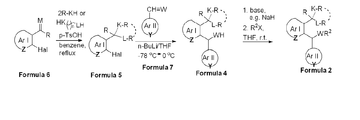
- the inventive method involves use of intermediate compounds with chemical formulas 2, 3 and 4, presented in the Chart I.
- Compounds 2 are obtained from compounds 4, or compounds 3, where:
- Z and Y - are the same or different and stand for atoms of carbon, silicon, oxygen, phosphorus or sulfur
- K, L are the same or different and stand for atoms of oxygen, sulfur or nitrogen, preferably in oxygen derivatives, such as cyclic or acyclic acetals or ketals.
- M- stands for atom of oxygen, sulfur or nitrogen, especially the NR 1 group, where:
- R1- stands for atom of hydrogen, alkyl with 1 to 20 atoms of carbon, allyl, substituted aryl or non-substituted benzyl, heteroaryl, preferably pyrrolyl, thiophenyl, pyridyl, pyrimidynyl or acyl, alkoxyl, aryloxyl, SO 2 Alkyl, where Alkyl stands for a carbon chain with 1 to 20 atoms of carbon, SO 2 Ar where Ar stands for any substituted aryl,
- W - stands for atom of oxygen, sulfur, phosphorus or nitrogen, preferably a (NR 1 ) group, where R 1 stands for atom of hydrogen, alkyl with 1 to 20 atoms of carbon, allyl, benzyl, substituted or non-substituted aryl, heteroaryl, preferably pyrolyl, thiophenyl, pyridyl, pyrimidynyl or acyl, alkoxyl, aryloxyl, SO 2 Alkyl, where Alkyl stands for a carbon chain with 1 to 20 atoms of carbon, or SO 2 Ar, where Ar stands for substituted or non-substituted aryl;
- R - stands for atom of hydrogen, alkyl with 1 to 20 atoms of carbon, allyl, benzyl, heteroaryl or aryl, preferably phenyl, naphthyl, anthracyl, phenanthryl or pyrenyl, possibly aryl substituted or unsubstituted with alkyl groups with 1 to 20 atoms of carbon, alkoxyl groups OR 3 , where R 3 stands for atom of hydrogen, alkyl group with 1 to 20 atoms of carbon, allyl group, benzyl group, aryl group, heteroaryl group; with dialkylamine or diarylamine groups, or halide groups F, Cl, Br, I, ketone, aldehyde, nitrile, nitro, SO 2 Alkyl, SO 2 Ar groups, where Alkyl and Ar are as defined above,
- R2 - stands for alkyl, allyl, aryl, heteroaryl, benzyl, acyl, phosphoryl, sulfonyl or silyl,
- ArI and ArII - are the same or different and stand for an aromatic ring, preferably chosen from a group including benzene, naphthalene, anthracene, phenanthrene, rubrene or pyrene, and/or five-membered heteroaromatic ring, preferably chosen from a group including pyrrole, thiophene, furan, silol, phosphol, and/or six-membered heteroaromatic ring, preferably chosen from a group including pyridine, pyrimidine, pyran, thiopyran, phospholan, and/or a mixed aromatic-heteroaromatic ring, preferably chosen from a group including indole, benzothiophene, benzofuran, benzosilol, benzophosphol, five - and six-membered rings mono- or multi-substituted with alkyl group containing 1 to 20 atoms of carbon, allyl group, benzyl group
- the method of preparation of polycyclic, fused (hetero)aromatic hydrocarbons presented by the formula 1, according to the invention, constitutes a previously unknown modification of intramolecular Friedel-Crafts type cyclization.
- the reaction uses ortho -acetal diarylmethanols, presented by the formula 2 or ortho -formyl diarylmethanols, presented by the formula 3, which in acidic environment undergo transformation to polycyclic, fused (hetero)aromatic hydrocarbons.
- Compounds 2 are obtained from compounds 4, and compounds 3 may be preferably obtained from compounds 2.
- Literature mentions examples of intramolecular Friedel-Crafts reactions giving polycyclic, fused (hetero)aromatic hydrocarbons using ortho -formyl (M. S. Newman, N. S. Hussain, J . Org. Chem. 1982, 2837-2840) ortho- acyl ( M. B. Andrus, Z. Ye, J. Zhang, Tetrahedron Lett.2005, 46, 3839-2842 ) and ortho- carboxyl ( R. G. Harvey, C. Cortez, T. Sugiyama, Y. Ito, T. W. Sawyer, J. DiGiovanni, J. Med. Chem.
- Polycyclic, fused aromatic and heteroaromatic hydrocarbons presented by the general formula 1, where Z, Y, W, R , R 2 , ArI, ArII are as defined above, are known from applications P-385794 of 31.07.2008 and P-389778 of 05.12.2009 , along with a method of production of those polycyclic, fused (hetero)aromatic hydrocarbons, based on transformation of intermediate compounds, in acidic environment, under mild conditions, in a single reaction vessel, and without separation of intermediate products.
- Polycyclic, fused aromatic and heteroaromatic hydrocarbons presented by formulas 1a-1h may be used in construction of new generation of optoelectronic elements and devices, including organic, multi-layer light emitting diodes (OLED and PLED), organic field effect transistors (OTFT, OFET), organic light emitting transistors (OLET), organic photovoltaic cells (OPV), organic solar cells (OSC), organic lasers, optical memories and other devices using organic semi- and photo-conductors ( Highly Efficient OLEDs with Phosphorescent Materials, H.,Yersin (Ed.), Wiley-VCH Verlag GmbH & Co.KGaA, 2008 , Introduction to Organic Electronic and Optoelectronic Materials and Devices, Sam-Shajing Sun, L.R.Dalton (Edits), CRC Press, Taylor & Francis Group, Boca Raton, London, New York, 2008 ; Organic Field Effect Transistors, Z.Bao, J.Locklin (Edits), CRC Press, Taylor & Francis Group
- carbazole derivatives have been used in construction of organic field effect transistors (OFET) ( Y. Li, Y. Wu, S. Gardner, B. S. Ong, Adv. Mater. 2005, 17, 849 ; N.-X. Hu, S. Xie, Z. Popovic, B. Ong, A.-M. HorSuning Wang, J. Am. Chem. Soc.1999, 121, 5097 ) and of organic electroluminescence diodes ( S. S. Palayangoda, X. Cai, R. M. Adhikari, D. C. Neckers, Org. Lett. 2008, 10, 281 ; V. Promarak, A. Punkvuang, T.
- OFET organic field effect transistors
- method of preparation of polycyclic, fused aromatic and heteroaromatic hydrocarbons presented by the formula 1, where Z, Y, W, R, R2, ArI, ArII are as defined above consists, in realization of a reaction, of cyclization of derivatives with formula 2 or formula 3, in presence of acidic reagent, in water or without water, with or without an organic solvent, with or without ultrasounds, under mild conditions, in a single reaction vessel, without separation of intermediate products.
- Compounds 2 are obtained from compounds 4 or compounds 3.
- the method of preparation of polycyclic, fused (hetero)aromatic hydrocarbons presented by the formula 1, preferably, according to the invention, consists in reaction of the derivative with formula 2 or with the formula 3 in water with an acidic reagent, preferably HCl of any concentration, without use of an organic solvent, with use of ultrasounds.
- the inventive method gives polycyclic, fused (hetero)aromatic hydrocarbons 1 in a single-step reaction and in short times, in good yields.
- Compounds 2 are obtained from compounds 4 or compounds 3.
- the method of preparation of polycyclic, fused (hetero)aromatic hydrocarbons preferably, is carried out according to the first variant, consists in reaction of the derivative with the formula 2 or with the formula 3 in water, without an organic solvent, in presence of an acidic reagent, preferably HCl solution of any concentration and without ultrasounds.
- the inventive method gives polycyclic, fused (hetero)aromatic hydrocarbons 1 in single-step reactions, but in long times and in low yields.
- Compounds 2 are obtained from compounds 4 or compounds 3.
- the method of preparation of polycyclic, fused (hetero)aromatic hydrocarbons presented by the formula 1, preferably, according to the invention consists in reaction of the derivative with the formula 2 or with the formula 3 in water with addition of a water-miscible organic solvent in various ratios, preferably MeOH, acetone or THF, with ultrasounds, in presence of an acidic reagent, preferably HCl solution of any concentration.
- the inventive method gives polycyclic, fused (hetero)aromatic hydrocarbons 1 in single-step reactions and in short times, in good yields.
- Compounds 2 are obtained from compounds 4, and compounds 3 may be preferably obtained from compounds 2.
- the reaction has to be carried out at even higher temperature, preferably in boiling methanol.
- purification of the product 1 is realized on acidic ion-exchange resin, preferably Dowex W50-type, and the post-reaction mixture is salted out with solid sodium chloride, which causes increase of yield of polycyclic, fused (hetero)aromatic hydrocarbons 1 compared to procedures described in applications P-389778 and P-385794 .
- the method of preparation of polycyclic, fused (hetero)aromatic hydrocarbons presented by the formula 1, preferably, according to the invention, consists in reaction of the derivative with formula 2 or with the formula 3 in an organic solvent with ultrasounds, in presence of an acidic reagent without addition of water, or of an acidic reagent of a acid hydrate type, e.g. p -TsOH, or a salt, e.g. SnCl 2 ⁇ H 2 O, or a strong acidic ion-exchange resin.
- the inventive method gives polycyclic, fused (hetero)aromatic hydrocarbons 1 in single-step reactions and in short times, in good yields.
- Compounds 2 are obtained from compounds 4 or compounds 3.
- the method of production of polycyclic, fused (hetero)aromatic hydrocarbons presented with the formula 1 is, preferably, carried out according to the fifth variant, but without ultrasounds; however the method requires a long reaction times, giving polycyclic, fused (hetero)aromatic hydrocarbons in low yields.
- the method of production of polycyclic, fused (hetero)aromatic hydrocarbons presented by the formula 1, preferably, according to the invention, consists in reaction of the derivative with the formula 2 or with the formula 3 with 100% acidic reagent, without organic solvent and water, with ultrasounds.
- the inventive method gives polycyclic, fused (hetero)aromatic hydrocarbons 1 in single-step reactions and in short times, in good yields.
- Compounds 2 are obtained from compounds 4, and compounds 3 may be preferably obtained from compounds 2.
- method of production of polycyclic, condensed (hetero)aromatic hydrocarbons presented with the formula 1 is, preferably, carried out according to the seventh variant, but without ultrasounds; however the method requires a long reaction time, giving polycyclic, fused (hetero)aromatic hydrocarbons in low yield
- the method of production of polycyclic, fused (hetero)aromatic hydrocarbons presented by the formula 1, preferably, according to the invention, consists in reaction of the derivative with the formula 2 or with the formula 3 with 100% acidic reagent, without organic solvent and water, without ultrasounds, passing gaseous HCl through the solution.
- the inventive method gives polycyclic, fused (hetero)aromatic hydrocarbons 1 in single-step reactions and in short times, in satisfactory yields.
- Compounds 2 are obtained from compounds 4 or compounds 3.
- the inventive method uses cyclic or acyclic acetal derivatives, preferably new 1,3-dioxolane or 1,3-dioxane derivatives of diarylmethanols presented by the formula 2, or aldehydes presented by the formula 3 as substrates for cyclization.
- Compounds 2 are obtained from compounds 4 or compounds 3.
- the inventive method uses inorganic acids, preferably solutions of HCl, HBr, Hl, HF, H 2 SO 4 , H 3 PO 4 in any concentration, gaseous HCl, and organic acids, preferably acetic, trifluoroacetic, methanesulfonic, trifluorometanesulfonic, p- toluenesulfonic; strong acidic ion-exchange resins, preferably Amberlite IR 120, Amberlyst 15; super-acids and Lewis' acids, preferably FeCl 3 , ZnCl 2 , SnCl 2 ⁇ H 2 O, SnCl 4 as acidic reagents.
- inorganic acids preferably solutions of HCl, HBr, Hl, HF, H 2 SO 4 , H 3 PO 4 in any concentration, gaseous HCl, and organic acids, preferably acetic, trifluoroacetic, methanesulfonic, trifluorometanesulfonic,
- the inventive method uses various solvents, preferably water, an organic solvent or their mixtures in any ratios, as solvents.
- the inventive method uses preferably ultrasounds, which results in substantial reduction of reaction time and/or increase in yields of the reaction compared to reactions carried out without ultrasounds.
- the inventive method also provides improvements of yields and purities of hydrocarbons with formula 1 obtained within long reaction times according to the protocol known from applications P-385794 of 31.07.2008 and P-389778 of 05.12.2009 , achieved by modification of the workup procedure by salting out of the post-reaction mixture, increase in reaction temperature up to 40-60°C, purification on acidic ion-exchange resin or application of gradient chromatography with a series of organic solvents, preferably petroleum ether, n -pentane, n -hexane, n -heptane, benzene and diethyl ether, acetone, ethyl acetate.
- organic solvents preferably petroleum ether, n -pentane, n -hexane, n -heptane, benzene and diethyl ether, acetone, ethyl acetate.
- the inventive method uses intermediate compounds with formulas 2, 3 and 4,
- Z and Y - are the same or different and stand for atoms of carbon, silicon, oxygen, phosphorus or sulfur
- K, L are the same or different and stand for atoms of oxygen, sulfur or nitrogen, preferably in oxygen derivatives, such as cyclic or acyclic acetals or ketals.
- M- stands for atom of oxygen, sulfur or nitrogen, especially the NR 1 group, where:
- R1- stands for atom of hydrogen, alkyl with 1 to 20 atoms of carbon, allyl, substituted aryl or non-substituted benzyl, heteroaryl, preferably pyrrolyl, thiophenyl, pyrydyl, pyrymidynyl or acyl, alkoxyl, aryloxyl, SO 2 Alkyl, where Alkyl stands for a carbon chain with 1 to 20 atoms of carbon, SO 2 Ar where Ar stands for any substituted aryl,
- W - stands for atom of oxygen, sulfur phosphorus, or nitrogen, preferably a (NR 1 ) group, where R 1 stands for atom of hydrogen, alkyl with 1 to 20 atoms of carbon, allyl, benzyl, substituted or non-substituted aryl, heteroaryl, preferably pyrolyl, thiophenyl, pyridyl, pyrymidynyl or acyl, alkoxyl, aroxyl, SO 2 Alkyl, where Alkyl stands for a carbon chain with 1 to 20 atoms of carbon, or SO 2 Ar, where Ar stands for substituted or unsubstituted aryl;
- R - stands for atom of hydrogen, alkyl with 1 to 20 atoms of carbon, allyl, benzyl, heteroaryl or aryl, preferably phenyl, naphthyl, anthracyl, phenanthryl or pyrenyl, possibly aryl substituted or non-substituted with alkyl groups with 1 to 20 atoms of carbon, alkoxyl groups OR 3 , where R 3 stands for atom of hydrogen, alkyl group with 1 to 20 atoms of carbon, allyl group, benzyl group, aryl group, heteroaryl group; with dialkylamine or diarylamine groups, or halide groups F, Cl, Br, I, ketone, aldehyde, nitrile, nitro, SO 2 Alkyl, SO 2 Ar groups, where Alkyl and Ar are as defined above,
- R 2 - stands for alkyl, allyl, aryl, heteroaryl, benzyl, acyl, phosphoryl, sulfonyl or silyl,
- ArI and ArII - are the same or different and stand for an aromatic ring, preferably chosen from a group including benzene, naphthalene, anthracene, phenanthrene, rubrene or pyrene, and/or five-membered heteroaromatic ring, preferably chosen from a group including pyrrole, thiophene, furan, silol, phosphol, and/or six-membered heteroaromatic ring, preferably chosen from a group including pyridyne, pyrimidine, pyran, thiopyran, phospholan, and/or a mixed aromatic-heteroaromatic ring, preferably chosen from a group including indole, benzothiophene, benzofuran, benzosilol, benzophosphol, five- and six-membered rings mono- or multi-substituted with alkyl group with 1 to 20 atoms of carbon, allyl group, benzy
- synthesis of intermediate compounds with the formula 2 consists in reaction of the derivative 4 containing a free hydroxyl group with alkyl, allyl or benzyl halides, in presence of a base, preferably NaH, for 12 hours.
- a base preferably NaH
- synthesis of compounds with the formula 3 consists in reaction of the compound 2 with an acidic reagent, preferably 1 N HCl in boiling toluene, for 12 hours, followed by washing of the resulting post-reaction mixture with brine.
- an acidic reagent preferably 1 N HCl in boiling toluene
- Use of toluene instead of benzene results in a decrease of the deacetalization reaction time compared to the procedure reserved in the application P-389778 and leads to products with the formula 3 in quantitative yields.
- This protocol does not require purification, as it is in case of the application P-389778.
- synthesis of compounds with the formula 4 consists in reaction of the protected orto -bromo aldehyde 5 with another aromatic aldehyde 7 in presence of n -BuLi, followed by washing of the resulting post-reaction mixture with brine.
- compounds with formula 4 are formed in very high and qualitative yields, despite their purification by simple crystallization, and not by column chromatography, as it is in case of applications P-389778 and P-385794.
- synthesis of compounds with the formula 1 may be realized by introduction of a combination of two or more acidic reagents of the same (e.g. Brönsted acid/Brönsted acid) or different types (e.g. Brönsted acid/Lewis acid) or occurring in the same (e.g. liquid/liquid or solid/solid) or different phases (e.g. acetic acid and gaseous HCl).
- acidic reagents e.g. Brönsted acid/Brönsted acid
- different types e.g. Brönsted acid/Lewis acid
- phases e.g. acetic acid and gaseous HCl
- reaction is carried out in water, without use of any organic solvent.
- reaction is carried out in water, in presence of a water-miscible organic solvent in various ratios.
- reaction is carried out in an organic solvent, or without a solvent.
- reaction is carried out in 100% acidic reagent without use of water or any organic solvent.
- reaction is carried out in 100% acidic reagent without use of water or any organic solvent, passing HCl gas through the solution .
- the reaction is carried out using a combination of two or more acidic reagents of the same (e.g. Brönsted acid/Brönsted acid) or different types (e.g. Brönsted acid/Lewis acid) or occurring in the same (e.g. liquid/liquid or solid/solid) or different phases (e.g. acetic acid and gaseous HCl).
- two or more acidic reagents of the same e.g. Brönsted acid/Brönsted acid
- different types e.g. Brönsted acid/Lewis acid
- phases e.g. acetic acid and gaseous HCl
- reaction is carried out under mild conditions (room temperature or up to 60°C) and in extremely short reaction times (from several minutes up to 3 hours). Without use of ultrasounds, reaction is carried out under mild conditions (room temperature), but in long reaction times (24 - 72 hours).
- compounds 1 contain a newly formed central, six-membered aromatic ring fused to aromatic or heteroaromatic ArI and ArII, five- or six-membered rings (e.g. benzene, pyrenyl, naphthyl, anthracyl, pyrrole, pyrimidyne, carbazole, thiophene, benzothiophene, indole rings) with any substitutions.
- five- or six-membered rings e.g. benzene, pyrenyl, naphthyl, anthracyl, pyrrole, pyrimidyne, carbazole, thiophene, benzothiophene, indole rings
- a compound 2a (1 mmol) or a compound 3a (1 mmol) was dissolved in a water-miscible solvent (e.g. MeOH) (10 mL) and aqueous HCl solution (10 mL) of any concentration (e.g. 0.1%, 1 N, etc.) was added. Ultrasound probe was immersed in the resulting solution and reaction was sonicated for 110 min. Then, ethyl acetate was added and the organic layer was washed with water, NaHCO 3 , water again, dried over MgSO 4 and evaporated. The crude product was purified by column chromatography on silica gel. The compound 1a was obtained in a good yield (62%).
- a water-miscible solvent e.g. MeOH
- aqueous HCl solution 10 mL
- any concentration e.g. 0.1%, 1 N, etc.
- Example IV (no ultrasounds, water/solvent, 25-40°C, workup and purification improvements)
- aqueous HCl solution of any concentration (e.g. 0.1%, 1 N, etc.) was added. The mixture was stirred up to 40°C for 12 to 48 hours, depending on the substrate used. Solid sodium chloride was added until saturation, then ethyl acetate was added and the organic layer was washed with water, NaHCO 3 solution, and water again. After drying over MgSO 4 and evaporation of the solvent, the product was purified by column chromatography with acidic ion-exchange resin Dowex 50 and a gradient system of solvents as eluents.
- a water-miscible organic solvent e.g. MeOH
- Example X General procedure for synthesis of compounds with the formula 2 (improvement by reduction of the reaction time).
- Example XI General procedure for synthesis of compounds with the formula 3 (improvement by a benzene/toluene exchange and additional workup brine saturation).
- Example XII General procedure for synthesis of compounds with the formula 4 (workup and purification improvements).
Landscapes
- Chemical & Material Sciences (AREA)
- Organic Chemistry (AREA)
- Health & Medical Sciences (AREA)
- General Health & Medical Sciences (AREA)
- Toxicology (AREA)
- Chemical Kinetics & Catalysis (AREA)
- Organic Low-Molecular-Weight Compounds And Preparation Thereof (AREA)
- Heterocyclic Carbon Compounds Containing A Hetero Ring Having Oxygen Or Sulfur (AREA)
- Plural Heterocyclic Compounds (AREA)
Abstract
Description
- The subject of the invention is a new way of preparation of polycyclic, fused (hetero)aromatic hydrocarbons, presented in the
formula 1, based on transformation reaction of derivatives withchemical formula P-385794 of 31.07.2008 P-389778 of 05.12.2009 - The subject of the invention are also improvements of yields and purities of hydrocarbons with
formula 1 obtained within long reaction times according to the protocol known from applicationsP-385794 of 31.07.2008 P-389778 of 05.12.2009 - The subject of the invention are also improvements involving a decrease of reaction times in reactions leading to formation of
intermediates P-385794 of 31.07.2008 P-389778 of 05.12.2009 - The subject of the invention are also improvements involving an increase of yields of
compounds 4 by washing of the resulting post-reaction mixture with brine and simplification of the purification step by use of crystallization instead of chromatography without loss of yields, in comparison to the protocol known from applicationsP-385794 of 31.07.2008 P-389778 of 05.12.2009 - The subject of the invention is also introduction of a combination of two or more acidic reagents of the same (e.g. Brönsted acid/Brönsted acid) or different types (e.g. Brönsted acid/Lewis acid) or occurring in the same (e.g. liquid/liquid or solid/solid) or different phases (e.g. acetic acid and gaseous HCl).
- The inventive method involves use of intermediate compounds with
chemical formulas Compounds 2 are obtained fromcompounds 4, orcompounds 3, where: - Z and Y - are the same or different and stand for atoms of carbon, silicon, oxygen, phosphorus or sulfur
- K, L are the same or different and stand for atoms of oxygen, sulfur or nitrogen, preferably in oxygen derivatives, such as cyclic or acyclic acetals or ketals.
- M- stands for atom of oxygen, sulfur or nitrogen, especially the NR1 group, where:
- R1- stands for atom of hydrogen, alkyl with 1 to 20 atoms of carbon, allyl, substituted aryl or non-substituted benzyl, heteroaryl, preferably pyrrolyl, thiophenyl, pyridyl, pyrimidynyl or acyl, alkoxyl, aryloxyl, SO2Alkyl, where Alkyl stands for a carbon chain with 1 to 20 atoms of carbon, SO2Ar where Ar stands for any substituted aryl,
- W - stands for atom of oxygen, sulfur, phosphorus or nitrogen, preferably a (NR1) group, where R1 stands for atom of hydrogen, alkyl with 1 to 20 atoms of carbon, allyl, benzyl, substituted or non-substituted aryl, heteroaryl, preferably pyrolyl, thiophenyl, pyridyl, pyrimidynyl or acyl, alkoxyl, aryloxyl, SO2Alkyl, where Alkyl stands for a carbon chain with 1 to 20 atoms of carbon, or SO2Ar, where Ar stands for substituted or non-substituted aryl;
- R - stands for atom of hydrogen, alkyl with 1 to 20 atoms of carbon, allyl, benzyl, heteroaryl or aryl, preferably phenyl, naphthyl, anthracyl, phenanthryl or pyrenyl, possibly aryl substituted or unsubstituted with alkyl groups with 1 to 20 atoms of carbon, alkoxyl groups OR3, where R3 stands for atom of hydrogen, alkyl group with 1 to 20 atoms of carbon, allyl group, benzyl group, aryl group, heteroaryl group; with dialkylamine or diarylamine groups, or halide groups F, Cl, Br, I, ketone, aldehyde, nitrile, nitro, SO2Alkyl, SO2Ar groups, where Alkyl and Ar are as defined above,
- R2 - stands for alkyl, allyl, aryl, heteroaryl, benzyl, acyl, phosphoryl, sulfonyl or silyl,
- ArI and ArII - are the same or different and stand for an aromatic ring, preferably chosen from a group including benzene, naphthalene, anthracene, phenanthrene, rubrene or pyrene, and/or five-membered heteroaromatic ring, preferably chosen from a group including pyrrole, thiophene, furan, silol, phosphol, and/or six-membered heteroaromatic ring, preferably chosen from a group including pyridine, pyrimidine, pyran, thiopyran, phospholan, and/or a mixed aromatic-heteroaromatic ring, preferably chosen from a group including indole, benzothiophene, benzofuran, benzosilol, benzophosphol, five - and six-membered rings mono- or multi-substituted with alkyl group containing 1 to 20 atoms of carbon, allyl group, benzyl group, aryl group, SAlkyl, SAr, SO2Alkyl, SO2 Ar, where Alkyl and Ar are as defined above, with dialkylamine or diarylamine group, halide groups F, Cl, Br, I, ketone, aldehyde, acyl, carboxyl, imine, alkoxy, aryloxy, nitrile, nitro and/or heteroaryl groups.
- The method of preparation of polycyclic, fused (hetero)aromatic hydrocarbons presented by the
formula 1, according to the invention, constitutes a previously unknown modification of intramolecular Friedel-Crafts type cyclization. The reaction uses ortho-acetal diarylmethanols, presented by theformula 2 or ortho-formyl diarylmethanols, presented by theformula 3, which in acidic environment undergo transformation to polycyclic, fused (hetero)aromatic hydrocarbons.Compounds 2 are obtained fromcompounds 4, andcompounds 3 may be preferably obtained fromcompounds 2. - Literature mentions examples of intramolecular Friedel-Crafts reactions giving polycyclic, fused (hetero)aromatic hydrocarbons using ortho-formyl (M. S. Newman, N. S. Hussain, J. Org. Chem. 1982, 2837-2840) ortho-acyl (M. B. Andrus, Z. Ye, J. Zhang, Tetrahedron Lett.2005, 46, 3839-2842) and ortho-carboxyl (R. G. Harvey, C. Cortez, T. Sugiyama, Y. Ito, T. W. Sawyer, J. DiGiovanni, J. Med. Chem. 1988, 31, 154-159) substituted diaryl methans and ortho-carboxyl (J. L. Hallman, R. A. Bartach, J. Org. Chem.1991, 56,6243-6245, K. L. Platt, F. Oesch, J. Org. Chem.1981, 2601-2603) substituted diaryl ketones. Except for the first two examples and the modification presented here, in those types of intramolecular cyclization an additional step of reduction of an intermediate product - respective anthrone or antraquinone - is required. Those reactions require also an unfavourable use of excessive acidic reagent at high concentration, and heating of the reaction mixture to a high temperature (R. Sangaiah, A. Gold, G. E. Toney, J. Org. Chem., 1983, 48, 1632-1638, M.. S. Newman, V. S. Prabhu, S. Veeraraghavad, J. Org. Chem. 1983, 48, 2926-2928; H. Ihmels, A. Meiswinkel, C. J. Mohrschladt, D. Otto, M.Waidelich, M. Towler, R. White, M. Albrecht, A. Schnurpfeil, J. Org. Chem. 2005, 70, 3929-3938). The best known example of Friedl-Crafts intramolecular cyclization is the Bradsher reaction (C. K. Bradsher, J. Am. Chem. Soc., 1940, 62, 486-488; C. K. Bradsher, F. A. Vikgiello, J. Org. Chem. 1948, 13, 786-789; C. K. Bradsher, Chem. Rev. 1987, 87, 1277-1297). Substrates of the reaction are ortho-formyl diarylmethanes, which in presence of 48% HBr, in boiling acetic acid undergo cyclization to polycyclic, fused (hetero)aromatic hydrocarbons.
- Polycyclic, fused aromatic and heteroaromatic hydrocarbons presented by the
general formula 1, where Z, Y, W, R, R2, ArI, ArII are as defined above, are known from applicationsP-385794 of 31.07.2008 P-389778 of 05.12.2009 - Polycyclic, fused aromatic and heteroaromatic hydrocarbons presented by formulas 1a-1h may be used in construction of new generation of optoelectronic elements and devices, including organic, multi-layer light emitting diodes (OLED and PLED), organic field effect transistors (OTFT, OFET), organic light emitting transistors (OLET), organic photovoltaic cells (OPV), organic solar cells (OSC), organic lasers, optical memories and other devices using organic semi- and photo-conductors (Highly Efficient OLEDs with Phosphorescent Materials, H.,Yersin (Ed.), Wiley-VCH Verlag GmbH & Co.KGaA, 2008, Introduction to Organic Electronic and Optoelectronic Materials and Devices, Sam-Shajing Sun, L.R.Dalton (Edits), CRC Press, Taylor & Francis Group, Boca Raton, London, New York, 2008; Organic Field Effect Transistors, Z.Bao, J.Locklin (Edits), CRC Press, Taylor & Francis Group, Boca Raton, London, New York, 2007).
- Due to their high photoluminescence and electroluminescence properties and thermal stability, anthracene and its derivatives are extensively studied as materials for construction of blue electroluminescence diodes (Y.-H. Kim, D.-C. Shin, S.-H. Kim, C.-H. Ko, H.-S. Yu, Y.-S. Chae, S.-K. Kwon, Adv. Mater., 2001, 13, 1690; W.-J. Shen, C. H. Chen, Tetrahedron Letters,2003, 44, 5747; Y.-H. Kim, H.-C. Jeong, S.-H. Kim, K. Yang, S.-K. Kwon, Adv. Funct. Mater., 2005, 15, 1799; B. Balaganesan, Y.-Y. Lyu, J. Kwak, O. Kwon, S.-H. Lee, D. Kim, C. Lee, K. Char, Adv. Mater., 2008, 20, 2720; J. K. Park, K. H. Lee, S. Kang, J. Y. Lee, J. S. Park, J. H. Seo, Y. K. Kim, S. S. Yoon, Organic Electronics, 2010, 11, 905).
- Also carbazole derivatives have been used in construction of organic field effect transistors (OFET) (Y. Li, Y. Wu, S. Gardner, B. S. Ong, Adv. Mater. 2005, 17, 849; N.-X. Hu, S. Xie, Z. Popovic, B. Ong, A.-M. HorSuning Wang, J. Am. Chem. Soc.1999, 121, 5097) and of organic electroluminescence diodes (S. S. Palayangoda, X. Cai, R. M. Adhikari, D. C. Neckers, Org. Lett. 2008, 10, 281; V. Promarak, A. Punkvuang, T. Sudyoadsuk, S. Jungsuttiwong, S. Saengsuwan, T. Keawin, K. Sirithip, Tetrahedron 2007, 63, 8881). Polycyclic, fused
heteroaromatic hydrocarbons 1 may also demonstrate a broad spectrum of biological effects. Literature mentions numerous examples of benzocarbazole derivatives (e.g. staurosporine, rebecamycin) demonstrating DNA intercalating properties (Leonard., J., Nat. Prod Rep., 1999, 16, 319). Examples of other benzocarbazole derivatives are known (Bourderioux, A.; Routier, S.; Bénéteau, V.; Mérour, J.-Y. Tetrahedron Lett., 2005, 46, 6071), which act as enzyme inhibitors. - According to the invention, method of preparation of polycyclic, fused aromatic and heteroaromatic hydrocarbons presented by the
formula 1, where Z, Y, W, R, R2, ArI, ArII are as defined above, consists, in realization of a reaction, of cyclization of derivatives withformula 2 orformula 3, in presence of acidic reagent, in water or without water, with or without an organic solvent, with or without ultrasounds, under mild conditions, in a single reaction vessel, without separation of intermediate products.Compounds 2 are obtained fromcompounds 4 or compounds 3. - Course of the cyclization reaction is presented in the Chart I.
- According to the first variant, the method of preparation of polycyclic, fused (hetero)aromatic hydrocarbons presented by the
formula 1, preferably, according to the invention, consists in reaction of the derivative withformula 2 or with theformula 3 in water with an acidic reagent, preferably HCl of any concentration, without use of an organic solvent, with use of ultrasounds. The inventive method gives polycyclic, fused (hetero)aromatic hydrocarbons 1 in a single-step reaction and in short times, in good yields.Compounds 2 are obtained fromcompounds 4 or compounds 3. - According to the second variant, the method of preparation of polycyclic, fused (hetero)aromatic hydrocarbons, preferably, is carried out according to the first variant,, consists in reaction of the derivative with the
formula 2 or with theformula 3 in water, without an organic solvent, in presence of an acidic reagent, preferably HCl solution of any concentration and without ultrasounds. The inventive method gives polycyclic, fused (hetero)aromatic hydrocarbons 1 in single-step reactions, but in long times and in low yields.Compounds 2 are obtained fromcompounds 4 or compounds 3. - According to the third variant, the method of preparation of polycyclic, fused (hetero)aromatic hydrocarbons presented by the
formula 1, preferably, according to the invention, consists in reaction of the derivative with theformula 2 or with theformula 3 in water with addition of a water-miscible organic solvent in various ratios, preferably MeOH, acetone or THF, with ultrasounds, in presence of an acidic reagent, preferably HCl solution of any concentration. The inventive method gives polycyclic, fused (hetero)aromatic hydrocarbons 1 in single-step reactions and in short times, in good yields.Compounds 2 are obtained fromcompounds 4, and compounds 3 may be preferably obtained fromcompounds 2. - According to the fourth variant, method of preparation of polycyclic, fused (hetero)aromatic hydrocarbons presented by the
formula 1, preferably, is carried out according to the third variant, but at 40°C and without ultrasounds, but the variant requires longer time of reaction. In case of use of the derivative 2a" containing long alkyl chain in the alkoxyl OR2 group, the reaction has to be carried out at even higher temperature, preferably in boiling methanol. According to the inventive method purification of theproduct 1 is realized on acidic ion-exchange resin, preferably Dowex W50-type, and the post-reaction mixture is salted out with solid sodium chloride, which causes increase of yield of polycyclic, fused (hetero)aromatic hydrocarbons 1 compared to procedures described in applicationsP-389778 P-385794 formula 1 are obtained at much higher purity and yield.Compounds 2 are obtained fromcompounds 4 or compounds 3. - According to the fifth variant, the method of preparation of polycyclic, fused (hetero)aromatic hydrocarbons presented by the
formula 1, preferably, according to the invention, consists in reaction of the derivative withformula 2 or with theformula 3 in an organic solvent with ultrasounds, in presence of an acidic reagent without addition of water, or of an acidic reagent of a acid hydrate type, e.g. p-TsOH, or a salt, e.g. SnCl2·H2O, or a strong acidic ion-exchange resin. The inventive method gives polycyclic, fused (hetero)aromatic hydrocarbons 1 in single-step reactions and in short times, in good yields.Compounds 2 are obtained fromcompounds 4 or compounds 3. - According to the sixth variant, the method of production of polycyclic, fused (hetero)aromatic hydrocarbons presented with the
formula 1 is, preferably, carried out according to the fifth variant, but without ultrasounds; however the method requires a long reaction times, giving polycyclic, fused (hetero)aromatic hydrocarbons in low yields. - According to the seventh variant, the method of production of polycyclic, fused (hetero)aromatic hydrocarbons presented by the
formula 1, preferably, according to the invention, consists in reaction of the derivative with theformula 2 or with theformula 3 with 100% acidic reagent, without organic solvent and water, with ultrasounds. The inventive method gives polycyclic, fused (hetero)aromatic hydrocarbons 1 in single-step reactions and in short times, in good yields.Compounds 2 are obtained fromcompounds 4, and compounds 3 may be preferably obtained fromcompounds 2. - According to the eighth variant, method of production of polycyclic, condensed (hetero)aromatic hydrocarbons presented with the
formula 1 is, preferably, carried out according to the seventh variant, but without ultrasounds; however the method requires a long reaction time, giving polycyclic, fused (hetero)aromatic hydrocarbons in low yield - According to the nineth variant, the method of production of polycyclic, fused (hetero)aromatic hydrocarbons presented by the
formula 1, preferably, according to the invention, consists in reaction of the derivative with theformula 2 or with theformula 3 with 100% acidic reagent, without organic solvent and water, without ultrasounds, passing gaseous HCl through the solution. The inventive method gives polycyclic, fused (hetero)aromatic hydrocarbons 1 in single-step reactions and in short times, in satisfactory yields.Compounds 2 are obtained fromcompounds 4 or compounds 3. - The inventive method uses cyclic or acyclic acetal derivatives, preferably new 1,3-dioxolane or 1,3-dioxane derivatives of diarylmethanols presented by the
formula 2, or aldehydes presented by theformula 3 as substrates for cyclization.Compounds 2 are obtained fromcompounds 4 or compounds 3. - The inventive method uses inorganic acids, preferably solutions of HCl, HBr, Hl, HF, H2SO4, H3PO4 in any concentration, gaseous HCl, and organic acids, preferably acetic, trifluoroacetic, methanesulfonic, trifluorometanesulfonic, p-toluenesulfonic; strong acidic ion-exchange resins, preferably Amberlite IR 120, Amberlyst 15; super-acids and Lewis' acids, preferably FeCl3, ZnCl2, SnCl2·H2O, SnCl4 as acidic reagents.
- The inventive method uses various solvents, preferably water, an organic solvent or their mixtures in any ratios, as solvents.
- The inventive method uses preferably ultrasounds, which results in substantial reduction of reaction time and/or increase in yields of the reaction compared to reactions carried out without ultrasounds.
- The inventive method also provides improvements of yields and purities of hydrocarbons with
formula 1 obtained within long reaction times according to the protocol known from applicationsP-385794 of 31.07.2008 P-389778 of 05.12.2009 - The inventive method uses intermediate compounds with
formulas - where:
- Z and Y - are the same or different and stand for atoms of carbon, silicon, oxygen, phosphorus or sulfur
- K, L are the same or different and stand for atoms of oxygen, sulfur or nitrogen, preferably in oxygen derivatives, such as cyclic or acyclic acetals or ketals.
- M- stands for atom of oxygen, sulfur or nitrogen, especially the NR1 group, where:
- R1- stands for atom of hydrogen, alkyl with 1 to 20 atoms of carbon, allyl, substituted aryl or non-substituted benzyl, heteroaryl, preferably pyrrolyl, thiophenyl, pyrydyl, pyrymidynyl or acyl, alkoxyl, aryloxyl, SO2Alkyl, where Alkyl stands for a carbon chain with 1 to 20 atoms of carbon, SO2Ar where Ar stands for any substituted aryl,
- W - stands for atom of oxygen, sulfur phosphorus, or nitrogen, preferably a (NR1) group, where R1 stands for atom of hydrogen, alkyl with 1 to 20 atoms of carbon, allyl, benzyl, substituted or non-substituted aryl, heteroaryl, preferably pyrolyl, thiophenyl, pyridyl, pyrymidynyl or acyl, alkoxyl, aroxyl, SO2Alkyl, where Alkyl stands for a carbon chain with 1 to 20 atoms of carbon, or SO2Ar, where Ar stands for substituted or unsubstituted aryl;
- R - stands for atom of hydrogen, alkyl with 1 to 20 atoms of carbon, allyl, benzyl, heteroaryl or aryl, preferably phenyl, naphthyl, anthracyl, phenanthryl or pyrenyl, possibly aryl substituted or non-substituted with alkyl groups with 1 to 20 atoms of carbon, alkoxyl groups OR3, where R3 stands for atom of hydrogen, alkyl group with 1 to 20 atoms of carbon, allyl group, benzyl group, aryl group, heteroaryl group; with dialkylamine or diarylamine groups, or halide groups F, Cl, Br, I, ketone, aldehyde, nitrile, nitro, SO2Alkyl, SO2Ar groups, where Alkyl and Ar are as defined above,
- R2 - stands for alkyl, allyl, aryl, heteroaryl, benzyl, acyl, phosphoryl, sulfonyl or silyl,
- ArI and ArII - are the same or different and stand for an aromatic ring, preferably chosen from a group including benzene, naphthalene, anthracene, phenanthrene, rubrene or pyrene, and/or five-membered heteroaromatic ring, preferably chosen from a group including pyrrole, thiophene, furan, silol, phosphol, and/or six-membered heteroaromatic ring, preferably chosen from a group including pyridyne, pyrimidine, pyran, thiopyran, phospholan, and/or a mixed aromatic-heteroaromatic ring, preferably chosen from a group including indole, benzothiophene, benzofuran, benzosilol, benzophosphol, five- and six-membered rings mono- or multi-substituted with alkyl group with 1 to 20 atoms of carbon, allyl group, benzyl group, aryl group, SAlkyl, SAr, SO2Alkyl, SO2Ar, where Alkyl and Ar are as defined above, with dialkylamine or diarylamine group, halide groups F, Cl, Br, I, ketone, aldehyde, acyl, carboxyl, imine, alkoxy, aryloxy, nitrile, nitro and/or heteroaryl groups.
- In the inventive method, synthesis of intermediate compounds with the
formula 2 consists in reaction of the derivative 4 containing a free hydroxyl group with alkyl, allyl or benzyl halides, in presence of a base, preferably NaH, for 12 hours. According to the inventive method, reduction of the reaction time to 12 hours, compared to procedures reserved in applications P-389778 and P-385794, causes inhibition of formation of side products, therefore compounds with theformula 2 were obtained in quantitative yields and required no purification on silica gel, as in case of applications P-389778 and P-385794. - According to the inventive method synthesis of compounds with the
formula 3 consists in reaction of thecompound 2 with an acidic reagent, preferably 1 N HCl in boiling toluene, for 12 hours, followed by washing of the resulting post-reaction mixture with brine. Use of toluene instead of benzene results in a decrease of the deacetalization reaction time compared to the procedure reserved in the application P-389778 and leads to products with theformula 3 in quantitative yields. This protocol does not require purification, as it is in case of the application P-389778. - According to the inventive method, synthesis of compounds with the
formula 4 consists in reaction of the protected orto-bromo aldehyde 5 with anotheraromatic aldehyde 7 in presence of n-BuLi, followed by washing of the resulting post-reaction mixture with brine. Compared to procedures reserved in applications P-389778 and P-385794, according to the inventive method, compounds withformula 4 are formed in very high and qualitative yields, despite their purification by simple crystallization, and not by column chromatography, as it is in case of applications P-389778 and P-385794. - According to the inventive method, synthesis of compounds with the
formula 1 may be realized by introduction of a combination of two or more acidic reagents of the same (e.g. Brönsted acid/Brönsted acid) or different types (e.g. Brönsted acid/Lewis acid) or occurring in the same (e.g. liquid/liquid or solid/solid) or different phases (e.g. acetic acid and gaseous HCl). - The innovative method is characterized by the following advantages:
- (a) Preparation method of polycyclic, fused (hetero)
aromatic hydrocarbons 1 is a simple, single-step process realized under acidic conditions within extremely short reaction times.. - (b) According to the inventive method, the reaction is carried out in water, without use of any organic solvent.
- (c) According to the inventive method, the reaction is carried out in water, in presence of a water-miscible organic solvent in various ratios.
- (d) According to the inventive method, the reaction is carried out in an organic solvent, or without a solvent.
- (e) According to the inventive method reaction is carried out in 100% acidic reagent without use of water or any organic solvent.
- (f) According to the inventive method reaction is carried out in 100% acidic reagent without use of water or any organic solvent, passing HCl gas through the solution .
- (g) According to the inventive method, the reaction is carried out using a combination of two or more acidic reagents of the same (e.g. Brönsted acid/Brönsted acid) or different types (e.g. Brönsted acid/Lewis acid) or occurring in the same (e.g. liquid/liquid or solid/solid) or different phases (e.g. acetic acid and gaseous HCl).
- (h) According to the inventive method, with use of ultrasounds, reaction is carried out under mild conditions (room temperature or up to 60°C) and in extremely short reaction times (from several minutes up to 3 hours). Without use of ultrasounds, reaction is carried out under mild conditions (room temperature), but in long reaction times (24 - 72 hours).
- (i) According to the inventive method, modification of the workup procedure by salting out of the post-reaction mixture, increase in temperature up to 40-60°C, purification on acidic ion-exchange resin or application of gradient chromatography with a series of organic solvents, preferably petroleum ether, n-pentane, n-hexane, n-heptane, benzene and diethyl ether, acetone, ethyl acetate, lead to improvements of yields and purities of hydrocarbons with
formula 1 obtained within long reaction times according to the protocol known from applicationsP-385794 of 31.07.2008 P-389778 of 05.12.2009 - (j) According to the inventive method, a replacement of benzene for toluene, application of the brine washing during workup (compound 3), reduction of the reaction time (compound 2), in comparison to the protocols known from applications
P-385794 of 31.07.2008 P-389778 of 05.12.2009 intermediates - (k) According to the inventive method, a washing of the resulting post-reaction mixture with brine and simplification of the purification step by use of crystallization instead of chromatography without loss of yields, in comparison to the protocol known from applications
P-385794 of 31.07.2008 P-389778 of 05.12.2009 compounds 4. - (I) According to the inventive method, compounds 1 contain a newly formed central, six-membered aromatic ring fused to aromatic or heteroaromatic ArI and ArII, five- or six-membered rings (e.g. benzene, pyrenyl, naphthyl, anthracyl, pyrrole, pyrimidyne, carbazole, thiophene, benzothiophene, indole rings) with any substitutions.
- (m) The inventive method ensures good yields of the prepared compounds. Purification of the resulting compounds is carried out by column chromatography on silica gel or acidic ion-exchange resins.
- Examples of realization of the invention are presented below:
- Example I (ultrasounds, water)
- To a compound 2 (1 mmol) or a
compound 3, aqueous HCl solution of any concentration (e.g 0.1%, 1 N, etc.) was added. Ultrasound probe was immersed in the resulting solution and the reaction was sonicated from several minutes to 3 hours, depending on the substrate used. Then, ethyl acetate was added and the organic layer was washed with water, NaHCO3 ,water again, dried over MgSO4 and evaporated. The crude product was purified by column chromatography on silica gel. Compounds 1a, 1b, 1c were obtained in good yields (52% for 1a, 30% for 1b, 64% for 1c). - Example II (no ultrasounds, water)
- To a compound 2 (1 mmol) or a
compound 3, aqueous HCl solution of any concentration (e.g 0.1%, 1 N, etc.) was added. The mixture was stirred for 72 hours without ultrasounds. Then ethyl acetate was added and the organic layer was washed with water, NaHCO3, water again, dried over MgSO4 and evaporated. The crude product was purified by column chromatography on silica gel. The compound 1a was obtained in low yield (6%). - Example III (ultrasounds, water/solvent)
- A compound 2a (1 mmol) or a compound 3a (1 mmol) was dissolved in a water-miscible solvent (e.g. MeOH) (10 mL) and aqueous HCl solution (10 mL) of any concentration (e.g. 0.1%, 1 N, etc.) was added. Ultrasound probe was immersed in the resulting solution and reaction was sonicated for 110 min. Then, ethyl acetate was added and the organic layer was washed with water, NaHCO3, water again, dried over MgSO4 and evaporated. The crude product was purified by column chromatography on silica gel. The compound 1a was obtained in a good yield (62%).
- Example IV (no ultrasounds, water/solvent, 25-40°C, workup and purification improvements)
- To a solution of a compound 2 (1 mmol) or a compound 3 (1 mmol) in a water-miscible organic solvent (e.g. MeOH), aqueous HCl solution of any concentration (e.g. 0.1%, 1 N, etc.) was added. The mixture was stirred up to 40°C for 12 to 48 hours, depending on the substrate used. Solid sodium chloride was added until saturation, then ethyl acetate was added and the organic layer was washed with water, NaHCO3 solution, and water again. After drying over MgSO4 and evaporation of the solvent, the product was purified by column chromatography with acidic ion-exchange resin Dowex 50 and a gradient system of solvents as eluents. Compounds with formulas 1a, c-h were obtained in good and very good yields (56% for 1a, 48% for 1 a', 38% for 1 a", 97% for 1c, 35% for 1d, 25% for 1e, 15% for 1f, 89% for 1g, 97% for 1 h).
- Example V (ultrasounds, solvent, ion-exchange resin)
- To a solution of compounds 2a, 2c (1 mmol) or 3a (1 mmol) in an organic solvent (e.g. MeOH) strong acidic ion-exchange resin Amberlite 120-type was added. Ultrasound probe was immersed in the solution and reaction was sonicated for 20 min. Then, ethyl acetate was added and the organic layer was washed with water, NaHCO3 and water again. After drying over MgSO4 and evaporation of solvents, the product was purified by column chromatography on silica gel. Compounds 1a and 1c were obtained in good yields (41% for 1 a, 43% for 1 c).
- Example VI (no ultrasounds, solvent, Lewis acid, long reaction time)
- To a solution of compounds 2a, c (1 mmol) or 3a (1 mmol) in an organic solvent (e.g. MeOH) (20 mL), SnCl2.2H2O was added. The mixture was stirred for 24 hours at room temperature. Then, ethyl acetate was added and the organic layer was washed with water, NaHCO3 and water once again. After drying over MgSO4 and evaporation of solvents, the product was purified by column chromatography on silica gel. Compounds 1a and 1c were obtained in good and very good yields (42% for 1a, 96% for 1c).
- Example VII (ultrasounds, 100% acid)
- Compounds 2a (1 mmol) or 3a (1 mmol) were dissolved in acid (e.g. CH3 COOH) (1 mmol) and the resulting solution was sonicated for 15 minutes. After pouring the mixture on water, saturation with NaCl, ethyl acetate was added and the organic layer was washed with water, NaHCO3 and water once again. Then, the organic layer was dried over MgSO4, evaporated and the product was purified by column chromatography on silica gel. The compound 1a was obtained in a good yield (approx. 40%).
- Example VIII (no ultrasounds, 100% acid)
- Compounds 2a (1 mmol) or 3a (1 mmol) were dissolved in acid (e.g. CH3 COOH) (1 mmol) and stirred for 24 hours. After pouring the mixture on water, saturation with NaCl, ethyl acetate was added and the organic layer was washed with water, NaHCO3 and water once again. Then, the organic layer was dried over MgSO4, evaporated and the product was purified by column chromatography on silica gel. The compound with the formula 1a was obtained in a low yield (approx. 4%).
- Example IX (no ultrasounds, 100% acid-gaseous HCl, workup improvement)
- Compounds 2a (1 mmol) or 3a (1 mmol) were dissolved in acid (e.g. CH3 COOH) (1 mmol) and gaseous HCl was passed through the solution. The resulting mixture was stirred for 30 minutes. After pouring the mixture on water, saturation with NaCl, ethyl acetate was added and the organic layer was washed with water, NaHCO3 and water once again. Then, the organic layer was dried over MgSO4, evaporated and the product was purified by column chromatography on silica gel. The compound 1a was obtained in a yield of approx. 30%.
- Spectroscopic data of the obtained compounds are presented in Table 1.
- Table 1
-
Table 1 Compound 1H NMR [ppm] (200MHz, C6D6) 13C NMR [ppm] (50MHz, C6D6) MS (EI/70eV or Cl/isobuta ne 1a 3.50 (s, 3H, OCH3), 3.75 (s, 3H, OCH3), 3.86 (s, 3H, OCH3), 3.94 (s, 3H, OCH3), 5.27 (s, 2H, OCH2O), 7.16 (s, 1H, Ar-H), 7.31 (s, 1H, Ar-H), 7.68 (s, 1H, Ar-H), 8.46 (s, 1H, Ar-H); 55.92 (s, OCH3), 61.75 (s, OCH3), 62.05 (s, OCH3), 96.41 (s, CArH), 98.12 (s, CArH), 101.55 (s, OCH2O), 104.53 (s, CArH), 116.39 (s, CArH), 122.80 (s, CAr), 123.44 (s, CAr), 125.72 (s, CAr), 130.29 (s, CAr), 131.31 (s, CAr), 134.29 (s, CAr), 141.89 (s, CAr); 146.52 (s, CAr), 148.95 (s, C-OCH2O), 149.22 (s, OCH2O-C); 342 [M+1, 100]; 1a' 0.88-0.95 (m, 4H, OCH2CH2CH2CH3), 1.56 (t, 3H, OCH2CH 2CH2CH3), 3.99 (t, 2H, OCH 2CH2CH2 CH3), 3.57 (s, 3H, OCH3), 3.88 (s, 3H, 12.51 (s, O(CH2)3 CH3),18.19 (s, OCH2CH2 CH2CH3), 31.40 (s, OCH2 CH2CH2CH3), 53.56 (s, OCH3), 59.27 (s, OCH3), 59.43 (s, OCH3), 72.74 (s, OCH2CH2CH2CH3), 94.35 (s, CArH), 95.96 (s, CArH), 99.21 (s, CArH), 102.20 (s, OCH2O), 113.90 (s, 384 [M+, 35], 327 [M+, -(CH2 )3CH3, 100]; OCH3), 3.96 (s, 3H, OCH3), 5.28 (s, 2H, OCH2O), 7.16 (s, 1H, Ar-H), 7.41 (s, 1H, Ar-H), 7.77 (s, 1H, Ar-H), 8.47 (s, 1H, Ar-H); CArH), 120.79 (s, CAr), 127.00 (s, CAr ), 146.25 (s, C-OCH2O), 146.82 (s, OCH2O-C), 151.82 (s, CAr); 1a" 0.85-0.91 (m, 3H, OCH2(CH2)14CH3), 1.21-1.35 (m, 28H, OCH2(CH2)14CH3), 3.18 (t, 2H, OCH2 (CH2)14CH3), 4.00 (s, 6, OCH3), 4.02 (s, 3H, OCH3), 5.96 (s, 1H, OCH2O), 6.04 (s, 1H, OCH2O), 6.96 (s, 1H, Ar-H), 7.17-7.23 (m, 2H, Ar-H), 8.15 (s, 1H, Ar-H); 7.28 (s, CH2), 14.10 (s, CH2), 22.67 (s, CH2), 29.67 (s, CH2), 57.71 (s, OCH3), 61.34 (s, OCH3), 82.88 (s, O CH2(CH2)14CH3) 95.32 (s, CArH), 97.07 (s, CArH), 101.79 (s, OCH2O), 107.49 (s, CArH), 114.65 (s, CArH), 120.79 (s, CAr), 127.10 (s, CAr), 128.42 (s, C Ar), 139.52 (s, CAr), 140.14 (s, CAr), 147.31 (s, C-OCH2O), 147.50 (s, OCH2O-C), 152.44 (s, CAr); 553 [M+1, 27], 327 [M+1, -CH2(CH2) 14CH3, 100]; 1b 3.48 (s, 3H, OCH3), 3.74 (s, 3H, OCH3), 5.28 (s, 2H, OCH2O), 7.09 (s, 1H, Ar-H), 7.23-7.25 (m, 2H, Ar-H), 7.60-7.69 (m, 1H, Ar-H); 300 [M+, 100], 285 [M+, - Me, 40], 286 [M+ -MeOH, 45] 1c 4.03 (s, 3H, CH3), 3.17 (s, 3H, CH3), 6.06 (s, 2H, OCH2O), 6.99-7.03 (m, 2H, Ar-H), 7.23-7.38 (m, 3H, 31.41 (s, CH3), 62.82 (s, CH3), 98.13 (s, OCH2O), 96.93 (s, CAr-H), 100.87 (s, CAr-H), 104.00 (s, CAr-H), 108.20 (s, CAr-H), 113.83 (s, CAr-H), 118.90 (s, CAr-H), 120.32 (s, CAr-H), 122.97 (s, CAr), 124.01 (s, CAr), 125.74 (s, C 305 [M+1, 57], 290 [M+1, -Me, 100]; Ar-H), 7.48-7.51 (m, 2H, Ar-H), 8.09-8.16 (m, 2H, Ar-H); Ar), 125.74 (s, CAr), 126.71 (s, CAr -H), 127.59 (s, CAr-H), 128.14 (s, CAr -H), 128.67 (s, CAr-H),), 131.34 (s, C Ar), 137.08 (s, CAr), 137.17 (s, CAr), 143.61 (s, C), 145.76 (s, C), 147.62 (s, C); 1c' 3.56 (s, 3H, N-CH3), 4.01 (s, 2H, CH2Br), 4.72 (s, 2 H, OCH2 Ph), 5.38 (s, 2H, OCH2O), 6.82 (s, 1H, Ar-H), 7.01-7.44 (m, 5H, ArH), 7.81 (s, 1H, Ar-H), 8.10-8.12 (m, 2H, Ar-H); 31.73 (s, CH3), 76.76 (s, OCH2Ph), 98.05 (s, OCH2O), 101.67 (s, CArH), 105.30 (s, CArH), 109.31 (s, CArH), 115.21 (s, CArH), 120.07 (s, CArH), 121.51 (s, CArH); 124.29 (s, CArH), 125.33 (s, CArH), 127.13 (s, CArH), 130.18 (s, C), 132.49 (s, C), 138.50 (s, CArH), 144.84 (s, C), 147.16 (s, C); 474 (5) [M +1 (79),], 476 (4)(M +1(81)], 396 (10) [M+1-Br], 306 (30) [M+1-BrC H2Ph], 292 (100) [M+1-BrC H2PhCH2] 1d 3.06 (s, 3H, OCH3), 3.28 (s, 6H, OCH3), 3.84 (s, 3H, OCH3), 6.00 (s, 1H, OCHO), 5.88 (s, 1H, CHOMe), 6.69 (s, 2H, ArH), 6.95-6.99 (m, 2H, ArH), 7.28 (d, 1H, ArH), 8.00 (d, 1H, ArH), 10.64 (s, 1H, CHO); 56.43 (s, CH3), 56.44 (s, CH3), 61.07 (s, CH3), 80.82 (s, CHOMe), 105.39 (s, CArH), 124.15 (s, CArH), 125.69 (s, CArH), 126.74 (s, CArH), 136.36 (s, CAr), 139.34 (s, CAr), 139.89 (s, C Ar), 141.74 (s, CAr), 143.20 (s, CAr), 145.06 (s, CAr), 154.84 (s, CAr-H), 185.50 (s, CHO); 355 [M+1, 91], 354 [M+, 100], 339 [M+, -Me, 65]; 1e 5.35 (s, 2H, OCH2 Ph), 7,44 (d, 2H, Ar); 7.50-7.78 (m, 5H, C6 75.34 (s, OCH2Ph); 118.11 (s, C ArH); 120.21 (s, C ArH); 122.44 (s, C ArH); 123.04 (s, C ArH); 125.20 (s, C ArH); 382 (M, 26.00); 305.9 H5); 7.88 (m, 1H, Ar); 8.25 (m, 1H, Ar), 8,42 (s, 1H, Ar), 8,51 (s, 1H, Ar), 8,65 (s, 1H, Ar), 10.52 (s, 1H, CHO). 126.26 (s, C ArH); 128.50 (s, 2x o-Ph); 128.74 (s, p-Ph); 129.88 (s, 2x m -Ph); 130.76 (s, C Ar); 133.71 (s, C Ar), 134.02 (s, C Ar), 135.32 (s, C Ar), 139.06 (s, C Ar), 140, 33 (s, C Ar), 142,11 (s, C Ar) 143.67 (s, C Ar), 153.88 (s, C Ar), 155.09 (s, C Ar), 191.89 (s, CHO). (M(-Ph), 100.00) 1f 5.37 (s, 2H, OCH2 Ph), 7,49 (d, 2H, Ar); 7.49-7.70 (m, 5H, C6 H5); 7.89 (m, 1H, Ar); 8.23 (m, 1H, Ar), 8,45 (s, 1H, Ar), 8,49 (s, 1H, Ar), 8,70 (s, 1H, Ar), 10.60 (s, 1H, CHO). 76.40 (s, OCH2Ph); 120.16 (s, C ArH); 121.33 (s, C ArH); 123.03 (s, C ArH); 123.44 (s, C ArH); 126.27 (s, C ArH); 126.56 (s, C ArH); 128.59 (s, 2x o-Ph); 128.84 (s, p-Ph); 129.23 (s, 2x m -Ph); 133.76 (s, C Ar); 134.67 (s, C Ar); 134.82 (s, C Ar); 135.22 (s, C Ar), 139.47 (s, C Ar), 142.76 (s, C Ar), 146,45 (s, C Ar), 149,55 (s, C Ar) 155.28 (s, C Ar), 156.37 (s, C Ar); 190.19 (s, CHO). 382 (M, 33.00); 305.9 (M(-Ph), 100.00) 1g 4.11 (s, 3H, CH3); 5.17 (s, 2H, OCH2 Ph); 7.06-7.30 (m, 8H, C6H5, Ar-H); 8.42 (d, 1H, Ar); 8.46 (d, 2H, Ar); 8.65 (s, 1H, Ar) 10.48 (s, 1H, CHO). 31.47 (s, CH3), 79.10 (s, OCH2Ph), 108.75 (s, CArH); 117.71 (s, CArH); 119.50 (s, CArH); 120.23 (s, CArH) 121.11 (s, CArH), 122.52 (s, CArH), 125.35 (s, CArH), 126.35 (s, C Ar), 127.67 (s, C Ar), 127.94 (s, C Ar), 128.32 (s, C Ar), 128,36 (s, C Ar), 128.61 (s, 2x o-Ph); 128.70 (s, p-Ph); 128.84 (s, 2x m-Ph); 129.88 (s, CAr -Br), 133.23 (s, ipso-C6H5), 136.09(s, C Ar), 136.35(s, C Ar), 144,30 (s, C -OCH2Ph), 191.91 (s, CHO). 443 (M, 20.00); 353 (M(-CH2P h), 100.00) 1h 4.10 (s, 3H, CH3); 5.20 (s, 2H, OCH2 31.45 (s, CH3), 80.10 (s, OCH2Ph), 109.15 (s, C ArH); 116.81 (s, C ArH); 443 (M, 25.00); Ph); 7.04-7.30 (m, 8H, C6H5, Ar-H); 8.44 (d, 1H, Ar); 8.46 (d, 2H, Ar); 8.67 (s, 1H, Ar) 10.50 (s, 1H, CHO). 118.90 (s, C ArH); 120.23 (s, C ArH) 121.15 (s, C ArH), 123.02 (s, C ArH), 126.35 (s, C ArH), 127.30 (s, C Ar), 127.68 (s, C Ar), 127.96 (s, C Ar), 127.28 (s, C Ar), 127.33 (s, C Ar), 128.61 (s, 2x o-Ph); 128.70 (s, p-Ph); 129.84 (s, 2x m-Ph); 129.81 (s, C Ar -Br), 137.28 (s, ipso-C6H5), 136.07(s, C Ar), 138.38 (s, C Ar), 145,31 (s, C -OCH2Ph), 192.92 (s, CHO). 353 (M(PhCH2 ), 100.00) - Synthesis of intermediate compounds is presented in the Chart II.
- Procedures of their synthesis are presented below.
- Example X. General procedure for synthesis of compounds with the formula 2 (improvement by reduction of the reaction time).
- To NaH suspension (1.1 mmol) in dry THF a solution of the compound with the formula 4 (1.2 mmol) in dry THF was gradually added. The mixture was stirred for 30 minutes at room temperature, and then alkyl halide was added, and left for 12 hours at room temperature. After evaporation of the solvent, ethyl acetate was added and the mixture was washed twice with water. The organic layer was dried over MgSO4 and then evaporated to give compounds with formulas 2a-2h in quantitative yields.
- Spectroscopic data of the obtained compounds are presented in Table 2.
- Table 2
-
Table 2 Co mp oun d 1H NMR [ppm] (200MHz, C6D6) 13C NMR [ppm] (50MHz, C6D6) MS (EI/70eV or CI/isobut 2a 0.73-0.79 (m, 1H, 5-Heq), 1.74-1.95 (m, 1H, 5-Hax), 26.48 (s, OCH2 CH2CH2O), 56.46 (s, OCH3), 57.21 (s, OCH3), 418 [M+, 30], 387 3.35 (s, 3H, OCH3), 3.37-3.50 (m, 2H, 4-Hax, 6-Hax), 3.45 (s, 6H, OCH 3), 3.75-3.90 (m, 2H, 4-H eq, 6-Heq), 3.85 (s, 3H, OCH3), 5.17 (s, 1H, OCH 2O), 5.22 (s, 1H, OCH2 O), 5.67 (s, 1H, OCHO), 5.88 (s, 1H, CHOMe), 6.99 (s, 2H, Ar-H), 7.19 (s, 1H, Ar-H), 7.50 (s, 1H, Ar-H); 61.15 (s, OCH3), 67.89 (s, OCH2 CH2CH2O), 68.02 (s, OCH2CH2 C H2O), 80.79 (s, CHOMe), 100.91 (s, OCH2O), 101.85 (s, OCHO), 105.51 (s, CAr-H), 108.02 (s, CAr), 108.80 (s, CAr), 132.59 (s, C -CHO(CH2)3O), 135.50 (s, C -CHOMe), 139.23 (s, CAr), 148.25 (s, C-OCH2O), 149.47 (s, OCH2 O-C), 154.58 (s, CAr-H); [M+, -OMe, 100], 342 [M+, -HO(CH2 )3O, 70]; 2a' 0.73-0.79 (m, 1H, 5-Heq), 0.83-0.92 (m, 4H, OCH2 CH2CH2CH3), 1.45 (t, 3H, CH2CH2CH2CH3), 3.56 (t, 2H, OCH 2CH2CH 2CH3), 3.31-3.47 (m, 2H, 4-Hax, 6-Hax), 3.47 (s, 6H, 2x OCH3), 3.73-3.93 (m, 2H, 4-Heq, 6-Heq), 3.84 (s, 3H, OCH3), 5.21 (s, 1H, OCH2O), 5.26 (s, 1H, OCH2O), 5.73 (s, 1H, OCHO), 5.97 (s, 1H, CHOC4H9), 6.98 (s, 2H, Ar-H), 7.20 (s, 1H, Ar-H), 7.49 (s, 1H, Ar-H); 14.86 (s, O(CH2)3 CH3), 20.62 (s, OCH2CH2 CH2CH3), 26.52 (s, OCH2 CH2CH2O), 33.20 (s, OCH2 CH2CH2CH3), 56.49 (s, OCH3), 61.18 (s, OCH3), 67.95 (s, OCH2 CH2CH2O), 68.07 (s, OCH2CH2 C H2O), 69.56 (s, OCH2(CH2)2CH3 ), 79.40 (s, CHO(CH2)3CH3), 100.98 (s, OCH2O), 101.86 (s, OCHO), 105.65 (s, CAr-H), 108.05 (s, CAr), 108.83 (s, CAr), 132.35 (s, C-CHO(CH2)3O), 135.94 (s, C-CHOMe), 139.51 (s, CAr), 148.16 (s, C-OCH2O), 149.40 (s, OCH2O-C), 154.72 (s, CAr-H); 460 [M+, 30], 387 [M+ -O(CH2)3 CH3, 100], 342 [M+ -HO(CH2 )3OH, 34]; 2a" 0.70-0.80 (m, 1H, 5-Heq), 0.81-0.90 (m, 3H, OCH2 (CH2)14CH3), 1.03-1.50 (m, 28H, OCH2(CH2)14 7.46 (s, CH2), 15.04 (s, CH2), 23.79 (s, CH2), 26.54 (s, OCH2 CH2CH2O), 33.01 (s, CH2), 56.51 (s, OCH3), 61.17 (s, 628 [M+, 32], 552 [M+ -HO(CH2 CH3), 1.70-1.99 (m, 1H, 5-Hax), 3.48 (s, 6H, OCH 3), 3.44-3.52 (m, 2H, 4-H ax, 6-Hax), 3.49 (s, 6H, 2x OCH3), 3.62 (t, 2H, OCH 2(CH2)14CH3), 3.81-3.90 (m, 2H, 4-Heq, 6-Heq), 3.85 (s, 3H, OCH3), 5.18 (s, 1H, OCH2O), 5.24 (s, 1H, OCH2O), 5.75 (s, 1H, OCHO), 6.01 (s, 1H, CH OC16H33), 7.01 (s, 2H, Ar-H), 7.24 (s, 1H, Ar-H), 7.51 (s, 1H, Ar-H); OCH3), 68.07 (s, OCH2CH2 CH2 O), 68.47 (s, OCH2CH2CH2O), 69.94 (s, OCH2(CH2)14CH3), 79.45 (s, CHO(CH2)3CH3), 100.91 (s, OCH2O), 101.83 (s, OCHO), 105.71 (s, CAr-H), 108.05 (s, CAr), 108.83 (s, CAr), 132.37 (s, C-CHO(CH2)3), 135.96 (s, C-CHOC16H33), 139.49 (s, C Ar), 139.92 (s, CAr), 148.17 (s, C -OCH2O), 149.41 (s, OCH2O-C), 154.76 (s, CAr-H); )3OH, 38], 387 [M+, -O(CH2)1 5CH3, 100]; 2b 0.66-073 (m, 1H, 5-Heq), 1.86-1.91 (1H, m, 5-Hax), 3.09 (s, 3H, OCH3), 3.29 (s, 3H, OCH3), 3.45-3.52 (m, 2H, 4-Hax, 6-Hax), 3.83-3.90 (m, 2H, 4-Heq, 6-Heq), 5.17 (s, 1H, OCH 2O), 5.23 (s, 1H, OCH2 O), 5.93(s, 1H, OCHO), 7.30 (s, 1H, Ar-H), 7.35-7.39 (m, 1H, Ar-H), 7.66 (s, 1H, Ar-H), 7.82 (m, 1H, Ar-H); 26.67 (s, OCH2 CH2CH2O), 55.49 (s, OCH3), 61.22 (s, OCH3), 67.71 (s, OCH2CH2CH2O), 67.84 (s, OCH2CH2 CH2O), 71.38 (s, O CH2Ph), 99.77 (s, OCH2O), 101.66 (s, OCHO), 107.67 (s, CAr -H), 108.65 (s, CAr-H), 111.33 (s, CAr-H), 121.87 (s, CAr-H), 128.01 (s, CAr-H), 132.21 (s, C Ar), 132.94 (s, CAr), 134.41 (s, CAr), 149.00 (s, OCH2O-C), 149.11 (s, C-OCH 2O), 157 (CAr-H); 358 [M+, 16], 299 [M+, -O(CH2)2 CH3, 45], 282 [M+, - HO(CH 2)3OH, 100] 2c 0.53-0.60 (m, 1H, 5-Heq), 1.88-1.75 (1H, m, 5-Hax), 3.07-3.31 (m, 2H, 4-Hax, 6-Hax), 3.27 (s, 3H, CH3), 3.39 (s, 3H, CH3), 26.50 (s, OCH2 CH2CH2O), 30.60 (s, CH3), 57.12 (s, CH3), 67.73 (s, OCH2CH2CH2O), 67.81 (s, OCH2 CH2 CH2O), 76.58 (s, CHOMe), 100.18 (s, OCH2O), 101.94 (s, 381 [M+, 100], 350 [M+ -OMe), 80], 306 3.75-3.92 (m, 2H, 4-Heq, 6-Heq), 5.28-5.29 (m, 2H, OCH2O), 5.61 (s, 1H, OCHO), 5.83 (s, 1H, CHOMe), 6.34 (s, 1H, ArH), 7.08-7.29 (m, 4H, Ind-H), 7.58-7.63 (m, 1H, Ind-H), 7.64 (s, 1H, ArH); OCHO), 104.01 (s, CAr-H), 108.76 (s, CAr-H), 109.11 (s, CInd -H), 110.60 (s, CInd-H ), 120.56 (s CInd-H,), 122.10 (s, CInd-H), 122.74 (s, CInd-H), 132.15 (s, C -CHOCH2CH2O), 133.08 (s, C -CHOMe), 139.52 (s, MeN-C Ar), 140.44 (s, C Ar-NMe), 148.60 (s, OCH2O-C), 149.14 (s, C-OCH2 O); [M+, -O(CH2)3 OH, 40]; 2d 0.56-0.62 (m, 1H, 5-Heq), 1.64-1.88 (1H, m, 5-Hax), 3.32 (s, 3H, OCH3), 3.19-3.35 (m, 2H, 4-Hax, 6-Hax), 3.42 (s, 6H, OCH 3), 3.73-3.85 (m, 2H, 4-H eq, 6-Heq), 3.81 (s, 3H, OCH3), 6.00 (s, 1H, OCHO), 6.02 (s, 1H, CHOMe), 6.97-7.12 (m, 2H, ArH), 7.09 (s, 2H, ArH), 7.48 (d, 1H, ArH), 8.18 (d, 1H, ArH); 26.17(s, OCH2 CH2CH2O), 56.45 (s, CH3), 57.42 (s, CH3), 61.11 (s, CH3), 67.99 (OCH2 CH2CH2O), 79.85 (s, CHOMe), 98.49 (s, OCHO), 105.37 (s, CArH), 123.40 (s, CArH), 124.92 (s, CArH), 125.69 (s, CArH), 129.18 (s, C -CHO(CH2)3O), 133.81 (s, CAr), 136.77 (s, CAr), 139.21 (s, CAr), 139.24 (s,CAr),139.68 (s, CAr), 140.66 (s,CAr),154.84 (s, CAr-H); 430 [M+, 100], 399 [M+, -MeOH, 60]; 2e 1,25-1,47 (m, 2H, Heq 5, 5' ), 1.96-2,39 (m, 2H, Hax 5, 5'), 3.68-3.81 (m, 2H, H ax 4, 4', 6, 6'), 3.98-4.20 (m, 4H, H eq 4, 4', 6, 6'), 4.26-4.52 (m, 2H, Hax 4, 4',6,6'), 4.56-4,76 (d, 1HA , 2JHH=0.05 Hz, CHAHB Ph), 4.62-4,70 (d, 1HB, 2J HH=0,05 Hz, CHAHBPh), 25.28 (s, OCH2 CH2CH2O), 25.47 (s, OCH2 CH2CH2O), 67.00 (s, O CH2CH2 CH2O), 67.05 (s, OCH2 CH2 CH2O), 67.32 (s, OCH2CH2 C H2O), 70.43 (s, OCH2Ph), 73.40 (s, CHOBn), 100.07(s, OCHO), 100.40 (s, OCHO), 121.75 (s, C Ar -H), 122.01 (s, C Ar-H), 123.04 (s, C Ar-H), 123.39 (s, C Ar-H), 123.87 (s, C Ar-H), 126.76 (s, C Ar-H) 614 [M+2, 8.00], 431 [M, (-OC3H6 O), 100.00], 91 [(PhCH2 O), 5.52 (s, 1H, OCHO), 5.81 (s, 1H, OCHO), 6.36 (s, 1H, CHOBn), 7.01 [s, 1H, Ar-H], 7.30-7.44 (m, 7H, Ph, Ar-H), 7.69 (t, 1H, Ar-H), 7.82 (t, 1H, Ar-H), 7.98 (s, 1H, Ar-H), 8.00 (s, 1H, Ar-H). 127.45 (s, m-Ph), 127.61 (s, p -Ph), 128.16 (s, o-Ph), 128.57 (s, C Ar-H), 132.06 (s, C Ar), 136.00 (s, C Ar), 137.04(s, C Ar), 137.91 (s, C Ar), 139.32 (s, C Ar), 139,70 (s, C Ar), 141,23 (s.C Ar), 146.51 (s, C Ar) 76.00] 2f 1,22-1,52 (m, 2H, Heq 5, 5' ), 1.93-2,39 (m, 2H, Hax 5, 5'), 3.67-3.86 (m, 2H, H ax 4, 4', 6, 6') 3.99-4.22 (m, 4H, H eq 4, 4', 6, 6'), 4.27-4.52 (m, 2H, H ax 4, 4', 6, 6'), 4.55-4,75 (d, 1HA , 2JHH=0.05 Hz, CHAHB Ph), 4.64-4,72 (d, 1HB, 2J HH= 0.05 Hz, CHAHBPh), 5.53 (s, 1H, OCHO), 5.86 (s, 1H, OCHO), 6.37 (s, 1H, CHOBn), 7.09 [s, 1H, Ar-H], 7.31-7.45 (m, 7H, Ph, Ar-H), 7.70 (t, 1H, Ar-H), 7.84 (t, 1H, Ar-H), 7.99 (s, 1H, Ar-H), 8.02 (s, 1H, Ar-H). 25.31 (s, OCH2 CH2CH2O), 25.51 (s, OCH2 CH2CH2O), 67.07 (s, O CH2CH2 CH2O), 67.09 (s, OCH2 CH2 CH2O), 67.41 (s, OCH2CH2 C H2O), 70.53 (s, OCH2Ph), 73.40 (s, CHOBn), 100.11 (s, OCHO), 100.45 (s, OCHO), 121.78 (s, C Ar -H), 122.58 (s, C Ar-H), 123.34 (s, C Ar-H), 123.43 (s, C Ar-H), 123.99 (s, C Ar-H), 126.70 (s, C Ar -H),127.60 (s, m-Ph), 127.69 (s, p -Ph), 128.21 (s, o-Ph), 128.69 (s, C Ar-H), 132.13 (s,C Ar),136.59 (s, C Ar), 136.89 (s,C Ar),137.97 (s, C Ar), 139.34 (s, C Ar), 139,79 (s,C Ar ), 142,22 (s, C Ar), 146.58(s, C Ar) 614 [M+2, 5.00], 431 [M, (-OC3H6 O-), 100.00], 91 [(PhCH2 O), 66.00] 2g 1,21-1,40 (m,2H,Heq 5, 5'), 1.90-2,40 (m,2H,Hax 5,5), 3.45 (s, 1H, CH3), 3.65-3.80 (m, 2H, H ax 4, 4', 6, 6'), 3.97-4.22 (m,4H, H eq 4, 4', 6, 6'), 4.25-4.53 (m,2H, H ax 4, 4', 6, 6'), 26.03 (s, OCH2 CH2CH2O), 27.13 (s, OCH2 CH2CH2O), 30.08 (s, C H3), 66.04 (s, CHOBn), 67.12 (s, OCH2CH2 CH2O), 67.36 (s, OCH2 CH2 CH2O), 67.41 (s, OCH2CH2 CH2O), 72.41 (s, OCH2 Ph), 100.36 (s, OCHO), 100.81 578 [M+1, 7], 413 [M, (-OC3H6 O, PhCH 2O) 70], 91 [M, 4.55-4,75 (d, 1HA, 2JHH =0.06 Hz, CHAHBPh), 4.61-4,69 (d, 1HB, 2JHH =0,06 Hz, CHAHBPh), 5.54 (s, 1H, OCHO), 5.84 (s,1H, OCHO), 6.33 (s,1H,CHOBn), 7.02 (s,1H,Ar-H), 7.29-7.43 (m, 7H, Ph, Ar-H), 7.70 (t, 1H, Ar-H), 7.80 (t,1H,Ar-H), 7.97(s,1H,Ar-H), 8.02(s,1H,Ar-H (s, OCHO), 102.29 (s, C Ar-H), 109.82 (s, C Ar-H), 120.15 (s, C Ar -H), 121.93 (s, C Ar-H), 122.83 (s, C Ar-H), 127.50 (s, C Ar-H), 127.95 (s, m-Ph), 128.47 (s, p-Ph), 129.90 (s, o-Ph), 131.69 (s, C Ar), 131.94 (s, C Ar-H), 135.37 (s, C Ar), 136.65 (s, C Ar ), 137,23 (s, C Ar), 138.19 (s, C Ar), 138.29 (s, C Ar), 142.27 (s, C Ar), 157.06 (s, C Ar). (PhCH2), 100.00] 2h 1,25-1,43 (m, 2H, Heq 5, 5' ), 1.91-2,44 (m, 2H, Hax 5, 5'), 3.45 (s, 1H, CH3), 3.64-3.83 (m, 2H, H ax 4, 4', 6, 6'), 3.99-4.23 (m, 4H, H eq 4, 4', 6, 6') 4.26-4.51 (m, 2H, H ax 4, 4', 6, 6'), 4.54-4,76 (d, 1HA, 2JHH =0.06 Hz, CHAHBPh), 4.62-4,70 (d, 1HB, 2JHH =0,06 Hz, CHAHBPH), 5.55 (s, 1H, OCHO), 5.83 (s, 1H, OCHO), 6.35 (s, 1H, CHOBn), 7.00 (s, 1H, Ar-H), 7.30-7.40 (m, 7H, Ph, Ar-H), 7.71 (t, 1H, Ar-H), 7.81 (t, 1H, Ar-H), 7.99 (s, 1H, Ar-H), 8.01 (s, 1H, Ar-H). 26.83 (s, OCH2 CH2CH2O), 27.16 (s, OCH2 CH2CH2O), 30.08 (s, C H3), 66.00 (s, CHOBn), 67.02 (s, OCH2CH2 CH2O), 67.34 (s, OCH2 CH2 CH2O), 67.51 (s, OCH2CH2 CH2O), 72.40 (s, OCH2 Ph), 100.25 (s, OCHO), 100.65 (s, OCHO), 101.13 (s, C Ar-H), 106.54 (s, C Ar-H), 118.19 (s, C Ar -H), 121.34 (s, C Ar-H), 123.24 (s, C Ar-H), 126.21 (s, C Ar-H), 128.16 (s, m-Ph), 128.42 (s, p-Ph), 130.90 (s, o-Ph), 132.91 (s, C Ar -H), 134.60 (s, C Ar), 134.71 (s, C Ar), 135.22 (s, C Ar), 135.75 (s, C Ar), 138.91 (s, C Ar), 139.09 (s, C Ar), 142.69 (s, C Ar), 157.16 (s, C Ar). 578 [M+1, 10], 413 [M, (-OC 3H6O, PhCH2O ) 70], 61 [M, (PhCH2), 100.00] - Example XI. General procedure for synthesis of compounds with the formula 3 (improvement by a benzene/toluene exchange and additional workup brine saturation).
- To solution of a
compound 2 in toluene, 1 N HCl solution was added. The mixture was heated at the solvent boiling point. Then, ethyl acetate was added, the mixture was saturated with solid sodium chloride and organic layer was washed with water, NaHCO3 solution, and with water once again. After drying over MgSO4 and solvent evaporation, compounds presented by formulas 3a-d were quantitatively obtained in a pure form. - Spectroscopic data of the obtained compounds are presented in Table 3.
- Table 3
-
Table 3 Compound 1H NMR [ppm] (200MHz, C6D6) 13C NMR [ppm] (50MHz, C6D6) MS (EI/70eV or CI/isobuta 3a , 0.79-0.87 (m, 4H, OCH2CH2CH2CH3), 1.37 (t, 3H, OCH2CH2 CH2CH 3), 3.42 (s, 6H, OCH3), 3.43 (t, 3H, OCH 2CH2CH2CH3), 3.79 (s, 3H, OCH3), 5.13 (s, 1H, OCH2O), 5.21 (s, 1H, OCH2O), 6.27 (s, 1H, CHOC4H9 ), 6.82 (s, 2H, Ar-H), 7.20 (s, 1H, Ar-H), 7.29 (s, 1H, Ar-H), 10.13 (s, 1H, CHO); 14.75 (s, O(CH2)3 CH3), 20.51 (s, OCH2 CH2 CH2CH 3), 33.07 (s, OCH2 CH2CH2 CH3), 56.56 (s, OCH3), 61.13 (s, OCH3), 69.83 (s, OCH2(CH2)2CH3), 79.36 (s, CHO(CH2)3CH3), 102.58 (s, OCH2O), 105.79 (s, CAr-H), 108.95 (s, CAr), 111.18 (s, CAr), 138.39 (s, CAr), 139.73 (s, C-CHO(CH 2)3CH3), 143.20 (s, CAr), 148.43 (s, C-OCH2O), 153.16 (s, OCH2O-C), 155.00 (s, CAr-H), 190.26 402 [M+, 26], 345 [M +, -O(CH2) 3CH3, 35]; (s, C=O); 3a " 0.86-0.94 (m, 3H, OCH2(CH2)14CH3), 1.19-1.29 (m, 28H, OCH2(CH2)14CH3), 3.48 (s, 6H, OCH3), 3.46 (t, 2H, OCH 2(CH2 )14CH3), 3.79 (s, 6H, OCH3), 3.80 (s, 3H, OCH3), 6.93 (s, 1H, OCH2O), 5.24 (s, 1H, OCH2O), 6.04 (s, 1H, OCHO), 6.01 (s, 1H, C HOC16H33), 7.01 (s, 2H, Ar-H), 7.24 (s, 1H, Ar-H), 7.51 (s, 1H, Ar-H), 10.16 (s, 1H , CHO); 14.05 (s, CH2), 22.62 (s, CH2), 26.26 (s, CH2), 33.01 (s, CH2), 56.03 (s, OCH3), 60.73 (s, OCH3), 69.59 (s, OCH2(CH2)14CH3), 79.45 (s, CHO(CH2)3CH3), 102.04 (s, OCH2O), 103.92 (s, CAr-H), 108.21 (s, CAr -H), 109.58 (s, CAr), 128.45 (s, CAr), 137.08 (s, C -CHOC16H33), 137.26 (s, C Ar), 141.81 (s, CAr), 147.48 (s, C-OCH2O), 152.34 (s, OCH2O-C), 153.20 (s, CAr -H), 189.91 (s, C=O); 571 [M+1, 37], 330 [M +1, -O(CH2 )15CH3, 100]; 3b 3.09 (s, 3H, OCH3), 3.28 (s, 3H, OCH3), 5.12 (s, 1H, OCH2O), 5.16 (s, 1H, OCH2O), 5.93(s, 1H, CHOMe), 7.30 (s, 1H, Ar-H), 7.35-7.39 (m, 1H, Ar-H), 7.66 (s, 1H, Ar-H), 7.82 (m, 1H, Ar-H), 10.02 (s, 1H, CHO); 300 [M+, 100] 3d 3.06 (s, 3H, OCH3), 3.28 (s, 6H, OCH3), 3.74 (s, 3H, OCH3), 5.87(s, 1H, CHOMe), 55.72 (s, CH3), 56.55 (s, CH3), 62.71 (s, CH3), 80.82 (s, CHOMe), 105.29 (s, CAr -H), 123.40 (s, CArH), 373 [M+1, 30], 341 [M +1, -MeOH, 100] 6.69 (s, 2H, Ar-H), 6.95-6.99 (m, 2H, Ar-H), 7.28-7.32 (m, 1H, Ar-H), 7.95-8.00 (m, 1H, Ar-H), 10.64 (s, 1H, CHO); 124.15 (s, CArH), 125.69 (s, CArH), 126.73 (s, (s, CAr ), 136.36 (s, CAr), 139.34 (s, CAr), 139.89 (s, CAr), 141.74 (s,CAr), 143.19 (s, CAr), 145.06 (s, CAr-H), 181.81 (s, C=O); - Example XII. General procedure for synthesis of compounds with the formula 4 (workup and purification improvements).
- A solution of protected orto-bromoaldehyde 5 (1 mmol) in dry THF was cooled down to -78°C, n-BuLi (1.1 mmol) was added and the resulting mixture was stirred at this temperature for 15 minutes. Then, aldehyde 7 (1.2 mmol) was added and the mixture was slowly heated up to the room temperature, with stirring. NH4Cl aqueous solution was added, and then the mixture was saturated with solid chloride, extracted with ethyl acetate and washed with water until neutral pH was obtained. After drying over MgSO4 and evaporation of solvents, the product was purified by simple crystallization. Compounds of formulas 4a-h were obtained in high and quantitative yields.
- Spectroscopic data of the obtained compounds are presented in Table 4.
- Table 4
-
Table 4 Com poun d 1H NMR [ppm] (200MHz, C6D6) 13C NMR [ppm] (50MHz, C6D6) MS (EI/70eV or CI/isob 4a 0.79 (m, 1H, 5-Heq), 1.74-1.93 (1H, m, 5-H ax), 3.42-3.50 (m, 2H, 4-Hax, 6-Hax), 3.45 (s, 6H, OCH3), 3.76-3.85 (m, 2H, 4-H 26.36 (s, OCH2 CH2CH2O), 56.40 (s, OCH3), 61.19 (s, OCH3), 68.00 (s, OCH2CH 2 CH2O), 71.81 (s, CHOH), 101.18 (s, OCH2O), 101.98 (s, OCHO), 104.30 (s, CAr 404 [M+, 4], 328 [M +, HO(CH 2)3OH, 100]; eq, 6-Heq), 3.80 (s, 3H, OCH3), 4.03 (s, 1H, OH), 5.21 (s, 1H, OCH2O), 5.28 (s, 1H, OCH2O), 5.29 (s, 1H, OCH2O), 5.34 (s, 1H, OCHO), 6.37 (s, 1H, CHOH), 6.93 (s, 2H, Ar-H), 7.01 (s, 1H, Ar-H), 7.34 (s, 1H, Ar-H); -H), 105.04 (s, CAr-H), 108.19 (s, CAr), 109.53 (s, CAr), 131.15 (s, C-CHO(CH 2)3O), 138.64 (s, C -CHOH), 138.64 (s, CAr), 140.35 (s, CAr), 147.97 (s, C-OCH2O), 149.15 (s, OCH2O-C), 154.58 (s, CAr -H); 4b 0.52-059 (m, 1H, 5-H eq), 1.68-1.89 (1H, m, 5-Hax), 3.22 (s, 3H, OCH3), 3.36-3.51 (m, 2H, 4-Hax, 6-Hax), 3.44 (d, 1H, 3JHH=2.7 Hz, OH), 3.66-3.83 (m, 2H, 4-Heq, 6-Heq ), 5.15 (s, 1H, OCH2 O), 5.20 (s, 1H, OCH 2O), 5.86 (s, 1H, OCHO), 6.49-6.53 (m, 1H, Ar-H), 6.63 (d, 1H, 3JHH=2.7 Hz, CHOH), 6.94 (s, 1H, Ar-H), 7.06-7.59 (m, 2H, Ar-H), (s, 1H, Ar-H), 8.04 (s, 1H, Ar-H); 344 [M+, 30], 258 [M+ -HO(CH2) 3OH, 100]; 4c 0.50-0.57 (m, 1H, 5-H eq), 1.66-1.82 (1H, m, 5-Hax), 3.09-3.36 (m, 26.26 (s, OCH2 CH2CH2O), 30.60 (s, CH3), 67.85 (s, O CH2CH2 CH2O), 101.97 367 [M+1, 100], 336 [M+1, 3H, 4-Hax, 6-Hax, OH), 3.19 (s, 3H, CH 3), 3.62-3.75 (m, 2H, 4-Heq, 6-Heq), 5.18 (s, 2H, OCH2O), 5.46 (s, 1H, OCHO), 6.42 (d, 3JHH=3.63 Hz, 1H, CHOH), 6.83 (s, 1H, Ind-H), 6.92 (s, 1H, Ar-H), 7.04-7.08 (m, 1H, Ind-H), 7.20-7.26 (m, 2H, Ind-H), 7.36 (s, 1H, Ar-H), 7.68-7.73 (m, 1H, Ind-H); (s, OCH2O), 102.28 (s, OC HO), 108.71 (s, CAr-H), 109.51 (s, CAr-H), 109.95 (s, CInd-H), 120.60 (s, CInd -H), 121.90 (s CInd-H,), 122.39 (s, CInd-H), 129.18 (s, C-CHOCH2CH2O), 136.06 (s, C-CHOH), 139.22 (s, MeN-C Ar), 141.75 (s, C Ar-NMe), 148.32 (s, OCH2O-C), 149.27 (s, C-OCH2O); -OH, 20], 292 [M+1, -O(CH2)3 O, 54]; 4d 0.46-0.54 (m, 1H, 5-H eq), 1.65-1.79 (1H, m, 5-Hax), 2.88 (d, 3JHH =5.43 Hz,1H, OH), 3.25-3.33 (m, 2H, 4-H ax, 6-Hax), 3.37 (s, 6H, OCH3), 3.67-3.85 (m, 2H, 4-Heq, 6-Heq ), 3.83 (s, 3H, OCH3), 5.76 (s, 1H, OCHO), 6.39 (d, 3JHH =5.30Hz, 1H, CHOH), 6.97 (s, 2H, ArH), 7.05 (d, 1H, ArH), 7.48 (d, 1H, ArH), 7.89 (d, 1H, ArH); 26.23 (s, OCH2 CH2CH2O), 30.74 (s, N-CH3), 67.80 (O CH2CH2 CH2O), 70.59 (s, CHOH), 98.64 (s, OCHO), 105.33 (s, CArH), 105.54 (s, CArH), 123.47 (s, CArH), 124.99 (s, CArH), 125.68 (s, CArH), 125.86 (s, CArH), 128.98 (s, C-CHO(CH2)3 O), 133.62 (s, CAr), 137.42 (s, CAr), 139.24 (s, CAr), 139.71 (s, CAr), 140.78 (s, CAr), 141.72 (s, CAr), 154.84 (s, CAr-H); 4e 1,37-1,49 (m, 2H, H eq 5, 5'), 2,13-2,37 (m, 2H, Hax 5, 5'), 3.81-4,01 (m, 4H, H ax 4, 4', 6, 6'), 4,21-4,32 (m, 4H, H eq 4, 4', 6, 6'), 5.55 (s, 1H, OCHO), 5.79 (s, 1H, OCHO), 6.51 (s, 1H, CHOH), 7,08 [s, 1H, Ar-H], 7.28-7,39 (m, 2H, Ar-H), 7,65 (s, 1H, Ar-H), 7,68-7,73 (m, 1H, Ar-H), 7,81-7,86 (m, 1H, Ar-H), 7,93 (s, 1H, Ar-H). 25.36 (s, OCH2 CH2CH2O), 25.59 (s, OCH2 CH2CH2O), 67.49 (s, 2x OCH2CH2 CH2 O), 69.37 (s, CHOH), 100.49 (s, OCHO), 100.72 (s, OCHO), 121.06 (s, C Ar -H), 122.27 (s, C Ar-H), 123.15 (s, C Ar-H), 123.46 (s, C Ar-H), 123.92 (s, C Ar -H), 124.14 (s, C Ar-H), 127.28 (s, C Ar-H), 132.82 (s, C Ar), 135.24 (s, C Ar), 137.23 (s, C Ar), 139.64 (s, C Ar), 139.68 (s, C Ar), 143,17 (s, C Ar), 147.31 (s, C Ar) 490 [M, 15.00]; 416 [M, (-OC3H6 O), 100.00], 414 [M, (-HOC3H 6OH), 88.00]; 4f 1,39-1,50 (m, 2H, H eq 5 ,5'), 2,12-2,35 (m, 2H, Hax 5, 5'), 3.80-4,00 (m, 4H, H ax 4, 4', 6, 6'), 4,20-4,30 (m, 4H, H eq 4, 4', 6, 6'), 5.58 (s, 1H, OCHO), 5.70 (s, 1H, OCHO), 6.53 (s, 1H, CHOH), 7,01 [s, 1H, Ar-H], 7.29-7,49 (m, 2H, Ar-H), 7,60 (s, 1H, Ar-H), 7,68-7,77 (m, 1H, Ar-H), 7,87-7,89 (m, 1H, Ar-H), 7,92 (s, 1H, Ar-H). 24.37 (s, OCH2 CH2CH2O), 26.50 (s, OCH2 CH2CH2O), 66.50 (s, 2x OCH2CH2 CH2 O), 69.40 (s, CHOH), 100.50 (s, OCHO), 100.79 (s, OCHO), 121.16 (s, C Ar -H), 122.17 (s, C Ar-H), 123.25 (s, C Ar-H), 123.46 (s, C Ar-H), 123.99 (s, C Ar -H), 124.14 (s, C Ar-H), 128.29 (s, C Ar-H), 132.91 (s, C Ar), 135.34 (s, C Ar), 137.42 (s, C Ar), 139.68 (s, C Ar), 140.08 (s, C Ar), 144,07 (s, C Ar), 146.33(s, C Ar) 490 [M, 20.00]; 416 [M, (-OC3H6 O), 100.00], 414 [M, (-HOC3H 6OH), 60.00]; 4g 1.25-1.44 (m, 2H, H eq 5, 5'), 2.14-2.27 (m, 2H, Hax 5, 5'), 3.49 (s, 1H, CH3), 3.84-4.19 (m 4H, H ax 4, 4', 6, 6'), 4.22-4.24 (m, 4H, H 4, 4', 6, 6'), 5.56 (s, eq 4, 4', 6, 6'), 5.56 (s, 1H, OCHO), 5.75 (s, 1H, OCHO), 6.46 (s, 1H, CHOH), 6.52 (s, 1H, Ar-H), 7.22 (d, 1H, Ar-H), 7.29 (t, 2H, Ar-H), 7.46 (s, 1H, Ar-H), 7.61 (d, 1H, Ar-H), 7.92 (s, 1H, Ar-H). 25.31 (s, OCH2 CH2CH2O), 26.41 (s, OCH2 CH2CH2O), 29.87 (s, CH3), 65.48 (s, C HOH), 67.11 (s, OCH2CH2 CH2O), 67.15 (s, OCH2CH 2 CH2O), 67.30 (s, OCH2CH2 CH2O), 100.33 (s, OCHO), 100.79 (s, OC HO), 101.24 (s, C Ar-H), 108.79 (s, C Ar-H), 119.13 (s, C Ar-H), 120.99 (s, C Ar -H), 121.21 (s, C Ar-H), 127.23 (s, C Ar-H), 131.91 (s, C Ar-H), 121.66 (s, C Ar), 135.08 (s, C Ar), 136.92 (s, C Ar), 137.75 (s, C Ar), 139.88 (s, C Ar), 142.38 (s, C Ar), 155.86 (s, C Ar). 489 [M+1, 24], 412 [M+1 (HOC3H6 OH), 20] 4h 1.24-1.44 (m, 2H, H eq5, 5'), 2.16-2.29 (m, 2H, Hax 5, 5'), 3.49 (s, 1H, CH3), 3.85-4.20 (m, 4H, Hax 4, 4', 6, 6'), 4.20-4.23 (m, 4H, H eq 4, 4', 6, 6'), 5.57 (s, 1H, OCHO), 5.70 (s, 1H, OCHO), 6.47 (s, 1H, CHOH), 6.55 (s, 1H, Ar-H), 7.26 (d, 1H, Ar-H), 7.28 (t, 2H, Ar-H), 7.48 (s, 1H, Ar-H), 7.92 (d, 1H, Ar-H), 7.97 (s, 25.33 (s, OCH2 CH2CH2O), 26.43 (s, OCH2 CH2CH2O), 29.88 (s, CH3), 65.40 (s, C HOH), 67.10 (s, OCH2CH2 CH2O), 67.22 (s, OCH2CH 2 CH2O), 67.29 (s, OCH2CH2 CH2O), 100.35 (s, OCHO), 100.80 (s, OC HO), 101.26 (s, C Ar-H), 108.81 (s, C Ar-H), 119.10 (s, C Ar-H), 120.99 (s, C Ar -H), 122.20 (s, CAr-H), 127.20 (s, C Ar-H), 131.90 (s, C Ar-H), 121.60 (s, C Ar), 134.04 (s, C Ar), 137.92 (s, 489 [M+1, 30], 412 [M+1 (HOC3H6 OH), 15] 1H, Ar-H). C Ar), 135.75 (s, C Ar ), 138.81 (s, C Ar-Br), 143.37 (s, C Ar), 156.86(s, C Ar).
Claims (15)
- A method of preparation of polycyclic, fused aromatic and heteroaromatic hydrocarbons with the formula 1, wherein Z and Y- are the same or different and stand for atoms of carbon, silicon, oxygen, phosphorus or sulphur; W-stands for atom of oxygen, sulfur phosphorus, or nitrogen, preferably a (NR1) group, where R1 stands for atom of hydrogen, alkyl with 1 to 20 atoms of carbon, allyl, benzyl, substituted or non-substituted aryl, heteroaryl, preferably pyrolyl, thiophenyl, pyridyl, pyrimidinyl or acyl, alkoxyl, aryloxyl, SO2Alkyl, where Alkyl stands for a carbon chain with 1 to 20 atoms of carbon, or SO2Ar, where Ar stands for substituted or unsubstituted aryl; R - stands for atom of hydrogen, alkyl with 1 to 20 atoms of carbon, allyl, benzyl, heteroaryl or aryl, preferably phenyl, naphthyl, anthracyl, phenanthryl or pyrenyl, possibly aryl substituted or unsubstituted with alkyl groups with 1 to 20 atoms of carbon, alkoxyl groups OR3, where R3 stands for atom of hydrogen, alkyl group with 1 to 20 atoms of carbon, allyl group, benzyl group, aryl group, heteroaryl group; with dialkylamine or diarylamine groups, or halide groups F, Cl, Br, I, ketone, aldehyde, nitrile, nitro, SO2Alkyl, SO2Ar groups, where Alkyl and Ar are as defined above; R2 - stands for alkyl, allyl, aryl, heteroaryl, benzyl, acyl, phosphoryl, sulfonyl or silyl; ArI and ArII - are the same or different and stand for an aromatic ring, preferably chosen from a group including benzene, naphthalene, anthracene, phenanthrene, rubrene or pyrene, and/or five-membered heteroaromatic ring, preferably chosen from a group including pyrrole, thiophene, furan, silol, phosphol, and/or six-membered heteroaromatic ring, preferably chosen from a group including pyridine, pyrimidine, pyran, thiopyran, phospholan, and/or a mixed aromatic-heteroaromatic ring, preferably chosen from a group including indole, benzothiophene, benzofuran, benzosilol, benzophosphol, five- and six-membered rings mono- or multi-substituted with alkyl group containing 1 to 20 atoms of carbon, allyl group, benzyl group, aryl group, SAlkyl, SAr, SO2Alkyl, SO2Ar, where Alkyl and Ar are as defined above, with dialkylamine or diarylamine group, halide groups F, Cl, Br, I, ketone, aldehyde, acyl, carboxyl, imine, alkoxy, aryloxy, nitryle, nitro and/or heteroaryl groups, characterized by that, compounds with the formula 2, with the formula 3, or with the formula 4, where Z, Y, W, R, R2, ArI, ArII are defined as above, and K, L are the same or different and stand for atoms of oxygen, sulfur or nitrogen, preferably in oxygen derivatives, such as cyclic or acyclic acetals or ketals; M- stands for atom of oxygen, sulfur or nitrogen, especially the NR1 group, where: R1- stands for atom of hydrogen, alkyl with 1 to 20 atoms of carbon, allyl, substituted aryl or non-substituted benzyl, heteroaryl, preferably pyrrolyl, thiophenyl, pyrydyl, pyrimidynyl or acyl, alkoxyl, aryloxyl, SO2Alkyl, where Alkyl stands for a carbon chain with 1 to 20 atoms of carbon, SO2Ar where Ar stands for any substituted aryl, is carried out, in acidic environment, in water or without water, with or without organic solvent, with or without ultrasounds, under mild conditions, in a single reaction vessel, without separation of intermediate products and in extremely short reaction times.
- The method according to the claim 1, characterized in that, it uses inorganic acids, preferably solutions of HCl, HBr, HI, HF, H2SO4, H3PO4 in any concentrations, gaseous HCl, and organic acids, preferably acetic, trifluoroacetic, methanesulonic, trifluoromethanesulfonic, p-toluenesulfonic; strong acidic ion-exchange resins, ,preferably Amberlite IR 120, Amberlyst 15; super-acids and Lewis' acids, preferably FeCl3, ZnCl2, SnCl2·H2O, SnCl4 and their combinations, as acidic reagents.
- The method according to the claim 1, characterized by that, it uses water, mixtures of water-miscible organic solvents in any ratios, or organic solvents alone, selected from the group including alcohols, preferably methanol, ethanol, n-propanol, iso-propanol, n-butanol, ethylene glycol, 1,3-propandiol, glycerol, 3-oxapentano-1,5-diol, ketones: preferably acetone, ethyl methyl ketone; ethers: 1,2-dimethoxyethane (DME), tetrahydrofuran (THF), 1,4-dioxane, dimethyl ether of ethylene glycol; alcohol ethers, preferably monomethyl ether of ethylene glycol, aprotonic solvents, preferably dimethylformamide (DMF), formamide, dimethyl sulfoxide (DMSO), hexamethylphosphoramide (HMPA), sulfolane, acetonitrile, as a solvent.
- The method according to the claim 1, characterized by that, the reaction is carried out using a combination of two or more acidic reagents of the same (e.g. Brönsted acid/Brönsted acid) or different types (e.g. Brönsted acid/Lewis acid) or occurring in the same (e.g. liquid/liquid or solid/solid) or different phases (liquid/ solid liquid/gas, e.g. acetic acid and gaseous HCl).
- The method according to the claim 1, characterized by that, the transformation reaction of compounds 2 or 3 is carried out, in acidic environment, in water and with use of a water-miscible organic solvent in various ratios, with ultrasounds, under mild conditions, in a single reaction vessel, in short reaction times, without separation of intermediate products, or without ultrasounds, but at up to 40°C, in a single reaction vessel, without separation of intermediate products, in shorter reaction times, salting the post-reaction mixture out with solid sodium chloride, purifying the final product by column chromatography with acidic ion-exchange resin Dowex W50 or silicagel and a system of solvents in a gradient, as eluents.
- The method according to the claim 1, characterized by that, the transformation reaction of compounds with the formula 2 or 3 is carried out in an organic solvent, in presence of an acidic reagent, without addition of water, or acidic reagent of acid hydrate or Lewis acid salt hydrate type, or strong acidic ion-exchange resin, with use of ultrasounds, under mild conditions, in a single reaction vessel, in short reaction times, without separation of intermediate products.
- The method according to the claim 1, characterized by that, the transformation reaction of compounds with the formula 2 or 3 is carried out in 100% acidic reagent of acid hydrate or salt hydrate type, or strong acidic ion-exchange resin, without addition of water or organic solvent, with use of ultrasounds, under mild conditions, in a single reaction vessel, in short reaction times, without separation of intermediate products, or without use of ultrasounds but with passing gaseous HCl through the solution, under mild conditions, in a single reaction vessel, without separation of intermediate products.
- The method according to the claim 1, characterized in that, the compounds with the formula 2 or 3 are reacted with an acidic reagent, preferably with HCl solutions in any concentrations, in water, without use of any organic solvent, with use of ultrasounds, for production of polycyclic, fused (hetero)aromatic hydrocarbons 1 with good yield on a single-step reaction and in a short reaction time.
- The method according to the claim 1, characterized by that, the compounds with the formula 2 or 3 are reacted with an acidic reagent, preferably with HCl solutions in any concentrations, in water, in a presence of a water miscible organic solvent in various ratios, with use of ultrasounds, for production of polycyclic, fused (hetero)aromatic hydrocarbons 1 in good yield on a single-step reaction and in a short reaction time or without use of ultrasounds, for production of polycyclic, fused
- (hetero)aromatic hydrocarbons 1 on a single-step reaction and in a long reaction time but in better yields, after application of modifications in workup, and purification.
- The method according to the claim 1, characterized by that, the compounds with the formula 2 or 3 are reacted with an acidic reagent without addition of water, or with an acidic reagent of the acid, acid hydrate or Lewis acid salt type, or a strong acidic ion-exchange resin, in an organic solvent, with use of ultrasounds, for preparation of polycyclic, fused (hetero)aromatic hydrocarbons 1 in good yield on a single-step reaction and in a short reaction time.
- The method according to the claim 1, characterized in that, the compounds with the formula 2 or 3 are reacted with a 100% acidic reagent of the acid, acid hydrate or Lewis acid salt type, or a strong acidic ion-exchange resin, without addition of water and without an organic solvent, with use of ultrasounds or without use of ultrasounds, but with passing gaseous HCl through the solution, for preparation of polycyclic, fused (hetero)aromatic hydrocarbons 1 in good yield on a single-step reaction and in a short reaction time, in both cases.
- The method according to the claim 1, characterized by that, the compounds with the formula 2 are produced by protection of the hydroxyl group in the derivatives 4, within 12 hours, in quantitative yields, without a necessity for purification.
- The method according to the claim 1, characterized by that, the compounds with the formula 3 are obtained from reaction of deacetalization of the derivatives 2 in boiling toluene, in presence of 1 N HCl, within 12 hours, and the post-reaction mixture is salted out with saturated sodium chloride solution, in quantitative yields, without a necessity for purification.
- The method according to the claim 1, characterized by that, the compounds with the formula 4 are obtained in the way involving reactions of protected orto-bromo aldehydes 5 with another aromatic or heteroaromatic aldehydes 7 in presence of n-BuLi, and salting out post-reaction mixtures with saturated sodium chloride solution, to give final products with higher yields than obtained earlier, which are further purified by simple crystallization, and not by column chromatography, as applied earlier, without loss of yields.
Applications Claiming Priority (1)
| Application Number | Priority Date | Filing Date | Title |
|---|---|---|---|
| PL396700A PL235186B1 (en) | 2011-10-19 | 2011-10-19 | Process for preparing polycyclic, condensed aromatic and heteroaromatic hydrocarbons |
Publications (3)
| Publication Number | Publication Date |
|---|---|
| EP2583956A2 true EP2583956A2 (en) | 2013-04-24 |
| EP2583956A3 EP2583956A3 (en) | 2013-10-23 |
| EP2583956B1 EP2583956B1 (en) | 2020-01-08 |
Family
ID=47071136
Family Applications (1)
| Application Number | Title | Priority Date | Filing Date |
|---|---|---|---|
| EP12187708.8A Active EP2583956B1 (en) | 2011-10-19 | 2012-10-08 | A method of preparation of polycyclic, fused aromatic and heteroaromatic hydrocarbons and intermediates |
Country Status (2)
| Country | Link |
|---|---|
| EP (1) | EP2583956B1 (en) |
| PL (1) | PL235186B1 (en) |
Cited By (2)
| Publication number | Priority date | Publication date | Assignee | Title |
|---|---|---|---|---|
| CN106083786A (en) * | 2016-07-07 | 2016-11-09 | 孙冉 | A kind of synthetic method of acyl group furans pharmaceutical intermediate compound |
| CN106187965A (en) * | 2016-07-07 | 2016-12-07 | 孙冉 | A kind of synthetic method of pharmaceutical intermediate bifuran compounds |
Citations (2)
| Publication number | Priority date | Publication date | Assignee | Title |
|---|---|---|---|---|
| PL385794A1 (en) | 2008-07-31 | 2010-02-01 | Ct Bada & Nacute Molekularnych | New condensed polyaromatic and polyheteroaromatic hydrocarbons, method of their manufacturing and the intermediate compounds |
| PL389778A1 (en) | 2009-12-05 | 2011-06-06 | Ct Badań Molekularnych I Makromolekularnych | New condensed polyaromatic and polyheteroaromatic hydrocarbons, process for the preparation thereof and intermediates |
-
2011
- 2011-10-19 PL PL396700A patent/PL235186B1/en unknown
-
2012
- 2012-10-08 EP EP12187708.8A patent/EP2583956B1/en active Active
Patent Citations (2)
| Publication number | Priority date | Publication date | Assignee | Title |
|---|---|---|---|---|
| PL385794A1 (en) | 2008-07-31 | 2010-02-01 | Ct Bada & Nacute Molekularnych | New condensed polyaromatic and polyheteroaromatic hydrocarbons, method of their manufacturing and the intermediate compounds |
| PL389778A1 (en) | 2009-12-05 | 2011-06-06 | Ct Badań Molekularnych I Makromolekularnych | New condensed polyaromatic and polyheteroaromatic hydrocarbons, process for the preparation thereof and intermediates |
Non-Patent Citations (25)
| Title |
|---|
| B. BALAGANESAN; Y.-Y. LYU; J. KWAK; O. KWON; S.-H. LEE; D. KIM; C. LEE; K. CHAR, ADV. MATER., vol. 20, 2008, pages 2720 |
| BOURDERIOUX, A.; ROUTIER, S.; BÉNÉTEAU, V; MÉROUR, J.-Y., TETRAHEDRON LETT, vol. 46, 2005, pages 6071 |
| C. K. BRADSHER, CHEM. REV., vol. 87, 1987, pages 1277 - 1297 |
| C. K. BRADSHER, J. AM. CHEM. SOC., vol. 62, 1940, pages 486 - 488 |
| C. K. BRADSHER; F. A. VIKGIELLO, J. ORG. CHEM., vol. 13, 1948, pages 786 - 789 |
| H. IHMELS; A. MEISWINKEL; C. J. MOHRSCHLADT; D. OTTO; M.WAIDELICH; M. TOWLER; R. WHITE; M. ALBRECHT; A. SCHNURPFEIL, J. ORG. CHEM., vol. 70, 2005, pages 3929 - 3938 |
| H.,YERSIN: "Highly Efficient OLEDs with Phosphorescent Materials", 2008, WILEY-VCH VERLAG GMBH & CO.KGAA |
| J. K. PARK; K. H. LEE; S. KANG; J. Y. LEE; J. S. PARK; J. H. SEO; Y. K. KIM; S. S. YOON, ORGANIC ELECTRONICS, vol. 11, 2010, pages 905 |
| J. L. HALLMAN; R. A. BARTACH, J. ORG. CHEM., vol. 56, 1991, pages 6243 - 6245 |
| K. L. PLATT; F. OESCH, J. ORG. CHEM., 1981, pages 2601 - 2603 |
| LEONARD., J., NAT. PROD REP, vol. 16, 1999, pages 319 |
| M. B. ANDRUS; Z. YE; J. ZHANG, TETRAHEDRON LETT., vol. 46, 2005, pages 3839 - 2842 |
| M. S. NEWMAN; N. S. HUSSAIN, J. ORG. CHEM., 1982, pages 2837 - 2840 |
| M.. S. NEWMAN; V. S. PRABHU; S. VEERARAGHAVAD, J. ORG. CHEM., vol. 48, 1983, pages 2926 - 2928 |
| N.-X. HU; S. XIE; Z. POPOVIC; B. ONG; A-M. HORSUNING WANG, J. AM. CHEM. SOC., vol. 121, 1999, pages 5097 |
| R. G. HARVEY; C. CORTEZ; T. SUGIYAMA; Y. ITO; T. W. SAWYER; J. DIGIOVANNI, J. MED CHEM., vol. 31, 1988, pages 154 - 159 |
| R. SANGAIAH; A. GOLD; G. E. TONEY, J. ORG. CHEM., vol. 48, 1983, pages 1632 - 1638 |
| S. S. PALAYANGODA; X. CAI; R. M. ADHIKARI; D. C. NECKERS, ORG. LETT., vol. 10, 2008, pages 281 |
| SAM-SHAJING SUN, L.R.DALTON: "Introduction to Organic Electronic and Optoelectronic Materials and Devices", 2008, CRC PRESS |
| V. PROMARAK; A. PUNKVUANG; T. SUDYOADSUK; S. JUNGSUTTIWONG; S. SAENGSUWAN; T. KEAWIN; K. SIRITHIP, TETRAHEDRON, vol. 63, 2007, pages 8881 |
| W.-J. SHEN; C. H. CHEN, TETRAHEDRON LETTERS, vol. 44, 2003, pages 5747 |
| Y. LI; Y. WU; S. GARDNER; B. S. ONG, ADV. MATER., vol. 17, pages 849 |
| Y.-H. KIM; D.-C. SHIN; S.-H. KIM; C.-H. KO; H.-S. YU; Y.-S. CHAE; S.-K. KWON, ADV. MATER., vol. 13, 2001, pages 1690 |
| Y.-H. KIM; H.-C. JEONG; S.-H. KIM; K. YANG; S.-K. KWON, ADV. FUNCT. MATER., vol. 15, 2005, pages 1799 |
| Z.BAO, J.LOCKLIN: "Organic Field Effect Transistors", 2007, CRC PRESS |
Cited By (3)
| Publication number | Priority date | Publication date | Assignee | Title |
|---|---|---|---|---|
| CN106083786A (en) * | 2016-07-07 | 2016-11-09 | 孙冉 | A kind of synthetic method of acyl group furans pharmaceutical intermediate compound |
| CN106187965A (en) * | 2016-07-07 | 2016-12-07 | 孙冉 | A kind of synthetic method of pharmaceutical intermediate bifuran compounds |
| CN106187965B (en) * | 2016-07-07 | 2019-02-12 | 上海博栋化学科技有限公司 | A kind of synthetic method of pharmaceutical intermediate bifuran class compound |
Also Published As
| Publication number | Publication date |
|---|---|
| PL396700A1 (en) | 2013-04-29 |
| PL235186B1 (en) | 2020-06-01 |
| EP2583956B1 (en) | 2020-01-08 |
| EP2583956A3 (en) | 2013-10-23 |
Similar Documents
| Publication | Publication Date | Title |
|---|---|---|
| Shirini et al. | Preparation of a new DABCO-based ionic liquid [H2-DABCO][H2PO4] 2} and its application in the synthesis of tetrahydrobenzo [b] pyran and pyrano [2, 3-d] pyrimidinone derivatives | |
| Santra et al. | Solvent-free synthesis of pillar [6] arenes | |
| Liang et al. | Concise total synthesis of (±)-serotobenine | |
| EP2583956A2 (en) | A method of preparation of polycyclic, fused aromatic and heteroaromatic hydrocarbons and intermediates | |
| Chen et al. | Construction of highly fluorescent N–O seven-membered heterocycles via thermo-oxidation of oxazolidines | |
| CN115073479B (en) | A naphthodipyrrole-structured extended porphyrin with near-infrared absorption properties, preparation method thereof and application thereof | |
| CN111285881B (en) | A kind of thieno[3,4-b]indole derivative and its synthesis method | |
| CN108863890B (en) | 4-pyrroline-2-ketone derivative and preparation method thereof | |
| CN111978237B (en) | A kind of preparation method of 3-morpholinyl-4-arylselenyl maleimide compound | |
| JP6226363B2 (en) | Bis-boron dipyrromethene dye | |
| CN111440165A (en) | Substituted indolizine derivatives and preparation method thereof | |
| CN113773328B (en) | Fluorenyl carbazole macrocyclic compound and preparation method and application thereof | |
| CN117946104A (en) | Preparation method of iodine-mediated indolo [2,3-b ] quinoline compound in water phase | |
| Da Silva et al. | New chiral imidazolium ionic liquids from isomannide | |
| RU2282633C1 (en) | METHOD FOR PREPARING 1,11-DIALKYL-3,5-DIHYDROFURO-[2',3':3,4]-CYCLOHEPTA[c]ISOCHROMENS | |
| Fumoto et al. | Preparation of 5-unsubstituted 4-formylpyrrole-2-carboxylates and conversion to cycloalkano-oligopyrroles | |
| Althagafi et al. | Chemoselective synthesis of isolated and fused fluorenones and their photophysical and antiviral properties | |
| Morikawa et al. | Sc (OTf) 3-catalyzed cyclooligomerization of 2, 4-dialkoxybenzyl alcohols. Formation of resorcin [n] arene peralkyl ethers | |
| CN121226408A (en) | An eight-membered ring parallel double isoindole heterocyclic hydrazone boron nitrogen heterocyclic compound, its preparation method and application | |
| de la Torre et al. | An efficient cyclization of lapachol to new benzo [h] chromene hybrid compounds: A stepwise vs. one-pot esterification-click (CuAAC) study | |
| CN111704630A (en) | 3-Aroyl naphthisoxazole or 3-aroyl anthraisoxazole derivatives and synthesis method thereof | |
| Han et al. | A base-mediated aerobic oxidative synthesis of cyclopent-2-enol derivatives from doubly activated cyclopropanes and substituted acetonitriles | |
| JPH0570432A (en) | Novel 4-methoxy-2-(2-tetrahydropyranyloxymethyl) pyridine compound and its intermediate and their production | |
| CN113929566B (en) | Preparation method of 5H-dibenzo [ a, d ] cycloheptatriene-5-ketone | |
| Van Gioi et al. | Gram-scale nucleophilic aromatic substitution of 4, 7-dibromo-5, 6-difluoro-[2, 1, 3]-benzothiadiazole for Synthesis of 4, 7-dibromo-5, 6-BINOL-O-benzo [2, 1, 3] thiadiazole, and 4, 7-dibromo-5, 6-dicarbazol-N-ylbenzo [2, 1, 3] thiadiazole. The Stille coupling reaction and continuous Heck coupling reaction for synthesis of 4, 7-bispara-chlorophenyl-5, 6-dicarbazol-N-ylbenzo [2, 1, 3] thiadiazole |
Legal Events
| Date | Code | Title | Description |
|---|---|---|---|
| PUAI | Public reference made under article 153(3) epc to a published international application that has entered the european phase |
Free format text: ORIGINAL CODE: 0009012 |
|
| AK | Designated contracting states |
Kind code of ref document: A2 Designated state(s): AL AT BE BG CH CY CZ DE DK EE ES FI FR GB GR HR HU IE IS IT LI LT LU LV MC MK MT NL NO PL PT RO RS SE SI SK SM TR |
|
| AX | Request for extension of the european patent |
Extension state: BA ME |
|
| PUAL | Search report despatched |
Free format text: ORIGINAL CODE: 0009013 |
|
| AK | Designated contracting states |
Kind code of ref document: A3 Designated state(s): AL AT BE BG CH CY CZ DE DK EE ES FI FR GB GR HR HU IE IS IT LI LT LU LV MC MK MT NL NO PL PT RO RS SE SI SK SM TR |
|
| AX | Request for extension of the european patent |
Extension state: BA ME |
|
| RIC1 | Information provided on ipc code assigned before grant |
Ipc: C07D 409/10 20060101ALI20130919BHEP Ipc: C07D 491/056 20060101ALI20130919BHEP Ipc: C07D 407/10 20060101ALI20130919BHEP Ipc: C07B 37/10 20060101AFI20130919BHEP Ipc: C07D 407/14 20060101ALI20130919BHEP Ipc: C07D 409/14 20060101ALI20130919BHEP Ipc: C07D 307/77 20060101ALI20130919BHEP Ipc: C07D 209/58 20060101ALI20130919BHEP Ipc: C07D 333/50 20060101ALI20130919BHEP Ipc: B01J 19/12 20060101ALI20130919BHEP |
|
| 17P | Request for examination filed |
Effective date: 20140513 |
|
| 18D | Application deemed to be withdrawn |
Effective date: 20150501 |
|
| R18D | Application deemed to be withdrawn (corrected) |
Effective date: 20150501 |
|
| STAA | Information on the status of an ep patent application or granted ep patent |
Free format text: STATUS: REQUEST FOR EXAMINATION WAS MADE |
|
| D18D | Application deemed to be withdrawn (deleted) | ||
| STAA | Information on the status of an ep patent application or granted ep patent |
Free format text: STATUS: EXAMINATION IS IN PROGRESS |
|
| 17Q | First examination report despatched |
Effective date: 20180328 |
|
| REG | Reference to a national code |
Ref country code: DE Ref legal event code: R079 Ref document number: 602012067063 Country of ref document: DE Free format text: PREVIOUS MAIN CLASS: C07B0037100000 Ipc: C07D0333560000 |
|
| GRAP | Despatch of communication of intention to grant a patent |
Free format text: ORIGINAL CODE: EPIDOSNIGR1 |
|
| STAA | Information on the status of an ep patent application or granted ep patent |
Free format text: STATUS: GRANT OF PATENT IS INTENDED |
|
| RIC1 | Information provided on ipc code assigned before grant |
Ipc: C07D 317/70 20060101ALI20191009BHEP Ipc: C07D 333/56 20060101AFI20191009BHEP Ipc: C07D 491/14 20060101ALI20191009BHEP Ipc: C07D 409/04 20060101ALI20191009BHEP Ipc: C07D 209/80 20060101ALI20191009BHEP Ipc: B01J 19/10 20060101ALI20191009BHEP Ipc: C07D 405/14 20060101ALI20191009BHEP Ipc: C07D 333/76 20060101ALI20191009BHEP Ipc: C07D 409/14 20060101ALI20191009BHEP Ipc: C07D 407/04 20060101ALI20191009BHEP |
|
| GRAS | Grant fee paid |
Free format text: ORIGINAL CODE: EPIDOSNIGR3 |
|
| INTG | Intention to grant announced |
Effective date: 20191024 |
|
| RIN1 | Information on inventor provided before grant (corrected) |
Inventor name: SKALIK, JOANNA Inventor name: BALCZEWSKI,, PIOTR Inventor name: BODZIOCH,, AGNIESZKA |
|
| GRAA | (expected) grant |
Free format text: ORIGINAL CODE: 0009210 |
|
| STAA | Information on the status of an ep patent application or granted ep patent |
Free format text: STATUS: THE PATENT HAS BEEN GRANTED |
|
| AK | Designated contracting states |
Kind code of ref document: B1 Designated state(s): AL AT BE BG CH CY CZ DE DK EE ES FI FR GB GR HR HU IE IS IT LI LT LU LV MC MK MT NL NO PL PT RO RS SE SI SK SM TR |
|
| REG | Reference to a national code |
Ref country code: CH Ref legal event code: EP |
|
| REG | Reference to a national code |
Ref country code: IE Ref legal event code: FG4D |
|
| REG | Reference to a national code |
Ref country code: DE Ref legal event code: R096 Ref document number: 602012067063 Country of ref document: DE |
|
| REG | Reference to a national code |
Ref country code: AT Ref legal event code: REF Ref document number: 1222554 Country of ref document: AT Kind code of ref document: T Effective date: 20200215 |
|
| REG | Reference to a national code |
Ref country code: NL Ref legal event code: MP Effective date: 20200108 |
|
| REG | Reference to a national code |
Ref country code: LT Ref legal event code: MG4D |
|
| PG25 | Lapsed in a contracting state [announced via postgrant information from national office to epo] |
Ref country code: PT Free format text: LAPSE BECAUSE OF FAILURE TO SUBMIT A TRANSLATION OF THE DESCRIPTION OR TO PAY THE FEE WITHIN THE PRESCRIBED TIME-LIMIT Effective date: 20200531 Ref country code: RS Free format text: LAPSE BECAUSE OF FAILURE TO SUBMIT A TRANSLATION OF THE DESCRIPTION OR TO PAY THE FEE WITHIN THE PRESCRIBED TIME-LIMIT Effective date: 20200108 Ref country code: NO Free format text: LAPSE BECAUSE OF FAILURE TO SUBMIT A TRANSLATION OF THE DESCRIPTION OR TO PAY THE FEE WITHIN THE PRESCRIBED TIME-LIMIT Effective date: 20200408 Ref country code: FI Free format text: LAPSE BECAUSE OF FAILURE TO SUBMIT A TRANSLATION OF THE DESCRIPTION OR TO PAY THE FEE WITHIN THE PRESCRIBED TIME-LIMIT Effective date: 20200108 Ref country code: LT Free format text: LAPSE BECAUSE OF FAILURE TO SUBMIT A TRANSLATION OF THE DESCRIPTION OR TO PAY THE FEE WITHIN THE PRESCRIBED TIME-LIMIT Effective date: 20200108 Ref country code: NL Free format text: LAPSE BECAUSE OF FAILURE TO SUBMIT A TRANSLATION OF THE DESCRIPTION OR TO PAY THE FEE WITHIN THE PRESCRIBED TIME-LIMIT Effective date: 20200108 |
|
| PG25 | Lapsed in a contracting state [announced via postgrant information from national office to epo] |
Ref country code: SE Free format text: LAPSE BECAUSE OF FAILURE TO SUBMIT A TRANSLATION OF THE DESCRIPTION OR TO PAY THE FEE WITHIN THE PRESCRIBED TIME-LIMIT Effective date: 20200108 Ref country code: HR Free format text: LAPSE BECAUSE OF FAILURE TO SUBMIT A TRANSLATION OF THE DESCRIPTION OR TO PAY THE FEE WITHIN THE PRESCRIBED TIME-LIMIT Effective date: 20200108 Ref country code: GR Free format text: LAPSE BECAUSE OF FAILURE TO SUBMIT A TRANSLATION OF THE DESCRIPTION OR TO PAY THE FEE WITHIN THE PRESCRIBED TIME-LIMIT Effective date: 20200409 Ref country code: IS Free format text: LAPSE BECAUSE OF FAILURE TO SUBMIT A TRANSLATION OF THE DESCRIPTION OR TO PAY THE FEE WITHIN THE PRESCRIBED TIME-LIMIT Effective date: 20200508 Ref country code: LV Free format text: LAPSE BECAUSE OF FAILURE TO SUBMIT A TRANSLATION OF THE DESCRIPTION OR TO PAY THE FEE WITHIN THE PRESCRIBED TIME-LIMIT Effective date: 20200108 Ref country code: BG Free format text: LAPSE BECAUSE OF FAILURE TO SUBMIT A TRANSLATION OF THE DESCRIPTION OR TO PAY THE FEE WITHIN THE PRESCRIBED TIME-LIMIT Effective date: 20200408 |
|
| REG | Reference to a national code |
Ref country code: DE Ref legal event code: R097 Ref document number: 602012067063 Country of ref document: DE |
|
| PG25 | Lapsed in a contracting state [announced via postgrant information from national office to epo] |
Ref country code: EE Free format text: LAPSE BECAUSE OF FAILURE TO SUBMIT A TRANSLATION OF THE DESCRIPTION OR TO PAY THE FEE WITHIN THE PRESCRIBED TIME-LIMIT Effective date: 20200108 Ref country code: SM Free format text: LAPSE BECAUSE OF FAILURE TO SUBMIT A TRANSLATION OF THE DESCRIPTION OR TO PAY THE FEE WITHIN THE PRESCRIBED TIME-LIMIT Effective date: 20200108 Ref country code: SK Free format text: LAPSE BECAUSE OF FAILURE TO SUBMIT A TRANSLATION OF THE DESCRIPTION OR TO PAY THE FEE WITHIN THE PRESCRIBED TIME-LIMIT Effective date: 20200108 Ref country code: ES Free format text: LAPSE BECAUSE OF FAILURE TO SUBMIT A TRANSLATION OF THE DESCRIPTION OR TO PAY THE FEE WITHIN THE PRESCRIBED TIME-LIMIT Effective date: 20200108 Ref country code: CZ Free format text: LAPSE BECAUSE OF FAILURE TO SUBMIT A TRANSLATION OF THE DESCRIPTION OR TO PAY THE FEE WITHIN THE PRESCRIBED TIME-LIMIT Effective date: 20200108 Ref country code: RO Free format text: LAPSE BECAUSE OF FAILURE TO SUBMIT A TRANSLATION OF THE DESCRIPTION OR TO PAY THE FEE WITHIN THE PRESCRIBED TIME-LIMIT Effective date: 20200108 Ref country code: DK Free format text: LAPSE BECAUSE OF FAILURE TO SUBMIT A TRANSLATION OF THE DESCRIPTION OR TO PAY THE FEE WITHIN THE PRESCRIBED TIME-LIMIT Effective date: 20200108 |
|
| PLBE | No opposition filed within time limit |
Free format text: ORIGINAL CODE: 0009261 |
|
| STAA | Information on the status of an ep patent application or granted ep patent |
Free format text: STATUS: NO OPPOSITION FILED WITHIN TIME LIMIT |
|
| REG | Reference to a national code |
Ref country code: AT Ref legal event code: MK05 Ref document number: 1222554 Country of ref document: AT Kind code of ref document: T Effective date: 20200108 |
|
| 26N | No opposition filed |
Effective date: 20201009 |
|
| PG25 | Lapsed in a contracting state [announced via postgrant information from national office to epo] |
Ref country code: IT Free format text: LAPSE BECAUSE OF FAILURE TO SUBMIT A TRANSLATION OF THE DESCRIPTION OR TO PAY THE FEE WITHIN THE PRESCRIBED TIME-LIMIT Effective date: 20200108 Ref country code: AT Free format text: LAPSE BECAUSE OF FAILURE TO SUBMIT A TRANSLATION OF THE DESCRIPTION OR TO PAY THE FEE WITHIN THE PRESCRIBED TIME-LIMIT Effective date: 20200108 |
|
| PGFP | Annual fee paid to national office [announced via postgrant information from national office to epo] |
Ref country code: DE Payment date: 20201117 Year of fee payment: 9 |
|
| PG25 | Lapsed in a contracting state [announced via postgrant information from national office to epo] |
Ref country code: SI Free format text: LAPSE BECAUSE OF FAILURE TO SUBMIT A TRANSLATION OF THE DESCRIPTION OR TO PAY THE FEE WITHIN THE PRESCRIBED TIME-LIMIT Effective date: 20200108 Ref country code: PL Free format text: LAPSE BECAUSE OF FAILURE TO SUBMIT A TRANSLATION OF THE DESCRIPTION OR TO PAY THE FEE WITHIN THE PRESCRIBED TIME-LIMIT Effective date: 20200108 |
|
| REG | Reference to a national code |
Ref country code: CH Ref legal event code: PL |
|
| GBPC | Gb: european patent ceased through non-payment of renewal fee |
Effective date: 20201008 |
|
| PG25 | Lapsed in a contracting state [announced via postgrant information from national office to epo] |
Ref country code: MC Free format text: LAPSE BECAUSE OF FAILURE TO SUBMIT A TRANSLATION OF THE DESCRIPTION OR TO PAY THE FEE WITHIN THE PRESCRIBED TIME-LIMIT Effective date: 20200108 Ref country code: LU Free format text: LAPSE BECAUSE OF NON-PAYMENT OF DUE FEES Effective date: 20201008 |
|
| REG | Reference to a national code |
Ref country code: BE Ref legal event code: MM Effective date: 20201031 |
|
| PG25 | Lapsed in a contracting state [announced via postgrant information from national office to epo] |
Ref country code: FR Free format text: LAPSE BECAUSE OF NON-PAYMENT OF DUE FEES Effective date: 20201031 |
|
| PG25 | Lapsed in a contracting state [announced via postgrant information from national office to epo] |
Ref country code: GB Free format text: LAPSE BECAUSE OF NON-PAYMENT OF DUE FEES Effective date: 20201008 Ref country code: LI Free format text: LAPSE BECAUSE OF NON-PAYMENT OF DUE FEES Effective date: 20201031 Ref country code: BE Free format text: LAPSE BECAUSE OF NON-PAYMENT OF DUE FEES Effective date: 20201031 Ref country code: CH Free format text: LAPSE BECAUSE OF NON-PAYMENT OF DUE FEES Effective date: 20201031 |
|
| PG25 | Lapsed in a contracting state [announced via postgrant information from national office to epo] |
Ref country code: IE Free format text: LAPSE BECAUSE OF NON-PAYMENT OF DUE FEES Effective date: 20201008 |
|
| REG | Reference to a national code |
Ref country code: DE Ref legal event code: R119 Ref document number: 602012067063 Country of ref document: DE |
|
| PG25 | Lapsed in a contracting state [announced via postgrant information from national office to epo] |
Ref country code: TR Free format text: LAPSE BECAUSE OF FAILURE TO SUBMIT A TRANSLATION OF THE DESCRIPTION OR TO PAY THE FEE WITHIN THE PRESCRIBED TIME-LIMIT Effective date: 20200108 Ref country code: MT Free format text: LAPSE BECAUSE OF FAILURE TO SUBMIT A TRANSLATION OF THE DESCRIPTION OR TO PAY THE FEE WITHIN THE PRESCRIBED TIME-LIMIT Effective date: 20200108 Ref country code: CY Free format text: LAPSE BECAUSE OF FAILURE TO SUBMIT A TRANSLATION OF THE DESCRIPTION OR TO PAY THE FEE WITHIN THE PRESCRIBED TIME-LIMIT Effective date: 20200108 |
|
| PG25 | Lapsed in a contracting state [announced via postgrant information from national office to epo] |
Ref country code: MK Free format text: LAPSE BECAUSE OF FAILURE TO SUBMIT A TRANSLATION OF THE DESCRIPTION OR TO PAY THE FEE WITHIN THE PRESCRIBED TIME-LIMIT Effective date: 20200108 Ref country code: AL Free format text: LAPSE BECAUSE OF FAILURE TO SUBMIT A TRANSLATION OF THE DESCRIPTION OR TO PAY THE FEE WITHIN THE PRESCRIBED TIME-LIMIT Effective date: 20200108 |
|
| PG25 | Lapsed in a contracting state [announced via postgrant information from national office to epo] |
Ref country code: DE Free format text: LAPSE BECAUSE OF NON-PAYMENT OF DUE FEES Effective date: 20220503 |