EP2581217A1 - A laminate wooden profile for manufacturing a window frame or the like - Google Patents
A laminate wooden profile for manufacturing a window frame or the like Download PDFInfo
- Publication number
- EP2581217A1 EP2581217A1 EP11184456.9A EP11184456A EP2581217A1 EP 2581217 A1 EP2581217 A1 EP 2581217A1 EP 11184456 A EP11184456 A EP 11184456A EP 2581217 A1 EP2581217 A1 EP 2581217A1
- Authority
- EP
- European Patent Office
- Prior art keywords
- profile
- insulation element
- wooden
- profile according
- frame
- Prior art date
- Legal status (The legal status is an assumption and is not a legal conclusion. Google has not performed a legal analysis and makes no representation as to the accuracy of the status listed.)
- Granted
Links
- 238000004519 manufacturing process Methods 0.000 title claims abstract description 8
- 238000009413 insulation Methods 0.000 claims abstract description 56
- 239000011490 mineral wool Substances 0.000 claims abstract description 5
- 229910052500 inorganic mineral Inorganic materials 0.000 claims description 36
- 239000011707 mineral Substances 0.000 claims description 36
- 239000000835 fiber Substances 0.000 claims description 34
- 239000002131 composite material Substances 0.000 claims description 18
- 239000011230 binding agent Substances 0.000 description 12
- 239000002023 wood Substances 0.000 description 7
- 239000000203 mixture Substances 0.000 description 5
- 238000000034 method Methods 0.000 description 4
- 239000000853 adhesive Substances 0.000 description 3
- 230000001070 adhesive effect Effects 0.000 description 3
- 239000000945 filler Substances 0.000 description 3
- 238000003754 machining Methods 0.000 description 3
- 239000007858 starting material Substances 0.000 description 3
- 239000004575 stone Substances 0.000 description 3
- UQSXHKLRYXJYBZ-UHFFFAOYSA-N Iron oxide Chemical compound [Fe]=O UQSXHKLRYXJYBZ-UHFFFAOYSA-N 0.000 description 2
- VYPSYNLAJGMNEJ-UHFFFAOYSA-N Silicium dioxide Chemical compound O=[Si]=O VYPSYNLAJGMNEJ-UHFFFAOYSA-N 0.000 description 2
- GWEVSGVZZGPLCZ-UHFFFAOYSA-N Titan oxide Chemical compound O=[Ti]=O GWEVSGVZZGPLCZ-UHFFFAOYSA-N 0.000 description 2
- 230000008901 benefit Effects 0.000 description 2
- 238000010276 construction Methods 0.000 description 2
- 239000012774 insulation material Substances 0.000 description 2
- 238000003825 pressing Methods 0.000 description 2
- 210000002268 wool Anatomy 0.000 description 2
- 239000004593 Epoxy Substances 0.000 description 1
- 229920005830 Polyurethane Foam Polymers 0.000 description 1
- 229910052783 alkali metal Inorganic materials 0.000 description 1
- 150000001340 alkali metals Chemical class 0.000 description 1
- 229910052784 alkaline earth metal Inorganic materials 0.000 description 1
- 150000001342 alkaline earth metals Chemical class 0.000 description 1
- PNEYBMLMFCGWSK-UHFFFAOYSA-N aluminium oxide Inorganic materials [O-2].[O-2].[O-2].[Al+3].[Al+3] PNEYBMLMFCGWSK-UHFFFAOYSA-N 0.000 description 1
- BRPQOXSCLDDYGP-UHFFFAOYSA-N calcium oxide Chemical compound [O-2].[Ca+2] BRPQOXSCLDDYGP-UHFFFAOYSA-N 0.000 description 1
- 239000000292 calcium oxide Substances 0.000 description 1
- ODINCKMPIJJUCX-UHFFFAOYSA-N calcium oxide Inorganic materials [Ca]=O ODINCKMPIJJUCX-UHFFFAOYSA-N 0.000 description 1
- 239000000919 ceramic Substances 0.000 description 1
- 239000000470 constituent Substances 0.000 description 1
- 238000009792 diffusion process Methods 0.000 description 1
- 238000009826 distribution Methods 0.000 description 1
- 230000000694 effects Effects 0.000 description 1
- 239000005357 flat glass Substances 0.000 description 1
- 239000006260 foam Substances 0.000 description 1
- 239000003365 glass fiber Substances 0.000 description 1
- 239000003292 glue Substances 0.000 description 1
- 239000000395 magnesium oxide Substances 0.000 description 1
- CPLXHLVBOLITMK-UHFFFAOYSA-N magnesium oxide Inorganic materials [Mg]=O CPLXHLVBOLITMK-UHFFFAOYSA-N 0.000 description 1
- AXZKOIWUVFPNLO-UHFFFAOYSA-N magnesium;oxygen(2-) Chemical compound [O-2].[Mg+2] AXZKOIWUVFPNLO-UHFFFAOYSA-N 0.000 description 1
- 238000003801 milling Methods 0.000 description 1
- 238000002156 mixing Methods 0.000 description 1
- 239000004848 polyfunctional curative Substances 0.000 description 1
- 239000011496 polyurethane foam Substances 0.000 description 1
- CHWRSCGUEQEHOH-UHFFFAOYSA-N potassium oxide Chemical compound [O-2].[K+].[K+] CHWRSCGUEQEHOH-UHFFFAOYSA-N 0.000 description 1
- 229910001950 potassium oxide Inorganic materials 0.000 description 1
- 238000007493 shaping process Methods 0.000 description 1
- 239000000377 silicon dioxide Substances 0.000 description 1
- KKCBUQHMOMHUOY-UHFFFAOYSA-N sodium oxide Chemical compound [O-2].[Na+].[Na+] KKCBUQHMOMHUOY-UHFFFAOYSA-N 0.000 description 1
- 229910001948 sodium oxide Inorganic materials 0.000 description 1
- 238000007666 vacuum forming Methods 0.000 description 1
- XLYOFNOQVPJJNP-UHFFFAOYSA-N water Substances O XLYOFNOQVPJJNP-UHFFFAOYSA-N 0.000 description 1
Images



Classifications
-
- B—PERFORMING OPERATIONS; TRANSPORTING
- B32—LAYERED PRODUCTS
- B32B—LAYERED PRODUCTS, i.e. PRODUCTS BUILT-UP OF STRATA OF FLAT OR NON-FLAT, e.g. CELLULAR OR HONEYCOMB, FORM
- B32B21/00—Layered products comprising a layer of wood, e.g. wood board, veneer, wood particle board
- B32B21/10—Next to a fibrous or filamentary layer
-
- B—PERFORMING OPERATIONS; TRANSPORTING
- B32—LAYERED PRODUCTS
- B32B—LAYERED PRODUCTS, i.e. PRODUCTS BUILT-UP OF STRATA OF FLAT OR NON-FLAT, e.g. CELLULAR OR HONEYCOMB, FORM
- B32B21/00—Layered products comprising a layer of wood, e.g. wood board, veneer, wood particle board
- B32B21/04—Layered products comprising a layer of wood, e.g. wood board, veneer, wood particle board comprising wood as the main or only constituent of a layer, which is next to another layer of the same or of a different material
- B32B21/042—Layered products comprising a layer of wood, e.g. wood board, veneer, wood particle board comprising wood as the main or only constituent of a layer, which is next to another layer of the same or of a different material of wood
-
- B—PERFORMING OPERATIONS; TRANSPORTING
- B32—LAYERED PRODUCTS
- B32B—LAYERED PRODUCTS, i.e. PRODUCTS BUILT-UP OF STRATA OF FLAT OR NON-FLAT, e.g. CELLULAR OR HONEYCOMB, FORM
- B32B2262/00—Composition or structural features of fibres which form a fibrous or filamentary layer or are present as additives
- B32B2262/10—Inorganic fibres
Definitions
- the present invention relates to a laminate wooden profile for manufacturing a window frame or the like, comprising a plurality of elongated wooden members having an elongated thermal insulation element therebetween.
- WO 2011/090442 a composed wooden profile is known where the window frame profile is provided with an insert of thermal insulating filler such as polyurethane foam rather than being made solely of massive wood.
- this composed wooden profile provides a better thermal insulation than a massive wooden profile
- this type of profile suffers some drawbacks. Since only a small amount of the resulting frame profile is provided with thermal insulation filler, the insulation value is relatively low. Moreover, the machining of the laminated profile into the frame profile shape can be difficult since the machining characteristics of the insulation filler are very different than the wood. Therefore, such profile would require a customized manufacturing equipment as the profile is unsuitable for manufacturing on standard equipment. Furthermore foams may change mechanical and insulation properties over time, which may deteriorate the mechanical or insulation properties of the profile and window and result in reduced life time of the window.
- a laminated wooden profile with a good thermal insulation which is cost effective in manufacturing and which has an improved insulation value compared with the hitherto known profiles.
- Another advantage is that the mineral fibre wool is open for diffusion.
- Such profile made be suitable for providing a better insulated window frame or similar frame structures in a building, e.g. a door frame.
- the insulation element is a mineral fibre composite having a density between 120 kg/m 3 and 1000 kg/m 3 , particularly 250 kg/m 3 and 600 kg/m 3 , for example 450-550 kg/m 3
- the mineral fibre board may be provided with similar characteristics as the wood making the profile easy to machine on standardized wood machining equipment.
- An example of such composite mineral fibre board is described in WO 2011/012712 A1 .
- the mineral fibre composite is a mineral fibre board, preferably having a substantially uniform fibre orientation in a plane.
- the mineral fibre composite may comprise a high content of mineral wool fibres which is vacuum laid together with a small content of binder to form a relatively rigid and porous product.
- two elongated wooden members are provided on each side of the elongated thermal insulation element and a wooden cover member is provided straddling said wooden members and the insulation element.
- the two elongated wooden members may be either equal in width whereby the insulation element is centrally provided in the profile or be different in width whereby the insulation element is non-symmetrically provided in the profile.
- the insulation element may constitute 10 to 50% of the width of the profile. This provides for a wide variety of frame designs and the amount of insulation can be chosen according to the thermal insulation which is desired in an actual window frame construction. Likewise, the insulation element may preferably constitute 50-95% of the height of the profile.
- the wooden members may be laminated in their longitudinal direction in any suitable manner. Moreover, the members and the insulation element are preferably glued together.
- a frame for a window or the like manufactured from a profile according to the first aspect, wherein the profiled is machined into a predetermined cross-sectional shape.
- a window assembly comprising a frame at least partially made of a laminate wooden profile according to the first aspect.
- FIG. 1 an embodiment of a laminated wooden profile according to the invention is shown.
- the profile is made as an assembly of elongated wooden members 1, 2, 3 and an insulation element 4.
- a first wooden member 1 and a second wooden member 2 are provided on each side of the insulation member 4 with a top wooden member 3 covering the upper portion of the two wooden members 1, 2 and the insulation element 4.
- the insulation member 4 is exposed on one of the exterior surfaces of the profile assembly.
- a lower cover member (not shown) could also be provided.
- the profile has a total width W and a height H.
- the terms "width” and “height” used in this description are to be understood as relative terms and do not refer to any orientation of the profile when installed, but merely refers to the orientation in the figures 1 and 2 .
- the wooden members 1, 2, 3 as well as the insulation element 4 extend along the entire profile length.
- the wooden members 1, 2, 3 may be laminated by finger joins 11, 21, 31 as schematically shown in fig. 1 .
- the first and second wooden members are preferably made of core wood.
- All the members 1, 2, 3 and the insulation element 4 are glued firmly together along the entire length of the profile.
- the interface between wooden members 1, 2, 3 and insulation element 4 was glued with an adhesive of the type Prefere 4535 of C4 quality and hardener Prefere 5046 (from Dynea).
- Other adhesives tested were Kauramin Glue 683 (BASF) and Aswood 7000 (Dynea). The adhesives were applied in an amount of 250 g/m 2 .
- the "raw" laminated wooden profile may be machined into a desired frame profile 5.
- the insulation element 4 may constitute 10-50% of the width of the profile. Depending on the type of insulation fibre element used, one or more insulation elements may be provided adjacent each other. In the figures, only one element 4 is shown, but it is realised that any number of insulation elements may be provided, just as the number of wooden members 1, 2 may also be chosen in accordance with the desired design of the resulting frame profile 5.
- the insulation element 4 is preferably a mineral fibre-containing element comprising a mineral fibre content in an amount of 80 to 95 wt % of the total weight of starting materials in the form of a collected web of mineral fibres, a binder in an amount of 5 to 20 wt % of the total weight of starting materials.
- the element is formed by subjecting the collected web of fibres to a disentanglement process, suspending the fibres in a primary air flow, and mixing the binder with the mineral fibres before, during or after the disentanglement process to form a mixture of mineral fibres and binder, and then collecting the mixture of mineral fibres and binder and pressing and curing the mixture to provide a consolidated composite with a density of from 120 kg/m 3 to 1000 kg/ m 3 , such as 250 kg/ m 3 to 600 kg/ m 3 , for example 450-550 kg/m 3 , more preferably approx. 500 kg/ m 3 .
- This mineral fibre composite defined above is a versatile and cost efficiently manufactured mineral fibre-containing composite. By adjusting the density to which the element is pressed, a variety of different composites can be made that are tailor-made for specific purposes.
- the composites of the present invention as a result of their homogeneity can be machined in a similar way to wood, i.e. the composite can be machined in ordinary wood forming machinery, such as saws and shaping machines, e.g. grooving machines, surface milling cutters etc.
- the thickness of the panel is from 4 to 25 mm.
- the thickness of the panel is preferably from 12 to 25 mm, more preferably from 15 to 23 mm and most preferably from 18 to 21 mm, depending on the size of the frame profile and the amount of insulation which is to be encompassed in the window frame profile.
- the amount of binder is chosen on the basis of desired cohesion, strength and cost, plus properties such as thermal insulation value.
- the low limit of 5 wt % results in a composite with a lower strength and cohesion, which is however adequate for some applications, and has the benefit of relatively low cost and potential for good thermal and acoustic insulation properties.
- a higher amount of binder should be used, such as up to the upper limit of 20 wt %, but this will increase the cost of the resulting product.
- a suitable composition will include a binder amount from 5 to 20 wt % or from 8 to 17 wt %. Most usually, a suitable quantity of binder will be from 10 to 15 wt %.
- the mineral fibres also known as man-made vitreous fibres or MMVF used according to the present invention could be any mineral fibres, including glass fibres, ceramic fibres or stone fibres, but preferably stone fibres are used.
- Stone wool fibres generally have a content of iron oxide at least 3% and alkaline earth metals (calcium oxide and magnesium oxide) from 10 to 40%, along with the other usual oxide constituents of mineral wool. These are silica; alumina; alkali metals (sodium oxide and potassium oxide) which are usually present in low amounts; and can also include titania and other minor oxides. Fibre diameter is often in the range 2 to 10 microns, in particular 3 to 6 microns, as conventional.
- the mineral fibres and binder together form at least 96%, more preferably at least 98% and most preferably substantially all of the total weight of starting materials.
- the composite is homogenous in its structure, since the collection of the mixture is carried out by a vacuum forming process and with subsequent pressing the resulting element may have an anisotropic structure with nearly isotropic fibre direction in a plane directed in x- and y-direction, and thereby being less homogeneous between these planes in z-direction, as can be seen in figures 8 and 9 , which show the fibre orientation in the X and Y directions, respectively, for the preferred mineral fibre composite element 4 compared with another mineral fibre element 41.
- the mineral fibre composite element 4 is therefore preferably oriented so that the layered structure is in the z-direction (see fig. 1 ) whereby the fibre structure is homogeneous in the x and y directions.
- scanning pictures of this preferred mineral fibre composite element 4 are shown in comparison with other types of mineral fibre elements 41, 42, where the elements 41 and 42 are pendulum formed elements.
- the thermal conductance in Z-direction is much lower than in x-and y direction. This is important as this means that any thermal bridge in the Z-direction is broken, as the heat transport of a window will be from the inner side to the outer side or vice versa.
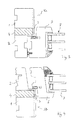
- FIGS. 3 to 5 examples of window frame profiles 5a, 5b, 5c utilising the laminate profile according to the invention are shown.
- the frame profiles 5a, 5b, 5c may have different shapes depending on the types of windows to be achieved and according to which part of the frame is designed.
- FIG 3 an example of a side frame is shown, where the frame profile 5a is machined with the insulation element 4 between the wooden members 1, 2 and 3 in the configuration as shown in figures 1 and 2 .
- the frame profiles 5a, 5b, 5c are thereby designed to receive and accommodate the window frame 6 on which the window glass panel 7 is mounted.
- a bottom frame profile 5b is shown and in fig. 5 a top frame profile 5c is shown.
- a laminated wooden frame profile according to the invention may also be used for other frame or sash constructions facing the exterior of a building, such as a door frame or the like, where any thermal bridging may also be wanted reduced.
Landscapes
- Life Sciences & Earth Sciences (AREA)
- Engineering & Computer Science (AREA)
- Wood Science & Technology (AREA)
- Building Environments (AREA)
- Laminated Bodies (AREA)
- Wing Frames And Configurations (AREA)
Abstract
Description
- The present invention relates to a laminate wooden profile for manufacturing a window frame or the like, comprising a plurality of elongated wooden members having an elongated thermal insulation element therebetween.
- In buildings, thermal insulation of walls, roofs and the like is well known. Likewise, thermal insulation of windows is well known. Accordingly, windows with double or triple glassing are widely used both in new buildings and retrofitted in existing buildings. However, thermal bridging in the window frames is often present as the frames are made of wooden profiles. This creates a relatively poorly insulated frame around the double or triple glassed window panel.
- From e.g.
WO 2011/090442 a composed wooden profile is known where the window frame profile is provided with an insert of thermal insulating filler such as polyurethane foam rather than being made solely of massive wood. - Although this composed wooden profile provides a better thermal insulation than a massive wooden profile, this type of profile suffers some drawbacks. Since only a small amount of the resulting frame profile is provided with thermal insulation filler, the insulation value is relatively low. Moreover, the machining of the laminated profile into the frame profile shape can be difficult since the machining characteristics of the insulation filler are very different than the wood. Therefore, such profile would require a customized manufacturing equipment as the profile is unsuitable for manufacturing on standard equipment. Furthermore foams may change mechanical and insulation properties over time, which may deteriorate the mechanical or insulation properties of the profile and window and result in reduced life time of the window.
- On this background it is an object of the present invention to provide a wooden profile suitable for a window frame or the like which is easy to manufacture and which does not suffer from the above-mentioned drawbacks.
- This object has been achieved by a laminate wooden profile of the initially mentioned kind, wherein the insulation element is made of mineral wool fibres.
- Hereby, a laminated wooden profile with a good thermal insulation is provided which is cost effective in manufacturing and which has an improved insulation value compared with the hitherto known profiles. Another advantage is that the mineral fibre wool is open for diffusion. Such profile made be suitable for providing a better insulated window frame or similar frame structures in a building, e.g. a door frame.
- Windows sold on the Danish market should comply with technical requirements for Danish Window Certification (DVC) which is administered by Danish Technological Institute (DTI). The technical requirements relate to strength of the window, resistance to ingress of water etc. This means that any insulation added to a window sash or frame should not deteriorate the physical strength of the window.
- In particular, it is found advantageous that the insulation element is a mineral fibre composite having a density between 120 kg/m3 and 1000 kg/m3, particularly 250 kg/m3 and 600 kg/m3, for example 450-550 kg/m3 Accordingly, the mineral fibre board may be provided with similar characteristics as the wood making the profile easy to machine on standardized wood machining equipment. An example of such composite mineral fibre board is described in
WO 2011/012712 A1 . - Preferably, the mineral fibre composite is a mineral fibre board, preferably having a substantially uniform fibre orientation in a plane. The mineral fibre composite may comprise a high content of mineral wool fibres which is vacuum laid together with a small content of binder to form a relatively rigid and porous product.
- In a preferred embodiment of the invention, two elongated wooden members are provided on each side of the elongated thermal insulation element and a wooden cover member is provided straddling said wooden members and the insulation element. Moreover, the two elongated wooden members may be either equal in width whereby the insulation element is centrally provided in the profile or be different in width whereby the insulation element is non-symmetrically provided in the profile. By the invention it is realized that it is advantageous to be able to design the profile with the insulation element at an appropriate position in relation to the actual frame design, so that the position of brackets and the like is such that the fastening does not penetrate into the mineral insulation element whereby standardized fastening means, such as screws, can be used.
- By the invention it is realised that the insulation element may constitute 10 to 50% of the width of the profile. This provides for a wide variety of frame designs and the amount of insulation can be chosen according to the thermal insulation which is desired in an actual window frame construction. Likewise, the insulation element may preferably constitute 50-95% of the height of the profile.
- The wooden members may be laminated in their longitudinal direction in any suitable manner. Moreover, the members and the insulation element are preferably glued together.
- According to another aspect of the invention there is provided a frame for a window or the like manufactured from a profile according to the first aspect, wherein the profiled is machined into a predetermined cross-sectional shape.
- According to a third aspect of the invention, there is provided a window assembly comprising a frame at least partially made of a laminate wooden profile according to the first aspect.
- In the following the invention is described in more detail with reference to the accompanying drawings, in which:
- figure 1
- is a schematic perspective view of a laminated wooden profile according to an embodiment of the invention;
- figure 2
- is an end view thereof;
- figures 3 to 5
- are schematic cross-sectional views of window frames according to the invention;
- figures 6 and 7
- are cross-sectional scanning electron microscope (SEM) pictures of the preferred mineral fibre insulation material for the invention compared with other mineral fibre products; and
- figure 8 and 9
- are histograms showing fibre directions in the preferred mineral fibre insulation material for the invention compared with conventional mineral fibre products.
- With reference to
figures 1 and 2 , an embodiment of a laminated wooden profile according to the invention is shown. The profile is made as an assembly of elongatedwooden members insulation element 4. As shown, a first wooden member 1 and a secondwooden member 2 are provided on each side of theinsulation member 4 with a topwooden member 3 covering the upper portion of the twowooden members 1, 2 and theinsulation element 4. In the embodiment shown, theinsulation member 4 is exposed on one of the exterior surfaces of the profile assembly. However, a lower cover member (not shown) could also be provided. By this assembly of members and insulation element, the profile has a total width W and a height H. The terms "width" and "height" used in this description are to be understood as relative terms and do not refer to any orientation of the profile when installed, but merely refers to the orientation in thefigures 1 and 2 . - The
wooden members insulation element 4 extend along the entire profile length. Thewooden members fig. 1 . In particular the first and second wooden members are preferably made of core wood. All themembers insulation element 4 are glued firmly together along the entire length of the profile. In a prototype the interface betweenwooden members insulation element 4 was glued with an adhesive of the type Prefere 4535 of C4 quality and hardener Prefere 5046 (from Dynea). Other adhesives tested were Kauramin Glue 683 (BASF) and Aswood 7000 (Dynea). The adhesives were applied in an amount of 250 g/m2. - As shown in
fig. 2 , the "raw" laminated wooden profile may be machined into a desiredframe profile 5. - The
insulation element 4 may constitute 10-50% of the width of the profile. Depending on the type of insulation fibre element used, one or more insulation elements may be provided adjacent each other. In the figures, only oneelement 4 is shown, but it is realised that any number of insulation elements may be provided, just as the number ofwooden members 1, 2 may also be chosen in accordance with the desired design of theresulting frame profile 5. - The
insulation element 4 is preferably a mineral fibre-containing element comprising a mineral fibre content in an amount of 80 to 95 wt % of the total weight of starting materials in the form of a collected web of mineral fibres, a binder in an amount of 5 to 20 wt % of the total weight of starting materials. The element is formed by subjecting the collected web of fibres to a disentanglement process, suspending the fibres in a primary air flow, and mixing the binder with the mineral fibres before, during or after the disentanglement process to form a mixture of mineral fibres and binder, and then collecting the mixture of mineral fibres and binder and pressing and curing the mixture to provide a consolidated composite with a density of from 120 kg/m3 to 1000 kg/ m3, such as 250 kg/ m3 to 600 kg/ m3, for example 450-550 kg/m3, more preferably approx. 500 kg/ m3. - This mineral fibre composite defined above is a versatile and cost efficiently manufactured mineral fibre-containing composite. By adjusting the density to which the element is pressed, a variety of different composites can be made that are tailor-made for specific purposes.
- By subjecting the mineral fibres to a fibre disentanglement process, compacted mineral fibres are opened up and the mineral fibres and binder are more evenly distributed in the element produced. This increased homogeneity in the element results generally in an increased level of mechanical strength relative to other mineral insulation products. The even distribution of fibres and binder in the element also has a desirable effect on the acoustic insulation properties of the element. It has also been found that the composites of the present invention as a result of their homogeneity can be machined in a similar way to wood, i.e. the composite can be machined in ordinary wood forming machinery, such as saws and shaping machines, e.g. grooving machines, surface milling cutters etc.
- This mineral fibre composite is advantageous in applications where mechanical stability and an even surface finish as well as insulating properties are important. Preferably the thickness of the panel is from 4 to 25 mm. In some embodiments, the thickness of the panel is preferably from 12 to 25 mm, more preferably from 15 to 23 mm and most preferably from 18 to 21 mm, depending on the size of the frame profile and the amount of insulation which is to be encompassed in the window frame profile.
- The amount of binder is chosen on the basis of desired cohesion, strength and cost, plus properties such as thermal insulation value. The low limit of 5 wt % results in a composite with a lower strength and cohesion, which is however adequate for some applications, and has the benefit of relatively low cost and potential for good thermal and acoustic insulation properties. In applications where a high mechanical strength is needed, a higher amount of binder should be used, such as up to the upper limit of 20 wt %, but this will increase the cost of the resulting product. For a majority of applications, a suitable composition will include a binder amount from 5 to 20 wt % or from 8 to 17 wt %. Most usually, a suitable quantity of binder will be from 10 to 15 wt %.
- The mineral fibres (also known as man-made vitreous fibres or MMVF) used according to the present invention could be any mineral fibres, including glass fibres, ceramic fibres or stone fibres, but preferably stone fibres are used. Stone wool fibres generally have a content of iron oxide at least 3% and alkaline earth metals (calcium oxide and magnesium oxide) from 10 to 40%, along with the other usual oxide constituents of mineral wool. These are silica; alumina; alkali metals (sodium oxide and potassium oxide) which are usually present in low amounts; and can also include titania and other minor oxides. Fibre diameter is often in the
range 2 to 10 microns, in particular 3 to 6 microns, as conventional. - Preferably, the mineral fibres and binder together form at least 96%, more preferably at least 98% and most preferably substantially all of the total weight of starting materials. Although the composite is homogenous in its structure, since the collection of the mixture is carried out by a vacuum forming process and with subsequent pressing the resulting element may have an anisotropic structure with nearly isotropic fibre direction in a plane directed in x- and y-direction, and thereby being less homogeneous between these planes in z-direction, as can be seen in
figures 8 and9 , which show the fibre orientation in the X and Y directions, respectively, for the preferred mineral fibrecomposite element 4 compared with anothermineral fibre element 41. Returning the profile shown in the figures, the mineral fibrecomposite element 4 is therefore preferably oriented so that the layered structure is in the z-direction (seefig. 1 ) whereby the fibre structure is homogeneous in the x and y directions. Infigures 6 and 7 scanning pictures of this preferred mineral fibrecomposite element 4 are shown in comparison with other types ofmineral fibre elements elements Tabel 1 Direction Porosity Epoxy Fiber Thermal Conductance (Wm-1k-1) Young's Modulus (GPa) Poisson Ratio X 0.726 0.032 0.242 0.17 3.87 vxy= 0.29 vxz= 0.21 Y 0.726 0.032 0.242 0.17 4.16 vyx= 0.31 vyz= 0.17 Z 0.726 0.032 0.242 0.11 1.43 vzx= 0.08 Vzy= 0.06 - As can be seen in table 1, the thermal conductance in Z-direction is much lower than in x-and y direction. This is important as this means that any thermal bridge in the Z-direction is broken, as the heat transport of a window will be from the inner side to the outer side or vice versa.
- In
figures 3 to 5 examples ofwindow frame profiles figure 3 an example of a side frame is shown, where theframe profile 5a is machined with theinsulation element 4 between thewooden members figures 1 and 2 . The frame profiles 5a, 5b, 5c are thereby designed to receive and accommodate the window frame 6 on which thewindow glass panel 7 is mounted. Similarly, infigure 4 a bottom frame profile 5b is shown and infig. 5 atop frame profile 5c is shown. - Above, the invention is described with reference to a preferred embodiment of the invention but it is apparent from the above description that variants and equivalents of the invention may be provided without departing from the scope of the invention as defined in the accompanying claims. Accordingly, it is realised by the invention that a laminated wooden frame profile according to the invention may also be used for other frame or sash constructions facing the exterior of a building, such as a door frame or the like, where any thermal bridging may also be wanted reduced.
Claims (12)
- A laminate wooden profile for manufacturing a window frame or the like, comprising a plurality of elongated wooden members having an elongated thermal insulation element therebetween,
characterised in that
the insulation element is made of mineral wool fibres. - A profile according to claim 1, wherein the insulation element is a mineral fibre composite having a density between 120 kg/m3 and 1000 kg/m3, particularly 250 kg/m3 and 600 kg/m3, for example 450-550 kg/m3.
- A profile according to claim 2, wherein the mineral fibre composite is a mineral fibre board, preferably having a substantially uniform fibre orientation in a plane.
- A profile according to any of the preceding claims, wherein two elongated wooden members are provided on each side of the elongated thermal insulation element and a wooden cover member is provided straddling said wooden members and the insulation element.
- A profile according to claim 4, wherein said two elongated wooden members are equal in width whereby the insulation element is centrally provided in the profile.
- A profile according to claim 4, wherein said two elongated wooden members differs in width whereby the insulation element is non-symmetrically provided in the profile.
- A profile according to any of the preceding claims, wherein the insulation element constitutes 10-50% of the width of the profile.
- A profile according to any of the preceding claims, wherein the insulation element constitutes 50-90% of the height of the profile.
- A profile according to any of the preceding claims, wherein the wooden members may be laminated.
- A profile according to any of the preceding claims, wherein the members and the insulation element are glued together.
- A frame for a window or the like manufactured from a profile according to any of the preceding claims, wherein the profiled is machined into a predetermined cross-sectional shape.
- A window assembly comprising a frame at least partially made of a laminate wooden profile according to any of the claims 1 to 10.
Priority Applications (2)
| Application Number | Priority Date | Filing Date | Title |
|---|---|---|---|
| DK11184456T DK2581217T3 (en) | 2011-10-10 | 2011-10-10 | Frame for a window or similar made from a laminated wood profile |
| EP20110184456 EP2581217B1 (en) | 2011-10-10 | 2011-10-10 | A frame for a window or the like manufactured from a laminate wooden profile |
Applications Claiming Priority (1)
| Application Number | Priority Date | Filing Date | Title |
|---|---|---|---|
| EP20110184456 EP2581217B1 (en) | 2011-10-10 | 2011-10-10 | A frame for a window or the like manufactured from a laminate wooden profile |
Publications (2)
| Publication Number | Publication Date |
|---|---|
| EP2581217A1 true EP2581217A1 (en) | 2013-04-17 |
| EP2581217B1 EP2581217B1 (en) | 2014-07-16 |
Family
ID=44897628
Family Applications (1)
| Application Number | Title | Priority Date | Filing Date |
|---|---|---|---|
| EP20110184456 Not-in-force EP2581217B1 (en) | 2011-10-10 | 2011-10-10 | A frame for a window or the like manufactured from a laminate wooden profile |
Country Status (2)
| Country | Link |
|---|---|
| EP (1) | EP2581217B1 (en) |
| DK (1) | DK2581217T3 (en) |
Cited By (1)
| Publication number | Priority date | Publication date | Assignee | Title |
|---|---|---|---|---|
| WO2014102713A1 (en) * | 2012-12-31 | 2014-07-03 | Rockwool International A/S | Rigid insulating panel |
Citations (3)
| Publication number | Priority date | Publication date | Assignee | Title |
|---|---|---|---|---|
| WO2011012712A1 (en) | 2009-07-31 | 2011-02-03 | Rockwool International A/S | Method for manufacturing a mineral fibre-containing element and element produced by that method |
| WO2011090442A1 (en) | 2010-01-25 | 2011-07-28 | Viva Les, Druzba Za Proizvodnjo Lesnih Izdelkov In Trgovino, D.O.O.. | Composed wooden profile for manufacturing of door or window wings or frames |
| EP2397620A2 (en) * | 2010-06-15 | 2011-12-21 | Paroc Oy Ab | Laminated beam construction |
-
2011
- 2011-10-10 EP EP20110184456 patent/EP2581217B1/en not_active Not-in-force
- 2011-10-10 DK DK11184456T patent/DK2581217T3/en active
Patent Citations (3)
| Publication number | Priority date | Publication date | Assignee | Title |
|---|---|---|---|---|
| WO2011012712A1 (en) | 2009-07-31 | 2011-02-03 | Rockwool International A/S | Method for manufacturing a mineral fibre-containing element and element produced by that method |
| WO2011090442A1 (en) | 2010-01-25 | 2011-07-28 | Viva Les, Druzba Za Proizvodnjo Lesnih Izdelkov In Trgovino, D.O.O.. | Composed wooden profile for manufacturing of door or window wings or frames |
| EP2397620A2 (en) * | 2010-06-15 | 2011-12-21 | Paroc Oy Ab | Laminated beam construction |
Cited By (1)
| Publication number | Priority date | Publication date | Assignee | Title |
|---|---|---|---|---|
| WO2014102713A1 (en) * | 2012-12-31 | 2014-07-03 | Rockwool International A/S | Rigid insulating panel |
Also Published As
| Publication number | Publication date |
|---|---|
| DK2581217T3 (en) | 2014-09-22 |
| EP2581217B1 (en) | 2014-07-16 |
Similar Documents
| Publication | Publication Date | Title |
|---|---|---|
| US10240089B2 (en) | Gypsum composites used in fire resistant building components | |
| EP1680561B1 (en) | Insulating element consisting of mineral fibres for the construction of ships | |
| US20160303826A1 (en) | Gypsum Composites Used in Fire Resistant Building Components | |
| WO2012000585A4 (en) | Insulating construction element, use of an insulating construction element and method for manufacturing an insulating construction element | |
| EP2388389B1 (en) | Vapour insulating wall cladding | |
| KR101149888B1 (en) | A sandwich structure a process for manufacturing the same and a method of construction | |
| EP2585294B1 (en) | Method for producing sandwich construction elements and building elements produced thereby | |
| WO2011115514A2 (en) | Ceramic laminated panel with cork and fibres | |
| EP2581217B1 (en) | A frame for a window or the like manufactured from a laminate wooden profile | |
| EP1219755B1 (en) | Insulating board for façades and process for producing the same | |
| CN103231423B (en) | A kind of laminate bamboo radical fiber composite material and manufacture method thereof | |
| CN203331157U (en) | Sandwich structure bamboo and wood composite recombinant structure material | |
| EP2119840B1 (en) | Vacuum insulation element | |
| KR102324838B1 (en) | A method for manufacturing a fire proof door | |
| EP1239093A3 (en) | Fire protection element, particularly for fireproof doors | |
| KR100877365B1 (en) | Manufacturing method of plate material combining release material and short fiber and plate material | |
| EP3224395B1 (en) | A method of producing a sandwich panel core of mineral wool fibres | |
| EP1756376A1 (en) | Reinforced thermal insulation construction plate | |
| EP4166743A1 (en) | Inlay for doors | |
| JP2007210224A (en) | Fiber board | |
| KR20110078129A (en) | Lyocell Fiber Reinforced Thermoplastic Composites and Manufacturing Method Thereof | |
| KR102729142B1 (en) | Light weight non-woven fabric tile and manufacturing method thereof | |
| DE102023132705B4 (en) | Microporous thermal insulation body | |
| CN205291746U (en) | Reinforcing composite ceramic fibreboard | |
| KR101100937B1 (en) | Insulation and its manufacturing method |
Legal Events
| Date | Code | Title | Description |
|---|---|---|---|
| PUAI | Public reference made under article 153(3) epc to a published international application that has entered the european phase |
Free format text: ORIGINAL CODE: 0009012 |
|
| AK | Designated contracting states |
Kind code of ref document: A1 Designated state(s): AL AT BE BG CH CY CZ DE DK EE ES FI FR GB GR HR HU IE IS IT LI LT LU LV MC MK MT NL NO PL PT RO RS SE SI SK SM TR |
|
| AX | Request for extension of the european patent |
Extension state: BA ME |
|
| 17P | Request for examination filed |
Effective date: 20131014 |
|
| RBV | Designated contracting states (corrected) |
Designated state(s): AL AT BE BG CH CY CZ DE DK EE ES FI FR GB GR HR HU IE IS IT LI LT LU LV MC MK MT NL NO PL PT RO RS SE SI SK SM TR |
|
| GRAP | Despatch of communication of intention to grant a patent |
Free format text: ORIGINAL CODE: EPIDOSNIGR1 |
|
| INTG | Intention to grant announced |
Effective date: 20140131 |
|
| RIC1 | Information provided on ipc code assigned before grant |
Ipc: E06B 3/70 20060101ALN20140121BHEP Ipc: E06B 3/263 20060101ALI20140121BHEP Ipc: B32B 21/00 20060101ALI20140121BHEP Ipc: B32B 9/04 20060101AFI20140121BHEP |
|
| GRAS | Grant fee paid |
Free format text: ORIGINAL CODE: EPIDOSNIGR3 |
|
| GRAA | (expected) grant |
Free format text: ORIGINAL CODE: 0009210 |
|
| AK | Designated contracting states |
Kind code of ref document: B1 Designated state(s): AL AT BE BG CH CY CZ DE DK EE ES FI FR GB GR HR HU IE IS IT LI LT LU LV MC MK MT NL NO PL PT RO RS SE SI SK SM TR |
|
| REG | Reference to a national code |
Ref country code: GB Ref legal event code: FG4D |
|
| REG | Reference to a national code |
Ref country code: CH Ref legal event code: EP |
|
| REG | Reference to a national code |
Ref country code: IE Ref legal event code: FG4D |
|
| REG | Reference to a national code |
Ref country code: AT Ref legal event code: REF Ref document number: 677347 Country of ref document: AT Kind code of ref document: T Effective date: 20140815 |
|
| REG | Reference to a national code |
Ref country code: DE Ref legal event code: R096 Ref document number: 602011008347 Country of ref document: DE Effective date: 20140821 |
|
| REG | Reference to a national code |
Ref country code: DK Ref legal event code: T3 Effective date: 20140915 |
|
| REG | Reference to a national code |
Ref country code: NL Ref legal event code: T3 |
|
| REG | Reference to a national code |
Ref country code: CH Ref legal event code: NV Representative=s name: FIAMMENGHI-FIAMMENGHI, CH |
|
| REG | Reference to a national code |
Ref country code: LT Ref legal event code: MG4D |
|
| PG25 | Lapsed in a contracting state [announced via postgrant information from national office to epo] |
Ref country code: BG Free format text: LAPSE BECAUSE OF FAILURE TO SUBMIT A TRANSLATION OF THE DESCRIPTION OR TO PAY THE FEE WITHIN THE PRESCRIBED TIME-LIMIT Effective date: 20141016 Ref country code: FI Free format text: LAPSE BECAUSE OF FAILURE TO SUBMIT A TRANSLATION OF THE DESCRIPTION OR TO PAY THE FEE WITHIN THE PRESCRIBED TIME-LIMIT Effective date: 20140716 Ref country code: PT Free format text: LAPSE BECAUSE OF FAILURE TO SUBMIT A TRANSLATION OF THE DESCRIPTION OR TO PAY THE FEE WITHIN THE PRESCRIBED TIME-LIMIT Effective date: 20141117 Ref country code: GR Free format text: LAPSE BECAUSE OF FAILURE TO SUBMIT A TRANSLATION OF THE DESCRIPTION OR TO PAY THE FEE WITHIN THE PRESCRIBED TIME-LIMIT Effective date: 20141017 Ref country code: LT Free format text: LAPSE BECAUSE OF FAILURE TO SUBMIT A TRANSLATION OF THE DESCRIPTION OR TO PAY THE FEE WITHIN THE PRESCRIBED TIME-LIMIT Effective date: 20140716 Ref country code: SE Free format text: LAPSE BECAUSE OF FAILURE TO SUBMIT A TRANSLATION OF THE DESCRIPTION OR TO PAY THE FEE WITHIN THE PRESCRIBED TIME-LIMIT Effective date: 20140716 Ref country code: NO Free format text: LAPSE BECAUSE OF FAILURE TO SUBMIT A TRANSLATION OF THE DESCRIPTION OR TO PAY THE FEE WITHIN THE PRESCRIBED TIME-LIMIT Effective date: 20141016 Ref country code: ES Free format text: LAPSE BECAUSE OF FAILURE TO SUBMIT A TRANSLATION OF THE DESCRIPTION OR TO PAY THE FEE WITHIN THE PRESCRIBED TIME-LIMIT Effective date: 20140716 |
|
| PG25 | Lapsed in a contracting state [announced via postgrant information from national office to epo] |
Ref country code: CY Free format text: LAPSE BECAUSE OF FAILURE TO SUBMIT A TRANSLATION OF THE DESCRIPTION OR TO PAY THE FEE WITHIN THE PRESCRIBED TIME-LIMIT Effective date: 20140716 Ref country code: IS Free format text: LAPSE BECAUSE OF FAILURE TO SUBMIT A TRANSLATION OF THE DESCRIPTION OR TO PAY THE FEE WITHIN THE PRESCRIBED TIME-LIMIT Effective date: 20141116 Ref country code: RS Free format text: LAPSE BECAUSE OF FAILURE TO SUBMIT A TRANSLATION OF THE DESCRIPTION OR TO PAY THE FEE WITHIN THE PRESCRIBED TIME-LIMIT Effective date: 20140716 Ref country code: LV Free format text: LAPSE BECAUSE OF FAILURE TO SUBMIT A TRANSLATION OF THE DESCRIPTION OR TO PAY THE FEE WITHIN THE PRESCRIBED TIME-LIMIT Effective date: 20140716 Ref country code: PL Free format text: LAPSE BECAUSE OF FAILURE TO SUBMIT A TRANSLATION OF THE DESCRIPTION OR TO PAY THE FEE WITHIN THE PRESCRIBED TIME-LIMIT Effective date: 20140716 |
|
| REG | Reference to a national code |
Ref country code: DE Ref legal event code: R097 Ref document number: 602011008347 Country of ref document: DE |
|
| PG25 | Lapsed in a contracting state [announced via postgrant information from national office to epo] |
Ref country code: EE Free format text: LAPSE BECAUSE OF FAILURE TO SUBMIT A TRANSLATION OF THE DESCRIPTION OR TO PAY THE FEE WITHIN THE PRESCRIBED TIME-LIMIT Effective date: 20140716 Ref country code: CZ Free format text: LAPSE BECAUSE OF FAILURE TO SUBMIT A TRANSLATION OF THE DESCRIPTION OR TO PAY THE FEE WITHIN THE PRESCRIBED TIME-LIMIT Effective date: 20140716 Ref country code: IT Free format text: LAPSE BECAUSE OF FAILURE TO SUBMIT A TRANSLATION OF THE DESCRIPTION OR TO PAY THE FEE WITHIN THE PRESCRIBED TIME-LIMIT Effective date: 20140716 Ref country code: SK Free format text: LAPSE BECAUSE OF FAILURE TO SUBMIT A TRANSLATION OF THE DESCRIPTION OR TO PAY THE FEE WITHIN THE PRESCRIBED TIME-LIMIT Effective date: 20140716 Ref country code: RO Free format text: LAPSE BECAUSE OF FAILURE TO SUBMIT A TRANSLATION OF THE DESCRIPTION OR TO PAY THE FEE WITHIN THE PRESCRIBED TIME-LIMIT Effective date: 20140716 |
|
| PLBE | No opposition filed within time limit |
Free format text: ORIGINAL CODE: 0009261 |
|
| STAA | Information on the status of an ep patent application or granted ep patent |
Free format text: STATUS: NO OPPOSITION FILED WITHIN TIME LIMIT |
|
| PG25 | Lapsed in a contracting state [announced via postgrant information from national office to epo] |
Ref country code: LU Free format text: LAPSE BECAUSE OF FAILURE TO SUBMIT A TRANSLATION OF THE DESCRIPTION OR TO PAY THE FEE WITHIN THE PRESCRIBED TIME-LIMIT Effective date: 20141010 Ref country code: MC Free format text: LAPSE BECAUSE OF FAILURE TO SUBMIT A TRANSLATION OF THE DESCRIPTION OR TO PAY THE FEE WITHIN THE PRESCRIBED TIME-LIMIT Effective date: 20140716 |
|
| 26N | No opposition filed |
Effective date: 20150417 |
|
| PG25 | Lapsed in a contracting state [announced via postgrant information from national office to epo] |
Ref country code: BE Free format text: LAPSE BECAUSE OF NON-PAYMENT OF DUE FEES Effective date: 20141031 |
|
| REG | Reference to a national code |
Ref country code: IE Ref legal event code: MM4A |
|
| PG25 | Lapsed in a contracting state [announced via postgrant information from national office to epo] |
Ref country code: IE Free format text: LAPSE BECAUSE OF NON-PAYMENT OF DUE FEES Effective date: 20141010 |
|
| PG25 | Lapsed in a contracting state [announced via postgrant information from national office to epo] |
Ref country code: SI Free format text: LAPSE BECAUSE OF FAILURE TO SUBMIT A TRANSLATION OF THE DESCRIPTION OR TO PAY THE FEE WITHIN THE PRESCRIBED TIME-LIMIT Effective date: 20140716 |
|
| PGFP | Annual fee paid to national office [announced via postgrant information from national office to epo] |
Ref country code: DK Payment date: 20151012 Year of fee payment: 5 |
|
| PGFP | Annual fee paid to national office [announced via postgrant information from national office to epo] |
Ref country code: CH Payment date: 20151012 Year of fee payment: 5 |
|
| PGFP | Annual fee paid to national office [announced via postgrant information from national office to epo] |
Ref country code: NL Payment date: 20151012 Year of fee payment: 5 |
|
| PG25 | Lapsed in a contracting state [announced via postgrant information from national office to epo] |
Ref country code: SM Free format text: LAPSE BECAUSE OF FAILURE TO SUBMIT A TRANSLATION OF THE DESCRIPTION OR TO PAY THE FEE WITHIN THE PRESCRIBED TIME-LIMIT Effective date: 20140716 |
|
| GBPC | Gb: european patent ceased through non-payment of renewal fee |
Effective date: 20151010 |
|
| PG25 | Lapsed in a contracting state [announced via postgrant information from national office to epo] |
Ref country code: MT Free format text: LAPSE BECAUSE OF FAILURE TO SUBMIT A TRANSLATION OF THE DESCRIPTION OR TO PAY THE FEE WITHIN THE PRESCRIBED TIME-LIMIT Effective date: 20140716 Ref country code: GB Free format text: LAPSE BECAUSE OF NON-PAYMENT OF DUE FEES Effective date: 20151010 Ref country code: HU Free format text: LAPSE BECAUSE OF FAILURE TO SUBMIT A TRANSLATION OF THE DESCRIPTION OR TO PAY THE FEE WITHIN THE PRESCRIBED TIME-LIMIT; INVALID AB INITIO Effective date: 20111010 Ref country code: BE Free format text: LAPSE BECAUSE OF FAILURE TO SUBMIT A TRANSLATION OF THE DESCRIPTION OR TO PAY THE FEE WITHIN THE PRESCRIBED TIME-LIMIT Effective date: 20140716 Ref country code: HR Free format text: LAPSE BECAUSE OF FAILURE TO SUBMIT A TRANSLATION OF THE DESCRIPTION OR TO PAY THE FEE WITHIN THE PRESCRIBED TIME-LIMIT Effective date: 20140716 Ref country code: TR Free format text: LAPSE BECAUSE OF FAILURE TO SUBMIT A TRANSLATION OF THE DESCRIPTION OR TO PAY THE FEE WITHIN THE PRESCRIBED TIME-LIMIT Effective date: 20140716 |
|
| REG | Reference to a national code |
Ref country code: FR Ref legal event code: PLFP Year of fee payment: 6 |
|
| REG | Reference to a national code |
Ref country code: DK Ref legal event code: EBP Effective date: 20161031 |
|
| REG | Reference to a national code |
Ref country code: CH Ref legal event code: PL |
|
| REG | Reference to a national code |
Ref country code: NL Ref legal event code: MM Effective date: 20161101 |
|
| PG25 | Lapsed in a contracting state [announced via postgrant information from national office to epo] |
Ref country code: CH Free format text: LAPSE BECAUSE OF NON-PAYMENT OF DUE FEES Effective date: 20161031 Ref country code: LI Free format text: LAPSE BECAUSE OF NON-PAYMENT OF DUE FEES Effective date: 20161031 |
|
| PG25 | Lapsed in a contracting state [announced via postgrant information from national office to epo] |
Ref country code: NL Free format text: LAPSE BECAUSE OF NON-PAYMENT OF DUE FEES Effective date: 20161101 |
|
| REG | Reference to a national code |
Ref country code: FR Ref legal event code: PLFP Year of fee payment: 7 |
|
| PG25 | Lapsed in a contracting state [announced via postgrant information from national office to epo] |
Ref country code: DK Free format text: LAPSE BECAUSE OF NON-PAYMENT OF DUE FEES Effective date: 20161031 |
|
| REG | Reference to a national code |
Ref country code: AT Ref legal event code: MM01 Ref document number: 677347 Country of ref document: AT Kind code of ref document: T Effective date: 20161010 |
|
| PG25 | Lapsed in a contracting state [announced via postgrant information from national office to epo] |
Ref country code: AT Free format text: LAPSE BECAUSE OF NON-PAYMENT OF DUE FEES Effective date: 20161010 |
|
| PGFP | Annual fee paid to national office [announced via postgrant information from national office to epo] |
Ref country code: FR Payment date: 20171025 Year of fee payment: 7 Ref country code: DE Payment date: 20171027 Year of fee payment: 7 |
|
| PG25 | Lapsed in a contracting state [announced via postgrant information from national office to epo] |
Ref country code: MK Free format text: LAPSE BECAUSE OF FAILURE TO SUBMIT A TRANSLATION OF THE DESCRIPTION OR TO PAY THE FEE WITHIN THE PRESCRIBED TIME-LIMIT Effective date: 20140716 |
|
| PG25 | Lapsed in a contracting state [announced via postgrant information from national office to epo] |
Ref country code: AL Free format text: LAPSE BECAUSE OF FAILURE TO SUBMIT A TRANSLATION OF THE DESCRIPTION OR TO PAY THE FEE WITHIN THE PRESCRIBED TIME-LIMIT Effective date: 20140716 |
|
| REG | Reference to a national code |
Ref country code: DE Ref legal event code: R119 Ref document number: 602011008347 Country of ref document: DE |
|
| PG25 | Lapsed in a contracting state [announced via postgrant information from national office to epo] |
Ref country code: DE Free format text: LAPSE BECAUSE OF NON-PAYMENT OF DUE FEES Effective date: 20190501 |
|
| PG25 | Lapsed in a contracting state [announced via postgrant information from national office to epo] |
Ref country code: FR Free format text: LAPSE BECAUSE OF NON-PAYMENT OF DUE FEES Effective date: 20181031 |