EP2580955A1 - Grain unloading control system - Google Patents
Grain unloading control system Download PDFInfo
- Publication number
- EP2580955A1 EP2580955A1 EP12188246.8A EP12188246A EP2580955A1 EP 2580955 A1 EP2580955 A1 EP 2580955A1 EP 12188246 A EP12188246 A EP 12188246A EP 2580955 A1 EP2580955 A1 EP 2580955A1
- Authority
- EP
- European Patent Office
- Prior art keywords
- unloader
- grain
- conveyor
- conveyor segment
- unloader conveyor
- Prior art date
- Legal status (The legal status is an assumption and is not a legal conclusion. Google has not performed a legal analysis and makes no representation as to the accuracy of the status listed.)
- Withdrawn
Links
- 230000001186 cumulative effect Effects 0.000 claims abstract description 7
- 238000007599 discharging Methods 0.000 claims abstract description 4
- 238000003306 harvesting Methods 0.000 claims description 6
- 230000010006 flight Effects 0.000 claims description 5
- 230000033001 locomotion Effects 0.000 claims description 4
- 238000012544 monitoring process Methods 0.000 claims description 2
- 235000013339 cereals Nutrition 0.000 description 98
- 239000012530 fluid Substances 0.000 description 5
- 230000000977 initiatory effect Effects 0.000 description 3
- 239000000463 material Substances 0.000 description 3
- 240000007594 Oryza sativa Species 0.000 description 2
- 235000007164 Oryza sativa Nutrition 0.000 description 2
- 240000008042 Zea mays Species 0.000 description 2
- 235000005824 Zea mays ssp. parviglumis Nutrition 0.000 description 2
- 235000002017 Zea mays subsp mays Nutrition 0.000 description 2
- 230000001154 acute effect Effects 0.000 description 2
- 238000005056 compaction Methods 0.000 description 2
- 235000005822 corn Nutrition 0.000 description 2
- 230000013011 mating Effects 0.000 description 2
- 235000009566 rice Nutrition 0.000 description 2
- 244000046052 Phaseolus vulgaris Species 0.000 description 1
- 235000010627 Phaseolus vulgaris Nutrition 0.000 description 1
- 241000209140 Triticum Species 0.000 description 1
- 235000021307 Triticum Nutrition 0.000 description 1
- 230000003466 anti-cipated effect Effects 0.000 description 1
- 238000013459 approach Methods 0.000 description 1
- 230000000712 assembly Effects 0.000 description 1
- 238000000429 assembly Methods 0.000 description 1
- 230000015572 biosynthetic process Effects 0.000 description 1
- 238000004140 cleaning Methods 0.000 description 1
- 230000006835 compression Effects 0.000 description 1
- 238000007906 compression Methods 0.000 description 1
- 238000005336 cracking Methods 0.000 description 1
- 230000003292 diminished effect Effects 0.000 description 1
- 238000010616 electrical installation Methods 0.000 description 1
- 230000006698 induction Effects 0.000 description 1
- 238000012986 modification Methods 0.000 description 1
- 230000004048 modification Effects 0.000 description 1
Images




Classifications
-
- A—HUMAN NECESSITIES
- A01—AGRICULTURE; FORESTRY; ANIMAL HUSBANDRY; HUNTING; TRAPPING; FISHING
- A01D—HARVESTING; MOWING
- A01D41/00—Combines, i.e. harvesters or mowers combined with threshing devices
- A01D41/12—Details of combines
- A01D41/1208—Tanks for grain or chaff
- A01D41/1217—Unloading mechanisms
-
- B—PERFORMING OPERATIONS; TRANSPORTING
- B65—CONVEYING; PACKING; STORING; HANDLING THIN OR FILAMENTARY MATERIAL
- B65G—TRANSPORT OR STORAGE DEVICES, e.g. CONVEYORS FOR LOADING OR TIPPING, SHOP CONVEYOR SYSTEMS OR PNEUMATIC TUBE CONVEYORS
- B65G33/00—Screw or rotary spiral conveyors
- B65G33/08—Screw or rotary spiral conveyors for fluent solid materials
- B65G33/14—Screw or rotary spiral conveyors for fluent solid materials comprising a screw or screws enclosed in a tubular housing
-
- A—HUMAN NECESSITIES
- A01—AGRICULTURE; FORESTRY; ANIMAL HUSBANDRY; HUNTING; TRAPPING; FISHING
- A01D—HARVESTING; MOWING
- A01D41/00—Combines, i.e. harvesters or mowers combined with threshing devices
- A01D41/12—Details of combines
- A01D41/127—Control or measuring arrangements specially adapted for combines
-
- B—PERFORMING OPERATIONS; TRANSPORTING
- B60—VEHICLES IN GENERAL
- B60P—VEHICLES ADAPTED FOR LOAD TRANSPORTATION OR TO TRANSPORT, TO CARRY, OR TO COMPRISE SPECIAL LOADS OR OBJECTS
- B60P1/00—Vehicles predominantly for transporting loads and modified to facilitate loading, consolidating the load, or unloading
- B60P1/40—Vehicles predominantly for transporting loads and modified to facilitate loading, consolidating the load, or unloading using screw conveyors thereon
Definitions
- the present invention generally relates to control systems for agricultural devices and, more particularly, to grain unloading control systems for agricultural devices.
- Grain tanks of combines commonly have an associated unloader conveyor operable for conveying grain from the grain tank to another location such as to a grain truck or wagon.
- An unloader conveyor typically includes an elongate, enclosed tubular housing containing a helical auger and is oriented horizontally or at a small acute angle to horizontal.
- the unloader conveyor is typically pivotally supported in cantilever relation by a lower end of an upstanding or vertical lower unloader conveyor section including an inlet opening disposed in or adjacent to the grain tank.
- the unloader conveyor is typically pivotable between a stored position extending along the combine, and a sidewardly extending unloading position.
- the unloader can be of any length, but will typically have a length sufficient to extend just beyond the end of a header of the combine.
- Grain tanks additionally typically include at least one grain tank conveyor including an auger adjacent to the bottom of the grain tank and extending into the inlet opening of the lower unloader conveyor for conveying grain into the unloader.
- the start up torque and power required will be higher than if the augers are started separately.
- the unloader conveyor is loaded with grain when pivoted between the sidewardly extending unloading position and the stored position, greater loads and stress are placed thereon and on the supporting structure thereof compared to if the unloader is empty.
- the length of unloader conveyors will necessarily also increase as will the amount and weight of grain remaining therein after use.
- the stress on the supporting structure when the unloader is in the unloading position and moving thereto and therefrom will also be increased.
- the unloader auger should stall, for instance, due to a mechanical problem with the unloader drive, formation or induction of a slug of grain in the unloader tube, and the grain tank auger continues to operate, the inlet of the unloader can be packed with grain, which can result in excessive grain damage and/or damage to the grain tank auger.
- the present invention relates to an agricultural device for controlled unloading of grain
- an unloader conveyor including an enclosed housing having an inlet end including an opening for receiving grain, and an opposite outlet end including a discharge opening through which the grain can be discharged.
- An unloader conveyor element extends through the housing between the ends and is operable for conveying the grain through the housing from the inlet end and discharging the grain through the discharge opening.
- the unloader conveyor element has a substantially vertical unloader conveyor segment connected to a substantially horizontal unloader conveyor segment downstream of the substantially vertical unloader conveyor segment.
- An unloader drive is operably controllable for selectably operating the conveyor element between an engaged mode and a disengaged mode.
- the unloader drive further is operably controllable for selectably operating a portion of the conveyor element associated with the substantially vertical unloader conveyor segment in a disengaged mode while operating a portion of the conveyor element associated with the substantially horizontal unloader conveyor segment in an engaged mode.
- This split operation allows use of the drive for unloading the horizontal portion of the unloader conveyor, while the vertical portion is not engaged.
- the horizontal portion In a first phase the horizontal portion can be emptied and in a second phase both the vertical and horizontal portions can be engaged.
- the full load on the drive is diminished and more power is available to remove packed crop material from the bottom of the vertical conveyor portion.
- the peak torque on the conveyor is reduced consequently and the chance that a shear pin in the drive is ruptured, diminishes.
- the agricultural device comprises a load sensing device for sensing a cumulative loading condition of the substantially vertical unloader conveyor segment and the substantially horizontal unloader conveyor segment.
- An unloader controller is operably connected to the load sensing device and to the unloader drive and configured for monitoring the sensed cumulative loading condition; and, when the cumulative loading condition exceeds a predetermined value, operating the portion of the conveyor element associated with the substantially vertical unloader conveyor segment in a disengaged mode, while operating a portion of the conveyor element associated with the substantially horizontal unloader conveyor segment in an engaged mode.
- An advantage of the present invention is a grain unloading system that is configured to operate substantially continuously.
- a further advantage of the present invention is a grain unloading system that is configured to operate without wasting grain associated with elevated start-up torque conditions.
- FIG. 1 a representative agricultural harvesting machine or device 10 is shown, including an unloader 12 operable for unloading grain from a grain tank located on an upper region of harvesting machine or device 10.
- harvesting machine or device 10 is depicted as a well known, commercially available combine operable for harvesting a wide variety of grains, including, but not limited to, wheat, beans, corn, rice, and the like.
- the grain is harvested and threshed from stalks, pods, or other crop material, and conveyed away from a cleaning system of machine or device 10 by a clean grain conveyor to a grain elevator (not shown).
- the grain elevator then lifts the grain upwardly to a grain delivery conveyor which is operable for discharging the grain into grain tank 14 onto a floor 16 thereof.
- unloader 12 can be operated for unloading the grain from tank 14, onto the ground, or into a wagon, truck or other vehicle, or a bin or the like.
- grain tank 14 may include a pair of grain tank conveyors 18 and 20 disposed in forward and rearwardly extending troughs 22 and 24 in floor 16 ( FIG. 1 ).
- Grain tank conveyors 18 and 20 are each a generally horizontal elongate helical auger rotatable in a direction denoted by arrows A in FIG. 2 for instance, by being directly coupled, through a set of gearbox assemblies (not shown), to a main grain tank conveyor 26, or by a suitable drive or drives such as a belt, chain and/or shaft drive or a fluid or electric motor (not shown) for conveying grain through the respective trough 22 or 24 to a main grain tank conveyor 26.
- Main grain tank conveyor 26 comprises another generally horizontal elongate helical auger, located in a side to side extending trough 28 at the forward end of troughs 22 and 24 and grain tank 14.
- grain tank 14 shown is intended to be representative of a wide variety of grain tank configurations, and a grain tank can be configured differently, for instance, so as to have a floor which slopes down to directly to one or more main conveyors 26 (not shown) which feed to the unloader, thereby eliminating conveyors 18 and 20.
- additional disclosure may be contained in US 7,452,180 .
- the present disclosure is not limited to a harvester, and could be incorporated into an agricultural device, such as a vessel (not shown) configured to contain or temporarily store grain therein, such as a silo.
- a vessel (not shown) configured to contain or temporarily store grain therein, such as a silo.
- the vessel may be portable, for example, a wagon that may be pulled behind another device, such as a tractor, or configured for driven movement from a first location toward a second location, such as by a motorized grain wagon (not shown).
- main grain tank conveyor 26 is rotatable in a direction denoted by arrow B ( FIGS. 2 and 3 ), for conveying the grain from conveyors 18 and 20 along trough 28 into an inlet opening 30 in an inlet end 32 of an unloader conveyor element or unloader conveyor 34 of unloader 12.
- Unloader conveyor 34 includes an elongate upwardly or generally vertically extending auger or conveyor or conveyor segment 36 supported for rotation as denoted by arrow C ( FIGS.
- housing 38 in an upwardly extending tubular housing 38, and an elongate auger or conveyor or conveyor segment 40 oriented horizontally or at a small acute angle to horizontal, supported for rotation in an elongate tubular housing 42 connected to and forming a continuation of housing 38.
- Housing 42 and an upper portion of housing 38 are supported in cantilever relation by a lower portion of housing 38 for rotation relative thereto, as denoted by arrow D in FIG. 2 , between an unloading position as shown, and a rearwardly extending stored position at about a 90 degree angle to the unloading position, in the well known manner.
- Auger or conveyor or conveyor segment 40 is connected to auger or conveyor or conveyor segment 36 for rotation thereby in a suitable manner, such as by bevel gears, a Hooke's joint, or the like, also in the well known manner.
- Auger or conveyor or conveyor segment 36 is connected in rotatably driven relation to an output of an unloader drive 44, which can include, for instance, a right angle gear drive 45 having an input pulley 46 connected in rotatably driven relation to a pulley 48 by a belt 50.
- Pulley 48 is connected to an output of an unloader drive clutch 52 having an input pulley 54 which is driven by a belt 56 which, in turn, is rotated by an output of an engine 58 ( FIG.
- Unloader drive clutch 52 can be, for instance, a well known commercially available fluid or electrically actuated clutch controllable in the well known manner by a solenoid or the like (not shown).
- unloader drive 44 additionally includes a second output rotatably drivingly connected to an input of a device 60 which includes an output pulley 62 connected by a belt 64 to a pulley 66 connected to grain tank conveyor 26.
- Device 60 is selectably operable for connecting drive 44 in rotatably driving relation to belt 64 for drivingly rotating grain tank conveyor 26.
- Device 60 can be, for instance, another well known commercially available fluid or electrically actuated clutch conventionally controllable by a solenoid or the like.
- grain tank conveyor 26 and unloader conveyor 34 can be individually selectably driven, using one or more other drives, including, but not limited to, electric or fluid motors, or belt, chain and/or shaft drives or the like, as desired or required for a particular application, it only being required for the present control that conveyors 26 and 34 be individually or separately controllable.
- Unloader 12 additionally includes an unloader controller 68 which can be, for instance, a well known commercially available processor based controller and/or a fluid based controller connected in operably controlling relation to clutch 52 and device 60, by, for instance, one or more conductive paths as represented by lines 70. Controller 68, in turn, can be operably connected to one or more input devices 72 in a suitable manner such as by one or more conductive paths represented by another line 70, for receiving inputs or input commands therefrom, also in the well known manner.
- input device 72 can be a switch such as a momentary rocker switch movable to positions including an unloading position and a clean out position, a touch screen, or the like, located in an operator cab of machine 10 or elsewhere.
- grain tank conveyors 18 and 20 will convey grain in grain tank 14 to main grain tank conveyor 26, which will convey the grain into inlet opening 30 in inlet end 32 of unloader conveyor 34.
- Operation of unloader conveyor 34 will convey the grain upwardly and through housings 38 and 42 as denoted by arrow E in FIG. 2 to an outlet or free end 74 thereof ( FIG. 1 ) where the grain will be discharged from the conveyor through an outlet opening 76.
- the grain can be discharged into any receptacle such as a wagon or truck, or onto the ground or another surface or location (not shown), as desired.
- unloader controller 68 In operation, when an unload command or input is received, unloader controller 68 is operable for initiating operation of unloader conveyor 34.
- one or more sensors are utilized to sense or measure loading conditions associated with operating unloader conveyor 34 between an engaged mode or a disengaged mode.
- sensors may include torque sensors or other type of sensor from which structural loading associated with start-up torque, such as associated with operating or rotating gear drive 45, which collectively drives the conveyor element in an engaged mode, i.e., both substantially vertical unloader conveyor or auger or conveyor segment 36 and substantially horizontal unloader conveyor or auger or conveyor segment 40 about their respective axes C, E.
- T total T vertical + T horizontal
- the torque values are related to structural elements. That is, (T total ) should be set to a value less than would be required to damage a structural component of the agricultural device. For example, (T total ) should correspond to a torque value that is less than the torque corresponding to a shear force capacity of a shear pin associated with rotatably driving gear drive 45.
- controller 68 can disengage, or place in a disengaged mode, a drive clutch 80 such as positioned between an inside surface of a tube 84 to which are attached the flights of substantially vertical unloader conveyor or auger or conveyor segment 36 and a shaft 86 extending at its ends to form mating parts of respective gear drive 45 at one end of shaft 86 and bevel gear 39 at the other end of shaft 86.
- a drive clutch 80 such as positioned between an inside surface of a tube 84 to which are attached the flights of substantially vertical unloader conveyor or auger or conveyor segment 36 and a shaft 86 extending at its ends to form mating parts of respective gear drive 45 at one end of shaft 86 and bevel gear 39 at the other end of shaft 86.
- a bushing 88 is positioned between tube 84 and shaft 86 to substantially prevent grain from encountering inside surface 82 of tube 84, as well as to more smoothly guide rotational movement of substantially vertical unloader conveyor or auger or conveyor segment 36 about shaft 86.
- shaft 86 may freely rotate with respect to tube 84 (i.e., (T vertical ) approaches zero), thereby reducing that component of the start-up torque associated with rotating unloader conveyor 34. That is, only substantially horizontal unloader conveyor or auger or conveyor segment 40 rotates (T horizontal ), permitting grain in housing 42 to be removed. As further shown in FIG. 4 , upon removal of most or all of the grain from housing 42, the value of (T horizontal ) should be reduced.
- clutch 80 may be reengaged such that tube 84 and shaft 86 turn together, rotatably driving substantially vertical unloader conveyor or auger or conveyor segment 36, (T vertical ), thereby removing grain from upwardly extending tube housing 38.
- clutch 180 is similar to clutch 80, except that drive clutch 180 is positioned between an outside surface of a tube 184 to which are attached the flights of substantially vertical unloader conveyor or auger or conveyor segment 36 and a shaft 186 extending at its ends to form mating parts of respective gear drive 45 at one end of shaft 86 and bevel gear 39 at the other end of shaft 86.
- a bushing 188 is positioned between tube 184 and shaft 186 to substantially prevent grain from encountering the inside surface of tube 184, as well as to more smoothly guide rotational movement of substantially vertical unloader conveyor or auger or conveyor segment 36 about shaft 186.
- substantially vertical unloader conveyor or auger or conveyor segment 36 and substantially horizontal unloader conveyor or auger or conveyor segment 40 represent exemplary embodiments, that each conveyor segment 36, 40 are not intended to be so limiting. That is, substantially vertical, as in substantially vertical unloader conveyor or auger or conveyor segment 36 can deviate from a vertical axis by up to about 30 degrees, and that substantially horizontal, as in substantially horizontal unloader conveyor or auger or conveyor segment 40 can deviate from a horizontal axis by up to about 30 degrees.
- a kit may be provided to retrofit an existing agricultural device to include the novel functionality permitting selectable control of the operating unloader conveyor, and more specifically, including the capability to selectably control the conveyor segments. That is, the kit comprises a substantially vertical unloader conveyor or auger or conveyor segment similar to conveyor segment 36, which would also include a geared shaft, such as shaft 86 having ends that would engage existing drives and/or gears, as well as a clutch, sensors (load measuring device) and a compatible connection to an existing controller (or a controller if none existed in the original or unmodified agricultural device) to permit mechanical/electrical installation of the kit components in the agricultural device.
- a geared shaft such as shaft 86 having ends that would engage existing drives and/or gears, as well as a clutch, sensors (load measuring device) and a compatible connection to an existing controller (or a controller if none existed in the original or unmodified agricultural device) to permit mechanical/electrical installation of the kit components in the agricultural device.
Landscapes
- Engineering & Computer Science (AREA)
- Mechanical Engineering (AREA)
- Life Sciences & Earth Sciences (AREA)
- Environmental Sciences (AREA)
- Transportation (AREA)
- Threshing Machine Elements (AREA)
Abstract
Description
- The present invention generally relates to control systems for agricultural devices and, more particularly, to grain unloading control systems for agricultural devices.
- Grain tanks of combines commonly have an associated unloader conveyor operable for conveying grain from the grain tank to another location such as to a grain truck or wagon. An unloader conveyor typically includes an elongate, enclosed tubular housing containing a helical auger and is oriented horizontally or at a small acute angle to horizontal. The unloader conveyor is typically pivotally supported in cantilever relation by a lower end of an upstanding or vertical lower unloader conveyor section including an inlet opening disposed in or adjacent to the grain tank. The unloader conveyor is typically pivotable between a stored position extending along the combine, and a sidewardly extending unloading position. The unloader can be of any length, but will typically have a length sufficient to extend just beyond the end of a header of the combine. Grain tanks additionally typically include at least one grain tank conveyor including an auger adjacent to the bottom of the grain tank and extending into the inlet opening of the lower unloader conveyor for conveying grain into the unloader.
- After use, if the unloader is not cleaned out, grain remaining in the unloader conveyor has been observed to have a tendency to settle in the enclosed lower region of the upstanding or vertical unloader conveyor section around the lower end of the auger therein and the adjacent end of the grain tank conveyor auger extending into the inlet opening. As a result, a problem that can occur if the grain tank and unloader augers are started simultaneously, or the grain tank auger is started first, is that the grain tank auger can force or pack the grain into and against the grain in the lower unloader housing, thereby causing grinding, cracking of and other damage to the grain. Also, if the augers are commonly driven and loaded with grain, the start up torque and power required will be higher than if the augers are started separately. As another problem or shortcoming, if the unloader conveyor is loaded with grain when pivoted between the sidewardly extending unloading position and the stored position, greater loads and stress are placed thereon and on the supporting structure thereof compared to if the unloader is empty. As the width of combine headers increase, it is anticipated that the length of unloader conveyors will necessarily also increase as will the amount and weight of grain remaining therein after use. As a result, the stress on the supporting structure when the unloader is in the unloading position and moving thereto and therefrom will also be increased. As still another possible problem, if the unloader auger should stall, for instance, due to a mechanical problem with the unloader drive, formation or induction of a slug of grain in the unloader tube, and the grain tank auger continues to operate, the inlet of the unloader can be packed with grain, which can result in excessive grain damage and/or damage to the grain tank auger.
- Thus, what is sought is a grain tank unloader control system which overcomes many of the problems and shortcomings set forth above.
- Other features and advantages of the present invention will be apparent from the following more detailed description of the preferred embodiment, taken in conjunction with the accompanying drawings which illustrate, by way of example, the principles of the invention.
- The present invention relates to an agricultural device for controlled unloading of grain including an unloader conveyor including an enclosed housing having an inlet end including an opening for receiving grain, and an opposite outlet end including a discharge opening through which the grain can be discharged. An unloader conveyor element extends through the housing between the ends and is operable for conveying the grain through the housing from the inlet end and discharging the grain through the discharge opening. The unloader conveyor element has a substantially vertical unloader conveyor segment connected to a substantially horizontal unloader conveyor segment downstream of the substantially vertical unloader conveyor segment. An unloader drive is operably controllable for selectably operating the conveyor element between an engaged mode and a disengaged mode. The unloader drive further is operably controllable for selectably operating a portion of the conveyor element associated with the substantially vertical unloader conveyor segment in a disengaged mode while operating a portion of the conveyor element associated with the substantially horizontal unloader conveyor segment in an engaged mode.
- This split operation allows use of the drive for unloading the horizontal portion of the unloader conveyor, while the vertical portion is not engaged. In a first phase the horizontal portion can be emptied and in a second phase both the vertical and horizontal portions can be engaged. The full load on the drive is diminished and more power is available to remove packed crop material from the bottom of the vertical conveyor portion. The peak torque on the conveyor is reduced consequently and the chance that a shear pin in the drive is ruptured, diminishes.
- Advantageously, the agricultural device comprises a load sensing device for sensing a cumulative loading condition of the substantially vertical unloader conveyor segment and the substantially horizontal unloader conveyor segment. An unloader controller is operably connected to the load sensing device and to the unloader drive and configured for monitoring the sensed cumulative loading condition; and, when the cumulative loading condition exceeds a predetermined value, operating the portion of the conveyor element associated with the substantially vertical unloader conveyor segment in a disengaged mode, while operating a portion of the conveyor element associated with the substantially horizontal unloader conveyor segment in an engaged mode.
- An advantage of the present invention is a grain unloading system that is configured to operate substantially continuously.
- A further advantage of the present invention is a grain unloading system that is configured to operate without wasting grain associated with elevated start-up torque conditions.
- Numerous other features and advantages of the present invention will become readily apparent from the following detailed description, the accompanying drawings, and the appended claims.
-
-
FIG. 1 is a simplified rear view of a representative agricultural harvesting device, including an unloader and an unloader control according to the invention for unloading grain from a grain tank of the device; -
FIG. 2 is a simplified perspective view of the unloader ofFIG. 1 ; -
FIG. 3 is a simplified schematic representation of conveyors of the unloader ofFIG. 1 shown in a first state containing settled grain; -
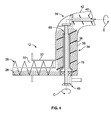
FIG. 4 is another simplified schematic representation of conveyors of the unloader ofFIG. 1 shown in a second state wherein a portion of the settled grain has been conveyed away; -
FIG. 5 is a simplified schematic representation of conveyors of an alternate embodiment of an unloader shown in a first state containing settled grain; and -
FIG. 6 is another simplified schematic representation of conveyors of an unloader shown in a second state wherein a portion of the settled grain has been conveyed away. - Referring now the drawings, in
FIG. 1 , a representative agricultural harvesting machine ordevice 10 is shown, including anunloader 12 operable for unloading grain from a grain tank located on an upper region of harvesting machine ordevice 10. Here, harvesting machine ordevice 10 is depicted as a well known, commercially available combine operable for harvesting a wide variety of grains, including, but not limited to, wheat, beans, corn, rice, and the like. Typically, the grain is harvested and threshed from stalks, pods, or other crop material, and conveyed away from a cleaning system of machine ordevice 10 by a clean grain conveyor to a grain elevator (not shown). The grain elevator then lifts the grain upwardly to a grain delivery conveyor which is operable for discharging the grain intograin tank 14 onto afloor 16 thereof. Whengrain tank 14 is filled with grain, or filled to a desired level,unloader 12 can be operated for unloading the grain fromtank 14, onto the ground, or into a wagon, truck or other vehicle, or a bin or the like. - Referring also to
FIG. 2 ,grain tank 14 may include a pair ofgrain tank conveyors troughs FIG. 1 ).Grain tank conveyors FIG. 2 for instance, by being directly coupled, through a set of gearbox assemblies (not shown), to a maingrain tank conveyor 26, or by a suitable drive or drives such as a belt, chain and/or shaft drive or a fluid or electric motor (not shown) for conveying grain through therespective trough grain tank conveyor 26. Maingrain tank conveyor 26 comprises another generally horizontal elongate helical auger, located in a side toside extending trough 28 at the forward end oftroughs grain tank 14. Here, it should be noted that the configuration ofgrain tank 14 shown is intended to be representative of a wide variety of grain tank configurations, and a grain tank can be configured differently, for instance, so as to have a floor which slopes down to directly to one or more main conveyors 26 (not shown) which feed to the unloader, thereby eliminatingconveyors US 7,452,180 . It is also to be understood that the present disclosure is not limited to a harvester, and could be incorporated into an agricultural device, such as a vessel (not shown) configured to contain or temporarily store grain therein, such as a silo. Additionally/alternately, the vessel (not shown) may be portable, for example, a wagon that may be pulled behind another device, such as a tractor, or configured for driven movement from a first location toward a second location, such as by a motorized grain wagon (not shown). - Referring also to
FIGS. 2-4 , maingrain tank conveyor 26 is rotatable in a direction denoted by arrow B (FIGS. 2 and3 ), for conveying the grain fromconveyors trough 28 into an inlet opening 30 in aninlet end 32 of an unloader conveyor element orunloader conveyor 34 ofunloader 12.Unloader conveyor 34 includes an elongate upwardly or generally vertically extending auger or conveyor orconveyor segment 36 supported for rotation as denoted by arrow C (FIGS. 3 and4 ) in an upwardly extendingtubular housing 38, and an elongate auger or conveyor orconveyor segment 40 oriented horizontally or at a small acute angle to horizontal, supported for rotation in an elongatetubular housing 42 connected to and forming a continuation ofhousing 38.Housing 42 and an upper portion ofhousing 38 are supported in cantilever relation by a lower portion ofhousing 38 for rotation relative thereto, as denoted by arrow D inFIG. 2 , between an unloading position as shown, and a rearwardly extending stored position at about a 90 degree angle to the unloading position, in the well known manner. Auger or conveyor orconveyor segment 40 is connected to auger or conveyor orconveyor segment 36 for rotation thereby in a suitable manner, such as by bevel gears, a Hooke's joint, or the like, also in the well known manner. Auger or conveyor orconveyor segment 36 is connected in rotatably driven relation to an output of anunloader drive 44, which can include, for instance, a rightangle gear drive 45 having aninput pulley 46 connected in rotatably driven relation to apulley 48 by abelt 50. Pulley 48 is connected to an output of anunloader drive clutch 52 having aninput pulley 54 which is driven by abelt 56 which, in turn, is rotated by an output of an engine 58 (FIG. 1 ) ofmachine 10 or another rotatable power source, in the well known conventional manner.Unloader drive clutch 52 can be, for instance, a well known commercially available fluid or electrically actuated clutch controllable in the well known manner by a solenoid or the like (not shown). Here,unloader drive 44 additionally includes a second output rotatably drivingly connected to an input of adevice 60 which includes anoutput pulley 62 connected by abelt 64 to apulley 66 connected tograin tank conveyor 26.Device 60 is selectably operable for connectingdrive 44 in rotatably driving relation tobelt 64 for drivingly rotatinggrain tank conveyor 26.Device 60 can be, for instance, another well known commercially available fluid or electrically actuated clutch conventionally controllable by a solenoid or the like. As alternatives, it should be understood that it is contemplated thatgrain tank conveyor 26 andunloader conveyor 34 can be individually selectably driven, using one or more other drives, including, but not limited to, electric or fluid motors, or belt, chain and/or shaft drives or the like, as desired or required for a particular application, it only being required for the present control that conveyors 26 and 34 be individually or separately controllable. -
Unloader 12 additionally includes anunloader controller 68 which can be, for instance, a well known commercially available processor based controller and/or a fluid based controller connected in operably controlling relation toclutch 52 anddevice 60, by, for instance, one or more conductive paths as represented bylines 70.Controller 68, in turn, can be operably connected to one ormore input devices 72 in a suitable manner such as by one or more conductive paths represented by anotherline 70, for receiving inputs or input commands therefrom, also in the well known manner. As a non-limiting example,input device 72 can be a switch such as a momentary rocker switch movable to positions including an unloading position and a clean out position, a touch screen, or the like, located in an operator cab ofmachine 10 or elsewhere. - Generally, in operation,
grain tank conveyors grain tank 14 to maingrain tank conveyor 26, which will convey the grain into inlet opening 30 ininlet end 32 ofunloader conveyor 34. Operation ofunloader conveyor 34 will convey the grain upwardly and throughhousings FIG. 2 to an outlet orfree end 74 thereof (FIG. 1 ) where the grain will be discharged from the conveyor through anoutlet opening 76. The grain can be discharged into any receptacle such as a wagon or truck, or onto the ground or another surface or location (not shown), as desired. - Referring now particularly to
FIG. 3 , it has been observed that after use and cessation of operation ofunloader conveyor 34, if not cleaned out, grain will remain in (especially with smaller grains) and/or have a tendency to slide downwardly between the flights of auger or conveyor orconveyor segment 36 and the inner surfaces ofhousings housing 38 ofunloader conveyor 34, adjacent to or in the vicinity ofinlet end 32 andinlet opening 30, as denoted by densely shadedregion 78. Partial settling of grain is also shown between flights of auger or conveyor orconveyor segment 40 ofhousing 42 by shadedregion 78. Grain will also be present intrough 28 ofgrain tank conveyor 26 as also denoted by shadedregion 78. As a result, ifgrain tank conveyor 26 andunloader conveyor 34 are simultaneously started, orconveyor 26 is started beforeconveyor 34, it is possible that there will be insufficient space in the lower region ofhousing 38 for receiving grain conveyed thereto byconveyor 26, so as to result in compression and compaction of the grain sufficient to grind and crack and otherwise damage some or all of the grain in that region, which is undesirable. Additionally, if initiation of operation of both portions ofconveyor 34 is simultaneous (especially for small grains, including, but not limited to rice or corn), relatively high startup torque and loads onunloader drive 44 can occur. Moreover, even if initiation of operation of only conveyors orconveyor segments clutch 52,device 60, andbelts - In operation, when an unload command or input is received,
unloader controller 68 is operable for initiating operation ofunloader conveyor 34. However, in an effort to overcome or at least mitigate the previously mentioned problems associated with grain compaction, one or more sensors (not shown) are utilized to sense or measure loading conditions associated with operatingunloader conveyor 34 between an engaged mode or a disengaged mode. For example, sensors may include torque sensors or other type of sensor from which structural loading associated with start-up torque, such as associated with operating orrotating gear drive 45, which collectively drives the conveyor element in an engaged mode, i.e., both substantially vertical unloader conveyor or auger orconveyor segment 36 and substantially horizontal unloader conveyor or auger orconveyor segment 40 about their respective axes C, E. The torque value associated with operating unloader conveyor 34 (Ttotal) represents the sum of the each of the torque of substantially vertical unloader conveyor or conveyor segment 36 (Tvertical) and the torque of substantially horizontal unloader conveyor or conveyor segment 40 (Thorizontal) as symbolized in Equation [1]:
- The torque values are related to structural elements. That is, (Ttotal) should be set to a value less than would be required to damage a structural component of the agricultural device. For example, (Ttotal) should correspond to a torque value that is less than the torque corresponding to a shear force capacity of a shear pin associated with rotatably driving
gear drive 45. In cases where the start-up torque value, as sensed by the torque sensor, associated with rotatably drivinggear drive 45 exceeds (Ttotal),controller 68 can disengage, or place in a disengaged mode, a drive clutch 80 such as positioned between an inside surface of atube 84 to which are attached the flights of substantially vertical unloader conveyor or auger orconveyor segment 36 and ashaft 86 extending at its ends to form mating parts of respective gear drive 45 at one end ofshaft 86 andbevel gear 39 at the other end ofshaft 86. In one embodiment, abushing 88 is positioned betweentube 84 andshaft 86 to substantially prevent grain from encountering insidesurface 82 oftube 84, as well as to more smoothly guide rotational movement of substantially vertical unloader conveyor or auger orconveyor segment 36 aboutshaft 86. - In response to disengaging clutch 80 between
tube 84 andshaft 86 of substantially vertical unloader conveyor or auger orconveyor segment 36,shaft 86 may freely rotate with respect to tube 84 (i.e., (Tvertical) approaches zero), thereby reducing that component of the start-up torque associated withrotating unloader conveyor 34. That is, only substantially horizontal unloader conveyor or auger orconveyor segment 40 rotates (Thorizontal), permitting grain inhousing 42 to be removed. As further shown inFIG. 4 , upon removal of most or all of the grain fromhousing 42, the value of (Thorizontal) should be reduced. Upon reduction of (Thorizontal), such as sensed and controlled bycontroller 68, clutch 80 may be reengaged such thattube 84 andshaft 86 turn together, rotatably driving substantially vertical unloader conveyor or auger orconveyor segment 36, (Tvertical), thereby removing grain from upwardly extendingtube housing 38. - In an alternate embodiment, as shown in
FIGS. 5-6 , clutch 180 is similar to clutch 80, except thatdrive clutch 180 is positioned between an outside surface of atube 184 to which are attached the flights of substantially vertical unloader conveyor or auger orconveyor segment 36 and ashaft 186 extending at its ends to form mating parts of respective gear drive 45 at one end ofshaft 86 andbevel gear 39 at the other end ofshaft 86. In one embodiment, abushing 188 is positioned betweentube 184 andshaft 186 to substantially prevent grain from encountering the inside surface oftube 184, as well as to more smoothly guide rotational movement of substantially vertical unloader conveyor or auger orconveyor segment 36 aboutshaft 186. - It is to be understood that while substantially vertical unloader conveyor or auger or
conveyor segment 36 and substantially horizontal unloader conveyor or auger orconveyor segment 40 represent exemplary embodiments, that eachconveyor segment conveyor segment 36 can deviate from a vertical axis by up to about 30 degrees, and that substantially horizontal, as in substantially horizontal unloader conveyor or auger orconveyor segment 40 can deviate from a horizontal axis by up to about 30 degrees. - It is to be understood that a kit may be provided to retrofit an existing agricultural device to include the novel functionality permitting selectable control of the operating unloader conveyor, and more specifically, including the capability to selectably control the conveyor segments. That is, the kit comprises a substantially vertical unloader conveyor or auger or conveyor segment similar to
conveyor segment 36, which would also include a geared shaft, such asshaft 86 having ends that would engage existing drives and/or gears, as well as a clutch, sensors (load measuring device) and a compatible connection to an existing controller (or a controller if none existed in the original or unmodified agricultural device) to permit mechanical/electrical installation of the kit components in the agricultural device. - While the invention has been described with reference to a preferred embodiment, it will be understood by those skilled in the art that various changes may be made and equivalents may be substituted for elements thereof without departing from the scope of the invention as defined by the accompanying claims. Many modifications may be made to adapt a particular situation or material to the teachings of the invention without departing from this essential scope.
Claims (12)
- An agricultural device for controlled unloading of grain comprising an unloader conveyor (34) including:an enclosed housing (38, 42) having an inlet end (32) including an opening (30) for receiving grain, and an opposite outlet end including a discharge opening through which the grain can be discharged;an unloader conveyor element (36, 40) extending through the housing (38, 42) between the ends and operable for conveying the grain through the housing from the inlet end (32) and discharging the grain through the discharge opening, the unloader conveyor element (36, 40) having a substantially vertical unloader conveyor segment (36) connected to a substantially horizontal unloader conveyor segment (40) downstream of the substantially vertical unloader conveyor segment (36); andan unloader drive (44) operably controllable for selectably operating the conveyor element (36, 40) between an engaged mode and a disengaged mode,characterized in that the unloader drive further is operably controllable for selectably operating a portion of the conveyor element (36, 40) associated with the substantially vertical unloader conveyor segment (36) in a disengaged mode, while operating a portion of the conveyor element (36, 40) associated with the substantially horizontal unloader conveyor segment (40) in an engaged mode.
- An agricultural device according to claim 1, wherein the unloader drive (44) comprises a clutch (80) arranged in selectably driving relationship between the substantially vertical unloader conveyor segment (36) and the substantially horizontal unloader conveyor segment (40).
- An agricultural device according to claim 2, wherein:the substantially vertical unloader conveyor segment (36) comprises a tube (84/184) provided with auger flights;the auger drive (44) comprises a shaft (86) extending through the tube (84/184) and being operable for driving the substantially horizontal unloader conveyor segment (40); andthe clutch (80) is selectably drivingly arranged between the tube (84/184) and the shaft (86).
- An agricultural device according to any of the preceding claims, comprising:a load sensing device for sensing a cumulative loading condition of the substantially vertical unloader conveyor segment (36) and the substantially horizontal unloader conveyor segment (40); andan unloader controller (68) operably connected to the load sensing device and to the unloader drive (44) and configured for:- monitoring the sensed cumulative loading condition; and- when the cumulative loading condition exceeds a predetermined value, operating the portion of the conveyor element (36, 40) associated with the substantially vertical unloader conveyor segment (36) in a disengaged mode, while operating a portion of the conveyor element (36, 40) associated with the substantially horizontal unloader conveyor segment (40) in an engaged mode.
- An agricultural device according to claim 4, wherein the predetermined value is a predetermined torque value associated with simultaneous operation of the substantially vertical unloader conveyor segment (36) and the substantially horizontal unloader conveyor segment (40) in the engaged mode.
- An agricultural device according to claim 4 or 5, wherein the unloader drive (44) comprises a shear pin and the predetermined value is less than the shear force capacity of the shear pin associated with simultaneous operation of the substantially vertical unloader conveyor segment (36) and the substantially horizontal unloader conveyor segment (40) in the engaged mode.
- An agricultural device according to any of the preceding claims, wherein simultaneous operation of the substantially vertical unloader segment (36) and the substantially horizontal unloader conveyor segment (40) in the engaged mode involves simultaneous rotation of the substantially vertical unloader conveyor segment (36) and the substantially horizontal unloader conveyor segment (40) about respective axes.
- An agricultural device according to any of the preceding claims, wherein the unloader conveyor (34) further comprises a substantially horizontal unloader conveyor segment (26) operable for conveying the grain to the substantially vertical unloader conveyor segment (34).
- An agricultural device according to any of the preceding claims, wherein the agricultural device is a harvesting device (10).
- An agricultural device according to any of the preceding claims, wherein the agricultural device is a combine (10)
- An agricultural device according to any of the claims 1 to 8, wherein the agricultural device is a vessel configured to contain grain therein.
- An agricultural device according to claim 10, wherein the vessel is configured for driven movement between a first location toward a second location.
Applications Claiming Priority (1)
| Application Number | Priority Date | Filing Date | Title |
|---|---|---|---|
| US13/270,685 US9156624B2 (en) | 2011-10-11 | 2011-10-11 | Grain unloading control system |
Publications (1)
| Publication Number | Publication Date |
|---|---|
| EP2580955A1 true EP2580955A1 (en) | 2013-04-17 |
Family
ID=47018066
Family Applications (1)
| Application Number | Title | Priority Date | Filing Date |
|---|---|---|---|
| EP12188246.8A Withdrawn EP2580955A1 (en) | 2011-10-11 | 2012-10-11 | Grain unloading control system |
Country Status (2)
| Country | Link |
|---|---|
| US (1) | US9156624B2 (en) |
| EP (1) | EP2580955A1 (en) |
Cited By (2)
| Publication number | Priority date | Publication date | Assignee | Title |
|---|---|---|---|---|
| EP3090614A1 (en) * | 2015-04-30 | 2016-11-09 | CNH Industrial Belgium nv | Driven shaft with rotational kinetic energy dissipation for an agricultural harvester |
| CN108097588A (en) * | 2017-12-12 | 2018-06-01 | 刘翠玲 | One kind is agricultural to swing device of winnowing |
Families Citing this family (10)
| Publication number | Priority date | Publication date | Assignee | Title |
|---|---|---|---|---|
| US20150257338A1 (en) * | 2014-03-14 | 2015-09-17 | Deere & Company | Agricultural harvester with bevel gear drive |
| WO2016077588A1 (en) | 2014-11-14 | 2016-05-19 | Cnh Industrial America Llc | Agricultural elevator supplied by multiple cross augers |
| US10159191B2 (en) * | 2016-09-23 | 2018-12-25 | Deere & Company | Harvester grain unloader |
| US10104838B1 (en) * | 2017-03-30 | 2018-10-23 | Cnh Industrial America Llc | Agricultural vehicle with dual purpose conveyor |
| WO2019040413A1 (en) * | 2017-08-21 | 2019-02-28 | Cnh Industrial America Llc | Drive system for an agricultural unloader |
| US10390489B2 (en) * | 2017-11-13 | 2019-08-27 | Optimal Agricultural Equipment Ltd. | Grain cart with air nozzle |
| CN109109715A (en) * | 2018-08-29 | 2019-01-01 | 王万有 | A kind of bulk cement tanker with fast blanking mechanism |
| CN110115150A (en) * | 2019-05-07 | 2019-08-13 | 刘彩宝 | A kind of large-scale harvester harvests method of modifying and the application of small area field |
| US12150412B2 (en) * | 2021-04-30 | 2024-11-26 | Cnh Industrial America Llc | Electronically controlled viscous coupler for combine harvester |
| US12356894B2 (en) * | 2022-02-15 | 2025-07-15 | J. & M. Manufacturing Co., Inc. | Grain transfer element locking system and related methods |
Citations (4)
| Publication number | Priority date | Publication date | Assignee | Title |
|---|---|---|---|---|
| US6743093B1 (en) * | 2002-12-04 | 2004-06-01 | Deere & Co. | Auxiliary drive for combine augers for cleanout |
| US7040980B1 (en) * | 2004-12-27 | 2006-05-09 | Kestel Frederick J | Combine harvester having double unloading auger system |
| US7452180B2 (en) | 2004-10-29 | 2008-11-18 | Cnh America Llc | Grain tank unloader and clean out control |
| EP2123510A1 (en) * | 2008-05-22 | 2009-11-25 | CNH Belgium N.V. | Adaptive rate control for feeding grain to a grain unloader conveyor |
Family Cites Families (11)
| Publication number | Priority date | Publication date | Assignee | Title |
|---|---|---|---|---|
| US3460698A (en) | 1968-03-04 | 1969-08-12 | Harris & Thrush Mfg Co | Farm cart |
| GB1548381A (en) | 1975-06-26 | 1979-07-11 | Clayson Nv | Harvesting machines |
| US4274790A (en) | 1979-02-23 | 1981-06-23 | Barker Walter D | Granular material unloading vehicle with pressure-relief box |
| US4572356A (en) | 1983-06-23 | 1986-02-25 | Janick Harry G | Safety clutch and quick release assembly for grain augers and the like |
| US4583905A (en) * | 1984-06-04 | 1986-04-22 | Mike Scherr | Auger apparatus for discharging material from a truck box |
| US4881855A (en) | 1988-08-09 | 1989-11-21 | Rem Manufacturing Ltd. | Vacuum particulate transfer apparatus |
| US5518453A (en) | 1994-06-23 | 1996-05-21 | Case Corporation | Unloading control system for an agricultural combine |
| CA2240869C (en) | 1998-06-17 | 2005-08-23 | Bourgault Industries Ltd. | Grain cart drive assembly |
| US6325588B1 (en) | 2000-02-10 | 2001-12-04 | Pride Products, Inc. | Apparatus for remotely operating an auger |
| US6776569B1 (en) | 2002-12-13 | 2004-08-17 | Balzer, Inc. | Grain cart auger with clutch |
| AU2003902218A0 (en) | 2003-05-09 | 2003-05-22 | Dutschke, Reginald Vernon | An improved guard arrangement for grain augers and the like |
-
2011
- 2011-10-11 US US13/270,685 patent/US9156624B2/en active Active
-
2012
- 2012-10-11 EP EP12188246.8A patent/EP2580955A1/en not_active Withdrawn
Patent Citations (4)
| Publication number | Priority date | Publication date | Assignee | Title |
|---|---|---|---|---|
| US6743093B1 (en) * | 2002-12-04 | 2004-06-01 | Deere & Co. | Auxiliary drive for combine augers for cleanout |
| US7452180B2 (en) | 2004-10-29 | 2008-11-18 | Cnh America Llc | Grain tank unloader and clean out control |
| US7040980B1 (en) * | 2004-12-27 | 2006-05-09 | Kestel Frederick J | Combine harvester having double unloading auger system |
| EP2123510A1 (en) * | 2008-05-22 | 2009-11-25 | CNH Belgium N.V. | Adaptive rate control for feeding grain to a grain unloader conveyor |
Cited By (3)
| Publication number | Priority date | Publication date | Assignee | Title |
|---|---|---|---|---|
| EP3090614A1 (en) * | 2015-04-30 | 2016-11-09 | CNH Industrial Belgium nv | Driven shaft with rotational kinetic energy dissipation for an agricultural harvester |
| CN108097588A (en) * | 2017-12-12 | 2018-06-01 | 刘翠玲 | One kind is agricultural to swing device of winnowing |
| CN108097588B (en) * | 2017-12-12 | 2020-12-22 | 阜阳创智生产力促进中心有限公司 | A kind of agricultural swinging grain raising device |
Also Published As
| Publication number | Publication date |
|---|---|
| US20130089398A1 (en) | 2013-04-11 |
| US9156624B2 (en) | 2015-10-13 |
Similar Documents
| Publication | Publication Date | Title |
|---|---|---|
| US9156624B2 (en) | Grain unloading control system | |
| US9254773B2 (en) | Adaptive rate control for feeding grain to a grain unloader conveyor | |
| US20070183878A1 (en) | Grain tank unloader and clean out control | |
| EP2934084B1 (en) | Method of controlling a conveyance rate of grain of an unloader system | |
| EP2514296A1 (en) | Grain unloading system | |
| US5873227A (en) | Combine harvester rotor speed control and control method | |
| EP1256270B1 (en) | Harvest collecting device | |
| EP2604105B2 (en) | Combine unload drive control system | |
| US4274790A (en) | Granular material unloading vehicle with pressure-relief box | |
| US7874899B2 (en) | Unload rate control for an unloading system in an agricultural harvester | |
| AU2016202716A1 (en) | Operating granular material conveyors near capacity | |
| EP4082946B1 (en) | Agricultural vehicle with electronically controlled viscous coupler | |
| EP4147559B1 (en) | Bubble up auger for combine harvester | |
| WO2006081523A2 (en) | Method and apparatus for unloading material from a container | |
| JP6564602B2 (en) | General purpose combine | |
| US7093707B2 (en) | Grain harvester multi-angular inclined delivery conveyor and drive | |
| EP0914764A1 (en) | Combine harvester rotor speed control and control method | |
| JP6363011B2 (en) | General purpose combine | |
| JP3336675B2 (en) | Combine grain storage equipment | |
| CN112385389A (en) | Harvester with reversing function |
Legal Events
| Date | Code | Title | Description |
|---|---|---|---|
| PUAI | Public reference made under article 153(3) epc to a published international application that has entered the european phase |
Free format text: ORIGINAL CODE: 0009012 |
|
| AK | Designated contracting states |
Kind code of ref document: A1 Designated state(s): AL AT BE BG CH CY CZ DE DK EE ES FI FR GB GR HR HU IE IS IT LI LT LU LV MC MK MT NL NO PL PT RO RS SE SI SK SM TR |
|
| AX | Request for extension of the european patent |
Extension state: BA ME |
|
| 17P | Request for examination filed |
Effective date: 20131017 |
|
| RBV | Designated contracting states (corrected) |
Designated state(s): AL AT BE BG CH CY CZ DE DK EE ES FI FR GB GR HR HU IE IS IT LI LT LU LV MC MK MT NL NO PL PT RO RS SE SI SK SM TR |
|
| RAP1 | Party data changed (applicant data changed or rights of an application transferred) |
Owner name: CNH INDUSTRIAL BELGIUM NV |
|
| STAA | Information on the status of an ep patent application or granted ep patent |
Free format text: STATUS: THE APPLICATION IS DEEMED TO BE WITHDRAWN |
|
| 18D | Application deemed to be withdrawn |
Effective date: 20131018 |