EP2580207B1 - Nitrogen containing heteroaryl compounds - Google Patents
Nitrogen containing heteroaryl compounds Download PDFInfo
- Publication number
- EP2580207B1 EP2580207B1 EP11723077.1A EP11723077A EP2580207B1 EP 2580207 B1 EP2580207 B1 EP 2580207B1 EP 11723077 A EP11723077 A EP 11723077A EP 2580207 B1 EP2580207 B1 EP 2580207B1
- Authority
- EP
- European Patent Office
- Prior art keywords
- ylamino
- pyrimidin
- cyclopropyl
- carboxylic acid
- methyl
- Prior art date
- Legal status (The legal status is an assumption and is not a legal conclusion. Google has not performed a legal analysis and makes no representation as to the accuracy of the status listed.)
- Not-in-force
Links
- 0 C*C(*)=NC(C(C)(C)*)=C(C)CC*=* Chemical compound C*C(*)=NC(C(C)(C)*)=C(C)CC*=* 0.000 description 11
- IXQZYAJQPWUNQZ-UHFFFAOYSA-N C=C(c1nc(C2CC2)cnc1Nc1cncnc1)Nc(cc(c(F)c1)F)c1C(N1CCC1)=O Chemical compound C=C(c1nc(C2CC2)cnc1Nc1cncnc1)Nc(cc(c(F)c1)F)c1C(N1CCC1)=O IXQZYAJQPWUNQZ-UHFFFAOYSA-N 0.000 description 1
- FOYGBWKYZNROIZ-UHFFFAOYSA-N CC(C)(C)c(nc1C(Nc2c(C(NC)=O)[n](C)nc2)=O)ncc1Nc1cncnc1 Chemical compound CC(C)(C)c(nc1C(Nc2c(C(NC)=O)[n](C)nc2)=O)ncc1Nc1cncnc1 FOYGBWKYZNROIZ-UHFFFAOYSA-N 0.000 description 1
- WRCKKNUUPUMCTD-UHFFFAOYSA-N CC(C)(CNC(c([n](CC1OCCC1)nc1)c1NC(c1nc(C2CC2)cnc1Nc1cncnc1)=O)=O)O Chemical compound CC(C)(CNC(c([n](CC1OCCC1)nc1)c1NC(c1nc(C2CC2)cnc1Nc1cncnc1)=O)=O)O WRCKKNUUPUMCTD-UHFFFAOYSA-N 0.000 description 1
- WNXGUPLAFIZDRU-UHFFFAOYSA-N CC(C)C(C)c1c[o]nc1C(C)(C)N Chemical compound CC(C)C(C)c1c[o]nc1C(C)(C)N WNXGUPLAFIZDRU-UHFFFAOYSA-N 0.000 description 1
- ZNRCWSKIIMIJIB-UHFFFAOYSA-N CC(C)Cc(nc1C(Nc2c(C(NC)=O)[n](C)nc2)=O)ncc1Nc1cncnc1 Chemical compound CC(C)Cc(nc1C(Nc2c(C(NC)=O)[n](C)nc2)=O)ncc1Nc1cncnc1 ZNRCWSKIIMIJIB-UHFFFAOYSA-N 0.000 description 1
- LXOKBFIZELFCNF-UHFFFAOYSA-N CC(C)Cc(nc1C(OC)=O)ncc1Nc1cncnc1 Chemical compound CC(C)Cc(nc1C(OC)=O)ncc1Nc1cncnc1 LXOKBFIZELFCNF-UHFFFAOYSA-N 0.000 description 1
- FXZFWBNXERIWCA-UHFFFAOYSA-N CC(C)N(C)C(c([n](C)nc1)c1NC(c1nc(C2CC2)cnc1Nc1cncnc1)=O)=O Chemical compound CC(C)N(C)C(c([n](C)nc1)c1NC(c1nc(C2CC2)cnc1Nc1cncnc1)=O)=O FXZFWBNXERIWCA-UHFFFAOYSA-N 0.000 description 1
- PGVKJAKVFQTCIG-UHFFFAOYSA-N CC(C)c(nc1C(Nc2c(C(NC)O)[n](C)nc2)=O)ncc1Nc1cnccc1 Chemical compound CC(C)c(nc1C(Nc2c(C(NC)O)[n](C)nc2)=O)ncc1Nc1cnccc1 PGVKJAKVFQTCIG-UHFFFAOYSA-N 0.000 description 1
- JIHSOYAVSLARMO-UHFFFAOYSA-N CC(CCCC1)N1C(c([n](C)nc1)c1NC(c1nc(C2CC2)cnc1Nc1cncnc1)=O)=O Chemical compound CC(CCCC1)N1C(c([n](C)nc1)c1NC(c1nc(C2CC2)cnc1Nc1cncnc1)=O)=O JIHSOYAVSLARMO-UHFFFAOYSA-N 0.000 description 1
- JFOAQUKPXLEPGG-UHFFFAOYSA-N CC(N=CN=CCS(C)C)=C Chemical compound CC(N=CN=CCS(C)C)=C JFOAQUKPXLEPGG-UHFFFAOYSA-N 0.000 description 1
- AMCNBTFUSUWYGM-UHFFFAOYSA-N CC1C=C(Nc2ncc(C3CC3)nc2C(Nc2c(C(NC)=O)[n](C)nc2)=O)N=CC=CC1 Chemical compound CC1C=C(Nc2ncc(C3CC3)nc2C(Nc2c(C(NC)=O)[n](C)nc2)=O)N=CC=CC1 AMCNBTFUSUWYGM-UHFFFAOYSA-N 0.000 description 1
- LCHRDGRMTUCQAH-UHFFFAOYSA-N CCN(C)C(c(nccc1)c1NC(c1nc(C2CC2)cnc1Nc1cncnc1)=O)=O Chemical compound CCN(C)C(c(nccc1)c1NC(c1nc(C2CC2)cnc1Nc1cncnc1)=O)=O LCHRDGRMTUCQAH-UHFFFAOYSA-N 0.000 description 1
- BGDPBEFRZBFQHR-UHFFFAOYSA-N CCN(C)C(c1ncncc1NC(c1nc(C2CC2)cnc1Nc1cncnc1)=O)=O Chemical compound CCN(C)C(c1ncncc1NC(c1nc(C2CC2)cnc1Nc1cncnc1)=O)=O BGDPBEFRZBFQHR-UHFFFAOYSA-N 0.000 description 1
- PBAZUQBATARWOT-UHFFFAOYSA-N CCN(CC)C(c([n](C)nc1)c1NC(c1nc(C2CC2)cnc1Nc1cncnc1)=O)=O Chemical compound CCN(CC)C(c([n](C)nc1)c1NC(c1nc(C2CC2)cnc1Nc1cncnc1)=O)=O PBAZUQBATARWOT-UHFFFAOYSA-N 0.000 description 1
- GEJUYZYZYIAHKO-UHFFFAOYSA-N CCN(CC)C(c(cc1)cc(NC(c2nc(C(C)(C)C)ncc2Nc2cncnc2)=O)c1C(NC)=O)=O Chemical compound CCN(CC)C(c(cc1)cc(NC(c2nc(C(C)(C)C)ncc2Nc2cncnc2)=O)c1C(NC)=O)=O GEJUYZYZYIAHKO-UHFFFAOYSA-N 0.000 description 1
- AUPFRAGEKZESMS-UHFFFAOYSA-N CN(C)C(c(c(F)c(cc1)F)c1NC(c1nc(C2CC2)cnc1Nc1cncnc1)=O)=O Chemical compound CN(C)C(c(c(F)c(cc1)F)c1NC(c1nc(C2CC2)cnc1Nc1cncnc1)=O)=O AUPFRAGEKZESMS-UHFFFAOYSA-N 0.000 description 1
- OASPTBHKCOYSJD-UHFFFAOYSA-N CN(C)C(c(nccc1)c1NC(c1nc(C2CC2)cnc1Nc1cncnc1)=O)=O Chemical compound CN(C)C(c(nccc1)c1NC(c1nc(C2CC2)cnc1Nc1cncnc1)=O)=O OASPTBHKCOYSJD-UHFFFAOYSA-N 0.000 description 1
- RJFCJJRYHDMQJF-UHFFFAOYSA-N CN(C)C(c(ncnc1)c1NC(c1nc(C2CC2)cnc1Nc1cncnc1)=[O]=C)=O Chemical compound CN(C)C(c(ncnc1)c1NC(c1nc(C2CC2)cnc1Nc1cncnc1)=[O]=C)=O RJFCJJRYHDMQJF-UHFFFAOYSA-N 0.000 description 1
- NLRRLCRNUHNQRF-PEFFPKTRSA-N CN/C=C(\C(C(N(CCN1)CC1=O)=O)=N)/NC(c(nc(C1CC1)cc1)c1Nc1cncnc1)=O Chemical compound CN/C=C(\C(C(N(CCN1)CC1=O)=O)=N)/NC(c(nc(C1CC1)cc1)c1Nc1cncnc1)=O NLRRLCRNUHNQRF-PEFFPKTRSA-N 0.000 description 1
- GWQVNQWFVHWKGV-VQQXQELJSA-N CN/C=C(\C(C(N1C(CO)CCC1)=O)=N)/NC(c(nc(C1CC1)cc1)c1Nc1cncnc1)=O Chemical compound CN/C=C(\C(C(N1C(CO)CCC1)=O)=N)/NC(c(nc(C1CC1)cc1)c1Nc1cncnc1)=O GWQVNQWFVHWKGV-VQQXQELJSA-N 0.000 description 1
- VSVGAQZLPXAAFT-YGHDLIBZSA-N CN/C=C(\C(C(NCCO)=O)=N)/NC(c1nc(C2CC2)ccc1Nc1cncnc1)=O Chemical compound CN/C=C(\C(C(NCCO)=O)=N)/NC(c1nc(C2CC2)ccc1Nc1cncnc1)=O VSVGAQZLPXAAFT-YGHDLIBZSA-N 0.000 description 1
- JJFBILNZYYAVOG-UHFFFAOYSA-N CNC(COc(cc1)cc(C(NC)=O)c1NC(c1nc(C2CC2)cnc1Nc1cncnc1)=O)=C1CC1 Chemical compound CNC(COc(cc1)cc(C(NC)=O)c1NC(c1nc(C2CC2)cnc1Nc1cncnc1)=O)=C1CC1 JJFBILNZYYAVOG-UHFFFAOYSA-N 0.000 description 1
- ZCKXYSOPQFVGTC-UHFFFAOYSA-N CNC(c([n](CC(F)(F)F)nc1)c1NC(c1nc(C2CC2)cnc1Nc1cncnc1)=O)=O Chemical compound CNC(c([n](CC(F)(F)F)nc1)c1NC(c1nc(C2CC2)cnc1Nc1cncnc1)=O)=O ZCKXYSOPQFVGTC-UHFFFAOYSA-N 0.000 description 1
- QJUBZPIVEQSLKB-UHFFFAOYSA-N CNC(c(ccnc1)c1NC(c1nc(C2CC2)ccc1Nc1cncnc1)=O)=O Chemical compound CNC(c(ccnc1)c1NC(c1nc(C2CC2)ccc1Nc1cncnc1)=O)=O QJUBZPIVEQSLKB-UHFFFAOYSA-N 0.000 description 1
- ULJHFKQNAFNPQZ-UHFFFAOYSA-N CNC(c(nccc1)c1NC(c1nc(C2CC2)cnc1Nc1cncnc1)=C)=O Chemical compound CNC(c(nccc1)c1NC(c1nc(C2CC2)cnc1Nc1cncnc1)=C)=O ULJHFKQNAFNPQZ-UHFFFAOYSA-N 0.000 description 1
- YSPBJSBJLFRYCY-UHFFFAOYSA-N CNC(c1n[n](C)cc1NC(c1nc(C2CC2)cnc1Nc1cncnc1)=O)=O Chemical compound CNC(c1n[n](C)cc1NC(c1nc(C2CC2)cnc1Nc1cncnc1)=O)=O YSPBJSBJLFRYCY-UHFFFAOYSA-N 0.000 description 1
- YRWFCMNMWNVCHA-UHFFFAOYSA-O CNCC(NC(c1nc(C2CC2)cnc1Nc1cncnc1)=C)=C(C(NCCN(C)C)=O)[NH2+]C Chemical compound CNCC(NC(c1nc(C2CC2)cnc1Nc1cncnc1)=C)=C(C(NCCN(C)C)=O)[NH2+]C YRWFCMNMWNVCHA-UHFFFAOYSA-O 0.000 description 1
- MJGGCWPEICFXFC-UHFFFAOYSA-N COC(c1nc(C2CC2)cnc1Nc1cncnc1)=O Chemical compound COC(c1nc(C2CC2)cnc1Nc1cncnc1)=O MJGGCWPEICFXFC-UHFFFAOYSA-N 0.000 description 1
- MXAPTKWBKRJEGY-UHFFFAOYSA-N C[n]1nc(C(N2CCOCC2)=O)c(NC(c2nc(C3CC3)ccc2NC2CN=CNC2)=O)c1 Chemical compound C[n]1nc(C(N2CCOCC2)=O)c(NC(c2nc(C3CC3)ccc2NC2CN=CNC2)=O)c1 MXAPTKWBKRJEGY-UHFFFAOYSA-N 0.000 description 1
- GXXLARHKQZETET-UHFFFAOYSA-N C[n]1ncc(NC(c2nc(C3CC3)cnc2Nc2cncnc2)=O)c1C(N1CCCCC1)=O Chemical compound C[n]1ncc(NC(c2nc(C3CC3)cnc2Nc2cncnc2)=O)c1C(N1CCCCC1)=O GXXLARHKQZETET-UHFFFAOYSA-N 0.000 description 1
- SUPYFVMUZAUCPL-ZDUSSCGKSA-N C[n]1ncc(NC(c2nc(C3CC3)cnc2Nc2cncnc2)=O)c1C(N[C@@H]1COCC1)=O Chemical compound C[n]1ncc(NC(c2nc(C3CC3)cnc2Nc2cncnc2)=O)c1C(N[C@@H]1COCC1)=O SUPYFVMUZAUCPL-ZDUSSCGKSA-N 0.000 description 1
- WOQCEFBCSMQWNL-UHFFFAOYSA-N O=C(c(ccnc1)c1NC(c1nc(C2CC2)ccc1Nc1cncnc1)=O)NC1CC1 Chemical compound O=C(c(ccnc1)c1NC(c1nc(C2CC2)ccc1Nc1cncnc1)=O)NC1CC1 WOQCEFBCSMQWNL-UHFFFAOYSA-N 0.000 description 1
- XDZDLDHTMBQXIU-UHFFFAOYSA-N O=C(c(ccnc1)c1NC(c1nc(C2CC2)cnc1Nc1cncnc1)=O)NC1COCC1 Chemical compound O=C(c(ccnc1)c1NC(c1nc(C2CC2)cnc1Nc1cncnc1)=O)NC1COCC1 XDZDLDHTMBQXIU-UHFFFAOYSA-N 0.000 description 1
- YGYFOSXJPPNAAL-UHFFFAOYSA-N O=C(c(nc(C1CC1)cc1)c1Nc1cncnc1)Nc(cncc1)c1C(N(CC1)CC1(F)F)=O Chemical compound O=C(c(nc(C1CC1)cc1)c1Nc1cncnc1)Nc(cncc1)c1C(N(CC1)CC1(F)F)=O YGYFOSXJPPNAAL-UHFFFAOYSA-N 0.000 description 1
- WYEGBHLHEYZHLJ-UHFFFAOYSA-N O=C(c1c(NC(c(nc(C2CC2)cc2)c2Nc2cncnc2)=O)[s]cc1)NC1CC1 Chemical compound O=C(c1c(NC(c(nc(C2CC2)cc2)c2Nc2cncnc2)=O)[s]cc1)NC1CC1 WYEGBHLHEYZHLJ-UHFFFAOYSA-N 0.000 description 1
- GJEGHDCZBRIZHK-UHFFFAOYSA-N O=C(c1nc(C2CC2)cnc1Nc1cncnc1)Nc1c(C(N2CCCCC2)=O)nccc1 Chemical compound O=C(c1nc(C2CC2)cnc1Nc1cncnc1)Nc1c(C(N2CCCCC2)=O)nccc1 GJEGHDCZBRIZHK-UHFFFAOYSA-N 0.000 description 1
Classifications
-
- C—CHEMISTRY; METALLURGY
- C07—ORGANIC CHEMISTRY
- C07D—HETEROCYCLIC COMPOUNDS
- C07D401/00—Heterocyclic compounds containing two or more hetero rings, having nitrogen atoms as the only ring hetero atoms, at least one ring being a six-membered ring with only one nitrogen atom
- C07D401/14—Heterocyclic compounds containing two or more hetero rings, having nitrogen atoms as the only ring hetero atoms, at least one ring being a six-membered ring with only one nitrogen atom containing three or more hetero rings
-
- A—HUMAN NECESSITIES
- A61—MEDICAL OR VETERINARY SCIENCE; HYGIENE
- A61K—PREPARATIONS FOR MEDICAL, DENTAL OR TOILETRY PURPOSES
- A61K31/00—Medicinal preparations containing organic active ingredients
- A61K31/33—Heterocyclic compounds
- A61K31/395—Heterocyclic compounds having nitrogen as a ring hetero atom, e.g. guanethidine or rifamycins
- A61K31/495—Heterocyclic compounds having nitrogen as a ring hetero atom, e.g. guanethidine or rifamycins having six-membered rings with two or more nitrogen atoms as the only ring heteroatoms, e.g. piperazine or tetrazines
- A61K31/505—Pyrimidines; Hydrogenated pyrimidines, e.g. trimethoprim
- A61K31/506—Pyrimidines; Hydrogenated pyrimidines, e.g. trimethoprim not condensed and containing further heterocyclic rings
-
- A—HUMAN NECESSITIES
- A61—MEDICAL OR VETERINARY SCIENCE; HYGIENE
- A61P—SPECIFIC THERAPEUTIC ACTIVITY OF CHEMICAL COMPOUNDS OR MEDICINAL PREPARATIONS
- A61P25/00—Drugs for disorders of the nervous system
-
- A—HUMAN NECESSITIES
- A61—MEDICAL OR VETERINARY SCIENCE; HYGIENE
- A61P—SPECIFIC THERAPEUTIC ACTIVITY OF CHEMICAL COMPOUNDS OR MEDICINAL PREPARATIONS
- A61P25/00—Drugs for disorders of the nervous system
- A61P25/14—Drugs for disorders of the nervous system for treating abnormal movements, e.g. chorea, dyskinesia
-
- A—HUMAN NECESSITIES
- A61—MEDICAL OR VETERINARY SCIENCE; HYGIENE
- A61P—SPECIFIC THERAPEUTIC ACTIVITY OF CHEMICAL COMPOUNDS OR MEDICINAL PREPARATIONS
- A61P25/00—Drugs for disorders of the nervous system
- A61P25/14—Drugs for disorders of the nervous system for treating abnormal movements, e.g. chorea, dyskinesia
- A61P25/16—Anti-Parkinson drugs
-
- A—HUMAN NECESSITIES
- A61—MEDICAL OR VETERINARY SCIENCE; HYGIENE
- A61P—SPECIFIC THERAPEUTIC ACTIVITY OF CHEMICAL COMPOUNDS OR MEDICINAL PREPARATIONS
- A61P25/00—Drugs for disorders of the nervous system
- A61P25/18—Antipsychotics, i.e. neuroleptics; Drugs for mania or schizophrenia
-
- A—HUMAN NECESSITIES
- A61—MEDICAL OR VETERINARY SCIENCE; HYGIENE
- A61P—SPECIFIC THERAPEUTIC ACTIVITY OF CHEMICAL COMPOUNDS OR MEDICINAL PREPARATIONS
- A61P25/00—Drugs for disorders of the nervous system
- A61P25/22—Anxiolytics
-
- A—HUMAN NECESSITIES
- A61—MEDICAL OR VETERINARY SCIENCE; HYGIENE
- A61P—SPECIFIC THERAPEUTIC ACTIVITY OF CHEMICAL COMPOUNDS OR MEDICINAL PREPARATIONS
- A61P25/00—Drugs for disorders of the nervous system
- A61P25/24—Antidepressants
-
- A—HUMAN NECESSITIES
- A61—MEDICAL OR VETERINARY SCIENCE; HYGIENE
- A61P—SPECIFIC THERAPEUTIC ACTIVITY OF CHEMICAL COMPOUNDS OR MEDICINAL PREPARATIONS
- A61P25/00—Drugs for disorders of the nervous system
- A61P25/28—Drugs for disorders of the nervous system for treating neurodegenerative disorders of the central nervous system, e.g. nootropic agents, cognition enhancers, drugs for treating Alzheimer's disease or other forms of dementia
-
- A—HUMAN NECESSITIES
- A61—MEDICAL OR VETERINARY SCIENCE; HYGIENE
- A61P—SPECIFIC THERAPEUTIC ACTIVITY OF CHEMICAL COMPOUNDS OR MEDICINAL PREPARATIONS
- A61P25/00—Drugs for disorders of the nervous system
- A61P25/30—Drugs for disorders of the nervous system for treating abuse or dependence
-
- A—HUMAN NECESSITIES
- A61—MEDICAL OR VETERINARY SCIENCE; HYGIENE
- A61P—SPECIFIC THERAPEUTIC ACTIVITY OF CHEMICAL COMPOUNDS OR MEDICINAL PREPARATIONS
- A61P25/00—Drugs for disorders of the nervous system
- A61P25/30—Drugs for disorders of the nervous system for treating abuse or dependence
- A61P25/36—Opioid-abuse
-
- A—HUMAN NECESSITIES
- A61—MEDICAL OR VETERINARY SCIENCE; HYGIENE
- A61P—SPECIFIC THERAPEUTIC ACTIVITY OF CHEMICAL COMPOUNDS OR MEDICINAL PREPARATIONS
- A61P29/00—Non-central analgesic, antipyretic or antiinflammatory agents, e.g. antirheumatic agents; Non-steroidal antiinflammatory drugs [NSAID]
-
- A—HUMAN NECESSITIES
- A61—MEDICAL OR VETERINARY SCIENCE; HYGIENE
- A61P—SPECIFIC THERAPEUTIC ACTIVITY OF CHEMICAL COMPOUNDS OR MEDICINAL PREPARATIONS
- A61P3/00—Drugs for disorders of the metabolism
- A61P3/08—Drugs for disorders of the metabolism for glucose homeostasis
- A61P3/10—Drugs for disorders of the metabolism for glucose homeostasis for hyperglycaemia, e.g. antidiabetics
-
- A—HUMAN NECESSITIES
- A61—MEDICAL OR VETERINARY SCIENCE; HYGIENE
- A61P—SPECIFIC THERAPEUTIC ACTIVITY OF CHEMICAL COMPOUNDS OR MEDICINAL PREPARATIONS
- A61P35/00—Antineoplastic agents
-
- A—HUMAN NECESSITIES
- A61—MEDICAL OR VETERINARY SCIENCE; HYGIENE
- A61P—SPECIFIC THERAPEUTIC ACTIVITY OF CHEMICAL COMPOUNDS OR MEDICINAL PREPARATIONS
- A61P35/00—Antineoplastic agents
- A61P35/02—Antineoplastic agents specific for leukemia
-
- A—HUMAN NECESSITIES
- A61—MEDICAL OR VETERINARY SCIENCE; HYGIENE
- A61P—SPECIFIC THERAPEUTIC ACTIVITY OF CHEMICAL COMPOUNDS OR MEDICINAL PREPARATIONS
- A61P9/00—Drugs for disorders of the cardiovascular system
-
- C—CHEMISTRY; METALLURGY
- C07—ORGANIC CHEMISTRY
- C07D—HETEROCYCLIC COMPOUNDS
- C07D403/00—Heterocyclic compounds containing two or more hetero rings, having nitrogen atoms as the only ring hetero atoms, not provided for by group C07D401/00
- C07D403/02—Heterocyclic compounds containing two or more hetero rings, having nitrogen atoms as the only ring hetero atoms, not provided for by group C07D401/00 containing two hetero rings
- C07D403/12—Heterocyclic compounds containing two or more hetero rings, having nitrogen atoms as the only ring hetero atoms, not provided for by group C07D401/00 containing two hetero rings linked by a chain containing hetero atoms as chain links
-
- C—CHEMISTRY; METALLURGY
- C07—ORGANIC CHEMISTRY
- C07D—HETEROCYCLIC COMPOUNDS
- C07D403/00—Heterocyclic compounds containing two or more hetero rings, having nitrogen atoms as the only ring hetero atoms, not provided for by group C07D401/00
- C07D403/14—Heterocyclic compounds containing two or more hetero rings, having nitrogen atoms as the only ring hetero atoms, not provided for by group C07D401/00 containing three or more hetero rings
-
- C—CHEMISTRY; METALLURGY
- C07—ORGANIC CHEMISTRY
- C07D—HETEROCYCLIC COMPOUNDS
- C07D409/00—Heterocyclic compounds containing two or more hetero rings, at least one ring having sulfur atoms as the only ring hetero atoms
- C07D409/14—Heterocyclic compounds containing two or more hetero rings, at least one ring having sulfur atoms as the only ring hetero atoms containing three or more hetero rings
-
- C—CHEMISTRY; METALLURGY
- C07—ORGANIC CHEMISTRY
- C07D—HETEROCYCLIC COMPOUNDS
- C07D413/00—Heterocyclic compounds containing two or more hetero rings, at least one ring having nitrogen and oxygen atoms as the only ring hetero atoms
- C07D413/14—Heterocyclic compounds containing two or more hetero rings, at least one ring having nitrogen and oxygen atoms as the only ring hetero atoms containing three or more hetero rings
-
- C—CHEMISTRY; METALLURGY
- C07—ORGANIC CHEMISTRY
- C07D—HETEROCYCLIC COMPOUNDS
- C07D417/00—Heterocyclic compounds containing two or more hetero rings, at least one ring having nitrogen and sulfur atoms as the only ring hetero atoms, not provided for by group C07D415/00
- C07D417/14—Heterocyclic compounds containing two or more hetero rings, at least one ring having nitrogen and sulfur atoms as the only ring hetero atoms, not provided for by group C07D415/00 containing three or more hetero rings
Definitions
- the invention is concerned with novel nitrogen-containing heteroaryl compounds of formula (I) wherein
- the invention is concerned with a process for the manufacture of the above compounds, pharmaceutical preparations which contain such compounds as well as the use of these compounds for the production of pharmaceutical preparations.
- Schizophrenia is a progressive and devastating neurological disease characterized by episodic positive symptoms such as delusions, hallucinations, thought disorders and psychosis and persistent negative symptoms such as flattened affect, impaired attention and social withdrawal, and cognitive impairments ( Lewis DA and Lieberman JA, Neuron, , 28:325-33, 2000 ).
- episodic positive symptoms such as delusions, hallucinations, thought disorders and psychosis
- persistent negative symptoms such as flattened affect, impaired attention and social withdrawal, and cognitive impairments
- Lewis DA and Lieberman JA, Neuron, , 28:325-33, 2000 For decades research has focused on the "dopaminergic hyperactivity" hypothesis which has led to therapeutic interventions involving blockade of the dopaminergic system ( Vandenberg RJ and Aubrey KR., Exp. Opin. Ther. Targets, 5(4): 507-518, 2001 ; Nakazato A and Okuyama S, et al., Exp. Opin. Ther.
- Patents, 10(1): 75-98, 2000 This pharmacological approach, besides ameliorating positive symptoms in schizophrenic patients, poorly addresses negative and cognitive symptoms which are the best predictors of functional outcome ( Sharma T., Br.J. Psychiatry, 174(suppl. 28): 44-51, 1999 ).
- current antipsychotic treatment is associated with adverse effects like weight gain, extrapyramidal symptoms or effects on glucose and lipid metabolism, related to their unspecific pharmacology.
- Cyclic nucleotides cyclic adenosine monophosphate (cAMP) and cyclic guanosine monophosphate (cGMP) are ubiquitous second messengers responsible for mediating the biological response of a variety of extracellular signals, including neurotransmitters, light and hormones.
- cAMP and cGMP regulate a variety of intracellular processes particularly in neurons of the central nervous system by activating cAMP- and cGMP-dependent kinases which then phosphorylate proteins involved in the regulation of synaptic transmission, neuronal differentiation and survival.
- Phosphodiesterases are a family of widely expressed enzymes encoded by 21 different genes in humans, with each gene encoding several splice variants ( Beavo, J., Physiol. Rev. 1995, 75, 725-748 ; Conti, M., Jin, S.L., Prog. Nucleic Acid Res. Mol. Biol. 1999, 63, 1-38 ; Soderling, S.H., Beavo, J.A., Curr. Opin. Cell Biol. 2000, 12, 174-179 , Manallack, D.T. et al. J. Med.Chem. 2005, 48 (10), 3449-3462 ).
- the PDE families differ in their substrate specificy for the cyclic nucleotides, their mechanism of regulation and their sensitivity to inhibitors. Moreover, they are differentially localized in the organism, among the cells of an organ and even within the cells. These differences lead to a differentiated involvement of the PDE families in the various physiological functions.
- PDE10A is a dual substrate PDE encoded by a single gene as reported in 1999 by three separate research groups ( Fujishige K., et al., Eur J Biochem (1999) 266(3):1118-1127 , Soderling S.H., et al., ProcNatl Acad Sci USA (1999) 96(12):7071-7076 , Loughney K., et al., Gene (1999) 234(1):109-117 ). PDE10A is unique from other members of the multigene family with respect to amino acid sequence (779 aa), tissue-specific pattern of expression, affinity for cAMP and cGMP and the effect on PDE activity by specific and general inhibitors.
- PDE10A has one of the most restricted distribution of any PDE family being primarily expressed in the brain particularly in the nucleus accumbens and the caudate putamen. Additionally thalamus, olfactory bulb, hippocampus and frontal cortex show moderate levels of PDE10A expression. All these brain areas have been suggested to be involved in the pathophysiology of schizophrenia and psychosis, suggesting a central role of PDE10A in this devastating mental illness. Outside the central nervous system PDE10A transcript expression is also observed in peripheral tissues like thyroid gland, pituitary gland, insulin secreting pancreatic cells and testes ( Fujishige, K. et al., J. Biol. Chem. 1999, 274, 18438-18445 , Sweet, L.
- the striatal medium spiny neurons are the principal input site and first site for information integration in the basal ganglia circuit of the mammalian brain.
- the basal ganglia are a series of interconnected subcortical nuclei that integrate widespread cortical input with dopaminergic signaling to plan and execute relevant motor and cognitive patterns while suppressing unwanted or irrelevant patterns ( Graybiel, A.M. Curr. Biol. 2000, 10, R509-R511 (2000 ).
- Papaverine, a relatively specific PDE10A inhibitor, and PDE10A-knockout mice have been used to explore the physiology of this enzyme and the possible therapeutic utility of PDE10A inhibition.
- Inhibition of this enzyme pharmacologically or through gene disruption causes a reduction in activity and a reduced response to psychomotor stimulants. Inhibition also reduces the conditioned avoidance response, a behavioural response that is predictive of clinical antipsychotic activity ( Siuciak, J.A.; et al., Neuropharmacology 2006, 51 (2), 386-396 ; Siuciak, J.A.; et al., Neuropharmacology 2006, 51 (2), 374-385 ).
- PDE10A inhibition bears the potential to improve the negative and cognitive symptoms associated to schizophrenia.
- papaverine have been shown to attenuate the deficits in the extra-dimensional shift learning induced in rats by sub-chronic treatment with PCP, an animal paradigm of NMDA receptor hypofunction ( Rodefer, J,S., et al., Eur. J. Neuroscience 2005, 2,: 1070-1076 ).
- Rodefer, J,S., et al., Eur. J. Neuroscience 2005, 2,: 1070-1076 an animal paradigm of NMDA receptor hypofunction
- PDE10A2-deficient mice have been observed ( Sano, H. J. Neurochem. 2008, 105, 546-556 ).
- US 2006/0199960 discloses pyridine-2-carboxamide derivatives as metabotropic glutamate receptor 5 (mGlurR5) antagonists and the use of these compounds for the treatment of neurological disorders such as e.g. schizophrenia.
- mGlurR5 metabotropic glutamate receptor 5
- Diseases that can be treated with PDE10A inhibitors include, but are not limited to, diseases thought to be mediated in part by dysfunction of the basal ganglia, of other parts of the central nervous system and of other PDE10A expressing tissues.
- diseases can be treated, where inhibition of PDE10A can have therapeutic effects.
- These diseases include, but are not limited to, certain psychotic disorders such as schizophrenia, positive, negative and/or cognitive symptoms associated with schizophrenia, delusional disorder or substance-induced psychotic disorder, anxiety disorders such as panic disorder, obsessive-compulsive disorder, acute stress disorder or generalized anxiety disorder, obsessive/compulsive disorders, drug addictions, movement disorders such as Parkinson's disease or restless leg syndrome, cognition deficiency disorders such as Alzheimer's disease or multi-infarct dementia, mood disorders such as depression or bipolar disorders, or neuropsychiatric conditions such as psychosis, attention-deficit/hyperactivity disorder (ADHD) or related attentional disorders.
- psychotic disorders such as schizophrenia, positive, negative and/or cognitive symptoms associated with schizophrenia, delusional disorder or substance-induced psychotic disorder, anxiety disorders such as panic disorder, obsessive-compulsive disorder, acute stress disorder or generalized anxiety disorder, obsessive/compulsive disorders, drug addictions, movement disorders such as Parkinson's disease or restless leg
- the compounds of the present invention are also suitable for the treatment of diabetes and related disorders such as obesity by regulating the cAMP signaling system.
- PDE10A inhibitors might also be useful in preventing neurons from undergoing apoptosis by raising cAMP and cGMP levels and, thus, might possess anti-inflammatory properties.
- Neurodegenerative disorders treatable with PDE10A inhibitors include, but are not limited to, as Alzheimer's disease, Huntington's disease, Parkinson's disease, multiple sclerosis, stroke or spinal cord injury.
- cAMP and cGMP The growth of cancer cells is inhibited by cAMP and cGMP.
- PDE10A inhibitors can also be used for the treatment of different solid tumors and hematological malignancies such as renal cell carcinoma or breast cancer.
- one or more means from one substituent to the highest possible number of substitution, i.e. replacement of one hydrogen up to replacement of all hydrogens by substituents.
- halogen refers to fluorine, chlorine, bromine and iodine, more speficially fluorine, chlorine and bromine.
- alkyl refers to a branched or straight-chain monovalent alkyl radical of one to seven carbon atoms, more specifically one to four carbon atoms. This term is further exemplified by such radicals as methyl, ethyl, n-propyl, isopropyl, n-butyl, s-butyl, t-butyl .
- cycloalkyl refers to a monovalent carbocyclic radical of 3 to 10 carbon atoms, more specifically 3 to 6 carbon atoms, such as cyclopropyl, cyclobutyl, cyclopentyl or cyclohexyl.
- haloalkyl refers to alkyl groups which are mono- or multiply substituted with halogen, particularly fluoro.
- haloalkyl groups are e.g. -CFH 2 , -CF 2 H, -CF 3 , CF 3 CH 2 -, CF 3 (CH 2 ) 2 -, (CF 3 ) 2 CH- and CF 2 H-CH 2 -.
- alkoxy refers to the group R'-O-, wherein R' is an alkyl.
- alkoxy refers to the group R'-O-, wherein R' is a alkyl.
- alkoxy- -alkyl refers to alkyl groups which are mono- or multiply substituted with alkoxy.
- Examples of -alkoxy- -alkyl groups are e.g. -CH 2 -O-CH 3 , -CH 2 -CH 2 -O-CH 3 and-CH 2 -O-CH 2 -CH 3 .
- hydroxyalkyl refers to a alkyl group as defined above, which is substituted by 1 to 3 hydroxyl groups.
- hydroxyalkyl groups are e.g. hydroxy-methyl, 2-hydroxy-ethyl, hydroxy propyl, 3-hydroxy-propyl, 2-hydroxy-propyl, 3-hydroxy-prop-2-yl, 2,3-dihydroxy-propyl and 1,3-dihydroxy-prop-2-yl.
- cyanoalkyl refers to a alkyl group as defined above, which is substituted by 1 to 3 cyano groups. Examples of cyanoalkyl groups are e.g. cyanomethyl and cyanoethyl.
- amino refers to a monovalent group that has a nitrogen atom with two hydrogen atoms (represented by -NH 2 ).
- oxo when referring to substituents on heterocyclyl means that an oxygen atom is attached to the heterocyclyl ring. Thereby, the “oxo” may either replace two hydrogen atoms on a carbon atom, or it may simply be attached to sulfur, so that the sulfur exists in oxidized form, i.e. bearing one or two oxygens.
- heterocyclyl refers to a monovalent saturated 4- to 6-membered monocyclic ring containing one, two or three ring heteroatoms independently selected from N, O and S, the remaining ring atoms being carbon atoms, wherein the point of attachment can be through either a carbon atom or a heteroatom.
- heterocyclyl are e.g. morpholinyl and piperidinyl.
- spiro-heterocyclyl refers to a monovalent saturated 7- to 11-membered bicyclic moiety with the rings connected through one atom, containing one, two or three ring heteroatoms independently selected from N, O or S, the remaining ring atoms being carbon atoms, wherein the point of attachment can be through either a carbon atom or a heteroatom.
- aryl refers to a monovalent aromatic hydrocarbon ring.
- the aryl group more specifically includes 6 to 10 carbon atoms. Examples of aryl groups are e.g. phenyl.
- heteroaryl refers to an aromatic 5- or 6-membered monocyclic ring or at least partially aromatic 9- or 10-membered bicyclic ring which comprises 1, 2 or 3 atoms independently selected from nitrogen, oxygen and/or sulphur, such as pyrimidinyl.
- bicyclic ring or 'bicyclic moiety refers to two rings, wherein the two rings are fused or spiro linked.
- Each ring is independently aromatic or non-aromatic. In certain embodiments, both rings are aromatic. In certain embodiments, both rings are non-aromatic. In certain embodiments, one ring is aromatic and one ring is non-aromatic.
- Compounds of formula (I) can form pharmaceutically acceptable salts.
- pharmaceutically acceptable salts are salts of compounds of formula (I) with physiologically compatible mineral acids, such as hydrochloric acid, sulphuric acid, sulphurous acid or phosphoric acid; or with organic acids, such as formic acid, methanesulphonic acid, p-toluenesulphonic acid, acetic acid, lactic acid, trifluoroacetic acid, citric acid, fumaric acid, maleic acid, tartaric acid, succinic acid or salicylic acid, more specifically formic acid.
- pharmaceutically acceptable salts refers to such salts.
- Compounds of formula (I) which comprise an acidic group such as e.g.
- a COOH group can further form salts with bases.
- salts examples include alkaline, earth-alkaline and ammonium salts such as e.g. Na-, K-, Ca- and trimethylammonium salt.
- pharmaceutically acceptable salts also refers to such salts. Particular salts are those obtained by the addition of an acid.
- esters embraces derivatives of the compounds of formula (I), in which a carboxy group has been converted to an ester.
- esters are methyl, ethyl, propyl, butyl and benzyl esters.
- pharmaceutically acceptable esters furthermore embraces compounds of formula (I) in which hydroxy groups have been converted to the corresponding esters with inorganic or organic acids such as, nitric acid, sulphuric acid, phosphoric acid, citric acid, formic acid, maleic acid, acetic acid, succinic acid, tartaric acid, methanesulphonic acid, p-toluenesulphonic acid , which are non toxic to living organisms.
- Another embodiment of the present invention relates to compounds of formula (I) wherein
- the compounds of formula (I) can have one or more asymmetric C atoms and can therefore exist as an enantiomeric mixture, mixture of stereoisomers or as optically pure compounds.
- the compounds of formula (I) include all diastereomers, tautomers, racemates and mixtures thereof.
- a particular embodiment of the present invention relates to compounds of formula (I) as described above, wherein is selected from the group consisting of: more specifically the group consisting of:
- Another particular embodiment of the present invention relates to compounds of formula (I) as described above, wherein R 2 and R 3 are hydrogen.
- a particular embodiment of the present invention relates to compounds of formula (I) as described above, wherein R 4 is 3-fluoro-phenyl, 4-fluoro-phenyl, pyridin-3-yl, 5-fluoro-pyridin-3-yl, pyrimidin-5-yl or pyrazin-2-yl, more specifically pyridin-3-yl, 5-fluoro-pyridin-3-yl or pyrimidin-5-yl.
- Yet another particular embodiment of the present invention relates to compounds of formula (I) as described above, wherein R 4 is pyrimidinyl, more specifically pyrimidin-5-yl.
- a particular embodiment of the present invention relates to compounds of formula (I) as described above, wherein is selected from the group (1) consisting of: more specifically the group consisting of: wherein
- Another particular embodiment of the present invention relates to compounds of formula (I) as described above, wherein is selected from the group (1') consisting of: more specifically the group consisting of: wherein
- Another particular embodiment of the present invention relates to compounds of formula (I) as described above, wherein is selected from the group (1) as described above, and wherein R 1 is halogen, C 1-7 alkyl, C 1-7 alkoxy, C 1-7 hydroxyalkyl, C 1-7 -alkoxy-C 1-7 -alkyl,-C(O)-C 1-7 alkyl, -O-C 1-7 haloalkyl, cycloalkyl, heterocyclyl or amino, and wherein said heterocyclyl is optionally substituted by C 1-7 alkyl, and wherein said amino is substituted by 1 or 2 substituents independently selected from the group consisting of C 1-7 alkyl and C 1-7 -alkoxy-C 1-7 -alkyl, more specifically chloro, methyl, 1-hydroxy-ethyl, 1-hydroxy-1-methyl-ethyl, isopropyl, isobutyl, tert-butyl, methoxymethyl, methoxy, 2,2,2-triflu
- Yet another particular embodiment of the present invention relates to compounds of formula (I) as described above, wherein is selected from the group (1') as described above, and wherein R 1 is C 1-7 alkyl, C 1-7 hydroxyalkyl, C 1-7 -alkoxy-C 1-7 -alkyl, cycloalkyl or heterocyclyl, more specifically methyl, 1-hydroxy-ethyl, isopropyl, isobutyl, tert-butyl, methoxymethyl, cyclopropyl, cyclohexyl, tetrahydrofuran-2-yl or tetrahydrofuran-3-yl, yet more specifically isopropyl, isobutyl or cyclopropyl.
- Another particular embodiment of the present invention relates to compounds of formula (I) as described above, wherein is selected from the group (1) as described above, and wherein
- Yet another particular embodiment of the present invention relates to compounds of formula (I) as described above, wherein is selected from the group (1') as described above, and wherein
- a particular embodiment of the present invention relates to compounds of formula (I) as described above, wherein is selected from the group (2) consisting of: more specifically the group consisting of: wherein
- Another particular embodiment of the present invention relates to compounds of formula (I) as described above, wherein is selected from the group (2') consisting of: and more specifically the group consisting of:
- a particular embodiment of the present invention relates to compounds of formula (I) as described above, wherein is selected from the group (2) as described above, and wherein R 1 is C 1-7 alkyl or cycloalkyl, more specifically isopropyl, isobutyl, tert-butyl or cyclopropyl, yet more specifically isopropyl, tert-butyl or cyclopropyl.
- Another particular embodiment of the present invention relates to compounds of formula (I) as described above, wherein is selected from the group (2') as described above, and wherein R 1 is C 1-7 alkyl or cycloalkyl, more specifically isopropyl, tert-butyl or cyclopropyl, yet more specifically cyclopropyl.
- a particular embodiment of the present invention relates to compounds of formula (I) as described above, wherein is selected from the group (2) as described above, and wherein
- Yet another particular embodiment of the present invention relates to compounds of formula (I) as described above, wherein is selected from the group (2') as described above, and wherein
- the compounds of general formula (I) in this invention may be derivatised at functional groups to provide derivatives which are capable of conversion back to the parent compound in vivo.
- the invention further relates to a process for the manufacture of compounds of formula (I) as defined above, which process comprises:
- reaction described above can be carried out under conditions as described in the description and examples or under conditions well known to the person skilled in the art.
- the compounds of formula (1) and (2) can be prepared by methods known in the art or as described below or in analogy thereto.
- the present invention also relates to compounds of formula (I) as defined above, when prepared by a process as described above.
- Compounds of formula (II) can be converted to a compound of formula (III) by a Pd-catalyzed coupling reaction with an organometallic reagent R 1 -M (e.g. organoboronic acid or organoboronic acid ester) using a Pd-catalyst (e.g. Pd 2 dba 3 ) and a base (e.g. potassium phosphate) in an organic solvent (e.g. dioxane), by treatment of a compound of formual (II) with an alcohol (e.g. methanol) and a base (e.g. sodium hydride or cesium carbonate) in an organic solvent (e.g.
- organometallic reagent R 1 -M e.g. organoboronic acid or organoboronic acid ester
- a Pd-catalyst e.g. Pd 2 dba 3
- a base e.g. potassium phosphate
- organic solvent e.
- aryl halides or heteroaryl halides e.g. 5-bromopyrimidine
- R 4 -X e.g. 5-bromopyrimidine
- Pd-catalyst e.g. PdOAc 2
- a suitable ligand e.g.
- alkyl halide e.g. methyl iodide
- R 3 -X alkyl triflate R 3 -X and a base (e.g. NaH) in an organic solvent (e.g. DMF).
- a base e.g. NaH
- organic solvent e.g. DMF
- R 4 -NH 2 5-aminopyrimidine
- a Pd-catalyst e.g. PdOAc 2
- a suitable ligand e.g. 4,5-bis(diphenyl-phosphino)-9,9-dimethylxanthene
- a base e.g. potassium carbonate
- a compound of formula (IV) can be converted to compounds of formula (I) by direct aminolysis of the ester group using aminoaryl carboxylic acid amides or aminoheteroaryl carboxylic acid amides and a Lewis acid (e.g. trimethylaluminium or dimethylaluminium chloride) in an organic solvent (e.g. toluene or dioxane).
- a Lewis acid e.g. trimethylaluminium or dimethylaluminium chloride
- organic solvent e.g. toluene or dioxane
- the thus formed intermediate can be subsequently converted to compounds of formula (I) by either direct aminolysis of the ester group as described above using amines R 5 -NH-R 6 or by amide bond formation of the free carboxylate using amines R 5 -NH-R 6 , a coupling reagent (e.g. propylphosphonic acid anhydride, HATU, TBTU) and an organic base (e.g.
- N,N-diisopropylethylamine, N-methyl-morpholine or triethylamine in an organic solvent (e.g. DMF, ethyl acetate, THF).
- organic solvent e.g. DMF, ethyl acetate, THF.
- Aminoaryl carboxylic acid amides or aminoheteroaryl carboxylic acid amides as well as aminoaryl carboxylates or aminoheteroaryl carboxylates wherein R H or C 1-7 alkyl are commercially available or can be prepared by standard methods known to those skilled in the art and as described at the respective examples.
- ester group of a compound of formula (IV) can be saponified to its free acid (IVa) using an inorganic base (e.g. lithium hydroxide, sodium hydroxide) in an organic solvent (e.g. ethanol, dioxane, THF) or a mixture thereof.
- an inorganic base e.g. lithium hydroxide, sodium hydroxide
- an organic solvent e.g. ethanol, dioxane, THF
- a compound of formula (IVa) can then be converted to compounds of formula (I) by amide bond formation as described above using aminoaryl carboxylic acid amides or aminoheteroaryl carboxylic acid amides
- the thus formed intermediate can subsequently be converted to compounds of formula (I) by either direct aminolysis of the ester group as described above or by amide bond formation of the free carboxylate as described above using amines R 5 -NH-R 6 .
- Compounds of formula (I) can be isolated and purified by conventional methods.
- an intermediate of formula (IIIb) can be prepared by:
- intermediates of formula (IIIc) can be prepared by replacement of the bromine by a nitrile group using e.g. copper (I) cyanide in an organic solvent as e.g. DMF. These intermediates can either be converted to compounds of general formula (I) by the general methods described above. Or the nitrile group can be further converted to e.g. a carboxylic acid (via hydrolysis), an alkyl carboxylate (via hydrolysis and ester formation), an alcohol (via hydrolysis and reduction), a ketone (via hydrolysis, activation as e.g. Weinreb amide and alkylation with e.g.
- an ester e.g. an alcohol in the presence of a strong acid, an alcohol in the presence of an acid chloride-forming reagent (e.g. thionyl chloride), an alkylhalide in the presence of a base or special alkylating reagents (e.g. trimethylsilyl-diazomethane).
- Compounds of formula (VI) can be isolated and purified by conventional methods.
- a compound of formula (VII) can be converted to compounds of formula (I) by direct aminolysis of the ester group as described above using aminoaryl carboxylic acid amides or aminoheteroaryl carboxylic acid amides and a Lewis acid (e.g. trimethylaluminium or dimethylaluminium chloride) in an organic solvent (e.g. toluene or dioxane).
- a Lewis acid e.g. trimethylaluminium or dimethylaluminium chloride
- organic solvent e.g. toluene or dioxane
- the thus formed intermediate can subsequently be converted to compounds of formula (I) by either direct aminolysis of the ester group as described above or by amide bond formation of the free carboxylate as described above using amines R 5 -NH-R 6 .
- a compound of formula (VII) can be saponified to its free acid as described above.
- the free acid of a compound of formula (VII) can then be converted to compounds of formula (I) by amide bond formation as described above using aminoaryl carboxylic acid amides or aminoheteroaryl carboxylic acid amides
- Compounds of formula (I) can be isolated and purified by conventional methods.
- a compound of formula (V) can be converted to compounds of formula (VIII) according to the methods described in step 4 for the conversion of acids of formula (VII).
- a compound of formula (VIII) can be converted to compounds of formula (I) according to the method described in step 3 for the formation of compounds of formula (VII).
- a compound of formula (V) can be converted to compounds of formula (IX) by amination of the bromide using an ammonia source (e.g. ammonium hydroxide) in the presence of a transition metal (e.g. copper (II) sulfate) in a solvent like water.
- an ammonia source e.g. ammonium hydroxide
- a transition metal e.g. copper (II) sulfate
- Compounds of formula (IX) can be isolated and purified by conventional methods.
- a compound of formula (IX) can be converted to compounds of formula (X) according to the method described in step 2 for the formation of compounds of formula (VI).
- a compound of formula (X) can be converted to compounds of formula (VII) according to the methods described in step 3 for the formation of compounds of formula (VII) using aryl halides or heteroaryl halides (e.g. 5-bromopyrimidine) R 4 -X and optionally alkyl halides or alkyl triflates R 3 -X.
- aryl halides or heteroaryl halides e.g. 5-bromopyrimidine
- a compound of formula (XI) can be converted to compounds of formula (I) according to the methods described in step 4 for the conversion of compounds of formula (VII).
- substituents on the groups R 1 , R 2 , R 3 , R 4 and R 5 may not be inert to the conditions of the synthesis sequences described above and may require protection by standard protecting groups known in the art. For instance, an amino or hydroxyl group may be protected as an acetyl or tert.-butoxycarbonyl derivative. Alternatively, some substituents may be derived from others at the end of the reaction sequence. For instance, a compound of formula I may be synthesized bearing a nitro-, an ethoxycarbonyl, an ether, a sulfonic acid substituent on the groups R 1 , R 2 , R 3 , R 4 and R 5 , which substituents are finally converted to an amino- (e.g.
- alkylamino- e.g. by reductive amination of an amino group
- dialkylamino- e.g. by alkylation of an amino group, reduction of an appropriate acylamino group with lithium aluminum hydride or Eschweiler-Clarke reaction with an appropriate amino or alkylamino group
- acylamino- by amide formation from an amino group e.g. with appropriate acyl halides or with appropriate carboxylic acids after their activation with CDI, EDC etc.
- alkylsulfonylamino e.g.
- the corresponding salts with acids can be obtained by standard methods known to the person skilled in the art, e.g. by dissolving the compound of formula (I) in a suitable solvent such as e.g. dioxane or THF and adding an appropriate amount of the corresponding acid.
- a suitable solvent such as e.g. dioxane or THF
- the products can usually be isolated by filtration or by chromatography.
- the conversion of a compound of formula (I) into a pharmaceutically acceptable salt with a base can be carried out by treatment of such a compound with such a base.
- One possible method to form such a salt is e.g. by addition of 1/n equivalents of a basic salt such as e.g.
- M(OH) n wherein M is metal or ammonium cation and n is number of hydroxide anions, to a solution of the compound in a suitable solvent (e.g. ethanol, ethanol-water mixture, tetrahydrofuran-water mixture) and to remove the solvent by evaporation or lyophilisation.
- a suitable solvent e.g. ethanol, ethanol-water mixture, tetrahydrofuran-water mixture
- the conversion of compounds of formula (I) into pharmaceutically acceptable esters can be carried out e.g. by treatment of a suitable carboxy group present in the molecule with a suitable alcohol using e.g. a condensating reagent such as benzotriazol-1-yloxytris(dimethylamino)phosphonium hexafluorophosphate (BOP), N,N-dicylohexylcarbodiimide (DCC), N-(3-dimethylaminopropyl)-N'-ethylcarbodiimide hydrochloride (EDCI) or O-(1,2-dihydro-2-oxo-1-pyridyl)-N,N,N,N-tetra-methyluronium-tetrafluoroborate (TPTU), or by direct reaction with a suitable alcohol under acidic conditions, as for example in the presence of a strong mineral acid like hydrochloric acid, sulfuric acid.
- a condensating reagent such
- novel compounds of the present invention have been found to inhibit PDE10A activity.
- the compounds of the present invention can therefore be used, either alone or in combination with other drugs, for the treatment and/or prophylaxis of diseases which are modulated by PDE10A inhibitors.
- These diseases include, but are not limited to, certain psychotic disorders such as schizophrenia, positive, negative and/or cognitive symptoms associated with schizophrenia, delusional disorder or substance-induced psychotic disorder, anxiety disorders such as panic disorder, obsessive/compulsive disorders, acute stress disorder or generalized anxiety disorder, drug addictions, movement disorders such as Parkinson's disease or restless leg syndrome, cognition deficiency disorders such as Alzheimer's disease or multi-infarct dementia, mood disorders such as depression or bipolar disorders, or neuropsychiatric conditions such as psychosis, attention-deficit/hyperactivity disorder (ADHD) or related attentional disorders.
- psychotic disorders such as schizophrenia, positive, negative and/or cognitive symptoms associated with schizophrenia, delusional disorder or substance-induced psychotic disorder, anxiety disorders such as panic disorder, obsessive/compulsive disorders, acute stress disorder or generalized anxiety disorder, drug addictions, movement disorders such as Parkinson's disease or restless leg syndrome, cognition deficiency disorders such as Alzheimer's disease or multi-infarct dementia,
- diabetes and related disorders such as type 2 diabetes mellitus, neurodegenerative disorders such as Alzheimer's disease, Huntington's disease, Parkinson's disease, multiple sclerosis, stroke or spinal cord injury, solid tumors and hematological malignancies such as renal cell carcinoma or breast cancer.
- the invention therefore also relates to pharmaceutical compositions comprising a compound as defined above and a pharmaceutically acceptable carrier and/or adjuvant.
- the invention likewise embraces compounds as described above for use as therapeutically active substances, especially as therapeutically active substances for the treatment and/or prophylaxis of diseases which are modulated by PDE10A inhibitors, particularly as therapeutically active substances for the treatment and/or prophylaxis of psychotic disorders, schizophrenia, positive, negative and/or cognitive symptoms associated with schizophrenia, delusional disorder, substance-induced psychotic disorder, anxiety disorders, panic disorder, obsessive/compulsive disorders, acute stress disorder, generalized anxiety disorder, drug addictions, movement disorders, Parkinson's disease, restless leg syndrome, cognition deficiency disorders, Alzheimer's disease, multi-infarct dementia, mood disorders, depression, bipolar disorders, neuropsychiatric conditions, psychosis, attention-deficit/hyperactivity disorder, attentional disorders, diabetes and related disorders, type 2 diabetes mellitus, neurodegenerative disorders, Huntington's disease, multiple sclerosis, stroke, spinal cord injury, solid tumors, hematological malignancies, renal cell carcinoma and breast cancer.
- the invention also embraces the use of compounds as defined above for the therapeutic and/or prophylactic treatment of diseases which are modulated by PDE10A inhibitors, particularly for the therapeutic and/or prophylactic treatment of psychotic disorders, schizophrenia, positive, negative and/or cognitive symptoms associated with schizophrenia, delusional disorder, substance-induced psychotic disorder, anxiety disorders, panic disorder, obsessive/compulsive disorders, acute stress disorder, generalized anxiety disorder, drug addictions, movement disorders, Parkinson's disease, restless leg syndrome, cognition deficiency disorders, Alzheimer's disease, multi-infarct dementia, mood disorders, depression, bipolar disorders, neuropsychiatric conditions, psychosis, attention-deficit/hyperactivity disorder, attentional disorders, diabetes and related disorders, type 2 diabetes mellitus, neurodegenerative disorders, Huntington's disease, multiple sclerosis, stroke, spinal cord injury, solid tumors, hematological malignancies, renal cell carcinoma and breast cancer.
- psychotic disorders schizophrenia, positive, negative and/or cognitive symptoms associated with schizophrenia, delusional
- the invention also relates to the use of compounds as described above for the preparation of medicaments for the therapeutic and/or prophylactic treatment of diseases which are modulated by PDE10A inhibitors, particularly for the therapeutic and/or prophylactic treatment of psychotic disorders, schizophrenia, positive, negative and/or cognitive symptoms associated with schizophrenia, delusional disorder, substance-induced psychotic disorder, anxiety disorders, panic disorder, obsessive/compulsive disorders, acute stress disorder, generalized anxiety disorder, drug addictions, movement disorders, Parkinson's disease, restless leg syndrome, cognition deficiency disorders, Alzheimer's disease, multi-infarct dementia, mood disorders, depression, bipolar disorders, neuropsychiatric conditions, psychosis, attention-deficit/hyperactivity disorder, attentional disorders, diabetes and related disorders, type 2 diabetes mellitus, neurodegenerative disorders, Huntington's disease, multiple sclerosis, stroke, spinal cord injury, solid tumors, hematological malignancies, renal cell carcinoma and breast cancer.
- Such medicaments comprise a compound as described above.
- Prevention and/or treatment of schizophrenia is a particular indication. Yet particular indication is prevention and/or treatment of positive, negative and/or cognitive symptoms associated with schizophrenia.
- PDE10 activity of the compounds of the present invention was determined using a Scintillation Proximity Assay (SPA)-based method similar to the one previously described ( Fawcett, L. et al., ProcNatl Acad Sci USA (2000) 97(7):3702-3707 ).
- SPA Scintillation Proximity Assay
- the human PDE10A full length assay was performed in 96-well micro titer plates.
- a range of concentrations of the potential inhibitor was used to generate data for calculating the concentration of inhibitor resulting in 50% of the effect (e.g. IC 50 , the concentration of the competitor inhibiting PDE10A activity by 50%).
- Non-specific activity was tested without the enzyme.
- the reaction was initiated by the addition of the substrate solution (cGMP and [ 3 H]-cGMP) and allowed to progress for 20 minutes at room temperature.
- the reaction was terminated by adding 25 ⁇ l of YSi-SPA scintillation beads (GE Healthcare, cat. # RPNQ0150) in 18 mM zinc sulphate solution (stop reagent). After 1 h under shaking, the plate was centrifuged one minute at 170 g to allow beads to settle. Afterwards, radioactive counts were measured on a Perkin Elmer TopCount Scintillation plate reader.
- the compounds according to formula (I) have an IC 50 value below 10 ⁇ M, more specifically below 5 ⁇ M, yet more specifically below 1 ⁇ M.
- the following table shows data for some examples.
- Example PDE10A inhibition IC 50 [ ⁇ mol/l] 1 0.0315 2 0.0046 3 0.0075 4 0.1245 5 0.0052 6 0.0126 7 0.3356 8 0.1396 9 0.149 10 0.2024 11 0.0012 12 0.4952 13 0.2557 14 0.0114 15 0.0107 16 0.0076 17 0.0126 18 0.091 19 0.0087 20 0.0221 21 0.007 22 0.0187 23 0.0878 24 0.0137 25 1.8646 26 0.0283 27 0.0114 28 0.006 29 0.0013 30 0.0342 31 0.0031 32 0.0073 33 0.0031 34 0.0045 35 0.0457 36 0.0032 37 0.0181 38 0.0072 39 0.0082 40 0.0075 41 0.0069 42 0.0081 43 0.0031 44 0.0274 45 0.0171 46 0.0193 47 0.0132 48
- the compounds of formula (I) and/or their pharmaceutically acceptable salts can be used as medicaments, e.g. in the form of pharmaceutical preparations for enteral, parenteral or topical administration. They can be administered, for example, perorally, e.g. in the form of tablets, coated tablets, dragées, hard and soft gelatin capsules, solutions, emulsions or suspensions, rectally, e.g. in the form of suppositories, parenterally, e.g. in the form of injection solutions or suspensions or infusion solutions, or topically, e.g. in the form of ointments, creams or oils.
- perorally e.g. in the form of tablets, coated tablets, dragées, hard and soft gelatin capsules, solutions, emulsions or suspensions, rectally, e.g. in the form of suppositories, parenterally, e.g. in the form of injection solutions or suspensions or infusion solutions, or topically, e.g
- the production of the pharmaceutical preparations can be effected in a manner which will be familiar to any person skilled in the art by bringing the described compounds of formula (I) and/or their pharmaceutically acceptable salts, optionally in combination with other therapeutically valuable substances, into a galenical administration form together with suitable, non-toxic, inert, therapeutically compatible solid or liquid carrier materials and, if desired, usual pharmaceutical adjuvants.
- Suitable carrier materials are not only inorganic carrier materials, but also organic carrier materials.
- lactose, corn starch or derivatives thereof, talc, stearic acid or its salts can be used as carrier materials for tablets, coated tablets, dragées and hard gelatin capsules.
- Suitable carrier materials for soft gelatin capsules are, for example, vegetable oils, waxes, fats and semi-solid and liquid polyols (depending on the nature of the active ingredient no carriers might, however, be required in the case of soft gelatin capsules).
- Suitable carrier materials for the production of solutions and syrups are, for example, water, polyols, sucrose, invert sugar .
- Suitable carrier materials for injection solutions are, for example, water, alcohols, polyols, glycerol and vegetable oils.
- Suitable carrier materials for suppositories are, for example, natural or hardened oils, waxes, fats and semi-liquid or liquid polyols.
- Suitable carrier materials for topical preparations are glycerides, semi-synthetic and synthetic glycerides, hydrogenated oils, liquid waxes, liquid paraffins, liquid fatty alcohols, sterols, polyethylene glycols and cellulose derivatives.
- Usual stabilizers preservatives, wetting and emulsifying agents, consistency-improving agents, flavour-improving agents, salts for varying the osmotic pressure, buffer substances, solubilizers, colorants and masking agents and antioxidants come into consideration as pharmaceutical adjuvants.
- the dosage of the compounds of formula (I) can vary within wide limits depending on the disease to be controlled, the age and the individual condition of the patient and the mode of administration, and will, of course, be fitted to the individual requirements in each particular case. For adult patients a daily dosage of about 0.1 to 2000 mg, especially about 1 to 500 mg, comes into consideration. Depending on severity of the disease and the precise pharmacokinetic profile the compound could be administered with one or several daily dosage units, e.g. in 1 to 3 dosage units.
- the pharmaceutical preparations conveniently contain about 0.1-500 mg, more specifically 1-200 mg, of a compound of formula (I).
- A-1 6-Cyclopropyl-3-(pyrimidin-5-ylamino)-pyridine-2-carboxylic acid ethyl ester
- Step 1 3-Amino-6-cyclopropyl-pyridine-2-carboxylic acid ethyl ester
- Step 2 6-Cyclopropyl-3-(pyrimidin-5-ylamino)-pyridine-2-carboxylic acid ethyl ester
- Step 7 6-Methoxymethyl-3-(pyrimidin-5-ylamino) pyridine-2-carboxylic acid methyl ester
- Step 1 Methyl 3-(bis(tert-butoxycarbonyl)amino)-6-bromopyrazine-2-carboxylate
- the aqueous phase was extracted with EtOAc (50 ml). The combined organics were washed with brine (100 ml), dried (MgSO 4 ), filtered and concentrated to leave a dark brown syrup.
- the product thus obtained after filtration through silica gel using a n-heptane/ethyl acetate gradient as eluent is a mixture of 3- tert -butoxycarbonylamino-6-cyclopropyl-pyrazine-2-carboxylic acid methyl ester and 3-(bis( tert -butoxycarbonyl)amino)-6-cyclopropyl-pyrazine-2-carboxylic acid methyl ester (3.1 g, 59%). Off-white solid.
- Step 3 6-Cyclopropyl-3-(pyrimidin-5-ylamino)-pyrazine-2-carboxylic acid methyl ester
- Step 1 3-(Bis(tert-butoxycarbonyl)amino)-6-bromopyrazine-2-carboxylic acid methyl ester
- Step 2 3-(Bis(tert-butoxycarbonyl)amino)-6-isobutylpyrazine-2-carboxylic acid methyl ester
- Step 4 6-Isobutyl-3-(pyrimidin-5-ylamino)-pyrazine-2-carboxylic acid methyl ester
- A-13 2-Methyl-5-(pyrimidin-5-ylamino)-pyrimidine-4-carboxylic acid
- Step 1 6-Acetyl-3-tert-butoxycarbonylamino-pyrazine-2-carboxylic acid methyl ester
- Step 3 6-Acetyl-3-(pyrimidin-5-ylamino) pyrazine-2-carboxylic acid methyl ester
- Step 4 6-Acetyl-3-(pyrimidin-5-ylamino) pyrazine-2-carboxylic acid
- A-16 3-(Pyrimidin-5-ylamino)-6-(tetrahydro-furan-3-yl)-pyrazine-2-carboxylic acid methyl ester
- Step 3 3-(Pyrimidin-5-ylamino)-6-(tetrahydro-furan-3-yl)-pyrazine-2-carboxylic acid methyl ester
- Step 1 Methyl 3-(bis(tert-butoxycarbonyl)amino)-6-(prop-1-en-2-yl)pyrazine-2-carboxylate
- Step 2 Methyl 3-(bis(tert-butoxycarbonyl)amino)-6-isopropylpyrazine-2-carboxylate
- Step 3 6-Cyclopropyl-3-(pyrimidin-5-ylamino)-pyridine-2-carboxylic acid (3-dimethylcarbamoyl-1-methyl-1 H-pyrazol-4-yl)-amide
- Step 2 4-Amino-1-methyl-1H-pyrazole-3-carboxylic acid methylamide
- Step 3 6-Cyclopropyl-3-(pyrimidin-5-ylamino)-pyridine-2-carboxylic acid (1-methyl-3-methylcarbamoyl-1H-pyrazol-4-yl)-amide
- Step 2 4-Amino-1-methyl-1H-pyrazole-3-carboxylic acid amide
- step 2 starting from 1-methyl-4-nitro-1 H -pyrazole-3-carboxylic acid amide as grey solid (45 mg, 100 %).
- Step 3 6-Cyclopropyl-3-(pyrimidin-5-ylamino)-pyridine-2-carboxylic acid (1-methyl-3-methylcarbamoyl-1H-pyrazol-4-yl)-amide
- Step 2 1-(2-Methoxyethyl)-4-nitro-1H-pyrazole-3-carboxylic acid ethyl ester
- Step 5 6-Cyclopropyl-3-(pyrimidin-5-ylamino)-pyridine-2-carboxylic acid [3-dimethylcarbamoyl-1-(2-methoxy-ethyl)-1H-pyrazol-4-yl]-amide
- step 2 The product was obtained according to the method described in example 4, step 2 as a mixture of regioisomers which were separated by silica gel chromatography using a heptane/ethyl acetate gradient to yield 33 mg (25 %) of the desired regioisomer and 72 mg (55 %) of 1-(2-methoxyethyl)-4-nitro-1 H -pyrazole-3-carboxylic acid ethyl ester.
- MS: M 244.3 (M+H) +
- Step 4 6-Cyclopropyl-3-(pyrimidin-5-ylamino)-pyridine-2-carboxylic acid [5-dimethylcarbamoyl-1-(2-methoxy-ethyl)-1H-pyrazol-4-yl]-amide
- Example 7 6-Cyclopropyl-3-(pyrimidin-5-ylamino)-pyridine-2-carboxylic acid [3-dimethylcarbamoyl-1-(2,2,2-trifluoro-ethyl)-1 H -pyrazol-4-yl]-amide
- Step 1 4-Nitro-1-(2,2,2-trifluoroethyl)-1H-pyrazole-3-carboxylic acid ethyl ester
- Step 4 6-Cyclopropyl-3-(pyrimidin-5-ylamino)-pyridine-2-carboxylic acid [3-dimethylcarbamoyl-1-(2,2,2-trifluoro-ethyl)-1H-pyrazol-4-yl]-amide
- Example 8 6-Cyclopropyl-3-(pyrimidin-5-ylamino)-pyridine-2-carboxylic acid [3-methylcarbamoyl-1-(2,2,2-trifluoro-ethyl)-1 H -pyrazol-4-yl)-amide
- Step 1 4-Nitro-1-(2,2,2-trifluoroethyl)-1H-pyrazole-3-carboxylic acid methylamide
- Step 2 4-Amino-1-(2,2,2-trifluoroethyl)-1H-pyrazole-3-carboxylic acid methylamide
- Step 3 6-Cyclopropyl-3-(pyrimidin-5-ylamino)-pyridine-2-carboxylic acid [3-methylcarbamoyl-1-(2,2,2-trifluoro-ethyl)-1H-pyrazol-4-yl)-amide
- Step 1 4-Nitro-1-(3,3,3-trifluoropropyl)-1H-pyrazole-3-carboxylic acid ethyl ester
- step 2 starting from 4-nitro-1 H -pyrazole-3-carboxylic acid ethyl ester and 1,1,1-trifluoro-3-iodo-propane as a mixture of regioisomers which were separated by silica gel chromatography using a heptane/ethyl acetate gradient to yield 68 mg (15 %) of the desired regioisomer and 141 mg (31 %) of 4-nitro-2-(3,3,3-trifluoropropyl)-2 H -pyrazole-3-carboxylic acid ethyl ester.
- MS: M 282.0 (M+H) +
- Step 2 4-Nitro-1-(3,3,3-trifluoropropyl)-1H-pyrazole-3-carboxylic acid methylamide
- Step 3 4-Amino-1-(3,3,3-trifluoropropyl)-1H-pyrazole-3-carboxylic acid methylamide
- Step 4 6-Cyclopropyl-3-(pyrimidin-5-ylamino)-pyridine-2-carboxylic acid [3-methylcarbamoyl-1-(3,3,3-trifluoro-propyl)-1H-pyrazol-4-yl]-amide
- Example 10 6-Cyclopropyl-3-(pyrimidin-5-ylamino)-pyridine-2-carboxylic acid [5-methylcarbamoyl-1-(3,3,3-trifluoro-propyl)-1 H -pyrazol-4-yl]-amide
- Step 1 4-Nitro-2-(3,3,3-trifluoropropyl)-2H-pyrazole-3-carboxylic acid ethyl ester
- step 2 starting from 4-nitro-1 H -pyrazole-3-carboxylic acid ethyl ester and 1,1,1-trifluoro-3-iodo-propane as a mixture of regioisomers which were separated by silica gel chromatography using a heptane/ethyl acetate gradient to yield 141 mg (31 %) of the desired regioisomer and 68 mg (15 %) of 4-nitro-1-(3,3,3-trifluoropropyl)-1 H -pyrazole-3-carboxylic acid ethyl ester.
- MS: M 282.0 (M+H) +
- Step 2 4-Nitro-2-(3,3,3-trifluoropropyl)-2H-pyrazole-3-carboxylic acid methylamide
- Step 3 4-Amino- 2 -(3,3,3-trifluoropropyl)- 2 H-pyrazole-3-carboxylic acid methylamide
- Step 4 6-Cyclopropyl-3-(pyrimidin-5-ylamino)-pyridine-2-carboxylic acid [5-methylcarbamoyl-1-(3,3,3-trifluoro-propyl)-1H-pyrazol-4-yl]-amide
- Step 2 4-Amino-2-(2-methoxyethyl)-2H-pyrazole-3-carboxylic acid methylamide
- Step 3 6-Cyclopropyl-3-(pyrimidin-5-ylamino)-pyridine-2-carboxylic acid [1-(2-methoxy-ethyl)-5-methylcarbamoyl-1H-pyrazol-4-yl]-amide
- Example 12 6-Cyclopropyl-3-(pyrimidin-5-ylamino)-pyridine-2-carboxylic acid (1-cyclopropylmethyl-3-methylcarbamoyl-1 H -pyrazol-4-yl)-amide
- step 2 The product was obtained according to the method described in example 4, step 2 starting from 4-nitro-1 H -pyrazole-3-carboxylic acid ethyl ester and bromomethyl-cyclopropane as a mixture of regioisomers which were separated by silica gel chromatography using a heptane/ethyl acetate gradient to yield 179 mg (46 %) of the desired regioisomer and 88 mg (23 %) of 2-cyclopropylmethyl-4-nitro-2 H -pyrazole-3-carboxylic acid ethyl ester.
- MS: M 240.1 (M+H) +
- Step 3 4-Amino-1-cyclopropylmethyl-1H-pyrazole-3-carboxylic acid methylamide
- Step 4 6-Cyclopropyl-3-(pyrimidin-5-ylamino)-pyridine-2-carboxylic acid (1-cyclopropylmethyl-3-methylcarbamoyl-1H-pyrazol-4-yl)-amide
- Example 13 6-Cyclopropyl-3-(pyrimidin-5-ylamino)-pyridine-2-carboxylic acid (1-cyclopropylmethyl-5-methylcarbamoyl-1 H -pyrazol-4-yl)-amide
- step 2 The product was obtained according to the method described in example 4, step 2 starting from 4-nitro-1 H -pyrazole-3-carboxylic acid ethyl ester and bromomethyl-cyclopropane as a mixture of regioisomers which were separated by silica gel chromatography using a heptane/ethyl acetate gradient to yield 88 mg (23 %) of the desired regioisomer and 179 mg (46 %) of 1-cyclopropylmethyl-4-nitro-1 H -pyrazole-3-carboxylic acid ethyl ester.
- MS: M 240.1 (M+H) +
- Step 3 4-Amino-2-cyclopropylmethyl-2H-pyrazole-3-carboxylic acid methylamide
- Step 4 6-Cyclopropyl-3-(pyrimidin-5-ylamino)-pyridine-2-carboxylic acid (1-cyclopropylmethyl-5-methylcarbamoyl-1H-pyrazol-4-yl)-amide
- Step 2 6-Cyclopropyl-3-(pyrimidin-5-ylamino)-pyridine-2-carboxylic acid [1-methyl-3-(morpholine-4-carbonyl)-1H-pyrazol-4-yl]-amide
- Example 15 6-Cyclopropyl-3-(pyrimidin-5-ylamino)-pyridine-2-carboxylic acid [3-(cyclopropyl-methyl-carbamoyl)-1-methyl-1 H -pyrazol-4-yl]-amide
- Example 17 6-Cyclopropyl-3-(pyrimidin-5-ylamino)-pyridine-2-carboxylic acid [3-(cyclohexyl-methyl-carbamoyl)-1-methyl-1 H -pyrazol-4-yl]-amide
- Example 18 6-Cyclopropyl-3-(pyrimidin-5-ylamino)-pyridine-2-carboxylic acid [1-(2-methoxy-ethyl)-3-methylcarbamoyl-1 H -pyrazol-4-yl]-amide
- Step 1 1-(2-Methoxy-ethyl)-4-nitro-1H-pyrazole-3-carboxylic acid methylamide
- Step 2 4-Amino-1-(2-methoxy-ethyl)-1H-pyrazole-3-carboxylic acid methylamide
- Step 3 6-Cyclopropyl-3-(pyrimidin-5-ylamino)-pyridine-2-carboxylic acid [1-(2-methoxy-ethyl)-3-methylcarbamoyl-1H-pyrazol-4-yl]-amide
- Example 20 6-Cyclopropyl-3-(pyrimidin-5-ylamino)-pyridine-2-carboxylic acid [3-(isopropyl-methyl-carbamoyl)-1-methyl-1 H -pyrazol-4-yl]-amide
- Example 25 6-Cyclopropyl-3-(pyrimidin-5-ylamino)-pyridine-2-carboxylic acid (3-methylcarbamoyl-1-phenyl-1 H -pyrazol-4-yl)-amide
- Step 1 4-Nitro-1-phenyl-1H-pyrazole-3-carboxylic acid ethyl ester
- Step 3 4-Amino-1-phenyl-1H-pyrazole-3-carboxylic acid methylamide
- Step 4 6-Cyclopropyl-3-(pyrimidin-5-ylamino)-pyridine-2-carboxylic acid (3-methylcarbamoyl-1-phenyl-1H-pyrazol-4-yl)-amide
- Step 4 4- ⁇ [6-Cyclopropyl-3-(pyrimidin-5-ylamino)-pyridine-2-carbonyl]-amino ⁇ -1-methyl-1H-pyrazole-3-carboxylic acid methyl ester
- Step 5 General procedure for LiHMDS-mediated amide formation
- Example 28 6-Cyclopropyl-3-(pyrimidin-5-ylamino)-pyridine-2-carboxylic acid (3-cyclohexylcarbamoyl-1-methyl-1 H -pyrazol-4-yl)-amide
- reaction of cyclohexylamine with 4- ⁇ [6-cyclopropyl-3-(pyrimidin-5-ylamino)-pyridine-2-carbonyl]-amino ⁇ -1-methyl-1 H- pyrazole-3-carboxylic acid methyl ester provided the title compound (45%) as sticky yellow solid.
- MS : M 461.4 (M+H) +
- reaction of azetidine with 4- ⁇ [6-cyclopropyl-3-(pyrimidin-5-ylamino)-pyridine-2-carbonyl]-amino ⁇ -1-methyl-1 H -pyrazole-3-carboxylic acid methyl ester provided the title compound (14%) as amorphous yellow solid.
- MS : M 419.4 (M+H) +
- reaction of cyclopropylamine with 4- ⁇ [6-cyclopropyl-3-(pyrimidin-5-ylamino)-pyridine-2-carbonyl]-amino ⁇ -1-methyl-1 H -pyrazole-3-carboxylic acid methyl ester provided the title compound (24%) as amorphous yellow solid.
- MS: M 419.2 (M+H) +
- Example 32 6-Cyclopropyl-3-(pyrimidin-5-ylamino)-pyridine-2-carboxylic acid [3-(3,3-dimethyl-pyrrolidine-1-carbonyl)-1-methyl-1 H -pyrazol-4-yl]-amide
- reaction of 3,3-dimethyl-pyrrolidine with 4- ⁇ [6-cyclopropyl-3-(pyrimidin-5-ylamino)-pyridine-2-carbonyl]-amino ⁇ -1-methyl-1 H -pyrazole-3-carboxylic acid methyl ester provided the title compound (20%) as amorphous yellow solid.
- MS: M 461.4 (M+H) +
- reaction of cyclobutylamine with 4- ⁇ [6-cyclopropyl-3-(pyrimidin-5-ylamino)-pyridine-2-carbonyl]-amino ⁇ -1-methyl-1 H- pyrazole-3-carboxylic acid methyl ester provided the title compound (24%) as yellow powder.
- MS: M 433.2 (M+H) +
- Example 34 6-Cyclopropyl-3-(pyrimidin-5-ylamino)-pyridine-2-carboxylic acid (3-cyclopentylcarbamoyl-1-methyl-1 H -pyrazol-4-yl)-amide
- reaction of cyclopentylamine with 4- ⁇ [6-cyclopropyl-3-(pyrimidin-5-ylamino)-pyridine-2-carbonyl]-amino ⁇ -1-methyl-1 H -pyrazole-3-carboxylic acid methyl ester provided the title compound (19%) as amorphous yellow solid.
- MS: M 447.2 (M+H) +
- reaction of 2,5-dimethylpyrolidine with 4- ⁇ [6-cyclopropyl-3-(pyrimidin-5-ylamino)-pyridine-2-carbonyl]-amino ⁇ -1-methyl-1 H -pyrazole-3-carboxylic acid methyl ester provided the title compound (10%) as amorphous yellow solid.
- MS: M 461.4 (M+H) +
- Example 36 6-Cyclopropyl-3-(pyrimidin-5-ylamino)-pyridine-2-carboxylic acid [3-(3,3-difluoro-pyrrolidine-1-carbonyl)-1-methyl-1 H -pyrazol-4-yl]-amide
- reaction of 3,3-difluoropyrolidine with 4- ⁇ [6-cyclopropyl-3-(pyrimidin-5-ylamino)-pyridine-2-carbonyl]-amino ⁇ -1-methyl-1 H -pyrazole-3-carboxylic acid methyl ester provided the title compound (14%) as sticky yellow solid.
- MS: M 469.4 (M+H) +
- Example 37 6-Cyclopropyl-3-(pyrimidin-5-ylamino)-pyridine-2-carboxylic acid [3-(3-dimethylamino-pyrrolidine-1-carbonyl)-1-methyl-1 H -pyrazol-4-yl]-amide
- reaction of 3-dimethyl-aminopyrolidine with 4- ⁇ [6-cyclopropyl-3-(pyrimidin-5-ylamino)-pyridine-2-carbonyl]-amino ⁇ -1-methyl-1 H -pyrazole-3-carboxylic acid methyl ester provided the title compound (26%) as amorphous yellow solid.
- MS: M 476.6 (M+H) +
- Example 38 6-Cyclopropyl-3-(pyrimidin-5-ylamino)-pyridine-2-carboxylic acid ⁇ 3-[(3-hydroxy-propyl)-methyl-carbamoyl]-1-methyl-1 H -pyrazol-4-yl ⁇ -amide
- reaction of 3-methylamino-propan-1-ol with 4- ⁇ [6-cyclopropyl-3-(pyrimidin-5-ylamino)-pyridine-2-carbonyl]-amino ⁇ -1-methyl-1 H -pyrazole-3-carboxylic acid methyl ester provided the title compound (39%) as amorphous yellow solid.
- MS: M 451.4 (M+H) +
- Example 40 6-Cyclopropyl-3-(pyrimidin-5-ylamino)-pyridine-2-carboxylic acid ⁇ 3-[(2-hydroxy-ethyl)-methyl-carbamoyl]-1-methyl-1 H -pyrazol-4-yl ⁇ -amide
- reaction of 2-methylaminoethanol with 4- ⁇ [6-cyclopropyl-3-(pyrimidin-5-ylamino)-pyridine-2-carbonyl]-amino ⁇ -1-methyl-1 H -pyrazole-3-carboxylic acid methyl ester provided the title compound (13%) as amorphous yellow solid.
- MS: M 437.4 (M+H) +
- Example 41 6-Cyclopropyl-3-(pyrimidin-5-ylamino)-pyridine-2-carboxylic acid [3-(2-methoxy-1-methyl-ethylcarbamoyl)-1-methyl-1 H -pyrazol-4-yl]-amide
- reaction of 2-methoxy-1-methyl-ethylamine with 4- ⁇ [6-cyclopropyl-3-(pyrimidin-5-ylamino)-pyridine-2-carbonyl]-amino ⁇ -1-methyl-1 H -pyrazole-3-carboxylic acid methyl ester provided the title compound (16%) as amorphous yellow solid.
- MS: M 451.2 (M+H) +
- Example 42 6-Cyclopropyl-3-(pyrimidin-5-ylamino)-pyridine-2-carboxylic acid [3-(2,3-dihydroxy-propylcarbamoyl)-1-methyl-1 H -pyrazol-4-yl]-amide
- reaction of 1-amino-2-methyl-propan-2-ol with 4- ⁇ [6-cyclopropyl-3-(pyrimidin-5-ylamino)-pyridine-2-carbonyl]-amino ⁇ -1-methyl-1 H -pyrazole-3-carboxylic acid methyl ester provided the title compound (27%) as amorphous yellow solid.
- MS: M 451.2 (M+H) +
- Example 45 6-Cyclopropyl-3-(pyrimidin-5-ylamino)-pyridine-2-carboxylic acid [3-(2-hydroxy-1-methyl-ethylcarbamoyl)-1-methyl-1 H -pyrazol-4-yl]-amide
- reaction of 2-amino-propan-1-ol with 4- ⁇ [6-cyclopropyl-3-(pyrimidin-5-ylamino)-pyridine-2-carbonyl]-amino ⁇ -1-methyl-1 H -pyrazole-3-carboxylic acid methyl ester provided the title compound (14%) as sticky yellow solid.
- MS: M 437.2 (M+H) +
- Example 46 6-Cyclopropyl-3-(pyrimidin-5-ylamino)-pyridine-2-carboxylic acid ⁇ 3-[(2,3-dihydroxy-propyl)-methyl-carbamoyl]-1-methyl-1 H -pyrazol-4-yl ⁇ -amide
- reaction of 3-methylamino-propane-1,2-diol with 4- ⁇ [6-cyclopropyl-3-(pyrimidin-5-ylamino)-pyridine-2-carbonyl]-amino ⁇ -1-methyl-1 H -pyrazole-3-carboxylic acid methyl ester provided the title compound (9%) as sticky yellow solid.
- MS: M 467.4 (M+H) +
- Example 48 6-Cyclopropyl-3-(pyrimidin-5-ylamino)-pyridine-2-carboxylic acid [3-(3-methoxy-pyrrolidine-1-carbonyl)-1-methyl-1 H -pyrazol-4-yl]-amide
- reaction of 3-methoxypyrolidine with 4- ⁇ [6-cyclopropyl-3-(pyrimidin-5-ylamino)-pyridine-2-carbonyl]-amino ⁇ -1-methyl-1 H -pyrazole-3-carboxylic acid methyl ester provided the title compound (23%) as amorphous yellow solid.
- MS: M 463.2 (M+H) +
- Example 50 6-Cyclopropyl-3-(pyrimidin-5-ylamino)-pyridine-2-carboxylic acid [3-(3-hydroxy-azetidine-1-carbonyl)-1-methyl-1 H -pyrazol-4-yl]-amide
- Example 51 6-Cyclopropyl-3-(pyrimidin-5-ylamino)-pyridine-2-carboxylic acid [1-methyl-3-(2-oxa-6-aza-spiro[3.3]heptane-6-carbonyl)-1 H -pyrazol-4-yl]-amide
- reaction of 2-oxa-6-aza-spiro[3.3]heptane with 4- ⁇ [6-cyclopropyl-3-(pyrimidin-5-ylamino)-pyridine-2-carbonyl]-amino ⁇ -1-methyl-1 H -pyrazole-3-carboxylic acid methyl ester provided the title compound (5%) as sticky yellow solid.
- MS: M 461.1 (M+H) +
- Example 52 6-Cyclopropyl-3-(pyrimidin-5-ylamino)-pyridine-2-carboxylic acid [3-(2,2-dimethyl-pyrrolidine-1-carbonyl)-1-methyl-1 H -pyrazol-4-yl]-amide
- Step 1 4- ⁇ [6-Cyclopropyl-3-(pyrimidin-5-ylamino)-pyridine-2-carbonyl]-amino ⁇ -1-methyl-1H-pyrazole-3-carboxylic acid
- aqueous phase was acidified with aqueous IN HCl solution (pH ⁇ 4-5), then saturated with sodium chloride, and extracted with EtOAc. Combined organic layers were washed with brine, dried (Na 2 SO 4 ), and filtered. The organic layer was concentrated to give the title compound (142 mg, 45%) as yellowish sticky solid, which was directly used for next step.
- Step 2 6-Cyclopropyl-N-[3-(2,2-dimethyl-pyrrolidine-1-carbonyl)-1-methyl-1H-pyrazol-4-yl]-3-(pyrimidin-5-ylamino)-pyridine-2-carboximidic acid
- Step 1 3- ⁇ [6-Cyclopropyl-3-(pyrimidin-5-ylamino)-pyridine-2-carbonyl)-amino ⁇ -isonicotinic acid methyl ester
- Step 2 3- ⁇ [6-Cyclopropyl-3-(pyrimidin-5-ylamino)-pyridine-2-carbonyl]-amino ⁇ -isonicotinic acid
- Step 3 General procedure for the final amide coupling
- Example 54 6-Cyclopropyl-3-(pyrimidin-5-ylamino)-pyridine-2-carboxylic acid (4-methylcarbamoyl-[1,2,3]thiadiazol-5-yl)-amide
- Step 1 5-tert-Butoxycarbonylamino-[1,2,3]thiadiazole-4-carboxylic acid ethyl ester
- Step 5 6-Cyclopropyl-3-(pyrimidin-5-ylamino)-pyridine-2-carboxylic acid (4-methylcarbamoyl-[1,2,3]thiadiazol-5-yl)-amide
- reaction of cyclopropylamine with 3- ⁇ [6-cyclopropyl-3-(pyrimidin-5-ylamino)-pyridine-2-carbonyl]-amino ⁇ -isonicotinic acid provided the title compound (28%) as yellow powder.
- MS: M 416.2 (M+H) +
- reaction of 2,5-dimethyl-pyrolidine with 3- ⁇ [6-cyclopropyl-3-(pyrimidin-5-ylamino)-pyridine-2-carbonyl]-amino ⁇ -isonicotinic acid provided the title compound (35%) as amorphous yellow solid.
- MS: M 458.0 (M+H) +
- Example 64 6-Cyclopropyl-3-(pyrimidin-5-ylamino)-pyridine-2-carboxylic acid (4-methylcarbamoyl-2-phenyl-thiazol-5-yl)-amide
- Step 1 5-Amino-2-phenyl-thiazole-4-carboxylic acid ethyl ester
- Step 2 5-tert-Butoxycarbonylamino-2-phenyl-thiazole-4-carboxylic acid ethyl ester
- Step 4 5-tert-Butoxycarbonylamino-2 phenyl-thiazole-4-carboxylic acid methylamide
- Step 6 6-Cyclopropyl-3-(pyrimidin-5-ylamino)-pyridine-2-carboxylic acid (4-methylcarbamoyl-2-phenyl-thiazol-5-yl)-amide
- Example 65 6-Cyclopropyl-3-(pyrimidin-5-ylamino)-pyridine-2-carboxylic acid (4-methylcarbamoyl-2-pyridin-2-yl-thiazol-5-yl)-amide
- Step 1 Cyano-[(pyridine-2-carbonyl)-amino]-acetic acid ethyl ester
- Step 2 5-Amino-2-pyridin-2-yl-thiazole-4-carboxylic acid ethyl ester
- Step 3 5-tert-Butoxycarbonylamino-2 pyridin-2-yl-thiazole-4-carboxylic acid ethyl ester
- Step 5 5-tert-Butoxycarbonylamino-2-pyridin-2-yl-thiazole-4-carboxylic acid methylamide
- Step 7 6-Cyclopropyl-3-(pyrimidin-5-ylamino)-pyridine-2-carboxylic acid (4-methylcarbamoyl-2-pyridin-2-yl-thiazol-5-yl)-amide
- reaction of 2-amino-propan-1-ol with 3- ⁇ [6-cyclopropyl-3-(pyrimidin-5-ylamino)-pyridine-2-carbonyl]-amino ⁇ -isonicotinic acid provided the title compound (32%) as amorphous yellow solid.
- MS: M 434.0 (M+H) +
- Example 70 6-Cyclopropyl-3-(pyrimidin-5-ylamino)-pyridine-2-carboxylic acid [4-(2-hydroxy-2-methyl-propylcarbamoyl)-pyridin-3-yl]-amide
- reaction of 1-amino-2-methyl-propan-2-ol with 3- ⁇ [6-cyclopropyl-3-(pyrimidin-5-ylamino)-pyridine-2-carbonyl]-amino ⁇ -isonicotinic acid provided the title compound (28%) as amorphous yellow solid.
- MS: M 448.0 (M+H) +
- Example 71 6-Cyclopropyl-3-(pyrimidin-5-ylamino)-pyridine-2-carboxylic acid ⁇ 4-[(3-hydroxy-propyl)-methyl-carbamoyl]-pyridin-3-yl ⁇ -amide
- reaction of (2-methoxy-1-methyl-ethyl)-methyl-amine with 3- ⁇ [6-cyclopropyl-3-(pyrimidin-5-ylamino)-pyridine-2-carbonyl]-amino ⁇ -isonicotinic acid provided the title compound (32%) as amorphous yellow solid.
- MS: M 448.2 (M+H) +
- Example 73 6-Cyclopropyl-3-(pyrimidin-5-ylamino)-pyridine-2-carboxylic acid ⁇ 4-[(2-hydroxy-ethyl)-methyl-carbamoyl]-pyridin-3-yl ⁇ -amide
- Example 74 6-Cyclopropyl-3-(pyrimidin-5-ylamino)-pyridine-2-carboxylic acid (3-dimethylcarbamoyl-1-pyridin-2-yl-1 H -pyrazol-4-yl)-amide
- Step 4 6-Cyclopropyl-3-(pyrimidin-5-ylamino)-pyridine-2-carboxylic acid (3-dimethylcarbamoyl-1-pyridin-2-yl-1H-pyrazol-4-yl)-amide
- reaction of cyclohexylamine with 3- ⁇ [6-cyclopropyl-3-(pyrimidin-5-ylamino)-pyridine-2-carbonyl]-amino ⁇ -isonicotinic acid provided the title compound (26%) as amorphous yellow solid.
- MS: M 458.2 (M+H) +
- Example 80 6-Cyclopropyl-3-(pyrimidin-5-ylamino)-pyridine-2-carboxylic acid [4-(2-hydroxymethyl-pyrrolidine-1-carbonyl)-pyridin-3-yl]-amide
- Example 81 7- ⁇ [6-Cyclopropyl-3-(pyrimidin-5-ylamino)-pyridine-2-carbonyl]-amino ⁇ -2-phenyl-imidazo[1,2- a ]pyridine-6-carboxylic acid methylamide
- Step 2 7-Amino-2-phenyl-imidazo[1,2-a]pyridine-6-carboxylic acid ethyl ester
- Step 3 7-Amino-2-phenyl-imidazo[1,2-a]pyridine-6-carboxylic acid methylamide
- Step 4 7- ⁇ [6-Cyclopropyl-3-(pyrimidin-5-ylamino)-pyridine-2-carbonyl]-amino ⁇ -2-phenyl-imidazo[1,2-a]pyridine-6-carboxylic acid methylamide
- Example 84 2-Cyclohexyl-5-(pyrimidin-5-ylamino)-pyrimidine-4-carboxylic acid (1-methyl-3-methylcarbamoyl-1 H -pyrazol-4-yl)-amide
- Example 86 6-Cyclopropyl-3-(pyrimidin-5-ylamino)-pyridine-2-carboxylic acid ⁇ 4-(2,3-dihydroxy-propyl)-methyl-carbamoyl]-pyridin-3-yl ⁇ -amide
- Step 3 6-Cyclopropyl-3-(pyrimidin-5-ylamino)-pyrazine-2-carboxylic acid [3-(2-hydroxy-2-methyl-propylcarbamoyl)-1-methyl-1H-pyrazol-4-yl]-amide
- Example 96 3-(Pyrimidin-5-ylamino)-6-(tetrahydro-furan-2-yl)-pyrazine-2-carboxylic acid (1-methyl-3-methylcarbamoyl-1 H -pyrazol-4-yl)-amide
- Step 3 3-Amino-N-(1-methyl-3-(methylcarbamoyl)-1H-pyrazol-4-yl)-6-(tetrahydrofuran-2-yl)pyrazine-2-carboxamide
- Step 4 N-(1-Methyl-3-(methylcarbamoyl)-1H-pyrazol-4-yl)-3-(pyrimidin-5-ylamino)-6-(tetrahydrofuran-2-yl)pyrazine-2-carboxamide
- Step 2 5- ⁇ [6-Cyclopropyl-3-(pyrimidin-5-ylamino)-pyrazine-2-carbonyl]-amino ⁇ -pyrimidine-4-carboxylic acid (2-hydroxy-2-methyl-propyl)-amide
- Step 1 3- ⁇ [6-Cyclopropyl-3-(pyrimidin-5-ylamino)-pyrazine-2-carbonyl]-amino ⁇ -isonicotinic acid ethyl ester
- Step 2 3- ⁇ [6-Cyclopropyl-3-(pyrimidin-5-ylamino)-pyrazine-2-carbonyl]-amino ⁇ -isonicotinic acid
- Step 3 6-Cyclopropyl-3-(pyrimidin-5-ylamino)-pyrazine-2-carboxylic acid [4-(2-isopropoxy-ethylcarbamoyl)-pyridin-3-yl]-amide
- Example 100 6-Cyclopropyl-3-(pyrimidin-5-ylamino)-pyrazine-2-carboxylic acid [4-(tetrahydro-furan-3-ylcarbamoyl)-pyridin-3-yl]-amide
- Example 101 6-Cyclopropyl-3-(pyrimidin-5-ylamino)-pyrazine-2-carboxylic acid ⁇ 4-[(tetrahydro-furan-2-ylmethyl)-carbamoyl]-pyridin-3-yl ⁇ -amide
- Example 102 3-(Pyrimidin-5-ylamino)-6-(tetrahydro-furan-3-yl)-pyrazine-2-carboxylic acid (1-methyl-3-methylcarbamoyl-1 H -pyrazol-4-yl)-amide
- Example 103 3-(Pyrimidin-5-ylamino)-6-(tetrahydro-furan-2-yl)-pyridine-2-carboxylic acid (1-methyl-3-methylcarbamoyl-1 H -pyrazol-4-yl)-amide
- Example 104 6-Isobutyl-N-(1-methyl-3-(methylcarbamoyl)-1 H -pyrazol-4-yl)-3-(pyrimidin-5-ylamino)pyrazine-2-carboxamide
- Example 105 6-Cyclopropyl-3-(pyrimidin-5-ylamino)-pyrazine-2-carboxylic acid [4-(2-hydroxy-2-methyl-pronylcarbamoyl)-pyridin-3-yl]-amide
- Example 106 6-Cyclopropyl-3-(pyrimidin-5-ylamino)-pyrazine-2-carboxylic acid [4-(oxetan-3-ylcarbamoyl)-pyridin-3-yl]-amide
- Example 108 6-Cyclopropyl-N-(1-ethyl-3-((tetrahydrofuran-2-yl)methylcarbamoyl)-1 H- pyrazol-4-yl)-3-(pyrimidin-5-ylamino)pyrazine-2-carboxamide
- Example 109 6-Cyclopropyl-N-(1-methyl-3-((tetrahydrofuran-2-yl)methylcarbamoyl)-1 H- pyrazol-4-yl)-3-(pyrimidin-5-ylamino)pyrazine-2-carboxamide
- Example 110 6-Cyclopropyl-3-(pyrimidin-5-ylamino)-pyrazine-2-carboxylic acid [4,5-difluoro-2-(2-hydroxy-2-methyl-propylcarbamoyl)-phenyl]-amide
- Example 111 6-Cyclonronyl-N-(3-((2-hydroxy-2-methylpronyl)(methyl)carbamoyl)-1-methyl-1 H -pyrazol-4-yl)-3-(pyrimidin-5-ylamino)pyrazine-2-carboxamide
- Step 3 6-Cyclopropyl-N-(3-((2-hydroxy-2-methylpropyl)(methyl)carbamoyl)-1-methyl-1H-pyrazol-4-yl)-3-(pyrimidin-5-ylamino)pyrazine-2-carboxamide
- Example 112 N-(3-(2-Hydroxy-2-methylpropylcarbamoyl)-1-methyl-1 H -pyrazol-4-yl)-2-methyl-5-(pyrimidin-5-ylamino)pyrimidine-4-carboxamide
- Example 114 6-Cyclopropyl-3-(pyrimidin-5-ylamino)-pyrazine-2-carboxylic acid [4-(3-methoxy-2,2-dimethyl-pronylcarbamoyl)-pyridin-3-yl]-amide
- Step 1 6-Acetyl-3-(pyrimidin-5-ylamino) pyrazine-2-carboxylic acid (1-methyl-3-methylcarbamoyl-1H-pyrazol-4-yl)-amide
- Step 2 6-(1-Hydroxy-ethyl)-3-(pyrimidin-5-ylamino)-pyrazine-2-carboxylic acid (1-methyl-3-methylcarbamoyl-1H-pyrazol-4-yl)-amide
- step 6 of example 64 A-11 was reacted with 4-amino-2-methyl-2 H -pyrazole-3-carboxylic acid methylamide (obtained from 2-methyl-4-nitro-2 H- pyrazole-5-carboxylic acid amide in analogy to step 2 of example 2) to give the title compound (63%) as yellow solid.
- MS: M 392.1 (M-H) -
- Step 2 6-Cyclopropyl-N-(2-((2-methoxyethyl)(methyl)carbamoyl)pyridin-3-yl)-3-(pyrimidin-5-ylamino)pyrazine-2-carboxamide
- Example 120 6-Cyclopropyl-3-(pyrimidin-5-ylamino)-pyrazine-2-carboxylic acid [3-(2-hydroxy-2-methyl-propylcarbamoyl)-pyridin-4-yl]-amide
- Example 121 6-Cyclopropyl-3-(pyrimidin-5-ylamino)-pyrazine-2-carboxylic acid [4-(3-methyl-oxetan-3-ylcarbamoyl)-pyridin-3-yl]-amide
- Example 122 5- ⁇ [6-Cyclopropyl-3-(pyrimidin-5-ylamino)-pyrazine-2-carbonyl]-amino ⁇ -pyrimidine-4-carboxylic acid (2-hydroxy-2-methyl-pronyl)-methyl-amide
- Example 123 6-Cyclopropyl-3-(pyrimidin-5-ylamino)-pyrazine-2-carboxylic acid ⁇ 2-[(2-hydroxy-2-methyl-propyl)-methyl-carbamoyl]-pyridin-3-yl)-amide
- Example 125 6-Cyclopropyl-3-(pyrimidin-5-ylamino)-pyrazine-2-carboxylic acid [4-(2-hydroxy-1,1-dimethyl-ethylcarbamoyl)-pyridin-3-yl]-amide
- Example 126 2-(2-Methoxy-ethylamino)-5-(pyrimidin-5-ylamino)-pyrimidine-4-carboxylic acid (1-methyl-3-methylcarbamoyl-1 H -pyrazol-4-yl)-amide
- Step 1 5-Bromo-2-methanesulfonyl pyrimidine-4-carboxylic acid ethyl ester
- Step 2 5-Bromo-2-(2-methoxy-ethylamino)-pyrimidine-4-carboxylic acid ethyl ester
- Step 3 2-(2-Methoxy-ethylamino)-5-(pyrimidin-5-ylamino)-pyrimidine-4-carboxylic acid ethyl ester
- a microwave reaction tube was charged with a suspension of 5-bromo-2-(2-methoxy-ethylamino)-pyrimidine-4-carboxylic acid ethyl ester (30 mg, 0.1 mmol), 5-aminopyrimidine (14 mg, 0.15 mmol) and cesium carbonate (45 mg, 0.14 mmol) in dioxane (0.6 ml) and flushed with argon.
- Step 4 2-(2-Methoxy-ethylamino)-5-(pyrimidin-5-ylamino)-pyrimidine-4-carboxylic acid (1-methyl-3-methylcarbamoyl-1H-pyrazol-4-yl)-amide
- Example 127 3-(Pyrimidin-5-ylamino)-6-(tetrahydro-furan-3-yl)-pyridine-2-carboxylic acid (1-methyl-3-methylcarbamoyl-1H-pyrazol-4-yl)-amide
- Example 130 6-Cyclopropyl-3-(pyrimidin-5-ylamino)-pyrazine-2-carboxylic acid (2-methyl-4-methylcarbamoyl-thiazol-5-yl)-amide
- Step 1 5- ⁇ [6-Cyclopropyl-3-(pyrimidin-5-ylamino)-pyrazine-2-carbonyl]-amino ⁇ -2-methyl-thiazole-4-carboxylic acid ethyl ester
- Step 2 5- ⁇ [6-Cyclopropyl-3-(pyrimidin-5-ylamino)-pyrazine-2-carbonyl]-amino ⁇ -2-methylthiazole-4-carboxylic acid
- Step 3 6-Cyclopropyl-3-(pyrimidin-5-ylamino)-pyrazine-2-carboxylic acid (2-methyl-4-methylcarbamoyl-thiazol-5-yl)-amide
- Example 132 6-Cyclopropyl-3-(pyrimidin-5-ylamino)-pyrazine-2-carboxylic acid [1-ethyl-5-(2-hydroxy-2-methyl-pronylcarbamoyl)-1 H -pyrazol-4-yl]-amide
- step 2 of example 4 4-nitro-1 H -pyrazole-3-carobxylic acid ethyl ester was alkylated with iodoethane, to give the title compound (36%) as light yellow viscous oil, along with the main regioisomer ethyl 1-ethyl-4-nitro-1 H -pyrazole-3-carboxylate (58%), viscous yellow oil.
- Step 3 6-Cyclopropyl-3-(pyrimidin-5-ylamino)-pyrazine-2-carboxylic acid [1-ethyl-5-(2-hydroxy-2-methyl-propylcarbamoyl)-1H-pyrazol-4-yl]-amide
- Example 133 6-Cyclopropyl-3-(pyrimidin-5-ylamino)-pyrazine-2-carboxylic acid (1-ethyl-5-methylcarbamoyl-1 H -pyrazol-4-yl)-amide
- Example 134 6-Cyclopropyl-3-(pyrimidin-5-ylamino)-pyrazine-2-carboxylic acid [5-(2-hydroxy-2-methyl-propylcarbamoyl)-1-isobutyl-1 H -pyrazol-4-yl]-amide
- Example 135 6-Cyclopropyl-3-(pyrimidin-5-ylamino)-pyrazine-2-carboxylic acid [1-methyl-5-(oxetan-3-ylcarbamoyl)-1 H -pyrazol-4-yl]-amide
- Step 1 4-Amino-2-methyl-2H-pyrazole-3-carboxylic acid ethyl ester
- Step 2 6-Cyclopropyl-3-(pyrimidin-5-ylamino)pyrazine-2-carboxylic acid [1-methyl-5-(oxetan-3-ylcarbamoyl)-1H-pyrazol-4-yl]-amide
- Example 136 6-Cyclopropyl-3-(pyrimidin-5-ylamino)-pyrazine-2-carboxylic acid [1-methyl-5-(3-methyl-oxetan-3-ylcarbamoyl)-1 H -pyrazol-4-yl]-amide
- Example 137 6-Cyclopropyl-3-(pyrimidin-5-ylamino)-pyrazine-2-carboxylic acid (1-isobutyl-5-methylcarbamoyl-1 H -pyrazol-4-yl)-amide
- Example 138 6-Cyclopropyl-3-(pyrimidin-5-ylamino)-pyrazine-2-carboxylic acid [5-(2-hydroxy-2-methyl-propylcarbamoyl)-1-isopropyl-1 H -pyrazol-4-yl]-amide
- Example 139 6-Cyclopropyl-3-(pyrimidin-5-ylamino)-pyrazine-2-carboxylic acid (1-isopropyl-5-methylcarbamoyl-1 H -pyrazol-4-yl)-amide
- Example 140 6-Cyclopropyl-3-(pyrimidin-5-ylamino)-pyrazine-2-carboxylic acid [5-(3-hydroxy-3-methyl-butylcarbamoyl)-1-methyl-1 H -pyrazol-4-yl]-amide
- Example 141 6-Cyclopropyl-3-(pyrimidin-5-ylamino)-pyrazine-2-carboxylic acid [1-methyl-5-(tetrahydro-furan-3-ylcarbamoyl)-1 H -pyrazol-4-yl]-amide
- Example 142 6-Cyclopropyl-3-(pyrimidin-5-ylamino)-pyrazine-2-carboxylic acid [5-(3-hydroxy-2,2-dimethyl-propylcarbamoyl)-1-methyl-1 H -pyrazol-4-yl]-amide
- Example 143 6-Cyclopropyl-3-(pyrimidin-5-ylamino)-pyrazine-2-carboxylic acid [5-(3,3-difluoro-azetidine-1-carbonyl)-1-methyl-1 H -pyrazol-4-yl]-amide
- Example 144 6-Cyclopropyl-3-(pyrimidin-5-ylamino)-pyrazine-2-carboxylic acid [1-methyl-5-(2,2,2-trifluoro-ethylcarbamoyl)-1 H -pyrazol-4-yl]-amide
- Example 145 6-Cyclopropyl-3-(pyrimidin-5-ylamino)-pyrazine-2-carboxylic acid [5-(2,2-difluoro-ethylcarbamoyl)-1-methyl-1 H -pyrazol-4-yl]-amide
- Example 146 6-Cyclopropyl-3-(pyrimidin-5-ylamino)-pyrazine-2-carboxylic acid [1-methyl-5-(3,3,3-trifluoro-2-hydroxy-propylcarbamoyl)-1 H -pyrazol-4-yl]-amide
- Example 148 6-Cyclopropyl-3-(pyrimidin-5-ylamino)-pyridine-2-carboxylic acid (1-methyl-5-methylcarbamoyl-1 H -pyrazol-4-yl)-amide
- Example 149 6-Cyclopropyl-3-(pyrimidin-5-ylamino)-pyrazine-2-carboxylic acid [5-(3-hydroxy-2-methyl-propylcarbamoyl)-1-methyl-1 H -pyrazol-4-yl]-amide
- Example 150 6-Cyclopropyl-3-(pyrimidin-5-ylamino)-pyrazine-2-carboxylic acid (5- carbamoyl-1-methyl-1 H -pyrazol-4-yl)-amide
- Example 151 6-Cyclopropyl-3-(pyrimidin-5-ylamino)-pyrazine-2-carboxylic acid [5-(2-methoxy-2-methyl-propylcarbamoyl)-1-methyl-1 H -pyrazol-4-yl]-amide
- Example 152 6-Cyclopropyl-3-(pyrimidin-5-ylamino)-pyrazine-2-carboxylic acid [5-(2-hydroxy-1,1-dimethyl-ethylcarbamoyl)-1-methyl-1 H -pyrazol-4-yl]-amide
- Example 153 6-Cyclopropyl-3-(pyrimidin-5-ylamino)-pyrazine-2-carboxylic acid ⁇ 5-[(2-hydroxy-2-methyl-propyl)-methyl-carbamoyl]-1-methyl-1 H -pyrazol-4-yl ⁇ -amide
- Example 154 2-tert-Butyl-5-(pyrimidin-5-ylamino)-pyrimidine-4-carboxylic acid (1-methyl-5-methylcarbamoyl-1 H -pyrazol-4-yl)-amide
- Example 156 6-Cyclopropyl-3-(pyrimidin-5-ylamino)-pyrazine-2-carboxylic acid [1-methyl-5-(pyrrolidine-1-carbonyl)-1 H -pyrazol-4-yl]-amide
- Example 157 6-Cyclopropyl-3-(pyrimidin-5-ylamino)-pyrazine-2-carboxylic acid (5-dimethylcarbamoyl-1-methyl-1 H -pyrazol-4-yl)-amide
- Example 158 6-Cyclopropyl-3-(pyrimidin-5-ylamino)-pyrazine-2-carboxylic acid (6-cyclopropyl-2-methylcarbamoyl-pyridin-3-yl)-amide
- Example 159 6-Cyclopropyl-3-(pyrimidin-5-ylamino)-pyrazine-2-carboxylic acid [6-cyclopropyl-2-(2-hydroxy-2-methyl-propylcarbamoyl)-pyridin-3-yl]-amide
- Example 160 3-(Pyrimidin-5-ylamino)-6-(tetrahydro-furan-3-yl)-pyrazine-2-carboxylic acid (1-methyl-5-methylcarbamoyl-1 H -pyrazol-4-yl)-amide
Landscapes
- Chemical & Material Sciences (AREA)
- Organic Chemistry (AREA)
- Health & Medical Sciences (AREA)
- Life Sciences & Earth Sciences (AREA)
- Veterinary Medicine (AREA)
- Public Health (AREA)
- General Health & Medical Sciences (AREA)
- Medicinal Chemistry (AREA)
- Animal Behavior & Ethology (AREA)
- Pharmacology & Pharmacy (AREA)
- Bioinformatics & Cheminformatics (AREA)
- General Chemical & Material Sciences (AREA)
- Chemical Kinetics & Catalysis (AREA)
- Nuclear Medicine, Radiotherapy & Molecular Imaging (AREA)
- Engineering & Computer Science (AREA)
- Biomedical Technology (AREA)
- Neurosurgery (AREA)
- Neurology (AREA)
- Psychiatry (AREA)
- Addiction (AREA)
- Diabetes (AREA)
- Psychology (AREA)
- Hematology (AREA)
- Pain & Pain Management (AREA)
- Hospice & Palliative Care (AREA)
- Heart & Thoracic Surgery (AREA)
- Cardiology (AREA)
- Emergency Medicine (AREA)
- Obesity (AREA)
- Oncology (AREA)
- Endocrinology (AREA)
- Rheumatology (AREA)
- Epidemiology (AREA)
- Pharmaceuticals Containing Other Organic And Inorganic Compounds (AREA)
- Plural Heterocyclic Compounds (AREA)
Description
- The invention is concerned with novel nitrogen-containing heteroaryl compounds of formula (I)

- A1
- is selected from the group consisting of CH and N;
- A2
- is selected from the group consisting of CR19 and N, provided that A1 and A2 are not N simultaneously;

- R1
- is C1-7 alkyl, C1-7 alkoxy, C1-7 hydroxyalkyl, C1-7 haloalkyl, C1-7 -alkoxy-C1-7 -alkyl, C1-7 alkyl-C(O)-, -O-C1-7 haloalkyl, cyano, halogen, R7 or amino, wherein said C1-7 alkyl is optionally substituted by R7, and wherein said amino is optionally substituted by 1 or 2 substituents independently selected from the group consisting of C1-7 alkyl and C1-7 -alkoxy-C1-7 -alkyl;
- R2 and R3
- are independently hydrogen or C1-7 alkyl;
- R4
- is aryl or heteroaryl, wherein said aryl and said heteroaryl are optionally substituted by 1 to 3 substituents independently selected from the group consisting of hydroxyl, halogen, C1-7 alkyl, C1-7 alkoxy, C1-7 hydroxyalkyl, C1-7 haloalkyl, C1-7 -alkoxy-C1-7 -alkyl, C1-7 alkyl-C(O)-, cyano and amino, and wherein said amino is optionally substituted by 1 or 2 substituents independently selected from the group consisting of C1-7 alkyl and C1-7-alkoxy-C1-7 -alkyl;
- R5 and R6
- are independently hydrogen, C1-7 alkyl, C1-7 alkoxy, C1-7 haloalkyl, C1-7 cyanoalkyl, C1-7 hydroxyalkyl , C1-7 -alkoxy-C1-7 -alkyl, cycloalkyl or heterocyclyl, wherein said C1-7 alkyl is optionally substituted by oxo, R7 or -N(R8)2, and wherein said C1-7 haloalkyl is optionally substituted by hydroxyl, and wherein said cycloalkyl and said heterocyclyl are optionally substituted by 1 to 3 substituents independently selected from the group consisting of hydroxyl, halogen, C1-7 alkyl, C1-7 alkoxy, C1-7 hydroxyalkyl, C1-7 haloalkyl, C1-7 -alkoxy-C1-7 -alkyl, acetyl, cyano, -C(O)-C1-7 alkoxy and -N(R8)2, or
- R5 and R6,
- together with the nitrogen atom to which they are attached, form a heterocyclyl or spiro-heterocyclyl, wherein said heterocyclyl and said spiro-heterocyclyl are optionally substituted by 1 to 3 substituents independently selected from the group consisting of hydroxyl, halogen, C1-7 alkyl, C1-7 alkoxy, C1-7 hydroxyalkyl, C1-7 haloalkyl, C1-7 -alkoxy-C1-7 -alkyl, C1-7 alkyl-C(O)-, cyano, oxo and amino, and wherein said amino is optionally substituted by 1 or 2 substituents independently selected from the group consisting of C1-7 alkyl, C1-7 hydroxyalkyl and C1-7 -alkoxy-C1-7 - alkyl;
- R7
- is cycloalkyl or heterocyclyl, wherein said cycloalkyl and said heterocyclyl are optionally substituted by 1 or 2 substituents independently selected from the group consisting of C1-7 alkyl, C1-7 hydroxyalkyl, C1-7 -alkoxy-C1-7 -alkyl, halogen and C1-7 haloalkyl;
- R8
- is independently selected from the group consisting of hydrogen, C1-7 alkyl, C1-7 hydroxyalkyl and C1-7 -alkoxy-C1-7 -alkyl;
- R9
- is cycloalkyl, heterocyclyl, aryl or heteroaryl, wherein said cycloalkyl, said heterocyclyl, said aryl and said heteroaryl are optionally substituted by 1 or 2 substituents independently selected from the group consisting of C1-7 alkyl, C1-7 hydroxyalkyl, C1-7-alkoxy-C1-7 -alkyl, halogen and C1-7 haloalkyl;
- R19
- is hydrogen or tetrahydrofuran-2-yl;
- Further, the invention is concerned with a process for the manufacture of the above compounds, pharmaceutical preparations which contain such compounds as well as the use of these compounds for the production of pharmaceutical preparations.
- Schizophrenia is a progressive and devastating neurological disease characterized by episodic positive symptoms such as delusions, hallucinations, thought disorders and psychosis and persistent negative symptoms such as flattened affect, impaired attention and social withdrawal, and cognitive impairments (Lewis DA and Lieberman JA, Neuron, , 28:325-33, 2000 ). For decades research has focused on the "dopaminergic hyperactivity" hypothesis which has led to therapeutic interventions involving blockade of the dopaminergic system (Vandenberg RJ and Aubrey KR., Exp. Opin. Ther. Targets, 5(4): 507-518, 2001; Nakazato A and Okuyama S, et al., Exp. Opin. Ther. Patents, 10(1): 75-98, 2000). This pharmacological approach, besides ameliorating positive symptoms in schizophrenic patients, poorly addresses negative and cognitive symptoms which are the best predictors of functional outcome (Sharma T., Br.J. Psychiatry, 174(suppl. 28): 44-51, 1999). In addition, current antipsychotic treatment is associated with adverse effects like weight gain, extrapyramidal symptoms or effects on glucose and lipid metabolism, related to their unspecific pharmacology.
- In conclusion there is still a need for developing new antipsychotics with improved efficacy and safety profile. A complementary model of schizophrenia was proposed in the mid-1960' based upon the psychotomimetic action caused by the blockade of the glutamate system by compounds like phencyclidine (PCP) and related agents (ketamine) which are non-competitive NMDA receptor antagonists. Interestingly, in healthy volunteers PCP-induced psychotomimetic action incorporates positive and negative symptoms as well as cognitive dysfunction, thus closely resembling schizophrenia in patients (Javitt DC et al., Biol. Psychiatry, 45: 668-679, 1999).
- Cyclic nucleotides cyclic adenosine monophosphate (cAMP) and cyclic guanosine monophosphate (cGMP) are ubiquitous second messengers responsible for mediating the biological response of a variety of extracellular signals, including neurotransmitters, light and hormones. cAMP and cGMP regulate a variety of intracellular processes particularly in neurons of the central nervous system by activating cAMP- and cGMP-dependent kinases which then phosphorylate proteins involved in the regulation of synaptic transmission, neuronal differentiation and survival.
- A crucial mechanism for controlling intracellular cyclic nucleotide levels and therefore cyclic nucleotide signaling is via hydrolysis of the 3',5'-phosphodiester bond by phosphodiesterases. Phosphodiesterases (PDEs) are a family of widely expressed enzymes encoded by 21 different genes in humans, with each gene encoding several splice variants (Beavo, J., Physiol. Rev. 1995, 75, 725-748; Conti, M., Jin, S.L., Prog. Nucleic Acid Res. Mol. Biol. 1999, 63, 1-38; Soderling, S.H., Beavo, J.A., Curr. Opin. Cell Biol. 2000, 12, 174-179, Manallack, D.T. et al. J. Med.Chem. 2005, 48 (10), 3449-3462).
- The PDE families differ in their substrate specificy for the cyclic nucleotides, their mechanism of regulation and their sensitivity to inhibitors. Moreover, they are differentially localized in the organism, among the cells of an organ and even within the cells. These differences lead to a differentiated involvement of the PDE families in the various physiological functions.
- PDE10A is a dual substrate PDE encoded by a single gene as reported in 1999 by three separate research groups (Fujishige K., et al., Eur J Biochem (1999) 266(3):1118-1127, Soderling S.H., et al., ProcNatl Acad Sci USA (1999) 96(12):7071-7076, Loughney K., et al., Gene (1999) 234(1):109-117). PDE10A is unique from other members of the multigene family with respect to amino acid sequence (779 aa), tissue-specific pattern of expression, affinity for cAMP and cGMP and the effect on PDE activity by specific and general inhibitors.
- PDE10A has one of the most restricted distribution of any PDE family being primarily expressed in the brain particularly in the nucleus accumbens and the caudate putamen. Additionally thalamus, olfactory bulb, hippocampus and frontal cortex show moderate levels of PDE10A expression. All these brain areas have been suggested to be involved in the pathophysiology of schizophrenia and psychosis, suggesting a central role of PDE10A in this devastating mental illness. Outside the central nervous system PDE10A transcript expression is also observed in peripheral tissues like thyroid gland, pituitary gland, insulin secreting pancreatic cells and testes (Fujishige, K. et al., J. Biol. Chem. 1999, 274, 18438-18445,
Sweet, L. (2005) WO 2005/012485 ). On the other hand expression of PDE10A protein has been observed only in enteric ganglia, in testis and epididymal sperm (Coskran T.M, et al., J. Histochem. Cytochem. 2006, 54 (11), 1205-1213). - In the striatum both mRNA and protein are expressed only in the GABA (γ-aminobutyric acid)-containing medium spiny projection neurons making it an intriguing target for the treatment of diseases of the central nervous system (Fujishige, K. et al., Eur. J. Biochem. 1999, 266, 1118-1127; Seeger, T.F. et al., Brain Res. 2003, 985, 113-126). The striatal medium spiny neurons are the principal input site and first site for information integration in the basal ganglia circuit of the mammalian brain. The basal ganglia are a series of interconnected subcortical nuclei that integrate widespread cortical input with dopaminergic signaling to plan and execute relevant motor and cognitive patterns while suppressing unwanted or irrelevant patterns (Graybiel, A.M. Curr. Biol. 2000, 10, R509-R511 (2000).
- Papaverine, a relatively specific PDE10A inhibitor, and PDE10A-knockout mice have been used to explore the physiology of this enzyme and the possible therapeutic utility of PDE10A inhibition. Inhibition of this enzyme pharmacologically or through gene disruption causes a reduction in activity and a reduced response to psychomotor stimulants. Inhibition also reduces the conditioned avoidance response, a behavioural response that is predictive of clinical antipsychotic activity (Siuciak, J.A.; et al., Neuropharmacology 2006, 51 (2), 386-396; Siuciak, J.A.; et al., Neuropharmacology 2006, 51 (2), 374-385).
- In addition PDE10A inhibition bears the potential to improve the negative and cognitive symptoms associated to schizophrenia. Indeed papaverine have been shown to attenuate the deficits in the extra-dimensional shift learning induced in rats by sub-chronic treatment with PCP, an animal paradigm of NMDA receptor hypofunction (Rodefer, J,S., et al., Eur. J. Neuroscience 2005, 2,: 1070-1076).In addition increased social interaction in PDE10A2-deficient mice have been observed (Sano, H. J. Neurochem. 2008, 105, 546-556).
-
US 2006/0199960 discloses pyridine-2-carboxamide derivatives as metabotropic glutamate receptor 5 (mGlurR5) antagonists and the use of these compounds for the treatment of neurological disorders such as e.g. schizophrenia. - Diseases that can be treated with PDE10A inhibitors include, but are not limited to, diseases thought to be mediated in part by dysfunction of the basal ganglia, of other parts of the central nervous system and of other PDE10A expressing tissues. In particular, diseases can be treated, where inhibition of PDE10A can have therapeutic effects.
- These diseases include, but are not limited to, certain psychotic disorders such as schizophrenia, positive, negative and/or cognitive symptoms associated with schizophrenia, delusional disorder or substance-induced psychotic disorder, anxiety disorders such as panic disorder, obsessive-compulsive disorder, acute stress disorder or generalized anxiety disorder, obsessive/compulsive disorders, drug addictions, movement disorders such as Parkinson's disease or restless leg syndrome, cognition deficiency disorders such as Alzheimer's disease or multi-infarct dementia, mood disorders such as depression or bipolar disorders, or neuropsychiatric conditions such as psychosis, attention-deficit/hyperactivity disorder (ADHD) or related attentional disorders.
- The compounds of the present invention are also suitable for the treatment of diabetes and related disorders such as obesity by regulating the cAMP signaling system.
- PDE10A inhibitors might also be useful in preventing neurons from undergoing apoptosis by raising cAMP and cGMP levels and, thus, might possess anti-inflammatory properties. Neurodegenerative disorders treatable with PDE10A inhibitors include, but are not limited to, as Alzheimer's disease, Huntington's disease, Parkinson's disease, multiple sclerosis, stroke or spinal cord injury.
- The growth of cancer cells is inhibited by cAMP and cGMP. Thus by raising cAMP and cGMP, PDE10A inhibitors can also be used for the treatment of different solid tumors and hematological malignancies such as renal cell carcinoma or breast cancer.
- Unless otherwise indicated, the following definitions are set forth to illustrate and define the meaning and scope of the various terms used to describe the invention herein.
- It must be noted that, as used in the specification and the claims, the singular forms "a", "an" and "the" include plural referents unless the context clearly dictates otherwise.
- When indicating the number of subsituents, the term "one or more" means from one substituent to the highest possible number of substitution, i.e. replacement of one hydrogen up to replacement of all hydrogens by substituents.
- The term "halogen" refers to fluorine, chlorine, bromine and iodine, more speficially fluorine, chlorine and bromine.
- The term "alkyl", alone or in combination with other groups, refers to a branched or straight-chain monovalent alkyl radical of one to seven carbon atoms, more specifically one to four carbon atoms. This term is further exemplified by such radicals as methyl, ethyl, n-propyl, isopropyl, n-butyl, s-butyl, t-butyl .
- The term "cycloalkyl" refers to a monovalent carbocyclic radical of 3 to 10 carbon atoms, more specifically 3 to 6 carbon atoms, such as cyclopropyl, cyclobutyl, cyclopentyl or cyclohexyl.
- The term "haloalkyl" refers to alkyl groups which are mono- or multiply substituted with halogen, particularly fluoro. Examples of haloalkyl groups are e.g. -CFH2, -CF2H, -CF3, CF3CH2-, CF3(CH2)2-, (CF3)2CH- and CF2H-CH2-.
- The term "alkoxy" refers to the group R'-O-, wherein R' is an alkyl. The term "alkoxy" refers to the group R'-O-, wherein R' is a alkyl.
- The term "-alkoxy- -alkyl" refers to alkyl groups which are mono- or multiply substituted with alkoxy. Examples of -alkoxy- -alkyl groups are e.g. -CH2-O-CH3, -CH2-CH2-O-CH3 and-CH2-O-CH2-CH3.
- The term "hydroxyalkyl" refers to a alkyl group as defined above, which is substituted by 1 to 3 hydroxyl groups. Examples of hydroxyalkyl groups are e.g. hydroxy-methyl, 2-hydroxy-ethyl, hydroxy propyl, 3-hydroxy-propyl, 2-hydroxy-propyl, 3-hydroxy-prop-2-yl, 2,3-dihydroxy-propyl and 1,3-dihydroxy-prop-2-yl.
- The term "cyanoalkyl" refers to a alkyl group as defined above, which is substituted by 1 to 3 cyano groups. Examples of cyanoalkyl groups are e.g. cyanomethyl and cyanoethyl.
- The term "amino" refers to a monovalent group that has a nitrogen atom with two hydrogen atoms (represented by -NH2).
- The term "oxo" when referring to substituents on heterocyclyl means that an oxygen atom is attached to the heterocyclyl ring. Thereby, the "oxo" may either replace two hydrogen atoms on a carbon atom, or it may simply be attached to sulfur, so that the sulfur exists in oxidized form, i.e. bearing one or two oxygens.
- The term "heterocyclyl" refers to a monovalent saturated 4- to 6-membered monocyclic ring containing one, two or three ring heteroatoms independently selected from N, O and S, the remaining ring atoms being carbon atoms, wherein the point of attachment can be through either a carbon atom or a heteroatom. Examples of heterocyclyl are e.g. morpholinyl and piperidinyl.
- The term "spiro-heterocyclyl" refers to a monovalent saturated 7- to 11-membered bicyclic moiety with the rings connected through one atom, containing one, two or three ring heteroatoms independently selected from N, O or S, the remaining ring atoms being carbon atoms, wherein the point of attachment can be through either a carbon atom or a heteroatom.
- The term "aryl" refers to a monovalent aromatic hydrocarbon ring. The aryl group more specifically includes 6 to 10 carbon atoms. Examples of aryl groups are e.g. phenyl.
- The term "heteroaryl" refers to an aromatic 5- or 6-membered monocyclic ring or at least partially aromatic 9- or 10-membered bicyclic ring which comprises 1, 2 or 3 atoms independently selected from nitrogen, oxygen and/or sulphur, such as pyrimidinyl.
- The term "bicyclic ring" or 'bicyclic moiety" refers to two rings, wherein the two rings are fused or spiro linked. Each ring is independently aromatic or non-aromatic. In certain embodiments, both rings are aromatic. In certain embodiments, both rings are non-aromatic. In certain embodiments, one ring is aromatic and one ring is non-aromatic.
- Compounds of formula (I) can form pharmaceutically acceptable salts. Examples of such pharmaceutically acceptable salts are salts of compounds of formula (I) with physiologically compatible mineral acids, such as hydrochloric acid, sulphuric acid, sulphurous acid or phosphoric acid; or with organic acids, such as formic acid, methanesulphonic acid, p-toluenesulphonic acid, acetic acid, lactic acid, trifluoroacetic acid, citric acid, fumaric acid, maleic acid, tartaric acid, succinic acid or salicylic acid, more specifically formic acid. The term "pharmaceutically acceptable salts" refers to such salts. Compounds of formula (I) which comprise an acidic group, such as e.g. a COOH group, can further form salts with bases. Examples of such salts are alkaline, earth-alkaline and ammonium salts such as e.g. Na-, K-, Ca- and trimethylammonium salt. The term "pharmaceutically acceptable salts" also refers to such salts. Particular salts are those obtained by the addition of an acid.
- The term "pharmaceutically acceptable esters" embraces derivatives of the compounds of formula (I), in which a carboxy group has been converted to an ester. Alkyl, hydroxyalkyl, - alkoxy- -alkyl, amino- -alkyl, mono- or di- -alkyl-amino- -alkyl, morpholino- -alkyl, pyrrolidino--alkyl, piperidino- -alkyl, piperazino- -alkyl, -alkyl-piperazino- -alkyl and aralkyl esters are examples of suitable esters. Particular esters are methyl, ethyl, propyl, butyl and benzyl esters. The term "pharmaceutically acceptable esters" furthermore embraces compounds of formula (I) in which hydroxy groups have been converted to the corresponding esters with inorganic or organic acids such as, nitric acid, sulphuric acid, phosphoric acid, citric acid, formic acid, maleic acid, acetic acid, succinic acid, tartaric acid, methanesulphonic acid, p-toluenesulphonic acid , which are non toxic to living organisms.
- In detail, the present invention relates to compounds of formula (I)

- A1
- is selected from the group consisting of CH and N;
- A2
- is selected from the group consisting of CR19 and N, provided that A1 and A2 are not N simultaneously;

- R1
- is C1-7 alkyl, C1-7 alkoxy, C1-7 hydroxyalkyl, C1-7 haloalkyl, C1-7 -alkoxy-C1-7 -alkyl, C1-7 alkyl-C(O)-, -O-C1-7 haloalkyl, cyano, halogen, R7 or amino, wherein said C1-7 alkyl is optionally substituted by R7, and wherein said amino is optionally substituted by 1 or 2 substituents independently selected from the group consisting of C1-7 alkyl and C1-7-alkoxy-C1-7 -alkyl;
- R2 and R3
- are independently hydrogen or C1-7 alkyl;
- R4
- is aryl or heteroaryl, wherein said aryl and said heteroaryl are optionally substituted by 1 to 3 substituents independently selected from the group consisting of hydroxyl, halogen, C1-7 alkyl, C1-7 alkoxy, C1-7 hydroxyalkyl, C1-7 haloalkyl, C1-7 -alkoxy-C1-7 -alkyl, C1-7 alkyl-C(O)-, cyano and amino, and wherein said amino is optionally substituted by 1 or 2 substituents independently selected from the group consisting of C1-7 alkyl and C1-7-alkoxy-C1-7 -alkyl;
- R5 and R6
- are independently hydrogen, C1-7 alkyl, C1-7 alkoxy, C1-7 haloalkyl, C1-7 cyanoalkyl, C1-7 hydroxyalkyl , C1-7 -alkoxy-C1-7 -alkyl, cycloalkyl or heterocyclyl, wherein said C1-7 alkyl is optionally substituted by oxo, R7 or -N(R8)2, and wherein said C1-7 haloalkyl is optionally substituted by hydroxyl, and wherein said cycloalkyl and said heterocyclyl are optionally substituted by 1 to 3 substituents independently selected from the group consisting of hydroxyl, halogen, C1-7 alkyl, C1-7 alkoxy, C1-7 hydroxyalkyl, C1-7 haloalkyl, C1-7 -alkoxy-C1-7 -alkyl, acetyl, cyano, -C(O)-C1-7 alkoxy and -N(R8)2, or
- R5 and R6,
- together with the nitrogen atom to which they are attached, form a heterocyclyl or spiro-heterocyclyl, wherein said heterocyclyl and said spiro-heterocyclyl are optionally substituted by 1 to 3 substituents independently selected from the group consisting of hydroxyl, halogen, C1-7 alkyl, C1-7 alkoxy, C1-7 hydroxyalkyl, C1-7 haloalkyl, C1-7-alkoxy-C1-7 -alkyl, C1-7 alkyl-C(O)-, cyano, oxo and amino, and wherein said amino is optionally substituted by 1 or 2 substituents independently selected from the group consisting of C1-7 alkyl, C1-7 hydroxyalkyl and C1-7 -alkoxy-C1-7 - alkyl;
- R7
- is cycloalkyl or heterocyclyl, wherein said cycloalkyl and said heterocyclyl are optionally substituted by 1 or 2 substituents independently selected from the group consisting of C1-7 alkyl, C1-7 hydroxyalkyl, C1-7 -alkoxy-C1-7 -alkyl, halogen and C1-7 haloalkyl;
- R8
- is independently selected from the group consisting of hydrogen, C1-7 alkyl, C1-7 hydroxyalkyl and C1-7 -alkoxy-C1-7 -alkyl;
- R9
- is cycloalkyl, heterocyclyl, aryl or heteroaryl, wherein said cycloalkyl, said heterocyclyl, said aryl and said heteroaryl are optionally substituted by 1 or 2 substituents independently selected from the group consisting of C1-7 alkyl, C1-7 hydroxyalkyl, C1-7-alkoxy-C1-7 -alkyl, halogen and C1-7 haloalkyl;
- R19
- is hydrogen or tetrahydrofuran-2-yl;
- Another embodiment of the present invention relates to compounds of formula (I)

- A1 and A2
- are independently selected from the group consisting of CH and N, provided that A1 and A2 are not N simultaneously;

- R1
- is C1-7 alkyl optionally substituted by R7, C1-7 alkoxy, C1-7 hydroxyalkyl, C1-7 haloalkyl, C1-7 -alkoxy-C1-7 -alkyl, C1-7 alkyl-C(O)-, cyano, halogen, R7 or amino optionally substituted by 1 or 2 substituents independently selected from the group consisting of C1-7 alkyl and C1-7 -alkoxy-C1-7 -alkyl;
- R2 and R3
- are independently hydrogen or C1-7 alkyl;
- R4
- is heteroaryl optionally substituted by 1 to 3 substituents independently selected from the group consisting of hydroxyl, halogen, C1-7 alkyl, C1-7 alkoxy, C1-7 hydroxyalkyl, C1-7 haloalkyl, C1-7 -alkoxy-C1-7 -alkyl, C1-7 alkyl-C(O)-, cyano and amino optionally substituted by 1 or 2 substituents independently selected from the group consisting of C1-7 alkyl and C1-7 -alkoxy-C1-7 -alkyl;
- R5 and
- R6 are independently hydrogen, C1-7 alkyl optionally substituted by oxo or R7, C1-7 haloalkyl, C1-7 cyanoalkyl, C1-7 hydroxyalkyl , C1-7 -alkoxy-C1-7 -alkyl, cycloalkyl or heterocyclyl, wherein said cycloalkyl and said heterocyclyl are optionally substituted by 1 to 3 substituents independently selected from the group consisting of hydroxyl, halogen, C1-7 alkyl, C1-7 alkoxy, C1-7 hydroxyalkyl, C1-7 haloalkyl, C1-7 -alkoxy-C1-7 -alkyl, acetyl, cyano and amino optionally substituted by 1 or 2 substituents independently selected from the group consisting of C1-7 alkyl and C1-7 -alkoxy-C1-7 -alkyl, or
- R5 and R6,
- together with the nitrogen atom to which they are attached, form a heterocyclyl or spiro-heterocyclyl, wherein said heterocyclyl and said spiro-heterocyclyl are optionally substituted by 1 to 3 substituents independently selected from the group consisting of hydroxyl, halogen, C1-7 alkyl, C1-7 alkoxy, C1-7 hydroxyalkyl, C1-7 haloalkyl, C1-7-alkoxy-C1-7 -alkyl, C1-7 alkyl-C(O)-, cyano, oxo and amino optionally substituted by 1 or 2 substituents independently selected from the group consisting of C1-7 alkyl, C1-7 hydroxyalkyl and C1-7 -alkoxy-C1-7 - alkyl;
- R7
- is cycloalkyl or heterocyclyl, wherein said cycloalkyl and said heterocyclyl are optionally substituted by 1 or 2 substituents independently selected from the group consisting of C1-7 alkyl, C1-7 hydroxyalkyl, C1-7 -alkoxy-C1-7 -alkyl, halogen and C1-7 haloalkyl;
- R8
- is independently selected from the group consisting of hydrogen, C1-7 alkyl, C1-7 hydroxyalkyl and C1-7 -alkoxy-C1-7 -alkyl;
- R9
- is cycloalkyl, heterocyclyl, aryl or heteroaryl, wherein said cycloalkyl, said heterocyclyl, said aryl and said heteroaryl are optionally substituted by 1 or 2 substituents independently selected from the group consisting of C1-7 alkyl, C1-7 hydroxyalkyl, C1-7-alkoxy-C1-7 -alkyl, halogen and C1-7 haloalkyl;
- The compounds of formula (I) can have one or more asymmetric C atoms and can therefore exist as an enantiomeric mixture, mixture of stereoisomers or as optically pure compounds. The compounds of formula (I) include all diastereomers, tautomers, racemates and mixtures thereof.
- Particular compounds of formula (I) are described in the examples as individual compounds as well as pharmaceutically acceptable salts as well as pharmaceutically acceptable esters thereof. Furthermore, the substituents as found in the specific examples described below, individually constitute particular embodiments of the present invention.
- A particular embodiment of the present invention relates to compounds of formula (I) as described above, wherein


- Another particular embodiment of the present invention relates to compounds of formula (I) as described above, wherein R2 and R3 are hydrogen.
- A particular embodiment of the present invention relates to compounds of formula (I) as described above, wherein R4 is 3-fluoro-phenyl, 4-fluoro-phenyl, pyridin-3-yl, 5-fluoro-pyridin-3-yl, pyrimidin-5-yl or pyrazin-2-yl, more specifically pyridin-3-yl, 5-fluoro-pyridin-3-yl or pyrimidin-5-yl.
- Yet another particular embodiment of the present invention relates to compounds of formula (I) as described above, wherein R4 is pyrimidinyl, more specifically pyrimidin-5-yl.
- A particular embodiment of the present invention relates to compounds of formula (I) as described above, wherein

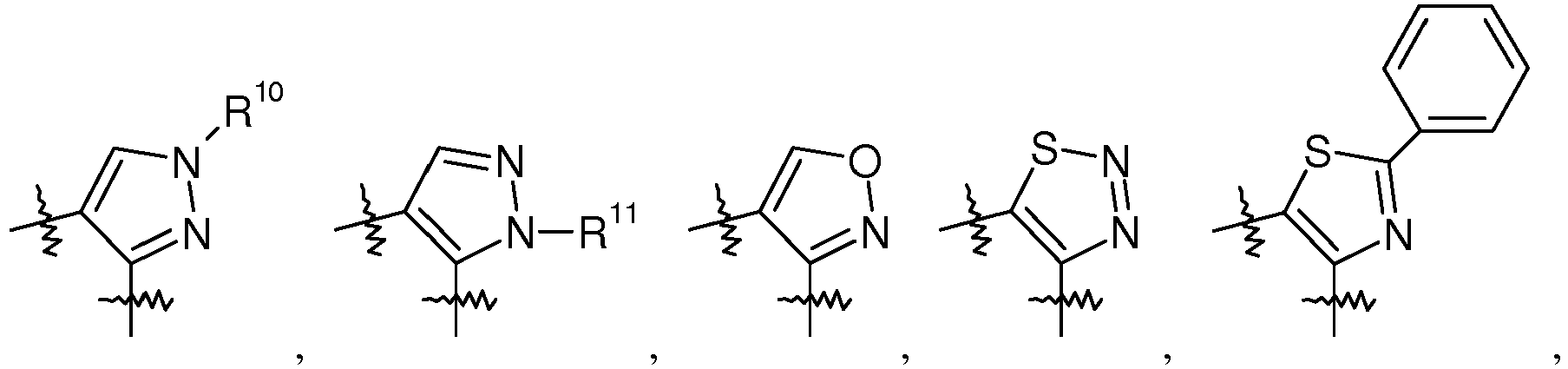


- R10
- is C1-7 alkyl, C1-7 -alkoxy-C1-7 -alkyl, C1-7 haloalkyl, aryl or heteroaryl, wherein said C1-7 alkyl is optionally substituted by cycloalkyl, more specifically methyl, ethyl, cyclopropylmethyl, 2-methoxy-ethyl, 2,2,2-trifluoro-ethyl, 3,3,3-trifluoro-propyl, phenyl or pyridin-2-yl, yet more specifically methyl;
- R11
- is C1-7 alkyl, C1-7 -alkoxy-C1-7 -alkyl, C1-7 haloalkyl, C1-7 hydroxyalkyl or heterocyclyl, wherein said C1-7 alkyl is optionally substituted by cycloalkyl or heterocyclyl, more specifically methyl, ethyl, isopropyl, isobutyl, cyclopropylmethyl, oxetan-2-ylmethyl, tetrahydro-furan-2-ylmethyl, tetrahydro-furan-3-ylmethyl, 2-methoxy-ethyl, 2-hydroxy-ethyl, 2,2,2-trifluoro-ethyl, 3,3,3-trifluoro-propyl or tetrahydro-furan-3-yl, yet more specifically methyl or 2-methoxy-ethyl.
- Another particular embodiment of the present invention relates to compounds of formula (I) as described above, wherein


- R10
- is C1-7 alkyl optionally substituted by cycloalkyl, C1-7 -alkoxy-C1-7 -alkyl, C1-7 haloalkyl, aryl or heteroaryl, more specifically methyl, ethyl, cyclopropylmethyl, 2-methoxy-ethyl, 2,2,2-trifluoro-ethyl, 3,3,3-trifluoro-propyl, phenyl or pyridin-2-yl, yet more specifically methyl;
- R11
- is C1-7 alkyl optionally substituted by cycloalkyl, C1-7 -alkoxy-C1-7 -alkyl or C1-7 haloalkyl, more specifically methyl, cyclopropylmethyl, 2-methoxy-ethyl or 3,3,3-trifluoro-propyl, yet more specifically methyl or 2-methoxy-ethyl.
- The chemical structures of

- Another particular embodiment of the present invention relates to compounds of formula (I) as described above, wherein

- Yet another particular embodiment of the present invention relates to compounds of formula (I) as described above, wherein

- Another particular embodiment of the present invention relates to compounds of formula (I) as described above, wherein

- R5 and R6
- are independently hydrogen, C1-7 alkyl, C1-7 hydroxyalkyl, C1-7 alkoxy, C1-7 haloalkyl, C1-7 -alkoxy-C1-7 -alkyl, cycloalkyl or heterocyclyl, wherein said C1-7 alkyl is optionally substituted by dimethylamino or heterocyclyl, and wherein said C1-7 haloalkyl is optionally substituted by hydroxyl, and wherein said cycloalkyl is optionally substituted by hydroxyl, and wherein said heterocyclyl is optionally substituted by C1-7 alkyl or -C(O)-C1-7 alkoxy, more specifically hydrogen, methyl, tetrahydrofuran-2-yl-methyl, ethyl, 2-methoxy-l-methyl-ethyl, 2-hydroxy-ethyl, 2-fluoro-ethyl, 2-hydroxy-1,1-dimethyl-ethyl, 2,2-difluoro-ethyl, 2,2,2-trifluoro-ethyl, 2,2,2-trifluoro-1-methyl-ethyl, 2-dimethylamino-ethyl, propyl, isopropyl, 2,3-dihydroxy-propyl, 3-hydroxy-propyl, 2-hydroxy-2-methyl-propyl, 3-hydroxy-2-methyl-propyl, 3-hydroxy-2,2-dimethyl-propyl, 2,2-difluoro-propyl, 3,3,3-trifluoro-2-hydroxy-propyl, 2-methoxy-2-methyl-propyl, butyl, isobutyl, 3-hydroxy-3-methyl-butyl, methoxy, cyclopropyl, cyclobutyl, cyclopentyl, 2-hydroxy-cyclopentyl, cyclohexyl, oxetan-3-yl, 3-methyl-oxetan-3-yl, tetrahydro-furan-3-yl, tetrahydro-pyran-4-yl, 1-methyl-azetidin-3-yl, pyrrolidin-3-yl, 1-methyl-pyrrolidin-3-yl, 1-(tert-butoxycarbonyl)pyrrolidin-3-yl, 1-methyl-piperidin-3-yl or 1-methyl-piperidin-4-yl, yet more specifically hydrogen, methyl, ethyl, 2,2-difluoro-ethyl, 2-hydroxy-2-methyl-propyl, 2-hydroxy-cyclopentyl, 1-methyl-azetidin-3-yl, 3-methyl-oxetan-3-yl or tetrahydro-furan-3-yl, or
- R5 and R6,
- together with the nitrogen atom to which they are attached, form an azetidine, pyrrolidine, piperidine, morpholine, piperazine, isoxazolidine or 2-oxa-6-aza-spiro[3.3]heptane ring, wherein each of said azetidine, pyrrolidine, piperidine, morpholine, piperazine, isoxazolidine or 2-oxa-6-aza-spiro[3.3]heptane ring is optionally substituted by 1 or 2 substituents independently selected from the group consisting of hydroxyl, halogen, C1-7 alkyl, C1-7 hydroxyalkyl, C1-7 alkoxy, oxo and amino, and wherein said amino is substituted by 2 C1-7 alkyl; R5 and R6 more specifically forming an optionally substituted heterocyclyl or spiro-heterocyclyl ring selected from the group consisting of azetidin-1-yl, 3-hydroxy-azetidin-l-yl, 3-fluoro-azetidin-1-yl, 3,3-difluoro-azetidin-1-yl, pyrrolidin-1-yl, 2-methyl-pyrrolidin-1-yl, 3-hydroxy-pyrrolidin-1-yl, 3-methoxy-pyrrolidin-1-yl, 2-hydroxymethyl-pyrrolidin-1-yl, 3-dimethylamino-pyrrolidin-1-yl, 2,5-dimethyl-pyrrolidin-1-yl, 2,2-dimethyl-pyrrolidin-1-yl, 3,3-dimethyl-pyrrolidin-1-yl, 3,3-difluoro-pyrrolidin-1-yl, piperidin-1-yl, 2-methyl-piperidin-1-yl, isoxazolidin-2-yl, morpholin-4-yl, 3-oxo-piperazin-1-yl and 2-oxa-6-aza-spiro[3.3]heptan-6-yl, yet more specifically azetidin-1-yl, isoxazolidin-2-yl or morpholin-4-yl.
- Yet another particular embodiment of the present invention relates to compounds of formula (I) as described above, wherein

and wherein - R5 and R6
- are independently hydrogen, C1-7 alkyl optionally substituted by heterocyclyl, C1-7 hydroxyalkyl, C1-7 -alkoxy-C1-7 -alkyl or cycloalkyl, more specifically hydrogen, methyl, tetrahydrofuran-2-yl-methyl, 2-methoxy-l-methyl-ethyl, 2-hydroxy-ethyl, isopropyl, 2,3-dihydroxy-propyl, 3-hydroxy-propyl, 2-hydroxy-2-methyl-propyl, cyclopropyl, cyclobutyl, cyclopentyl or cyclohexyl, yet more specifically hydrogen, methyl or 2-hydroxy-2-methyl-propyl, or
- R5 and R6,
- together with the nitrogen atom to which they are attached, form an azetidine, pyrrolidine, piperidine, morpholine, piperazine or 2-oxa-6-aza-spiro[3.3]heptane ring, wherein each of said azetidine, pyrrolidine, piperidine, morpholine, piperazine or 2-oxa-6-aza-spiro[3.3]heptane ring is optionally substituted by 1 or 2 substituents independently selected from the group consisting of hydroxyl, halogen, C1-7 alkyl, C1-7 hydroxyalkyl, C1-7 alkoxy, oxo and amino substituted by 2 C1-7 alkyl; R5 and R6 more specifically forming an optionally substituted heterocyclyl or spiro-heterocyclyl ring selected from the group consisting of azetidin-1-yl, 3-hydroxy-azetidin-1-yl, pyrrolidin-1-yl, 2-methyl-pyrrolidin-1-yl, 3-hydroxy-pyrrolidin-1-yl, 3-methoxy-pyrrolidin-1-yl, 2-hydroxymethyl-pyrrolidin-1-yl, 3-dimethylamino-pyrrolidin-1-yl, 2,5-dimethyl-pyrrolidin-1-yl, 2,2-dimethyl-pyrrolidin-1-yl, 3,3-dimethyl-pyrrolidin-1-yl, 3,3-difluoro-pyrrolidin-1-yl, piperidin-1-yl, morpholin-4-yl, 3-oxo-piperazin-1-yl and 2-oxa-6-aza-spiro[3.3]heptan-6-yl, yet more specifically morpholin-4-yl.
- Particular compounds of formula (I), wherein

- 6-Cyclopropyl-3-(pyrimidin-5-ylamino)-pyridine-2-carboxylic acid (3-dimethylcarbamoyl-1-methyl-1H-pyrazol-4-yl)-amide,
- 6-Cyclopropyl-3-(pyrimidin-5-ylamino)-pyridine-2-carboxylic acid (1-methyl-3-methylcarbamoyl-1H-pyrazol-4-yl)-amide,
- 6-Cyclopropyl-3-(pyrimidin-5-ylamino)-pyridine-2-carboxylic acid (3-carbamoyl-1-methyl-1H-pyrazol-4-yl)-amide,
- 6-Cyclopropyl-3-(pyrimidin-5-ylamino)-pyridine-2-carboxylic acid [3-dimethylcarbamoyl-1-(2-methoxy-ethyl)-1H-pyrazol-4-yl]-amide,
- 6-Cyclopropyl-3-(pyrimidin-5-ylamino)-pyrazine-2-carboxylic acid (1-methyl-3-methylcarbamoyl-1H-pyrazol-4-yl)-amide,
- 6-Cyclopropyl-3-(pyrimidin-5-ylamino)-pyridine-2-carboxylic acid [5-dimethylcarbamoyl-1-(2-methoxy-ethyl)-1H-pyrazol-4-yl]-amide,
- 6-Cyclopropyl-3-(pyrimidin-5-ylamino)-pyridine-2-carboxylic acid [3-dimethylcarbamoyl-1-(2,2,2-trifluoro-ethyl)-1H-pyrazol-4-yl]-amide,
- 6-Cyclopropyl-3-(pyrimidin-5-ylamino)-pyridine-2-carboxylic acid [3-methylcarbamoyl-1-(2,2,2-trifluoro-ethyl)-1H-pyrazol-4-yl]-amide,
- 6-Cyclopropyl-3-(pyrimidin-5-ylamino)-pyridine-2-carboxylic acid [3-methylcarbamoyl-1-(3,3,3-trifluoro-propyl)-1H-pyrazol-4-yl]-amide,
- 6-Cyclopropyl-3-(pyrimidin-5-ylamino)-pyridine-2-carboxylic acid [5-methylcarbamoyl-1-(3,3,3-trifluoro-propyl)-1H-pyrazol-4-yl]-amide,
- 6-Cyclopropyl-3-(pyrimidin-5-ylamino)-pyridine-2-carboxylic acid [1-(2-methoxy-ethyl)-5-methylcarbamoyl-1H-pyrazol-4-yl]-amide,
- 6-Cyclopropyl-3-(pyrimidin-5-ylamino)-pyridine-2-carboxylic acid (1-cyclopropylmethyl-3-methylcarbamoyl-1H-pyrazol-4-yl)-amide,
- 6-Cyclopropyl-3-(pyrimidin-5-ylamino)-pyridine-2-carboxylic acid (1-cyclopropylmethyl-5-methylcarbamoyl-1H-pyrazol-4-yl)-amide,
- 6-Cyclopropyl-3-(pyrimidin-5-ylamino)-pyridine-2-carboxylic acid [1-methyl-3-(morpholine-4-carbonyl)-1H-pyrazol-4-yl]-amide,
- 6-Cyclopropyl-3-(pyrimidin-5-ylamino)-pyridine-2-carboxylic acid [3-(cyclopropyl-methylcarbamoyl)-1-methyl-1H-pyrazol-4-yl]-amide,
- 6-Cyclopropyl-3-(pyrimidin-5-ylamino)-pyridine-2-carboxylic acid [1-methyl-3-(piperidine-1-carbonyl)-1H-pyrazol-4-yl]-amide,
- 6-Cyclopropyl-3-(pyrimidin-5-ylamino)-pyridine-2-carboxylic acid [3-(cyclohexyl-methylcarbamoyl)-1-methyl-1H-pyrazol-4-yl]-amide,
- 6-Cyclopropyl-3-(pyrimidin-5-ylamino)-pyridine-2-carboxylic acid [1-(2-methoxy-ethyl)-3-methylcarbamoyl-1H-pyrazol-4-yl]-amide,
- 6-Cyclopropyl-3-(pyrimidin-5-ylamino)-pyridine-2-carboxylic acid [3-(cyclopentyl-methylcarbamoyl)-1-methyl-1H-pyrazol-4-yl]-amide,
- 6-Cyclopropyl-3-(pyrimidin-5-ylamino)-pyridine-2-carboxylic acid [3-(isopropyl-methylcarbamoyl)-1-methyl-1H-pyrazol-4-yl]-amide,
- 6-Cyclopropyl-3-(pyrimidin-5-ylamino)-pyridine-2-carboxylic acid [1-methyl-3-(pyrrolidine-1-carbonyl)-1H-pyrazol-4-yl]-amide,
- 6-Cyclopropyl-3-(pyrimidin-5-ylamino)-pyridine-2-carboxylic acid (3-methylcarbamoyl-1-phenyl-1H-pyrazol-4-yl)-amide,
- 6-Methoxymethyl-3-(pyrimidin-5-ylamino)-pyridine-2-carboxylic acid [1-(2-methoxy-ethyl)-5-methylcarbamoyl-1H-pyrazol-4-yl]-amide,
- 6-Cyclopropyl-N-[1-methyl-3-(2-methyl-pyrrolidine-1-carbonyl)-1H-pyrazol-4-yl]-3-(pyrimidin-5-ylamino)-pyridine-2-carboximidic acid,
- N-(3-Cyclohexylcarbamoyl-1-methyl-1H-pyrazol-4-yl)-6-cyclopropyl-3-(pyrimidin-5-ylamino)-pyridine-2-carboximidic acid,
- N-[3-(Azetidine-1-carbonyl)-1-methyl-1H-pyrazol-4-yl]-6-cyclopropyl-3-(pyrimidin-5-ylamino)-pyridine-2-carboximidic acid,
- 6-Cyclopropyl-N-(3-cyclopropylcarbamoyl-1-methyl-1H-pyrazol-4-yl)-3-(pyrimidin-5-ylamino)-pyridine-2-carboximidic acid,
- 6-Cyclopropyl-N-[3-(3,3-dimethyl-pyrrolidine-1-carbonyl)-1-methyl-1H-pyrazol-4-yl]-3-(pyrimidin-5-ylamino)-pyridine-2-carboximidic acid,
- N-(3-Cyclobutylcarbamoyl-1-methyl-1H-pyrazol-4-yl)-6-cyclopropyl-3-(pyrimidin-5-ylamino)-pyridine-2-carboximidic acid,
- N-(3-Cyclopentylcarbamoyl-1-methyl-1H-pyrazol-4-yl)-6-cyclopropyl-3-(pyrimidin-5-ylamino)-pyridine-2-carboximidic acid,
- 6-Cyclopropyl-N-[3-(2,5-dimethyl-pyrrolidine-1-carbonyl)-1-methyl-1H-pyrazol-4-yl]-3-(pyrimidin-5-ylamino)-pyridine-2-carboximidic acid,
- 6-Cyclopropyl-N-[3-(3,3-difluoro-pyrrolidine-1-carbonyl)-1-methyl-1H-pyrazol-4-yl]-3-(pyrimidin-5-ylamino)-pyridine-2-carboximidic acid,
- 6-Cyclopropyl-N-[3-(3-dimethylamino- pyrrolidine-1-carbonyl)-1-methyl-1H-pyrazol-4-yl]-3-(pyrimidin-5-ylamino)-pyridine-2-carboximidic acid,
- 6-Cyclopropyl-N-{3-[(3-hydroxy-propyl)-methyl-carbamoyl]-1-methyl-1H-pyrazol-4-yl}-3-(pyrimidin-5-ylamino)-pyridine-2-carboximidic acid,
- 6-Cyclopropyl-N-[3-(2-hydroxy-ethylcarbamoyl)-1-methyl-1H-pyrazol-4-yl]-3-(pyrimidin-5-ylamino)-pyridine-2-carboximidic acid,
- 6-Cyclopropyl-N-{3-[(2-hydroxy-ethyl)-methyl-carbamoyl]-1-methyl-1H-pyrazol-4-yl}-3-(pyrimidin-5-ylamino)-pyridine-2-carboximidic acid,
- 6-Cyclopropyl-N-[3-(2-methoxy-1-methyl-ethylcarbamoyl)-1-methyl-1H-pyrazol-4-yl]-3-(pyrimidin-5-ylamino)-pyridine-2-carboximidic acid,
- 6-Cyclopropyl-N-[3-(2,3-dihydroxy-propylcarbamoyl)-1-methyl-1H-pyrazol-4-yl]-3-(pyrimidin-5-ylamino)-pyridine-2-carboximidic acid,
- 6-Cyclopropyl-N-[3-(2-hydroxy-2-methyl-propylcarbamoyl)-1-methyl-1H-pyrazol-4-yl]-3-(pyrimidin-5-ylamino)-pyridine-2-carboximidic acid,
- 6-Cyclopropyl-N-[3-(3-hydroxy-pyrrolidine-1-carbonyl)-1-methyl-1H-pyrazol-4-yl]-3-(pyrimidin-5-ylamino)-pyridine-2-carboximidic acid,
- 6-Cyclopropyl-N-[3-(2-hydroxy-1-methyl-ethylcarbamoyl)-1-methyl-1H-pyrazol-4-yl]-3-(pyrimidin-5-ylamino)-pyridine-2-carboximidic acid,
- 6-Cyclopropyl-N-{3-[(2,3-dihydroxy-propyl)-methyl-carbamoyl]-1-methyl-1H-pyrazol-4-yl}-3-(pyrimidin-5-ylamino)-pyridine-2-carboximidic acid,
- 6-Cyclopropyl-N-[3-(5-hydroxy-3,6-dihydro-2H-pyrazine-1-carbonyl)-1-methyl-1H-pyrazol-4-yl]-3-(pyrimidin-5-ylamino)-pyridine-2-carboximidic acid,
- 6-Cyclopropyl-N-[3-(3-methoxy-pyrrolidine-1-carbonyl)-1-methyl-1H-pyrazol-4-yl]-3-(pyrimidin-5-ylamino)-pyridine-2-carboximidic acid,
- 6-Cyclopropyl-N-[3-(2-hydroxymethyl-pyrrolidine-1-carbonyl)-1-methyl-1H-pyrazol-4-yl]-3-(pyrimidin-5-ylamino)-pyridine-2-carboximidic acid,
- 6-Cyclopropyl-N-[3-(3-hydroxy-azetidine-1-carbonyl)-1-methyl-1H-pyrazol-4-yl]-3-(pyrimidin-5-ylamino)-pyridine-2-carboximidic acid,
- 6-Cyclopropyl-N-[1-methyl-3-(2-oxa-6-aza-spiro[3.3]heptane-6-carbonyl)-1H-pyrazol-4-yl]-3-(pyrimidin-5-ylamino)-pyridine-2-carboximidic acid,
- 6-Cyclopropyl-N-[3-(2,2-dimethyl-pyrrolidine-1-carbonyl)-1-methyl-1H-pyrazol-4-yl]-3-(pyrimidin-5-ylamino)-pyridine-2-carboximidic acid,
- 6-Cyclopropyl-3-(pyrimidin-5-ylamino)-pyridine-2-carboxylic acid (4-methylcarbamoyl-[1,2,3]thiadiazol-5-yl)-amide,
- 6-Cyclopropyl-3-(pyrimidin-5-ylamino)-pyridine-2-carboxylic acid (4-methylcarbamoyl-2-phenyl-thiazol-5-yl)-amide,
- 6-Cyclopropyl-3-(pyrimidin-5-ylamino)-pyridine-2-carboxylic acid (4-methylcarbamoyl-2-pyridin-2-yl-thiazol-5-yl)-amide,
- 6-Cyclopropyl-3-(pyrimidin-5-ylamino)-pyridine-2-carboxylic acid (3-dimethylcarbamoyl-1-pyridin-2-yl-1H-pyrazol-4-yl)-amide,
- 2-Isopropyl-5-(pyrimidin-5-ylamino)-pyrimidine-4-carboxylic acid (1-methyl-3-methylcarbamoyl-1H-pyrazol-4-yl)-amide,
- 2-Cyclopropyl-5-(pyrimidin-5-ylamino)-pyrimidine-4-carboxylic acid (1-methyl-3-methylcarbamoyl-1H-pyrazol-4-yl)-amide,
- 2-tert-Butyl-5-(pyrimidin-5-ylamino)-pyrimidine-4-carboxylic acid (1-methyl-3-methylcarbamoyl-1H-pyrazol-4-yl)-amide,
- 2-Isobutyl-5-(pyrimidin-5-ylamino)-pyrimidine-4-carboxylic acid (1-methyl-3-methylcarbamoyl-1H-pyrazol-4-yl)-amide,
- 2-Cyclohexyl-5-(pyrimidin-5-ylamino)-pyrimidine-4-carboxylic acid (1-methyl-3-methylcarbamoyl-1H-pyrazol-4-yl)-amide,
- 6-Cyclopropyl-3-(pyrimidin-5-ylamino)-pyridine-2-carboxylic acid (3-cyclopropylcarbamoyl-thiophen-2-yl)-amide,
- 6-Cyclopropyl-3-(pyrimidin-5-ylamino)-pyridine-2-carboxylic acid [3-(morpholine-4-carbonyl)-thiophen-2-yl] -amide,
- 6-Cyclopropyl-3-(pyrimidin-5-ylamino)-pyridine-2-carboxylic acid [5-isopropyl-3-(morpholine-4-carbonyl)-thiophen-2-yl]-amide,
- 6-cyclopropyl-N-(3-(2-hydroxy-2-methylpropylcarbamoyl)-1-methyl-1H-pyrazol-4-yl)-3-(pyrimidin-5-ylamino)pyrazine-2-carboxamide,
- N-(1-methyl-3-(methylcarbamoyl)-1H-pyrazol-4-yl)-3-(pyrimidin-5-ylamino)-6-(tetrahydrofuran-2-yl)pyrazine-2-carboxamide,
- N-(1-methyl-3-(methylcarbamoyl)-1H-pyrazol-4-yl)-3-(pyrimidin-5-ylamino)-6-(tetrahydrofuran-3-yl)pyrazine-2-carboxamide,
- N-(l-methyl-3-(methylcarbamoyl)-1H-pyrazol-4-yl)-3-(pyrimidin-5-ylamino)-6-(tetrahydrofuran-2-yl)picolinamide,
- 6-isobutyl-N-(1-methyl-3-(methylcarbamoyl)-1H-pyrazol-4-yl)-3-(pyrimidin-5-ylamino)pyrazine-2-carboxamide,
- 6-cyclopropyl-N-(1-ethyl-3-(methylcarbamoyl)-1H-pyrazol-4-yl)-3-(pyrimidin-5-ylamino)pyrazine-2-carboxamide,
- 6-cyclopropyl-N-(1-ethyl-3-((tetrahydrofuran-2-yl)methylcarbamoyl)-1H-pyrazol-4-yl)-3-(pyrimidin-5-ylamino)pyrazine-2-carboxamide,
- 6-cyclopropyl-N-(1-methyl-3-((tetrahydrofuran-2-yl)methylcarbamoyl)-1H-pyrazol-4-yl)-3-(pyrimidin-5-ylamino)pyrazine-2-carboxamide,
- 6-cyclopropyl-N-(3-((2-hydroxy-2-methylpropyl)(methyl)carbamoyl)-1-methyl-1H-pyrazol-4-yl)-3-(pyrimidin-5-ylamino)pyrazine-2-carboxamide,
- N-(3-(2-hydroxy-2-methylpropylcarbamoyl)-1-methyl-1H-pyrazol-4-yl)-2-methyl-5-(pyrimidin-5-ylamino)pyrimidine-4-carboxamide,
- 6-(1-Hydroxy-ethyl)-3-(pyrimidin-5-ylamino)-pyrazine-2-carboxylic acid (1-methyl-3-methylcarbamoyl-1H-pyrazol-4-yl)-amide,
- 6-Cyclopropyl-3-(pyrimidin-5-ylamino)-pyrazine-2-carboxylic acid (1-methyl-5-methylcarbamoyl-1H-pyrazol-4-yl)-amide,
- 6-Cyclopropyl-3-(pyrimidin-5-ylamino)-pyrazine-2-carboxylic acid [5-(2-hydroxy-2-methylpropylcarbamoyl)-1-methyl-1H-pyrazol-4-yl]-amide,
- 2-(2-Methoxy-ethylamino)-5-(pyrimidin-5-ylamino)-pyrimidine-4-carboxylic acid (1-methyl-3-methylcarbamoyl-1H-pyrazol-4-yl)-amide,
- 3-(Pyrimidin-5-ylamino)-6-(tetrahydro-furan-3-yl)-pyridine-2-carboxylic acid (1-methyl-3-methylcarbamoyl-1H-pyrazol-4-yl)-amide,
- 6-Cyclopropyl-3-(pyrimidin-5-ylamino)-pyrazine-2-carboxylic acid (2-methyl-4-methylcarbamoyl-thiazol-5-yl)-amide,
- 6-Isopropyl-3-(pyrimidin-5-ylamino)-pyrazine-2-carboxylic acid (1-methyl-5-methylcarbamoyl-1H-pyrazol-4-yl)-amide,
- 6-Cyclopropyl-3-(pyrimidin-5-ylamino)-pyrazine-2-carboxylic acid [1-ethyl-5-(2-hydroxy-2-methyl-propylcarbamoyl)-1H-pyrazol-4-yl]-amide,
- 6-Cyclopropyl-3-(pyrimidin-5-ylamino)-pyrazine-2-carboxylic acid (1-methyl-5-methylcarbamoyl-1H-pyrazol-4-yl)-amide,
- 6-Cyclopropyl-3-(pyrimidin-5-ylamino)-pyrazine-2-carboxylic acid [5-(2-hydroxy-2-methylpropylcarbamoyl)-1-isobutyl-1H-pyrazol-4-yl]-amide,
- 6-Cyclopropyl-3-(pyrimidin-5-ylamino)-pyrazine-2-carboxylic acid [1-methyl-5-(oxetan-3-ylcarbamoyl)-1H-pyrazol-4-yl]-amide,
- 6-Cyclopropyl-3-(pyrimidin-5-ylamino)-pyrazine-2-carboxylic acid [1-methyl-5-(3-methyl-oxetan-3-ylcarbamoyl)-1H-pyrazol-4-yl]-amide,
- 6-Cyclopropyl-3-(pyrimidin-5-ylamino)-pyrazine-2-carboxylic acid (1-isobutyl-5-methylcarbamoyl-1H-pyrazol-4-yl)-amide,
- 6-Cyclopropyl-3-(pyrimidin-5-ylamino)-pyrazine-2-carboxylic acid [5-(2-hydroxy-2-methylpropylcarbamoyl)-1-isopropyl-1H-pyrazol-4-yl]-amide,
- 6-Cyclopropyl-3-(pyrimidin-5-ylamino)-pyrazine-2-carboxylic acid (1-isopropyl-5-methylcarbamoyl-1H-pyrazol-4-yl)-amide,
- 6-Cyclopropyl-3-(pyrimidin-5-ylamino)-pyrazine-2-carboxylic acid [5-(3-hydroxy-3-methyl-butylcarbamoyl)-1-methyl-1H-pyrazol-4-yl]-amide,
- 6-Cyclopropyl-3-(pyrimidin-5-ylamino)-pyrazine-2-carboxylic acid [1-methyl-5-(tetrahydrofuran-3-ylcarbamoyl)-1H-pyrazol-4-yl]-amide,
- 6-Cyclopropyl-3-(pyrimidin-5-ylamino)-pyrazine-2-carboxylic acid [5-(3-hydroxy-2,2-dimethyl-propylcarbamoyl)-1-methyl-1H-pyrazol-4-yl]-amide,
- 6-Cyclopropyl-3-(pyrimidin-5-ylamino)-pyrazine-2-carboxylic acid [5-(3,3-difluoro-azetidine-1-carbonyl)-1-methyl-1H-pyrazol-4-yl]-amide,
- 6-Cyclopropyl-3-(pyrimidin-5-ylamino)-pyrazine-2-carboxylic acid [1-methyl-5-(2,2,2-trifluoro-ethylcarbamoyl)-1H-pyrazol-4-yl]-amide,
- 6-Cyclopropyl-3-(pyrimidin-5-ylamino)-pyrazine-2-carboxylic acid [5-(2,2-difluoro-ethylcarbamoyl)-1-methyl-1H-pyrazol-4-yl]-amide,
- 6-Cyclopropyl-3-(pyrimidin-5-ylamino)-pyrazine-2-carboxylic acid [1-methyl-5-(3,3,3-trifluoro-2-hydroxy-propylcarbamoyl)-1H-pyrazol-4-yl]-amide,
- 6-Cyclopropyl-3-(pyrimidin-5-ylamino)-pyrazine-2-carboxylic acid [1-(2-methoxy-ethyl)-5-methylcarbamoyl-1H-pyrazol-4-yl]-amide,
- 6-Cyclopropyl-3-(pyrimidin-5-ylamino)-pyridine-2-carboxyfic acid (1-methyl-5-methylcarbamoyl-1H-pyrazol-4-yl)-amide,
- 6-Cyclopropyl-3-(pyrimidin-5-ylamino)-pyrazine-2-carboxylic acid [5-(3-hydroxy-2-methylpropylcarbamoyl)-1-methyl-1H-pyrazol-4-yl]-amide,
- 6-Cyclopropyl-3-(pyrimidin-5-ylamino)-pyrazine-2-carboxylic acid (5-carbamoyl-1-methyl-1H-pyrazol-4-yl)-amide,
- 6-Cyclopropyl-3-(pyrimidin-5-ylamino)-pyrazine-2-carboxylic acid [5-(2-methoxy-2-methylpropylcarbamoyl)-1-methyl-1H-pyrazol-4-yl]-amide,
- 6-Cyclopropyl-3-(pyrimidin-5-ylamino)-pyrazine-2-carboxylic acid [5-(2-hydroxy-1,1-dimethyl-ethylcarbamoyl)-1-methyl-1H-pyrazol-4-yl]-amide,
- 6-Cyclopropyl-3-(pyrimidin-5-ylamino)-pyrazine-2-carboxylic acid {5-[(2-hydroxy-2-methylpropyl)-methyl-carbamoyl]-1-methyl-1H-pyrazol-4-yl}-amide,
- 2-tert-Butyl-5-(pyrimidin-5-ylamino)-pyrimidine-4-carboxylic acid (1-methyl-5-methylcarbamoyl-1H-pyrazol-4-yl)-amide,
- 6-Cyclopropyl-3-(pyrimidin-5-ylamino)-pyrazine-2-carboxylic acid [5-(azetidine-1-carbonyl)-1-methyl-1H-pyrazol-4-yl]-amide,
- 6-Cyclopropyl-3-(pyrimidin-5-ylamino)-pyrazine-2-carboxylic acid [1-methyl-5-(pyrrolidine-1-carbonyl)-1H-pyrazol-4-yl]-amide,
- 6-Cyclopropyl-3-(pyrimidin-5-ylamino)-pyrazine-2-carboxylic acid (5-dimethylcarbamoyl-1-methyl-1H-pyrazol-4-yl)-amide,
- 3-(Pyrimidin-5-ylamino)-6-(tetrahydro-furan-3-yl)-pyrazine-2-carboxylic acid (1-methyl-5-methylcarbamoyl-1H-pyrazol-4-yl)-amide,
- 2-Isopropyl-5-(pyrimidin-5-ylamino)-pyrimidine-4-carboxylic acid (1-methyl-5-methylcarbamoyl-1H-pyrazol-4-yl)-amide,
- 6-Cyclopropyl-3-(pyrimidin-5-ylamino)-5-(tetrahydro-furan-2-yl)-pyrazine-2-carboxylic acid [5-(2-fluoro-ethylcarbamoyl)-1-methyl-1H-pyrazol-4-yl]-amide,
- 6-Cyclopropyl-3-(pyrimidin-5-ylamino)-pyrazine-2-carboxylic acid (3-cyclopropylcarbamoyl-isoxazol-4-yl)-amide,
- 6-Cyclopropyl-3-(pyrimidin-5-ylamino)-pyrazine-2-carboxylic acid [1-methyl-5-(2,2,2-trifluoro-1-methyl-ethylcarbamoyl)-1H-pyrazol-4-yl] -amide,
- 6-Cyclopropyl-3-(pyrimidin-5-ylamino)-pyrazine-2-carboxylic acid [5-(2,2-difluoro-propylcarbamoyl)-1-methyl-1H-pyrazol-4-yl]-amide,
- 6-Chloro-3-(pyrimidin-5-ylamino)-pyridine-2-carboxylic acid (1-methyl-5-methylcarbamoyl-1H-pyrazol-4-yl)-amide,
- 6-Cyclopropyl-3-(pyrimidin-5-ylamino)-pyrazine-2-carboxylic acid (5-isobutylcarbamoyl-1-methyl-1H-pyrazol-4-yl)-amide,
- 6-Cyclopropyl-3-(pyrimidin-5-ylamino)-pyrazine-2-carboxylic acid [1-methyl-5-(piperidine-1-carbonyl)-1H-pyrazol-4-yl]-amide,
- 6-Cyclopropyl-3-(pyrimidin-5-ylamino)-pyrazine-2-carboxylic acid (5-dimethylcarbamoyl-1-ethyl- H-pyrazol-4-yl)-amide,
- 6-Cyclopropyl-3-(pyrimidin-5-ylamino)-pyrazine-2-carboxylic acid [1-ethyl-5-(morpholine-4-carbonyl)-1H-pyrazol-4-yl]-amide,
- 6-Cyclopropyl-3-(pyrimidin-5-ylamino)-pyrazine-2-carboxylic acid [5-(2-fluoro-ethylcarbamoyl)-1-methyl-1H-pyrazol-4-yl]-amide,
- 6-Cyclopropyl-3-(pyrimidin-5-ylamino)-pyrazine-2-carboxylic acid [5-(2-hydroxy-2-methylpropylcarbamoyl)-1-(3,3,3-trifluoro-propyl)-1H-pyrazol-4-yl]-amide,
- 6-Cyclopropyl-3-(pyrimidin-5-ylamino)-pyrazine-2-carboxylic acid [5-methylcarbamoyl-1-(3,3,3-trifluoro-propyl)-1H-pyrazol-4-yl]-amide,
- 6-Cyclopropyl-3-(pyrimidin-5-ylamino)-pyrazine-2-carboxylic acid [5-(3-fluoro-azetidine-1-carbonyl)-1-methyl-1H-pyrazol-4-yl]-amide,
- 6-Cyclopropyl-3-(pyrimidin-5-ylamino)-pyrazine-2-carboxylic acid [5-(2-hydroxy-2-methylpropylcarbamoyl)-1-(2,2, 2-trifluoro-ethyl)-1H-pyraz ol-4-yl]-amide,
- 6-Cyclopropyl-3-(pyrimidin-5-ylamino)-pyrazine-2-carboxylic acid [5-methylcarbamoyl-1-(2,2,2-trifluoro-ethyl)-1H-pyrazol-4-yl]-amide,
- 6-Cyclopropyl-3-(pyrimidin-5-ylamino)-pyrazine-2-carboxylic acid [1-methyl-5-(morpholine-4-carbonyl)-1H-pyrazol-4-yl]-amide,
- 6-Acetyl-3-(pyrimidin-5-ylamino)-pyrazine-2-carboxylic acid (1-methyl-5-methylcarbamoyl-1H-pyrazol-4-yl)-amide,
- 6-Cyclopropyl-3-(pyrimidin-5-ylamino)-pyrazine-2-carboxylic acid (3-ethylcarbamoyl-4,5,6,7-tetrahydro-benzo[b]thiophen-2-yl)-amide,
- 2-Isopropyl-5-(pyridin-3-ylamino)-pyrimidine-4-carboxylic acid (1-methyl-5-methylcarbamoyl-1H-pyrazol-4-yl)-amide,
- 6-(1-Hydroxy-ethyl)-3-(pyrimidin-5-ylamino)-pyrazine-2-carboxylic acid (1-methyl-5-methylcarbamoyl-1H-pyrazol-4-yl)-amide,
- 5-(3-Fluoro-phenylamino)-2-isopropyl-pyrimidine-4-carboxylic acid (1-methyl-5-methylcarbamoyl-1H-pyrazol-4-yl)-amide,
- 6-Methoxymethyl-3-(pyrimidin-5-ylamino)-pyridine-2-carboxylic acid (1-methyl-5-methylcarbamoyl-1H-pyrazol-4-yl)-amide,
- 5-(5-Fluoro-pyridin-3-ylamino)-2-isopropyl-pyrimidine-4-carboxylic acid (1-methyl-5-methylcarbamoyl-1H-pyrazol-4-yl)-amide,
- 5-(4-Fluoro-phenylamino)-2-isopropyl-pyrimidine-4-carboxylic acid (1-methyl-5-methylcarbamoyl-1H-pyrazol-4-yl)-amide,
- 2-Cyclobutyl-5-(pyrimidin-5-ylamino)-pyrimidine-4-carboxylic acid (1-methyl-5-methylcarbamoyl-1H-pyrazol-4-yl)-amide,
- 6-Cyclopropyl-3-(pyrimidin-5-ylamino)-pyrazine-2-carboxylic acid (5-ethylcarbamoyl-1-methyl-1H-pyrazol-4-yl)-amide,
- 6-Cyclopropyl-3-(pyrazin-2-ylamino)-pyrazine-2-carboxylic acid (1-methyl-5-methylcarbamoyl-1H-pyrazol-4-yl)-amide,
- 6-Cyclopropyl-3-(pyrimidin-5-ylamino)-pyrazine-2-carboxylic acid (1-ethyl-5-ethylcarbamoyl-1H-pyrazol-4-yl)-amide,
- 6-Cyclopropyl-3-(pyrimidin-5-ylamino)-pyrazine-2-carboxylic acid (1-methyl-5-isobutylcarbamoyl-1H-pyrazol-4-yl)-amide,
- 6-Cyclopropyl-3-(pyrimidin-5-ylamino)-pyrazine-2-carboxylic acid [5-(ethyl-methylcarbamoyl)-1-methyl-1H-pyrazol-4-yl]-amide,
- 6-Cyclopropyl-3-(pyridin-3-ylamino)-pyrazine-2-carboxylic acid (1-methyl-5-methylcarbamoyl-1H-pyrazol-4-yl)-amide,
- 6-Cyclopropyl-3-(pyrimidin-5-ylamino)-pyrazine-2-carboxylic acid (5-dipropylcarbamoyl-1-methyl-1H-pyrazol-4-yl)-amide,
- 6-Cyclopropyl-3-(pyrimidin-5-ylamino)-pyrazine-2-carboxylic acid [5-(butyl-methylcarbamoyl)-1-methyl-1H-pyrazol-4-yl]-amide,
- 6-Cyclopropyl-3-(pyrimidin-5-ylamino)-pyrazine-2-carboxylic acid {5-[(2-hydroxy-ethyl)-methyl-carbamoyl]-1-methyl-1H-pyrazol-4-yl}-amide,
- 6-Cyclopropyl-3-(pyrimidin-5-ylamino)-pyrazine-2-carboxylic acid [5-(isopropyl-methylcarbamoyl)-1-methyl-1H-pyrazol-4-yl]-amide,
- 6-Cyclopropyl-3-(pyrimidin-5-ylamino)-pyrazine-2-carboxylic acid (5-diethylcarbamoyl-1-methyl-1H-pyrazol-4-yl)-amide,
- 6-Cyclopropyl-3-(pyrimidin-5-ylamino)-pyrazine-2-carboxylic acid [1-methyl-5-(methyl-propyl-carbamoyl)-1H-pyrazol-4-yl]-amide,
- 6-Cyclopropyl-3-(pyrimidin-5-ylamino)-pyrazine-2-carboxylic acid {5-[ethyl-(2-hydroxy-ethyl)-carbamoyl]-1-methyl-1H-pyrazol-4-yl}-amide,
- 6-Cyclopropyl-3-(pyrimidin-5-ylamino)-pyrazine-2-carboxylic acid {1-methyl-5-[methyl-(tetrahydro-pyran-4-yl)-carbamoyl]-1H-pyrazol-4-yl -amide,
- 6-Cyclopropyl-3-(pyrimidin-5-ylamino)-pyrazine-2-carboxylic acid {1-methyl-5-[(tetrahydrofuran-2-ylmethyl)-carbamoyl]-1H-pyrazol-4-yl}-amide,
- 6-Cyclopropyl-3-(pyrimidin-5-ylamino)-pyrazine-2-carboxylic acid {1-ethyl-5-[(tetrahydrofuran-2-ylmethyl)-carbamoyl]-1H-pyrazol-4-yl}-amide,
- 6-Cyclopropyl-3-(pyridin-3-ylamino)-pyrazine-2-carboxylic acid [5-(azetidine-1-carbonyl)-1-methyl-1H-pyrazol-4-yl]-amide,
- 6-Cyclopropyl-3-(pyrimidin-5-ylamino)-pyrazine-2-carboxylic acid [1-methyl-5-(2-methylpiperidine-1-carbonyl)-1H-pyrazol-4-yl]-amide,
- 3-[(4-{ [6-Cyclopropyl-3-(pyrimidin-5-ylamino)-pyrazine-2-carbonyl]-amino}-2-methyl-2H-pyrazole-3-carbonyl)-amino]-pyrrolidine-1-carboxylic acid tert-butyl ester,
- 6-Cyclopropyl-3-(pyrimidin-5-ylamino)-pyrazine-2-carboxylic acid {1-methyl-5-[methyl-(2,2,2-trifluoro-ethyl)-carbamoyl]-1H-pyrazol-4-yl} -amide,
- 6-Cyclopropyl-3-(pyrimidin-5-ylamino)-pyrazine-2-carboxylic acid [5-(cyclopropyl-methylcarbamoyl)-1-methyl-1H-pyrazol-4-yl]-amide,
- 6-Cyclopropyl-3-(pyrimidin-5-ylamino)-pyrazine-2-carboxylic acid [1-methyl-5-(2-methyl-pyrrolidine-1-carbonyl)-1H-pyrazol-4-yl]-amide,
- 6-Cyclopropyl-3-(pyrimidin-5-ylamino)-pyrazine-2-carboxylic acid [1-methyl-5-(methyl-oxetan-3-yl-carbamoyl)-1H-pyrazol-4-yl]-amide,
- 6-Cyclopropyl-3-(pyrimidin-5-ylamino)-pyrazine-2-carboxylic acid [1-methyl-5-(1-methyl-piperidin-3-ylcarbamoyl)-1H-pyrazol-4-yl]-amide,
- 6-Cyclopropyl-3-(pyrimidin-5-ylamino)-pyrazine-2-carboxylic acid [1-methyl-5-(1-methyl-piperidin-4-ylcarbamoyl)-1H-pyrazol-4-yl]-amide,
- 6-Cyclopropyl-3-(pyrimidin-5-ylamino)-pyrazine-2-carboxylic acid [5-methylcarbamoyl-1-(tetrahydro-furan-2-ylmethyl)-1H-pyrazol-4-yl]-amide,
- 6-Cyclopropyl-3-(pyrimidin-5-ylamino)-pyrazine-2-carboxylic acid [5-(2-hydroxy-2-methylpropylcarbamoyl)-1-(tetrahydro-furan-2-ylmethyl)-1H-pyrazol-4-yl]-amide,
- 6-Cyclopropyl-3-(pyrimidin-5-ylamino)-pyrazine-2-carboxylic acid {5-[(2-fluoro-ethyl)-methyl-carbamoyl]-1-methyl-1H-pyrazol-4-yl}-amide,
- 6-Cyclopropyl-3-(pyrimidin-5-ylamino)-pyrazine-2-carboxylic acid {1-methyl-5-[methyl-(1-methyl-pyrrolidin-3-yl)-carbamoyl]-1H-pyrazol-4-yl -amide,
- 6-Cyclopropyl-3-(pyrimidin-5-ylamino)-pyrazine-2-carboxylic acid [5-methylcarbamoyl-1-(tetrahydro-furan-3-yl)-1H-pyrazol-4-yl]-amide,
- 6-Cyclopropyl-3-(pyrimidin-5-ylamino)-pyrazine-2-carboxylic acid [1-methyl-5-(pyrrolidin-3-ylcarbamoyl)-1H-pyrazol-4-yl]-amide,
- 6-Cyclopropyl-3-(pyrimidin-5-ylamino)-pyrazine-2-carboxylic acid (1-methyl-5-{[(S)-1-(tetrahydro-furan-2-yl)methyl]-c arbamoyl}-1H-pyrazol-4-yl)-amide,
- 6-Cyclopropyl-3-(pyrimidin-5-ylamino)-pyrazine-2-carboxylic acid (1-methyl-5-{[(R)-1-(tetrahydro-furan-2-yl)methyl]-carbamoyl}-1H-pyrazol-4-yl)-amide,
- 6-Cyclopropyl-3-(pyrimidin-5-ylamino)-pyrazine-2-carboxylic acid {1-methyl-5-[methyl-(tetrahydro-furan-2-ylmethyl)-carbamoyl]-1H-pyrazol-4-yl}-amide,
- 6-Methoxy-3-(pyrimidin-5-ylamino)-pyrazine-2-carboxylic acid (1-methyl-5-methylcarbamoyl-1H-pyrazol-4-yl)-amide,
- 6-Cyclopropyl-3-(pyrimidin-5-ylamino)-pyrazine-2-carboxylic acid [1-(2-hydroxy-ethyl)-5-methylcarbamoyl-1H-pyrazol-4-yl]-amide,
- 3-(Pyrimidin-5-ylamino)-6-(R)-tetrahydro-furan-3-yl-pyrazine-2-carboxylic acid (1-methyl-5-methylcarbamoyl-1H-pyrazol-4-yl)-amide,
- 3-(Pyrimidin-5-ylamino)-6-(S)-tetrahydro-furan-3-yl-pyrazine-2-carboxylic acid (1-methyl-5-methylcarbamoyl-1H-pyrazol-4-yl)-amide,
- 6-Cyclopropyl-3-(pyrimidin-5-ylamino)-pyrazine-2-carboxylic acid {1-methyl-5-[(S)-(tetrahydro-furan-3-yl)carbamoyl]-1H-pyrazol-4-yl} -amide,
- 6-Cyclopropyl-3-(pyrimidin-5-ylamino)-pyrazine-2-carboxylic acid {1-methyl-5-[(R)-(tetrahydro-furan-3-yl)carbamoyl]-1H-pyrazol-4-yl}-amide,
- 6-Cyclopropyl-3-(pyrimidin-5-ylamino)-pyrazine-2-carboxylic acid (5-methylcarbamoyl-1-oxetan-2-ylmethyl-1H-pyrazol-4-yl)-amide,
- 6-Cyclopropyl-3-(pyrimidin-5-ylamino)-pyrazine-2-carboxylic acid [5-(2-hydroxy-2-methylpropylcarbamoyl)-1-oxetan-2-ylmethyl-1H-pyrazol-4-yl]-amide,
- 6-Cyclopropyl-3-(pyrimidin-5-ylamino)-pyrazine-2-carboxylic acid [5-methylcarbamoyl-1-(tetrahydro-furan-3-ylmethyl)-1H-pyrazol-4-yl]-amide,
- 6-Cyclopropyl-3-(pyrimidin-5-ylamino)-pyrazine-2-carboxylic acid [5-(2-hydroxy-2-methylpropylcarbamoyl)-1-(tetrahydro-furan-3-ylmethyl)-1H-pyrazol-4-yl]-amide,
- 3-(Pyrimidin-5-ylamino)-6-pyrrolidin-1-yl-pyrazine-2-carboxylic acid (1-methyl-5-methylcarbamoyl-1H-pyrazol-4-yl)-amide,
- 6-Morpholin-4-yl-3-(pyrimidin-5-ylamino)-pyrazine-2-carboxylic acid (1-methyl-5-methylcarbamoyl-1H-pyrazol-4-yl)-amide,
- 6-Azetidin-1-yl-3-(pyrimidin-5-ylamino)-pyrazine-2-carboxylic acid (1-methyl-5-methylcarbamoyl-1H-pyrazol-4-yl)-amide,
- 6-(Ethyl-methyl-amino)-3-(pyrimidin-5-ylamino)-pyrazine-2-carboxylic acid (1-methyl-5-methylcarbamoyl-1H-pyrazol-4-yl)-amide,
- 6-Cyclopropyl-3-(pyrimidin-5-ylamino)-pyrazine-2-carboxylic acid [5-(2-dimethylamino-ethylcarbamoyl)-1-methyl-1H-pyrazol-4-yl]-amide,
- 2-Cyclopropyl-5-(pyrimidin-5-ylamino)-pyrimidine-4-carboxylic acid (1-methyl-5-methylcarbamoyl-1H-pyrazol-4-yl)-amide,
- 6-Cyclopropyl-3-(pyrimidin-5-ylamino)-pyrazine-2-carboxylic acid [1-methyl-5-(1-methyl-azetidin-3-ylcarbamoyl)-1H-pyrazol-4-yl]-amide,
- 2-Isobutyl-5-(pyrimidin-5-ylamino)-pyrimidine-4-carboxylic acid (1-methyl-5-methylcarbamoyl-1H-pyrazol-4-yl)-amide,
- 4-Methyl-5'-(pyrimidin-5-ylamino)-3,4,5,6-tetrahydro-2H-[1,2']bipyrazinyl-6'-carboxylic acid (1-methyl-5-methylcarbamoyl-1H-pyrazol-4-yl)-amide,
- 6-Cyclopropyl-3-(pyrimidin-5-ylamino)-pyrazine-2-carboxylic acid [5-(methoxy-methylcarbamoyl)-1-methyl-1H-pyrazol-4-yl]-amide,
- 6-Cyclopropyl-3-(pyrimidin-5-ylamino)-pyrazine-2-carboxylic acid [5-(isoxazolidine-2-carbonyl)-1-methyl-1H-pyrazol-4-yl]-amide,
- 6-Cyclopropyl-3-(pyrimidin-5-ylamino)-pyrazine-2-carboxylic acid [5-(2-hydroxy-cyclopentylcarbamoyl)-1-methyl-1H-pyrazol-4-yl]-amide,
- 5-(Pyrimidin-5-ylamino)-2-(2,2,2-trifluoro-ethoxy)-pyrimidine-4-carboxylic acid (1-methyl-5-methylcarbamoyl-1H-pyrazol-4-yl)-amide,
- 3-(Pyrimidin-5-ylamino)-6-(2,2,2-trifluoro-ethoxy)-pyrazine-2-carboxylic acid (1-methyl-5-methylcarbamoyl-1H-pyrazol-4-yl)-amide,
- 2-(1-Hydroxy-1-methyl-ethyl)-5-(pyrimidin-5-ylamino)-pyrimidine-4-carboxylic acid (1-methyl-5-methylcarbamoyl-1H-pyrazol-4-yl)-amide, and
- 6-(1-Hydroxy-1-methyl-ethyl)-3-(pyrimidin-5-ylamino)-pyrazine-2-carboxylic acid (1-methyl-5-methylcarbamoyl-1H-pyrazol-4-yl)-amide,
- Yet particular compounds of formula (I), wherein

- 6-Cyclopropyl-3-(pyrimidin-5-ylamino)-pyridine-2-carboxylic acid (1-methyl-3-methylcarbamoyl-1H-pyrazol-4-yl)-amide,
- 6-Cyclopropyl-3-(pyrimidin-5-ylamino)-pyrazine-2-carboxylic acid (1-methyl-3-methylcarbamoyl-1H-pyrazol-4-yl)-amide,
- 6-Cyclopropyl-3-(pyrimidin-5-ylamino)-pyridine-2-carboxylic acid [1-(2-methoxy-ethyl)-5-methylcarbamoyl-1H-pyrazol-4-yl]-amide,
- 6-Cyclopropyl-N-[3-(2-hydroxy-2-methyl-propylcarbamoyl)-1-methyl-1H-pyrazol-4-yl]-3-(pyrimidin-5-ylamino)-pyridine-2-carboximidic acid,
- 2-Isopropyl-5-(pyrimidin-5-ylamino)-pyrimidine-4-carboxylic acid (1-methyl-3-methylcarbamoyl-1H-pyrazol-4-yl)-amide,
- 2-Isobutyl-5-(pyrimidin-5-ylamino)-pyrimidine-4-carboxylic acid (1-methyl-3-methylcarbamoyl-1H-pyrazol-4-yl)-amide,
- 6-Cyclopropyl-3-(pyrimidin-5-ylamino)-pyridine-2-carboxylic acid [3-(morpholine-4-carbonyl)-thiophen-2-yl] -amide,
- 6-cyclopropyl-N-(3-(2-hydroxy-2-methylpropylcarbamoyl)-1-methyl-1H-pyrazol-4-yl)-3-(pyrimidin-5-ylamino)pyrazine-2-carboxamide,
- 6-isobutyl-N-(1-methyl-3-(methylcarbamoyl)-1H-pyrazol-4-yl)-3-(pyrimidin-5-ylamino)pyrazine-2-carboxamide,
- 6-Cyclopropyl-3-(pyrimidin-5-ylamino)-pyrazine-2-carboxylic acid (1-methyl-5-methylcarbamoyl-1H-pyrazol-4-yl)-amide,
- 6-Cyclopropyl-3-(pyrimidin-5-ylamino)-pyrazine-2-carboxylic acid [5-(2-hydroxy-2-methylpropylcarbamoyl)-1-methyl-1H-pyrazol-4-yl]-amide,
- 6-Isopropyl-3-(pyrimidin-5-ylamino)-pyrazine-2-carboxylic acid (1-methyl-5-methylcarbamoyl-1H-pyrazol-4-yl)-amide,
- 6-Cyclopropyl-3-(pyrimidin-5-ylamino)-pyrazine-2-carboxylic acid [1-methyl-5-(3-methyl-oxetan-3-ylcarbamoyl)-1H-pyrazol-4-yl]-amide,
- 6-Cyclopropyl-3-(pyrimidin-5-ylamino)-pyrazine-2-carboxylic acid [5-(2,2-difluoro-ethylcarbamoyl)-1-methyl-1H-pyrazol-4-yl]-amide,
- 2-tert-Butyl-5-(pyrimidin-5-ylamino)-pyrimidine-4-carboxylic acid (1-methyl-5-methylcarbamoyl-1H-pyrazol-4-yl)-amide,
- 6-Cyclopropyl-3-(pyrimidin-5-ylamino)-pyrazine-2-carboxylic acid [5-(azetidine-1-carbonyl)-1-methyl-1H-pyrazol-4-yl]-amide,
- 3-(Pyrimidin-5-ylamino)-6-(tetrahydro-furan-3-yl)-pyrazine-2-carboxylic acid (1-methyl-5-methylcarbamoyl-1H-pyrazol-4-yl)-amide,
- 2-Isopropyl-5-(pyrimidin-5-ylamino)-pyrimidine-4-carboxylic acid (1-methyl-5-methylcarbamoyl-1H-pyrazol-4-yl)-amide,
- 2-Isopropyl-5-(pyridin-3-ylamino)-pyrimidine-4-carboxylic acid (1-methyl-5-methylcarbamoyl-1H-pyrazol-4-yl)-amide,
- 5-(5-Fluoro-pyridin-3-ylamino)-2-isopropyl-pyrimidine-4-carboxylic acid (1-methyl-5-methylcarbamoyl-1H-pyrazol-4-yl)-amide,
- 6-Cyclopropyl-3-(pyrimidin-5-ylamino)-pyrazine-2-carboxylic acid (5-ethylcarbamoyl-1-methyl-1H-pyrazol-4-yl)-amide,
- 6-Cyclopropyl-3-(pyrimidin-5-ylamino)-pyrazine-2-carboxylic acid [5-(ethyl-methylcarbamoyl)-1-methyl-1H-pyrazol-4-yl]-amide,
- 3-(Pyrimidin-5-ylamino)-6-(R)-tetrahydro-furan-3-yl-pyrazine-2-carboxylic acid (1-methyl-5-methylcarbamoyl-1H-pyrazol-4-yl)-amide,
- 3-(Pyrimidin-5-ylamino)-6-(S)-tetrahydro-furan-3-yl-pyrazine-2-carboxylic acid (1-methyl-5-methylcarbamoyl-1H-pyrazol-4-yl)-amide,
- 6-Cyclopropyl-3-(pyrimidin-5-ylamino)-pyrazine-2-carboxylic acid {1-methyl-5-[(S)-(tetrahydro-furan-3-yl)carbamoyl]-1H-pyrazol-4-yl-amide,
- 6-Cyclopropyl-3-(pyrimidin-5-ylamino)-pyrazine-2-carboxylic acid {1-methyl-5-[(R)-(tetrahydro-furan-3-yl)carbamoyl]-1H-pyrazol-4-yl}-amide,
- 6-Morpholin-4-yl-3-(pyrimidin-5-ylamino)-pyrazine-2-carboxylic acid (1-methyl-5-methylcarbamoyl-1H-pyrazol-4-yl)-amide,
- 6-Cyclopropyl-3-(pyrimidin-5-ylamino)-pyrazine-2-carboxylic acid [1-methyl-5-(1-methyl-azetidin-3-ylcarbamoyl)-1H-pyrazol-4-yl]-amide,
- 6-Cyclopropyl-3-(pyrimidin-5-ylamino)-pyrazine-2-carboxylic acid [5-(isoxazolidine-2-carbonyl)-1-methyl-1H-pyrazol-4-yl]-amide,
- 6-Cyclopropyl-3-(pyrimidin-5-ylamino)-pyrazine-2-carboxylic acid [5-(2-hydroxy-cyclopentylcarbamoyl)-1-methyl-1H-pyrazol-4-yl]-amide, and
- 6-(1-Hydroxy-1-methyl-ethyl)-3-(pyrimidin-5-ylamino)-pyrazine-2-carboxylic acid (1-methyl-5-methylcarbamoyl-1H-pyrazol-4-yl)-amide,
- Particular compounds of formula (I), wherein

- 6-Cyclopropyl-3-(pyrimidin-5-ylamino)-pyridine-2-carboxylic acid (3-dimethylcarbamoyl-1-methyl-1H-pyrazol-4-yl)-amide,
- 6-Cyclopropyl-3-(pyrimidin-5-ylamino)-pyridine-2-carboxylic acid (1-methyl-3-methylcarbamoyl-1H-pyrazol-4-yl)-amide,
- 6-Cyclopropyl-3-(pyrimidin-5-ylamino)-pyridine-2-carboxylic acid (3-carbamoyl-1-methyl-1H-pyrazol-4-yl)-amide,
- 6-Cyclopropyl-3-(pyrimidin-5-ylamino)-pyridine-2-carboxylic acid [3-dimethylcarbamoyl-1-(2-methoxy-ethyl)-1H-pyrazol-4-yl]-amide,
- 6-Cyclopropyl-3-(pyrimidin-5-ylamino)-pyrazine-2-carboxylic acid (1-methyl-3-methylcarbamoyl-1H-pyrazol-4-yl)-amide,
- 6-Cyclopropyl-3-(pyrimidin-5-ylamino)-pyridine-2-carboxylic acid [5-dimethylcarbamoyl-1-(2-methoxy-ethyl)-1H-pyrazol-4-yl]-amide,
- 6-Cyclopropyl-3-(pyrimidin-5-ylamino)-pyridine-2-carboxylic acid [3-dimethylcarbamoyl-1-(2,2,2-trifluoro-ethyl)-1H-pyrazol-4-yl]-amide,
- 6-Cyclopropyl-3-(pyrimidin-5-ylamino)-pyridine-2-carboxylic acid [3-methylcarbamoyl-1-(2,2,2-trifluoro-ethyl)-1H-pyrazol-4-yl]-amide,
- 6-Cyclopropyl-3-(pyrimidin-5-ylamino)-pyridine-2-carboxylic acid [3-methylcarbamoyl-1-(3,3,3-trifluoro-propyl)-1H-pyrazol-4-yl]-amide,
- 6-Cyclopropyl-3-(pyrimidin-5-ylamino)-pyridine-2-carboxylic acid [5-methylcarbamoyl-1-(3,3,3-trifluoro-propyl)-1H-pyrazol-4-yl]-amide,
- 6-Cyclopropyl-3-(pyrimidin-5-ylamino)-pyridine-2-carboxylic acid [1-(2-methoxy-ethyl)-5-methylcarbamoyl-1H-pyrazol-4-yl]-amide,
- 6-Cyclopropyl-3-(pyrimidin-5-ylamino)-pyridine-2-carboxylic acid (1-cyclopropylmethyl-3-methylcarbamoyl-1H-pyrazol-4-yl)-amide,
- 6-Cyclopropyl-3-(pyrimidin-5-ylamino)-pyridine-2-carboxylic acid (1-cyclopropylmethyl-5-methylcarbamoyl-1H-pyrazol-4-yl)-amide,
- 6-Cyclopropyl-3-(pyrimidin-5-ylamino)-pyridine-2-carboxylic acid [1-methyl-3-(morpholine-4-carbonyl)-1H-pyrazol-4-yl]-amide,
- 6-Cyclopropyl-3-(pyrimidin-5-ylamino)-pyridine-2-carboxylic acid [3-(cyclopropyl-methylcarbamoyl)-1-methyl-1H-pyrazol-4-yl]-amide,
- 6-Cyclopropyl-3-(pyrimidin-5-ylamino)-pyridine-2-carboxylic acid [1-methyl-3-(piperidine-1-carbonyl)-1H-pyrazol-4-yl]-amide,
- 6-Cyclopropyl-3-(pyrimidin-5-ylamino)-pyridine-2-carboxylic acid [3-(cyclohexyl-methylcarbamoyl)-1-methyl-1H-pyrazol-4-yl]-amide,
- 6-Cyclopropyl-3-(pyrimidin-5-ylamino)-pyridine-2-carboxylic acid [1-(2-methoxy-ethyl)-3-methylcarbamoyl-1H-pyrazol-4-yl]-amide,
- 6-Cyclopropyl-3-(pyrimidin-5-ylamino)-pyridine-2-carboxylic acid [3-(cyclopentyl-methylcarbamoyl)-1-methyl-1H-pyrazol-4-yl]-amide,
- 6-Cyclopropyl-3-(pyrimidin-5-ylamino)-pyridine-2-carboxylic acid [3-(isopropyl-methylcarbamoyl)-1-methyl-1H-pyrazol-4-yl]-amide,
- 6-Cyclopropyl-3-(pyrimidin-5-ylamino)-pyridine-2-carboxylic acid [1-methyl-3-(pyrrolidine-1-carbonyl)-1H-pyrazol-4-yl]-amide,
- 6-Cyclopropyl-3-(pyrimidin-5-ylamino)-pyridine-2-carboxylic acid (3-methylcarbamoyl-1-phenyl-1H-pyrazol-4-yl)-amide,
- 6-Methoxymethyl-3-(pyrimidin-5-ylamino)-pyridine-2-carboxylic acid [1-(2-methoxy-ethyl)-5-methylcarbamoyl-1H-pyrazol-4-yl]-amide,
- 6-Cyclopropyl-N-[1-methyl-3-(2-methyl-pyrrolidine-1-carbonyl)-1H-pyrazol-4-yl]-3-(pyrimidin-5-ylamino)-pyridine-2-carboximidic acid,
- N-(3-Cyclohexylcarbamoyl-1-methyl-1H-pyrazol-4-yl)-6-cyclopropyl-3-(pyrimidin-5-ylamino)-pyridine-2-carboximidic acid,
- N-[3-(Azetidine-1-carbonyl)-1-methyl-1H-pyrazol-4-yl]-6-cyclopropyl-3-(pyrimidin-5-ylamino)-pyridine-2-carboximidic acid,
- 6-Cyclopropyl-N-(3-cyclopropylcarbamoyl-1-methyl-1H-pyrazol-4-yl)-3-(pyrimidin-5-ylamino)-pyridine-2-carboximidic acid,
- 6-Cyclopropyl-N-[3-(3,3-dimethyl-pyrrolidine-1-carbonyl)-1-methyl-1H-pyrazol-4-yl]-3-(pyrimidin-5-ylamino)-pyridine-2-carboximidic acid,
- N-(3-Cyclobutylcarbamoyl-1-methyl-1H-pyrazol-4-yl)-6-cyclopropyl-3-(pyrimidin-5-ylamino)-pyridine-2-carboximidic acid,
- N-(3-Cyclopentylcarbamoyl-1-methyl-1H-pyrazol-4-yl)-6-cyclopropyl-3-(pyrimidin-5-ylamino)-pyridine-2-carboximidic acid,
- 6-Cyclopropyl-N-[3-(2,5-dimethyl-pyrrolidine-1-carbonyl)-1-methyl-1H-pyrazol-4-yl]-3-(pyrimidin-5-ylamino)-pyridine-2-carboximidic acid,
- 6-Cyclopropyl-N-[3-(3,3-difluoro-pyrrolidine-1-carbonyl)-1-methyl-1H-pyrazol-4-yl]-3-(pyrimidin-5-ylamino)-pyridine-2-carboximidic acid,
- 6-Cyclopropyl-N-[3-(3-dimethylamino-pyrrolidine-1-carbonyl)-1-methyl-1H-pyrazol-4-yl]-3-(pyrimidin-5-ylamino)-pyridine-2-carboximidic acid,
- 6-Cyclopropyl-N-{3-[(3-hydroxy-propyl)-methyl-carbamoyl]-1-methyl-1H-pyrazol-4-yl}-3-(pyrimidin-5-ylamino)-pyridine-2-carboximidic acid,
- 6-Cyclopropyl-N-[3-(2-hydroxy-ethylcarbamoyl)-1-methyl-1H-pyrazol-4-yl]-3-(pyrimidin-5-ylamino)-pyridine-2-carboximidic acid,
- 6-Cyclopropyl-N-{3-[(2-hydroxy-ethyl)-methyl-carbamoyl]-1-methyl-1H-pyrazol-4-yl}-3-(pyrimidin-5-ylamino)-pyridine-2-carboximidic acid,
- 6-Cyclopropyl-N-[3-(2-methoxy-1-methyl-ethylcarbamoyl)-1-methyl-1H-pyrazol-4-yl]-3-(pyrimidin-5-ylamino)-pyridine-2-carboximidic acid,
- 6-Cyclopropyl-N-[3-(2,3-dihydroxy-propylcarbamoyl)-1-methyl-1H-pyrazol-4-yl]-3-(pyrimidin-5-ylamino)-pyridine-2-carboximidic acid,
- 6-Cyclopropyl-N-[3-(2-hydroxy-2-methyl-propylcarbamoyl)-1-methyl-1H-pyrazol-4-yl]-3-(pyrimidin-5-ylamino)-pyridine-2-carboximidic acid,
- 6-Cyclopropyl-N-[3-(3-hydroxy-pyrrolidine-1-carbonyl)-1-methyl-1H-pyrazol-4-yl]-3-(pyrimidin-5-ylamino)-pyridine-2-carboximidic acid,
- 6-Cyclopropyl-N-[3-(2-hydroxy-1-methyl-ethylcarbamoyl)-1-methyl-1H-pyrazol-4-yl]-3-(pyrimidin-5-ylamino)-pyridine-2-carboximidic acid,
- 6-Cyclopropyl-N-{3-[(2,3-dihydroxy-propyl)-methyl-carbamoyl]-1-methyl-1H-pyrazol-4-yl}-3-(pyrimidin-5-ylamino)-pyridine-2-carboximidic acid,
- 6-Cyclopropyl-N-[3-(5-hydroxy-3,6-dihydro-2H-pyrazine-1-carbonyl)-1-methyl-1H-pyrazol-4-yl]-3-(pyrimidin-5-ylamino)-pyridine-2-carboximidic acid,
- 6-Cyclopropyl-N-[3-(3-methoxy-pyrrolidine-1-carbonyl)-1-methyl-1H-pyrazol-4-yl]-3-(pyrimidin-5-ylamino)-pyridine-2-carboximidic acid,
- 6-Cyclopropyl-N-[3-(2-hydroxymethyl-pyrrolidine-1-carbonyl)-1-methyl-1H-pyrazol-4-yl]-3-(pyrimidin-5-ylamino)-pyridine-2-carboximidic acid,
- 6-Cyclopropyl-N-[3-(3-hydroxy-azetidine-1-carbonyl)-1-methyl-1H-pyrazol-4-yl]-3-(pyrimidin-5-ylamino)-pyridine-2-carboximidic acid,
- 6-Cyclopropyl-N-[1-methyl-3-(2-oxa-6-aza-spiro[3.3]heptane-6-carbonyl)-1H-pyrazol-4-yl]-3-(pyrimidin-5-ylamino)-pyridine-2-carboximidic acid,
- 6-Cyclopropyl-N-[3-(2,2-dimethyl-pyrrolidine-1-carbonyl)-1-methyl-1H-pyrazol-4-yl]-3-(pyrimidin-5-ylamino)-pyridine-2-carboximidic acid,
- 6-Cyclopropyl-3-(pyrimidin-5-ylamino)-pyridine-2-carboxylic acid (3-dimethylcarbamoyl-1-pyridin-2-yl-1H-pyrazol-4-yl)-amide,
- 2-Isopropyl-5-(pyrimidin-5-ylamino)-pyrimidine-4-carboxylic acid (1-methyl-3-methylcarbamoyl-1H-pyrazol-4-yl)-amide,
- 2-Cyclopropyl-5-(pyrimidin-5-ylamino)-pyrimidine-4-carboxylic acid (1-methyl-3-methylcarbamoyl-1H-pyrazol-4-yl)-amide,
- 2-tert-Butyl-5-(pyrimidin-5-ylamino)-pyrimidine-4-carboxylic acid (1-methyl-3-methylcarbamoyl-1H-pyrazol-4-yl)-amide,
- 2-Isobutyl-5-(pyrimidin-5-ylamino)-pyrimidine-4-carboxylic acid (1-methyl-3-methylcarbamoyl-1H-pyrazol-4-yl)-amide,
- 2-Cyclohexyl-5-(pyrimidin-5-ylamino)-pyrimidine-4-carboxylic acid (1-methyl-3-methylcarbamoyl-1H-pyrazol-4-yl)-amide,
- 6-cyclopropyl-N-(3-(2-hydroxy-2-methylpropylcarbamoyl)-1-methyl-1H-pyrazol-4-yl)-3-(pyrimidin-5-ylamino)pyrazine-2-carboxamide,
- N-(1-methyl-3-(methylcarbamoyl)-1H-pyrazol-4-yl)-3-(pyrimidin-5-ylamino)-6-(tetrahydrofuran-2-yl)pyrazine-2-carboxamide,
- N-(1-methyl-3-(methylcarbamoyl)-1H-pyrazol-4-yl)-3-(pyrimidin-5-ylamino)-6-(tetrahydrofuran-3-yl)pyrazine-2-carboxamide,
- N-(1-methyl-3-(methylcarbamoyl)-1H-pyrazol-4-yl)-3-(pyrimidin-5-ylamino)-6-(tetrahydrofuran-2-yl)picolinamide,
- 6-isobutyl-N-(1-methyl-3-(methylcarbamoyl)-1H-pyrazol-4-yl)-3-(pyrimidin-5-ylamino)pyrazine-2-carboxamide,
- 6-cyclopropyl-N-(1-ethyl-3-(methylcarbamoyl)-1H-pyrazol-4-yl)-3-(pyrimidin-5-ylamino)pyrazine-2-carboxamide,
- 6-cyclopropyl-N-(1-ethyl-3-((tetrahydrofuran-2-yl)methylcarbamoyl)-1H-pyrazol-4-yl)-3-(pyrimidin-5-ylamino)pyrazine-2-carboxamide,
- 6-cyclopropyl-N-(1-methyl-3-((tetrahydrofuran-2-yl)methylcarbamoyl)-1H-pyrazol-4-yl)-3-(pyrimidin-5-ylamino)pyrazine-2-carboxamide,
- 6-cyclopropyl-N-(3-((2-hydroxy-2-methylpropyl)(methyl)carbamoyl)-1-methyl-1H-pyrazol-4-yl)-3-(pyrimidin-5-ylamino)pyrazine-2-carboxamide,
- N-(3-(2-hydroxy-2-methylpropylcarbamoyl)-1-methyl-1H-pyrazol-4-yl)-2-methyl-5-(pyrimidin-5-ylamino)pyrimidine-4-carboxamide,
- 6-(1-Hydroxy-ethyl)-3-(pyrimidin-5-ylamino)-pyrazine-2-carboxylic acid (1-methyl-3-methylcarbamoyl-1H-pyrazol-4-yl)-amide,
- 6-Cyclopropyl-3-(pyrimidin-5-ylamino)-pyrazine-2-carboxylic acid (1-methyl-5-methylcarbamoyl-1H-pyrazol-4-yl)-amide,
- 6-Cyclopropyl-3-(pyrimidin-5-ylamino)-pyrazine-2-carboxylic acid [5-(2-hydroxy-2-methylpropylcarbamoyl)-1-methyl-1H-pyrazol-4-yl]-amide,
- Yet particular compounds of formula (I), wherein
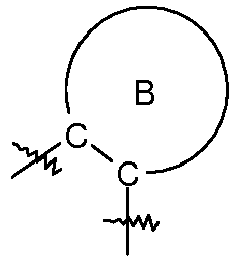
- 6-Cyclopropyl-3-(pyrimidin-5-ylamino)-pyridine-2-carboxylic acid (1-methyl-3-methylcarbamoyl-1H-pyrazol-4-yl)-amide,
- 6-Cyclopropyl-3-(pyrimidin-5-ylamino)-pyrazine-2-carboxylic acid (1-methyl-3-methylcarbamoyl-1H-pyrazol-4-yl)-amide,
- 6-Cyclopropyl-3-(pyrimidin-5-ylamino)-pyridine-2-carboxylic acid [1-(2-methoxy-ethyl)-5-methylcarbamoyl-1H-pyrazol-4-yl]-amide,
- 6-Cyclopropyl-N-[3-(2-hydroxy-2-methyl-propylcarbamoyl)-1-methyl-1H-pyrazol-4-yl]-3-(pyrimidin-5-ylamino)-pyridine-2-carboximidic acid,
- 2-Isopropyl-5-(pyrimidin-5-ylamino)-pyrimidine-4-carboxylic acid (1-methyl-3-methylcarbamoyl-1H-pyrazol-4-yl)-amide,
- 2-Isobutyl-5-(pyrimidin-5-ylamino)-pyrimidine-4-carboxylic acid (1-methyl-3-methylcarbamoyl-1H-pyrazol-4-yl)-amide,
- 6-cyclopropyl-N-(3-(2-hydroxy-2-methylpropylcarbamoyl)-1-methyl-1H-pyrazol-4-yl)-3-(pyrimidin-5-ylamino)pyrazine-2-carboxamide,
- 6-isobutyl-N-(1-methyl-3-(methylcarbamoyl)-1H-pyrazol-4-yl)-3-(pyrimidin-5-ylamino)pyrazine-2-carboxamide,
- 6-Cyclopropyl-3-(pyrimidin-5-ylamino)-pyrazine-2-carboxylic acid (1-methyl-5-methylcarbamoyl-1H-pyrazol-4-yl)-amide,
- 6-Cyclopropyl-3-(pyrimidin-5-ylamino)-pyrazine-2-carboxylic acid [5-(2-hydroxy-2-methylpropylcarbamoyl)-1-methyl-1H-pyrazol-4-yl]-amide,
- Particular compounds of formula (I), wherein
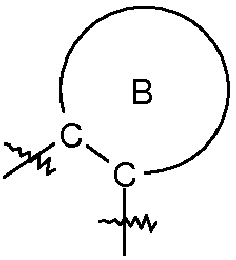
- 6-Cyclopropyl-3-(pyrimidin-5-ylamino)-pyridine-2-carboxylic acid (4-methylcarbamoyl-[1,2,3]thiadiazol-5-yl)-amide,
- 6-Cyclopropyl-3-(pyrimidin-5-ylamino)-pyridine-2-carboxylic acid (4-methylcarbamoyl-2-phenyl-thiazol-5-yl)-amide,
- 6-Cyclopropyl-3-(pyrimidin-5-ylamino)-pyridine-2-carboxylic acid (4-methylcarbamoyl-2-pyridin-2-yl-thiazol-5-yl)-amide,
- 6-Cyclopropyl-3-(pyrimidin-5-ylamino)-pyridine-2-carboxylic acid (3-cyclopropylcarbamoyl-thiophen-2-yl)-amide,
- 6-Cyclopropyl-3-(pyrimidin-5-ylamino)-pyridine-2-carboxylic acid [3-(morpholine-4-carbonyl)-thiophen-2-yl] -amide,
- 6-Cyclopropyl-3-(pyrimidin-5-ylamino)-pyridine-2-carboxylic acid [5-isopropyl-3-(morpholine-4-carbonyl)-thiophen-2-yl]-amide,
- Yet particular compounds of formula (I), wherein

- 6-Cyclopropyl-3-(pyrimidin-5-ylamino)-pyridine-2-carboxylic acid [3-(morpholine-4-carbonyl)-thiophen-2-yl]-amide,
- A particular embodiment of the present invention relates to compounds of formula (I) as described above, wherein


- R12
- is hydrogen or halogen, more specifically hydrogen;
- R13
- is hydrogen, C1-7 alkyl, C1-7 -alkoxy-C1-7 -alkyl, cycloalkyl or tetrahydrofuranyl, more specifically hydrogen, methyl or cyclopropyl;
- R14
- is hydrogen or C1-7 alkyl, more specifically hydrogen;
- R15
- is hydrogen or halogen, more specifically hydrogen;
- R16
- is hydrogen, halogen or diethylaminocarbonyl, more specifically fluoro;
- R17
- is hydrogen, halogen, C1-7 alkyl, C1-7 alkoxy, C1-7 haloalkyl, cyano, 2-hydroxy-ethoxy, 2-methoxy-ethoxy, 2-hydroxy-2-methyl-propoxy, 2-(hydroxycarbonyl)ethyl, 2-ethoxycarbonyl-ethyl, methylcarbamoylmethoxy or acetylamino, more specifically fluoro;
- R18
- is hydrogen, halogen, C1-7 alkyl or C1-7 alkoxy, more specifically hydrogen.
- Another particular embodiment of the present invention relates to compounds of formula (I) as described above, wherein


- A particular embodiment of the present invention relates to compounds of formula (I) as described above, wherein

- Another particular embodiment of the present invention relates to compounds of formula (I) as described above, wherein

- A particular embodiment of the present invention relates to compounds of formula (I) as described above, wherein

and wherein - R5 and R6
- are independently hydrogen, C1-7 alkyl, C1-7 hydroxyalkyl, C1-7 haloalkyl, C1-7-alkoxy-C1-7 -alkyl, cycloalkyl or heterocyclyl, wherein said C1-7 alkyl is optionally substituted by heterocyclyl, and wherein said heterocyclyl is optionally substituted by C1-7 alkyl, more specifically hydrogen, methyl, tetrahydrofuran-2-yl-methyl, ethyl, 2-hydroxy-1-methyl-ethyl, 2-hydroxy-1,1-dimethyl-ethyl, 2-methoxyethyl, 2-methoxy,-1-methyl-ethyl, 2-hydroxy-ethyl, 2-isopropoxy-ethyl, 2,2,2,-trifluoro-ethyl, isopropyl, 2,3-dihydroxy-propyl, 3-hydroxy-propyl, 2-hydroxy-2-methyl-propyl, 2-methoxy-2-methyl-propyl, 3-methoxy-2,2-dimethyl-propyl, cyclopropyl, cyclobutyl, cyclopentyl, cyclohexyl, tetrahydrofuran-3-yl, oxetan-3-yl, 3-methyl-oxetan-3-yl or tetrahydro-pyran-4-yl, yet more specifically hydrogen, methyl, 2-methoxy-1-methyl-ethyl, 2-hydroxy-2-methyl-propyl, 2-methoxy-2-methyl-propyl or cyclopropyl, or
- R5 and R6,
- together with the nitrogen atom to which they are attached, form an azetidine, pyrrolidine, piperidine, piperazine or 2-oxa-6-aza-spiro[3.3]heptane ring, wherein each of said azetidine, pyrrolidine, piperazine or 2-oxa-6-aza-spiro[3.3]heptane ring is optionally substituted by 1 or 2 substituents independently selected from the group consisting of hydroxyl, halogen, C1-7 alkyl, C1-7 hydroxyalkyl, C1-7 alkoxy, oxo and amino, and wherein said amino is substituted by 2 C1-7 alkyl; R5 and R6 more specifically forming an optionally substituted heterocyclyl or spiro-heterocyclyl ring selected from the group consisting of azetidin-1-yl, 3-hydroxy-azetidin-1-yl, 3,3-difluoro-azetidin-1-yl, pyrrolidin-1-yl, 2-methyl-pyrrolidin-1-yl, 3-hydroxy-pyrrolidin-1-yl, 3-methoxy-pyrrolidin-1-yl, 2-hydroxymethyl-pyrrolidin-1-yl, 3-dimethylamino-pyrrolidin-1-yl, 2,5-dimethyl-pyrrolidin-1-yl, 2,2-dimethyl-pyrrolidin-1-yl, 3,3-dimethyl-pyrrolidin-1-yl, 3,3-difluoro-pyrrolidin-1-yl, piperidin-1-yl, 2-methyl-piperidin-1-yl, 3-oxo-piperazin-1-yl, 3-methyl-morpholin-4-yl and 2-oxa-6-aza-spiro[3.3]heptan-6-yl.
- Yet another particular embodiment of the present invention relates to compounds of formula (I) as described above, wherein

and wherein - R5 and R6
- are independently hydrogen, C1-7 alkyl optionally substituted by heterocyclyl, C1-7 hydroxyalkyl, C1-7-alkoxy-C1-7 -alkyl, cycloalkyl or heterocyclyl optionally substituted by C1-7 alkyl, more specifically hydrogen, methyl, tetrahydrofuran-2-yl-methyl, 2-hydroxy-1-methyl-ethyl, 2-hydroxy-1,1-dimethyl-ethyl, 2-methoxyethyl, 2-methoxy,-1-methyl-ethyl, 2-hydroxy-ethyl, 2-isopropoxy-ethyl, 2,3-dihydroxy-propyl, 3-hydroxy-propyl, 2-hydroxy-2-methyl-propyl, 2-methoxy-2-methyl-propyl, 3-methoxy-2,2-dimethyl-propyl, cyclopropyl, cyclobutyl, cyclopentyl, cyclohexyl, tetrahydrofuran-3-yl, oxetan-3-yl or 3-methyl-oxetan-3-yl, yet more specifically hydrogen, 2-methoxy,-1-methyl-ethyl, 2-hydroxy-2-methyl-propyl, 2-methoxy-2-methyl-propyl or cyclopropyl, or
- R5 and R6,
- together with the nitrogen atom to which they are attached, form an azetidine, pyrrolidine, piperazine or 2-oxa-6-aza-spiro[3.3]heptane ring, wherein each of said azetidine, pyrrolidine, piperazine or 2-oxa-6-aza-spiro[3.3]heptane ring is optionally substituted by 1 or 2 substituents independently selected from the group consisting of hydroxyl, halogen, C1-7 alkyl, C1-7 hydroxyalkyl, C1-7 alkoxy, oxo and amino substituted by 2 C1-7 alkyl; R5 and R6 more specifically forming an optionally substituted heterocyclyl or spiro-heterocyclyl ring selected from the group consisting of azetidin-1-yl, 3-hydroxy-azetidin-1-yl, 3,3-difluoro-azetidin-1-yl, pyrrolidin-1-yl, 2-methyl-pyrrolidin-1-yl, 3-hydroxy-pyrrolidin-1-yl, 3-methoxy-pyrrolidin-1-yl, 2-hydroxymethyl-pyrrolidin-1-yl, 3-dimethylamino-pyrrolidin-1-yl, 2,5-dimethyl-pyrrolidin-1-yl, 2,2-dimethyl-pyrrolidin-1-yl, 3,3-dimethyl-pyrrolidin-1-yl, 3,3-difluoro-pyrrolidin-1-yl, 3-oxo-piperazin-1-yl and 2-oxa-6-aza-spiro[3.3]heptan-6-yl.
- Particular compounds of formula (I), wherein

- 6-Cyclopropyl-3-(pyrimidin-5-ylamino)-pyridine-2-carboxylic acid [4-(pyrrolidine-1-carbonyl)-pyridin-3-yl]-amide,
- 6-Cyclopropyl-3-(pyrimidin-5-ylamino)-pyridine-2-carboxylic acid (4-dimethylcarbamoyl-pyridin-3-yl)-amide,
- 6-Cyclopropyl-3-(pyrimidin-5-ylamino)-pyridine-2-carboxylic acid (4-methylcarbamoyl-pyridin-3-yl)-amide,
- 6-Cyclopropyl-3-(pyrimidin-5-ylamino)-pyridine-2-carboxylic acid (2-methylcarbamoyl-phenyl)-amide,
- 6-Cyclopropyl-N-[4-(3-dimethylamino-pyrrolidine-1-carbonyl)-pyridin-3-yl]-3-(pyrimidin-5-ylamino)-pyridine-2-carboximidic acid,
- 6-Cyclopropyl-N-[4-(2-methyl-pyrrolidine-1-carbonyl)-pyridin-3-yl]-3-(pyrimidin-5-ylamino)-pyridine-2-carboximidic acid,
- 6-Cyclopropyl-N-[4-(3,3-difluoro-pyrrolidine-1-carbonyl)-pyridin-3-yl]-3-(pyrimidin-5-ylamino)-pyridine-2-carboximidic acid,
- 6-Cyclopropyl-N-(4-cyclopropylcarbamoyl-pyridin-3-yl)-3-(pyrimidin-5-ylamino)-pyridine-2-carboximidic acid,
- N-(4-Cyclobutylcarbamoyl-pyridin-3-yl)-6-cyclopropyl-3-(pyrimidin-5-ylamino)-pyridine-2-carboximidic acid,
- 6-Cyclopropyl-N-[4-(2,5-dimethyl-pyrrolidine-1-carbonyl)-pyridin-3-yl]-3-(pyrimidin-5-ylamino)-pyridine-2-carboximidic acid,
- 6-Cyclopropyl-N-[4-(5-hydroxy-3,6-dihydro-2H-pyrazine-1-carbonyl)-pyridin-3-yl]-3-(pyrimidin-5-ylamino)-pyridine-2-carboximidic acid,
- N-(4-Cyclopentylcarbamoyl-pyridin-3-yl)-6-cyclopropyl-3-(pyrimidin-5-ylamino)-pyridine-2-carboximidic acid,
- 6-Cyclopropyl-N-[4-(3-methoxy-pyrrolidine-1-carbonyl)-pyridin-3-yl]-3-(pyrimidin-5-ylamino)-pyridine-2-carboximidic acid,
- 6-Cyclopropyl-N-[4-(3,3-dimethyl-pyrrolidine-1-carbonyl)-pyridin-3-yl]-3-(pyrimidin-5-ylamino)-pyridine-2-carboximidic acid,
- 6-Cyclopropyl-N-[4-(2-hydroxy-1-methyl-ethylcarbamoyl)-pyridin-3-yl]-3-(pyrimidin-5-ylamino)-pyridine-2-carboximidic acid,
- N-[4-(Azetidine-1-carbonyl)-pyridin-3-yl]-6-cyclopropyl-3-(pyrimidin-5-ylamino)-pyridine-2-carboximidic acid,
- 6-Cyclopropyl-N-[4-(2-hydroxy-ethylcarbamoyl)-pyridin-3-yl]-3-(pyrimidin-5-ylamino)-pyridine-2-carboximidic acid,
- 6-Cyclopropyl-N-[4-(2,3-dihydroxy-propylcarbamoyl)-pyridin-3-yl]-3-(pyrimidin-5-ylamino)-pyridine-2-carboximidic acid,
- 6-Cyclopropyl-N-[4-(2-hydroxy-2-methyl-propylcarbamoyl)-pyndin-3-yl]-3-(pynmidm-5-ylamino)-pyridine-2-carboximidic acid,
- 6-Cyclopropyl-N-{4-[(3-hydroxy-propyl)-methyl-carbamoyl]-pyridin-3-yl}-3-(pyrimidin-5-ylamino)-pyridine-2-carboximidic acid,
- 6-Cyclopropyl-N-[4-(2-methoxy-1-methyl-ethylcarbamoyl)-pyridin-3-yl]-3-(pyrimidin-5-ylamino)-pyridine-2-carboximidic acid,
- 6-Cyclopropyl-N-{4-[(2-hydroxy-ethyl)-methyl-carbamoyl]-pyridin-3-yl}-3-(pyrimidin-5-ylamino)-pyridine-2-carboximidic acid,
- N-(4-Cyclohexylcarbamoyl-pyridin-3-yl)-6-cyclopropyl-3-(pyrimidin-5-ylamino)-pyridine-2-carboximidic acid,
- 6-Cyclopropyl-N-[4-(3,3-difluoro-azetidine-1-carbonyl)-pyridin-3-yl]-3-(pyrimidin-5-ylamino)-pyridine-2-carboximidic acid,
- 6-Cyclopropyl-N-[4-(2-hydroxymethyl-pyrrolidine-1-carbonyl)-pyridin-3-yl]-3-(pyrimidin-5-ylamino)-pyridine-2-carboximidic acid,
- 7-{[6-Cyclopropyl-3-(pyrimidin-5-ylamino)-pyridine-2-carbonyl]-amino}-2-phenyl-imidazo[1,2-a]pyridine-6-carboxylic acid methylamide,
- 6-Cyclopropyl-N-[4-(3-hydroxy-azetidine-1-carbonyl)-pyridin-3-yl]-3-(pyrimidin-5-ylamino)-pyridine-2-carboximidic acid,
- 6-Cyclopropyl-N-[4-(2,2-dimethyl-pyrrolidine-1-carbonyl)-pyridin-3-yl]-3-(pyrimidin-5-ylamino)-pyridine-2-carboximidic acid,
- 6-Cyclopropyl-N-{4-[(2,3-dihydroxy-propyl)-methyl-carbamoyl]-pyridin-3-yl}-3-(pyrimidin-5-ylamino)-pyridine-2-carboximidic acid,
- 6-Cyclopropyl-N-[4-(3-hydroxy-pyrrolidine-1-carbonyl)-pyridin-3-yl]-3-(pyrimidin-5-ylamino)-pyridine-2-carboximidic acid,
- 6-Cyclopropyl-N-[4-(2-oxa-6-aza-spiro[3.3]heptane-6-carbonyl)-pyridin-3-yl]-3-(pyrimidin-5-ylamino)-pyridine-2-carboximidic acid,
- 2-Isopropyl-5-(pyrimidin-5-ylamino)-pyrimidine-4-carboxylic acid [4-(2-hydroxy-2-methylpropylcarbamoyl)-pyridin-3-yl]-amide,
- 2-tert-Butyl-5-(pyrimidin-5-ylamino)-pyrimidine-4-carboxylic acid [4-(2-hydroxy-2-methylpropylcarbamoyl)-pyridin-3-yl]-amide,
- 2-(2-tert-butyl-5-(pyrimidin-5-ylamino)pyrimidine-4-carboxamido)-N4,N4-diethyl-N1-methylterephthalamide,
- 5-{[6-Cyclopropyl-3-(pyrimidin-5-ylamino)-pyrazine-2-carbonyl]-amino}-pyrimidine-4-carboxylic acid (2-hydroxy-2-methyl-propyl)-amide,
- 6-Cyclopropyl-3-(pyrimidin-5-ylamino)-pyrazine-2-carboxylic acid [2-(2-hydroxy-2-methyl-propylcarbamoyl)-pyridin-3-yl]-amide,
- 6-Cyclopropyl-3-(pyrimidin-5-ylamino)-pyrazine-2-carboxylic acid [4-(2-isopropoxy-ethylcarbamoyl)-pyridin-3-yl]-amide,
- 6-Cyclopropyl-3-(pyrimidin-5-ylamino)-pyrazine-2-carboxylic acid [4-(tetrahydro-furan-3-ylcarbamoyl)-pyridin-3-yl]-amide,
- 6-Cyclopropyl-3-(pyrimidin-5-ylamino)-pyrazine-2-carboxylic acid {4-[(tetrahydro-furan-2-ylmethyl)-carbamoyl]-pyridin-3-yl -amide,
- 6-Cyclopropyl-3-(pyrimidin-5-ylamino)-pyrazine-2-carboxylic acid [4-(2-hydroxy-2-methylpropylcarbamoyl)-pyridin-3-yl]-amide,
- 6-Cyclopropyl-3-(pyrimidin-5-ylamino)-pyrazine-2-carboxylic acid [4-(oxetan-3-ylcarbamoyl)-pyridin-3-yl]-amide,
- 6-Cyclopropyl-3-(pyrimidin-5-ylamino)-pyrazine-2-carboxylic acid [4,5-difluoro-2-(2-hydroxy-2-methyl-propylcarbamoyl)-phenyl]-amide,
- 6-Cyclopropyl-3-(pyrimidin-5-ylamino)-pyrazine-2-carboxylic acid [4-(2-methoxy-2-methyl-propylcarbamoyl)-pyridin-3-yl]-amide,
- 6-Cyclopropyl-3-(pyrimidin-5-ylamino)-pyrazine-2-carboxylic acid [4-(3-methoxy-2,2-dimethyl-propylcarbamoyl)-pyridin-3-yl]-amide,
- 6-cyclopropyl-N-(2-((2-methoxyethyl)(methyl)carbamoyl)pyridin-3-yl)-3-(pyrimidin-5-ylamino)pyrazine-2-carboxamide,
- 5-(6-cyclopropyl-3-(pyrimidin-5-ylamino)pyrazine-2-carboxamido)-N-(2-methoxyethyl)-N-methylpyrimidine-4-carboxamide,
- 6-cyclopropyl-N-(3-(2-hydroxy-2-methylpropylcarbamoyl)pyridin-4-yl)-3-(pyrimidin-5-ylamino)pyrazine-2-carboxamide,
- 6-Cyclopropyl-3-(pyrimidin-5-ylamino)-pyrazine-2-carboxylic acid [4-(3-methyl-oxetan-3-ylcarbamoyl)-pyridin-3-yl]-amide,
- 5-(6-cyclopropyl-3-(pyrimidin-5-ylamino)pyrazine-2-carboxamido)-N-(2-hydroxy-2-methylpropyl)-N-methylpyrimidine-4-carboxamide,
- 6-cyclopropyl-N-(2-((2-hydroxy-2-methylpropyl)(methyl)carbamoyl)pyridin-3-yl)-3-(pyrimidin-5-ylamino)pyrazine-2-carboxamide,
- 6-Cyclopropyl-3-(pyrimidin-5-ylamino)-pyrazine-2-carboxylic acid (4-methylcarbamoyl-pyridin-3-yl)-amide,
- 6-Cyclopropyl-3-(pyrimidin-5-ylamino)-pyrazine-2-carboxylic acid [4-(2-hydroxy-1,1-dimethyl-ethylcarbamoyl)-pyridin-3-yl]-amide,
- 6-Cyclopropyl-3-(pyrimidin-5-ylamino)-pyrazine-2-carboxylic acid (2-methylcarbamoyl-pyridin-3-yl)-amide,
- 6-Cyclopropyl-3-(pyrimidin-5-ylamino)-pyrazine-2-carboxylic acid (2-dimethylcarbamoyl-pyridin-3-yl)-amide,
- 6-Cyclopropyl-3-(pyrimidin-5-ylamino)-pyrazine-2-carboxylic acid (6-cyclopropyl-2-methylcarbamoyl-pyridin-3-yl)-amide,
- 6-Cyclopropyl-3-(pyrimidin-5-ylamino)-pyrazine-2-carboxylic acid [6-cyclopropyl-2-(2-hydroxy-2-methyl-propylcarbamoyl)-pyridin-3-yl]-amide,
- 6-Cyclopropyl-3-(pyrimidin-5-ylamino)-pyrazine-2-carboxylic acid [2-methylcarbamoyl-6-(tetrahydro-furan-2-yl)-pyridin-3-yl]-amide,
- 6-Cyclopropyl-3-(pyrimidin-5-ylamino)-pyrazine-2-carboxylic acid [2-(2-hydroxy-2-methylpropylcarbamoyl)-6-(tetrahydro-furan-2-yl)-pyridin-3-yl]-amide,
- 6-Cyclopropyl-3-(pyrimidin-5-ylamino)-pyrazine-2-carboxylic acid (6-ethyl-2-methylcarbamoyl-pyridin-3-yl)-amide,
- 6-Cyclopropyl-3-(pyrimidin-5-ylamino)-pyrazine-2-carboxylic acid [6-ethyl-2-(2-hydroxy-2-methyl-propylcarbamoyl)-pyridin-3-yl]-amide,
- 6-Cyclopropyl-3-(pyrimidin-5-ylamino)-pyrazine-2-carboxylic acid (6-methyl-2-methylcarbamoyl-pyridin-3-yl)-amide,
- 6-Cyclopropyl-3-(pyrimidin-5-ylamino)-pyrazine-2-carboxylic acid [2-(2-hydroxy-2-methylpropylcarbamoyl)-6-methyl-pyridin-3-yl]-amide,
- 6-Cyclopropyl-3-(pyrimidin-5-ylamino)-pyrazine-2-carboxylic acid (3-methoxy-2-methylcarbamoyl-phenyl)-amide,
- 6-Cyclopropyl-3-(pyrimidin-5-ylamino)-pyrazine-2-carboxylic acid [2-(azetidine-1-carbonyl)-pyridin-3-yl]-amide,
- 6-Cyclopropyl-3-(pyrimidin-5-ylamino)-pyrazine-2-carboxylic acid [2-(piperidine-1-carbonyl)-pyridin-3-yl]-amide,
- 6-Cyclopropyl-3-(pyrimidin-5-ylamino)-pyrazine-2-carboxylic acid (3-chloro-2-methylcarbamoyl-phenyl)-amide,
- 6-Cyclopropyl-3-(pyrimidin-5-ylamino)-pyrazine-2-carboxylic acid [2-(pyrrolidine-1-carbonyl)-pyridin-3-yl]-amide,
- 6-Cyclopropyl-3-(pyrimidin-5-ylamino)-pyrazine-2-carboxylic acid [2-(ethyl-methylcarbamoyl)-pyridin-3-yl]-amide,
- 5-{ [6-Cyclopropyl-3-(pyrimidin-5-ylamino)-pyrazine-2-carbonyl]-amino}-pyrimidine-4-carboxylic acid ethyl-methyl-amide,
- 5-{[6-Cyclopropyl-3-(pyrimidin-5-ylamino)-pyrazine-2-carbonyl]-amino}-pyrimidine-4-carboxylic acid dimethylamide,
- 6-Cyclopropyl-3-(pyrimidin-5-ylamino)-pyrazine-2-carboxylic acid (2-dimethylcarbamoyl-3-methoxy-phenyl)-amide,
- 6-Cyclopropyl-3-(pyrimidin-5-ylamino)-pyrazine-2-carboxylic acid [2-(2-hydroxy-2-methylpropylcarbamoyl)-4-isopropyl-phenyl]-amide,
- 6-Cyclopropyl-3-(pyrimidin-5-ylamino)-pyrazine-2-carboxylic acid (4-isopropyl-2-methylcarbamoyl-phenyl)-amide,
- 6-Cyclopropyl-3-(pyrimidin-5-ylamino)-pyrazine-2-carboxylic acid (6-methoxymethyl-2-methylcarbamoyl-pyridin-3-yl)-amide,
- 6-Cyclopropyl-3-(pyrimidin-5-ylamino)-pyrazine-2-carboxylic acid [2-(2-hydroxy-2-methylpropylcarbamoyl)-6-methoxymethyl-pyridin-3-yl]-amide,
- 6-Cyclopropyl-3-(pyrimidin-5-ylamino)-pyrazine-2-carboxylic acid [4-(azetidine-1-carbonyl)-pyrimidin-5-yl]-amide,
- 6-Cyclopropyl-3-(pyrimidin-5-ylamino)-pyrazine-2-carboxylic acid [4-(piperidine-1-carbonyl)-pyrimidin-5-yl]-amide,
- 6-Cyclopropyl-3-(pyrimidin-5-ylamino)-pyrazine-2-carboxylic acid [2-(2-hydroxy-2-methylpropylcarbamoyl)-4-(2-methoxy-ethoxy)-phenyl]-amide,
- 6-Cyclopropyl-3-(pyrimidin-5-ylamino)-pyrazine-2-carboxylic acid [4-(2-methoxy-ethoxy)-2-methylcarbamoyl-phenyl]-amide,
- 6-Cyclopropyl-3-(pyrimidin-5-ylamino)-pyrazine-2-carboxylic acid [4-(2-hydroxy-ethoxy)-2-(2-hydroxy-2-methyl-propylcarbamoyl)-phenyl]-amide,
- 6-Cyclopropyl-3-(pyrimidin-5-ylamino)-pyrazine-2-carboxylic acid [4-(2-hydroxy-ethoxy)-2-methylcarbamoyl-phenyl]-amide,
- 5-{[6-Cyclopropyl-3-(pyrimidin-5-ylamino)-pyrazine-2-carbonyl]-amino}-pyrimidine-4-carboxylic acid methylamide,
- 6-Cyclopropyl-3-(pyrimidin-5-ylamino)-pyrazine-2-carboxylic acid [4-(pyrrolidine-1-carbonyl)-pyrimidin-5-yl]-amide,
- 6-Cyclopropyl-3-(pyrimidin-5-ylamino)-pyrazine-2-carboxylic acid (2-ethylcarbamoyl-pyridin-3-yl)-amide,
- 6-Cyclopropyl-3-(pyrimidin-5-ylamino)-pyrazine-2-carboxylic acid (2-isopropylcarbamoyl-pyridin-3-yl)-amide,
- 6-Cyclopropyl-3-(pyrimidin-5-ylamino)-pyrazine-2-carboxylic acid (3-methyl-2-methylcarbamoyl-phenyl)-amide,
- 6-Cyclopropyl-3-(pyrimidin-5-ylamino)-pyrazine-2-carboxylic acid (4-methoxy-2-methylcarbamoyl-phenyl)-amide,
- 6-Cyclopropyl-3-(pyrimidin-5-ylamino)-pyrazine-2-carboxylic acid {2-[methyl-(tetrahydropyran-4-yl)-carbamoyl]-pyridin-3-yl}-amide,
- 6-Cyclopropyl-3-(pyrimidin-5-ylamino)-pyrazine-2-carboxylic acid {2-[methyl-(2,2,2-trifluoro-ethyl)-carbamoyl] -pyridin-3-yl -amide,
- 6-Cyclopropyl-3-(pyrimidin-5-ylamino)-pyrazine-2-carboxylic acid [2-(cyclopropyl-methylcarbamoyl)-pyridin-3-yl]-amide,
- 6-Cyclopropyl-3-(pyrimidin-5-ylamino)-pyrazine-2-carboxylic acid [2-(2-methyl-pyrrolidine-1-carbonyl)-pyridin-3-yl]-amide,
- 6-Cyclopropyl-3-(pyrimidin-5-ylamino)-pyrazine-2-carboxylic acid [2-(2-methyl-piperidine-1-carbonyl)-pyridin-3-yl]-amide,
- 6-Cyclopropyl-3-(pyrimidin-5-ylamino)-pyrazine-2-carboxylic acid [2-(3-methyl-morpholine-4-carbonyl)-pyridin-3-yl]-amide,
- 6-Cyclopropyl-3-(pyrimidin-5-ylamino)-pyrazine-2-carboxylic acid (6-chloro-4-methylcarbamoyl-pyridin-3-yl)-amide,
- 6-Cyclopropyl-3-(pyrimidin-5-ylamino)-pyrazine-2-carboxylic acid [6-chloro-4-(2-hydroxy-2-methyl-propylcarbamoyl)-pyridin-3-yl]-amide,
- 6-Cyclopropyl-3-(pyrimidin-5-ylamino)-pyrazine-2-carboxylic acid (4-cyano-2-methylcarbamoyl-phenyl)-amide,
- 6-Cyclopropyl-3-(pyrimidin-5-ylamino)-pyrazine-2-carboxylic acid [4-cyano-2-(2-hydroxy-2-methyl-propylcarbamoyl)-phenyl]-amide,
- 6-Cyclopropyl-3-(pyrimidin-5-ylamino)-pyrazine-2-carboxylic acid (3,4-dimethyl-2-methylcarbamoyl-phenyl)-amide,
- 6-Cyclopropyl-3-(pyrimidin-5-ylamino)-pyrazine-2-carboxylic acid (6-cyclopropyl-2-dimethylcarbamoyl-pyridin-3-yl)-amide,
- 6-Cyclopropyl-3-(pyrimidin-5-ylamino)-pyrazine-2-carboxylic acid (2-dimethylcarbamoyl-6-methyl-pyridin-3-yl)-amide,
- 6-Cyclopropyl-3-(pyrimidin-5-ylamino)-pyrazine-2-carboxylic acid {2-[(2-hydroxy-ethyl)-methyl-carbamoyl] -pyridin-3-yl} -amide,
- 6-Cyclopropyl-3-(pyrimidin-5-ylamino)-pyrazine-2-carboxylic acid {2-[ethyl-(2-hydroxy-ethyl)-carbamoyl] -pyridin-3-yl -amide,
- 6-Cyclopropyl-3-(pyrimidin-5-ylamino)-pyrazine-2-carboxylic acid [2-(2-hydroxyethylcarbamoyl)-pyridin-3-yl]-amide,
- 6-Cyclopropyl-3-(pyrimidin-5-ylamino)-pyrazine-2-carboxylic acid [2-(azetidine-1-carbonyl)-6-cyclopropyl-pyridin-3-yl]-amide,
- 6-Cyclopropyl-3-(pyrimidin-5-ylamino)-pyrazine-2-carboxylic acid [2-(2-hydroxy-1,1-dimethyl-ethylcarbamoyl)-pyridin-3-yl]-amide,
- 6-Cyclopropyl-3-(pyrimidin-5-ylamino)-pyrazine-2-carboxylic acid (4-acetylamino-2-methylcarbamoyl-phenyl)-amide,
- 6-Cyclopropyl-3-(pyrimidin-5-ylamino)-pyrazine-2-carboxylic acid [2-(3-methyl-oxetan-3-ylcarbamoyl)-pyridin-3-yl]-amide,
- 6-Cyclopropyl-3-(pyrimidin-5-ylamino)-pyrazine-2-carboxylic acid {2-[methyl-(tetrahydrofuran-2-ylmethyl)-carbamoyl]-pyridin-3-yl}-amide,
- 6-Cyclopropyl-3-(pyrimidin-5-ylamino)-pyrazine-2-carboxylic acid [2-(oxetan-3-ylcarbamoyl)-pyridin-3-yl]-amide,
- 6-Cyclopropyl-3-(pyrimidin-5-ylamino)-pyrazine-2-carboxylic acid [2-(azetidine-1-carbonyl)-6-methyl-pyridin-3-yl]-amide,
- 5-{[6-Cyclopropyl-3-(pyrimidin-5-ylamino)-pyrazine-2-carbonyl]-amino}-2-methyl-pyrimidine-4-carboxylic acid (2-hydroxy-2-methyl-propyl)-amide,
- 6-Cyclopropyl-3-(pyrimidin-5-ylamino)-pyrazine-2-carboxylic acid (2-dimethylcarbamoyl-4,5-difluoro-phenyl)-amide,
- 5-{[6-Cyclopropyl-3-(pyrimidin-5-ylamino)-pyrazine-2-carbonyl]-amino}-2-methylpyrimidine-4-carboxylic acid methylamide,
- 6-Cyclopropyl-3-(pyrimidin-5-ylamino)-pyrazine-2-carboxylic acid (4,5-difluoro-2-methylcarbamoyl-phenyl)-amide,
- 6-Cyclopropyl-3-(pyrimidin-5-ylamino)-pyrazine-2-carboxylic acid (2-fluoro-6-methylcarbamoyl-phenyl)-amide,
- 6-Cyclopropyl-3-(pyrimidin-5-ylamino)-pyrazine-2-carboxylic acid [2-(azetidine-1-carbonyl)-4,5-difluoro-phenyl]-amide,
- 6-Cyclopropyl-3-(pyrimidin-5-ylamino)-pyrazine-2-carboxylic acid (5-fluoro-2-methylcarbamoyl-phenyl)-amide,
- 6-Cyclopropyl-3-(pyrimidin-5-ylamino)-pyrazine-2-carboxylic acid [2-fluoro-6-(2-hydroxy-2-methyl-propylcarbamoyl)-phenyl]-amide,
- 6-Cyclopropyl-3-(pyrimidin-5-ylamino)-pyrazine-2-carboxylic acid (2-dimethylcarbamoyl-5-fluoro-phenyl)-amide,
- 6-Cyclopropyl-3-(pyrimidin-5-ylamino)-pyrazine-2-carboxylic acid [2-(2-hydroxy-2-methylpropylcarbamoyl)-4-trifluoromethyl-phenyl]-amide,
- 6-Cyclopropyl-3-(pyrimidin-5-ylamino)-pyrazine-2-carboxylic acid (2-methylcarbamoyl-4-trifluoromethyl-phenyl)-amide,
- 6-Cyclopropyl-3-(pyrimidin-5-ylamino)-pyrazine-2-carboxylic acid (2-dimethylcarbamoyl-4-fluoro-phenyl)-amide,
- 6-Cyclopropyl-3-(pyrimidin-5-ylamino)-pyrazine-2-carboxylic acid (3,5-difluoro-2-methylcarbamoyl-phenyl)-amide,
- 6-Cyclopropyl-3-(pyrimidin-5-ylamino)-pyrazine-2-carboxylic acid (2-dimethylcarbamoyl-3,5-difluoro-phenyl)-amide,
- 6-Cyclopropyl-3-(pyrimidin-5-ylamino)-pyrazine-2-carboxylic acid [5-fluoro-2-(2-hydroxy-2-methyl-propylcarbamoyl)-phenyl]-amide,
- 6-Cyclopropyl-3-(pyrimidin-5-ylamino)-pyrazine-2-carboxylic acid [2-(azetidine-1-carbonyl)-5-fluoro-phenyl]-amide,
- 6-Cyclopropyl-3-(pyrimidin-5-ylamino)-pyrazine-2-carboxylic acid (2-dimethylcarbamoyl-6-fluoro-phenyl)-amide,
- 6-Cyclopropyl-3-(pyrimidin-5-ylamino)-pyrazine-2-carboxylic acid [2-(azetidine-1-carbonyl)-4-fluoro-phenyl]-amide,
- 6-Cyclopropyl-3-(pyrimidin-5-ylamino)-pyrazine-2-carboxylic acid [4-fluoro-2-(2-hydroxy-2-methyl-propylcarbamoyl)-phenyl]-amide,
- 6-Cyclopropyl-3-(pyrimidin-5-ylamino)-pyrazine-2-carboxylic acid (3-fluoro-2-methylcarbamoyl-phenyl)-amide,
- 6-Cyclopropyl-3-(pyrimidin-5-ylamino)-pyrazine-2-carboxylic acid (2-dimethylcarbamoyl-3-fluoro-phenyl)-amide,
- 6-Cyclopropyl-3-(pyrimidin-5-ylamino)-pyrazine-2-carboxylic acid [2-(azetidine-1-carbonyl)-3-fluoro-phenyl]-amide,
- 6-Cyclopropyl-3-(pyrimidin-5-ylamino)-pyrazine-2-carboxylic acid [3-fluoro-2-(2-hydroxy-2-methyl-propylcarbamoyl)-phenyl]-amide,
- 6-Cyclopropyl-3-(pyrimidin-5-ylamino)-pyrazine-2-carboxylic acid (4-fluoro-2-methylcarbamoyl-phenyl)-amide,
- 6-Cyclopropyl-3-(pyrimidin-5-ylamino)-pyrazine-2-carboxylic acid (2-dimethylcarbamoyl-3,4-difluoro-phenyl)-amide,
- 6-Cyclopropyl-3-(pyrimidin-5-ylamino)-pyrazine-2-carboxylic acid (3,4-difluoro-2-methylcarbamoyl-phenyl)-amide,
- 6-Cyclopropyl-3-(pyrimidin-5-ylamino)-pyrazine-2-carboxylic acid [3,4-difluoro-2-(2-hydroxy-2-methyl-propylcarbamoyl)-phenyl]-amide,
- 6-Cyclopropyl-3-(pyrimidin-5-ylamino)-pyrazine-2-carboxylic acid [2-(azetidine-1-carbonyl)-3,4-difluoro-phenyl]-amide,
- 6-Cyclopropyl-3-(pyrimidin-5-ylamino)-pyrazine-2-carboxylic acid [6-(azetidine-1-carbonyl)-2,3-difluoro-phenyl]-amide,
- 3-(4-{[6-Cyclopropyl-3-(pyrimidin-5-ylamino)-pyrazine-2-carbonyl]-amino}-3-methylcarbamoyl-phenyl)-propionic acid ethyl ester,
- 6-Cyclopropyl-3-(pyrimidin-5-ylamino)-pyrazine-2-carboxylic acid (2-methylcarbamoyl-4-methylcarbamoylmethoxy-phenyl)-amide,
- 6-Cyclopropyl-3-(pyrimidin-5-ylamino)-pyrazine-2-carboxylic acid [2-(azetidine-1-carbonyl)-3,5-difluoro-phenyl]-amide,
- 6-Cyclopropyl-3-(pyrimidin-5-ylamino)-pyrazine-2-carboxylic acid [3,5-difluoro-2-(2-hydroxy-2-methyl-propylcarbamoyl)-phenyl]-amide,
- 6-Cyclopropyl-3-(pyrimidin-5-ylamino)-pyrazine-2-carboxylic acid (6-dimethylcarbamoyl-2,3-difluoro-phenyl)-amide,
- 6-Cyclopropyl-3-(pyrimidin-5-ylamino)-pyrazine-2-carboxylic acid [2,3-difluoro-6-(2-hydroxy-2-methyl-propylcarbamoyl)-phenyl]-amide,
- 6-Cyclopropyl-3-(pyrimidin-5-ylamino)-pyrazine-2-carboxylic acid (2,3-difluoro-6-methylcarbamoyl-phenyl)-amide,
- 3-(4-{[6-Cyclopropyl-3-(pyrimidin-5-ylamino)-pyrazine-2-carbonyl]-amino}-3-methylcarbamoyl-phenyl)-propionic acid,
- 2-Isopropyl-5-(pyrimidin-5-ylamino)-pyrimidine-4-carboxylic acid [2-(2-hydroxy-2-methylpropylcarbamoyl)-pyridin-3-yl]-amide,
- 2-tert-Butyl-5-(pyrimidin-5-ylamino)-pyrimidine-4-carboxylic acid [2-(2-hydroxy-2-methylpropylcarbamoyl)-pyridin-3-yl]-amide,
- 2-Isobutyl-5-(pyrimidin-5-ylamino)-pyrimidine-4-carboxylic acid [2-(2-hydroxy-2-methyl-propylcarbamoyl)-pyridin-3-yl]-amide, and
- 6-Cyclopropyl-3-(pyrimidin-5-ylamino)-pyrazine-2-carboxylic acid [4-(2-hydroxy-2-methyl-propoxy)-2-methylcarbamoyl-phenyl]-amide,
- Yet particular compounds of formula (I), wherein

- 6-Cyclopropyl-N-(4-cyclopropylcarbamoyl-pyridin-3-yl)-3-(pyrimidin-5-ylamino)-pyridine-2-carboximidic acid,
- 6-Cyclopropyl-N-[4-(2-hydroxy-2-methyl-propylcarbamoyl)-pyridin-3-yl]-3-(pyrimidin-5-ylamino)-pyridine-2-carboximidic acid,
- 6-Cyclopropyl-N-[4-(2-methoxy-1-methyl-ethylcarbamoyl)-pyridin-3-yl]-3-(pyrimidin-5-ylamino)-pyridine-2-carboximidic acid,
- 5-{[6-Cyclopropyl-3-(pyrimidin-5-ylamino)-pyrazine-2-carbonyl]-amino}-pyrimidine-4-carboxylic acid (2-hydroxy-2-methyl-propyl)-amide,
- 6-Cyclopropyl-3-(pyrimidin-5-ylamino)-pyrazine-2-carboxylic acid [2-(2-hydroxy-2-methylpropylcarbamoyl)-pyridin-3-yl]-amide,
- 6-Cyclopropyl-3-(pyrimidin-5-ylamino)-pyrazine-2-carboxylic acid [4-(2-hydroxy-2-methylpropylcarbamoyl)-pyridin-3-yl]-amide,
- 6-Cyclopropyl-3-(pyrimidin-5-ylamino)-pyrazine-2-carboxylic acid [4,5-difluoro-2-(2-hydroxy-2-methyl-propylcarbamoyl)-phenyl]-amide,
- 6-Cyclopropyl-3-(pyrimidin-5-ylamino)-pyrazine-2-carboxylic acid [4-(2-methoxy-2-methylpropylcarbamoyl)-pyridin-3-yl]-amide,
- 6-cyclopropyl-N-(2-((2-hydroxy-2-methylpropyl)(methyl)carbamoyl)pyridin-3-yl)-3-(pyrimidin-5-ylamino)pyrazine-2-carboxamide,
- 6-Cyclopropyl-3-(pyrimidin-5-ylamino)-pyrazine-2-carboxylic acid (6-cyclopropyl-2-methylcarbamoyl-pyridin-3-yl)-amide,
- 6-Cyclopropyl-3-(pyrimidin-5-ylamino)-pyrazine-2-carboxylic acid [2-(2-hydroxy-2-methylpropylcarbamoyl)-6-methyl-pyridin-3-yl]-amide,
- 2-Isopropyl-5-(pyrimidin-5-ylamino)-pyrimidine-4-carboxylic acid [2-(2-hydroxy-2-methylpropylcarbamoyl)-pyridin-3-yl]-amide, and
- 2-tert-Butyl-5-(pyrimidin-5-ylamino)-pyrimidine-4-carboxylic acid [2-(2-hydroxy-2-methylpropylcarbamoyl)-pyridin-3-yl]-amide,
- Particular compounds of formula (I), wherein

- 6-Cyclopropyl-3-(pyrimidin-5-ylamino)-pyridine-2-carboxylic acid [4-(pyrrolidine-1-carbonyl)-pyridin-3-yl]-amide,
- 6-Cyclopropyl-3-(pyrimidin-5-ylamino)-pyridine-2-carboxylic acid (4-dimethylcarbamoyl-pyridin-3-yl)-amide,
- 6-Cyclopropyl-3-(pyrimidin-5-ylamino)-pyridine-2-carboxylic acid (4-methylcarbamoyl-pyridin-3-yl)-amide,
- 6-Cyclopropyl-N-[4-(3-dimethylamino-pyrrolidine-1-carbonyl)-pyridin-3-yl]-3-(pyrimidin-5-ylamino)-pyridine-2-carboximidic acid,
- 6-Cyclopropyl-N-[4-(2-methyl-pyrrolidine-1-carbonyl)-pyridin-3-yl]-3-(pyrimidin-5-ylamino)-pyridine-2-carboximidic acid,
- 6-Cyclopropyl-N-[4-(3,3-difluoro-pyrrolidine-1-carbonyl)-pyridin-3-yl]-3-(pyrimidin-5-ylamino)-pyridine-2-carboximidic acid,
- 6-Cyclopropyl-N-(4-cyclopropylcarbamoyl-pyridin-3-yl)-3-(pyrimidin-5-ylamino)-pyridine-2-carboximidic acid,
- N-(4-Cyclobutylcarbamoyl-pyridin-3-yl)-6-cyclopropyl-3-(pyrimidin-5-ylamino)-pyridine-2-carboximidic acid,
- 6-Cyclopropyl-N-[4-(2,5-dimethyl-pyrrolidine-1-carbonyl)-pyridin-3-yl]-3-(pyrimidin-5-ylamino)-pyridine-2-carboximidic acid,
- 6-Cyclopropyl-N-[4-(5-hydroxy-3,6-dihydro-2H-pyrazine-1-carbonyl)-pyridin-3-yl]-3-(pyrimidin-5-ylamino)-pyridine-2-carboximidic acid,
- N-(4-Cyclopentylcarbamoyl-pyridin-3-yl)-6-cyclopropyl-3-(pyrimidin-5-ylamino)-pyridine-2-carboximidic acid,
- 6-Cyclopropyl-N-[4-(3-methoxy-pyrrolidine-1-carbonyl)-pyridin-3-yl]-3-(pyrimidin-5-ylamino)-pyridine-2-carboximidic acid,
- 6-Cyclopropyl-N-[4-(3,3-dimethyl-pyrrolidine-1-carbonyl)-pyridin-3-yl]-3-(pyrimidin-5-ylamino)-pyridine-2-carboximidic acid,
- 6-Cyclopropyl-N-[4-(2-hydroxy-1-methyl-ethylcarbamoyl)-pyridin-3-yl]-3-(pyrimidin-5-ylamino)-pyridine-2-carboximidic acid,
- N-[4-(Azetidine-1-carbonyl)-pyridin-3-yl]-6-cyclopropyl-3-(pyrimidin-5-ylamino)-pyridine-2-carboximidic acid,
- 6-Cyclopropyl-N-[4-(2-hydroxy-ethylcarbamoyl)-pyridin-3-yl]-3-(pyrimidin-5-ylamino)-pyridine-2-carboximidic acid,
- 6-Cyclopropyl-N-[4-(2,3-dihydroxy-propylcarbamoyl)-pyridin-3-yl]-3-(pyrimidin-5-ylamino)-pyridine-2-carboximidic acid,
- 6-Cyclopropyl-N-[4-(2-hydroxy-2-methyl-propylcarbamoyl)-pyridin-3-yl]-3-(pyrimidin-5-ylamino)-pyridine-2-carboximidic acid,
- 6-Cyclopropyl-N-{4-[(3-hydroxy-propyl)-methyl-carbamoyl]-pyridin-3-yl}-3-(pyrimidin-5-ylamino)-pyridine-2-carboximidic acid,
- 6-Cyclopropyl-N-[4-(2-methoxy-1-methyl-ethylcarbamoyl)-pyridin-3-yl]-3-(pyrimidin-5-ylamino)-pyridine-2-carboximidic acid,
- 6-Cyclopropyl-N-{4-[(2-hydroxy-ethyl)-methyl-carbamoyl]-pyridin-3-yl}-3-(pyrimidin-5-ylamino)-pyridine-2-carboximidic acid,
- N-(4-Cyclohexylcarbamoyl-pyridin-3-yl)-6-cyclopropyl-3-(pyrimidin-5-ylamino)-pyridine-2-carboximidic acid,
- 6-Cyclopropyl-N-[4-(3,3-difluoro-azetidine-1-carbonyl)-pyridin-3-yl]-3-(pyrimidin-5-ylamino)-pyridine-2-carboximidic acid,
- 6-Cyclopropyl-N-[4-(2-hydroxymethyl-pyrrolidine-1-carbonyl)-pyridin-3-yl]-3-(pyrimidin-5-ylamino)-pyridine-2-carboximidic acid,
- 6-Cyclopropyl-N-[4-(3-hydroxy-azetidine-1-carbonyl)-pyridin-3-yl]-3-(pyrimidin-5-ylamino)-pyridine-2-carboximidic acid,
- 6-Cyclopropyl-N-[4-(2,2-dimethyl-pyrrolidine-1-carbonyl)-pyridin-3-yl]-3-(pyrimidin-5-ylamino)-pyridine-2-carboximidic acid,
- 6-Cyclopropyl-N-{4-[(2,3-dihydroxy-propyl)-methyl-carbamoyl]-pyridin-3-yl}-3-(pyrimidin-5-ylamino)-pyridine-2-carboximidic acid,
- 6-Cyclopropyl-N-[4-(3-hydroxy-pyrrolidine-1-carbonyl)-pyridin-3-yl]-3-(pyrimidin-5-ylamino)-pyridine-2-carboximidic acid,
- 6-Cyclopropyl-N-[4-(2-oxa-6-aza-spiro[3.3]heptane-6-carbonyl)-pyridin-3-yl]-3-(pyrimidin-5-ylamino)-pyridine-2-carboximidic acid,
- 2-Isopropyl-5-(pyrimidin-5-ylamino)-pyrimidine-4-carboxylic acid [4-(2-hydroxy-2-methylpropylcarbamoyl)-pyridin-3-yl]-amide,
- 2-tert-Butyl-5-(pyrimidin-5-ylamino)-pyrimidine-4-carboxylic acid [4-(2-hydroxy-2-methylpropylcarbamoyl)-pyridin-3-yl]-amide,
- 5-{[6-Cyclopropyl-3-(pyrimidin-5-ylamino)-pyrazine-2-carbonyl]-amino}-pyrimidine-4-carboxylic acid (2-hydroxy-2-methyl-propyl)-amide,
- 6-Cyclopropyl-3-(pyrimidin-5-ylamino)-pyrazine-2-carboxylic acid [2-(2-hydroxy-2-methyl-propylcarbamoyl)-pyridin-3-yl]-amide,
- 6-Cyclopropyl-3-(pyrimidin-5-ylamino)-pyrazine-2-carboxylic acid [4-(2-isopropoxy-ethylcarbamoyl)-pyridin-3-yl]-amide,
- 6-Cyclopropyl-3-(pyrimidin-5-ylamino)-pyrazine-2-carboxylic acid [4-(tetrahydro-furan-3-ylcarbamoyl)-pyridin-3-yl]-amide,
- 6-Cyclopropyl-3-(pyrimidin-5-ylamino)-pyrazine-2-carboxylic acid {4-[(tetrahydro-furan-2-ylmethyl)-carbamoyl]-pyridin-3-yl -amide,
- 6-Cyclopropyl-3-(pyrimidin-5-ylamino)-pyrazine-2-carboxylic acid [4-(2-hydroxy-2-methylpropylcarbamoyl)-pyridin-3-yl]-amide,
- 6-Cyclopropyl-3-(pyrimidin-5-ylamino)-pyrazine-2-carboxylic acid [4-(oxetan-3-ylcarbamoyl)-pyridin-3-yl]-amide,
- 6-Cyclopropyl-3-(pyrimidin-5-ylamino)-pyrazine-2-carboxylic acid [4-(2-methoxy-2-methylpropylcarbamoyl)-pyridin-3-yl]-amide,
- 6-Cyclopropyl-3-(pyrimidin-5-ylamino)-pyrazine-2-carboxylic acid [4-(3-methoxy-2,2-dimethyl-propylcarbamoyl)-pyridin-3-yl]-amide,
- 6-cyclopropyl-N-(2-((2-methoxyethyl)(methyl)carbamoyl)pyridin-3-yl)-3-(pyrimidin-5-ylamino)pyrazine-2-carboxamide,
- 5-(6-cyclopropyl-3-(pyrimidin-5-ylamino)pyrazine-2-carboxamido)-N-(2-methoxyethyl)-N-methylpyrimidine-4-carboxamide,
- 6-cyclopropyl-N-(3-(2-hydroxy-2-methylpropylcarbamoyl)pyridin-4-yl)-3-(pyrimidin-5-ylamino)pyrazine-2-carboxamide,
- 6-Cyclopropyl-3-(pyrimidin-5-ylamino)-pyrazine-2-carboxylic acid [4-(3-methyl-oxetan-3-ylcarbamoyl)-pyridin-3-yl]-amide,
- 5-(6-cyclopropyl-3-(pyrimidin-5-ylamino)pyrazine-2-carboxamido)-N-(2-hydroxy-2-methylpropyl)-N-methylpyrimidine-4-carboxamide,
- 6-cyclopropyl-N-(2-((2-hydroxy-2-methylpropyl)(methyl)carbamoyl)pyridin-3-yl)-3-(pyrimidin-5-ylamino)pyrazine-2-carboxamide,
- 6-Cyclopropyl-3-(pyrimidin-5-ylamino)-pyrazine-2-carboxylic acid (4-methylcarbamoyl-pyridin-3-yl)-amide,
- 6-Cyclopropyl-3-(pyrimidin-5-ylamino)-pyrazine-2-carboxylic acid [4-(2-hydroxy-1,1-dimethyl-ethylcarbamoyl)-pyridin-3-yl]-amide,
- Yet particular compounds of formula (I), wherein

- 6-Cyclopropyl-N-(4-cyclopropylcarbamoyl-pyridin-3-yl)-3-(pyrimidin-5-ylamino)-pyridine-2-carboximidic acid,
- 6-Cyclopropyl-N-[4-(2-hydroxy-2-methyl-propylcarbamoyl)-pyridin-3-yl]-3-(pyrimidin-5-ylamino)-pyridine-2-carboximidic acid,
- 6-Cyclopropyl-N-[4-(2-methoxy-l-methyl-ethylcarbamoyl)-pyridin-3-yl]-3-(pyrimidin-5-ylamino)-pyridine-2-carboximidic acid,
- 5-{ [6-Cyclopropyl-3-(pyrimidin-5-ylamino)-pyrazine-2-carbonyl]-amino}-pyrimidine-4-carboxylic acid (2-hydroxy-2-methyl-propyl)-amide,
- 6-Cyclopropyl-3-(pyrimidin-5-ylamino)-pyrazine-2-carboxylic acid [2-(2-hydroxy-2-methylpropylcarbamoyl)-pyridin-3-yl]-amide,
- 6-Cyclopropyl-3-(pyrimidin-5-ylamino)-pyrazine-2-carboxylic acid [4-(2-hydroxy-2-methylpropylcarbamoyl)-pyridin-3-yl]-amide,
- 6-Cyclopropyl-3-(pyrimidin-5-ylamino)-pyrazine-2-carboxylic acid [4-(2-methoxy-2-methylpropylcarbamoyl)-pyridin-3-yl]-amide,
- Particular compounds of formula (I), wherein

- 6-Cyclopropyl-3-(pyrimidin-5-ylamino)-pyridine-2-carboxylic acid (2-methylcarbamoyl-phenyl)-amide,
- 2-(2-tert-butyl-5-(pyrimidin-5-ylamino)pyrimidine-4-carboxamido)-N4,N4-diethyl-N1-methylterephthalamide,
- 6-Cyclopropyl-3-(pyrimidin-5-ylamino)-pyrazine-2-carboxylic acid [4,5-difluoro-2-(2-hydroxy-2-methyl-propylcarbamoyl)-phenyl]-amide,
- Yet particular compounds of formula (I), wherein

- 6-Cyclopropyl-3-(pyrimidin-5-ylamino)-pyrazine-2-carboxylic acid [4,5-difluoro-2-(2-hydroxy-2-methyl-propylcarbamoyl)-phenyl]-amide,
- Particular compounds of formula (I), wherein

- 7-{[6-Cyclopropyl-3-(pyrimidin-5-ylamino)-pyridine-2-carbonyl]-amino}-2-phenyl-imidazo[1,2-a]pyridine-6-carboxylic acid methylamide,
- It will be appreciated that the compounds of general formula (I) in this invention may be derivatised at functional groups to provide derivatives which are capable of conversion back to the parent compound in vivo.
- The invention further relates to a process for the manufacture of compounds of formula (I) as defined above, which process comprises:
- reacting a compound of formula (1)

- with a compound of formula (2)
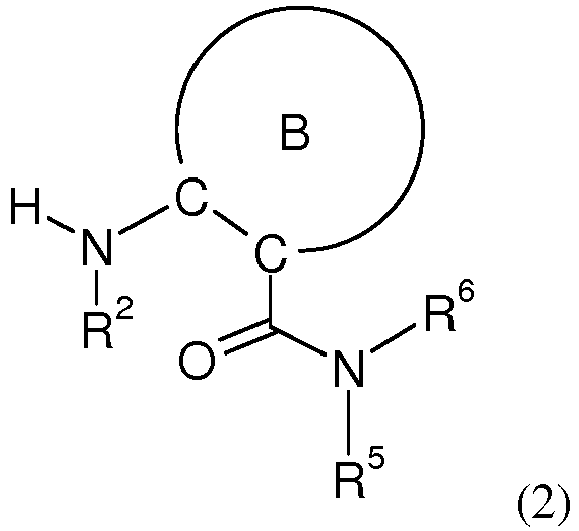

- The reaction described above can be carried out under conditions as described in the description and examples or under conditions well known to the person skilled in the art.
- The compounds of formula (1) and (2) can be prepared by methods known in the art or as described below or in analogy thereto.
- The present invention also relates to compounds of formula (I) as defined above, when prepared by a process as described above.
- Compounds of general formula (I) wherein A1 = CH or N and A2 = CR19 can be prepared as outlined in schemes 1 and 2 and in general procedures 1, 2a, 2b and 2c.

- Compounds of formula (II) wherein R = C1-7 alkyl are commercially available or can be prepared starting from pyridine-2,3-dicarboxylic acid according to
US 2006/0199960 (for A1 and A2 = CH) or starting from alkyl 3-amino-2-pyrazinecarboxylate or 3-amino-2-pyrazinecarboxylic acid according to e.g. Heterocycles 2005, 65, 2321 orWO 2007/061360 (for A1= N and A2 = CH). - Compounds of formula (II) can be converted to a compound of formula (III) by a Pd-catalyzed coupling reaction with an organometallic reagent R1-M (e.g. organoboronic acid or organoboronic acid ester) using a Pd-catalyst (e.g. Pd2dba3) and a base (e.g. potassium phosphate) in an organic solvent (e.g. dioxane), by treatment of a compound of formual (II) with an alcohol (e.g. methanol) and a base (e.g. sodium hydride or cesium carbonate) in an organic solvent (e.g. methanol or DMSO), or by a Cu-catalyzed coupling reaction with an amine using a copper source (e.g. copper bromide), a ligand (e.g. BINOL) and a base (e.g. cesium carbonate) in an organic solvent (e.g. DMF). Compounds of formula (III) can be isolated and purified by conventional methods.
- Compounds of formula (II) wherein R = H are commercially available or can be prepared according to
WO 2008/106692 and subsequently be transformed to compounds of formula (II) wherein R = C1-7 alkyl by standard methods of ester formation known to those skilled in the art. - Compounds of formula (II) wherein R = C1-7 alkyl can also be converted to a compound of formula (III) according to the methods described in
US 2006/0199960 by i) protection of the amino group with a suitable protective group (e.g. Boc) using e.g. di-tert-butyl-dicarbonate in the presence of an organic or inorganic base (e.g. DMAP or triethylamine) in an organic solvent, ii) Pd-catalyzed coupling reaction with an organometallic reagent R1-M (e.g. organozinc reagent or organotin reagent) using a Pd-catalyst (e.g. Pd(PPh3)4) and a base (e.g. potassium carbonate) in an organic solvent (e.g. dioxane), treatment of a compound of formual (II) with an alcohol (e.g. methanol) and a base (e.g. sodium hydride or cesium carbonate) in an organic solvent (e.g. methanol or DMSO), or a Cu-catalyzed coupling reaction with an amine using a copper source (e.g. copper bromide), a ligand (e.g. BINOL) and a base (e.g. cesium carbonate) in an organic solvent (e.g. DMF) and iii) deprotection of the amino group using e.g. an organic or inorganic acid (e.g. HCl or trifluoroacetic acid) in an organic solvent. Compounds of formula (III) can be isolated and purified by conventional methods. - A compound of formula (IV) wherein R3 = H can be obtained by e.g. a Pd-catalyzed arylation of the amino group of compounds of formula (III) using aryl halides or heteroaryl halides (e.g. 5-bromopyrimidine) R4-X, a Pd-catalyst (e.g. PdOAc2), a suitable ligand (e.g. 4,5-bis(diphenyl-phosphino)-9,9-dimethylxanthene) and a base (e.g. potassium carbonate) in an organic solvent (e.g. toluene, o-xylene). A compound of formula (IV) wherein R3 = C1-7 alkyl can be obtained by e.g. Pd-catalyzed arylation as described before and subsequent alkylation using an alkyl halide (e.g. methyl iodide) or alkyl triflate R3-X and a base (e.g. NaH) in an organic solvent (e.g. DMF). Compounds of formula (IV) can be isolated and purified by conventional methods.
- Compounds of formula (IIIa) wherein R = C1-7 alkyl can be prepared according to
US 2006/0199960 . Alternatively, compounds of formula (III) can be converted to a compound of formula (IIIa) wherein X = halogen by diazotation using e.g. sodium nitrite or tert-butyl nitrite and subsequent substitution using a suitable copper halide. A compound of formula (IV) wherein R3 = H can be obtained by e.g. a Pd-catalyzed amination of compounds of formula (IIIa) using arylamines or heteroarylamines (e.g. 5-aminopyrimidine) R4-NH2, a Pd-catalyst (e.g. PdOAc2), a suitable ligand (e.g. 4,5-bis(diphenyl-phosphino)-9,9-dimethylxanthene) and a base (e.g. potassium carbonate) in an organic solvent (e.g. toluene, o-xylene). A compound of formula (IV) wherein R3 = C1-7 alkyl can be obtained by e.g. a Pd-catalyzed amination as described before using arylamines or heteroarylamines R4-NH-R3 or by e.g. Pd-catalyzed amination as described before using arylamines or heteroarylamines R4-NH2 and subsequent alkylation with alkyl halides or alkyl triflates R3-X as described above. Compounds of formula (IV) can be isolated and purified by conventional methods. - A compound of formula (IV) can be converted to compounds of formula (I) by direct aminolysis of the ester group using aminoaryl carboxylic acid amides or aminoheteroaryl carboxylic acid amides

- A compound of formula (IV) can also be converted to compounds of formula (I) by direct aminolysis of the ester group as described above using aminoaryl carboxylates or aminoheteroaryl carboxylates

- Aminoaryl carboxylic acid amides or aminoheteroaryl carboxylic acid amides


- Alternatively, the ester group of a compound of formula (IV) can be saponified to its free acid (IVa) using an inorganic base (e.g. lithium hydroxide, sodium hydroxide) in an organic solvent (e.g. ethanol, dioxane, THF) or a mixture thereof. A compound of formula (IVa) can then be converted to compounds of formula (I) by amide bond formation as described above using aminoaryl carboxylic acid amides or aminoheteroaryl carboxylic acid amides

- A compound of formula (IVa) can also be converted to compounds of formula (I) by amide bond formation as described above using aminoaryl carboxylates or aminoheteroaryl carboxylates

- Compounds of formula (I) can also be prepared according to the methods outlined above by reversing the order of reaction steps 2/2a and 3/3a.
- Compounds of formula (I) wherein A1 = CH or N and A2 = CH that can not be synthesized as outlined in scheme 1 and in general procedure 1 can be prepared from intermediates of formula (IIIb), (IIIc) or (IIId) as outlined in scheme 2 and in general procedures 2a, 2b and 2c.

- Starting from commercially available 5-bromopyridine-2-carboxylic acid or 5-bromopyrazine-2-carboxylic acid, an intermediate of formula (IIIb) can be prepared by:
- i) reduction of carboxylate using a reducing agent (e.g. sodium borohydride, borane-dimethylsulphide) in an organic solvent (e.g. THF)
- ii) oxidation of pyridine to pyridine-N-oxide using an oxidizing reagent (e.g. m-chlorobenzoic acid) in an organic solvent (e.g. dichloromethane)
- iii) alkylation of hydroxyl group using an alkylating reagent (e.g. methyl iodide) and a suitable inorganic base (e.g. sodium hydride) in an organic solvent (e.g. THF or dioxane)
- iv) cyanation of pyridinium-N-oxide using e.g. cyanotrimethylsilane, a suitable base (e.g. triethylamine) in an organic solvent (e.g. acetonitrile or DMF)
- v) hydrolysis of nitrile to liberate the free acid using a strong inorganic base (e.g. potassium hydroxide) in an organic solvent (e.g. methanol or ethanol)
- vi) ester formation of acid group using e.g. an alcohol in the presence of a strong acid, an alkylhalide in the presence of a base or special alkylating reagents (e.g. trimethylsilyl-diazomethane).
- Intermediates of formula (IIIb) can be further converted to compounds of general formula (I) by the general procedures described above.
- Starting from compounds of formula (II) wherein R = C1-7 alkyl, intermediates of formula (IIIc) can be prepared by replacement of the bromine by a nitrile group using e.g. copper (I) cyanide in an organic solvent as e.g. DMF. These intermediates can either be converted to compounds of general formula (I) by the general methods described above. Or the nitrile group can be further converted to e.g. a carboxylic acid (via hydrolysis), an alkyl carboxylate (via hydrolysis and ester formation), an alcohol (via hydrolysis and reduction), a ketone (via hydrolysis, activation as e.g. Weinreb amide and alkylation with e.g. a Grignard reagent), or an amino group (via hydrolysis and Curtius reaction) which can be further substituted by e.g. alkyl groups on the stage of either the different intermediates or the final products. These intermediates can be further converted to compounds of general formula (I) by the general procedures described above.
- Compounds of formula (IIId) wherein R = C1-7 alkyl can be prepared starting from an aminocyanoacetic acid ester and an appropriate α-ketoaldehyde oxime according to J. Heterocycl. Chem. 1987, 24, 1621 or
US 2006/199828 . - Compounds of general formula (I) wherein A1 is CH and A2 is N can be prepared as outlined in schemes 3 and 4 and in general procedures 3 and 4.

- Compounds of formula (V) are commercially available or can be prepared according to the general methods described in e.g.
WO 2000/066566 orWO 2005/021500 by condensation of e.g. mucobromic acid with a suitable amidine containing residue R1 in the presence of an organic base (e.g. sodium ethylate) in an organic solvent (e.g. ethanol) at ambient or elevated temperatures. - A compound of formula (V) can be converted to compounds of formula (VI) wherein R = C1-7 alkyl by formation of an ester using e.g. an alcohol in the presence of a strong acid, an alcohol in the presence of an acid chloride-forming reagent (e.g. thionyl chloride), an alkylhalide in the presence of a base or special alkylating reagents (e.g. trimethylsilyl-diazomethane). Compounds of formula (VI) can be isolated and purified by conventional methods.
- A compound of formula (VII) wherein R3 = H can be obtained by e.g. a Pd-catalyzed amination of compounds of formula (VI) as described above using arylamines or heteroarylamines (e.g. 5-aminopyrimidine) R4-NH2. A compound of formula (VII) wherein R3 = C1-7 alkyl can be obtained by e.g. a Pd-catalyzed amination as described above using arylamines or heteroarylamines R4-NH-R3 or by e.g. a Pd-catalyzed amination of compounds of formula (VI) as described above using arylamines or heteroarylamines R4-NH2 and subsequent alkylation with alkyl halides or alkyl triflates R3-X as described above. Compounds of formula (VII) can be isolated and purified by conventional methods.
- A compound of formula (VII) can be converted to compounds of formula (I) by direct aminolysis of the ester group as described above using aminoaryl carboxylic acid amides or aminoheteroaryl carboxylic acid amides

- A compound of formula (VII) can also be converted to compounds of formula (I) by direct aminolysis of the ester group as described above using aminoaryl carboxylates or aminoheteroaryl carboxylates

- Alternatively, a compound of formula (VII) can be saponified to its free acid as described above. The free acid of a compound of formula (VII) can then be converted to compounds of formula (I) by amide bond formation as described above using aminoaryl carboxylic acid amides or aminoheteroaryl carboxylic acid amides
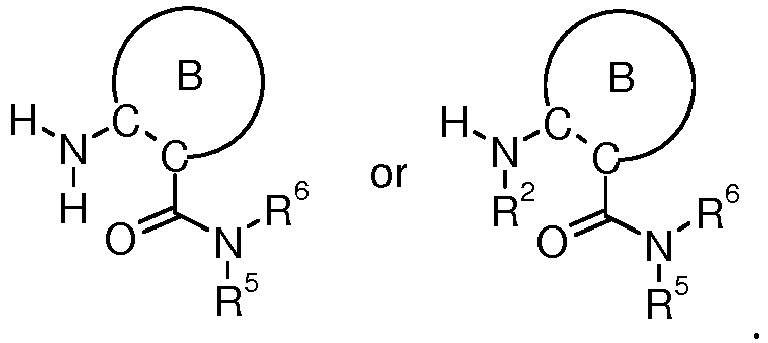
- The free acid of a compound of formula (VII) can also be converted to compounds of formula (I) by amide bond formation as described above using aminoaryl carboxylates or aminoheteroaryl carboxylates

- A compound of formula (V) can be converted to compounds of formula (VIII) according to the methods described in step 4 for the conversion of acids of formula (VII).
- A compound of formula (VIII) can be converted to compounds of formula (I) according to the method described in step 3 for the formation of compounds of formula (VII).
- A compound of formula (V) can be converted to compounds of formula (IX) by amination of the bromide using an ammonia source (e.g. ammonium hydroxide) in the presence of a transition metal (e.g. copper (II) sulfate) in a solvent like water. Compounds of formula (IX) can be isolated and purified by conventional methods.
- A compound of formula (IX) can be converted to compounds of formula (X) according to the method described in step 2 for the formation of compounds of formula (VI).
- A compound of formula (X) can be converted to compounds of formula (VII) according to the methods described in step 3 for the formation of compounds of formula (VII) using aryl halides or heteroaryl halides (e.g. 5-bromopyrimidine) R4-X and optionally alkyl halides or alkyl triflates R3-X.
- A compound of formula (XI) can be converted to compounds of formula (I) according to the methods described in step 4 for the conversion of compounds of formula (VII).
- Compounds of formula (VI) wherein A1 is CH and A2 is N and R = H or C1-7 alkyl that can not be synthesized as outlined in scheme 3 and in general procedure 3 can be prepared e.g from commercially available intermediates of formula (VIa) as outlined in scheme 4 and in general procedure 4.
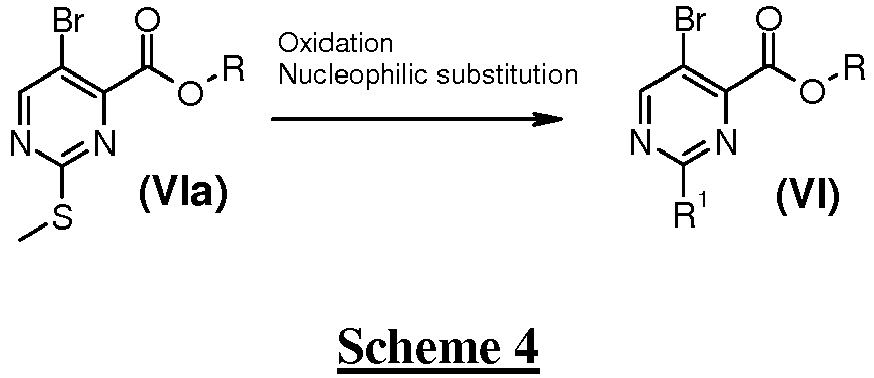
- Starting from commercially available 5-bromo-2-methylthio-pyrimidine-4-carboxylates of formula (VIa), intermediates of formula VI wherein R1 is alkoxy or optionally substituted amine can be prepared by:
- i) oxidation of the methylthio group using an oxidizing reagent (e.g. 3-chloroperbenzoic acid) in an organic solvent (e.g. dichloromethane) to form a methylsulphonyl group
- ii) nucleophilic substitution of the methylsulphonyl group by oxygen or nitrogen nucleophiles (e.g. alkylamine or alkylalcohol) in an organic solvent (e.g. dichloromethane) to yield intermediates (VI).
- These intermediates can be further converted to compounds of general formula (I) by the general procedures described above.
- Certain substituents on the groups R1, R2, R3, R4 and R5 may not be inert to the conditions of the synthesis sequences described above and may require protection by standard protecting groups known in the art. For instance, an amino or hydroxyl group may be protected as an acetyl or tert.-butoxycarbonyl derivative. Alternatively, some substituents may be derived from others at the end of the reaction sequence. For instance, a compound of formula I may be synthesized bearing a nitro-, an ethoxycarbonyl, an ether, a sulfonic acid substituent on the groups R1, R2, R3, R4 and R5, which substituents are finally converted to an amino- (e.g. by reduction of a nitro group or cleavage of a suitable amino protective group (e.g. removal of a Boc group with TFA)), alkylamino- (e.g. by reductive amination of an amino group), dialkylamino- (e.g. by alkylation of an amino group, reduction of an appropriate acylamino group with lithium aluminum hydride or Eschweiler-Clarke reaction with an appropriate amino or alkylamino group), acylamino- (by amide formation from an amino group e.g. with appropriate acyl halides or with appropriate carboxylic acids after their activation with CDI, EDC etc.), alkylsulfonylamino (e.g. by reaction of an amino group with sulfonyl chlorides), arylsulfonylamino substituent (e.g. by reaction of an amino group with sulfonyl chlorides), hydroxyl- (by cleavage of a suitable hydroxy protective group (e.g. hydrogenolytic removal of a benzyl ether or oxidative cleavage of a p-methoxy benzyl ether), ether- (e.g. by Williamson's ether synthesis from a hydroxyl group) or to a carboxamide substituent (e.g. by amide formation from a carboxylic acid group with appropriate amines after activation of the carboxylic acid group with CDI, EDC etc. or conversion to an acyl chloride), or to a sulfonamide substituent by standard procedures.
- All reactions are typically performed in a suitable solvent and under an atmosphere of argon or nitrogen.
- The corresponding salts with acids can be obtained by standard methods known to the person skilled in the art, e.g. by dissolving the compound of formula (I) in a suitable solvent such as e.g. dioxane or THF and adding an appropriate amount of the corresponding acid. The products can usually be isolated by filtration or by chromatography. The conversion of a compound of formula (I) into a pharmaceutically acceptable salt with a base can be carried out by treatment of such a compound with such a base. One possible method to form such a salt is e.g. by addition of 1/n equivalents of a basic salt such as e.g. M(OH)n, wherein M is metal or ammonium cation and n is number of hydroxide anions, to a solution of the compound in a suitable solvent (e.g. ethanol, ethanol-water mixture, tetrahydrofuran-water mixture) and to remove the solvent by evaporation or lyophilisation.
- The conversion of compounds of formula (I) into pharmaceutically acceptable esters can be carried out e.g. by treatment of a suitable carboxy group present in the molecule with a suitable alcohol using e.g. a condensating reagent such as benzotriazol-1-yloxytris(dimethylamino)phosphonium hexafluorophosphate (BOP), N,N-dicylohexylcarbodiimide (DCC), N-(3-dimethylaminopropyl)-N'-ethylcarbodiimide hydrochloride (EDCI) or O-(1,2-dihydro-2-oxo-1-pyridyl)-N,N,N,N-tetra-methyluronium-tetrafluoroborate (TPTU), or by direct reaction with a suitable alcohol under acidic conditions, as for example in the presence of a strong mineral acid like hydrochloric acid, sulfuric acid. Compounds having a hydroxyl group can be converted to esters with suitable acids by analogous methods.
- Insofar as their preparation is not described in the examples, the compounds of formula (I) as well as all intermediate products can be prepared according to analogous methods or according to the methods set forth above. Starting materials are commercially available, known in the art or can be prepared by methods known in the art or in analogy thereto.
- As described above, the novel compounds of the present invention have been found to inhibit PDE10A activity. The compounds of the present invention can therefore be used, either alone or in combination with other drugs, for the treatment and/or prophylaxis of diseases which are modulated by PDE10A inhibitors. These diseases include, but are not limited to, certain psychotic disorders such as schizophrenia, positive, negative and/or cognitive symptoms associated with schizophrenia, delusional disorder or substance-induced psychotic disorder, anxiety disorders such as panic disorder, obsessive/compulsive disorders, acute stress disorder or generalized anxiety disorder, drug addictions, movement disorders such as Parkinson's disease or restless leg syndrome, cognition deficiency disorders such as Alzheimer's disease or multi-infarct dementia, mood disorders such as depression or bipolar disorders, or neuropsychiatric conditions such as psychosis, attention-deficit/hyperactivity disorder (ADHD) or related attentional disorders. Other disorders are diabetes and related disorders, such as type 2 diabetes mellitus, neurodegenerative disorders such as Alzheimer's disease, Huntington's disease, Parkinson's disease, multiple sclerosis, stroke or spinal cord injury, solid tumors and hematological malignancies such as renal cell carcinoma or breast cancer.
- The invention therefore also relates to pharmaceutical compositions comprising a compound as defined above and a pharmaceutically acceptable carrier and/or adjuvant.
- The invention likewise embraces compounds as described above for use as therapeutically active substances, especially as therapeutically active substances for the treatment and/or prophylaxis of diseases which are modulated by PDE10A inhibitors, particularly as therapeutically active substances for the treatment and/or prophylaxis of psychotic disorders, schizophrenia, positive, negative and/or cognitive symptoms associated with schizophrenia, delusional disorder, substance-induced psychotic disorder, anxiety disorders, panic disorder, obsessive/compulsive disorders, acute stress disorder, generalized anxiety disorder, drug addictions, movement disorders, Parkinson's disease, restless leg syndrome, cognition deficiency disorders, Alzheimer's disease, multi-infarct dementia, mood disorders, depression, bipolar disorders, neuropsychiatric conditions, psychosis, attention-deficit/hyperactivity disorder, attentional disorders, diabetes and related disorders, type 2 diabetes mellitus, neurodegenerative disorders, Huntington's disease, multiple sclerosis, stroke, spinal cord injury, solid tumors, hematological malignancies, renal cell carcinoma and breast cancer.
- The invention also embraces the use of compounds as defined above for the therapeutic and/or prophylactic treatment of diseases which are modulated by PDE10A inhibitors, particularly for the therapeutic and/or prophylactic treatment of psychotic disorders, schizophrenia, positive, negative and/or cognitive symptoms associated with schizophrenia, delusional disorder, substance-induced psychotic disorder, anxiety disorders, panic disorder, obsessive/compulsive disorders, acute stress disorder, generalized anxiety disorder, drug addictions, movement disorders, Parkinson's disease, restless leg syndrome, cognition deficiency disorders, Alzheimer's disease, multi-infarct dementia, mood disorders, depression, bipolar disorders, neuropsychiatric conditions, psychosis, attention-deficit/hyperactivity disorder, attentional disorders, diabetes and related disorders, type 2 diabetes mellitus, neurodegenerative disorders, Huntington's disease, multiple sclerosis, stroke, spinal cord injury, solid tumors, hematological malignancies, renal cell carcinoma and breast cancer.
- The invention also relates to the use of compounds as described above for the preparation of medicaments for the therapeutic and/or prophylactic treatment of diseases which are modulated by PDE10A inhibitors, particularly for the therapeutic and/or prophylactic treatment of psychotic disorders, schizophrenia, positive, negative and/or cognitive symptoms associated with schizophrenia, delusional disorder, substance-induced psychotic disorder, anxiety disorders, panic disorder, obsessive/compulsive disorders, acute stress disorder, generalized anxiety disorder, drug addictions, movement disorders, Parkinson's disease, restless leg syndrome, cognition deficiency disorders, Alzheimer's disease, multi-infarct dementia, mood disorders, depression, bipolar disorders, neuropsychiatric conditions, psychosis, attention-deficit/hyperactivity disorder, attentional disorders, diabetes and related disorders, type 2 diabetes mellitus, neurodegenerative disorders, Huntington's disease, multiple sclerosis, stroke, spinal cord injury, solid tumors, hematological malignancies, renal cell carcinoma and breast cancer. Such medicaments comprise a compound as described above.
- Prevention and/or treatment of schizophrenia is a particular indication. Yet particular indication is prevention and/or treatment of positive, negative and/or cognitive symptoms associated with schizophrenia.
- The following test was carried out in order to determine the activity of the compounds of the present invention. PDE10 activity of the compounds of the present invention was determined using a Scintillation Proximity Assay (SPA)-based method similar to the one previously described (Fawcett, L. et al., ProcNatl Acad Sci USA (2000) 97(7):3702-3707).
- The human PDE10A full length assay was performed in 96-well micro titer plates. The reaction mixture of 50 µl contained 20 mM HEPES pH=7.5 /10 mM MgCl2/0.05 mg/ml BSA (Sigma cat. # A-7906), 50 nM cGMP (Sigma, cat. # G6129) and 50 nM [3H]-cGMP (GE Healthcare, cat. # TRK392 S.A. 13.2Ci/mmol), 3.75 ng/well PDE10A enzyme (Enzo Life Science, Lausen, Switzerland cat # SE-534) with or without a specific test compound. A range of concentrations of the potential inhibitor was used to generate data for calculating the concentration of inhibitor resulting in 50% of the effect (e.g. IC50, the concentration of the competitor inhibiting PDE10A activity by 50%). Non-specific activity was tested without the enzyme. The reaction was initiated by the addition of the substrate solution (cGMP and [3H]-cGMP) and allowed to progress for 20 minutes at room temperature. The reaction was terminated by adding 25 µl of YSi-SPA scintillation beads (GE Healthcare, cat. # RPNQ0150) in 18 mM zinc sulphate solution (stop reagent). After 1 h under shaking, the plate was centrifuged one minute at 170 g to allow beads to settle. Afterwards, radioactive counts were measured on a Perkin Elmer TopCount Scintillation plate reader.
- The compounds according to formula (I) have an IC50 value below 10 µM, more specifically below 5 µM, yet more specifically below 1 µM. The following table shows data for some examples.
Example PDE10A inhibition IC50 [µmol/l] 1 0.0315 2 0.0046 3 0.0075 4 0.1245 5 0.0052 6 0.0126 7 0.3356 8 0.1396 9 0.149 10 0.2024 11 0.0012 12 0.4952 13 0.2557 14 0.0114 15 0.0107 16 0.0076 17 0.0126 18 0.091 19 0.0087 20 0.0221 21 0.007 22 0.0187 23 0.0878 24 0.0137 25 1.8646 26 0.0283 27 0.0114 28 0.006 29 0.0013 30 0.0342 31 0.0031 32 0.0073 33 0.0031 34 0.0045 35 0.0457 36 0.0032 37 0.0181 38 0.0072 39 0.0082 40 0.0075 41 0.0069 42 0.0081 43 0.0031 44 0.0274 45 0.0171 46 0.0193 47 0.0132 48 0.0083 49 0.0039 50 0.0317 51 0.058 52 0.0082 53 0.0737 54 0.025 55 0.115 56 0.0657 57 0.0021 58 0.0011 59 0.0844 60 0.2316 61 0.0013 62 0.0939 63 0.087 64 1.1056 65 0.0014 66 0.0478 67 0.0042 68 0.0033 69 0.0041 70 0.0021 71 0.0564 72 0.0042 73 0.0189 74 0.0073 75 0.0088 76 0.0079 77 0.0034 78 0.002 79 0.0296 80 0.1049 81 0.0004 82 0.0585 83 0.0055 84 0.0019 85 0.0245 86 0.2153 87 0.1796 88 0.5713 89 0.0005 90 0.0004 91 0.0275 92 0.0064 93 0.0043 94 0.3915 95 0.0018 96 0.096 97 0.0011 98 0.0004 99 0.0026 100 0.0025 101 0.0015 102 0.0163 103 0.0587 104 0.0113 105 0.0011 106 0.0026 107 0.1174 108 0.0397 109 0.0189 110 0.0006 111 0.015 112 0.0796 113 0.0016 114 0.0011 115 0.1709 116 0.0045 117 0.0268 118 0.0897 119 0.0045 120 0.0004 121 0.0058 122 0.0453 123 0.0096 124 0.0021 125 0.0056 126 0.122 127 0.0085 128 0.0013 129 0.006 131 0.0014 132 0.0169 133 0.0067 134 0.0215 135 0.0066 136 0.0036 137 0.0587 138 0.0249 139 0.0116 140 0.003 141 0.0035 142 0.0011 143 0.0233 144 0.0021 145 0.0029 146 0.0017 147 0.0012 148 0.0144 149 0.0015 150 0.0085 151 0.0027 152 0.0034 153 0.0161 154 0.0025 155 0.0127 156 0.0112 157 0.0322 158 0.0008 159 0.0004 160 0.0029 161 0.0128 162 0.1243 163 0.0062 164 0.0052 165 0.0022 166 0.3352 167 0.0044 168 0.0329 169 0.0223 170 0.0889 171 0.0028 172 0.0129 173 0.0195 174 0.0148 175 0.025 176 0.027 177 0.0002 178 0.0001 179 0.1484 180 0.0055 181 0.0004 182 0.0035 183 0.0003 184 0.1618 185 2.6868 186 0.0082 187 0.0638 188 0.0517 189 0.1438 190 0.024 191 0.4701 192 0.0031 193 0.0117 194 0.0055 195 0.0164 196 0.022 197 0.0039 198 0.0025 199 0.0062 200 0.4256 201 0.0115 202 0.0038 203 0.0338 204 0.0525 205 0.0901 206 0.0122 207 0.0011 208 0.0013 209 0.0037 210 0.0005 211 2.6545 212 0.0812 213 0.0007 214 0.001 215 0.0005 216 0.0008 217 0.0113 218 0.0052 219 0.0523 220 0.0023 221 0.0049 222 0.0425 223 0.0184 224 0.0181 225 0.0005 226 0.0543 227 0.0641 228 0.038 229 0.0126 230 0.1179 231 0.0417 232 0.004 233 0.0249 234 0.0773 235 0.034 236 0.0068 237 0.0934 238 0.0523 239 0.0477 240 0.1908 241 0.0286 242 0.0693 243 0.0014 244 0.0002 245 0.0359 246 0.4252 247 0.29 248 0.0081 249 0.0268 250 0.0159 251 0.1371 252 0.0058 253 0.0159 254 0.0317 255 0.0029 256 0.0033 257 0.0671 258 0.1758 259 0.0018 260 0.0016 261 0.0035 262 0.0007 263 0.0543 264 0.0032 265 0.0206 266 0.012 267 0.007 268 0.0149 269 0.0127 270 0.0533 271 0.0004 272 0.0085 273 0.0003 274 0.0004 275 0.0004 276 0.0122 277 0.0027 278 0.0019 279 0.0069 280 0.0035 281 0.0006 282 0.002 283 0.0011 284 0.028 285 0.0193 286 0.0432 287 0.0151 288 0.0008 289 0.024 290 0.0028 291 0.0312 292 0.0007 293 0.006 294 0.0193 295 0.0023 296 0.0039 297 0.0041 298 0.0078 299 0.0003 300 0.0167 301 0.0004 302 0.001 303 0.368 304 0.1434 305 0.0045 306 0.0014 307 0.0686 308 0.0009 309 0.0011 310 0.0098 311 0.0205 312 0.0008 313 0.052 314 0.0343 315 0.0111 316 0.0241 317 0.0027 318 0.0046 319 0.0155 320 0.0863 321 0.0006 322 0.0017 323 0.0359 324 0.0011 325 0.3353 326 0.0027 327 0.0018 328 0.0004 329 0.0029 330 0.0011 331 0.0031 332 0.0128 333 0.6908 334 0.0022 335 0.0008 336 0.0053 337 0.1262 338 0.0021 339 0.0493 340 0.2504 341 0.028 - The compounds of formula (I) and/or their pharmaceutically acceptable salts can be used as medicaments, e.g. in the form of pharmaceutical preparations for enteral, parenteral or topical administration. They can be administered, for example, perorally, e.g. in the form of tablets, coated tablets, dragées, hard and soft gelatin capsules, solutions, emulsions or suspensions, rectally, e.g. in the form of suppositories, parenterally, e.g. in the form of injection solutions or suspensions or infusion solutions, or topically, e.g. in the form of ointments, creams or oils.
- The production of the pharmaceutical preparations can be effected in a manner which will be familiar to any person skilled in the art by bringing the described compounds of formula (I) and/or their pharmaceutically acceptable salts, optionally in combination with other therapeutically valuable substances, into a galenical administration form together with suitable, non-toxic, inert, therapeutically compatible solid or liquid carrier materials and, if desired, usual pharmaceutical adjuvants.
- Suitable carrier materials are not only inorganic carrier materials, but also organic carrier materials. Thus, for example, lactose, corn starch or derivatives thereof, talc, stearic acid or its salts can be used as carrier materials for tablets, coated tablets, dragées and hard gelatin capsules. Suitable carrier materials for soft gelatin capsules are, for example, vegetable oils, waxes, fats and semi-solid and liquid polyols (depending on the nature of the active ingredient no carriers might, however, be required in the case of soft gelatin capsules). Suitable carrier materials for the production of solutions and syrups are, for example, water, polyols, sucrose, invert sugar . Suitable carrier materials for injection solutions are, for example, water, alcohols, polyols, glycerol and vegetable oils. Suitable carrier materials for suppositories are, for example, natural or hardened oils, waxes, fats and semi-liquid or liquid polyols. Suitable carrier materials for topical preparations are glycerides, semi-synthetic and synthetic glycerides, hydrogenated oils, liquid waxes, liquid paraffins, liquid fatty alcohols, sterols, polyethylene glycols and cellulose derivatives.
- Usual stabilizers, preservatives, wetting and emulsifying agents, consistency-improving agents, flavour-improving agents, salts for varying the osmotic pressure, buffer substances, solubilizers, colorants and masking agents and antioxidants come into consideration as pharmaceutical adjuvants.
- The dosage of the compounds of formula (I) can vary within wide limits depending on the disease to be controlled, the age and the individual condition of the patient and the mode of administration, and will, of course, be fitted to the individual requirements in each particular case. For adult patients a daily dosage of about 0.1 to 2000 mg, especially about 1 to 500 mg, comes into consideration. Depending on severity of the disease and the precise pharmacokinetic profile the compound could be administered with one or several daily dosage units, e.g. in 1 to 3 dosage units.
- The pharmaceutical preparations conveniently contain about 0.1-500 mg, more specifically 1-200 mg, of a compound of formula (I).
- The following examples serve to illustrate the present invention in more detail.
-

- To a solution of 3-amino-6-bromo-pyridine-2-carboxylic acid ethyl ester (prepared according to
US 2006/199960 ; 1.0 g, 4.08 mmol), potassium phosphate (3.03 g, 14.3 mmol), tricyclohexylphosphine (0.228 g, 0.82 mmol) and water (1.25 ml) in toluene (25 ml) was added cyclopropylboronic acid (0.91 g, 10.6 mmol) and palladium (II) acetate (90 mg, 0.4 mmol). The resulting suspension was stirred at 100 °C for 24 hours. After solvent evaporation, the title compound was obtained after silica gel chromatography using a heptane/ethyl acetate gradient as yellow solid (0.374 g, 44 %).
MS: M=207.0 (M+H)+ - A suspension of 3-amino-6-cyclopropylpyridine-2-carboxylic acid ethyl ester (763 mg, 3.7 mmol), 5-bromopyrimidine (823 mg, 5.2 mmol), water (140 µl, 7.8 mmol) and potassium carbonate (920 mg, 6.7 mmol) in o-xylene (10 ml) was evacuated and vented with argon. Palladium(II) acetate (33 mg, 0.15 mmol,) and 4,5-bis(diphenylphosphino)-9,9-dimethylxanthene (xantphos; 107 mg, 0.18 mmol) were consecutively added under inert gas atmosphere and the reaction mixture was heated to 140 °C and stirred overnight. After cooling-down to ambient temperature, the reaction mixture was diluted with dichloromethane (15 ml) and filtrated. The filtrate was concentrated in vacuo and the product was purified by silica gel chromatography using a heptane/ethyl acetate gradient to yield the title compound (796 mg, 75.7 %) as light yellow solid.
MS: M = 285.3 (M+H)+ -

- A suspension of 6-cyclopropyl-3-(pyrimidin-5-ylamino)-pyridine-2-carboxylic acid ethyl ester (1.85 g, 6.5 mmol) from example A-1 in EtOH (15 ml) was treated with IN NaOH (13 ml). The reaction mixture was stirred at rt overnight. The compact suspension was brought to pH 6 by addition of IN HCl. The solid was collected by filtration, washed with EtOH and dried to give the product (1.29 g, 77 %) as off-white solid.
MS: M = 255.0 (M-H)- -

- To a solution of 5-bromopyridin-2-carboxylic acid (8 g, 42.1 mmol) in THF (100 ml) was added borane-dimethylsulphide (16 ml, 168.30 mmol) dropwise at 0°C. After warming-up to ambient temperature stirring was continued for 24 hours. The solution was cooled again to 0°C, quenched with MeOH and refluxed for 1h. Solvents were removed and the residue was treated with water. The aqueous phase was extracted with ethyl acetate and the combined organic layers were washed with water and brine, dried, filtered and concentrated under reduced pressure to afford 4.76 g (64 %) of the title compound.
MS: M = 188.0 & 190.0 (M+H)+ - 5-Bromo-pyridin-2-yl-methanol (6.0 g, 31.9 mmol) was dissolved in dichloromethane (80 ml) and cooled to 0°C. A solution of 3-chloroperbenzoic acid (8.26 g, 47.9 mmol) in dichloromethane (20 ml) was slowly added, the ice bath was removed after completion of the addition, and the reaction mixture was stirred at ambient temperature for 1h. The solvent was removed and the crude product was purified by silica gel chromatography using ethyl acetate to yield 3.68 g (56 %) of the title compound.
MS: M = 204.0 & 206.2 (M+H)+ - To a solution of 5-bromo-2-hydroxymethyl-pyridine-1-oxide (6.43 g, 31.5 mmol) in THF (200 ml) was added sodium hydride (1.51 g, 63.1 mmol) at 0°C, and then the reaction mixture was stirred at ambient temperature for 1h. After cooling to 0°C, methyl iodide (2.90 ml, 46.6 mmol) was added. The temperature was raised to ambient temperature and the reaction mixture was heated to 70°C for 1h. After cooling to 0°C the reaction mixture was quenched with MeOH. The solvents were removed, and the crude product was purified by silica gel chromatography using an ethyl acetate/hexane eluent to yield 4.8 g (70 %) of the title compound.
MS: M = 218.2 & 220.2 (M+H)+ - A solution of 5-bromo-2-methoxymethyl-pyridine-1-oxide (5.0 g, 22.7 mmol), triethylamine (12.7 ml, 91 mmol) and trimethylsilyl cyanide (9.1 ml, 68.2 mmol) in acetonitrile (10 ml) was heated in a sealed tube to 120°C for 18 hours. After completion of the reaction, water was added to the reaction mixture and acetonitrile was removed. The crude material was extracted with ethyl acetate. The combined organic layers were washed with water and brine, dried, filtered, and evaporated. The crude product was purified by silica gel chromatography using an ethyl acetate/hexane eluent to yield 3.0 g (58 %) of the title compound.
MS: M = 229.2 (M+H)+ - To a solution of 3-bromo-6-methoxymethyl-pyridine-2-carbonitrile (300 mg, 1.32 mmol) in MeOH (6 ml) was added a solution of potassium hydroxide (1.48 g, 26.43 mmol) in water (4 ml). The mixture was refluxed for 3 hours. MeOH was removed in vacuo, the aqueous solution was neutralized with conc. HCl under cooling, and the mixture was extracted with ethyl acetate. The combined organic layers were washed with water and brine, dried, filtered and evaporated. The obtained product (276 mg, 85 %) was used in the next step without any further purification.
MS: M = 246.2 & 248.2 (M+H)+ - To a solution of 3-bromo-6-methoxymethyl-pyridine-2-carboxylic acid (200 mg, 0.81 mmol) in benzene (4 ml) and MeOH (1 ml) was slowly added trimethylsilyl-diazomethane (0.41 ml, 0.81 mmol) at ambient temperature, and the reaction mixture was stirred for 2 hours. The solvents were removed and the residue was extracted with ethyl acetate. The combined organic layers were washed with water and brine, dried, filtered, and evaporated. The crude product was purified by silica gel chromatography using an ethyl acetate/hexane eluent to yield 158 mg (75 %) of the title compound as light yellow oil.
MS: M = 260.0 & 262.0 (M+H)+ - According to the method described in step 2 of example A-1 and using 5-aminopyrimidine instead of 5-bromopyrimidine, the title compound was obtained as off-white solid in 75 %yield.
MS: M = 275.2 (M+H)+ -

- To a stirred suspension of isobutyramidine hydrochloride (6.47 g, 47.5 mmol) at rt in EtOH (30 ml) under an argon atmosphere was added NaOEt solution (21 ml, 21% in EtOH) over 5 min. The suspension was heated to 50°C and a solution of mucobromic acid (5.7 g, 22.1 mmol) in EtOH (24 ml) was added dropwise over 5 min at 50°C. An additional portion of NaOEt solution (12 ml, 21% in EtOH) was added dropwise over 5 min. The mixture was then cooled to rt. The solids were filtered off, and the cake was washed with plenty of ethanol. The filtrate was concentrated to leave the crude product as a light brown solid. The crude material was triturated in 2 N HCl (100 ml). The product was collected by filtration, washed with plenty of H2O and plenty of n-heptane and dried to give the product (2.09 g, 73%) as beige solid.
MS: M = 244.9 (M-H)- - To a stirred, cooled (0°C) solution of 5-bromo-2-isopropyl-pyrimidine-4-carboxylic acid (3 g, 12.2 mmol) in methanol (50 ml) under an argon atmosphere was added dropwise thionyl chloride (4.37 g, 2.68 ml, 36.7 mmol). When the addition was complete, the mixture was allowed to warm to rt and stirring at rt was continued for 17 h. The orange mixture was concentrated to leave a paste which was taken up in EtOAc (50 ml)/saturated aqueous Na2CO3 solution (50 ml). The aqueous phase was extracted with EtOAc. The combined organic layers were washed with H2O and brine, dried over MgSO4, filtered and concentrated to leave the product (2.98 g, 94%) as a light brown oil which was used in the next reaction step without further purification.
MS: M = 260.9 (M+H)+ - According to the method described in step 2 of example A-1 and using 5-aminopyrimidine instead of 5-bromopyrimidine, the title compound was obtained as yellow solid (76 %).
MS: M = 272.1 (M-H)- -

- According to the methods described in example A-4, the title compound was obtained as yellow solid starting from cyclopropanecarboxamidine hydrochloride.
MS: M = 270.1 (M-H)- -

- According to the methods described in example A-4, the title compound was obtained as waxy solid starting from 2,2-dimethyl-propionamidine hydrochloride.
MS: M = 288.1 (M+H)+ -

- According to the methods described in example A-4, the title compound was obtained as viscous oil starting from 3-methyl-butyramidine hydrochloride.
MS: M = 288.1 (M+H)+ -

- According to the methods described in example A-4, the title compound was obtained as waxy solid starting from cyclohexanecarboxamidine.
MS: M = 314.1 (M+H)+ -

- According to the method described in example A-2, the title compound was obtained as light brown solid starting from A-6.
MS: M = 272.1 (M-H)- -

- To a stirred mixture of methyl 3-amino-6-bromopyrazine-2-carboxylate (13.22 g, 57.0 mmol) and 4-dimethylaminopyridine (348 mg, 2.85 mmol) at rt in dichloroethane (175 ml) under an argon atmosphere was added dropwise a solution of di-tert-butyl dicarbonate (25.5 g, 117 mmol) in dichloroethane (75 ml) within 30 min. The mixture was heated to 75°C and stirring at that temperature was continued for 18 h. The mixture was concentrated to leave a light brown syrup. Trituration in cyclohexane (150 ml) gave a precipitate. The suspension was stirred at rt for 2 h. The solid was collected by filtration, washed with cyclohexane and dried. The filtrate was concentrated and the residue was triturated in cyclohexane (50 ml). The suspension was stirred at rt for 2 h. The solid was collected by filtration, washed with cyclohexane and dried. The two crops of solids thus obtained were combined to give the title compound (23.2 g, 94%) as off-white solid.
MS: M = 434.2 (M+H)+ - Preparation of ZnCl2 stock solution: 13.63 g zinc chloride (0.1 mol) was added a first portion of THF (20 ml). After the vigorous reaction had calmed down, the mixture was gently heated using a hair dryer for about 2 min. Then, under a stream of argon was added the rest of THF (80 ml) in one portion to give a colorless solution which was kept under argon.
- To a stirred solution of bromocyclopropane (5.0 g, 41.3 mmol) at -78°C in THF (30 ml) under an argon atmosphere was added n-BuLi solution in hexane (25.8 ml, 41.3 mmol). The temperature was kept below -70°C during the addition. Stirring at -78°C was then continued for 1 h. The above described ZnCl2 solution (50ml) was added dropwise at -78°C. Again, the temperature was kept below -70°C during the addition. When the addition was complete, the reaction mixture was slowly allowed to reach r.t.
- To a stirred suspension of methyl 3-(bis(tert-butoxycarbonyl)amino)-6-bromopyrazine-2-carboxylate (7 g, 16.2 mmol) at 0°C in THF (50 ml) under an argon atmosphere was added dropwise the cyclopropylzinc(II) chloride solution described above. When the addition was complete, tetrakis(triphenlyphosphine)palladium(0) (187 mg, 162 µmol) was added in one portion and the ice bath was removed. The mixture was allowed to warm to rt and stirring at rt was continued for overnight. The mixture was treated with 0.5 N HCl (100 ml). The aqueous phase was extracted with EtOAc (50 ml). The combined organics were washed with brine (100 ml), dried (MgSO4), filtered and concentrated to leave a dark brown syrup. The product thus obtained after filtration through silica gel using a n-heptane/ethyl acetate gradient as eluent is a mixture of 3-tert-butoxycarbonylamino-6-cyclopropyl-pyrazine-2-carboxylic acid methyl ester and 3-(bis(tert-butoxycarbonyl)amino)-6-cyclopropyl-pyrazine-2-carboxylic acid methyl ester (3.1 g, 59%). Off-white solid.
- To a stirred solution of this mixture at rt in dichloromethane (30 ml) under an argon atmosphere was added trifluoroacetic acid (7.2 ml). The reaction was stirred at rt for 18 h, then diluted with CH2Cl2 (20 ml) and washed with saturated aqueous Na2CO3 (50 ml). The aqueous phase was back extracted with CH2Cl2 (25 ml). The combined organics were washed with brine (30 ml), dried (MgSO4), filtered and concentrated to leave an orange sticky solid. This residue was triturated in cyclohexane (15 ml). The suspension was stirred at rt. for 1 h. The product was collected by filtration, washed with cyclohexane and dried to give the title compound (1.5 g, 83%) as yellow solid.
MS: M = 194.2 (M+H)+ - According to the method described in step 2 of example A-1 the product was obtained as yellow solid (2.5 g, 82 %).
MS: M = 272.2 (M+H)+ -

- A solution of 6-cyclopropyl-3-(pyrimidin-5-ylamino)-pyrazine-2-carboxylic acid methyl ester (150 mg, 550 µmol) in THF (9 ml) and MeOH (1.8 ml) was cooled at 0°C and treated with LiOH (1.66 ml, IN aqueous solution). The ice bath was removed after 10 min and the reaction mixture was stirred at ambient temperature for 2hrs. The reaction mixture was acidified with HCl (1.66 ml, IN aqueous solution), diluted with water and extracted with dichloromethane. The combined organic layers were dried and concentrated in vacuo to yield a yellow solid. The aqueous phase was also concentrated in vacuo and the residue was triturated with ethyl acetate and sucked off to yield identical yellow solid (according to analytics). The solid material was combined to yield the product (75 mg, 52 %)
MS: M = 258.2 (M+H)+ -

- To a mixture of 3-amino-6-bromopyrazine-2-carboxylic acid methyl ester (200 mg, 862 µmol) and DMAP (5.27 mg, 43.1 µmol) in dichloroethane (5mL) was added dropwise a solution of di-tert-butyl dicarbonate (564 mg, 600 µL, 2.59 mmol) in dichloroethane (2.00 mL) at room temperature. The mixture was stirred at 75°C for 16 h and then concentrated in vacuo. The product was obtained after silica gel chromatography using a heptane/ethyl acetate gradient as colorless oil (350 mg, 94 %; crystallized after few hours).
MS: M=332.0 (M+H-C5H9O2)+ - According to the method described in example A-1, step 1 and starting from 3-(bis(tert-butoxycarbonyl)amino)-6-bromopyrazine-2-carboxylic acid methyl ester, the product was obtained as light yellow oil (195 mg, 66 %).
MS: M = 410.2 (M+H)+ - To a solution of 3-(bis(tert-butoxycarbonyl)amino)-6-isobutylpyrazine-2-carboxylic acid methyl ester (201 mg, 442 µmol) in dichloromethane (4 mL) was added trifluoroacetic acid (511 µL, 6.63 mmol) at room temperature. The mixture was stirred at ambient temperature for 3 h and the volatiles were evaporated. The residue was dissolved in dichloromethane (50 mL) and extracted with sodium carbonate. The aqueous phase was washed with dichloromethane and the organic layers were dried and evaporated. The product was obtained after silica gel chromatography using a heptane/ethyl acetate gradient as light yellow solid (88 mg, 95 %).
MS: M = 210.2 (M+H)+ - According to the method described in step 2 of example A-1 and starting from 3-amino-6-isobutylpyrazine-2-carboxylic acid methyl ester, the product was obtained as light yellow solid (84 mg, 73 %).
MS: M = 288.2 (M+H)+ -

- A suspension of 5-bromo-2-methylpyrimidine-4-carboxylic acid methyl ester (89.1 mg, 386 µmol,), 5-aminopyrimidine (55.0 mg, 578 µmo) and potassium phosphate tribasic (115 mg, 540 µmol) in toluene (3 mL) was evacuated and flushed with argon. 4,5-Bis(diphenylphosphino)-9,9-dimethylxanthene (Xantphos; 73.6 mg, 127 µmol) and tris(dibenzylideneacetone)-dipalladium(0) chloroform adduct (39.9 mg, 38.6 µmol) were added and the reaction mixture was stirred at 120°C for 16 h. The reaction mixture was poured into ethyl acetate (50 mL) and extracted with water. The organic phase was washed brine and the aqueous layers were back-extracted with ethyl acetate. The organic layers were dried and the solvent was removed. The product was obtained after silica gel chromatography using a heptane/ethyl acetate gradient as light yellow solid (55 mg, 58 %).
MS: M = 246.2 (M+H)+ - According to the method described in example A-11 and starting from 2-methyl-5-(pyrimidin-5-ylamino)-pyrimidine-4-carboxylic acid methyl ester, the product was obtained as light yellow solid (51 mg, 97 %).
MS: M = 230.2 (M-H)- -

- To a stirred solution of an 1:4 mixture of methyl 3-(bis(tert-butoxycarbonyl)amino)-6-bromopyrazine-2-carboxylate and methyl 6-bromo-3-(tert-butoxycarbonylamino)pyrazine-2-carboxylate (ca. 4.1 g, 11.6 mmol) at rt in toluene (55 ml) under an argon atmosphere were added bis(triphenylpohsphine)palladium(II) chloride (81.1 mg, 0.12 mmol) and 1-ethoxyvinyl tri-N-butyltin (3.0 g, 2.8 ml, 12.7 mmol). The clear yellow solution was heated to reflux and stirring was continued for 18 h. The mixture was cooled to 0°C. 1 N HCl (55 ml) was added dropwise within 15 min. The biphasic mixture was stirred vigourously for 22 h, slowly warming up to rt. The layers were separated. The organic layer was diluted with 150 ml EtOAc (150 ml). Then, a 10 % aqueous ammonium fluoride solution (150 ml) was added. The biphasic mixture was then stirred at rt for 5 h and then filtered. The organic phase of the filtrate was washed with 50 ml brine, dried (MgSO4), filtered and concentrated. The product was purified by silica gel chromatography using a n-heptane/ethyl acetate gradient. The product-containing fractions were concentrated. The residue was triturated with n-heptane/cyclohexane 9:1 (20 ml). The suspension was stirred for 2 hrs. The solid was filtrated, washed with n-heptane and dried to give the title compound (1.54 g, 45%) as off-white solid.
MS: M = 296.2 (M+H)+ - To a stirred solution of 6-acetyl-3-tert-butoxycarbonylamino-pyrazine-2-carboxylic acid methyl ester (500mg, 1.69 mmol) at rt in dioxane (10 ml) under an argon atmosphere was added 4 M HCl solution in dioxane (4.23 ml, 16.9 mmol) in one portion. The reaction mixture was stirred overnight, then concentrated. The residue was triturated with Et2O, filtrated and dried. The solid was taken up in EtOAc (50 ml) and washed with saturated aqueous Na2CO3 solution (20 ml) and brine. The organic phase was dried over MgSO4, filtrated and concentrated to give the title compound (313 mg, 95%) as orange powder.
MS: M = 196.1 (M+H)+ - In analogy to the method described in step 2 of example A-1, the title compound was obtained as light yellow solid (38%).
MS: M = 274.2 (M+H)+ - In analogy to the method described in example A-2, the title compound was obtained as yellow powder (89%).
MS: M = 258.0 (M-H)- -

- According to the method described in example A-2, the title compounds was obtained as yellow solid starting from A-4.
MS: M = 258.0 (M-H)- -

- A mixture of palladium (II) acetate (145 mg, 0.65 mmol) and 1,1'-bis(diphenylphosphino)-ferrocene (493 mg, 0.86 mmol) in DMF (70 ml) was stirred at 50°C for 15 minutes and cooled to r.t. The mixture was evacuated and vented with argon. 3-Amino-6-bromopyrazine-2-carboxylic acid methyl ester (5.0 g, 21.5 mmol), furan-3-yl-boronic acid (2.79 g, 23.7 mmol) and triethylamine (4.51 ml, 32.3 mmol) were added and the reaction mixture was stirred at 90°C for 16 h. The solvent was evaporated and the product was obtained after purification by silica gel chromatography using a heptane/ethyl acetate gradient as yellow solid (2.92 g, 61.8 %).
MS: M = 220.2(M+H)+ - A solution of 3-amino-6-(furan-3-yl)-pyrazine-2-carboxylic acid methyl ester (2.9 g, 13.2 mmol) in MeOH (150 ml) was treated with palladium on carbon (10%; 0.6 g, 0.28 mmol) and hydrogenated at 1.2 atmospheres for 40h. Another 2 equivalents of palladium on carbon were consecutively added and the hydrogenation was continued for another 72h. The reaction mixture was filtered and the catalyst was washed with MeOH. The solution was concentrated in vacuo and the product was obtained after purification by silica gel chromatography using a heptane/ethyl acetate gradient as light yellow solid (0.3 g, 10 %).
MS: M = 224.1(M+H)+ - A mixture of 3-amino-6-(tetrahydrofuran-3-yl)pyrazine-2-carboxylic acid methyl ester (300 mg, 1.34 mmol), 5-bromopyrimidine (299 mg, 1.88 mmol) and potassium carbonate (334 mg, 2.42 mmol) in xylene (15 ml) and water (51 µl, 2.82 mmol) was evacuated and vented with argon. Palladium (II) acetate (12.1 mg, 54 µmol) and xantphos (23.3 mg, 40 µmol) were added and the reaction mixture was stirred at 140°C for 16hr. The reaction mixture was cooled to r.t., poured into 50 ml ethyl acetate and extracted with water. The organic phase was washed with brine and the aqueous layers were back-extracted with ethyl acetate. The organic layers were dried and the solvent was evaporated. The product was obtained after purification by silica gel chromatography using a heptane/ethyl acetate gradient as light solid (211 mg, 52 %).
MS: M = 302.1(M+H)+ -

- The product was obtained starting from methyl 3-(bis(tert-butoxycarbonyl)amino)-6-bromopyrazine-2-carboxylate (1.13 g, 2.61 mmol) and 2-isopropenyl-4,4,5,5-tetramethyl-1,3,2-dioxaborolane (672 µl, 3.4 mmol) according to the method described in example A-1, step 1 after extraction with ethyl acetate and purification by silica gel chromatography using a heptane/ethyl acetate gradient as yellow viscous oil (323 mg, 31 %).
MS: M = 294.2 (M-Boc+H)+ - A solution of methyl 3-(bis(tert-butoxycarbonyl)amino)-6-(prop-1-en-2-yl)pyrazine-2-carboxylate (323 mg, 0.82 mmol) in MeOH (4 ml) was charged under an argon atmosphere at r.t. with Pd/C 10% (30 mg, 0.28 mmol). The reaction mixture was stirred at r.t. under a hydrogen atmosphere for 15 h, filtrated and the solvent was removed to yield the product as yellow viscous oil (302 mg, 92 %) which was used without any purification.
MS: M=296.3(M-Boc+H)+ - The product was obtained starting from methyl 3-(bis(tert-butoxycarbonyl)amino)-6-isopropylpyrazine-2-carboxylate (300 mg, 0.76 mmol) according to the method described in example A-12, step 3 as colorless solid (108 mg, 72 %).
MS: M = 196.2 (M+H)+ - The product was obtained starting from methyl 3-amino-6-isopropylpyrazine-2-carboxylate (54 mg, 0.28 mmol) according to the method described in example A-1, step 2 after purification by preparative HPLC using an acetonitrile/water gradient as off-white solid (38 mg, 49 %).
MS: M = 274.1 (M+H)+ - The product was obtained starting from methyl 6-isopropyl-3-(pyrimidin-5-ylamino)pyrazine-2-carboxylate (38 mg, 0.14 mmol) according to the method described in example A-11 as white solid (36 mg, 99 %).
MS: M = 258.1(M-H)- -

- A solution of 1-methyl-4-nitro-1H-pyrazole-3-carboxylic acid (500 mg, 2.92 mmol) in DMF (5 ml) under inert gas atmosphere was treated with TBTU (1030 mg, 3.2 mmol), dimethylamine hydrochloride (262 mg, 3.2 mmol) and N,N-diisopropylethylamine (2.0 ml, 11.7 mmol) and stirring was continued for 4 h. All volatiles were removed and the crude product was extracted with water and ethyl acetate. The organic phase was washed with sodium bicarbonate and the aqueous phases were back-extracted with ethyl acetate and dichloromethane. The combined organic phases were dried and the solvent was evaporated. The product was obtained after purification by silica gel chromatography using a dichloromethane/methanol gradient as white solid (230 mg, 40 %).
MS: M = 199.3 (M+H)+ - A solution of 1-methyl-4-nitro-1H-pyrazole-3-carboxylic acid dimethylamide (100 mg, 0.5 mmol) in ethanol (4 ml) was flushed with argon and treated with Pd/C 5% (40 mg, 0.02 mmol). The reaction vessel was evacuated and flushed with hydrogen three times and the reaction was stirred at ambient temperature overnight. The reaction mixture was filtrated and the solvent was evaporated to yield an off-white solid material (83 mg, 98 %) which was used without further purification.
MS: M = 169.1 (M+H)+ - Intermediate A-2 (75 mg, 0.19 mmol) was dissolved in DMF (1 ml) and TBTU (68 mg, 0.21 mmol) was added under inert gas atmosphere. After 5 min. of stirring at ambient temperature N,N-diisopropylethylamine (131 µl, 0.77 mmol) was added and stirring was continued for 10 min. 4-Amino-1-methyl-1H-pyrazole-3-carboxylic acid dimethylamide (36 mg, 0.21 mmol) was added and the reaction was stirred overnight at ambient temperature. The reaction was quenched with a small amount of water, the solvent was evaporated and the residue was extracted with water and ethyl acetate. The organic phase was dried and the solvent was evaporated. The product was obtained after purification by preparative HPLC using an acetonitrile/water gradient as yellow solid (4 mg, 5 %).
MS: M = 407.4 (M+H)+ -

- The product was obtained according to the method described in example 1, step 1 starting from 1-methyl-4-nitro-1H-pyrazole-3-carboxylic acid and methylamine hydrochloride as light yellow solid (250 mg, 64 %).
MS: M = 185.1 (M+H)+ - A solution of 1-methyl-4-nitro-1H-pyrazole-3-carboxylic acid methylamide (100 mg, 0.5 mmol) in ethanol (4 ml) was flushed with argon and treated with Pd/C 10% (40 mg, 0.04 mmol). The reaction vessel was evacuated and flushed with hydrogen three times and the reaction was stirred at ambient temperature overnight. The reaction mixture was filtrated and the solvent was evaporated to yield a brown viscous oil (76 mg, 91 %) which was used without further purification.
MS: M = 155.2 (M+H)+ - Under inert gas atmosphere, 4-amino-1-methyl-1H-pyrazole-3-carboxylic acid methylamide (12 mg, 0.08 mmol) was dissolved in toluene (1.5 ml). Dimethylaluminium chloride (164 µl, 0.9M heptane solution) was added and the reaction mixture was stirred for 10 min. at ambient temperature. Intermediate A-1 (20 mg, 0.07 mmol) was added and the reaction mixture was heated to 90°C for 5hrs. After cooling-down to ambient temperature, a small amount of water was added and the resulting suspension was stirred vigorously for 5 min. All volatiles were removed and the product was obtained after purification by silica gel chromatography using a heptane/ethyl acetate gradient as off-white solid (7.8 mg, 28 %).
MS: M = 393.2 (M+H)+ -

- The product was obtained according to the method described in example 1, step 1 starting from 1-methyl-4-nitro-1H-pyrazole-3-carboxylic acid and two equivalents of ammonium chloride as amine source as light yellow solid (110 mg, 37 %).
MS: M = 171.2 (M+H)+ - The product was obtained according to the method described in example 2, step 2 starting from 1-methyl-4-nitro-1H-pyrazole-3-carboxylic acid amide as grey solid (45 mg, 100 %).
- The product was obtained according to the method described in example 2, step 3 starting from 4-amino-1-methyl-1H-pyrazole-3-carboxylic acid amide and intermediate A-1 as off-white solid (7.5 mg, 28 %).
MS: M = 379.4 (M+H)+ -
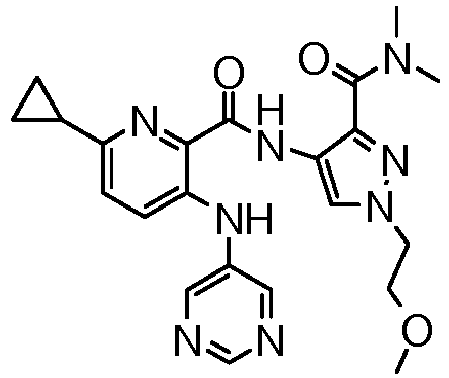
- A solution of 4-nitro-1H-pyrazole-3-carboxylic acid (2.5 g, 15.9 mmol) in ethanolic HCl (38.3 mL, 1.25M) was refluxed overnight. All volatiles were removed to yield a white solid (2.9 g, 98 %) which was used without any further purification.
MS: M = 186.1 (M+H)+ - To a solution of 4-nitro-1H-pyrazole-3-carboxylic acid ethyl ester (100 mg, 0.54 mmol) in DMSO (1 mL) was added potassium carbonate (164 mg, 1.19 mmol) and the reaction mixture was stirred for 5 min. 1-Bromo-2-methoxyethane (110 µl, 1.19 mml) was added and the resulting reaction mixture was stirred at ambient temperature overnight. The reaction mixture was partitioned between ethyl acetate and water and the aqueous phase was extracted with ethyl acetate. The combined organic phases were dried and the solvent was evaporated. The product was obtained as a mixture of regioisomers which were separated by silica gel chromatography using a heptane/ethyl acetate gradient to yield 72 mg (55 %) of the desired regioisomer and 33 mg (25 %) of 2-(2-methoxyethyl)-4-nitro-2H-pyrazole-3-carboxylic acid ethyl ester.
MS: M = 244.3 (M+H)+ - Under inert gas atmosphere, dimethylamine hydrochloride (73 mg, 0.89 mmol) was dissolved in toluene (1.0 ml). Dimethylaluminium chloride (990 µl, 0.9M heptane solution) was added and the reaction mixture was stirred for 10 min. at ambient temperature. 1-(2-Methoxyethyl)-4-nitro-1H-pyrazole-3-carboxylic acid ethyl ester (70 mg, 0.29 mmol) was added and the reaction mixture was heated to 90°C overnight. After cooling-down to ambient temperature, a small amount of water was added and the resulting suspension was stirred vigorously for 5 min. All volatiles were removed and the product was obtained after purification by silica gel chromatography using a heptane/ethyl acetate gradient as light brown oil (65 mg, 93 %).
MS: M = 243.3 (M+H)+ - The product was obtained according to the method described in example 2, step 2 starting from 1-(2-methoxyethyl)-4-nitro-1H-pyrazole-3-carboxylic acid dimethylamide as light yellow oil (48 mg, 99 %).
MS: M = 213.2 (M+H)+ - The product was obtained according to the method described in example 2, step 3 starting from 4-amino-1-(2-methoxyethyl)-1H-pyrazole-3-carboxylic acid dimethylamide and intermediate A-1 as yellow solid (33 mg, 52 %).
MS: M = 451.2 (M+H)+ -

- The product was obtained according to the method described in example 2, step 3 starting from 4-amino-1-methyl-1H-pyrazole-3-carboxylic acid methylamide and intermediate A-10 as yellow solid (14 mg, 51 %).
MS: M = 394.1 (M+H)+ -

- The product was obtained according to the method described in example 4, step 2 as a mixture of regioisomers which were separated by silica gel chromatography using a heptane/ethyl acetate gradient to yield 33 mg (25 %) of the desired regioisomer and 72 mg (55 %) of 1-(2-methoxyethyl)-4-nitro-1H-pyrazole-3-carboxylic acid ethyl ester.
MS: M = 244.3 (M+H)+ - The product was obtained according to the method described in example 4, step 3 starting from 2-(2-methoxyethyl)-4-nitro-2H-pyrazole-3-carboxylic acid ethyl ester as light brown oil (20 mg, 67 %).
MS: M = 243.2 (M+H)+ - The product was obtained according to the method described in example 2, step 2 starting from 2-(2-methoxyethyl)-4-nitro-2H-pyrazole-3-carboxylic acid dimethylamide as grey oil (19 mg, 99 %).
MS: M = 213.2 (M+H)+ - The product was obtained according to the method described in example 2, step 3 starting from 4-amino-2-(2-methoxyethyl)-2H-pyrazole-3-carboxylic acid dimethylamide and intermediate A-1 as yellow solid (4 mg, 12 %).
MS: M = 451.2 (M+H)+ -

- The product was obtained as a single regioisomer according to the method described in example 4, step 2 starting from 4-nitro-1H-pyrazole-3-carboxylic acid ethyl ester and 2,2,2-trifluoroethyl methanesulfonate after purification by silica gel chromatography using a heptane/ethyl acetate gradient as yellow oil (568 mg, 84 %).
MS: M = 268.1 (M+H)+ - The product was obtained according to the method described in example 4, step 3 starting from 4-nitro-1-(2,2,2-trifluoroethyl)-1H-pyrazole-3-carboxylic acid ethyl ester as off-white solid (38 mg, 66 %).
MS: M = 267.0 (M+H)+ - The product was obtained according to the method described in example 2, step 2 starting from 4-nitro-1-(2,2,2-trifluoroethyl)-1H-pyrazole-3-carboxylic acid dimethylamide as off-white solid (32 mg, 99 %).
MS: M = 237.2 (M+H)+ - The product was obtained according to the method described in example 2, step 3 starting from 4-amino-1-(2,2,2-trifluoroethyl)-1H-pyrazole-3-carboxylic acid dimethylamide and intermediate A-1 as light yellow solid (11 mg, 33 %).
MS: M = 475.1 (M+H)+ -

- The product was obtained according to the method described in example 4, step 3 starting from 4-nitro-1-(2,2,2-trifluoroethyl)-1H-pyrazole-3-carboxylic acid ethyl ester as light yellow oil (43 mg, 81 %).
MS: M = 253.2 (M+H)+ - The product was obtained according to the method described in example 2, step 2 starting from 4-nitro-1-(2,2,2-trifluoroethyl)-1H-pyrazole-3-carboxylic acid methylamide as off-white solid (25 mg, 71 %).
MS: M = 223.2 (M+H)+ - The product was obtained according to the method described in example 2, step 3 starting from 4-amino-1-(2,2,2-trifluoroethyl)-1H-pyrazole-3-carboxylic acid methylamide and intermediate A-1 as light yellow solid (14 mg, 58 %).
MS: M = 461.3 (M+H)+ -

- The product was obtained according to the method described in example 4, step 2 starting from 4-nitro-1H-pyrazole-3-carboxylic acid ethyl ester and 1,1,1-trifluoro-3-iodo-propane as a mixture of regioisomers which were separated by silica gel chromatography using a heptane/ethyl acetate gradient to yield 68 mg (15 %) of the desired regioisomer and 141 mg (31 %) of 4-nitro-2-(3,3,3-trifluoropropyl)-2H-pyrazole-3-carboxylic acid ethyl ester.
MS: M = 282.0 (M+H)+ - The product was obtained according to the method described in example 4, step 3 starting from 4-nitro-1-(3,3,3-trifluoropropyl)-1H-pyrazole-3-carboxylic acid ethyl ester as light brown waxy solid (41 mg, 67 %).
MS: M = 267.0 (M+H)+ - The product was obtained according to the method described in example 2, step 2 starting from 4-nitro-1-(3,3,3-trifluoropropyl)-1H-pyrazole-3-carboxylic acid methylamide as brown oil (36 mg, 99 %).
MS: M = 237.2 (M+H)+ - The product was obtained according to the method described in example 2, step 3 starting from 4-amino-1-(3,3,3-trifluoropropyl)-1H-pyrazole-3-carboxylic acid methylamide and intermediate A-1 as light yellow solid (11 mg, 33 %).
MS: M = 475.5 (M+H)+ -

- The product was obtained according to the method described in example 4, step 2 starting from 4-nitro-1H-pyrazole-3-carboxylic acid ethyl ester and 1,1,1-trifluoro-3-iodo-propane as a mixture of regioisomers which were separated by silica gel chromatography using a heptane/ethyl acetate gradient to yield 141 mg (31 %) of the desired regioisomer and 68 mg (15 %) of 4-nitro-1-(3,3,3-trifluoropropyl)-1H-pyrazole-3-carboxylic acid ethyl ester.
MS: M = 282.0 (M+H)+ - The product was obtained according to the method described in example 4, step 3 starting from 4-nitro-2-(3,3,3-trifluoropropyl)-2H-pyrazole-3-carboxylic acid ethyl ester as colorless oil (33 mg, 50 %).
MS: M = 267.0 (M+H)+ - The product was obtained according to the method described in example 2, step 2 starting from 4-nitro-2-(3,3,3-trifluoropropyl)-2H-pyrazole-3-carboxylic acid methylamide as brown oil (30 mg, >100 %).
MS: M = 237.2 (M+H)+ - The product was obtained according to the method described in example 2, step 3 starting from 4-amino-2-(3,3,3-trifluoropropyl)-2H-pyrazole-3-carboxylic acid methylamide and intermediate A-1 as light yellow solid (12 mg, 41 %).
MS: M = 475.1 (M+H)+ -

- The product was obtained according to the method described in example 4, step 3 starting from 2-(2-methoxyethyl)-4-nitro-2H-pyrazole-3-carboxylic acid ethyl ester (example 6, step 1; 22 mg, 40%).
MS: M = 243.2 (M+H)+ - The product was obtained according to the method described in example 2, step 2 starting from 2-(2-methoxyethyl)-4-nitro-2H-pyrazole-3-carboxylic acid methylamide as light brown solid (16 mg, 47 %).
MS: M = 199.3 (M+H)+ - The product was obtained according to the method described in example 2, step 3 starting from 4-amino-2-(2-methoxyethyl)-2H-pyrazole-3-carboxylic acid methylamide and intermediate A-1 as light yellow solid (4 mg, 26 %).
MS: M = 437.3 (M+H)+ -

- The product was obtained according to the method described in example 4, step 2 starting from 4-nitro-1H-pyrazole-3-carboxylic acid ethyl ester and bromomethyl-cyclopropane as a mixture of regioisomers which were separated by silica gel chromatography using a heptane/ethyl acetate gradient to yield 179 mg (46 %) of the desired regioisomer and 88 mg (23 %) of 2-cyclopropylmethyl-4-nitro-2H-pyrazole-3-carboxylic acid ethyl ester.
MS: M = 240.1 (M+H)+ - The product was obtained according to the method described in example 4, step 3 starting from 1-cyclopropylmethyl-4-nitro-1H-pyrazole-3-carboxylic acid ethyl ester as light brown waxy solid (78 mg, 83 %).
MS: M = 225.2 (M+H)+ - The product was obtained according to the method described in example 2, step 2 starting from 1-cyclopropylmethyl-4-nitro-1H-pyrazole-3-carboxylic acid methylamide as brown solid (58 mg, 95%).
MS: M = 195.2 (M+H)+ - The product was obtained according to the method described in example 2, step 3 starting from 4-amino-1-cyclopropylmethyl-1H-pyrazole-3-carboxylic acid methylamide and intermediate A-1 as light yellow solid (26 mg, 49 %).
MS: M = 433.4 (M+H)+ -

- The product was obtained according to the method described in example 4, step 2 starting from 4-nitro-1H-pyrazole-3-carboxylic acid ethyl ester and bromomethyl-cyclopropane as a mixture of regioisomers which were separated by silica gel chromatography using a heptane/ethyl acetate gradient to yield 88 mg (23 %) of the desired regioisomer and 179 mg (46 %) of 1-cyclopropylmethyl-4-nitro-1H-pyrazole-3-carboxylic acid ethyl ester.
MS: M = 240.1 (M+H)+ - The product was obtained according to the method described in example 4, step 3 starting from 2-cyclopropylmethyl-4-nitro-2H-pyrazole-3-carboxylic acid ethyl ester as white solid (40 mg, 53 %).
MS: M = 225.2 (M+H)+ - The product was obtained according to the method described in example 2, step 2 starting from 2-cyclopropylmethyl-4-nitro-2H-pyrazole-3-carboxylic acid methylamide as brown solid (32 mg, 92%).
MS: M = 195.3 (M+H)+ - The product was obtained according to the method described in example 2, step 3 starting from 4-amino-2-cyclopropylmethyl-2H-pyrazole-3-carboxylic acid methylamide and intermediate A-1 as light yellow solid (14 mg, 46 %).
MS: M = 433.4 (M+H)+ -

- According to the methods described in example 1, steps 1 and 2, the product was obtained by coupling of 1-methyl-4-nitro-1H-pyrazole-3-carboxylic acid and morpholine (90%) and subsequent hydrogenation (67%) as amorphous white solid.
MS: M = 211.2 (M+H)+ - To a stirred solution of (4-amino-1-methyl-1H-pyrazol-3-yl)-morpholin-4-yl-methanone (67 mg, 0.32 mmol) at rt in dioxane (2 ml) under an argon atmosphere was added trimethylaluminium solution (0.16 ml, 2 M in toluene, 0.33 mmol). After stirring for 2 hrs at rt, A-1 (30 mg, 0.11 mmol) was added in one portion. The reaction was heated to 100°C and stirring was continued for 16 h. The mixture was cooled to rt and H2O (0.5 ml) was added. After 15 min stirring, some MgSO4 was added and stirring was continued for 15 min. The mixture was filtered, washed with CH2Cl2 and evaporated. The product was obtained by silica gel chromatography using a CH2Cl2/MeOH gradient. Off-white solid (35 mg, 74%).
MS: M = 449.3 (M+H)+ -

- According to the methods described in example 14, the product was obtained by coupling of 1-methyl-4-nitro-1H-pyrazole-3-carboxylic acid and N-cyclopropylmethylamine (71%), hydrogenation (71%) and trimethylaluminium-promoted reaction with A-1 (41%). Off-white solid.
MS: M = 433.4 (M+H)+ -
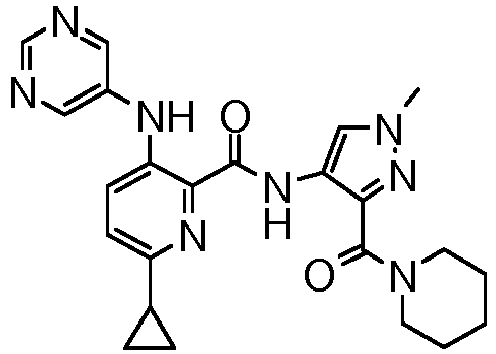
- According to the methods described in example 14, the product was obtained by coupling of 1-methyl-4-nitro-1H-pyrazole-3-carboxylic acid and piperidine (quant.), hydrogenation (63%) and trimethylaluminium-promoted reaction with A-1 (89%). Off-white solid.
MS: M = 447.3 (M+H)+ -

- According to the methods described in example 14, the product was obtained by coupling of 1-methyl-4-nitro-1H-pyrazole-3-carboxylic acid and N-methylcyclohexylamine (quant.), hydrogenation (80%) and trimethylaluminium-promoted reaction with A-1 (91%). Off-white solid.
MS: M = 475.2 (M+H)+ -

- To a solution of methylamine hydrochloride (2.0 g, 25 mmol) at rt in dioxane (60 ml) was added trimethyaluminium (2 M in toluene, 12.3 ml, 25 mmol) and stirred for 2 hrs at rt. Then 1-(2-methoxyethyl)-4-nitro-1H-pyrazole-3-carboxylic acid ethyl ester (2.0 g, 8.0 mmol; example 4, step 2) was added. The mixture was heated to 100°C and stirring was continued overnight. The mixture was cooled to rt, then 2 ml water was added and stirring was continued for 15 min. Some MgSO4 was added and stirring was continued for 15 min. The mixture was filtered, washed with CH2Cl2 and concentrated. The crude product was purified by silica gel chromatography using a cyclohexane/EtOAc gradient, providing the title compound (302 mg, 16%) as orange oil.
MS: M = 229.2 (M+H)+ - According to the procedure described in step 2 of example 2, the title compound was obtained as oil (80%).
- According to the procedure described in step 2 of example 14, the title compound was obtained starting from 4-amino-1-(2-methoxy-ethyl)-1H-pyrazole-3-carboxylic acid methylamide and A-1 as yellow solid (58%).
MS: M = 437.3 (M+H)+ -

- According to the methods described in example 14, the product was obtained by coupling of 1-methyl-4-nitro-1H-pyrazole-3-carboxylic acid and N-methylcyclopentylamine (quant.), hydrogenation (84%) and trimethylaluminium-promoted reaction with A-1 (55%).
MS: M = 461.4 (M+H)+ -

- According to the methods described in example 14, the product was obtained by coupling of 1-methyl-4-nitro-1H-pyrazole-3-carboxylic acid and methylisopropylamine (95%), hydrogenation (60%) and trimethylaluminium-promoted reaction with A-1 (49%).
MS: M = 435.4 (M+H)+ -

- According to the methods described in example 14, the product was obtained by coupling of 1-methyl-4-nitro-1H-pyrazole-3-carboxylic acid and pyrrolidine (46%), hydrogenation (89%) and trimethylaluminium-promoted reaction with A-1 (54%). Off-white solid.
MS: M = 433.4 (M+H)+ -

- According to the methods described in example 14, the product was obtained by coupling of 3-nitro-4-pyridinecarboxylic acid and pyrrolidine (25%), hydrogenation (91%) and trimethylaluminium-promoted reaction with A-1 (30%). Light yellow solid.
MS: M = 430.4 (M+H)+ -

- According to the methods described in example 14, the product was obtained by coupling of 3-nitro-4-pyridinecarboxylic acid and dimethylamine hydrochloride (25%), hydrogenation (77%) and trimethylaluminium-promoted reaction with A-1 (26%). Light yellow solid.
MS: M = 404.3 (M+H)+ -

- According to the methods described in example 14, the product was obtained by coupling of 3-nitro-4-pyridinecarboxylic acid and methylamine hydrochloride (38%), hydrogenation (95%) and trimethylaluminium-promoted reaction with A-1 (8%). Light yellow solid.
MS: M = 390.1 (M+H)+ -

- The title compound was prepared according to Z. Naturforsch. B., 2004, 59, 1132-1136. Off-white solid (27%).
MS: M = 262.0 (M+H)+ - To a stirred suspension of 4-nitro-1-phenyl-1H-pyrazole-3-carboxylic acid ethyl ester (240 mg, 0.92 mmol) at rt in ethanol (3 ml) under an argon atmosphere was added 1 N NaOH (1.8 ml). The mixture was stirred for 2 hrs. 3 N HCl was added until pH ∼ 2 was reached. Upon addition of H2O (∼ 2 ml), the product precipitated out. It was collected by filtration, washed with H2O and dried. Off-white solid (184 mg, 86%).
MS: M = 187.9 (M-COOH)- - According to the methods described in step 1 of example 1 and in step 2 of example 2, 4-nitro-1-phenyl-1H-pyrazole-3-carboxylic acid was coupled with methylamine hydrochloride (90%) and hydrogenated (quantitative) to give the title compound. Off-white solid.
MS: M = 217.3 (M+H)+ - According to the method described in example 14, step 2, 4-amino-1-phenyl-1H-pyrazole-3-carboxylic acid methylamide was reacted with A-1 to give the title compound. Off-white solid (52%).
MS: M = 455.2 (M+H)+ -

- According to the methods described in example 18, the title compound was obtained by AlMe3-promoted reaction of 2-(2-methoxyethyl)-4-nitro-2H-pyrazole-3-carboxylic acid ethyl ester (example 4, step 2) and methylamine hydrochloride (43%), hydrogenation (97%) and AlM3-promoted reaction with A-3 (71%). Light yellow solid.
MS: M = 441.3 (M+H)+ -
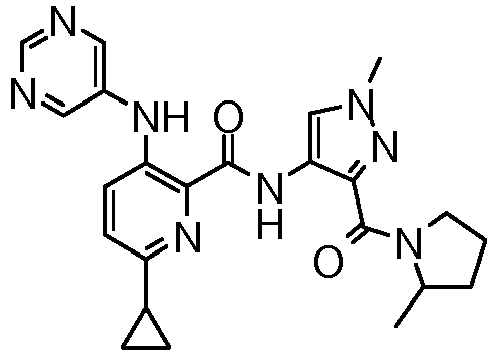
- To a solution of 4-nitro-1H-pyrazole-3-carboxylic acid (5 g, 31.8 mmol) in dry MeOH (60ml) was added freshly crystallized p-toluenesulphonic acid monohydrate (300 mg, 1.6 mmol). The reaction mixture was heated at 65°C for 16 hrs. MeOH was removed in vacuo. The residue was taken up with saturated aqueous NaHCO3 solution (15 ml) and extracted with EtOAc. The combined organic layers were washed with water, and then with brine, dried (Na2SO4), filtered, and evaporated. The crude product was purified by column chromatography over silica gel using 30%EtOAc/hexane) to provide the title compound as white solid (4.85 g, 89%).
- To a solution of 4-nitro-1H-pyrazole-3-carboxylic acid methyl ester (3.1 g, 18.1 mmol) in dry acetone (2 ml) was added K2CO3 (5 g, 36.2 mmol) at 25°C. The reaction mixture was cooled to 0°C, and methyl iodide (2.2 ml, 36.3 mmol) was added. The temperature was again raised to 25°C, and then heated to 70°C for 2 hrs. The solvent was removed in vacuo The residue was diluted with EtOA and washed with water and with brine, dried (Na2SO4), filtered, and concentrated. The crude product was purified by column chromatography over silica gel. Elution with 20% EtOAc/hexane) gave the undesired isomer 2-methyl-4-nitro-2H-pyrazole-3-carboxylic acid methyl ester (1 g, 30%), subsequent elution with 40% EtOAc/hexane provided the desired isomer 1-methyl-4-nitro-1H-pyrazole-3-carboxylic acid methyl ester (1.8 g, 54%).
- A solution of 1-methyl-4-nitro-1H-pyrazole-3-carboxylic acid methyl ester (4.8 g, 25.94 mmol) in dry MeOH (100ml) was thoroughly purged with argon, treated with 10% Pd-C (2.7 g, 2.59 mmol), and again purged with argon. Then the reaction mixture was hydrogenated under a balloon pressure of hydrogen at rt for overnight. The reaction mixture was filtered through a bed of celite. The filtrate was concentrated and dried to give the title compound as gray-white solid (3.4 g, 84%), which was used in the next reaction step without further purification.
- To a stirred solution of A-2 (600 mg, 2.34 mmol) in DMF (10ml) was added EDCI (672 mg, 3.51 mmol) and HOBt (538 mg, 3.51 mmol) at 25°C. Stirring was continued for 10 min. 4-Amino-1-methyl-1H-pyrazole-3-carboxylic acid methyl ester (362 mg, 2.35 mmol) and triethylamine (0.8 ml, 5.35 mmol) were subsequently added to the above solution. The reaction mixture was stirred at 25°C overnight, then quenched with water (8 ml), and extracted with CH2Cl2. The combined organic layers were washed with brine, dried (Na2SO4), filtered, and evaporated. The crude product thus obtained was purified by column chromatography over silica gel (2% MeOH/CH2Cl2) to provide the title compound (642 mg, 69%) as yellow sticky solid.
- To a stirred solution of the amine (1.50 mmol) in dry THF (5 ml) was added LiHMDS (1.0M in THF, 7-8 mmol) at -30°C to -40°C. After stirring the reaction mixture at that temperature for 15 min, a solution of 4-{[6-cyclopropyl-3-(pyrimidin-5-ylamino)-pyridine-2-carbonyl]-amino}-1-methyl-1H-pyrazole-3-carboxylic acid methyl ester (1.0 mmol) in THF (3 ml) was added. The reaction mixture was stirred at rt overnight, then quenched with saturated aqueous ammonium chloride solution and extracted with EtOAc (3x 5 ml). Combined organic layers were washed with brine (10 ml) and dried (Na2SO4), filtered and concentrated. The crude material was purified by prep-HPLC (column: Gemini C18 (250 x 21.2 mm, 5µ); elution with a gradient of 0.05% aqueous TFA solution/acetonitrile) to provide the final product.
- According to the general method described above (step 5), reaction of 2-methylpyrolidine with 4-{[6-cyclopropyl-3-(pyrimidin-5-ylamino)-pyridine-2-carbonyl]-amino}-1-methyl-1H-pyrazole-3-carboxylic acid methyl ester provided the title compound (19%) as sticky yellow solid.
MS: M = 447.2 (M+H)+ -

- According to the general method described in step 5 of example 27, reaction of cyclohexylamine with 4-{[6-cyclopropyl-3-(pyrimidin-5-ylamino)-pyridine-2-carbonyl]-amino}-1-methyl-1H-pyrazole-3-carboxylic acid methyl ester provided the title compound (45%) as sticky yellow solid.
MS: M = 461.4 (M+H)+ -

- To a suspension of A-2 (50 mg, 0.19 mmol) in 3ml AcOEt (3 ml) at rt under an argon atmosphere were added 2-amino-N-methylbenzamide (29 mg, 0.19 mmol) and N-ethyldiisopropylamine (0.1 ml, 0.59 mmol). The yellow suspension was cooled to 0°C and propyl-phosphonic anhydride (50% in AcOEt, 0.31 ml, 0.48 mmol) was added. The suspension was stirred at 0° for 30 min and at rt overnight. The solvent was evaporated. The crude product was purified by silica gel chromatography using a CH2Cl2/MeOH gradient to provide the title compound (46 mg, 61%) as yellow solid.
MS: M = 389.2 (M+H)+ -

- According to the general method described in step 5 of example 27, reaction of azetidine with 4-{[6-cyclopropyl-3-(pyrimidin-5-ylamino)-pyridine-2-carbonyl]-amino}-1-methyl-1H-pyrazole-3-carboxylic acid methyl ester provided the title compound (14%) as amorphous yellow solid.
MS: M = 419.4 (M+H)+ -

- According to the general method described in step 5 of example 27, reaction of cyclopropylamine with 4-{[6-cyclopropyl-3-(pyrimidin-5-ylamino)-pyridine-2-carbonyl]-amino}-1-methyl-1H-pyrazole-3-carboxylic acid methyl ester provided the title compound (24%) as amorphous yellow solid.
MS: M = 419.2 (M+H)+ -

- According to the general method described in step 5 of example 27, reaction of 3,3-dimethyl-pyrrolidine with 4-{[6-cyclopropyl-3-(pyrimidin-5-ylamino)-pyridine-2-carbonyl]-amino}-1-methyl-1H-pyrazole-3-carboxylic acid methyl ester provided the title compound (20%) as amorphous yellow solid.
MS: M = 461.4 (M+H)+ -

- According to the general method described in step 5 of example 27, reaction of cyclobutylamine with 4-{[6-cyclopropyl-3-(pyrimidin-5-ylamino)-pyridine-2-carbonyl]-amino}-1-methyl-1H-pyrazole-3-carboxylic acid methyl ester provided the title compound (24%) as yellow powder.
MS: M = 433.2 (M+H)+ -

- According to the general method described in step 5 of example 27, reaction of cyclopentylamine with 4-{[6-cyclopropyl-3-(pyrimidin-5-ylamino)-pyridine-2-carbonyl]-amino}-1-methyl-1H-pyrazole-3-carboxylic acid methyl ester provided the title compound (19%) as amorphous yellow solid.
MS: M = 447.2 (M+H)+ -

- According to the general method described in step 5 of example 27, reaction of 2,5-dimethylpyrolidine with 4-{[6-cyclopropyl-3-(pyrimidin-5-ylamino)-pyridine-2-carbonyl]-amino}-1-methyl-1H-pyrazole-3-carboxylic acid methyl ester provided the title compound (10%) as amorphous yellow solid.
MS: M = 461.4 (M+H)+ -

- According to the general method described in step 5 of example 27, reaction of 3,3-difluoropyrolidine with 4-{[6-cyclopropyl-3-(pyrimidin-5-ylamino)-pyridine-2-carbonyl]-amino}-1-methyl-1H-pyrazole-3-carboxylic acid methyl ester provided the title compound (14%) as sticky yellow solid.
MS: M = 469.4 (M+H)+ -

- According to the general method described in step 5 of example 27, reaction of 3-dimethyl-aminopyrolidine with 4-{[6-cyclopropyl-3-(pyrimidin-5-ylamino)-pyridine-2-carbonyl]-amino}-1-methyl-1H-pyrazole-3-carboxylic acid methyl ester provided the title compound (26%) as amorphous yellow solid.
MS: M = 476.6 (M+H)+ -

- According to the general method described in step 5 of example 27, reaction of 3-methylamino-propan-1-ol with 4-{[6-cyclopropyl-3-(pyrimidin-5-ylamino)-pyridine-2-carbonyl]-amino}-1-methyl-1H-pyrazole-3-carboxylic acid methyl ester provided the title compound (39%) as amorphous yellow solid.
MS: M = 451.4 (M+H)+ -

- According to the general method described in step 5 of example 27, reaction of 2-amino-ethanol with 4-{[6-cyclopropyl-3-(pyrimidin-5-ylamino)-pyridine-2-carbonyl]-amino}-1-methyl-1H-pyrazole-3-carboxylic acid methyl ester provided the title compound (6%) as amorphous yellow solid.
MS: M = 423.2 (M+H)+ -

- According to the general method described in step 5 of example 27, reaction of 2-methylaminoethanol with 4-{[6-cyclopropyl-3-(pyrimidin-5-ylamino)-pyridine-2-carbonyl]-amino}-1-methyl-1H-pyrazole-3-carboxylic acid methyl ester provided the title compound (13%) as amorphous yellow solid.
MS: M = 437.4 (M+H)+ -

- According to the general method described in step 5 of example 27, reaction of 2-methoxy-1-methyl-ethylamine with 4-{[6-cyclopropyl-3-(pyrimidin-5-ylamino)-pyridine-2-carbonyl]-amino}-1-methyl-1H-pyrazole-3-carboxylic acid methyl ester provided the title compound (16%) as amorphous yellow solid.
MS: M = 451.2 (M+H)+ -

- According to the general method described in step 5 of example 27, reaction of 3-aminopropane-1,2-diol with 4-{[6-cyclopropyl-3-(pyrimidin-5-ylamino)-pyridine-2-carbonyl]-amino}-1-methyl-1H-pyrazole-3-carboxylic acid methyl ester provided the title compound (15%) as sticky solid.
MS: M = 453.4 (M+H)+ -

- According to the general method described in step 5 of example 27, reaction of 1-amino-2-methyl-propan-2-ol with 4-{[6-cyclopropyl-3-(pyrimidin-5-ylamino)-pyridine-2-carbonyl]-amino}-1-methyl-1H-pyrazole-3-carboxylic acid methyl ester provided the title compound (27%) as amorphous yellow solid.
MS: M = 451.2 (M+H)+ -

- According to the general method described in step 5 of example 27, reaction of 3-hydroxy-pyrolidine with 4-{[6-cyclopropyl-3-(pyrimidin-5-ylamino)-pyridine-2-carbonyl]-amino}-1-methyl-1H-pyrazole-3-carboxylic acid methyl ester provided the title compound (15%) as sticky yellow solid.
MS: M = 449.2 (M+H)+ -
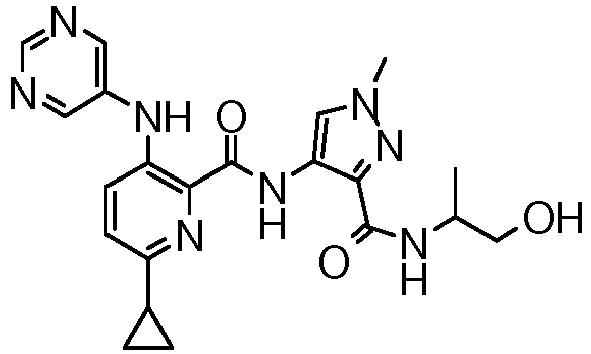
- According to the general method described in step 5 of example 27, reaction of 2-amino-propan-1-ol with 4-{[6-cyclopropyl-3-(pyrimidin-5-ylamino)-pyridine-2-carbonyl]-amino}-1-methyl-1H-pyrazole-3-carboxylic acid methyl ester provided the title compound (14%) as sticky yellow solid.
MS: M = 437.2 (M+H)+ -

- According to the general method described in step 5 of example 27, reaction of 3-methylamino-propane-1,2-diol with 4-{[6-cyclopropyl-3-(pyrimidin-5-ylamino)-pyridine-2-carbonyl]-amino}-1-methyl-1H-pyrazole-3-carboxylic acid methyl ester provided the title compound (9%) as sticky yellow solid.
MS: M = 467.4 (M+H)+ -
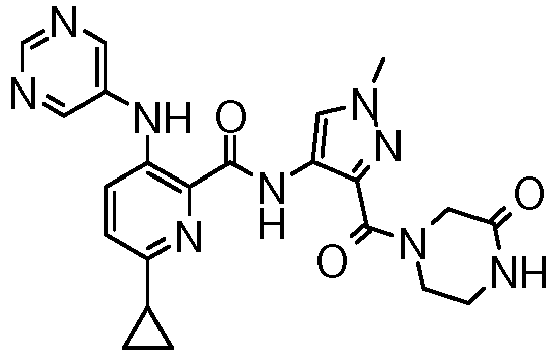
- According to the general method described in step 5 of example 27, reaction of piperazine-2-one with 4-{[6-cyclopropyl-3-(pyrimidin-5-ylamino)-pyridine-2-carbonyl]-amino}-1-methyl-1H-pyrazole-3-carboxylic acid methyl ester provided the title compound (12%) as pale yellow solid.
MS: M = 462.4 (M+H)+ -

- According to the general method described in step 5 of example 27, reaction of 3-methoxypyrolidine with 4-{[6-cyclopropyl-3-(pyrimidin-5-ylamino)-pyridine-2-carbonyl]-amino}-1-methyl-1H-pyrazole-3-carboxylic acid methyl ester provided the title compound (23%) as amorphous yellow solid.
MS: M = 463.2 (M+H)+ -

- According to the general method described in step 5 of example 27, reaction of 2-hydroxymethyl-pyrolidine with 4-{[6-cyclopropyl-3-(pyrimidin-5-ylamino)-pyridine-2-carbonyl]-amino}-1-methyl-1H-pyrazole-3-carboxylic acid methyl ester provided the title compound (15%) as sticky yellow solid.
MS: M = 463.4 (M+H)+ -

- According to the general method described in step 5 of example 27, reaction of 3-hydroxy-azetidine with 4-{[6-cyclopropyl-3-(pyrimidin-5-ylamino)-pyridine-2-carbonyl]-amino}-1-methyl-1H-pyrazole-3-carboxylic acid methyl ester provided the title compound (13%) as sticky yellow solid.
MS: M = 435.1 (M+H)+ -

- According to the general method described in step 5 of example 27, reaction of 2-oxa-6-aza-spiro[3.3]heptane with 4-{[6-cyclopropyl-3-(pyrimidin-5-ylamino)-pyridine-2-carbonyl]-amino}-1-methyl-1H-pyrazole-3-carboxylic acid methyl ester provided the title compound (5%) as sticky yellow solid.
MS: M = 461.1 (M+H)+ -

- To a stirred solution of 4-{[6-cyclopropyl-3-(pyrimidin-5-ylamino)-pyridine-2-carbonyl]-amino}-1-methyl-1H-pyrazole-3-carboxylic acid methyl ester (example 27, step 4; 300 mg, 0.76 mmol) in MeOH (7 ml) was added a solution of NaOH (49 mg, 1.2 mmol) in water (2 ml) while keeping the internal bath temperature below 5°C. The reaction mixture was stirred for 12h at rt, then concentrated. The residue was dissolved in water (10 ml), and the aqueous layer was washed with EtOAc. The aqueous phase was acidified with aqueous IN HCl solution (pH∼ 4-5), then saturated with sodium chloride, and extracted with EtOAc. Combined organic layers were washed with brine, dried (Na2SO4), and filtered. The organic layer was concentrated to give the title compound (142 mg, 45%) as yellowish sticky solid, which was directly used for next step.
- To stirred solution of 4-{[6-cyclopropyl-3-(pyrimidin-5-ylamino)-pyridine-2-carbonyl]-amino}-1-methyl-1H-pyrazole-3-carboxylic acid (70 mg, 0.18 mmol) in DMF were sequentially added N-methylmorpholine (0.12 ml, 0.9 mmol), HBTU (210 mg, 0.55 mmol), and 2,2-dimethylpyrrolidine (35 mg, 0.36 mmol) at rt, and the reaction mixture was allowed to stirr overnight. The solvent was removed in vacuo, and the residue was dissolved in EtOAc (10 ml), and was washed with aqueous NaHCO3 solution and water. The aqueous layer was back-extracted with EtOAc, and the combined organic layer was dried (Na2SO4), filtered, and evaporated in vacuo. The crude product was purified by prep. HPLC (column: Gemini C18 (250 x 21.2 mm, 5µ); elution with a gradient of 0.05% aqueous TFA solution/acetonitrile) to give the title compound (6 mg, 6%) as sticky yellow solid.
MS: M = 461.1 (M+H)+ -

- To stirred solution of A-2 (320 mg, 1.24 mmol) in dry THF (10 ml) was added HATU (942 mg, 2.48 mmol) and N-methyl morpholine (0.35 ml) at rt followed by addition of 3-amino-isonicotinic acid methyl ester (171 mg, 1.12 mmol). The reaction mixture was allowed to reflux for 10 hrs. After completion of the reaction, it was quenched with saturated NaHCO3 solution (10 ml) and water (10 ml). The aqueous layer was extracted with EtOAc (5x 10 ml), and then with CH2Cl2 (3x 12 ml). The combined organic layers were washed with brine (25 ml), dried (Na2SO4), filtered, and was removed in vacuo. The crude residue thus obtained was purified by column chromatography over silica gel (2% MeOH/CH2Cl2) to give the title compound (335 mg; 69%) as yellow solid.
- To stirred suspension of 3-{[6-cyclopropyl-3-(pyrimidin-5-ylamino)-pyridine-2-carbonyl]-amino}-isonicotinic acid methyl ester (330 mg, 0.84 mmol) in MeOH (5ml) was added a solution of NaOH (84.5 mg, 2.1 mmol) in water (2 ml) at 0 - 5°C. After the addition the reaction mixture was stirred at rt for 8 hrs. The solvent was removed in vacuo, the residue was dissolved in water (7 ml), and was washed with EtOAc (2x 10 ml).The aqueous layer was then acidified with IN HCl (pH∼2), and concentrated to obtain the title compound (containing NaCl) as a yellowish sticky solid which was directly used as such for the next step without any further purification.
MS: M = 377.4 (M+H)+ - To a stirred solution of 3-{[6-cyclopropyl-3-(pyrimidin-5-ylamino)-pyridine-2-carbonyl]-amino}-isonicotinic acid (1.0 mmol) in DMF (5 ml) was added N-methyl morpholine (2.5 mmol) and then HBTU (2.0 mmol) at 25°C. Stirring was continued for 10 minutes. Amine (2.0 mmol) was added, and the reaction mixture was allowed to stir at rt overnight., then concentrated. The residue was taken up in EtOAc (10 ml), washed successively with aqueous NaHCO3 solution (2x 10 ml), water and then with brine, dried (Na2SO4), filtered, and concentrated. The crude product was purified by prep-HPLC (Column: Zorbax SB C18 (250 x 21.2 mm,7µ); elution with a gradient of 0.05% aqueous TFA solution/acetonitrile).
MS: M = 391.2 (M+H)+ - According to the general method described above (step 3), reaction of 3-dimethylamino-pyrolidine with 3-{[6-cyclopropyl-3-(pyrimidin-5-ylamino)-pyridine-2-carbonyl]-amino}-isonicotinic acid provided the title compound (13%) as sticky yellow solid
MS: M = 473.4 (M+H)+ -

- To a solution of 5-amino-[1,2,3]thiadiazole-4-carboxyfic acid ethyl ester (0.5 g, 2.9 mmol) in dichloromethane (5 ml) was added consecutively a solution of di-tert-butyl-dicarbonate (0.772 g, 3.5 mmol) in dichloromethane (5 ml) and 4-dimethylaminopyridine (35 mg, 0.3 mmol). The reaction mixture was stirred at ambient temperature for 2 h. The reaction mixture was partitioned between potassium hydrogen sulfate (15 ml, 10% aqueous solution) and dichloromethane (40 ml) and extracted. The organic phase was washed with water and sodium bicarbonate, and the aqueous phases were back-extracted with dichloromethane. The combined organic phases were dried, filtrated and the solvent was evaporated to yield 0.87g (>100 %) of a light brown sticky residue that slowly became crystalline and was used for the next step without any further purification.
MS: M = 274.1 (M+H)+ - A solution of 5-tert-butoxycarbonylamino-[1,2,3]thiadiazole-4-carboxylic acid ethyl ester (0.87 g, 2.9 mmol) in a THF/ethanol mixture (18 ml; 3:1) was cooled to 0°C and treated with lithium hydroxide (8.6 ml; IN aqueous solution). After 15 min, the cooling bath was removed and the reaction mixture was stirred for 4h at ambient temperature. The solvent was evaporated, and the residue was partitioned between diethylether (30 ml) and water (5 ml) and extracted. The aqueous phase was extracted with diethylether and the ether phases were washed with water. The combined aqueous phases were acidified with HCl (9 ml, IN aqueous solution) and extracted with dichloromethane (2x 40 ml). The combined organic layers were washed with water, dried and the solvent was evaporated to yield the product as colorless solid (0.66 g, 94 %) which was used without any further purification.
MS: M = 244.1 (M-H)- - A solution of 5-tert-butoxycarbonylamino-[1,2,3]thiadiazole-4-carboxylic acid (0.66 g, 2.7 mmol) in DMF (10 ml) was treated with TBTU (1.16 g, 3.5 mmol), N,N-diisopropyl ethyl amine (2.29 ml, 13.5 mmol) and methylamine (1.75 ml, 2M THF solution) and stirred at ambient temperature for 5 h. The reaction mixture was partitioned between potassium hydrogen sulfate (30 ml, 10% aqueous solution) and ethyl acetae (60 ml) and extracted. The organic layer was washed with water and brine, and the aqueous phases were back-extracted with ethyl acetate. The combined organic phases were dried and the solvent was evaporated. The residue was suspended in dichloromethane, sucked off, and the filtrate was evaporated. The product was obtained after purification of the crude material by silica gel chromatography using a heptane/ethyl acetate gradient as colorless solid (0.23 g, 33 %).
MS: M = 259.0 (M-H)- - A solution of 5-tert-butoxycarbonylamino-[1,2,3]thiadiazole-4-carboxylic acid methylamide (0.23 g, 0.9 mmol) in dioxane (4 ml) was treated with HCl (6 ml, 4M dioxane solution) at ambient temperature and stirred for 3 days. The solvent was evaporated, and the residue was suspended in diethylether, mixed and sucked off. The remaining solid material was dissolved in dichloromethane and extracted with NaOH (10 ml, 1M aqueous solution). The aqueous phase was extracted with dichloromethane, and the combined organic layers were dried and the solvent was evaporated to yield the product as colorless solid (0.7 g, 48 %) which was used without any further purification.
MS: M = 159.1 (M-H)- - To a solution of intermediate A-2 (40 mg, 0.16 mmol) in DMF (1.5 ml) were added TBTU (57 mg, 0.17 mmol), N,N-diisopropylethylamine (0.13 ml, 0.78 mmol) and 5- amino-[1,2,3]thiadiazole-4-carboxylic acid methylamide (27 mg, 0.17 mmol). The reaction mixture was stirred at ambient temperature overnight. The resulting suspension was sucked off and the collected solid material was thoroughly washed with THF. The final product was obtained upon drying of the precipitate as yellow solid (23 mg, 37 %).
MS: M = 396.2 (M)+ -

- According to the general method described in step 3 of example 53, reaction of 2-methylpyrolidine with 3-{[6-cyclopropyl-3-(pyrimidin-5-ylamino)-pyridine-2-carbonyl]-amino}-isonicotinic acid provided the title compound (14%) as sticky yellow solid.
MS: M = 444.4 (M+H)+ -

- According to the general method described in step 3 of example 53, reaction of 3,3-difluoro-pyrolidine with 3-{[6-cyclopropyl-3-(pyrimidin-5-ylamino)-pyridine-2-carbonyl]-amino}-isonicotinic acid provided the title compound (27%) as amourphous light yellow solid.
MS: M = 466.0 (M+H)+ -

- According to the general method described in step 3 of example 53, reaction of cyclopropylamine with 3-{[6-cyclopropyl-3-(pyrimidin-5-ylamino)-pyridine-2-carbonyl]-amino}-isonicotinic acid provided the title compound (28%) as yellow powder.
MS: M = 416.2 (M+H)+ -
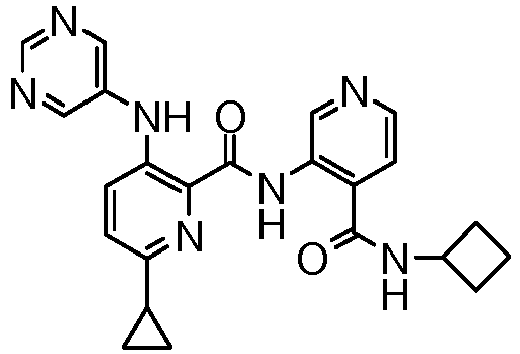
- According to the general method described in step 3 of example 53, reaction of cyclobutylamine with 3-{[6-cyclopropyl-3-(pyrimidin-5-ylamino)-pyridine-2-carbonyl]-amino}-isonicotinic acid provided the title compound (35%) as amorphous yellow solid.
MS: M = 430.2 (M+H)+ -

- According to the general method described in step 3 of example 53, reaction of 2,5-dimethyl-pyrolidine with 3-{[6-cyclopropyl-3-(pyrimidin-5-ylamino)-pyridine-2-carbonyl]-amino}-isonicotinic acid provided the title compound (35%) as amorphous yellow solid.
MS: M = 458.0 (M+H)+ -

- According to the general method described in step 3 of example 53, reaction of piperazine-2-one with 3-{[6-cyclopropyl-3-(pyrimidin-5-ylamino)-pyridine-2-carbonyl]-amino}-isonicotinic acid provided the title compound (14%) as amorphous light yellow solid.
MS: M = 459.4 (M+H)+ -

- According to the general method described in step 3 of example 53, reaction of cyclopentylamine with 3-{[6-cyclopropyl-3-(pyrimidin-5-ylamino)-pyridine-2-carbonyl]-amino}-isonicotinic acid provided the title compound (18%) as amorphous yellow solid.
MS: M = 444.4 (M+H)+ -

- According to the general method described in step 3 of example 53, reaction of 3-methoxy-pyrolidine with 3-{[6-cyclopropyl-3-(pyrimidin-5-ylamino)-pyridine-2-carbonyl]-amino}-isonicotinic acid provided the title compound (18%) as off-white powder.
MS: M = 460.4 (M+H)+ -

- According to the general method described in step 3 of example 53, reaction of 3,3-dimethyl-pyrolidine with 3-{[6-cyclopropyl-3-(pyrimidin-5-ylamino)-pyridine-2-carbonyl]-amino}-isonicotinic acid provided the title compound (34%) as amorphous yellow solid.
MS: M = 458.4 (M+H)+ -

- A solution of benzoylamino-cyano-acetic acid ethyl ester (400 mg, 1.7 mmol) in toluene (4 ml) was flushed with argon, and Lawesson's reagent (314 mg, 0.85 mmol) was added. The reaction mixture was stirred at 100°C for 5 days. The solvent was evaporated, and the product was obtained after purification by silica gel chromatography using a heptane/ethyl acetate gradient as yellow solid (147 mg, 34 %).
MS: M = 249.1 (M+H)+ - To a solution of 5-amino-2-phenyl-thiazole-4-carboxylic acid ethyl ester (147 mg, 0.59 mmol) in dichloromethane (1.5 ml) was added consecutively a solution of di-tert-butyl-dicarbonate (155 mg, 0.71 mmol) in dichloromethane (1.5 ml) and 4-dimethylaminopyridine (7.3 mg, 0.06 mmol). The reaction mixture was stirred at ambient temperature for 2 h. The reaction mixture was partitioned between potassium hydrogen sulfate (5 ml, 10% aqueous solution) and dichloromethane (10 ml) and extracted. The organic phase was washed with water and sodium bicarbonate, and the aqueous phases were back-extracted with dichloromethane. The combined organic phases were dried, filtrated and the solvent was evaporated. The product was obtained after purification by silica gel chromatography using a heptane/ethyl acetate gradient as light yellow solid (152 mg, 73 %).
MS: M = 349.3 (M+H)+ - A solution of 5-tert-butoxycarbonylamino-2-phenyl-thiazole-4-carboxylic acid ethyl ester (151 mg, 0.43 mmol) in a THF/ethanol mixture (3 ml; 2:1) was cooled to 0°C and treated with lithium hydroxide (1.3 ml; IN aqueous solution). After 15 min, the cooling bath was removed and the reaction mixture was stirred at 50°C overnight. The reaction mixture was acidified with HCl (1.3 ml, IN aqueous solution) and extracted with dichloromethane (2x 10 ml). The combined organic layers were dried and the solvent was evaporated to yield the product as off-white solid (143 mg, 100 %) which was used without any further purification.
MS: M = 319.2 (M-H)- - A solution of 5-tert-butoxycarbonylamino-2-phenyl-thiazole-4-carboxylic acid (138 mg, 0.43 mmol) in THF (2.5 ml) was treated with HATU (187 mg, 0.49 mmol), N-methylmorpholin (0.25 ml, 2.24 mmol) and methylamine (0.29 ml, 2M THF solution) and stirred at 75°C for 6 h. The reaction mixture was partitioned between potassium hydrogen sulfate (10% aqueous solution) and ethyl acetae and extracted. The organic layer was washed with water, sodium bicarbonate and brine. The combined organic phases were dried and the solvent was evaporated. The product was obtained after purification by silica gel chromatography using a heptane/ethyl acetate gradient as light yellow solid (98 mg, 65 %).
MS: M = 334.3 (M+H)+ - A solution of 5-tert-butoxycarbonylamino-2-phenyl-thiazole-4-carboxylic acid methylamide (98 mg, 0.3 mmol) in dioxane (1.7 ml) was treated with HCl (1.7 ml, 4M dioxane solution) at ambient temperature and stirred for 3 days. The solvent was evaporated, and the residue was dissolved in ethyl acetate and extracted with sodium bicarbonate and brine. The organic layer was dried and the solvent was evaporated to yield the product as yellow solid (62 g, 90 %) which was used without any further purification.
MS: M = 234.1 (M+H)+ - To a solution of intermediate A-2 (17 mg, 0.07 mmol) and 5-amino-2-phenyl-thiazole-4-carboxylic acid methylamide (20 mg, 0.09 mmol) in THF (0.5 ml) were added HATU (28 mg, 0.07 mmol) and N-methylmorpholin (37 µl, 0.34 mmol). The reaction mixture was stirred at 75°C overnight. The resulting suspension was sucked off and the collected solid material was thoroughly washed with THF. The final product was obtained upon drying of the precipitate as yellow solid (19 mg, 61 %).
MS: M = 472.2 (M+H)+ -

- A solution of 2-picolinic acid (540 mg, 4.4 mmol) in dichloromethane (5 ml) was treated with thionyl chloride (0.4 ml, 5.5 mmol) and a drop of DMF at ambient temperature. The reaction mixture is stirred at 40°C overnight whereupon another equivalent of thionyl chloride was added and stirring was continued at 40°C for another 2h. All volatiles were removed and the acid chloride was suspended in dichloromethane (5 ml) and added to a pre-cooled (0°C) solution of amino-cyano-acetic acid ethyl ester (470 mg, 3.7 mmol) and triethylamine (2.5 ml, 18.3 mmol) in dichloromethane (5 ml). The resulting reaction mixture was slowly warmed-up to 40°C and stirred at that temperature for 4h. The reaction mixture was partitioned between potassium hydrogen sulfate (10% aqueous solution) and dichloromethane and extracted. The organic phase was washed with water and brine, dried and the solvent was evaporated. The product was obtained after purification by silica gel chromatography using a heptane/ethyl acetate gradient as light yellow viscous oil (334 mg, 39 %).
MS: M = 234.1 (M+H)+ - The product was obtained starting from cyano-[(pyridine-2-carbonyl)-amino]-acetic acid ethyl ester (332 mg, 1.4 mmol) according to the method described in example 64, step 1 as off-white solid (98 mg, 27 %).
MS: M = 250.1 (M+H)+ - The product was obtained starting from 5-amino-2-pyridin-2-yl-thiazole-4-carboxylic acid ethyl ester (96 mg, 0.38 mmol) according to the method described in example 64, step 2 as off-white solid (95 mg, 70 %).
MS: M = 350.3 (M+H)+ - The product was obtained starting from 5-tert-butoxycarbonylamino-2-pyridin-2-yl-thiazole-4-carboxylic acid ethyl ester (93 mg, 0.27 mmol) according to the method described in example 64, step 3 as white solid (75 mg, 87 %).
MS: M = 320.2 (M-H)- - The product was obtained starting from 5-tert-butoxycarbonylamino-2-pyridin-2-yl-thiazole-4-carboxylic acid (73 mg, 0.23 mmol) according to the method described in example 64, step 4 as light yellow solid (34 mg, 45 %).
MS: M = 335.4 (M+H)+ - A solution of 5-tert-butoxycarbonylamino-2-pyridin-2-yl-thiazole-4-carboxylic acid methylamide (34 mg, 0.10 mmol) in dichloromethane (0.5 ml) was treated with trifluoroacetic acid (0.5 ml) and stirred at ambient temperature for 3h. After solvent evaporation, the residue was dissolved in ethyl acetate and washed with NaOH (1N aqueous solution), water and brine. The organic layer was dried and the solvent was evaporated. The remaining residue was suspended in diethylether, sucked off, and the remaining material was dried to yield the product as yellow solid (10 mg, 42%).
MS: M = 235.2 (M+H)+ - The product was obtained starting from intermediate A-2 (8 mg, 0.03 mmol) and 5-amino-2-pyridin-2-yl-thiazole-4-carboxylic acid methylamide (10 mg, 0.04 mmol) according to the method described in example 64, step 6 as yellow solid (2.5 mg, 16 %).
MS: M = 473.2 (M+H)+ -

- According to the general method described in step 3 of example 53, reaction of 2-amino-propan-1-ol with 3-{[6-cyclopropyl-3-(pyrimidin-5-ylamino)-pyridine-2-carbonyl]-amino}-isonicotinic acid provided the title compound (32%) as amorphous yellow solid.
MS: M = 434.0 (M+H)+ -
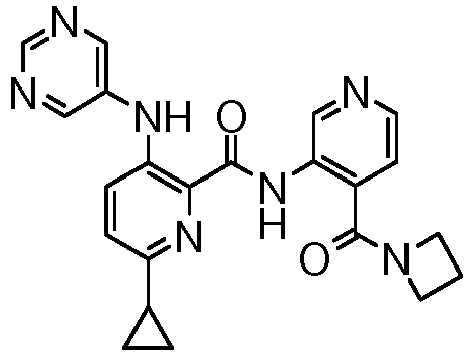
- According to the general method described in step 3 of example 53, reaction of azetidine with 3-{[6-cyclopropyl-3-(pyrimidin-5-ylamino)-pyridine-2-carbonyl]-amino}-isonicotinic acid provided the title compound (60%) as amorphous yellow solid.
MS: M = 416.2 (M+H)+ -

- According to the general method described in step 3 of example 53, reaction of 2-aminoethanol with 3-{[6-cyclopropyl-3-(pyrimidin-5-ylamino)-pyridine-2-carbonyl]-amino}-isonicotinic acid provided the title compound (36%) as amorphous yellow solid.
MS: M = 420.2 (M+H)+ -

- According to the general method described in step 3 of example 53, reaction of 3-amino-propan-1,2-diol with 3-{[6-cyclopropyl-3-(pyrimidin-5-ylamino)-pyridine-2-carbonyl]-amino}-isonicotinic acid provided the title compound (33%) as amorphous yellow solid.
MS: M = 450.2 (M+H)+ -

- According to the general method described in step 3 of example 53, reaction of 1-amino-2-methyl-propan-2-ol with 3-{ [6-cyclopropyl-3-(pyrimidin-5-ylamino)-pyridine-2-carbonyl]-amino}-isonicotinic acid provided the title compound (28%) as amorphous yellow solid.
MS: M = 448.0 (M+H)+ -
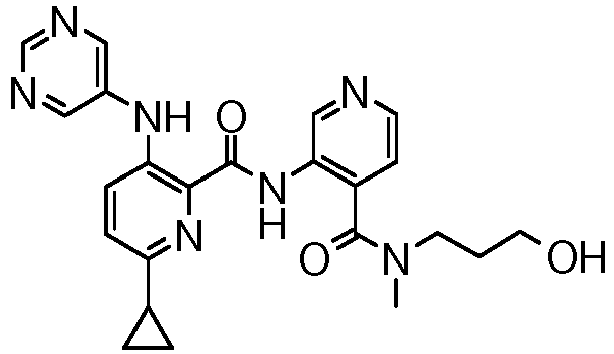
- According to the general method described in step 3 of example 53, reaction of 3-methylamino-propan-1-ol with 3-{[6-cyclopropyl-3-(pyrimidin-5-ylamino)-pyridine-2-carbonyl]-amino}-isonicotinic acid provided the title compound (34%) as amorphous yellow solid.
MS: M = 448.0 (M+H)+ -

- According to the general method described in step 3 of example 53, reaction of (2-methoxy-1-methyl-ethyl)-methyl-amine with 3-{ [6-cyclopropyl-3-(pyrimidin-5-ylamino)-pyridine-2-carbonyl]-amino}-isonicotinic acid provided the title compound (32%) as amorphous yellow solid.
MS: M = 448.2 (M+H)+ -

- According to the general method described in step 3 of example 53, reaction of 2-methylaminoethanol with 3-{[6-cyclopropyl-3-(pyrimidin-5-ylamino)-pyridine-2-carbonyl]-amino}-isonicotinic acid provided the title compound (32%) as amorphous yellow solid.
MS: M = 434.0 (M+H)+ -
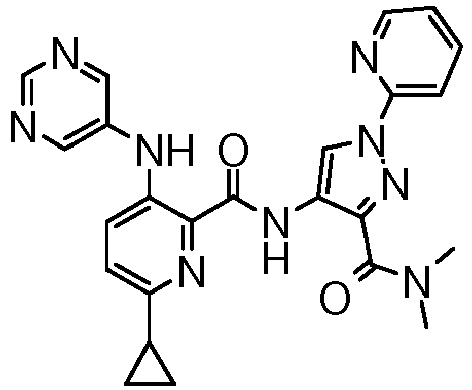
- A solution of 4-nitro-1H-pyrazole-3-carboxylic acid (1.0 g, 6.4 mmol) in dichloromethane (20 ml) was treated with thionyl chloride (1.4 ml, 19 mmol) and a drop of DMF at ambient temperature. The reaction mixture is stirred at 40°C overnight whereupon another equivalent of thionyl chloride (0.46 ml, 6.4 mmol) was added and stirring was continued at 40°C for another 24h. All volatiles were removed and the acid chloride was suspended in dichloromethane (6 ml) and cooled to 0°C. Triethylamine (4.44 ml, 31.8 mmol) and dimethylamin (4.14 ml, 2M solution in THF) were added. The reaction mixture was allowed to warm-up to ambient temperature and stirring was continued for 3h. The reaction mixture was partitioned between potassium hydrogen sulfate (20 ml, 10% aqueous solution) and ethyl acetate (40 ml) and extracted. The organic phase was washed with water and brine, dried and the solvent was evaporated. The crude product was triturated with diethylether, sucked off and dried to yield a light brown solid (0.35 g, 30 %).
MS: M = 185.1 (M+H)+ - A solution of 4-nitro-1H-pyrazole-3-carboxylic acid dimethylamide (250 mg, 1.36 mmol) in DMF (5 ml) was flushed with argon. 2-Bromopyridine (0.17 ml, 1.76 mmol), ferric acetylacetone (144 mg, 0.4 mmol), copper(I)oxide (20 mg, 0.14 mmol) and cesium carbonate (885 mg, 2.7 mmol) were added consecutively and the reaction mixture was stirred at 110°C overnight. After cooling down, the reaction mixture was partitioned between ethyl acetate (30 ml) and water (15 ml) and extracted. The organic layer was washed with brine, dried and the solvent was evaporated. The product was obtained after purification by silica gel chromatography using a heptane/ethyl acetate gradient as light yellow solid (102 mg, 29 %).
MS: M = 262.1 (M+H)+ - A solution of 4-nitro-1-pyridin-2-yl-1H-pyrazole-3-carboxylic acid dimethylamide (50 mg, 0.19 mmol) in THF (3 ml) was flushed with argon and treated with Pd/C 10% (11 mg, 0.01 mmol). The reaction vessel was evacuated and flushed with hydrogen three times and the reaction was stirred at ambient temperature overnight. The reaction mixture was filtrated and the solvent was evaporated to yield a solid material (44 mg, 99 %) which was used without further purification.
MS: M = 232.1 (M+H)+ - The product was obtained starting from intermediate A-2 (29 mg, 0.11 mmol) and 4-amino-1-pyridin-2-yl-1H-pyrazole-3-carboxylic acid dimethylamide (43 mg, 0.18 mmol) according to the method described in example 54, step 5 after purification by preparative HPLC using an acetonitrile/water gradient as light yellow solid (9.4 mg, 17 %).
MS: M = 470.4 (M+H)+ -

- According to the procedure described in step 2 of example 14, the title compound was obtained by reaction of A-4 and 4-amino-1-methyl-1H-pyrazole-3-carboxylic acid methylamide as yellow solid (69%).
MS: M = 396.1 (M+H)+ -

- According to the procedure described in step 2 of example 14, the title compound was obtained by reaction of A-5 and 4-amino-1-methyl-1H-pyrazole-3-carboxylic acid methylamide as yellow solid (78%).
MS: M = 394.1 (M+H)+ -

- According to the procedure described in step 2 of example 14, the title compound was obtained by reaction of A-6 and 4-amino-1-methyl-1H-pyrazole-3-carboxylic acid methylamide as yellow solid (80%).
MS: M = 410.3 (M+H)+ -

- According to the general method described in step 3 of example 53, reaction of cyclohexylamine with 3-{[6-cyclopropyl-3-(pyrimidin-5-ylamino)-pyridine-2-carbonyl]-amino}-isonicotinic acid provided the title compound (26%) as amorphous yellow solid.
MS: M = 458.2 (M+H)+ -

- According to the general method described in step 3 of example 53, reaction of 3,3-difluoroazetidine with 3-{[6-cyclopropyl-3-(pyrimidin-5-ylamino)-pyridine-2-carbonyl]-amino}-isonicotinic acid provided the title compound as yellow powder (26%).
MS: M = 452.0 (M+H)+ -

- According to the general method described in step 3 of example 53, reaction of 2-hydroxymethylpyrolidine with 3-{[6-cyclopropyl-3-(pyrimidin-5-ylamino)-pyridine-2-carbonyl]-amino}-isonicotinic acid provided the title compound as off-white solid (29%).
MS: M = 460.4 (M+H)+ -
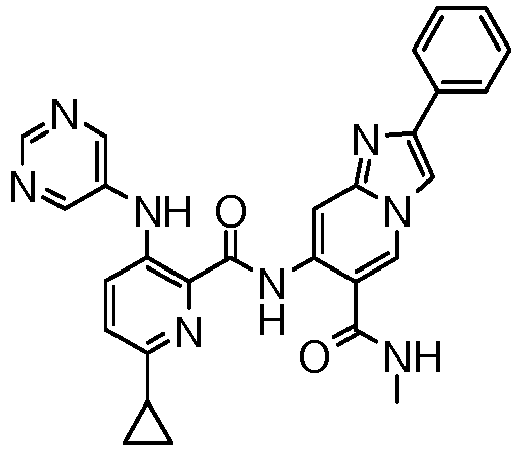
- To a stirred suspension of 3-cyano-4,6-diaminopyridine (2.02 g, 15 mmol) at rt in ethanol (50 ml) under an argon atmosphere were added NaHCO3 (2.53 g, 30 mmol) and 2-bromoacetophenone (6.0 g, 30 mmol). The mixture was heated to reflux and stirring was continued overnight. The dark brown slurry was cooled to rt and concentrated. The residual dark brown sticky solid was taken up in 3 N HCl (50 ml) and EtOAc (50 ml). The biphasic mixture was stirred at rt for 1 hr. The precipitate was collected by filtration and washed with EtOAc. Trituration of the solid in 50 ml CH2Cl2/MeOH 9:1 and filtration provided the title compound(2.63 g, 64%) as off-white solid.
MS: M = 235.1 (M+H)+ - To a stirred suspension of 7-amino-2-phenyl-imidazo[1,2-a]pyridine-6-carbonitrile hydrochloride (1.0 g, 3.7 mmol) at rt in EtOH (20 ml) under an argon atmosphere was added H2SO4 (1.5 ml, 27.7 mmol) in one portion. The mixture was heated to reflux and stirring was continued for 2 days. The mixture was cooled to rt and diluted with 10 ml H2O. The solid was collected by filtration, washed with H2O and dried. Then it was suspended in CH2Cl2/MeOH 9:1 and treated with triethylamine to give a yellow solution. The dissolved material was adsorbed on Isolute® Flash-NH2 silica gel (from Separtis) and purified by chromatographie on the same silica gel as stationary phase using a CH2Cl2/MeOH gradient as eluent, providing the title compound as off-white solid (642 mg, 62%).
MS: M = 282.1 (M+H)+ - According to the procedure described in step 1 of example 18 7-amino-2-phenyl-imidazo[1,2-a]pyridine-6-carboxylic acid ethyl ester was reacted with methylamine hydrochloride to give the title compound as off-white solid (60%).
MS: M = 267.1 (M+H)+ - According to the procedure described in example 29, 7-amino-2-phenyl-imidazo[1,2-a]pyridine-6-carboxylic acid methylamide and A-2 were coupled to give the title compound as yellow solid (25%).
MS: M = 505.1 (M+H)+ -

- According to the general method described in step 3 of example 53, reaction of 3-hydroxy-azetidine with 3-{[6-cyclopropyl-3-(pyrimidin-5-ylamino)-pyridine-2-carbonyl]-amino}-isonicotinic acid provided the title compound (8%) as light yellow powder.
MS: M = 432.0 (M+H)+ -

- According to the procedure described in step 2 of example 14, the title compound was obtained by reaction of A-7 and 4-amino-1-methyl-1H-pyrazole-3-carboxylic acid methylamide as yellow solid (52%).
MS: M = 410.3 (M+H)+ -

- According to the procedure described in step 2 of example 14, the title compound was obtained by reaction of A-8 and 4-amino-1-methyl-1H-pyrazole-3-carboxylic acid methylamide as yellow solid (58%).
MS: M = 436.3 (M+H)+ -

- According to the general method described in step 3 of example 53, reaction of 2,2-dimethylpyrolidine with 3-{[6-cyclopropyl-3-(pyrimidin-5-ylamino)-pyridine-2-carbonyl]-amino}-isonicotinic acid provided the title compound (23%) as sticky yellow solid.
MS: M = 458.2 (M+H)+ -

- According to the general method described in step 3 of example 53, reaction of 3-methylamino-propan-1,2-diol with 3-{[6-cyclopropyl-3-(pyrimidin-5-ylamino)-pyridine-2-carbonyl]-amino}-isonicotinic acid provided the title compound (19%) as sticky yellow solid.
MS: M = 464.2 (M+H)+ -

- According to the general method described in step 3 of example 53, reaction of 3-hydroxy-pyrolidine with 3-{[6-cyclopropyl-3-(pyrimidin-5-ylamino)-pyridine-2-carbonyl]-amino}-isonicotinic acid provided the title compound (30%) as light yellow solid.
MS: M = 446.0 (M+H)+ -

- According to the general method described in step 3 of example 53, reaction of 2-oxa-6-aza-spiro[3.3]heptane with 3-{[6-cyclopropyl-3-(pyrimidin-5-ylamino)-pyridine-2-carbonyl]-amino}-isonicotinic acid provided the title compound (9%) as amorphous off-white solid.
MS: M = 458.2 (M+H)+ -

- The product was obtained starting from intermediate A-2 (40 mg, 0.16 mmol) and 2-amino-N-cyclopropylthiophene-3-carboxamide (40 mg, 0.22 mmol) according to the method described in example 64, step 6 as yellow solid (35 mg, 53 %).
MS: M = 421.2 (M+H)+ -

- The product was obtained starting from intermediate A-2 (40 mg, 0.16 mmol) and 2-(morpholin-4-ylcarbonyl)thioen-2-ylamine (46 mg, 0.22 mmol) according to the method described in example 64, step 6 as light yellow solid (27 mg, 38 %).
MS: M = 451.2 (M+H)+ -

- The product was obtained starting from intermediate A-2 (40 mg, 0.16 mmol) and (2-amino-5-isopropylthiophene-3-yl)-morpholino-methanone (56 mg, 0.22 mmol) according to the method described in example 64, step 6 as yellow solid (49 mg, 64 %).
MS: M = 493.3 (M+H)+ -

- A mixture of 3-nitroisonicotinic acid (1.75 g, 10.1 mmol), 1-amino-2-methylpropan-2-ol (968 ul, 10.1 mmol), 2-(1H-benzotriazole-1-yl)-1,1,3,3-tetramethyluronium tetrafluoroborate (4.86 g, 15.1 mmol) and triethylamine (4.9 ml, 35.3 mmol) in tetrahydrofurane (60 ml) was stirred over the week-end at rt. The reaction mixture was diluted with ethyl acetate, washed with water, with brine, dried with magnesium sulfate and concentrated. The crude product was purified by silica gel chromatography using a CH2Cl2/MeOH gradient as eluent, providing the title compound as off-white solid (255 mg, 11%).
MS: M = 240.0 (M+H)+ - According to the procedure described in step 2 of example 2, the title compound was obtained as off-white solid (96%).
MS: M = 210.2 (M+H)+ - According to the procedure described in example 29, 3-amino-N-(2-hydroxy-2-methylpropyl)iso-nicotinamide was reacted with A-15 to give the title compound as yellow solid (7%).
MS: M = 451.2 (M+H)+ -

- According to the procedure described in example 29, 3-amino-N-(2-hydroxy-2-methylpropyl)iso-nicotinamide (step 2, example 92) was reacted with A-9 to give the title compound as yellow solid (11%).
MS: M = 465.2 (M+H)+ -

- In an autoclave a mixture of methyl 2-amino-4-(diethylcarbamoyl)benzoate (490 mg, 1.96 mmol) and methylamine solution (33% in ethanol; 25 ml, 200 mmol) was stirred for 24 hrs at 90°C. The reaction mixture was concentrated. The crude product was purified by silica gel chromatography using EtOAc as eluent, providing the title compound as white solid (341 mg, 70%).
MS: M = 250.2 (M+H)+ - According to the procedure described in example 29, A-9 was reacted with 2-amino-N4,N4-diethyl-N1-methylterephthalamide to give the title compound as yellow solid (30%).
MS: M = 505.2 (M+H)+ -

- To a suspension of 1-methyl-4-nitro-1H-pyrazole-3-carboxylic acid (0.9 g, 5.26 mmol) and 1-amino-2-methylpropan-2-ol (469 mg, 5.26 mmol) in THF (20 mL) cooled to 0-5°C were added N,N-diisopropylamine (3.67 mL, 21.0 mmol) and 1-propanephosphonic acid cyclic anhydride (8.37 mL, 13.1 mmol, 50% solution in ethyl acetate). The mixture was stirred at 70 °C for 16 hours, cooled to ambient temperature, poured into ethyl acetate (50 mL) and extracted with HCl (1 M , 20 mL). The organic phase was washed with water and brine. The aqueous layers were back-extracted separately with ethyl acetate and dichloromethane. The combined organic layers were dried and concentrated in vacuo to give 1.4 g crude product. The crude material was purified by silica gel chromatography using a methanol/ethyl acetate gradient to give the title compound as colorless foam (391 mg, 31 % yield).
MS: M=243.2 (M+H)+ - To a solution of N-(2-hydroxy-2-methylpropyl)-1-methyl-4-nitro-1H-pyrazole-3-carboxamide (391 mg, 1.61 mmol) in ethanol was added under an argon atmosphere Pd/C 10% (40 mg, 0.04 mmol) at ambient temperature. The mixture was stirred at that temperature under a hydrogen atmosphere for 16 hours. The catalyst was filtered off and washed with ethanol. The filtrate was concentrated in vacuo to give the title compound as waxy solid (340 mg, 99 % yield) which was used without any further purification.
MS: M=213.3 (M+H)+ - The product was obtained starting from intermediate A-11 (66 mg, 0.26 mmol) and 4-amino-N-(2-hydroxy-2-methylpropyl)-1-methyl-1H-pyrazole-3-carboxamide (58 mg, 0.27 mmol) according to the method described in example 64, step 6 as yellow solid (82 mg, 70 %).
MS: M = 452.2 (M+H)+ -

- A mixture of Pd(OAc)2 (146 mg, 0.7 mmol) and 1,1-bis(diphenylphosphino)ferrocene (478 mg, 0.9 mmol) in DMF (65 ml) under an argon atmosphere was stirred at 50° for 15 min and cooled to rt. The reaction mixture was evacuated, then flushed with argon. 3-Amino-6-bromopyrazine-2-carboxylic acid methyl ester (5.0 g, 21.5 mmol), 2-furanboronic acid (2.65 g, 23.7 mmol) and triethylamine (4.3 ml) were added. The reaction mixture was again evacuated, then flushed with argon. The mixture was heated at 90° overnight. After cooling to rt, the black mixture was concentrated to dryness. The residue was dissolved in dichloromethane (800 ml), washed with water, dried over MgSO4, filtered and evaporated. The crude product was purified by silica gel chromatography using a n-heptane/EtOAc gradient for elution, providing the title compound as yellow solid (2.84 g, 60%).
MS: M = 220.3 (M+H)+ - A solution of 3-amino-6-furan-2-yl-pyrazine-2-carboxylic acid methyl ester (1.94 g, 8.9 mmol) was dissolved in THF (80 ml) and hydrogenated over night at rt in the presence of 10% Pd/C (1.0 g). The catalyst was filtered and washed with THF. The filtrate was again hydrogenated in the presence of Pd/C 10% (1.0g) overnight. The catalyst was filtered and washed with THF. The filtrate was concentrated. The crude product was purified by column chromatography using a CH2Cl2/MeOH gradient for elution, providing the title compound (611 mg, 31%) as yellow solid.
MS: M = 224.1 (M+H)+ - According to the procedure described in step 2 of example 14, 3-amino-6-(tetrahydrofuran-2-yl)pyrazine-2-carboxylic acid methyl ester was reacted with 4-amino-1-methyl-1H-pyrazole-3-carboxylic acid methylamide hydrochloride to obtain the title compound as yellow solid (64%).
MS: M = 346.1 (M+H)+ - According to the procedure described in step 2 of example A-1, the title compound was obtained as yellow solid (53%).
MS: M = 424.2 (M+H)+ -
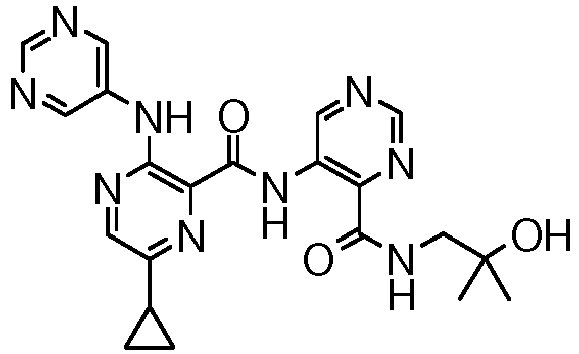
- To a stirred mixture of 5-aminopyrimidine-4-carboxylic acid (200 mg, 1.44 mmol) and 1-amino-2-methylpropan-2-ol (128 mg, 1.44 mmol) at rt in THF (5 ml) under an argon atmosphere were added N-ethyldiisoproplyamine (743 mg, 978 µl, 5.75 mmol) and 1-propanephosphonic acid cyclic anhydride (2.29 g, 2.16 ml, 3.59 mmol). The mixture was stirred at rt for 21 hrs, then concentrated. The crude product was purified by column chromatography with EtOAc/MeOH as eluent providing the title compound (216 mg, 72%) as off-white solid.
- According to the procedure described in step 6 of example 64 the title compound (9%) was obtained from 5-amino-pyrimidine-4-carboxylic acid (2-hydroxy-2-methyl-propyl)-amide and A-11 as off-white solid.
MS: M = 448.1 (M-H)- -

- According to the procedures described in example 97, the title compound was obtained using 3-aminopicolinic acid and 1-amino-2-methylpropan-2-ol in the 1st step (24%) and A-11 in the 2nd step (69%). Yellow solid.
MS: M = 449.2 (M+H)+ -

- According to the procedure described in step 6 of example 64 the title compound (72%) was obtained from A-11 and 3-amino-isonicotinic acid ethyl ester as yellow solid.
MS: M = 404.1 (M-H)- - To a stirred suspension of 3-{[6-cyclopropyl-3-(pyrimidin-5-ylamino)-pyrazine-2-carbonyl]-amino}-isonicotinic acid ethyl ester (972mg, 2.4 mmol) at rt in ethanol (15 ml) under an argon atmosphere was added 1 N NaOH (3 ml, 3.0 mmol). The suspension was stirred at rt for overnight. After the addition of 1 N HCl (3 ml) stirring was continued for 1 hr. The solid was collected by filtration, washed with H2O, then EtOH and dried.
MS: M = 476.0 (M-H)- - To a stirred mixture of 2-aminoethyl isopropyl ether (25 mg, 242 µmol) and 3-{[6-cyclopropyl-3-(pyrimidin-5-ylamino)-pyrazine-2-carbonyl]-amino}-isonicotinic acid (101 mg, 267 µmol) at rt in THF (5 ml) under an argon atmosphere were added 4-methylmorpholine (123 mg, 134 µl, 1.21 mmol) and HATU (184 mg, 485 µmol). The mixture was heated to reflux and stirring was continued for 1 day. The reaction mixture was concentrated. The crude product was purified by silica gel chromatography using an EtOAc/MeOH gradient as eluent. After trituration with MeOH, the title compound (90 mg, 80%) was obtained as yellow solid.
MS: M = 463.2 (M+H)+ -

- According to the procedure described in step 3 of example 99, 3-{[6-cyclopropyl-3-(pyrimidin-5-ylamino)-pyrazine-2-carbonyl]-amino}-isonicotinic acid (example 99, step 2) was reacted with 3-aminotetrahydro-furan, providing the title compound as yellow solid (96%).
MS: M = 445.4 (M-H)- -

- According to the procedure described in step 3 of example 99, 3-{[6-cyclopropyl-3-(pyrimidin-5-ylamino)-pyrazine-2-carbonyl]-amino}-isonicotinic acid (example 99, step 2) was reacted with (tetrahydrofuran-2-yl)methanamine, providing the title compound as yellow solid (77%).
MS: M = 461.3 (M+H)+ -

- According to the procedures described in example 96, using 3-furanboronic acid in the first step, the title compound was obtained as yellow solid.
MS: M = 424.2 (M+H)+ -

- According to the procedures described in example 96, using ethyl 3-amino-6-bromopicolinate and furan-2-ylboronic acid in the first step, the title compound was obtained as yellow solid.
MS: M = 423.2 (M+H)+ -

- To a suspension of intermediate A-12, (30 mg, 0.1 mmol) in dioxane (1 mL) were added 4-amino-N,1-dimethyl-1H-pyrazole-3-carboxamide hydrochloride (40 mg, 0.21 mmol) and trimethylaluminium (0.1 mL, 2M toluene solution) at room temperature. The mixture was stirred at 100 °C for 16 hr. After cooling down to ambient temperature, the reaction mixture was poured into ethyl acetate (50 ml) and extracted with water and brine. The aqueous layers were back-extracted with ethyl acetate. The organic layers were dried and concentrated in vacuo. The crude material was suspended in dichloromethane and filtered. The solid material was washed with dichloromethane and dried to yield the product (17 mg, 40 %) as yellow solid.
MS: M = 410.3 (M+H)+ -

- According to the procedure described in step 3 of example 99, 3-{[6-cyclopropyl-3-(pyrimidin-5-ylamino)-pyrazine-2-carbonyl]-amino}-isonicotinic acid (example 99, step 2) was reacted with 1-amino-2-methylpropan-2-ol, providing the title compound as yellow solid (74%).
MS: M = 447.2 (M-H)- -

- According to the procedure described in step 3 of example 99, 3-{[6-cyclopropyl-3-(pyrimidin-5-ylamino)-pyrazine-2-carbonyl]-amino}-isonicotinic acid (example 99, step 2) was reacted with oxetan-3-amine hydrochloride, providing the title compound as yellow solid (58%).
MS: M = 431.1 (M-H)- -

- The product was obtained starting from intermediate A-11 (40 mg, 0.15 mmol) and 4-amino-1-ethyl-N-methyl-1H-pyrazole-3-carboxamide (34 mg, 0.2 mmol) according to the method described in example 64, step 6 as yellow solid (27 mg, 43 %).
MS: M = 408.3 (M+H)+ -

- The product was obtained starting from intermediate A-11 (40 mg, 0.15 mmol) and 4-amino-1-ethyl-N-((tetrahydrofuran-2-yl)methyl)-1H-pyrazole-3-carboxamide hydrochloride (55 mg, 0.2 mmol) according to the method described in example 64, step 6 as yellow solid (27 mg, 36 %).
MS: M = 478.2 (M+H)+ -

- The product was obtained starting from intermediate A-11 (40 mg, 0.15 mmol) and 4-amino-1-methyl-N-((tetrahydrofuran-2-yl)methyl)-1H-pyrazole-3-carboxamide hydrochloride (53 mg, 0.2 mmol) according to the method described in example 64, step 6 as yellow solid (30 mg, 42 %).
MS: M = 464.3 (M+H)+ -

- According to the procedures described in example 97, the title compound was obtained using 2-amino-4,5-difluorobenzoic acid and 1-amino-2-methylpropan-2-ol in the 1st step (69%) and A-11 in the 2nd step (58%). Yellow solid.
MS: M = 482.3 (M-H)- -

- To a suspension of 1-methyl-4-nitro-1H-pyrazole-3-carboxylic acid (639 mg, 3.7 mmol) and 2-methyl-1-(methylamino)propan-2-ol (500 mg, 4.85 mmol) in THF (15 mL) were added HATU (1.57 g, 4.12 mmol) and N-methylmorpholine (2.13 mL, 19.4 mmol) at ambient temperature. The mixture was heated to 70 °C and stirred for 16 h. After cooling down to ambient temperature, the reaction mixture was poured into 20 mL HCl (2N aqueous solution) and extracted with ethyl acetate (2 x 100 mL).The organic layers were washed with water, brine and the solvent was evaporated. The aqueous layer was back-extracted with dichloromethane, dried and concentrated in vacuo. Both residues were combined to give 2.75 g of a semi-solid yellow material. The crude material was purified by silica gel chromatography using a methanol/ethyl acetate gradient to yield the product (1.2 g, 90 %) as colorless oil.
MS: M = 257.3 (M+H)+ - A solution of N-(2-hydroxy-2-methylpropyl)-N,1-dimethyl-4-nitro-1H-pyrazole-3-carboxamide (1.2 g, 4.7 mmol) in ethanol (30 ml) was flushed with argon and treated with palladium on carbon 10% (120 mg, 1.13 mmol). The reaction mixture was evacuated and flushed with hydrogen and stirred at ambient temperature for 16 h. The reaction mixture was filtered, washed with ethanol and concentrated in vacuo to yield the product as dark red oil (1.0 g, 80 %) which was used without any further purification.
MS: M = 227.3 (M+H)+ - The product was obtained starting from intermediate A-11 (40 mg, 0.15 mmol) and 4-amino-N-(2-hydroxy-2-methylpropyl)-N,1-dimethyl-1H-pyrazole-3-carboxamide (54 mg, 0.20 mmol) according to the method described in example 64, step 6 as yellow solid (25 mg, 34 %).
MS: M = 466.3 (M+H)+ -

- The product was obtained starting from intermediate A-13 (30 mg, 0.13 mmol) and 4-amino-N-(2-hydroxy-2-methylpropyl)-1-methyl-1H-pyrazole-3-carboxamide (36 mg, 0.17 mmol) according to the method described in example 64, step 6 after purification by preparative HPLC using an acetonitrile/water gradient as yellow solid (39 mg, 71 %).
MS: M = 426.2 (M+H)+ -

- According to the procedure described in step 3 of example 99, 3-{[6-cyclopropyl-3-(pyrimidin-5-ylamino)-pyrazine-2-carbonyl]-amino}-isonicotinic acid (example 99, step 2) was reacted with 2-methoxy-2-methylpropan-1-amine, providing the title compound as yellow solid (71%).
MS: M = 461.2 (M-H)- -

- According to the procedure described in step 3 of example 99, 3-{[6-cyclopropyl-3-(pyrimidin-5-ylamino)-pyrazine-2-carbonyl]-amino}-isonicotinic acid (example 99, step 2) was reacted with 3-methoxy-2,2-dimethylpropan-1-amine hydrochloride, the title compound as yellow solid (54%).
MS: M = 475.1 (M-H)- -

- According to the procedure described in step 6 of example 64, A-14 was reacted with 4-amino-1-methyl-1H-pyrazole-3-carboxylic acid methylamide hydrochloride, providing the title compound as yellow solid (10%).
MS: M = 393.9 (M-H)- - To a stirred, cooled (0°C) suspension of 6-acetyl-3-(pyrimidin-5-ylamino)-pyrazine-2-carboxylic acid (1-methyl-3-methylcarbamoyl-1H-pyrazol-4-yl)-amide (12 mg, 30.4 µmol) in ethanol (2 ml) under an argon atmosphere was added sodium borohydride (1.15 mg, 30.4 µmol) in one portion. Stirring was continued for 1 hr at rt. More sodium borohydride (3 eq.) was added in one portion. The mixture was heated to reflux and stirring as continued for 30 min. The reaction was cooled to rt and cocentrated. The crude product was purified by silica gel chromatography using a CH2Cl2/MeOH gradient as eluent. The title compound (4 mg, 33%) as yellow solid.
MS: M = 395.9 (M-H)- -

- According to the procedure described in step 6 of example 64, A-11 was reacted with 4-amino-2-methyl-2H-pyrazole-3-carboxylic acid methylamide (obtained from 2-methyl-4-nitro-2H-pyrazole-5-carboxylic acid amide in analogy to step 2 of example 2) to give the title compound (63%) as yellow solid.
MS: M = 392.1 (M-H)- -

- According to the procedure described in example 29, 3-aminopicolinic acid was reacted with 2-methoxy-N-methylethanamine to give the title compound (85%) as colourless viscous oil.
MS: M = 210.1 (M+H)+ - According to the procedure described in example 29, 3-amino-N-(2-methoxyethyl)-N-methylpicolinamide was reacted with A-11 to give the title compound (76%) as yellow solid.
MS: M = 449.2 (M+H)+ -

- According to the procedures described in example 117, the title compound was prepared using 5-aminopyrimidine-4-carboxylic acid in the 1st step. Yellow solid.
MS: M = 450.1 (M+H)+ -

- According to the procedure described in step 1 of example 111, reacting 2-methyl-4-nitro-2H-pyrazole-3-carboxylic acid and 1-amino-2-methylpropan-2-ol in the 1st step and coupling with A-11 in the 3rd step, the title compound was obtained as light yellow solid.
MS: M = 450.1 (M-H)- -

- According to the procedures described in example 99, reacting 4-amino-nicotinic acid methyl ester with A-11 in the 1st step and using 1-amino-2-methylpropan-2-ol in the 3rd step, the title compound was obtained as yellow solid.
MS: M = 447.2 (M-H)- -
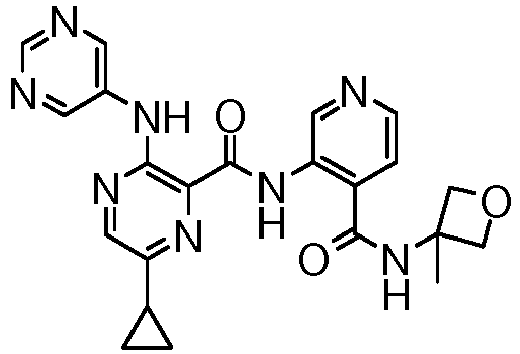
- According to the procedure described in step 3 of example 99, 3-{[6-cyclopropyl-3-(pyrimidin-5-ylamino)-pyrazine-2-carbonyl]-amino}-isonicotinic acid (example 99, step 2) was reacted with 3-methyloxetan-3-amine, providing the title compound was obtained as yellow solid (44%).
MS: M = 445.2 (M-H)- -

- According to the procedures described in example 117, the title compound was prepared using 5-aminopyrimidine-4-carboxylic acid and 2-methyl-1-(methylamino)propan-2-ol in the 1st step.
MS: M = 464.2 (M+H)+ -

- According to the procedures described in example 117, the title compound was prepared, using 3-aminopicolinic acid and 2-methyl-1-(methylamino)propan-2-ol in the 1st step.
MS: M = 463.2 (M+H)+ -

- According to the procedure described in step 6 of example 64, A-11 was reacted with 3-amino-N-methylisonicotinamide to provide the title compound (73%) as yellow solid.
MS: M = 391.1 (M+H)+ -

- According to the procedure described in step 3 of example 99, 3-{[6-cyclopropyl-3-(pyrimidin-5-ylamino)-pyrazine-2-carbonyl]-amino}-isonicotinic acid (example 99, step 2) was reacted with 2-amino-2-methylpropan-1-ol, providing the title compound was obtained as yellow solid (33%).
MS: M = 447.2 (M-H)- -

- A solution of 5-bromo-2-methylthio-pyrimidine-4-carboxylic acid ethyl ester (100 mg, 0.36 mmol; prepared from 5-bromo-2-methylthio-pyrimidine-4-carboxylic acid according to Coll. Czech. Chem. Commun. 1980, 45(2), 539) in dichloromethane (5 ml) was stirred at 0 °C under argon atmosphere and a solution of 3-chloroperbenzoic acid (178 mg, 0.72 mmol) in dichloromethane (5 ml) was added slowly. After continuous stirring for 30 min and warming-up to r.t., stirring was continued for another 6h. The reaction mixture was partitioned between dichloromethane and sodium bicarbonate (saturated aqueous solution) and extracted. The organic phase was washed with water, dried and the solvent was evaporated. The product was obtained after purification by silica gel chromatography using a heptane/ethyl acetate gradient as colorless waxy solid (86 mg, 77 %).
MS: M = 309.0 (M+H)+ - A solution of 5-bromo-2-methanesulfonyl-pyrimidine-4-carboxylic acid ethyl ester (86 mg, 0.27 mmol) in dichloromethane (2 ml) was treated with 2-methoxyethylamine (124 µl, 1.44 mmol) under argon atmosphere and heated to 45 °C for 2h. All volatiles were removed and the product was obtained after purification by silica gel chromatography using a heptane/ethyl acetate gradient as colorless oil (72 mg, 82 %).
MS: M = 304.2 (M+H)+ - A microwave reaction tube was charged with a suspension of 5-bromo-2-(2-methoxy-ethylamino)-pyrimidine-4-carboxylic acid ethyl ester (30 mg, 0.1 mmol), 5-aminopyrimidine (14 mg, 0.15 mmol) and cesium carbonate (45 mg, 0.14 mmol) in dioxane (0.6 ml) and flushed with argon. 4,5-Bis(diphenylphosphino)-9,9-dimethylxanthene (Xantphos; 19 mg, 32 µmol) and tris(dibenzylideneacetone)-dipalladium(0) chloroform adduct (10 mg, 10 µmol) were consecutively added and the reaction tube was sealed and stirred overnight at 130 °C. After cooling-down to ambient temperature, the reaction mixture was filtrated. The filtrate was concentrated in vacuo and the product was obtained after purification by preparative HPLC using an acetonitrile/water gradient as yellow solid (11 mg, 35 %).
MS: M = 319.2 (M+H)+ - The product was obtained starting from 2-(2-methoxy-ethylamino)-5-(pyrimidin-5-ylamino)-pyrimidine-4-carboxylic acid ethyl ester (11 mg, 35 µmol) and 4-amino-1-methyl-1H-pyrazole-3-carboxylic acid methylamide hydrochloride (20 mg, 105 µmol) according to the method described in example 104 after purification by preparative HPLC using an acetonitrile/water gradient as yellow solid (0.5 mg, 3 %).
MS: M = 427.2 (M+H)+ -

- According to the procedures described in example 96, using ethyl 3-amino-6-bromopicolinate and 3-furaneboronic acid in the first step, the title compound was obtained as yellow solid.
MS: M = 423.1 (M+H)+ -

- According to the procedures described in example 99, reacting ethyl 3-aminopicolinate with A-11 in the 1st step and methylamine hydrochloride in the 3rd step, the title compound was obtained as yellow solid.
MS: M = 391.1 (M+H)+ -

- According to the procedures described in example 99, reacting ethyl 3-aminopicolinate with A-11 in the 1st step and dimethylamine hydrochloride in the 3rd step, the title compound was obtained as yellow solid.
MS: M = 405.3 (M+H)+ -

- The product was obtained starting from intermediate A-11 (80 mg, 0.3 mmol) and 5-amino-2-methylthiazole-4-carboxylic acid ethyl ester (75 mg, 0.4 mmol) according to the method described in example 64, step 6 after purification by silica gel chromatography using a heptane/ethyl acetate gradient yellow solid (60 mg, 45 %).
MS: M = 426.2 (M+H)+ - A solution of 5-{[6-cyclopropyl-3-(pyrimidin-5-ylamino)-pyrazine-2-carbonyl]-amino}-2-methyl-thiazole-4-carboxylic acid ethyl ester (70 mg, 0.16 mmol) in a THF/ethanol mixture (2.5 ml; 1.5:1) was cooled to 0°C and treated with lithium hydroxide (0.82 ml; IN aqueous solution). After 15 min, the cooling bath was removed and the reaction mixture was stirred at 50°C overnight. The reaction mixture was cooled to r.t. and 0.84ml 1M HCl was added. The suspension was filtered, the solid was washed with water and THF and dried in vacuo to yield 28 mg (43 %) of a yellow solid.
MS: M=396.2(M-H)- - The product was obtained starting from 5-{[6-cyclopropyl-3-(pyrimidin-5-ylamino)-pyrazine-2-carbonyl]-amino}-2-methyl-thiazole-4-carboxylic acid (28 mg, 0.07 mmol) and methylamine hydrochloride (6.2 mg, 0.09 mmol) according to the method described in example 64, step 6 as yellow solid (16 mg, 44 %).
MS: M = 411.2 (M+H)+ -

- The product was obtained starting from intermediate A-17 (36 mg, 0.14 mmol) and 4-amino-2-methyl-2H-pyrazole-3-carboxylic acid methylamide (23 mg, 0.15 mmol) according to the method described in example 64, step 6 as yellow solid (25 mg, 45 %).
MS: M = 396.2 (M+H)+ -

- According to the procedure described in step 2 of example 4, 4-nitro-1H-pyrazole-3-carobxylic acid ethyl ester was alkylated with iodoethane, to give the title compound (36%) as light yellow viscous oil, along with the main regioisomer ethyl 1-ethyl-4-nitro-1H-pyrazole-3-carboxylate (58%), viscous yellow oil.
- According to the procedure described in step 2 of example 1, ethyl 1-ethyl-4-nitro-1H-pyrazole-5-carboxylate was converted to the title compound (94%) as light yellow viscous oil.
MS: M = 184.2 (M+H)+ - According to the procedures described in example 99, ethyl 4-amino-1-ethyl-1H-pyrazole-5-carboxylate was converted to the title compound using A-11 in the 1st step and 1-amino-2-methylpropan-2-ol in the 3rd step. Yellow solid.
MS: M = 466.3 (M+H)+ -

- According to the procedures described in example 132, the title compound was obtained using methylamine hydrochloride in the last step.
MS: M = 408.4 (M+H)+ -

- According to the procedures described in example 132, the title compound was obtained using 1-iodo-2-methylpropane in the 1st step and 1-amino-2-methylpropan-2-ol in the last step. Light yellow solid.
MS: M = 494.2 (M+H)+ -
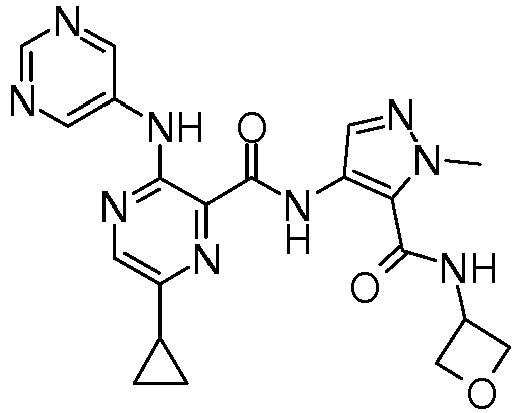
- According to the procedure described in step 2 of example 1, ethyl 1-methyl-4-nitro-1H-pyrazole-5-carboxylate was converted to the title compound (94%). Amorphous solid.
- According to the procedures described in example 99, 4-amino-2-methyl-2H-pyrazole-3-carboxylic acid ethyl ester was converted to the title compound, using intermediate A-11 in the 1st step and oxetan-3-amine in the last step. Yellow solid.
MS: M = 434.2 (M+H)+ -

- According to the procedure described in example 135, the title compound was obtained using 3-methyloxetan-3-amine in the last step. Yellow solid.
MS: M = 448.1 (M-H)- -
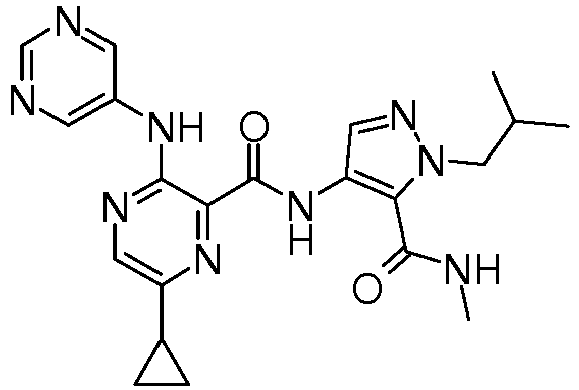
- According to the procedures described in example 132, the title compound was obtained using 1-iodo-2-methylpropane in the 1st step and methylamine hydrochloride in the last step. Yellow solid.
MS: M = 434.3 (M-H)- -

- According to the procedures described in example 132, the title compound was obtained using 2-iodopropane in the 1st step and 1-amino-2-methylpropan-2-ol in the last step. Yellow solid.
MS: M = 480.2 (M+H)+ -
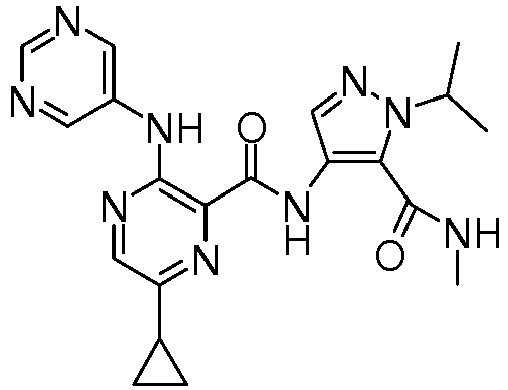
- According to the procedures described in example 132, the title compound was obtained using 2-iodopropane in the 1st step and methylamine hydrochloride in the last step. Yellow solid.
MS: M = 422.2 (M+H)+ -

- According to the procedure described in example 135, the title compound was obtained using 4-amino-2-methylbutan-2-ol hydrochloride in the last step. Yellow solid.
MS: M = 464.2 (M-H)- -

- According to the procedure described in example 135, the title compound was obtained using tetrahydrofuran-3-amine hydrochloride in the last step. Yellow solid.
MS: M = 448.1 (M-H)- -

- According to the procedure described in example 135, the title compound was obtained using 3-amino-2,2-dimethylpropan-1-ol in the last step. Yellow solid.
MS: M = 464.2 (M-H)- -

- According to the procedure described in example 135, the title compound was obtained using 3,3-difluoroazetidine hydrochloride in the last step. Yellow solid.
MS: M = 454.0 (M-H)- -

- According to the procedure described in example 135, the title compound was obtained using 2,2,2-trifluoroethanamine in the last step. Yellow solid.
MS: M = 460.3 (M-H)- -

- According to the procedure described in example 135, the title compound was obtained using 2,2-difluoroethanamine in the last step. Yellow solid.
MS: M = 442.1 (M-H)- -

- According to the procedure described in example 135, the title compound was obtained using 3-amino-1,1,1-trifluoropropan-2-ol in the last step. Yellow solid.
MS: M = 490.2 (M-H)- -

- The product was obtained starting from intermediate A-11 (30 mg, 0.12 mmol) and 4-amino-2-(2-methoxyethyl)-2H-pyrazole-3-carboxylic acid methylamide (30 mg, 0.15 mmol; ex. 11, step 2) according to the method described in example 64, step 6 as yellow solid (38 mg, 74 %).
MS: M = 438.3 (M+H)+ -

- The product was obtained starting from intermediate A-2 (30 mg, 0.12 mmol) and 4-amino-2-methyl-2H-pyrazole-3-carboxylic acid methylamide (24 mg, 0.15 mmol) according to the method described in example 64, step 6 as yellow solid (26 mg, 57 %).
MS: M = 393.2 (M+H)+ -

- According to the procedure described in example 135, the title compound was obtained using 3-amino-2-methylpropan-1-ol in the last step. Yellow solid.
MS: M = 451.1 (M-H)- -

- According to the procedure described in example 135, the title compound was obtained as unexpected product using 2,2-difluorocyclopropanamine hydrochloride in the last step. Yellow solid.
MS: M = 378.1 (M-H)- -

- According to the procedure described in example 135, the title compound was obtained using 2-methoxy-2-methylpropan-1-amine in the last step. Yellow solid.
MS: M = 464.1 (M-H)- -

- According to the procedure described in example 135, the title compound was obtained using 2-amino-2-methylpropan-1-ol in the last step. Yellow solid.
MS: M = 450.1 (M-H)- -

- According to the procedure described in example 135, the title compound was obtained using 2-methyl-1-(methylamino)propan-2-ol in the last step. Yellow solid.
MS: M = 464.2 (M-H)- -
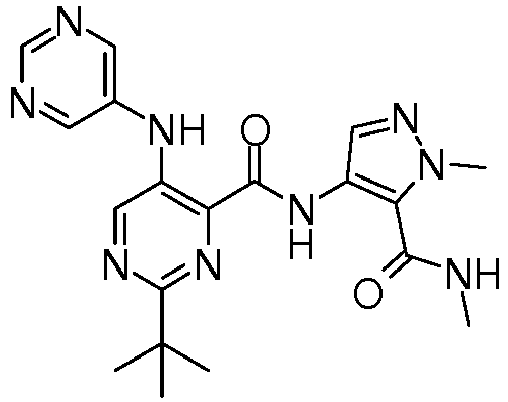
- The product was obtained starting from intermediate A-6 (30 mg, 0.1 mmol) and 4-amino-2-methyl-2H-pyrazole-3-carboxylic acid methylamide (32 mg, 0.2 mmol) according to the method described in example 104 after purification by preparative HPLC using an acetonitrile/water gradient as yellow solid (33 mg, 76 %).
MS: M = 410.3 (M+H)+ -

- According to the procedure described in example 135, the title compound was obtained using azetidine in the last step. Yellow solid.
MS: M = 418.1 (M-H)- -

- According to the procedure described in example 135, the title compound was obtained using pyrolidine in the last step. Yellow solid.
MS: M = 432.2 (M-H)- -
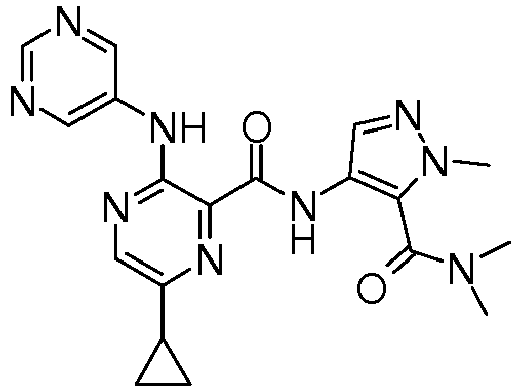
- According to the procedure described in example 135, the title compound was obtained using dimethylamine hydrochloride in the last step. Yellow solid.
MS: M = 406.3 (M+H)+ -

- According to the procedures described in example 99, ethyl 3-amino-6-cyclopropylpicolinate (example A-1, step 1) was converted to the title compound, using methylamine hydrochloride in the last step. Yellow solid.
MS: M = 431.2 (M+H)+ -

- According to the procedures described in example 99, ethyl 3-amino-6-cyclopropylpicolinate (example A-1, step 1) was converted to the title compound, using 1-amino-2-methylpropan-2-ol in the last step. Yellow solid.
MS: M = 489.4 (M+H)+ -

- The product was obtained starting from intermediate A-16 (30 mg, 0.1 mmol) and 4-amino-2-methyl-2H-pyrazole-3-carboxylic acid methylamide (46 mg, 0.3 mmol) according to the method described in example 104 after purification by preparative HPLC using an acetonitrile/water gradient as yellow solid (27 mg, 65 %).
MS: M = 424.2 (M+H)+ -

- The product was obtained starting from intermediate A-4 (30 mg, 0.11 mmol) and 4-amino-2-methyl-2H-pyrazole-3-carboxylic acid methylamide (51 mg, 0.33 mmol) according to the method described in example 104 after purification by preparative HPLC using an acetonitrile/water gradient as light yellow solid (21 mg, 49 %).
MS: M = 396.3 (M+H)+ -

- According to the procedure described in example 135, the title compound was obtained as unexpected product using 2-fluoroethanamine hydrochloride in the last step. Yellow solid.
MS: M = 496.5 (M+H)+ -

- To a solution of cyclopropylamine (17.5 ml, 250 mmol) in water (250 ml) was added under icebath cooling 4-methylene-oxetan-2-one (19.1 ml, 250 mmol) at ambient temperature upon which the pH decreased from 12 to 6.9. Stirring was continued for 10 min. Sodium nitrite (19.5 g, 275 mmol) and fuming HCl (37%; 37.5 ml, 457 mmol) were added consecutively at r.t. so that the pH always remains above pH 4.5. Into the thick foamy suspension was passed chlorine (21.3 g, 300 mmol) at r.t. over 30 min to get a light brown solution. The reaction mixture was stirred for 1 h, poured into 200 ml dichloromethane and extracted. The aqueous layers were back-extracted and the organic layers were dried and evaporated. The crude product was suspended in 10ml diethylether, filtered and dried in vacuo to give N-cyclopropyl-2-chloro-2-hydroxyimino-acetamide (14.7 g, 36 %) as light yellow solid.
- A mixture of N-cyclopropyl-2-chloro-2-hydroxyimino-acetamide (2 g, 12.3 mmol) and (E)-3-(dimethylamino)-acrylic acid ethyl ester (1.76 ml, 12.3 mmol) in THF (25 ml) was heated at 75 °C for 2 h. The reaction was then cooled to r.t., poured into 100 mL ethyl acetate and extracted with 1 M HCl. The aqueous layers were back-extracted with ethyl acetate. The organic phase was washed with water and brine, dried and evaporated. The product was obtained after purification by silica gel chromatography using a heptane/ethyl acetate gradient as light yellow solid (1.6 g, 58 %).
MS: M=225.1(M+H)+ - To a solution of 3-(cyclopropylcarbamoyl)-isoxazole-4-carboxylic acid ethyl ester (600 mg, 2.68 mmol) in THF (7 ml) and ethanol (3 ml) was added LiOH (1M; 5.35 ml, 5.35 mmol) at 0-5°C. The mixture was stirred at 20 °C for 1 h, poured into 50 ml diethyl ether and extracted. The organic phase was washed with water. The combined aqueous phases were acidified with 1M HCl (6ml) and extracted with dichloromethane. The organic layers were dried and evaporated to yield the product as yellow oil (464 mg, 80 %).
MS: M=194.9(M-H)- - A mixture of 3-(cyclopropylcarbamoyl)-isoxazole-4-carboxylic acid (245 mg, 1.25 mmol) and thionyl chloride (182 µl, 2.5 mmol) in dichloromethane (4 ml) and DMF (5 µl, 63 µmol) was stirred at 40 °C. for 4 h. The solvent was removed in vacuo. The residue was dissolved in acetone (4 ml) and a solution of sodium azide (89.3 mg, 1.37 mmol) in water (1 ml) was added dropwise at 0-5 °C over 5 min. The reaction mixture was stirred at 0-5°C for 1 h. After removal of acetone, the residue was dissolved with ethyl acetate and extracted with water and back-extracted with ethyl acetate. The combined organic layers were washed with brine, dried and the solvent was removed to give 248mg of a red solid. This intermediate was suspended in tert-butanol (4. 8 ml, 50.0 mmol0) and heated for 16 h at 65 °C. The reaction mixture was evaporated in vacuo and the product was obtained after purification by silica gel chromatography using a heptane/ethyl acetate gradient as light yellow oil (142 mg, 42.5 %).
MS: M=268.2(M+H)+ - A mixture of (3-Cyclopropylcarbamoylcyclopropylcarbamoyl-isoxazol-4-yl)-carbamic acid tert-butyl ester (142 mg, 531 µmol), trifluoroacetic acid (614 µl, 7.97 mmol) in dichloromethane (3 ml) was stirred for 3 h at 20 °C. The volatiles were evaporated in vacuo and the resulting crude product was poured into 50 ml dichloromethane and extracted with sodium bicarbonate (saturated aqueous solution). The aqueous phase was washed with dichloromethane and the organic layers were dried and evaporated to yield the product as light yellow oil (85 mg, 91 %).
MS: M=168.3(M+H)+ - The product was obtained starting from intermediate A-11 (30 mg, 0.12 mmol) and 4-amino-isoxazole-3-carboxylic acid cyclopropylamide (27 mg, 0.15 mmol) according to the method described in example 64, step 6 as yellow solid (34 mg, 72 %).
MS: M = 407.3 (M+H)+ -

- According to the procedure described in example 135, the title compound was obtained using 1,1,1-trifluoropropan-2-amine hydrochloride in the last step. Yellow solid.
MS: M = 474.2 (M-H)- -
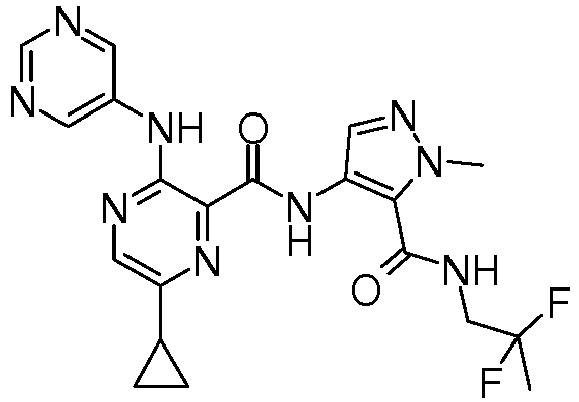
- According to the procedure described in example 135, the title compound was obtained using 2,2-difluoropropan-1-amine hydrochloride in the last step. Yellow solid.
MS: M = 456.1 (M-H)- -

- A solution of 2-bromo-6-chloro-pyridin-3-ylamine (1.0 g, 4.8 mmol) in ethanol (15 ml) and toluene (15 ml) was charged under argon atmosphere with (1,1'-bis(diphenylphosphino)-ferrocene)palladium(II) dichloride complex with dichloromethane (200 mg; 0.245 mmol) and triethylamine (1.67 ml, 12.1 mmol) in an autoclave, was flushed with carbon monoxide (3 times, 20 bar) and stirred at 80 °C under carbon monoxide atmosphere (50 bar) for 16 h. Upon cooling to ambient temperature and pressure release, the reaction mixture was filtrated and the solvents were removed. The product was obtained after purification by silica gel chromatography using a dichloromethane/methanol/ammonia gradient and recrystallisation from dichloromethane as light yellow solid (290 mg, 30%).
- A suspension of 3-amino-6-chloro-pyridine-2-carboxylic acid ethyl ester (200 mg, 1.0 mmol), 5-bromopyrimidine (444 mg, 2.8 mmol), potassium carbonate (496 mg, 3.6 mmol) and water (76 µl, 4.4 mmol) in o-xylene was evacuated and vented with argon. Palladium(II) acetate (27 mg, 0.12 mmol) and 4,5-bis(diphenylphosphino)-9,9-dimethylxanthene (xantphos; 87 mg, 0.15 mmol) were added under argon and the reaction mixture was stirred at 140 °C for 60 h. After cooling down to ambient temperature, the reaction mixture was diluted with dichloromethane and the product was obtained after purification by silica gel chromatography using a heptane/ethyl acetate gradient as light yellow solid (98 mg, 35 %).
MS: M = 279.2 (M+H)+ - A suspension of 6-chloro-3-(pyrimidin-5-ylamino)-pyridine-2-carboxylic acid ethyl ester (98 mg, 0.35 mmol) in THF (1 ml) and ethanol (0.5 ml) was cooled to 0°C and treated with 1M LiOH (0.7 ml, 0.7 mmol). The ice bath was removed and the reaction mixture was stirred at rt. for 2 h. 1M HCl (0.7 ml, 0.7 mmol) was added and stirring was continued until a precipitate was forming. The reaction mixture was sucked off and the product was obtained upon drying of the precipitate as yellow solid (60 mg, 67 %).
MS: M = 249.0 (M-H)- - The product was obtained starting from 6-chloro-3-(pyrimidin-5-ylamino)-pyridine-2-carboxylic acid (30 mg, 0.12 mmol) and 4-amino-2-methyl-2H-pyrazole-3-carboxylic acid methylamide (24 mg, 0.15 mmol) according to the method described in example 64, step 6 as yellow solid (29 mg, 62%).
MS: M = 387.3 (M+H)+ -

- The product was obtained starting from intermediate A-11 (30 mg, 0.12 mmol) and 4-amino-N-isobutyl-1-methyl-1H-pyrazole-5-carboxamide (30 mg, 0.15 mmol) according to the method described in example 64, step 6 as yellow solid (19 mg, 37 %).
MS: M = 436.3 (M+H)+ -

- The product was obtained starting from intermediate A-11 (30 mg, 0.12 mmol) and (4-amino-1-methyl-1H-pyrazol-5-yl)(piperidin-1-yl)methanone (32 mg, 0.15 mmol) according to the method described in example 64, step 6 after purification by preparative HPLC using an acetonitrile/water gradient as yellow solid (22 mg, 43 %).
MS: M = 448.3 (M+H)+ -
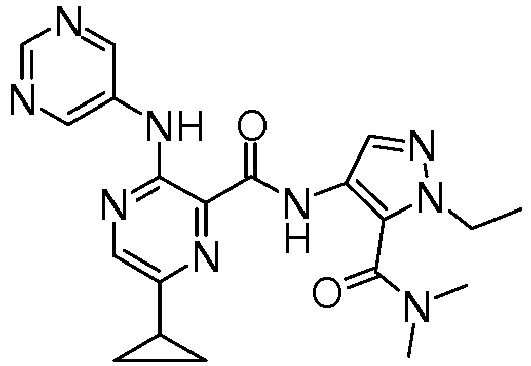
- The product was obtained starting from intermediate A-11 (30 mg, 0.12 mmol) and 4-amino-1-ethyl-N,N-dimethyl-1H-pyrazole-5-carboxamide (28 mg, 0.15 mmol) according to the method described in example 64, step 6 after purification by preparative HPLC using an acetonitrile/water gradient as yellow solid (36 mg, 73 %).
MS: M = 422.2 (M+H)+ -

- The product was obtained starting from intermediate A-11 (30 mg, 0.12 mmol) and (4-amino-1-ethyl-1H-pyrazol-5-yl)(morpholino)methanone (34 mg, 0.15 mmol) according to the method described in example 64, step 6 after purification by preparative HPLC using an acetonitrile/water gradient as yellow solid (39 mg, 72 %).
MS: M = 464.2 (M+H)+ -

- According to the procedure described in example 135, the title compound was obtained using 2-fluoroethanamine hydrochloride in the last step. Yellow solid.
MS: M = 424.1 (M-H)- -

- According to the procedures described in example 132, the title compound was obtained using 1,1,1-trifluoro-3-iodopropane in the 1st step and 1-amino-2-methylpropan-2-ol in the last step. Yellow solid.
MS: M = 534.2 (M+H)+ -

- According to the procedures described in example 132, the title compound was obtained using 1,1,1-trifluoro-3-iodopropane in the 1st step and methylamine hydrochloride in the last step. Yellow solid.
MS: M = 476.1 (M+H)+ -

- According to the procedure described in example 135, the title compound was obtained using 3-fluoroazetidine hydrochloride in the last step. Yellow solid.
MS: M = 436.2 (M-H)- -

- According to the procedures described in example 132, the title compound was obtained using 2,2,2-trifluoroethyl trifluoromethanesulfonate in the 1st step and 1-amino-2-methylpropan-2-ol in the last step. Yellow solid.
MS: M = 520.3 (M+H)+ -

- According to the procedures described in example 132, the title compound was obtained using 2,2,2-trifluoroethyl trifluoromethanesulfonate in the 1st step and methylamine hydrochloride in the last step. Yellow solid.
MS: M = 562.2 (M+H)+ -

- According to step 1 and 2 of example 96, the title compound was prepared starting from ethyl 3-amino-6-bromopicolinate and furan-2-ylboronic acid. Light yellow solid.
MS: M = 237.2 (M+H)+ - According to the procedures described in example 99, ethyl 3-amino-6-(tetrahydrofuran-3-yl)picolinate was converted to the title compound, using methylamine hydrochloride in the last step. Yellow solid.
MS: M = 459.3 (M-H)- -

- According to the procedures described in example 177, the title compound was prepared using 1-amino-2-methylpropan-2-ol in the last step.
MS: M = 517.3 (M-H)- -

- The product was obtained starting from intermediate A-11 (30 mg, 0.12 mmol) and (4-amino-1-methyl-1H-pyrazol-5-yl)(morpholino)methanone (32 mg, 0.15 mmol) according to the method described in example 64, step 6 after purification by preparative HPLC using an acetonitrile/water gradient as yellow solid (40 mg, 77 %).
MS: M = 450.3 (M+H)+ -
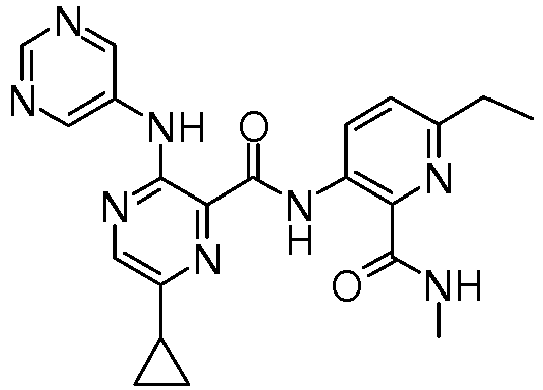
- According to the procedures described in example 99, the title compound was obtained using 3-amino-6-ethyl-pyridine-2-carboxylic acid ethyl ester (CAS 908833-49-8) in the 1st step and methylamine hydrochloride in the last step. Yellow solid.
MS: M = 417.1 (M-H)- -

- According to the procedures described in example 99, the title compound was obtained using 3-amino-6-ethyl-pyridine-2-carboxylic acid ethyl ester (CAS 908833-49-8) in the 1st step and 1-amino-2-methylpropan-2-ol in the last step. Yellow solid.
MS: M = 475.2 (M-H)- -

- According to the procedures described in example 99, the title compound was obtained using 3-amino-6-methyl-pyridine-2-carboxylic acid ethyl ester (CAS 908832-89-3) in the 1st step and methylamine hydrochloride in the last step. Yellow solid.
MS: M = 405.4 (M+H)+ -

- According to the procedures described in example 99, the title compound was obtained using 3-amino-6-methyl-pyridine-2-carboxylic acid ethyl ester (CAS 908832-89-3) in the 1st step and 1-amino-2-methylpropan-2-ol in the last step. Yellow solid.
MS: M = 461.3 (M-H)- -

- The product was obtained starting from intermediate A-14 (40 mg, 0.15 mmol) and 4-amino-2-methyl-2H-pyrazole-3-carboxylic acid methylamide (31 mg, 0.2 mmol) according to the method described in example 64, step 6 as yellow solid (36 mg, 59 %).
MS: M = 396.3 (M+H)+ -

- According to the procedure described in step 6 of example 64, the title compound was obtained from intermediate A-11 and 2-amino-N-ethyl-4,5,6,7-tetrahydrobenzo[b]thiophene-3-carboxamide.
MS: M = 464.2 (M+H)+ -

- The product was obtained starting from 5-bromo-2-isopropyl-pyrimidine-4-carboxylic acid (intermediate A-4, step 1; 300 mg, 1.22 mmol) and 4-amino-2-methyl-2H-pyrazole-3-carboxylic acid methylamide (245 mg, 1.59 mmol) according to the method described in example 64, step 6 after extraction with ethyl acetate and purification by silica gel chromatography using ethyl acetate as light brown solid (472 mg, 96 %).
MS: M = 381.3 (M+H)+ - A mixture of 5-bromo-2-isopropyl-pyrimidine-4-carboxylic acid (1-methyl-5-methylcarbamoyl-1H-pyrazol-4-yl)-amide (40 mg, 105 µmol), 3-aminopyridine (15 mg, 157 µmol) and potassium phosphate tribasic (31 mg, 147 µmol) in toluene (1 ml) was treated with tris(dibenzylideneacetone)dipalladium(0)-chloroform adduct (10.9 mg, 10.5 µmol) and xantphos (20 mg, 34.6 µmol) were added and the reaction mixture was stirred at 120 °C for 16 h. The reaction was cooled to r.t., filtrated and the product was obtained after purification by preparative HPLC using an acetonitrile/water gradient as yellow solid (10 mg, 25 %).
MS: M = 395.2 (M+H)+ -

- The product was obtained starting from 6-acetyl-3-(pyrimidin-5-ylamino)-pyrazine-2-carboxylic acid (1-methyl-5-methylcarbamoyl-1H-pyrazol-4-yl)-amide (example 184) according to the method described in example 115, step 2 after purification by preparative HPLC using an acetonitrile/water gradient as light yellow solid (41 %).
MS: M = 398.3 (M+H)+ -

- The product was obtained according to the procedure described in example 186, step 2 using 3-fluoroaniline instead of 3-aminopyridine as yellow solid (25 %)
MS: M = 412.4 (M+H)+ -

- The product was obtained from intermediate A-3 according to the method described in example 163, step 3 as yellow solid (100 %)
MS: M = 259.1 (M-H)- - The product was obtained starting from 6-methoxymethyl-3-(pyrimidin-5-ylamino)-pyridine-2-carboxylic acid (30 mg, 0.12 mmol) and 4-amino-2-methyl-2H-pyrazole-3-carboxylic acid methylamide (23 mg, 0.15 mmol) according to the method described in example 64, step 6 after purification by preparative HPLC using an acetonitrile/water gradient as off-white solid (28 mg, 61 %).
MS: M = 397.3 (M+H)+ -

- The product was obtained according to the procedure described in example 186, step 2 using 5-fluoro-3-aminopyridine instead of 3-aminopyridine and after an additional purification by silica gel chromatography using ethyl acetate as light yellow solid (10 %)
MS: M = 413.3 (M+H)+ -

- The product was obtained according to the procedure described in example 186, step 2 using 4-fluoroaniline instead of 3-aminopyridine as yellow solid (51 %)
MS: M = 412.3 (M+H)+ -

- The product was obtained starting from intermediate A-11 (30 mg, 0.12 mmol) and 2-amino-6-methoxy-N-methyl-benzamide (27 mg, 0.15 mmol; prepared from 2-amino-6-methoxybenzoic acid according to Bioorg. Med. Chem. Lett. 2008, 18, 6041) according to the method described in example 64, step 6 as yellow solid (45 mg, 92 %).
MS: M = 420.2 (M+H)+ -

- The product was obtained starting from cyclobutanecarboxamidine (200 mg, 1.5 mmol) and mucobromic acid (180 mg, 0.7 mmol) according to the method described in intermediate A-4, step 1 as light brown solid (38 mg, 21 %).
MS: M = 257.1 (M+H)+ - The product was obtained starting from 5-bromo-2-cyclobutyl-pyrimidine-4-carboxylic acid (37 mg, 0.14 mmol) and 4-amino-2-methyl-2H-pyrazole-3-carboxylic acid methylamide (29 mg, 0.19 mmol) according to the method described in example 64, step 6 after purification by preparative HPLC using an acetonitrile/water gradient as off-white solid (24 mg, 42 %).
MS: M = 393.2 (M+H)+ - The product was obtained starting from 5-bromo-2-cyclobutyl-pyrimidine-4-carboxylic acid (1-methyl-5-methylcarbamoyl-1H-pyrazol-4-yl)-amide (23 mg, 58 µmol) and 5-aminopyrimidine (8 mg, 82 µmol) according to the method described in example A-1, step 2 after purification by preparative HPLC using an acetonitrile/water gradient as yellow solid (1 mg, 5 %).
MS: M = 408.4 (M+H)+ -

- According to the procedures described in example 97, the title compound was obtained using 3-aminopicolinic acid and azetidine in the 1st step. Yellow solid.
MS: M = 417.2 (M+H)+ -

- According to the procedures described in example 97, the title compound was obtained using 3-aminopicolinic acid and piperidine in the 1st step. Yellow solid.
MS: M = 445.4 (M+H)+ -
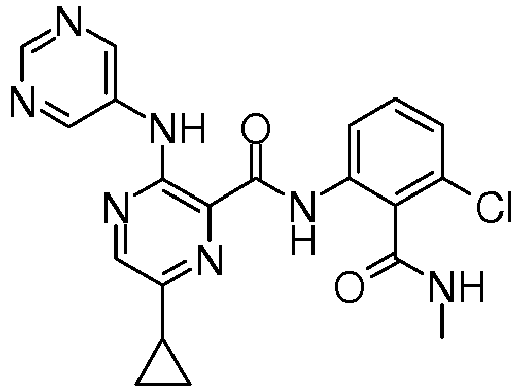
- According to the procedures described in example 99, the title compound was prepared using methyl 2-amino-6-chlorobenzoate in the 1st step and methylamine hydrochloride in the last step. Yellow solid.
MS: M = 424.2 (M+H)+ -

- The product was obtained starting from intermediate A-11 (30 mg, 0.12 mmol) and 4-amino-N-ethyl-1-methyl-1H-pyrazole-5-carboxamide (25 mg, 0.15 mmol) according to the method described in example 64, step 6 as yellow solid (17 mg, 35 %).
MS: M = 408.3 (M+H)+ -

- According to the procedures described in example 97, the title compound was obtained using 3-aminopicolinic acid and pyrolidine in the 1st step. Yellow solid.
MS: M = 431.3 (M+H)+ -

- According to the procedures described in example 97, the title compound was obtained using 3-aminopicolinic acid and methylethylamine in the 1st step. Yellow solid.
MS: M = 419.3 (M+H)+ -

- To a solution of methyl 3-amino-6-cyclopropylpyrazine-2-carboxylate (1 g, 5.18 mmol, intermediate A-10, step 2) in dibromethane (16.0 ml, 229 mmol) at 0° under an argon atmosphere was added isoamyl nitrite (1.49 ml, 11.1 mmol) and trimethylbromosilane (2.03 ml, 15.7 mmol). The mixture was stirred at 0° for 10 min and at r.t overnight. The reaction mixture was poured onto ice, neutralized with solid NaHCO3, extracted with dichloromethane, dried over MgSO4, filtered and evaporated. The title compound was obtained after silica gel chromatography using a heptane/ethylacetate gradient as viscous oil (450 mg, 34%).
MS: M = 257.1 (M+H)+ - The title compound was obtained according to the procedure described for step 2 of intermediate A-2 using pyrazine-2-amine. Yellow solid.
MS: M = 272.2 (M+H)+ - According to the procedure described in step 2 of example 14, methyl 6-cyclopropyl-3-(pyrazin-2-ylamino)pyrazine-2-carboxylate was reacted with 4-amino-N,1-dimethyl-1H-pyrazole-5-carboxamide to give the title compound. Yellow solid.
MS: M = 394 (M+H)+ -

- The product was obtained starting from intermediate A-11 (30 mg, 0.12 mmol) and 4-amino-N,1-diethyl-1H-pyrazole-5-carboxamide (27 mg, 0.15 mmol) according to the method described in example 64, step 6 as yellow solid (40 mg, 82 %).
MS: M = 422.2 (M+H)+ -

- The product was obtained starting from intermediate A-11 (30 mg, 0.12 mmol) and 4-amino-1-ethyl-N-isobutyl-1H-pyrazole-5-carboxamide (32 mg, 0.15 mmol) according to the method described in example 64, step 6 as yellow solid (43 mg, 82 %).
MS: M = 450.2 (M+H)+ -

- According to the procedure described in example 135, the title compound was obtained using N-methylethanamine in the last step. Yellow solid.
MS: M = 422.2 (M+H)+ -

- According to the procedures described in example 99, the title compound was obtained using 5-amino-pyrimidine-4-carboxylic acid methyl ester in the 1st step und N-methylethanamine in the last step. Yellow solid.
MS: M = 420.3 (M+H)+ -

- According to the procedures described in example 99, the title compound was obtained using 5-amino-pyrimidine-4-carboxylic acid methyl ester in the 1st step und dimethylamine hydrochloride in the last step. Yellow solid.
MS: M = 404.2 (M-H)- -

- The product was obtained starting from 2-amino-6-methoxybenzoic acid (100 mg, 0.6 mmol) and dimethylamine (2M in THF, 420 µl, 0.84 mmol) according to the method described in example 64, step 6 after extraction with ethyl acetate and purification by silica gel chromatography using an amine phase and a heptane/ethyl acetate gradient as colorless oil (26 mg, 22 %).
- The product was obtained starting from intermediate A-11 (34 mg, 0.13 mmol) and 2-amino-6-methoxy-N,N-dimethyl-benzamide (26 mg, 0.13 mmol) according to the method described in example 64, step 6 after purification by preparative HPLC using an acetonitrile/water gradient as yellow solid (40 mg, 68 %).
MS: M = 434.4 (M+H)+ -

- According to the procedures described in example 99, the title compound was obtained using methyl 2-amino-5-isopropylbenzoate (CAS 1029420-48-1) in the 1st step and 1-amino-2-methyl-propan-2-ol in the last step. Yellow solid.
MS: M = 490.4 (M+H)+ -

- According to the procedures described in example 99, the title compound was obtained using methyl 2-amino-5-isopropylbenzoate (CAS 1029420-48-1) in the 1st step and methylamine hydrochloride in the last step. Yellow solid.
MS: M = 432.4 (M+H)+ -

- To a stirred solution of 3-bromo-6-methoxymethyl-pyridine-2-carboxylic acid methyl ester (933mg, 3.59 mmol; intermediate A-3, step 6) and tert-butyl carbamate (504 mg, 4.3 mmol) at r.t. in dioxane (15 ml) under an argon atmosphere were added cesium carbonate (1.64 g, 5.02 mmol), Pd2(dba)3 (65.7 mg, 71.7 µmol) and Xantphos (62.3 mg, 108 µmol; CAS 161265-03-8). The mixture was degassed under vacuum and flushed with argon, then heated to 100°Covernight. The mixture was cooled to r.t., diluted with CH2Cl2, and the solids were filtered off and washed with some CH2Cl2. The filtrate was concentrated. The crude product was purified by silica gel chromatography using a cyclohexane/EtOAc gradient to give the title compound (598 mg, 56%) as viscous light yellow oil.
MS: M = 297.3 (M+H)+ - To a stirred solution of methyl 3-(tert-butoxycarbonylamino)-6-(methoxymethyl)picolinate (695mg, 2.35 mmol) at r.t. in dichloromethane (10 ml) under an argon atmosphere was added 2,2,2-trifluoroacetic acid (903 µl, 11.7 mmol) in one portion. The mixture was stirred at 50°C overnight, then cooled to r.t. and treated carefully with 10 % aq. Na2CO3 (10 ml). The aqueous solution was extracted with CH2Cl2 (10 ml). The combined organics were washed with brine (10 ml), dried over MgSO4, filtered and concentrated to leave the product as a light brown solid (424 mg, 92%) which was used for the next step without further purification.
MS: M = 197.1 (M+H)+ - According to the procedures described in example 99, the title compound was prepared using intermediate A-11 and 3-amino-6-methoxymethyl-pyridine-2-carboxylic acid methyl ester in the 1st step and methylamine hydrochloride in the last step. Yellow solid.
MS: M = 433.3 (M+H)+ -

- According to the procedures described in example 209, the title compound was obtained using 1-amino-2-methyl-propan-2-ol in the last step. Yellow solid.
MS: M = 491.3 (M+H)+ -

- According to the procedures described in example 97, the title compound was obtained using 5-amino-pyrimidine-4-carboxylic acid and azetidine in the 1st step. Yellow solid.
MS: M = 416.1 (M-H)- -

- According to the procedures described in example 99, the title compound was obtained using 5-amino-pyrimidine-4-carboxylic acid methyl ester in the 1st step and piperidine in the last step. Yellow solid.
MS: M = 444.2 (M-H)- -

- According to the procedures described in example 99, the title compound was obtained using methyl 2-amino-5-(2-methoxyethoxy)benzoate (CAS 773071-76-4) in the 1st step and 1-amino-2-methyl-propan-2-ol in the last step. Yellow solid.
MS: M = 552.3 (M+H)+ -

- According to the procedures described in example 99, the title compound was obtained using methyl 2-amino-5-(2-methoxyethoxy)benzoate (CAS 773071-76-4) in the 1st step and methylamine hydrochloride in the last step. Yellow solid.
MS: M = 464.3 (M+H)+ -

- 2-Amino-5-(2-hydroxyethoxy)benzoic acid hydrochloride (0.209 g, 895 µmol; CAS 78299-60-2) was suspended in dichloromethane (10 ml) at r.t under an argon atmosphere. The reaction mixture was diluted with MeOH (3 ml). Then trimethylsilyldiazomethane solution (1.45 ml, 2.9 mmol; 2M in hexane) was added dropwise. The reaction mixture was stirred at r.t for 1 hr. The solvents were evaporated. The crude product was purified by silica gel chromatography using a n-heptane/EtOAc gradient to give the title compound (154 mg, 82%) as light yellow, waxy solid.
MS: M = 212.1 (M+H)+ - According to the procedures described in example 99, the title compound was obtained using methyl 2-amino-5-(2-hydroxyethoxy)benzoate and intermediate A-11 in the first step and 1-amino-2-methyl-propan-2-ol in the last step. Yellow solid.
MS: M = 508.3 (M+H)+ -

- According to the procedure described in example 215, the title compound was obtained using methylamine hydrochloride in the last step. Yellow solid.
MS: M = 450.3 (M+H)+ -

- The product was obtained starting from 3-amino-6-cyclopropylpyrazine-2-carboxylic acid methyl ester (200 mg, 1.04 mmol; intermediate A-10, step 2) and 3-bromopyridine (142 µl, 1.45 mmol) according to the method described in example A-1, step 2 as yellow solid (192 mg, 68 %).
MS: M = 271.4 (M+H)+ - The product was obtained starting from 6-cyclopropyl-3-(pyridin-3-ylamino)pyrazine-2-carboxylic acid methyl ester (192 mg, 0.71 mmol) according to the method described in example A-11 as off-white solid (162 mg, 89 %).
MS: M = 255.2 (M-H)- - The product was obtained starting from 6-cyclopropyl-3-(pyridin-3-ylamino)pyrazine-2-carboxylic acid (30 mg, 0.12 mmol) and 4-amino-2-methyl-2H-pyrazole-3-carboxylic acid methylamide (23 mg, 0.15 mmol) according to the method described in example 64, step 6 as yellow solid (30 mg, 64 %).
MS: M = 393.2 (M+H)+ -

- According to the procedures described in example 99, the product was obtained using 5-aminopyrimidine-4-carboxylic acid methyl ester in the 1st step and methylamine hydrochloride in the last step. Yellow solid.
MS: M = 390.0 (M-H)- -

- According to the procedures described in example 99, the product was obtained using 5-aminopyrimidine-4-carboxylic acid methyl ester in the 1st step and pyrolidine in the last step. Yellow solid.
MS: M = 430.2 (M-H)- -

- According to the procedures described in example 97, the product was obtained using 3-aminopicolinic acid and ethylamine hydrochloride in the 1st step. Yellow solid.
MS: M = 405.4 (M+H)+ -

- According to the procedures described in example 97, the product was obtained using 3-aminopicolinic acid and propane-2-amine in the 1st step. Yellow solid.
MS: M = 419.4 (M+H)+ -

- According to the procedures described in example 135, the title compound was obtained using dipropylamine in the last step. Yellow solid.
MS: M = 464.4 (M+H)+ -

- According to the procedures described in example 135, the title compound was obtained using N-methylbutane-1-amine in the last step. Yellow solid.
MS: M = 448.2 (M-H)- -

- According to the procedure described in step 6 of example 64, the title compound was obtained from intermediate A-11 and 2-amino-N,6-dimethylbenzamide. Yellow solid.
MS: M = 404.3 (M+H)+ -
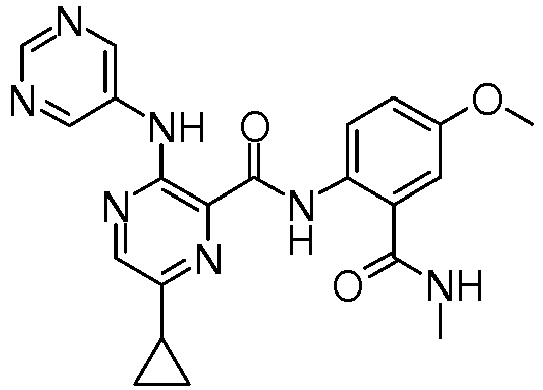
- According to the procedure described in step 6 of example 64, the title compound was obtained from intermediate A-11 and 2-amino-5-methoxy-N-methylbenzamide. Yellow solid.
MS: M = 420.2 (M+H)+ -

- According to the procedures described in example 135, the title compound was obtained using 2-(methylamino)ethanol in the last step. Yellow solid.
MS: M = 436.2 (M-H)- -

- According to the procedures described in example 135, the title compound was obtained using N-methylpropan-2-amine in the last step. Yellow solid.
MS: M = 434.3 (M-H)- -

- According to the procedures described in example 135, the title compound was obtained using diethylamine in the last step. Yellow solid.
MS: M = 434.3 (M-H)- -

- According to the procedures described in example 135, the title compound was obtained using N-methylpropan-1-amine in the last step. Yellow solid.
MS: M = 434.3 (M-H)- -

- According to the procedures described in example 135, the title compound was obtained using 2-(ethylamino)ethanol in the last step. Yellow solid.
MS: M = 450.2 (M-H)- -

- According to the procedures described in example 135, the title compound was obtained using N-methyltetrahydro-2H-pyran-4-amine hydrochloride in the last step. Yellow solid.
MS: M = 476.1 (M-H)- -

- The product was obtained starting from intermediate A-11 (30 mg, 0.12 mmol) and 4-amino-1-methyl-N-((tetrahydrofuran-2-yl)methyl)-1H-pyrazole-5-carboxamide (34 mg, 0.15 mmol) according to the method described in example 64, step 6 as yellow solid (24 mg, 44 %).
MS: M = 464.4 (M+H)+ -

- The product was obtained starting from intermediate A-11 (30 mg, 0.12 mmol) and 4-amino-1-ethyl-N-((tetrahydrofuran-2-yl)methyl)-1H-pyrazole-5-carboxamide (36 mg, 0.15 mmol) according to the method described in example 64, step 6 as yellow solid (37 mg, 66 %).
MS: M = 478.3 (M+H)+ -

- To a suspension of 2-methyl-4-nitro-2H-pyrazole-3-carboxylic acid (300 mg, 1.75 mmol), azetidine (354 µl, 5.25 mmol) and diisopropylethylamine (920 µl, 5.26 mmol) in ethyl acetate (7.5 ml) was added 1-propanephosphonic acid cyclic anhydride (3.68 ml, 6.13 mmol; 50 % in ethyl acetate) at 0°C. The ice bath was removed and stirring at r.t. was continued for 40 h. The reaction mixture was poured into ethyl acetate (100 ml) and extracted with sodium bicarbonate (saturated aqueous solution) water and brine. The aqueous layer was back-extracted with ethyl acetate, the combined organic phases were dried, evaporated, and the product was purified by silica gel chromatography using an amine phase and a heptane/ethyl acetate gradient to yield a white solid (269 mg, 73 %).
MS: M = 211.1 (M+H)+ - To a solution of azetidin-1-yl-(2-methyl-4-nitro-2H-pyrazol-3-yl)methanone (268 mg, 1.28 mmol) in ethanol (4.5 ml) was added Pd/C 10% (72 mg, 67.7 µmol) and the reaction mixture was stirred at r.t. under a hydrogen atmosphere for 6 h . The reaction mixture was filtered and concentrated in vacuo andd the off-white solid was used without further purification in the next step.
MS: M = 181.1 (M+H)+ - The product was obtained starting from 6-cyclopropyl-3-(pyridin-3-ylamino)pyrazine-2-carboxylic acid (30 mg, 0.12 mmol; example 217, step 2) and (4-amino-2-methyl-2H-pyrazol-3-yl)-azetidin-1-yl-methanone (27 mg, 0.15 mmol) according to the method described in example 64, step 6 after purification by preparative HPLC using an acetonitrile/water gradient as light yellow solid (37 mg, 75 %).
MS: M = 419.3 (M+H)+ -

- According to the procedures described in example 135, the title compound was obtained using 2-methylpiperidine in the last step. Yellow solid.
MS: M = 460.4 (M-H)- -

- To a solution of 2-methyl-4-nitro-2H-pyrazole-3-carboxylic acid ethyl ester (1.97 g, 9.89 mmol; prepared from 2-methyl-4-nitro-2H-pyrazole-3-carboxylic acid according to
WO 2009/026241 ) in EtOH (20 ml) under argon atmosphere was added 10 % Pd/C (200 mg). The black suspension was stirred at r.t. under a hydrogen atmosphere for 20 h. The catalyst was filtered off and washed with EtOH. The product was obtained upon evaporation as light brown oil (1.63 g, 97 %) and used without further purification.
MS: M = 170.2 (M+H)+ - The product was obtained starting from intermediate A-11 (950mg, 3.69 mmol) and 4-amino-2-methyl-2H-pyrazole-3-carboxylic acid ethyl ester (625 mg, 3.69 mmol) according to the method described in example 64, step 6 after purification by silica gel chromatography using a dichloromethane/methanol gradient as yellow solid (1.24 g, 82 %)
MS: M = 407.2 (M-H)- - To a suspension of 4-{[6-cyclopropyl-3-(pyrimidin-5-ylamino)-pyrazine-2-carbonyl]-amino}-2-methyl-2H-pyrazole-3-carboxylic acid ethyl ester (1.13 g, 2.77 mmol) in ethanol (15 ml) and water (12 ml) was added IN NaOH (3.32 ml) at r.t. under argon atmosphere. The yellow suspension was stirred at 85°C for 1 h. After cooling down to r.t., the mixture was treated with 1M HCl (3.3 ml) and stirred for 30 min. The product was collected by filtration, washed with water and EtOH, and dried to yield a light yellow solid (1.0 g, 95 %).
MS: M = 381.4 (M+H)+ - The product was obtained starting from 4-{[6-cyclopropyl-3-(pyrimidin-5-ylamino)-pyrazine-2-carbonyl]-amino}-2-methyl-2H-pyrazole-3-carboxylic acid (30 mg, 79 µmol) and tert-butyl-3-aminopyrrolidine-1-carboxylate hydrochloride (23 mg, 103 µmol) according to the method described in example 64, step 6 after purification by preparative HPLC using an acetonitrile/water gradient as yellow solid (28 mg, 65 %).
MS: M = 549.5 (M+H)+ -

- According to the procedures described in example 135, the title compound was obtained using 2,2,2-trifluoro-N-methylethanamine hydrochloride in the last step. Yellow solid.
MS: M = 474.2 (M-H)- -

- According to the procedures described in example 135, the title compound was obtained using N-methylcyclopropanamine oxalate in the last step. Yellow solid.
MS: M = 432.2 (M-H)- -

- According to the procedures described in example 135, the title compound was obtained using 2-methylpyrolidine in the last step. Yellow solid.
MS: M = 446.2 (M-H)- -

- According to the procedures described in example 135, the title compound was obtained using N-methyl-3-oxetanamine phosphate in the last step. Yellow solid.
MS: M = 448.3 (M-H)- -

- The product was obtained starting from 4-{[6-cyclopropyl-3-(pyrimidin-5-ylamino)-pyrazine-2-carbonyl]-amino}-2-methyl-2H-pyrazole-3-carboxylic acid (25 mg, 66 µmol; example 236, step 3) and 1-methyl-piperidin-3-ylamine dihydrochloride (12 mg, 66 µmol) according to the method described in example 64, step 6 after purification by preparative HPLC using an acetonitrile/water gradient as yellow solid (11 mg, 33 %).
MS: M = 477.3 (M+H)+ -

- The product was obtained starting from 4-{[6-cyclopropyl-3-(pyrimidin-5-ylamino)-pyrazine-2-carbonyl]-amino}-2-methyl-2H-pyrazole-3-carboxylic acid (25 mg, 66 µmol; example 236, step 3) and 1-methyl-piperidin-4-ylamine (10 mg, 85 µmol) according to the method described in example 64, step 6 after purification by preparative HPLC using an acetonitrile/water gradient as yellow solid (17 mg, 50 %).
MS: M = 477.2 (M+H)+ -

- According to the procedures described in example 132, the title compound was obtained using 2-iodomethyl-tetrahydro-furan in the 1st step and methylamine hydrochloride in the last step. Yellow solid.
MS: M = 462.3 (M-H)- -

- According to the procedures described in example 132, the title compound was obtained using 2-iodomethyl-tetrahydro-furan in the 1st step and 1-amino-2-methylpropan-2-ol in the last step. Yellow solid.
MS: M = 520.3 (M-H)- -

- According to the procedures described in example 135, the title compound was obtained using 2-fluoro-N-methylethanamine hydrochloride in the last step. Yellow solid.
MS: M = 438.2 (M-H)- -

- According to the procedures described in example 97, the title compounds was obtained using 3-aminopicolinic acid and N-methyltetrahydro-2H-pyran-4-amine hydrochloride in the first step. Yellow solid.
MS: M = 236.2 (M+H)+ -

- The product was obtained starting from 4-{[6-cyclopropyl-3-(pyrimidin-5-ylamino)-pyrazine-2-carbonyl]-amino}-2-methyl-2H-pyrazole-3-carboxylic acid (25 mg, 66 µmol; example 236, step 3) and N,1-dimethyl-pyrrolidin-3-ylamine (10 mg, 85 µmol) according to the method described in example 64, step 6 after purification by preparative HPLC using an acetonitrile/water gradient as yellow solid (12 mg, 35 %).
MS: M = 477.3 (M+H)+ -

- According to the procedures described in example 97, the title compounds was obtained using 3-aminopicolinic acid and 2,2,2-trifluoro-N-methylethanamine hydrochloride in the first step. Yellow solid.
MS: M = 234.1 (M+H)+ -
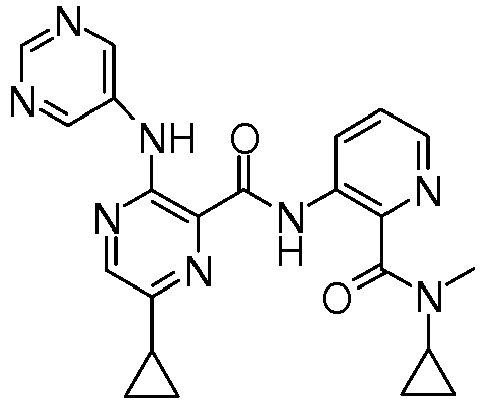
- According to the procedures described in example 97, the title compounds was obtained using 3-aminopicolinic acid and N-methylcyclopropanamine oxalate in the first step. Yellow solid.
MS: M = 234.1 (M+H)+ -

- According to the procedures described in example 132, the title compound was obtained using tetrahydrofuran-3-yl trifluoromethanesulfonate in the 1st step and methylamine hydrochloride in the last step. Yellow solid.
MS: M = 448.2 (M-H)- -

- A solution of 3-[(4-{[6-cyclopropyl-3-(pyrimidin-5-ylamino)-pyrazine-2-carbonyl]-amino}-2-methyl-2H-pyrazole-3-carbonyl)-amino]-pyrrolidine-1-carboxylic acid tert-butyl ester (38 mg, 69 µmol; example 236) in 1,4-dioxane (0.38 ml) was treated with HCl in dioxane (4M; 380 µl, 1.5 mmol) and the reaction mixture was stirred at r.t. for 4 h. The precipitate was filtered off and dried to yield the product as yellow solid (25 mg, 75 %).
MS: M = 449.3 (M+H)+ -

- According to the procedures described in example 97, the title compounds was obtained using 3-aminopicolinic acid and 2-methylpyrolidine in the first step. Yellow solid.
MS: M = 445.4 (M+H)+ -

- According to the procedures described in example 97, the title compounds was obtained using 3-aminopicolinic acid and 2-methylpiperidine in the first step. Yellow solid.
MS: M = 449.4 (M+H)+ -

- According to the procedures described in example 97, the title compounds was obtained using 3-aminopicolinic acid and 3-methylmorpholine in the first step. Yellow solid.
MS: M = 461.4 (M+H)+ -

- The product was obtained starting from 4-{[6-cyclopropyl-3-(pyrimidin-5-ylamino)-pyrazine-2-carbonyl]-amino}-2-methyl-2H-pyrazole-3-carboxylic acid (30 mg, 79 µmol; example 236, step 3) and (S)-(tetrahydrofuran-2-yl)methanamine (15 µl, 142 µmol) according to the method described in example 64, step 6 after purification by preparative HPLC using an acetonitrile/water gradient as yellow solid (31 mg, 84 %).
MS: M = 464.3 (M+H)+ -

- The product was obtained starting from 4-{[6-cyclopropyl-3-(pyrimidin-5-ylamino)-pyrazine-2-carbonyl]-amino}-2-methyl-2H-pyrazole-3-carboxylic acid (30 mg, 79 µmol; example 236, step 3) and (R)-(tetrahydrofuran-2-yl)methanamine (15 µl, 142 µmol) according to the method described in example 64, step 6 after purification by preparative HPLC using an acetonitrile/water gradient as yellow solid (35 mg, 96 %).
MS: M = 464.3 (M+H)+ -

- According to the procedures described in example 135, the title compound was obtained using N-methyl-1-(tetrahydrofuran-2-yl)methanamine in the last step. Yellow solid.
MS: M = 476.2 (M-H)- -

- To a solution of methyl 3-(bis(tert-butoxycarbonyl)amino)-6-bromopyrazine-2-carboxylate (500 mg, 1.16 mmol; example A-10, step 1) in MeOH (10 ml) was added sodium methoxide (30%; 280 µl, 1.5 mmol) at room temperature and stirring was continued at r.t. for 2 h. The reaction mixture was poured into ethyl acetate (75 ml) and extracted with potassium hydrogen sulfate (10%). The organic phase was washed with water and brine and the aqueous layers were back-extracted with ethyl acetate. The organic layers were dried and evaporated and the product was obtained after purification by silica gel chromatography using a heptane/ethyl acetate gradient as colorless solid (320 mg, 71 %).
MS: M = 284.1(M-Boc +H)+ - The product was obtained starting from methyl 3-(bis(tert-butoxycarbonyl)amino)-6-methoxypyrazine-2-carboxylate (140 mg, 0.36 mmol) according to the method described in example A-12, step 3 without chromatographic purification as yellow solid (65 mg, 97 %).
MS: M = 184.1 (M+H)+ - A mixture of 3-amino-6-methoxypyrazine-2-carboxylic acid methyl ester (65 mg, 355 µmol), 5-bromopyrimidine (84.6 mg, 532 µmol) and cesium carbonate (162 mg, 497 µmol) in dioxane (1.5 ml) was treated with tris(dibenzylideneacetone)dipalladium(0)-chloroform adduct (36.7 mg, 35.5 µmol) and xantphos (67.8 mg, 117 µmol) under argon atmosphere and the reaction mixture was stirred at 110 °C for 16 h. After cooling down to ambient temperature, the reaction mixture was diluted with acetonitrile/water. The precipitated solid was sucked off, washed with acetonitrile/water, THF and MeOH and dried to yield the product as yellow solid (57 mg, 55.3 %).
MS: M = 262.2 (M+H)+ - The product was obtained starting from 6-methoxy-3-(pyrimidin-5-ylamino)-pyrazine-2-carboxylic acid methyl ester (55 mg, 0.19 mmol) according to the method described in example A-11 as yellow solid (52 mg, 99 %).
MS: M = 246.3 (M-H)- - The product was obtained starting from 6-methoxy-3-(pyrimidin-5-ylamino)-pyrazine-2-carboxylic acid (50 mg, 0.18 mmol) and 4-amino-2-methyl-2H-pyrazole-3-carboxylic acid methylamide (36 mg, 0.23 mmol) according to the method described in example 64, step 6 after purification by preparative HPLC using an acetonitrile/water gradient as yellow solid (16 mg, 22 %).
MS: M = 384.2 (M+H)+ -

- According to the procedures described in example 97, the title compound was obtained using 5-amino-2-chloroisonicotinic acid and methylamine hydrochloride in the 1st step. Yellow solid.
MS: M = 423.0 (M-H)- -

- According to the procedures described in example 97, the title compound was obtained using 5-amino-2-chloroisonicotinic acid and 1-amino-2-methyl-propan-2-ol in the 1st step. Yellow solid.
MS: M = 481.1 (M-H)- -

- According to the procedures described in example 97, the title compound was obtained using 2-amino-5-cyano-benzoic acid and methylamine hydrochloride in the 1st step. Yellow solid.
MS: M = 413.1 (M-H)- -

- According to the procedures described in example 97, the title compound was obtained using 2-amino-5-cyano-benzoic acid and 1-amino-2-methyl-propan-2-ol in the 1st step. Yellow solid.
MS: M = 481.1 (M-H)- -

- According to the procedure described in step 6 of example 64, the title compound was obtained from A-11 and methyl 6-amino-2,3-dimethylbenzoate. Yellow solid.
MS: M = 419.3 (M+H)+- - To a solution of methyl 6-(6-cyclopropyl-3-(pyrimidin-5-ylamino)pyrazine-2-carboxamido)-2,3-dimethylbenzoate (0.05 g, 119 µmol,) in pyridine (1 ml) at r.t under an argon atmospher was added lithium iodide (125 mg, 932 µmol). The mixture was heated at 100° for 16 hr. The solvent was evaporated. The crude product was used directly in the next step.
- According to the method described in step 3 of example 99, the title compound was obtained by reacting the crude 6-{[6-cyclopropyl-3-(pyrimidin-5-ylamino)-pyrazine-2-carbonyl]-amino}-2,3-dimethyl-benzoic acid with methylamine hydrochloride. Yellow solid.
MS: M = 418.3 (M+H)+- -

- According to the procedures described in example 132, the title compound was obtained using 2-(2-bromoethoxy)tetrahydro-2H-pyran in the 1st step and methylamine hydrochloride in the last step. Yellow solid.
MS: M = 508.3 (M+H)+ - To a suspension of 6-cyclopropyl-N-(5-(methylcarbamoyl)-1-(2-(tetrahydro-2H-pyran-2-yloxy)ethyl)-1H-pyrazol-4-yl)-3-(pyrimidin-5-ylamino)pyrazine-2-carboxamide (0.07 g, 138 µmol, Eq: 1.00) at r.t under Ar in MeOH (2.7 ml) was added a amount catalytic amount of paratoluene sulfonic acid. The mixture was stirred at 70° for 1 hr. The solvent was evaporated. The residue was dissolved in dichloromethane, then washed with water. The organic was dried over MgSO4, filterd and evaporated. The crude product was purified by silica gel chromatography using a dichloromethane/MeOH gradient to obtain the tile compound (53 mg, 91%) as yellow solid.
MS: M = 424.1 (M+H)+ -

- According to the procedures described in example 99, ethyl 3-amino-6-cyclopropylpicolinate (example A-1, step 1) was converted to the title compound, using dimethylamine hydrochloride in the last step. Yellow solid.
MS: M = 443.2 (M-H)- -

- The product was obtained together with its enantiomer starting from 3-amino-6-(furan-3-yl)-pyrazine-2-carboxylic acid methyl ester (1.7 g, 7.76 mmol) according to the method described in example A-16, step 2 after purification by chiral preparative HPLC using a Chiralpak AD column and an EtOH/heptane gradient as light yellow solid (118 mg, 6.75 %).
MS: M = 224.1(M+H)+ - The product was obtained starting from 3-amino-6-(R)-(tetrahydro-furan-3-yl)-pyrazine-2-carboxylic acid methyl ester (110 mg, 0.49 mmol) according to the method described in example A-16, step 3 after purification by preparative HPLC using an acetonitrile/water gradient as light yellow solid (23 mg, 15 %)
MS: M = 302.1(M+H)+ - The product was obtained starting from 3-(pyrimidin-5-ylamino)-6-(R)-tetrahydro-furan-3-yl-pyrazine-2-carboxylic acid methyl ester (23 mg, 76 µmol) and 4-amino-2-methyl-2H-pyrazole-3-carboxylic acid methylamide (35 mg, 228 µmol) according to the method described in example 104 after purification by preparative HPLC using an acetonitrile/water gradient as yellow solid (23 mg, 70 %).
MS: M = 424.2 (M+H)+ -

- The product was obtained together with its enantiomer starting from 3-amino-6-(furan-3-yl)-pyrazine-2-carboxylic acid methyl ester (1.7 g, 7.76 mmol) according to the method described in example A-16, step 2 after purification by prep chiral preparative HPLC using a Chiralpak AD column and an EtOH/heptane gradient as light yellow solid (116 mg, 6.6 %).
MS: M = 224.1(M+H)+ - The product was obtained starting from 3-amino-6-(S)-(tetrahydro-furan-3-yl)-pyrazine-2-carboxylic acid methyl ester (110 mg, 0.49 mmol) according to the method described in example A-16, step 3 after purification by preparative HPLC using an acetonitrile/water gradient as light yellow solid (54 mg, 36 %)
MS: M = 302.1(M+H)+ - The product was obtained starting from 3-(pyrimidin-5-ylamino)-6-(S)-tetrahydro-furan-3-yl-pyrazine-2-carboxylic acid methyl ester (30 mg, 0.1 mmol) and 4-amino-2-methyl-2H-pyrazole-3-carboxylic acid methylamide (46 mg, 0.3 mmol) according to the method described in example 104 after purification by preparative HPLC using an acetonitrile/water gradient as yellow solid (28 mg, 66 %).
MS: M = 424.2 (M+H)+ -

- According to the procedures described in example 99, the title compound was obtained using 3-amino-6-methyl-pyridine-2-carboxylic acid ethyl ester (CAS 908832-89-3) in the 1st step and dimethylamine hydrochloride in the last step. Yellow solid.
MS: M = 417.3 (M-H)- -

- According to the procedures described in example 97, the title compound was obtained using 3-aminopicolinic acid and 2-(methylamino)ethanol in the 1st step.
MS: M = 435.3 (M+H)+ -
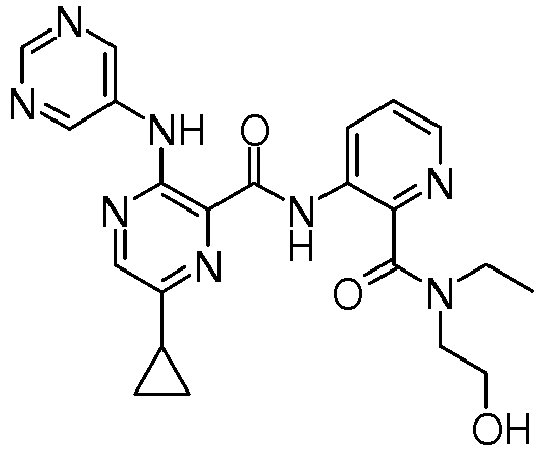
- According to the procedures described in example 97, the title compound was obtained using 3-aminopicolinic acid and 2-(ethylamino)ethanol in the 1st step.
MS: M = 449.3 (M+H)+ -

- According to the procedures described in example 97, the title compound was obtained using 3-aminopicolinic acid and 2-aminoethanol in the 1st step.
MS: M = 421.1 (M+H)+ -

- According to the procedures described in example 99, ethyl 3-amino-6-cyclopropylpicolinate (example A-1, step 1) was converted to the title compound, using azetidine in the last step. Yellow solid.
MS: M = 457.3 (M+H)+ -

- According to the procedures described in example 97, the title compound was obtained using 3-aminopicolinic acid and 2-amino-2-methylpropan-1-ol in the 1st step.
MS: M = 449.2 (M+H)+ -

- According to the procedures described in example 99, the title compound was obtained reacting intermediate A-11 and methyl 5-acetamido-2-aminobenzoate (CAS 54002-34-5) in the 1st step and using methylamine hydrochloride in the last step. Yellow solid.
MS: M = 448.2 (M+H)+ -

- According to the procedures described in example 97, the title compound was obtained using 3-aminopicolinic acid and 3-methyloxetan-3-amine in the 1st step.
MS: M = 447.3 (M+H)+ -

- According to the procedures described in example 99, the title compound was obtained using ethyl 3-aminopicolinate in the 1st step and ethyl 3-aminopicolinate in the last step.
MS: M = 406.4 (M+H)+ -

- According to the procedures described in example 97, the title compound was obtained using 3-aminopicolinic acid and oxetan-3-amine hydrochloride in the 1st step.
MS: M = 433.3 (M+H)+ -

- To a stirred mixture of 3-amino-6-methylpicolinic acid (525mg, 2.17 mmol,) and azetidine (124 mg, 146 µl, 2.17 mmol) at r.t. in THF (15 ml) under an argon atmosphere were added HATU (1.65 g, 4.35 mmol) and 4-methylmorpholine (719 µl, 6.52 mmol). The mixture was heated to 70°C overnight, then cooled to r.t. and concentrated. The crude product was purified by silica gel chromatography using a n-heptane/EtOAc gradient to give the title compound (272 mg, 65%) as off-white solid.
MS: M = 192.2 (M+H)+ - In analogy to the procedure described in step 6 of example 64, the title compound was obtained reacting intermediate A-11 and (3-amino-6-methyl-pyridin-2-yl)-azetidin-1-yl-methanone. Yellow solid.
MS: M = 431.3 (M-H)- -

- According to the procedure described in example 135, the title compound was obtained using (S)-tetrahydrofuran-3-amine hydrochloride in the last step. Yellow solid.
MS: M = 450.2 (M+H)+ -

- According to the procedure described in example 135, the title compound was obtained using (R)-tetrahydrofuran-3-amine methanesulfonate in the last step. Yellow solid.
MS: M = 450.2 (M+H)+ -

- The title compound was obtained using the procudure described in step 3 of example 99, the title compound was obtained by reacting 5-bromo-2-methylpyrimidine-4-carboxylic acid and 1-amino-2-methylpropan-2-ol. Oil.
MS: M = 285.7 (M+H)+ - According to the procedures described in steps 1 and 2 of example 209, the title compound was obtained by reacting 5-bromo-N-(2-hydroxy-2-methylpropyl)-2-methylpyrimidine-4-carboxamide with tert-butyl carbamate and subsequent cleavage of the Boc group. Yellow gum.
MS: M = 225.2 (M+H)+ - The title compound was prepared according to the procedure described in step 6 of example 64. Yellow solid.
MS: M = 464.3 (M+H)+ -

- According to the procedures described in example 132, the title compound was obtained using 2-(iodomethyl)oxetane in the 1st step and methylamine hydrochloride in the last step. Yellow solid.
MS: M = 450.3 (M+H)+ -

- According to the procedures described in example 132, the title compound was obtained using 2-(iodomethyl)oxetane in the 1st step and 1-amino-2-methylpropan-2-ol in the last step. Yellow solid.
MS: M = 508.3 (M+H)+ -

- According to the procedures described in example 99, the title compound was obtained reacting intermediate A-11 and methyl 2-amino-4,5-difluorobenzoate in the 1st step and using dimethylamino hydrochloride in the last step. Yellow solid.
MS: M = 440.1 (M+H)+ -

- According to the procedures described in example 281, the title compound was obtained using methylamine hydrochloride in the 1st step. Yellow solid.
MS: M = 440.1 (M+H)+ -

- According to the procedures described in example 132, the title compound was obtained using 3-(iodomethyl)tetrahydrofuran in the 1st step and methylamine hydrochloride in the last step. Yellow solid.
MS: M = 464.3 (M+H)+ -

- According to the procedures described in example 132, the title compound was obtained using 3-(iodomethyl)tetrahydrofuran in the 1st step and 1-amino-2-methylpropan-2-ol in the last step. Yellow solid.
MS: M = 522.4 (M+H)+ -

- According to the procedures described in example 99, the title compound was obtained reacting intermediate A-11 and methyl 2-amino-4,5-difluorobenzoate in the 1st step and using methyl-amino hydrochloride in the last step. Yellow solid.
MS: M = 426.1 (M+H)+ -

- A pre-dried flask was charged with copper(I) bromide (0.35 mg, 2.89 µmol), (R)-(+)-1,1'-bi-2-naphthol (1.66 mg, 5.78 µmol) and cesium carbonate (113 mg, 347 µmol) under argon atmosphere. DMF (0.5 ml), methyl 3-(bis(tert-butoxycarbonyl)amino)-6-bromopyrazine-2-carboxylate (50 mg, 116 µmol) and pyrrolidine (14.3 µl, 174 µmol) were added and the reaction mixture was stirred at r.t. for 1.5 h. The reaction mixture was poured into water (10 ml) and extracted with ethyl acetate. The combined organic layer was washed with brine, dried, evaporated and purified by silica gel chromatography using a heptane/ethyl acetate gradient to yield the product as yellow solid (37 mg, 68 %).
MS: M = 423.3 (M+H)+ - The product was obtained starting from methyl 3-(bis(tert-butoxycarbonyl)amino)-6-pyrrolidin-1-yl-pyrazine-2-carboxylate (167 mg, 0.39 mmol) according to the method described in example A-12, step 3 without chromatographic purification as orange solid (87 mg, 99 %).
MS: M = 223.2 (M+H)+ - The product was obtained starting from 3-amino-6-pyrrolidin-1-yl-pyrazine-2-carboxylatic acid methyl ester (85 mg, 0.38 mmol) according to the method described in example 258, step 3 after purification by preparative HPLC using an acetonitrile/water gradient as orange solid (90 mg, 70 %).
MS: M = 301.3 (M+H)+ - The product was obtained starting from 3-(pyrimidin-5-ylamino)-6-pyrrolidin-1-yl-pyrazine-2-carboxylic acid methyl ester (87 mg, 0.29 mmol) according to the method described in example A-11 as yellow solid (80 mg, 87 %).
- The product was obtained starting from 3-(pyrimidin-5-ylamino)-6-pyrrolidin-1-yl-pyrazine-2-carboxylic acid (30 mg, 94 µmol) and 4-amino-2-methyl-2H-pyrazole-3-carboxylic acid methylamide (19 mg, 123 µmol) according to the method described in example 64, step 6 after purification by preparative HPLC using an acetonitrile/water gradient as yellow solid (10 mg, 26 %).
MS: M = 423.3 (M+H)+ -

- According to the procedures described in example 278, the title compound was obtained using 2-amino-3-fluorobenzoic acid and methylamine hydrochloride in the 1st step. Yellow solid.
MS: M = 408.4 (M+H)+ -

- According to the procedures described in example 278, the title compound was obtained reacting methyl 2-amino-4,5-difluorobenzoate and azetidine in the 1st step. Yellow solid.
MS: M = 452.2 (M+H)+ -

- According to the procedures described in example 278, the title compound was obtained reacting 2-amino-4-fluorobenzoic acid and methylamine hydrochloride in the 1st step. Yellow solid.
MS: M = 408.4 (M+H)+ -

- According to the procedures described in example 278, the title compound was obtained using 2-amino-3-fluorobenzoic acid and 1-amino-2-methylpropan-2-ol in the 1st step. Yellow solid.
MS: M = 466.3 (M+H)+ -

- According to the procedures described in example 278, the title compound was obtained reacting 2-amino-4-fluorobenzoic acid and dimethylamine hydrochloride in the 1st step. Yellow solid.
MS: M = 422.2 (M+H)+ -

- According to the procedures described in example 278, the title compound was obtained reacting 2-amino-5-(trifluoromethyl)benzoic acid and 1-amino-2-methylpropan-2-ol in the 1st step. Yellow solid.
MS: M = 516.4 (M+H)+ -

- According to the procedures described in example 278, the title compound was obtained reacting 2-amino-5-(trifluoromethyl)benzoic acid and methylamine hydrochloride in the 1st step. Yellow solid.
MS: M = 458.3 (M+H)+ -

- According to the procedures described in example 289, the product was prepared as yellow solid by using morpholine in the 1st step.
MS: M = 439.4 (M+H)+ -

- According to the procedures described in example 278, the title compound was obtained reacting 2-amino-5-fluorobenzoic acid and dimethylamine hydrochloride in the 1st step. Yellow solid.
MS: M = 422.2 (M+H)+ -

- According to the procedures described in example 278, the title compound was obtained reacting 2-amino-4,6-difluoro-benzoic acid and methylamine hydrochloride in the 1st step. Yellow solid.
MS: M = 426.2 (M+H)+ -

- According to the procedures described in example 278, the title compound was obtained reacting 2-amino-4,6-difluoro-benzoic acid and dimethylamine hydrochloride in the 1st step. Yellow solid.
MS: M = 440.3 (M+H)+ -

- According to the procedures described in example 278, the title compound was obtained reacting 2-amino-4-fluoro-benzoic acid and 1-amino-2-methyl-propan-2-ol in the 1st step. Yellow solid.
MS: M = 466.2 (M+H)+ -

- According to the procedures described in example 278, the title compound was obtained reacting 2-amino-4-fluoro-benzoic acid and azetidine in the 1st step. Yellow solid.
MS: M = 434.3 (M+H)+ -
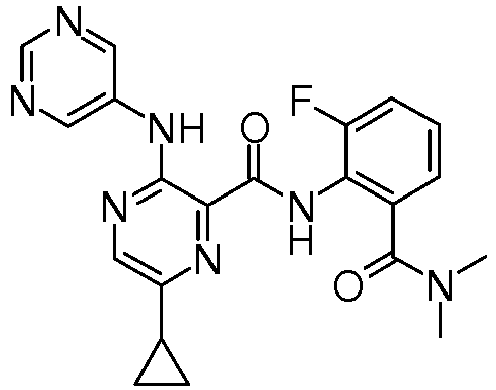
- According to the procedures described in example 278, the title compound was obtained reacting 2-amino-3-fluoro-benzoic acid and dimethylamino hydrochloride in the 1st step. Yellow solid.
MS: M = 422.3 (M+H)+ -

- According to the procedures described in example 289, the product was prepared as light yellow solid by using azetidine in the 1st step.
MS: M = 409.3 (M+H)+ -

- According to the procedures described in example 278, the title compound was obtained reacting 2-amino-5-fluoro-benzoic acid and azetidine in the 1st step. Yellow solid.
MS: M = 434.4 (M+H)+ -

- According to the procedures described in example 278, the title compound was obtained reacting 2-amino-5-fluoro-benzoic acid and 1-amino-2-methylpropan-2-ol in the 1st step. Yellow powder.
MS: M = 466.2 (M+H)+ -

- According to the procedures described in example 278, the title compound was obtained reacting 2-amino-6-fluoro-benzoic acid and methylamine hydrochloride in the 1st step. Yellow powder.
MS: M = 408.3 (M+H)+ -

- According to the procedures described in example 278, the title compound was obtained reacting 2-amino-6-fluoro-benzoic acid and dimethylamine hydrochloride in the 1st step. Yellow powder.
MS: M = 422.1 (M+H)+ -

- According to the procedures described in example 278, the title compound was obtained reacting 2-amino-6-fluoro-benzoic acid and azetidine in the 1st step. Yellow powder.
MS: M = 434.3 (M+H)+ -

- According to the procedures described in example 278, the title compound was obtained reacting 2-amino-6-fluoro-benzoic acid and 1-amino-2-methylpropan-2-ol in the 1st step. Yellow powder.
MS: M = 466.2 (M+H)+ -

- According to the procedures described in example 289, the product was prepared as light yellow solid by using N-methyl-ethylamine in the 1st step.
MS: M = 411.3 (M+H)+ -

- According to the procedures described in example 278, the title compound was obtained reacting 2-amino-5-fluoro-benzoic acid and methylamine hydrochloride in the 1st step. Yellow powder.
MS: M = 408.3 (M+H)+ -

- The product was obtained starting from 4-{[6-cyclopropyl-3-(pyrimidin-5-ylamino)-pyrazine-2-carbonyl]-amino}-2-methyl-2H-pyrazole-3-carboxylic acid (30 mg, 79 µmol; example 236, step 3) and N,N-dimethylethylene-1,2-diamine (11 µl, 100 µmol) according to the method described in example 64, step 6 as yellow solid (10 mg, 28 %).
MS: M = 451.2 (M+H)+ -

- A suspension of intermediate A-5 (75 mg, 0.28 mmol) in ethanol (2 ml) was treated with NaOH (1M, 0.55 ml, 551 µmol) under an Argon atmosphere, and the mixture was stirred at r.t for 17 h. HCl (1N, 0.55 ml) was added and the reaction mixture was poured into dichloromethane (5ml) and separated. The organic layer was dried and evaporated to yield the product as yellow solid (35 mg, 49 %).
MS: M = 256.1 (M-H)- - The product was obtained starting from 2-cyclopropyl-5-(pyrimidin-5-ylamino)-pyrimidine-4-carboxylic acid (35 mg, 135 µmol) and 4-amino-2-methyl-2H-pyrazole-3-carboxylic acid methylamide (25 mg, 163 µmol) according to the method described in example 64, step 6 as light yellow solid (22 mg, 41 %).
MS: M = 394.2 (M+H)+ -

- The product was obtained starting from 4-{[6-cyclopropyl-3-(pyrimidin-5-ylamino)-pyrazine-2-carbonyl]-amino}-2-methyl-2H-pyrazole-3-carboxylic acid (30 mg, 79 µmol; example 236, step 3) and 1-methylazetidin-3-amine dihydrochloride (16 mg, 100 µmol) according to the method described in example 64, step 6 after purification by preparative HPLC using an acetonitrile/water gradient as yellow solid (11 mg, 31 %).
MS: M = 449.3 (M+H)+ -

- According to the procedures described in example 278, the title compound was obtained reacting 2-amino-5,6-difluoro-benzoic acid and dimethylamine hydrochloride in the 1st step. Yellow powder.
MS: M = 440.2 (M+H)+ -

- According to the procedures described in example 278, the title compound was obtained reacting 2-amino-5,6-difluoro-benzoic acid and methylamine hydrochloride in the 1st step. Yellow powder.
MS: M = 426.1 (M+H)+ -

- According to the procedures described in example 278, the title compound was obtained reacting 2-amino-5,6-difluoro-benzoic acid and 1-amino-2-methylpropan-2-ol in the 1st step. Yellow powder.
MS: M = 484.3 (M+H)+ -

- According to the procedures described in example 278, the title compound was obtained reacting 2-amino-5,6-difluoro-benzoic acid and azetidine in the 1st step. Yellow powder.
MS: M = 452.2 (M+H)+ -

- According to the procedures described in example 278, the title compound was obtained reacting 2-amino-3,4-difluoro-benzoic acid and azetidine in the 1st step. Yellow powder.
MS: M = 452.2 (M+H)+ -

- According to the procedure described in step 1 of example 111, the title compound was obtained by coupling 5-bromo-2-nitrobenzoic acid and methylamine hydrochloride. Off-white solid.
- A mixture of 5-bromo-N-methyl-2-nitrobenzamide (1.366 g, 5.27 mmol) and sodium acetate (1.08 g, 13.2 mmol) in DMF (6 ml) was degassed and flushed with argon. To this mixture was added a solution of degassed palladium (II) acetate (35.5 mg, 158 µmol) and tri-o-tolylphosphine (96.3 mg, 316 µmol). The resulting solution was then degassed and flushed with argon to give a brown solution which was heated at 130°C overnight. The reaction mixture at r.t. into water (10ml) The aqueous solution was extratced with methylene chloride. The organic layers were dried over MgSO4. The crude product was purified by silica gel chromatography using a heptane/EtOAc gradient to obtain the title compound (1.09 g, 75%) as light yellow solid.
MS: M = 279.0 (M+H)+ - To a stirred solution of (E)-ethyl 3-(3-(methylcarbamoyl)-4-nitrophenyl)acrylate (345 mg, 1.24 mmol) in ethanol (10 ml) at r.t. under an argon atmosphere was added 10% Pd/C (52.8 mg, 496 µmol). The black suspension was hydrogenated at normal pressure and r.t. overnight. The catalyst was removed by filtration. The filtrate was concentrated. The crude product was purified by silica gel chromatography using a methylenchloride/MeOH gradient to give the title compound (175 mg, 57 %) as white solid.
MS: M = 251.2 (M+H)+ - According to the procedure described in step 6 of example 64, the title compound was obtained by reaction intermediate A-11 with ethyl 3-(4-amino-3-(methylcarbamoyl)phenyl)propanoate. Yellow solid.
MS: M = 490.4 (M+H)+ -

- To a suspension of NaH (299 mg, 7.48 mmol) in DMF (20 ml) at 0° under argon atmosphere was added methyl 2-amino-5-hydroxybenzoate (1.25 g, 7.48 mmol) and 2-iodoacetamide (1.38 g, 7.48 mmol). The mixture was stirred at 0° for 1 hr and at r.t overnight. At 0° water was given to the reaction mixture. The product was extracted with EtOAc. The organic layers were dried over MgSO4, filtered and concentrated. The crude product was purified by silica gel chromatography using a methylenchloride gradient to obtain the title compound (1.03 g, 64%) as off-white solid.
MS: M = 225.0 (M+H)+ - According to the procedures described in example 99, the title compound was obtained as unexpected product using intermediate A-11 and methyl 2-amino-5-(2-amino-2-oxoethoxy)benzoate in the 1st step and methylamine hydrochloride in the 3rd step. Yellow solid.
MS: M = 477.2 (M+H)+ -

- According to the procedures described in example 278, the title compound was obtained reacting 2-amino-4,6-difluoro-benzoic acid and azetidine in the 1st step. Yellow powder.
MS: M = 450.1 (M-H)- -

- According to the procedures described in example 278, the title compound was obtained reacting 2-amino-4,6-difluoro-benzoic acid and 1-amino-2-methylpropan-2-ol in the 1st step. Yellow powder.
MS: M = 482.2 (M-H)- -

- According to the procedures described in example 278, the title compound was obtained reacting 2-amino-3,4-difluoro-benzoic acid and dimethyl hydrochloride in the 1st step. Yellow powder.
MS: M = 440.1 (M+H)+ -

- According to the procedures described in example 278, the title compound was obtained reacting 2-amino-3,4-difluoro-benzoic acid and 1-amino-2-methylpropan-2-ol in the 1st step. Yellow powder.
MS: M = 484.4 (M+H)+ -

- According to the procedures described in example 278, the title compound was obtained reacting 2-amino-3,4-difluoro-benzoic acid and methylamine hydrochloride in the 1st step. Yellow powder.
MS: M = 424.1 (M+H)+ -

- In analogy to the procedure described in step 2 of example 99, 6-amino-2,3-difluoro-N-(2-hydroxy-2-methylpropyl)benzamide (example 321) was converted to the title compound.
MS: M = 460.4 (M-H)+ -

- The product was obtained as yellow solid (74 mg, 53 %) after purification by preparative HPLC using an acetonitrile/water gradient and silica gel chromatography using a heptane/ethyl acetate gradient according to the procedures described in example 98 using intermediate A-15 in the 2nd step.
MS: M = 451.3 (M+H)+ -

- The product was obtained as yellow solid (65 mg, 48 %) after purification by preparative HPLC using an acetonitrile/water gradient according to the procedures described in example 98 using intermediate A-9 in the 2nd step.
MS: M = 465.3 (M+H)+ -

- The product was obtained as yellow solid (188 mg, 98 %) according to the method described in example 314, step 1 starting from intermediate A-7.
MS: M = 272.2 (M-H)- - The product was obtained as yellow solid (63 mg, 62 %) after purification by preparative HPLC using an acetonitrile/water gradient according to the procedures described in example 98 using 2-isobutyl-5-(pyrimidin-5-ylamino)-pyrimidine-4-carboxylic acid in the 2nd step.
MS: M = 465.3 (M+H)+ -

- The product was obtained starting from 2-isobutyl-5-(pyrimidin-5-ylamino)-pyrimidine-4-carboxylic acid (60 mg, 0.22 mmol; example 331, step 1) and 4-amino-2-methyl-2H-pyrazole-3-carboxylic acid methylamide (44 mg, 0.28 mmol) according to the method described in example 64, step 6 after purification by preparative HPLC using an acetonitrile/water gradient as yellow solid (42 mg, 47 %).
MS: M = 410.3 (M+H)+ -

- According to the procedures described in example 289, the product was prepared as yellow solid by using N-methylpiperazine in the 1st step.
MS: M = 452.2 (M+H)+ -

- The product was obtained starting from 4-{[6-cyclopropyl-3-(pyrimidin-5-ylamino)-pyrazine-2-carbonyl]-amino}-2-methyl-2H-pyrazole-3-carboxylic acid (50 mg, 131 µmol; example 236, step 3) and N,O-dimethylhydroxylamine hydrochloride (14 mg, 145 µmol) according to the method described in example 64, step 6 after purification by preparative HPLC using an acetonitrile/water gradient as yellow foam (47 mg, 84 %).
MS: M = 424.3 (M+H)+ -

- The product was obtained starting from 4-{[6-cyclopropyl-3-(pyrimidin-5-ylamino)-pyrazine-2-carbonyl]-amino}-2-methyl-2H-pyrazole-3-carboxylic acid (50 mg, 131 µmol; example 236, step 3) and isoxazolidine hydrochloride (17 mg, 145 µmol) according to the method described in example 64, step 6 after purification by preparative HPLC using an acetonitrile/water gradient as yellow solid (9 mg, 16 %).
MS: M = 436.2 (M+H)+ -

- The product was obtained starting from 4-{[6-cyclopropyl-3-(pyrimidin-5-ylamino)-pyrazine-2-carbonyl]-amino}-2-methyl-2H-pyrazole-3-carboxylic acid (50 mg, 131 µmol; example 236, step 3) and 2-aminocyclopentanol (15 mg, 140 µmol) according to the method described in example 64, step 6 after purification by preparative HPLC using an acetonitrile/water gradient as yellow solid (24 mg, 40 %).
MS: M = 464.3 (M+H)+ -

- To a solution of sodium trifluoroethoxide, prepared from trifluoroethanol (2 ml) and sodium hydride (37 mg, 0.84 mmol) at 0-5°C, was added dropwise a solution of ethyl 5-bromo-2-(methylsulfonyl)pyrimidine-4-carboxylic acid ethyl ester (200 mg, 0.65 mmol; example 126, step 1) dissolved in trifluoroethanol (2 ml) at the same temperature. The ice bath was removed after 15 min and the mixture was stirred at r.t. for 4 h. The reaction mixture was poured into ethyl acetate (20 ml) and extracted with potassium hydrogen sulfate (10%, 10 ml). The organic phase was washed with water and brine and the aqueous layers were back-extracted with ethyl acetate. The combined organic layers were dried and evaporated and the product was obtained after purification by silica gel chromatography using a heptane/ethyl acetate gradient as colorless oil (186 mg, 87 %).
MS: M = 329.0 (M+H)+ - The product was obtained starting from 5-bromo-2-(2,2,2-trifluoro-ethoxy)-pyrimidine-4-carboxylic acid ethyl ester (225 mg, 0.68 mmol) according to the method described in example A-13 as yellow solid (160 mg, 83 %).
MS: M = 344.2 (M+H)+ - The product was obtained starting from 5-(pyrimidin-5-ylamino)-2-(2,2,2-trifluoro-ethoxy)-pyrimidine-4-carboxylic acid ethyl ester (160 mg, 0.46 mmol) according to the method described in example 314, step 1 as yellow solid (145 mg, 99 %).
MS: M = 314.0 (M-H)- - The product was obtained starting from 5-(pyrimidin-5-ylamino)-2-(2,2,2-trifluoro-ethoxy)-pyrimidine-4-carboxylic acid (50 mg, 0.16 mmol) and 4-amino-2-methyl-2H-pyrazole-3-carboxylic acid methylamide (32 mg, 0.21 mmol) according to the method described in example 64, step 6 as yellow solid (50 mg, 69 %).
MS: M = 452.1 (M+H)+ -

- A mixture of methyl 5-hydroxy-2-nitrobenzoate (0.5 g, 2.54 mmol), 2,2-dimethyloxirane (6.86 ml, 7.61 mmol), potassium carbonate (351 mg, 2.54 mmol) and sodium dihydrogen phosphate monohydrate (350 mg, 2.54 mmol) in acetonitrile (4 ml) and water (0.6 ml) was stirred at 140° (5 bar) in a steel bomb for 6 hr. After cooling to r.t, the mixture was diluted with water, extracted with AcOEt, dried over MgSO4, filtered and evaporated. The crude product was purified by silica gel chromatography using a methylenechloride/MeOH gradient to obtain the title compound (200 mg, 29%) as light yellow viscous oil.
MS: M = 270.4 (M+H)+ - As a second product, 2-hydroxy-2-methylpropyl 5-(2-hydroxy-2-methylpropoxy)-2-nitrobenzoate was obtained (248 mg, 30%) as a off-white solid.
MS: M = 345.5 (M+NH4)+ - To a solution of 2-hydroxy-2-methylpropyl 5-(2-hydroxy-2-methylpropoxy)-2-nitrobenzoate (0.24 g, 733 µmol) in MeOH (10 ml) at r.t was added NaOH 1 N (2.2 ml, 2.2 mmol). The solution was stirred at r.t overnight. 2.2 ml 1 N HCl were added. The solvents were evaporated. The residue was dissolved in methylenechloride/MeOH 9:1 (100 ml), washed with 10ml H2O, dried over MgSO4, filtered and evaporated to give the title compound (149 mg, 80%) as off-white solid.
MS: M = 245.2 (M-H)- - A solution of 5-(2-hydroxy-2-methylpropoxy)-2-nitrobenzoic acid (0.145 g, 568 µmol) in ethanol (5 ml) was hydrogenated at normal pressure in the presence of 20 mg Pd/C 10% at r.t overnight. The catalyst was filtered and washed with EtOH. The filtrate was concentrated to give the title compound (127 mg, 99%) as grayish foam.
MS: M = 226.2 (M+H)+ - According to the procedures described in example 278, the title compound was obtained reacting methylamine hydrochloride in the 1st step. Yellow powder.
MS: M = 478.0 (M+H)+ -

- A suspension of methyl 3-(bis(tert-butoxycarbonyl)amino)-6-bromopyrazine-2-carboxylate (500 mg, 1.16 mmol), 2,2,2-trifluoroethanol (84 µl, 1.16 mmol), cesium carbonate (415 mg, 1.27 mmol) and dry DMSO (5 ml) was stirred at r.t. for 3 h. The reaction mixture was poured into ethyl acetate (100ml) and extracted with saturated sodium bicarbonate (aqueous solution). The organic layer was washed with water and brine and the aqueous layers were back-extracted with ethyl acetate. The combined organic layers were dried, evaporated and the product was obtained after purification by silica gel chromatography using a heptane/ethyl acetate gradient as white solid (456 mg, 87 %).
MS = 474.1 (M+Na)+ - The product was obtained starting from 3-(bis(tert-butoxycarbonyl)amino)-6-(2,2,2-trifluoro-ethoxy)-pyrazine-2-carboxylic acid methyl ester (456 mg, 1.0 mmol) according to the method described in example A-12, step 3 after purification by silica gel chromatography using a heptane/ethyl acetate gradient as off-white solid (136 mg, 54 %).
- The product was obtained starting from 3-amino-6-(2,2,2-trifluoro-ethoxy)-pyrazine-2-carboxylic acid methyl ester (182 mg, 0.72 mmol) according to the method described in example A-1, step 2 as light-yellow solid (126 mg, 53 %).
MS: M = 330.2 (M+H)+ - The product was obtained starting from 3-(pyrimidin-5-ylamino)-6-(2,2,2-trifluoro-ethoxy)-pyrazine-2-carboxylic acid methyl ester (122 mg, 0.37 mmol)according to the method described in example 314, step 1 as yellow solid (115 mg, 98 %).
MS: M = 314.0 (M-H)- - The product was obtained starting from 3-(pyrimidin-5-ylamino)-6-(2,2,2-trifluoro-ethoxy)-pyrazine-2-carboxylic acid (114 mg, 0.36 mmol) and 4-amino-2-methyl-2H-pyrazole-3-carboxylic acid methylamide (67 mg, 0.43 mmol) according to the method described in example 64, step 6 as yellow solid (92 mg, 56 %).
MS: M = 452.1 (M+H)+ -

- The product was obtained starting from 2-hydroxy-2-methylpropylamidine hydrochloride (4.34 g, 31.3 mmol) according to the method described in example A-4, step 1 as brown viscous oil (2.82 g, 70 %)
MS: M = 279.1 (M+NH3+H)+ - The product was obtained starting from 5-bromo-2-(2-hydroxypropan-2-yl)pyrimidine-4-carboxylic acid (150 mg, 0.575 mmol) and 4-amino-2-methyl-2H-pyrazole-3-carboxylic acid methylamide (106 mg, 0.69 mmol) according to the method described in example 64, step 6 after purification by silica gel chromatography using a heptane/ethyl acetate gradient as light brown waxy solid (31 mg, 13 %).
MS: M = 399.0 (M+H)+ - The product was obtained starting from 5-bromo-2-(1-hydroxy-1-methyl-ethyl)-pyrimidine-4-carboxylic acid (1-methyl-5-methylcarbamoyl-1H-pyrazol-4-yl)-amide (26 mg, 66 µmol) according to the method described in example A-13 after purification by preparative HPLC using an acetonitrile/water gradient as light yellow solid (3 mg, 11 %).
MS: M = 412.3 (M+H)+ -

- A solution of methyl 3-(bis(tert-butoxycarbonyl)amino)-6-(prop-1-en-2-yl)pyrazine-2-carboxylate (761 mg, 1.93 mmol; example A-17, step 1), tetrabutylammonium borohydride (995 mg, 3.87 mmol), 5,10,15,20-tetraphenyl-21H,23H-porphine manganese(III) chloride (136 mg, 0.19 mmol) in toluene (20 ml) and ethanol (20 ml) was stirred at r.t. for 40 h with compressed air bubbling through the reaction mixture. Water (40 ml) was added and the reaction mixture was extracted with ethyl acetate (120 ml). The organic phase was washed with water and brine and the aqueous layers were back-extracted with ethyl acetate. The combined organic layers were dried, evaporated and the crude product was obtained after purification by preparative HPLC using a methanol/water gradient. The methanol was evaporated and the resulting aqueous suspension was subsequently extracted with dichloromethane, dried and the solvent was evaporated to yield the product as green oil (164 mg, 20 %).
MS: M = 448.2 (M+Na)+ - The product was obtained starting from 3-(bis(tert-butoxycarbonyl)amino)-6-(2-hydroxypropan-2-yl)pyrazine-2-carboxylic acid ethyl ester (160 mg, 0.38 mmol) according to the method described in example A-12, step 3 and was used without any purification for the next step.
MS: M = 226.2 (M+H)+ - The product was obtained starting from 3-amino-6-(2-hydroxypropan-2-yl)pyrazine-2-carboxylic acid ethyl ester according to the method described in example A-1, step 2 after purification by preparative HPLC using an acetonitrile/water gradient as yellow solid (9 mg, 8 %).
MS: M = 304.1 (M+H)+ - The product was obtained from 6-(2-hydroxypropan-2-yl)-3-(pyrimidin-5-ylamino)pyrazine-2-carboxylic acid ethyl ester (8 mg, 26 µmol) and 4-amino-2-methyl-2H-pyrazole-3-carboxylic acid methylamide (10 mg, 65 µmol) according to the method described in example 104 after purification by preparative HPLC using an acetonitrile/water gradient as yellow solid (1.6 mg, 15 %).
MS: M = 412.2 (M+H)+ - Film coated tablets containing the following ingredients can be manufactured in a conventional manner:
Ingredients Per tablet Kernel: Compound of formula (I) 10.0 mg 200.0 mg Microcrystalline cellulose 23.5 mg 43.5 mg Lactose hydrous 60.0 mg 70.0 mg Povidone K30 12.5 mg 15.0 mg Sodium starch glycolate 12.5 mg 17.0 mg Magnesium stearate 1.5 mg 4.5 mg (Kernel Weight) 120.0 mg 350.0 mg Film Coat: Hydroxypropyl methyl cellulose 3.5 mg 7.0 mg Polyethylene glycol 6000 0.8 mg 1.6 mg Talc 1.3 mg 2.6 mg Iron oxyde (yellow) 0.8 mg 1.6 mg Titan dioxide 0.8 mg 1.6 mg - The active ingredient is sieved and mixed with microcristalline cellulose and the mixture is granulated with a solution of polyvinylpyrrolidon in water. The granulate is mixed with sodium starch glycolate and magesiumstearate and compressed to yield kernels of 120 or 350 mg respectively. The kernels are lacquered with an aqueous solution / suspension of the above mentioned film coat.
- Capsules containing the following ingredients can be manufactured in a conventional manner:
Ingredients Per capsule Compound of formula (I) 25.0 mg Lactose 150.0 mg Maize starch 20.0 mg Talc 5.0 mg - The components are sieved and mixed and filled into capsules of size 2.
- Injection solutions can have the following composition:
Compound of formula (I) 3.0 mg Polyethylene Glycol 400 150.0 mg Acetic Acid q.s. ad pH 5.0 Water for injection solutions ad 1.0 mL - The active ingredient is dissolved in a mixture of Polyethylene Glycol 400 and water for injection (part). The pH is adjusted to 5.0 by Acetic Acid. The volume is adjusted to 1.0 mL by addition of the residual amount of water. The solution is filtered, filled into vials using an appropriate overage and sterilized.
- Soft gelatin capsules containing the following ingredients can be manufactured in a conventional manner:
Capsule contents Compound of formula (I) 5.0 mg Yellow wax 8.0 mg Hydrogenated Soya bean oil 8.0 mg Partially hydrogenated plant oils 34.0 mg Soya bean oil 110.0 mg Weight of capsule contents 165.0 mg Gelatin capsule Gelatin 75.0 mg Glycerol 85 % 32.0 mg Karion 83 8.0 mg (dry matter) Titan dioxide 0.4 mg Iron oxide yellow 1.1 mg - The active ingredient is dissolved in a warm melting of the other ingredients and the mixture is filled into soft gelatin capsules of appropriate size. The filled soft gelatin capsules are treated according to the usual procedures.
- Sachets containing the following ingredients can be manufactured in a conventional manner:
Compound of formula (I) 50.0 mg Lactose, fine powder 1015.0 mg Microcristalline cellulose (AVICEL PH 102) 1400.0 mg Sodium carboxymethyl cellulose 14.0 mg Polyvinylpyrrolidon K 30 10.0 mg Magnesiumstearate 10.0 mg Flavoring additives 1.0 mg - The active ingredient is mixed with lactose, microcristalline cellulose and sodium carboxymethyl cellulose and granulated with a mixture of polyvinylpyrrolidon in water. The granulate is mixed with magnesiumstearate and the flavouring additives and filled into sachets.
Claims (23)
- A compound of formula (I)
 A1 is selected from the group consisting of CH and N;A2 is selected from the group consisting of CR19 and N, provided that A1 and A2 are not N simultaneously;
 R1 is C1-7 alkyl, C1-7 alkoxy, C1-7 hydroxyalkyl, C1-7 haloalkyl, C1-7 -alkoxy- C1-7 -alkyl, C1-7 alkyl-C(O)-, -O- C1-7 haloalkyl, cyano, halogen, R7 or amino, wherein said C1-7 alkyl is optionally substituted by R7, and wherein said amino is optionally substituted by 1 or 2 substituents independently selected from the group consisting of C1-7 alkyl and C1-7 -alkoxy- C1-7 -alkyl;R2 and R3 are independently hydrogen or C1-7 alkyl;R4 is aryl or heteroaryl, wherein said aryl and said heteroaryl are optionally substituted by 1 to 3 substituents independently selected from the group consisting of hydroxyl, halogen, C1-7 alkyl, C1-7 alkoxy, C1-7 hydroxyalkyl, C1-7 haloalkyl, C1-7 -alkoxy- C1-7 -alkyl, C1-7 alkyl-C(O)-, cyano and amino, and wherein said amino is optionally substituted by 1 or 2 substituents independently selected from the group consisting of C1-7 alkyl and C1-7 -alkoxy- C1-7 -alkyl;R5 and R6 are independently hydrogen, C1-7 alkyl, C1-7 alkoxy, C1-7 haloalkyl, C1-7 cyanoalkyl, C1-7 hydroxyalkyl , C1-7 alkoxy- C1-7 -alkyl, cycloalkyl or heterocyclyl, wherein said C1-7 alkyl is optionally substituted by oxo, R7 or -N(R8)2, and wherein said C1-7 haloalkyl is optionally substituted by hydroxyl, and wherein said cycloalkyl and said heterocyclyl are optionally substituted by 1 to 3 substituents independently selected from the group consisting of hydroxyl, halogen, C1-7 alkyl, C1-7 alkoxy, C1-7 hydroxyalkyl, C1-7 haloalkyl, C1-7 -alkoxy- C1-7 -alkyl, acetyl, cyano, -C(O)- C1-7 alkoxy and -N(R8)2, orR5 and R6, together with the nitrogen atom to which they are attached, form a heterocyclyl or spiro-heterocyclyl, wherein said heterocyclyl and said spiro-heterocyclyl are optionally substituted by 1 to 3 substituents independently selected from the group consisting of hydroxyl, halogen, C1-7 alkyl, C1-7 alkoxy, C1-7 hydroxyalkyl, C1-7 haloalkyl, C1-7 -alkoxy- C1-7 -alkyl, C1-7 alkyl-C(O)-, cyano, oxo and amino, and wherein said amino is optionally substituted by 1 or 2 substituents independently selected from the group consisting of C1-7 alkyl, C1-7 hydroxyalkyl and C1-7 -alkoxy-C1-7 - alkyl;R7 is cycloalkyl or heterocyclyl, wherein said cycloalkyl and said heterocyclyl are optionally substituted by 1 or 2 substituents independently selected from the group consisting of C1-7 alkyl, C1-7 hydroxyalkyl, C1-7 -alkoxy- C1-7 -alkyl, halogen and C1-7 haloalkyl;R8 is independently selected from the group consisting of hydrogen, C1-7 alkyl, C1-7 hydroxyalkyl and C1-7 -alkoxy- C1-7 -alkyl;R9 is cycloalkyl, heterocyclyl, aryl or heteroaryl, wherein said cycloalkyl, said heterocyclyl, said aryl and said heteroaryl are optionally substituted by 1 or 2 substituents independently selected from the group consisting of C1-7 alkyl, C1-7 hydroxyalkyl, C1-7 -alkoxy- C1-7 -alkyl, halogen and C1-7 haloalkyl;R19 is hydrogen or tetrahydrofuran-2-yl;or a pharmaceutically acceptable salt thereof.
 - A compound of formula (I) according to claim 1,
 A1 and A2 are independently selected from the group consisting of CH and N, provided that A1 and A2 are not N simultaneously;
 R1 is C1-7 alkyl optionally substituted by R7, C1-7 alkoxy, C1-7 hydroxyalkyl, C1-7 haloalkyl, C1-7 -alkoxy- C1-7 -alkyl, C1-7 alkyl-C(O)-, cyano, halogen, R7 or amino optionally substituted by 1 or 2 substituents independently selected from the group consisting of C1-7 alkyl and C1-7 -alkoxy- C1-7 -alkyl;R2 and R3 are independently hydrogen or C1-7 alkyl;R4 is heteroaryl optionally substituted by 1 to 3 substituents independently selected from the group consisting of hydroxyl, halogen, C1-7 alkyl, C1-7 alkoxy, C1-7 hydroxyalkyl, C1-7 haloalkyl, C1-7 -alkoxy- C1-7 -alkyl, C1-7 alkyl-C(O)-, cyano and amino optionally substituted by 1 or 2 substituents independently selected from the group consisting of C1-7 alkyl and C1-7 -alkoxy- C1-7 -alkyl;R5 and R6 are independently hydrogen, C1-7 alkyl optionally substituted by oxo or R7, C1-7 haloalkyl, C1-7 cyanoalkyl, C1-7 hydroxyalkyl , C1-7 -alkoxy- C1-7 -alkyl, cycloalkyl or heterocyclyl, wherein said cycloalkyl and said heterocyclyl are optionally substituted by 1 to 3 substituents independently selected from the group consisting of hydroxyl, halogen, C1-7 alkyl, C1-7 alkoxy, C1-7 hydroxyalkyl, C1-7 haloalkyl, C1-7 -alkoxy- C1-7 -alkyl, acetyl, cyano and amino optionally substituted by 1 or 2 substituents independently selected from the group consisting of C1-7 alkyl and C1-7 -alkoxy- C1-7 -alkyl, orR5 and R6, together with the nitrogen atom to which they are attached, form a heterocyclyl or spiro-heterocyclyl, wherein said heterocyclyl and said spiro-heterocyclyl are optionally substituted by 1 to 3 substituents independently selected from the group consisting of hydroxyl, halogen, C1-7 alkyl, C1-7 alkoxy, C1-7 hydroxyalkyl, C1-7 haloalkyl, C1-7 -alkoxy- C1-7 -alkyl, C1-7 alkyl-C(O)-, cyano, oxo and amino optionally substituted by 1 or 2 substituents independently selected from the group consisting of C1-7 alkyl, C1-7 hydroxyalkyl and C1-7 -alkoxy- C1-7 - alkyl;R7 is cycloalkyl or heterocyclyl, wherein said cycloalkyl and said heterocyclyl are optionally substituted by 1 or 2 substituents independently selected from the group consisting of C1-7 alkyl, C1-7 hydroxyalkyl, C1-7 -alkoxy- C1-7 alkyl, halogen and C1-7 haloalkyl;R8 is independently selected from the group consisting of hydrogen, C1-7 alkyl, C1-7 hydroxyalkyl and C1-7 -alkoxy- C1-7 -alkyl;R9 is cycloalkyl, heterocyclyl, aryl or heteroaryl, wherein said cycloalkyl, said heterocyclyl, said aryl and said heteroaryl are optionally substituted by 1 or 2 substituents independently selected from the group consisting of C1-7 alkyl, C1-7 hydroxyalkyl, C1-7 -alkoxy- C1-7 -alkyl, halogen and C1-7 haloalkyl;or a pharmaceutically acceptable salt thereof.
 - The compound or a pharmaceutically acceptable salt thereof according to claims 1 - 2, wherein R2 and R3 are hydrogen.
- The compound or a pharmaceutically acceptable salt thereof according to any one of claims 1 - 3, wherein R4 is 3-fluoro-phenyl, 4-fluoro-phenyl, pyridin-3-yl, 5-fluoro-pyridin-3-yl, pyrimidin-5-yl or pyrazin-2-yl.
- The compound or a pharmaceutically acceptable salt thereof according to any one of claims 1 - 4, wherein


 R10 is C1-7 alkyl, C1-7 -alkoxy- C1-7 -alkyl, C1-7 haloalkyl, aryl or heteroaryl, wherein said C1-7 alkyl is optionally substituted by cycloalkyl;R11 is C1-7 alkyl, C1-7 -alkoxy-C1-7 -alkyl, C1-7 haloalkyl, C1-7 hydroxyalkyl or heterocyclyl, wherein said C1-7 alkyl is optionally substituted by cycloalkyl or heterocyclyl.
 - The compound or a pharmaceutically acceptable salt thereof according to claim 5, whereinR10 is methyl, ethyl, cyclopropylmethyl, 2-methoxy-ethyl, 2,2,2-trifluoro-ethyl, 3,3,3-trifluoro-propyl, phenyl or pyridin-2-yl;R11 is methyl, ethyl, isopropyl, isobutyl, cyclopropylmethyl, oxetan-2-ylmethyl, tetrahydro-furan-2-ylmethyl, tetrahydro-furan-3-ylmethyl, 2-methoxy-ethyl, 2-hydroxy-ethyl, 2,2,2-trifluoro-ethyl, 3,3,3-trifluoro-propyl or tetrahydro-furan-3-yl.
- The compound or a pharmaceutically acceptable salt thereof according to any one of claims 1 - 6, wherein R1 is halogen, C1-7 alkyl, C1-7 alkoxy, C1-7 hydroxyalkyl, C1-7-alkoxy- C1-7 -alkyl, -C(O)- C1-7 alkyl, -O- C1-7 haloalkyl, cycloalkyl, heterocyclyl or amino, and wherein said heterocyclyl is optionally substituted by C1-7 alkyl, and wherein said amino is substituted by 1 or 2 substituents independently selected from the group consisting of C1-7 alkyl and C1-7 -alkoxy- C1-7 -alkyl.
- The compound or a pharmaceutically acceptable salt thereof according to claim 7, wherein R1 is chloro, methyl, 1-hydroxy-ethyl, 1-hydroxy-1-methyl-ethyl, isopropyl, isobutyl, tert-butyl, methoxymethyl, methoxy, 2,2,2-trifluoro-ethoxy, acetyl, cyclopropyl, cyclobutyl, cyclohexyl, tetrahydrofuran-2-yl, tetrahydrofuran-3-yl, azetidin-1-yl, pyrrolidin-1-yl, morpholin-4-yl, 4-methyl-piperazin-1-yl, ethyl-methyl-amino or 2-methoxy-ethylamino.
- The compound or a pharmaceutically acceptable salt thereof according to any one of claims 1 - 8,
whereinR5 and R6 are independently hydrogen, C1-7 alkyl, C1-7 hydroxyalkyl, C1-7 alkoxy, C1-7 haloalkyl, C1-7 -alkoxy- C1-7 -alkyl, cycloalkyl or heterocyclyl, wherein said C1-7 alkyl is optionally substituted by dimethylamino or heterocyclyl, and wherein said C1-7 haloalkyl is optionally substituted by hydroxyl, and wherein said cycloalkyl is optionally substituted by hydroxyl, and wherein said heterocyclyl is optionally substituted by C1-7 alkyl or -C(O)- C1-7 alkoxy, orR5 and R6, together with the nitrogen atom to which they are attached, form an azetidine, pyrrolidine, piperidine, morpholine, piperazine, isoxazolidine or 2-oxa-6-aza-spiro[3.3]heptane ring, wherein each of said azetidine, pyrrolidine, piperidine, morpholine, piperazine, isoxazolidine or 2-oxa-6-aza-spiro[3.3]heptane ring is optionally substituted by 1 or 2 substituents independently selected from the group consisting of hydroxyl, halogen, C1-7 alkyl, C1-7 hydroxyalkyl, C1-7 alkoxy, oxo and amino, and wherein said amino is substituted by 2 C1-7 alkyl. - The compound or a pharmaceutically acceptable salt thereof according to claim 9,
whereinR5 and R6 are independently hydrogen, methyl, tetrahydrofuran-2-yl-methyl, ethyl, 2-methoxy-1-methyl-ethyl, 2-hydroxy-ethyl, 2-fluoro-ethyl, 2-hydroxy-1,1-dimethyl-ethyl, 2,2-difluoro-ethyl, 2,2,2-trifluoro-ethyl, 2,2,2-trifluoro-l-methyl-ethyl, 2-dimethylamino-ethyl, propyl, isopropyl, 2,3-dihydroxy-propyl, 3-hydroxy-propyl, 2-hydroxy-2-methyl-propyl, 3-hydroxy-2-methyl-propyl, 3-hydroxy-2,2-dimethyl-propyl, 2,2-difluoro-propyl, 3,3,3-trifluoro-2-hydroxy-propyl, 2-methoxy-2-methyl-propyl, butyl, isobutyl, 3-hydroxy-3-methyl-butyl, methoxy, cyclopropyl, cyclobutyl, cyclopentyl, 2-hydroxy-cyclopentyl, cyclohexyl, oxetan-3-yl, 3-methyl-oxetan-3-yl, tetrahydro-furan-3-yl, tetrahydro-pyran-4-yl, 1-methyl-azetidin-3-yl, pyrrolidin-3-yl, 1-methyl-pyrrolidin-3-yl, 1-(tert-butoxycarbonyl)pyrrolidin-3-yl, 1-methyl-piperidin-3-yl or 1-methyl-piperidin-4-yl, orR5 and R6, together with the nitrogen atom to which they are attached, form an optionally substituted heterocyclyl or spiro-heterocyclyl ring selected from the group consisting of azetidin-1-yl, 3-hydroxy-azetidin-1-yl, 3-fluoro-azetidin-1-yl, 3,3-difluoro-azetidin-1-yl, pyrrolidin-1-yl, 2-methyl-pyrrolidin-1-yl, 3-hydroxy-pyrrolidin-1-yl, 3-methoxy-pyrrolidin-1-yl, 2-hydroxymethyl-pyrrolidin-1-yl, 3-dimethylamino-pyrrolidin-1-yl, 2,5-dimethyl-pyrrolidin-1-yl, 2,2-dimethyl-pyrrolidin-1-yl, 3,3-dimethyl-pyrrolidin-1-yl, 3,3-difluoro-pyrrolidin-1-yl, piperidin-1-yl, 2-methyl-piperidin-1-yl, isoxazolidin-2-yl, morpholin-4-yl, 3-oxo-piperazin-1-yl and 2-oxa-6-aza-spiro[3.3]heptan-6-yl. - The compound according to any one of claims 1 - 10, selected from the group consisting of:6-Cyclopropyl-3-(pyrimidin-5-ylamino)-pyridine-2-carboxylic acid (3-dimethylcarbamoyl-1-methyl-1H-pyrazol-4-yl)-amide,6-Cyclopropyl-3-(pyrimidin-5-ylamino)-pyridine-2-carboxylic acid (1-methyl-3-methylcarbamoyl-1H-pyrazol-4-yl)-amide,6-Cyclopropyl-3-(pyrimidin-5-ylamino)-pyridine-2-carboxylic acid (3-carbamoyl-1-methyl-1H-pyrazol-4-yl)-amide,6-Cyclopropyl-3-(pyrimidin-5-ylamino)-pyridine-2-carboxylic acid [3-dimethylcarbamoyl-1-(2-methoxy-ethyl)-1H-pyrazol-4-yl]-amide,6-Cyclopropyl-3-(pyrimidin-5-ylamino)-pyrazine-2-carboxylic acid (1-methyl-3-methylcarbamoyl-1H-pyrazol-4-yl)-amide,6-Cyclopropyl-3-(pyrimidin-5-ylamino)-pyridine-2-carboxylic acid [5-dimethylcarbamoyl-1-(2-methoxy-ethyl)-1H-pyrazol-4-yl]-amide,6-Cyclopropyl-3-(pyrimidin-5-ylamino)-pyridine-2-carboxylic acid [3-dimethylcarbamoyl-1-(2,2,2-trifluoro-ethyl)-1H-pyrazol-4-yl]-amide,6-Cyclopropyl-3-(pyrimidin-5-ylamino)-pyridine-2-carboxylic acid [3-methylcarbamoyl-1-(2,2,2-trifluoro-ethyl)-1H-pyrazol-4-yl]-amide,6-Cyclopropyl-3-(pyrimidin-5-ylamino)-pyridine-2-carboxylic acid [3-methylcarbamoyl-1-(3,3,3-trifluoro-propyl)-1H-pyrazol-4-yl]-amide,6-Cyclopropyl-3-(pyrimidin-5-ylamino)-pyridine-2-carboxylic acid [5-methylcarbamoyl-1-(3,3,3-trifluoro-propyl)-1H-pyrazol-4-yl]-amide,6-Cyclopropyl-3-(pyrimidin-5-ylamino)-pyridine-2-carboxylic acid [1-(2-methoxy-ethyl)-5-methylcarbamoyl-1H-pyrazol-4-yl]-amide,6-Cyclopropyl-3-(pyrimidin-5-ylamino)-pyridine-2-carboxylic acid (1-cyclopropylmethyl-3-methylcarbamoyl-1H-pyrazol-4-yl)-amide,6-Cyclopropyl-3-(pyrimidin-5-ylamino)-pyridine-2-carboxylic acid (1-cyclopropylmethyl-5-methylcarbamoyl-1H-pyrazol-4-yl)-amide,6-Cyclopropyl-3-(pyrimidin-5-ylamino)-pyridine-2-carboxylic acid [1-methyl-3-(morpholine-4-carbonyl)-1H-pyrazol-4-yl]-amide,6-Cyclopropyl-3-(pyrimidin-5-ylamino)-pyridine-2-carboxylic acid [3-(cyclopropyl-methylcarbamoyl)-1-methyl-1H-pyrazol-4-yl]-amide,6-Cyclopropyl-3-(pyrimidin-5-ylamino)-pyridine-2-carboxylic acid [1-methyl-3-(piperidine-1-carbonyl)-1H-pyrazol-4-yl]-amide,6-Cyclopropyl-3-(pyrimidin-5-ylamino)-pyridine-2-carboxylic acid [3-(cyclohexyl-methylcarbamoyl)-1-methyl-1H-pyrazol-4-yl]-amide,6-Cyclopropyl-3-(pyrimidin-5-ylamino)-pyridine-2-carboxylic acid [1-(2-methoxy-ethyl)-3-methylcarbamoyl-1H-pyrazol-4-yl]-amide,6-Cyclopropyl-3-(pyrimidin-5-ylamino)-pyridine-2-carboxylic acid [3-(cyclopentyl-methylcarbamoyl)-1-methyl-1H-pyrazol-4-yl]-amide,6-Cyclopropyl-3-(pyrimidin-5-ylamino)-pyridine-2-carboxylic acid [3-(isopropyl-methylcarbamoyl)-1-methyl-1H-pyrazol-4-yl]-amide,6-Cyclopropyl-3-(pyrimidin-5-ylamino)-pyridine-2-carboxylic acid [1-methyl-3-(pyrrolidine-1-carbonyl)-1H-pyrazol-4-yl]-amide,6-Cyclopropyl-3-(pyrimidin-5-ylamino)-pyridine-2-carboxylic acid (3-methylcarbamoyl-1-phenol-1H-pyrazol-4-yl)-amide,6-Methoxymethyl-3-(pyrimidin-5-ylamino)-pyridine-2-carboxylic acid [1-(2-methoxy-ethyl)-5-methylcarbamoyl-1H-pyrazol-4-yl]-amide,6-Cyclopropyl-N-[1-methyl-3-(2-methyl-pyrrolidine-1-carbonyl)-1H-pyrazol-4-yl]-3-(pyrimidin-5-ylamino)-pyridine-2-carboximidic acid,N-(3-Cyclohexylcarbamoyl-1-methyl-1H-pyrazol-4-yl)-6-cyclopropyl-3-(pyrimidin-5-ylamino)-pyridine-2-carboximidic acid,N-[3-(Azetidine-1-carbonyl)-1-methyl-1H-pyrazol-4-yl]-6-cyclopropyl-3-(pyrimidin-5-ylamino)-pyridine-2-carboximidic acid,6-Cyclopropyl-N-(3-cyclopropylcarbamoyl-1-methyl-1H-pyrazol-4-yl)-3-(pyrimidin-5-ylamino)-pyridine-2-carboximidic acid,6-Cyclopropyl-N-[3-(3,3-dimethyl-pyrrolidine-1-carbonyl)-1-methyl-1H-pyrazol-4-yl]-3-(pyrimidin-5-ylamino)-pyridine-2-carboximidic acid,N-(3-Cyclobutylcarbamoyl-1-methyl-1H-pyrazol-4-yl)-6-cyclopropyl-3-(pyrimidin-5-ylamino)-pyridine-2-carboximidic acid,N-(3-Cyclopentylcarbamoyl-1-methyl-1H-pyrazol-4-yl)-6-cyclopropyl-3-(pyrimidin-5-ylamino)-pyridine-2-carboximidic acid,6-Cyclopropyl-N-[3-(2,5-dimethyl-pyrrolidine-1-carbonyl)-1-methyl-1H-pyrazol-4-yl]-3-(pyrimidin-5-ylamino)-pyridine-2-carboximidic acid,6-Cyclopropyl-N-[3-(3,3-difluoro-pyrrolidine-1-carbonyl)-1-methyl-1H-pyrazol-4-yl]-3-(pyrimidin-5-ylamino)-pyridine-2-carboximidic acid,6-Cyclopropyl-N-[3-(3-dimethylamino-pyrrolidine-1-carbonyl)-1-methyl-1H-pyrazol-4-yl]-3-(pyrimidin-5-ylamino)-pyridine-2-carboximidic acid,6-Cyclopropyl-N-{3-[(3-hydroxy-propyl)-methyl-carbamoyl]-1-methyl-1H-pyrazol-4-yl}-3-(pyrimidin-5-ylamino)-pyridine-2-carboximidic acid,6-Cyclopropyl-N-[3-(2-hydroxy-ethylcarbamoyl)-1-methyl-1H-pyrazol-4-yl]-3-(pyrimidin-5-ylamino)-pyridine-2-carboximidic acid,6-Cyclopropyl-N-{ 3-[(2-hydroxy-ethyl)-methyl-carbamoyl]-1-methyl-1H-pyrazol-4-yl}-3-(pyrimidin-5-ylamino)-pyridine-2-carboximidic acid,6-Cyclopropyl-N-[3-(2-methoxy-1-methyl-ethylcarbamoyl)-1-methyl-1H-pyrazol-4-yl]-3-(pyrimidin-5-ylamino)-pyridine-2-carboximidic acid,6-Cyclopropyl-N-[3-(2,3-dihydroxy-propylcarbamoyl)-1-methyl-1H-pyrazol-4-yl]-3-(pyrimidin-5-ylamino)-pyridine-2-carboximidic acid,6-Cyclopropyl-N-[3-(2-hydroxy-2-methyl-propylcarbamoyl)-1-methyl-1H-pyrazol-4-yl]-3-(pyrimidin-5-ylamino)-pyridine-2-carboximidic acid,6-Cyclopropyl-N-[3-(3-hydroxy-pyrrolidine-1-carbonyl)-1-methyl-1H-pyrazol-4-yl]-3-(pyrimidin-5-ylamino)-pyridine-2-carboximidic acid,6-Cyclopropyl-N-[3-(2-hydroxy-1-methyl-ethylcarbamoyl)-1-methyl-1H-pyrazol-4-yl]-3-(pyrimidin-5-ylamino)-pyridine-2-carboximidic acid,6-Cyclopropyl-N-{3-[(2,3-dihydroxy-propyl)-methyl-carbamoyl]-1-methyl-1H-pyrazol-4-yl}-3-(pyrimidin-5-ylamino)-pyridine-2-carboximidic acid,6-Cyclopropyl-N-[3-(5-hydroxy-3,6-dihydro-2H-pyrazine-1-carbonyl)-1-methyl-1H-pyrazol-4-yl]-3-(pyrimidin-5-ylamino)-pyridine-2-carboximidic acid,6-Cyclopropyl-N-[3-(3-methoxy-pyrrolidine-1-carbonyl)-1-methyl-1H-pyrazol-4-yl]-3-(pyrimidin-5-ylamino)-pyridine-2-carboximidic acid,6-Cyclopropyl-N-[3-(2-hydroxymethyl-pyrrolidine-1-carbonyl)-1-methyl-1H-pyrazol-4-yl]-3-(pyrimidin-5-ylamino)-pyridine-2-carboximidic acid,6-Cyclopropyl-N-[3-(3-hydroxy-azetidine-1-carbonyl)-1-methyl-1H-pyrazol-4-yl]-3-(pyrimidin-5-ylamino)-pyridine-2-carboximidic acid,6-Cyclopropyl-N-[1-methyl-3-(2-oxa-6-aza-spiro[3.3]heptane-6-carbonyl)-1H-pyrazol-4-yl]-3-(pyrimidin-5-ylamino)-pyridine-2-carboximidic acid,6-Cyclopropyl-N-[3-(2,2-dimethyl-pyrrolidine-1-carbonyl)-1-methyl-1H-pyrazol-4-yl]-3-(pyrimidin-5-ylamino)-pyridine-2-carboximidic acid,6-Cyclopropyl-3-(pyrimidin-5-ylamino)-pyridine-2-carboxylic acid (4-methylcarbamoyl-[1,2,3]thiadiazol-5-yl)-amide,6-Cyclopropyl-3-(pyrimidin-5-ylamino)-pyridine-2-carboxylic acid (4-methylcarbamoyl-2-phenyl-thiazol-5-yl)-amide,6-Cyclopropyl-3-(pyrimidin-5-ylamino)-pyridine-2-carboxylic acid (4-methylcarbamoyl-2-pyridin-2-yl-thiazol-5-yl)-amide,6-Cyclopropyl-3-(pyrimidin-5-ylamino)-pyridine-2-carboxylic acid (3-dimethylcarbamoyl-1-pyridin-2-yl-1H-pyrazol-4-yl)-amide,2-Isopropyl-5-(pyrimidin-5-ylamino)-pyrimidine-4-carboxylic acid (1-methyl-3-methylcarbamoyl-1H-pyrazol-4-yl)-amide,2-Cyclopropyl-5-(pyrimidin-5-ylamino)-pyrimidine-4-carboxylic acid (1-methyl-3-methylcarbamoyl-1H-pyrazol-4-yl)-amide,2-tert-Butyl-5-(pyrimidin-5-ylamino)-pyrimidine-4-carboxylic acid (1-methyl-3-methylcarbamoyl-1H-pyrazol-4-yl)-amide,2-Isobutyl-5-(pyrimidin-5-ylamino)-pyrimidine-4-carboxylic acid (1-methyl-3-methylcarbamoyl-1H-pyrazol-4-yl)-amide,2-Cyclohexyl-5-(pyrimidin-5-ylamino)-pyrimidine-4-carboxylic acid (1-methyl-3-methylcarbamoyl-1H-pyrazol-4-yl)-amide,6-Cyclopropyl-3-(pyrimidin-5-ylamino)-pyridine-2-carboxylic acid (3-cyclopropylcarbamoyl-thiophen-2-yl)-amide,6-Cyclopropyl-3-(pyrimidin-5-ylamino)-pyridine-2-carboxylic acid [3-(morpholine-4-carbonyl)-thiophen-2-yl]-amide,6-Cyclopropyl-3-(pyrimidin-5-ylamino)-pyridine-2-carboxylic acid [5-isopropyl-3-(morpholine-4-carbonyl)-thiophen-2-yl]-amide,6-cyclopropyl-N-(3-(2-hydroxy-2-methylpropylcarbamoyl)-1-methyl-1H-pyrazol-4-yl)-3-(pyrimidin-5-ylamino)pyrazine-2-carboxamide,N-(1-methyl-3-(methylcarbamoyl)-1H-pyrazol-4-yl)-3-(pyrimidin-5-ylamino)-6-(tetrahydrofuran-2-yl)pyrazine-2-carboxamide,N-(1-methyl-3-(methylcarbamoyl)-1H-pyrazol-4-yl)-3-(pyrimidin-5-ylamino)-6-(tetrahydrofuran-3-yl)pyrazine-2-carboxamide,N-(1-methyl-3-(methylcarbamoyl)-1H-pyrazol-4-yl)-3-(pyrimidin-5-ylamino)-6-(tetrahydrofuran-2-yl)picolinamide,6-isobutyl-N-(1-methyl-3-(methylcarbamoyl)-1H-pyrazol-4-yl)-3-(pyrimidin-5-ylamino)pyrazine-2-carboxamide,6-cyclopropyl-N-(1-ethyl-3-(methylcarbamoyl)-1H-pyrazol-4-yl)-3-(pyrimidin-5-ylamino)pyrazine-2-carboxamide,6-cyclopropyl-N-(1-ethyl-3-((tetrahydrofuran-2-yl)methylcarbamoyl)-1H-pyrazol-4-yl)-3-(pyrimidin-5-ylamino)pyrazine-2-carboxamide,6-cyclopropyl-N-(1-methyl-3-((tetrahydrofuran-2-yl)methylcarbamoyl)-1H-pyrazol-4-yl)-3-(pyrimidin-5-ylamino)pyrazine-2-carboxamide,6-cyclopropyl-N-(3-((2-hydroxy-2-methylpropyl)(methyl)carbamoyl)-1-methyl-1H-pyrazol-4-yl)-3-(pyrimidin-5-ylamino)pyrazine-2-carboxamide,N-(3-(2-hydroxy-2-methylpropylcarbamoyl)-1-methyl-1H-pyrazol-4-yl)-2-methyl-5-(pyrimidin-5-ylamino)pyrimidine-4-carboxamide,6-(1-Hydroxy-ethyl)-3-(pyrimidin-5-ylamino)-pyrazine-2-carboxylic acid (1-methyl-3-methylcarbamoyl-1H-pyrazol-4-yl)-amide,6-Cyclopropyl-3-(pyrimidin-5-ylamino)-pyrazine-2-carboxylic acid (1-methyl-5-methylcarbamoyl-1H-pyrazol-4-yl)-amide,6-Cyclopropyl-3-(pyrimidin-5-ylamino)-pyrazine-2-carboxylic acid [5-(2-hydroxy-2-methylpropylcarbamoyl)-1-methyl-1H-pyrazol-4-yl]-amide,2-(2-Methoxy-ethylamino)-5-(pyrimidin-5-ylamino)-pyrimidine-4-carboxylic acid (1-methyl-3-methylcarbamoyl-1H-pyrazol-4-yl)-amide,3-(Pyrimidin-5-ylamino)-6-(tetrahydro-furan-3-yl)-pyridine-2-carboxylic acid (1-methyl-3-methylcarbamoyl-1H-pyrazol-4-yl)-amide,6-Cyclopropyl-3-(pyrimidin-5-ylamino)-pyrazine-2-carboxylic acid (2-methyl-4-methylcarbamoyl-thiazol-5-yl)-amide,6-Isopropyl-3-(pyrimidin-5-ylamino)-pyrazine-2-carboxylic acid (1-methyl-5-methylcarbamoyl-1H-pyrazol-4-yl)-amide,6-Cyclopropyl-3-(pyrimidin-5-ylamino)-pyrazine-2-carboxylic acid [1-ethyl-5-(2-hydroxy-2-methyl-propylcarbamoyl)-1H-pyrazol-4-yl]-amide,6-Cyclopropyl-3-(pyrimidin-5-ylamino)-pyrazine-2-carboxylic acid (1-ethyl-5-methylcarbamoyl-1H-pyrazol-4-yl)-amide,6-Cyclopropyl-3-(pyrimidin-5-ylamino)-pyrazine-2-carboxylic acid [5-(2-hydroxy-2-methylpropylcarbamoyl)-1-isobutyl-1H-pyrazol-4-yl]-amide,6-Cyclopropyl-3-(pyrimidin-5-ylamino)-pyrazine-2-carboxylic acid [1-methyl-5-(oxetan-3-ylcarbamoyl)-1H-pyrazol-4-yl]-amide,6-Cyclopropyl-3-(pyrimidin-5-ylamino)-pyrazine-2-carboxylic acid [1-methyl-5-(3-methyl-oxetan-3-ylcarbamoyl)-1H-pyrazol-4-yl]-amide,6-Cyclopropyl-3-(pyrimidin-5-ylamino)-pyrazine-2-carboxylic acid (1-isobutyl-5-methylcarbamoyl-1H-pyrazol-4-yl)-amide,6-Cyclopropyl-3-(pyrimidin-5-ylamino)-pyrazine-2-carboxylic acid [5-(2-hydroxy-2-methylpropylcarbamoyl)-1-isopropyl-1H-pyrazol-4-yl]-amide,6-Cyclopropyl-3-(pyrimidin-5-ylamino)-pyrazine-2-carboxylic acid (1-isopropyl-5-methylcarbamoyl-1H-pyrazol-4-yl)-amide,6-Cyclopropyl-3-(pyrimidin-5-ylamino)-pyrazine-2-carboxylic acid [5-(3-hydroxy-3-methyl-butylcarbamoyl)-1-methyl-1H-pyrazol-4-yl]-amide,6-Cyclopropyl-3-(pyrimidin-5-ylamino)-pyrazine-2-carboxylic acid [1-methyl-5-(tetrahydrofuran-3-ylcarbamoyl)-1H-pyrazol-4-yl]-amide,6-Cyclopropyl-3-(pyrimidin-5-ylamino)-pyrazine-2-carboxylic acid [5-(3-hydroxy-2,2-dimethyl-propylcarbamoyl)-1-methyl-1H-pyrazol-4-yl] -amide,6-Cyclopropyl-3-(pyrimidin-5-ylamino)-pyrazine-2-carboxylic acid [5-(3,3-difluoro-azetidine-1-carbonyl)-1-methyl-1H-pyrazol-4-yl]-amide,6-Cyclopropyl-3-(pyrimidin-5-ylamino)-pyrazine-2-carboxylic acid [1-methyl-5-(2,2,2-trifluoro-ethylcarbamoyl)-1H-pyrazol-4-yl]-amide,6-Cyclopropyl-3-(pyrimidin-5-ylamino)-pyrazine-2-carboxylic acid [5-(2,2-difluoro-ethylcarbamoyl)-1-methyl-1H-pyrazol-4-yl]-amide,6-Cyclopropyl-3-(pyrimidin-5-ylamino)-pyrazine-2-carboxylic acid [1-methyl-5-(3,3,3-trifluoro-2-hydroxy-propylcarbamoyl)-1H-pyrazol-4-yl]-amide,6-Cyclopropyl-3-(pyrimidin-5-ylamino)-pyrazine-2-carboxylic acid [1-(2-methoxy-ethyl)-5-methylcarbamoyl-1H-pyrazol-4-yl]-amide,6-Cyclopropyl-3-(pyrimidin-5-ylamino)-pyridine-2-carboxylic acid (1-methyl-5-methylcarbamoyl-1H-pyrazol-4-yl)-amide,6-Cyclopropyl-3-(pyrimidin-5-ylamino)-pyrazine-2-carboxylic acid [5-(3-hydroxy-2-methylpropylcarbamoyl)-1-methyl-1H-pyrazol-4-yl]-amide,6-Cyclopropyl-3-(pyrimidin-5-ylamino)-pyrazine-2-carboxylic acid (5-carbamoyl-1-methyl-1H-pyrazol-4-yl)-amide,6-Cyclopropyl-3-(pyrimidin-5-ylamino)-pyrazine-2-carboxylic acid [5-(2-methoxy-2-methyl-propylcarbamoyl)-1-methyl-1H-pyrazol-4-yl]-amide,6-Cyclopropyl-3-(pyrimidin-5-ylamino)-pyrazine-2-carboxylic acid [5-(2-hydroxy-1,1-dimethyl-ethylcarbamoyl)-1-methyl-1H-pyrazol-4-yl]-amide,6-Cyclopropyl-3-(pyrimidin-5-ylamino)-pyrazine-2-carboxylic acid {5-[(2-hydroxy-2-methyl-propyl)-methyl-carbamoyl]-1-methyl-1H-pyrazol-4-yl}-amide,2-tert-Butyl-5-(pyrimidin-5-ylamino)-pyrimidine-4-carboxylic acid (1-methyl-5-methylcarbamoyl-1H-pyrazol-4-yl)-amide,6-Cyclopropyl-3-(pyrimidin-5-ylamino)-pyrazine-2-carboxylic acid [5-(azetidine-1-carbonyl)-1-methyl-1H-pyrazol-4-yl]-amide,6-Cyclopropyl-3-(pyrimidin-5-ylamino)-pyrazine-2-carboxylic acid [1-methyl-5-(pyrrolidine-1-carbonyl)-1H-pyrazol-4-yl]-amide,6-Cyclopropyl-3-(pyrimidin-5-ylamino)-pyrazine-2-carboxylic acid (5-dimethylcarbamoyl-1-methyl-1H-pyrazol-4-yl)-amide,3-(Pyrimidin-5-ylamino)-6-(tetrahydro-furan-3-yl)-pyrazine-2-carboxylic acid (1-methyl-5-methylcarbamoyl-1H-pyrazol-4-yl)-amide,2-Isopropyl-5-(pyrimidin-5-ylamino)-pyrimidine-4-carboxylic acid (1-methyl-5-methylcarbamoyl-1H-pyrazol-4-yl)-amide,6-Cyclopropyl-3-(pyrimidin-5-ylamino)-5-(tetrahydro-furan-2-yl)-pyrazine-2-carboxylic acid [5-(2-fluoro-ethylcarbamoyl)-1-methyl-1H-pyrazol-4-yl]-amide,6-Cyclopropyl-3-(pyrimidin-5-ylamino)-pyrazine-2-carboxylic acid (3-cyclopropylcarbamoyl-isoxazol-4-yl)-amide,6-Cyclopropyl-3-(pyrimidin-5-ylamino)-pyrazine-2-carboxylic acid [1-methyl-5-(2,2,2-trifluoro-1-methyl-ethylcarbamoyl)-1H-pyrazol-4-yl]-amide,6-Cyclopropyl-3-(pyrimidin-5-ylamino)-pyrazine-2-carboxylic acid [5-(2,2-difluoro-propylcarbamoyl)-1-methyl-1H-pyrazol-4-yl]-amide,6-Chloro-3-(pyrimidin-5-ylamino)-pyridine-2-carboxylic acid (1-methyl-5-methylcarbamoyl-1H-pyrazol-4-yl)-amide,6-Cyclopropyl-3-(pyrimidin-5-ylamino)-pyrazine-2-carboxylic acid (5-isobutylcarbamoyl-1-methyl-1H-pyrazol-4-yl)-amide,6-Cyclopropyl-3-(pyrimidin-5-ylamino)-pyrazine-2-carboxylic acid [1-methyl-5-(piperidine-1-carbonyl)-1H-pyrazol-4-yl]-amide,6-Cyclopropyl-3-(pyrimidin-5-ylamino)-pyrazine-2-carboxylic acid (5-dimethylcarbamoyl-1-ethyl-1H-pyrazol-4-yl)-amide,6-Cyclopropyl-3-(pyrimidin-5-ylamino)-pyrazine-2-carboxylic acid [1-ethyl-5-(morpholine-4-carbonyl)-1H-pyrazol-4-yl]-amide,6-Cyclopropyl-3-(pyrimidin-5-ylamino)-pyrazine-2-carboxylic acid [5-(2-fluoro-ethylcarbamoyl)-1-methyl-1H-pyrazol-4-yl]-amide,6-Cyclopropyl-3-(pyrimidin-5-ylamino)-pyrazine-2-carboxylic acid [5-(2-hydroxy-2-methylpropylcarbamoyl)-1-(3,3,3-trifluoro-propyl)-1H-pyrazol-4-yl]-amide,6-Cyclopropyl-3-(pyrimidin-5-ylamino)-pyrazine-2-carboxylic acid [5-methylcarbamoyl-1-(3,3,3-trifluoro-propyl)-1H-pyrazol-4-yl]-amide,6-Cyclopropyl-3-(pyrimidin-5-ylamino)-pyrazine-2-carboxylic acid [5-(3-fluoro-azetidine-1-carbonyl)-1-methyl-1H-pyrazol-4-yl]-amide,6-Cyclopropyl-3-(pyrimidin-5-ylamino)-pyrazine-2-carboxylic acid [5-(2-hydroxy-2-methylpropylcarbamoyl)-1-(2,2,2-trifluoro-ethyl)-1H-pyrazol-4-yl]-amide,6-Cyclopropyl-3-(pyrimidin-5-ylamino)-pyrazine-2-carboxylic acid [5-methylcarbamoyl-1-(2,2,2-trifluoro-ethyl)-1H-pyrazol-4-yl]-amide,6-Cyclopropyl-3-(pyrimidin-5-ylamino)-pyrazine-2-carboxylic acid [1-methyl-5-(morpholine-4-carbonyl)-1H-pyrazol-4-yl]-amide,6-Acetyl-3-(pyrimidin-5-ylamino)-pyrazine-2-carboxylic acid (1-methyl-5-methylcarbamoyl-1H-pyrazol-4-yl)-amide,6-Cyclopropyl-3-(pyrimidin-5-ylamino)-pyrazine-2-carboxylic acid (3-ethylcarbamoyl-4,5,6,7-tetrahydro-benzo[b]thiophen-2-yl)-amide,2-Isopropyl-5-(pyridin-3-ylamino)-pyrimidine-4-carboxylic acid (1-methyl-5-methylcarbamoyl-1H-pyrazol-4-yl)-amide,6-(1-Hydroxy-ethyl)-3-(pyrimidin-5-ylamino)-pyrazine-2-carboxylic acid (1-methyl-5-methylcarbamoyl-1H-pyrazol-4-yl)-amide,5-(3-Fluoro-phenylamino)-2-isopropyl-pyrimidine-4-carboxylic acid (1-methyl-5-methylcarbamoyl-1H-pyrazol-4-yl)-amide,6-Methoxymethyl-3-(pyrimidin-5-ylamino)-pyridine-2-carboxylic acid (1-methyl-5-methylcarbamoyl-1H-pyrazol-4-yl)-amide,5-(5-Fluoro-pyridin-3-ylamino)-2-isopropyl-pyrimidine-4-carboxylic acid (1-methyl-5-methylcarbamoyl-1H-pyrazol-4-yl)-amide,5-(4-Fluoro-phenylamino)-2-isopropyl-pyrimidine-4-carboxylic acid (1-methyl-5-methylcarbamoyl-1H-pyrazol-4-yl)-amide,2-Cyclobutyl-5-(pyrimidin-5-ylamino)-pyrimidine-4-carboxylic acid (1-methyl-5-methylcarbamoyl-1H-pyrazol-4-yl)-amide,6-Cyclopropyl-3-(pyrimidin-5-ylamino)-pyrazine-2-carboxylic acid (5-ethylcarbamoyl-1-methyl-1H-pyrazol-4-yl)-amide,6-Cyclopropyl-3-(pyrazin-2-ylamino)-pyrazine-2-carboxylic acid (1-methyl-5-methylcarbamoyl-1H-pyrazol-4-yl)-amide,6-Cyclopropyl-3-(pyrimidin-5-ylamino)-pyrazine-2-carboxylic acid (1-ethyl-5-ethylcarbamoyl-1H-pyrazol-4-yl)-amide,6-Cyclopropyl-3-(pyrimidin-5-ylamino)-pyrazine-2-carboxylic acid (1-ethyl-5-isobutylcarbamoyl-1H-pyrazol-4-yl)-amide,6-Cyclopropyl-3-(pyrimidin-5-ylamino)-pyrazine-2-carboxylic acid [5-(ethyl-methylcarbamoyl)-1-methyl-1H-pyrazol-4-yl]-amide,6-Cyclopropyl-3-(pyridin-3-ylamino)-pyrazine-2-carboxylic acid (1-methyl-5-methylcarbamoyl-1H-pyrazol-4-yl)-amide,6-Cyclopropyl-3-(pyrimidin-5-ylamino)-pyrazine-2-carboxylic acid (5-dipropylcarbamoyl-1-methyl-1H-pyrazol-4-yl)-amide,6-Cyclopropyl-3-(pyrimidin-5-ylamino)-pyrazine-2-carboxylic acid [5-(butyl-methylcarbamoyl)-1-methyl-1H-pyrazol-4-yl]-amide,6-Cyclopropyl-3-(pyrimidin-5-ylamino)-pyrazine-2-carboxylic acid {5-[(2-hydroxy-ethyl)-methyl-carbamoyl]-1-methyl-1H-pyrazol-4-yl}-amide,6-Cyclopropyl-3-(pyrimidin-5-ylamino)-pyrazine-2-carboxylic acid [5-(isopropyl-methylcarbamoyl)-1-methyl-1H-pyrazol-4-yl]-amide,6-Cyclopropyl-3-(pyrimidin-5-ylamino)-pyrazine-2-carboxylic acid (5-diethylcarbamoyl-1-methyl-1H-pyrazol-4-yl)-amide,6-Cyclopropyl-3-(pyrimidin-5-ylamino)-pyrazine-2-carboxylic acid [1-methyl-5-(methylpropyl-carbamoyl)-1H-pyrazol-4-yl]-amide,6-Cyclopropyl-3-(pyrimidin-5-ylamino)-pyrazine-2-carboxylic acid {5-[ethyl-(2-hydroxy-ethyl)-carbamoyl]-1-methyl-1H-pyrazol-4-yl}-amides,6-Cyclopropyl-3-(pyrimidin-5-ylamino)-pyrazine-2-carboxylic acid {1-methyl-5-[methyl-(tetrahydro-pyran-4-yl)-carbamoyl]-1H-pyrazol-4-yl -amide,6-Cyclopropyl-3-(pyrimidin-5-ylamino)-pyrazine-2-carboxylic acid {1-methyl-5-[(tetrahydro-furan-2-ylmethyl)-carbamoyl]-1H-pyrazol-4-yl}-amide,6-Cyclopropyl-3-(pyrimidin-5-ylamino)-pyrazine-2-carboxylic acid {1-ethyl-5-[(tetrahydro-furan-2-ylmethyl)-carbamoyl]-1H-pyrazol-4-yl}-amide,6-Cyclopropyl-3-(pyridin-3-ylamino)-pyrazine-2-carboxylic acid [5-(azetidine-l-carbonyl)-1-methyl-1H-pyrazol-4-yl]-amide,6-Cyclopropyl-3-(pyrimidin-5-ylamino)-pyrazine-2-carboxylic acid [1-methyl-5-(2-methylpiperidine-1-carbonyl)-1H-pyrazol-4-yl]-amide,3-[(4-{[6-Cyclopropyl-3-(pyrimidin-5-ylamino)-pyrazine-2-carbonyl]-amino}-2-methyl-2H-pyrazole-3-carbonyl)-amino]-pyrrolidine-1-carboxylic acid tert-butyl ester,6-Cyclopropyl-3-(pyrimidin-5-ylamino)-pyrazine-2-carboxylic acid {1-methyl-5-[methyl-(2,2,2-trifluoro-ethyl)-carbamoyl]-1H-pyrazol-4-yl}-amide,6-Cyclopropyl-3-(pyrimidin-5-ylamino)-pyrazine-2-carboxylic acid [5-(cyclopropyl-methylcarbamoyl)-1-methyl-1H-pyrazol-4-yl]-amide,6-Cyclopropyl-3-(pyrimidin-5-ylamino)-pyrazine-2-carboxylic acid [1-methyl-5-(2-methyl-pyrrolidine-1-carbonyl)-1H-pyrazol-4-yl]-amide,6-Cyclopropyl-3-(pyrimidin-5-ylamino)-pyrazine-2-carboxylic acid [1-methyl-5-(methyl-oxetan-3-yl-carbamoyl)-1H-pyrazol-4-yl]-amide,6-Cyclopropyl-3-(pyrimidin-5-ylamino)-pyrazine-2-carboxylic acid [1-methyl-5-(1-methyl-piperidin-3-ylcarbamoyl)-1H-pyrazol-4-yl]-amide,6-Cyclopropyl-3-(pyrimidin-5-ylamino)-pyrazine-2-carboxylic acid [1-methyl-5-(1-methyl-piperidin-4-ylcarbamoyl)-1H-pyrazol-4-yl]-amide,6-Cyclopropyl-3-(pyrimidin-5-ylamino)-pyrazine-2-carboxylic acid [5-methylcarbamoyl-1-(tetrahydro-furan-2-ylmethyl)-1H-pyrazol-4-yl]-amide,6-Cyclopropyl-3-(pyrimidin-5-ylamino)-pyrazine-2-carboxylic acid [5-(2-hydroxy-2-methylpropylcarbamoyl)-1-(tetrahydro-furan-2-ylmethyl)-1H-pyrazol-4-yl]-amide,6-Cyclopropyl-3-(pyrimidin-5-ylamino)-pyrazine-2-carboxylic acid {5-[(2-fluoro-ethyl)-methyl-carbamoyl]-1-methyl-1H-pyrazol-4-yl}-amide,6-Cyclopropyl-3-(pyrimidin-5-ylamino)-pyrazine-2-carboxylic acid {1-methyl-5-[methyl-(1-methyl-pyrrolidin-3-yl)-carbamoyl]-1H-pyrazol-4-yl}-amide,6-Cyclopropyl-3-(pyrimidin-5-ylamino)-pyrazine-2-carboxylic acid [5-methylcarbamoyl-1-(tetrahydro-furan-3-yl)-1H-pyrazol-4-yl]-amide,6-Cyclopropyl-3-(pyrimidin-5-ylamino)-pyrazine-2-carboxylic acid [1-methyl-5-(pyrrolidin-3-ylcarbamoyl)-1H-pyrazol-4-yl]-amide,6-Cyclopropyl-3-(pyrimidin-5-ylamino)-pyrazine-2-carboxylic acid (1-methyl-5-{[(S)-1-(tetrahydro-furan-2-yl)methyl]-carbamoyl}-1H-pyrazol-4-yl)-amide,6-Cyclopropyl-3-(pyrimidin-5-ylamino)-pyrazine-2-carboxylic acid (1-methyl-5-{[(R)-1-(tetrahydro-furan-2-yl)methyl]-carbamoyl}-1H-pyrazol-4-yl)-amide,6-Cyclopropyl-3-(pyrimidin-5-ylamino)-pyrazine-2-carboxylic acid {1-methyl-5-[methyl-(tetrahydro-furan-2-ylmethyl)-carbamoyl]-1H-pyrazol-4-yl}-amide,6-Methoxy-3-(pyrimidin-5-ylamino)-pyrazine-2-carboxylic acid (1-methyl-5-methylcarbamoyl-1H-pyrazol-4-yl)-amide,6-Cyclopropyl-3-(pyrimidin-5-ylamino)-pyrazine-2-carboxylic acid [1-(2-hydroxy-ethyl)-5-methylcarbamoyl-1H-pyrazol-4-yl]-amide,3-(Pyrimidin-5-ylamino)-6-(R)-tetrahydro-furan-3-yl-pyrazine-2-carboxylic acid (1-methyl-5-methylcarbamoyl-1H-pyrazol-4-yl)-amide,3-(Pyrimidin-5-ylamino)-6-(S)-tetrahydro-furan-3-yl-pyrazine-2-carboxylic acid (1-methyl-5-methylcarbamoyl-1H-pyrazol-4-yl)-amide,6-Cyclopropyl-3-(pyrimidin-5-ylamino)-pyrazine-2-carboxylic acid {1-methyl-5-[(S)-(tetrahydro-furan-3-yl)carbamoyl]-1H-pyrazol-4-yl}-amide,6-Cyclopropyl-3-(pyrimidin-5-ylamino)-pyrazine-2-carboxylic acid {1-methyl-5-[(R)-(tetrahydro-furan-3-yl)carbamoyl]-1H-pyrazol-4-yl} -amide,6-Cyclopropyl-3-(pyrimidin-5-ylamino)-pyrazine-2-carboxylic acid (5-methylcarbamoyl-1-oxetan-2-ylmethyl-1H-pyrazol-4-yl)-amide,6-Cyclopropyl-3-(pyrimidin-5-ylamino)-pyrazine-2-carboxylic acid [5-(2-hydroxy-2-methylpropylcarbamoyl)-1-oxetan-2-ylmethyl-1H-pyrazol-4-yl]-amide,6-Cyclopropyl-3-(pyrimidin-5-ylamino)-pyrazine-2-carboxylic acid [5-methylcarbamoyl-1-(tetrahydro-furan-3-ylmethyl)-1H-pyrazol-4-yl]-amide,6-Cyclopropyl-3-(pyrimidin-5-ylamino)-pyrazine-2-carboxylic acid [5-(2-hydroxy-2-methylpropylcarbamoyl)-1-(tetrahydro-furan-3-ylmethyl)-1H-pyrazol-4-yl]-amide,3-(Pyrimidin-5-ylamino)-6-pyrrolidin-1-yl-pyrazine-2-carboxylic acid (1-methyl-5-methylcarbamoyl-1H-pyrazol-4-yl)-amide,6-Morpholin-4-yl-3-(pyrimidin-5-ylamino)-pyrazine-2-carboxylic acid (1-methyl-5-methylcarbamoyl-1H-pyrazol-4-yl)-amide,6-Azetidin-1-yl-3-(pyrimidin-5-ylamino)-pyrazine-2-carboxylic acid (1-methyl-5-methylcarbamoyl-1H-pyrazol-4-yl)-amide,6-(Ethyl-methyl-amino)-3-(pyrimidin-5-ylamino)-pyrazine-2-carboxylic acid (1-methyl-5-methylcarbamoyl-1H-pyrazol-4-yl)-amide,6-Cyclopropyl-3-(pyrimidin-5-ylamino)-pyrazine-2-carboxylic acid [5-(2-dimethylamino-ethylcarbamoyl)-1-methyl-1H-pyrazol-4-yl]-amide,2-Cyclopropyl-5-(pyrimidin-5-ylamino)-pyrimidine-4-carboxylic acid (1-methyl-5-methylcarbamoyl-1H-pyrazol-4-yl)-amide,6-Cyclopropyl-3-(pyrimidin-5-ylamino)-pyrazine-2-carboxylic acid [1-methyl-5-(1-methyl-azetidin-3-ylcarbamoyl)-1H-pyrazol-4-yl]-amide,2-Isobutyl-5-(pyrimidin-5-ylamino)-pyrimidine-4-carboxylic acid (1-methyl-5-methylcarbamoyl-1H-pyrazol-4-yl)-amide,4-Methyl-5'-(pyrimidin-5-ylamino)-3,4,5,6-tetrahydro-2H-[1,2']bipyrazinyl-6'-carboxylic acid (1-methyl-5-methylcarbamoyl-1H-pyrazol-4-yl)-amide,6-Cyclopropyl-3-(pyrimidin-5-ylamino)-pyrazine-2-carboxylic acid [5-(methoxy-methylcarbamoyl)-1-methyl-1H-pyrazol-4-yl]-amide,6-Cyclopropyl-3-(pyrimidin-5-ylamino)-pyrazine-2-carboxylic acid [5-(isoxazolidine-2-carbonyl)-1-methyl-1H-pyrazol-4-yl]-amide,6-Cyclopropyl-3-(pyrimidin-5-ylamino)-pyrazine-2-carboxylic acid [5-(2-hydroxy-cyclopentylcarbamoyl)-1-methyl-1H-pyrazol-4-yl]-amide,5-(Pyrimidin-5-ylamino)-2-(2,2,2-trifluoro-ethoxy)-pyrimidine-4-carboxylic acid (1-methyl-5-methylcarbamoyl-1H-pyrazol-4-yl)-amide,3-(Pyrimidin-5-ylamino)-6-(2,2,2-trifluoro-ethoxy)-pyrazine-2-carboxylic acid (1-methyl-5-methylcarbamoyl-1H-pyrazol-4-yl)-amide,2-(1-Hydroxy-1-methyl-ethyl)-5-(pyrimidin-5-ylamino)-pyrimidine-4-carboxylic acid (1-methyl-5-methylcarbamoyl-1H-pyrazol-4-yl)-amide, and6-(1-Hydroxy-1-methyl-ethyl)-3-(pyrimidin-5-ylamino)-pyrazine-2-carboxylic acid (1-methyl-5-methylcarbamoyl-1H-pyrazol-4-yl)-amide,or a pharmaceutically acceptable salt thereof.
- The compound according to any one of claims 1 - 10, selected from the group consisting of:6-Cyclopropyl-3-(pyrimidin-5-ylamino)-pyridine-2-carboxylic acid (1-methyl-3-methylcarbamoyl-1H-pyrazol-4-yl)-amide,6-Cyclopropyl-3-(pyrimidin-5-ylamino)-pyrazine-2-carboxylic acid (1-methyl-3-methylcarbamoyl-1H-pyrazol-4-yl)-amide,6-Cyclopropyl-3-(pyrimidin-5-ylamino)-pyridine-2-carboxylic acid [1-(2-methoxy-ethyl)-5-methylcarbamoyl-1H-pyrazol-4-yl]-amide,6-Cyclopropyl-N-[3-(2-hydroxy-2-methyl-propylcarbamoyl)-1-methyl-1H-pyrazol-4-yl]-3-(pyrimidin-5-ylamino)-pyridine-2-carboximidic acid,2-Isopropyl-5-(pyrimidin-5-ylamino)-pyrimidine-4-carboxylic acid (1-methyl-3-methylcarbamoyl-1H-pyrazol-4-yl)-amide,2-Isobutyl-5-(pyrimidin-5-ylamino)-pyrimidine-4-carboxylic acid (1-methyl-3-methylcarbamoyl-1H-pyrazol-4-yl)-amide,6-Cyclopropyl-3-(pyrimidin-5-ylamino)-pyridine-2-carboxylic acid [3-(morpholine-4-carbonyl)-thiophen-2-yl]-amide,6-cyclopropyl-N-(3-(2-hydroxy-2-methylpropylcarbamoyl)-1-methyl-1H-pyrazol-4-yl)-3-(pyrimidin-5-ylamino)pyrazine-2-carboxamide,6-isobutyl-N-(1-methyl-3-(methylcarbamoyl)-1H-pyrazol-4-yl)-3-(pyrimidin-5-ylamino)pyrazine-2-carboxamide,6-Cyclopropyl-3-(pyrimidin-5-ylamino)-pyrazine-2-carboxylic acid (1-methyl-5-methylcarbamoyl-1H-pyrazol-4-yl)-amide,6-Cyclopropyl-3-(pyrimidin-5-ylamino)-pyrazine-2-carboxylic acid [5-(2-hydroxy-2-methylpropylcarbamoyl)-1-methyl-1H-pyrazol-4-yl]-amide,6-Isopropyl-3-(pyrimidin-5-ylamino)-pyrazine-2-carboxylic acid (1-methyl-5-methylcarbamoyl-1H-pyrazol-4-yl)-amide,6-Cyclopropyl-3-(pyrimidin-5-ylamino)-pyrazine-2-carboxylic acid [1-methyl-5-(3-methyl-oxetan-3-ylcarbamoyl)-1H-pyrazol-4-yl]-amide,6-Cyclopropyl-3-(pyrimidin-5-ylamino)-pyrazine-2-carboxylic acid [5-(2,2-difluoro-ethylcarbamoyl)-1-methyl-1H-pyrazol-4-yl]-amide,2-tert-Butyl-5-(pyrimidin-5-ylamino)-pyrimidine-4-carboxylic acid (1-methyl-5-methylcarbamoyl-1H-pyrazol-4-yl)-amide,6-Cyclopropyl-3-(pyrimidin-5-ylamino)-pyrazine-2-carboxylic acid [5-(azetidine-1-carbonyl)-1-methyl-1H-pyrazol-4-yl]-amide,3-(Pyrimidin-5-ylamino)-6-(tetrahydro-furan-3-yl)-pyrazine-2-carboxylic acid (1-methyl-5-methylcarbamoyl-1H-pyrazol-4-yl)-amide,2-Isopropyl-5-(pyrimidin-5-ylamino)-pyrimidine-4-carboxylic acid (1-methyl-5-methylcarbamoyl-1H-pyrazol-4-yl)-amide,2-Isopropyl-5-(pyridin-3-ylamino)-pyrimidine-4-carboxylic acid (1-methyl-5-methylcarbamoyl-1H-pyrazol-4-yl)-amide,5-(5-Fluoro-pyridin-3-ylamino)-2-isopropyl-pyrimidine-4-carboxylic acid (1-methyl-5-methylcarbamoyl-1H-pyrazol-4-yl)-amide,6-Cyclopropyl-3-(pyrimidin-5-ylamino)-pyrazine-2-carboxylic acid (5-ethylcarbamoyl-1-methyl-1H-pyrazol-4-yl)-amide,6-Cyclopropyl-3-(pyrimidin-5-ylamino)-pyrazine-2-carboxylic acid [5-(ethyl-methylcarbamoyl)-1-methyl-1H-pyrazol-4-yl]-amide,3-(Pyrimidin-5-ylamino)-6-(R)-tetrahydro-furan-3-yl-pyrazine-2-carboxylic acid (1-methyl-5-methylcarbamoyl-1H-pyrazol-4-yl)-amide,3-(Pyrimidin-5-ylamino)-6-(S)-tetrahydro-furan-3-yl-pyrazine-2-carboxylic acid (1-methyl-5-methylcarbamoyl-1H-pyrazol-4-yl)-amide,6-Cyclopropyl-3-(pyrimidin-5-ylamino)-pyrazine-2-carboxylic acid {1-methyl-5-[(S)-(tetrahydro-furan-3-yl)carbamoyl]-1H-pyrazol-4-yl -amide,6-Cyclopropyl-3-(pyrimidin-5-ylamino)-pyrazine-2-carboxylic acid {1-methyl-5-[(R)-(tetrahydro-furan-3-yl)carbamoyl]-1H-pyrazol-4-yl} -amide,6-Morpholin-4-yl-3-(pyrimidin-5-ylamino)-pyrazine-2-carboxylic acid (1-methyl-5-methylcarbamoyl-1H-pyrazol-4-yl)-amide,6-Cyclopropyl-3-(pyrimidin-5-ylamino)-pyrazine-2-carboxylic acid [1-methyl-5-(1-methyl-azetidin-3-ylcarbamoyl)-1H-pyrazol-4-yl]-amide,6-Cyclopropyl-3-(pyrimidin-5-ylamino)-pyrazine-2-carboxylic acid [5-(isoxazolidine-2-carbonyl)-1-methyl-1H-pyrazol-4-yl]-amide,6-Cyclopropyl-3-(pyrimidin-5-ylamino)-pyrazine-2-carboxylic acid [5-(2-hydroxy-cyclopentylcarbamoyl)-1-methyl-1H-pyrazol-4-yl]-amide, and6-(1-Hydroxy-1-methyl-ethyl)-3-(pyrimidin-5-ylamino)-pyrazine-2-carboxylic acid (1-methyl-5-methylcarbamoyl-1H-pyrazol-4-yl)-amide,or a pharmaceutically acceptable salt thereof.
- The compound or a pharmaceutically acceptable salt thereof according to any one of claims 1 - 4, wherein

 R12 is hydrogen or halogen;R13 is hydrogen, C1-7 alkyl, C1-7 -alkoxy- C1-7 -alkyl, cycloalkyl or tetrahydrofuranyl;R14 is hydrogen or C1-7 alkyl;R15 is hydrogen or halogen;R16 is hydrogen, halogen or diethylaminocarbonyl;R17 is hydrogen, halogen, C1-7 alkyl, C1-7 alkoxy, C1-7 haloalkyl, cyano, 2-hydroxy-ethoxy, 2-methoxy-ethoxy, 2-hydroxy-2-methyl-propoxy, 2-(hydroxycarbonyl)ethyl, 2-ethoxycarbonyl-ethyl, methylcarbamoylmethoxy or acetylamino;R18 is hydrogen, halogen, C1-7 alkyl or C1-7 alkoxy.
 - The compound or a pharmaceutically acceptable salt thereof according to any one of claims 1 - 4 and 13, wherein R1 is C1-7 alkyl or cycloalkyl.
- The compound or a pharmaceutically acceptable salts thereof according to claim 14, wherein R1 is isopropyl, isobutyl, tert-butyl or cyclopropyl.
- The compound or a pharmaceutically acceptable salt thereof according to any one of claims 1 - 4 and 13 - 15,
whereinR5 and R6 are independently hydrogen, C1-7 alkyl, C1-7 hydroxyalkyl, C1-7 haloalkyl, C1-7 -alkoxy- C1-7 -alkyl, cycloalkyl or heterocyclyl, wherein said C1-7 alkyl is optionally substituted by heterocyclyl, and wherein said heterocyclyl is optionally substituted by C1-7 alkyl orR5 and R6, together with the nitrogen atom to which they are attached, form an azetidine, pyrrolidine, piperidine, piperazine or 2-oxa-6-aza-spiro[3.3]heptane ring, wherein each of said azetidine, pyrrolidine, piperazine or 2-oxa-6-aza-spiro[3.3]heptane ring is optionally substituted by 1 or 2 substituents independently selected from the group consisting of hydroxyl, halogen, C1-7 alkyl, C1-7 hydroxyalkyl, C1-7 alkoxy, oxo and amino, and wherein said amino is substituted by 2 C1-7 alkyl. - The compound or a pharmaceutically acceptable salt thereof according to claim 16,
whereinR5 and R6 are independently hydrogen, methyl, tetrahydrofuran-2-yl-methyl, ethyl, 2-hydroxy-1-methyl-ethyl, 2-hydroxy-1,1-dimethyl-ethyl, 2-methoxyethyl, 2-methoxy-1-methyl-ethyl, 2-hydroxy-ethyl, 2-isopropoxy-ethyl, 2,2,2,-trifluoro-ethyl, isopropyl, 2,3-dihydroxy-propyl, 3-hydroxy-propyl, 2-hydroxy-2-methyl-propyl, 2-methoxy-2-methyl-propyl, 3-methoxy-2,2-dimethyl-propyl, cyclopropyl, cyclobutyl, cyclopentyl, cyclohexyl, tetrahydrofuran-3-yl, oxetan-3-yl, 3-methyl-oxetan-3-yl or tetrahydro-pyran-4-yl, orR5 and R6, together with the nitrogen atom to which they are attached, form an optionally substituted heterocyclyl or spiro-heterocyclyl ring selected from the group consisting of azetidin-1-yl, 3-hydroxy-azetidin-1-yl, 3,3-difluoro-azetidin-1-yl, pyrrolidin-1-yl, 2-methyl-pyrrolidin-1-yl, 3-hydroxy-pyrrolidin-1-yl, 3-methoxy-pyrrolidin-1-yl, 2-hydroxymethyl-pyrrolidin-1-yl, 3-dimethylamino-pyrrolidin-1-yl, 2,5-dimethyl-pyrrolidin-1-yl, 2,2-dimethyl-pyrrolidin-1-yl, 3,3-dimethyl-pyrrolidin-1-yl, 3,3-difluoro-pyrrolidin-1-yl, piperidin-1-yl, 2-methyl-piperidin-1-yl, 3-oxo-piperazin-1-yl, 3-methyl-morpholin-4-yl and 2-oxa-6-aza-spiro[3.3]heptan-6-yl. - The compound according to any one of claims 1 - 4 and 13 - 17, selected from the group consisting of:6-Cyclopropyl-3-(pyrimidin-5-ylamino)-pyridine-2-carboxylic acid [4-(pyrrolidine-1-carbonyl)-pyridin-3-yl]-amide,6-Cyclopropyl-3-(pyrimidin-5-ylamino)-pyridine-2-carboxylic acid (4-dimethylcarbamoyl-pyridin-3-yl)-amide,6-Cyclopropyl-3-(pyrimidin-5-ylamino)-pyridine-2-carboxylic acid (4-methylcarbamoyl-pyridin-3-yl)-amide,6-Cyclopropyl-3-(pyrimidin-5-ylamino)-pyridine-2-carboxylic acid (2-methylcarbamoyl-phenyl)-amide,6-Cyclopropyl-N-[4-(3-dimethylamino-pyrrolidine-1-carbonyl)-pyridin-3-yl]-3-(pyrimidin-5-ylamino)-pyridine-2-carboximidic acid,6-Cyclopropyl-N-[4-(2-methyl-pyrrolidine-1-carbonyl)-pyridin-3-yl]-3-(pyrimidin-5-ylamino)-pyridine-2-carboximidic acid,6-Cyclopropyl-N-[4-(3,3-difluoro-pyrrolidine-1-carbonyl)-pyridin-3-yl]-3-(pyrimidin-5-ylamino)-pyridine-2-carboximidic acid,6-Cyclopropyl-N-(4-cyclopropylcarbamoyl-pyridin-3-yl)-3-(pyrimidin-5-ylamino)-pyridine-2-carboximidic acid,N-(4-Cyclobutylcarbamoyl-pyridin-3-yl)-6-cyclopropyl-3-(pyrimidin-5-ylamino)-pyridine-2-carboximidic acid,6-Cyclopropyl-N-[4-(2,5-dimethyl-pyrrolidine-1-carbonyl)-pyridin-3-yl]-3-(pyrimidin-5-ylamino)-pyridine-2-carboximidic acid,6-Cyclopropyl-N-[4-(5-hydroxy-3,6-dihydro-2H-pyrazine-1-carbonyl)-pyridin-3-yl]-3-(pyrimidin-5-ylamino)-pyridine-2-carboximidic acid,N-(4-Cyclopentylcarbamoyl-pyridin-3-yl)-6-cyclopropyl-3-(pyrimidin-5-ylamino)-pyridine-2-carboximidic acid,6-Cyclopropyl-N-[4-(3-methoxy-pyrrolidine-1-carbonyl)-pyridin-3-yl]-3-(pyrimidin-5-ylamino)-pyridine-2-carboximidic acid,6-Cyclopropyl-N-[4-(3,3-dimethyl-pyrrolidine-1-carbonyl)-pyridin-3-yl]-3-(pyrimidin-5-ylamino)-pyridine-2-carboximidic acid,6-Cyclopropyl-N-[4-(2-hydroxy-1-methyl-ethylcarbamoyl)-pyridin-3-yl]-3-(pyrimidin-5-ylamino)-pyridine-2-carboximidic acid,N-[4-(Azetidine-1-carbonyl)-pyridin-3-yl]-6-cyclopropyl-3-(pyrimidin-5-ylamino)-pyridine-2-carboximidic acid,6-Cyclopropyl-N-[4-(2-hydroxy-ethylcarbamoyl)-pyridin-3-yl]-3-(pyrimidin-5-ylamino)-pyridine-2-carboximidic acid,6-Cyclopropyl-N-[4-(2,3-dihydroxy-propylcarbamoyl)-pyridin-3-yl]-3-(pyrimidin-5-ylamino)-pyridine-2-carboximidic acid,6-Cyclopropyl-N-[4-(2-hydroxy-2-methyl-propylcarbamoyl)-pyridin-3-yl]-3-(pyrimidin-5-ylamino)-pyridine-2-carboximidic acid,6-Cyclopropyl-N-14-[(3-hydroxy-propyl)-methyl-carbamoyl]-pyridin-3-yl}-3-(pyrimidin-5-ylamino)-pyridine-2-carboximidic acid,6-Cyclopropyl-N-[4-(2-methoxy-1-methyl-ethylcarbamoyl)-pyridin-3-yl]-3-(pyrimidin-5-ylamino)-pyridine-2-carboximidic acid,6-Cyclopropyl-N-{4-[(2-hydroxy-ethyl)-methyl-carbamoyl]-pyridin-3-yl}-3-(pyrimidin-5-ylamino)-pyridine-2-carboximidic acid,N-(4-Cyclohexylcarbamoyl-pyridin-3-yl)-6-cyclopropyl-3-(pyrimidin-5-ylamino)-pyridine-2-carboximidic acid,6-Cyclopropyl-N-[4-(3,3-difluoro-azetidine-1-carbonyl)-pyridin-3-yl]-3-(pyrimidin-5-ylamino)-pyridine-2-carboximidic acid,6-Cyclopropyl-N-[4-(2-hydroxymethyl-pyrrolidine-1-carbonyl)-pyridin-3-yl]-3-(pyrimidin-5-ylamino)-pyridine-2-carboximidic acid,7-{[6-Cyclopropyl-3-(pyrimidin-5-ylamino)-pyridine-2-carbonyl]-amino}-2-phenyl-imidazo[1,2-a]pyridine-6-carboxylic acid methylamide,6-Cyclopropyl-N-[4-(3-hydroxy-azetidine-1-carbonyl)-pyridin-3-yl]-3-(pyrimidin-5-ylamino)-pyridine-2-carboximidic acid,6-Cyclopropyl-N-[4-(2,2-dimethyl-pyrrolidine-1-carbonyl)-pyridin-3-yl]-3-(pyrimidin-5-ylamino)-pyridine-2-carboximidic acid,6-Cyclopropyl-N-{4-[(2,3-dihydroxy-propyl)-methyl-carbamoyl]-pyridin-3-yl}-3-(pyrimidin-5-ylamino)-pyridine-2-carboximidic acid,6-Cyclopropyl-N-[4-(3-hydroxy-pyrrolidine-1-carbonyl)-pyridin-3-yl]-3-(pyrimidin-5-ylamino)-pyridine-2-carboximidic acid,6-Cyclopropyl-N-[4-(2-oxa-6-aza-spiro[3.3]heptane-6-carbonyl)-pyridin-3-yl]-3-(pyrimidin-5-ylamino)-pyridine-2-carboximidic acid,2-Isopropyl-5-(pyrimidin-5-ylamino)-pyrimidine-4-carboxylic acid [4-(2-hydroxy-2-methylpropylcarbamoyl)-pyridin-3-yl]-amide,2-tert-Butyl-5-(pyrimidin-5-ylamino)-pyrimidine-4-carboxylic acid [4-(2-hydroxy-2-methylpropylcarbamoyl)-pyridin-3-yl]-amide,2-(2-tert-butyl-5-(pyrimidin-5-ylamino)pyrimidine-4-carboxamido)-N4,N4-diethyl-N1-methylterephthalamide,5-{[6-Cyclopropyl-3-(pyrimidin-5-ylamino)-pyrazine-2-carbonyl]-amino}-pyrimidine-4-carboxylic acid (2-hydroxy-2-methyl-propyl)-amide,6-Cyclopropyl-3-(pyrimidin-5-ylamino)-pyrazine-2-carboxylic acid [2-(2-hydroxy-2-methylpropylcarbamoyl)-pyridin-3-yl]-amide,6-Cyclopropyl-3-(pyrimidin-5-ylamino)-pyrazine-2-carboxylic acid [4-(2-isopropoxy-ethylcarbamoyl)-pyridin-3-yl]-amide,6-Cyclopropyl-3-(pyrimidin-5-ylamino)-pyrazine-2-carboxylic acid [4-(tetrahydro-furan-3-ylcarbamoyl)-pyridin-3-yl]-amide,6-Cyclopropyl-3-(pyrimidin-5-ylamino)-pyrazine-2-carboxylic acid {4-[(tetrahydro-furan-2-ylmethyl)-carbamoyl] -pyridin-3-yl} -amide,6-Cyclopropyl-3-(pyrimidin-5-ylamino)-pyrazine-2-carboxylic acid [4-(2-hydroxy-2-methylpropylcarbamoyl)-pyridin-3-yl]-amide,6-Cyclopropyl-3-(pyrimidin-5-ylamino)-pyrazine-2-carboxylic acid [4-(oxetan-3-ylcarbamoyl)-pyridin-3-yl]-amide,6-Cyclopropyl-3-(pyrimidin-5-ylamino)-pyrazine-2-carboxylic acid [4,5-difluoro-2-(2-hydroxy-2-methyl-propylcarbamoyl)-phenyl]-amide,6-Cyclopropyl-3-(pyrimidin-5-ylamino)-pyrazine-2-carboxylic acid [4-(2-methoxy-2-methylpropylcarbamoyl)-pyridin-3-yl]-amide,6-Cyclopropyl-3-(pyrimidin-5-ylamino)-pyrazine-2-carboxylic acid [4-(3-methoxy-2,2-dimethyl-propylcarbamoyl)-pyridin-3-yl]-amide,6-cyclopropyl-N-(2-((2-methoxyethyl)(methyl)carbamoyl)pyridin-3-yl)-3-(pyrimidin-5-ylamino)pyrazine-2-carboxamide,5-(6-cyclopropyl-3-(pyrimidin-5-ylamino)pyrazine-2-carboxamido)-N-(2-methoxyethyl)-N-methylpyrimidine-4-carboxamide,6-cyclopropyl-N-(3-(2-hydroxy-2-methylpropylcarbamoyl)pyridin-4-yl)-3-(pyrimidin-5-ylamino)pyrazine-2-carboxamide,6-Cyclopropyl-3-(pyrimidin-5-ylamino)-pyrazine-2-carboxylic acid [4-(3-methyl-oxetan-3-ylcarbamoyl)-pyridin-3-yl]-amide,5-(6-cyclopropyl-3-(pyrimidin-5-ylamino)pyrazine-2-carboxamido)-N-(2-hydroxy-2-methylpropyl)-N-methylpyrimidine-4-carboxamide,6-cyclopropyl-N-(2-((2-hydroxy-2-methylpropyl)(methyl)carbamoyl)pyridin-3-yl)-3-(pyrimidin-5-ylamino)pyrazine-2-carboxamide,6-Cyclopropyl-3-(pyrimidin-5-ylamino)-pyrazine-2-carboxylic acid (4-methylcarbamoyl-pyridin-3-yl)-amide,6-Cyclopropyl-3-(pyrimidin-5-ylamino)-pyrazine-2-carboxylic acid [4-(2-hydroxy-1,1-dimethyl-ethylcarbamoyl)-pyridin-3-yl]-amide,6-Cyclopropyl-3-(pyrimidin-5-ylamino)-pyrazine-2-carboxylic acid (2-methylcarbamoyl-pyridin-3-yl)-amide,6-Cyclopropyl-3-(pyrimidin-5-ylamino)-pyrazine-2-carboxylic acid (2-dimethylcarbamoyl-pyridin-3-yl)-amide,6-Cyclopropyl-3-(pyrimidin-5-ylamino)-pyrazine-2-carboxylic acid (6-cyclopropyl-2-methylcarbamoyl-pyridin-3-yl)-amide,6-Cyclopropyl-3-(pyrimidin-5-ylamino)-pyrazine-2-carboxylic acid [6-cyclopropyl-2-(2-hydroxy-2-methyl-propylcarbamoyl)-pyridin-3-yl]-amide,6-Cyclopropyl-3-(pyrimidin-5-ylamino)-pyrazine-2-carboxylic acid [2-methylcarbamoyl-6-(tetrahydro-furan-2-yl)-pyridin-3-yl]-amide,6-Cyclopropyl-3-(pyrimidin-5-ylamino)-pyrazine-2-carboxylic acid [2-(2-hydroxy-2-methylpropylcarbamoyl)-6-(tetrahydro-furan-2-yl)-pyridin-3-yl]-amide,6-Cyclopropyl-3-(pyrimidin-5-ylamino)-pyrazine-2-carboxylic acid (6-ethyl-2-methylcarbamoyl-pyridin-3-yl)-amide,6-Cyclopropyl-3-(pyrimidin-5-ylamino)-pyrazine-2-carboxylic acid [6-ethyl-2-(2-hydroxy-2-methyl-propylcarbamoyl)-pyridin-3-yl]-amide,6-Cyclopropyl-3-(pyrimidin-5-ylamino)-pyrazine-2-carboxylic acid (6-methyl-2-methylcarbamoyl-pyridin-3-yl)-amide,6-Cyclopropyl-3-(pyrimidin-5-ylamino)-pyrazine-2-carboxylic acid [2-(2-hydroxy-2-methylpropylcarbamoyl)-6-methyl-pyridin-3-yl]-amide,6-Cyclopropyl-3-(pyrimidin-5-ylamino)-pyrazine-2-carboxylic acid (3-methoxy-2-methylcarbamoyl-phenyl)-amide,6-Cyclopropyl-3-(pyrimidin-5-ylamino)-pyrazine-2-carboxylic acid [2-(azetidine-1-carbonyl)-pyridin-3-yl]-amide,6-Cyclopropyl-3-(pyrimidin-5-ylamino)-pyrazine-2-carboxylic acid [2-(piperidine-1-carbonyl)-pyridin-3-yl]-amide,6-Cyclopropyl-3-(pyrimidin-5-ylamino)-pyrazine-2-carboxylic acid (3-chloro-2-methylcarbamoyl-phenyl)-amide,6-Cyclopropyl-3-(pyrimidin-5-ylamino)-pyrazine-2-carboxylic acid [2-(pyrrolidine-1-carbonyl)-pyridin-3-yl]-amide,6-Cyclopropyl-3-(pyrimidin-5-ylamino)-pyrazine-2-carboxylic acid [2-(ethyl-methylcarbamoyl)-pyridin-3-yl]-amide,5-{[6-Cyclopropyl-3-(pyrimidin-5-ylamino)-pyrazine-2-carbonyl]-amino}-pyrimidine-4-carboxylic acid ethyl-methyl-amide,5-{[6-Cyclopropyl-3-(pyrimidin-5-ylamino)-pyrazine-2-carbonyl]-amino}-pyrimidine-4-carboxylic acid dimethylamide,6-Cyclopropyl-3-(pyrimidin-5-ylamino)-pyrazine-2-carboxylic acid (2-dimethylcarbamoyl-3-methoxy-phenyl)-amide,6-Cyclopropyl-3-(pyrimidin-5-ylamino)-pyrazine-2-carboxylic acid [2-(2-hydroxy-2-methylpropylcarbamoyl)-4-isopropyl-phenyl]-amide,6-Cyclopropyl-3-(pyrimidin-5-ylamino)-pyrazine-2-carboxylic acid (4-isopropyl-2-methylcarbamoyl-phenyl)-amide,6-Cyclopropyl-3-(pyrimidin-5-ylamino)-pyrazine-2-carboxylic acid (6-methoxymethyl-2-methylcarbamoyl-pyridin-3-yl)-amide,6-Cyclopropyl-3-(pyrimidin-5-ylamino)-pyrazine-2-carboxylic acid [2-(2-hydroxy-2-methylpropylcarbamoyl)-6-methoxymethyl-pyridin-3-yl]-amide,6-Cyclopropyl-3-(pyrimidin-5-ylamino)-pyrazine-2-carboxylic acid [4-(azetidine-1-carbonyl)-pyrimidin-5-yl]-amide,6-Cyclopropyl-3-(pyrimidin-5-ylamino)-pyrazine-2-carboxylic acid [4-(piperidine-1-carbonyl)-pyrimidin-5-yl]-amide,6-Cyclopropyl-3-(pyrimidin-5-ylamino)-pyrazine-2-carboxylic acid [2-(2-hydroxy-2-methylpropylcarbamoyl)-4-(2-methoxy-ethoxy)-phenyl]-amide,6-Cyclopropyl-3-(pyrimidin-5-ylamino)-pyrazine-2-carboxylic acid [4-(2-methoxy-ethoxy)-2-methylcarbamoyl-phenyl]-amide,6-Cyclopropyl-3-(pyrimidin-5-ylamino)-pyrazine-2-carboxylic acid [4-(2-hydroxy-ethoxy)-2-(2-hydroxy-2-methyl-propylcarbamoyl)-phenyl]-amide,6-Cyclopropyl-3-(pyrimidin-5-ylamino)-pyrazine-2-carboxylic acid [4-(2-hydroxy-ethoxy)-2-methylcarbamoyl-phenyl]-amide,5-{[6-Cyclopropyl-3-(pyrimidin-5-ylamino)-pyrazine-2-carbonyl]-amino}-pyrimidine-4-carboxylic acid methylamide,6-Cyclopropyl-3-(pyrimidin-5-ylamino)-pyrazine-2-carboxylic acid [4-(pyrrolidine-1-carbonyl)-pyrimidin-5-yl]-amide,6-Cyclopropyl-3-(pyrimidin-5-ylamino)-pyrazine-2-carboxylic acid (2-ethylcarbamoyl-pyridin-3-yl)-amide,6-Cyclopropyl-3-(pyrimidin-5-ylamino)-pyrazine-2-carboxylic acid (2-isopropylcarbamoyl-pyridin-3-yl)-amide,6-Cyclopropyl-3-(pyrimidin-5-ylamino)-pyrazine-2-carboxylic acid (3-methyl-2-methylcarbamoyl-phenyl)-amide,6-Cyclopropyl-3-(pyrimidin-5-ylamino)-pyrazine-2-carboxylic acid (4-methoxy-2-methylcarbamoyl-phenyl)-amide,6-Cyclopropyl-3-(pyrimidin-5-ylamino)-pyrazine-2-carboxylic acid {2-[methyl-(tetrahydropyran-4-yl)-carbamoyl]-pyridin-3-yl}-amide,6-Cyclopropyl-3-(pyrimidin-5-ylamino)-pyrazine-2-carboxylic acid {2-[methyl-(2,2,2-trifluoro-ethyl)-carbamoyl]-pyridin-3-yl}-amide,6-Cyclopropyl-3-(pyrimidin-5-ylamino)-pyrazine-2-carboxylic acid [2-(cyclopropyl-methylcarbamoyl)-pyridin-3-yl]-amide,6-Cyclopropyl-3-(pyrimidin-5-ylamino)-pyrazine-2-carboxylic acid [2-(2-methyl-pyrrolidine-1-carbonyl)-pyridin-3-yl]-amide,6-Cyclopropyl-3-(pyrimidin-5-ylamino)-pyrazine-2-carboxylic acid [2-(2-methyl-piperidine-1-carbonyl)-pyridin-3-yl]-amide,6-Cyclopropyl-3-(pyrimidin-5-ylamino)-pyrazine-2-carboxylic acid [2-(3-methylmorpholine-4-carbonyl)-pyridin-3-yl]-amide,6-Cyclopropyl-3-(pyrimidin-5-ylamino)-pyrazine-2-carboxylic acid (6-chloro-4-methylcarbamoyl-pyridin-3-yl)-amide,6-Cyclopropyl-3-(pyrimidin-5-ylamino)-pyrazine-2-carboxylic acid [6-chloro-4-(2-hydroxy-2-methyl-propylcarbamoyl)-pyridin-3-yl]-amide,6-Cyclopropyl-3-(pyrimidin-5-ylamino)-pyrazine-2-carboxylic acid (4-cyano-2-methylcarbamoyl-phenyl)-amide,6-Cyclopropyl-3-(pyrimidin-5-ylamino)-pyrazine-2-carboxylic acid [4-cyano-2-(2-hydroxy-2-methyl-propylcarbamoyl)-phenyl]-amide,6-Cyclopropyl-3-(pyrimidin-5-ylamino)-pyrazine-2-carboxylic acid (3,4-dimethyl-2-methylcarbamoyl-phenyl)-amide,6-Cyclopropyl-3-(pyrimidin-5-ylamino)-pyrazine-2-carboxylic acid (6-cyclopropyl-2-dimethylcarbamoyl-pyridin-3-yl)-amide,6-Cyclopropyl-3-(pyrimidin-5-ylamino)-pyrazine-2-carboxylic acid (2-dimethylcarbamoyl-6-methyl-pyridin-3-yl)-amide,6-Cyclopropyl-3-(pyrimidin-5-ylamino)-pyrazine-2-carboxylic acid {2-[(2-hydroxy-ethyl)-methyl-carbamoyl]-pyridin-3-yl -amide,6-Cyclopropyl-3-(pyrimidin-5-ylamino)-pyrazine-2-carboxylic acid {2-[ethyl-(2-hydroxy-ethyl)-carbamoyl]-pyridin-3-yl} -amide,6-Cyclopropyl-3-(pyrimidin-5-ylamino)-pyrazine-2-carboxylic acid [2-(2-hydroxyethylcarbamoyl)-pyridin-3-yl]-amide,6-Cyclopropyl-3-(pyrimidin-5-ylamino)-pyrazine-2-carboxylic acid [2-(azetidine-1-carbonyl)-6-cyclopropyl-pyridin-3-yl]-amide,6-Cyclopropyl-3-(pyrimidin-5-ylamino)-pyrazine-2-carboxylic acid [2-(2-hydroxy-1,1-dimethyl-ethylcarbamoyl)-pyridin-3-yl]-amide,6-Cyclopropyl-3-(pyrimidin-5-ylamino)-pyrazine-2-carboxylic acid (4-acetylamino-2-methylcarbamoyl-phenyl)-amide,6-Cyclopropyl-3-(pyrimidin-5-ylamino)-pyrazine-2-carboxylic acid [2-(3-methyl-oxetan-3-ylcarbamoyl)-pyridin-3-yl]-amide,6-Cyclopropyl-3-(pyrimidin-5-ylamino)-pyrazine-2-carboxylic acid {2-[methyl-(tetrahydrofuran-2-ylmethyl)-carbamoyl] -pyridin-3-yl} -amide,6-Cyclopropyl-3-(pyrimidin-5-ylamino)-pyrazine-2-carboxylic acid [2-(oxetan-3-ylcarbamoyl)-pyridin-3-yl]-amide,6-Cyclopropyl-3-(pyrimidin-5-ylamino)-pyrazine-2-carboxylic acid [2-(azetidine-1-carbonyl)-6-methyl-pyridin-3-yl]-amide,5-{[6-Cyclopropyl-3-(pyrimidin-5-ylamino)-pyrazine-2-carbonyl]-amino}-2-methyl-pyrimidine-4-carboxylic acid (2-hydroxy-2-methyl-propyl)-amide,6-Cyclopropyl-3-(pyrimidin-5-ylamino)-pyrazine-2-carboxylic acid (2-dimethylcarbamoyl-4,5-difluoro-phenyl)-amide,5-{[6-Cyclopropyl-3-(pyrimidin-5-ylamino)-pyrazine-2-carbonyl]-amino}-2-methyl-pyrimidine-4-carboxylic acid methylamide,6-Cyclopropyl-3-(pyrimidin-5-ylamino)-pyrazine-2-carboxylic acid (4,5-difluoro-2-methylcarbamoyl-phenyl)-amide,6-Cyclopropyl-3-(pyrimidin-5-ylamino)-pyrazine-2-carboxylic acid (2-fluoro-6-methylcarbamoyl-phenyl)-amide,6-Cyclopropyl-3-(pyrimidin-5-ylamino)-pyrazine-2-carboxylic acid [2-(azetidine-1-carbonyl)-4,5-difluoro-phenyl]-amide,6-Cyclopropyl-3-(pyrimidin-5-ylamino)-pyrazine-2-carboxylic acid (5-fluoro-2-methylcarbamoyl-phenyl)-amide,6-Cyclopropyl-3-(pyrimidin-5-ylamino)-pyrazine-2-carboxylic acid [2-fluoro-6-(2-hydroxy-2-methyl-propylcarbamoyl)-phenyl]-amide,6-Cyclopropyl-3-(pyrimidin-5-ylamino)-pyrazine-2-carboxylic acid (2-dimethylcarbamoyl-5-fluoro-phenyl)-amide,6-Cyclopropyl-3-(pyrimidin-5-ylamino)-pyrazine-2-carboxylic acid [2-(2-hydroxy-2-methyl-propylcarbamoyl)-4-trifluoromethyl-phenyl]-amide,6-Cyclopropyl-3-(pyrimidin-5-ylamino)-pyrazine-2-carboxylic acid (2-methylcarbamoyl-4-trifluoromethyl-phenyl)-amide,6-Cyclopropyl-3-(pyrimidin-5-ylamino)-pyrazine-2-carboxylic acid (2-dimethylcarbamoyl-4-fluoro-phenyl)-amide,6-Cyclopropyl-3-(pyrimidin-5-ylamino)-pyrazine-2-carboxylic acid (3,5-difluoro-2-methylcarbamoyl-phenyl)-amide,6-Cyclopropyl-3-(pyrimidin-5-ylamino)-pyrazine-2-carboxylic acid (2-dimethylcarbamoyl-3,5-difluoro-phenyl)-amide,6-Cyclopropyl-3-(pyrimidin-5-ylamino)-pyrazine-2-carboxylic acid [5-fluoro-2-(2-hydroxy-2-methyl-propylcarbamoyl)-phenyl]-amide,6-Cyclopropyl-3-(pyrimidin-5-ylamino)-pyrazine-2-carboxylic acid [2-(azetidine-1-carbonyl)-5-fluoro-phenyl]-amide,6-Cyclopropyl-3-(pyrimidin-5-ylamino)-pyrazine-2-carboxylic acid (2-dimethylcarbamoyl-6-fluoro-phenyl)-amide,6-Cyclopropyl-3-(pyrimidin-5-ylamino)-pyrazine-2-carboxylic acid [2-(azetidine-1-carbonyl)-4-fluoro-phenyl]-amide,6-Cyclopropyl-3-(pyrimidin-5-ylamino)-pyrazine-2-carboxylic acid [4-fluoro-2-(2-hydroxy-2-methyl-propylcarbamoyl)-phenyl]-amide,6-Cyclopropyl-3-(pyrimidin-5-ylamino)-pyrazine-2-carboxylic acid (3-fluoro-2-methylcarbamoyl-phenyl)-amide,6-Cyclopropyl-3-(pyrimidin-5-ylamino)-pyrazine-2-carboxylic acid (2-dimethylcarbamoyl-3-fluoro-phenyl)-amide,6-Cyclopropyl-3-(pyrimidin-5-ylamino)-pyrazine-2-carboxylic acid [2-(azetidine-1-carbonyl)-3-fluoro-phenyl]-amide,6-Cyclopropyl-3-(pyrimidin-5-ylamino)-pyrazine-2-carboxylic acid [3-fluoro-2-(2-hydroxy-2-methyl-propylcarbamoyl)-phenyl]-amide,6-Cyclopropyl-3-(pyrimidin-5-ylamino)-pyrazine-2-carboxylic acid (4-fluoro-2-methylcarbamoyl-phenyl)-amide,6-Cyclopropyl-3-(pyrimidin-5-ylamino)-pyrazine-2-carboxylic acid (2-dimethylcarbamoyl-3,4-difluoro-phenyl)-amide,6-Cyclopropyl-3-(pyrimidin-5-ylamino)-pyrazine-2-carboxylic acid (3,4-difluoro-2-methylcarbamoyl-phenyl)-amide,6-Cyclopropyl-3-(pyrimidin-5-ylamino)-pyrazine-2-carboxylic acid [3,4-difluoro-2-(2-hydroxy-2-methyl-propylcarbamoyl)-phenyl]-amide,6-Cyclopropyl-3-(pyrimidin-5-ylamino)-pyrazine-2-carboxylic acid [2-(azetidine-1-carbonyl)-3,4-difluoro-phenyl]-amide,6-Cyclopropyl-3-(pyrimidin-5-ylamino)-pyrazine-2-carboxylic acid [6-(azetidine-1-carbonyl)-2,3-difluoro-phenyl]-amide,3-(4-{[6-Cyclopropyl-3-(pyrimidin-5-ylamino)-pyrazine-2-carbonyl]-amino}-3-methylcarbamoyl-phenyl)-propionic acid ethyl ester,6-Cyclopropyl-3-(pyrimidin-5-ylamino)-pyrazine-2-carboxylic acid (2-methylcarbamoyl-4-methylcarbamoylmethoxy-phenyl)-amide,6-Cyclopropyl-3-(pyrimidin-5-ylamino)-pyrazine-2-carboxylic acid [2-(azetidine-1-carbonyl)-3,5-difluoro-phenyl]-amide,6-Cyclopropyl-3-(pyrimidin-5-ylamino)-pyrazine-2-carboxylic acid [3,5-difluoro-2-(2-hydroxy-2-methyl-propylcarbamoyl)-phenyl]-amide,6-Cyclopropyl-3-(pyrimidin-5-ylamino)-pyrazine-2-carboxylic acid (6-dimethylcarbamoyl-2,3-difluoro-phenyl)-amide,6-Cyclopropyl-3-(pyrimidin-5-ylamino)-pyrazine-2-carboxylic acid [2,3-difluoro-6-(2-hydroxy-2-methyl-propylcarbamoyl)-phenyl]-amide,6-Cyclopropyl-3-(pyrimidin-5-ylamino)-pyrazine-2-carboxylic acid (2,3-difluoro-6-methylcarbamoyl-phenyl)-amide,3-(4-{[6-Cyclopropyl-3-(pyrimidin-5-ylamino)-pyrazine-2-carbonyl]-amino}-3-methylcarbamoyl-phenyl)-propionic acid,2-Isopropyl-5-(pyrimidin-5-ylamino)-pyrimidine-4-carboxylic acid [2-(2-hydroxy-2-methylpropylcarbamoyl)-pyridin-3-yl]-amide,2-tert-Butyl-5-(pyrimidin-5-ylamino)-pyrimidine-4-carboxylic acid [2-(2-hydroxy-2-methylpropylcarbamoyl)-pyridin-3-yl]-amide,2-Isobutyl-5-(pyrimidin-5-ylamino)-pyrimidine-4-carboxylic acid [2-(2-hydroxy-2-methylpropylcarbamoyl)-pyridin-3-yl]-amide, and6-Cyclopropyl-3-(pyrimidin-5-ylamino)-pyrazine-2-carboxylic acid [4-(2-hydroxy-2-methyl-propoxy)-2-methylcarbamoyl-phenyl]-amide,or a pharmaceutically acceptable salt thereof.
- The compound according to any one of claims 1 - 4 and 13 - 17, selected from the group consisting of:6-Cyclopropyl-N-(4-cyclopropylcarbamoyl-pyridin-3-yl)-3-(pyrimidin-5-ylamino)-pyridine-2-carboximidic acid,6-Cyclopropyl-N-[4-(2-hydroxy-2-methyl-propylcarbamoyl)-pyridin-3-yl]-3-(pyrimidin-5-ylamino)-pyridine-2-carboximidic acid,6-Cyclopropyl-N-[4-(2-methoxy-1-methyl-ethylcarbamoyl)-pyridin-3-yl]-3-(pyrimidin-5-ylamino)-pyridine-2-carboximidic acid,5-{[6-Cyclopropyl-3-(pyrimidin-5-ylamino)-pyrazine-2-carbonyl]-amino}-pyrimidine-4-carboxylic acid (2-hydroxy-2-methyl-propyl)-amide,6-Cyclopropyl-3-(pyrimidin-5-ylamino)-pyrazine-2-carboxylic acid [2-(2-hydroxy-2-methylpropylcarbamoyl)-pyridin-3-yl]-amide,6-Cyclopropyl-3-(pyrimidin-5-ylamino)-pyrazine-2-carboxylic acid [4-(2-hydroxy-2-methylpropylcarbamoyl)-pyridin-3-yl]-amide,6-Cyclopropyl-3-(pyrimidin-5-ylamino)-pyrazine-2-carboxylic acid [4,5-difluoro-2-(2-hydroxy-2-methyl-propylcarbamoyl)-phenyl]-amide,6-Cyclopropyl-3-(pyrimidin-5-ylamino)-pyrazine-2-carboxylic acid [4-(2-methoxy-2-methylpropylcarbamoyl)-pyridin-3-yl]-amide,6-cyclopropyl-N-(2-((2-hydroxy-2-methylpropyl)(methyl)carbamoyl)pyridin-3-yl)-3-(pyrimidin-5-ylamino)pyrazine-2-carboxamide,6-Cyclopropyl-3-(pyrimidin-5-ylamino)-pyrazine-2-carboxylic acid (6-cyclopropyl-2-methylcarbamoyl-pyridin-3-yl)-amide,6-Cyclopropyl-3-(pyrimidin-5-ylamino)-pyrazine-2-carboxylic acid [2-(2-hydroxy-2-methylpropylcarbamoyl)-6-methyl-pyridin-3-yl]-amide,2-Isopropyl-5-(pyrimidin-5-ylamino)-pyrimidine-4-carboxylic acid [2-(2-hydroxy-2-methylpropylcarbamoyl)-pyridin-3-yl]-amide, and2-tert-Butyl-5-(pyrimidin-5-ylamino)-pyrimidine-4-carboxylic acid [2-(2-hydroxy-2-methylpropylcarbamoyl)-pyridin-3-yl]-amide,or a pharmaceutically acceptable salt thereof.
- A process for the manufacture of a compound of formula (I) as defined in any of claims 1 - 19, which process comprises
reacting a compound of formula (1)
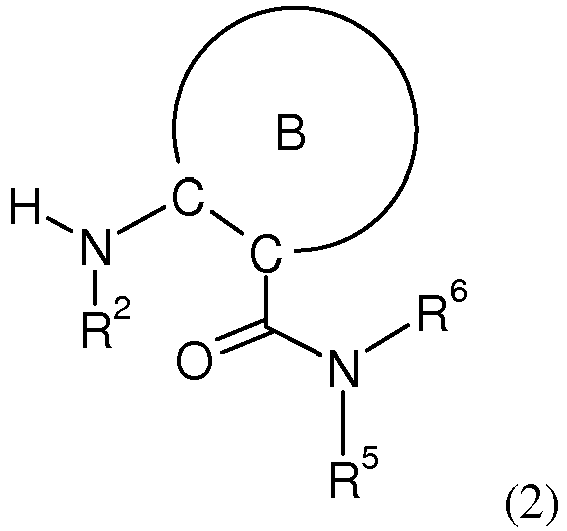

- A compound according to any one of claims 1 - 19 for use as therapeutically active substance.
- A pharmaceutical composition comprising a compound in accordance with any one of claims 1 - 19 and a therapeutically inert carrier.
- A compound according to any one of claims 1 - 19 for use in the treatment or prophylaxis of psychotic disorders, schizophrenia, positive, negative and/or cognitive symptoms associated with schizophrenia, delusional disorder, substance-induced psychotic disorder, anxiety disorders, panic disorder, obsessive/compulsive disorders, acute stress disorder, generalized anxiety disorder, drug addictions, movement disorders, Parkinson's disease, restless leg syndrome, cognition deficiency disorders, Alzheimer's disease, multi-infarct dementia, mood disorders, depression, bipolar disorders, neuropsychiatric conditions, psychosis, attention-deficit/hyperactivity disorder, attentional disorders, diabetes and related disorders, type 2 diabetes mellitus, neurodegenerative disorders, Huntington's disease, multiple sclerosis, stroke, spinal cord injury, solid tumors, hematological malignancies, renal cell carcinoma or breast cancer.
Priority Applications (1)
| Application Number | Priority Date | Filing Date | Title |
|---|---|---|---|
| EP11723077.1A EP2580207B1 (en) | 2010-06-09 | 2011-06-06 | Nitrogen containing heteroaryl compounds |
Applications Claiming Priority (3)
| Application Number | Priority Date | Filing Date | Title |
|---|---|---|---|
| EP10165427 | 2010-06-09 | ||
| EP11723077.1A EP2580207B1 (en) | 2010-06-09 | 2011-06-06 | Nitrogen containing heteroaryl compounds |
| PCT/EP2011/059234 WO2011154327A1 (en) | 2010-06-09 | 2011-06-06 | Nitrogen containing heteroaryl compounds |
Publications (2)
| Publication Number | Publication Date |
|---|---|
| EP2580207A1 EP2580207A1 (en) | 2013-04-17 |
| EP2580207B1 true EP2580207B1 (en) | 2017-09-27 |
Family
ID=44483879
Family Applications (1)
| Application Number | Title | Priority Date | Filing Date |
|---|---|---|---|
| EP11723077.1A Not-in-force EP2580207B1 (en) | 2010-06-09 | 2011-06-06 | Nitrogen containing heteroaryl compounds |
Country Status (24)
| Country | Link |
|---|---|
| US (1) | US8703768B2 (en) |
| EP (1) | EP2580207B1 (en) |
| JP (1) | JP5940523B2 (en) |
| KR (1) | KR101757959B1 (en) |
| CN (1) | CN102947292B (en) |
| AR (1) | AR081649A1 (en) |
| BR (1) | BR112012031343A2 (en) |
| CA (1) | CA2799022A1 (en) |
| CL (1) | CL2012003421A1 (en) |
| CO (1) | CO6620065A2 (en) |
| CR (1) | CR20120594A (en) |
| EA (1) | EA022075B1 (en) |
| EC (1) | ECSP12012330A (en) |
| IL (1) | IL223069A0 (en) |
| MA (1) | MA34340B1 (en) |
| MX (1) | MX2012013907A (en) |
| NZ (1) | NZ603230A (en) |
| PE (1) | PE20130279A1 (en) |
| PH (1) | PH12012502335A1 (en) |
| SG (1) | SG185655A1 (en) |
| TW (1) | TW201202221A (en) |
| UA (1) | UA108105C2 (en) |
| WO (1) | WO2011154327A1 (en) |
| ZA (1) | ZA201209119B (en) |
Families Citing this family (35)
| Publication number | Priority date | Publication date | Assignee | Title |
|---|---|---|---|---|
| CA2739344A1 (en) * | 2008-10-14 | 2010-04-22 | Actelion Pharmaceuticals Ltd | Phenethylamide derivatives and their heterocyclic analogues |
| JP6161537B2 (en) | 2010-04-07 | 2017-07-12 | エフ・ホフマン−ラ・ロシュ・アクチェンゲゼルシャフト | Pyrazol-4-yl-heterocyclyl-carboxamide compounds and methods of use |
| CA2827724A1 (en) | 2011-02-18 | 2012-08-23 | Allergan, Inc. | Substituted 6,7-dialkoxy-3-isoquinolinol derivatives as inhibitors of phosphodiesterase 10 (pde10a) |
| EP2760857A1 (en) | 2011-09-27 | 2014-08-06 | F.Hoffmann-La Roche Ag | Pyrazol-4-yl-heterocyclyl-carboxamide compounds and methods of use |
| EP2712862A1 (en) * | 2012-09-28 | 2014-04-02 | Splicos | New anti-invasive compounds |
| EP2903613B1 (en) * | 2012-10-08 | 2017-11-22 | Merck Sharp & Dohme Corp. | Pyrazole derivatives useful as inhibitors of irak4 activity |
| WO2014071044A1 (en) | 2012-11-01 | 2014-05-08 | Allergan, Inc. | Substituted 6,7-dialkoxy-3-isoquinoline derivatives as inhibitors of phosphodiesterase 10 (pde10a) |
| NZ708593A (en) | 2013-02-27 | 2018-01-26 | Mochida Pharm Co Ltd | Novel pyrazole derivative |
| RU2015147450A (en) * | 2013-04-29 | 2017-06-05 | Ф. Хоффманн-Ля Рош Аг | Derivatives of 2-phenyl or 2-heteroaryl imidazole [1,2-a] pyridine |
| GB201316600D0 (en) * | 2013-09-18 | 2013-10-30 | Redx Pharma Ltd | Agricultural chemicals |
| US20160264536A1 (en) * | 2013-10-23 | 2016-09-15 | Takeda Pharmaceutical Company Limited | Heterocyclic compound |
| US9200016B2 (en) | 2013-12-05 | 2015-12-01 | Allergan, Inc. | Substituted 6, 7-dialkoxy-3-isoquinoline derivatives as inhibitors of phosphodiesterase 10 (PDE 10A) |
| US10420341B2 (en) * | 2015-01-30 | 2019-09-24 | Basf Se | Herbicidal phenylpyrimidines |
| US9624246B2 (en) * | 2015-02-06 | 2017-04-18 | Merck Patent Gmbh | Pyridazinone macrocycles as IRAK inhibitors and uses thereof |
| CN104610189A (en) * | 2015-02-10 | 2015-05-13 | 佛山市赛维斯医药科技有限公司 | SGLT2/SGLT1 double-target-point inhibitor containing cyclopropyl amidine structure and application of SGLT2/SGLT1 double-target-point inhibitor |
| CN104974075A (en) * | 2015-08-07 | 2015-10-14 | 新秀化学(烟台)有限公司 | Preparation method of N, N-bis (2,2,6, 6-tetramethyl-4-piperidyl) -1, 3-benzenedicarboxamide |
| EP4302834A3 (en) * | 2016-07-12 | 2024-07-17 | Revolution Medicines, Inc. | 2,5-disubstituted 3-methyl pyrazines and 2,5,6-trisubstituted 3-methyl pyrazines as allosteric shp2 inhibitors |
| BR112018077111A2 (en) | 2016-07-26 | 2019-04-02 | Basf Se | use of pyrimidine compounds, pyrimidine compounds, herbicidal mixture, herbicidal compositions, method for controlling unwanted vegetation and use of compositions |
| EP3490381A1 (en) | 2016-07-27 | 2019-06-05 | Basf Se | Herbicidal pyrimidine compounds |
| WO2018019767A1 (en) | 2016-07-27 | 2018-02-01 | Basf Se | Herbicidal pyridine compounds |
| AU2017303138A1 (en) | 2016-07-28 | 2019-01-03 | Basf Se | Herbicidal pyrimidine compounds |
| JP7240319B2 (en) | 2017-01-23 | 2023-03-15 | レヴォリューション・メディスンズ,インコーポレイテッド | Bicyclic compounds as allosteric SHP2 inhibitors |
| KR20190110588A (en) | 2017-01-23 | 2019-09-30 | 레볼루션 메디슨즈, 인크. | Pyridine Compounds as Allosteric SHP2 Inhibitors |
| TW201930292A (en) | 2017-10-12 | 2019-08-01 | 美商銳新醫藥公司 | Pyridine, pyrazine, and triazine compounds as allosteric SHP2 inhibitors |
| JP7361693B2 (en) | 2017-12-15 | 2023-10-16 | レヴォリューション・メディスンズ,インコーポレイテッド | Polycyclic compounds as allosteric SHP2 inhibitors |
| WO2019121374A1 (en) | 2017-12-20 | 2019-06-27 | Basf Se | Herbicidal pyrimidine compounds |
| WO2019121352A1 (en) | 2017-12-20 | 2019-06-27 | Basf Se | Herbicidal pyrimidine compounds |
| BR112020012455B1 (en) * | 2017-12-20 | 2024-04-30 | Pi Industries Ltd | PYRAZOLOPYRIDINE-DIAMIDES, THEIR USE AS INSECTICIDE AND PROCESSES FOR THEIR PREPARATION |
| WO2020003244A2 (en) | 2018-06-29 | 2020-01-02 | DePuy Synthes Products, Inc. | Hybrid saw blade |
| CN112955443A (en) | 2018-09-19 | 2021-06-11 | 拜耳公司 | Substituted phenylpyrimidine hydrazides with herbicidal activity |
| JP7288051B2 (en) * | 2018-11-02 | 2023-06-06 | メルク・シャープ・アンド・ドーム・エルエルシー | 2-Amino-N-heteroaryl-nicotinamides as Nav1.8 inhibitors |
| EP4052760B1 (en) | 2019-10-31 | 2024-03-13 | FUJIFILM Corporation | Pyrazine derivative or salt thereof, and use of same |
| EP4190402B1 (en) | 2020-07-30 | 2025-08-27 | FUJIFILM Corporation | Nitrogen-containing heterocyclic compound or salt thereof, use thereof, and intermediate thereof |
| AU2021377248B2 (en) | 2020-11-13 | 2025-12-18 | Inipharm, Inc. | Dichlorophenol hsd17b13 inhibitors and uses thereof |
| EP4319872A4 (en) * | 2021-04-05 | 2025-03-12 | Inipharm, Inc. | THIAZOLE/ISOTHIAZOLE TYPE HSD17B13 INHIBITORS AND USES THEREOF |
Family Cites Families (11)
| Publication number | Priority date | Publication date | Assignee | Title |
|---|---|---|---|---|
| GB9910079D0 (en) | 1999-05-01 | 1999-06-30 | Smithkline Beecham Plc | Novel compounds |
| EP1193261A1 (en) | 2000-10-02 | 2002-04-03 | Warner-Lambert Company | New thiadiazoles and their use as phosphodiesterase-7 inhibitors |
| EP1651251A4 (en) | 2003-07-31 | 2008-06-18 | Bayer Pharmaceuticals Corp | Methods for treating diabetes and related disorders using pde10a inhibitors |
| US7163937B2 (en) | 2003-08-21 | 2007-01-16 | Bristol-Myers Squibb Company | Cyclic derivatives as modulators of chemokine receptor activity |
| CA2555402A1 (en) | 2004-02-12 | 2005-09-01 | Celine Bonnefous | Bipyridyl amides as modulators of metabotropic glutamate receptor-5 |
| WO2006094639A1 (en) * | 2005-03-04 | 2006-09-14 | F.Hoffmann-La Roche Ag | Pyridine-2-carboxamide derivatives as mglur5 antagonists |
| US20060199828A1 (en) | 2005-03-04 | 2006-09-07 | Georg Jaeschke | Pyrazine-2-carboxyamide derivatives |
| AR057987A1 (en) | 2005-11-24 | 2008-01-09 | Astrazeneca Ab | CB1 AGONIST COMPOUNDS (CANNABINOID RECEPTOR) |
| CA2679659C (en) | 2007-03-01 | 2016-01-19 | Novartis Ag | Pim kinase inhibitors and methods of their use |
| WO2009026241A1 (en) | 2007-08-23 | 2009-02-26 | Kalypsys, Inc. | Heterocyclic modulators of tgr5 |
| US8470820B2 (en) * | 2010-01-22 | 2013-06-25 | Hoffman-La Roche Inc. | Nitrogen-containing heteroaryl derivatives |
-
2011
- 2011-06-02 US US13/151,301 patent/US8703768B2/en active Active
- 2011-06-06 PE PE2012002298A patent/PE20130279A1/en not_active Application Discontinuation
- 2011-06-06 CA CA2799022A patent/CA2799022A1/en not_active Abandoned
- 2011-06-06 EP EP11723077.1A patent/EP2580207B1/en not_active Not-in-force
- 2011-06-06 SG SG2012085015A patent/SG185655A1/en unknown
- 2011-06-06 EA EA201291282A patent/EA022075B1/en not_active IP Right Cessation
- 2011-06-06 BR BR112012031343A patent/BR112012031343A2/en not_active Application Discontinuation
- 2011-06-06 MA MA35502A patent/MA34340B1/en unknown
- 2011-06-06 MX MX2012013907A patent/MX2012013907A/en active IP Right Grant
- 2011-06-06 NZ NZ603230A patent/NZ603230A/en not_active IP Right Cessation
- 2011-06-06 KR KR1020137000568A patent/KR101757959B1/en not_active Expired - Fee Related
- 2011-06-06 CN CN201180027950.8A patent/CN102947292B/en not_active Expired - Fee Related
- 2011-06-06 PH PH1/2012/502335A patent/PH12012502335A1/en unknown
- 2011-06-06 UA UAA201214955A patent/UA108105C2/en unknown
- 2011-06-06 JP JP2013513638A patent/JP5940523B2/en not_active Expired - Fee Related
- 2011-06-06 WO PCT/EP2011/059234 patent/WO2011154327A1/en not_active Ceased
- 2011-06-07 AR ARP110101963A patent/AR081649A1/en unknown
- 2011-06-08 TW TW100120008A patent/TW201202221A/en unknown
-
2012
- 2012-10-26 CO CO12192367A patent/CO6620065A2/en active IP Right Grant
- 2012-11-15 IL IL223069A patent/IL223069A0/en unknown
- 2012-11-26 CR CR20120594A patent/CR20120594A/en unknown
- 2012-12-03 ZA ZA2012/09119A patent/ZA201209119B/en unknown
- 2012-12-05 CL CL2012003421A patent/CL2012003421A1/en unknown
- 2012-12-07 EC ECSP12012330 patent/ECSP12012330A/en unknown
Non-Patent Citations (1)
| Title |
|---|
| None * |
Also Published As
| Publication number | Publication date |
|---|---|
| US8703768B2 (en) | 2014-04-22 |
| SG185655A1 (en) | 2012-12-28 |
| US20110306589A1 (en) | 2011-12-15 |
| KR101757959B1 (en) | 2017-07-14 |
| CL2012003421A1 (en) | 2013-07-26 |
| IL223069A0 (en) | 2013-02-03 |
| CO6620065A2 (en) | 2013-02-15 |
| BR112012031343A2 (en) | 2016-11-01 |
| WO2011154327A1 (en) | 2011-12-15 |
| JP2013528193A (en) | 2013-07-08 |
| EA201291282A1 (en) | 2013-06-28 |
| AR081649A1 (en) | 2012-10-10 |
| EP2580207A1 (en) | 2013-04-17 |
| TW201202221A (en) | 2012-01-16 |
| JP5940523B2 (en) | 2016-06-29 |
| CN102947292B (en) | 2015-08-19 |
| NZ603230A (en) | 2013-09-27 |
| HK1178900A1 (en) | 2013-09-19 |
| PH12012502335A1 (en) | 2013-02-11 |
| MA34340B1 (en) | 2013-06-01 |
| CA2799022A1 (en) | 2011-12-15 |
| ZA201209119B (en) | 2015-05-27 |
| MX2012013907A (en) | 2012-12-17 |
| ECSP12012330A (en) | 2012-12-28 |
| UA108105C2 (en) | 2015-03-25 |
| EA022075B1 (en) | 2015-10-30 |
| CR20120594A (en) | 2013-01-03 |
| PE20130279A1 (en) | 2013-03-08 |
| CN102947292A (en) | 2013-02-27 |
| KR20130112858A (en) | 2013-10-14 |
Similar Documents
| Publication | Publication Date | Title |
|---|---|---|
| EP2580207B1 (en) | Nitrogen containing heteroaryl compounds | |
| EP2526098B1 (en) | Nitrogen-containing heteroaryl derivatives | |
| EP1686999B1 (en) | Pyrazole derivatives as inhibitors of receptor tyrosine kinases | |
| EP3138842B1 (en) | Polyfluorinated compounds acting as bruton's tyrosine kinase inhibitors | |
| KR101889565B1 (en) | Pyrazolyl quinoxaline kinase inhibitors | |
| JP5249771B2 (en) | Aminopyrimidines useful as kinase inhibitors | |
| US9556179B2 (en) | Substituted imidazoles as casein kinase 1 D/E inhibitors | |
| JP2024532835A (en) | Nitrogen-containing heterocyclic derivative inhibitors, their preparation method and application | |
| EP2935272B1 (en) | Pyrazole substituted imidazopyrazines as casein kinase 1 d/e inhibitors | |
| AU2011263884A1 (en) | Nitrogen containing heteroaryl compounds | |
| HK1178900B (en) | Nitrogen containing heteroaryl compounds | |
| HK1092723B (en) | Pyrazole derivatives as inhibitors of receptor tyrosine kinases | |
| HK1233265B (en) | Polyfluorinated compounds acting as bruton's tyrosine kinase inhibitors | |
| HK1233265A1 (en) | Polyfluorinated compounds acting as bruton's tyrosine kinase inhibitors |
Legal Events
| Date | Code | Title | Description |
|---|---|---|---|
| PUAI | Public reference made under article 153(3) epc to a published international application that has entered the european phase |
Free format text: ORIGINAL CODE: 0009012 |
|
| 17P | Request for examination filed |
Effective date: 20130109 |
|
| AK | Designated contracting states |
Kind code of ref document: A1 Designated state(s): AL AT BE BG CH CY CZ DE DK EE ES FI FR GB GR HR HU IE IS IT LI LT LU LV MC MK MT NL NO PL PT RO RS SE SI SK SM TR |
|
| DAX | Request for extension of the european patent (deleted) | ||
| 17Q | First examination report despatched |
Effective date: 20170303 |
|
| GRAP | Despatch of communication of intention to grant a patent |
Free format text: ORIGINAL CODE: EPIDOSNIGR1 |
|
| INTG | Intention to grant announced |
Effective date: 20170601 |
|
| GRAS | Grant fee paid |
Free format text: ORIGINAL CODE: EPIDOSNIGR3 |
|
| GRAA | (expected) grant |
Free format text: ORIGINAL CODE: 0009210 |
|
| AK | Designated contracting states |
Kind code of ref document: B1 Designated state(s): AL AT BE BG CH CY CZ DE DK EE ES FI FR GB GR HR HU IE IS IT LI LT LU LV MC MK MT NL NO PL PT RO RS SE SI SK SM TR |
|
| REG | Reference to a national code |
Ref country code: GB Ref legal event code: FG4D |
|
| REG | Reference to a national code |
Ref country code: CH Ref legal event code: EP |
|
| REG | Reference to a national code |
Ref country code: AT Ref legal event code: REF Ref document number: 931817 Country of ref document: AT Kind code of ref document: T Effective date: 20171015 |
|
| REG | Reference to a national code |
Ref country code: IE Ref legal event code: FG4D |
|
| REG | Reference to a national code |
Ref country code: DE Ref legal event code: R096 Ref document number: 602011041891 Country of ref document: DE |
|
| PG25 | Lapsed in a contracting state [announced via postgrant information from national office to epo] |
Ref country code: LT Free format text: LAPSE BECAUSE OF FAILURE TO SUBMIT A TRANSLATION OF THE DESCRIPTION OR TO PAY THE FEE WITHIN THE PRESCRIBED TIME-LIMIT Effective date: 20170927 Ref country code: SE Free format text: LAPSE BECAUSE OF FAILURE TO SUBMIT A TRANSLATION OF THE DESCRIPTION OR TO PAY THE FEE WITHIN THE PRESCRIBED TIME-LIMIT Effective date: 20170927 Ref country code: FI Free format text: LAPSE BECAUSE OF FAILURE TO SUBMIT A TRANSLATION OF THE DESCRIPTION OR TO PAY THE FEE WITHIN THE PRESCRIBED TIME-LIMIT Effective date: 20170927 Ref country code: NO Free format text: LAPSE BECAUSE OF FAILURE TO SUBMIT A TRANSLATION OF THE DESCRIPTION OR TO PAY THE FEE WITHIN THE PRESCRIBED TIME-LIMIT Effective date: 20171227 Ref country code: HR Free format text: LAPSE BECAUSE OF FAILURE TO SUBMIT A TRANSLATION OF THE DESCRIPTION OR TO PAY THE FEE WITHIN THE PRESCRIBED TIME-LIMIT Effective date: 20170927 |
|
| REG | Reference to a national code |
Ref country code: NL Ref legal event code: MP Effective date: 20170927 |
|
| REG | Reference to a national code |
Ref country code: LT Ref legal event code: MG4D |
|
| REG | Reference to a national code |
Ref country code: AT Ref legal event code: MK05 Ref document number: 931817 Country of ref document: AT Kind code of ref document: T Effective date: 20170927 |
|
| PG25 | Lapsed in a contracting state [announced via postgrant information from national office to epo] |
Ref country code: LV Free format text: LAPSE BECAUSE OF FAILURE TO SUBMIT A TRANSLATION OF THE DESCRIPTION OR TO PAY THE FEE WITHIN THE PRESCRIBED TIME-LIMIT Effective date: 20170927 Ref country code: RS Free format text: LAPSE BECAUSE OF FAILURE TO SUBMIT A TRANSLATION OF THE DESCRIPTION OR TO PAY THE FEE WITHIN THE PRESCRIBED TIME-LIMIT Effective date: 20170927 Ref country code: BG Free format text: LAPSE BECAUSE OF FAILURE TO SUBMIT A TRANSLATION OF THE DESCRIPTION OR TO PAY THE FEE WITHIN THE PRESCRIBED TIME-LIMIT Effective date: 20171227 Ref country code: GR Free format text: LAPSE BECAUSE OF FAILURE TO SUBMIT A TRANSLATION OF THE DESCRIPTION OR TO PAY THE FEE WITHIN THE PRESCRIBED TIME-LIMIT Effective date: 20171228 |
|
| PG25 | Lapsed in a contracting state [announced via postgrant information from national office to epo] |
Ref country code: NL Free format text: LAPSE BECAUSE OF FAILURE TO SUBMIT A TRANSLATION OF THE DESCRIPTION OR TO PAY THE FEE WITHIN THE PRESCRIBED TIME-LIMIT Effective date: 20170927 |
|
| PG25 | Lapsed in a contracting state [announced via postgrant information from national office to epo] |
Ref country code: RO Free format text: LAPSE BECAUSE OF FAILURE TO SUBMIT A TRANSLATION OF THE DESCRIPTION OR TO PAY THE FEE WITHIN THE PRESCRIBED TIME-LIMIT Effective date: 20170927 Ref country code: ES Free format text: LAPSE BECAUSE OF FAILURE TO SUBMIT A TRANSLATION OF THE DESCRIPTION OR TO PAY THE FEE WITHIN THE PRESCRIBED TIME-LIMIT Effective date: 20170927 Ref country code: CZ Free format text: LAPSE BECAUSE OF FAILURE TO SUBMIT A TRANSLATION OF THE DESCRIPTION OR TO PAY THE FEE WITHIN THE PRESCRIBED TIME-LIMIT Effective date: 20170927 |
|
| REG | Reference to a national code |
Ref country code: FR Ref legal event code: PLFP Year of fee payment: 8 |
|
| PG25 | Lapsed in a contracting state [announced via postgrant information from national office to epo] |
Ref country code: SK Free format text: LAPSE BECAUSE OF FAILURE TO SUBMIT A TRANSLATION OF THE DESCRIPTION OR TO PAY THE FEE WITHIN THE PRESCRIBED TIME-LIMIT Effective date: 20170927 Ref country code: IS Free format text: LAPSE BECAUSE OF FAILURE TO SUBMIT A TRANSLATION OF THE DESCRIPTION OR TO PAY THE FEE WITHIN THE PRESCRIBED TIME-LIMIT Effective date: 20180127 Ref country code: SM Free format text: LAPSE BECAUSE OF FAILURE TO SUBMIT A TRANSLATION OF THE DESCRIPTION OR TO PAY THE FEE WITHIN THE PRESCRIBED TIME-LIMIT Effective date: 20170927 Ref country code: EE Free format text: LAPSE BECAUSE OF FAILURE TO SUBMIT A TRANSLATION OF THE DESCRIPTION OR TO PAY THE FEE WITHIN THE PRESCRIBED TIME-LIMIT Effective date: 20170927 Ref country code: IT Free format text: LAPSE BECAUSE OF FAILURE TO SUBMIT A TRANSLATION OF THE DESCRIPTION OR TO PAY THE FEE WITHIN THE PRESCRIBED TIME-LIMIT Effective date: 20170927 Ref country code: AT Free format text: LAPSE BECAUSE OF FAILURE TO SUBMIT A TRANSLATION OF THE DESCRIPTION OR TO PAY THE FEE WITHIN THE PRESCRIBED TIME-LIMIT Effective date: 20170927 |
|
| REG | Reference to a national code |
Ref country code: DE Ref legal event code: R097 Ref document number: 602011041891 Country of ref document: DE |
|
| PG25 | Lapsed in a contracting state [announced via postgrant information from national office to epo] |
Ref country code: DK Free format text: LAPSE BECAUSE OF FAILURE TO SUBMIT A TRANSLATION OF THE DESCRIPTION OR TO PAY THE FEE WITHIN THE PRESCRIBED TIME-LIMIT Effective date: 20170927 |
|
| PLBE | No opposition filed within time limit |
Free format text: ORIGINAL CODE: 0009261 |
|
| STAA | Information on the status of an ep patent application or granted ep patent |
Free format text: STATUS: NO OPPOSITION FILED WITHIN TIME LIMIT |
|
| PG25 | Lapsed in a contracting state [announced via postgrant information from national office to epo] |
Ref country code: PL Free format text: LAPSE BECAUSE OF FAILURE TO SUBMIT A TRANSLATION OF THE DESCRIPTION OR TO PAY THE FEE WITHIN THE PRESCRIBED TIME-LIMIT Effective date: 20170927 |
|
| 26N | No opposition filed |
Effective date: 20180628 |
|
| PG25 | Lapsed in a contracting state [announced via postgrant information from national office to epo] |
Ref country code: SI Free format text: LAPSE BECAUSE OF FAILURE TO SUBMIT A TRANSLATION OF THE DESCRIPTION OR TO PAY THE FEE WITHIN THE PRESCRIBED TIME-LIMIT Effective date: 20170927 |
|
| REG | Reference to a national code |
Ref country code: BE Ref legal event code: MM Effective date: 20180630 |
|
| REG | Reference to a national code |
Ref country code: IE Ref legal event code: MM4A |
|
| PG25 | Lapsed in a contracting state [announced via postgrant information from national office to epo] |
Ref country code: MC Free format text: LAPSE BECAUSE OF FAILURE TO SUBMIT A TRANSLATION OF THE DESCRIPTION OR TO PAY THE FEE WITHIN THE PRESCRIBED TIME-LIMIT Effective date: 20170927 Ref country code: LU Free format text: LAPSE BECAUSE OF NON-PAYMENT OF DUE FEES Effective date: 20180606 |
|
| PG25 | Lapsed in a contracting state [announced via postgrant information from national office to epo] |
Ref country code: IE Free format text: LAPSE BECAUSE OF NON-PAYMENT OF DUE FEES Effective date: 20180606 |
|
| PG25 | Lapsed in a contracting state [announced via postgrant information from national office to epo] |
Ref country code: BE Free format text: LAPSE BECAUSE OF NON-PAYMENT OF DUE FEES Effective date: 20180630 |
|
| PG25 | Lapsed in a contracting state [announced via postgrant information from national office to epo] |
Ref country code: MT Free format text: LAPSE BECAUSE OF NON-PAYMENT OF DUE FEES Effective date: 20180606 |
|
| PG25 | Lapsed in a contracting state [announced via postgrant information from national office to epo] |
Ref country code: TR Free format text: LAPSE BECAUSE OF FAILURE TO SUBMIT A TRANSLATION OF THE DESCRIPTION OR TO PAY THE FEE WITHIN THE PRESCRIBED TIME-LIMIT Effective date: 20170927 |
|
| PG25 | Lapsed in a contracting state [announced via postgrant information from national office to epo] |
Ref country code: HU Free format text: LAPSE BECAUSE OF FAILURE TO SUBMIT A TRANSLATION OF THE DESCRIPTION OR TO PAY THE FEE WITHIN THE PRESCRIBED TIME-LIMIT; INVALID AB INITIO Effective date: 20110606 Ref country code: PT Free format text: LAPSE BECAUSE OF FAILURE TO SUBMIT A TRANSLATION OF THE DESCRIPTION OR TO PAY THE FEE WITHIN THE PRESCRIBED TIME-LIMIT Effective date: 20170927 |
|
| PG25 | Lapsed in a contracting state [announced via postgrant information from national office to epo] |
Ref country code: MK Free format text: LAPSE BECAUSE OF NON-PAYMENT OF DUE FEES Effective date: 20170927 Ref country code: CY Free format text: LAPSE BECAUSE OF FAILURE TO SUBMIT A TRANSLATION OF THE DESCRIPTION OR TO PAY THE FEE WITHIN THE PRESCRIBED TIME-LIMIT Effective date: 20170927 |
|
| PG25 | Lapsed in a contracting state [announced via postgrant information from national office to epo] |
Ref country code: AL Free format text: LAPSE BECAUSE OF FAILURE TO SUBMIT A TRANSLATION OF THE DESCRIPTION OR TO PAY THE FEE WITHIN THE PRESCRIBED TIME-LIMIT Effective date: 20170927 |
|
| PGFP | Annual fee paid to national office [announced via postgrant information from national office to epo] |
Ref country code: FR Payment date: 20210520 Year of fee payment: 11 Ref country code: DE Payment date: 20210512 Year of fee payment: 11 |
|
| PGFP | Annual fee paid to national office [announced via postgrant information from national office to epo] |
Ref country code: GB Payment date: 20210528 Year of fee payment: 11 Ref country code: CH Payment date: 20210512 Year of fee payment: 11 |
|
| REG | Reference to a national code |
Ref country code: DE Ref legal event code: R119 Ref document number: 602011041891 Country of ref document: DE |
|
| REG | Reference to a national code |
Ref country code: CH Ref legal event code: PL |
|
| GBPC | Gb: european patent ceased through non-payment of renewal fee |
Effective date: 20220606 |
|
| PG25 | Lapsed in a contracting state [announced via postgrant information from national office to epo] |
Ref country code: LI Free format text: LAPSE BECAUSE OF NON-PAYMENT OF DUE FEES Effective date: 20220630 Ref country code: FR Free format text: LAPSE BECAUSE OF NON-PAYMENT OF DUE FEES Effective date: 20220630 Ref country code: CH Free format text: LAPSE BECAUSE OF NON-PAYMENT OF DUE FEES Effective date: 20220630 |
|
| PG25 | Lapsed in a contracting state [announced via postgrant information from national office to epo] |
Ref country code: GB Free format text: LAPSE BECAUSE OF NON-PAYMENT OF DUE FEES Effective date: 20220606 Ref country code: DE Free format text: LAPSE BECAUSE OF NON-PAYMENT OF DUE FEES Effective date: 20230103 |