EP2580193B1 - Benzamide derivatives and their use as hsp90 inhibtors - Google Patents
Benzamide derivatives and their use as hsp90 inhibtors Download PDFInfo
- Publication number
- EP2580193B1 EP2580193B1 EP11726470.5A EP11726470A EP2580193B1 EP 2580193 B1 EP2580193 B1 EP 2580193B1 EP 11726470 A EP11726470 A EP 11726470A EP 2580193 B1 EP2580193 B1 EP 2580193B1
- Authority
- EP
- European Patent Office
- Prior art keywords
- phenyl
- carbonyl
- propan
- dihydroxy
- alkyl
- Prior art date
- Legal status (The legal status is an assumption and is not a legal conclusion. Google has not performed a legal analysis and makes no representation as to the accuracy of the status listed.)
- Not-in-force
Links
- 101100016370 Danio rerio hsp90a.1 gene Proteins 0.000 title 1
- 101100285708 Dictyostelium discoideum hspD gene Proteins 0.000 title 1
- 101100071627 Schizosaccharomyces pombe (strain 972 / ATCC 24843) swo1 gene Proteins 0.000 title 1
- 150000003936 benzamides Chemical class 0.000 title 1
- -1 glycine ester compound Chemical class 0.000 claims description 183
- 229910052739 hydrogen Inorganic materials 0.000 claims description 136
- 239000001257 hydrogen Substances 0.000 claims description 136
- 125000004178 (C1-C4) alkyl group Chemical group 0.000 claims description 114
- 125000001997 phenyl group Chemical group [H]C1=C([H])C([H])=C(*)C([H])=C1[H] 0.000 claims description 108
- 150000001875 compounds Chemical class 0.000 claims description 106
- 125000002496 methyl group Chemical group [H]C([H])([H])* 0.000 claims description 104
- 125000004452 carbocyclyl group Chemical group 0.000 claims description 97
- 125000000623 heterocyclic group Chemical group 0.000 claims description 85
- 125000001511 cyclopentyl group Chemical group [H]C1([H])C([H])([H])C([H])([H])C([H])(*)C1([H])[H] 0.000 claims description 80
- UFHFLCQGNIYNRP-UHFFFAOYSA-N Hydrogen Chemical compound [H][H] UFHFLCQGNIYNRP-UHFFFAOYSA-N 0.000 claims description 79
- 125000004435 hydrogen atom Chemical group [H]* 0.000 claims description 70
- 125000000999 tert-butyl group Chemical group [H]C([H])([H])C(*)(C([H])([H])[H])C([H])([H])[H] 0.000 claims description 64
- 125000000217 alkyl group Chemical group 0.000 claims description 57
- 125000002947 alkylene group Chemical group 0.000 claims description 57
- 125000001424 substituent group Chemical group 0.000 claims description 57
- 125000001495 ethyl group Chemical group [H]C([H])([H])C([H])([H])* 0.000 claims description 56
- 125000006570 (C5-C6) heteroaryl group Chemical group 0.000 claims description 55
- 125000002887 hydroxy group Chemical group [H]O* 0.000 claims description 55
- 125000004169 (C1-C6) alkyl group Chemical group 0.000 claims description 52
- 102100034051 Heat shock protein HSP 90-alpha Human genes 0.000 claims description 52
- 125000005843 halogen group Chemical group 0.000 claims description 40
- 125000000229 (C1-C4)alkoxy group Chemical group 0.000 claims description 39
- 229910052757 nitrogen Inorganic materials 0.000 claims description 37
- 125000004093 cyano group Chemical group *C#N 0.000 claims description 31
- 125000000449 nitro group Chemical group [O-][N+](*)=O 0.000 claims description 29
- 125000006656 (C2-C4) alkenyl group Chemical group 0.000 claims description 27
- 229910052799 carbon Inorganic materials 0.000 claims description 24
- 206010028980 Neoplasm Diseases 0.000 claims description 22
- 208000037265 diseases, disorders, signs and symptoms Diseases 0.000 claims description 22
- 125000001072 heteroaryl group Chemical group 0.000 claims description 21
- 125000004765 (C1-C4) haloalkyl group Chemical group 0.000 claims description 20
- 101710113864 Heat shock protein 90 Proteins 0.000 claims description 20
- 125000004432 carbon atom Chemical group C* 0.000 claims description 20
- 125000004433 nitrogen atom Chemical group N* 0.000 claims description 20
- 125000002853 C1-C4 hydroxyalkyl group Chemical group 0.000 claims description 18
- 125000002915 carbonyl group Chemical group [*:2]C([*:1])=O 0.000 claims description 18
- 125000004767 (C1-C4) haloalkoxy group Chemical group 0.000 claims description 17
- 125000000882 C2-C6 alkenyl group Chemical group 0.000 claims description 17
- 201000011510 cancer Diseases 0.000 claims description 16
- 125000003178 carboxy group Chemical group [H]OC(*)=O 0.000 claims description 15
- 125000003386 piperidinyl group Chemical group 0.000 claims description 15
- 150000003839 salts Chemical class 0.000 claims description 15
- 125000002924 primary amino group Chemical group [H]N([H])* 0.000 claims description 14
- 125000000719 pyrrolidinyl group Chemical group 0.000 claims description 14
- 206010039073 rheumatoid arthritis Diseases 0.000 claims description 14
- RWRDLPDLKQPQOW-UHFFFAOYSA-N Pyrrolidine Chemical compound C1CCNC1 RWRDLPDLKQPQOW-UHFFFAOYSA-N 0.000 claims description 12
- 125000001436 propyl group Chemical group [H]C([*])([H])C([H])([H])C([H])([H])[H] 0.000 claims description 12
- 108010051152 Carboxylesterase Proteins 0.000 claims description 11
- 102000013392 Carboxylesterase Human genes 0.000 claims description 11
- 125000003342 alkenyl group Chemical group 0.000 claims description 11
- 125000003118 aryl group Chemical group 0.000 claims description 11
- 208000027866 inflammatory disease Diseases 0.000 claims description 11
- 230000003834 intracellular effect Effects 0.000 claims description 11
- 125000000262 haloalkenyl group Chemical group 0.000 claims description 10
- 125000003302 alkenyloxy group Chemical group 0.000 claims description 9
- 125000000304 alkynyl group Chemical group 0.000 claims description 9
- 125000005291 haloalkenyloxy group Chemical group 0.000 claims description 9
- 208000023275 Autoimmune disease Diseases 0.000 claims description 8
- NQRYJNQNLNOLGT-UHFFFAOYSA-N Piperidine Chemical compound C1CCNCC1 NQRYJNQNLNOLGT-UHFFFAOYSA-N 0.000 claims description 8
- 208000035475 disorder Diseases 0.000 claims description 8
- 125000004594 isoindolinyl group Chemical group C1(NCC2=CC=CC=C12)* 0.000 claims description 8
- 125000001449 isopropyl group Chemical group [H]C([H])([H])C([H])(*)C([H])([H])[H] 0.000 claims description 8
- PAYRUJLWNCNPSJ-UHFFFAOYSA-N Aniline Chemical class NC1=CC=CC=C1 PAYRUJLWNCNPSJ-UHFFFAOYSA-N 0.000 claims description 7
- DHMQDGOQFOQNFH-UHFFFAOYSA-N Glycine Natural products NCC(O)=O DHMQDGOQFOQNFH-UHFFFAOYSA-N 0.000 claims description 7
- 150000001204 N-oxides Chemical class 0.000 claims description 7
- 239000012453 solvate Substances 0.000 claims description 7
- 125000003601 C2-C6 alkynyl group Chemical group 0.000 claims description 6
- 230000001363 autoimmune Effects 0.000 claims description 6
- AOGOHFKTXWYXQZ-PMERELPUSA-N cyclopentyl (2s)-2-[[4-[[(2,4-dihydroxy-5-propan-2-ylbenzoyl)-methylamino]methyl]phenyl]methylamino]-2-phenylacetate Chemical compound C1=C(O)C(C(C)C)=CC(C(=O)N(C)CC=2C=CC(CN[C@H](C(=O)OC3CCCC3)C=3C=CC=CC=3)=CC=2)=C1O AOGOHFKTXWYXQZ-PMERELPUSA-N 0.000 claims description 6
- VEMBMPVDPWRGSX-UHFFFAOYSA-N cyclopentyl 2-[[3-[[(2,4-dihydroxy-5-propan-2-ylbenzoyl)-methylamino]methyl]phenyl]methylamino]-2-methylpropanoate Chemical compound C1=C(O)C(C(C)C)=CC(C(=O)N(C)CC=2C=C(CNC(C)(C)C(=O)OC3CCCC3)C=CC=2)=C1O VEMBMPVDPWRGSX-UHFFFAOYSA-N 0.000 claims description 6
- 125000004185 ester group Chemical group 0.000 claims description 6
- 230000001404 mediated effect Effects 0.000 claims description 6
- 239000004471 Glycine Substances 0.000 claims description 5
- 241001465754 Metazoa Species 0.000 claims description 5
- 125000005037 alkyl phenyl group Chemical group 0.000 claims description 5
- XXNYIKPOZXDFBM-PMERELPUSA-N cyclopentyl (2s)-2-[[3-[[(2,4-dihydroxy-5-propan-2-ylbenzoyl)-methylamino]methyl]phenyl]methylamino]-2-phenylacetate Chemical compound C1=C(O)C(C(C)C)=CC(C(=O)N(C)CC=2C=C(CN[C@H](C(=O)OC3CCCC3)C=3C=CC=CC=3)C=CC=2)=C1O XXNYIKPOZXDFBM-PMERELPUSA-N 0.000 claims description 5
- MWSWGDRWBZGNLD-UHFFFAOYSA-N cyclopentyl 1-[[3-[[(2,4-dihydroxy-5-propan-2-ylbenzoyl)-methylamino]methyl]phenyl]methylamino]cyclopentane-1-carboxylate Chemical compound C1=C(O)C(C(C)C)=CC(C(=O)N(C)CC=2C=C(CNC3(CCCC3)C(=O)OC3CCCC3)C=CC=2)=C1O MWSWGDRWBZGNLD-UHFFFAOYSA-N 0.000 claims description 5
- NHACHHHEAFEWQO-UHFFFAOYSA-N cyclopentyl 2-[2-[4-[[(2,4-dihydroxy-5-propan-2-ylbenzoyl)-methylamino]methyl]phenyl]ethylamino]-2-methylpropanoate Chemical compound C1=C(O)C(C(C)C)=CC(C(=O)N(C)CC=2C=CC(CCNC(C)(C)C(=O)OC3CCCC3)=CC=2)=C1O NHACHHHEAFEWQO-UHFFFAOYSA-N 0.000 claims description 5
- 125000000041 C6-C10 aryl group Chemical group 0.000 claims description 4
- 229910006074 SO2NH2 Inorganic materials 0.000 claims description 4
- UZRMMHXDKLGRRR-FBLFFUNLSA-N cyclopentyl (2r)-2-[[1-(2,4-dihydroxy-5-propan-2-ylbenzoyl)pyrrolidin-3-yl]amino]-4-methylpentanoate Chemical compound N([C@H](CC(C)C)C(=O)OC1CCCC1)C(C1)CCN1C(=O)C1=CC(C(C)C)=C(O)C=C1O UZRMMHXDKLGRRR-FBLFFUNLSA-N 0.000 claims description 4
- GWVMLCQWXVFZCN-UHFFFAOYSA-N isoindoline Chemical group C1=CC=C2CNCC2=C1 GWVMLCQWXVFZCN-UHFFFAOYSA-N 0.000 claims description 4
- 125000004191 (C1-C6) alkoxy group Chemical group 0.000 claims description 3
- 125000005913 (C3-C6) cycloalkyl group Chemical group 0.000 claims description 3
- SYGWYBOJXOGMRU-UHFFFAOYSA-N chembl233051 Chemical group C1=CC=C2C3=CC(C(N(CCN(C)C)C4=O)=O)=C5C4=CC=CC5=C3SC2=C1 SYGWYBOJXOGMRU-UHFFFAOYSA-N 0.000 claims description 3
- CLCRRRFVNRSYIZ-SANMLTNESA-N cyclopentyl (2S)-2-[[1-(2,4-dihydroxy-5-propan-2-ylbenzoyl)piperidin-4-yl]amino]-2-phenylacetate Chemical compound C1=C(O)C(C(C)C)=CC(C(=O)N2CCC(CC2)N[C@H](C(=O)OC2CCCC2)C=2C=CC=CC=2)=C1O CLCRRRFVNRSYIZ-SANMLTNESA-N 0.000 claims description 3
- CUACTRXXHHMKQW-UHFFFAOYSA-N cyclopentyl 2-[[1-(2,4-dihydroxy-5-propan-2-ylbenzoyl)piperidin-4-yl]amino]-2-methylpropanoate Chemical compound C1=C(O)C(C(C)C)=CC(C(=O)N2CCC(CC2)NC(C)(C)C(=O)OC2CCCC2)=C1O CUACTRXXHHMKQW-UHFFFAOYSA-N 0.000 claims description 3
- 239000003085 diluting agent Substances 0.000 claims description 3
- 239000003937 drug carrier Substances 0.000 claims description 3
- 239000008194 pharmaceutical composition Substances 0.000 claims description 3
- OTDMPXTXMZHHKS-DEOSSOPVSA-N C1=C(O)C(C(C)C)=CC(C(=O)N2CCC(CC2)N[C@@H](C2CCCCC2)C(=O)OC(C)(C)C)=C1O Chemical compound C1=C(O)C(C(C)C)=CC(C(=O)N2CCC(CC2)N[C@@H](C2CCCCC2)C(=O)OC(C)(C)C)=C1O OTDMPXTXMZHHKS-DEOSSOPVSA-N 0.000 claims description 2
- GRYWRFUMGCYYNS-MHZLTWQESA-N cyclopentyl (2S)-2-[[1-(2,4-dihydroxy-5-propan-2-ylbenzoyl)piperidin-4-yl]methylamino]-2-phenylacetate Chemical compound C1=C(O)C(C(C)C)=CC(C(=O)N2CCC(CN[C@H](C(=O)OC3CCCC3)C=3C=CC=CC=3)CC2)=C1O GRYWRFUMGCYYNS-MHZLTWQESA-N 0.000 claims description 2
- VLFKQONGLOBNAU-JOCHJYFZSA-N cyclopentyl (2r)-2-[[1-(2,4-dihydroxy-5-propan-2-ylbenzoyl)piperidin-4-yl]amino]-4-methylpentanoate Chemical compound N([C@H](CC(C)C)C(=O)OC1CCCC1)C(CC1)CCN1C(=O)C1=CC(C(C)C)=C(O)C=C1O VLFKQONGLOBNAU-JOCHJYFZSA-N 0.000 claims description 2
- FEURQRRBHVNYIR-HSZRJFAPSA-N cyclopentyl (2r)-2-[[1-(2,4-dihydroxy-5-propan-2-ylbenzoyl)piperidin-4-yl]methylamino]-4-methylpentanoate Chemical compound N([C@H](CC(C)C)C(=O)OC1CCCC1)CC(CC1)CCN1C(=O)C1=CC(C(C)C)=C(O)C=C1O FEURQRRBHVNYIR-HSZRJFAPSA-N 0.000 claims description 2
- VQWYPLSTMDVOBB-MHZLTWQESA-N cyclopentyl (2s)-2-[2-[1-(2,4-dihydroxy-5-propan-2-ylbenzoyl)piperidin-4-yl]ethylamino]-3-phenylpropanoate Chemical compound C1=C(O)C(C(C)C)=CC(C(=O)N2CCC(CCN[C@@H](CC=3C=CC=CC=3)C(=O)OC3CCCC3)CC2)=C1O VQWYPLSTMDVOBB-MHZLTWQESA-N 0.000 claims description 2
- MXNBPEOIKZZPDJ-NDEPHWFRSA-N cyclopentyl (2s)-2-cyclohexyl-2-[2-[1-(2,4-dihydroxy-5-propan-2-ylbenzoyl)piperidin-4-yl]ethylamino]acetate Chemical compound C1=C(O)C(C(C)C)=CC(C(=O)N2CCC(CCN[C@@H](C3CCCCC3)C(=O)OC3CCCC3)CC2)=C1O MXNBPEOIKZZPDJ-NDEPHWFRSA-N 0.000 claims description 2
- MZGMNPSIDHYYFY-SANMLTNESA-N cyclopentyl (2s)-2-cyclohexyl-2-[[1-(2,4-dihydroxy-5-propan-2-ylbenzoyl)piperidin-4-yl]amino]acetate Chemical compound C1=C(O)C(C(C)C)=CC(C(=O)N2CCC(CC2)N[C@@H](C2CCCCC2)C(=O)OC2CCCC2)=C1O MZGMNPSIDHYYFY-SANMLTNESA-N 0.000 claims description 2
- RKQMPLBYHMNMGC-UHFFFAOYSA-N cyclopentyl 1-[2-[2-(2,4-dihydroxy-5-propan-2-ylbenzoyl)-1,3-dihydroisoindol-5-yl]ethylamino]cyclopentane-1-carboxylate Chemical compound C1=C(O)C(C(C)C)=CC(C(=O)N2CC3=CC(CCNC4(CCCC4)C(=O)OC4CCCC4)=CC=C3C2)=C1O RKQMPLBYHMNMGC-UHFFFAOYSA-N 0.000 claims description 2
- WGQLVLJPCCIAHH-UHFFFAOYSA-N cyclopentyl 1-[3-[2-(2,4-dihydroxy-5-propan-2-ylbenzoyl)-1,3-dihydroisoindol-5-yl]propylamino]cyclopentane-1-carboxylate Chemical compound C1=C(O)C(C(C)C)=CC(C(=O)N2CC3=CC(CCCNC4(CCCC4)C(=O)OC4CCCC4)=CC=C3C2)=C1O WGQLVLJPCCIAHH-UHFFFAOYSA-N 0.000 claims description 2
- KQWITRAWKIXZQZ-UHFFFAOYSA-N cyclopentyl 2-[2-[1-(2,4-dihydroxy-5-propan-2-ylbenzoyl)piperidin-4-yl]ethylamino]-2-methylpropanoate Chemical compound C1=C(O)C(C(C)C)=CC(C(=O)N2CCC(CCNC(C)(C)C(=O)OC3CCCC3)CC2)=C1O KQWITRAWKIXZQZ-UHFFFAOYSA-N 0.000 claims description 2
- UUSSRHXXUWVJNR-UHFFFAOYSA-N cyclopentyl 2-[[2-(2,4-dihydroxy-5-propan-2-ylbenzoyl)-1,3-dihydroisoindol-5-yl]methylamino]-2-methylpropanoate Chemical compound C1=C(O)C(C(C)C)=CC(C(=O)N2CC3=CC(CNC(C)(C)C(=O)OC4CCCC4)=CC=C3C2)=C1O UUSSRHXXUWVJNR-UHFFFAOYSA-N 0.000 claims description 2
- RWVINNQSFLRKPE-UHFFFAOYSA-N cyclopentyl 2-[[4-[[(2,4-dihydroxy-5-propan-2-ylbenzoyl)-methylamino]methyl]phenyl]methylamino]-2-methylpropanoate Chemical compound C1=C(O)C(C(C)C)=CC(C(=O)N(C)CC=2C=CC(CNC(C)(C)C(=O)OC3CCCC3)=CC=2)=C1O RWVINNQSFLRKPE-UHFFFAOYSA-N 0.000 claims description 2
- ZZUFCTLCJUWOSV-UHFFFAOYSA-N furosemide Chemical compound C1=C(Cl)C(S(=O)(=O)N)=CC(C(O)=O)=C1NCC1=CC=CO1 ZZUFCTLCJUWOSV-UHFFFAOYSA-N 0.000 claims description 2
- UTUVLRLIFUZZPI-HXUWFJFHSA-N tert-butyl (2r)-2-[[1-(2,4-dihydroxy-5-propan-2-ylbenzoyl)piperidin-4-yl]amino]-4-methylpentanoate Chemical compound C1CC(N[C@H](CC(C)C)C(=O)OC(C)(C)C)CCN1C(=O)C1=CC(C(C)C)=C(O)C=C1O UTUVLRLIFUZZPI-HXUWFJFHSA-N 0.000 claims description 2
- PVNASLUUTBXGFV-SANMLTNESA-N tert-butyl (2s)-2-cyclohexyl-2-[2-[1-(2,4-dihydroxy-5-propan-2-ylbenzoyl)piperidin-4-yl]ethylamino]acetate Chemical compound C1=C(O)C(C(C)C)=CC(C(=O)N2CCC(CCN[C@@H](C3CCCCC3)C(=O)OC(C)(C)C)CC2)=C1O PVNASLUUTBXGFV-SANMLTNESA-N 0.000 claims description 2
- DQROXRKGOVRSGQ-MHZLTWQESA-N cyclopentyl (2S)-2-cyclohexyl-2-[[1-(2,4-dihydroxy-5-propan-2-ylbenzoyl)piperidin-4-yl]methylamino]acetate Chemical compound C1=C(O)C(C(C)C)=CC(C(=O)N2CCC(CN[C@@H](C3CCCCC3)C(=O)OC3CCCC3)CC2)=C1O DQROXRKGOVRSGQ-MHZLTWQESA-N 0.000 claims 1
- 150000002333 glycines Chemical class 0.000 claims 1
- IYMBTPUXEJBCMA-VWLOTQADSA-N tert-butyl (2S)-2-cyclohexyl-2-[[1-(2,4-dihydroxy-5-propan-2-ylbenzoyl)piperidin-4-yl]methylamino]acetate Chemical compound C1=C(O)C(C(C)C)=CC(C(=O)N2CCC(CN[C@@H](C3CCCCC3)C(=O)OC(C)(C)C)CC2)=C1O IYMBTPUXEJBCMA-VWLOTQADSA-N 0.000 claims 1
- MNZODNUXSRQICM-OAQYLSRUSA-N tert-butyl (2r)-2-[[1-(2,4-dihydroxy-5-propan-2-ylbenzoyl)piperidin-4-yl]methylamino]-4-methylpentanoate Chemical compound C1CC(CN[C@H](CC(C)C)C(=O)OC(C)(C)C)CCN1C(=O)C1=CC(C(C)C)=C(O)C=C1O MNZODNUXSRQICM-OAQYLSRUSA-N 0.000 claims 1
- XEKOWRVHYACXOJ-UHFFFAOYSA-N Ethyl acetate Chemical compound CCOC(C)=O XEKOWRVHYACXOJ-UHFFFAOYSA-N 0.000 description 270
- 238000004895 liquid chromatography mass spectrometry Methods 0.000 description 189
- YMWUJEATGCHHMB-UHFFFAOYSA-N Dichloromethane Chemical compound ClCCl YMWUJEATGCHHMB-UHFFFAOYSA-N 0.000 description 150
- 239000000047 product Substances 0.000 description 143
- 238000005160 1H NMR spectroscopy Methods 0.000 description 129
- 239000000543 intermediate Substances 0.000 description 125
- 239000000243 solution Substances 0.000 description 122
- 239000000203 mixture Substances 0.000 description 100
- 235000019439 ethyl acetate Nutrition 0.000 description 90
- VYPSYNLAJGMNEJ-UHFFFAOYSA-N Silicium dioxide Chemical compound O=[Si]=O VYPSYNLAJGMNEJ-UHFFFAOYSA-N 0.000 description 89
- CSNNHWWHGAXBCP-UHFFFAOYSA-L Magnesium sulfate Chemical compound [Mg+2].[O-][S+2]([O-])([O-])[O-] CSNNHWWHGAXBCP-UHFFFAOYSA-L 0.000 description 72
- 238000000034 method Methods 0.000 description 71
- OKKJLVBELUTLKV-UHFFFAOYSA-N Methanol Chemical compound OC OKKJLVBELUTLKV-UHFFFAOYSA-N 0.000 description 60
- 210000004027 cell Anatomy 0.000 description 60
- 238000002360 preparation method Methods 0.000 description 50
- IMNFDUFMRHMDMM-UHFFFAOYSA-N N-Heptane Chemical compound CCCCCCC IMNFDUFMRHMDMM-UHFFFAOYSA-N 0.000 description 48
- IJGRMHOSHXDMSA-UHFFFAOYSA-N Atomic nitrogen Chemical compound N#N IJGRMHOSHXDMSA-UHFFFAOYSA-N 0.000 description 42
- KDLHZDBZIXYQEI-UHFFFAOYSA-N Palladium Chemical compound [Pd] KDLHZDBZIXYQEI-UHFFFAOYSA-N 0.000 description 42
- 150000002148 esters Chemical class 0.000 description 36
- 229910052943 magnesium sulfate Inorganic materials 0.000 description 36
- IAZDPXIOMUYVGZ-WFGJKAKNSA-N Dimethyl sulfoxide Chemical compound [2H]C([2H])([2H])S(=O)C([2H])([2H])[2H] IAZDPXIOMUYVGZ-WFGJKAKNSA-N 0.000 description 35
- 238000006243 chemical reaction Methods 0.000 description 33
- 101001016865 Homo sapiens Heat shock protein HSP 90-alpha Proteins 0.000 description 32
- WEVYAHXRMPXWCK-UHFFFAOYSA-N Acetonitrile Chemical compound CC#N WEVYAHXRMPXWCK-UHFFFAOYSA-N 0.000 description 30
- LFQSCWFLJHTTHZ-UHFFFAOYSA-N Ethanol Chemical compound CCO LFQSCWFLJHTTHZ-UHFFFAOYSA-N 0.000 description 27
- HEDRZPFGACZZDS-MICDWDOJSA-N Trichloro(2H)methane Chemical compound [2H]C(Cl)(Cl)Cl HEDRZPFGACZZDS-MICDWDOJSA-N 0.000 description 26
- XLYOFNOQVPJJNP-UHFFFAOYSA-N water Substances O XLYOFNOQVPJJNP-UHFFFAOYSA-N 0.000 description 26
- 238000003818 flash chromatography Methods 0.000 description 25
- RTZKZFJDLAIYFH-UHFFFAOYSA-N Diethyl ether Chemical compound CCOCC RTZKZFJDLAIYFH-UHFFFAOYSA-N 0.000 description 24
- JGFZNNIVVJXRND-UHFFFAOYSA-N N,N-Diisopropylethylamine (DIPEA) Chemical compound CCN(C(C)C)C(C)C JGFZNNIVVJXRND-UHFFFAOYSA-N 0.000 description 22
- ZMANZCXQSJIPKH-UHFFFAOYSA-N Triethylamine Chemical compound CCN(CC)CC ZMANZCXQSJIPKH-UHFFFAOYSA-N 0.000 description 22
- BWHMMNNQKKPAPP-UHFFFAOYSA-L potassium carbonate Chemical compound [K+].[K+].[O-]C([O-])=O BWHMMNNQKKPAPP-UHFFFAOYSA-L 0.000 description 22
- 239000000377 silicon dioxide Substances 0.000 description 22
- 239000012321 sodium triacetoxyborohydride Substances 0.000 description 22
- 238000011282 treatment Methods 0.000 description 22
- UIIMBOGNXHQVGW-UHFFFAOYSA-M Sodium bicarbonate Chemical compound [Na+].OC([O-])=O UIIMBOGNXHQVGW-UHFFFAOYSA-M 0.000 description 21
- HEMHJVSKTPXQMS-UHFFFAOYSA-M Sodium hydroxide Chemical compound [OH-].[Na+] HEMHJVSKTPXQMS-UHFFFAOYSA-M 0.000 description 21
- 229910052681 coesite Inorganic materials 0.000 description 21
- 229910052906 cristobalite Inorganic materials 0.000 description 21
- 229910052682 stishovite Inorganic materials 0.000 description 21
- 229910052905 tridymite Inorganic materials 0.000 description 21
- SCYULBFZEHDVBN-UHFFFAOYSA-N 1,1-Dichloroethane Chemical group CC(Cl)Cl SCYULBFZEHDVBN-UHFFFAOYSA-N 0.000 description 20
- VEXZGXHMUGYJMC-UHFFFAOYSA-N Hydrochloric acid Chemical compound Cl VEXZGXHMUGYJMC-UHFFFAOYSA-N 0.000 description 20
- 239000000284 extract Substances 0.000 description 20
- NKLCNNUWBJBICK-UHFFFAOYSA-N dess–martin periodinane Chemical compound C1=CC=C2I(OC(=O)C)(OC(C)=O)(OC(C)=O)OC(=O)C2=C1 NKLCNNUWBJBICK-UHFFFAOYSA-N 0.000 description 19
- 239000002253 acid Substances 0.000 description 18
- IXCSERBJSXMMFS-UHFFFAOYSA-N hydrogen chloride Substances Cl.Cl IXCSERBJSXMMFS-UHFFFAOYSA-N 0.000 description 18
- 229910000041 hydrogen chloride Inorganic materials 0.000 description 18
- 238000000746 purification Methods 0.000 description 18
- 150000001721 carbon Chemical group 0.000 description 17
- NLXLAEXVIDQMFP-UHFFFAOYSA-N Ammonia chloride Chemical compound [NH4+].[Cl-] NLXLAEXVIDQMFP-UHFFFAOYSA-N 0.000 description 16
- WYURNTSHIVDZCO-UHFFFAOYSA-N Tetrahydrofuran Chemical compound C1CCOC1 WYURNTSHIVDZCO-UHFFFAOYSA-N 0.000 description 16
- 239000000706 filtrate Substances 0.000 description 16
- 239000003112 inhibitor Substances 0.000 description 15
- 239000000741 silica gel Substances 0.000 description 15
- 229910002027 silica gel Inorganic materials 0.000 description 15
- 201000010099 disease Diseases 0.000 description 14
- 230000005764 inhibitory process Effects 0.000 description 14
- 101000938676 Homo sapiens Liver carboxylesterase 1 Proteins 0.000 description 13
- 239000004395 L-leucine Substances 0.000 description 13
- 102100030817 Liver carboxylesterase 1 Human genes 0.000 description 13
- 238000003556 assay Methods 0.000 description 13
- 229960003136 leucine Drugs 0.000 description 13
- 239000000651 prodrug Substances 0.000 description 13
- 229940002612 prodrug Drugs 0.000 description 13
- YXFVVABEGXRONW-UHFFFAOYSA-N Toluene Chemical compound CC1=CC=CC=C1 YXFVVABEGXRONW-UHFFFAOYSA-N 0.000 description 12
- 229940024606 amino acid Drugs 0.000 description 12
- 235000001014 amino acid Nutrition 0.000 description 12
- 230000000694 effects Effects 0.000 description 12
- 239000003481 heat shock protein 90 inhibitor Substances 0.000 description 12
- IAZDPXIOMUYVGZ-UHFFFAOYSA-N Dimethylsulphoxide Chemical compound CS(C)=O IAZDPXIOMUYVGZ-UHFFFAOYSA-N 0.000 description 11
- 239000003814 drug Substances 0.000 description 11
- 229910000027 potassium carbonate Inorganic materials 0.000 description 11
- 108090000623 proteins and genes Proteins 0.000 description 11
- LMDZBCPBFSXMTL-UHFFFAOYSA-N 1-Ethyl-3-(3-dimethylaminopropyl)carbodiimide Substances CCN=C=NCCCN(C)C LMDZBCPBFSXMTL-UHFFFAOYSA-N 0.000 description 10
- FPQQSJJWHUJYPU-UHFFFAOYSA-N 3-(dimethylamino)propyliminomethylidene-ethylazanium;chloride Chemical compound Cl.CCN=C=NCCCN(C)C FPQQSJJWHUJYPU-UHFFFAOYSA-N 0.000 description 10
- VHYFNPMBLIVWCW-UHFFFAOYSA-N 4-Dimethylaminopyridine Chemical compound CN(C)C1=CC=NC=C1 VHYFNPMBLIVWCW-UHFFFAOYSA-N 0.000 description 10
- 201000004681 Psoriasis Diseases 0.000 description 10
- DBCHLXSRYGBFJH-PPHPATTJSA-N cyclopentyl (2s)-2-amino-4-methylpentanoate;4-methylbenzenesulfonic acid Chemical compound CC1=CC=C(S(O)(=O)=O)C=C1.CC(C)C[C@H](N)C(=O)OC1CCCC1 DBCHLXSRYGBFJH-PPHPATTJSA-N 0.000 description 10
- 210000002540 macrophage Anatomy 0.000 description 10
- 125000006239 protecting group Chemical group 0.000 description 10
- 235000018102 proteins Nutrition 0.000 description 10
- 102000004169 proteins and genes Human genes 0.000 description 10
- JOXIMZWYDAKGHI-UHFFFAOYSA-N toluene-4-sulfonic acid Chemical compound CC1=CC=C(S(O)(=O)=O)C=C1 JOXIMZWYDAKGHI-UHFFFAOYSA-N 0.000 description 10
- 208000011231 Crohn disease Diseases 0.000 description 9
- 229910052736 halogen Inorganic materials 0.000 description 9
- 150000002367 halogens Chemical class 0.000 description 9
- 125000004193 piperazinyl group Chemical group 0.000 description 9
- 206010009900 Colitis ulcerative Diseases 0.000 description 8
- BAVYZALUXZFZLV-UHFFFAOYSA-N Methylamine Chemical compound NC BAVYZALUXZFZLV-UHFFFAOYSA-N 0.000 description 8
- 201000006704 Ulcerative Colitis Diseases 0.000 description 8
- 229940079593 drug Drugs 0.000 description 8
- 235000019441 ethanol Nutrition 0.000 description 8
- 238000001727 in vivo Methods 0.000 description 8
- BDAGIHXWWSANSR-UHFFFAOYSA-N methanoic acid Natural products OC=O BDAGIHXWWSANSR-UHFFFAOYSA-N 0.000 description 8
- 239000012044 organic layer Substances 0.000 description 8
- 125000004076 pyridyl group Chemical group 0.000 description 8
- 235000011121 sodium hydroxide Nutrition 0.000 description 8
- 239000000725 suspension Substances 0.000 description 8
- RIOQSEWOXXDEQQ-UHFFFAOYSA-N triphenylphosphine Chemical compound C1=CC=CC=C1P(C=1C=CC=CC=1)C1=CC=CC=C1 RIOQSEWOXXDEQQ-UHFFFAOYSA-N 0.000 description 8
- RYHBNJHYFVUHQT-UHFFFAOYSA-N 1,4-Dioxane Chemical compound C1COCCO1 RYHBNJHYFVUHQT-UHFFFAOYSA-N 0.000 description 7
- 208000024827 Alzheimer disease Diseases 0.000 description 7
- CURLTUGMZLYLDI-UHFFFAOYSA-N Carbon dioxide Chemical compound O=C=O CURLTUGMZLYLDI-UHFFFAOYSA-N 0.000 description 7
- 208000006545 Chronic Obstructive Pulmonary Disease Diseases 0.000 description 7
- 206010061218 Inflammation Diseases 0.000 description 7
- 238000009825 accumulation Methods 0.000 description 7
- 125000000392 cycloalkenyl group Chemical group 0.000 description 7
- YRXUOYAPGUHICC-UHFFFAOYSA-N cyclopentyl 2-amino-2-methylpropanoate Chemical compound CC(C)(N)C(=O)OC1CCCC1 YRXUOYAPGUHICC-UHFFFAOYSA-N 0.000 description 7
- 230000002757 inflammatory effect Effects 0.000 description 7
- 230000004054 inflammatory process Effects 0.000 description 7
- 125000002757 morpholinyl group Chemical group 0.000 description 7
- 229960001153 serine Drugs 0.000 description 7
- 201000000596 systemic lupus erythematosus Diseases 0.000 description 7
- 238000005406 washing Methods 0.000 description 7
- 102000004127 Cytokines Human genes 0.000 description 6
- 108090000695 Cytokines Proteins 0.000 description 6
- 239000007821 HATU Substances 0.000 description 6
- FAPWRFPIFSIZLT-UHFFFAOYSA-M Sodium chloride Chemical compound [Na+].[Cl-] FAPWRFPIFSIZLT-UHFFFAOYSA-M 0.000 description 6
- 108060008682 Tumor Necrosis Factor Proteins 0.000 description 6
- 229960003767 alanine Drugs 0.000 description 6
- 125000001797 benzyl group Chemical group [H]C1=C([H])C([H])=C(C([H])=C1[H])C([H])([H])* 0.000 description 6
- 229910002092 carbon dioxide Inorganic materials 0.000 description 6
- 150000001732 carboxylic acid derivatives Chemical class 0.000 description 6
- 230000007062 hydrolysis Effects 0.000 description 6
- 238000006460 hydrolysis reaction Methods 0.000 description 6
- 201000006417 multiple sclerosis Diseases 0.000 description 6
- 125000000168 pyrrolyl group Chemical group 0.000 description 6
- 238000004007 reversed phase HPLC Methods 0.000 description 6
- 229920006395 saturated elastomer Polymers 0.000 description 6
- 238000003786 synthesis reaction Methods 0.000 description 6
- 239000003981 vehicle Substances 0.000 description 6
- OEPGAYXSRGROSQ-UHFFFAOYSA-N 3-(bromomethyl)benzaldehyde Chemical compound BrCC1=CC=CC(C=O)=C1 OEPGAYXSRGROSQ-UHFFFAOYSA-N 0.000 description 5
- 102000004190 Enzymes Human genes 0.000 description 5
- 108090000790 Enzymes Proteins 0.000 description 5
- 102000003676 Glucocorticoid Receptors Human genes 0.000 description 5
- 108090000079 Glucocorticoid Receptors Proteins 0.000 description 5
- 208000009329 Graft vs Host Disease Diseases 0.000 description 5
- 208000022559 Inflammatory bowel disease Diseases 0.000 description 5
- WMFOQBRAJBCJND-UHFFFAOYSA-M Lithium hydroxide Chemical compound [Li+].[OH-] WMFOQBRAJBCJND-UHFFFAOYSA-M 0.000 description 5
- ZMXDDKWLCZADIW-UHFFFAOYSA-N N,N-Dimethylformamide Chemical compound CN(C)C=O ZMXDDKWLCZADIW-UHFFFAOYSA-N 0.000 description 5
- 206010040047 Sepsis Diseases 0.000 description 5
- 102100040247 Tumor necrosis factor Human genes 0.000 description 5
- 208000036142 Viral infection Diseases 0.000 description 5
- 239000000443 aerosol Substances 0.000 description 5
- 125000003545 alkoxy group Chemical group 0.000 description 5
- 150000001413 amino acids Chemical class 0.000 description 5
- 208000006673 asthma Diseases 0.000 description 5
- 230000015572 biosynthetic process Effects 0.000 description 5
- 125000000113 cyclohexyl group Chemical group [H]C1([H])C([H])([H])C([H])([H])C([H])(*)C([H])([H])C1([H])[H] 0.000 description 5
- 229940127089 cytotoxic agent Drugs 0.000 description 5
- 239000002254 cytotoxic agent Substances 0.000 description 5
- 231100000599 cytotoxic agent Toxicity 0.000 description 5
- 238000001914 filtration Methods 0.000 description 5
- 208000024908 graft versus host disease Diseases 0.000 description 5
- 125000002632 imidazolidinyl group Chemical group 0.000 description 5
- QWXYZCJEXYQNEI-OSZHWHEXSA-N intermediate I Chemical compound COC(=O)[C@@]1(C=O)[C@H]2CC=[N+](C\C2=C\C)CCc2c1[nH]c1ccccc21 QWXYZCJEXYQNEI-OSZHWHEXSA-N 0.000 description 5
- 210000001616 monocyte Anatomy 0.000 description 5
- 239000000843 powder Substances 0.000 description 5
- 125000003373 pyrazinyl group Chemical group 0.000 description 5
- 125000003072 pyrazolidinyl group Chemical group 0.000 description 5
- 125000002098 pyridazinyl group Chemical group 0.000 description 5
- 125000000714 pyrimidinyl group Chemical group 0.000 description 5
- 239000011541 reaction mixture Substances 0.000 description 5
- 238000001953 recrystallisation Methods 0.000 description 5
- 229910000030 sodium bicarbonate Inorganic materials 0.000 description 5
- 235000019345 sodium thiosulphate Nutrition 0.000 description 5
- 239000002904 solvent Substances 0.000 description 5
- 239000006228 supernatant Substances 0.000 description 5
- 230000009385 viral infection Effects 0.000 description 5
- HCDMJFOHIXMBOV-UHFFFAOYSA-N 3-(2,6-difluoro-3,5-dimethoxyphenyl)-1-ethyl-8-(morpholin-4-ylmethyl)-4,7-dihydropyrrolo[4,5]pyrido[1,2-d]pyrimidin-2-one Chemical compound C=1C2=C3N(CC)C(=O)N(C=4C(=C(OC)C=C(OC)C=4F)F)CC3=CN=C2NC=1CN1CCOCC1 HCDMJFOHIXMBOV-UHFFFAOYSA-N 0.000 description 4
- OSWFIVFLDKOXQC-UHFFFAOYSA-N 4-(3-methoxyphenyl)aniline Chemical compound COC1=CC=CC(C=2C=CC(N)=CC=2)=C1 OSWFIVFLDKOXQC-UHFFFAOYSA-N 0.000 description 4
- 206010012438 Dermatitis atopic Diseases 0.000 description 4
- JRZJKWGQFNTSRN-UHFFFAOYSA-N Geldanamycin Natural products C1C(C)CC(OC)C(O)C(C)C=C(C)C(OC(N)=O)C(OC)CCC=C(C)C(=O)NC2=CC(=O)C(OC)=C1C2=O JRZJKWGQFNTSRN-UHFFFAOYSA-N 0.000 description 4
- 108010002352 Interleukin-1 Proteins 0.000 description 4
- 102000000589 Interleukin-1 Human genes 0.000 description 4
- 108010057466 NF-kappa B Proteins 0.000 description 4
- 102000003945 NF-kappa B Human genes 0.000 description 4
- KWYUFKZDYYNOTN-UHFFFAOYSA-M Potassium hydroxide Chemical class [OH-].[K+] KWYUFKZDYYNOTN-UHFFFAOYSA-M 0.000 description 4
- CDBYLPFSWZWCQE-UHFFFAOYSA-L Sodium Carbonate Chemical compound [Na+].[Na+].[O-]C([O-])=O CDBYLPFSWZWCQE-UHFFFAOYSA-L 0.000 description 4
- PMZURENOXWZQFD-UHFFFAOYSA-L Sodium Sulfate Chemical compound [Na+].[Na+].[O-]S([O-])(=O)=O PMZURENOXWZQFD-UHFFFAOYSA-L 0.000 description 4
- 206010052779 Transplant rejections Diseases 0.000 description 4
- 230000009471 action Effects 0.000 description 4
- 125000003275 alpha amino acid group Chemical group 0.000 description 4
- 235000008206 alpha-amino acids Nutrition 0.000 description 4
- 150000001408 amides Chemical class 0.000 description 4
- 230000033115 angiogenesis Effects 0.000 description 4
- 201000008937 atopic dermatitis Diseases 0.000 description 4
- 239000000872 buffer Substances 0.000 description 4
- 210000000170 cell membrane Anatomy 0.000 description 4
- 230000004663 cell proliferation Effects 0.000 description 4
- 125000004122 cyclic group Chemical group 0.000 description 4
- SADDGWBROVBRLB-YDALLXLXSA-N cyclopentyl (2s)-2-amino-2-phenylacetate;4-methylbenzenesulfonic acid Chemical compound CC1=CC=C(S(O)(=O)=O)C=C1.O=C([C@@H](N)C=1C=CC=CC=1)OC1CCCC1 SADDGWBROVBRLB-YDALLXLXSA-N 0.000 description 4
- LAKBTWFVDTYJHZ-UHFFFAOYSA-N cyclopentyl 1-aminocyclopentane-1-carboxylate Chemical compound C1CCCC1OC(=O)C1(N)CCCC1 LAKBTWFVDTYJHZ-UHFFFAOYSA-N 0.000 description 4
- 235000019253 formic acid Nutrition 0.000 description 4
- 230000006870 function Effects 0.000 description 4
- QTQAWLPCGQOSGP-GBTDJJJQSA-N geldanamycin Chemical compound N1C(=O)\C(C)=C/C=C\[C@@H](OC)[C@H](OC(N)=O)\C(C)=C/[C@@H](C)[C@@H](O)[C@H](OC)C[C@@H](C)CC2=C(OC)C(=O)C=C1C2=O QTQAWLPCGQOSGP-GBTDJJJQSA-N 0.000 description 4
- 239000003276 histone deacetylase inhibitor Substances 0.000 description 4
- 238000011534 incubation Methods 0.000 description 4
- 208000015181 infectious disease Diseases 0.000 description 4
- 125000004628 isothiazolidinyl group Chemical group S1N(CCC1)* 0.000 description 4
- 125000001786 isothiazolyl group Chemical group 0.000 description 4
- 125000003965 isoxazolidinyl group Chemical group 0.000 description 4
- 125000000842 isoxazolyl group Chemical group 0.000 description 4
- 229940043355 kinase inhibitor Drugs 0.000 description 4
- 239000012280 lithium aluminium hydride Substances 0.000 description 4
- NUJOXMJBOLGQSY-UHFFFAOYSA-N manganese dioxide Chemical compound O=[Mn]=O NUJOXMJBOLGQSY-UHFFFAOYSA-N 0.000 description 4
- 125000001570 methylene group Chemical group [H]C([H])([*:1])[*:2] 0.000 description 4
- 125000004123 n-propyl group Chemical group [H]C([H])([H])C([H])([H])C([H])([H])* 0.000 description 4
- 125000000160 oxazolidinyl group Chemical group 0.000 description 4
- 125000005010 perfluoroalkyl group Chemical group 0.000 description 4
- 239000003757 phosphotransferase inhibitor Substances 0.000 description 4
- 239000003755 preservative agent Substances 0.000 description 4
- 230000008569 process Effects 0.000 description 4
- 230000000770 proinflammatory effect Effects 0.000 description 4
- 230000002062 proliferating effect Effects 0.000 description 4
- 230000012846 protein folding Effects 0.000 description 4
- 125000003226 pyrazolyl group Chemical group 0.000 description 4
- 229910052705 radium Chemical group 0.000 description 4
- 230000004044 response Effects 0.000 description 4
- 229910052701 rubidium Chemical group 0.000 description 4
- 235000017557 sodium bicarbonate Nutrition 0.000 description 4
- AKHNMLFCWUSKQB-UHFFFAOYSA-L sodium thiosulfate Chemical compound [Na+].[Na+].[O-]S([O-])(=O)=S AKHNMLFCWUSKQB-UHFFFAOYSA-L 0.000 description 4
- 239000007787 solid Substances 0.000 description 4
- 239000007858 starting material Substances 0.000 description 4
- 239000006188 syrup Substances 0.000 description 4
- 235000020357 syrup Nutrition 0.000 description 4
- 230000009885 systemic effect Effects 0.000 description 4
- DYHSDKLCOJIUFX-UHFFFAOYSA-N tert-butoxycarbonyl anhydride Chemical compound CC(C)(C)OC(=O)OC(=O)OC(C)(C)C DYHSDKLCOJIUFX-UHFFFAOYSA-N 0.000 description 4
- 238000012360 testing method Methods 0.000 description 4
- YLQBMQCUIZJEEH-UHFFFAOYSA-N tetrahydrofuran Natural products C=1C=COC=1 YLQBMQCUIZJEEH-UHFFFAOYSA-N 0.000 description 4
- 125000003718 tetrahydrofuranyl group Chemical group 0.000 description 4
- 125000001984 thiazolidinyl group Chemical group 0.000 description 4
- 238000004809 thin layer chromatography Methods 0.000 description 4
- 125000004568 thiomorpholinyl group Chemical group 0.000 description 4
- 230000000699 topical effect Effects 0.000 description 4
- DTQVDTLACAAQTR-UHFFFAOYSA-N trifluoroacetic acid Substances OC(=O)C(F)(F)F DTQVDTLACAAQTR-UHFFFAOYSA-N 0.000 description 4
- 229960004295 valine Drugs 0.000 description 4
- WAMWSIDTKSNDCU-ZETCQYMHSA-N (2s)-2-azaniumyl-2-cyclohexylacetate Chemical compound OC(=O)[C@@H](N)C1CCCCC1 WAMWSIDTKSNDCU-ZETCQYMHSA-N 0.000 description 3
- MZOFCQQQCNRIBI-VMXHOPILSA-N (3s)-4-[[(2s)-1-[[(2s)-1-[[(1s)-1-carboxy-2-hydroxyethyl]amino]-4-methyl-1-oxopentan-2-yl]amino]-5-(diaminomethylideneamino)-1-oxopentan-2-yl]amino]-3-[[2-[[(2s)-2,6-diaminohexanoyl]amino]acetyl]amino]-4-oxobutanoic acid Chemical compound OC[C@@H](C(O)=O)NC(=O)[C@H](CC(C)C)NC(=O)[C@H](CCCN=C(N)N)NC(=O)[C@H](CC(O)=O)NC(=O)CNC(=O)[C@@H](N)CCCCN MZOFCQQQCNRIBI-VMXHOPILSA-N 0.000 description 3
- WFDIJRYMOXRFFG-UHFFFAOYSA-N Acetic anhydride Chemical compound CC(=O)OC(C)=O WFDIJRYMOXRFFG-UHFFFAOYSA-N 0.000 description 3
- 229940097396 Aminopeptidase inhibitor Drugs 0.000 description 3
- QGZKDVFQNNGYKY-UHFFFAOYSA-N Ammonia Chemical compound N QGZKDVFQNNGYKY-UHFFFAOYSA-N 0.000 description 3
- 208000008439 Biliary Liver Cirrhosis Diseases 0.000 description 3
- 208000033222 Biliary cirrhosis primary Diseases 0.000 description 3
- 206010006187 Breast cancer Diseases 0.000 description 3
- 208000026310 Breast neoplasm Diseases 0.000 description 3
- OKTJSMMVPCPJKN-UHFFFAOYSA-N Carbon Chemical group [C] OKTJSMMVPCPJKN-UHFFFAOYSA-N 0.000 description 3
- 102000004308 Carboxylic Ester Hydrolases Human genes 0.000 description 3
- 108090000863 Carboxylic Ester Hydrolases Proteins 0.000 description 3
- FBPFZTCFMRRESA-FSIIMWSLSA-N D-Glucitol Natural products OC[C@H](O)[C@H](O)[C@@H](O)[C@H](O)CO FBPFZTCFMRRESA-FSIIMWSLSA-N 0.000 description 3
- 206010012689 Diabetic retinopathy Diseases 0.000 description 3
- 201000009273 Endometriosis Diseases 0.000 description 3
- 108090000371 Esterases Proteins 0.000 description 3
- 206010072579 Granulomatosis with polyangiitis Diseases 0.000 description 3
- 108010004889 Heat-Shock Proteins Proteins 0.000 description 3
- 102000002812 Heat-Shock Proteins Human genes 0.000 description 3
- 108090001005 Interleukin-6 Proteins 0.000 description 3
- 102000004889 Interleukin-6 Human genes 0.000 description 3
- 108010006519 Molecular Chaperones Proteins 0.000 description 3
- 238000005481 NMR spectroscopy Methods 0.000 description 3
- 206010033128 Ovarian cancer Diseases 0.000 description 3
- 206010061535 Ovarian neoplasm Diseases 0.000 description 3
- 206010061902 Pancreatic neoplasm Diseases 0.000 description 3
- 208000012654 Primary biliary cholangitis Diseases 0.000 description 3
- DNIAPMSPPWPWGF-UHFFFAOYSA-N Propylene glycol Chemical compound CC(O)CO DNIAPMSPPWPWGF-UHFFFAOYSA-N 0.000 description 3
- 102100033810 RAC-alpha serine/threonine-protein kinase Human genes 0.000 description 3
- 239000012980 RPMI-1640 medium Substances 0.000 description 3
- 230000004913 activation Effects 0.000 description 3
- 206010064930 age-related macular degeneration Diseases 0.000 description 3
- 150000001370 alpha-amino acid derivatives Chemical class 0.000 description 3
- 150000003862 amino acid derivatives Chemical class 0.000 description 3
- 230000006907 apoptotic process Effects 0.000 description 3
- 239000007864 aqueous solution Substances 0.000 description 3
- 210000004369 blood Anatomy 0.000 description 3
- 239000008280 blood Substances 0.000 description 3
- 239000002775 capsule Substances 0.000 description 3
- 238000005119 centrifugation Methods 0.000 description 3
- 231100000433 cytotoxic Toxicity 0.000 description 3
- 230000001472 cytotoxic effect Effects 0.000 description 3
- 230000018109 developmental process Effects 0.000 description 3
- 206010012601 diabetes mellitus Diseases 0.000 description 3
- 239000000539 dimer Substances 0.000 description 3
- 238000001952 enzyme assay Methods 0.000 description 3
- 238000009472 formulation Methods 0.000 description 3
- 125000000524 functional group Chemical group 0.000 description 3
- 150000002332 glycine derivatives Chemical class 0.000 description 3
- 239000001963 growth medium Substances 0.000 description 3
- 125000004438 haloalkoxy group Chemical group 0.000 description 3
- 206010073071 hepatocellular carcinoma Diseases 0.000 description 3
- 231100000844 hepatocellular carcinoma Toxicity 0.000 description 3
- 125000005842 heteroatom Chemical group 0.000 description 3
- 238000004128 high performance liquid chromatography Methods 0.000 description 3
- 229940121372 histone deacetylase inhibitor Drugs 0.000 description 3
- 125000002883 imidazolyl group Chemical group 0.000 description 3
- 208000026278 immune system disease Diseases 0.000 description 3
- 125000003392 indanyl group Chemical group C1(CCC2=CC=CC=C12)* 0.000 description 3
- 230000003993 interaction Effects 0.000 description 3
- 208000032839 leukemia Diseases 0.000 description 3
- 239000007788 liquid Substances 0.000 description 3
- 208000002780 macular degeneration Diseases 0.000 description 3
- 208000015486 malignant pancreatic neoplasm Diseases 0.000 description 3
- 125000002971 oxazolyl group Chemical group 0.000 description 3
- 201000002528 pancreatic cancer Diseases 0.000 description 3
- 208000008443 pancreatic carcinoma Diseases 0.000 description 3
- 229960005190 phenylalanine Drugs 0.000 description 3
- 230000001105 regulatory effect Effects 0.000 description 3
- 239000011780 sodium chloride Substances 0.000 description 3
- 229910052938 sodium sulfate Inorganic materials 0.000 description 3
- 239000000600 sorbitol Substances 0.000 description 3
- 235000010356 sorbitol Nutrition 0.000 description 3
- 239000000126 substance Substances 0.000 description 3
- 230000004083 survival effect Effects 0.000 description 3
- 239000003826 tablet Substances 0.000 description 3
- HBEJJYHFTZDAHZ-QMMMGPOBSA-N tert-butyl (2s)-2-amino-4-methylpentanoate Chemical compound CC(C)C[C@H](N)C(=O)OC(C)(C)C HBEJJYHFTZDAHZ-QMMMGPOBSA-N 0.000 description 3
- TZHVYFBSLOMRCU-YFKPBYRVSA-N tert-butyl (2s)-2-aminopropanoate Chemical compound C[C@H](N)C(=O)OC(C)(C)C TZHVYFBSLOMRCU-YFKPBYRVSA-N 0.000 description 3
- FPGGTKZVZWFYPV-UHFFFAOYSA-M tetrabutylammonium fluoride Chemical compound [F-].CCCC[N+](CCCC)(CCCC)CCCC FPGGTKZVZWFYPV-UHFFFAOYSA-M 0.000 description 3
- 125000000335 thiazolyl group Chemical group 0.000 description 3
- 125000001544 thienyl group Chemical group 0.000 description 3
- 125000003396 thiol group Chemical class [H]S* 0.000 description 3
- 210000001519 tissue Anatomy 0.000 description 3
- 125000004306 triazinyl group Chemical group 0.000 description 3
- 125000001425 triazolyl group Chemical group 0.000 description 3
- 210000004881 tumor cell Anatomy 0.000 description 3
- 125000000391 vinyl group Chemical group [H]C([*])=C([H])[H] 0.000 description 3
- WAMWSIDTKSNDCU-SSDOTTSWSA-N (2r)-2-azaniumyl-2-cyclohexylacetate Chemical compound OC(=O)[C@H](N)C1CCCCC1 WAMWSIDTKSNDCU-SSDOTTSWSA-N 0.000 description 2
- LFRHMTZYADABJZ-UHFFFAOYSA-N 1-(1,3-benzodioxol-5-yl)butan-2-amine;hydron;chloride Chemical compound Cl.CCC(N)CC1=CC=C2OCOC2=C1 LFRHMTZYADABJZ-UHFFFAOYSA-N 0.000 description 2
- GFGFTGVKQOVJLI-UHFFFAOYSA-N 2,4-bis(phenylmethoxy)-5-prop-1-en-2-yl-n,n-bis(prop-2-ynyl)benzamide Chemical compound C1=C(OCC=2C=CC=CC=2)C(C(=C)C)=CC(C(=O)N(CC#C)CC#C)=C1OCC1=CC=CC=C1 GFGFTGVKQOVJLI-UHFFFAOYSA-N 0.000 description 2
- HOULPWJEDKAARY-UHFFFAOYSA-N 2-[1-[2,4-bis(phenylmethoxy)-5-prop-1-en-2-ylbenzoyl]piperidin-4-yl]acetaldehyde Chemical compound C=1C=CC=CC=1COC=1C=C(OCC=2C=CC=CC=2)C(C(=C)C)=CC=1C(=O)N1CCC(CC=O)CC1 HOULPWJEDKAARY-UHFFFAOYSA-N 0.000 description 2
- GKIASWICGYHUBB-UHFFFAOYSA-N 2-[2-[2,4-bis(phenylmethoxy)-5-prop-1-en-2-ylbenzoyl]-1,3-dihydroisoindol-5-yl]acetaldehyde Chemical compound C1=C(OCC=2C=CC=CC=2)C(C(=C)C)=CC(C(=O)N2CC3=CC(CC=O)=CC=C3C2)=C1OCC1=CC=CC=C1 GKIASWICGYHUBB-UHFFFAOYSA-N 0.000 description 2
- 125000003903 2-propenyl group Chemical group [H]C([*])([H])C([H])=C([H])[H] 0.000 description 2
- 108091006112 ATPases Proteins 0.000 description 2
- 102000057290 Adenosine Triphosphatases Human genes 0.000 description 2
- 201000001320 Atherosclerosis Diseases 0.000 description 2
- 0 CC(C)C[C@](*NCC1CCC(CC(c(c(O)c2)cc(C(C)C)c2O)=O)CC1)C(OC1CCCC1)=O Chemical compound CC(C)C[C@](*NCC1CCC(CC(c(c(O)c2)cc(C(C)C)c2O)=O)CC1)C(OC1CCCC1)=O 0.000 description 2
- KXDHJXZQYSOELW-UHFFFAOYSA-M Carbamate Chemical compound NC([O-])=O KXDHJXZQYSOELW-UHFFFAOYSA-M 0.000 description 2
- 208000005623 Carcinogenesis Diseases 0.000 description 2
- 208000024172 Cardiovascular disease Diseases 0.000 description 2
- ZAMOUSCENKQFHK-UHFFFAOYSA-N Chlorine atom Chemical compound [Cl] ZAMOUSCENKQFHK-UHFFFAOYSA-N 0.000 description 2
- ZGUNAGUHMKGQNY-SSDOTTSWSA-N D-alpha-phenylglycine Chemical compound OC(=O)[C@H](N)C1=CC=CC=C1 ZGUNAGUHMKGQNY-SSDOTTSWSA-N 0.000 description 2
- 201000004624 Dermatitis Diseases 0.000 description 2
- 241000588724 Escherichia coli Species 0.000 description 2
- PXGOKWXKJXAPGV-UHFFFAOYSA-N Fluorine Chemical compound FF PXGOKWXKJXAPGV-UHFFFAOYSA-N 0.000 description 2
- 108010010803 Gelatin Proteins 0.000 description 2
- 208000007465 Giant cell arteritis Diseases 0.000 description 2
- PEDCQBHIVMGVHV-UHFFFAOYSA-N Glycerine Chemical compound OCC(O)CO PEDCQBHIVMGVHV-UHFFFAOYSA-N 0.000 description 2
- 208000023661 Haematological disease Diseases 0.000 description 2
- 108090000978 Interleukin-4 Proteins 0.000 description 2
- 108010002586 Interleukin-7 Proteins 0.000 description 2
- 108090001007 Interleukin-8 Proteins 0.000 description 2
- 102000004890 Interleukin-8 Human genes 0.000 description 2
- 208000003456 Juvenile Arthritis Diseases 0.000 description 2
- 206010059176 Juvenile idiopathic arthritis Diseases 0.000 description 2
- GUBGYTABKSRVRQ-QKKXKWKRSA-N Lactose Natural products OC[C@H]1O[C@@H](O[C@H]2[C@H](O)[C@@H](O)C(O)O[C@@H]2CO)[C@H](O)[C@@H](O)[C@H]1O GUBGYTABKSRVRQ-QKKXKWKRSA-N 0.000 description 2
- 235000010643 Leucaena leucocephala Nutrition 0.000 description 2
- 240000007472 Leucaena leucocephala Species 0.000 description 2
- 241001024304 Mino Species 0.000 description 2
- 102000005431 Molecular Chaperones Human genes 0.000 description 2
- FFDGPVCHZBVARC-UHFFFAOYSA-N N,N-dimethylglycine Chemical compound CN(C)CC(O)=O FFDGPVCHZBVARC-UHFFFAOYSA-N 0.000 description 2
- 239000007832 Na2SO4 Substances 0.000 description 2
- 208000003435 Optic Neuritis Diseases 0.000 description 2
- 102000038030 PI3Ks Human genes 0.000 description 2
- 108091007960 PI3Ks Proteins 0.000 description 2
- 206010033645 Pancreatitis Diseases 0.000 description 2
- 241000721454 Pemphigus Species 0.000 description 2
- NBIIXXVUZAFLBC-UHFFFAOYSA-N Phosphoric acid Chemical compound OP(O)(O)=O NBIIXXVUZAFLBC-UHFFFAOYSA-N 0.000 description 2
- 206010035664 Pneumonia Diseases 0.000 description 2
- RJKFOVLPORLFTN-LEKSSAKUSA-N Progesterone Chemical compound C1CC2=CC(=O)CC[C@]2(C)[C@@H]2[C@@H]1[C@@H]1CC[C@H](C(=O)C)[C@@]1(C)CC2 RJKFOVLPORLFTN-LEKSSAKUSA-N 0.000 description 2
- NBBJYMSMWIIQGU-UHFFFAOYSA-N Propionic aldehyde Chemical compound CCC=O NBBJYMSMWIIQGU-UHFFFAOYSA-N 0.000 description 2
- 201000001263 Psoriatic Arthritis Diseases 0.000 description 2
- 208000036824 Psoriatic arthropathy Diseases 0.000 description 2
- MTCFGRXMJLQNBG-UHFFFAOYSA-N Serine Natural products OCC(N)C(O)=O MTCFGRXMJLQNBG-UHFFFAOYSA-N 0.000 description 2
- 102000040945 Transcription factor Human genes 0.000 description 2
- 108091023040 Transcription factor Proteins 0.000 description 2
- 108060008683 Tumor Necrosis Factor Receptor Proteins 0.000 description 2
- 150000007513 acids Chemical class 0.000 description 2
- 239000013543 active substance Substances 0.000 description 2
- 208000038016 acute inflammation Diseases 0.000 description 2
- 230000006022 acute inflammation Effects 0.000 description 2
- 239000000654 additive Substances 0.000 description 2
- 150000001299 aldehydes Chemical class 0.000 description 2
- 125000004450 alkenylene group Chemical group 0.000 description 2
- 125000005108 alkenylthio group Chemical group 0.000 description 2
- 125000005907 alkyl ester group Chemical group 0.000 description 2
- 125000004414 alkyl thio group Chemical group 0.000 description 2
- 125000004419 alkynylene group Chemical group 0.000 description 2
- 125000003277 amino group Chemical group 0.000 description 2
- 208000007502 anemia Diseases 0.000 description 2
- 239000002585 base Substances 0.000 description 2
- AGEZXYOZHKGVCM-UHFFFAOYSA-N benzyl bromide Chemical compound BrCC1=CC=CC=C1 AGEZXYOZHKGVCM-UHFFFAOYSA-N 0.000 description 2
- LUFPJJNWMYZRQE-UHFFFAOYSA-N benzylsulfanylmethylbenzene Chemical compound C=1C=CC=CC=1CSCC1=CC=CC=C1 LUFPJJNWMYZRQE-UHFFFAOYSA-N 0.000 description 2
- UORVGPXVDQYIDP-UHFFFAOYSA-N borane Chemical compound B UORVGPXVDQYIDP-UHFFFAOYSA-N 0.000 description 2
- 210000004899 c-terminal region Anatomy 0.000 description 2
- 230000036952 cancer formation Effects 0.000 description 2
- 125000002837 carbocyclic group Chemical group 0.000 description 2
- 150000001735 carboxylic acids Chemical class 0.000 description 2
- 231100000504 carcinogenesis Toxicity 0.000 description 2
- 230000015556 catabolic process Effects 0.000 description 2
- 238000001516 cell proliferation assay Methods 0.000 description 2
- 230000005754 cellular signaling Effects 0.000 description 2
- 230000008859 change Effects 0.000 description 2
- 239000000460 chlorine Substances 0.000 description 2
- 229910052801 chlorine Inorganic materials 0.000 description 2
- 238000004587 chromatography analysis Methods 0.000 description 2
- 208000037976 chronic inflammation Diseases 0.000 description 2
- 230000006020 chronic inflammation Effects 0.000 description 2
- 239000006071 cream Substances 0.000 description 2
- DBCHLXSRYGBFJH-HNCPQSOCSA-N cyclopentyl (2r)-2-amino-4-methylpentanoate;4-methylbenzenesulfonic acid Chemical compound CC1=CC=C(S(O)(=O)=O)C=C1.CC(C)C[C@@H](N)C(=O)OC1CCCC1 DBCHLXSRYGBFJH-HNCPQSOCSA-N 0.000 description 2
- KKLYPLQJPJECIB-FVGYRXGTSA-N cyclopentyl (2s)-2-amino-3-methylbutanoate;4-methylbenzenesulfonic acid Chemical compound CC1=CC=C(S(O)(=O)=O)C=C1.CC(C)[C@H](N)C(=O)OC1CCCC1 KKLYPLQJPJECIB-FVGYRXGTSA-N 0.000 description 2
- CWNKZJARJUEPFQ-ZOWNYOTGSA-N cyclopentyl (2s)-2-amino-3-phenylpropanoate;4-methylbenzenesulfonic acid Chemical compound CC1=CC=C(S(O)(=O)=O)C=C1.C([C@H](N)C(=O)OC1CCCC1)C1=CC=CC=C1 CWNKZJARJUEPFQ-ZOWNYOTGSA-N 0.000 description 2
- XPQCWSQCIAXFJA-RGMNGODLSA-N cyclopentyl (2s)-2-aminopropanoate;4-methylbenzenesulfonic acid Chemical compound C[C@H](N)C(=O)OC1CCCC1.CC1=CC=C(S(O)(=O)=O)C=C1 XPQCWSQCIAXFJA-RGMNGODLSA-N 0.000 description 2
- 125000001559 cyclopropyl group Chemical group [H]C1([H])C([H])([H])C1([H])* 0.000 description 2
- 238000006731 degradation reaction Methods 0.000 description 2
- 238000013461 design Methods 0.000 description 2
- 238000011161 development Methods 0.000 description 2
- 125000005879 dioxolanyl group Chemical group 0.000 description 2
- 125000005411 dithiolanyl group Chemical group S1SC(CC1)* 0.000 description 2
- 231100000673 dose–response relationship Toxicity 0.000 description 2
- 239000003995 emulsifying agent Substances 0.000 description 2
- 239000000945 filler Substances 0.000 description 2
- 239000000796 flavoring agent Substances 0.000 description 2
- 239000011737 fluorine Substances 0.000 description 2
- 229910052731 fluorine Inorganic materials 0.000 description 2
- 239000008273 gelatin Substances 0.000 description 2
- 229920000159 gelatin Polymers 0.000 description 2
- 235000019322 gelatine Nutrition 0.000 description 2
- 235000011852 gelatine desserts Nutrition 0.000 description 2
- 230000012010 growth Effects 0.000 description 2
- 125000001188 haloalkyl group Chemical group 0.000 description 2
- 230000002949 hemolytic effect Effects 0.000 description 2
- 208000002557 hidradenitis Diseases 0.000 description 2
- 201000007162 hidradenitis suppurativa Diseases 0.000 description 2
- 238000002868 homogeneous time resolved fluorescence Methods 0.000 description 2
- 229940088597 hormone Drugs 0.000 description 2
- 239000005556 hormone Substances 0.000 description 2
- 150000002430 hydrocarbons Chemical group 0.000 description 2
- 238000005984 hydrogenation reaction Methods 0.000 description 2
- 230000003301 hydrolyzing effect Effects 0.000 description 2
- 125000005020 hydroxyalkenyl group Chemical group 0.000 description 2
- NPZTUJOABDZTLV-UHFFFAOYSA-N hydroxybenzotriazole Substances O=C1C=CC=C2NNN=C12 NPZTUJOABDZTLV-UHFFFAOYSA-N 0.000 description 2
- 125000003387 indolinyl group Chemical group N1(CCC2=CC=CC=C12)* 0.000 description 2
- 230000002458 infectious effect Effects 0.000 description 2
- 201000004614 iritis Diseases 0.000 description 2
- 230000000366 juvenile effect Effects 0.000 description 2
- 201000002215 juvenile rheumatoid arthritis Diseases 0.000 description 2
- 239000008101 lactose Substances 0.000 description 2
- 239000010410 layer Substances 0.000 description 2
- HQKMJHAJHXVSDF-UHFFFAOYSA-L magnesium stearate Chemical compound [Mg+2].CCCCCCCCCCCCCCCCCC([O-])=O.CCCCCCCCCCCCCCCCCC([O-])=O HQKMJHAJHXVSDF-UHFFFAOYSA-L 0.000 description 2
- 238000012423 maintenance Methods 0.000 description 2
- 230000036210 malignancy Effects 0.000 description 2
- 238000007726 management method Methods 0.000 description 2
- 238000004519 manufacturing process Methods 0.000 description 2
- 230000007246 mechanism Effects 0.000 description 2
- 239000002609 medium Substances 0.000 description 2
- 239000002207 metabolite Substances 0.000 description 2
- IIFCLXHRIYTHPV-UHFFFAOYSA-N methyl 2,4-dihydroxybenzoate Chemical compound COC(=O)C1=CC=C(O)C=C1O IIFCLXHRIYTHPV-UHFFFAOYSA-N 0.000 description 2
- NQMRYBIKMRVZLB-UHFFFAOYSA-N methylamine hydrochloride Chemical compound [Cl-].[NH3+]C NQMRYBIKMRVZLB-UHFFFAOYSA-N 0.000 description 2
- 125000000250 methylamino group Chemical group [H]N(*)C([H])([H])[H] 0.000 description 2
- 125000002950 monocyclic group Chemical group 0.000 description 2
- 125000004108 n-butyl group Chemical group [H]C([H])([H])C([H])([H])C([H])([H])C([H])([H])* 0.000 description 2
- 239000002687 nonaqueous vehicle Substances 0.000 description 2
- 239000003921 oil Substances 0.000 description 2
- 235000019198 oils Nutrition 0.000 description 2
- 239000002674 ointment Substances 0.000 description 2
- 210000000056 organ Anatomy 0.000 description 2
- 229910052760 oxygen Inorganic materials 0.000 description 2
- 239000002245 particle Substances 0.000 description 2
- 239000008188 pellet Substances 0.000 description 2
- CRWVOXFUXPYTRK-UHFFFAOYSA-N pent-4-yn-1-ol Chemical compound OCCCC#C CRWVOXFUXPYTRK-UHFFFAOYSA-N 0.000 description 2
- 239000000546 pharmaceutical excipient Substances 0.000 description 2
- 229920000155 polyglutamine Polymers 0.000 description 2
- 108010040003 polyglutamine Proteins 0.000 description 2
- 235000011118 potassium hydroxide Nutrition 0.000 description 2
- 230000003389 potentiating effect Effects 0.000 description 2
- 239000002244 precipitate Substances 0.000 description 2
- 230000002035 prolonged effect Effects 0.000 description 2
- 239000003380 propellant Substances 0.000 description 2
- 125000004805 propylene group Chemical group [H]C([H])([H])C([H])([*:1])C([H])([H])[*:2] 0.000 description 2
- 230000004063 proteosomal degradation Effects 0.000 description 2
- 230000002829 reductive effect Effects 0.000 description 2
- 230000002441 reversible effect Effects 0.000 description 2
- 238000012552 review Methods 0.000 description 2
- 125000006413 ring segment Chemical group 0.000 description 2
- 238000003118 sandwich ELISA Methods 0.000 description 2
- 201000000306 sarcoidosis Diseases 0.000 description 2
- 230000019491 signal transduction Effects 0.000 description 2
- 239000011734 sodium Substances 0.000 description 2
- 229910000029 sodium carbonate Inorganic materials 0.000 description 2
- 229910000104 sodium hydride Inorganic materials 0.000 description 2
- DAEPDZWVDSPTHF-UHFFFAOYSA-M sodium pyruvate Chemical compound [Na+].CC(=O)C([O-])=O DAEPDZWVDSPTHF-UHFFFAOYSA-M 0.000 description 2
- HPALAKNZSZLMCH-UHFFFAOYSA-M sodium;chloride;hydrate Chemical compound O.[Na+].[Cl-] HPALAKNZSZLMCH-UHFFFAOYSA-M 0.000 description 2
- 230000006641 stabilisation Effects 0.000 description 2
- 102000005969 steroid hormone receptors Human genes 0.000 description 2
- 238000003756 stirring Methods 0.000 description 2
- 239000000758 substrate Substances 0.000 description 2
- 229910052717 sulfur Inorganic materials 0.000 description 2
- 208000011580 syndromic disease Diseases 0.000 description 2
- 230000008685 targeting Effects 0.000 description 2
- 206010043207 temporal arteritis Diseases 0.000 description 2
- HBEJJYHFTZDAHZ-MRVPVSSYSA-N tert-butyl (2r)-2-amino-4-methylpentanoate Chemical compound CC(C)C[C@@H](N)C(=O)OC(C)(C)C HBEJJYHFTZDAHZ-MRVPVSSYSA-N 0.000 description 2
- QOISWWBTZMFUEL-NSHDSACASA-N tert-butyl (2s)-2-amino-3-phenylpropanoate Chemical compound CC(C)(C)OC(=O)[C@@H](N)CC1=CC=CC=C1 QOISWWBTZMFUEL-NSHDSACASA-N 0.000 description 2
- KIFFTHGZZDVNKP-DAFXYXGESA-N tert-butyl 3-[[(2s)-1-cyclopentyloxy-4-methyl-1-oxopentan-2-yl]amino]piperidine-1-carboxylate Chemical compound N([C@@H](CC(C)C)C(=O)OC1CCCC1)C1CCCN(C(=O)OC(C)(C)C)C1 KIFFTHGZZDVNKP-DAFXYXGESA-N 0.000 description 2
- JSOMVCDXPUXKIC-UHFFFAOYSA-N tert-butyl 3-oxopyrrolidine-1-carboxylate Chemical compound CC(C)(C)OC(=O)N1CCC(=O)C1 JSOMVCDXPUXKIC-UHFFFAOYSA-N 0.000 description 2
- 125000001412 tetrahydropyranyl group Chemical group 0.000 description 2
- 125000005958 tetrahydrothienyl group Chemical group 0.000 description 2
- 125000004632 tetrahydrothiopyranyl group Chemical group S1C(CCCC1)* 0.000 description 2
- 206010043778 thyroiditis Diseases 0.000 description 2
- 239000003104 tissue culture media Substances 0.000 description 2
- LENZDBCJOHFCAS-UHFFFAOYSA-N tris Chemical compound OCC(N)(CO)CO LENZDBCJOHFCAS-UHFFFAOYSA-N 0.000 description 2
- 102000003298 tumor necrosis factor receptor Human genes 0.000 description 2
- VCGRFBXVSFAGGA-UHFFFAOYSA-N (1,1-dioxo-1,4-thiazinan-4-yl)-[6-[[3-(4-fluorophenyl)-5-methyl-1,2-oxazol-4-yl]methoxy]pyridin-3-yl]methanone Chemical compound CC=1ON=C(C=2C=CC(F)=CC=2)C=1COC(N=C1)=CC=C1C(=O)N1CCS(=O)(=O)CC1 VCGRFBXVSFAGGA-UHFFFAOYSA-N 0.000 description 1
- LOLWCFKDRYWATK-VWLOTQADSA-N (2,4-dihydroxy-5-propan-2-ylphenyl) 4-[[[(1S)-1-cyclohexyl-2-[(2-methylpropan-2-yl)oxy]-2-oxoethyl]amino]methyl]piperidine-1-carboxylate Chemical compound C1(CCCCC1)[C@@H](C(=O)OC(C)(C)C)NCC1CCN(CC1)C(=O)OC1=C(C=C(C(=C1)C(C)C)O)O LOLWCFKDRYWATK-VWLOTQADSA-N 0.000 description 1
- FZNWHPMGRSSMKE-FQNRMIAFSA-N (2R)-2-[[1-(2,4-dihydroxy-5-propan-2-ylbenzoyl)pyrrolidin-3-yl]amino]-4-methylpentanoic acid Chemical compound CC(C)C[C@@H](NC1CCN(C1)C(=O)c1cc(C(C)C)c(O)cc1O)C(O)=O FZNWHPMGRSSMKE-FQNRMIAFSA-N 0.000 description 1
- MTCFGRXMJLQNBG-REOHCLBHSA-N (2S)-2-Amino-3-hydroxypropansäure Chemical compound OC[C@H](N)C(O)=O MTCFGRXMJLQNBG-REOHCLBHSA-N 0.000 description 1
- MRXDGVXSWIXTQL-HYHFHBMOSA-N (2s)-2-[[(1s)-1-(2-amino-1,4,5,6-tetrahydropyrimidin-6-yl)-2-[[(2s)-4-methyl-1-oxo-1-[[(2s)-1-oxo-3-phenylpropan-2-yl]amino]pentan-2-yl]amino]-2-oxoethyl]carbamoylamino]-3-phenylpropanoic acid Chemical compound C([C@H](NC(=O)N[C@H](C(=O)N[C@@H](CC(C)C)C(=O)N[C@@H](CC=1C=CC=CC=1)C=O)C1NC(N)=NCC1)C(O)=O)C1=CC=CC=C1 MRXDGVXSWIXTQL-HYHFHBMOSA-N 0.000 description 1
- 125000006273 (C1-C3) alkyl group Chemical group 0.000 description 1
- 125000003161 (C1-C6) alkylene group Chemical group 0.000 description 1
- 125000006592 (C2-C3) alkenyl group Chemical group 0.000 description 1
- 125000006650 (C2-C4) alkynyl group Chemical group 0.000 description 1
- 125000006590 (C2-C6) alkenylene group Chemical group 0.000 description 1
- 125000006591 (C2-C6) alkynylene group Chemical group 0.000 description 1
- 125000006552 (C3-C8) cycloalkyl group Chemical group 0.000 description 1
- ZORQXIQZAOLNGE-UHFFFAOYSA-N 1,1-difluorocyclohexane Chemical compound FC1(F)CCCCC1 ZORQXIQZAOLNGE-UHFFFAOYSA-N 0.000 description 1
- JCIIKRHCWVHVFF-UHFFFAOYSA-N 1,2,4-thiadiazol-5-amine;hydrochloride Chemical compound Cl.NC1=NC=NS1 JCIIKRHCWVHVFF-UHFFFAOYSA-N 0.000 description 1
- AZQWKYJCGOJGHM-UHFFFAOYSA-N 1,4-benzoquinone Chemical compound O=C1C=CC(=O)C=C1 AZQWKYJCGOJGHM-UHFFFAOYSA-N 0.000 description 1
- ASOKPJOREAFHNY-UHFFFAOYSA-N 1-Hydroxybenzotriazole Chemical group C1=CC=C2N(O)N=NC2=C1 ASOKPJOREAFHNY-UHFFFAOYSA-N 0.000 description 1
- JIAYBAUHTGMVLF-UHFFFAOYSA-N 1-[2,4-bis(phenylmethoxy)-5-prop-1-en-2-ylbenzoyl]piperidine-4-carbaldehyde Chemical compound C=1C=CC=CC=1COC=1C=C(OCC=2C=CC=CC=2)C(C(=C)C)=CC=1C(=O)N1CCC(C=O)CC1 JIAYBAUHTGMVLF-UHFFFAOYSA-N 0.000 description 1
- 125000004972 1-butynyl group Chemical group [H]C([H])([H])C([H])([H])C#C* 0.000 description 1
- IIZPXYDJLKNOIY-JXPKJXOSSA-N 1-palmitoyl-2-arachidonoyl-sn-glycero-3-phosphocholine Chemical compound CCCCCCCCCCCCCCCC(=O)OC[C@H](COP([O-])(=O)OCC[N+](C)(C)C)OC(=O)CCC\C=C/C\C=C/C\C=C/C\C=C/CCCCC IIZPXYDJLKNOIY-JXPKJXOSSA-N 0.000 description 1
- GADYYKPUHQGBOT-UHFFFAOYSA-N 2,4-bis(phenylmethoxy)-5-prop-1-en-2-ylbenzoic acid Chemical compound C1=C(OCC=2C=CC=CC=2)C(C(=C)C)=CC(C(O)=O)=C1OCC1=CC=CC=C1 GADYYKPUHQGBOT-UHFFFAOYSA-N 0.000 description 1
- JKMHFZQWWAIEOD-UHFFFAOYSA-N 2-[4-(2-hydroxyethyl)piperazin-1-yl]ethanesulfonic acid Chemical compound OCC[NH+]1CCN(CCS([O-])(=O)=O)CC1 JKMHFZQWWAIEOD-UHFFFAOYSA-N 0.000 description 1
- WCOCCXZFEJGHTC-UHFFFAOYSA-N 2-[4-(bromomethyl)phenyl]acetic acid Chemical compound OC(=O)CC1=CC=C(CBr)C=C1 WCOCCXZFEJGHTC-UHFFFAOYSA-N 0.000 description 1
- QKNYBSVHEMOAJP-UHFFFAOYSA-N 2-amino-2-(hydroxymethyl)propane-1,3-diol;hydron;chloride Chemical compound Cl.OCC(N)(CO)CO QKNYBSVHEMOAJP-UHFFFAOYSA-N 0.000 description 1
- 125000004974 2-butenyl group Chemical group C(C=CC)* 0.000 description 1
- 125000000069 2-butynyl group Chemical group [H]C([H])([H])C#CC([H])([H])* 0.000 description 1
- LDSQQXKSEFZAPE-UHFFFAOYSA-N 2-piperidin-4-ylethanol Chemical compound OCCC1CCNCC1 LDSQQXKSEFZAPE-UHFFFAOYSA-N 0.000 description 1
- 125000006479 2-pyridyl methyl group Chemical group [H]C1=C([H])C([H])=C([H])C(=N1)C([H])([H])* 0.000 description 1
- 125000004975 3-butenyl group Chemical group C(CC=C)* 0.000 description 1
- XYPVBKDHERGKJG-UHFFFAOYSA-N 4-(bromomethyl)benzaldehyde Chemical compound BrCC1=CC=C(C=O)C=C1 XYPVBKDHERGKJG-UHFFFAOYSA-N 0.000 description 1
- KVCQTKNUUQOELD-UHFFFAOYSA-N 4-amino-n-[1-(3-chloro-2-fluoroanilino)-6-methylisoquinolin-5-yl]thieno[3,2-d]pyrimidine-7-carboxamide Chemical compound N=1C=CC2=C(NC(=O)C=3C4=NC=NC(N)=C4SC=3)C(C)=CC=C2C=1NC1=CC=CC(Cl)=C1F KVCQTKNUUQOELD-UHFFFAOYSA-N 0.000 description 1
- 229960000549 4-dimethylaminophenol Drugs 0.000 description 1
- HCXJFMDOHDNDCC-UHFFFAOYSA-N 5-$l^{1}-oxidanyl-3,4-dihydropyrrol-2-one Chemical group O=C1CCC(=O)[N]1 HCXJFMDOHDNDCC-UHFFFAOYSA-N 0.000 description 1
- ZCYVEMRRCGMTRW-UHFFFAOYSA-N 7553-56-2 Chemical compound [I] ZCYVEMRRCGMTRW-UHFFFAOYSA-N 0.000 description 1
- CYJRNFFLTBEQSQ-UHFFFAOYSA-N 8-(3-methyl-1-benzothiophen-5-yl)-N-(4-methylsulfonylpyridin-3-yl)quinoxalin-6-amine Chemical compound CS(=O)(=O)C1=C(C=NC=C1)NC=1C=C2N=CC=NC2=C(C=1)C=1C=CC2=C(C(=CS2)C)C=1 CYJRNFFLTBEQSQ-UHFFFAOYSA-N 0.000 description 1
- XGWFJBFNAQHLEF-UHFFFAOYSA-N 9-anthroic acid Chemical compound C1=CC=C2C(C(=O)O)=C(C=CC=C3)C3=CC2=C1 XGWFJBFNAQHLEF-UHFFFAOYSA-N 0.000 description 1
- QTBSBXVTEAMEQO-UHFFFAOYSA-M Acetate Chemical compound CC([O-])=O QTBSBXVTEAMEQO-UHFFFAOYSA-M 0.000 description 1
- 206010000830 Acute leukaemia Diseases 0.000 description 1
- 206010001052 Acute respiratory distress syndrome Diseases 0.000 description 1
- 230000007730 Akt signaling Effects 0.000 description 1
- PQSUYGKTWSAVDQ-ZVIOFETBSA-N Aldosterone Chemical compound C([C@@]1([C@@H](C(=O)CO)CC[C@H]1[C@@H]1CC2)C=O)[C@H](O)[C@@H]1[C@]1(C)C2=CC(=O)CC1 PQSUYGKTWSAVDQ-ZVIOFETBSA-N 0.000 description 1
- PQSUYGKTWSAVDQ-UHFFFAOYSA-N Aldosterone Natural products C1CC2C3CCC(C(=O)CO)C3(C=O)CC(O)C2C2(C)C1=CC(=O)CC2 PQSUYGKTWSAVDQ-UHFFFAOYSA-N 0.000 description 1
- 208000035285 Allergic Seasonal Rhinitis Diseases 0.000 description 1
- 235000019489 Almond oil Nutrition 0.000 description 1
- 201000004384 Alopecia Diseases 0.000 description 1
- 206010001935 American trypanosomiasis Diseases 0.000 description 1
- 102000004400 Aminopeptidases Human genes 0.000 description 1
- 108090000915 Aminopeptidases Proteins 0.000 description 1
- 206010002556 Ankylosing Spondylitis Diseases 0.000 description 1
- 208000032467 Aplastic anaemia Diseases 0.000 description 1
- 206010003011 Appendicitis Diseases 0.000 description 1
- 108010039627 Aprotinin Proteins 0.000 description 1
- 241000416162 Astragalus gummifer Species 0.000 description 1
- 206010003827 Autoimmune hepatitis Diseases 0.000 description 1
- 206010003840 Autonomic nervous system imbalance Diseases 0.000 description 1
- 208000009137 Behcet syndrome Diseases 0.000 description 1
- VGGGPCQERPFHOB-MCIONIFRSA-N Bestatin Chemical compound CC(C)C[C@H](C(O)=O)NC(=O)[C@@H](O)[C@H](N)CC1=CC=CC=C1 VGGGPCQERPFHOB-MCIONIFRSA-N 0.000 description 1
- VGGGPCQERPFHOB-UHFFFAOYSA-N Bestatin Natural products CC(C)CC(C(O)=O)NC(=O)C(O)C(N)CC1=CC=CC=C1 VGGGPCQERPFHOB-UHFFFAOYSA-N 0.000 description 1
- 108091003079 Bovine Serum Albumin Proteins 0.000 description 1
- WKBOTKDWSSQWDR-UHFFFAOYSA-N Bromine atom Chemical compound [Br] WKBOTKDWSSQWDR-UHFFFAOYSA-N 0.000 description 1
- DYGPPTAQJFBPMJ-NDEPHWFRSA-N C1=C(O)C(C(C)C)=CC(C(=O)N2CCC(CCN[C@H](C(=O)OC3CCCC3)C=3C=CC=CC=3)CC2)=C1O Chemical compound C1=C(O)C(C(C)C)=CC(C(=O)N2CCC(CCN[C@H](C(=O)OC3CCCC3)C=3C=CC=CC=3)CC2)=C1O DYGPPTAQJFBPMJ-NDEPHWFRSA-N 0.000 description 1
- 125000003320 C2-C6 alkenyloxy group Chemical group 0.000 description 1
- HQVGBHGLKIHDPX-APSNUPSMSA-N CC(C)CC(C(OC1CCCC1)=O)NN(CC(/C=C\C)=C)C(c(c(OCc1ccccc1)c1)cc(C(C)=C)c1OCc1ccccc1)=O Chemical compound CC(C)CC(C(OC1CCCC1)=O)NN(CC(/C=C\C)=C)C(c(c(OCc1ccccc1)c1)cc(C(C)=C)c1OCc1ccccc1)=O HQVGBHGLKIHDPX-APSNUPSMSA-N 0.000 description 1
- MOVGBUCKIDUDDH-UHFFFAOYSA-N CC(c(cc(C(N(C)Cc1cccc(C=O)c1)=O)c(OCc1ccccc1)c1)c1OCc1ccccc1)=C Chemical compound CC(c(cc(C(N(C)Cc1cccc(C=O)c1)=O)c(OCc1ccccc1)c1)c1OCc1ccccc1)=C MOVGBUCKIDUDDH-UHFFFAOYSA-N 0.000 description 1
- HCNHSOFTUDRVSU-HUVZLZCWSA-N CCN([C@H](C)/C(/NC(CC(C)C)C(OC1CCCC1)=O)=C\C)C(c(cc(C(C)C)c(O)c1)c1O)=O Chemical compound CCN([C@H](C)/C(/NC(CC(C)C)C(OC1CCCC1)=O)=C\C)C(c(cc(C(C)C)c(O)c1)c1O)=O HCNHSOFTUDRVSU-HUVZLZCWSA-N 0.000 description 1
- OYPRJOBELJOOCE-UHFFFAOYSA-N Calcium Chemical compound [Ca] OYPRJOBELJOOCE-UHFFFAOYSA-N 0.000 description 1
- UXVMQQNJUSDDNG-UHFFFAOYSA-L Calcium chloride Chemical compound [Cl-].[Cl-].[Ca+2] UXVMQQNJUSDDNG-UHFFFAOYSA-L 0.000 description 1
- 208000024699 Chagas disease Diseases 0.000 description 1
- 108010012236 Chemokines Proteins 0.000 description 1
- 102000019034 Chemokines Human genes 0.000 description 1
- GHXZTYHSJHQHIJ-UHFFFAOYSA-N Chlorhexidine Chemical compound C=1C=C(Cl)C=CC=1NC(N)=NC(N)=NCCCCCCN=C(N)N=C(N)NC1=CC=C(Cl)C=C1 GHXZTYHSJHQHIJ-UHFFFAOYSA-N 0.000 description 1
- VOPWNXZWBYDODV-UHFFFAOYSA-N Chlorodifluoromethane Chemical compound FC(F)Cl VOPWNXZWBYDODV-UHFFFAOYSA-N 0.000 description 1
- 206010008609 Cholangitis sclerosing Diseases 0.000 description 1
- 108010077544 Chromatin Proteins 0.000 description 1
- 206010008874 Chronic Fatigue Syndrome Diseases 0.000 description 1
- 208000000668 Chronic Pancreatitis Diseases 0.000 description 1
- OLVPQBGMUGIKIW-UHFFFAOYSA-N Chymostatin Natural products C=1C=CC=CC=1CC(C=O)NC(=O)C(C(C)CC)NC(=O)C(C1NC(N)=NCC1)NC(=O)NC(C(O)=O)CC1=CC=CC=C1 OLVPQBGMUGIKIW-UHFFFAOYSA-N 0.000 description 1
- 102100021864 Cocaine esterase Human genes 0.000 description 1
- 208000015943 Coeliac disease Diseases 0.000 description 1
- 206010010356 Congenital anomaly Diseases 0.000 description 1
- 206010010744 Conjunctivitis allergic Diseases 0.000 description 1
- 229920002261 Corn starch Polymers 0.000 description 1
- QNAYBMKLOCPYGJ-UWTATZPHSA-N D-alanine Chemical compound C[C@@H](N)C(O)=O QNAYBMKLOCPYGJ-UWTATZPHSA-N 0.000 description 1
- QNAYBMKLOCPYGJ-UHFFFAOYSA-N D-alpha-Ala Natural products CC([NH3+])C([O-])=O QNAYBMKLOCPYGJ-UHFFFAOYSA-N 0.000 description 1
- FBPFZTCFMRRESA-JGWLITMVSA-N D-glucitol Chemical compound OC[C@H](O)[C@@H](O)[C@H](O)[C@H](O)CO FBPFZTCFMRRESA-JGWLITMVSA-N 0.000 description 1
- COLNVLDHVKWLRT-MRVPVSSYSA-N D-phenylalanine Chemical compound OC(=O)[C@H](N)CC1=CC=CC=C1 COLNVLDHVKWLRT-MRVPVSSYSA-N 0.000 description 1
- 229930182832 D-phenylalanine Natural products 0.000 description 1
- HVVNJUAVDAZWCB-RXMQYKEDSA-N D-prolinol Chemical compound OC[C@H]1CCCN1 HVVNJUAVDAZWCB-RXMQYKEDSA-N 0.000 description 1
- KZSNJWFQEVHDMF-SCSAIBSYSA-N D-valine Chemical compound CC(C)[C@@H](N)C(O)=O KZSNJWFQEVHDMF-SCSAIBSYSA-N 0.000 description 1
- 229930182831 D-valine Natural products 0.000 description 1
- 108020004414 DNA Proteins 0.000 description 1
- 206010012441 Dermatitis bullous Diseases 0.000 description 1
- 206010012442 Dermatitis contact Diseases 0.000 description 1
- 206010012455 Dermatitis exfoliative Diseases 0.000 description 1
- BWLUMTFWVZZZND-UHFFFAOYSA-N Dibenzylamine Chemical compound C=1C=CC=CC=1CNCC1=CC=CC=C1 BWLUMTFWVZZZND-UHFFFAOYSA-N 0.000 description 1
- QXNVGIXVLWOKEQ-UHFFFAOYSA-N Disodium Chemical compound [Na][Na] QXNVGIXVLWOKEQ-UHFFFAOYSA-N 0.000 description 1
- KCXVZYZYPLLWCC-UHFFFAOYSA-N EDTA Chemical compound OC(=O)CN(CC(O)=O)CCN(CC(O)=O)CC(O)=O KCXVZYZYPLLWCC-UHFFFAOYSA-N 0.000 description 1
- 239000004150 EU approved colour Substances 0.000 description 1
- 206010015218 Erythema multiforme Diseases 0.000 description 1
- 239000005977 Ethylene Substances 0.000 description 1
- 208000026019 Fanconi renotubular syndrome Diseases 0.000 description 1
- 201000006328 Fanconi syndrome Diseases 0.000 description 1
- 208000001640 Fibromyalgia Diseases 0.000 description 1
- GHASVSINZRGABV-UHFFFAOYSA-N Fluorouracil Chemical compound FC1=CNC(=O)NC1=O GHASVSINZRGABV-UHFFFAOYSA-N 0.000 description 1
- 206010018364 Glomerulonephritis Diseases 0.000 description 1
- 208000005232 Glossitis Diseases 0.000 description 1
- WQZGKKKJIJFFOK-GASJEMHNSA-N Glucose Natural products OC[C@H]1OC(O)[C@H](O)[C@@H](O)[C@@H]1O WQZGKKKJIJFFOK-GASJEMHNSA-N 0.000 description 1
- 208000024869 Goodpasture syndrome Diseases 0.000 description 1
- 108010017080 Granulocyte Colony-Stimulating Factor Proteins 0.000 description 1
- 102000004269 Granulocyte Colony-Stimulating Factor Human genes 0.000 description 1
- 208000003807 Graves Disease Diseases 0.000 description 1
- 208000015023 Graves' disease Diseases 0.000 description 1
- 102000009465 Growth Factor Receptors Human genes 0.000 description 1
- 108010009202 Growth Factor Receptors Proteins 0.000 description 1
- 208000035895 Guillain-Barré syndrome Diseases 0.000 description 1
- 208000001204 Hashimoto Disease Diseases 0.000 description 1
- 208000030836 Hashimoto thyroiditis Diseases 0.000 description 1
- 208000003809 Herpes Zoster Ophthalmicus Diseases 0.000 description 1
- 101000898006 Homo sapiens Cocaine esterase Proteins 0.000 description 1
- CPELXLSAUQHCOX-UHFFFAOYSA-N Hydrogen bromide Chemical class Br CPELXLSAUQHCOX-UHFFFAOYSA-N 0.000 description 1
- 208000037147 Hypercalcaemia Diseases 0.000 description 1
- 206010021245 Idiopathic thrombocytopenic purpura Diseases 0.000 description 1
- DGAQECJNVWCQMB-PUAWFVPOSA-M Ilexoside XXIX Chemical compound C[C@@H]1CC[C@@]2(CC[C@@]3(C(=CC[C@H]4[C@]3(CC[C@@H]5[C@@]4(CC[C@@H](C5(C)C)OS(=O)(=O)[O-])C)C)[C@@H]2[C@]1(C)O)C)C(=O)O[C@H]6[C@@H]([C@H]([C@@H]([C@H](O6)CO)O)O)O.[Na+] DGAQECJNVWCQMB-PUAWFVPOSA-M 0.000 description 1
- 102000014150 Interferons Human genes 0.000 description 1
- 108010050904 Interferons Proteins 0.000 description 1
- 108090000174 Interleukin-10 Proteins 0.000 description 1
- 102000003815 Interleukin-11 Human genes 0.000 description 1
- 108090000177 Interleukin-11 Proteins 0.000 description 1
- 108010065805 Interleukin-12 Proteins 0.000 description 1
- 108090000176 Interleukin-13 Proteins 0.000 description 1
- 108010002350 Interleukin-2 Proteins 0.000 description 1
- 108010002386 Interleukin-3 Proteins 0.000 description 1
- 108010002616 Interleukin-5 Proteins 0.000 description 1
- 108010002335 Interleukin-9 Proteins 0.000 description 1
- 208000005615 Interstitial Cystitis Diseases 0.000 description 1
- 206010023203 Joint destruction Diseases 0.000 description 1
- 208000011200 Kawasaki disease Diseases 0.000 description 1
- QNAYBMKLOCPYGJ-REOHCLBHSA-N L-alanine Chemical compound C[C@H](N)C(O)=O QNAYBMKLOCPYGJ-REOHCLBHSA-N 0.000 description 1
- ODKSFYDXXFIFQN-BYPYZUCNSA-N L-arginine Chemical compound OC(=O)[C@@H](N)CCCN=C(N)N ODKSFYDXXFIFQN-BYPYZUCNSA-N 0.000 description 1
- 235000014852 L-arginine Nutrition 0.000 description 1
- 229930064664 L-arginine Natural products 0.000 description 1
- KZSNJWFQEVHDMF-BYPYZUCNSA-N L-valine Chemical compound CC(C)[C@H](N)C(O)=O KZSNJWFQEVHDMF-BYPYZUCNSA-N 0.000 description 1
- 201000008197 Laryngitis Diseases 0.000 description 1
- GDBQQVLCIARPGH-UHFFFAOYSA-N Leupeptin Natural products CC(C)CC(NC(C)=O)C(=O)NC(CC(C)C)C(=O)NC(C=O)CCCN=C(N)N GDBQQVLCIARPGH-UHFFFAOYSA-N 0.000 description 1
- 229910010084 LiAlH4 Inorganic materials 0.000 description 1
- 208000000185 Localized scleroderma Diseases 0.000 description 1
- 208000016604 Lyme disease Diseases 0.000 description 1
- 206010025323 Lymphomas Diseases 0.000 description 1
- 108010046938 Macrophage Colony-Stimulating Factor Proteins 0.000 description 1
- 102000007651 Macrophage Colony-Stimulating Factor Human genes 0.000 description 1
- 235000019759 Maize starch Nutrition 0.000 description 1
- 206010064912 Malignant transformation Diseases 0.000 description 1
- 206010027476 Metastases Diseases 0.000 description 1
- 206010049567 Miller Fisher syndrome Diseases 0.000 description 1
- 208000003250 Mixed connective tissue disease Diseases 0.000 description 1
- 206010027982 Morphoea Diseases 0.000 description 1
- 108010021466 Mutant Proteins Proteins 0.000 description 1
- 102000008300 Mutant Proteins Human genes 0.000 description 1
- 208000000112 Myalgia Diseases 0.000 description 1
- 208000009525 Myocarditis Diseases 0.000 description 1
- 208000002033 Myoclonus Diseases 0.000 description 1
- ULMHMJAEGZPQRY-UHFFFAOYSA-N N-(tert-butoxycarbonyl)piperidin-2-one Chemical compound CC(C)(C)OC(=O)N1CCCCC1=O ULMHMJAEGZPQRY-UHFFFAOYSA-N 0.000 description 1
- AYCPARAPKDAOEN-LJQANCHMSA-N N-[(1S)-2-(dimethylamino)-1-phenylethyl]-6,6-dimethyl-3-[(2-methyl-4-thieno[3,2-d]pyrimidinyl)amino]-1,4-dihydropyrrolo[3,4-c]pyrazole-5-carboxamide Chemical compound C1([C@H](NC(=O)N2C(C=3NN=C(NC=4C=5SC=CC=5N=C(C)N=4)C=3C2)(C)C)CN(C)C)=CC=CC=C1 AYCPARAPKDAOEN-LJQANCHMSA-N 0.000 description 1
- HTLZVHNRZJPSMI-UHFFFAOYSA-N N-ethylpiperidine Chemical compound CCN1CCCCC1 HTLZVHNRZJPSMI-UHFFFAOYSA-N 0.000 description 1
- MBBZMMPHUWSWHV-BDVNFPICSA-N N-methylglucamine Chemical compound CNC[C@H](O)[C@@H](O)[C@H](O)[C@H](O)CO MBBZMMPHUWSWHV-BDVNFPICSA-N 0.000 description 1
- LFTLOKWAGJYHHR-UHFFFAOYSA-N N-methylmorpholine N-oxide Chemical compound CN1(=O)CCOCC1 LFTLOKWAGJYHHR-UHFFFAOYSA-N 0.000 description 1
- 229910002651 NO3 Inorganic materials 0.000 description 1
- NHNBFGGVMKEFGY-UHFFFAOYSA-N Nitrate Chemical compound [O-][N+]([O-])=O NHNBFGGVMKEFGY-UHFFFAOYSA-N 0.000 description 1
- GRYLNZFGIOXLOG-UHFFFAOYSA-N Nitric acid Chemical compound O[N+]([O-])=O GRYLNZFGIOXLOG-UHFFFAOYSA-N 0.000 description 1
- YJQPYGGHQPGBLI-UHFFFAOYSA-N Novobiocin Natural products O1C(C)(C)C(OC)C(OC(N)=O)C(O)C1OC1=CC=C(C(O)=C(NC(=O)C=2C=C(CC=C(C)C)C(O)=CC=2)C(=O)O2)C2=C1C YJQPYGGHQPGBLI-UHFFFAOYSA-N 0.000 description 1
- 206010030865 Ophthalmic herpes zoster Diseases 0.000 description 1
- 208000005141 Otitis Diseases 0.000 description 1
- 206010033647 Pancreatitis acute Diseases 0.000 description 1
- 206010033649 Pancreatitis chronic Diseases 0.000 description 1
- 206010034038 Parotitis Diseases 0.000 description 1
- 229930182555 Penicillin Natural products 0.000 description 1
- JGSARLDLIJGVTE-MBNYWOFBSA-N Penicillin G Chemical compound N([C@H]1[C@H]2SC([C@@H](N2C1=O)C(O)=O)(C)C)C(=O)CC1=CC=CC=C1 JGSARLDLIJGVTE-MBNYWOFBSA-N 0.000 description 1
- 201000007100 Pharyngitis Diseases 0.000 description 1
- 206010035742 Pneumonitis Diseases 0.000 description 1
- 239000002202 Polyethylene glycol Substances 0.000 description 1
- 108010029485 Protein Isoforms Proteins 0.000 description 1
- 102000001708 Protein Isoforms Human genes 0.000 description 1
- 102000001253 Protein Kinase Human genes 0.000 description 1
- 206010037596 Pyelonephritis Diseases 0.000 description 1
- 208000033464 Reiter syndrome Diseases 0.000 description 1
- 208000013616 Respiratory Distress Syndrome Diseases 0.000 description 1
- 206010039094 Rhinitis perennial Diseases 0.000 description 1
- 208000036284 Rhinitis seasonal Diseases 0.000 description 1
- 229910020008 S(O) Inorganic materials 0.000 description 1
- 206010039710 Scleroderma Diseases 0.000 description 1
- 206010039793 Seborrhoeic dermatitis Diseases 0.000 description 1
- 229940124639 Selective inhibitor Drugs 0.000 description 1
- 208000021386 Sjogren Syndrome Diseases 0.000 description 1
- KEAYESYHFKHZAL-UHFFFAOYSA-N Sodium Chemical compound [Na] KEAYESYHFKHZAL-UHFFFAOYSA-N 0.000 description 1
- VMHLLURERBWHNL-UHFFFAOYSA-M Sodium acetate Chemical compound [Na+].CC([O-])=O VMHLLURERBWHNL-UHFFFAOYSA-M 0.000 description 1
- DBMJMQXJHONAFJ-UHFFFAOYSA-M Sodium laurylsulphate Chemical compound [Na+].CCCCCCCCCCCCOS([O-])(=O)=O DBMJMQXJHONAFJ-UHFFFAOYSA-M 0.000 description 1
- 239000004141 Sodium laurylsulphate Substances 0.000 description 1
- 108010085012 Steroid Receptors Proteins 0.000 description 1
- 108010090804 Streptavidin Proteins 0.000 description 1
- QAOWNCQODCNURD-UHFFFAOYSA-N Sulfuric acid Chemical compound OS(O)(=O)=O QAOWNCQODCNURD-UHFFFAOYSA-N 0.000 description 1
- 229940123237 Taxane Drugs 0.000 description 1
- 208000031981 Thrombocytopenic Idiopathic Purpura Diseases 0.000 description 1
- 229920001615 Tragacanth Polymers 0.000 description 1
- 229920004890 Triton X-100 Polymers 0.000 description 1
- 239000013504 Triton X-100 Substances 0.000 description 1
- 102000000852 Tumor Necrosis Factor-alpha Human genes 0.000 description 1
- 102000009270 Tumour necrosis factor alpha Human genes 0.000 description 1
- 108050000101 Tumour necrosis factor alpha Proteins 0.000 description 1
- 206010067584 Type 1 diabetes mellitus Diseases 0.000 description 1
- KZSNJWFQEVHDMF-UHFFFAOYSA-N Valine Natural products CC(C)C(N)C(O)=O KZSNJWFQEVHDMF-UHFFFAOYSA-N 0.000 description 1
- 206010047642 Vitiligo Diseases 0.000 description 1
- WIQIWPPQGWGVHD-JEDNCBNOSA-N [(2s)-1-[(2-methylpropan-2-yl)oxy]-1-oxopropan-2-yl]azanium;chloride Chemical compound Cl.C[C@H](N)C(=O)OC(C)(C)C WIQIWPPQGWGVHD-JEDNCBNOSA-N 0.000 description 1
- HVVNJUAVDAZWCB-YFKPBYRVSA-N [(2s)-pyrrolidin-2-yl]methanol Chemical compound OC[C@@H]1CCCN1 HVVNJUAVDAZWCB-YFKPBYRVSA-N 0.000 description 1
- WGYNFQRWARUBGD-UHFFFAOYSA-N [2,4-bis(phenylmethoxy)-5-prop-1-en-2-ylphenyl]-(4-hydroxypiperidin-1-yl)methanone Chemical compound C=1C=CC=CC=1COC=1C=C(OCC=2C=CC=CC=2)C(C(=C)C)=CC=1C(=O)N1CCC(O)CC1 WGYNFQRWARUBGD-UHFFFAOYSA-N 0.000 description 1
- PXSPBBHYASJSDK-XMMPIXPASA-N [2,4-bis(phenylmethoxy)-5-prop-1-en-2-ylphenyl]-[(2r)-2-(hydroxymethyl)pyrrolidin-1-yl]methanone Chemical compound C=1C=CC=CC=1COC=1C=C(OCC=2C=CC=CC=2)C(C(=C)C)=CC=1C(=O)N1CCC[C@@H]1CO PXSPBBHYASJSDK-XMMPIXPASA-N 0.000 description 1
- DLRIYEPHPGUKEJ-UHFFFAOYSA-N [2,4-bis(phenylmethoxy)-5-prop-1-en-2-ylphenyl]-[4-(hydroxymethyl)piperidin-1-yl]methanone Chemical compound C=1C=CC=CC=1COC=1C=C(OCC=2C=CC=CC=2)C(C(=C)C)=CC=1C(=O)N1CCC(CO)CC1 DLRIYEPHPGUKEJ-UHFFFAOYSA-N 0.000 description 1
- TVRQJUFZZLZCTK-UHFFFAOYSA-N [2,4-bis(phenylmethoxy)-5-prop-1-en-2-ylphenyl]-[5-(2-hydroxyethyl)-1,3-dihydroisoindol-2-yl]methanone Chemical compound C1=C(OCC=2C=CC=CC=2)C(C(=C)C)=CC(C(=O)N2CC3=CC(CCO)=CC=C3C2)=C1OCC1=CC=CC=C1 TVRQJUFZZLZCTK-UHFFFAOYSA-N 0.000 description 1
- BHDFAKPWPDGDRV-UHFFFAOYSA-N [2,4-bis(phenylmethoxy)-5-prop-1-en-2-ylphenyl]-[5-(3-hydroxypropyl)-1,3-dihydroisoindol-2-yl]methanone Chemical compound C1=C(OCC=2C=CC=CC=2)C(C(=C)C)=CC(C(=O)N2CC3=CC(CCCO)=CC=C3C2)=C1OCC1=CC=CC=C1 BHDFAKPWPDGDRV-UHFFFAOYSA-N 0.000 description 1
- DGYIJVNZSDYBOE-UHFFFAOYSA-N [CH2]C1=CC=NC=C1 Chemical group [CH2]C1=CC=NC=C1 DGYIJVNZSDYBOE-UHFFFAOYSA-N 0.000 description 1
- WJEIYVAPNMUNIU-UHFFFAOYSA-N [Na].OC(O)=O Chemical compound [Na].OC(O)=O WJEIYVAPNMUNIU-UHFFFAOYSA-N 0.000 description 1
- 230000001594 aberrant effect Effects 0.000 description 1
- WETWJCDKMRHUPV-UHFFFAOYSA-N acetyl chloride Chemical compound CC(Cl)=O WETWJCDKMRHUPV-UHFFFAOYSA-N 0.000 description 1
- 239000012346 acetyl chloride Substances 0.000 description 1
- 125000002777 acetyl group Chemical group [H]C([H])([H])C(*)=O 0.000 description 1
- 230000021736 acetylation Effects 0.000 description 1
- 238000006640 acetylation reaction Methods 0.000 description 1
- 125000003668 acetyloxy group Chemical group [H]C([H])([H])C(=O)O[*] 0.000 description 1
- 230000002378 acidificating effect Effects 0.000 description 1
- 201000004208 acquired thrombocytopenia Diseases 0.000 description 1
- 239000004480 active ingredient Substances 0.000 description 1
- 239000008186 active pharmaceutical agent Substances 0.000 description 1
- 230000001154 acute effect Effects 0.000 description 1
- 201000003229 acute pancreatitis Diseases 0.000 description 1
- 125000005042 acyloxymethyl group Chemical group 0.000 description 1
- 125000005073 adamantyl group Chemical group C12(CC3CC(CC(C1)C3)C2)* 0.000 description 1
- 239000002671 adjuvant Substances 0.000 description 1
- 230000001919 adrenal effect Effects 0.000 description 1
- 201000000028 adult respiratory distress syndrome Diseases 0.000 description 1
- 230000002776 aggregation Effects 0.000 description 1
- 238000004220 aggregation Methods 0.000 description 1
- 239000000556 agonist Substances 0.000 description 1
- 235000004279 alanine Nutrition 0.000 description 1
- 229960002478 aldosterone Drugs 0.000 description 1
- 150000008044 alkali metal hydroxides Chemical class 0.000 description 1
- 229910001860 alkaline earth metal hydroxide Inorganic materials 0.000 description 1
- 125000004849 alkoxymethyl group Chemical group 0.000 description 1
- IYABWNGZIDDRAK-UHFFFAOYSA-N allene Chemical group C=C=C IYABWNGZIDDRAK-UHFFFAOYSA-N 0.000 description 1
- 208000002205 allergic conjunctivitis Diseases 0.000 description 1
- 201000010105 allergic rhinitis Diseases 0.000 description 1
- 108010004469 allophycocyanin Proteins 0.000 description 1
- 239000008168 almond oil Substances 0.000 description 1
- 231100000360 alopecia Toxicity 0.000 description 1
- 150000001371 alpha-amino acids Chemical class 0.000 description 1
- ZGUNAGUHMKGQNY-UHFFFAOYSA-N alpha-phenylglycine Chemical compound OC(=O)C(N)C1=CC=CC=C1 ZGUNAGUHMKGQNY-UHFFFAOYSA-N 0.000 description 1
- 229910000147 aluminium phosphate Inorganic materials 0.000 description 1
- 125000000539 amino acid group Chemical group 0.000 description 1
- 125000004202 aminomethyl group Chemical group [H]N([H])C([H])([H])* 0.000 description 1
- QCTBMLYLENLHLA-UHFFFAOYSA-N aminomethylbenzoic acid Chemical compound NCC1=CC=C(C(O)=O)C=C1 QCTBMLYLENLHLA-UHFFFAOYSA-N 0.000 description 1
- 229960003375 aminomethylbenzoic acid Drugs 0.000 description 1
- 229910021529 ammonia Inorganic materials 0.000 description 1
- 235000019270 ammonium chloride Nutrition 0.000 description 1
- 230000003444 anaesthetic effect Effects 0.000 description 1
- 238000004458 analytical method Methods 0.000 description 1
- 239000003098 androgen Substances 0.000 description 1
- 230000000844 anti-bacterial effect Effects 0.000 description 1
- 230000001093 anti-cancer Effects 0.000 description 1
- 230000003110 anti-inflammatory effect Effects 0.000 description 1
- 230000000340 anti-metabolite Effects 0.000 description 1
- 229940100197 antimetabolite Drugs 0.000 description 1
- 239000002256 antimetabolite Substances 0.000 description 1
- 229960004405 aprotinin Drugs 0.000 description 1
- 239000008135 aqueous vehicle Substances 0.000 description 1
- 206010003246 arthritis Diseases 0.000 description 1
- 239000012131 assay buffer Substances 0.000 description 1
- 208000024998 atopic conjunctivitis Diseases 0.000 description 1
- 208000006424 autoimmune oophoritis Diseases 0.000 description 1
- 201000003710 autoimmune thrombocytopenic purpura Diseases 0.000 description 1
- 201000004988 autoimmune vasculitis Diseases 0.000 description 1
- 125000002393 azetidinyl group Chemical group 0.000 description 1
- 239000003899 bactericide agent Substances 0.000 description 1
- 229910052788 barium Inorganic materials 0.000 description 1
- DSAJWYNOEDNPEQ-UHFFFAOYSA-N barium atom Chemical compound [Ba] DSAJWYNOEDNPEQ-UHFFFAOYSA-N 0.000 description 1
- 230000008901 benefit Effects 0.000 description 1
- 229960000686 benzalkonium chloride Drugs 0.000 description 1
- KXDAEFPNCMNJSK-UHFFFAOYSA-N benzene carboxamide Natural products NC(=O)C1=CC=CC=C1 KXDAEFPNCMNJSK-UHFFFAOYSA-N 0.000 description 1
- WPYMKLBDIGXBTP-UHFFFAOYSA-N benzoic acid group Chemical group C(C1=CC=CC=C1)(=O)O WPYMKLBDIGXBTP-UHFFFAOYSA-N 0.000 description 1
- 125000003236 benzoyl group Chemical group [H]C1=C([H])C([H])=C(C([H])=C1[H])C(*)=O 0.000 description 1
- WUNVSQNUVZKOBD-HNNXBMFYSA-N benzyl 4-[[(2s)-1-[(2-methylpropan-2-yl)oxy]-1-oxopropan-2-yl]amino]piperidine-1-carboxylate Chemical compound C1CC(N[C@@H](C)C(=O)OC(C)(C)C)CCN1C(=O)OCC1=CC=CC=C1 WUNVSQNUVZKOBD-HNNXBMFYSA-N 0.000 description 1
- VZOVOHRDLOYBJX-UHFFFAOYSA-N benzyl 4-oxopiperidine-1-carboxylate Chemical compound C1CC(=O)CCN1C(=O)OCC1=CC=CC=C1 VZOVOHRDLOYBJX-UHFFFAOYSA-N 0.000 description 1
- CADWTSSKOVRVJC-UHFFFAOYSA-N benzyl(dimethyl)azanium;chloride Chemical compound [Cl-].C[NH+](C)CC1=CC=CC=C1 CADWTSSKOVRVJC-UHFFFAOYSA-N 0.000 description 1
- 125000000051 benzyloxy group Chemical group [H]C1=C([H])C([H])=C(C([H])=C1[H])C([H])([H])O* 0.000 description 1
- 239000011230 binding agent Substances 0.000 description 1
- 238000004166 bioassay Methods 0.000 description 1
- 230000004071 biological effect Effects 0.000 description 1
- 230000033228 biological regulation Effects 0.000 description 1
- 229960002685 biotin Drugs 0.000 description 1
- 239000011616 biotin Substances 0.000 description 1
- 210000004204 blood vessel Anatomy 0.000 description 1
- 230000037396 body weight Effects 0.000 description 1
- 210000001185 bone marrow Anatomy 0.000 description 1
- 229910000085 borane Inorganic materials 0.000 description 1
- MCQRPQCQMGVWIQ-UHFFFAOYSA-N boron;methylsulfanylmethane Chemical compound [B].CSC MCQRPQCQMGVWIQ-UHFFFAOYSA-N 0.000 description 1
- 239000012267 brine Substances 0.000 description 1
- GDTBXPJZTBHREO-UHFFFAOYSA-N bromine Substances BrBr GDTBXPJZTBHREO-UHFFFAOYSA-N 0.000 description 1
- 229910052794 bromium Inorganic materials 0.000 description 1
- 239000006172 buffering agent Substances 0.000 description 1
- 244000309464 bull Species 0.000 description 1
- OTJZCIYGRUNXTP-UHFFFAOYSA-N but-3-yn-1-ol Chemical compound OCCC#C OTJZCIYGRUNXTP-UHFFFAOYSA-N 0.000 description 1
- 229910052791 calcium Inorganic materials 0.000 description 1
- 239000011575 calcium Substances 0.000 description 1
- 239000001110 calcium chloride Substances 0.000 description 1
- 229910001628 calcium chloride Inorganic materials 0.000 description 1
- 239000001506 calcium phosphate Substances 0.000 description 1
- 229910000389 calcium phosphate Inorganic materials 0.000 description 1
- 235000011010 calcium phosphates Nutrition 0.000 description 1
- 150000004657 carbamic acid derivatives Chemical class 0.000 description 1
- 125000001589 carboacyl group Chemical group 0.000 description 1
- 239000001569 carbon dioxide Substances 0.000 description 1
- 150000004649 carbonic acid derivatives Chemical class 0.000 description 1
- 125000002843 carboxylic acid group Chemical group 0.000 description 1
- 239000006143 cell culture medium Substances 0.000 description 1
- 230000001413 cellular effect Effects 0.000 description 1
- 230000036755 cellular response Effects 0.000 description 1
- 230000001876 chaperonelike Effects 0.000 description 1
- 239000003153 chemical reaction reagent Substances 0.000 description 1
- 239000003795 chemical substances by application Substances 0.000 description 1
- 229960003260 chlorhexidine Drugs 0.000 description 1
- OEYIOHPDSNJKLS-UHFFFAOYSA-N choline Chemical compound C[N+](C)(C)CCO OEYIOHPDSNJKLS-UHFFFAOYSA-N 0.000 description 1
- 229960001231 choline Drugs 0.000 description 1
- 201000004709 chorioretinitis Diseases 0.000 description 1
- 210000003483 chromatin Anatomy 0.000 description 1
- 108010086192 chymostatin Proteins 0.000 description 1
- DQLATGHUWYMOKM-UHFFFAOYSA-L cisplatin Chemical compound N[Pt](N)(Cl)Cl DQLATGHUWYMOKM-UHFFFAOYSA-L 0.000 description 1
- 229960004316 cisplatin Drugs 0.000 description 1
- 238000005352 clarification Methods 0.000 description 1
- 239000003240 coconut oil Substances 0.000 description 1
- 235000019864 coconut oil Nutrition 0.000 description 1
- 230000021615 conjugation Effects 0.000 description 1
- 208000010247 contact dermatitis Diseases 0.000 description 1
- 210000004087 cornea Anatomy 0.000 description 1
- WZHCOOQXZCIUNC-UHFFFAOYSA-N cyclandelate Chemical class C1C(C)(C)CC(C)CC1OC(=O)C(O)C1=CC=CC=C1 WZHCOOQXZCIUNC-UHFFFAOYSA-N 0.000 description 1
- 125000000753 cycloalkyl group Chemical group 0.000 description 1
- 125000001995 cyclobutyl group Chemical group [H]C1([H])C([H])([H])C([H])(*)C1([H])[H] 0.000 description 1
- IQAKYXURHQHTDN-SJARJILFSA-N cyclopentyl (2S)-2-[[3-[[[2,4-bis(phenylmethoxy)-5-prop-1-en-2-ylbenzoyl]-methylamino]methyl]phenyl]methylamino]-2-phenylacetate Chemical compound O=C([C@@H](NCC=1C=CC=C(C=1)CN(C)C(=O)C=1C(=CC(OCC=2C=CC=CC=2)=C(C(C)=C)C=1)OCC=1C=CC=CC=1)C=1C=CC=CC=1)OC1CCCC1 IQAKYXURHQHTDN-SJARJILFSA-N 0.000 description 1
- OKHHGVFKWVMHHE-SJARJILFSA-N cyclopentyl (2S)-2-[[4-[[[2,4-bis(phenylmethoxy)-5-prop-1-en-2-ylbenzoyl]-methylamino]methyl]phenyl]methylamino]-2-phenylacetate Chemical compound O=C([C@@H](NCC1=CC=C(C=C1)CN(C)C(=O)C=1C(=CC(OCC=2C=CC=CC=2)=C(C(C)=C)C=1)OCC=1C=CC=CC=1)C=1C=CC=CC=1)OC1CCCC1 OKHHGVFKWVMHHE-SJARJILFSA-N 0.000 description 1
- MYRYTCJVHBVORD-NOUYKBLCSA-N cyclopentyl (2r)-2-[[1-[2,4-bis(phenylmethoxy)-5-prop-1-en-2-ylbenzoyl]pyrrolidin-3-yl]amino]-4-methylpentanoate Chemical compound N([C@H](CC(C)C)C(=O)OC1CCCC1)C(C1)CCN1C(=O)C(C(=C1)OCC=2C=CC=CC=2)=CC(C(C)=C)=C1OCC1=CC=CC=C1 MYRYTCJVHBVORD-NOUYKBLCSA-N 0.000 description 1
- ILLCFCBHGCHCBR-FVLCQKEPSA-N cyclopentyl (2r)-4-methyl-2-(pyrrolidin-3-ylamino)pentanoate;dihydrochloride Chemical compound Cl.Cl.N([C@H](CC(C)C)C(=O)OC1CCCC1)C1CCNC1 ILLCFCBHGCHCBR-FVLCQKEPSA-N 0.000 description 1
- CFKCDVMTIUAMDA-JTQLQIEISA-N cyclopentyl (2s)-2-amino-4-methylpentanoate Chemical compound CC(C)C[C@H](N)C(=O)OC1CCCC1 CFKCDVMTIUAMDA-JTQLQIEISA-N 0.000 description 1
- GGCMOWHTLXAHMJ-LURJTMIESA-N cyclopentyl (2s)-2-aminopropanoate Chemical compound C[C@H](N)C(=O)OC1CCCC1 GGCMOWHTLXAHMJ-LURJTMIESA-N 0.000 description 1
- RXRHQSGMVIZDDJ-UHFFFAOYSA-N cyclopentyl 1-[[2-(2,4-dihydroxy-5-propan-2-ylbenzoyl)-1,3-dihydroisoindol-5-yl]methylamino]cyclopentane-1-carboxylate Chemical compound C1=C(O)C(C(C)C)=CC(C(=O)N2CC3=CC(CNC4(CCCC4)C(=O)OC4CCCC4)=CC=C3C2)=C1O RXRHQSGMVIZDDJ-UHFFFAOYSA-N 0.000 description 1
- YAJNBLWYPGJPBR-UHFFFAOYSA-N cyclopentyl 1-[[3-(bromomethyl)phenyl]methylamino]cyclopentane-1-carboxylate Chemical compound BrCC1=CC=CC(CNC2(CCCC2)C(=O)OC2CCCC2)=C1 YAJNBLWYPGJPBR-UHFFFAOYSA-N 0.000 description 1
- BFOSIHFUQOBWNX-UHFFFAOYSA-N cyclopentyl 1-[[3-(methylaminomethyl)phenyl]methylamino]cyclopentane-1-carboxylate Chemical compound CNCC1=CC=CC(CNC2(CCCC2)C(=O)OC2CCCC2)=C1 BFOSIHFUQOBWNX-UHFFFAOYSA-N 0.000 description 1
- QBHYYARKUXMGNG-UHFFFAOYSA-N cyclopentyl 2-[2-[4-[[[2,4-bis(phenylmethoxy)-5-prop-1-en-2-ylbenzoyl]-methylamino]methyl]phenyl]ethylamino]-2-methylpropanoate Chemical compound C=1C(C(C)=C)=C(OCC=2C=CC=CC=2)C=C(OCC=2C=CC=CC=2)C=1C(=O)N(C)CC(C=C1)=CC=C1CCNC(C)(C)C(=O)OC1CCCC1 QBHYYARKUXMGNG-UHFFFAOYSA-N 0.000 description 1
- BWERAAWMQPGINI-UHFFFAOYSA-N cyclopentyl 2-[[3-(bromomethyl)phenyl]methylamino]-2-methylpropanoate Chemical compound C1CCCC1OC(=O)C(C)(C)NCC1=CC=CC(CBr)=C1 BWERAAWMQPGINI-UHFFFAOYSA-N 0.000 description 1
- VTDRXJYXYAEFLY-UHFFFAOYSA-N cyclopentyl 2-[[3-[[[2,4-bis(phenylmethoxy)-5-prop-1-en-2-ylbenzoyl]-methylamino]methyl]phenyl]methylamino]-2-methylpropanoate Chemical compound C=1C(C(C)=C)=C(OCC=2C=CC=CC=2)C=C(OCC=2C=CC=CC=2)C=1C(=O)N(C)CC(C=1)=CC=CC=1CNC(C)(C)C(=O)OC1CCCC1 VTDRXJYXYAEFLY-UHFFFAOYSA-N 0.000 description 1
- BVXFWEJXBWAKSD-UHFFFAOYSA-N cyclopentyl 2-methyl-2-(piperidin-4-ylamino)propanoate;dihydrochloride Chemical compound Cl.Cl.C1CCCC1OC(=O)C(C)(C)NC1CCNCC1 BVXFWEJXBWAKSD-UHFFFAOYSA-N 0.000 description 1
- MSCPUMFFUMVLID-UHFFFAOYSA-N cyclopentyl 2-methyl-2-[[3-(methylaminomethyl)phenyl]methylamino]propanoate Chemical compound CNCC1=CC=CC(CNC(C)(C)C(=O)OC2CCCC2)=C1 MSCPUMFFUMVLID-UHFFFAOYSA-N 0.000 description 1
- 210000000805 cytoplasm Anatomy 0.000 description 1
- 230000009849 deactivation Effects 0.000 description 1
- 238000007257 deesterification reaction Methods 0.000 description 1
- 210000004443 dendritic cell Anatomy 0.000 description 1
- 238000010511 deprotection reaction Methods 0.000 description 1
- 201000001981 dermatomyositis Diseases 0.000 description 1
- WGLUMOCWFMKWIL-UHFFFAOYSA-N dichloromethane;methanol Chemical compound OC.ClCCl WGLUMOCWFMKWIL-UHFFFAOYSA-N 0.000 description 1
- 235000005911 diet Nutrition 0.000 description 1
- 230000037213 diet Effects 0.000 description 1
- HPNMFZURTQLUMO-UHFFFAOYSA-N diethylamine Chemical compound CCNCC HPNMFZURTQLUMO-UHFFFAOYSA-N 0.000 description 1
- 238000010790 dilution Methods 0.000 description 1
- 239000012895 dilution Substances 0.000 description 1
- 125000002147 dimethylamino group Chemical group [H]C([H])([H])N(*)C([H])([H])[H] 0.000 description 1
- 108700003601 dimethylglycine Proteins 0.000 description 1
- USIUVYZYUHIAEV-UHFFFAOYSA-N diphenyl ether Chemical compound C=1C=CC=CC=1OC1=CC=CC=C1 USIUVYZYUHIAEV-UHFFFAOYSA-N 0.000 description 1
- 239000007884 disintegrant Substances 0.000 description 1
- 239000003534 dna topoisomerase inhibitor Substances 0.000 description 1
- 239000000890 drug combination Substances 0.000 description 1
- 238000009510 drug design Methods 0.000 description 1
- 238000009509 drug development Methods 0.000 description 1
- 208000019479 dysautonomia Diseases 0.000 description 1
- 208000019258 ear infection Diseases 0.000 description 1
- 239000008157 edible vegetable oil Substances 0.000 description 1
- 238000010828 elution Methods 0.000 description 1
- 239000000839 emulsion Substances 0.000 description 1
- 201000002491 encephalomyelitis Diseases 0.000 description 1
- 206010014665 endocarditis Diseases 0.000 description 1
- 230000006718 epigenetic regulation Effects 0.000 description 1
- 229940011871 estrogen Drugs 0.000 description 1
- 239000000262 estrogen Substances 0.000 description 1
- BEFDCLMNVWHSGT-UHFFFAOYSA-N ethenylcyclopentane Chemical compound C=CC1CCCC1 BEFDCLMNVWHSGT-UHFFFAOYSA-N 0.000 description 1
- 150000002170 ethers Chemical class 0.000 description 1
- ROBXZHNBBCHEIQ-BYPYZUCNSA-N ethyl (2s)-2-aminopropanoate Chemical compound CCOC(=O)[C@H](C)N ROBXZHNBBCHEIQ-BYPYZUCNSA-N 0.000 description 1
- 125000004494 ethyl ester group Chemical group 0.000 description 1
- GWQVMPWSEVRGPY-UHFFFAOYSA-N europium cryptate Chemical compound [Eu+3].N=1C2=CC=CC=1CN(CC=1N=C(C=CC=1)C=1N=C(C3)C=CC=1)CC(N=1)=CC(C(=O)NCCN)=CC=1C(N=1)=CC(C(=O)NCCN)=CC=1CN3CC1=CC=CC2=N1 GWQVMPWSEVRGPY-UHFFFAOYSA-N 0.000 description 1
- 238000000105 evaporative light scattering detection Methods 0.000 description 1
- 230000029142 excretion Effects 0.000 description 1
- 208000004526 exfoliative dermatitis Diseases 0.000 description 1
- 239000003925 fat Substances 0.000 description 1
- 235000019197 fats Nutrition 0.000 description 1
- 239000012894 fetal calf serum Substances 0.000 description 1
- 239000012467 final product Substances 0.000 description 1
- 238000002866 fluorescence resonance energy transfer Methods 0.000 description 1
- 238000004108 freeze drying Methods 0.000 description 1
- 239000000417 fungicide Substances 0.000 description 1
- 125000002541 furyl group Chemical group 0.000 description 1
- 239000000499 gel Substances 0.000 description 1
- 239000003193 general anesthetic agent Substances 0.000 description 1
- 238000007429 general method Methods 0.000 description 1
- 208000007565 gingivitis Diseases 0.000 description 1
- 239000008103 glucose Substances 0.000 description 1
- 235000001727 glucose Nutrition 0.000 description 1
- ZDXPYRJPNDTMRX-UHFFFAOYSA-N glutamine Natural products OC(=O)C(N)CCC(N)=O ZDXPYRJPNDTMRX-UHFFFAOYSA-N 0.000 description 1
- 235000011187 glycerol Nutrition 0.000 description 1
- 229960002449 glycine Drugs 0.000 description 1
- 239000008187 granular material Substances 0.000 description 1
- 229940093915 gynecological organic acid Drugs 0.000 description 1
- 230000036541 health Effects 0.000 description 1
- 210000002216 heart Anatomy 0.000 description 1
- 210000003709 heart valve Anatomy 0.000 description 1
- 208000006454 hepatitis Diseases 0.000 description 1
- 231100000283 hepatitis Toxicity 0.000 description 1
- CLUPOLFGIGLMIQ-UHFFFAOYSA-N heptane;propan-2-ol Chemical compound CC(C)O.CCCCCCC CLUPOLFGIGLMIQ-UHFFFAOYSA-N 0.000 description 1
- 230000008348 humoral response Effects 0.000 description 1
- 150000004677 hydrates Chemical class 0.000 description 1
- 239000001866 hydroxypropyl methyl cellulose Substances 0.000 description 1
- 235000010979 hydroxypropyl methyl cellulose Nutrition 0.000 description 1
- 229920003088 hydroxypropyl methyl cellulose Polymers 0.000 description 1
- 230000000148 hypercalcaemia Effects 0.000 description 1
- 208000030915 hypercalcemia disease Diseases 0.000 description 1
- 229960003943 hypromellose Drugs 0.000 description 1
- 125000002636 imidazolinyl group Chemical group 0.000 description 1
- 208000015446 immunoglobulin a vasculitis Diseases 0.000 description 1
- 230000002779 inactivation Effects 0.000 description 1
- 230000004968 inflammatory condition Effects 0.000 description 1
- 208000030603 inherited susceptibility to asthma Diseases 0.000 description 1
- 230000002401 inhibitory effect Effects 0.000 description 1
- ZPNFWUPYTFPOJU-LPYSRVMUSA-N iniprol Chemical compound C([C@H]1C(=O)NCC(=O)NCC(=O)N[C@H]2CSSC[C@H]3C(=O)N[C@@H](CCCCN)C(=O)N[C@@H](C)C(=O)N[C@@H](CCCNC(N)=N)C(=O)N[C@H](C(N[C@H](C(=O)N[C@@H](CCCNC(N)=N)C(=O)N[C@@H](CC=4C=CC(O)=CC=4)C(=O)N[C@@H](CC=4C=CC=CC=4)C(=O)N[C@@H](CC=4C=CC(O)=CC=4)C(=O)N[C@@H](CC(N)=O)C(=O)N[C@@H](C)C(=O)N[C@@H](CCCCN)C(=O)N[C@@H](C)C(=O)NCC(=O)N[C@@H](CC(C)C)C(=O)N[C@@H](CSSC[C@H](NC(=O)[C@H](CC(O)=O)NC(=O)[C@H](CCC(O)=O)NC(=O)[C@H](C)NC(=O)[C@H](CO)NC(=O)[C@H](CCCCN)NC(=O)[C@H](CC=4C=CC=CC=4)NC(=O)[C@H](CC(N)=O)NC(=O)[C@H](CC(N)=O)NC(=O)[C@H](CCCNC(N)=N)NC(=O)[C@H](CCCCN)NC(=O)[C@H](C)NC(=O)[C@H](CCCNC(N)=N)NC2=O)C(=O)N[C@@H](CCSC)C(=O)N[C@@H](CCCNC(N)=N)C(=O)N[C@@H]([C@@H](C)O)C(=O)N[C@@H](CSSC[C@H](NC(=O)[C@H](CC=2C=CC=CC=2)NC(=O)[C@H](CC(O)=O)NC(=O)[C@H]2N(CCC2)C(=O)[C@@H](N)CCCNC(N)=N)C(=O)N[C@@H](CC(C)C)C(=O)N[C@@H](CCC(O)=O)C(=O)N2[C@@H](CCC2)C(=O)N2[C@@H](CCC2)C(=O)N[C@@H](CC=2C=CC(O)=CC=2)C(=O)N[C@@H]([C@@H](C)O)C(=O)NCC(=O)N2[C@@H](CCC2)C(=O)N3)C(=O)NCC(=O)NCC(=O)N[C@@H](C)C(O)=O)C(=O)N[C@@H](CCC(N)=O)C(=O)N[C@H](C(=O)N[C@@H](CC=2C=CC=CC=2)C(=O)N[C@H](C(=O)N1)C(C)C)[C@@H](C)O)[C@@H](C)CC)=O)[C@@H](C)CC)C1=CC=C(O)C=C1 ZPNFWUPYTFPOJU-LPYSRVMUSA-N 0.000 description 1
- 229940047124 interferons Drugs 0.000 description 1
- 230000010189 intracellular transport Effects 0.000 description 1
- 239000011630 iodine Substances 0.000 description 1
- 229910052740 iodine Inorganic materials 0.000 description 1
- 210000004153 islets of langerhan Anatomy 0.000 description 1
- 125000000959 isobutyl group Chemical group [H]C([H])([H])C([H])(C([H])([H])[H])C([H])([H])* 0.000 description 1
- 208000018937 joint inflammation Diseases 0.000 description 1
- 206010023332 keratitis Diseases 0.000 description 1
- 210000003734 kidney Anatomy 0.000 description 1
- 239000000787 lecithin Substances 0.000 description 1
- 235000010445 lecithin Nutrition 0.000 description 1
- 229940067606 lecithin Drugs 0.000 description 1
- GDBQQVLCIARPGH-ULQDDVLXSA-N leupeptin Chemical compound CC(C)C[C@H](NC(C)=O)C(=O)N[C@@H](CC(C)C)C(=O)N[C@H](C=O)CCCN=C(N)N GDBQQVLCIARPGH-ULQDDVLXSA-N 0.000 description 1
- 108010052968 leupeptin Proteins 0.000 description 1
- 238000001294 liquid chromatography-tandem mass spectrometry Methods 0.000 description 1
- 238000013332 literature search Methods 0.000 description 1
- 210000004185 liver Anatomy 0.000 description 1
- 239000006210 lotion Substances 0.000 description 1
- 239000007937 lozenge Substances 0.000 description 1
- 210000004072 lung Anatomy 0.000 description 1
- 230000004199 lung function Effects 0.000 description 1
- 206010025135 lupus erythematosus Diseases 0.000 description 1
- VTHJTEIRLNZDEV-UHFFFAOYSA-L magnesium dihydroxide Chemical class [OH-].[OH-].[Mg+2] VTHJTEIRLNZDEV-UHFFFAOYSA-L 0.000 description 1
- 235000012254 magnesium hydroxide Nutrition 0.000 description 1
- 235000019359 magnesium stearate Nutrition 0.000 description 1
- 235000019341 magnesium sulphate Nutrition 0.000 description 1
- 206010025482 malaise Diseases 0.000 description 1
- 230000036212 malign transformation Effects 0.000 description 1
- 238000004949 mass spectrometry Methods 0.000 description 1
- 238000001819 mass spectrum Methods 0.000 description 1
- 208000004396 mastitis Diseases 0.000 description 1
- 239000000463 material Substances 0.000 description 1
- 238000005259 measurement Methods 0.000 description 1
- 230000002503 metabolic effect Effects 0.000 description 1
- 230000009401 metastasis Effects 0.000 description 1
- CKJNUZNMWOVDFN-UHFFFAOYSA-N methanone Chemical compound O=[CH-] CKJNUZNMWOVDFN-UHFFFAOYSA-N 0.000 description 1
- 229920000609 methyl cellulose Polymers 0.000 description 1
- 239000004292 methyl p-hydroxybenzoate Substances 0.000 description 1
- 235000010270 methyl p-hydroxybenzoate Nutrition 0.000 description 1
- LSEFCHWGJNHZNT-UHFFFAOYSA-M methyl(triphenyl)phosphanium;bromide Chemical compound [Br-].C=1C=CC=CC=1[P+](C=1C=CC=CC=1)(C)C1=CC=CC=C1 LSEFCHWGJNHZNT-UHFFFAOYSA-M 0.000 description 1
- 239000001923 methylcellulose Substances 0.000 description 1
- 235000010981 methylcellulose Nutrition 0.000 description 1
- 208000008275 microscopic colitis Diseases 0.000 description 1
- 206010063344 microscopic polyangiitis Diseases 0.000 description 1
- 150000007522 mineralic acids Chemical class 0.000 description 1
- 239000002808 molecular sieve Substances 0.000 description 1
- VYGYNVZNSSTDLJ-HKCOAVLJSA-N monorden Natural products CC1CC2OC2C=C/C=C/C(=O)CC3C(C(=CC(=C3Cl)O)O)C(=O)O1 VYGYNVZNSSTDLJ-HKCOAVLJSA-N 0.000 description 1
- 125000006203 morpholinoethyl group Chemical group [H]C([H])(*)C([H])([H])N1C([H])([H])C([H])([H])OC([H])([H])C1([H])[H] 0.000 description 1
- 230000000877 morphologic effect Effects 0.000 description 1
- 238000010172 mouse model Methods 0.000 description 1
- 208000001725 mucocutaneous lymph node syndrome Diseases 0.000 description 1
- 208000029766 myalgic encephalomeyelitis/chronic fatigue syndrome Diseases 0.000 description 1
- 206010028417 myasthenia gravis Diseases 0.000 description 1
- 229940078490 n,n-dimethylglycine Drugs 0.000 description 1
- PXLDYNBXYLPYGT-UHFFFAOYSA-N n-prop-2-ynylprop-2-yn-1-amine;hydrochloride Chemical compound Cl.C#CCNCC#C PXLDYNBXYLPYGT-UHFFFAOYSA-N 0.000 description 1
- 229930014626 natural product Natural products 0.000 description 1
- 201000008383 nephritis Diseases 0.000 description 1
- 229910017604 nitric acid Inorganic materials 0.000 description 1
- 239000012299 nitrogen atmosphere Substances 0.000 description 1
- 229910000069 nitrogen hydride Inorganic materials 0.000 description 1
- YJQPYGGHQPGBLI-KGSXXDOSSA-N novobiocin Chemical compound O1C(C)(C)[C@H](OC)[C@@H](OC(N)=O)[C@@H](O)[C@@H]1OC1=CC=C(C(O)=C(NC(=O)C=2C=C(CC=C(C)C)C(O)=CC=2)C(=O)O2)C2=C1C YJQPYGGHQPGBLI-KGSXXDOSSA-N 0.000 description 1
- 229960002950 novobiocin Drugs 0.000 description 1
- 210000004940 nucleus Anatomy 0.000 description 1
- 238000011275 oncology therapy Methods 0.000 description 1
- 108091008819 oncoproteins Proteins 0.000 description 1
- 102000027450 oncoproteins Human genes 0.000 description 1
- 229940006093 opthalmologic coloring agent diagnostic Drugs 0.000 description 1
- 150000007524 organic acids Chemical class 0.000 description 1
- 235000005985 organic acids Nutrition 0.000 description 1
- 150000007530 organic bases Chemical class 0.000 description 1
- 210000002997 osteoclast Anatomy 0.000 description 1
- 125000001715 oxadiazolyl group Chemical group 0.000 description 1
- 125000003566 oxetanyl group Chemical group 0.000 description 1
- 239000007800 oxidant agent Substances 0.000 description 1
- 230000001590 oxidative effect Effects 0.000 description 1
- 125000005476 oxopyrrolidinyl group Chemical group 0.000 description 1
- 125000004430 oxygen atom Chemical group O* 0.000 description 1
- 210000000496 pancreas Anatomy 0.000 description 1
- 239000003182 parenteral nutrition solution Substances 0.000 description 1
- 230000037361 pathway Effects 0.000 description 1
- 229940049954 penicillin Drugs 0.000 description 1
- 229950000964 pepstatin Drugs 0.000 description 1
- 108010091212 pepstatin Proteins 0.000 description 1
- FAXGPCHRFPCXOO-LXTPJMTPSA-N pepstatin A Chemical compound OC(=O)C[C@H](O)[C@H](CC(C)C)NC(=O)[C@H](C)NC(=O)C[C@H](O)[C@H](CC(C)C)NC(=O)[C@H](C(C)C)NC(=O)[C@H](C(C)C)NC(=O)CC(C)C FAXGPCHRFPCXOO-LXTPJMTPSA-N 0.000 description 1
- 208000022719 perennial allergic rhinitis Diseases 0.000 description 1
- 229940096826 phenylmercuric acetate Drugs 0.000 description 1
- 125000005633 phthalidyl group Chemical group 0.000 description 1
- AAMSYYXUCUFULV-UHFFFAOYSA-N piperidin-1-ylmethanone Chemical compound O=[C]N1CCCCC1 AAMSYYXUCUFULV-UHFFFAOYSA-N 0.000 description 1
- HDOWRFHMPULYOA-UHFFFAOYSA-N piperidin-4-ol Chemical compound OC1CCNCC1 HDOWRFHMPULYOA-UHFFFAOYSA-N 0.000 description 1
- 125000004482 piperidin-4-yl group Chemical group N1CCC(CC1)* 0.000 description 1
- XBXHCBLBYQEYTI-UHFFFAOYSA-N piperidin-4-ylmethanol Chemical compound OCC1CCNCC1 XBXHCBLBYQEYTI-UHFFFAOYSA-N 0.000 description 1
- 125000005936 piperidyl group Chemical group 0.000 description 1
- 208000008423 pleurisy Diseases 0.000 description 1
- 201000006292 polyarteritis nodosa Diseases 0.000 description 1
- 229920001223 polyethylene glycol Polymers 0.000 description 1
- 229920001184 polypeptide Polymers 0.000 description 1
- 235000013855 polyvinylpyrrolidone Nutrition 0.000 description 1
- 239000001267 polyvinylpyrrolidone Substances 0.000 description 1
- 229920000036 polyvinylpyrrolidone Polymers 0.000 description 1
- 230000004481 post-translational protein modification Effects 0.000 description 1
- LPNYRYFBWFDTMA-UHFFFAOYSA-N potassium tert-butoxide Chemical compound [K+].CC(C)(C)[O-] LPNYRYFBWFDTMA-UHFFFAOYSA-N 0.000 description 1
- LBKJNHPKYFYCLL-UHFFFAOYSA-N potassium;trimethyl(oxido)silane Chemical compound [K+].C[Si](C)(C)[O-] LBKJNHPKYFYCLL-UHFFFAOYSA-N 0.000 description 1
- 229920001592 potato starch Polymers 0.000 description 1
- 238000002953 preparative HPLC Methods 0.000 description 1
- 230000002335 preservative effect Effects 0.000 description 1
- 208000018290 primary dysautonomia Diseases 0.000 description 1
- 201000000742 primary sclerosing cholangitis Diseases 0.000 description 1
- 102000004196 processed proteins & peptides Human genes 0.000 description 1
- 108090000765 processed proteins & peptides Proteins 0.000 description 1
- 239000000186 progesterone Substances 0.000 description 1
- 229960003387 progesterone Drugs 0.000 description 1
- TVDSBUOJIPERQY-UHFFFAOYSA-N prop-2-yn-1-ol Chemical compound OCC#C TVDSBUOJIPERQY-UHFFFAOYSA-N 0.000 description 1
- QDQVXVRZVCTVHE-YFKPBYRVSA-N propan-2-yl (2s)-2-aminopropanoate Chemical compound CC(C)OC(=O)[C@H](C)N QDQVXVRZVCTVHE-YFKPBYRVSA-N 0.000 description 1
- 239000004405 propyl p-hydroxybenzoate Substances 0.000 description 1
- 235000010232 propyl p-hydroxybenzoate Nutrition 0.000 description 1
- 235000013772 propylene glycol Nutrition 0.000 description 1
- QELSKZZBTMNZEB-UHFFFAOYSA-N propylparaben Chemical compound CCCOC(=O)C1=CC=C(O)C=C1 QELSKZZBTMNZEB-UHFFFAOYSA-N 0.000 description 1
- 238000000159 protein binding assay Methods 0.000 description 1
- 108060006633 protein kinase Proteins 0.000 description 1
- 238000000425 proton nuclear magnetic resonance spectrum Methods 0.000 description 1
- 208000008128 pulmonary tuberculosis Diseases 0.000 description 1
- 238000010926 purge Methods 0.000 description 1
- 125000000561 purinyl group Chemical class N1=C(N=C2N=CNC2=C1)* 0.000 description 1
- 125000004309 pyranyl group Chemical group O1C(C=CC=C1)* 0.000 description 1
- 125000002755 pyrazolinyl group Chemical group 0.000 description 1
- AECPBJMOGBFQDN-YMYQVXQQSA-N radicicol Chemical compound C1CCCC(=O)C[C@H]2[C@H](Cl)C(=O)CC(=O)[C@H]2C(=O)O[C@H](C)C[C@H]2O[C@@H]21 AECPBJMOGBFQDN-YMYQVXQQSA-N 0.000 description 1
- 229930192524 radicicol Natural products 0.000 description 1
- 208000002574 reactive arthritis Diseases 0.000 description 1
- 102000005962 receptors Human genes 0.000 description 1
- 108020003175 receptors Proteins 0.000 description 1
- 230000009467 reduction Effects 0.000 description 1
- 238000010992 reflux Methods 0.000 description 1
- 230000009711 regulatory function Effects 0.000 description 1
- 230000003938 response to stress Effects 0.000 description 1
- ATEBXHFBFRCZMA-VXTBVIBXSA-N rifabutin Chemical compound O([C@](C1=O)(C)O/C=C/[C@@H]([C@H]([C@@H](OC(C)=O)[C@H](C)[C@H](O)[C@H](C)[C@@H](O)[C@@H](C)\C=C\C=C(C)/C(=O)NC(=C2N3)C(=O)C=4C(O)=C5C)C)OC)C5=C1C=4C2=NC13CCN(CC(C)C)CC1 ATEBXHFBFRCZMA-VXTBVIBXSA-N 0.000 description 1
- 229960000885 rifabutin Drugs 0.000 description 1
- 229930195734 saturated hydrocarbon Natural products 0.000 description 1
- 208000010157 sclerosing cholangitis Diseases 0.000 description 1
- 208000017022 seasonal allergic rhinitis Diseases 0.000 description 1
- 230000001932 seasonal effect Effects 0.000 description 1
- 208000008742 seborrheic dermatitis Diseases 0.000 description 1
- 125000002914 sec-butyl group Chemical group [H]C([H])([H])C([H])([H])C([H])(*)C([H])([H])[H] 0.000 description 1
- 238000007086 side reaction Methods 0.000 description 1
- XGVXKJKTISMIOW-ZDUSSCGKSA-N simurosertib Chemical compound N1N=CC(C=2SC=3C(=O)NC(=NC=3C=2)[C@H]2N3CCC(CC3)C2)=C1C XGVXKJKTISMIOW-ZDUSSCGKSA-N 0.000 description 1
- 229910052708 sodium Inorganic materials 0.000 description 1
- 239000001632 sodium acetate Substances 0.000 description 1
- 235000017281 sodium acetate Nutrition 0.000 description 1
- URGAHOPLAPQHLN-UHFFFAOYSA-N sodium aluminosilicate Chemical compound [Na+].[Al+3].[O-][Si]([O-])=O.[O-][Si]([O-])=O URGAHOPLAPQHLN-UHFFFAOYSA-N 0.000 description 1
- HRZFUMHJMZEROT-UHFFFAOYSA-L sodium disulfite Chemical compound [Na+].[Na+].[O-]S(=O)S([O-])(=O)=O HRZFUMHJMZEROT-UHFFFAOYSA-L 0.000 description 1
- 239000012312 sodium hydride Substances 0.000 description 1
- 235000019333 sodium laurylsulphate Nutrition 0.000 description 1
- 239000004296 sodium metabisulphite Substances 0.000 description 1
- 235000010262 sodium metabisulphite Nutrition 0.000 description 1
- 229940054269 sodium pyruvate Drugs 0.000 description 1
- 235000011152 sodium sulphate Nutrition 0.000 description 1
- JUJBNYBVVQSIOU-UHFFFAOYSA-M sodium;4-[2-(4-iodophenyl)-3-(4-nitrophenyl)tetrazol-2-ium-5-yl]benzene-1,3-disulfonate Chemical compound [Na+].C1=CC([N+](=O)[O-])=CC=C1N1[N+](C=2C=CC(I)=CC=2)=NC(C=2C(=CC(=CC=2)S([O-])(=O)=O)S([O-])(=O)=O)=N1 JUJBNYBVVQSIOU-UHFFFAOYSA-M 0.000 description 1
- 230000000392 somatic effect Effects 0.000 description 1
- 239000004334 sorbic acid Substances 0.000 description 1
- 235000010199 sorbic acid Nutrition 0.000 description 1
- 229940075582 sorbic acid Drugs 0.000 description 1
- 239000001593 sorbitan monooleate Substances 0.000 description 1
- 235000011069 sorbitan monooleate Nutrition 0.000 description 1
- 229940035049 sorbitan monooleate Drugs 0.000 description 1
- 125000006850 spacer group Chemical group 0.000 description 1
- UNFWWIHTNXNPBV-WXKVUWSESA-N spectinomycin Chemical compound O([C@@H]1[C@@H](NC)[C@@H](O)[C@H]([C@@H]([C@H]1O1)O)NC)[C@]2(O)[C@H]1O[C@H](C)CC2=O UNFWWIHTNXNPBV-WXKVUWSESA-N 0.000 description 1
- 239000007921 spray Substances 0.000 description 1
- 238000011105 stabilization Methods 0.000 description 1
- 239000003381 stabilizer Substances 0.000 description 1
- 108020003113 steroid hormone receptors Proteins 0.000 description 1
- QTENRWWVYAAPBI-YCRXJPFRSA-N streptomycin sulfate Chemical compound OS(O)(=O)=O.OS(O)(=O)=O.OS(O)(=O)=O.CN[C@H]1[C@H](O)[C@@H](O)[C@H](CO)O[C@H]1O[C@@H]1[C@](C=O)(O)[C@H](C)O[C@H]1O[C@@H]1[C@@H](N=C(N)N)[C@H](O)[C@@H](N=C(N)N)[C@H](O)[C@H]1O.CN[C@H]1[C@H](O)[C@@H](O)[C@H](CO)O[C@H]1O[C@@H]1[C@](C=O)(O)[C@H](C)O[C@H]1O[C@@H]1[C@@H](N=C(N)N)[C@H](O)[C@@H](N=C(N)N)[C@H](O)[C@H]1O QTENRWWVYAAPBI-YCRXJPFRSA-N 0.000 description 1
- 230000035882 stress Effects 0.000 description 1
- WPLOVIFNBMNBPD-ATHMIXSHSA-N subtilin Chemical compound CC1SCC(NC2=O)C(=O)NC(CC(N)=O)C(=O)NC(C(=O)NC(CCCCN)C(=O)NC(C(C)CC)C(=O)NC(=C)C(=O)NC(CCCCN)C(O)=O)CSC(C)C2NC(=O)C(CC(C)C)NC(=O)C1NC(=O)C(CCC(N)=O)NC(=O)C(CC(C)C)NC(=O)C(NC(=O)C1NC(=O)C(=C/C)/NC(=O)C(CCC(N)=O)NC(=O)C(CC(C)C)NC(=O)C(C)NC(=O)CNC(=O)C(NC(=O)C(NC(=O)C2NC(=O)CNC(=O)C3CCCN3C(=O)C(NC(=O)C3NC(=O)C(CC(C)C)NC(=O)C(=C)NC(=O)C(CCC(O)=O)NC(=O)C(NC(=O)C(CCCCN)NC(=O)C(N)CC=4C5=CC=CC=C5NC=4)CSC3)C(C)SC2)C(C)C)C(C)SC1)CC1=CC=CC=C1 WPLOVIFNBMNBPD-ATHMIXSHSA-N 0.000 description 1
- 235000000346 sugar Nutrition 0.000 description 1
- 239000001117 sulphuric acid Substances 0.000 description 1
- 235000011149 sulphuric acid Nutrition 0.000 description 1
- 239000000375 suspending agent Substances 0.000 description 1
- 239000002278 tabletting lubricant Substances 0.000 description 1
- 239000000454 talc Substances 0.000 description 1
- 229910052623 talc Inorganic materials 0.000 description 1
- HCVSMUNXOQTWGQ-SANMLTNESA-N tert-butyl (2S)-2-[2-[1-(2,4-dihydroxy-5-propan-2-ylbenzoyl)piperidin-4-yl]ethylamino]-2-phenylacetate Chemical compound C1=C(O)C(C(C)C)=CC(C(=O)N2CCC(CCN[C@H](C(=O)OC(C)(C)C)C=3C=CC=CC=3)CC2)=C1O HCVSMUNXOQTWGQ-SANMLTNESA-N 0.000 description 1
- QOISWWBTZMFUEL-LLVKDONJSA-N tert-butyl (2r)-2-amino-3-phenylpropanoate Chemical compound CC(C)(C)OC(=O)[C@H](N)CC1=CC=CC=C1 QOISWWBTZMFUEL-LLVKDONJSA-N 0.000 description 1
- RFUWRXIYTQGFGA-DDWIOCJRSA-N tert-butyl (2r)-2-amino-4-methylpentanoate;hydrochloride Chemical compound Cl.CC(C)C[C@@H](N)C(=O)OC(C)(C)C RFUWRXIYTQGFGA-DDWIOCJRSA-N 0.000 description 1
- TZHVYFBSLOMRCU-RXMQYKEDSA-N tert-butyl (2r)-2-aminopropanoate Chemical compound C[C@@H](N)C(=O)OC(C)(C)C TZHVYFBSLOMRCU-RXMQYKEDSA-N 0.000 description 1
- BCCSSBZYBJTLHZ-QMMMGPOBSA-N tert-butyl (2s)-2-amino-3-[(2-methylpropan-2-yl)oxy]propanoate Chemical compound CC(C)(C)OC[C@H](N)C(=O)OC(C)(C)C BCCSSBZYBJTLHZ-QMMMGPOBSA-N 0.000 description 1
- FDMCEXDXULPJPG-MERQFXBCSA-N tert-butyl (2s)-2-amino-3-phenylpropanoate;hydrochloride Chemical compound Cl.CC(C)(C)OC(=O)[C@@H](N)CC1=CC=CC=C1 FDMCEXDXULPJPG-MERQFXBCSA-N 0.000 description 1
- GWSWDTPUBZXWPM-UHFFFAOYSA-N tert-butyl 2-[2-[1-(2,4-dihydroxy-5-propan-2-ylbenzoyl)piperidin-4-yl]ethylamino]-2-methylpropanoate Chemical compound C1=C(O)C(C(C)C)=CC(C(=O)N2CCC(CCNC(C)(C)C(=O)OC(C)(C)C)CC2)=C1O GWSWDTPUBZXWPM-UHFFFAOYSA-N 0.000 description 1
- HJLYKRGXTOVWFL-UHFFFAOYSA-N tert-butyl 2-amino-2-phenylacetate Chemical compound CC(C)(C)OC(=O)C(N)C1=CC=CC=C1 HJLYKRGXTOVWFL-UHFFFAOYSA-N 0.000 description 1
- RIFXIGDBUBXKEI-UHFFFAOYSA-N tert-butyl 3-oxopiperidine-1-carboxylate Chemical compound CC(C)(C)OC(=O)N1CCCC(=O)C1 RIFXIGDBUBXKEI-UHFFFAOYSA-N 0.000 description 1
- XNDWKMCXLXGWNU-UHFFFAOYSA-N tert-butyl 4-[(1-cyclopentyloxy-2-methyl-1-oxopropan-2-yl)amino]piperidine-1-carboxylate Chemical compound C1CN(C(=O)OC(C)(C)C)CCC1NC(C)(C)C(=O)OC1CCCC1 XNDWKMCXLXGWNU-UHFFFAOYSA-N 0.000 description 1
- 125000005931 tert-butyloxycarbonyl group Chemical group [H]C([H])([H])C(OC(*)=O)(C([H])([H])[H])C([H])([H])[H] 0.000 description 1
- OSBSFAARYOCBHB-UHFFFAOYSA-N tetrapropylammonium Chemical compound CCC[N+](CCC)(CCC)CCC OSBSFAARYOCBHB-UHFFFAOYSA-N 0.000 description 1
- 125000003831 tetrazolyl group Chemical group 0.000 description 1
- 125000001113 thiadiazolyl group Chemical group 0.000 description 1
- 239000002562 thickening agent Substances 0.000 description 1
- 125000002053 thietanyl group Chemical group 0.000 description 1
- 150000007970 thio esters Chemical class 0.000 description 1
- 150000003568 thioethers Chemical class 0.000 description 1
- 206010043554 thrombocytopenia Diseases 0.000 description 1
- 229940044693 topoisomerase inhibitor Drugs 0.000 description 1
- 239000000196 tragacanth Substances 0.000 description 1
- 235000010487 tragacanth Nutrition 0.000 description 1
- 229940116362 tragacanth Drugs 0.000 description 1
- 238000013518 transcription Methods 0.000 description 1
- 230000035897 transcription Effects 0.000 description 1
- 238000012546 transfer Methods 0.000 description 1
- 230000009466 transformation Effects 0.000 description 1
- 230000001131 transforming effect Effects 0.000 description 1
- QORWJWZARLRLPR-UHFFFAOYSA-H tricalcium bis(phosphate) Chemical compound [Ca+2].[Ca+2].[Ca+2].[O-]P([O-])([O-])=O.[O-]P([O-])([O-])=O QORWJWZARLRLPR-UHFFFAOYSA-H 0.000 description 1
- ITMCEJHCFYSIIV-UHFFFAOYSA-N triflic acid Chemical compound OS(=O)(=O)C(F)(F)F ITMCEJHCFYSIIV-UHFFFAOYSA-N 0.000 description 1
- 125000005455 trithianyl group Chemical group 0.000 description 1
- 239000000814 tuberculostatic agent Substances 0.000 description 1
- 230000004614 tumor growth Effects 0.000 description 1
- 229950009811 ubenimex Drugs 0.000 description 1
- 238000010798 ubiquitination Methods 0.000 description 1
- 238000000825 ultraviolet detection Methods 0.000 description 1
- 238000002211 ultraviolet spectrum Methods 0.000 description 1
- 108020005087 unfolded proteins Proteins 0.000 description 1
- 229930195735 unsaturated hydrocarbon Natural products 0.000 description 1
- 125000005500 uronium group Chemical group 0.000 description 1
- 239000004474 valine Substances 0.000 description 1
- 239000000080 wetting agent Substances 0.000 description 1
- 238000013389 whole blood assay Methods 0.000 description 1
- ORQXBVXKBGUSBA-QMMMGPOBSA-N β-cyclohexyl-alanine Chemical compound OC(=O)[C@@H](N)CC1CCCCC1 ORQXBVXKBGUSBA-QMMMGPOBSA-N 0.000 description 1
Classifications
-
- A—HUMAN NECESSITIES
- A61—MEDICAL OR VETERINARY SCIENCE; HYGIENE
- A61K—PREPARATIONS FOR MEDICAL, DENTAL OR TOILETRY PURPOSES
- A61K31/00—Medicinal preparations containing organic active ingredients
- A61K31/33—Heterocyclic compounds
- A61K31/395—Heterocyclic compounds having nitrogen as a ring hetero atom, e.g. guanethidine or rifamycins
- A61K31/435—Heterocyclic compounds having nitrogen as a ring hetero atom, e.g. guanethidine or rifamycins having six-membered rings with one nitrogen as the only ring hetero atom
- A61K31/44—Non condensed pyridines; Hydrogenated derivatives thereof
- A61K31/445—Non condensed piperidines, e.g. piperocaine
- A61K31/4468—Non condensed piperidines, e.g. piperocaine having a nitrogen directly attached in position 4, e.g. clebopride, fentanyl
-
- A—HUMAN NECESSITIES
- A61—MEDICAL OR VETERINARY SCIENCE; HYGIENE
- A61P—SPECIFIC THERAPEUTIC ACTIVITY OF CHEMICAL COMPOUNDS OR MEDICINAL PREPARATIONS
- A61P19/00—Drugs for skeletal disorders
- A61P19/02—Drugs for skeletal disorders for joint disorders, e.g. arthritis, arthrosis
-
- A—HUMAN NECESSITIES
- A61—MEDICAL OR VETERINARY SCIENCE; HYGIENE
- A61K—PREPARATIONS FOR MEDICAL, DENTAL OR TOILETRY PURPOSES
- A61K31/00—Medicinal preparations containing organic active ingredients
- A61K31/21—Esters, e.g. nitroglycerine, selenocyanates
- A61K31/215—Esters, e.g. nitroglycerine, selenocyanates of carboxylic acids
- A61K31/216—Esters, e.g. nitroglycerine, selenocyanates of carboxylic acids of acids having aromatic rings, e.g. benactizyne, clofibrate
-
- A—HUMAN NECESSITIES
- A61—MEDICAL OR VETERINARY SCIENCE; HYGIENE
- A61K—PREPARATIONS FOR MEDICAL, DENTAL OR TOILETRY PURPOSES
- A61K31/00—Medicinal preparations containing organic active ingredients
- A61K31/33—Heterocyclic compounds
- A61K31/395—Heterocyclic compounds having nitrogen as a ring hetero atom, e.g. guanethidine or rifamycins
- A61K31/40—Heterocyclic compounds having nitrogen as a ring hetero atom, e.g. guanethidine or rifamycins having five-membered rings with one nitrogen as the only ring hetero atom, e.g. sulpiride, succinimide, tolmetin, buflomedil
-
- A—HUMAN NECESSITIES
- A61—MEDICAL OR VETERINARY SCIENCE; HYGIENE
- A61K—PREPARATIONS FOR MEDICAL, DENTAL OR TOILETRY PURPOSES
- A61K31/00—Medicinal preparations containing organic active ingredients
- A61K31/33—Heterocyclic compounds
- A61K31/395—Heterocyclic compounds having nitrogen as a ring hetero atom, e.g. guanethidine or rifamycins
- A61K31/40—Heterocyclic compounds having nitrogen as a ring hetero atom, e.g. guanethidine or rifamycins having five-membered rings with one nitrogen as the only ring hetero atom, e.g. sulpiride, succinimide, tolmetin, buflomedil
- A61K31/403—Heterocyclic compounds having nitrogen as a ring hetero atom, e.g. guanethidine or rifamycins having five-membered rings with one nitrogen as the only ring hetero atom, e.g. sulpiride, succinimide, tolmetin, buflomedil condensed with carbocyclic rings, e.g. carbazole
- A61K31/4035—Isoindoles, e.g. phthalimide
-
- A—HUMAN NECESSITIES
- A61—MEDICAL OR VETERINARY SCIENCE; HYGIENE
- A61K—PREPARATIONS FOR MEDICAL, DENTAL OR TOILETRY PURPOSES
- A61K31/00—Medicinal preparations containing organic active ingredients
- A61K31/33—Heterocyclic compounds
- A61K31/395—Heterocyclic compounds having nitrogen as a ring hetero atom, e.g. guanethidine or rifamycins
- A61K31/435—Heterocyclic compounds having nitrogen as a ring hetero atom, e.g. guanethidine or rifamycins having six-membered rings with one nitrogen as the only ring hetero atom
- A61K31/44—Non condensed pyridines; Hydrogenated derivatives thereof
- A61K31/445—Non condensed piperidines, e.g. piperocaine
-
- A—HUMAN NECESSITIES
- A61—MEDICAL OR VETERINARY SCIENCE; HYGIENE
- A61P—SPECIFIC THERAPEUTIC ACTIVITY OF CHEMICAL COMPOUNDS OR MEDICINAL PREPARATIONS
- A61P29/00—Non-central analgesic, antipyretic or antiinflammatory agents, e.g. antirheumatic agents; Non-steroidal antiinflammatory drugs [NSAID]
-
- A—HUMAN NECESSITIES
- A61—MEDICAL OR VETERINARY SCIENCE; HYGIENE
- A61P—SPECIFIC THERAPEUTIC ACTIVITY OF CHEMICAL COMPOUNDS OR MEDICINAL PREPARATIONS
- A61P43/00—Drugs for specific purposes, not provided for in groups A61P1/00-A61P41/00
-
- C—CHEMISTRY; METALLURGY
- C07—ORGANIC CHEMISTRY
- C07C—ACYCLIC OR CARBOCYCLIC COMPOUNDS
- C07C235/00—Carboxylic acid amides, the carbon skeleton of the acid part being further substituted by oxygen atoms
- C07C235/42—Carboxylic acid amides, the carbon skeleton of the acid part being further substituted by oxygen atoms having carbon atoms of carboxamide groups bound to carbon atoms of six-membered aromatic rings and singly-bound oxygen atoms bound to the same carbon skeleton
- C07C235/44—Carboxylic acid amides, the carbon skeleton of the acid part being further substituted by oxygen atoms having carbon atoms of carboxamide groups bound to carbon atoms of six-membered aromatic rings and singly-bound oxygen atoms bound to the same carbon skeleton with carbon atoms of carboxamide groups and singly-bound oxygen atoms bound to carbon atoms of the same non-condensed six-membered aromatic ring
- C07C235/58—Carboxylic acid amides, the carbon skeleton of the acid part being further substituted by oxygen atoms having carbon atoms of carboxamide groups bound to carbon atoms of six-membered aromatic rings and singly-bound oxygen atoms bound to the same carbon skeleton with carbon atoms of carboxamide groups and singly-bound oxygen atoms bound to carbon atoms of the same non-condensed six-membered aromatic ring with carbon atoms of carboxamide groups and singly-bound oxygen atoms, bound in ortho-position to carbon atoms of the same non-condensed six-membered aromatic ring
- C07C235/60—Carboxylic acid amides, the carbon skeleton of the acid part being further substituted by oxygen atoms having carbon atoms of carboxamide groups bound to carbon atoms of six-membered aromatic rings and singly-bound oxygen atoms bound to the same carbon skeleton with carbon atoms of carboxamide groups and singly-bound oxygen atoms bound to carbon atoms of the same non-condensed six-membered aromatic ring with carbon atoms of carboxamide groups and singly-bound oxygen atoms, bound in ortho-position to carbon atoms of the same non-condensed six-membered aromatic ring having the nitrogen atoms of the carboxamide groups bound to hydrogen atoms or to acyclic carbon atoms
-
- C—CHEMISTRY; METALLURGY
- C07—ORGANIC CHEMISTRY
- C07D—HETEROCYCLIC COMPOUNDS
- C07D207/00—Heterocyclic compounds containing five-membered rings not condensed with other rings, with one nitrogen atom as the only ring hetero atom
- C07D207/02—Heterocyclic compounds containing five-membered rings not condensed with other rings, with one nitrogen atom as the only ring hetero atom with only hydrogen or carbon atoms directly attached to the ring nitrogen atom
- C07D207/04—Heterocyclic compounds containing five-membered rings not condensed with other rings, with one nitrogen atom as the only ring hetero atom with only hydrogen or carbon atoms directly attached to the ring nitrogen atom having no double bonds between ring members or between ring members and non-ring members
- C07D207/08—Heterocyclic compounds containing five-membered rings not condensed with other rings, with one nitrogen atom as the only ring hetero atom with only hydrogen or carbon atoms directly attached to the ring nitrogen atom having no double bonds between ring members or between ring members and non-ring members with hydrocarbon radicals, substituted by hetero atoms, attached to ring carbon atoms
- C07D207/09—Radicals substituted by nitrogen atoms, not forming part of a nitro radical
-
- C—CHEMISTRY; METALLURGY
- C07—ORGANIC CHEMISTRY
- C07D—HETEROCYCLIC COMPOUNDS
- C07D207/00—Heterocyclic compounds containing five-membered rings not condensed with other rings, with one nitrogen atom as the only ring hetero atom
- C07D207/02—Heterocyclic compounds containing five-membered rings not condensed with other rings, with one nitrogen atom as the only ring hetero atom with only hydrogen or carbon atoms directly attached to the ring nitrogen atom
- C07D207/04—Heterocyclic compounds containing five-membered rings not condensed with other rings, with one nitrogen atom as the only ring hetero atom with only hydrogen or carbon atoms directly attached to the ring nitrogen atom having no double bonds between ring members or between ring members and non-ring members
- C07D207/10—Heterocyclic compounds containing five-membered rings not condensed with other rings, with one nitrogen atom as the only ring hetero atom with only hydrogen or carbon atoms directly attached to the ring nitrogen atom having no double bonds between ring members or between ring members and non-ring members with hetero atoms or with carbon atoms having three bonds to hetero atoms with at the most one bond to halogen, e.g. ester or nitrile radicals, directly attached to ring carbon atoms
- C07D207/14—Nitrogen atoms not forming part of a nitro radical
-
- C—CHEMISTRY; METALLURGY
- C07—ORGANIC CHEMISTRY
- C07D—HETEROCYCLIC COMPOUNDS
- C07D209/00—Heterocyclic compounds containing five-membered rings, condensed with other rings, with one nitrogen atom as the only ring hetero atom
- C07D209/02—Heterocyclic compounds containing five-membered rings, condensed with other rings, with one nitrogen atom as the only ring hetero atom condensed with one carbocyclic ring
- C07D209/44—Iso-indoles; Hydrogenated iso-indoles
-
- C—CHEMISTRY; METALLURGY
- C07—ORGANIC CHEMISTRY
- C07D—HETEROCYCLIC COMPOUNDS
- C07D211/00—Heterocyclic compounds containing hydrogenated pyridine rings, not condensed with other rings
- C07D211/04—Heterocyclic compounds containing hydrogenated pyridine rings, not condensed with other rings with only hydrogen or carbon atoms directly attached to the ring nitrogen atom
- C07D211/06—Heterocyclic compounds containing hydrogenated pyridine rings, not condensed with other rings with only hydrogen or carbon atoms directly attached to the ring nitrogen atom having no double bonds between ring members or between ring members and non-ring members
- C07D211/08—Heterocyclic compounds containing hydrogenated pyridine rings, not condensed with other rings with only hydrogen or carbon atoms directly attached to the ring nitrogen atom having no double bonds between ring members or between ring members and non-ring members with hydrocarbon or substituted hydrocarbon radicals directly attached to ring carbon atoms
- C07D211/18—Heterocyclic compounds containing hydrogenated pyridine rings, not condensed with other rings with only hydrogen or carbon atoms directly attached to the ring nitrogen atom having no double bonds between ring members or between ring members and non-ring members with hydrocarbon or substituted hydrocarbon radicals directly attached to ring carbon atoms with substituted hydrocarbon radicals attached to ring carbon atoms
- C07D211/26—Heterocyclic compounds containing hydrogenated pyridine rings, not condensed with other rings with only hydrogen or carbon atoms directly attached to the ring nitrogen atom having no double bonds between ring members or between ring members and non-ring members with hydrocarbon or substituted hydrocarbon radicals directly attached to ring carbon atoms with substituted hydrocarbon radicals attached to ring carbon atoms with hydrocarbon radicals, substituted by nitrogen atoms
-
- C—CHEMISTRY; METALLURGY
- C07—ORGANIC CHEMISTRY
- C07D—HETEROCYCLIC COMPOUNDS
- C07D211/00—Heterocyclic compounds containing hydrogenated pyridine rings, not condensed with other rings
- C07D211/04—Heterocyclic compounds containing hydrogenated pyridine rings, not condensed with other rings with only hydrogen or carbon atoms directly attached to the ring nitrogen atom
- C07D211/06—Heterocyclic compounds containing hydrogenated pyridine rings, not condensed with other rings with only hydrogen or carbon atoms directly attached to the ring nitrogen atom having no double bonds between ring members or between ring members and non-ring members
- C07D211/36—Heterocyclic compounds containing hydrogenated pyridine rings, not condensed with other rings with only hydrogen or carbon atoms directly attached to the ring nitrogen atom having no double bonds between ring members or between ring members and non-ring members with hetero atoms or with carbon atoms having three bonds to hetero atoms with at the most one bond to halogen, e.g. ester or nitrile radicals, directly attached to ring carbon atoms
- C07D211/56—Nitrogen atoms
- C07D211/58—Nitrogen atoms attached in position 4
-
- C—CHEMISTRY; METALLURGY
- C07—ORGANIC CHEMISTRY
- C07C—ACYCLIC OR CARBOCYCLIC COMPOUNDS
- C07C2601/00—Systems containing only non-condensed rings
- C07C2601/06—Systems containing only non-condensed rings with a five-membered ring
- C07C2601/08—Systems containing only non-condensed rings with a five-membered ring the ring being saturated
Definitions
- This invention relates to a series of amino acid derivatives, to compositions containing them, to processes for their preparation and to their use in medicine as HSP90 inhibitors.
- the compounds may also be of use in the treatment of cell proliferative diseases such as cancer which are mediated by aberrant HSP90 activity as well as inflammatory and immune disorders such as rheumatoid arthritis, chronic obstructive pulmonary disease (COPD), psoriasis, Crohn's disease, ulcerative colitis, systemic lupus erythematosis, and disorders related to angiogenesis such as age related macular degeneration, diabetic retinopathy and endometriosis.
- the compounds may also be of use in the protection of normal cells against the action of cytotoxic agents.
- Hsps Heat shock proteins
- Hsps are molecular chaperones that assist general protein folding and prevent non-functional side reactions such as non-specific aggregation of misfolded or unfolded proteins, even under normal conditions. They account for 1 to 2% of total protein in unstressed cells.
- levels of intracellular expression increase in response to protein-denaturing stressors, such as temperature change, as an evolutionarily conserved response to restore the normal protein-folding environment and to enhance cell survival.
- the essential chaperoning functions of Hsps are subverted during oncogenesis to make malignant transformation possible and to facilitate rapid somatic evolution.
- Hsp90 heat shock protein 90kDa
- Hsp90 heat shock protein 90kDa
- client proteins target or “client” proteins, among them many steroid hormone receptors, protein kinases and transcription factors. It interacts with client-proteins by facilitating their stabilisation and activation or by directing them for proteasomal degradation. Thanks to its multifaceted ability to influence signal transduction, chromatin remodelling and epigenetic regulation, development and morphological evolution, it is considered as a promising target for cancer therapy.
- the Hsp90 protein contains three well-defined domains, each of these plays a crucial role in the function of the protein.
- the N-terminal domain, binding site for ATP is also the binding site for Geldanamycin, a representative of the ansamycin drugs that specifically target Hsp90.
- the middle domain completes the ATPase site and binds to client proteins.
- Hsp90 forms homo-dimers where the contact sites between subunits are localised within the C-terminus in the open conformation of the dimer.
- the three domains of Hsp90 move from an ATP-free "open" state to an ATP-bound "closed” state.
- Hsp90 The functions of Hsp90 include assisting in protein folding, cell signaling, and tumor repression. In unstressed cells, Hsp90 plays a number of important roles, which include assisting in folding, intracellular transport, maintenance, and degradation of proteins as well as facilitating cell signaling.
- Hsp90 inhibitors such as the natural products belonging to the ansamycins or radicicol families or synthetic purines, bind at the ATP-site on the N-terminal domain, resulting in client protein deactivation, destabilisation and degradation.
- compounds such as novobiocin and cisplatin have been reported to bind to the C-terminal domain of Hsp90, resulting in an anti-cancer effect as well.
- Inhibition of Hsp90 can also be a result of inactivation through post-translational modification, typically acetylation or ubiquitinylation. When Hsp90 is inhibited, its regulatory functions are disrupted.
- Hsp90 As Hsp90 is involved in the regulation of many relevant oncoproteins, it is suggested that its inhibition will result in a broad range of biological activities, hence the Hsp chaperone molecule is an appealing target for cancer. Cancerous cells over-express a number of proteins, including PI3K and AKT and inhibition of these two proteins triggers apoptosis. As Hsp90 stabilizes the PI3K and AKT proteins, its inhibition appears to induce apoptosis through inhibition of the PI3K/AKT signaling pathway. Together with its co-chaperones, Hsp90 modulates tumour cell apoptosis, mediated through effects on AKT, tumor necrosis factor receptors (TNFR) and nuclear factor- ⁇ B (NF- ⁇ B) function. Finally Hsp90 participates in many key processes in oncogenesis such as self-sufficiency in growth signals, stabilization of mutant proteins, angiogenesis, and metastasis.
- TNFR tumor necrosis factor receptors
- Hsp90 also plays an important role in regulating pro-inflammatory signalling pathways. For example, agonists that stimulate NO production were reported to activate a mechanism that recruits Hsp90 to the eNOS. Interaction between Hsp90 and eNOS enhances activation of the enzyme in cells and in intact blood vessels leading to NO production.
- Geldanamycin a known natural inhibitor of Hsp90, was shown to be anti-inflammatory in vivo.
- Geldanamycin treatment was also shown to induce a significant reduction in IKK protein levels. IKK phosphorylates I ⁇ B, marking it for subsequent proteasomal degradation. It is therefore a crucial regulator of the NF- ⁇ B pathway, which holds prominent roles in inflammation and cancer.
- Hsp90 inhibitors prolong survival, reduce or abolish systemic and pulmonary inflammation, and restore normal lung function in a murine model of sepsis.
- Sepsis is associated with activation of pro-inflammatory mediators, including NF- ⁇ B, an important pro-inflammatory transcription factor that mediates up-regulated expression of several pro-inflammatory cytokines and chemokines, such as tumour necrosis factor ⁇ (TNF- a), IL-6, IL-8 and IL-1 ⁇ , critical for amplifying the inflammatory insult.
- NF- ⁇ B an important pro-inflammatory transcription factor that mediates up-regulated expression of several pro-inflammatory cytokines and chemokines, such as tumour necrosis factor ⁇ (TNF- a), IL-6, IL-8 and IL-1 ⁇ , critical for amplifying the inflammatory insult.
- Hsp90-complexing to the glucocorticoid receptor (GR) is necessary to maintain GR in a conformation able to bind hormone.
- Hsp90 Binding of the hormone to GR causes a conformational change in the complex which results in the interaction between Hsp90 and GR to be disrupted: the receptor then translocates from the cytoplasm to the nucleus, dimerizes and binds to DNA to activate the transcription of the target genes.
- Hsp90 is also required for the proper functioning of several other steroid receptors, including those responsible for the binding of aldosterone, androgen, estrogen and progesterone.
- HSP90 has also been implicated in a number of other conditions, such as viral infection and Alzheimer's Disease.
- a group of compounds has now been identified which are potent and selective inhibitors of HSP90 and the isoforms and splice variants thereof.
- the compounds are characterised by the presence in the molecule of an amino acid ester motif which is hydrolysable by intracellular carboxylesterases.
- Compounds of the invention having lipophilic amino acid ester motifs cross the cell membrane, and are hydrolysed to the acid by said carboxylesterases.
- the polar hydrolysis product accumulates in the cell since it does not readily cross the cell membrane and hence the Hsp90 inhibitory activity of the compound is prolonged and enhanced.
- the compounds of the invention are related to the HSP90 inhibitors encompassed by the disclosures in WO2006/109075 , WO2006/109085 and WO2006/117669 but differ therefrom in that the present compounds have the amino acid motif referred to above.
- the compounds are thus of use in medicine, for example in the treatment of a variety of proliferative disease states, where inappropriate action of HSP90 may be involved such as cancer, inflammatory and immune disorders such as rheumatoid arthritis, COPD, psoriasis, Crohn's disease, ulcerative colitis, systemic lupus erythmatosis, and disorders related to angiogenesis such as age related macular degeneration, diabetic retinopathy and endometriosis.
- Inhibitors of Hsp90 may be useful in the treatment of inflammation. Inflammation is mediated by a variety of soluble factors, including a group of secreted polypeptides known as cytokines. Those which mediate acute inflammation include IL-1, TNF-a, IL-6, IL-11, IL-8, G-CSF, and M-CSF.
- Cytokines involved in chronic inflammation can be subdivided into cytokines mediating humoral responses such as IL-4, IL-5, IL-6, IL-7, and IL-13, and those mediating cellular responses such as IL-1,IL-2, IL-3, IL-4, IL-7, IL-9, IL-10, IL-12, interferons, transforming growth factor-b, and tumor necrosisfactor a and b.
- Some cytokines, such as IL-1 significantly contribute to both acute and chronic inflammation.
- the compounds may also be of use in the protection of normal cells against the action of cytotoxic agents or in the management of viral infection or Alzheimer's Disease.
- WO-A-2008 044041 describes compounds which are inhibitors of HSP90 and are useful for the treatment of inflammatory disorders such as rheumatoid arthritis.
- the invention provides a compound which is (a) a phenylamide derivative of formula (I) or a tautomer thereof, or (b) a pharmaceutically acceptable salt, N-oxide, hydrate or solvate thereof: wherein:
- R 12 and/or R 13 represent the ⁇ substituents or an ⁇ -substituted or ⁇ , ⁇ -disubstituted glycine or glycine ester compound
- any functional groups in these R 12 and R 13 groups may be protected.
- the term "protected" when used in relation to a functional substituent in a side chain of an ⁇ -amino acid means a derivative of such a substituent which is substantially non-functional. Suitable protecting groups will be described later.
- the compounds of the invention contain a motif which is hydrolysable by an intracellular carboxylesterase.
- Compounds of the invention can cross the cell membrane, and can be hydrolysed to the acid by the intracellular carboxylesterases.
- the polar hydrolysis product accumulates in the cell since it does not readily cross the cell membrane. Hence the HSP90 activity of the compound is prolonged and enhanced within the cell.
- the compounds of the invention are phenylamide derivatives of formula (I) or tautomers thereof, or pharmaceutically acceptable salts thereof.
- the invention provides a compound as defined above for use in treating the human or animal body. More preferably, the invention provides the use of a compound as defined above for use in treating or preventing disorders mediated by HSP90, wherein the disorder is selected from cancer, autoimmune and inflammatory diseases.
- the invention also provides a pharmaceutical composition which comprises a compound as defined above and a pharmaceutically acceptable carrier or diluent.
- the compounds with which the invention is concerned may be used for the inhibition of HSP90 activity ex vivo or in vivo.
- the compounds of the invention are also particularly useful in the treatment of inflammation, for example in the treatment of rheumatoid arthritis.
- the compounds of the invention are also particularly useful in the treatment of cancer, in particular breast cancer, ovarian cancer, pancreatic cancer and hepatocellular carcinoma.
- the compounds of the invention may be used in the preparation of a composition for treatment of cancer (for example monocyte-derived cancers), inflammatory and immune disorders such as rheumatoid arthritis, psoriasis, Crohn's disease, ulcerative colitis, systemic lupus erythematosis, and disorders related to angiogenesis age related macular degeneration, diabetic retinopathy and endometriosis.
- cancer for example monocyte-derived cancers
- inflammatory and immune disorders such as rheumatoid arthritis, psoriasis, Crohn's disease, ulcerative colitis, systemic lupus erythematosis, and disorders related to angiogenesis age related macular degeneration, diabetic retinopathy and endometriosis.
- the compounds may also be of use in the protection of normal cells against the action of cytotoxic agents or in the management of viral infection or Alzheimer's Disease.
- the compounds with which the invention is concerned are of use for inhibition of Hsp90 activity.
- Inhibition of Hsp90 activity is a mechanism for treatment of a variety of diseases, including cell proliferative disease such as cancer (including malignancies of the monocytic cell lineage, e.g., juvenile myelomonocytic leukaemia) and psoriasis, polyglutamine disease such as Huntingdon's disease, neurogenerative disease such as Alzheimers disease, autoimmune disease such as rheumatoid arthritis (including systemic juvenile idiopathic arthritis), diabetes, haematological disease, inflammatory disease, cardiovascular disease, atherosclerosis, primary biliary cirrhosis, Wegener's granulomatosis, and the inflammatory sequelia of infection.
- cancer including malignancies of the monocytic cell lineage, e.g., juvenile myelomonocytic leukaemia
- psoriasis polyglutamine disease
- diseases treatable by inhibition of HSP90 activity are cell proliferative disease such as cancer (including malignancies of the monocytic cell lineage, e.g., juvenile myelomonocytic leukaemia) and psoriasis, polyglutamine disease such as Huntingdon's disease, neurogenerative disease such as Alzheimers disease, autoimmune disease such as rheumatoid arthritis (including systemic juvenile idiopathic arthritis), haematological disease, inflammatory disease, cardiovascular disease, atherosclerosis, primary biliary cirrhosis, Wegener's granulomatosis, and the inflammatory sequelia of infection.
- cancer including malignancies of the monocytic cell lineage, e.g., juvenile myelomonocytic leukaemia
- psoriasis polyglutamine disease
- polyglutamine disease such as Huntingdon's disease
- neurogenerative disease such as Alzheimers disease
- autoimmune disease such as rheumatoi
- Autoimmune disease often has an inflammatory component.
- Such conditions include acute disseminated alopecia universalise, ANCA positive diseases, Behcet's disease, Chagas' disease, chronic fatigue syndrome, dysautonomia, encephalomyelitis, ankylosing spondylitis, aplastic anemia, hidradenitis suppurativa, autoimmune hepatitis, autoimmune oophoritis, celiac disease, inflammatory bowel disease, Crohn's disease, diabetes mellitus type 1, Fanconi syndrome, giant cell arteritis, glomerulonephritis, Goodpasture's syndrome, Grave's disease, Guillain-Barre syndrome, Hashimoto's disease, Henoch-Schönlein purpura, Kawasaki's disease, systemic lupus erythematosus, microscopic colitis, microscopic polyarteritis, mixed connective tissue disease, multiple sclerosis, myasthenia gravis,
- inflammatory conditions which may be treated with the compounds of the invention include, for example, appendicitis, dermatitis, dermatomyositis, endocarditis, fibrositis, gingivitis, glossitis, hepatitis, hidradenitis suppurativa, ulceris, laryngitis, mastitis, myocarditis, nephritis, otitis, pancreatitis, parotitis, percarditis, peritonoitis, pharyngitis, pleuritis; pneumonitis, prostatistis, pyelonephritis, and stomatisi, transplant rejection (involving organs such as kidney, liver, heart, lung, pancreas (e.g., islet cells), bone marrow, cornea, small bowel, skin allografts, skin homografts, and heart valve xengrafts, sewrum sickness, and graft vs host disease
- Preferred treatments using compounds of the invention include treatment of transplant rejection, rheumatoid arthritis, psoriatic arthritis, Type 1 diabetes, asthma, inflammatory bowel disease, systemic lupus erythematosis, and inflammation accompanying infectious conditions (e.g., sepsis), psoriasis, Crohns disease, ulcerative colitis, chronic obstructive pulmonary disease, multiple sclerosis, atopic dermatitis, and graft versus host disease.
- infectious conditions e.g., sepsis
- psoriasis psoriasis
- Crohns disease Crohns disease
- ulcerative colitis chronic obstructive pulmonary disease
- multiple sclerosis atopic dermatitis
- graft versus host disease graft versus host disease.
- compounds of the invention may be used in the treatment of transplant rejection, rheumatoid arthritis, psoriatic arthritis, asthma, inflammatory bowel disease, systemic lupus erythematosis, and inflammation accompanying infectious conditions (e.g., sepsis), psoriasis, Crohns disease, ulcerative colitis, chronic obstructive pulmonary disease, multiple sclerosis, atopic dermatitis, and graft versus host disease.
- infectious conditions e.g., sepsis
- psoriasis Crohns disease
- ulcerative colitis e.g., chronic obstructive pulmonary disease
- multiple sclerosis e.g., multiple sclerosis
- atopic dermatitis e.g., graft versus host disease.
- Another preferred use of the compounds of the invention is in the treatment of cancers, in particular in the treatment of breast cancer, ovarian cancer, pancreatic cancer and hepatocellular carcinoma.
- the above definitions potentially include molecules of high molecular weight, it is preferable, in line with general principles of medicinal chemistry practice, that the compounds with which this invention is concerned should have molecular weights of no more than 900, more preferably no more than 600.
- alkyl, alkenyl and alkynyl groups and moieties in R 2 , R 3 , R 4 , R 5 , R 6 , R 8 , R 9 , Alk 1 , R 12 and R 13 are unsubstituted or substituted with 1, 2 or 3 unsubstituted substituents which are the same or different and are selected from halogen atoms and C 1-4 alkyl, C 2-4 alkenyl, C 1-4 alkoxy, C 2-4 alkenyloxy, C 1-4 haloalkyl, C 2-4 haloalkenyl, C 1-4 haloalkoxy, C 2-4 haloalkenyloxy, hydroxyl, -SR', cyano, nitro, C 1-4 hydroxyalkyl and -NR'R" groups where R' and R" are the same or different and represent hydrogen or unsubstituted C 1-2 alkyl.
- the substituents described above are preferably themselves unsubstituted
- Preferred substituents include halogen atoms and C 1-4 alkyl, C 2-4 alkenyl, C 1-4 alkoxy, C 2-4 alkenyloxy, C 1-4 haloalkyl, C 2-4 haloalkenyl, C 1-4 haloalkoxy, C 2-4 haloalkenyloxy, hydroxyl, mercapto, cyano, nitro, C 1-4 hydroxyalkyl, C 2-4 hydroxyalkenyl, C 1-4 alkylthio, C 2-4 alkenylthio, and -NR'R" groups wherein each R' and R" is the same or different and represents hydrogen or C 1-4 alkyl.
- substituents include halogen, C 1-4 alkyl, C 2-4 alkenyl, C 1-4 alkoxy, hydroxyl, C 1-4 haloalkyl, C 2-4 haloalkenyl, C 1-4 haloalkyloxy and -NR'R" wherein R' and R" are the same or different and represent hydrogen or C 1-2 alkyl. More preferred substituents are halogen, unsubstituted C 1-4 alkyl, C 1-4 alkoxy, hydroxyl and -NR'R" groups where R' and R" are the same or different and represent hydrogen or unsubstituted C 1-2 alkyl.
- substituents include unsubstituted C 1-4 alkyl, C 1-4 alkoxy, hydroxyl and -NR'R" groups where R' and R" are the same or different and represent hydrogen or unsubstituted C 1-2 alkyl.
- alkyl, alkenyl and alkynyl moieties are substituted by two or three substituents, it is preferred that not more than two substituents are selected from cyano and nitro. More preferably, not more than one substituent is selected from cyano and nitro.
- a C 1-6 alkyl group or moiety is a linear or branched alkyl group or moiety containing from 1 to 6 carbon atoms, for example a C 1-4 alkyl group or moiety containing from 1 to 4 carbon atoms.
- Examples of C 1-4 alkyl groups include methyl, ethyl, n-propyl, i-propyl, n-butyl, i-butyl and t-butyl.
- the alkyl moieties may be the same or different.
- two alkenyl moieties may be the same or different.
- a C 2-6 alkynyl group or moiety is a linear or branched alkynyl group or moiety containing from 2 to 6 carbon atoms, for example a C 2-4 alkynyl group or moiety containing from 2 to 4 carbon atoms.
- two alkynyl moieties may be the same or different.
- a C 1-6 alkylene group or moiety is a linear or branched alkylene group or moiety, for example a C 1-4 alkylene group or moiety.
- Examples include methylene, n-ethylene, n-propylene and -C(CH 3 ) 2 - groups and moieties.
- a C 2-6 alkenylene group or moiety is a linear or branched alkenylene group or moiety, for example a C 2-4 alkenylene group or moiety.
- a C 2-6 alkynylene group or moiety is a linear or branched alkynylene group or moiety, for example a C 2-4 alkynylene group or moiety. Examples include -C ⁇ C-, -C ⁇ C-CH 2 - and -CH 2 -C ⁇ C-.
- a halogen atom is typically chlorine, fluorine, bromine or iodine.
- a C 1-6 alkoxy group or C 2-6 alkenyloxy group is typically a said C 1-6 alkyl (e.g. a C 1-4 alkyl) group or a said C 2-6 alkenyl (e.g. a C 2-4 alkenyl) group respectively which is attached to an oxygen atom.
- a haloalkyl, haloalkenyl, haloalkoxy or haloalkenyloxy group is typically a said alkyl, alkenyl, alkoxy or alkenyloxy group respectively which is substituted by one or more said halogen atoms. Typically, it is substituted by 1, 2 or 3 said halogen atoms.
- Preferred haloalkyl and haloalkoxy groups include perhaloalkyl and perhaloalkoxy groups such as -CX 3 and -OCX 3 wherein X is a said halogen atom, for example chlorine and fluorine.
- a C 1-4 hydroxyalkyl group is a C 1-4 alkyl group substituted by one or more hydroxy groups. Typically, it is substituted by one, two or three hydroxy groups. Preferably, it is substituted by a single hydroxy group.
- a 5- or 6- membered heteroaryl group or moiety is a monocyclic 5- or 6- membered aromatic ring containing at least one heteroatom, for example 1, 2, 3 or 4 heteroatoms, selected from O, S and N. When the ring contains 4 heteroatoms these are preferably all nitrogen atoms.
- Examples include thienyl, furyl, pyrrolyl, imidazolyl, thiazolyl, isothiazolyl, pyrazolyl, oxazolyl, isoxazolyl, triazolyl, thiadiazolyl, oxadiazolyl, pyridinyl, pyridazinyl, pyrimidinyl, pyrazinyl, triazinyl and tetrazolyl groups.
- Thienyl, pyrrolyl, imidazolyl, thiazolyl, isothiazolyl, pyrazolyl, oxazolyl, isoxazolyl, triazolyl, pyridinyl, pyridazinyl, pyrimidinyl and pyrazinyl groups are preferred, e.g. pyrrolyl, imidazolyl, thiazolyl, isothiazolyl, pyrazolyl, oxazolyl, isoxazolyl, triazolyl, pyridinyl, pyridazinyl, pyrimidinyl and pyrazinyl groups.
- More preferred groups are thienyl, pyridinyl, pyridazinyl, pyrimidinyl, pyrazinyl, pyrrolyl and triazinyl, e.g. pyridinyl, pyridazinyl, pyrimidinyl, pyrazinyl, pyrrolyl and triazinyl.
- a 4- to 7-membered heterocyclyl group or moiety is a non-aromatic, saturated or unsaturated C 4-7 carbocyclic ring in which one or more, for example 1, 2, 3 or 4, of the carbon atoms are replaced with a moiety selected from N, O, S, S(O) and S(O) 2 , and wherein one or more of the remaining carbon atoms is optionally replaced by a group -C(O)- or -C(S)-.
- Preferred heterocyclyl groups are 5- and 6-membered heterocyclyl groups.
- Suitable heterocyclyl groups and moieties include azetidinyl, oxetanyl, thietanyl, pyrrolidinyl, imidazolidinyl, oxazolidinyl, isoxazolidinyl, thiazolidinyl, isothiazolidinyl, tetrahydrofuranyl, tetrahydrothienyl, tetrahydropyranyl, tetrahydrothiopyranyl, dithiolanyl, dioxolanyl, pyrazolidinyl, piperidinyl, piperazinyl, hexahydropyrimidinyl, methylenedioxyphenyl, ethylenedioxyphenyl, thiomorpholinyl, S-oxo-thiomorpholinyl, S,S-dioxo-thiomorpholinyl, morpholinyl, 1,2-dioxolanyl, 1,4-d
- Preferred heterocyclyl groups are pyrrolidinyl, imidazolidinyl, oxazolidinyl, isoxazolidinyl, thiazolidinyl, isothiazolidinyl, tetrahydrofuranyl, tetrahydrothienyl, tetrahydropyranyl, tetrahydrothiopyranyl, dithiolanyl, dioxolanyl, pyrazolidinyl, piperidinyl, piperazinyl, hexahydropyrimidinyl, thiomorpholinyl and morpholinyl groups and moieties.
- heterocyclyl groups are pyrrolidinyl, imidazolidinyl, oxazolidinyl, isoxazolidinyl, thiazolidinyl, isothiazolidinyl, pyrazolidinyl, piperidinyl, piperazinyl, hexahydropyrimidinyl, thiomorpholinyl and morpholinyl groups and moieties, more preferably pyrrolidinyl, imidazolidinyl, pyrazolidinyl, piperidinyl, piperazinyl and hexahydropyrimidinyl groups and moieties.
- Particularly preferred groups include piperidinyl and pyrrolidinyl.
- heterocyclyl group or moiety When a heterocyclyl group or moiety is fused to another group, it may be fused to a further phenyl, 5- to 6-membered heteroaryl or 5- to 6-membered heterocyclyl group. When a heterocyclyl group or moiety is fused to another group, it may be fused to a further phenyl or 5- to 6-membered heteroaryl group, more preferably to a phenyl group.
- Preferred fused heterocyclyl groups include indolinyl, isoindolinyl, 2,3-dihydro-1H-benzo[d]imidazolyl, 2,3-dihydro-1H-indazolyl, 2,3-dihydrobenzo[d]thiazolyl, 2,3-dihydrobenzo[d]isothiazolyl and 2,3-dihydrobenzo[d]oxazole 2,3-dihydrobenzo[d]isoxazolyl. More preferred fused heterocyclyl groups include indolinyl and isoindolinyl, most preferably isoindolinyl.
- heteroaryl and heterocyclyl groups refer to an "N" moiety which can be present in the ring, as will be evident to a skilled chemist the N atom will be protonated (or will carry a substituent as defined below) if it is attached to each of the adjacent ring atoms via a single bond.
- a C 3-7 carbocyclic group or moiety is a non-aromatic saturated or unsaturated hydrocarbon ring having from 3 to 7 carbon atoms.
- it is a saturated or mono-unsaturated hydrocarbon ring (i.e. a cycloalkyl moiety or a cycloalkenyl moiety) having from 3 to 7 carbon atoms, more preferably having from 3 to 6 carbon atoms.
- Examples include cyclopropyl, cyclobutyl, cyclopentyl and cyclohexyl and their mono-unsaturated variants, more particularly cyclopentyl and cyclohexyl.
- a C 3-7 carbocyclyl group or moiety also includes C 3-7 carbocyclyl groups or moieties described above but wherein one or more ring carbon atoms are replaced by a group -C(O)-. More preferably one or two ring carbon atoms (most preferably two) are replaced by -C(O)-.
- a preferred such group is benzoquinone.
- a carbocyclyl group or moiety When a carbocyclyl group or moiety is fused to another group, it may be fused to a further phenyl, 5- to 6-membered heteroaryl or 5- to 6-membered heterocyclyl ring. For example it may be fused to a further phenyl ring.
- An exemplary fused carbocyclyl group is indanyl. More preferably carbocyclyl groups are monocyclic (i.e. non-fused).
- the aryl, heteroaryl, carbocyclyl and heterocyclyl groups and moieties are unsubstituted or substituted by 1, 2, 3 or 4 unsubstituted substituents selected from halogen atoms, and cyano, nitro, C 1-4 alkyl, C 1-4 alkoxy, C 2-4 alkenyl, C 2-4 alkenyloxy, C 1-4 haloalkyl, C 2-4 haloalkenyl, C 1-4 haloalkoxy, C 2-4 haloalkenyloxy, hydroxyl, C 1-4 hydroxyalkyl, -SR' and -NR'R" groups wherein each R' and R" is the same or different and represents hydrogen or unsubstituted C 1-4 alkyl, or from substituents of formula -COOH, -COOR A , -COR A , -SO 2 R A , -CONH 2 , -SO 2 NH 2 , -CONHR A
- phenyl, heteroaryl, heterocyclyl and carbocyclyl moieties are substituted by two, three or four substituents, it is preferred that not more than two substituents are selected from cyano and nitro. More preferably, not more than one substituent is selected from cyano and nitro.
- phenyl, heteroaryl, heterocyclyl and carbocyclyl moieties are substituted by two or three substituents, it is preferred that not more than one substituent is selected from -COOH, -COOR A , -COR A , -SO 2 R A , -CONH 2 , -SO 2 NH 2 , -CONHR A , -SO 2 NHR A , -CONR A R B , -SO 2 NR A R B , -OCONH 2 , -OCONHR A , -OCONR A R B , -NHCOR A , -NR B COR A , -NHCOOR A , -NR B COOR A , -NR B COOH, -NHCOOH, -NHSO 2 R A , -NR B SO 2 R A , -NHSO 2 OR A , -NR B SO 2 OH, -NHSO 2 H, -NR B SO 2 OR A , -
- phenyl, heteroaryl, heterocyclyl and carbocyclyl moieties in the aryl, heteroaryl, carbocyclyl and heterocyclyl groups and moieties are unsubstituted or substituted by 1, 2, 3 or 4 substituents, for example by 1, 2 or 3 substituents.
- Preferred substituents include halogen atoms and C 1-4 alkyl, C 2-4 alkenyl, C 1-4 alkoxy, C 2-4 alkenyloxy, C 1-4 haloalkyl, C 2-4 haloalkenyl, C 1-4 haloalkoxy, C 2-4 haloalkenyloxy, hydroxyl, mercapto, cyano, nitro, C 1-4 hydroxyalkyl, C 2-4 hydroxyalkenyl, C 1-4 alkylthio, C 2-4 alkenylthio and -NR'R" groups wherein each R' and R" is the same or different and represents hydrogen or C 1-4 alkyl.
- the substituents are themselves unsubstituted.
- substituents include halogen atoms and unsubstituted C 1-4 alkyl, C 1-4 alkoxy, hydroxyl, C 1-4 haloalkyl, C 1-4 haloalkoxy, C 1-4 hydroxyalkyl, cyano, nitro, -SR' and -NR'R" groups where R' and R" are the same or different and represent hydrogen or unsubstituted C 1-2 alkyl. More preferred substituents include halogen atoms and C 1-2 alkyl and C 1-2 alkoxy groups.
- salt includes base addition, acid addition and quaternary salts.
- Compounds of the invention which are acidic can form salts, including pharmaceutically acceptable salts, with bases such as alkali metal hydroxides, e.g. sodium and potassium hydroxides; alkaline earth metal hydroxides e.g. calcium, barium and magnesium hydroxides; with organic bases e.g. N-methyl-D-glucamine, choline tris(hydroxymethyl)amino-methane, L-arginine, L-lysine, N-ethyl piperidine, dibenzylamine and the like.
- bases such as alkali metal hydroxides, e.g. sodium and potassium hydroxides; alkaline earth metal hydroxides e.g. calcium, barium and magnesium hydroxides; with organic bases e.g. N-methyl-D-glucamine, choline tris(hydroxymethyl)amino-methane, L-arginine, L-lysine, N-ethyl pipe
- hydrohalic acids such as hydrochloric or hydrobromic acids, sulphuric acid, nitric acid or phosphoric acid and the like
- organic acids e.g. with acetic, tartaric, succinic, fumaric, maleic, malic, salicylic, citric, methanesulphonic, p-toluenesulphonic, benzoic, benzenesulfonic, glutamic, lactic, and mandelic acids and the like.
- prodrug represents a derivative of a phenylamide compound of formula (I) which is administered in a less active form and which, once administered, is metabolised in vivo into an active metabolite of formula (I).
- prodrug Various forms of prodrug are known in the art.
- Design of Prodrugs edited by H. Bundgaard, (Elsevier, 1985 ) and Methods in Enzymology, Vol. 42, p. 309-396, edited by K. Widder, et al. (Academic Press, 1985 ); A Textbook of Drug Design and Development, edited by Krogsgaard-Larsen and H.
- Bundgaard Chapter 5 "Design and Application of Prodrugs", by H. Bundgaard p. 113-191 (1991 ); H. Bundgaard, Advanced Drug Deliver Reviews, 8, 1-38 (1992 ); H. Bundgaard, et al., Journal of Pharmaceutical Sciences, 77, 285 (1988 ); and N. Kakeya, et al., Chem Pharm Bull, 32, 692 (1984 ).
- prodrugs include cleavable esters of compounds of formula (I).
- An in vivo cleavable ester of a compound of the invention containing a carboxy group is, for example, a pharmaceutically-acceptable ester which is cleaved in the human or animal body to produce the parent acid.
- Suitable pharmaceutically-acceptable esters for carboxy include C 1-6 alkylesters, for example methyl or ethyl esters; C 1-6 alkoxymethyl esters, for example methoxymethyl ester; C 1-6 alkanoyloxymethyl esters; phthalidyl esters; C 3-8 cycloalkoxycarbonyloxyC 1-6 alkyl esters, for example 1-cyclohexylcarbonyloxyethyl; 1,3-dioxolan2-ylmethyl esters, for example 5-methyl-1,3-dioxolan-2-ylmethyl; C 1-6 alkoxycarbonyloxyethyl esters, for example 1-methoxycarbonyloxyethyl; aminocarbonylmethyl esters and mono- or di-N-(C 1-6 alkyl) versions thereof, for example N,N-dimethylaminocarbonylmethyl esters and N-ethylaminocarbonylmethyl esters; and may be formed at any carboxy group in the
- An in vivo cleavable ester of a compound of the invention containing a hydroxy group is, for example, a pharmaceutically-acceptable ester which is cleaved in the human or animal body to produce the parent hydroxy group.
- Suitable pharmaceutically acceptable esters for hydroxy include C 1-6 alkanoyl esters, for example acetyl esters; and benzoyl esters wherein the phenyl group may be substituted with aminomethyl or N-substituted mono- or di-C 1-6 alkyl aminomethyl, for example 4-aminomethylbenzoyl esters and 4-N,N-dimethylaminomethylbenzoyl esters.
- prodrugs include in vivo cleavable amides of a compound of formula (I).
- examples of such in vivo cleavable amides include an N-C 1-6 alkylamide and an N,N-di-(C 1-6 alkyl)amide such as N-methyl, N-ethyl, N-propyl, N,N-dimethyl, N-ethyl-N-methyl or N,N-diethylamide.
- Preferred prodrugs include carbamate, acetyloxy and carbonate derivatives.
- a hydroxy group of a compound of formula (I) can be present in a prodrug as -O-CONR i R ii , -O-COR iii or -O-C(O)OR iii where R iii is unsubstituted or substituted C 1-4 alkyl, and R i and R ii are the same or different and represent C 1-4 alkyl or NR i R ii forms a 4- to 7-membered heterocyclyl ring. Substituents on the alkyl and heterocyclyl groups are as defined earlier.
- the alkyl groups in R i , R ii and R iii are unsubstituted.
- NR i R ii forms a 4- to 7-membered heterocyclyl ring, preferably it is a 5- or 6-membered heterocyclyl ring.
- the heterocyclyl ring is unsubstituted.
- Suitable prodrugs include amino acid derivatives.
- Suitable amino acids include ⁇ -amino acids linked to group A via their -OH group.
- Such prodrugs can cleave in vivo to produce compounds of formula (I) bearing a hydroxy group. Accordingly, such amino acid groups are preferably employed at positions of formula (I) where a hydroxy group is eventually required.
- Exemplary prodrugs of this embodiment of the invention are therefore compounds of formula (I) bearing a group of formula -OC(O)-CH(NH 2 )R iv where R iv is an amino acid side chain.
- Preferred amino acids include glycine, alanine, valine and serine.
- the amino acid can also be functionalised, for example the amino group can be alkylated.
- a suitable functionalised amino acid is N,N-dimethylglycine.
- R 2 represents a hydrogen or halogen atom or a hydroxy, unsubstituted C 1-4 alkyl or unsubstituted C 1-4 alkoxy group. More preferably R 2 represents a hydrogen atom.
- R 4 represents a hydrogen or halogen atom or a hydroxy, unsubstituted C 1-4 alkyl or unsubstituted C 1-4 alkoxy group. More preferably R 4 represents an unsubstituted C 1-4 alkyl group, preferably an isopropyl group.
- R 5 represents a hydrogen or halogen atom or a hydroxy, unsubstituted C 1-4 alkyl or unsubstituted C 1-4 alkoxy group. More preferably R 5 represents a hydrogen atom.
- R 6 is selected from C 1-4 alkyl and R 7 represents -CR 8 R 9 -A wherein R 8 and R 9 are the same or different and represent a hydrogen or halogen atom or a C 1-4 alkyl, C 2-4 alkenyl, C 1-4 alkoxy, hydroxy or -NR'R" group where R' and R" are the same or different and represent hydrogen or unsubstituted C 1-4 alkyl, and A represents a phenyl ring or a 5- or 6-membered heteroaryl group and is substituted with a group W.
- R 6 is an unsubstituted C 1-2 alkyl group, more preferably R 6 is -CH 3 .
- R 6 is C 1-4 alkyl
- R 8 and R 9 which are the same or different, represent a hydrogen or halogen atom or an unsubstituted C 1-4 alkyl or C 1-4 alkoxy group. More preferably R 8 and R 9 , which are the same or different, represent hydrogen or an unsubstituted C 1-2 alkyl. Most preferably R 8 and R 9 are both hydrogen.
- R 6 is C 1-4 alkyl
- A represents a phenyl ring substituted with a group W.
- the phenyl ring bears no substituents other than the group W.
- R 6 represents -CH 3 and R 7 represents -CH 2 -phenyl wherein the phenyl ring is substituted with a single group W.
- R 6 and R 7 together with the nitrogen atom to which they are bonded, form a 5- or 6-membered heterocyclyl group which is either (a) unfused, or (b) fused to a phenyl ring or a 5- to 6- membered heteroaryl group, and wherein either the heterocyclyl group or, when fused, the heterocyclyl group or the phenyl ring or heteroaryl group to which it is fused, is substituted with a group W.
- R 6 and R 7 together with the nitrogen atom to which they are bonded, form a pyrrolidinyl, piperidinyl or isoindolinyl group which is substituted with a group W and is optionally further substituted with 1 or 2 groups which are the same or different and are selected from halogen atoms and unsubstituted C 1-4 alkyl, C 1-4 alkoxy, hydroxyl, C 1-4 haloalkyl, C 1-4 haloalkoxy, C 1-4 hydroxyalkyl, cyano, nitro, -SR' and -NR'R" groups where R' and R" are the same or different and represent hydrogen or unsubstituted C 1-2 alkyl. More preferably R 6 and R 7 , together with the nitrogen atom to which they are bonded, form a pyrrolidinyl, piperidinyl or isoindolinyl group which is substituted with a single group W.
- Alk 1 represents a bond, an unsubstituted C 1-4 alkylene group, or an unsubstituted -(C 1-2 alkylene)-NH-(C 1-4 alkylene)- group.
- Alk 1 is an unsubstituted C 1-4 alkylene group it is preferably a methylene, ethylene or propylene group.
- Alk 1 is a propylene group preferably it is a straight chain group (i.e. -CH 2 -CH 2 -CH 2 -).
- Alk 1 is an unsubstituted -(C 1-2 alkylene)-NH-(C 1-4 alkylene)-group, preferably it is a -CH 2 -NH-(C 1-4 alkylene)- group, more preferably a -CH 2 -NH-CH 2 CH 2 CH 2 - group.
- R represents a group of formula (X) or (Y):
- Ring D is present when group R is of formula (Y).
- Preferred groups (Y) include those where Ring D is a non-fused 5- to 6-membered heteroaryl or heterocyclyl group where R 11 is linked to the group Alk 2 , which provides the carbon atom adjacent the nitrogen atom shown in Ring D.
- Ring D is a non-fused 5- to 6-membered heterocyclyl group, for example a pyrrolidinyl, oxazolidinyl, isoxazolidinyl, imidazolidinyl, pyrazolidinyl, thiazolidinyl, isothiazolidinyl, piperidinyl, hexahydropyrimidinyl, piperazinyl, morpholinyl or thiomorpholinyl group. More preferably Ring D is a pyrrolidinyl, piperazinyl or piperidinyl group, more preferably a piperidyl or piperazinyl group.
- -Alk 2 - is -C(R 12 )-.
- the carbon atom of Alk 2 forms part of the ring D, and (in addition to being bonded to two other ring atoms) bears group R 12 as well as bearing group R 11 .
- Preferred examples of R 12 are discussed in more detail below.
- Ring D in addition to containing Alk 2 and bearing group R 11 , is unsubstituted or substituted by 1 or 2 groups selected from halogen atoms and C 1-4 alkyl, C 1-4 alkoxy and hydroxyl groups. More preferably Ring D, apart from containing Alk 2 and bearing group R 11 , is unsubstituted.
- R 10 preferably represents a hydrogen atom or an unsubstituted C 1-2 alkyl. More preferably R 10 represents a hydrogen atom Preferably R represents a group of formula (X).
- Alk 2 represents a methylene group substituted with an R 12 group and, when R represents a group of formula (X), an R 13 group.
- R 12 and R 13 are hydrogen or the ⁇ substituents of an ⁇ -substituted or ⁇ , ⁇ -disubstituted glycine or glycine ester. These substituents may therefore be independently selected from hydrogen and the side chains of a natural or non-natural alpha-amino acid. In such side chains any functional groups may be protected.
- R 12 and R 13 include hydrogen, phenyl and groups of formula - CR a R b R c in which:
- each of R a , R b and R c is the same or different and represents a hydrogen atom or a C 1-6 alkyl, C 2-6 alkenyl, phenyl(C 1-6 )alkyl or (C 3-8 )carbocyclyl group.
- R c is hydrogen and R a and R b are the same or different and represent phenyl or a 5- to 6-membered heteroaryl group.
- Particularly suitable heteroaryl groups include pyridyl.
- R c represents a hydrogen atom or a C 1-6 alkyl, C 2-6 alkenyl, C 2-6 alkynyl, phenyl(C 1-6 )alkyl or (C 3-8 )carbocyclyl group, and R a and R b , together with the carbon atom to which they are attached, form a 3 to 8-membered carbocyclyl, 5- to 6-membered heteroaryl or 5- to 6-membered heterocyclyl ring.
- R a , R b and R c together with the carbon atom to which they are attached, form a tricyclic system.
- a particularly suitable tricyclic system is adamantyl.
- R a and R b are the same or different and represent a C 1-6 alkyl, C 2-6 alkenyl, C 2-6 alkynyl or phenyl(C 1-6 )alkyl group, or a group as defined for R c below other than hydrogen, or R a and R b , together with the carbon atom to which they are attached, form a C 3-8 carbocyclyl or 5- or 6-membered heterocyclyl group, and R c represents a hydrogen atom or a group selected from -OH, -SH, halogen, -CN, -CO 2 H, (C 1-4 )perfluoroalkyl, -CH 2 OH, -O(C 1-6 )alkyl, -O(C 2-6 )alkenyl -S(C 1-6 )alkyl, -SO(C 1-6 )alkyl, -SO 2 (C 1-6 ) alkyl, -S(C 2-6 )alken
- R is a group of formula (X)
- the substituents R 12 and R 13 taken together with the carbon to which they are attached, form a 3- to 6-membered saturated carbocyclyl or heterocyclyl ring.
- Suitable carbocyclyl rings include cyclopropyl, cyclopentyl and cyclohexyl ring;
- suitable heterocyclyl rings include piperidin-4-yl rings.
- R 12 and R 13 do not together form a carbocyclyl group
- R 12 and R 13 are the same or different and represent a hydrogen atom or an unsubstituted group selected from C 1-4 alkyl, C 3-7 carbocyclyl, phenyl, -hydroxy-(C 1-4 )alkyl, -(C 1-4 )alkoxy-(C 1-4 )alkyl, -(C 1-2 )alkyl-phenyl or -(C 1-2 )alkyl-(C 3-7 )carbocyclyl.
- R 12 and R 13 do not together form a carbocyclyl group, then preferably one of R 12 and R 13 is other than hydrogen. Where one of R 12 and R 13 is methyl, then preferably the other group is hydrogen or methyl.
- R 12 and R 13 do not together form a carbocyclyl group, then preferably one of R 12 and R 13 is hydrogen or unsubstituted C 1-2 alkyl and the other of R 12 and R 13 is an unsubstituted group selected from C 1-4 alkyl, C 3-7 carbocyclyl, phenyl, -hydroxy-(C 1-4 )alkyl, -(C 1-4 )alkoxy-(C 1-4 )alkyl, -(C 1-2 )alkyl-phenyl or -(C 1-2 )alkyl-(C 3-7 )carbocyclyl.
- R 12 and R 13 form a carbocyclyl group, together with the carbon atom to which they are bonded, preferably the carbocyclyl group is an unsubstituted C 3-7 carbocyclyl group.
- a more preferred carbocyclyl group is a cyclopentyl group.
- R 11 is an ester group -COOR 20 .
- ester or "esterified carboxyl group” in connection with substituent R 11 above means a group -COOR 20 in which R 20 is the group characterising the ester, notionally derived from the alcohol R 20 -OH.
- R 11 is an ester group which in the compound of the invention is hydrolysable by one or more intracellular carboxylesterase enzymes to a carboxylic acid group.
- Intracellular carboxylesterase enzymes capable of hydrolysing the ester group of a compound of the invention to the corresponding acid include the three known human enzyme isotypes hCE-1, hCE-2 and hCE-3. Although these are considered to be the main enzymes other enzymes such as biphenylhydrolase (BPH) may also have a role in hydrolysing the conjugates.
- BPH biphenylhydrolase
- the carboxylesterase hydrolyses the free amino acid ester to the parent acid it will also hydrolyse the ester motif when covalently conjugated to the HSP90 inhibitor.
- the broken cell assay described later provides a straightforward, quick and simple first screen for esters which have the required hydrolysis profile. Ester motifs selected in that way may then be re-assayed in the same carboxylesterase assay when conjugated to the HSP90 inhibitor via the chosen conjugation chemistry, to confirm that it is still a carboxylesterase substrate in that background.
- Macrophages are known to play a key role in inflammatory disorders through the release of cytokines in particular TNF- ⁇ and IL-1. In rheumatoid arthritis they are major contributors to the maintenance of joint inflammation and joint destruction. Macrophages are also involved in tumour growth and development. Hence agents that selectively target macrophage cell proliferation could be of value in the treatment of cancer and autoimmune disease. Targeting specific cell types would be expected to lead to reduced side-effects. The inventors have discovered a method of targeting HSP90 inhibitors to macrophages and other cells derived from the myelo-monocytic lineage such as monocytes, osteoclasts and dendritic cells.
- ester groups -COOR 20 include those wherein R 20 is -CR 14 R 15 R 16 wherein:
- Preferred substituents on the alkyl, alkylene and alkenyl groups in R 14 , R 15 , R 16 , R 17 , R 18 , R 19 and Alk 4 groups include one or two substituents which are the same or different and are selected from halogen, C 1-4 alkyl, C 2-4 alkenyl, C 1-4 alkoxy, hydroxyl and -NR'R" wherein R' and R" are the same or different and represent hydrogen or C 1-2 alkyl. More preferred substituents are halogen, C 1-2 alkoxy, hydroxyl and -NR'R" wherein R' and R" are the same or different and represent hydrogen or C 1-2 alkyl. Most preferably the alkyl, alkylene and alkenyl groups in R 15 , R 16 and Alk 4 are unsubstituted.
- Preferred substituents on the phenyl, heteroaryl, carbocyclyl and heterocyclyl groups in or formed by R 15 , R 16 , R 18 and R 19 groups include one or two substituents which are the same or different and are selected from halogen atoms and C 1-4 alkyl, C 1-4 alkylene, C 1-4 alkoxy, C 1-4 haloalkyl, hydroxyl, cyano, nitro and -NR'R" groups wherein each R' and R" is the same or different and represents hydrogen or C 1-4 alkyl, more preferably halogen atoms and C 1-2 alkyl, C 1-2 alkylene, C 1-2 alkoxy and hydroxyl groups.
- the phenyl, heteroaryl, carbocyclyl and heterocyclyl groups in or formed by R 15 , R 16 , R 18 and R 19 are unsubstituted or substituted by a C 1-2 alkylene group, in particular a methylene group.
- the phenyl, heteroaryl, carbocyclyl and heterocyclyl groups in or formed by R 15 , R 16 , R 18 and R 19 are unsubstituted.
- R 15 represents a group of formula -[C 1-4 alkylenel] b -(Z 1 ) a -[C 1-4 alkyl], preferably either a or b is zero, for example both a and b are zero.
- [C 1-4 alkylene] is present, it is preferably a C 1-3 alkylene, more preferably a C 1-2 alkylene such as a group -CH 2 -CH 2 -.
- R 15 represents a group of formula -[C 1-4 alkylene] b -(Z 1 ) a -[C 1-4 alkyl], preferably C 1-4 alkyl is a C 1-3 alkyl group such as methyl, ethyl or n-propyl, most preferably methyl.
- R 15 represents a group of formula -[C 1-4 alkylene] b -(Z 1 ) a -[C 1-4 alkyl] and a is 1, Z 1 is preferably -O- or -NMR 17 - wherein R 17 is hydrogen or C 1-2 alkyl, more preferably Z 1 is -O-.
- R 15 represents a group of formula -[C 1-4 alkylene] b -(Z 1 ) a -[C 2-4 alkenyl], preferably either a or b is zero, more preferably both a and b are zero.
- [C 1-4 alkylene] is present, it is preferably a C 1-3 alkylene, more preferably a C 1-2 alkylene.
- R 15 represents a group of formula -[C 1-4 alkylene] b -(Z 1 ) a -[C 1-4 alkenyl] and a is 1
- Z 1 is preferably -O- or -NR 17 - wherein R 17 is hydrogen or C 1-2 alkyl, more preferably Z 1 is -O-. Most preferably Z 1 is absent (i.e. a is zero).
- R 15 represents hydrogen or a group of formula -[C 1-4 alkylene] b -(Z 1 ) a -[C 1-4 alkyl] or -[C 1-4 alkylene] b -(Z 1 ) a -[C 2-4 alkenyl]
- R 15 represents hydrogen or a group of formula -[C 1-4 alkylene] b -(Z 1 ) a -[C 1-4 alkyl] or -[C 1-4 alkylene] b -(Z 1 ) a -[C 2-4 alkenyl]
- R 16 represents hydrogen or C 1-2 alkyl, more preferably hydrogen or methyl.
- R 15 represents hydrogen or a group of formula -[C 1-4 alkylene] b -(Z 1 ) a -[C 1-4 alkyl] or -[C 1-4 alkylene] b -(Z 1 ) a -[C 2-4 alkenyl]
- R 14 represents hydrogen or C 1-2 alkyl, more preferably R 14 represents hydrogen or methyl.
- R 15 represents hydrogen or a group of formula -[C 1-4 alkylene] b -(Z 1 ) a -[C 1-4 alkyl] or -[C 1-4 alkylene] b -(Z 1 ) a -[C 2-4 alkenyl], preferably the alkyl, alkylene and alkenyl groups in both R 15 and R 16 are unsubstituted.
- R 15 represents a phenyl or a 5- or 6-membered heteroaryl group optionally fused to a further phenyl, 5- or 6-membered heteroaryl, C 3-7 carbocyclyl or 5- or 6-membered heterocyclyl group, preferably it represents a non-fused phenyl or a non-fused 5- to 6-membered heteroaryl group.
- Preferred heteroaryl groups include pyridyl, pyrrolyl, isothiazolyl, pyrazolyl and isoxazolyl, most preferably pyridyl.
- R 15 represents a phenyl or a 5- or 6-membered heteroaryl group optionally fused to a further phenyl, 5- or 6-membered heteroaryl, C 3-7 carbocyclyl or 5- or 6-membered heterocyclyl group, preferably the phenyl, heteroaryl, carbocyclyl and heterocyclyl groups in R 13 are unsubstituted .
- R 15 represents a phenyl or a 5- or 6-membered heteroaryl group optionally fused to a further phenyl, 5- or 6-membered heteroaryl, C 3-7 carbocyclyl or 5- or 6-membered heterocyclyl group
- R 16 preferably represents hydrogen or C 1-4 alkyl, more preferably hydrogen or C 1-2 alkyl, most preferably hydrogen.
- the C 1-4 alkyl groups of R 16 are unsubstituted.
- Alk 4 preferably represents a C 1-2 alkylene group, preferably either -CH 2 - or -CH 2 CH 2 -.
- R 15 represents a group of formula -(Alk 4 )-NR 18 R 19 and R 18 and R 19 are the same or different and represent hydrogen or C 1-4 alkyl, preferably R 18 represents hydrogen or C 1-2 alkyl, more preferably R 18 represents a methyl group.
- R 15 represents a group of formula -(Alk 4 )-NR 18 R 19 and R 18 and R 19 are the same or different and represent hydrogen or C 1-4 alkyl, preferably R 19 represents hydrogen or C 1-2 alkyl, more preferably R 19 represents a methyl group.
- R 15 represents a group of formula -(Alk 4 )-NR 18 R 19 and R 18 and R 19 , together with the nitrogen atom to which they are bonded, form a 5- or 6-membered heteroaryl or 5- or 6-membered heterocyclyl group optionally fused to a further phenyl, 5- or 6-membered heteroaryl, C 3-7 carbocyclyl or 5- or 6-membered heterocyclyl group, preferably they form a non-fused 5- to 6-membered heteroaryl or non-fused 5- to 6-membered heterocyclyl group. More preferably they form a 5- to 6-membered heterocyclyl group.
- Preferred heterocyclyl groups include piperidinyl, piperazinyl, morpholinyl and pyrrolidinyl, most preferably morpholinyl.
- Alk 4 preferably represents a C 1-2 alkylene group, more preferably a group -CH 2 CH 2 -.
- R 16 preferably represents hydrogen or C 1-2 alkyl, most preferably hydrogen.
- R 15 represents a group of formula -(Alk 4 )-NR 18 R 19
- R 18 and R 19 are unsubstituted.
- R 15 represents a group of formula -(Alk 4 )-NR 18 R 19
- preferably the phenyl, heteroaryl, carbocyclyl and heterocyclyl groups in R 18 and R 19 are unsubstituted.
- R 15 represents a group of formula -(Alk 4 )-NR 18 R 19
- preferred groups include -CH 2 -CH 2 -NMe 2 and -CH 2 -CH 2 -morpholinyl.
- R 15 and R 16 together with the carbon atom to which they are bonded, form a phenyl, 5- or 6-membered heteroaryl, C 3-7 carbocyclyl or 5- or 6-membered heterocyclyl group which is optionally fused to a further phenyl, 5- or 6-membered heteroaryl, C 3-7 carbocyclyl or 5- or 6-membered heterocyclyl group
- preferred groups include non-fused phenyl, non-fused 5- to 6-membered heteroaryl, non-fused 5- to 6-membered heterocyclyl, non-fused C 3-7 carbocyclyl and C 3-7 carbocyclyl fused to a phenyl ring, more preferably non-fused phenyl, non-fused 5- to 6-membered heterocyclyl, non-fused C 3-7 carbocyclyl and C 3-7 carbocyclyl fused to a phenyl ring.
- preferred non-fused 5- to 6-membered heterocyclyl groups include piperidinyl, tetrahydrofuranyl, piperazinyl, morpholinyl and pyrrolidinyl groups, more preferably piperidinyl and tetrahydrofuranyl groups.
- preferred non-fused C 3-7 carbocyclyl groups include cyclopentyl and cyclohexyl, more preferably cyclopentyl.
- preferred C 3-7 carbocyclyl groups fused to a phenyl ring include indanyl.
- R 15 and R 16 form a cyclic group together with the carbon atom to which they are bonded, preferably the phenyl, heteroaryl, carbocyclyl and heterocyclyl groups formed are unsubstituted or substituted by one or two substituents which are the same or different and are selected from halogen atoms and C 1-4 alkyl, C 1-4 alkylene, C 1-4 alkoxy, C 1-4 haloalkyl, hydroxyl, cyano, nitro and -NR'R" groups wherein each R' and R" is the same or different and represents hydrogen or C 1-4 alkyl, more preferably selected from halogen atoms or C 1-2 alkyl, C 1-2 alkylene, C 1-2 alkoxy and hydroxyl groups.
- the phenyl, heteroaryl, carbocyclyl and heterocyclyl groups formed are unsubstituted or substituted by a C 1-2 alkyl group (such as a methyl group) or by a C 1-2 alkylene group (such as by a methylene group). Even more preferably the phenyl, heteroaryl, carbocyclyl and heterocyclyl groups so formed are unsubstituted.
- R 11 groups are -COOR 20 where R 20 represents C 1-4 alkyl groups (such as methyl, ethyl, n- or iso-propyl and n-, sec- and tert-butyl), C 3-7 carbocyclyl groups (such as cyclopentyl and cyclohexyl), C 2-4 alkenyl groups (such as allyl), and also phenyl, benzyl, 2-pyridylmethyl, 3-pyridylmethyl, 4-pyridylmethyl, N-methylpiperidin-4-yl, tetrahydrofuran-3-yl, methoxyethyl, indanyl, norbonyl, dimethylaminoethyl and morpholinoethyl groups.
- R 20 represents C 1-4 alkyl groups (such as methyl, ethyl, n- or iso-propyl and n-, sec- and tert-butyl), C 3-7 carbocycl
- R 20 represents C 1-4 alkyl or C 3-7 carbocyclyl.
- R 11 is -COOR 20 more preferably R 20 represents unsubstituted C 1-4 alkyl or C 3-7 carbocyclyl.
- Most preferred R 20 groups include cyclopentyl, t-butyl and iso-propyl.
- a compound which is (a) a phenylamide derivative of formula (IA) or a tautomer thereof, or (b) a pharmaceutically acceptable salt, N-oxide, hydrate or solvate thereof: wherein:
- R 4 represents isopropyl. Furthermore, preferably either:
- R 12 and R 13 are hydrogen or unsubstituted C 1-2 alkyl and the other of R 12 and R 13 is an unsubstituted group selected from C 1-4 alkyl, C 3-7 carbocyclyl, phenyl, -hydroxy-(C 1-4 )alkyl, -(C 1-4 )alkoxy-(C 1-4 )alkyl, -(C 1-2 )alkyl-phenyl or -(C 1-2 )alkyl-(C 3 - 7 )carbocyclyl.
- the compounds with which the invention is concerned are inhibitors of HSP90 activity and are therefore of use for treatment of cancer, autoimmune and inflammatory diseases, including chronic obstructive pulmonary disease, asthma, rheumatoid arthritis, psoriasis, inflammatory bowel disease, Crohn's disease, ulcerative colitis, multiple sclerosis, diabetes, atopic dermatitis, graft versus host disease, systemic lupus erythematosis, viral infection, Alzheimer's disease and others.
- autoimmune and inflammatory diseases including chronic obstructive pulmonary disease, asthma, rheumatoid arthritis, psoriasis, inflammatory bowel disease, Crohn's disease, ulcerative colitis, multiple sclerosis, diabetes, atopic dermatitis, graft versus host disease, systemic lupus erythematosis, viral infection, Alzheimer's disease and others.
- the compounds may be used in the treatment of cancer, autoimmune and inflammatory diseases, including chronic obstructive pulmonary disease, asthma, rheumatoid arthritis, psoriasis, inflammatory bowel disease, Crohn's disease, ulcerative colitis, multiple sclerosis, atopic dermatitis, graft versus host disease, systemic lupus erythematosis, viral infection and Alzheimer's disease.
- a preferred utility of the compounds of the invention is for use in the treatment of cancer, in particular breast cancer, ovarian cancer, pancreatic cancer or hepatocellular carcinoma.
- Another preferred utility of the compounds of the invention is for use in the treatment of inflammation.
- the specific dose level for any particular patient will depend upon a variety of factors including the activity of the specific compound employed, the age, body weight, general health, sex, diet, time of administration, route of administration, rate of excretion, drug combination and the severity of the particular disease undergoing treatment. Optimum dose levels and frequency of dosing will be determined by clinical trial, but an exemplary dosage would be 0.1-1000mg per day.
- the compounds with which the invention is concerned may be prepared for administration by any route consistent with their pharmacokinetic properties.
- the orally administrable compositions may be in the form of tablets, capsules, powders, granules, lozenges, liquid or gel preparations, such as oral, topical, or sterile parenteral solutions or suspensions.
- Tablets and capsules for oral administration may be in unit dose presentation form, and may contain conventional excipients such as binding agents, for example syrup, acacia, gelatin, sorbitol, tragacanth, or polyvinylpyrrolidone; fillers, for example lactose, sugar, maize-starch, calcium phosphate, sorbitol or glycine; tabletting lubricant, for example magnesium stearate, talc, polyethylene glycol or silica; disintegrants, for example potato starch, or acceptable wetting agents such as sodium lauryl sulphate.
- the tablets may be coated according to methods well known in normal pharmaceutical practice.
- Oral liquid preparations may be in the form of, for example, aqueous or oily suspensions, solutions, emulsions, syrups or elixirs, or may be presented as a dry product for reconstitution with water or other suitable vehicle before use.
- Such liquid preparations may contain conventional additives such as suspending agents, for example sorbitol, syrup, methyl cellulose, glucose syrup, gelatin hydrogenated edible fats; emulsifying agents, for example lecithin, sorbitan monooleate, or acacia; non-aqueous vehicles (which may include edible oils), for example almond oil, fractionated coconut oil, oily esters such as glycerine, propylene glycol, or ethyl alcohol; preservatives, for example methyl or propyl p-hydroxybenzoate or sorbic acid, and if desired conventional flavouring or colouring agents.
- suspending agents for example sorbitol, syrup, methyl cellulose, glucose syrup, gelatin hydrogenated edible fats
- emulsifying agents for example lecithin, sorbitan monooleate, or acacia
- non-aqueous vehicles which may include edible oils
- almond oil fractionated coconut oil
- oily esters such as glycerine, propylene
- the drug may be made up into a cream, lotion or ointment.
- Cream or ointment formulations which may be used for the drug are conventional formulations well known in the art, for example as described in standard textbooks of pharmaceutics such as the British Pharmacopoeia.
- the drug may be formulated for aerosol delivery for example, by pressure-driven jet atomizers or ultrasonic atomizers, or preferably by propellant-driven metered aerosols or propellant-free administration of micronized powders, for example, inhalation capsules or other "dry powder" delivery systems.
- Excipients such as, for example, propellants (e.g. Frigen in the case of metered aerosols), surface-active substances, emulsifiers, stabilizers, preservatives, flavourings, and fillers (e.g. lactose in the case of powder inhalers) may be present in such inhaled formulations.
- the drug may be made up into a solution or suspension in a suitable sterile aqueous or non aqueous vehicle.
- Additives for instance buffers such as sodium metabisulphite or disodium edeate; preservatives including bactericidal and fungicidal agents such as phenyl mercuric acetate or nitrate, benzalkonium chloride or chlorhexidine, and thickening agents such as hypromellose may also be included.
- the active ingredient may also be administered parenterally in a sterile medium.
- the drug can either be suspended or dissolved in the vehicle.
- adjuvants such as a local anaesthetic, preservative and buffering agents can be dissolved in the vehicle.
- the compounds of the invention may be used in conjunction with a number of known pharmaceutically active substances.
- the compounds of the invention may be used with cytotoxics, HDAC inhibitors, kinase inhibitors, aminopeptidase inhibitors and monoclonal antibodies (for example those directed at growth factor receptors).
- cytotoxics include, for example, taxanes, platins, anti-metabolites such as 5-fluoracil, topoisomerase inhibitors and the like.
- the medicaments of the invention comprising amino acid derivatives of formula (I), tautomers thereof or pharmaceutically acceptable salts, N-oxides, hydrates, prodrugs or solvates thereof therefore typically further comprise a cytotoxic, an HDAC inhibitor, a kinase inhibitor, an aminopeptidase inhibitor and/or a monoclonal antibody.
- composition comprising:
- the compounds of the invention may be prepared by a number of processes generally described below and more specifically in the Examples hereinafter. In the reactions described below, it may be necessary to protect reactive functional groups, for example hydroxyl, amino and carboxy groups, where these are desired in the final product, to avoid their unwanted participation in the reactions [see for example Greene, T.W., "Protecting Groups in Organic Synthesis", John Wiley and Sons, 1999 ]. Conventional protecting groups may be used in conjunction with standard practice. In some instances deprotection may be the final step in the synthesis of a compound of general formula (I), and the processes according to the invention described herein after are understood to extend to such removal of protecting groups.
- the amino acid ester building blocks can be prepared in a number of ways.
- Scheme 1 illustrates the main routes employed for their preparation for the purpose of this application. To the chemist skilled in the art it will be apparent that there are other methodologies that will also achieve the preparation of these intermediates. Examples of the preparation of such intermediates are described in WO2009/106848 , WO2006/117567 and W 2008/040934 .
- the isoindoline based Hsp90 inhibitors can be prepared in a number of ways.
- Scheme 2 illustrates the main routes employed for their preparation for the purpose of this application. To the chemist skilled in the art it will be apparent that there are other methodologies that will also achieve the preparation of these intermediates
- the pyrrolidine based Hsp90 inhibitors can be prepared in a number of ways.
- Scheme 6 illustrates the main routes employed for their preparation for the purpose of this application. To the chemist skilled in the art it will be apparent that there are other methodologies that will also achieve the preparation of these intermediates
- the solid obtained in Stage 1 was broken into small chunks, and dissolved in toluene (500 mL). The solution was cooled (ice bath), then trifluoromethanesulfonic acid (52 mL, 588 mmol) was added slowly via a dropping funnel. After addition was complete the mixture was stirred for 30 minutes, warmed to room temperature and stirred for a further 2 hours. Acetyl chloride (4 ml, 56 mmol) was added and the solution stirred for a further 18 hours. The mixture was then poured into a 3 litre separating funnel and quenched by addition of sodium acetate solution (48.00 g in 400 mL water).
- N,N-dipropargylamine hydrochloride (3.36 g, 25.9 mmol) in dichloromethane (100 mL) was added N,N-diisopropylethylamine (10 mL, 57 mmol), Intermediate A (3.48 g, 10.1 mmol), 4-dimethylaminopyridine (0.245 g, 2 mmol) and EDCI (5.69 g, 29.7 mmol).
- the mixture was stirred at room temperature for 100 hours, then poured into diethyl ether (400 mL) and washed with 1M HCl solution (4 times 50 mL).
- aqueous layer was then basified by addition of sodium hydroxide and di- tert -butyl dicarbonate (9.0 g, 27 mmol) was added. The mixture was stirred at room temperature for 3 hours, then product was extracted with ethyl acetate (3 times 250 mL), the combined organic extracts were dried (MgSO 4 ) and concentrated.
- Example 75 was prepared in a simiar fashion to Example 74 starting with (S)-1-pyrrolidin-2-yl-methanol and Intermediate A.
- LC/MS purity >98%, m / z 461.25 [M+H] +
- Examples 77 to 125 are reference examples describing the acids corresponding to exemplified esters described above.
- Example 80 N -[3-(2- ⁇ [2,4-dihydroxy-5-(propan-2-yl)phenyl]carbonyl ⁇ -2,3-dihydro-1 H- isoindol-5-yl)propyl]-L-leucine
- Example 126 The hydrogenation of the product obtained in Stage 1 to give Example 126 was performed as described for Example 1.
- 1 H NMR 300 MHz, d3-MeOD
- LC/MS purity 95%, m / z 532 [M+H] +
- HTRF homogeneous time resolved fluorescence
- a signal is generated by fluorescence resonance energy transfer from an Europium-cryptate labeled anti-his antibody (anti-his-K; Cisbio International, # 61HISKLA, lot: 33V) via the HSP90-GM-biotin complex to a fluorescence acceptor (allophycocyanin) linked to streptavidin (SA-XL; Cisbio International, # 610SAXLB, lot: 089).
- Unlabeled GM or compounds compete with the bio-GM for binding to HSP90 resulting in reduced fluorescence energy transfer/assay signal.
- a preformed (1 hour incubation) complex of HSP90 with the anti-his-K is added to the compound solution in a 384 well microplate (Corning, # 3710) and incubated for 15 minutes.
- a preformed (1 hour incubation) complex of bio-GM with the SA-XL is added to the wells and incubated for 20 hours. All incubations are performed at room temperature. The final assay volume is 50 ⁇ l/well.
- the final concentrations in the assay are: 50mM Hepes pH 7.3, 50mM NaCl, 100mM KF, 1mM EDTA, 1mM DTT, 0.1% Triton-X-100, 1nM anti-his-K, 40nM HSP90, 40nM SA-XL, 40nM bio-GM.
- Test compounds are dissolved in DMSO, prediluted in assay buffer and tested at a final concentration between 5000nM and 0.3nM. The resulting DMSO concentration is 0.5% and included in all controls. High controls are without test compounds, low controls without test compounds, without HSP90 and without bio-GM. As a reference inhibitor unlabeled GM is used in the same concentrations as the test compounds.
- IC 50 values are calculated by non-linear least squares fitting to the standard dose-response model using GraphPad Prism (GraphPad Software Inc).
- Culture medium for U937 and HUT-78 cells is RPMI1640 (Sigma R0883) with 10% heat inactivated fetal calf serum (Hyclone SH30071, Perbio), plus 2mM glutamine (Sigma G7513) and 50U/ml penicillin and streptomycin sulphate (Sigma P0781).
- MINO cell culture medium is as for U937 and HUT-78 but supplemented with sodium pyruvate (Sigma S8636) to a final concentration of 1mM
- THP-1 cells are plated in 100 ⁇ l at a density of 4x10 4 cells / well in V-bottomed 96 well tissue culture treated plates and incubated at 37°C in 5% CO 2 for 16 hours. 2 Hours after the addition of the inhibitor in 100 ⁇ l of tissue culture media, the cells are stimulated with LPS ( E. Coli strain 005 :B5, Sigma) at a final concentration of 1 ⁇ g/ml and incubated at 37°C in 5% CO 2 for 6 hours. TNF- ⁇ levels are measured from cell-free supernatants by sandwich ELISA (R&D Systems #QTA00B).
- RPMI1640 tissue culture media Sigma. 100 ⁇ l is then plated in V-bottomed 96 well tissue culture treated plates. 2 Hours after the addition of the inhibitor in 100 ⁇ l of RPMI1640 media, the blood is stimulated with LPS ( E. Coli strain 005:B5, Sigma) at a final concentration of 100ng/ml and incubated at 37°C in 5% CO 2 for 6 hours. TNF- ⁇ levels are measured from cell-free supernatants by sandwich ELISA (R&D Systems #QTA00B).
- IC 50 values are allocated to one of three ranges as follows:
- Table 1 Example Enzyme Assay THP-1 Assay Whole Blood Assay 1 A A B 2 A B B 3 A C C 4 A C C 5 A B B 6 A C NT 7 B C NT 8 A C NT 9 A B B 10 A B C 11 A C NT 12 A C NT 13 A B A 14 B C NT 15 B NT NT 16 A C NT 17 A A B 18 A B NT 19 A C NT 20 A C C 21 A A B 22 A A A 23 A B B 24 A C NT 25 A C NT 26 A C NT 27 A C NT 28 A B B 29 A C NT 30 B C NT 31 B NT NT 32 A B B 33 A B B 34 A B B B 35 A C NT 36 A B B 37 A B NT 38 A B B 39 A A NT 40 C B C 41 A NT NT 42 A B NT 43 A NT NT 44 A A B 45 A B B 46 A C NT 47 A B NT 48 B C
- Example 17 has a similar IC 50 in the Hsp90 binding assay to the non-ester parent molecule CHR-7310 (i.e. the same chemical structure but in which the amino acid (ester) motif is absent), indicating that binding to the enzyme has not been disrupted by the attachment of the amino acid (ester) motif.
- Esters such as Example 17 are hydrolysed by hCE-1 in monocytic hCE-1 +ve cell lines such as U937 and THP-1 cells and as a consequence the resulting carboxylic acid accumulates selectively in these cell types.
- the assessment of the accumulation of ester-derived acid in intact human tumour cells can be measured using the following method: U937, THP-1 or Hut 78 cells (4x10 4 /ml) were incubated at 37°C in culture medium containing 6 ⁇ M compound. Incubations were terminated by centrifugation (300g; 5 min; 4°C). Supernatants were added to 4 volumes of HPLC-grade acetonitrile. After decanting the supernatant, the residual cell pellet (1x10 6 cells) was extracted into 1ml of acetonitrile. Samples were analyzed for the ester and acid metabolite at room temperature by LC/MS/MS (Sciex API3000).
- Table 3 shows the selective accumulation of the acid derived intracellular hydrolysis from the compound of Example 1 in U937 and THP-1 monocytic cells which contain hCE-1 compared to Hut78 cells which do not contain hCE-1 and consequently cannot hydrolyse Example 1 to its corresponding acid. It can be seen that U937 and THP-1 cells accumulate significant amounts of carboxylic acid but negligible acid is detected in Hut78 cells.
- the compound may be tested in the following assay:
- U937 or HUT78 tumour cells ( ⁇ 109) are washed in 4 volumes of Dulbeccos PBS ( ⁇ 1 litre) and pelleted at 525g for 10 minutes at 4°C. This is repeated twice and the final cell pellet is re-suspended in 35ml of cold homogenising buffer (Trizma 10mM, NaCl 130mM, CaCl 2 0.5mM pH 7.0 at 25°C). Homogenates are prepared by nitrogen cavitation (700psi for 50 minutes at 4°C).
- the homogenate is kept on ice and supplemented with a cocktail of inhibitors at final concentrations of Leupeptin 1 ⁇ M, Aprotinin 0.1 ⁇ M, E64 8 ⁇ M, Pepstatin 1.5 ⁇ M, Bestatin 162 ⁇ M, Chymostatin 33 mM. After clarification of the cell homogenate by centrifugation at 525g for 10 minutes, the resulting supernatant is used as a source of esterase activity and is stored at -80°C until required.
Landscapes
- Chemical & Material Sciences (AREA)
- Organic Chemistry (AREA)
- Health & Medical Sciences (AREA)
- Animal Behavior & Ethology (AREA)
- Veterinary Medicine (AREA)
- Public Health (AREA)
- Medicinal Chemistry (AREA)
- General Health & Medical Sciences (AREA)
- Pharmacology & Pharmacy (AREA)
- Life Sciences & Earth Sciences (AREA)
- Epidemiology (AREA)
- Nuclear Medicine, Radiotherapy & Molecular Imaging (AREA)
- General Chemical & Material Sciences (AREA)
- Chemical Kinetics & Catalysis (AREA)
- Engineering & Computer Science (AREA)
- Rheumatology (AREA)
- Bioinformatics & Cheminformatics (AREA)
- Emergency Medicine (AREA)
- Orthopedic Medicine & Surgery (AREA)
- Immunology (AREA)
- Pain & Pain Management (AREA)
- Physical Education & Sports Medicine (AREA)
- Pharmaceuticals Containing Other Organic And Inorganic Compounds (AREA)
- Hydrogenated Pyridines (AREA)
- Acyclic And Carbocyclic Compounds In Medicinal Compositions (AREA)
- Organic Low-Molecular-Weight Compounds And Preparation Thereof (AREA)
- Indole Compounds (AREA)
- Pyrrole Compounds (AREA)
- Plural Heterocyclic Compounds (AREA)
Description
- This invention relates to a series of amino acid derivatives, to compositions containing them, to processes for their preparation and to their use in medicine as HSP90 inhibitors. The compounds may also be of use in the treatment of cell proliferative diseases such as cancer which are mediated by aberrant HSP90 activity as well as inflammatory and immune disorders such as rheumatoid arthritis, chronic obstructive pulmonary disease (COPD), psoriasis, Crohn's disease, ulcerative colitis, systemic lupus erythematosis, and disorders related to angiogenesis such as age related macular degeneration, diabetic retinopathy and endometriosis. The compounds may also be of use in the protection of normal cells against the action of cytotoxic agents.
- Cells respond to stress by increasing the synthesis of a number of molecular chaperones: cellular machines that facilitate protein folding. Heat shock proteins (Hsps) are molecular chaperones that assist general protein folding and prevent non-functional side reactions such as non-specific aggregation of misfolded or unfolded proteins, even under normal conditions. They account for 1 to 2% of total protein in unstressed cells. However, their levels of intracellular expression increase in response to protein-denaturing stressors, such as temperature change, as an evolutionarily conserved response to restore the normal protein-folding environment and to enhance cell survival. The essential chaperoning functions of Hsps are subverted during oncogenesis to make malignant transformation possible and to facilitate rapid somatic evolution.
- Hsp90 (heat shock protein 90kDa), one of the most abundant proteins expressed in cells, is a member of the heat shock protein family, up-regulated in response to stress. It has been identified as an important mediator of cancer cell survival. Hsp90 binds to a variety of target or "client" proteins, among them many steroid hormone receptors, protein kinases and transcription factors. It interacts with client-proteins by facilitating their stabilisation and activation or by directing them for proteasomal degradation. Thanks to its multifaceted ability to influence signal transduction, chromatin remodelling and epigenetic regulation, development and morphological evolution, it is considered as a promising target for cancer therapy.
- The Hsp90 protein contains three well-defined domains, each of these plays a crucial role in the function of the protein. The N-terminal domain, binding site for ATP, is also the binding site for Geldanamycin, a representative of the ansamycin drugs that specifically target Hsp90. The middle domain completes the ATPase site and binds to client proteins. Finally, at the C-terminal dimerisation domain, Hsp90 forms homo-dimers where the contact sites between subunits are localised within the C-terminus in the open conformation of the dimer. During the ATPase cycle, the three domains of Hsp90 move from an ATP-free "open" state to an ATP-bound "closed" state. The N-termini also come in contact in the closed conformation of the dimer. The functions of Hsp90 include assisting in protein folding, cell signaling, and tumor repression. In unstressed cells, Hsp90 plays a number of important roles, which include assisting in folding, intracellular transport, maintenance, and degradation of proteins as well as facilitating cell signaling.
- The majority of known Hsp90 inhibitors, such as the natural products belonging to the ansamycins or radicicol families or synthetic purines, bind at the ATP-site on the N-terminal domain, resulting in client protein deactivation, destabilisation and degradation. However, compounds such as novobiocin and cisplatin have been reported to bind to the C-terminal domain of Hsp90, resulting in an anti-cancer effect as well. Inhibition of Hsp90 can also be a result of inactivation through post-translational modification, typically acetylation or ubiquitinylation. When Hsp90 is inhibited, its regulatory functions are disrupted. As Hsp90 is involved in the regulation of many relevant oncoproteins, it is suggested that its inhibition will result in a broad range of biological activities, hence the Hsp chaperone molecule is an appealing target for cancer. Cancerous cells over-express a number of proteins, including PI3K and AKT and inhibition of these two proteins triggers apoptosis. As Hsp90 stabilizes the PI3K and AKT proteins, its inhibition appears to induce apoptosis through inhibition of the PI3K/AKT signaling pathway. Together with its co-chaperones, Hsp90 modulates tumour cell apoptosis, mediated through effects on AKT, tumor necrosis factor receptors (TNFR) and nuclear factor-κB (NF-κB) function. Finally Hsp90 participates in many key processes in oncogenesis such as self-sufficiency in growth signals, stabilization of mutant proteins, angiogenesis, and metastasis.
- Recent studies have shown that Hsp90 also plays an important role in regulating pro-inflammatory signalling pathways. For example, agonists that stimulate NO production were reported to activate a mechanism that recruits Hsp90 to the eNOS. Interaction between Hsp90 and eNOS enhances activation of the enzyme in cells and in intact blood vessels leading to NO production. Following this discovery, Geldanamycin, a known natural inhibitor of Hsp90, was shown to be anti-inflammatory in vivo. Geldanamycin treatment was also shown to induce a significant reduction in IKK protein levels. IKK phosphorylates IκB, marking it for subsequent proteasomal degradation. It is therefore a crucial regulator of the NF-κB pathway, which holds prominent roles in inflammation and cancer. It has been shown that Hsp90 inhibitors prolong survival, reduce or abolish systemic and pulmonary inflammation, and restore normal lung function in a murine model of sepsis. Sepsis is associated with activation of pro-inflammatory mediators, including NF-κB, an important pro-inflammatory transcription factor that mediates up-regulated expression of several pro-inflammatory cytokines and chemokines, such as tumour necrosis factor α (TNF- a), IL-6, IL-8 and IL-1β, critical for amplifying the inflammatory insult. Hsp90-complexing to the glucocorticoid receptor (GR) is necessary to maintain GR in a conformation able to bind hormone. Binding of the hormone to GR causes a conformational change in the complex which results in the interaction between Hsp90 and GR to be disrupted: the receptor then translocates from the cytoplasm to the nucleus, dimerizes and binds to DNA to activate the transcription of the target genes. Hsp90 is also required for the proper functioning of several other steroid receptors, including those responsible for the binding of aldosterone, androgen, estrogen and progesterone.
- HSP90 has also been implicated in a number of other conditions, such as viral infection and Alzheimer's Disease.
- A group of compounds has now been identified which are potent and selective inhibitors of HSP90 and the isoforms and splice variants thereof. The compounds are characterised by the presence in the molecule of an amino acid ester motif which is hydrolysable by intracellular carboxylesterases. Compounds of the invention having lipophilic amino acid ester motifs cross the cell membrane, and are
hydrolysed to the acid by said carboxylesterases. The polar hydrolysis product accumulates in the cell since it does not readily cross the cell membrane and hence the Hsp90 inhibitory activity of the compound is prolonged and enhanced. The compounds of the invention are related to the HSP90 inhibitors encompassed by the disclosures inWO2006/109075 ,WO2006/109085 andWO2006/117669 but differ therefrom in that the present compounds have the amino acid motif referred to above. The compounds are thus of use in medicine, for example in the treatment of a variety of proliferative disease states, where inappropriate action of HSP90 may be involved such as cancer, inflammatory and immune disorders such as rheumatoid arthritis, COPD, psoriasis, Crohn's disease, ulcerative colitis, systemic lupus erythmatosis, and disorders related to angiogenesis such as age related macular degeneration, diabetic retinopathy and endometriosis. Inhibitors of Hsp90 may be useful in the treatment of inflammation. Inflammation is mediated by a variety of soluble factors, including a group of secreted polypeptides known as cytokines. Those which mediate acute inflammation include IL-1, TNF-a, IL-6, IL-11, IL-8, G-CSF, and M-CSF. Cytokines involved in chronic inflammation can be subdivided into cytokines mediating humoral responses such as IL-4, IL-5, IL-6, IL-7, and IL-13, and those mediating cellular responses such as IL-1,IL-2, IL-3, IL-4, IL-7, IL-9, IL-10, IL-12, interferons, transforming growth factor-b, and tumor necrosisfactor a and b. Some cytokines, such as IL-1, significantly contribute to both acute and chronic inflammation. The compounds may also be of use in the protection of normal cells against the action of cytotoxic agents or in the management of viral infection or Alzheimer's Disease. -
WO-A-2008 044041 describes compounds which are inhibitors of HSP90 and are useful for the treatment of inflammatory disorders such as rheumatoid arthritis. - The invention provides a compound which is (a) a phenylamide derivative of formula (I) or a tautomer thereof, or (b) a pharmaceutically acceptable salt, N-oxide, hydrate or solvate thereof:

- R1 and R3 are hydroxy;
- R2, R4 and R5 are the same or different and represent hydrogen or halogen atoms or C1-6 alkyl, C2-6 alkenyl, C2-6 alkynyl, C1-6 alkoxy, hydroxy, cyano, nitro or -NR'R" groups wherein R' and R" are the same or different and represent hydrogen or unsubstituted C1-4 alkyl, and with the proviso that no more than two of R2, R4 and R5 are cyano or nitro;
- either:
- (i) R6 is selected from C1-4 alkyl and R7 represents -CR8R9-A wherein R8 and R9 are the same or different and represent a hydrogen or halogen atom or a C1-4 alkyl, C2-4 alkenyl, C1-4 alkoxy, hydroxy or -NR'R" group where R' and R" are the same or different and represent hydrogen or unsubstituted C1-4 alkyl, and A represents a phenyl ring or a 5- or 6-membered heteroaryl group and is substituted with a group W; or
- (ii) R6 and R7, together with the nitrogen atom to which they are bonded, form a 5- or 6-membered heterocyclyl group which is either (a) unfused, or (b) fused to a phenyl ring or a 5- to 6-membered heteroaryl group, and wherein either the heterocyclyl group or, when fused, the heterocyclyl group or the phenyl ring or heteroaryl group to which it is fused, is substituted with a group W;
- W represents a group -Alk1-R;
- Alk1 represents a bond, a C1-4 alkylene group or a group -(C1-4 alkylene)-NR'-(C1-4 alkylene)- wherein R' represents hydrogen or C1-4 alkyl;
- R represents a group of formula (X) or (Y):

- R10, where present, represents a hydrogen atom or a C1-4 alkyl group;
- Alk2 represents a group of formula -C(R12)(R13)- when R is of formula (X) or -C(R12)- when R is of formula (Y), wherein R12 and R13 are the same or different and represent hydrogen or the α-substituents of an α-substituted or α,α-disubstituted glycine or glycine ester compound;
- ring D, where present, is a 5- to 6-membered heterocyclyl group containing Alk2 and wherein R11 is linked to ring D via Alk2, and ring D is optionally fused to a second ring comprising a phenyl, 5- to 6-membered heteroaryl, C3-7 carbocylyl or 5- to 6-membered heterocyclyl; and
- R11 is an ester group which is hydro lysable by one or more intracellular carboxylesterase enzymes to a -COOH group wherein R11 is a group -COOR20 wherein R20 is -CR14R15R16 and wherein:
- (i) R15 represents hydrogen or a group of formula -[C1-4 alkylene]b-(Z1)a-[C1-4 alkyl] or -[C1-4 alkylene]b-(Z1)a-[C2-4 alkenyl] wherein a and b are the same or different and represent 0 or 1, and Z1 represents -O-, -S-, or -NR17- wherein R17 is hydrogen or C1-4 alkyl, R16 represents hydrogen or C1-4 alkyl, and R14 represents hydrogen or C1-4 alkyl;
- (ii) R15 represents a phenyl or a 5- or 6-membered heteroaryl group optionally fused to a further phenyl, 5- or 6-membered heteroaryl, C3-7 carbocyclyl or 5- or 6-membered heterocyclyl group, R16 represents hydrogen or C1-4 alkyl, and R14 represents hydrogen;
- (iii) R15 represents a group of formula -(Alk4)-NR18R19 wherein Alk4 represents a C1-4 alkylene group and either (a) R18 and R19 are the same or different and represent hydrogen or C1-4 alkyl, or (b) R18 and R19, together with the nitrogen atom to which they are bonded, form a 5- or 6-membered heteroaryl or 5- or 6-membered heterocyclyl group optionally fused to a further phenyl, 5- or 6-membered heteroaryl, C3-7 carbocyclyl or 5- or 6-membered heterocyclyl group; R16 represents hydrogen or C1-4 alkyl, and R14 represents hydrogen; or
- R15 and R16, together with the carbon atom to which they are bonded, form a phenyl, 5- or 6-membered heteroaryl, C3-7 carbocyclyl or 5- or 6-membered heterocyclyl group which is optionally fused to a further phenyl, 5- or 6-membered heteroaryl, C3-7 carbocyclyl or 5- or 6-membered heterocyclyl group, and R14 represents hydrogen;
- the alkyl, alkenyl and alkynyl groups and moieties in R2, R3, R4, R5, R6, R8, R9, Alk1, R12 and R13 are unsubstituted or substituted with 1, 2 or 3 unsubstituted substituents which are the same or different and are selected from halogen atoms and C1-4 alkyl, C2-4 alkenyl, C1-4 alkoxy, C2-4 alkenyloxy, C1-4 haloalkyl, C2-4 haloalkenyl, C1-4 haloalkoxy, C2-4 haloalkenyloxy, hydroxyl, -SR', cyano, nitro, C1-4 hydroxyalkyl and -NR'R" groups where R' and R" are the same or different and represent hydrogen or unsubstituted C1-2 alkyl; and
- the aryl, heteroaryl, carbocyclyl and heterocyclyl groups and moieties in R6 and R7 are unsubstituted or substituted by 1, 2, 3 or 4 unsubstituted substituents selected from halogen atoms, and cyano, nitro, C1-4 alkyl, C1-4 alkoxy, C2-4 alkenyl, C2-4 alkenyloxy, C1-4 haloalkyl, C2-4 haloalkenyl, C1-4 haloalkoxy, C2-4 haloalkenyloxy, hydroxyl, C1-4 hydroxyalkyl, -SR' and -NR'R" groups wherein each R' and R" is the same or different and represents hydrogen or unsubstituted C1-4 alkyl, or from substituents of formula -COOH, -COORA, -CORA, -SO2RA, -CONH2, -SO2NH2, -CONHRA, -SO2NHRA, -CONRARB, -SO2NRARB, -OCONH2, -OCONHRA, -OCONRARB, -NHCORA, -NRBCORA , -NHCOORA, -NRBCOORA, -NRBCOOH, -NHCOOH, -NHSO2RA, -NRBSO2RA, -NHSO2ORA, -NRBSO2OH, -NHSO2H, -NRBSO2ORA, -NHCONH2, -NRACONH2, -NHCONHRB, -NRACONHRB, -NHCONRARB or -NRACONRARB wherein RA and RB are the same or different and represent unsubstituted C1-6 alkyl, C3-6 cycloalkyl, non-fused phenyl or a non-fused 5- to 6-membered heteroaryl, or RA and RB when attached to the same nitrogen atom form a non-fused 5- or 6-membered heterocyclyl group.
- When R12 and/or R13 represent the α substituents or an α-substituted or α,α-disubstituted glycine or glycine ester compound, any functional groups in these R12 and R13 groups may be protected. It will be known to the person skilled in the art that the term "protected" when used in relation to a functional substituent in a side chain of an α-amino acid means a derivative of such a substituent which is substantially non-functional. Suitable protecting groups will be described later.
- The compounds of the invention contain a motif which is hydrolysable by an intracellular carboxylesterase. Compounds of the invention can cross the cell membrane, and can be hydrolysed to the acid by the intracellular carboxylesterases. The polar hydrolysis product accumulates in the cell since it does not readily cross the cell membrane. Hence the HSP90 activity of the compound is prolonged and enhanced within the cell.
- Preferably the compounds of the invention are phenylamide derivatives of formula (I) or tautomers thereof, or pharmaceutically acceptable salts thereof.
- In a further aspect the invention provides a compound as defined above for use in treating the human or animal body. More preferably, the invention provides the use of a compound as defined above for use in treating or preventing disorders mediated by HSP90, wherein the disorder is selected from cancer, autoimmune and inflammatory diseases.
- The invention also provides a pharmaceutical composition which comprises a compound as defined above and a pharmaceutically acceptable carrier or diluent.
- The compounds with which the invention is concerned may be used for the inhibition of HSP90 activity ex vivo or in vivo.
- The compounds of the invention are also particularly useful in the treatment of inflammation, for example in the treatment of rheumatoid arthritis.
- The compounds of the invention are also particularly useful in the treatment of cancer, in particular breast cancer, ovarian cancer, pancreatic cancer and hepatocellular carcinoma.
- In one aspect of the invention, the compounds of the invention may be used in the preparation of a composition for treatment of cancer (for example monocyte-derived cancers), inflammatory and immune disorders such as rheumatoid arthritis, psoriasis, Crohn's disease, ulcerative colitis, systemic lupus erythematosis, and disorders related to angiogenesis age related macular degeneration, diabetic retinopathy and endometriosis. The compounds may also be of use in the protection of normal cells against the action of cytotoxic agents or in the management of viral infection or Alzheimer's Disease.
- As mentioned above, the compounds with which the invention is concerned are of use for inhibition of Hsp90 activity. Inhibition of Hsp90 activity is a mechanism for treatment of a variety of diseases, including cell proliferative disease such as cancer (including malignancies of the monocytic cell lineage, e.g., juvenile myelomonocytic leukaemia) and psoriasis, polyglutamine disease such as Huntingdon's disease, neurogenerative disease such as Alzheimers disease, autoimmune disease such as rheumatoid arthritis (including systemic juvenile idiopathic arthritis), diabetes, haematological disease, inflammatory disease, cardiovascular disease, atherosclerosis, primary biliary cirrhosis, Wegener's granulomatosis, and the inflammatory sequelia of infection. Particular examples of diseases treatable by inhibition of HSP90 activity are cell proliferative disease such as cancer (including malignancies of the monocytic cell lineage, e.g., juvenile myelomonocytic leukaemia) and psoriasis, polyglutamine disease such as Huntingdon's disease, neurogenerative disease such as Alzheimers disease, autoimmune disease such as rheumatoid arthritis (including systemic juvenile idiopathic arthritis), haematological disease, inflammatory disease, cardiovascular disease, atherosclerosis, primary biliary cirrhosis, Wegener's granulomatosis, and the inflammatory sequelia of infection.
- Autoimmune disease often has an inflammatory component. Such conditions include acute disseminated alopecia universalise, ANCA positive diseases, Behcet's disease, Chagas' disease, chronic fatigue syndrome, dysautonomia, encephalomyelitis, ankylosing spondylitis, aplastic anemia, hidradenitis suppurativa, autoimmune hepatitis, autoimmune oophoritis, celiac disease, inflammatory bowel disease, Crohn's disease, diabetes mellitus type 1, Fanconi syndrome, giant cell arteritis, glomerulonephritis, Goodpasture's syndrome, Grave's disease, Guillain-Barre syndrome, Hashimoto's disease, Henoch-Schönlein purpura, Kawasaki's disease, systemic lupus erythematosus, microscopic colitis, microscopic polyarteritis, mixed connective tissue disease, multiple sclerosis, myasthenia gravis, opsocionus myoclonus syndrome, optic neuritis, Ord's thyroiditis, pemphigus, polyarteritis nodosa, polymyalgia, rheumatoid arthritis, Reiter's syndrome, Sjogren's syndrome, temporal arteritis, Wegener's granulomatosis, warm autoimmune haemolytic anemia, interstitial cystitis, lyme disease, morphea, psoriasis, sarcoidosis, scleroderma, ulcerative colitis, and vitiligo.
- Other inflammatory conditions which may be treated with the compounds of the invention include, for example, appendicitis, dermatitis, dermatomyositis, endocarditis, fibrositis, gingivitis, glossitis, hepatitis, hidradenitis suppurativa, iritis, laryngitis, mastitis, myocarditis, nephritis, otitis, pancreatitis, parotitis, percarditis, peritonoitis, pharyngitis, pleuritis; pneumonitis, prostatistis, pyelonephritis, and stomatisi, transplant rejection (involving organs such as kidney, liver, heart, lung, pancreas (e.g., islet cells), bone marrow, cornea, small bowel, skin allografts, skin homografts, and heart valve xengrafts, sewrum sickness, and graft vs host disease), acute pancreatitis, chronic pancreatitis, acute respiratory distress syndrome, Sexary's syndrome, congenital adrenal hyperplasis, nonsuppurative thyroiditis, hypercalcemia associated with cancer, pemphigus, bullous dermatitis herpetiformis, severe erythema multiforme, exfoliative dermatitis, seborrheic dermatitis, seasonal or perennial allergic rhinitis, bronchial asthma, contact dermatitis, astopic dermatitis, drug hypersensistivity reactions, allergic conjunctivitis, keratitis, herpes zoster ophthalmicus, iritis and oiridocyclitis, chorioretinitis, optic neuritis, symptomatic sarcoidosis, fulminating or disseminated pulmonary tuberculosis chemotherapy, idiopathic thrombocytopenic purpura in adults, secondary thrombocytopenia in adults, acquired (autoimmune) haemolytic anemia, leukaemia and lymphomas in adults, acute leukaemia of childhood, regional enteritis, autoimmune vasculitis, multiple sclerosis, chronic obstructive pulmonary disease, solid organ transplant rejection, sepsis, primary biliary cirrhosis and primary sclerosing cholangitis.
- Preferred treatments using compounds of the invention include treatment of transplant rejection, rheumatoid arthritis, psoriatic arthritis, Type 1 diabetes, asthma, inflammatory bowel disease, systemic lupus erythematosis, and inflammation accompanying infectious conditions (e.g., sepsis), psoriasis, Crohns disease, ulcerative colitis, chronic obstructive pulmonary disease, multiple sclerosis, atopic dermatitis, and graft versus host disease. For example, compounds of the invention may be used in the treatment of transplant rejection, rheumatoid arthritis, psoriatic arthritis, asthma, inflammatory bowel disease, systemic lupus erythematosis, and inflammation accompanying infectious conditions (e.g., sepsis), psoriasis, Crohns disease, ulcerative colitis, chronic obstructive pulmonary disease, multiple sclerosis, atopic dermatitis, and graft versus host disease.
- Another preferred use of the compounds of the invention is in the treatment of cancers, in particular in the treatment of breast cancer, ovarian cancer, pancreatic cancer and hepatocellular carcinoma.
- Although the above definitions potentially include molecules of high molecular weight, it is preferable, in line with general principles of medicinal chemistry practice, that the compounds with which this invention is concerned should have molecular weights of no more than 900, more preferably no more than 600.
- The alkyl, alkenyl and alkynyl groups and moieties in R2, R3, R4, R5, R6, R8, R9, Alk1, R12 and R13 are unsubstituted or substituted with 1, 2 or 3 unsubstituted substituents which are the same or different and are selected from halogen atoms and C1-4 alkyl, C2-4 alkenyl, C1-4 alkoxy, C2-4 alkenyloxy, C1-4 haloalkyl, C2-4 haloalkenyl, C1-4 haloalkoxy, C2-4 haloalkenyloxy, hydroxyl, -SR', cyano, nitro, C1-4 hydroxyalkyl and -NR'R" groups where R' and R" are the same or different and represent hydrogen or unsubstituted C1-2 alkyl. Unless otherwise specified, the substituents described above are preferably themselves unsubstituted.
- Preferred substituents include halogen atoms and C1-4 alkyl, C2-4 alkenyl, C1-4 alkoxy, C2-4 alkenyloxy, C1-4 haloalkyl, C2-4 haloalkenyl, C1-4 haloalkoxy, C2-4 haloalkenyloxy, hydroxyl, mercapto, cyano, nitro, C1-4 hydroxyalkyl, C2-4 hydroxyalkenyl, C1-4 alkylthio, C2-4 alkenylthio, and -NR'R" groups wherein each R' and R" is the same or different and represents hydrogen or C1-4 alkyl.
- More preferred substituents include halogen, C1-4 alkyl, C2-4 alkenyl, C1-4 alkoxy, hydroxyl, C1-4 haloalkyl, C2-4 haloalkenyl, C1-4 haloalkyloxy and -NR'R" wherein R' and R" are the same or different and represent hydrogen or C1-2 alkyl. More preferred substituents are halogen, unsubstituted C1-4 alkyl, C1-4 alkoxy, hydroxyl and -NR'R" groups where R' and R" are the same or different and represent hydrogen or unsubstituted C1-2 alkyl. For example, particularly preferred substituents include unsubstituted C1-4 alkyl, C1-4 alkoxy, hydroxyl and -NR'R" groups where R' and R" are the same or different and represent hydrogen or unsubstituted C1-2 alkyl.
- When the alkyl, alkenyl and alkynyl moieties are substituted by two or three substituents, it is preferred that not more than two substituents are selected from cyano and nitro. More preferably, not more than one substituent is selected from cyano and nitro.
- As used herein, a C1-6 alkyl group or moiety is a linear or branched alkyl group or moiety containing from 1 to 6 carbon atoms, for example a C1-4 alkyl group or moiety containing from 1 to 4 carbon atoms. Examples of C1-4 alkyl groups include methyl, ethyl, n-propyl, i-propyl, n-butyl, i-butyl and t-butyl. For the avoidance of doubt, where two alkyl moieties are present in a group, the alkyl moieties may be the same or different.
- As used herein, a C2-6 alkenyl group or moiety is a linear or branched alkenyl group or moiety one having at least one double bond of either E or Z stereochemistry where applicable and containing from 2 to 6 carbon atoms, for example a C2-4 alkenyl group or moiety containing from 2 to 4 carbon atoms, such as -CH=CH2 or -CH2-CH=CH2, -CH2-CH2-CH=CH2, -CH2-CH=CH-CH3 , -CH=C(CH3)-CH3 and -CH2-C(CH3)=CH2. For the avoidance of doubt, where two alkenyl moieties are present in a group, they may be the same or different.
- As used herein, a C2-6 alkynyl group or moiety is a linear or branched alkynyl group or moiety containing from 2 to 6 carbon atoms, for example a C2-4 alkynyl group or moiety containing from 2 to 4 carbon atoms. Exemplary alkynyl groups include -C=CH or -CH2-C≡CH, as well as 1- and 2-butynyl, 2-methyl-2-propynyl, 2-pentynyl, 3-pentynyl, 4-pentynyl, 2-hexynyl, 3-hexynyl, 4-hexynyl and 5-hexynyl. For the avoidance of doubt, where two alkynyl moieties are present in a group, they may be the same or different.
- As used herein, a C1-6 alkylene group or moiety is a linear or branched alkylene group or moiety, for example a C1-4 alkylene group or moiety. Examples include methylene, n-ethylene, n-propylene and -C(CH3)2- groups and moieties.
- As used herein, a C2-6 alkenylene group or moiety is a linear or branched alkenylene group or moiety, for example a C2-4 alkenylene group or moiety. Examples include -CH=CH-, -CH=CH-CH2-, -CH2-CH=CH- and -CH=CH-CH=CH-.
- As used herein, a C2-6 alkynylene group or moiety is a linear or branched alkynylene group or moiety, for example a C2-4 alkynylene group or moiety. Examples include -C≡C-, -C≡C-CH2- and -CH2-C≡C-.
- As used herein, a halogen atom is typically chlorine, fluorine, bromine or iodine.
- As used herein, a C1-6 alkoxy group or C2-6 alkenyloxy group is typically a said C1-6 alkyl (e.g. a C1-4 alkyl) group or a said C2-6 alkenyl (e.g. a C2-4 alkenyl) group respectively which is attached to an oxygen atom.
- A haloalkyl, haloalkenyl, haloalkoxy or haloalkenyloxy group is typically a said alkyl, alkenyl, alkoxy or alkenyloxy group respectively which is substituted by one or more said halogen atoms. Typically, it is substituted by 1, 2 or 3 said halogen atoms. Preferred haloalkyl and haloalkoxy groups include perhaloalkyl and perhaloalkoxy groups such as -CX3 and -OCX3 wherein X is a said halogen atom, for example chlorine and fluorine.
- As used herein, a C1-4 hydroxyalkyl group is a C1-4 alkyl group substituted by one or more hydroxy groups. Typically, it is substituted by one, two or three hydroxy groups. Preferably, it is substituted by a single hydroxy group.
- As used herein, a 5- or 6- membered heteroaryl group or moiety is a monocyclic 5- or 6- membered aromatic ring containing at least one heteroatom, for example 1, 2, 3 or 4 heteroatoms, selected from O, S and N. When the ring contains 4 heteroatoms these are preferably all nitrogen atoms. Examples include thienyl, furyl, pyrrolyl, imidazolyl, thiazolyl, isothiazolyl, pyrazolyl, oxazolyl, isoxazolyl, triazolyl, thiadiazolyl, oxadiazolyl, pyridinyl, pyridazinyl, pyrimidinyl, pyrazinyl, triazinyl and tetrazolyl groups. Thienyl, pyrrolyl, imidazolyl, thiazolyl, isothiazolyl, pyrazolyl, oxazolyl, isoxazolyl, triazolyl, pyridinyl, pyridazinyl, pyrimidinyl and pyrazinyl groups are preferred, e.g. pyrrolyl, imidazolyl, thiazolyl, isothiazolyl, pyrazolyl, oxazolyl, isoxazolyl, triazolyl, pyridinyl, pyridazinyl, pyrimidinyl and pyrazinyl groups. More preferred groups are thienyl, pyridinyl, pyridazinyl, pyrimidinyl, pyrazinyl, pyrrolyl and triazinyl, e.g. pyridinyl, pyridazinyl, pyrimidinyl, pyrazinyl, pyrrolyl and triazinyl.
- As used herein, a 4- to 7-membered heterocyclyl group or moiety is a non-aromatic, saturated or unsaturated C4-7 carbocyclic ring in which one or more, for example 1, 2, 3 or 4, of the carbon atoms are replaced with a moiety selected from N, O, S, S(O) and S(O)2, and wherein one or more of the remaining carbon atoms is optionally replaced by a group -C(O)- or -C(S)-. When one or more of the remaining carbon atoms is replaced by a group -C(O)- or -C(S)-, preferably only one or two (more preferably two) such carbon atoms are replaced. Preferred heterocyclyl groups are 5- and 6-membered heterocyclyl groups.
- Suitable heterocyclyl groups and moieties include azetidinyl, oxetanyl, thietanyl, pyrrolidinyl, imidazolidinyl, oxazolidinyl, isoxazolidinyl, thiazolidinyl, isothiazolidinyl, tetrahydrofuranyl, tetrahydrothienyl, tetrahydropyranyl, tetrahydrothiopyranyl, dithiolanyl, dioxolanyl, pyrazolidinyl, piperidinyl, piperazinyl, hexahydropyrimidinyl, methylenedioxyphenyl, ethylenedioxyphenyl, thiomorpholinyl, S-oxo-thiomorpholinyl, S,S-dioxo-thiomorpholinyl, morpholinyl, 1,2-dioxolanyl, 1,4-dioxolanyl, trioxolanyl, trithianyl, imidazolinyl, pyranyl, pyrazolinyl, thioxolanyl, thioxothiazolidinyl, 1H-pyrazol-5-(4H)-onyl, 1,3,4-thiadiazol-2(3H)-thionyl, oxopyrrolidinyl, oxothiazolidinyl, oxopyrazolidinyl, succinimido and maleimido groups and moieties. Preferred heterocyclyl groups are pyrrolidinyl, imidazolidinyl, oxazolidinyl, isoxazolidinyl, thiazolidinyl, isothiazolidinyl, tetrahydrofuranyl, tetrahydrothienyl, tetrahydropyranyl, tetrahydrothiopyranyl, dithiolanyl, dioxolanyl, pyrazolidinyl, piperidinyl, piperazinyl, hexahydropyrimidinyl, thiomorpholinyl and morpholinyl groups and moieties. More preferred heterocyclyl groups are pyrrolidinyl, imidazolidinyl, oxazolidinyl, isoxazolidinyl, thiazolidinyl, isothiazolidinyl, pyrazolidinyl, piperidinyl, piperazinyl, hexahydropyrimidinyl, thiomorpholinyl and morpholinyl groups and moieties, more preferably pyrrolidinyl, imidazolidinyl, pyrazolidinyl, piperidinyl, piperazinyl and hexahydropyrimidinyl groups and moieties. Particularly preferred groups include piperidinyl and pyrrolidinyl.
- When a heterocyclyl group or moiety is fused to another group, it may be fused to a further phenyl, 5- to 6-membered heteroaryl or 5- to 6-membered heterocyclyl group. When a heterocyclyl group or moiety is fused to another group, it may be fused to a further phenyl or 5- to 6-membered heteroaryl group, more preferably to a phenyl group. Preferred fused heterocyclyl groups include indolinyl, isoindolinyl, 2,3-dihydro-1H-benzo[d]imidazolyl, 2,3-dihydro-1H-indazolyl, 2,3-dihydrobenzo[d]thiazolyl, 2,3-dihydrobenzo[d]isothiazolyl and 2,3-dihydrobenzo[d]oxazole 2,3-dihydrobenzo[d]isoxazolyl. More preferred fused heterocyclyl groups include indolinyl and isoindolinyl, most preferably isoindolinyl.
- For the avoidance of doubt, although the above definitions of heteroaryl and heterocyclyl groups refer to an "N" moiety which can be present in the ring, as will be evident to a skilled chemist the N atom will be protonated (or will carry a substituent as defined below) if it is attached to each of the adjacent ring atoms via a single bond.
- As used herein, a C3-7 carbocyclic group or moiety is a non-aromatic saturated or unsaturated hydrocarbon ring having from 3 to 7 carbon atoms. Preferably it is a saturated or mono-unsaturated hydrocarbon ring (i.e. a cycloalkyl moiety or a cycloalkenyl moiety) having from 3 to 7 carbon atoms, more preferably having from 3 to 6 carbon atoms. Examples include cyclopropyl, cyclobutyl, cyclopentyl and cyclohexyl and their mono-unsaturated variants, more particularly cyclopentyl and cyclohexyl. A C3-7 carbocyclyl group or moiety also includes C3-7 carbocyclyl groups or moieties described above but wherein one or more ring carbon atoms are replaced by a group -C(O)-. More preferably one or two ring carbon atoms (most preferably two) are replaced by -C(O)-. A preferred such group is benzoquinone.
- When a carbocyclyl group or moiety is fused to another group, it may be fused to a further phenyl, 5- to 6-membered heteroaryl or 5- to 6-membered heterocyclyl ring. For example it may be fused to a further phenyl ring. An exemplary fused carbocyclyl group is indanyl. More preferably carbocyclyl groups are monocyclic (i.e. non-fused).
- Unless otherwise stated, the aryl, heteroaryl, carbocyclyl and heterocyclyl groups and moieties are unsubstituted or substituted by 1, 2, 3 or 4 unsubstituted substituents selected from halogen atoms, and cyano, nitro, C1-4 alkyl, C1-4 alkoxy, C2-4 alkenyl, C2-4 alkenyloxy, C1-4 haloalkyl, C2-4 haloalkenyl, C1-4 haloalkoxy, C2-4 haloalkenyloxy, hydroxyl, C1-4 hydroxyalkyl, -SR' and -NR'R" groups wherein each R' and R" is the same or different and represents hydrogen or unsubstituted C1-4 alkyl, or from substituents of formula -COOH, -COORA, -CORA, -SO2RA, -CONH2, -SO2NH2, -CONHRA, -SO2NHRA, -CONRARB, -SO2NRARB, -OCONH2, -OCONHRA, -OCONRARB, -NHCORA, -NRBCORA, -NHCOORA, -NRBCOORA, -NRBCOOH, -NHCOOH, -NHSO2RA, -NRBSO2RA, -NHSO2ORA, -NRBSO2OH, -NHSO2H, -NRBSO2ORA, -NHCONH2, -NRACONH2, -NHCONHRB, -NRACONHRB, -NHCONRARB or -NRACONRARB wherein RA and RB are the same or different and represent unsubstituted C1-6 alkyl, C3-6 cycloalkyl, non-fused phenyl or a non-fused 5- to 6-membered heteroaryl, or RA and RB when attached to the same nitrogen atom form a non-fused 5- or 6-membered heterocyclyl group. Unless otherwise stated, the substituents are preferably themselves unsubstituted. In particular it is preferred that RA and RB are unsubstituted.
- When the phenyl, heteroaryl, heterocyclyl and carbocyclyl moieties are substituted by two, three or four substituents, it is preferred that not more than two substituents are selected from cyano and nitro. More preferably, not more than one substituent is selected from cyano and nitro. Furthermore, when the phenyl, heteroaryl, heterocyclyl and carbocyclyl moieties are substituted by two or three substituents, it is preferred that not more than one substituent is selected from -COOH, -COORA, -CORA, -SO2RA, -CONH2, -SO2NH2, -CONHRA, -SO2NHRA, -CONRARB, -SO2NRARB, -OCONH2, -OCONHRA, -OCONRARB, -NHCORA, -NRBCORA, -NHCOORA, -NRBCOORA, -NRBCOOH, -NHCOOH, -NHSO2RA, -NRBSO2RA, -NHSO2ORA, -NRBSO2OH, -NHSO2H, -NRBSO2ORA, -NHCONH2, -NRACONH2, -NHCONHRB, -NRACONHRB, -NHCONRARB or -NRACONRARB.
- Typically the phenyl, heteroaryl, heterocyclyl and carbocyclyl moieties in the aryl, heteroaryl, carbocyclyl and heterocyclyl groups and moieties are unsubstituted or substituted by 1, 2, 3 or 4 substituents, for example by 1, 2 or 3 substituents. Preferred substituents include halogen atoms and C1-4 alkyl, C2-4 alkenyl, C1-4 alkoxy, C2-4 alkenyloxy, C1-4 haloalkyl, C2-4 haloalkenyl, C1-4 haloalkoxy, C2-4 haloalkenyloxy, hydroxyl, mercapto, cyano, nitro, C1-4 hydroxyalkyl, C2-4 hydroxyalkenyl, C1-4 alkylthio, C2-4 alkenylthio and -NR'R" groups wherein each R' and R" is the same or different and represents hydrogen or C1-4 alkyl. Preferably the substituents are themselves unsubstituted. More preferred substituents include halogen atoms and unsubstituted C1-4 alkyl, C1-4 alkoxy, hydroxyl, C1-4 haloalkyl, C1-4 haloalkoxy, C1-4 hydroxyalkyl, cyano, nitro, -SR' and -NR'R" groups where R' and R" are the same or different and represent hydrogen or unsubstituted C1-2 alkyl. More preferred substituents include halogen atoms and C1-2 alkyl and C1-2 alkoxy groups.
- As used herein the term "salt" includes base addition, acid addition and quaternary salts. Compounds of the invention which are acidic can form salts, including pharmaceutically acceptable salts, with bases such as alkali metal hydroxides, e.g. sodium and potassium hydroxides; alkaline earth metal hydroxides e.g. calcium, barium and magnesium hydroxides; with organic bases e.g. N-methyl-D-glucamine, choline tris(hydroxymethyl)amino-methane, L-arginine, L-lysine, N-ethyl piperidine, dibenzylamine and the like. Those compounds (I) which are basic can form salts, including pharmaceutically acceptable salts with inorganic acids, e.g. with hydrohalic acids such as hydrochloric or hydrobromic acids, sulphuric acid, nitric acid or phosphoric acid and the like, and with organic acids e.g. with acetic, tartaric, succinic, fumaric, maleic, malic, salicylic, citric, methanesulphonic, p-toluenesulphonic, benzoic, benzenesulfonic, glutamic, lactic, and mandelic acids and the like.
- Compounds of the invention which contain one or more actual or potential chiral centres, because of the presence of asymmetric carbon atoms, can exist as a number of diastereoisomers with R or S stereochemistry at each chiral centre. The invention includes all such diastereoisomers and mixtures thereof.
- As used herein the term "prodrug" represents a derivative of a phenylamide compound of formula (I) which is administered in a less active form and which, once administered, is metabolised in vivo into an active metabolite of formula (I). Various forms of prodrug are known in the art. For examples of such prodrugs see: Design of Prodrugs, edited by H. Bundgaard, (Elsevier, 1985) and Methods in Enzymology, Vol. 42, p. 309-396, edited by K. Widder, et al. (Academic Press, 1985); A Textbook of Drug Design and Development, edited by Krogsgaard-Larsen and H. Bundgaard, Chapter 5 "Design and Application of Prodrugs", by H. Bundgaard p. 113-191 (1991); H. Bundgaard, Advanced Drug Deliver Reviews, 8, 1-38 (1992); H. Bundgaard, et al., Journal of Pharmaceutical Sciences, 77, 285 (1988); and N. Kakeya, et al., Chem Pharm Bull, 32, 692 (1984).
- Examples of prodrugs include cleavable esters of compounds of formula (I). An in vivo cleavable ester of a compound of the invention containing a carboxy group is, for example, a pharmaceutically-acceptable ester which is cleaved in the human or animal body to produce the parent acid. Suitable pharmaceutically-acceptable esters for carboxy include C1-6 alkylesters, for example methyl or ethyl esters; C1-6 alkoxymethyl esters, for example methoxymethyl ester; C1-6 alkanoyloxymethyl esters; phthalidyl esters; C3-8 cycloalkoxycarbonyloxyC1-6alkyl esters, for example 1-cyclohexylcarbonyloxyethyl; 1,3-dioxolan2-ylmethyl esters, for example 5-methyl-1,3-dioxolan-2-ylmethyl; C1-6 alkoxycarbonyloxyethyl esters, for example 1-methoxycarbonyloxyethyl; aminocarbonylmethyl esters and mono- or di-N-(C1-6 alkyl) versions thereof, for example N,N-dimethylaminocarbonylmethyl esters and N-ethylaminocarbonylmethyl esters; and may be formed at any carboxy group in the compounds of the invention. An in vivo cleavable ester of a compound of the invention containing a hydroxy group is, for example, a pharmaceutically-acceptable ester which is cleaved in the human or animal body to produce the parent hydroxy group. Suitable pharmaceutically acceptable esters for hydroxy include C1-6 alkanoyl esters, for example acetyl esters; and benzoyl esters wherein the phenyl group may be substituted with aminomethyl or N-substituted mono- or di-C1-6 alkyl aminomethyl, for example 4-aminomethylbenzoyl esters and 4-N,N-dimethylaminomethylbenzoyl esters.
- Further examples of such prodrugs include in vivo cleavable amides of a compound of formula (I). Examples of such in vivo cleavable amides include an N-C1-6 alkylamide and an N,N-di-(C1-6 alkyl)amide such as N-methyl, N-ethyl, N-propyl, N,N-dimethyl, N-ethyl-N-methyl or N,N-diethylamide.
- Preferred prodrugs include carbamate, acetyloxy and carbonate derivatives. For example, a hydroxy group of a compound of formula (I) can be present in a prodrug as -O-CONRiRii, -O-CORiii or -O-C(O)ORiii where Riii is unsubstituted or substituted C1-4 alkyl, and Ri and Rii are the same or different and represent C1-4 alkyl or NRiRii forms a 4- to 7-membered heterocyclyl ring. Substituents on the alkyl and heterocyclyl groups are as defined earlier. Preferably the alkyl groups in Ri, Rii and Riii are unsubstituted. When NRiRii forms a 4- to 7-membered heterocyclyl ring, preferably it is a 5- or 6-membered heterocyclyl ring. Preferably the heterocyclyl ring is unsubstituted.
- Other preferred prodrugs include amino acid derivatives. Suitable amino acids include α-amino acids linked to group A via their -OH group. Such prodrugs can cleave in vivo to produce compounds of formula (I) bearing a hydroxy group. Accordingly, such amino acid groups are preferably employed at positions of formula (I) where a hydroxy group is eventually required. Exemplary prodrugs of this embodiment of the invention are therefore compounds of formula (I) bearing a group of formula -OC(O)-CH(NH2)Riv where Riv is an amino acid side chain. Preferred amino acids include glycine, alanine, valine and serine. The amino acid can also be functionalised, for example the amino group can be alkylated. A suitable functionalised amino acid is N,N-dimethylglycine.
- Preferably R2 represents a hydrogen or halogen atom or a hydroxy, unsubstituted C1-4 alkyl or unsubstituted C1-4 alkoxy group. More preferably R2 represents a hydrogen atom.
- Preferably R4 represents a hydrogen or halogen atom or a hydroxy, unsubstituted C1-4 alkyl or unsubstituted C1-4 alkoxy group. More preferably R4 represents an unsubstituted C1-4 alkyl group, preferably an isopropyl group.
- Preferably R5 represents a hydrogen or halogen atom or a hydroxy, unsubstituted C1-4 alkyl or unsubstituted C1-4 alkoxy group. More preferably R5 represents a hydrogen atom.
- In a first embodiment, R6 is selected from C1-4 alkyl and R7 represents -CR8R9-A wherein R8 and R9 are the same or different and represent a hydrogen or halogen atom or a C1-4 alkyl, C2-4 alkenyl, C1-4 alkoxy, hydroxy or -NR'R" group where R' and R" are the same or different and represent hydrogen or unsubstituted C1-4 alkyl, and A represents a phenyl ring or a 5- or 6-membered heteroaryl group and is substituted with a group W. Preferably R6 is an unsubstituted C1-2 alkyl group, more preferably R6 is -CH3.
- When R6 is C1-4 alkyl, preferably R8 and R9, which are the same or different, represent a hydrogen or halogen atom or an unsubstituted C1-4 alkyl or C1-4 alkoxy group. More preferably R8 and R9, which are the same or different, represent hydrogen or an unsubstituted C1-2 alkyl. Most preferably R8 and R9 are both hydrogen.
- When R6 is C1-4 alkyl, preferably A represents a phenyl ring substituted with a group W. Preferably the phenyl ring bears no substituents other than the group W.
- In accordance with this first embodiment, most preferably R6 represents -CH3 and R7 represents -CH2-phenyl wherein the phenyl ring is substituted with a single group W.
- In a second embodiment, R6 and R7, together with the nitrogen atom to which they are bonded, form a 5- or 6-membered heterocyclyl group which is either (a) unfused, or (b) fused to a phenyl ring or a 5- to 6- membered heteroaryl group, and wherein either the heterocyclyl group or, when fused, the heterocyclyl group or the phenyl ring or heteroaryl group to which it is fused, is substituted with a group W.
- In accordance with this second embodiment, preferably R6 and R7, together with the nitrogen atom to which they are bonded, form a pyrrolidinyl, piperidinyl or isoindolinyl group which is substituted with a group W and is optionally further substituted with 1 or 2 groups which are the same or different and are selected from halogen atoms and unsubstituted C1-4 alkyl, C1-4 alkoxy, hydroxyl, C1-4 haloalkyl, C1-4 haloalkoxy, C1-4 hydroxyalkyl, cyano, nitro, -SR' and -NR'R" groups where R' and R" are the same or different and represent hydrogen or unsubstituted C1-2 alkyl. More preferably R6 and R7, together with the nitrogen atom to which they are bonded, form a pyrrolidinyl, piperidinyl or isoindolinyl group which is substituted with a single group W.
- Preferably Alk1 represents a bond, an unsubstituted C1-4 alkylene group, or an unsubstituted -(C1-2 alkylene)-NH-(C1-4 alkylene)- group. When Alk1 is an unsubstituted C1-4 alkylene group it is preferably a methylene, ethylene or propylene group. When Alk1 is a propylene group preferably it is a straight chain group (i.e. -CH2-CH2-CH2-). When Alk1 is an unsubstituted -(C1-2 alkylene)-NH-(C1-4 alkylene)-group, preferably it is a -CH2-NH-(C1-4 alkylene)- group, more preferably a -CH2-NH-CH2CH2CH2- group.
- R represents a group of formula (X) or (Y):

- Ring D is present when group R is of formula (Y). Preferred groups (Y) include those where Ring D is a non-fused 5- to 6-membered heteroaryl or heterocyclyl group where R11 is linked to the group Alk2, which provides the carbon atom adjacent the nitrogen atom shown in Ring D. More preferably Ring D is a non-fused 5- to 6-membered heterocyclyl group, for example a pyrrolidinyl, oxazolidinyl, isoxazolidinyl, imidazolidinyl, pyrazolidinyl, thiazolidinyl, isothiazolidinyl, piperidinyl, hexahydropyrimidinyl, piperazinyl, morpholinyl or thiomorpholinyl group. More preferably Ring D is a pyrrolidinyl, piperazinyl or piperidinyl group, more preferably a piperidyl or piperazinyl group.
- When ring D is present, -Alk2- is -C(R12)-. In particular, the carbon atom of Alk2 forms part of the ring D, and (in addition to being bonded to two other ring atoms) bears group R12 as well as bearing group R11. Preferred examples of R12 are discussed in more detail below.
- Preferably Ring D, in addition to containing Alk2 and bearing group R11, is unsubstituted or substituted by 1 or 2 groups selected from halogen atoms and C1-4 alkyl, C1-4 alkoxy and hydroxyl groups. More preferably Ring D, apart from containing Alk2 and bearing group R11, is unsubstituted.
- When R represents a group of formula (X), R10 preferably represents a hydrogen atom or an unsubstituted C1-2 alkyl. More preferably R10 represents a hydrogen atom Preferably R represents a group of formula (X).
- Alk2 represents a methylene group substituted with an R12 group and, when R represents a group of formula (X), an R13 group. R12 and R13 are hydrogen or the α substituents of an α-substituted or α,α-disubstituted glycine or glycine ester. These substituents may therefore be independently selected from hydrogen and the side chains of a natural or non-natural alpha-amino acid. In such side chains any functional groups may be protected.
- It will be known to the person skilled in the art that the term "protected" when used in relation to a functional substituent in a side chain of an α-amino acid means a derivative of such a substituent which is substantially non-functional. For example, carboxy groups may be esterified (for example as a C1-C6 alkyl ester), amino groups may be converted to amides (for example as a NHCOC1-C6 alkyl amide) or carbamates (for example as an NHC(=O)OC1-C6 alkyl or a NHC(=O)OCH2Ph carbamate), hydroxyl groups may be converted to ethers (for example an OC1-C6 alkyl or a O(C1-C6 alkyl)phenyl ether) or esters (for example a OC(=O)C1-C6 alkyl ester) and thiol groups may be converted to thioethers (for example a tert-butyl or benzyl thioether) or thioesters (for example a SC(=O)C1-C6 alkyl thioester).
- Examples of R12 and R13 include hydrogen, phenyl and groups of formula - CRaRbRc in which:
- (a) Ra, Rb and Rc are the same or different and represent a hydrogen atom or a C1-6 alkyl, C2-6 alkenyl, C2-6 alkynyl, phenyl, 5- to 6-membered heteroaryl, phenyl(C1-6)alkyl or (C3-8)carbocyclyl group, -OH, -SH, halogen, -CN, -CO2H, (C1-4)perfluoroalkyl, -CH2OH, -O(C1-6)alkyl, -O(C2-6)alkenyl, -S(C1-6)alkyl, -SO(C1-6)alkyl, -SO2(C1-6) alkyl, -S(C2-6)alkenyl, -SO(C2-6)alkenyl or -SO2(C2-6)alkeny group; or
- (b) two of Ra, Rb and Rc represent a group mentioned in (a) above and the other of Ra, Rb and Rc represents a group -Q-W wherein Q represents a bond or -O-, -S-, -SO- or -SO2- and W represents a phenyl, phenyl(C1-6)alkyl, C3-8 carbocyclyl, C3-8 carbocyclyl(C1-6)alkyl, C4-8 cycloalkenyl, C4-8 cycloalkenyl(C1-6)alkyl, 5- or 6-membered heteroaryl or 5- or 6-membered heteroaryl(C1-6)alkyl group, which group W is unsubstituted or substituted by one or more substituents which are the same or different and represent hydroxyl, halogen, -CN, -CONH2, -CONH(C1-6)alkyl, -CONH(C1-6alkyl)2, -CHO, -CH2OH, -(C1-4)perfluoroalkyl, -O(C1-6)alkyl, -S(C1-6)alkyl, -SO(C1-6)alkyl, -SO2(C1-6)alkyl, -NO2, -NH2, -NH(C1-6)alkyl, -N((C1-6)alkyl)2, -NHCO(C1-6)alkyl, (C1-6)alkyl, (C2-6)alkenyl, (C2-6)alkynyl, (C3-8)carbocyclyl, (C4-8)cycloalkenyl, phenyl or benzyl; or
- (c) one of Ra, Rb and Rc represents a group mentioned in (a) above and the other two of Ra, Rb and Rc, together with the carbon atom to which they are attached, form a 3 to 8-membered carbocyclyl, 5- to 6-membered heteroaryl or 5- to 6-membered heterocyclyl ring, or Ra, Rb and Rc, together with the carbon atom to which they are attached, form a tricyclic system.
- For example, in one embodiment each of Ra, Rb and Rc is the same or different and represents a hydrogen atom or a C1-6 alkyl, C2-6 alkenyl, phenyl(C1-6)alkyl or (C3-8)carbocyclyl group.
- In another embodiment, Rc is hydrogen and Ra and Rb are the same or different and represent phenyl or a 5- to 6-membered heteroaryl group. Particularly suitable heteroaryl groups include pyridyl.
- In another embodiment Rc represents a hydrogen atom or a C1-6 alkyl, C2-6 alkenyl, C2-6 alkynyl, phenyl(C1-6)alkyl or (C3-8)carbocyclyl group, and Ra and Rb, together with the carbon atom to which they are attached, form a 3 to 8-membered carbocyclyl, 5- to 6-membered heteroaryl or 5- to 6-membered heterocyclyl ring.
- In another embodiment Ra, Rb and Rc, together with the carbon atom to which they are attached, form a tricyclic system. A particularly suitable tricyclic system is adamantyl.
- In another embodiment Ra and Rb are the same or different and represent a C1-6 alkyl, C2-6 alkenyl, C2-6 alkynyl or phenyl(C1-6)alkyl group, or a group as defined for Rc below other than hydrogen, or Ra and Rb, together with the carbon atom to which they are attached, form a C3-8 carbocyclyl or 5- or 6-membered heterocyclyl group, and Rc represents a hydrogen atom or a group selected from -OH, -SH, halogen, -CN, -CO2H, (C1-4)perfluoroalkyl, -CH2OH, -O(C1-6)alkyl, -O(C2-6)alkenyl -S(C1-6)alkyl, -SO(C1-6)alkyl, -SO2(C1-6) alkyl, -S(C2-6)alkenyl, -SO(C2-6)alkenyl and -SO2(C2-6)alkenyl, or Rc represents a group -Q-W wherein Q represents a bond or -O-, -S-, -SO- or -SO2 and W represents a phenyl, phenyl(C1-6)alkyl, C3-8 carbocyclyl, C3-8 cycloalkyl(C1-6)alkyl, C4-8 cycloalkenyl, C4-8 cycloalkenyl(C1-6)alkyl, 5- or 6-membered heteroaryl or 5- or 6-membered heteroaryl(C1-6)alkyl group, which group W is unsubstituted or substituted by one or more substituents which are the same or different and represent hydroxyl, halogen, -CN, -CONH2, -CONH(C1-6)alkyl, -CONH(C1-6alkyl)2, -CHO, -CH2OH, (C1-4)perfluoroalkyl, -O(C1-6)alkyl, -S(C1-6)alkyl, -SO(C1-6)alkyl, -SO2(C1-6)alkyl, -NO2, -NH2, -NH(C1-6)alkyl, -N((C1-6)alkyl)2, -NHCO(C1-6)alkyl, (C1-6)alkyl, (C2-6)alkenyl, (C2-6)alkynyl, (C3-8)carbocyclyl, (C4-8)cycloalkenyl, phenyl or benzyl.
- In another embodiment, when R is a group of formula (X), the substituents R12 and R13, taken together with the carbon to which they are attached, form a 3- to 6-membered saturated carbocyclyl or heterocyclyl ring. Suitable carbocyclyl rings include cyclopropyl, cyclopentyl and cyclohexyl ring; suitable heterocyclyl rings include piperidin-4-yl rings.
- In a preferred embodiment, either:
- (i) R12 and R13 are the same or different and represent hydrogen, C1-6 alkyl, C3-7 carbocyclyl, C6-10 aryl, -(C1-4 alkyl)-(C6-10 aryl), or -(C1-4 alkyl)-(C3-7 carbocyclyl); or
- (ii) R12 and R13, together with the carbon atom to which they are bonded, form a C3-7 carbocyclyl group;
- When R12 and R13 do not together form a carbocyclyl group, then preferably R12 and R13 are the same or different and represent a hydrogen atom or an unsubstituted group selected from C1-4 alkyl, C3-7 carbocyclyl, phenyl, -hydroxy-(C1-4)alkyl, -(C1-4)alkoxy-(C1-4)alkyl, -(C1-2)alkyl-phenyl or -(C1-2)alkyl-(C3-7)carbocyclyl.
- When R12 and R13 do not together form a carbocyclyl group, then preferably one of R12 and R13 is other than hydrogen. Where one of R12 and R13 is methyl, then preferably the other group is hydrogen or methyl.
- When R12 and R13 do not together form a carbocyclyl group, then preferably one of R12 and R13 is hydrogen or unsubstituted C1-2 alkyl and the other of R12 and R13 is an unsubstituted group selected from C1-4 alkyl, C3-7 carbocyclyl, phenyl, -hydroxy-(C1-4)alkyl, -(C1-4)alkoxy-(C1-4)alkyl, -(C1-2)alkyl-phenyl or -(C1-2)alkyl-(C3-7)carbocyclyl.
- When R12 and R13 form a carbocyclyl group, together with the carbon atom to which they are bonded, preferably the carbocyclyl group is an unsubstituted C3-7 carbocyclyl group. A more preferred carbocyclyl group is a cyclopentyl group.
- R11 is an ester group -COOR20. The term "ester" or "esterified carboxyl group" in connection with substituent R11 above means a group -COOR20 in which R20 is the group characterising the ester, notionally derived from the alcohol R20-OH.
- R11 is an ester group which in the compound of the invention is hydrolysable by one or more intracellular carboxylesterase enzymes to a carboxylic acid group. Intracellular carboxylesterase enzymes capable of hydrolysing the ester group of a compound of the invention to the corresponding acid include the three known human enzyme isotypes hCE-1, hCE-2 and hCE-3. Although these are considered to be the main enzymes other enzymes such as biphenylhydrolase (BPH) may also have a role in hydrolysing the conjugates. In general, if the carboxylesterase hydrolyses the free amino acid ester to the parent acid it will also hydrolyse the ester motif when covalently conjugated to the HSP90 inhibitor. Hence, the broken cell assay described later provides a straightforward, quick and simple first screen for esters which have the required hydrolysis profile. Ester motifs selected in that way may then be re-assayed in the same carboxylesterase assay when conjugated to the HSP90 inhibitor via the chosen conjugation chemistry, to confirm that it is still a carboxylesterase substrate in that background.
- Macrophages are known to play a key role in inflammatory disorders through the release of cytokines in particular TNF-α and IL-1. In rheumatoid arthritis they are major contributors to the maintenance of joint inflammation and joint destruction. Macrophages are also involved in tumour growth and development. Hence agents that selectively target macrophage cell proliferation could be of value in the treatment of cancer and autoimmune disease. Targeting specific cell types would be expected to lead to reduced side-effects. The inventors have discovered a method of targeting HSP90 inhibitors to macrophages and other cells derived from the myelo-monocytic lineage such as monocytes, osteoclasts and dendritic cells. This is based on the observation that the way in which the esterase motif is linked to the HSP90 inhibitor determines whether it is hydrolysed, and hence whether or not it accumulates in different cell types. Specifically it has been found that macrophages and other cells derived from the myelomonocytic lineage contain the human carboxylesterase hCE-1 whereas other cell types do not. The compounds of formula (I), wherein in all cases the nitrogen of the esterase motif (X) or (Y) is not directly linked to a carbonyl (-C(=O)-), will only be hydrolysed by hCE-1 and hence the inhibitors will selectively accumulate in macrophage-related cells. Herein, unless "monocyte" or "monocytes" is specified, the term macrophage or macrophages will be used to denote macrophages (including tumour associated macrophages) and/or monocytes.
- Subject to the requirement that they be hydrolysable by intracellular carboxylesterase enzymes, examples of particular ester groups -COOR20 include those wherein R20 is -CR14R15R16 wherein:
- (i) R15 represents hydrogen or a group of formula -[C1-4 alkylene]b-(Z1)a-[C1-4 alkyl] or -[C1-4 alkylene]b-(Z1)a-[C2-4 alkenyl] wherein a and b are the same or different and represent 0 or 1, and Z1 represents -O-, -S-, or -NR17- wherein R17 is hydrogen or C1-4 alkyl, R16 represents hydrogen or C1-4 alkyl, and R14 represents hydrogen or C1-4 alkyl;
- (ii) R15 represents a phenyl or a 5- or 6-membered heteroaryl group optionally fused to a further phenyl, 5- or 6-membered heteroaryl, C3-7 carbocyclyl or 5- or 6-membered heterocyclyl group, R16 represents hydrogen or C1-4 alkyl, and R14 represents hydrogen;
- (iii) R15 represents a group of formula -(Alk4)-NR18R19 wherein Alk4 represents a C1-4 alkylene group and either (a) R18 and R19 are the same or different and represent hydrogen or C1-4 alkyl, or (b) R18 and R19, together with the nitrogen atom to which they are bonded, form a 5- or 6-membered heteroaryl or 5- or 6-membered heterocyclyl group optionally fused to a further phenyl, 5- or 6-membered heteroaryl, C3-7 carbocyclyl or 5- or 6-membered heterocyclyl group; R16 represents hydrogen or C1-4 alkyl, and R14 represents hydrogen; or
- (iv) R15 and R16, together with the carbon atom to which they are bonded, form a phenyl, 5- or 6-membered heteroaryl, C3-7 carbocyclyl or 5- or 6-membered heterocyclyl group which is optionally fused to a further phenyl, 5- or 6-membered heteroaryl, C3-7 carbocyclyl or 5- or 6-membered heterocyclyl group, and R14 represents hydrogen.
- Preferred substituents on the alkyl, alkylene and alkenyl groups in R14, R15, R16, R17, R18, R19 and Alk4 groups include one or two substituents which are the same or different and are selected from halogen, C1-4 alkyl, C2-4 alkenyl, C1-4 alkoxy, hydroxyl and -NR'R" wherein R' and R" are the same or different and represent hydrogen or C1-2 alkyl. More preferred substituents are halogen, C1-2 alkoxy, hydroxyl and -NR'R" wherein R' and R" are the same or different and represent hydrogen or C1-2 alkyl. Most preferably the alkyl, alkylene and alkenyl groups in R15, R16 and Alk4 are unsubstituted.
- Preferred substituents on the phenyl, heteroaryl, carbocyclyl and heterocyclyl groups in or formed by R15, R16, R18 and R19 groups include one or two substituents which are the same or different and are selected from halogen atoms and C1-4 alkyl, C1-4 alkylene, C1-4 alkoxy, C1-4 haloalkyl, hydroxyl, cyano, nitro and -NR'R" groups wherein each R' and R" is the same or different and represents hydrogen or C1-4 alkyl, more preferably halogen atoms and C1-2 alkyl, C1-2 alkylene, C1-2 alkoxy and hydroxyl groups. More preferably the phenyl, heteroaryl, carbocyclyl and heterocyclyl groups in or formed by R15, R16, R18 and R19 are unsubstituted or substituted by a C1-2 alkylene group, in particular a methylene group. Most preferably the phenyl, heteroaryl, carbocyclyl and heterocyclyl groups in or formed by R15, R16, R18 and R19 are unsubstituted.
- When R15 represents a group of formula -[C1-4 alkylenel]b-(Z1)a-[C1-4 alkyl], preferably either a or b is zero, for example both a and b are zero. When [C1-4 alkylene] is present, it is preferably a C1-3 alkylene, more preferably a C1-2 alkylene such as a group -CH2-CH2-.
- When R15 represents a group of formula -[C1-4 alkylene]b-(Z1)a-[C1-4 alkyl], preferably C1-4 alkyl is a C1-3 alkyl group such as methyl, ethyl or n-propyl, most preferably methyl.
- When R15 represents a group of formula -[C1-4 alkylene]b-(Z1)a-[C1-4 alkyl] and a is 1, Z1 is preferably -O- or -NMR17- wherein R17 is hydrogen or C1-2 alkyl, more preferably Z1 is -O-.
- When R15 represents a group of formula -[C1-4 alkylene]b-(Z1)a-[C2-4 alkenyl], preferably either a or b is zero, more preferably both a and b are zero. When [C1-4 alkylene] is present, it is preferably a C1-3 alkylene, more preferably a C1-2 alkylene.
- When R15 represents a group of formula -[C1-4 alkylene]b-(Z1)a-[C2-4 alkenyl], preferably C2-4 alkenyl is a C2-3 alkenyl group, in particular -CH=CH2.
- When R15 represents a group of formula -[C1-4 alkylene]b-(Z1)a-[C1-4 alkenyl] and a is 1, Z1 is preferably -O- or -NR17- wherein R17 is hydrogen or C1-2 alkyl, more preferably Z1 is -O-. Most preferably Z1 is absent (i.e. a is zero).
- When R15 represents hydrogen or a group of formula -[C1-4 alkylene]b-(Z1)a-[C1-4 alkyl] or -[C1-4 alkylene]b-(Z1)a-[C2-4 alkenyl], preferably R15 represents hydrogen or a C1-4 alkyl or C2-4 alkenyl group, or a group -(C1-4 alkyl)-O-(C1-4 alkyl). More preferably R15 represents hydrogen, methyl, ethyl, n-propyl, -CH=CH2 or -CH2-CH2-O-CH3, most preferably methyl.
- When R15 represents hydrogen or a group of formula -[C1-4 alkylene]b-(Z1)a-[C1-4 alkyl] or -[C1-4 alkylene]b-(Z1)a-[C2-4 alkenyl], preferably R16 represents hydrogen or C1-2 alkyl, more preferably hydrogen or methyl.
- When R15 represents hydrogen or a group of formula -[C1-4 alkylene]b-(Z1)a-[C1-4 alkyl] or -[C1-4 alkylene]b-(Z1)a-[C2-4 alkenyl], preferably R14 represents hydrogen or C1-2 alkyl, more preferably R14 represents hydrogen or methyl.
- When R15 represents hydrogen or a group of formula -[C1-4 alkylene]b-(Z1)a-[C1-4 alkyl] or -[C1-4 alkylene]b-(Z1)a-[C2-4 alkenyl], preferably the alkyl, alkylene and alkenyl groups in both R15 and R16 are unsubstituted.
- When R15 represents a phenyl or a 5- or 6-membered heteroaryl group optionally fused to a further phenyl, 5- or 6-membered heteroaryl, C3-7 carbocyclyl or 5- or 6-membered heterocyclyl group, preferably it represents a non-fused phenyl or a non-fused 5- to 6-membered heteroaryl group. Preferred heteroaryl groups include pyridyl, pyrrolyl, isothiazolyl, pyrazolyl and isoxazolyl, most preferably pyridyl.
- When R15 represents a phenyl or a 5- or 6-membered heteroaryl group optionally fused to a further phenyl, 5- or 6-membered heteroaryl, C3-7 carbocyclyl or 5- or 6-membered heterocyclyl group, preferably the phenyl, heteroaryl, carbocyclyl and heterocyclyl groups in R13 are unsubstituted .
- When R15 represents a phenyl or a 5- or 6-membered heteroaryl group optionally fused to a further phenyl, 5- or 6-membered heteroaryl, C3-7 carbocyclyl or 5- or 6-membered heterocyclyl group, R16 preferably represents hydrogen or C1-4 alkyl, more preferably hydrogen or C1-2 alkyl, most preferably hydrogen. Preferably the C1-4 alkyl groups of R16 are unsubstituted.
- When R15 represents a group of formula -(Alk4)-NR18R19, Alk4 preferably represents a C1-2 alkylene group, preferably either -CH2- or -CH2CH2-.
- When R15 represents a group of formula -(Alk4)-NR18R19 and R18 and R19 are the same or different and represent hydrogen or C1-4 alkyl, preferably R18 represents hydrogen or C1-2 alkyl, more preferably R18 represents a methyl group. When R15 represents a group of formula -(Alk4)-NR18R19 and R18 and R19 are the same or different and represent hydrogen or C1-4 alkyl, preferably R19 represents hydrogen or C1-2 alkyl, more preferably R19 represents a methyl group.
- When R15 represents a group of formula -(Alk4)-NR18R19 and R18 and R19, together with the nitrogen atom to which they are bonded, form a 5- or 6-membered heteroaryl or 5- or 6-membered heterocyclyl group optionally fused to a further phenyl, 5- or 6-membered heteroaryl, C3-7 carbocyclyl or 5- or 6-membered heterocyclyl group, preferably they form a non-fused 5- to 6-membered heteroaryl or non-fused 5- to 6-membered heterocyclyl group. More preferably they form a 5- to 6-membered heterocyclyl group. Preferred heterocyclyl groups include piperidinyl, piperazinyl, morpholinyl and pyrrolidinyl, most preferably morpholinyl.
- When R15 represents a group of formula -(Alk4)-NR18R19, Alk4 preferably represents a C1-2 alkylene group, more preferably a group -CH2CH2-.
- When R15 represents a group of formula -(Alk4)-NR18R19, R16 preferably represents hydrogen or C1-2 alkyl, most preferably hydrogen.
- When R15 represents a group of formula -(Alk4)-NR18R19, preferably the alkyl and alkylene groups in Alk4, R18 and R19 are unsubstituted. When R15 represents a group of formula -(Alk4)-NR18R19, preferably the phenyl, heteroaryl, carbocyclyl and heterocyclyl groups in R18 and R19 are unsubstituted.
- When R15 represents a group of formula -(Alk4)-NR18R19, preferred groups include -CH2-CH2-NMe2 and -CH2-CH2-morpholinyl.
- When R15 and R16, together with the carbon atom to which they are bonded, form a phenyl, 5- or 6-membered heteroaryl, C3-7 carbocyclyl or 5- or 6-membered heterocyclyl group which is optionally fused to a further phenyl, 5- or 6-membered heteroaryl, C3-7 carbocyclyl or 5- or 6-membered heterocyclyl group, preferred groups include non-fused phenyl, non-fused 5- to 6-membered heteroaryl, non-fused 5- to 6-membered heterocyclyl, non-fused C3-7 carbocyclyl and C3-7 carbocyclyl fused to a phenyl ring, more preferably non-fused phenyl, non-fused 5- to 6-membered heterocyclyl, non-fused C3-7 carbocyclyl and C3-7 carbocyclyl fused to a phenyl ring.
- When R15 and R16 form a cyclic group together with the carbon atom to which they are bonded, preferred non-fused 5- to 6-membered heterocyclyl groups include piperidinyl, tetrahydrofuranyl, piperazinyl, morpholinyl and pyrrolidinyl groups, more preferably piperidinyl and tetrahydrofuranyl groups. When R15 and R16 form a cyclic group together with the carbon atom to which they are bonded, preferred non-fused C3-7 carbocyclyl groups include cyclopentyl and cyclohexyl, more preferably cyclopentyl. When R15 and R16 form a cyclic group together with the carbon atom to which they are bonded, preferred C3-7 carbocyclyl groups fused to a phenyl ring include indanyl.
- When R15 and R16 form a cyclic group together with the carbon atom to which they are bonded, preferably the phenyl, heteroaryl, carbocyclyl and heterocyclyl groups formed are unsubstituted or substituted by one or two substituents which are the same or different and are selected from halogen atoms and C1-4 alkyl, C1-4 alkylene, C1-4 alkoxy, C1-4 haloalkyl, hydroxyl, cyano, nitro and -NR'R" groups wherein each R' and R" is the same or different and represents hydrogen or C1-4 alkyl, more preferably selected from halogen atoms or C1-2 alkyl, C1-2 alkylene, C1-2 alkoxy and hydroxyl groups. Most preferably the phenyl, heteroaryl, carbocyclyl and heterocyclyl groups formed are unsubstituted or substituted by a C1-2 alkyl group (such as a methyl group) or by a C1-2 alkylene group (such as by a methylene group). Even more preferably the phenyl, heteroaryl, carbocyclyl and heterocyclyl groups so formed are unsubstituted.
- Preferred R11 groups are -COOR20 where R20 represents C1-4 alkyl groups (such as methyl, ethyl, n- or iso-propyl and n-, sec- and tert-butyl), C3-7 carbocyclyl groups (such as cyclopentyl and cyclohexyl), C2-4 alkenyl groups (such as allyl), and also phenyl, benzyl, 2-pyridylmethyl, 3-pyridylmethyl, 4-pyridylmethyl, N-methylpiperidin-4-yl, tetrahydrofuran-3-yl, methoxyethyl, indanyl, norbonyl, dimethylaminoethyl and morpholinoethyl groups. More preferably R20 represents C1-4 alkyl or C3-7 carbocyclyl. When R11 is -COOR20 more preferably R20 represents unsubstituted C1-4 alkyl or C3-7 carbocyclyl. Most preferred R20 groups include cyclopentyl, t-butyl and iso-propyl.
- In a preferred embodiment of the invention there is provided a compound which is (a) a phenylamide derivative of formula (IA) or a tautomer thereof, or (b) a pharmaceutically acceptable salt, N-oxide, hydrate or solvate thereof:

- R4 represents an unsubstituted C1-4 alkyl group;
- either:
- o R6 represents -CH3, R7represents -CR8R9-A wherein R8 and R9 are the same or different and represent a hydrogen or halogen atom or an unsubstituted C1-4alkyl or C1-4 alkoxy group, and A represents a phenyl ring substituted with a group W; or
- o R6 and R7, together with the nitrogen atom to which they are bonded, form a pyrrolidine, piperidine or isoindoline group which is substituted with a group W and which is optionally further substituted with 1 or 2 groups which are the same or different and are selected from halogen atoms and unsubstituted C1-4 alkyl, C1-4 alkoxy, hydroxyl, C1-4 haloalkyl, C1-4 haloalkoxy, C1-4 hydroxyalkyl, cyano, nitro, -SR' and -NR'R" groups where R' and R" are the same or different and represent hydrogen or unsubstituted C1-2 alkyl;
- Alk1 represents a bond, an unsubstituted C1-4 alkylene group, or an unsubstituted -(C1-2 alkylene)-NH-(C1-4 alkylene)- group;
- R represents a group of formula (X) wherein R10 represents hydrogen;
- Alk2 represents a group of formula -C(R12)(R13)- wherein either:
- o R12 and R13 are the same or different and represent hydrogen, C1-6 alkyl, C3-7 carbocyclyl, C6-10 aryl, -(C1-4 alkyl)-(C6-10 aryl), or -(C1-4 alkyl)-(C3-7 carbocyclyl); or
- o R12 and R13, together with the carbon atom to which they are bonded, form a C3-7 carbocyclyl group,
- R11 is -COOR20 wherein R20 represents unsubstituted C1-4 alkyl or C3-7 carbocyclyl.
- In the case of a compound of formula (IA), preferably R4 represents isopropyl. Furthermore, preferably either:
- R6 represents -CH3, and R7 represents -CH2-phenyl wherein the phenyl ring is substituted with a single group W; or
- R6 and R7, together with the nitrogen atom to which they are bonded, form a pyrrolidinyl, piperidinyl or isoindolinyl group which is substituted with a single group W.
- In the case of a compound of formula (IA), preferably one of R12 and R 13 is hydrogen or unsubstituted C1-2 alkyl and the other of R12 and R13 is an unsubstituted group selected from C1-4 alkyl, C3-7 carbocyclyl, phenyl, -hydroxy-(C1-4)alkyl, -(C1-4)alkoxy-(C1-4)alkyl, -(C1-2)alkyl-phenyl or -(C1-2)alkyl-(C3-7)carbocyclyl.
- Particularly preferred compounds of formula (I) are:
- cyclopentyl N-(1-{[2,4-dihydroxy-5-(propan-2-yl)phenyl]carbonyl}piperidin-4-yl)-L-leucinate;
- cyclopentyl N-(1-{[2,4-dihydroxy-5-(propan-2-yl)phenyl]carbonyl}piperidin-4-yl)-2-methylalaninate;
- cyclopentyl N-(1-{[2,4-dihydroxy-5-(propan-2-yl)phenyl]carbonyl}piperidin-4-yl)-L-valinate;
- cyclopentyl (2S)-[(1-{[2,4-dihydroxy-5-(propan-2-yl)phenyl]carbonyl}piperidin-4-yl)amino](phenyl)ethanoate;
- cyclopentyl N-(1-{[2,4-dihydroxy-5-(propan-2-yl)phenyl]carbonyl}piperidin-4-yl)-L-alaninate;
- tert-butyl N-(1-{[2,4-dihydroxy-5-(propan-2-yl)phenyl]carbonyl}piperidin-4-yl)-L-leucinate;
- cyclopentyl iV-(l-{[2,4-dihydroxy-5-(propan-2-yl)phenyl]carbonyl}piperidin-3-yl)-L-leucinate;
- tert-butyl N-(1-{[2,4-dihydroxy-5-(propan-2-yl)phenyl]carbonyl}piperidin-4-yl)-L-alaninate;
- cyclopentyl N-(1-{[2,4-dihydroxy-5-(propan-2-yl)phenyl]carbonyl}piperidin-4-yl)-L-phenylalaninate;
- cyclopentyl N-(1-{[2,4-dihydroxy-5-(propan-2-yl)phenyl]carbonyl)piperidin-4-yl)-L-norleucinate;
- tert-butyl O-tert-butyl-N-(1-{[2,4-dihydroxy-5-(propan-2-yl)phenyl]carbonyl}piperidin-4-yl)-L-serinate;
- cyclopentyl N-(1-{[2,4-dihydroxy-5-(propan-2-yl)phenyl]carbonyl}piperidin-4-yl)-D-leucinate;
- cyclopentyl 3-cyclohexyl-N-(1-{[2,4-dihydroxy-5-(propan-2-yl)phenyl]carbonyl}piperidin-4-yl)-L-alaninate;
- cyclopentyl (2S)-cyclohexyl[(1-{[2,4-dihydroxy-5-(propan-2-yl)phenyl]carbonyl}piperidin-4-yl)amino]ethanoate;
- tert-butyl (2S)-cyclohexyl[(1-{[2,4-dihydroxy-5-(propan-2-yl)phenyl]carbonyl}piperidin-4-yl)amino]ethanoate;
- tert-butyl N-(1-{[2,4-dihydroxy-5-(propan-2-yl)phenyl]carbonyl}piperidin-4-yl)-L-phenylalaninate;
- cyclopentyl O-tert-butyl-N-(1-{[2,4-dihydroxy-5-(propan-2-yl)phenyl]carbonyl}piperidin-4-yl)-L-serinate;
- cycloperityl N-(1-{[2,4-dihydroxy-5-(propan-2-yl)phenyl]carbonyl}piperidin-4-yl)-L-serinate;
- tert-butyl N-(1-{[2,4-dihydroxy-5-(propan-2-yl)phenyl]carbonyl}piperidin-4-yl)-D-leucinate;
- cyclopentyl N-(1-{[2,4-dihydroxy-5-(propan-2-yl)phenyl]carbonyl}pyrrolidin-3-yl)-L-leucinate;
- cyclopentyl N-[(1-{[2,4-dihydroxy-5-(propan-2-yl)phenyl]carbonyl}piperidin-4-yl)methyl]-L-leucinate;
- cyclopentyl N-[(1-{[2,4-dihydroxy-5-(propan-2-yl)phenyl]carbonyl}piperidin-4-yl)methyl]-L-alaninate;
- cyclopentyl N-[(1-{[2,4-dihydroxy-5-(propan-2-yl)phenyl]carbonyl}piperidin-4-yl)methyl]-L-phenylalaninate;
- tert-butyl N-[(1-{[2,4-dihydroxy-5-(propan-2-yl)phenyl]carbonyl}piperidin-4-yl)methyl]-L-leucinate;
- tert-butyl N-[(1-{[2,4-dihydroxy-5-(propan-2-yl)phenyl]carbonyl}piperidin-4-yl)methyl]-L-phenylalaninate;
- tert-butyl N-[(1-{[2,4-dihydroxy-5-(propan-2-yl)phenyl]carbonyl}piperidin-4-yl)methyl]-L-alaninate;
- tert-butyl N-(1-{[2,4-dihydroxy-5-(propan-2-yl)phenyl]carbonyl}piperidin-4-yl)methyl]-D-leucinate;
- cyclopentyl N-[(1-{[2,4-dihydroxy-5-(propan-2-yl)phenyl]carbonyl}piperidin-4-yl)methyl]-D-leucinate;
- cyclopentyl N-[(1-{[2,4-dihydroxy-5-(propan-2-yl)phenyl]carbonyl}piperidin-4-yl)methyl]-L-valinate;
- cyclopentyl (2S)-cyclohexyl{[(1-{[2,4-dihydroxy-5-(propan-2-yl)phenyl] carbonyl}piperidin-4-yl)methyl] amino} ethanoate;
- tert-butyl (2S)-cyclohexyl{[(1-{[2,4-dihydroxy-5-(propan-2-yl)phenyl] carboxyl} piperidin-4-yl)methyl] amino}ethanoate;
- cyclopentyl N-[(1-{[2,4-dihydroxy-5-(propan-2-yl)phenyl]carbonyl}piperidin-4-yl)methyl]-2-methyl-L-alaninate;
- cyclopentyl N-[(1-{[2,4-dihydroxy-5-(propan-2-yl)phenyl]carbonyl}piperidin-4-yl)methyl]-L-serinate;
- cyclopentyl O-tert-butyl-N-[(1-{[2,4-dihydroxy-5-(propan-2-yl)phenyl] carbonyl} piperidin-4-yl)methyl]-L-serinate;
- tert-butyl O-tert-butyl-N-[(1-{[2,4-dihydroxy-5-(propan-2-yl)phenyl]carbonyl}piperidin-4-yl)methyl]-L-serinate;
- cyclopentyl (2S)-{[(1-{[2,4-dihydroxy-5-(propan-2-yl)phenyl]carbonyl}piperidin-4-yl)methyl]amino}(phenyl)ethanoate;
- tert-butyl N-[(1-{[2,4-dihydroxy-5-(propan-2-yl)phenyl]carbonyl}piperidin-4-yl)methyl]-L-serinate;
- cyclopentyl N-[2-(1-{[2,4-dihydroxy-5-(propan-2-yl)phenyl]carbonyl}piperidin-4-yl)ethyl]-L-leucinate;
- cyclopentyl N-[2-(1-{[2,4-dihydroxy-5-(propan-2-yl)phenyl]carbonyl}piperidin-4-yl)ethyl]-L-alaninate;
- cyclopentyl N-[2-(1-{[2,4-dihydroxy-5-(propan-2-yl)phenyl]carbonyl}piperidin-4-yl)ethyl]-L-phenylalaninate;
- tert-butyl N-[2-(1-{[2,4-dihydroxy-5-(propan-2-yl)phenyl]carbonyl}piperidin-4-yl)ethyl]-L-phenylalaninate;
- tert-butyl N-[2-(1-{[2,4-dihydroxy-5-(propan-2-yl)phenyl]carbonyl}piperidin-4-yl)ethyl]-L-leucinate;
- tert-butyl N-[2-(1-{[2,4-dihydroxy-5-(propan-2-yl)phenyl]carbonyl}piperidin-4-yl)ethyl]-L-alaninate;
- cyclopentyl N-[2-(1-{[2,4-dihydroxy-5-(propan-2-yl)phenyl]carbonyl}piperidin-4-yl)ethyl]-2-methylalaninate;
- cyclopentyl O-tert-butyl-N-[2-(1-{[2,4-dihydroxy-5-(propan-2-yl)phenyl]carbonyl}piperidin-4-yl)ethyl]-L-serinate;
- cyclopentyl N-[2-(1-{[2,4-dihydroxy-5-(propan-2-yl)phenyl]carbonyl}piperidin-4-yl)ethyl]-L-valinate;
- cyclopentyl N-[2-(1-{[2,4-dihydroxy-5-(propan-2-yl)phenyl]carbonyl}piperidin-4-yl)ethyl]-L-serinate;
- cyclopentyl (2S)-cyclohexyl{[2-(1-{[2,4-dihydroxy-5-(propan-2-yl)phenyl]carbonyl}piperidin-4-yl)ethyl]amino}ethanoate;
- tert-butyl (2S)-cyclohexyl{[2-(1-{[2,4-dihydroxy-5-(propan-2-yl)phenyl]carbonyl}piperidin-4-yl)ethyl]amino}ethanoate;
- tert-butyl (2S)-{[2-(1-{[2,4-dihydroxy-5-(propan-2-yl)phenyl]carbonyl}piperidin-4-yl)ethyl]amino}(phenyl)ethanoate;
- cyclopentyl (2S)-{[2-(1-{[2,4-dihydroxy-5-(propan-2-yl)phenyl]carbonyl}piperidin-4-yl)ethyl]amino}(phenyl)ethanoate;
- tert-butyl N-[2-(1-{[2,4-dihydroxy-5-(propan-2-yl)phenyl]carbonyl}piperidin-4-yl)ethyl]-L-serinate;
- tert-butyl O-tert-butyl-N-[2-(1-{[2,4-dihydroxy-5-(propan-2-yl)phenyl]carbonyl}piperidin-4-yl)ethyl]-L-serinate;
- cyclopentyl N-[(2-{[2,4-dihydroxy-5-(propan-2-yl)phenyl]carbonyl)-2,3-dihydro-1H-isoindol-5-yl)methyl]-L-leucinate;
- cyclopentyl N-[(2-{[2,4-dihydroxy-5-(propan-2-yl)phenyl]carbonyl}-2,3-dihydro-1H-isoindol-5-yl)methyl]-2-methylalaninate;
- tert-butyl N-[(2- {[2,4-dihydroxy-5-(propan-2-yl)phenyl]carbonyl}-2,3-dihydro-1H-isoindol-5-yl)methyl]-L-alaninate;
- ethyl N-[(2-{[2,4-dihydroxy-5-(propan-2-yl)phenyl]carbonyl}-2,3-dihydro-1H-isoindol-5-yl)methyl]-L-alaninate;
- propan-2-yl N-[(2-{[2,4-dihydroxy-5-(propan-2-yl)phenyl]carbonyl}-2,3-dihydro-1H-isoindol-5-yl)methyl]-L-alaninate;
- cyclopentyl N-[(2-{[2,4-dihydroxy-5-(propan-2-yl)phenyl]carbonyl}-2,3-dihydro-1H-isoindol-5-yl)methyl]-L-alaninate;
- cyclopentyl 1-{[(2-{[2,4-dihydroxy-5-(propan-2-yl)phenyl]carbonyl}-2,3-dihydro-1H-isoindol-5-yl)methyl]amino}cyclopentanecarboxylate;
- cyclopentyl N-[2-(2-{[2,4-dihydroxy-5-(propan-2-yl)phenyl]carbonyl}-2,3-dihydro-1H-isoindol-5-yl)ethyl]-L-leucinate;
- tert-butyl N-[2-(2-{[2,4-dihydroxy-5-(propan-2-yl)phenyl]carbonyl}-2,3-dihydro-1H-isoindol-5-yl)ethyl]-L-leucinate;
- cyclopentyl 1-{[2-(2-{[2,4-dihydroxy-5-(propan-2-yl)phenyl]carbonyl}-2,3-dihydro-1H-isoindol-5-yl)ethyl]amino}cyclopentanecarboxylate;
- cyclopentyl N-[3-(2-{[2,4-dihydroxy-5-(propan-2-yl)phenyl]carbonyl}-2,3-dihydro-1H-isoindol-5-yl)propyl]-L-leucinate;
- cyclopentyl 1-{[3-(2-{[2,4-dihydroxy-5-(propan-2-yl)phenyl]carbonyl}-2,3-dihydro-1H-isoindol-5-yl)propyl]amino}cyclopentanecarboxylate;
- cyclopentyl N-(3-{[{[2,4-dihydroxy-5-(propan-2-yl)phenyl]carbonyl}(methyl)amino]methyl}benzyl)-L-leucinate;
- cyclopentyl N-(3-{[{[2,4-dihydroxy-5-(propan-2-yl)phenyl]carbonyl} (methyl)amino]methyl} benzyl)-2-methylalaninate;
- cyclopentyl 1-[(3-{[{[2,4-dihydroxy-5-(propan-2-yl)phenyl]carbonyl}(methyl)amino]methyl}benzyl)amino]cyclopentanecarboxylate;
- cyclopentyl (2S)-[(3-{[{[2,4-dihydroxy-5-(propan-2-yl)phenyl]carbonyl}(methyl)amino]methyl}benzyl)amino](phenyl)ethanoate;
- cyclopentyl N-(4-{[{[2,4-dihydroxy-5-(propan-2-yl)phenyl]carbonyl}(methyl)amino]methyl}benzyl)-L-leucinate;
- cyclopentyl (2S)-[(4-{[{[2,4-dihydroxy-5-(propan-2-yl)phenyl]carbonyl}(methyl)amino]methyl}benzyl)amino](phenyl)ethanoate;
- cyclopentyl N-(4-{[{[2,4-dihydroxy-5-(propan-2-yl)phenyl]carbonyl}(methyl)amino]methyl}benzyl)-2-methylalaninate;
- cyclopentyl N-[2-(4-{[{[2,4-dihydroxy-5-(propan-2-yl)phenyl]carbonyl}(methyl)amino]methyl}phenyl)ethyl]-2-methylalaninate;
- cyclopentyl N-{[(2R)-1-{[2,4-dihydroxy-5-(propan-2-yl)phenyl]carbonyl}pyrrolidin-2-yl]methyl}-L-leucinate;
- cyclopentyl N-{[(2S)-1-{[2,4-dihydroxy-5-(propan-2-yl)phenyl]carbonyl}pyrrolidin-2-yl]methyl}-L-leucinate;
- cyclopentyl N(1-{[2,4-dihydroxy-5-(propan-2-yl)phenyl]carbonyl}pyrrolidin-3-yl)-D-leucinate; and
- cyclopentyl N-{3-[(1-{[2,4-dihydroxy-5-(propan-2-yl) phenyl]carbonyl}piperidin-4-yl)amino]propyl} -L-leucinate.
- As mentioned above, the compounds with which the invention is concerned are inhibitors of HSP90 activity and are therefore of use for treatment of cancer, autoimmune and inflammatory diseases, including chronic obstructive pulmonary disease, asthma, rheumatoid arthritis, psoriasis, inflammatory bowel disease, Crohn's disease, ulcerative colitis, multiple sclerosis, diabetes, atopic dermatitis, graft versus host disease, systemic lupus erythematosis, viral infection, Alzheimer's disease and others. For example, the compounds may be used in the treatment of cancer, autoimmune and inflammatory diseases, including chronic obstructive pulmonary disease, asthma, rheumatoid arthritis, psoriasis, inflammatory bowel disease, Crohn's disease, ulcerative colitis, multiple sclerosis, atopic dermatitis, graft versus host disease, systemic lupus erythematosis, viral infection and Alzheimer's disease. A preferred utility of the compounds of the invention is for use in the treatment of cancer, in particular breast cancer, ovarian cancer, pancreatic cancer or hepatocellular carcinoma. Another preferred utility of the compounds of the invention is for use in the treatment of inflammation.
- It will be understood that the specific dose level for any particular patient will depend upon a variety of factors including the activity of the specific compound employed, the age, body weight, general health, sex, diet, time of administration, route of administration, rate of excretion, drug combination and the severity of the particular disease undergoing treatment. Optimum dose levels and frequency of dosing will be determined by clinical trial, but an exemplary dosage would be 0.1-1000mg per day.
- The compounds with which the invention is concerned may be prepared for administration by any route consistent with their pharmacokinetic properties. The orally administrable compositions may be in the form of tablets, capsules, powders, granules, lozenges, liquid or gel preparations, such as oral, topical, or sterile parenteral solutions or suspensions. Tablets and capsules for oral administration may be in unit dose presentation form, and may contain conventional excipients such as binding agents, for example syrup, acacia, gelatin, sorbitol, tragacanth, or polyvinylpyrrolidone; fillers, for example lactose, sugar, maize-starch, calcium phosphate, sorbitol or glycine; tabletting lubricant, for example magnesium stearate, talc, polyethylene glycol or silica; disintegrants, for example potato starch, or acceptable wetting agents such as sodium lauryl sulphate. The tablets may be coated according to methods well known in normal pharmaceutical practice. Oral liquid preparations may be in the form of, for example, aqueous or oily suspensions, solutions, emulsions, syrups or elixirs, or may be presented as a dry product for reconstitution with water or other suitable vehicle before use. Such liquid preparations may contain conventional additives such as suspending agents, for example sorbitol, syrup, methyl cellulose, glucose syrup, gelatin hydrogenated edible fats; emulsifying agents, for example lecithin, sorbitan monooleate, or acacia; non-aqueous vehicles (which may include edible oils), for example almond oil, fractionated coconut oil, oily esters such as glycerine, propylene glycol, or ethyl alcohol; preservatives, for example methyl or propyl p-hydroxybenzoate or sorbic acid, and if desired conventional flavouring or colouring agents.
- For topical application to the skin, the drug may be made up into a cream, lotion or ointment. Cream or ointment formulations which may be used for the drug are conventional formulations well known in the art, for example as described in standard textbooks of pharmaceutics such as the British Pharmacopoeia.
- For topical application by inhalation, the drug may be formulated for aerosol delivery for example, by pressure-driven jet atomizers or ultrasonic atomizers, or preferably by propellant-driven metered aerosols or propellant-free administration of micronized powders, for example, inhalation capsules or other "dry powder" delivery systems. Excipients, such as, for example, propellants (e.g. Frigen in the case of metered aerosols), surface-active substances, emulsifiers, stabilizers, preservatives, flavourings, and fillers (e.g. lactose in the case of powder inhalers) may be present in such inhaled formulations. For the purposes of inhalation, a large number of apparata are available with which aerosols of optimum particle size can be generated and administered, using an inhalation technique which is appropriate for the patient. In addition to the use of adaptors (spacers, expanders) and pear-shaped containers (e.g. Nebulator®, Volumatic®), and automatic devices emitting a puffer spray (Autohaler®), for metered aerosols, in particular in the case of powder inhalers, a number of technical solutions are available (e.g. Diskhaler®, Rotadisk®, Turbohaler® or the inhalers for example as described in European Patent Application
EP 0 505 321 ). - For topical application to the eye, the drug may be made up into a solution or suspension in a suitable sterile aqueous or non aqueous vehicle. Additives, for instance buffers such as sodium metabisulphite or disodium edeate; preservatives including bactericidal and fungicidal agents such as phenyl mercuric acetate or nitrate, benzalkonium chloride or chlorhexidine, and thickening agents such as hypromellose may also be included.
- The active ingredient may also be administered parenterally in a sterile medium. Depending on the vehicle and concentration used, the drug can either be suspended or dissolved in the vehicle. Advantageously, adjuvants such as a local anaesthetic, preservative and buffering agents can be dissolved in the vehicle.
- The compounds of the invention may be used in conjunction with a number of known pharmaceutically active substances. For example, the compounds of the invention may be used with cytotoxics, HDAC inhibitors, kinase inhibitors, aminopeptidase inhibitors and monoclonal antibodies (for example those directed at growth factor receptors). Preferred cytotoxics include, for example, taxanes, platins, anti-metabolites such as 5-fluoracil, topoisomerase inhibitors and the like. The medicaments of the invention comprising amino acid derivatives of formula (I), tautomers thereof or pharmaceutically acceptable salts, N-oxides, hydrates, prodrugs or solvates thereof therefore typically further comprise a cytotoxic, an HDAC inhibitor, a kinase inhibitor, an aminopeptidase inhibitor and/or a monoclonal antibody.
- Further, the present invention relates to a pharmaceutical composition comprising:
- (a) a phenylamide derivative of formula (I), a tautomer thereof or a pharmaceutically acceptable salt, N-oxide, hydrate or solvate thereof;
- (b) a cytotoxic agent, an HDAC inhibitor, a kinase inhibitor, an aminopeptidase inhibitor and/or a monoclonal antibody; and
- (c) a pharmaceutically acceptable carrier or diluent.
- Also envisaged is a product comprising:
- (a) phenylamide derivative of formula (I), a tautomer thereof or a pharmaceutically acceptable salt, N-oxide, hydrate or solvate thereof; and
- (b) a cytotoxic agent, an HDAC inhibitor, a kinase inhibitor, an aminopeptidase inhibitor and/or a monoclonal antibody,
- There are multiple synthetic strategies for the synthesis of the compounds of formula (I) with which the present invention is concerned, but all rely on known chemistry, known to the synthetic organic chemist. Thus, compounds according to formula (I) can be synthesised according to procedures described in the standard literature and are well-known to those skilled in the art. Typical literature sources are " Advanced organic chemistry", 4th Edition (Wiley), J March, "Comprehensive Organic Transformation", 2nd Edition (Wiley), R.C. Larock, "Handbook of Heterocyclic Chemistry", 2nd Edition (Pergamon), A.R. Katritzky, review articles such as found in "Synthesis", "Acc. Chem. Res.", "Chem. Rev", or primary literature sources identified by standard literature searches online or from secondary sources such as "Chemical Abstracts" or "Beilstein". The compounds of the invention may be prepared by a number of processes generally described below and more specifically in the Examples hereinafter. In the reactions described below, it may be necessary to protect reactive functional groups, for example hydroxyl, amino and carboxy groups, where these are desired in the final product, to avoid their unwanted participation in the reactions [see for example Greene, T.W., "Protecting Groups in Organic Synthesis", John Wiley and Sons, 1999]. Conventional protecting groups may be used in conjunction with standard practice. In some instances deprotection may be the final step in the synthesis of a compound of general formula (I), and the processes according to the invention described herein after are understood to extend to such removal of protecting groups.
- Scheme 1- Generic scheme for the preparation of the amino acid ester building blocks (R12, R13 and R20 are as defined herein, P is a suitable protecting group):


- The amino acid ester building blocks can be prepared in a number of ways. Scheme 1 illustrates the main routes employed for their preparation for the purpose of this application. To the chemist skilled in the art it will be apparent that there are other methodologies that will also achieve the preparation of these intermediates. Examples of the preparation of such intermediates are described in
WO2009/106848 ,WO2006/117567 and W2008/040934 . - Scheme 2 - Generic scheme for the preparation of isoindoline based inhibitors of Hsp90 (R12, R13 and R20 are as defined herein, P is a suitable protecting group, X is a suitable halogen):


- The isoindoline based Hsp90 inhibitors can be prepared in a number of ways. Scheme 2 illustrates the main routes employed for their preparation for the purpose of this application. To the chemist skilled in the art it will be apparent that there are other methodologies that will also achieve the preparation of these intermediates
- Scheme 3 - Generic scheme for the preparation of piperidine based inhibitors of Hsp90 (R12, R13 and R20 are as defined herein, P is a suitable protecting group)


- The piperidine based Hsp90 inhibitors can be prepared in a number of ways. Schemes 3, 4 and 5 illustrate the main routes employed for their preparation for the purpose of this application. To the chemist skilled in the art it will be apparent that there are other methodologies that will also achieve the preparation of these intermediates
- Scheme 4 - Generic scheme for the preparation of piperidino-methyl based inhibitors of Hsp90 (R12, R13 and R20 are as defined herein, P is a suitable protecting group):

- Scheme 5 - Generic scheme for the preparation of piperidino-ethyl based inhibitors of Hsp90 (R12, R13 and R20 are as defined herein, P is a suitable protecting group):

- Scheme 6 - Generic scheme for the preparation of pyrrolidine based inhibitors of Hsp90 (R12, R13 and R20 are as defined herein, P is a suitable protecting group):

- The pyrrolidine based Hsp90 inhibitors can be prepared in a number of ways. Scheme 6 illustrates the main routes employed for their preparation for the purpose of this application. To the chemist skilled in the art it will be apparent that there are other methodologies that will also achieve the preparation of these intermediates
- The following examples illustrate the preparation and properties of some specific compounds of the invention. The following abbreviations are used:
- ACN = acetonitrile
- Boc = tert-butoxycarbonyl
- CO2 = carbon dioxide
- DCE = dichloroethane
- DCM = dichloromethane
- Dess-Martin periodinane = 1,1,1-Triacetoxy-1,1-dihydro-1,2-benziodoxol-3(1H)-one
- DIPEA = diisopropylethylamine
- DMAP = 4-dimethylaminopyridine
- DMF = dimethylformamide
- DMP = Dess-Martin periodinane
- DMSO = dimethyl sulfoxide
- EDCI = N-(3-Dimethylaminopropyl)-N'-ethylcarbodiimide hydrochloride
- Et2O = diethyl ether
- EtOAc = ethyl acetate
- EtOH = ethanol
- Et3N or TEA = triethylamine
- ELS = Evaporative Light Scattering
- g = gram(s)
- HATU = 2-(1H-7-Azabenzotriazol-1-yl)--1,1,3,3-tetramethyl uronium hexafluorophosphate
- HCl = hydrochloric acid
- HOBt = 1-hydroxybenzotriazole
- LC/MS = high performance liquid chromatography/mass spectrometry
- LiAlH4 = lithium aluminium hydride
- LiOH = lithium hydroxide
- MeOH = methanol
- MgSO4 = magnesium sulfate
- mg = milligram(s)
- mol = moles
- mmol = millimole(s)
- mL = millilitre
- N2 = nitrogen
- Na2CO3 = sodium carbonate
- NaHCO3 = sodium hydrogen carbonate
- Na2SO4 = sodium sulphate
- NaH = sodium hydride
- NaOH = sodium hydroxide
- NH3 = ammonia
- NH4Cl = ammonium chloride
- NMR = nuclear magnetic resonance
- Pd/C = palladium on carbon
- RT = room temperature
- sat. = saturated aqueous solution
- STAB = Sodium triacetoxyborohydride
- TBAF = Tetrabutylammonium fluoride
- TFA = trifluoroacetic acid
- THF = tetrahydrofuran
- TLC = thin layer chromatography
- Commercially available reagents and solvents (HPLC grade) were used without further purification. Solvents were removed using a Buchi rotary evaporator or a VirTis Benchtop SLC Freeze-dryer. Microwave irradiation was carried out using a Biotage Initiator™ Eight microwave synthesizer. Purification of compounds by flash chromatography column was performed using silica gel, particle size 40-63 µm (230-400 mesh) obtained from Fluorochem. Purification of compounds by preparative HPLC was performed on Gilson systems using reverse phase Axia™ prep Luna C18 columns (10 µm, 100 x 21.2 mm), gradient 0-100% B (A = water + 0.05% TFA, B = acetonitrile) over 10 min, flow = 25 mL/min, UV detection at 254 nm.
- 1H NMR spectra were recorded on a Bruker 300 MHz AV spectrometer in deuterated solvents. Chemical shifts δ are in parts per million. Thin-layer chromatography (TLC) analysis was performed with Kieselgel 60 F254 (Merck) plates and visualized using UV light.
- Analytical HPLC/MS was performed on an Agilent HP1100 LC system using reverse phase Luna C18 columns (3 µm, 50 x 4.6 mm), gradient 5-95% B (A = water + 0.1 % Formic acid, B = acetonitrile + 0.1 % Formic acid) over 2.25 min, flow = 2.25 mL/min. UV spectra were recorded at 220 and 254 nm using a G1315B DAD detector. Mass spectra were obtained over the range m/z 150 to 800 on a LC/MSD SL G1956B detector. Data were integrated and reported using ChemStation and ChemStation Data Browser softwares.
-

- To a solution of methyl 2,4-dihydroxybenzoate (100.00 g, 595 mmol) in toluene (400 mL) was added 4-dimethylaminopyridine (0.45 g, 4.5 mmol) and acetic anhydride (60 mL, 635 mmol). The mixture was heated at 55°C for 1 hour, then concentrated under vacuum. The product crystallized on standing overnight, and was used without further purification. LC/MS: m/z 211 [M+H]+
- The solid obtained in Stage 1 was broken into small chunks, and dissolved in toluene (500 mL). The solution was cooled (ice bath), then trifluoromethanesulfonic acid (52 mL, 588 mmol) was added slowly via a dropping funnel. After addition was complete the mixture was stirred for 30 minutes, warmed to room temperature and stirred for a further 2 hours. Acetyl chloride (4 ml, 56 mmol) was added and the solution stirred for a further 18 hours. The mixture was then poured into a 3 litre separating funnel and quenched by addition of sodium acetate solution (48.00 g in 400 mL water). Ethyl acetate was added (1000 mL) and the organic layer was washed with water (2 times 400 mL). The organic fraction was dried (MgSO4), concentrated and purified by recrystallisation (10% isopropanol-heptane, approx. 1000 mL - the hot solution was decanted from the recrystallisation flask to separate out a black, oiled-out residue) to yield the desired product (67.47 g, 321 mmol, 54% yield over 2 steps). The filtrate could be concentrated and recrystallised (EtOH) to yield a second crop of product. LC/MS: m/z 211 [M+H]+
- To a solution of product obtained in Stage 2 (67.47 g, 321 mmol) in acetonitrile (500 mL) was added potassium carbonate (97.26 g, 703 mmol) and benzyl bromide (77 ml, 643 mmol). The mixture was stirred at 75°C for 18 hours. Additional benzyl bromide (2 ml, 16.7 mmol) was added and the mixture stirred for a further 24 hours. The solution was then poured into water (3000 ml) and the reaction flask washed out with further water (1000 ml). The product suspension was stirred thoroughly, product was collected by filtration and washed with water (500 mL) and dried under vacuum. The product was purified by recrystallisation (ethanol, approx 1100 mL) to yield the desired product (116.50 g, 89% yield). The filtrate could be concentrated and recrystallised (EtOH, approx 50 mL) to yield a second crop of product (6.60 g, 5% yield). LC/MS: m/z 391.25 [M+H]+
- To a rapidly stirred suspension of methyltriphenylphosphonium bromide (34.00 g, 95.2 mmol) in dry THF (100 mL) was added potassium tert-butoxide (8.66 g, 77.2 mmol). The mixture was stirred vigorously for 30 minutes. The product of Stage 3 was added via a funnel (25.01 g, 64.1 mmol), and the mixture stirred for 30 minutes then quenched by addition of methanol (20 mL). The reaction mixture was concentrated under vacuum and the residue obtained purified by recrystallisation (methanol, approximately 400 mL) to yield the desired product (17.63 g, 71% yield). LC/MS: mlz 389.25 [M+H]+
- To the product obtained in Stage 4 (38.33 g, 98.7 mmol) in methanol (500 mL) was added potassium hydroxide (12.70 g, 226 mmol). The mixture was heated at 75°C for 20 hours, then cool to room temperature and poured into 2M HCl (2000 mL) and diluted with further water (1000 mL). After standing at room temperature for 30 minutes, the product was collected by filtration and purified by recrystallisation (ethanol) to yield the desired product (29.53 g, 80% yield). 1H NMR (300 MHz, d6-DMSO) 12.32 (1H, br s), 7.60 (1H, s), 7.52 (2H, d, J=7.0 Hz), 7.27-7.49 (8H, m), 6.94 (1H, s), 5.22 (4H, d, J=10.2 Hz), 5.06 (2H, d, J=7.2 Hz), 2.03 (3H, s). LC/MS: m/z 375.25 [M+H]+
-

- To a solution of N-Boc-piperidinone (2.00 g, 10.0 mmol) in dichloroethane (25 mL) was added α,α-dimethylglycine cyclopentyl ester tosylate (3.97 g, 11.6 mmol) and sodium triacetoxyborohydride (4.248 g, 20.0 mmol). The mixture was stirred at room temperature for 22 hours then poured into ethyl acetate (300 mL). The organic layer was washed with water (3 times 100 mL), dried (MgSO4) and concentrated to yield the desired product (3.556 g, 84% yield) which was carried forward without further purification. LC/MS: m/z 355.25 [M+H]+
- To the product obtained in stage 1 (3.540 g, 10.0 mmol) in dioxane (20 mL) was added HCl (20 mL, 4M solution in dioxane, 80 mmol). The solution was stirred at room temperature for 1 hour then concentrated under vacuum to yield the desired product (3.270 g, 100% yield, dihydrochloride salt) which was used without further purification. LC/MS: m/z 255.25 [M+H]+
- The following compounds were prepared in a simiar fashion to Intermediate B1:
- Intermediate B2 - cyclopentyl N-piperidin-4-yl-L-leucinate dihydrochloride

- Intermediate B3 - cyclopentyl N-piperidin-4-yl-L-norleucinate dihydrochloride

- Intermediate B4 - cyclopentyl N-piperidin-4-yl-L-phenylalaninate dihydrochloride

- Intermediate B5 - cyclopentyl N-piperidin-4-yl-L-alaninate dihydrochloride

- Intermediate B6 - cyclopentyl (2S)-phenyl(piperidin-4-ylamino)ethanoate dihydrochloride

- Intermediate B7 - cyclopentyl N-piperidin-4-yl-L-valinate dihydrochloride

- Intermediate B8 - tert-butyl N-piperidin-4-yl-L-leucinate

-

- To a solution of N-Cbz-4-piperidinone (3.497 g, 15.0 mmol) in dichloroethane (100 mL) was added L-alanine tert-butyl ester hydrochloride (2.731 g, 15.03 mmol) and sodium triacetoxyborohydride (6.47 g, 30.5 mmol). The mixture was stirred for 20 hours at room temperature, then quenched by the addition of saturated ammonium chloride (100 mL). The mixture was poured into ethyl acetate (500 mL), washed with water (2 times 100 mL), dried (MgSO4) and concentrated to yield the desired product (5.30 g, 97% yield). LC/MS: m/z 325.25 [M+H]+
- To a solution of the product from Stage 1 (5.304 g, 14.6 mmol) in ethyl acetate (200 mL) was added palladium on carbon (1.77 g, 10%, 1.67 mmol, 11 mol%). The reaction vessel was evacuated and filled with hydrogen twice, then stirred for 3h. The flask was purged with nitrogen, Celite was added, and the mixture filtered through a pad of Celite to yield the desired product (3.044 g, 72% yield). LC/MS: m/z 229.25 [M+H]+
-

- To a solution of 3-oxo-piperidine-1-carboxylic acid tert-butyl ester (0.458 g, 2.3 mmol) in dichloroethane (18 mL) was added the tosic acid salt of (S)-2-amino-4-methyl-pentanoic acid cyclopentyl ester (0.496 g, 2.53 mmol) and sodium triacetoxyborohydride (0.975 g, 4.6 mmol). The solution was stirred at room temperature for 18 hours. An aqueous solution of sodium hydrogen carbonate (20 mL) was added and the mixture stirred for 20 minutes. The desired product was extracted into ethyl acetate (3 times 15 mL). The organic layers were combined, dried (MgSO4) and concentrated to give the desired product (0.840 g, 95% yield) which was used without further purification. LC/MS: m/z 383 [M+H]+
- To a solution of 3-((S)-1-cyclopentyloxycarbonyl-3-methyl-butylamino)-piperidine-1-carboxylic acid tert-butyl ester (0.840 g, 2.20 mmol) in dichloromethane (5 mL) was added 4M hydrogen chloride in dioxane (10 mL). The reaction was stirred at room temperature for 90 minutes and then concentrated to give the product (184 mg, 24% yield). LC/MS: m/z 283 [M+H]+
-

- To a solution of N-tert-butoxycarbonyl-3-pyrrolidinone (0.382 g, 4.76 mmol) in dichloroethane (20 mL) was added L-leucine cyclopentyl ester tosylate (1.96 g, 5.3 mmol) and sodium triacetoxyborohydride (2.65 g, 12.5 mmol). The mixture was stirred at room temperature for 3 hours, then poured into ethyl acetate (150 mL) and quenched with saturated ammonium chloride solution (50 mL) and washed with saturated sodium hydrogen carbonate solution (3 times 30 mL). The organic extracts were dried (MgSO4), concentrated and purified by flash column chromatography (7:3 ethyl acetate:heptane) to yield the desired product. LC/MS: m/z 369.25 [M+H]+
- To a solution of the product of Stage 1 in dichloromethane (5 mL) was added HCl (2 times 10 mL, 4M solution in dioxane, 80 mmol). The mixture was stirred at room temperature for 1hour, diethyl ether (100 mL) was added and the product collected by filtration. The solid was washed with diethyl ether (50 mL) then dried under vacuum to give the desired product (0.855 g, 53% yield over two steps). LC/MS: m/z 269.25 [M+H]+
-

- To a solution of Intermediate A (2.156 g, 5.76 mmol), in dichloromethane (50 mL) was added 4-piperidinemethanol (1.186 g, 10.3 mmol), triethylamine (5 mL, 35 mmol) and EDCI (3.39 g, 17.7 mmol). The mixture was stirred at room temperature for 36 hours, poured into ethyl acetate (250 mL), and washed with 1M HCl (200 mL). The organic extract was dried (MgSO4), concentrated and purified by flash column chromatography to yield the desired product (1.456 g, 54% yield). LC/MS: m/z 472.25 [M+H]+
- To a solution of the product of Stage 1 (0.250 g, 0.53 mmol) in dichloromethane (20 mL) was added 4A molecular sieves (1.68 g), N-methylmorpholine-N-oxide (0.323 g, 2.75 mmol) and tetrapropylammonium perruthenate (0.011 g, 0.031 mmol, 6 mol%). The mixture was stirred at room temperature for 90 minutes, then filtered through a pad of silica gel (35 mm across x 50 mm deep), washing with ethyl acetate (100 mL). The filtrate was concentrated under vacuum to yield the desired product (0.194 g, 78% yield), which was used without further purification.
-

- To 4-piperidine ethanol (1.026 g, 7.9 mmol) in dichloromethane (10 mL) was added Intermediate A (1.84 g, 4.92 mmol), N,N-diisopropylethylamine (2 mL, 11.5 mmol) and EDCI (3.87 g, 20 mmol). The mixture was stirred for 7 hours, then loaded directly onto a silica gel column and eluted with ethyl acetate to give the desired product (1.808 g, 76% yield). LC/MS: m/z 486.25 [M+H]+
- To a solution of the product of Stage 1 (0.245 g, 0.50 mmol) in dichloromethane (8 mL) was added Dess-Martin periodinane (0.275 g, 0.64 mmol). After 2 hours, a second portion of Dess-Martin periodinane (0.105 g, 0.24 mmol) was added and the mixture stirred for a further 30 minutes. The reaction was quenched by addition of 1:1 saturated sodium hydrogen carbonate:sodium thiosulfate (10 mL). After stirring for 5 minutes, the mixture was poured into ethyl acetate (100 mL) and washed with water (3 times 20 mL). The organic extract was dried and concentrated and carried forward without any further purification.
-

- To a solution of N,N-dipropargylamine hydrochloride (3.36 g, 25.9 mmol) in dichloromethane (100 mL) was added N,N-diisopropylethylamine (10 mL, 57 mmol), Intermediate A (3.48 g, 10.1 mmol), 4-dimethylaminopyridine (0.245 g, 2 mmol) and EDCI (5.69 g, 29.7 mmol). The mixture was stirred at room temperature for 100 hours, then poured into diethyl ether (400 mL) and washed with 1M HCl solution (4 times 50 mL). The organic fraction was dried (MgSO4), filtered through a plug of Celite (washing with ether), then concentrated under vacuum to yield the desired product (3.208 g, 71% yield). LC/MS: m/z 450 [M+H]+
- To a solution of the product of Stage 1 (3.208 g, 7.13 mmol) in toluene (20 mL) was added propargyl alcohol (1 mL, 17.2 mmol). The solution was heated to 65°C, then RhCl(PPh3)3 (0.033 g, 0.020 g, 0.06 mmol) was added in two portions five minutes apart. The mixture was heated for two hours, cooled and the product mixture concentrated onto silica gel. Purification by flash column chromatography (SiO2, 7:3 ethyl acetate:heptane) yielded the desired product (2.483 g, 69% yield). LC/MS: w/z 506.25 [M+H]+
- To a solution of the product of Stage 2 (0.915 g, 1.8 mmol) in dichloromethane (100 mL) was added manganese dioxide (4.310 g, 50 mmol). The suspension was stirred for 30 minutes then filtered through Celite. The filtrate was concentrated to yield the desired product that was used without further purification (0.805 g, 89% yield).
-

- To a solution of 2,4-bis-benzyloxy-5-isopropenyl-N,N-di-prop-2-ynyl-benzamide (0.940 g, 2.1 mmol) in ethyl acetate (2 mL) was added 3-butyn-1-ol (0.30 mL, 4.0 mmol) and RhCl(PPh3)3 (0.162 g, 0.17 mmol). The mixture was stirred at room temperature for 24 hours, then loaded directly onto a silica gel column, eluting with 7:3 ethyl acetate:heptane to give the desired product (0.444 g, 38% yield). LC/MS: mlz 520.25 [M+H]+
- To a solution of the product of Stage 1 (0.169 g, 0.32 mmol) in dichloromethane (5 mL) was added Dess-Martin periodinane (0.295 g, 0.69 mmol). The solution was stirred for 90 minutes then quenched by addition of 1:1 saturated sodium hydrogen carbonate:saturated sodium thiosulfate (20 mL). After two minutes, the mixture was poured into dichloromethane (100 mL), and product extracted with dichloromethane (100 mL). The combined organic extracts were dried (MgSO4) and concentrated to yield the desired product which was used without further purification.
-

- To a solution of 2,4-bis-benzyloxy-5-isopropenyl-N,N-di-prop-2-ynyl-benzamide (0.545 g, 1.21 mmol) in ethyl acetate (10 mL) was added 4-pentyn-1-ol (0.30 mL, 3.2 mmol) and RhCl(PPh3)3 (0.161 g, 0.17 mmol). Solvent was removed under vacuum, and the mixture stirred at room temperature overnight. Additional 4-pentyn-1-ol (2.5 mL, 26 mmol) and RhCl(PPh3)3 (0.155 g, 0.17 mmol) were added and the mixture stirred for 48 hours. The mixture was loaded onto a silica gel column and eluted with 7:3 ethyl acetate:heptane to yield the desired product (0.254 g, 39% yield). LC/MS: m/z 534.25 [M+H]+
- To a solution of the product of Stage 1 (0.160 g, 0.30 mmol) in dichloromethane (5 mL) was added Dess-Martin periodinane (0.290 g, 0.68 mmol). The solution was stirred for 90 minutes then quenched by addition of 1:1 saturated sodium hydrogen carbonate:saturated sodium thiosulfate (20 mL). After two minutes, the mixture was poured into dichloromethane (100 mL), and product extracted with dichloromethane (100 mL). The combined organic extracts were dried (MgSO4) and concentrated to yield the desired product which was used without further purification.
-

- To 3-(bromomethyl)benzaldehyde (0.734 g, 3.69 mmol) was added methylamine (8M in methanol). The mixture was stirred for 1 hour and then concentrated under vacuum. The residue obtained was dissolved in dichloromethane (10 mL) and N,N-diisopropylethylamine (5 mL, 28.6 mmol), Intermediate A (1.29 g, 3.45 mmol) and HATU (3.17 g, 8.28 mmol) were added. The mixture was stirred at room temperature for 18 hours, then loaded directly onto a silica gel column and eluted with heptane:ethyl acetate to yield the desired product (0.128 g, 14% yield). LC/MS: mlz 506.25 [M+H]+
-

- To a solution of 4-aminomethyl benzoic acid (19.22 g, 126 mmol) in THF (200 mL) was added saturated sodium hydrogen carbonate solution (300 mL) and di-tert-butyl dicarbonate (42.72 g, 195.7 mmol). The mixture was stirred at room temperature for 48 hours, then poured into ethyl acetate (250 mL). The aqueous layer was washed with ethyl acetate (250 mL), then acidified with 2M HCl solution. The precipitate was collected by filtration and dried under high vacuum to yield the desired product (24.6 g, 78% yield). LC/MS: mlz 274 [M+Na]+
- To a cooled (ice bath) suspension of lithium aluminium hydride (5.03 g, 132 mmol) in tetrahydrofuran (100 mL) was added slowly a solution of the product of Stage 1 (5.34 g, 21 mmol) in tetrahydrofuran (20 mL). After addition was complete, the mixture was warmed to room temperature then heated at reflux for 96 hours. The mixture was then cooled to room temperature and excess lithium aluminium hydride quenched by careful addition of ethyl acetate (20 mL over 15 minutes) followed by slow addition of 2M HCl (100 mL). The mixture was extracted with ethyl acetate (2 times 100 mL).
The aqueous layer was then basified by addition of sodium hydroxide and di-tert-butyl dicarbonate (9.0 g, 27 mmol) was added. The mixture was stirred at room temperature for 3 hours, then product was extracted with ethyl acetate (3 times 250 mL), the combined organic extracts were dried (MgSO4) and concentrated. - To the residue obtained (1.278 g, 16% yield) was added HCl (10 mL, 4M solution in dioxane). The solution was stirred at room temperature for 1 hour, then concentrated under vacuum. The solid obtained was washed with diethyl ether (2 times 50 mL), and dried to yield the desired product (0.890 g, 23% yield). LC/MS: m/z 152 [M+H]+
- To a suspension of the product of Stage 2 (0.890 g, 4.6 mmol) in dichloromethane (20 mL) was added Intermediate A (1.278 g, 3.42 mmol), N,N-diisopropylethylamine (7 mL, 40 mmol) and EDCI (3.05 g, 15.9 mmol), The mixture was stirred for 16 hours then poured into ethyl acetate and washed with 0.5M HCl (2 times 50 mL) and brine (100 mL). The organic fraction was dried (MgSO4), concentrated and purified by flash column chromatography (SiO2, 1:1 ethyl acetate:heptane) to yield the desired product (0.646 g, 37% yield). LC/MS: m/z 508.25 [M+H]+
- To a solution of the product of Stage 3 (630 mg, 1.24 mmol) in dichloromethane (100 mL) was added manganese dioxide (4.60 g, 52.8 mmol). The mixture was stirred for 10 minutes then filtered through Celite and concentrated to yield the desired product (0.506 g, 81% yield) which was used without further purification.
-

- To a solution of intermediate A (2.313 g, 6.2 mmol) in DCM (20 mL) was added 4-hydroxypiperidine (1.11 g, 10.97 mmol), DIPEA (3 mL) and EDC (2.62 g, 13.7 mmol). The solution was stirred at room temperature for 23 hours, then purified directly by dry flash chromatography (ethyl acetate) to yield the desired product (1.764 g, 62% yield). LC/MS: m/z 458.25 [M+H]+
- To a solution of the product of Stage 1 (0.850 g, 1.85 mmol) in DCM (30 mL)) was added Dess-Martin periodinane (1.42 g, 3.34 mmol). The reaction was stirred at room temperature until consumption of the starting material was complete. The reaction was quenched by addition of 1:1 saturated sodium hydrogen carbonate:sodium thiosulfate (30 mL), then extracted with ethyl acetate (20 mL, 10 mL). The combined organic extracts were dried (MgSO4) and concentrated to yield the desired product which was used without further purification (containing some excess oxidant). LC/MS: m/z 456 [M+H]+
-

- To a solution of Intermediate A (0.883 g, 2.37 mmol) in dichloromethane (10 mL) was added triethylamine (2 mL, 14.3 mmol), Intermediate B2 (1.043 g, 2.9 mmol), 4-dimethylaminopyridine (0.094 g, 0.77 mmol) and EDCI (1.47 g, 7.7 mmol). The mixture was stirred at room temperature for 18 hours, then poured into ethyl acetate (150 mL). The organic extract was washed with water (3 times 50 mL), dried (MgSO4), concentrated and purified by flash column chromatography (SiO2, 7:3 EtOAc:heptane) to yield the desired product (0.908 g, 60% yield). LC/MS: mlz 639.25 [M+H]+
- To a solution of the product of Stage 1 (0.908 g, 1.92 mmol) in ethyl acetate (30 mL) was added palladium on carbon (0.857 g, 10%, 0.8 mmol, 56%). The reaction vessel was evacuated and filled with hydrogen twice. The mixture was stirred for 1 hour then purged with nitrogen. Celite was added, and the mixture filtered through Celite, washing with additional ethyl acetate (100 ml). The filtrate was then concentrated to yield the desired product (0.596 g, 91% yield). 1H NMR (300 MHz, d6-DMSO) 9.46 (1H, s), 9.41 (1H, s), 6.79 (1H, s), 6.32 (1H, s), 5.09 (1H, t, J=6.0 Hz), 3.69-3.93 (2H, m), 3.17-3.29 (1H, m), 3.05 (1H, sep, J=6.8 Hz), 2.91 (2H, q, J=10.5 Hz), 2.45-2.63 (1H, m), 1.50-1.97 (12H, m), 1.33 (2H, t, J=7.0 Hz), 1.14-1.26 (1H, m), 1.09 (6H, d, J=6.9 Hz), 0.87 (3H, d, J=6.7 Hz), 0.84 (3H, d, J=6.6 Hz). LC/MS: purity >98%, m/z 461.25 [M+H]+
- The following compounds were prepared in a simiar fashion to Example 1:
- Prepared from Intermediate A and Intermediate B 1. 1H NMR (300 MHz, d6-DMSO) 9.47 (1H, s), 9.42 (1H, s), 6.79 (1H, s), 6.33 (1H, s), 5.04 (1H, t, J=5.8 Hz), 3.75-3.95 (2H, m), 3.05 (1H, sep, J=6.8 Hz), 2.86 (2H, t, J=12.2 Hz), 2.54-2.61 (1H, obs m), 1.47-1.98 (12H, m), 1.17 (6H, s), 1.09 (6H, d, J=6.8 Hz)
LC/MS: purity 98%, mlz 433.25 [M+H]+ - Prepared from Intermediate A and Intermediate B7. 1H NMR (CDCl3) 10.01 (1H, br s), 7.07 (1H, s), 6.40 (1H, s), 5.26 (1H, t, J=5.8Hz), 4.29-4.03 (2H, m), 3.32-3.01 (4H, m), 1H,br s), 2.72 (1H, br s), 2.01-1.35 (15H, m), 1.22 (6H, d, J=7.0Hz), 0.96 (6H, m) LC/MS: purity 100%, m/z 477 [M+H]+
- Prepared from Intermediate A and Intermediate B6. 1H NMR (CDCl3) 7.51-7.29 (5H, m), 7.02 (1H, s), 6.37 (1H, s), 5.20 (1H, m), 4.52 (1H, s), 4.32-4.04 (2H, m), 3.13-2.95 (2H, m), 2.87-2.61 (1H, m), 2.16-1.38 (12H, m), 1.17 (6H, d, J=6.8Hz)
LC/MS: purity 100%, m/z 481 [M+H]+ - Prepared from Intermediate A and Intermediate B5. 1H NMR (300 MHz, d6-DMSO) 9.45 (1H, s), 9.41 (1H, s), 6.80 (1H, s), 6.33 (1H, s), 5.76 (1H, s), 5.09 (1H, m), 4.09 (1H, q, J=5.4 Hz), 3.84 (2H, br s), 3.05 (1H, m), 2.89 (2H, q, J=10.8 Hz), 2.66-2.55 (1H, m), 1.67-1.50 (12H, m), 1.21-1.16 (3H, d, J=7.2Hz), 1.10 (6H, d, J=7.0Hz). LC/MS: purity 100%, m/z 419 [M+H]+
- Prepared from Intermediate A and Intermediate B8. 1H NMR (300 MHz, d3-MeOD) 6.84 (1H, s), 6.21 (1H, s), 3.92-4.09 (2H, m), 3.25 (1H, obs m), 3.06 (1H, sep, J=6.9 Hz), 3.00-3.04 (2H, m), 2.54-2.67 (1H, m), 1.48-1.90 (4H, m), 1.39, (9H, s), 1.11-1.45 (3H, m), 1.07 (6H, d, J=6.9 Hz), 0.85 (3H, d, J=6.6 Hz), 0.82 (3H, d, J=6.6 Hz) LC/MS: purity 98%, mlz 449.25 [M+H]+
- Prepared from Intermediate A and Intermediate B10. 1H NMR (300 MHz, d3-MeOD) 7.0 (1H, s), 6.37 (1H, s), 5.36 (1H, br s), 4.42 (1H, br s), 4.10 (2H, br s), 3.27-2.84 (3H, m), 2.36-1.57 (16H, m), 1.19 (6H, d, J=7.0 Hz), 1.06-0.96 (6H, m). LC/MS: purity >98%, mlz 461 [M+H]+
- Prepared from Intermediate A and Intermediate B9. 1H NMR (300 MHz, d6-DMSO) 9.46 (1H, s), 9.41 (1H, s), 6.80 (1H, s), 6.33 (1H, s), 4.01-4.13 (1H, m), 3.73-3.95 (2H, m), 3.21-3.25 (1H, q, J=6.9 Hz), 3.00-3.12 (1H, m), 2.80-2.97 (2H, m), 2.55-2.69 (1H, m), 1.56-1.79 (2H, m), 1.41 (9H, s), 1.22 (3H, d, J=7.2 Hz), 1.12-1.22 (2H, m),1.11 (6H, t, J=6.9 Hz). LC/MS: purity 98%, m/z 407.25 [M+H]+
- Prepared from Intermediate A and Intermediate B4. 1H NMR (300 MHz, d3-MeOD) 7.35-7.12 (5H, m), 6.95 (1H, s), 6.33 (1H, s), 5.12-5.02 (1H, m), 4.04 (1H, br s), 3.66 (1H, dd, J=6.0, 8.7Hz), 3.18 (1H, dt, J=6.9, 13.8 Hz), 3.08-2.91 (2H, m), 2.90-2.78 (1H, m), 2.73 (1H, t, J=9.9Hz), 1.96-1.22 (14H, m), 1.19 (6H, d, J=6.8Hz). LC/MS: purity 100%, m/z 495 [M+H]+
- Prepared from Intermediate A and Intermediate B3. 1H NMR (300 MHz, d3-MeOD) 7.01 (1H, d, J=3.8Hz), 6.37 (1H, d, J=1.3Hz), 5.36 (2H, br s), 4.81 (2H, s), 4.46 (1H, br s), 4.17 (2H, br s), 3.16 (6H, m), 2.35 (2H, m), 2.17-1.54 (8H, m), 1.42 (3H, m), 1.19 (6H, d, J=6.8Hz), 1.03-0.87 (3H, m). LC/MS: purity 96%, m/z 461 [M+H]+
-

- Step 1: To a solution of Intermediate J (0.150 g, 0.3 mmol) in dichloroethane (10 mL) was added (S)-2-amino-3-tert-butoxy-propionic acid tert-butyl ester (0.069 g, 0.3 mmol) and sodium triacetoxyborohydride (0.127 g, 0.6 mmol). The solution was stirred at room temperature for 2 hours. An aqueous solution of sodium hydrogen bicarbonate (10 mL) was added and the desired product extracted into ethyl acetate (3 times 10 mL). The organic layers were combined, dried (MgSO4) and concentrated. The residue was purified by flash chromatography (SiO2, gradient elution from 100% heptane to 100% ethyl acetate), to give the product as a clear oil (0.090 g, 45% yield). 1H NMR (300 MHz, d3-MeOD) 7.43-7.29 (12H, m), 7.07 (1H, d, J=20Hz), 6.77 (1H, d, J=5.3 Hz), 5.25-5.08 (5H, m), 5.04 (2H, d, J=5.5 Hz), 4.51 (1H, d, J=13.8 Hz); 3.58 (5H, m), 3.11-2.63 (4H, m), 1.96-1.57 (9H, m), 1.31 (2H, m), 1.16 (9H, s)
LC/MS: purity 100%; m/z 669 [M+H]+. - Step 2: The hydrogenation of the product obtained to give Example 11 was performed as described for Example 1. 1H NMR (300 MHz, d3-MeOD) 6.98 (1H, s), 6.35 (1H, s), 4.34 (3H, m), 4.02-3.76 (2H, m), 3.55-3.38 (1H, m), 3.26-3.11 (1H, m), 3.09-2.90 (2H, m), 2.27-2.10 (2H, m), 1.81-1.60 (2H, m), 1.56 (9H, s), 1.26 (9H, s), 1.19 (6H, d, J=7.0Hz). LC/MS: purity 98%, mlz 479 [M+H]+
- The following compounds were prepared in a simiar fashion to Example 11:
- Prepared from Intermediate J and D-leucine cyclopentyl ester tosylate. 1H NMR (300 MHz, d3-MeOD) 6.95 (1H, s), 6.32 (1H, s), 5.22 (1H, t, J=5.7Hz), 4.11 (2H, d, J=11.9 Hz), 3.41 (1H, t, J=7.3Hz), 3.28-2.93 (3H, m), 2.77-2.58 (1H, m), 2.03-1.28 (16H, m), 1.18 (6H, d, J=7.0Hz), 0.94 (6H, dd, J=6.7, 8.9 Hz). LC/MS: purity 100%, m/z 461 [M+H]+
- Prepared from Intermediate J and L-cyclohexylalanine cyclopentyl ester tosylate. 1H NMR (300 MHz, d3-MeOD) 6.97 (1H, s), 6.36 (1H, s), 5.37 (1H, t, J=5.6Hz), 4.31 (2H, br s), 4.15 (1H, m), 3.45 (1H, m), 3.18 (1H, dt, J=13.8, 6.9Hz), 3.09-2.86 (2H, m), 2.13 (2H, t, J=16.1Hz), 1.93 (3H, d, J=11.5Hz), 1.87-1.62 (15H, m), 1.45 (1H, br s), 1.39-1.21 (3H, m), 1.19 (6H, d, J=7.0Hz), 1.16-0.91 (2H, m). LC/MS: purity 98%, m/z 501 [M+H]+
- Prepared from Intermediate J and L-cyclohexylglycine cyclopentyl ester tosylate. 1H NMR (300 MHz, d3-MeOD) 6.98 (1H, s), 6.35 (1H, s), 5.42-5.27 (1H, m), 4.32 (2H, br s), 4.06 (1H, d, J=3.6Hz), 3.49-3.37 (1H, m), 3.18 (1H, dt, J=13.8, 6.9Hz), 3.08-2.82 (2H, m), 2.26-1.64 (18H, m), 1.96 (3H, br s), 1.35 (2H, t, J=9.7Hz), 1.19 (6H, d, J=7.0Hz). LC/MS: purity 100%, m/z 387 [M+H]+
- Prepared from Intermediate J and L-cyclohexylglycine tert-butyl ester hydrochloride. 1H NMR (300 MHz, d3-MeOD) 6.98 (1H, s), 6.36 (1H, s), 4.32 (2H, br s), 3.97 (2H, br s), 2.26-1.63 (15H, m), 1.57 (9H, s), 1.37 (3H, t, J=10.9Hz), 1.19 (6H, d, J=6.8Hz) LC/MS: purity 100%, m/z 475 [M+H]+
- Prepared from Intermediate J and L-phenylalanine tert-butyl ester hydrochloride. 1H NMR (300 MHz, d3-MeOD) 7.34-7.17 (5H, m), 6.95 (1H, s), 6.32 (1H, s), 4.06 (2H, br s), 3.58 (1H, dd, J=8.5, 6.2 Hz), 3.18 (6H, m), 2.88-2.66 (2H, m), 1.96-1.73 (2H, m), 1.32 (9H, s), 1.18 (6H, d, J=7.0 Hz). LC/MS: purity 99%, m/z 483 [M+H]+
- Prepared from Intermediate J and and L-O-tert-butyl serine cyclopentyl ester. 1H NMR (300 MHz, d6-DMSO) 9.45 (1H, s), 9.40 (1H, s), 6.80 (1H, s), 6.33 (1H, s), 5.10 (1H, t, J=5.6 Hz), 3.75-3.94 (2H, m), 3.30-3.51 (3H, m), 3.06 (1H, sep, J=7.0 Hz), 2.80-2.99 (2H, m), 2.57-2.67 (1H, m), 1.44-1.98 (12H, m), 1.10 (6H, d, J=9.1 Hz), 1.08 (9H, s) LC/MS: purity 100%, mlz 491 [M+H]+
- Prepared from Intermediate J and L-O-benzyl-serine cyclopentyl ester. 1H NMR (300 MHz, d3-MeOD) 6.98 (1H, s), 6.35 (1H, s), 5.42-5.29 (1H, m), 4.34 (1H, br s), 4.29 (2H, t, J=3.3Hz), 4.08-4.01 (2H, m), 3.61-3.46 (1H, m), 3.18 (1H, dt, J=6.8,13.8Hz), 3.01 (2H, t, J=13.0Hz), 2.18 (2H, br s), 2.04-1.93 (2H, m), 1.93-1.60(8H, m), 1.19 (6H, d, J=7.0Hz). LC/MS: purity 100%, m/z 435 [M+H]+
- Prepared from Intermediate J and D-leucine tert-butyl ester hydrochloride. 1H NMR (300 MHz, d3-MeOD) 6.96 (1H, s), 6.33 (1H, s), 4.19-3.96 (2H, m), 3.27-2.91 (4H, m), 2.79-2.64 (1H, m), 1.99-1.66 (4H, m),1.50 (8H, s), 1.46-1.21 (5H, m), 1.19 (6H, d, J=7.0Hz), 0.95 (6H, dd, J=6.6, 9.6 Hz). LC/MS: purity 95%, m/z 449 [M+H]+
- Prepared from Intermediate A and Intermedaiate B11. 1H NMR (300 MHz, d6-DMSO) 10.74 (0.5H, s), 10.63 (0.5H, s), 9.70 (1H, s), 7.05 (1H, s), 6.31 (1H, s), 4.96-5.14 (1H, m), 2.97-3.66 (8H, m), 2.05-2.35 (1H, m), 1.27-1.98 (11H, m), 1.12 (3H, d, J=6.9 Hz), 1.12 (3H, d, J=6.9 Hz), 0.85 (6H, t, J=6.7 Hz). LC/MS: purity >98%, m/z 447.25 [M+H]+
-

- To a solution of Intermediate C (0.194 g, 0.41 mmol) in dichloroethane (10 mL) was added L-leucine cyclopentyl ester tosylate (0.240 g, 0.61 mmol) then sodium triacetoxyborohydride (0.240 g, 1.13 mmol). The mixture was stirred for 1 hour then quenched by addition of saturated ammonium chloride (20 mL). The mixture was poured into ethyl acetate (200 mL) and washed with saturated sodium hydrogen carbonate (2 times 25 mL). The organic fraction was dried (MgSO4) concentrated and then purified by flash column chromatography (SiO2, 7:3 ethyl acetate:heptane) to yield the desired product (0.211 g, 79% yield). LC/MS: m/z 653.25 [M+H)+
- To a solution of the product of Stage 2 (0.211 g, 0.32 mmol) in ethyl acetate (10 mL) was added palladium on carbon (0.194 g, 10%, 0.18 mmol, 57%). The reaction vessel was evacuated and filled with hydrogen twice, then stirred for 90 minutes. The flask was purged with nitrogen, Celite was added, then the mixture was filtered through a pad of Celite, washing with further ethyl acetate (100 mL, 50 mL). The filtrate was concentrated to yield the desired product (0.151 mg, 99% yield). 1H NMR (300 MHz, d6-DMSO) 9.26 (1H, s), 9.41 (1H, s), 6.80 (1H, s), 6.32 (1H, s), 5.09 (1H, t, J=6.0 Hz), 3.85-4.05 (2H, m), 3.00-3.10 (2H, m), 2.77 (2H, t, J=12.0 Hz), 2.38 (1H, dd, J=6.9, 11.4 Hz), 2.23 (1H, dd, J=6.6, 11.4 Hz), 1.50-1.91 (12H, m), 1.32 (2H, t, J=6.9 Hz), 1.09 (6H, d, J=6.9 Hz), 0.98-1.04 (3H, m), 0.86 (3H, d, J=6.6 Hz), 0.83 (3H, d, J=6.6 Hz) LC/MS: purity >98%, mlz 475.25 [M+H]+
- The following compounds were prepared in a simiar fashion to Example 21:
- Prepared from Intermediate C and L-alanine cyclopentyl ester tosylate. 1H NMR (300 MHz, d3-MeOD) 6.92 (1H, s), 6.33 (1H, s), 5.21 (1H, m), 4.12 (2H, m), 3.31 (2H, m), 3.18 (1H, pentet, J=6.9Hz), 2.95 (2H, t, J=12.6Hz), 2.46 (2H, m), 1.75 (12H, m), 1.28 (3H, d, J=6.9Hz), 1.19 (6H, d, J=6.9Hz). LC/MS: purity 95%, m/z 433 [M+H]+
- Prepared from Intermediate C and L-phenylalanine cyclopentyl ester tosylate. 1H NMR (300 MHz, d3-MeOD) 7.24 (5H, m), 6.95 (1H, s), 6.33 (1H, s), 5.06 (1H, m), 4.15 (2H, m), 3.46 (1H, t, J=6.3Hz), 3.18 (1H, pentet, J=6.9Hz), 2.96 (4H, m), 2.45 (2H, m), 1.70 (13H, m), 1.18 (6H, d, J=6.9Hz). LC/MS: purity 98%, m/z 509 [M+H]+
- Prepared from Intermediate C and L-leucine tert-butyl ester. 1H NMR (300 MHz, d3-MeOD) 6.96 (1H, s), 6.33 (1H, s), 4.18 (2H, m), 3.33 (1H, m), 3.15 (2H, m), 2.95 (2H, t, J=12.3Hz), 2.44 (2H, m), 1.75 (4H, m), 1.49 (9H, s), 1.30 (3H, m), 1.18 (6H, d, J=6.6Hz), 0.94 (6H, m). LC/MS: purity 98%, m/z 463 [M+H]+
- Prepared from Intermediate C and L-phenylalanine tert-butyl ester. 1H NMR (300 MHz, d3-MeOD) 7.26 (5H, m), 6.95 (1H, s), 6.34 (1H, s), 4.16 (2H, m), 3.40 (1H, m), 3.33 (1H, m), 3.18 (1H, pentent, J=6.9Hz), 2.92 (4H, m), 2.46 (2H, m), 1.74 (3H, m), 1.36 (9H, s), 1.31 (1H, m), 1.18 (6H, d, J=6.9Hz). LC/MS: purity 95%, mlz 497 [M+H]+
- Prepared from Intermediate C and L-alanine tert-butyl ester. 1H NMR (300 MHz, d3-MeOD) 6.96 (1H, s), 6.33 (1H, s), 4.19 (2H, m), 3.33 (2H, m), 3.20 (2H, m), 2.96 (2H, t, J=12.6Hz), 2.46 (2H, m), 1.80 (3H, m), 1.49 (9H, s), 1.27 (3H, d, J=7.2Hz), 1.18 (6H, d, J=6.9Hz). LC/MS: purity 95%, mlz 421 [M+H]+
- Prepared from Intermediate C and D-leucine tert-butyl ester. 1H NMR (300 MHz, d3-MeOD) 6.96 (1H, s), 6.33 (1H, s), 4.18 (2H, m), 3.33 (1H, m), 3.16 (2H, m), 2.95 (2H, t, J=12.0Hz), 2.46 (2H, m), 1.72 (4H, m), 1.50 (9H, s), 1.35 (3H, m), 1.18 (6H, d, J=6.9Hz), 0.93 (6H, m). LC/MS: purity 98%, m/z 463 [M+H]+
- Prepared from Intermediate C and D-leucine cyclopentyl ester tosylate. 1H NMR (300 MHz, d3-MeOD) 6.95 (1H, s), 6.33 (1H, s), 5.21 (1H, m), 4.18 (1H, m), 3.33 (1H, m), 3.20 (2H, m), 2.95 (2H, t, J=12.6Hz), 2.42 (2H, m), 1.72 (13H, m), 1.50 (2H, m), 1.32 (1H, m), 1.21 (6H, d, J=6.9Hz), 0.91 (6H, m). LC/MS: purity 98%, m/z 475 [M+H]+
- Prepared from Intermediate C and L-valine cyclopentyl ester tosylate. 1H NMR (300 MHz, d3-MeOD) 6.96 (1H, s), 6.34 (1H, s), 4.21 (2H, m), 3.92 (1H, m), 3.18 (1H, pentet, J=6.6Hz), 3.01 (4H, m), 2.37 (1H, m), 1.90 (3H, m), 1.35 (2H, m), 1.19 (9H, m), 1.08 (3H, d, J=6.9Hz). LC/MS: purity 95%, mlz 393 [M+H]+
- Prepared from Intermediate C and L-cyclohexylglycine cyclopentyl ester tosylate. 1H NMR (300 MHz, d3-MeOD) 6.96 (1H, s), 6.35 (1H, s), 5.36 (1H, m), 4.22 (2H, m), 1.88 (1H, s, d, J=3.9Hz), 3.18 (1H, pentet, J=6.9z), 2.98 (4H, m), 2.10-1.70 (18H, m), 1.36 (4H, m), 1.18 (6H, d, J=6.9Hz), 1.02 (2H, m). LC/MS: purity 98%, mlz 501 [M+H]+
- Prepared from Intermediate C and L-cyclohexylglycine tert-butyl ester. 1H NMR (300 MHz, d3-MeOD) 6.95 (1H, s), 6.33 (1H, s), 4.18 (2H, m), 3.18 (1H, pentet, J=6.9Hz), 3.95 (3H, m), 2.49 (1H, m), 2.38 (1H, m), 1.72 (9H, m), 1.50 (9H, s), 1.30 (4H, m), 1.22 (6H, d, J=7.0Hz), 0.90 (2H, m). LC/MS: purity 98%, m/z 489 [M+H]+
- Prepared from Intermediate C and α,α-dimethylglycine cyclopentyl ester tosylate. 1H NMR (300 MHz, d3- MeOD) 9.50 (1H, s), 9.45 (1H, m), 8.91 (1H, m), 6.82 (1H, s), 6.35 (1H, s), 5.21 (1H, m), 3.23 (1H, m), 3.07 (2H, m), 2.85 (4H, m), 1.75 (8H, m), 1.48 (6H, s), 1.17 (2H, m), 1.11 (6H, d, J=6.9Hz). LC/MS: purity 90%, m/z 447 [M+H]+
- Prepared from Intermediate C and L-O-benzyl-serine cyclopentyl ester tosylate. 1H NMR (300 MHz, d3-MeOD) 6.97 (1H, s), 6.34 (1H, s), 5.34 (1H, m), 4.25 (2H, m), 4.14 (1H, m), 4.08 (2H, m), 3.18 (1H, pentet, J=6.9Hz), 3.03 (4H, m), 2.09 (1H, m), 1.80 (10H, m), 1.43 (2H, m), 1.18 (6H, d, J=6.9Hz). LC/MS: purity 95%, m/z 447 [M+H]+
- Prepared from Intermediate C and L-O-tert-butyl serine cyclopentyl ester tosylate. 1H NMR (300 MHz, d3-MeOD) 6.96 (1H, s), 6.33 (1H, s), 5.22 (1H, m), 4.18 (2H, m), 3.64 (2H, m), 3.37 (1H, m), 3.32 (2H, m), 3.18 (1H, pentet, J=6.9Hz), 2.96 (2H, m), 2.51 (2H, m), 1.77 (9H, m), 1.25 (2H, m), 1.18 (15H, m). LC/MS: purity 98%, m/z 505 [M+H]+
- Prepared from Intermediate C and L-O-tert-butyl serine tert-butyl ester. 1H NMR (300 MHz, d3-MeOD) 6.96 (1H, s), 6.33 (1H, s), 4.19 (2H, m), 3.60 (2H, m), 3.18 (1H, pentet, J=6.9Hz), 2.95 (3H, m), 2.51 (2H, m), 1.81 (3H, m), 1.50 (9H, s), 1.27 (2H, m), 1.19 (15H, m). LC/MS: purity 98%, m/z 493 [M+H]+
- Prepared from Intermediate C and L-phenylglycine cyclopentyl ester tosylate. 1H NMR (300 MHz, d3-MeOD) 7.36 (5H, m), 6.95 (1H, s), 6.33 (1H, s), 5.17 (1H, m), 4.33 (1H, s), 4.15 (2H, m), 3.18 (1H, pentet, J=6.9Hz), 2.94 (2H, t, J=11.1Hz), 2.40 (2H, m), 1.88-1.40 (11H, m), 1.17 (6H, d, J=6.9Hz), 0.91 (2H, m). LC/MS: purity 98%, mlz 495 [M+H]+
- Prepared from Intermediate C and L-O-tert-butyl serine cyclopentyl ester tosylate. 1H NMR (300 MHz, d3-MeOD) 6.96 (1H, s), 6.33 (1H, s), 4.29 (2H, m), 3.74 (3H, m), 3.25 (1H, t, J=5.1Hz), 3.20 (1H, pentet, J=6.6Hz), 2.96 (2H, t, J=12.6Hz), 2.55 (1H, m), 2.49 (1H, m), 1.89 (4H, m), 1.50 (9H, s), 1.18 (6H, d, J=6.6Hz). LC/MS: purity 98%, mlz 437 [M+H]+
-

- To a solution of Intermediate D (0.245 g, 0.5 mmol) in dichloroethane (10 mL) was added L-leucine cyclopentyl ester tosylate (0.398 g, 1.07 mmol) and sodium triacetoxyborohydride (0.417 g, 1.97 mmol). The mixture was stirred for one hour then loaded directly onto a silica gel column and eluted with 7:3 ethyl acetate:heptane to yield the desired product (0.250 g, 75% yield). LC/MS: mlz 667.25 [M+H]+
- To a solution of the product of Stage 1 (0.250 g, 0.37 mmol) in ethyl acetate (10 mL) was added palladium on carbon (0.238 g, 10%, 0.22 mmol, 60%). The reaction vessel was evacuated and filled with hydrogen twice. The mixture was stirred for 1 hour, then purged with nitrogen. Celite was added, and the mixture filtered through Celite, washing with additional ethyl acetate (100 mL). The filtrate was concentrated to yield the desired product (77.1 mg, 42% yield). 1H NMR (300 MHz, CDCl3) 7.03 (1H, s), 6.42 (1H, s), 5.25 (1H, t, J=5.8 Hz), 4.30 (2H, d, J=13.3 Hz), 3.31 (1H, t, J=7.3 Hz), 3.16 (1H, sep, 6.9 Hz), 2.92 (2H, t, J=12.8 Hz), 2.53-2.74 (2H, m), 1.43-1.97 (17H, m), 1.20 (6H, d, J=6.9 Hz), 0.94 (3H, d, J=6.5 Hz), 0.92 (3H, d, J=6.5 Hz)
LC/MS: purity 98%, mlz 489.25 [M+H]+ - The following compounds were prepared in a simiar fashion to Example 38
- Prepared from Intermediate D and L-alanine cyclopentyl ester tosylate. 1H NMR (300MHz, d3-MeOD) 6.96 (1H, s), 6.34 (1H, s), 5.34 (1H, m), 4.17 (2H, m), 4.07 (1H, m), 3.19 (3H, m), 2.98 (2H, t, J=12Hz), 1.96 (2H, m), 1.93 (11H, m), 1.56 (3H, d, J=7.2 Hz), 1.29 (2H, m), 1.18 (6H, d, J=6.9 Hz). LC/MS: purity >98%, mlz 447.25 [M+H]+
- Prepared from Intermediate D and L-phenylalanine cyclopentyl ester tosylate. 1H NMR (300 MHz, d3-MeOD) 7.44-7.17 (5H, m), 6.95 (1H, s), 6.34 (1H, s), 5.17, (1H, m), 4.35-4.12 (4H, m), 3.46-3.35(1H, m), 3.27-2.85(6H, m), 1.93-1.21, (13H, m), 1.19 (6H, d, J=7.0Hz). LC/MS: purity 98.4%, m/z 523 [M+H]+
- Prepared from Intermediate D and L-phenylalanine tert-butyl ester. 1H NMR (300 MHz, d3-MeOD) 7.46-7.21 (5H, m), 6.95 (1H, s), 6.34 (1H, s),4.32-4.09 (3H, m), 3.27-2.88 (6H, m), 1.84-1.63 (5H, m),1.34 (9H, s), 1.19 (6H, d, J=7.0Hz). LC/MS: purity 97.5%, mlz 511 [M+H]+
- Prepared from Intermediate D and L-leucine tert-butyl ester. 1H NMR (300 MHz, d3-MeOD) 6.95 (1H, s), 6.33 (1H, s), 4.17 (2H, m), 3.33 (1H, m), 3.28 (1H, m), 2.95 (2H, t, J=12.6Hz), 2.65 (2H, m), 1.74 (4H, m), 1.57 (11H, m), 1.44 (4H, m), 1.20 (6H, d, J=9.0Hz), 0.97 (6H, m). LC/MS: purity 96%, m/z 477 [M+H]+
- Prepared from Intermediate D and L-alanine tert-butyl ester. 1H NMR (300 MHz, d3-MeOD) 6.96 (1H, s), 6.33 (1H, s), 4.17 (2H, m), 3.19 (3H, m), 2.95 (2H, t, J=12.0Hz), 2.60 (2H, m), 1.78 (4H, m), 1.50 (9H, m), 1.27 (3H, d, J=6.9Hz), 1.23 (2H, m), 1.18 (6H, d, J=6.9Hz). LC/MS: purity 98%, mlz 435 [M+H]+
- Prepared from Intermediate D and α,α-dimethylglycine cyclopentyl ester. 1H NMR (300 MHz, d3-MeOD) 6.96 (1H, s), 6.34 (1H, s), 5.26 - 5.39 (1 H, m), 4.29 (2H, br. s.), 3.28 (1H, br. s.), 3.18 (1H, dt, J=13.6, 6.8 Hz), 3.03 - 3.12 (2H, m), 2.98 (2H, t, J=12.4 Hz), 1.64 - 2.01 (11H, m), 1.59 (6H, s), 1.24 - 1.38 (3H, m), 1.19 (6H, d, J=7.0 Hz) LC/MS: purity 97%, mlz 461 [M+H]+
- Prepared from Intermediate D and L-O-tert-butylserine cyclopentyl ester tosylate. 1H NMR (300 MHz, CDCl3) 7.04 (1H, d, J=14.3 Hz), 6.45 (1H, d, J=11 Hz), 5.28 (1H, t, J=5.64 Hz), 4.41-4.21 (2H, m), 3.84-3.56 (2H, m), 3.16 (1H, septet, J=6.78 Hz), 3.03-2.73 (4H, m), 2.07 (1H, d, J=9.1 Hz), 1.95-1.52 (12H, m), 1.40-1.21 (6H, m), 1.17 (9H, s). LC/MS: purity 98%, m/z 519.25 [M+H]+
- Prepared from Intermediate D and L-valine cyclopentyl ester tosylate. 1H NMR (300 MHz, d3-MeOD) 6.95 (1H, s), 6.34 (1H, s), 5.31-5.44 (1H, m), 4.08-4.35 (2H, m), 3.94 (1H, d, J=3.8 Hz), 3.05-3.25 (3H, m), 2.96 (2H, t, J=12.5 Hz), 2.26-2.42 (1H, m), 1.89-2.08 (3H, m), 1.61-1.88 (8H, m), 1.13-1.24 (12H, m) and 1.05 (6H, d, J=6.8 Hz) LC/MS: purity 85%, m/z 475 [M+H]+
- Prepared from Intermediate D and L-O-benzyl-serine cyclopentyl ester tosylate. 1H NMR (300 MHz, d3-MeOD): 6.96 (1H, s), 6.35 (1H, s), 5.33-5.24 (1H, m), 4.63-4.46 (1H, m), 4.27-4.13 (1H, m),3.94-3.88 (1H, m), 3.83-3.77 (1H, m), 3.73 (1H, t, J=4.1Hz), 3.18 (1H, septet, J=6.9 Hz), 3.05-2.82 (4H, m), 1.85-1.52 (15H, m), 1.19 (6H, d, J=6.9 Hz). LC/MS: purity 96%, mlz 463.25 [M+H]+
- Prepared from Intermediate D and L-cyclohexylglycine cyclopentyl ester tosylate. 1H NMR: (300 MHz, d3-MeOD) 6.89 (1H, s), 6.28 (1H, s), 5.31 (1H, t, J=5.7 Hz), 4.14 (2H, d, J=12.3 Hz), 3.83 (1H, d ,J=3.8 Hz), 3.27 (2H, quin, J=1.5 Hz), 3.13 (1H, quin, J=6.8 Hz), 2.97 - 3.08 (2H, m), 2.90 (2H, t, J=12.3 Hz), 1.84 - 2.00 (3H, m), 1.56 - 1.84 (15H, m), 1.16 - 1.39 (5H,m), 1.14 (6H, d, J=7.0 Hz), 0.9 - 1.07 (1H, m). LC/MS: purity 95%, m/z 515.25 [M+H]+
- Prepared from Intermediate D and L-cyclohexylglycine tert-butyl ester. 1H NMR: (300 MHz, d3-MeOD) 6.88 (1H, s), 6.35 (1H, s), 3.94-4.18 (2H, m), 3.58-3.72 (2H, m), 2.80-3.16(5H,m), 1.54-1.96 (11H, m), 1.46 (9H, s), 1.13-1.32 (4H, m), 1.09 (6H, d, J=6.8 Hz), 0.87-1.04 (2H, m). LC/MS: purity 95%, m/z 503 [M+H]+
- Prepared from Intermediate D and L-phenylglycine tert-butyl ester. 1H NMR (300MHz, d3-MeOD): (4:7 mixture ofrotamers) 7.43-7.28 (5H, m), 6.94 (1H, s), 6.32 (1H, s), 4.34 (1H, br s), 3.18 (1H, septet, J=6.9 Hz), 2.93 (2H, t, J=13.1 Hz), 2.69-2.54
- (2H, m), 1.79-1.46 (9H, m), 1.41 (Rotamer A, 9H, s), 1.40 (Rotamer B, 9H, s), 1.18 (6H, d, J=6.9 Hz). LC/MS: purity 100%, m/z 497.25 [M+H]+
- Prepared from Intermediate D and L-phenylglycine cyclopentyl ester tosylate. 1H NMR (300MHz, d3-MeOD), 7.45-7.25 (5H, m), 6.94 (1H, s), 6.32 (1H, s), 5.24-5.11 (2H, m), 4.42 (1H, s), 4.23-409 (1H, m), 3.18 (1H, septet, J=6.9 Hz), 3.01-2.88 (2H, m), 2.71-2.53 (2H, m), 1.81-1.53 (15H, m), 1.18 (6H, d, J=7.0 Hz). LC/MS: purity 100%, m/z 509.25 [M+H]+
- Prepared from Intermediate D and L-O-benzylserine tert-butyl ester. 1H NMR (300MHz, d3-MeOD) 6.98 (1H, s); 6.35 (1H, s); 4.53-4.47 (1H, m); 4.32-4.15 (2H, m); 3.18 (1H, septet, J=6.9 Hz); 3.10-2.88 (2H, m); 2.40-2.24 (2H, m); 1.94-1.76 (2H, m); 1.61-1.55 (2H, m); 1.50 (9H, s); 1.47-1.30 (5H, m); 1.18 (6H, d, J=6.9 Hz) LC/MS: purity 99%, mlz 541.25 [M+H]+
- Prepared from Intermediate D and L-tert-butyl serine tert-butyl ester. 1H NMR (300 MHz, d3-MeOD): 6.96 (1H, s); 6.34 (1H, s); 4.56-4.40 (1H, m); 4.28-4.13 (2H, m); 3.69-3.60 (1H, m); 3.18 (1H, septet, J=6.9 Hz); 2.95 (2H, t, J=11.7 Hz); 2.81-2.61 (1H, m); 1.81-1.72 (2H, m); 1.50 (9H, s); 1.32-1.23 (8H, m); 1.20 (9H, s); 1.18 (6H, d, J=6.9 Hz). LC/MS: purity 97%, mlz 507.25 [M+H]+
-

- To a solution of Intermediate E (0.120 g, 0.24 mmol) in dichloroethane (3 mL) was added L-leucine cyclopentyl ester tosylate (0.120 g, 0.32 mmol) and sodium triacetoxyborohydride (0.152 g, 0.71 mmol). The mixture was stirred at room temperature for 90 minutes then poured into a mixture of dichloromethane (50 mL)/saturated ammonium chloride (25 mL). The product was extracted with dichloromethane (2 times 50 mL), and the combined extracts were dried (MgSO4), concentrated and purified by flash column chromatography (SiO2, 96:4 dichloromethane:methanol) to yield the desired product (0.082 g, 50% yield). LC/MS: m/z 506.25 [M+H]+
- To a solution of the product of Stage 1 (0.082 g, 0.12 mmol) in ethyl acetate (5 mL) was added potassium carbonate (0.302 g, 2.18 mmol) and palladium on carbon (0.108 g, 0.10 mmol). The reaction vessel was evacuated and filled with hydrogen twice and then stirred for 2 hours. The reaction vessel was then flushed with nitrogen, filtered through Celite, washed with further ethyl acetate (50 mL). The organic fractions were concentrated to yield the desired product (0.055 g, 91% yield). 1H NMR (300 MHz, CDCl3) 7.29-7.42 (2H, m), 7.11-7.23 (3H, m), 5.13-5.21 (1H, m), 4.88-5.04 (4H, m), 3.73 (1H, d, J=12.6 Hz), 3.55 (1H, d, J=12.7 Hz), 3.08-3.22 (2H, m), 1.44-1.89 (10H, m), 1.35-1.44 (2H, m), 1.18 (6H, d, J=6.8 Hz), 0.84 (3H, dd, J=1.1, 6.6 Hz), 0.78 (3H, dd, J=1.6, 6.5 Hz). LC/MS: purity >98%, m/z 509.25 [M+H]+
- The following compounds were prepared in a simiar fashion to Example 54
- Prepared from Intermediate E and α,α-dimethylglycine cyclopentyl ester. 1H NMR (300 MHz, CDCl3) 7.43 (1H, s), 7.31 (1H, s), 5.23-5.31 (1H, m), 4.97-5.11 (6H, m), 3.66 (2H, br s), 3.51 (1H, s), 3.15-3.26 (1H, m), 1.50-2.07 (9H, m), 1.39 (6H, s), 1.30 (3H, s), 1.27 (3H, s). LC/MS: purity >98%, m/z 481.25 [M+H]+
- Prepared from Intermediate E and L-alanine tert-butyl ester. 1H NMR (300 MHz, d6-DMSO) 8.44 (1H, br s), 4.99 (2H, quin, J=6.4 Hz), 4.02 (2H, m), 1.39 (6H, d, J=8.7 Hz), 1.21-1.27 (12H, m). LC/MS: purity >98%, m/z 455.25 [M+H]+
- Prepared from Intermediate E and L-alanine ethyl ester. 1H NMR (300 MHz, CDCl3) 7.31 (1H, s), 7.11-7.22 (3H, m), 6.02 (1H, s), 4.78-5.03 (4H, m), 4.16 (2H, q, J=7.1 Hz), 3.67 (2H, ABq, J=12.4 Hz), 3.37 (1H, q, J=7.0 Hz), 3.12 (1H, sep, J=6.9 Hz), 1.28 (3H, d, J=7.0 Hz), 1.23 (3H, t, J=8.0 Hz), 1.18 (3H, d, J=6.9 Hz), 1.17 (3H, d,-J=7.5 Hz). LC/MS: purity >98%, mlz 427.25 [M+H]+
- Prepared from Intermediate E and L-alanine isopropyl ester. 1H NMR (300 MHz, CDCl3) 11.49 (1H, s), 7.46 (1H, s), 7.15-7.30 (3H, m), 6.30 (1H, s), 4.99-5.16 (4H, m), 3.76 (2H, ABq, J=12.6 Hz), 3.36 (1H, q, J=7.1 Hz), 3.20 (1H, sep, J=6.9 Hz), 1.34 (3H, d, J=7.1 Hz), 1.25-1.33 (9H, m). LC/MS: purity >98%, mlz 441.25 [M+H]+
- Prepared from Intermediate E and L-alanine cyclopentyl ester. 1H NMR (300 MHz, CDCl3) 7.20-7.35 (4H, m), 6.20 (1H, s), 5.35 (1H, t, J=5.5 Hz), 4.70-5.00 (4H, m), 4.15 (2H, ABq, J=13.3 Hz), 3.71-3.80 (1H, m), 3.75 (1H, q, J=7.0 Hz), 3.18 (1H, sep, J=6.1 Hz), 1.57-2.03 (8H, m), 1.26 (3H, d, J=7.0 Hz), 1.25 (3H, d, J=7.0 Hz). LC/MS: purity >98%, m/z 467.25 [M+H]+
- Prepared from Intermediate E and cycloleucine cyclopentyl ester. 1H NMR (300 MHz, d6-DMSO) 10.08 (1H, br s), 9.66 (1H, br s), 9.38-9.54 (2H, m), 7.32-7.55 (3H, m), 7.05 (1H, s), 6.41 (1H, s), 5.20-5.29 (1H, m), 4.82 (4H, m), 4.14 (2H, m), 3.10 (1H, sep, J=6.8 Hz), 1.55-2.29 (16H, m), 1.14 (6H, d, J=6.9 Hz). LC/MS: purity >98%, m/z 507.25 [M+H]+
-

- To a solution of Intermediate F (0.165 g, 0.32 mmol) in dichloroethane (10 mL) was added L-leucine cyclopentyl ester tosylate (0.197 g, 0.52 mmol) and sodium triacetoxyborohydride (0.151 g, 0.71 mmol). The mixture was stirred for 90 minutes, then quenched by addition of saturated ammonium chloride (20 mL). The product was extracted with dichloromethane (3 times 100 mL) and the combined organic extracts were dried (MgSO4), concentrated and purified by flash column chromatography (SiO2, ethyl acetate) to yield the desired product (0.089 g, 53% yield). LC/MS: m/z 701.25 [M+H]+
- To a solution of the product of Stage 1 (0.089 g, 0.16 mmol) in ethyl acetate (2 mL) was added potassium carbonate (0.215 g, 1.55 mmol) and palladium on carbon (0.079 g, 10%, 0.07 mmol, 46%). The reaction vessel was evacuated and filled with hydrogen twice. The mixture was stirred for 18 hours then flushed with nitrogen and filtered through Celite, washed with ethyl acetate and concentrated to yield the desired product (0.035 g, 41% yield). 1H NMR (300 MHz, d6-DMSO) 7.43 (1H, s), 7.05-7.20 (3H, m), 6.33 (1H, s), 5.23 (1H, t, J=5.4 Hz), 4.95-5.11 (4H, m), 3.21-3.28 (2H, m), 2.45-2.81 (3H, m), 1.56-1.94 (11H, m), 1.48 (2H, t, J=6.1 Hz), 1.27 (6H, d, J=6.8 Hz), 0.91 (6H, t, J=7.2 Hz). LC/MS: purity >98%, m/z 523.25 [M+H]+
- The following compounds were prepared in a simiar fashion to Example 61
- Prepared from Intermediate F and L-leucine tert-butyl ester. 1H NMR (300 MHz, d3-MeOD) 7.31-7.12 (4H, m), 6.38 (1H, s), 3.24-3.04 (2H, m), 2.90-2.69 (4H, m), 1.76-1.56 (1H, m), 1.45 (9H, s), 1.23 (6H, d, J=7.0 Hz), 0.93 (6H, dd, J=10.9, 6.6 Hz). LC/MS: purity >98%, m/z 511 [M+H]+
- Prepared from Intermediate F and cycloleucine cyclopentyl ester. 1H NMR (300 MHz, d3-MeOD) 6.99-7.20 (4H, m), 6.26 (1H, s) 5.01 (1H, t, J=5.7 Hz), 3.38-3.67 (3H, m), 3.09 (1H, sep, J=6.8 Hz), 2.57-2.75 (4H, m), 1.37-2.15 (16H, m), 1.10 (6H, d, J=6.9 Hz) LC/MS: purity >98%, m/z 521.25 [M+H]+
-

- To a solution of Intermediate G (0.160 g, 0.3 mmol) in dichloroethane (5 mL) was added L-leucine cyclopentyl ester tosylate (0.163 g, 0.44 mmol) and sodium triacetoxyborohydride (0.187 g, 0.88 mmol). The mixture was stirred for 90 minutes, then quenched by addition of saturated ammonium chloride (20 mL). The product was extracted with dichloromethane (3 times 100 mL) and the combined organic extracts were dried (MgSO4), concentrated and purified by flash column chromatography (SiO2, ethyl acetate) to yield the desired product (0.077 g, 48% yield). LC/MS: mlz 715.25 [M+H]+
- To a solution of the product of Stage 1 (0.070 g, 0.14 mmol) in ethyl acetate (2 mL) was added potassium carbonate (0.208 g, 1.53 mmol) and palladium on carbon (0.069 g, 10%, 0.07 mmol, 50%). The reaction vessel was evacuated and filled with hydrogen twice. The mixture was stirred for 18 hours then flushed with nitrogen and filtered through Celite, washed with ethyl acetate and concentrated to yield the desired product (0.054 g, 71% yield). 1H NMR (300 MHz, d6-DMSO) 7.42 (1H, s), 7.10-7.28 (3H, m), 6.27 (1H, s), 5.22 (1H, t, J=5.7 Hz), 4.94-5.12 (4H, m), 3.20-3.35 (1H, m), 2.74-2.93 (4H, m), 1.43-1.96 (11H, m), 1.26 (6H, d, J=6.8 Hz), 0.91 (3H, d, J=6.5 Hz), 0.88 (3H, d, J=6.5 Hz). LC/MS: purity >98%, m/z 537.25 [M+H]+
- The following compounds were prepared in a simiar fashion to Example 64
- Prepared from Intermediate G and cycloleucine cyclopentyl ester. 1H NMR (300 MHz, d3-MeOD) 7.35-7.14 (5H, m), 5.35-5.22 (1H, m), 3.25-3.15, (1H, m), 3.00 (2H, t), 2.78 (2H, t), 2.37-2.20 (2H, m), 2.11-1.80 (10H, m), 1.69 (6H, br. s.), 1.22 (6H, d, J=6.8 Hz) LC/MS: purity >98%, m/z 535 [M+H]+
-

- To a solution of 3-(bromomethyl)-benzaldehyde (0.513 g, 2.57 mmol) in dichloroethane (10 mL) was added L-leucine cyclopentyl ester tosylate (1.29 g, 3.46 mmol) and sodium triacetoxyborohydride (1.37 g, 6.46 mmol). The mixture was stirred for 30 minutes at room temperature then poured into ethyl acetate (200 mL). The organic extracts were washed with saturated ammonium chloride (2 times 50 mL) and water (50 mL). The organic extracts were then dried (MgSO4) and concentrated. The residue was dissolved in ethanol (30 mL) and methylamine hydrochloride (4.17 g, 61.7 mmol) was added followed by sodium hydrogen carbonate (4.32 g, 51 mmol). The mixture was stirred at room temperature for 18 hours then concentrated under vacuum, loaded directly onto a silica gel column and eluted with 95:5 dichloromethane:methanol to yield the desired product (0.130 g, 15% yield). LC/MS: m/z 333.25 [M+H]+
- To a solution of the product of Stage 1 (0.130 g, 0.39 mmol) in dichloromethane (5 mL) was added triethylamine (0.20 mL, 1.43 mmol), Intermediate A (0.100 g, 0.26 mmol) and HATU (0.190 g, 0.50 mmol). The solution was stirred for 1 hour at room temperature then loaded directly onto a silica gel column and eluted with dichloromethane:methanol to yield the desired product (0.094 g, 33% yield). LC/MS: mlz 689.25 [M+H]+
- To a solution of the product of Stage 2 (0.094 g, 0.14 mmol) was added potassium carbonate (0.268 g, 1.94 mmol) and palladium on carbon (0.095 g, 10% on carbon, 0.09 mmol). The reaction vessel was evacuated and filled with hydrogen twice. The mixture was stirred at room temperature overnight, then the flask was flushed with nitrogen and Celite added. The mixture was filtered through a plug of Celite and the concentrated filtrate purified by reverse phase HPLC to yield the desired product (0.001 g, 3% yield). 1H NMR (300 MHz, d6-DMSO) 9.62 (1H, s), 9.50 (2H, br s), 7.27-7.50 (4H, m), 6.90 (1H, s), 6.37 (1H, s), 5.20 (1H, t, J=5.25 Hz), 4.57 (2H, s), 4.05-4.27 (2H, m), 3.88-4.03 (1H, m), 3.05 (1H, sep, J=6.9 Hz), 2.82 (3H, s), 1.54-1.92 (11H, m), 1.07 (6H, d, J=7.0 Hz), 0.90 (6H, d, J=6.0 Hz). LC/MS: purity >98%, mlz 511.25 [M+H]+
-

- To a solution of 3-(bromomethyl)-benzaldehyde (0.503 g, 2.52 mmol) in dichloroethane (20 mL) was added α,α-dimethylglycine cyclopentyl ester (0.893 g, 5.2 mmol) and sodium triacetoxyborohydride (1.47 g, 6.9 mmol). The mixture was stirred at room temperature for 3 hours, then poured into ethyl acetate (200 mL) and washed with saturated ammonium chloride solution (3 times 50 mL). The organic fraction was dried (MgSO4), concentrated and purified by flash column chromatography (SiO2, 7:3 heptane:ethyl acetate) to yield the desired product (0.350 g, 39% yield). LC/MS: m/z 354/356 [M+H]+
- To the product of Stage 1 (0.350 g, 1.01 mmol) was added methylamine in methanol (25 mL, 8M solution, 200 mmol). The solution was stirred at room temperature for 24 hours, then poured into ethyl acetate (350 mL) and washed with water (4 times 50 mL). The organic fraction was dried (MgSO4), concentrated and purified by flash column chromatography (SiO2, 9:1 dichloromethane:methanol then 4:1 dichloromethane:methanol) to yield the desired product (0.096 g, 31% yield). LC/MS: mlz 305.25 [M+H]+
- To a solution of the product of Stage 2 (0.096 g, 0.31 mmol) in dichloromethane (5 mL) was added N,N-diisopropylethylamine (1 mL, 5.7 mmol), Intermediate A (0.118 g, 0.31 mmol) and HATU (0.180 g, 0.47 mmol). The solution was stirred at room temperature for 1 hour, then loaded directly onto a silica gel column and eluted with 1:1 heptane:ethyl acetate to yield the desired product (0.167 g, 81 % yield). LC/MS: m/z 661.25 [M+H]+
- To a solution of the product of Stage 3 (0.096 g, 0.14 mmol) in ethyl acetate (10 mL) was added potassium carbonate (0.195 g, 1.4 mmol) and palladium on carbon (0.202 g, 10%, 0.19 mmol). The reaction vessel was evacuated and filled with hydrogen twice. The mixture was stirred at room temperature for 24 hours, then flushed with nitrogen. Celite was added and the mixture filtered through a plug of Celite. The filtrate was concentrated and purifed by flash column chromatography (SiO2, 7:3 ethyl acetate:heptane) to yield the desired product (0.009 g, 14% yield). 1H NMR (300 MHz, d3-MeOD) 7.19-7.40 (4H, m), 7.02 (1H, s), 6.35 (1H, s), 5.20 (1H, m), 4.66 (2H, m), 3.63 (2H, s), 3.16 (1H, sep, J=6.9 Hz), 2.96 (3H, s), 1.56-1.98 (8H, m), 1.35 (6H, s), 1.12 (6H, d, J=6.9 Hz). LC/MS: purity >98%, m/z 483.25 [M+H]+
-

- To a solution of 3-(bromomethyl)-benzaldehyde (0.467 g, 2.44 mmol) in dichloroethane (20 mL) was added cycloleucine cyclopentyl ester (0.802 g, 4.06 mmol) and sodium triacetoxyborohydride (1.18 g, 5.56 mmol). The mixture was stirred at room temperature for 3 hours, then poured into ethyl acetate (200 mL) and washed with saturated ammonium chloride solution (3 times 50 mL). The organic fraction was dried (MgSO4), concentrated and purified by flash column chromatography (SiO2, 7:3 heptane:ethyl acetate) to yield the desired product (0.568 g, 61% yield). LC/MS: m/z 380/382 [M+H]+
- To the product of Stage 1 (0.568 g, 1.49 mmol) was added methylamine in methanol (25 mL, 8M solution, 200 mmol). The solution was stirred at room temperature for 24 hours, then poured into ethyl acetate (350 mL) and washed with water (4 times 50 mL). The organic fraction was dried (MgSO4), concentrated and purified by flash column chromatography (SiO2, 9:1 dichloromethane:methanol then 4:1 dichloromethane:methanol) to yield the desired product (0.173 g, 17% yield). LC/MS: m/z 331.25 [M+H]+
- To a solution of the product of Stage 2 (0.173 g, 0.45 mmol) in dichloromethane (5 mL) was added N,N-diisopropylethylamine (1 mL, 5.7 mmol), Intermediate A (0.142 g, 0.38 mmol) and HATU (0.206 g, 0.54 mmol). The solution was stirred at room temperature for 1 hour, then loaded directly onto a silica gel column and eluted with 1:1 heptane:ethyl acetate to yield the desired product (0.243 g, 78% yield). LC/MS: m/z 687.25 [M+H]+
- To a solution of the product of Stage 3 (0.243 g, 0.35 mmol) in ethyl acetate (10 mL) was added potassium carbonate (0.353 g, 2.55 mmol) and palladium on carbon (0.213 g, 10%, 0.2 mmol). The reaction vessel was evacuated and filled with hydrogen twice. The mixture was stirred at room temperature for 24 hours, then flushed with nitrogen. Celite was added and the mixture filtered through a plug of Celite. The filtrate was concentrated and purifed by flash column chromatography (SiO2, 7:3 ethyl acetate:heptane) to yield the desired product (0.016 g, 9% yield). 1H NMR (300 MHz, d3-MeOD) 7.19-7.36 (4H, m), 7.02 (1H, s), 6.35 (1H, s), 5.21 (1H, m), 4.66 (2H, s), 1.87 (2H, s), 3.16 (1H, sep, J=6.9 Hz), 2.03-2.15 (2H, m), 1.58-1.98 (14H, m), 1.12 (6H, d, J=6.9 Hz). LC/MS: purity >98%, m/z 509.25 [M+H]+
-

- To a solution of Intermediate H (0.128 g, 0.25 mmol) in dichloroethane (10 mL) was added L-phenylglycine cyclopentyl ester tosylate (0.199 g, 0.51 mmol) and sodium triacetoxyborohydride. The solution was stirred at room temperature for 90 minutes then loaded directly onto a silica gel column and eluted with 7:3 ethyl acetate:heptane to yield the desired product (0.154 g, 86% yield). LC/MS: m/z 709.25 [M+H]+
- To a solution of the product of Stage 1 (0.154 g, 0.22 mmol) in ethyl acetate (10 mL) was added potassium carbonate (0.125 g, 0.90 mmol) and palladium on carbon (0.118 g, 10%, 0.11 mmol). The reaction vessel was evacuated and filled with hydrogen twice, and stirred for 3 hours. The mixture was purged with nitrogen, Celite was added and the mixture filtered through Celite, and washed with additional ethyl acetate (50 mL). The filtrate was concentrated to yield the desired product (0.056 g, 47% yield). 1H NMR (300 MHz, d6-DMSO) 9.62 (1H, br s), 9.47 (1H, br s), 7.07-7.38 (9H, m), 6.85 (1H, s), 6.36 (1H, s), 5.00-5.08 (1H, m), 4.52 (2H, s), 4,24 (1H, d, J=8.8 Hz), 3.62 (2H, d, J=5.3 Hz), 2.91-3.09 (2H, m), 2.81 (3H, s), 1.28-1.83 (8H, m), 1.03 (6H, d, J=6.6 Hz) LC/MS: purity >98%, m/z 531.25 [M+H]+
-

- To a solution of 4-(bromomethyl)-benzaldehyde (0.940 g, 4.72 mmol) in dichloroethane (20 mL) was added L-leucine cyclopentyl ester tosylate (2.40 g, 6.4 mmol) and sodium triacetoxyborohydride (2.53 g, 11.9 mmol). The reaction mixture was stirred for 1 hour then poured into ethyl acetate (300 mL). The organic fraction was washed with saturated sodium hydrogen carbonate (100 mL, 3 times 50 mL) then dried (MgSO4), concentrated and purified by flash column chromatography (SiO2, gradient 0-3% methanol-dichloromethane) to yield the desired product (1.504 g, 83% yield). LC/MS: m/z 382/384 [M+H]+
- To a solution of the product of Stage 1 (1.504 g, 3.9 mmol) in ethanol (30 mL) was added methylamine hydrochloride (1.98 g, 29 mmol) and sodium hydrogen carbonate (1.69 g, 20.1 mmol). The mixture was stirred at room temperature overnight, concentrated under vacuum and loaded directly onto a silica gel column, eluting with 1:9 methanol:dichloromethane to yield the desired product (0.120 g, 9.2% yield). LC/MS: m/z 333.25 [M+H]+
- To a solution of Intermediate A (0.138 g, 0.37 mmol) in dichloromethane (10 mL) was added the product of Stage 2 (0.120 g, 0.36 mmol), N,N-diisopropylethylamine (1 mL, 5 mmol), HOBt (0.010 g, 0.074 mmol) and EDCI (0.094 g, 0.49 mmol). The solution was stirred at room temperature overnight, then loaded directly onto a silica gel column and eluted with 2:98 methanol:dichloromethane to yield the desired product (0.164 g, 64% yield). LC/MS: m/z 689.25 [M+H]+
- To a solution of the product of Stage 3 (0.081 g, 0.12 mmol) in ethyl acetate (5 mL) was added potassium carbonate (0.057 g, 0.41 mmol) and palladium on carbon (0.046 g, 0.04 mmol). The reaction vessel was evacuated and filled with hydrogen twice and stirred for 90 minutes. The reaction was flushed with nitrogen, filtered through Celite and washed with ethyl acetate. The filtrate was concentrated to yield the desired product (0.040 g, 66% yield). 1H NMR (300 MHz, CDCl3) 7.36 (2H, d, J=8.1 Hz), 7.24 (2H, d, J=8.1 Hz), 7.09 (1H, s), 6.36 (1H, s), 5.23-5.30 (1H, m), 3.84 (1H, d, J=12.8 Hz), 3.67 (1H, d, J=12.8 Hz), 3.30 (1H, t, J=7.3 Hz), 3.30-3.20 (4H, m), 1.57-1.99 (9H, m), 1.50 (2H, t, J=7.1 Hz), 0.97 (6H, d, J=6.9 Hz), 0.92 (3H, d, J=6.6 Hz), 0.86 (3H, d, J=6.6 Hz). LC/MS: purity >98%, m/z 511.25 [M+H]+
-

- To a solution of Intermediate I (0.108 g, 0.21 mmol) in dichloroethane (10 mL) was added L-phenylglycine cyclopentyl ester tosylate (0.138 g, 0.35 mmol) and sodium triacetoxyborohydride (0.183 g, 0.86 mmol). The mixture was stirred at room temperature until all of Intermediate I was consumed, then poured into ethyl acetate and washed with saturated ammonium chloride (3 times 50 mL). The organic fraction was dried (MgSO4), concentrated and purified by flash column chromatography (SiO2, 7:3 heptane:ethyl acetate to 1:1 heptane:ethyl acetate) to yield the desire product (0.221 g, 100% yield). LC/MS: m/z 709.25 [M+H]+
- To a solution of the product of Stage 1 (0.221 g, 0.31 mmol) in ethyl acetate (10 mL) was added potassium carbonate (0.140 g, 1.01 mmol) and palladium on carbon (0.140 g, 10%, 0.13 mmol). The reaction vessel was evacuated and filled with hydrogen, then stirred at room temperature overnight. The reaction was flushed with nitrogen, Celite was added and the mixture filtered through a plug of Celite. The filtrate was concentrated to yield the desired product (0.035 g, 21% yield). 1H NMR (300 MHz, CDCl3) 7.23-7.43 (10H, m), 7.09 (1H, s), 6.34 (1H, s), 5.21 (1H, m), 4.72 (2H, s), 4.36 (1H, s), 3.77 (2H, s), 3.08 (3H, s), 3.06 (1H, sep, J=6.9 Hz), 1.43-1.92 (9H, m), 0.98 (6H, d, J=6.9 Hz). LC/MS: m/z 531.25 [M+H]+
- The following compounds were prepared in a simiar fashion to Example 71
- Prepared from Intermediate I and α,α-dimethylglycine cyclopentyl ester tosylate
1H NMR (300 MHz, CDCl3) 7.20-7.42 (4H, m), 7.06-7.12 (1H, m), 6.28 (1H, s), 5.28 (1H, m), 4.70 (2H, m), 3.66, (1H, m), 3.03-3.08 (4H, m), 1.59-2.02 (8H, m), 1.35 (6H, s), 0.97 (6H, d, J=6.9 Hz). LC/MS: purity >98%, mlz 482.35 [M+H]+ -
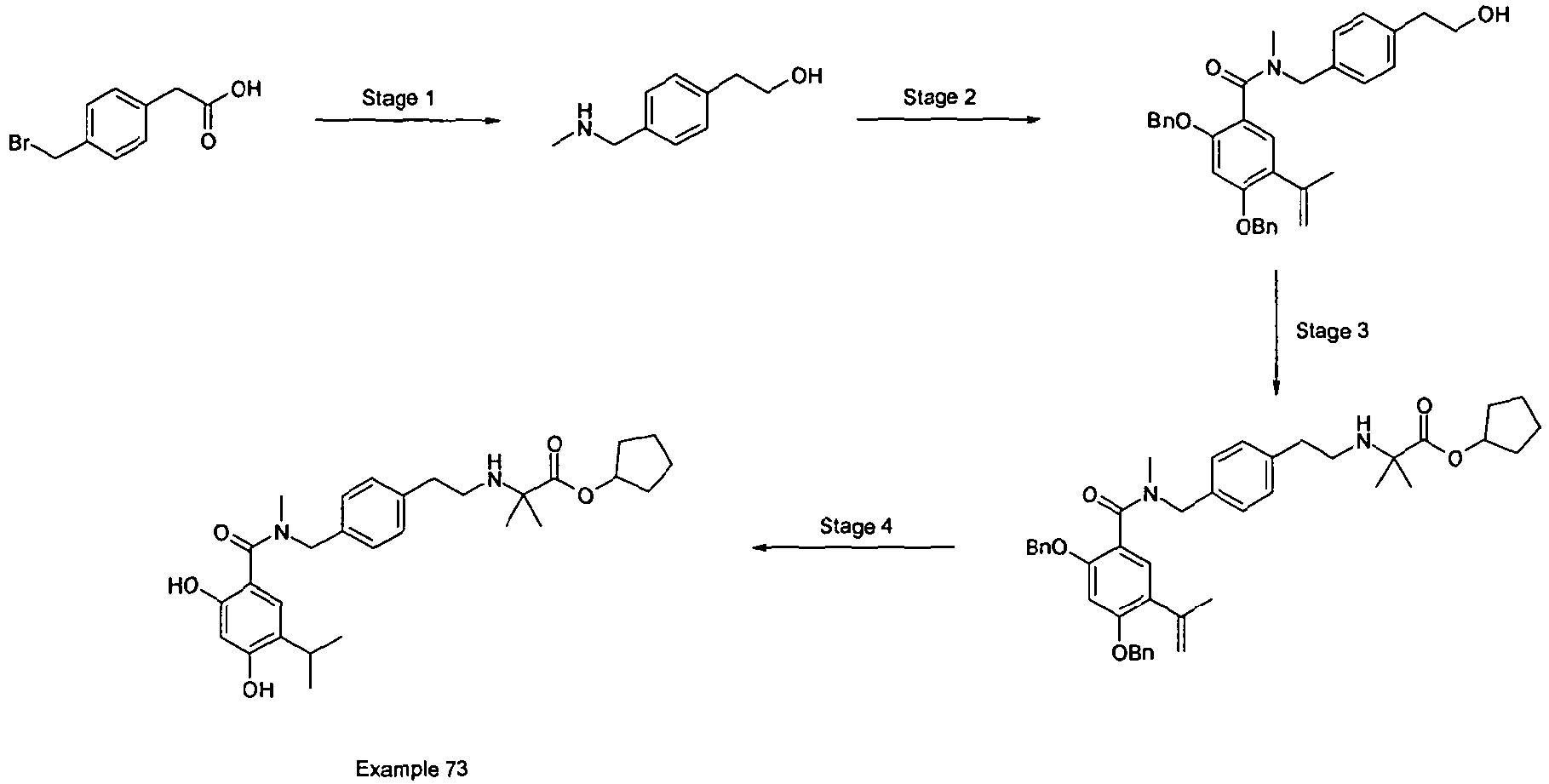
- To a solution of 4-(bromomethyl)-phenylacetic acid (0.586 g, 2.36 mmol) in toluene/tetrahydrofuran (10mL/8mL) was added borane-dimethylsulfide (4.5 mL, 45 mmol borane). The mixture was stirred at room temperature for 1 hour, then quenched by careful addition of water (50 mL). The mixture was poured into ethyl acetate (250 mL) and washed with water (50 mL) and saturated brine (50 mL). The organic fraction was dried (MgSO4) and concentrated. To the residue obtained was added methylamine in methanol (20 mL, 8M solution, 160 mmol). The solution was stirred at room temperature for 15 minutes, then concentrated under vacuum and used without further purification. LC/MS: m/z 166 [M+H]+
- To the product obtained in Stage 1 (~2 mmol) in dichloromethane (40 mL) was added N,N-diisopropylethylamine (5 mL, 28.7 mmol), Intermediate A (1.01 g, 2.7 mmol) and HATU (1.08 g, 2.84 mmol). The mixture was stirred at room temperature for 18 hours, then poured into ethyl acetate (300 mL). The organic extract was washed with 2M HCl solution (3 times 50 mL), and 1M sodium hydroxide solution (50 mL). The organic fraction was dried (MgSO4), concentrated and purified by flash column chromatography (SiO2, 1:1 heptane:ethyl acetate) to yield the desired product (0.712 g, 58% yield (2 steps). LC/MS: mlz 522.25 [M+H]+
- To the product of Stage 2 (0.163 g, 0.31 mmol) in dichloromethane (10 mL) was added Dess-Martin periodinane (0.196 g, 0.46 mmol). The solution was stirred for 30 minutes then quenched by addition of 1:1 saturated sodium hydrogen carbonate: saturated sodium thiosulfate (10 mL). After stirring for 5 minutes the mixture was extracted with dichloromethane (2 times 100 mL), and the combined extracts were dried (MgSO4) and concentrated. To the residue obtained (crude aldehyde) in dichloroethane (10 mL) was added α,α-dimethylglycine cyclopentyl ester (0.260 g, 0.66 mmol) and sodium triacetoxyborohydride (0.215 g, 1.01 mmol). The mixture was stirred for 1 hour, then quenched with saturated ammonium chloride (50 mL). Product was extracted with ethyl acetate (2 times 100 mL) and the combined extracts were dried (MgSO4), concentrated and purified by flash column chromatography (SiO2, 3:1 ethyl acetate:heptane) to yield the desired product (0.077 g, 37% yield). LC/MS: m/z 675.25 [M+H]+
- To a solution of the product of Stage 3 (0.077 g, 0.11 mmol) in ethyl acetate (10 mL) was added potassium carbonate (0.201 g, 1.45 mmol) and palladium on carbon (0.023 g, 10%, 0.02 mmol). The reaction vessel was evacuated and filled with hydrogen twice, then stirred overnight. After purging with nitrogen, a second portion of palladium on carbon (0.075 g, 0.06 mmol) was added, and the flask evacuated and filled with hydrogen. After 1 hour the reaction vessel was purged with nitrogen and the mixture filtered through Celite. The filtrate was concentrated to give the desired product (0.051 g, 94% yield). 1H NMR (300 MHz, CDCl3) 7.20-7.35 (4H, m), 7.09-7.14 (1H, m), 6.40-6.47 (1H, m), 5.17-5.25 (1H, m), 4.67-4.75 (1H, m), 2.75-3.13 (7H, m), 1.23-1.94 (17H, m), 0.93-1.05 (6H, m). LC/MS: purity >98%, m/z 497.25 [M+H]+
-

- To a solution of Intermediate A (0.342 g, 0.91 mmol) in dichloromethane (10 mL) was added a solution of (R)-1-pyrrolidin-2-yl-methanol (1.00 g, 10 mmol) in dichloromethane (3 mL), then triethylamine (1 mL, 7.1 mmol) and EDCI (0.660 g, 3.43 mmol). The mixture was stirred at room temperature for 24 hours, then poured into ethyl acetate (200 mL). The organic layer was washed with 1M HCl solution (4 times 50 mL) then dried (MgSO4), concentrated and used without further purification (0.344 g, 83% yield). LC/MS: mlz 458.25 [M+H]+
- To a solution of the product of Stage 1 (0.277 g, 0.61 mmol) in dichloromethane (10 mL) was added Dess-Martin periodinane (0.370 g, 0.87 mmol). The solution was stirred at room temperature for 30 minutes, then quenched by addition of 1:1 saturated sodium hydrogen carbonate:sodium thiosulfate (20 mL). The mixture was stirred for 10 minutes then poured into ethyl acetate (100 mL) and washed with water (2 times 50 mL). The organic fraction was dried (MgSO4) and concentrated. To a solution of the residue obtained (crude aldehyde) in dichloroethane (10 mL) was added L-leucine cyclopentyl ester tosylate (0.465 g, 1.25 mmol) and sodium triacetoxyborohydride (0.568 g, 2.7 mmol). The mixture was stirred for 1 hour then poured into 1:1 saturated ammonium chloride solution:dichloromethane. Product was extracted with dichloromethane (100 mL) and the combined organic extracts dried (MgSO4), concentrated and purified by flash column chromatography (SiO2, 7:3 ethyl acetate:heptane) to yield the desired product (0.047 g, 12% yield). LC/MS: m/z 639.25 [M+H]+
- To a solution of the product of Stage 2 (0.047 g, 0.07 mmol) in ethyl acetate (5 mL) was added palladium on carbon (0.023 g, 10% on carbon, 0.03 mmol). The reaction vessel was evacuated and filled with hydrogen twice. The reaction mixture was stirred for 30 minutes, then further palladium on carbon (0.075 g, 0.06 mmol) was added. The mixture was stirred for 30 minutes, the reaction was flushed with nitrogen, Celite was added and the reaction mixture filtered through a Celite pad, washing with ethyl acetate (100 mL). The filtrate was concentrated to yield the desired product (0.006 g, 17% yield) to which water was added followed by freeze drying overnight. 1H NMR (300 MHz, d6-DMSO) 10.76 (1H, br s), 9.95 (1H, br s), 7.29 (1H, s), 6.62 (1H, s), 5.37 (1H, s), 4.30-4.44 (1H, m), 3.59-3.83 (5H, m), 3.30-3.47 (2H, m), 1.50-2.30 (1H, m), 1.32-1.50 (6H, m), 1.06-1.22 (6H, m). LC/MS: purity >98%, m/z 461.25 [M+H]+
- Example 75 was prepared in a simiar fashion to Example 74 starting with (S)-1-pyrrolidin-2-yl-methanol and Intermediate A.
1H NMR (300 MHz, d6-DMSO) 10.04 (1H, br s), 9.75 (1H, br s), 9.39 (1H, br s), 7.00 (1H, s), 6.37 (1H, s), 5.23 (1H, t, J=5.64 Hz), 4.34 (1H, br s), 4.08 (1H, br s), 3.37-3.53 (2H, m), 3.05-3.11 (2H, m), 1.52-2.19 (15H, m), 1.12 (3H, d, J=6.9 Hz), 1.11 (3H, d, J=6.9 Hz), 0.92 (6H, d, J=5.2 Hz). LC/MS: purity >98%, m/z 461.25 [M+H]+ -

- To a solution of N-Boc-3-pyrrolidinone (0.382 g, 4.76 mmol) in dichloroethane (20 mL) was added L-leucine cyclopentyl ester tosylate (1.96 g, 5.3 mmol) and sodium triacetoxyborohydride (2.65 g, 12.5 mmol). The mixture was stirred at room temperature for 3 hours then poured into ethyl acetate (150 mL) and quenched with saturated ammonium chloride (50 mL). The organic layer was washed with saturated sodium hydrogen carbonate (3 times 30 mL), then dried (MgSO4), concentrated and purified by flash column chromatography (SiO2, 7:3 ethyl acetate:heptane) to yield the N-Boc protected product. This material was dissolved in dichloromethane (5 mL) then HCl (20 mL, 4M solution in dioxane, 80 mmol) was added (2 times 10 mL batches five minutes apart). The mixture was stirred at room temperature for 1 hour then diethyl ether (100 mL) was added. The precipitate was collected by filtration, washed with further diethyl ether (50 mL) then dried under vacuum to yield the desired product as the bis-HCl salt (0.855 g, 52% yield). LC/MS: m/z 269.25 [M+H]+
- To a solution of Intermediate A (0.823 g, 2.2 mmol) in dichloromethane (12 mL) was added triethylamine (2 mL, 19.7 mmol), the product of Stage 1 (0.816 g, 2.39 mmol) and EDCI (3.11 g, 15.8 mmol). The mixture was stirred for 16 hours, poured into ethyl acetate (150 mL) and washed with water (4 times 50 mL). The organic fraction was dried (MgSO4), concentrated and purified by flash column chromatography (SiO2, 7:3 ethyl acetate:heptane) to yield the desired product (0.755 g, 55% yield). LC/MS: mlz 625.25 [M+H]+
- To a solution of the product of Stage 2 (0.755 g, 1.2 mmol) in ethyl acetate (25 mL) was added palladium on carbon (0.180 g, 10%, 0.17 mmol). The reaction vessel was evacuated and filled with hydrogen twice. The mixture was stirred for 3 hours, the reaction vessel was purged with nitrogen and a second portion of palladium on carbon (0.212g, 10%, 0.2 mmol) was added. The mixture was stirred for a further 1 hour then the reaction vessel was purged with nitrogen and the reaction mixture filtered through a plug of Celite, washing with ethyl acetate (150 mL). The filtrate was concentrated to yield the desired product (0.493 g, 92% yield). 1H NMR (300 MHz, d6-DMSO) 10.74 (0.5H, s), 10.63 (0.5H, s), 9.70 (1H, s), 7.05 (1H, s), 6.31 (1H, s), 4.96-5.14 (1H, m), 2.97-3.66 (8H, m), 2.05-2.35 (1H, m), 1.27-1.98 (11H, m), 1.12 (3H, d, J=6.9 Hz), 1.12 (3H, d, J=6.9 Hz), 0.85 (6H, t, J=6.7 Hz). LC/MS: purity >98%, m/z 447.25 [M+H]+
- To a solution of cyclopentyl ester in ethanol was added 50% sodium hydroxide solution. The mixture was stirred at room temperature until all starting material had been consumed. The mixture was neutralised with HCl (1M solution) and extracted with ethyl acetate to yield the desired product which was purified by reverse phase HPLC.
- To a solution of cyclopentyl ester in methanol was added 2M sodium hydroxide solution. The mixture was stirred at room temperature until all starting material had been consumed. The mixture was neutralised with HCl (1M solution) and extracted with ethyl acetate to yield the desired product which was purified by reverse phase HPLC.
- To a solution of cyclopentyl ester in THF was added potassium trimethylsilanolate. The mixture was stirred for 2 hours. The mixture was concentrated and purified by reverse phase HPLC to yield the desired product.
- To a solution of cyclopentyl ester in methanol was added 1M sodium hydroxide solution. The mixture was stirred at room temperature until all starting material had been consumed. The mixture was neutralised with HCl (1M solution), extracted with ethyl acetate and purified by reverse phase HPLC to yield the desired product.
- To a solution of tert-butyl ester in DCM was added HCl (4M solution in dioxane). The mixture was stirred at 35°C for 48 hours, then concentrated under vacuum and purified by reverse phase HPLC to yield the desired product.
- The following Examples 77 to 125 are reference examples describing the acids corresponding to exemplified esters described above.
- 1H NMR (300 MHz, d6-DMSO) 9.65 (1H, br s), 9.54 (1H, br s), 7.49 (2H, d, J=7.8 Hz), 7.33 (2H, d, J=7.6 Hz), 6.87 (1H, s), 6.42 (1H, s), 4.57 (2H, br s), 4.12 (2H, q, J=7.4 Hz), 3.67-3.78 (1H, m), 2.99-3.12 (1H, m), 2.79 (3H, s), 1.62-1.82 (3H, m), 1.08 (6H, d, J=6.9 Hz), 0.88 (6H, app t, J=4.5 Hz). LC/MS: purity >98%, m/z 433.25 [M+H]+
- 1H NMR (300 MHz, d6-DMSO) 10.07 (1H, br s), 9.65 (1H, br s), 7.31-7.51 (4H, m), 7.04 (1H, s), 4.79 (4H, m), 3.99-4.11 (2H, m), 1.46-1.57 (2H, m), 1.13 (6H, d, J=6.9 Hz), 0.87 (6H, app t, J=7.0 Hz). LC/MS: purity >98%, m/z 441.25 [M+H]+
- 1H NMR (300 MHz, d3-MeOD) 7.35 (3H, br s), 7.05 (1H, s), 6.27 (1H, s), 4.08-4.87 (4H, m), 4.12 (2H, s), 3.10 (1H, sep, J=6.8 Hz), 1.58 (6H, s), 1.10 (6H, d, J=7.0 Hz) LC/MS: purity >98%, m/z 413.25 [M+H]+
- 1H NMR (300 MHz, d6-DMSO) 7.07-7.34 (4H, m), 6.39 (1H, s), 4.66-4.79 (4H, m), 3.06-3.11 (2H, m), 2.55-2.89 (3H, m), 1.70-1.88 (2H, m), 1.31-1.59 (3H, m), 1.13 (6H, d, J=6.9 Hz), 0.86 (6H, t, J=7.2 Hz). LC/MS: purity>98%, m/z 469.25 [M+H]+
- 1H NMR (300 MHz, d6-DMSO) 7.07-7.31 (4H, m), 6.41 (1H, s), 4.64-4.80 (4H, m), 3.00-3.13 (2H, m), 2.70-2.92 (3H, m), 1.68-1.82 (1H, m), 1.28-1.51 (3H, m), 1.12 (6H, d, J=6.9 Hz), 0.85 (6H, t, J=6.6 Hz). LC/MS: purity >98%, mlz 455.25 [M+H]+
- 1H NMR (300 MHz, d3-MeOD) 7.37-7.60 (3H, m), 7.17 (1H, s), 6.39 (1H, s),. 4.94 (4H, s), 4.28 (2H, ABq, J=12.8 Hz), 4.08 (1H, q, J=9.5 Hz), 3.21 (1H, sep, J=6.8 Hz), 1.63 (3H, d, J=7.1 Hz). LC/MS: purity >98%, mlz 399.25 [M+H]+
- 1H NMR (300 MHz, d6-DMSO) 7.02-7.52 (4H, m), 6.44 (1H, s), 5.00-5.10 (2H, m), 4.75 (4H, s), 3.09 (1H, sep, J=6.6 Hz), 1.40-1.80 (8H, m), 1.13 (6H, d, J=6.9 Hz) LC/MS: purity >98%, mlz 439.25 [M+H]+
- 1H NMR (300 MHz, d6-DMSO) 7.46 (1H, br s), 7.06-7.30 (4H, m), 6.83 (1H, s), 6.39 (1H, s), 4.33 (1H, d, J=13.4 Hz), 3.72 (1H, d, J=12.5 Hz), 3.39 (2H, d, J=12.4 Hz), 3.05 (1H, sep. J=6.5 Hz), 2.75 (3H, s), 1.82 (3H, s), 1.09 (6H, d, J=6.9 Hz), 0.76 (6H, d, J=5.5 Hz). LC/MS: purity >98%, m/z 443.25 [M+H]+
- 1H NMR (300 MHz, d6-DMSO) 9.63 (1H, s), 9.52 (1H, s), 7.24-7.54 (9H, m), 6.87 (1H, s), 6.37 (1H, s), 4.74 (1H, s), 4,55 (2H, s), 4.94 (2H, ABq, J=13,3 Hz), 3.05 (1H, sep, J=6.8 Hz), 2.79 (3H, s), 1.07 (6H, d, J=6.9 Hz). LC/MS: purity >98%, m/z 463.25 [M+H]+
- 1H NMR (300 MHz, d6-DMSO) 9.61 (1H, s), 9.50 (1H, s), 9.18 (1H, br s), 7.46 (2H, d, J=8.2 Hz), 7.36 (2H, d, J=7.6 Hz), 6.88 (1H, s), 6.38 (1H, s), 4.57 (2H, s), 4.11 (2H, s), 3.06 (1H, sep, J=6.9 Hz), 2.80 (3H, s), 1.55 (6H, s), 1.09 (6H, d, J=6.9 Hz) LC/MS: purity >98%, m/z 415.25 [M+H]+
- 1H NMR (300 MHz, d3-MeOD) 7.43-7.52 (4H, m), 7.01 (1H, s), 6.37 (1H, s), 4.72 (2H, s), 4.10 (2H, s), 3.17 (1H, sep, J=6.9 Hz), 3.04 (3H, s), 1.57 (6H, s), 1,14 (6H, d, J=6.9 Hz). LC/MS: purity >98%, mlz 415.25 [M+H]+
- 1H NMR (300 MHz, d3-MeOD) 7.41-7.52 (4H, m), 7.01 (1H, s), 6.37 (1H, s), 4.72 (2H, s), 4.14 (2H, s), 3.19 (1H, sep, J=6.9 Hz), 2.98 (3H, s), 1.75-1.94 (8H, m), 1.15 (6H, d, J=6.9 Hz). LC/MS: purity >98%, mlz 441.25 [M+H]+
- 1H NMR (300 MHz, d3-MeOD) 7.33-7.54 (9H, m), 7.00 (1H, s), 6.36 (1H, s), 4.70 (2H, br s), 4.53 (1H, s), 4.14 (2H, ABq, J=15.8 Hz), 3.17 (1H, sep, J=6.9 Hz), 1.15 (6H, d, J=6.9 Hz). LC/MS: purity >98%, m/z 463.25 [M+H]+
- 1H NMR (300 MHz, d6-DMSO) 10.07 (1H, br s), 9.61 (1H, br s), 7.11-7.33 (3H, m), 7.04 (1H, s), 6.39 (1H, s), 4.74 (4H, br s), 3.19-3.44 (4H, m), 3.09 (1H, sep, J=6.9 Hz), 2.59-2.76 (2H, m), 1.78-2.06 (4H, m), 1.64 (4H, m), 1.13 (6H, d, J=6.9 Hz) LC/MS: purity >98%, m/z 467.25 [M+H]+
- 1H NMR (300 MHz, d6-DMSO) 7.10-7.23 (3H, m), m6.84 (1H, s), 6.36 (1H, s), 4.45-4.56 (2H, m), 3.04 (1H, sep, J=6.7 Hz), 2.77-2.85 (2H, m), 2.79 (3H, s), 1.78-1.83 (2H, m), 1.22-1.24 (6H, m), 1.06 (6H, d, J=6.9 Hz). LC/MS: purity >98%, m/z 429.25 [M+H]+
- 1H NMR (300MHz, d3-MeOD) ppm, 6.95 (1H, s), 6.34 (1H, s), 4.35 (2H, m), 3.19 (1H, m), 3.05 (1H, m), 2.97 (4H, m), 2.00 (5H, m), 1.49 (3H, d, J=7.2 Hz), 1.34 (2H, m), 1.26 (6H, d, J=4.8 Hz). LC/MS: purity >98%, m/z 379 [M+H]+
- 1H NMR (300 MHz, d3-MeOD) 7.45-7.12 (4H, m), 6.38 (1H, s), 3.11-2.98 (2H, m), 2.43-2.25 (2H, m), 2.08-1.80 (8H, m), 1.22 (6H, d, J=7.0 Hz)
LC/MS: purity >98%, mlz 453 [M+H]+ - 1H NMR (300 MHz, d6-DMSO) 9.70 (1H, br s), 6.99 (1H, s), 6.37 (1H, s), 5.23 (1H, t, J=5.6 Hz), 4.33 (1H, m), 4.01 (1H, m), 3.21-3.56 (4H, m), 3.10 (1H, sep, J=6.9 Hz), 1.62-2.20 (8H, m), 1.12 (3H, d, J=6.9 Hz), 1.11 (3H, d, J=6.9 Hz), 0.93 (6H, d, J=6.3 Hz). LC/MS: purity >98%, m/z 393.25 [M+H]+
- 1H NMR (300 MHz, d6-DMSO) 10.35 (1H, br s), 9.75 (1H, s), 9.24 (1H, br s), 7.02 (1H, s), 6.36 (1H, s), 3.45-4.0 (6H, m), 3.09 (1H, sep, J=6.9 Hz), 1.93-2.34 (2H, m), 1.59-1.80 (3H, m), 1.12 (6H, d, J=6.9 Hz), 0.92 (6H, d, J=5.6 Hz). LC/MS: purity >98%, mlz 379 [M+H]+
- 1H NMR (300 MHz, d6-DMSO) 9.55 (1H, br s), 9.49 (1H, br s), 6.81 (1H, s), 6.36 (1H, s), 3.86-4.14 (2H, m), 3.59-3.76 (1H, m), 3.14-3.23 (1H, m), 3.06 (1H, sep, J=6.9 Hz), 2.83 (2H, q, J=11.1 Hz), 1.86-2.09 (2H, m), 1.35-1.83 (5H, m), 1.10 (6H, d, J=6.9 Hz), 0.91 (3H, d, J=6.3 Hz), 0.90 (3H, d, J=6.4 Hz). LC/MS: purity >98%, m/z 393.25 [M+H]+
- 1H NMR (300 MHz, d6-DMSO) 9.54 (1H, br s), 9.50 (1H, brr s), 8.80 (2H, br s), 6.82 (1H, s), 6.36 (1H, br s), 3.89-4.11 (1H, br s), 3.24-3.54 (2H, m), 3.06 (1H, sep, J=6.8 Hz), 2.81-3.01 (2H, m), 1.91-2.03 (2H, m), 1.47-1.65 (2H, m), 1.51 (6H, s), 1.10 (6H, d, J=6.8 Hz). LC/MS: purity >98%, m/z 365.25 [M+H]+
- 1H NMR (300 MHz, d3-MeOD) 6.98 (1H, s), 6.36 (1H, s), 4.33 (1H, s), 4.02 (1H, d, J=3.6Hz), 3.37 (1H, m), 3.18 (1H, dt, J=13.8, 6.9Hz), 3.00 (2H, t, J=12.8Hz), 2.42-2.29 (1H, m), 2.18 (2H, t, J=14.0Hz), 1.71 (2H, m), 1.26 (1H, t, J=7.1Hz), 1.22-1.15 (9H, m), 1.09 (3H, d, J=7.0Hz). LC/MS: purity 100%, m/z 379 [M+H]+
- 1H NMR (300 MHz, d3-MeOD) 7.61-7.47 (5H, m), 6.97 (1H, s), 6.34 (1H, s), 4.30 (1H, br s), 3.97-3.88 (1H, m), 3.42-3.36 (2H, m), 3.18 (1H, m), 2.95 (2H, m), 2.25 (2H, m), 1.7 (2H, m), 1.26 (2H, t, J=7.1Hz), 1.18 (6H, d, J=7.0Hz). LC/MS: purity 100%, m/z 413 [M+H]+
- 1H NMR (300 MHz, d3-MeOD) 6.98 (1H, s), 6.36 (1H, s), 4.33 (1H, br s), 4.22 (1H, q, J=7.2Hz), 3.53 (1H, m), 3.18 (1H, dt, J=6.8, 13.8Hz), 3.02 (3H, t, J=13.5Hz), 2.16 (2H, d, J=12.6Hz), 1.67(2H, m), 1.61 (3H, d, J=7.2Hz), 1.19 (6H, d, J=6.8Hz). LC/MS: purity >98%, m/z 351 [M+H]+
- 1H NMR (300 MHz, d3-MeOD) 7.35 (5H, m), 6.96 (1H, s), 6.34 (1H, s), 4.30 (3H, m), 3.11-3.24 (4H, m), 2.95 (2H, br s), 2.13 (2H, t, J=12.0Hz), 1.75-1.47 (2H, m), 1.18 (6H, d, J=7.0Hz). LC/MS: purity 100%, m/z 427 [M+H]+
- 1H NMR (300 MHz, d3-MeOD) 7.03 (1H, s), 6.37 (1H, s), 5.19-5.07 (1H, m), 4.48-4.29 (1H, m), 4.02 (2H, br s), 3.39 (1H, br s), 3.23-3.13 (2H, m), 2.37-2.18 (2H, m), 1.76-1.584 (5H, m), 1.19 (6H, d, J=6.8Hz), 1.06-0.94 (6H, m). LC/MS: purity 95%, m/z 393 [M+H]+
- 1H NMR (300 MHz, d6-DMSO) 9.52 (1H, br s), 9.46 (1H, br s), 8.82 (1H, br s), 6.82 (1H, s), 6.35 (1H, s), 3.91-4.14 (2H, m), 3.87 (1H, t, J=7.6 Hz), 3.07 (1H, sep, J=7.0 Hz), 2.69-3.00 (4H, m), 1.59-1.99 (6H, m), 1.09-1.23 (2H, m), 1.10 (6H, d, J=7.0 Hz), 0.93 (3H, d, J=6.1 Hz), 0.92 (3H, d, J=6.3 Hz). LC/MS: purity 98%, m/z 407.25 [M+H]+
- 1H NMR (300 MHz, d6-DMSO) 9.50 (1H, br s), 9.44 (1H, br s), 8.87 (1H, br s), 6.81 (1H, s), 6.34 (1H, s), 3.91-4.10 (2H, m), 3.88 (1H, t, J=6.5 Hz), 3.06 (1H, sep, J=6.9 Hz), 2.73-3.10 (4H, m), 1.49-1.80 (8H, m), 1.10 (6H, d, J=6.9 Hz), 0.92 (3H, d, J=6.1 Hz), 0.92 (3H, d, J=6.3 Hz). LC/MS: purity 98%, m/z 421.25 [M+H]+
- 1H NMR (300 MHz, d3-MeOD) 7.00 (1H, d, J=3.8Hz), 6.38 (1H, d, J=1.3Hz), 3.99 (2H, br s), 3.28-2.90 (3H, m), 2.40-2.19 (1H, m), 2.07-1.55 (6H, m), 1.54-1.32 (4H, m), 1.19 (6H, d, J=7.0Hz), 1.00-0.87 (3H, m). LC/MS: purity 96%, m/z 393 [M+H]+
- 1H NMR (300 MHz, d3-MeOD) 6.96 (1H, s), 6.33 (1H, s), 4.19 (2H, m), 3.24 (1H, m), 3.18 (1H, pentet, J=6.9Hz), 2.97 (2H, t, J=12.0Hz), 2.67 (2H, m), 1.91 (4H, m), 1.36 (3H, d, J=6.9Hz), 1.28 (1H, m), 1.18 (6H, d, J=6.9Hz). LC/MS: purity 98%, m/z 365 [M+H]+
- 1H NMR (300 MHz, d3-MeOD) 7.21 (5H, m), 6.91 (1H, s), 6.26 (1H, s), 4.14 (4H, m), 3.23 (2H, m), 2.95 (4H, m), 2.50 (1H, m), 2.35 (1H, m), 1.69 (5H, m), 1.17 (6H, d, J=6.6Hz). LC/MS: purity 98%, m/z 441 [M+H]+
- 1H NMR (300 MHz, d6-DMSO) 6.76 (1H, s), 6.34 (1H, s), 3.97 (2H, m), 3.34 (4H, m), 3.05 (1H, pentet, J=6.9Hz), 2.70 (3H, m), 2.39 (1H, m), 2.14 (1H, m), 1.65 (5H, bcm), 1.27 (1H, m), 1.09 (6H, d, J=6.9Hz), 1.02 (2H, m), 0.81 (6H, m). LC/MS: purity 98%, m/z 407 [M+H]+
- 1H NMR (300 MHz, d3-MeOD) 6.97 (1H, s), 6.35 (1H, s), 3.93 (1H, t, J=6.4Hz), 3.61 (1H, t, J=7.0Hz), 3.18 (2H, m), 3.00 (3H, br s), 2.29-2.03 (4H, m), 2.19-1.56 (4H, m), 1.18 (6H, d, J=7.0Hz), 1.01 (6H, m). LC/MS: purity 100%, m/z 393 [M+H]+
- 1H NMR (300 MHz, d3-MeOD) 6.98 (1H, s), 6.35 (1H, s), 4.32 (2H, br s), 4.05(1H, br s), 3.57-3.38, (1H, m), 3.24-3.10 (1H, m), 3.10-2.92 (2H, m), 2.28-2.08 (2H, m), 1.94 (1H, d, J=11.9Hz), 1.85-1.62 (8H, m), 1.27 (3H, br s), 1.19 (6H, d, J=7.0Hz), 1.10-0.90, (2H, m). LC/MS: purity 97%, m/z 433 [M+H]+
- 1H NMR (300 MHz, d3-MeOD) 7.42-7.21 (5H, m), 6.94 (1H, s), 6.33 (1H, s), 4.15(1H, s), 4.00-3.81 (1H, m), 3.27-2.79 (12H, m), 1.78-1.50 (4H, m), 1.19 (6H, d, J=6.8Hz) LC/MS: purity 100%, m/z 455 [M+H]+
- 1H NMR (300 MHz, d3-MeOD) 6.96 (1H, s), 6.34 (1H, s), 4.21 (2H, m), 3.92 (1H, m), 3.18 (1H, pentet, J=6.6Hz), 3.01 (4H, m), 2.37 (1H, m), 1.90 (3H, m), 1.35 (2H, m), 1.19 (9H, m), 1.08 (3H, d, J=6.9Hz). LC/MS: purity 95%, m/z 393 [M+H]+
- 1H NMR (300 MHz, d3-MeOD) 6.98 (1H, s), 6.35 (1H, s), 4.32 (2H, br s), 4.00-3.87 (2H, m), 3.18 (1H, dt, J=6.9, 13.8Hz), 3.00 (2H, t, J=12.4Hz), 2.17 (2H, t, J=14.0Hz), 2.02 (2H, d, J=6.6Hz), 1.92-1.56 (9H, m), 1.47-1.30 (3H, m), 1.26 (2H,t, J=7.2Hz), 1.19 (6H, d, J=7.0Hz). LC/MS: purity 97%, m/z 419 [M+H]+
- 1H NMR (300 MHz, d3-MeOD) 6.94 (1H, s), 6.33 (1H, s), 4.19 (2H, s), 2.78-3.24 (6H, m), 1.78 (3H, d, J=13.0Hz), 1.63-1.70 (3H, m), 1.59 (6H, s) and 1.17 (6H, d, J=5.7Hz) LC/MS: purity 97%, m/z 351 [M+H]+
- 1H NMR: (300 MHz, d6-DMSO) 9.45 (1H, s), 9.41 (1H, s), 6.80 (1H, s), 6.33 (1H, s), 5.10 (1H, t, J=6.0 Hz), 3.48-3.36 (2H, m), 3.23, (1H, q, J=4.3 Hz), 3.11-3.01 (1H, septet, J=6.9 Hz), 2.84-2.71 (2H, m), 1.87-1.72 (1H, m), 1.69-1.49 (8H, m), 1.39-1.27 (2H, m), 1.10 (6H, d, J=6.8 Hz), 1.08 (9H, s). LC/MS: purity 97% m/z 451.25 [M+H]+
- 1H NMR (300 MHz, d3-MeOD) 6.96 (1H, s), 6.35 (1H, s), 4.22 (2H, m), 3.92 (2H, m), 3.60 (1H, d, J=3.6Hz), 3.18 (1H, pentet, J=6.9Hz), 3.98 (4H, m), 2.10-1.70 (10H, m), 1.30 (4H, m), 1.18 (6H, d, J=6.9Hz). LC/MS: purity 98%, m/z 433 [M+H]+
- 1H NMR (300 MHz, d3-MeOD) 6.97 (1H, s), 6.35 (1H, s), 4.24 (2H, m), 3.18 (1H, pentet, J=6.9Hz), 3.01 (4H, m), 2.06 (1H, m), 1.89 (2H, m), 1.62 (6H, s), 1.36 (2H, m), 1.18 (6H, d, J=6.9Hz). LC/MS: purity 98%, m/z 379 [M+H]+
- 1H NMR (300 MHz, d3-MeOD) 6.97 (1H, s), 6.35 (1H, s), 4.25 (2H, m), 4.08 (3H, m), 3.21 (1H, pentet, J=6.9Hz), 3.04 (4H, m), 2.08 (1H, m), 1.89 (2H, m), 1.33 (2H, m), 1.18 (6H, d, J=6.9Hz). LC/MS: purity 95%, m/z 381 [M+H]+
- 1H NMR (300 MHz, d3-MeOD) 6.97 (1H, s), 6.35 (1H, s), 4.19 (3H, m), 3.93 (2H, m), 3.18 (1H, pentet, 6.9Hz), 3.02 (4H, m), 2.08 (1H, m), 1.88 (2H, m), 1.35 (2H, m), 1.25 (9H, s), 1.18 (6H, d, J=6.9Hz). LC/MS: purity 98%, m/z 437 [M+H]+
- 1H NMR (300 MHz, d3-MeOD) 7.53 (5H, m), 6.96 (1H, s), 6.33 (1H, s), 5.07 (1H, s), 4.20 (2H, m), 3.17 (1H, pentet, J=6.9Hz), 3.01-2.81 (4H, m), 2.05 (1H, m), 1.82 (2H, m), 1.32 (2H, m), 1.17 (6H, d, J=6.9Hz). LC/MS: purity 98%, m/z 427 [M+H]+
- 1H NMR (300 MHz, d3-MeOD) 6.84 (1H, s), 6.22 (1H, s), 4.89 (1H, s), 3.54 (1H, d, J=11.3 Hz), 3.42-3.46 (1H, m), 2.92-3.12 (2H, m), 2.85 (3H, t, J=12.5 Hz), 2.17 (2H, br. s), 1.53-1.73 (2H, m), 1.24 (6H, s), 1.05 (4H, m), 0.94 (6H, d, J=6.8 Hz) LC/MS: purity 100%, m/z 407.25 [M+H]+
- 1H NMR (300 MHz, d3-MeOD) 6.98 (1H, s), 6.34 (1H, s), 4.60 (1H, br s), 4.28 (2H, br s), 3.88-3.63 (2H, m), 3.56 3.25-2.84 (3H, m), 2.11(2H, m), 1.64(3H, m), 1.24 (9H, s), 1.19 (6H, d, J=7.0Hz).
LC/MS: purity 100%, m/z 423 [M+H]+ - 1H NMR (300 MHz, d3-MeOD) 6.90 (1H, s), 6.28 (1H, s), 4.08-4.22 (2H, m), 3.67 (1H, br.s.), 3.12 (1H, quin, J=7.3 Hz), 2.99-3.07 (1H, m), 2.91 (1H, t, J=12.4 Hz), 1.54-1.94 (12H, m), 1.16-1.39 (7H, m), 1.13 (6H, d, J=7.0 Hz), 1.02-1.09 (1H, m). LC/MS: purity 92.60%, m/z 447.25 [M+H]+
- 1H NMR (300MHz, d3-MeOD) 7.63-7.46 (5H, m), 6.94 (1H, s), 6.33 (1H, s), 4.23-4.18 (1H, m), 3.18 (1H, septet, J=6.8 Hz), 3.11-3.03 (1H, m), 2.93 (2H, m), 1.77-1.61 (4H, m), 1.34-1.2 (2H, m), 1.18 (6H, d, J=6.9 Hz). LC/MS: purity 99%, m/z 441.25 [M+H]+
- 1H NMR (300 MHz, d3-MeOD) 6.98 (1H, s), 6.35 (1H, s), 4.33 (1H, d, J=9.8Hz), 4.27-4.21 (1H, m), 4.16-3.97 (3H, m), 3.63-3.47 (1H, m),3.18 (1H, m), 3.01 (2H, t, J=12.7Hz), 2.19 (2H, d, J=11.7Hz), 1.81-1.58 (2H, m), 1.19 (6H, d, J=7.0Hz). LC/MS: purity 100%, m/z 367 [M+H]+
-

- To a stirred solution of Intermediate C (0.200 g, 0.43mmol) was added sodium triacetoxyborohydride (0.136 g, 0.64mmol) and cyclopentyl N-(3-aminopropyl)-L-leucinate (0.110 g, 0.43mmol) under a nitrogen atmosphere. The reaction was stirred for 2 hours and then partitioned between water and DCM (100m1/100m1). The organic layer was separated and the aqueous extracted with DCM (100ml). The combined organic layers were dried over Na2SO4 and solvent removed in vacuo to give the product as a yellow oil which was used in the next step without further purification. LC/MS: m/z 710 [M+H]+
- The hydrogenation of the product obtained in Stage 1 to give Example 126 was performed as described for Example 1.
1H NMR (300 MHz, d3-MeOD) 6.96 (1H, s), 6.34 (1H, s), 5.35 (1H, m), 4.22 (2H, m), 4.01 (1H, m), 3.92 (1H, t, J = 6.6Hz), 3.18 (5H, m), 2.99 (4H, m), 2.18 (2H, m), 2.05-1.60 (13H, m), 1.37 (2H, m), 1.18 (6H, d, J = 6.9Hz), 1.02 (6H, t, J = 5.7Hz)
LC/MS: purity 95%, m/z 532 [M+H]+ - 1H NMR (300 MHz, d3-MeOD) 6.96 (1H, s), 6.34 (1H, s), 4.25 (2H, m), 3.93 (2H, m), 3.18 (5H, m), 2.99 (4H, m), 2.18 (2H, m), 1.99 (3H, m), 1.34 (2H, m), 1.19 (6H, d, J = 6.8Hz), 1.02 (6H, t, J = 5.7Hz), 0.95 (2H, m). LC/MS: purity 95%, m/z 464 [M+H]+
- An HTRF (homogeneous time resolved fluorescence) assay is used to measure the interaction of the compounds with HSP90. The assay measures binding of biotinylated Geldanamycin (bio-GM; Biomol, # EI-341, lot: A9199a) to human recombinant his-tagged HSP90α (HSP90; Prospec Technogene, #HSP90, lot: 260HSP9001). A signal is generated by fluorescence resonance energy transfer from an Europium-cryptate labeled anti-his antibody (anti-his-K; Cisbio International, # 61HISKLA, lot: 33V) via the HSP90-GM-biotin complex to a fluorescence acceptor (allophycocyanin) linked to streptavidin (SA-XL; Cisbio International, # 610SAXLB, lot: 089).
- Unlabeled GM or compounds compete with the bio-GM for binding to HSP90 resulting in reduced fluorescence energy transfer/assay signal.
- A preformed (1 hour incubation) complex of HSP90 with the anti-his-K is added to the compound solution in a 384 well microplate (Corning, # 3710) and incubated for 15 minutes. A preformed (1 hour incubation) complex of bio-GM with the SA-XL is added to the wells and incubated for 20 hours. All incubations are performed at room temperature. The final assay volume is 50µl/well. The final concentrations in the assay are: 50mM Hepes pH 7.3, 50mM NaCl, 100mM KF, 1mM EDTA, 1mM DTT, 0.1% Triton-X-100, 1nM anti-his-K, 40nM HSP90, 40nM SA-XL, 40nM bio-GM. Test compounds are dissolved in DMSO, prediluted in assay buffer and tested at a final concentration between 5000nM and 0.3nM. The resulting DMSO concentration is 0.5% and included in all controls. High controls are without test compounds, low controls without test compounds, without HSP90 and without bio-GM. As a reference inhibitor unlabeled GM is used in the same concentrations as the test compounds.
- Inhibition is calculated compared to the assay controls using an Excel spreadsheet (Microsoft). IC50 values are calculated by non-linear least squares fitting to the standard dose-response model using GraphPad Prism (GraphPad Software Inc).
- Cells are seeded in 96 well tissue culture plates (1 well = 30mm2) at an appropriate density (2000 cells per well for U937 cells, 2250 cells per well for HUT-78 and MINO cells) in 50µl of culture medium (see below for details). 24 Hours later 50µl of the compound prepared in the same medium is added as 3 fold dilutions to give final concentrations in the range 5-10,000nM (n=6 for each concentration). The plates are then incubated at 37°C, 5% CO2 for 72 hours. Cell proliferation is assessed using WST-1 (a metabolic indicator dye, Roche Cat no. 11644807001) according to the manufacturer's instructions. The results are calculated as a percentage of vehicle response and plotted as a dose-response curve. IC50 values represent the concentration of compound that inhibits the vehicle response by 50%.
- Culture medium for U937 and HUT-78 cells is RPMI1640 (Sigma R0883) with 10% heat inactivated fetal calf serum (Hyclone SH30071, Perbio), plus 2mM glutamine (Sigma G7513) and 50U/ml penicillin and streptomycin sulphate (Sigma P0781). MINO cell culture medium is as for U937 and HUT-78 but supplemented with sodium pyruvate (Sigma S8636) to a final concentration of 1mM
- THP-1 cells are plated in 100µl at a density of 4x10⁴ cells / well in V-bottomed 96 well tissue culture treated plates and incubated at 37°C in 5% CO2 for 16 hours. 2 Hours after the addition of the inhibitor in 100µl of tissue culture media, the cells are stimulated with LPS (E. Coli strain 005 :B5, Sigma) at a final concentration of 1µg/ml and incubated at 37°C in 5% CO2 for 6 hours. TNF-α levels are measured from cell-free supernatants by sandwich ELISA (R&D Systems #QTA00B).
- Whole blood is taken by venous puncture using heparinised vacutainers (Becton Dickinson) and diluted in an equal volume of RPMI1640 tissue culture media (Sigma). 100µl is then plated in V-bottomed 96 well tissue culture treated plates. 2 Hours after the addition of the inhibitor in 100µl of RPMI1640 media, the blood is stimulated with LPS (E. Coli strain 005:B5, Sigma) at a final concentration of 100ng/ml and incubated at 37°C in 5% CO2 for 6 hours. TNF-α levels are measured from cell-free supernatants by sandwich ELISA (R&D Systems #QTA00B).
- IC50 values are allocated to one of three ranges as follows:
- Range A: IC50 < 100nM
- Range B: 100nM < IC50 < 1000nM
- Range C: IC50 > 1000nM
- NT = not tested
- In the Table below, Examples 77 to 125 and 127 are reference examples.
Table 1 Example Enzyme Assay THP-1 Assay Whole Blood Assay 1 A A B 2 A B B 3 A C C 4 A C C 5 A B B 6 A C NT 7 B C NT 8 A C NT 9 A B B 10 A B C 11 A C NT 12 A C NT 13 A B A 14 B C NT 15 B NT NT 16 A C NT 17 A A B 18 A B NT 19 A C NT 20 A C C 21 A A B 22 A A A 23 A B B 24 A C NT 25 A C NT 26 A C NT 27 A C NT 28 A B B 29 A C NT 30 B C NT 31 B NT NT 32 A B B 33 A B B 34 A B B 35 A C NT 36 A B B 37 A B NT 38 A B B 39 A A NT 40 C B C 41 A NT NT 42 A B NT 43 A NT NT 44 A A B 45 A B B 46 A C NT 47 A B NT 48 B C NT 49 A NT NT 50 A NT NT 51 A B NT 52 A NT NT 53 A NT NT 54 A B B 55 A B B 56 B C C 57 A NT NT 58 A NT NT 59 A A B 60 A A B 61 A B B 62 A B C 63 A B B 64 A A B 65 A B B 66 A B C 67 A B B 68 A B C 69 B C C 70 A B B 71 B B B 72 A B B 73 A B B 74 B C C 75 C C C 76 A C C 77 A NT NT 78 A NT NT 79 A NT NT 80 A NT NT 81 A NT NT 82 A NT NT 83 A NT NT 84 A NT NT 85 A NT NT 86 A NT NT 87 A NT NT 88 A NT NT 89 A NT NT 90 A NT NT 91 A NT NT 92 A NT NT 93 A NT NT 94 B NT NT 95 A NT NT 96 A NT NT 97 A NT NT 98 A NT NT 99 A NT NT 100 A NT NT 101 A NT NT 102 B NT NT 103 A NT NT 104 A NT NT 105 A NT NT 106 A NT NT 107 A NT NT 108 A NT NT 109 C NT NT 110 A NT NT 111 A NT NT 112 A NT NT 113 A NT NT 114 A NT NT 115 A NT NT 116 A NT NT 117 A NT NT 118 A NT NT 119 A NT NT 120 A NT NT 121 A NT NT 122 A NT NT 123 A NT NT 124 A NT NT 125 A NT NT 126 A C NT 127 A NT NT Table 2 Compound Enzyme assay: Inhibition of Hsp90 (IC50 nM) Proliferation assay: Ratio of IC50's of Hut78 to U937 cells THP-1 assay: Inhibition of TNFα release from LPS stimulated THP-1 (hCE-1 +ve) cells (IC50 nM) Inhibition of U937 (hCE-1 +ve) cell proliferation IC50 (nM) Inhibition of Hut78 (hCE-1 -ve) cell proliferation IC50 (nM) 
8 200 145 ∼1 476 CHR-7310 
42 (ester) 7 (acid) 27 760 28 45 Example 17 - Table 2 shows that the acid of Example 17 has a similar IC50 in the Hsp90 binding assay to the non-ester parent molecule CHR-7310 (i.e. the same chemical structure but in which the amino acid (ester) motif is absent), indicating that binding to the enzyme has not been disrupted by the attachment of the amino acid (ester) motif. Esters such as Example 17 are hydrolysed by hCE-1 in monocytic hCE-1+ve cell lines such as U937 and THP-1 cells and as a consequence the resulting carboxylic acid accumulates selectively in these cell types. This accumulation of carboxylic acid as a consequence of hCE-1 hydrolysis results in the compound of Example 17 being significantly more potent than the parent non-ester compound CHR-7310 in U937 and THP-1 cells despite the ester Example 17 being weaker as an Hsp90 inhibitor than CHR-7310. It can also be seen that the compound of Example 17 is significantly weaker in Hut78 cells which do not contain hCE-1 and hence cannot hydrolyse Example 17 to its carboxylic acid. These data highlight the potency and selectivity benefits that can be achieved by the attachment of the amino acid (ester) motif in compounds such as Example 17.
- The assessment of the accumulation of ester-derived acid in intact human tumour cells can be measured using the following method:
U937, THP-1 or Hut 78 cells (4x10⁴/ml) were incubated at 37°C in culture medium containing 6µM compound. Incubations were terminated by centrifugation (300g; 5 min; 4°C). Supernatants were added to 4 volumes of HPLC-grade acetonitrile. After decanting the supernatant, the residual cell pellet (1x10⁶ cells) was extracted into 1ml of acetonitrile. Samples were analyzed for the ester and acid metabolite at room temperature by LC/MS/MS (Sciex API3000). Chromatography was based on an AceCN (75*21mm) column with a 5-95% (v/v) acetonitrile, 0.1% (v/v) formic acid mobile phase. Results are shown in Table 3:Table 3 Compound Acid accumulation by intact U937 cells (ng/106 cells @ 6h) Acid accumulation by intact THP-1 cells (ng/106 cells @ 6h) Acid accumulation by intact Hut78 cells (ng/106 cells @ 6h) 
1433 2393 7 Example 1 - Table 3 shows the selective accumulation of the acid derived intracellular hydrolysis from the compound of Example 1 in U937 and THP-1 monocytic cells which contain hCE-1 compared to Hut78 cells which do not contain hCE-1 and consequently cannot hydrolyse Example 1 to its corresponding acid. It can be seen that U937 and THP-1 cells accumulate significant amounts of carboxylic acid but negligible acid is detected in Hut78 cells.
- In order to determine whether a compound containing a particular group R20 is hydrolysable by one or more intracellular carboxylesterase enzymes to a -COOH group, the compound may be tested in the following assay:
- U937 or HUT78 tumour cells (∼109) are washed in 4 volumes of Dulbeccos PBS (∼1 litre) and pelleted at 525g for 10 minutes at 4°C. This is repeated twice and the final cell pellet is re-suspended in 35ml of cold homogenising buffer (Trizma 10mM, NaCl 130mM, CaCl2 0.5mM pH 7.0 at 25°C). Homogenates are prepared by nitrogen cavitation (700psi for 50 minutes at 4°C). The homogenate is kept on ice and supplemented with a cocktail of inhibitors at final concentrations of Leupeptin 1µM, Aprotinin 0.1µM, E64 8µM, Pepstatin 1.5µM, Bestatin 162µM, Chymostatin 33 mM. After clarification of the cell homogenate by centrifugation at 525g for 10 minutes, the resulting supernatant is used as a source of esterase activity and is stored at -80°C until required.
- Hydrolysis of esters to the corresponding carboxylic acids can be measured using the cell extract, prepared as above. To this effect cell extract (∼30µg / total assay volume of 0.5ml) is incubated at 37°C in a Tris- HCl 25mM, 125mM NaCl buffer, pH 7.5 at 25°C. At zero time the ester (substrate) is then added at a final concentration of 2.5mM and the samples were incubated at 37°C for the appropriate time (usually 0 or 80 minutes). Reactions are stopped by the addition of 2 x volumes of acetonitrile. For zero time samples the acetonitrile is added prior to the ester compound. After centrifugation at 12000g for 5 minutes, samples are analysed for the ester and its corresponding carboxylic acid at room temperature by LC/MS (Sciex API 3000, HP1100 binary pump, CTC PAL). Chromatography was based on an AceCN (75*2.1mm) column and a mobile phase of 5-95% acetonitrile in water / 0.1% formic acid.
Claims (15)
- A compound which is (a) a phenylamide derivative of formula (I) or a tautomer thereof, or (b) a pharmaceutically acceptable salt, N-oxide, hydrate or solvate thereof:
 - R1 and R3 are hydroxy;- R2, R4 and R5 are the same or different and represent hydrogen or halogen atoms or C1-6 alkyl, C2-6 alkenyl, C2-6 alkynyl, C1-6 alkoxy, hydroxy, cyano, nitro or -NR'R'' groups wherein R' and R'' are the same or different and represent hydrogen or unsubstituted C1-4 alkyl, and with the proviso that no more than two of R2, R4 and R5 are cyano or nitro;- either:(i) R6 is selected from C1-4 alkyl and R7 represents -CR8R9-A wherein R8 and R9 are the same or different and represent a hydrogen or halogen atom or a C1-4 alkyl, C2-4 alkenyl, C1-4 alkoxy, hydroxy or -NR'R'' group where R' and R'' are the same or different and represent hydrogen or unsubstituted C1-4 alkyl, and A represents a phenyl ring or a 5- or 6-membered heteroaryl group and is substituted with a group W; or(ii) R6 and R7, together with the nitrogen atom to which they are bonded, form a 5- or 6-membered heterocyclyl group which is either (a) unfused, or (b) fused to a phenyl ring or a 5- to 6-membered heteroaryl group, and wherein either the heterocyclyl group or, when fused, the heterocyclyl group or the phenyl ring or heteroaryl group to which it is fused, is substituted with a group W;- W represents a group -Alk1-R;- Alk1 represents a bond, a C1-4 alkylene group or a group -(C1-4 alkylene)-NR'-(C1-4 alkylene)- wherein R' represents hydrogen or C1-4 alkyl;- R represents a group of formula (X) or (Y):
 - R10, where present, represents a hydrogen atom or a C1-4 alkyl group;- Alk2 represents a group of formula -C(R12)(R13)- when R is of formula (X) or -C(R12)- when R is of formula (Y), wherein R12 and R13 are the same or different and represent hydrogen or the α-substituents of an α-substituted or α,α-disubstituted glycine or glycine ester compound;- ring D, where present, is a 5- to 6-membered heterocyclyl group containing Alk2 and wherein R11 is linked to ring D via Alk2, and ring D is optionally fused to a second ring comprising a phenyl, 5- to 6-membered heteroaryl, C3-7 carbocylyl or 5- to 6-membered heterocyclyl; and- R11 is an ester group which is hydro lysable by one or more intracellular carboxylesterase enzymes to a -COOH group wherein R11 is a group -COOR20 wherein R20 is -CR14R15R16 and wherein:and wherein, unless otherwise stated:(i) R15 represents hydrogen or a group of formula -[C1-4 alkylene]b-(Z1)a-[C1-4 alkyl] or -[C1-4 alkylene]b-(Z1)a-[C2-4 alkenyl] wherein a and b are the same or different and represent 0 or 1, and Z1 represents -O-, -S-, or -NR17- wherein R17 is hydrogen or C1-4 alkyl, R16 represents hydrogen or C1-4 alkyl, and R14 represents hydrogen or C1-4 alkyl;(ii) R15 represents a phenyl or a 5- or 6-membered heteroaryl group optionally fused to a further phenyl, 5- or 6-membered heteroaryl, C3-7 carbocyclyl or 5- or 6-membered heterocyclyl group, R16 represents hydrogen or C1-4 alkyl, and R14 represents hydrogen;(iii) R15 represents a group of formula -(Alk4)-NR18R19 wherein Alk4 represents a C1-4 alkylene group and either (a) R18 and R19 are the same or different and represent hydrogen or C1-4 alkyl, or (b) R18 and R19, together with the nitrogen atom to which they are bonded, form a 5- or 6-membered heteroaryl or 5- or 6-membered heterocyclyl group optionally fused to a further phenyl, 5- or 6-membered heteroaryl, C3-7 carbocyclyl or 5- or 6-membered heterocyclyl group; R16 represents hydrogen or C1-4 alkyl, and R14 represents hydrogen; or(iv) R15 and R16, together with the carbon atom to which they are bonded, form a phenyl, 5- or 6-membered heteroaryl, C3-7 carbocyclyl or 5- or 6-membered heterocyclyl group which is optionally fused to a further phenyl, 5- or 6-membered heteroaryl, C3-7 carbocyclyl or 5- or 6-membered heterocyclyl group, and R14 represents hydrogen;- the alkyl, alkenyl and alkynyl groups and moieties in R2, R3, R4, R5, R6, R8, R9, Alk1, R12 and R13 are unsubstituted or substituted with 1, 2 or 3 unsubstituted substituents which are the same or different and are selected from halogen atoms and C1-4 alkyl, C2-4 alkenyl, C1-4 alkoxy, C2-4 alkenyloxy, C1-4 haloalkyl, C2-4 haloalkenyl, C1-4 haloalkoxy, C2-4 haloalkenyloxy, hydroxyl, -SR', cyano, nitro, C1-4 hydroxyalkyl and -NR'R" groups where R' and R" are the same or different and represent hydrogen or unsubstituted C1-2 alkyl; and- the aryl, heteroaryl, carbocyclyl and heterocyclyl groups and moieties in R6 and R7 are unsubstituted or substituted by 1, 2, 3 or 4 unsubstituted substituents selected from halogen atoms, and cyano, nitro, C1-4 alkyl, C1-4 alkoxy, C2-4 alkenyl, C2-4 alkenyloxy, C1-4 haloalkyl, C2-4 haloalkenyl, C1-4 haloalkoxy, C2-4 haloalkenyloxy, hydroxyl, C1-4 hydroxyalkyl, -SR' and -NR'R" groups wherein each R' and R" is the same or different and represents hydrogen or unsubstituted C1-4 alkyl, or from substituents of
formula -COOH, -COORA, -CORA, -SO2RA, -CONH2, -SO2NH2, -CON HRA, -SO2NHRA, -CONRARB, -SO2NRARB, -OCONH2, -OCONHRA, -O CONRARB, -NHCORA, -NRBCORA, -NHCOORA, -NRBCOORA, -NRBC OOH, -NHCOOH, -NHSO2RA, -NRBSO2RA, -NHSO2ORA, -NRBSO2OH , -NHSO2H, -NRBSO2ORA, -NHCONH2, -NRACONH2, -NHCONHRB,-NRACONHRB, -NHCONRARB or -NRACONRARB wherein RA and RB are the same or different and represent unsubstituted C1-6 alkyl, C3-6 cycloalkyl, non-fused phenyl or a non-fused 5- to 6-membered heteroaryl, or RA and RB when attached to the same nitrogen atom form a non-fused 5- or 6-membered heterocyclyl group. - A compound as claimed in claim 1 wherein R2, R4 and R5 are the same or different and represent hydrogen or halogen atoms or hydroxy, unsubstituted C1-4 alkyl or unsubstituted C1-4 alkoxy groups.
- A compound as claimed in claim 1 or claim 2 wherein either:(i) R6 represents -CH3, R7 represents -CR8R9-A wherein R8 and R9 are the same or different and represent a hydrogen or halogen atom or an unsubstituted C1-4 alkyl or C1-4 alkoxy group, and A represents a phenyl ring substituted with a group W; or(ii) R6 and R7, together with the nitrogen atom to which they are bonded, form a pyrrolidinyl, piperidinyl or isoindolinyl group which is substituted with a group W and is optionally further substituted with 1 or 2 groups which are the same or different and are selected from halogen atoms and unsubstituted C1-4 alkyl, C1-4 alkoxy, hydroxyl, C1-4 haloalkyl, C1-4 haloalkoxy, C1-4 hydroxyalkyl, cyano, nitro, -SR' and -NR'R" groups where R' and R'' are the same or different and represent hydrogen or unsubstituted C1-2 alkyl.
- A compound as claimed in any one of the preceding claims wherein Alk1 represents a bond, an unsubstituted C1-4 alkylene group, or an
unsubstituted -(C1-2 alkylene)-NH-(C1-4 alkylene)- group. - A compound as claimed in any one of the preceding claims wherein either:(i) R12 and R13 are the same or different and represent hydrogen, C1-6 alkyl, C3-7 carbocyclyl, C6-10 aryl, -(C1-4 alkyl)-(C6-10 aryl), or -(C1-4 alkyl)-(C3-7 carbocyclyl); or(ii) R12 and R13, together with the carbon atom to which they are bonded, form a C3-7 carbocyclyl group,wherein the alkyl groups and moieties are unsubstituted or substituted with 1 or 2 substituents selected from unsubstituted C1-4 alkyl, C1-4 alkoxy, hydroxy and -NR'R" groups where R' and R" are the same or different and represent hydrogen or unsubstituted C1-2 alkyl, and wherein the aryl and carbocyclyl groups and moieties are unsubstituted or substituted with 1 or 2 substituents selected from halogen atoms and unsubstituted C1-4 alkyl, C1-4 alkoxy, hydroxyl, C1-4 haloalkyl, C1-4 haloalkoxy, C1-4 hydroxyalkyl, cyano, nitro, -SR' and -NR'R" groups where R' and R" are the same or different and represent hydrogen or unsubstituted C1-2 alkyl.
- A compound as claimed in claim 5 wherein either:(i) R12 and R13 are the same or different and represent a hydrogen atom or an unsubstituted group selected from C1-4 alkyl, C3-7 carbocyclyl, phenyl, -hydroxy-(C1-4)alkyl, -(C1-4)alkoxy-(C1-4)alkyl, -(C1-2)alkyl-phenyl or -(C1-2)alkyl-(C3-7)carbocyclyl; or(ii) R12 and R13, together with the carbon atom to which they are bonded, form an unsubstituted C3-7 carbocyclyl group.
- A compound as claimed in any one of the preceding claims wherein R represents a group of formula (X) and R10 represents a hydrogen atom.
- A compound as claimed in any one of the preceding claims wherein R11 is -COOR20 wherein R20 represents unsubstituted C1-4 alkyl or C3-7 carbocyclyl.
- A compound as claimed in any one of the preceding claims which is (a) a phenylamide derivative of formula (IA) or a tautomer thereof, or (b) a pharmaceutically acceptable salt, N-oxide, hydrate or solvate thereof:
 - R4 represents an unsubstituted C1-4 alkyl group;- either:o R6 represents -CH3, R7 represents -CR8R9-A wherein R8 and R9 are the same or different and represent a hydrogen or halogen atom or an unsubstituted C1-4 alkyl or C1-4 alkoxy group, and A represents a phenyl ring substituted with a group W; oro R6 and R7, together with the nitrogen atom to which they are bonded, form a pyrrolidine, piperidine or isoindoline group which is substituted with a group W and which is optionally further substituted with 1 or 2 groups which are the same or different and are selected from halogen atoms and unsubstituted C1-4 alkyl, C1-4 alkoxy, hydroxyl, C1-4 haloalkyl, C1-4 haloalkoxy, C1-4 hydroxyalkyl, cyano, nitro, -SR' and -NR'R'' groups where R' and R" are the same or different and represent hydrogen or unsubstituted C1-2 alkyl;- Alk1 represents a bond, an unsubstituted C1-4 alkylene group, or an unsubstituted -(C1-2 alkylene)-NH-(C1-4 alkylene)- group;- R represents a group of formula (X) wherein R10 represents hydrogen;- Alk2 represents a group of formula -C(R12)(R13)- and either:o R12 and R13 are the same or different and represent hydrogen, C1-6 alkyl, C3-7 carbocyclyl, C6-10 aryl, -(C1-4 alkyl)-(C6-10 aryl), or -(C1-4 alkyl)-(C3-7 carbocyclyl); oro R12 and R13, together with the carbon atom to which they are bonded, form a C3-7 carbocyclyl group,wherein the alkyl groups and moieties in R12 and R13 are unsubstituted or substituted with 1 or 2 substituents selected from unsubstituted C1-4 alkyl, C1-4 alkoxy, hydroxy and -NR'R" groups where R' and R" are the same or different and represent hydrogen or unsubstituted C1-2 alkyl, and wherein the aryl and carbocyclyl groups and moieties in R12 and R13 are unsubstituted or substituted with 1 or 2 substituents selected from halogen atoms and unsubstituted C1-4 alkyl, C1-4 alkoxy, hydroxyl, C1-4 haloalkyl, C1-4 haloalkoxy, C1-4 hydroxyalkyl, cyano, nitro, -SR' and -NR'R" groups where R' and R" are the same or different and represent hydrogen or unsubstituted C1-2 alkyl; and- R11 is -COOR20 wherein R20 represents unsubstituted C1-4 alkyl or C3-7 carbocyclyl.
 - A compound as claimed in claim 9 (i) wherein R4 represents isopropyl, and/or (ii) wherein either:- R6 represents -CH3, R7 represents -CH2-phenyl wherein the phenyl ring is substituted with a single group W; or- R6 and R7, together with the nitrogen atom to which they are bonded, form a pyrrolidinyl, piperidinyl or isoindolinyl group which is substituted with a single group W; and/or(iii) wherein one of R12 and R13 is hydrogen or unsubstituted C1-2 alkyl and the other of R12 and R13 is an unsubstituted group selected from C1-4 alkyl, C3-7 carbocyclyl, phenyl, -hydroxy-(C1-4)alkyl, -(C1-4)alkoxy-(C1-4)alkyl, -(C1-2)alkyl-phenyl or -(C1-2)alkyl-(C3-7)carbocyclyl.
- A compound as claimed in claim 1 which is selected from:cyclopentyl N-(1-{[2,4-dihydroxy-5-(propan-2-yl)phenyl]carbonyl}piperidin-4-yl)-L-leucinate;cyclopentyl N-(1-{[2,4-dihydroxy-5-(propan-2-yl)phenyl]carbonyl}piperidin-4-yl)-2-methylalaninate;cyclopentyl N-(1-{[2,4-dihydroxy-5-(propan-2-yl)phenyl]carbonyl}piperidin-4-yl)-L-valinate;cyclopentyl (2S)-[(1-{[2,4-dihydroxy-5-(propan-2-yl)phenyl]carbonyl}piperidin-4-yl)amino](phenyl)ethanoate;cyclopentyl N-(1-{[2,4-dihydroxy-5-(propan-2-yl)phenyl]carbonyl}piperidin-4-yl)-L-alaninate;tert-butyl N-(1-{[2,4-dihydroxy-5-(propan-2-yl)phenyl]carbonyl}piperidin-4-yl)-L-leucinate;cyclopentyl N-(1-{[2,4-dihydroxy-5-(propan-2-yl)phenyl]carbonyl}piperidin-3-yl)-L-leucinate;tert-butyl N-(1-{[2,4-dihydroxy-5-(propan-2-yl)phenyl]carbonyl}piperidin-4-yl)-L-alaninate;cyclopentyl N-(1-{[2,4-dihydroxy-5-(propan-2-yl)phenyl]carbonyl}piperidin-4-yl)-L-phenylalaninate;cyclopentyl N-(1-{[2,4-dihydroxy-5-(propan-2-yl)phenyl]carbonyl}piperidin-4-yl)-L-norleucinate;tert-butyl O-tert-butyl-N-(1-{[2,4-dihydroxy-5-(propan-2-yl)phenyl]carbonyl}piperidin-4-yl)-L-serinate;cyclopentyl N-(1-{[2,4-dihydroxy-5-(propan-2-yl)phenyl]carbonyl}piperidin-4-yl)-D-leucinate;cyclopentyl 3-cyclohexyl-N-(1-{[2,4-dihydroxy-5-(propan-2-yl)phenyl]carbonyl}piperidin-4-yl)-L-alaninate;cyclopentyl (2S)-cyclohexyl[(1-{[2,4-dihydroxy-5-(propan-2-yl)phenyl]carbonyl}piperidin-4-yl)amino]ethanoate;tert-butyl (2S)-cyclohexyl[(1-{[2,4-dihydroxy-5-(propan-2-yl)phenyl]carbonyl}piperidin-4-yl)amino]ethanoate;tert-butyl N-(1-{[2,4-dihydroxy-5-(propan-2-yl)phenyl]carbonyl}piperidin-4-yl)-L-phenylalaninate;cyclopentyl O-tert-butyl-N-(1-{[2,4-dihydroxy-5-(propan-2-yl)phenyl]carbonyl}piperidin-4-yl)-L-serinate;cyclopentyl N-(1-{[2,4-dihydroxy-5-(propan-2-yl)phenyl]carbonyl}piperidin-4-yl)-L-serinate;tert-butyl N-(1-{[2,4-dihydroxy-5-(propan-2-yl)phenyl]carbonyl}piperidin-4-yl)-D-leucinate;cyclopentyl N-(1-{[2,4-dihydroxy-5-(propan-2-yl)phenyl]carbonyl}pyrrolidin-3-yl)-L-leucinate;cyclopentyl N-[(1-{[2,4-dihydroxy-5-(propan-2-yl)phenyl]carbonyl}piperidin-4-yl)methyl]-L-leucinate;cyclopentyl N-[(1-{[2,4-dihydroxy-5-(propan-2-yl)phenyl]carbonyl}piperidin-4-yl)methyl]-L-alaninate;cyclopentyl N-[(1-{[2,4-dihydroxy-5-(propan-2-yl)phenyl]carbonyl}piperidin-4-yl)methyl]-L-phenylalaninate;tert-butyl N-[(1-{[2,4-dihydroxy-5-(propan-2-yl)phenyl]carbonyl}piperidin-4-yl)methyl]-L-leucinate;tert-butyl N-[(1-{[2,4-dihydroxy-5-(propan-2-yl)phenyl]carbonyl}piperidin-4-yl)methyl]-L-phenylalaninate;tert-butyl N-[(1-{[2,4-dihydroxy-5-(propan-2-yl)phenyl]carbonyl}piperidin-4-yl)methyl]-L-alaninate;tert-butyl N-[(1-{[2,4-dihydroxy-5-(propan-2-yl)phenyl]carbonyl}piperidin-4-yl)methyl]-D-leucinate;cyclopentyl N-[(1-{[2,4-dihydroxy-5-(propan-2-yl)phenyl]carbonyl}piperidin-4-yl)methyl]-D-leucinate;cyclopentyl N-[(1-{[2,4-dihydroxy-5-(propan-2-yl)phenyl]carbonyl}piperidin-4-yl)methyl]-L-valinate;cyclopentyl (2S)-cyclohexyl{[(1-{[2,4-dihydroxy-5-(propan-2-yl)phenyl]carbonyl}piperidin-4-yl)methyl]amino}ethanoate;tert-butyl (2S)-cyclohexyl{[(1-{[2,4-dihydroxy-5-(propan-2-yl)phenyl]carbonyl}piperidin-4-yl)methyl]amino}ethanoate;cyclopentyl N-[(1-{[2,4-dihydroxy-5-(propan-2-yl)phenyl]carbonyl}piperidin-4-yl)methyl]-2-methyl-L-alaninate;cyclopentyl N-[(1-{[2,4-dihydroxy-5-(propan-2-yl)phenyl]carbonyl}piperidin-4-yl)methyl]-L-serinate;cyclopentyl O-tert-butyl-N-[(1-{[2,4-dihydroxy-5-(propan-2-yl)phenyl]carbonyl}piperidin-4-yl)methyl]-L-serinate;tert-butyl O-tert-butyl-N-[(1-{[2,4-dihydroxy-5-(propan-2-yl)phenyl]carbonyl}piperidin-4-yl)methyl]-L-serinate;cyclopentyl (2S)-{[(1-{[2,4-dihydroxy-5-(propan-2-yl)phenyl]carbonyl}piperidin-4-yl)methyl]amino}(phenyl)ethanoate;tert-butyl N-[(1-{[2,4-dihydroxy-5-(propan-2-yl)phenyl]carbonyl}piperidin-4-yl)methyl]-L-serinate;cyclopentyl N-[2-(1-{[2,4-dihydroxy-5-(propan-2-yl)phenyl]carbonyl}piperidin-4-yl)ethyl]-L-leucinate;cyclopentyl N-[2-(1-{[2,4-dihydroxy-5-(propan-2-yl)phenyl]carbonyl}piperidin-4-yl)ethyl]-L-alaninate;cyclopentyl N-[2-(1-{[2,4-dihydroxy-5-(propan-2-yl)phenyl]carbonyl}piperidin-4-yl)ethyl]-L-phenylalaninate;tert-butyl N-[2-(1-{[2,4-dihydroxy-5-(propan-2-yl)phenyl]carbonyl}piperidin-4-yl)ethyl]-L-phenylalaninate;tert-butyl N-[2-(1-{[2,4-dihydroxy-5-(propan-2-yl)phenyl]carbonyl}piperidin-4-yl)ethyl]-L-leucinate;tert-butyl N-[2-(1-{[2,4-dihydroxy-5-(propan-2-yl)phenyl]carbonyl}piperidin-4-yl)ethyl]-L-alaninate;cyclopentyl N-[2-(1-{[2,4-dihydroxy-5-(propan-2-yl)phenyl]carbonyl}piperidin-4-yl)ethyl]-2-methylalaninate;cyclopentyl O-tert-butyl-N-[2-(1-{[2,4-dihydroxy-5-(propan-2-yl)phenyl]carbonyl}piperidin-4-yl)ethyl]-L-serinate;cyclopentyl N-[2-(1-{[2,4-dihydroxy-5-(propan-2-yl)phenyl]carbonyl}piperidin-4-yl)ethyl]-L-valinate;cyclopentyl N-[2-(1-{[2,4-dihydroxy-5-(propan-2-yl)phenyl]carbonyl}piperidin-4-yl)ethyl]-L-serinate;cyclopentyl (2S)-cyclohexyl{[2-(1-{[2,4-dihydroxy-5-(propan-2-yl)phenyl]carbonyl}piperidin-4-yl)ethyl]amino}ethanoate;tert-butyl (2S)-cyclohexyl{[2-(1-{[2,4-dihydroxy-5-(propan-2-yl)phenyl]carbonyl}piperidin-4-yl)ethyl]amino}ethanoate;tert-butyl (2S)-{[2-(1-{[2,4-dihydroxy-5-(propan-2-yl)phenyl]carbonyl}piperidin-4-yl)ethyl]amino } (phenyl)ethanoate;cyclopentyl (2S)-{[2-(1-{[2,4-dihydroxy-5-(propan-2-yl)phenyl]carbonyl}piperidin-4-yl)ethyl]amino } (phenyl)ethanoate;tert-butyl N-[2-(1-{[2,4-dihydroxy-5-(propan-2-yl)phenyl]carbonyl}piperidin-4-yl)ethyl]-L-serinate;tert-butyl O-tert-butyl-N-[2-(1-{[2,4-dihydroxy-5-(propan-2-yl)phenyl]carbonyl}piperidin-4-yl)ethyl]-L-serinate;cyclopentyl N-[(2-{[2,4-dihydroxy-5-(propan-2-yl)phenyl]carbonyl}-2,3-dihydro-1H-isoindol-5-yl)methyl]-L-leucinate;cyclopentyl N-[(2-{[2,4-dihydroxy-5-(propan-2-yl)phenyl]carbonyl}-2,3-dihydro-1H-isoindol-5-yl)methyl]-2-methylalaninate;tert-butyl N-[(2-{[2,4-dihydroxy-5-(propan-2-yl)phenyl]carbonyl}-2,3-dihydro-1H-isoindol-5-yl)methyl]-L-alaninate;ethyl N-[(2-{[2,4-dihydroxy-5-(propan-2-yl)phenyl]carbonyl}-2,3-dihydro-1H-isoindol-5-yl)methyl]-L-alaninate;propan-2-yl N-[(2-{[2,4-dihydroxy-5-(propan-2-yl)phenyl]carbonyl}-2,3-dihydro-1H-isoindol-5-yl)methyl]-L-alaninate;cyclopentyl N-[(2-{[2,4-dihydroxy-5-(propan-2-yl)phenyl]carbonyl}-2,3-dihydro-1H-isoindol-5-yl)methyl]-L-alaninate;cyclopentyl 1-{[(2-{[2,4-dihydroxy-5-(propan-2-yl)phenyl]carbonyl}-2,3-dihydro-1H-iso indo 1-5-yl)methyl] amino}cyclopentanecarboxylate;cyclopentyl N-[2-(2-{[2,4-dihydroxy-5-(propan-2-yl)phenyl]carbonyl}-2,3-dihydro-1H-isoindol-5-yl)ethyl]-L-leucinate;tert-butyl N-[2-(2-{[2,4-dihydroxy-5-(propan-2-yl)phenyl]carbonyl}-2,3-dihydro-1H-isoindol-5-yl)ethyl]-L-leucinate;cyclopentyl 1-{[2-(2-{[2,4-dihydroxy-5-(propan-2-yl)phenyl]carbonyl}-2,3-dihydro-1H-isoindol-5-yl)ethyl]amino}cyclopentanecarboxylate;cyclopentyl N-[3-(2-{[2,4-dihydroxy-5-(propan-2-yl)phenyl]carbonyl}-2,3-dihydro-1H-isoindol-5-yl)propyl]-L-leucinate;cyclopentyl 1-{[3-(2-{[2,4-dihydroxy-5-(propan-2-yl)phenyl]carbonyl}-2,3-dihydro-1H-isoindol-5-yl)propyl]amino}cyclopentanecarboxylate;cyclopentyl N-(3-{[{[2,4-dihydroxy-5-(propan-2-yl)phenyl]carbonyl}(methyl)amino]methyl}benzyl)-L-leucinate;cyclopentyl N-(3-{[{[2,4-dihydroxy-5-(propan-2-yl)phenyl]carbonyl}(methyl)amino]methyl}benzyl)-2-methylalaninate;cyclopentyl 1-[(3-{[{[2,4-dihydroxy-5-(propan-2-yl)phenyl]carbonyl}(methyl)amino]methyl}benzyl)amino]cyclopentanecarboxylate;cyclopentyl (2S)-[(3-{[{[2,4-dihydroxy-5-(propan-2-yl)phenyl]carbonyl}(methyl)amino]methyl}benzyl)amino](phenyl)ethanoate;cyclopentyl N-(4-{[{[2,4-dihydroxy-5-(propan-2-yl)phenyl]carbonyl}(methyl)amino]methyl}benzyl)-L-leucinate;cyclopentyl (2S)-[(4-{[{[2,4-dihydroxy-5-(propan-2-yl)phenyl]carbonyl}(methyl)amino]methyl}benzyl)amino](phenyl)ethanoate;cyclopentyl N-(4-{[{[2,4-dihydroxy-5-(propan-2-yl)phenyl]carbonyl}(methyl)amino]methyl}benzyl)-2-methylalaninate;cyclopentyl N-[2-(4-{[{[2,4-dihydroxy-5-(propan-2-yl)phenyl]carbonyl}(methyl)amino]methyl}phenyl)ethyl]-2-methylalaninate;cyclopentyl N-{[(2R)-1-{[2,4-dihydroxy-5-(propan-2-yl)phenyl]carbonyl}pyrrolidin-2-yl]methyl} -L-leucinate;cyclopentyl N-{[(2S)-1-{[2,4-dihydroxy-5-(propan-2-yl)phenyl]carbonyl}pyrrolidin-2-yl]methyl} -L-leucinate;cyclopentyl N-(1-{[2,4-dihydroxy-5-(propan-2-yl)phenyl]carbonyl}pyrrolidin-3-yl)-D-leucinate; andcyclopentyl N-{3-[(1-{[2,4-dihydroxy-5-(propan-2-yl)phenyl]carbonyl}piperidin-4-yl)amino]propyl} -L-leucinate.
- A compound as defined in any one of the preceding claims, for use in treating the human or animal body.
- A pharmaceutical composition which comprises a compound as defined in any one of claims 1 to 11 and a pharmaceutically acceptable carrier or diluent.
- A compound as claimed in any one of claims 1 to 11 for use in treating or preventing disorders mediated by HSP90, wherein the disorder is selected from cancer, autoimmune and inflammatory diseases.
- A compound for use as claimed in claim 14 wherein the disorder mediated by HSP90 is rheumatoid arthritis.
Applications Claiming Priority (2)
| Application Number | Priority Date | Filing Date | Title |
|---|---|---|---|
| GBGB1009853.1A GB201009853D0 (en) | 2010-06-11 | 2010-06-11 | HSP90 inhibitors |
| PCT/GB2011/000879 WO2011154708A1 (en) | 2010-06-11 | 2011-06-10 | Benzamide derivatives and their use as hsp90 inhibtors |
Publications (2)
| Publication Number | Publication Date |
|---|---|
| EP2580193A1 EP2580193A1 (en) | 2013-04-17 |
| EP2580193B1 true EP2580193B1 (en) | 2016-07-20 |
Family
ID=42471553
Family Applications (1)
| Application Number | Title | Priority Date | Filing Date |
|---|---|---|---|
| EP11726470.5A Not-in-force EP2580193B1 (en) | 2010-06-11 | 2011-06-10 | Benzamide derivatives and their use as hsp90 inhibtors |
Country Status (18)
| Country | Link |
|---|---|
| US (2) | US9321718B2 (en) |
| EP (1) | EP2580193B1 (en) |
| JP (1) | JP5955317B2 (en) |
| KR (1) | KR20130112026A (en) |
| CN (1) | CN103068799B (en) |
| AU (1) | AU2011263543B2 (en) |
| BR (1) | BR112012031634A2 (en) |
| CA (1) | CA2802279A1 (en) |
| DK (1) | DK2580193T3 (en) |
| EA (1) | EA021237B1 (en) |
| ES (1) | ES2587256T3 (en) |
| GB (1) | GB201009853D0 (en) |
| IL (1) | IL223514A (en) |
| MX (1) | MX341341B (en) |
| NZ (1) | NZ605558A (en) |
| SG (1) | SG186232A1 (en) |
| WO (1) | WO2011154708A1 (en) |
| ZA (1) | ZA201300036B (en) |
Families Citing this family (11)
| Publication number | Priority date | Publication date | Assignee | Title |
|---|---|---|---|---|
| GB201211310D0 (en) | 2012-06-26 | 2012-08-08 | Chroma Therapeutics Ltd | CSF-1R kinase inhibitors |
| CA2888928C (en) | 2012-10-17 | 2020-05-26 | Macrophage Pharma Limited | Tert-butyl n-[2-{4-[6-amino-5-(2,4-difluorobenzoyl)-2-oxopyridin-1(2h)-yl]-3,5- difluorophenyl}ethyl]-l-alaninate or a salt, hydrate or solvate thereof |
| CN102924318B (en) * | 2012-11-26 | 2014-06-04 | 武汉大学 | L-leucine derivatives blocking H5N1 avian influenza virus entry and preparation method thereof |
| WO2017131500A1 (en) * | 2016-01-29 | 2017-08-03 | 계명대학교 산학협력단 | Novel compound having hsp90 inhibitory activity or pharmaceutically acceptable salt thereof, and medical use thereof |
| WO2019027203A1 (en) * | 2017-08-02 | 2019-02-07 | 계명대학교 산학협력단 | Dihydroxyphenyl-based stereoisomer having hsp90-inhibiting activity and medical use thereof |
| GB201713975D0 (en) | 2017-08-31 | 2017-10-18 | Macrophage Pharma Ltd | Medical use |
| JP7536767B2 (en) | 2018-12-31 | 2024-08-20 | バイオメア フュージョン,インコーポレイテッド | Irreversible inhibitors of menin-mll interaction |
| US11174263B2 (en) | 2018-12-31 | 2021-11-16 | Biomea Fusion, Inc. | Inhibitors of menin-MLL interaction |
| CA3228627A1 (en) | 2021-08-11 | 2023-02-16 | Thomas Butler | Covalent inhibitors of menin-mll interaction for diabetes mellitus |
| KR20240087693A (en) | 2021-08-20 | 2024-06-19 | 바이오메아 퓨전, 인크. | N-[4-[4-(4-morpholinyl)-7H-pyrrolo[2,3-D]pyrimidin-6-yl]phenyl]-4-, an irreversible menin-MLL inhibitor for cancer treatment. Crystalline form of [[3(R)-[(1-oxo-2-propen-1-yl)amino]-1-piperidinyl]methyl]-2-pyridinecarboxamide |
| TW202430528A (en) | 2023-01-18 | 2024-08-01 | 美商拜歐米富士恩股份有限公司 | Crystalline forms of n-[4-[4-(4-morpholinyl)-7h-pyrrolo[2,3-d]pyrimidin-6-yl]phenyl]-4-[[3(r)-[(1-oxo-2-propen-1-yl)amino]-1-piperidinyl]methyl]-2-pyridinecarboxamide as a covalent inhibitor of menin-mll interaction |
Family Cites Families (17)
| Publication number | Priority date | Publication date | Assignee | Title |
|---|---|---|---|---|
| AU650953B2 (en) | 1991-03-21 | 1994-07-07 | Novartis Ag | Inhaler |
| DE10238865A1 (en) | 2002-08-24 | 2004-03-11 | Boehringer Ingelheim International Gmbh | New carboxamides are melanin-concentrating hormone receptor antagonists, useful for treating e.g. metabolic diseases, diabetes, eating disorders, cardiovascular disease, emotional disorders, reproductive and memory disorders |
| DE602005026008D1 (en) | 2004-07-16 | 2011-03-03 | Ishihara Sangyo Kaisha | BACTERICIDE COMPOSITION FOR AGRICULTURE OR GARDENING AND PROCEDURE FOR COMBATING PLANT DISEASES |
| CN101133296A (en) * | 2004-12-29 | 2008-02-27 | 霍尼韦尔国际公司 | Moisture resistant PBO fiber, article and method of manufacture |
| US7358370B2 (en) | 2005-02-25 | 2008-04-15 | Serenex, Inc. | Benzene, pyridine, and pyridazine derivatives |
| US20080306054A1 (en) * | 2005-04-13 | 2008-12-11 | Astex Therapeutics Limited | Pharmaceutical Compounds |
| US20090215742A1 (en) * | 2005-05-03 | 2009-08-27 | Pfizer, Inc. | Amide resorcinol compounds |
| EP1964577B1 (en) | 2005-05-05 | 2016-04-13 | GlaxoSmithKline Intellectual Property Development Limited | Alpha aminoacid ester-drug conjugates hydrolysable by carboxylesterase |
| GB0509223D0 (en) | 2005-05-05 | 2005-06-15 | Chroma Therapeutics Ltd | Enzyme inhibitors |
| US20080076800A1 (en) | 2006-08-24 | 2008-03-27 | Huang Kenneth H | Benzene, Pyridine, and Pyridazine Derivatives |
| GB0619753D0 (en) | 2006-10-06 | 2006-11-15 | Chroma Therapeutics Ltd | Enzyme inhibitors |
| GB0620259D0 (en) | 2006-10-12 | 2006-11-22 | Astex Therapeutics Ltd | Pharmaceutical compounds |
| JP5721949B2 (en) | 2006-10-12 | 2015-05-20 | アステックス、セラピューティックス、リミテッドAstex Therapeutics Limited | Compound drug |
| WO2008044041A1 (en) * | 2006-10-12 | 2008-04-17 | Astex Therapeutics Limited | Pharmaceutical combinations |
| WO2008053319A1 (en) * | 2006-10-30 | 2008-05-08 | Pfizer Products Inc. | Amide resorcinol compounds |
| GB0803747D0 (en) | 2008-02-29 | 2008-04-09 | Martin | Enzyme and receptor modulation |
| GB0806527D0 (en) * | 2008-04-11 | 2008-05-14 | Astex Therapeutics Ltd | Pharmaceutical compounds |
-
2010
- 2010-06-11 GB GBGB1009853.1A patent/GB201009853D0/en not_active Ceased
-
2011
- 2011-06-10 ES ES11726470.5T patent/ES2587256T3/en active Active
- 2011-06-10 AU AU2011263543A patent/AU2011263543B2/en not_active Ceased
- 2011-06-10 US US13/703,387 patent/US9321718B2/en not_active Expired - Fee Related
- 2011-06-10 EP EP11726470.5A patent/EP2580193B1/en not_active Not-in-force
- 2011-06-10 EA EA201270816A patent/EA021237B1/en not_active IP Right Cessation
- 2011-06-10 NZ NZ605558A patent/NZ605558A/en not_active IP Right Cessation
- 2011-06-10 CN CN201180038937.2A patent/CN103068799B/en not_active Expired - Fee Related
- 2011-06-10 MX MX2012014506A patent/MX341341B/en active IP Right Grant
- 2011-06-10 CA CA2802279A patent/CA2802279A1/en not_active Abandoned
- 2011-06-10 KR KR1020137000721A patent/KR20130112026A/en not_active Ceased
- 2011-06-10 BR BR112012031634A patent/BR112012031634A2/en not_active IP Right Cessation
- 2011-06-10 SG SG2012090304A patent/SG186232A1/en unknown
- 2011-06-10 WO PCT/GB2011/000879 patent/WO2011154708A1/en not_active Ceased
- 2011-06-10 JP JP2013513747A patent/JP5955317B2/en not_active Expired - Fee Related
- 2011-06-10 DK DK11726470.5T patent/DK2580193T3/en active
-
2012
- 2012-12-09 IL IL223514A patent/IL223514A/en active IP Right Grant
-
2013
- 2013-01-02 ZA ZA2013/00036A patent/ZA201300036B/en unknown
-
2016
- 2016-03-17 US US15/073,352 patent/US20160193200A1/en not_active Abandoned
Also Published As
| Publication number | Publication date |
|---|---|
| CN103068799A (en) | 2013-04-24 |
| ES2587256T3 (en) | 2016-10-21 |
| SG186232A1 (en) | 2013-01-30 |
| BR112012031634A2 (en) | 2016-11-08 |
| US20130143926A1 (en) | 2013-06-06 |
| IL223514A0 (en) | 2013-03-05 |
| WO2011154708A1 (en) | 2011-12-15 |
| EA201270816A1 (en) | 2013-04-30 |
| AU2011263543A1 (en) | 2013-01-10 |
| US9321718B2 (en) | 2016-04-26 |
| JP2013533229A (en) | 2013-08-22 |
| EP2580193A1 (en) | 2013-04-17 |
| ZA201300036B (en) | 2013-09-25 |
| US20160193200A1 (en) | 2016-07-07 |
| IL223514A (en) | 2016-07-31 |
| DK2580193T3 (en) | 2016-09-05 |
| NZ605558A (en) | 2014-11-28 |
| AU2011263543B2 (en) | 2014-10-02 |
| KR20130112026A (en) | 2013-10-11 |
| EA021237B1 (en) | 2015-05-29 |
| JP5955317B2 (en) | 2016-07-20 |
| MX2012014506A (en) | 2013-02-07 |
| CN103068799B (en) | 2014-09-03 |
| MX341341B (en) | 2016-08-17 |
| GB201009853D0 (en) | 2010-07-21 |
| CA2802279A1 (en) | 2011-12-15 |
Similar Documents
| Publication | Publication Date | Title |
|---|---|---|
| AU2011263543B2 (en) | Benzamide derivatives and their use as HSP90 inhibtors | |
| US9234000B2 (en) | Benzylamine derivatives as inhibitors of plasma kallikrein | |
| US20230212116A1 (en) | Sars-cov-2 main protease inhibitors | |
| RS63714B1 (en) | NITRILE-CONTAINING COMPOUNDS USEFUL AS ANTIVIRAL AGENTS FOR THE TREATMENT OF CORONAVIRUS INFECTION | |
| JP2009500353A (en) | HCV inhibitor | |
| JP2002502815A (en) | Antibacterial agent | |
| WO2010043865A1 (en) | Inhibitors of hsp90 | |
| US8097610B2 (en) | Derivative having PPAR agonistic activity | |
| KR20150013285A (en) | Fluorinated bridged spiro[2.4]heptane derivatives as alx receptor agonists | |
| US20120035251A1 (en) | Thiophene inhibitors of ikk-b serine-threonine protein kinase | |
| EP3009444B1 (en) | Alpha-oxoacyl amino-caprolactam derivative | |
| KR20120061870A (en) | Cathepsin c inhibitors | |
| US9562042B2 (en) | α-oxoacyl amino-caprolactam | |
| WO2010043867A1 (en) | Pyrrolo [2, 3-d] pyrimidines as inhibitors of hsp90 | |
| HK1197055B (en) | Benzylamine derivatives as inhibitors of plasma kallikrein | |
| MX2008002491A (en) | Derivative having ppar agonistic activity | |
| NZ620271B2 (en) | Benzylamine derivatives as inhibitors of plasma kallikrein |
Legal Events
| Date | Code | Title | Description |
|---|---|---|---|
| PUAI | Public reference made under article 153(3) epc to a published international application that has entered the european phase |
Free format text: ORIGINAL CODE: 0009012 |
|
| 17P | Request for examination filed |
Effective date: 20130107 |
|
| AK | Designated contracting states |
Kind code of ref document: A1 Designated state(s): AL AT BE BG CH CY CZ DE DK EE ES FI FR GB GR HR HU IE IS IT LI LT LU LV MC MK MT NL NO PL PT RO RS SE SI SK SM TR |
|
| DAX | Request for extension of the european patent (deleted) | ||
| 17Q | First examination report despatched |
Effective date: 20140212 |
|
| GRAP | Despatch of communication of intention to grant a patent |
Free format text: ORIGINAL CODE: EPIDOSNIGR1 |
|
| INTG | Intention to grant announced |
Effective date: 20150807 |
|
| INTG | Intention to grant announced |
Effective date: 20160118 |
|
| GRAS | Grant fee paid |
Free format text: ORIGINAL CODE: EPIDOSNIGR3 |
|
| GRAA | (expected) grant |
Free format text: ORIGINAL CODE: 0009210 |
|
| AK | Designated contracting states |
Kind code of ref document: B1 Designated state(s): AL AT BE BG CH CY CZ DE DK EE ES FI FR GB GR HR HU IE IS IT LI LT LU LV MC MK MT NL NO PL PT RO RS SE SI SK SM TR |
|
| REG | Reference to a national code |
Ref country code: GB Ref legal event code: FG4D |
|
| REG | Reference to a national code |
Ref country code: CH Ref legal event code: EP Ref country code: CH Ref legal event code: NV Representative=s name: VENI GMBH, CH |
|
| REG | Reference to a national code |
Ref country code: IE Ref legal event code: FG4D |
|
| REG | Reference to a national code |
Ref country code: AT Ref legal event code: REF Ref document number: 813951 Country of ref document: AT Kind code of ref document: T Effective date: 20160815 |
|
| REG | Reference to a national code |
Ref country code: DE Ref legal event code: R096 Ref document number: 602011028332 Country of ref document: DE |
|
| REG | Reference to a national code |
Ref country code: DK Ref legal event code: T3 Effective date: 20160830 |
|
| REG | Reference to a national code |
Ref country code: NL Ref legal event code: FP |
|
| REG | Reference to a national code |
Ref country code: NO Ref legal event code: T2 Effective date: 20160720 |
|
| REG | Reference to a national code |
Ref country code: ES Ref legal event code: FG2A Ref document number: 2587256 Country of ref document: ES Kind code of ref document: T3 Effective date: 20161021 |
|
| REG | Reference to a national code |
Ref country code: LT Ref legal event code: MG4D |
|
| REG | Reference to a national code |
Ref country code: SE Ref legal event code: TRGR |
|
| REG | Reference to a national code |
Ref country code: AT Ref legal event code: MK05 Ref document number: 813951 Country of ref document: AT Kind code of ref document: T Effective date: 20160720 |
|
| PG25 | Lapsed in a contracting state [announced via postgrant information from national office to epo] |
Ref country code: LT Free format text: LAPSE BECAUSE OF FAILURE TO SUBMIT A TRANSLATION OF THE DESCRIPTION OR TO PAY THE FEE WITHIN THE PRESCRIBED TIME-LIMIT Effective date: 20160720 Ref country code: RS Free format text: LAPSE BECAUSE OF FAILURE TO SUBMIT A TRANSLATION OF THE DESCRIPTION OR TO PAY THE FEE WITHIN THE PRESCRIBED TIME-LIMIT Effective date: 20160720 Ref country code: IS Free format text: LAPSE BECAUSE OF FAILURE TO SUBMIT A TRANSLATION OF THE DESCRIPTION OR TO PAY THE FEE WITHIN THE PRESCRIBED TIME-LIMIT Effective date: 20161120 Ref country code: HR Free format text: LAPSE BECAUSE OF FAILURE TO SUBMIT A TRANSLATION OF THE DESCRIPTION OR TO PAY THE FEE WITHIN THE PRESCRIBED TIME-LIMIT Effective date: 20160720 |
|
| PG25 | Lapsed in a contracting state [announced via postgrant information from national office to epo] |
Ref country code: GR Free format text: LAPSE BECAUSE OF FAILURE TO SUBMIT A TRANSLATION OF THE DESCRIPTION OR TO PAY THE FEE WITHIN THE PRESCRIBED TIME-LIMIT Effective date: 20161021 Ref country code: PL Free format text: LAPSE BECAUSE OF FAILURE TO SUBMIT A TRANSLATION OF THE DESCRIPTION OR TO PAY THE FEE WITHIN THE PRESCRIBED TIME-LIMIT Effective date: 20160720 Ref country code: LV Free format text: LAPSE BECAUSE OF FAILURE TO SUBMIT A TRANSLATION OF THE DESCRIPTION OR TO PAY THE FEE WITHIN THE PRESCRIBED TIME-LIMIT Effective date: 20160720 Ref country code: AT Free format text: LAPSE BECAUSE OF FAILURE TO SUBMIT A TRANSLATION OF THE DESCRIPTION OR TO PAY THE FEE WITHIN THE PRESCRIBED TIME-LIMIT Effective date: 20160720 Ref country code: PT Free format text: LAPSE BECAUSE OF FAILURE TO SUBMIT A TRANSLATION OF THE DESCRIPTION OR TO PAY THE FEE WITHIN THE PRESCRIBED TIME-LIMIT Effective date: 20161121 |
|
| REG | Reference to a national code |
Ref country code: DE Ref legal event code: R097 Ref document number: 602011028332 Country of ref document: DE |
|
| PG25 | Lapsed in a contracting state [announced via postgrant information from national office to epo] |
Ref country code: EE Free format text: LAPSE BECAUSE OF FAILURE TO SUBMIT A TRANSLATION OF THE DESCRIPTION OR TO PAY THE FEE WITHIN THE PRESCRIBED TIME-LIMIT Effective date: 20160720 Ref country code: RO Free format text: LAPSE BECAUSE OF FAILURE TO SUBMIT A TRANSLATION OF THE DESCRIPTION OR TO PAY THE FEE WITHIN THE PRESCRIBED TIME-LIMIT Effective date: 20160720 |
|
| PLBE | No opposition filed within time limit |
Free format text: ORIGINAL CODE: 0009261 |
|
| STAA | Information on the status of an ep patent application or granted ep patent |
Free format text: STATUS: NO OPPOSITION FILED WITHIN TIME LIMIT |
|
| PG25 | Lapsed in a contracting state [announced via postgrant information from national office to epo] |
Ref country code: SM Free format text: LAPSE BECAUSE OF FAILURE TO SUBMIT A TRANSLATION OF THE DESCRIPTION OR TO PAY THE FEE WITHIN THE PRESCRIBED TIME-LIMIT Effective date: 20160720 Ref country code: BG Free format text: LAPSE BECAUSE OF FAILURE TO SUBMIT A TRANSLATION OF THE DESCRIPTION OR TO PAY THE FEE WITHIN THE PRESCRIBED TIME-LIMIT Effective date: 20161020 Ref country code: CZ Free format text: LAPSE BECAUSE OF FAILURE TO SUBMIT A TRANSLATION OF THE DESCRIPTION OR TO PAY THE FEE WITHIN THE PRESCRIBED TIME-LIMIT Effective date: 20160720 Ref country code: SK Free format text: LAPSE BECAUSE OF FAILURE TO SUBMIT A TRANSLATION OF THE DESCRIPTION OR TO PAY THE FEE WITHIN THE PRESCRIBED TIME-LIMIT Effective date: 20160720 |
|
| 26N | No opposition filed |
Effective date: 20170421 |
|
| PG25 | Lapsed in a contracting state [announced via postgrant information from national office to epo] |
Ref country code: SI Free format text: LAPSE BECAUSE OF FAILURE TO SUBMIT A TRANSLATION OF THE DESCRIPTION OR TO PAY THE FEE WITHIN THE PRESCRIBED TIME-LIMIT Effective date: 20160720 |
|
| REG | Reference to a national code |
Ref country code: DE Ref legal event code: R119 Ref document number: 602011028332 Country of ref document: DE |
|
| REG | Reference to a national code |
Ref country code: DK Ref legal event code: EBP Effective date: 20170630 Ref country code: NO Ref legal event code: MMEP |
|
| REG | Reference to a national code |
Ref country code: SE Ref legal event code: EUG |
|
| PG25 | Lapsed in a contracting state [announced via postgrant information from national office to epo] |
Ref country code: FI Free format text: LAPSE BECAUSE OF NON-PAYMENT OF DUE FEES Effective date: 20170610 Ref country code: MC Free format text: LAPSE BECAUSE OF FAILURE TO SUBMIT A TRANSLATION OF THE DESCRIPTION OR TO PAY THE FEE WITHIN THE PRESCRIBED TIME-LIMIT Effective date: 20160720 |
|
| REG | Reference to a national code |
Ref country code: CH Ref legal event code: PL |
|
| REG | Reference to a national code |
Ref country code: NL Ref legal event code: MM Effective date: 20170701 |
|
| GBPC | Gb: european patent ceased through non-payment of renewal fee |
Effective date: 20170610 |
|
| PG25 | Lapsed in a contracting state [announced via postgrant information from national office to epo] |
Ref country code: SE Free format text: LAPSE BECAUSE OF NON-PAYMENT OF DUE FEES Effective date: 20170611 |
|
| REG | Reference to a national code |
Ref country code: IE Ref legal event code: MM4A |
|
| PG25 | Lapsed in a contracting state [announced via postgrant information from national office to epo] |
Ref country code: NL Free format text: LAPSE BECAUSE OF NON-PAYMENT OF DUE FEES Effective date: 20170701 |
|
| REG | Reference to a national code |
Ref country code: FR Ref legal event code: ST Effective date: 20180228 |
|
| PG25 | Lapsed in a contracting state [announced via postgrant information from national office to epo] |
Ref country code: LI Free format text: LAPSE BECAUSE OF NON-PAYMENT OF DUE FEES Effective date: 20170630 Ref country code: GB Free format text: LAPSE BECAUSE OF NON-PAYMENT OF DUE FEES Effective date: 20170610 Ref country code: CH Free format text: LAPSE BECAUSE OF NON-PAYMENT OF DUE FEES Effective date: 20170630 Ref country code: LU Free format text: LAPSE BECAUSE OF NON-PAYMENT OF DUE FEES Effective date: 20170610 Ref country code: NO Free format text: LAPSE BECAUSE OF NON-PAYMENT OF DUE FEES Effective date: 20170630 Ref country code: DE Free format text: LAPSE BECAUSE OF NON-PAYMENT OF DUE FEES Effective date: 20180103 Ref country code: IE Free format text: LAPSE BECAUSE OF NON-PAYMENT OF DUE FEES Effective date: 20170610 |
|
| PG25 | Lapsed in a contracting state [announced via postgrant information from national office to epo] |
Ref country code: FR Free format text: LAPSE BECAUSE OF NON-PAYMENT OF DUE FEES Effective date: 20170630 Ref country code: IT Free format text: LAPSE BECAUSE OF NON-PAYMENT OF DUE FEES Effective date: 20170610 |
|
| REG | Reference to a national code |
Ref country code: BE Ref legal event code: FP Effective date: 20160914 Ref country code: BE Ref legal event code: MM Effective date: 20170630 |
|
| PG25 | Lapsed in a contracting state [announced via postgrant information from national office to epo] |
Ref country code: DK Free format text: LAPSE BECAUSE OF NON-PAYMENT OF DUE FEES Effective date: 20170630 |
|
| PG25 | Lapsed in a contracting state [announced via postgrant information from national office to epo] |
Ref country code: BE Free format text: LAPSE BECAUSE OF NON-PAYMENT OF DUE FEES Effective date: 20170630 |
|
| PG25 | Lapsed in a contracting state [announced via postgrant information from national office to epo] |
Ref country code: MT Free format text: LAPSE BECAUSE OF NON-PAYMENT OF DUE FEES Effective date: 20170610 |
|
| PG25 | Lapsed in a contracting state [announced via postgrant information from national office to epo] |
Ref country code: AL Free format text: LAPSE BECAUSE OF FAILURE TO SUBMIT A TRANSLATION OF THE DESCRIPTION OR TO PAY THE FEE WITHIN THE PRESCRIBED TIME-LIMIT Effective date: 20160720 |
|
| REG | Reference to a national code |
Ref country code: ES Ref legal event code: FD2A Effective date: 20181105 |
|
| PG25 | Lapsed in a contracting state [announced via postgrant information from national office to epo] |
Ref country code: ES Free format text: LAPSE BECAUSE OF NON-PAYMENT OF DUE FEES Effective date: 20170611 |
|
| PG25 | Lapsed in a contracting state [announced via postgrant information from national office to epo] |
Ref country code: HU Free format text: LAPSE BECAUSE OF FAILURE TO SUBMIT A TRANSLATION OF THE DESCRIPTION OR TO PAY THE FEE WITHIN THE PRESCRIBED TIME-LIMIT; INVALID AB INITIO Effective date: 20110610 |
|
| PG25 | Lapsed in a contracting state [announced via postgrant information from national office to epo] |
Ref country code: CY Free format text: LAPSE BECAUSE OF NON-PAYMENT OF DUE FEES Effective date: 20160720 |
|
| PG25 | Lapsed in a contracting state [announced via postgrant information from national office to epo] |
Ref country code: MK Free format text: LAPSE BECAUSE OF FAILURE TO SUBMIT A TRANSLATION OF THE DESCRIPTION OR TO PAY THE FEE WITHIN THE PRESCRIBED TIME-LIMIT Effective date: 20160720 |
|
| PG25 | Lapsed in a contracting state [announced via postgrant information from national office to epo] |
Ref country code: TR Free format text: LAPSE BECAUSE OF NON-PAYMENT OF DUE FEES Effective date: 20170610 |