EP2579385A1 - Battery pack having cooling system - Google Patents
Battery pack having cooling system Download PDFInfo
- Publication number
- EP2579385A1 EP2579385A1 EP20120187315 EP12187315A EP2579385A1 EP 2579385 A1 EP2579385 A1 EP 2579385A1 EP 20120187315 EP20120187315 EP 20120187315 EP 12187315 A EP12187315 A EP 12187315A EP 2579385 A1 EP2579385 A1 EP 2579385A1
- Authority
- EP
- European Patent Office
- Prior art keywords
- battery pack
- thermal conducting
- battery
- housing
- pack according
- Prior art date
- Legal status (The legal status is an assumption and is not a legal conclusion. Google has not performed a legal analysis and makes no representation as to the accuracy of the status listed.)
- Granted
Links
- 238000001816 cooling Methods 0.000 title claims abstract description 12
- 239000004020 conductor Substances 0.000 claims description 13
- 239000000110 cooling liquid Substances 0.000 claims description 7
- LFQSCWFLJHTTHZ-UHFFFAOYSA-N Ethanol Chemical compound CCO LFQSCWFLJHTTHZ-UHFFFAOYSA-N 0.000 claims description 6
- LYCAIKOWRPUZTN-UHFFFAOYSA-N Ethylene glycol Chemical compound OCCO LYCAIKOWRPUZTN-UHFFFAOYSA-N 0.000 claims description 6
- 229910052782 aluminium Inorganic materials 0.000 claims description 6
- XAGFODPZIPBFFR-UHFFFAOYSA-N aluminium Chemical compound [Al] XAGFODPZIPBFFR-UHFFFAOYSA-N 0.000 claims description 6
- 239000012212 insulator Substances 0.000 claims description 5
- 229910052751 metal Inorganic materials 0.000 claims description 5
- 239000002184 metal Substances 0.000 claims description 5
- 229910045601 alloy Inorganic materials 0.000 claims description 3
- 239000000956 alloy Substances 0.000 claims description 3
- WGCNASOHLSPBMP-UHFFFAOYSA-N hydroxyacetaldehyde Natural products OCC=O WGCNASOHLSPBMP-UHFFFAOYSA-N 0.000 claims description 3
- XLYOFNOQVPJJNP-UHFFFAOYSA-N water Substances O XLYOFNOQVPJJNP-UHFFFAOYSA-N 0.000 claims description 3
- 239000002826 coolant Substances 0.000 description 3
- 238000010586 diagram Methods 0.000 description 3
- 238000004880 explosion Methods 0.000 description 3
- 238000012986 modification Methods 0.000 description 3
- 230000004048 modification Effects 0.000 description 3
- 238000011045 prefiltration Methods 0.000 description 3
- 239000010410 layer Substances 0.000 description 2
- 239000003208 petroleum Substances 0.000 description 2
- 239000002356 single layer Substances 0.000 description 2
- 239000007787 solid Substances 0.000 description 2
- HBBGRARXTFLTSG-UHFFFAOYSA-N Lithium ion Chemical compound [Li+] HBBGRARXTFLTSG-UHFFFAOYSA-N 0.000 description 1
- 230000001276 controlling effect Effects 0.000 description 1
- 239000000428 dust Substances 0.000 description 1
- 230000000694 effects Effects 0.000 description 1
- 230000007613 environmental effect Effects 0.000 description 1
- 239000000284 extract Substances 0.000 description 1
- 239000002803 fossil fuel Substances 0.000 description 1
- 239000003502 gasoline Substances 0.000 description 1
- 230000017525 heat dissipation Effects 0.000 description 1
- 238000005286 illumination Methods 0.000 description 1
- 229910001416 lithium ion Inorganic materials 0.000 description 1
- 229910052987 metal hydride Inorganic materials 0.000 description 1
- 230000001105 regulatory effect Effects 0.000 description 1
- 239000002912 waste gas Substances 0.000 description 1
Images



Classifications
-
- H—ELECTRICITY
- H01—ELECTRIC ELEMENTS
- H01M—PROCESSES OR MEANS, e.g. BATTERIES, FOR THE DIRECT CONVERSION OF CHEMICAL ENERGY INTO ELECTRICAL ENERGY
- H01M10/00—Secondary cells; Manufacture thereof
- H01M10/60—Heating or cooling; Temperature control
- H01M10/65—Means for temperature control structurally associated with the cells
- H01M10/655—Solid structures for heat exchange or heat conduction
- H01M10/6556—Solid parts with flow channel passages or pipes for heat exchange
- H01M10/6557—Solid parts with flow channel passages or pipes for heat exchange arranged between the cells
-
- H—ELECTRICITY
- H01—ELECTRIC ELEMENTS
- H01M—PROCESSES OR MEANS, e.g. BATTERIES, FOR THE DIRECT CONVERSION OF CHEMICAL ENERGY INTO ELECTRICAL ENERGY
- H01M10/00—Secondary cells; Manufacture thereof
- H01M10/60—Heating or cooling; Temperature control
- H01M10/61—Types of temperature control
- H01M10/613—Cooling or keeping cold
-
- B—PERFORMING OPERATIONS; TRANSPORTING
- B60—VEHICLES IN GENERAL
- B60L—PROPULSION OF ELECTRICALLY-PROPELLED VEHICLES; SUPPLYING ELECTRIC POWER FOR AUXILIARY EQUIPMENT OF ELECTRICALLY-PROPELLED VEHICLES; ELECTRODYNAMIC BRAKE SYSTEMS FOR VEHICLES IN GENERAL; MAGNETIC SUSPENSION OR LEVITATION FOR VEHICLES; MONITORING OPERATING VARIABLES OF ELECTRICALLY-PROPELLED VEHICLES; ELECTRIC SAFETY DEVICES FOR ELECTRICALLY-PROPELLED VEHICLES
- B60L50/00—Electric propulsion with power supplied within the vehicle
- B60L50/50—Electric propulsion with power supplied within the vehicle using propulsion power supplied by batteries or fuel cells
- B60L50/60—Electric propulsion with power supplied within the vehicle using propulsion power supplied by batteries or fuel cells using power supplied by batteries
- B60L50/64—Constructional details of batteries specially adapted for electric vehicles
-
- B—PERFORMING OPERATIONS; TRANSPORTING
- B60—VEHICLES IN GENERAL
- B60L—PROPULSION OF ELECTRICALLY-PROPELLED VEHICLES; SUPPLYING ELECTRIC POWER FOR AUXILIARY EQUIPMENT OF ELECTRICALLY-PROPELLED VEHICLES; ELECTRODYNAMIC BRAKE SYSTEMS FOR VEHICLES IN GENERAL; MAGNETIC SUSPENSION OR LEVITATION FOR VEHICLES; MONITORING OPERATING VARIABLES OF ELECTRICALLY-PROPELLED VEHICLES; ELECTRIC SAFETY DEVICES FOR ELECTRICALLY-PROPELLED VEHICLES
- B60L58/00—Methods or circuit arrangements for monitoring or controlling batteries or fuel cells, specially adapted for electric vehicles
- B60L58/10—Methods or circuit arrangements for monitoring or controlling batteries or fuel cells, specially adapted for electric vehicles for monitoring or controlling batteries
- B60L58/18—Methods or circuit arrangements for monitoring or controlling batteries or fuel cells, specially adapted for electric vehicles for monitoring or controlling batteries of two or more battery modules
- B60L58/21—Methods or circuit arrangements for monitoring or controlling batteries or fuel cells, specially adapted for electric vehicles for monitoring or controlling batteries of two or more battery modules having the same nominal voltage
-
- B—PERFORMING OPERATIONS; TRANSPORTING
- B60—VEHICLES IN GENERAL
- B60L—PROPULSION OF ELECTRICALLY-PROPELLED VEHICLES; SUPPLYING ELECTRIC POWER FOR AUXILIARY EQUIPMENT OF ELECTRICALLY-PROPELLED VEHICLES; ELECTRODYNAMIC BRAKE SYSTEMS FOR VEHICLES IN GENERAL; MAGNETIC SUSPENSION OR LEVITATION FOR VEHICLES; MONITORING OPERATING VARIABLES OF ELECTRICALLY-PROPELLED VEHICLES; ELECTRIC SAFETY DEVICES FOR ELECTRICALLY-PROPELLED VEHICLES
- B60L58/00—Methods or circuit arrangements for monitoring or controlling batteries or fuel cells, specially adapted for electric vehicles
- B60L58/10—Methods or circuit arrangements for monitoring or controlling batteries or fuel cells, specially adapted for electric vehicles for monitoring or controlling batteries
- B60L58/24—Methods or circuit arrangements for monitoring or controlling batteries or fuel cells, specially adapted for electric vehicles for monitoring or controlling batteries for controlling the temperature of batteries
- B60L58/26—Methods or circuit arrangements for monitoring or controlling batteries or fuel cells, specially adapted for electric vehicles for monitoring or controlling batteries for controlling the temperature of batteries by cooling
-
- H—ELECTRICITY
- H01—ELECTRIC ELEMENTS
- H01M—PROCESSES OR MEANS, e.g. BATTERIES, FOR THE DIRECT CONVERSION OF CHEMICAL ENERGY INTO ELECTRICAL ENERGY
- H01M10/00—Secondary cells; Manufacture thereof
- H01M10/60—Heating or cooling; Temperature control
- H01M10/65—Means for temperature control structurally associated with the cells
- H01M10/655—Solid structures for heat exchange or heat conduction
- H01M10/6554—Rods or plates
- H01M10/6555—Rods or plates arranged between the cells
-
- H—ELECTRICITY
- H01—ELECTRIC ELEMENTS
- H01M—PROCESSES OR MEANS, e.g. BATTERIES, FOR THE DIRECT CONVERSION OF CHEMICAL ENERGY INTO ELECTRICAL ENERGY
- H01M10/00—Secondary cells; Manufacture thereof
- H01M10/60—Heating or cooling; Temperature control
- H01M10/65—Means for temperature control structurally associated with the cells
- H01M10/656—Means for temperature control structurally associated with the cells characterised by the type of heat-exchange fluid
- H01M10/6567—Liquids
-
- H—ELECTRICITY
- H01—ELECTRIC ELEMENTS
- H01M—PROCESSES OR MEANS, e.g. BATTERIES, FOR THE DIRECT CONVERSION OF CHEMICAL ENERGY INTO ELECTRICAL ENERGY
- H01M50/00—Constructional details or processes of manufacture of the non-active parts of electrochemical cells other than fuel cells, e.g. hybrid cells
- H01M50/20—Mountings; Secondary casings or frames; Racks, modules or packs; Suspension devices; Shock absorbers; Transport or carrying devices; Holders
- H01M50/204—Racks, modules or packs for multiple batteries or multiple cells
- H01M50/207—Racks, modules or packs for multiple batteries or multiple cells characterised by their shape
- H01M50/213—Racks, modules or packs for multiple batteries or multiple cells characterised by their shape adapted for cells having curved cross-section, e.g. round or elliptic
-
- H—ELECTRICITY
- H01—ELECTRIC ELEMENTS
- H01M—PROCESSES OR MEANS, e.g. BATTERIES, FOR THE DIRECT CONVERSION OF CHEMICAL ENERGY INTO ELECTRICAL ENERGY
- H01M50/00—Constructional details or processes of manufacture of the non-active parts of electrochemical cells other than fuel cells, e.g. hybrid cells
- H01M50/20—Mountings; Secondary casings or frames; Racks, modules or packs; Suspension devices; Shock absorbers; Transport or carrying devices; Holders
- H01M50/244—Secondary casings; Racks; Suspension devices; Carrying devices; Holders characterised by their mounting method
-
- H—ELECTRICITY
- H01—ELECTRIC ELEMENTS
- H01M—PROCESSES OR MEANS, e.g. BATTERIES, FOR THE DIRECT CONVERSION OF CHEMICAL ENERGY INTO ELECTRICAL ENERGY
- H01M50/00—Constructional details or processes of manufacture of the non-active parts of electrochemical cells other than fuel cells, e.g. hybrid cells
- H01M50/20—Mountings; Secondary casings or frames; Racks, modules or packs; Suspension devices; Shock absorbers; Transport or carrying devices; Holders
- H01M50/262—Mountings; Secondary casings or frames; Racks, modules or packs; Suspension devices; Shock absorbers; Transport or carrying devices; Holders with fastening means, e.g. locks
-
- H—ELECTRICITY
- H01—ELECTRIC ELEMENTS
- H01M—PROCESSES OR MEANS, e.g. BATTERIES, FOR THE DIRECT CONVERSION OF CHEMICAL ENERGY INTO ELECTRICAL ENERGY
- H01M50/00—Constructional details or processes of manufacture of the non-active parts of electrochemical cells other than fuel cells, e.g. hybrid cells
- H01M50/20—Mountings; Secondary casings or frames; Racks, modules or packs; Suspension devices; Shock absorbers; Transport or carrying devices; Holders
- H01M50/262—Mountings; Secondary casings or frames; Racks, modules or packs; Suspension devices; Shock absorbers; Transport or carrying devices; Holders with fastening means, e.g. locks
- H01M50/264—Mountings; Secondary casings or frames; Racks, modules or packs; Suspension devices; Shock absorbers; Transport or carrying devices; Holders with fastening means, e.g. locks for cells or batteries, e.g. straps, tie rods or peripheral frames
-
- H—ELECTRICITY
- H01—ELECTRIC ELEMENTS
- H01M—PROCESSES OR MEANS, e.g. BATTERIES, FOR THE DIRECT CONVERSION OF CHEMICAL ENERGY INTO ELECTRICAL ENERGY
- H01M10/00—Secondary cells; Manufacture thereof
- H01M10/60—Heating or cooling; Temperature control
- H01M10/64—Heating or cooling; Temperature control characterised by the shape of the cells
- H01M10/643—Cylindrical cells
-
- Y—GENERAL TAGGING OF NEW TECHNOLOGICAL DEVELOPMENTS; GENERAL TAGGING OF CROSS-SECTIONAL TECHNOLOGIES SPANNING OVER SEVERAL SECTIONS OF THE IPC; TECHNICAL SUBJECTS COVERED BY FORMER USPC CROSS-REFERENCE ART COLLECTIONS [XRACs] AND DIGESTS
- Y02—TECHNOLOGIES OR APPLICATIONS FOR MITIGATION OR ADAPTATION AGAINST CLIMATE CHANGE
- Y02E—REDUCTION OF GREENHOUSE GAS [GHG] EMISSIONS, RELATED TO ENERGY GENERATION, TRANSMISSION OR DISTRIBUTION
- Y02E60/00—Enabling technologies; Technologies with a potential or indirect contribution to GHG emissions mitigation
- Y02E60/10—Energy storage using batteries
-
- Y—GENERAL TAGGING OF NEW TECHNOLOGICAL DEVELOPMENTS; GENERAL TAGGING OF CROSS-SECTIONAL TECHNOLOGIES SPANNING OVER SEVERAL SECTIONS OF THE IPC; TECHNICAL SUBJECTS COVERED BY FORMER USPC CROSS-REFERENCE ART COLLECTIONS [XRACs] AND DIGESTS
- Y02—TECHNOLOGIES OR APPLICATIONS FOR MITIGATION OR ADAPTATION AGAINST CLIMATE CHANGE
- Y02T—CLIMATE CHANGE MITIGATION TECHNOLOGIES RELATED TO TRANSPORTATION
- Y02T10/00—Road transport of goods or passengers
- Y02T10/60—Other road transportation technologies with climate change mitigation effect
- Y02T10/70—Energy storage systems for electromobility, e.g. batteries
Definitions
- the present invention relates to a battery pack. More particularly, the present invention relates to a battery pack having a cooling system to dissipate heat from the battery pack. It can be applied to huge power required host, such as an electric vehicle.
- An electric vehicle also referred to as an electric drive vehicle, is a moving vehicle using one or more electric motors as driving system.
- the electric vehicles use electric power as their propulsion. They won't generate waste gas. Noise is also less.
- Electric power for electric vehicles can be generated from a wide range of sources, including fossil fuels, nuclear power, and renewable sources such as tidal power, solar power, and wind or any combination of those.
- Ni-MH secondary battery has been mainly used as the power source for the electric vehicles (EV) and the hybrid electric vehicles (HEV).
- EV electric vehicles
- HEV hybrid electric vehicles
- a lithium-ion secondary battery has been attempted. High output and large capacity are needed for such secondary batteries to provide.
- many small-sized secondary batteries (unit cells) are connected in series or in parallel with each other so as to construct a battery module.
- Many battery modules are connected in parallel or in series with each other so as to construct a battery pack.
- a battery module is used to drive a motor for a hybrid electric vehicle (HEV)
- HEV hybrid electric vehicle
- a battery module for a HEV Since a battery module for a HEV is charged and discharged by a high current, it may have deteriorated performance due to the heat generated by the internal reaction of a rechargeable battery.
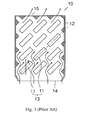
- US Patent No. 7,795,845 discloses a rechargeable battery module 10 including a plurality of unit cells 11; and a housing 12 in which the unit cells 11 are mounted and in which a coolant (indicated by the arrows) for controlling the temperature in the housing 12 circulates.
- the unit cells 11 are disposed in the housing 12 on a slant at a predetermined angle with respect to an inflow of the coolant.
- the prismatic unit cells 11 are arranged at predetermined intervals inside the housing 12 to form a cell series 13.
- the housing 12 has an inlet 14 at one side, through which air for regulating the temperature of the unit cells 11 can flow in, and an outlet 15 at the other side thereof, through which the air passing by the unit cells 11 can dissipate.
- the intervals between the unit cells 11 can't be too small or else the coolant won't be able to circulate, and therefore, the size of the rechargeable battery module 10 is limited and can't be minimized.
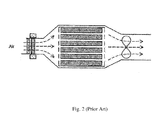
- US Pub. No. 2007/0196728 discloses a battery that has a double filter device mounted at an air inlet part, through which air for cooling the battery pack.
- the double filter includes a pre-filter having relatively large air holes.
- the pre-filter has high frequency of replacement and a medium filter has relatively small air holes.
- the medium filter having low frequency of replacement.
- the pre-filter is located before the medium filter in the direction in which the air is introduced. Consequently, dust is removed from the air and the cooling efficiency of the battery pack is increased.
- such structure makes the battery bulgy which is not suitable for compact designs of battery packs.
- a battery pack having a cooling system includes: a plurality of battery units linked in series or in parallel and arranged in a plane for providing power; a plurality of thermal conducting bars each has a number of side walls and two ends, averagely located among the battery units and substantially contacted to the battery units by the side walls, for conducting heat out of the battery units to the two ends; and a housing for containing the battery units and thermal conducting bars and conducting heat from the ends of the thermal conducting bars to outside of the housing; wherein at least one end of the thermal conducting bar is connected to the housing and becomes an internal supporting structure of the housing.
- the battery pack further includes a fixture for fixing the battery units and thermal conducting bars on the plane.
- the thermal conducting bars include a fixture for fixing the battery units on the plane.
- the battery unit is a rechargeable battery.
- the thermal conducting bar is made of a thermal conductive material.
- the thermal conductive material is a metal or alloy.
- the metal is aluminum.
- the thermal conducting bar is hollow.
- the battery pack further includes a circulating system providing cooling liquid passing through the hollow portion of the thermal conducting bar from one end to the other for speeding up heat conduction.
- the cooling liquid is water, ethanol, glycol or oil.
- the number of side walls equals the number of battery units surrounding the thermal conducting bar.
- the side wall has a shape which is substantially the same as a portion of battery unit which contacts the thermal conducting bar.
- the thermal conducting bar is fixed to the housing by screws and heat of the thermal conducting bar can be conducted to outside of the housing via the screws or by contact with the housing.
- the housing is made of a thermal conductive material.
- the thermal conductive material is aluminum.
- the fixture is made of an insulator.
- the insulator is plastic.
- the fixture is made of thermal conductive material.
- Fig. 1 shows a prior art of a battery pack having cooling structure.
- Fig. 2 shows another prior art of a battery pack having cooling structure.
- Fig. 3 illustrates a housing of a battery pack according to a first embodiment of the present invention.
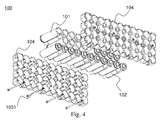
- Fig. 4 is an explosion diagram of the battery pack without the housing according to the first embodiment.
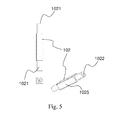
- Fig. 5 illustrates a thermal conducting bar of the first embodiment.
- Fig. 6 is a schematic diagram of a second embodiment of the present invention.
- Fig. 7 is a cross sectional view of a thermal conducting bar in the battery pack according to a third embodiment of the present invention.
- Fig. 8 is another cross sectional view of a thermal conducting bar in the battery pack according to the third embodiment of the present invention.
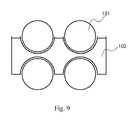
- Fig. 9 illustrates a thermal conducting bar including a fixture.
- FIG. 3 shows an appearance of a housing 103 of a battery pack 100. As shown, there are many screws 1031 on the housing 103. Functions of the screws 1031 will be described later in this embodiment.
- the battery pack 100 has a number of battery units 101, a number of thermal conducting bars 102 and two fixtures 104.
- the battery units 101 are linked in series or in parallel and arranged in a plane. They are the basic units to provide power.
- the thermal conducting bar 102 has four side walls 1025 and two ends 1021. Please refer to Fig. 4 and 5 at the same time.
- the thermal conducting bar 102 is averagely located among the battery units 101 and substantially contacted to the battery units 101 by the side walls 1025. That is to say, each side wall 1025 contacts with a battery unit 101 and a thermal conducting bar 102 in this embodiment is enclosed by four battery units 101.
- the thermal conducting bar 102 can conduct heat out of the battery units 101 from the two ends 1021.
- the housing 103 is used to contain the battery units 101 and thermal conducting bars 102. It can also conduct heat from the ends 1021 of the thermal conducting bars 102 to outside environment.
- One end 1021 of the thermal conducting bar 102 is connected to the housing 103 by fixing the screw 1031 into a screw hole 1022 of the thermal conducting bar 102 which also becomes an internal supporting structure of the housing 103. It can prevent the housing 103 from deformation when external forces exert on the housing 103.
- the thermal conducting bar 102 is connected to the housing 103 not only by screwing one end 1021 of the thermal conducting bar 102. Both of two ends 1021 can be screwed if there are only contain a single layer battery pack 100.
- the housing 103 is not limited to accommodate a single layer battery pack 100, more than one layers of battery packs 100 can be stacked together.
- the fixture 104 is used to fix the battery units 101 and thermal conducting bars 102 so that they can be well arranged on a plane.
- the battery unit 101 is a rechargeable battery.
- primary batteries can also be used.
- the thermal conducting bar 102 can be made of a thermal conductive material. Normally, the thermal conductive material is a metal or alloy. In the present embodiment, aluminum is used.
- the housing 103 is also made of a thermal conductive material. Similar to the thermal conducting bars 102, the thermal conductive material is also aluminum.
- the fixture 104 is made of an insulator.
- the insulator is plastic. Use of plastic is to prevent the battery units 101 from power leakage.
- the thermal conducting bar 102 is a solid element and just has two ends 1021 drilled for screwing. According to the spirits of the present invention, the thermal conducting bar 102 can be hollow.
- FIG. 6 A second embodiment is illustrated. There are many elements identical between the first and second embodiments. Those elements have the same functions. The only difference is in the thermal conducting bar 102.
- the thermal conducting bar 102 in the second embodiment is hollow. Therefore, a channel 1026 (although not seen but shown in dashed lines) is formed through the thermal conducting bar 102.
- a pump 1027 and two pipes 1028 and 1029 form a circulating system.
- the circulating system provides cooling liquid passing through the channel 1026 of the thermal conducting bar 102 from one end 1021 to the other. Thus, heat conduction can speed up. Water is used for the cooling liquid and follows the circulation direction shown in a solid arrow in Fig. 6 .
- the cooling liquid can be ethanol, glycol or oil.
- thermal conducting bars 102 are necessary to connect to the circulating system according to the spirits of the present invention. Several thermal conducting bars 102 can still connect to the housing 103 mentioned in the first embodiment by the screws 1031 so that the housing 103 can have sufficient internal supports.
- the number of side walls 1025 equals the number of battery units 101 surrounding the thermal conducting bar 102 mentioned in the first embodiment.
- the side wall 1025 is substantially the same as a portion of battery unit 101 which contacts the thermal conducting bar 102.
- Fig. 7 illustrates a cross sectional view of the thermal conducting bar 102 and the battery units 101 thereof surrounded.
- the thermal conducting bar 102 has a cross section of a square.
- the thermal conducting bar 102 has a cross section of a hexagon which allows six battery units 101 to be contacted.
- the thermal conducting bar 102 is used to efficiently dissipate heat radiated from the battery units 101.
- the shape of the cross section of the thermal conducting bar 102 depends on the amount of battery units 101 that the thermal conducting bar 102 is surrounded in.
- the amount of side walls is not limited to equal to the amount of battery units 101 that the thermal conducting bar 102 is surrounded in as described in this embodiment.
- two or more battery units 101 may be contacted to the same side wall 1025 while there are more than one layers of battery units 101 stacked together.
- the side wall 1025 of the thermal conducting bar 102 is a concave curve so that it can have more contact area with the battery units 101 surrounded. Consequently, cooling effect can be better than a plane shape.
- the fixture 104 and the thermal conducting bars 102 are two separated elements, it should be understood that they can be combined into one, as shown in Fig. 9 .
- the thermal conducting bars 102 can include a fixture 102 for fixing the battery units 101 on the plane.
- the fixture 102 would be made of thermal conductive material as that of the thermal conducting bars 102.
Landscapes
- Engineering & Computer Science (AREA)
- Chemical & Material Sciences (AREA)
- Chemical Kinetics & Catalysis (AREA)
- Electrochemistry (AREA)
- General Chemical & Material Sciences (AREA)
- Manufacturing & Machinery (AREA)
- Life Sciences & Earth Sciences (AREA)
- Sustainable Development (AREA)
- Sustainable Energy (AREA)
- Power Engineering (AREA)
- Transportation (AREA)
- Mechanical Engineering (AREA)
- Battery Mounting, Suspending (AREA)
- Secondary Cells (AREA)
Abstract
Description
- The present invention relates to a battery pack. More particularly, the present invention relates to a battery pack having a cooling system to dissipate heat from the battery pack. It can be applied to huge power required host, such as an electric vehicle.
- An electric vehicle, also referred to as an electric drive vehicle, is a moving vehicle using one or more electric motors as driving system. Not like petroleum-based transportations which are moved by the energy from burning gasoline, the electric vehicles use electric power as their propulsion. They won't generate waste gas. Noise is also less. During the last few decades, increased concern over the environmental impact of the petroleum-based transportation, along with the spectre of peak oil, has led to renewed interest in an electric transportation. Electric power for electric vehicles can be generated from a wide range of sources, including fossil fuels, nuclear power, and renewable sources such as tidal power, solar power, and wind or any combination of those.
- Some of the electric vehicles or even hybrid electric vehicles are now being commercially used. A nickel-metal hydride (Ni-MH) secondary battery has been mainly used as the power source for the electric vehicles (EV) and the hybrid electric vehicles (HEV). In recent years, even the use of a lithium-ion secondary battery has been attempted. High output and large capacity are needed for such secondary batteries to provide. For this reason, many small-sized secondary batteries (unit cells) are connected in series or in parallel with each other so as to construct a battery module. Many battery modules are connected in parallel or in series with each other so as to construct a battery pack.
- In such a high-output, large-capacity battery pack, however, a large amount of heat is generated from the unit cells during the charge and the discharge of the unit cells. When the heat generated from the unit cells during the charge and the discharge of the unit cells is not effectively removed, heat is accumulated in the unit cells with the result that the unit cells are degraded. Consequently, it is necessary to provide a cooling system for such battery packs.
- Particularly when a battery module is used to drive a motor for a hybrid electric vehicle (HEV), it is important to have adequate heat dissipation. If heat is not dissipated properly, the heat generated from the unit cells causes a temperature variation among the unit cells. The heat generated at the unit cells may also cause the temperature inside the unit cells to increase, resulting in explosion thereof.
- Since a battery module for a HEV is charged and discharged by a high current, it may have deteriorated performance due to the heat generated by the internal reaction of a rechargeable battery.
- Please refer to
Fig. 1 .US Patent No. 7,795,845 discloses arechargeable battery module 10 including a plurality ofunit cells 11; and ahousing 12 in which theunit cells 11 are mounted and in which a coolant (indicated by the arrows) for controlling the temperature in thehousing 12 circulates. Theunit cells 11 are disposed in thehousing 12 on a slant at a predetermined angle with respect to an inflow of the coolant. Theprismatic unit cells 11 are arranged at predetermined intervals inside thehousing 12 to form acell series 13. Thehousing 12 has aninlet 14 at one side, through which air for regulating the temperature of theunit cells 11 can flow in, and anoutlet 15 at the other side thereof, through which the air passing by theunit cells 11 can dissipate. However, the intervals between theunit cells 11 can't be too small or else the coolant won't be able to circulate, and therefore, the size of therechargeable battery module 10 is limited and can't be minimized. - Please Refer to
Fig. 2 .US Pub. No. 2007/0196728 discloses a battery that has a double filter device mounted at an air inlet part, through which air for cooling the battery pack. The double filter includes a pre-filter having relatively large air holes. The pre-filter has high frequency of replacement and a medium filter has relatively small air holes. The medium filter having low frequency of replacement. The pre-filter is located before the medium filter in the direction in which the air is introduced. Consequently, dust is removed from the air and the cooling efficiency of the battery pack is increased. However, such structure makes the battery bulgy which is not suitable for compact designs of battery packs. - Thus, a battery pack having an efficient cooling system which has a compact size and can also enhance the structure of the battery pack is desperately needed.
- This paragraph extracts and compiles some features of the present invention; other features will be disclosed in the follow-up paragraphs. It is intended to cover various modifications and similar arrangements included within the spirit and scope of the appended claims.
- In accordance with an aspect of the present invention, a battery pack having a cooling system, includes: a plurality of battery units linked in series or in parallel and arranged in a plane for providing power; a plurality of thermal conducting bars each has a number of side walls and two ends, averagely located among the battery units and substantially contacted to the battery units by the side walls, for conducting heat out of the battery units to the two ends; and a housing for containing the battery units and thermal conducting bars and conducting heat from the ends of the thermal conducting bars to outside of the housing; wherein at least one end of the thermal conducting bar is connected to the housing and becomes an internal supporting structure of the housing.
- Preferably, the battery pack further includes a fixture for fixing the battery units and thermal conducting bars on the plane.
- Preferably, the thermal conducting bars include a fixture for fixing the battery units on the plane.
- Preferably, the battery unit is a rechargeable battery.
- Preferably, the thermal conducting bar is made of a thermal conductive material.
- Preferably, the thermal conductive material is a metal or alloy.
- Preferably, the metal is aluminum.
- Preferably, the thermal conducting bar is hollow.
- Preferably, the battery pack further includes a circulating system providing cooling liquid passing through the hollow portion of the thermal conducting bar from one end to the other for speeding up heat conduction.
- Preferably, the cooling liquid is water, ethanol, glycol or oil.
- Preferably, the number of side walls equals the number of battery units surrounding the thermal conducting bar.
- Preferably, the side wall has a shape which is substantially the same as a portion of battery unit which contacts the thermal conducting bar.
- Preferably, the thermal conducting bar is fixed to the housing by screws and heat of the thermal conducting bar can be conducted to outside of the housing via the screws or by contact with the housing.
- Preferably, the housing is made of a thermal conductive material.
- Preferably, the thermal conductive material is aluminum.
- Preferably, the fixture is made of an insulator.
- Preferably, the insulator is plastic.
- Preferably, the fixture is made of thermal conductive material.
-
Fig. 1 shows a prior art of a battery pack having cooling structure. -
Fig. 2 shows another prior art of a battery pack having cooling structure. -
Fig. 3 illustrates a housing of a battery pack according to a first embodiment of the present invention. -
Fig. 4 is an explosion diagram of the battery pack without the housing according to the first embodiment. -
Fig. 5 illustrates a thermal conducting bar of the first embodiment. -
Fig. 6 is a schematic diagram of a second embodiment of the present invention. -
Fig. 7 is a cross sectional view of a thermal conducting bar in the battery pack according to a third embodiment of the present invention. -
Fig. 8 is another cross sectional view of a thermal conducting bar in the battery pack according to the third embodiment of the present invention. -
Fig. 9 illustrates a thermal conducting bar including a fixture. - The present invention will now be described more specifically with reference to the following embodiments. It is to be noted that the following descriptions of preferred embodiments of this invention are presented herein for purpose of illumination and description only; it is not intended to be exhaustive or to be limited to the precise form disclosed.
- Please refer to
Figs. 3 to 5 . A first embodiment is illustrated. Please refer toFig. 3 . It shows an appearance of ahousing 103 of abattery pack 100. As shown, there aremany screws 1031 on thehousing 103. Functions of thescrews 1031 will be described later in this embodiment. - Next, please refer to
Fig. 4 . It is an explosion diagram of thebattery pack 100 without thehousing 103. Thebattery pack 100 has a number ofbattery units 101, a number of thermal conducting bars 102 and twofixtures 104. Thebattery units 101 are linked in series or in parallel and arranged in a plane. They are the basic units to provide power. In order to have a comprehensive understanding of the thermal conductingbar 102, please refer toFig. 5 . Thethermal conducting bar 102 has fourside walls 1025 and two ends 1021. Please refer toFig. 4 and5 at the same time. Thethermal conducting bar 102 is averagely located among thebattery units 101 and substantially contacted to thebattery units 101 by theside walls 1025. That is to say, eachside wall 1025 contacts with abattery unit 101 and athermal conducting bar 102 in this embodiment is enclosed by fourbattery units 101. Thethermal conducting bar 102 can conduct heat out of thebattery units 101 from the two ends 1021. - The
housing 103 is used to contain thebattery units 101 and thermal conducting bars 102. It can also conduct heat from theends 1021 of the thermal conducting bars 102 to outside environment. Oneend 1021 of the thermal conductingbar 102 is connected to thehousing 103 by fixing thescrew 1031 into ascrew hole 1022 of the thermal conductingbar 102 which also becomes an internal supporting structure of thehousing 103. It can prevent thehousing 103 from deformation when external forces exert on thehousing 103. - According to the spirits of the present invention, several points should be noticed. First, the thermal conducting
bar 102 is connected to thehousing 103 not only by screwing oneend 1021 of the thermal conductingbar 102. Both of twoends 1021 can be screwed if there are only contain a singlelayer battery pack 100. In other words, thehousing 103 is not limited to accommodate a singlelayer battery pack 100, more than one layers of battery packs 100 can be stacked together. Thefixture 104 is used to fix thebattery units 101 and thermal conducting bars 102 so that they can be well arranged on a plane. In this embodiment, thebattery unit 101 is a rechargeable battery. However, in practice, primary batteries can also be used. Thethermal conducting bar 102 can be made of a thermal conductive material. Normally, the thermal conductive material is a metal or alloy. In the present embodiment, aluminum is used. Thehousing 103 is also made of a thermal conductive material. Similar to the thermal conducting bars 102, the thermal conductive material is also aluminum. - Last, the
fixture 104 is made of an insulator. In this embodiment, the insulator is plastic. Use of plastic is to prevent thebattery units 101 from power leakage. - In the first embodiment, the thermal conducting
bar 102 is a solid element and just has twoends 1021 drilled for screwing. According to the spirits of the present invention, the thermal conductingbar 102 can be hollow. - Please refer to
Fig. 6 . A second embodiment is illustrated. There are many elements identical between the first and second embodiments. Those elements have the same functions. The only difference is in the thermal conductingbar 102. Thethermal conducting bar 102 in the second embodiment is hollow. Therefore, a channel 1026 (although not seen but shown in dashed lines) is formed through the thermal conductingbar 102. Apump 1027 and twopipes channel 1026 of the thermal conductingbar 102 from oneend 1021 to the other. Thus, heat conduction can speed up. Water is used for the cooling liquid and follows the circulation direction shown in a solid arrow inFig. 6 . In practice, the cooling liquid can be ethanol, glycol or oil. - It should be emphasized that not all of the thermal conducting bars 102 are necessary to connect to the circulating system according to the spirits of the present invention. Several thermal conducting bars 102 can still connect to the
housing 103 mentioned in the first embodiment by thescrews 1031 so that thehousing 103 can have sufficient internal supports. - Please refer to
Fig. 7 andFig. 8 . A third embodiment is illustrated. According to the present invention, the number ofside walls 1025 equals the number ofbattery units 101 surrounding the thermal conductingbar 102 mentioned in the first embodiment. Theside wall 1025 is substantially the same as a portion ofbattery unit 101 which contacts the thermal conductingbar 102. - Members having like functions will be identified by the same reference numerals and overlapping descriptions will be omitted. Please refer to
Fig. 7 which illustrates a cross sectional view of the thermal conductingbar 102 and thebattery units 101 thereof surrounded. In the first embodiment, the thermal conductingbar 102 has a cross section of a square. In this embodiment, the thermal conductingbar 102 has a cross section of a hexagon which allows sixbattery units 101 to be contacted. Thethermal conducting bar 102 is used to efficiently dissipate heat radiated from thebattery units 101. The shape of the cross section of the thermal conductingbar 102 depends on the amount ofbattery units 101 that the thermal conductingbar 102 is surrounded in. Please understand that the amount of side walls is not limited to equal to the amount ofbattery units 101 that the thermal conductingbar 102 is surrounded in as described in this embodiment. For example, two ormore battery units 101 may be contacted to thesame side wall 1025 while there are more than one layers ofbattery units 101 stacked together. - Finally, please refer to
Fig. 8 . Theside wall 1025 of the thermal conductingbar 102 is a concave curve so that it can have more contact area with thebattery units 101 surrounded. Consequently, cooling effect can be better than a plane shape. - Furthermore, although in the aforementioned embodiments the
fixture 104 and the thermal conducting bars 102 are two separated elements, it should be understood that they can be combined into one, as shown inFig. 9 . Meaning that, the thermal conducting bars 102 can include afixture 102 for fixing thebattery units 101 on the plane. In this case, thefixture 102 would be made of thermal conductive material as that of the thermal conducting bars 102. - While the invention has been described in terms of what is presently considered to be the most practical and preferred embodiments, it is to be understood that the invention needs not be limited to the disclosed embodiments. On the contrary, it is intended to cover various modifications and similar arrangements included within the spirit and scope of the appended claims, which are to be accorded with the broadest interpretation so as to encompass all such modifications and similar structures.
Claims (15)
- A battery pack having a cooling system, comprising:a plurality of battery units linked in series or in parallel and arranged in a plane for providing power;a plurality of thermal conducting bars each has a number of side walls and two ends, averagely located among the battery units and substantially contacted to the battery units by the side walls, for conducting heat out of the battery units to the two ends; anda housing for containing the battery units and thermal conducting bars and conducting heat from the ends of the thermal conducting bars to outside of the housing;wherein at least one end of the thermal conducting bar is connected to the housing and becomes an internal supporting structure of the housing.
- The battery pack according to claim 1, further comprising a fixture for fixing the battery units and thermal conducting bars on the plane.
- The battery pack according to claim 1, wherein the thermal conducting bars comprises a fixture for fixing the battery units on the plane.
- The battery pack according to claim 1, wherein the battery unit is a rechargeable battery.
- The battery pack according to claim 1, wherein the thermal conducting bar is made of a thermal conductive material, metal or alloy.
- The battery pack according to claim 5, wherein the metal is aluminum.
- The battery pack according to claim 1, wherein the thermal conducting bar is hollow.
- The battery pack according to claim 7, further comprising a circulating system providing cooling liquid passing through the hollow portion of the thermal conducting bar from one end to the other for speeding up heat conduction.
- The battery pack according to claim 8, wherein the cooling liquid is water, ethanol, glycol or oil.
- The battery pack according to claim 1, wherein the number of side walls equals the number of battery units surrounding the thermal conducting bar.
- The battery pack according to claim 1, wherein the side wall has a shape which is substantially the same as a portion of battery unit which contacts the thermal conducting bar.
- The battery pack according to claim 1, wherein the thermal conducting bar is fixed to the housing by screws and heat of the thermal conducting bar can be conducted to outside of the housing via the screws or by contact with the housing.
- The battery pack according to claim 1, wherein the housing is made of a thermal conductive material or aluminum.
- The battery pack according to claim 2, wherein the fixture is made of an insulator or plastic.
- The battery pack according to claim 3, wherein the fixture is made of thermal conductive material.
Priority Applications (1)
| Application Number | Priority Date | Filing Date | Title |
|---|---|---|---|
| PL12187315T PL2579385T3 (en) | 2011-10-05 | 2012-10-04 | Battery pack having cooling system |
Applications Claiming Priority (1)
| Application Number | Priority Date | Filing Date | Title |
|---|---|---|---|
| US13/253,280 US8785027B2 (en) | 2011-10-05 | 2011-10-05 | Battery pack having cooling system |
Publications (2)
| Publication Number | Publication Date |
|---|---|
| EP2579385A1 true EP2579385A1 (en) | 2013-04-10 |
| EP2579385B1 EP2579385B1 (en) | 2015-12-16 |
Family
ID=47040555
Family Applications (1)
| Application Number | Title | Priority Date | Filing Date |
|---|---|---|---|
| EP12187315.2A Active EP2579385B1 (en) | 2011-10-05 | 2012-10-04 | Battery pack having cooling system |
Country Status (5)
| Country | Link |
|---|---|
| US (1) | US8785027B2 (en) |
| EP (1) | EP2579385B1 (en) |
| ES (1) | ES2561533T3 (en) |
| PL (1) | PL2579385T3 (en) |
| TW (1) | TWI460902B (en) |
Cited By (3)
| Publication number | Priority date | Publication date | Assignee | Title |
|---|---|---|---|---|
| CN106300592A (en) * | 2016-08-27 | 2017-01-04 | 广东工业大学 | A kind of emergency generator |
| US10121997B1 (en) | 2014-07-30 | 2018-11-06 | Google Llc | Battery module |
| CN111146385A (en) * | 2019-12-16 | 2020-05-12 | 深圳市正浩创新科技有限公司 | Battery cell heat dissipation method based on support structure and support structure |
Families Citing this family (15)
| Publication number | Priority date | Publication date | Assignee | Title |
|---|---|---|---|---|
| CN104247141B (en) * | 2012-05-07 | 2018-04-27 | 株式会社Lg 化学 | Electrode assemblie and the lithium secondary battery including the electrode assemblie |
| US10720683B2 (en) | 2014-09-30 | 2020-07-21 | Cps Technology Holdings Llc | Battery module thermal management features for internal flow |
| US10658717B2 (en) | 2014-09-30 | 2020-05-19 | Cps Technology Holdings Llc | Battery module active thermal management features and positioning |
| US9825343B2 (en) | 2014-09-30 | 2017-11-21 | Johnson Controls Technology Company | Battery module passive thermal management features and positioning |
| US10651432B2 (en) | 2015-04-13 | 2020-05-12 | Cps Technology Holdings Llc | Systems and methods for a reinforcement column within a module body |
| US20160344072A1 (en) * | 2015-05-19 | 2016-11-24 | Go-Tech Energy Co., Ltd. | Rechargeable battery module |
| KR102301196B1 (en) * | 2018-10-04 | 2021-09-09 | 주식회사 엘지에너지솔루션 | Battery Pack Having Connecting Plate |
| KR102313023B1 (en) | 2018-11-29 | 2021-10-13 | 주식회사 엘지에너지솔루션 | Battery Pack Having Battery Module |
| KR102813064B1 (en) | 2019-12-03 | 2025-05-26 | 밀워키 일렉트릭 툴 코포레이션 | Battery pack and charger system |
| CN114069079A (en) * | 2021-09-28 | 2022-02-18 | 蒲志全 | A new energy battery structure with automatic heat detection function |
| US12119472B2 (en) | 2021-12-10 | 2024-10-15 | Wing Aviation Llc | Active thermal control of UAV energy storage units |
| TWI833208B (en) * | 2022-04-26 | 2024-02-21 | 新盛力科技股份有限公司 | Battery device with thermal protection mechanism |
| US11949080B2 (en) | 2022-09-06 | 2024-04-02 | Harbinger Motors Inc. | Battery packs with safety features and methods of installing such packs on truck frames |
| WO2024054861A1 (en) | 2022-09-06 | 2024-03-14 | Harbinger Motors Inc. | Battery modules with casted module enclosures and battery packs with safety features |
| CN118281415B (en) * | 2024-04-08 | 2025-06-03 | 内蒙古建亨奥能科技有限公司 | Self-temperature-control photovoltaic energy storage sodium salt battery |
Citations (5)
| Publication number | Priority date | Publication date | Assignee | Title |
|---|---|---|---|---|
| US20070020513A1 (en) * | 2001-10-04 | 2007-01-25 | Ise Corporation | Energy Storage Cell Support Separator and Cooling System for a Multiple Cell Module |
| US20070196728A1 (en) | 2005-09-02 | 2007-08-23 | Yang Jae H | Cooling system for vehicle battery pack containing double filter device |
| US20100136405A1 (en) * | 2008-04-02 | 2010-06-03 | Karl Johnson | Battery pack with optimized mechanical, electrical, and thermal management |
| US7795845B2 (en) | 2005-03-25 | 2010-09-14 | Samsung Sdi Co., Ltd. | Rechargeable battery module having a cooling mechanism |
| WO2011092773A1 (en) * | 2010-01-29 | 2011-08-04 | パナソニック株式会社 | Cell module |
Family Cites Families (3)
| Publication number | Priority date | Publication date | Assignee | Title |
|---|---|---|---|---|
| US20080068801A1 (en) * | 2001-10-04 | 2008-03-20 | Ise Corporation | High-Power Ultracapacitor Energy Storage Cell Pack and Coupling Method |
| TWI295118B (en) * | 2004-03-10 | 2008-03-21 | Black & Decker Inc | Thermal management systems for battery packs |
| US9077056B2 (en) * | 2007-12-11 | 2015-07-07 | Battery Patent Trust | Device for housing electrochemical cells |
-
2011
- 2011-10-05 US US13/253,280 patent/US8785027B2/en active Active
-
2012
- 2012-01-09 TW TW101100820A patent/TWI460902B/en active
- 2012-10-04 PL PL12187315T patent/PL2579385T3/en unknown
- 2012-10-04 EP EP12187315.2A patent/EP2579385B1/en active Active
- 2012-10-04 ES ES12187315.2T patent/ES2561533T3/en active Active
Patent Citations (5)
| Publication number | Priority date | Publication date | Assignee | Title |
|---|---|---|---|---|
| US20070020513A1 (en) * | 2001-10-04 | 2007-01-25 | Ise Corporation | Energy Storage Cell Support Separator and Cooling System for a Multiple Cell Module |
| US7795845B2 (en) | 2005-03-25 | 2010-09-14 | Samsung Sdi Co., Ltd. | Rechargeable battery module having a cooling mechanism |
| US20070196728A1 (en) | 2005-09-02 | 2007-08-23 | Yang Jae H | Cooling system for vehicle battery pack containing double filter device |
| US20100136405A1 (en) * | 2008-04-02 | 2010-06-03 | Karl Johnson | Battery pack with optimized mechanical, electrical, and thermal management |
| WO2011092773A1 (en) * | 2010-01-29 | 2011-08-04 | パナソニック株式会社 | Cell module |
Cited By (5)
| Publication number | Priority date | Publication date | Assignee | Title |
|---|---|---|---|---|
| US10121997B1 (en) | 2014-07-30 | 2018-11-06 | Google Llc | Battery module |
| US11171383B1 (en) | 2014-07-30 | 2021-11-09 | Google Llc | Battery module |
| CN106300592A (en) * | 2016-08-27 | 2017-01-04 | 广东工业大学 | A kind of emergency generator |
| CN106300592B (en) * | 2016-08-27 | 2019-05-10 | 广东工业大学 | an emergency power generation device |
| CN111146385A (en) * | 2019-12-16 | 2020-05-12 | 深圳市正浩创新科技有限公司 | Battery cell heat dissipation method based on support structure and support structure |
Also Published As
| Publication number | Publication date |
|---|---|
| EP2579385B1 (en) | 2015-12-16 |
| US8785027B2 (en) | 2014-07-22 |
| ES2561533T3 (en) | 2016-02-26 |
| TW201316591A (en) | 2013-04-16 |
| PL2579385T3 (en) | 2016-06-30 |
| US20130089768A1 (en) | 2013-04-11 |
| TWI460902B (en) | 2014-11-11 |
Similar Documents
| Publication | Publication Date | Title |
|---|---|---|
| US8785027B2 (en) | Battery pack having cooling system | |
| JP6466049B2 (en) | Battery pack having a cooling system | |
| US7795845B2 (en) | Rechargeable battery module having a cooling mechanism | |
| JP5307250B2 (en) | Battery module having cooling means, and (medium or large) battery pack including the same | |
| KR101965373B1 (en) | Cylindrical Battery Module | |
| JP4860715B2 (en) | Medium or large battery pack case with improved distribution uniformity of refrigerant flux | |
| CN106469839B (en) | Battery module, battery pack including battery module, and vehicle including battery pack | |
| EP3361554B1 (en) | Battery module, battery pack comprising battery module, and vehicle comprising battery pack | |
| US10632848B2 (en) | Battery module of improved safety | |
| US20160079640A1 (en) | Water-cooled battery module and water-cooled battery cooling apparatus using the same | |
| KR101206272B1 (en) | Heat sink of battery cell for electric vehicle and battery cell module using the same | |
| CN101292377B (en) | Cooling system of battery pack | |
| CN1319916A (en) | Fluid Cooled Battery Pack System | |
| JP2013502688A (en) | Battery pack with new cooling structure | |
| JP6317438B2 (en) | Battery cell assembly | |
| KR20130033597A (en) | Secondary battery module | |
| KR101496523B1 (en) | Radiant heat plate for battery cell | |
| CN114128018B (en) | Battery pack and vehicle including the battery pack | |
| JP2011187275A (en) | Battery module, battery box housing the same, and rolling stock equipped with the same | |
| KR101610742B1 (en) | Battery Module Employed with Battery Cell Case Having Heat Dissipation Part | |
| KR101232784B1 (en) | Secondary battery cooling apparatus and heating system using heat generated from secondary battery operation | |
| CN105304839B (en) | Battery module with liquid cooling | |
| WO2018180254A1 (en) | Battery pack | |
| KR102067709B1 (en) | Battery module, battery pack comprising the battery module and vehicle comprising the battery pack | |
| EP3772122A1 (en) | Battery module with a multifunctional end-plate |
Legal Events
| Date | Code | Title | Description |
|---|---|---|---|
| PUAI | Public reference made under article 153(3) epc to a published international application that has entered the european phase |
Free format text: ORIGINAL CODE: 0009012 |
|
| AK | Designated contracting states |
Kind code of ref document: A1 Designated state(s): AL AT BE BG CH CY CZ DE DK EE ES FI FR GB GR HR HU IE IS IT LI LT LU LV MC MK MT NL NO PL PT RO RS SE SI SK SM TR |
|
| AX | Request for extension of the european patent |
Extension state: BA ME |
|
| 17P | Request for examination filed |
Effective date: 20130828 |
|
| RBV | Designated contracting states (corrected) |
Designated state(s): AL AT BE BG CH CY CZ DE DK EE ES FI FR GB GR HR HU IE IS IT LI LT LU LV MC MK MT NL NO PL PT RO RS SE SI SK SM TR |
|
| REG | Reference to a national code |
Ref country code: DE Ref legal event code: R079 Ref document number: 602012013070 Country of ref document: DE Free format text: PREVIOUS MAIN CLASS: H01M0010500000 Ipc: H01M0010613000 |
|
| GRAP | Despatch of communication of intention to grant a patent |
Free format text: ORIGINAL CODE: EPIDOSNIGR1 |
|
| RIC1 | Information provided on ipc code assigned before grant |
Ipc: H01M 2/10 20060101ALI20150327BHEP Ipc: H01M 10/6557 20140101ALI20150327BHEP Ipc: H01M 2/02 20060101ALI20150327BHEP Ipc: H01M 10/6567 20140101ALI20150327BHEP Ipc: B60L 11/18 20060101ALI20150327BHEP Ipc: H01M 10/6555 20140101ALI20150327BHEP Ipc: H01M 10/613 20140101AFI20150327BHEP Ipc: H01M 10/643 20140101ALN20150327BHEP |
|
| INTG | Intention to grant announced |
Effective date: 20150428 |
|
| GRAS | Grant fee paid |
Free format text: ORIGINAL CODE: EPIDOSNIGR3 |
|
| GRAA | (expected) grant |
Free format text: ORIGINAL CODE: 0009210 |
|
| AK | Designated contracting states |
Kind code of ref document: B1 Designated state(s): AL AT BE BG CH CY CZ DE DK EE ES FI FR GB GR HR HU IE IS IT LI LT LU LV MC MK MT NL NO PL PT RO RS SE SI SK SM TR |
|
| REG | Reference to a national code |
Ref country code: GB Ref legal event code: FG4D |
|
| REG | Reference to a national code |
Ref country code: CH Ref legal event code: EP |
|
| REG | Reference to a national code |
Ref country code: IE Ref legal event code: FG4D |
|
| REG | Reference to a national code |
Ref country code: AT Ref legal event code: REF Ref document number: 765947 Country of ref document: AT Kind code of ref document: T Effective date: 20160115 |
|
| REG | Reference to a national code |
Ref country code: DE Ref legal event code: R096 Ref document number: 602012013070 Country of ref document: DE |
|
| REG | Reference to a national code |
Ref country code: DE Ref legal event code: R082 Ref document number: 602012013070 Country of ref document: DE Representative=s name: LANGPATENT ANWALTSKANZLEI IP LAW FIRM, DE |
|
| REG | Reference to a national code |
Ref country code: ES Ref legal event code: FG2A Ref document number: 2561533 Country of ref document: ES Kind code of ref document: T3 Effective date: 20160226 |
|
| REG | Reference to a national code |
Ref country code: NL Ref legal event code: FP |
|
| REG | Reference to a national code |
Ref country code: LT Ref legal event code: MG4D |
|
| PG25 | Lapsed in a contracting state [announced via postgrant information from national office to epo] |
Ref country code: LT Free format text: LAPSE BECAUSE OF FAILURE TO SUBMIT A TRANSLATION OF THE DESCRIPTION OR TO PAY THE FEE WITHIN THE PRESCRIBED TIME-LIMIT Effective date: 20151216 Ref country code: HR Free format text: LAPSE BECAUSE OF FAILURE TO SUBMIT A TRANSLATION OF THE DESCRIPTION OR TO PAY THE FEE WITHIN THE PRESCRIBED TIME-LIMIT Effective date: 20151216 Ref country code: NO Free format text: LAPSE BECAUSE OF FAILURE TO SUBMIT A TRANSLATION OF THE DESCRIPTION OR TO PAY THE FEE WITHIN THE PRESCRIBED TIME-LIMIT Effective date: 20160316 |
|
| REG | Reference to a national code |
Ref country code: AT Ref legal event code: MK05 Ref document number: 765947 Country of ref document: AT Kind code of ref document: T Effective date: 20151216 |
|
| PG25 | Lapsed in a contracting state [announced via postgrant information from national office to epo] |
Ref country code: LV Free format text: LAPSE BECAUSE OF FAILURE TO SUBMIT A TRANSLATION OF THE DESCRIPTION OR TO PAY THE FEE WITHIN THE PRESCRIBED TIME-LIMIT Effective date: 20151216 Ref country code: SE Free format text: LAPSE BECAUSE OF FAILURE TO SUBMIT A TRANSLATION OF THE DESCRIPTION OR TO PAY THE FEE WITHIN THE PRESCRIBED TIME-LIMIT Effective date: 20151216 Ref country code: FI Free format text: LAPSE BECAUSE OF FAILURE TO SUBMIT A TRANSLATION OF THE DESCRIPTION OR TO PAY THE FEE WITHIN THE PRESCRIBED TIME-LIMIT Effective date: 20151216 Ref country code: GR Free format text: LAPSE BECAUSE OF FAILURE TO SUBMIT A TRANSLATION OF THE DESCRIPTION OR TO PAY THE FEE WITHIN THE PRESCRIBED TIME-LIMIT Effective date: 20160317 Ref country code: RS Free format text: LAPSE BECAUSE OF FAILURE TO SUBMIT A TRANSLATION OF THE DESCRIPTION OR TO PAY THE FEE WITHIN THE PRESCRIBED TIME-LIMIT Effective date: 20151216 |
|
| PG25 | Lapsed in a contracting state [announced via postgrant information from national office to epo] |
Ref country code: CZ Free format text: LAPSE BECAUSE OF FAILURE TO SUBMIT A TRANSLATION OF THE DESCRIPTION OR TO PAY THE FEE WITHIN THE PRESCRIBED TIME-LIMIT Effective date: 20151216 |
|
| PG25 | Lapsed in a contracting state [announced via postgrant information from national office to epo] |
Ref country code: EE Free format text: LAPSE BECAUSE OF FAILURE TO SUBMIT A TRANSLATION OF THE DESCRIPTION OR TO PAY THE FEE WITHIN THE PRESCRIBED TIME-LIMIT Effective date: 20151216 Ref country code: SK Free format text: LAPSE BECAUSE OF FAILURE TO SUBMIT A TRANSLATION OF THE DESCRIPTION OR TO PAY THE FEE WITHIN THE PRESCRIBED TIME-LIMIT Effective date: 20151216 Ref country code: IS Free format text: LAPSE BECAUSE OF FAILURE TO SUBMIT A TRANSLATION OF THE DESCRIPTION OR TO PAY THE FEE WITHIN THE PRESCRIBED TIME-LIMIT Effective date: 20160416 Ref country code: AT Free format text: LAPSE BECAUSE OF FAILURE TO SUBMIT A TRANSLATION OF THE DESCRIPTION OR TO PAY THE FEE WITHIN THE PRESCRIBED TIME-LIMIT Effective date: 20151216 Ref country code: RO Free format text: LAPSE BECAUSE OF FAILURE TO SUBMIT A TRANSLATION OF THE DESCRIPTION OR TO PAY THE FEE WITHIN THE PRESCRIBED TIME-LIMIT Effective date: 20151216 Ref country code: SM Free format text: LAPSE BECAUSE OF FAILURE TO SUBMIT A TRANSLATION OF THE DESCRIPTION OR TO PAY THE FEE WITHIN THE PRESCRIBED TIME-LIMIT Effective date: 20151216 Ref country code: PT Free format text: LAPSE BECAUSE OF FAILURE TO SUBMIT A TRANSLATION OF THE DESCRIPTION OR TO PAY THE FEE WITHIN THE PRESCRIBED TIME-LIMIT Effective date: 20160418 |
|
| REG | Reference to a national code |
Ref country code: DE Ref legal event code: R097 Ref document number: 602012013070 Country of ref document: DE |
|
| REG | Reference to a national code |
Ref country code: FR Ref legal event code: PLFP Year of fee payment: 5 |
|
| PLBE | No opposition filed within time limit |
Free format text: ORIGINAL CODE: 0009261 |
|
| STAA | Information on the status of an ep patent application or granted ep patent |
Free format text: STATUS: NO OPPOSITION FILED WITHIN TIME LIMIT |
|
| PG25 | Lapsed in a contracting state [announced via postgrant information from national office to epo] |
Ref country code: DK Free format text: LAPSE BECAUSE OF FAILURE TO SUBMIT A TRANSLATION OF THE DESCRIPTION OR TO PAY THE FEE WITHIN THE PRESCRIBED TIME-LIMIT Effective date: 20151216 |
|
| 26N | No opposition filed |
Effective date: 20160919 |
|
| PG25 | Lapsed in a contracting state [announced via postgrant information from national office to epo] |
Ref country code: BE Free format text: LAPSE BECAUSE OF FAILURE TO SUBMIT A TRANSLATION OF THE DESCRIPTION OR TO PAY THE FEE WITHIN THE PRESCRIBED TIME-LIMIT Effective date: 20151216 |
|
| PG25 | Lapsed in a contracting state [announced via postgrant information from national office to epo] |
Ref country code: SI Free format text: LAPSE BECAUSE OF FAILURE TO SUBMIT A TRANSLATION OF THE DESCRIPTION OR TO PAY THE FEE WITHIN THE PRESCRIBED TIME-LIMIT Effective date: 20151216 |
|
| REG | Reference to a national code |
Ref country code: CH Ref legal event code: PL |
|
| GBPC | Gb: european patent ceased through non-payment of renewal fee |
Effective date: 20161004 |
|
| REG | Reference to a national code |
Ref country code: IE Ref legal event code: MM4A |
|
| PG25 | Lapsed in a contracting state [announced via postgrant information from national office to epo] |
Ref country code: CH Free format text: LAPSE BECAUSE OF NON-PAYMENT OF DUE FEES Effective date: 20161031 Ref country code: GB Free format text: LAPSE BECAUSE OF NON-PAYMENT OF DUE FEES Effective date: 20161004 Ref country code: LI Free format text: LAPSE BECAUSE OF NON-PAYMENT OF DUE FEES Effective date: 20161031 |
|
| PG25 | Lapsed in a contracting state [announced via postgrant information from national office to epo] |
Ref country code: LU Free format text: LAPSE BECAUSE OF NON-PAYMENT OF DUE FEES Effective date: 20161004 |
|
| REG | Reference to a national code |
Ref country code: FR Ref legal event code: PLFP Year of fee payment: 6 |
|
| PG25 | Lapsed in a contracting state [announced via postgrant information from national office to epo] |
Ref country code: IE Free format text: LAPSE BECAUSE OF NON-PAYMENT OF DUE FEES Effective date: 20161004 |
|
| PG25 | Lapsed in a contracting state [announced via postgrant information from national office to epo] |
Ref country code: HU Free format text: LAPSE BECAUSE OF FAILURE TO SUBMIT A TRANSLATION OF THE DESCRIPTION OR TO PAY THE FEE WITHIN THE PRESCRIBED TIME-LIMIT; INVALID AB INITIO Effective date: 20121004 Ref country code: CY Free format text: LAPSE BECAUSE OF FAILURE TO SUBMIT A TRANSLATION OF THE DESCRIPTION OR TO PAY THE FEE WITHIN THE PRESCRIBED TIME-LIMIT Effective date: 20151216 |
|
| PG25 | Lapsed in a contracting state [announced via postgrant information from national office to epo] |
Ref country code: MC Free format text: LAPSE BECAUSE OF FAILURE TO SUBMIT A TRANSLATION OF THE DESCRIPTION OR TO PAY THE FEE WITHIN THE PRESCRIBED TIME-LIMIT Effective date: 20151216 Ref country code: MK Free format text: LAPSE BECAUSE OF FAILURE TO SUBMIT A TRANSLATION OF THE DESCRIPTION OR TO PAY THE FEE WITHIN THE PRESCRIBED TIME-LIMIT Effective date: 20151216 Ref country code: TR Free format text: LAPSE BECAUSE OF FAILURE TO SUBMIT A TRANSLATION OF THE DESCRIPTION OR TO PAY THE FEE WITHIN THE PRESCRIBED TIME-LIMIT Effective date: 20151216 Ref country code: MT Free format text: LAPSE BECAUSE OF NON-PAYMENT OF DUE FEES Effective date: 20161031 |
|
| PG25 | Lapsed in a contracting state [announced via postgrant information from national office to epo] |
Ref country code: BG Free format text: LAPSE BECAUSE OF FAILURE TO SUBMIT A TRANSLATION OF THE DESCRIPTION OR TO PAY THE FEE WITHIN THE PRESCRIBED TIME-LIMIT Effective date: 20151216 |
|
| REG | Reference to a national code |
Ref country code: FR Ref legal event code: PLFP Year of fee payment: 7 |
|
| PG25 | Lapsed in a contracting state [announced via postgrant information from national office to epo] |
Ref country code: AL Free format text: LAPSE BECAUSE OF FAILURE TO SUBMIT A TRANSLATION OF THE DESCRIPTION OR TO PAY THE FEE WITHIN THE PRESCRIBED TIME-LIMIT Effective date: 20151216 |
|
| PGFP | Annual fee paid to national office [announced via postgrant information from national office to epo] |
Ref country code: FR Payment date: 20240912 Year of fee payment: 13 |
|
| PGFP | Annual fee paid to national office [announced via postgrant information from national office to epo] |
Ref country code: NL Payment date: 20240920 Year of fee payment: 13 |
|
| PGFP | Annual fee paid to national office [announced via postgrant information from national office to epo] |
Ref country code: PL Payment date: 20240930 Year of fee payment: 13 |
|
| PGFP | Annual fee paid to national office [announced via postgrant information from national office to epo] |
Ref country code: IT Payment date: 20240920 Year of fee payment: 13 |
|
| PGFP | Annual fee paid to national office [announced via postgrant information from national office to epo] |
Ref country code: DE Payment date: 20240920 Year of fee payment: 13 |
|
| PGFP | Annual fee paid to national office [announced via postgrant information from national office to epo] |
Ref country code: ES Payment date: 20241127 Year of fee payment: 13 |