EP2578805A1 - Gas turbine engine airfoil with tip recesses - Google Patents
Gas turbine engine airfoil with tip recesses Download PDFInfo
- Publication number
- EP2578805A1 EP2578805A1 EP12187063.8A EP12187063A EP2578805A1 EP 2578805 A1 EP2578805 A1 EP 2578805A1 EP 12187063 A EP12187063 A EP 12187063A EP 2578805 A1 EP2578805 A1 EP 2578805A1
- Authority
- EP
- European Patent Office
- Prior art keywords
- airfoil
- tip
- recess
- gas turbine
- airfoils
- Prior art date
- Legal status (The legal status is an assumption and is not a legal conclusion. Google has not performed a legal analysis and makes no representation as to the accuracy of the status listed.)
- Withdrawn
Links
Images

Classifications
-
- F—MECHANICAL ENGINEERING; LIGHTING; HEATING; WEAPONS; BLASTING
- F01—MACHINES OR ENGINES IN GENERAL; ENGINE PLANTS IN GENERAL; STEAM ENGINES
- F01D—NON-POSITIVE DISPLACEMENT MACHINES OR ENGINES, e.g. STEAM TURBINES
- F01D5/00—Blades; Blade-carrying members; Heating, heat-insulating, cooling or antivibration means on the blades or the members
- F01D5/12—Blades
- F01D5/14—Form or construction
- F01D5/20—Specially-shaped blade tips to seal space between tips and stator
-
- F—MECHANICAL ENGINEERING; LIGHTING; HEATING; WEAPONS; BLASTING
- F05—INDEXING SCHEMES RELATING TO ENGINES OR PUMPS IN VARIOUS SUBCLASSES OF CLASSES F01-F04
- F05D—INDEXING SCHEME FOR ASPECTS RELATING TO NON-POSITIVE-DISPLACEMENT MACHINES OR ENGINES, GAS-TURBINES OR JET-PROPULSION PLANTS
- F05D2240/00—Components
- F05D2240/10—Stators
- F05D2240/12—Fluid guiding means, e.g. vanes
- F05D2240/125—Fluid guiding means, e.g. vanes related to the tip of a stator vane
Definitions
- This application relates generally to gas turbine engine clearances between relatively rotating airfoil tips and seals and, more particularly, to clearances at airfoil tips of blades and cantilevered vanes.
- Gas turbine engine blades have airfoils have gaps between the rotatable blades and static seals or casings and static cantilevered vanes and rotating seals or rotors in both turbines and the compressors. Often referred to as tip clearances, it is desirable for an efficiency standpoint to reduce the gap between the rotating component and the radially adjacent static part in order to reduce leakage of the gas stream across this gap. The leakage not only reduces efficiency of the compressor or the turbine, but also reduces the life of the turbine blade tips and shroud members because of high temperatures acting on the parts.
- Some gas turbine engine designers will set the gap such that the blades will not rub at all. Some designers provide a negative gap in order to produce rub during the initial engine break-in in order to allow for the normal wear from the rub to produce a smooth and close to zero gap as possible. However, this rub can have undesirable results such as high vibratory stress at an airfoil tip of a rotatable blade or static cantilevered vane or at a tip of an impeller. A rub can have undesirable result of a loss of material fatigue strength.
- Blade tip clearances are a compromise between avoiding rubs and minimizing leakage for best engine performance. Rubs can lead to loss of strength, cracking and additional maintenance. Currently, clearances are often set more open, especially at LE and TE where blades are thin. This avoids rubs in areas of high stress, maintains material properties, and avoids tip cracking. Thus, it is highly desirable to provide an airfoil tip that has low leakage and avoids rubs in areas of high stress in order to maintain material properties and avoid tip cracking.
- a gas turbine engine component includes an airfoil extending from an airfoil base to an airfoil tip at a free end of the airfoil and extending downstream from a leading edge to a trailing edge of the airfoil. At least one recess extends into and circumferentially completely through the airfoil tip and is located inwardly of the leading and trailing edges of the airfoil.
- the recess may be located in an area of the airfoil tip subject to high tip vibratory stress and or rubs and may be a circular scallop having a scallop radius.
- the recess may have a maximum depth of a few mills in a range of about 0.127-0.254mm (5-10 mills (.005 - .01 inches)) as measured from a nominal tip edge without the recess.
- the airfoil may be on a gas turbine engine radial or impeller compressor blade.
- the airfoil may be on a gas turbine engine stator vane and extend radially inwardly from a base of the vane airfoil at an outward end of the stator vane to a vane airfoil tip of the vane airfoil at a radial inward end of the stator vane and extend downstream from a leading edge to a trailing edge of the vane airfoil.
- the recess extends into and circumferentially completely through the vane airfoil tip and the recess is located inwardly of the leading and trailing edges of the vane airfoil.
- a gas turbine engine assembly may include a plurality of the airfoils and an airfoil tip clearance between airfoil tips and an annular tip seal surrounding the airfoil tips containing the recesses or scallops.
- a method of reducing vibratory stress at an airfoil tip at a free end of an airfoil of a gas turbine engine component includes determining an area or areas of high tip vibratory stress and machining, cutting, or otherwise forming at least one recess or scallop extending into and circumferentially completely through the airfoil tip in the area or areas of high tip vibratory stress.
- the airfoil tip and airfoil may be in pluralities of airfoil tips and airfoils from a single stage or circumferential row of blades or vanes surrounded by annular tip seals and the determining an area or areas of high tip vibratory stress includes running or rotating a rotor containing the blades or an annular tip seal surrounding the vanes respectively and observing nicks or scratches in the annular seal or airfoil tips.
- the recesses or scallops are formed in area or areas of high tip vibratory stresses adjacent the nicks or scratches.
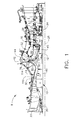
- FIG. 1 Illustrated in FIG. 1 is a gas turbine engine 8 with a high pressure gas generator 10.
- the high pressure gas generator 10 has a high pressure rotor 12 including, in downstream flow relationship, a high pressure compressor 14, a combustor 52, and a high pressure turbine 16.
- the high pressure compressor 14 includes high pressure multiple stage axial compressor stages and a single stage centrifugal compressor 18 as a final compressor stage.
- the rotor 12 is rotatably supported about an engine centerline 28 by a forward bearing 20 in a front frame 22 and a rear bearing 24 disposed downstream of high pressure turbine 16 in a turbine frame 26.
- the exemplary embodiment of the compressor 14 illustrated herein includes a five stage axial compressor 30 followed by the single stage centrifugal compressor 18 having an annular centrifugal compressor impeller 32. Outlet guide vanes 40 are disposed between the five stage axial compressor 30 and the single stage centrifugal compressor 18.
- the compressor 14 includes a forward casing 110 and an aft casing 114.
- the forward casing 110 generally surrounds the axial compressor 30 and the aft casing 114 generally surrounds the centrifugal compressor 18 and supports the diffuser 42 directly downstream of the centrifugal compressor 18.
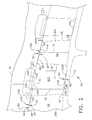
- the five stage axial compressor 30 includes third and fourth compressor stages 190, 193 of rotatable compressor blades 200 circumferentially surrounded by a blade shroud 69.
- a circumferential row of non-rotatable stator vanes 204 is disposed axially between the third and fourth compressor stages 190, 193 of the rotatable compressor blades 200. Illustrated in FIGS.
- FIG. 2 and 3 is a compressor blade 200 having a blade airfoil 54 extending radially outwardly from an airfoil base 56 located on the high pressure rotor 12 to a radially outer blade airfoil tip 58 at a free end 87 of the blade airfoil 54 as measured along a span S of the blade airfoil 54.
- the blade airfoil 54 extends downstream from a leading edge LE to a trailing edge TE.
- Each radially outer blade airfoil tip 58 is radially spaced apart and inwardly from and adjacent to a blade rub land 62 of the blade shroud 69 mounted on the compressor forward casing 110.
- An annular rotor airfoil tip clearance 60 is defined between the radially outer blade airfoil tip 58 and the blade rub land 62 on the compressor forward casing 110.
- the stator vanes 204 are cantilevered from and fixed to the forward casing 110 of their radial outward ends 234 and are unsupported at their radial inward ends 236 which are free ends 87.
- a vane airfoil 225 extends radially between the opposite radial outward and inward ends 234, 236. Each vane airfoil 225 extends radially inwardly from a base 228 of the vane airfoil 225 at the outward end 234 of the stator vane 204 to a vane airfoil tip 138 of the vane airfoil 225 at the radial inward end 236 of the stator vane 204.
- the vane airfoil 225 extends downstream from a leading edge LE to a trailing edge TE.
- Each vane airfoil tip 138 is radially spaced apart and outwardly from and adjacent to a rotor seal land 232 on the high pressure rotor 12.
- An annular vane airfoil tip clearance 66 is defined between the vane airfoil tip 138 and the rotor seal land 232 on the high pressure rotor 12.
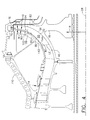
- compressor discharge pressure (CDP) air 76 is discharged from the impeller 32 of the centrifugal compressor 18 and directly into a diffuser 42 and then through a deswirl cascade 44 into a combustion chamber 45 within the combustor 52.
- the impeller 32 includes a plurality of impeller compressor blades 84 including impeller airfoils 88 extending outwardly from impeller airfoil bases 91 on a rotor disc portion 82 to impeller airfoil tips 86 at free ends 87 of the impeller airfoils 88.
- Each of the impeller airfoils 88 extends downstream from a leading edge LE to a trailing edge TE of the impeller airfoil 88.
- An annular centrifugal blade tip shroud 90 surrounds the impeller compressor blades 84 and impeller airfoils 88.
- the centrifugal blade tip shroud 90 is adjacent to the impeller airfoil tips 86 defining an annular impeller airfoil tip clearance 80 therebetween.
- the impeller airfoil tip clearance 80 varies in axial width W in a radial direction R as measured from the engine centerline 28.
- airfoil tip clearances 140 (illustrated herein as the rotor, vane, and impeller airfoil tip clearances 60, 66, 80) between airfoil tips 142 (illustrated herein as the blade, vane, and impeller airfoil tips 58, 138, 86) and annular tip seals 144 (illustrated herein as the blade rub land 62 on the compressor forward casing 110, the rotor seal land 232 on the high pressure rotor 12, and the centrifugal blade tip shroud 90).
- the rotor and vane airfoil tips 58, 138 and the impeller airfoil tips 86 have recesses 92 located in areas 93 subject to high tip vibratory stress to avoid rubs in the areas 93 of high stress, maintain material properties, and avoid tip cracking.
- the recesses 92 in the airfoil tips and impeller blade tips are located inwardly of the leading and trailing edges LE, TE of the airfoils and are illustrated herein the form of circular scallops 94.
- the airfoil and impeller are solid and the recesses 92 and scallops 94 extend circumferentially completely through the tips.
- the airfoil tips may also have leading and trailing edge corner cuts 96, 98 to further reduce vibratory stress deterioration of the airfoil tips which is particularly useful for thin leading and trailing edges LE, TE.
- the recesses 92 and scallops 94 are formed in or cut into nominal airfoil tip edges 106 of the rotor airfoil tips 58 which is illustrated as a dashed line in FIG. 3 .
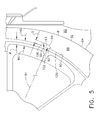
- the recesses 92 and scallops 94 are also illustrated as formed from or cut into impeller tip edges 108 of the impeller airfoil tips 86 as illustrated in FIGS. 4 and 5 .
- Nominal airfoil tip and impeller blade tip shapes 100, 102 are illustrated in dashed lines in FIGS. 3 and 5 .
- the nominal shapes are the originally designed tip shapes before the recesses or scallops are formed or cut in the tips.
- the nominal airfoil tip edge 106 are equidistantly spaced apart from the blade rub land 62 and are, thus, conical as illustrated in FIG. 3 or cylindrical.
- the nominal impeller tip edge 108 has an impeller blade tip shape 102 that may be a simple or a compound curve including at least a first sector 120 having a first radius of curvature R1 as illustrated in FIG. 5 .
- the recesses 92 and scallops 94 are very shallow having a maximum depth D of only a few mills such as in a range of about 5-10 mills (.005 - .01 inches) as measured from the nominal airfoil and impeller tip edges 106, 108 respectively for the exemplary engine illustrated herein. Larger engines may have larger recesses or scallops.
- the scallops 94 are circular having a scallop radius SR.
- the scallop radius SR of the scallops 94 in the impeller tip edges 108 of the impeller airfoil tips 86 is smaller than the first radius of curvature R1 of the impeller blade tip shape 102.
- the recesses and scallops can be machined or cut into the airfoil tips adjacent the nicks and scratches.
- the size and depth of the recesses and scallops may be tailored for each individual airfoil and, thus, vary from airfoil to airfoil within a stage or annular row of blades, vanes or impeller blades.
Landscapes
- Engineering & Computer Science (AREA)
- Mechanical Engineering (AREA)
- General Engineering & Computer Science (AREA)
- Structures Of Non-Positive Displacement Pumps (AREA)
- Turbine Rotor Nozzle Sealing (AREA)
Abstract
Description
- This application relates generally to gas turbine engine clearances between relatively rotating airfoil tips and seals and, more particularly, to clearances at airfoil tips of blades and cantilevered vanes.
- Gas turbine engine blades have airfoils have gaps between the rotatable blades and static seals or casings and static cantilevered vanes and rotating seals or rotors in both turbines and the compressors. Often referred to as tip clearances, it is desirable for an efficiency standpoint to reduce the gap between the rotating component and the radially adjacent static part in order to reduce leakage of the gas stream across this gap. The leakage not only reduces efficiency of the compressor or the turbine, but also reduces the life of the turbine blade tips and shroud members because of high temperatures acting on the parts.
- Some gas turbine engine designers will set the gap such that the blades will not rub at all. Some designers provide a negative gap in order to produce rub during the initial engine break-in in order to allow for the normal wear from the rub to produce a smooth and close to zero gap as possible. However, this rub can have undesirable results such as high vibratory stress at an airfoil tip of a rotatable blade or static cantilevered vane or at a tip of an impeller. A rub can have undesirable result of a loss of material fatigue strength.
- Blade tip clearances are a compromise between avoiding rubs and minimizing leakage for best engine performance. Rubs can lead to loss of strength, cracking and additional maintenance. Currently, clearances are often set more open, especially at LE and TE where blades are thin. This avoids rubs in areas of high stress, maintains material properties, and avoids tip cracking. Thus, it is highly desirable to provide an airfoil tip that has low leakage and avoids rubs in areas of high stress in order to maintain material properties and avoid tip cracking.
- A gas turbine engine component includes an airfoil extending from an airfoil base to an airfoil tip at a free end of the airfoil and extending downstream from a leading edge to a trailing edge of the airfoil. At least one recess extends into and circumferentially completely through the airfoil tip and is located inwardly of the leading and trailing edges of the airfoil.
- The recess may be located in an area of the airfoil tip subject to high tip vibratory stress and or rubs and may be a circular scallop having a scallop radius. The recess may have a maximum depth of a few mills in a range of about 0.127-0.254mm (5-10 mills (.005 - .01 inches)) as measured from a nominal tip edge without the recess.
- The airfoil may be on a gas turbine engine radial or impeller compressor blade. The airfoil may be on a gas turbine engine stator vane and extend radially inwardly from a base of the vane airfoil at an outward end of the stator vane to a vane airfoil tip of the vane airfoil at a radial inward end of the stator vane and extend downstream from a leading edge to a trailing edge of the vane airfoil. The recess extends into and circumferentially completely through the vane airfoil tip and the recess is located inwardly of the leading and trailing edges of the vane airfoil.
- A gas turbine engine assembly may include a plurality of the airfoils and an airfoil tip clearance between airfoil tips and an annular tip seal surrounding the airfoil tips containing the recesses or scallops.
- A method of reducing vibratory stress at an airfoil tip at a free end of an airfoil of a gas turbine engine component includes determining an area or areas of high tip vibratory stress and machining, cutting, or otherwise forming at least one recess or scallop extending into and circumferentially completely through the airfoil tip in the area or areas of high tip vibratory stress.
- The airfoil tip and airfoil may be in pluralities of airfoil tips and airfoils from a single stage or circumferential row of blades or vanes surrounded by annular tip seals and the determining an area or areas of high tip vibratory stress includes running or rotating a rotor containing the blades or an annular tip seal surrounding the vanes respectively and observing nicks or scratches in the annular seal or airfoil tips. The recesses or scallops are formed in area or areas of high tip vibratory stresses adjacent the nicks or scratches.
- The foregoing aspects and other features of the invention are explained in the following description, taken in connection with the accompanying drawings where:
-
FIG. 1 is a sectional view illustration of a gas turbine engine having axial and centrifugal compressor stages. -
FIG. 2 is an enlarged sectional view illustration of an axial compressor stage of the engine illustrated inFIG. 1 . -
FIG. 3 is a schematical sectional illustration of an airfoil tip with recesses in the axial compressor stage of the engine illustrated inFIG. 2 . -
FIG. 4 is an enlarged sectional view illustration of the centrifugal compressor stage of the engine illustrated inFIG. 1 . -
FIG. 5 is an enlarged sectional view illustration of the recess in centrifugal compressor stage of the engine illustrated inFIG. 4 . - Illustrated in
FIG. 1 is agas turbine engine 8 with a highpressure gas generator 10. The highpressure gas generator 10 has ahigh pressure rotor 12 including, in downstream flow relationship, ahigh pressure compressor 14, acombustor 52, and ahigh pressure turbine 16. Thehigh pressure compressor 14 includes high pressure multiple stage axial compressor stages and a single stagecentrifugal compressor 18 as a final compressor stage. Therotor 12 is rotatably supported about anengine centerline 28 by aforward bearing 20 in afront frame 22 and arear bearing 24 disposed downstream ofhigh pressure turbine 16 in aturbine frame 26. - The exemplary embodiment of the
compressor 14 illustrated herein includes a five stageaxial compressor 30 followed by the single stagecentrifugal compressor 18 having an annularcentrifugal compressor impeller 32.Outlet guide vanes 40 are disposed between the five stageaxial compressor 30 and the single stagecentrifugal compressor 18. Thecompressor 14 includes aforward casing 110 and anaft casing 114. Theforward casing 110 generally surrounds theaxial compressor 30 and theaft casing 114 generally surrounds thecentrifugal compressor 18 and supports thediffuser 42 directly downstream of thecentrifugal compressor 18. - Referring further to
FIG. 2 , the five stageaxial compressor 30 includes third andfourth compressor stages rotatable compressor blades 200 circumferentially surrounded by ablade shroud 69. A circumferential row ofnon-rotatable stator vanes 204 is disposed axially between the third andfourth compressor stages rotatable compressor blades 200. Illustrated inFIGS. 2 and3 is acompressor blade 200 having ablade airfoil 54 extending radially outwardly from anairfoil base 56 located on thehigh pressure rotor 12 to a radially outerblade airfoil tip 58 at afree end 87 of theblade airfoil 54 as measured along a span S of theblade airfoil 54. Theblade airfoil 54 extends downstream from a leading edge LE to a trailing edge TE. Each radially outerblade airfoil tip 58 is radially spaced apart and inwardly from and adjacent to ablade rub land 62 of theblade shroud 69 mounted on the compressorforward casing 110. An annular rotorairfoil tip clearance 60 is defined between the radially outerblade airfoil tip 58 and theblade rub land 62 on the compressorforward casing 110. - The
stator vanes 204 are cantilevered from and fixed to theforward casing 110 of their radial outwardends 234 and are unsupported at their radialinward ends 236 which arefree ends 87. Avane airfoil 225 extends radially between the opposite radial outward andinward ends vane airfoil 225 extends radially inwardly from abase 228 of thevane airfoil 225 at theoutward end 234 of thestator vane 204 to avane airfoil tip 138 of thevane airfoil 225 at the radialinward end 236 of thestator vane 204. Thevane airfoil 225 extends downstream from a leading edge LE to a trailing edge TE. Eachvane airfoil tip 138 is radially spaced apart and outwardly from and adjacent to arotor seal land 232 on thehigh pressure rotor 12. An annular vaneairfoil tip clearance 66 is defined between thevane airfoil tip 138 and therotor seal land 232 on thehigh pressure rotor 12. - Referring to
FIGS. 1 and4 , compressor discharge pressure (CDP)air 76 is discharged from theimpeller 32 of thecentrifugal compressor 18 and directly into adiffuser 42 and then through adeswirl cascade 44 into acombustion chamber 45 within thecombustor 52. Referring more particularly toFIG. 1 , theimpeller 32 includes a plurality ofimpeller compressor blades 84 includingimpeller airfoils 88 extending outwardly fromimpeller airfoil bases 91 on arotor disc portion 82 toimpeller airfoil tips 86 atfree ends 87 of theimpeller airfoils 88. Each of theimpeller airfoils 88 extends downstream from a leading edge LE to a trailing edge TE of theimpeller airfoil 88. An annular centrifugalblade tip shroud 90 surrounds theimpeller compressor blades 84 andimpeller airfoils 88. The centrifugalblade tip shroud 90 is adjacent to theimpeller airfoil tips 86 defining an annular impellerairfoil tip clearance 80 therebetween. The impellerairfoil tip clearance 80 varies in axial width W in a radial direction R as measured from theengine centerline 28. - It is desirable to minimize the rotor
airfoil tip clearance 60, the statorairfoil tip clearance 66, and the impellerairfoil tip clearance 80 during the engine operating cycle and avoid or minimize rubs between the associated lands and airfoil and blade tips, particularly, during engine accelerations such as during cold bursts. In more general terms, it is desirable to minimize airfoil tip clearances 140 (illustrated herein as the rotor, vane, and impellerairfoil tip clearances impeller airfoil tips blade rub land 62 on the compressorforward casing 110, therotor seal land 232 on thehigh pressure rotor 12, and the centrifugal blade tip shroud 90). To this end, the rotor andvane airfoil tips impeller airfoil tips 86, as illustrated inFIGS. 3 and4 , haverecesses 92 located inareas 93 subject to high tip vibratory stress to avoid rubs in theareas 93 of high stress, maintain material properties, and avoid tip cracking. - As exemplified in
FIG. 3 , therecesses 92 in the airfoil tips and impeller blade tips are located inwardly of the leading and trailing edges LE, TE of the airfoils and are illustrated herein the form ofcircular scallops 94. The airfoil and impeller are solid and therecesses 92 andscallops 94 extend circumferentially completely through the tips. The airfoil tips may also have leading and trailing edge corner cuts 96, 98 to further reduce vibratory stress deterioration of the airfoil tips which is particularly useful for thin leading and trailing edges LE, TE. - The
recesses 92 andscallops 94 are formed in or cut into nominal airfoil tip edges 106 of therotor airfoil tips 58 which is illustrated as a dashed line inFIG. 3 . Therecesses 92 andscallops 94 are also illustrated as formed from or cut into impeller tip edges 108 of theimpeller airfoil tips 86 as illustrated inFIGS. 4 and5 . Nominal airfoil tip and impeller blade tip shapes 100, 102 are illustrated in dashed lines inFIGS. 3 and5 . The nominal shapes are the originally designed tip shapes before the recesses or scallops are formed or cut in the tips. The nominalairfoil tip edge 106 are equidistantly spaced apart from theblade rub land 62 and are, thus, conical as illustrated inFIG. 3 or cylindrical. The nominalimpeller tip edge 108 has an impellerblade tip shape 102 that may be a simple or a compound curve including at least afirst sector 120 having a first radius of curvature R1 as illustrated inFIG. 5 . - The
recesses 92 andscallops 94 are very shallow having a maximum depth D of only a few mills such as in a range of about 5-10 mills (.005 - .01 inches) as measured from the nominal airfoil and impeller tip edges 106, 108 respectively for the exemplary engine illustrated herein. Larger engines may have larger recesses or scallops. Thescallops 94 are circular having a scallop radius SR. The scallop radius SR of thescallops 94 in the impeller tip edges 108 of theimpeller airfoil tips 86 is smaller than the first radius of curvature R1 of the impellerblade tip shape 102. - There are known methods of determining areas of high tip vibratory stress in the airfoil tips and impeller blade tips. There are analytical methods such as finite element analysis, empirical methods, and semi-empirical in which a combination of testing and analytical methods are used to determine if stresses will produce cracks or if there is undesirable rubbing. During engine production and overhaul, the engine is often run or rotated and rubbing may occur between airfoil tips and surrounding seals indicating areas of high tip vibratory stress in the airfoil tips and impeller blade tips. Nicks and scratches observed after such engine runs indicate such areas and where the recesses or scallops should be placed on the airfoil tips and impeller blade tips. The recesses and scallops can be machined or cut into the airfoil tips adjacent the nicks and scratches. The size and depth of the recesses and scallops may be tailored for each individual airfoil and, thus, vary from airfoil to airfoil within a stage or annular row of blades, vanes or impeller blades.
- The present invention has been described in an illustrative manner. It is to be understood that the terminology which has been used is intended to be in the nature of words of description rather than of limitation. While there have been described herein, what are considered to be preferred and exemplary embodiments of the present invention, other modifications of the invention shall be apparent to those skilled in the art from the teachings herein and, it is, therefore, desired to be secured in the appended claims all such modifications as fall within the scope of the invention.
- Various aspects and embodiments of the invention are indicated in the following clauses:
- 1. A gas turbine engine component comprising:
- an airfoil extending from an airfoil base to an airfoil tip at a free end of the airfoil,
- the airfoil extending downstream from a leading edge to a trailing edge of the airfoil,
- at least one recess extending into and circumferentially completely through the airfoil tip, and
- the recess located inwardly of the leading and trailing edges of the airfoil.
- 2. The component as claimed in Clause 1 wherein the recess is located in an area of the airfoil tip subject to high tip vibratory stress and or rubs.
- 3. The component as claimed in Clause 2 wherein the recess is a circular scallop having a scallop radius.
- 4. The component as claimed in Clause 2 wherein the recess has a maximum depth of a few mills in a range of about .005 - .01 inches as measured from a nominal tip edge without the recess.
- 5. A gas turbine engine compressor blade comprising:
- an airfoil extending radially outwardly from an airfoil base located on a gas turbine engine rotor to an airfoil tip at a free end of the airfoil,
- the airfoil extending downstream from a leading edge to a trailing edge of the airfoil,
- at least one recess extending into and circumferentially completely through the airfoil tip, and
- the recess located inwardly of the leading and trailing edges of the airfoil.
- 6. The gas turbine engine compressor blade as claimed in Clause 5 wherein the recess is located in an area of the airfoil tip subject to high tip vibratory stress and or rubs.
- 7. The gas turbine engine compressor blade as claimed in Clause 6 wherein the recess is a circular scallop having a scallop radius.
- 8. The gas turbine engine compressor blade as claimed in Clause 6 wherein the recess has a maximum depth of a few mills in a range of about .005 - .01 inches as measured from a nominal tip edge without the recess.
- 9. The gas turbine engine compressor blade as claimed in Clause 6 wherein the gas turbine engine compressor blade is a radial compressor blade or an impeller compressor blade.
- 10. A gas turbine engine stator vane comprising:
- a vane airfoil extending radially inwardly from a base of the vane airfoil at an outward end of the stator vane to a vane airfoil tip of the vane airfoil at a radial inward end of the stator vane,
- the vane airfoil extending downstream from a leading edge to a trailing edge of the vane airfoil,
- at least one recess extending into and circumferentially completely through the vane airfoil tip, and
- the recess located inwardly of the leading and trailing edges of the vane airfoil.
- 11. The gas turbine engine stator vane as claimed in
Clause 10 wherein the recess is located in an area of the vane airfoil tip subject to high tip vibratory stress and or rubs. - 12. The gas turbine engine stator vane as claimed in Clause 11 wherein the recess is a circular scallop having a scallop radius.
- 13. The gas turbine engine stator vane as claimed in Clause 11 wherein the recess has a maximum depth of a few mills in a range of about .005 - .01 inches as measured from a nominal tip edge without the recess.
- 14. A gas turbine engine assembly comprising:
- a plurality of airfoils,
- each of the airfoils extending from an airfoil base to an airfoil tip at a free end of the airfoil,
- each of the airfoils extending downstream from a leading edge to a trailing edge of the airfoil,
- an airfoil tip clearance between airfoil tips and an annular tip seal surrounding the airfoil tips,
- at least one recess extending into and circumferentially completely through each of the airfoil tips, and
- the recess located inwardly of the leading and trailing edges of the airfoil.
- 15. The assembly as claimed in
Clause 14 wherein the recess is located in an area of the airfoil tip subject to high tip vibratory stress and or rubs. - 16. The assembly as claimed in Clause 15 wherein the recess is a circular scallop having a scallop radius.
- 17. The assembly as claimed in Clause 15 wherein the recess has a maximum depth of a few mills in a range of about .005 - .01 inches as measured from a nominal tip edge without the recess.
- 18. The assembly as claimed in
Clause 14 further comprising:- a plurality of blades including the airfoils,
- the airfoils extending radially outwardly from the airfoil base to the airfoil tip,
- the airfoil base mounted on a gas turbine engine rotor, and
- wherein the annular tip seal is a blade rub land.
- 19. The assembly as claimed in
Clause 18 wherein the recess is located in an area of the airfoil tip subject to high tip vibratory stress and or rubs. - 20. The assembly as claimed in
Clause 18 wherein the recess is a circular scallop having a scallop radius. - 21. The assembly as claimed in
Clause 14 further comprising:- the airfoils being vane airfoils on stator vanes cantilevered from and fixed to an engine casing at radial outward ends of the stator vane,
- the airfoils unsupported at free radial inward ends of the airfoils, and
- wherein the annular tip seal is a rotor seal land on a rotor of the assembly.
- 22. The assembly as claimed in Clause 21 wherein the recesses are located in an area of the airfoil tips subject to high tip vibratory stress and or rubs.
- 23. The assembly as claimed in Clause 21 wherein the recesses are circular scallops having scallop radii.
- 24. The assembly as claimed in
Clause 14 further comprising:- the airfoils being impeller airfoils extending outwardly from impeller airfoil bases on a rotor disc portion of an impeller to impeller airfoil tips at free ends of the impeller airfoils, and
- wherein the annular tip seal is an annular centrifugal blade tip shroud.
- 25. The assembly as claimed in
Clause 24 wherein the recesses are located in an area of the airfoil tips subject to high tip vibratory stress and or rubs. - 26. The assembly as claimed in
Clause 24 wherein the recesses are circular scallops having scallop radii. - 27. A method of reducing vibratory stress at an airfoil tip at a free end of an airfoil of a gas turbine engine component, the method comprising determining an area or areas of high tip vibratory stress and machining, cutting, or otherwise forming at least one recess or scallop extending into and circumferentially completely through the airfoil tip in the area or areas of high tip vibratory stress.
- 28. The as claimed in Clause 27 wherein the recess or scallop is formed to a maximum depth of a few mills in a range of about .005 - .01 inches as measured from a nominal tip edge without the recess or scallop.
- 29. The as claimed in Clause 27 wherein:
- the airfoil tip and airfoil are from pluralities of airfoil tips and airfoils from a single stage or circumferential row of blades or vanes surrounded by annular tip seals,
- the determining an area or areas of high tip vibratory stress includes running or rotating a rotor containing the blades or an annular tip seal surrounding the vanes respectively and observing nicks or scratches in the annular seal or airfoil tips, and
- forming the recesses or scallops in area or areas of high tip vibratory stresses adjacent the nicks or scratches.
Claims (12)
- A gas turbine engine component (200, 203, 84) comprising:an airfoil (54, 225, 88) extending from an airfoil base (56, 228, 91) to an airfoil tip (58, 138, 86) at a free end (87) of the airfoil (54, 225, 88),the airfoil (54, 225, 88) extending downstream from a leading edge (LE) to a trailing edge (TE) of the airfoil (54, 225, 88),at least one recess (92) extending into and circumferentially completely through the airfoil tip (58, 138, 86), andthe recess (92) located inwardly of the leading and trailing edges (LE, TE) of the airfoil (54, 225, 88).
- The component as claimed in Claim 1, wherein the recess (92) is located in an area (93) of the airfoil tip (58, 138, 86) subject to high tip vibratory stress and or rubs.
- The component as claimed in either of Claim 1 or 2, wherein the recess (92) is a circular scallop (94) having a scallop radius (SR).
- The component as claimed in any preceding Claim, wherein the recess (92) has a maximum depth (D) in a range of 0.127-0.254mm (.005 - .01 inches) as measured from a nominal tip edge (106, 108) without the recess.
- A gas turbine engine component as claimed in any preceding claim, wherein the component is a compressor blade (200, 84),
the airfoil (54, 88) extending radially outwardly from the airfoil base (56, 91) and wherein the airfoil base (56, 91) is located on a gas turbine engine rotor (12). - The gas turbine engine component of Claim 5, wherein the compressor blade (200, 84) is a radial compressor blade (200) or an impeller compressor blade (84).
- A gas turbine engine component as claimed in any of claims 1 to 4, wherein the component is a stator vane (204),
the airfoil (225) extending radially inwardly from the airfoil base (228) and wherein the airfoil base (228) is located at an outward end (234) of the stator vane (204) and the airfoil tip (138) is located at a radial inward end (236) of the stator vane (204). - A gas turbine engine assembly (10) comprising the gas turbine engine component (200, 203, 84) of Claim 1, wherein the component comprises a plurality of the airfoils (54, 225, 88) and wherein
an airfoil tip clearance (140) is present between the airfoil tips (142) and an annular tip seal (144) surrounding the airfoil tips (142). - The assembly (10) as claimed in Claim 8, further comprising:a plurality of blades (200) including the airfoils (54, 88),the airfoils (54, 225, 88) extending radially outwardly from the airfoil base (56, 228, 91) to the airfoil tip (58, 138, 86),the airfoil base (56, 91) mounted on a gas turbine engine rotor (12), andwherein the annular tip seal (144) is a blade rub land (62).
- The assembly (10) as claimed in Claim 8, further comprising:the airfoils (225) being vane airfoils (225) on stator vanes (204) cantilevered from and fixed to an engine casing (110) at radial outward ends (234) of the stator vane (204),the airfoils (225) unsupported at free radial inward ends (236) of the airfoils (225), andwherein the annular tip seal (144) is a rotor seal land (232) on a rotor (12) of the assembly.
- The assembly (10) as claimed in Claim 8, further comprising:the airfoils (88) being impeller airfoils (88) extending outwardly from impeller airfoil bases (91) on a rotor disc portion (82) of an impeller (32) to impeller airfoil tips (86) at free ends (87) of the impeller airfoils (88), andwherein the annular tip seal (144) is an annular centrifugal blade tip shroud (90).
- A method of reducing vibratory stress at an airfoil tip (58, 138, 86) at a free end (87) of an airfoil (54, 225, 88) of a gas turbine engine component (200, 203, 84), the method comprising determining an area or areas of high tip vibratory stress and machining, cutting, or otherwise forming at least one recess (92) or scallop (94) extending into and circumferentially completely through the airfoil tip (58, 138, 86) in the area or areas of high tip vibratory stress.
Applications Claiming Priority (1)
| Application Number | Priority Date | Filing Date | Title |
|---|---|---|---|
| US13/253,328 US20130089421A1 (en) | 2011-10-05 | 2011-10-05 | Gas turbine engine airfoil tip recesses |
Publications (1)
| Publication Number | Publication Date |
|---|---|
| EP2578805A1 true EP2578805A1 (en) | 2013-04-10 |
Family
ID=46968073
Family Applications (1)
| Application Number | Title | Priority Date | Filing Date |
|---|---|---|---|
| EP12187063.8A Withdrawn EP2578805A1 (en) | 2011-10-05 | 2012-10-03 | Gas turbine engine airfoil with tip recesses |
Country Status (4)
| Country | Link |
|---|---|
| US (1) | US20130089421A1 (en) |
| EP (1) | EP2578805A1 (en) |
| JP (1) | JP2013083251A (en) |
| CA (1) | CA2791040A1 (en) |
Cited By (3)
| Publication number | Priority date | Publication date | Assignee | Title |
|---|---|---|---|---|
| EP2963243A1 (en) * | 2014-06-30 | 2016-01-06 | MTU Aero Engines GmbH | Flow engine with blades having blade tips lowering towards the trailing edge |
| CN108071424A (en) * | 2016-11-18 | 2018-05-25 | 安萨尔多能源瑞士股份公司 | Blade in gas turbine is demarcated with stator heat shield |
| CN109356884A (en) * | 2018-12-21 | 2019-02-19 | 大连海事大学 | Compressor movable blade with bionic top chamber |
Families Citing this family (5)
| Publication number | Priority date | Publication date | Assignee | Title |
|---|---|---|---|---|
| GB201508763D0 (en) * | 2015-05-22 | 2015-07-01 | Rolls Royce Plc | Rotary blade manufacturing method |
| US10385865B2 (en) * | 2016-03-07 | 2019-08-20 | General Electric Company | Airfoil tip geometry to reduce blade wear in gas turbine engines |
| US10982554B2 (en) * | 2016-10-28 | 2021-04-20 | General Electric Company | Tip shroud for a turbine engine |
| KR102048874B1 (en) | 2018-04-09 | 2019-11-26 | 두산중공업 주식회사 | Turbine vane having improved flexibility |
| US12352186B2 (en) | 2022-09-27 | 2025-07-08 | Pratt & Whitney Canada Corp. | Stator vane for a gas turbine engine |
Citations (5)
| Publication number | Priority date | Publication date | Assignee | Title |
|---|---|---|---|---|
| DE3500692A1 (en) * | 1985-01-11 | 1986-07-17 | MTU Motoren- und Turbinen-Union München GmbH, 8000 München | Axial- or radial-rotor blade array with devices for stabilising blade tip play |
| EP1101947A2 (en) * | 1999-11-15 | 2001-05-23 | General Electric Company | Rub resistant compressor stage |
| US20030059309A1 (en) * | 2001-09-26 | 2003-03-27 | Szucs Peter Nicholas | Methods and apparatus for improving engine operation |
| JP2004092533A (en) * | 2002-08-30 | 2004-03-25 | Mitsubishi Heavy Ind Ltd | Moving blade of rotary machine, fixed wall of rotary machine, and rotary vane structure |
| GB2427901A (en) * | 2005-06-30 | 2007-01-10 | Rolls Royce Plc | Aerofoil blade with a tip having a groove |
Family Cites Families (3)
| Publication number | Priority date | Publication date | Assignee | Title |
|---|---|---|---|---|
| US1317707A (en) * | 1919-10-07 | Inghouse electric | ||
| US4238170A (en) * | 1978-06-26 | 1980-12-09 | United Technologies Corporation | Blade tip seal for an axial flow rotary machine |
| US4349313A (en) * | 1979-12-26 | 1982-09-14 | United Technologies Corporation | Abradable rub strip |
-
2011
- 2011-10-05 US US13/253,328 patent/US20130089421A1/en not_active Abandoned
-
2012
- 2012-09-27 CA CA2791040A patent/CA2791040A1/en not_active Abandoned
- 2012-10-02 JP JP2012219936A patent/JP2013083251A/en active Pending
- 2012-10-03 EP EP12187063.8A patent/EP2578805A1/en not_active Withdrawn
Patent Citations (5)
| Publication number | Priority date | Publication date | Assignee | Title |
|---|---|---|---|---|
| DE3500692A1 (en) * | 1985-01-11 | 1986-07-17 | MTU Motoren- und Turbinen-Union München GmbH, 8000 München | Axial- or radial-rotor blade array with devices for stabilising blade tip play |
| EP1101947A2 (en) * | 1999-11-15 | 2001-05-23 | General Electric Company | Rub resistant compressor stage |
| US20030059309A1 (en) * | 2001-09-26 | 2003-03-27 | Szucs Peter Nicholas | Methods and apparatus for improving engine operation |
| JP2004092533A (en) * | 2002-08-30 | 2004-03-25 | Mitsubishi Heavy Ind Ltd | Moving blade of rotary machine, fixed wall of rotary machine, and rotary vane structure |
| GB2427901A (en) * | 2005-06-30 | 2007-01-10 | Rolls Royce Plc | Aerofoil blade with a tip having a groove |
Cited By (5)
| Publication number | Priority date | Publication date | Assignee | Title |
|---|---|---|---|---|
| EP2963243A1 (en) * | 2014-06-30 | 2016-01-06 | MTU Aero Engines GmbH | Flow engine with blades having blade tips lowering towards the trailing edge |
| US10208616B2 (en) | 2014-06-30 | 2019-02-19 | MTU Aero Engines AG | Turbomachine with blades having blade tips lowering towards the trailing edge |
| CN108071424A (en) * | 2016-11-18 | 2018-05-25 | 安萨尔多能源瑞士股份公司 | Blade in gas turbine is demarcated with stator heat shield |
| US11255212B2 (en) | 2016-11-18 | 2022-02-22 | Ansaldo Energia Switzerland AG | Blade to stator heat shield interface in a gas turbine |
| CN109356884A (en) * | 2018-12-21 | 2019-02-19 | 大连海事大学 | Compressor movable blade with bionic top chamber |
Also Published As
| Publication number | Publication date |
|---|---|
| US20130089421A1 (en) | 2013-04-11 |
| CA2791040A1 (en) | 2013-04-05 |
| JP2013083251A (en) | 2013-05-09 |
Similar Documents
| Publication | Publication Date | Title |
|---|---|---|
| US20130089421A1 (en) | Gas turbine engine airfoil tip recesses | |
| US10539020B2 (en) | Two spool gas turbine engine with interdigitated turbine section | |
| US10287902B2 (en) | Variable stator vane undercut button | |
| US10544734B2 (en) | Three spool gas turbine engine with interdigitated turbine section | |
| EP2557271B1 (en) | Method of measuring turbine blade tip erosion | |
| EP2863015A1 (en) | Turbine rotor blade and corresponding manufacturing method | |
| US9869185B2 (en) | Rotating turbine component with preferential hole alignment | |
| US10294805B2 (en) | Gas turbine engine integrally bladed rotor with asymmetrical trench fillets | |
| RU2594392C2 (en) | Seal ring for turbine stage aircraft turbine machine containing shutoff projections with slots, rotor stage of turbomachine, turbomachine and method of making sealing ring | |
| US8925201B2 (en) | Method and apparatus for providing rotor discs | |
| EP2935837B1 (en) | Segmented seal for a gas turbine engine | |
| EP3701127B1 (en) | Compressor aerofoil | |
| US20150098802A1 (en) | Shrouded turbine blisk and method of manufacturing same | |
| CA2547176A1 (en) | Angled blade firtree retaining system | |
| EP3048248A1 (en) | Rotor disk boss | |
| US8540482B2 (en) | Rotor assembly for gas turbine engine | |
| US10655481B2 (en) | Cover plate for rotor assembly of a gas turbine engine | |
| EP3693541B1 (en) | Gas turbine rotor disk having scallop shield feature | |
| US9957829B2 (en) | Rotor tip clearance | |
| US10385865B2 (en) | Airfoil tip geometry to reduce blade wear in gas turbine engines | |
| RU2638250C2 (en) | Seal for gas turbine engine | |
| EP4571050A1 (en) | Turbine engine with a nozzle having cooling features | |
| US11629722B2 (en) | Impeller shroud frequency tuning rib | |
| EP3088672A1 (en) | Method for designing a fluid flow engine and fluid flow engine |
Legal Events
| Date | Code | Title | Description |
|---|---|---|---|
| PUAI | Public reference made under article 153(3) epc to a published international application that has entered the european phase |
Free format text: ORIGINAL CODE: 0009012 |
|
| AK | Designated contracting states |
Kind code of ref document: A1 Designated state(s): AL AT BE BG CH CY CZ DE DK EE ES FI FR GB GR HR HU IE IS IT LI LT LU LV MC MK MT NL NO PL PT RO RS SE SI SK SM TR |
|
| AX | Request for extension of the european patent |
Extension state: BA ME |
|
| 17P | Request for examination filed |
Effective date: 20131010 |
|
| RBV | Designated contracting states (corrected) |
Designated state(s): AL AT BE BG CH CY CZ DE DK EE ES FI FR GB GR HR HU IE IS IT LI LT LU LV MC MK MT NL NO PL PT RO RS SE SI SK SM TR |
|
| STAA | Information on the status of an ep patent application or granted ep patent |
Free format text: STATUS: THE APPLICATION IS DEEMED TO BE WITHDRAWN |
|
| 18D | Application deemed to be withdrawn |
Effective date: 20150501 |