EP2578643B1 - Fluorescent dye material and use thereof - Google Patents
Fluorescent dye material and use thereof Download PDFInfo
- Publication number
- EP2578643B1 EP2578643B1 EP11789393.3A EP11789393A EP2578643B1 EP 2578643 B1 EP2578643 B1 EP 2578643B1 EP 11789393 A EP11789393 A EP 11789393A EP 2578643 B1 EP2578643 B1 EP 2578643B1
- Authority
- EP
- European Patent Office
- Prior art keywords
- compound
- salen complex
- metal
- iron
- drug
- Prior art date
- Legal status (The legal status is an assumption and is not a legal conclusion. Google has not performed a legal analysis and makes no representation as to the accuracy of the status listed.)
- Active
Links
Images


Classifications
-
- A—HUMAN NECESSITIES
- A61—MEDICAL OR VETERINARY SCIENCE; HYGIENE
- A61B—DIAGNOSIS; SURGERY; IDENTIFICATION
- A61B5/00—Measuring for diagnostic purposes; Identification of persons
- A61B5/145—Measuring characteristics of blood in vivo, e.g. gas concentration or pH-value ; Measuring characteristics of body fluids or tissues, e.g. interstitial fluid or cerebral tissue
- A61B5/1455—Measuring characteristics of blood in vivo, e.g. gas concentration or pH-value ; Measuring characteristics of body fluids or tissues, e.g. interstitial fluid or cerebral tissue using optical sensors, e.g. spectral photometrical oximeters
-
- A—HUMAN NECESSITIES
- A61—MEDICAL OR VETERINARY SCIENCE; HYGIENE
- A61K—PREPARATIONS FOR MEDICAL, DENTAL OR TOILETRY PURPOSES
- A61K31/00—Medicinal preparations containing organic active ingredients
- A61K31/28—Compounds containing heavy metals
- A61K31/295—Iron group metal compounds
-
- A—HUMAN NECESSITIES
- A61—MEDICAL OR VETERINARY SCIENCE; HYGIENE
- A61K—PREPARATIONS FOR MEDICAL, DENTAL OR TOILETRY PURPOSES
- A61K9/00—Medicinal preparations characterised by special physical form
- A61K9/14—Particulate form, e.g. powders, Processes for size reducing of pure drugs or the resulting products, Pure drug nanoparticles
-
- A—HUMAN NECESSITIES
- A61—MEDICAL OR VETERINARY SCIENCE; HYGIENE
- A61P—SPECIFIC THERAPEUTIC ACTIVITY OF CHEMICAL COMPOUNDS OR MEDICINAL PREPARATIONS
- A61P35/00—Antineoplastic agents
-
- C—CHEMISTRY; METALLURGY
- C07—ORGANIC CHEMISTRY
- C07C—ACYCLIC OR CARBOCYCLIC COMPOUNDS
- C07C251/00—Compounds containing nitrogen atoms doubly-bound to a carbon skeleton
- C07C251/02—Compounds containing nitrogen atoms doubly-bound to a carbon skeleton containing imino groups
- C07C251/24—Compounds containing nitrogen atoms doubly-bound to a carbon skeleton containing imino groups having carbon atoms of imino groups bound to carbon atoms of six-membered aromatic rings
-
- C—CHEMISTRY; METALLURGY
- C07—ORGANIC CHEMISTRY
- C07F—ACYCLIC, CARBOCYCLIC OR HETEROCYCLIC COMPOUNDS CONTAINING ELEMENTS OTHER THAN CARBON, HYDROGEN, HALOGEN, OXYGEN, NITROGEN, SULFUR, SELENIUM OR TELLURIUM
- C07F15/00—Compounds containing elements of Groups 8, 9, 10 or 18 of the Periodic Table
- C07F15/02—Iron compounds
-
- C—CHEMISTRY; METALLURGY
- C09—DYES; PAINTS; POLISHES; NATURAL RESINS; ADHESIVES; COMPOSITIONS NOT OTHERWISE PROVIDED FOR; APPLICATIONS OF MATERIALS NOT OTHERWISE PROVIDED FOR
- C09B—ORGANIC DYES OR CLOSELY-RELATED COMPOUNDS FOR PRODUCING DYES, e.g. PIGMENTS; MORDANTS; LAKES
- C09B57/00—Other synthetic dyes of known constitution
- C09B57/10—Metal complexes of organic compounds not being dyes in uncomplexed form
-
- C—CHEMISTRY; METALLURGY
- C09—DYES; PAINTS; POLISHES; NATURAL RESINS; ADHESIVES; COMPOSITIONS NOT OTHERWISE PROVIDED FOR; APPLICATIONS OF MATERIALS NOT OTHERWISE PROVIDED FOR
- C09K—MATERIALS FOR MISCELLANEOUS APPLICATIONS, NOT PROVIDED FOR ELSEWHERE
- C09K11/00—Luminescent, e.g. electroluminescent, chemiluminescent materials
- C09K11/06—Luminescent, e.g. electroluminescent, chemiluminescent materials containing organic luminescent materials
-
- A—HUMAN NECESSITIES
- A61—MEDICAL OR VETERINARY SCIENCE; HYGIENE
- A61K—PREPARATIONS FOR MEDICAL, DENTAL OR TOILETRY PURPOSES
- A61K41/00—Medicinal preparations obtained by treating materials with wave energy or particle radiation ; Therapies using these preparations
-
- A—HUMAN NECESSITIES
- A61—MEDICAL OR VETERINARY SCIENCE; HYGIENE
- A61K—PREPARATIONS FOR MEDICAL, DENTAL OR TOILETRY PURPOSES
- A61K49/00—Preparations for testing in vivo
- A61K49/001—Preparation for luminescence or biological staining
- A61K49/0013—Luminescence
- A61K49/0017—Fluorescence in vivo
-
- C—CHEMISTRY; METALLURGY
- C09—DYES; PAINTS; POLISHES; NATURAL RESINS; ADHESIVES; COMPOSITIONS NOT OTHERWISE PROVIDED FOR; APPLICATIONS OF MATERIALS NOT OTHERWISE PROVIDED FOR
- C09K—MATERIALS FOR MISCELLANEOUS APPLICATIONS, NOT PROVIDED FOR ELSEWHERE
- C09K2211/00—Chemical nature of organic luminescent or tenebrescent compounds
- C09K2211/10—Non-macromolecular compounds
- C09K2211/1003—Carbocyclic compounds
- C09K2211/1007—Non-condensed systems
-
- C—CHEMISTRY; METALLURGY
- C09—DYES; PAINTS; POLISHES; NATURAL RESINS; ADHESIVES; COMPOSITIONS NOT OTHERWISE PROVIDED FOR; APPLICATIONS OF MATERIALS NOT OTHERWISE PROVIDED FOR
- C09K—MATERIALS FOR MISCELLANEOUS APPLICATIONS, NOT PROVIDED FOR ELSEWHERE
- C09K2211/00—Chemical nature of organic luminescent or tenebrescent compounds
- C09K2211/18—Metal complexes
- C09K2211/187—Metal complexes of the iron group metals, i.e. Fe, Co or Ni
-
- Y—GENERAL TAGGING OF NEW TECHNOLOGICAL DEVELOPMENTS; GENERAL TAGGING OF CROSS-SECTIONAL TECHNOLOGIES SPANNING OVER SEVERAL SECTIONS OF THE IPC; TECHNICAL SUBJECTS COVERED BY FORMER USPC CROSS-REFERENCE ART COLLECTIONS [XRACs] AND DIGESTS
- Y10—TECHNICAL SUBJECTS COVERED BY FORMER USPC
- Y10T—TECHNICAL SUBJECTS COVERED BY FORMER US CLASSIFICATION
- Y10T428/00—Stock material or miscellaneous articles
- Y10T428/29—Coated or structually defined flake, particle, cell, strand, strand portion, rod, filament, macroscopic fiber or mass thereof
- Y10T428/2982—Particulate matter [e.g., sphere, flake, etc.]
Definitions
- the present invention relates to a fluorochrome material made of a metal-salen complex and a method for using the fluorochrome material.
- a drug when administered to a living body, it reaches an affected site and exerts its pharmacological effects at that affected site, thereby exerting its therapeutic effects. On the other hand, even if the drug reaches tissue other than the affected site (that is, normal tissue), it will not be therapeutic.
- a technique to guide the drug to the affected site is called drug delivery, which has been actively studied and developed recently. This drug delivery has at least two advantages.
- One advantage is that a sufficiently high drug concentration can be obtained at the affected site tissue. Pharmacological effects will not be seen unless the drug concentration at the affected site is a constant value or more. The therapeutic effects cannot be expected if the concentration is low.
- the second advantage is that the drug is guided to only the affected site tissue and, therefore, adverse reactions to the normal tissue can be inhibited.
- antitumor agents inhibit the cell growth of cancer cells which divide actively, so that the antitumor agents will also inhibit the cell growth of even the normal tissue in which cells divide actively, such as bone marrow, hair roots, or alimentary canal mucosa.
- cancer patients to whom the antitumor agents are administered suffer adverse reactions such as anemia, hair loss, and vomiting. Since such adverse reactions impose heavy burdens on the patients, the dosage needs to be limited, thereby causing a problem of incapability to sufficiently obtain the pharmacological effects of the antitumor agents.
- Alkylating anti-cancer drugs among such antineoplastic drugs are a generic term for antitumor agents having the ability to combine an alkyl group (-CH 2 -CH 2 -) with, for example, a nucleic acid protein. It alkylates DNA and inhibits DNA replication, causing cell death.
- This action works regardless of cell cycles, also works on cells of the G 0 period, has a strong effect on cells which grow actively, and tends to damage, for example, bone marrow, alimentary canal mucosa, germ cells, or hair roots.
- antimetabolite antineoplastic drugs are compounds having structures similar to those of nucleic acids or metabolites in a protein synthesis process, impairs cells by, for example, inhibiting synthesis of the nucleic acids, and specifically acts on cells of a mitotic period.
- antitumor antibiotics are chemical substances produced by microorganisms, have actions such as DNA synthesis inhibition and DNA strand breaking, and exhibit antitumor activity.
- microtubule inhibitors have antitumor effects by directly acting on microtubules that serve important roles to maintain normal functions of cells, for example, by forming spindles during cell division, locating cell organelles, and transporting substances.
- the microtubule inhibitors act on cells, which divide actively, and nerve cells.
- platinum drug inhibit DNA synthesis by forming DNA strands, interchain bonds, or DNA protein bonds.
- Cisplatin is a representative drug, but it causes severe renal injury_and requires a large amount of fluid replacement.
- hormone preparation antineoplastic drugs are effective against hormone-dependent tumors.
- Female hormones or anti-androgen drugs are administered to an androgen-dependent prostatic cancer.
- molecular targeted drugs is a treatment targeted at molecules that correspond to molecular biological characters specific to respective malignant tumors.
- topoisomerase inhibitors are enzymes for temporarily generating breaks in DNA and changing the number of tangles of DNA strands.
- a topoisomerase inhibitor I is an enzyme that generates breaks in one strand of a circular DNA, lets the other strand pass, and then closes the breaks; and a topoisomerase inhibitor II temporarily breaks both the two strands of the circular DNA, lets other two DNA strands pass between the former two strands, and reconnects the broken strands.
- nonspecific immunopotentiators inhibit an increase of cancer cells by activating the immune system.
- antitumor agents inhibit the cell growth of cancer cells which divide actively, so that the antitumor agents will also inhibit the cell growth of even the normal tissue in which cells divide actively, such as bone marrow, hair roots, or alimentary canal mucosa. Therefore, cancer patients to whom the antitumor agents are administered suffer adverse reactions such as anemia, hair loss, and vomiting.
- Topical anesthetics have the same type of problem.
- Topical anesthetics are used to treat topical itches and pains of, for example, mucosa or skin caused by hemorrhoidal disease, stomatitis, gum disease, cavities, tooth extraction, or operations.
- Lidocaine product name: xylocaine
- lidocaine is faster-acting, but has an antiarrhythmic effect.
- lidocaine which is an anesthetic is injected into the spinal fluid when giving spinal anesthesia
- lidocaine will spread through the spinal fluid; and in a worst-case scenario, there is fear that lidocaine might reach a cervical part of the spinal cord and thereby cause a respiratory function to stop and bring about critical adverse effects.
- An example of a specific method for the drug delivery is the use of a carrier. This is to load the carrier, which tends to concentrate on the affected site, with the drug and have the carrier carry the drug to the affected site.
- a promising candidate of the carrier is a magnetic substance and there is a suggested method of attaching the carrier, which is the magnetic substance, to the drug and allowing the carrier to be accumulated at the affected site by a magnetic field (see, for example, Patent Literature 1).
- the inventors of the present invention suggested a topical anesthetic in which side chains for giving positive or negative spin charge density are bonded to a basic skeleton of an organic compound, and which has suitability as a whole insofar as the topical anesthetic is guided, by means of magnetic sharing, by an external magnetic field; and if the topical anesthetic is applied to a human body or an animal, it is retained in an area where a magnetic field is applied topically by the magnetic field outside the body and the medicinal effects that the topical anesthetic originally has are exerted on the area.
- the above-mentioned publication describes the iron-salen complex as an example of such a drug (see Patent Literature 2).
- An antitumor drug containing an iron-salen complex is also disclosed (see, for example, Patent Literature 3).
- iron-salex complexes are also described in EP 1 114 836 A1 , JP 2009 196914 A and WOLDEMARIAM ET AL: "Iron(III)-salen damages DNA and induces apoptosis in human cell via mitochondrial pathway", JOURNAL OF INORGANIC BIOCHEMISTRY, ELSEVIER INC, US, vol. 102, no. 4, 3 January 2008, pages 740-747 .
- US 2009/189484 A1 it is described the utilization of an iron-salen complex which is guided by an external magnetic field to a target site as an anti-tumor drug.
- the present invention is a new fluorochrome material containing Chemical Formula (I) below.
- the present invention provides the utilization of a fluorochrome material as defined in claim 1.
- a further preferred embodiment of this utilization is defined in claim 2.
- the metal-salen complex compound can be made to become fluorescent and affected site tissue may be visually confirmed by administering the metal-salen complex compound represented by Chemical Formula (I) as an antitumor drug to an individual such as a human or an animal, magnetically guiding it to the target cancer tissue, and then irradiating the affected site tissue with laser light or fluorescence when performing surgery to remove the affected site tissue.
- Chemical Formula (I) an antitumor drug
- an appropriate average particle diameter of the compound is 2 to 60 ⁇ m, preferably 5 to 20 ⁇ m, more preferably 8 to 15 ⁇ m, particularly preferably 9 to 12 ⁇ m, and optimally 10 ⁇ m.
- the particle diameter is adjusted within the above-described range during a recrystallization process.
- synthesis step 7 described later it is stated that "[t]he resulting compound was recrystallized in a solution of diethyl ether and paraffin" and the target particle diameter can be obtained by increasing the temperature up to 80 degrees Celsius once before the recrystallization and then spending 12 hours to cool it down to the room temperature.
- the magnetization property of the metal-salen complex compound changes depending on the particle diameter. If the particle diameter is too small more than necessary, the magnetization property of the metal-salen complex compound is not sufficient; and if such a metal-salen complex compound is administered to the individual such as a human or an animal, there is a possibility that the metal-salen complex compound may not be guided to the target area by the external magnetic field. On the other hand, if the particle diameter is too large more than necessary, there is a possibility that magnetic particles may aggregate in blood vessels.
- the iron-salen complex represented by Chemical Formula (I) is useful as an antitumor drug having such a magnetic property that if it is administered to the individual without using a magnetic carrier and an external magnetic field (for example, 0.3 T) is then applied to the individual, the molecules are guided to the area to which the magnetic field is applied.
- an external magnetic field for example, 0.3 T
- the new fluorochrome material containing Chemical Formula (I) mentioned above can be obtained according to the present invention as explained above.
- the resulting compound was diluted with 400 ml of dichloromethane, washed twice with a basic solution, dried in sodium sulfate (Na 2 SO 4 ), and dried in a vacuum.
- the resulting compound was recrystallized in a solution of diethyl ether and paraffin, and assay by high performance liquid chromatography revealed 5.7 g (62% yield) of complex A (iron-salen complex) with a purity of 95% or higher.
- a chloride of metal other than iron (MCl 3 : where M is a metal) may be used instead of iron (III) chloride (FeCl 3 ).
- MCl 3 a chloride of metal other than iron
- FeCl 3 iron (III) chloride
- Japanese Patent Application No. 2009-177112 of the applicant of the present application discloses that a manganese-salen complex, a chromium-salen complex, and a cobalt-salen complex other than the iron-salen complex have such magnetic properties that they can be guided by an external magnetic field. Then, it is also apparent from Japanese Patent Application Laid-Open (Kokai) Publication No. 2009-173631 that the metal iron-salen complex or the like has an antitumor effect.
- the measurement was conducted by using PHOTOLUMINOR-S for high resolution spectral analysis by HORIBA, Ltd. The measurement was performed in a state where the metal-salen was dissolved in chloroform.
- Fig. 1 The obtained results are shown in Fig. 1 .
- a peak specific to the iron-salen complex represented by Chemical Formula (I) occurred around 380 nm.
- peaks were confirmed around 270 nm, 530 nm, and 800 nm in Fig. 1 , but these are reference peaks for an excitation laser (laser that emits white light by oscillating several wavelengths of RGM at the same time).
- the peak wavelength varies depending on a crystal shape of the iron-salen complex.
- the particle diameter of the iron-salen complex of Chemical Formula (I) was measured by using a laser diffraction method.
- the device used for the measurement was Microtrac particle analysis instruments (MT-3000II by NIKKISO CO., LTD.). A sample was put in a solution of sodium hexametaphosphate; and the resulting solution was dispersed for 10 minutes by using a homogenizer, the sample was then irradiated with laser light, and its diffraction (dispersion) was measured to find the grading. Measurement conditions and measurement results are as follows.
- the particle diameter of the iron-salen complex was 11.8 ⁇ m, which is sufficiently suited for application to individuals.
- a metal-salen complex capable of emitting a fluorescent color such as the aforementioned iron-salen complex
- a magnetic field is applied externally to the individual to guide the metal-salen complex to a target area, and an external light is then applied to the target area as explained above, luminescence of the metal-salen complex can be confirmed.
Landscapes
- Chemical & Material Sciences (AREA)
- Organic Chemistry (AREA)
- Health & Medical Sciences (AREA)
- Life Sciences & Earth Sciences (AREA)
- Animal Behavior & Ethology (AREA)
- Veterinary Medicine (AREA)
- Public Health (AREA)
- General Health & Medical Sciences (AREA)
- Engineering & Computer Science (AREA)
- Physics & Mathematics (AREA)
- Medicinal Chemistry (AREA)
- Pharmacology & Pharmacy (AREA)
- Epidemiology (AREA)
- Materials Engineering (AREA)
- Biophysics (AREA)
- Bioinformatics & Cheminformatics (AREA)
- Medical Informatics (AREA)
- Optics & Photonics (AREA)
- Spectroscopy & Molecular Physics (AREA)
- Heart & Thoracic Surgery (AREA)
- Molecular Biology (AREA)
- Biomedical Technology (AREA)
- Surgery (AREA)
- Pathology (AREA)
- Chemical Kinetics & Catalysis (AREA)
- General Chemical & Material Sciences (AREA)
- Nuclear Medicine, Radiotherapy & Molecular Imaging (AREA)
- Pharmaceuticals Containing Other Organic And Inorganic Compounds (AREA)
- Acyclic And Carbocyclic Compounds In Medicinal Compositions (AREA)
- Organic Low-Molecular-Weight Compounds And Preparation Thereof (AREA)
- Medicinal Preparation (AREA)
Description
- The present invention relates to a fluorochrome material made of a metal-salen complex and a method for using the fluorochrome material.
- Generally, when a drug is administered to a living body, it reaches an affected site and exerts its pharmacological effects at that affected site, thereby exerting its therapeutic effects. On the other hand, even if the drug reaches tissue other than the affected site (that is, normal tissue), it will not be therapeutic.
- Therefore, how to guide the drug to the affected site is important. A technique to guide the drug to the affected site is called drug delivery, which has been actively studied and developed recently. This drug delivery has at least two advantages.
- One advantage is that a sufficiently high drug concentration can be obtained at the affected site tissue. Pharmacological effects will not be seen unless the drug concentration at the affected site is a constant value or more. The therapeutic effects cannot be expected if the concentration is low.
- The second advantage is that the drug is guided to only the affected site tissue and, therefore, adverse reactions to the normal tissue can be inhibited.
- Such drug delivery is most effective for a cancer treatment by antitumor agents. Most antitumor agents inhibit the cell growth of cancer cells which divide actively, so that the antitumor agents will also inhibit the cell growth of even the normal tissue in which cells divide actively, such as bone marrow, hair roots, or alimentary canal mucosa.
- Therefore, cancer patients to whom the antitumor agents are administered suffer adverse reactions such as anemia, hair loss, and vomiting. Since such adverse reactions impose heavy burdens on the patients, the dosage needs to be limited, thereby causing a problem of incapability to sufficiently obtain the pharmacological effects of the antitumor agents.
- Alkylating anti-cancer drugs among such antineoplastic drugs are a generic term for antitumor agents having the ability to combine an alkyl group (-CH2-CH2-) with, for example, a nucleic acid protein. It alkylates DNA and inhibits DNA replication, causing cell death.
- This action works regardless of cell cycles, also works on cells of the G0 period, has a strong effect on cells which grow actively, and tends to damage, for example, bone marrow, alimentary canal mucosa, germ cells, or hair roots.
- Moreover, antimetabolite antineoplastic drugs are compounds having structures similar to those of nucleic acids or metabolites in a protein synthesis process, impairs cells by, for example, inhibiting synthesis of the nucleic acids, and specifically acts on cells of a mitotic period.
- Furthermore, antitumor antibiotics are chemical substances produced by microorganisms, have actions such as DNA synthesis inhibition and DNA strand breaking, and exhibit antitumor activity.
- Also, microtubule inhibitors have antitumor effects by directly acting on microtubules that serve important roles to maintain normal functions of cells, for example, by forming spindles during cell division, locating cell organelles, and transporting substances. The microtubule inhibitors act on cells, which divide actively, and nerve cells.
- Moreover, platinum drug inhibit DNA synthesis by forming DNA strands, interchain bonds, or DNA protein bonds. Cisplatin is a representative drug, but it causes severe renal injury_and requires a large amount of fluid replacement.
- Furthermore, hormone preparation antineoplastic drugs are effective against hormone-dependent tumors. Female hormones or anti-androgen drugs are administered to an androgen-dependent prostatic cancer.
- Also, molecular targeted drugs is a treatment targeted at molecules that correspond to molecular biological characters specific to respective malignant tumors.
- Moreover, topoisomerase inhibitors are enzymes for temporarily generating breaks in DNA and changing the number of tangles of DNA strands. A topoisomerase inhibitor I is an enzyme that generates breaks in one strand of a circular DNA, lets the other strand pass, and then closes the breaks; and a topoisomerase inhibitor II temporarily breaks both the two strands of the circular DNA, lets other two DNA strands pass between the former two strands, and reconnects the broken strands.
- Furthermore, nonspecific immunopotentiators inhibit an increase of cancer cells by activating the immune system.
- Most antitumor agents inhibit the cell growth of cancer cells which divide actively, so that the antitumor agents will also inhibit the cell growth of even the normal tissue in which cells divide actively, such as bone marrow, hair roots, or alimentary canal mucosa. Therefore, cancer patients to whom the antitumor agents are administered suffer adverse reactions such as anemia, hair loss, and vomiting.
- Since such adverse reactions impose heavy burdens on the patients, the dosage needs to be limited, thereby causing a problem of incapability to sufficiently obtain the pharmacological effects of the antitumor agents. Furthermore, in a worst-case scenario, there is a possibility that the patients might die due to the adverse reactions.
- So, it is expected to inhibit the adverse reactions and perform the cancer treatment effectively by guiding the antitumor agents to the cancer cells by means of the drug delivery and allowing the antitumor agents exert the pharmacological effects intensively on the cancer cells. Topical anesthetics have the same type of problem.
- Topical anesthetics are used to treat topical itches and pains of, for example, mucosa or skin caused by hemorrhoidal disease, stomatitis, gum disease, cavities, tooth extraction, or operations. Lidocaine (product name: xylocaine) is known as a representative topical anesthetic; however, lidocaine is faster-acting, but has an antiarrhythmic effect.
- Furthermore, if lidocaine which is an anesthetic is injected into the spinal fluid when giving spinal anesthesia, lidocaine will spread through the spinal fluid; and in a worst-case scenario, there is fear that lidocaine might reach a cervical part of the spinal cord and thereby cause a respiratory function to stop and bring about critical adverse effects.
- So, it is expected to inhibit the adverse reactions and perform the cancer treatment effectively by guiding the antitumor agents to the cancer cells by means of the drug delivery and allowing the antitumor agents exert the pharmacological effects intensively on the cancer cells.
- Furthermore, it is also expected to prevent the spread of the topical anesthetic and achieve continued medicinal effects and reduction of the adverse effects by means of the drug delivery.
- An example of a specific method for the drug delivery is the use of a carrier. This is to load the carrier, which tends to concentrate on the affected site, with the drug and have the carrier carry the drug to the affected site.
- A promising candidate of the carrier is a magnetic substance and there is a suggested method of attaching the carrier, which is the magnetic substance, to the drug and allowing the carrier to be accumulated at the affected site by a magnetic field (see, for example, Patent Literature 1).
- However, when using the magnetic substance carrier as the carrier, it has been found that it is difficult to aurally administer the magnetic substance carrier, molecules of the carrier are generally giant, and there are technical problems about binding strength and affinity between the carrier and the drug molecules; and it is originally difficult to achieve the practical use of the magnetic substance carrier.
- Therefore, the inventors of the present invention suggested a topical anesthetic in which side chains for giving positive or negative spin charge density are bonded to a basic skeleton of an organic compound, and which has suitability as a whole insofar as the topical anesthetic is guided, by means of magnetic sharing, by an external magnetic field; and if the topical anesthetic is applied to a human body or an animal, it is retained in an area where a magnetic field is applied topically by the magnetic field outside the body and the medicinal effects that the topical anesthetic originally has are exerted on the area. The above-mentioned publication describes the iron-salen complex as an example of such a drug (see Patent Literature 2).
- An antitumor drug containing an iron-salen complex is also disclosed (see, for example, Patent Literature 3).
Generally, iron-salex complexes are also described inEP 1 114 836 A1JP 2009 196914 A US 2009/189484 A1 it is described the utilization of an iron-salen complex which is guided by an external magnetic field to a target site as an anti-tumor drug. -
- [Patent Literature 1] Japanese Patent Application Laid-Open (Kokai) Publication No.
2001-10978 - [Patent Literature 2]
WO2008/001851 - [Patent Literature 3] Japanese Patent Application Laid-Open (Kokai) Publication No.
2009-173631 - It is an object of the present invention to extend the usefulness of the iron-salen complex.
- In order to achieve the above-described object, the present invention is a new fluorochrome material containing Chemical Formula (I) below.
- In order to solve the aforementioned problem, the present invention provides the utilization of a fluorochrome material as defined in
claim 1. A further preferred embodiment of this utilization is defined inclaim 2. - Particularly, a compound whose M is iron emits phosphorescence of microwaves ranging from 300 nm to 500 nm. Therefore, as described in Japanese Patent Application Laid-Open (Kokai) Publication No.
2009-173631 - Regarding an average particle diameter of the metal-salen complex compound, an excessively large particle diameter might possibly cause the compound to occlude blood vessels. On the other hand, if the particle diameter is small, the compound might possibly lose its magnetic property. Therefore, an appropriate average particle diameter of the compound is 2 to 60 µm, preferably 5 to 20 µm, more preferably 8 to 15 µm, particularly preferably 9 to 12 µm, and optimally 10 µm.
- The particle diameter is adjusted within the above-described range during a recrystallization process. For example, in synthesis step 7 described later, it is stated that "[t]he resulting compound was recrystallized in a solution of diethyl ether and paraffin" and the target particle diameter can be obtained by increasing the temperature up to 80 degrees Celsius once before the recrystallization and then spending 12 hours to cool it down to the room temperature.
- As the result of examination by the inventor of the present invention, the magnetization property of the metal-salen complex compound changes depending on the particle diameter. If the particle diameter is too small more than necessary, the magnetization property of the metal-salen complex compound is not sufficient; and if such a metal-salen complex compound is administered to the individual such as a human or an animal, there is a possibility that the metal-salen complex compound may not be guided to the target area by the external magnetic field. On the other hand, if the particle diameter is too large more than necessary, there is a possibility that magnetic particles may aggregate in blood vessels.
- As described in Japanese Patent Application Laid-Open (Kokai) Publication No.
2009-173631 - The new fluorochrome material containing Chemical Formula (I) mentioned above can be obtained according to the present invention as explained above.
-
-
Fig. 1 is a characteristic diagram showing the results of a luminescence test of the metal-salen complex. -
Fig. 2 is a characteristic diagram showing the results of particle diameter measurement of the metal-salen complex. -

- A mixture of 4-nitrophenol (Compound 1) (25g, 0.18 mol), hexamethylene tetramine (25g, 0.18 mol), and polyphosphoric acid (200ml) were stirred for one hour at the temperature of 100 degrees Celsius. Then, that mixture was introduced to 500ml of ethyl acetate and 1 L (liter) of water and stirred until it completely dissolved. Furthermore, when 400 ml of ethyl acetate was added to that solution, the solution separated into two phases. Subsequently, the aqueous phase was removed from the solution which separated into the two phases; and the remaining compound was washed twice with a basic solvent and dried over anhydrous MgSO4. As a result, 17 g of Compound 2 (57% yield) was synthesized.
-
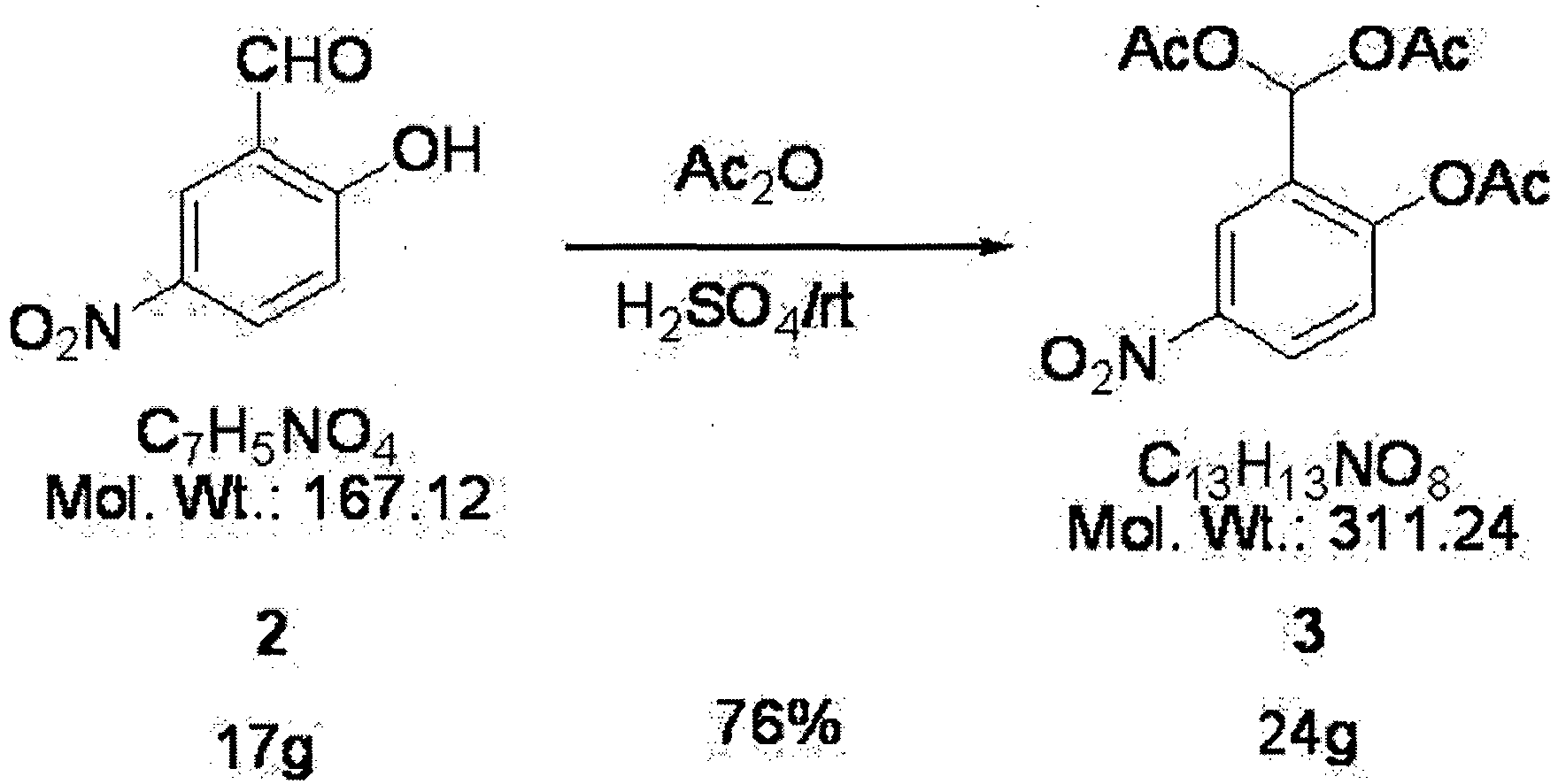
- Compound 2 (17g, 0.10 mol), acetic anhydride (200 ml) and H2SO4 (minimal) were stirred for one hour at room temperature. The resulting solution was mixed for 0.5 hour in iced water (2 L) to bring about hydrolysis. The resulting solution was filtered and dried in air, thereby obtaining white powder. The powder was recrystallized, using a solvent containing ethyl acetate. As a result, 24 g of Compound 3 (76% yield) was obtained in the form of white crystals.
-

- A mixture of carbon (2.4 g) supporting 10% palladium with Compound 3 (24 g, 77 mol) and methanol (500 ml) was reduced over night in a 1.5 atm hydrogen reducing atmosphere. After the reduction was completed, the product was filtered, thereby allowing 21 g of
Compound 4 in the form of brown oil to be synthesized. -

- Compound 4 (21 g, 75 mmol) and di(tert-butyl)dicarbonate (18 g, 82 mmol) were stirred over night in anhydrous dichloromethane (DCM) (200 ml) in a nitrogen atmosphere. The resulting solution (Compound 5) was allowed to evaporate in a vacuum and then dissolved in methanol (100 ml). Sodium hydroxide (15 g, 374 mmol) and water (50 ml) were then added and the solution was brought to reflux for 5 hours. The solution was then cooled, filtered, washed with water, and allowed to dry in a vacuum, thereby obtaining a brown compound. The resulting compound was processed twice by flash chromatography using silica gel, thereby obtaining 10 g of Compound 6 (58% yield).
-

- Compound 6 (10 g, 42 mmol) was introduced into 400 ml of anhydrous ethanol, the mixture was brought to reflux while heated, and several drops of ethylene diamine (1.3 g, 21 mmol) were added into 20 ml of anhydrous ethanol while stirred for 0.5 hour. The mixture was introduced into a container of ice, where it was cooled and stirred for 15 minutes. It was then washed with 200 ml of ethanol, filtered, and dried in a vacuum, thereby obtaining 8.5 g (82% yield) of Compound 7.
-

- Compound 7 (8.2 g, 16 mmol) and triethylamine (22 ml, 160 mmol) were introduced into dehydrated methanol (50 ml), and a solution of iron (III) chloride (FeCl3) (2.7 g, 16 mmol) added to 10 ml of methanol was mixed for one hour in a nitrogen atmosphere at room temperature, thereby obtaining a brown compound. The brown compound was then dried in a vacuum.
- The resulting compound was diluted with 400 ml of dichloromethane, washed twice with a basic solution, dried in sodium sulfate (Na2SO4), and dried in a vacuum. The resulting compound was recrystallized in a solution of diethyl ether and paraffin, and assay by high performance liquid chromatography revealed 5.7 g (62% yield) of complex A (iron-salen complex) with a purity of 95% or higher.
- When a metal complex other than the iron-salen complex is to be used, a chloride of metal other than iron (MCl3: where M is a metal) may be used instead of iron (III) chloride (FeCl3). Incidentally, Japanese Patent Application No.
2009-177112 2009-173631 - A luminescence test by means of photoluminescence measurement was conducted with respect to the iron-salen complex represented by Chemical Formula (I).
- The measurement was conducted by using PHOTOLUMINOR-S for high resolution spectral analysis by HORIBA, Ltd. The measurement was performed in a state where the metal-salen was dissolved in chloroform.
- The obtained results are shown in
Fig. 1 . Referring toFig. 1 , it was confirmed that a peak specific to the iron-salen complex represented by Chemical Formula (I) occurred around 380 nm. Incidentally, peaks were confirmed around 270 nm, 530 nm, and 800 nm inFig. 1 , but these are reference peaks for an excitation laser (laser that emits white light by oscillating several wavelengths of RGM at the same time). The peak wavelength varies depending on a crystal shape of the iron-salen complex. - The particle diameter of the iron-salen complex of Chemical Formula (I) was measured by using a laser diffraction method. The device used for the measurement was Microtrac particle analysis instruments (MT-3000II by NIKKISO CO., LTD.). A sample was put in a solution of sodium hexametaphosphate; and the resulting solution was dispersed for 10 minutes by using a homogenizer, the sample was then irradiated with laser light, and its diffraction (dispersion) was measured to find the grading. Measurement conditions and measurement results are as follows.
-
Measurement time: 30 seconds Particle permeability: permeable Particle shape: nonspherical Particle refractive index: 1.81 Solvent: water Solvent refractive index: 1.333 - Measurement results are shown in
Fig. 2 and below.Average particle diameter: 11.79 µm Standard deviation: 6.289 - As a result of the measurement, it was found that the particle diameter of the iron-salen complex was 11.8 µm, which is sufficiently suited for application to individuals.
- If a metal-salen complex capable of emitting a fluorescent color such as the aforementioned iron-salen complex is administered to an individual, a magnetic field is applied externally to the individual to guide the metal-salen complex to a target area, and an external light is then applied to the target area as explained above, luminescence of the metal-salen complex can be confirmed.
Claims (2)
- A fluorochrome material for use in therapeutic treatment by administering the fluorochrome material to an individual, externally applying a magnetic field to the individual to guide the fluorochrome material to a target area, and then applying external light to the target area, thereby allowing the fluorochrome material in the target area to become phosphorescent,
wherein the fluorochrome material contains a metal-salen complex represented by the following Chemical Formula (I):
wherein M in the Chemical Formula (I) is Fe and the fluorochrome material has a peak of intensity of phosphorescence at a wavelength around 380 nm. - The fluorochrome material for use in therapeutic treatment according to claim 1, wherein a particle diameter of a compound of the Chemical Formula (I) ranges from 2 to 60 µm.
Applications Claiming Priority (2)
| Application Number | Priority Date | Filing Date | Title |
|---|---|---|---|
| JP2010126021 | 2010-06-01 | ||
| PCT/JP2011/002651 WO2011151978A1 (en) | 2010-06-01 | 2011-05-12 | Fluorescent dye material and use thereof |
Publications (3)
| Publication Number | Publication Date |
|---|---|
| EP2578643A1 EP2578643A1 (en) | 2013-04-10 |
| EP2578643A4 EP2578643A4 (en) | 2014-01-22 |
| EP2578643B1 true EP2578643B1 (en) | 2019-07-10 |
Family
ID=45066371
Family Applications (1)
| Application Number | Title | Priority Date | Filing Date |
|---|---|---|---|
| EP11789393.3A Active EP2578643B1 (en) | 2010-06-01 | 2011-05-12 | Fluorescent dye material and use thereof |
Country Status (6)
| Country | Link |
|---|---|
| US (1) | US9282923B2 (en) |
| EP (1) | EP2578643B1 (en) |
| JP (1) | JP5554408B2 (en) |
| CN (1) | CN102918118A (en) |
| RU (1) | RU2540311C2 (en) |
| WO (1) | WO2011151978A1 (en) |
Families Citing this family (6)
| Publication number | Priority date | Publication date | Assignee | Title |
|---|---|---|---|---|
| US20090169484A1 (en) * | 2007-12-28 | 2009-07-02 | Ihi Corporation | Iron-salen complex |
| CN103517895A (en) * | 2010-12-21 | 2014-01-15 | 株式会社Ihi | Metal-salen complex compound and production method for same |
| JP2012167067A (en) * | 2011-02-15 | 2012-09-06 | Ihi Corp | Auto-magnetic metal salen complex compound |
| JP6017766B2 (en) | 2011-07-26 | 2016-11-02 | 株式会社Ihi | Novel anticancer agent of metal salen complex compound |
| KR102054751B1 (en) * | 2017-12-27 | 2019-12-11 | 주식회사 디엔에스 | Polymer film including blue phosphor nanoparticles having a core cell structure |
| US20250243375A1 (en) * | 2021-10-28 | 2025-07-31 | Hewlett-Packard Development Company, L.P. | Printing material including salen compound |
Citations (1)
| Publication number | Priority date | Publication date | Assignee | Title |
|---|---|---|---|---|
| US20090189484A1 (en) * | 2008-01-25 | 2009-07-30 | Boeing Company | Apparatus and method for affecting physical parameter associated with a shaft |
Family Cites Families (16)
| Publication number | Priority date | Publication date | Assignee | Title |
|---|---|---|---|---|
| JP2891783B2 (en) * | 1991-02-06 | 1999-05-17 | パイオニア株式会社 | Organic electroluminescence device |
| US5403834A (en) * | 1992-12-07 | 1995-04-04 | Eukarion, Inc. | Synthetic catalytic free radical scavengers useful as antioxidants for prevention and therapy of disease |
| US6482436B1 (en) | 1993-01-29 | 2002-11-19 | Ferx Incorporated | Magnetically responsive composition |
| CA2154913C (en) | 1993-01-29 | 1999-10-19 | Viktor Alexeevich Volkonsky | Magnetically responsive composition for carrying biologically active substances and methods of production and use |
| EP1114836B1 (en) * | 1999-06-29 | 2006-11-08 | National Institute of Advanced Industrial Science and Technology | Process for producing a resin composition |
| CA2391534A1 (en) * | 1999-11-15 | 2001-05-25 | Drug Innovation & Design, Inc. | Selective cellular targeting: multifunctional delivery vehicles |
| JP4460952B2 (en) * | 2003-06-02 | 2010-05-12 | 富士フイルム株式会社 | Organic electroluminescent device and complex compound |
| US7361415B2 (en) * | 2004-04-16 | 2008-04-22 | The University Of Hong Kong | System and method for producing light with organic light-emitting devices |
| US20070134338A1 (en) * | 2005-06-08 | 2007-06-14 | Bala Subramaniam | Methods for producing nanoparticulate metal complexes and altering nanoparticle morphology |
| CN101578098B (en) * | 2006-06-28 | 2015-12-16 | 株式会社Ihi | Drug, drug guiding device, magnetic detection device and drug design method |
| EP2741226B1 (en) | 2006-06-28 | 2019-02-06 | IHI Corporation | Magnetically guidable compound |
| US20090169484A1 (en) | 2007-12-28 | 2009-07-02 | Ihi Corporation | Iron-salen complex |
| KR100969144B1 (en) | 2008-01-28 | 2010-07-08 | 알티전자 주식회사 | Light emitting diode package |
| JP5325427B2 (en) | 2008-02-20 | 2013-10-23 | 株式会社Ihi | Drug with magnetism |
| EP2357166B1 (en) | 2008-11-20 | 2020-01-15 | IHI Corporation | Auto magnetic metal salen complex compound |
| JP5569009B2 (en) * | 2010-01-27 | 2014-08-13 | 株式会社Ihi | Luminescent material for organic EL and organic EL element using the same |
-
2011
- 2011-05-12 US US13/701,157 patent/US9282923B2/en active Active
- 2011-05-12 RU RU2012151491/05A patent/RU2540311C2/en active
- 2011-05-12 EP EP11789393.3A patent/EP2578643B1/en active Active
- 2011-05-12 CN CN2011800271332A patent/CN102918118A/en active Pending
- 2011-05-12 JP JP2012518218A patent/JP5554408B2/en active Active
- 2011-05-12 WO PCT/JP2011/002651 patent/WO2011151978A1/en not_active Ceased
Patent Citations (1)
| Publication number | Priority date | Publication date | Assignee | Title |
|---|---|---|---|---|
| US20090189484A1 (en) * | 2008-01-25 | 2009-07-30 | Boeing Company | Apparatus and method for affecting physical parameter associated with a shaft |
Also Published As
| Publication number | Publication date |
|---|---|
| EP2578643A4 (en) | 2014-01-22 |
| US20130090539A1 (en) | 2013-04-11 |
| JPWO2011151978A1 (en) | 2013-07-25 |
| WO2011151978A1 (en) | 2011-12-08 |
| RU2540311C2 (en) | 2015-02-10 |
| CN102918118A (en) | 2013-02-06 |
| RU2012151491A (en) | 2014-07-20 |
| US9282923B2 (en) | 2016-03-15 |
| EP2578643A1 (en) | 2013-04-10 |
| JP5554408B2 (en) | 2014-07-23 |
Similar Documents
| Publication | Publication Date | Title |
|---|---|---|
| EP2578643B1 (en) | Fluorescent dye material and use thereof | |
| EP2357166B1 (en) | Auto magnetic metal salen complex compound | |
| EP2657223B1 (en) | Metal-salen complex compound and production method for same | |
| Yuan et al. | Dual-targeted activatable photosensitizers with aggregation-induced emission (AIE) characteristics for image-guided photodynamic cancer cell ablation | |
| EP2682384A1 (en) | Auto-magnetic metal salen complex compound | |
| Zheng et al. | A nanoplatform to boost multi-phases of cancer-immunity-cycle for enhancing immunotherapy | |
| US9393308B2 (en) | Micelle structure of nano preparation for diagnosis or treatment of cancer disease and preparation method thereof | |
| US11078217B2 (en) | Triplet-triplet annihilation upconversion system, and compositions and methods thereof for drug delivery | |
| Zhu et al. | High-Z elements dominated bismuth-based heterojunction nano-semiconductor for radiotherapy-enhanced sonodynamic breast cancer therapy | |
| Ma et al. | Coumarin derivative dye sensitized NaYGdF4: Yb, Er nanoparticles with enhanced NIR II luminescence for bio-vascular imaging | |
| Hu et al. | A thermally activated delayed fluorescence photosensitizer for photodynamic therapy of oral squamous cell carcinoma under low laser intensity | |
| Liang et al. | H2O2-Responsive amphiphilic polymer with aggregation-induced emission (AIE) for DOX delivery and tumor therapy | |
| Woźniak et al. | ZnO@ Gd2O3 core/shell nanoparticles for biomedical applications: physicochemical, in vitro and in vivo characterization | |
| Yang et al. | Endoplasmic reticulum-targetable selenium-doped carbon nanodots with redox-responsive fluorescence for in situ free-radical scavenging in cells and mice | |
| Tang et al. | A metal-organic framework functionalized CaO2-based cascade nanoreactor induces synergistic cuproptosis/ferroptosis and Ca2+ overload-mediated mitochondrial damage for enhanced sono-chemodynamic immunotherapy | |
| EP2738158A1 (en) | Metal salen complex compound, local anesthetic, and anti-malignant tumor agent | |
| EP2738157B1 (en) | Auto-magnetic metal salen complex compound | |
| CN107250112B (en) | Fluorescent synthetic retinoids | |
| Sun et al. | Tumor microenvironment activated and amplified self-luminescent nano photosensitizers for efficient treatment of triple negative breast cancer | |
| CN104383543B (en) | Chiral nanometer selenium material load siRNA is preparing the application of antineoplastic | |
| Cao et al. | Design of donor–acceptor conjugated polymers based on diketopyrrolopyrrole for NIR-II multifunctional imaging | |
| Yang et al. | Construction of Z-Scheme MOF-on-MOF heterostructures for mitochondria-targeted sonodynamic therapy | |
| CN106620698A (en) | Preparation method for ZnPc-UCNP-PEG-G nano-compound | |
| Xu et al. | Cu2+-pyropheophorbide-a-cystine conjugate-mediated multifunctional mesoporous silica nanoparticles for photo-chemodynamic therapy/GSH depletion combined with immunotherapy cancer | |
| Bozrova et al. | Semiconductor quantum dot toxicity in a mouse in vivo model |
Legal Events
| Date | Code | Title | Description |
|---|---|---|---|
| PUAI | Public reference made under article 153(3) epc to a published international application that has entered the european phase |
Free format text: ORIGINAL CODE: 0009012 |
|
| 17P | Request for examination filed |
Effective date: 20130102 |
|
| AK | Designated contracting states |
Kind code of ref document: A1 Designated state(s): AL AT BE BG CH CY CZ DE DK EE ES FI FR GB GR HR HU IE IS IT LI LT LU LV MC MK MT NL NO PL PT RO RS SE SI SK SM TR |
|
| DAX | Request for extension of the european patent (deleted) | ||
| A4 | Supplementary search report drawn up and despatched |
Effective date: 20140102 |
|
| RIC1 | Information provided on ipc code assigned before grant |
Ipc: C07F 15/02 20060101ALI20131217BHEP Ipc: A61K 31/136 20060101ALI20131217BHEP Ipc: C07C 251/24 20060101ALI20131217BHEP Ipc: C09B 57/10 20060101AFI20131217BHEP Ipc: A61P 35/00 20060101ALI20131217BHEP Ipc: C09K 11/06 20060101ALI20131217BHEP |
|
| STAA | Information on the status of an ep patent application or granted ep patent |
Free format text: STATUS: EXAMINATION IS IN PROGRESS |
|
| 17Q | First examination report despatched |
Effective date: 20170321 |
|
| GRAP | Despatch of communication of intention to grant a patent |
Free format text: ORIGINAL CODE: EPIDOSNIGR1 |
|
| STAA | Information on the status of an ep patent application or granted ep patent |
Free format text: STATUS: GRANT OF PATENT IS INTENDED |
|
| INTG | Intention to grant announced |
Effective date: 20190103 |
|
| GRAS | Grant fee paid |
Free format text: ORIGINAL CODE: EPIDOSNIGR3 |
|
| GRAA | (expected) grant |
Free format text: ORIGINAL CODE: 0009210 |
|
| STAA | Information on the status of an ep patent application or granted ep patent |
Free format text: STATUS: THE PATENT HAS BEEN GRANTED |
|
| REG | Reference to a national code |
Ref country code: DE Ref legal event code: R082 Ref document number: 602011060380 Country of ref document: DE Representative=s name: MERH-IP MATIAS ERNY REICHL HOFFMANN PATENTANWA, DE |
|
| AK | Designated contracting states |
Kind code of ref document: B1 Designated state(s): AL AT BE BG CH CY CZ DE DK EE ES FI FR GB GR HR HU IE IS IT LI LT LU LV MC MK MT NL NO PL PT RO RS SE SI SK SM TR |
|
| REG | Reference to a national code |
Ref country code: GB Ref legal event code: FG4D |
|
| REG | Reference to a national code |
Ref country code: CH Ref legal event code: EP Ref country code: AT Ref legal event code: REF Ref document number: 1153543 Country of ref document: AT Kind code of ref document: T Effective date: 20190715 |
|
| REG | Reference to a national code |
Ref country code: DE Ref legal event code: R096 Ref document number: 602011060380 Country of ref document: DE |
|
| REG | Reference to a national code |
Ref country code: IE Ref legal event code: FG4D |
|
| REG | Reference to a national code |
Ref country code: NL Ref legal event code: MP Effective date: 20190710 |
|
| REG | Reference to a national code |
Ref country code: LT Ref legal event code: MG4D |
|
| REG | Reference to a national code |
Ref country code: AT Ref legal event code: MK05 Ref document number: 1153543 Country of ref document: AT Kind code of ref document: T Effective date: 20190710 |
|
| PG25 | Lapsed in a contracting state [announced via postgrant information from national office to epo] |
Ref country code: FI Free format text: LAPSE BECAUSE OF FAILURE TO SUBMIT A TRANSLATION OF THE DESCRIPTION OR TO PAY THE FEE WITHIN THE PRESCRIBED TIME-LIMIT Effective date: 20190710 Ref country code: LT Free format text: LAPSE BECAUSE OF FAILURE TO SUBMIT A TRANSLATION OF THE DESCRIPTION OR TO PAY THE FEE WITHIN THE PRESCRIBED TIME-LIMIT Effective date: 20190710 Ref country code: HR Free format text: LAPSE BECAUSE OF FAILURE TO SUBMIT A TRANSLATION OF THE DESCRIPTION OR TO PAY THE FEE WITHIN THE PRESCRIBED TIME-LIMIT Effective date: 20190710 Ref country code: SE Free format text: LAPSE BECAUSE OF FAILURE TO SUBMIT A TRANSLATION OF THE DESCRIPTION OR TO PAY THE FEE WITHIN THE PRESCRIBED TIME-LIMIT Effective date: 20190710 Ref country code: NO Free format text: LAPSE BECAUSE OF FAILURE TO SUBMIT A TRANSLATION OF THE DESCRIPTION OR TO PAY THE FEE WITHIN THE PRESCRIBED TIME-LIMIT Effective date: 20191010 Ref country code: BG Free format text: LAPSE BECAUSE OF FAILURE TO SUBMIT A TRANSLATION OF THE DESCRIPTION OR TO PAY THE FEE WITHIN THE PRESCRIBED TIME-LIMIT Effective date: 20191010 Ref country code: PT Free format text: LAPSE BECAUSE OF FAILURE TO SUBMIT A TRANSLATION OF THE DESCRIPTION OR TO PAY THE FEE WITHIN THE PRESCRIBED TIME-LIMIT Effective date: 20191111 Ref country code: NL Free format text: LAPSE BECAUSE OF FAILURE TO SUBMIT A TRANSLATION OF THE DESCRIPTION OR TO PAY THE FEE WITHIN THE PRESCRIBED TIME-LIMIT Effective date: 20190710 Ref country code: AT Free format text: LAPSE BECAUSE OF FAILURE TO SUBMIT A TRANSLATION OF THE DESCRIPTION OR TO PAY THE FEE WITHIN THE PRESCRIBED TIME-LIMIT Effective date: 20190710 |
|
| PG25 | Lapsed in a contracting state [announced via postgrant information from national office to epo] |
Ref country code: ES Free format text: LAPSE BECAUSE OF FAILURE TO SUBMIT A TRANSLATION OF THE DESCRIPTION OR TO PAY THE FEE WITHIN THE PRESCRIBED TIME-LIMIT Effective date: 20190710 Ref country code: AL Free format text: LAPSE BECAUSE OF FAILURE TO SUBMIT A TRANSLATION OF THE DESCRIPTION OR TO PAY THE FEE WITHIN THE PRESCRIBED TIME-LIMIT Effective date: 20190710 Ref country code: LV Free format text: LAPSE BECAUSE OF FAILURE TO SUBMIT A TRANSLATION OF THE DESCRIPTION OR TO PAY THE FEE WITHIN THE PRESCRIBED TIME-LIMIT Effective date: 20190710 Ref country code: IS Free format text: LAPSE BECAUSE OF FAILURE TO SUBMIT A TRANSLATION OF THE DESCRIPTION OR TO PAY THE FEE WITHIN THE PRESCRIBED TIME-LIMIT Effective date: 20191110 Ref country code: RS Free format text: LAPSE BECAUSE OF FAILURE TO SUBMIT A TRANSLATION OF THE DESCRIPTION OR TO PAY THE FEE WITHIN THE PRESCRIBED TIME-LIMIT Effective date: 20190710 Ref country code: GR Free format text: LAPSE BECAUSE OF FAILURE TO SUBMIT A TRANSLATION OF THE DESCRIPTION OR TO PAY THE FEE WITHIN THE PRESCRIBED TIME-LIMIT Effective date: 20191011 |
|
| PG25 | Lapsed in a contracting state [announced via postgrant information from national office to epo] |
Ref country code: TR Free format text: LAPSE BECAUSE OF FAILURE TO SUBMIT A TRANSLATION OF THE DESCRIPTION OR TO PAY THE FEE WITHIN THE PRESCRIBED TIME-LIMIT Effective date: 20190710 |
|
| PG25 | Lapsed in a contracting state [announced via postgrant information from national office to epo] |
Ref country code: EE Free format text: LAPSE BECAUSE OF FAILURE TO SUBMIT A TRANSLATION OF THE DESCRIPTION OR TO PAY THE FEE WITHIN THE PRESCRIBED TIME-LIMIT Effective date: 20190710 Ref country code: DK Free format text: LAPSE BECAUSE OF FAILURE TO SUBMIT A TRANSLATION OF THE DESCRIPTION OR TO PAY THE FEE WITHIN THE PRESCRIBED TIME-LIMIT Effective date: 20190710 Ref country code: PL Free format text: LAPSE BECAUSE OF FAILURE TO SUBMIT A TRANSLATION OF THE DESCRIPTION OR TO PAY THE FEE WITHIN THE PRESCRIBED TIME-LIMIT Effective date: 20190710 Ref country code: RO Free format text: LAPSE BECAUSE OF FAILURE TO SUBMIT A TRANSLATION OF THE DESCRIPTION OR TO PAY THE FEE WITHIN THE PRESCRIBED TIME-LIMIT Effective date: 20190710 Ref country code: IT Free format text: LAPSE BECAUSE OF FAILURE TO SUBMIT A TRANSLATION OF THE DESCRIPTION OR TO PAY THE FEE WITHIN THE PRESCRIBED TIME-LIMIT Effective date: 20190710 |
|
| PG25 | Lapsed in a contracting state [announced via postgrant information from national office to epo] |
Ref country code: SM Free format text: LAPSE BECAUSE OF FAILURE TO SUBMIT A TRANSLATION OF THE DESCRIPTION OR TO PAY THE FEE WITHIN THE PRESCRIBED TIME-LIMIT Effective date: 20190710 Ref country code: SK Free format text: LAPSE BECAUSE OF FAILURE TO SUBMIT A TRANSLATION OF THE DESCRIPTION OR TO PAY THE FEE WITHIN THE PRESCRIBED TIME-LIMIT Effective date: 20190710 Ref country code: IS Free format text: LAPSE BECAUSE OF FAILURE TO SUBMIT A TRANSLATION OF THE DESCRIPTION OR TO PAY THE FEE WITHIN THE PRESCRIBED TIME-LIMIT Effective date: 20200224 Ref country code: CZ Free format text: LAPSE BECAUSE OF FAILURE TO SUBMIT A TRANSLATION OF THE DESCRIPTION OR TO PAY THE FEE WITHIN THE PRESCRIBED TIME-LIMIT Effective date: 20190710 |
|
| REG | Reference to a national code |
Ref country code: DE Ref legal event code: R097 Ref document number: 602011060380 Country of ref document: DE |
|
| PLBE | No opposition filed within time limit |
Free format text: ORIGINAL CODE: 0009261 |
|
| STAA | Information on the status of an ep patent application or granted ep patent |
Free format text: STATUS: NO OPPOSITION FILED WITHIN TIME LIMIT |
|
| PG2D | Information on lapse in contracting state deleted |
Ref country code: IS |
|
| 26N | No opposition filed |
Effective date: 20200603 |
|
| PG25 | Lapsed in a contracting state [announced via postgrant information from national office to epo] |
Ref country code: SI Free format text: LAPSE BECAUSE OF FAILURE TO SUBMIT A TRANSLATION OF THE DESCRIPTION OR TO PAY THE FEE WITHIN THE PRESCRIBED TIME-LIMIT Effective date: 20190710 |
|
| PG25 | Lapsed in a contracting state [announced via postgrant information from national office to epo] |
Ref country code: MC Free format text: LAPSE BECAUSE OF FAILURE TO SUBMIT A TRANSLATION OF THE DESCRIPTION OR TO PAY THE FEE WITHIN THE PRESCRIBED TIME-LIMIT Effective date: 20190710 |
|
| REG | Reference to a national code |
Ref country code: BE Ref legal event code: MM Effective date: 20200531 |
|
| PG25 | Lapsed in a contracting state [announced via postgrant information from national office to epo] |
Ref country code: LU Free format text: LAPSE BECAUSE OF NON-PAYMENT OF DUE FEES Effective date: 20200512 |
|
| PG25 | Lapsed in a contracting state [announced via postgrant information from national office to epo] |
Ref country code: IE Free format text: LAPSE BECAUSE OF NON-PAYMENT OF DUE FEES Effective date: 20200512 |
|
| PG25 | Lapsed in a contracting state [announced via postgrant information from national office to epo] |
Ref country code: BE Free format text: LAPSE BECAUSE OF NON-PAYMENT OF DUE FEES Effective date: 20200531 |
|
| PG25 | Lapsed in a contracting state [announced via postgrant information from national office to epo] |
Ref country code: MT Free format text: LAPSE BECAUSE OF FAILURE TO SUBMIT A TRANSLATION OF THE DESCRIPTION OR TO PAY THE FEE WITHIN THE PRESCRIBED TIME-LIMIT Effective date: 20190710 Ref country code: CY Free format text: LAPSE BECAUSE OF FAILURE TO SUBMIT A TRANSLATION OF THE DESCRIPTION OR TO PAY THE FEE WITHIN THE PRESCRIBED TIME-LIMIT Effective date: 20190710 |
|
| PG25 | Lapsed in a contracting state [announced via postgrant information from national office to epo] |
Ref country code: MK Free format text: LAPSE BECAUSE OF FAILURE TO SUBMIT A TRANSLATION OF THE DESCRIPTION OR TO PAY THE FEE WITHIN THE PRESCRIBED TIME-LIMIT Effective date: 20190710 |
|
| PGFP | Annual fee paid to national office [announced via postgrant information from national office to epo] |
Ref country code: CH Payment date: 20220421 Year of fee payment: 12 |
|
| REG | Reference to a national code |
Ref country code: FR Ref legal event code: PLFP Year of fee payment: 13 |
|
| REG | Reference to a national code |
Ref country code: CH Ref legal event code: PL |
|
| PG25 | Lapsed in a contracting state [announced via postgrant information from national office to epo] |
Ref country code: LI Free format text: LAPSE BECAUSE OF NON-PAYMENT OF DUE FEES Effective date: 20230531 Ref country code: CH Free format text: LAPSE BECAUSE OF NON-PAYMENT OF DUE FEES Effective date: 20230531 |
|
| PGFP | Annual fee paid to national office [announced via postgrant information from national office to epo] |
Ref country code: GB Payment date: 20250327 Year of fee payment: 15 |
|
| PGFP | Annual fee paid to national office [announced via postgrant information from national office to epo] |
Ref country code: DE Payment date: 20250402 Year of fee payment: 15 |
|
| PGFP | Annual fee paid to national office [announced via postgrant information from national office to epo] |
Ref country code: FR Payment date: 20250401 Year of fee payment: 15 |