EP2578563B1 - Intermediate of lycopene and preparation method of intermediate thereof - Google Patents
Intermediate of lycopene and preparation method of intermediate thereof Download PDFInfo
- Publication number
- EP2578563B1 EP2578563B1 EP11789038.4A EP11789038A EP2578563B1 EP 2578563 B1 EP2578563 B1 EP 2578563B1 EP 11789038 A EP11789038 A EP 11789038A EP 2578563 B1 EP2578563 B1 EP 2578563B1
- Authority
- EP
- European Patent Office
- Prior art keywords
- methyl
- formula
- dialkoxy
- phosphoric acid
- pentenyl
- Prior art date
- Legal status (The legal status is an assumption and is not a legal conclusion. Google has not performed a legal analysis and makes no representation as to the accuracy of the status listed.)
- Active
Links
- OAIJSZIZWZSQBC-GYZMGTAESA-N lycopene Chemical compound CC(C)=CCC\C(C)=C\C=C\C(\C)=C\C=C\C(\C)=C\C=C\C=C(/C)\C=C\C=C(/C)\C=C\C=C(/C)CCC=C(C)C OAIJSZIZWZSQBC-GYZMGTAESA-N 0.000 title description 20
- 239000001751 lycopene Substances 0.000 title description 20
- UPYKUZBSLRQECL-UKMVMLAPSA-N Lycopene Natural products CC(=C/C=C/C=C(C)/C=C/C=C(C)/C=C/C1C(=C)CCCC1(C)C)C=CC=C(/C)C=CC2C(=C)CCCC2(C)C UPYKUZBSLRQECL-UKMVMLAPSA-N 0.000 title description 19
- 235000012661 lycopene Nutrition 0.000 title description 19
- 229960004999 lycopene Drugs 0.000 title description 19
- JEVVKJMRZMXFBT-XWDZUXABSA-N Lycophyll Natural products OC/C(=C/CC/C(=C\C=C\C(=C/C=C/C(=C\C=C\C=C(/C=C/C=C(\C=C\C=C(/CC/C=C(/CO)\C)\C)/C)\C)/C)\C)/C)/C JEVVKJMRZMXFBT-XWDZUXABSA-N 0.000 title description 18
- ZCIHMQAPACOQHT-ZGMPDRQDSA-N trans-isorenieratene Natural products CC(=C/C=C/C=C(C)/C=C/C=C(C)/C=C/c1c(C)ccc(C)c1C)C=CC=C(/C)C=Cc2c(C)ccc(C)c2C ZCIHMQAPACOQHT-ZGMPDRQDSA-N 0.000 title description 18
- 238000002360 preparation method Methods 0.000 title description 11
- RTZKZFJDLAIYFH-UHFFFAOYSA-N Diethyl ether Chemical compound CCOCC RTZKZFJDLAIYFH-UHFFFAOYSA-N 0.000 claims description 62
- NAWXUBYGYWOOIX-SFHVURJKSA-N (2s)-2-[[4-[2-(2,4-diaminoquinazolin-6-yl)ethyl]benzoyl]amino]-4-methylidenepentanedioic acid Chemical compound C1=CC2=NC(N)=NC(N)=C2C=C1CCC1=CC=C(C(=O)N[C@@H](CC(=C)C(O)=O)C(O)=O)C=C1 NAWXUBYGYWOOIX-SFHVURJKSA-N 0.000 claims description 42
- 238000000034 method Methods 0.000 claims description 40
- 239000002904 solvent Substances 0.000 claims description 38
- 229910000147 aluminium phosphate Inorganic materials 0.000 claims description 36
- NBIIXXVUZAFLBC-UHFFFAOYSA-N phosphoric acid Substances OP(O)(O)=O NBIIXXVUZAFLBC-UHFFFAOYSA-N 0.000 claims description 36
- 239000002585 base Substances 0.000 claims description 33
- 238000006243 chemical reaction Methods 0.000 claims description 32
- 150000002148 esters Chemical class 0.000 claims description 31
- IAZDPXIOMUYVGZ-UHFFFAOYSA-N Dimethylsulphoxide Chemical compound CS(C)=O IAZDPXIOMUYVGZ-UHFFFAOYSA-N 0.000 claims description 25
- -1 alkali metal salt Chemical class 0.000 claims description 19
- 239000000010 aprotic solvent Substances 0.000 claims description 19
- ZMXDDKWLCZADIW-UHFFFAOYSA-N N,N-Dimethylformamide Chemical group CN(C)C=O ZMXDDKWLCZADIW-UHFFFAOYSA-N 0.000 claims description 18
- WYURNTSHIVDZCO-UHFFFAOYSA-N Tetrahydrofuran Chemical compound C1CCOC1 WYURNTSHIVDZCO-UHFFFAOYSA-N 0.000 claims description 18
- 238000006482 condensation reaction Methods 0.000 claims description 18
- 229940102859 methylene diphosphonate Drugs 0.000 claims description 18
- MZRVEZGGRBJDDB-UHFFFAOYSA-N N-Butyllithium Chemical group [Li]CCCC MZRVEZGGRBJDDB-UHFFFAOYSA-N 0.000 claims description 16
- UHEPJGULSIKKTP-UHFFFAOYSA-N sulcatone Chemical compound CC(C)=CCCC(C)=O UHEPJGULSIKKTP-UHFFFAOYSA-N 0.000 claims description 14
- 125000004178 (C1-C4) alkyl group Chemical group 0.000 claims description 12
- 239000011261 inert gas Substances 0.000 claims description 12
- MFRIHAYPQRLWNB-UHFFFAOYSA-N sodium tert-butoxide Chemical compound [Na+].CC(C)(C)[O-] MFRIHAYPQRLWNB-UHFFFAOYSA-N 0.000 claims description 12
- XTHFKEDIFFGKHM-UHFFFAOYSA-N Dimethoxyethane Chemical compound COCCOC XTHFKEDIFFGKHM-UHFFFAOYSA-N 0.000 claims description 11
- LPNYRYFBWFDTMA-UHFFFAOYSA-N potassium tert-butoxide Chemical compound [K+].CC(C)(C)[O-] LPNYRYFBWFDTMA-UHFFFAOYSA-N 0.000 claims description 11
- YLQBMQCUIZJEEH-UHFFFAOYSA-N tetrahydrofuran Natural products C=1C=COC=1 YLQBMQCUIZJEEH-UHFFFAOYSA-N 0.000 claims description 9
- CTBCBMPNSXZHHY-UHFFFAOYSA-N 11,11-dimethoxy-2,6,10-trimethylundeca-2,6,8-triene Chemical group COC(OC)C(C)C=CC=C(C)CCC=C(C)C CTBCBMPNSXZHHY-UHFFFAOYSA-N 0.000 claims description 8
- KEAYESYHFKHZAL-UHFFFAOYSA-N Sodium Chemical group [Na] KEAYESYHFKHZAL-UHFFFAOYSA-N 0.000 claims description 8
- 150000001298 alcohols Chemical class 0.000 claims description 8
- 229910052783 alkali metal Inorganic materials 0.000 claims description 8
- 229910052744 lithium Inorganic materials 0.000 claims description 8
- 238000006462 rearrangement reaction Methods 0.000 claims description 8
- 229910000104 sodium hydride Inorganic materials 0.000 claims description 8
- 239000012312 sodium hydride Substances 0.000 claims description 8
- ZDQWESQEGGJUCH-UHFFFAOYSA-N Diisopropyl adipate Chemical compound CC(C)OC(=O)CCCCC(=O)OC(C)C ZDQWESQEGGJUCH-UHFFFAOYSA-N 0.000 claims description 6
- QDRKDTQENPPHOJ-UHFFFAOYSA-N sodium ethoxide Chemical compound [Na+].CC[O-] QDRKDTQENPPHOJ-UHFFFAOYSA-N 0.000 claims description 6
- XCXJLWLQQPJVDR-UHFFFAOYSA-N 3-(azepan-2-yl)quinoline Chemical compound C1CCCCNC1C1=CN=C(C=CC=C2)C2=C1 XCXJLWLQQPJVDR-UHFFFAOYSA-N 0.000 claims description 5
- 150000001875 compounds Chemical class 0.000 claims description 5
- GNOIPBMMFNIUFM-UHFFFAOYSA-N hexamethylphosphoric triamide Chemical compound CN(C)P(=O)(N(C)C)N(C)C GNOIPBMMFNIUFM-UHFFFAOYSA-N 0.000 claims description 5
- 229910000102 alkali metal hydride Inorganic materials 0.000 claims description 4
- 150000008046 alkali metal hydrides Chemical class 0.000 claims description 4
- 238000009833 condensation Methods 0.000 claims description 4
- 230000005494 condensation Effects 0.000 claims description 4
- 125000001033 ether group Chemical group 0.000 claims description 4
- 230000008707 rearrangement Effects 0.000 claims description 4
- ODTQUKVFOLFLIQ-UHFFFAOYSA-N 2-[di(propan-2-yloxy)phosphorylmethyl-propan-2-yloxyphosphoryl]oxypropane Chemical compound CC(C)OP(=O)(OC(C)C)CP(=O)(OC(C)C)OC(C)C ODTQUKVFOLFLIQ-UHFFFAOYSA-N 0.000 claims description 3
- XAVFZUKFLWOSOS-UHFFFAOYSA-N bis(dimethoxyphosphoryl)methane Chemical group COP(=O)(OC)CP(=O)(OC)OC XAVFZUKFLWOSOS-UHFFFAOYSA-N 0.000 claims description 3
- 229910000105 potassium hydride Inorganic materials 0.000 claims description 3
- NTTOTNSKUYCDAV-UHFFFAOYSA-N potassium hydride Chemical compound [KH] NTTOTNSKUYCDAV-UHFFFAOYSA-N 0.000 claims description 3
- YXFVVABEGXRONW-UHFFFAOYSA-N Toluene Chemical compound CC1=CC=CC=C1 YXFVVABEGXRONW-UHFFFAOYSA-N 0.000 description 36
- 239000012043 crude product Substances 0.000 description 24
- 238000003756 stirring Methods 0.000 description 24
- 239000000047 product Substances 0.000 description 22
- XLYOFNOQVPJJNP-UHFFFAOYSA-N water Substances O XLYOFNOQVPJJNP-UHFFFAOYSA-N 0.000 description 22
- HEDRZPFGACZZDS-MICDWDOJSA-N Trichloro(2H)methane Chemical compound [2H]C(Cl)(Cl)Cl HEDRZPFGACZZDS-MICDWDOJSA-N 0.000 description 20
- VLKZOEOYAKHREP-UHFFFAOYSA-N n-Hexane Chemical compound CCCCCC VLKZOEOYAKHREP-UHFFFAOYSA-N 0.000 description 17
- IJGRMHOSHXDMSA-UHFFFAOYSA-N Atomic nitrogen Chemical compound N#N IJGRMHOSHXDMSA-UHFFFAOYSA-N 0.000 description 16
- CSNNHWWHGAXBCP-UHFFFAOYSA-L Magnesium sulfate Chemical compound [Mg+2].[O-][S+2]([O-])([O-])[O-] CSNNHWWHGAXBCP-UHFFFAOYSA-L 0.000 description 16
- FAPWRFPIFSIZLT-UHFFFAOYSA-M Sodium chloride Chemical compound [Na+].[Cl-] FAPWRFPIFSIZLT-UHFFFAOYSA-M 0.000 description 16
- 238000004817 gas chromatography Methods 0.000 description 15
- 239000000203 mixture Substances 0.000 description 14
- 239000012044 organic layer Substances 0.000 description 13
- 238000013517 stratification Methods 0.000 description 13
- 239000000543 intermediate Substances 0.000 description 11
- 125000000956 methoxy group Chemical group [H]C([H])([H])O* 0.000 description 10
- 238000001704 evaporation Methods 0.000 description 9
- 230000008020 evaporation Effects 0.000 description 9
- 238000005160 1H NMR spectroscopy Methods 0.000 description 8
- 239000003513 alkali Substances 0.000 description 8
- 239000007864 aqueous solution Substances 0.000 description 8
- 229910052943 magnesium sulfate Inorganic materials 0.000 description 8
- 235000019341 magnesium sulphate Nutrition 0.000 description 8
- 229910052757 nitrogen Inorganic materials 0.000 description 8
- 239000002994 raw material Substances 0.000 description 8
- 239000011780 sodium chloride Substances 0.000 description 8
- 239000007788 liquid Substances 0.000 description 7
- 239000007789 gas Substances 0.000 description 6
- JXJIQCXXJGRKRJ-KOOBJXAQSA-N pseudoionone Chemical compound CC(C)=CCC\C(C)=C\C=C\C(C)=O JXJIQCXXJGRKRJ-KOOBJXAQSA-N 0.000 description 6
- 150000003509 tertiary alcohols Chemical class 0.000 description 6
- 238000001644 13C nuclear magnetic resonance spectroscopy Methods 0.000 description 5
- 238000003760 magnetic stirring Methods 0.000 description 5
- QMMFVYPAHWMCMS-UHFFFAOYSA-N Dimethyl sulfide Chemical compound CSC QMMFVYPAHWMCMS-UHFFFAOYSA-N 0.000 description 4
- 230000015572 biosynthetic process Effects 0.000 description 4
- KSMVZQYAVGTKIV-UHFFFAOYSA-N decanal Chemical compound CCCCCCCCCC=O KSMVZQYAVGTKIV-UHFFFAOYSA-N 0.000 description 4
- 208000018459 dissociative disease Diseases 0.000 description 4
- 239000000706 filtrate Substances 0.000 description 4
- 239000010410 layer Substances 0.000 description 4
- ZAWPKAMBDBPPBE-UHFFFAOYSA-N pentadecyl dihydrogen phosphate propa-1,2-diene Chemical compound C=C=C.CCCCCCCCCCCCCCCOP(O)(O)=O ZAWPKAMBDBPPBE-UHFFFAOYSA-N 0.000 description 4
- 238000003786 synthesis reaction Methods 0.000 description 4
- 206010028980 Neoplasm Diseases 0.000 description 3
- CJKVQXHKYQTVPR-UHFFFAOYSA-A P([O-])([O-])=O.[C+4].[C+4].[C+4].[C+4].[C+4].[C+4].[C+4].[C+4].[C+4].[C+4].[C+4].[C+4].[C+4].[C+4].[C+4].P([O-])([O-])=O.P([O-])([O-])=O.P([O-])([O-])=O.P([O-])([O-])=O.P([O-])([O-])=O.P([O-])([O-])=O.P([O-])([O-])=O.P([O-])([O-])=O.P([O-])([O-])=O.P([O-])([O-])=O.P([O-])([O-])=O.P([O-])([O-])=O.P([O-])([O-])=O.P([O-])([O-])=O.P([O-])([O-])=O.P([O-])([O-])=O.P([O-])([O-])=O.P([O-])([O-])=O.P([O-])([O-])=O.P([O-])([O-])=O.P([O-])([O-])=O.P([O-])([O-])=O.P([O-])([O-])=O.P([O-])([O-])=O.P([O-])([O-])=O.P([O-])([O-])=O.P([O-])([O-])=O.P([O-])([O-])=O.P([O-])([O-])=O Chemical compound P([O-])([O-])=O.[C+4].[C+4].[C+4].[C+4].[C+4].[C+4].[C+4].[C+4].[C+4].[C+4].[C+4].[C+4].[C+4].[C+4].[C+4].P([O-])([O-])=O.P([O-])([O-])=O.P([O-])([O-])=O.P([O-])([O-])=O.P([O-])([O-])=O.P([O-])([O-])=O.P([O-])([O-])=O.P([O-])([O-])=O.P([O-])([O-])=O.P([O-])([O-])=O.P([O-])([O-])=O.P([O-])([O-])=O.P([O-])([O-])=O.P([O-])([O-])=O.P([O-])([O-])=O.P([O-])([O-])=O.P([O-])([O-])=O.P([O-])([O-])=O.P([O-])([O-])=O.P([O-])([O-])=O.P([O-])([O-])=O.P([O-])([O-])=O.P([O-])([O-])=O.P([O-])([O-])=O.P([O-])([O-])=O.P([O-])([O-])=O.P([O-])([O-])=O.P([O-])([O-])=O.P([O-])([O-])=O CJKVQXHKYQTVPR-UHFFFAOYSA-A 0.000 description 3
- 239000005662 Paraffin oil Substances 0.000 description 3
- 230000007812 deficiency Effects 0.000 description 3
- UCQFCFPECQILOL-UHFFFAOYSA-N diethyl hydrogen phosphate Chemical compound CCOP(O)(=O)OCC UCQFCFPECQILOL-UHFFFAOYSA-N 0.000 description 3
- 238000010494 dissociation reaction Methods 0.000 description 3
- 230000005593 dissociations Effects 0.000 description 3
- 238000002290 gas chromatography-mass spectrometry Methods 0.000 description 3
- HNZUNIKWNYHEJJ-UHFFFAOYSA-N geranyl acetone Natural products CC(C)=CCCC(C)=CCCC(C)=O HNZUNIKWNYHEJJ-UHFFFAOYSA-N 0.000 description 3
- 238000010907 mechanical stirring Methods 0.000 description 3
- HIEAVKFYHNFZNR-UHFFFAOYSA-N pentadecyl dihydrogen phosphate Chemical compound CCCCCCCCCCCCCCCOP(O)(O)=O HIEAVKFYHNFZNR-UHFFFAOYSA-N 0.000 description 3
- 239000000243 solution Substances 0.000 description 3
- RIOQSEWOXXDEQQ-UHFFFAOYSA-N triphenylphosphine Chemical compound C1=CC=CC=C1P(C=1C=CC=CC=1)C1=CC=CC=C1 RIOQSEWOXXDEQQ-UHFFFAOYSA-N 0.000 description 3
- DGAQECJNVWCQMB-PUAWFVPOSA-M Ilexoside XXIX Chemical compound C[C@@H]1CC[C@@]2(CC[C@@]3(C(=CC[C@H]4[C@]3(CC[C@@H]5[C@@]4(CC[C@@H](C5(C)C)OS(=O)(=O)[O-])C)C)[C@@H]2[C@]1(C)O)C)C(=O)O[C@H]6[C@@H]([C@H]([C@@H]([C@H](O6)CO)O)O)O.[Na+] DGAQECJNVWCQMB-PUAWFVPOSA-M 0.000 description 2
- 238000005481 NMR spectroscopy Methods 0.000 description 2
- WQDUMFSSJAZKTM-UHFFFAOYSA-N Sodium methoxide Chemical compound [Na+].[O-]C WQDUMFSSJAZKTM-UHFFFAOYSA-N 0.000 description 2
- OKJPEAGHQZHRQV-UHFFFAOYSA-N Triiodomethane Natural products IC(I)I OKJPEAGHQZHRQV-UHFFFAOYSA-N 0.000 description 2
- 239000006227 byproduct Substances 0.000 description 2
- 201000011510 cancer Diseases 0.000 description 2
- 229910052799 carbon Inorganic materials 0.000 description 2
- 238000006555 catalytic reaction Methods 0.000 description 2
- DQTRYXANLKJLPK-UHFFFAOYSA-N chlorophosphonous acid Chemical compound OP(O)Cl DQTRYXANLKJLPK-UHFFFAOYSA-N 0.000 description 2
- 125000002704 decyl group Chemical group [H]C([H])([H])C([H])([H])C([H])([H])C([H])([H])C([H])([H])C([H])([H])C([H])([H])C([H])([H])C([H])([H])C([H])([H])* 0.000 description 2
- 229940079593 drug Drugs 0.000 description 2
- 238000005516 engineering process Methods 0.000 description 2
- 150000002118 epoxides Chemical class 0.000 description 2
- INQOMBQAUSQDDS-UHFFFAOYSA-N iodomethane Chemical compound IC INQOMBQAUSQDDS-UHFFFAOYSA-N 0.000 description 2
- 239000000463 material Substances 0.000 description 2
- 230000008569 process Effects 0.000 description 2
- 239000000376 reactant Substances 0.000 description 2
- 229910052708 sodium Inorganic materials 0.000 description 2
- 239000011734 sodium Substances 0.000 description 2
- OAIJSZIZWZSQBC-UHFFFAOYSA-N (7Z,9Z,7'Z,9'Z)-ψ,ψ-carotene Chemical compound CC(C)=CCCC(C)=CC=CC(C)=CC=CC(C)=CC=CC=C(C)C=CC=C(C)C=CC=C(C)CCC=C(C)C OAIJSZIZWZSQBC-UHFFFAOYSA-N 0.000 description 1
- YNMLATISXLVFAD-UHFFFAOYSA-N 1-diethoxyphosphoryl-3,7,11-trimethyldodeca-2,4,6,10-tetraene Chemical compound CCOP(=O)(OCC)CC=C(C)C=CC=C(C)CCC=C(C)C YNMLATISXLVFAD-UHFFFAOYSA-N 0.000 description 1
- ZUYCTZIIKVXNKN-UHFFFAOYSA-N 2,7-bis(5-methyl-2-propan-2-ylcyclohexyl)octa-2,4,6-trienedial Chemical compound CC(C)C1CCC(C)CC1C(C=O)=CC=CC=C(C=O)C1C(C(C)C)CCC(C)C1 ZUYCTZIIKVXNKN-UHFFFAOYSA-N 0.000 description 1
- RPENVZCLNSXOKO-UHFFFAOYSA-N 3,7,11-trimethyldodeca-4,6,10-trien-1-yn-3-ol Chemical compound CC(C)=CCCC(C)=CC=CC(C)(O)C#C RPENVZCLNSXOKO-UHFFFAOYSA-N 0.000 description 1
- RWSOTUBLDIXVET-UHFFFAOYSA-N Dihydrogen sulfide Chemical class S RWSOTUBLDIXVET-UHFFFAOYSA-N 0.000 description 1
- 239000003377 acid catalyst Substances 0.000 description 1
- 150000001299 aldehydes Chemical class 0.000 description 1
- HSFWRNGVRCDJHI-UHFFFAOYSA-N alpha-acetylene Natural products C#C HSFWRNGVRCDJHI-UHFFFAOYSA-N 0.000 description 1
- 238000004458 analytical method Methods 0.000 description 1
- 239000003674 animal food additive Substances 0.000 description 1
- 230000003712 anti-aging effect Effects 0.000 description 1
- 238000009835 boiling Methods 0.000 description 1
- 235000021466 carotenoid Nutrition 0.000 description 1
- 150000001747 carotenoids Chemical class 0.000 description 1
- 238000007697 cis-trans-isomerization reaction Methods 0.000 description 1
- 239000007859 condensation product Substances 0.000 description 1
- 239000003814 drug Substances 0.000 description 1
- 238000002474 experimental method Methods 0.000 description 1
- 239000012467 final product Substances 0.000 description 1
- 235000013373 food additive Nutrition 0.000 description 1
- 239000002778 food additive Substances 0.000 description 1
- 238000006460 hydrolysis reaction Methods 0.000 description 1
- 230000006872 improvement Effects 0.000 description 1
- 238000009776 industrial production Methods 0.000 description 1
- 230000002401 inhibitory effect Effects 0.000 description 1
- 238000004519 manufacturing process Methods 0.000 description 1
- 208000010125 myocardial infarction Diseases 0.000 description 1
- 239000012074 organic phase Substances 0.000 description 1
- 239000003960 organic solvent Substances 0.000 description 1
- JVDFUPMSXBBBLL-UHFFFAOYSA-N pentadeca-2,4,6,10-tetraenyl dihydrogen phosphate Chemical compound CCCCC=CCCC=CC=CC=CCOP(O)(O)=O JVDFUPMSXBBBLL-UHFFFAOYSA-N 0.000 description 1
- ABLZXFCXXLZCGV-UHFFFAOYSA-N phosphonic acid group Chemical group P(O)(O)=O ABLZXFCXXLZCGV-UHFFFAOYSA-N 0.000 description 1
- 231100000614 poison Toxicity 0.000 description 1
- 230000007096 poisonous effect Effects 0.000 description 1
- 238000000746 purification Methods 0.000 description 1
- 150000003254 radicals Chemical class 0.000 description 1
- 230000009467 reduction Effects 0.000 description 1
- 230000002000 scavenging effect Effects 0.000 description 1
- CWXOAQXKPAENDI-UHFFFAOYSA-N sodium methylsulfinylmethylide Chemical compound [Na+].CS([CH2-])=O CWXOAQXKPAENDI-UHFFFAOYSA-N 0.000 description 1
- 238000001308 synthesis method Methods 0.000 description 1
- 230000002194 synthesizing effect Effects 0.000 description 1
- 238000012360 testing method Methods 0.000 description 1
- 238000012795 verification Methods 0.000 description 1
Classifications
-
- C—CHEMISTRY; METALLURGY
- C07—ORGANIC CHEMISTRY
- C07C—ACYCLIC OR CARBOCYCLIC COMPOUNDS
- C07C41/00—Preparation of ethers; Preparation of compounds having groups, groups or groups
- C07C41/48—Preparation of compounds having groups
- C07C41/50—Preparation of compounds having groups by reactions producing groups
-
- C—CHEMISTRY; METALLURGY
- C07—ORGANIC CHEMISTRY
- C07B—GENERAL METHODS OF ORGANIC CHEMISTRY; APPARATUS THEREFOR
- C07B47/00—Formation or introduction of functional groups not provided for in groups C07B39/00 - C07B45/00
-
- C—CHEMISTRY; METALLURGY
- C07—ORGANIC CHEMISTRY
- C07C—ACYCLIC OR CARBOCYCLIC COMPOUNDS
- C07C41/00—Preparation of ethers; Preparation of compounds having groups, groups or groups
- C07C41/48—Preparation of compounds having groups
-
- C—CHEMISTRY; METALLURGY
- C07—ORGANIC CHEMISTRY
- C07C—ACYCLIC OR CARBOCYCLIC COMPOUNDS
- C07C43/00—Ethers; Compounds having groups, groups or groups
- C07C43/30—Compounds having groups
- C07C43/303—Compounds having groups having acetal carbon atoms bound to acyclic carbon atoms
-
- C—CHEMISTRY; METALLURGY
- C07—ORGANIC CHEMISTRY
- C07F—ACYCLIC, CARBOCYCLIC OR HETEROCYCLIC COMPOUNDS CONTAINING ELEMENTS OTHER THAN CARBON, HYDROGEN, HALOGEN, OXYGEN, NITROGEN, SULFUR, SELENIUM OR TELLURIUM
- C07F9/00—Compounds containing elements of Groups 5 or 15 of the Periodic Table
- C07F9/02—Phosphorus compounds
- C07F9/28—Phosphorus compounds with one or more P—C bonds
- C07F9/38—Phosphonic acids [RP(=O)(OH)2]; Thiophosphonic acids ; [RP(=X1)(X2H)2(X1, X2 are each independently O, S or Se)]
- C07F9/40—Esters thereof
- C07F9/4003—Esters thereof the acid moiety containing a substituent or a structure which is considered as characteristic
- C07F9/4015—Esters of acyclic unsaturated acids
-
- C—CHEMISTRY; METALLURGY
- C07—ORGANIC CHEMISTRY
- C07F—ACYCLIC, CARBOCYCLIC OR HETEROCYCLIC COMPOUNDS CONTAINING ELEMENTS OTHER THAN CARBON, HYDROGEN, HALOGEN, OXYGEN, NITROGEN, SULFUR, SELENIUM OR TELLURIUM
- C07F9/00—Compounds containing elements of Groups 5 or 15 of the Periodic Table
- C07F9/02—Phosphorus compounds
- C07F9/28—Phosphorus compounds with one or more P—C bonds
- C07F9/38—Phosphonic acids [RP(=O)(OH)2]; Thiophosphonic acids ; [RP(=X1)(X2H)2(X1, X2 are each independently O, S or Se)]
- C07F9/40—Esters thereof
- C07F9/4071—Esters thereof the ester moiety containing a substituent or a structure which is considered as characteristic
- C07F9/4078—Esters with unsaturated acyclic alcohols
Definitions
- This present invention relates to a method of preparing an intermediate of lycopene of 2,6,10-trimethyl-1,1-dialkoxyl-3,5,9-undecan-triene of formula,(12) and its intermediate of 4-methyl-5,5-dialkoxyl-1-pentenyl-1-phosphonic acid dialkyl ester of formula (10), and their preparation methods.
- pseudoionone (2) reacts with ethynyl anion to produce tertiary alcohol (7) (3, 7, 11- trimethyl-4,6,10-dodecatrien-1-yn-3-ol):
- tertiary alcohol (7) reacts with dialkyl chlorophosphite to produce propadiene pentadecyl phosphoric acid ester (6) (3,7,11-trimethyl-1,2,4,6,10-dodecapentaenyl phosphoric acid diethyl ester).
- propadiene pentadecyl phosphoric acid ester (6) is partially reduced and transformed to pentadecyl phosphoric acid ester (5) (3,7,11-,trimethyl-2,4,6,10-dodecatetraenyl phosphoric acid diethyl ester):
- pentadecyl phosphoric acid ester (5) undergoes a condensation reaction with decanal di-aldehyde (8) (2,7-dimenthyl-2,4,6-octatriene-1,8-dial) by catalysis of bases to obtain lycopene (1).
- the method uses a new compound 2,4,6,10-pentadecatetraenyl phosphoric acid ester (5) as an intermediate to avoid uses of triphenyl phosphorous; and moreover uses pseudoionone as a raw material to obtain products of lycopene by reactions of four steps.
- the synthesis route thereof is concise, and has prominent improvement relative to former methods.
- problems in the method Firstly it is difficulty for reactions of tertiary alcohol (7) with dialkyl chlorophosphite to produce propadiene pentadecyl phosphoric acid ester (6). Secondly it is hard to handle the reduction technology of propadiene pentadecyl phosphoric acid ester (6) selectively being reduced to pentadecyl phosphoric acid ester (5).
- the method of preparing the key intermediate C-14 aldehyde [2,6,10-trimethyl-3,5,9-undecatrienyl-1-aldehyde of formula (3)] refers to the US patent No.4000131 (Rosenberger, et al., October 28, 1976 ). That is, 2,6,10-trimethyl-3,5,9-undecatrienyl-1-aldehyde of formula (3) is obtained by reaction of pseudoionone (2) reacts with sulfonium salt to produce epoxide, and then the epoxide is catalyzed to open a loop to obtain 3-position double bond of formula (3), 2,6,10-trimethyl-3,5,9-undecatrienyl-1-aldehyde.
- this method has deficiencies of expensive iodomethane, polluted dimethyl sulfide and dangerous DMSO sodium, and is difficult to apply for industrial production.
- the first objective of the present invention is to provide an intermediate of lycopene, 4-methyl-5,5-dialkoxy -1-pentenyl-1- phosphoric acid dialkyl ester of formula (10): wherein R 1 and R 2 are C 1-4 alkyl.
- the second objective of the present invention is to provide a method of preparing 4-methyl-5,5-dialkoxy-1-pentenyl-1-phosphoric acid dialkyl ester of formula (10).
- the method comprises the following steps: undergoing a Wittig-Homer condensation reaction of 3-methyl-4,4-dialkoxy-1-aldehyde of formula(11) with tetra-alkyl methylene diphosphonate at temperature of 0 ⁇ 30°C in ether solvent or dipolar aprotic solvent and under protection of inert gases in the presence of bases to produce 4-methyl-5,5-dialkoxy -1-pentenyl-1- phosphoric acid dialkyl ester of formula (10) .
- the reaction sequence is described as follows: wherein R 1 and R 2 are C 1-4 alkyl.
- the third objective of the present invention is to provide another intermediate of lycopene, 2,6,10-trimethyl-1,1-dialkoxy-3,5,9-undecan-triene of formula (12): wherein R 1 is C 1-4 alkyl.
- the fourth purpose of the present invention is to provide a method of preparing 2,6,10-trimethyl-1,1-dialkoxy-3,5,9-undecan-triene of formula (12).
- the method comprises the following steps:
- the fifth objective of the present invention is to provide an intermediate of lycopene, 4-methyl-5,5-dialkoxy -1-pentenyl-1- phosphoric acid dialkyl ester of formula (10): wherein R 1 and R 2 are C 1-4 alkyl.
- the sixth objective of the present invention is to provide a method of preparing 4-methyl-5,5-dialkoxy-1-pentenyl-1-phosphoric acid dialkyl ester of formula (10).
- the method comprises the following steps: undergoing a Wittig-Homer condensation reaction of 3-methyl-4,4-dialkoxy-1-aldehyde of formula(11) with tetra-alkyl methylene diphosphonate at temperature of 0 ⁇ 30°C and in ether solvent or dipolar aprotic solvent and under protection of inert gases in the presence of bases to produce 4-methyl-5,5-dialkoxy -1-pentenyl-1- phosphoric acid dialkyl ester of formula (10).
- the reaction sequence is described as follows: wherein R 1 and R 2 are C 1-4 alkyl.
- 2,6,10-trimethyl-3,5,9- undeca-trienyl-1-aldehyde of formula (3) can be prepared by 2,6,10-trimethyl-1,1-dialkoxy-3,5,9- undecan-triene of formula (12) of the present invention, the preparation method has been described in another application at the same filing date.
- the purpose of the present invention is achieved in the cases of overcoming limited reaction conditions of preparing lycopene as well as deficiencies of expensive iodomethane, and contaminated dimethyl sulfide and dangerous DMSO sodium of preparing intermediates of lycopene, 2,6,10-trimethyl-3,5,9-undecatrienyl-1-aldehyde of formula (3).
- the present invention provides compounds of 2,6,10-trimethyl-1,1-dialkoxy-3,5,9- undecan-triene of formula (12): wherein R 1 is C 1-4 alkyl; wherein, the 2,6,10-trimethyl-1,1-dialkoxy-3,5,9-undecan-triene is 2,6,10-trimethyl-1,1-dimethoxy-3,5,9-undecan-triene.
- the method comprises the following steps:
- Step (1) 4-methyl-5,5-dialkoxy-1-pentenyl-1-phosphoric acid dialkyl ester of formula (10) undergoes a rearrangement reaction and dissociation at temperature of -40 ⁇ 30°C in ether solvent or dipolar aprotic solvent and under protection of inert gas in the presence of bases to produce a rearrangement product with a carbanion of formula (10A). It is found by tracking gas chromatography that 4-methyl-5,5-dialkoxy-1-pentenyl-1-phosphoric acid dialkyl ester of formula (10) fully rearranges to a carbanion of formula (10A). The rearrangement product is double bond, cis-trans isomers.
- the reaction sequence of the step is described as follows:
- the reaction sequence of the Step is described as follows:
- a molar ratio of dosage of 4-methyl-5,5-dialkoxy-1-pentenyl-1-phosphoric acid dialkyl ester of formula (10) to the bases is 1: 1.0 ⁇ 1.2.
- a molar ratio of dosage of 4-methyl-5,5-dialkoxy-1-pentenyl-1-phosphoric acid dialkyl ester of formula (10) to 6-methyl-5-heptene-2-one of formula (13) is 1: 0.8 ⁇ 1.2.
- a molar ratio of dosage of 4-methyl-5,5-dialkoxy-1-pentenyl-1-phosphoric acid dialkyl ester of formula (10) to the bases is 1: 1.02 ⁇ 1.1.
- a molar ratio of dosage of 4-methyl-5,5-dialkoxy-1-pentenyl-1-phosphoric acid dialkyl ester of formula (10) to 6-methyl-5-heptene-2-one of formula (13) is 1: 0.9 ⁇ 1.1.
- the bases comprise alkali metal salt of alcohols and alkyl lithium, wherein the alkali metal salt of alcohols is sodium ethoxide, sodium tert-butoxide or potassium tert-butoxide; the alkyl lithium is butyl lithium.
- the ether solvent is ether, tetrahydrofuran or ethylene glycol dimethyl ether.
- the dipolar aprotic solvent is dimethyl formamide, dimethyl sulfoxide or hexamethyl phosphoric triamide. The rearrangement reaction undergoes at a temperature of -20 ⁇ 10°C.
- the third aspect of the invention provides 4-methyl-5,5-dialkoxy-1-pentenyl-1- phosphoric acid dialkyl ester of formula (10): wherein R 1 and R 2 are C 1-4 alkyl.
- the 4-methyl-5,5-dialkoxy-1-pentenyl-1- phosphoric acid dialkyl ester is 4-methyl-5,5-dimethoxy-1-pentenyl-1-phosphoric acid dimethyl ester, 4-methyl-5,5-dimethoxy-1-pentenyl-1-phosphoric acid diethyl ester or 4-methyl-5,5-dimethoxy -1-pentenyl-1-phosphoric acid diisopropyl ester.
- the fourth aspect of the invention provides a method of preparing 4-methyl-5,5-dialkoxy-1-pentenyl-1-phosphoric acid dialkyl ester of formula (10).
- the method comprises the following steps:
- the 3-methyl-4,4-dialkoxy-1-aldehyde of formula(11) undergoes a Wittig-Homer condensation with tetra-alkyl methylene diphosphonate at temperature of 0 ⁇ 30°C in ether solvent or dipolar aprotic solvent and under protection of inert gases in the presence of bases to produce 4-methyl-5,5-dialkoxy-1-pentenyl-1-phosphoric acid dialkyl ester of formula (10).
- the reaction sequence is described as follows: wherein R 1 and R 2 are C 1-4 alkyl.
- the tetra-alkyl methylene diphosphonate is tetra-methyl methylene diphosphonate, tetra-ethyl methylene diphosphonate or tetra-isopropyl methylene diphosphonate.
- a molar ratio of dosage of the 3-methyl-4,4-dialkoxy-1-aldehyde of formula (11) to the bases is 1:1.02 ⁇ 1.2.
- a molar ratio of dosage of the 3-methyl-4,4-dialkoxy-1-aldehyde of formula (11) to the tetra-alkyl methylene diphosphonate is 1: 1.0 ⁇ 1.3.
- a molar ratio of dosage of the 3-methyl-4,4-dialkoxy-1-aldehyde of formula (11) to the bases is 1: 1.02 ⁇ 1.1.
- a molar ratio of dosage of the 3-methyl-4,4-dialkoxy-1-aldehyde of formula (11) to the tetra-alkyl methylene diphosphonate is 1: 1.05 ⁇ 1.15.
- the bases is alkali metal hydride, alkali metal salt of alcohols and alkyl lithium; wherein the alkali metal hydride is sodium hydride or potassium hydride; the alkali metal salt of alcohols is sodium ethoxide, sodium tert-butoxide or potassium tert-butoxide; the alkyl lithium is butyl lithium.
- the ether solvent is ether, tetrahydrofuran or ethylene glycol dimethyl ether.
- the dipolar aprotic solvent is dimethyl formamide, dimethyl sulfoxide or hexamethyl phosphoric triamide.
- the tetra-alkyl methylene diphosphonate firstly reacts with the bases to produce a corresponding carbanion, and then 3-methyl-4,4-dialkoxy-1-aldehyde of formula (11) is added to undergo a Wittig-Homer condensation; or tetra-alkyl methylene diphosphonate firstly mixes with 3-methyl-4,4-dialkoxy-1-aldehyde of formula (11) and then is added into the bases.
- 2,6,10-trimethyl-1,1-dialkoxy-3,5,9- undecan-triene of formula (12) is mixed with acid catalysts, water and homogeneous solvents, and undergoes a hydrolysis reaction at the temperature of 10 ⁇ 35°C under protection of inert gas to produce 2,6,10-trimethyl-3,5,9-undecatrienyl-1-aldehyde of formula (3).
- the reaction sequence is described as follows:
- Both of tetra-alkyl methylene diphosphonate and 6-methyl- 5-heptene-2-one of formula (13) are obtained from regular industrial raw materials.
- the method of preparing lycopene is also adopted based on the method of the Chinese application No. 2010101042817 .
- the reaction sequence is described as follows. wherein R 1 and R 2 are C 1-4 alkyl.
- the reaction sequence is described as follows.
- 4-methyl-5,5-dialkoxy-1-pentenyl- 1-phosphoric acid dialkyl ester of formula (10) is a single compound verified by tracking gas chromatography and nuclear magnetic resonance.
- the condensation product of 2,6,10-trimethyl-1,1-dialkoxy-3,5,9- undecan-triene of formula (12) is cis-trans isomeric mixtures.
- these cis-isomers of these intermediates do not affect the all-trans structure of the final product-lycopene of formula (1), because the final product of all-trans lycopene are obtained through cis-trans isomerization and purification of the crude product of lycopene
- Apparatuses and devices of Examples of the present invention are as follows: Gas chromatograph-Mass Spectrometer, MS5973N-GC6890N (Agilent Technologies, US); Nuclear Magnetic Resonance Spectrometer, AVANCE DMX II I 400M (TMS as internal standard, Bruker Corporation); infrared spectrometer, NICOLET 360FT-IR; gas chromatograph, Techcomp Corp. 7890F.
- Example 1 Using the same method as Example 1, a certain amount of alkali and solvent (refer to Table 1) are added into a 250 ml three necked flask under protection of nitrogen, and 40 ml solvent (refer to solvent of Table 1) dissolving a certain amount of tetraethyl methylene diphosphonate (refer to molar weight of Table 1) is dropped into the flask under magnetic stirring at temperature 10 ⁇ 15°C of cold water bath for half an hour to release a large amount of gas, and continuously stirring for 20 minutes.
- solvent dissolving a certain amount of tetraethyl methylene diphosphonate (refer to molar weight of Table 1) is dropped into the flask under magnetic stirring at temperature 10 ⁇ 15°C of cold water bath for half an hour to release a large amount of gas, and continuously stirring for 20 minutes.
- Results are shown in Table 1 Table 1: Results of Reactants, Reaction Temperatures of Condensation Reaction of Examples 4 ⁇ 10
- 6-methyl-5-heptene-2-one of formula (13) (0.05mol) is dropped into the flask at a temperature of -30 ⁇ -25 °C for an hour, continuously stirring for half an hour at the same temperature, and trace the end of the reaction by tracking gas chromatography.
- DEPT135 139.44; 131.61; 130.07; 124.87; 124.05; 119.76; 108.15; 53.64; 40.29 (D); 35.27; 26.57(D); 25.70; 17.68; 16.52; 16.16;
- a certain amount of alkali and 20ml solvent (refer to Table 2) are added into a 250 ml a three necked flask under protection of nitrogen, and 20 ml solvent (refer to solvent of Table 2) dissolving a certain amount of 4-methyl-5,5-dimethoxy-1-pentenyl-1-phosphoric acid diethyl ester of formula (10) (refer to molar weight of Table 2) is dropped into the flask under magnetic stirring at a certain temperature (refer to temperature of Table 2) for half an hour, and continuously stirring for an hour to make a carbanion undergo dissociative reaction fully.
Landscapes
- Chemical & Material Sciences (AREA)
- Organic Chemistry (AREA)
- Health & Medical Sciences (AREA)
- Life Sciences & Earth Sciences (AREA)
- Biochemistry (AREA)
- General Health & Medical Sciences (AREA)
- Molecular Biology (AREA)
- Chemical Kinetics & Catalysis (AREA)
- Organic Low-Molecular-Weight Compounds And Preparation Thereof (AREA)
Description
- This present invention relates to a method of preparing an intermediate of lycopene of 2,6,10-trimethyl-1,1-dialkoxyl-3,5,9-undecan-triene of formula,(12) and its intermediate of 4-methyl-5,5-dialkoxyl-1-pentenyl-1-phosphonic acid dialkyl ester of formula (10), and their preparation methods.
- There are approximately 600 kinds of carotenoids naturally, but only six kinds of these have so far been produced industrially such as production by Roche Corporation and BASF Corporation. Lycopene as an important product has important functions on scavenging free radical, antiageing, inhibiting tumor, treating heart attack and so on (H. Gerster, J.,Am. Coll. Nutr. 1997,16, 109; Nutr. Cancer 1995,24.257; E. Giovannucci. et al.. J. Natl. Cancer Inst. 1995, 87, 1767; Chem. Abstracts 1990, 112 91375w), and is widely used for medicines, food additives, feed additives. Roche Corporation develops a synthesis route by the Witting Reaction, wherein it uses expensive and poisonous raw materials such as tri-phenyl phosphorous (K. Meyer, et al., Helv. Chim. Acta 1992, 75.1848). Other former synthesis methods use tri-phenyl phosphorous either (P. Karrer, et al., Helv. Chim. Acta 1950, 33,1349; B.C.L. Weedon, et al., J. Chem. Soc. 1965, 2019; K. Bernhard and H. Mayer, Pure & Appl.-them. 1991,63, 35).
- It has been reported from Publication No.
WO 0031086 (2000-06-02) of PCT - Firstly, pseudoionone (2) reacts with ethynyl anion to produce tertiary alcohol (7) (3, 7, 11- trimethyl-4,6,10-dodecatrien-1-yn-3-ol):

- Afterwards, tertiary alcohol (7) reacts with dialkyl chlorophosphite to produce propadiene pentadecyl phosphoric acid ester (6) (3,7,11-trimethyl-1,2,4,6,10-dodecapentaenyl phosphoric acid diethyl ester).

- Secondly, propadiene pentadecyl phosphoric acid ester (6) is partially reduced and transformed to pentadecyl phosphoric acid ester (5) (3,7,11-,trimethyl-2,4,6,10-dodecatetraenyl phosphoric acid diethyl ester):

- Finally, pentadecyl phosphoric acid ester (5) undergoes a condensation reaction with decanal di-aldehyde (8) (2,7-dimenthyl-2,4,6-octatriene-1,8-dial) by catalysis of bases to obtain lycopene (1).

- The method uses a new compound 2,4,6,10-pentadecatetraenyl phosphoric acid ester (5) as an intermediate to avoid uses of triphenyl phosphorous; and moreover uses pseudoionone as a raw material to obtain products of lycopene by reactions of four steps. The synthesis route thereof is concise, and has prominent improvement relative to former methods. However there are some problems in the method. Firstly it is difficulty for reactions of tertiary alcohol (7) with dialkyl chlorophosphite to produce propadiene pentadecyl phosphoric acid ester (6). Secondly it is hard to handle the reduction technology of propadiene pentadecyl phosphoric acid ester (6) selectively being reduced to pentadecyl phosphoric acid ester (5).
- Recently, the Chinese patent application No.
2010101042817 ofRunbo SHEN 


- The method of preparing the key intermediate C-14 aldehyde [2,6,10-trimethyl-3,5,9-undecatrienyl-1-aldehyde of formula (3)] refers to the
US patent No.4000131 (Rosenberger, et al., October 28, 1976 ). That is, 2,6,10-trimethyl-3,5,9-undecatrienyl-1-aldehyde of formula (3) is obtained by reaction of pseudoionone (2) reacts with sulfonium salt to produce epoxide, and then the epoxide is catalyzed to open a loop to obtain 3-position double bond of formula (3), 2,6,10-trimethyl-3,5,9-undecatrienyl-1-aldehyde. However this method has deficiencies of expensive iodomethane, polluted dimethyl sulfide and dangerous DMSO sodium, and is difficult to apply for industrial production. - In order to overcome these deficiencies in the prior art, the first objective of the present invention is to provide an intermediate of lycopene, 4-methyl-5,5-dialkoxy -1-pentenyl-1- phosphoric acid dialkyl ester of formula (10):wherein R1 and R2 are C1-4 alkyl.

- The second objective of the present invention is to provide a method of preparing 4-methyl-5,5-dialkoxy-1-pentenyl-1-phosphoric acid dialkyl ester of formula (10). The method comprises the following steps: undergoing a Wittig-Homer condensation reaction of 3-methyl-4,4-dialkoxy-1-aldehyde of formula(11) with tetra-alkyl methylene diphosphonate at temperature of 0~30°C in ether solvent or dipolar aprotic solvent and under protection of inert gases in the presence of bases to produce 4-methyl-5,5-dialkoxy -1-pentenyl-1- phosphoric acid dialkyl ester of formula (10) . The reaction sequence is described as follows:

- The third objective of the present invention is to provide another intermediate of lycopene, 2,6,10-trimethyl-1,1-dialkoxy-3,5,9-undecan-triene of formula (12):

- The fourth purpose of the present invention is to provide a method of preparing 2,6,10-trimethyl-1,1-dialkoxy-3,5,9-undecan-triene of formula (12). The method comprises the following steps:
- Step (1): undergoing a rearrangement reaction and dissociation of 4-methyl-5,5-dialkoxy-1-pentenyl-1-phosphoric acid dialkyl ester of formula (10) at temperature of -40~30°C in ether solvent or dipolar aprotic solvent and under protection of inert gas in the presence of bases;
- Step (2): adding 6-methyl-5-heptene-2-one of formula (13) and undergoing a Wittig-Homer condensation reaction at temperature of -40~30°C in ether solvent or dipolar aprotic solvent and in the presence of bases to produce 2,6,10-trimethyl-1,1-dialkoxy-3,5,9-undecantriene of formula (12). The reaction sequence is described as follows:

- The fifth objective of the present invention is to provide an intermediate of lycopene, 4-methyl-5,5-dialkoxy -1-pentenyl-1- phosphoric acid dialkyl ester of formula (10):

- The sixth objective of the present invention is to provide a method of preparing 4-methyl-5,5-dialkoxy-1-pentenyl-1-phosphoric acid dialkyl ester of formula (10). The method comprises the following steps: undergoing a Wittig-Homer condensation reaction of 3-methyl-4,4-dialkoxy-1-aldehyde of formula(11) with tetra-alkyl methylene diphosphonate at temperature of 0~30°C and in ether solvent or dipolar aprotic solvent and under protection of inert gases in the presence of bases to produce 4-methyl-5,5-dialkoxy -1-pentenyl-1- phosphoric acid dialkyl ester of formula (10). The reaction sequence is described as follows:

- Therefore, 2,6,10-trimethyl-3,5,9- undeca-trienyl-1-aldehyde of formula (3) can be prepared by 2,6,10-trimethyl-1,1-dialkoxy-3,5,9- undecan-triene of formula (12) of the present invention, the preparation method has been described in another application at the same filing date.
- The purpose of the present invention is achieved in the cases of overcoming limited reaction conditions of preparing lycopene as well as deficiencies of expensive iodomethane, and contaminated dimethyl sulfide and dangerous DMSO sodium of preparing intermediates of lycopene, 2,6,10-trimethyl-3,5,9-undecatrienyl-1-aldehyde of formula (3).
- According to the first aspect of the present invention, it provides compounds of 2,6,10-trimethyl-1,1-dialkoxy-3,5,9- undecan-triene of formula (12):
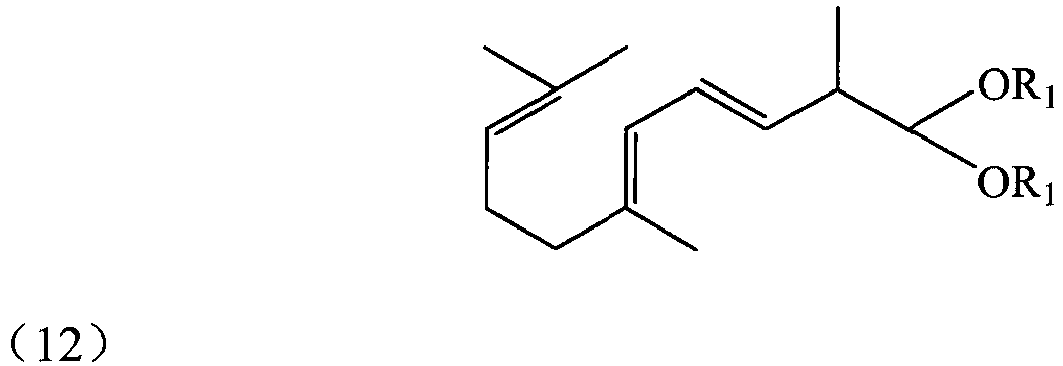
wherein, the 2,6,10-trimethyl-1,1-dialkoxy-3,5,9-undecan-triene is 2,6,10-trimethyl-1,1-dimethoxy-3,5,9-undecan-triene. - According to the second aspect of the present invention, it provides a method of preparing 2,6,10-trimethyl-1,1-dialkoxy-3,5,9-undecan-triene of formula (12), the method comprises the following steps:
- Step (1): 4-methyl-5,5-dialkoxy-1-pentenyl-1-phosphoric acid dialkyl ester of formula (10) undergoes a rearrangement reaction at temperature of -40~30°C in ether solvent or dipolar aprotic solvent and under protection of inert gas in the presence of bases; the reaction sequence is described as follows:
- Step (2): 6-methyl-5-heptene-2-one of formula (13) is added to the product of Step (1) to undergo a Wittig-Homer condensation reaction at a temperature of -40~30°C in ether solvent or dipolar aprotic solvent and in the presence of bases to produce 2,6,10-trimethyl-1,1-dialkoxy-3,5,9- undecan-triene of formula (12). The reaction sequence of Step II-2 is described as follows:

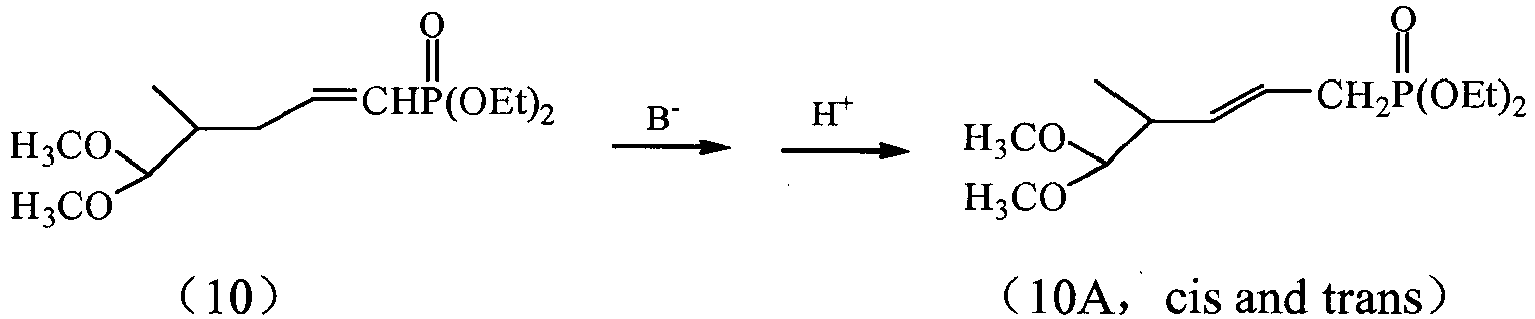
- In particular, in Step (1), 4-methyl-5,5-dialkoxy-1-pentenyl-1-phosphoric acid dialkyl ester of formula (10) undergoes a rearrangement reaction and dissociation at temperature of -40~30°C in ether solvent or dipolar aprotic solvent and under protection of inert gas in the presence of bases to produce a rearrangement product with a carbanion of formula (10A). It is found by tracking gas chromatography that 4-methyl-5,5-dialkoxy-1-pentenyl-1-phosphoric acid dialkyl ester of formula (10) fully rearranges to a carbanion of formula (10A). The rearrangement product is double bond, cis-trans isomers. The reaction sequence of the step is described as follows:

- Step (2-2): after fully rearrangement reaction and dissociation, 6-methyl-5-heptene-2-one of formula (13) is added to undergo a Wittig-Homer condensation reaction to produce 2,6,10-trimethyl-1,1-dialkoxy-3,5,9- undecan-triene of formula (12), at temperature of -40~30°C in ether solvent or dipolar aprotic solvent and in the presence of bases. It is essentially a condensation reaction between the carbanion of formula (10A) and 6-methyl- 5-heptenyl-2-one of formula (13), wherein the by-product is phosphonic acid dialkyl ester salt. The reaction sequence of the Step is described as follows:

- Preferably, a molar ratio of dosage of 4-methyl-5,5-dialkoxy-1-pentenyl-1-phosphoric acid dialkyl ester of formula (10) to the bases is 1: 1.0~1.2. A molar ratio of dosage of 4-methyl-5,5-dialkoxy-1-pentenyl-1-phosphoric acid dialkyl ester of formula (10) to 6-methyl-5-heptene-2-one of formula (13) is 1: 0.8~1.2.
- More preferably, a molar ratio of dosage of 4-methyl-5,5-dialkoxy-1-pentenyl-1-phosphoric acid dialkyl ester of formula (10) to the bases is 1: 1.02~1.1. A molar ratio of dosage of 4-methyl-5,5-dialkoxy-1-pentenyl-1-phosphoric acid dialkyl ester of formula (10) to 6-methyl-5-heptene-2-one of formula (13) is 1: 0.9~1.1.
- Preferably, the bases comprise alkali metal salt of alcohols and alkyl lithium, wherein the alkali metal salt of alcohols is sodium ethoxide, sodium tert-butoxide or potassium tert-butoxide; the alkyl lithium is butyl lithium. The ether solvent is ether, tetrahydrofuran or ethylene glycol dimethyl ether. The dipolar aprotic solvent is dimethyl formamide, dimethyl sulfoxide or hexamethyl phosphoric triamide. The rearrangement reaction undergoes at a temperature of -20~10°C.
- After the end of the condensation reaction, water is added to segregate from organic solvent, the by-product such as phosphoric acid diethyl ester is dissolved in water, the product of 2,6,10-trimethyl-1,1-dialkoxy-3,5,9- undecan-triene of formula (12) is in organic phase, to remove the solvent after evaporation, to obtain the objective product of 2,6,10-trimethyl-1,1-dialkoxy-3,5,9- undecan-triene of formula (12).
- According to the third aspect of the invention, it provides 4-methyl-5,5-dialkoxy-1-pentenyl-1- phosphoric acid dialkyl ester of formula (10):

- Wherein, the 4-methyl-5,5-dialkoxy-1-pentenyl-1- phosphoric acid dialkyl ester is 4-methyl-5,5-dimethoxy-1-pentenyl-1-phosphoric acid dimethyl ester, 4-methyl-5,5-dimethoxy-1-pentenyl-1-phosphoric acid diethyl ester or 4-methyl-5,5-dimethoxy -1-pentenyl-1-phosphoric acid diisopropyl ester.
- According to the fourth aspect of the invention, it provides a method of preparing 4-methyl-5,5-dialkoxy-1-pentenyl-1-phosphoric acid dialkyl ester of formula (10). The method comprises the following steps:
- The 3-methyl-4,4-dialkoxy-1-aldehyde of formula(11) undergoes a Wittig-Homer condensation with tetra-alkyl methylene diphosphonate at temperature of 0~30°C in ether solvent or dipolar aprotic solvent and under protection of inert gases in the presence of bases to produce 4-methyl-5,5-dialkoxy-1-pentenyl-1-phosphoric acid dialkyl ester of formula (10). The reaction sequence is described as follows:

- Preferably, the tetra-alkyl methylene diphosphonate is tetra-methyl methylene diphosphonate, tetra-ethyl methylene diphosphonate or tetra-isopropyl methylene diphosphonate.
- Preferably, a molar ratio of dosage of the 3-methyl-4,4-dialkoxy-1-aldehyde of formula (11) to the bases is 1:1.02~1.2. A molar ratio of dosage of the 3-methyl-4,4-dialkoxy-1-aldehyde of formula (11) to the tetra-alkyl methylene diphosphonate is 1: 1.0~1.3. More preferably, a molar ratio of dosage of the 3-methyl-4,4-dialkoxy-1-aldehyde of formula (11) to the bases is 1: 1.02~1.1. A molar ratio of dosage of the 3-methyl-4,4-dialkoxy-1-aldehyde of formula (11) to the tetra-alkyl methylene diphosphonate is 1: 1.05~1.15.
- Preferably, the bases is alkali metal hydride, alkali metal salt of alcohols and alkyl lithium; wherein the alkali metal hydride is sodium hydride or potassium hydride; the alkali metal salt of alcohols is sodium ethoxide, sodium tert-butoxide or potassium tert-butoxide; the alkyl lithium is butyl lithium. The ether solvent is ether, tetrahydrofuran or ethylene glycol dimethyl ether. The dipolar aprotic solvent is dimethyl formamide, dimethyl sulfoxide or hexamethyl phosphoric triamide.
- Preferably, the tetra-alkyl methylene diphosphonate firstly reacts with the bases to produce a corresponding carbanion, and then 3-methyl-4,4-dialkoxy-1-aldehyde of formula (11) is added to undergo a Wittig-Homer condensation; or tetra-alkyl methylene diphosphonate firstly mixes with 3-methyl-4,4-dialkoxy-1-aldehyde of formula (11) and then is added into the bases.
- Finally, the 2,6,10-trimethyl-1,1-dialkoxy-3,5,9- undecan-triene of formula (12) is mixed with acid catalysts, water and homogeneous solvents, and undergoes a hydrolysis reaction at the temperature of 10~35°C under protection of inert gas to produce 2,6,10-trimethyl-3,5,9-undecatrienyl-1-aldehyde of formula (3). The reaction sequence is described as follows:
- In the method of preparing 2,6,10-trimethyl-3,5,9-undecatrienyl-1-aldehyde of formula (3), the reaction raw materials such as 3-methyl-4,4-dialkoxy- 1-aldehyde of formula (11), tetra-alkyl methylene diphosphonate and 6-methyl- 5-heptene-2-one of formula (13) are provided by Zhejiang Medicine Co., Ltd Xinchang Pharmaceutical Factory. Besides, these compounds may also be prepared by reference documents, for example, 3-methyl-4,4-dialkoxy- 1-aldehyde of formula (11) may be prepared according to the method disclosed in
US4675451 . The reaction sequence is described as follows:
- Both of tetra-alkyl methylene diphosphonate and 6-methyl- 5-heptene-2-one of formula (13) are obtained from regular industrial raw materials.
- As described above, it takes three steps for the present invention to produce the key intermediate of lycopene, 2,6,10-trimethyl-3,5,9-undecatrienyl-1-aldehyde of formula (3) by using 3-methyl-4,4-dialkoxy-1-aldehyde of formula (11) as raw materials. Hence it takes the advantages of short process route, easy acquisition of raw materials, low cost and high industrial value.
- The method of preparing lycopene is also adopted based on the method of the Chinese application No.
2010101042817 - Step (1): 2,6,10- trimethyl-3,5,9-undecatrienyl-1-aldehyde of formula (3) undergoes a Wittig-Homer condensation reaction with tetra-alkyl methylene diphosphonate, at temperature of 0~30°C in ether solvent or dipolar aprotic solvent and under protection of inert gases in the presence of bases, to produce 1,4,6,10-tetra-double bond pentadec-carbon phosphonate of formula (4). The reaction sequence is described as follows.

- Step (2): 1,4,6,10-tetra-double bond pentadec-carbon phosphonate of formula (4) undergoes a rearrangement reaction at temperature of -40~30°C in ether solvent or dipolar aprotic solvent and under protection of inert gas in the presence of alkali; and then decyl di-aldehyde of formula (8) is added to undergo a Wittig-Homer condensation reaction to produce lycopene of formula (1) at temperature of -40~30°C and in ether solvent or dipolar aprotic solvent, under protection of inert gas and in the presence of bases. The reaction sequence is described as follows.

- As described above, it takes five steps for the present invention to produce the objective product of lycopene (1) by using 3-methyl-4,4-dialkoxy-1-aldehyde of formula (11) as raw materials. Hence it takes the advantages of short process route, easy acquisition of raw materials, low cost and high industrial value.
- Please note that 4-methyl-5,5-dialkoxy-1-pentenyl- 1-phosphoric acid dialkyl ester of formula (10) is a single compound verified by tracking gas chromatography and nuclear magnetic resonance. The condensation product of 2,6,10-trimethyl-1,1-dialkoxy-3,5,9- undecan-triene of formula (12) is cis-trans isomeric mixtures. But these cis-isomers of these intermediates do not affect the all-trans structure of the final product-lycopene of formula (1), because the final product of all-trans lycopene are obtained through cis-trans isomerization and purification of the crude product of lycopene
- Hereafter, the present invention will be described specifically with reference to examples. The examples are given only for illustration of the technical solution of the present invention and should not be construed to limit the present invention.
- Apparatuses and devices of Examples of the present invention are as follows: Gas chromatograph-Mass Spectrometer, MS5973N-GC6890N (Agilent Technologies, US); Nuclear Magnetic Resonance Spectrometer, AVANCE DMX II I 400M (TMS as internal standard, Bruker Corporation); infrared spectrometer, NICOLET 360FT-IR; gas chromatograph, Techcomp Corp. 7890F.
- 4.4 g of sodium hydride (0.11mol) (60% content) is added in a 250 ml three necked flask under protection of nitrogen, and washed with 20 ml of hexane for twice to remove paraffin oil from sodium hydride, and then 20 ml of toluene is added into the flask, and then 60 ml of toluene dissolving 34.5g of tetraethyl methylene diphosphonate (0.12mol) is dropped into the flask under magnetic stirring at temperature 10~15°C of cold water bath for half an hour to release a large amount of gas, and continuously stirring for half an hour.
- Then 40 ml of toluene dissolving 14.4 g of 3-methyl-4,4-dimethoxy- 1-aldehyde of formula (11) (0.1mol) is dropped into the flask at temperature kept at 10~15°C of cold water bath for half an hour, and continuously stirring for half an hour to form a mixture.
- 40 ml of water is added into the mixture under stirring for 10 minutes until stratification, and the organic layer is separated from it after stratification. The organic layer is washed with 40 ml of 10% sodium chloride aqueous solution, and dried with magnesium sulfate and subsequently filtered, and then solvent is removed via reduced pressure evaporation to obtain 26.2 g crude product of 4-methyl-5,5-dimethoxy-1-pentenyl-1-phosphoric acid diethyl ester of formula (10) with colorless liquid, content of the crude product is 92.2% detected by GC analysis, yield is 86.9%. The crude product is evaporated with a boiling point of 107-111°C /1mmHg (1,3 mbar).
- GC-MS(m/e): 279, 265, 249, 220, 205, 195, 177, 163, 149, 121, 111, 95, 81, 75(100%), 67, 47, 29;

- 1HNMR(δ, ppm,400MHz, CDCl3): 0.920(d, J=6.8Hz, 3H, C6-H); 1.327(t, J=7.2Hz, 6H, OCH2C*H3); 1.907-1.972(m, 1H, C4-H); 2.025-2.103, 2.426-2.488 (m, m, 2H, C3-H); 3.339, 3.355(s,s, 6H, (OCH3)2); 4.038-4.109(m, 4H, OC*H2CH3); 4.054(d, J=6.4Hz,1H, C5-H); 5.674(dd, J=16.8Hz, 21.6Hz, 1H, C1-H); 6.696-6.793(m, 1H, C2-H);
- 13CNMR(δ, ppm, 400MHz, CDCl3): 152.12, 152.07(C2); 119.40, 117.54(C1); 108.11(C5); 61.63, 61.58(POC*H2CH3); 54.60, 54.01(OCH3); 36.84, 36.62(C3); 35.23(C4); 16.42, 16.35 (OCH2C*H3); 14.45(C6).
- 4.4 g of sodium hydride (0.11mol) (60% content) is added in a 250 ml three necked flask under protection of nitrogen, and washed with 20 ml of hexane for twice to remove paraffin oil from sodium hydride, and then 20 ml of toluene is added into the flask, and then 60 ml of toluene dissolving 27.9g of tetramethyl methylene diphosphonate (0.12mol) is dropped into the flask under magnetic stirring at temperature 10~15°C of cold water bath for half an hour to release a large amount of gas, and continuously stirring for half an hour.
- Then 40 ml of toluene dissolving 14.4 g of 3-methyl-4,4-dimethoxy-1-aldehyde of formula (11) (0.1mol) is dropped into the flask at temperature kept at 10~15°C of cold water bath for half an hour, and continuously stirring for half an hour to form a mixture.
- 40 ml of water is added into the mixture under stirring for 10 minutes until stratification, and the organic layer is separated from it after stratification. The organic layer is washed with 40 ml of 10% sodium chloride aqueous solution, and dried with magnesium sulfate and subsequently filtered, and then solvent is removed via reduced pressure evaporation to obtain 25.2g crude product of 4-methyl-5,5-dialkoxy-1-pentenyl-1-phosphoric acid dimethyl ester of formula (10) with colorless liquid, content of the crude product is 91.7% detected by GC analysis, yield is 91 %.
-
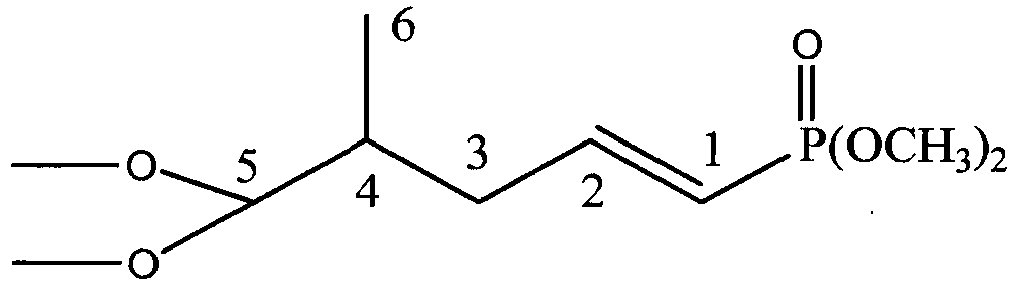
- 1HNMR(δ, ppm, 400MHz , CDCl3): 0.923(d, J=6.8Hz, 3H, C6-H); 1.897-1.962(m, 1H, C4-H); 2.038-2.116, 2.417-2.523(m, m, 2H, C3-H); 3.356, 3.367 (s, s, 6H, (OCH3)2); 3.709, 3.736 (m, 6H, OC*H3); 4.057(d, J=6.0Hz,1H, C5-H); 5.647(dd, J=16.8Hz, 21.6Hz, 1H, C1-H); 6.715-6.847(m, 1H, C2-H);
- 13CNMR (δ, ppm, 400MHz , CDCl3): 153.27, 153.22(C2); 117.83,115.97(C1); 108.02(C5); 54.59,53.98(OCH3); 52.28,52.23(POCH3); 36.87, 36.65(C3); 35.14(C4); 14.45(C6).
- 4.4 g of sodium hydride (0.11mol) (60% content) is added in a 250 ml three necked flask under protection of nitrogen, and washed with 20 ml of hexane for twice to remove paraffin oil from sodium hydride, and then 20 ml of toluene is added into the flask, and then 60 ml of toluene dissolving 41.3g of tetraisopropyl methylene diphosphonate (0.12mol) is dropped into the flask under magnetic stirring at temperature 10~15°C of cold water bath for half an hour to release a large amount of gas, and continuously stirring for half an hour.
- Then 40 ml of toluene dissolving 14.4 g of 3-methyl-4,4-dimethoxy-1-aldehyde of formula (11) (0.1mol) is dropped into the flask at temperature kept at 10~15°C of cold water bath for half an hour, and continuously stirring for half an hour to form a mixture.
- 40 ml of water is added into the mixture under stirring for 10 minutes until stratification, and the organic layer is separated from it after stratification. The organic layer is washed with 40 ml of 10% sodium chloride aqueous solution, and dried with magnesium sulfate and subsequently filtered, and then solvent is removed via reduced pressure evaporation to obtain 29.3g crude product of 4-methyl-5,5-dimethoxy-1-pentenyl-1-phosphoric acid diisopropyl ester of formula (10) with colorless liquid, content of the crude product is 92.5% detected by GC analysis, yield is 89.7%.
-

- 1HNMR(δ, ppm, 400MHz , CDCl3): 0.914(d, J=6.4Hz,3H, C6-H); 1.327-1.365(m, 12H, OCH(C*H3)2); 1.903-1.986(m, 1H, C4-H); 2.025-2.082, 2.325-2.456(m, m, 2H, C3-H); 1.608, 3.363, 3.354(s, s, s, 6H, (OCH3)2) ; 4.055(d, J=6.0Hz, 1H, C5-H); 4.735-4.814(m, 2H, OC*H(CH3)2); 5.682(dd, J=17.2Hz, 20.8Hz, 1H, C1-H); 6.645-6.734(m, 1H, C2-H);
- 13CNMR(δ, ppm,400MHz, CDCl3): 150.85,150.80(C2); 121.01,119.15(C1); 108.00(C5); 71.14,71.11,71.08 (OC*H(CH3)2); 54.48, 53.93(OCH3); 36.70,36.47(C3); 35.15(C4); 23.91, 23.95, 24.02, 24.06 (OCH(C*H3)2); 14.34(C6).
- Using the same method as Example 1, a certain amount of alkali and solvent (refer to Table 1) are added into a 250 ml three necked flask under protection of nitrogen, and 40 ml solvent (refer to solvent of Table 1) dissolving a certain amount of tetraethyl methylene diphosphonate (refer to molar weight of Table 1) is dropped into the flask under magnetic stirring at temperature 10~15°C of cold water bath for half an hour to release a large amount of gas, and continuously stirring for 20 minutes.
- Then 20 ml solvent (refer to solvent of Table1) dissolving 5.8 g of 3-methyl-4,4-dimethoxy- 1-aldehyde of formula (11) (0.040mol) is dropped into the flask at temperature kept at certain temperature (refer to temperature of Table 1) for half an hour, and continuously stirring for 20 minutes to form a mixture.
- 40 ml of water and 100 ml ether are added into the mixture under stirring for 10 minutes until stratification, and the organic layer is separated from it after stratification. The organic layer is washed with 40 ml of 10% sodium chloride aqueous solution, and dried with magnesium sulfate and subsequently filtered, and then solvent is removed via reduced pressure evaporation to obtain crude product of 4-methyl-5,5-dimethoxy- 1-pentenyl-1-phosphoric acid diethyl ester of formula (10) with colorless or faint yellow liquid, used for measuring content of the crude product by GC analysis and yield. Results are shown in Table 1
Table 1: Results of Reactants, Reaction Temperatures of Condensation Reaction of Examples 4~10 Example Alkali Amount of alkali (mole) Solvent Tetraethyl methylene diphosphonate (mole) Reaction temperature (°C) Amount of Product (g) GC content (%) Yield (%) 4 sodium ethoxide -0.0480 toluene 0.0520 5 10.4 93.2 87.2 5 sodium tert-butoxide 0.0400 ethylene glycol dimethyl ether 0.0400 10 10.8 92.9 89.6 6 potassium tert-butoxide 0.0408 dimethyl formamide 0.0420 20 11.2 93.1 93.8 7 n-butyl lithium 0.0480 tetrahydrofuran /n-hexane 0.0520 0 11.2 93.5 94.2 8 DMSO sodium salt 0.0420 DMSO 0.0432 30 10.0 91.3 82.1 9 potassium hydride 0.0412 toluene 0.0432 20 11.2 92.5 93.2 10 sodium methoxide 0.0440 ether 0.0460 15 8.4 89.7 73.3 Note: n-butyl lithium is 2.5 mol/l n-hexane solution thereof
Finally combine these crude products obtained to get 73.2 g crude product of 4-methyl-5,5-dimethoxy- 1-pentenyl-1-phosphoric acid diethyl ester of formula (10) used for the following condensation reaction. - 6.2g (0.11mol) of potassium tert-butoxide and 30 ml mixture of tetrahydrofuran: dimethyl sulfoxide (8:1 (v:v)) are added in a 250 ml a three neck flask in cold water bath under mechanical stirring, under protection of nitrogen, 14.0 g (0.05mole) of 4-methyl-5,5-dimethoxy-1-pentenyl-1-phosphoric acid diethyl ester of formula (10) is dropped into the flask at temperature of -30~-25°C for half an hour until the end of dropping, continuously stirring under the same temperature for an hour to make a carbanion undergo dissociative reaction fully. At this time the samples are took and a small amount of water is added into the samples for stratification, the organic layer is detected for gas chromatography analysis to confirm 4-methyl-5,5-dimethoxy-1-pentenyl- 1-phosphoric acid diethyl ester of formula (10) are fully rearranged to 4-methyl-5,5-dimethoxy-2-pentenyl- 1-phosphoric acid diethyl ester of formula (10A), the rearrangement product is a mixture of cis-trans isomers. The reaction sequence of the step is described as follows:
- GC-MS (m/e): 279, 262, 247, 231, 223, 191, 163, 135, 125, 109, 102, 93, 81, 75(100%), 47, 29;

- 1HNMR(δ, ppm, 400MHz, CDCl3): 0.878-0.967, 0.984-1.046(m, m, 3H, C6-H); 1.319(s, 6H, OCH2C*H3); 1.704-1.750, 1.894-1.956(m, m, 2H, C1-H); 2.450-2.604(m, 1H, C4-H); 3.356(s, 6H, (OCH3)2); 4.001-4.203(m, 4H, OC*H2CH3); 4.016-4.145(m, 1H, C5-H); 5.367-5.506(m, 1H, C2-H); 5.582-5.707(m, 1H, C3-H)
- 13CNMR (δ, ppm, 400MHz, CDCl3): 136.42, 136.28(C3); 119.26, 119.15(C2); 107.98, 107.82(C5); 61.27, 61.23(POC*H2CH3); 53.76, 53.73(OCH3); 33.59(C4); 31.25, 30.95(C1); 16.39 (OCH2C*H3); 14.92, 14.72(C6).
- Then, 6.3 g of 6-methyl-5-heptene-2-one of formula (13) (0.05mol) is dropped into the flask at a temperature of -30~-25 °C for an hour, continuously stirring for half an hour at the same temperature, and trace the end of the reaction by tracking gas chromatography. 30 ml of water and 60 ml of ether are added under stirring for 10 minutes, and then wash the ether layer with 5% sodium chloride aqueous solution for 3 times (15 ml each time) after stratification, the organic layer is dried over magnesium sulfate, and subsequently filtered, the filtrate is removed via reduced pressure evaporation to obtain a crude product, the residual material is evaporated at reduced pressure, the fraction within 99-103°C/1mmHg (1,3 mbar) is collected 9.4g, the fraction is a colorless transparent liquid, the product shows four peaks through GC analysis, the total content is 87.5%, the yield is 65.3%. Four products are respectively 3,4-double bond cis-trans isomers and 5, 6- double bond cis-trans isomers.
- GC-MS (m/e): 252, 220, 192(100%), 178, 165, 152, 115, 102, 91, 77, 65, 51, 39;
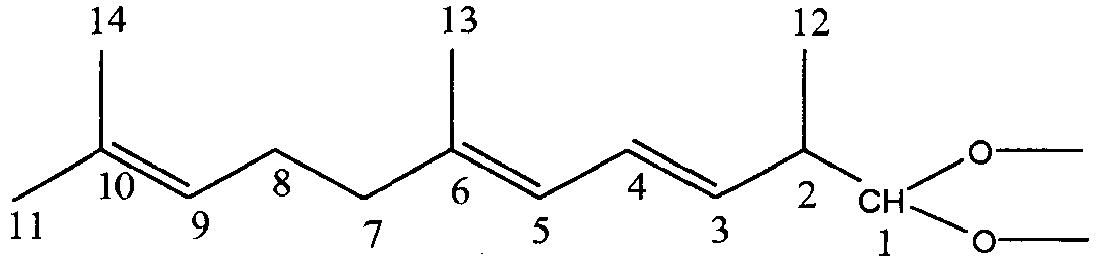
- 1HNMR(δppm, 400MHz, CDCl3): 1.003(d, J=6.8Hz , 3H, C12-H); 1.605(s, 3H, C14-H); 1.679(s, 3H, C11-H); 1.745(s, 3H, C13-H); 2.036-2.184(m, 4H, C7-H, C8-H); 2.928-2.969(m, 2H, C2-H); 3.378,3.381(s, s, 6H, (OCH3)2); 4.120-4.144(m, 1H, C1-H); 5.099-5.130(m, 1H, C9-H); 5.190-5.268(q, J=10.4Hz, 1H, C3-H); 6.058 (d, J=11.2Hz, 1H, C5-H); 6.188-6.253(m, 1H, C4-H)
- 13CNMR (δppm, 400MHz, CDCl3): 139.44 (C6); 131.61 (C10); 130.07 (C3); 124.87 (C4); 124.05(C9); 119.76(C5); 108.15(C1); 53.64(OCH3); 40.29 (C7); 35.27 (C2); 26.57(C8); 25.70 (C11); 17.68 (C12); 16.52(C14); 16.16 (C13);
- DEPT135: 139.44; 131.61; 130.07; 124.87; 124.05; 119.76; 108.15; 53.64; 40.29 (D); 35.27; 26.57(D); 25.70; 17.68; 16.52; 16.16;
- 6.2g of potassium tert-butoxide (0.11mol) and 30 ml mixture of tetrahydrofuran: dimethyl sulfoxide (8:1 (v:v)) are added into a 250 ml a three neck flask in cold water bath under mechanical stirring, under protection of nitrogen, 12.7 g (0.05 mole) of 4-methyl-5,5-dimethoxy-1-pentenyl-1-phosphoric acid dimethyl ester of formula (10) is dropped into the flask at temperature of -30~-25°C for half an hour, and then continuously stirring under the same temperature for an hour to make a carbanion undergo dissociative reaction fully.
- Then, 6.3 g (0.05mol)of 6-methyl-5-heptene-2-one of formula (13) is dropped into the flask at a temperature of -30~-25°C for an hour, and continuously stirring for half an hour at the same temperature, and trace the end of the reaction by tracking gas chromatography. 30 ml of water and 60 ml of ether are added under stirring for 10 minutes, and then wash the ether layer with 5% sodium chloride aqueous solution for 3 times (15 ml each time) after stratification, the organic layer is dried over magnesium sulfate, and subsequently filtered, the filtrate is removed via reduced pressure evaporation to obtain a crude product, the residue is evaporated at reduced pressure, the fraction within 99-103°C/1mmHg (1,3 mbar) is collected 9.4g, the fraction is a colorless transparent liquid, the product shows four peaks through GC analysis, the total content is 86.7%, the yield is 66.1%. Four products are respectively 3,4-double bond cis-trans isomers and 5, 6- double bond cis-trans isomers. Datum of 1HNMR of example 12 is the same as that of example 11.
- 6.2g of potassium tert-butoxide (0.11mol) and 30 ml mixture of tetrahydrofuran: dimethyl sulfoxide (8:1 (v:v)) are added into a 250 ml a three neck flask in cold water bath under mechanical stirring, under protection of nitrogen, 15.1 g (0.05 mole) of 4-methyl-5,5-dimethoxy-1-pentenyl-1-phosphoric acid diisopropyl ester of formula (10) is dropped into the flask at temperature of -30~-25°C for half an hour, and then continuously stirring under the same temperature for an hour to make a carbanion undergo dissociative reaction fully.
- Then, 6.3 g (0.05mol) of 6-methyl-5-heptene-2-one of formula (13) is dropped into the flask at a temperature of -30~-25°C for an hour, and continuously stirring for half an hour at the same temperature, and trace the end of the reaction by tracking gas chromatography. 30 ml of water and 60 ml of ether are added under stirring for 10 minutes, and then wash the ether layer with 5% sodium chloride aqueous solution for 3 times (15 ml each time) after stratification, the organic layer is dried over magnesium sulfate, and subsequently filtered, the filtrate is removed via reduced pressure evaporation to obtain a crude product, the residue is evaporated at reduced pressure, the fraction within 99-103°C/1mmHg (1,3 mbar) is collected 10.1g, the fraction is a colorless transparent liquid, the product shows four peaks through GC analysis, the total content is 87.8%, the yield is 70.4%. Four products are respectively 3,4-double bond cis-trans isomers and 5, 6- double bond cis-trans isomers. Datum of 1HNMR of example 12 is the same as that of example 11.
- The crude product of 73.2g of 4-methyl-5,5-dimethoxy-1-pentenyl-1-phosphoric acid diethyl ester of formula (10) of Examples 4-10 and 12.0 g of the residual crude product of Example 1 are combined together to obtain crude products, the total amount is 85.2g, the total content is 92.7%, the crude products is used for the following experiment.
- Using the same the method as Example 11, a certain amount of alkali and 20ml solvent (refer to Table 2) are added into a 250 ml a three necked flask under protection of nitrogen, and 20 ml solvent (refer to solvent of Table 2) dissolving a certain amount of 4-methyl-5,5-dimethoxy-1-pentenyl-1-phosphoric acid diethyl ester of formula (10) (refer to molar weight of Table 2) is dropped into the flask under magnetic stirring at a certain temperature (refer to temperature of Table 2) for half an hour, and continuously stirring for an hour to make a carbanion undergo dissociative reaction fully.
- Then a solvent (refer to solvents of Table 2) dissolving 6.3 g of 6-methyl-5-heptene-2-one of formula (13) (0.05mol, cis-trans isomers mixture) is dropped into the flask at a certain temperature of -30~-25 °C for an hour, continuously stirring for half an hour at the same temperature, and determine the end of the reaction by tracking gas chromatography. 30 ml of water and 50 ml of ether are added under stirring for 10 minutes, and then wash the ether layer with 5% sodium chloride aqueous solution for 3 times (15 ml each time) after stratification, the organic layer is dried over magnesium sulfate, and subsequently filtered, the filtrate is removed via reduced pressure evaporation to obtain a crude product, the residual material is evaporated at reduced pressure, the fraction within 97-101°C/1mmHg (1,3 mbar) is collected for measuring content of the crude product by GC analysis and yield. Results are shown in Table 2.
Table 2: Reactants, Reaction Temperatures And Reaction Results of The of Examples 14-19 examples alkali amount of alkali (mole) solvent 4-methyl-5,5-dimethoxy-1-pentenyl-1-phosphoric acid diethyl ester (g, mole) reaction temperature (°C) amount of Product (g) GC content (%) yield (%) 14 sodium ethoxide 0.06 toluene 13.9, 0.050 -20 6.3 86.2 43.1 15 sodium tert-butoxide 0.05 glycol dimethyl ether 12.5, 0.045 -10 8.2 87.5 56.9 16 n-butyl lithium 0.051 tetrahydrofuran / n-hexane 13.0, 0.047 -40 9.8 91.6 71.2 17 potassium tert-butoxide 0.063 dimethyl sulfoxide 17.4, 0.063 10 8.9 90.7 64.1 18 potassium tert-butoxide 0.0567 dimethyl formamide 15.6, 0.056 20 8.9 91.4 64.5 19 potassium tert-butoxide 0.046 hexamethyl-phosphoric triamide 11.6, 0.042 30 8.9 89.3 62.4 Note: n-butyl lithium is 2.5 mol/l n-hexane solution thereof
Finally combine these crude products obtained to obtain 51g crude product of 2,6,10-trimethyl-1,1- dimethoxy -3,5,9-undecantriene of formula (12) together with 80.2g crude product of 2,6,10-trimethyl-1,1- dimethoxy -3,5,9-undecantriene of formula (12) of Examples 11, 12, 13 used for the following condensation reaction.tests, wherein their datum of 1HNMR of Examples 14~19 are the same as that of Example 11.
Claims (15)
- A compound of 2,6,10-trimethyl-1,1-dialkoxy-3,5,9-undecan-triene of formula (12):

- The 2,6,10-trimethyl-1,1-dialkoxy-3,5,9-undecan-triene according to claim 1, characterized in that, the 2,6,10-trimethyl-1,1-dialkoxy-3,5,9-undecan-triene is 2,6,10-trimethyl-1,1-dimethoxy-3,5,9-undecan-triene.
- A method of preparing 2,6,10-trimethyl-1,1-dialkoxy-3,5,9- undecan-triene of formula (12) according to claim 1 or 2, the method comprises the following steps:Step (1): 4-methyl-5,5-dialkoxy-1-pentenyl-1-phosphoric acid dialkyl ester of formula (10) undergoing a rearrangement reaction at temperature of -40~30°Cin ether solvent or dipolar aprotic solvent and under protection of inert gas in the presence of bases to produce a rearrangement product with a carbanion of formula (10A);
 Step (2): adding 6-methyl-5-heptene-2-one of formula (13) to the product of Step (1) to undergo a Wittig-Homer condensation reaction at a temperature of -40~30°C in ether solvent or dipolar aprotic solvent and in the presence of bases to produce 2,6,10-trimethyl-1,1-dialkoxy-3,5,9- undecan-triene of formula (12), the reaction sequence is described as follows:
- The method according to claim 3, characterized in that, a molar ratio of dosage of the 4-methyl-5,5-dialkoxy-1-pentenyl-1-phosphoric acid dialkyl ester of formula (10) to the bases is 1: 1.0~1.2; a molar ratio of dosage of the 4-methyl-5,5-dialkoxy-1-pentenyl-1-phosphoric acid dialkyl ester of formula (10) to 6-methyl-5-heptene-2-one of formula (13) is 1: 0.8~1.2; preferably the molar ratio of dosage of the 4-methyl-5,5-dialkoxy-1-pentenyl-1-phosphoric acid dialkyl ester of formula (10) to the bases is 1: 1.02~1.1; a molar ratio of dosage of the 4-methyl-5,5-dialkoxy-1-pentenyl-1-phosphoric acid dialkyl ester of formula (10) to 6-methyl-5-heptene-2-one of formula (13) is 1: 0.9~1.1.
- The method according to any one of claim 3~4, characterized in that, the 4-methyl-5,5-dialkoxy-1-pentenyl-1-phosphoric acid dialkyl ester is 4-methyl-5,5-dimethoxy-1-pentenyl-1-phosphoric acid dimethyl ester, 4-methyl-5,5-dimethoxy -1-pentenyl-1-phosphoric acid diethyl ester or 4-methyl-5,5-dimethoxy-1-pentenyl-1-phosphoric acid diisopropyl ester.
- The method according to any one of claim 3~4, characterized in that, the bases is alkali metal salt of alcohols and alkyl lithium, wherein the alkali metal salt of alcohols is sodium ethoxide, sodium tert-butoxide or potassium tert-butoxide; the alkyl lithium is butyl lithium.
- The method according to any one of claim 3~4, characterized in that, the ether solvent is ether, tetrahydrofuran or ethylene glycol dimethyl ether; the dipolar aprotic solvent is dimethyl formamide, dimethyl sulfoxide or hexamethyl phosphoric triamide.
- The method according to any one of claim 3~4, characterized in that, both of the rearrangement reaction and the Wittig-Homer condensation reaction undergo at a temperature of -20~10°C.
- 4-methyl-5,5-dialkoxy -1-pentenyl-1- phosphoric acid dialkyl ester of formula (10):

- The 4-methyl-5,5-dialkoxy -1-pentenyl-1- phosphoric acid dialkyl ester according to claim 9, characterized in that, the 4-methyl-5,5-dialkoxy-1-pentenyl-1-phosphoric acid dialkyl ester is 4-methyl-5,5-dimethoxy-1-pentenyl-1-phosphoric acid dimethyl ester, 4-methyl-5,5-dimethoxy-1-pentenyl-1-phosphoric acid diethyl ester or 4-methyl-5,5-dimethoxy-1-pentenyl-1-phosphoric acid diisopropyl ester.
- The method of preparing 4-methyl-5,5-dialkoxy-1-pentenyl-1-phosphoric acid dialkyl ester of formula (10) according to claim 9 or 10, the method comprises the following steps:3-methyl-4,4-dialkoxy-1-aldehyde of formula(11) undergoing a Wittig-Homer condensation with tetra-alkyl methylene diphosphonate at temperature of 0~30°C in ether solvent or dipolar aprotic solvent and under protection of inert gases in the presence of bases to produce 4-methyl-5,5-dialkoxy -1-pentenyl-1- phosphoric acid dialkyl ester of formula (10); the reaction sequence is described as follows:

- The method according to claim 11, characterized in that, a molar ratio of dosage of the 3-methyl-4,4-dialkoxy-1-aldehyde of formula (11) to the bases is 1:1.0~1.2; a molar ratio of dosage of the 3-methyl-4,4-dialkoxy-1-aldehyde of formula (11) to the tetra-alkyl methylene diphosphonate is 1 : 1.0~1.3; preferably the molar ratio of dosage of the 3-methyl-4,4-dialkoxy-1-aldehyde of formula (11) to the bases is 1: 1.02~1.1; a molar ratio of dosage of the 3-methyl-4,4-dialkoxy-1-aldehyde of formula (11) to the tetra-alkyl methylene diphosphonate is 1: 1.05~1.15.
- The method according to claim 11, characterized in that,
a molar ratio of dosage of the 3-methyl-4,4-dialkoxy-1-aldehyde of formula (11) to the bases is 1:1.0~1.2; a molar ratio of dosage of the 3-methyl-4,4-dialkoxy-1-aldehyde of formula (11) to the tetra-alkyl methylene diphosphonate is 1:1.0~1.3; and
the tetra-alkyl methylene diphosphonate is tetra-methyl methylene diphosphonate, tetra-ethyl methylene diphosphonate or tetra-isopropyl methylene diphosphonate. - The method according to any one of claim 11~12, wherein:the bases is alkali metal hydride, alkali metal salt of alcohols or alkyl lithium; wherein the alkali metal hydride is sodium hydride or potassium hydride; the alkali metal salt of alcohols is sodium ethoxide, sodium tert-butoxide or potassium tert-butoxide; the alkyl lithium is butyl lithium; orthe ether solvent is ether, tetrahydrofuran or ethylene glycol dimethyl ether; the dipolar aprotic solvent is dimethyl formamide, dimethyl sulfoxide or hexamethyl phosphoric triamide.
- The method according to claim 11, characterized in that, the tetra-alkyl methylene diphosphonate firstly reacts with the bases to produce a corresponding carbanion, and then the 3-methyl-4,4-dialkoxy-1-aldehyde of formula (11) is added to undergo a Wittig-Homer condensation; or the tetra-alkyl methylene diphosphonate firstly mixes with the 3-methyl-4,4- dialkoxy-1-aldehyde of formula (11) and then is added into the bases.
Applications Claiming Priority (2)
| Application Number | Priority Date | Filing Date | Title |
|---|---|---|---|
| CN201010189847.0A CN102267879B (en) | 2010-06-02 | 2010-06-02 | Lycopene intermediate and preparation method thereof |
| PCT/CN2011/000155 WO2011150659A1 (en) | 2010-06-02 | 2011-01-30 | Intermediate of lycopene and preparation method of intermediate thereof |
Publications (3)
| Publication Number | Publication Date |
|---|---|
| EP2578563A1 EP2578563A1 (en) | 2013-04-10 |
| EP2578563A4 EP2578563A4 (en) | 2013-12-11 |
| EP2578563B1 true EP2578563B1 (en) | 2015-03-18 |
Family
ID=45050362
Family Applications (1)
| Application Number | Title | Priority Date | Filing Date |
|---|---|---|---|
| EP11789038.4A Active EP2578563B1 (en) | 2010-06-02 | 2011-01-30 | Intermediate of lycopene and preparation method of intermediate thereof |
Country Status (4)
| Country | Link |
|---|---|
| US (1) | US8846968B2 (en) |
| EP (1) | EP2578563B1 (en) |
| CN (1) | CN102267879B (en) |
| WO (1) | WO2011150659A1 (en) |
Families Citing this family (1)
| Publication number | Priority date | Publication date | Assignee | Title |
|---|---|---|---|---|
| CN102267881B (en) * | 2010-06-02 | 2013-07-24 | 绍兴文理学院 | Lycopene intermediate and preparation method thereof |
Family Cites Families (11)
| Publication number | Priority date | Publication date | Assignee | Title |
|---|---|---|---|---|
| US3962283A (en) * | 1967-07-07 | 1976-06-08 | Givaudan Corporation | Terpene flavorant intermediates |
| US4000131A (en) | 1974-05-10 | 1976-12-28 | Hoffmann-La Roche Inc. | Process for preparing epoxide-cyclohexyl compound and resultant compound |
| DE3505654A1 (en) | 1985-02-19 | 1986-08-21 | Degussa Ag, 6000 Frankfurt | METHOD FOR PRODUCING 2-ALKYL-1,4-BUTANDIAL |
| US6153769A (en) * | 1997-11-27 | 2000-11-28 | Roche Vitamins Inc. | Manufacture of polyene aldehydes |
| AUPP438498A0 (en) | 1998-06-29 | 1998-07-23 | Garvan Institute Of Medical Research | Novel Gaba-B receptor |
| US5973179A (en) | 1998-11-19 | 1999-10-26 | Loyola University Of Chicago | C-15 phosphonate reagent compositions for the manufacture of compounds such as lycopene and methods of synthesizing the same |
| JP2001039943A (en) * | 1999-07-26 | 2001-02-13 | Sumitomo Chem Co Ltd | Method for producing lycopene and intermediate thereof |
| DE10112067A1 (en) * | 2001-03-12 | 2002-09-19 | Basf Ag | Process for the preparation of 2,7-dimethyl-2,4,6-octarienal monoacetals |
| EP1467959B1 (en) * | 2002-01-22 | 2007-01-10 | Firmenich Sa | Acetals of 2,4,7-decatrienal as perfuming or flavoring ingredients |
| CN101037449B (en) * | 2007-04-09 | 2010-04-07 | 广州巨元生化有限公司 | New quaternary phosphonium salt and synthesizing method applied for carotenoids |
| CN102267881B (en) * | 2010-06-02 | 2013-07-24 | 绍兴文理学院 | Lycopene intermediate and preparation method thereof |
-
2010
- 2010-06-02 CN CN201010189847.0A patent/CN102267879B/en active Active
-
2011
- 2011-01-30 WO PCT/CN2011/000155 patent/WO2011150659A1/en not_active Ceased
- 2011-01-30 EP EP11789038.4A patent/EP2578563B1/en active Active
-
2012
- 2012-12-03 US US13/692,694 patent/US8846968B2/en active Active
Also Published As
| Publication number | Publication date |
|---|---|
| US20140005434A1 (en) | 2014-01-02 |
| EP2578563A4 (en) | 2013-12-11 |
| CN102267879A (en) | 2011-12-07 |
| EP2578563A1 (en) | 2013-04-10 |
| WO2011150659A1 (en) | 2011-12-08 |
| CN102267879B (en) | 2013-07-03 |
| US8846968B2 (en) | 2014-09-30 |
Similar Documents
| Publication | Publication Date | Title |
|---|---|---|
| Savu et al. | Selective. gamma. alkylation of copper enolates derived from. alpha.,. beta.-unsaturated acids: factors affecting scope and regio-and stereoselectivity | |
| EP2546226B1 (en) | 1-methoxyl-2,6,10-trimethyl-1,3,5,9-undec-tetraene and preparation method and uses thereof | |
| EP2551272B1 (en) | Lycopene intermediate 1, 3, 6, 10-tetra-double bond pentadec-phosphonate, preparation method and application thereof | |
| EP2532670B1 (en) | 1, 4, 6, 10-tetra-double bond pentadec-carbon phosphonate, preparation method thereof, and preparation method of lycopene using same | |
| CN102190565B (en) | Method for preparing intermediate of vitamin A, namely tetradecanal | |
| EP3222610B1 (en) | Method for selective palladium-catalyzed telomerization of substituted dienes | |
| Axelrad et al. | Reactions of copper (I) halide complexes of trivalent phosphorus with vinylic halides | |
| EP2578564B1 (en) | Preparation method of an intermediate for the preparation of lycopene | |
| CN102249871B (en) | Preparation method of lycopene intermediate 2,6,10-trimethyl-1,1-docosane oxygroup-3,5,-undecane triene | |
| US8846968B2 (en) | Intermediate of lycopene and preparation method of intermediate thereof | |
| Shen et al. | A novel and practical synthetic route for the total synthesis of lycopene | |
| CN102617639A (en) | Lycopene intermediate 3,7-dimethyl-1,6-octadiene-1-phosphonic acid dialkyl ester, and preparation method and application thereof | |
| CN102311320A (en) | Method for preparing 2,6,10-trimethyl-1,1-dialkoxyl-3,5,9-undecatriene | |
| WO2000031086A1 (en) | C-15 phosphonate for the manufacture of lycopene | |
| US8563780B2 (en) | Allyl and propargyl ethers | |
| Shajari et al. | Vinyltriphenylphosphonium salt-mediated preparation of thiophene-containing electron-poor alkenes from acetylenic esters, 2-thienylmethanol and triphenylphosphine | |
| Karimi-Jaberi et al. | Green, one-pot synthesis of α-aminophosphonates catalyzed by ZnI 2 at room temperature. | |
| AU2022403631A1 (en) | Catalytic tetrahydrocannabinol synthesis and precursors | |
| Deshmukh et al. | Copper-catalyzed substitution reactions of acylal with organomanganese reagents |
Legal Events
| Date | Code | Title | Description |
|---|---|---|---|
| PUAI | Public reference made under article 153(3) epc to a published international application that has entered the european phase |
Free format text: ORIGINAL CODE: 0009012 |
|
| 17P | Request for examination filed |
Effective date: 20121228 |
|
| AK | Designated contracting states |
Kind code of ref document: A1 Designated state(s): AL AT BE BG CH CY CZ DE DK EE ES FI FR GB GR HR HU IE IS IT LI LT LU LV MC MK MT NL NO PL PT RO RS SE SI SK SM TR |
|
| DAX | Request for extension of the european patent (deleted) | ||
| A4 | Supplementary search report drawn up and despatched |
Effective date: 20131108 |
|
| RIC1 | Information provided on ipc code assigned before grant |
Ipc: C07C 41/48 20060101ALI20131104BHEP Ipc: C07C 43/03 20060101AFI20131104BHEP Ipc: C07F 9/28 20060101ALI20131104BHEP Ipc: C07B 47/00 20060101ALI20131104BHEP |
|
| GRAP | Despatch of communication of intention to grant a patent |
Free format text: ORIGINAL CODE: EPIDOSNIGR1 |
|
| INTG | Intention to grant announced |
Effective date: 20141007 |
|
| GRAS | Grant fee paid |
Free format text: ORIGINAL CODE: EPIDOSNIGR3 |
|
| GRAA | (expected) grant |
Free format text: ORIGINAL CODE: 0009210 |
|
| AK | Designated contracting states |
Kind code of ref document: B1 Designated state(s): AL AT BE BG CH CY CZ DE DK EE ES FI FR GB GR HR HU IE IS IT LI LT LU LV MC MK MT NL NO PL PT RO RS SE SI SK SM TR |
|
| REG | Reference to a national code |
Ref country code: GB Ref legal event code: FG4D |
|
| REG | Reference to a national code |
Ref country code: CH Ref legal event code: EP |
|
| REG | Reference to a national code |
Ref country code: IE Ref legal event code: FG4D |
|
| REG | Reference to a national code |
Ref country code: AT Ref legal event code: REF Ref document number: 716453 Country of ref document: AT Kind code of ref document: T Effective date: 20150415 |
|
| REG | Reference to a national code |
Ref country code: DE Ref legal event code: R096 Ref document number: 602011014891 Country of ref document: DE Effective date: 20150430 |
|
| REG | Reference to a national code |
Ref country code: NL Ref legal event code: VDEP Effective date: 20150318 |
|
| REG | Reference to a national code |
Ref country code: NL Ref legal event code: VDEP Effective date: 20150318 |
|
| PG25 | Lapsed in a contracting state [announced via postgrant information from national office to epo] |
Ref country code: HR Free format text: LAPSE BECAUSE OF FAILURE TO SUBMIT A TRANSLATION OF THE DESCRIPTION OR TO PAY THE FEE WITHIN THE PRESCRIBED TIME-LIMIT Effective date: 20150318 Ref country code: SE Free format text: LAPSE BECAUSE OF FAILURE TO SUBMIT A TRANSLATION OF THE DESCRIPTION OR TO PAY THE FEE WITHIN THE PRESCRIBED TIME-LIMIT Effective date: 20150318 Ref country code: LT Free format text: LAPSE BECAUSE OF FAILURE TO SUBMIT A TRANSLATION OF THE DESCRIPTION OR TO PAY THE FEE WITHIN THE PRESCRIBED TIME-LIMIT Effective date: 20150318 Ref country code: FI Free format text: LAPSE BECAUSE OF FAILURE TO SUBMIT A TRANSLATION OF THE DESCRIPTION OR TO PAY THE FEE WITHIN THE PRESCRIBED TIME-LIMIT Effective date: 20150318 Ref country code: NO Free format text: LAPSE BECAUSE OF FAILURE TO SUBMIT A TRANSLATION OF THE DESCRIPTION OR TO PAY THE FEE WITHIN THE PRESCRIBED TIME-LIMIT Effective date: 20150618 |
|
| REG | Reference to a national code |
Ref country code: AT Ref legal event code: MK05 Ref document number: 716453 Country of ref document: AT Kind code of ref document: T Effective date: 20150318 |
|
| REG | Reference to a national code |
Ref country code: LT Ref legal event code: MG4D |
|
| PG25 | Lapsed in a contracting state [announced via postgrant information from national office to epo] |
Ref country code: GR Free format text: LAPSE BECAUSE OF FAILURE TO SUBMIT A TRANSLATION OF THE DESCRIPTION OR TO PAY THE FEE WITHIN THE PRESCRIBED TIME-LIMIT Effective date: 20150619 Ref country code: RS Free format text: LAPSE BECAUSE OF FAILURE TO SUBMIT A TRANSLATION OF THE DESCRIPTION OR TO PAY THE FEE WITHIN THE PRESCRIBED TIME-LIMIT Effective date: 20150318 Ref country code: LV Free format text: LAPSE BECAUSE OF FAILURE TO SUBMIT A TRANSLATION OF THE DESCRIPTION OR TO PAY THE FEE WITHIN THE PRESCRIBED TIME-LIMIT Effective date: 20150318 |
|
| PG25 | Lapsed in a contracting state [announced via postgrant information from national office to epo] |
Ref country code: NL Free format text: LAPSE BECAUSE OF FAILURE TO SUBMIT A TRANSLATION OF THE DESCRIPTION OR TO PAY THE FEE WITHIN THE PRESCRIBED TIME-LIMIT Effective date: 20150318 |
|
| PG25 | Lapsed in a contracting state [announced via postgrant information from national office to epo] |
Ref country code: EE Free format text: LAPSE BECAUSE OF FAILURE TO SUBMIT A TRANSLATION OF THE DESCRIPTION OR TO PAY THE FEE WITHIN THE PRESCRIBED TIME-LIMIT Effective date: 20150318 Ref country code: RO Free format text: LAPSE BECAUSE OF FAILURE TO SUBMIT A TRANSLATION OF THE DESCRIPTION OR TO PAY THE FEE WITHIN THE PRESCRIBED TIME-LIMIT Effective date: 20150318 Ref country code: PT Free format text: LAPSE BECAUSE OF FAILURE TO SUBMIT A TRANSLATION OF THE DESCRIPTION OR TO PAY THE FEE WITHIN THE PRESCRIBED TIME-LIMIT Effective date: 20150720 Ref country code: ES Free format text: LAPSE BECAUSE OF FAILURE TO SUBMIT A TRANSLATION OF THE DESCRIPTION OR TO PAY THE FEE WITHIN THE PRESCRIBED TIME-LIMIT Effective date: 20150318 Ref country code: CZ Free format text: LAPSE BECAUSE OF FAILURE TO SUBMIT A TRANSLATION OF THE DESCRIPTION OR TO PAY THE FEE WITHIN THE PRESCRIBED TIME-LIMIT Effective date: 20150318 Ref country code: SK Free format text: LAPSE BECAUSE OF FAILURE TO SUBMIT A TRANSLATION OF THE DESCRIPTION OR TO PAY THE FEE WITHIN THE PRESCRIBED TIME-LIMIT Effective date: 20150318 |
|
| PG25 | Lapsed in a contracting state [announced via postgrant information from national office to epo] |
Ref country code: PL Free format text: LAPSE BECAUSE OF FAILURE TO SUBMIT A TRANSLATION OF THE DESCRIPTION OR TO PAY THE FEE WITHIN THE PRESCRIBED TIME-LIMIT Effective date: 20150318 Ref country code: AT Free format text: LAPSE BECAUSE OF FAILURE TO SUBMIT A TRANSLATION OF THE DESCRIPTION OR TO PAY THE FEE WITHIN THE PRESCRIBED TIME-LIMIT Effective date: 20150318 Ref country code: IS Free format text: LAPSE BECAUSE OF FAILURE TO SUBMIT A TRANSLATION OF THE DESCRIPTION OR TO PAY THE FEE WITHIN THE PRESCRIBED TIME-LIMIT Effective date: 20150718 |
|
| REG | Reference to a national code |
Ref country code: DE Ref legal event code: R097 Ref document number: 602011014891 Country of ref document: DE |
|
| PG25 | Lapsed in a contracting state [announced via postgrant information from national office to epo] |
Ref country code: IT Free format text: LAPSE BECAUSE OF FAILURE TO SUBMIT A TRANSLATION OF THE DESCRIPTION OR TO PAY THE FEE WITHIN THE PRESCRIBED TIME-LIMIT Effective date: 20150318 |
|
| PLBE | No opposition filed within time limit |
Free format text: ORIGINAL CODE: 0009261 |
|
| STAA | Information on the status of an ep patent application or granted ep patent |
Free format text: STATUS: NO OPPOSITION FILED WITHIN TIME LIMIT |
|
| REG | Reference to a national code |
Ref country code: FR Ref legal event code: PLFP Year of fee payment: 6 |
|
| PG25 | Lapsed in a contracting state [announced via postgrant information from national office to epo] |
Ref country code: DK Free format text: LAPSE BECAUSE OF FAILURE TO SUBMIT A TRANSLATION OF THE DESCRIPTION OR TO PAY THE FEE WITHIN THE PRESCRIBED TIME-LIMIT Effective date: 20150318 |
|
| 26N | No opposition filed |
Effective date: 20151221 |
|
| PG25 | Lapsed in a contracting state [announced via postgrant information from national office to epo] |
Ref country code: SI Free format text: LAPSE BECAUSE OF FAILURE TO SUBMIT A TRANSLATION OF THE DESCRIPTION OR TO PAY THE FEE WITHIN THE PRESCRIBED TIME-LIMIT Effective date: 20150318 |
|
| PG25 | Lapsed in a contracting state [announced via postgrant information from national office to epo] |
Ref country code: BE Free format text: LAPSE BECAUSE OF NON-PAYMENT OF DUE FEES Effective date: 20160131 |
|
| PG25 | Lapsed in a contracting state [announced via postgrant information from national office to epo] |
Ref country code: BE Free format text: LAPSE BECAUSE OF FAILURE TO SUBMIT A TRANSLATION OF THE DESCRIPTION OR TO PAY THE FEE WITHIN THE PRESCRIBED TIME-LIMIT Effective date: 20150318 Ref country code: LU Free format text: LAPSE BECAUSE OF FAILURE TO SUBMIT A TRANSLATION OF THE DESCRIPTION OR TO PAY THE FEE WITHIN THE PRESCRIBED TIME-LIMIT Effective date: 20160130 |
|
| REG | Reference to a national code |
Ref country code: CH Ref legal event code: PL |
|
| PG25 | Lapsed in a contracting state [announced via postgrant information from national office to epo] |
Ref country code: MC Free format text: LAPSE BECAUSE OF FAILURE TO SUBMIT A TRANSLATION OF THE DESCRIPTION OR TO PAY THE FEE WITHIN THE PRESCRIBED TIME-LIMIT Effective date: 20150318 |
|
| PG25 | Lapsed in a contracting state [announced via postgrant information from national office to epo] |
Ref country code: CH Free format text: LAPSE BECAUSE OF NON-PAYMENT OF DUE FEES Effective date: 20160131 Ref country code: LI Free format text: LAPSE BECAUSE OF NON-PAYMENT OF DUE FEES Effective date: 20160131 |
|
| REG | Reference to a national code |
Ref country code: IE Ref legal event code: MM4A |
|
| REG | Reference to a national code |
Ref country code: FR Ref legal event code: PLFP Year of fee payment: 7 |
|
| PG25 | Lapsed in a contracting state [announced via postgrant information from national office to epo] |
Ref country code: IE Free format text: LAPSE BECAUSE OF NON-PAYMENT OF DUE FEES Effective date: 20160130 |
|
| PG25 | Lapsed in a contracting state [announced via postgrant information from national office to epo] |
Ref country code: MT Free format text: LAPSE BECAUSE OF FAILURE TO SUBMIT A TRANSLATION OF THE DESCRIPTION OR TO PAY THE FEE WITHIN THE PRESCRIBED TIME-LIMIT Effective date: 20150318 |
|
| REG | Reference to a national code |
Ref country code: FR Ref legal event code: PLFP Year of fee payment: 8 |
|
| PG25 | Lapsed in a contracting state [announced via postgrant information from national office to epo] |
Ref country code: CY Free format text: LAPSE BECAUSE OF FAILURE TO SUBMIT A TRANSLATION OF THE DESCRIPTION OR TO PAY THE FEE WITHIN THE PRESCRIBED TIME-LIMIT Effective date: 20150318 Ref country code: HU Free format text: LAPSE BECAUSE OF FAILURE TO SUBMIT A TRANSLATION OF THE DESCRIPTION OR TO PAY THE FEE WITHIN THE PRESCRIBED TIME-LIMIT; INVALID AB INITIO Effective date: 20110130 Ref country code: SM Free format text: LAPSE BECAUSE OF FAILURE TO SUBMIT A TRANSLATION OF THE DESCRIPTION OR TO PAY THE FEE WITHIN THE PRESCRIBED TIME-LIMIT Effective date: 20150318 |
|
| PG25 | Lapsed in a contracting state [announced via postgrant information from national office to epo] |
Ref country code: MT Free format text: LAPSE BECAUSE OF FAILURE TO SUBMIT A TRANSLATION OF THE DESCRIPTION OR TO PAY THE FEE WITHIN THE PRESCRIBED TIME-LIMIT Effective date: 20160131 Ref country code: MK Free format text: LAPSE BECAUSE OF FAILURE TO SUBMIT A TRANSLATION OF THE DESCRIPTION OR TO PAY THE FEE WITHIN THE PRESCRIBED TIME-LIMIT Effective date: 20150318 Ref country code: TR Free format text: LAPSE BECAUSE OF FAILURE TO SUBMIT A TRANSLATION OF THE DESCRIPTION OR TO PAY THE FEE WITHIN THE PRESCRIBED TIME-LIMIT Effective date: 20150318 |
|
| PG25 | Lapsed in a contracting state [announced via postgrant information from national office to epo] |
Ref country code: BG Free format text: LAPSE BECAUSE OF FAILURE TO SUBMIT A TRANSLATION OF THE DESCRIPTION OR TO PAY THE FEE WITHIN THE PRESCRIBED TIME-LIMIT Effective date: 20150318 |
|
| PG25 | Lapsed in a contracting state [announced via postgrant information from national office to epo] |
Ref country code: AL Free format text: LAPSE BECAUSE OF FAILURE TO SUBMIT A TRANSLATION OF THE DESCRIPTION OR TO PAY THE FEE WITHIN THE PRESCRIBED TIME-LIMIT Effective date: 20150318 |
|
| REG | Reference to a national code |
Ref country code: DE Ref legal event code: R082 Ref document number: 602011014891 Country of ref document: DE Representative=s name: MEISSNER BOLTE PATENTANWAELTE RECHTSANWAELTE P, DE |
|
| P01 | Opt-out of the competence of the unified patent court (upc) registered |
Effective date: 20230530 |
|
| PGFP | Annual fee paid to national office [announced via postgrant information from national office to epo] |
Ref country code: DE Payment date: 20250120 Year of fee payment: 15 |
|
| PGFP | Annual fee paid to national office [announced via postgrant information from national office to epo] |
Ref country code: FR Payment date: 20250108 Year of fee payment: 15 |
|
| PGFP | Annual fee paid to national office [announced via postgrant information from national office to epo] |
Ref country code: GB Payment date: 20250106 Year of fee payment: 15 |