EP2578562A1 - Cyclic compound purification method - Google Patents
Cyclic compound purification method Download PDFInfo
- Publication number
- EP2578562A1 EP2578562A1 EP11786306.8A EP11786306A EP2578562A1 EP 2578562 A1 EP2578562 A1 EP 2578562A1 EP 11786306 A EP11786306 A EP 11786306A EP 2578562 A1 EP2578562 A1 EP 2578562A1
- Authority
- EP
- European Patent Office
- Prior art keywords
- group
- carbons
- acid
- purification method
- formula
- Prior art date
- Legal status (The legal status is an assumption and is not a legal conclusion. Google has not performed a legal analysis and makes no representation as to the accuracy of the status listed.)
- Withdrawn
Links
- 150000001923 cyclic compounds Chemical class 0.000 title claims abstract description 67
- 238000003883 substance clean up Methods 0.000 title 1
- 238000000034 method Methods 0.000 claims abstract description 57
- 239000007864 aqueous solution Substances 0.000 claims abstract description 48
- 238000000746 purification Methods 0.000 claims abstract description 44
- 230000002378 acidificating effect Effects 0.000 claims abstract description 30
- 239000000243 solution Substances 0.000 claims abstract description 30
- 239000003960 organic solvent Substances 0.000 claims abstract description 29
- XLYOFNOQVPJJNP-UHFFFAOYSA-N water Substances O XLYOFNOQVPJJNP-UHFFFAOYSA-N 0.000 claims abstract description 26
- -1 1-substituted ethyl group Chemical group 0.000 claims description 93
- 239000002253 acid Substances 0.000 claims description 36
- 150000001875 compounds Chemical class 0.000 claims description 34
- MUBZPKHOEPUJKR-UHFFFAOYSA-N Oxalic acid Chemical compound OC(=O)C(O)=O MUBZPKHOEPUJKR-UHFFFAOYSA-N 0.000 claims description 33
- 125000000524 functional group Chemical group 0.000 claims description 32
- 125000000217 alkyl group Chemical group 0.000 claims description 30
- JHIVVAPYMSGYDF-UHFFFAOYSA-N cyclohexanone Chemical compound O=C1CCCCC1 JHIVVAPYMSGYDF-UHFFFAOYSA-N 0.000 claims description 28
- KRKNYBCHXYNGOX-UHFFFAOYSA-N citric acid Chemical compound OC(=O)CC(O)(C(O)=O)CC(O)=O KRKNYBCHXYNGOX-UHFFFAOYSA-N 0.000 claims description 24
- 125000002252 acyl group Chemical group 0.000 claims description 18
- 125000004453 alkoxycarbonyl group Chemical group 0.000 claims description 16
- 125000005843 halogen group Chemical group 0.000 claims description 15
- 125000004435 hydrogen atom Chemical group [H]* 0.000 claims description 15
- 125000002496 methyl group Chemical group [H]C([H])([H])* 0.000 claims description 15
- 238000000605 extraction Methods 0.000 claims description 14
- XEKOWRVHYACXOJ-UHFFFAOYSA-N Ethyl acetate Chemical compound CCOC(C)=O XEKOWRVHYACXOJ-UHFFFAOYSA-N 0.000 claims description 12
- 125000005078 alkoxycarbonylalkyl group Chemical group 0.000 claims description 12
- 150000004292 cyclic ethers Chemical group 0.000 claims description 12
- YXFVVABEGXRONW-UHFFFAOYSA-N Toluene Natural products CC1=CC=CC=C1 YXFVVABEGXRONW-UHFFFAOYSA-N 0.000 claims description 11
- 125000003118 aryl group Chemical group 0.000 claims description 11
- 235000006408 oxalic acid Nutrition 0.000 claims description 11
- 125000003808 silyl group Chemical group [H][Si]([H])([H])[*] 0.000 claims description 11
- 125000002887 hydroxy group Chemical group [H]O* 0.000 claims description 10
- QTBSBXVTEAMEQO-UHFFFAOYSA-N Acetic acid Chemical compound CC(O)=O QTBSBXVTEAMEQO-UHFFFAOYSA-N 0.000 claims description 9
- OFOBLEOULBTSOW-UHFFFAOYSA-N Malonic acid Chemical compound OC(=O)CC(O)=O OFOBLEOULBTSOW-UHFFFAOYSA-N 0.000 claims description 9
- 125000003545 alkoxy group Chemical group 0.000 claims description 9
- 125000003178 carboxy group Chemical group [H]OC(*)=O 0.000 claims description 9
- FEWJPZIEWOKRBE-JCYAYHJZSA-N Dextrotartaric acid Chemical compound OC(=O)[C@H](O)[C@@H](O)C(O)=O FEWJPZIEWOKRBE-JCYAYHJZSA-N 0.000 claims description 8
- VEXZGXHMUGYJMC-UHFFFAOYSA-N Hydrochloric acid Chemical compound Cl VEXZGXHMUGYJMC-UHFFFAOYSA-N 0.000 claims description 8
- QAOWNCQODCNURD-UHFFFAOYSA-N Sulfuric acid Chemical compound OS(O)(=O)=O QAOWNCQODCNURD-UHFFFAOYSA-N 0.000 claims description 8
- FEWJPZIEWOKRBE-UHFFFAOYSA-N Tartaric acid Natural products [H+].[H+].[O-]C(=O)C(O)C(O)C([O-])=O FEWJPZIEWOKRBE-UHFFFAOYSA-N 0.000 claims description 8
- 125000004093 cyano group Chemical group *C#N 0.000 claims description 8
- 125000000753 cycloalkyl group Chemical group 0.000 claims description 8
- BGTOWKSIORTVQH-UHFFFAOYSA-N cyclopentanone Chemical compound O=C1CCCC1 BGTOWKSIORTVQH-UHFFFAOYSA-N 0.000 claims description 8
- CATSNJVOTSVZJV-UHFFFAOYSA-N heptan-2-one Chemical compound CCCCCC(C)=O CATSNJVOTSVZJV-UHFFFAOYSA-N 0.000 claims description 8
- 125000000449 nitro group Chemical group [O-][N+](*)=O 0.000 claims description 8
- 235000002906 tartaric acid Nutrition 0.000 claims description 8
- 239000011975 tartaric acid Substances 0.000 claims description 8
- 235000015165 citric acid Nutrition 0.000 claims description 7
- 125000000623 heterocyclic group Chemical group 0.000 claims description 7
- VZCYOOQTPOCHFL-OWOJBTEDSA-N Fumaric acid Chemical compound OC(=O)\C=C\C(O)=O VZCYOOQTPOCHFL-OWOJBTEDSA-N 0.000 claims description 6
- AFVFQIVMOAPDHO-UHFFFAOYSA-N Methanesulfonic acid Chemical compound CS(O)(=O)=O AFVFQIVMOAPDHO-UHFFFAOYSA-N 0.000 claims description 6
- NBIIXXVUZAFLBC-UHFFFAOYSA-N Phosphoric acid Chemical compound OP(O)(O)=O NBIIXXVUZAFLBC-UHFFFAOYSA-N 0.000 claims description 6
- DTQVDTLACAAQTR-UHFFFAOYSA-N Trifluoroacetic acid Chemical compound OC(=O)C(F)(F)F DTQVDTLACAAQTR-UHFFFAOYSA-N 0.000 claims description 6
- 125000005103 alkyl silyl group Chemical group 0.000 claims description 6
- XBDQKXXYIPTUBI-UHFFFAOYSA-N dimethylselenoniopropionate Natural products CCC(O)=O XBDQKXXYIPTUBI-UHFFFAOYSA-N 0.000 claims description 6
- JOXIMZWYDAKGHI-UHFFFAOYSA-N toluene-4-sulfonic acid Chemical compound CC1=CC=C(S(O)(=O)=O)C=C1 JOXIMZWYDAKGHI-UHFFFAOYSA-N 0.000 claims description 6
- VZCYOOQTPOCHFL-UHFFFAOYSA-N trans-butenedioic acid Natural products OC(=O)C=CC(O)=O VZCYOOQTPOCHFL-UHFFFAOYSA-N 0.000 claims description 6
- NTIZESTWPVYFNL-UHFFFAOYSA-N Methyl isobutyl ketone Chemical compound CC(C)CC(C)=O NTIZESTWPVYFNL-UHFFFAOYSA-N 0.000 claims description 4
- UIHCLUNTQKBZGK-UHFFFAOYSA-N Methyl isobutyl ketone Natural products CCC(C)C(C)=O UIHCLUNTQKBZGK-UHFFFAOYSA-N 0.000 claims description 4
- 150000007513 acids Chemical class 0.000 claims description 4
- WHOZNOZYMBRCBL-OUKQBFOZSA-N (2E)-2-Tetradecenal Chemical compound CCCCCCCCCCC\C=C\C=O WHOZNOZYMBRCBL-OUKQBFOZSA-N 0.000 claims description 3
- GRYLNZFGIOXLOG-UHFFFAOYSA-N Nitric acid Chemical compound O[N+]([O-])=O GRYLNZFGIOXLOG-UHFFFAOYSA-N 0.000 claims description 3
- KDYFGRWQOYBRFD-UHFFFAOYSA-N Succinic acid Natural products OC(=O)CCC(O)=O KDYFGRWQOYBRFD-UHFFFAOYSA-N 0.000 claims description 3
- 235000011054 acetic acid Nutrition 0.000 claims description 3
- 125000002947 alkylene group Chemical group 0.000 claims description 3
- 229910000147 aluminium phosphate Inorganic materials 0.000 claims description 3
- 125000000732 arylene group Chemical group 0.000 claims description 3
- KDYFGRWQOYBRFD-NUQCWPJISA-N butanedioic acid Chemical compound O[14C](=O)CC[14C](O)=O KDYFGRWQOYBRFD-NUQCWPJISA-N 0.000 claims description 3
- 125000002993 cycloalkylene group Chemical group 0.000 claims description 3
- 239000001530 fumaric acid Substances 0.000 claims description 3
- 229910052500 inorganic mineral Inorganic materials 0.000 claims description 3
- VZCYOOQTPOCHFL-UPHRSURJSA-N maleic acid Chemical compound OC(=O)\C=C/C(O)=O VZCYOOQTPOCHFL-UPHRSURJSA-N 0.000 claims description 3
- 239000011976 maleic acid Substances 0.000 claims description 3
- 229940098779 methanesulfonic acid Drugs 0.000 claims description 3
- 239000011707 mineral Substances 0.000 claims description 3
- 229910017604 nitric acid Inorganic materials 0.000 claims description 3
- 150000007524 organic acids Chemical class 0.000 claims description 3
- 235000005985 organic acids Nutrition 0.000 claims description 3
- 229940044654 phenolsulfonic acid Drugs 0.000 claims description 3
- 235000019260 propionic acid Nutrition 0.000 claims description 3
- IUVKMZGDUIUOCP-BTNSXGMBSA-N quinbolone Chemical compound O([C@H]1CC[C@H]2[C@H]3[C@@H]([C@]4(C=CC(=O)C=C4CC3)C)CC[C@@]21C)C1=CCCC1 IUVKMZGDUIUOCP-BTNSXGMBSA-N 0.000 claims description 3
- 125000003944 tolyl group Chemical group 0.000 claims description 3
- 125000002243 cyclohexanonyl group Chemical group *C1(*)C(=O)C(*)(*)C(*)(*)C(*)(*)C1(*)* 0.000 claims description 2
- 239000002184 metal Substances 0.000 description 26
- 229910052751 metal Inorganic materials 0.000 description 26
- 239000000203 mixture Substances 0.000 description 9
- 235000013824 polyphenols Nutrition 0.000 description 8
- 125000004849 alkoxymethyl group Chemical class 0.000 description 6
- NWUYHJFMYQTDRP-UHFFFAOYSA-N 1,2-bis(ethenyl)benzene;1-ethenyl-2-ethylbenzene;styrene Chemical compound C=CC1=CC=CC=C1.CCC1=CC=CC=C1C=C.C=CC1=CC=CC=C1C=C NWUYHJFMYQTDRP-UHFFFAOYSA-N 0.000 description 5
- 0 Cc1cccc(C**)c1 Chemical compound Cc1cccc(C**)c1 0.000 description 5
- 125000004432 carbon atom Chemical group C* 0.000 description 5
- 239000003456 ion exchange resin Substances 0.000 description 5
- 229920003303 ion-exchange polymer Polymers 0.000 description 5
- 150000002739 metals Chemical class 0.000 description 5
- 125000001424 substituent group Chemical group 0.000 description 5
- 230000000052 comparative effect Effects 0.000 description 4
- 150000001924 cycloalkanes Chemical class 0.000 description 4
- 238000004519 manufacturing process Methods 0.000 description 4
- 125000001624 naphthyl group Chemical group 0.000 description 4
- ISWSIDIOOBJBQZ-UHFFFAOYSA-N phenol group Chemical group C1(=CC=CC=C1)O ISWSIDIOOBJBQZ-UHFFFAOYSA-N 0.000 description 4
- 239000002904 solvent Substances 0.000 description 4
- 238000003756 stirring Methods 0.000 description 4
- ZWEHNKRNPOVVGH-UHFFFAOYSA-N 2-Butanone Chemical compound CCC(C)=O ZWEHNKRNPOVVGH-UHFFFAOYSA-N 0.000 description 3
- YMWUJEATGCHHMB-UHFFFAOYSA-N Dichloromethane Chemical compound ClCCl YMWUJEATGCHHMB-UHFFFAOYSA-N 0.000 description 3
- RTZKZFJDLAIYFH-UHFFFAOYSA-N Diethyl ether Chemical compound CCOCC RTZKZFJDLAIYFH-UHFFFAOYSA-N 0.000 description 3
- LFQSCWFLJHTTHZ-UHFFFAOYSA-N Ethanol Chemical compound CCO LFQSCWFLJHTTHZ-UHFFFAOYSA-N 0.000 description 3
- OKKJLVBELUTLKV-UHFFFAOYSA-N Methanol Chemical compound OC OKKJLVBELUTLKV-UHFFFAOYSA-N 0.000 description 3
- IMNFDUFMRHMDMM-UHFFFAOYSA-N N-Heptane Chemical compound CCCCCCC IMNFDUFMRHMDMM-UHFFFAOYSA-N 0.000 description 3
- ORILYTVJVMAKLC-UHFFFAOYSA-N adamantane Chemical compound C1C(C2)CC3CC1CC2C3 ORILYTVJVMAKLC-UHFFFAOYSA-N 0.000 description 3
- 229910001573 adamantine Inorganic materials 0.000 description 3
- 239000003513 alkali Substances 0.000 description 3
- 125000003342 alkenyl group Chemical group 0.000 description 3
- 230000015572 biosynthetic process Effects 0.000 description 3
- 230000000694 effects Effects 0.000 description 3
- 125000001495 ethyl group Chemical group [H]C([H])([H])C([H])([H])* 0.000 description 3
- 238000005342 ion exchange Methods 0.000 description 3
- 238000002156 mixing Methods 0.000 description 3
- 125000001997 phenyl group Chemical group [H]C1=C([H])C([H])=C(*)C([H])=C1[H] 0.000 description 3
- 239000011347 resin Substances 0.000 description 3
- 229920005989 resin Polymers 0.000 description 3
- 230000035945 sensitivity Effects 0.000 description 3
- 239000000126 substance Substances 0.000 description 3
- 238000003786 synthesis reaction Methods 0.000 description 3
- 125000000999 tert-butyl group Chemical group [H]C([H])([H])C(*)(C([H])([H])[H])C([H])([H])[H] 0.000 description 3
- NAWXUBYGYWOOIX-SFHVURJKSA-N (2s)-2-[[4-[2-(2,4-diaminoquinazolin-6-yl)ethyl]benzoyl]amino]-4-methylidenepentanedioic acid Chemical compound C1=CC2=NC(N)=NC(N)=C2C=C1CCC1=CC=C(C(=O)N[C@@H](CC(=C)C(O)=O)C(O)=O)C=C1 NAWXUBYGYWOOIX-SFHVURJKSA-N 0.000 description 2
- WNXJIVFYUVYPPR-UHFFFAOYSA-N 1,3-dioxolane Chemical compound C1COCO1 WNXJIVFYUVYPPR-UHFFFAOYSA-N 0.000 description 2
- 238000005160 1H NMR spectroscopy Methods 0.000 description 2
- YQTCQNIPQMJNTI-UHFFFAOYSA-N 2,2-dimethylpropan-1-one Chemical group CC(C)(C)[C]=O YQTCQNIPQMJNTI-UHFFFAOYSA-N 0.000 description 2
- YEJRWHAVMIAJKC-UHFFFAOYSA-N 4-Butyrolactone Chemical compound O=C1CCCO1 YEJRWHAVMIAJKC-UHFFFAOYSA-N 0.000 description 2
- HEDRZPFGACZZDS-UHFFFAOYSA-N Chloroform Chemical compound ClC(Cl)Cl HEDRZPFGACZZDS-UHFFFAOYSA-N 0.000 description 2
- RGSFGYAAUTVSQA-UHFFFAOYSA-N Cyclopentane Chemical compound C1CCCC1 RGSFGYAAUTVSQA-UHFFFAOYSA-N 0.000 description 2
- IAZDPXIOMUYVGZ-UHFFFAOYSA-N Dimethylsulphoxide Chemical compound CS(C)=O IAZDPXIOMUYVGZ-UHFFFAOYSA-N 0.000 description 2
- DXVYLFHTJZWTRF-UHFFFAOYSA-N Ethyl isobutyl ketone Chemical compound CCC(=O)CC(C)C DXVYLFHTJZWTRF-UHFFFAOYSA-N 0.000 description 2
- 125000002777 acetyl group Chemical group [H]C([H])([H])C(*)=O 0.000 description 2
- 125000003710 aryl alkyl group Chemical group 0.000 description 2
- 125000004104 aryloxy group Chemical group 0.000 description 2
- 125000003236 benzoyl group Chemical group [H]C1=C([H])C([H])=C(C([H])=C1[H])C(*)=O 0.000 description 2
- DKPFZGUDAPQIHT-UHFFFAOYSA-N butyl acetate Chemical compound CCCCOC(C)=O DKPFZGUDAPQIHT-UHFFFAOYSA-N 0.000 description 2
- 125000004063 butyryl group Chemical group O=C([*])C([H])([H])C([H])([H])C([H])([H])[H] 0.000 description 2
- 239000013078 crystal Substances 0.000 description 2
- 125000003754 ethoxycarbonyl group Chemical group C(=O)(OCC)* 0.000 description 2
- 238000001914 filtration Methods 0.000 description 2
- MLFHJEHSLIIPHL-UHFFFAOYSA-N isoamyl acetate Chemical compound CC(C)CCOC(C)=O MLFHJEHSLIIPHL-UHFFFAOYSA-N 0.000 description 2
- 125000002510 isobutoxy group Chemical group [H]C([H])([H])C([H])(C([H])([H])[H])C([H])([H])O* 0.000 description 2
- 125000001449 isopropyl group Chemical group [H]C([H])([H])C([H])(*)C([H])([H])[H] 0.000 description 2
- 125000005928 isopropyloxycarbonyl group Chemical group [H]C([H])([H])C([H])(OC(*)=O)C([H])([H])[H] 0.000 description 2
- 150000002596 lactones Chemical class 0.000 description 2
- 239000007788 liquid Substances 0.000 description 2
- 238000001459 lithography Methods 0.000 description 2
- 239000000463 material Substances 0.000 description 2
- 238000005259 measurement Methods 0.000 description 2
- 229910021645 metal ion Inorganic materials 0.000 description 2
- 125000001160 methoxycarbonyl group Chemical group [H]C([H])([H])OC(*)=O 0.000 description 2
- VLKZOEOYAKHREP-UHFFFAOYSA-N n-Hexane Chemical compound CCCCCC VLKZOEOYAKHREP-UHFFFAOYSA-N 0.000 description 2
- 125000004108 n-butyl group Chemical group [H]C([H])([H])C([H])([H])C([H])([H])C([H])([H])* 0.000 description 2
- 125000004123 n-propyl group Chemical group [H]C([H])([H])C([H])([H])C([H])([H])* 0.000 description 2
- IJGRMHOSHXDMSA-UHFFFAOYSA-N nitrogen Substances N#N IJGRMHOSHXDMSA-UHFFFAOYSA-N 0.000 description 2
- XNLICIUVMPYHGG-UHFFFAOYSA-N pentan-2-one Chemical compound CCCC(C)=O XNLICIUVMPYHGG-UHFFFAOYSA-N 0.000 description 2
- 125000003367 polycyclic group Chemical group 0.000 description 2
- 125000001501 propionyl group Chemical group O=C([*])C([H])([H])C([H])([H])[H] 0.000 description 2
- GHMLBKRAJCXXBS-UHFFFAOYSA-N resorcinol Chemical group OC1=CC=CC(O)=C1 GHMLBKRAJCXXBS-UHFFFAOYSA-N 0.000 description 2
- 125000002914 sec-butyl group Chemical group [H]C([H])([H])C([H])([H])C([H])(*)C([H])([H])[H] 0.000 description 2
- 239000004065 semiconductor Substances 0.000 description 2
- 238000000926 separation method Methods 0.000 description 2
- 125000005931 tert-butyloxycarbonyl group Chemical group [H]C([H])([H])C(OC(*)=O)(C([H])([H])[H])C([H])([H])[H] 0.000 description 2
- 125000003774 valeryl group Chemical group O=C([*])C([H])([H])C([H])([H])C([H])([H])C([H])([H])[H] 0.000 description 2
- BYEAHWXPCBROCE-UHFFFAOYSA-N 1,1,1,3,3,3-hexafluoropropan-2-ol Chemical group FC(F)(F)C(O)C(F)(F)F BYEAHWXPCBROCE-UHFFFAOYSA-N 0.000 description 1
- LIPRQQHINVWJCH-UHFFFAOYSA-N 1-ethoxypropan-2-yl acetate Chemical compound CCOCC(C)OC(C)=O LIPRQQHINVWJCH-UHFFFAOYSA-N 0.000 description 1
- 125000004343 1-phenylethyl group Chemical group [H]C1=C([H])C([H])=C(C([H])=C1[H])C([H])(*)C([H])([H])[H] 0.000 description 1
- NQBXSWAWVZHKBZ-UHFFFAOYSA-N 2-butoxyethyl acetate Chemical compound CCCCOCCOC(C)=O NQBXSWAWVZHKBZ-UHFFFAOYSA-N 0.000 description 1
- SVONRAPFKPVNKG-UHFFFAOYSA-N 2-ethoxyethyl acetate Chemical compound CCOCCOC(C)=O SVONRAPFKPVNKG-UHFFFAOYSA-N 0.000 description 1
- XLLXMBCBJGATSP-UHFFFAOYSA-N 2-phenylethenol Chemical compound OC=CC1=CC=CC=C1 XLLXMBCBJGATSP-UHFFFAOYSA-N 0.000 description 1
- 125000003903 2-propenyl group Chemical group [H]C([*])([H])C([H])=C([H])[H] 0.000 description 1
- KUHNCPCUPOPMDY-UHFFFAOYSA-N 4-cyclohexylbenzaldehyde Chemical compound C1=CC(C=O)=CC=C1C1CCCCC1 KUHNCPCUPOPMDY-UHFFFAOYSA-N 0.000 description 1
- ZCYVEMRRCGMTRW-UHFFFAOYSA-N 7553-56-2 Chemical group [I] ZCYVEMRRCGMTRW-UHFFFAOYSA-N 0.000 description 1
- WKBOTKDWSSQWDR-UHFFFAOYSA-N Bromine atom Chemical group [Br] WKBOTKDWSSQWDR-UHFFFAOYSA-N 0.000 description 1
- 239000004971 Cross linker Substances 0.000 description 1
- 229910017518 Cu Zn Inorganic materials 0.000 description 1
- PMPVIKIVABFJJI-UHFFFAOYSA-N Cyclobutane Chemical compound C1CCC1 PMPVIKIVABFJJI-UHFFFAOYSA-N 0.000 description 1
- XDTMQSROBMDMFD-UHFFFAOYSA-N Cyclohexane Chemical compound C1CCCCC1 XDTMQSROBMDMFD-UHFFFAOYSA-N 0.000 description 1
- LVZWSLJZHVFIQJ-UHFFFAOYSA-N Cyclopropane Chemical compound C1CC1 LVZWSLJZHVFIQJ-UHFFFAOYSA-N 0.000 description 1
- ZAFNJMIOTHYJRJ-UHFFFAOYSA-N Diisopropyl ether Chemical compound CC(C)OC(C)C ZAFNJMIOTHYJRJ-UHFFFAOYSA-N 0.000 description 1
- CERQOIWHTDAKMF-UHFFFAOYSA-N Methacrylic acid Chemical compound CC(=C)C(O)=O CERQOIWHTDAKMF-UHFFFAOYSA-N 0.000 description 1
- 229910003110 Mg K Inorganic materials 0.000 description 1
- CTQNGGLPUBDAKN-UHFFFAOYSA-N O-Xylene Chemical compound CC1=CC=CC=C1C CTQNGGLPUBDAKN-UHFFFAOYSA-N 0.000 description 1
- 229920006362 Teflon® Polymers 0.000 description 1
- 125000003668 acetyloxy group Chemical group [H]C([H])([H])C(=O)O[*] 0.000 description 1
- 125000005073 adamantyl group Chemical group C12(CC3CC(CC(C1)C3)C2)* 0.000 description 1
- 230000002411 adverse Effects 0.000 description 1
- 125000001931 aliphatic group Chemical group 0.000 description 1
- 150000001338 aliphatic hydrocarbons Chemical class 0.000 description 1
- 230000003321 amplification Effects 0.000 description 1
- 125000005577 anthracene group Chemical group 0.000 description 1
- 150000004945 aromatic hydrocarbons Chemical class 0.000 description 1
- 239000002585 base Substances 0.000 description 1
- 125000001231 benzoyloxy group Chemical group C(C1=CC=CC=C1)(=O)O* 0.000 description 1
- 125000001797 benzyl group Chemical group [H]C1=C([H])C([H])=C(C([H])=C1[H])C([H])([H])* 0.000 description 1
- 125000004369 butenyl group Chemical group C(=CCC)* 0.000 description 1
- 229930188620 butyrolactone Natural products 0.000 description 1
- 125000002915 carbonyl group Chemical group [*:2]C([*:1])=O 0.000 description 1
- 150000001735 carboxylic acids Chemical class 0.000 description 1
- 238000006243 chemical reaction Methods 0.000 description 1
- 229910052801 chlorine Inorganic materials 0.000 description 1
- 125000001309 chloro group Chemical group Cl* 0.000 description 1
- 238000003776 cleavage reaction Methods 0.000 description 1
- 125000004122 cyclic group Chemical group 0.000 description 1
- 125000000113 cyclohexyl group Chemical group [H]C1([H])C([H])([H])C([H])([H])C([H])(*)C([H])([H])C1([H])[H] 0.000 description 1
- 238000010908 decantation Methods 0.000 description 1
- 229910001873 dinitrogen Inorganic materials 0.000 description 1
- 238000004821 distillation Methods 0.000 description 1
- 150000002148 esters Chemical class 0.000 description 1
- 150000002170 ethers Chemical class 0.000 description 1
- 125000001301 ethoxy group Chemical group [H]C([H])([H])C([H])([H])O* 0.000 description 1
- 125000005745 ethoxymethyl group Chemical group [H]C([H])([H])C([H])([H])OC([H])([H])* 0.000 description 1
- 125000000816 ethylene group Chemical group [H]C([H])([*:1])C([H])([H])[*:2] 0.000 description 1
- 125000006351 ethylthiomethyl group Chemical group [H]C([H])([H])C([H])([H])SC([H])([H])* 0.000 description 1
- 125000002485 formyl group Chemical group [H]C(*)=O 0.000 description 1
- 239000011521 glass Substances 0.000 description 1
- 150000008282 halocarbons Chemical class 0.000 description 1
- DMEGYFMYUHOHGS-UHFFFAOYSA-N heptamethylene Natural products C1CCCCCC1 DMEGYFMYUHOHGS-UHFFFAOYSA-N 0.000 description 1
- 125000000268 heptanoyl group Chemical group O=C([*])C([H])([H])C([H])([H])C([H])([H])C([H])([H])C([H])([H])C([H])([H])[H] 0.000 description 1
- 125000003104 hexanoyl group Chemical group O=C([*])C([H])([H])C([H])([H])C([H])([H])C([H])([H])C([H])([H])[H] 0.000 description 1
- 125000006289 hydroxybenzyl group Chemical group 0.000 description 1
- 230000001771 impaired effect Effects 0.000 description 1
- 238000001095 inductively coupled plasma mass spectrometry Methods 0.000 description 1
- 230000000977 initiatory effect Effects 0.000 description 1
- 229910052740 iodine Inorganic materials 0.000 description 1
- 229940117955 isoamyl acetate Drugs 0.000 description 1
- 125000000959 isobutyl group Chemical group [H]C([H])([H])C([H])(C([H])([H])[H])C([H])([H])* 0.000 description 1
- 125000005929 isobutyloxycarbonyl group Chemical group [H]C([H])([H])C([H])(C([H])([H])[H])C([H])([H])OC(*)=O 0.000 description 1
- 125000003253 isopropoxy group Chemical group [H]C([H])([H])C([H])(O*)C([H])([H])[H] 0.000 description 1
- 125000006229 isopropoxyethyl group Chemical group [H]C([H])([H])C([H])(OC([H])([H])C([H])([H])*)C([H])([H])[H] 0.000 description 1
- 150000002576 ketones Chemical class 0.000 description 1
- 125000000686 lactone group Chemical group 0.000 description 1
- 125000000400 lauroyl group Chemical group O=C([*])C([H])([H])C([H])([H])C([H])([H])C([H])([H])C([H])([H])C([H])([H])C([H])([H])C([H])([H])C([H])([H])C([H])([H])C([H])([H])[H] 0.000 description 1
- 238000004895 liquid chromatography mass spectrometry Methods 0.000 description 1
- 125000000956 methoxy group Chemical group [H]C([H])([H])O* 0.000 description 1
- 125000004184 methoxymethyl group Chemical group [H]C([H])([H])OC([H])([H])* 0.000 description 1
- 125000001570 methylene group Chemical group [H]C([H])([*:1])[*:2] 0.000 description 1
- 125000004092 methylthiomethyl group Chemical group [H]C([H])([H])SC([H])([H])* 0.000 description 1
- JESXATFQYMPTNL-UHFFFAOYSA-N mono-hydroxyphenyl-ethylene Natural products OC1=CC=CC=C1C=C JESXATFQYMPTNL-UHFFFAOYSA-N 0.000 description 1
- 125000002950 monocyclic group Chemical group 0.000 description 1
- 125000006606 n-butoxy group Chemical group 0.000 description 1
- 125000001038 naphthoyl group Chemical group C1(=CC=CC2=CC=CC=C12)C(=O)* 0.000 description 1
- 229910052757 nitrogen Inorganic materials 0.000 description 1
- QJGQUHMNIGDVPM-UHFFFAOYSA-N nitrogen group Chemical group [N] QJGQUHMNIGDVPM-UHFFFAOYSA-N 0.000 description 1
- UMRZSTCPUPJPOJ-KNVOCYPGSA-N norbornane Chemical compound C1C[C@H]2CC[C@@H]1C2 UMRZSTCPUPJPOJ-KNVOCYPGSA-N 0.000 description 1
- 125000002868 norbornyl group Chemical group C12(CCC(CC1)C2)* 0.000 description 1
- 238000003199 nucleic acid amplification method Methods 0.000 description 1
- YNPNZTXNASCQKK-UHFFFAOYSA-N phenanthrene Chemical group C1=CC=C2C3=CC=CC=C3C=CC2=C1 YNPNZTXNASCQKK-UHFFFAOYSA-N 0.000 description 1
- 125000000951 phenoxy group Chemical group [H]C1=C([H])C([H])=C(O*)C([H])=C1[H] 0.000 description 1
- 125000004591 piperonyl group Chemical group C(C1=CC=2OCOC2C=C1)* 0.000 description 1
- 229920000642 polymer Polymers 0.000 description 1
- 125000004368 propenyl group Chemical group C(=CC)* 0.000 description 1
- 125000002572 propoxy group Chemical group [*]OC([H])([H])C(C([H])([H])[H])([H])[H] 0.000 description 1
- 125000001436 propyl group Chemical group [H]C([*])([H])C([H])([H])C([H])([H])[H] 0.000 description 1
- LLHKCFNBLRBOGN-UHFFFAOYSA-N propylene glycol methyl ether acetate Chemical compound COCC(C)OC(C)=O LLHKCFNBLRBOGN-UHFFFAOYSA-N 0.000 description 1
- 125000004742 propyloxycarbonyl group Chemical group 0.000 description 1
- 125000005581 pyrene group Chemical group 0.000 description 1
- 230000007261 regionalization Effects 0.000 description 1
- 238000001226 reprecipitation Methods 0.000 description 1
- 125000005920 sec-butoxy group Chemical group 0.000 description 1
- 125000005930 sec-butyloxycarbonyl group Chemical group [H]C([H])([H])C([H])([H])C([H])(OC(*)=O)C([H])([H])[H] 0.000 description 1
- 125000003548 sec-pentyl group Chemical group [H]C([H])([H])C([H])([H])C([H])([H])C([H])(*)C([H])([H])[H] 0.000 description 1
- 239000003381 stabilizer Substances 0.000 description 1
- 125000001273 sulfonato group Chemical group [O-]S(*)(=O)=O 0.000 description 1
- 239000004094 surface-active agent Substances 0.000 description 1
- 125000004213 tert-butoxy group Chemical group [H]C([H])([H])C(O*)(C([H])([H])[H])C([H])([H])[H] 0.000 description 1
- 125000001981 tert-butyldimethylsilyl group Chemical group [H]C([H])([H])[Si]([H])(C([H])([H])[H])[*]C(C([H])([H])[H])(C([H])([H])[H])C([H])([H])[H] 0.000 description 1
- 125000000037 tert-butyldiphenylsilyl group Chemical group [H]C1=C([H])C([H])=C([H])C([H])=C1[Si]([H])([*]C(C([H])([H])[H])(C([H])([H])[H])C([H])([H])[H])C1=C([H])C([H])=C([H])C([H])=C1[H] 0.000 description 1
- 125000001973 tert-pentyl group Chemical group [H]C([H])([H])C([H])([H])C(*)(C([H])([H])[H])C([H])([H])[H] 0.000 description 1
- 125000003718 tetrahydrofuranyl group Chemical group 0.000 description 1
- 125000001412 tetrahydropyranyl group Chemical group 0.000 description 1
- 125000004632 tetrahydrothiopyranyl group Chemical group S1C(CCCC1)* 0.000 description 1
- 125000005425 toluyl group Chemical group 0.000 description 1
- 125000000026 trimethylsilyl group Chemical group [H]C([H])([H])[Si]([*])(C([H])([H])[H])C([H])([H])[H] 0.000 description 1
- 229910021642 ultra pure water Inorganic materials 0.000 description 1
- 239000012498 ultrapure water Substances 0.000 description 1
- 125000000391 vinyl group Chemical group [H]C([*])=C([H])[H] 0.000 description 1
- 239000008096 xylene Substances 0.000 description 1
- 125000005023 xylyl group Chemical group 0.000 description 1
Classifications
-
- C—CHEMISTRY; METALLURGY
- C07—ORGANIC CHEMISTRY
- C07C—ACYCLIC OR CARBOCYCLIC COMPOUNDS
- C07C29/00—Preparation of compounds having hydroxy or O-metal groups bound to a carbon atom not belonging to a six-membered aromatic ring
- C07C29/74—Separation; Purification; Use of additives, e.g. for stabilisation
- C07C29/76—Separation; Purification; Use of additives, e.g. for stabilisation by physical treatment
- C07C29/86—Separation; Purification; Use of additives, e.g. for stabilisation by physical treatment by liquid-liquid treatment
-
- C—CHEMISTRY; METALLURGY
- C07—ORGANIC CHEMISTRY
- C07C—ACYCLIC OR CARBOCYCLIC COMPOUNDS
- C07C37/00—Preparation of compounds having hydroxy or O-metal groups bound to a carbon atom of a six-membered aromatic ring
- C07C37/68—Purification; separation; Use of additives, e.g. for stabilisation
- C07C37/70—Purification; separation; Use of additives, e.g. for stabilisation by physical treatment
- C07C37/72—Purification; separation; Use of additives, e.g. for stabilisation by physical treatment by liquid-liquid treatment
-
- C—CHEMISTRY; METALLURGY
- C07—ORGANIC CHEMISTRY
- C07C—ACYCLIC OR CARBOCYCLIC COMPOUNDS
- C07C39/00—Compounds having at least one hydroxy or O-metal group bound to a carbon atom of a six-membered aromatic ring
- C07C39/12—Compounds having at least one hydroxy or O-metal group bound to a carbon atom of a six-membered aromatic ring polycyclic with no unsaturation outside the aromatic rings
- C07C39/15—Compounds having at least one hydroxy or O-metal group bound to a carbon atom of a six-membered aromatic ring polycyclic with no unsaturation outside the aromatic rings with all hydroxy groups on non-condensed rings, e.g. phenylphenol
Definitions
- the present invention relates to a purification method for a cyclic compound, particularly to an industrially advantageous purification method for a cyclic compound with a reduced metal content.
- a positive type resist composition using a low molecular weight cyclic polyphenol compound with a structure of having an acid dissociable functional group introduced into at least one phenolic hydroxyl group as a main component see Patent Documents 1 to 9, Non-Patent Documents 1 and 2), or an alkali developing type resist composition using a low molecular weight cyclic polyphenol compound as a main component (see Patent Document 9 and Non-Patent Document 3) have been disclosed.
- low molecular weight cyclic polyphenol compounds are expected to provide a resist pattern with small molecular size, high resolution and small roughness due to low molecular weight. Also, a low molecular weight cyclic polyphenol compound provides high heat resistance even with low molecular weight, by having a rigid cyclic structure in the backbone thereof.
- metal content is an important characteristic point for improving the yield. More specifically, since a metal remains in a pattern drawn to decrease the electric property of a semiconductor in case of a resist composition with a large metal content is used, the metal content is required to be reduced.
- a method of contacting a mixture containing a cyclic compound and an organic solvent with an ion exchange resin, a method of filtering it with a filter, and the like are possible.
- selection of an ion exchange resin is difficult and there are a problem in that removal is difficult depending on the kind of metals, a problem in that removal of a nonionic metal is difficult, and furthermore, a problem in that the running cost is large.
- the method of filtering it with a filter there is a problem in that removal of ionic metal is difficult. Therefore, an industrially advantageous purification method for a cyclic compound with a reduced metal content has been desired to be established.
- Non-Patent Document 1 Seung Wook Chang et al., "Materials for Future Lithography", Proc. SPIE, Vol. 5753, p.1
- the object of the invention is to provide an industrially advantageous purification method for a cyclic compound with a reduced metal content.
- the present invention is as follows.
- the present invention is a purification method for a cyclic compound with a reduced metal content by dissolving a cyclic compound in an organic solvent, contacting the solution with water or an acidic aqueous solution, and thereby transferring the metal content contained in the solution to the water phase.
- the cyclic compound used in the present invention is a cyclic compound represented by the following formula (1).
- R 1 is independently a functional group selected from the group consisting of an alkyl group of 1 to 20 carbons, a cycloalkyl group of 3 to 20 carbons, an aryl group of 6 to 20 carbons, an alkoxyl group of 1 to 20 carbons, a cyano group, a nitro group, a hydroxyl group, a heterocyclic group, a halogen atom,
- the cyclic compounds represented by the formula (1) preferably include the following compounds.
- R 1 , R 4 , p and m are the same as above.
- X 2 is a hydrogen atom or a halogen atom
- m 5 is an integer of 0 to 3
- m+m 5 4
- m 3 is 2, and m 4 is 1.
- cyclic compound (A) which is useful as a main component of a negative type resist composition
- cyclic compound (B) which is useful as a main component of a positive type resist composition
- cyclic compound (A) As the cyclic compound (A), the following are preferable. Cyclic compounds (A) represented by the following formulae (4) and (5) are preferable.
- cyclic compound (B) As the cyclic compound (B), the following are preferable. Cyclic compounds (B) represented by the following formulae (7) and (8) are preferable.
- R 1 , R 4 , p and m are the same as above. However, at least one R 1 thereof is an acid dissociable functional group.
- R 1 is the same as above. However, at least one R 1 thereof is an acid dissociable functional group.
- the above acid dissociable functional group can be accordingly selected and used from ones suggested in a hydroxystyrene based resin, a (meth)acrylic acid based resin and the like used in a chemical amplification type resist composition for KrF or ArF.
- a substituted methyl group, a 1-substituted ethyl group, a 1-substituted-n-propyl group, a 1-branched alkyl group, a silyl group, an acyl group, a 1-substituted alkoxymethyl group, a cyclic ether group, and an alkoxycarbonyl group are preferably included.
- the above acid dissociable functional group is preferable not to have any crosslinkable functional group.
- a substituted methyl group of 2 to 20 carbons is normal, a substituted methyl group of 4 to 18 carbons is preferable, and a substituted methyl group of 6 to 16 carbons is further preferable.
- a methoxymethyl group, a methylthiomethyl group, an ethoxymethyl group, an n-propoxymethyl group, an isopropoxymethyl group, an n-butoxymethyl group, a t-butoxymethyl group, a 2-methylpropoxy group, an ethylthiomethyl group, a methoxyethoxymethyl group, a phenyloxymethyl group, a 1-cyclopentyloxymethyl group, a 1-cyclohexyloxymethyl group, a benzylthiomethyl group, a phenacyl group, a 4-bromophenacyl group, a 4-methoxyphenacyl group, a piperonyl group, and substituent groups represented by the following formula (11) can be included.
- R 2 is a hydrogen atom or an alkyl group of 1 to 4 carbons.
- the alkyl groups of 1 to 4 carbons include a methyl group, an ethyl group, an isopropyl group, an n-propyl group, a t-butyl group, an n-butyl group and the like.
- a 1-substituted ethyl group of 3 to 20 carbons is normal, a 1-substituted ethyl group of 5 to 18 carbons is preferable, and a substituted ethyl group of 7 to 16 carbons is more preferable.
- a 1-methoxyethyl group, a 1-methylthioethyl group, a 1,1-dimethoxyethyl group, a 1-ethoxyethyl group, a 1-ethylthioethyl group, a 1,1-diethoxyethyl group, an n-propoxyethyl group, an isopropoxyethyl group, an n-butoxyethyl group, a t-butoxyethyl group, a 2-methylpropoxyethyl group, a 1-phenoxyethyl group, a 1-phenylthioethyl group, a 1,1-diphenoxyethyl group, a 1-cyclopentyloxyethyl group, a 1-cyclohexyloxyethyl group, a 1-phenylethyl group, a 1,1-diphenylethyl group, and substituent groups represented by the following formula (12) can be included.
- R 2 is the same as above.
- the 1-substituted-n-propyl group a 1-substituted-n-propyl group of 4 to 20 carbons is normal, a 1-substituted-n-propyl group of 6 to 18 carbons is preferable, and a 1-substituted-n-propyl group of 8 to 16 carbons is further preferable.
- a 1-methoxy-n-propyl group and a 1-ethoxy-n-propylgroup can be included.
- a 1-branched alkyl group of 3 to 20 carbons is normal, a 1-branched alkyl group of 5 to 18 carbons is preferable, and a branched alkyl group of 7 to 16 carbons is further preferable.
- an isopropyl group, a sec-butyl group, a tert-butyl group, a 1,1-dimethylpropyl group, a 1-methylbutyl group, a 1,1-dimethylbutyl group, a 2-methyladamantyl group, and a 2-ethyladamantyl group can be included.
- silyl group a silyl group of 1 to 20 carbons is normal, a silyl group of 3 to 18 carbons is preferable, and a silyl group of 5 to 16 carbons is further preferable.
- an acyl group of 2 to 20 carbons is normal, an acyl group of 4 to 18 carbons is preferable, and an acyl group of 6 to 16 carbons is further preferable.
- a 1-substituted alkoxymethyl group of 2 to 20 carbons is normal, a 1-substituted alkoxymethyl group of 4 to 18 carbons is preferable, and a 1-substituted alkoxymethyl group of 6 to 16 carbons is further preferable.
- a 1-cyclopentylmethoxymethyl group, a 1-cyclopentylethoxymethyl group, a 1-cyclohexylmethoxymethyl group, a 1-cyclohexylethoxymethyl group, a 1-cyclooctylmethoxymethyl group and a 1-adamantylmethoxymethyl group can be included.
- cyclic ether group As the cyclic ether group, a cyclic ether group of 2 to 20 carbons is normal, a cyclic ether group of 4 to 18 carbons is preferable, and a cyclic ether group of 6 to 16 carbons is further preferable.
- a tetrahydropyranyl group, a tetrahydrofuranyl group, a tetrahydrothiopyranyl group, a tetrahydrothiofuranyl group, a 4-methoxytetrahydropyranyl group and a 4-methoxytetrahydrothiopyranyl group can be included.
- an alkoxycarbonyl group of 2 to 20 carbons is normal, an alkoxycarbonyl group of 4 to 18 carbons is preferable, and an alkoxycarbonyl group of 6 to 16 carbons is more preferable.
- a methoxycarbonyl group, an ethoxycarbonyl group, an n-propoxycarbonyl group, isopropoxycarbonyl group, an n-butoxycarbonyl group, a tert-butoxycarbonyl group or acid dissociable functional groups represented by the following formula (13) wherein n 0 can be included.
- alkoxycarbonylalkyl group an alkoxycarbonylalkyl group of 2 to 20 carbons is normal, an alkoxycarbonylalkyl group of 4 to 18 carbons is preferable, and an alkoxycarbonylalkyl group of 6 to 16 carbons is further preferable.
- a methoxycarbonylmethyl group, an ethoxycarbonylmethyl group, an n-propoxycarbonylmethyl group, an isopropoxycarbonylmethyl group, an n-butoxycarbonylmethyl group or acid dissociable functional groups represented by the following formula (13) wherein n 1 to 4 can be included.
- R 2 is the same as above, and n is an integer of 0 to 4.
- a substituted methyl group, a 1-substituted ethyl group, a 1-substituted alkoxymethyl group, a cyclic ether group, an alkoxycarbonyl group, and an alkoxycarbonylalkyl group are preferable, a substituted methyl group, a 1-substituted ethyl group, an alkoxycarbonyl group and an alkoxycarbonylalkyl group are more preferable due to high sensitivity, and a cycloalkane of 3 to 12 carbons, a lactone and an acid dissociable functional group with a structure selected from 6 to 12 aromatic rings are further more preferable.
- the cycloalkane of 3 to 12 carbons may be monocyclic or polycyclic, and is more preferable to be polycyclic. Specifically, monocycloalkane, bicycloalkane, tricycloalkane, tetracycloalkane and the like are included, and more specifically, monocycloalkanes such as cyclopropane, cyclobutane, cyclopentane and cyclohexane, and polycycloalkanes such as an adamantine, norbornane, isobornane, tricyclodecane and tetracyclodecane are included.
- adamantine, tricyclodecane and tetracyclodecane are preferable, and adamantine and tricyclodecane are particularly preferable.
- the cycloalkanes of 3 to 12 carbons may have a substituent group.
- the lactones include a butyrolactone or a cycloalkane group of 3 to 12 carbons having a lactone group.
- the 6 to 12 aromatic rings include a benzene ring, a naphthalene ring, an anthracene ring, a phenanthrene ring, a pyrene ring and the like, a benzene ring and a naphthalene ring are preferable, and a naphthalene ring is particularly preferable.
- an acid dissociable functional group selected from the group consisting of each group represented by the following formula (10) is preferable in terms of high resolution.
- R 6 is a hydrogen atom or a linear or branched alkyl group of 1 to 4 carbons
- R 7 is a hydrogen atom, a linear or branched alkyl group of 1 to 4 carbons, a cyano group, a nitro group, a heterocyclic group, a halogen atom or a carboxyl group
- n 1 is an integer of 0 to 4
- n 2 is an integer of 1 to 5
- n 0 is an integer of 0 to 4.
- the acid dissociable functional group R 1 may be a substituent group consisting of a repeating unit represented by the following formula (14) and a terminal group represented by the following formula (15) or R 1 (R 1 is the same as above), as long as the effect of the present invention is not impaired.
- R 1 is the same as above.
- L is the same as above, preferably a single bond, a methylene group, an ethylene group or a carbonyl group.
- a plurality of Q may be the same or different.
- n 5 is an integer of 0 to 4
- n 6 is an integer of 1 to 3
- x is an integer of 0 to 3
- 1 ⁇ n 5 +n 6 ⁇ 5 is met.
- a plurality of n 5 , n 6 and x may be the same or different.
- R 3 is a substituent group selected from the group consisting of a halogen atom, an alkyl group, a cycloalkyl group, an aryl group, an aralkyl group, an alkoxy group, an aryloxy group, an alkenyl group, an acyl group, an alkoxycarbonyl group, an alkyloyloxy group, an aryloyloxy group, a cyano group, and a nitro group.
- the halogen atoms include a chlorine atom, a bromine atom and an iodine atom;
- the alkyl groups include alkyl groups of 1 to 4 carbon atoms such as a methyl group, an ethyl group, a propyl group, an n-propyl group, an n-butyl group, an isobutyl group, a sec-butyl group and a tert-butyl group;
- the cycloalkyl groups include a cyclohexyl group, a norbornyl group, an adamantyl group and the like;
- the aryl groups include a phenyl group, a tolyl group, a xylyl group, a naphthyl group and the like;
- the aralkyl groups include a benzyl group, a hydroxybenzyl group, a dihydroxybenzyl group and the like;
- the alkoxy groups include alk
- the acid dissociable functional group refers to a characteristic group for cleaving in the presence of acid to generate an alkali soluble group.
- the alkali soluble groups include a phenolic hydroxyl group, a carboxyl group, a sulfonate group and a hexafluoroisopropanol group, a phenolic hydroxyl group and a carboxyl group are preferable, and a phenolic hydroxyl group is particularly preferable.
- the acid dissociable functional group is preferable to have the property of initiating a chained cleavage reaction in the presence of acid, in order to allow for pattern formation with further high sensitivity and high resolution.
- cyclic compounds may be independent, or may be mixed with two or more kinds. Also, the cyclic compounds may be ones containing various surfactants, various crosslinkers, various acid generators, various stabilizers and the like.
- the organic solvent used in the present invention is not particularly limited as long as it is an organic solvent which is not arbitrarily blended with water, but an organic solvent which can be safely applied to a semiconductor production process is preferable.
- the amount of the organic solvent used is normally about 1 to 100 times by weight based on polymer used.
- ethers such as diethyl ether and diisopropyl ether
- esters such as ethyl acetate, n-butyl acetate and isoamyl acetate
- ketones such as methyl ethyl ketone, methyl isobutyl ketone, ethyl isobutyl ketone, cyclohexanone, cyclopentanone, 2-heptanone and 2-pentanone
- glycol ether acetates such as ethylene glycol monoethyl ether acetate, ethylene glycol monobutyl ether acetate, propylene glycol monomethyl ether acetate and propylene glycol monoethyl ether acetate
- aliphatic hydrocarbons such as n-hexane and n-heptane
- aromatic hydrocarbons such as toluene and xylene
- halogenated hydrocarbons such as methylene chloride and chloroform
- toluene, 2-heptanone, cyclohexanone, cyclopentanone, methyl isobutyl ketone, ethyl acetate and the like are preferable, and cyclohexanone is particularly preferable.
- These solvents may be used each independently, or may be used in a mixture of two or more kinds.
- the liquid to be used for contacting with the solution containing the cyclic compound and the organic solvent is water or an acidic aqueous solution.
- the acidic aqueous solution used in the present invention is accordingly selected from aqueous solutions having commonly known organic and inorganic based compounds dissolved in water.
- aqueous solutions having mineral acids such as hydrochloric acid, sulfuric acid, nitric acid and phosphoric acid dissolved in water or aqueous solutions having organic acids such as acetic acid, propionic acid, oxalic acid, malonic acid, succinic acid, fumaric acid, maleic acid, tartaric acid, citric acid, methanesulfonic acid, phenolsulfonic acid, p-toluenesulfonic acid, and trifluoroacetic acid are included.
- mineral acids such as hydrochloric acid, sulfuric acid, nitric acid and phosphoric acid
- organic acids such as acetic acid, propionic acid, oxalic acid, malonic acid, succinic acid, fumaric acid, maleic acid, tartaric acid, citric acid, methanesulfonic acid, phenolsulfonic acid, p-toluenesulfonic acid, and trifluoroacetic acid.
- aqueous solutions of carboxylic acids such as sulfuric acid, oxalic acid, tartaric acid and citric acid are preferable, aqueous solutions of oxalic acid, tartaric acid and citric acid are further preferable, and an aqueous solution of oxalic acid is particularly preferable.
- polycarboxylic acids such as oxalic acid, tartaric acid and citric acid can remove more metals due to the metal ion coordination and the chelating effect generated.
- water to be used here is, according to the object of the present invention, preferably one with a low metal content, for example ion exchange water and the like.
- an acidic aqueous solution used in the present invention is not particularly limited, when the acidity of an aqueous solution becomes too high, a cyclic compound may be adversely impacted, which is not preferable.
- the pH range is normally about 0 to 5, more preferably about pH 0 to 3.
- the amount of an acidic aqueous solution used in the present invention is not particularly limited, when the amount is too small, the number of extractions for metal removal is required to be more, and conversely when the amount of an aqueous solution is too large, the entire liquid amount becomes large, which may generate a problem upon operation.
- the amount of an aqueous solution used is normally 10 to 200 parts by mass, preferably 20 to 100 parts by mass based on 100 parts by mass of a solution of a cyclic compound dissolved in an organic solvent.
- an extraction treatment is conducted by contacting a solution containing the above cyclic compound and the above organic solvent with water or the above acidic aqueous solution.
- the temperature upon conducting the extraction treatment ranges normally from 20 to 90 °C, and preferably from 30 to 80 °C.
- the metal content contained in a solution containing a cyclic compound and an organic solvent is transferred to the water phase by mixing it better through stirring and the like, for example.
- the solution phase containing a cyclic compound and an organic solvent and the water phase are separated. Then, by decantation and the like for example, a solution containing a cyclic compound and an organic solvent is recovered.
- the time of leaving it to stand is not particularly limited, when the time of leaving it to stand is too short, separation between the solution phase containing a cyclic compound and an organic solvent and the water phase become poor, which is not preferable.
- the time of leaving it to stand is normally not less than 10 minutes, and preferably not less than 30 minutes.
- the extraction treatment may be once, and it is also effective to repeat operations such as mixing, leaving to stand and separating more than once.
- a solution containing a cyclic compound and an organic solvent which has been extracted and recovered from the aqueous solution is preferably further subjected to an extraction treatment using water.
- the water to be used here is, according to the object of the present invention, preferably one with a low metal content, for example ion exchange water and the like.
- This extraction treatment may be once, but it is also effective to repeat operations such as mixing, leaving to stand and separating more than once.
- conditions such as the usage ratio of the both in the extraction treatment, temperature and time are not particularly limited, but may be the same with the case of the above contact process with an acidic aqueous solution.
- the water content mixed in the solution thus obtained containing a cyclic compound and an organic solvent can be easily removed by conducting operations such as distillation under reduced pressure. Also, by adding an organic solvent if required, the concentration of a cyclic compound can be adjusted to be an arbitrary concentration.
- a method for obtaining a cyclic compound only from the resultant solution containing an cyclic compound and an organic solvent can be conducted by publicly known methods such as removal under reduced pressure, separation by reprecipitation, and combinations thereof, for example.
- a solution of a cyclic compound in cyclohexanone was obtained by the same process, except that 130 g of a citric acidic aqueous solution (pH 1.8) was charged instead of charging 130 g of the oxalic acidic aqueous solution (pH 0.9) in Example 1.
- a solution of a cyclic compound in cyclohexanone was obtained by the same process, except that 130 g of a tartaric acidic aqueous solution (pH 1.8) was charged instead of charging 130 g of the oxalic acidic aqueous solution (pH 0.9) in Example 1.
- a solution of a cyclic compound in cyclohexanone was obtained by the same process, except that 130 g of an acetic acidic aqueous solution (pH 2.8) was charged instead of charging 130 g of the oxalic acidic aqueous solution (pH 0.9) in Example 1.
- a solution of a cyclic compound in cyclohexanone was obtained by the same process, except that 130 g of ion exchange water was charged instead of charging 130 g of the oxalic acidic aqueous solution (pH 0.9) in Example 1.
- Example 1 Metal Content (ppb) Na Mg K Cr Fe Cu Zn Before Process 55.6 1.1 2.3 28.8 132.0 10.0 11.5
- Example 1 ⁇ 0.2 ⁇ 0.2 ⁇ 0.2 ⁇ 0.2 ⁇ 0.2 ⁇ 0.2 ⁇ 0.2
- Example 2 ⁇ 0.2 ⁇ 0.2 ⁇ 0.2 3.4 1.4 ⁇ 0.2 ⁇ 0.2
- Example 3 ⁇ 0.2 ⁇ 0.2 ⁇ 0.2 6.7 1.4 ⁇ 0.2 ⁇ 0.2
- Example 4 ⁇ 0.2 ⁇ 0.2 ⁇ 0.2 8.5 52.5 ⁇ 0.2 ⁇ 0.2
- Example 5 ⁇ 0.2 ⁇ 0.2 0.3 8.5 92.6 0.3 ⁇ 0.2
- Comparative Example 1 ⁇ 0.2 0.5 1.0 16.7 132.0 1.2 0.4
- the present invention can industrially advantageously purify a cyclic compound with a reduced metal content.
Landscapes
- Chemical & Material Sciences (AREA)
- Organic Chemistry (AREA)
- Organic Low-Molecular-Weight Compounds And Preparation Thereof (AREA)
- Materials For Photolithography (AREA)
Abstract
Description
- The present invention relates to a purification method for a cyclic compound, particularly to an industrially advantageous purification method for a cyclic compound with a reduced metal content.
- As a candidate of a low molecular weight resist material, a positive type resist composition using a low molecular weight cyclic polyphenol compound with a structure of having an acid dissociable functional group introduced into at least one phenolic hydroxyl group as a main component (see Patent Documents 1 to 9, Non-Patent Documents 1 and 2), or an alkali developing type resist composition using a low molecular weight cyclic polyphenol compound as a main component (see Patent Document 9 and Non-Patent Document 3) have been disclosed.
- These low molecular weight cyclic polyphenol compounds are expected to provide a resist pattern with small molecular size, high resolution and small roughness due to low molecular weight. Also, a low molecular weight cyclic polyphenol compound provides high heat resistance even with low molecular weight, by having a rigid cyclic structure in the backbone thereof.
- Moreover, for a resist composition, in addition to basic characteristics such as sensitivity, resolution and roughness, particularly metal content is an important characteristic point for improving the yield. More specifically, since a metal remains in a pattern drawn to decrease the electric property of a semiconductor in case of a resist composition with a large metal content is used, the metal content is required to be reduced.
- As a production method for a cyclic compound with a reduced metal content, a method of contacting a mixture containing a cyclic compound and an organic solvent with an ion exchange resin, a method of filtering it with a filter, and the like are possible. However, in the method using an ion exchange resin, when various metal ions are contained, selection of an ion exchange resin is difficult and there are a problem in that removal is difficult depending on the kind of metals, a problem in that removal of a nonionic metal is difficult, and furthermore, a problem in that the running cost is large. On the other hand, in the method of filtering it with a filter, there is a problem in that removal of ionic metal is difficult. Therefore, an industrially advantageous purification method for a cyclic compound with a reduced metal content has been desired to be established.
-
- Patent Document 1:
-
JP-A-H11-153863 - Patent Document 2:
-
JP-A-H11-322656 - Patent Document 3:
-
JP-A-2002-328473 - Patent Document 4:
-
JP-A-2003-321433 - Patent Document 5:
-
JP-A-2005-170902 - Patent Document 6:
-
JP-A-2006-276459 - Patent Document 7:
-
JP-A-2006-276742 - Patent Document 8:
-
JP-A-2007-8875 - Patent Document 9:
-
JP-A-2009-173623 - Non-Patent Document 1: Seung Wook Chang et al., "Materials for Future Lithography", Proc. SPIE, Vol. 5753, p.1
- Non-Patent Document 2: Daniel Bratton et al., "Molecular Glass Resists for Next Generation Lithography", Proc. SPIE, Vol. 6153, 61531D-1
- Non-Patent Document 3: T. Nakayama, M. Nomura, K. Haga, M. Ueda: Bull. Chem. Soc. Jpn., 71, 2979 (1998)
- The object of the invention is to provide an industrially advantageous purification method for a cyclic compound with a reduced metal content.
- The inventors have, as a result of devoted examinations to solve the above problem, discovered that by contacting a solution containing a cyclic compound and an organic solvent with water or an acidic aqueous solution, the contents of various metals significantly decrease, and have reached the present invention.
More specifically, the present invention is as follows. - 1. A purification method for a cyclic compound with a reduced metal content, including a step of contacting a solution containing a cyclic compound represented by the following formula (1) and an organic solvent with water or an acidic aqueous solution.


- 2. A purification method according to the above item 1, further including a step of conducting an extraction treatment of the cyclic compound.
- 3. A purification method according to the above item 2, further including a step of separating the solution phase containing the cyclic compound and the organic solvent and the water phase after the extraction treatment.
- 4. A purification method according to the above item 3, further including a step of recovering a solution containing the cyclic compound and the organic solvent.
- 5. A purification method according to any of the above items 1 to 4, wherein the acidic aqueous solution is an aqueous solution of one or more kinds of mineral acids selected from the group consisting of hydrochloric acid, sulfuric acid, nitric acid and phosphoric acid.
- 6. A purification method according to any of the above items 1 to 4, wherein the acidic aqueous solution is an aqueous solution of one or more kinds of organic acids selected from the group consisting of acetic acid, propionic acid, oxalic acid, malonic acid, succinic acid, fumaric acid, maleic acid, tartaric acid, citric acid, methanesulfonic acid, phenolsulfonic acid, p-toluenesulfonic acid and trifluoroacetic acid.
- 7. A purification method according to any of the above items 1 to 4, wherein the acidic aqueous solution is an aqueous solution of at least one kind of polycarboxylic acid selected from oxalic acid, tartaric acid and citric acid.
- 8. A purification method according to the above item 6, wherein the acidic aqueous solution is an aqueous solution of oxalic acid.
- 9. A purification method according to any of the above items 1 to 8, wherein the organic solvent is toluene, 2-heptanone, cyclohexanone, cyclopentanone, methyl isobutyl ketone, or ethyl acetate.
- 10. A purification method according to the above item 9, wherein the organic solvent is cyclohexanone.
- 11. A purification method according to any of the above items 1 to 10, wherein the cyclic compound represented by the formula (1) is selected from the group consisting of each compound represented by the following formula (2).

- 12. A purification method according to the above item 11, wherein the compound represented by the formula (2) is selected from the group consisting of each compound represented by the following formula (3).

- 13. A purification method according to the above item 11, wherein the compound represented by the formula (2) is selected from the group consisting of each compound represented by the following formula (4).

- 14. A purification method according to the above item 13, wherein the compound represented by the formula (4) is selected from the group consisting of each compound represented by the following formula (5).

- 15. A purification method according to the above item 14, wherein the compound represented by the formula (5) is selected from the group consisting of each compound represented by the following formulae (6-1) and (6-2).


- 16. A purification method according to any of the above items 1 to 10, wherein the cyclic compound represented by the formula (1) is selected from the group consisting of each compound represented by the following formula (7).

- 17. A purification method according to the above item 16, wherein the compound represented by the formula (7) is selected from the group consisting of each compound represented by the following formula (8).
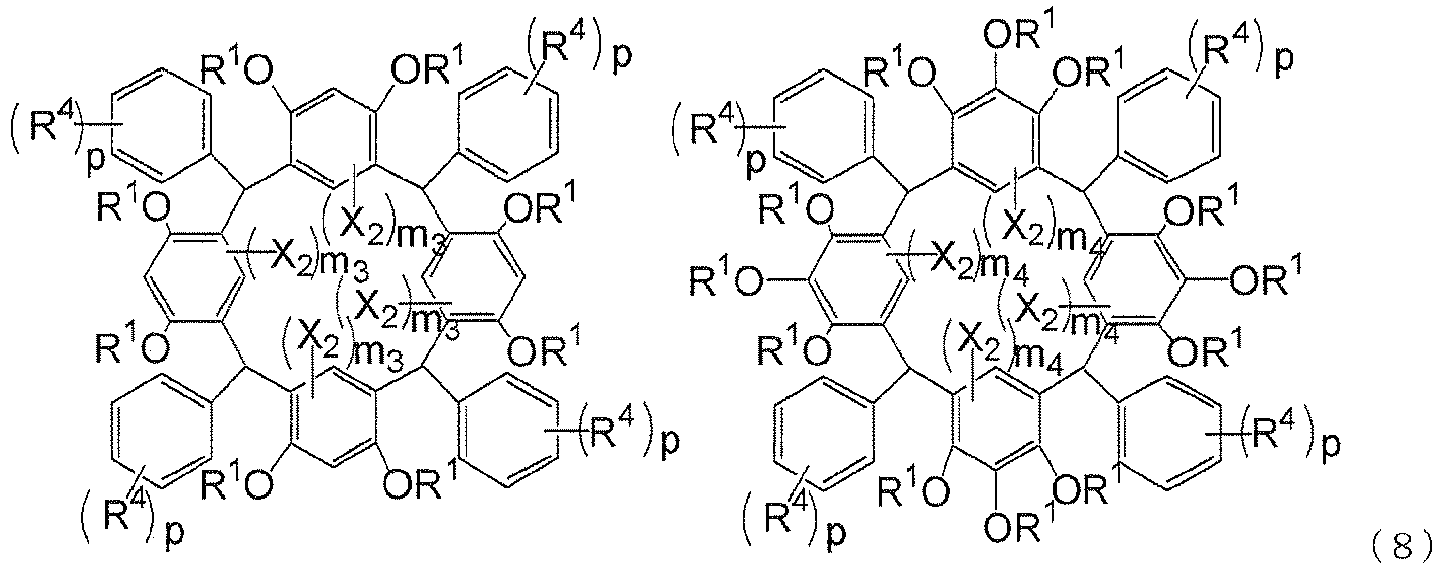
- 18. A purification method according to the above item 17, wherein the compound represented by the formula (8) is selected from the group consisting of each compound represented by the following formulae (9-1) and (9-2).


- According to the present invention, it is possible to provide a purification method for a cyclic compound having the contents of various metals significantly reduced.
- The present invention will be described in details below.
The present invention is a purification method for a cyclic compound with a reduced metal content by dissolving a cyclic compound in an organic solvent, contacting the solution with water or an acidic aqueous solution, and thereby transferring the metal content contained in the solution to the water phase. - The cyclic compound used in the present invention is a cyclic compound represented by the following formula (1).
-
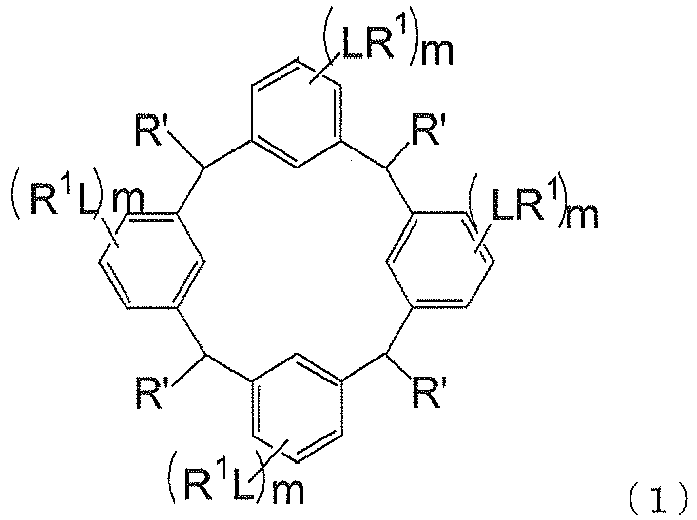

- The cyclic compounds represented by the formula (1) preferably include the following compounds.
-

-

- When a cyclic compound does not have any of the above acid dissociable functional groups therein, it is cyclic compound (A) which is useful as a main component of a negative type resist composition, and when it has one or more of the above acid dissociable functional groups therein, it is cyclic compound (B) which is useful as a main component of a positive type resist composition.
- In the present invention, as the cyclic compound (A), the following are preferable. Cyclic compounds (A) represented by the following formulae (4) and (5) are preferable.
-

-

- In the present invention, as the above cyclic compound (A), compounds represented by the following formula (6-1) or (6-2) are more preferable.
-


- In the present invention, as the cyclic compound (B), the following are preferable. Cyclic compounds (B) represented by the following formulae (7) and (8) are preferable.
-

-

- In the present invention, as the cyclic compound (B), compounds represented by the following formula (9-1) or (9-2) are more preferable.
-


- The above acid dissociable functional group can be accordingly selected and used from ones suggested in a hydroxystyrene based resin, a (meth)acrylic acid based resin and the like used in a chemical amplification type resist composition for KrF or ArF. For example, a substituted methyl group, a 1-substituted ethyl group, a 1-substituted-n-propyl group, a 1-branched alkyl group, a silyl group, an acyl group, a 1-substituted alkoxymethyl group, a cyclic ether group, and an alkoxycarbonyl group are preferably included. The above acid dissociable functional group is preferable not to have any crosslinkable functional group.
- As the substituted methyl group, a substituted methyl group of 2 to 20 carbons is normal, a substituted methyl group of 4 to 18 carbons is preferable, and a substituted methyl group of 6 to 16 carbons is further preferable. For example, a methoxymethyl group, a methylthiomethyl group, an ethoxymethyl group, an n-propoxymethyl group, an isopropoxymethyl group, an n-butoxymethyl group, a t-butoxymethyl group, a 2-methylpropoxy group, an ethylthiomethyl group, a methoxyethoxymethyl group, a phenyloxymethyl group, a 1-cyclopentyloxymethyl group, a 1-cyclohexyloxymethyl group, a benzylthiomethyl group, a phenacyl group, a 4-bromophenacyl group, a 4-methoxyphenacyl group, a piperonyl group, and substituent groups represented by the following formula (11) can be included.
-

- As the 1-substituted ethyl group, a 1-substituted ethyl group of 3 to 20 carbons is normal, a 1-substituted ethyl group of 5 to 18 carbons is preferable, and a substituted ethyl group of 7 to 16 carbons is more preferable. For example, a 1-methoxyethyl group, a 1-methylthioethyl group, a 1,1-dimethoxyethyl group, a 1-ethoxyethyl group, a 1-ethylthioethyl group, a 1,1-diethoxyethyl group, an n-propoxyethyl group, an isopropoxyethyl group, an n-butoxyethyl group, a t-butoxyethyl group, a 2-methylpropoxyethyl group, a 1-phenoxyethyl group, a 1-phenylthioethyl group, a 1,1-diphenoxyethyl group, a 1-cyclopentyloxyethyl group, a 1-cyclohexyloxyethyl group, a 1-phenylethyl group, a 1,1-diphenylethyl group, and substituent groups represented by the following formula (12) can be included.
-

- As the 1-substituted-n-propyl group, a 1-substituted-n-propyl group of 4 to 20 carbons is normal, a 1-substituted-n-propyl group of 6 to 18 carbons is preferable, and a 1-substituted-n-propyl group of 8 to 16 carbons is further preferable. For example, a 1-methoxy-n-propyl group and a 1-ethoxy-n-propylgroup can be included.
- As the 1-branched alkyl group, a 1-branched alkyl group of 3 to 20 carbons is normal, a 1-branched alkyl group of 5 to 18 carbons is preferable, and a branched alkyl group of 7 to 16 carbons is further preferable. For example, an isopropyl group, a sec-butyl group, a tert-butyl group, a 1,1-dimethylpropyl group, a 1-methylbutyl group, a 1,1-dimethylbutyl group, a 2-methyladamantyl group, and a 2-ethyladamantyl group can be included.
- As the silyl group, a silyl group of 1 to 20 carbons is normal, a silyl group of 3 to 18 carbons is preferable, and a silyl group of 5 to 16 carbons is further preferable. For example, a trimethylsilyl group, an ethyldimethylsilyl group, a methyldiethyl group, a triethylsilyl group, a tert-butyldimethylsilyl group, a tert-butyldiethylsilyl group, a tert-butyldiphenylsilyl group, a tri-tert-butylsilyl group and a triphenylsilyl group can be included.
- As the acyl group, an acyl group of 2 to 20 carbons is normal, an acyl group of 4 to 18 carbons is preferable, and an acyl group of 6 to 16 carbons is further preferable. For example, an acetyl group, a phenoxyacetyl group, a propionyl group, a butyryl group, a heptanoyl group, a hexanoyl group, a valeryl group, a pivaloyl group, an isovaleryl group, a lauroyl group, an adamantylcarbonyl group, a benzoyl group and a naphthoyl group can be included.
- As the 1-substituted alkoxymethyl group, a 1-substituted alkoxymethyl group of 2 to 20 carbons is normal, a 1-substituted alkoxymethyl group of 4 to 18 carbons is preferable, and a 1-substituted alkoxymethyl group of 6 to 16 carbons is further preferable. For example, a 1-cyclopentylmethoxymethyl group, a 1-cyclopentylethoxymethyl group, a 1-cyclohexylmethoxymethyl group, a 1-cyclohexylethoxymethyl group, a 1-cyclooctylmethoxymethyl group and a 1-adamantylmethoxymethyl group can be included.
- As the cyclic ether group, a cyclic ether group of 2 to 20 carbons is normal, a cyclic ether group of 4 to 18 carbons is preferable, and a cyclic ether group of 6 to 16 carbons is further preferable. For example, a tetrahydropyranyl group, a tetrahydrofuranyl group, a tetrahydrothiopyranyl group, a tetrahydrothiofuranyl group, a 4-methoxytetrahydropyranyl group and a 4-methoxytetrahydrothiopyranyl group can be included.
- As the alkoxycarbonyl group, an alkoxycarbonyl group of 2 to 20 carbons is normal, an alkoxycarbonyl group of 4 to 18 carbons is preferable, and an alkoxycarbonyl group of 6 to 16 carbons is more preferable. For example, a methoxycarbonyl group, an ethoxycarbonyl group, an n-propoxycarbonyl group, isopropoxycarbonyl group, an n-butoxycarbonyl group, a tert-butoxycarbonyl group or acid dissociable functional groups represented by the following formula (13) wherein n=0 can be included.
- As the alkoxycarbonylalkyl group, an alkoxycarbonylalkyl group of 2 to 20 carbons is normal, an alkoxycarbonylalkyl group of 4 to 18 carbons is preferable, and an alkoxycarbonylalkyl group of 6 to 16 carbons is further preferable. For example, a methoxycarbonylmethyl group, an ethoxycarbonylmethyl group, an n-propoxycarbonylmethyl group, an isopropoxycarbonylmethyl group, an n-butoxycarbonylmethyl group or acid dissociable functional groups represented by the following formula (13) wherein n=1 to 4 can be included.
-

- Among these acid dissociable functional groups, a substituted methyl group, a 1-substituted ethyl group, a 1-substituted alkoxymethyl group, a cyclic ether group, an alkoxycarbonyl group, and an alkoxycarbonylalkyl group are preferable, a substituted methyl group, a 1-substituted ethyl group, an alkoxycarbonyl group and an alkoxycarbonylalkyl group are more preferable due to high sensitivity, and a cycloalkane of 3 to 12 carbons, a lactone and an acid dissociable functional group with a structure selected from 6 to 12 aromatic rings are further more preferable.
- The cycloalkane of 3 to 12 carbons may be monocyclic or polycyclic, and is more preferable to be polycyclic. Specifically, monocycloalkane, bicycloalkane, tricycloalkane, tetracycloalkane and the like are included, and more specifically, monocycloalkanes such as cyclopropane, cyclobutane, cyclopentane and cyclohexane, and polycycloalkanes such as an adamantine, norbornane, isobornane, tricyclodecane and tetracyclodecane are included. Among these, adamantine, tricyclodecane and tetracyclodecane are preferable, and adamantine and tricyclodecane are particularly preferable. The cycloalkanes of 3 to 12 carbons may have a substituent group. The lactones include a butyrolactone or a cycloalkane group of 3 to 12 carbons having a lactone group. The 6 to 12 aromatic rings include a benzene ring, a naphthalene ring, an anthracene ring, a phenanthrene ring, a pyrene ring and the like, a benzene ring and a naphthalene ring are preferable, and a naphthalene ring is particularly preferable.
- Particularly, an acid dissociable functional group selected from the group consisting of each group represented by the following formula (10) is preferable in terms of high resolution.
-

- Also, the acid dissociable functional group R1 may be a substituent group consisting of a repeating unit represented by the following formula (14) and a terminal group represented by the following formula (15) or R1 (R1 is the same as above), as long as the effect of the present invention is not impaired.
-

-

- In the formula (14) and/or (15), R1 is the same as above. L is the same as above, preferably a single bond, a methylene group, an ethylene group or a carbonyl group. A plurality of Q may be the same or different. n5 is an integer of 0 to 4, n6 is an integer of 1 to 3, x is an integer of 0 to 3, and 1≤n5+n6≤5 is met. A plurality of n5, n6 and x may be the same or different.
- R3 is a substituent group selected from the group consisting of a halogen atom, an alkyl group, a cycloalkyl group, an aryl group, an aralkyl group, an alkoxy group, an aryloxy group, an alkenyl group, an acyl group, an alkoxycarbonyl group, an alkyloyloxy group, an aryloyloxy group, a cyano group, and a nitro group.
- The halogen atoms include a chlorine atom, a bromine atom and an iodine atom; the alkyl groups include alkyl groups of 1 to 4 carbon atoms such as a methyl group, an ethyl group, a propyl group, an n-propyl group, an n-butyl group, an isobutyl group, a sec-butyl group and a tert-butyl group; the cycloalkyl groups include a cyclohexyl group, a norbornyl group, an adamantyl group and the like; the aryl groups include a phenyl group, a tolyl group, a xylyl group, a naphthyl group and the like; the aralkyl groups include a benzyl group, a hydroxybenzyl group, a dihydroxybenzyl group and the like; the alkoxy groups include alkoxy groups of 1 to 4 carbon atoms such as a methoxy group, an ethoxy group, a hydroxyethoxy group, a propoxy group, a hydroxypropoxy group, an isopropoxy group, an n-butoxy group, an isobutoxy group, a sec-butoxy group and a tert-butoxy group; the aryloxy groups include a phenoxy group and the like; the alkenyl groups include alkenyl groups of 2 to 4 carbon atoms such as a vinyl group, a propenyl group, an allyl group and a butenyl group; the acyl groups include aliphatic acyl groups of 1 to 6 carbon atoms such as a formyl group, an acetyl group, a propionyl group, a butyryl group, a valeryl group, an isovaleryl group and a pivaloyl group, and aromatic acyl groups such as a benzoyl group and a toluoyl group; the alkoxycarbonyl groups include alkoxycarbonyl groups of 2 to 5 carbon atoms such as a methoxycarbonyl group, an ethoxycarbonyl group, a propoxycarbonyl group, an isopropoxycarbonyl group, an n-butoxycarbonyl group, an isobutoxycarbonyl group, a sec-butoxycarbonyl group and a tert-butoxycarbonyl group; the alkyloyloxy groups include an acetoxy group, a propionyloxy group, a butyryloxy group, an isobutyryloxy group, a valeryloxy group, an isovaleryloxy group and a pivaloyloxy group; the aryloyloxy groups include a benzoyloxy group and the like. A plurality of R3 may be the same or different.
- In the present invention, the acid dissociable functional group refers to a characteristic group for cleaving in the presence of acid to generate an alkali soluble group. The alkali soluble groups include a phenolic hydroxyl group, a carboxyl group, a sulfonate group and a hexafluoroisopropanol group, a phenolic hydroxyl group and a carboxyl group are preferable, and a phenolic hydroxyl group is particularly preferable. The acid dissociable functional group is preferable to have the property of initiating a chained cleavage reaction in the presence of acid, in order to allow for pattern formation with further high sensitivity and high resolution.
- These cyclic compounds may be independent, or may be mixed with two or more kinds. Also, the cyclic compounds may be ones containing various surfactants, various crosslinkers, various acid generators, various stabilizers and the like.
- The organic solvent used in the present invention is not particularly limited as long as it is an organic solvent which is not arbitrarily blended with water, but an organic solvent which can be safely applied to a semiconductor production process is preferable. The amount of the organic solvent used is normally about 1 to 100 times by weight based on polymer used.
- Specific examples of the solvent used include ethers such as diethyl ether and diisopropyl ether, esters such as ethyl acetate, n-butyl acetate and isoamyl acetate, ketones such as methyl ethyl ketone, methyl isobutyl ketone, ethyl isobutyl ketone, cyclohexanone, cyclopentanone, 2-heptanone and 2-pentanone, glycol ether acetates such as ethylene glycol monoethyl ether acetate, ethylene glycol monobutyl ether acetate, propylene glycol monomethyl ether acetate and propylene glycol monoethyl ether acetate, aliphatic hydrocarbons such as n-hexane and n-heptane, aromatic hydrocarbons such as toluene and xylene, halogenated hydrocarbons such as methylene chloride and chloroform. Among these, toluene, 2-heptanone, cyclohexanone, cyclopentanone, methyl isobutyl ketone, ethyl acetate and the like are preferable, and cyclohexanone is particularly preferable. These solvents may be used each independently, or may be used in a mixture of two or more kinds.
- The liquid to be used for contacting with the solution containing the cyclic compound and the organic solvent is water or an acidic aqueous solution. The acidic aqueous solution used in the present invention is accordingly selected from aqueous solutions having commonly known organic and inorganic based compounds dissolved in water. For example, aqueous solutions having mineral acids such as hydrochloric acid, sulfuric acid, nitric acid and phosphoric acid dissolved in water, or aqueous solutions having organic acids such as acetic acid, propionic acid, oxalic acid, malonic acid, succinic acid, fumaric acid, maleic acid, tartaric acid, citric acid, methanesulfonic acid, phenolsulfonic acid, p-toluenesulfonic acid, and trifluoroacetic acid are included. These acidic aqueous solutions may be used each independently, or may be used in combination of two kinds or more. Among these acidic aqueous solutions, aqueous solutions of carboxylic acids such as sulfuric acid, oxalic acid, tartaric acid and citric acid are preferable, aqueous solutions of oxalic acid, tartaric acid and citric acid are further preferable, and an aqueous solution of oxalic acid is particularly preferable. It is thought that polycarboxylic acids such as oxalic acid, tartaric acid and citric acid can remove more metals due to the metal ion coordination and the chelating effect generated. Also, water to be used here is, according to the object of the present invention, preferably one with a low metal content, for example ion exchange water and the like.
- Although the pH of an acidic aqueous solution used in the present invention is not particularly limited, when the acidity of an aqueous solution becomes too high, a cyclic compound may be adversely impacted, which is not preferable. The pH range is normally about 0 to 5, more preferably about pH 0 to 3.
- Although the amount of an acidic aqueous solution used in the present invention is not particularly limited, when the amount is too small, the number of extractions for metal removal is required to be more, and conversely when the amount of an aqueous solution is too large, the entire liquid amount becomes large, which may generate a problem upon operation. The amount of an aqueous solution used is normally 10 to 200 parts by mass, preferably 20 to 100 parts by mass based on 100 parts by mass of a solution of a cyclic compound dissolved in an organic solvent.
- In the present invention, an extraction treatment is conducted by contacting a solution containing the above cyclic compound and the above organic solvent with water or the above acidic aqueous solution. The temperature upon conducting the extraction treatment ranges normally from 20 to 90 °C, and preferably from 30 to 80 °C. In the extraction operation, the metal content contained in a solution containing a cyclic compound and an organic solvent is transferred to the water phase by mixing it better through stirring and the like, for example.
- Afterwards, by leaving it to stand, the solution phase containing a cyclic compound and an organic solvent and the water phase are separated. Then, by decantation and the like for example, a solution containing a cyclic compound and an organic solvent is recovered. Although the time of leaving it to stand is not particularly limited, when the time of leaving it to stand is too short, separation between the solution phase containing a cyclic compound and an organic solvent and the water phase become poor, which is not preferable. The time of leaving it to stand is normally not less than 10 minutes, and preferably not less than 30 minutes.
The extraction treatment may be once, and it is also effective to repeat operations such as mixing, leaving to stand and separating more than once. - When such an extraction treatment is conducted by using an acidic aqueous solution, after conducting the extraction treatment, a solution containing a cyclic compound and an organic solvent which has been extracted and recovered from the aqueous solution is preferably further subjected to an extraction treatment using water. The water to be used here is, according to the object of the present invention, preferably one with a low metal content, for example ion exchange water and the like. This extraction treatment may be once, but it is also effective to repeat operations such as mixing, leaving to stand and separating more than once. Moreover, conditions such as the usage ratio of the both in the extraction treatment, temperature and time are not particularly limited, but may be the same with the case of the above contact process with an acidic aqueous solution.
- The water content mixed in the solution thus obtained containing a cyclic compound and an organic solvent can be easily removed by conducting operations such as distillation under reduced pressure. Also, by adding an organic solvent if required, the concentration of a cyclic compound can be adjusted to be an arbitrary concentration.
- A method for obtaining a cyclic compound only from the resultant solution containing an cyclic compound and an organic solvent can be conducted by publicly known methods such as removal under reduced pressure, separation by reprecipitation, and combinations thereof, for example.
- Below, embodiments of the present invention will be specifically described with reference to examples. However, the present invention is not limited to these examples. In the following synthesis examples, the structure of each compound is confirmed with 1H-NMR measurement.
- To a four-neck flask (1000 mL) equipped with a dropping funnel, a Dimroth condenser tube, a thermometer and a stirring blade, sufficiently dried and substituted with nitrogen, resorcinol (22 g, 0.2 mol) made by Kanto Chemical Co., 4-cyclohexylbenzaldehyde (46.0 g, 0.2 mol) and dehydrated ethanol (200 mL) were charged under a nitrogen gas stream, so as to prepare an ethanol solution. This solution was heated by a mantle heater to 85°C while stirring. Next, 75 mL of concentrated hydrochloric acid (35 %) was dropped through the dropping funnel for 30 minutes, and then continuously stirred at 85°C for 3 hours. After the reaction terminated, it was left to cool to room temperature, and then cooled in an ice bath. After leaving it to stand for 1 hour, the objective coarse light yellow crystal was produced, and this was filtered. The coarse crystal was washed with 500 ml of methanol twice, filtered and vacuum dried to yield the objective product (hereinafter, referred to as CR-1) (50 g, 91% yield).
The structure of this compound showed, as a result of analyzing with LC-MS, the molecular weight of the objective product to be 1121. Moreover, the chemical shift values (δ ppm, TMS standard) of 1H-NMR in a heavy dimethyl sulfoxide solvent were 1.2 to 1.4 (m, 20H), 1.7 to 1.9 (m, 20H), 2.2 to 2.4 (m, 4H), 5.5, 5.6 (d, 4H), 6.0 to 6.8 (m, 24H), 8.4 to 8.5 (m, 8H). -

- To a 1000 mL four-neck flask (without base plate), 650 g of a solution (1.7 wt%) having CR-1 dissolved in cyclohexanone was charged, and heated to 75°C while stirring. Next, 130 g of an oxalic acidic aqueous solution (pH 0.9) was added, stirred for 3 minutes, and then left to stand for 1 hour. As the oil phase and the water phase were separated thereby, the water phase was removed. To the resultant oil phase, 130 g of ultrapure water was charged, stirred for 3 minutes, and then left to stand for 1 hour to remove the water phase. By repeating this operation four times, a solution of a cyclic compound in cyclohexanone was obtained.
- A solution of a cyclic compound in cyclohexanone was obtained by the same process, except that 130 g of a citric acidic aqueous solution (pH 1.8) was charged instead of charging 130 g of the oxalic acidic aqueous solution (pH 0.9) in Example 1.
- A solution of a cyclic compound in cyclohexanone was obtained by the same process, except that 130 g of a tartaric acidic aqueous solution (pH 1.8) was charged instead of charging 130 g of the oxalic acidic aqueous solution (pH 0.9) in Example 1.
- A solution of a cyclic compound in cyclohexanone was obtained by the same process, except that 130 g of an acetic acidic aqueous solution (pH 2.8) was charged instead of charging 130 g of the oxalic acidic aqueous solution (pH 0.9) in Example 1.
- A solution of a cyclic compound in cyclohexanone was obtained by the same process, except that 130 g of ion exchange water was charged instead of charging 130 g of the oxalic acidic aqueous solution (pH 0.9) in Example 1.
- 25 g of an ion exchange resin (Mitsubishi Chemical DIAION: SMT100-MIEX Resin) was swollen with cyclohexanone, then filled in a Teflon® column, and solvent substituted by feeding 500 mL of 1,3-dioxolan. Next, by feeding 500 g of a solution (1.7 wt%) having CR-1 dissolved in 1,3-dioxolan, a cyclic compound was obtained.
- For the solution of CR-1 in cyclohexanone before the process, and the cyclic compounds obtained in Examples 1 to 5 and Comparative Example 1, the contents of various metals were measured by ICP-MS. The measurement results are shown in Table 1.
-
[Table 1] Metal Content (ppb) Na Mg K Cr Fe Cu Zn Before Process 55.6 1.1 2.3 28.8 132.0 10.0 11.5 Example 1 ≤0.2 ≤0.2 ≤0.2 ≤0.2 ≤0.2 ≤0.2 ≤0.2 Example 2 ≤0.2 ≤0.2 ≤0.2 3.4 1.4 ≤0.2 ≤0.2 Example 3 ≤0.2 ≤0.2 ≤0.2 6.7 1.4 ≤0.2 ≤0.2 Example 4 ≤0.2 ≤0.2 ≤0.2 8.5 52.5 ≤0.2 ≤0.2 Example 5 ≤0.2 ≤0.2 0.3 8.5 92.6 0.3 ≤0.2 Comparative Example 1 ≤0.2 0.5 1.0 16.7 132.0 1.2 0.4 - The present invention can industrially advantageously purify a cyclic compound with a reduced metal content.
Claims (18)
- A purification method for a cyclic compound, including a step of contacting a solution containing a cyclic compound represented by the following formula (1) and an organic solvent with water or an acidic aqueous solution.


- A purification method according to Claim 1, further including a step of conducting an extraction treatment of the cyclic compound.
- A purification method according to Claim 2, further including a step of separating the solution phase containing the cyclic compound and the organic solvent and the water phase after the extraction treatment.
- A purification method according to Claim 3, further including a step of recovering a solution containing the cyclic compound and the organic solvent.
- A purification method according to any of Claims 1 to 4, wherein the acidic aqueous solution is an aqueous solution of one or more kinds of mineral acids selected from the group consisting of hydrochloric acid, sulfuric acid, nitric acid and phosphoric acid.
- A purification method according to any of Claims 1 to 4, wherein the acidic aqueous solution is an aqueous solution of one or more kinds of organic acids selected from the group consisting of acetic acid, propionic acid, oxalic acid, malonic acid, succinic acid, fumaric acid, maleic acid, tartaric acid, citric acid, methanesulfonic acid, phenolsulfonic acid, p-toluenesulfonic acid and trifluoroacetic acid.
- A purification method according to any of Claim 6, wherein the acidic aqueous solution is an aqueous solution of at least one kind of polycarboxylic acid selected from oxalic acid, tartaric acid and citric acid.
- A purification method according to Claim 7, wherein the acidic aqueous solution is an aqueous solution of oxalic acid.
- A purification method according to any of Claims 1 to 8, wherein the organic solvent is toluene, 2-heptanone, cyclohexanone, cyclopentanone, methyl isobutyl ketone, or ethyl acetate.
- A purification method according to Claim 9, wherein the organic solvent is cyclohexanone.
- A purification method according to any of Claims 1 to 10, wherein the cyclic compound represented by the formula (1) is selected from the group consisting of each compound represented by the following formula (2).

- A purification method according to Claim 11, wherein the compound represented by the formula (2) is selected from the group consisting of each compound represented by the following formula (3).

- A purification method according to Claim 11, wherein the compound represented by the formula (2) is selected from the group consisting of each compound represented by the following formula (4).

- A purification method according to Claim 13, wherein the compound represented by the formula (4) is selected from the group consisting of each compound represented by the following formula (5).

- A purification method according to Claim 14, wherein the compound represented by the formula (5) is selected from the group consisting of each compound represented by the following formulae (6-1) and (6-2).


- A purification method according to any of Claims 1 to 10, wherein the cyclic compound represented by the formula (1) is selected from the group consisting of each compound represented by the following formula (7).

- A purification method according to Claim 16, wherein the compound represented by the formula (7) is selected from the group consisting of each compound represented by the following formula (8).

- A purification method according to Claim 17, wherein the compound represented by the formula (8) is selected from the group consisting of each compound represented by the following formulae (9-1) and (9-2).


Applications Claiming Priority (2)
| Application Number | Priority Date | Filing Date | Title |
|---|---|---|---|
| JP2010120444 | 2010-05-26 | ||
| PCT/JP2011/002825 WO2011148603A1 (en) | 2010-05-26 | 2011-05-20 | Cyclic compound purification method |
Publications (2)
| Publication Number | Publication Date |
|---|---|
| EP2578562A1 true EP2578562A1 (en) | 2013-04-10 |
| EP2578562A4 EP2578562A4 (en) | 2015-12-02 |
Family
ID=45003603
Family Applications (1)
| Application Number | Title | Priority Date | Filing Date |
|---|---|---|---|
| EP11786306.8A Withdrawn EP2578562A4 (en) | 2010-05-26 | 2011-05-20 | Cyclic compound purification method |
Country Status (7)
| Country | Link |
|---|---|
| US (1) | US20130150627A1 (en) |
| EP (1) | EP2578562A4 (en) |
| JP (1) | JP5725021B2 (en) |
| KR (1) | KR20130124166A (en) |
| CN (1) | CN102971281A (en) |
| TW (1) | TW201204450A (en) |
| WO (1) | WO2011148603A1 (en) |
Families Citing this family (11)
| Publication number | Priority date | Publication date | Assignee | Title |
|---|---|---|---|---|
| US9828355B2 (en) | 2013-02-08 | 2017-11-28 | Mitsubishi Gas Chemical Company, Inc. | Compound, material for forming underlayer film for lithography, underlayer film for lithography and pattern forming method |
| KR102178662B1 (en) | 2013-02-08 | 2020-11-13 | 미쯔비시 가스 케미칼 컴파니, 인코포레이티드 | Compound, material for forming underlayer film for lithography, underlayer film for lithography, and pattern formation method |
| CN104995559B (en) * | 2013-02-08 | 2020-04-07 | 三菱瓦斯化学株式会社 | Resist composition, resist pattern forming method, and polyphenol derivative used therefor |
| WO2016104214A1 (en) | 2014-12-25 | 2016-06-30 | 三菱瓦斯化学株式会社 | Compound, resin, underlayer film forming material for lithography, underlayer film for lithography, pattern forming method and purification method |
| EP3279190B1 (en) | 2015-03-31 | 2020-08-12 | Mitsubishi Gas Chemical Company, Inc. | Resist composition, method for forming resist pattern, and polyphenol compound used therein |
| CN107533291B (en) | 2015-03-31 | 2021-06-11 | 三菱瓦斯化学株式会社 | Compound, resist composition, and resist pattern formation method using same |
| WO2016190044A1 (en) * | 2015-05-27 | 2016-12-01 | 三菱瓦斯化学株式会社 | Method for producing hydroxy-substituted aromatic compound |
| CN107924131B (en) | 2015-08-31 | 2020-12-25 | 三菱瓦斯化学株式会社 | Underlayer film-forming material for lithography, use of composition thereof for forming underlayer film for lithography, and method for forming resist pattern |
| JP6919838B2 (en) | 2015-08-31 | 2021-08-18 | 三菱瓦斯化学株式会社 | Underlayer film forming material for lithography, composition for forming an underlayer film for lithography, underlayer film for lithography and its manufacturing method, pattern forming method, resin, and purification method. |
| KR102687507B1 (en) | 2015-09-10 | 2024-07-24 | 미쯔비시 가스 케미칼 컴파니, 인코포레이티드 | Compound, resin, resist composition or radiation-sensitive composition, resist pattern forming method, amorphous film manufacturing method, lithography underlayer film forming material, lithography underlayer film forming composition, circuit pattern forming method and purification method |
| KR20230012474A (en) | 2020-05-15 | 2023-01-26 | 미쯔비시 가스 케미칼 컴파니, 인코포레이티드 | Compounds, (co)polymers, compositions, methods for forming resist patterns, and methods for producing compounds and (co)polymers |
Family Cites Families (22)
| Publication number | Priority date | Publication date | Assignee | Title |
|---|---|---|---|---|
| US3219422A (en) * | 1963-05-01 | 1965-11-23 | Dow Chemical Co | Extraction of alkaline earth metal values using liquid ion exchanger |
| US4914090A (en) * | 1985-11-01 | 1990-04-03 | Schering Corporation | Ophthalmic compositions |
| GB9523119D0 (en) * | 1995-11-10 | 1996-01-10 | Secr Defence | Calixarenes |
| JP3486341B2 (en) | 1997-09-18 | 2004-01-13 | 株式会社東芝 | Photosensitive composition and pattern forming method using the same |
| JPH11322656A (en) | 1998-05-11 | 1999-11-24 | Jsr Corp | Novel calixarene derivative and calixresorcinarene derivative, and photosensitive composition |
| JP2002328473A (en) | 2001-05-02 | 2002-11-15 | Jsr Corp | Positive radiation-sensitive composition |
| JP2003321433A (en) | 2002-04-25 | 2003-11-11 | Ishihara Sangyo Kaisha Ltd | METHOD FOR PRODUCING beta-HYDROXY-ACRYLONITRILE-BASED COMPOUND |
| JP2005170902A (en) | 2003-12-15 | 2005-06-30 | Jsr Corp | Novel compound and radiation-sensitive resin composition |
| JP4636919B2 (en) | 2005-03-29 | 2011-02-23 | 富士フイルム株式会社 | Positive resist composition and pattern forming method using the same |
| JP2006276742A (en) | 2005-03-30 | 2006-10-12 | Fuji Photo Film Co Ltd | Positive resist composition and pattern forming method using the same |
| JP4657030B2 (en) | 2005-06-30 | 2011-03-23 | Jsr株式会社 | Calixarene derivatives and compositions containing the same |
| JP5103791B2 (en) * | 2006-05-29 | 2012-12-19 | 新日本理化株式会社 | Method for producing reduced lanolin |
| JP5446118B2 (en) | 2007-04-23 | 2014-03-19 | 三菱瓦斯化学株式会社 | Radiation sensitive composition |
| KR20100017795A (en) * | 2007-06-15 | 2010-02-16 | 이데미쓰 고산 가부시키가이샤 | Cyclic compound, photoresist base material and photoresist composition |
| JP5354420B2 (en) * | 2007-12-11 | 2013-11-27 | 出光興産株式会社 | Cyclic compound, photoresist base material, photoresist composition, fine processing method and semiconductor device |
| JP2010285376A (en) * | 2009-06-11 | 2010-12-24 | Idemitsu Kosan Co Ltd | Cyclic compound, photoresist base material, and photoresist composition |
| CN102753509A (en) * | 2009-08-31 | 2012-10-24 | 三菱瓦斯化学株式会社 | Cyclic compound, process for production of the cyclic compound, radiation-sensitive composition, and method for formation of resist pattern |
| KR101669703B1 (en) * | 2009-08-31 | 2016-10-27 | 미츠비시 가스 가가쿠 가부시키가이샤 | Cyclic compound, process for production of the cyclic compound, radiation-sensitive composition, and method for formation of resist pattern |
| CN102597034A (en) * | 2009-08-31 | 2012-07-18 | 三菱瓦斯化学株式会社 | Cyclic compound, manufacturing method therefor, radiation-sensitive composition, and method for forming a resist pattern |
| WO2011030683A1 (en) * | 2009-09-09 | 2011-03-17 | 三菱瓦斯化学株式会社 | Cyclic compound, process for preparation thereof, radiation-sensitive composition, and method for formation of resist pattern |
| US8829247B2 (en) * | 2009-10-06 | 2014-09-09 | Mitsubishi Gas Chemical Company, Inc. | Cyclic compound, method of producing the same, radiation sensitive composition, and method of forming resist pattern |
| WO2011065004A1 (en) * | 2009-11-27 | 2011-06-03 | 三菱瓦斯化学株式会社 | Cyclic compound, process for production thereof, radiation-sensitive composition, and resist pattern formation method |
-
2011
- 2011-05-20 KR KR1020127033217A patent/KR20130124166A/en not_active Withdrawn
- 2011-05-20 US US13/700,002 patent/US20130150627A1/en not_active Abandoned
- 2011-05-20 JP JP2012517127A patent/JP5725021B2/en active Active
- 2011-05-20 EP EP11786306.8A patent/EP2578562A4/en not_active Withdrawn
- 2011-05-20 CN CN2011800257528A patent/CN102971281A/en active Pending
- 2011-05-20 WO PCT/JP2011/002825 patent/WO2011148603A1/en not_active Ceased
- 2011-05-24 TW TW100118124A patent/TW201204450A/en unknown
Also Published As
| Publication number | Publication date |
|---|---|
| WO2011148603A1 (en) | 2011-12-01 |
| EP2578562A4 (en) | 2015-12-02 |
| JPWO2011148603A1 (en) | 2013-07-25 |
| CN102971281A (en) | 2013-03-13 |
| TW201204450A (en) | 2012-02-01 |
| JP5725021B2 (en) | 2015-05-27 |
| US20130150627A1 (en) | 2013-06-13 |
| KR20130124166A (en) | 2013-11-13 |
Similar Documents
| Publication | Publication Date | Title |
|---|---|---|
| US20130150627A1 (en) | Purification method for cyclic compound | |
| EP3075728B1 (en) | Purification method for compound or resin | |
| SU489318A3 (en) | Method for preparing methylol glycidyl ethers | |
| JP6349943B2 (en) | Compound purification method and polymer compound production method | |
| JP5792964B2 (en) | Method for producing fullerene derivative | |
| JP5731818B2 (en) | Anthracene derivative, curable composition, cured product, and method for producing anthracene derivative | |
| JPH09278695A (en) | New trisphenol compounds | |
| KR20110028586A (en) | Novel tetrakis (ether substituted-formylphenyl) s and novel polynuclear poly (phenols) derived therefrom | |
| JP5530084B2 (en) | Fullerene derivative, solution thereof, and film thereof | |
| JP2012171943A (en) | Compound, derivative, composition, cured product, and method for producing the compound and the derivative | |
| JPS6222735A (en) | Manufacture of fluorine containing diol and tetrol | |
| KR101546553B1 (en) | Novel bis(formylphenyl) compound and novel polynuclear polyphenol compound derived from the same | |
| JP2022061763A (en) | Novel polythiol compound | |
| JP2003306460A (en) | 1,3-bis (hydroxyphenyl) adamantane and method for producing the same | |
| JP2021001219A (en) | Method for manufacturing hydroxy substituted aromatic compound | |
| US3452104A (en) | Process for separation of mono-butylated cresols | |
| JP2016098181A (en) | Method for producing 4-hydroxystyrene and storage method thereof | |
| JP6250453B2 (en) | Trisphenol compound | |
| JPH06116191A (en) | Process for producing 1,3-dihydroxy-4,6-bis [α-methyl-α- (4'-hydroxyphenyl) ethyl] benzene | |
| US3868424A (en) | Process for the preparation of ortho-hydroxybenzyl alcohols | |
| CN100478319C (en) | Method of improving fluidity of phenol tar | |
| JPWO2015129700A1 (en) | COMPOUND AND PHOTORESIST COMPOSITION CONTAINING THE SAME | |
| WO2008044568A1 (en) | Novel bis(formylphenyl)alkane and novel polynuclear phenol derived from the same | |
| JP2001131254A (en) | Method for producing phenolic resin | |
| JP7280262B2 (en) | Novel polyacyloxymethyl-4,4'-acyloxybiphenyl compound |
Legal Events
| Date | Code | Title | Description |
|---|---|---|---|
| PUAI | Public reference made under article 153(3) epc to a published international application that has entered the european phase |
Free format text: ORIGINAL CODE: 0009012 |
|
| 17P | Request for examination filed |
Effective date: 20121108 |
|
| AK | Designated contracting states |
Kind code of ref document: A1 Designated state(s): AL AT BE BG CH CY CZ DE DK EE ES FI FR GB GR HR HU IE IS IT LI LT LU LV MC MK MT NL NO PL PT RO RS SE SI SK SM TR |
|
| DAX | Request for extension of the european patent (deleted) | ||
| STAA | Information on the status of an ep patent application or granted ep patent |
Free format text: STATUS: THE APPLICATION HAS BEEN WITHDRAWN |
|
| RA4 | Supplementary search report drawn up and despatched (corrected) |
Effective date: 20151104 |
|
| RIC1 | Information provided on ipc code assigned before grant |
Ipc: C07C 37/72 20060101AFI20151029BHEP Ipc: C07C 39/15 20060101ALI20151029BHEP |
|
| 18W | Application withdrawn |
Effective date: 20151123 |