EP2578539A1 - Carbon encapsulated metal oxide nanocomposite, method for its preparation and its use in Li-ion batteries - Google Patents
Carbon encapsulated metal oxide nanocomposite, method for its preparation and its use in Li-ion batteries Download PDFInfo
- Publication number
- EP2578539A1 EP2578539A1 EP11008085.0A EP11008085A EP2578539A1 EP 2578539 A1 EP2578539 A1 EP 2578539A1 EP 11008085 A EP11008085 A EP 11008085A EP 2578539 A1 EP2578539 A1 EP 2578539A1
- Authority
- EP
- European Patent Office
- Prior art keywords
- nanocomposite
- transition metal
- carbon
- metal oxide
- encapsulated
- Prior art date
- Legal status (The legal status is an assumption and is not a legal conclusion. Google has not performed a legal analysis and makes no representation as to the accuracy of the status listed.)
- Granted
Links
- 239000002114 nanocomposite Substances 0.000 title claims abstract description 73
- 229910001416 lithium ion Inorganic materials 0.000 title claims abstract description 16
- OKTJSMMVPCPJKN-UHFFFAOYSA-N Carbon Chemical compound [C] OKTJSMMVPCPJKN-UHFFFAOYSA-N 0.000 title claims description 53
- 229910052799 carbon Inorganic materials 0.000 title claims description 41
- 238000000034 method Methods 0.000 title claims description 22
- 150000004706 metal oxides Chemical class 0.000 title description 4
- 229910044991 metal oxide Inorganic materials 0.000 title description 3
- 238000002360 preparation method Methods 0.000 title description 3
- 229910000314 transition metal oxide Inorganic materials 0.000 claims abstract description 23
- 239000002105 nanoparticle Substances 0.000 claims abstract description 21
- 239000010405 anode material Substances 0.000 claims abstract description 14
- HBBGRARXTFLTSG-UHFFFAOYSA-N Lithium ion Chemical compound [Li+] HBBGRARXTFLTSG-UHFFFAOYSA-N 0.000 claims abstract description 12
- 239000011258 core-shell material Substances 0.000 claims abstract description 11
- SZVJSHCCFOBDDC-UHFFFAOYSA-N ferrosoferric oxide Chemical group O=[Fe]O[Fe]O[Fe]=O SZVJSHCCFOBDDC-UHFFFAOYSA-N 0.000 claims abstract description 11
- 239000011248 coating agent Substances 0.000 claims abstract description 9
- 238000000576 coating method Methods 0.000 claims abstract description 9
- 150000003623 transition metal compounds Chemical class 0.000 claims abstract description 7
- 238000000197 pyrolysis Methods 0.000 claims abstract description 6
- 239000002131 composite material Substances 0.000 claims description 15
- 238000006243 chemical reaction Methods 0.000 claims description 12
- 239000002041 carbon nanotube Substances 0.000 claims description 9
- 239000011148 porous material Substances 0.000 claims description 8
- 229910052723 transition metal Inorganic materials 0.000 claims description 8
- QVGXLLKOCUKJST-UHFFFAOYSA-N atomic oxygen Chemical compound [O] QVGXLLKOCUKJST-UHFFFAOYSA-N 0.000 claims description 7
- 239000001301 oxygen Substances 0.000 claims description 7
- 229910052760 oxygen Inorganic materials 0.000 claims description 7
- 229910021393 carbon nanotube Inorganic materials 0.000 claims description 6
- 229920005569 poly(vinylidene fluoride-co-hexafluoropropylene) Polymers 0.000 claims description 4
- 229910017147 Fe(CO)5 Inorganic materials 0.000 claims description 3
- 239000012298 atmosphere Substances 0.000 claims description 2
- 239000006229 carbon black Substances 0.000 claims description 2
- 239000003814 drug Substances 0.000 claims description 2
- 239000011261 inert gas Substances 0.000 claims description 2
- 230000035484 reaction time Effects 0.000 claims description 2
- 229940124597 therapeutic agent Drugs 0.000 claims description 2
- 239000000696 magnetic material Substances 0.000 claims 1
- 230000005291 magnetic effect Effects 0.000 abstract description 6
- 239000002904 solvent Substances 0.000 abstract description 3
- 239000004094 surface-active agent Substances 0.000 abstract description 3
- 239000011554 ferrofluid Substances 0.000 abstract description 2
- 230000001225 therapeutic effect Effects 0.000 abstract 1
- XEEYBQQBJWHFJM-UHFFFAOYSA-N iron Substances [Fe] XEEYBQQBJWHFJM-UHFFFAOYSA-N 0.000 description 21
- 230000015572 biosynthetic process Effects 0.000 description 18
- 238000003786 synthesis reaction Methods 0.000 description 15
- 239000000463 material Substances 0.000 description 9
- 239000002245 particle Substances 0.000 description 8
- 229910021389 graphene Inorganic materials 0.000 description 7
- 230000008569 process Effects 0.000 description 7
- 238000005054 agglomeration Methods 0.000 description 6
- 230000002776 aggregation Effects 0.000 description 6
- 239000007772 electrode material Substances 0.000 description 5
- 239000002109 single walled nanotube Substances 0.000 description 5
- 150000003624 transition metals Chemical class 0.000 description 5
- 230000001351 cycling effect Effects 0.000 description 4
- 238000002173 high-resolution transmission electron microscopy Methods 0.000 description 4
- 238000001027 hydrothermal synthesis Methods 0.000 description 4
- 229910052744 lithium Inorganic materials 0.000 description 4
- 238000000634 powder X-ray diffraction Methods 0.000 description 4
- 238000000746 purification Methods 0.000 description 4
- 230000002441 reversible effect Effects 0.000 description 4
- QGZKDVFQNNGYKY-UHFFFAOYSA-N Ammonia Chemical compound N QGZKDVFQNNGYKY-UHFFFAOYSA-N 0.000 description 3
- WHXSMMKQMYFTQS-UHFFFAOYSA-N Lithium Chemical compound [Li] WHXSMMKQMYFTQS-UHFFFAOYSA-N 0.000 description 3
- 239000004372 Polyvinyl alcohol Substances 0.000 description 3
- 238000001237 Raman spectrum Methods 0.000 description 3
- 230000008859 change Effects 0.000 description 3
- KRKNYBCHXYNGOX-UHFFFAOYSA-N citric acid Chemical compound OC(=O)CC(O)(C(O)=O)CC(O)=O KRKNYBCHXYNGOX-UHFFFAOYSA-N 0.000 description 3
- 125000004122 cyclic group Chemical group 0.000 description 3
- 229910002804 graphite Inorganic materials 0.000 description 3
- 239000010439 graphite Substances 0.000 description 3
- 238000010438 heat treatment Methods 0.000 description 3
- 230000014759 maintenance of location Effects 0.000 description 3
- 239000000203 mixture Substances 0.000 description 3
- 239000002048 multi walled nanotube Substances 0.000 description 3
- 239000002073 nanorod Substances 0.000 description 3
- 239000002071 nanotube Substances 0.000 description 3
- 229920002451 polyvinyl alcohol Polymers 0.000 description 3
- 238000006479 redox reaction Methods 0.000 description 3
- 238000000527 sonication Methods 0.000 description 3
- 241000234282 Allium Species 0.000 description 2
- 235000002732 Allium cepa var. cepa Nutrition 0.000 description 2
- CIWBSHSKHKDKBQ-JLAZNSOCSA-N Ascorbic acid Chemical compound OC[C@H](O)[C@H]1OC(=O)C(O)=C1O CIWBSHSKHKDKBQ-JLAZNSOCSA-N 0.000 description 2
- IJGRMHOSHXDMSA-UHFFFAOYSA-N Atomic nitrogen Chemical compound N#N IJGRMHOSHXDMSA-UHFFFAOYSA-N 0.000 description 2
- 239000011149 active material Substances 0.000 description 2
- 238000004458 analytical method Methods 0.000 description 2
- 239000003795 chemical substances by application Substances 0.000 description 2
- 230000001186 cumulative effect Effects 0.000 description 2
- 238000002484 cyclic voltammetry Methods 0.000 description 2
- 230000005672 electromagnetic field Effects 0.000 description 2
- 239000007789 gas Substances 0.000 description 2
- 238000011065 in-situ storage Methods 0.000 description 2
- UQSXHKLRYXJYBZ-UHFFFAOYSA-N iron oxide Inorganic materials [Fe]=O UQSXHKLRYXJYBZ-UHFFFAOYSA-N 0.000 description 2
- MVFCKEFYUDZOCX-UHFFFAOYSA-N iron(2+);dinitrate Chemical group [Fe+2].[O-][N+]([O-])=O.[O-][N+]([O-])=O MVFCKEFYUDZOCX-UHFFFAOYSA-N 0.000 description 2
- 239000002135 nanosheet Substances 0.000 description 2
- 239000002070 nanowire Substances 0.000 description 2
- 239000000843 powder Substances 0.000 description 2
- 239000000047 product Substances 0.000 description 2
- 239000000126 substance Substances 0.000 description 2
- 238000005979 thermal decomposition reaction Methods 0.000 description 2
- 238000003775 Density Functional Theory Methods 0.000 description 1
- 229910002588 FeOOH Inorganic materials 0.000 description 1
- 229910017135 Fe—O Inorganic materials 0.000 description 1
- WQZGKKKJIJFFOK-GASJEMHNSA-N Glucose Natural products OC[C@H]1OC(O)[C@H](O)[C@@H](O)[C@@H]1O WQZGKKKJIJFFOK-GASJEMHNSA-N 0.000 description 1
- 229910021577 Iron(II) chloride Inorganic materials 0.000 description 1
- 229910021578 Iron(III) chloride Inorganic materials 0.000 description 1
- FUJCRWPEOMXPAD-UHFFFAOYSA-N Li2O Inorganic materials [Li+].[Li+].[O-2] FUJCRWPEOMXPAD-UHFFFAOYSA-N 0.000 description 1
- 229910016624 LixFe3O4 Inorganic materials 0.000 description 1
- 206010028980 Neoplasm Diseases 0.000 description 1
- QAOWNCQODCNURD-UHFFFAOYSA-L Sulfate Chemical compound [O-]S([O-])(=O)=O QAOWNCQODCNURD-UHFFFAOYSA-L 0.000 description 1
- XSQUKJJJFZCRTK-UHFFFAOYSA-N Urea Chemical compound NC(N)=O XSQUKJJJFZCRTK-UHFFFAOYSA-N 0.000 description 1
- 238000002441 X-ray diffraction Methods 0.000 description 1
- 239000000654 additive Substances 0.000 description 1
- 239000012670 alkaline solution Substances 0.000 description 1
- 150000004703 alkoxides Chemical class 0.000 description 1
- 229910021529 ammonia Inorganic materials 0.000 description 1
- 229910003481 amorphous carbon Inorganic materials 0.000 description 1
- 230000005290 antiferromagnetic effect Effects 0.000 description 1
- 239000007864 aqueous solution Substances 0.000 description 1
- 239000012300 argon atmosphere Substances 0.000 description 1
- 229960005070 ascorbic acid Drugs 0.000 description 1
- 235000010323 ascorbic acid Nutrition 0.000 description 1
- 239000011668 ascorbic acid Substances 0.000 description 1
- 230000008901 benefit Effects 0.000 description 1
- 239000004202 carbamide Substances 0.000 description 1
- 125000002915 carbonyl group Chemical group [*:2]C([*:1])=O 0.000 description 1
- 239000003638 chemical reducing agent Substances 0.000 description 1
- 238000000975 co-precipitation Methods 0.000 description 1
- 230000000052 comparative effect Effects 0.000 description 1
- 238000001816 cooling Methods 0.000 description 1
- 230000008878 coupling Effects 0.000 description 1
- 238000010168 coupling process Methods 0.000 description 1
- 238000005859 coupling reaction Methods 0.000 description 1
- 239000012043 crude product Substances 0.000 description 1
- 230000007423 decrease Effects 0.000 description 1
- 238000009792 diffusion process Methods 0.000 description 1
- XUCJHNOBJLKZNU-UHFFFAOYSA-M dilithium;hydroxide Chemical compound [Li+].[Li+].[OH-] XUCJHNOBJLKZNU-UHFFFAOYSA-M 0.000 description 1
- 208000037265 diseases, disorders, signs and symptoms Diseases 0.000 description 1
- 230000000694 effects Effects 0.000 description 1
- 239000003792 electrolyte Substances 0.000 description 1
- 238000004299 exfoliation Methods 0.000 description 1
- 239000012467 final product Substances 0.000 description 1
- 239000008103 glucose Substances 0.000 description 1
- 150000004676 glycans Chemical class 0.000 description 1
- 239000008240 homogeneous mixture Substances 0.000 description 1
- 239000001257 hydrogen Substances 0.000 description 1
- 229910052739 hydrogen Inorganic materials 0.000 description 1
- 230000007062 hydrolysis Effects 0.000 description 1
- 238000006460 hydrolysis reaction Methods 0.000 description 1
- 238000002329 infrared spectrum Methods 0.000 description 1
- 229910052742 iron Inorganic materials 0.000 description 1
- 150000002506 iron compounds Chemical class 0.000 description 1
- NMCUIPGRVMDVDB-UHFFFAOYSA-L iron dichloride Chemical compound Cl[Fe]Cl NMCUIPGRVMDVDB-UHFFFAOYSA-L 0.000 description 1
- RBTARNINKXHZNM-UHFFFAOYSA-K iron trichloride Chemical compound Cl[Fe](Cl)Cl RBTARNINKXHZNM-UHFFFAOYSA-K 0.000 description 1
- VCJMYUPGQJHHFU-UHFFFAOYSA-N iron(III) nitrate Inorganic materials [Fe+3].[O-][N+]([O-])=O.[O-][N+]([O-])=O.[O-][N+]([O-])=O VCJMYUPGQJHHFU-UHFFFAOYSA-N 0.000 description 1
- JEIPFZHSYJVQDO-UHFFFAOYSA-N iron(III) oxide Inorganic materials O=[Fe]O[Fe]=O JEIPFZHSYJVQDO-UHFFFAOYSA-N 0.000 description 1
- 230000002427 irreversible effect Effects 0.000 description 1
- 239000007788 liquid Substances 0.000 description 1
- 230000007774 longterm Effects 0.000 description 1
- 231100000053 low toxicity Toxicity 0.000 description 1
- 238000004519 manufacturing process Methods 0.000 description 1
- 239000011159 matrix material Substances 0.000 description 1
- 238000005259 measurement Methods 0.000 description 1
- 230000007246 mechanism Effects 0.000 description 1
- 229910052751 metal Inorganic materials 0.000 description 1
- 239000002184 metal Substances 0.000 description 1
- 238000002156 mixing Methods 0.000 description 1
- 238000007040 multi-step synthesis reaction Methods 0.000 description 1
- 229940031182 nanoparticles iron oxide Drugs 0.000 description 1
- 230000001613 neoplastic effect Effects 0.000 description 1
- 230000006855 networking Effects 0.000 description 1
- 229910052757 nitrogen Inorganic materials 0.000 description 1
- 231100000252 nontoxic Toxicity 0.000 description 1
- 230000003000 nontoxic effect Effects 0.000 description 1
- 231100000956 nontoxicity Toxicity 0.000 description 1
- 238000007254 oxidation reaction Methods 0.000 description 1
- 229920001282 polysaccharide Polymers 0.000 description 1
- 239000005017 polysaccharide Substances 0.000 description 1
- 239000002243 precursor Substances 0.000 description 1
- 239000011541 reaction mixture Substances 0.000 description 1
- 238000001878 scanning electron micrograph Methods 0.000 description 1
- 239000007784 solid electrolyte Substances 0.000 description 1
- 239000000243 solution Substances 0.000 description 1
- 238000001179 sorption measurement Methods 0.000 description 1
- 238000002336 sorption--desorption measurement Methods 0.000 description 1
- 230000002269 spontaneous effect Effects 0.000 description 1
- 229910001220 stainless steel Inorganic materials 0.000 description 1
- 239000010935 stainless steel Substances 0.000 description 1
- 238000003860 storage Methods 0.000 description 1
- 229910021653 sulphate ion Inorganic materials 0.000 description 1
- 238000003828 vacuum filtration Methods 0.000 description 1
- 238000009834 vaporization Methods 0.000 description 1
- 230000008016 vaporization Effects 0.000 description 1
- 238000010626 work up procedure Methods 0.000 description 1
Images



Classifications
-
- B—PERFORMING OPERATIONS; TRANSPORTING
- B82—NANOTECHNOLOGY
- B82Y—SPECIFIC USES OR APPLICATIONS OF NANOSTRUCTURES; MEASUREMENT OR ANALYSIS OF NANOSTRUCTURES; MANUFACTURE OR TREATMENT OF NANOSTRUCTURES
- B82Y30/00—Nanotechnology for materials or surface science, e.g. nanocomposites
-
- A—HUMAN NECESSITIES
- A61—MEDICAL OR VETERINARY SCIENCE; HYGIENE
- A61K—PREPARATIONS FOR MEDICAL, DENTAL OR TOILETRY PURPOSES
- A61K9/00—Medicinal preparations characterised by special physical form
- A61K9/48—Preparations in capsules, e.g. of gelatin, of chocolate
- A61K9/50—Microcapsules having a gas, liquid or semi-solid filling; Solid microparticles or pellets surrounded by a distinct coating layer, e.g. coated microspheres, coated drug crystals
- A61K9/51—Nanocapsules; Nanoparticles
- A61K9/5107—Excipients; Inactive ingredients
-
- A—HUMAN NECESSITIES
- A61—MEDICAL OR VETERINARY SCIENCE; HYGIENE
- A61K—PREPARATIONS FOR MEDICAL, DENTAL OR TOILETRY PURPOSES
- A61K33/00—Medicinal preparations containing inorganic active ingredients
- A61K33/24—Heavy metals; Compounds thereof
- A61K33/26—Iron; Compounds thereof
-
- A—HUMAN NECESSITIES
- A61—MEDICAL OR VETERINARY SCIENCE; HYGIENE
- A61K—PREPARATIONS FOR MEDICAL, DENTAL OR TOILETRY PURPOSES
- A61K47/00—Medicinal preparations characterised by the non-active ingredients used, e.g. carriers or inert additives; Targeting or modifying agents chemically bound to the active ingredient
- A61K47/02—Inorganic compounds
-
- C—CHEMISTRY; METALLURGY
- C01—INORGANIC CHEMISTRY
- C01B—NON-METALLIC ELEMENTS; COMPOUNDS THEREOF; METALLOIDS OR COMPOUNDS THEREOF NOT COVERED BY SUBCLASS C01C
- C01B13/00—Oxygen; Ozone; Oxides or hydroxides in general
- C01B13/14—Methods for preparing oxides or hydroxides in general
- C01B13/18—Methods for preparing oxides or hydroxides in general by thermal decomposition of compounds, e.g. of salts or hydroxides
-
- C—CHEMISTRY; METALLURGY
- C01—INORGANIC CHEMISTRY
- C01G—COMPOUNDS CONTAINING METALS NOT COVERED BY SUBCLASSES C01D OR C01F
- C01G49/00—Compounds of iron
- C01G49/02—Oxides; Hydroxides
- C01G49/08—Ferroso-ferric oxide [Fe3O4]
-
- C—CHEMISTRY; METALLURGY
- C09—DYES; PAINTS; POLISHES; NATURAL RESINS; ADHESIVES; COMPOSITIONS NOT OTHERWISE PROVIDED FOR; APPLICATIONS OF MATERIALS NOT OTHERWISE PROVIDED FOR
- C09C—TREATMENT OF INORGANIC MATERIALS, OTHER THAN FIBROUS FILLERS, TO ENHANCE THEIR PIGMENTING OR FILLING PROPERTIES ; PREPARATION OF CARBON BLACK ; PREPARATION OF INORGANIC MATERIALS WHICH ARE NO SINGLE CHEMICAL COMPOUNDS AND WHICH ARE MAINLY USED AS PIGMENTS OR FILLERS
- C09C1/00—Treatment of specific inorganic materials other than fibrous fillers; Preparation of carbon black
- C09C1/22—Compounds of iron
- C09C1/24—Oxides of iron
-
- H—ELECTRICITY
- H01—ELECTRIC ELEMENTS
- H01F—MAGNETS; INDUCTANCES; TRANSFORMERS; SELECTION OF MATERIALS FOR THEIR MAGNETIC PROPERTIES
- H01F1/00—Magnets or magnetic bodies characterised by the magnetic materials therefor; Selection of materials for their magnetic properties
- H01F1/01—Magnets or magnetic bodies characterised by the magnetic materials therefor; Selection of materials for their magnetic properties of inorganic materials
-
- H—ELECTRICITY
- H01—ELECTRIC ELEMENTS
- H01M—PROCESSES OR MEANS, e.g. BATTERIES, FOR THE DIRECT CONVERSION OF CHEMICAL ENERGY INTO ELECTRICAL ENERGY
- H01M4/00—Electrodes
- H01M4/02—Electrodes composed of, or comprising, active material
- H01M4/13—Electrodes for accumulators with non-aqueous electrolyte, e.g. for lithium-accumulators; Processes of manufacture thereof
- H01M4/131—Electrodes based on mixed oxides or hydroxides, or on mixtures of oxides or hydroxides, e.g. LiCoOx
-
- H—ELECTRICITY
- H01—ELECTRIC ELEMENTS
- H01M—PROCESSES OR MEANS, e.g. BATTERIES, FOR THE DIRECT CONVERSION OF CHEMICAL ENERGY INTO ELECTRICAL ENERGY
- H01M4/00—Electrodes
- H01M4/02—Electrodes composed of, or comprising, active material
- H01M4/36—Selection of substances as active materials, active masses, active liquids
- H01M4/362—Composites
- H01M4/366—Composites as layered products
-
- H—ELECTRICITY
- H01—ELECTRIC ELEMENTS
- H01M—PROCESSES OR MEANS, e.g. BATTERIES, FOR THE DIRECT CONVERSION OF CHEMICAL ENERGY INTO ELECTRICAL ENERGY
- H01M4/00—Electrodes
- H01M4/02—Electrodes composed of, or comprising, active material
- H01M4/36—Selection of substances as active materials, active masses, active liquids
- H01M4/48—Selection of substances as active materials, active masses, active liquids of inorganic oxides or hydroxides
-
- H—ELECTRICITY
- H01—ELECTRIC ELEMENTS
- H01M—PROCESSES OR MEANS, e.g. BATTERIES, FOR THE DIRECT CONVERSION OF CHEMICAL ENERGY INTO ELECTRICAL ENERGY
- H01M4/00—Electrodes
- H01M4/02—Electrodes composed of, or comprising, active material
- H01M4/36—Selection of substances as active materials, active masses, active liquids
- H01M4/58—Selection of substances as active materials, active masses, active liquids of inorganic compounds other than oxides or hydroxides, e.g. sulfides, selenides, tellurides, halogenides or LiCoFy; of polyanionic structures, e.g. phosphates, silicates or borates
- H01M4/583—Carbonaceous material, e.g. graphite-intercalation compounds or CFx
- H01M4/587—Carbonaceous material, e.g. graphite-intercalation compounds or CFx for inserting or intercalating light metals
-
- H—ELECTRICITY
- H01—ELECTRIC ELEMENTS
- H01M—PROCESSES OR MEANS, e.g. BATTERIES, FOR THE DIRECT CONVERSION OF CHEMICAL ENERGY INTO ELECTRICAL ENERGY
- H01M4/00—Electrodes
- H01M4/02—Electrodes composed of, or comprising, active material
- H01M4/62—Selection of inactive substances as ingredients for active masses, e.g. binders, fillers
- H01M4/624—Electric conductive fillers
- H01M4/625—Carbon or graphite
-
- C—CHEMISTRY; METALLURGY
- C01—INORGANIC CHEMISTRY
- C01P—INDEXING SCHEME RELATING TO STRUCTURAL AND PHYSICAL ASPECTS OF SOLID INORGANIC COMPOUNDS
- C01P2004/00—Particle morphology
- C01P2004/60—Particles characterised by their size
- C01P2004/64—Nanometer sized, i.e. from 1-100 nanometer
-
- C—CHEMISTRY; METALLURGY
- C01—INORGANIC CHEMISTRY
- C01P—INDEXING SCHEME RELATING TO STRUCTURAL AND PHYSICAL ASPECTS OF SOLID INORGANIC COMPOUNDS
- C01P2004/00—Particle morphology
- C01P2004/80—Particles consisting of a mixture of two or more inorganic phases
- C01P2004/82—Particles consisting of a mixture of two or more inorganic phases two phases having the same anion, e.g. both oxidic phases
- C01P2004/84—Particles consisting of a mixture of two or more inorganic phases two phases having the same anion, e.g. both oxidic phases one phase coated with the other
-
- C—CHEMISTRY; METALLURGY
- C01—INORGANIC CHEMISTRY
- C01P—INDEXING SCHEME RELATING TO STRUCTURAL AND PHYSICAL ASPECTS OF SOLID INORGANIC COMPOUNDS
- C01P2004/00—Particle morphology
- C01P2004/80—Particles consisting of a mixture of two or more inorganic phases
- C01P2004/82—Particles consisting of a mixture of two or more inorganic phases two phases having the same anion, e.g. both oxidic phases
- C01P2004/84—Particles consisting of a mixture of two or more inorganic phases two phases having the same anion, e.g. both oxidic phases one phase coated with the other
- C01P2004/86—Thin layer coatings, i.e. the coating thickness being less than 0.1 time the particle radius
-
- C—CHEMISTRY; METALLURGY
- C01—INORGANIC CHEMISTRY
- C01P—INDEXING SCHEME RELATING TO STRUCTURAL AND PHYSICAL ASPECTS OF SOLID INORGANIC COMPOUNDS
- C01P2006/00—Physical properties of inorganic compounds
- C01P2006/10—Solid density
-
- C—CHEMISTRY; METALLURGY
- C01—INORGANIC CHEMISTRY
- C01P—INDEXING SCHEME RELATING TO STRUCTURAL AND PHYSICAL ASPECTS OF SOLID INORGANIC COMPOUNDS
- C01P2006/00—Physical properties of inorganic compounds
- C01P2006/40—Electric properties
-
- C—CHEMISTRY; METALLURGY
- C01—INORGANIC CHEMISTRY
- C01P—INDEXING SCHEME RELATING TO STRUCTURAL AND PHYSICAL ASPECTS OF SOLID INORGANIC COMPOUNDS
- C01P2006/00—Physical properties of inorganic compounds
- C01P2006/42—Magnetic properties
-
- H—ELECTRICITY
- H01—ELECTRIC ELEMENTS
- H01M—PROCESSES OR MEANS, e.g. BATTERIES, FOR THE DIRECT CONVERSION OF CHEMICAL ENERGY INTO ELECTRICAL ENERGY
- H01M10/00—Secondary cells; Manufacture thereof
- H01M10/05—Accumulators with non-aqueous electrolyte
- H01M10/052—Li-accumulators
- H01M10/0525—Rocking-chair batteries, i.e. batteries with lithium insertion or intercalation in both electrodes; Lithium-ion batteries
-
- H—ELECTRICITY
- H01—ELECTRIC ELEMENTS
- H01M—PROCESSES OR MEANS, e.g. BATTERIES, FOR THE DIRECT CONVERSION OF CHEMICAL ENERGY INTO ELECTRICAL ENERGY
- H01M4/00—Electrodes
- H01M4/02—Electrodes composed of, or comprising, active material
- H01M4/62—Selection of inactive substances as ingredients for active masses, e.g. binders, fillers
- H01M4/621—Binders
- H01M4/622—Binders being polymers
- H01M4/623—Binders being polymers fluorinated polymers
-
- Y—GENERAL TAGGING OF NEW TECHNOLOGICAL DEVELOPMENTS; GENERAL TAGGING OF CROSS-SECTIONAL TECHNOLOGIES SPANNING OVER SEVERAL SECTIONS OF THE IPC; TECHNICAL SUBJECTS COVERED BY FORMER USPC CROSS-REFERENCE ART COLLECTIONS [XRACs] AND DIGESTS
- Y02—TECHNOLOGIES OR APPLICATIONS FOR MITIGATION OR ADAPTATION AGAINST CLIMATE CHANGE
- Y02E—REDUCTION OF GREENHOUSE GAS [GHG] EMISSIONS, RELATED TO ENERGY GENERATION, TRANSMISSION OR DISTRIBUTION
- Y02E60/00—Enabling technologies; Technologies with a potential or indirect contribution to GHG emissions mitigation
- Y02E60/10—Energy storage using batteries
-
- Y—GENERAL TAGGING OF NEW TECHNOLOGICAL DEVELOPMENTS; GENERAL TAGGING OF CROSS-SECTIONAL TECHNOLOGIES SPANNING OVER SEVERAL SECTIONS OF THE IPC; TECHNICAL SUBJECTS COVERED BY FORMER USPC CROSS-REFERENCE ART COLLECTIONS [XRACs] AND DIGESTS
- Y10—TECHNICAL SUBJECTS COVERED BY FORMER USPC
- Y10T—TECHNICAL SUBJECTS COVERED BY FORMER US CLASSIFICATION
- Y10T428/00—Stock material or miscellaneous articles
- Y10T428/29—Coated or structually defined flake, particle, cell, strand, strand portion, rod, filament, macroscopic fiber or mass thereof
- Y10T428/2982—Particulate matter [e.g., sphere, flake, etc.]
- Y10T428/2991—Coated
Definitions
- the present invention provides a new transition metal oxide nanocomposite, in particular Fe 3 O 4 nanocomposite, consisting of carbon encapsulated transition metal oxide nanoparticles and a convenient synthesis to obtain this nanocomposite.
- the nanocomposite is prepared in a one-step pyrolysis of an oxygen-containing organic transition metal compound without any added solvent or surfactant.
- the as prepared composite can be directly employed as anode material in a lithium ion cell.
- the carbon encapsulated Fe 3 O 4 nanoparticles can be used in biomedical or magnetic applications.
- Magnetite (Fe 3 O 4 ) is an attractive anode material for lithium-ion batteries (LIB) based on the conversion mechanism according to the reaction: Fe 3 O 4 + 8 Li + + 8 e - ⁇ 3 Fe + 4 Li 2 O.
- Fe 3 O 4 is characterized by a theoretical capacity of 926 mAhg -1 , which is far beyond that of the graphite anode (372 mAhg -1 ), eco-friendliness, natural abundance and high electronic conductivity (2 ⁇ 10 4 Sm -1 ).
- its application in practical lithium-ion batteries (LIB) is hindered due to its low rate performance arising from kinetic limitations, agglomerations and poor cycling stability resulting from significant volume expansion during the redox reaction.
- Muraliganth et al. T. Muraliganth, A.V. Murugan and A. Manthiram, 2009, Chem.Commun., 7360-62 ) proposed a carbon-coating of Fe 3 O 4 -nanowires with glucose-derived carbon-rich polysaccharide in a two-step process by sonication and heating at 400°C for 3 h.
- Fe 3 O 4 -nanowires are complex to synthesize by a time and energy consuming procedure. The use of the Fe 3 O 4 -nanoparticles was not disclosed.
- Fe 3 O 4 -graphene (23 wt%) nanocomposite was prepared by a gas/liquid interface reaction ( P. Lian, X. Zhu, H. Xiang, Z. Li, W. Yang and H. Wang, 2010, Electrochim. Acta, 834-40 ).
- the nanocomposite exhibited good capacity retention (99% after 90 cycles) with a large reversible capacity of 1048 mAh/g.
- the nanocomposite synthesis is a very complicated, multistep and time consuming process, required several work-up steps starting from iron nitrate and graphene sheets.
- Zhang et al. M. Zhang, D. Lei, X. Yin, L. Chen, Q. Li, Y. Wang and T. Wang, 2010, J. Mater. Chem. 20, 5538-43 ) proposed the synthesis of magnetite/graphene composites by microwave irradiation method.
- this method at first graphene oxide (GO) was prepared from graphite, then exfoliation was carried out by sonication of the GO.
- the mixture of GO, Fe(NO 3 ) 3 , urea and ascorbic acid was refluxed under ambient condition for 1h with a microwave heater.
- the modified electrode material exhibited a reversible capacity of 650 mAh/g after 50 cycles.
- a further Fe 3 O 4 nanocomposite in form of hierarchically structured Fe 3 O 4 /carbon micro-flowers has been prepared by Jin et al. ( S. Jin, H. Deng, D. Long, X. Liu, L. Zhan, X. Liang, W. Qiao, L. Ling, 2011, J. Power Sources, 196, 3887-3893 ).
- This composite consists of nanosized Fe 3 O 4 crystallites and amorphous carbon which are assembled to micro flowers of 2-5 ⁇ m.
- the paper also discloses a method of a controlled thermal decomposition of an iron-alkoxide precursor for preparing said nanocomposite. This preparation requires energy and time consuming efforts.
- the Fe 3 O 4 nanocomposite is proposed and assayed for its capability as anode material in lithium ion batteries.
- a common disadvantage of the state of the art is the lack of an economic one-step solvent-free synthesis which is easy to perform.
- the cited state of the art does not disclose any nanoparticles or nanocomposites consisting of a transition metal oxide, in particular Fe 3 O 4 , which are encapsulated in a carbon shell.
- transition metal oxide-carbon nanocomposite in particular a Fe 3 O 4 -carbon nanocomposite, which contains transition metal oxide nanoparticles covered with a graphitic carbon onion shell.
- anode material for its use in lithium-ion batteries.
- This anode material should be based on transition metal oxide-carbon nanocomposite, in particular a Fe 3 O 4 -carbon nanocomposite, for reason of its good capacity, low toxicity and high electronic conductivity.
- the material should overcome the problems of kinetic limitations, agglomerations and poor cycling stability resulting from significant volume expansion during the redox reaction.
- the invention provides a nanocomposite containing carbon encapsulated transition metal oxide nanoparticles.
- These nanoparticles have a core-shell structure, wherein a transition metal core with a diameter from 5 nm to 50 nm is covered by a graphitic carbon coating.
- the core diameter ranges from 10 nm to 30 nm.
- a core-shell structure shall read that the cores, which are formed by substantially spherically-shaped metal oxide nanoparticles, are covered by a coating of several layers of graphitic carbon.
- This graphitic carbon shell has of a thickness from 1 nm to 5 nm.
- the interface between the carbon-coating and the metal oxide is characterized by short-range disordered layers.
- the nanocomposite further comprises carbon nanotubes which are embedded in agglomerates of the carbon encapsulated transition metal oxide nanoparticles.
- the nanocomposite consists of 70 to 90 wt% of transition metal oxide and 10 to 30 wt% of carbon in the form of graphitic carbon of the coating and, if present, of carbon nanotubes.
- the total composition of transition metal oxide and carbon does not exceed 100 wt%.
- the nanocomposite has a porous structure encompassing nanopores of a pore width from 0.1 nm to 2 nm and mesopores having sizes from 2 nm to 50 nm, more preferred between 10 nm and 35 nm.
- the BET (Brunauer, Emmett, Teller) specific surface area ranges preferably from 80 m 2 g -1 to 150 m 2 g -1 .
- the transition metal oxide core consists of Fe 3 O 4 (Fe 3 O 4 -C nanocomposite).
- the present invention provides a method to synthesize a carbon encapsulated transition metal oxide nanocomposite as described above.
- An oxygen-containing organic transition metal compound is submitted to pyrolysis in a hermetically closed vessel under inert gas atmosphere at a temperature from 500 to 800°C. Under these reaction conditions, any presence of organic oxygen is trapped by the metal to form an oxide.
- the organic rests of the oxygen-containing organic transition metal compound which mainly consist of carbon, are substantially reduced to the graphitic coating and to carbon nanotubes.
- these organic rests are alkoxides, carboxides or carbonyls.
- the oxygen-containing organic transition metal compound is a transition metal carbonyl.
- the transition metal carbonyl is Fe(CO) 5 .
- reaction vessel is rotated during the reaction. This rotation allows the gentle mixing of the dry powder during the pyrolysis leading to a homogenous product.
- the reaction time is preferably from 1 to 3 hours.
- reaction mixture should contain no or minute amounts of reducing agents. Under certain conditions, the presence of such agents may lead to the formation of a mixture of transition metal and various transition metal oxides.
- a crude product which consists of a nanocomposite containing carbon encapsulated transition metal oxide nanoparticles having a core-shell structure as defined above and carbon nanotubes, which have formed in situ during the pyrolytic synthesis.
- Another embodiment of the present invention is directed to an anode material for lithium-ion batteries containing a nanocomposite as defined herein.
- the transition metal oxide nanoparticles which are encapsulated within a shell of thin conductible graphitic carbon demonstrate good electrochemical performance.
- the short-range disordered layers of the interface between the metal oxide core and the carbon shell facilitate the lithium ion transfer from and to the active material in the core.
- the network of the core-shell nanoparticles with the nanotubes confers an excellent electronic transport within the electrode.
- the nanocomposite's morphology based on the core-shell structure and its porous structure gives the anode material good ionic transport capacities while the composite resists to volume changes and to agglomeration during the charge and discharge reactions.
- the use of the nanocomposite consisting of carbon-encapsulated Fe 3 O 4 cores (Fe 3 O 4 -C nanocomposite) as the iron compounds are abundant and nontoxic while having a good capacity and high electronic conductivity.
- the anode material further contains 1-10 wt % of carbon black and 1-10 wt % of PVDF-HFP (poly(vinylidene fluoride-co-hexafluoropropylene).
- the resulting nanocomposite shows magnetic activity.
- This magnetic nanocomposite can be used in different applications wherein the magnetic properties combined with the characteristics of the carbon-encapsulated Fe 3 O 4 nanoparticles are suitable. These characteristics are e.g. no antiferromagnetic coupling between encapsulated Fe 3 O 4 particles, the non-toxicity, or the chemical passivity of the carbon-shell structure.
- the Fe 3 O 4 -C nanocomposite can be used as therapeutic agent in medical applications.
- the Fe 3 O 4 -C nanocomposite can capture this field and transform it into heat.
- the neoplastic tissue can be destroyed non-invasively by heat.
- Fe(CO) 5 was sealed under argon atmosphere into a stainless steel Swagelok-type reactor.
- the reactor was placed horizontally inside a rotating quartz-tube setup in a furnace.
- the tube was rotated (10 rpm) during pyrolysis to obtain a homogeneous mixture.
- the reactor was heated at a rate of 5 °C min -1 to 700 °C and kept at this temperature for 3 h.
- the reaction took place under autogenous pressure. After cooling down the reactor to ambient temperature naturally, the remaining pressure was released carefully.
- a dry fine black powder of Fe 3 O 4 -C nanocomposite produced was collected and used directly without any further treatment.
- X-ray powder diffraction (XRD) pattern and Raman spectrum of the as prepared nanocomposite are shown in Fig. 1 . All the diffraction peaks can be indexed to two well-defined phases, a hexagonal phase graphitic carbon [26.4° (002)] and a cubic phase Fe 3 O 4 . No detectable signals for metallic iron or other oxides were observed in the XRD pattern, indicating that the oxidation reaction was complete and formed only the selective oxide.
- the Scherrer analysis has been performed on 220, 311, 400, 511 and 440 Bragg peaks of Fe 3 O 4 , and the mean crystallite size was calculated as 14 nm.
- the Raman spectrum of the composite exhibits two bands at 1328 and 1602 cm -1 , which are characteristic of the D (disorder-induced phonon mode15) and G (graphitic lattice mode E 2g 16 ) bands of carbon, respectively.
- the intensity ratio I G /I D of 0.7 indicated that a significant quantity of disordered carbon is also present in the nanocomposite.
- the A 1g vibration mode of Fe 3 O 4 peak appeared at 668 cm -1 , which agrees well with the literature value for pure as well as graphene encapsulated Fe 3 O 4 .
- the infra-red spectrum of the nanocomposite exhibits a broad band at 560 cm -1 which is typical for the Fe-O vibration of Fe 3 O 4 .
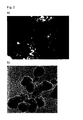
- the scanning electron microscope (SEM) image of Fe 3 O 4 -C nanocomposite shows that the material consists of nanotubes and nanogranular structures interlinking with each other.
- the diameters of the tubes are in the range between 10 to 100 nm and their lengths varied up to several micrometers.
- a large number of tubes were encapsulated with iron oxide nanoparticles at their tips. However in some longer tubes, the particles were embedded in several places within the tube.
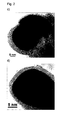
- High resolution transmission electron microscopy (HRTEM) image ( Fig. 2 b, c, d ) of the nanogranular region of the composite confirmed the presence of core-shell structure, containing Fe 3 O 4 cores and graphitic onions shells.
- the interface between graphitic carbon and Fe 3 O 4 with short-range disordered layers can be observed.
- the Fe 3 O 4 particles are coated with three to six layers of graphitic carbon with an average coating thickness of about 3 nm. However, a few Fe 3 O 4 particles are surrounded by several layers of carbon.
- Fig. 3 the differential pore volume (filled circles) and the cumulative pore volume (open circles) are illustrated.
- the nitrogen adsorption-desorption measurement indicates mesoporous nature of the material.
- a sharp increase of the adsorbed gas at very low relative-pressures suggesting the presence of nanopores (pore width ⁇ 2 nm).
- the nano- and mesoporous volumes of were determined as 0.012 and 0.05 cm 3 g -1 , respectively.
- the differential pore volume (filled circles in Fig. 3 ) estimated from the adsorption branch of isotherm using Density Functional Theory model suggests that the mesopore sizes were distributed between 10 and 35 nm.
- the BET Brunauer, Emmett, Teller
- porous electrode materials facilitated lithium ion diffusion to active sites with less resistance and also withstand the volume change during charge/discharge cycling.
- the nano- and mesopores of the Fe 3 O 4 -C nanocomposite could act as buffer against the volume change during redox cycle, which would lead to an enhanced cyclic performance as an anode material for lithium ion batteries.
- Fig. 4 shows a typical galvanostatic profile for a Fe 3 O 4 -C nanocomposite cell cycled between 3 and 0.005 V at 93 mAg -1 .
- the obtained charge/discharge profiles are analogous to that of various Fe 3 O 4 electrodes tested at similar current and voltage ranges.
- the potential dropped abruptly down to about 0.8 V, which can be ascribed to the reaction of Fe 3 O 4 + xLi ⁇ Li x Fe 3 O 4 .
- the obvious long plateau corresponds to the conversion reaction and the sloping part of the discharge curve can be assigned for the formation of solid electrolyte interface (SEI) layer, as well as gel-like film formed by the reaction of Fe 0 and electrolyte.
- SEI solid electrolyte interface
- the electrode exhibits a first discharge capacity of 1480 mAhg -1 based on the total composite weight and the first charge capacity of 960 mAhg -1 .
- the capacity decreases marginally over the first few cycles and then stabilizes at about 920 mAhg -1 in the subsequent 50 cycles.
- the coulombic efficiency after the first cycle was remained nearly 100% until 50 cycles.
- the cyclic voltammogram of Fe 3 O 4 -C nanocomposite is parallel to that of other Fe 3 O 4 electrodes, showing a cathodic wave at 0.56 V and an anodic wave at 1.78 V corresponding to Fe 3+ /Fe 2+ to Fe 0 redox couple.
- the irreversible wave at 0.4 V can be ascribed to the SEI formation.
- the reversible waves shifted slightly to positive potentials.
- the CV curves after third successive scans nearly overlapped, which reveal the good reversibility of the composite electrode.
- a comparative SEM image of the electrode cycled for 50 cycles at 93 mAg -1 has shown similar morphology as of the original composite, thus indicating that the structure remains integrated during cycling.
- the good electrochemical performance of the composite can be attributed to its morphology and porous structure.
- the networking of nanotubes and core-shell structure containing active materials combined with nano and mesopores may help providing better electronic and ionic transport, as well as withstanding the volume change during the reaction.
Landscapes
- Chemical & Material Sciences (AREA)
- Health & Medical Sciences (AREA)
- Engineering & Computer Science (AREA)
- General Chemical & Material Sciences (AREA)
- Chemical Kinetics & Catalysis (AREA)
- Electrochemistry (AREA)
- Inorganic Chemistry (AREA)
- Organic Chemistry (AREA)
- Composite Materials (AREA)
- Nanotechnology (AREA)
- Materials Engineering (AREA)
- Public Health (AREA)
- General Health & Medical Sciences (AREA)
- Veterinary Medicine (AREA)
- Animal Behavior & Ethology (AREA)
- Medicinal Chemistry (AREA)
- Pharmacology & Pharmacy (AREA)
- Epidemiology (AREA)
- Life Sciences & Earth Sciences (AREA)
- Physics & Mathematics (AREA)
- Bioinformatics & Cheminformatics (AREA)
- Condensed Matter Physics & Semiconductors (AREA)
- Crystallography & Structural Chemistry (AREA)
- General Physics & Mathematics (AREA)
- Biomedical Technology (AREA)
- Optics & Photonics (AREA)
- Power Engineering (AREA)
- Battery Electrode And Active Subsutance (AREA)
Abstract
Description
- The present invention provides a new transition metal oxide nanocomposite, in particular Fe3O4 nanocomposite, consisting of carbon encapsulated transition metal oxide nanoparticles and a convenient synthesis to obtain this nanocomposite. The nanocomposite is prepared in a one-step pyrolysis of an oxygen-containing organic transition metal compound without any added solvent or surfactant. The as prepared composite can be directly employed as anode material in a lithium ion cell. Moreover, the carbon encapsulated Fe3O4 nanoparticles can be used in biomedical or magnetic applications.
- Magnetite (Fe3O4) is an attractive anode material for lithium-ion batteries (LIB) based on the conversion mechanism according to the reaction:
Fe3O4+ 8 Li+ + 8 e- ↔ 3 Fe + 4 Li2O.
- Fe3O4 is characterized by a theoretical capacity of 926 mAhg-1, which is far beyond that of the graphite anode (372 mAhg-1), eco-friendliness, natural abundance and high electronic conductivity (2×10⁴ Sm-1). However, its application in practical lithium-ion batteries (LIB) is hindered due to its low rate performance arising from kinetic limitations, agglomerations and poor cycling stability resulting from significant volume expansion during the redox reaction.
- To overcome these problems, Banov et al. (B. Banov, L. Ljutzkanov, I. Dimitrov, A. Trifonova, H. Vasilchina, A. Aleksandrova, A. Mochilov, B. T. Hang, S. Okada and J. I. Yamaki, 2008, J. Nanosci. Nanotech, 591-94) reported the synthesis of a Fe3O4 nanocomposite on a carbon matrix using by thermal decomposition of iron nitrate. This composite encompasses carbon particles with an average size of about 100-150 nm which are covered by small Fe3O4 crystallites of a mean size of 16 nm. The modified material yielded a specific capacity of about 400 mAh/g after 30 cycles, as anode in lithium batteries. However, the synthesis was achieved only by several successive steps including the preparation of the carbon support.
- Liu et al. (H. Liu, G. Wang, J. Wang and D. Wexler, 2008, Electrochem. Commun. 1879-82) reported a synthesis of carbon coated magnetite (Fe3O4) core-shell by a multi-step hydrothermal method yielding Fe2O3nanorods which were sintered together with citric acid as carbon source. The resulting carbon coated Fe3O4 nanorods have a diameter in the range of 30-50 nm and a length extending a few 100 nanometers. The as prepared Fe3O4/C core-shell nanorods exhibited an initial lithium storage capacity of 1120 mAh/g and a reversible capacity of 394 mAh/g after 100 cycles.
- Muraliganth et al. (T. Muraliganth, A.V. Murugan and A. Manthiram, 2009, Chem.Commun., 7360-62) proposed a carbon-coating of Fe3O4-nanowires with glucose-derived carbon-rich polysaccharide in a two-step process by sonication and heating at 400°C for 3 h. However, Fe3O4-nanowires are complex to synthesize by a time and energy consuming procedure. The use of the Fe3O4-nanoparticles was not disclosed.
- Wang et al. (S. Wang, J. Zhang and C. Chen, 2010, J. Power Sources, 195, 5379-81) have synthesized uniform submicron spheroids of Fe3O4 by a hydrothermal method. This material has been studied for its capacity as electrode material in Li-ion batteries. While having initially good characteristics, the material lacks of stability during the long term use in particular due to the volume changes and agglomeration of the particles.
- In another example, Fe3O4-graphene (23 wt%) nanocomposite was prepared by a gas/liquid interface reaction (P. Lian, X. Zhu, H. Xiang, Z. Li, W. Yang and H. Wang, 2010, Electrochim. Acta, 834-40). The nanocomposite exhibited good capacity retention (99% after 90 cycles) with a large reversible capacity of 1048 mAh/g. However, the nanocomposite synthesis is a very complicated, multistep and time consuming process, required several work-up steps starting from iron nitrate and graphene sheets.
- Song et al. (S. Song, R. Rao, H. Yang, H. Liu and A. Zhang, 2010, Nanotechnology, 185602(6pp)) reported a fabrication process of Fe3O4 nanoparticles with a size range of 4-8 nm by a spontaneous redox reaction between Fe3+ and multi-walled carbon nanotubes (MWCNTs). In this process a multi-step preconditioning of the MWCNT is required. Moreover, no electrochemical studies were performed.
- He at al. (H. He, L. Huang, J. S. Cai, X. M. Zheng and S. G. Sun, 2010, Electrochim. Acta 55, 1140-44) have reported the synthesis and electrochemical performance of nanostructured Fe3O4/carbon nanotube composite. In this complicated multi-step synthesis process, polyvinyl alcohol (PVA) was used as a hydrogen bond functionalizing agent to modify the multi-walled CNTs. The nanoparticles of Fe3O4 were then deposited along the sidewalls of the as- modified CNTs the chemical coprecipitation of (NH4)2Fe(SO4) . 6H2O and NH4Fe(SO4) . 12H2O in the presence of CNTs in an alkaline solution. The final product was obtained by several purification steps including removal of ammonia, sulphate, unreacted, PVA etc.
- In other report, Zhang et al. (M. Zhang, D. Lei, X. Yin, L. Chen, Q. Li, Y. Wang and T. Wang, 2010, J. Mater. Chem. 20, 5538-43) proposed the synthesis of magnetite/graphene composites by microwave irradiation method. In this method at first graphene oxide (GO) was prepared from graphite, then exfoliation was carried out by sonication of the GO. In the next step, the mixture of GO, Fe(NO3)3, urea and ascorbic acid was refluxed under ambient condition for 1h with a microwave heater. In addition, it requires several purification and heat treatment steps. The modified electrode material exhibited a reversible capacity of 650 mAh/g after 50 cycles.
- Later, Zhou at al. (G. Zhou, D.-W. Wang, F. Li, L. Zhang, N. Li, Z.-S. Wu, L. Wen, G. Q. Lu and H.-M. Cheng, 2010, Chem. Mater. 22, 5306-13) reported the synthesis and electrochemical properties of graphene-wrapped Fe3O4 composite. The composite was synthesized by dispersing a graphene nanosheet and FeCl3 in aqueous solution by sonication, followed by hydrolysis to obtain FeOOH/graphene sheet. After several purification steps, the resulting product was then reduced to give the desired nanocomposite by heat treatment under inert condition. This material was tested as anode in lithium batteries and obtained specific capacitiy of 1026 mAh/g after 30 cycles at a given current density of 35 mA/g.
- Recently Ban et al. (C. Ban, Z. Wu, D. T. Gillaspie, L. Chen, Y. Yan, J. L. Blackbrurn and A. C. Dillon, 2010, Adv. Mater. 22, E145-49) reported high-rate capability binder-free electrode materials consist of Fe3O4 and single walled carbon nanotubes (SWCNTs). The best performance was obtained by the nanocomposite containing 95%wt oxide and 5%wt SWCNT. The nanocomposite was prepared by two-step process, hydrothermal synthesis and vacuum filtration. Most crucial step is the purification/deagglomeration of SWCNTs, which is time consuming. In addition, SWCNTs were synthesized by laser vaporization technique; both the material and method are very expensive.
- Another solution for circumventing the problems of volume changes and agglomeration of Fe3O4 as anode material is proposed by Ji et al. (L. Ji, Z. Tan, T. Kuykendall, S. Aloni, S. Xun, E. Lin, V. Battaglia and Y. Zhang, 2011, Phys. Chem. Chem. Phys. 13, 7170-77). They describe a nanocomposite of reduced-graphene-oxide (RGO) in which Fe3O4 nanoparticles are encapsulated. The Fe3O4 nanoparticles are uniformly anchored in the RGO sheets such that severe volume changes or agglomeration of the particles can be avoided. The material was tested as anode material in Lithium ion batteries. It has to be noted that the synthesis of the Fe3O4 -RGO nanocomposite is a time consuming multi step process.
- Wang et al. (J.-Z. Wang, C. Zhong, D. Wexler, N.H. Idris, Z.-X. Wang, L.-Q. Chen, H.-K. Liu, 2011, Chem. Eur. J., 17,661-667) have also prepared a nanocomposite consisting of Fe3O4 particles embedded in graphene nanosheets. The nanocomposite was tested as electrode material in a lithium ion battery where it exposed significantly improved life cycles compared to pure Fe3O4. The nanocomposite was synthesized in situ starting from graphite and FeCl2 by a multistep hydrothermal method.
- A further Fe3O4 nanocomposite in form of hierarchically structured Fe3O4/carbon micro-flowers has been prepared by Jin et al. (S. Jin, H. Deng, D. Long, X. Liu, L. Zhan, X. Liang, W. Qiao, L. Ling, 2011, J. Power Sources, 196, 3887-3893). This composite consists of nanosized Fe3O4 crystallites and amorphous carbon which are assembled to micro flowers of 2-5 µm. The paper also discloses a method of a controlled thermal decomposition of an iron-alkoxide precursor for preparing said nanocomposite. This preparation requires energy and time consuming efforts. The Fe3O4 nanocomposite is proposed and assayed for its capability as anode material in lithium ion batteries.
- A common disadvantage of the state of the art is the lack of an economic one-step solvent-free synthesis which is easy to perform. The cited state of the art does not disclose any nanoparticles or nanocomposites consisting of a transition metal oxide, in particular Fe3O4, which are encapsulated in a carbon shell.
- To overcome the disadvantages of the state of the art, it is an objective of the present invention to provide a transition metal oxide-carbon nanocomposite, in particular a Fe3O4-carbon nanocomposite, which contains transition metal oxide nanoparticles covered with a graphitic carbon onion shell.
- It is another objective of the present invention to provide a simple one-step and solvent-free synthesis of said transition metal oxide-carbon nanocomposite.
- It is a further objective of the present invention to provide an anode material for its use in lithium-ion batteries. This anode material should be based on transition metal oxide-carbon nanocomposite, in particular a Fe3O4-carbon nanocomposite, for reason of its good capacity, low toxicity and high electronic conductivity. The material should overcome the problems of kinetic limitations, agglomerations and poor cycling stability resulting from significant volume expansion during the redox reaction.
- The invention provides a nanocomposite containing carbon encapsulated transition metal oxide nanoparticles. These nanoparticles have a core-shell structure, wherein a transition metal core with a diameter from 5 nm to 50 nm is covered by a graphitic carbon coating. Preferably the core diameter ranges from 10 nm to 30 nm.
- Within the scope of the present invention, a core-shell structure shall read that the cores, which are formed by substantially spherically-shaped metal oxide nanoparticles, are covered by a coating of several layers of graphitic carbon. This graphitic carbon shell has of a thickness from 1 nm to 5 nm. The interface between the carbon-coating and the metal oxide is characterized by short-range disordered layers.
- In a preferred embodiment, the nanocomposite further comprises carbon nanotubes which are embedded in agglomerates of the carbon encapsulated transition metal oxide nanoparticles.
- In another preferred embodiment, the nanocomposite consists of 70 to 90 wt% of transition metal oxide and 10 to 30 wt% of carbon in the form of graphitic carbon of the coating and, if present, of carbon nanotubes. The total composition of transition metal oxide and carbon does not exceed 100 wt%.
- In a still preferred embodiment the nanocomposite has a porous structure encompassing nanopores of a pore width from 0.1 nm to 2 nm and mesopores having sizes from 2 nm to 50 nm, more preferred between 10 nm and 35 nm.
- The BET (Brunauer, Emmett, Teller) specific surface area ranges preferably from 80 m2g-1 to 150 m2g-1.
- In a most preferred embodiment of the nanocomposite, the transition metal oxide core consists of Fe3O4 (Fe3O4 -C nanocomposite).
- The present invention provides a method to synthesize a carbon encapsulated transition metal oxide nanocomposite as described above. An oxygen-containing organic transition metal compound is submitted to pyrolysis in a hermetically closed vessel under inert gas atmosphere at a temperature from 500 to 800°C. Under these reaction conditions, any presence of organic oxygen is trapped by the metal to form an oxide.
- The organic rests of the oxygen-containing organic transition metal compound, which mainly consist of carbon, are substantially reduced to the graphitic coating and to carbon nanotubes. In a preferred embodiment, these organic rests are alkoxides, carboxides or carbonyls. In a more preferred embodiment, the oxygen-containing organic transition metal compound is a transition metal carbonyl. In a most preferred embodiment, the transition metal carbonyl is Fe(CO)5.
- In another preferred embodiment, the reaction vessel is rotated during the reaction. This rotation allows the gentle mixing of the dry powder during the pyrolysis leading to a homogenous product. The reaction time is preferably from 1 to 3 hours.
- One advantage of the provided method is that it can be performed in the absence of any solvent. Further additives such as surfactants are not required for this synthesis. In a preferred embodiment, the reaction mixture should contain no or minute amounts of reducing agents. Under certain conditions, the presence of such agents may lead to the formation of a mixture of transition metal and various transition metal oxides.
- By applying the synthesis as described, a crude product is obtained which consists of a nanocomposite containing carbon encapsulated transition metal oxide nanoparticles having a core-shell structure as defined above and carbon nanotubes, which have formed in situ during the pyrolytic synthesis.
- Another embodiment of the present invention is directed to an anode material for lithium-ion batteries containing a nanocomposite as defined herein. The transition metal oxide nanoparticles which are encapsulated within a shell of thin conductible graphitic carbon demonstrate good electrochemical performance. The short-range disordered layers of the interface between the metal oxide core and the carbon shell facilitate the lithium ion transfer from and to the active material in the core.
- In particular the network of the core-shell nanoparticles with the nanotubes confers an excellent electronic transport within the electrode. Moreover, the nanocomposite's morphology based on the core-shell structure and its porous structure gives the anode material good ionic transport capacities while the composite resists to volume changes and to agglomeration during the charge and discharge reactions.
- Particularly advantageous is the use of the nanocomposite consisting of carbon-encapsulated Fe3O4 cores (Fe3O4 -C nanocomposite) as the iron compounds are abundant and nontoxic while having a good capacity and high electronic conductivity.
- In a preferred embodiment the anode material further contains 1-10 wt % of carbon black and 1-10 wt % of PVDF-HFP (poly(vinylidene fluoride-co-hexafluoropropylene).
- When using a Fe3O4 as transition metal oxide in the carbon-encapsulated nanoparticles, the resulting nanocomposite shows magnetic activity. This magnetic nanocomposite can be used in different applications wherein the magnetic properties combined with the characteristics of the carbon-encapsulated Fe3O4 nanoparticles are suitable. These characteristics are e.g. no antiferromagnetic coupling between encapsulated Fe3O4 particles, the non-toxicity, or the chemical passivity of the carbon-shell structure.
- For example the Fe3O4 -C nanocomposite can be used as therapeutic agent in medical applications. Upon exposure to a suitable electromagnetic field, the Fe3O4 -C nanocomposite can capture this field and transform it into heat. Upon local application of the nanocomposite into a solid tumor and exposing this area to an appropriate electromagnetic field, the neoplastic tissue can be destroyed non-invasively by heat.
- Further magnetic applications of the carbon-encapsulated Fe3O4 nanoparticles, such as in ferrofluids are possible.
- The following figures and examples are presented to provide a better understanding of the description of procedures and conceptual aspects of the invention.
-
Fig. 1 : X-ray powder diffraction (XRD) pattern and Raman spectrum (inset) of Fe3O4-C nanocomposite. -
Fig. 2: a) scanning electron microscope (SEM) and b, c, d) High resolution transmission electron microscopy (HRTEM) images of Fe3O4-C nanocomposite. -
Fig. 3 : Cumulative and differential pore width profile of Fe3O4-C nanocomposite. -
Fig. 4 : Charge/discharge curves of Fe3O4-C nanocomposite electrode. -
Fig. 5 : Cyclic voltammogram of Fe3O4-C nanocomposite electrode. -
Fig. 6 : Rate performance profile of Fe3O4-C nanocomposite electrode. - Fe(CO)5 was sealed under argon atmosphere into a stainless steel Swagelok-type reactor. The reactor was placed horizontally inside a rotating quartz-tube setup in a furnace. The tube was rotated (10 rpm) during pyrolysis to obtain a homogeneous mixture. The reactor was heated at a rate of 5 °C min-1 to 700 °C and kept at this temperature for 3 h. The reaction took place under autogenous pressure. After cooling down the reactor to ambient temperature naturally, the remaining pressure was released carefully. A dry fine black powder of Fe3O4 -C nanocomposite produced was collected and used directly without any further treatment.
- X-ray powder diffraction (XRD) pattern and Raman spectrum of the as prepared nanocomposite are shown in
Fig. 1 . All the diffraction peaks can be indexed to two well-defined phases, a hexagonal phase graphitic carbon [26.4° (002)] and a cubic phase Fe3O4. No detectable signals for metallic iron or other oxides were observed in the XRD pattern, indicating that the oxidation reaction was complete and formed only the selective oxide. The Scherrer analysis has been performed on 220, 311, 400, 511 and 440 Bragg peaks of Fe3O4, and the mean crystallite size was calculated as 14 nm. - The Raman spectrum of the composite exhibits two bands at 1328 and 1602 cm-1, which are characteristic of the D (disorder-induced phonon mode15) and G (graphitic lattice mode E2g 16) bands of carbon, respectively. The intensity ratio IG/ID of 0.7 indicated that a significant quantity of disordered carbon is also present in the nanocomposite. In addition, the A1g vibration mode of Fe3O4 peak appeared at 668 cm-1, which agrees well with the literature value for pure as well as graphene encapsulated Fe3O4. The infra-red spectrum of the nanocomposite exhibits a broad band at 560 cm-1 which is typical for the Fe-O vibration of Fe3O4.
- The scanning electron microscope (SEM) image of Fe3O4-C nanocomposite (
Fig. 2 a) shows that the material consists of nanotubes and nanogranular structures interlinking with each other. The diameters of the tubes are in the range between 10 to 100 nm and their lengths varied up to several micrometers. A large number of tubes were encapsulated with iron oxide nanoparticles at their tips. However in some longer tubes, the particles were embedded in several places within the tube. - High resolution transmission electron microscopy (HRTEM) image (
Fig. 2 b, c, d ) of the nanogranular region of the composite confirmed the presence of core-shell structure, containing Fe3O4 cores and graphitic onions shells. The interface between graphitic carbon and Fe3O4 with short-range disordered layers can be observed. The Fe3O4 particles are coated with three to six layers of graphitic carbon with an average coating thickness of about 3 nm. However, a few Fe3O4 particles are surrounded by several layers of carbon. - In
Fig. 3 the differential pore volume (filled circles) and the cumulative pore volume (open circles) are illustrated. The nitrogen adsorption-desorption measurement indicates mesoporous nature of the material. In addition, a sharp increase of the adsorbed gas at very low relative-pressures suggesting the presence of nanopores (pore width < 2 nm). The nano- and mesoporous volumes of were determined as 0.012 and 0.05 cm3g-1, respectively. The differential pore volume (filled circles inFig. 3 ) estimated from the adsorption branch of isotherm using Density Functional Theory model suggests that the mesopore sizes were distributed between 10 and 35 nm. The BET (Brunauer, Emmett, Teller) specific surface area was calculated to be as high as 110.6 m2g-1 (open circles inFig. 3 ). - It has been well established that porous electrode materials facilitated lithium ion diffusion to active sites with less resistance and also withstand the volume change during charge/discharge cycling. Thus, the nano- and mesopores of the Fe3O4 -C nanocomposite could act as buffer against the volume change during redox cycle, which would lead to an enhanced cyclic performance as an anode material for lithium ion batteries.
- The electrochemical performance of the Fe3O4 -C nanocomposite anode has been evaluated with respect to lithium metal.
Fig. 4 shows a typical galvanostatic profile for a Fe3O4 -C nanocomposite cell cycled between 3 and 0.005 V at 93 mAg-1. The obtained charge/discharge profiles are analogous to that of various Fe3O4 electrodes tested at similar current and voltage ranges. During the first discharge the potential dropped abruptly down to about 0.8 V, which can be ascribed to the reaction of Fe3O4 + xLi → LixFe3O4. The obvious long plateau corresponds to the conversion reaction and the sloping part of the discharge curve can be assigned for the formation of solid electrolyte interface (SEI) layer, as well as gel-like film formed by the reaction of Fe0 and electrolyte. The electrode exhibits a first discharge capacity of 1480 mAhg-1 based on the total composite weight and the first charge capacity of 960 mAhg-1. The capacity decreases marginally over the first few cycles and then stabilizes at about 920 mAhg-1 in the subsequent 50 cycles. The coulombic efficiency after the first cycle was remained nearly 100% until 50 cycles. - The cyclic voltammogram of Fe3O4-C nanocomposite is parallel to that of other Fe3O4 electrodes, showing a cathodic wave at 0.56 V and an anodic wave at 1.78 V corresponding to Fe3+/Fe2+ to Fe0 redox couple. The irreversible wave at 0.4 V can be ascribed to the SEI formation. In the subsequent cycles, the reversible waves shifted slightly to positive potentials. The CV curves after third successive scans nearly overlapped, which reveal the good reversibility of the composite electrode.
- Besides the cyclic stability, it also exhibits a moderate rate capability performance (
Fig. 6 ). Current densities below 926 mAg-1, the electrode exhibited good cyclic performances and excellent capacity retention. When the electrode cycled at 1852 and 2780 mAg-1, the observed capacity retentions between 3rd and 50th cycles were about 72 and 63%, respectively. - A comparative SEM image of the electrode cycled for 50 cycles at 93 mAg-1 has shown similar morphology as of the original composite, thus indicating that the structure remains integrated during cycling. The good electrochemical performance of the composite can be attributed to its morphology and porous structure. Especially, the networking of nanotubes and core-shell structure containing active materials combined with nano and mesopores may help providing better electronic and ionic transport, as well as withstanding the volume change during the reaction.
Claims (14)
- A nanocomposite comprising carbon-encapsulated transition metal oxide nanoparticles with a core-shell structure, wherein the transition metal oxide core has a diameter from 5 nm to 50 nm which is covered by a graphitic coating of a thickness from 1 nm to 5 nm.
- A nanocomposite according to claim 1, further comprising carbon nanotubes embedded in the composite.
- A nanocomposite according to claim 1 or 2, wherein the composite consists of 70 to 90 wt% of transition metal oxide and 10 to 30 wt% of carbon.
- A nanocomposite according to claim 1 to 3, which comprises nanopores of a pore size from 0.1 nm to 2 nm and mesopores having a pore size from 2 nm to 50 nm.
- A nanocomposite according to claim 1 to 4, wherein the transition metal oxide is Fe3O4.
- A method to synthesize a carbon encapsulated transition metal oxide nanocomposite according to one of the claims 1 to 5 by pyrolysis of an oxygen-containing organic transition metal compound in a closed vessel under inert gas atmosphere at a temperature from 500 to 800°C.
- A method according to claim 6, wherein the vessel is rotated during the reaction.
- A method according to claim 6 or 7, wherein the reaction time is from 1 to 3 hours.
- A method according to claim 6 to 8, wherein the oxygen-containing organic transition metal compound is a transition metal carbonyl.
- A method according to claim 9, wherein the transition metal carbonyl is Fe(CO)5.
- Anode material for lithium-ion batteries comprising a nanocomposite according to one of the claims 1 to 5.
- Anode material according to claim 11 further comprising 1 to 10 %wt of carbon black and 1 to 10 %wt of PVDF-HFP (poly(vinylidene fluoride-co-hexafluoropropylene)).
- A carbon encapsulated Fe3O4 nanocomposite according to claim 5 for use as a therapeutic agent.
- Use of carbon encapsulated Fe3O4 nanocomposite according to claim 5 as magnetic material.
Priority Applications (3)
| Application Number | Priority Date | Filing Date | Title |
|---|---|---|---|
| EP11008085.0A EP2578539B1 (en) | 2011-10-06 | 2011-10-06 | Carbon encapsulated metal oxide nanocomposite, method for its preparation and its use in Li-ion batteries |
| PCT/EP2012/004042 WO2013050115A1 (en) | 2011-10-06 | 2012-09-26 | Carbon encapsulated transition metal oxide nanocomposite, a method for its preparation and its use in li-ion batteries |
| US14/349,074 US9393214B2 (en) | 2011-10-06 | 2012-09-26 | Carbon encapsulated transition metal oxide nanocomposite, a method for its preparation and its use in li-ion batteries |
Applications Claiming Priority (1)
| Application Number | Priority Date | Filing Date | Title |
|---|---|---|---|
| EP11008085.0A EP2578539B1 (en) | 2011-10-06 | 2011-10-06 | Carbon encapsulated metal oxide nanocomposite, method for its preparation and its use in Li-ion batteries |
Publications (2)
| Publication Number | Publication Date |
|---|---|
| EP2578539A1 true EP2578539A1 (en) | 2013-04-10 |
| EP2578539B1 EP2578539B1 (en) | 2014-08-27 |
Family
ID=47215476
Family Applications (1)
| Application Number | Title | Priority Date | Filing Date |
|---|---|---|---|
| EP11008085.0A Not-in-force EP2578539B1 (en) | 2011-10-06 | 2011-10-06 | Carbon encapsulated metal oxide nanocomposite, method for its preparation and its use in Li-ion batteries |
Country Status (3)
| Country | Link |
|---|---|
| US (1) | US9393214B2 (en) |
| EP (1) | EP2578539B1 (en) |
| WO (1) | WO2013050115A1 (en) |
Cited By (13)
| Publication number | Priority date | Publication date | Assignee | Title |
|---|---|---|---|---|
| CN103599737A (en) * | 2013-11-20 | 2014-02-26 | 北京化工大学 | A kind of magnetic nano material with carbon shell and its preparation method |
| CN103825019A (en) * | 2014-02-21 | 2014-05-28 | 浙江大学 | Fe3O4/C composite material, its preparation method and its application in lithium ion battery |
| JP2015216107A (en) * | 2014-04-25 | 2015-12-03 | Tdk株式会社 | Negative electrode active material for lithium ion secondary battery, negative electrode for lithium ion secondary battery, and lithium ion secondary battery |
| CN105206817A (en) * | 2015-10-20 | 2015-12-30 | 上海应用技术学院 | Carbon-coated iron-based/grapheme lithium ion battery cathode material and preparation method |
| CN105514390A (en) * | 2016-01-22 | 2016-04-20 | 江苏大学 | Nano sheet porous transition metal oxide/carbon composite material and preparation method thereof |
| CN105702405A (en) * | 2016-04-29 | 2016-06-22 | 湖北工程学院 | Nano composite NdFeB (neodymium iron boron) permanent magnetic material and preparation method |
| CN109231281A (en) * | 2018-08-06 | 2019-01-18 | 杭州电子科技大学 | Fe3O4Preparation method of quasi-cubic particle/multilayer graphene composite material |
| WO2019138272A1 (en) * | 2018-01-09 | 2019-07-18 | Saudi Arabian Oil Company | Nanocomposite cathode materials for use in batteries |
| US10424782B2 (en) | 2018-01-09 | 2019-09-24 | Saudi Arabian Oil Company | Nanocomposite electrode materials for use in high temperature and high pressure rechargeable batteries |
| GB2584377A (en) * | 2012-07-03 | 2020-12-02 | Traverse Tech Corp | Hybrid energy storage devices including support filaments |
| US11127948B2 (en) | 2008-02-25 | 2021-09-21 | Cf Traverse Llc | Energy storage devices |
| CN115763050A (en) * | 2022-12-14 | 2023-03-07 | 中国兵器科学研究院宁波分院 | Soft magnetic composite material and preparation method of corrosion-resistant magnetic core thereof |
| US11813674B2 (en) | 2019-07-09 | 2023-11-14 | Saudi Arabian Oil Company | Methods for the production of nanocomposites for high temperature electrochemical energy storage devices |
Families Citing this family (19)
| Publication number | Priority date | Publication date | Assignee | Title |
|---|---|---|---|---|
| US10018583B2 (en) * | 2013-03-21 | 2018-07-10 | Cornell University | Carbon material supported hollow metal oxide nanoparticles, methods and applications |
| CN103956482B (en) * | 2014-03-28 | 2016-02-17 | 北京理工大学 | A kind of method preparing lithium ion battery foam-like ferroferric oxide/carbon composite negative electrode material |
| US10374215B2 (en) * | 2014-10-17 | 2019-08-06 | Wayne State University | Centrifugation-assisted preparation of additive-free carbon-decorated magnetite electrodes |
| WO2016138385A1 (en) * | 2015-02-26 | 2016-09-01 | Board Of Regents, The University Of Texas System | Two-dimensional nanosheets and methods of making and use thereof |
| CN104698052B (en) * | 2015-03-26 | 2017-10-17 | 盐城工学院 | A kind of graphene/Fe3O4The preparation method and applications of/Jenner nano composite material |
| CN105070889B (en) * | 2015-07-17 | 2017-08-15 | 江苏长园华盛新能源材料有限公司 | A kind of preparation method, product and the application of the carbon fibre material of carried titanium dioxide nano thin-film and ferroferric oxide nano granules |
| US11189825B2 (en) * | 2015-11-13 | 2021-11-30 | Nanograf Corporation | Graphene-encapsulated electroactive material for use in a lithium ion electrochemical cell |
| US11114665B2 (en) | 2016-08-29 | 2021-09-07 | Gs Yuasa International Ltd. | Energy storage device and method for producing same |
| CN106207137A (en) * | 2016-09-12 | 2016-12-07 | 华中科技大学 | A kind of composite negative electrode material of lithium ion battery and preparation method thereof |
| CN110945709B (en) * | 2017-05-30 | 2023-08-15 | 泰坦先进能源解决方案公司 | Battery Life Estimation and Capacity Recovery |
| CN107731557B (en) * | 2017-08-23 | 2019-03-22 | 温州大学 | Nitrogen oxygen codope porous carbon/ferriferrous oxide composite material preparation method and application |
| US11349117B2 (en) | 2018-01-17 | 2022-05-31 | The Research Foundation For The State University Of New York | Magnetite (Fe3O4)—multiwalled carbon nanotube composite structures with performance as high rate electrode materials for Li-ion batteries |
| CN110137439A (en) * | 2018-02-09 | 2019-08-16 | 南京理工大学 | The preparation method of transition metal oxide@carbon composite nano-material |
| US20190341623A1 (en) * | 2018-05-01 | 2019-11-07 | National Technology & Engineering Solutions Of Sandia, Llc | Carbon coated nano-materials and metal oxide electrodes, and methods of making the same |
| CN109546128A (en) * | 2018-11-28 | 2019-03-29 | 北京科技大学 | A kind of preparation method of nanometer ferrous sulfide/graphene composite positive electrode material |
| CN109638254B (en) | 2018-12-17 | 2020-09-25 | 宁德新能源科技有限公司 | Negative electrode material, and electrochemical device and electronic device using same |
| CN109368598A (en) * | 2018-12-26 | 2019-02-22 | 河南迪诺环保科技股份有限公司 | A kind of board-like high performance ozone generator |
| TWI877210B (en) * | 2019-09-20 | 2025-03-21 | 德商麥克專利有限公司 | Pigments |
| CN112694074B (en) * | 2020-12-28 | 2023-01-13 | 湖南邦普循环科技有限公司 | Recovery method and application of lithium iron phosphate waste |
Citations (2)
| Publication number | Priority date | Publication date | Assignee | Title |
|---|---|---|---|---|
| US20100035750A1 (en) * | 2008-08-05 | 2010-02-11 | National Tsing Hua University | Carbon-coated metal oxide nano-particles and method of preparing the same |
| US20110104553A1 (en) * | 2009-10-29 | 2011-05-05 | Uchicago Argonne, Llc | Autogenic pressure reactions for battery materials manufacture |
Family Cites Families (1)
| Publication number | Priority date | Publication date | Assignee | Title |
|---|---|---|---|---|
| EP2383374A1 (en) * | 2010-04-29 | 2011-11-02 | BASF Corporation | Nano-particles containing carbon and a ferromagnetic metal or alloy |
-
2011
- 2011-10-06 EP EP11008085.0A patent/EP2578539B1/en not_active Not-in-force
-
2012
- 2012-09-26 WO PCT/EP2012/004042 patent/WO2013050115A1/en not_active Ceased
- 2012-09-26 US US14/349,074 patent/US9393214B2/en not_active Expired - Fee Related
Patent Citations (2)
| Publication number | Priority date | Publication date | Assignee | Title |
|---|---|---|---|---|
| US20100035750A1 (en) * | 2008-08-05 | 2010-02-11 | National Tsing Hua University | Carbon-coated metal oxide nano-particles and method of preparing the same |
| US20110104553A1 (en) * | 2009-10-29 | 2011-05-05 | Uchicago Argonne, Llc | Autogenic pressure reactions for battery materials manufacture |
Non-Patent Citations (17)
| Title |
|---|
| B. BANOV, L. LJUTZKANOV, I. DIMITROV, A. TRIFONOVA, H. VASILCHINA, A. ALEKSANDROVA, A. MOCHILOV, B. T. HANG, S. OKADA, J. I. YAMAK, J. NANOSCI. NANOTECH, 2008, pages 591 - 94 |
| C. BAN, Z. WU, D. T. GILLASPIE, L. CHEN, Y. YAN, J. L. BLACKBRURN, A. C. DILLON, ADV. MATER., vol. 22, 2010, pages E145 - 49 |
| C.F. WANG ET AL: "Solid-Phase Synthesis of Carbon-Encapsulated Magnetic Nanoparticles", JOURNAL OF PHYSICAL CHEMISTRY C, vol. 111, no. 17, 3 May 2007 (2007-05-03), pages 6303 - 6307, XP055018980, ISSN: 1932-7447, DOI: 10.1021/jp0707283 * |
| G. ZHOU, D.-W. WANG, F. LI, L. ZHANG, N. LI, Z.-S. WU, L. WEN, G. Q. LU, H.-M. CHENG, CHEM. MATER., vol. 22, 2010, pages 5306 - 13 |
| H. HE, L. HUANG, J. S. CAI, X. M. ZHENG, S. G. SUN, ELECTROCHIM. ACTA, vol. 55, 2010, pages 1140 - 44 |
| H. LIU, G. WANG, J. WANG, D. WEXLER, ELECTROCHEM. COMMUN., 2008, pages 1879 - 82 |
| J.-Z. WANG, C. ZHONG, D. WEXLER, N.H. IDRIS, Z.-X. WANG, L.-Q. CHEN, H.-K. LIU, CHEM. EUR. J., vol. 17, 2011, pages 661 - 667 |
| JULIANA C. TRISTÃO ET AL: "Facile preparation of carbon coated magnetic Fe3O4 particles by a combined reduction/CVD process", MATERIALS RESEARCH BULLETIN, vol. 46, no. 5, 1 May 2011 (2011-05-01), pages 748 - 754, XP055019054, ISSN: 0025-5408, DOI: 10.1016/j.materresbull.2011.01.008 * |
| L. JI, Z. TAN, T. KUYKENDALL, S. ALONI, S. XUN, E. LIN, V. BATTAGLIA, Y. ZHANG, PHYS. CHEM. CHEM. PHYS., vol. 13, 2011, pages 7170 - 77 |
| LIU H ET AL: "Magnetite/carbon core-shell nanorods as anode materials for lithium-ion batteries", ELECTROCHEMISTRY COMMUNICATIONS, ELSEVIER, AMSTERDAM, NL, vol. 10, no. 12, 1 December 2008 (2008-12-01), pages 1879 - 1882, XP025679956, ISSN: 1388-2481, [retrieved on 20081004], DOI: 10.1016/J.ELECOM.2008.09.036 * |
| M. ZHANG, D. LEI, X. YIN, L. CHEN, Q. LI, Y. WANG, T. WANG, J. MATER. CHEM., vol. 20, 2010, pages 5538 - 43 |
| P. LIAN, X. ZHU, H. XIANG, Z. LI, W. YANG, H. WANG, ELECTROCHIM. ACT, 2010, pages 834 - 40 |
| S. JIN, H. DENG, D. LONG, X. LIU, L. ZHAN, X. LIANG, W. QIAO, L. LING, J. POWER SOURCES, vol. 196, 2011, pages 3887 - 3893 |
| S. SONG, R. RAO, H. YANG, H. LIU, A. ZHANG, NANOTECHNOLOGY, 2010, pages 185602 |
| S. WANG, J. ZHANG, C. CHEN, J. POWER SOURCES, vol. 195, 2010, pages 5379 - 81 |
| T. MURALIGANTH, A.V. MURUGAN, A. MANTHIRAM, CHEM.COMMUN., 2009, pages 7360 - 62 |
| VINEET PANCHAL ET AL: "Synthesis and characterization of carbon coated nanoparticles produced by a continuous low-pressure plasma process", JOURNAL OF NANOPARTICLE RESEARCH ; AN INTERDISCIPLINARY FORUM FOR NANOSCALE SCIENCE AND TECHNOLOGY, KLUWER ACADEMIC PUBLISHERS, DO, vol. 13, no. 9, 6 March 2011 (2011-03-06), pages 3825 - 3833, XP019937353, ISSN: 1572-896X, DOI: 10.1007/S11051-011-0305-3 * |
Cited By (18)
| Publication number | Priority date | Publication date | Assignee | Title |
|---|---|---|---|---|
| US11127948B2 (en) | 2008-02-25 | 2021-09-21 | Cf Traverse Llc | Energy storage devices |
| GB2584377A (en) * | 2012-07-03 | 2020-12-02 | Traverse Tech Corp | Hybrid energy storage devices including support filaments |
| GB2584377B (en) * | 2012-07-03 | 2021-04-14 | Traverse Tech Corp | Hybrid energy storage devices including support filaments |
| CN103599737B (en) * | 2013-11-20 | 2015-10-14 | 北京化工大学 | One has carbon shell magnetic Nano material and preparation method |
| CN103599737A (en) * | 2013-11-20 | 2014-02-26 | 北京化工大学 | A kind of magnetic nano material with carbon shell and its preparation method |
| CN103825019A (en) * | 2014-02-21 | 2014-05-28 | 浙江大学 | Fe3O4/C composite material, its preparation method and its application in lithium ion battery |
| JP2015216107A (en) * | 2014-04-25 | 2015-12-03 | Tdk株式会社 | Negative electrode active material for lithium ion secondary battery, negative electrode for lithium ion secondary battery, and lithium ion secondary battery |
| CN105206817A (en) * | 2015-10-20 | 2015-12-30 | 上海应用技术学院 | Carbon-coated iron-based/grapheme lithium ion battery cathode material and preparation method |
| CN105514390A (en) * | 2016-01-22 | 2016-04-20 | 江苏大学 | Nano sheet porous transition metal oxide/carbon composite material and preparation method thereof |
| CN105702405A (en) * | 2016-04-29 | 2016-06-22 | 湖北工程学院 | Nano composite NdFeB (neodymium iron boron) permanent magnetic material and preparation method |
| WO2019138272A1 (en) * | 2018-01-09 | 2019-07-18 | Saudi Arabian Oil Company | Nanocomposite cathode materials for use in batteries |
| US10424782B2 (en) | 2018-01-09 | 2019-09-24 | Saudi Arabian Oil Company | Nanocomposite electrode materials for use in high temperature and high pressure rechargeable batteries |
| US11239466B2 (en) | 2018-01-09 | 2022-02-01 | Saudi Arabian Oil Company | Nanocomposite cathode materials for use in batteries |
| US11658286B2 (en) | 2018-01-09 | 2023-05-23 | Saudi Arabian Oil Company | Nanocomposite electrode materials for use in high temperature and high pressure rechargeable batteries |
| CN109231281A (en) * | 2018-08-06 | 2019-01-18 | 杭州电子科技大学 | Fe3O4Preparation method of quasi-cubic particle/multilayer graphene composite material |
| US11813674B2 (en) | 2019-07-09 | 2023-11-14 | Saudi Arabian Oil Company | Methods for the production of nanocomposites for high temperature electrochemical energy storage devices |
| US11998988B2 (en) | 2019-07-09 | 2024-06-04 | Saudi Arabian Oil Company | Methods for the production of nanocomposites for high temperature electrochemical energy storage devices |
| CN115763050A (en) * | 2022-12-14 | 2023-03-07 | 中国兵器科学研究院宁波分院 | Soft magnetic composite material and preparation method of corrosion-resistant magnetic core thereof |
Also Published As
| Publication number | Publication date |
|---|---|
| US9393214B2 (en) | 2016-07-19 |
| WO2013050115A1 (en) | 2013-04-11 |
| EP2578539B1 (en) | 2014-08-27 |
| US20140294981A1 (en) | 2014-10-02 |
Similar Documents
| Publication | Publication Date | Title |
|---|---|---|
| US9393214B2 (en) | Carbon encapsulated transition metal oxide nanocomposite, a method for its preparation and its use in li-ion batteries | |
| Khan et al. | VO2 nanostructures for batteries and supercapacitors: a review | |
| Fei et al. | Preparation of carbon-coated iron oxide nanoparticles dispersed on graphene sheets and applications as advanced anode materials for lithium-ion batteries | |
| Roy et al. | Nanostructured anode materials for lithium ion batteries | |
| Song et al. | Immobilizing VN ultrafine nanocrystals on N-doped carbon nanosheets enable multiple effects for high-rate lithium—sulfur batteries | |
| Wang et al. | Uniform Fe3O4 microflowers hierarchical structures assembled with porous nanoplates as superior anode materials for lithium-ion batteries | |
| Shen et al. | In situ growth of Li 4 Ti 5 O 12 on multi-walled carbon nanotubes: novel coaxial nanocables for high rate lithium ion batteries | |
| Ma et al. | Nanoparticulate Mn3O4/VGCF composite conversion-anode material with extraordinarily high capacity and excellent rate capability for lithium ion batteries | |
| Liu et al. | Design and synthesis of a novel nanothorn VO 2 (B) hollow microsphere and their application in lithium-ion batteries | |
| Li et al. | Low-temperature synthesis of α-MnO2 hollow urchins and their application in rechargeable Li+ batteries | |
| Vinayan et al. | Synthesis of graphene-multiwalled carbon nanotubes hybrid nanostructure by strengthened electrostatic interaction and its lithium ion battery application | |
| US9868105B2 (en) | Spinel-type lithium titanium oxide/graphene composite and method of preparing the same | |
| JP4971387B2 (en) | Transition metal oxide / multi-wall carbon nanotube nanocomposite and method for producing the same | |
| US10826113B2 (en) | Zinc ion-exchanging energy storage device | |
| Yuan et al. | Porous CoO/C polyhedra as anode material for Li-ion batteries | |
| Zhu et al. | Porous CoO nanostructure arrays converted from rhombic Co (OH) F and needle-like Co (CO3) 0.5 (OH)· 0.11 H2O and their electrochemical properties | |
| Zhang et al. | From cobalt nitrate carbonate hydroxide hydrate nanowires to porous Co3O4 nanorods for high performance lithium-ion battery electrodes | |
| Liu et al. | Ultrathin nanoribbons of in situ carbon-coated V3O7· H2O for high-energy and long-life Li-ion batteries: synthesis, electrochemical performance, and charge–discharge behavior | |
| Yuan et al. | Nano tube-in-tube CNT@ void@ TiO2@ C with excellent ultrahigh rate capability and long cycling stability for lithium ion storage | |
| Yuan et al. | CoO hierarchical mesoporous nanospheres@ TiO2@ C for high-performance lithium-ion storage | |
| An et al. | Hydrothermal synthesis of coherent porous V2O3/carbon nanocomposites for high-performance lithium-and sodium-ion batteries | |
| Liu et al. | A new strategy to prepare Ge/GeO2-reduced graphene oxide microcubes for high-performance lithium-ion batteries | |
| Gu et al. | Construction of point-line-plane (0-1-2 dimensional) Fe2O3-SnO2/graphene hybrids as the anodes with excellent lithium storage capability | |
| Hong et al. | Atomic layer deposition assisted sacrificial template synthesis of mesoporous TiO2 electrode for high performance lithium ion battery anodes | |
| Li et al. | Facile synthesis of nanocrystalline-assembled nest-like NiO hollow microspheres with superior lithium storage performance |
Legal Events
| Date | Code | Title | Description |
|---|---|---|---|
| PUAI | Public reference made under article 153(3) epc to a published international application that has entered the european phase |
Free format text: ORIGINAL CODE: 0009012 |
|
| AK | Designated contracting states |
Kind code of ref document: A1 Designated state(s): AL AT BE BG CH CY CZ DE DK EE ES FI FR GB GR HR HU IE IS IT LI LT LU LV MC MK MT NL NO PL PT RO RS SE SI SK SM TR |
|
| AX | Request for extension of the european patent |
Extension state: BA ME |
|
| 17P | Request for examination filed |
Effective date: 20130427 |
|
| 17Q | First examination report despatched |
Effective date: 20130625 |
|
| GRAP | Despatch of communication of intention to grant a patent |
Free format text: ORIGINAL CODE: EPIDOSNIGR1 |
|
| INTG | Intention to grant announced |
Effective date: 20140324 |
|
| GRAS | Grant fee paid |
Free format text: ORIGINAL CODE: EPIDOSNIGR3 |
|
| GRAA | (expected) grant |
Free format text: ORIGINAL CODE: 0009210 |
|
| AK | Designated contracting states |
Kind code of ref document: B1 Designated state(s): AL AT BE BG CH CY CZ DE DK EE ES FI FR GB GR HR HU IE IS IT LI LT LU LV MC MK MT NL NO PL PT RO RS SE SI SK SM TR |
|
| REG | Reference to a national code |
Ref country code: GB Ref legal event code: FG4D |
|
| REG | Reference to a national code |
Ref country code: CH Ref legal event code: EP |
|
| REG | Reference to a national code |
Ref country code: AT Ref legal event code: REF Ref document number: 684433 Country of ref document: AT Kind code of ref document: T Effective date: 20140915 |
|
| REG | Reference to a national code |
Ref country code: IE Ref legal event code: FG4D |
|
| REG | Reference to a national code |
Ref country code: DE Ref legal event code: R096 Ref document number: 602011009388 Country of ref document: DE Effective date: 20141009 |
|
| REG | Reference to a national code |
Ref country code: AT Ref legal event code: MK05 Ref document number: 684433 Country of ref document: AT Kind code of ref document: T Effective date: 20140827 |
|
| REG | Reference to a national code |
Ref country code: LT Ref legal event code: MG4D |
|
| REG | Reference to a national code |
Ref country code: NL Ref legal event code: VDEP Effective date: 20140827 |
|
| PG25 | Lapsed in a contracting state [announced via postgrant information from national office to epo] |
Ref country code: LT Free format text: LAPSE BECAUSE OF FAILURE TO SUBMIT A TRANSLATION OF THE DESCRIPTION OR TO PAY THE FEE WITHIN THE PRESCRIBED TIME-LIMIT Effective date: 20140827 Ref country code: BG Free format text: LAPSE BECAUSE OF FAILURE TO SUBMIT A TRANSLATION OF THE DESCRIPTION OR TO PAY THE FEE WITHIN THE PRESCRIBED TIME-LIMIT Effective date: 20141127 Ref country code: NO Free format text: LAPSE BECAUSE OF FAILURE TO SUBMIT A TRANSLATION OF THE DESCRIPTION OR TO PAY THE FEE WITHIN THE PRESCRIBED TIME-LIMIT Effective date: 20141127 Ref country code: FI Free format text: LAPSE BECAUSE OF FAILURE TO SUBMIT A TRANSLATION OF THE DESCRIPTION OR TO PAY THE FEE WITHIN THE PRESCRIBED TIME-LIMIT Effective date: 20140827 Ref country code: SE Free format text: LAPSE BECAUSE OF FAILURE TO SUBMIT A TRANSLATION OF THE DESCRIPTION OR TO PAY THE FEE WITHIN THE PRESCRIBED TIME-LIMIT Effective date: 20140827 Ref country code: ES Free format text: LAPSE BECAUSE OF FAILURE TO SUBMIT A TRANSLATION OF THE DESCRIPTION OR TO PAY THE FEE WITHIN THE PRESCRIBED TIME-LIMIT Effective date: 20140827 Ref country code: GR Free format text: LAPSE BECAUSE OF FAILURE TO SUBMIT A TRANSLATION OF THE DESCRIPTION OR TO PAY THE FEE WITHIN THE PRESCRIBED TIME-LIMIT Effective date: 20141128 Ref country code: PT Free format text: LAPSE BECAUSE OF FAILURE TO SUBMIT A TRANSLATION OF THE DESCRIPTION OR TO PAY THE FEE WITHIN THE PRESCRIBED TIME-LIMIT Effective date: 20141229 |
|
| PG25 | Lapsed in a contracting state [announced via postgrant information from national office to epo] |
Ref country code: CY Free format text: LAPSE BECAUSE OF FAILURE TO SUBMIT A TRANSLATION OF THE DESCRIPTION OR TO PAY THE FEE WITHIN THE PRESCRIBED TIME-LIMIT Effective date: 20140827 Ref country code: AT Free format text: LAPSE BECAUSE OF FAILURE TO SUBMIT A TRANSLATION OF THE DESCRIPTION OR TO PAY THE FEE WITHIN THE PRESCRIBED TIME-LIMIT Effective date: 20140827 Ref country code: RS Free format text: LAPSE BECAUSE OF FAILURE TO SUBMIT A TRANSLATION OF THE DESCRIPTION OR TO PAY THE FEE WITHIN THE PRESCRIBED TIME-LIMIT Effective date: 20140827 Ref country code: IS Free format text: LAPSE BECAUSE OF FAILURE TO SUBMIT A TRANSLATION OF THE DESCRIPTION OR TO PAY THE FEE WITHIN THE PRESCRIBED TIME-LIMIT Effective date: 20141227 Ref country code: HR Free format text: LAPSE BECAUSE OF FAILURE TO SUBMIT A TRANSLATION OF THE DESCRIPTION OR TO PAY THE FEE WITHIN THE PRESCRIBED TIME-LIMIT Effective date: 20140827 Ref country code: LV Free format text: LAPSE BECAUSE OF FAILURE TO SUBMIT A TRANSLATION OF THE DESCRIPTION OR TO PAY THE FEE WITHIN THE PRESCRIBED TIME-LIMIT Effective date: 20140827 |
|
| PG25 | Lapsed in a contracting state [announced via postgrant information from national office to epo] |
Ref country code: NL Free format text: LAPSE BECAUSE OF FAILURE TO SUBMIT A TRANSLATION OF THE DESCRIPTION OR TO PAY THE FEE WITHIN THE PRESCRIBED TIME-LIMIT Effective date: 20140827 |
|
| PG25 | Lapsed in a contracting state [announced via postgrant information from national office to epo] |
Ref country code: EE Free format text: LAPSE BECAUSE OF FAILURE TO SUBMIT A TRANSLATION OF THE DESCRIPTION OR TO PAY THE FEE WITHIN THE PRESCRIBED TIME-LIMIT Effective date: 20140827 Ref country code: RO Free format text: LAPSE BECAUSE OF FAILURE TO SUBMIT A TRANSLATION OF THE DESCRIPTION OR TO PAY THE FEE WITHIN THE PRESCRIBED TIME-LIMIT Effective date: 20140827 Ref country code: IT Free format text: LAPSE BECAUSE OF FAILURE TO SUBMIT A TRANSLATION OF THE DESCRIPTION OR TO PAY THE FEE WITHIN THE PRESCRIBED TIME-LIMIT Effective date: 20140827 Ref country code: DK Free format text: LAPSE BECAUSE OF FAILURE TO SUBMIT A TRANSLATION OF THE DESCRIPTION OR TO PAY THE FEE WITHIN THE PRESCRIBED TIME-LIMIT Effective date: 20140827 Ref country code: CZ Free format text: LAPSE BECAUSE OF FAILURE TO SUBMIT A TRANSLATION OF THE DESCRIPTION OR TO PAY THE FEE WITHIN THE PRESCRIBED TIME-LIMIT Effective date: 20140827 Ref country code: SK Free format text: LAPSE BECAUSE OF FAILURE TO SUBMIT A TRANSLATION OF THE DESCRIPTION OR TO PAY THE FEE WITHIN THE PRESCRIBED TIME-LIMIT Effective date: 20140827 |
|
| REG | Reference to a national code |
Ref country code: DE Ref legal event code: R097 Ref document number: 602011009388 Country of ref document: DE |
|
| PG25 | Lapsed in a contracting state [announced via postgrant information from national office to epo] |
Ref country code: PL Free format text: LAPSE BECAUSE OF FAILURE TO SUBMIT A TRANSLATION OF THE DESCRIPTION OR TO PAY THE FEE WITHIN THE PRESCRIBED TIME-LIMIT Effective date: 20140827 Ref country code: MC Free format text: LAPSE BECAUSE OF FAILURE TO SUBMIT A TRANSLATION OF THE DESCRIPTION OR TO PAY THE FEE WITHIN THE PRESCRIBED TIME-LIMIT Effective date: 20140827 Ref country code: LU Free format text: LAPSE BECAUSE OF FAILURE TO SUBMIT A TRANSLATION OF THE DESCRIPTION OR TO PAY THE FEE WITHIN THE PRESCRIBED TIME-LIMIT Effective date: 20141006 |
|
| REG | Reference to a national code |
Ref country code: CH Ref legal event code: PL |
|
| PG25 | Lapsed in a contracting state [announced via postgrant information from national office to epo] |
Ref country code: BE Free format text: LAPSE BECAUSE OF NON-PAYMENT OF DUE FEES Effective date: 20141031 |
|
| PLBE | No opposition filed within time limit |
Free format text: ORIGINAL CODE: 0009261 |
|
| STAA | Information on the status of an ep patent application or granted ep patent |
Free format text: STATUS: NO OPPOSITION FILED WITHIN TIME LIMIT |
|
| REG | Reference to a national code |
Ref country code: IE Ref legal event code: MM4A |
|
| PG25 | Lapsed in a contracting state [announced via postgrant information from national office to epo] |
Ref country code: CH Free format text: LAPSE BECAUSE OF NON-PAYMENT OF DUE FEES Effective date: 20141031 Ref country code: LI Free format text: LAPSE BECAUSE OF NON-PAYMENT OF DUE FEES Effective date: 20141031 |
|
| 26N | No opposition filed |
Effective date: 20150528 |
|
| REG | Reference to a national code |
Ref country code: FR Ref legal event code: PLFP Year of fee payment: 5 |
|
| PG25 | Lapsed in a contracting state [announced via postgrant information from national office to epo] |
Ref country code: IE Free format text: LAPSE BECAUSE OF NON-PAYMENT OF DUE FEES Effective date: 20141006 |
|
| PG25 | Lapsed in a contracting state [announced via postgrant information from national office to epo] |
Ref country code: SI Free format text: LAPSE BECAUSE OF FAILURE TO SUBMIT A TRANSLATION OF THE DESCRIPTION OR TO PAY THE FEE WITHIN THE PRESCRIBED TIME-LIMIT Effective date: 20140827 |
|
| PG25 | Lapsed in a contracting state [announced via postgrant information from national office to epo] |
Ref country code: SM Free format text: LAPSE BECAUSE OF FAILURE TO SUBMIT A TRANSLATION OF THE DESCRIPTION OR TO PAY THE FEE WITHIN THE PRESCRIBED TIME-LIMIT Effective date: 20140827 |
|
| PG25 | Lapsed in a contracting state [announced via postgrant information from national office to epo] |
Ref country code: TR Free format text: LAPSE BECAUSE OF FAILURE TO SUBMIT A TRANSLATION OF THE DESCRIPTION OR TO PAY THE FEE WITHIN THE PRESCRIBED TIME-LIMIT Effective date: 20140827 Ref country code: MT Free format text: LAPSE BECAUSE OF FAILURE TO SUBMIT A TRANSLATION OF THE DESCRIPTION OR TO PAY THE FEE WITHIN THE PRESCRIBED TIME-LIMIT Effective date: 20140827 Ref country code: BE Free format text: LAPSE BECAUSE OF FAILURE TO SUBMIT A TRANSLATION OF THE DESCRIPTION OR TO PAY THE FEE WITHIN THE PRESCRIBED TIME-LIMIT Effective date: 20140827 Ref country code: HU Free format text: LAPSE BECAUSE OF FAILURE TO SUBMIT A TRANSLATION OF THE DESCRIPTION OR TO PAY THE FEE WITHIN THE PRESCRIBED TIME-LIMIT; INVALID AB INITIO Effective date: 20111006 |
|
| REG | Reference to a national code |
Ref country code: FR Ref legal event code: PLFP Year of fee payment: 6 |
|
| PGFP | Annual fee paid to national office [announced via postgrant information from national office to epo] |
Ref country code: FR Payment date: 20161025 Year of fee payment: 6 Ref country code: GB Payment date: 20161025 Year of fee payment: 6 |
|
| GBPC | Gb: european patent ceased through non-payment of renewal fee |
Effective date: 20171006 |
|
| PG25 | Lapsed in a contracting state [announced via postgrant information from national office to epo] |
Ref country code: MK Free format text: LAPSE BECAUSE OF FAILURE TO SUBMIT A TRANSLATION OF THE DESCRIPTION OR TO PAY THE FEE WITHIN THE PRESCRIBED TIME-LIMIT Effective date: 20140827 |
|
| REG | Reference to a national code |
Ref country code: FR Ref legal event code: ST Effective date: 20180629 |
|
| PG25 | Lapsed in a contracting state [announced via postgrant information from national office to epo] |
Ref country code: GB Free format text: LAPSE BECAUSE OF NON-PAYMENT OF DUE FEES Effective date: 20171006 |
|
| PG25 | Lapsed in a contracting state [announced via postgrant information from national office to epo] |
Ref country code: FR Free format text: LAPSE BECAUSE OF NON-PAYMENT OF DUE FEES Effective date: 20171031 |
|
| PG25 | Lapsed in a contracting state [announced via postgrant information from national office to epo] |
Ref country code: AL Free format text: LAPSE BECAUSE OF FAILURE TO SUBMIT A TRANSLATION OF THE DESCRIPTION OR TO PAY THE FEE WITHIN THE PRESCRIBED TIME-LIMIT Effective date: 20140827 |
|
| PGFP | Annual fee paid to national office [announced via postgrant information from national office to epo] |
Ref country code: DE Payment date: 20201022 Year of fee payment: 10 |
|
| REG | Reference to a national code |
Ref country code: DE Ref legal event code: R119 Ref document number: 602011009388 Country of ref document: DE |
|
| PG25 | Lapsed in a contracting state [announced via postgrant information from national office to epo] |
Ref country code: DE Free format text: LAPSE BECAUSE OF NON-PAYMENT OF DUE FEES Effective date: 20220503 |