EP2576673B1 - Razors and razor blade cartridges and methods of manufacture therefore - Google Patents
Razors and razor blade cartridges and methods of manufacture therefore Download PDFInfo
- Publication number
- EP2576673B1 EP2576673B1 EP11724705.6A EP11724705A EP2576673B1 EP 2576673 B1 EP2576673 B1 EP 2576673B1 EP 11724705 A EP11724705 A EP 11724705A EP 2576673 B1 EP2576673 B1 EP 2576673B1
- Authority
- EP
- European Patent Office
- Prior art keywords
- razor
- razor blade
- blade cartridge
- skin contacting
- polymer material
- Prior art date
- Legal status (The legal status is an assumption and is not a legal conclusion. Google has not performed a legal analysis and makes no representation as to the accuracy of the status listed.)
- Active
Links
Images



Classifications
-
- C—CHEMISTRY; METALLURGY
- C08—ORGANIC MACROMOLECULAR COMPOUNDS; THEIR PREPARATION OR CHEMICAL WORKING-UP; COMPOSITIONS BASED THEREON
- C08J—WORKING-UP; GENERAL PROCESSES OF COMPOUNDING; AFTER-TREATMENT NOT COVERED BY SUBCLASSES C08B, C08C, C08F, C08G or C08H
- C08J7/00—Chemical treatment or coating of shaped articles made of macromolecular substances
- C08J7/12—Chemical modification
- C08J7/123—Treatment by wave energy or particle radiation
-
- B—PERFORMING OPERATIONS; TRANSPORTING
- B05—SPRAYING OR ATOMISING IN GENERAL; APPLYING FLUENT MATERIALS TO SURFACES, IN GENERAL
- B05D—PROCESSES FOR APPLYING FLUENT MATERIALS TO SURFACES, IN GENERAL
- B05D5/00—Processes for applying liquids or other fluent materials to surfaces to obtain special surface effects, finishes or structures
- B05D5/08—Processes for applying liquids or other fluent materials to surfaces to obtain special surface effects, finishes or structures to obtain an anti-friction or anti-adhesive surface
-
- B—PERFORMING OPERATIONS; TRANSPORTING
- B26—HAND CUTTING TOOLS; CUTTING; SEVERING
- B26B—HAND-HELD CUTTING TOOLS NOT OTHERWISE PROVIDED FOR
- B26B21/00—Razors of the open or knife type; Safety razors or other shaving implements of the planing type; Hair-trimming devices involving a razor-blade; Equipment therefor
- B26B21/08—Razors of the open or knife type; Safety razors or other shaving implements of the planing type; Hair-trimming devices involving a razor-blade; Equipment therefor involving changeable blades
- B26B21/14—Safety razors with one or more blades arranged transversely to the handle
-
- B—PERFORMING OPERATIONS; TRANSPORTING
- B26—HAND CUTTING TOOLS; CUTTING; SEVERING
- B26B—HAND-HELD CUTTING TOOLS NOT OTHERWISE PROVIDED FOR
- B26B21/00—Razors of the open or knife type; Safety razors or other shaving implements of the planing type; Hair-trimming devices involving a razor-blade; Equipment therefor
- B26B21/40—Details or accessories
- B26B21/4012—Housing details, e.g. for cartridges
-
- B—PERFORMING OPERATIONS; TRANSPORTING
- B26—HAND CUTTING TOOLS; CUTTING; SEVERING
- B26B—HAND-HELD CUTTING TOOLS NOT OTHERWISE PROVIDED FOR
- B26B21/00—Razors of the open or knife type; Safety razors or other shaving implements of the planing type; Hair-trimming devices involving a razor-blade; Equipment therefor
- B26B21/40—Details or accessories
- B26B21/4068—Mounting devices; Manufacture of razors or cartridges
-
- B—PERFORMING OPERATIONS; TRANSPORTING
- B26—HAND CUTTING TOOLS; CUTTING; SEVERING
- B26B—HAND-HELD CUTTING TOOLS NOT OTHERWISE PROVIDED FOR
- B26B21/00—Razors of the open or knife type; Safety razors or other shaving implements of the planing type; Hair-trimming devices involving a razor-blade; Equipment therefor
- B26B21/40—Details or accessories
- B26B21/44—Means integral with, or attached to, the razor for storing shaving-cream, styptic, or the like
-
- C—CHEMISTRY; METALLURGY
- C08—ORGANIC MACROMOLECULAR COMPOUNDS; THEIR PREPARATION OR CHEMICAL WORKING-UP; COMPOSITIONS BASED THEREON
- C08J—WORKING-UP; GENERAL PROCESSES OF COMPOUNDING; AFTER-TREATMENT NOT COVERED BY SUBCLASSES C08B, C08C, C08F, C08G or C08H
- C08J7/00—Chemical treatment or coating of shaped articles made of macromolecular substances
- C08J7/12—Chemical modification
- C08J7/16—Chemical modification with polymerisable compounds
- C08J7/18—Chemical modification with polymerisable compounds using wave energy or particle radiation
Definitions
- This invention relates to improved razor blade cartridges and methods of manufacture therefore.
- U.S. Pat. No. 5,005,287 assigned to Wilkinson Sword GmbH describes a process for forming and applying a hydrophilic coating, which is highly slideable when wet, to a plastic or metal part either directly, or indirectly via plastic film, to a safety razor or razor blade unit, in which a solution containing a water-soluble polymer is applied to the plastic or metal part and is cured.
- the invention also relates to a razor blade unit comprising a blade platform for at least one razor blade, a surface for slidably engaging the skin of a user and a coating on the surface for increasing the slideability of the surface.
- the coating comprises a water-soluble polymer or copolymer of poly-N-vinylpyrrolidone, at least one radically polymerizable vinyl monomer and a photoinitiator.
- a further razor blade cartridge is disclosed in U.S. Pat. No. 5,056,221 , also to Wilkinson Sword GmbH.
- a razor blade unit comprising a support for at least one razor blade and a surface for slidably engaging the skin of a user, and a xerogel on the surface.
- a process for making a sliding surface on a razor blade unit comprising applying a solution of polyurethane, a water-soluble plastic and a solvent to a surface of the razor blade unit which engages the skin of a user during shaving, and evaporating the solvent to form the sliding surface.
- the preferred embodiment is to provide the coating on to a strip and to attach the strip to the desired part of the razor blade cartridge.
- U.S. Pat. No. 4,875,287 to Hydromer Inc. discloses a similar application method.
- a more preferred method of applying lubricious surfaces onto razor blade cartridges has been by securing a coated strip as a physically fixed insert in the razor blade cartridge. This prevents dislodgement of the strip and also is preferable from the point of view of manufacture of each individual cartridge.
- One such cartridge is disclosed in EP 0715561 to Gillette which describes a shaving unit including a composite that has a surface for engaging the user's skin. The composite contains a water-insoluble resin, a shaving aid, and a water-swellable polymer.
- EP 1 055 491 to Warner-Lambert discloses cartridges in which a plastics insert is provided with a lubricious coating. It discloses so-called "Glide” strips for wet shave razors in which the glide strips comprise a mixture of polyurethane and polyvinylpyrrolidone in a ratio of less than 3:1. Glide strips having a ratio within this range provide the benefit of allowing an additive, such as aloe or vitamin E acetate, to be incorporated within the strip in a manner so that it will be capable of depositing the material from the strip on the user's skin during usage. This will provide the benefit to the user of applying a material directly to the skin to enhance the shaving experience.
- an additive such as aloe or vitamin E acetate
- a further embodiment provides a glide strip having a PVP/PUR blend of a certain colour and ratio, which ratio will allow the PVP/PUR blend to erode as the razor is used.
- the underlying material of a different colour than the PVP/PUR, will be exposed and provide an indication to the user that the razor should be replaced.
- a disadvantage of these coatings is that there are not very hard wearing and tend to become worn before the full life of the blades is used and this sometimes results in a user disposing of the razor blade cartridge prematurely.
- U.S. Pat. No. 6,298,559 by Gillette directed to a razor cartridge with a solid polymeric shaving aid strip.
- the razor cartridge has a solid polymeric shaving aid strip having an upper exposed surface which contacts the skin during shaving.
- the shaving aid strip includes a first exposed lengthwise-extending portion containing a lubricious water-soluble polymer and an adjacent, second exposed lengthwise-extending portion containing a lubricious water-soluble polymer.
- the first portion contains a greater amount of the lubricious water-soluble polymer than the second portion, and the first portion is adapted to wear at a faster rate than the second portion during shaving. This construction enables the strip to release more of the lubricious water-soluble polymer for a longer time period (i.e. for more shaves) than conventional shaving aid strips
- a further disadvantage of these razor blade cartridges is that they can result in variability of the level of friction during the course of the use of the razor cartridge. This can result from variabilities in the use pattern of the user, the extent of humidity in the bathroom, the relative hardness of the water supply as well as the differences in the beard type and the type and amount of lubricant the user applies to the face. All of these factors can effect the extent of leaching out of the shaving aid active ingredient and general wear and degradation characteristics of the shaving aid strip of these conventional razor cartridges.
- Document WO2007110848 discloses safety razor blade units comprising a guard, a cap and at least two blades with parallel sharpened edges located between the guard and cap wherein blades are coated with a polymer composition.
- a razor blade cartridge including at least one razor blade supported in a housing made from polymer material and said housing comprising at least one skin contacting surface, the at least one skin contacting surface being made of a superhydrophillic polymer material.
- the polymer material of the at least one skin contacting surface has its surface properties modified by functionalisation which includes an activation stage provided by exposing the skin contacting surface to any medium to produce oxygen centred radicals or by oxygen plasma followed by a grafting stage of a functional group onto the surface, wherein the functional group is an N-vinyl lactam or an acrylamide.
- the activation stage may be provided by exposure to ozone or a peroxidant.
- the polymer material may be any suitable polymer as currently use to make razor blade cartridges such as acrylonitrile butadiene styrene ABS, but also may be any vinyl polymers, nylons, carbonate polymers, aliphatic polymers or the like.
- the polymer material is a TPU (thermoplastic polyurethane) or TPE (thermoplastic elastomer).
- the polymer material has a Rockwell hardness D scale between 30 D and 85 D.
- the polymer material has a tensile strength between 35 and 80 MPA.
- the polymer material has a flexural modulas between 40 and 2350 MPA.
- a method of manufacture of a razor blade cartridge including the steps of moulding a cartridge housing including skin contacting surfaces of polymeric material; subsequently activating the skin contacting surfaces of the polymer using either physical or chemical means to make the surface receptive to the covalent grafting of a monomer, and grafting a functional group onto the surface, wherein the functional group is an N-vinyl lactam or an acrylamide.
- Activating the skin contacting surfaces of the polymer is achieved using either oxygen plasma or by exposing the skin contacting surfaces to any medium to produce oxygen centred radicals to make the surface receptive to the covalent grafting of a monomer.
- the functional group is an N-vinyl lactam.
- the physical activation means may be plasma treatment or the like.
- the chemical activation means may be exposing the surface to any medium to produce oxygen centred radicals in its surface; such as by exposure to ozone or a peroxidant such as peroxydisulphate in an aqueous solution.
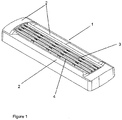
- a razor blade cartridge 1 includes a cartridge housing 5 including skin engaging surfaces 2 and razor blades 3.
- the housings 5 are moulded from aerylonitrile butadiene styrene (ABS), ABS is a very common commercially available polymer and it will be appreciated that any other suitable polymer having the required properties of a razor blade cartridge may be used.
- ABS aerylonitrile butadiene styrene
- FIG. 1 the housing 5 and blade set 3 components of the razor blade cartridge 1 are made separately and assembled together to form the complete razor blade cartridge.
- the cartridge housing 5 is injection moulded and a plurality of the housings 5 are collected in a receiving bin 4.
- the material selected for the razor blade cartridge is an elastomeric material, preferably selected from one of the materials:
- the receiving bin 4 containing just the cartridge housings 5 is transferred to the plasma activation station and enclosed in a plasma activation chamber 8.
- the housings 5 are exposed to a weakly ionised oxygen plasma from a plasma emitter 11.
- weakly ionised oxygen plasma treatment is a known technique for the activation of polymers in general and is used for example in the chrome plating of plastics for example for the car industry.
- the plasma exposure is stopped and the chamber opened and the receiving bin containing the housings 5 removed.
- the housings 5 are then transferred to a mesh basket 9 having a mesh size which is sufficiently small to prevent the cartridges from escaping therefrom.
- the mesh basket 9 and housings 5 are then moved to a grafting station where the basket is dipped into a vat 12 of N-vinylpyrrolidone as shown in FIG. 2.2 .
- the exposure time in the vat 12 is 10 to 20 minutes after which time the basket 9 is removed from the vat 12 and allowed to drain as shown in FIG. 2.3 .
- the basket 9 may be gently shook or vibrated during the exposure time to maximise the exposure to all parts of the housings 5.
- the vat 12 may include heating means to maintain the temperature above room temperature. The exposure time will depend upon the temperature chosen.
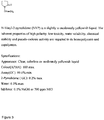
- the N-Vinyl-2-pyrrolidone (NVP) is commercially available and the chemical formula and specification is shown in FIG. 3 .
- N-Vinyl-2-pyrrolidone (NVP) is a slightly to moderately yellowish liquid. The inherent properties of high polarity, low toxicity, water solubility, chemical stability and pseudo-cationic activity are imparted to its homopolymers and copolymers.
- An additional or alternative grafting monomer that has been found to be particularly effective for the method and articles of the invention is an acrylamide such as N-N dimethyl acrylamide, which is readily commercially available.
- housings 5 may be collected directly into the basket 9 immediately after being moulded.
- the housings are dried in a drying station (not shown) after which they are ready to be assembled with the blades 3 as shown in FIG. 4 .
- the razor handle 16 it is also possible for there to be skin engaging surfaces 18 on what is normally referred to as the razor handle 16.
- the razor handles it is perfectly possible within the scope of the present invention for the razor handles to take the place of the housing in the first embodiment. In this case however it would be essential that the razor handles are in two part form and only one of the two parts will be subject to activation and grafted of the superhydrophilic coating of the present invention. The other part remaining untreated and preferably made from a highly grippable polymer. A razor handle made entirely of treated polymer would cause difficulties in the user being able to hold the handle effectively.
- the razor handle is made from first and second materials in a two shot moulding process as is already known with one of the materials providing enhanced grip for the user.
- a first material is made from a polymer which is responsive to the activation and grafting stages described above and results in its surface becoming superhydrophilic whereas the second material is made from a polymer which is not responsive to the activation and or grafting stages remains non-superhydrophilic.
- the skin contacting components of an electric dry shaver as shown in FIG. 5 are treated by the method of the invention. It has become apparent that some users prefer to use electrically powered shavers in the wet environment of a shower or by a basin. Such shaving can no longer accurately be called dry shaving, and is instead more accurately referred to as electrically powered shaving.
- electrically powered shaving can no longer accurately be called dry shaving, and is instead more accurately referred to as electrically powered shaving.
- the inventor has discovered that whilst shaving using an electrically powered shaver, in which shearing, rather than cutting, blades are completely protected by a foil, significant beneficial effects are achieved by coating the skin contacting parts of the powered shaver with the method of the present invention.
- the foil parts 23 and the other skin contacting parts 22 of the powered shaver 26 are subject to the same process as the housing 1 as described above, and subsequently assembled to form the complete shaver.
- Still further embodiments include the grafting of alternative vinyl monomers with similar suitable highly hydrophilic properties such as any N-vinyl lactam to include homopolymers and copolymers of such N-vinyl lactams as N-vinyIpyrrolidone5 N-vinylbutyrolactam, N-vinylcaprolactam, and the like, or a mixture of other vinyl monomers copolymerizable with the N-vinyl lactams.
- poly(N-vinyl lactams) polyvinylpyrrolidone (PVP) is preferred.
Landscapes
- Chemical & Material Sciences (AREA)
- Mechanical Engineering (AREA)
- Engineering & Computer Science (AREA)
- Life Sciences & Earth Sciences (AREA)
- Forests & Forestry (AREA)
- Health & Medical Sciences (AREA)
- General Chemical & Material Sciences (AREA)
- Chemical Kinetics & Catalysis (AREA)
- Medicinal Chemistry (AREA)
- Polymers & Plastics (AREA)
- Organic Chemistry (AREA)
- Toxicology (AREA)
- Treatments Of Macromolecular Shaped Articles (AREA)
Description
- This invention relates to improved razor blade cartridges and methods of manufacture therefore.
- There are a number of known prior art devices which endeavour to provide lubricious properties to the surfaces of a shaving cartridge. For example
U.S. Pat. No. 5,005,287 assigned to Wilkinson Sword GmbH describes a process for forming and applying a hydrophilic coating, which is highly slideable when wet, to a plastic or metal part either directly, or indirectly via plastic film, to a safety razor or razor blade unit, in which a solution containing a water-soluble polymer is applied to the plastic or metal part and is cured. The invention also relates to a razor blade unit comprising a blade platform for at least one razor blade, a surface for slidably engaging the skin of a user and a coating on the surface for increasing the slideability of the surface. The coating comprises a water-soluble polymer or copolymer of poly-N-vinylpyrrolidone, at least one radically polymerizable vinyl monomer and a photoinitiator. - A further razor blade cartridge is disclosed in
U.S. Pat. No. 5,056,221 , also to Wilkinson Sword GmbH. In this disclosure a razor blade unit comprising a support for at least one razor blade and a surface for slidably engaging the skin of a user, and a xerogel on the surface. A process for making a sliding surface on a razor blade unit comprising applying a solution of polyurethane, a water-soluble plastic and a solvent to a surface of the razor blade unit which engages the skin of a user during shaving, and evaporating the solvent to form the sliding surface. The preferred embodiment is to provide the coating on to a strip and to attach the strip to the desired part of the razor blade cartridge.U.S. Pat. No. 4,875,287 to Hydromer Inc. discloses a similar application method. - A more preferred method of applying lubricious surfaces onto razor blade cartridges however has been by securing a coated strip as a physically fixed insert in the razor blade cartridge. This prevents dislodgement of the strip and also is preferable from the point of view of manufacture of each individual cartridge. One such cartridge is disclosed in
EP 0715561 to Gillette which describes a shaving unit including a composite that has a surface for engaging the user's skin. The composite contains a water-insoluble resin, a shaving aid, and a water-swellable polymer. -
EP 1 055 491 to Warner-Lambert - A disadvantage of these coatings is that there are not very hard wearing and tend to become worn before the full life of the blades is used and this sometimes results in a user disposing of the razor blade cartridge prematurely.
- There are numerous patents concerned with the various orientation of the shaving aid strips with respect to the blades as well as to the various active ingredients within the shaving aids leaching out. One such example is
U.S. Pat. No. 6,298,559 by Gillette directed to a razor cartridge with a solid polymeric shaving aid strip. The razor cartridge has a solid polymeric shaving aid strip having an upper exposed surface which contacts the skin during shaving. The shaving aid strip includes a first exposed lengthwise-extending portion containing a lubricious water-soluble polymer and an adjacent, second exposed lengthwise-extending portion containing a lubricious water-soluble polymer. The first portion contains a greater amount of the lubricious water-soluble polymer than the second portion, and the first portion is adapted to wear at a faster rate than the second portion during shaving. This construction enables the strip to release more of the lubricious water-soluble polymer for a longer time period (i.e. for more shaves) than conventional shaving aid strips - This additional variability of lifetime makes it difficult to balance the respective lifetimes of the shaving aid on the one hand and the blades edges on the other which due to the varying manufacturing tolerances statistically results in a number of blade cartridge being discarded before one of the shaving aid or the blade edge is fully used.
- In addition these types of blade cartridges with the shaving aid strips located in close proximity to the blades result in the entrapment of shaving debris and makes the wash through of the debris a more difficult task for the user. In order to wash a razor blade cartridge after use a user is inclined to hold the cartridge under a running tap, so the better the wash through properties of the razor cartridge the less water is consumed. Document
US2004136944 discloses a shaving system comprising a blade member and a skin engaging portion in proximity to the blade member, wherein the skin engaging portion includes a chelating agent capable of reducing the amount of insoluble metal salts in an acqueous liquid containing the insoluble metal salts. - A further disadvantage of these razor blade cartridges is that they can result in variability of the level of friction during the course of the use of the razor cartridge. This can result from variabilities in the use pattern of the user, the extent of humidity in the bathroom, the relative hardness of the water supply as well as the differences in the beard type and the type and amount of lubricant the user applies to the face. All of these factors can effect the extent of leaching out of the shaving aid active ingredient and general wear and degradation characteristics of the shaving aid strip of these conventional razor cartridges. Document
WO2007110848 discloses safety razor blade units comprising a guard, a cap and at least two blades with parallel sharpened edges located between the guard and cap wherein blades are coated with a polymer composition. - It is an objective of the present invention to overcome the above disadvantages.
- It is therefore an objective of the present invention to provide a razor cartridge according to
claim 1. This cartridge has highly lubricious properties which remain more constant throughout the life of the razor cartridge than current razor cartridges. - It is an objective of the present invention to provide improved razor blades, razor blade cartridges and methods of manufacture therefore in which the friction properties do not become less effective before the blade edge has dulled.
- It is a further objective of the present invention to provide improved razor blades, razor blade cartridges and methods of manufacture therefore in which the friction properties remain constant during the different patterns of the user.
- It is a further objective of the present invention to provide improved razor blades, razor blade cartridges and methods of manufacture therefore to provide an improved washthrough of the shaving debris and reduce the amount of water consumed during a shave.
- According to a first aspect of the invention there is provided a razor blade cartridge including at least one razor blade supported in a housing made from polymer material and said housing comprising at least one skin contacting surface, the at least one skin contacting surface being made of a superhydrophillic polymer material.The polymer material of the at least one skin contacting surface has its surface properties modified by functionalisation which includes an activation stage provided by exposing the skin contacting surface to any medium to produce oxygen centred radicals or by oxygen plasma followed by a grafting stage of a functional group onto the surface, wherein the functional group is an N-vinyl lactam or an acrylamide.
- The activation stage may be provided by exposure to ozone or a peroxidant.
- The polymer material may be any suitable polymer as currently use to make razor blade cartridges such as acrylonitrile butadiene styrene ABS, but also may be any vinyl polymers, nylons, carbonate polymers, aliphatic polymers or the like.
- Preferably the polymer material is a TPU (thermoplastic polyurethane) or TPE (thermoplastic elastomer).
- Preferably the polymer material has a Rockwell hardness D scale between 30 D and 85 D.
- Preferably the polymer material has a tensile strength between 35 and 80 MPA.
- Preferably the polymer material has a flexural modulas between 40 and 2350 MPA.
- According to a further aspect of the invention there is provided a method of manufacture of a razor blade cartridge including the steps of moulding a cartridge housing including skin contacting surfaces of polymeric material; subsequently activating the skin contacting surfaces of the polymer using either physical or chemical means to make the surface receptive to the covalent grafting of a monomer, and grafting a functional group onto the surface, wherein the functional group is an N-vinyl lactam or an acrylamide. Activating the skin contacting surfaces of the polymer is achieved using either oxygen plasma or by exposing the skin contacting surfaces to any medium to produce oxygen centred radicals to make the surface receptive to the covalent grafting of a monomer.
- Preferably the functional group is an N-vinyl lactam.
- The physical activation means may be plasma treatment or the like. The chemical activation means may be exposing the surface to any medium to produce oxygen centred radicals in its surface; such as by exposure to ozone or a peroxidant such as peroxydisulphate in an aqueous solution.
- A number of embodiments on the invention will now be described with reference to the figures in which:
-
FIG. 1 is a razor blade cartridge according to a first embodiment of the invention with the blades set shown separately, -
FIG. 2.1 shows a first activation step according to a first embodiment of the method of the invention, -
FIG. 2.2 shows a further grafting step according to a first embodiment of the method of the invention, -
FIG. 2.3 shows a further draining step according to a first embodiment of the method of the invention, -
FIG. 3 shows the chemical formula for N-vinylpyrrolidone according to an embodiment of the invention, -
FIG. 4 shows a completed razor blade cartridge and handle according to a first embodiment of the invention, and -
FIG. 5 shows an electrically powered shaver including components made using the method of the invention. - The embodiments and/or examples of the following description which are not covered by the appended claims are considered as not being part of the present invention.
- In a first embodiment of the invention a
razor blade cartridge 1 includes acartridge housing 5 includingskin engaging surfaces 2 andrazor blades 3. Thehousings 5 are moulded from aerylonitrile butadiene styrene (ABS), ABS is a very common commercially available polymer and it will be appreciated that any other suitable polymer having the required properties of a razor blade cartridge may be used. As shown inFIG. 1 thehousing 5 and blade set 3 components of therazor blade cartridge 1 are made separately and assembled together to form the complete razor blade cartridge. Thecartridge housing 5 is injection moulded and a plurality of thehousings 5 are collected in areceiving bin 4. - According to one embodiment of the invention the material selected for the razor blade cartridge is an elastomeric material, preferably selected from one of the materials:
- Texin RxT90A, a tradename of Bayer Material Science AG
- Hardness 30 D (Scale D Rockwell hardness)
- Tensile strength 40.7 MPA
- Flexural Modulas 41.4 MPA
- Type: TPU (Thermoplastic polyurethane), polyether based.
- Pearlthane D16N60D, a tradename of Merquinsa.
- Hardness: 63 D
- Tensile Strength: 40 MPA
- Type: TPU, Polyester Based
- Pearlthane 11t65D, a tradename of Merquinsa
- Hardness: 64 D
- Tensile Strength: 35 MPA
- Type: TPU, Polycaprolactone copolyester based
- Pebax 7033, a tradename of Arkema
- Hardness 69 D (Scale D Rockwell hardness)
- Tensile strength 57.2 MPA
- Flexural Modulas 462 MPA
- Type: TPE, Made from flexible polyether and rigid polamide.
- Pebax 7233
- Hardness 72 D (Scale D Rockwell hardness)
- Tensile strength 63.5 MPA
- Flexural Modulas 738 MPA
- Type: TPE, made from flexible polyether and rigid polamide.
- Texin HM1206
- Hardness 85 D (Scale D Rockwell hardness)
- Tensile strength 76 MPA
- Flexural Modulas 2321 MPA
- Type: TPU, Polyester Based
- Referring to
FIG. 2.1 , before assembly of therazor blade cartridge 1 thereceiving bin 4 containing just thecartridge housings 5 is transferred to the plasma activation station and enclosed in aplasma activation chamber 8. In thechamber 8 thehousings 5 are exposed to a weakly ionised oxygen plasma from aplasma emitter 11. Such weakly ionised oxygen plasma treatment is a known technique for the activation of polymers in general and is used for example in the chrome plating of plastics for example for the car industry. - Following activation for approximately 30 mins in the
plasma chamber 8, the plasma exposure is stopped and the chamber opened and the receiving bin containing thehousings 5 removed. Thehousings 5 are then transferred to a mesh basket 9 having a mesh size which is sufficiently small to prevent the cartridges from escaping therefrom. The mesh basket 9 andhousings 5 are then moved to a grafting station where the basket is dipped into avat 12 of N-vinylpyrrolidone as shown inFIG. 2.2 . The exposure time in thevat 12 is 10 to 20 minutes after which time the basket 9 is removed from thevat 12 and allowed to drain as shown inFIG. 2.3 . The basket 9 may be gently shook or vibrated during the exposure time to maximise the exposure to all parts of thehousings 5. Thevat 12 may include heating means to maintain the temperature above room temperature. The exposure time will depend upon the temperature chosen. The N-Vinyl-2-pyrrolidone (NVP) is commercially available and the chemical formula and specification is shown inFIG. 3 . N-Vinyl-2-pyrrolidone (NVP) is a slightly to moderately yellowish liquid. The inherent properties of high polarity, low toxicity, water solubility, chemical stability and pseudo-cationic activity are imparted to its homopolymers and copolymers. - Specifications:
- Appearance: Clear, colourless or moderately yellowish liquid
- Colour(APHA): 100 max.
- Assay(GC): 99.0% min.
- 2-Pyrrolidone (GC): 0.2% max.
- Water: 0.3% max.
- Inhibitor: 0.1% NaOH or 700.ppm NH3
- An additional or alternative grafting monomer that has been found to be particularly effective for the method and articles of the invention is an acrylamide such as N-N dimethyl acrylamide, which is readily commercially available.
- In a further embodiment of the method of the invention the
housings 5 may be collected directly into the basket 9 immediately after being moulded. - Subsequently the housings are dried in a drying station (not shown) after which they are ready to be assembled with the
blades 3 as shown inFIG. 4 . - It will be appreciated that it is also possible for there to be
skin engaging surfaces 18 on what is normally referred to as the razor handle 16. In this case it is perfectly possible within the scope of the present invention for the razor handles to take the place of the housing in the first embodiment. In this case however it would be essential that the razor handles are in two part form and only one of the two parts will be subject to activation and grafted of the superhydrophilic coating of the present invention. The other part remaining untreated and preferably made from a highly grippable polymer. A razor handle made entirely of treated polymer would cause difficulties in the user being able to hold the handle effectively. - In an alternative embodiment the razor handle is made from first and second materials in a two shot moulding process as is already known with one of the materials providing enhanced grip for the user. In this embodiment a first material is made from a polymer which is responsive to the activation and grafting stages described above and results in its surface becoming superhydrophilic whereas the second material is made from a polymer which is not responsive to the activation and or grafting stages remains non-superhydrophilic.
- Alternatively it will also be appreciated that it would be possible to mask those parts of the razor handle that aren't desired to be treated either from the activation stage or the grafting stage or both.
- In a further embodiment the skin contacting components of an electric dry shaver as shown in
FIG. 5 , are treated by the method of the invention. It has become apparent that some users prefer to use electrically powered shavers in the wet environment of a shower or by a basin. Such shaving can no longer accurately be called dry shaving, and is instead more accurately referred to as electrically powered shaving. The inventor has discovered that whilst shaving using an electrically powered shaver, in which shearing, rather than cutting, blades are completely protected by a foil, significant beneficial effects are achieved by coating the skin contacting parts of the powered shaver with the method of the present invention. Thus thefoil parts 23 and the otherskin contacting parts 22 of thepowered shaver 26 are subject to the same process as thehousing 1 as described above, and subsequently assembled to form the complete shaver. - Further embodiments include alternative methods for the activation stage which include corona discharge or ozone treatment or chemical activation means such as peroxy disulphatcs. With chemical activation means an additional drying step would be required before the grafting stage.
- Additionally further embodiments include the grafting of alternative vinyl monomers with similar suitable highly hydrophilic properties such as any N-vinyl lactam to include homopolymers and copolymers of such N-vinyl lactams as N-vinyIpyrrolidone5 N-vinylbutyrolactam, N-vinylcaprolactam, and the like, or a mixture of other vinyl monomers copolymerizable with the N-vinyl lactams. Of the poly(N-vinyl lactams), polyvinylpyrrolidone (PVP) is preferred.
Claims (8)
- A razor or razor blade cartridge including at least one razor blade supported in a housing made from a polymer material and said housing comprising at least one skin contacting surface, the at least one skin contacting surface being made of a superhydrophilic polymer material, characterised in that the polymer material of the at least one skin contacting surface has its surface properties modified by functionalisation which includes an activation stage provided by exposing the skin contacting surface to any medium to produce oxygen centred radicals or by oxygen plasma followed by a grafting stage of a functional group onto the surface, wherein the functional group is an N-vinyl lactam or an acrylamide.
- A razor or razor blade cartridge according to claim 1, characterised in that the activation stage is provided by exposure to ozone or a peroxidant.
- A razor or razor blade cartridge according to any preceding claim, characterised in that the polymer material is a TPU (thermoplastic polyurethane) or TPE (thermoplastic elastomer).
- A razor or razor blade cartridge according to any preceding claim, characterised in that the polymer material has a rockwell hardness D scale between 30D and 85D.
- A razor or razor blade cartridge according to any preceding claim, characterised in that the polymer material has a flexural modulas between 40 and 2350 MPa.
- A method of manufacture of a razor or razor blade cartridge including the steps of moulding a cartridge housing or razor handle including skin contacting surfaces of polymeric material; subsequently activating the skin contacting surfaces of the polymer using either oxygen plasma or by exposing the skin contacting surfaces to any medium to produce oxygen centred radicals to make the surface receptive to the covalent grafting of a monomer, and grafting a functional group onto the surface, wherein the functional group is an N-vinyl lactam or an acrylamide .
- A method of manufacture of a razor or razor blade cartridge according to claim 6, characterised in that the activation means is a plasma treatment.
- A razor or razor blade cartridge or electrically powered shaver component made by using the method of any of claims 6 or 7.
Priority Applications (1)
| Application Number | Priority Date | Filing Date | Title |
|---|---|---|---|
| PL11724705T PL2576673T3 (en) | 2010-06-01 | 2011-05-31 | Razors and razor blade cartridges and methods of manufacture therefore |
Applications Claiming Priority (2)
| Application Number | Priority Date | Filing Date | Title |
|---|---|---|---|
| GBGB1009019.9A GB201009019D0 (en) | 2010-06-01 | 2010-06-01 | Razor or razor blade cartridge and methods of manufacture therefore |
| PCT/GB2011/000826 WO2011151616A1 (en) | 2010-06-01 | 2011-05-31 | Razors and razor blade cartridges and methods of manufacture therefore |
Publications (2)
| Publication Number | Publication Date |
|---|---|
| EP2576673A1 EP2576673A1 (en) | 2013-04-10 |
| EP2576673B1 true EP2576673B1 (en) | 2020-09-23 |
Family
ID=42371201
Family Applications (1)
| Application Number | Title | Priority Date | Filing Date |
|---|---|---|---|
| EP11724705.6A Active EP2576673B1 (en) | 2010-06-01 | 2011-05-31 | Razors and razor blade cartridges and methods of manufacture therefore |
Country Status (5)
| Country | Link |
|---|---|
| US (1) | US10836878B2 (en) |
| EP (1) | EP2576673B1 (en) |
| GB (2) | GB201009019D0 (en) |
| PL (1) | PL2576673T3 (en) |
| WO (1) | WO2011151616A1 (en) |
Families Citing this family (12)
| Publication number | Priority date | Publication date | Assignee | Title |
|---|---|---|---|---|
| CN102626933A (en) * | 2012-04-10 | 2012-08-08 | 上海奔腾电工有限公司 | Shaver head mechanism |
| GB2511726B (en) * | 2013-01-09 | 2016-12-21 | SOCIéTé BIC | Razors and razor blade cartridges and methods of manufacture therefore |
| BR112018008162B1 (en) | 2015-12-01 | 2021-06-01 | Bic-Violex Sa | SHAVING CARTRIDGE AND SHAVING BLADE |
| EP3429809B1 (en) | 2016-03-18 | 2021-07-28 | Personal Care Marketing And Research, Inc. | Razor cartridge |
| USD816910S1 (en) * | 2016-09-23 | 2018-05-01 | Personal Care Marketing and Research International | Razor cartridge |
| US9993931B1 (en) | 2016-11-23 | 2018-06-12 | Personal Care Marketing And Research, Inc. | Razor docking and pivot |
| EP3911297A1 (en) | 2019-01-15 | 2021-11-24 | Bic Violex S.A. | Skin engaging member for razor cartridge |
| USD884970S1 (en) | 2019-02-27 | 2020-05-19 | PCMR International Ltd. | Razor cartridge guard |
| USD884971S1 (en) | 2019-02-27 | 2020-05-19 | Pcmr International Ltd | Razor cartridge |
| USD884969S1 (en) | 2019-02-27 | 2020-05-19 | Pcmr International Ltd | Combined razor cartridge guard and docking |
| US11235485B2 (en) | 2019-04-23 | 2022-02-01 | Bic Violex S.A. | Shaving aid for retaining elements |
| US11000960B1 (en) | 2020-11-16 | 2021-05-11 | Personal Care Marketing And Research, Inc. | Razor exposure |
Family Cites Families (25)
| Publication number | Priority date | Publication date | Assignee | Title |
|---|---|---|---|---|
| US3477127A (en) * | 1967-11-15 | 1969-11-11 | Malachy J Regan | Emollient applicator for attachment to an electric shaver |
| US3656234A (en) * | 1970-07-01 | 1972-04-18 | Malachy J Regan | Emollient applicator for use with electric shavers |
| GB2024082B (en) * | 1978-05-31 | 1982-05-06 | Gillette Co | Safety razors |
| US4875287A (en) * | 1986-11-14 | 1989-10-24 | Hydromer, Inc. | Shaving articles lubricious when wet and compositions therefor |
| DE3814135A1 (en) * | 1987-05-06 | 1988-11-24 | Wilkinson Sword Gmbh | METHOD FOR PRODUCING A HYDROPHILIC COATING ON A MOLDED PART AND USING THE METHOD OF A SHAVER |
| DE3743298A1 (en) | 1987-12-19 | 1989-06-29 | Wilkinson Sword Gmbh | SHAVING APPARATUS AND METHOD FOR PRODUCING A LAYER OF LOW FRICTION RESISTANCE ON A SHAVING APPARATUS |
| WO1992007464A1 (en) * | 1990-10-24 | 1992-05-14 | University Of Florida | Combined plasma and gamma radiation polymerization method for modifying surfaces |
| GB9211966D0 (en) * | 1992-06-05 | 1992-07-15 | Univ Liverpool | Functionalisation of polymers |
| US5626154A (en) | 1993-09-13 | 1997-05-06 | The Gillette Company | Method and system for shaving including a lubricant and a water-swellable polymer |
| US5711076A (en) * | 1996-03-27 | 1998-01-27 | The Gillette Company | Shaving system with improved guard structure |
| US5956848A (en) * | 1997-02-27 | 1999-09-28 | The Gillette Company | Shaving system |
| WO1998058990A1 (en) * | 1997-06-20 | 1998-12-30 | Coloplast A/S | A hydrophilic coating and a method for the preparation thereof |
| US20040177513A1 (en) | 1999-05-27 | 2004-09-16 | William Vreeland | Razor glide strip |
| US6298559B1 (en) | 2000-02-18 | 2001-10-09 | The Gillette Company | Shaving aid strip for razor cartridge |
| DE60206685T2 (en) * | 2001-04-27 | 2006-07-13 | Eveready Battery Co., Inc. | shaving |
| JP2006505345A (en) * | 2002-11-06 | 2006-02-16 | エヴァレディ バッテリー カンパニー インク | Shaving system |
| IES20030294A2 (en) * | 2003-04-17 | 2004-10-20 | Medtronic Vascular Connaught | Coating for biomedical devices |
| US7669335B2 (en) * | 2004-03-11 | 2010-03-02 | The Gillette Company | Shaving razors and shaving cartridges |
| US7882640B2 (en) * | 2006-03-29 | 2011-02-08 | The Gillette Company | Razor blades and razors |
| US20080060201A1 (en) * | 2006-09-13 | 2008-03-13 | The Gillette Company | Wet shaving system including a mineral oil coated shaving aid |
| US20080216321A1 (en) * | 2007-03-09 | 2008-09-11 | Eveready Battery Company, Inc. | Shaving aid delivery system for use with wet shave razors |
| US20090071007A1 (en) * | 2007-09-14 | 2009-03-19 | The Gillette Company | Safety razor with enhanced shaving aid member having protuberances |
| US8191179B2 (en) * | 2008-01-25 | 2012-06-05 | Bauer Hockey, Inc. | Hockey helmet with an outer shell made of two different materials |
| GB2462086A (en) * | 2008-07-22 | 2010-01-27 | Alon Coresh | Articulated Shaving Set |
| US8273205B2 (en) * | 2009-07-24 | 2012-09-25 | The Gillette Company | Manufacture of pivoting resilient skin contacting members |
-
2010
- 2010-06-01 GB GBGB1009019.9A patent/GB201009019D0/en not_active Ceased
-
2011
- 2011-05-27 GB GB1109001A patent/GB2480916A/en not_active Withdrawn
- 2011-05-31 US US13/637,667 patent/US10836878B2/en active Active
- 2011-05-31 PL PL11724705T patent/PL2576673T3/en unknown
- 2011-05-31 WO PCT/GB2011/000826 patent/WO2011151616A1/en not_active Ceased
- 2011-05-31 EP EP11724705.6A patent/EP2576673B1/en active Active
Non-Patent Citations (1)
| Title |
|---|
| None * |
Also Published As
| Publication number | Publication date |
|---|---|
| US10836878B2 (en) | 2020-11-17 |
| GB2480916A (en) | 2011-12-07 |
| GB201109001D0 (en) | 2011-07-13 |
| US20130008029A1 (en) | 2013-01-10 |
| WO2011151616A1 (en) | 2011-12-08 |
| GB201009019D0 (en) | 2010-07-14 |
| EP2576673A1 (en) | 2013-04-10 |
| PL2576673T3 (en) | 2021-02-08 |
Similar Documents
| Publication | Publication Date | Title |
|---|---|---|
| US10836878B2 (en) | Razors and razor blade cartridges and methods of manufacture therefore | |
| EP3030387B1 (en) | Razors and razor blade cartridges and methods of manufacture therefore | |
| CA1328989C (en) | Process to produce a hydrophilic coating on a molded part and a razor produced by applying this process | |
| AU710646B2 (en) | Shaving system with improved guard structure | |
| EP2323817B1 (en) | Shaving aid geometry for wet shave system | |
| US5113585A (en) | Shaving system | |
| PL178537B1 (en) | Skin protecting component of a safety razor shaving head | |
| CZ281965B6 (en) | Shaving unit of the wet shaving type and process for producing a shaving composite for such a unit | |
| EP0552310B1 (en) | Safety razors | |
| JP2005515867A (en) | Razor with deformable shaving aid discharge device and method for discharging shaving aid | |
| EP2588282B1 (en) | Razor handle | |
| AU2010306724A1 (en) | Lubrication box for a wet shaving implement | |
| EP1861452B1 (en) | Scented handle for use in a razor | |
| US10786916B2 (en) | Razor cartridge with lubricating strip | |
| JP2006505345A (en) | Shaving system | |
| CN112060139A (en) | Blade structure forming method, using method, novel blade structure and shaving device | |
| MXPA99011141A (en) | Lubricating shaving aid |
Legal Events
| Date | Code | Title | Description |
|---|---|---|---|
| PUAI | Public reference made under article 153(3) epc to a published international application that has entered the european phase |
Free format text: ORIGINAL CODE: 0009012 |
|
| 17P | Request for examination filed |
Effective date: 20121004 |
|
| AK | Designated contracting states |
Kind code of ref document: A1 Designated state(s): AL AT BE BG CH CY CZ DE DK EE ES FI FR GB GR HR HU IE IS IT LI LT LU LV MC MK MT NL NO PL PT RO RS SE SI SK SM TR |
|
| DAX | Request for extension of the european patent (deleted) | ||
| RAP1 | Party data changed (applicant data changed or rights of an application transferred) |
Owner name: SOCIETE BIC |
|
| STAA | Information on the status of an ep patent application or granted ep patent |
Free format text: STATUS: EXAMINATION IS IN PROGRESS |
|
| 17Q | First examination report despatched |
Effective date: 20170612 |
|
| GRAP | Despatch of communication of intention to grant a patent |
Free format text: ORIGINAL CODE: EPIDOSNIGR1 |
|
| STAA | Information on the status of an ep patent application or granted ep patent |
Free format text: STATUS: GRANT OF PATENT IS INTENDED |
|
| INTG | Intention to grant announced |
Effective date: 20200312 |
|
| GRAS | Grant fee paid |
Free format text: ORIGINAL CODE: EPIDOSNIGR3 |
|
| GRAJ | Information related to disapproval of communication of intention to grant by the applicant or resumption of examination proceedings by the epo deleted |
Free format text: ORIGINAL CODE: EPIDOSDIGR1 |
|
| GRAL | Information related to payment of fee for publishing/printing deleted |
Free format text: ORIGINAL CODE: EPIDOSDIGR3 |
|
| STAA | Information on the status of an ep patent application or granted ep patent |
Free format text: STATUS: EXAMINATION IS IN PROGRESS |
|
| INTC | Intention to grant announced (deleted) | ||
| GRAR | Information related to intention to grant a patent recorded |
Free format text: ORIGINAL CODE: EPIDOSNIGR71 |
|
| STAA | Information on the status of an ep patent application or granted ep patent |
Free format text: STATUS: GRANT OF PATENT IS INTENDED |
|
| GRAA | (expected) grant |
Free format text: ORIGINAL CODE: 0009210 |
|
| STAA | Information on the status of an ep patent application or granted ep patent |
Free format text: STATUS: THE PATENT HAS BEEN GRANTED |
|
| AK | Designated contracting states |
Kind code of ref document: B1 Designated state(s): AL AT BE BG CH CY CZ DE DK EE ES FI FR GB GR HR HU IE IS IT LI LT LU LV MC MK MT NL NO PL PT RO RS SE SI SK SM TR |
|
| INTG | Intention to grant announced |
Effective date: 20200818 |
|
| REG | Reference to a national code |
Ref country code: GB Ref legal event code: FG4D |
|
| REG | Reference to a national code |
Ref country code: CH Ref legal event code: EP |
|
| REG | Reference to a national code |
Ref country code: DE Ref legal event code: R096 Ref document number: 602011068694 Country of ref document: DE |
|
| REG | Reference to a national code |
Ref country code: IE Ref legal event code: FG4D |
|
| REG | Reference to a national code |
Ref country code: AT Ref legal event code: REF Ref document number: 1316354 Country of ref document: AT Kind code of ref document: T Effective date: 20201015 |
|
| REG | Reference to a national code |
Ref country code: NL Ref legal event code: FP |
|
| REG | Reference to a national code |
Ref country code: GR Ref legal event code: EP Ref document number: 20200403037 Country of ref document: GR Effective date: 20201215 |
|
| PG25 | Lapsed in a contracting state [announced via postgrant information from national office to epo] |
Ref country code: NO Free format text: LAPSE BECAUSE OF FAILURE TO SUBMIT A TRANSLATION OF THE DESCRIPTION OR TO PAY THE FEE WITHIN THE PRESCRIBED TIME-LIMIT Effective date: 20201223 Ref country code: SE Free format text: LAPSE BECAUSE OF FAILURE TO SUBMIT A TRANSLATION OF THE DESCRIPTION OR TO PAY THE FEE WITHIN THE PRESCRIBED TIME-LIMIT Effective date: 20200923 Ref country code: BG Free format text: LAPSE BECAUSE OF FAILURE TO SUBMIT A TRANSLATION OF THE DESCRIPTION OR TO PAY THE FEE WITHIN THE PRESCRIBED TIME-LIMIT Effective date: 20201223 Ref country code: FI Free format text: LAPSE BECAUSE OF FAILURE TO SUBMIT A TRANSLATION OF THE DESCRIPTION OR TO PAY THE FEE WITHIN THE PRESCRIBED TIME-LIMIT Effective date: 20200923 Ref country code: HR Free format text: LAPSE BECAUSE OF FAILURE TO SUBMIT A TRANSLATION OF THE DESCRIPTION OR TO PAY THE FEE WITHIN THE PRESCRIBED TIME-LIMIT Effective date: 20200923 |
|
| REG | Reference to a national code |
Ref country code: AT Ref legal event code: MK05 Ref document number: 1316354 Country of ref document: AT Kind code of ref document: T Effective date: 20200923 |
|
| PG25 | Lapsed in a contracting state [announced via postgrant information from national office to epo] |
Ref country code: LV Free format text: LAPSE BECAUSE OF FAILURE TO SUBMIT A TRANSLATION OF THE DESCRIPTION OR TO PAY THE FEE WITHIN THE PRESCRIBED TIME-LIMIT Effective date: 20200923 Ref country code: RS Free format text: LAPSE BECAUSE OF FAILURE TO SUBMIT A TRANSLATION OF THE DESCRIPTION OR TO PAY THE FEE WITHIN THE PRESCRIBED TIME-LIMIT Effective date: 20200923 |
|
| REG | Reference to a national code |
Ref country code: LT Ref legal event code: MG4D |
|
| PG25 | Lapsed in a contracting state [announced via postgrant information from national office to epo] |
Ref country code: EE Free format text: LAPSE BECAUSE OF FAILURE TO SUBMIT A TRANSLATION OF THE DESCRIPTION OR TO PAY THE FEE WITHIN THE PRESCRIBED TIME-LIMIT Effective date: 20200923 Ref country code: CZ Free format text: LAPSE BECAUSE OF FAILURE TO SUBMIT A TRANSLATION OF THE DESCRIPTION OR TO PAY THE FEE WITHIN THE PRESCRIBED TIME-LIMIT Effective date: 20200923 Ref country code: LT Free format text: LAPSE BECAUSE OF FAILURE TO SUBMIT A TRANSLATION OF THE DESCRIPTION OR TO PAY THE FEE WITHIN THE PRESCRIBED TIME-LIMIT Effective date: 20200923 Ref country code: PT Free format text: LAPSE BECAUSE OF FAILURE TO SUBMIT A TRANSLATION OF THE DESCRIPTION OR TO PAY THE FEE WITHIN THE PRESCRIBED TIME-LIMIT Effective date: 20210125 Ref country code: SM Free format text: LAPSE BECAUSE OF FAILURE TO SUBMIT A TRANSLATION OF THE DESCRIPTION OR TO PAY THE FEE WITHIN THE PRESCRIBED TIME-LIMIT Effective date: 20200923 Ref country code: RO Free format text: LAPSE BECAUSE OF FAILURE TO SUBMIT A TRANSLATION OF THE DESCRIPTION OR TO PAY THE FEE WITHIN THE PRESCRIBED TIME-LIMIT Effective date: 20200923 |
|
| PG25 | Lapsed in a contracting state [announced via postgrant information from national office to epo] |
Ref country code: AL Free format text: LAPSE BECAUSE OF FAILURE TO SUBMIT A TRANSLATION OF THE DESCRIPTION OR TO PAY THE FEE WITHIN THE PRESCRIBED TIME-LIMIT Effective date: 20200923 Ref country code: AT Free format text: LAPSE BECAUSE OF FAILURE TO SUBMIT A TRANSLATION OF THE DESCRIPTION OR TO PAY THE FEE WITHIN THE PRESCRIBED TIME-LIMIT Effective date: 20200923 Ref country code: IS Free format text: LAPSE BECAUSE OF FAILURE TO SUBMIT A TRANSLATION OF THE DESCRIPTION OR TO PAY THE FEE WITHIN THE PRESCRIBED TIME-LIMIT Effective date: 20210123 Ref country code: ES Free format text: LAPSE BECAUSE OF FAILURE TO SUBMIT A TRANSLATION OF THE DESCRIPTION OR TO PAY THE FEE WITHIN THE PRESCRIBED TIME-LIMIT Effective date: 20200923 |
|
| REG | Reference to a national code |
Ref country code: DE Ref legal event code: R097 Ref document number: 602011068694 Country of ref document: DE |
|
| PG25 | Lapsed in a contracting state [announced via postgrant information from national office to epo] |
Ref country code: SK Free format text: LAPSE BECAUSE OF FAILURE TO SUBMIT A TRANSLATION OF THE DESCRIPTION OR TO PAY THE FEE WITHIN THE PRESCRIBED TIME-LIMIT Effective date: 20200923 |
|
| PLBE | No opposition filed within time limit |
Free format text: ORIGINAL CODE: 0009261 |
|
| STAA | Information on the status of an ep patent application or granted ep patent |
Free format text: STATUS: NO OPPOSITION FILED WITHIN TIME LIMIT |
|
| PG25 | Lapsed in a contracting state [announced via postgrant information from national office to epo] |
Ref country code: SI Free format text: LAPSE BECAUSE OF FAILURE TO SUBMIT A TRANSLATION OF THE DESCRIPTION OR TO PAY THE FEE WITHIN THE PRESCRIBED TIME-LIMIT Effective date: 20200923 Ref country code: DK Free format text: LAPSE BECAUSE OF FAILURE TO SUBMIT A TRANSLATION OF THE DESCRIPTION OR TO PAY THE FEE WITHIN THE PRESCRIBED TIME-LIMIT Effective date: 20200923 |
|
| 26N | No opposition filed |
Effective date: 20210624 |
|
| REG | Reference to a national code |
Ref country code: CH Ref legal event code: PL |
|
| PG25 | Lapsed in a contracting state [announced via postgrant information from national office to epo] |
Ref country code: MC Free format text: LAPSE BECAUSE OF FAILURE TO SUBMIT A TRANSLATION OF THE DESCRIPTION OR TO PAY THE FEE WITHIN THE PRESCRIBED TIME-LIMIT Effective date: 20200923 Ref country code: LU Free format text: LAPSE BECAUSE OF NON-PAYMENT OF DUE FEES Effective date: 20210531 Ref country code: LI Free format text: LAPSE BECAUSE OF NON-PAYMENT OF DUE FEES Effective date: 20210531 Ref country code: CH Free format text: LAPSE BECAUSE OF NON-PAYMENT OF DUE FEES Effective date: 20210531 |
|
| REG | Reference to a national code |
Ref country code: BE Ref legal event code: MM Effective date: 20210531 |
|
| PG25 | Lapsed in a contracting state [announced via postgrant information from national office to epo] |
Ref country code: IE Free format text: LAPSE BECAUSE OF NON-PAYMENT OF DUE FEES Effective date: 20210531 |
|
| PG25 | Lapsed in a contracting state [announced via postgrant information from national office to epo] |
Ref country code: BE Free format text: LAPSE BECAUSE OF NON-PAYMENT OF DUE FEES Effective date: 20210531 |
|
| PG25 | Lapsed in a contracting state [announced via postgrant information from national office to epo] |
Ref country code: HU Free format text: LAPSE BECAUSE OF FAILURE TO SUBMIT A TRANSLATION OF THE DESCRIPTION OR TO PAY THE FEE WITHIN THE PRESCRIBED TIME-LIMIT; INVALID AB INITIO Effective date: 20110531 Ref country code: CY Free format text: LAPSE BECAUSE OF FAILURE TO SUBMIT A TRANSLATION OF THE DESCRIPTION OR TO PAY THE FEE WITHIN THE PRESCRIBED TIME-LIMIT Effective date: 20200923 |
|
| PG25 | Lapsed in a contracting state [announced via postgrant information from national office to epo] |
Ref country code: MK Free format text: LAPSE BECAUSE OF FAILURE TO SUBMIT A TRANSLATION OF THE DESCRIPTION OR TO PAY THE FEE WITHIN THE PRESCRIBED TIME-LIMIT Effective date: 20200923 |
|
| PGFP | Annual fee paid to national office [announced via postgrant information from national office to epo] |
Ref country code: NL Payment date: 20240418 Year of fee payment: 14 |
|
| PG25 | Lapsed in a contracting state [announced via postgrant information from national office to epo] |
Ref country code: TR Free format text: LAPSE BECAUSE OF FAILURE TO SUBMIT A TRANSLATION OF THE DESCRIPTION OR TO PAY THE FEE WITHIN THE PRESCRIBED TIME-LIMIT Effective date: 20200923 |
|
| PGFP | Annual fee paid to national office [announced via postgrant information from national office to epo] |
Ref country code: GB Payment date: 20240418 Year of fee payment: 14 |
|
| PGFP | Annual fee paid to national office [announced via postgrant information from national office to epo] |
Ref country code: DE Payment date: 20240418 Year of fee payment: 14 |
|
| PGFP | Annual fee paid to national office [announced via postgrant information from national office to epo] |
Ref country code: GR Payment date: 20240419 Year of fee payment: 14 |
|
| PGFP | Annual fee paid to national office [announced via postgrant information from national office to epo] |
Ref country code: IT Payment date: 20240418 Year of fee payment: 14 Ref country code: FR Payment date: 20240418 Year of fee payment: 14 |
|
| PGFP | Annual fee paid to national office [announced via postgrant information from national office to epo] |
Ref country code: PL Payment date: 20240418 Year of fee payment: 14 |
|
| PG25 | Lapsed in a contracting state [announced via postgrant information from national office to epo] |
Ref country code: MT Free format text: LAPSE BECAUSE OF FAILURE TO SUBMIT A TRANSLATION OF THE DESCRIPTION OR TO PAY THE FEE WITHIN THE PRESCRIBED TIME-LIMIT Effective date: 20200923 |
|
| REG | Reference to a national code |
Ref country code: DE Ref legal event code: R119 Ref document number: 602011068694 Country of ref document: DE |
|
| REG | Reference to a national code |
Ref country code: NL Ref legal event code: MM Effective date: 20250601 |
|
| PG25 | Lapsed in a contracting state [announced via postgrant information from national office to epo] |
Ref country code: GR Free format text: LAPSE BECAUSE OF NON-PAYMENT OF DUE FEES Effective date: 20251205 |
|
| GBPC | Gb: european patent ceased through non-payment of renewal fee |
Effective date: 20250531 |
|
| PG25 | Lapsed in a contracting state [announced via postgrant information from national office to epo] |
Ref country code: NL Free format text: LAPSE BECAUSE OF NON-PAYMENT OF DUE FEES Effective date: 20250601 |
|
| PG25 | Lapsed in a contracting state [announced via postgrant information from national office to epo] |
Ref country code: GB Free format text: LAPSE BECAUSE OF NON-PAYMENT OF DUE FEES Effective date: 20250531 |
|
| PG25 | Lapsed in a contracting state [announced via postgrant information from national office to epo] |
Ref country code: DE Free format text: LAPSE BECAUSE OF NON-PAYMENT OF DUE FEES Effective date: 20251202 |
|
| PG25 | Lapsed in a contracting state [announced via postgrant information from national office to epo] |
Ref country code: IT Free format text: LAPSE BECAUSE OF NON-PAYMENT OF DUE FEES Effective date: 20250531 |
|
| PG25 | Lapsed in a contracting state [announced via postgrant information from national office to epo] |
Ref country code: FR Free format text: LAPSE BECAUSE OF NON-PAYMENT OF DUE FEES Effective date: 20250531 |