EP2574605B1 - Processes for preparing cyclopentenones and cyclopentenones for the synthesis of benzindene prostaglandins - Google Patents
Processes for preparing cyclopentenones and cyclopentenones for the synthesis of benzindene prostaglandins Download PDFInfo
- Publication number
- EP2574605B1 EP2574605B1 EP12181572.4A EP12181572A EP2574605B1 EP 2574605 B1 EP2574605 B1 EP 2574605B1 EP 12181572 A EP12181572 A EP 12181572A EP 2574605 B1 EP2574605 B1 EP 2574605B1
- Authority
- EP
- European Patent Office
- Prior art keywords
- formula
- compound
- alkyl
- mixture
- benzyl
- Prior art date
- Legal status (The legal status is an assumption and is not a legal conclusion. Google has not performed a legal analysis and makes no representation as to the accuracy of the status listed.)
- Active
Links
- 0 *C(CC1CC(C=CC2)=CC2O)CC1=O Chemical compound *C(CC1CC(C=CC2)=CC2O)CC1=O 0.000 description 5
- HDONQEJIZJZCFH-FQEVSTJZSA-N CC(O[C@H](C1)C=C(Cc2cccc(OCc3ccccc3)c2)C1=O)=O Chemical compound CC(O[C@H](C1)C=C(Cc2cccc(OCc3ccccc3)c2)C1=O)=O HDONQEJIZJZCFH-FQEVSTJZSA-N 0.000 description 1
- ODUYXKXVUGRCQJ-UHFFFAOYSA-N OC(C1)C=C(Cc2cc(OCc3ccccc3)ccc2)C1=O Chemical compound OC(C1)C=C(Cc2cc(OCc3ccccc3)ccc2)C1=O ODUYXKXVUGRCQJ-UHFFFAOYSA-N 0.000 description 1
Classifications
-
- C—CHEMISTRY; METALLURGY
- C07—ORGANIC CHEMISTRY
- C07C—ACYCLIC OR CARBOCYCLIC COMPOUNDS
- C07C45/00—Preparation of compounds having >C = O groups bound only to carbon or hydrogen atoms; Preparation of chelates of such compounds
- C07C45/78—Separation; Purification; Stabilisation; Use of additives
-
- C—CHEMISTRY; METALLURGY
- C12—BIOCHEMISTRY; BEER; SPIRITS; WINE; VINEGAR; MICROBIOLOGY; ENZYMOLOGY; MUTATION OR GENETIC ENGINEERING
- C12P—FERMENTATION OR ENZYME-USING PROCESSES TO SYNTHESISE A DESIRED CHEMICAL COMPOUND OR COMPOSITION OR TO SEPARATE OPTICAL ISOMERS FROM A RACEMIC MIXTURE
- C12P7/00—Preparation of oxygen-containing organic compounds
- C12P7/24—Preparation of oxygen-containing organic compounds containing a carbonyl group
- C12P7/26—Ketones
-
- C—CHEMISTRY; METALLURGY
- C07—ORGANIC CHEMISTRY
- C07C—ACYCLIC OR CARBOCYCLIC COMPOUNDS
- C07C45/00—Preparation of compounds having >C = O groups bound only to carbon or hydrogen atoms; Preparation of chelates of such compounds
- C07C45/56—Preparation of compounds having >C = O groups bound only to carbon or hydrogen atoms; Preparation of chelates of such compounds from heterocyclic compounds
- C07C45/57—Preparation of compounds having >C = O groups bound only to carbon or hydrogen atoms; Preparation of chelates of such compounds from heterocyclic compounds with oxygen as the only heteroatom
- C07C45/59—Preparation of compounds having >C = O groups bound only to carbon or hydrogen atoms; Preparation of chelates of such compounds from heterocyclic compounds with oxygen as the only heteroatom in five-membered rings
-
- C—CHEMISTRY; METALLURGY
- C07—ORGANIC CHEMISTRY
- C07C—ACYCLIC OR CARBOCYCLIC COMPOUNDS
- C07C49/00—Ketones; Ketenes; Dimeric ketenes; Ketonic chelates
- C07C49/385—Saturated compounds containing a keto group being part of a ring
- C07C49/395—Saturated compounds containing a keto group being part of a ring of a five-membered ring
-
- C—CHEMISTRY; METALLURGY
- C07—ORGANIC CHEMISTRY
- C07D—HETEROCYCLIC COMPOUNDS
- C07D307/00—Heterocyclic compounds containing five-membered rings having one oxygen atom as the only ring hetero atom
- C07D307/02—Heterocyclic compounds containing five-membered rings having one oxygen atom as the only ring hetero atom not condensed with other rings
- C07D307/26—Heterocyclic compounds containing five-membered rings having one oxygen atom as the only ring hetero atom not condensed with other rings having one double bond between ring members or between a ring member and a non-ring member
- C07D307/28—Heterocyclic compounds containing five-membered rings having one oxygen atom as the only ring hetero atom not condensed with other rings having one double bond between ring members or between a ring member and a non-ring member with only hydrogen atoms, hydrocarbon or substituted hydrocarbon radicals, directly attached to ring carbon atoms
-
- C—CHEMISTRY; METALLURGY
- C12—BIOCHEMISTRY; BEER; SPIRITS; WINE; VINEGAR; MICROBIOLOGY; ENZYMOLOGY; MUTATION OR GENETIC ENGINEERING
- C12P—FERMENTATION OR ENZYME-USING PROCESSES TO SYNTHESISE A DESIRED CHEMICAL COMPOUND OR COMPOSITION OR TO SEPARATE OPTICAL ISOMERS FROM A RACEMIC MIXTURE
- C12P41/00—Processes using enzymes or microorganisms to separate optical isomers from a racemic mixture
- C12P41/003—Processes using enzymes or microorganisms to separate optical isomers from a racemic mixture by ester formation, lactone formation or the inverse reactions
- C12P41/004—Processes using enzymes or microorganisms to separate optical isomers from a racemic mixture by ester formation, lactone formation or the inverse reactions by esterification of alcohol- or thiol groups in the enantiomers or the inverse reaction
-
- C—CHEMISTRY; METALLURGY
- C12—BIOCHEMISTRY; BEER; SPIRITS; WINE; VINEGAR; MICROBIOLOGY; ENZYMOLOGY; MUTATION OR GENETIC ENGINEERING
- C12P—FERMENTATION OR ENZYME-USING PROCESSES TO SYNTHESISE A DESIRED CHEMICAL COMPOUND OR COMPOSITION OR TO SEPARATE OPTICAL ISOMERS FROM A RACEMIC MIXTURE
- C12P7/00—Preparation of oxygen-containing organic compounds
- C12P7/02—Preparation of oxygen-containing organic compounds containing a hydroxy group
- C12P7/22—Preparation of oxygen-containing organic compounds containing a hydroxy group aromatic
-
- Y—GENERAL TAGGING OF NEW TECHNOLOGICAL DEVELOPMENTS; GENERAL TAGGING OF CROSS-SECTIONAL TECHNOLOGIES SPANNING OVER SEVERAL SECTIONS OF THE IPC; TECHNICAL SUBJECTS COVERED BY FORMER USPC CROSS-REFERENCE ART COLLECTIONS [XRACs] AND DIGESTS
- Y02—TECHNOLOGIES OR APPLICATIONS FOR MITIGATION OR ADAPTATION AGAINST CLIMATE CHANGE
- Y02P—CLIMATE CHANGE MITIGATION TECHNOLOGIES IN THE PRODUCTION OR PROCESSING OF GOODS
- Y02P20/00—Technologies relating to chemical industry
- Y02P20/50—Improvements relating to the production of bulk chemicals
- Y02P20/55—Design of synthesis routes, e.g. reducing the use of auxiliary or protecting groups
Definitions
- the present invention relates to novel processes for preparing cyclopentenones of Formula I, which are useful for the preparation of the corresponding benzindene Prostaglandins.
- the invention also relates to novel cyclopentenones prepared from the processes.
- Benzindene prostaglandins are known to be useful to treat a variety of conditions.
- Cyclopentenones of Formula I wherein P 1 is a protecting group for the phenol group which are also disclosed in the co-pending patent application filed on the even date and entitled "INTERMEDIATES FOR THE SYNTHESIS OF BENZINDENE PROSTAGLANDINS AND PREPARATIONS THEREOF," are key intermediates for the synthesis of benzindene Prostaglandins.
- Racemic or optically active cyclopentenones of Formula I were not disclosed in the prior art.
- Scheme 1 Sato disclosed in J. Org. Chem., 59, 21, 6153 (1994 ) optically active cyclopentenones of Formula B and a process for preparing the same:
- the present invention provides novel processes of preparing racemic and optically active cyclopentenones of Formula I.
- the invention also provides novel cyclopentenones of formula I in racemic or optically active form.
- cyclopentenones of Formula I wherein P 1 is a protecting group for the phenol group are prepared from a protected 2-(3-hydroxyphenyl)acetic acid of Formula V.
- Suitable protecting groups for the phenol group are preferably acid stable, and include, but are not limited to, a C 1-8 alkyl, allyl, unsubstituted or substituted benzyl, acetyl, C 1-8 alkylcarbonyl, methoxymethyl, methoxythiomethyl, 2-methoxyethoxymethyl, bis(2-chloroethoxy)methyl, tetrahydropyranyl, tetrahydrothiopyranyl, 4-methoxytetrahydropyranyl, 4-methoxytetrahydrothiopyranyl, tetrahydrofuranyl, tetrahydrothiofuranyl, 1-ethoxyethyl, 1-methyl-1-methoxyethyl, tripheny
- the protecting group is an unsubstituted or substituted benzyl; the group of SiR a R b R c , particularly, wherein R a , R b and R c are each independently a C 1-8 alkyl; a C 1-8 alkyl; acetyl; or C 1-8 alkylcarbonyl.
- an "alkyl” group and also the alkyl moiety present in any substituents such as alkoxyl, thioalkoxyl, etc, is preferably a linear or branched alkyl group having 1 to 30 carbon atoms, more preferably 1 to 10 carbon atoms, more preferably 1 to 6 carbon atoms, and typically 1 to 4 carbon atoms such as methyl, ethyl, i-propyl, n-propyl, n-butyl, i-butyl and t-butyl; or a cycloalkyl from having 3 to 10 carbon atoms, such as cyclopropyl, cyclopentyl, cyclohexyl and menthyl.
- an "aryl” group and also the aryl moiety present in any substituents such as aryloxy, thioaryloxy, etc, is preferably a polyunsaturated, aromatic, hydrocarbon group containing from 6 to 14 carbon atoms, which can be a single ring or multiple rings (up to three rings) which are fused together or linked covalently; typical examples are phenyl, naphthyl, anthryl and phenanthryl.
- Step (a) is a Friedel-Crafts acylation.
- furan and an acyl donor of the acid compound of Formula V undergo a Friedel-Crafts acylation to obtain a 2-acylfuran of Formula IV.
- Step (a) includes mixing a protected 2-(3-hydroxyphenyl)acetic acid of Formula V with furan in a suitable solvent, adding an anhydride, and reacting the mixture optionally in the presence of a catalyst to obtain the 2-acylfuran of Formula IV.
- the solvent suitable for the reaction of Step (a) is preferably dichloromethane, chloroform, tetrahedrofuran, or toluene or a mixture thereof; and the suitable anhydride can be chloroacetic anhydride or trifluoroacetic anhydride or a mixture thereof.
- the catalyst can be a Lewis acid such as boron trifluoride, trifluroacetic acid, tin(IV) chloride, or zinc chloride.
- Step (b) of Scheme A comprises reducing a 2-acylfuran of Formula IV with a reducing agent in a suitable solvent to form a furancarbinol of Formula III.
- the reducing agent is selected from NaBH 4 , LiBH 4 , Zn(BH 4 ) 2 , Me 4 NBH(OAc) 3 , NaBH 3 CN, LiBH( s -Bu) 3 , NaBH( s -Bu) 3 , KBH( s -Bu) 3 , LiBHEt 3 , LiAlH 4 , ( iso -Bu) 2 AlH, LiAlH( t -BuO) 3 , or NaAlH 2 (OCH 2 CH 2 OCH 3 ) 2 , or a mixture thereof.
- the reducing agent is NaBH 4 , LiBH 4 , LiAlH 4 , or ( iso -Bu) 2 AlH or a mixture thereof. More preferably, the reducing agent is NaBH 4
- Step (c) of Scheme A is a transformation (i.e., rearrangement) reaction, which can be carried out in an aqueous medium containing 100% water or water mixed with a small amount of an organic solvent.
- the pH of the reaction is maintained in the range of from about 2.5 to about 6.5 with an organic or inorganic acidic or basic substance, preferably with a buffer solution of dipotassium hydrogen phosphate/phosphoric acid.
- the rearrangement reaction is preferably conducted at a temperature in the range from about 60°C to about 200°C, more preferably from about 80°C to 140°C.
- Step (d) is an isomerization reaction, which can be conducted in the presence of chloral hydrate and triethylamine.
- the cyclopentenones of Formula II are isomerized into the cyclopentenones of Formula I.
- the resultant crude cyclopentenones of Formula I are racemic.
- the present invention further provides a process for preparing optically active cyclopentenones of Formula I.
- the process for preparing a compound of Formula I enriched in the (R)-enantiomer and having an optical purity of at least 95% enantiomeric excess wherein P 1 is as defined hereinbefore comprising the steps of:
- racemic cyclopentenones of Formula I are reacted with an acyl donor of Formula D, wherein R 1 and R 2 are independently a C1 ⁇ C6 lower alkyl or H, in the presence of an enantioselective lipase, wherein the acyl donor preferentially reacts with the cyclopentenones in (R)-form, thereby generating a mixture consisting of the optically active esters of Formula ( R )-VIII and the unreacted alcohols of Formula ( S )-I
- the resultant esters of Formula ( R )-VIII possess an optical activity of at least 85% e.e., preferably at least 90% e.e., more preferably at least 95% e.e and most preferably up to 99% e.e.
- the enantioselective lipase used in the invention is derived from a pig liver, a porcine pancrease, or microorganisms, e.g., Achromobacter spp., Alcaligenes spp., Aspergillus niger, Candida antarcitica, Candida rugosa, Candida lypolytica, Chromobacterium viscosum, Mucor janvanicus, Mucor miehei, Penicillum Camenberti, Penicillium roqueforteii, Pseudomonas cepacia, Pseudomonas fluorescence, Pseudomonas spp., Pseudomonas stutzri, Rhizopus Delmar, Rhizopus Niveus, Rhizopus oryze, and Rhizopus spp..
- Achromobacter spp. Alcaligenes spp.
- Aspergillus niger Candida
- the enantioselective lipase is derived from Achromobacter spp, Alcaligenese spp., Candida antarcitica, Pseudomonas fluorescens, Pseudomonas stutzri , or Pseudomonas cepacia.
- the acyl donor can be vinyl acetate, isopropenyl acetate, vinyl valerate, isopropenyl valerate, vinyl butyrate, or isopropenyl butyrate or a mixture thereof.
- the enantioselective esterification may be performed in an organic solvent, which can be selected from hexane, cyclohexane, toluene, tetrahydrofuran, methyl ethyl ketone, methyl isobutyl ketone, ethyl ether, isopropyl ether, methyl isopropyl ether, or tert-butyl methyl ether or a mixture thereof.
- organic solvent which can be selected from hexane, cyclohexane, toluene, tetrahydrofuran, methyl ethyl ketone, methyl isobutyl ketone, ethyl ether, isopropyl ether, methyl isopropyl ether, or tert-butyl methyl ether or a mixture thereof.
- the lipase may be present in the process of the invention in any form, including a purified form, or a crude form, or a natural form associated with the microorganism per se from which the lipase is derived, as long as its optical selectivity in the esterification is maintained.
- the chemical stability, activity, or enantioselectivity of the lipase can be further enhanced by gene modification, DNA recombination, or immobilization.
- the amount of the lipase used varies with many factors such as the activity of the lipase, the amount of the reactants , or the solvent used. In one embodiment of the present invention, the lipase is used in an amount ranging from 0.01 mass equivalents to 10 mass equivalents per mass equivalent of the cyclopentenone of Formula I.
- the reaction mixture should be constantly stirred, shaked, or ultrasounded to ensure a good contact between the reactants and the lipase. Further, the temperature suitable for the reaction is between 5°C and 50°C, and the reaction can be conducted at ambient temperature.
- the enantiomerically selective esterification can be stopped by removing the lipase from the reaction mixture when an appropriate conversion of the starting material is obtained. In one embodiment, the lipase is removed to stop the enzymatic esterification when a conversion rate of between 30% to 70%, more preferably of approximately 50% is achieved.
- the ester of Formula ( R )-VIII and the unreacted alcohol ( S )-I in the reaction mixture from step (f) can be directly separated. Since the structures and the properties of the esters of Formula ( R )-VIII are distinctively different from those of the alcohols of Formula ( S )-I, the esters of Formula ( R )-VIII can be easily isolated from the mixture by any suitable conventional method, such as flash chromatography on silica gel:
- the unreacted alcohols ( S )-I are converted into the corresponding esters of Formula ( R )-VIII' by conversion of the OH group into an acyloxy group with an acyloxy donor of Formula R 3 COOH, wherein R 3 is as defined for R 1 , in the presence of a dialkylazodicarboxylate, such as diethylazodicarboxylate, diisopropylazodicarboxylate, or dibenzylazodicarboxylate, or a mixture thereof and a triarylphosphine, such as triphenylphosphine, in a suitable solvent, such as toluene.
- Step (f-2) almost 100% of the alcohols of Formula ( S )-I in the mixture are converted to the esters of Formula ( R )-VIII'.
- esters of Formula ( R )-VIII or/and ( R )-VIII' are further subjected to a deacylation reaction in Step (g).
- the deacylation reaction is a chemical hydrolysis, either an acidic hydrolysis or a basic hydrolysis.
- the hydrolysis is an acidic hydrolysis, it is performed in the presence of an alcohol and an acid catalyst such as phosphoric acid, p-toluenesulfonic acid, hydrobromic acid, hydrochloric acid, nitric acid or sulfuric acid or a mixture thereof, for the cleavage of the esters of ( R )-VIII or/and ( R )-VIII' to obtain the cyclopentenones of Formula ( R )-I.
- the acidic hydrolysis is performed in the presence of sulfuric acid and methanol or ethanol.
- the hydrolysis is a basic hydrolysis, it is performed in the presence of a base such as LiOH, NaOH or KOH or a mixture thereof.
- the deacylation reaction in Step (e) is an enzymatic cleavage reaction.
- the enzymatic cleavage reaction is either a hydrolysis or an alcoholysis and can be performed in the presence of water, a buffer, a water- or buffer-saturated organic solvent, or an alcohol containing aqueous or non-aqueous system.
- the reaction system for the enzymatic deacylation can be a homogenous or two-phase system containing water or a buffer and a water-insoluble solvent.
- the esters should be either dissolved or finely dispersed in the reaction system so as to be in a good contact with the lipase therein.
- a phase transfer catalyst e.g., a salt or a surfactant
- Suitable organic solvents can be those immiscible with water or those saturated with water or a buffer, or water-miscible organic solvents, such as alcohols.
- Suitable buffers include, but are not limited to, those prepared from a halide, a carbonate, a phosphate, a sulfate, a nitrate, a bicarbonate, and/or an acetate and are preferably at a pH ranging from 5 to 8.
- Suitable organic solvents used in the reaction can be water-miscible solvents, which include but are not limited to, alkyl alcohols, aryl alcohols, alkenyl alcohols, methyl sulfoxide, acetone, dimethyl formamide, acetonitrile, and a mixture thereof, or water-immiscible solvents, which include but are not limited to, hexane, toluene, ether, petroleum ether, isopropyl ether, methyl tert-butyl ether, tetrahydrofuran, methyl ethyl ketone, methyl isobutyl ketone, dioxane, and a mixture thereof.
- the enzyme employed is a lipase suitable for the hydrolysis of the esters.
- the lipase used in Step (e) is derived from Candida antarcitica, Achromobacter spp ., Alcaligenese spp., Psudomonas spp, Pseudomonas fluorescens, Pseudomonas stutzri , or Pseudomonas cepacia. More preferably, the lipase is derived from Candida antarcitica, Psudomonas spp ., or Achromobacter spp., and most preferably from Candida antarcitica.
- alcohols of Formula ( R )-I are produced with an optical activity of at least 95% e.e., preferably at least 98%, more preferably at least 99%, and most preferably at least 99.9% e.e.
- the present invention further provides a racemic or an optically active compound of Formula I wherein P 1 is a protecting group for the phenol group and is selected from the group consisting of a C 1-8 alkyl, allyl, unsubstituted or substituted benzyl, acetyl, C 1-8 alkylcarbonyl, methoxymethyl, methoxythiomethyl, 2-methoxyethoxymethyl, bis(2-chloroethoxy)methyl, tetrahydropyranyl, tetrahydrothiopyranyl, 4-methoxytetrahydropyranyl, 4-methoxytetrahydrothiopyranyl, tetrahydrofuranyl, tetrahydrothiofuranyl, 1-ethoxyethyl, 1-methyl-1-methoxyethyl, triphenylmethyl, and SiR a R b R c wherein R a , R b and R c are each independently a C 1-8 alkyl,
- the protecting group is an unsubstituted or substituted benzyl; the group of SiR a R b R c , wherein R a , R b and R c are each independently a C 1-8 alkyl; a C 1-8 alkyl; acetyl; or a C 1-8 alkylcarbonyl.
- the compound of Formula I is enriched in the (R)-enantiomer and having an optical purity of at least 95%, preferably at least 98%, more preferably at least 99%, and most preferably at least 99.9 enantiomeric excess.
Landscapes
- Chemical & Material Sciences (AREA)
- Organic Chemistry (AREA)
- Wood Science & Technology (AREA)
- Life Sciences & Earth Sciences (AREA)
- Engineering & Computer Science (AREA)
- Zoology (AREA)
- Health & Medical Sciences (AREA)
- General Engineering & Computer Science (AREA)
- General Chemical & Material Sciences (AREA)
- Chemical Kinetics & Catalysis (AREA)
- Biotechnology (AREA)
- Biochemistry (AREA)
- Bioinformatics & Cheminformatics (AREA)
- Microbiology (AREA)
- General Health & Medical Sciences (AREA)
- Genetics & Genomics (AREA)
- Analytical Chemistry (AREA)
- Preparation Of Compounds By Using Micro-Organisms (AREA)
- Organic Low-Molecular-Weight Compounds And Preparation Thereof (AREA)
- Low-Molecular Organic Synthesis Reactions Using Catalysts (AREA)
Description
- The present invention relates to novel processes for preparing cyclopentenones of Formula I,

- Benzindene prostaglandins are known to be useful to treat a variety of conditions. Cyclopentenones of Formula I


- However, this preparation process yielded as low as 10%. Moreover, the starting material of Formula A used in this preparation is costly and not easy to obtain as it normally would be obtained from a 11-step synthesis process starting with the expensive D-erythro-Pent-1-entol of Formula C as shown in the following Scheme 2 [J. Org. Chem., 53, 23, 5590(1994);
JP 07252276 
- There has been a demand for a process for the preparation of the cyclopentenones of Formula I that involves less steps and is more convenient to operate.
- The present invention provides novel processes of preparing racemic and optically active cyclopentenones of Formula I.
- The invention also provides novel cyclopentenones of formula I in racemic or optically active form.
- According to the present invention and as shown in the following Scheme A, cyclopentenones of Formula I

As used herein, unless indicated otherwise, an "aryl" group and also the aryl moiety present in any substituents such as aryloxy, thioaryloxy, etc, is preferably a polyunsaturated, aromatic, hydrocarbon group containing from 6 to 14 carbon atoms, which can be a single ring or multiple rings (up to three rings) which are fused together or linked covalently; typical examples are phenyl, naphthyl, anthryl and phenanthryl.
- In Scheme A, Step (a) is a Friedel-Crafts acylation. In Step (a), furan and an acyl donor of the acid compound of Formula V undergo a Friedel-Crafts acylation to obtain a 2-acylfuran of Formula IV. For example, Step (a) includes mixing a protected 2-(3-hydroxyphenyl)acetic acid of Formula V with furan in a suitable solvent, adding an anhydride, and reacting the mixture optionally in the presence of a catalyst to obtain the 2-acylfuran of Formula IV. The solvent suitable for the reaction of Step (a) is preferably dichloromethane, chloroform, tetrahedrofuran, or toluene or a mixture thereof; and the suitable anhydride can be chloroacetic anhydride or trifluoroacetic anhydride or a mixture thereof. If present, the catalyst can be a Lewis acid such as boron trifluoride, trifluroacetic acid, tin(IV) chloride, or zinc chloride.
- Step (b) of Scheme A comprises reducing a 2-acylfuran of Formula IV with a reducing agent in a suitable solvent to form a furancarbinol of Formula III. According to the present invention, the reducing agent is selected from NaBH4, LiBH4, Zn(BH4)2, Me4NBH(OAc)3, NaBH3CN, LiBH(s-Bu)3, NaBH(s-Bu)3, KBH(s-Bu)3, LiBHEt3, LiAlH4, (iso-Bu)2AlH, LiAlH(t-BuO)3, or NaAlH2(OCH2CH2OCH3)2, or a mixture thereof. Preferably, the reducing agent is NaBH4, LiBH4, LiAlH4, or (iso-Bu)2AlH or a mixture thereof. More preferably, the reducing agent is NaBH4
- Step (c) of Scheme A is a transformation (i.e., rearrangement) reaction, which can be carried out in an aqueous medium containing 100% water or water mixed with a small amount of an organic solvent. The pH of the reaction is maintained in the range of from about 2.5 to about 6.5 with an organic or inorganic acidic or basic substance, preferably with a buffer solution of dipotassium hydrogen phosphate/phosphoric acid. The rearrangement reaction is preferably conducted at a temperature in the range from about 60°C to about 200°C, more preferably from about 80°C to 140°C.
- In one embodiment, a mixture of cyclopentenones of Formulae II and I, generated from the rearrangement reaction of Step (c), is directly subjected to Step (d) without further purification. Step (d) is an isomerization reaction, which can be conducted in the presence of chloral hydrate and triethylamine. By the isomerization reaction, the cyclopentenones of Formula II are isomerized into the cyclopentenones of Formula I. The resultant crude cyclopentenones of Formula I are racemic.
- The present invention further provides a process for preparing optically active cyclopentenones of Formula I.
- According to one embodiment of the present invention, the process for preparing a compound of Formula I enriched in the (R)-enantiomer and having an optical purity of at least 95% enantiomeric excess

- (e) enantioselectively (R)-esterifying the racemic alcohol mixture of the compound of Formula I with an acyl donor and a first lipase;
- (f) removing the unreacted (S)-alcohol or converting the unreacted (S)-alcohol into a corresponding (R)-ester; and
- (g) deacylating the resultant (R)-ester.
- As shown in Step (e) of Scheme B, racemic cyclopentenones of Formula I are reacted with an acyl donor of Formula D,


- According to the invention, the resultant esters of Formula (R)-VIII possess an optical activity of at least 85% e.e., preferably at least 90% e.e., more preferably at least 95% e.e and most preferably up to 99% e.e.
- In one embodiment, the enantioselective lipase used in the invention is derived from a pig liver, a porcine pancrease, or microorganisms, e.g., Achromobacter spp., Alcaligenes spp., Aspergillus niger, Candida antarcitica, Candida rugosa, Candida lypolytica, Chromobacterium viscosum, Mucor janvanicus, Mucor miehei, Penicillum Camenberti, Penicillium roqueforteii, Pseudomonas cepacia, Pseudomonas fluorescence, Pseudomonas spp., Pseudomonas stutzri, Rhizopus Delmar, Rhizopus Niveus, Rhizopus oryze, and Rhizopus spp.. More preferably, the enantioselective lipase is derived from Achromobacter spp, Alcaligenese spp., Candida antarcitica, Pseudomonas fluorescens, Pseudomonas stutzri, or Pseudomonas cepacia.
- According to the embodiments of the present invention, the acyl donor can be vinyl acetate, isopropenyl acetate, vinyl valerate, isopropenyl valerate, vinyl butyrate, or isopropenyl butyrate or a mixture thereof.
- The enantioselective esterification may be performed in an organic solvent, which can be selected from hexane, cyclohexane, toluene, tetrahydrofuran, methyl ethyl ketone, methyl isobutyl ketone, ethyl ether, isopropyl ether, methyl isopropyl ether, or tert-butyl methyl ether or a mixture thereof.
- The lipase may be present in the process of the invention in any form, including a purified form, or a crude form, or a natural form associated with the microorganism per se from which the lipase is derived, as long as its optical selectivity in the esterification is maintained. The chemical stability, activity, or enantioselectivity of the lipase can be further enhanced by gene modification, DNA recombination, or immobilization.
- The amount of the lipase used varies with many factors such as the activity of the lipase, the amount of the reactants , or the solvent used. In one embodiment of the present invention, the lipase is used in an amount ranging from 0.01 mass equivalents to 10 mass equivalents per mass equivalent of the cyclopentenone of Formula I.
- The reaction mixture should be constantly stirred, shaked, or ultrasounded to ensure a good contact between the reactants and the lipase. Further, the temperature suitable for the reaction is between 5°C and 50°C, and the reaction can be conducted at ambient temperature. The enantiomerically selective esterification can be stopped by removing the lipase from the reaction mixture when an appropriate conversion of the starting material is obtained. In one embodiment, the lipase is removed to stop the enzymatic esterification when a conversion rate of between 30% to 70%, more preferably of approximately 50% is achieved.
- The ester of Formula (R)-VIII and the unreacted alcohol (S)-I in the reaction mixture from step (f) can be directly separated. Since the structures and the properties of the esters of Formula (R)-VIII are distinctively different from those of the alcohols of Formula (S)-I, the esters of Formula (R)-VIII can be easily isolated from the mixture by any suitable conventional method, such as flash chromatography on silica gel:

- Alternatively, according to one embodiment of the present invention and as shown in the following scheme, the unreacted alcohols (S)-I are converted into the corresponding esters of Formula (R)-VIII' by conversion of the OH group into an acyloxy group with an acyloxy donor of Formula R3COOH, wherein R3 is as defined for R1, in the presence of a dialkylazodicarboxylate, such as diethylazodicarboxylate, diisopropylazodicarboxylate, or dibenzylazodicarboxylate, or a mixture thereof and a triarylphosphine, such as triphenylphosphine, in a suitable solvent, such as toluene. In Step (f-2), almost 100% of the alcohols of Formula (S)-I in the mixture are converted to the esters of Formula (R)-VIII'.

- For the purpose of obtaining optically active cyclopentenones of Formula (R)-I of the invention, it is not necessary to isolate the esters of Formula (R)-VIII or remove the alcohols of Formula (S)-I from the mixture obtained in Step (e). Instead, the mixture can be directly subjected to the inversion reaction of Step (f-2) to obtain a mixture of the esters of Formula (R)-VIII and (R)-VIII'.
- As shown in the following scheme, the esters of Formula (R)-VIII or/and (R)-VIII' are further subjected to a deacylation reaction in Step (g).

- In one embodiment of the invention, the deacylation reaction is a chemical hydrolysis, either an acidic hydrolysis or a basic hydrolysis. If the hydrolysis is an acidic hydrolysis, it is performed in the presence of an alcohol and an acid catalyst such as phosphoric acid, p-toluenesulfonic acid, hydrobromic acid, hydrochloric acid, nitric acid or sulfuric acid or a mixture thereof, for the cleavage of the esters of (R)-VIII or/and (R)-VIII' to obtain the cyclopentenones of Formula (R)-I. For example, the acidic hydrolysis is performed in the presence of sulfuric acid and methanol or ethanol. If the hydrolysis is a basic hydrolysis, it is performed in the presence of a base such as LiOH, NaOH or KOH or a mixture thereof.
- In another embodiment of the invention, the deacylation reaction in Step (e) is an enzymatic cleavage reaction. The enzymatic cleavage reaction is either a hydrolysis or an alcoholysis and can be performed in the presence of water, a buffer, a water- or buffer-saturated organic solvent, or an alcohol containing aqueous or non-aqueous system. In addition, the reaction system for the enzymatic deacylation can be a homogenous or two-phase system containing water or a buffer and a water-insoluble solvent. The esters should be either dissolved or finely dispersed in the reaction system so as to be in a good contact with the lipase therein. If necessary, a phase transfer catalyst, e.g., a salt or a surfactant, can be added to the system to increase the reaction rate. Suitable organic solvents can be those immiscible with water or those saturated with water or a buffer, or water-miscible organic solvents, such as alcohols. Suitable buffers include, but are not limited to, those prepared from a halide, a carbonate, a phosphate, a sulfate, a nitrate, a bicarbonate, and/or an acetate and are preferably at a pH ranging from 5 to 8. Suitable organic solvents used in the reaction can be water-miscible solvents, which include but are not limited to, alkyl alcohols, aryl alcohols, alkenyl alcohols, methyl sulfoxide, acetone, dimethyl formamide, acetonitrile, and a mixture thereof, or water-immiscible solvents, which include but are not limited to, hexane, toluene, ether, petroleum ether, isopropyl ether, methyl tert-butyl ether, tetrahydrofuran, methyl ethyl ketone, methyl isobutyl ketone, dioxane, and a mixture thereof.
- The enzyme employed is a lipase suitable for the hydrolysis of the esters. Preferably, the lipase used in Step (e) is derived from Candida antarcitica, Achromobacter spp., Alcaligenese spp., Psudomonas spp, Pseudomonas fluorescens, Pseudomonas stutzri, or Pseudomonas cepacia. More preferably, the lipase is derived from Candida antarcitica, Psudomonas spp., or Achromobacter spp., and most preferably from Candida antarcitica.
- The reaction is monitored by HPLC using a chiral column and stopped by removing the lipase, preferably when the conversion rate reaches about 90%. Optionally, the unreacted esters of (R)-VIII and/or (R)-VIII' can be removed after the deacylation. According to the invention, alcohols of Formula (R)-I are produced with an optical activity of at least 95% e.e., preferably at least 98%, more preferably at least 99%, and most preferably at least 99.9% e.e.
- The present invention further provides a racemic or an optically active compound of Formula I

- According to an embodiment of the present invention, the compound of Formula I is enriched in the (R)-enantiomer and having an optical purity of at least 95%, preferably at least 98%, more preferably at least 99%, and most preferably at least 99.9 enantiomeric excess.
- The following examples are used to further illustrate the present invention, but not intended to limit the scope of the present invention.
-

- 3-Methoxyphenylacetic acid (20 g, 120.35 mmol) was dissolved in CH2Cl2 (200 mL), and furan (24.6 g, 361.39 mmol) and trifluoroacetic anhydride (37.8 g, 180 mmol) were added to the solution. The reaction was kept being stirred overnight at room temperature. The reaction was quenched with saturated NaHCO3 to pH=6.9, and the organic reagent in the mixture was evaporated. The residue was extracted with EtOAc, and the organic layer was washed with brine, dried over MgSO4, and evaporated. The resulting residue was purified by chromatography on a silica gel column using hexane-EtOAc as eluent to give 1-(furan-2-yl)-2-(3-methoxyphenyl)ethan-1-one as yellow oil: 20 g (yield: 77 %)
- 1H NMR (300 MHz, CDCl3) δ 3.76 (3H, s), 4.07 (2H, s), 6.50 (1H, dd, J = 1.7, 3.6 Hz), 6.76-6.89 (3H, m), 7.19 -7.26 (2H, m), 7.57 (1H, dd, J = 0.7, 1.7 Hz).
-

- 3-Benzyloxyphenylacetic acid (3.5 kg, 14.45 mol) was dissolved in CH2Cl2 (35L), and furan (3.0 kg, 44 mol) and trifluoroacetic anhydride (4.55 kg, 21.65 mol) were added to the solution. The reaction was kept being stirred at room temperature for 2 days. The reaction was quenched with saturated NaHCO3 to pH=6.9, and the organic reagent in the mixture was evaporated. The residue was extracted with EtOAc, and the organic layer was washed with brine, dried over MgSO4, and evaporated. The resulting residue was purified by chromatography on a silica gel column using hexane-EtOAc as eluent to give the 1-(furan-2-yl)-2-(3-benzyloxyphenyl)ethan-1-one as yellow oil: 4 kg (yield: 95 %)
- 1H NMR (300 MHz, CDCl3) δ 4.08 (2H, s), 5.03 (2H, s), 6.50 (1H, dd, J = 1.71, 3.59 Hz), 6.86-6.97 (3H, m), 7.19-7.44 (7H, m), 7.51 (1H, dd, J = 0.76, 1.7 Hz)
- 13C NMR (75 MHz, CDCl3) δ 45.3, 69.8, 112.3, 113.3, 115.9, 118.0, 122.0, 127.4, 127.9,128.5, 129.6, 135.5,136.8, 146.6, 152.2, 158.9, 186.3
-

- 1-(Furan-2-yl)-2-(3-methoxyphenyl)ethan-1-one (20 g, 92.56 mmol) was dissolved in MeOH (200 mL), and NaBH4 (3.5 g, 92.52 mmol) was slowly added to the solution at 5°C. After the reaction was completed, the solution was quenched with H2O, and the MeOH was evaporated. The residue was extracted with EtOAc and the organic layer was washed with brine, dried over MgSO4, and evaporated to give the 1-(furan-2-yl)-2-(3-methoxyphenyl)ethan-1-ol as yellow oil: 20 g (crude yield: 98 %)
- 1H NMR (300 MHz, CDCl3) δ 2.12 (1H, s), 3.15 (2H, m), 3.79 (3H, s), 4.93 (1H, s), 6.25 (1H, s), 6.35 (1H, s), 6.74 (1H, s), 6.81 (2H, m), 7.23 (1H, t, J= 7.9 Hz), 7.43 (1H, s)
-

- 1-(Furan-2-yl)-2-(3-benzyloxyphenyl)ethan-1-one (4kg, 13.69 mol) was dissolved in MeOH (35L), and NaBH4 (520 g, 13.75 mol) was slowly added to the solution at 5°C. After the reaction was completed, the solution was quenched with H2O, and the MeOH was evaporated. The residue was extracted with EtOAc and the organic layer was washed with brine, dried over MgSO4, and evaporated to give the 1-(furan-2-yl)-2-(3-benzyloxyphenyl)ethan-1-ol as yellow oil: 3.97 kg (crude yield: 98 %)
- 1H NMR (300 MHz, CDCl3) δ 2.07 (1H, br), 3.13 (2H, m), 4.92 (1H, dd, J = 5.47, 7.94 Hz), 5.04 (2H, s), 6.23 (1H, d, J = 3.23 Hz), 6.34 (1H, dd, J = 1.82, 3.22 Hz), 6.80-6.89 (3H, m), 7.23 (1H, t, J = 7.89 Hz), 7.31-7.46 (6H, m)
- 13C NMR (75 MHz, CDCl3) δ 42.2, 68.6, 69.9, 106.4, 110.2, 113.1, 115.9, 122.0, 127.5, 127.9, 128.5, 129.5, 136.9, 138.9, 141.9, 155.6, 158.9
-

- 1-(Furan-2-yl)-2-(3-methoxyphenyl)ethan-1-ol (20 g, 91.7 mmol) and KH2PO4 (0.4 g, 0.02 mmol) was added to H2O (400 mL) and H3PO4 was added until pH=3.0. The reaction was kept being stirred at 120°C overnight. After being cooled, NaCl (300 g) was added, and the reaction was extracted with EtOAc, dried over MgSO4, and evaporated to give the crude 4-Hydroxy-2-(3-methoxybenzyl)cyclopent-2-enone and 4-Hydroxy-5-(3-methoxybenzyl)cyclopent-2-enone as black oil: 19 g (crude yield: 95 %).
-

- 1-(Furan-2-yl)-2-(3-benzyloxyphenyl)ethan-1-ol (3.97kg, 13.49 mol) and KH2PO4 (120 g, 0.88 mol) was added to H2O (120 L) and H3PO4 was added until pH=3. The reaction was kept being stirred at 120°C for 5 hours. After being cooled, NaCl (25kg) was added, and the reaction was extracted with EtOAc, dried over MgSO4, and evaporated to give the crude 4-hydroxy-2-(3-benzyloxybenzyl)cyclopent-2-enone and 4-hydroxy-5-(3-benzyloxybenzyl)cyclopent-2-enone as black oil:3.4 kg (crude yield: 85%).
-

- Crude 4-Hydroxy-2-(3-methoxybenzyl)cyclopent-2-enone and 4-Hydroxy-5-(3-methoxybenzyl)cyclopent-2-enone (19 g, 87.12 mmol) was dissolved in PhCH3 (100 mL), and chloral hydrate (0.6 g, 4.11 mmol) and Et3N (5.6 g, 55.34 mmol) were added to the solution, and the mixture was stirred at room temperature overnight. The reaction was evaporated. The resulting residue was purified by chromatography on a silica gel column using hexane-EtOAc as eluent to give 4-hydroxy-2-(3-methoxybenzyl)cyclopent-2-enone as brown oil: 15.32 g (yield: 81 %).
- 1H NMR (300 MHz, CDCl3) δ 2.317 (1H, br), 2.324 (1H, dd, J= 2.0, 18.6 Hz), 2.83 (1H, dd, J= 6.0, 18.6), 3.48 (2H, s),3.78 (3H, s), 4.90 (1H, m), 6.73- 6.79 (3H, m), 67.0 (1H, m), 7.21 (1H, t, J = 7.9)
-

- Crude 4-hydroxy-2-(3-Benzyloxybenzyl)cyclopent-2-enone and 4-hydroxy-5-(3-Benzyloxybenzyl)cyclopent-2-enone (3.4 kg, 15.6 mol) was dissolved in PhCH3 (20L), and chloral (91g, 0.62 mol) and Et3N (827g, 8.17 mol) were added to the solution, and the mixture was stirred at room temperature for 4 hours .The reaction was evaporated. The resulting residue was purified by chromatography on a silica gel column using hexane-EtOAc as eluent to give 4-hydroxy-2-(3-benzyloxybenzyl)cyclopent-2-enone as brown oil: 2.1 kg (yield: 62 %).
- 1H NMR (500 MHz, CDCl3) δ 2.29 (1H, br), 2.30 (1H, dd, J = 2,19 Hz), 2.8 (1H, dd, J = 6, 18.5 Hz), 3.46 (2H, ab), 4.84-4.87 (1H, m), 5.04 (2H, s), 6.19-6.81 (2H, m), 6.85 (1H, dd, J = 2, 8.5 Hz)6.96 (1H, m), 7.22 (1H, t, J = 8 Hz), 7.33 (1H, m), 7.40 ( 4H, m)
- 13C NMR (125 MHz, CDCl3) δ 30.9, 44.7, 68.3, 69.9, 112.7, 115.6, 121.6, 127.5, 127.9, 128.5, 129.6, 136.8, 139.4, 147.1, 157.3, 158.9, 205.6
-

- 4-Hydroxy-2-(3-methoxybenzyl)cyclopent-2-enone (9 g, 41.26 mmol) was dissolved in isobutyl methyl ketone (90 mL), and vinyl acetate (8.4 g, 97.57 mmol) and Lipase derived from Alcaligenese spp. (0.9 g) were added to the solution, and the mixture was stirred at room temperature overnight. The reaction mixture was filtered to remove Lipase and the filtrate was evaporated. The resulting residue was purified by chromatography on a silica gel column using hexane-EtOAc as eluent to give (R)-3-(3-methoxybenzyl)-4-oxocyclopent-2-enyl acetate as yellow oil: 4.29 g (95% ee by HPLC using a chiral column) and (S)-4-hydroxy-2-(3-methoxybenzyl)cyclopent-2-enone as yellow oil: 4.05 g (100% ee by HPLC using a chiral column)
- 1H NMR (300 MHz, CDCl3) δ 2.04 (3H, s), 2.38 (1H, dd, J= 2, 18.8 Hz), 2.88 (1H, dd, J= 6.3, 18.9 Hz), 3.48 (2H, s), 3.78 (3H, s), 5.73 (1H, m), 6.72-6.78 (3H, m ), 6.99 (1H, m), 7.21 (1H, t, J= 8.1 Hz)
-

- 4-Hydroxy-2-(3-methoxybenzyl)cyclopent-2-enone (9 g, 41.26 mmol) was dissolved in isobutyl methyl ketone (90 mL), and vinyl acetate (8.4 g, 97.57 mmol) and Lipase derived from Pseudomonas cepacia (0.9 g) were added to the solution, and the mixture was stirred at room temperature overnight. The reaction mixture was filtered to remove the Lipase and the filtrate was evaporated. The resulting residue was dissolved in PhCH3 (150 ml), and triphenylphosphine (6.5 g, 24.78 mmol) and AcOH (1.61 g, 26.81 mmol) were added to the solution. Then diisopropylazodicarboxylate (5 g, 24.72 mmol) was added to the mixture at 5°C. After the reaction was completed, the reaction mixture was filtered to remove the precipitate and the filtrate was evaporated. The residue was purified by chromatography on a silica gel column using hexane-EtOAc as eluent to give the (R)-3-(3-methoxybenzyl)-4-oxocyclopent-2-enyl acetate as yellow oil: 10 g (yield: 93%, 95% ee by HPLC using a chiral column)
-

- (R)-3-(3-Methoxybenzyl)-4-oxocyclopent-2-enyl acetate (0.1 g, 0.38 mmol) was added to KH2PO4-H3PO4 buffer (1 ml). The mixture was added thereto Lipase derived from Pseudomonas cepacia, and 1N NaOH was slowly added to the solution at room temperature to keep the pH=7∼7.5. After 3 hours, about 10% of (R)-3-(3-methoxybenzyl)-4-oxocyclopent-2-enyl acetate remained. The reaction mixture was filtered to remove Lipase and the filtrate was extracted with EtOAc, dried over MgSO4, and evaporated. The resulting residue was purified by chromatography on a silica gel column using hexane-EtOAc as eluent to give the (R)-4-hydroxy-2-(3-methoxybenzyl)cyclopent-2-enone as yellow oil: 58 mg (yield: 70 %, >99.5% ee by HPLC using a chiral column)
-

- (R)-3-(3-Methoxybenzyl)-4-oxocyclopent-2-enyl acetate (0.1 g, 0.38 mmol) was dissolved in THF (1 ml), 3N HCl (5 ml) was added to the solution , and the mixture was stirred at room temperature overnight. The reaction was quenched with saturated NaHCO3 to pH=6.9 and extracted with EtOAc and the organic layer was washed with brine, dried over MgSO4, and evaporated. The resulting residue was purified by chromatography on a silica gel column using hexane-EtOAc as eluent to give the (R)-4-hydroxy-2-(3-methoxybenzyl)cyclopent-2-enone as yellow oil: 71 mg (yield: 85 %)
-
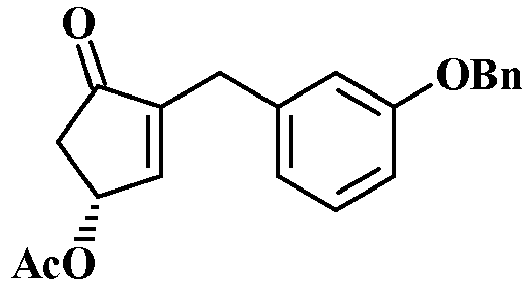
- 4-Hydroxy-2-(3-Benzyloxybenzyl)cyclopent-2-enone (5.73 g, 19.48 mmol) was dissolved in isobutyl methyl ketone (60mL), and vinyl acetate (11.2g, 13.01 mmol) and Lipase derived from Alcaligenese spp (0.6 g) was added to the solution, and the mixture was stirred at room temperature for 1 day. The reaction mixture was filtered to remove Lipase and the filtrate was evaporated. The resulting residue was purified by chromatography on a silica gel column using hexane-EtOAc as eluent to give the (R)-3-(3-benzyloxybenzyl)-4-oxocyclopent-2-enyl acetate as yellow oil: 2.51 g (yield: 38 %, 96% ee by HPLC using a chiral column) and (S)-4-hydroxy-2-(3-(benzyloxy)benzyl)cyclopent-2-enone as yellow oil: 2.68 g (yield:47 %, >99% ee by HPLC using a chiral column)
-

- 4-Hydroxy-2-(3-Benzyloxybenzyl)cyclopent-2-enone (2.1 kg, 7.14 mol) was dissolved in isobutyl methyl ketone (21L), and vinyl acetate (4.2kg, 51.16 mol) and Lipase derived from Pseudomonas cepacia (210 g) was added to the solution, and the mixture was stirred at room temperature for 1 day. The reaction mixture was filtered to remove Lipase and the filtrate was evaporated. The resulting residue was dissolved in PhCH3 (20 L), and triphenylphosphine (625g, 2.38 mol) and AcOH (145g, 2.41mol) was added to the solution. Then diisopropylazodicarboxylate (413g, 2.04 mol) was added to the mixture at 5°C. After the reaction was completed, the reaction mixture was filtered to remove the precipitate and the filtrate was evaporated. The residue was dissolved in EtOAc (5L) and hexane (5L) was added. The mixture was stirred at room t temperature overnight. The mixture was filtered to remove the precipitate and the filtrate was evaporated. The residue was purified by chromatography on a silica gel column using hexane-EtOAc as eluent to give the (R)-3-(3-benzyloxybenzyl)-4-oxocyclopent-2-enyl acetate as yellow oil: 1.8 kg (yield: 75 %, 97% ee by HPLC using a chiral column)
- 1H NMR (300 MHz, CDCl3) δ 2.07 (3H, s), 2.39 (1H, dd, J= 2.1, 18.8 Hz), 2.89 (1H, dd, J= 6.3, 18.9), 3.49 (2H, m), 5.06 (2H, s), 5.72 (1H, m), 6.79- 6.88 (3H, m ), 6.98 (1H, m), 7.21- 7.45 (6H, m)
-

- (R)-3-(3-Benzyloxybenzyl)-4-oxocycl opent-2-enyl acetate (1.8 kg, 5.35mol) was added to KH2PO4-H3PO4 buffer solution (20L). The mixture was added Lipase derived from Pseudomonas cepacia and 1N NaOH was slowly added to the solution at room temperature to keep the pH=7∼7.5. After 8 hours, (R)-3-(3-Benzyloxybenzyl)-4-oxocycl opent-2-enyl acetate remained about 10 %, The reaction mixture was filtered to remove Lipase and the filtrate was extracted with EtOAc, dried over MgSO4, and evaporated. The resulting residue was purified by chromatography on a silica gel column using hexane-EtOAc as eluent to give the (R)-4-hydroxy-2-(3-benzyloxybenzyl)cyclopent-2-enone as yellow oil: 1.3 kg (yield: 83 %, >99% ee by HPLC using a chiral column)
-

- (R)-3-(3-Methoxybenzyl)-4-oxocyclopent-2-enyl acetate (0.5 g, 1.48 mmol), was dissolved in MeOH (5 ml), 7 % KOH/CH3OH (5 ml) was added to the solution , and the mixture was stirred at room temperature overnight. The mixture was evaporated and the resulting residue was neutralized by HCl to pH= 6.5, and extracted with EtOAc. The organic layer was washed with brine, dried over MgSO4, and evaporated. The resulting residue was purified by chromatography on a silica gel column using hexane-EtOAc as eluent to give (R)-4-hydroxy-2-(3-methoxybenzyl)cyclopent-2-enone as yellow oil: 0.4 g, (yield: 92 %) [α]D 20 = + 3.5 ∼ 5.7°
-

- (R)-2-(3-(benzyloxy)benzyl)-4-hydroxycyclopent-2-enone (0.5 g, 1.7 mmol) and dihydropyrane (0.34 g, 4 mmol) was dissolved in CH2Cl2 (5 ml), p-toluenesulfonic acid (0.2 g) was added to the solution at 10°C, and the mixture was stirred at room temperature overnight. After the reaction was completed, the mixture was washed with sat. NaHCO3 aq., dried over MgSO4, and evaporated. The resulting residue was dissolved in EtOH (5 ml) under hydrogen, Pd/C (0.15 g) was added to the solution and the mixture was stirred at room temperature for 2 hrs. After the reaction was completed, the reaction mixture was filtered to remove the Pd/C and the filtrate was evaporated. The resulting residue was dissolved in EtOAc (5 ml), imidazole (0.24 g, 3.5 mmol) and tert-butyldimethylsilyl chloride (0.38 g, 2.55 mmol) was added to the solution and the mixture was stirred at 50°C for 4 hrs. After the reaction was completed, the reaction mixture was filtered to remove the precipitate and washed with NaHCO3 and extracted with EtOAc. The organic layer was dried over MgSO4, and evaporated. The residue was purified by chromatography on a silica gel column using hexane-EtOAc as eluent to give (4R)-2-(3-(tert-butyldimethylsilyloxy)benzyl)-4-(tetrahydro-2H-pyran-2-yloxy)cyclopent-2-e none as yellow oil: 0.47 g (yield: 69 %,)
- 1H NMR (CDCl3, 500 MHz) δ 0.18 (6H, s), 0.97 (9H, s), 1.51 (4H, m), 1.75 (3H, m), 2.32 (3H, m), 2.28 (2H, m),2.60 (1H, m), 3.12 (1H, m), 3.48 (1H, m), 3.83 (1H, m), 4.37 (1H, sept, J=7.0 Hz), 4.66 (1H, m), 6.66 (2H, m), 6.74 (1H, m), 7.12 (1H, t, J=7.5 Hz)
- 13C NMR (CDCl3, 500 MHz) δ -4.46, 18.16 (18.12), 19.33 (19.43), 25.29 (25.31), 25.63, 30.72 (30.77), 34.34, 35.64 (35.89), 44.73 (46.26), 49.88 (50.36), 62.37 (62.50), 71.56 (72.07), 97.33 (97.53), 117.88 (117.93), 120.64 (120.70), 121.85 (121.88), 129.28 (129.32), 141.09 (141.12), 155.62 (155.65), 216.14 (216.55)
Claims (15)
- A process for preparing a racemic cyclopentenone of Formula I

comprising the steps of:(a) reacting furan with an acyl donor of the acid compound of Formula V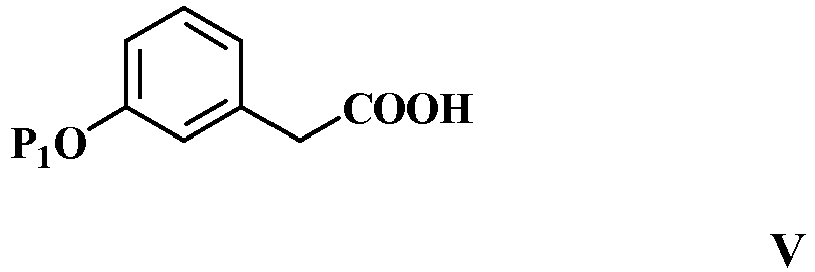
 (b) reacting the 2-acylfuran of Formula IV with a reducing agent to form the corresponding furancarbinol compound of formula III:
 (c) subjecting the furancarbinol compound of formula III to a rearrangement and isomerization to form the racemic compound of Formula I.
 - The process according to claim 1, wherein P1 is a C1-8 alkyl, allyl, unsubstituted or substituted benzyl, acetyl, C1-8 alkylcarbonyl, methoxymethyl, methoxythiomethyl, 2-methoxyethoxymethyl, bis(2-chloroethoxy)methyl, tetrahydropyranyl, tetrahydrothiopyranyl, 4-methoxytetrahydropyranyl, 4-methoxytetrahydrothiopyranyl, tetrahydrofuranyl, tetrahydrothiofuranyl, 1-ethoxyethyl, 1-methyl-1-methoxyethyl, triphenylmethyl, and SiRaRbRc wherein Ra, Rb and Rc are each independently a C1-8 alkyl, phenyl, benzyl, a substituted phenyl, or a substituted benzyl.
- The process according to claim 2, wherein P1 is a C1-8 alkyl, allyl, or an unsubstituted or substituted benzyl.
- The process according to claim 1, 2 or 3, wherein the acyl donor is selected from the group consisting of chloroacetic anhydride or trifluoroacetic anhydride or a mixture thereof; and/or
wherein the reducing agent is selected from the group consisting of NaBH4, LiBH4, LiAlH4, or (iso-Bu)2AlH or a mixture thereof. - A process for preparing a compound of Formula I enriched in the (R)-enantiomer and having an optical purity of at least 95% enantiomeric excess,
 (e) enantioselectively (R)-esterifying the racemic alcohol mixture of the compound of Formula I with an acyl donor of Formula D
 (f) removing the unreacted (S)-alcohol; and(g) deacylating the resultant (R)-ester.
 - The process according to claim 5,(a) wherein the acyl donor of Formula D is vinyl acetate, isopropenyl acetate, vinyl valerate, isopropenyl valerate, vinyl butyrate, or isopropenyl butyrate or a mixture thereof; and/or
wherein the first lipase is derived from Candida antarcitica, Achromobacter spp., Alcaligenese spp., Pseudomonas fluorescens, Pseudomonas stutzri, or Pseudomonas cepacia, and/or(b) wherein (i) the deacylation step (g) comprises an enzymatic cleavage reaction using a second lipase derived from Candida antarcitica, Psudomonas spp. or Achromobacter spp or a mixture thereof, preferably Candida antarcitica; or (ii) the deacylation step (g) is a chemical hydrolysis. - The process according to claim 5 or 6, wherein step (f) comprises converting the unreacted (S)-alcohol into a corresponding (R)-ester by reacting the (S)-alcohol with an acyloxy donor of Formula R3COOH, wherein R3 is as defined in Claim 5 for R1 in the presence of a dialkylazodicarboxylate and a triarylphosphine.
- The process according to claim 7, wherein the dialkylazodicarboxylate is diethylazodicarboxylate, diisopropylazodicarboxylate, or dibenzylazodicarboxylate or a mixture thereof; and/or
wherein the triarylphosphine is triphenylphosphine. - A racemic or an optically active compound of Formula I:

wherein the substituent(s) in said substituted benzyl are selected from the group consisting of halogen, alkyl, aryl, alkoxyl, aryloxy, thioalkoxyl, thioaryloxy, alkylamino, arylamino, cyano, alkoxycarbonyl, arylcarbonyl, arylaminocarbonyl, alkylaminocarbonyl, and nitro. - A compound according to claim 9,(a) wherein P1 is benzyl or a substituted benzyl;(b) wherein P1 is SiRaRbRc wherein Ra, Rb and Rc are each independently a C1-8 alkyl, phenyl, or benzyl, and preferably Ra, Rb and Rc are each independently a C1-8 alkyl; or(c) wherein (i) P1 is a C1-8 alkyl, or (ii) P1 is acetyl or a C1-8 alkylcarbonyl.
- A compound according to claim 9 or 10 enriched in the (R)-enantiomer and having an optical purity of at least 95% enantiomeric excess.
- A compound according to claim 11 enriched in the (R)-enantiomer and having an optical purity of at least 99% enantiomeric excess.
- A compound according to claim 11 enriched in the (R)-enantiomer and having an optical purity of at least 99.9% enantiomeric excess.
- A process of preparing a benzindene prostaglandin, which process comprises (i) preparing a compound of formula I by a process according to any one of claims 1 to 8; and (ii) further reacting the thus obtained compound to prepare a benzindene prostaglandin.
- Use of a compound as defined in any one of claims 9 to 13 in the preparation of a benzindene prostaglandin.
Applications Claiming Priority (1)
| Application Number | Priority Date | Filing Date | Title |
|---|---|---|---|
| US13/216,321 US8350090B1 (en) | 2011-08-24 | 2011-08-24 | Processes for preparing cyclopentenones and cyclopentenones for the synthesis of benzindene prostaglandins |
Publications (2)
| Publication Number | Publication Date |
|---|---|
| EP2574605A1 EP2574605A1 (en) | 2013-04-03 |
| EP2574605B1 true EP2574605B1 (en) | 2017-09-27 |
Family
ID=46982409
Family Applications (1)
| Application Number | Title | Priority Date | Filing Date |
|---|---|---|---|
| EP12181572.4A Active EP2574605B1 (en) | 2011-08-24 | 2012-08-23 | Processes for preparing cyclopentenones and cyclopentenones for the synthesis of benzindene prostaglandins |
Country Status (6)
| Country | Link |
|---|---|
| US (1) | US8350090B1 (en) |
| EP (1) | EP2574605B1 (en) |
| JP (1) | JP5656938B2 (en) |
| KR (1) | KR101476162B1 (en) |
| CN (1) | CN102952006B (en) |
| TW (1) | TWI482753B (en) |
Families Citing this family (2)
| Publication number | Priority date | Publication date | Assignee | Title |
|---|---|---|---|---|
| CN111253231B (en) * | 2020-02-03 | 2021-08-03 | 厦门大学 | A kind of preparation method of 4-cyclopentene-1,3-dione |
| US11884640B2 (en) | 2021-06-02 | 2024-01-30 | Chirogate International Inc. | Processes and intermediates for the preparations of benzoprostacyclin analogues and benzoprostacyclin analogues prepared therefrom |
Family Cites Families (9)
| Publication number | Priority date | Publication date | Assignee | Title |
|---|---|---|---|---|
| HU186372B (en) * | 1979-12-06 | 1985-07-29 | Sumitomo Chemical Co | Process for producing 3-oxo-cyclopentene derivatives |
| JPH0696564B2 (en) * | 1986-09-20 | 1994-11-30 | 住友化学工業株式会社 | α- (ω-hydroxyalkyl) furfuryl alcohol and process for producing the same |
| JPH0778056B2 (en) * | 1986-10-28 | 1995-08-23 | 住友化学工業株式会社 | Method for producing 2-acylfuran derivative |
| JP2645342B2 (en) * | 1986-12-01 | 1997-08-25 | 住友化学工業株式会社 | Preparation of optically active substituted 4-hydroxy-2-cyclopentenone |
| JPH0753682B2 (en) * | 1987-04-01 | 1995-06-07 | 住友化学工業株式会社 | Process for producing 2-cyclopentenone derivative |
| US5447865A (en) * | 1992-06-10 | 1995-09-05 | Amprost Pharmaceutical, Inc. | Method of resolution of hydroxy substituted cyclopentanone enantiomers using lipase and lithium salt complexation |
| JPH07252276A (en) | 1994-03-11 | 1995-10-03 | Nissan Chem Ind Ltd | Organotin compound, its production and production of alpha-substituted cyclopentenone derivative |
| US7511168B2 (en) * | 2006-01-18 | 2009-03-31 | Shih-Yi Wei | Processes and intermediates for the preparations of prostaglandins |
| TWI378146B (en) * | 2006-01-18 | 2012-12-01 | Chirogate Int Inc | Processes for the preparations of optically active cyclopentenones and cyclopentenones prepared therefrom |
-
2011
- 2011-08-24 US US13/216,321 patent/US8350090B1/en active Active
-
2012
- 2012-08-16 JP JP2012180636A patent/JP5656938B2/en active Active
- 2012-08-22 TW TW101130511A patent/TWI482753B/en active
- 2012-08-23 EP EP12181572.4A patent/EP2574605B1/en active Active
- 2012-08-24 CN CN201210305661.6A patent/CN102952006B/en active Active
- 2012-08-24 KR KR1020120093178A patent/KR101476162B1/en active Active
Non-Patent Citations (1)
| Title |
|---|
| None * |
Also Published As
| Publication number | Publication date |
|---|---|
| TWI482753B (en) | 2015-05-01 |
| TW201323390A (en) | 2013-06-16 |
| US8350090B1 (en) | 2013-01-08 |
| KR101476162B1 (en) | 2014-12-24 |
| KR20130023161A (en) | 2013-03-07 |
| CN102952006A (en) | 2013-03-06 |
| CN102952006B (en) | 2016-01-20 |
| JP2013043890A (en) | 2013-03-04 |
| EP2574605A1 (en) | 2013-04-03 |
| JP5656938B2 (en) | 2015-01-21 |
Similar Documents
| Publication | Publication Date | Title |
|---|---|---|
| EP0357009B1 (en) | Method of resolution of hydroxy-cyclopentenones using a lipase and transacylation agents | |
| US20120064611A1 (en) | Process For The Preparation of (3R)-Hydroxybutyl (3R) -Hydroxybutyrate By Enzymatic Enantioselective Reduction Employing Lactobacillus Brevis Alcohol Dehydrogenase | |
| WO2013068917A1 (en) | Processes for the production of a lactone statin intermediate by enzymatic oxidation | |
| US8350090B1 (en) | Processes for preparing cyclopentenones and cyclopentenones for the synthesis of benzindene prostaglandins | |
| Giovannini et al. | Enzymatic diastereo-and enantioselective synthesis of α-alkyl-α, β-dihydroxyketones | |
| EP0529085B1 (en) | Process for producing optically active 3-chloro-1-phenyl-1-propanol and derivative thereof | |
| JP5554887B2 (en) | Process for preparing optically active cyclopentenone and cyclopentenone prepared by the process | |
| EP0604525A1 (en) | Enzymatic production of optical isomers of tetrahydropyran-2-ones | |
| JP4962016B2 (en) | Method for producing sulfur-containing hydroxycarboxylic acid | |
| EP2218788B1 (en) | Process for the preparation of optically active cyclopentenones | |
| CN101003820B (en) | Method for producing optically active cyclopentenones and cyclopentenones produced thereby | |
| Musa | Enzymatic production of both enantiomers of rhododendrol | |
| CA2054773C (en) | Protected hydroxy method for alcohol-ester separation | |
| Ko et al. | Kinetic resolution of fluorinated propargyl alcohols by lipase-catalyzed enantioselective transesterification | |
| US6995001B2 (en) | Processing for preparing monoprotected diols from symmetric diols | |
| US5959159A (en) | Method for preparing optically active 5-hydroxy-3-(4'-hydroxyphenyl)-1,1,3-trimethylindane | |
| Tranel et al. | Lipase-catalyzed resolution of 2-fluorodecanoic acid | |
| EP2069516B1 (en) | Specific hydrolysis of the n-unprotected (r) -ester of (3 ) -amin0-3-arylpr0pi0nic acid esters | |
| Izumi et al. | Chemoenzymic synthesis of optically active 3‐methyl‐and 3‐butylphthalides | |
| JP2645342B2 (en) | Preparation of optically active substituted 4-hydroxy-2-cyclopentenone | |
| KAAMBRE et al. | OPTILISELT AKTIIVSETE. _oc-BROMO-(O-HUDROKSUALDEHUUDI HEMIATSETAALIDE | |
| WO2004097026A1 (en) | The enzymatic method of making 1,2-diol derivatives and their esters | |
| JP2003512035A (en) | Method for producing chiral ester | |
| EP2003211A9 (en) | Process for producing optically active (s)-7-hydroxy-6-methylheptane-2-one and precursor thereof | |
| HK1170539A (en) | Process for the preparation of (3r)-hydroxybutyl (3r) -hydroxybutyrate by enzymatic enantioselective reduction employing lactobacillus brevis alcohol dehydrogenase |
Legal Events
| Date | Code | Title | Description |
|---|---|---|---|
| PUAI | Public reference made under article 153(3) epc to a published international application that has entered the european phase |
Free format text: ORIGINAL CODE: 0009012 |
|
| AK | Designated contracting states |
Kind code of ref document: A1 Designated state(s): AL AT BE BG CH CY CZ DE DK EE ES FI FR GB GR HR HU IE IS IT LI LT LU LV MC MK MT NL NO PL PT RO RS SE SI SK SM TR |
|
| AX | Request for extension of the european patent |
Extension state: BA ME |
|
| 17P | Request for examination filed |
Effective date: 20131002 |
|
| RBV | Designated contracting states (corrected) |
Designated state(s): AL AT BE BG CH CY CZ DE DK EE ES FI FR GB GR HR HU IE IS IT LI LT LU LV MC MK MT NL NO PL PT RO RS SE SI SK SM TR |
|
| GRAP | Despatch of communication of intention to grant a patent |
Free format text: ORIGINAL CODE: EPIDOSNIGR1 |
|
| STAA | Information on the status of an ep patent application or granted ep patent |
Free format text: STATUS: GRANT OF PATENT IS INTENDED |
|
| INTG | Intention to grant announced |
Effective date: 20170428 |
|
| GRAS | Grant fee paid |
Free format text: ORIGINAL CODE: EPIDOSNIGR3 |
|
| GRAA | (expected) grant |
Free format text: ORIGINAL CODE: 0009210 |
|
| STAA | Information on the status of an ep patent application or granted ep patent |
Free format text: STATUS: THE PATENT HAS BEEN GRANTED |
|
| AK | Designated contracting states |
Kind code of ref document: B1 Designated state(s): AL AT BE BG CH CY CZ DE DK EE ES FI FR GB GR HR HU IE IS IT LI LT LU LV MC MK MT NL NO PL PT RO RS SE SI SK SM TR |
|
| REG | Reference to a national code |
Ref country code: GB Ref legal event code: FG4D |
|
| REG | Reference to a national code |
Ref country code: CH Ref legal event code: EP |
|
| REG | Reference to a national code |
Ref country code: CH Ref legal event code: NV Representative=s name: VENI GMBH, CH |
|
| REG | Reference to a national code |
Ref country code: AT Ref legal event code: REF Ref document number: 931776 Country of ref document: AT Kind code of ref document: T Effective date: 20171015 |
|
| REG | Reference to a national code |
Ref country code: IE Ref legal event code: FG4D |
|
| REG | Reference to a national code |
Ref country code: DE Ref legal event code: R096 Ref document number: 602012037736 Country of ref document: DE |
|
| REG | Reference to a national code |
Ref country code: NL Ref legal event code: FP |
|
| PG25 | Lapsed in a contracting state [announced via postgrant information from national office to epo] |
Ref country code: SE Free format text: LAPSE BECAUSE OF FAILURE TO SUBMIT A TRANSLATION OF THE DESCRIPTION OR TO PAY THE FEE WITHIN THE PRESCRIBED TIME-LIMIT Effective date: 20170927 Ref country code: LT Free format text: LAPSE BECAUSE OF FAILURE TO SUBMIT A TRANSLATION OF THE DESCRIPTION OR TO PAY THE FEE WITHIN THE PRESCRIBED TIME-LIMIT Effective date: 20170927 Ref country code: FI Free format text: LAPSE BECAUSE OF FAILURE TO SUBMIT A TRANSLATION OF THE DESCRIPTION OR TO PAY THE FEE WITHIN THE PRESCRIBED TIME-LIMIT Effective date: 20170927 Ref country code: HR Free format text: LAPSE BECAUSE OF FAILURE TO SUBMIT A TRANSLATION OF THE DESCRIPTION OR TO PAY THE FEE WITHIN THE PRESCRIBED TIME-LIMIT Effective date: 20170927 Ref country code: NO Free format text: LAPSE BECAUSE OF FAILURE TO SUBMIT A TRANSLATION OF THE DESCRIPTION OR TO PAY THE FEE WITHIN THE PRESCRIBED TIME-LIMIT Effective date: 20171227 |
|
| REG | Reference to a national code |
Ref country code: LT Ref legal event code: MG4D |
|
| REG | Reference to a national code |
Ref country code: AT Ref legal event code: MK05 Ref document number: 931776 Country of ref document: AT Kind code of ref document: T Effective date: 20170927 |
|
| PG25 | Lapsed in a contracting state [announced via postgrant information from national office to epo] |
Ref country code: GR Free format text: LAPSE BECAUSE OF FAILURE TO SUBMIT A TRANSLATION OF THE DESCRIPTION OR TO PAY THE FEE WITHIN THE PRESCRIBED TIME-LIMIT Effective date: 20171228 Ref country code: RS Free format text: LAPSE BECAUSE OF FAILURE TO SUBMIT A TRANSLATION OF THE DESCRIPTION OR TO PAY THE FEE WITHIN THE PRESCRIBED TIME-LIMIT Effective date: 20170927 Ref country code: BG Free format text: LAPSE BECAUSE OF FAILURE TO SUBMIT A TRANSLATION OF THE DESCRIPTION OR TO PAY THE FEE WITHIN THE PRESCRIBED TIME-LIMIT Effective date: 20171227 Ref country code: LV Free format text: LAPSE BECAUSE OF FAILURE TO SUBMIT A TRANSLATION OF THE DESCRIPTION OR TO PAY THE FEE WITHIN THE PRESCRIBED TIME-LIMIT Effective date: 20170927 |
|
| PG25 | Lapsed in a contracting state [announced via postgrant information from national office to epo] |
Ref country code: ES Free format text: LAPSE BECAUSE OF FAILURE TO SUBMIT A TRANSLATION OF THE DESCRIPTION OR TO PAY THE FEE WITHIN THE PRESCRIBED TIME-LIMIT Effective date: 20170927 Ref country code: CZ Free format text: LAPSE BECAUSE OF FAILURE TO SUBMIT A TRANSLATION OF THE DESCRIPTION OR TO PAY THE FEE WITHIN THE PRESCRIBED TIME-LIMIT Effective date: 20170927 Ref country code: RO Free format text: LAPSE BECAUSE OF FAILURE TO SUBMIT A TRANSLATION OF THE DESCRIPTION OR TO PAY THE FEE WITHIN THE PRESCRIBED TIME-LIMIT Effective date: 20170927 |
|
| PG25 | Lapsed in a contracting state [announced via postgrant information from national office to epo] |
Ref country code: SM Free format text: LAPSE BECAUSE OF FAILURE TO SUBMIT A TRANSLATION OF THE DESCRIPTION OR TO PAY THE FEE WITHIN THE PRESCRIBED TIME-LIMIT Effective date: 20170927 Ref country code: SK Free format text: LAPSE BECAUSE OF FAILURE TO SUBMIT A TRANSLATION OF THE DESCRIPTION OR TO PAY THE FEE WITHIN THE PRESCRIBED TIME-LIMIT Effective date: 20170927 Ref country code: EE Free format text: LAPSE BECAUSE OF FAILURE TO SUBMIT A TRANSLATION OF THE DESCRIPTION OR TO PAY THE FEE WITHIN THE PRESCRIBED TIME-LIMIT Effective date: 20170927 Ref country code: IS Free format text: LAPSE BECAUSE OF FAILURE TO SUBMIT A TRANSLATION OF THE DESCRIPTION OR TO PAY THE FEE WITHIN THE PRESCRIBED TIME-LIMIT Effective date: 20180127 Ref country code: AT Free format text: LAPSE BECAUSE OF FAILURE TO SUBMIT A TRANSLATION OF THE DESCRIPTION OR TO PAY THE FEE WITHIN THE PRESCRIBED TIME-LIMIT Effective date: 20170927 Ref country code: IT Free format text: LAPSE BECAUSE OF FAILURE TO SUBMIT A TRANSLATION OF THE DESCRIPTION OR TO PAY THE FEE WITHIN THE PRESCRIBED TIME-LIMIT Effective date: 20170927 |
|
| REG | Reference to a national code |
Ref country code: DE Ref legal event code: R097 Ref document number: 602012037736 Country of ref document: DE |
|
| PG25 | Lapsed in a contracting state [announced via postgrant information from national office to epo] |
Ref country code: DK Free format text: LAPSE BECAUSE OF FAILURE TO SUBMIT A TRANSLATION OF THE DESCRIPTION OR TO PAY THE FEE WITHIN THE PRESCRIBED TIME-LIMIT Effective date: 20170927 |
|
| PLBE | No opposition filed within time limit |
Free format text: ORIGINAL CODE: 0009261 |
|
| STAA | Information on the status of an ep patent application or granted ep patent |
Free format text: STATUS: NO OPPOSITION FILED WITHIN TIME LIMIT |
|
| REG | Reference to a national code |
Ref country code: FR Ref legal event code: PLFP Year of fee payment: 7 |
|
| PG25 | Lapsed in a contracting state [announced via postgrant information from national office to epo] |
Ref country code: PL Free format text: LAPSE BECAUSE OF FAILURE TO SUBMIT A TRANSLATION OF THE DESCRIPTION OR TO PAY THE FEE WITHIN THE PRESCRIBED TIME-LIMIT Effective date: 20170927 |
|
| 26N | No opposition filed |
Effective date: 20180628 |
|
| PG25 | Lapsed in a contracting state [announced via postgrant information from national office to epo] |
Ref country code: SI Free format text: LAPSE BECAUSE OF FAILURE TO SUBMIT A TRANSLATION OF THE DESCRIPTION OR TO PAY THE FEE WITHIN THE PRESCRIBED TIME-LIMIT Effective date: 20170927 |
|
| PG25 | Lapsed in a contracting state [announced via postgrant information from national office to epo] |
Ref country code: MC Free format text: LAPSE BECAUSE OF FAILURE TO SUBMIT A TRANSLATION OF THE DESCRIPTION OR TO PAY THE FEE WITHIN THE PRESCRIBED TIME-LIMIT Effective date: 20170927 |
|
| PG25 | Lapsed in a contracting state [announced via postgrant information from national office to epo] |
Ref country code: LU Free format text: LAPSE BECAUSE OF NON-PAYMENT OF DUE FEES Effective date: 20180823 |
|
| REG | Reference to a national code |
Ref country code: BE Ref legal event code: MM Effective date: 20180831 |
|
| PG25 | Lapsed in a contracting state [announced via postgrant information from national office to epo] |
Ref country code: BE Free format text: LAPSE BECAUSE OF NON-PAYMENT OF DUE FEES Effective date: 20180831 |
|
| PG25 | Lapsed in a contracting state [announced via postgrant information from national office to epo] |
Ref country code: MT Free format text: LAPSE BECAUSE OF NON-PAYMENT OF DUE FEES Effective date: 20180823 |
|
| PG25 | Lapsed in a contracting state [announced via postgrant information from national office to epo] |
Ref country code: TR Free format text: LAPSE BECAUSE OF FAILURE TO SUBMIT A TRANSLATION OF THE DESCRIPTION OR TO PAY THE FEE WITHIN THE PRESCRIBED TIME-LIMIT Effective date: 20170927 |
|
| PG25 | Lapsed in a contracting state [announced via postgrant information from national office to epo] |
Ref country code: PT Free format text: LAPSE BECAUSE OF FAILURE TO SUBMIT A TRANSLATION OF THE DESCRIPTION OR TO PAY THE FEE WITHIN THE PRESCRIBED TIME-LIMIT Effective date: 20170927 Ref country code: HU Free format text: LAPSE BECAUSE OF FAILURE TO SUBMIT A TRANSLATION OF THE DESCRIPTION OR TO PAY THE FEE WITHIN THE PRESCRIBED TIME-LIMIT; INVALID AB INITIO Effective date: 20120823 |
|
| PG25 | Lapsed in a contracting state [announced via postgrant information from national office to epo] |
Ref country code: MK Free format text: LAPSE BECAUSE OF NON-PAYMENT OF DUE FEES Effective date: 20170927 Ref country code: IE Free format text: LAPSE BECAUSE OF NON-PAYMENT OF DUE FEES Effective date: 20180823 Ref country code: CY Free format text: LAPSE BECAUSE OF FAILURE TO SUBMIT A TRANSLATION OF THE DESCRIPTION OR TO PAY THE FEE WITHIN THE PRESCRIBED TIME-LIMIT Effective date: 20170927 |
|
| PG25 | Lapsed in a contracting state [announced via postgrant information from national office to epo] |
Ref country code: AL Free format text: LAPSE BECAUSE OF FAILURE TO SUBMIT A TRANSLATION OF THE DESCRIPTION OR TO PAY THE FEE WITHIN THE PRESCRIBED TIME-LIMIT Effective date: 20170927 |
|
| PGFP | Annual fee paid to national office [announced via postgrant information from national office to epo] |
Ref country code: NL Payment date: 20250612 Year of fee payment: 14 |
|
| PGFP | Annual fee paid to national office [announced via postgrant information from national office to epo] |
Ref country code: FR Payment date: 20250612 Year of fee payment: 14 |
|
| PGFP | Annual fee paid to national office [announced via postgrant information from national office to epo] |
Ref country code: DE Payment date: 20250702 Year of fee payment: 14 |
|
| PGFP | Annual fee paid to national office [announced via postgrant information from national office to epo] |
Ref country code: GB Payment date: 20250703 Year of fee payment: 14 |
|
| PGFP | Annual fee paid to national office [announced via postgrant information from national office to epo] |
Ref country code: CH Payment date: 20250901 Year of fee payment: 14 |