EP2574507A2 - Operation control apparatus and operation control method for external apparatus connected to vehicle-mounted apparatus - Google Patents
Operation control apparatus and operation control method for external apparatus connected to vehicle-mounted apparatus Download PDFInfo
- Publication number
- EP2574507A2 EP2574507A2 EP12186339A EP12186339A EP2574507A2 EP 2574507 A2 EP2574507 A2 EP 2574507A2 EP 12186339 A EP12186339 A EP 12186339A EP 12186339 A EP12186339 A EP 12186339A EP 2574507 A2 EP2574507 A2 EP 2574507A2
- Authority
- EP
- European Patent Office
- Prior art keywords
- information
- unit
- touch panel
- play
- external apparatus
- Prior art date
- Legal status (The legal status is an assumption and is not a legal conclusion. Google has not performed a legal analysis and makes no representation as to the accuracy of the status listed.)
- Granted
Links
Images






Classifications
-
- B—PERFORMING OPERATIONS; TRANSPORTING
- B60—VEHICLES IN GENERAL
- B60K—ARRANGEMENT OR MOUNTING OF PROPULSION UNITS OR OF TRANSMISSIONS IN VEHICLES; ARRANGEMENT OR MOUNTING OF PLURAL DIVERSE PRIME-MOVERS IN VEHICLES; AUXILIARY DRIVES FOR VEHICLES; INSTRUMENTATION OR DASHBOARDS FOR VEHICLES; ARRANGEMENTS IN CONNECTION WITH COOLING, AIR INTAKE, GAS EXHAUST OR FUEL SUPPLY OF PROPULSION UNITS IN VEHICLES
- B60K35/00—Instruments specially adapted for vehicles; Arrangement of instruments in or on vehicles
- B60K35/10—Input arrangements, i.e. from user to vehicle, associated with vehicle functions or specially adapted therefor
-
- B—PERFORMING OPERATIONS; TRANSPORTING
- B60—VEHICLES IN GENERAL
- B60K—ARRANGEMENT OR MOUNTING OF PROPULSION UNITS OR OF TRANSMISSIONS IN VEHICLES; ARRANGEMENT OR MOUNTING OF PLURAL DIVERSE PRIME-MOVERS IN VEHICLES; AUXILIARY DRIVES FOR VEHICLES; INSTRUMENTATION OR DASHBOARDS FOR VEHICLES; ARRANGEMENTS IN CONNECTION WITH COOLING, AIR INTAKE, GAS EXHAUST OR FUEL SUPPLY OF PROPULSION UNITS IN VEHICLES
- B60K35/00—Instruments specially adapted for vehicles; Arrangement of instruments in or on vehicles
- B60K35/20—Output arrangements, i.e. from vehicle to user, associated with vehicle functions or specially adapted therefor
- B60K35/28—Output arrangements, i.e. from vehicle to user, associated with vehicle functions or specially adapted therefor characterised by the type of the output information, e.g. video entertainment or vehicle dynamics information; characterised by the purpose of the output information, e.g. for attracting the attention of the driver
-
- B—PERFORMING OPERATIONS; TRANSPORTING
- B60—VEHICLES IN GENERAL
- B60K—ARRANGEMENT OR MOUNTING OF PROPULSION UNITS OR OF TRANSMISSIONS IN VEHICLES; ARRANGEMENT OR MOUNTING OF PLURAL DIVERSE PRIME-MOVERS IN VEHICLES; AUXILIARY DRIVES FOR VEHICLES; INSTRUMENTATION OR DASHBOARDS FOR VEHICLES; ARRANGEMENTS IN CONNECTION WITH COOLING, AIR INTAKE, GAS EXHAUST OR FUEL SUPPLY OF PROPULSION UNITS IN VEHICLES
- B60K35/00—Instruments specially adapted for vehicles; Arrangement of instruments in or on vehicles
- B60K35/80—Arrangements for controlling instruments
-
- G—PHYSICS
- G06—COMPUTING OR CALCULATING; COUNTING
- G06F—ELECTRIC DIGITAL DATA PROCESSING
- G06F3/00—Input arrangements for transferring data to be processed into a form capable of being handled by the computer; Output arrangements for transferring data from processing unit to output unit, e.g. interface arrangements
- G06F3/01—Input arrangements or combined input and output arrangements for interaction between user and computer
- G06F3/048—Interaction techniques based on graphical user interfaces [GUI]
- G06F3/0487—Interaction techniques based on graphical user interfaces [GUI] using specific features provided by the input device, e.g. functions controlled by the rotation of a mouse with dual sensing arrangements, or of the nature of the input device, e.g. tap gestures based on pressure sensed by a digitiser
- G06F3/0488—Interaction techniques based on graphical user interfaces [GUI] using specific features provided by the input device, e.g. functions controlled by the rotation of a mouse with dual sensing arrangements, or of the nature of the input device, e.g. tap gestures based on pressure sensed by a digitiser using a touch-screen or digitiser, e.g. input of commands through traced gestures
-
- H—ELECTRICITY
- H04—ELECTRIC COMMUNICATION TECHNIQUE
- H04N—PICTORIAL COMMUNICATION, e.g. TELEVISION
- H04N21/00—Selective content distribution, e.g. interactive television or video on demand [VOD]
- H04N21/40—Client devices specifically adapted for the reception of or interaction with content, e.g. set-top-box [STB]; Operations thereof
- H04N21/41—Structure of client; Structure of client peripherals
- H04N21/4104—Peripherals receiving signals from specially adapted client devices
- H04N21/4126—The peripheral being portable, e.g. PDAs or mobile phones
-
- H—ELECTRICITY
- H04—ELECTRIC COMMUNICATION TECHNIQUE
- H04N—PICTORIAL COMMUNICATION, e.g. TELEVISION
- H04N21/00—Selective content distribution, e.g. interactive television or video on demand [VOD]
- H04N21/40—Client devices specifically adapted for the reception of or interaction with content, e.g. set-top-box [STB]; Operations thereof
- H04N21/41—Structure of client; Structure of client peripherals
- H04N21/4104—Peripherals receiving signals from specially adapted client devices
- H04N21/4126—The peripheral being portable, e.g. PDAs or mobile phones
- H04N21/41265—The peripheral being portable, e.g. PDAs or mobile phones having a remote control device for bidirectional communication between the remote control device and client device
-
- H—ELECTRICITY
- H04—ELECTRIC COMMUNICATION TECHNIQUE
- H04N—PICTORIAL COMMUNICATION, e.g. TELEVISION
- H04N21/00—Selective content distribution, e.g. interactive television or video on demand [VOD]
- H04N21/40—Client devices specifically adapted for the reception of or interaction with content, e.g. set-top-box [STB]; Operations thereof
- H04N21/41—Structure of client; Structure of client peripherals
- H04N21/414—Specialised client platforms, e.g. receiver in car or embedded in a mobile appliance
- H04N21/41422—Specialised client platforms, e.g. receiver in car or embedded in a mobile appliance located in transportation means, e.g. personal vehicle
-
- H—ELECTRICITY
- H04—ELECTRIC COMMUNICATION TECHNIQUE
- H04N—PICTORIAL COMMUNICATION, e.g. TELEVISION
- H04N21/00—Selective content distribution, e.g. interactive television or video on demand [VOD]
- H04N21/40—Client devices specifically adapted for the reception of or interaction with content, e.g. set-top-box [STB]; Operations thereof
- H04N21/41—Structure of client; Structure of client peripherals
- H04N21/422—Input-only peripherals, i.e. input devices connected to specially adapted client devices, e.g. global positioning system [GPS]
- H04N21/42204—User interfaces specially adapted for controlling a client device through a remote control device; Remote control devices therefor
- H04N21/42206—User interfaces specially adapted for controlling a client device through a remote control device; Remote control devices therefor characterized by hardware details
- H04N21/42208—Display device provided on the remote control
-
- H—ELECTRICITY
- H04—ELECTRIC COMMUNICATION TECHNIQUE
- H04N—PICTORIAL COMMUNICATION, e.g. TELEVISION
- H04N21/00—Selective content distribution, e.g. interactive television or video on demand [VOD]
- H04N21/40—Client devices specifically adapted for the reception of or interaction with content, e.g. set-top-box [STB]; Operations thereof
- H04N21/41—Structure of client; Structure of client peripherals
- H04N21/422—Input-only peripherals, i.e. input devices connected to specially adapted client devices, e.g. global positioning system [GPS]
- H04N21/42204—User interfaces specially adapted for controlling a client device through a remote control device; Remote control devices therefor
- H04N21/42206—User interfaces specially adapted for controlling a client device through a remote control device; Remote control devices therefor characterized by hardware details
- H04N21/42224—Touch pad or touch panel provided on the remote control
-
- H—ELECTRICITY
- H04—ELECTRIC COMMUNICATION TECHNIQUE
- H04N—PICTORIAL COMMUNICATION, e.g. TELEVISION
- H04N21/00—Selective content distribution, e.g. interactive television or video on demand [VOD]
- H04N21/40—Client devices specifically adapted for the reception of or interaction with content, e.g. set-top-box [STB]; Operations thereof
- H04N21/41—Structure of client; Structure of client peripherals
- H04N21/422—Input-only peripherals, i.e. input devices connected to specially adapted client devices, e.g. global positioning system [GPS]
- H04N21/42204—User interfaces specially adapted for controlling a client device through a remote control device; Remote control devices therefor
- H04N21/42226—Reprogrammable remote control devices
- H04N21/42227—Reprogrammable remote control devices the keys being reprogrammable, e.g. soft keys
-
- H—ELECTRICITY
- H04—ELECTRIC COMMUNICATION TECHNIQUE
- H04N—PICTORIAL COMMUNICATION, e.g. TELEVISION
- H04N21/00—Selective content distribution, e.g. interactive television or video on demand [VOD]
- H04N21/40—Client devices specifically adapted for the reception of or interaction with content, e.g. set-top-box [STB]; Operations thereof
- H04N21/47—End-user applications
-
- H—ELECTRICITY
- H04—ELECTRIC COMMUNICATION TECHNIQUE
- H04N—PICTORIAL COMMUNICATION, e.g. TELEVISION
- H04N21/00—Selective content distribution, e.g. interactive television or video on demand [VOD]
- H04N21/40—Client devices specifically adapted for the reception of or interaction with content, e.g. set-top-box [STB]; Operations thereof
- H04N21/47—End-user applications
- H04N21/472—End-user interface for requesting content, additional data or services; End-user interface for interacting with content, e.g. for content reservation or setting reminders, for requesting event notification, for manipulating displayed content
- H04N21/47217—End-user interface for requesting content, additional data or services; End-user interface for interacting with content, e.g. for content reservation or setting reminders, for requesting event notification, for manipulating displayed content for controlling playback functions for recorded or on-demand content, e.g. using progress bars, mode or play-point indicators or bookmarks
-
- B—PERFORMING OPERATIONS; TRANSPORTING
- B60—VEHICLES IN GENERAL
- B60K—ARRANGEMENT OR MOUNTING OF PROPULSION UNITS OR OF TRANSMISSIONS IN VEHICLES; ARRANGEMENT OR MOUNTING OF PLURAL DIVERSE PRIME-MOVERS IN VEHICLES; AUXILIARY DRIVES FOR VEHICLES; INSTRUMENTATION OR DASHBOARDS FOR VEHICLES; ARRANGEMENTS IN CONNECTION WITH COOLING, AIR INTAKE, GAS EXHAUST OR FUEL SUPPLY OF PROPULSION UNITS IN VEHICLES
- B60K2360/00—Indexing scheme associated with groups B60K35/00 or B60K37/00 relating to details of instruments or dashboards
- B60K2360/11—Instrument graphical user interfaces or menu aspects
-
- B—PERFORMING OPERATIONS; TRANSPORTING
- B60—VEHICLES IN GENERAL
- B60K—ARRANGEMENT OR MOUNTING OF PROPULSION UNITS OR OF TRANSMISSIONS IN VEHICLES; ARRANGEMENT OR MOUNTING OF PLURAL DIVERSE PRIME-MOVERS IN VEHICLES; AUXILIARY DRIVES FOR VEHICLES; INSTRUMENTATION OR DASHBOARDS FOR VEHICLES; ARRANGEMENTS IN CONNECTION WITH COOLING, AIR INTAKE, GAS EXHAUST OR FUEL SUPPLY OF PROPULSION UNITS IN VEHICLES
- B60K2360/00—Indexing scheme associated with groups B60K35/00 or B60K37/00 relating to details of instruments or dashboards
- B60K2360/11—Instrument graphical user interfaces or menu aspects
- B60K2360/113—Scrolling through menu items
-
- B—PERFORMING OPERATIONS; TRANSPORTING
- B60—VEHICLES IN GENERAL
- B60K—ARRANGEMENT OR MOUNTING OF PROPULSION UNITS OR OF TRANSMISSIONS IN VEHICLES; ARRANGEMENT OR MOUNTING OF PLURAL DIVERSE PRIME-MOVERS IN VEHICLES; AUXILIARY DRIVES FOR VEHICLES; INSTRUMENTATION OR DASHBOARDS FOR VEHICLES; ARRANGEMENTS IN CONNECTION WITH COOLING, AIR INTAKE, GAS EXHAUST OR FUEL SUPPLY OF PROPULSION UNITS IN VEHICLES
- B60K2360/00—Indexing scheme associated with groups B60K35/00 or B60K37/00 relating to details of instruments or dashboards
- B60K2360/11—Instrument graphical user interfaces or menu aspects
- B60K2360/117—Cursors
-
- B—PERFORMING OPERATIONS; TRANSPORTING
- B60—VEHICLES IN GENERAL
- B60K—ARRANGEMENT OR MOUNTING OF PROPULSION UNITS OR OF TRANSMISSIONS IN VEHICLES; ARRANGEMENT OR MOUNTING OF PLURAL DIVERSE PRIME-MOVERS IN VEHICLES; AUXILIARY DRIVES FOR VEHICLES; INSTRUMENTATION OR DASHBOARDS FOR VEHICLES; ARRANGEMENTS IN CONNECTION WITH COOLING, AIR INTAKE, GAS EXHAUST OR FUEL SUPPLY OF PROPULSION UNITS IN VEHICLES
- B60K2360/00—Indexing scheme associated with groups B60K35/00 or B60K37/00 relating to details of instruments or dashboards
- B60K2360/122—Instrument input devices with reconfigurable control functions, e.g. reconfigurable menus
-
- B—PERFORMING OPERATIONS; TRANSPORTING
- B60—VEHICLES IN GENERAL
- B60K—ARRANGEMENT OR MOUNTING OF PROPULSION UNITS OR OF TRANSMISSIONS IN VEHICLES; ARRANGEMENT OR MOUNTING OF PLURAL DIVERSE PRIME-MOVERS IN VEHICLES; AUXILIARY DRIVES FOR VEHICLES; INSTRUMENTATION OR DASHBOARDS FOR VEHICLES; ARRANGEMENTS IN CONNECTION WITH COOLING, AIR INTAKE, GAS EXHAUST OR FUEL SUPPLY OF PROPULSION UNITS IN VEHICLES
- B60K2360/00—Indexing scheme associated with groups B60K35/00 or B60K37/00 relating to details of instruments or dashboards
- B60K2360/143—Touch sensitive instrument input devices
-
- B—PERFORMING OPERATIONS; TRANSPORTING
- B60—VEHICLES IN GENERAL
- B60K—ARRANGEMENT OR MOUNTING OF PROPULSION UNITS OR OF TRANSMISSIONS IN VEHICLES; ARRANGEMENT OR MOUNTING OF PLURAL DIVERSE PRIME-MOVERS IN VEHICLES; AUXILIARY DRIVES FOR VEHICLES; INSTRUMENTATION OR DASHBOARDS FOR VEHICLES; ARRANGEMENTS IN CONNECTION WITH COOLING, AIR INTAKE, GAS EXHAUST OR FUEL SUPPLY OF PROPULSION UNITS IN VEHICLES
- B60K2360/00—Indexing scheme associated with groups B60K35/00 or B60K37/00 relating to details of instruments or dashboards
- B60K2360/143—Touch sensitive instrument input devices
- B60K2360/1438—Touch screens
- B60K2360/1442—Emulation of input devices
-
- B—PERFORMING OPERATIONS; TRANSPORTING
- B60—VEHICLES IN GENERAL
- B60K—ARRANGEMENT OR MOUNTING OF PROPULSION UNITS OR OF TRANSMISSIONS IN VEHICLES; ARRANGEMENT OR MOUNTING OF PLURAL DIVERSE PRIME-MOVERS IN VEHICLES; AUXILIARY DRIVES FOR VEHICLES; INSTRUMENTATION OR DASHBOARDS FOR VEHICLES; ARRANGEMENTS IN CONNECTION WITH COOLING, AIR INTAKE, GAS EXHAUST OR FUEL SUPPLY OF PROPULSION UNITS IN VEHICLES
- B60K2360/00—Indexing scheme associated with groups B60K35/00 or B60K37/00 relating to details of instruments or dashboards
- B60K2360/16—Type of output information
- B60K2360/164—Infotainment
-
- H—ELECTRICITY
- H04—ELECTRIC COMMUNICATION TECHNIQUE
- H04N—PICTORIAL COMMUNICATION, e.g. TELEVISION
- H04N21/00—Selective content distribution, e.g. interactive television or video on demand [VOD]
- H04N21/80—Generation or processing of content or additional data by content creator independently of the distribution process; Content per se
- H04N21/81—Monomedia components thereof
- H04N21/8106—Monomedia components thereof involving special audio data, e.g. different tracks for different languages
- H04N21/8113—Monomedia components thereof involving special audio data, e.g. different tracks for different languages comprising music, e.g. song in MP3 format
-
- Y—GENERAL TAGGING OF NEW TECHNOLOGICAL DEVELOPMENTS; GENERAL TAGGING OF CROSS-SECTIONAL TECHNOLOGIES SPANNING OVER SEVERAL SECTIONS OF THE IPC; TECHNICAL SUBJECTS COVERED BY FORMER USPC CROSS-REFERENCE ART COLLECTIONS [XRACs] AND DIGESTS
- Y02—TECHNOLOGIES OR APPLICATIONS FOR MITIGATION OR ADAPTATION AGAINST CLIMATE CHANGE
- Y02T—CLIMATE CHANGE MITIGATION TECHNOLOGIES RELATED TO TRANSPORTATION
- Y02T10/00—Road transport of goods or passengers
- Y02T10/80—Technologies aiming to reduce greenhouse gasses emissions common to all road transportation technologies
- Y02T10/88—Optimized components or subsystems, e.g. lighting, actively controlled glasses
Definitions
- the present invention relates to operation control apparatuses and operation control methods for an external apparatus connected to a vehicle-mounted apparatus. It particularly relates to an art of controlling an operation on an external apparatus connected to a vehicle-mounted apparatus in accordance with an operation on a soft key displayed on a touch panel of the vehicle-mounted apparatus or a hard key provided in the vehicle-mounted apparatus.
- an operation in the external apparatus may be controlled from the vehicle-mounted apparatus.
- an operation for playing, starting or stopping or pausing the music may be controlled from the vehicle-mounted apparatus side.
- An instruction for the operation control may be issued by operating a hard key (such as a play button, a stop button, and a pause button) provided in the vehicle-mounted apparatus.
- the vehicle-mounted apparatus transmits a play start command to an external apparatus.
- the external apparatus performs an operation for playing music.
- the reproduced sound data of the tune is transmitted to the vehicle-mounted apparatus, and the reproduced sound is output from a speaker of the vehicle-mounted apparatus.
- a pause button in the vehicle-mounted apparatus is pressed during a music play operation, the vehicle-mounted apparatus transmits a pause command to the external apparatus.
- the external apparatus performs a music pause operation.
- JP 2007-052643 A discloses an art which includes a first mode for an operation by using a hard key and a second mode for an operation by using a soft key, wherein an operation on a soft key when the first mode is set and an operation on a hard key when the second mode is set are inhibited.
- image information including the soft keys may be transmitted from an external apparatus to the vehicle-mounted apparatus to display the image information on the touch panel.
- the vehicle-mounted apparatus may not grasp the positions of soft keys on the touch panel.
- the vehicle-mounted apparatus may locate the pressed position but may not identify which soft key has been pressed.
- the vehicle-mounted apparatus transmits pressed position information describing the pressed position to the external apparatus.
- the external apparatus identifies which soft key has been pressed on the basis of the pressed position information transmitted from the vehicle-mounted apparatus and performs an operation corresponding to the identified soft key.
- one button may often be used as both of a play start button and a pause button in a vehicle-mounted apparatus.
- play start and pause operations are performed alternately.
- play start and pause operations are performed alternately.
- the execution state which operation of the operations associated with the play/pause button is acceptable is changed alternately.
- the play/pause button in the vehicle-mounted apparatus may accept a play start command.
- music is started to play in the external apparatus, and the play/pause button shifts to a state in which a pause command is acceptable.
- the play/pause button is pressed in this state, the play of music in the external apparatus is paused.
- the play/pause button shifts to a play start acceptable state. After this, every time the play/pause button is pressed, these operations are repeated.
- the displays of a play button and a pause button may be switched alternately at one position in many cases in order to save the display space of the soft keys.
- a play button is displayed in an initial state.
- music is started to play, and a pause button is displayed instead of the play button.
- the play button is pressed in this state, the play of music is paused in the external apparatus, and the play button is displayed instead of the pause button. After this, every time the play button and pause button are pressed, these operations are repeated.
- an operation control over an external apparatus may be instructed from the vehicle-mounted apparatus side by operating either hard key or soft key.
- image information including soft keys is transmitted from the external apparatus to the vehicle-mounted apparatus including a play/pause button as hard keys to display the soft keys on the touch panel, a malfunction, as will be described below, may occur.
- Figs. 11A to 11C are diagrams for explaining a conventional malfunction.
- Fig. 11A illustrates a state where music is being played as a result of press of a play/pause button 11 in a vehicle-mounted apparatus.
- the play/pause button 11 as a hard key is in a pause acceptable state.
- a pause button 12 is displayed as one of soft keys on the touch panel.
- an external apparatus receives a play start command from a vehicle-mounted apparatus, an external apparatus generates image information including the pause button 12.
- the pause button 12 is displayed.
- the vehicle-mounted apparatus transmits pressed position information describing the pressed position to the external apparatus.
- the external apparatus determines that the pause button 12 has been pressed on the basis of the pressed position information transmitted from the vehicle-mounted apparatus and executes a pause operation.
- the external apparatus further generates image information including a play button 13 as one of the soft keys and transmits the image information to the vehicle-mounted apparatus.
- Fig. 11B illustrates a state where the image information transmitted from the external apparatus is displayed on the touch panel of the vehicle-mounted apparatus. In other words, the touch panel displays the play button 13 as one of the soft keys instead of the pause button 12.
- the play button 13 is properly displayed as a soft key while the play/pause button 11 as a hard key still has the pause acceptable state. Even when the pause button 12 on the touch panel is pressed in the state in Fig. 11A , the vehicle-mounted apparatus is only allowed to grasp the pressed position but is not allowed to securely determine that the pause button 12 has been pressed.
- This problem is not limited to the case where one play/pause button 11 is used for switching between a play start function and a pause function.
- the same problem may occur in cases where a plurality of functions are assigned to one hard key, and the hard key is used to switch between the corresponding operations every time the hard key is pressed, such as a case where one mute button is used for switching a mute function on and off or a case where one power button is used to switch a power supply on and off.
- a touch panel displaying soft keys on the basis of image information transmitted from an external apparatus to a vehicle-mounted apparatus is pressed, it is determined, whether the press on the touch panel has been an operation on a soft key for designating one of a plurality of functions assigned to one hard key or not. If it is determined that the operation corresponds to an operation on the soft key, a function acceptability state of the one hard key is shifted.
- a soft key corresponding to the one hard key is pressed, and the function acceptability state of the one hard key may be shifted to a proper state.
- a soft key has been operated or not can be immediately grasped from a pressed position on a touch panel because soft keys are displayed thereon on the basis of image information from an external apparatus to the vehicle-mounted apparatus.
- the external apparatus performs a proper operation in either case where a hard key is operated or a soft key is operated.
- Fig. 1 is a block diagram illustrating a functional components example of an entire system including an operation control apparatus according to a first embodiment.
- the system includes a vehicle-mounted apparatus 100 and an external apparatus 200 which are connected in a wired or wireless manner.
- the external apparatus 200 may be a smart phone having a music play function, for example.
- the vehicle-mounted apparatus 100 includes hard keys 101 and a touch panel 102.
- One of the hard keys 101 may be a play/pause button 11 for instructing music play start and pause operations alternately.
- a plurality of functions such as play start and pause functions are assigned to one play/pause button 11.
- the hard keys 101 may include a play stop button and a skip button in addition to the play/pause button 11.
- the play/pause button 11 will be described mainly according to the first embodiment.
- the touch panel 102 is configured to display a soft key on the basis of image information transmitted from the external apparatus 200.
- the soft key may include a pause button 12 and a play button 13. Every time one of those buttons is pressed, the displays of the buttons are switched alternately. Other buttons such as a play stop button and a skip button may be provided as soft keys. However, the pause button 12 and play button 13 will be described mainly according to this embodiment.
- the vehicle-mounted apparatus 100 includes functional components of a command issuing unit 103, a function acceptability state managing unit 104, a pressed position detecting unit 105, an information transmitting unit 106, an information receiving unit 107, an image output unit 108, an audio output unit 109, an operation determining unit 111 and a state transition unit 112.
- These functional components are provided actually with a CPU or MPU, a RAM, a ROM and so on in a computer and may be implemented by manipulating a program stored in the RAM or ROM.
- the external apparatus 200 includes functional components of an information receiving unit 201, a command notifying unit 202, a command issuing unit 203, an operation executing unit 204, an image generating unit 205 and an information transmitting unit 206. These functional components, too, are provided actually with a CPU or MPU, a RAM, a ROM and so on in a computer and may be implemented by manipulating a program stored in the RAM or ROM.
- a recording medium to store the program may be a CD-ROM, a flexible disk, a hard disk, a magnetic tape, an optical disk, a magneto-optical disk, a DVD, a non-volatile memory card or the like.
- the program may be downloaded to the vehicle-mounted apparatus 100 and/or the external apparatus 200 over a network such as the Internet.
- An operation control apparatus is provided in the vehicle-mounted apparatus 100 and controls an operation by the external apparatus 200 in accordance with an operation on one of the hard keys 101 or the soft keys on the touch panel 102.
- the operation control apparatus of this embodiment includes the information transmitting unit 106, information receiving unit 107, operation determining unit 111 and state transition unit 112 of the functional components of the vehicle-mounted apparatus 100 illustrated in Fig. 1 .
- the command issuing unit 103 in the vehicle-mounted apparatus 100 determines which hard key 101 has been operated by a user and issues an operation instruction command corresponding to the operated hard key 101. For example, when a user operates the play/pause button 11, either play start command or pause command is issued. Which command is to be issued depends on the current function acceptability state managed by the function acceptability state managing unit 104.
- the function acceptability state managing unit 104 initially sets the play/pause button 11 in a play start acceptable state.
- the command issuing unit 103 issues a play start command on the basis of the current function acceptability state managed by the function acceptability state managing unit 104.
- the function acceptability state managing unit 104 receives a notification that the play/pause button 11 has been pressed from the command issuing unit 103 and shifts the play/pause button 11 to a pause acceptable state.
- the command issuing unit 103 issues a pause command on the basis of the current function acceptability state managed by the function acceptability state managing unit 104.
- the function acceptability state managing unit 104 receives a notification that the play/pause button 11 has been pressed from the command issuing unit 103 and shifts the play/pause button 11 to the play start acceptable state.
- the pressed position detecting unit 105 detects the pressed position on the touch panel 102 when the touch panel 102 is pressed.
- the pressed position detecting unit 105 further converts the information on the detected pressed position on the touch panel 102 to pressed position information describing which position has been pressed on the image displayed on the touch panel 102.
- the pressed position detecting unit 105 pre-holds information describing a correspondence relationship between positional information (coordinate information) on the touch panel 102 and positional information (coordinate information) on the image. On the basis of the information, the pressed position detecting unit 105 converts the pressed position information.
- the pressed position detecting unit 105 converts the pressed position information on the touch panel 102 to the pressed position information on the image because the external apparatus 200 does not grasp a correspondence relationship between the positional information (coordinate information) on the touch panel 102 and the positional information (coordinate information) on the image. If information on the correspondence relationship pre-stored in the external apparatus 200, the conversion of the pressed position information as described above by the pressed position detecting unit 11 is not required.
- the pressed position information transmitted by the claimed positional information transmitting unit may be pressed position information on the touch panel 102 or may be pressed position information on the image.
- the information transmitting unit 106 transmits an operation instruction command (such as a play start command or a pause command) issued by the command issuing unit 103 or pressed position information detected by the pressed position detecting unit 105 to the external apparatus 200 as information for controlling an operation in the external apparatus 200.
- the information transmitting unit 106 corresponds to the claimed positional information transmitting unit.
- the information receiving unit 201 in the external apparatus 200 receives an operation instruction command or pressed position information transmitted by the information transmitting unit 106 in the vehicle-mounted apparatus 100. If the information receiving unit 201 receives an operation instruction command, the operation instruction command is output to the command notifying unit 202. If the information receiving unit 201 receives pressed position information, the pressed position information is output to the command issuing unit 203.
- the command notifying unit 202 notifies the operation instruction command supplied from the information receiving unit 201 to the operation executing unit 204.
- the operation executing unit 204 performs the operation according to the operation instruction command. In other words, if the operation instruction command is a play start command, the operation executing unit 204 executes a music play operation. If the operation instruction command is a pause command, the operation executing unit 204 performs a music pause operation.
- the operation executing unit 204 outputs the audio information generated by the music play to the information transmitting unit 206.
- the command issuing unit 203 issues the operation instruction command corresponding to the pressed position on the touch panel 102 (pressed position on the image) to the operation executing unit 204. Because the image information (including soft keys) displayed on the touch panel 102 is generated by the external apparatus 200, the positions of the soft keys on the image may be grasped by the external apparatus 200. Thus, by locating the pressed position on the touch panel 102, the command issuing unit 203 may identify which soft key has been pressed and issues the operation instruction command corresponding to the identified soft key.
- the image generating unit 205 generates the image information to be displayed on the touch panel 102 of the vehicle-mounted apparatus 100.
- the image generating unit 205 then outputs the generated image information to the information transmitting unit 206.
- the image information generated by the image generating unit 205 contains soft keys such as the pause button 12 and the play button 13. Notably, the pause button 12 and the play button 13 may be switched alternately in accordance with the execution state of the operation by the operation executing unit 204.
- the image generating unit 205 While the operation executing unit 204 is performing a music play operation, the image generating unit 205 generates image information including the pause button 12 as a soft key. While the operation executing unit 204 is performing a music pause operation, the image generating unit 205 generates image information including the play button 13 as a soft key. Notably, image generating unit 205 may not be required to generate image information at all times but may generate it at least when the operational state of operation executing unit 204 is switched.
- the image generating unit 205 generates a soft key included in the image information and soft key information describing the position and notifies them to the command issuing unit 203.
- the command issuing unit 203 holds the soft key information notified from the image generating unit 205 until the next new soft key information is notified.
- the command issuing unit 203 On the basis of the pressed position information supplied from the information receiving unit 201 and the soft key information supplied from the image generating unit 205 and held, the command issuing unit 203 identifies the soft key corresponding to the pressed position and issues the operation instruction command corresponding to the identified soft key.
- the information transmitting unit 206 transmits the audio information supplied from the operation executing unit 204 and the image information supplied from the image generating unit 205 to the vehicle-mounted apparatus 100. While the operation executing unit 204 is executing the music play, the operation executing unit 204 supplies the audio information to the information transmitting unit 206 at all times. Thus, the information transmitting unit 206 transmits the audio information to the vehicle-mounted apparatus 100 at all times.
- the execution state of the operation executing unit 204 is switched from a music play to a pause or vise versa
- the image information having the soft key switched correspondingly is generated by the image generating unit 205 and is supplied to the information transmitting unit 206.
- the information transmitting unit 206 transmits the image information supplied from the image generating unit 205 to the vehicle-mounted apparatus 100.
- the information receiving unit 107 of the vehicle-mounted apparatus 100 receives the audio information and image information transmitted from the information transmitting unit 206 of the external apparatus 200.
- the information receiving unit 107 supplies the received image information to the image output unit 108.
- the image output unit 108 outputs the image information supplied from the information receiving unit 107 to the touch panel 102 to display the image information including the soft key.
- the image output unit 108 pre-holds information describing a correspondence relationship between the positional information (coordinate information) on the touch panel 102 and the positional information (coordinate information) on the image. On the basis of the information, the image output unit 108 expands and displays the image information on a screen of the touch panel 102.
- the information receiving unit 107 supplies the received audio information to the audio output unit 109 and operation determining unit 111.
- the audio output unit 109 outputs the audio information supplied from the information receiving unit 107 to the speaker 110 to output the reproduced music through the speaker 110.
- the operation determining unit 111 determines whether the press on the touch panel 102 has been an operation on a soft key (pause button 12 or play button 13) for designating one (either play start function or pause function) of a plurality of functions assigned to the one hard key 101 that is the play/pause button 11.
- the operation determining unit 111 determines that the press on the touch panel 102 has been an operation on the soft key (pause button 12) for designating a pause.
- the operation determining unit 111 determines that the press on the touch panel 102 has been an operation on the soft key (play button 13) for designating a play start.
- the determination is preferably performed by the operation determining unit 111 only when the information transmitting unit 106 transmits the pressed position information to the external apparatus 200 (only when the touch panel 102 is pressed).
- the audio information is changed from the output state to the stop state and returns to the output state after a short period of time.
- means is preferably taken for preventing a false determination that the pause button 12 or play button 13 has been operated. Accordingly, when audio information changes from the output state to the stop state or from the stop state to the output state and it is detected that the state after the change has continued for a predetermined period of time, it may be determined that the pause button 12 or play button 13 has been operated.
- the predetermined period of time in this case may be set longer than a mute time until the next tune is played as a result of a skip operation or a mute time until the next tune is played in a continuous play mode.
- the operation determining unit 111 may have a function of inhibiting the determination while the skip button displayed as a soft key on the touch panel 102 is being held.
- the state transition unit 112 shifts the function acceptability state of the play/pause button 11 provided as one hard key.
- the state transition unit 112 shifts the function acceptability state of the play/pause button 11 managed by the function acceptability state managing unit 104 from a pause acceptable state to a play start acceptable state.
- the state transition unit 112 shifts the function acceptability state of the play/pause button 11 managed by the function acceptability state managing unit 104 from the play start acceptable state to the pause acceptable state.
- Figs. 2A to 2C illustrate transitions of a display state of a soft key and a function acceptability state of a hard key according to the first embodiment.
- Fig. 2A illustrates a state that music is being played as a result of a press on the play/pause button 11 of the vehicle-mounted apparatus 100.
- the function acceptability state managing unit 104 sets the play/pause button 11 as a hard key 101 to a pause acceptable state.
- the pause button 12 is being displayed as one of the soft keys on the touch panel 102.
- the play start command issued by the command issuing unit 103 in the vehicle-mounted apparatus 100 is received by the external apparatus 200.
- Image information including the pause button 12 is generated by the image generating unit 205.
- the image information including the pause button 12 as one of soft keys is displayed on the touch panel 102.
- the information transmitting unit 106 in the vehicle-mounted apparatus 100 transmits pressed position information describing the pressed position to the external apparatus 200.
- the command issuing unit 203 determines that the pause button 12 has been pressed and issues a pause command to the operation executing unit 204.
- the operation executing unit 204 executes a pause operation.
- the image generating unit 205 generates image information including the play button 13 as one of soft keys.
- the information transmitting unit 206 transmits the image information to the vehicle-mounted apparatus 100.
- Fig. 2B illustrates a state that the image information transmitted from the external apparatus 200 is being displayed on the touch panel 102 of the vehicle-mounted apparatus 100. In other words, the touch panel 102 is displaying the play button 13, instead of the pause button 12, as one of the soft keys.
- the execution of the pause operation by the operation executing unit 204 inhibits the information transmitting unit 206 in the external apparatus 200 to output audio information.
- the information receiving unit 107 in the vehicle-mounted apparatus 100 changes from an audio information receiving state to a non-receiving state.
- the operation determining unit 111 determines that the pause button 12 as a soft key has been pressed and notifies it to the state transition unit 112.
- the state transition unit 112 shifts the function acceptability state of the play/pause button 11 managed by the function acceptability state managing unit 104 from a pause acceptable state to a play start acceptable state.
- the command issuing unit 103 may transmit a proper play start command to the external apparatus 200.
- the operation executing unit 204 correctly switches from the pause state to the operational state, and a music play operation is started.
- the display of the soft key correctly changes from the display of the play button 13 to the display of the pause button 12.
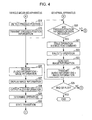
- Fig. 3 and Fig. 4 are flowcharts illustrating operation examples of a system including an operation control apparatus according to the first embodiment.
- the flowchart illustrated in Fig. 3 starts when the vehicle-mounted apparatus 100 and the external apparatus 200 are connected, and the vehicle-mounted apparatus 100 instructs a music play operation in the external apparatus 200 (for example, when an application for playing music is started).
- the function acceptability state managing unit 104 initially sets the play/pause button 11 in a play start acceptable state.
- the image generating unit 205 in the external apparatus 200 first generates initial image information including the play button 13 as one of soft keys (step S1).
- the information transmitting unit 206 transmits the initial image information to the vehicle-mounted apparatus 100 (step S2).
- the information receiving unit 107 receives the initial image information transmitted from the external apparatus 200, and the image output unit 108 displays it on the touch panel 102 (step S3).
- the command issuing unit 103 determines whether the hard key 101 is operated by a user or not (step S4). If it is determined that a user has operated the hard key 101, the command issuing unit 103 issues an operation instruction command corresponding to the operated hard key 101 and supplies it to the information transmitting unit 106 (step S5).
- the command issuing unit 103 issues a play start command or a pause command on the basis of the current function acceptability state managed by the function acceptability state managing unit 104. If the play/pause button 11 is operated in the state where the initial image information is being displayed, the command issuing unit 103 issues a play start command since the function acceptability state managing unit 104 is set in the play start acceptable state.
- the command issuing unit 103 notifies that the play/pause button 11 has been pressed to the function acceptability state managing unit 104.
- the function acceptability state managing unit 104 shifts the play/pause button 11 to a play start acceptable state or a pause acceptable state (step S6). If the play/pause button 11 is operated in the state where the initial image information is being displayed, the function acceptability state managing unit 104 shifts the play/pause button 11 from the play start acceptable state to the pause acceptable state.
- the information transmitting unit 106 transmits the operation instruction command supplied from the command issuing unit 103 to the external apparatus 200 (step S7).
- the information receiving unit 201 determines whether an operation instruction command has been received from the vehicle-mounted apparatus 100 or not (step S8). If the information receiving unit 201 has not received an operation instruction command, the processing by the external apparatus 200 moves to step S20 in Fig. 4 . If the information receiving unit 201 has received an operation instruction command on the other hand, the command notifying unit 202 notifies the operation instruction command to the operation executing unit 204 (step S9).
- the operation executing unit 204 executes the operation (music play or pause operation) according to the operation instruction command (step S10). If the operation executing unit 204 has executed the music play operation, the operation executing unit 204 outputs the audio information generated by the music play to the information transmitting unit 206.
- the image generating unit 205 generates image information to be displayed on the touch panel 102 of the vehicle-mounted apparatus 100 (step S11). In this case, if the operation executing unit 204 has executed the music play operation, the image generating unit 205 generates image information including the pause button 12 as a soft key. If the operation executing unit 204 has executed the music pause operation, the image generating unit 205 generates image information including the play button 13 as a soft key. The image generating unit 205 outputs the generated image information to the information transmitting unit 206.
- the information transmitting unit 206 transmits the audio information supplied from the operation executing unit 204 and image information supplied from the image generating unit 205 to the vehicle-mounted apparatus 100 (step S12).
- the information transmitting unit 206 transmits the audio information and image information to the vehicle-mounted apparatus 100.
- the information transmitting unit 206 transmits only the image information to the vehicle-mounted apparatus 100. The image information is transmitted to the vehicle-mounted apparatus 100 when it is generated by the image generating unit 205.
- step S13 the operation executing unit 204 determines whether the music play has ended or not. If the music play has ended, the processing of the flowchart illustrated in Fig. 3 ends. If the music play has not ended on the other hand, the processing returns to step S8.
- the information transmitting unit 106 transmits the operation instruction command to the external apparatus 200 in step S7 above
- the audio information and image information transmitted from the external apparatus 200 are received by the information receiving unit 107 (step S14) in the vehicle-mounted apparatus 100. While the operation executing unit 204 in the external apparatus 200 is executing a music pause operation, the information receiving unit 107 receives the image information only.
- the image output unit 108 causes the touch panel 102 to display the image information received by the information receiving unit 107 (step S15). If the information receiving unit 107 receives audio information, the audio output unit 109 outputs the audio information to the speaker 110 (step S16). After that, the processing returns to step S4.
- step S4 if it is determined by the command issuing unit 103 that a user has not operated the hard key 101, the pressed position detecting unit 105 determines whether the touch panel 102 has been pressed by a user or not (step S17). If it is determined that the touch panel 102 has not been pressed, the processing returns to step S4. On the other hand, if it is determined that the touch panel 102 has been pressed, the processing by the vehicle-mounted apparatus 100 moves to step S18 in Fig. 4 .
- step S18 the pressed position detecting unit 105 detects the pressed position on the touch panel 102.
- the pressed position detecting unit 105 further converts the detected pressed position information on the touch panel 102 to the pressed position information on an image to be displayed on the touch panel 102.
- the information transmitting unit 106 then transmits the pressed position information detected by the pressed position detecting unit 105 to the external apparatus 200 (step S19).
- the information receiving unit 201 determines whether the pressed position information from the vehicle-mounted apparatus 100 has been received or not (step S20). If the information receiving unit 201 has not received the pressed position information, the processing in the external apparatus 200 returns to step S8 in Fig. 3 . On the other hand, if the information receiving unit 201 has received the pressed position information, the information receiving unit 201 supplies the pressed position information to the command issuing unit 203.
- the command issuing unit 203 issues the operation instruction command corresponding to the pressed position on the touch panel 102 (the pressed position on the image) and notifies it to the operation executing unit 204 (step S21).
- the operation executing unit 204 executes an operation according to the operation instruction command (step S22). If the operation executing unit 204 has executed a music play operation, the operation executing unit 204 outputs the audio information generated by the music play to the information transmitting unit 206.
- the image generating unit 205 generates image information to be displayed on the touch panel 102 of the vehicle-mounted apparatus 100 (step S23).
- the image generating unit 205 When the operation executing unit 204 has executed a music play operation, the image generating unit 205 generates image information including the pause button 12 as a soft key. If the operation executing unit 204 has executed a music pause operation, the image generating unit 205 generates image information including the play button 13 as a soft key.
- the image generating unit 205 outputs the generated image information to the information transmitting unit 206.
- the information transmitting unit 206 transmits the audio information supplied from the operation executing unit 204 and image information supplied from the image generating unit 205 to the vehicle-mounted apparatus 100 (step S24). In this case, if the operation executing unit 204 has executed the music play operation, the information transmitting unit 206 transmits the audio information and image information to the vehicle-mounted apparatus 100. On the other hand, if the operation executing unit 204 has executed the music pause operation, the information transmitting unit 206 transmits only the image information to the vehicle-mounted apparatus 100. The image information is transmitted to the vehicle-mounted apparatus 100 when it is generated by the image generating unit 205.
- step S25 the operation executing unit 204 determines whether the music play has ended or not. If the music play has ended, the processing of the flowchart illustrated in Fig. 4 ends. If the music play has not ended on the other hand, the processing returns to step S8 in Fig. 3 .
- the information transmitting unit 106 transmits the pressed position information to the external apparatus 200 in step S19 above
- the audio information and image information transmitted from the external apparatus 200 are received by the information receiving unit 107 (step S26) in the vehicle-mounted apparatus 100. If the operation executing unit 204 in the external apparatus 200 is executing a music pause operation, the information receiving unit 107 receives the image information only.
- the image output unit 108 causes the touch panel 102 to display the image information received by the information receiving unit 107 (step S27). If the information receiving unit 107 receives audio information the audio output unit 109 outputs the audio information to the speaker 110 (step S28).
- the operation determining unit 111 determines whether the press on the touch panel 102 has been an operation on the pause button 12 or play button 13 (step S29). In other words, if the information receiving unit 107 has changed from an audio information receiving state to a non-receiving state, the operation determining unit 111 determines that the press on the touch panel 102 has been an operation on the pause button 12. On the other hand, if the information receiving unit 107 has changed from the audio information non-receiving state to the receiving state, the operation determining unit 111 determines that the press on the touch panel 102 has been an operation on the play button 13.
- the state transition unit 112 shifts the function acceptability state of the play/pause button 11 (step S30). In other words, if it is determined by the operation determining unit 111 that the press on the touch panel 102 has been an operation on the pause button 12, the state transition unit 112 shifts the function acceptability state of the play/pause button 11 managed by the function acceptability state managing unit 104 from a pause acceptable state to a play start acceptable state.
- the state transition unit 112 shifts the function acceptability state of the play/pause button 11 managed function acceptability state managing unit 104 from the play start acceptable state to the pause acceptable state. After that, the processing in the vehicle-mounted apparatus 100 returns to step S4 in Fig. 3 .
- whether the press on the touch panel 102 has been an operation on the pause button 12 or the play button 13 as a soft key is determined on the basis of the change of the output state of audio information transmitted from the external apparatus 200 to the vehicle-mounted apparatus 100 in response to the press on the touch panel 102 in the state where soft keys are displayed on the basis of image information transmitted from the external apparatus 200 to the vehicle-mounted apparatus 100. If it is determined that the operation corresponds to an operation on the pause button 12 or play button 13, the function acceptability state of the play/pause button 11 of the hard key 101 is shifted to the play start acceptable state or pause acceptable state.
- the operation determining unit 111 when a soft key (pause button 12 or play button 13) corresponding to the play/pause button 11 is pressed, the fact is detected by the operation determining unit 111, and the function acceptability state of the play/pause button 11 is shifted by the state transition unit 112, even without actually operating one hard key 101 (play/pause button 11) to which a plurality of functions such as music play start and pause functions are assigned.
- the external apparatus 200 may be caused to execute a correct operation in either case where a hard key (play/pause button 11) is operated or a soft key (pause button 12 or play button 13) is operated.
- FIG. 5 is a block diagram illustrating functional component examples of an entire system including an operation control apparatus according to a second embodiment.
- like reference numerals indicate parts having similar functions to those in Fig. 1 , and repetitive descriptions will be omitted.
- the vehicle-mounted apparatus 100 includes an operation determining unit 121 instead of the operation determining unit 111.
- the operation determining unit 121 determines whether the press on the touch panel 102 has been an operation on the pause button 12 or play button 13.
- the operation determining unit 121 image-recognizes a soft key included in image information transmitted from the external apparatus 200 to determine whether the press on the touch panel 102 has been an operation on the pause button 12 or play button 13. In this case, if the soft key included in the image information is image-recognized as the pause button 12, the operation determining unit 121 determines that the press on the touch panel 102 has been an operation on the play button 13. On the other hand, if it is image-recognized that the soft key included in the image information is the play button 13, the operation determining unit 121 determines that the press on the touch panel 102 has been an operation on the pause button 12.
- the operation executing unit 204 executes a music play operation
- the image generating unit 205 generates image information including the pause button 12.
- the image information is transmitted from the external apparatus 200 to the vehicle-mounted apparatus 100.
- the operation determining unit 121 determines that the soft key included in the image information is the pause button 12 by the image recognition
- the press on the touch panel 102 determines that the play button 13 has been operated.
- the operation executing unit 204 executes a music pause operation, and the image generating unit 205 generates image information including the play button 13.
- the image information is then transmitted from the external apparatus 200 to the vehicle-mounted apparatus 100. Therefore, if the operation determining unit 121 determines that the soft key included in the image information is the play button 13 by image recognition, it may be determined that press on the touch panel 102 has been an operation on the pause button 12.
- the subject of the image-recognition according to the second embodiment is not limited to a soft key within image information.
- the operation determining unit 121 may image-recognize time information included in image information transmitted from the external apparatus 200 to determine whether the time information has changed or not and thus determine whether the press on the touch panel 102 has been an operation on the pause button 12 or play button 13.
- the image generating unit 205 in the external apparatus 200 generates not only the time when an operation instruction command or pressed position information has been transmitted from the vehicle-mounted apparatus 100 (or the time when the execution state of the operation executing unit 204 has changed) but also image information as required and supplies them to the information transmitting unit 206.
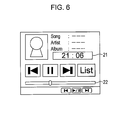
- Fig. 6 illustrates a variation example of image information to undergo the image recognition according to the second embodiment.
- counter information 21 describing a music play time or time information with a time bar 22 may be included in the image information.
- the time information is always changing.
- the operation determining unit 121 may determine whether the time information is changing or not by performing image recognition to determine whether the press on the touch panel 102 has been an operation on the pause button 12 or play button 13.
- the operation determining unit 121 may determine that the time information included in the image information has changed by performing image recognition to determine whether the press on the touch panel 102 has been an operation on the play button 13 or not.
- the operation executing unit 204 executes a pause operation, and the image generating unit 205 generates image information including the time information.
- the image information is transmitted from the external apparatus 200 to the vehicle-mounted apparatus 100.
- the time information is fixed without any changes.
- the operation determining unit 121 may determine that the time information included in the image information has not changed by performing image recognition, it may be determined that the press on the touch panel 102 has been an operation on the pause button 12.
- the image generating unit 205 may be inhibited to generate image information after the image generating unit 205 generates image information including a soft key updated from the pause button 12 to the play button 13 until the next music play operation is restarted.
- the information receiving unit 107 receives image information (including updated time information) as required.
- the information receiving unit 107 only receives image information when the soft key is updated. Accordingly, the operation determining unit 121 may check whether the information receiving unit 107 receives image information as required or not to determine whether the press on the touch panel 102 has been an operation on the pause button 12 or play button 13.
- the touch panel 102 displaying a soft key on the basis of image information transmitted from the external apparatus 200 to the vehicle-mounted apparatus 100 is pressed, whether the press on the touch panel 102 has been an operation on the pause button 12 or play button 13 as a soft key may be determined on the basis of the image information transmitted from the external apparatus 200 to the vehicle-mounted apparatus 100 in accordance with the press. If it is determined that the press corresponds to an operation on the pause button 12 or play button 13, the function acceptability state of the play/pause button 11 that is the hard key 101 is shifted from a play start acceptable state to a pause acceptable state.
- the operation determining unit 121 when a soft key (pause button 12 or play button 13) corresponding to the play/pause button 11 is pressed, it is detected by the operation determining unit 121, and the function acceptability state of the play/pause button 11 is shifted by the state transition unit 112 even though one hard key 101 (play/pause button 11) to which a plurality of functions such as music play start and pause functions are assigned is not actually operated.
- a soft key is displayed on the basis of the image information transmitted from the external apparatus 200 to the vehicle-mounted apparatus 100.
- the soft key corresponding to the play/pause button 11 has been pressed, and the function acceptability state of the play/pause button 11 may be shifted to a correct state even when it is difficult to immediately grasp whether a soft key has been operated or not from the pressed position on the touch panel 102.
- This allows the external apparatus 200 to implement a correct operation in either case where a hard key (play/pause button 11) is operated or a soft key (pause button 12 or play button 13) is operated.
- FIG. 7 is a block diagram illustrating functional component examples of an entire system including an operation control apparatus according to a third embodiment of the present invention.
- like reference numerals indicate parts having similar functions to those in Fig. 1 , and repetitive descriptions will be omitted.
- the external apparatus 200 further includes operational state information generating unit 207.
- the vehicle-mounted apparatus 100 includes an operation determining unit 131 instead of the operation determining unit 111.
- the operational state information generating unit 207 generates operational state information describing an operational state (whether a music play operation is being executed or in pause) of the operation executing unit 204 and supplies it to the information transmitting unit 206.
- the information transmitting unit 206 transmits to the vehicle-mounted apparatus 100 the operational state information supplied from the operational state information generating unit 207 in addition to audio information supplied from the operation executing unit 204 and image information supplied from the image generating unit 205.
- the operation determining unit 131 in the vehicle-mounted apparatus 100 determines whether the press on the touch panel 102 has been an operation on a pause button 12 or a play button 13.
- the operation determining unit 131 determines that the press on the touch panel 102 has been an operation on the play button 13. On the other hand, if the operational state information transmitted from the external apparatus 200 describes that music is in pause, the operation determining unit 131 determines that the press on the touch panel 102 has been an operation on the pause button 12.
- the press on the touch panel 102 may determine whether the press has been an operation on the pause button 12 or play button 13 as a soft key on the basis of the operational state information transmitted from the external apparatus 200 to the vehicle-mounted apparatus 100 in accordance with the press. If it is determined that the press corresponds to an operation on the pause button 12 or play button 13, the function acceptability state of the play/pause button 11 that is the hard key 101 is shifted from a play start acceptable state to a pause acceptable state.
- the third embodiment configured as described above, like the first embodiment, when a soft key (pause button 12 or play button 13) corresponding to the play/pause button 11 is pressed, it is detected by the operation determining unit 131, and the function acceptability state of the play/pause button 11 is shifted by the state transition unit 112 even though one hard key 101 (play/pause button 11) to which a plurality of functions such as music play start and pause functions are assigned is not actually operated.
- a soft key is displayed on the basis of the image information transmitted from the external apparatus 200 to the vehicle-mounted apparatus 100.
- the soft key corresponding to the play/pause button 11 has been pressed, and the function acceptability state of the play/pause button 11 may be shifted to a correct state even when it is difficult to immediately grasp whether a soft key has been operated or not from the pressed position on the touch panel 102.
- This allows the external apparatus 200 to implement a correct operation in either case where a hard key (play/pause button 11) is operated or a soft key (pause button 12 or play button 13) is operated.
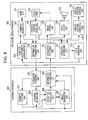
- FIG. 8 is a block diagram illustrating functional component examples of an entire system including an operation control apparatus according to a fourth embodiment of the present invention.
- like reference numerals indicate parts having similar functions to those in Fig. 1 , and repetitive descriptions will be omitted.
- the vehicle-mounted apparatus 100 includes an operation determining unit 141 instead of the operation determining unit 111.
- the vehicle-mounted apparatus 100 further includes a display position computing unit 142 and a display position storage unit 143.
- the external apparatus 200 includes an image generating unit 215 instead of the image generating unit 205.
- the image generating unit 215 generates image information to be displayed on the touch panel 102 of the vehicle-mounted apparatus 100 and supplies it to the information transmitting unit 206.
- the image generating unit 215 outputs a soft key included in the generated image information and soft key information describing its position to a command issuing unit 203 and outputs the soft key positional information to the information transmitting unit 206.
- the information transmitting unit 206 transmits the audio information supplied from the operation executing unit 204 and the image information and soft key positional information supplied from the image generating unit 205 to the vehicle-mounted apparatus 100.
- An information receiving unit 107 in the vehicle-mounted apparatus 100 receives the audio information and image information transmitted from the external apparatus 200 and soft key positional information.
- a display position computing unit 142 converts the soft key positional information (coordinate information) received by the information receiving unit 107 to display positional information (coordinate information) describing the position on the touch panel 102 displaying a soft key for a pause button 12 or play button 13 and stores it in the display position storage unit 143.
- the display position computing unit 142 pre-holds a correspondence relationship between positional information (coordinate information) on an image and positional information (coordinate information) on the touch panel 102 and, on the basis of the information, computes from the soft key positional information to display positional information.
- the image output unit 108 pre-holds information describing a correspondence relationship between positional information (coordinate information) on an image and positional information (coordinate information) on the touch panel 102.
- the display position computing unit 142 may compute the display positional information.
- the operation determining unit 141 determines whether the press on the touch panel 102 has been an operation on the pause button 12 or play button 13.
- the operation determining unit 141 determines that the press on the touch panel 102 has been an operation on the pause button 12 or play button 13.
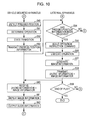
- Fig. 9 and Fig. 10 are flowcharts illustrating operation examples of a system including an operation control apparatus according to the fourth embodiment.
- the flowchart illustrated in Fig. 9 starts when the vehicle-mounted apparatus 100 and the external apparatus 200 are connected, and the vehicle-mounted apparatus 100 instructs a music play operation in the external apparatus 200 (for example, when an application for playing music is started).
- the function acceptability state managing unit 104 initially sets the play/pause button 11 in a play start acceptable state.
- the image generating unit 215 in the external apparatus 200 first generates initial image information including the play button 13 as one of soft keys and soft key position information (step S31).
- the information transmitting unit 206 transmits the initial image information and soft key position information to the vehicle-mounted apparatus 100 (step S32).
- the information receiving unit 107 receives the initial image information transmitted from the external apparatus 200, and the image output unit 108 displays it on the touch panel 102 (step S33).
- the display position computing unit 142 converts the soft key positional information received by the information receiving unit 107 to display positional information describing the position on the touch panel 102 displaying a soft key for the pause button 12 or play button 13 (step S34) and stores the display positional information in the display position storage unit 143 (step S35).
- the command issuing unit 103 determines whether the hard key 101 is operated by a user or not (step S36). If it is determined that a user has operated the hard key 101, the command issuing unit 103 issues an operation instruction command corresponding to the operated hard key 101 and supplies it to the information transmitting unit 106 (step S37).
- the command issuing unit 103 issues a play start command or a pause command on the basis of the current function acceptability state managed by the function acceptability state managing unit 104. If the play/pause button 11 is operated in the state where the initial image information is being displayed, the command issuing unit 103 issues a play start command since the function acceptability state managing unit 104 is set in the play start acceptable state.
- the command issuing unit 103 notifies that the play/pause button 11 has been pressed to the function acceptability state managing unit 104.
- the function acceptability state managing unit 104 shifts the play/pause button 11 to a play start acceptable state or a pause acceptable state (step S38). If the play/pause button 11 is operated in the state where the initial image information is being displayed, the function acceptability state managing unit 104 shifts the play/pause button 11 from the play start acceptable state to the pause acceptable state.
- the information transmitting unit 106 transmits the operation instruction command supplied from the command issuing unit 103 to the external apparatus 200 (step S39).
- the information receiving unit 201 determines whether an operation instruction command has been received from the vehicle-mounted apparatus 100 or not (step S40). If the information receiving unit 201 has not received an operation instruction command, the processing by the external apparatus 200 moves to step S54 in Fig. 10 . If the information receiving unit 201 has received an operation instruction command on the other hand, the command notifying unit 202 notifies the operation instruction command to the operation executing unit 204 (step S41).
- the operation executing unit 204 executes the operation (music play or pause operation) according to the operation instruction command (step S42). If the operation executing unit 204 has executed the music play operation, the operation executing unit 204 outputs the audio information generated by the music play to the information transmitting unit 206.
- the image generating unit 215 generates image information to be displayed on the touch panel 102 of the vehicle-mounted apparatus 100 (step S41). In this case, if the operation executing unit 204 has executed the music play operation, the image generating unit 215 generates image information including the pause button 12 as a soft key. If the operation executing unit 204 has executed the music pause operation, the image generating unit 215 generates image information including the play button 13 as a soft key. The image generating unit 215 outputs the generated image information to the information transmitting unit 206.
- the information transmitting unit 206 transmits the audio information supplied from the operation executing unit 204 and image information supplied from the image generating unit 215 to the vehicle-mounted apparatus 100 (step S44). In this case, if the operation executing unit 204 has executed the music play operation, the information transmitting unit 206 transmits the audio information and image information to the vehicle-mounted apparatus 100. On the other hand, if the operation executing unit 204 has executed the music pause operation, the information transmitting unit 206 transmits only the image information to the vehicle-mounted apparatus 100. The image information is transmitted to the vehicle-mounted apparatus 100 when it is generated by the image generating unit 215.
- step S45 the operation executing unit 204 determines whether the music play has ended or not (step S45). If the music play has ended, the processing of the flowchart illustrated in Fig. 9 ends. If the music play has not ended on the other hand, the processing in the external apparatus 200 returns to step S8.
- the information transmitting unit 106 transmits the operation instruction command to the external apparatus 200 in step S39 above
- the audio information and image information transmitted from the external apparatus 200 are received by the information receiving unit 107 (step S46) in the vehicle-mounted apparatus 100. While the operation executing unit 204 in the external apparatus 200 is executing a music pause operation, the information receiving unit 107 receives the image information only.
- the image output unit 108 causes the touch panel 102 to display the image information received by the information receiving unit 107 (step S47). If the information receiving unit 107 receives audio information, the audio output unit 109 outputs the audio information to the speaker 110 (step S48). After that, the processing in the vehicle-mounted apparatus 100 returns to step S36.
- step S36 if it is determined by the command issuing unit 103 that a user has not operated the hard key 101, the pressed position detecting unit 105 determines whether the touch panel 102 has been pressed by a user or not (step S49). If it is determined that the touch panel 102 has not been pressed, the processing in the vehicle-mounted apparatus 100 returns to step S36. On the other hand, if it is determined that the touch panel 102 has been pressed, the processing in the vehicle-mounted apparatus 100 moves to step S50 in Fig. 10 .
- step S50 the pressed position detecting unit 105 detects the pressed position on the touch panel 102.
- the pressed position detecting unit 105 further converts the detected pressed position information on the touch panel 102 to the pressed position information on an image to be displayed on the touch panel 102.
- the pressed position detecting unit 105 then supplies to the thus generated pressed position information on the image to the information transmitting unit 106 and supplies the pressed position information on the touch panel 20 to the operation determining unit 141.
- the operation determining unit 141 determines whether the press on the touch panel 102 has been an operation on the pause button 12 or play button 13 (step S51).
- the state transition unit 112 shifts the function acceptability state of the play/pause button 11 (step S52). In other words, if it is determined by the operation determining unit 141 that the press on the touch panel 102 has been an operation on the pause button 12, the state transition unit 112 shifts the function acceptability state of the play/pause button 11 managed by the function acceptability state managing unit 104 from a pause acceptable state to a play start acceptable state.
- the state transition unit 112 shifts the function acceptability state of the play/pause button 11 managed by the function acceptability state managing unit 104 from the play start acceptable state to the pause acceptable state.
- the information transmitting unit 106 transmits the pressed position information detected by the pressed position detecting unit 105 to the external apparatus 200 (step S53).
- the information receiving unit 201 determines whether the pressed position information from the vehicle-mounted apparatus 100 has been received or not (step S54). If the information receiving unit 201 has not received the pressed position information, the processing in the external apparatus 200 returns to step S40 in Fig. 9 . On the other hand, if the information receiving unit 201 has received the pressed position information, the information receiving unit 201 supplies the pressed position information to the command issuing unit 203.
- the command issuing unit 203 issues the operation instruction command corresponding to the pressed position on the touch panel 102 (the pressed position on the image) and notifies it to the operation executing unit 204 (step S55).
- the operation executing unit 204 executes an operation according to the operation instruction command (step S56). If the operation executing unit 204 has executed a music play operation, the operation executing unit 204 outputs the audio information generated by the music play to the information transmitting unit 206.
- the image generating unit 215 generates image information to be displayed on the touch panel 102 of the vehicle-mounted apparatus 100 (step S57).
- the image generating unit 215 When the operation executing unit 204 has executed a music play operation, the image generating unit 215 generates image information including the pause button 12 as a soft key. If the operation executing unit 204 has executed a music pause operation, the image generating unit 215 generates image information including the play button 13 as a soft key.
- the image generating unit 215 outputs the generated image information to the information transmitting unit 206.
- the information transmitting unit 206 transmits the audio information supplied from the operation executing unit 204 and image information supplied from the image generating unit 215 to the vehicle-mounted apparatus 100 (step S58). In this case, if the operation executing unit 204 has executed the music play operation, the information transmitting unit 206 transmits the audio information and image information to the vehicle-mounted apparatus 100. On the other hand, if the operation executing unit 204 has executed the music pause operation, the information transmitting unit 206 transmits only the image information to the vehicle-mounted apparatus 100. The image information is transmitted to the vehicle-mounted apparatus 100 when it is generated by the image generating unit 215.
- step S59 the operation executing unit 204 determines whether the music play has ended or not (step S59). If the music play has ended, the processing of the flowchart illustrated in Fig. 10 ends. If the music play has not ended on the other hand, the processing in the external apparatus 200 returns to step S40 in Fig. 9 .
- the information transmitting unit 106 transmits the pressed position information to the external apparatus 200 in step S53 above, the audio information and image information transmitted from the external apparatus 200 are received by the information receiving unit 107 (step S60) in the vehicle-mounted apparatus 100. If the operation executing unit 204 in the external apparatus 200 is executing a music pause operation, the information receiving unit 107 receives the image information only.
- the image output unit 108 causes the touch panel 102 to display the image information received by the information receiving unit 107 (step S61). If the information receiving unit 107 receives audio information the audio output unit 109 outputs the audio information to the speaker 110 (step S62).
- the image information and soft key positional information are transmitted to the vehicle-mounted apparatus 100 and, in the vehicle-mounted apparatus 100, are converted to the display positional information on the touch panel 102, which is then stored in the display position storage unit 143. This is because the pause button 12 and play button 13 are displayed alternately at an identical position within the image information and the soft key positional information may be fixed.
- the image generating unit 215 also transmits soft key positional information to the vehicle-mounted apparatus 100 every time image information is generated.
- the display positional information generated from the soft key positional information may be stored in the display position storage unit 143 each time.
- display positional information describing the position where the pause button 12 or play button 13 as a soft key is displayed on the touch panel 102 is pre-stored in the display position storage unit 143 in the vehicle-mounted apparatus 100. If the pressed position on the touch panel 102 detected by the pressed position detecting unit 105 corresponds to the display position of the soft key on the touch panel 102, which is stored in the display position storage unit 143, it is determined that the press on the touch panel 102 has been an operation on the pause button 12 or play button 13. If it is determined that the operation corresponds to an operation on the pause button 12 or play button 13, the function acceptability state of the play/pause button 11 is shifted to the play start acceptable state or pause acceptable state.
- the fourth embodiment configured as described above, like the first embodiment, when a soft key (pause button 12 or play button 13) corresponding to the play/pause button 11 is pressed, the fact is detected by the operation determining unit 141, and the function acceptability state of the play/pause button 11 is shifted by the state transition unit 112, even without actually operating one hard key 101 (play/pause button 11) to which a plurality of functions such as music play start and pause functions are assigned.
- the external apparatus 200 may be caused to execute a correct operation in either case where a hard key (play/pause button 11) is operated or a soft key (pause button 12 or play button 13) is operated.
- image information is generated, and soft key positional information describing the position of the soft key included in the image information is then transmitted to the vehicle-mounted apparatus 100.
- the soft key positional information is converted to display positional information on the touch panel 102 and is stored in the display position storage unit 143. This allows the external apparatus 200 connected to the vehicle-mounted apparatus 100 to correctly detect that the soft key has been operated even when the position of the soft key (pause button 12 or play button 13) arranged within image information is different.
- the play/pause button 11 is an example of the one hard key 101 to which a plurality of functions are assigned, the present invention is not limited thereto.
- the present invention is applicable, for example, in a case where one mute button is used for switching a mute function on and off or a case where one power button is used to switch a power supply on and off.
- the present invention is applicable in a case where one mute button is provided as the hard key 101, and a mute ON button and a mute OFF button as soft keys are alternately displayed.
- the operation determining unit 111 determines that the press on the touch panel 102 has been an operation on the mute ON button if audio information has changed from an output state to a stop state.
- the press on the touch panel 102 is determined as an operation on the mute OFF button if the audio information has changed from the stop state to the output state.
- the present invention is not limited thereto.
- the present invention is also applicable to a case where a plurality of functions to be used in a plurality of applications are assigned to one hard key 101.
- a music play function and a present location display function on a navigation map may be assigned to one hard key 101.
- the present invention is applicable thereto.
Landscapes
- Engineering & Computer Science (AREA)
- Multimedia (AREA)
- Signal Processing (AREA)
- Human Computer Interaction (AREA)
- Theoretical Computer Science (AREA)
- General Engineering & Computer Science (AREA)
- Chemical & Material Sciences (AREA)
- Combustion & Propulsion (AREA)
- Transportation (AREA)
- Mechanical Engineering (AREA)
- Physics & Mathematics (AREA)
- General Physics & Mathematics (AREA)
- Databases & Information Systems (AREA)
- User Interface Of Digital Computer (AREA)
- Position Input By Displaying (AREA)
- Input From Keyboards Or The Like (AREA)
- Fittings On The Vehicle Exterior For Carrying Loads, And Devices For Holding Or Mounting Articles (AREA)
Abstract
Description
- The present invention relates to operation control apparatuses and operation control methods for an external apparatus connected to a vehicle-mounted apparatus. It particularly relates to an art of controlling an operation on an external apparatus connected to a vehicle-mounted apparatus in accordance with an operation on a soft key displayed on a touch panel of the vehicle-mounted apparatus or a hard key provided in the vehicle-mounted apparatus.
- In recent years, technologies have been proposed which allows a function of an external apparatus to be used through a vehicle-mounted apparatus by connecting the external apparatus to the vehicle-mounted apparatus. For example, a technology has been proposed which allows a tune stored in a portable digital music player as an external apparatus to be played through a vehicle-mounted apparatus connected to the portable digital music player. Another technology has been proposed which connects a mobile terminal (what-is-called a smart phone) having both of functions of a cellular phone and functions of a portable information terminal (PDA) to a vehicle-mounted apparatus to allow a function of an application installed in the smart phone to be used through the vehicle-mounted apparatus.
- When a function of an external apparatus is used through a vehicle-mounted apparatus in this way, an operation in the external apparatus may be controlled from the vehicle-mounted apparatus. For example, in order to play a tune stored in an external apparatus through a vehicle-mounted apparatus, an operation for playing, starting or stopping or pausing the music may be controlled from the vehicle-mounted apparatus side. An instruction for the operation control may be issued by operating a hard key (such as a play button, a stop button, and a pause button) provided in the vehicle-mounted apparatus.
- For example, when a play button in a vehicle-mounted apparatus is pressed, the vehicle-mounted apparatus transmits a play start command to an external apparatus. On the basis of the play start command transmitted from the vehicle-mounted apparatus, the external apparatus performs an operation for playing music. The reproduced sound data of the tune is transmitted to the vehicle-mounted apparatus, and the reproduced sound is output from a speaker of the vehicle-mounted apparatus. When a pause button in the vehicle-mounted apparatus is pressed during a music play operation, the vehicle-mounted apparatus transmits a pause command to the external apparatus. On the basis of the pause command transmitted from the vehicle-mounted apparatus, the external apparatus performs a music pause operation.
- When soft keys such as play start, play stop, and pause are displayed on a display apparatus with a touch panel of a vehicle-mounted apparatus (hereinafter, simply called a touch panel), an operation control over an external apparatus may be instructed from the vehicle-mounted apparatus side by operating either hard key or soft key.
JP 2007-052643 A - In order to display soft keys on a touch panel of a vehicle-mounted apparatus, image information including the soft keys may be transmitted from an external apparatus to the vehicle-mounted apparatus to display the image information on the touch panel. According to this method, the vehicle-mounted apparatus may not grasp the positions of soft keys on the touch panel. In other words, when one of soft keys displayed on a touch panel is pressed, the vehicle-mounted apparatus may locate the pressed position but may not identify which soft key has been pressed. For that, the vehicle-mounted apparatus transmits pressed position information describing the pressed position to the external apparatus. The external apparatus identifies which soft key has been pressed on the basis of the pressed position information transmitted from the vehicle-mounted apparatus and performs an operation corresponding to the identified soft key.
- By the way, in order to save the space where hard keys are disposed, one button (play/pause button) may often be used as both of a play start button and a pause button in a vehicle-mounted apparatus. In this case, every time the play/pause button is pressed, play start and pause operations are performed alternately. On the basis of the change of the execution state, which operation of the operations associated with the play/pause button is acceptable is changed alternately.
- In other words, in an initial state, the play/pause button in the vehicle-mounted apparatus may accept a play start command. When the play/pause button is pressed in this state, music is started to play in the external apparatus, and the play/pause button shifts to a state in which a pause command is acceptable. When the play/pause button is pressed in this state, the play of music in the external apparatus is paused. The play/pause button shifts to a play start acceptable state. After this, every time the play/pause button is pressed, these operations are repeated.
- Regarding soft keys displayed on a touch panel of a vehicle-mounted apparatus, the displays of a play button and a pause button may be switched alternately at one position in many cases in order to save the display space of the soft keys. In other words, in an initial state, a play button is displayed. When the play button is pressed, music is started to play, and a pause button is displayed instead of the play button. When the pause button is pressed in this state, the play of music is paused in the external apparatus, and the play button is displayed instead of the pause button. After this, every time the play button and pause button are pressed, these operations are repeated.
- As described above, when soft keys are displayed on a touch panel of a vehicle-mounted apparatus, an operation control over an external apparatus may be instructed from the vehicle-mounted apparatus side by operating either hard key or soft key. However, when image information including soft keys is transmitted from the external apparatus to the vehicle-mounted apparatus including a play/pause button as hard keys to display the soft keys on the touch panel, a malfunction, as will be described below, may occur.
-
Figs. 11A to 11C are diagrams for explaining a conventional malfunction.Fig. 11A illustrates a state where music is being played as a result of press of a play/pause button 11 in a vehicle-mounted apparatus. In this case, the play/pause button 11 as a hard key is in a pause acceptable state. Apause button 12 is displayed as one of soft keys on the touch panel. In other words, when an external apparatus receives a play start command from a vehicle-mounted apparatus, an external apparatus generates image information including thepause button 12. As a result of transmission of the image information from the external apparatus to the vehicle-mounted apparatus, thepause button 12 is displayed. - When the
pause button 12 of the soft keys is pressed in this state, the vehicle-mounted apparatus transmits pressed position information describing the pressed position to the external apparatus. The external apparatus determines that thepause button 12 has been pressed on the basis of the pressed position information transmitted from the vehicle-mounted apparatus and executes a pause operation. The external apparatus further generates image information including aplay button 13 as one of the soft keys and transmits the image information to the vehicle-mounted apparatus.Fig. 11B illustrates a state where the image information transmitted from the external apparatus is displayed on the touch panel of the vehicle-mounted apparatus. In other words, the touch panel displays theplay button 13 as one of the soft keys instead of thepause button 12. - While music is in pause as illustrated in
Fig. 11B , theplay button 13 is properly displayed as a soft key while the play/pause button 11 as a hard key still has the pause acceptable state. Even when thepause button 12 on the touch panel is pressed in the state inFig. 11A , the vehicle-mounted apparatus is only allowed to grasp the pressed position but is not allowed to securely determine that thepause button 12 has been pressed. - Therefore, when the play/
pause button 11 is pressed in the pause state AS illustrated inFig. 11B , a pause command is transmitted from the vehicle-mounted apparatus to the external apparatus though it has already been in the pause state. In this case, an error occurs that the operational state does not change even though the play/pause button 11 is pressed. In other words, even though a user presses the play/pause button 11 to restart playing music, music is not started to play by keeping the pause state and the display of the soft key does not change with theplay button 13 still displayed, as illustrated inFig. 11C - This problem is not limited to the case where one play/
pause button 11 is used for switching between a play start function and a pause function. For example, the same problem may occur in cases where a plurality of functions are assigned to one hard key, and the hard key is used to switch between the corresponding operations every time the hard key is pressed, such as a case where one mute button is used for switching a mute function on and off or a case where one power button is used to switch a power supply on and off. - Thus, it may be one object of the present invention to solve the above discussed problem. In particular, it may be an object of the present invention to provide, in a vehicle-mounted apparatus, in which a plurality of functions are assigned to one hard key and in which soft keys corresponding to the plurality of functions are alternately switched on the basis of image information transmitted from an external apparatus and displayed on a touch panel thereof, an operation control apparatus that causes the external apparatus to operate properly in both cases where the hard key is operated and at least one of the soft keys is operated.
- The object is solved by the features of the independent claims. Further embodiments and developments are defined in the respective dependent claims.
- According to the an basic aspect of the present invention, when a touch panel displaying soft keys on the basis of image information transmitted from an external apparatus to a vehicle-mounted apparatus is pressed, it is determined, whether the press on the touch panel has been an operation on a soft key for designating one of a plurality of functions assigned to one hard key or not. If it is determined that the operation corresponds to an operation on the soft key, a function acceptability state of the one hard key is shifted.
- Thus, even when one hard key assigned to a plurality of functions is not actually operated but when a soft key corresponding to the one hard key is pressed, it is detected by a correspondingly configured operation determining unit. Accordingly, a function acceptability state of the one hard key can be shifted by a correspondingly configured state transition unit.
- Thus, it may be securely detected that a soft key corresponding to the one hard key is pressed, and the function acceptability state of the one hard key may be shifted to a proper state. Whether a soft key has been operated or not can be immediately grasped from a pressed position on a touch panel because soft keys are displayed thereon on the basis of image information from an external apparatus to the vehicle-mounted apparatus. As a result, the external apparatus performs a proper operation in either case where a hard key is operated or a soft key is operated.
-
-
Fig. 1 is a block diagram illustrating a functional components example of an entire system including an operation control apparatus according to a first embodiment; -
Figs. 2A to 2C illustrate transitions of a display state of a soft key and a function acceptability state of a hard key according to the first embodiment; -
Fig. 3 is a flowchart illustrating an operation example of a system including an operation control apparatus according to the first embodiment; -
Fig. 4 is a flowchart illustrating an operation example of a system including an operation control apparatus according to the first embodiment; -
Fig. 5 is a block diagram illustrating functional component examples of an entire system including an operation control apparatus according to a second embodiment; -
Fig. 6 illustrates a variation example of image information to undergo an image recognition according to the second embodiment; -
Fig. 7 is a block diagram illustrating functional component examples of an entire system including an operation control apparatus according to a third embodiment; -
Fig. 8 is a block diagram illustrating functional component examples of an entire system including an operation control apparatus according to a fourth embodiment; -
Fig. 9 is a flowchart illustrating an operation example of a system including an operation control apparatus according to the fourth embodiment; -
Fig. 10 is a flowchart illustrating an operation example of a system including an operation control apparatus according to the fourth embodiment; and -
Figs. 11A to 11C are diagrams for explaining a conventional malfunction and illustrate transitions of a display state of a soft key and a function acceptability state of a hard key. - Embodiments of the present invention will be described below with reference to the attached drawings.
Fig. 1 is a block diagram illustrating a functional components example of an entire system including an operation control apparatus according to a first embodiment. The system includes a vehicle-mountedapparatus 100 and anexternal apparatus 200 which are connected in a wired or wireless manner. Theexternal apparatus 200 may be a smart phone having a music play function, for example. - The vehicle-mounted
apparatus 100 includeshard keys 101 and atouch panel 102. One of thehard keys 101 may be a play/pause button 11 for instructing music play start and pause operations alternately. In other words, a plurality of functions such as play start and pause functions are assigned to one play/pause button 11. Thehard keys 101 may include a play stop button and a skip button in addition to the play/pause button 11. The play/pause button 11 will be described mainly according to the first embodiment. - The
touch panel 102 is configured to display a soft key on the basis of image information transmitted from theexternal apparatus 200. The soft key may include apause button 12 and aplay button 13. Every time one of those buttons is pressed, the displays of the buttons are switched alternately. Other buttons such as a play stop button and a skip button may be provided as soft keys. However, thepause button 12 andplay button 13 will be described mainly according to this embodiment. - The vehicle-mounted
apparatus 100 includes functional components of acommand issuing unit 103, a function acceptabilitystate managing unit 104, a pressedposition detecting unit 105, aninformation transmitting unit 106, aninformation receiving unit 107, animage output unit 108, anaudio output unit 109, anoperation determining unit 111 and astate transition unit 112. These functional components are provided actually with a CPU or MPU, a RAM, a ROM and so on in a computer and may be implemented by manipulating a program stored in the RAM or ROM. - The
external apparatus 200 includes functional components of aninformation receiving unit 201, acommand notifying unit 202, acommand issuing unit 203, anoperation executing unit 204, animage generating unit 205 and aninformation transmitting unit 206. These functional components, too, are provided actually with a CPU or MPU, a RAM, a ROM and so on in a computer and may be implemented by manipulating a program stored in the RAM or ROM. - A recording medium to store the program may be a CD-ROM, a flexible disk, a hard disk, a magnetic tape, an optical disk, a magneto-optical disk, a DVD, a non-volatile memory card or the like. Alternatively, the program may be downloaded to the vehicle-mounted
apparatus 100 and/or theexternal apparatus 200 over a network such as the Internet. - An operation control apparatus according to this embodiment is provided in the vehicle-mounted
apparatus 100 and controls an operation by theexternal apparatus 200 in accordance with an operation on one of thehard keys 101 or the soft keys on thetouch panel 102. The operation control apparatus of this embodiment includes theinformation transmitting unit 106,information receiving unit 107,operation determining unit 111 andstate transition unit 112 of the functional components of the vehicle-mountedapparatus 100 illustrated inFig. 1 . - The
command issuing unit 103 in the vehicle-mountedapparatus 100 determines which hard key 101 has been operated by a user and issues an operation instruction command corresponding to the operated hard key 101. For example, when a user operates the play/pause button 11, either play start command or pause command is issued. Which command is to be issued depends on the current function acceptability state managed by the function acceptabilitystate managing unit 104. - The function acceptability
state managing unit 104 initially sets the play/pause button 11 in a play start acceptable state. When the play/pause button 11 is pressed in this state, thecommand issuing unit 103 issues a play start command on the basis of the current function acceptability state managed by the function acceptabilitystate managing unit 104. In this case, the function acceptabilitystate managing unit 104 receives a notification that the play/pause button 11 has been pressed from thecommand issuing unit 103 and shifts the play/pause button 11 to a pause acceptable state. - When the play/
pause button 11 is further pressed in this state, thecommand issuing unit 103 issues a pause command on the basis of the current function acceptability state managed by the function acceptabilitystate managing unit 104. In this case, the function acceptabilitystate managing unit 104 receives a notification that the play/pause button 11 has been pressed from thecommand issuing unit 103 and shifts the play/pause button 11 to the play start acceptable state. - The pressed
position detecting unit 105 detects the pressed position on thetouch panel 102 when thetouch panel 102 is pressed. The pressedposition detecting unit 105 further converts the information on the detected pressed position on thetouch panel 102 to pressed position information describing which position has been pressed on the image displayed on thetouch panel 102. The pressedposition detecting unit 105 pre-holds information describing a correspondence relationship between positional information (coordinate information) on thetouch panel 102 and positional information (coordinate information) on the image. On the basis of the information, the pressedposition detecting unit 105 converts the pressed position information. - The pressed
position detecting unit 105 converts the pressed position information on thetouch panel 102 to the pressed position information on the image because theexternal apparatus 200 does not grasp a correspondence relationship between the positional information (coordinate information) on thetouch panel 102 and the positional information (coordinate information) on the image. If information on the correspondence relationship pre-stored in theexternal apparatus 200, the conversion of the pressed position information as described above by the pressedposition detecting unit 11 is not required. Thus, the pressed position information transmitted by the claimed positional information transmitting unit may be pressed position information on thetouch panel 102 or may be pressed position information on the image. - The
information transmitting unit 106 transmits an operation instruction command (such as a play start command or a pause command) issued by thecommand issuing unit 103 or pressed position information detected by the pressedposition detecting unit 105 to theexternal apparatus 200 as information for controlling an operation in theexternal apparatus 200. Theinformation transmitting unit 106 corresponds to the claimed positional information transmitting unit. - The
information receiving unit 201 in theexternal apparatus 200 receives an operation instruction command or pressed position information transmitted by theinformation transmitting unit 106 in the vehicle-mountedapparatus 100. If theinformation receiving unit 201 receives an operation instruction command, the operation instruction command is output to thecommand notifying unit 202. If theinformation receiving unit 201 receives pressed position information, the pressed position information is output to thecommand issuing unit 203. - The
command notifying unit 202 notifies the operation instruction command supplied from theinformation receiving unit 201 to theoperation executing unit 204. In accordance with the operation instruction command notified from thecommand notifying unit 202, theoperation executing unit 204 performs the operation according to the operation instruction command. In other words, if the operation instruction command is a play start command, theoperation executing unit 204 executes a music play operation. If the operation instruction command is a pause command, theoperation executing unit 204 performs a music pause operation. Theoperation executing unit 204 outputs the audio information generated by the music play to theinformation transmitting unit 206. - On the basis of the pressed position information supplied from the
information receiving unit 201, thecommand issuing unit 203 issues the operation instruction command corresponding to the pressed position on the touch panel 102 (pressed position on the image) to theoperation executing unit 204. Because the image information (including soft keys) displayed on thetouch panel 102 is generated by theexternal apparatus 200, the positions of the soft keys on the image may be grasped by theexternal apparatus 200. Thus, by locating the pressed position on thetouch panel 102, thecommand issuing unit 203 may identify which soft key has been pressed and issues the operation instruction command corresponding to the identified soft key. - The
image generating unit 205 generates the image information to be displayed on thetouch panel 102 of the vehicle-mountedapparatus 100. Theimage generating unit 205 then outputs the generated image information to theinformation transmitting unit 206. The image information generated by theimage generating unit 205 contains soft keys such as thepause button 12 and theplay button 13. Notably, thepause button 12 and theplay button 13 may be switched alternately in accordance with the execution state of the operation by theoperation executing unit 204. - In other words, while the
operation executing unit 204 is performing a music play operation, theimage generating unit 205 generates image information including thepause button 12 as a soft key. While theoperation executing unit 204 is performing a music pause operation, theimage generating unit 205 generates image information including theplay button 13 as a soft key. Notably,image generating unit 205 may not be required to generate image information at all times but may generate it at least when the operational state ofoperation executing unit 204 is switched. - The
image generating unit 205 generates a soft key included in the image information and soft key information describing the position and notifies them to thecommand issuing unit 203. Thecommand issuing unit 203 holds the soft key information notified from theimage generating unit 205 until the next new soft key information is notified. On the basis of the pressed position information supplied from theinformation receiving unit 201 and the soft key information supplied from theimage generating unit 205 and held, thecommand issuing unit 203 identifies the soft key corresponding to the pressed position and issues the operation instruction command corresponding to the identified soft key. - The
information transmitting unit 206 transmits the audio information supplied from theoperation executing unit 204 and the image information supplied from theimage generating unit 205 to the vehicle-mountedapparatus 100. While theoperation executing unit 204 is executing the music play, theoperation executing unit 204 supplies the audio information to theinformation transmitting unit 206 at all times. Thus, theinformation transmitting unit 206 transmits the audio information to the vehicle-mountedapparatus 100 at all times. - On the other hand, when the execution state of the
operation executing unit 204 is switched from a music play to a pause or vise versa, the image information having the soft key switched correspondingly is generated by theimage generating unit 205 and is supplied to theinformation transmitting unit 206. Thus, when the execution state of theoperation executing unit 204 is changed, theinformation transmitting unit 206 transmits the image information supplied from theimage generating unit 205 to the vehicle-mountedapparatus 100. - The
information receiving unit 107 of the vehicle-mountedapparatus 100 receives the audio information and image information transmitted from theinformation transmitting unit 206 of theexternal apparatus 200. Theinformation receiving unit 107 supplies the received image information to theimage output unit 108. Theimage output unit 108 outputs the image information supplied from theinformation receiving unit 107 to thetouch panel 102 to display the image information including the soft key. Notably, theimage output unit 108 pre-holds information describing a correspondence relationship between the positional information (coordinate information) on thetouch panel 102 and the positional information (coordinate information) on the image. On the basis of the information, theimage output unit 108 expands and displays the image information on a screen of thetouch panel 102. - The
information receiving unit 107 supplies the received audio information to theaudio output unit 109 andoperation determining unit 111. Theaudio output unit 109 outputs the audio information supplied from theinformation receiving unit 107 to thespeaker 110 to output the reproduced music through thespeaker 110. - On the basis of the change of the state of the audio information transmitted from the
external apparatus 200 as a result of transmission of the pressed position information from theinformation transmitting unit 106 to theexternal apparatus 200 in accordance with the press on thetouch panel 102, theoperation determining unit 111 determines whether the press on thetouch panel 102 has been an operation on a soft key (pause button 12 or play button 13) for designating one (either play start function or pause function) of a plurality of functions assigned to the one hard key 101 that is the play/pause button 11. - More specifically, when the audio information changes from an output state a stop state, that is, when the
information receiving unit 107 changes from an audio information receiving state to a non-receiving state, theoperation determining unit 111 determines that the press on thetouch panel 102 has been an operation on the soft key (pause button 12) for designating a pause. On the other hand, when the audio information changes from the stop state to the output state, that is, when theinformation receiving unit 107 changes from the audio information non-receiving state to the receiving state, theoperation determining unit 111 determines that the press on thetouch panel 102 has been an operation on the soft key (play button 13) for designating a play start. - In this case, when it is detected that audio information has changed from the output state to the stop state or from the stop state to the output state, it is immediately determined that the press on the
touch panel 102 has been an operation on thepause button 12 orplay button 13. However, when a plurality of tunes are continuously played, the audio information changes from the output state to the stop state also upon change of tunes and returns to the output state after a short period of time. In order to prevent a false determination that thepause button 12 orplay button 13 has been operated, the determination is preferably performed by theoperation determining unit 111 only when theinformation transmitting unit 106 transmits the pressed position information to the external apparatus 200 (only when thetouch panel 102 is pressed). - Also when a skip button is pressed, the audio information is changed from the output state to the stop state and returns to the output state after a short period of time. Thus, means is preferably taken for preventing a false determination that the
pause button 12 orplay button 13 has been operated. Accordingly, when audio information changes from the output state to the stop state or from the stop state to the output state and it is detected that the state after the change has continued for a predetermined period of time, it may be determined that thepause button 12 orplay button 13 has been operated. - This may prevent a false determination not only when a skip button has been press but also when tunes to be played continuously are switched. The predetermined period of time in this case may be set longer than a mute time until the next tune is played as a result of a skip operation or a mute time until the next tune is played in a continuous play mode.
- When a skip button is pressed and held, it may be configured to perform a forward operation or a rewind operation. In this case, while the skip button is being held, the audio information has the output stop state (mute state). Accordingly, the
operation determining unit 111 may have a function of inhibiting the determination while the skip button displayed as a soft key on thetouch panel 102 is being held. - If the
operation determining unit 111 determines that the press on thetouch panel 102 has been an operation on thepause button 12 orplay button 13 as a soft key, thestate transition unit 112 shifts the function acceptability state of the play/pause button 11 provided as one hard key. - In other words, if the
operation determining unit 111 determines that the press on thetouch panel 102 has been an operation on thepause button 12, thestate transition unit 112 shifts the function acceptability state of the play/pause button 11 managed by the function acceptabilitystate managing unit 104 from a pause acceptable state to a play start acceptable state. On the other hand, if theoperation determining unit 111 determines that the press on thetouch panel 102 has been an operation on theplay button 13, thestate transition unit 112 shifts the function acceptability state of the play/pause button 11 managed by the function acceptabilitystate managing unit 104 from the play start acceptable state to the pause acceptable state. -
Figs. 2A to 2C illustrate transitions of a display state of a soft key and a function acceptability state of a hard key according to the first embodiment.Fig. 2A illustrates a state that music is being played as a result of a press on the play/pause button 11 of the vehicle-mountedapparatus 100. In this case, the function acceptabilitystate managing unit 104 sets the play/pause button 11 as a hard key 101 to a pause acceptable state. - The
pause button 12 is being displayed as one of the soft keys on thetouch panel 102. In other words, the play start command issued by thecommand issuing unit 103 in the vehicle-mountedapparatus 100 is received by theexternal apparatus 200. Image information including thepause button 12 is generated by theimage generating unit 205. As a result of transmission of the image information from theinformation transmitting unit 206 to the vehicle-mountedapparatus 100, the image information including thepause button 12 as one of soft keys is displayed on thetouch panel 102. - When the
pause button 12 as a soft key is pressed in the state, theinformation transmitting unit 106 in the vehicle-mountedapparatus 100 transmits pressed position information describing the pressed position to theexternal apparatus 200. In theexternal apparatus 200, on the basis of the pressed position information transmitted from the vehicle-mountedapparatus 100, thecommand issuing unit 203 determines that thepause button 12 has been pressed and issues a pause command to theoperation executing unit 204. In accordance with the pause command, theoperation executing unit 204 executes a pause operation. - The
image generating unit 205 generates image information including theplay button 13 as one of soft keys. Theinformation transmitting unit 206 transmits the image information to the vehicle-mountedapparatus 100.Fig. 2B illustrates a state that the image information transmitted from theexternal apparatus 200 is being displayed on thetouch panel 102 of the vehicle-mountedapparatus 100. In other words, thetouch panel 102 is displaying theplay button 13, instead of thepause button 12, as one of the soft keys. - The execution of the pause operation by the
operation executing unit 204 inhibits theinformation transmitting unit 206 in theexternal apparatus 200 to output audio information. Theinformation receiving unit 107 in the vehicle-mountedapparatus 100 changes from an audio information receiving state to a non-receiving state. On the basis of the change of the state of the audio information, theoperation determining unit 111 determines that thepause button 12 as a soft key has been pressed and notifies it to thestate transition unit 112. In response to the notification, thestate transition unit 112 shifts the function acceptability state of the play/pause button 11 managed by the function acceptabilitystate managing unit 104 from a pause acceptable state to a play start acceptable state. - As a result, when the play/
pause button 11 is pressed in the pause state illustrated inFig. 2B , thecommand issuing unit 103 may transmit a proper play start command to theexternal apparatus 200. Thus, in theexternal apparatus 200, theoperation executing unit 204 correctly switches from the pause state to the operational state, and a music play operation is started. Also as illustrated inFig. 2C , the display of the soft key correctly changes from the display of theplay button 13 to the display of thepause button 12. -
Fig. 3 andFig. 4 are flowcharts illustrating operation examples of a system including an operation control apparatus according to the first embodiment. The flowchart illustrated inFig. 3 starts when the vehicle-mountedapparatus 100 and theexternal apparatus 200 are connected, and the vehicle-mountedapparatus 100 instructs a music play operation in the external apparatus 200 (for example, when an application for playing music is started). At the time of the start of the processing illustrated inFig. 3 , it is assumed that the function acceptabilitystate managing unit 104 initially sets the play/pause button 11 in a play start acceptable state. - Referring to
Fig. 3 , theimage generating unit 205 in theexternal apparatus 200 first generates initial image information including theplay button 13 as one of soft keys (step S1). Theinformation transmitting unit 206 transmits the initial image information to the vehicle-mounted apparatus 100 (step S2). In the vehicle-mountedapparatus 100, theinformation receiving unit 107 receives the initial image information transmitted from theexternal apparatus 200, and theimage output unit 108 displays it on the touch panel 102 (step S3). - In the state that the initial image information is being displayed on the
touch panel 102, thecommand issuing unit 103 determines whether thehard key 101 is operated by a user or not (step S4). If it is determined that a user has operated thehard key 101, thecommand issuing unit 103 issues an operation instruction command corresponding to the operated hard key 101 and supplies it to the information transmitting unit 106 (step S5). - If the operated hard key 101 is the play/
pause button 11, thecommand issuing unit 103 issues a play start command or a pause command on the basis of the current function acceptability state managed by the function acceptabilitystate managing unit 104. If the play/pause button 11 is operated in the state where the initial image information is being displayed, thecommand issuing unit 103 issues a play start command since the function acceptabilitystate managing unit 104 is set in the play start acceptable state. - The
command issuing unit 103 notifies that the play/pause button 11 has been pressed to the function acceptabilitystate managing unit 104. In response to the notification, the function acceptabilitystate managing unit 104 shifts the play/pause button 11 to a play start acceptable state or a pause acceptable state (step S6). If the play/pause button 11 is operated in the state where the initial image information is being displayed, the function acceptabilitystate managing unit 104 shifts the play/pause button 11 from the play start acceptable state to the pause acceptable state. - Next, the
information transmitting unit 106 transmits the operation instruction command supplied from thecommand issuing unit 103 to the external apparatus 200 (step S7). In theexternal apparatus 200, theinformation receiving unit 201 determines whether an operation instruction command has been received from the vehicle-mountedapparatus 100 or not (step S8). If theinformation receiving unit 201 has not received an operation instruction command, the processing by theexternal apparatus 200 moves to step S20 inFig. 4 . If theinformation receiving unit 201 has received an operation instruction command on the other hand, thecommand notifying unit 202 notifies the operation instruction command to the operation executing unit 204 (step S9). - In accordance with the operation instruction command notified from the
command notifying unit 202, theoperation executing unit 204 executes the operation (music play or pause operation) according to the operation instruction command (step S10). If theoperation executing unit 204 has executed the music play operation, theoperation executing unit 204 outputs the audio information generated by the music play to theinformation transmitting unit 206. - The
image generating unit 205 generates image information to be displayed on thetouch panel 102 of the vehicle-mounted apparatus 100 (step S11). In this case, if theoperation executing unit 204 has executed the music play operation, theimage generating unit 205 generates image information including thepause button 12 as a soft key. If theoperation executing unit 204 has executed the music pause operation, theimage generating unit 205 generates image information including theplay button 13 as a soft key. Theimage generating unit 205 outputs the generated image information to theinformation transmitting unit 206. - The
information transmitting unit 206 transmits the audio information supplied from theoperation executing unit 204 and image information supplied from theimage generating unit 205 to the vehicle-mounted apparatus 100 (step S12). - In this case, if the
operation executing unit 204 has executed the music play operation, theinformation transmitting unit 206 transmits the audio information and image information to the vehicle-mountedapparatus 100. On the other hand, if theoperation executing unit 204 has executed the music pause operation, theinformation transmitting unit 206 transmits only the image information to the vehicle-mountedapparatus 100. The image information is transmitted to the vehicle-mountedapparatus 100 when it is generated by theimage generating unit 205. - Next, the
operation executing unit 204 determines whether the music play has ended or not (step S13). If the music play has ended, the processing of the flowchart illustrated inFig. 3 ends. If the music play has not ended on the other hand, the processing returns to step S8. - After the
information transmitting unit 106 transmits the operation instruction command to theexternal apparatus 200 in step S7 above, the audio information and image information transmitted from theexternal apparatus 200 are received by the information receiving unit 107 (step S14) in the vehicle-mountedapparatus 100. While theoperation executing unit 204 in theexternal apparatus 200 is executing a music pause operation, theinformation receiving unit 107 receives the image information only. - The
image output unit 108 causes thetouch panel 102 to display the image information received by the information receiving unit 107 (step S15). If theinformation receiving unit 107 receives audio information, theaudio output unit 109 outputs the audio information to the speaker 110 (step S16). After that, the processing returns to step S4. - In step S4, if it is determined by the
command issuing unit 103 that a user has not operated thehard key 101, the pressedposition detecting unit 105 determines whether thetouch panel 102 has been pressed by a user or not (step S17). If it is determined that thetouch panel 102 has not been pressed, the processing returns to step S4. On the other hand, if it is determined that thetouch panel 102 has been pressed, the processing by the vehicle-mountedapparatus 100 moves to step S18 inFig. 4 . - In step S18, the pressed
position detecting unit 105 detects the pressed position on thetouch panel 102. The pressedposition detecting unit 105 further converts the detected pressed position information on thetouch panel 102 to the pressed position information on an image to be displayed on thetouch panel 102. Theinformation transmitting unit 106 then transmits the pressed position information detected by the pressedposition detecting unit 105 to the external apparatus 200 (step S19). - In the
external apparatus 200, theinformation receiving unit 201 determines whether the pressed position information from the vehicle-mountedapparatus 100 has been received or not (step S20). If theinformation receiving unit 201 has not received the pressed position information, the processing in theexternal apparatus 200 returns to step S8 inFig. 3 . On the other hand, if theinformation receiving unit 201 has received the pressed position information, theinformation receiving unit 201 supplies the pressed position information to thecommand issuing unit 203. - On the basis of the pressed position information supplied from the
information receiving unit 201, thecommand issuing unit 203 issues the operation instruction command corresponding to the pressed position on the touch panel 102 (the pressed position on the image) and notifies it to the operation executing unit 204 (step S21). In accordance with the operation instruction command notified from thecommand issuing unit 203, theoperation executing unit 204 executes an operation according to the operation instruction command (step S22). If theoperation executing unit 204 has executed a music play operation, theoperation executing unit 204 outputs the audio information generated by the music play to theinformation transmitting unit 206. - The
image generating unit 205 generates image information to be displayed on thetouch panel 102 of the vehicle-mounted apparatus 100 (step S23). When theoperation executing unit 204 has executed a music play operation, theimage generating unit 205 generates image information including thepause button 12 as a soft key. If theoperation executing unit 204 has executed a music pause operation, theimage generating unit 205 generates image information including theplay button 13 as a soft key. Theimage generating unit 205 outputs the generated image information to theinformation transmitting unit 206. - The
information transmitting unit 206 transmits the audio information supplied from theoperation executing unit 204 and image information supplied from theimage generating unit 205 to the vehicle-mounted apparatus 100 (step S24). In this case, if theoperation executing unit 204 has executed the music play operation, theinformation transmitting unit 206 transmits the audio information and image information to the vehicle-mountedapparatus 100. On the other hand, if theoperation executing unit 204 has executed the music pause operation, theinformation transmitting unit 206 transmits only the image information to the vehicle-mountedapparatus 100. The image information is transmitted to the vehicle-mountedapparatus 100 when it is generated by theimage generating unit 205. - Next, the
operation executing unit 204 determines whether the music play has ended or not (step S25). If the music play has ended, the processing of the flowchart illustrated inFig. 4 ends. If the music play has not ended on the other hand, the processing returns to step S8 inFig. 3 . - After the
information transmitting unit 106 transmits the pressed position information to theexternal apparatus 200 in step S19 above, the audio information and image information transmitted from theexternal apparatus 200 are received by the information receiving unit 107 (step S26) in the vehicle-mountedapparatus 100. If theoperation executing unit 204 in theexternal apparatus 200 is executing a music pause operation, theinformation receiving unit 107 receives the image information only. - The
image output unit 108 causes thetouch panel 102 to display the image information received by the information receiving unit 107 (step S27). If theinformation receiving unit 107 receives audio information theaudio output unit 109 outputs the audio information to the speaker 110 (step S28). - Next, on the basis of the change of the state of the audio information received by the
information receiving unit 107, theoperation determining unit 111 determines whether the press on thetouch panel 102 has been an operation on thepause button 12 or play button 13 (step S29). In other words, if theinformation receiving unit 107 has changed from an audio information receiving state to a non-receiving state, theoperation determining unit 111 determines that the press on thetouch panel 102 has been an operation on thepause button 12. On the other hand, if theinformation receiving unit 107 has changed from the audio information non-receiving state to the receiving state, theoperation determining unit 111 determines that the press on thetouch panel 102 has been an operation on theplay button 13. - If it is determined by the
operation determining unit 111 that the press on thetouch panel 102 has been an operation on thepause button 12 orplay button 13, thestate transition unit 112 shifts the function acceptability state of the play/pause button 11 (step S30). In other words, if it is determined by theoperation determining unit 111 that the press on thetouch panel 102 has been an operation on thepause button 12, thestate transition unit 112 shifts the function acceptability state of the play/pause button 11 managed by the function acceptabilitystate managing unit 104 from a pause acceptable state to a play start acceptable state. On the other hand, if is determined by theoperation determining unit 111 that the press on thetouch panel 102 has been an operation on theplay button 13, thestate transition unit 112 shifts the function acceptability state of the play/pause button 11 managed function acceptabilitystate managing unit 104 from the play start acceptable state to the pause acceptable state. After that, the processing in the vehicle-mountedapparatus 100 returns to step S4 inFig. 3 . - As described in detail above, according to the first embodiment, whether the press on the
touch panel 102 has been an operation on thepause button 12 or theplay button 13 as a soft key is determined on the basis of the change of the output state of audio information transmitted from theexternal apparatus 200 to the vehicle-mountedapparatus 100 in response to the press on thetouch panel 102 in the state where soft keys are displayed on the basis of image information transmitted from theexternal apparatus 200 to the vehicle-mountedapparatus 100. If it is determined that the operation corresponds to an operation on thepause button 12 orplay button 13, the function acceptability state of the play/pause button 11 of thehard key 101 is shifted to the play start acceptable state or pause acceptable state. - According to the first embodiment configured as described above, when a soft key (
pause button 12 or play button 13) corresponding to the play/pause button 11 is pressed, the fact is detected by theoperation determining unit 111, and the function acceptability state of the play/pause button 11 is shifted by thestate transition unit 112, even without actually operating one hard key 101 (play/pause button 11) to which a plurality of functions such as music play start and pause functions are assigned. - Because soft keys are displayed on the basis of the image information transmitted from the
external apparatus 200 to the vehicle-mountedapparatus 100, it may be securely detected that the soft key corresponding to the play/pause button 11 has been pressed, and the function acceptability state of the play/pause button 11 may be shifted to a correct state even when whether a soft key has been operated or not may not be determined from the pressed position on thetouch panel 102. Thus, theexternal apparatus 200 may be caused to execute a correct operation in either case where a hard key (play/pause button 11) is operated or a soft key (pause button 12 or play button 13) is operated. - Next, a second embodiment of the present invention will be described with reference to the attached drawings.
Fig. 5 is a block diagram illustrating functional component examples of an entire system including an operation control apparatus according to a second embodiment. InFig. 5 , like reference numerals indicate parts having similar functions to those inFig. 1 , and repetitive descriptions will be omitted. - As illustrated in
Fig. 5 , according to the second embodiment, the vehicle-mountedapparatus 100 includes anoperation determining unit 121 instead of theoperation determining unit 111. On the basis of the image information transmitted from theexternal apparatus 200 as a result of transmission of the pressed position information from theinformation transmitting unit 106 to theexternal apparatus 200 in accordance with a press on thetouch panel 102, theoperation determining unit 121 determines whether the press on thetouch panel 102 has been an operation on thepause button 12 orplay button 13. - For example, the
operation determining unit 121 image-recognizes a soft key included in image information transmitted from theexternal apparatus 200 to determine whether the press on thetouch panel 102 has been an operation on thepause button 12 orplay button 13. In this case, if the soft key included in the image information is image-recognized as thepause button 12, theoperation determining unit 121 determines that the press on thetouch panel 102 has been an operation on theplay button 13. On the other hand, if it is image-recognized that the soft key included in the image information is theplay button 13, theoperation determining unit 121 determines that the press on thetouch panel 102 has been an operation on thepause button 12. - In other words, when the
play button 13 displayed on thetouch panel 102 is pressed, the pressed position information at that time is transmitted to theexternal apparatus 200. Theoperation executing unit 204 executes a music play operation, and theimage generating unit 205 generates image information including thepause button 12. The image information is transmitted from theexternal apparatus 200 to the vehicle-mountedapparatus 100. Thus, if theoperation determining unit 121 determines that the soft key included in the image information is thepause button 12 by the image recognition, the press on thetouch panel 102 determines that theplay button 13 has been operated. - If the
pause button 12 displayed on thetouch panel 102 is pressed, the pressed position information at that time is transmitted to theexternal apparatus 200. Theoperation executing unit 204 executes a music pause operation, and theimage generating unit 205 generates image information including theplay button 13. The image information is then transmitted from theexternal apparatus 200 to the vehicle-mountedapparatus 100. Therefore, if theoperation determining unit 121 determines that the soft key included in the image information is theplay button 13 by image recognition, it may be determined that press on thetouch panel 102 has been an operation on thepause button 12. - Notably, the subject of the image-recognition according to the second embodiment is not limited to a soft key within image information. For example, the
operation determining unit 121 may image-recognize time information included in image information transmitted from theexternal apparatus 200 to determine whether the time information has changed or not and thus determine whether the press on thetouch panel 102 has been an operation on thepause button 12 orplay button 13. In this case, theimage generating unit 205 in theexternal apparatus 200 generates not only the time when an operation instruction command or pressed position information has been transmitted from the vehicle-mounted apparatus 100 (or the time when the execution state of theoperation executing unit 204 has changed) but also image information as required and supplies them to theinformation transmitting unit 206. -
Fig. 6 illustrates a variation example of image information to undergo the image recognition according to the second embodiment. As illustrated inFig. 6 , in some cases,counter information 21 describing a music play time or time information with atime bar 22 may be included in the image information. During a music play, the time information is always changing. On the other hand, during a pause, the time information does not change. Thus, theoperation determining unit 121 may determine whether the time information is changing or not by performing image recognition to determine whether the press on thetouch panel 102 has been an operation on thepause button 12 orplay button 13. - In other words, if the
play button 13 displayed on thetouch panel 102 is pressed, the pressed position information at that time is transmitted to theexternal apparatus 200. Theoperation executing unit 204 executes a music play operation, and theimage generating unit 205 generates image information including the time information. The image information is transmitted from theexternal apparatus 200 to the vehicle-mountedapparatus 100. During a music play, image information including updated time information is generated as required and is transmitted to the vehicle-mountedapparatus 100. Thus, theoperation determining unit 121 may determine that the time information included in the image information has changed by performing image recognition to determine whether the press on thetouch panel 102 has been an operation on theplay button 13 or not. - If the
pause button 12 displayed on thetouch panel 102 is pressed, the pressed position information at that time is transmitted to theexternal apparatus 200. Theoperation executing unit 204 executes a pause operation, and theimage generating unit 205 generates image information including the time information. The image information is transmitted from theexternal apparatus 200 to the vehicle-mountedapparatus 100. However, while music is paused, the time information is fixed without any changes. Thus, when theoperation determining unit 121 may determine that the time information included in the image information has not changed by performing image recognition, it may be determined that the press on thetouch panel 102 has been an operation on thepause button 12. - Notably, during a music pause, the
image generating unit 205 may be inhibited to generate image information after theimage generating unit 205 generates image information including a soft key updated from thepause button 12 to theplay button 13 until the next music play operation is restarted. In this case, during a music play, theinformation receiving unit 107 receives image information (including updated time information) as required. On the other hand, during a music pause, theinformation receiving unit 107 only receives image information when the soft key is updated. Accordingly, theoperation determining unit 121 may check whether theinformation receiving unit 107 receives image information as required or not to determine whether the press on thetouch panel 102 has been an operation on thepause button 12 orplay button 13. - As described above in detail, according to the second embodiment, when the
touch panel 102 displaying a soft key on the basis of image information transmitted from theexternal apparatus 200 to the vehicle-mountedapparatus 100 is pressed, whether the press on thetouch panel 102 has been an operation on thepause button 12 orplay button 13 as a soft key may be determined on the basis of the image information transmitted from theexternal apparatus 200 to the vehicle-mountedapparatus 100 in accordance with the press. If it is determined that the press corresponds to an operation on thepause button 12 orplay button 13, the function acceptability state of the play/pause button 11 that is thehard key 101 is shifted from a play start acceptable state to a pause acceptable state. - Also according to the second embodiment configured as described above, like the first embodiment, when a soft key (
pause button 12 or play button 13) corresponding to the play/pause button 11 is pressed, it is detected by theoperation determining unit 121, and the function acceptability state of the play/pause button 11 is shifted by thestate transition unit 112 even though one hard key 101 (play/pause button 11) to which a plurality of functions such as music play start and pause functions are assigned is not actually operated. - A soft key is displayed on the basis of the image information transmitted from the
external apparatus 200 to the vehicle-mountedapparatus 100. Thus, it may be securely detected that the soft key corresponding to the play/pause button 11 has been pressed, and the function acceptability state of the play/pause button 11 may be shifted to a correct state even when it is difficult to immediately grasp whether a soft key has been operated or not from the pressed position on thetouch panel 102. This allows theexternal apparatus 200 to implement a correct operation in either case where a hard key (play/pause button 11) is operated or a soft key (pause button 12 or play button 13) is operated. - Next, a third embodiment of the present invention will be described with the attached drawings.
Fig. 7 is a block diagram illustrating functional component examples of an entire system including an operation control apparatus according to a third embodiment of the present invention. InFig. 7 , like reference numerals indicate parts having similar functions to those inFig. 1 , and repetitive descriptions will be omitted. - As illustrated in
Fig. 7 , according to the third embodiment, theexternal apparatus 200 further includes operational stateinformation generating unit 207. The vehicle-mountedapparatus 100 includes anoperation determining unit 131 instead of theoperation determining unit 111. - The operational state
information generating unit 207 generates operational state information describing an operational state (whether a music play operation is being executed or in pause) of theoperation executing unit 204 and supplies it to theinformation transmitting unit 206. Theinformation transmitting unit 206 transmits to the vehicle-mountedapparatus 100 the operational state information supplied from the operational stateinformation generating unit 207 in addition to audio information supplied from theoperation executing unit 204 and image information supplied from theimage generating unit 205. - On the basis of operational state information transmitted from the
external apparatus 200 as a result of transmission of the pressed position information from theinformation transmitting unit 206 to theexternal apparatus 200, theoperation determining unit 131 in the vehicle-mountedapparatus 100 determines whether the press on thetouch panel 102 has been an operation on apause button 12 or aplay button 13. - In other words, if the operational state information transmitted from the
external apparatus 200 describes that a music play operation is being performed, theoperation determining unit 131 determines that the press on thetouch panel 102 has been an operation on theplay button 13. On the other hand, if the operational state information transmitted from theexternal apparatus 200 describes that music is in pause, theoperation determining unit 131 determines that the press on thetouch panel 102 has been an operation on thepause button 12. - As described above in detail, according to the third embodiment, when the
touch panel 102 displaying a soft key on the basis of image information transmitted from theexternal apparatus 200 to the vehicle-mountedapparatus 100 is pressed, the press on thetouch panel 102 may determine whether the press has been an operation on thepause button 12 orplay button 13 as a soft key on the basis of the operational state information transmitted from theexternal apparatus 200 to the vehicle-mountedapparatus 100 in accordance with the press. If it is determined that the press corresponds to an operation on thepause button 12 orplay button 13, the function acceptability state of the play/pause button 11 that is thehard key 101 is shifted from a play start acceptable state to a pause acceptable state. - Also according to the third embodiment configured as described above, like the first embodiment, when a soft key (
pause button 12 or play button 13) corresponding to the play/pause button 11 is pressed, it is detected by theoperation determining unit 131, and the function acceptability state of the play/pause button 11 is shifted by thestate transition unit 112 even though one hard key 101 (play/pause button 11) to which a plurality of functions such as music play start and pause functions are assigned is not actually operated. - A soft key is displayed on the basis of the image information transmitted from the
external apparatus 200 to the vehicle-mountedapparatus 100. Thus, it may be securely detected that the soft key corresponding to the play/pause button 11 has been pressed, and the function acceptability state of the play/pause button 11 may be shifted to a correct state even when it is difficult to immediately grasp whether a soft key has been operated or not from the pressed position on thetouch panel 102. This allows theexternal apparatus 200 to implement a correct operation in either case where a hard key (play/pause button 11) is operated or a soft key (pause button 12 or play button 13) is operated. - Next, a fourth embodiment of the present invention will be described with the attached drawings.
Fig. 8 is a block diagram illustrating functional component examples of an entire system including an operation control apparatus according to a fourth embodiment of the present invention. InFig. 8 , like reference numerals indicate parts having similar functions to those inFig. 1 , and repetitive descriptions will be omitted. - As illustrated in
Fig. 8 , according to the fourth embodiment, the vehicle-mountedapparatus 100 includes anoperation determining unit 141 instead of theoperation determining unit 111. According to the fourth embodiment, the vehicle-mountedapparatus 100 further includes a display position computing unit 142 and a displayposition storage unit 143. Theexternal apparatus 200 includes animage generating unit 215 instead of theimage generating unit 205. - The
image generating unit 215 generates image information to be displayed on thetouch panel 102 of the vehicle-mountedapparatus 100 and supplies it to theinformation transmitting unit 206. Theimage generating unit 215 outputs a soft key included in the generated image information and soft key information describing its position to acommand issuing unit 203 and outputs the soft key positional information to theinformation transmitting unit 206. Theinformation transmitting unit 206 transmits the audio information supplied from theoperation executing unit 204 and the image information and soft key positional information supplied from theimage generating unit 205 to the vehicle-mountedapparatus 100. - An
information receiving unit 107 in the vehicle-mountedapparatus 100 receives the audio information and image information transmitted from theexternal apparatus 200 and soft key positional information. A display position computing unit 142 converts the soft key positional information (coordinate information) received by theinformation receiving unit 107 to display positional information (coordinate information) describing the position on thetouch panel 102 displaying a soft key for apause button 12 orplay button 13 and stores it in the displayposition storage unit 143. - In this case, the display position computing unit 142 pre-holds a correspondence relationship between positional information (coordinate information) on an image and positional information (coordinate information) on the
touch panel 102 and, on the basis of the information, computes from the soft key positional information to display positional information. As described above, theimage output unit 108 pre-holds information describing a correspondence relationship between positional information (coordinate information) on an image and positional information (coordinate information) on thetouch panel 102. With reference to the information, the display position computing unit 142 may compute the display positional information. - On the basis of the display positional information stored in the display
position storage unit 143 and pressed position information detected by the pressed position detecting unit 105 (pressed position information transmitted from theinformation transmitting unit 106 to the external apparatus 200), theoperation determining unit 141 determines whether the press on thetouch panel 102 has been an operation on thepause button 12 orplay button 13. - In other words, if the pressed position on the
touch panel 102 indicated by the pressed position information detected by the pressedposition detecting unit 105 corresponds to the display position of the soft key (pause button 12 or play button 13) on thetouch panel 102 indicated by the display positional information stored in the displayposition storage unit 143, theoperation determining unit 141 determines that the press on thetouch panel 102 has been an operation on thepause button 12 orplay button 13. -
Fig. 9 andFig. 10 are flowcharts illustrating operation examples of a system including an operation control apparatus according to the fourth embodiment. The flowchart illustrated inFig. 9 starts when the vehicle-mountedapparatus 100 and theexternal apparatus 200 are connected, and the vehicle-mountedapparatus 100 instructs a music play operation in the external apparatus 200 (for example, when an application for playing music is started). At the time of the start of the processing illustrated inFig. 9 , it is assumed that the function acceptabilitystate managing unit 104 initially sets the play/pause button 11 in a play start acceptable state. - Referring to
Fig. 9 , theimage generating unit 215 in theexternal apparatus 200 first generates initial image information including theplay button 13 as one of soft keys and soft key position information (step S31). Theinformation transmitting unit 206 transmits the initial image information and soft key position information to the vehicle-mounted apparatus 100 (step S32). In the vehicle-mountedapparatus 100, theinformation receiving unit 107 receives the initial image information transmitted from theexternal apparatus 200, and theimage output unit 108 displays it on the touch panel 102 (step S33). - The display position computing unit 142 converts the soft key positional information received by the
information receiving unit 107 to display positional information describing the position on thetouch panel 102 displaying a soft key for thepause button 12 or play button 13 (step S34) and stores the display positional information in the display position storage unit 143 (step S35). - In the state that the initial image information is being displayed on the
touch panel 102, thecommand issuing unit 103 determines whether thehard key 101 is operated by a user or not (step S36). If it is determined that a user has operated thehard key 101, thecommand issuing unit 103 issues an operation instruction command corresponding to the operated hard key 101 and supplies it to the information transmitting unit 106 (step S37). - If the operated hard key 101 is the play/
pause button 11, thecommand issuing unit 103 issues a play start command or a pause command on the basis of the current function acceptability state managed by the function acceptabilitystate managing unit 104. If the play/pause button 11 is operated in the state where the initial image information is being displayed, thecommand issuing unit 103 issues a play start command since the function acceptabilitystate managing unit 104 is set in the play start acceptable state. - The
command issuing unit 103 notifies that the play/pause button 11 has been pressed to the function acceptabilitystate managing unit 104. In response to the notification, the function acceptabilitystate managing unit 104 shifts the play/pause button 11 to a play start acceptable state or a pause acceptable state (step S38). If the play/pause button 11 is operated in the state where the initial image information is being displayed, the function acceptabilitystate managing unit 104 shifts the play/pause button 11 from the play start acceptable state to the pause acceptable state. - Next, the
information transmitting unit 106 transmits the operation instruction command supplied from thecommand issuing unit 103 to the external apparatus 200 (step S39). In theexternal apparatus 200, theinformation receiving unit 201 determines whether an operation instruction command has been received from the vehicle-mountedapparatus 100 or not (step S40). If theinformation receiving unit 201 has not received an operation instruction command, the processing by theexternal apparatus 200 moves to step S54 inFig. 10 . If theinformation receiving unit 201 has received an operation instruction command on the other hand, thecommand notifying unit 202 notifies the operation instruction command to the operation executing unit 204 (step S41). - In accordance with the operation instruction command notified from the
command notifying unit 202, theoperation executing unit 204 executes the operation (music play or pause operation) according to the operation instruction command (step S42). If theoperation executing unit 204 has executed the music play operation, theoperation executing unit 204 outputs the audio information generated by the music play to theinformation transmitting unit 206. - The
image generating unit 215 generates image information to be displayed on thetouch panel 102 of the vehicle-mounted apparatus 100 (step S41). In this case, if theoperation executing unit 204 has executed the music play operation, theimage generating unit 215 generates image information including thepause button 12 as a soft key. If theoperation executing unit 204 has executed the music pause operation, theimage generating unit 215 generates image information including theplay button 13 as a soft key. Theimage generating unit 215 outputs the generated image information to theinformation transmitting unit 206. - The
information transmitting unit 206 transmits the audio information supplied from theoperation executing unit 204 and image information supplied from theimage generating unit 215 to the vehicle-mounted apparatus 100 (step S44). In this case, if theoperation executing unit 204 has executed the music play operation, theinformation transmitting unit 206 transmits the audio information and image information to the vehicle-mountedapparatus 100. On the other hand, if theoperation executing unit 204 has executed the music pause operation, theinformation transmitting unit 206 transmits only the image information to the vehicle-mountedapparatus 100. The image information is transmitted to the vehicle-mountedapparatus 100 when it is generated by theimage generating unit 215. - Next, the
operation executing unit 204 determines whether the music play has ended or not (step S45). If the music play has ended, the processing of the flowchart illustrated inFig. 9 ends. If the music play has not ended on the other hand, the processing in theexternal apparatus 200 returns to step S8. - After the
information transmitting unit 106 transmits the operation instruction command to theexternal apparatus 200 in step S39 above, the audio information and image information transmitted from theexternal apparatus 200 are received by the information receiving unit 107 (step S46) in the vehicle-mountedapparatus 100. While theoperation executing unit 204 in theexternal apparatus 200 is executing a music pause operation, theinformation receiving unit 107 receives the image information only. - The
image output unit 108 causes thetouch panel 102 to display the image information received by the information receiving unit 107 (step S47). If theinformation receiving unit 107 receives audio information, theaudio output unit 109 outputs the audio information to the speaker 110 (step S48). After that, the processing in the vehicle-mountedapparatus 100 returns to step S36. - In step S36, if it is determined by the
command issuing unit 103 that a user has not operated thehard key 101, the pressedposition detecting unit 105 determines whether thetouch panel 102 has been pressed by a user or not (step S49). If it is determined that thetouch panel 102 has not been pressed, the processing in the vehicle-mountedapparatus 100 returns to step S36. On the other hand, if it is determined that thetouch panel 102 has been pressed, the processing in the vehicle-mountedapparatus 100 moves to step S50 inFig. 10 . - In step S50, the pressed
position detecting unit 105 detects the pressed position on thetouch panel 102. The pressedposition detecting unit 105 further converts the detected pressed position information on thetouch panel 102 to the pressed position information on an image to be displayed on thetouch panel 102. The pressedposition detecting unit 105 then supplies to the thus generated pressed position information on the image to theinformation transmitting unit 106 and supplies the pressed position information on the touch panel 20 to theoperation determining unit 141. - On the basis of the display positional information stored in the display
position storage unit 143 in step S35 inFig. 9 and the pressed position information detected by the pressedposition detecting unit 105 in step S50 inFig. 10 , theoperation determining unit 141 determines whether the press on thetouch panel 102 has been an operation on thepause button 12 or play button 13 (step S51). - If it is determined by the
operation determining unit 141 that the press on thetouch panel 102 has been an operation on thepause button 12 orplay button 13, thestate transition unit 112 shifts the function acceptability state of the play/pause button 11 (step S52). In other words, if it is determined by theoperation determining unit 141 that the press on thetouch panel 102 has been an operation on thepause button 12, thestate transition unit 112 shifts the function acceptability state of the play/pause button 11 managed by the function acceptabilitystate managing unit 104 from a pause acceptable state to a play start acceptable state. On the other hand, if it is determined by theoperation determining unit 141 that the press on thetouch panel 102 has been an operation on theplay button 13, thestate transition unit 112 shifts the function acceptability state of the play/pause button 11 managed by the function acceptabilitystate managing unit 104 from the play start acceptable state to the pause acceptable state. - After that, the
information transmitting unit 106 then transmits the pressed position information detected by the pressedposition detecting unit 105 to the external apparatus 200 (step S53). In theexternal apparatus 200, theinformation receiving unit 201 determines whether the pressed position information from the vehicle-mountedapparatus 100 has been received or not (step S54). If theinformation receiving unit 201 has not received the pressed position information, the processing in theexternal apparatus 200 returns to step S40 inFig. 9 . On the other hand, if theinformation receiving unit 201 has received the pressed position information, theinformation receiving unit 201 supplies the pressed position information to thecommand issuing unit 203. - On the basis of the pressed position information supplied from the
information receiving unit 201, thecommand issuing unit 203 issues the operation instruction command corresponding to the pressed position on the touch panel 102 (the pressed position on the image) and notifies it to the operation executing unit 204 (step S55). In accordance with the operation instruction command notified from thecommand issuing unit 203, theoperation executing unit 204 executes an operation according to the operation instruction command (step S56). If theoperation executing unit 204 has executed a music play operation, theoperation executing unit 204 outputs the audio information generated by the music play to theinformation transmitting unit 206. - The
image generating unit 215 generates image information to be displayed on thetouch panel 102 of the vehicle-mounted apparatus 100 (step S57). When theoperation executing unit 204 has executed a music play operation, theimage generating unit 215 generates image information including thepause button 12 as a soft key. If theoperation executing unit 204 has executed a music pause operation, theimage generating unit 215 generates image information including theplay button 13 as a soft key. Theimage generating unit 215 outputs the generated image information to theinformation transmitting unit 206. - The
information transmitting unit 206 transmits the audio information supplied from theoperation executing unit 204 and image information supplied from theimage generating unit 215 to the vehicle-mounted apparatus 100 (step S58). In this case, if theoperation executing unit 204 has executed the music play operation, theinformation transmitting unit 206 transmits the audio information and image information to the vehicle-mountedapparatus 100. On the other hand, if theoperation executing unit 204 has executed the music pause operation, theinformation transmitting unit 206 transmits only the image information to the vehicle-mountedapparatus 100. The image information is transmitted to the vehicle-mountedapparatus 100 when it is generated by theimage generating unit 215. - Next, the
operation executing unit 204 determines whether the music play has ended or not (step S59). If the music play has ended, the processing of the flowchart illustrated inFig. 10 ends. If the music play has not ended on the other hand, the processing in theexternal apparatus 200 returns to step S40 inFig. 9 . - After the
information transmitting unit 106 transmits the pressed position information to theexternal apparatus 200 in step S53 above, the audio information and image information transmitted from theexternal apparatus 200 are received by the information receiving unit 107 (step S60) in the vehicle-mountedapparatus 100. If theoperation executing unit 204 in theexternal apparatus 200 is executing a music pause operation, theinformation receiving unit 107 receives the image information only. - The
image output unit 108 causes thetouch panel 102 to display the image information received by the information receiving unit 107 (step S61). If theinformation receiving unit 107 receives audio information theaudio output unit 109 outputs the audio information to the speaker 110 (step S62). - Referring to the flowcharts described above, in the
external apparatus 200, only at the first time when initial image information is generated and is transmitted to the vehicle-mountedapparatus 100, the image information and soft key positional information are transmitted to the vehicle-mountedapparatus 100 and, in the vehicle-mountedapparatus 100, are converted to the display positional information on thetouch panel 102, which is then stored in the displayposition storage unit 143. This is because thepause button 12 andplay button 13 are displayed alternately at an identical position within the image information and the soft key positional information may be fixed. - If image information in which the position of the
pause button 12 and the position of theplay button 13 are differentiated is generated, theimage generating unit 215 also transmits soft key positional information to the vehicle-mountedapparatus 100 every time image information is generated. In the vehicle-mountedapparatus 100, the display positional information generated from the soft key positional information may be stored in the displayposition storage unit 143 each time. - As described above in detail, according to the fourth embodiment, display positional information describing the position where the
pause button 12 orplay button 13 as a soft key is displayed on thetouch panel 102 is pre-stored in the displayposition storage unit 143 in the vehicle-mountedapparatus 100. If the pressed position on thetouch panel 102 detected by the pressedposition detecting unit 105 corresponds to the display position of the soft key on thetouch panel 102, which is stored in the displayposition storage unit 143, it is determined that the press on thetouch panel 102 has been an operation on thepause button 12 orplay button 13. If it is determined that the operation corresponds to an operation on thepause button 12 orplay button 13, the function acceptability state of the play/pause button 11 is shifted to the play start acceptable state or pause acceptable state. - According to the fourth embodiment configured as described above, like the first embodiment, when a soft key (
pause button 12 or play button 13) corresponding to the play/pause button 11 is pressed, the fact is detected by theoperation determining unit 141, and the function acceptability state of the play/pause button 11 is shifted by thestate transition unit 112, even without actually operating one hard key 101 (play/pause button 11) to which a plurality of functions such as music play start and pause functions are assigned. - Because soft keys are displayed on the basis of the image information transmitted from the
external apparatus 200 to the vehicle-mountedapparatus 100, it may be securely detected that the soft key corresponding to the play/pause button 11 has been pressed, and the function acceptability state of the play/pause button 11 may be shifted to a correct state even when whether a soft key has been operated or not may not be determined from the pressed position on thetouch panel 102. Thus, theexternal apparatus 200 may be caused to execute a correct operation in either case where a hard key (play/pause button 11) is operated or a soft key (pause button 12 or play button 13) is operated. - Moreover, according to the fourth embodiment, in the
external apparatus 200, image information is generated, and soft key positional information describing the position of the soft key included in the image information is then transmitted to the vehicle-mountedapparatus 100. In vehicle-mountedapparatus 100, the soft key positional information is converted to display positional information on thetouch panel 102 and is stored in the displayposition storage unit 143. This allows theexternal apparatus 200 connected to the vehicle-mountedapparatus 100 to correctly detect that the soft key has been operated even when the position of the soft key (pause button 12 or play button 13) arranged within image information is different. - Having described according to the first to fourth embodiments, the play/
pause button 11 is an example of the one hard key 101 to which a plurality of functions are assigned, the present invention is not limited thereto. The present invention is applicable, for example, in a case where one mute button is used for switching a mute function on and off or a case where one power button is used to switch a power supply on and off. - For example, the present invention is applicable in a case where one mute button is provided as the
hard key 101, and a mute ON button and a mute OFF button as soft keys are alternately displayed. When the first embodiment is applied to that case, theoperation determining unit 111 determines that the press on thetouch panel 102 has been an operation on the mute ON button if audio information has changed from an output state to a stop state. On the other hand, the press on thetouch panel 102 is determined as an operation on the mute OFF button if the audio information has changed from the stop state to the output state. - Having described according to the first to fourth embodiments that a plurality of functions to be used in one application are assigned to one
hard key 101, the present invention is not limited thereto. In other words, the present invention is also applicable to a case where a plurality of functions to be used in a plurality of applications are assigned to onehard key 101. For example, when an application for music play described according to any of the first to fourth embodiments and a navigation application for route guidance are provided in theexternal apparatus 200, a music play function and a present location display function on a navigation map may be assigned to onehard key 101. Also in this case, the present invention is applicable thereto. - The first to fourth embodiments are to be considered in all respects as illustrative and no restrictive, and all changes which come within the meaning and range of equivalency of the claims are therefore intended to be embraced therein. The invention may be embodied in other specific forms without departing from the spirit or essential characteristics thereof.
Claims (13)
- An operation control apparatus for an external apparatus (200) connected to a vehicle-mounted apparatus (100),
wherein the operation control apparatus is provided in the vehicle-mounted apparatus (200) having one hard key (101) to which a plurality of functions are assigned and a touch panel (102) configured to display a soft key (12, 13) on the basis of image information transmitted from the external apparatus (200), is configured to control an operation by the external apparatus (200) in accordance with an operation on either of the hard key (101) or the soft key (12, 13), and
the operation control apparatus comprising:a positional information transmitting unit (106) which, when the touch panel (102) is pressed, is configured to transmit pressed position information describing the pressed position on the touch panel (102) to the external apparatus (200) as information for controlling an operation in the external apparatus (200);an operation determining unit (111) configured to determine whether the press on the touch panel (102) has been an operation on a soft key (12, 13) for designating one of the plurality of functions assigned to the one hard key (101) or not; anda state transition unit (112) configured, if the operation determining unit (111) determines that it has been an operation on the soft key (12, 13) for designating one of the plurality of functions, to shift a function acceptability state of the one hard key (101). - The operation control apparatus according to Claim 1, wherein the operation determining unit (111) is configured to determine, whether a press on the touch panel (102) has been an operation on a soft key (12, 13) for designating one of the plurality of functions assigned to the one hard key (101) or not, on the basis of information transmitted from the external apparatus (200) as a result of transmission of the pressed position information from the positional information transmitting unit (106) to the external apparatus (200).
- The operation control apparatus according to Claim 2, wherein the operation determining unit (111) is configured to determine, whether a press on the touch panel (102) has been an operation on a soft key (12, 13) for designating one of the plurality of functions assigned to the one hard key (101) or not, on the basis of the change of the state of audio information transmitted from the external apparatus (200) as a result of transmission of the pressed position information from the positional information transmitting unit (106) to the external apparatus (200).
- The operation control apparatus according to Claim 3, wherein the operation determining unit (111) is configured to determine as an operation on a soft key (12) for designating a pause, if the audio information has changed from an output state to a stop state, and to determine as an operation on a soft key (13) for designating a play start, if the audio information has changed from the stop state to the output state.
- The operation control apparatus according to Claim 3 or 4, wherein the operation determining unit (111) is configured to determine as an operation on a soft key for designating to switch a mute function on, if the audio information has changed from an output state to a stop state, and to determine as an operation on a soft key for designating to switch the mute function off, if the audio information has changed from the stop state to the output state.
- The operation control apparatus according to one of the Claims 3 to 5, wherein the operation determining unit (111) is configured to determine that a press on the touch panel (102) has been an operation on a soft key (12, 13) for designating one of the plurality of functions assigned to the one hard key (101), if the audio information has changed from an output state to a stop state or from the stop state to the output state and the state after the change continues for a predetermined period of time.
- The operation control apparatus according to one of the Claims 2 to 6, wherein the operation determining unit (111) is configured to determine whether a press on the touch panel (102) has been an operation on a soft key (12, 13) for designating one of the plurality of functions assigned to the one hard key (101) or not, on the basis of image information transmitted from the external apparatus (200) as a result of transmission of the pressed position information from the positional information transmitting unit (106) to the external apparatus (200).
- The operation control apparatus according to Claim 7, wherein the operation determining unit (111) is configured to determine whether a press on the touch panel (102) has been an operation on a soft key (12, 1 3) for designating one of the plurality of functions assigned to the one hard key (101) or not by performing image recognition of a soft key (12, 13) included in image information transmitted from the external apparatus (200).
- The operation control apparatus according to Claim 7 or 8, wherein the operation determining unit (111) is configured to determine, whether a press on the touch panel (102) has been an operation on a soft key (12, 13) for designating one of the plurality of functions assigned to the one hard key (101) or not, by performing image recognition of time information included in image information transmitted from the external apparatus (200) and by determining whether the time information has changed or not.
- The operation control apparatus according to one of the Claims 2 to 9, wherein the operation determining unit (111) is configured to determine, whether a press on the touch panel (102) has been an operation on a soft key (12, 13) for designating one of the plurality of functions assigned to the one hard key (101) or not on, the basis of operational state information transmitted from the external apparatus (200) as a result of transmission of the pressed position information from the positional information transmitting unit to the external apparatus (200).
- The operation control apparatus according to one of the Claims 1 to 10, further comprising:a display position storage unit (143) configured to store display positional information describing a position on the touch panel (102) displaying a soft key (12, 13) corresponding to the one hard key (101),wherein the operation determining unit (111) is configured to determine, whether a press on the touch panel (102) has been an operation on a soft key (12, 1 3) for designating one of the plurality of functions assigned to the one hard key (101) or not, on the basis of the display positional information stored in the display position storage unit (143) and the pressed position information on the touch panel (102).
- The operation control apparatus according to Claim 11, further comprising a display position computing unit (142) configured to receive from the external apparatus (200) soft key positional information describing the position of a soft key (12, 1 3) corresponding to the one hard key (101) within image information transmitted from the external apparatus (200), to compute the display positional information describing the position on the touch panel (102) displaying the soft key (12, 1 3) on the basis of the soft key positional information, and to store it in the display position storage unit (143).
- An operation control method for an external apparatus (200) connected to a vehicle-mounted apparatus (100), the operation control method in the vehicle-mounted apparatus (100) having one hard key (101) to which a plurality of functions are assigned and a touch panel (102) configured to display at least one soft key (12, 1 3) on the basis of an image transmitted from the external apparatus (200) controlling an operation by the external apparatus (200) in accordance with an operation on either of the hard key (101) or the soft key (12, 13) and comprising:a first step of, when the touch panel (102) is pressed, transmitting pressed position information describing the pressed position on the touch panel (102) to the external apparatus (200) as information for controlling an operation in the external apparatus (200);a second step of determining whether the press on the touch panel (102) has been an operation on the soft key (12, 1 3) for designating one of the plurality of functions assigned to the one hard key (101) or not; anda third step of, if the second step determines that it has been an operation on the soft key (12, 13) for designating one of the plurality of functions, shifting a function acceptability state of the one hard key (101).
Applications Claiming Priority (1)
| Application Number | Priority Date | Filing Date | Title |
|---|---|---|---|
| JP2011216644A JP5717601B2 (en) | 2011-09-30 | 2011-09-30 | Operation control device and operation control method for external device connected to in-vehicle device |
Publications (3)
| Publication Number | Publication Date |
|---|---|
| EP2574507A2 true EP2574507A2 (en) | 2013-04-03 |
| EP2574507A3 EP2574507A3 (en) | 2013-10-23 |
| EP2574507B1 EP2574507B1 (en) | 2014-09-10 |
Family
ID=47351373
Family Applications (1)
| Application Number | Title | Priority Date | Filing Date |
|---|---|---|---|
| EP12186339.3A Not-in-force EP2574507B1 (en) | 2011-09-30 | 2012-09-27 | Operation control apparatus and operation control method for external apparatus connected to vehicle-mounted apparatus |
Country Status (4)
| Country | Link |
|---|---|
| US (1) | US9041670B2 (en) |
| EP (1) | EP2574507B1 (en) |
| JP (1) | JP5717601B2 (en) |
| CN (1) | CN103034434B (en) |
Cited By (1)
| Publication number | Priority date | Publication date | Assignee | Title |
|---|---|---|---|---|
| FR3089033A1 (en) * | 2018-11-27 | 2020-05-29 | Psa Automobiles Sa | Method and device for modifying a shortcut displayed on a touch screen |
Families Citing this family (15)
| Publication number | Priority date | Publication date | Assignee | Title |
|---|---|---|---|---|
| US9677740B2 (en) * | 2014-02-21 | 2017-06-13 | Toshiba Global Commerce Solutions Holdings Corporation | Transforming graphical expressions to indicate button function |
| US20150294656A1 (en) * | 2014-04-12 | 2015-10-15 | Gregor Z. Hanuschak | Method and system for generating sounds using portable and inexpensive hardware and a personal computing device such as a smart phone |
| JP6305826B2 (en) * | 2014-05-13 | 2018-04-04 | アルパイン株式会社 | In-vehicle device and device authentication method |
| WO2017117531A1 (en) * | 2015-12-30 | 2017-07-06 | Voxx International Corporation | Interchangeable rear seat infotainment system |
| USD910648S1 (en) * | 2016-06-13 | 2021-02-16 | Apple Inc. | Display screen or portion thereof with graphical user interface |
| US11365007B2 (en) * | 2019-10-24 | 2022-06-21 | Panasonic Avionics Corporation | Systems and methods for providing a wake-up user interface for a night mode on transportation vehicles |
| US11102519B2 (en) * | 2020-01-15 | 2021-08-24 | Panasonic Avionics Corporation | Centralized architecture for in-vehicle entertainment systems |
| US10972760B1 (en) * | 2020-03-05 | 2021-04-06 | Panasonic Avionics Corporation | Secure testing of vehicle entertainment systems for commercial passenger vehicles |
| JP2020161182A (en) * | 2020-06-24 | 2020-10-01 | Line株式会社 | Server, server control method, and program |
| US11445231B1 (en) | 2021-06-23 | 2022-09-13 | Panasonic Avionics Corporation | Credential management systems and associated methods thereof for streaming content on a transportation vehicle |
| US11492119B1 (en) * | 2021-06-23 | 2022-11-08 | Panasonic Avionics Corporation | Methods and systems for streaming content on a transportation vehicle |
| US12267978B2 (en) | 2022-05-12 | 2025-04-01 | Panasonic Avionics Corporation | Electronics box for in-flight entertainment system |
| US12432874B2 (en) | 2022-05-12 | 2025-09-30 | Panasonic Avionics Corporation | Electronics box for in-flight entertainment system |
| US11606583B1 (en) * | 2022-06-08 | 2023-03-14 | Panasonic Avionics Corporation | Distributed data storage for in-vehicle entertainment system |
| CN117476046B (en) * | 2023-12-28 | 2025-01-28 | 深圳山灵数码科技发展有限公司 | CD player, player system and control method for new energy vehicles |
Citations (1)
| Publication number | Priority date | Publication date | Assignee | Title |
|---|---|---|---|---|
| JP2007052643A (en) | 2005-08-18 | 2007-03-01 | Canon Inc | Display device |
Family Cites Families (13)
| Publication number | Priority date | Publication date | Assignee | Title |
|---|---|---|---|---|
| JP4908986B2 (en) * | 2006-09-20 | 2012-04-04 | 三洋電機株式会社 | Electronic device having touch panel display function and touch panel control method |
| JP4992405B2 (en) * | 2006-12-12 | 2012-08-08 | 株式会社デンソー | In-vehicle device operation device |
| US8650505B2 (en) * | 2007-02-28 | 2014-02-11 | Rpx Corporation | Multi-state unified pie user interface |
| DE102007023290A1 (en) * | 2007-05-16 | 2008-11-20 | Volkswagen Ag | Multifunction display and control device and method for operating a multifunction display and control device with improved selection operation |
| US8095065B2 (en) * | 2008-01-08 | 2012-01-10 | Visteon Global Technologies, Inc. | Remote customizable vehicle entertainment system with multi-source presets |
| US9489089B2 (en) * | 2008-01-25 | 2016-11-08 | Elo Touch Solutions, Inc. | Touch-sensitive panel |
| JP4632102B2 (en) * | 2008-07-17 | 2011-02-16 | ソニー株式会社 | Information processing apparatus, information processing method, and information processing program |
| KR101324191B1 (en) * | 2008-09-26 | 2013-11-06 | 삼성전자주식회사 | Image forming apparatus and inputting method thereof |
| JP4692937B2 (en) * | 2008-09-29 | 2011-06-01 | 株式会社デンソー | In-vehicle electronic device operation device |
| JP2010283442A (en) * | 2009-06-02 | 2010-12-16 | Panasonic Corp | Mobile terminal device |
| JP5326944B2 (en) * | 2009-08-31 | 2013-10-30 | 株式会社リコー | Image forming apparatus, screen display method, and program |
| JP2011113469A (en) * | 2009-11-30 | 2011-06-09 | Jvc Kenwood Holdings Inc | Touch panel processing device, touch panel processing method, and program |
| DE102010011480A1 (en) | 2010-03-16 | 2011-09-22 | Volkswagen Ag | Display device for representing selectable and deselectable functions e.g. function symbol of media player in motor car, changes graphic representation that contains functions independent of selection of devices |
-
2011
- 2011-09-30 JP JP2011216644A patent/JP5717601B2/en not_active Expired - Fee Related
-
2012
- 2012-08-01 CN CN201210272107.2A patent/CN103034434B/en not_active Expired - Fee Related
- 2012-09-12 US US13/611,852 patent/US9041670B2/en active Active
- 2012-09-27 EP EP12186339.3A patent/EP2574507B1/en not_active Not-in-force
Patent Citations (1)
| Publication number | Priority date | Publication date | Assignee | Title |
|---|---|---|---|---|
| JP2007052643A (en) | 2005-08-18 | 2007-03-01 | Canon Inc | Display device |
Cited By (1)
| Publication number | Priority date | Publication date | Assignee | Title |
|---|---|---|---|---|
| FR3089033A1 (en) * | 2018-11-27 | 2020-05-29 | Psa Automobiles Sa | Method and device for modifying a shortcut displayed on a touch screen |
Also Published As
| Publication number | Publication date |
|---|---|
| EP2574507B1 (en) | 2014-09-10 |
| US9041670B2 (en) | 2015-05-26 |
| CN103034434B (en) | 2017-03-29 |
| JP2013075610A (en) | 2013-04-25 |
| US20130082952A1 (en) | 2013-04-04 |
| JP5717601B2 (en) | 2015-05-13 |
| CN103034434A (en) | 2013-04-10 |
| EP2574507A3 (en) | 2013-10-23 |
Similar Documents
| Publication | Publication Date | Title |
|---|---|---|
| EP2574507B1 (en) | Operation control apparatus and operation control method for external apparatus connected to vehicle-mounted apparatus | |
| KR101568128B1 (en) | A method of operating a UI based on a motion sensor and a terminal using the same | |
| KR20100050180A (en) | Mobile terminal having projector and method for cotrolling display unit thereof | |
| JP2009232086A (en) | Operation target device, control method for operation target device, remote control system, remote control device, and control method for remote control device | |
| US20080079691A1 (en) | Information processing apparatus, transmitter, and control method | |
| JP2005242631A (en) | Application switching method, application switching device and mobile phone equipped with the device | |
| KR20100053144A (en) | Mobile terminal and method for controlling lock function thereof | |
| JP4210846B2 (en) | Video display device | |
| US20120231854A1 (en) | Mobile terminal device and function setting method for mobile terminal device | |
| WO2005043367A1 (en) | Mobile terminal device | |
| JP4289120B2 (en) | Remote control device | |
| JP2007195008A (en) | Broadcast signal receiver | |
| JP4332676B2 (en) | Portable terminal device and program | |
| KR20090016316A (en) | How to learn the integrated remote and integrated remote | |
| KR101306676B1 (en) | Playing device, playing method and computer-readable recording medium having a program recorded thereon | |
| US20250021297A1 (en) | Audio device, program, and control method | |
| KR20080038893A (en) | Video file playback method and device | |
| JP4971005B2 (en) | Connection information recognition system for external device connected to electronic device and its recognition method | |
| JP4038737B2 (en) | Remote control device | |
| JP4260666B2 (en) | Electronic equipment control device | |
| JP5499494B2 (en) | Content playback system | |
| JP5725867B2 (en) | Electronic equipment | |
| KR100691972B1 (en) | File playback method of mobile communication terminal and mobile communication terminal for performing the same | |
| JP4195253B2 (en) | Remote control device and method for controlling remote control device | |
| KR20060065064A (en) | Wireless communication terminal and method for moving multimedia file playback point using number keys |
Legal Events
| Date | Code | Title | Description |
|---|---|---|---|
| PUAI | Public reference made under article 153(3) epc to a published international application that has entered the european phase |
Free format text: ORIGINAL CODE: 0009012 |
|
| AK | Designated contracting states |
Kind code of ref document: A2 Designated state(s): AL AT BE BG CH CY CZ DE DK EE ES FI FR GB GR HR HU IE IS IT LI LT LU LV MC MK MT NL NO PL PT RO RS SE SI SK SM TR |
|
| AX | Request for extension of the european patent |
Extension state: BA ME |
|
| PUAL | Search report despatched |
Free format text: ORIGINAL CODE: 0009013 |
|
| AK | Designated contracting states |
Kind code of ref document: A3 Designated state(s): AL AT BE BG CH CY CZ DE DK EE ES FI FR GB GR HR HU IE IS IT LI LT LU LV MC MK MT NL NO PL PT RO RS SE SI SK SM TR |
|
| AX | Request for extension of the european patent |
Extension state: BA ME |
|
| RIC1 | Information provided on ipc code assigned before grant |
Ipc: B60R 16/02 20060101AFI20130917BHEP Ipc: G06F 3/023 20060101ALI20130917BHEP Ipc: G06F 3/0489 20130101ALI20130917BHEP Ipc: G06F 3/0488 20130101ALI20130917BHEP Ipc: H04N 5/445 20110101ALI20130917BHEP Ipc: B60K 37/06 20060101ALI20130917BHEP |
|
| 17P | Request for examination filed |
Effective date: 20131108 |
|
| RBV | Designated contracting states (corrected) |
Designated state(s): AL AT BE BG CH CY CZ DE DK EE ES FI FR GB GR HR HU IE IS IT LI LT LU LV MC MK MT NL NO PL PT RO RS SE SI SK SM TR |
|
| GRAP | Despatch of communication of intention to grant a patent |
Free format text: ORIGINAL CODE: EPIDOSNIGR1 |
|
| INTG | Intention to grant announced |
Effective date: 20140502 |
|
| GRAS | Grant fee paid |
Free format text: ORIGINAL CODE: EPIDOSNIGR3 |
|
| GRAA | (expected) grant |
Free format text: ORIGINAL CODE: 0009210 |
|
| AK | Designated contracting states |
Kind code of ref document: B1 Designated state(s): AL AT BE BG CH CY CZ DE DK EE ES FI FR GB GR HR HU IE IS IT LI LT LU LV MC MK MT NL NO PL PT RO RS SE SI SK SM TR |
|
| REG | Reference to a national code |
Ref country code: GB Ref legal event code: FG4D |
|
| REG | Reference to a national code |
Ref country code: CH Ref legal event code: EP |
|
| REG | Reference to a national code |
Ref country code: IE Ref legal event code: FG4D |
|
| REG | Reference to a national code |
Ref country code: AT Ref legal event code: REF Ref document number: 686506 Country of ref document: AT Kind code of ref document: T Effective date: 20141015 |
|
| REG | Reference to a national code |
Ref country code: DE Ref legal event code: R096 Ref document number: 602012003051 Country of ref document: DE Effective date: 20141023 |
|
| PG25 | Lapsed in a contracting state [announced via postgrant information from national office to epo] |
Ref country code: LT Free format text: LAPSE BECAUSE OF FAILURE TO SUBMIT A TRANSLATION OF THE DESCRIPTION OR TO PAY THE FEE WITHIN THE PRESCRIBED TIME-LIMIT Effective date: 20140910 Ref country code: GR Free format text: LAPSE BECAUSE OF FAILURE TO SUBMIT A TRANSLATION OF THE DESCRIPTION OR TO PAY THE FEE WITHIN THE PRESCRIBED TIME-LIMIT Effective date: 20141211 Ref country code: SE Free format text: LAPSE BECAUSE OF FAILURE TO SUBMIT A TRANSLATION OF THE DESCRIPTION OR TO PAY THE FEE WITHIN THE PRESCRIBED TIME-LIMIT Effective date: 20140910 Ref country code: ES Free format text: LAPSE BECAUSE OF FAILURE TO SUBMIT A TRANSLATION OF THE DESCRIPTION OR TO PAY THE FEE WITHIN THE PRESCRIBED TIME-LIMIT Effective date: 20140910 Ref country code: NO Free format text: LAPSE BECAUSE OF FAILURE TO SUBMIT A TRANSLATION OF THE DESCRIPTION OR TO PAY THE FEE WITHIN THE PRESCRIBED TIME-LIMIT Effective date: 20141210 Ref country code: FI Free format text: LAPSE BECAUSE OF FAILURE TO SUBMIT A TRANSLATION OF THE DESCRIPTION OR TO PAY THE FEE WITHIN THE PRESCRIBED TIME-LIMIT Effective date: 20140910 |
|
| REG | Reference to a national code |
Ref country code: NL Ref legal event code: VDEP Effective date: 20140910 |
|
| REG | Reference to a national code |
Ref country code: LT Ref legal event code: MG4D |
|
| PG25 | Lapsed in a contracting state [announced via postgrant information from national office to epo] |
Ref country code: HR Free format text: LAPSE BECAUSE OF FAILURE TO SUBMIT A TRANSLATION OF THE DESCRIPTION OR TO PAY THE FEE WITHIN THE PRESCRIBED TIME-LIMIT Effective date: 20140910 Ref country code: CY Free format text: LAPSE BECAUSE OF FAILURE TO SUBMIT A TRANSLATION OF THE DESCRIPTION OR TO PAY THE FEE WITHIN THE PRESCRIBED TIME-LIMIT Effective date: 20140910 Ref country code: RS Free format text: LAPSE BECAUSE OF FAILURE TO SUBMIT A TRANSLATION OF THE DESCRIPTION OR TO PAY THE FEE WITHIN THE PRESCRIBED TIME-LIMIT Effective date: 20140910 Ref country code: LV Free format text: LAPSE BECAUSE OF FAILURE TO SUBMIT A TRANSLATION OF THE DESCRIPTION OR TO PAY THE FEE WITHIN THE PRESCRIBED TIME-LIMIT Effective date: 20140910 |
|
| REG | Reference to a national code |
Ref country code: AT Ref legal event code: MK05 Ref document number: 686506 Country of ref document: AT Kind code of ref document: T Effective date: 20140910 |
|
| PG25 | Lapsed in a contracting state [announced via postgrant information from national office to epo] |
Ref country code: NL Free format text: LAPSE BECAUSE OF FAILURE TO SUBMIT A TRANSLATION OF THE DESCRIPTION OR TO PAY THE FEE WITHIN THE PRESCRIBED TIME-LIMIT Effective date: 20140910 |
|
| PG25 | Lapsed in a contracting state [announced via postgrant information from national office to epo] |
Ref country code: EE Free format text: LAPSE BECAUSE OF FAILURE TO SUBMIT A TRANSLATION OF THE DESCRIPTION OR TO PAY THE FEE WITHIN THE PRESCRIBED TIME-LIMIT Effective date: 20140910 Ref country code: RO Free format text: LAPSE BECAUSE OF FAILURE TO SUBMIT A TRANSLATION OF THE DESCRIPTION OR TO PAY THE FEE WITHIN THE PRESCRIBED TIME-LIMIT Effective date: 20140910 Ref country code: CZ Free format text: LAPSE BECAUSE OF FAILURE TO SUBMIT A TRANSLATION OF THE DESCRIPTION OR TO PAY THE FEE WITHIN THE PRESCRIBED TIME-LIMIT Effective date: 20140910 Ref country code: PT Free format text: LAPSE BECAUSE OF FAILURE TO SUBMIT A TRANSLATION OF THE DESCRIPTION OR TO PAY THE FEE WITHIN THE PRESCRIBED TIME-LIMIT Effective date: 20150112 Ref country code: IS Free format text: LAPSE BECAUSE OF FAILURE TO SUBMIT A TRANSLATION OF THE DESCRIPTION OR TO PAY THE FEE WITHIN THE PRESCRIBED TIME-LIMIT Effective date: 20150110 Ref country code: SK Free format text: LAPSE BECAUSE OF FAILURE TO SUBMIT A TRANSLATION OF THE DESCRIPTION OR TO PAY THE FEE WITHIN THE PRESCRIBED TIME-LIMIT Effective date: 20140910 |
|
| PG25 | Lapsed in a contracting state [announced via postgrant information from national office to epo] |
Ref country code: AT Free format text: LAPSE BECAUSE OF FAILURE TO SUBMIT A TRANSLATION OF THE DESCRIPTION OR TO PAY THE FEE WITHIN THE PRESCRIBED TIME-LIMIT Effective date: 20140910 Ref country code: PL Free format text: LAPSE BECAUSE OF FAILURE TO SUBMIT A TRANSLATION OF THE DESCRIPTION OR TO PAY THE FEE WITHIN THE PRESCRIBED TIME-LIMIT Effective date: 20140910 |
|
| REG | Reference to a national code |
Ref country code: DE Ref legal event code: R097 Ref document number: 602012003051 Country of ref document: DE |
|
| REG | Reference to a national code |
Ref country code: IE Ref legal event code: MM4A |
|
| PG25 | Lapsed in a contracting state [announced via postgrant information from national office to epo] |
Ref country code: BE Free format text: LAPSE BECAUSE OF NON-PAYMENT OF DUE FEES Effective date: 20140930 Ref country code: MC Free format text: LAPSE BECAUSE OF FAILURE TO SUBMIT A TRANSLATION OF THE DESCRIPTION OR TO PAY THE FEE WITHIN THE PRESCRIBED TIME-LIMIT Effective date: 20140910 |
|
| PLBE | No opposition filed within time limit |
Free format text: ORIGINAL CODE: 0009261 |
|
| STAA | Information on the status of an ep patent application or granted ep patent |
Free format text: STATUS: NO OPPOSITION FILED WITHIN TIME LIMIT |
|
| PG25 | Lapsed in a contracting state [announced via postgrant information from national office to epo] |
Ref country code: DK Free format text: LAPSE BECAUSE OF FAILURE TO SUBMIT A TRANSLATION OF THE DESCRIPTION OR TO PAY THE FEE WITHIN THE PRESCRIBED TIME-LIMIT Effective date: 20140910 |
|
| 26N | No opposition filed |
Effective date: 20150611 |
|
| PG25 | Lapsed in a contracting state [announced via postgrant information from national office to epo] |
Ref country code: IT Free format text: LAPSE BECAUSE OF FAILURE TO SUBMIT A TRANSLATION OF THE DESCRIPTION OR TO PAY THE FEE WITHIN THE PRESCRIBED TIME-LIMIT Effective date: 20140910 Ref country code: IE Free format text: LAPSE BECAUSE OF NON-PAYMENT OF DUE FEES Effective date: 20140927 |
|
| PG25 | Lapsed in a contracting state [announced via postgrant information from national office to epo] |
Ref country code: SI Free format text: LAPSE BECAUSE OF FAILURE TO SUBMIT A TRANSLATION OF THE DESCRIPTION OR TO PAY THE FEE WITHIN THE PRESCRIBED TIME-LIMIT Effective date: 20140910 |
|
| REG | Reference to a national code |
Ref country code: CH Ref legal event code: PL |
|
| PG25 | Lapsed in a contracting state [announced via postgrant information from national office to epo] |
Ref country code: SM Free format text: LAPSE BECAUSE OF FAILURE TO SUBMIT A TRANSLATION OF THE DESCRIPTION OR TO PAY THE FEE WITHIN THE PRESCRIBED TIME-LIMIT Effective date: 20140910 |
|
| PG25 | Lapsed in a contracting state [announced via postgrant information from national office to epo] |
Ref country code: BG Free format text: LAPSE BECAUSE OF FAILURE TO SUBMIT A TRANSLATION OF THE DESCRIPTION OR TO PAY THE FEE WITHIN THE PRESCRIBED TIME-LIMIT Effective date: 20140910 Ref country code: MT Free format text: LAPSE BECAUSE OF FAILURE TO SUBMIT A TRANSLATION OF THE DESCRIPTION OR TO PAY THE FEE WITHIN THE PRESCRIBED TIME-LIMIT Effective date: 20140910 |
|
| PG25 | Lapsed in a contracting state [announced via postgrant information from national office to epo] |
Ref country code: LU Free format text: LAPSE BECAUSE OF NON-PAYMENT OF DUE FEES Effective date: 20140927 Ref country code: LI Free format text: LAPSE BECAUSE OF NON-PAYMENT OF DUE FEES Effective date: 20150930 Ref country code: CH Free format text: LAPSE BECAUSE OF NON-PAYMENT OF DUE FEES Effective date: 20150930 Ref country code: HU Free format text: LAPSE BECAUSE OF FAILURE TO SUBMIT A TRANSLATION OF THE DESCRIPTION OR TO PAY THE FEE WITHIN THE PRESCRIBED TIME-LIMIT; INVALID AB INITIO Effective date: 20120927 Ref country code: TR Free format text: LAPSE BECAUSE OF FAILURE TO SUBMIT A TRANSLATION OF THE DESCRIPTION OR TO PAY THE FEE WITHIN THE PRESCRIBED TIME-LIMIT Effective date: 20140910 Ref country code: BE Free format text: LAPSE BECAUSE OF FAILURE TO SUBMIT A TRANSLATION OF THE DESCRIPTION OR TO PAY THE FEE WITHIN THE PRESCRIBED TIME-LIMIT Effective date: 20140910 |
|
| REG | Reference to a national code |
Ref country code: FR Ref legal event code: PLFP Year of fee payment: 5 |
|
| REG | Reference to a national code |
Ref country code: DE Ref legal event code: R082 Ref document number: 602012003051 Country of ref document: DE Representative=s name: SCHMITT-NILSON SCHRAUD WAIBEL WOHLFROM PATENTA, DE |
|
| REG | Reference to a national code |
Ref country code: FR Ref legal event code: PLFP Year of fee payment: 6 |
|
| PG25 | Lapsed in a contracting state [announced via postgrant information from national office to epo] |
Ref country code: MK Free format text: LAPSE BECAUSE OF FAILURE TO SUBMIT A TRANSLATION OF THE DESCRIPTION OR TO PAY THE FEE WITHIN THE PRESCRIBED TIME-LIMIT Effective date: 20140910 |
|
| REG | Reference to a national code |
Ref country code: FR Ref legal event code: PLFP Year of fee payment: 7 |
|
| PG25 | Lapsed in a contracting state [announced via postgrant information from national office to epo] |
Ref country code: AL Free format text: LAPSE BECAUSE OF FAILURE TO SUBMIT A TRANSLATION OF THE DESCRIPTION OR TO PAY THE FEE WITHIN THE PRESCRIBED TIME-LIMIT Effective date: 20140910 |
|
| PGFP | Annual fee paid to national office [announced via postgrant information from national office to epo] |
Ref country code: FR Payment date: 20210921 Year of fee payment: 10 |
|
| PGFP | Annual fee paid to national office [announced via postgrant information from national office to epo] |
Ref country code: DE Payment date: 20210920 Year of fee payment: 10 Ref country code: GB Payment date: 20210920 Year of fee payment: 10 |
|
| REG | Reference to a national code |
Ref country code: DE Ref legal event code: R119 Ref document number: 602012003051 Country of ref document: DE |
|
| GBPC | Gb: european patent ceased through non-payment of renewal fee |
Effective date: 20220927 |
|
| PG25 | Lapsed in a contracting state [announced via postgrant information from national office to epo] |
Ref country code: FR Free format text: LAPSE BECAUSE OF NON-PAYMENT OF DUE FEES Effective date: 20220930 Ref country code: DE Free format text: LAPSE BECAUSE OF NON-PAYMENT OF DUE FEES Effective date: 20230401 |
|
| PG25 | Lapsed in a contracting state [announced via postgrant information from national office to epo] |
Ref country code: GB Free format text: LAPSE BECAUSE OF NON-PAYMENT OF DUE FEES Effective date: 20220927 |