EP2573173B1 - Chimeric nucleases for gene targeting - Google Patents
Chimeric nucleases for gene targeting Download PDFInfo
- Publication number
- EP2573173B1 EP2573173B1 EP11182725.9A EP11182725A EP2573173B1 EP 2573173 B1 EP2573173 B1 EP 2573173B1 EP 11182725 A EP11182725 A EP 11182725A EP 2573173 B1 EP2573173 B1 EP 2573173B1
- Authority
- EP
- European Patent Office
- Prior art keywords
- dna
- chimeric nuclease
- chimeric
- tale
- seq
- Prior art date
- Legal status (The legal status is an assumption and is not a legal conclusion. Google has not performed a legal analysis and makes no representation as to the accuracy of the status listed.)
- Not-in-force
Links
- 101710163270 Nuclease Proteins 0.000 title claims description 93
- 238000010363 gene targeting Methods 0.000 title claims description 11
- 108020004414 DNA Proteins 0.000 claims description 65
- 238000003776 cleavage reaction Methods 0.000 claims description 35
- 108091008146 restriction endonucleases Proteins 0.000 claims description 35
- 230000007017 scission Effects 0.000 claims description 35
- 230000004568 DNA-binding Effects 0.000 claims description 32
- 108090000623 proteins and genes Proteins 0.000 claims description 29
- 239000013598 vector Substances 0.000 claims description 25
- 210000004027 cell Anatomy 0.000 claims description 22
- 102000004169 proteins and genes Human genes 0.000 claims description 21
- 125000003275 alpha amino acid group Chemical group 0.000 claims description 15
- 238000000034 method Methods 0.000 claims description 15
- 150000001413 amino acids Chemical class 0.000 claims description 11
- 244000005700 microbiome Species 0.000 claims description 9
- 238000006467 substitution reaction Methods 0.000 claims description 8
- 241000282414 Homo sapiens Species 0.000 claims description 7
- 230000027455 binding Effects 0.000 claims description 7
- 238000000746 purification Methods 0.000 claims description 7
- 125000000539 amino acid group Chemical group 0.000 claims description 6
- 238000004519 manufacturing process Methods 0.000 claims description 6
- 238000012217 deletion Methods 0.000 claims description 5
- 230000037430 deletion Effects 0.000 claims description 5
- 241001465754 Metazoa Species 0.000 claims description 4
- 230000002068 genetic effect Effects 0.000 claims description 3
- 230000009466 transformation Effects 0.000 claims description 3
- 102220499813 Carbonic anhydrase 2_N62D_mutation Human genes 0.000 claims description 2
- 102220473614 Cytochrome b5_H83A_mutation Human genes 0.000 claims description 2
- 102220641676 Iodotyrosine deiodinase 1_P14G_mutation Human genes 0.000 claims description 2
- 102100037159 Keratin, type I cytoskeletal 28 Human genes 0.000 claims description 2
- 101710183672 Keratin, type I cytoskeletal 28 Proteins 0.000 claims description 2
- 102220526291 N-acetylneuraminate lyase_Y94F_mutation Human genes 0.000 claims description 2
- 101000672970 Trypanosoma cruzi 60S acidic ribosomal protein P2-A Proteins 0.000 claims description 2
- 102220468207 Uromodulin-like 1_K155E_mutation Human genes 0.000 claims description 2
- 102220348368 c.73A>G Human genes 0.000 claims description 2
- 230000003197 catalytic effect Effects 0.000 claims description 2
- 210000004602 germ cell Anatomy 0.000 claims description 2
- 230000001939 inductive effect Effects 0.000 claims description 2
- 238000012986 modification Methods 0.000 claims description 2
- 230000004048 modification Effects 0.000 claims description 2
- 230000008569 process Effects 0.000 claims description 2
- 102200104659 rs121908725 Human genes 0.000 claims description 2
- 102200059459 rs121918382 Human genes 0.000 claims description 2
- 102220049877 rs587783557 Human genes 0.000 claims description 2
- FWMNVWWHGCHHJJ-SKKKGAJSSA-N 4-amino-1-[(2r)-6-amino-2-[[(2r)-2-[[(2r)-2-[[(2r)-2-amino-3-phenylpropanoyl]amino]-3-phenylpropanoyl]amino]-4-methylpentanoyl]amino]hexanoyl]piperidine-4-carboxylic acid Chemical compound C([C@H](C(=O)N[C@H](CC(C)C)C(=O)N[C@H](CCCCN)C(=O)N1CCC(N)(CC1)C(O)=O)NC(=O)[C@H](N)CC=1C=CC=CC=1)C1=CC=CC=C1 FWMNVWWHGCHHJJ-SKKKGAJSSA-N 0.000 claims 1
- 230000009089 cytolysis Effects 0.000 claims 1
- 238000003306 harvesting Methods 0.000 claims 1
- 102220156462 rs886046669 Human genes 0.000 claims 1
- 108010073062 Transcription Activator-Like Effectors Proteins 0.000 description 58
- 230000007018 DNA scission Effects 0.000 description 11
- 239000000178 monomer Substances 0.000 description 11
- 239000013612 plasmid Substances 0.000 description 11
- 102000039446 nucleic acids Human genes 0.000 description 9
- 108020004707 nucleic acids Proteins 0.000 description 9
- 150000007523 nucleic acids Chemical class 0.000 description 9
- 238000003752 polymerase chain reaction Methods 0.000 description 9
- 102220228146 rs1064796078 Human genes 0.000 description 9
- 108020001507 fusion proteins Proteins 0.000 description 8
- 102000037865 fusion proteins Human genes 0.000 description 8
- 239000000710 homodimer Substances 0.000 description 8
- KCXVZYZYPLLWCC-UHFFFAOYSA-N EDTA Chemical compound OC(=O)CN(CC(O)=O)CCN(CC(O)=O)CC(O)=O KCXVZYZYPLLWCC-UHFFFAOYSA-N 0.000 description 6
- 239000000872 buffer Substances 0.000 description 6
- 238000010367 cloning Methods 0.000 description 6
- 230000000694 effects Effects 0.000 description 6
- 238000002744 homologous recombination Methods 0.000 description 6
- 230000006801 homologous recombination Effects 0.000 description 6
- YBYRMVIVWMBXKQ-UHFFFAOYSA-N phenylmethanesulfonyl fluoride Chemical compound FS(=O)(=O)CC1=CC=CC=C1 YBYRMVIVWMBXKQ-UHFFFAOYSA-N 0.000 description 6
- 238000003556 assay Methods 0.000 description 5
- 239000012634 fragment Substances 0.000 description 5
- 102000040430 polynucleotide Human genes 0.000 description 5
- 108091033319 polynucleotide Proteins 0.000 description 5
- 239000002157 polynucleotide Substances 0.000 description 5
- 108010042407 Endonucleases Proteins 0.000 description 4
- 102000004533 Endonucleases Human genes 0.000 description 4
- 238000007796 conventional method Methods 0.000 description 4
- 241000196324 Embryophyta Species 0.000 description 3
- PEDCQBHIVMGVHV-UHFFFAOYSA-N Glycerine Chemical compound OCC(O)CO PEDCQBHIVMGVHV-UHFFFAOYSA-N 0.000 description 3
- HTTJABKRGRZYRN-UHFFFAOYSA-N Heparin Chemical compound OC1C(NC(=O)C)C(O)OC(COS(O)(=O)=O)C1OC1C(OS(O)(=O)=O)C(O)C(OC2C(C(OS(O)(=O)=O)C(OC3C(C(O)C(O)C(O3)C(O)=O)OS(O)(=O)=O)C(CO)O2)NS(O)(=O)=O)C(C(O)=O)O1 HTTJABKRGRZYRN-UHFFFAOYSA-N 0.000 description 3
- 108010017070 Zinc Finger Nucleases Proteins 0.000 description 3
- 239000002253 acid Substances 0.000 description 3
- 150000007513 acids Chemical class 0.000 description 3
- 238000004458 analytical method Methods 0.000 description 3
- 230000015572 biosynthetic process Effects 0.000 description 3
- 238000004113 cell culture Methods 0.000 description 3
- 238000004587 chromatography analysis Methods 0.000 description 3
- 238000001962 electrophoresis Methods 0.000 description 3
- 238000003209 gene knockout Methods 0.000 description 3
- 229960002897 heparin Drugs 0.000 description 3
- 229920000669 heparin Polymers 0.000 description 3
- 239000012145 high-salt buffer Substances 0.000 description 3
- RAXXELZNTBOGNW-UHFFFAOYSA-N imidazole Natural products C1=CNC=N1 RAXXELZNTBOGNW-UHFFFAOYSA-N 0.000 description 3
- 230000003993 interaction Effects 0.000 description 3
- 239000006166 lysate Substances 0.000 description 3
- 230000001404 mediated effect Effects 0.000 description 3
- 239000002773 nucleotide Substances 0.000 description 3
- 125000003729 nucleotide group Chemical group 0.000 description 3
- 239000008188 pellet Substances 0.000 description 3
- 230000006798 recombination Effects 0.000 description 3
- 238000005215 recombination Methods 0.000 description 3
- 150000003839 salts Chemical class 0.000 description 3
- 239000000758 substrate Substances 0.000 description 3
- 238000003786 synthesis reaction Methods 0.000 description 3
- 238000001890 transfection Methods 0.000 description 3
- 230000009261 transgenic effect Effects 0.000 description 3
- 108010011170 Ala-Trp-Arg-His-Pro-Gln-Phe-Gly-Gly Proteins 0.000 description 2
- 241000894006 Bacteria Species 0.000 description 2
- 239000004971 Cross linker Substances 0.000 description 2
- 102000053602 DNA Human genes 0.000 description 2
- 108091028043 Nucleic acid sequence Proteins 0.000 description 2
- 240000004808 Saccharomyces cerevisiae Species 0.000 description 2
- FAPWRFPIFSIZLT-UHFFFAOYSA-M Sodium chloride Chemical compound [Na+].[Cl-] FAPWRFPIFSIZLT-UHFFFAOYSA-M 0.000 description 2
- 241000815873 Xanthomonas euvesicatoria Species 0.000 description 2
- 241000567019 Xanthomonas vesicatoria Species 0.000 description 2
- HCHKCACWOHOZIP-UHFFFAOYSA-N Zinc Chemical compound [Zn] HCHKCACWOHOZIP-UHFFFAOYSA-N 0.000 description 2
- 238000001042 affinity chromatography Methods 0.000 description 2
- AVKUERGKIZMTKX-NJBDSQKTSA-N ampicillin Chemical compound C1([C@@H](N)C(=O)N[C@H]2[C@H]3SC([C@@H](N3C2=O)C(O)=O)(C)C)=CC=CC=C1 AVKUERGKIZMTKX-NJBDSQKTSA-N 0.000 description 2
- 229960000723 ampicillin Drugs 0.000 description 2
- 238000013459 approach Methods 0.000 description 2
- 230000001588 bifunctional effect Effects 0.000 description 2
- 210000004899 c-terminal region Anatomy 0.000 description 2
- 230000021615 conjugation Effects 0.000 description 2
- 238000000502 dialysis Methods 0.000 description 2
- 230000005782 double-strand break Effects 0.000 description 2
- 238000010828 elution Methods 0.000 description 2
- 239000012149 elution buffer Substances 0.000 description 2
- 239000013604 expression vector Substances 0.000 description 2
- 239000000499 gel Substances 0.000 description 2
- 238000010362 genome editing Methods 0.000 description 2
- 238000001727 in vivo Methods 0.000 description 2
- 230000010354 integration Effects 0.000 description 2
- 239000012160 loading buffer Substances 0.000 description 2
- 231100000053 low toxicity Toxicity 0.000 description 2
- 230000009438 off-target cleavage Effects 0.000 description 2
- 229920001184 polypeptide Polymers 0.000 description 2
- 108090000765 processed proteins & peptides Proteins 0.000 description 2
- 102000004196 processed proteins & peptides Human genes 0.000 description 2
- 238000002415 sodium dodecyl sulfate polyacrylamide gel electrophoresis Methods 0.000 description 2
- 238000000527 sonication Methods 0.000 description 2
- -1 succinimide ester Chemical class 0.000 description 2
- 239000006228 supernatant Substances 0.000 description 2
- 231100000419 toxicity Toxicity 0.000 description 2
- 230000001988 toxicity Effects 0.000 description 2
- 238000010361 transduction Methods 0.000 description 2
- 230000026683 transduction Effects 0.000 description 2
- 229910052725 zinc Inorganic materials 0.000 description 2
- 239000011701 zinc Substances 0.000 description 2
- 101710110223 Avirulence protein AvrBs3 Proteins 0.000 description 1
- 241000193830 Bacillus <bacterium> Species 0.000 description 1
- 208000035143 Bacterial infection Diseases 0.000 description 1
- UXVMQQNJUSDDNG-UHFFFAOYSA-L Calcium chloride Chemical compound [Cl-].[Cl-].[Ca+2] UXVMQQNJUSDDNG-UHFFFAOYSA-L 0.000 description 1
- 241000186216 Corynebacterium Species 0.000 description 1
- 230000007023 DNA restriction-modification system Effects 0.000 description 1
- 241000588724 Escherichia coli Species 0.000 description 1
- 241000233866 Fungi Species 0.000 description 1
- 241000238631 Hexapoda Species 0.000 description 1
- 108091034117 Oligonucleotide Proteins 0.000 description 1
- 241001076189 Proteus hauseri Species 0.000 description 1
- 241000589771 Ralstonia solanacearum Species 0.000 description 1
- 241000187747 Streptomyces Species 0.000 description 1
- 108700019146 Transgenes Proteins 0.000 description 1
- 239000007983 Tris buffer Substances 0.000 description 1
- 108010028230 Trp-Ser- His-Pro-Gln-Phe-Glu-Lys Proteins 0.000 description 1
- 108010064978 Type II Site-Specific Deoxyribonucleases Proteins 0.000 description 1
- 108010069584 Type III Secretion Systems Proteins 0.000 description 1
- 241000589634 Xanthomonas Species 0.000 description 1
- 238000007792 addition Methods 0.000 description 1
- 239000011543 agarose gel Substances 0.000 description 1
- 230000003321 amplification Effects 0.000 description 1
- 210000004436 artificial bacterial chromosome Anatomy 0.000 description 1
- 210000004507 artificial chromosome Anatomy 0.000 description 1
- 210000001106 artificial yeast chromosome Anatomy 0.000 description 1
- 230000001580 bacterial effect Effects 0.000 description 1
- 208000022362 bacterial infectious disease Diseases 0.000 description 1
- 239000001110 calcium chloride Substances 0.000 description 1
- 229910001628 calcium chloride Inorganic materials 0.000 description 1
- 239000001506 calcium phosphate Substances 0.000 description 1
- 229910000389 calcium phosphate Inorganic materials 0.000 description 1
- 235000011010 calcium phosphates Nutrition 0.000 description 1
- 230000006037 cell lysis Effects 0.000 description 1
- 230000001413 cellular effect Effects 0.000 description 1
- 229920002301 cellulose acetate Polymers 0.000 description 1
- 238000005119 centrifugation Methods 0.000 description 1
- 239000002738 chelating agent Substances 0.000 description 1
- 239000007795 chemical reaction product Substances 0.000 description 1
- 230000002759 chromosomal effect Effects 0.000 description 1
- 238000000975 co-precipitation Methods 0.000 description 1
- 230000008878 coupling Effects 0.000 description 1
- 238000010168 coupling process Methods 0.000 description 1
- 238000005859 coupling reaction Methods 0.000 description 1
- 238000012258 culturing Methods 0.000 description 1
- 238000005520 cutting process Methods 0.000 description 1
- 238000004925 denaturation Methods 0.000 description 1
- 230000036425 denaturation Effects 0.000 description 1
- 230000001419 dependent effect Effects 0.000 description 1
- KZNICNPSHKQLFF-UHFFFAOYSA-N dihydromaleimide Natural products O=C1CCC(=O)N1 KZNICNPSHKQLFF-UHFFFAOYSA-N 0.000 description 1
- 239000000539 dimer Substances 0.000 description 1
- 201000010099 disease Diseases 0.000 description 1
- 208000037265 diseases, disorders, signs and symptoms Diseases 0.000 description 1
- 238000004520 electroporation Methods 0.000 description 1
- 230000002255 enzymatic effect Effects 0.000 description 1
- ZMMJGEGLRURXTF-UHFFFAOYSA-N ethidium bromide Chemical compound [Br-].C12=CC(N)=CC=C2C2=CC=C(N)C=C2[N+](CC)=C1C1=CC=CC=C1 ZMMJGEGLRURXTF-UHFFFAOYSA-N 0.000 description 1
- 229960005542 ethidium bromide Drugs 0.000 description 1
- 210000003527 eukaryotic cell Anatomy 0.000 description 1
- 230000005714 functional activity Effects 0.000 description 1
- 230000004927 fusion Effects 0.000 description 1
- 238000001502 gel electrophoresis Methods 0.000 description 1
- 239000001963 growth medium Substances 0.000 description 1
- 238000004128 high performance liquid chromatography Methods 0.000 description 1
- 238000004191 hydrophobic interaction chromatography Methods 0.000 description 1
- 230000001771 impaired effect Effects 0.000 description 1
- 230000002779 inactivation Effects 0.000 description 1
- 238000003780 insertion Methods 0.000 description 1
- 230000037431 insertion Effects 0.000 description 1
- 238000004255 ion exchange chromatography Methods 0.000 description 1
- BPHPUYQFMNQIOC-NXRLNHOXSA-N isopropyl beta-D-thiogalactopyranoside Chemical compound CC(C)S[C@@H]1O[C@H](CO)[C@H](O)[C@H](O)[C@H]1O BPHPUYQFMNQIOC-NXRLNHOXSA-N 0.000 description 1
- 238000001638 lipofection Methods 0.000 description 1
- UEGPKNKPLBYCNK-UHFFFAOYSA-L magnesium acetate Chemical compound [Mg+2].CC([O-])=O.CC([O-])=O UEGPKNKPLBYCNK-UHFFFAOYSA-L 0.000 description 1
- 239000003550 marker Substances 0.000 description 1
- 239000002609 medium Substances 0.000 description 1
- 229910052751 metal Inorganic materials 0.000 description 1
- 239000002184 metal Substances 0.000 description 1
- 238000001823 molecular biology technique Methods 0.000 description 1
- 238000002703 mutagenesis Methods 0.000 description 1
- 231100000350 mutagenesis Toxicity 0.000 description 1
- 230000035772 mutation Effects 0.000 description 1
- 230000006780 non-homologous end joining Effects 0.000 description 1
- 238000003199 nucleic acid amplification method Methods 0.000 description 1
- 230000003287 optical effect Effects 0.000 description 1
- 238000004806 packaging method and process Methods 0.000 description 1
- 239000002245 particle Substances 0.000 description 1
- 238000011533 pre-incubation Methods 0.000 description 1
- 238000012545 processing Methods 0.000 description 1
- 230000000644 propagated effect Effects 0.000 description 1
- 238000001742 protein purification Methods 0.000 description 1
- 239000011541 reaction mixture Substances 0.000 description 1
- 230000007115 recruitment Effects 0.000 description 1
- 230000001177 retroviral effect Effects 0.000 description 1
- 102220279426 rs786204910 Human genes 0.000 description 1
- 230000035939 shock Effects 0.000 description 1
- 229910052709 silver Inorganic materials 0.000 description 1
- 239000004332 silver Substances 0.000 description 1
- 238000001542 size-exclusion chromatography Methods 0.000 description 1
- 239000011780 sodium chloride Substances 0.000 description 1
- 239000000243 solution Substances 0.000 description 1
- 241000894007 species Species 0.000 description 1
- 238000010561 standard procedure Methods 0.000 description 1
- 229960002317 succinimide Drugs 0.000 description 1
- 230000001629 suppression Effects 0.000 description 1
- 230000009897 systematic effect Effects 0.000 description 1
- 238000012360 testing method Methods 0.000 description 1
- 238000012546 transfer Methods 0.000 description 1
- QORWJWZARLRLPR-UHFFFAOYSA-H tricalcium bis(phosphate) Chemical compound [Ca+2].[Ca+2].[Ca+2].[O-]P([O-])([O-])=O.[O-]P([O-])([O-])=O QORWJWZARLRLPR-UHFFFAOYSA-H 0.000 description 1
- LENZDBCJOHFCAS-UHFFFAOYSA-N tris Chemical compound OCC(N)(CO)CO LENZDBCJOHFCAS-UHFFFAOYSA-N 0.000 description 1
- PIEPQKCYPFFYMG-UHFFFAOYSA-N tris acetate Chemical compound CC(O)=O.OCC(N)(CO)CO PIEPQKCYPFFYMG-UHFFFAOYSA-N 0.000 description 1
- 231100000402 unacceptable toxicity Toxicity 0.000 description 1
- 241000701447 unidentified baculovirus Species 0.000 description 1
- 230000003612 virological effect Effects 0.000 description 1
Images




Classifications
-
- C—CHEMISTRY; METALLURGY
- C12—BIOCHEMISTRY; BEER; SPIRITS; WINE; VINEGAR; MICROBIOLOGY; ENZYMOLOGY; MUTATION OR GENETIC ENGINEERING
- C12N—MICROORGANISMS OR ENZYMES; COMPOSITIONS THEREOF; PROPAGATING, PRESERVING, OR MAINTAINING MICROORGANISMS; MUTATION OR GENETIC ENGINEERING; CULTURE MEDIA
- C12N9/00—Enzymes; Proenzymes; Compositions thereof; Processes for preparing, activating, inhibiting, separating or purifying enzymes
- C12N9/14—Hydrolases (3)
- C12N9/16—Hydrolases (3) acting on ester bonds (3.1)
- C12N9/22—Ribonucleases [RNase]; Deoxyribonucleases [DNase]
-
- C—CHEMISTRY; METALLURGY
- C07—ORGANIC CHEMISTRY
- C07K—PEPTIDES
- C07K2319/00—Fusion polypeptide
- C07K2319/80—Fusion polypeptide containing a DNA binding domain, e.g. Lacl or Tet-repressor
Definitions
- the invention relates to a chimeric nuclease comprising a module with at least a DNA binding domain from TALE protein AvrBs3 and/or a DNA binding domain from TALE protein AvrBs4, a linker composed of at least five amino acid residues, and a module comprising at least a cleavage domain of type IIP restriction endonuclease Pvull.
- the invention further relates to a vector encoding said chimeric nuclease, a method for manufacturing said chimeric nuclease and a non-human organism comprising said chimeric nuclease or vector.
- Gene targeting i.e. targeted gene knockout or gene replacement
- nucleases that recognize unique sequences and cleave DNA highly specifically, and thereby initiate non-homologous end joining which can inactivate genes, or, when a template DNA is present, leads to a replacement of a genetic element by homologous recombination.
- the specificity of these highly specific nucleases must be such that only a single double-strand DNA (dsDNA) cut is made in a complex genome.
- fusion proteins consisting of zinc fingers (ZFs) or transcription activator-like effector (TALE) proteins as programmable DNA binding modules with the non-specific DNA cleavage domain of the restriction endonuclease (synonymically also designated as restriction enzyme herein below) Fokl.
- ZFs zinc fingers
- TALE transcription activator-like effector
- US 2011/201118 A1 proposes fusion polypeptides comprising a TAL effector (TALE) binding domain and cleavage domain for targeted cleavage of cellular cromatin in a region of interest and/or homologous recombination at a predetermined site in cells.
- the cleavage domain can be a Type IIS restriction endonuclease, in particular Fokl.
- ZFNs zinc finger nucleases
- Fokl the DNA cleavage domain of the restriction endonuclease Fokl has principal limitations.
- the goal of gene targeting is targeted gene knockout or gene replacement.
- One of the most promising and simple strategies is based on homologous recombination, in which the DNA sequence of interest is supplied in trans to stimulate site-specific recombination. Ideally, the gene of interest is deleted, modified or replaced in its natural context while leaving the rest of the genome untouched.
- a major obstacle for the homologous recombination-driven approach is the low efficiency of natural recombination between an introduced DNA and the homologous chromosomal target. Remarkably, it was discovered that making a specific double-strand break in the target sequence increases the frequency of homologous recombination by several orders of magnitude.
- Chimeric nucleases therefore hold great potential for gene targeting as they allow to cleave DNA at a chosen target sequence.
- chimeric nucleases also cleave prolifically at off-target sites, resulting in unacceptable toxicity, and are not programmable. Toxicity due to off-target cleavage is a major issue in all gene targeting efforts.
- the off-target cleavage activity of the known chimeric nucleases is related to missing suppression of restriction enzyme cleavage at restriction enzyme cleavage sites at the DNA that are not addressed by the highly specific DNA binding module of the fusion protein.
- the inventin provides a chimeric nuclease which comprises the following components:
- chimeric nucleases consisting of a restriction enzyme cleavage module and transcription activator-like effector (TALE) protein(s) as DNA binding module(s) that in contrast to the prior art exhibit increased preference and specificity to bipartite or tripartite target sites without cleaving restriction enzyme off-target sites and that are programmable.
- TALE transcription activator-like effector
- amino acid substitutions introduced into a restriction enzyme that forms the cleavage module of the chimeric nuclease namely Pvull that cleaves double-stranded DNA at the sequence CAG ⁇ CTG, suppress cleavage by the restriction enzyme at restriction enzyme cleavage sites that are not addressed by the highly specific TALE protein(s) as DNA binding module(s) of the fusion protein.
- TALE Transcription activator-like effector
- TALEs are proteins secreted by Xanthomonas bacteria via their type III secretion system when they infect various plant species. These proteins can bind promoter sequences in the host and activate the expression of host genes that aid bacterial infection. These proteins are interesting both for their role in disease, for example of important crop species, and the relative ease of retargeting them to bind new DNA sequences. Similar proteins are found in the pathogenic bacteria Ralstonia solanacearum.
- the most distinctive characteristic of TALE proteins is a central repeat domain containing between 1.5 and 33.5 repeats that are usually 34 residues in length (the C-terminal repeat is generally shorter and referred to as a "half repeat").
- a typical repeat sequence is LTPEQVVAIASHDGGKQALETVQRLLPVLCQAHG, but the residues at the 12th and 13th positions are hypervariable (these two amino acids are also known as the repeat variable diresidue or RVD). It has been shown that there is a simple relationship between the identity of these two residues in sequential repeats and sequential DNA bases in the TAL effector's target site. There appears to be a one-to-one correspondence between the identity of two critical amino acids in each repeat and each DNA base in the target sequence.
- TALE proteins for the DNA binding domain of the chimeric nucleases according to the invention herein are selected from the Avirulence protein AvrBs3 (SEQ ID No. 1) and/or AvrBs4 (SEQ ID No. 2), for example of Xanthomonas euvesicatoria or Xanthomonas vesicatoria, respectively.
- Restriction endonucleases are capable of recognizing and cleaving a DNA molecule at a specific DNA cleavage site between predefined nucleotides.
- some endonucleases such as for example Fokl comprise a cleavage domain that cleaves the DNA unspecifically at a certain position regardless of the nucleotides present at this position. Therefore, the specific DNA cleavage site and the DNA recognition site of the restriction endonuclease are identical.
- the cleavage domain of the chimeric nuclease is derived from a restriction endonuclease with reduced DNA binding and/or reduced catalytic activity when compared to the wildtype restriction endonuclease.
- the chimeric nucleases as referred to herein are related to homodimerization of two restriction endonucleases subunits.
- the cleavage modules referred to herein have a reduced capability of forming homodimers in the absence of the DNA recognition site, thereby preventing unspecific DNA binding. Therefore, a functional homodimer is only formed upon recruitment of chimeric nucleases monomers to the specific DNA recognition sites.
- the restriction endonuclease of the cleavage module of the chimeric nuclease is a type IIP restriction endonuclease.
- the palindromic DNA recognition sites of these restriction endonucleases consist of at least four or up to eight contiguous nucleotides.
- Type IIP restriction endonucleases cleave the DNA within the recognition site which occurs rather frequently in the genome, or immediately adjacent thereto, and have no or a reduced star activity.
- restriction endonuclease according to the invention is a genetically modified variant of Pvull as defined above.
- the introduction of said amino acid substitutions or deletions results in cleavage of the DNA by the chimeric TALE-Pvull fusion protein only at sequences that are addressed by the TALE protein (SEQ ID No. 7).
- T46G variant Pvull amino acid sequence referred to herein is according to SEQ ID No. 3 or is a modified variant thereof which differs from SEQ ID No. 3 by at least one of above defined amino acid substitution and/or deletion.
- the DNA binding domain and the cleavage domain according to the present invention are separated within the chimeric nuclease by a linker allowing interaction with the addressed DNA binding site and cleavage at the DNA restriction site.
- the flexible linker structures as referred to the invention herein consist of five to twenty amino acids. More preferably, the linker comprises at least six or up to ten or more amino acids. In one embodiment, said linker has an amino acid sequence as shown in SEQ ID No. 4 (SSVIPNRGVTKQLVK).
- the DNA binding domain from said TALE protein and the cleavage domain from said restriction endonuclease are fused by an amino acid linker to generate a specific nuclease.
- Said TALE proteins are selected from AvrBs3 or AvrBs4, and said restriction endonucleases are is a genetically modified variant of Pvull.
- TALE-Pvull chimeric nucleases are designed such that only Pvull sites with adjacent zinc finger (ZF) binding sites which constitute the binding sites of TALE proteins are cleaved, meaning that only addressed Pvull sites are cleaved but no off-target Pvull sites.
- ZF zinc finger
- suitable linkers and introduced amino acid substitutions and/or deletions or additions into Pvull that alter activity and increase fidelity are selected, thereby making DNA cleavage by Pvull dependent on the DNA binding by the TALE protein. Therefore, neither the DNA binding domain nor the cleavage domain alone shall be sufficient for allowing functional interaction of the chimeric nuclease with DNA.
- the chimeric nuclease will form a homodimer comprising two chimeric nuclease monomers having the structure of the chimeric nucleases of the invention.
- the cleavage domains of these monomers interact with each other and thereby mediate formation of the homodimer.
- the dimerized chimeric nucleases then recognize a specific bipartite or tripartite DNA binding site comprising one or two recognition site(s) of the DNA binding module and a recognition site of the cleavage module (SEQ ID No. 7).
- homodimerization is mediated by a cleavage module derived from the restriction endonuclease Pvull ( FIG. 1A , FIG. 4 ; SEQ ID No. 5).
- the chimeric nucleases which form a dimer comprise DNA binding modules derived from different TALE proteins.
- one monomer exhibits a DNA binding module derived from TALE protein AvrBs3
- the second monomer exhibits a DNA binding module derived from TALE protein AvrBs4.
- the cleavage domain comprises two Pvull derived amino acid sequences, each forming a Pvull monomer, which are fused via a linker according to the present invention to a DNA binding domain derived from a TALE protein ( FIG. 1 B) .
- the bipartite or tripartite DNA target for the chimeric nucleases comprising a DNA binding domain derived from the TALE protein AvrBs3 or AvrBs4, a linker, and a cleavage domain derived from the restriction endonuclease Pvull is given in the accompanying SEQ ID No. 7.
- the present invention also provides a vector comprising the polynucleotide encoding the chimeric nuclease as referred to herein.
- Said vectors are obtained by conventional polymerase chain reaction (PCR) techniques using appropriate primer sequences and subsequent cloning methods. Said techniques and methods are well-known by skilled persons and belong to the prior art.
- Suitable cloning vectors for the purpose of the invention comprise plasmids, viral or retroviral vectors, phages, and artificial chromosomes such as bacterial or yeast artificial chromosomes.
- vectors used in the invention comprise selectable markers for propagation and/or selection in a host organism as well as expression control sequences allowing expression of the operatively linked polynucleotide in prokaryotic or eukaryotic host cells.
- Such vectors are well-known to the skilled worker and particularly include vectors that are able to replicate in microorganisms, thereby ensuring efficient cloning in bacteria, yeasts, and fungi.
- vectors are used for expression of proteins in prokaryotes that comprise constitutive or inducible promoters which govern the protein expression.
- Classical vectors that are known to the skilled worker are, amongst others, for example pQE30, pASK, pLGM, pGEX, pET, pTrc, pMAL, pUC18, pUC19, pBR322, pACYC184, pLG338, pLG200, M113mp, pKC30, pRep4, pHS1, pHS2, pPLc236, pMBL24, pUR290, pIN-III113-B1, ⁇ gt11 or pBdCl, in Streptomyces pIJ101, plJ364, plJ702 or plJ361, in Bacillus pUB110, pC194 or pBD214, in Corynebacterium pSA77 or pAJ667, and series variants thereof.
- Suitable yeast expression vector comprise for example pYeDesaturasec1, pMFa, pJRY88, pYES2, pAG-1, YEp6, YEp13, or pEMBLYe23.
- Suitable vectors for expression in insect cells are for example Baculovirus expression vectors.
- Suitable vectors for expression in eukaryotic cells are for example pBluescript, pCDM8, pcDNA1, pcDNA3, pSPORT1, pcDV1.
- pQE30 is used as a vector for expression of the chimeric nuclease as referred to herein.
- Introduction of these vectors into prokaryotic or eukaryotic host cells is performed by conventional transformation, transfection, conjugation, and transduction techniques that all constitute methods known in the prior art for introduction of foreign nucleic acids such as DNA into a host cell.
- These methods comprise for example lipofection, electroporation, chemically mediated transfer, particle bombardement, calcium phosphate or calcium chloride coprecipitation, DEAE-dextrane mediated transfection, heat shock, appropriate packaging cell lines.
- the present invention thereby significantly improves the generation of transgenic organisms including transgenic microorganisms, animals plants, or human.
- Transgenic organisms will be obtained by introduction of
- the chimeric nuclease After introduction of said vector and heterologous nucleic acid of interest into the host cell, the chimeric nuclease will be expressed. Subsequently, the chimeric nuclease will be recruited to the bipartite or tripartite genomic DNA recognition site, thereby allowing cleavage of the genomic DNA by the chimeric nuclease and subsequent integration of the heterologous nucleic acid of interest into the genomic DNA at the preferred site.
- the present invention is used as a rare cutting endonuclease supporting conventional cloning efforts known in the prior art.
- a chimeric nuclease according to the present invention comprising a DNA binding domain derived from TALE protein AvrBs3 or AvrBs4, respectively, or variants thereof, a linker, and a cleavage domain derived from the restriction endonuclease Pvull (Pvull wildtype or variants thereof) is engineered by the following steps.
- the coding sequences or parts thereof for the TALE proteins (AvrBs3 or AvrBs4, respectively), for an amino acid linker (as for example consisting of the amino acids SSVIPNRGVTKQLVK), and for Pvull or single chain Pvull (scPvull) or parts thereof are amplified by conventional PCR using appropriate primer sequences hybridizing to DNA encoding Pvull wildtype or variants thereof.
- TALE-Pvull 2423 bp
- primers according to SEQ ID No. 8 and SEQ ID No. 10
- PCR fragments encoding TALE-scPvull 2319 bp
- plasmid pENTR-D-avrBs3 or pENTR-D-avrBs4 is used as template (plasmids described in: Morbitzer, R., Elsaesser, J., Hausner, J. & Lahaye, T. (2011). Assembly of custom TALE-type DNA binding domains by modular cloning.
- primer sequences designed according to standard procedures encoding a Strep-tag (Strepll; WSHPQFEK) for purification efforts or a linker amino acid sequence are used for generation of PCR fragments encoding a Strep-tag or a linker, respectively, and appropriate restriction sites for ligation with TALE and Pvull PCR fragments into vector pQE30 (Qiagen).
- the generated PCR fragments are inserted into plasmid pQE30 encoding a C-terminal 6His-tag, by conventional techniques, as for example ligation at appropriate temperatures.
- the generated plasmid is then transformed into Escherichia coli and propagated in conventional culture medium at appropriate conditions.
- Transformed cells are harvested and lysed, and generated plasmid is prepared by conventional methods.
- mutations encoding amino acid substitutions as for example T46G in Pvull, are introduced into the generated vectors via PCR-based directed mutagenesis.
- the generated plasmids encode a) a chimeric nuclease (TALE-Pvull; Seq ID No. 5; homodimer FIG. 1A ) harbouring 1117 amino acid residues, or b) a chimeric nuclease, also named single chain Pvull variant (TALE-scPvull; Seq ID No. 6, FIG.
- a 25 ml LB medium pre-culture (containing 75 ⁇ g/ml Ampicillin) is inoculated and grown overnight at 37°C. Further, 5 ml of this pre-culture are added to a 500 ml culture (containing 75 g/ml Ampicillin) and the cells are grown until an optical density of 0.6-0.8 at 600 nm (OD 600 ).
- the protein expression is induced by adding 5 ml of 0.1 M Isopropyl ⁇ -D-1-thiogalactopyranoside (1 mM end concentration) to the 500 ml cell culture. Finally, the cell culture is incubated overnight at 18 °C.
- the cells are harvested by centrifugation at 5000 g for 15 minutes and the pellet is resuspended in 40 ml STE buffer (10 mM Tris/HCI pH 8, 100 mM NaCl, 0.1 mM EDTA). Following on this, the culture is centrifuged a second time at 5,000 g for 15 minutes Afterwards, the supernatant is discharged and the pellet is stored at - 20 °C for further processing.
- Pellets are first resuspended in 20 ml high-salt buffer (20 mM KPi pH 7.8, 1 M KCI, 0.5 mM EDTA, 1 mM DTT, 0.01 % Lubrol, 1 mM phenylmethylsulfonyl fluoride) and cell lysis is performed on ice by sonication (15 sec pulses for 6 minutes at 50% output) of the cells using a Sonifier 250, Branson . After sonication, the lysate is centrifuged at 48,000 g for 30 minutes at 4 °C and the supernatant is filtered using a 0.45 ⁇ m cellulose acetate filter.
- the protein purification is performed via immobilized metal assisted chromatography using 1 ml/l cell culture Ni-NTA (Qiagen) as a chelator (His-tag purification). Therefore the column is equilibrated with two column volumes high salt buffer and the lysate is loaded onto the column. The following steps are all done at 4 °C to avoid protein denaturation.
- the column is washed twice with 2 ml high salt buffer and 2 ml low salt buffer (20 mM KPi pH 7.2, 300 mM KCI, 0.5 mM EDTA, 1 mM DTT, 0.01 % Lubrol, 1 mM phenylmethylsulfonyl fluoride).
- the protein is eluted with 4x 500 ⁇ l elution buffer (20 mM KPi pH 7.8, 500 mM KCI, 0.5 mM EDTA, 1 mM DTT, 0.01% Lubrol, 1 mM phenylmethylsulfonyl fluoride, 250 mM imidazole). From each eluate 15 ⁇ l samples are taken and mixed with 3 ⁇ l 5x Laemmli loading buffer for further SDS PAGE analyses ( FIG. 5A ).
- Fusion protein containing fractions are pooled and further purified via Heparin chromatography. Therefore the pooled fractions are loaded onto a 5ml HiTrapTM Heparin HP Column, washed with one column volume low salt buffer and eluted using a continuous gradient (20 ml) from low salt buffer to elution buffer (20 mM KPi pH 7.8, 1000 mM KCI, 0.5 mM EDTA, 1 mM DTT, 0.01% Lubrol). The protein elutes corresponding to a buffer with 550 mM KCI. From each eluate 10 ⁇ l samples are taken and mixed with 2 ⁇ l 5x Laemmli loading buffer for further SDS PAGE analyses ( FIG. 5B ).
- the chosen protein fractions are pooled and dialysed (Snakeskin®dialysis tubing, 10 k MWCO) overnight at 4 °C using 30 mM KPi pH 7.8, 550 mM KCI, 1 mM EDTA, 1 mM DTT, 60 % glycerol. After dialysis the protein concentration is determined by conventional methods.
- Example 3 Functional activity assay of TALE-scPvull chimeric nuclease according to examples 1 and 2 with an addressed or a non-addressed DNA substrate
- the DNA cleavage activity assays are carried out with a 1:1 ratio of chimeric nuclease TALE-scPvull (8 nM) and DNA substrate (8 nM DNA, 300 ng).
- reaction mixture is incubated at 37 °C for 1, 3, 5, 10, 20, 30, or 60 min, respectively, in buffer containing 20 mM Tris-acetate, 50 mM K-acetate, 2 mM Mg-acetate, pH 7.9. Reaction products are separated on 1% agarose gels by electrophoresis, stained with ethidium bromide, and visualized by the BioDocAnalyze system.
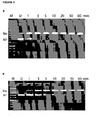
- the chimeric nuclease TALE-scPvull prefers by a factor of 10 the addressed (TALE recognition site plus Pvull recognition site; bipartite; FIG. 2B , FIG. 4 ) over the unaddressed (only Pvull recognition site; Fig. 2A ) DNA recognition site ( FIG. 3 ).
Landscapes
- Health & Medical Sciences (AREA)
- Life Sciences & Earth Sciences (AREA)
- Chemical & Material Sciences (AREA)
- Molecular Biology (AREA)
- Organic Chemistry (AREA)
- Engineering & Computer Science (AREA)
- Bioinformatics & Cheminformatics (AREA)
- Zoology (AREA)
- Wood Science & Technology (AREA)
- Genetics & Genomics (AREA)
- Microbiology (AREA)
- Biotechnology (AREA)
- Biomedical Technology (AREA)
- Biochemistry (AREA)
- General Engineering & Computer Science (AREA)
- General Health & Medical Sciences (AREA)
- Medicinal Chemistry (AREA)
- Enzymes And Modification Thereof (AREA)
- Micro-Organisms Or Cultivation Processes Thereof (AREA)
- Peptides Or Proteins (AREA)
Description
- The invention relates to a chimeric nuclease comprising a module with at least a DNA binding domain from TALE protein AvrBs3 and/or a DNA binding domain from TALE protein AvrBs4, a linker composed of at least five amino acid residues, and a module comprising at least a cleavage domain of type IIP restriction endonuclease Pvull. The invention further relates to a vector encoding said chimeric nuclease, a method for manufacturing said chimeric nuclease and a non-human organism comprising said chimeric nuclease or vector.
- Gene targeting, i.e. targeted gene knockout or gene replacement, requires nucleases that recognize unique sequences and cleave DNA highly specifically, and thereby initiate non-homologous end joining which can inactivate genes, or, when a template DNA is present, leads to a replacement of a genetic element by homologous recombination. The specificity of these highly specific nucleases must be such that only a single double-strand DNA (dsDNA) cut is made in a complex genome. A widely used approach is to use fusion proteins consisting of zinc fingers (ZFs) or transcription activator-like effector (TALE) proteins as programmable DNA binding modules with the non-specific DNA cleavage domain of the restriction endonuclease (synonymically also designated as restriction enzyme herein below) Fokl.
- Chimeric nuclease constructs comprising a TALE DNA-binding domain and a endonuclease Fokl domain have been shown (TING Li et al., TAL nucleases (TALNs): hybrid proteins composed of TAL effectors and Fokl DNA-cleavage domain. Nucl. Acids Res. January 2011, Vol. 39, No. 1, pages 359-372; C. Mussolino et al., A novel TALE nuclease scaffold enables high genome editing activity in combination with low toxicity. Nucl. Acids Res. August 2011, Vol. 39, No. 21, pages 9283-9293.).
- In addition,
US 2011/201118 A1 proposes fusion polypeptides comprising a TAL effector (TALE) binding domain and cleavage domain for targeted cleavage of cellular cromatin in a region of interest and/or homologous recombination at a predetermined site in cells. The cleavage domain can be a Type IIS restriction endonuclease, in particular Fokl. - Recent systematic analyses have shown that the zinc finger nucleases (ZFNs) occasionally cleave non-addressed sequences ("off-target sites"). Furthermore, it is believed that the DNA cleavage domain of the restriction endonuclease Fokl has principal limitations.
- Conjugates of single chain Pvull coupled to a triple-helix forming oligonucleotide (TFO) via a bifunctional cross-linker have been proposed (K. Eisenschmidt et al., Developing a programmed restriction endonuclease for highly specific DNA cleavage. Nucl. Acids Res. January 2005, Vol. 33, No. 22, pages 7039-7047.) This artificial nuclease has a bipartite recognition sequence. For this construct a bifunctional cross-linker, a succinimide ester, was used for coupling of both domains. The in vivo applicability of such a construct is however impaired due to the requirement of a preincubation step in the absence of Mg2+.
- The goal of gene targeting is targeted gene knockout or gene replacement. One of the most promising and simple strategies is based on homologous recombination, in which the DNA sequence of interest is supplied in trans to stimulate site-specific recombination. Ideally, the gene of interest is deleted, modified or replaced in its natural context while leaving the rest of the genome untouched. A major obstacle for the homologous recombination-driven approach is the low efficiency of natural recombination between an introduced DNA and the homologous chromosomal target. Remarkably, it was discovered that making a specific double-strand break in the target sequence increases the frequency of homologous recombination by several orders of magnitude. To facilitate such double-strand break-induced recombination, zinc finger nucleases, engineered homing endonucleases and chimeric restriction endonucleases have been created and used in experimental systems. Chimeric nucleases therefore hold great potential for gene targeting as they allow to cleave DNA at a chosen target sequence.
- However, known chimeric nucleases (synonymically also designated as fusion proteins herein below) also cleave prolifically at off-target sites, resulting in unacceptable toxicity, and are not programmable. Toxicity due to off-target cleavage is a major issue in all gene targeting efforts. The off-target cleavage activity of the known chimeric nucleases is related to missing suppression of restriction enzyme cleavage at restriction enzyme cleavage sites at the DNA that are not addressed by the highly specific DNA binding module of the fusion protein. Thus, there is a need for chimeric nucleases that do not cleave at off-target sites in the DNA but highly specifically address bipartite or tripartite DNA target sites resulting in significantly reduced toxicity in gene targeting efforts suitable for in vivo application.
- In one aspect, the inventin provides a chimeric nuclease which comprises the following components:
- a module comprising at least a DNA binding domain from TALE protein AvrBs3 (SEQ ID NO: 1) and/or a DNA binding domain from TALE protein AvrBs4 (SEQ I D NO: 2),
- a linker composed of at least five amino acid residues, and
- a module comprising at least a cleavage domain of a type IIP restriction endonuclease Pvull either having an amino acid sequence according to SEQ ID NO: 3 or having an amino acid sequence according to SEQ ID NO: 3 with one of following modifications: amino acid substitutions D5K, L12E, P14G, H15D, Q17E, K25D, K25E, N62D, K78E, H83A, Y94F, K155E, or K174E, respectively, or combinations thereof, or amino acid deletions delta 1-15 or delta 1-25 (positions referring to wildtype Pvull),
- The aforementioned technical problem is thus solved by creation of said chimeric nucleases consisting of a restriction enzyme cleavage module and transcription activator-like effector (TALE) protein(s) as DNA binding module(s) that in contrast to the prior art exhibit increased preference and specificity to bipartite or tripartite target sites without cleaving restriction enzyme off-target sites and that are programmable.
- Moreover, surprisingly it is found in the invention that amino acid substitutions introduced into a restriction enzyme that forms the cleavage module of the chimeric nuclease, namely Pvull that cleaves double-stranded DNA at the sequence CAG↓CTG, suppress cleavage by the restriction enzyme at restriction enzyme cleavage sites that are not addressed by the highly specific TALE protein(s) as DNA binding module(s) of the fusion protein.
- Transcription activator-like effector (TALE) proteins combine two advantages: they are programmable and recognize their DNA target sequence highly specific. TAL effectors (TALEs) are proteins secreted by Xanthomonas bacteria via their type III secretion system when they infect various plant species. These proteins can bind promoter sequences in the host and activate the expression of host genes that aid bacterial infection. These proteins are interesting both for their role in disease, for example of important crop species, and the relative ease of retargeting them to bind new DNA sequences. Similar proteins are found in the pathogenic bacteria Ralstonia solanacearum. The most distinctive characteristic of TALE proteins is a central repeat domain containing between 1.5 and 33.5 repeats that are usually 34 residues in length (the C-terminal repeat is generally shorter and referred to as a "half repeat").
- A typical repeat sequence is LTPEQVVAIASHDGGKQALETVQRLLPVLCQAHG, but the residues at the 12th and 13th positions are hypervariable (these two amino acids are also known as the repeat variable diresidue or RVD). It has been shown that there is a simple relationship between the identity of these two residues in sequential repeats and sequential DNA bases in the TAL effector's target site. There appears to be a one-to-one correspondence between the identity of two critical amino acids in each repeat and each DNA base in the target sequence.
- TALE proteins for the DNA binding domain of the chimeric nucleases according to the invention herein are selected from the Avirulence protein AvrBs3 (SEQ ID No. 1) and/or AvrBs4 (SEQ ID No. 2), for example of Xanthomonas euvesicatoria or Xanthomonas vesicatoria, respectively.
- Restriction endonucleases (also called restriction enzymes) as referred to herein in accordance with the present invention are capable of recognizing and cleaving a DNA molecule at a specific DNA cleavage site between predefined nucleotides. In contrast, some endonucleases such as for example Fokl comprise a cleavage domain that cleaves the DNA unspecifically at a certain position regardless of the nucleotides present at this position. Therefore, the specific DNA cleavage site and the DNA recognition site of the restriction endonuclease are identical. Moreover, the cleavage domain of the chimeric nuclease is derived from a restriction endonuclease with reduced DNA binding and/or reduced catalytic activity when compared to the wildtype restriction endonuclease.
- According to the knowledge that restriction endonucleases, particularly type II restriction endonucleases, bind as a homodimer to DNA regularly, the chimeric nucleases as referred to herein are related to homodimerization of two restriction endonucleases subunits. Preferably, in accordance with the present invention the cleavage modules referred to herein have a reduced capability of forming homodimers in the absence of the DNA recognition site, thereby preventing unspecific DNA binding. Therefore, a functional homodimer is only formed upon recruitment of chimeric nucleases monomers to the specific DNA recognition sites.
- The restriction endonuclease of the cleavage module of the chimeric nuclease is a type IIP restriction endonuclease. The palindromic DNA recognition sites of these restriction endonucleases consist of at least four or up to eight contiguous nucleotides. Type IIP restriction endonucleases cleave the DNA within the recognition site which occurs rather frequently in the genome, or immediately adjacent thereto, and have no or a reduced star activity.
- The restriction endonuclease according to the invention is a genetically modified variant of Pvull as defined above. The introduction of said amino acid substitutions or deletions results in cleavage of the DNA by the chimeric TALE-Pvull fusion protein only at sequences that are addressed by the TALE protein (SEQ ID No. 7).
- The T46G variant Pvull amino acid sequence referred to herein is according to SEQ ID No. 3 or is a modified variant thereof which differs from SEQ ID No. 3 by at least one of above defined amino acid substitution and/or deletion.
- The DNA binding domain and the cleavage domain according to the present invention are separated within the chimeric nuclease by a linker allowing interaction with the addressed DNA binding site and cleavage at the DNA restriction site. The flexible linker structures as referred to the invention herein consist of five to twenty amino acids. More preferably, the linker comprises at least six or up to ten or more amino acids. In one embodiment, said linker has an amino acid sequence as shown in SEQ ID No. 4 (SSVIPNRGVTKQLVK).
- According to the present invention, the DNA binding domain from said TALE protein and the cleavage domain from said restriction endonuclease are fused by an amino acid linker to generate a specific nuclease. Said TALE proteins are selected from AvrBs3 or AvrBs4, and said restriction endonucleases are is a genetically modified variant of Pvull.
- While Pvull adds an extra element of specificity when combined with TALE proteins, TALE-Pvull chimeric nucleases according to the invention are designed such that only Pvull sites with adjacent zinc finger (ZF) binding sites which constitute the binding sites of TALE proteins are cleaved, meaning that only addressed Pvull sites are cleaved but no off-target Pvull sites. To achieve this, suitable linkers and introduced amino acid substitutions and/or deletions or additions into Pvull that alter activity and increase fidelity are selected, thereby making DNA cleavage by Pvull dependent on the DNA binding by the TALE protein. Therefore, neither the DNA binding domain nor the cleavage domain alone shall be sufficient for allowing functional interaction of the chimeric nuclease with DNA.
- Preferably, in order to be functional, the chimeric nuclease will form a homodimer comprising two chimeric nuclease monomers having the structure of the chimeric nucleases of the invention. The cleavage domains of these monomers (TALE-Pvull) interact with each other and thereby mediate formation of the homodimer. The dimerized chimeric nucleases then recognize a specific bipartite or tripartite DNA binding site comprising one or two recognition site(s) of the DNA binding module and a recognition site of the cleavage module (SEQ ID No. 7). For example, homodimerization is mediated by a cleavage module derived from the restriction endonuclease Pvull (
FIG. 1A ,FIG. 4 ; SEQ ID No. 5). Alternatively, the chimeric nucleases which form a dimer comprise DNA binding modules derived from different TALE proteins. For example, one monomer exhibits a DNA binding module derived from TALE protein AvrBs3, and the second monomer exhibits a DNA binding module derived from TALE protein AvrBs4. - Alternatively, in a so-called single chain variant (TALE-scPvull) the cleavage domain comprises two Pvull derived amino acid sequences, each forming a Pvull monomer, which are fused via a linker according to the present invention to a DNA binding domain derived from a TALE protein (
FIG. 1 B) . According to the invention, the bipartite or tripartite DNA target for the chimeric nucleases comprising a DNA binding domain derived from the TALE protein AvrBs3 or AvrBs4, a linker, and a cleavage domain derived from the restriction endonuclease Pvull is given in the accompanying SEQ ID No. 7. - The present invention also provides a vector comprising the polynucleotide encoding the chimeric nuclease as referred to herein. Said vectors are obtained by conventional polymerase chain reaction (PCR) techniques using appropriate primer sequences and subsequent cloning methods. Said techniques and methods are well-known by skilled persons and belong to the prior art. Suitable cloning vectors for the purpose of the invention comprise plasmids, viral or retroviral vectors, phages, and artificial chromosomes such as bacterial or yeast artificial chromosomes. Preferably, vectors used in the invention comprise selectable markers for propagation and/or selection in a host organism as well as expression control sequences allowing expression of the operatively linked polynucleotide in prokaryotic or eukaryotic host cells. Such vectors are well-known to the skilled worker and particularly include vectors that are able to replicate in microorganisms, thereby ensuring efficient cloning in bacteria, yeasts, and fungi. Preferably, vectors are used for expression of proteins in prokaryotes that comprise constitutive or inducible promoters which govern the protein expression. Classical vectors that are known to the skilled worker are, amongst others, for example pQE30, pASK, pLGM, pGEX, pET, pTrc, pMAL, pUC18, pUC19, pBR322, pACYC184, pLG338, pLG200, M113mp, pKC30, pRep4, pHS1, pHS2, pPLc236, pMBL24, pUR290, pIN-III113-B1, λgt11 or pBdCl, in Streptomyces pIJ101, plJ364, plJ702 or plJ361, in Bacillus pUB110, pC194 or pBD214, in Corynebacterium pSA77 or pAJ667, and series variants thereof. Suitable yeast expression vector comprise for example pYeDesaturasec1, pMFa, pJRY88, pYES2, pAG-1, YEp6, YEp13, or pEMBLYe23. Suitable vectors for expression in insect cells are for example Baculovirus expression vectors. Suitable vectors for expression in eukaryotic cells are for example pBluescript, pCDM8, pcDNA1, pcDNA3, pSPORT1, pcDV1. Most preferably, pQE30 is used as a vector for expression of the chimeric nuclease as referred to herein.
- Introduction of these vectors into prokaryotic or eukaryotic host cells is performed by conventional transformation, transfection, conjugation, and transduction techniques that all constitute methods known in the prior art for introduction of foreign nucleic acids such as DNA into a host cell. These methods comprise for example lipofection, electroporation, chemically mediated transfer, particle bombardement, calcium phosphate or calcium chloride coprecipitation, DEAE-dextrane mediated transfection, heat shock, appropriate packaging cell lines.
- Manufacturing of chimeric nucleases according to the present invention:
- The vectors comprising the polynucleotide encoding the chimeric nucleases as referred to herein according to the present invention are used for manufacturing of the chimeric nucleases by conventional techniques that are known to the skilled worker. These techniques include chemical synthesis or recombinant molecular biology techniques. Preferably, manufacturing of the chimeric nucleases comprises (i) culturing the host cell and (ii) obtaining the chimeric nuclease from said host cell. Preferably, the chimeric nuclease is obtained by conventional purification techniques from a lysate of host cells. Said purification techniques comprise for example affinity chromatography, ion exchange chromatography, size exclusion chromatography, hydrophobic interaction chromatography and/or preparative gel electrophoresis. Details on the testing for the desired enzymatic activity of the chimeric nucleases are described in the examples below.
- Use of chimeric nucleases and vectors encoding them for gene targeting
- The vectors comprising the polynucleotide encoding the chimeric nucleases as referred to herein according to the present invention are used for highly specific gene targeting efforts. The expressed chimeric nucleases will thereby facilitate the integration of heterologous nucleic acid of interest, for example DNA, such as a transgene, at a predefined site within a target nucleic acid, such as genomic DNA, of the host which preferably is a microorganism, animal, plant, or human. Furthermore, the chimeric nucleases also support homologous recombination events. Thus, the chimeric nucleases will be used for targeted transgenesis or gene insertion or gene knock-out or gene inactivation or homologous replacement or knock-in or gene replacement. Said methods are well-known by the skilled worker. Gene targeting processes and applications for modifying the germ line genetic identity of human beings are not part of the present invention.
- The present invention thereby significantly improves the generation of transgenic organisms including transgenic microorganisms, animals plants, or human. Transgenic organisms will be obtained by introduction of
- a) the vector comprising the polynucleotide encoding the chimeric nuclease and
- b) a nucleic acid of interest to be introduced into the host cell genome
- After introduction of said vector and heterologous nucleic acid of interest into the host cell, the chimeric nuclease will be expressed. Subsequently, the chimeric nuclease will be recruited to the bipartite or tripartite genomic DNA recognition site, thereby allowing cleavage of the genomic DNA by the chimeric nuclease and subsequent integration of the heterologous nucleic acid of interest into the genomic DNA at the preferred site.
- Moreover, the present invention is used as a rare cutting endonuclease supporting conventional cloning efforts known in the prior art.
- The examples below illustrate the present invention.
- A chimeric nuclease according to the present invention comprising a DNA binding domain derived from TALE protein AvrBs3 or AvrBs4, respectively, or variants thereof, a linker, and a cleavage domain derived from the restriction endonuclease Pvull (Pvull wildtype or variants thereof) is engineered by the following steps. First, the coding sequences or parts thereof for the TALE proteins (AvrBs3 or AvrBs4, respectively), for an amino acid linker (as for example consisting of the amino acids SSVIPNRGVTKQLVK), and for Pvull or single chain Pvull (scPvull) or parts thereof are amplified by conventional PCR using appropriate primer sequences hybridizing to DNA encoding Pvull wildtype or variants thereof. For amplification of sequences encoding TALE proteins AvrBs3 or AvrBs4, respectively, primers according to SEQ ID No. 8 and SEQ ID No. 9 are used for synthesis of PCR fragments encoding TALE-Pvull (2423 bp) harbouring a long variant of TALE or primers according to SEQ ID No. 8 and SEQ ID No. 10 for synthesis of PCR fragments encoding TALE-scPvull (2319 bp) harbouring a short variant of TALE. For both variants of TALE, plasmid pENTR-D-avrBs3 or pENTR-D-avrBs4, respectively, is used as template (plasmids described in: Morbitzer, R., Elsaesser, J., Hausner, J. & Lahaye, T. (2011). Assembly of custom TALE-type DNA binding domains by modular cloning. Nucleic Acids Res. 39, 5790-5799; Mussolino, C., Morbitzer, R., Lutge, F., Dannemann, N., Lahaye, T. & Cathomen, T. (2011). A novel TALE nuclease scaffold enables high genome editing activity in combination with low toxicity. Nucleic Acids Res.). Furthermore, primer sequences designed according to standard procedures encoding a Strep-tag (Strepll; WSHPQFEK) for purification efforts or a linker amino acid sequence are used for generation of PCR fragments encoding a Strep-tag or a linker, respectively, and appropriate restriction sites for ligation with TALE and Pvull PCR fragments into vector pQE30 (Qiagen). Subsequently, the generated PCR fragments are inserted into plasmid pQE30 encoding a C-terminal 6His-tag, by conventional techniques, as for example ligation at appropriate temperatures. The generated plasmid is then transformed into Escherichia coli and propagated in conventional culture medium at appropriate conditions. Transformed cells are harvested and lysed, and generated plasmid is prepared by conventional methods. Alternatively, mutations encoding amino acid substitutions, as for example T46G in Pvull, are introduced into the generated vectors via PCR-based directed mutagenesis. The generated plasmids encode a) a chimeric nuclease (TALE-Pvull; Seq ID No. 5; homodimer
FIG. 1A ) harbouring 1117 amino acid residues, or b) a chimeric nuclease, also named single chain Pvull variant (TALE-scPvull; Seq ID No. 6,FIG. 1 B) herein, harbouring 992 amino acid residues, respectively, while the chimeric nuclease of a) exhibits the following domain architecture N-Strepll-TALE/AvrBs3(aa153-914)-Linker-Pvull(aa2-157;T46G)-Pvull(aa2-157;T46G)-6His-C, and the chimeric nuclease of b) exhibits the following domain architecture N-Strepll-TALE/AvrBs4(aa153-949)-Linker-Pvull(aa2-157;T46G)-6His-C (N: N-terminus; C: C-terminus; aa: amino acid residues, numbered according to wildtype Pvull; T46G: amino acid substitutions). - For the protein expression of chimeric nucleases according to the present invention a 25 ml LB medium pre-culture (containing 75 µg/ml Ampicillin) is inoculated and grown overnight at 37°C. Further, 5 ml of this pre-culture are added to a 500 ml culture (containing 75 g/ml Ampicillin) and the cells are grown until an optical density of 0.6-0.8 at 600 nm (OD600). The protein expression is induced by adding 5 ml of 0.1 M Isopropyl β-D-1-thiogalactopyranoside (1 mM end concentration) to the 500 ml cell culture. Finally, the cell culture is incubated overnight at 18 °C. The cells are harvested by centrifugation at 5000 g for 15 minutes and the pellet is resuspended in 40 ml STE buffer (10 mM Tris/
HCI pH 8, 100 mM NaCl, 0.1 mM EDTA). Following on this, the culture is centrifuged a second time at 5,000 g for 15 minutes Afterwards, the supernatant is discharged and the pellet is stored at - 20 °C for further processing. - Pellets are first resuspended in 20 ml high-salt buffer (20 mM KPi pH 7.8, 1 M KCI, 0.5 mM EDTA, 1 mM DTT, 0.01 % Lubrol, 1 mM phenylmethylsulfonyl fluoride) and cell lysis is performed on ice by sonication (15 sec pulses for 6 minutes at 50% output) of the cells using a Sonifier 250, Branson. After sonication, the lysate is centrifuged at 48,000 g for 30 minutes at 4 °C and the supernatant is filtered using a 0.45µm cellulose acetate filter.
- The protein purification is performed via immobilized metal assisted chromatography using 1 ml/l cell culture Ni-NTA (Qiagen) as a chelator (His-tag purification). Therefore the column is equilibrated with two column volumes high salt buffer and the lysate is loaded onto the column. The following steps are all done at 4 °C to avoid protein denaturation. The column is washed twice with 2 ml high salt buffer and 2 ml low salt buffer (20 mM KPi pH 7.2, 300 mM KCI, 0.5 mM EDTA, 1 mM DTT, 0.01 % Lubrol, 1 mM phenylmethylsulfonyl fluoride). Finally the protein is eluted with 4x 500 µl elution buffer (20 mM KPi pH 7.8, 500 mM KCI, 0.5 mM EDTA, 1 mM DTT, 0.01% Lubrol, 1 mM phenylmethylsulfonyl fluoride, 250 mM imidazole). From each eluate 15 µl samples are taken and mixed with 3 µl 5x Laemmli loading buffer for further SDS PAGE analyses (
FIG. 5A ). - Fusion protein containing fractions are pooled and further purified via Heparin chromatography. Therefore the pooled fractions are loaded onto a 5ml HiTrap™ Heparin HP Column, washed with one column volume low salt buffer and eluted using a continuous gradient (20 ml) from low salt buffer to elution buffer (20 mM KPi pH 7.8, 1000 mM KCI, 0.5 mM EDTA, 1 mM DTT, 0.01% Lubrol). The protein elutes corresponding to a buffer with 550 mM KCI. From each
eluate 10 µl samples are taken and mixed with 2 µl 5x Laemmli loading buffer for further SDS PAGE analyses (FIG. 5B ). - Finally, the chosen protein fractions are pooled and dialysed (Snakeskin®dialysis tubing, 10 k MWCO) overnight at 4 °C using 30 mM KPi pH 7.8, 550 mM KCI, 1 mM EDTA, 1 mM DTT, 60 % glycerol. After dialysis the protein concentration is determined by conventional methods.
- For DNA cleavage assays, the different DNA target sequences containing one Pvull recognition site (= non-addressed site;
FIG. 2A ) or one Pvull recognition site plus TALE recognition site(s) (= addressed site;FIG. 2B , SEQ ID No. 7), respectively, were introduced into plasmid pAT153 (= DNA substrate). The DNA cleavage activity assays are carried out with a 1:1 ratio of chimeric nuclease TALE-scPvull (8 nM) and DNA substrate (8 nM DNA, 300 ng). The reaction mixture is incubated at 37 °C for 1, 3, 5, 10, 20, 30, or 60 min, respectively, in buffer containing 20 mM Tris-acetate, 50 mM K-acetate, 2 mM Mg-acetate, pH 7.9. Reaction products are separated on 1% agarose gels by electrophoresis, stained with ethidium bromide, and visualized by the BioDocAnalyze system. - The chimeric nuclease TALE-scPvull prefers by a factor of 10 the addressed (TALE recognition site plus Pvull recognition site; bipartite;
FIG. 2B ,FIG. 4 ) over the unaddressed (only Pvull recognition site;Fig. 2A ) DNA recognition site (FIG. 3 ). -
-
Figure 1. Figure 1A shows a homodimer consisting of two TALE-Pvull chimeric nuclease monomers while binding to a tripartite DNA target site comprising one Pvull recognition site and two TALE protein recognition sites.Figure 2B shows a TALE-scPvull chimeric nuclease while binding to a bipartite DNA target site comprising one Pvull recognition site and one TALE protein recognition site, wherein two fused Pvull polypeptides within the cleavage domain form a homodimer. -
Figure 2. Figure 2A illustrates a single Pvull recognition site (Pvull target) within the DNA which is not addressed by the chimeric nucleases as referred to in the present invention.Figure 2B shows a bipartite DNA recognition site comprising a Pvull recognition site (Pvull target) and a TALE protein recognition site (TALE target) which is addressed by the chimeric nucleases as referred to in the present invention. -
Figure 3. Figure 3A shows a DNA cleavage assay, wherein purified TALE-scPvull chimeric nuclease was incubated for 1, 3, 5, 10, 20, 30, or 60 minutes, respectively, at an equimolar amount of 8 nM with DNA encoding the addressed bipartite DNA target site (according toFIG. 2B , SEQ ID No. 7). Since the DNA target site is embedded in a plasmid (sc), DNA binding and subsequent cleavage of the DNA target site results in al linearized plasmid (lin).Figure 3B shows a DNA cleavage assay according toFigure 3A but wherein the DNA encodes the non-addressed only Pvull DNA target site (according toFIG. 2A ). (M = marker DNA; U = only plasmid without TALE-scPvull). -
Figure 4. Figure 4 is a cartoon of two TALE-Pvull chimeric nuclease monomers forming a homodimer, while the TALE parts of the monomers exhibit 34 amino acid (aa) repeats each. The TALE parts of the chimeric nuclease monomers are each linked to the mainly alpha-helical structure of Pvull within the cleavage domain of the chimeric nuclease. Homodimerization occurs via interaction of the Pvull parts of the chimeric nuclease monomers. -
Figure 5. Figure 5A shows the elution fractions E1 to E4 of chimeric nuclease purified using Ni-NTA affinity chromatography. The fractions are loaded onto a 8% SDS gel, separated by electrophoresis, and stained with coomassie.Figure 5B shows the elution fractions A1, A10, A11, A12, B12, B11, B10, and B9 of chimeric nuclease purified in a second step following Ni-NTA purification via Heparin chromatography (HPLC). The fractions are loaded onto a 8% SDS gel, separated by electrophoresis, and stained with silver. - The following sequences referred to herein are shown in the accompanying sequence listing:
- SEQ ID No. 1: TALE AvrBs3
- SEQ ID No. 2: TALE AvrBs4
- SEQ ID No. 3: Pvull
- SEQ ID No. 4: Linker SSVIPNRGVTKQLVK
- SEQ ID No. 5: TALE-Pvull
- SEQ ID No. 6: TALE-scPvull
- SEQ ID No. 7: bipartite/tripartite DNA target site
- SEQ ID No. 8: TALE forward
- SEQ ID No. 9: TALE reverse-1
- SEQ ID No. 10: TALE reverse-2
-
- <110> Justus-Liebig universitat Giessen
- <120> Chimeric Nucleases for Gene Targeting
- <130> TM 631
- <140> EP
<141> 2011-09-26 - <160> 10
- <170> PatentIn version 3.5
- <210> 1
<211> 762
<212> PRT
<213> Xanthomonas euvesicatoria - <400> 1


- <210> 2
<211> 762
<212> PRT
<213> Xanthomonas vesicatoria - <220>
<221> D524A Pointmutation
<222> (524)..(524)
<223> pointmutation D524A - <400> 2


- <210> 3
<211> 156
<212> PRT
<213> Proteus hauseri - <220>
<221> Pointmutation T46G
<222> (46)..(46)
<223> Pointmutation T46G im Vergleich zum Wildtyp - <400> 3

- <210> 4
<211> 15
<212> PRT
<213> articial sequence - <400> 4

- <210> 5
<211> 992
<212> PRT
<213> artificial sequence - <220>
<223> fusion protein - <220>
<221> StrepII
<222> (5)..(12) - <220>
<221> AvrBs4
<222> (16)..(812)
<223> AvrBs4 (153-914) - <220>
<221> Linker
<222> (813)..(827)
<223> Linker - <220>
<221> PvuII
<222> (828)..(986)
<223> PvuII (2-157; T46G) - <220>
<221> 6His
<222> (987)..(992) - <400> 5


- <210> 6
<211> 1117
<212> PRT
<213> artificial sequence - <220>
<223> fusion protein - <220>
<221> StrepII
<222> (5)..(12) - <220>
<221> AvrBs3
<222> (16)..(777)
<223> AvrBs3 (153-914) - <220>
<221> Linker
<222> (778)..(792)
<223> Linker - <220>
<221> PvuII (1)
<222> (778)..(792)
<223> 1. PvuII - <220>
<221> PvuII (2)
<222> (793)..(1111)
<223> 2. PvuII - <220>
<221> 6His
<222> (1112)..(1117) - <400> 6


- <210> 7
<211> 60
<212> DNA
<213> DNA target site - <400> 7
tatataaacc taaccatccg gatcccagct gtctagagga tggttaggtt tatatacatg 60 - <210> 8
<211> 43
<212> DNA
<213> primer sequence - <400> 8
agttcgagaa gtcgaccggg gttgatctta gaacattggg ata 43 - <210> 9
<211> 34
<212> DNA
<213> primer sequence - <220>
<221>TALE reverse 1
<222> (1)..(34)
<223> TALE reverse 1: for long variant TALE-PvuII - <400> 9
gataacggag ctcgctactc tatggctggt gcgc 34 - <210> 10
<211> 34
<212> DNA
<213> primer sequence - <220>
<221> TALE reverse 2
<222> (1)..(34)
<223> TALE reverse 2: for short variant TALE-scPvuII - <400> 10
ggataacgga gctccctagg catgctaaag caac 34
Claims (9)
- A chimeric nuclease which comprises the following components:- a module comprising at least a DNA binding domain from TALE protein AvrBs3 (SEQ ID NO: 1) and/or a DNA binding domain from TALE protein AvrBs4 (SEQ ID NO: 2),- a linker composed of at least five amino acid residues, and- a module comprising at least a cleavage domain of a type IIP restriction endonuclease Pvull either having an amino acid sequence according to SEQ ID NO: 3 or having an amino acid sequence according to SEQ ID NO: 3 with one of following modifications: amino acid substitutions D5K, L12E, P14G, H15D, Q17E, K25D, K25E, N62D, K78E, H83A, Y94F, K155E, or K174E, respectively, or combinations thereof, or amino acid deletions delta 1-15 or delta 1-25 andwherein said chimeric nuclease functionally interacts only with DNA that comprises both a DNA recognition site for said DNA binding domain from a TALE protein and a DNA recognition site for said cleavage domain from a restriction endonuclease, and
wherein said cleavage domain cleaves the DNA upon binding of the chimeric nuclease to the DNA. - The chimeric nuclease of claim 1, wherein said DNA binding module exhibits reduced or no catalytic activity.
- The chimeric nuclease of claims 1 or 2, wherein said linker essentially consists of 5 to 20 amino acids.
- The chimeric nuclease of any one of claims 1 to 3, wherein said linker has an amino acid sequence as shown in SEQ ID No. 4 (SSVIPNRGVTKQLVK).
- The chimeric nuclease according to claim 4, wherein the chimeric nuclease recognizes a bipartite or tripartite DNA target site comprising one Pvull recognition site and one or two TALE protein recognition site(s) according to SEQ ID No. 7.
- A vector encoding the chimeric nuclease of any one of claims 1 to 4.
- A method for manufacturing a chimeric nuclease according to any one of claims 1 to 5, wherein
manufacturing comprises the following steps:(i) Transformation of a vector according to claim 6 encoding a chimeric nuclease into a microorganism,(ii) cultivation of the transformed microorganism while inducing expression of the chimeric nuclease,(iii) harvesting and lysis of the microorganism,(iv) purification of the chimeric nuclease from lysed microorganism cells. - The chimeric nuclease according to any one of claims 1 to 5 for use in gene targeting of a microorganism, or an animal tissue or isolated cell thereof, or a plant, or a plant part or isolated cell thereof, or a human wherein processes for modifying the germ line genetic identity of human beings are excluded.
- A non-human organism comprising the chimeric nuclease of any one of claims 1-5 or the vector encoding the chimeric nuclease of claim 6, wherein the organism is a microorganism, or an isolated cell of an animal tissue, or a plant, or a plant part or isolated cell thereof.
Priority Applications (2)
| Application Number | Priority Date | Filing Date | Title |
|---|---|---|---|
| EP11182725.9A EP2573173B1 (en) | 2011-09-26 | 2011-09-26 | Chimeric nucleases for gene targeting |
| PCT/EP2012/068939 WO2013045480A1 (en) | 2011-09-26 | 2012-09-26 | Chimeric nucleases for gene targeting |
Applications Claiming Priority (1)
| Application Number | Priority Date | Filing Date | Title |
|---|---|---|---|
| EP11182725.9A EP2573173B1 (en) | 2011-09-26 | 2011-09-26 | Chimeric nucleases for gene targeting |
Publications (2)
| Publication Number | Publication Date |
|---|---|
| EP2573173A1 EP2573173A1 (en) | 2013-03-27 |
| EP2573173B1 true EP2573173B1 (en) | 2015-11-11 |
Family
ID=47227764
Family Applications (1)
| Application Number | Title | Priority Date | Filing Date |
|---|---|---|---|
| EP11182725.9A Not-in-force EP2573173B1 (en) | 2011-09-26 | 2011-09-26 | Chimeric nucleases for gene targeting |
Country Status (2)
| Country | Link |
|---|---|
| EP (1) | EP2573173B1 (en) |
| WO (1) | WO2013045480A1 (en) |
Families Citing this family (21)
| Publication number | Priority date | Publication date | Assignee | Title |
|---|---|---|---|---|
| WO2014207246A1 (en) * | 2013-06-27 | 2014-12-31 | INSERM (Institut National de la Santé et de la Recherche Médicale) | New polymorphisms for the diagnosis of idiopathic scoliosis disease |
| EP2818867A1 (en) | 2013-06-27 | 2014-12-31 | INSERM (Institut National de la Santé et de la Recherche Médicale) | Antibodies conjugated to at least one nucleic acid molecule and their use in multiplex immuno-detection assays |
| WO2015092460A1 (en) | 2013-12-18 | 2015-06-25 | INSERM (Institut National de la Santé et de la Recherche Médicale) | New gene mutations for the diagnosis of arthrogryposis multiplex congenita and congenital peripheral neuropathies disease |
| WO2016066671A1 (en) | 2014-10-29 | 2016-05-06 | INSERM (Institut National de la Santé et de la Recherche Médicale) | Method for treating resistant cancers using progastrin inhibitors |
| US20180031579A1 (en) | 2015-02-12 | 2018-02-01 | INSERM (Institut National de la Santé et de la Recherche Médicale) | Methods for predicting the responsiveness of a patient affected with malignant hematological disease to chemotherapy treatment and methods of treatment of such disease |
| WO2016142427A1 (en) | 2015-03-10 | 2016-09-15 | INSERM (Institut National de la Santé et de la Recherche Médicale) | Method ank kit for reprogramming somatic cells |
| CN109069568B (en) * | 2016-02-02 | 2023-07-07 | 桑格摩生物治疗股份有限公司 | Compositions for linking DNA binding domains and cleavage domains |
| WO2018069232A1 (en) | 2016-10-10 | 2018-04-19 | INSERM (Institut National de la Santé et de la Recherche Médicale) | Methods for predicting the risk of having cardiac hypertrophy |
| EP3526326A4 (en) * | 2016-10-12 | 2020-07-29 | The Regents of The University of Colorado, A Body Corporate | NEW MANIPULATED AND CHIMARY NUCLEASES |
| EP3600269A1 (en) | 2017-03-24 | 2020-02-05 | INSERM - Institut National de la Santé et de la Recherche Médicale | Gfi1 inhibitors for the treatment of hyperglycemia |
| WO2020178193A1 (en) | 2019-03-01 | 2020-09-10 | INSERM (Institut National de la Santé et de la Recherche Médicale) | Method of treatment of sarcoidosis |
| GB201909228D0 (en) * | 2019-06-27 | 2019-08-14 | Azeria Therapeutics Ltd | Screen for inhibitors |
| WO2021156329A1 (en) | 2020-02-05 | 2021-08-12 | INSERM (Institut National de la Santé et de la Recherche Médicale) | Methods of treatment of cancer disease by targeting an epigenetic factor |
| US20230305023A1 (en) | 2020-06-25 | 2023-09-28 | INSERM (Institut National de la Santé et de la Recherche Médicale) | Methods of treatment and diagnostic of pathological conditions associated with intense stress |
| US20230340149A1 (en) | 2020-09-07 | 2023-10-26 | INSERM (Institut National de la Santé et de la Recherche Médicale) | Methods of treatment of inflammatory bowel diseases |
| WO2022096633A1 (en) | 2020-11-06 | 2022-05-12 | INSERM (Institut National de la Santé et de la Recherche Médicale) | Methods for diagnosis and treating polycystic ovary syndrome (pcos) |
| EP4251282A1 (en) | 2020-11-27 | 2023-10-04 | Institut National de la Santé et de la Recherche Médicale (INSERM) | Methods for diagnosis and monitoring of toxic epidermal necrolysis |
| WO2022218998A1 (en) | 2021-04-13 | 2022-10-20 | INSERM (Institut National de la Santé et de la Recherche Médicale) | Methods for treating hepatitis b and d virus infection |
| EP4665354A1 (en) | 2023-02-13 | 2025-12-24 | Institut National de la Santé et de la Recherche Médicale | Methods of treatment of iron overload associated diseases |
| WO2024223402A1 (en) | 2023-04-24 | 2024-10-31 | Institut National de la Santé et de la Recherche Médicale | Biallelic gene mutations for the diagnosis of neonatal systemic hypertension |
| WO2025003461A1 (en) | 2023-06-30 | 2025-01-02 | Institut National de la Santé et de la Recherche Médicale | Methods of treatment of metabolic disorders |
Family Cites Families (1)
| Publication number | Priority date | Publication date | Assignee | Title |
|---|---|---|---|---|
| US20110201118A1 (en) * | 2010-06-14 | 2011-08-18 | Iowa State University Research Foundation, Inc. | Nuclease activity of tal effector and foki fusion protein |
-
2011
- 2011-09-26 EP EP11182725.9A patent/EP2573173B1/en not_active Not-in-force
-
2012
- 2012-09-26 WO PCT/EP2012/068939 patent/WO2013045480A1/en not_active Ceased
Non-Patent Citations (1)
| Title |
|---|
| MERT YANIK ET AL: "TALE-PvuII Fusion Proteins - Novel Tools for Gene Targeting", PLOS ONE, vol. 8, no. 12, 1 January 2013 (2013-01-01), pages e82539 - e82539, XP055118839, ISSN: 1932-6203, DOI: 10.1371/journal.pone.0082539 * |
Also Published As
| Publication number | Publication date |
|---|---|
| EP2573173A1 (en) | 2013-03-27 |
| WO2013045480A1 (en) | 2013-04-04 |
Similar Documents
| Publication | Publication Date | Title |
|---|---|---|
| EP2573173A1 (en) | Chimeric nucleases for gene targeting | |
| JP7113877B2 (en) | RNA-directed DNA cleavage by Cas9-crRNA complex | |
| US11555181B2 (en) | Engineered cascade components and cascade complexes | |
| JP6780860B2 (en) | Genome sequence modification method that specifically converts the nucleobase of the targeted DNA sequence and the molecular complex used for it. | |
| US11840694B2 (en) | Truncated CRISPR-Cas proteins for DNA targeting | |
| JP6664693B2 (en) | Method for converting genomic sequence of gram-positive bacteria, specifically converting nucleobase of targeted DNA sequence, and molecular complex used therein | |
| Chen et al. | Targeted genome modification technologies and their applications in crop improvements | |
| JP2022191368A (en) | Methods for altering genomic sequences which specifically alter nucleobase of targeted dna sequence, and molecular complex used for the same | |
| Fichtner et al. | Precision genetic modifications: a new era in molecular biology and crop improvement | |
| Sun et al. | Site‐S pecific Gene Targeting Using Transcription Activator‐L ike Effector (TALE)‐B ased Nuclease in Brassica oleracea | |
| US10975406B2 (en) | Directed endonucleases for repeatable nucleic acid cleavage | |
| CA2871524C (en) | Methods and compositions for nuclease-mediated targeted integration of transgenes | |
| CN111684069A (en) | Chimeric genome engineering molecules and methods | |
| EP2776560A2 (en) | Endonuclease for genome editing | |
| Li et al. | CRISPR/Cas9‐based genome editing and its applications for functional genomic analyses in plants | |
| JP2012511926A (en) | Targeted integration into the ZP15 locus | |
| TW200815593A (en) | Zinc finger nuclease-mediated homologous recombination | |
| WO2024226156A1 (en) | Cas-embedded cytidine deaminase ribonucleoprotein complexes having improved base editing specificity and efficiency | |
| KR102116200B1 (en) | Methods for increasing the efficiency of introducing mutations in genomic sequence modification techniques and molecular complexes used therein | |
| JP2024506375A (en) | Site-specific genome modification technology | |
| Teimourian et al. | Technology developments in biological tools for targeted genome surgery | |
| Chen et al. | Targeted gene mutation in plants | |
| AU2020253531B2 (en) | Methods for scarless introduction of targeted modifications into targeting vectors | |
| US20200377909A1 (en) | Directed genome engineering using enhanced targeted editing technologies | |
| JP7125727B1 (en) | Compositions for modifying nucleic acid sequences and methods for modifying target sites in nucleic acid sequences |
Legal Events
| Date | Code | Title | Description |
|---|---|---|---|
| PUAI | Public reference made under article 153(3) epc to a published international application that has entered the european phase |
Free format text: ORIGINAL CODE: 0009012 |
|
| AK | Designated contracting states |
Kind code of ref document: A1 Designated state(s): AL AT BE BG CH CY CZ DE DK EE ES FI FR GB GR HR HU IE IS IT LI LT LU LV MC MK MT NL NO PL PT RO RS SE SI SK SM TR |
|
| AX | Request for extension of the european patent |
Extension state: BA ME |
|
| 17P | Request for examination filed |
Effective date: 20130927 |
|
| RBV | Designated contracting states (corrected) |
Designated state(s): AL AT BE BG CH CY CZ DE DK EE ES FI FR GB GR HR HU IE IS IT LI LT LU LV MC MK MT NL NO PL PT RO RS SE SI SK SM TR |
|
| 17Q | First examination report despatched |
Effective date: 20131018 |
|
| GRAP | Despatch of communication of intention to grant a patent |
Free format text: ORIGINAL CODE: EPIDOSNIGR1 |
|
| INTG | Intention to grant announced |
Effective date: 20150513 |
|
| GRAS | Grant fee paid |
Free format text: ORIGINAL CODE: EPIDOSNIGR3 |
|
| GRAA | (expected) grant |
Free format text: ORIGINAL CODE: 0009210 |
|
| AK | Designated contracting states |
Kind code of ref document: B1 Designated state(s): AL AT BE BG CH CY CZ DE DK EE ES FI FR GB GR HR HU IE IS IT LI LT LU LV MC MK MT NL NO PL PT RO RS SE SI SK SM TR |
|
| REG | Reference to a national code |
Ref country code: GB Ref legal event code: FG4D |
|
| REG | Reference to a national code |
Ref country code: CH Ref legal event code: EP |
|
| REG | Reference to a national code |
Ref country code: IE Ref legal event code: FG4D |
|
| REG | Reference to a national code |
Ref country code: AT Ref legal event code: REF Ref document number: 760486 Country of ref document: AT Kind code of ref document: T Effective date: 20151215 |
|
| REG | Reference to a national code |
Ref country code: DE Ref legal event code: R096 Ref document number: 602011021335 Country of ref document: DE |
|
| REG | Reference to a national code |
Ref country code: LT Ref legal event code: MG4D |
|
| REG | Reference to a national code |
Ref country code: NL Ref legal event code: MP Effective date: 20160211 |
|
| REG | Reference to a national code |
Ref country code: AT Ref legal event code: MK05 Ref document number: 760486 Country of ref document: AT Kind code of ref document: T Effective date: 20151111 |
|
| PG25 | Lapsed in a contracting state [announced via postgrant information from national office to epo] |
Ref country code: HR Free format text: LAPSE BECAUSE OF FAILURE TO SUBMIT A TRANSLATION OF THE DESCRIPTION OR TO PAY THE FEE WITHIN THE PRESCRIBED TIME-LIMIT Effective date: 20151111 Ref country code: IT Free format text: LAPSE BECAUSE OF FAILURE TO SUBMIT A TRANSLATION OF THE DESCRIPTION OR TO PAY THE FEE WITHIN THE PRESCRIBED TIME-LIMIT Effective date: 20151111 Ref country code: IS Free format text: LAPSE BECAUSE OF FAILURE TO SUBMIT A TRANSLATION OF THE DESCRIPTION OR TO PAY THE FEE WITHIN THE PRESCRIBED TIME-LIMIT Effective date: 20160311 Ref country code: ES Free format text: LAPSE BECAUSE OF FAILURE TO SUBMIT A TRANSLATION OF THE DESCRIPTION OR TO PAY THE FEE WITHIN THE PRESCRIBED TIME-LIMIT Effective date: 20151111 Ref country code: LT Free format text: LAPSE BECAUSE OF FAILURE TO SUBMIT A TRANSLATION OF THE DESCRIPTION OR TO PAY THE FEE WITHIN THE PRESCRIBED TIME-LIMIT Effective date: 20151111 Ref country code: NO Free format text: LAPSE BECAUSE OF FAILURE TO SUBMIT A TRANSLATION OF THE DESCRIPTION OR TO PAY THE FEE WITHIN THE PRESCRIBED TIME-LIMIT Effective date: 20160211 Ref country code: NL Free format text: LAPSE BECAUSE OF FAILURE TO SUBMIT A TRANSLATION OF THE DESCRIPTION OR TO PAY THE FEE WITHIN THE PRESCRIBED TIME-LIMIT Effective date: 20151111 |
|
| PG25 | Lapsed in a contracting state [announced via postgrant information from national office to epo] |
Ref country code: SE Free format text: LAPSE BECAUSE OF FAILURE TO SUBMIT A TRANSLATION OF THE DESCRIPTION OR TO PAY THE FEE WITHIN THE PRESCRIBED TIME-LIMIT Effective date: 20151111 Ref country code: PT Free format text: LAPSE BECAUSE OF FAILURE TO SUBMIT A TRANSLATION OF THE DESCRIPTION OR TO PAY THE FEE WITHIN THE PRESCRIBED TIME-LIMIT Effective date: 20160311 Ref country code: PL Free format text: LAPSE BECAUSE OF FAILURE TO SUBMIT A TRANSLATION OF THE DESCRIPTION OR TO PAY THE FEE WITHIN THE PRESCRIBED TIME-LIMIT Effective date: 20151111 Ref country code: AT Free format text: LAPSE BECAUSE OF FAILURE TO SUBMIT A TRANSLATION OF THE DESCRIPTION OR TO PAY THE FEE WITHIN THE PRESCRIBED TIME-LIMIT Effective date: 20151111 Ref country code: LV Free format text: LAPSE BECAUSE OF FAILURE TO SUBMIT A TRANSLATION OF THE DESCRIPTION OR TO PAY THE FEE WITHIN THE PRESCRIBED TIME-LIMIT Effective date: 20151111 Ref country code: FI Free format text: LAPSE BECAUSE OF FAILURE TO SUBMIT A TRANSLATION OF THE DESCRIPTION OR TO PAY THE FEE WITHIN THE PRESCRIBED TIME-LIMIT Effective date: 20151111 Ref country code: RS Free format text: LAPSE BECAUSE OF FAILURE TO SUBMIT A TRANSLATION OF THE DESCRIPTION OR TO PAY THE FEE WITHIN THE PRESCRIBED TIME-LIMIT Effective date: 20151111 Ref country code: GR Free format text: LAPSE BECAUSE OF FAILURE TO SUBMIT A TRANSLATION OF THE DESCRIPTION OR TO PAY THE FEE WITHIN THE PRESCRIBED TIME-LIMIT Effective date: 20160212 |
|
| PG25 | Lapsed in a contracting state [announced via postgrant information from national office to epo] |
Ref country code: CZ Free format text: LAPSE BECAUSE OF FAILURE TO SUBMIT A TRANSLATION OF THE DESCRIPTION OR TO PAY THE FEE WITHIN THE PRESCRIBED TIME-LIMIT Effective date: 20151111 |
|
| REG | Reference to a national code |
Ref country code: DE Ref legal event code: R097 Ref document number: 602011021335 Country of ref document: DE |
|
| PG25 | Lapsed in a contracting state [announced via postgrant information from national office to epo] |
Ref country code: SK Free format text: LAPSE BECAUSE OF FAILURE TO SUBMIT A TRANSLATION OF THE DESCRIPTION OR TO PAY THE FEE WITHIN THE PRESCRIBED TIME-LIMIT Effective date: 20151111 Ref country code: EE Free format text: LAPSE BECAUSE OF FAILURE TO SUBMIT A TRANSLATION OF THE DESCRIPTION OR TO PAY THE FEE WITHIN THE PRESCRIBED TIME-LIMIT Effective date: 20151111 Ref country code: RO Free format text: LAPSE BECAUSE OF FAILURE TO SUBMIT A TRANSLATION OF THE DESCRIPTION OR TO PAY THE FEE WITHIN THE PRESCRIBED TIME-LIMIT Effective date: 20151111 Ref country code: DK Free format text: LAPSE BECAUSE OF FAILURE TO SUBMIT A TRANSLATION OF THE DESCRIPTION OR TO PAY THE FEE WITHIN THE PRESCRIBED TIME-LIMIT Effective date: 20151111 Ref country code: SM Free format text: LAPSE BECAUSE OF FAILURE TO SUBMIT A TRANSLATION OF THE DESCRIPTION OR TO PAY THE FEE WITHIN THE PRESCRIBED TIME-LIMIT Effective date: 20151111 |
|
| PLBE | No opposition filed within time limit |
Free format text: ORIGINAL CODE: 0009261 |
|
| STAA | Information on the status of an ep patent application or granted ep patent |
Free format text: STATUS: NO OPPOSITION FILED WITHIN TIME LIMIT |
|
| REG | Reference to a national code |
Ref country code: FR Ref legal event code: PLFP Year of fee payment: 6 |
|
| 26N | No opposition filed |
Effective date: 20160812 |
|
| PGFP | Annual fee paid to national office [announced via postgrant information from national office to epo] |
Ref country code: DE Payment date: 20160930 Year of fee payment: 6 Ref country code: GB Payment date: 20160920 Year of fee payment: 6 |
|
| PG25 | Lapsed in a contracting state [announced via postgrant information from national office to epo] |
Ref country code: SI Free format text: LAPSE BECAUSE OF FAILURE TO SUBMIT A TRANSLATION OF THE DESCRIPTION OR TO PAY THE FEE WITHIN THE PRESCRIBED TIME-LIMIT Effective date: 20151111 |
|
| PGFP | Annual fee paid to national office [announced via postgrant information from national office to epo] |
Ref country code: FR Payment date: 20160921 Year of fee payment: 6 |
|
| PG25 | Lapsed in a contracting state [announced via postgrant information from national office to epo] |
Ref country code: BE Free format text: LAPSE BECAUSE OF FAILURE TO SUBMIT A TRANSLATION OF THE DESCRIPTION OR TO PAY THE FEE WITHIN THE PRESCRIBED TIME-LIMIT Effective date: 20151111 |
|
| PG25 | Lapsed in a contracting state [announced via postgrant information from national office to epo] |
Ref country code: MC Free format text: LAPSE BECAUSE OF FAILURE TO SUBMIT A TRANSLATION OF THE DESCRIPTION OR TO PAY THE FEE WITHIN THE PRESCRIBED TIME-LIMIT Effective date: 20151111 |
|
| REG | Reference to a national code |
Ref country code: CH Ref legal event code: PL |
|
| REG | Reference to a national code |
Ref country code: IE Ref legal event code: MM4A |
|
| PG25 | Lapsed in a contracting state [announced via postgrant information from national office to epo] |
Ref country code: CH Free format text: LAPSE BECAUSE OF NON-PAYMENT OF DUE FEES Effective date: 20160930 Ref country code: LI Free format text: LAPSE BECAUSE OF NON-PAYMENT OF DUE FEES Effective date: 20160930 Ref country code: IE Free format text: LAPSE BECAUSE OF NON-PAYMENT OF DUE FEES Effective date: 20160926 |
|
| PG25 | Lapsed in a contracting state [announced via postgrant information from national office to epo] |
Ref country code: LU Free format text: LAPSE BECAUSE OF NON-PAYMENT OF DUE FEES Effective date: 20160926 |
|
| REG | Reference to a national code |
Ref country code: DE Ref legal event code: R119 Ref document number: 602011021335 Country of ref document: DE |
|
| GBPC | Gb: european patent ceased through non-payment of renewal fee |
Effective date: 20170926 |
|
| PG25 | Lapsed in a contracting state [announced via postgrant information from national office to epo] |
Ref country code: CY Free format text: LAPSE BECAUSE OF FAILURE TO SUBMIT A TRANSLATION OF THE DESCRIPTION OR TO PAY THE FEE WITHIN THE PRESCRIBED TIME-LIMIT Effective date: 20151111 Ref country code: HU Free format text: LAPSE BECAUSE OF FAILURE TO SUBMIT A TRANSLATION OF THE DESCRIPTION OR TO PAY THE FEE WITHIN THE PRESCRIBED TIME-LIMIT; INVALID AB INITIO Effective date: 20110926 |
|
| PG25 | Lapsed in a contracting state [announced via postgrant information from national office to epo] |
Ref country code: MT Free format text: LAPSE BECAUSE OF NON-PAYMENT OF DUE FEES Effective date: 20160930 Ref country code: TR Free format text: LAPSE BECAUSE OF FAILURE TO SUBMIT A TRANSLATION OF THE DESCRIPTION OR TO PAY THE FEE WITHIN THE PRESCRIBED TIME-LIMIT Effective date: 20151111 Ref country code: MK Free format text: LAPSE BECAUSE OF FAILURE TO SUBMIT A TRANSLATION OF THE DESCRIPTION OR TO PAY THE FEE WITHIN THE PRESCRIBED TIME-LIMIT Effective date: 20151111 |
|
| REG | Reference to a national code |
Ref country code: FR Ref legal event code: ST Effective date: 20180531 |
|
| PG25 | Lapsed in a contracting state [announced via postgrant information from national office to epo] |
Ref country code: GB Free format text: LAPSE BECAUSE OF NON-PAYMENT OF DUE FEES Effective date: 20170926 Ref country code: BG Free format text: LAPSE BECAUSE OF FAILURE TO SUBMIT A TRANSLATION OF THE DESCRIPTION OR TO PAY THE FEE WITHIN THE PRESCRIBED TIME-LIMIT Effective date: 20151111 Ref country code: DE Free format text: LAPSE BECAUSE OF NON-PAYMENT OF DUE FEES Effective date: 20180404 |
|
| PG25 | Lapsed in a contracting state [announced via postgrant information from national office to epo] |
Ref country code: FR Free format text: LAPSE BECAUSE OF NON-PAYMENT OF DUE FEES Effective date: 20171002 |
|
| PG25 | Lapsed in a contracting state [announced via postgrant information from national office to epo] |
Ref country code: AL Free format text: LAPSE BECAUSE OF FAILURE TO SUBMIT A TRANSLATION OF THE DESCRIPTION OR TO PAY THE FEE WITHIN THE PRESCRIBED TIME-LIMIT Effective date: 20151111 |