EP2572741A1 - Medicament delivery device and actuation mechanism for a drug delivery device - Google Patents
Medicament delivery device and actuation mechanism for a drug delivery device Download PDFInfo
- Publication number
- EP2572741A1 EP2572741A1 EP11182632A EP11182632A EP2572741A1 EP 2572741 A1 EP2572741 A1 EP 2572741A1 EP 11182632 A EP11182632 A EP 11182632A EP 11182632 A EP11182632 A EP 11182632A EP 2572741 A1 EP2572741 A1 EP 2572741A1
- Authority
- EP
- European Patent Office
- Prior art keywords
- outer sleeve
- delivery device
- actuation mechanism
- sleeve
- inner sleeve
- Prior art date
- Legal status (The legal status is an assumption and is not a legal conclusion. Google has not performed a legal analysis and makes no representation as to the accuracy of the status listed.)
- Ceased
Links
Images
Classifications
-
- A—HUMAN NECESSITIES
- A61—MEDICAL OR VETERINARY SCIENCE; HYGIENE
- A61M—DEVICES FOR INTRODUCING MEDIA INTO, OR ONTO, THE BODY; DEVICES FOR TRANSDUCING BODY MEDIA OR FOR TAKING MEDIA FROM THE BODY; DEVICES FOR PRODUCING OR ENDING SLEEP OR STUPOR
- A61M5/00—Devices for bringing media into the body in a subcutaneous, intra-vascular or intramuscular way; Accessories therefor, e.g. filling or cleaning devices, arm-rests
- A61M5/178—Syringes
- A61M5/20—Automatic syringes, e.g. with automatically actuated piston rod, with automatic needle injection, filling automatically
-
- A—HUMAN NECESSITIES
- A61—MEDICAL OR VETERINARY SCIENCE; HYGIENE
- A61M—DEVICES FOR INTRODUCING MEDIA INTO, OR ONTO, THE BODY; DEVICES FOR TRANSDUCING BODY MEDIA OR FOR TAKING MEDIA FROM THE BODY; DEVICES FOR PRODUCING OR ENDING SLEEP OR STUPOR
- A61M5/00—Devices for bringing media into the body in a subcutaneous, intra-vascular or intramuscular way; Accessories therefor, e.g. filling or cleaning devices, arm-rests
- A61M5/178—Syringes
- A61M5/31—Details
- A61M5/32—Needles; Details of needles pertaining to their connection with syringe or hub; Accessories for bringing the needle into, or holding the needle on, the body; Devices for protection of needles
- A61M5/3205—Apparatus for removing or disposing of used needles or syringes, e.g. containers; Means for protection against accidental injuries from used needles
- A61M5/321—Means for protection against accidental injuries by used needles
-
- A—HUMAN NECESSITIES
- A61—MEDICAL OR VETERINARY SCIENCE; HYGIENE
- A61M—DEVICES FOR INTRODUCING MEDIA INTO, OR ONTO, THE BODY; DEVICES FOR TRANSDUCING BODY MEDIA OR FOR TAKING MEDIA FROM THE BODY; DEVICES FOR PRODUCING OR ENDING SLEEP OR STUPOR
- A61M5/00—Devices for bringing media into the body in a subcutaneous, intra-vascular or intramuscular way; Accessories therefor, e.g. filling or cleaning devices, arm-rests
- A61M5/178—Syringes
- A61M5/31—Details
- A61M5/32—Needles; Details of needles pertaining to their connection with syringe or hub; Accessories for bringing the needle into, or holding the needle on, the body; Devices for protection of needles
- A61M5/3205—Apparatus for removing or disposing of used needles or syringes, e.g. containers; Means for protection against accidental injuries from used needles
- A61M5/321—Means for protection against accidental injuries by used needles
- A61M5/3243—Means for protection against accidental injuries by used needles being axially-extensible, e.g. protective sleeves coaxially slidable on the syringe barrel
- A61M5/3257—Semi-automatic sleeve extension, i.e. in which triggering of the sleeve extension requires a deliberate action by the user, e.g. manual release of spring-biased extension means
-
- A—HUMAN NECESSITIES
- A61—MEDICAL OR VETERINARY SCIENCE; HYGIENE
- A61M—DEVICES FOR INTRODUCING MEDIA INTO, OR ONTO, THE BODY; DEVICES FOR TRANSDUCING BODY MEDIA OR FOR TAKING MEDIA FROM THE BODY; DEVICES FOR PRODUCING OR ENDING SLEEP OR STUPOR
- A61M5/00—Devices for bringing media into the body in a subcutaneous, intra-vascular or intramuscular way; Accessories therefor, e.g. filling or cleaning devices, arm-rests
- A61M5/178—Syringes
- A61M5/20—Automatic syringes, e.g. with automatically actuated piston rod, with automatic needle injection, filling automatically
- A61M2005/2006—Having specific accessories
- A61M2005/2013—Having specific accessories triggering of discharging means by contact of injector with patient body
-
- A—HUMAN NECESSITIES
- A61—MEDICAL OR VETERINARY SCIENCE; HYGIENE
- A61M—DEVICES FOR INTRODUCING MEDIA INTO, OR ONTO, THE BODY; DEVICES FOR TRANSDUCING BODY MEDIA OR FOR TAKING MEDIA FROM THE BODY; DEVICES FOR PRODUCING OR ENDING SLEEP OR STUPOR
- A61M5/00—Devices for bringing media into the body in a subcutaneous, intra-vascular or intramuscular way; Accessories therefor, e.g. filling or cleaning devices, arm-rests
- A61M5/178—Syringes
- A61M5/31—Details
- A61M5/32—Needles; Details of needles pertaining to their connection with syringe or hub; Accessories for bringing the needle into, or holding the needle on, the body; Devices for protection of needles
- A61M5/3205—Apparatus for removing or disposing of used needles or syringes, e.g. containers; Means for protection against accidental injuries from used needles
- A61M5/321—Means for protection against accidental injuries by used needles
- A61M5/3243—Means for protection against accidental injuries by used needles being axially-extensible, e.g. protective sleeves coaxially slidable on the syringe barrel
- A61M5/3245—Constructional features thereof, e.g. to improve manipulation or functioning
- A61M2005/3247—Means to impede repositioning of protection sleeve from needle covering to needle uncovering position
-
- A—HUMAN NECESSITIES
- A61—MEDICAL OR VETERINARY SCIENCE; HYGIENE
- A61M—DEVICES FOR INTRODUCING MEDIA INTO, OR ONTO, THE BODY; DEVICES FOR TRANSDUCING BODY MEDIA OR FOR TAKING MEDIA FROM THE BODY; DEVICES FOR PRODUCING OR ENDING SLEEP OR STUPOR
- A61M5/00—Devices for bringing media into the body in a subcutaneous, intra-vascular or intramuscular way; Accessories therefor, e.g. filling or cleaning devices, arm-rests
- A61M5/178—Syringes
- A61M5/31—Details
- A61M5/32—Needles; Details of needles pertaining to their connection with syringe or hub; Accessories for bringing the needle into, or holding the needle on, the body; Devices for protection of needles
- A61M5/3205—Apparatus for removing or disposing of used needles or syringes, e.g. containers; Means for protection against accidental injuries from used needles
- A61M5/321—Means for protection against accidental injuries by used needles
- A61M5/3243—Means for protection against accidental injuries by used needles being axially-extensible, e.g. protective sleeves coaxially slidable on the syringe barrel
- A61M5/326—Fully automatic sleeve extension, i.e. in which triggering of the sleeve does not require a deliberate action by the user
- A61M2005/3267—Biased sleeves where the needle is uncovered by insertion of the needle into a patient's body
-
- A—HUMAN NECESSITIES
- A61—MEDICAL OR VETERINARY SCIENCE; HYGIENE
- A61M—DEVICES FOR INTRODUCING MEDIA INTO, OR ONTO, THE BODY; DEVICES FOR TRANSDUCING BODY MEDIA OR FOR TAKING MEDIA FROM THE BODY; DEVICES FOR PRODUCING OR ENDING SLEEP OR STUPOR
- A61M2205/00—General characteristics of the apparatus
- A61M2205/60—General characteristics of the apparatus with identification means
- A61M2205/6063—Optical identification systems
- A61M2205/6081—Colour codes
Definitions
- the invention relates to a medicament delivery device and an actuation mechanism for a medicament delivery device.
- a conventional delivery device comprises a needle to administer the medicament.
- Safety devices for covering a needle of the delivery device before and after use are also well known.
- a needle shield is moved either manually or automatically (i.e., by spring) to cover the needle.
- a specific type of a medicament delivery device is an autoinjector, which equipped with an actuation button to actuate automatic delivery of the medicament.
- the autoinjector is pressed against an injection site, which retracts the needle shield.
- the actuation button is pressed, the needle is inserted into the injection site and the medicament is administered.
- the conventional delivery deivice thus, requires two acts -- pressing of the delivery device to injection site and pressing the actuation button. It may be difficult to perform either or both of these acts when the patient/operator has lessened dexterity, e.g., due to age, disability, illness, sensory deficiency, etc.
- an actuation mechanism for a medicament delivery device has a needle with a distal tip.
- the actuation mechanism comprises an outer sleeve telescopically relative to the delivery device and an inner sleeve telescopically arranged relative to the outer sleeve.
- the outer sleeve is axially translatable relative to the delivery device, and the inner sleeve is axially translatable relative to the outer sleeve.
- the inner sleeve protrudes distally from the outer sleeve and the outer sleeve protrudes distally from the delivery device.
- the inner sleeve is contained within the outer sleeve. Movement of the outer sleeve proximally relative to the delivery device in the second state initiates delivery of a medicament in the delivery device.
- the inner sleeve and the outer sleeve have different colors or indicia.
- the actuation mechanism further comprises a first spring element biasing the inner sleeve in a distal direction relative to the outer sleeve.
- the actuation mechanism further comprises a second spring element biasing the outer sleeve in a distal direction relative to the delivery device.
- the second spring element is a harder compression spring than the first spring element.
- the outer sleeve is positionally fixed relative to the delivery device in the first state.
- the inner sleeve engages the outer sleeve in the second state.
- the inner sleeve includes a latch adapted to engage a recess or opening in the outer sleeve.
- the outer sleeve includes a latch adapted to engage a recess or opening in the inner sleeve.
- the inner sleeve when in a third state, is locked relative to the outer sleeve and the outer sleeve is locked relative to the delivery device.
- a drug delivery device comprises an actuation mechanism according to any one of the exemplary embodiments described above, and further includes a needle having a distal tip.
- the inner sleeve and/or the outer sleeve cover the distal tip, and in the second state, the distal tip is adapted to protrude distally relative to the outer sleeve.
- the inner sleeve and/or the outer sleeve cover the distal tip of the needle.
- drug or “medicament”, as used herein, means a pharmaceutical formulation containing at least one pharmaceutically active compound, wherein in one embodiment the pharmaceutically active compound has a molecular weight up to 1500 Da and/or is a peptide, a proteine, a polysaccharide, a vaccine, a DNA, a RNA, an enzyme, an antibody or a fragment thereof, a hormone or an oligonucleotide, or a mixture of the above-mentioned pharmaceutically active compound, wherein in a further embodiment the pharmaceutically active compound is useful for the treatment and/or prophylaxis of diabetes mellitus or complications associated with diabetes mellitus such as diabetic retinopathy, thromboembolism disorders such as deep vein or pulmonary thromboembolism, acute coronary syndrome (ACS), angina, myocardial infarction, cancer, macular degeneration, inflammation, hay fever, atherosclerosis and/or rheumatoid arthritis, wherein in a further
- Insulin analogues are for example Gly(A21), Arg(B31), Arg(B32) human insulin; Lys(B3), Glu(B29) human insulin; Lys(B28), Pro(B29) human insulin; Asp(B28) human insulin; human insulin, wherein proline in position B28 is replaced by Asp, Lys, Leu, Val or Ala and wherein in position B29 Lys may be replaced by Pro; Ala(B26) human insulin; Des(B28-B30) human insulin; Des(B27) human insulin and Des(B30) human insulin.
- Insulin derivates are for example B29-N-myristoyl-des(B30) human insulin; B29-N-palmitoyl-des(B30) human insulin; B29-N-myristoyl human insulin; B29-N-palmitoyl human insulin; B28-N-myristoyl LysB28ProB29 human insulin; B28-N-palmitoyl-LysB28ProB29 human insulin; B30-N-myristoyl-ThrB29LysB30 human insulin; B30-N-palmitoyl- ThrB29LysB30 human insulin; B29-N-(N-palmitoyl-Y-glutamyl)-des(B30) human insulin; B29-N-(N-lithocholyl-Y-glutamyl)-des(B30) human insulin; B29-N-( ⁇ -carboxyheptadecanoyl)-des(B30) human insulin and B29-N-( ⁇ -carbox
- Exendin-4 for example means Exendin-4(1-39), a peptide of the sequence H-His-Gly-Glu-Gly-Thr-Phe-Thr-Ser-Asp-Leu-Ser-Lys-Gln-Met-Glu-Glu-Glu-Ala-Val-Arg-Leu-Phe-lle-Glu-Trp-Leu-Lys-Asn-Gly-Gly-Pro-Ser-Ser-Gly-Ala-Pro-Pro-Pro-Ser-NH2.
- Exendin-4 derivatives are for example selected from the following list of compounds:
- Hormones are for example hypophysis hormones or hypothalamus hormones or regulatory active peptides and their antagonists as listed in Rote Liste, ed. 2008, Chapter 50 , such as Gonadotropine (Follitropin, Lutropin, Choriongonadotropin, Menotropin), Somatropine (Somatropin), Desmopressin, Terlipressin, Gonadorelin, Triptorelin, Leuprorelin, Buserelin, Nafarelin, Goserelin.
- Gonadotropine Follitropin, Lutropin, Choriongonadotropin, Menotropin
- Somatropine Somatropin
- Desmopressin Terlipressin
- Gonadorelin Triptorelin
- Leuprorelin Buserelin
- Nafarelin Goserelin.
- a polysaccharide is for example a glucosaminoglycane, a hyaluronic acid, a heparin, a low molecular weight heparin or an ultra low molecular weight heparin or a derivative thereof, or a sulphated, e.g. a poly-sulphated form of the above-mentioned polysaccharides, and/or a pharmaceutically acceptable salt thereof.
- An example of a pharmaceutically acceptable salt of a poly-sulphated low molecular weight heparin is enoxaparin sodium.
- Antibodies are globular plasma proteins ( ⁇ 150 kDa) that are also known as immunoglobulins, which share a basic structure. As they have sugar chains added to amino acid residues, they are glycoproteins.
- the basic functional unit of each antibody is an immunoglobulin (Ig) monomer (containing only one Ig unit); secreted antibodies can also be dimeric with two Ig units as with IgA, tetrameric with four Ig units like teleost fish IgM, or pentameric with five Ig units, like mammalian IgM.
- Ig immunoglobulin
- the Ig monomer is a "Y"-shaped molecule that consists of four polypeptide chains; two identical heavy chains and two identical light chains connected by disulfide bonds between cysteine residues. Each heavy chain is about 440 amino acids long; each light chain is about 220 amino acids long. Heavy and light chains each contain intrachain disulfide bonds which stabilize their folding. Each chain is composed of structural domains called Ig domains. These domains contain about 70-110 amino acids and are classified into different categories (for example, variable or V, and constant or C) according to their size and function. They have a characteristic immunoglobulin fold in which two ⁇ sheets create a "sandwich" shape, held together by interactions between conserved cysteines and other charged amino acids.
- Ig heavy chain There are five types of mammalian Ig heavy chain denoted by ⁇ , ⁇ , ⁇ , ⁇ , and p.
- the type of heavy chain present defines the isotype of antibody; these chains are found in IgA, IgD, IgE, IgG, and IgM antibodies, respectively.
- Distinct heavy chains differ in size and composition; ⁇ and ⁇ contain approximately 450 amino acids and ⁇ approximately 500 amino acids, while p and ⁇ have approximately 550 amino acids.
- Each heavy chain has two regions, the constant region (C H ) and the variable region (V H ).
- the constant region is essentially identical in all antibodies of the same isotype, but differs in antibodies of different isotypes.
- Heavy chains ⁇ , ⁇ and ⁇ have a constant region composed of three tandem Ig domains, and a hinge region for added flexibility; heavy chains p and ⁇ have a constant region composed of four immunoglobulin domains.
- the variable region of the heavy chain differs in antibodies produced by different B cells, but is the same for all antibodies produced by a single B cell or B cell clone.
- the variable region of each heavy chain is approximately 110 amino acids long and is composed of a single Ig domain.
- a light chain has two successive domains: one constant domain (CL) and one variable domain (VL).
- CL constant domain
- VL variable domain
- the approximate length of a light chain is 211 to 217 amino acids.
- Each antibody contains two light chains that are always identical; only one type of light chain, ⁇ or ⁇ , is present per antibody in mammals.
- variable (V) regions are responsible for binding to the antigen, i.e. for its antigen specificity.
- VL variable light
- VH variable heavy chain
- CDRs Complementarity Determining Regions
- an "antibody fragment” contains at least one antigen binding fragment as defined above and exhibits essentially the same function and specificity as the complete antibody of which the fragment is derived from.
- Limited proteolytic digestion with papain cleaves the Ig prototype into three fragments. Two identical amino terminal fragments, each containing one entire L chain and about half an H chain, are the antigen binding fragments (Fab).
- the Fc contains carbohydrates, complement-binding, and FcR-binding sites.
- F(ab')2 is divalent for antigen binding.
- the disulfide bond of F(ab')2 may be cleaved in order to obtain Fab'.
- the variable regions of the heavy and light chains can be fused together to form a single chain variable fragment (scFv).
- Pharmaceutically acceptable salts are for example acid addition salts and basic salts.
- Acid addition salts are e.g. HCl or HBr salts.
- Basic salts are e.g. salts having a cation selected from alkali or alkaline, e.g. Na+, or K+, or Ca2+, or an ammonium ion N+(R1)(R2)(R3)(R4), wherein R1 to R4 independently of each other mean: hydrogen, an optionally substituted C1-C6-alkyl group, an optionally substituted C2-C6-alkenyl group, an optionally substituted C6-C10-aryl group, or an optionally substituted C6-C10-heteroaryl group.
- solvates are for example hydrates.
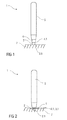
- Figures 1 and 2 show an exemplary embodiment of a medicament delivery device 1 before and during administration of a medicament to a patient, respectively.
- the patient may be a human or animal.
- the delivery device 1 is an autoinjector designed to automatically deliver a dose of a medicament by means of a needle 2 upon sleeve-driven actuation.
- the delivery device 1 may be a pen injector, a syringe, an infusion device, etc.
- An exemplary embodiment of a sleeve-driven actuation mechanism comprises a housing 5, an inner sleeve 3 and an outer sleeve 4 telescopically arranged on the inner sleeve 3.
- the inner sleeve 3 and the outer sleeve 4 are axially translatable relative to each other and relative to the housing 5.
- the inner sleeve 3 covers the needle 2 before and after use of the delivery device 1 to prevent accidental needlestick injuries.
- the outer sleeve 4 serves to actuate a delivery mechanism in the delivery device 1.
- the sleeves 3, 4 may be arranged telescopically and substantially shaped as hollow cylinders with open proximal ends.
- the outer sleeve 4 has an open distal end 4.1 for accommodating the inner sleeve 3.
- a distal end 3.1 of the inner sleeve 3 may be opened or have a cover face with a central aperture for accommodating projection of the needle 2.
- the distal end 3.1 of the inner sleeve 3 may be planar or curved.
- Figure 1 shows an exemplary embodiment of the delivery device 1 in a first state, e.g., prior to use on an injection site 7.
- the outer sleeve 4 projects distally out of the housing 5, and the inner sleeve 3 projects distally out of the outer sleeve 4.
- the sleeves 3, 4 cover a distal needle tip 2.1 of the needle 2 and thus prevent accidental needlestick injuries.
- the distal needle tip 2.1 of the needle 2 may be proximal of the distal end 4.1 of the outer sleeve 4.
- the inner sleeve 3 in the first state, may be axially translatable relative to the outer sleeve 4, but the outer sleeve 4 may be locked relative to the housing 5.
- the inner sleeve 3 may be repeatedly retracted into the outer sleeve 4 a predetermined distance without triggering delivery of the medicament. This may prevent inadvertent triggering of the delivery device 1, allowing for realignment of the delivery device 1 on a different injection site.
- the inner sleeve 3 may be biased in the first state by a first spring element, and the outer sleeve 4 may be biased in the first state by a second spring element.
- Figure 2 shows an exemplary embodiment of the delivery device 1 in a second state, e.g., during use.
- the inner sleeve 3 When the delivery device 1 is pressed against an injection site, the inner sleeve 3 may be pushed into an intermediate position in which it is fully contained inside the outer sleeve 4, and the distal end 4.1 of the outer sleeve 4 touches the injection site 7.
- the inner sleeve 3 and the outer sleeve 4 may be coupled together so that further pressing of the delivery device 1 against the injection site 7 causes the sleeves 3, 4 to move together proximally relative to the housing 5.
- the inner sleeve 3 may engage the outer sleeve 4 when the inner sleeve 3 has attained a predetermined axial position relative to the outer sleeve 4.
- the needle 2 when the inner sleeve 3 engages the outer sleeve 4, the needle 2 may be inserted into the injection site 7 and the medicament may be delivered. In another exemplary embodiment, when the outer sleeve 4 is pressed against the injection site 7, the needle 2 may be inserted into the injection site 7 and the medicament may be delivered.
- a tactile feedback may be provided in the form of resistance.
- the first spring element associated with the inner sleeve 3 may require less force to compress than the second spring element associated with the outer sleeve 4.
- an increased force may be necessary to cause the outer sleeve 4 to move proximally, axially relative to the housing 5.
- a further advantage of the actuation mechanism according to the invention is that the different pressures for the two steps of the process can be realized more easily because they are induced automatically by coupling the sleeves to different compression springs.
- the compression springs may be replaced by other tensioning members.
- the sleeves 3, 4 have different colors or indicia. For example, different colors emphasize the different functions of the sleeves 3, 4 and thus distinguish the two steps of the injection process even more clearly.
- the delivery device 1 After the injection process, the delivery device 1 is withdrawn from the injection site 7.
- the compression springs relax and shift the sleeves 3, 4 distally toward the first state so that they again cover the needle 2.
- advantageously accidental needlestick injuries are prevented after use of the delivery device 1.
- the delivery device 1 additionally comprises additionally a locking mechanism, which locks the position of the inner sleeve 3 and/or the position of the outer sleeve 4 relative to each other and/or the housing 5.
- the locking mechanism may ensure that the inner sleeve 3 and/or outer sleeve 4 cover the distal needle tip 2.1. This advantageously further reduces the risk of accidental needlestick injuries after using the delivery device 1.
- the locking mechanism may comprise at least one latch member of the inner sleeve 3 or the outer sleeve 4 and a corresponding groove located in the housing 5 of the drug delivery device 1, the groove being adapted to receive the latch member.
- the latch member may be part of the housing 5 and the groove may be located in a sleeve 3, 4.
Landscapes
- Health & Medical Sciences (AREA)
- Engineering & Computer Science (AREA)
- Heart & Thoracic Surgery (AREA)
- Vascular Medicine (AREA)
- Anesthesiology (AREA)
- Biomedical Technology (AREA)
- Hematology (AREA)
- Life Sciences & Earth Sciences (AREA)
- Animal Behavior & Ethology (AREA)
- General Health & Medical Sciences (AREA)
- Public Health (AREA)
- Veterinary Medicine (AREA)
- Environmental & Geological Engineering (AREA)
- Infusion, Injection, And Reservoir Apparatuses (AREA)
Abstract
Described is an actuation mechanism for a medicament delivery device (1) having a needle (2) with a distal tip (2.1). The actuation mechanism comprises an outer sleeve (4) telescopically relative to the delivery device (1) and an inner sleeve (3) telescopically arranged relative to the outer sleeve (4). The outer sleeve (4) is axially translatable relative to the delivery device (1), and the inner sleeve (4) is axially translatable relative to the outer sleeve (4). In a first state, the inner sleeve (3) protrudes distally from the outer sleeve (4) and the outer sleeve (4) protrudes distally from the delivery device (1). In a second state, the inner sleeve (3) is contained within the outer sleeve (4). Movement of the outer sleeve (4) proximally relative to the delivery device (1) in the second state initiates delivery of a medicament in the delivery device (1).
Description
- The invention relates to a medicament delivery device and an actuation mechanism for a medicament delivery device.
- Conventional medicament delivery devices containing a selected dose of a medicament are well-known devices for administering the medicament to a patient. A conventional delivery device comprises a needle to administer the medicament. Safety devices for covering a needle of the delivery device before and after use are also well known. In a conventional safety device, a needle shield is moved either manually or automatically (i.e., by spring) to cover the needle.
- A specific type of a medicament delivery device is an autoinjector, which equipped with an actuation button to actuate automatic delivery of the medicament. To administer the medicament, the autoinjector is pressed against an injection site, which retracts the needle shield. When the actuation button is pressed, the needle is inserted into the injection site and the medicament is administered. The conventional delivery deivice, thus, requires two acts -- pressing of the delivery device to injection site and pressing the actuation button. It may be difficult to perform either or both of these acts when the patient/operator has lessened dexterity, e.g., due to age, disability, illness, sensory deficiency, etc.
- Other conventional delivery devices are actuated upon contact with the injection site. These devices are pressed against the injection site, which retracts the needle shield, and pressed with enhanced force to initiate delivery of the medicament. However, patients may be confused by these types of delivery devices, because there is no actuation button.
- It is an object of the present invention to provide an actuation mechanism for a medicament delivery device for easy and safe medicament delivery.
- In an exemplary embodiment, an actuation mechanism for a medicament delivery device has a needle with a distal tip. The actuation mechanism comprises an outer sleeve telescopically relative to the delivery device and an inner sleeve telescopically arranged relative to the outer sleeve. The outer sleeve is axially translatable relative to the delivery device, and the inner sleeve is axially translatable relative to the outer sleeve. In a first state, the inner sleeve protrudes distally from the outer sleeve and the outer sleeve protrudes distally from the delivery device. In a second state, the inner sleeve is contained within the outer sleeve. Movement of the outer sleeve proximally relative to the delivery device in the second state initiates delivery of a medicament in the delivery device.
- In an exemplary embodiment, the inner sleeve and the outer sleeve have different colors or indicia.
- In an exemplary embodiment, the actuation mechanism further comprises a first spring element biasing the inner sleeve in a distal direction relative to the outer sleeve. The actuation mechanism further comprises a second spring element biasing the outer sleeve in a distal direction relative to the delivery device. The second spring element is a harder compression spring than the first spring element.
- In an exemplary embodiment, the outer sleeve is positionally fixed relative to the delivery device in the first state. The inner sleeve engages the outer sleeve in the second state. The inner sleeve includes a latch adapted to engage a recess or opening in the outer sleeve. The outer sleeve includes a latch adapted to engage a recess or opening in the inner sleeve.
- In an exemplary embodiment, when in a third state, the inner sleeve is locked relative to the outer sleeve and the outer sleeve is locked relative to the delivery device.
- In an exemplary embodiment, a drug delivery device comprises an actuation mechanism according to any one of the exemplary embodiments described above, and further includes a needle having a distal tip. In the first state, the inner sleeve and/or the outer sleeve cover the distal tip, and in the second state, the distal tip is adapted to protrude distally relative to the outer sleeve. In the third state, the inner sleeve and/or the outer sleeve cover the distal tip of the needle.
- The term "drug" or "medicament", as used herein, means a pharmaceutical formulation containing at least one pharmaceutically active compound,
wherein in one embodiment the pharmaceutically active compound has a molecular weight up to 1500 Da and/or is a peptide, a proteine, a polysaccharide, a vaccine, a DNA, a RNA, an enzyme, an antibody or a fragment thereof, a hormone or an oligonucleotide, or a mixture of the above-mentioned pharmaceutically active compound,
wherein in a further embodiment the pharmaceutically active compound is useful for the treatment and/or prophylaxis of diabetes mellitus or complications associated with diabetes mellitus such as diabetic retinopathy, thromboembolism disorders such as deep vein or pulmonary thromboembolism, acute coronary syndrome (ACS), angina, myocardial infarction, cancer, macular degeneration, inflammation, hay fever, atherosclerosis and/or rheumatoid arthritis,
wherein in a further embodiment the pharmaceutically active compound comprises at least one peptide for the treatment and/or prophylaxis of diabetes mellitus or complications associated with diabetes mellitus such as diabetic retinopathy,
wherein in a further embodiment the pharmaceutically active compound comprises at least one human insulin or a human insulin analogue or derivative, glucagon-like peptide (GLP-1) or an analogue or derivative thereof, or exendin-3 or exendin-4 or an analogue or derivative of exendin-3 or exendin-4. - Insulin analogues are for example Gly(A21), Arg(B31), Arg(B32) human insulin; Lys(B3), Glu(B29) human insulin; Lys(B28), Pro(B29) human insulin; Asp(B28) human insulin; human insulin, wherein proline in position B28 is replaced by Asp, Lys, Leu, Val or Ala and wherein in position B29 Lys may be replaced by Pro; Ala(B26) human insulin; Des(B28-B30) human insulin; Des(B27) human insulin and Des(B30) human insulin.
- Insulin derivates are for example B29-N-myristoyl-des(B30) human insulin; B29-N-palmitoyl-des(B30) human insulin; B29-N-myristoyl human insulin; B29-N-palmitoyl human insulin; B28-N-myristoyl LysB28ProB29 human insulin; B28-N-palmitoyl-LysB28ProB29 human insulin; B30-N-myristoyl-ThrB29LysB30 human insulin; B30-N-palmitoyl- ThrB29LysB30 human insulin; B29-N-(N-palmitoyl-Y-glutamyl)-des(B30) human insulin; B29-N-(N-lithocholyl-Y-glutamyl)-des(B30) human insulin; B29-N-(ω-carboxyheptadecanoyl)-des(B30) human insulin and B29-N-(ω-carboxyheptadecanoyl) human insulin.
- Exendin-4 for example means Exendin-4(1-39), a peptide of the sequence H-His-Gly-Glu-Gly-Thr-Phe-Thr-Ser-Asp-Leu-Ser-Lys-Gln-Met-Glu-Glu-Glu-Ala-Val-Arg-Leu-Phe-lle-Glu-Trp-Leu-Lys-Asn-Gly-Gly-Pro-Ser-Ser-Gly-Ala-Pro-Pro-Pro-Ser-NH2.
- Exendin-4 derivatives are for example selected from the following list of compounds:
- H-(Lys)4-des Pro36, des Pro37 Exendin-4(1-39)-NH2,
- H-(Lys)5-des Pro36, des Pro37 Exendin-4(1-39)-NH2,
- des Pro36 Exendin-4(1-39),
- des Pro36 [Asp28] Exendin-4(1-39),
- des Pro36 [isoAsp28] Exendin-4(1-39),
- des Pro36 [Met(O)14, Asp28] Exendin-4(1-39),
- des Pro36 [Met(O)14, IsoAsp28] Exendin-4(1-39),
- des Pro36 [Trp(02)25, Asp28] Exendin-4(1-39),
- des Pro36 [Trp(02)25, IsoAsp28] Exendin-4(1-39),
- des Pro36 [Met(O)14 Trp(02)25, Asp28] Exendin-4(1-39),
- des Pro36 [Met(O)14 Trp(02)25, IsoAsp28] Exendin-4(1-39); or
- des Pro36 [Asp28] Exendin-4(1-39),
- des Pro36 [IsoAsp28] Exendin-4(1-39),
- des Pro36 [Met(O)14, Asp28] Exendin-4(1-39),
- des Pro36 [Met(O)14, IsoAsp28] Exendin-4(1-39),
- des Pro36 [Trp(02)25, Asp28] Exendin-4(1-39),
- des Pro36 [Trp(02)25, IsoAsp28] Exendin-4(1-39),
- des Pro36 [Met(O)14 Trp(02)25, Asp28] Exendin-4(1-39),
- des Pro36 [Met(O)14 Trp(02)25, IsoAsp28] Exendin-4(1-39),
- or an Exendin-4 derivative of the sequence
- des Pro36 Exendin-4(1-39)-Lys6-NH2 (AVE0010),
- H-(Lys)6-des Pro36 [Asp28] Exendin-4(1-39)-Lys6-NH2,
- des Asp28 Pro36, Pro37, Pro38Exendin-4(1-39)-NH2,
- H-(Lys)6-des Pro36, Pro38 [Asp28] Exendin-4(1-39)-NH2,
- H-Asn-(Glu)5des Pro36, Pro37, Pro38 [Asp28] Exendin-4(1-39)-NH2,
- des Pro36, Pro37, Pro38 [Asp28] Exendin-4(1-39)-(Lys)6-NH2,
- H-(Lys)6-des Pro36, Pro37, Pro38 [Asp28] Exendin-4(1-39)-(Lys)6-NH2,
- H-Asn-(Glu)5-des Pro36, Pro37, Pro38 [Asp28] Exendin-4(1-39)-(Lys)6-NH2,
- H-(Lys)6-des Pro36 [Trp(02)25, Asp28] Exendin-4(1-39)-Lys6-NH2,
- H-des Asp28 Pro36, Pro37, Pro38 [Trp(02)25] Exendin-4(1-39)-NH2,
- H-(Lys)6-des Pro36, Pro37, Pro38 [Trp(02)25, Asp28] Exendin-4(1-39)-NH2,
- H-Asn-(Glu)5-des Pro36, Pro37, Pro38 [Trp(02)25, Asp28] Exendin-4(1-39)-NH2,
- des Pro36, Pro37, Pro38 [Trp(02)25, Asp28] Exendin-4(1-39)-(Lys)6-NH2,
- H-(Lys)6-des Pro36, Pro37, Pro38 [Trp(02)25, Asp28] Exendin-4(1-39)-(Lys)6-NH2,
- H-Asn-(Glu)5-des Pro36, Pro37, Pro38 [Trp(02)25, Asp28] Exendin-4(1-39)-(Lys)6-NH2,
- H-(Lys)6-des Pro36 [Met(O)14, Asp28] Exendin-4(1-39)-Lys6-NH2,
- des Met(O)14 Asp28 Pro36, Pro37, Pro38 Exendin-4(1-39)-NH2,
- H-(Lys)6-desPro36, Pro37, Pro38 [Met(O)14, Asp28] Exendin-4(1-39)-NH2,
- H-Asn-(Glu)5-des Pro36, Pro37, Pro38 [Met(O)14, Asp28] Exendin-4(1-39)-NH2,
- des Pro36, Pro37, Pro38 [Met(O)14, Asp28] Exendin-4(1-39)-(Lys)6-NH2,
- H-(Lys)6-des Pro36, Pro37, Pro38 [Met(O)14, Asp28] Exendin-4(1-39)-(Lys)6-NH2,
- H-Asn-(Glu)5 des Pro36, Pro37, Pro38 [Met(O)14, Asp28] Exendin-4(1-39)-(Lys)6-NH2,
- H-Lys6-des Pro36 [Met(O)14, Trp(02)25, Asp28] Exendin-4(1-39)-Lys6-NH2,
- H-des Asp28 Pro36, Pro37, Pro38 [Met(O)14, Trp(02)25] Exendin-4(1-39)-NH2,
- H-(Lys)6-des Pro36, Pro37, Pro38 [Met(O)14, Asp28] Exendin-4(1-39)-NH2,
- H-Asn-(Glu)5-des Pro36, Pro37, Pro38 [Met(O)14, Trp(02)25, Asp28] Exendin-4(1-39)-NH2,
- des Pro36, Pro37, Pro38 [Met(O)14, Trp(02)25, Asp28] Exendin-4(1-39)-(Lys)6-NH2,
- H-(Lys)6-des Pro36, Pro37, Pro38 [Met(O)14, Trp(02)25, Asp28] Exendin-4(S1-39)-(Lys)6-NH2,
- H-Asn-(Glu)5-des Pro36, Pro37, Pro38 [Met(O)14, Trp(02)25, Asp28] Exendin-4(1-39)-(Lys)6-NH2;
- Hormones are for example hypophysis hormones or hypothalamus hormones or regulatory active peptides and their antagonists as listed in Rote Liste, ed. 2008, Chapter 50, such as Gonadotropine (Follitropin, Lutropin, Choriongonadotropin, Menotropin), Somatropine (Somatropin), Desmopressin, Terlipressin, Gonadorelin, Triptorelin, Leuprorelin, Buserelin, Nafarelin, Goserelin.
- A polysaccharide is for example a glucosaminoglycane, a hyaluronic acid, a heparin, a low molecular weight heparin or an ultra low molecular weight heparin or a derivative thereof, or a sulphated, e.g. a poly-sulphated form of the above-mentioned polysaccharides, and/or a pharmaceutically acceptable salt thereof. An example of a pharmaceutically acceptable salt of a poly-sulphated low molecular weight heparin is enoxaparin sodium.
- Antibodies are globular plasma proteins (∼150 kDa) that are also known as immunoglobulins, which share a basic structure. As they have sugar chains added to amino acid residues, they are glycoproteins. The basic functional unit of each antibody is an immunoglobulin (Ig) monomer (containing only one Ig unit); secreted antibodies can also be dimeric with two Ig units as with IgA, tetrameric with four Ig units like teleost fish IgM, or pentameric with five Ig units, like mammalian IgM.
- The Ig monomer is a "Y"-shaped molecule that consists of four polypeptide chains; two identical heavy chains and two identical light chains connected by disulfide bonds between cysteine residues. Each heavy chain is about 440 amino acids long; each light chain is about 220 amino acids long. Heavy and light chains each contain intrachain disulfide bonds which stabilize their folding. Each chain is composed of structural domains called Ig domains. These domains contain about 70-110 amino acids and are classified into different categories (for example, variable or V, and constant or C) according to their size and function. They have a characteristic immunoglobulin fold in which two β sheets create a "sandwich" shape, held together by interactions between conserved cysteines and other charged amino acids.
- There are five types of mammalian Ig heavy chain denoted by α, δ, ε, γ, and p. The type of heavy chain present defines the isotype of antibody; these chains are found in IgA, IgD, IgE, IgG, and IgM antibodies, respectively.
- Distinct heavy chains differ in size and composition; α and γ contain approximately 450 amino acids and δ approximately 500 amino acids, while p and ε have approximately 550 amino acids. Each heavy chain has two regions, the constant region (CH) and the variable region (VH). In one species, the constant region is essentially identical in all antibodies of the same isotype, but differs in antibodies of different isotypes. Heavy chains γ, α and δ have a constant region composed of three tandem Ig domains, and a hinge region for added flexibility; heavy chains p and ε have a constant region composed of four immunoglobulin domains. The variable region of the heavy chain differs in antibodies produced by different B cells, but is the same for all antibodies produced by a single B cell or B cell clone. The variable region of each heavy chain is approximately 110 amino acids long and is composed of a single Ig domain.
- In mammals, there are two types of immunoglobulin light chain denoted by λ and κ. A light chain has two successive domains: one constant domain (CL) and one variable domain (VL). The approximate length of a light chain is 211 to 217 amino acids. Each antibody contains two light chains that are always identical; only one type of light chain, κ or λ, is present per antibody in mammals.
- Although the general structure of all antibodies is very similar, the unique property of a given antibody is determined by the variable (V) regions, as detailed above. More specifically, variable loops, three each on the light (VL) and three on the heavy (VH) chain, are responsible for binding to the antigen, i.e. for its antigen specificity. These loops are referred to as the Complementarity Determining Regions (CDRs). Because CDRs from both VH and VL domains contribute to the antigen-binding site, it is the combination of the heavy and the light chains, and not either alone, that determines the final antigen specificity.
- An "antibody fragment" contains at least one antigen binding fragment as defined above and exhibits essentially the same function and specificity as the complete antibody of which the fragment is derived from. Limited proteolytic digestion with papain cleaves the Ig prototype into three fragments. Two identical amino terminal fragments, each containing one entire L chain and about half an H chain, are the antigen binding fragments (Fab). The third fragment, similar in size but containing the carboxyl terminal half of both heavy chains with their interchain disulfide bond, is the crystalizable fragment (Fc). The Fc contains carbohydrates, complement-binding, and FcR-binding sites. Limited pepsin digestion yields a single F(ab')2 fragment containing both Fab pieces and the hinge region, including the H-H interchain disulfide bond. F(ab')2 is divalent for antigen binding. The disulfide bond of F(ab')2 may be cleaved in order to obtain Fab'. Moreover, the variable regions of the heavy and light chains can be fused together to form a single chain variable fragment (scFv).
- Pharmaceutically acceptable salts are for example acid addition salts and basic salts. Acid addition salts are e.g. HCl or HBr salts. Basic salts are e.g. salts having a cation selected from alkali or alkaline, e.g. Na+, or K+, or Ca2+, or an ammonium ion N+(R1)(R2)(R3)(R4), wherein R1 to R4 independently of each other mean: hydrogen, an optionally substituted C1-C6-alkyl group, an optionally substituted C2-C6-alkenyl group, an optionally substituted C6-C10-aryl group, or an optionally substituted C6-C10-heteroaryl group. Further examples of pharmaceutically acceptable salts are described in "Remington's Pharmaceutical Sciences" 17. ed. Alfonso R. Gennaro (Ed.), Mark Publishing Company, Easton, Pa., U.S.A., 1985 and in Encyclopedia of Pharmaceutical Technology.
- Pharmaceutically acceptable solvates are for example hydrates.
- Further scope of applicability of the present invention will become apparent from the detailed description given hereinafter. However, it should be understood that the detailed description and specific examples, while indicating preferred embodiments of the invention, are given by way of illustration only, since various changes and modifications within the spirit and scope of the invention will become apparent to those skilled in the art from this detailed description.
- The present invention will become more fully understood from the detailed description given hereinbelow and the accompanying drawings, which are given by way of illustration only, and thus, are not limitive of the present invention, and wherein:
- Figure 1
- shows an exemplary embodiment of a medicament delivery device before use, and
- Figure 2
- shows an exemplary embodiment of a medicament delivery device druing use.
-
Figures 1 and 2 show an exemplary embodiment of amedicament delivery device 1 before and during administration of a medicament to a patient, respectively. Those of skill in the art will understand that the patient may be a human or animal. In the exemplary embodiment, thedelivery device 1 is an autoinjector designed to automatically deliver a dose of a medicament by means of a needle 2 upon sleeve-driven actuation. Those of skill in the art will understand that thedelivery device 1 may be a pen injector, a syringe, an infusion device, etc. - An exemplary embodiment of a sleeve-driven actuation mechanism comprises a
housing 5, aninner sleeve 3 and anouter sleeve 4 telescopically arranged on theinner sleeve 3. Theinner sleeve 3 and theouter sleeve 4 are axially translatable relative to each other and relative to thehousing 5. Theinner sleeve 3 covers the needle 2 before and after use of thedelivery device 1 to prevent accidental needlestick injuries. Theouter sleeve 4 serves to actuate a delivery mechanism in thedelivery device 1. Thesleeves outer sleeve 4 has an open distal end 4.1 for accommodating theinner sleeve 3. A distal end 3.1 of theinner sleeve 3 may be opened or have a cover face with a central aperture for accommodating projection of the needle 2. In an exemplary embodiment, the distal end 3.1 of theinner sleeve 3 may be planar or curved. -
Figure 1 shows an exemplary embodiment of thedelivery device 1 in a first state, e.g., prior to use on aninjection site 7. In the first state, theouter sleeve 4 projects distally out of thehousing 5, and theinner sleeve 3 projects distally out of theouter sleeve 4. In the first state, thesleeves outer sleeve 4. - In an exemplary embodiment, in the first state, the
inner sleeve 3 may be axially translatable relative to theouter sleeve 4, but theouter sleeve 4 may be locked relative to thehousing 5. Thus, theinner sleeve 3 may be repeatedly retracted into the outer sleeve 4 a predetermined distance without triggering delivery of the medicament. This may prevent inadvertent triggering of thedelivery device 1, allowing for realignment of thedelivery device 1 on a different injection site. - In an exemplary embodiment, the
inner sleeve 3 may be biased in the first state by a first spring element, and theouter sleeve 4 may be biased in the first state by a second spring element. -
Figure 2 shows an exemplary embodiment of thedelivery device 1 in a second state, e.g., during use. When thedelivery device 1 is pressed against an injection site, theinner sleeve 3 may be pushed into an intermediate position in which it is fully contained inside theouter sleeve 4, and the distal end 4.1 of theouter sleeve 4 touches theinjection site 7. When the distal end 3.1 of theinner sleeve 3 is in a same plane as the distal end 4.1 of theouter sleeve 4, theinner sleeve 3 and theouter sleeve 4 may be coupled together so that further pressing of thedelivery device 1 against theinjection site 7 causes thesleeves housing 5. For example, theinner sleeve 3 may engage theouter sleeve 4 when theinner sleeve 3 has attained a predetermined axial position relative to theouter sleeve 4. - In an exemplary embodiment, when the
inner sleeve 3 engages theouter sleeve 4, the needle 2 may be inserted into theinjection site 7 and the medicament may be delivered. In another exemplary embodiment, when theouter sleeve 4 is pressed against theinjection site 7, the needle 2 may be inserted into theinjection site 7 and the medicament may be delivered. - A tactile feedback may be provided in the form of resistance. For example, the first spring element associated with the
inner sleeve 3 may require less force to compress than the second spring element associated with theouter sleeve 4. Thus, an increased force may be necessary to cause theouter sleeve 4 to move proximally, axially relative to thehousing 5. This has the advantage that the patient can clearly distinguish the two steps of the process and thus removes a potential patient's feeling of insecurity concerning the injection process. A further advantage of the actuation mechanism according to the invention is that the different pressures for the two steps of the process can be realized more easily because they are induced automatically by coupling the sleeves to different compression springs. Of course, in alternative embodiments, the compression springs may be replaced by other tensioning members. - In an exemplary embodiment, the
sleeves sleeves - After the injection process, the
delivery device 1 is withdrawn from theinjection site 7. When force is removed from thesleeves sleeves delivery device 1. - In a preferred extension of the invention, the
delivery device 1 additionally comprises additionally a locking mechanism, which locks the position of theinner sleeve 3 and/or the position of theouter sleeve 4 relative to each other and/or thehousing 5. The locking mechanism may ensure that theinner sleeve 3 and/orouter sleeve 4 cover the distal needle tip 2.1. This advantageously further reduces the risk of accidental needlestick injuries after using thedelivery device 1. - For instance, the locking mechanism may comprise at least one latch member of the
inner sleeve 3 or theouter sleeve 4 and a corresponding groove located in thehousing 5 of thedrug delivery device 1, the groove being adapted to receive the latch member. Alternatively, the latch member may be part of thehousing 5 and the groove may be located in asleeve - Those of skill in the art will understand that modifications (additions and/or removals) of various components of the apparatuses, methods and/or systems and embodiments described herein may be made without departing from the full scope and spirit of the present invention, which encompass such modifications and any and all equivalents thereof.
Claims (12)
- An actuation mechanism for a medicament delivery device (1) having a needle (2) with a distal tip (2.1), the actuation mechanism comprising:an outer sleeve (4) telescopically relative to the delivery device (1), the outer sleeve (4) axially translatable relative to the delivery device (1)an inner sleeve (3) telescopically arranged relative to the outer sleeve (4), the inner sleeve (4) axially translatable relative to the outer sleeve (4),wherein, in a first state, the inner sleeve (3) protrudes distally from the outer sleeve (4) and the outer sleeve (4) protrudes distally from the delivery device (1),wherein, in a second state, the inner sleeve (3) is contained within the outer sleeve (4), andwherein, movement of the outer sleeve (4) proximally relative to the delivery device (1) in the second state initiates delivery of a medicament in the delivery device (1).
- The actuation mechanism according to claim 1, wherein the inner sleeve (3) and the outer sleeve (4) have different colors or indicia.
- The actuation mechanism according to any one of the preceding claims, further comprising:a first spring element biasing the inner sleeve (3) in a distal direction relative to the outer sleeve (4).
- The actuation mechanism according to any one of the preceding claims, further comprising:a second spring element biasing the outer sleeve (3) in a distal direction relative to the delivery device (1).
- The actuation mechanism according to claims 5 and 6, wherein the second spring element is a harder compression spring than the first spring element.
- The actuation mechanism according to any one of the preceding claims, wherein the outer sleeve (4) is positionally fixed relative to the delivery device (1) in the first state.
- The actuation mechanism according to any one of the preceding claims, wherein the inner sleeve (3) engages the outer sleeve (4) in the second state.
- The actuation mechanism according to claim 7, wherein the inner sleeve (3) includes a latch adapted to engage a recess or opening in the outer sleeve (4).
- The actuation mechanism according to claim 7, wherein the outer sleeve (4) includes a latch adapted to engage a recess or opening in the inner sleeve (3).
- The actuation mechanism according to any of the preceding claims, wherein, when in a third state, the inner sleeve (3) is locked relative to the outer sleeve (4) and the outer sleeve (4) is locked relative to the delivery device (1).
- A drug delivery device (1) comprising:an actuation mechanism according to any one of the preceding claims; anda needle (2) having a distal tip (2.1),wherein, in the first state, the inner sleeve (3) and/or the outer sleeve (4) cover the distal tip (2.1), andwherein, in the second state, the distal tip (2.1) is adapted to protrude distally relative to the outer sleeve (4).
- The drug delivery device (1) according to claims 10 and 11, wherein, in the third state, the inner sleeve (3) and/or the outer sleeve (4) cover the distal tip (2.1) of the needle (2).
Priority Applications (19)
| Application Number | Priority Date | Filing Date | Title |
|---|---|---|---|
| EP11182632A EP2572741A1 (en) | 2011-09-23 | 2011-09-23 | Medicament delivery device and actuation mechanism for a drug delivery device |
| US14/346,228 US9364617B2 (en) | 2011-09-23 | 2012-09-20 | Medicament delivery device and actuation mechanism for a drug delivery device |
| DK17166144.0T DK3225268T3 (en) | 2011-09-23 | 2012-09-20 | DRUG DELIVERY DEVICE AND ACTIVATION MECHANISM FOR A DRUG DELIVERY DEVICE |
| EP17166144.0A EP3225268B1 (en) | 2011-09-23 | 2012-09-20 | Medicament delivery device and actuation mechanism for a drug delivery device |
| EP12759761.5A EP2758099B1 (en) | 2011-09-23 | 2012-09-20 | Medicament delivery device and actuation mechanism for a drug delivery device |
| EP24180835.1A EP4434562A3 (en) | 2011-09-23 | 2012-09-20 | Medicament delivery device and actuation mechanism for a drug delivery device |
| JP2014531235A JP6169575B2 (en) | 2011-09-23 | 2012-09-20 | Actuating mechanism for drug delivery device and drug delivery device |
| CA2848101A CA2848101A1 (en) | 2011-09-23 | 2012-09-20 | Medicament delivery device and actuation mechanism for a drug delivery device |
| PCT/EP2012/068572 WO2013041642A1 (en) | 2011-09-23 | 2012-09-20 | Medicament delivery device and actuation mechanism for a drug delivery device |
| DK12759761.5T DK2758099T3 (en) | 2011-09-23 | 2012-09-20 | MEDICINE SUPPLY AND ACTUATING MECHANISM FOR A MEDICINE SUPPLY |
| US15/177,948 US10675408B2 (en) | 2011-09-23 | 2016-06-09 | Medicament delivery device and actuation mechanism for a drug delivery device |
| JP2017124974A JP6412215B2 (en) | 2011-09-23 | 2017-06-27 | Actuating mechanism for drug delivery device and drug delivery device |
| US16/892,047 US12403258B2 (en) | 2011-09-23 | 2020-06-03 | Medicament delivery device and actuation mechanism for a drug delivery device |
| US17/011,607 US11918786B2 (en) | 2011-09-23 | 2020-09-03 | Medicament delivery device and actuation mechanism for a drug delivery device |
| US18/757,830 US20240342375A1 (en) | 2011-09-23 | 2024-06-28 | Medicament Delivery Device and Actuation Mechanism for a Drug Delivery Device |
| US18/758,133 US20240350733A1 (en) | 2011-09-23 | 2024-06-28 | Medicament Delivery Device and Actuation Mechanism for a Drug Delivery Device |
| US18/757,728 US12403259B2 (en) | 2011-09-23 | 2024-06-28 | Medicament delivery device and actuation mechanism for a drug delivery device |
| US18/757,683 US12533467B2 (en) | 2011-09-23 | 2024-06-28 | Medicament delivery device and actuation mechanism for a drug delivery device |
| US18/757,999 US20240350732A1 (en) | 2011-09-23 | 2024-06-28 | Medicament Delivery Device and Actuation Mechanism for a Drug Delivery Device |
Applications Claiming Priority (1)
| Application Number | Priority Date | Filing Date | Title |
|---|---|---|---|
| EP11182632A EP2572741A1 (en) | 2011-09-23 | 2011-09-23 | Medicament delivery device and actuation mechanism for a drug delivery device |
Publications (1)
| Publication Number | Publication Date |
|---|---|
| EP2572741A1 true EP2572741A1 (en) | 2013-03-27 |
Family
ID=46875853
Family Applications (4)
| Application Number | Title | Priority Date | Filing Date |
|---|---|---|---|
| EP11182632A Ceased EP2572741A1 (en) | 2011-09-23 | 2011-09-23 | Medicament delivery device and actuation mechanism for a drug delivery device |
| EP24180835.1A Pending EP4434562A3 (en) | 2011-09-23 | 2012-09-20 | Medicament delivery device and actuation mechanism for a drug delivery device |
| EP17166144.0A Active EP3225268B1 (en) | 2011-09-23 | 2012-09-20 | Medicament delivery device and actuation mechanism for a drug delivery device |
| EP12759761.5A Active EP2758099B1 (en) | 2011-09-23 | 2012-09-20 | Medicament delivery device and actuation mechanism for a drug delivery device |
Family Applications After (3)
| Application Number | Title | Priority Date | Filing Date |
|---|---|---|---|
| EP24180835.1A Pending EP4434562A3 (en) | 2011-09-23 | 2012-09-20 | Medicament delivery device and actuation mechanism for a drug delivery device |
| EP17166144.0A Active EP3225268B1 (en) | 2011-09-23 | 2012-09-20 | Medicament delivery device and actuation mechanism for a drug delivery device |
| EP12759761.5A Active EP2758099B1 (en) | 2011-09-23 | 2012-09-20 | Medicament delivery device and actuation mechanism for a drug delivery device |
Country Status (6)
| Country | Link |
|---|---|
| US (9) | US9364617B2 (en) |
| EP (4) | EP2572741A1 (en) |
| JP (2) | JP6169575B2 (en) |
| CA (1) | CA2848101A1 (en) |
| DK (2) | DK3225268T3 (en) |
| WO (1) | WO2013041642A1 (en) |
Cited By (3)
| Publication number | Priority date | Publication date | Assignee | Title |
|---|---|---|---|---|
| US9579468B2 (en) | 2011-11-07 | 2017-02-28 | Safety Syringes, Inc. | Contact trigger release needle guard |
| FR3056915A1 (en) * | 2016-10-04 | 2018-04-06 | Aptar France Sas | MANUAL INJECTION DEVICE. |
| CN111658902A (en) * | 2020-07-21 | 2020-09-15 | 四川大学 | Safe automatic medicine injection device |
Families Citing this family (11)
| Publication number | Priority date | Publication date | Assignee | Title |
|---|---|---|---|---|
| EP2572741A1 (en) | 2011-09-23 | 2013-03-27 | Sanofi-Aventis Deutschland GmbH | Medicament delivery device and actuation mechanism for a drug delivery device |
| ES2728054T3 (en) | 2013-06-18 | 2019-10-22 | Enable Injections Inc | Vial transfer and injection device |
| WO2016061220A2 (en) * | 2014-10-14 | 2016-04-21 | Amgen Inc. | Drug injection device with visual and audio indicators |
| JP6856840B2 (en) | 2016-12-27 | 2021-04-14 | アクション メディカル テクノロジーズ,エルエルシーAction Medical Technologies,Llc | Injector and how to operate the injector |
| EP3703794B1 (en) * | 2017-10-30 | 2026-02-18 | Sanofi | Injector device |
| WO2020014292A1 (en) | 2018-07-10 | 2020-01-16 | Action Medical Technologies, Llc | Apparatuses and method for injecting medicaments |
| USD893712S1 (en) | 2019-02-15 | 2020-08-18 | Action Medical Technologies, Llc | Grip for autoinjectors |
| CA3172305C (en) | 2020-03-25 | 2023-02-07 | Joseph B. Hoffer | Apparatuses and methods for injecting medicaments |
| US11759576B2 (en) | 2020-06-05 | 2023-09-19 | Action Medical Technologies, Llc | Parenteral injection apparatus |
| US12623031B2 (en) | 2024-08-29 | 2026-05-12 | Genzyme Corporation | Medicament delivery device |
| US12303675B1 (en) * | 2024-08-29 | 2025-05-20 | Genzyme Corporation | Medicament delivery device |
Citations (4)
| Publication number | Priority date | Publication date | Assignee | Title |
|---|---|---|---|---|
| WO1994021316A1 (en) * | 1993-03-24 | 1994-09-29 | Owen Mumford Limited | Improvements relating to injection devices |
| DE102004053529A1 (en) * | 2004-11-05 | 2006-05-11 | Tecpharma Licensing Ag | Blood withdrawal device for use by patient, has drive unit coupled with piston, which is movable in blood container, and detachable locking device, which prevents movement of piston by drive unit |
| WO2006111861A2 (en) * | 2005-04-20 | 2006-10-26 | Becton Dickinson France | Injection set and injection assistance device |
| EP1949928A1 (en) * | 2007-01-23 | 2008-07-30 | Becton, Dickinson and Company, Wagner, Jaconda | Retracting safety pen needle |
Family Cites Families (118)
| Publication number | Priority date | Publication date | Assignee | Title |
|---|---|---|---|---|
| US3563098A (en) * | 1968-06-28 | 1971-02-16 | Rex Chainbelt Inc | Automatic quick release mechanism |
| US4487602A (en) * | 1981-09-14 | 1984-12-11 | Syntex (U.S.A.) Inc. | Injection device |
| US4378015A (en) * | 1981-12-21 | 1983-03-29 | Wardlaw Stephen C | Automatic injecting syringe |
| USRE32922E (en) * | 1983-01-13 | 1989-05-16 | Paul D. Levin | Blood sampling instrument |
| US4517978A (en) * | 1983-01-13 | 1985-05-21 | Levin Paul D | Blood sampling instrument |
| US5248301A (en) * | 1987-12-03 | 1993-09-28 | Medfusion, Inc. | Transcutaneous infusion apparatus and methods of manufacture and use |
| US4897083A (en) * | 1988-05-09 | 1990-01-30 | Martell Michael D | Syringe needle guard |
| US4902279A (en) * | 1988-10-05 | 1990-02-20 | Autoject Systems Inc. | Liquid medicament safety injector |
| US5451210A (en) * | 1991-04-29 | 1995-09-19 | Lifequest Medical, Inc. | System and method for rapid vascular drug delivery |
| US5271744A (en) * | 1991-04-29 | 1993-12-21 | George C. Kramer | System and method for rapid vascular drug delivery |
| US5176643A (en) * | 1991-04-29 | 1993-01-05 | George C. Kramer | System and method for rapid vascular drug delivery |
| EP0768902B1 (en) * | 1992-11-19 | 1998-07-15 | Tebro S.A. | Disposable auto-injector for prefilled syringes |
| US5336199A (en) * | 1993-11-12 | 1994-08-09 | Castillo Leo S | Medical needle and needle sheath assembly |
| US5478316A (en) * | 1994-02-02 | 1995-12-26 | Becton, Dickinson And Company | Automatic self-injection device |
| FR2733155B1 (en) * | 1995-04-18 | 1997-09-19 | Tebro | RECHARGEABLE SELF-INJECTOR |
| US5658259A (en) * | 1995-10-19 | 1997-08-19 | Meridian Medical Technologies, Inc. | Dental cartridge assembly auto-injector with protective needle cover |
| US5609577A (en) * | 1996-01-29 | 1997-03-11 | Haber; Terry M. | Automatically locking hypodermic needle hiding shield for a dose metering syringe |
| IE970782A1 (en) * | 1997-10-22 | 1999-05-05 | Elan Corp | An improved automatic syringe |
| FR2774294B1 (en) * | 1998-02-04 | 2000-04-14 | Marc Brunel | DEVICE FOR AUTOMATICALLY INJECTING A DOSE OF MEDICINAL PRODUCT |
| DE19822031C2 (en) * | 1998-05-15 | 2000-03-23 | Disetronic Licensing Ag | Auto injection device |
| US6162197A (en) * | 1998-12-22 | 2000-12-19 | Mohammad; Owais | Retractable needle assembly and method of making the same |
| US20050171486A1 (en) * | 1999-05-10 | 2005-08-04 | Hochman Mark N. | Safety syringe |
| US20010031949A1 (en) * | 1999-06-18 | 2001-10-18 | Asbaghi Hooman A. | Protective device for a prefilled injection syringe |
| US6102896A (en) * | 1999-09-08 | 2000-08-15 | Cambridge Biostability Limited | Disposable injector device |
| DE10009815B4 (en) * | 2000-03-01 | 2009-07-16 | Tecpharma Licensing Ag | Injection device with a needle cover |
| DE10044383C2 (en) * | 2000-09-08 | 2003-02-06 | Disetronic Licensing Ag | Needle protector |
| SE518981C2 (en) | 2000-12-14 | 2002-12-17 | Shl Medical Ab | autoinjector |
| US7238671B2 (en) | 2001-10-18 | 2007-07-03 | Bristol-Myers Squibb Company | Human glucagon-like-peptide-1 mimics and their use in the treatment of diabetes and related conditions |
| ES2257597T3 (en) | 2001-11-30 | 2006-08-01 | Novo Nordisk A/S | SAFETY NEEDLE ASSEMBLY. |
| AU2003208948A1 (en) * | 2002-03-13 | 2003-09-29 | Eli Lilly And Company | Method of treating a medical condition with a portable medication delivery device |
| US6808507B2 (en) * | 2002-05-10 | 2004-10-26 | Cambridge Biostability Ltd. | Safety injectors |
| US6979316B1 (en) * | 2002-05-23 | 2005-12-27 | Seedlings Life Science Ventures Llc | Apparatus and method for rapid auto-injection of medication |
| US7083600B2 (en) * | 2002-08-08 | 2006-08-01 | Advanced Medical Sharps, Inc. | Safety needle and shield |
| AT413648B (en) * | 2002-10-02 | 2006-04-15 | Greiner Bio One Gmbh | RECORDING DEVICE WITH ADJUSTABLE COVERING ELEMENT |
| CN100506305C (en) * | 2002-11-25 | 2009-07-01 | 特克法马许可公司 | Injection apparatus comprising a needle-protecting device |
| US6767336B1 (en) * | 2003-01-09 | 2004-07-27 | Sheldon Kaplan | Automatic injector |
| US6805686B1 (en) * | 2003-05-06 | 2004-10-19 | Abbott Laboratories | Autoinjector with extendable needle protector shroud |
| GB0312852D0 (en) * | 2003-06-05 | 2003-07-09 | Owen Mumford Ltd | Improvements relating to syringe firing mechanisms |
| AU2004271893B2 (en) * | 2003-08-28 | 2010-07-29 | Becton, Dickinson And Company | Intradermal injection device |
| DE10342058B4 (en) * | 2003-09-11 | 2007-10-25 | Tecpharma Licensing Ag | Administration device for an injectable product with a trigger safety device |
| DE10342059B4 (en) * | 2003-09-11 | 2007-03-01 | Tecpharma Licensing Ag | Delivery device with piercing and Ausschutinrichtung |
| GB0406458D0 (en) * | 2003-10-09 | 2004-04-28 | Liversidge Barry P | Safety medical needle assemblies |
| US7097631B2 (en) * | 2003-10-31 | 2006-08-29 | Alza Corporation | Self-actuating applicator for microprojection array |
| US7635348B2 (en) | 2003-11-04 | 2009-12-22 | Meridian Medical Technologies, Inc. | Container for medicament automatic injector and automatic injector adapted therefor |
| DE10351599A1 (en) | 2003-11-05 | 2005-06-16 | Tecpharma Licensing Ag | Auto-injection device |
| US20050101919A1 (en) | 2003-11-07 | 2005-05-12 | Lennart Brunnberg | Device for an injector |
| GB0327136D0 (en) * | 2003-11-21 | 2003-12-24 | Nmt Group Plc | Safety needle |
| ATE446112T1 (en) * | 2003-12-18 | 2009-11-15 | Tecpharma Licensing Ag | TRIGGERABLE INJECTION DEVICE |
| CH696421A5 (en) * | 2003-12-18 | 2007-06-15 | Tecpharma Licensing Ag | Autoinjector with arresting the drug container. |
| GB0403335D0 (en) * | 2004-02-14 | 2004-03-17 | Liversidge Barry P | Medical injector handling device |
| GB2414399B (en) * | 2004-05-28 | 2008-12-31 | Cilag Ag Int | Injection device |
| GB2414403B (en) * | 2004-05-28 | 2009-01-07 | Cilag Ag Int | Injection device |
| US8048035B2 (en) | 2004-08-06 | 2011-11-01 | Meridian Medical Technologies, Inc. | Automatic injector with needle cover |
| CN101119761B (en) | 2004-11-24 | 2010-08-18 | Shl医药公司 | Injection device |
| EP1666085A1 (en) * | 2004-12-01 | 2006-06-07 | Societe de Conseils de Recherches et d'Applications Scientifiques (S.C.R.A.S) SAS | Injection device for a solid implant |
| DK2058020T3 (en) | 2005-02-01 | 2013-01-07 | Intelliject Inc | Device for administering drug |
| GB2424838B (en) * | 2005-04-06 | 2011-02-23 | Cilag Ag Int | Injection device (adaptable drive) |
| ES2677022T3 (en) * | 2005-04-20 | 2018-07-27 | Becton Dickinson France | Injection set and injection assist device |
| EP1904130B1 (en) | 2005-06-21 | 2016-03-30 | Eli Lilly And Company | Needled pharmaceutical delivery device with triggered automatic needle insertion and manually controlled pharmaceutical injection |
| CN101282752A (en) | 2005-10-11 | 2008-10-08 | 伊莱利利公司 | equipment for injecting drugs |
| GB2438590B (en) * | 2006-06-01 | 2011-02-09 | Cilag Gmbh Int | Injection device |
| DE102006041128A1 (en) | 2006-09-01 | 2008-03-20 | Tecpharma Licensing Ag | Safety pin module with a detent mechanism and a usage label |
| BRPI0720777A2 (en) * | 2006-12-22 | 2014-07-01 | Novo Nordisk As | NEEDLE SET TO BE PROTECTED WITH INCLINED SAFETY PROTECTOR |
| MX340160B (en) * | 2007-03-07 | 2016-06-29 | Becton Dickinson And Company * | Safety blood collection assembly with indicator. |
| CN101641125B (en) * | 2007-03-09 | 2013-06-19 | 伊莱利利公司 | Delay mechanism for automatic injection device |
| CN101678168B (en) * | 2007-03-22 | 2013-03-06 | 特克法马许可公司 | Injection device with controlled needle retraction |
| CA2694952A1 (en) | 2007-07-18 | 2009-01-22 | Unomedical A/S | Insertion device with pivoting action |
| WO2009014955A2 (en) | 2007-07-20 | 2009-01-29 | Amylin Pharmaceuticals, Inc. | Pen injection device and method of using same |
| EP2211945B1 (en) * | 2007-09-25 | 2017-09-20 | Becton Dickinson France | Autoinjector received in external socket |
| JP5216859B2 (en) * | 2007-09-25 | 2013-06-19 | ベクトン・ディキンソン・フランス・エス.エー.エス. | Automatic syringe with shielding separation with means to prove modification |
| CA2719110C (en) * | 2008-03-13 | 2017-07-25 | Becton, Dickinson And Company | Safety needle assembly |
| ES2615954T3 (en) * | 2008-03-13 | 2017-06-08 | Becton, Dickinson And Company | Pen needle safety set with end protection for the patient and not for the patient |
| GB2461086B (en) * | 2008-06-19 | 2012-12-05 | Cilag Gmbh Int | Injection device |
| ES2658855T3 (en) | 2009-03-13 | 2018-03-12 | Eli Lilly And Company | Apparatus for injecting a drug with automatic syringe retraction after injection |
| DK2424599T3 (en) * | 2009-04-27 | 2020-08-24 | Shl Medical Ag | SAFETY PENCIL NEEDLE DEVICE |
| WO2010136077A1 (en) | 2009-05-29 | 2010-12-02 | Tecpharma Licensing Ag | Injection device, especially auto-injector comprising a switching device for a needle protection sleeve |
| EP3421067B1 (en) | 2009-05-29 | 2021-12-15 | Ypsomed AG | Injection device, especially auto-injector, comprising an anti-pricking mechanism and/or overload protection for a product container |
| CN102458512B (en) * | 2009-06-10 | 2013-12-18 | 弗雷泽纽斯卡比德国有限公司 | Port needle having needle-prick protection device |
| US8876781B2 (en) * | 2009-06-18 | 2014-11-04 | Shl Group Ab | Safety pen needle device |
| US9233213B2 (en) | 2009-10-16 | 2016-01-12 | Janssen Biotech, Inc. | Palm activated drug delivery device |
| WO2011047298A2 (en) * | 2009-10-16 | 2011-04-21 | Centocor Ortho Biotech Inc. | Palm activated drug delivery device |
| KR101746881B1 (en) * | 2009-10-21 | 2017-06-14 | 오웬 멈포드 리미티드 | Autoinjector |
| US8663174B2 (en) * | 2009-11-13 | 2014-03-04 | Becton, Dickinson And Company | Hub assembly having a hidden needle for a drug delivery pen |
| CN102821802B (en) * | 2010-02-05 | 2015-04-01 | 赛诺菲-安万特德国有限公司 | Drug-loaded module with dual needle shield |
| JP5781095B2 (en) * | 2010-02-05 | 2015-09-16 | サノフィ−アベンティス・ドイチュラント・ゲゼルシャフト・ミット・ベシュレンクテル・ハフツング | Medicinal module with lockable needle guard |
| ES2484266T3 (en) | 2010-03-01 | 2014-08-11 | Eli Lilly And Company | Automatic injection device with delay mechanism including a double function thrust element |
| DK2552517T3 (en) | 2010-03-31 | 2017-04-03 | Shl Group Ab | PHARMACEUTICAL DELIVERY DEVICE INCLUDING FEEDBACK SIGNALS |
| EP2399635A1 (en) * | 2010-06-28 | 2011-12-28 | Sanofi-Aventis Deutschland GmbH | Auto-injector |
| RU2572738C2 (en) | 2010-07-02 | 2016-01-20 | Санофи-Авентис Дойчланд Гмбх | Safety device for prefilled syringe and injection device |
| JP6173210B2 (en) | 2010-08-19 | 2017-08-02 | ノボ・ノルデイスク・エー/エス | Medical automatic injection device for manual needle insertion with needle shield, damping mechanism and auditory and tactile feedback |
| GB201020475D0 (en) * | 2010-12-02 | 2011-01-19 | Oval Medical Technologies Ltd | Delivery mechanism for an autoinjector |
| US9248244B2 (en) * | 2011-01-04 | 2016-02-02 | Sanofi-Aventis Deutschland Gmbh | Safety device and injection device |
| EP2489382A1 (en) | 2011-02-18 | 2012-08-22 | Sanofi-Aventis Deutschland GmbH | Auto-injector |
| EP2489390A1 (en) * | 2011-02-18 | 2012-08-22 | Sanofi-Aventis Deutschland GmbH | Detent mechanism |
| RU2626132C2 (en) * | 2011-09-09 | 2017-07-21 | Мерк Патент Гмбх | Automated injector for adrenaline injection |
| EP2572741A1 (en) | 2011-09-23 | 2013-03-27 | Sanofi-Aventis Deutschland GmbH | Medicament delivery device and actuation mechanism for a drug delivery device |
| US9867940B2 (en) | 2011-12-15 | 2018-01-16 | Shl Group Ab | Auto-injection device |
| US10022506B2 (en) * | 2012-04-11 | 2018-07-17 | Thomas Jefferson University | Hypodermic injection device incorporated in a case for a portable electronic device |
| US9364610B2 (en) * | 2012-05-07 | 2016-06-14 | Antares Pharma, Inc. | Injection device with cammed ram assembly |
| US9931467B2 (en) * | 2012-05-25 | 2018-04-03 | Aptar France Sas | Autoinjector |
| EP2703026A1 (en) * | 2012-09-04 | 2014-03-05 | Sanofi-Aventis Deutschland GmbH | Safety needle assembly |
| EP2703029A1 (en) * | 2012-09-04 | 2014-03-05 | Sanofi-Aventis Deutschland GmbH | Medicament delivery device with alignment mechanism |
| LT2908887T (en) | 2012-10-19 | 2018-08-10 | Eli Lilly And Company | Automatic injection device with trigger assembly |
| CN104640586B (en) * | 2013-01-15 | 2017-11-21 | 泰尔茂株式会社 | Liquid gives device |
| EP3590568A1 (en) | 2013-03-22 | 2020-01-08 | TecPharma Licensing AG | Substance dispensing device with a signalling device |
| US9125985B2 (en) * | 2013-04-01 | 2015-09-08 | iMed Technology, Inc. | Needle with protective cover member |
| US9649452B2 (en) * | 2013-12-10 | 2017-05-16 | Becton, Dickinson And Company | Active safety pen needle assembly |
| HK1226341A1 (en) | 2014-02-11 | 2017-09-29 | Eli Lilly And Company | Rigid needle shield gripping cap assembly |
| CH707898A2 (en) | 2014-07-29 | 2014-10-15 | Tecpharma Licensing Ag | Autoinjector with adjustable dose. |
| EP3180054B1 (en) | 2014-08-15 | 2019-12-18 | Eli Lilly and Company | Automatic medication injection device with visible indication of injecting progress |
| SG11201702609SA (en) | 2014-11-18 | 2017-04-27 | Lilly Co Eli | Thermal locking mechanism for a medication delivery device |
| LT3226944T (en) | 2014-12-03 | 2019-07-25 | Eli Lilly And Company | NEEDLE PROTECTION ELEMENT DUMP COVER UNIT |
| CN104771815B (en) | 2015-04-28 | 2017-05-03 | 苏州施莱医疗器械有限公司 | Insulin syringe needle with needle tip protection function |
| CH711240A2 (en) | 2015-06-23 | 2016-12-30 | Tecpharma Licensing Ag | Auto injection device. |
| JP6856840B2 (en) * | 2016-12-27 | 2021-04-14 | アクション メディカル テクノロジーズ,エルエルシーAction Medical Technologies,Llc | Injector and how to operate the injector |
| US11452821B2 (en) | 2017-10-12 | 2022-09-27 | Eli Lilly And Company | Needle shield puller for drug delivery system |
| PT3801694T (en) | 2018-06-08 | 2025-10-30 | Antares Pharma Inc | Auto-insert injector |
| EP3938013B1 (en) | 2019-03-15 | 2023-09-27 | Eli Lilly and Company | Automatic injection system |
-
2011
- 2011-09-23 EP EP11182632A patent/EP2572741A1/en not_active Ceased
-
2012
- 2012-09-20 DK DK17166144.0T patent/DK3225268T3/en active
- 2012-09-20 CA CA2848101A patent/CA2848101A1/en not_active Abandoned
- 2012-09-20 EP EP24180835.1A patent/EP4434562A3/en active Pending
- 2012-09-20 WO PCT/EP2012/068572 patent/WO2013041642A1/en not_active Ceased
- 2012-09-20 DK DK12759761.5T patent/DK2758099T3/en active
- 2012-09-20 EP EP17166144.0A patent/EP3225268B1/en active Active
- 2012-09-20 JP JP2014531235A patent/JP6169575B2/en active Active
- 2012-09-20 EP EP12759761.5A patent/EP2758099B1/en active Active
- 2012-09-20 US US14/346,228 patent/US9364617B2/en active Active
-
2016
- 2016-06-09 US US15/177,948 patent/US10675408B2/en active Active
-
2017
- 2017-06-27 JP JP2017124974A patent/JP6412215B2/en active Active
-
2020
- 2020-06-03 US US16/892,047 patent/US12403258B2/en active Active
- 2020-09-03 US US17/011,607 patent/US11918786B2/en active Active
-
2024
- 2024-06-28 US US18/758,133 patent/US20240350733A1/en active Pending
- 2024-06-28 US US18/757,999 patent/US20240350732A1/en active Pending
- 2024-06-28 US US18/757,683 patent/US12533467B2/en active Active
- 2024-06-28 US US18/757,728 patent/US12403259B2/en active Active
- 2024-06-28 US US18/757,830 patent/US20240342375A1/en active Pending
Patent Citations (4)
| Publication number | Priority date | Publication date | Assignee | Title |
|---|---|---|---|---|
| WO1994021316A1 (en) * | 1993-03-24 | 1994-09-29 | Owen Mumford Limited | Improvements relating to injection devices |
| DE102004053529A1 (en) * | 2004-11-05 | 2006-05-11 | Tecpharma Licensing Ag | Blood withdrawal device for use by patient, has drive unit coupled with piston, which is movable in blood container, and detachable locking device, which prevents movement of piston by drive unit |
| WO2006111861A2 (en) * | 2005-04-20 | 2006-10-26 | Becton Dickinson France | Injection set and injection assistance device |
| EP1949928A1 (en) * | 2007-01-23 | 2008-07-30 | Becton, Dickinson and Company, Wagner, Jaconda | Retracting safety pen needle |
Non-Patent Citations (2)
| Title |
|---|
| "Remington's Pharmaceutical Sciences", 1985, MARK PUBLISHING COMPANY |
| "Rote Liste", 2008 |
Cited By (6)
| Publication number | Priority date | Publication date | Assignee | Title |
|---|---|---|---|---|
| US9579468B2 (en) | 2011-11-07 | 2017-02-28 | Safety Syringes, Inc. | Contact trigger release needle guard |
| US10188804B2 (en) | 2011-11-07 | 2019-01-29 | Safety Syringes, Inc. | Contact trigger release needle guard |
| FR3056915A1 (en) * | 2016-10-04 | 2018-04-06 | Aptar France Sas | MANUAL INJECTION DEVICE. |
| WO2018065714A1 (en) | 2016-10-04 | 2018-04-12 | Aptar France Sas | Manual injection device |
| US10898657B2 (en) | 2016-10-04 | 2021-01-26 | Aptar France Sas | Manual injection device |
| CN111658902A (en) * | 2020-07-21 | 2020-09-15 | 四川大学 | Safe automatic medicine injection device |
Also Published As
| Publication number | Publication date |
|---|---|
| EP3225268B1 (en) | 2024-07-17 |
| JP2014526357A (en) | 2014-10-06 |
| US20200306449A1 (en) | 2020-10-01 |
| JP2017196460A (en) | 2017-11-02 |
| JP6412215B2 (en) | 2018-10-24 |
| US20140236094A1 (en) | 2014-08-21 |
| DK2758099T3 (en) | 2017-09-11 |
| US12403258B2 (en) | 2025-09-02 |
| CA2848101A1 (en) | 2013-03-28 |
| US20240350733A1 (en) | 2024-10-24 |
| US20160287787A1 (en) | 2016-10-06 |
| US20240350730A1 (en) | 2024-10-24 |
| US20240342375A1 (en) | 2024-10-17 |
| US20200397992A1 (en) | 2020-12-24 |
| US12403259B2 (en) | 2025-09-02 |
| US20240350731A1 (en) | 2024-10-24 |
| US9364617B2 (en) | 2016-06-14 |
| WO2013041642A1 (en) | 2013-03-28 |
| US11918786B2 (en) | 2024-03-05 |
| JP6169575B2 (en) | 2017-07-26 |
| US10675408B2 (en) | 2020-06-09 |
| EP4434562A2 (en) | 2024-09-25 |
| EP4434562A3 (en) | 2025-07-30 |
| EP3225268A1 (en) | 2017-10-04 |
| EP2758099B1 (en) | 2017-05-24 |
| DK3225268T3 (en) | 2024-09-09 |
| US12533467B2 (en) | 2026-01-27 |
| US20240350732A1 (en) | 2024-10-24 |
| EP2758099A1 (en) | 2014-07-30 |
Similar Documents
| Publication | Publication Date | Title |
|---|---|---|
| US12403259B2 (en) | Medicament delivery device and actuation mechanism for a drug delivery device | |
| US11369750B2 (en) | Autoinjector | |
| US12251546B2 (en) | Medicament delivery device with use indicator | |
| US10279130B2 (en) | Medicament delivery device with medicament delivery initiation indicator | |
| EP3384944A1 (en) | Auto-injector | |
| US20160151586A1 (en) | Autoinjector | |
| HK40090930A (en) | Medicament delivery device with medicament delivery initiation indicator | |
| HK1209667B (en) | Medicament delivery device with use indicator | |
| HK1218400B (en) | Autoinjector |
Legal Events
| Date | Code | Title | Description |
|---|---|---|---|
| PUAI | Public reference made under article 153(3) epc to a published international application that has entered the european phase |
Free format text: ORIGINAL CODE: 0009012 |
|
| AK | Designated contracting states |
Kind code of ref document: A1 Designated state(s): AL AT BE BG CH CY CZ DE DK EE ES FI FR GB GR HR HU IE IS IT LI LT LU LV MC MK MT NL NO PL PT RO RS SE SI SK SM TR |
|
| AX | Request for extension of the european patent |
Extension state: BA ME |
|
| STAA | Information on the status of an ep patent application or granted ep patent |
Free format text: STATUS: THE APPLICATION HAS BEEN REFUSED |
|
| 18R | Application refused |
Effective date: 20130419 |