EP2571868B1 - Preparation of posaconazole intermediates - Google Patents
Preparation of posaconazole intermediates Download PDFInfo
- Publication number
- EP2571868B1 EP2571868B1 EP11720108.7A EP11720108A EP2571868B1 EP 2571868 B1 EP2571868 B1 EP 2571868B1 EP 11720108 A EP11720108 A EP 11720108A EP 2571868 B1 EP2571868 B1 EP 2571868B1
- Authority
- EP
- European Patent Office
- Prior art keywords
- compound
- formula
- solvent
- salt
- present
- Prior art date
- Legal status (The legal status is an assumption and is not a legal conclusion. Google has not performed a legal analysis and makes no representation as to the accuracy of the status listed.)
- Not-in-force
Links
- 0 *c(cc1)cc(*)c1C(CI)=O Chemical compound *c(cc1)cc(*)c1C(CI)=O 0.000 description 10
- RKQKSNUVALINDB-UHFFFAOYSA-N C1[IH]C2=C1C[I]=C2 Chemical compound C1[IH]C2=C1C[I]=C2 RKQKSNUVALINDB-UHFFFAOYSA-N 0.000 description 1
- WOLIKRXEOQATPC-UHFFFAOYSA-N C=C(CC(CO)CO)c(c(F)c1)ccc1F Chemical compound C=C(CC(CO)CO)c(c(F)c1)ccc1F WOLIKRXEOQATPC-UHFFFAOYSA-N 0.000 description 1
- MWZDIEIXRBWPLG-UHFFFAOYSA-N C[n]1ncnc1 Chemical compound C[n]1ncnc1 MWZDIEIXRBWPLG-UHFFFAOYSA-N 0.000 description 1
Images



Classifications
-
- C—CHEMISTRY; METALLURGY
- C07—ORGANIC CHEMISTRY
- C07D—HETEROCYCLIC COMPOUNDS
- C07D405/00—Heterocyclic compounds containing both one or more hetero rings having oxygen atoms as the only ring hetero atoms, and one or more rings having nitrogen as the only ring hetero atom
- C07D405/14—Heterocyclic compounds containing both one or more hetero rings having oxygen atoms as the only ring hetero atoms, and one or more rings having nitrogen as the only ring hetero atom containing three or more hetero rings
-
- A—HUMAN NECESSITIES
- A61—MEDICAL OR VETERINARY SCIENCE; HYGIENE
- A61P—SPECIFIC THERAPEUTIC ACTIVITY OF CHEMICAL COMPOUNDS OR MEDICINAL PREPARATIONS
- A61P31/00—Antiinfectives, i.e. antibiotics, antiseptics, chemotherapeutics
- A61P31/10—Antimycotics
-
- C—CHEMISTRY; METALLURGY
- C07—ORGANIC CHEMISTRY
- C07D—HETEROCYCLIC COMPOUNDS
- C07D249/00—Heterocyclic compounds containing five-membered rings having three nitrogen atoms as the only ring hetero atoms
- C07D249/02—Heterocyclic compounds containing five-membered rings having three nitrogen atoms as the only ring hetero atoms not condensed with other rings
- C07D249/08—1,2,4-Triazoles; Hydrogenated 1,2,4-triazoles
-
- C—CHEMISTRY; METALLURGY
- C07—ORGANIC CHEMISTRY
- C07D—HETEROCYCLIC COMPOUNDS
- C07D405/00—Heterocyclic compounds containing both one or more hetero rings having oxygen atoms as the only ring hetero atoms, and one or more rings having nitrogen as the only ring hetero atom
- C07D405/02—Heterocyclic compounds containing both one or more hetero rings having oxygen atoms as the only ring hetero atoms, and one or more rings having nitrogen as the only ring hetero atom containing two hetero rings
- C07D405/06—Heterocyclic compounds containing both one or more hetero rings having oxygen atoms as the only ring hetero atoms, and one or more rings having nitrogen as the only ring hetero atom containing two hetero rings linked by a carbon chain containing only aliphatic carbon atoms
Definitions
- the present invention relates to the preparation of chiral compounds, in particular to the preparation of chiral compounds which may be used as intermediates for the preparation of antifungal agents, preferably posaconazole.
- Posaconazole (CAS Registry Number 171228-49-2; CAS Name: 2,5-anhydro-1,3,4-trideoxy-2-C-(2,4-difluorophenyl)-4-[[4-[4-[4-[1-[(1S,2S)-1-ethyl-2-hydroxypropyl]-1,5-dihydro-5-oxo-4H-1,2,4-triazol-4-yl]phenyl]-1-piperazinyl]phenoxy]methyl]-1-(1H-1,2,4-triazol-1-yl)-D-threo-pentitol) is a triazole antifungal drug represented by the structure:
- Posaconazole is used, for example, to prevent and/or treat invasive fungal infections caused by Candida species, Mucor species, Aspergillus species, Fusarium species, or Coccidioides species in immunocompromised patients and/or in patients where the disease is refractory to other antifungal agents such as amphothericin B, fluconazole, or itraconazole, and/or in patients who do not tolerate these antifungal agents.
- a common starting material for the preparation of chiral compounds according to formula (IX) is a substituted olefin compound according to the following formula (II) wherein L is a suitable leaving group such Cl, Br, and sulfonates.
- a brominating agent or a sulfonylating agent.
- this procedure provides a process which, although involving 3 steps, can be carried out in only 2 reaction vessels, due to the fact that the Grignard reaction and the subsequent elimination are carried out in a single vessel.
- a major drawback of this procedure has to be seen in the fact that the radical halogenation gives an undesired mixture of allyl halides and vinyl halides.
- said starting material can be prepared by a process which can be carried out in only one single reaction vessel with good yields, wherein the process consists of only 2 reaction steps.
- an olefination concept known as Peterson olefination could be applied for the preparation of above-mentioned allylic chloride. According to this olefination which is first described in " D. J. Peterson, Carbonyl olefination reaction using silyl-substituted organometallic compounds; J. Org. Chem. (1968) 33 (2) pp.
- an alpha-silyl carbanion is reacted with ketones or aldehydes to form beta-hydroxysilanes which may eliminate to form alkenes.
- ketones or aldehydes may eliminate to form alkenes.
- Peterson olefination are carried in diethyl ether which cannot be used in industrial scale processes due to safety aspects.
- tetrahydrofuran is described as an alternative solvent.
- the compounds of formula (IX) and salts thereof are important intermediates for the preparation of antifungal agents. Due to several reasons, the presence of such intermediates as crystalline compounds is advantageous. However, from the known processes of the literature, compounds of formula (IX) and salts thereof, in particular compounds of formula (IX) with both Y 1 and Y 2 being F, are not obtained as at least partially crystalline compounds.
- the present invention relates to a process for the preparation of a chiral compound of formula (IX) or a salt thereof, wherein Y 1 and Y 2 are independently F or Cl, preferably F, the process comprising
- the present invention relates to a process as defined above wherein the compound of formula (IX) or a salt thereof is obtained which contains the cis-isomer of formula (VII) or the salt thereof as mixture with its trans-isomer of formula (VIII) or the salt thereof wherein preferably from 80 to 95 %, more preferably from 85 to 95 % of the molecules of the compound of formula (IX) or the salt thereof are present as cis-isomer of formula (VII) or the salt thereof and preferably from 20 to 5 %, more preferably from 15 to 5 % of the molecules of the compound of formula (IX) or the salt thereof are present as trans-isomer of formula (VIII) or the salt thereof.
- the present invention relates to a process wherein compound (IX), and thus also compound (VII), is crystallized from a solvent optionally by addition of a suitable antisolvent, wherein the solvent is preferably a polar water-immiscible solvent, preferably an ester such as ethyl acetate or isopropyl acetate, an ether such as tetrahydrofuran or methyl tetrahydrofuran, a ketone such as methyl isobutyl ketone, a halogenated solvent such as dichloromethane, toluene or a mixture of two or more of these solvents, more preferably an ester or an ether, more preferably an ether, and even more preferably methyl tetrahydrofuran, and wherein the antisolvent is preferably a saturated or unsaturated hydrocarbon such as cyclohexane, hexane, or heptane, or a mixture of two or more thereof.
- the present invention relates to a crystalline chiral compound of formula (IX) or a salt thereof wherein Y 1 and Y 2 are independently F or Cl, preferably F, and wherein from 80 to 95 %, preferably from 85 to 95 % of the molecules of said crystalline compound or the salt thereof are present as cis-isomer of formula (VII) or the salt thereof and from 20 to 5 %, preferably from 15 to 5 % of the molecules of said crystalline compound or the salt thereof are present as trans-isomer of formula (VIII) or the salt thereof
- the present invention relates to the use of a compound of formula (IX) or a salt thereof, in particular of a preferably at least partially crystalline, preferably a crystalline compound of formula (IX) or a salt thereof, for the preparation of an antifungal agent, preferably posaconazole:
- a compound of formula (II), in particular a reaction mixture containing a compound of formula (II), is obtained by a process which comprises
- the compound of formula (I) comprises residues Y 1 and Y 2 .
- Y 1 and Y 2 are independently F or Cl.
- Y 1 may be F or Cl, and independently from the chemical nature of Y 1 , Y 2 may be F or Cl.
- both Y 1 and Y 2 are either F or Cl. More preferably, both Y 1 and Y 2 are F.
- leaving group L refers to any chemical moieties L which, under suitable reaction conditions, departs from compound (I) with a pair of electrons in a heterolytic bond cleavage.
- compound (I) as used in the present invention may comprise any suitably leaving group L.
- the leaving group L after departing, is a neutral or an anionic moiety, more preferably an anionic moiety.
- L is an halogen such as, for example, Cl, Br, I. According to an even more preferred embodiment of the present invention, L is Cl.
- the nucleophilic compound with which compound (I) is reacted in step (1.1) comprises a nucleophilic residue R a R b R c Si-CH 2 .
- R a R b R c Si-CH 2 As to the chemical nature of this residue, there are no particular restrictions provided that the beta-hydroxy silane intermediate of formula is obtained.
- intermediate as used in this context of the present invention generally refers to a beta-hydroxy silane which is comprised in the reaction mixture obtained in step (1.1) and which is formed from the reactants of step (1.1) and reacts further in (1.2).
- intermediate as used in this context does not exclude such beta-hydroxy silanes which can be isolated from the reaction mixture obtained in (1.1)
- the nucleophilic compound employed in (1.1) can be any suitable compound comprising a nucleophilic residue R a R b R c Si-CH 2 which, when reacted with compound (I), either directly or indirectly leads to the formation of the beta-hydroxy silane intermediate discussed above.
- R a , R b and R c comprised in the nucleophilic compound are the same or different and selected from the group consisting of optionally substituted alkyl and aryl residues.
- optionally substituted aryl residue refers to aryl residues which have, for example, up to 6 or up to 12 carbon atoms.
- aryl residue is a substituted aryl residue
- the number of carbon atoms refers to the number of carbon atoms of the corresponding unsubstituted aryl residue.
- optionally substituted alkyl residue refers to alkyl residues which have, for example, 1 to 20, preferably 1 to 10 carbon atoms. If such alkyl residue is a substituted alkyl residue, the number of carbon atoms refers to the number of carbon atoms of the corresponding unsubstitued alkyl residue.
- R a , R b and R c comprised in the nucleophilic compound are the same or different and selected from the group consisting of alkyl residues, more preferably non-substitued alkyl residues having from 1 to 6 carbon atoms, preferably from 1 to 4 carbon atoms such as methyl, ethyl, n-propyl, iso-propyl, n-butyl, iso-butyl, and tert-butyl, more preferably 1 or 2 carbon atoms, methyl or ethyl, with R a , R b and R c in particular being methyl.
- the nucleophilic compound employed in (1.1) is a Grignard reagent.
- Grignard reagent refers to any suitable nucleophilic organometallic reagent comprising the nucleophilic residue R a R b R c Si-CH 2 .
- the nucleophilic compound is a Grignard compound R a R b R c Si-CH 2 MgX wherein X is a suitable anionic species which is preferably selected from the group consisting of Cl, Br, and I. More preferably, the Grignard compound is the compound R a R b R c Si-CH 2 MgCl.
- any solvent or solvent mixture is conceivable, preferably a solvent or solvent mixture in which a Grignard reaction can be carried out.
- Conceivable solvents are, for example, ether compounds such as the commonly known diethyl ether and/or tetrahydrofuran (THF).
- THF tetrahydrofuran
- MTBE methyl-tert-butyl ether
- the present invention relates to a process as defined above, wherein in (1.1), the compound of formula (I) is the compound (Ia) which is reacted in MTBE as solvent with the nucleophilic compound (H 3 C) 3 Si-CH 2 M g Cl to obtain a reaction mixture containing as intermediate a beta-hydroxy silane of the formula:
- reacting in (1.1) is performed at a temperature in the range of from -50 to +20 °C, more preferably from -40 to +15 °C, more preferably from -30 to +10 °C, more preferably from -20 to +10 °C, more preferably from -15 to +5 °C such as at a temperature in the range of from -15 to -10 °C or from -10 to -5 °C or from -5 to 0 °C or from 0 to +5 °C.
- the reaction mixture resulting from (1.1) is treated in (1.2), preferably without change of solvent, with a reagent promoting elimination reaction to obtain a reaction mixture containing a compound of formula (II)
- the second step of the Peterson olefination includes the use of BF 3 *Et 2 O (boron trifluoride etherate), a further major advantage of the present invention is the fact that the use of potentially hazardous chemicals such as BF 3 etherate is completely avoided in this reaction stage.
- carrying out the inventive process without solvent exchange after (1.1) is particularly preferred if MTBE is used as solvent in (1.1).
- treating in (1.2) is performed at a temperature in the range of from -20 to +70 °C.
- Preferred temperature ranges are, for example, -20 to -10 °C or -10 to 0 °C or 0 to +10 °C or +10 to +20 °C or +20 to +30 °C or +30 to +40 °C or +40 to +50 °C or +50 to +60 °C or +60 to +70 °C.
- the reagent is an acid or a mixture of two or more acids. More preferably, the reagent is an inorganic acid or a mixture of two or more inorganic acids. Especially preferred is the use of sulfuric acid.
- the temperature at which (1.2) is performed is in the range of from +40 to +50 °C.
- the present invention relates to a process as defined above, wherein in (1.2), the reaction mixture resulting from (1.1) is treated without change of solvent with sulfuric acid promoting elimination reaction to obtain a reaction mixture containing, as compound of formula (II), the compound (IIa):
- the present invention relates to a process as defined above which comprises
- the present invention relates to a process as defined above which comprises
- step (2) of the present invention the compound of formula (II) is reacted with a malonic ester R 1 OOC-CH 2 -COOR 2 wherein R 1 and R 2 are independently an optionally substituted alkyl group having from 1 to 5 carbon atoms.
- the number of carbon atoms refers to the number of carbon atoms of the unsubstituted alkyl residue.
- Preferred alkyl groups R 1 and R 2 have 1 to 4 carbon atoms, such as methyl, ethyl, n-propyl, iso-propyl, n-butyl, iso-butyl, and tert-butyl.
- the alkyl groups R 1 and R 2 have 1 or 2 carbon atoms, such as methyl or ethyl, with ethyl being especially preferred. Even more preferably, the alkyl groups R 1 and R 2 are unsubstituted alkyl groups.
- step (2) it is further preferred to react the malonic ester R 1 OOC-CH 2 -COOR 2 with compound (II) in the presence of a suitable strong base, preferably a strong alkali metal base allowing for the reaction of the respective anion - CH(COOR 1 )(COOR 2 ) derived from the malonic ester R 1 OOC-CH 2 -COOR 2 .
- a suitable strong base preferably a strong alkali metal base
- alkali metal base sodium is preferred.
- Suitable bases are, for example, NaH or NaOH, with NaOH being preferred.
- NaOH can be employed in every suitable form. According to a preferred embodiment, NaOH is employed as solid, such as, for examples, in the form of NaOH flakes.
- the solvent in which step (2) is carried out can be chosen according to, for example, the specific chemical nature of the strong base as discussed above. Conceivable solvents are, for example, THF, DMSO or the like. According to present invention, DMSO is preferred.
- the temperatures at which the reaction in step (2) is carried out can be chosen in accordance with the solvent and the base. Preferred temperatures are in the range of from 0 to 35 °C, more preferably from 25 to 30 °C.
- the product of the reaction in (2), the compound of formula (III) is preferably suitably separated from the reaction mixture obtained in (2).
- this separation includes a step wherein the compound (III) is separated by extraction in a suitable solvent.
- suitable solvents cyclohexane is preferred according to present invention.
- the organic layer obtained from extraction can be washed in one or more steps.
- washing agents water and aqueous basic solutions such as, for example, aqueous solutions of alkali metal bases such as alkali metal hydroxide, preferably sodium hydroxide, are to be mentioned.
- step (2) the compound of formula (III) obtained from step (2) is reduced wherefrom a compound of formula (IV) is obtained:
- Reducing in step (3) can be carried out according to any method involving any reducing agent.
- a hydride reducing agent is preferred.
- Such hydride reducing agents are, for example, sodium borohydride (NaBH 4 ), lithium borohydride (LiBH 4 ), lithium aluminium hydride (LiAlH 4 ), diisobutylaluminium hydride (DIBAL) or lithium triethylborohydride (LiEt 3 BH).
- LiBH 4 is employed as reducing agent in step (3).
- the present invention relates a process as defined above, wherein LiBH 4 is used as reducing agent which is preferably used in an amount of at most 2 molar equivalents with respect to compound (III).
- Preferred solvents are selected from the group consisting of water, alcohol, and a mixture of water and at least one alcohol.
- Preferred alcohols are methanol, ethanol, and isopropanol. Therefore, the solvent is preferably selected from the group consisting of water, methanol, ethanol, isopropanol, and a mixture of water and at least one of these alcohols, more preferably from the group consisting of water, ethanol, isopropanol, and a mixture of water and at least one of these alcohols, more preferably from the group consisting of water, isopropanol, and a mixture of water and isopropanol.
- the solvent used in step (3) comprises water, wherein the solvent preferably comprises from 1 to 20 vol.-%, more preferably from 5 to 15 vol.-% of water.
- the temperatures at which the reaction in step (3) is carried out can be chosen in accordance with the solvent and the reducing agent. Preferred temperatures are in the range of from 0 to 40 °C, more preferably from 20 to 35 °C, more preferably from 25 to 30 °C.
- the product of the reduction in (3), the compound of formula (IV), is preferably suitably separated from the reaction mixture obtained in (3).
- this separation includes a step wherein the compound (IV) is separated by extraction in a suitable solvent.
- suitable solvents toluene is preferred according to the present invention.
- step (4) of the present invention the compound of formula (IV) is acylated with isobutyric anhydride to obtain a compound of formula (V)
- acylation in (4) is carried out in the presence of a suitable enzyme, preferably Novo SP 435 enzyme in a suitable solvent, preferably acetonitrile or toluene, more preferably toluene, e.g. analogously to the method described in WO 97/22710 .
- a suitable enzyme preferably Novo SP 435 enzyme
- a suitable solvent preferably acetonitrile or toluene, more preferably toluene, e.g. analogously to the method described in WO 97/22710 .
- toluene is also beneficial in extractive work up as no additional solvent is required.
- acetonitrile it is required to use an additional immiscible solvent for extractive work up.
- the temperatures at which the acylation in step (4) is carried out can be chosen in accordance with the solvent, the acylation agent and the enzyme. Preferred temperatures are in the range of from -20 to -5 °C, more preferably from -15 to -10 °C, more preferably from 25 to 30 °C.
- the obtained reaction mixture is preferably further treated with a suitable base such as, for example, sodium hydrogencarbonate.
- the compound of formula (V) is suitably crystallized from the reaction mixture. Therefore, the present invention also relates to a process as defined above wherein after (4) and before (5), the compound of formula (V) is at least partially crystallized. Crystallization can be carried out according to any conceivable method. According to a preferred embodiment, the compound if formula (V) is crystallized from n-heptane.
- step (5) of the present invention the compound of formula (V) is reacted with a halogen Hal 2 selected from the group consisting of Cl 2 , Br 2 and I 2 , preferably I 2 , in the presence of a base in a solvent to obtain a compound of formula (VI)
- step (5) it is possible to carry out the reaction in step (5) in the presence of a base such as pyridine and in a suitable solvent such as acetonitrile, THF, EtOAc (ethyl acetate) or CH 2 Cl 2 (dichloromethane, DCM) at a temperature in the range of from -20 to +30 °C.
- a base such as pyridine
- a suitable solvent such as acetonitrile, THF, EtOAc (ethyl acetate) or CH 2 Cl 2 (dichloromethane, DCM
- ethyl acetate ethyl acetate
- CH 2 Cl 2 dichloromethane
- the organic layer may be optionally washed at least once. Quenching may be done e.g. using a 10% (w/v) aqueous solution of sodium sulphite.
- the present invention relates to a process as defined above wherein the compound of formula (VI), the cis-isomer, is obtained in step (5) together with the compound of formula (XI), the respective trans-isomer
- said compound (X) preferably from 80 to 95 %, more preferably from 85 to 95 % of the molecules are present as cis-isomer of formula (VI) and preferably from 20 to 5 %, more preferably from 15 to 5 % of the molecules of compound (X) are present as trans-isomer of formula (XI).
- the present invention also relates to the process as defined above, further comprising
- the compound of formula (X) is suitable for the preparation of a compound of formula (IX) as herein described.
- the compound of formula (X), i.e. in particular the compound of formula (VI) and the compound of formula (XI), is heated in a solvent with a 1,2,4-triazole alkali metal salt.
- 1,2,4-triazole salts are alkali metal salts, the sodium salt ia especially preferred.
- Preferred solvents are polar aprotic solvents, for example, DMF ( N , N -dimethylformamide) and DMSO, with DMSO being preferred.
- the temperature to which the reaction mixture in step (6.1) is heated is preferably in the range of from +70 to +100 °C, preferably from +80 to +95 °C and more preferably from +85 to +90 °C.
- WO 94/25452 teaches that such heating has to be carried out in the presence of 1,3-dimethyl-3,4,5,6-tetrahydro-2(1H)-pyrimidinone (DMPU).
- DMPU 1,3-dimethyl-3,4,5,6-tetrahydro-2(1H)-pyrimidinone
- step (1) Reference is made to page 17, step (1), and page 39, step (b) of WO 94/25452 .
- heating the compound of formula (X) in step (6.1) can be performed in the absence of DPMU.
- a simplified solvent system is provided which, according to a preferred embodiment, consists of DMSO only, i.e. of only one solvent compound contrary to the mandatory 2 compound system as taught in WO 94/25452 .
- the mixture obtained from heating is then treated with a suitable base to promote saponification of the ester moiety.
- bases are, for example, alkali metal hydroxides, alkali metal bicarbonates, alkali metal carbonates, alkaline earth metal hydroxides, alkaline earth metal bicarbonates, and alkaline earth metal carbonates.
- the alkali metal bases are preferred.
- the base is added in aqueous and/or alcoholic media.
- Suitable alcohols are alcohols containing 1 to 6, preferably 1 to 4, more preferably 1 to 3, most preferably 1 to 2 carbon atoms. According to the present invention, it was found that a preferred base is sodium hydroxide, preferably employed as aqueous solution, in the presence of methanol.
- step (6.1) a compound of formula (IX) is obtained, wherein preferably from 80 to 95 %, more preferably from 85 to 95 % of the molecules are present as cis-isomer of formula (VII) and preferably from 20 to 5 %, more preferably from 15 to 5 % of the molecules are present as trans-isomer of formula (VIII)
- step (6.2) of the present invention the compound of formula (IX) in particular the compound of formula (VII) and the compound of formula (VIII), comprised in the mixture obtained from step (6.1) is suitably separated by extraction into a polar water-immiscible solvent.
- Solvents according to the present invention are polar water-immiscible solvents. More preferably, the solvent is an ester such as ethyl acetate or isopropyl acetate, an ether such as tetrahydrofuran or methyl tetrahydrofuran, a ketone such as methyl isobutyl ketone, a halogenated solvent such as dichloromethane, toluene, or a mixture of two or more of these solvents, more preferably an ester or an ether, more preferably an ether, and even more preferably methyl tetrahydrofuran.
- an ester such as ethyl acetate or isopropyl acetate
- an ether such as tetrahydrofuran or methyl tetrahydrofuran
- a ketone such as methyl isobutyl ketone
- a halogenated solvent such as dichloromethane, toluene,
- At least one washing stage may be carried out. Among others, washing with an aqueous sodium chloride solution may be mentioned.
- the present invention relates to a process defined above, comprising
- the compound of formula (IX) and thus also of formula (VII) as obtained from step (6.2) is at least partially crystallized in a step (7). Therefore, the present invention also relates to a process as defined above, which further comprises
- the solvent from which the compound of formula (IX), in particular the compound of formula (VII) and the compound of formula (VIII), is crystallized is the solvent which has been employed in step (6.2) discussed above for the extraction purposes. Therefore, preferred solvents of step (7) are polar water-immiscible solvents.
- the solvent is an ester such as ethyl acetate or isopropyl acetate, an ether such as tetrahydrofuran or methyl tetrahydrofuran, a ketone such as methyl isobutyl ketone, a halogenated solvent such as dichloromethane, toluene, or a mixture of two or more of these solvents, more preferably an ester or an ether, more preferably an ether, and even more preferably methyl tetrahydrofuran.
- an ester such as ethyl acetate or isopropyl acetate
- an ether such as tetrahydrofuran or methyl tetrahydrofuran
- a ketone such as methyl isobutyl ketone
- a halogenated solvent such as dichloromethane, toluene, or a mixture of two or more of these solvents, more preferably an ester or an ether, more
- step (6.2) no solvent exchange is performed.
- the compound of formula (IX) in particular the compound of formula (VII) and the compound of formula (VIII), is crystallized from the mixture obtained in step (6.2) without addition of a further suitable solvent different from the solvent employed in step (6.2).
- Such crystallization can be carried out according to any suitable method.
- cooling the mixture obtained from (6.2) addition of an antisolvent to the mixture obtained from (6.2), suitable chemical reaction, change of the pH in the mixture obtained from (6.2), solvent distillation, or a combination of two or more of these methods may be mentioned.
- this crystallization in step (7) is carried out by adding a suitable antisolvent.
- a suitable antisolvent Generally, depending on the solvent employed in (6.2), every conceivable antisolvent can be employed provided that this antisolvent allows for reducing the solubility of the dissolved compound of formula (IX), in particular the compound of formula (VII) and the compound of formula (VIII), to such an extent that the compound of formula (IX) is at least partially crystallized.
- the antisolvent is a saturated or unsaturated hydrocarbon such as cyclohexane, hexane, or heptane, or a mixture of two or more thereof. Even more preferably, the antisolvent used in step (7) is selected from the group consisting of cyclohexane, hexane, heptane, and a mixture of two or more thereof, in particular heptane.
- the temperatures at which crystallization in step (7) is performed are adjusted to the solvent and preferably the antisolvent used.
- addition of the antisolvent is performed at a temperature in the range of from 40 to 70 °C, preferably from 45 to 65 °C, and more preferably from 50 to 60 °C.
- the preset temperature to which the mixture is ultimately cooled is in the range of from -15 to 0 °C, preferably from -10 to 0 °C, more preferably from -5 to 0 °C.
- Cooling the mixture to this temperature can, as mentioned above, involve at least one temperature range to which the mixture is cooled in a first step, held at this temperature, and then further cooled to the final temperature discussed above.
- temperature range to which the mixture can be cooled in a first step is from 20 to 35 °C, preferably from 25 to 30 °C.
- the crystallized compound of (IX), in particular the crystallized compound of formula (VII) and the crystallized compound of formula (VIII), is preferably separated from the mother liquor, for example by suitable filtration, and preferably washed at least once with a suitable washing agent.
- Preferred washing agents are the solvent mixture used for the crystallization and the antisolvent discussed above.
- the crystallized compound of formula (IX), in particular the crystallized compound of formula (VII) and the crystallized compound of formula (VIII) is preferably dried under suitable drying conditions. Drying in vacuo is preferred wherein the temperatures are preferably in the range of from 20 to 50 °C, more preferably from 30 to 45 °C.
- the crystalline chiral compound of formula (VII), the cis-isomer is obtained as mixture with its diasteromeric form, the crystalline compound of formula (VIII), namely the trans-isomer
- the crystallized compound of formula (IX) obtained after step (7) contains from 80 to 95 %, preferably from 85 to 95 % of the cis-isomer (VII) and from 20 to 5 %, preferably from 15 to 5 % of the trans-isomer (VIII).
- the present invention also relates to the process as defined above, wherein an at least partially crystalline chiral compound of formula (IX) is obtained, wherein from 80 to 95 %, preferably from 85 to 95 % of the molecules of said crystalline compound are present as the cis-isomer of formula (VII) and from 20 to 5 %, preferably from 15 to 5 % of the molecules of said crystalline compound are present as the trans-isomer of formula (VIII)
- the preparation of the crystalline compound of formula (IX), i.e. a crystalline mixture preferably containing 80 to 95 %, more preferably from 85 to 95 % of the cis-isomer (VII), and preferably from 20 to 5 %, more preferably from 15 to 5 % of the trans-isomer of (VIII), are not taught.
- the present invention also relates to a crystalline chiral compound of formula (IX) or a salt thereof wherein Y 1 and Y 2 are independently F or Cl, preferably F, and wherein from 80 to 95 %, preferably from 85 to 95 % of the molecules of said crystalline compound or the salt thereof are present as cis-isomer of formula (VII) or the salt thereof and from 20 to 5 %, preferably from 15 to 5 % of the molecules of said crystalline compound or the salt thereof are present as trans-isomer of formula (VIII) or the salt thereof
- suitable salts of the crystalline free base (IX) can be prepared. All salts are conceivable. In particular, these salts can be prepared by treating the compound of formula (IX) and, thus, the compound of formula (VII), with at least one suitable inorganic acid and/or at least one suitable organic acid, preferably at least one suitable inorganic Bronstedt acid and/or at least one suitable organic Bronstedt acid, optionally in at least one suitable solvent.
- suitable organic acids include, but are not limited to fumaric acid, oxalic acid, and tartaric acid.
- the suitable inorganic acids include, but are not limited to hydrochloric acid.
- the present invention also relates to the process as defined above, which further comprises
- the fumaric acid salt or the oxalic acid or the tartaric acid salt or the hydrochloric acid salt of compound (IX) is preferred.
- the hydrochloric acid salt is even more preferred.
- Solvents according to the present invention are polar solvents. More preferably, the solvent is an ester such as ethyl acetate or isopropyl acetate, an ether such as dioxane, tetrahydrofuran or methyl tetrahydrofuran, a ketone such as acetone or methyl isobutyl ketone, a halogenated solvent such as dichloromethane, toluene, or a mixture of two or more of these solvents, more preferably a ketone is used as solvent. Most preferably the solvent is acetone.
- the solvent is acetone.
- Such crystallization can be carried out according to any suitable method. Among others, cooling, addition of an antisolvent, solvent distillation, or a combination of two or more of these methods may be mentioned.
- this crystallization is carried out by adding a suitable antisolvent together with the acid or after the addition of the acid.
- a suitable antisolvent can be employed provided that this antisolvent allows for reducing the solubility of the dissolved acid addition salt of compound of formula (IX) and thus also of formula (VII) to such an extent that the acid addition salt of compound (IX) and thus also of compound (VII) is at least partially crystallized.
- the antisolvent is an ether such as MTBE or a saturated or unsaturated hydrocarbon such as cyclohexane, hexane, or heptane. More preferably the antisolvent is MTBE.
- the compound of formula (IX) and thus also of formula (VII) as obtained from step (6.2) is directly converted into a suitable salt as herein described, namely by applying the salt formation and preferably also the at least partial crystallization described in step (8) without applying the crystallization of step (7).
- a solvent change is performed after (6.2) prior to the salt formation.
- step (7) the fumaric acid salt or the oxalic acid salt or the tartaric acid salt or the hydrochloric acid salt of compound (IX) is preferred.
- the hydrochloric acid salt is even more preferred.
- Solvents according to the present invention are polar solvents.
- the solvent is an ester such as ethyl acetate or isopropyl acetate, an ether such as dioxane, tetrahydrofuran or methyl tetrahydrofuran, a ketone such as acetone or methyl isobutyl ketone, a halogenated solvent such as dichloromethane, toluene, or a mixture of two or more of these solvents, more preferably a ketone is used as solvent.
- the solvent is acetone.
- such crystallization can be carried out according to any suitable method. Among others, cooling, addition of an antisolvent, solvent distillation, or a combination of two or more of these methods may be mentioned.
- this crystallization is carried out by adding a suitable antisolvent together with the acid or after the addition of the acid.
- a suitable antisolvent can be employed provided that this antisolvent allows for reducing the solubility of the dissolved acid addition salt of compound of formula (IX) to such an extent that the acid addition salt of compound (IX) is at least partially crystallized.
- the antisolvent is an ether such as MTBE or a saturated or unsaturated hydrocarbon such as cyclohexane, hexane, or heptane. More preferably the antisolvent is MTBE.
- the present invention also relates to a crystalline hydrochloric acid salt of a chiral compound of formula (IX) wherein Y 1 and Y 2 are independently F or Cl, preferably F, and wherein from 80 to 95 %, preferably from 85 to 95 % of the molecules of said crystalline compound or the hydrochloride acid salt thereof are present as cis-isomer of formula (VII) and from 20 to 5 %, preferably from 15 to 5 % of the molecules of said crystalline compound or the hydrochlorid acid salt thereof are present as trans-isomer of formula (VIII)
- the present invention relates to a preferably at least partially crystalline chiral compound or a salt thereof which is obtainable or obtained by a process as defined above, the process preferably comprising steps (1) to (8), even more preferably comprising steps (1) to (6.2) followed by (8).
- the compound of formula (IX) or a salt thereof is preferably used as key compound for the preparation of an antifungal agent.
- the preferred antifungal agent for the preparation of which the compound of formula (IX) or a salt thereof and thus compound (VII) or a salt thereof can be employed is posaconazole, i.e. the compound according to the following formula:
- the present invention also relates to a method for the preparation of an antifungal agent, preferably posaconazole, wherein the preferably at least partially crystalline, preferably crystalline compound of formula (IX) or a salt thereof and thus (VII) or a salt thereof is employed as starting material.
- the compound of formula (IX) or the salt thereof can be suitably purified with respect to the cis-isomer (VII) or the trans-isomer (VIII), preferably the cis-isomer (VII), prior to its use for the preparation of an antifungal agent, preferably posaconazole.
- the combined organic layers were washed with a 5% (w/v) aqueous solution of NaOH, followed by washing with water. After washing, the solvents of the organic layer were removed by distillation under reduced pressure and the compound of formula (IIIa) was obtained as an oil.
- the yield was 15.0 g, corresponding to a theoretical value of 90.0 %.
- the solvents of the resulting organic layer were removed by distillation under reduced pressure to obtain the desired product as an oil.
- This oil was dissolved in 40 ml of n-heptane at 50 to 60 °C.
- the clear solution was gradually cooled to a temperature of 10 °C.
- the compound of formula (Va) crystallized as colorless crystals.
- the obtained solids were filtered, and the wet filter cake was washed with 20 ml of n-heptane.
- the filter cake was then dried at 40 °C in vacuo and the compound of formula (Va) was obtained as colorless crystals.
- the yield was 9.2 g, corresponding to a theoretical value of 70.0 %.
- the compound of formula (IXa) was obtained as mixture of the cis-isomer with the respective trans-isomer with a cis:trans ratio of 9:1.
- the HCl salt of compound of formula (IXa) was obtained as mixture of the cis-isomer with the respective trans-isomer with a cis:trans ratio of 9:1.
- HPLC Method for determination of purity and cis/trans ratio of compound of formula (IXa) Principle Determination by HPLC using UV detector Reagents and Equipment Potassium dihydrogen phosphate Merck Cat. No. 60487305001730 Orthophosphoric acid (85 %) AR Grade e.g (Merck, Cat. No. 61768205001046) Acetonitrile HPLC grade (e.g. Merck Cat. No. 61830025001046) HPLC system Agilent 1100 series or similar pH meter e.g.
- Soller Slits 0.02 radians Divergence Slit Type Programmable Slits (Fixed 0.5°) AntiScatter Slits Fixed Slits (1°) Beam Mask 10 mm (MPD/MRD)
- Antiscatter Slit Programmable Slits (Fixed 0.5°) Soller Slits 0.02 radians Filter Nickel Detector X'celerator Mode Scanning Active Path Length 2.122°
Landscapes
- Chemical & Material Sciences (AREA)
- Organic Chemistry (AREA)
- Health & Medical Sciences (AREA)
- Life Sciences & Earth Sciences (AREA)
- General Health & Medical Sciences (AREA)
- General Chemical & Material Sciences (AREA)
- Medicinal Chemistry (AREA)
- Nuclear Medicine, Radiotherapy & Molecular Imaging (AREA)
- Oncology (AREA)
- Pharmacology & Pharmacy (AREA)
- Communicable Diseases (AREA)
- Animal Behavior & Ethology (AREA)
- Chemical Kinetics & Catalysis (AREA)
- Public Health (AREA)
- Veterinary Medicine (AREA)
- Pharmaceuticals Containing Other Organic And Inorganic Compounds (AREA)
- Organic Low-Molecular-Weight Compounds And Preparation Thereof (AREA)
- Plural Heterocyclic Compounds (AREA)
- Low-Molecular Organic Synthesis Reactions Using Catalysts (AREA)
- Preparation Of Compounds By Using Micro-Organisms (AREA)
- Furan Compounds (AREA)
Description
- The present invention relates to the preparation of chiral compounds, in particular to the preparation of chiral compounds which may be used as intermediates for the preparation of antifungal agents, preferably posaconazole.
- Posaconazole (CAS Registry Number 171228-49-2; CAS Name: 2,5-anhydro-1,3,4-trideoxy-2-C-(2,4-difluorophenyl)-4-[[4-[4-[4-[1-[(1S,2S)-1-ethyl-2-hydroxypropyl]-1,5-dihydro-5-oxo-4H-1,2,4-triazol-4-yl]phenyl]-1-piperazinyl]phenoxy]methyl]-1-(1H-1,2,4-triazol-1-yl)-D-threo-pentitol) is a triazole antifungal drug represented by the structure:

- Posaconazole is used, for example, to prevent and/or treat invasive fungal infections caused by Candida species, Mucor species, Aspergillus species, Fusarium species, or Coccidioides species in immunocompromised patients and/or in patients where the disease is refractory to other antifungal agents such as amphothericin B, fluconazole, or itraconazole, and/or in patients who do not tolerate these antifungal agents.
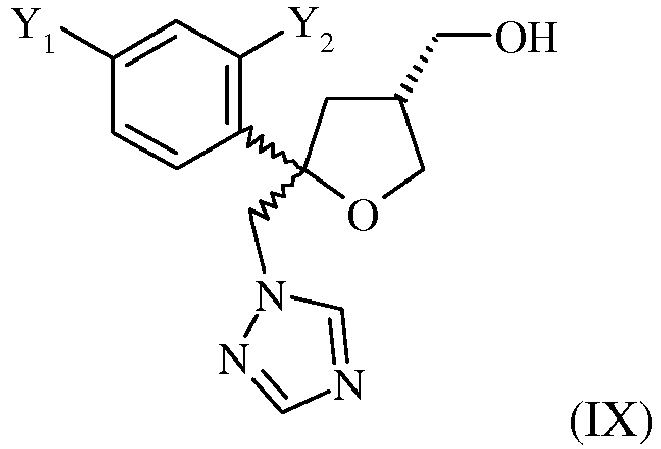
- One of the important intermediates for the preparation of posaconazole is the compound of formula (IX)
- According to the known prior art processes, a common starting material for the preparation of chiral compounds according to formula (IX) is a substituted olefin compound according to the following formula (II)

- However, said prior art processes provide only comparatively complicated processes for the preparation of these compounds of formula (II), abbreviated in the following by Ar-C(=CH2)-CH2-L, in particular compounds wherein Y1 and Y2 are both F.
-
WO 94/25452 - One procedure described in
WO 94/25452 - Another procedure described in P. Blundell et al., Synlett 1994, pp. 263-265, starts from Ar-Br which, in a first step, is converted into a Grignard reagent which in turn is reacted with (Cl-CH2)2C=O (1,2-dichloro acetone) wherefrom Ar-C(OH)(CH2Cl)2 is obtained which, in a second step, is treated with potassium carbonate to obtain an epoxide. This epoxide, in turn, is then converted, in a third step, to Ar-C(=CH2)-CH2-OH. Apart from the fact that this procedure for manufacturing the allylic alcohol involves 3 steps, each of which has to be carried out in a separate reaction vessel, it is known that the Grignard reagent derived from Ar-Br, i.e. 2,4-difluoro bromobenzene, is a potentially hazardous compound.
-
WO 95/16658 A1 - Therefore, it was an object of the present invention to provide an improved process for the preparation of a chiral compound of formula (IX) wherein the starting material, the compound of formula (II), is prepared by a novel process which is advantageous over said known prior art processes.
- It was found that said starting material can be prepared by a process which can be carried out in only one single reaction vessel with good yields, wherein the process consists of only 2 reaction steps. Surprisingly, an olefination concept known as Peterson olefination could be applied for the preparation of above-mentioned allylic chloride. According to this olefination which is first described in "D. J. Peterson, Carbonyl olefination reaction using silyl-substituted organometallic compounds; J. Org. Chem. (1968) 33 (2) pp. 780-784", an alpha-silyl carbanion is reacted with ketones or aldehydes to form beta-hydroxysilanes which may eliminate to form alkenes. The vast majority of known examples using Peterson olefination are carried in diethyl ether which cannot be used in industrial scale processes due to safety aspects. In rare cases, tetrahydrofuran is described as an alternative solvent.
- As discussed above, the compounds of formula (IX) and salts thereof are important intermediates for the preparation of antifungal agents. Due to several reasons, the presence of such intermediates as crystalline compounds is advantageous. However, from the known processes of the literature, compounds of formula (IX) and salts thereof, in particular compounds of formula (IX) with both Y1 and Y2 being F, are not obtained as at least partially crystalline compounds.
- Therefore, it was another object of the present invention to provide a process from which the compound according to formula (IX) and salts thereof, in particular compounds of formula (IX) with both Y1 and Y2 being F, are obtained as at least partially crystalline compound.
- It was yet another object of the present invention to provide the compound according to formula (IX) and salts thereof, in particular compounds of formula (IX) with both Y1 and Y2 being F, as at least partially crystalline compound.
- Therefore, the present invention relates to a process for the preparation of a chiral compound of formula (IX)

- (1.1) reacting a compound of formula (I)


- (1.2) treating the resulting reaction mixture, preferably without change of solvent, with a reagent promoting elimination reaction to obtain a reaction mixture containing a compound of formula (II)

- (2) reacting the compound of formula (II) with a malonic ester R1OOC-CH2-COOR2 to obtain a compound of formula (III)

- (3) reducing the compound of formula (III) to obtain a compound of formula (IV)

- (4) acylating the compound of formula (IV) with isobutyric anhydride to obtain a compound of formula (V)

- (5) reacting the compound of formula (V) with a halogen Hal2 selected from the group consisting of Cl2, Br2 and I2, preferably I2, in the presence of a base in a solvent to obtain a compound of formula (X)


- (6.1) heating the compound of formula (X), preferably in the absence of DMPU (1,3-dimethyl-3,4,5,6-tetrahydro-2(1H)-pyrimidinone), in a solvent, preferably DMSO, with a 1,2,4-triazole alkali metal salt, preferably the sodium salt, and treating the resulting reaction mixture with a base, to obtain a compound of formula (IX)

- (6.2) separating the compound of formula (IX) from the reaction mixture obtained from (6.1) by extraction in a polar water immiscible solvent
wherein the process further comprises steps (A) or (B) or (C) wherein
(A) is - (7) at least partially crystallizing the compound of formula (IX), in particular the compound of formula (VII) and the compound of formula (VIII), after (6.2). (B) is
- (8) converting the compound of formula (IX) to the respective salt by treating the compound with an inorganic or organic Bronstedt acid in a polar solvent and preferably at least partially crystallizing the respective salt
or (C) is (A) and (B). - According to a particularly preferred embodiment, the present invention relates to a process as defined above wherein the compound of formula (IX) or a salt thereof


- Further, the present invention relates to a process wherein compound (IX), and thus also compound (VII), is crystallized from a solvent optionally by addition of a suitable antisolvent, wherein the solvent is preferably a polar water-immiscible solvent, preferably an ester such as ethyl acetate or isopropyl acetate, an ether such as tetrahydrofuran or methyl tetrahydrofuran, a ketone such as methyl isobutyl ketone, a halogenated solvent such as dichloromethane, toluene or a mixture of two or more of these solvents, more preferably an ester or an ether, more preferably an ether, and even more preferably methyl tetrahydrofuran, and wherein the antisolvent is preferably a saturated or unsaturated hydrocarbon such as cyclohexane, hexane, or heptane, or a mixture of two or more thereof.
- Yet further, the present invention relates to a crystalline chiral compound of formula (IX) or a salt thereof


- Still further, the present invention relates to the use of a compound of formula (IX) or a salt thereof, in particular of a preferably at least partially crystalline, preferably a crystalline compound of formula (IX) or a salt thereof, for the preparation of an antifungal agent, preferably posaconazole:

-
- Fig. 1
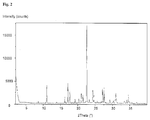
- shows the X-ray powder diffraction pattern (XRD) of the compound of formula (IXa) as obtained according to Example 1. The cis:trans ratio, i.e. the ratio compound of formula (VIIa) : compound of formula (VIIIa) is 9:1.
- Fig. 2
- shows the XRD of the HCl salt of compound of formula (IXa) as obtained according to Example 2(a). The cis:trans ratio, i.e. the ratio of the HCl salt of compound of formula (VIIa) : the HCl salt of compound of formula (VIIIa) is 9:1.
- Fig. 3
- shows the XRD of the fumaric acid salt of compound of formula (IXa) as obtained according to Example 2(b). The cis:trans ratio is indicated in the table shown in Example 2(b).
- Fig. 4
- shows the XRD of the oxalic acid salt of compound of formula (IXa) as obtained according to Example 2(b). The cis:trans ratio is indicated in the table shown in Example 2(b).
- Fig. 5
- shows the XRD of tartaric acid salt of compound of formula (IXa) as obtained according to Example 2(b). The cis:trans ratio is indicated in the table shown in Example 2(b).
- In
Figures 1 to 5 , the intensity - measured as counts per second (linear scale) - is presented on the y-axis, while the position - expressed as 2 theta values in degrees - is presented on the x-axis. - According to the present invention, a compound of formula (II), in particular a reaction mixture containing a compound of formula (II), is obtained by a process which comprises
- (1.1) reacting a compound of formula (I)


- (1.2) treating the resulting reaction mixture, preferably without change of solvent, with a reagent promoting elimination reaction to obtain a reaction mixture containing a compound of formula (II)

- In step (1.1) of the inventive process, the compound of formula (I) comprises residues Y1 and Y2. According to the present invention, Y1 and Y2 are independently F or Cl. Thus, Y1 may be F or Cl, and independently from the chemical nature of Y1, Y2 may be F or Cl. Preferably, both Y1 and Y2 are either F or Cl. More preferably, both Y1 and Y2 are F.
- The term "leaving group L" as used in the context of step (1.1) of the present invention refers to any chemical moieties L which, under suitable reaction conditions, departs from compound (I) with a pair of electrons in a heterolytic bond cleavage. For this purpose, compound (I) as used in the present invention may comprise any suitably leaving group L. Preferably, the leaving group L, after departing, is a neutral or an anionic moiety, more preferably an anionic moiety. Even more preferably, L is an halogen such as, for example, Cl, Br, I. According to an even more preferred embodiment of the present invention, L is Cl.
- The nucleophilic compound with which compound (I) is reacted in step (1.1) comprises a nucleophilic residue RaRbRcSi-CH2. As to the chemical nature of this residue, there are no particular restrictions provided that the beta-hydroxy silane intermediate of formula

- The nucleophilic compound employed in (1.1) can be any suitable compound comprising a nucleophilic residue RaRbRcSi-CH2 which, when reacted with compound (I), either directly or indirectly leads to the formation of the beta-hydroxy silane intermediate discussed above. Ra, Rb and Rc comprised in the nucleophilic compound are the same or different and selected from the group consisting of optionally substituted alkyl and aryl residues. The term "optionally substituted aryl residue" as used in the context of the present invention refers to aryl residues which have, for example, up to 6 or up to 12 carbon atoms. If such aryl residue is a substituted aryl residue, the number of carbon atoms refers to the number of carbon atoms of the corresponding unsubstituted aryl residue. The term "optionally substituted alkyl residue" as used in the context of the present invention refers to alkyl residues which have, for example, 1 to 20, preferably 1 to 10 carbon atoms. If such alkyl residue is a substituted alkyl residue, the number of carbon atoms refers to the number of carbon atoms of the corresponding unsubstitued alkyl residue.
- According to preferred embodiments of the present invention, Ra, Rb and Rc comprised in the nucleophilic compound are the same or different and selected from the group consisting of alkyl residues, more preferably non-substitued alkyl residues having from 1 to 6 carbon atoms, preferably from 1 to 4 carbon atoms such as methyl, ethyl, n-propyl, iso-propyl, n-butyl, iso-butyl, and tert-butyl, more preferably 1 or 2 carbon atoms, methyl or ethyl, with Ra, Rb and Rc in particular being methyl.
- Preferably, the nucleophilic compound employed in (1.1) is a Grignard reagent. The term "Grignard reagent" as used in this context refers to any suitable nucleophilic organometallic reagent comprising the nucleophilic residue RaRbRcSi-CH2. Preferably the nucleophilic compound is a Grignard compound RaRbRcSi-CH2MgX wherein X is a suitable anionic species which is preferably selected from the group consisting of Cl, Br, and I. More preferably, the Grignard compound is the compound RaRbRcSi-CH2MgCl.
- As solvent which is employed in (1.1), any solvent or solvent mixture is conceivable, preferably a solvent or solvent mixture in which a Grignard reaction can be carried out. Conceivable solvents are, for example, ether compounds such as the commonly known diethyl ether and/or tetrahydrofuran (THF). Surprisingly, however, it was found in the context of the present invention that the solvents discussed in the background prior art in the context of the Peterson olefination, namely diethyl ether and THF, can be replaced by methyl-tert-butyl ether (MTBE). This solvent provides the major advantage that compared to compounds such as diethyl ether and THF, no peroxides are formed. Thus, the use of MTBE is especially suitable for industrial scale processes for which safety aspects are of utmost importance. Therefore, according to a particularly preferred embodiment, the solvent used in step (1.1) is MTBE.
- Therefore, according to a preferred embodiment, the present invention relates to a process as defined above, wherein in (1.1), the compound of formula (I) is the compound (Ia)


- As to the temperatures at which the reaction in (1.1) is carried out, no particular restrictions exist provided a reaction mixture is obtained which allows for the reaction in (1.2). Preferably, reacting in (1.1) is performed at a temperature in the range of from -50 to +20 °C, more preferably from -40 to +15 °C, more preferably from -30 to +10 °C, more preferably from -20 to +10 °C, more preferably from -15 to +5 °C such as at a temperature in the range of from -15 to -10 °C or from -10 to -5 °C or from -5 to 0 °C or from 0 to +5 °C.
- As far as the general concept of the Peterson olefination is concerned, the literature teaches a two-step process wherein, after having carried out the Grignard reaction, a solvent exchange is performed. Reference is made to Tetrahedron Letters 32 (1991), pp. 7545-7548. Surprisingly, it was found that after step (1.1) of the present invention, no solvent exchange is necessary, and that the intermediate obtained from (1.1) can be treated with a suitable reagent which promotes elimination reaction in a considerably simplified process.
- Therefore, according to the present invention, the reaction mixture resulting from (1.1) is treated in (1.2), preferably without change of solvent, with a reagent promoting elimination reaction to obtain a reaction mixture containing a compound of formula (II)

- Since according to the literature, the second step of the Peterson olefination includes the use of BF3*Et2O (boron trifluoride etherate), a further major advantage of the present invention is the fact that the use of potentially hazardous chemicals such as BF3 etherate is completely avoided in this reaction stage. As discussed above, carrying out the inventive process without solvent exchange after (1.1) is particularly preferred if MTBE is used as solvent in (1.1).
- As to the temperatures at which the reaction in (1.2) is carried out, no particular restrictions exist provided a reaction mixture is obtained containing the compound of formula (II). Preferably, treating in (1.2) is performed at a temperature in the range of from -20 to +70 °C. Preferred temperature ranges are, for example, -20 to -10 °C or -10 to 0 °C or 0 to +10 °C or +10 to +20 °C or +20 to +30 °C or +30 to +40 °C or +40 to +50 °C or +50 to +60 °C or +60 to +70 °C.
- As to the reagent promoting elimination reaction employed in (1.2), no particular restrictions exist provided that the compound of formula (II) is obtained, preferably without solvent exchange after (1.1). Preferably, the reagent is an acid or a mixture of two or more acids. More preferably, the reagent is an inorganic acid or a mixture of two or more inorganic acids. Especially preferred is the use of sulfuric acid. Preferably, if sulfuric acid is used as reagent, the temperature at which (1.2) is performed is in the range of from +40 to +50 °C.
- Therefore, according to a preferred embodiment, the present invention relates to a process as defined above, wherein in (1.2), the reaction mixture resulting from (1.1) is treated without change of solvent with sulfuric acid promoting elimination reaction to obtain a reaction mixture containing, as compound of formula (II), the compound (IIa):

- Thus, according to a still more preferred embodiment, the present invention relates to a process as defined above which comprises
- (1.1) reacting a compound of formula (Ia)


- (1.2) treating the resulting reaction mixture without change of the solvent MTBE with sulfuric acid promoting elimination reaction to obtain a reaction mixture containing a compound of formula (IIa)

- According to a still more preferred embodiment, the present invention relates to a process as defined above which comprises
- (1.1) reacting a compound of formula (Ia)


- (1.2) treating the resulting reaction mixture without change of the solvent MTBE at a temperature in the range of from +40 to +50 °C with sulfuric acid promoting elimination reaction to obtain a reaction mixture containing a compound of formula (IIa)

- From the compound contained in the reaction mixture obtained in (1.2) as discussed above, the compound of formula (IX) is prepared. The process of the present invention as defined above further comprises
- (2) reacting the compound of formula (II) with a malonic ester R1OOC-CH2-COOR2 to obtain a compound of formula (III)

- (3) reducing the compound of formula (III) to obtain a compound of formula (IV)

- (4) acylating the compound of formula (IV) with isobutyric anhydride to obtain a compound of formula (V)

- (5) reacting the compound of formula (V) with a halogen Hal2 selected from the group consisting of Cl2, Br2 and I2, preferably I2, in the presence of a base in a solvent to obtain a compound of formula (X)

- (6.1) heating the compound of formula (X), preferably in the absence of DMPU (1,3-dimethyl-3,4,5,6-tetrahydro-2(1H)-pyrimidinone), in a solvent, preferably DMSO (dimethyl sulfoxide), with a 1,2,4-triazole alkali metal salt, preferably the sodium salt, and treating the resulting reaction mixture with a base, to obtain a compound of formula (IX)

- (6.2) separating the compound of formula (IX) from the reaction mixture obtained from (6.1) by extraction in a polar water immiscible solvent.
- According to step (2) of the present invention, the compound of formula (II) is reacted with a malonic ester R1OOC-CH2-COOR2 wherein R1 and R2 are independently an optionally substituted alkyl group having from 1 to 5 carbon atoms. The number of carbon atoms refers to the number of carbon atoms of the unsubstituted alkyl residue. Preferred alkyl groups R1 and R2 have 1 to 4 carbon atoms, such as methyl, ethyl, n-propyl, iso-propyl, n-butyl, iso-butyl, and tert-butyl. Even more preferably the alkyl groups R1 and R2 have 1 or 2 carbon atoms, such as methyl or ethyl, with ethyl being especially preferred. Even more preferably, the alkyl groups R1 and R2 are unsubstituted alkyl groups.
- In step (2), it is further preferred to react the malonic ester R1OOC-CH2-COOR2 with compound (II) in the presence of a suitable strong base, preferably a strong alkali metal base allowing for the reaction of the respective anion -CH(COOR1)(COOR2) derived from the malonic ester R1OOC-CH2-COOR2. As alkali metal, sodium is preferred. Suitable bases are, for example, NaH or NaOH, with NaOH being preferred. NaOH can be employed in every suitable form. According to a preferred embodiment, NaOH is employed as solid, such as, for examples, in the form of NaOH flakes. The solvent in which step (2) is carried out can be chosen according to, for example, the specific chemical nature of the strong base as discussed above. Conceivable solvents are, for example, THF, DMSO or the like. According to present invention, DMSO is preferred. The temperatures at which the reaction in step (2) is carried out can be chosen in accordance with the solvent and the base. Preferred temperatures are in the range of from 0 to 35 °C, more preferably from 25 to 30 °C.
- The product of the reaction in (2), the compound of formula (III)

- The organic layer obtained from extraction can be washed in one or more steps. As washing agents, water and aqueous basic solutions such as, for example, aqueous solutions of alkali metal bases such as alkali metal hydroxide, preferably sodium hydroxide, are to be mentioned.
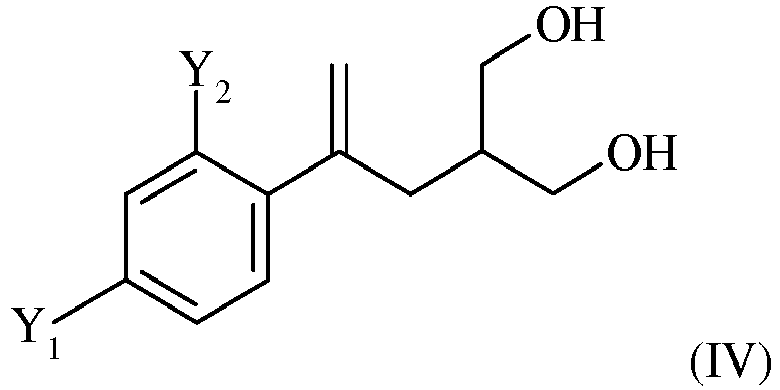
- According to the present invention, the compound of formula (III) obtained from step (2) is reduced wherefrom a compound of formula (IV) is obtained:
- Reducing in step (3) can be carried out according to any method involving any reducing agent. According to the present invention, the use of a hydride reducing agent is preferred. Such hydride reducing agents are, for example, sodium borohydride (NaBH4), lithium borohydride (LiBH4), lithium aluminium hydride (LiAlH4), diisobutylaluminium hydride (DIBAL) or lithium triethylborohydride (LiEt3BH). According to a preferred embodiment of the present invention, LiBH4 is employed as reducing agent in step (3).
- According to the prior art, at least 3 molar equivalents of LiBH4 have to be employed with regard to the compound of formula (III). Reference is made to
WO 94/25452 Preparation 5". Surprisingly, however, contrary to the teaching of the prior art, the reducing agent LiBH4 can be employed in a much lower excess with regard to the malonic ester compound (III). The improved process of the present invention uses at most 2 molar equivalents of LiBH4 with regard to the compound of formula (III), which means that compared to the prior art, at least 33 % of reducing agent can be saved. Thus, in particular for an industrial scale process, the present invention provides economical and ecological advantages. Thus, the present invention relates a process as defined above, wherein LiBH4 is used as reducing agent which is preferably used in an amount of at most 2 molar equivalents with respect to compound (III). - As to the solvent in which the reaction of step (3) is carried out, no particular restrictions exist provided that the compound of formula (IV) is obtained. Preferred solvents are selected from the group consisting of water, alcohol, and a mixture of water and at least one alcohol. Preferred alcohols are methanol, ethanol, and isopropanol. Therefore, the solvent is preferably selected from the group consisting of water, methanol, ethanol, isopropanol, and a mixture of water and at least one of these alcohols, more preferably from the group consisting of water, ethanol, isopropanol, and a mixture of water and at least one of these alcohols, more preferably from the group consisting of water, isopropanol, and a mixture of water and isopropanol.
- Surprisingly, it was found that in particular for the most preferred reducing agent used in step (3), LiBH4, a mixture of water and isopropanol is the most advantageous solvent. Contrary to the fact that water is known as decomposing hydride reducing agent, the presence of water was found to be advantageous in step (3) of the inventive process. Without wanting to be bound to any theory, it is believed that this could be due to the fact that a certain amount of water improves the solubility of the reagent LiBH4, and/or of its precursors NaBH4 and LiCl, and thus enhances the reaction rate, and thus in turn overcompensates the decomposition of the reducing agent. Therefore, according to still further embodiments, the solvent used in step (3) comprises water, wherein the solvent preferably comprises from 1 to 20 vol.-%, more preferably from 5 to 15 vol.-% of water.
- The temperatures at which the reaction in step (3) is carried out can be chosen in accordance with the solvent and the reducing agent. Preferred temperatures are in the range of from 0 to 40 °C, more preferably from 20 to 35 °C, more preferably from 25 to 30 °C.
- The product of the reduction in (3), the compound of formula (IV), is preferably suitably separated from the reaction mixture obtained in (3). According to a preferred embodiment, this separation includes a step wherein the compound (IV) is separated by extraction in a suitable solvent. Among the suitable solvents, toluene is preferred according to the present invention.
- According to step (4) of the present invention, the compound of formula (IV) is acylated with isobutyric anhydride to obtain a compound of formula (V)

- More preferably acylation in (4) is carried out in the presence of a suitable enzyme, preferably Novo SP 435 enzyme in a suitable solvent, preferably acetonitrile or toluene, more preferably toluene, e.g. analogously to the method described in
WO 97/22710 - The temperatures at which the acylation in step (4) is carried out can be chosen in accordance with the solvent, the acylation agent and the enzyme. Preferred temperatures are in the range of from -20 to -5 °C, more preferably from -15 to -10 °C, more preferably from 25 to 30 °C.
- The obtained reaction mixture is preferably further treated with a suitable base such as, for example, sodium hydrogencarbonate.
- According to an especially preferred embodiment of the present invention, the compound of formula (V) is suitably crystallized from the reaction mixture. Therefore, the present invention also relates to a process as defined above wherein after (4) and before (5), the compound of formula (V) is at least partially crystallized. Crystallization can be carried out according to any conceivable method. According to a preferred embodiment, the compound if formula (V) is crystallized from n-heptane.
- According to step (5) of the present invention, the compound of formula (V) is reacted with a halogen Hal2 selected from the group consisting of Cl2, Br2 and I2, preferably I2, in the presence of a base in a solvent to obtain a compound of formula (VI)

- Generally, it is possible to carry out the reaction in step (5) in the presence of a base such as pyridine and in a suitable solvent such as acetonitrile, THF, EtOAc (ethyl acetate) or CH2Cl2 (dichloromethane, DCM) at a temperature in the range of from -20 to +30 °C. Reference is made to
WO 94/25452 A1 - After the reaction, the organic layer, optionally after suitable quenching, may be optionally washed at least once. Quenching may be done e.g. using a 10% (w/v) aqueous solution of sodium sulphite.
- The present invention relates to a process as defined above wherein the compound of formula (VI), the cis-isomer, is obtained in step (5) together with the compound of formula (XI), the respective trans-isomer

- This mixture of the compounds of formula (VI) and (XI) is referred to in the following as compound of formula (X)

- In said compound (X), according to the present invention, preferably from 80 to 95 %, more preferably from 85 to 95 % of the molecules are present as cis-isomer of formula (VI) and preferably from 20 to 5 %, more preferably from 15 to 5 % of the molecules of compound (X) are present as trans-isomer of formula (XI).
- Therefore, the present invention also relates to the process as defined above, further comprising
- (5) reacting the compound of formula (V) with a halogen Hal2 selected from the group consisting of Cl2, Br2 and I2, preferably I2, in the presence of a base in a solvent to obtain a compound of formula (X)

- The compound of formula (X) is suitable for the preparation of a compound of formula (IX) as herein described.
- According to step (6.1) of the present invention, the compound of formula (X), i.e. in particular the compound of formula (VI) and the compound of formula (XI), is heated in a solvent with a 1,2,4-triazole alkali metal salt. Amongst 1,2,4-triazole salts are alkali metal salts, the sodium salt ia especially preferred. Preferred solvents are polar aprotic solvents, for example, DMF (N,N-dimethylformamide) and DMSO, with DMSO being preferred.
- The temperature to which the reaction mixture in step (6.1) is heated is preferably in the range of from +70 to +100 °C, preferably from +80 to +95 °C and more preferably from +85 to +90 °C.
- As to such reactions with a triazole salt,
WO 94/25452 WO 94/25452 WO 94/25452 WO 94/25452 - The mixture obtained from heating is then treated with a suitable base to promote saponification of the ester moiety. Such bases are, for example, alkali metal hydroxides, alkali metal bicarbonates, alkali metal carbonates, alkaline earth metal hydroxides, alkaline earth metal bicarbonates, and alkaline earth metal carbonates. The alkali metal bases are preferred. Preferably, the base is added in aqueous and/or alcoholic media. Suitable alcohols are alcohols containing 1 to 6, preferably 1 to 4, more preferably 1 to 3, most preferably 1 to 2 carbon atoms. According to the present invention, it was found that a preferred base is sodium hydroxide, preferably employed as aqueous solution, in the presence of methanol.
- According to the present invention, in step (6.1), a compound of formula (IX)


- According to the prior art, it is necessary to separate the compound of formula (IX) and thus of formula (VII), after reaction steps corresponding to step (6.1) of the present invention by chromatography. Reference is made to
WO 94/25452 - Contrary to the teaching of the prior art, it was found in the context of the present invention that no such separation by chromatography has to be carried out if the specific sequence of steps (6.1) and extraction in (6.2), followed by crystallization in a step (7) and / or salt formation in a step (8) as described below is carried out. Thus, this modification represents a considerable improvement over the prior art processes.
- According to step (6.2) of the present invention, the compound of formula (IX)


- Solvents according to the present invention are polar water-immiscible solvents. More preferably, the solvent is an ester such as ethyl acetate or isopropyl acetate, an ether such as tetrahydrofuran or methyl tetrahydrofuran, a ketone such as methyl isobutyl ketone, a halogenated solvent such as dichloromethane, toluene, or a mixture of two or more of these solvents, more preferably an ester or an ether, more preferably an ether, and even more preferably methyl tetrahydrofuran.
- After separation by extraction, at least one washing stage may be carried out. Among others, washing with an aqueous sodium chloride solution may be mentioned.
- Therefore, according to a preferred embodiment, the present invention relates to a process defined above, comprising
- (1.1) reacting a compound of formula (Ia)


- (1.2) treating the resulting reaction mixture without change of the solvent MTBE with sulfuric acid promoting elimination reaction to obtain a reaction mixture containing a compound of formula (IIa)

- (2) reacting the compound of formula (IIa) with a malonic ester H3CH2COOC-CH2-COOCH2CH3 to obtain a compound of formula (IIIa)

- (3) reducing the compound of formula (IIIa) using LiBH4 as reducing agent which is used in an amount of at most 2 molar equivalents with respect to compound (IIIa) in a mixture of water and isopropanol as solvent to obtain a compound of formula (IVa)

- (4) acylating the compound of formula (IVa) with isobutyric anhydride in the presence of Novo SP 435 enzyme in toluene as solvent to obtain a compound of formula (Va)

- (5) reacting the compound of formula (Va) with I2 in the presence of sodium hydrogencarbonate as base in ethyl acetate as solvent to obtain a compound of formula (Xa)


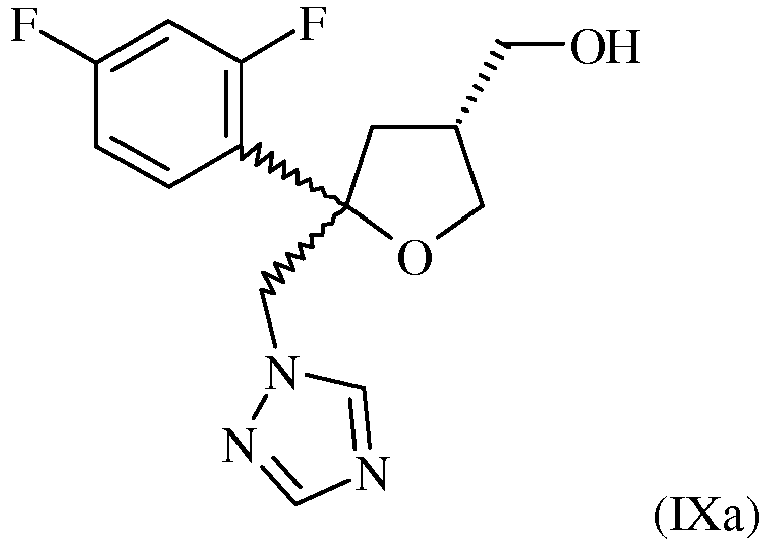
- (6.1) heating the compound of formula (Xa), preferably in the absence of DMPU (1,3-dimethyl-3,4,5,6-tetrahydro-2(1H)-pyrimidinone), in DMSO as solvent with 1,2,4-triazole sodium salt and treating the resulting reaction mixture with sodium hydroxide, to obtain a compound of formula (IXa)


- (6.2) separating the compound of formula (IXa)
- According to one preferred embodiment of the present invention, the compound of formula (IX) and thus also of formula (VII) as obtained from step (6.2) is at least partially crystallized in a step (7). Therefore, the present invention also relates to a process as defined above, which further comprises
- (7) at least partially crystallizing the compound of formula (IX), in particular the compound of formula (VII) and the compound of formula (VIII), after (6.2).
- As far as this crystallization is concerned, no particular restrictions exist. According to a preferred embodiment of the present invention, the solvent from which the compound of formula (IX), in particular the compound of formula (VII) and the compound of formula (VIII), is crystallized is the solvent which has been employed in step (6.2) discussed above for the extraction purposes. Therefore, preferred solvents of step (7) are polar water-immiscible solvents. More preferably, the solvent is an ester such as ethyl acetate or isopropyl acetate, an ether such as tetrahydrofuran or methyl tetrahydrofuran, a ketone such as methyl isobutyl ketone, a halogenated solvent such as dichloromethane, toluene, or a mixture of two or more of these solvents, more preferably an ester or an ether, more preferably an ether, and even more preferably methyl tetrahydrofuran.
- Even more preferably, after step (6.2), no solvent exchange is performed. Thus, according to this preferred embodiment, the compound of formula (IX), in particular the compound of formula (VII) and the compound of formula (VIII), is crystallized from the mixture obtained in step (6.2) without addition of a further suitable solvent different from the solvent employed in step (6.2).
- Generally, such crystallization can be carried out according to any suitable method. Among others, cooling the mixture obtained from (6.2), addition of an antisolvent to the mixture obtained from (6.2), suitable chemical reaction, change of the pH in the mixture obtained from (6.2), solvent distillation, or a combination of two or more of these methods may be mentioned.
- According to a still further preferred embodiment, this crystallization in step (7) is carried out by adding a suitable antisolvent. Generally, depending on the solvent employed in (6.2), every conceivable antisolvent can be employed provided that this antisolvent allows for reducing the solubility of the dissolved compound of formula (IX), in particular the compound of formula (VII) and the compound of formula (VIII), to such an extent that the compound of formula (IX) is at least partially crystallized. Preferably, the antisolvent is a saturated or unsaturated hydrocarbon such as cyclohexane, hexane, or heptane, or a mixture of two or more thereof. Even more preferably, the antisolvent used in step (7) is selected from the group consisting of cyclohexane, hexane, heptane, and a mixture of two or more thereof, in particular heptane.
- Generally, the temperatures at which crystallization in step (7) is performed are adjusted to the solvent and preferably the antisolvent used. According to a preferred embodiment of the present invention, addition of the antisolvent is performed at a temperature in the range of from 40 to 70 °C, preferably from 45 to 65 °C, and more preferably from 50 to 60 °C. Thereafter, it is preferred to cool the resulting mixture continuously to a preset temperature wherein cooling can be carried out continuously, or step-wise in two or more steps. According to an embodiment of the present invention, the preset temperature to which the mixture is ultimately cooled is in the range of from -15 to 0 °C, preferably from -10 to 0 °C, more preferably from -5 to 0 °C. Cooling the mixture to this temperature can, as mentioned above, involve at least one temperature range to which the mixture is cooled in a first step, held at this temperature, and then further cooled to the final temperature discussed above. For example, such temperature range to which the mixture can be cooled in a first step is from 20 to 35 °C, preferably from 25 to 30 °C.
- After crystallization, the crystallized compound of (IX), in particular the crystallized compound of formula (VII) and the crystallized compound of formula (VIII), is preferably separated from the mother liquor, for example by suitable filtration, and preferably washed at least once with a suitable washing agent. Preferred washing agents are the solvent mixture used for the crystallization and the antisolvent discussed above. After such preferred separation, the crystallized compound of formula (IX), in particular the crystallized compound of formula (VII) and the crystallized compound of formula (VIII), is preferably dried under suitable drying conditions. Drying in vacuo is preferred wherein the temperatures are preferably in the range of from 20 to 50 °C, more preferably from 30 to 45 °C.
- According to the process of the present invention, and as described above, the crystalline chiral compound of formula (VII), the cis-isomer


- The molar ratio of the cis-isomer to the trans-isomer generally depends on the overall process conditions. According to preferred process conditions of the process of the present invention, the crystallized compound of formula (IX) obtained after step (7),


- According to the prior art, the preparation of the crystalline compound of formula (IX), i.e. a crystalline mixture preferably containing 80 to 95 %, more preferably from 85 to 95 % of the cis-isomer (VII), and preferably from 20 to 5 %, more preferably from 15 to 5 % of the trans-isomer of (VIII), are not taught. Reference is made to
WO 94/25452 - Thus, the present invention also relates to a crystalline chiral compound of formula (IX) or a salt thereof

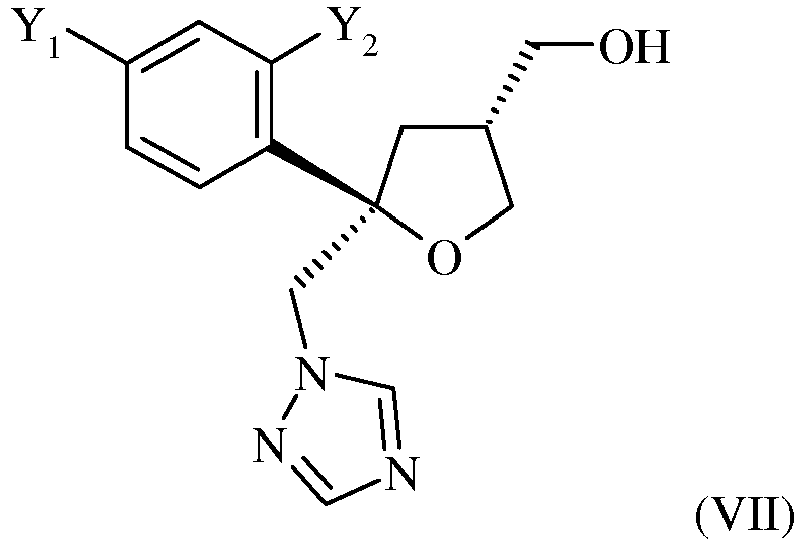

- The crystalline chiral compound of formula (IX) as herein described, wherein Y1 and Y2 are F, preferably exhibits the following X-ray diffraction pattern comprising at least the following reflections:
Diffraction angle ° 2 Theta [Cu K(alpha 1)] Relative Intensity (%) 7,05 19 8,03 51 9,25 20 11,92 24 13,79 36 15,88 25 16,65 100 20,15 42 21,37 45 22,04 37 24,04 96 27,80 20 - Based on the crystalline compound of formula (IX) preferably containing from 80 to 95 %, preferably from 85 to 95 % of the cis-isomer (VII) and from 20 to 5 %, preferably from 15 to 5 % of the trans-isomer (VIII), suitable salts of the crystalline free base (IX) can be prepared. All salts are conceivable. In particular, these salts can be prepared by treating the compound of formula (IX) and, thus, the compound of formula (VII), with at least one suitable inorganic acid and/or at least one suitable organic acid, preferably at least one suitable inorganic Bronstedt acid and/or at least one suitable organic Bronstedt acid, optionally in at least one suitable solvent. Such suitable organic acids include, but are not limited to fumaric acid, oxalic acid, and tartaric acid. The suitable inorganic acids include, but are not limited to hydrochloric acid.
- Therefore, the present invention also relates to the process as defined above, which further comprises
- (8) converting the compound of formula (IX), in particular the compound of formula (VII) and the compound of formula (VIII), to the respective salt by treating the compound with an inorganic or organic Bronstedt acid in a polar solvent and preferably at least partially crystallizing the respective salt.
- Among other, the fumaric acid salt or the oxalic acid or the tartaric acid salt or the hydrochloric acid salt of compound (IX) is preferred. The hydrochloric acid salt is even more preferred.
- Solvents according to the present invention are polar solvents. More preferably, the solvent is an ester such as ethyl acetate or isopropyl acetate, an ether such as dioxane, tetrahydrofuran or methyl tetrahydrofuran, a ketone such as acetone or methyl isobutyl ketone, a halogenated solvent such as dichloromethane, toluene, or a mixture of two or more of these solvents, more preferably a ketone is used as solvent. Most preferably the solvent is acetone.
- Generally, such crystallization can be carried out according to any suitable method. Among others, cooling, addition of an antisolvent, solvent distillation, or a combination of two or more of these methods may be mentioned.
- According to a preferred embodiment, this crystallization is carried out by adding a suitable antisolvent together with the acid or after the addition of the acid. Generally, every conceivable antisolvent can be employed provided that this antisolvent allows for reducing the solubility of the dissolved acid addition salt of compound of formula (IX) and thus also of formula (VII) to such an extent that the acid addition salt of compound (IX) and thus also of compound (VII) is at least partially crystallized. Preferably, the antisolvent is an ether such as MTBE or a saturated or unsaturated hydrocarbon such as cyclohexane, hexane, or heptane. More preferably the antisolvent is MTBE.
- According to another preferred embodiment of the present invention, the compound of formula (IX) and thus also of formula (VII) as obtained from step (6.2) is directly converted into a suitable salt as herein described, namely by applying the salt formation and preferably also the at least partial crystallization described in step (8) without applying the crystallization of step (7). Optionally, a solvent change is performed after (6.2) prior to the salt formation.
- Also in this embodiment of the present invention wherein step (7) is not performed, the fumaric acid salt or the oxalic acid salt or the tartaric acid salt or the hydrochloric acid salt of compound (IX) is preferred. The hydrochloric acid salt is even more preferred. Solvents according to the present invention are polar solvents. More preferably, the solvent is an ester such as ethyl acetate or isopropyl acetate, an ether such as dioxane, tetrahydrofuran or methyl tetrahydrofuran, a ketone such as acetone or methyl isobutyl ketone, a halogenated solvent such as dichloromethane, toluene, or a mixture of two or more of these solvents, more preferably a ketone is used as solvent. Most preferably the solvent is acetone. Generally, such crystallization can be carried out according to any suitable method. Among others, cooling, addition of an antisolvent, solvent distillation, or a combination of two or more of these methods may be mentioned. According to a preferred embodiment, this crystallization is carried out by adding a suitable antisolvent together with the acid or after the addition of the acid. Generally, every conceivable antisolvent can be employed provided that this antisolvent allows for reducing the solubility of the dissolved acid addition salt of compound of formular (IX) to such an extent that the acid addition salt of compound (IX) is at least partially crystallized. Preferably, the antisolvent is an ether such as MTBE or a saturated or unsaturated hydrocarbon such as cyclohexane, hexane, or heptane. More preferably the antisolvent is MTBE.
- Thus, the present invention also relates to a crystalline hydrochloric acid salt of a chiral compound of formula (IX)


- The crystalline hydrochloric acid salt of chiral compound of formula (IX) as herein described, wherein Y1 and Y2 are F, preferably exhibits the following X-ray diffraction pattern comprising at least the following reflections:
Diffraction angle °2 Theta [Cu K(alpha 1)] Relative Intensity (%) 11,08 26 16,26 30 17,15 22 17,69 51 19,19 17 20,29 15 21,00 49 21,44 42 22,56 100 24,29 43 24,66 32 27,14 34 27,56 57 - Further, the present invention relates to a preferably at least partially crystalline chiral compound or a salt thereof which is obtainable or obtained by a process as defined above, the process preferably comprising steps (1) to (8), even more preferably comprising steps (1) to (6.2) followed by (8).
- As already mentioned above, the compound of formula (IX) or a salt thereof is preferably used as key compound for the preparation of an antifungal agent. The preferred antifungal agent for the preparation of which the compound of formula (IX) or a salt thereof and thus compound (VII) or a salt thereof can be employed is posaconazole, i.e. the compound according to the following formula:

- Thus, the present invention also relates to a method for the preparation of an antifungal agent, preferably posaconazole, wherein the preferably at least partially crystalline, preferably crystalline compound of formula (IX) or a salt thereof and thus (VII) or a salt thereof is employed as starting material.
- According to an optional embodiment of the present invention, the compound of formula (IX) or the salt thereof can be suitably purified with respect to the cis-isomer (VII) or the trans-isomer (VIII), preferably the cis-isomer (VII), prior to its use for the preparation of an antifungal agent, preferably posaconazole.
- The present invention is illustrated by the following examples.
- In 20 ml of MTBE, 3.8 g of Mg were suspended. The temperature of the suspension was 55 °C. Then, 0.5 g of Grignard reagent (CH3)3Si-CH2MgCl in MTBE from a previous batch were added in order to dry the system (if no such Grignard reagent is available for the first batch, (CH3)3Si-CH2MgCl in diethyl ether (CAS Registry Number: 13170-43-9) commercially available as 1.0 M solution from Sigma-Aldrich can be used), followed by 1.0 ml of chloromethyl trimethyl silane (CM-TMS; CAS Registry Number: 2344-80-1; commercially available from Sigma-Aldrich). A solution of 14 ml of the CM-TMS in 43 ml of MTBE was added slowly over a period of 2 hours at a temperature of 55 °C. The mixture was stirred for 2 hours at 55 °C and then cooled to a temperature of -10 °C. Subsequently, 10.0 g of the commercial compound of formula (Ia) (CAS Registry Number: 51336-94-8; commercially available from Sigma-Aldrich) in 30 ml of MTBE were added and the temperature was kept in the range of from 0 to -10 °C. The reaction mixture was quenched in a 20 % (w/v) aqueous solution of ammonium chloride. The obtained organic layer was washed with a 20 % (w/v) aqueous solution of ammonium chloride. The thus washed organic layer was then washed with water.
- To the organic layer, 11.0 ml of concentrated sulphuric acid were added, and the temperature was kept at 25 to 30 °C. Then, the reaction mixture was stirred at a temperature of from 45 to 50 °C for 3 hours. Subsequently, the reaction mixture was cooled to 20 °C and 25 ml of water were added, and the organic layer was separated. The obtained organic layer was extracted with an 9 % (w/v) aqueous solution of sodium bicarbonate, followed by washing with water. The solvents of the washed organic layer were removed by distillation under reduced pressure, and the compound of formula (IIa) was obtained as an oil. The yield was 9.4 g, corresponding to a theoretical value of 95 %.
- 10.0 g of the compound of formula (IIa) (as oil, as obtained according to (a)) were dissolved in 20 ml of DMSO under stirring. Then, 3.2 g of NaOH flakes and 24.0 ml of diethyl malonate were added. The resulting suspension was stirred for 5 hours at 25 to 30 °C. Subsequently, 100 ml of water were added, and the resulting mixture was stirred for 30 min. The thus obtained solution was extracted with 80 ml of cyclohexane at 25 to 30 °C. After separation of the layers the aqueous layer was extracted with 40 ml of cyclohexane at 25 to 30 °C. The combined organic layers were washed with a 5% (w/v) aqueous solution of NaOH, followed by washing with water. After washing, the solvents of the organic layer were removed by distillation under reduced pressure and the compound of formula (IIIa) was obtained as an oil. The yield was 15.0 g, corresponding to a theoretical value of 90.0 %.
- 10.0 g of the compound of formula (IIIa) (as oil, as obtained according to (b)) were dissolved in 120 ml of isopropyl alcohol and 13.0 ml of water under stirring at 25 to 30 °C. The resulting mixture was cooled to a temperature of from 0 to -5 °C. Then, 2.3 g of lithium chloride and 2.1 g of sodium borohydride were added at 0 to -5 °C. The resulting suspension was stirred at 25 to 30 °C for 20 hours. The pH of the stirred mixture was adjusted to a value of 1 (measured by using a calibrated pH meter) by addition of 4 N aqueous HCl. Afterwards, an 20 % (w/v) aqueous solution of NaOH was added to adjust the pH to a value of 10 (measured by using a calibrated pH meter). The resulting mixture was stirred for 1 hour. Then, the lower aqueous layer was drained. From the separated organic layer, the isopropyl alcohol was distilled off, and an oil was obtained. To the oil, 100 ml of toluene and 100 ml of water were added, and the product was extracted into the toluene layer. The solvents of the resulting toluene layer were removed by distillation, under reduced pressure and the compound of formula (IVa) was obtained as oil. The yield was 6.0 g, corresponding to a theoretical value of 82.0 %.
- 10.0 g of the compound of formula (IVa) (as oil, as obtained according to (c)) were dissolved in 80 ml of toluene and cooled to -15 °C. Then, 7.4 g of sodium bicarbonate, 0.5 g of enzyme (Novo SP 435; Candida antarctica, Novozym 435 from Novo Nordisk), and 7.9 ml of isobutyric anhydride were added. The resulting mixture was stirred at -15 °C for 24 hours. Then the solids were filtered off and the filtrate was washed with an 5 % (w/v) aqueous solution of sodium bicarbonate, followed by washing with water. The solvents of the resulting organic layer were removed by distillation under reduced pressure to obtain the desired product as an oil. This oil was dissolved in 40 ml of n-heptane at 50 to 60 °C. The clear solution was gradually cooled to a temperature of 10 °C. The compound of formula (Va) crystallized as colorless crystals. The obtained solids were filtered, and the wet filter cake was washed with 20 ml of n-heptane. The filter cake was then dried at 40 °C in vacuo and the compound of formula (Va) was obtained as colorless crystals. The yield was 9.2 g, corresponding to a theoretical value of 70.0 %.
- 10.0 g of the crystals obtained in (d) were dissolved in 80 ml of ethyl acetate under stirring. The resulting solution was cooled to -15°C, and 21.5 g of iodine and 7.0 g of sodium bicarbonate were added. The obtained suspension was stirred at -15°C for 5 hours. The reaction mixture was quenched in 200 ml of a 10% (w/v) aqueous solution of sodium sulphite. The organic layer was washed with 100 ml of a 10% (w/v) aqueous solution of sodium sulphite, followed by washing with water. The solvents of the thus obtained, washed organic layer were removed by distillation under reduced pressure to obtain the compound of formula (Xa) as an oil. The yield was 13.5 g, corresponding to a theoretical value of 95.0%.
- 10.0 g of the compound of formula (Xa) (as oil, as obtained according to (e)) were dissolved in 80 ml of DMSO under stirring. Then, 10 g of the sodium salt of 1,2,4-triazole were added at 25 to 30 °C, and the resulting reaction mixture was stirred for 24 hours at 85 to 90 °C. The mixture was then cooled to 25 to 30 °C, and 25 ml of 5 % (w/v) aqueous solution of sodium hydroxide were added. The mixture was then stirred for 3 hours at 25 to 30 °C. 100 ml of water were added, and the product was extracted into 150 ml of methyl tetrahydrofuran. The thus obtained organic layer was washed with a 10 % (w/v) aqueous solution of sodium chloride, and subsequently the solvents of the resulting organic layer were removed by distillation under reduced pressure to obtain the compound of formula (IXa) as a crude oil. The yield was 6.0 g, corresponding to a theoretical value of 86.0 %.
- 10.0 g of the crude oil were dissolved in 100 ml of methyl tetrahydrofuran under stirring at 50 to 60 °C. Then, 300 ml of n-heptane were added at 50 to 60 °C over a period of 30 min. The turbid solution was cooled to 25 to 30 °C and stirred for another 30 min. The resulting suspension was cooled to 0 to -5 °C and stirred for 2 hours. The product was filtered, and the wet cake was washed with 20 ml of n-heptane. The washed product was dried at 40 °C in vacuo to obtain the crystalline compound of formula (IXa) as a colorless solid. The yield was 7.0 g, corresponding to a theoretical value of 70.0 %.
- The compound of formula (IXa) was obtained as mixture of the cis-isomer with the respective trans-isomer with a cis:trans ratio of 9:1.
- 10.0 g of the compound of formula (IXa) as crude oil as obtained in Example 1 (f) prior to the crystallization were dissolved in 200 ml of acetone under stirring at 30 to 40 °C. The resulting solution was cooled to 25 to 30 °C. Then, HCl in MTBE (10 wt.-%) was added over a period of 15 min at 25 to 30 °C. The solid crystallized when the mixture was stirred for 15 min. Then, 200 ml of MTBE were added slowly over a period of 30 min. The suspension was cooled to 0 to -5 °C and stirred for 2 hours. The product was filtered, and the wet cake was washed with 20 ml of MTBE. After drying at 70 °C in vacuo, the HCl salt of the compound (IXa) was obtained as colourless solid. The yield was 9.5 g, corresponding to a theoretical value of 85.0 %.
- The HCl salt of compound of formula (IXa) was obtained as mixture of the cis-isomer with the respective trans-isomer with a cis:trans ratio of 9:1.
- 10.0 g of the crystalline compound of formula (IXa) as obtained in Example 1 (f) above (cis:trans ratio = 9:1) were dissolved in 20 ml of acetone. To the resulting solution, 1.1 molar equivalents of organic acid (oxalic acid, DL-tartaric acid, fumaric acid) were added at ambient temperature of from 25 to 30 °C. The resulting mixtures were stirred for 1 hour at 25 to 30 °C. Then, 150 ml of MTBE were added via a dropping funnel over a period of 15 min. The solids crystallized. Stirring was continued at 25 to 30 °C for 2 hours. The solids were isolated by filtration, washed with 20 ml of MTBE, and dried in vacuo at 45 °C. The salts were obtained as colourless solids.
- The following cis:trans ratios were obtained:
organic salt melting point / °C cis:trans (1) % purity (1) fumarate 267 > 92:8 > 98 % oxalate 120 90:10 > 98 % tartrate 204 > 93:7 > 98 % (1) determined via HPLC - HPLC Method for determination of purity and cis/trans ratio of compound of formula (IXa):
Principle Determination by HPLC using UV detector Reagents and Equipment Potassium dihydrogen phosphate Merck Cat. No. 60487305001730 Orthophosphoric acid (85 %) AR Grade e.g (Merck, Cat. No. 61768205001046) Acetonitrile HPLC grade (e.g. Merck Cat. No. 61830025001046) HPLC system Agilent 1100 series or similar pH meter e.g. Metrohm or equivalent Buffer Preparation Dissolve 2.72 g of Potassium dihydrogen phosphate in 1000 ml of water and adjust the pH to 3.0 ± 0.05 by adding dilute orthophosphoric acid (85 %) using a pH meter. Filter through 0.45 µm (micrometer) filter and degas. Diluent Buffer: Methanol (80: 20) v/v Chromatographic Conditions Column C16, 250 mm X 4.6 mm i.d.5 µ, e.g. Ascentis RP amide or equivalent column can be used after appropriate validation. System Gradient Column Temperature 40 °C Mobile phase A Buffer Mobile phase B Buffer: Acetonitrile (30: 70) v/v Flow rate 2.0 ml/ min Injection temperature 25 ° C Injection volume 25 µl (microliter) Run time 45 minutes Detection wavelength 210 nm System Gradient Gradient program Time % mobile phase B 0 20 5 20 15 40 25 80 28 90 39 90 41 20 45 20 - The samples were analysed on the Zero background holder in spinning mode at ambient conditions. A typical precision of the 2-Theta values is in the range of about ± 0,2 ° 2-Theta. Thus a diffraction peak that appears at 8,6 ° 2-Theta can appear between 8,4 and 8,8 ° 2-Theta on most X-ray diffractometers under standard conditions.
- XRD Measurement Conditions:
Instrument X'PERT PRO PANalytical Scan Axis Gonio Start Position [°2Th.] 3.0 End Position [°2Th.] 40.0 Step Size [°] 0.0170 Scan Step Time [s] 100 Scan Type Continuous Anode Material Cu Generator Settings 45 kV, 40 mA Spinning Yes -
Soller Slits 0.02 radians Divergence Slit Type Programmable Slits (Fixed 0.5°) AntiScatter Slits Fixed Slits (1°) Beam Mask 10 mm (MPD/MRD) -
Antiscatter Slit Programmable Slits (Fixed 0.5°) Soller Slits 0.02 radians Filter Nickel Detector X'celerator Mode Scanning Active Path Length 2.122° -
-
WO 94/25452 A1 -
WO 95/16658 A1 - D. J. Peterson, Carbonyl olefination reaction using silyl-substituted organometallic compounds; J. Org. Chem. (1968) 33 (2) pp. 780-784
- P. Blundell et al., Synlett 1994, pp. 263-265
- Tetrahedron Letters 32 (1991), pp. 7545-7548
-
WO 97/22710 A1
Claims (22)
- A crystalline chiral compound of formula (IX) or a salt thereof


- The crystalline chiral compound of claim 1 wherein Y1 and Y2 are F having an X-ray diffraction pattern comprising at least the following reflections:
Diffraction angle ° 2 Theta [Cu K(alpha 1)] Relative Intensity (%) 7,05 19 8,03 51 9,25 20 11,92 24 13,79 36 15,88 25 16,65 100 20,15 42 21,37 45 22,04 37 24,04 96 27,80 20 - The HCl salt of the crystalline chiral compound of claim 1, wherein Y1 and Y2 are F and wherein from 85 to 95 % of the molecules of said salt are present as salt of the cis-isomer of formula (VII) and from 5 to 15 % of the molecules of said salt are present as salt of the trans-isomer of formula (VIII), having an X-ray diffraction pattern comprising at least the following reflections:
Diffraction angle °2 Theta [Cu K(alpha 1)] Relative Intensity (%) 11,08 26 16,26 30 17,15 22 17,69 51 19,19 17 20,29 15 21,00 49 21,44 42 22,56 100 24,29 43 24,66 32 27,14 34 27,56 57 - A process for the preparation of a chiral compound of formula (IX)
 (1.1) reacting a compound of formula (I)
 (1.2) treating the resulting reaction mixture, preferably without change of solvent, with a reagent promoting elimination reaction to obtain a reaction mixture containing a compound of formula (II)
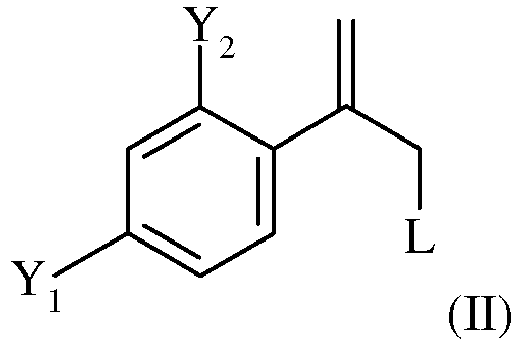 (2) reacting the compound of formula (II) with a malonic ester R1OOC-CH2-COOR2 to obtain a compound of formula (III)
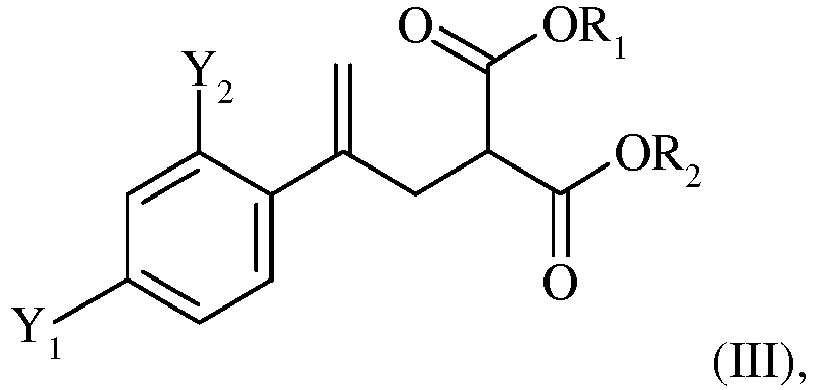 (3) reducing the compound of formula (III) to obtain a compound of formula (IV)
 (4) acylating the compound of formula (IV) with isobutyric anhydride to obtain a compound of formula (V)
 (5) reacting the compound of formula (V) with a halogen Hal2 selected from the group consisting of Cl2, Br2 and I2, preferably I2, in the presence of a base in a solvent to obtain a compound of formula (X)
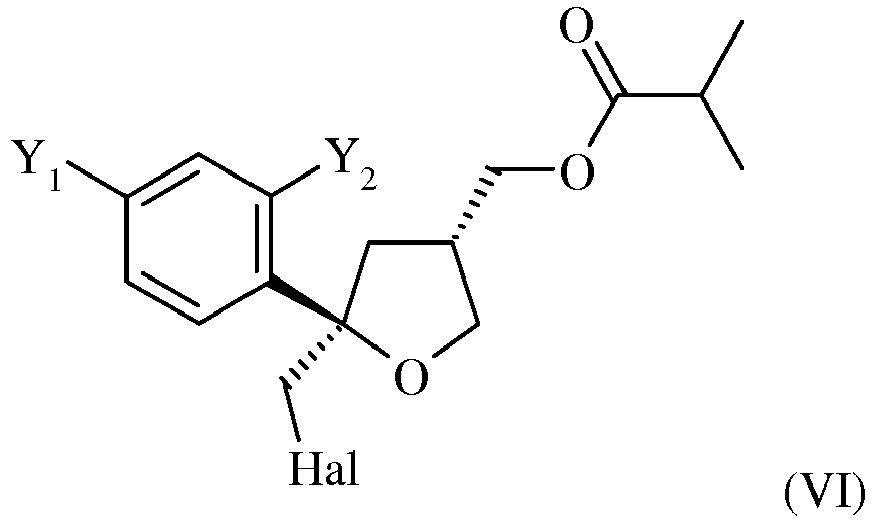
 (6.1) heating the compound of formula (X), preferably in the absence of DMPU (1,3-dimethyl-3,4,5,6-tetrahydro-2(1H)-pyrimidinone), in a solvent, preferably DMSO, with a 1,2,4-triazole alkali metal salt, preferably the sodium salt, and treating the resulting reaction mixture with a base, to obtain a compound of formula (IX)
 (6.2) separating the compound of formula (IX) from the reaction mixture obtained from (6.1) by extraction in a polar water immiscible solvent
wherein the process further comprises steps (A) or (B) or (C) wherein
(A) is(7) at least partially crystallizing the compound of formula (IX), in particular the compound of formula (VII) and the compound of formula (VIII), after (6.2). (B) is(8) converting the compound of formula (IX) to the respective salt by treating the compound with an inorganic or organic Bronstedt acid in a polar solvent and preferably at least partially crystallizing the respective salt
or (C) is (A) and (B). - The process of claim 4, wherein the nucleophilic compound comprising the nucleophilic residue RaRbRcSi-CH2 is a Grignard reagent, preferably a Grignard compound RaRbRcSi-CH2MgX wherein X is selected from the group consisting of Cl, Br, and I, more preferably a Grignard compound RaRbRcSi-CH2MgCl.
- The process of claim 4 or 5, wherein Ra, Rb and Rc are independently selected from the group consisting of alkyl residues having from 1 to 6 carbon atoms, preferably from 1 to 4 carbon atoms, more preferably 1 or 2 carbon atoms, Ra, Rb and Rc in particular being methyl.
- The process of any of claims 4 to 6, wherein the solvent used in (1.1) is an ether, preferably methyl-tert-butyl ether (MTBE).
- The process of any of claims 4 to 7, wherein reacting in (1.1) is performed at a temperature in the range of from -50 to +20 °C, preferably from -30 to +10 °C, more preferably from -15 to +5 °C.
- The process of any of claims 4 to 8, wherein treating in (1.2) is performed at a temperature in the range of from -20 to +70 °C.
- The process of any of claims 4 to 9, wherein the reagent employed in (1.2) is an acid, preferably an inorganic acid, more preferably sulfuric acid, wherein, if sulfuric acid is used, the temperature at which treating in (1.2) is performed is preferably in the range of from 40 to 50 °C.
- The process of claim 10, wherein in the compound of formula (IX), from 80 to 95 %, preferably from 85 to 95 % of the molecules are present as cis-isomer of formula (VII)


- The process of claim 4 or 11, wherein in (2), R1 and R2 are both ethyl.
- The process of any of claims 4 to 12, wherein after (2) and before (3), the compound of formula (III) is separated by extraction in cyclohexane.
- The process of any of claims 4 to 13, wherein in (3), LiBH4 is used as reducing agent which is preferably used in an amount of at most 2 molar equivalents with respect to compound (III).
- The process of any of claims 4 to 14, wherein reducing in (3) is carried out in a solvent preferably comprising water, the solvent being selected from the group consisting of water, alcohol, and a mixture of water and at least one alcohol, preferably from the group consisting of water, methanol, ethanol, isopropanol, and a mixture of water and at least one of these alcohols, preferably from the group consisting of water, ethanol, isopropanol, and a mixture of water and at least one of these alcohols, preferably from the group consisting of water, isopropanol, and a mixture of water and isopropanol, the solvent more preferably being a mixture of water and isopropanol, wherein the solvent preferably comprises from 1 to 20 vol.-%, more preferably from 5 to 15 vol.-% of water.
- The process of any of claims 10 to 13, wherein in (4), acylating is carried out in the presence of an enzyme, preferably Novo SP 435 enzyme in a solvent preferably acetonitrile or toluene, more preferably toluene.
- The process of any of claims 4 to 15, wherein after (4) and before (5), the compound of formula (V) is at least partially crystallized.
- The process of any of claims 4 to 16, wherein in (6.2), the solvent is a polar water-immiscible solvent, preferably an ester such as ethyl acetate or isopropyl acetate, an ether such as tetrahydrofuran or methyl tetrahydrofuran, a ketone such as methyl isobutyl ketone, a halogenated solvent such as dichloromethane, toluene, or a mixture of two or more of these solvents, more preferably an ester or an ether, more preferably an ether, and even more preferably methyl tetrahydrofuran.
- The process of claim 4, wherein the compound (IX), in particular the compound of formula (VII) and the compound of formula (VIII), is crystallized from a solvent optionally by addition of an antisolvent, wherein the solvent is preferably the solvent or solvent mixture employed in (6.2) and wherein the antisolvent is a saturated or unsaturated hydrocarbon such as cyclohexane, hexane, or heptane, or a mixture of two or more thereof.
- The process of claim 4 or 19, wherein the at least partially crystalline chiral compound of formula (IX)


- An at least partially crystalline, chiral compound or a salt thereof, obtainable or obtained by a process according to any of claims 4 to 20, preferably claim 4 to 19 comprising (C)..
- Use of the compound of formula (IX) according to claim 1 or 2 or a salt thereof, or of the salt according to claim 3, for the preparation of an antifungal agent, preferably

Priority Applications (1)
| Application Number | Priority Date | Filing Date | Title |
|---|---|---|---|
| EP11720108.7A EP2571868B1 (en) | 2010-05-19 | 2011-05-18 | Preparation of posaconazole intermediates |
Applications Claiming Priority (3)
| Application Number | Priority Date | Filing Date | Title |
|---|---|---|---|
| EP10163215 | 2010-05-19 | ||
| PCT/EP2011/058036 WO2011144656A1 (en) | 2010-05-19 | 2011-05-18 | Preparation of posaconazole intermediates |
| EP11720108.7A EP2571868B1 (en) | 2010-05-19 | 2011-05-18 | Preparation of posaconazole intermediates |
Publications (2)
| Publication Number | Publication Date |
|---|---|
| EP2571868A1 EP2571868A1 (en) | 2013-03-27 |
| EP2571868B1 true EP2571868B1 (en) | 2016-05-04 |
Family
ID=42341764
Family Applications (1)
| Application Number | Title | Priority Date | Filing Date |
|---|---|---|---|
| EP11720108.7A Not-in-force EP2571868B1 (en) | 2010-05-19 | 2011-05-18 | Preparation of posaconazole intermediates |
Country Status (10)
| Country | Link |
|---|---|
| US (1) | US9073904B2 (en) |
| EP (1) | EP2571868B1 (en) |
| JP (1) | JP2013532131A (en) |
| CN (1) | CN102892762B (en) |
| AU (1) | AU2011254657B2 (en) |
| BR (1) | BR112012029226A2 (en) |
| CA (1) | CA2798007C (en) |
| MX (1) | MX338514B (en) |
| RU (1) | RU2580318C2 (en) |
| WO (1) | WO2011144656A1 (en) |
Families Citing this family (13)
| Publication number | Priority date | Publication date | Assignee | Title |
|---|---|---|---|---|
| EP2571871B1 (en) | 2010-05-19 | 2017-06-21 | Sandoz AG | Process for the preparation of chiral triazolones |
| US9199919B2 (en) | 2010-05-19 | 2015-12-01 | Sandoz Ag | Process for the preparation of chiral hydrazides |
| US9206146B2 (en) | 2010-05-19 | 2015-12-08 | Sandoz Ag | Purification of posaconazole and of posaconazole intermediates |
| CN108329303A (en) | 2011-06-16 | 2018-07-27 | 桑多斯股份公司 | The method for preparing chipal compounds |
| EP2746266A1 (en) * | 2012-12-19 | 2014-06-25 | Basf Se | New substituted triazoles and imidazoles and their use as fungicides |
| CN103086885B (en) * | 2013-02-28 | 2015-04-01 | 天津大学仁爱学院 | Preparation method of posaconazole intermediate |
| EP2789610A1 (en) * | 2013-04-10 | 2014-10-15 | Sandoz Ag | Purification of Posaconazole Intermediates |
| CN105777720B (en) * | 2014-12-26 | 2018-09-21 | 博瑞生物医药(苏州)股份有限公司 | A kind of novel crystal forms and preparation method of posaconazole intermediate |
| EP3353169B1 (en) * | 2015-09-23 | 2023-03-15 | Biocon Limited | Crystalline forms of posaconazole intermediate and process for the preparation of amorphous posaconazole |
| CN105622413B (en) * | 2016-01-14 | 2017-11-24 | 宁波新凯生物科技有限公司 | The synthetic method of 2 [2 (2,4 difluorophenyl) pi-allyl] 1,3 diethyl malonates |
| CN105753693B (en) * | 2016-03-30 | 2017-12-22 | 宁波新凯生物科技有限公司 | The synthetic method of 2 methylpropanoic acids [base of 4 amylene of (2S) 4 (2,4 difluorophenyl) 2 methylol 1] ester |
| CN105777486B (en) * | 2016-03-30 | 2018-09-11 | 浙江大学宁波理工学院 | A kind of synthetic method of 2- [2- (2,4- difluorophenyl) -2- propylene -1- bases] -1,3-PD |
| CN105732310B (en) * | 2016-03-30 | 2018-01-23 | 宁波新凯生物科技有限公司 | The synthetic method of 2 [base of 2 (2,4 difluorophenyl) 2 propylene 1] 1,3 propane diols |
Family Cites Families (41)
| Publication number | Priority date | Publication date | Assignee | Title |
|---|---|---|---|---|
| GB8307232D0 (en) * | 1983-03-16 | 1983-04-20 | Pfizer Ltd | Antifungal agents |
| DE3544983A1 (en) | 1985-12-19 | 1987-06-25 | Hoechst Ag | ANTIMYCOTIC EFFECTIVE NAIL POLISH |
| IL103558A0 (en) | 1991-10-30 | 1993-03-15 | Schering Corp | Tri-substituted tetrahydrofuran antifungals |
| US5595872A (en) | 1992-03-06 | 1997-01-21 | Bristol-Myers Squibb Company | Nucleic acids encoding microsomal trigyceride transfer protein |
| US5403937A (en) | 1993-04-30 | 1995-04-04 | Schering Corporation | Process for preparing intermediates for the synthesis of antifungal agents |
| US5349099A (en) * | 1993-12-13 | 1994-09-20 | Schering Corporation | Process for preparing intermediates for the synthesis of antifungal agents |
| US5710154A (en) | 1993-12-21 | 1998-01-20 | Schering Corporation | Tetrahydrofuran antifungals |
| PL181193B1 (en) | 1993-12-21 | 2001-06-29 | Schering Corp | Tetrahydrofuranic antimycotic agents |
| US5714490A (en) | 1993-12-21 | 1998-02-03 | Schering Corporation | Tetrahydrofuran antifungals |
| US5693626A (en) | 1993-12-21 | 1997-12-02 | Schering Corporation | Tetrahydrofuran antifungals |
| NZ270418A (en) * | 1994-02-07 | 1997-09-22 | Eisai Co Ltd | Polycyclic triazole & imidazole derivatives, antifungal compositions |
| US5486625A (en) * | 1994-07-08 | 1996-01-23 | Schering Corporation | Process for the preparation of chiral intermediates useful for the synthesis of antifungal agents |
| US5625064A (en) | 1995-04-19 | 1997-04-29 | Schering Corporation | Process for the preparation of triazolones |
| US5616777A (en) | 1995-04-19 | 1997-04-01 | Schering Corporation | Chiral hydrazine derivatives |
| SK27097A3 (en) | 1995-06-02 | 1997-09-10 | Schering Corp | Tetrahydrofuran antifungals |
| CA2224707A1 (en) * | 1995-06-19 | 1997-01-03 | Schering Corporation | Tetrahydrofuran antifungals |
| WO1997022710A1 (en) | 1995-12-20 | 1997-06-26 | Shering Corporation | Process for preparing intermediates for the synthesis of antifungal agents |
| WO1997022579A1 (en) | 1995-12-20 | 1997-06-26 | Schering Corporation | Process for preparation of hydrazides |
| EP0885394B1 (en) | 1996-03-08 | 2000-08-16 | Octapharma AG | Process for testing suitability of protein fractions containing factor viii |
| US5834472A (en) | 1996-05-24 | 1998-11-10 | Schering Corporation | Antifungal composition with enhanced bioavailability |
| US5972381A (en) | 1996-06-28 | 1999-10-26 | Schering Corporation | Solid solution of an antifungal agent with enhanced bioavailability |
| JP2001519346A (en) | 1997-10-07 | 2001-10-23 | シェーリング コーポレイション | Antifungal crystalline polymorph |
| US6713481B1 (en) | 1997-10-17 | 2004-03-30 | David R. Andrews | Crystalline antifungal polymorph |
| JP4903963B2 (en) | 1999-11-08 | 2012-03-28 | シェーリング コーポレイション | Process for preparing N- (4-hydroxy-phenyl) -N '-(4'-aminophenyl) -piperazine |
| US6355801B1 (en) | 1999-11-08 | 2002-03-12 | Schering Corporation | Process for preparing N-(4-hydroxyphenyl)-N′-(4′-aminophenyl)-piperazine |
| CA2443089C (en) | 2001-04-03 | 2011-11-01 | Schering Corporation | Antifungal suspension of micronized posaconazole |
| ES2296131T3 (en) | 2004-02-02 | 2008-04-16 | Pfizer Products Incorporated | PROCEDURE FOR THE PREPARATION OF 1- (2S, 3S) -2-BENCIDRIL-N- (5-TERC-BUTIL-2-METOXIBENCIL) QUINUCLIDIN-3-AMINA. |
| KR20070027564A (en) | 2004-05-28 | 2007-03-09 | 쉐링 코포레이션 | Injectable Pharmaceutical Suspensions Containing Posaconazole |
| MY142804A (en) | 2004-07-01 | 2011-01-14 | Opko Health Inc | Nk1 antagonists |
| US20090105225A1 (en) | 2006-04-20 | 2009-04-23 | Glaxo Group Limited | 2-Substituted 4-Benzylphthalazinone Derivatives as Histamine H1 and H3 Antagonists |
| CN101495096A (en) | 2006-05-30 | 2009-07-29 | 伊兰制药国际有限公司 | Nanoparticulate posaconazole formulations |
| CA2685194A1 (en) * | 2007-04-27 | 2008-11-13 | Eisai R&D Management Co., Ltd. | Heterocycle-substituted pyridine derivatives salt or crystal thereof |
| EP2220078B1 (en) * | 2007-10-29 | 2013-05-22 | Amgen, Inc | Benzomorpholine derivatives and methods of use |
| WO2009129297A1 (en) | 2008-04-15 | 2009-10-22 | Schering Corporation | Semi-solid oral pharmaceutical compositions |
| WO2009141837A2 (en) * | 2008-05-21 | 2009-11-26 | Ind-Swift Laboratories Limited | Process for preparing posaconazole and intermediates thereof |
| EP2141159A1 (en) | 2008-07-03 | 2010-01-06 | Sandoz AG | A Crystalline form of posaconazole |
| WO2010090654A1 (en) | 2009-02-05 | 2010-08-12 | Tdt, Ltd. | Methods of reducing the proliferation and viability of microbial agents |
| US9199919B2 (en) | 2010-05-19 | 2015-12-01 | Sandoz Ag | Process for the preparation of chiral hydrazides |
| EP2571871B1 (en) | 2010-05-19 | 2017-06-21 | Sandoz AG | Process for the preparation of chiral triazolones |
| US9206146B2 (en) | 2010-05-19 | 2015-12-08 | Sandoz Ag | Purification of posaconazole and of posaconazole intermediates |
| US20150164890A1 (en) | 2012-06-14 | 2015-06-18 | Sandoz Ag | Pharmaceutical compositions comprising crystalline posaconazole |
-
2011
- 2011-05-18 RU RU2012154807/04A patent/RU2580318C2/en active
- 2011-05-18 BR BR112012029226A patent/BR112012029226A2/en not_active Application Discontinuation
- 2011-05-18 WO PCT/EP2011/058036 patent/WO2011144656A1/en not_active Ceased
- 2011-05-18 JP JP2013510613A patent/JP2013532131A/en active Pending
- 2011-05-18 EP EP11720108.7A patent/EP2571868B1/en not_active Not-in-force
- 2011-05-18 AU AU2011254657A patent/AU2011254657B2/en not_active Ceased
- 2011-05-18 CA CA2798007A patent/CA2798007C/en not_active Expired - Fee Related
- 2011-05-18 CN CN201180024632.6A patent/CN102892762B/en not_active Expired - Fee Related
- 2011-05-18 MX MX2012013332A patent/MX338514B/en active IP Right Grant
- 2011-05-18 US US13/697,802 patent/US9073904B2/en not_active Expired - Fee Related
Also Published As
| Publication number | Publication date |
|---|---|
| US9073904B2 (en) | 2015-07-07 |
| MX2012013332A (en) | 2013-02-01 |
| WO2011144656A1 (en) | 2011-11-24 |
| CN102892762A (en) | 2013-01-23 |
| CA2798007A1 (en) | 2011-11-24 |
| RU2580318C2 (en) | 2016-04-10 |
| AU2011254657A1 (en) | 2012-12-20 |
| US20130203994A1 (en) | 2013-08-08 |
| CN102892762B (en) | 2016-04-20 |
| BR112012029226A2 (en) | 2015-10-20 |
| JP2013532131A (en) | 2013-08-15 |
| RU2012154807A (en) | 2014-06-27 |
| MX338514B (en) | 2016-04-20 |
| CA2798007C (en) | 2018-10-23 |
| EP2571868A1 (en) | 2013-03-27 |
| AU2011254657B2 (en) | 2016-02-04 |
Similar Documents
| Publication | Publication Date | Title |
|---|---|---|
| US9073904B2 (en) | Preparation of posaconazole intermediates | |
| EP2571869B1 (en) | Purification of posaconazole and posaconazole intermediates | |
| CN102906087B (en) | Prepare the method for chiral triazole ketone | |
| EP2612859B1 (en) | Method for producing 1-triazole-2-butanol derivative | |
| EP2079706B1 (en) | Method for preparing medetomidine and its salts | |
| EP2789610A1 (en) | Purification of Posaconazole Intermediates | |
| EP1803716B1 (en) | A process for preparation of racemic nebivolol | |
| US12258330B2 (en) | Method for preparing voriconazole and intermediate thereof | |
| US20130203993A1 (en) | Process for the preparation of chiral hydrazides | |
| EP3915981B1 (en) | Method for preparation of efinaconazole in ionic liquid medium | |
| EP3353169B1 (en) | Crystalline forms of posaconazole intermediate and process for the preparation of amorphous posaconazole | |
| KR101471047B1 (en) | Improved process for preparation of highly pure bosentan | |
| JP4591349B2 (en) | Process for producing 4-aminotetrahydropyran compound and acid salt thereof, synthetic intermediate thereof and process for producing the same | |
| KR102622061B1 (en) | Method for producing efinaconazole | |
| EP0406438B1 (en) | Production of glycidyl ether | |
| CA2999422C (en) | Crystalline forms of posaconazole intermediate and process for the preparation of amorphous posaconazole | |
| WO2018202537A1 (en) | Process for the preparation of an azolic derivative | |
| WO2017046131A1 (en) | Processes for preparing solid state forms of dolutegravir sodium |
Legal Events
| Date | Code | Title | Description |
|---|---|---|---|
| PUAI | Public reference made under article 153(3) epc to a published international application that has entered the european phase |
Free format text: ORIGINAL CODE: 0009012 |
|
| 17P | Request for examination filed |
Effective date: 20121218 |
|
| AK | Designated contracting states |
Kind code of ref document: A1 Designated state(s): AL AT BE BG CH CY CZ DE DK EE ES FI FR GB GR HR HU IE IS IT LI LT LU LV MC MK MT NL NO PL PT RO RS SE SI SK SM TR |
|
| DAX | Request for extension of the european patent (deleted) | ||
| 17Q | First examination report despatched |
Effective date: 20140204 |
|
| GRAP | Despatch of communication of intention to grant a patent |
Free format text: ORIGINAL CODE: EPIDOSNIGR1 |
|
| INTG | Intention to grant announced |
Effective date: 20151112 |
|
| GRAS | Grant fee paid |
Free format text: ORIGINAL CODE: EPIDOSNIGR3 |
|
| GRAA | (expected) grant |
Free format text: ORIGINAL CODE: 0009210 |
|
| AK | Designated contracting states |
Kind code of ref document: B1 Designated state(s): AL AT BE BG CH CY CZ DE DK EE ES FI FR GB GR HR HU IE IS IT LI LT LU LV MC MK MT NL NO PL PT RO RS SE SI SK SM TR |
|
| REG | Reference to a national code |
Ref country code: GB Ref legal event code: FG4D |
|
| REG | Reference to a national code |
Ref country code: CH Ref legal event code: EP |
|
| REG | Reference to a national code |
Ref country code: AT Ref legal event code: REF Ref document number: 796803 Country of ref document: AT Kind code of ref document: T Effective date: 20160515 |
|
| REG | Reference to a national code |
Ref country code: IE Ref legal event code: FG4D |
|
| REG | Reference to a national code |
Ref country code: DE Ref legal event code: R096 Ref document number: 602011026154 Country of ref document: DE |
|
| REG | Reference to a national code |
Ref country code: FR Ref legal event code: PLFP Year of fee payment: 6 |
|
| REG | Reference to a national code |
Ref country code: NL Ref legal event code: MP Effective date: 20160504 |
|
| REG | Reference to a national code |
Ref country code: LT Ref legal event code: MG4D |
|
| PG25 | Lapsed in a contracting state [announced via postgrant information from national office to epo] |
Ref country code: NO Free format text: LAPSE BECAUSE OF FAILURE TO SUBMIT A TRANSLATION OF THE DESCRIPTION OR TO PAY THE FEE WITHIN THE PRESCRIBED TIME-LIMIT Effective date: 20160804 Ref country code: LT Free format text: LAPSE BECAUSE OF FAILURE TO SUBMIT A TRANSLATION OF THE DESCRIPTION OR TO PAY THE FEE WITHIN THE PRESCRIBED TIME-LIMIT Effective date: 20160504 Ref country code: FI Free format text: LAPSE BECAUSE OF FAILURE TO SUBMIT A TRANSLATION OF THE DESCRIPTION OR TO PAY THE FEE WITHIN THE PRESCRIBED TIME-LIMIT Effective date: 20160504 Ref country code: NL Free format text: LAPSE BECAUSE OF FAILURE TO SUBMIT A TRANSLATION OF THE DESCRIPTION OR TO PAY THE FEE WITHIN THE PRESCRIBED TIME-LIMIT Effective date: 20160504 |
|
| REG | Reference to a national code |
Ref country code: AT Ref legal event code: MK05 Ref document number: 796803 Country of ref document: AT Kind code of ref document: T Effective date: 20160504 |
|
| PG25 | Lapsed in a contracting state [announced via postgrant information from national office to epo] |
Ref country code: SE Free format text: LAPSE BECAUSE OF FAILURE TO SUBMIT A TRANSLATION OF THE DESCRIPTION OR TO PAY THE FEE WITHIN THE PRESCRIBED TIME-LIMIT Effective date: 20160504 Ref country code: LV Free format text: LAPSE BECAUSE OF FAILURE TO SUBMIT A TRANSLATION OF THE DESCRIPTION OR TO PAY THE FEE WITHIN THE PRESCRIBED TIME-LIMIT Effective date: 20160504 Ref country code: PT Free format text: LAPSE BECAUSE OF FAILURE TO SUBMIT A TRANSLATION OF THE DESCRIPTION OR TO PAY THE FEE WITHIN THE PRESCRIBED TIME-LIMIT Effective date: 20160905 Ref country code: GR Free format text: LAPSE BECAUSE OF FAILURE TO SUBMIT A TRANSLATION OF THE DESCRIPTION OR TO PAY THE FEE WITHIN THE PRESCRIBED TIME-LIMIT Effective date: 20160805 Ref country code: HR Free format text: LAPSE BECAUSE OF FAILURE TO SUBMIT A TRANSLATION OF THE DESCRIPTION OR TO PAY THE FEE WITHIN THE PRESCRIBED TIME-LIMIT Effective date: 20160504 Ref country code: ES Free format text: LAPSE BECAUSE OF FAILURE TO SUBMIT A TRANSLATION OF THE DESCRIPTION OR TO PAY THE FEE WITHIN THE PRESCRIBED TIME-LIMIT Effective date: 20160504 Ref country code: RS Free format text: LAPSE BECAUSE OF FAILURE TO SUBMIT A TRANSLATION OF THE DESCRIPTION OR TO PAY THE FEE WITHIN THE PRESCRIBED TIME-LIMIT Effective date: 20160504 |
|
| PG25 | Lapsed in a contracting state [announced via postgrant information from national office to epo] |
Ref country code: BE Free format text: LAPSE BECAUSE OF NON-PAYMENT OF DUE FEES Effective date: 20160531 Ref country code: IT Free format text: LAPSE BECAUSE OF FAILURE TO SUBMIT A TRANSLATION OF THE DESCRIPTION OR TO PAY THE FEE WITHIN THE PRESCRIBED TIME-LIMIT Effective date: 20160504 |
|
| REG | Reference to a national code |
Ref country code: CH Ref legal event code: PL |
|
| PG25 | Lapsed in a contracting state [announced via postgrant information from national office to epo] |
Ref country code: RO Free format text: LAPSE BECAUSE OF FAILURE TO SUBMIT A TRANSLATION OF THE DESCRIPTION OR TO PAY THE FEE WITHIN THE PRESCRIBED TIME-LIMIT Effective date: 20160504 Ref country code: CZ Free format text: LAPSE BECAUSE OF FAILURE TO SUBMIT A TRANSLATION OF THE DESCRIPTION OR TO PAY THE FEE WITHIN THE PRESCRIBED TIME-LIMIT Effective date: 20160504 Ref country code: CH Free format text: LAPSE BECAUSE OF NON-PAYMENT OF DUE FEES Effective date: 20160531 Ref country code: LI Free format text: LAPSE BECAUSE OF NON-PAYMENT OF DUE FEES Effective date: 20160531 Ref country code: SK Free format text: LAPSE BECAUSE OF FAILURE TO SUBMIT A TRANSLATION OF THE DESCRIPTION OR TO PAY THE FEE WITHIN THE PRESCRIBED TIME-LIMIT Effective date: 20160504 Ref country code: DK Free format text: LAPSE BECAUSE OF FAILURE TO SUBMIT A TRANSLATION OF THE DESCRIPTION OR TO PAY THE FEE WITHIN THE PRESCRIBED TIME-LIMIT Effective date: 20160504 Ref country code: EE Free format text: LAPSE BECAUSE OF FAILURE TO SUBMIT A TRANSLATION OF THE DESCRIPTION OR TO PAY THE FEE WITHIN THE PRESCRIBED TIME-LIMIT Effective date: 20160504 |
|
| REG | Reference to a national code |
Ref country code: DE Ref legal event code: R097 Ref document number: 602011026154 Country of ref document: DE |
|
| REG | Reference to a national code |
Ref country code: IE Ref legal event code: MM4A |
|
| PG25 | Lapsed in a contracting state [announced via postgrant information from national office to epo] |
Ref country code: AT Free format text: LAPSE BECAUSE OF FAILURE TO SUBMIT A TRANSLATION OF THE DESCRIPTION OR TO PAY THE FEE WITHIN THE PRESCRIBED TIME-LIMIT Effective date: 20160504 Ref country code: SM Free format text: LAPSE BECAUSE OF FAILURE TO SUBMIT A TRANSLATION OF THE DESCRIPTION OR TO PAY THE FEE WITHIN THE PRESCRIBED TIME-LIMIT Effective date: 20160504 Ref country code: BE Free format text: LAPSE BECAUSE OF FAILURE TO SUBMIT A TRANSLATION OF THE DESCRIPTION OR TO PAY THE FEE WITHIN THE PRESCRIBED TIME-LIMIT Effective date: 20160504 Ref country code: PL Free format text: LAPSE BECAUSE OF FAILURE TO SUBMIT A TRANSLATION OF THE DESCRIPTION OR TO PAY THE FEE WITHIN THE PRESCRIBED TIME-LIMIT Effective date: 20160504 |
|
| PLBE | No opposition filed within time limit |
Free format text: ORIGINAL CODE: 0009261 |
|
| STAA | Information on the status of an ep patent application or granted ep patent |
Free format text: STATUS: NO OPPOSITION FILED WITHIN TIME LIMIT |
|
| PG25 | Lapsed in a contracting state [announced via postgrant information from national office to epo] |
Ref country code: MC Free format text: LAPSE BECAUSE OF FAILURE TO SUBMIT A TRANSLATION OF THE DESCRIPTION OR TO PAY THE FEE WITHIN THE PRESCRIBED TIME-LIMIT Effective date: 20160504 |
|
| 26N | No opposition filed |
Effective date: 20170207 |
|
| REG | Reference to a national code |
Ref country code: FR Ref legal event code: PLFP Year of fee payment: 7 |
|
| PG25 | Lapsed in a contracting state [announced via postgrant information from national office to epo] |
Ref country code: IE Free format text: LAPSE BECAUSE OF NON-PAYMENT OF DUE FEES Effective date: 20160518 Ref country code: SI Free format text: LAPSE BECAUSE OF FAILURE TO SUBMIT A TRANSLATION OF THE DESCRIPTION OR TO PAY THE FEE WITHIN THE PRESCRIBED TIME-LIMIT Effective date: 20160504 |
|
| REG | Reference to a national code |
Ref country code: FR Ref legal event code: PLFP Year of fee payment: 8 |
|
| PG25 | Lapsed in a contracting state [announced via postgrant information from national office to epo] |
Ref country code: CY Free format text: LAPSE BECAUSE OF FAILURE TO SUBMIT A TRANSLATION OF THE DESCRIPTION OR TO PAY THE FEE WITHIN THE PRESCRIBED TIME-LIMIT Effective date: 20160504 Ref country code: HU Free format text: LAPSE BECAUSE OF FAILURE TO SUBMIT A TRANSLATION OF THE DESCRIPTION OR TO PAY THE FEE WITHIN THE PRESCRIBED TIME-LIMIT; INVALID AB INITIO Effective date: 20110518 |
|
| PG25 | Lapsed in a contracting state [announced via postgrant information from national office to epo] |
Ref country code: TR Free format text: LAPSE BECAUSE OF FAILURE TO SUBMIT A TRANSLATION OF THE DESCRIPTION OR TO PAY THE FEE WITHIN THE PRESCRIBED TIME-LIMIT Effective date: 20160504 Ref country code: LU Free format text: LAPSE BECAUSE OF NON-PAYMENT OF DUE FEES Effective date: 20160518 Ref country code: MT Free format text: LAPSE BECAUSE OF NON-PAYMENT OF DUE FEES Effective date: 20160531 Ref country code: IS Free format text: LAPSE BECAUSE OF FAILURE TO SUBMIT A TRANSLATION OF THE DESCRIPTION OR TO PAY THE FEE WITHIN THE PRESCRIBED TIME-LIMIT Effective date: 20160504 Ref country code: MK Free format text: LAPSE BECAUSE OF FAILURE TO SUBMIT A TRANSLATION OF THE DESCRIPTION OR TO PAY THE FEE WITHIN THE PRESCRIBED TIME-LIMIT Effective date: 20160504 |
|
| PG25 | Lapsed in a contracting state [announced via postgrant information from national office to epo] |
Ref country code: BG Free format text: LAPSE BECAUSE OF FAILURE TO SUBMIT A TRANSLATION OF THE DESCRIPTION OR TO PAY THE FEE WITHIN THE PRESCRIBED TIME-LIMIT Effective date: 20160504 |
|
| PG25 | Lapsed in a contracting state [announced via postgrant information from national office to epo] |
Ref country code: AL Free format text: LAPSE BECAUSE OF FAILURE TO SUBMIT A TRANSLATION OF THE DESCRIPTION OR TO PAY THE FEE WITHIN THE PRESCRIBED TIME-LIMIT Effective date: 20160504 |
|
| PGFP | Annual fee paid to national office [announced via postgrant information from national office to epo] |
Ref country code: DE Payment date: 20210420 Year of fee payment: 11 Ref country code: FR Payment date: 20210426 Year of fee payment: 11 |
|
| PGFP | Annual fee paid to national office [announced via postgrant information from national office to epo] |
Ref country code: GB Payment date: 20210421 Year of fee payment: 11 |
|
| REG | Reference to a national code |
Ref country code: DE Ref legal event code: R119 Ref document number: 602011026154 Country of ref document: DE |
|
| GBPC | Gb: european patent ceased through non-payment of renewal fee |
Effective date: 20220518 |
|
| PG25 | Lapsed in a contracting state [announced via postgrant information from national office to epo] |
Ref country code: FR Free format text: LAPSE BECAUSE OF NON-PAYMENT OF DUE FEES Effective date: 20220531 |
|
| PG25 | Lapsed in a contracting state [announced via postgrant information from national office to epo] |
Ref country code: GB Free format text: LAPSE BECAUSE OF NON-PAYMENT OF DUE FEES Effective date: 20220518 Ref country code: DE Free format text: LAPSE BECAUSE OF NON-PAYMENT OF DUE FEES Effective date: 20221201 |