EP2568620A1 - Method and device for generating and feeding back high rank adaptive codebook in multiple input multiple output system - Google Patents
Method and device for generating and feeding back high rank adaptive codebook in multiple input multiple output system Download PDFInfo
- Publication number
- EP2568620A1 EP2568620A1 EP10850960A EP10850960A EP2568620A1 EP 2568620 A1 EP2568620 A1 EP 2568620A1 EP 10850960 A EP10850960 A EP 10850960A EP 10850960 A EP10850960 A EP 10850960A EP 2568620 A1 EP2568620 A1 EP 2568620A1
- Authority
- EP
- European Patent Office
- Prior art keywords
- high rank
- long
- correlation matrix
- codebook
- term
- Prior art date
- Legal status (The legal status is an assumption and is not a legal conclusion. Google has not performed a legal analysis and makes no representation as to the accuracy of the status listed.)
- Withdrawn
Links
Images
Classifications
-
- H—ELECTRICITY
- H04—ELECTRIC COMMUNICATION TECHNIQUE
- H04B—TRANSMISSION
- H04B7/00—Radio transmission systems, i.e. using radiation field
- H04B7/02—Diversity systems; Multi-antenna system, i.e. transmission or reception using multiple antennas
- H04B7/04—Diversity systems; Multi-antenna system, i.e. transmission or reception using multiple antennas using two or more spaced independent antennas
- H04B7/06—Diversity systems; Multi-antenna system, i.e. transmission or reception using multiple antennas using two or more spaced independent antennas at the transmitting station
- H04B7/0613—Diversity systems; Multi-antenna system, i.e. transmission or reception using multiple antennas using two or more spaced independent antennas at the transmitting station using simultaneous transmission
- H04B7/0615—Diversity systems; Multi-antenna system, i.e. transmission or reception using multiple antennas using two or more spaced independent antennas at the transmitting station using simultaneous transmission of weighted versions of same signal
- H04B7/0619—Diversity systems; Multi-antenna system, i.e. transmission or reception using multiple antennas using two or more spaced independent antennas at the transmitting station using simultaneous transmission of weighted versions of same signal using feedback from receiving side
- H04B7/0636—Feedback format
- H04B7/0639—Using selective indices, e.g. of a codebook, e.g. pre-distortion matrix index [PMI] or for beam selection
-
- H—ELECTRICITY
- H04—ELECTRIC COMMUNICATION TECHNIQUE
- H04B—TRANSMISSION
- H04B7/00—Radio transmission systems, i.e. using radiation field
- H04B7/02—Diversity systems; Multi-antenna system, i.e. transmission or reception using multiple antennas
- H04B7/04—Diversity systems; Multi-antenna system, i.e. transmission or reception using multiple antennas using two or more spaced independent antennas
- H04B7/0413—MIMO systems
- H04B7/0456—Selection of precoding matrices or codebooks, e.g. using matrices antenna weighting
- H04B7/0482—Adaptive codebooks
-
- H—ELECTRICITY
- H04—ELECTRIC COMMUNICATION TECHNIQUE
- H04B—TRANSMISSION
- H04B17/00—Monitoring; Testing
- H04B17/30—Monitoring; Testing of propagation channels
- H04B17/309—Measuring or estimating channel quality parameters
- H04B17/336—Signal-to-interference ratio [SIR] or carrier-to-interference ratio [CIR]
-
- H—ELECTRICITY
- H04—ELECTRIC COMMUNICATION TECHNIQUE
- H04B—TRANSMISSION
- H04B7/00—Radio transmission systems, i.e. using radiation field
- H04B7/02—Diversity systems; Multi-antenna system, i.e. transmission or reception using multiple antennas
- H04B7/04—Diversity systems; Multi-antenna system, i.e. transmission or reception using multiple antennas using two or more spaced independent antennas
- H04B7/0413—MIMO systems
- H04B7/0452—Multi-user MIMO systems
-
- H—ELECTRICITY
- H04—ELECTRIC COMMUNICATION TECHNIQUE
- H04B—TRANSMISSION
- H04B7/00—Radio transmission systems, i.e. using radiation field
- H04B7/02—Diversity systems; Multi-antenna system, i.e. transmission or reception using multiple antennas
- H04B7/04—Diversity systems; Multi-antenna system, i.e. transmission or reception using multiple antennas using two or more spaced independent antennas
- H04B7/0413—MIMO systems
- H04B7/0456—Selection of precoding matrices or codebooks, e.g. using matrices antenna weighting
- H04B7/0486—Selection of precoding matrices or codebooks, e.g. using matrices antenna weighting taking channel rank into account
-
- H—ELECTRICITY
- H04—ELECTRIC COMMUNICATION TECHNIQUE
- H04B—TRANSMISSION
- H04B7/00—Radio transmission systems, i.e. using radiation field
- H04B7/02—Diversity systems; Multi-antenna system, i.e. transmission or reception using multiple antennas
- H04B7/04—Diversity systems; Multi-antenna system, i.e. transmission or reception using multiple antennas using two or more spaced independent antennas
- H04B7/06—Diversity systems; Multi-antenna system, i.e. transmission or reception using multiple antennas using two or more spaced independent antennas at the transmitting station
- H04B7/0613—Diversity systems; Multi-antenna system, i.e. transmission or reception using multiple antennas using two or more spaced independent antennas at the transmitting station using simultaneous transmission
- H04B7/0615—Diversity systems; Multi-antenna system, i.e. transmission or reception using multiple antennas using two or more spaced independent antennas at the transmitting station using simultaneous transmission of weighted versions of same signal
- H04B7/0619—Diversity systems; Multi-antenna system, i.e. transmission or reception using multiple antennas using two or more spaced independent antennas at the transmitting station using simultaneous transmission of weighted versions of same signal using feedback from receiving side
- H04B7/0621—Feedback content
- H04B7/0626—Channel coefficients, e.g. channel state information [CSI]
-
- H—ELECTRICITY
- H04—ELECTRIC COMMUNICATION TECHNIQUE
- H04B—TRANSMISSION
- H04B7/00—Radio transmission systems, i.e. using radiation field
- H04B7/02—Diversity systems; Multi-antenna system, i.e. transmission or reception using multiple antennas
- H04B7/04—Diversity systems; Multi-antenna system, i.e. transmission or reception using multiple antennas using two or more spaced independent antennas
- H04B7/06—Diversity systems; Multi-antenna system, i.e. transmission or reception using multiple antennas using two or more spaced independent antennas at the transmitting station
- H04B7/0613—Diversity systems; Multi-antenna system, i.e. transmission or reception using multiple antennas using two or more spaced independent antennas at the transmitting station using simultaneous transmission
- H04B7/0615—Diversity systems; Multi-antenna system, i.e. transmission or reception using multiple antennas using two or more spaced independent antennas at the transmitting station using simultaneous transmission of weighted versions of same signal
- H04B7/0619—Diversity systems; Multi-antenna system, i.e. transmission or reception using multiple antennas using two or more spaced independent antennas at the transmitting station using simultaneous transmission of weighted versions of same signal using feedback from receiving side
- H04B7/0636—Feedback format
- H04B7/0645—Variable feedback
- H04B7/065—Variable contents, e.g. long-term or short-short
-
- H—ELECTRICITY
- H04—ELECTRIC COMMUNICATION TECHNIQUE
- H04B—TRANSMISSION
- H04B7/00—Radio transmission systems, i.e. using radiation field
- H04B7/02—Diversity systems; Multi-antenna system, i.e. transmission or reception using multiple antennas
- H04B7/04—Diversity systems; Multi-antenna system, i.e. transmission or reception using multiple antennas using two or more spaced independent antennas
- H04B7/06—Diversity systems; Multi-antenna system, i.e. transmission or reception using multiple antennas using two or more spaced independent antennas at the transmitting station
- H04B7/0613—Diversity systems; Multi-antenna system, i.e. transmission or reception using multiple antennas using two or more spaced independent antennas at the transmitting station using simultaneous transmission
- H04B7/0615—Diversity systems; Multi-antenna system, i.e. transmission or reception using multiple antennas using two or more spaced independent antennas at the transmitting station using simultaneous transmission of weighted versions of same signal
- H04B7/0619—Diversity systems; Multi-antenna system, i.e. transmission or reception using multiple antennas using two or more spaced independent antennas at the transmitting station using simultaneous transmission of weighted versions of same signal using feedback from receiving side
- H04B7/0658—Feedback reduction
- H04B7/0663—Feedback reduction using vector or matrix manipulations
-
- H—ELECTRICITY
- H04—ELECTRIC COMMUNICATION TECHNIQUE
- H04B—TRANSMISSION
- H04B7/00—Radio transmission systems, i.e. using radiation field
- H04B7/02—Diversity systems; Multi-antenna system, i.e. transmission or reception using multiple antennas
- H04B7/04—Diversity systems; Multi-antenna system, i.e. transmission or reception using multiple antennas using two or more spaced independent antennas
- H04B7/0413—MIMO systems
- H04B7/0456—Selection of precoding matrices or codebooks, e.g. using matrices antenna weighting
- H04B7/046—Selection of precoding matrices or codebooks, e.g. using matrices antenna weighting taking physical layer constraints into account
- H04B7/0469—Selection of precoding matrices or codebooks, e.g. using matrices antenna weighting taking physical layer constraints into account taking special antenna structures, e.g. cross polarized antennas into account
Definitions
- Embodiments of the present invention relate to a Multiple Input Multiple Output (MIMO) system in a wireless communication network, and more specifically to the generation and feedback of a high rank adaptive codebook in a MIMO system.
- MIMO Multiple Input Multiple Output
- Multi-antenna techniques such as single-user MIMO (SU-MIMO) and multi-user MIMO (MU-MIMO), are identified as key techniques for Long-Term Evolution-Advanced LTE-A to satisfy the IMT-Advanced requirements.
- SU-MIMO single-user MIMO
- MU-MIMO multi-user MIMO
- LTE-A Long-Term Evolution-Advanced LTE-A
- precoding To implement precoding, it is required that a transmitting apparatus can obtain channel state information, which, in turn, requires user equipment to feed back the channel state information to a base station.
- Channel information feedback accuracy has bee proven to have great impact on system performance of multi-antenna schemes, especially MU-MIMO.
- a codebook In this approach, a set of codebooks (also referred to as a codebook set) is prestored at a base station and user equipment, and a receiving apparatus selects a matching precoding matrix under some criterion according to a current channel state and then feeds back a Precoding Matrix Index (PMI) to a transmitting apparatus.
- PMI Precoding Matrix Index
- One normal codebook feedback scheme uses a fixed codebook.
- This scheme is characterized by simple implementation and low feedback overheads.
- a codebook's ability to adapt to scenarios and its system performance gains are rather limited. It is impossible to have a constant codebook optimized for all antenna configurations and application scenarios.
- Another codebook feedback scheme uses an adaptive codebook, wherein long-term wideband spatial correlation matrix is used to aid channel information quantization and feedback.
- the adaptive codebook can adaptively change according to a long-term spatial correlation matrix of each user so as to better accommodate the channel information for different users.
- This scheme is also termed spatial correlation based adaptive codebook feedback, which has been widely supported by many companies in 3GPP LTE-A to improve channel feedback accuracy and enhance system performance for SU/MU-MIMO.
- the baseline codebook is transformed with a long-term spatial correlation matrix, the codebook is rotated, and the transformed codebook is aligned to the preferred beamforming direction, which is the dominant eigenvector of the long-term spatial correlation matrix.
- the obtained adaptive codebook can be selected from only a spherical cap rather than the whole hypersphere during channel quantization. Therefore, the adaptive codebook can naturally be used to quantize rank-one channel information or dominant eigenvector information.
- the spatial correlation based adaptive feedback has really shown explicit system performance gains in rank-one transmission over normal codebook feedback without spatial correlation information. But in current adaptive codebook schemes, for high rank (higher than 1) channel feedback some lower level (level 1) of eigenvectors also needs to be quantized and fed back in addition to a dominant eigenvector. Since the adaptive codebook is not aligned to the direction of the lower level of eigenvectors, the current high rank adaptive codebook is not suitable for high rank transmission. In high rank transmission, current spatial correlation based adaptive codebook feedback cannot achieve significant system performance gains and even probably lower performance than normal codebook feedback without spatial correlation information. How to further improve high rank channel feedback quality makes critical challenge for feedback mechanism design.
- the embodiments of the present invention propose an enhanced adaptive codebook generating and feedback mechanism to further improve high rank channel feedback quality and the corresponding system performance.
- An embodiment of the present invention provides a method for generating a high rank adaptive codebook in a MIMO communication system, comprising:
- Another embodiment of the present invention provides a method for feeding back channel information in a MIMO communication system, comprising:
- An embodiment of the present invention provides a method for processing channel information in a MIMO communication system, comprising:
- An embodiment of the present invention provides an apparatus for generating a high rank adaptive codebook in a MIMO communication system, comprising:
- an aligning component configured for transforming different column vectors in a high rank baseline codebook by different levels of a long-term channel correlation matrix to align to directions of different eigenvectors of the long-term channel correlation matrix
- a constructing component configured for using the transformed column vectors to construct a high rank adaptive codebook.
- An embodiment of the present invention provides an apparatus for feeding back channel information in a MIMO communication system, comprising:
- a constructing component configured for transforming different column vectors in a high rank baseline codebook by different levels of a long-term channel correlation matrix to align to directions of different eigenvectors of the long-term channel correlation matrix, thereby constructing a high rank adaptive codebook
- a generating component configured for constituting a high rank adaptive codebook set on the basis of all high rank adaptive codebooks
- a determining component configured for determining from the high rank adaptive codebook set an index of a high rank adaptive codebook matching a current channel
- a feedback component configured for feeding back information on the long-term channel correlation matrix and the index.
- An embodiment of the present invention provides an apparatus for processing channel information in a MIMO communication system, comprising:
- a receiving component configured for receiving information on a long-term channel correlation matrix and an index of a high rank adaptive codebook
- a aligning component configured for transforming different column vectors of a high rank baseline codebook corresponding to the index by different levels of the long-term channel correlation matrix to align to directions of different eigenvectors of the long-term channel correlation matrix
- a constructing component configured for using the transformed column vectors to construct a high rank adaptive codebook.
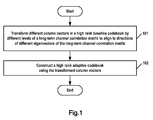
- Fig. 1 shows a flowchart of a method for generating a high rank adaptive codebook in a MIMO communication system according to an embodiment of the present invention
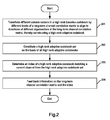
- Fig. 2 shows a flowchart of a method for feeding back channel information in a MIMO communication system according to an embodiment of the present invention
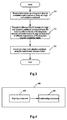
- Fig. 3 shows a flowchart of a method for processing channel information in a MIMO communication system according to another embodiment of the present invention
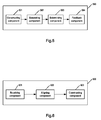
- Fig. 4 shows a block diagram of an apparatus for generating a high rank adaptive codebook in a MIMO communication system according to an embodiment of the present invention
- Fig. 5 shows a block diagram of an apparatus for feeding back channel information in a MIMO communication system according to an embodiment of the present invention
- Fig. 6 shows a block diagram of an apparatus for processing channel information in a MIMO communication system according to another embodiment of the present invention.
- Fig. 7 shows a block diagram of a MIMO communication system according to an embodiment of the present invention.
- a high rank baseline codebook set is composed of multiple high rank baseline codebooks.
- Each high rank baseline codebook is composed of multiple column vectors.
- Each column vector can be used to quantize different eigenvectors of channels.
- different column vectors in the high rank baseline codebook are transformed by different levels of a spatial correlation matrix to align to different beamforming of different levels of eigenvectors. All transformed column vectors constitute a new high rank adaptive codebook, which can more precisely depict high rank channel information.
- This kind of high rank adaptive codebook can be used for various antenna configurations and application scenarios. As an example, antenna deployment may be, e.g.
- the transmitting antenna number may be e.g. 4Tx or 8Tx antennas.
- the embodiments of the present invention may apply to scenarios for transmitting any allowed number of streams (i.e., any transmission rank).
- the embodiments of the present invention may apply to any multi-antenna scheme, e.g. SU-MIMO or MU-MIMO.
- the rank in a MIMO system is defined as the number of independent equations corresponding to the MIMO system (algebraic rank).
- the magnitude of the rank limits the number of data streams that can be space-division multiplexed in the system.
- the rank is always less than or equal to both the number of Tx antennas and the number of Rx antennas.
- the term “rank” generally refers to the number of transmitted data streams, and the term “high rank” generally means that the number of transmitted data streams is more than 1.
- a codebook used by the system has usually high rank.
- a codebook set comprises multiple codebooks, and a codebook comprises column vectors.
- a codebook set i.e., the more codebooks included), the higher quantization accuracy being achieved.
- Fig. 1 shows a flowchart of a method for generating a high rank adaptive codebook in a MIMO communication system according to an embodiment of the present invention.
- a high rank baseline codebook is transformed by different levels of a long-term channel correlation matrix to align to directions of different eigenvectors of the long-term channel correlation matrix.
- a high rank adaptive codebook is constructed using the transformed column vectors.
- a baseline codebook set is prestored by a transmitting apparatus and a receiving apparatus.
- the baseline codebook set may be predetermined according to concrete antenna configurations and application scenarios.
- the baseline codebook set may be predetermined by a base station offline and then transferred to user equipment.
- the long-term channel correlation matrix may be generated according to a measured channel response or obtained by receiving from other apparatus.
- the receiving apparatus may determine the long-term channel correlation matrix by measuring a reference signal (e.g., pilot signal) of transmission link.
- the transmitting apparatus may obtain information on the long-term channel correlation matrix by feedback from the receiving apparatus.
- the channel correlation matrix is divided into levels according to its eigenvectors. If the number of Tx antennas is M, then the channel correlation matrix is an M x M matrix. If the channel correlation matrix has r eigenvalues and r corresponding eigenvectors, then a covariance matrix related to an eigenvector of the largest eigenvalue is allocated to the first level, a covariance matrix related to an eigenvector of the second largest eigenvalue is allocated to the second level, and so on and so forth, the channel correlation matrix is divided into M levels. Accordingly, these eigenvectors corresponding to different eigenvalues are termed different levels of eigenvectors.
- the l th column vector of the high rank baseline codebook is transformed by the l to M levels of the long-term spatial correlation matrix, wherein l ⁇ 1, M is the number of Tx antennas, and M also corresponds to the largest number of levels of the long-term spatial correlation matrix.
- the transmitting apparatus is, for example, a base station of a cell with M Tx antennas
- the receiving apparatus is, for example, user equipment UE with N RX
- the number of transmitted data streams is r, wherein r is less than M.
- Each UE may detect downlink (DL) channel according to DL reference signals, calculate a long-term wideband spatial correlation matrix averaged over multiple sub-bands and multiple subframes, and then quantize and feed back to its serving cell.
- DL downlink
- each baseline codebook in the baseline codebook set is transformed according to a long-term spatial correlation matrix of each user, thereby obtaining a corresponding adaptive codebook.
- the corresponding adaptive codebooks constitute an adaptive codebook set.
- the different column vectors in the baseline codebook should be rotated by different levels of the spatial correlation matrix.
- each codebook in the baseline codebook set is transformed to be a corresponding high rank adaptive codebook, then a new high rank adaptive codebook set is obtained.
- the above method may further comprise other steps.
- the above method may further comprise a step of determining a baseline codebook set.
- some kind of orthogonalization operation such as, Gram-Schmit scheme (or QR decomposition), singular value decomposition (SVD), zero forcing (ZF) scheme, etc., may be further applied for the new high rank adaptive codebook.
- the new adaptive codebook can also be acquired by users and the cell according to the same generating rule.
- Fig. 2 shows a flowchart of a method for feeding back channel information in a MIMO communication system according to an embodiment of the present invention.
- step 201 different column vectors in a high rank baseline codebook are transformed by different levels of a long-term channel correlation matrix to align to directions of different eigenvectors of the long-term channel correlation matrix, thereby constructing a high rank adaptive codebook.
- step 202 a high rank adaptive codebook set is constituted on the basis of all high rank adaptive codebooks.
- an index of a high rank adaptive codebook matching a current channel is determined from the high rank adaptive codebook set.
- step 204 information on the long-term channel correlation matrix and the index is fed back.
- the above method is implemented in the receiving apparatus.
- the transmitting apparatus is, for example, a base station of a cell with M transmitting antennas
- the receiving apparatus is, for example, user equipment UE with N Rx antennas
- the number of transmitted data streams is r , wherein r is less than or equal to M.
- the receiving apparatus may obtain an adaptive codebook whose rank is r through step 201. Concrete details have been described with reference to Fig. 1 and thus are not detailed here. If at step 201 each codebook in the baseline codebook set is transformed to obtain a corresponding high rank adaptive codebook, then at step 202 all high rank adaptive codebooks constitute a high rank adaptive codebook set.
- high rank channel quantization may be performed by the obtained high rank adaptive codebook and short-term channel response, so as to determine the index.
- the channel quantization may be performed according to various methods.
- the high rank channel quantization may be performed according to a minimum chordal distance, or a proper high rank precoder is directly selected to match the channel information according to a maximum post-processing Signal-to-Noise Ratio (SINR) or channel capacity.
- SINR Signal-to-Noise Ratio
- the minimum chordal distance rule may be applied for rank r channel quantization.
- a current channel may be represented according to a current short-term channel eigenvector.
- user equipment k can acquire r different eigenvectors [ V k 1 ⁇ V kr ] of short-term sub-band.
- user equipment k can feed back to the base station the determined index of the high rank adaptive codebook matching the current channel. At the same time, user equipment k can feed back information on the long-term channel correlation matrix.
- the base station can determine a corresponding codebook in the baseline codebook set upon receipt of the index fed back.
- the codebook is transformed using the received information on the long-term channel correlation matrix, and an adaptive codebook is generated according to the same rule as applied at user equipment k.
- the base station can use the adaptive codebook as a preferred transmitting precoder or channel quantization for its serving cell.
- the transmitting precoder of user equipment k can be represented as or be further scheduled with other users by zero forcing (ZF) for MU-MIMO.
- Fig. 3 shows a flowchart of a method for processing channel information in a MIMO communication system according to an embodiment of the present invention.
- step 301 information on a long-term channel correlation matrix and on an index of a high rank adaptive codebook is received.
- different column vectors of a high rank baseline codebook corresponding to the index are transformed by different levels of the long-term channel correlation matrix to align to directions of different eigenvectors of the long-term channel correlation matrix.
- a high rank adaptive codebook is constructed using the transformed column vectors.
- the above method is implemented at the transmitting apparatus.
- the l column vector of the high rank baseline codebook is transformed by the l to M levels of the long-term spatial correlation matrix, wherein l ⁇ 1, M is the number of Tx antennas, and M also corresponds to the total number of levels of the long-term spatial correlation matrix.
- the long-term channel correlation matrix is a quantized MxM long-term spatial correlation matrix R k of user equipment k, which is represented as below:
- Fig. 4 shows a block diagram of an apparatus 400 for generating a high rank adaptive codebook in a MIMO communication system according to an embodiment of the present invention.
- the apparatus 400 comprises an aligning component 401 and a constructing component 402.
- the aligning component 401 is configured for transforming different column vectors in a high rank baseline codebook by different levels of a long-term channel correlation matrix to align directions of different eigenvectors of the long-term channel correlation matrix.
- the constructing component 402 is configured for constructing the high rank adaptive codebook by the transformed column vectors.
- all column vectors, except for the first column, of the high rank baseline codebook are not transformed by the whole long-term spatial correlation matrix but transformed by only partial levels thereof.
- the l column vector is transformed by ( M- l + 1 ) levels corresponding to lower eigenvalues, wherein M is the number of Tx antennas.
- the l th column vector of the high rank baseline codebook is transformed by l th to M th levels of the long-term spatial correlation matrix to align to the direction of the l th eigenvector.
- the long-term channel correlation matrix is a MxM quantized long-term spatial correlation matrix R k of user equipment k, which may be represented through identical transformation as below:
- the apparatus 400 generates the long-term channel correlation matrix according to a measured channel response.
- the apparatus 400 obtains the long-term channel correlation matrix by receiving information on the long-term channel correlation matrix.
- Fig. 5 shows a block diagram of an apparatus 500 for feeding back channel information in a MIMO communication system according to an embodiment of the present invention.
- the apparatus 500 comprises: a constructing component 501, a generating component 502, a determining component 503 and a feedback component 504.
- the constructing component 501 transforms different column vectors in a high rank baseline codebook by different levels of a long-term channel correlation matrix to align to directions of different eigenvectors of the long-term channel correlation matrix, thereby constructing a high rank adaptive codebook.
- the generating component 502 constructs a high rank adaptive codebook set on the basis of all high rank adaptive codebooks.
- the determining component 503 determines an index of a high rank adaptive codebook matching a current channel from the high rank adaptive codebook set.
- the feedback component 504 feeds back information on the long-term channel correlation matrix and the index.
- high rank channel quantization is performed by the high rank adaptive codebook and a short-term channel response, so as to determine the index.
- the high rank channel quantization is performed according to a minimum chordal distance.
- the high rank channel quantization is determined according to a maximum post-processing Signal-to-Noise Ratio (SINR) or channel capacity.
- SINR Signal-to-Noise Ratio
- the determined matching high rank adaptive codebook is selected as a high rank precoder.
- Fig. 6 shows a block diagram of an apparatus 600 for processing channel information in a MIMO communication system according to an embodiment of the present invention.
- the apparatus 600 comprises a receiving component 601, an aligning component 602 and a constructing component 603.
- the receiving component 601 receives information on a long-term channel correlation matrix and on an index of a high rank adaptive codebook.
- the aligning component 602 transforms different column vectors of a high rank baseline codebook corresponding to the index by different levels of the long-term channel correlation matrix to align to directions of different eigenvectors of the long-term channel correlation matrix.
- the constructing component 603 constructs a high rank adaptive codebook using the transformed column vectors.
- all column vectors, except for the first column, of the high rank baseline codebook are not transformed by the whole long-term spatial correlation but transformed by only partial levels of the long-term spatial correlation matrix, for example, by ( M- l +1) levels corresponding to lower eigenvalues, wherein M is the number of transmitting antennas.
- the l th column vector of the high rank baseline codebook is transformed by l th to M th levels of the long-term spatial correlation matrix to align to the direction of the l th eigenvector.
- the long-term channel correlation matrix is a quantized MxM long-term spatial correlation matrix R k of user equipment k, which is represented as below:
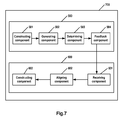
- Fig. 7 shows a block diagram of a MIMO communication system 700 according to an embodiment of the present invention.
- the system 700 comprises an apparatus 500 and an apparatus 600.
- the apparatus 500 comprises: a constructing component 501, a generating component 502, a determining component 503 and a feedback component 504.
- the apparatus 600 comprises a receiving component 601, an aligning component 602 and a constructing component 603.
- the constructing component 501 transforms different column vectors in a high rank baseline codebook by different levels of a long-term channel correlation matrix to align to directions of different eigenvectors of the long-term channel correlation matrix, thereby constructing a high rank adaptive codebook.
- the generating component 502 constructs a high rank adaptive codebook set on the basis of all high rank adaptive codebooks.
- the determining component 503 determines an index of a high rank adaptive codebook matching a current channel from the high rank adaptive codebook set.
- the feedback component 504 feeds back to the apparatus 600 information on the long-term channel correlation matrix and the index.
- the receiving apparatus 600 processes information fed back from a feedback channel.
- the receiving component 601 receives information on a long-term channel correlation matrix and on an index of a high rank adaptive codebook.
- the aligning component 602 transforms different column vectors of a high rank baseline codebook corresponding to the index by different levels of the long-term channel correlation matrix to align to directions of different eigenvectors of the long-term channel correlation matrix.
- the constructing component 603 constructs a high rank adaptive codebook using the transformed column vectors.
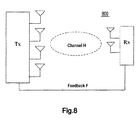
- Fig. 8 shows a schematic view of a MIMO system 800 in which the embodiments of the present invention may be applied.
- the system 800 comprises a transmitting apparatus Tx and a receiving apparatus Rx.
- the transmitting apparatus has M (M is an integer more than or equal to 1) transmitting antennas, e.g., 4 transmitting antennas shown in the figure.
- the receiving apparatus Rx has N (N is an integer more than or equal to 1) receiving antennas, e.g., 2 receiving antennas shown in the figure.
- a MIMO channel H is constructed between the transmitting apparatus Tx and the receiving apparatus Rx.
- the receiving apparatus Rx may feed back information on the MIMO channel H to the transmitting apparatus Tx.
- the system 800 transmits 2 data streams in the same sub-frequency band and the same frame; that is, the rank r is 2.
- the embodiments of the present invention may be applied to downlink transmission.
- the transmitting apparatus Tx may be a base station
- the receiving apparatus Rx may be user equipment.
- Fig. 8 illustrates only one receiving apparatus, it should be noted that the present invention may not only correspond to single-user MIMO (SU-MIMO) schemes, but also may be applied to multi-user MIMO (MU-MIMO) schemes.
- SU-MIMO single-user MIMO
- MU-MIMO multi-user MIMO
- each user equipment may independently employ the spatial correlation based codebook generating and feedback schemes according to embodiments of the present invention.
- the embodiments of the present invention may also be applied to uplink transmission.
- the transmitting apparatus Tx may be user equipment, while the receiving apparatus Rx may be a base station.
- the spatial correlation based adaptive codebook design and feedback mechanism is described as below.
- Each UE detects downlink (DL) channel according to DL reference signals, calculates a long-term wideband spatial correlation matrix averaged over multiple sub-bands and multiple subframes, quantizes and feeds back the matrix to its serving cell.
- DL downlink
- DL reference signals calculates a long-term wideband spatial correlation matrix averaged over multiple sub-bands and multiple subframes, quantizes and feeds back the matrix to its serving cell.
- user equipment k has its MxM dimensional quantized long-term spatial correlation matrix R k :
- the adaptive codebook is transformed according to a long-term spatial correlation matrix of each user.
- the different column vectors in the baseline codebook should be rotated by different levels of the spatial correlation matrix.
- the users and the cell may also acquire a new adaptive codebook according to the same design rule.
- high rank channel quantization may be performed according to minimum chordal distance, or a proper high rank precoder may be selected to match the channel information according to maximum post-processing SINR or channel capacity.
- the minimum chordal distance rule is applied for rank r channel quantization.
- the user can acquire different levels of short-term sub-band eigenvectors [ V k l ⁇ V kr ].
- Rank k adaptive codebook feedback may be used as a preferred transmitting precoder or channel quantization for its serving cell.
- the transmitting precoder can be represented as V ⁇ k ⁇ 1 . . . V ⁇ k ⁇ r H for user equipment k, or be further scheduled with other users by zero forcing (ZF) for MU-MIMO.
- ZF zero forcing
- Adaptive codebook scheme I is the traditional high rank adaptive feedback scheme. After system level simulations, it is found that adaptive codebook scheme I has 12% loss of cell average throughput over normal codebook feedback without transformation. If only transformation in the first column of baseline codebook, adaptive codebook scheme II has only 3% gains of cell average throughput and 27% gains of cell edge throughput. But using adaptive codebook scheme III according to the embodiments of the present invention, it is found that high rank adaptive codebook feedback has explicit system performance improvement, coupled with 22% gains of cell average throughput and 24% gains of cell edge throughput.
- the embodiments of the present invention propose an enhanced adaptive codebook generating and feedback mechanism based on long-term spatial correlation feedback to further improve high rank channel feedback accuracy and the corresponding system performance.
- Each column vector in the high rank baseline codebook is transformed by a specific level of the spatial correlation matrix to align to a beamforming direction of the specific level of the eigenvector, and then each column vector in the newly generated adaptive codebook can be used to quantize a specific eigenvector more accurately.
- System level simulations have proven that the adaptive codebook scheme proposed by the embodiments of the present invention has superior system performance gains without any additional feedback overhead.
- This kind of adaptive codebook can be used for any antenna deployment (e.g., co-polarized or cross-polarized), any transmitting antenna number (e.g., 4Tx or 8Tx antennas), any transmission rank and any multi-antenna scheme (e.g., SU-MIMO or MU-MIMO).
- any antenna deployment e.g., co-polarized or cross-polarized
- any transmitting antenna number e.g., 4Tx or 8Tx antennas
- any transmission rank e.g., SU-MIMO or MU-MIMO
Landscapes
- Engineering & Computer Science (AREA)
- Computer Networks & Wireless Communication (AREA)
- Signal Processing (AREA)
- Physics & Mathematics (AREA)
- Mathematical Physics (AREA)
- Quality & Reliability (AREA)
- Electromagnetism (AREA)
- Radio Transmission System (AREA)
- Compression, Expansion, Code Conversion, And Decoders (AREA)
Abstract
Description
- Embodiments of the present invention relate to a Multiple Input Multiple Output (MIMO) system in a wireless communication network, and more specifically to the generation and feedback of a high rank adaptive codebook in a MIMO system.
- Multi-antenna techniques, such as single-user MIMO (SU-MIMO) and multi-user MIMO (MU-MIMO), are identified as key techniques for Long-Term Evolution-Advanced LTE-A to satisfy the IMT-Advanced requirements. In a MIMO system, typically various transmitted data streams are processed by proper precoding, which can increase system performance. To implement precoding, it is required that a transmitting apparatus can obtain channel state information, which, in turn, requires user equipment to feed back the channel state information to a base station. Channel information feedback accuracy has bee proven to have great impact on system performance of multi-antenna schemes, especially MU-MIMO.
- In fact, there are however quite scarce resources for channel state information feedback. With a limited feedback capacity, user equipment generally first quantizes channel state information in order to increase feedback accuracy. A common approach to quantization is implemented by a codebook. In this approach, a set of codebooks (also referred to as a codebook set) is prestored at a base station and user equipment, and a receiving apparatus selects a matching precoding matrix under some criterion according to a current channel state and then feeds back a Precoding Matrix Index (PMI) to a transmitting apparatus.
- One normal codebook feedback scheme uses a fixed codebook. The larger the number of feedback bits is, the larger a codebook set can be supported. This scheme is characterized by simple implementation and low feedback overheads. However, in a fixed codebook scheme, a codebook's ability to adapt to scenarios and its system performance gains are rather limited. It is impossible to have a constant codebook optimized for all antenna configurations and application scenarios.
- Another codebook feedback scheme uses an adaptive codebook, wherein long-term wideband spatial correlation matrix is used to aid channel information quantization and feedback. The adaptive codebook can adaptively change according to a long-term spatial correlation matrix of each user so as to better accommodate the channel information for different users. This scheme is also termed spatial correlation based adaptive codebook feedback, which has been widely supported by many companies in 3GPP LTE-A to improve channel feedback accuracy and enhance system performance for SU/MU-MIMO.
- In current adaptive codebook schemes, the baseline codebook is transformed with a long-term spatial correlation matrix, the codebook is rotated, and the transformed codebook is aligned to the preferred beamforming direction, which is the dominant eigenvector of the long-term spatial correlation matrix. The obtained adaptive codebook can be selected from only a spherical cap rather than the whole hypersphere during channel quantization. Therefore, the adaptive codebook can naturally be used to quantize rank-one channel information or dominant eigenvector information.
- The spatial correlation based adaptive feedback has really shown explicit system performance gains in rank-one transmission over normal codebook feedback without spatial correlation information. But in current adaptive codebook schemes, for high rank (higher than 1) channel feedback some lower level (level 1) of eigenvectors also needs to be quantized and fed back in addition to a dominant eigenvector. Since the adaptive codebook is not aligned to the direction of the lower level of eigenvectors, the current high rank adaptive codebook is not suitable for high rank transmission. In high rank transmission, current spatial correlation based adaptive codebook feedback cannot achieve significant system performance gains and even probably lower performance than normal codebook feedback without spatial correlation information. How to further improve high rank channel feedback quality makes critical challenge for feedback mechanism design.
- The embodiments of the present invention propose an enhanced adaptive codebook generating and feedback mechanism to further improve high rank channel feedback quality and the corresponding system performance.
- An embodiment of the present invention provides a method for generating a high rank adaptive codebook in a MIMO communication system, comprising:
- transforming different column vectors in a high rank baseline codebook by different levels of a long-term channel correlation matrix to align to directions of different eigenvectors of the long-term channel correlation matrix; and
- using the transformed column vectors to construct a high rank adaptive codebook.
- Another embodiment of the present invention provides a method for feeding back channel information in a MIMO communication system, comprising:
- transforming different column vectors in a high rank baseline codebook by different levels of a long-term channel correlation matrix to align to directions of different eigenvectors of the long-term channel correlation matrix, thereby constructing a high rank adaptive codebook;
- constituting a high rank adaptive codebook set on the basis of all high rank adaptive codebooks;
- determining from the high rank adaptive codebook set an index of a high rank adaptive codebook matching a current channel; and
- feeding back information on the long-term channel correlation matrix and the index.
- An embodiment of the present invention provides a method for processing channel information in a MIMO communication system, comprising:
- receiving information on a long-term channel correlation matrix and an index of a high rank adaptive codebook;
- transforming different column vectors of a high rank baseline codebook corresponding to the index by different levels of the long-term channel correlation matrix to align to directions of different eigenvectors of the long-term channel correlation matrix; and
- using the transformed column vectors to construct a high rank adaptive codebook.
- An embodiment of the present invention provides an apparatus for generating a high rank adaptive codebook in a MIMO communication system, comprising:
- an aligning component configured for transforming different column vectors in a high rank baseline codebook by different levels of a long-term channel correlation matrix to align to directions of different eigenvectors of the long-term channel correlation matrix; and
- a constructing component configured for using the transformed column vectors to construct a high rank adaptive codebook.
- An embodiment of the present invention provides an apparatus for feeding back channel information in a MIMO communication system, comprising:
- a constructing component configured for transforming different column vectors in a high rank baseline codebook by different levels of a long-term channel correlation matrix to align to directions of different eigenvectors of the long-term channel correlation matrix, thereby constructing a high rank adaptive codebook;
- a generating component configured for constituting a high rank adaptive codebook set on the basis of all high rank adaptive codebooks;
- a determining component configured for determining from the high rank adaptive codebook set an index of a high rank adaptive codebook matching a current channel; and
- a feedback component configured for feeding back information on the long-term channel correlation matrix and the index.
- An embodiment of the present invention provides an apparatus for processing channel information in a MIMO communication system, comprising:
- a receiving component configured for receiving information on a long-term channel correlation matrix and an index of a high rank adaptive codebook;
- a aligning component configured for transforming different column vectors of a high rank baseline codebook corresponding to the index by different levels of the long-term channel correlation matrix to align to directions of different eigenvectors of the long-term channel correlation matrix; and
- a constructing component configured for using the transformed column vectors to construct a high rank adaptive codebook.
- Other objects, features and advantages of the present invention will become clearer by making references to the following detailed description of nonrestrictive embodiments of the present invention in conjunction with the accompanying drawings, in which:
-
Fig. 1 shows a flowchart of a method for generating a high rank adaptive codebook in a MIMO communication system according to an embodiment of the present invention; -
Fig. 2 shows a flowchart of a method for feeding back channel information in a MIMO communication system according to an embodiment of the present invention; -
Fig. 3 shows a flowchart of a method for processing channel information in a MIMO communication system according to another embodiment of the present invention; -
Fig. 4 shows a block diagram of an apparatus for generating a high rank adaptive codebook in a MIMO communication system according to an embodiment of the present invention; -
Fig. 5 shows a block diagram of an apparatus for feeding back channel information in a MIMO communication system according to an embodiment of the present invention; -
Fig. 6 shows a block diagram of an apparatus for processing channel information in a MIMO communication system according to another embodiment of the present invention; and -
Fig. 7 shows a block diagram of a MIMO communication system according to an embodiment of the present invention. - Methods and apparatuses for high rank adaptive codebook generating and feedback in a MIMO system according to the embodiments of the present invention will be described below with reference to the concrete embodiments in conjunction with the accompanying drawings.
- In the embodiments of the present invention there is proposed an enhanced adaptive codebook generating and feedback mechanism to further improve high rank channel feedback quality and the corresponding system performance. A high rank baseline codebook set is composed of multiple high rank baseline codebooks. Each high rank baseline codebook is composed of multiple column vectors. Each column vector can be used to quantize different eigenvectors of channels. In order to improve quantization accuracy, different column vectors in the high rank baseline codebook are transformed by different levels of a spatial correlation matrix to align to different beamforming of different levels of eigenvectors. All transformed column vectors constitute a new high rank adaptive codebook, which can more precisely depict high rank channel information. This kind of high rank adaptive codebook can be used for various antenna configurations and application scenarios. As an example, antenna deployment may be, e.g. co-polarized or cross-polarized. The transmitting antenna number may be e.g. 4Tx or 8Tx antennas. The embodiments of the present invention may apply to scenarios for transmitting any allowed number of streams (i.e., any transmission rank). Moreover, the embodiments of the present invention may apply to any multi-antenna scheme, e.g. SU-MIMO or MU-MIMO.
- It should be noted that the rank in a MIMO system is defined as the number of independent equations corresponding to the MIMO system (algebraic rank). The magnitude of the rank limits the number of data streams that can be space-division multiplexed in the system. The rank is always less than or equal to both the number of Tx antennas and the number of Rx antennas. In the context of the present invention, unless otherwise specified explicitly, the term "rank" generally refers to the number of transmitted data streams, and the term "high rank" generally means that the number of transmitted data streams is more than 1. When the number of transmitted data streams is more than 1, a codebook used by the system has usually high rank.
- In addition, it should be understood that that a codebook set comprises multiple codebooks, and a codebook comprises column vectors. Typically, the larger a codebook set (i.e., the more codebooks included), the higher quantization accuracy being achieved.
- Concrete embodiments of the present invention are described below in detail in conjunction with the accompanying drawings.
-
Fig. 1 shows a flowchart of a method for generating a high rank adaptive codebook in a MIMO communication system according to an embodiment of the present invention. As shown inFig. 1 , atstep 101 different column vectors in a high rank baseline codebook are transformed by different levels of a long-term channel correlation matrix to align to directions of different eigenvectors of the long-term channel correlation matrix. At step 102 a high rank adaptive codebook is constructed using the transformed column vectors. - In the embodiment of the present invention, a baseline codebook set is prestored by a transmitting apparatus and a receiving apparatus. The baseline codebook set may be predetermined according to concrete antenna configurations and application scenarios. For example, the baseline codebook set may be predetermined by a base station offline and then transferred to user equipment.
- The long-term channel correlation matrix may be generated according to a measured channel response or obtained by receiving from other apparatus. For example, the receiving apparatus may determine the long-term channel correlation matrix by measuring a reference signal (e.g., pilot signal) of transmission link. The transmitting apparatus may obtain information on the long-term channel correlation matrix by feedback from the receiving apparatus.
- In the method according to the embodiment of the present invention, the channel correlation matrix is divided into levels according to its eigenvectors. If the number of Tx antennas is M, then the channel correlation matrix is an MxM matrix. If the channel correlation matrix has r eigenvalues and r corresponding eigenvectors, then a covariance matrix related to an eigenvector of the largest eigenvalue is allocated to the first level, a covariance matrix related to an eigenvector of the second largest eigenvalue is allocated to the second level, and so on and so forth, the channel correlation matrix is divided into M levels. Accordingly, these eigenvectors corresponding to different eigenvalues are termed different levels of eigenvectors.
- According to an embodiment of the present invention, during transformation at
step 101, the l th column vector of the high rank baseline codebook is transformed by the l to M levels of the long-term spatial correlation matrix, wherein l ≥ 1, M is the number of Tx antennas, and M also corresponds to the largest number of levels of the long-term spatial correlation matrix. - In an example of this embodiment, the transmitting apparatus is, for example, a base station of a cell with M Tx antennas, the receiving apparatus is, for example, user equipment UE with N RX, the number of transmitted data streams is r, wherein r is less than M. Each UE may detect downlink (DL) channel according to DL reference signals, calculate a long-term wideband spatial correlation matrix averaged over multiple sub-bands and multiple subframes, and then quantize and feed back to its serving cell.
- For example, a MxM quantized long-term spatial correlation matrix
R k of user equipment k may be represented as below through identical transformation:
where: -
λ ki is the i th eigenvalue ofR k , (i = 1,···,M), andλ kl > ··· >λ kM , -
V ki is the i theigenvector ofR k , and -
R ki is the covariance matrix related to the i th eigenvectorV ki . - The high rank baseline codebook used by the system may be denoted as below:

where: - S is the number of codebooks included in the baseline codebook set, i.e., the magnitude of the codebook set. S is usually equal to power of 2, for example, S = 2 B. B usually indicates the number of bits needed for quantization and feedback of the quantization information;
- c j is a codebook with Mxr dimension;
-

- According to an embodiment of the present invention, each baseline codebook in the baseline codebook set is transformed according to a long-term spatial correlation matrix of each user, thereby obtaining a corresponding adaptive codebook. The corresponding adaptive codebooks constitute an adaptive codebook set. In order to align to beamforming directions corresponding to different levels of eigenvectors, the different column vectors in the baseline codebook should be rotated by different levels of the spatial correlation matrix.
- According to an embodiment of the present invention, the first column
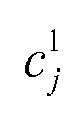


where normalize (·) is the operation of normalization. - Except the first column


- In an embodiment of the present invention, the last column (or r th column) of codebook c j is transformed by a specific level of spatial correlation matrix


- According to an embodiment, a new high rank adaptive codebook is constructed using all transformed column vectors:

where c̃ j ∈ {c̃1,...,c̃ S } M×r . - If each codebook in the baseline codebook set is transformed to be a corresponding high rank adaptive codebook, then a new high rank adaptive codebook set is obtained.
- It should be understood that in other embodiments of the present invention, the above method may further comprise other steps. For example, if the baseline codebook set is not pre-generated, then the above method may further comprise a step of determining a baseline codebook set. For another example, if it is desired to have a unitary matrix as the adaptive codebook, then some kind of orthogonalization operation, such as, Gram-Schmit scheme (or QR decomposition), singular value decomposition (SVD), zero forcing (ZF) scheme, etc., may be further applied for the new high rank adaptive codebook.
- Since the baseline codebook set and long-term spatial correlation information are known simultaneously for both the user equipment and the cell (corresponding to the base station), the new adaptive codebook can also be acquired by users and the cell according to the same generating rule.
-
Fig. 2 shows a flowchart of a method for feeding back channel information in a MIMO communication system according to an embodiment of the present invention. As shown inFig. 2 , atstep 201 different column vectors in a high rank baseline codebook are transformed by different levels of a long-term channel correlation matrix to align to directions of different eigenvectors of the long-term channel correlation matrix, thereby constructing a high rank adaptive codebook. At step 202 a high rank adaptive codebook set is constituted on the basis of all high rank adaptive codebooks. Atstep 203, an index of a high rank adaptive codebook matching a current channel is determined from the high rank adaptive codebook set. Atstep 204, information on the long-term channel correlation matrix and the index is fed back. - According to an embodiment of the present invention, the above method is implemented in the receiving apparatus.
- Still consider such a system, wherein the transmitting apparatus is, for example, a base station of a cell with M transmitting antennas, the receiving apparatus is, for example, user equipment UE with N Rx antennas, the number of transmitted data streams is r, wherein r is less than or equal to M. Then, the receiving apparatus may obtain an adaptive codebook whose rank is r through
step 201. Concrete details have been described with reference toFig. 1 and thus are not detailed here. If atstep 201 each codebook in the baseline codebook set is transformed to obtain a corresponding high rank adaptive codebook, then atstep 202 all high rank adaptive codebooks constitute a high rank adaptive codebook set. - According to an embodiment of the present invention, at
step 203 high rank channel quantization may be performed by the obtained high rank adaptive codebook and short-term channel response, so as to determine the index. The channel quantization may be performed according to various methods. - According to an embodiment of the present invention, the high rank channel quantization may be performed according to a minimum chordal distance, or a proper high rank precoder is directly selected to match the channel information according to a maximum post-processing Signal-to-Noise Ratio (SINR) or channel capacity.
- According to an embodiment of the present invention, the minimum chordal distance rule may be applied for rank r channel quantization. A current channel may be represented according to a current short-term channel eigenvector. In an embodiment, from downlink channel measurement, user equipment k can acquire r different eigenvectors [V k1 ··· Vkr ] of short-term sub-band. Then the 1st∼r th eigenvectors are quantized by the obtained rank r adaptive codebook according to the collinearity rule:

so as to determine the high rank adaptive codebook matching the current channel. - According to an embodiment of the present invention, at
step 204 user equipment k can feed back to the base station the determined index of the high rank adaptive codebook matching the current channel. At the same time, user equipment k can feed back information on the long-term channel correlation matrix. - At the other end, the base station can determine a corresponding codebook in the baseline codebook set upon receipt of the index fed back. The codebook is transformed using the received information on the long-term channel correlation matrix, and an adaptive codebook is generated according to the same rule as applied at user equipment k. Hence, the base station can use the adaptive codebook as a preferred transmitting precoder or channel quantization for its serving cell. The transmitting precoder of user equipment k can be represented asor be further scheduled with other users by zero forcing (ZF) for MU-MIMO.

- Detailed description is presented below in conjunction with
Fig. 3 . -
Fig. 3 shows a flowchart of a method for processing channel information in a MIMO communication system according to an embodiment of the present invention. As shown inFig. 3 , atstep 301, information on a long-term channel correlation matrix and on an index of a high rank adaptive codebook is received. Atstep 302, different column vectors of a high rank baseline codebook corresponding to the index are transformed by different levels of the long-term channel correlation matrix to align to directions of different eigenvectors of the long-term channel correlation matrix. Atstep 303, a high rank adaptive codebook is constructed using the transformed column vectors. - According to an embodiment of the present invention, the above method is implemented at the transmitting apparatus.
- According to an embodiment of the present invention, at
step 302, the l column vector of the high rank baseline codebook is transformed by the l to M levels of the long-term spatial correlation matrix, wherein l ≥ 1, M is the number of Tx antennas, and M also corresponds to the total number of levels of the long-term spatial correlation matrix. - According to an embodiment of the present invention, the long-term channel correlation matrix is a quantized MxM long-term spatial correlation matrix
R k of user equipment k, which is represented as below:
where: -
λ ki is the i th eigenvalue ofR k , (i = 1,···,M), andλ kl > ··· >λ kM , -
V ki is the i th eigenvector ofR k , -
R ki is the covariance matrix related to the i th eigenvectorV ki . - High rank baseline codebook c j corresponding to the index is represented as below:

where: - c j is a high rank baseline codebook with Mxr dimension;
-

- the l th (l > 1) column vector


-
Fig. 4 shows a block diagram of anapparatus 400 for generating a high rank adaptive codebook in a MIMO communication system according to an embodiment of the present invention. As shown inFig. 4 , theapparatus 400 comprises an aligningcomponent 401 and aconstructing component 402. The aligningcomponent 401 is configured for transforming different column vectors in a high rank baseline codebook by different levels of a long-term channel correlation matrix to align directions of different eigenvectors of the long-term channel correlation matrix. Theconstructing component 402 is configured for constructing the high rank adaptive codebook by the transformed column vectors. - According to an embodiment of the present invention, when the aligning component is performing the transformation, all column vectors, except for the first column, of the high rank baseline codebook are not transformed by the whole long-term spatial correlation matrix but transformed by only partial levels thereof. For example, the l column vector is transformed by (M-l+1) levels corresponding to lower eigenvalues, wherein M is the number of Tx antennas.
- According to an embodiment of the present invention, when the long-term spatial correlation matrix is divided into levels from highest to lowest according to eigenvalues as illustrated above, the l th column vector of the high rank baseline codebook is transformed by l th to M th levels of the long-term spatial correlation matrix to align to the direction of the l th eigenvector.
- According to an embodiment of the present invention, the long-term channel correlation matrix is a MxM quantized long-term spatial correlation matrix
R k of user equipment k, which may be represented through identical transformation as below:
where: -
λ ki is the i th eigenvalue ofR k (i = 1,···,M), andλ kl > ··· >λ kM , -
V ki is the i th eigenvector ofR k , and -
R ki is the covariance matrix related to the i th eigenvectorV ki . - The high rank baseline codebook with rank r is represented as below:

where: - S is the number of codebooks in the codebook set,
- c j is a high rank baseline codebook with Mxr dimension;
-

- the l th ( l> 1) column vector


- According to an embodiment of the present invention, the
apparatus 400 generates the long-term channel correlation matrix according to a measured channel response. - According to an embodiment of the present invention, the
apparatus 400 obtains the long-term channel correlation matrix by receiving information on the long-term channel correlation matrix. -
Fig. 5 shows a block diagram of anapparatus 500 for feeding back channel information in a MIMO communication system according to an embodiment of the present invention. As shown inFig. 5 , theapparatus 500 comprises: a constructingcomponent 501, agenerating component 502, a determiningcomponent 503 and afeedback component 504. Theconstructing component 501 transforms different column vectors in a high rank baseline codebook by different levels of a long-term channel correlation matrix to align to directions of different eigenvectors of the long-term channel correlation matrix, thereby constructing a high rank adaptive codebook. Thegenerating component 502 constructs a high rank adaptive codebook set on the basis of all high rank adaptive codebooks. The determiningcomponent 503 determines an index of a high rank adaptive codebook matching a current channel from the high rank adaptive codebook set. Thefeedback component 504 feeds back information on the long-term channel correlation matrix and the index. - According to an embodiment of the present invention, high rank channel quantization is performed by the high rank adaptive codebook and a short-term channel response, so as to determine the index.
- According to an embodiment of the present invention, the high rank channel quantization is performed according to a minimum chordal distance.
- According to an embodiment of the present invention, the performing high rank channel quantization comprises: quantizing eigenvectors [V kl ··· Vkr ] of the short-term channel response by the high rank adaptive codebook c̃ j according to the following equation:

so as to determine from the high rank adaptive codebook set the index of the high rank adaptive codebook matching the current channel, where c̃ j ∈ {c̃1,...,c̃ S } M×r , M is the number of Tx antennas, and r is the rank of the communication system. - According to an embodiment of the present invention, the high rank channel quantization is determined according to a maximum post-processing Signal-to-Noise Ratio (SINR) or channel capacity. The determined matching high rank adaptive codebook is selected as a high rank precoder.
-
Fig. 6 shows a block diagram of anapparatus 600 for processing channel information in a MIMO communication system according to an embodiment of the present invention. As shown inFig. 6 , theapparatus 600 comprises a receivingcomponent 601, an aligningcomponent 602 and aconstructing component 603. The receivingcomponent 601 receives information on a long-term channel correlation matrix and on an index of a high rank adaptive codebook. The aligningcomponent 602 transforms different column vectors of a high rank baseline codebook corresponding to the index by different levels of the long-term channel correlation matrix to align to directions of different eigenvectors of the long-term channel correlation matrix. Theconstructing component 603 constructs a high rank adaptive codebook using the transformed column vectors. - According to an embodiment of the present invention, when the aligning
component 602 is performing the transformation, all column vectors, except for the first column, of the high rank baseline codebook are not transformed by the whole long-term spatial correlation but transformed by only partial levels of the long-term spatial correlation matrix, for example, by (M-l+1) levels corresponding to lower eigenvalues, wherein M is the number of transmitting antennas. - According to an embodiment of the present invention, when the long-term spatial correlation matrix is divided into levels from highest to lowest according to eigenvalues as illustrated above, the l th column vector of the high rank baseline codebook is transformed by l th to M th levels of the long-term spatial correlation matrix to align to the direction of the l th eigenvector.
- The long-term channel correlation matrix is a quantized MxM long-term spatial correlation matrix
R k of user equipment k, which is represented as below:
where: -
λ ki is the ith eigenvalue ofR k, (i =, ···,M), andλ kl >···>λ kM , -
V ki is the ith eigenvector ofR k , and -
R ki is the covariance matrix related to the ith eigenvectorV ki ; - high rank baseline codebook c j corresponding to the index is represented as below:
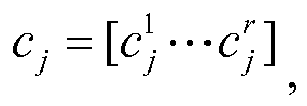
where:- c j is a high rank baseline codebook with Mxr dimension;
-

- then, in the transformation, the l th column vector


-
Fig. 7 shows a block diagram of aMIMO communication system 700 according to an embodiment of the present invention. As shown inFig. 7 , thesystem 700 comprises anapparatus 500 and anapparatus 600. Theapparatus 500 comprises: a constructingcomponent 501, agenerating component 502, a determiningcomponent 503 and afeedback component 504. Theapparatus 600 comprises a receivingcomponent 601, an aligningcomponent 602 and aconstructing component 603. - In the embodiment shown in
Fig. 7 , theconstructing component 501 transforms different column vectors in a high rank baseline codebook by different levels of a long-term channel correlation matrix to align to directions of different eigenvectors of the long-term channel correlation matrix, thereby constructing a high rank adaptive codebook. Thegenerating component 502 constructs a high rank adaptive codebook set on the basis of all high rank adaptive codebooks. The determiningcomponent 503 determines an index of a high rank adaptive codebook matching a current channel from the high rank adaptive codebook set. Thefeedback component 504 feeds back to theapparatus 600 information on the long-term channel correlation matrix and the index. - Subsequently, the receiving
apparatus 600 processes information fed back from a feedback channel. Specifically, the receivingcomponent 601 receives information on a long-term channel correlation matrix and on an index of a high rank adaptive codebook. The aligningcomponent 602 transforms different column vectors of a high rank baseline codebook corresponding to the index by different levels of the long-term channel correlation matrix to align to directions of different eigenvectors of the long-term channel correlation matrix. Theconstructing component 603 constructs a high rank adaptive codebook using the transformed column vectors. -
Fig. 8 shows a schematic view of aMIMO system 800 in which the embodiments of the present invention may be applied. Thesystem 800 comprises a transmitting apparatus Tx and a receiving apparatus Rx. The transmitting apparatus has M (M is an integer more than or equal to 1) transmitting antennas, e.g., 4 transmitting antennas shown in the figure. The receiving apparatus Rx has N (N is an integer more than or equal to 1) receiving antennas, e.g., 2 receiving antennas shown in the figure. A MIMO channel H is constructed between the transmitting apparatus Tx and the receiving apparatus Rx. The receiving apparatus Rx may feed back information on the MIMO channel H to the transmitting apparatus Tx. In an embodiment, thesystem 800 transmits 2 data streams in the same sub-frequency band and the same frame; that is, the rank r is 2. - The embodiments of the present invention may be applied to downlink transmission. In this case, for example, the transmitting apparatus Tx may be a base station, and the receiving apparatus Rx may be user equipment. Although
Fig. 8 illustrates only one receiving apparatus, it should be noted that the present invention may not only correspond to single-user MIMO (SU-MIMO) schemes, but also may be applied to multi-user MIMO (MU-MIMO) schemes. For MU-MIMO cases, each user equipment may independently employ the spatial correlation based codebook generating and feedback schemes according to embodiments of the present invention. - The embodiments of the present invention may also be applied to uplink transmission. In this case, for example, the transmitting apparatus Tx may be user equipment, while the receiving apparatus Rx may be a base station.
- According to an embodiment of the present invention, for high rank SU/MU-MIMO, the spatial correlation based adaptive codebook design and feedback mechanism is described as below.
- Each UE detects downlink (DL) channel according to DL reference signals, calculates a long-term wideband spatial correlation matrix averaged over multiple sub-bands and multiple subframes, quantizes and feeds back the matrix to its serving cell.
- For example, user equipment k has its MxM dimensional quantized long-term spatial correlation matrix
R k :
where: -
λ ki is the i th eigenvalue ofR k , (i = 1,···,M), andλ kl > ··· >λ kM , -
V ki is the i th eigenvector ofR k , -
R ki is the covariance matrix related to the i th eigenvectorV ki . - A baseline codebook with rank r is denoted as follows:

where: - c j is a Mxr codebook matrix with size S = 2 B,
-

- The adaptive codebook is transformed according to a long-term spatial correlation matrix of each user.
- In order to align to beamforming directions corresponding to different levels of eigenvectors, the different column vectors in the baseline codebook should be rotated by different levels of the spatial correlation matrix.
- For example the first column of codebook c i is transformed by the whole spatial correlation


where normalize (·) is the operation of normalization. - The last column (or r th column) of codebook c i is transformed by a specific level of spatial correlation matrix


- Finally all the above transformed column vectors constitute a new high rank adaptive codebook:

where c̃ i ∈ {c̃ 1,...,c̃ S } M×r . - If it is desired to have a unitary matrix as the codeword, then some kind of orthogonalization operation, such as Gram-Schmit scheme (or QR decomposition), singular value decomposition (SVD) and zero forcing (ZF) scheme, should be further applied for the new high rank adaptive codebook.
- Since the baseline codebook set and the long-term spatial correlation information are known simultaneously for both users and the cell, the users and the cell may also acquire a new adaptive codebook according to the same design rule.
- With the newly generated adaptive codebook, high rank channel quantization may be performed according to minimum chordal distance, or a proper high rank precoder may be selected to match the channel information according to maximum post-processing SINR or channel capacity.
- For example the minimum chordal distance rule is applied for rank r channel quantization. From downlink channel measurement, the user can acquire different levels of short-term sub-band eigenvectors [V kl ··· Vkr ]. Then the first to r th eigenvectors are quantized by the rank r adaptive codebook according to the collinearity rule

- Rank k adaptive codebook feedback may be used as a preferred transmitting precoder or channel quantization for its serving cell. The transmitting
precoder can be represented as
- System performance evaluations are focused on FDD SU-MIMO in 3GPP case 1 SCM-UMa scenario. 4x2 Tx/Rx antenna deployment is assumed. SU-MIMO is rank-2 transmission. Baseline 4x2 Rel-8 codebook is used for adaptive codebook transformation and channel quantization. Detailed simulation parameters are listed in table 1.
- Four kinds of codebook generating and feedback schemes as shown have been evaluated and compared below:
- 1) Baseline codebook without transformation:

- 2) Adaptive codebook scheme I, which transforms all column vectors by the whole long-term spatial correlation


- 3) Adaptive codebook scheme II, which transforms only the firstcolumn vector:

- 4) Adaptive codebook scheme III (recommended) according to the embodiments of the present invention:

- Adaptive codebook scheme I is the traditional high rank adaptive feedback scheme. After system level simulations, it is found that adaptive codebook scheme I has 12% loss of cell average throughput over normal codebook feedback without transformation. If only transformation in the first column of baseline codebook, adaptive codebook scheme II has only 3% gains of cell average throughput and 27% gains of cell edge throughput. But using adaptive codebook scheme III according to the embodiments of the present invention, it is found that high rank adaptive codebook feedback has explicit system performance improvement, coupled with 22% gains of cell average throughput and 24% gains of cell edge throughput.
Table 1 Simulation Parameters Parameter Assumption Duplex method FDD Scenario 3GPP case 1 with SCM-UMa DL transmission scheme SU-MIMO: fixed rank 2 per UE PMI/CQI measurement and feedback 5-subframe feedback period for sub-band PMI/CQI 20-subframe feedback period for wideband covariance matrix R (w/o quantization) 6-subframe feedback delay Channel estimation error Ideal UE speed 3km/h Scheduler Greedy search algorithm based on PF Link to system mapping RBIR Control overhead Fixed 0.3063 Table 2 System Level Simulation Results Transmit scheme Cell average spectrum efficiency (bps/Hz/cell) Cell-edge spectrum efficiency (bps/Hz) SU-MIMO w/o transformation 1.96 (1.00) 0.033 (1.00) SU-MIMO w/ adaptive codebook I 1.73 (0.88) 0.037(1.12) SU-MIMO w/ adaptive codebook II 2.01 (1.03) 0.042 (1.27) SU-MIMO w/ adaptive codebook III 2.39(1.22) 0.041 (1.24) - The embodiments of the present invention propose an enhanced adaptive codebook generating and feedback mechanism based on long-term spatial correlation feedback to further improve high rank channel feedback accuracy and the corresponding system performance. Each column vector in the high rank baseline codebook is transformed by a specific level of the spatial correlation matrix to align to a beamforming direction of the specific level of the eigenvector, and then each column vector in the newly generated adaptive codebook can be used to quantize a specific eigenvector more accurately. System level simulations have proven that the adaptive codebook scheme proposed by the embodiments of the present invention has superior system performance gains without any additional feedback overhead. This kind of adaptive codebook can be used for any antenna deployment (e.g., co-polarized or cross-polarized), any transmitting antenna number (e.g., 4Tx or 8Tx antennas), any transmission rank and any multi-antenna scheme (e.g., SU-MIMO or MU-MIMO).
- The embodiments of the present invention have been described above. However, the present invention is not limited to specific systems, apparatuses or concrete protocols. Various variations or modifications may be made by those skilled in the art within the scope of the claims as appended.
Claims (30)
- A method for generating a high rank adaptive codebook in a Multiple Input Multiple Output (MIMO) communication system, comprising:transforming different column vectors in a high rank baseline codebook by different levels of a long-term channel correlation matrix to align to directions of different eigenvectors of the long-term channel correlation matrix; andusing the transformed column vectors to construct a high rank adaptive codebook.
- The method according to claim 1, wherein during the transformation, the l th column vector of the high rank baseline codebook is transformed by the /th to M th levels of the long-term spatial correlation matrix, wherein l ≥ 1 and M is the number of transmitting antennas.
- The method according to claim 1, wherein
the long-term channel correlation matrix is a MxM quantized long-term spatial correlation matrixR k of user equipment k, which may be represented through identical transformation as below:
wherein:λ ki is the i th eigenvalue ofR k , (i = 1 ··· ), andλ kl > ··· >λ kM ,V ki is the eigenvector ofR k ,R ki is the covariance matrix related to the i th eigenvectorV ki ;the high rank baseline codebook with rank r is represented as below:
wherein:S is the number of codebooks in the codebook set,c j is a high rank baseline codebook with Mxr dimension,
then, during the transformation,the l th column vector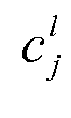


- The method according to claim 3, wherein the high rank adaptive codebook is constructed using all transformed column vectors according to the equation below:

wherein c̃ j ∈{c̃ l,...c̃ S } M×r. - The method according to claim 1, wherein the long-term channel correlation matrix is generated using a measured channel response.
- The method according to claim 1, wherein the long-term channel correlation matrix is acquired by receiving information on the long-term channel correlation matrix.
- A method for feeding back channel information in a Multiple Input Multiple Output (MIMO) communication system, comprising:transforming different column vectors in a high rank baseline codebook by different levels of a long-term channel correlation matrix to align to directions of different eigenvectors of the long-term channel correlation matrix, thereby constructing a high rank adaptive codebook;constituting a high rank adaptive codebook set on the basis of all high rank adaptive codebooks;determining from the high rank adaptive codebook set an index of a high rank adaptive codebook matching a current channel; andfeeding back information on the long-term channel correlation matrix and the index.
- The method according to claim 7, wherein high rank channel quantization is performed by the high rank adaptive codebook and a short-term channel response, so as to determine the index.
- The method according to claim 8, wherein the high rank channel quantization is performed according to a minimum chordal distance.
- The method according to claim 9, wherein the performing high rank channel quantization comprises:quantizing the short-term channel response [V kl ··· Vkr ] of user equipment k by the high rank adaptive codebook c̃j according to the following equation:

so as to determine from the high rank adaptive codebook set the index of the high rank adaptive codebook matching the current channel,wherein V kl ... Vkr represents r eigenvectors of the short-term channel response, c̃ j ∈ {c̃ l,...,c̃ S } M×r S is a size of the codebook set, and c̃ j the high rank adaptive codebook with Mxr dimensions. - The method according to claim 8, wherein the high rank channel quantization is determined according to a maximum post-processing Signal-to-Noise Ratio (SINR) or channel capacity.
- A method for processing channel information in a Multiple Input Multiple Output (MIMO) communication system, comprising:receiving information on a long-term channel correlation matrix and an index of a high rank adaptive codebook;transforming different column vectors of a high rank baseline codebook corresponding to the index by different levels of the long-term channel correlation matrix to align to directions of different eigenvectors of the long-term channel correlation matrix; andusing the transformed column vectors to construct a high rank adaptive codebook.
- The method according to claim 12, wherein during the transformation, the l th column vector of the high rank baseline codebook is transformed by the l th to Mth levels of the long-term spatial correlation matrix, wherein / ≥ 1 and M is the number of transmitting antennas.
- The method according to claim 12, wherein
the long-term channel correlation matrix is a quantized MxM long-term spatial correlation matrixR k of user equipment k, which is represented as below:
wherein:λ ki is the i th eigenvalue ofR k, (i = 1,···,M), andλ kl > ··· >λ kM ,Vki is the i th eigenvector ofR k ,R ki is the covariance matrix related to the i th eigenvector Vki ;the high rank baseline codebook c j corresponding to the index is represented as below:
wherein:c j is the high rank baseline codebook with Mxr dimension; the l th column vector


- The method according to claim 12, wherein the high rank adaptive codebook is constructed using all transformed column vectors according to the equation below:

wherein c̃ j ∈ {c̃ l,...,c̃ S} M×r , and S is a size of the codebook set. - An apparatus for generating a high rank adaptive codebook in a Multiple Input Multiple Output (MIMO) communication system, comprising:an aligning component configured for transforming different column vectors in a high rank baseline codebook by different levels of a long-term channel correlation matrix to align to directions of different eigenvectors of the long-term channel correlation matrix; anda constructing component configured for using the transformed column vectors to construct a high rank adaptive codebook.
- The apparatus according to claim 16, wherein during the transformation, the l th column vector of the high rank baseline codebook is transformed by the l th to Mth levels of the long-term spatial correlation matrix, wherein l ≥ 1 and M is the number of transmitting antennas.
- The apparatus according to claim 16, wherein the long-term channel correlation matrix is a quantized MxM long-term spatial correlation matrix
R k of user equipment k, which may be represented through identical transformation as below:
wherein:λ ki is the i th eigenvalue ofR k , (i = 1,···,M), andλ kl>···>λ kM ,is the itheigenvector of R k ,R ki is the covariance matrix related to the i th eigenvectorV ki ;the high rank baseline codebook with rank r is represented as below:
wherein:S is the number of codebooks in the codebook set,c j is a high rank baseline codebook with Mxr dimension, then, during the transformation,the l th column vector


- The apparatus according to claim 18, wherein the high rank adaptive codebook is constructed using all transformed column vectors according to the equation below:

wherein c̃ j ∈ {c̃1,...,c̃ S } M×r - The apparatus according to claim 16, wherein the long-term channel correlation matrix is generated using a measured channel response.
- The apparatus according to claim 16, wherein the long-term channel correlation matrix is acquired by receiving information on the long-term channel correlation matrix.
- An apparatus for feeding back channel information in a Multiple Input Multiple Output (MIMO) communication system, comprising:a constructing component configured for transforming different column vectors in a high rank baseline codebook by different levels of a long-term channel correlation matrix to align to directions of different eigenvectors of the long-term channel correlation matrix, thereby constructing a high rank adaptive codebook;a generating component configured for constituting a high rank adaptive codebook set on the basis of all high rank adaptive codebooks;a determining component configured for determining from the high rank adaptive codebook set an index of a high rank adaptive codebook matching a current channel; anda feedback component configured for feeding back information on the long-term channel correlation matrix and the index.
- The apparatus according to claim 22, wherein high rank channel quantization is performed by the high rank adaptive codebook and a short-term channel response, so as to determine the index.
- The apparatus according to claim 23, wherein the high rank channel quantization is performed according to a minimum chordal distance.
- The apparatus according to claim 24, wherein the performing high rank channel quantization comprises:quantizing the short-term channel response [V k1 ··· Vkr ] of user equipment k by the high rank adaptive codebook c̃j according to the following equation:

so as to determine from the high rank adaptive codebook set the index of the high rank adaptive codebook matching the current channel,wherein V k1 ... Vkr represents r eigenvectors of the short-term channel response, c̃ j ∈ {c̃1,...,c̃ S } M×r S is a size of the codebook set, and c̃ j the high rank adaptive codebook with Mxr dimensions. - The apparatus according to claim 22, wherein the high rank channel quantization is determined according to a maximum post-processing Signal-to-Noise Ratio (SINR) or channel capacity.
- An apparatus for processing channel information in a Multiple Input Multiple Output (MIMO) communication system, comprising:a receiving component configured for receiving information on a long-term channel correlation matrix and an index of a high rank adaptive codebook;an aligning component configured for transforming different column vectors of a high rank baseline codebook corresponding to the index by different levels of the long-term channel correlation matrix to align to directions of different eigenvectors of the long-term channel correlation matrix; anda constructing component configured for using the transformed column vectors to construct a high rank adaptive codebook.
- The apparatus according to claim 27, wherein during the transformation, the l th column vector of the high rank baseline codebook is transformed by the l th to Mth levels of the long-term spatial correlation matrix, wherein l ≥ 1 and M is the number of transmitting antennas.
- The apparatus according to claim 27, wherein
the long-term channel correlation matrix is a quantized MxM long-term spatial correlation matrixR k of user equipment k, which is represented as below:
wherein:λ ki is the i th eigenvalue ofR k (i = 1,···,M), andλ kl > ··· >λ kM ,V ki is the i th eigenvector ofR k , 9R ki is the covariance matrix related to the i th eigenvectorV ki ;the high rank baseline codebook c j corresponding to the index is represented as below:
wherein:c j is the high rank baseline codebook with Mxr dimension,
then, during the transformation,the l th column vector


- The apparatus according to claim 27, wherein the high rank adaptive codebook is constructed using all transformed column vectors according to the equation below:

wherein c̃ j ∈ {c̃1,...,c̃ S } M×r ,and S is a size of the codebook set.
Applications Claiming Priority (1)
| Application Number | Priority Date | Filing Date | Title |
|---|---|---|---|
| PCT/CN2010/072501 WO2011137591A1 (en) | 2010-05-06 | 2010-05-06 | Method and device for generating and feeding back high rank adaptive codebook in multiple input multiple output system |
Publications (2)
| Publication Number | Publication Date |
|---|---|
| EP2568620A1 true EP2568620A1 (en) | 2013-03-13 |
| EP2568620A4 EP2568620A4 (en) | 2015-10-28 |
Family
ID=44903578
Family Applications (1)
| Application Number | Title | Priority Date | Filing Date |
|---|---|---|---|
| EP10850960.5A Withdrawn EP2568620A4 (en) | 2010-05-06 | 2010-05-06 | METHOD AND DEVICE FOR GENERATING AND RETRIEVING HIGH-RANGE ADAPTIVE CODES BOOK IN A MULTI-INPUT MULTIPLE OUTPUT SYSTEM |
Country Status (7)
| Country | Link |
|---|---|
| US (1) | US9094075B2 (en) |
| EP (1) | EP2568620A4 (en) |
| JP (1) | JP5576558B2 (en) |
| KR (1) | KR101409732B1 (en) |
| CN (1) | CN102792604B (en) |
| BR (1) | BR112012028251A2 (en) |
| WO (1) | WO2011137591A1 (en) |
Cited By (1)
| Publication number | Priority date | Publication date | Assignee | Title |
|---|---|---|---|---|
| US9787378B2 (en) | 2013-01-31 | 2017-10-10 | Nec Corporation | Terminal apparatus, base station apparatus, and method for sharing codebook in communication system |
Families Citing this family (6)
| Publication number | Priority date | Publication date | Assignee | Title |
|---|---|---|---|---|
| KR101420177B1 (en) * | 2010-04-07 | 2014-07-17 | 알까뗄 루슨트 | Method and apparatus for feeding back and constructing correlation matrix in multi-input multi-output systems |
| CN103905100B (en) * | 2012-12-26 | 2019-02-19 | 中兴通讯股份有限公司 | Data precoding processing method and device based on 4-antenna codebook |
| US9450787B2 (en) * | 2014-01-24 | 2016-09-20 | Huawei Technologies Co., Ltd. | System and method for early termination in iterative null-space directed singular value decomposition for MIMO |
| EP3349368A1 (en) | 2015-08-14 | 2018-07-18 | Industrial Technology Research Institute | Dynamic beamforming method and related apparatuses using the same |
| WO2019144377A1 (en) | 2018-01-26 | 2019-08-01 | Qualcomm Incorporated | Techniques and apparatuses for precoding configuration |
| KR102517669B1 (en) | 2018-06-27 | 2023-04-05 | 삼성전자주식회사 | Method and apparatus for wireless communication |
Family Cites Families (17)
| Publication number | Priority date | Publication date | Assignee | Title |
|---|---|---|---|---|
| US8385433B2 (en) | 2005-10-27 | 2013-02-26 | Qualcomm Incorporated | Linear precoding for spatially correlated channels |
| CN101330479B (en) | 2007-06-20 | 2011-04-20 | 中兴通讯股份有限公司 | Method for pre-encoding multi-input multi-output transmission and codebook encoding |
| KR101481166B1 (en) * | 2007-06-25 | 2015-01-28 | 엘지전자 주식회사 | Method of transmitting feedback data in a multi-antenna system |
| WO2009075662A1 (en) * | 2007-12-12 | 2009-06-18 | Nokia Corporation | Adaptive codebook for beamforming in limited feedback mimo systems |
| KR100913940B1 (en) * | 2008-04-25 | 2009-08-26 | 삼성전자주식회사 | Multi-antenna communication system for adaptively changing or updating codebooks |
| US8204151B2 (en) | 2008-08-06 | 2012-06-19 | Samsung Electronics Co., Ltd. | Methods and apparatus to generate multiple antennas transmit precoding codebook |
| US8649456B2 (en) | 2009-03-12 | 2014-02-11 | Futurewei Technologies, Inc. | System and method for channel information feedback in a wireless communications system |
| US8675627B2 (en) * | 2009-03-23 | 2014-03-18 | Futurewei Technologies, Inc. | Adaptive precoding codebooks for wireless communications |
| CN101540663B (en) * | 2009-04-30 | 2011-08-24 | 北京邮电大学 | A construction method of precoding codebook for high-order MIMO system |
| CN102868498B (en) * | 2009-06-18 | 2015-12-09 | 华为技术有限公司 | Method for generating codebooks, data transmission method and device |
| CN101631004B (en) * | 2009-08-10 | 2014-05-28 | 中兴通讯股份有限公司 | Pre-coding method and pre-coding system and construction method of pre-coding code book |
| CN101635612B (en) | 2009-08-18 | 2014-12-10 | 中兴通讯股份有限公司 | Precoding code book constructing method and precoding code book constructing device of multi-input multi-output system |
| US20110103493A1 (en) * | 2009-11-02 | 2011-05-05 | Futurewei Technologies, Inc. | System and Method for Wireless Communications with Adaptive Codebooks |
| CN101771510B (en) * | 2010-02-12 | 2015-06-03 | 中兴通讯股份有限公司 | Method and system for feeding backing MIMO channel information |
| JP5281604B2 (en) | 2010-03-09 | 2013-09-04 | 株式会社エヌ・ティ・ティ・ドコモ | Codebook control method, base station apparatus and mobile station apparatus |
| JP5611447B2 (en) * | 2010-04-07 | 2014-10-22 | アルカテル−ルーセント | Information feedback and precoding method and apparatus |
| US8724728B2 (en) * | 2010-12-01 | 2014-05-13 | Samsung Electronics Co., Ltd. | Method of generating adaptive codebook and multiple input multiple output communication system using the adaptive codebook |
-
2010
- 2010-05-06 CN CN201080064372.0A patent/CN102792604B/en active Active
- 2010-05-06 BR BR112012028251A patent/BR112012028251A2/en not_active IP Right Cessation
- 2010-05-06 JP JP2013508349A patent/JP5576558B2/en not_active Expired - Fee Related
- 2010-05-06 WO PCT/CN2010/072501 patent/WO2011137591A1/en not_active Ceased
- 2010-05-06 EP EP10850960.5A patent/EP2568620A4/en not_active Withdrawn
- 2010-05-06 US US13/696,427 patent/US9094075B2/en not_active Expired - Fee Related
- 2010-05-06 KR KR1020127031729A patent/KR101409732B1/en not_active Expired - Fee Related
Cited By (1)
| Publication number | Priority date | Publication date | Assignee | Title |
|---|---|---|---|---|
| US9787378B2 (en) | 2013-01-31 | 2017-10-10 | Nec Corporation | Terminal apparatus, base station apparatus, and method for sharing codebook in communication system |
Also Published As
| Publication number | Publication date |
|---|---|
| JP2013530591A (en) | 2013-07-25 |
| BR112012028251A2 (en) | 2016-08-02 |
| EP2568620A4 (en) | 2015-10-28 |
| KR20130016352A (en) | 2013-02-14 |
| US20130051487A1 (en) | 2013-02-28 |
| JP5576558B2 (en) | 2014-08-20 |
| CN102792604A (en) | 2012-11-21 |
| KR101409732B1 (en) | 2014-06-19 |
| US9094075B2 (en) | 2015-07-28 |
| WO2011137591A1 (en) | 2011-11-10 |
| CN102792604B (en) | 2016-06-15 |
Similar Documents
| Publication | Publication Date | Title |
|---|---|---|
| US8934564B2 (en) | Generalized reference signaling scheme for multi-user multiple input, multiple output (MU-MIMO) using arbitrarily precoded reference signals | |
| CN102725967B (en) | For the method and apparatus of information feed back and precoding | |
| US8761289B2 (en) | MIMO feedback schemes for cross-polarized antennas | |
| EP3171525B1 (en) | System and method for channel information feedback in a wireless communications system | |
| EP2525505B1 (en) | Method and device for obtaining precoding matrix indicator (pmi) and precoding matrix | |
| US8488725B2 (en) | Method and system for spatial channel state information feedback based on a kronecker product | |
| RU2540405C2 (en) | Method and apparatus for using factorised precoding | |
| EP2771993B1 (en) | A low-complexity, rank extendable, codebook design and method for supporting precoding matrix feedback for multi-user and single-user mimo systems | |
| CN102035615B (en) | MIMO-based downlink data transmission method, device and system | |
| EP2209220A1 (en) | Process for beamforming data to be transmitted by a base station in a MU-MIMO system and apparatus for performing the same | |
| US9094075B2 (en) | Methods and apparatuses for generating and feeding back high rank adaptive codebook in multiple input multiple output system | |
| CN103493393B (en) | For multiple-input and multiple-output(MIMO)Spatial channel state information feedback method and system | |
| CN104662942A (en) | Method for improving transmission capacity in a DL MU-MIMO communications system | |
| CN106817720B (en) | A method and device for acquiring channel information | |
| CN104883236A (en) | Multiple-input multiple-output system and transmission method thereof, base station and user equipment | |
| KR20100108684A (en) | Method and apparatus for feedback channel information matrix in multiple input multiple output wireless communication system |
Legal Events
| Date | Code | Title | Description |
|---|---|---|---|
| PUAI | Public reference made under article 153(3) epc to a published international application that has entered the european phase |
Free format text: ORIGINAL CODE: 0009012 |
|
| 17P | Request for examination filed |
Effective date: 20121206 |
|
| AK | Designated contracting states |
Kind code of ref document: A1 Designated state(s): AL AT BE BG CH CY CZ DE DK EE ES FI FR GB GR HR HU IE IS IT LI LT LU LV MC MK MT NL NO PL PT RO SE SI SK SM TR |
|
| DAX | Request for extension of the european patent (deleted) | ||
| 111Z | Information provided on other rights and legal means of execution |
Free format text: AL AT BE BG CH CY CZ DE DK EE ES FI FR GB GR HR HU IE IS IT LI LT LU LV MC MK MT NL NO PL PT RO SE SI SK SM TR Effective date: 20130410 |
|
| RAP1 | Party data changed (applicant data changed or rights of an application transferred) |
Owner name: ALCATEL LUCENT |
|
| D11X | Information provided on other rights and legal means of execution (deleted) | ||
| RA4 | Supplementary search report drawn up and despatched (corrected) |
Effective date: 20150924 |
|
| RIC1 | Information provided on ipc code assigned before grant |
Ipc: H04B 7/06 20060101ALI20150918BHEP Ipc: H04B 7/04 20060101AFI20150918BHEP |
|
| 17Q | First examination report despatched |
Effective date: 20170728 |
|
| STAA | Information on the status of an ep patent application or granted ep patent |
Free format text: STATUS: THE APPLICATION IS DEEMED TO BE WITHDRAWN |
|
| RAP1 | Party data changed (applicant data changed or rights of an application transferred) |
Owner name: ALCATEL LUCENT |
|
| 18D | Application deemed to be withdrawn |
Effective date: 20171208 |