EP2566917B1 - Oxygen scavenging additives for plastic containers - Google Patents
Oxygen scavenging additives for plastic containers Download PDFInfo
- Publication number
- EP2566917B1 EP2566917B1 EP11720936.1A EP11720936A EP2566917B1 EP 2566917 B1 EP2566917 B1 EP 2566917B1 EP 11720936 A EP11720936 A EP 11720936A EP 2566917 B1 EP2566917 B1 EP 2566917B1
- Authority
- EP
- European Patent Office
- Prior art keywords
- composition
- present
- amount
- transition metal
- compound
- Prior art date
- Legal status (The legal status is an assumption and is not a legal conclusion. Google has not performed a legal analysis and makes no representation as to the accuracy of the status listed.)
- Not-in-force
Links
- QVGXLLKOCUKJST-UHFFFAOYSA-N atomic oxygen Chemical compound [O] QVGXLLKOCUKJST-UHFFFAOYSA-N 0.000 title claims description 74
- 239000001301 oxygen Substances 0.000 title claims description 74
- 229910052760 oxygen Inorganic materials 0.000 title claims description 74
- 230000002000 scavenging effect Effects 0.000 title description 42
- 239000000654 additive Substances 0.000 title description 9
- 239000004033 plastic Substances 0.000 title description 2
- 229920003023 plastic Polymers 0.000 title description 2
- 239000000203 mixture Substances 0.000 claims description 126
- 229910052723 transition metal Inorganic materials 0.000 claims description 42
- 150000003624 transition metals Chemical class 0.000 claims description 40
- 150000001875 compounds Chemical class 0.000 claims description 34
- 229920000642 polymer Polymers 0.000 claims description 34
- 229920000728 polyester Polymers 0.000 claims description 33
- 229920000139 polyethylene terephthalate Polymers 0.000 claims description 32
- 239000005020 polyethylene terephthalate Substances 0.000 claims description 32
- 229920005601 base polymer Polymers 0.000 claims description 29
- 238000000034 method Methods 0.000 claims description 26
- -1 polyethylene terephthalate Polymers 0.000 claims description 24
- 239000000463 material Substances 0.000 claims description 22
- 239000002184 metal Substances 0.000 claims description 21
- 229910052751 metal Inorganic materials 0.000 claims description 19
- 125000000217 alkyl group Chemical group 0.000 claims description 15
- 125000003118 aryl group Chemical group 0.000 claims description 15
- 230000003647 oxidation Effects 0.000 claims description 15
- 238000007254 oxidation reaction Methods 0.000 claims description 15
- 125000001989 1,3-phenylene group Chemical group [H]C1=C([H])C([*:1])=C([H])C([*:2])=C1[H] 0.000 claims description 13
- 238000004806 packaging method and process Methods 0.000 claims description 13
- 125000003342 alkenyl group Chemical group 0.000 claims description 10
- 229910052739 hydrogen Inorganic materials 0.000 claims description 9
- 125000002030 1,2-phenylene group Chemical group [H]C1=C([H])C([*:1])=C([*:2])C([H])=C1[H] 0.000 claims description 7
- 125000001140 1,4-phenylene group Chemical group [H]C1=C([H])C([*:2])=C([H])C([H])=C1[*:1] 0.000 claims description 7
- YBVLENWLEBYECK-UHFFFAOYSA-N 4-[[3-[(1,3-dioxo-3a,4,5,7a-tetrahydroisoindol-4-yl)methyl]phenyl]methyl]-3a,4,5,7a-tetrahydroisoindole-1,3-dione Chemical compound C1C=CC2C(=O)NC(=O)C2C1CC1=CC(CC2CC=CC3C2C(=O)NC3=O)=CC=C1 YBVLENWLEBYECK-UHFFFAOYSA-N 0.000 claims description 7
- 239000001257 hydrogen Substances 0.000 claims description 7
- 125000004435 hydrogen atom Chemical class [H]* 0.000 claims description 7
- 125000001624 naphthyl group Chemical group 0.000 claims description 7
- 125000000843 phenylene group Chemical group C1(=C(C=CC=C1)*)* 0.000 claims description 7
- 229910017052 cobalt Inorganic materials 0.000 claims description 5
- 239000010941 cobalt Substances 0.000 claims description 5
- GUTLYIVDDKVIGB-UHFFFAOYSA-N cobalt atom Chemical compound [Co] GUTLYIVDDKVIGB-UHFFFAOYSA-N 0.000 claims description 5
- 239000011701 zinc Substances 0.000 claims description 5
- 150000002894 organic compounds Chemical class 0.000 claims description 4
- 229910052725 zinc Inorganic materials 0.000 claims description 4
- AVEDGBJBUHVIPC-UHFFFAOYSA-N 3-[2-[3-[2-(2,5-dioxopyrrol-3-yl)ethyl]phenyl]ethyl]pyrrole-2,5-dione Chemical compound O=C1NC(=O)C(CCC=2C=C(CCC=3C(NC(=O)C=3)=O)C=CC=2)=C1 AVEDGBJBUHVIPC-UHFFFAOYSA-N 0.000 claims description 3
- HCHKCACWOHOZIP-UHFFFAOYSA-N Zinc Chemical compound [Zn] HCHKCACWOHOZIP-UHFFFAOYSA-N 0.000 claims description 3
- 239000010410 layer Substances 0.000 description 31
- QTBSBXVTEAMEQO-UHFFFAOYSA-N Acetic acid Chemical compound CC(O)=O QTBSBXVTEAMEQO-UHFFFAOYSA-N 0.000 description 16
- YMWUJEATGCHHMB-UHFFFAOYSA-N Dichloromethane Chemical compound ClCCl YMWUJEATGCHHMB-UHFFFAOYSA-N 0.000 description 12
- 239000002253 acid Substances 0.000 description 12
- 125000004432 carbon atom Chemical group C* 0.000 description 11
- 238000006243 chemical reaction Methods 0.000 description 11
- 235000013305 food Nutrition 0.000 description 11
- 239000003607 modifier Substances 0.000 description 11
- 239000003054 catalyst Substances 0.000 description 10
- 239000000047 product Substances 0.000 description 10
- XLYOFNOQVPJJNP-UHFFFAOYSA-N water Substances O XLYOFNOQVPJJNP-UHFFFAOYSA-N 0.000 description 10
- LYCAIKOWRPUZTN-UHFFFAOYSA-N Ethylene glycol Chemical compound OCCO LYCAIKOWRPUZTN-UHFFFAOYSA-N 0.000 description 9
- 229940123973 Oxygen scavenger Drugs 0.000 description 9
- 238000002156 mixing Methods 0.000 description 9
- 239000004594 Masterbatch (MB) Substances 0.000 description 8
- 238000004519 manufacturing process Methods 0.000 description 8
- 239000000155 melt Substances 0.000 description 8
- 230000008569 process Effects 0.000 description 8
- 0 C*N(C(C1C2C3C(I)=C(*)C1*3)=O)C2=O Chemical compound C*N(C(C1C2C3C(I)=C(*)C1*3)=O)C2=O 0.000 description 7
- 230000004888 barrier function Effects 0.000 description 7
- 239000004615 ingredient Substances 0.000 description 7
- 238000005259 measurement Methods 0.000 description 7
- 229960000583 acetic acid Drugs 0.000 description 6
- MTHSVFCYNBDYFN-UHFFFAOYSA-N diethylene glycol Chemical compound OCCOCCO MTHSVFCYNBDYFN-UHFFFAOYSA-N 0.000 description 6
- 150000002009 diols Chemical class 0.000 description 6
- 125000002887 hydroxy group Chemical group [H]O* 0.000 description 6
- QQVIHTHCMHWDBS-UHFFFAOYSA-N isophthalic acid Chemical compound OC(=O)C1=CC=CC(C(O)=O)=C1 QQVIHTHCMHWDBS-UHFFFAOYSA-N 0.000 description 6
- 230000035699 permeability Effects 0.000 description 6
- 239000011541 reaction mixture Substances 0.000 description 6
- 238000010992 reflux Methods 0.000 description 6
- 239000000243 solution Substances 0.000 description 6
- CFMZSMGAMPBRBE-UHFFFAOYSA-N 2-hydroxyisoindole-1,3-dione Chemical compound C1=CC=C2C(=O)N(O)C(=O)C2=C1 CFMZSMGAMPBRBE-UHFFFAOYSA-N 0.000 description 5
- CTQNGGLPUBDAKN-UHFFFAOYSA-N O-Xylene Chemical compound CC1=CC=CC=C1C CTQNGGLPUBDAKN-UHFFFAOYSA-N 0.000 description 5
- 235000013361 beverage Nutrition 0.000 description 5
- KDMCQAXHWIEEDE-UHFFFAOYSA-L cobalt(2+);7,7-dimethyloctanoate Chemical compound [Co+2].CC(C)(C)CCCCCC([O-])=O.CC(C)(C)CCCCCC([O-])=O KDMCQAXHWIEEDE-UHFFFAOYSA-L 0.000 description 5
- 239000003814 drug Substances 0.000 description 5
- 230000000694 effects Effects 0.000 description 5
- 238000001746 injection moulding Methods 0.000 description 5
- 238000010128 melt processing Methods 0.000 description 5
- 150000002739 metals Chemical class 0.000 description 5
- 239000008096 xylene Substances 0.000 description 5
- KKEYFWRCBNTPAC-UHFFFAOYSA-N Terephthalic acid Chemical compound OC(=O)C1=CC=C(C(O)=O)C=C1 KKEYFWRCBNTPAC-UHFFFAOYSA-N 0.000 description 4
- FDLQZKYLHJJBHD-UHFFFAOYSA-N [3-(aminomethyl)phenyl]methanamine Chemical compound NCC1=CC=CC(CN)=C1 FDLQZKYLHJJBHD-UHFFFAOYSA-N 0.000 description 4
- 150000007513 acids Chemical class 0.000 description 4
- 238000013459 approach Methods 0.000 description 4
- 229920001971 elastomer Polymers 0.000 description 4
- 150000002148 esters Chemical class 0.000 description 4
- 238000001125 extrusion Methods 0.000 description 4
- 239000007789 gas Substances 0.000 description 4
- RXOHFPCZGPKIRD-UHFFFAOYSA-N naphthalene-2,6-dicarboxylic acid Chemical compound C1=C(C(O)=O)C=CC2=CC(C(=O)O)=CC=C21 RXOHFPCZGPKIRD-UHFFFAOYSA-N 0.000 description 4
- 239000002245 particle Substances 0.000 description 4
- 239000008188 pellet Substances 0.000 description 4
- 238000006068 polycondensation reaction Methods 0.000 description 4
- 238000000425 proton nuclear magnetic resonance spectrum Methods 0.000 description 4
- 239000005060 rubber Substances 0.000 description 4
- 239000002356 single layer Substances 0.000 description 4
- 125000001424 substituent group Chemical group 0.000 description 4
- 238000012360 testing method Methods 0.000 description 4
- 238000004809 thin layer chromatography Methods 0.000 description 4
- 239000004609 Impact Modifier Substances 0.000 description 3
- OFOBLEOULBTSOW-UHFFFAOYSA-N Malonic acid Chemical compound OC(=O)CC(O)=O OFOBLEOULBTSOW-UHFFFAOYSA-N 0.000 description 3
- 239000004952 Polyamide Substances 0.000 description 3
- UIIMBOGNXHQVGW-UHFFFAOYSA-M Sodium bicarbonate Chemical class [Na+].OC([O-])=O UIIMBOGNXHQVGW-UHFFFAOYSA-M 0.000 description 3
- 230000000996 additive effect Effects 0.000 description 3
- 230000008901 benefit Effects 0.000 description 3
- 230000015572 biosynthetic process Effects 0.000 description 3
- 239000006227 byproduct Substances 0.000 description 3
- 239000012141 concentrate Substances 0.000 description 3
- 239000002537 cosmetic Substances 0.000 description 3
- 238000002425 crystallisation Methods 0.000 description 3
- 230000008025 crystallization Effects 0.000 description 3
- 230000032050 esterification Effects 0.000 description 3
- 238000005886 esterification reaction Methods 0.000 description 3
- 238000002347 injection Methods 0.000 description 3
- 239000007924 injection Substances 0.000 description 3
- 125000002496 methyl group Chemical group [H]C([H])([H])* 0.000 description 3
- 238000000465 moulding Methods 0.000 description 3
- 229920003207 poly(ethylene-2,6-naphthalate) Polymers 0.000 description 3
- 229920002647 polyamide Polymers 0.000 description 3
- 239000011112 polyethylene naphthalate Substances 0.000 description 3
- 239000002952 polymeric resin Substances 0.000 description 3
- 229920000036 polyvinylpyrrolidone Polymers 0.000 description 3
- 235000013855 polyvinylpyrrolidone Nutrition 0.000 description 3
- 229920005989 resin Polymers 0.000 description 3
- 239000011347 resin Substances 0.000 description 3
- 239000007787 solid Substances 0.000 description 3
- 239000002904 solvent Substances 0.000 description 3
- 239000000126 substance Substances 0.000 description 3
- 238000003786 synthesis reaction Methods 0.000 description 3
- KMOUUZVZFBCRAM-OLQVQODUSA-N (3as,7ar)-3a,4,7,7a-tetrahydro-2-benzofuran-1,3-dione Chemical compound C1C=CC[C@@H]2C(=O)OC(=O)[C@@H]21 KMOUUZVZFBCRAM-OLQVQODUSA-N 0.000 description 2
- MIIBUHIQXLFJFP-UHFFFAOYSA-N 3-methyl-1-[[3-[(3-methyl-2,5-dioxopyrrol-1-yl)methyl]phenyl]methyl]pyrrole-2,5-dione Chemical compound O=C1C(C)=CC(=O)N1CC1=CC=CC(CN2C(C(C)=CC2=O)=O)=C1 MIIBUHIQXLFJFP-UHFFFAOYSA-N 0.000 description 2
- IJGRMHOSHXDMSA-UHFFFAOYSA-N Atomic nitrogen Chemical compound N#N IJGRMHOSHXDMSA-UHFFFAOYSA-N 0.000 description 2
- OKTJSMMVPCPJKN-UHFFFAOYSA-N Carbon Chemical compound [C] OKTJSMMVPCPJKN-UHFFFAOYSA-N 0.000 description 2
- 239000004743 Polypropylene Substances 0.000 description 2
- PMZURENOXWZQFD-UHFFFAOYSA-L Sodium Sulfate Chemical compound [Na+].[Na+].[O-]S([O-])(=O)=O PMZURENOXWZQFD-UHFFFAOYSA-L 0.000 description 2
- YIMQCDZDWXUDCA-UHFFFAOYSA-N [4-(hydroxymethyl)cyclohexyl]methanol Chemical compound OCC1CCC(CO)CC1 YIMQCDZDWXUDCA-UHFFFAOYSA-N 0.000 description 2
- 239000000853 adhesive Substances 0.000 description 2
- 230000001070 adhesive effect Effects 0.000 description 2
- WNLRTRBMVRJNCN-UHFFFAOYSA-N adipic acid Chemical compound OC(=O)CCCCC(O)=O WNLRTRBMVRJNCN-UHFFFAOYSA-N 0.000 description 2
- 230000002411 adverse Effects 0.000 description 2
- 125000001931 aliphatic group Chemical group 0.000 description 2
- 235000013405 beer Nutrition 0.000 description 2
- 238000000071 blow moulding Methods 0.000 description 2
- 238000007664 blowing Methods 0.000 description 2
- WERYXYBDKMZEQL-UHFFFAOYSA-N butane-1,4-diol Chemical compound OCCCCO WERYXYBDKMZEQL-UHFFFAOYSA-N 0.000 description 2
- 238000009924 canning Methods 0.000 description 2
- 150000001805 chlorine compounds Chemical class 0.000 description 2
- 238000010276 construction Methods 0.000 description 2
- 229920001577 copolymer Polymers 0.000 description 2
- 229910052802 copper Inorganic materials 0.000 description 2
- 239000010949 copper Substances 0.000 description 2
- 230000001186 cumulative effect Effects 0.000 description 2
- QYQADNCHXSEGJT-UHFFFAOYSA-N cyclohexane-1,1-dicarboxylate;hydron Chemical compound OC(=O)C1(C(O)=O)CCCCC1 QYQADNCHXSEGJT-UHFFFAOYSA-N 0.000 description 2
- 150000001991 dicarboxylic acids Chemical class 0.000 description 2
- ZUOUZKKEUPVFJK-UHFFFAOYSA-N diphenyl Chemical compound C1=CC=CC=C1C1=CC=CC=C1 ZUOUZKKEUPVFJK-UHFFFAOYSA-N 0.000 description 2
- 239000000945 filler Substances 0.000 description 2
- 239000000796 flavoring agent Substances 0.000 description 2
- 235000019634 flavors Nutrition 0.000 description 2
- 235000015203 fruit juice Nutrition 0.000 description 2
- 235000011389 fruit/vegetable juice Nutrition 0.000 description 2
- 239000012362 glacial acetic acid Substances 0.000 description 2
- 239000011521 glass Substances 0.000 description 2
- 229920001519 homopolymer Polymers 0.000 description 2
- 238000003475 lamination Methods 0.000 description 2
- 238000002844 melting Methods 0.000 description 2
- 230000008018 melting Effects 0.000 description 2
- BDJRBEYXGGNYIS-UHFFFAOYSA-N nonanedioic acid Chemical compound OC(=O)CCCCCCCC(O)=O BDJRBEYXGGNYIS-UHFFFAOYSA-N 0.000 description 2
- 239000005022 packaging material Substances 0.000 description 2
- 125000001997 phenyl group Chemical group [H]C1=C([H])C([H])=C(*)C([H])=C1[H] 0.000 description 2
- XNGIFLGASWRNHJ-UHFFFAOYSA-N phthalic acid Chemical compound OC(=O)C1=CC=CC=C1C(O)=O XNGIFLGASWRNHJ-UHFFFAOYSA-N 0.000 description 2
- 238000006116 polymerization reaction Methods 0.000 description 2
- 229920001155 polypropylene Polymers 0.000 description 2
- YPFDHNVEDLHUCE-UHFFFAOYSA-N propane-1,3-diol Chemical compound OCCCO YPFDHNVEDLHUCE-UHFFFAOYSA-N 0.000 description 2
- 239000002516 radical scavenger Substances 0.000 description 2
- 229910052703 rhodium Inorganic materials 0.000 description 2
- 239000010948 rhodium Substances 0.000 description 2
- CXMXRPHRNRROMY-UHFFFAOYSA-N sebacic acid Chemical compound OC(=O)CCCCCCCCC(O)=O CXMXRPHRNRROMY-UHFFFAOYSA-N 0.000 description 2
- 239000003381 stabilizer Substances 0.000 description 2
- 238000003756 stirring Methods 0.000 description 2
- 238000003860 storage Methods 0.000 description 2
- 238000003856 thermoforming Methods 0.000 description 2
- 229920001169 thermoplastic Polymers 0.000 description 2
- VLDPXPPHXDGHEW-UHFFFAOYSA-N 1-chloro-2-dichlorophosphoryloxybenzene Chemical compound ClC1=CC=CC=C1OP(Cl)(Cl)=O VLDPXPPHXDGHEW-UHFFFAOYSA-N 0.000 description 1
- RTBFRGCFXZNCOE-UHFFFAOYSA-N 1-methylsulfonylpiperidin-4-one Chemical compound CS(=O)(=O)N1CCC(=O)CC1 RTBFRGCFXZNCOE-UHFFFAOYSA-N 0.000 description 1
- 125000001637 1-naphthyl group Chemical group [H]C1=C([H])C([H])=C2C(*)=C([H])C([H])=C([H])C2=C1[H] 0.000 description 1
- FQXGHZNSUOHCLO-UHFFFAOYSA-N 2,2,4,4-tetramethyl-1,3-cyclobutanediol Chemical compound CC1(C)C(O)C(C)(C)C1O FQXGHZNSUOHCLO-UHFFFAOYSA-N 0.000 description 1
- OBETXYAYXDNJHR-UHFFFAOYSA-N 2-Ethylhexanoic acid Chemical class CCCCC(CC)C(O)=O OBETXYAYXDNJHR-UHFFFAOYSA-N 0.000 description 1
- YQPCHPBGAALCRT-UHFFFAOYSA-N 2-[1-(carboxymethyl)cyclohexyl]acetic acid Chemical compound OC(=O)CC1(CC(O)=O)CCCCC1 YQPCHPBGAALCRT-UHFFFAOYSA-N 0.000 description 1
- ICPXIRMAMWRMAD-UHFFFAOYSA-N 2-[3-[2-[3-(2-hydroxyethoxy)phenyl]propan-2-yl]phenoxy]ethanol Chemical compound C=1C=CC(OCCO)=CC=1C(C)(C)C1=CC=CC(OCCO)=C1 ICPXIRMAMWRMAD-UHFFFAOYSA-N 0.000 description 1
- WTPYFJNYAMXZJG-UHFFFAOYSA-N 2-[4-(2-hydroxyethoxy)phenoxy]ethanol Chemical compound OCCOC1=CC=C(OCCO)C=C1 WTPYFJNYAMXZJG-UHFFFAOYSA-N 0.000 description 1
- 125000001622 2-naphthyl group Chemical group [H]C1=C([H])C([H])=C2C([H])=C(*)C([H])=C([H])C2=C1[H] 0.000 description 1
- MMINFSMURORWKH-UHFFFAOYSA-N 3,6-dioxabicyclo[6.2.2]dodeca-1(10),8,11-triene-2,7-dione Chemical group O=C1OCCOC(=O)C2=CC=C1C=C2 MMINFSMURORWKH-UHFFFAOYSA-N 0.000 description 1
- CPHURRLSZSRQFS-UHFFFAOYSA-N 3-[4-[2-[4-(3-hydroxypropoxy)phenyl]propan-2-yl]phenoxy]propan-1-ol Chemical compound C=1C=C(OCCCO)C=CC=1C(C)(C)C1=CC=C(OCCCO)C=C1 CPHURRLSZSRQFS-UHFFFAOYSA-N 0.000 description 1
- IFKGXPBLLNCRAF-UHFFFAOYSA-N 3-oct-1-enyl-3-[[3-[(3-oct-1-enyl-2,5-dioxopyrrolidin-3-yl)methyl]phenyl]methyl]pyrrolidine-2,5-dione Chemical compound C=1C=CC(CC2(C(NC(=O)C2)=O)C=CCCCCCC)=CC=1CC1(C=CCCCCCC)CC(=O)NC1=O IFKGXPBLLNCRAF-UHFFFAOYSA-N 0.000 description 1
- CDBAMNGURPMUTG-UHFFFAOYSA-N 4-[2-(4-hydroxycyclohexyl)propan-2-yl]cyclohexan-1-ol Chemical compound C1CC(O)CCC1C(C)(C)C1CCC(O)CC1 CDBAMNGURPMUTG-UHFFFAOYSA-N 0.000 description 1
- BKBXRLFRKZQSJN-UHFFFAOYSA-N 4-[[3-[(7a-methyl-1,3-dioxo-4,5-dihydro-3ah-isoindol-4-yl)methyl]phenyl]methyl]-7a-methyl-4,5-dihydro-3ah-isoindole-1,3-dione Chemical compound C1C=CC2(C)C(=O)NC(=O)C2C1CC1=CC(CC2CC=CC3(C2C(=O)NC3=O)C)=CC=C1 BKBXRLFRKZQSJN-UHFFFAOYSA-N 0.000 description 1
- MWSKJDNQKGCKPA-UHFFFAOYSA-N 6-methyl-3a,4,5,7a-tetrahydro-2-benzofuran-1,3-dione Chemical compound C1CC(C)=CC2C(=O)OC(=O)C12 MWSKJDNQKGCKPA-UHFFFAOYSA-N 0.000 description 1
- FLUYMVIURJKOCF-UHFFFAOYSA-N CC(CC1C(N2Cc3cc(CN(C(C4C5CC(C)=CC4)=O)C5=O)ccc3)=O)=CCC1C2=O Chemical compound CC(CC1C(N2Cc3cc(CN(C(C4C5CC(C)=CC4)=O)C5=O)ccc3)=O)=CCC1C2=O FLUYMVIURJKOCF-UHFFFAOYSA-N 0.000 description 1
- OEMSKMUAMXLNKL-UHFFFAOYSA-N CC(CC1C(O2)=O)=CCC1C2=O Chemical compound CC(CC1C(O2)=O)=CCC1C2=O OEMSKMUAMXLNKL-UHFFFAOYSA-N 0.000 description 1
- FAIFRACTBXWXGY-JTTXIWGLSA-N COc1ccc2C[C@H]3N(C)CC[C@@]45[C@@H](Oc1c24)[C@@]1(OC)C=C[C@@]35C[C@@H]1[C@](C)(O)CCc1ccccc1 Chemical compound COc1ccc2C[C@H]3N(C)CC[C@@]45[C@@H](Oc1c24)[C@@]1(OC)C=C[C@@]35C[C@@H]1[C@](C)(O)CCc1ccccc1 FAIFRACTBXWXGY-JTTXIWGLSA-N 0.000 description 1
- RYGMFSIKBFXOCR-UHFFFAOYSA-N Copper Chemical compound [Cu] RYGMFSIKBFXOCR-UHFFFAOYSA-N 0.000 description 1
- MYMOFIZGZYHOMD-UHFFFAOYSA-N Dioxygen Chemical compound O=O MYMOFIZGZYHOMD-UHFFFAOYSA-N 0.000 description 1
- 101000576320 Homo sapiens Max-binding protein MNT Proteins 0.000 description 1
- 150000000996 L-ascorbic acids Chemical class 0.000 description 1
- 239000007832 Na2SO4 Substances 0.000 description 1
- 229910019142 PO4 Inorganic materials 0.000 description 1
- ALQSHHUCVQOPAS-UHFFFAOYSA-N Pentane-1,5-diol Chemical compound OCCCCCO ALQSHHUCVQOPAS-UHFFFAOYSA-N 0.000 description 1
- 229920001944 Plastisol Polymers 0.000 description 1
- 229920001283 Polyalkylene terephthalate Polymers 0.000 description 1
- 239000004698 Polyethylene Substances 0.000 description 1
- 239000002202 Polyethylene glycol Substances 0.000 description 1
- 229920006121 Polyxylylene adipamide Polymers 0.000 description 1
- VYPSYNLAJGMNEJ-UHFFFAOYSA-N Silicium dioxide Chemical compound O=[Si]=O VYPSYNLAJGMNEJ-UHFFFAOYSA-N 0.000 description 1
- KDYFGRWQOYBRFD-UHFFFAOYSA-N Succinic acid Natural products OC(=O)CCC(O)=O KDYFGRWQOYBRFD-UHFFFAOYSA-N 0.000 description 1
- 239000006096 absorbing agent Substances 0.000 description 1
- 125000004062 acenaphthenyl group Chemical group C1(CC2=CC=CC3=CC=CC1=C23)* 0.000 description 1
- 125000004054 acenaphthylenyl group Chemical group C1(=CC2=CC=CC3=CC=CC1=C23)* 0.000 description 1
- 150000001242 acetic acid derivatives Chemical class 0.000 description 1
- 125000005595 acetylacetonate group Chemical group 0.000 description 1
- 150000008065 acid anhydrides Chemical class 0.000 description 1
- 230000003213 activating effect Effects 0.000 description 1
- 239000001361 adipic acid Substances 0.000 description 1
- 235000011037 adipic acid Nutrition 0.000 description 1
- 150000001335 aliphatic alkanes Chemical class 0.000 description 1
- 150000001336 alkenes Chemical class 0.000 description 1
- 125000003545 alkoxy group Chemical group 0.000 description 1
- 125000002947 alkylene group Chemical group 0.000 description 1
- 238000004458 analytical method Methods 0.000 description 1
- JFCQEDHGNNZCLN-UHFFFAOYSA-N anhydrous glutaric acid Natural products OC(=O)CCCC(O)=O JFCQEDHGNNZCLN-UHFFFAOYSA-N 0.000 description 1
- 125000005428 anthryl group Chemical group [H]C1=C([H])C([H])=C2C([H])=C3C(*)=C([H])C([H])=C([H])C3=C([H])C2=C1[H] 0.000 description 1
- 229910052787 antimony Inorganic materials 0.000 description 1
- WATWJIUSRGPENY-UHFFFAOYSA-N antimony atom Chemical compound [Sb] WATWJIUSRGPENY-UHFFFAOYSA-N 0.000 description 1
- 239000003963 antioxidant agent Substances 0.000 description 1
- 230000003078 antioxidant effect Effects 0.000 description 1
- 235000006708 antioxidants Nutrition 0.000 description 1
- 125000004104 aryloxy group Chemical group 0.000 description 1
- 239000012298 atmosphere Substances 0.000 description 1
- JPNZKPRONVOMLL-UHFFFAOYSA-N azane;octadecanoic acid Chemical class [NH4+].CCCCCCCCCCCCCCCCCC([O-])=O JPNZKPRONVOMLL-UHFFFAOYSA-N 0.000 description 1
- 125000002619 bicyclic group Chemical group 0.000 description 1
- 235000010290 biphenyl Nutrition 0.000 description 1
- 239000004305 biphenyl Substances 0.000 description 1
- 125000002529 biphenylenyl group Chemical group C1(=CC=CC=2C3=CC=CC=C3C12)* 0.000 description 1
- 150000001642 boronic acid derivatives Chemical class 0.000 description 1
- CDQSJQSWAWPGKG-UHFFFAOYSA-N butane-1,1-diol Chemical compound CCCC(O)O CDQSJQSWAWPGKG-UHFFFAOYSA-N 0.000 description 1
- KDYFGRWQOYBRFD-NUQCWPJISA-N butanedioic acid Chemical compound O[14C](=O)CC[14C](O)=O KDYFGRWQOYBRFD-NUQCWPJISA-N 0.000 description 1
- 125000000484 butyl group Chemical group [H]C([*])([H])C([H])([H])C([H])([H])C([H])([H])[H] 0.000 description 1
- 150000001720 carbohydrates Chemical class 0.000 description 1
- 239000006229 carbon black Substances 0.000 description 1
- 235000012174 carbonated soft drink Nutrition 0.000 description 1
- 150000004649 carbonic acid derivatives Chemical class 0.000 description 1
- 150000007942 carboxylates Chemical class 0.000 description 1
- 125000002843 carboxylic acid group Chemical group 0.000 description 1
- 239000011111 cardboard Substances 0.000 description 1
- 230000015556 catabolic process Effects 0.000 description 1
- 239000007795 chemical reaction product Substances 0.000 description 1
- 239000003795 chemical substances by application Substances 0.000 description 1
- 229910052804 chromium Inorganic materials 0.000 description 1
- 239000011248 coating agent Substances 0.000 description 1
- 238000000576 coating method Methods 0.000 description 1
- 238000009833 condensation Methods 0.000 description 1
- 230000005494 condensation Effects 0.000 description 1
- 238000006731 degradation reaction Methods 0.000 description 1
- 230000032798 delamination Effects 0.000 description 1
- 230000000779 depleting effect Effects 0.000 description 1
- 238000013461 design Methods 0.000 description 1
- 150000004985 diamines Chemical class 0.000 description 1
- 150000005690 diesters Chemical class 0.000 description 1
- 125000005046 dihydronaphthyl group Chemical group 0.000 description 1
- 239000003085 diluting agent Substances 0.000 description 1
- 229910001882 dioxygen Inorganic materials 0.000 description 1
- 238000004821 distillation Methods 0.000 description 1
- 229940079593 drug Drugs 0.000 description 1
- 230000009977 dual effect Effects 0.000 description 1
- PTNGTIMIEJADLN-UHFFFAOYSA-N ethene;2-hydroxyacetic acid Chemical class C=C.OCC(O)=O PTNGTIMIEJADLN-UHFFFAOYSA-N 0.000 description 1
- 125000001495 ethyl group Chemical group [H]C([H])([H])C([H])([H])* 0.000 description 1
- 238000011156 evaluation Methods 0.000 description 1
- 238000001704 evaporation Methods 0.000 description 1
- 238000010101 extrusion blow moulding Methods 0.000 description 1
- 238000007765 extrusion coating Methods 0.000 description 1
- 239000000835 fiber Substances 0.000 description 1
- 238000011049 filling Methods 0.000 description 1
- 125000003983 fluorenyl group Chemical group C1(=CC=CC=2C3=CC=CC=C3CC12)* 0.000 description 1
- 238000009472 formulation Methods 0.000 description 1
- 239000003205 fragrance Substances 0.000 description 1
- 239000000499 gel Substances 0.000 description 1
- 229910021397 glassy carbon Inorganic materials 0.000 description 1
- 125000001072 heteroaryl group Chemical group 0.000 description 1
- XXMIOPMDWAUFGU-UHFFFAOYSA-N hexane-1,6-diol Chemical compound OCCCCCCO XXMIOPMDWAUFGU-UHFFFAOYSA-N 0.000 description 1
- 150000002430 hydrocarbons Chemical group 0.000 description 1
- 150000004679 hydroxides Chemical class 0.000 description 1
- WGCNASOHLSPBMP-UHFFFAOYSA-N hydroxyacetaldehyde Natural products OCC=O WGCNASOHLSPBMP-UHFFFAOYSA-N 0.000 description 1
- 238000011065 in-situ storage Methods 0.000 description 1
- 125000003392 indanyl group Chemical group C1(CCC2=CC=CC=C12)* 0.000 description 1
- 230000006698 induction Effects 0.000 description 1
- 238000010103 injection stretch blow moulding Methods 0.000 description 1
- 150000002484 inorganic compounds Chemical class 0.000 description 1
- 229910010272 inorganic material Inorganic materials 0.000 description 1
- XEEYBQQBJWHFJM-UHFFFAOYSA-N iron Substances [Fe] XEEYBQQBJWHFJM-UHFFFAOYSA-N 0.000 description 1
- 229910052742 iron Inorganic materials 0.000 description 1
- WTFXARWRTYJXII-UHFFFAOYSA-N iron(2+);iron(3+);oxygen(2-) Chemical compound [O-2].[O-2].[O-2].[O-2].[Fe+2].[Fe+3].[Fe+3] WTFXARWRTYJXII-UHFFFAOYSA-N 0.000 description 1
- SZVJSHCCFOBDDC-UHFFFAOYSA-N iron(II,III) oxide Inorganic materials O=[Fe]O[Fe]O[Fe]=O SZVJSHCCFOBDDC-UHFFFAOYSA-N 0.000 description 1
- JEIPFZHSYJVQDO-UHFFFAOYSA-N iron(III) oxide Inorganic materials O=[Fe]O[Fe]=O JEIPFZHSYJVQDO-UHFFFAOYSA-N 0.000 description 1
- 125000001449 isopropyl group Chemical group [H]C([H])([H])C([H])(*)C([H])([H])[H] 0.000 description 1
- 235000008960 ketchup Nutrition 0.000 description 1
- 150000003893 lactate salts Chemical class 0.000 description 1
- 239000007788 liquid Substances 0.000 description 1
- 239000000314 lubricant Substances 0.000 description 1
- IVSZLXZYQVIEFR-UHFFFAOYSA-N m-xylene Chemical group CC1=CC=CC(C)=C1 IVSZLXZYQVIEFR-UHFFFAOYSA-N 0.000 description 1
- 150000004701 malic acid derivatives Chemical class 0.000 description 1
- 229910052748 manganese Inorganic materials 0.000 description 1
- 239000011159 matrix material Substances 0.000 description 1
- 229940127554 medical product Drugs 0.000 description 1
- 239000006078 metal deactivator Substances 0.000 description 1
- OJURWUUOVGOHJZ-UHFFFAOYSA-N methyl 2-[(2-acetyloxyphenyl)methyl-[2-[(2-acetyloxyphenyl)methyl-(2-methoxy-2-oxoethyl)amino]ethyl]amino]acetate Chemical compound C=1C=CC=C(OC(C)=O)C=1CN(CC(=O)OC)CCN(CC(=O)OC)CC1=CC=CC=C1OC(C)=O OJURWUUOVGOHJZ-UHFFFAOYSA-N 0.000 description 1
- 125000002950 monocyclic group Chemical group 0.000 description 1
- 239000000178 monomer Substances 0.000 description 1
- 125000004108 n-butyl group Chemical group [H]C([H])([H])C([H])([H])C([H])([H])C([H])([H])* 0.000 description 1
- 125000005487 naphthalate group Chemical group 0.000 description 1
- 125000005535 neodecanoate group Chemical group 0.000 description 1
- SLCVBVWXLSEKPL-UHFFFAOYSA-N neopentyl glycol Chemical compound OCC(C)(C)CO SLCVBVWXLSEKPL-UHFFFAOYSA-N 0.000 description 1
- 229910052759 nickel Inorganic materials 0.000 description 1
- PXHVJJICTQNCMI-UHFFFAOYSA-N nickel Substances [Ni] PXHVJJICTQNCMI-UHFFFAOYSA-N 0.000 description 1
- 150000002823 nitrates Chemical class 0.000 description 1
- 229910052757 nitrogen Inorganic materials 0.000 description 1
- 239000002667 nucleating agent Substances 0.000 description 1
- 125000005474 octanoate group Chemical class 0.000 description 1
- 239000003921 oil Substances 0.000 description 1
- 150000002942 palmitic acid derivatives Chemical class 0.000 description 1
- 239000011087 paperboard Substances 0.000 description 1
- 230000000737 periodic effect Effects 0.000 description 1
- 239000012466 permeate Substances 0.000 description 1
- 125000005561 phenanthryl group Chemical group 0.000 description 1
- 235000021317 phosphate Nutrition 0.000 description 1
- 150000003013 phosphoric acid derivatives Chemical class 0.000 description 1
- OJMIONKXNSYLSR-UHFFFAOYSA-N phosphorous acid Chemical compound OP(O)O OJMIONKXNSYLSR-UHFFFAOYSA-N 0.000 description 1
- XNGIFLGASWRNHJ-UHFFFAOYSA-L phthalate(2-) Chemical compound [O-]C(=O)C1=CC=CC=C1C([O-])=O XNGIFLGASWRNHJ-UHFFFAOYSA-L 0.000 description 1
- 239000000049 pigment Substances 0.000 description 1
- 239000004999 plastisol Substances 0.000 description 1
- 229920000515 polycarbonate Polymers 0.000 description 1
- 239000004417 polycarbonate Substances 0.000 description 1
- 229920000573 polyethylene Polymers 0.000 description 1
- 229920001223 polyethylene glycol Polymers 0.000 description 1
- 239000002685 polymerization catalyst Substances 0.000 description 1
- 229920000098 polyolefin Polymers 0.000 description 1
- 239000001267 polyvinylpyrrolidone Substances 0.000 description 1
- BHZRJJOHZFYXTO-UHFFFAOYSA-L potassium sulfite Chemical compound [K+].[K+].[O-]S([O-])=O BHZRJJOHZFYXTO-UHFFFAOYSA-L 0.000 description 1
- 235000019252 potassium sulphite Nutrition 0.000 description 1
- 239000000843 powder Substances 0.000 description 1
- ULWHHBHJGPPBCO-UHFFFAOYSA-N propane-1,1-diol Chemical compound CCC(O)O ULWHHBHJGPPBCO-UHFFFAOYSA-N 0.000 description 1
- 125000001436 propyl group Chemical group [H]C([*])([H])C([H])([H])C([H])([H])[H] 0.000 description 1
- 239000011241 protective layer Substances 0.000 description 1
- MHOVAHRLVXNVSD-UHFFFAOYSA-N rhodium atom Chemical compound [Rh] MHOVAHRLVXNVSD-UHFFFAOYSA-N 0.000 description 1
- 229910052707 ruthenium Inorganic materials 0.000 description 1
- 229910052706 scandium Inorganic materials 0.000 description 1
- 238000007789 sealing Methods 0.000 description 1
- 239000000741 silica gel Substances 0.000 description 1
- 229910002027 silica gel Inorganic materials 0.000 description 1
- 150000004760 silicates Chemical class 0.000 description 1
- HBMJWWWQQXIZIP-UHFFFAOYSA-N silicon carbide Chemical compound [Si+]#[C-] HBMJWWWQQXIZIP-UHFFFAOYSA-N 0.000 description 1
- 229910010271 silicon carbide Inorganic materials 0.000 description 1
- 229910000030 sodium bicarbonate Inorganic materials 0.000 description 1
- 229910052938 sodium sulfate Inorganic materials 0.000 description 1
- 235000014214 soft drink Nutrition 0.000 description 1
- 239000012265 solid product Substances 0.000 description 1
- 239000011877 solvent mixture Substances 0.000 description 1
- 150000003467 sulfuric acid derivatives Chemical class 0.000 description 1
- 239000000725 suspension Substances 0.000 description 1
- 125000000999 tert-butyl group Chemical group [H]C([H])([H])C(*)(C([H])([H])[H])C([H])([H])[H] 0.000 description 1
- 125000001712 tetrahydronaphthyl group Chemical group C1(CCCC2=CC=CC=C12)* 0.000 description 1
- 239000004416 thermosoftening plastic Substances 0.000 description 1
- 229910052719 titanium Inorganic materials 0.000 description 1
- 238000005809 transesterification reaction Methods 0.000 description 1
- 230000007704 transition Effects 0.000 description 1
- ZIBGPFATKBEMQZ-UHFFFAOYSA-N triethylene glycol Chemical compound OCCOCCOCCO ZIBGPFATKBEMQZ-UHFFFAOYSA-N 0.000 description 1
- SRPWOOOHEPICQU-UHFFFAOYSA-N trimellitic anhydride Chemical compound OC(=O)C1=CC=C2C(=O)OC(=O)C2=C1 SRPWOOOHEPICQU-UHFFFAOYSA-N 0.000 description 1
- 229930195735 unsaturated hydrocarbon Natural products 0.000 description 1
- 229910052720 vanadium Inorganic materials 0.000 description 1
- 239000011782 vitamin Substances 0.000 description 1
- 229940088594 vitamin Drugs 0.000 description 1
- 229930003231 vitamin Natural products 0.000 description 1
- 235000013343 vitamin Nutrition 0.000 description 1
- 150000003722 vitamin derivatives Chemical class 0.000 description 1
- 150000003752 zinc compounds Chemical class 0.000 description 1
Images

Classifications
-
- C—CHEMISTRY; METALLURGY
- C08—ORGANIC MACROMOLECULAR COMPOUNDS; THEIR PREPARATION OR CHEMICAL WORKING-UP; COMPOSITIONS BASED THEREON
- C08K—Use of inorganic or non-macromolecular organic substances as compounding ingredients
- C08K5/00—Use of organic ingredients
- C08K5/04—Oxygen-containing compounds
- C08K5/09—Carboxylic acids; Metal salts thereof; Anhydrides thereof
- C08K5/098—Metal salts of carboxylic acids
-
- C—CHEMISTRY; METALLURGY
- C08—ORGANIC MACROMOLECULAR COMPOUNDS; THEIR PREPARATION OR CHEMICAL WORKING-UP; COMPOSITIONS BASED THEREON
- C08K—Use of inorganic or non-macromolecular organic substances as compounding ingredients
- C08K5/00—Use of organic ingredients
- C08K5/16—Nitrogen-containing compounds
- C08K5/34—Heterocyclic compounds having nitrogen in the ring
- C08K5/3412—Heterocyclic compounds having nitrogen in the ring having one nitrogen atom in the ring
- C08K5/3415—Five-membered rings
-
- C—CHEMISTRY; METALLURGY
- C08—ORGANIC MACROMOLECULAR COMPOUNDS; THEIR PREPARATION OR CHEMICAL WORKING-UP; COMPOSITIONS BASED THEREON
- C08K—Use of inorganic or non-macromolecular organic substances as compounding ingredients
- C08K5/00—Use of organic ingredients
- C08K5/16—Nitrogen-containing compounds
- C08K5/34—Heterocyclic compounds having nitrogen in the ring
- C08K5/3412—Heterocyclic compounds having nitrogen in the ring having one nitrogen atom in the ring
- C08K5/3415—Five-membered rings
- C08K5/3417—Five-membered rings condensed with carbocyclic rings
-
- C—CHEMISTRY; METALLURGY
- C08—ORGANIC MACROMOLECULAR COMPOUNDS; THEIR PREPARATION OR CHEMICAL WORKING-UP; COMPOSITIONS BASED THEREON
- C08K—Use of inorganic or non-macromolecular organic substances as compounding ingredients
- C08K2201/00—Specific properties of additives
- C08K2201/012—Additives improving oxygen scavenging properties
Definitions
- the present invention relates to compounds useful for oxygen scavenging.
- the invention also relates to substantially transparent compositions that comprise a base polymer, an oxidizable organic component, and a transition metal.
- the invention also is directed to uses of such compositions in the construction of packaging for oxygen sensitive materials.
- Oxygen scavengers are believed to react with oxygen that is trapped in the package or that permeates from outside of the package, thus extending to life of package contents.
- packages include films, bottles, containers, and the like.
- Food, beverages (such as beer and fruit juices), cosmetics, medicines, and the like are particularly sensitive to oxygen exposure and require high barrier properties to oxygen to preserve the freshness of the package contents and avoid changes in flavor, texture and color.
- polyamides in combination with a transition metal are known to be useful as the oxygen scavenging material.
- One particularly useful polyamide is MXD6 which contains meta-xylene residues in the polymer chain. See, for example, U.S. Pat. Nos. 5,639,815 ; 5,049,624 ; and 5,021,515 .
- oxygen scavengers include potassium sulfite ( U.S. Pat. No. 4,536,409 ), unsaturated hydrocarbons ( U.S. Pat. No. 5,211,875 ), and ascorbic acid derivatives ( U.S. Pat. No. 5,075,362 ).
- US 2008/161529 relates to oxygen scavenging polyester compositions for packaging including transition metals.
- haze can result due to such factors as the immiscibility of the scavenging materials (especially when the scavenging material is a polymeric material) with the base polymer resins and the inability to create by mechanical blending means disperse-phase domains that are so small as not to interfere with the passage of light therethrough; and the adverse influence of the scavenging material on the crystallization behavior of PET base resin.
- One approach to minimizing such haze is careful selection of base resin to improve dispersibility of the scavenger material and, thus, reduce, but not substantially eliminate, haze; and to minimize the adverse crystallization effect.
- the present invention provides a composition
- the present invention concerns compositions that are useful in the manufacture of packaging for oxygen sensitive materials.
- the invention concerns a polyester polymer composition comprising a non-polymeric oxidizable organic component wherein the composition exhibits excellent oxygen scavenging properties as well as excellent clarity (i.e., lack of haze) when blow molded, for example, from a preform into a monolater container via an injection stretch blow molding process.
- non-polymeric oxidizable organic component of the present invention has a high degree of affinity for polyesters.
- the invention concerns compositions that contain a base polymer, a transition metal in a positive oxygen state, and at least one non-polymeric oxidizable organic component present in an amount of from about 0.10 to 10 weight present of the composition and the component comprising at least one compound having the structure of Formula I or II
- Ar is an o-, m-, or p-phenylene moiety, a substituted phenylene moiety, or a naphthalene moiety
- R 1 and R 2 are independently selected from the group consisting of: hydrogen, alkyl, alkenyl, and aryl
- X is O or -(CH 2 ) n -
- n 0, 1, or 2
- p 0, 1, or 2.
- alkyl refers to a substituted or unsubstituted aliphatic hydrocarbon chain.
- Alkyl groups have straight and branched chains. In some embodiments, alkyls have from 1 to 12 carbon atoms or 1 to 6 carbon atoms, unless explicitly specified otherwise.
- Alkyl groups include, bur are not limited to methyl, ethyl, propyl, isopropyl, butyl, 1-butyl and t-butyl. Specifically included within the definition of "alkyl” are those aliphatic hydrocarbon chains that are optionally substituted.
- alkenyl is defined herein as (C 2 -C 20 ) straight chain or branched-chain bivalent hydrocarbon moiety derived from an alkane or alkene that is mono or polyunsaturated. Such groups include those in the E or Z configurations and all possible combinations of E and Z configurations. Some preferred alkylene chains have 2-7 carbon atoms.
- aryl is defined herein as an aromatic carbocyclic moiety of up to 20 carbon atoms. In some embodiments, aryl groups have 6-20 carbon atoms or 6-14 carbon atoms. Aryls may be a single ring (monocyclic) or multiple rings (bicyclic, up to three rings) fused together or linked covalently. Any suitable ring position of the aryl moiety may be covalently linked to the defined chemical structure.
- Aryl groups include, but are not limited to, phenyl, 1-naphthyl, 2-naphthyl, dihydronaphthyl, tetrahydronaphthyl, biphenyl, anthryl, phenanthryl, fluorenyl, indanyl, biphenylenyl, acenaphthenyl, and acenaphthylenyl.
- phenyl is a preferred aryl.
- Aryl groups may also be optionally substituted with one or more substituents.
- alkyl, alkenyl, aryl, or heteroaryl groups are well known to those skilled in the art. These substituents include alkyl, alkoxy, aryloxy, hydroxy, acetyl, cyano, nitro, glyceryl, and carbohydrate, or two substituents taken together may be linked as an -alkylene-group to form a ring.
- the oxidizable organic component of the present invention is the compound m-xylylene-bis-(tetrahydrophthalimide) ("MXBT”):
- MXBT is an exemplary species of formula I wherein Ar is an m-phenylene moiety, R 1 is H, R 2 is H, and X is -(CH 2 ) n -, where n is 0 and p is 0.
- the oxidizable organic component of the present invention is the compound m-xylylene-bis-(methyltetrahydrophthalimide) (“MXBT”):
- MXBMT is an exemplary species of formula I wherein Ar is an m-phenylene moiety, R 1 is methyl, R 2 is H, and X is - ⁇ CH 2 ) n - where n is 0 and p is 0.
- the oxidizable organic component of the present invention is the compound m-xylylene-bis-(octenyl succinimide) ("MXBO”):
- MXBO is an exemplary species of formula II wherein Ar is an m-phenylene moiety, R 1 is an alkenyl group, R 2 is H, and p is 0.
- the oxidizable organic component of the present invention is the compound m-xylylene-bis-citraconimide (“MXBC”):
- MXBC is an exemplary species of formula II wherein Ar is an m-phenylene moiety, R 1 is an alkyl group, R 2 is H, and p is 0.
- the oxidizable organic component of the present invention is the compound m-xylylene-bis(methylnadimide) ("MXBMN”):
- MXBMN is an exemplary species of formula I wherein Ar is an m-phenylene moiety, R 1 is methyl, R 2 is H, and X is -(CH 2 ) n -, where n is 1 amd p is 0.
- the oxidizable organic component of the present invention is the compound m-xylylene-bis(nadimide) ("MXBN”):
- MXBN is an exemplary species of formula I wherein Ar is an m-phenylene moiety, R 1 and R 2 is H, and X is -(CH 2 ) n -, where n is 1 and p is 0.
- compositions of the instant invention comprise a base polymer.
- base polymer refers to a polymer component of a container of the present invention that provides the structure and mechanical properties of the container.
- base polymer is synonymous with the term “structural polymer,” which is commonly used in the art.
- the base polymer is a polyester.
- the polyester polymers of the invention are thermoplastic and, thus, the form of the compositions are not limited and can include a composition in the melt phase polymerization, as an amorphous pellet, as a solid stated polymer, as a semi-crystalline particle, as a composition of matter in a melt processing zone, as a bottle preform, or in the form of a stretch blow molded bottle or other articles.
- the polyester is polyethylene terephthalate (PET).
- polyester polymers examples include polyethylene terephthalate homopolymers and copolymers modified with one or more polycarboxylic acid modifiers in a cumulative amount of less than about 15 mole %, or about 10 mole % or less, or about 8 mole % or less, or one or more hydroxyl compound modifiers in an amount of less than about 60 mol %, or less than about 50 mole %, or less than about 40 mole %, or less than about 15 mole %, or about 10 mole % or less, or about 8 mole % or less (collectively referred to for brevity as "PET”) and polyethylene naphthalate homopolymers and copolymers modified with a cumulative amount of with less than about 15 mole %, or about 10 mole % or less, or about 8 mole % or less, of one or more polycarboxylic acid modifiers or modified less than about 60 mol %, or less than about 50 mole %, or less than about 40 mole %
- the polyester polymer contains at least about 90 mole % ethylene terephthalate repeat units, and in other embodiments, at least about 92 mole %, and in yet other embodiments, or at least about 94 mole %, based on the moles of all repeat units in the polyester polymers.
- the polycarboxylic acid component(s) of the present polyester may include one or more additional modifier polycarboxylic acids.
- additional modifier polycarboxylic acids include aromatic dicarboxylic acids preferably having about 8 to about 14 carbon atoms, aliphatic dicarboxylic acids preferably having about 4 to about 12 carbon atoms, or cycloaliphatic dicarboxylic acids preferably having about 8 to about 12 carbon atoms.
- modifier dicarboxylic acids useful as an acid component(s) are phthalic acid, isophthalic acid, naphthalene-2,6-dicarboxylic acid, cyclohexanedicarboxylic acid, cyclohexanediacetic acid, diphenyl-4,4'-dicarboxylic acid, succinic acid, glutaric acid, adipic acid, azelaic acid, sebacic acid, and the like, with isophthalic acid, naphthalene-2,6-dicarboxylic acid, and cyclohexanedicarboxylic acid being most preferable. It should be understood that use of the corresponding acid anhydrides, esters, and acid chlorides of these acids is included in the term "polycarboxylic acid.” It is also possible for trifunctional and higher order polycarboxylic acids to modify the polyester.
- the hydroxyl component is made from compounds containing 2 or more hydroxyl groups capable of reacting with a carboxylic acid group.
- preferred hydroxyl compounds contain 2 or 3 hydroxyl groups.
- These hydroxyl compounds include C 2 -C 4 alkane diols, such as ethylene glycol, propane diol, and butane diol, among which ethylene glycol is most preferred for container applications.
- other modifier hydroxyl compound component(s) may include diols such as cycloaliphatic diols preferably having 6 to 20 carbon atoms and/or aliphatic diols preferably having about 3 to about 20 carbon atoms.
- diols examples include diethylene glycol; triethylene glycol; 1,4-cyclohexanedimethanol; propane-1,3-diol and butane-1,4-diol (which are considered modifier diols if ethylene glycol residues are present in the polymer in an amount of at least 85 mole % based on the moles of all hydroxyl compound residues); pentane-1,5-diol; hexane-1,6-diol; 3-methylpentanediol-(2,4); neopentyl glycol; 2-methylpentanediol-(1,4); 2,2,4-trimethylpentane-diol-(1,3); 2,5-ethylhexanediol-(1,3); 2,2-diethyl propane-diol-(1,3); hexanediol-(1,3); 1,4-di-(hydroxyethoxy)-benzene
- polyesters such as polyethylene terephthalate are made by reacting a glycol with a dicarboxylic acid as the free acid or its dimethyl ester to produce an ester monomer and/or oligomers, which are then polycondensed to produce the polyester.
- modifiers include isophthalic acid, naphthalenic dicarboxylic acid, trimellitic anhydride, pyromellitic dianhydride, 1,4-cyclohexane dimethanol, and diethylene glycol.
- the amount of the polyester polymer in the formulated polyester polymer composition ranges from greater than about 50.0 wt. %, or from about 80.0 wt. %, or from about 90.0 wt. %, or from about 95.0 wt. %, or from about 96.0 wt. %, or from about 97 wt. %, and up to about 99.90 wt. %, based on the combined weight of all polyester polymers and all polyamide polymers.
- the formulated polyester polymer compositions may also include blends of formulated polyester polymer compositions with other thermoplastic polymers such as polycarbonate.
- the polyester comprises a majority of the composition of the inventions, and in some embodiments the polyester is present in an amount of at least about 80 wt. %, or at least about 90 wt. %, based on the weight of the composition (excluding fillers, inorganic compounds or particles, fibers, impact modifiers, or other polymers serve as impact modifiers or which form a discontinuous phase such as may be found in cold storage food trays).
- polyester compositions can be prepared by polymerization procedures known in the art sufficient to effect esterification and polycondensation.
- Polyester melt phase manufacturing processes include direct condensation of a dicarboxylic acid with the diol, optionally in the presence of esterification catalysts, in the esterification zone, followed by polycondensation in the prepolymer and finishing zones in the presence of a polycondensation catalyst; or ester exchange usually in the presence of a transcsterification catalyst in the ester exchange zone, followed by prepolymerization and finishing in the presence of a polycondensation catalyst, and each may optionally be solid stated according to known methods.
- base polymers may be used with the instant invention.
- One example is polypropylene.
- the transition metal used in the instant compositions is a metal in the positive oxidation state. It should be noted that it is contemplated that one or more such metals may be used.
- the transition metal functions to catalyze or promote the oxidation of the organic oxidizable component (i.e., the reaction of the organic oxidizable component with molecular oxygen).
- the transition metal can be selected from the first, second, or third transition series of the Periodic Table.
- the metal can be Rh, Ru, or one of the elements in the series of Sc to Zn (i.e., Sc, Ti, V, Cr, Mn, Fe, Co, Ni, Cu, and Zn).
- cobalt is added in +2 or +3 oxidation state. In some embodiments, it is preferred to use cobalt in the +2 oxidation state.
- copper in the +2 oxidation state is utilized.
- rhodium in the +2 oxidation state is used.
- zinc may also be added to the composition. Preferred zinc compounds include those in a positive oxidation state.
- Suitable counter-ions to the transition metal cations include carboxylates, such as neodecanoates, octanoates, acetates, lactates, naphthalates, malates, stearates, acetylacetonates, linoleates, oleates, palmitates, 2-ethylhexanoates, or ethylene glycolates; or as their oxides, borates, carbonates, chlorides, dioxides, hydroxides, nitrates, phosphates, sulfates, or silicates among others.
- levels of at least about 10 ppm, or at least about 50 ppm, or at least about 100 ppm of metal can achieve suitable oxygen scavenging levels.
- the exact amount of transition metal used in an application can be determined by trials that are well within the skill level of one skilled in the art. In some embodiments involving wall applications (as opposed to master batch applications where more catalyst is used), it is preferred to keep the level of metal below about 300 ppm and, in other embodiments, preferably below about 250 ppm.
- the level of transition metal may range from about 1000 to about 10,000 ppm. In some preferred embodiments, the range is from about 2000 to about 5000 ppm.
- the transition metal or metals may be added neat or in a carrier (such as a liquid or wax) to an extruder or other device for making the article, or the metal may be present in a concentrate or carrier with the oxidizable organic component, in a concentrate or carrier with a base polymer, or in a concentrate or carrier with a base polymer/oxidizable organic component blend.
- a carrier such as a liquid or wax
- the transition metal may be added as a polymerization catalyst to the melt phase reaction for making the base polymer (a polyester polymer in some embodiments) and be present as residual metals when the polymer is fed to the melting zone (e.g. the extrusion or injection molding zone) for making the article such as a preform or sheet.
- transition metal or metals may be added in two or more stages, such as once during the melt phase for the production of the polyester polymer and again once more to the melting zone for making the article.
- the amounts of the components used in the oxygen scavenging formulations of the present invention can affect the use and effectiveness of this composition.
- the amounts of base polymer, transition metal catalyst, antioxidant, polymeric diluents, additives, etc. can vary depending on the desired article and its end use.
- the primary function of the organic oxidizable component of formulas I or II described above is to react irreversibly with oxygen during the scavenging process, while a primary function of the transition metal catalyst is to facilitate this process.
- the amount of the organic oxidizable component present affects the oxygen scavenging capacity of the composition, i.e., the amount of oxygen that the composition can consume, while the amount of transition metal catalyst affects the rate at which oxygen is consumed as well as the induction period.
- the oxygen scavenger composition of the present invention can be incorporated in packaging articles having various forms. Suitable articles include, but are not limited to, flexible sheet films, flexible bags, pouches, semi-rigid and rigid containers such as bottles (e.g., PET bottles) or metal cans, or combinations thereof.
- Typical flexible films and bags include those used to package various food items and may be made up of one or a multiplicity of layers to form the overall film or bag-like packaging material.
- the oxygen scavenger composition of the present invention can be used in one, some or all of the layers of such packaging material.
- Typical rigid or semi-rigid articles include plastic, paper or cardboard containers, such as those utilized for juices, soft drinks, as well as thermoformed trays or cup normally having thickness in the range of from 100 to 1000 micrometers.
- the walls of such articles can comprise single or multiple layers of materials.
- the articles can also take the form of a bottle or metal can, or a crown, cap, crown or cap liner, plastisol or gasket.
- the oxygen scavenger composition of the present invention can be used as an integral layer or portion of, or as an external or internal coating or liner of, the formed semi-rigid or rigid packaging article.
- the oxygen scavenger composition can be extruded as a film along with the rigid article itself, in, e.g., a coextrusion, extrusion coating, or extrusion lamination process, so as to form the liner in situ during article production; or alternatively can be adhered by heat and/or pressure, by adhesive, or by any other suitable method to an outer surface of the article after the article has been produced.
- the composition of the present invention i.e., a base polymer, a transition metal in a positive oxygen state, and at least one non-polymeric oxidizable organic component having the structure of formula I or II, can be employed to form a monolayer bottle.
- the composition of the present invention can form one layer of a multilayer bottle wherein the layer comprising the composition of the present invention comprises from at least 1 % and typically 2 to 6% of a compound having the structure of formula I or II.
- articles for packaging other oxygen-sensitive products can also benefit from the present invention.
- Such products would include pharmaceuticals, oxygen sensitive medical products, corrodible metals or products, electronic devices and the like.
- the composition may also include other components such as pigments, fillers, crystallization aids, impact modifiers, surface lubricants, denesting agents, stabilizers, ultraviolet light absorbing agents, metal deactivators, nucleating agents such as polyethylene and polypropylene, phosphite stabilizers and dyestuffs.
- additional components are well known to those skilled in the art and can be added to the existing composition so long as they do not negatively impact the performance of the compositions.
- the total quantity of such components will be less than about 10% by weight relative to the whole composition. In some embodiments, the amount of these optional components is less than about 5%, by weight relative to the total composition.
- a common additive used in the manufacture of polyester polymer compositions used to make stretch blow molded bottles is a reheat additive because the preforms made from the composition must be reheated prior to entering the mold for stretch blowing into a bottle.
- reheat additives include various forms of black particles, e.g. carbon black, activated carbon, black iron oxide, glassy carbon, and silicon carbide; the gray particles such as antimony, and other reheat additives such as silicas, red iron oxide, and so forth.
- the packaging contents are sensitive to the ingress of oxygen, but the contents may also be affected by UV light.
- Fruit juices and pharmaceuticals are two examples of such contents. Accordingly, in some embodiments, it is desirable to incorporate into the polyester composition any one of the known UV absorbing compounds in amounts effective to protect the packaged contents.
- the instant compositions can be made by mixing a base polymer (PET, for example) with the oxidizable organic component and the transition metal composition.
- a base polymer PET, for example
- the oxidizable organic component and the transition metal composition can be made by any method known to those skilled in the art.
- some or part of the transition metal may exist in the base polymer prior to mixing. This residual metal, for example, can exist from the manufacturing process of the base polymer.
- the base polymer, the oxidizable organic component and the transition metal are mixed by tumbling in a hopper.
- Other optional ingredients can be added during this mixing process or added to the mixture after the aforementioned mixing or to an individual component prior to the aforementioned mixing step.
- the instant composition can also be made by adding each ingredient separately and mixing the ingredients prior melt processing the composition to form an article.
- the mixing can be just prior to the melt process zone.
- one or more ingredients can be premixed in a separate step prior to bringing all of the ingredients together.
- the invention concerns use of the compositions described herein as a component of a wall that is used in a package for oxygen sensitive materials.
- the necessary scavenging capacity of a package will generally have to be greater for walls that have a greater permeance in the absence of scavenging additives. Accordingly, a good effect is harder to achieve with inherently higher permeance materials are used.
- the wall may be a rigid one, a flexible sheet, or a clinging film. It may be homogenous or a laminate or coated with other polymers. If it is laminated or coated, then the scavenging property may reside in a layer of the wall the permeance of which is relatively high in the absence of scavenging and which alone would not perform very satisfactorily but which performs satisfactorily in combination with one or more other layers which have a relatively low permeance but negligible or insufficient oxygen-scavenging properties.
- a single such layer could be used on the outside of the package since this is the side from which oxygen primarily comes when the package is filled and sealed. However, such a layer to either side of the scavenging layer would reduce consumption of scavenging capacity prior to filling and sealing.
- the permeability of the composition for oxygen is advantageously not more than about 3.0, or about 1.7, or about 0.7, or about 0.2, or about 0.03 cm 3 mm/(m 2 atm day).
- the permeability of the composition provided by the present invention is advantageously not more than about three-quarters of that in the absence of oxygen-scavenging properties.
- the permeability is not more than about one half, one-tenth in certain embodiments, one twenty-fifth in other embodiments, and not more than one-hundredth in yet other embodiments of that in the absence of oxygen-scavenging properties.
- the permeability in the absence of oxygen-scavenging properties is advantageously not more than about 17 cm 3 mm/(m 2 atm day), or about 10, and or about 6. A particularly good effect can be achieved for such permeabilities in the range from about 0.5, or about 1.0, to 10, or about 6.0, cm 3 mm/(m 2 atm day).
- Measuring oxygen permeation can be performed by one of ordinary skilled in the art employing oxygen permeation (OTR) instrumentation such as, for example, OX-TRAN® instruments available from MOCON, Inc. (Minneapolis, MN).
- the instant composition can be used as a master batch for blending with a polymer or a polymer containing component.
- concentration of the oxidizable organic component and the transition metal will be higher to allow for the final blended product to have suitable amounts of these components.
- the master batch may also contain an amount of the polymer to which the master batch is to be blended with.
- the master batch may contain a polymer that is compatible with the polymer that the master batch is to be blended with.
- compositions of the instant invention can be used for forming a layer of a wall which primarily provides oxygen-scavenging (another layer including polymer providing gas barrier without significant scavenging), or as a head-space scavenger (completely enclosed, together with the package contents, by a package wall).
- a layer of a wall which primarily provides oxygen-scavenging (another layer including polymer providing gas barrier without significant scavenging), or as a head-space scavenger (completely enclosed, together with the package contents, by a package wall).
- the time period for which the permeability is maintained can be extended by storing the articles in sealed containers or under an inert atmosphere such as nitrogen prior to use with oxygen sensitive materials.
- the invention provides a package, whether rigid, semi-rigid, collapsible, lidded, or flexible or a combination of these, comprising a wall as formed from the compositions described herein.
- a package whether rigid, semi-rigid, collapsible, lidded, or flexible or a combination of these, comprising a wall as formed from the compositions described herein.
- Such packages can be formed by methods well known to those skilled in the art.
- moulding generally, injection moulding, stretch blow moulding, extrusion, thermoforming, extrusion blow moulding, and (specifically for multilayer structures) co-extrusion and lamination using adhesive tie layers.
- Orientation, e.g., by stretch blow moulding, of the polymer is especially attractive with phthalate polyesters because of the known mechanical advantages that result.
- the melt processing zone for making the article can be operated under customary conditions effective for making the intended articles, such as preforms, bottles, trays, and other articles mentioned below.
- such conditions are effective to process the melt without substantially increasing the IV of the melt and which are ineffective to promote transesterification reactions.
- suitable operating conditions effective to establish a physical blend of the polyester polymer, oxidizable organic component, and transition metal are temperatures in the melt processing zone within a range of about 250°C to about 300°C at a total cycle time of less than about 6 minutes, and typically without the application of vacuum and under a positive pressure ranging from about 0 psig to about 900 psig.
- the residence time of the melt on the screw can range from about 1 to about 4 minutes.
- Specific articles include preforms, containers and films for packaging of food, beverages, cosmetics, pharmaceuticals, and personal care products where a high oxygen barrier is needed.
- beverage containers are bottles for holding water and carbonated soft drinks, and the invention is particularly useful in bottle applications containing juices, sport drinks, beer or any other beverage where oxygen detrimentally affects the flavor, fragrance, performance (prevent vitamin degradation), or color of the drink.
- the compositions of the instant invention are also particularly useful as a sheet for thermoforming into rigid packages and films for flexible structures. Rigid packages include food trays and lids.
- Examples of food tray applications include dual ovenable food trays, or cold storage food trays, both in the base container and in the lidding (whether a thermoformed lid or a film), where the freshness of the food contents can decay with the ingress of oxygen.
- the compositions of the instant invention also find use in the manufacture of cosmetic containers and containers for pharmaceuticals or medical devices.
- the package walls of the instant invention can be a single layer or a multilayer constructions.
- the outer and inner layers may be structural layers with one or more protective layers containing the oxygen scavenging material positioned there between.
- the outer and inner layers comprise and polyolefin or a polyester.
- a single layer design is preferred. Such a layer may have advantages in simplicity of manufacture and cost.
- a bottle refers to a single bottle or more than one bottle.
- range of numbers is presented in the application, it is understood that the range includes all integers and fractions thereof between the stated range limits.
- a range of numbers expressly includes numbers less than the stated endpoints and those in-between the stated range.
- a range of from 1-3 for example, includes the integers one, two, and three as well as any fractions that reside between these integers.
- master batch refers to a mixture of base polymer, oxidizable organic component, and transition metal that will be diluted, typically with at least additional base polymer, prior to forming an article. As such, the concentrations of oxidizable organic component and transition metal are higher than in the formed article.
- a mixture of xylene (1.5 L) and glacial acetic acid (1.5 L) was charged into a 5 L reaction vessel equipped with a Dean-Stark Trap/ reflux condenser assembly and a mechanical stirrer (a Dean Stark Trap is an efficient laboratory device used to continuously remove the water that is produced during a reaction as a by-product and drive the reaction to completion).
- a Dean Stark Trap is an efficient laboratory device used to continuously remove the water that is produced during a reaction as a by-product and drive the reaction to completion).
- a Dean Stark Trap is an efficient laboratory device used to continuously remove the water that is produced during a reaction as a by-product and drive the reaction to completion.
- methyl tetrahydrophthalic anhydride available under the trade name ECA1000 from Dixie Chemical Company Inc., Houston, TX, U.S.A.
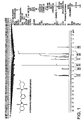
- the solvent (xylene/ acetic acid mixture) from the reaction mixture was then removed by distillation under reduced pressure and the crude reaction product was dissolved in methylene chloride, washed successively with aqueous 1 N HCl solution, aqueous saturated sodium bicarbonate solution and water. The resulting methylene chloride solution was then dried over anhydrous sodium sulfate, concentrated by evaporating the solvent and purified through silica gel column. The product was then vacuum stripped to remove all of the residual methylene chloride in order to isolate 560 grams of the pure product as a thick gel/ viscous oil. As shown in FIG. 1 , proton NMR confirmed the structure and purity of the product.
- a sample of MXBMT (15g) was placed in large headspace vial/ jar (932mL) into which was added a mixture of cobalt neodecanoate (2500 ppm) and n-hydroxyphthalimide (1000 ppm) as catalyst and cocatalyst respectively.
- the jar was sealed with a rubber septum containing cap and kept in an oven at about 75°C -83°C.
- the oxygen content in the jar was measured periodically by withdrawing a gas sample with a syringe and analyzing it on a Mocon headspace oxygen analyzer equipment (available from MOCON Modern controls, Minneapolis, Minn.).
- MXBMT is capable of scavenging the oxygen from the air contained in the jar depleting the oxygen content from 20.1 % to 10.9% in 8 days.
- MXBC m-xylylene bis(citraconimide)
- CAS#119462-56-5 1,3-bis(citraconimidomethyl) benzene
- MXBC is commercially available from Flexsys U.S.A., under the tradename Perkalink 900, a rubber chemical.
- the oxygen content in the jar was measured periodically by inserting a syringe needle through the septum, withdrawing a gas sample and analyzing on a Mocon headspace oxygen analyzer equipment (available from MOCON Modern Controls, Minneapolis, Minn.). After an initial oxygen content measurement the subsequent measurements monitor the decrease in oxygen content due to the oxygen scavenging over a period of several days.
- the data from this example is listed in Table 2 and shows a decrease in the oxygen content in the jar containing the plaques, illustrating their oxygen scavenging performance.
- Table 2 MXBC Oxygen Scavenging Data # Days ⁇ 0 3 6 10 17 24 % Oxygen content in the jar 20.4 20 19.9 19.1 18.4 18.9
- Example 3 A mixture of 140g of m-xylylene-bis-(citraconimde), 5.6g Cobalt neodecanoate and 6854g of dry PET pellets was tumble blended. The blend was used as the barrier layer a 3-layer coinjection molded bottle preform. The 3-layer preforms were made by a sequential co-injection process consisting of 2 separate extruder feeds. In the PET feed extruder (extruder "A" heated to 260-270°C), a commercial bottle grade PET (0.85 IV PET from M&G) dried to low moisture content ⁇ 10ppm was used.
- the PET blend containing the oxygen scavenger (MXBC) and cobalt neodecanoate was fed into the extruder.
- the two melt feeds from the A & B extruders were sequentially injection molded, using a 2003 Battenfeld A800/200H/125HC co-injection molding machine into a single cavity 30g 33mm finish ketchup bottle preform to form a 3- layer preform with the middle layer of the barrier PET blend material comprising ca. 40% of the total preform weight.
- the cycle time for molding was about 30 sec.
- the above multilayer performs were reheat-stretch-blowmolded into multilayer bottles.
- the bottles were stretch blown on a Sidel SBO-1 machine running ca.at 800 bottles per hour.
- the preforms were typically heated to a surface temperature of 99°C prior to the blowing operation.
- the blow mold temperature was about 12°C.
- the blow pressures were about 33 bar.
- the bottles obtained were clear and showed no major delamination failures in 6 ft angle drop tests.
- the blended PET-MXBT mixture was directly molded on injection molding machine into rectangular plaques of 15.9 cm long by 4.4cm wide and having five equal sections with increasing stepped thicknesses of 2 mm, 1.8 mm, 2.5 mm, 3.3 mm and 4 mm.
- the plaques were tested for oxygen scavenging by placing them (typically 7) in a 32 oz. glass jar containing one ounce of water.
- the jar is capped with a canning jar lid having a rubber septum.
- the oxygen content in the jar was measured periodically by inserting a syringe needle through the septum, withdrawing a gas sample and analyzing on a Mocon headspace oxygen analyzer equipment (MOCON Modern Controls, Minneapolis, Minn.).
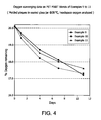
- the oxygen scavenging data as shown in FIGS. 3 and 4 clearly illustrates the excellent oxygen scavenging performance of MXBT in PET matrix as compared to the PET control.
- PET-MXBT Blend Compositions for Plaque Molding and Oxygen Scavenging Tests Example Molded Plaque Composition Scavenging Test Temperature (°C) 5 PET + 3%MXBT + 0.1% CoNeo +0.5%NHPI 50 6 PET + 3% MXBT + 0.1% CoNeo +1% PVP 50 7 PET + 6%MXBT + 0.1% CoNeo + 0.5%NHPI 50 8 PET +6%MXBT + 0.1%CoNeo + 1% PVP 50 9 PET +4%MXBT +0.1% CoNeo 38 10 PET +4%MXBT +0.1% CoNeo + 1%Tegmer 609 38 11 PET +4%MXBT +0.1% CoNeo + 0.3%NHPI 38
Landscapes
- Chemical & Material Sciences (AREA)
- Health & Medical Sciences (AREA)
- Chemical Kinetics & Catalysis (AREA)
- Medicinal Chemistry (AREA)
- Polymers & Plastics (AREA)
- Organic Chemistry (AREA)
- Compositions Of Macromolecular Compounds (AREA)
- Wrappers (AREA)
- Containers Having Bodies Formed In One Piece (AREA)
- Packages (AREA)
Description
- The present invention relates to compounds useful for oxygen scavenging. The invention also relates to substantially transparent compositions that comprise a base polymer, an oxidizable organic component, and a transition metal. The invention also is directed to uses of such compositions in the construction of packaging for oxygen sensitive materials.
- It is known in the art to include an oxygen scavenger in the packaging structure for the protection of oxygen sensitive materials. Such scavengers are believed to react with oxygen that is trapped in the package or that permeates from outside of the package, thus extending to life of package contents. These packages include films, bottles, containers, and the like. Food, beverages (such as beer and fruit juices), cosmetics, medicines, and the like are particularly sensitive to oxygen exposure and require high barrier properties to oxygen to preserve the freshness of the package contents and avoid changes in flavor, texture and color.
- Use of certain polyamides in combination with a transition metal is known to be useful as the oxygen scavenging material. One particularly useful polyamide is MXD6 which contains meta-xylene residues in the polymer chain. See, for example,
U.S. Pat. Nos. 5,639,815 ;5,049,624 ; and5,021,515 . - Other oxygen scavengers include potassium sulfite (
U.S. Pat. No. 4,536,409 ), unsaturated hydrocarbons (U.S. Pat. No. 5,211,875 ), and ascorbic acid derivatives (U.S. Pat. No. 5,075,362 ).US 2008/161529 relates to oxygen scavenging polyester compositions for packaging including transition metals. - In barrier layers of packaging walls that are made from blends of oxygen scavenging materials with base polymer resins such as PET, haze can result due to such factors as the immiscibility of the scavenging materials (especially when the scavenging material is a polymeric material) with the base polymer resins and the inability to create by mechanical blending means disperse-phase domains that are so small as not to interfere with the passage of light therethrough; and the adverse influence of the scavenging material on the crystallization behavior of PET base resin. One approach to minimizing such haze is careful selection of base resin to improve dispersibility of the scavenger material and, thus, reduce, but not substantially eliminate, haze; and to minimize the adverse crystallization effect. This approach may undesirably narrowly restrict the choice of base polymer resin. Another approach is to use compositions that serve as compatibilizers to reduce haze. These approaches add cost to the layer and the compatibilizer adds an additional material that must be evaluated for its suitability for contact with food. Thus, there is a need in the art for improved materials such as low molecular weight organic compounds which provide high oxygen scavenging capability when blended Into PET to form containers while maintaining substantial transparency.
- The present invention provides a composition comprising: a base polymer, at least one compound having the structure of Formula I or II


- In another aspect, the present invention provides a wall of a package comprising at least one layer, the layer comprising a composition, the composition comprising: a base polymer; at least one compound having the structure of Formula I or II


- In yet another aspect, the present invention provides method for packaging an oxygen sensitive material comprising: preparing a package having a wall comprising at least one layer, at least one of said layers comprising a composition, said composition comprising a base polymer; at least one compound having the structure of Formula I or II


-
-
FIG. 1 is a proton NMR spectra of an oxygen scavenging compound for use in the present invention; -
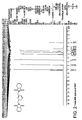
FIG. 2 is a proton NMR spectra of an oxygen scavenging compound for use in the present invention; -
FIG. 3 is a graph illustrating the oxygen scavenging performance of certain embodiments of the present invention; and -
FIG. 4 is a graph illustrating the oxygen scavenging performance of certain embodiments of the present invention. - The present invention concerns compositions that are useful in the manufacture of packaging for oxygen sensitive materials. In some embodiments, the invention concerns a polyester polymer composition comprising a non-polymeric oxidizable organic component wherein the composition exhibits excellent oxygen scavenging properties as well as excellent clarity (i.e., lack of haze) when blow molded, for example, from a preform into a monolater container via an injection stretch blow molding process.
- It is preferred that the non-polymeric oxidizable organic component of the present invention has a high degree of affinity for polyesters.
- In certain preferred embodiments, the invention concerns compositions that contain a base polymer, a transition metal in a positive oxygen state, and at least one non-polymeric oxidizable organic component present in an amount of from about 0.10 to 10 weight present of the composition and the component comprising at least one compound having the structure of Formula I or II


- wherein Ar is an o-, m-, or p-phenylene moiety, a substituted phenylene moiety, or a naphthalene moiety; R1 and R2 are independently selected from the group consisting of: hydrogen, alkyl, alkenyl, and aryl; X is O or -(CH2)n-; n = 0, 1, or 2; and p = 0, 1, or 2.
- As used herein, the term "alkyl" refers to a substituted or unsubstituted aliphatic hydrocarbon chain. Alkyl groups have straight and branched chains. In some embodiments, alkyls have from 1 to 12 carbon atoms or 1 to 6 carbon atoms, unless explicitly specified otherwise. Alkyl groups include, bur are not limited to methyl, ethyl, propyl, isopropyl, butyl, 1-butyl and t-butyl. Specifically included within the definition of "alkyl" are those aliphatic hydrocarbon chains that are optionally substituted.
- The term "alkenyl" is defined herein as (C2-C20) straight chain or branched-chain bivalent hydrocarbon moiety derived from an alkane or alkene that is mono or polyunsaturated. Such groups include those in the E or Z configurations and all possible combinations of E and Z configurations. Some preferred alkylene chains have 2-7 carbon atoms.
- The term "aryl" is defined herein as an aromatic carbocyclic moiety of up to 20 carbon atoms. In some embodiments, aryl groups have 6-20 carbon atoms or 6-14 carbon atoms. Aryls may be a single ring (monocyclic) or multiple rings (bicyclic, up to three rings) fused together or linked covalently. Any suitable ring position of the aryl moiety may be covalently linked to the defined chemical structure. Aryl groups include, but are not limited to, phenyl, 1-naphthyl, 2-naphthyl, dihydronaphthyl, tetrahydronaphthyl, biphenyl, anthryl, phenanthryl, fluorenyl, indanyl, biphenylenyl, acenaphthenyl, and acenaphthylenyl. In some embodiments, phenyl is a preferred aryl. Aryl groups may also be optionally substituted with one or more substituents.
- Optional substituents for alkyl, alkenyl, aryl, or heteroaryl groups are well known to those skilled in the art. These substituents include alkyl, alkoxy, aryloxy, hydroxy, acetyl, cyano, nitro, glyceryl, and carbohydrate, or two substituents taken together may be linked as an -alkylene-group to form a ring.
- In one aspect, the oxidizable organic component of the present invention is the compound m-xylylene-bis-(tetrahydrophthalimide) ("MXBT"):
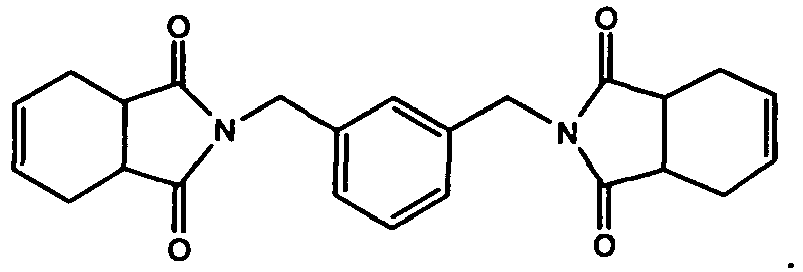
- MXBT is an exemplary species of formula I wherein Ar is an m-phenylene moiety, R1 is H, R2 is H, and X is -(CH2)n-, where n is 0 and p is 0.
- In yet another aspect, the oxidizable organic component of the present invention is the compound m-xylylene-bis-(methyltetrahydrophthalimide) ("MXBT"):
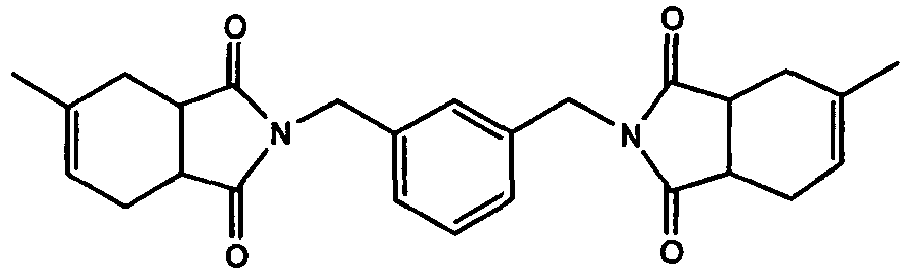
- MXBMT is an exemplary species of formula I wherein Ar is an m-phenylene moiety, R1 is methyl, R2 is H, and X is -{CH2)n- where n is 0 and p is 0.
- In another aspect the oxidizable organic component of the present invention is the compound m-xylylene-bis-(octenyl succinimide) ("MXBO"):

- MXBO is an exemplary species of formula II wherein Ar is an m-phenylene moiety, R1 is an alkenyl group, R2 is H, and p is 0.
- In another aspect, the oxidizable organic component of the present invention is the compound m-xylylene-bis-citraconimide ("MXBC"):

- MXBC is an exemplary species of formula II wherein Ar is an m-phenylene moiety, R1 is an alkyl group, R2 is H, and p is 0.
- In yet another aspect, the oxidizable organic component of the present invention is the compound m-xylylene-bis(methylnadimide) ("MXBMN"):

- MXBMN is an exemplary species of formula I wherein Ar is an m-phenylene moiety, R1 is methyl, R2 is H, and X is -(CH2)n-, where n is 1 amd p is 0.
- In yet another aspect, the oxidizable organic component of the present invention is the compound m-xylylene-bis(nadimide) ("MXBN"):
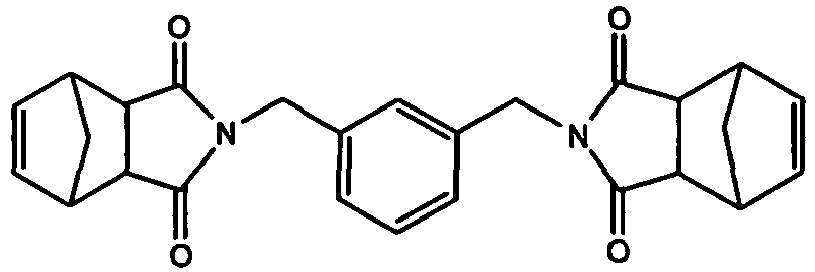
- MXBN is an exemplary species of formula I wherein Ar is an m-phenylene moiety, R1 and R2 is H, and X is -(CH2)n-, where n is 1 and p is 0.
- Compositions of the instant invention comprise a base polymer. As used herein, the term "base polymer" refers to a polymer component of a container of the present invention that provides the structure and mechanical properties of the container. The term "base polymer" is synonymous with the term "structural polymer," which is commonly used in the art.
- In preferred embodiments, the base polymer is a polyester. In certain embodiments, the polyester polymers of the invention are thermoplastic and, thus, the form of the compositions are not limited and can include a composition in the melt phase polymerization, as an amorphous pellet, as a solid stated polymer, as a semi-crystalline particle, as a composition of matter in a melt processing zone, as a bottle preform, or in the form of a stretch blow molded bottle or other articles. In certain preferred embodiments, the polyester is polyethylene terephthalate (PET).
- Examples of suitable polyester polymers include polyethylene terephthalate homopolymers and copolymers modified with one or more polycarboxylic acid modifiers in a cumulative amount of less than about 15 mole %, or about 10 mole % or less, or about 8 mole % or less, or one or more hydroxyl compound modifiers in an amount of less than about 60 mol %, or less than about 50 mole %, or less than about 40 mole %, or less than about 15 mole %, or about 10 mole % or less, or about 8 mole % or less (collectively referred to for brevity as "PET") and polyethylene naphthalate homopolymers and copolymers modified with a cumulative amount of with less than about 15 mole %, or about 10 mole % or less, or about 8 mole % or less, of one or more polycarboxylic acid modifiers or modified less than about 60 mol %, or less than about 50 mole %, or less than about 40 mole %, or less than about 15 mole %, or about 10 mole % or less, or about 8 mole % or less of one or more hydroxyl compound modifiers (collectively referred to herein as "PEN"), and blends of PET and PEN. A modifier polycarboxylic acid compound or hydroxyl compound is a compound other than the compound contained in an amount of at least about 85 mole %. The preferred polyester polymer is polyalkylene terephthalate, and most preferred is PET.
- In some embodiments, the polyester polymer contains at least about 90 mole % ethylene terephthalate repeat units, and in other embodiments, at least about 92 mole %, and in yet other embodiments, or at least about 94 mole %, based on the moles of all repeat units in the polyester polymers.
- In addition to a diacid component of terephthalic acid, derivates of terephthalic acid, naphthalene-2,6-dicarboxylic acid, derivatives of naphthalene-2,6-dicarboxylic acid, or mixtures thereof, the polycarboxylic acid component(s) of the present polyester may include one or more additional modifier polycarboxylic acids. Such additional modifier polycarboxylic acids include aromatic dicarboxylic acids preferably having about 8 to about 14 carbon atoms, aliphatic dicarboxylic acids preferably having about 4 to about 12 carbon atoms, or cycloaliphatic dicarboxylic acids preferably having about 8 to about 12 carbon atoms. Examples of modifier dicarboxylic acids useful as an acid component(s) are phthalic acid, isophthalic acid, naphthalene-2,6-dicarboxylic acid, cyclohexanedicarboxylic acid, cyclohexanediacetic acid, diphenyl-4,4'-dicarboxylic acid, succinic acid, glutaric acid, adipic acid, azelaic acid, sebacic acid, and the like, with isophthalic acid, naphthalene-2,6-dicarboxylic acid, and cyclohexanedicarboxylic acid being most preferable. It should be understood that use of the corresponding acid anhydrides, esters, and acid chlorides of these acids is included in the term "polycarboxylic acid." It is also possible for trifunctional and higher order polycarboxylic acids to modify the polyester.
- The hydroxyl component is made from compounds containing 2 or more hydroxyl groups capable of reacting with a carboxylic acid group. In some preferred embodiments, preferred hydroxyl compounds contain 2 or 3 hydroxyl groups. Certain preferred embodiments, have 2 hydroxyl groups. These hydroxyl compounds include C2-C4 alkane diols, such as ethylene glycol, propane diol, and butane diol, among which ethylene glycol is most preferred for container applications. In addition to these diols, other modifier hydroxyl compound component(s) may include diols such as cycloaliphatic diols preferably having 6 to 20 carbon atoms and/or aliphatic diols preferably having about 3 to about 20 carbon atoms. Examples of such diols include diethylene glycol; triethylene glycol; 1,4-cyclohexanedimethanol; propane-1,3-diol and butane-1,4-diol (which are considered modifier diols if ethylene glycol residues are present in the polymer in an amount of at least 85 mole % based on the moles of all hydroxyl compound residues); pentane-1,5-diol; hexane-1,6-diol; 3-methylpentanediol-(2,4); neopentyl glycol; 2-methylpentanediol-(1,4); 2,2,4-trimethylpentane-diol-(1,3); 2,5-ethylhexanediol-(1,3); 2,2-diethyl propane-diol-(1,3); hexanediol-(1,3); 1,4-di-(hydroxyethoxy)-benzene; 2,2-bis-(4-hydroxycyclohexyl)-propane; 2,4-dihydroxy-1,1,3,3-tetramethyl-cyclobutane; 2,2-bis-(3-hydroxyethoxyphenyl)-propane; and 2,2-bis-(4-hydroxypropoxyphenyl)-propane. Typically, polyesters such as polyethylene terephthalate are made by reacting a glycol with a dicarboxylic acid as the free acid or its dimethyl ester to produce an ester monomer and/or oligomers, which are then polycondensed to produce the polyester.
- In some preferred embodiments, modifiers include isophthalic acid, naphthalenic dicarboxylic acid, trimellitic anhydride, pyromellitic dianhydride, 1,4-cyclohexane dimethanol, and diethylene glycol. The amount of the polyester polymer in the formulated polyester polymer composition ranges from greater than about 50.0 wt. %, or from about 80.0 wt. %, or from about 90.0 wt. %, or from about 95.0 wt. %, or from about 96.0 wt. %, or from about 97 wt. %, and up to about 99.90 wt. %, based on the combined weight of all polyester polymers and all polyamide polymers. The formulated polyester polymer compositions may also include blends of formulated polyester polymer compositions with other thermoplastic polymers such as polycarbonate. In some preferred compositions, the polyester comprises a majority of the composition of the inventions, and in some embodiments the polyester is present in an amount of at least about 80 wt. %, or at least about 90 wt. %, based on the weight of the composition (excluding fillers, inorganic compounds or particles, fibers, impact modifiers, or other polymers serve as impact modifiers or which form a discontinuous phase such as may be found in cold storage food trays).
- The polyester compositions can be prepared by polymerization procedures known in the art sufficient to effect esterification and polycondensation. Polyester melt phase manufacturing processes include direct condensation of a dicarboxylic acid with the diol, optionally in the presence of esterification catalysts, in the esterification zone, followed by polycondensation in the prepolymer and finishing zones in the presence of a polycondensation catalyst; or ester exchange usually in the presence of a transcsterification catalyst in the ester exchange zone, followed by prepolymerization and finishing in the presence of a polycondensation catalyst, and each may optionally be solid stated according to known methods.
- Other base polymers may be used with the instant invention. One example is polypropylene.
- The transition metal used in the instant compositions is a metal in the positive oxidation state. It should be noted that it is contemplated that one or more such metals may be used. The transition metal functions to catalyze or promote the oxidation of the organic oxidizable component (i.e., the reaction of the organic oxidizable component with molecular oxygen).
- The transition metal can be selected from the first, second, or third transition series of the Periodic Table. The metal can be Rh, Ru, or one of the elements in the series of Sc to Zn (i.e., Sc, Ti, V, Cr, Mn, Fe, Co, Ni, Cu, and Zn). In some embodiments, cobalt is added in +2 or +3 oxidation state. In some embodiments, it is preferred to use cobalt in the +2 oxidation state. In certain embodiments, copper in the +2 oxidation state is utilized. In some embodiments, rhodium in the +2 oxidation state is used. In certain embodiments, zinc may also be added to the composition. Preferred zinc compounds include those in a positive oxidation state.
- Suitable counter-ions to the transition metal cations include carboxylates, such as neodecanoates, octanoates, acetates, lactates, naphthalates, malates, stearates, acetylacetonates, linoleates, oleates, palmitates, 2-ethylhexanoates, or ethylene glycolates; or as their oxides, borates, carbonates, chlorides, dioxides, hydroxides, nitrates, phosphates, sulfates, or silicates among others.
- In some embodiments, levels of at least about 10 ppm, or at least about 50 ppm, or at least about 100 ppm of metal can achieve suitable oxygen scavenging levels. The exact amount of transition metal used in an application can be determined by trials that are well within the skill level of one skilled in the art. In some embodiments involving wall applications (as opposed to master batch applications where more catalyst is used), it is preferred to keep the level of metal below about 300 ppm and, in other embodiments, preferably below about 250 ppm. In master batch compositions, the level of transition metal may range from about 1000 to about 10,000 ppm. In some preferred embodiments, the range is from about 2000 to about 5000 ppm.
- The transition metal or metals may be added neat or in a carrier (such as a liquid or wax) to an extruder or other device for making the article, or the metal may be present in a concentrate or carrier with the oxidizable organic component, in a concentrate or carrier with a base polymer, or in a concentrate or carrier with a base polymer/oxidizable organic component blend. Alternatively, at least a portion of the transition metal may be added as a polymerization catalyst to the melt phase reaction for making the base polymer (a polyester polymer in some embodiments) and be present as residual metals when the polymer is fed to the melting zone (e.g. the extrusion or injection molding zone) for making the article such as a preform or sheet. It is desirable that the addition of the transition metal does not substantially increase the intrinsic viscosity (IV) of the melt in the melt processing zone. Thus, transition metal or metals may be added in two or more stages, such as once during the melt phase for the production of the polyester polymer and again once more to the melting zone for making the article.
- The amounts of the components used in the oxygen scavenging formulations of the present invention can affect the use and effectiveness of this composition. Thus, the amounts of base polymer, transition metal catalyst, antioxidant, polymeric diluents, additives, etc., can vary depending on the desired article and its end use. For example, the primary function of the organic oxidizable component of formulas I or II described above is to react irreversibly with oxygen during the scavenging process, while a primary function of the transition metal catalyst is to facilitate this process. Thus, to a large extent, the amount of the organic oxidizable component present affects the oxygen scavenging capacity of the composition, i.e., the amount of oxygen that the composition can consume, while the amount of transition metal catalyst affects the rate at which oxygen is consumed as well as the induction period.
- The oxygen scavenger composition of the present invention can be incorporated in packaging articles having various forms. Suitable articles include, but are not limited to, flexible sheet films, flexible bags, pouches, semi-rigid and rigid containers such as bottles (e.g., PET bottles) or metal cans, or combinations thereof.
- Typical flexible films and bags include those used to package various food items and may be made up of one or a multiplicity of layers to form the overall film or bag-like packaging material. The oxygen scavenger composition of the present invention can be used in one, some or all of the layers of such packaging material.
- Typical rigid or semi-rigid articles include plastic, paper or cardboard containers, such as those utilized for juices, soft drinks, as well as thermoformed trays or cup normally having thickness in the range of from 100 to 1000 micrometers. The walls of such articles can comprise single or multiple layers of materials. The articles can also take the form of a bottle or metal can, or a crown, cap, crown or cap liner, plastisol or gasket. The oxygen scavenger composition of the present invention can be used as an integral layer or portion of, or as an external or internal coating or liner of, the formed semi-rigid or rigid packaging article. As a liner, the oxygen scavenger composition can be extruded as a film along with the rigid article itself, in, e.g., a coextrusion, extrusion coating, or extrusion lamination process, so as to form the liner in situ during article production; or alternatively can be adhered by heat and/or pressure, by adhesive, or by any other suitable method to an outer surface of the article after the article has been produced.
- In one preferred embodiment of the present invention, the composition of the present invention, i.e., a base polymer, a transition metal in a positive oxygen state, and at least one non-polymeric oxidizable organic component having the structure of formula I or II, can be employed to form a monolayer bottle. In another preferred embodiment of the present invention, the composition of the present invention can form one layer of a multilayer bottle wherein the layer comprising the composition of the present invention comprises from at least 1 % and typically 2 to 6% of a compound having the structure of formula I or II.
- Besides articles applicable for packaging food and beverage, articles for packaging other oxygen-sensitive products can also benefit from the present invention. Such products would include pharmaceuticals, oxygen sensitive medical products, corrodible metals or products, electronic devices and the like.
- The composition may also include other components such as pigments, fillers, crystallization aids, impact modifiers, surface lubricants, denesting agents, stabilizers, ultraviolet light absorbing agents, metal deactivators, nucleating agents such as polyethylene and polypropylene, phosphite stabilizers and dyestuffs. Other additional components are well known to those skilled in the art and can be added to the existing composition so long as they do not negatively impact the performance of the compositions. Typically, the total quantity of such components will be less than about 10% by weight relative to the whole composition. In some embodiments, the amount of these optional components is less than about 5%, by weight relative to the total composition.
- A common additive used in the manufacture of polyester polymer compositions used to make stretch blow molded bottles is a reheat additive because the preforms made from the composition must be reheated prior to entering the mold for stretch blowing into a bottle. Any of the conventional reheat additives can be used, such additives include various forms of black particles, e.g. carbon black, activated carbon, black iron oxide, glassy carbon, and silicon carbide; the gray particles such as antimony, and other reheat additives such as silicas, red iron oxide, and so forth.
- In many applications, not only are the packaging contents sensitive to the ingress of oxygen, but the contents may also be affected by UV light. Fruit juices and pharmaceuticals are two examples of such contents. Accordingly, in some embodiments, it is desirable to incorporate into the polyester composition any one of the known UV absorbing compounds in amounts effective to protect the packaged contents.
- The instant compositions can be made by mixing a base polymer (PET, for example) with the oxidizable organic component and the transition metal composition. Such compositions can be made by any method known to those skilled in the art. In certain embodiments, some or part of the transition metal may exist in the base polymer prior to mixing. This residual metal, for example, can exist from the manufacturing process of the base polymer. In some embodiments, the base polymer, the oxidizable organic component and the transition metal are mixed by tumbling in a hopper. Other optional ingredients can be added during this mixing process or added to the mixture after the aforementioned mixing or to an individual component prior to the aforementioned mixing step.
- The instant composition can also be made by adding each ingredient separately and mixing the ingredients prior melt processing the composition to form an article. In some embodiments, the mixing can be just prior to the melt process zone. In other embodiments, one or more ingredients can be premixed in a separate step prior to bringing all of the ingredients together.
- In some embodiments, the invention concerns use of the compositions described herein as a component of a wall that is used in a package for oxygen sensitive materials. The necessary scavenging capacity of a package will generally have to be greater for walls that have a greater permeance in the absence of scavenging additives. Accordingly, a good effect is harder to achieve with inherently higher permeance materials are used.
- The wall may be a rigid one, a flexible sheet, or a clinging film. It may be homogenous or a laminate or coated with other polymers. If it is laminated or coated, then the scavenging property may reside in a layer of the wall the permeance of which is relatively high in the absence of scavenging and which alone would not perform very satisfactorily but which performs satisfactorily in combination with one or more other layers which have a relatively low permeance but negligible or insufficient oxygen-scavenging properties. A single such layer could be used on the outside of the package since this is the side from which oxygen primarily comes when the package is filled and sealed. However, such a layer to either side of the scavenging layer would reduce consumption of scavenging capacity prior to filling and sealing.
- When the instant compositions are used in a wall or as a layer of a wall, the permeability of the composition for oxygen is advantageously not more than about 3.0, or about 1.7, or about 0.7, or about 0.2, or about 0.03 cm3 mm/(m2 atm day). The permeability of the composition provided by the present invention is advantageously not more than about three-quarters of that in the absence of oxygen-scavenging properties. In some embodiments, the permeability is not more than about one half, one-tenth in certain embodiments, one twenty-fifth in other embodiments, and not more than one-hundredth in yet other embodiments of that in the absence of oxygen-scavenging properties. The permeability in the absence of oxygen-scavenging properties is advantageously not more than about 17 cm3 mm/(m2 atm day), or about 10, and or about 6. A particularly good effect can be achieved for such permeabilities in the range from about 0.5, or about 1.0, to 10, or about 6.0, cm3 mm/(m2 atm day). Measuring oxygen permeation can be performed by one of ordinary skilled in the art employing oxygen permeation (OTR) instrumentation such as, for example, OX-TRAN® instruments available from MOCON, Inc. (Minneapolis, MN).
- In another aspect, the instant composition can be used as a master batch for blending with a polymer or a polymer containing component. In such compositions, the concentration of the oxidizable organic component and the transition metal will be higher to allow for the final blended product to have suitable amounts of these components. The master batch may also contain an amount of the polymer to which the master batch is to be blended with. In other embodiments, the master batch may contain a polymer that is compatible with the polymer that the master batch is to be blended with.
- In yet another aspect, the compositions of the instant invention can be used for forming a layer of a wall which primarily provides oxygen-scavenging (another layer including polymer providing gas barrier without significant scavenging), or as a head-space scavenger (completely enclosed, together with the package contents, by a package wall). Such techniques are well know to those skilled in the art.
- The time period for which the permeability is maintained can be extended by storing the articles in sealed containers or under an inert atmosphere such as nitrogen prior to use with oxygen sensitive materials.
- In another aspect, the invention provides a package, whether rigid, semi-rigid, collapsible, lidded, or flexible or a combination of these, comprising a wall as formed from the compositions described herein. Such packages can be formed by methods well known to those skilled in the art.
- Among the techniques that may be used to make articles are moulding generally, injection moulding, stretch blow moulding, extrusion, thermoforming, extrusion blow moulding, and (specifically for multilayer structures) co-extrusion and lamination using adhesive tie layers. Orientation, e.g., by stretch blow moulding, of the polymer is especially attractive with phthalate polyesters because of the known mechanical advantages that result.
- The melt processing zone for making the article can be operated under customary conditions effective for making the intended articles, such as preforms, bottles, trays, and other articles mentioned below. In one embodiment, such conditions are effective to process the melt without substantially increasing the IV of the melt and which are ineffective to promote transesterification reactions. In some preferred embodiments, suitable operating conditions effective to establish a physical blend of the polyester polymer, oxidizable organic component, and transition metal are temperatures in the melt processing zone within a range of about 250°C to about 300°C at a total cycle time of less than about 6 minutes, and typically without the application of vacuum and under a positive pressure ranging from about 0 psig to about 900 psig. In some embodiments, the residence time of the melt on the screw can range from about 1 to about 4 minutes.
- Specific articles include preforms, containers and films for packaging of food, beverages, cosmetics, pharmaceuticals, and personal care products where a high oxygen barrier is needed. Examples of beverage containers are bottles for holding water and carbonated soft drinks, and the invention is particularly useful in bottle applications containing juices, sport drinks, beer or any other beverage where oxygen detrimentally affects the flavor, fragrance, performance (prevent vitamin degradation), or color of the drink. The compositions of the instant invention are also particularly useful as a sheet for thermoforming into rigid packages and films for flexible structures. Rigid packages include food trays and lids. Examples of food tray applications include dual ovenable food trays, or cold storage food trays, both in the base container and in the lidding (whether a thermoformed lid or a film), where the freshness of the food contents can decay with the ingress of oxygen. The compositions of the instant invention also find use in the manufacture of cosmetic containers and containers for pharmaceuticals or medical devices.
- The package walls of the instant invention can be a single layer or a multilayer constructions. In some embodiments using multilayer walls, the outer and inner layers may be structural layers with one or more protective layers containing the oxygen scavenging material positioned there between. In some embodiments, the outer and inner layers comprise and polyolefin or a polyester. In certain embodiments, a single layer design is preferred. Such a layer may have advantages in simplicity of manufacture and cost.
- In this specification and in the claims that follow, reference will be made to a number of terms, which shall be defined to have the following meanings:
- As used herein, the phrase "having the formula" or "having the structure" is not intended to be limiting and is used in the same way that the term "comprising" is commonly used. The term "independently selected from" is used herein to indicate that the recited elements, e.g., R groups or the like, can be identical or different.
- As used herein, the terms "a", "an", "the" and the like refer to both the singular and plural unless the context clearly indicates otherwise. "A bottle", for example, refers to a single bottle or more than one bottle.
- Also as used herein, the description of one or more method steps does not preclude the presence of additional method steps before or after the combined recited steps. Additional steps may also be intervening steps to those described. In addition, it is understood that the lettering of process steps or ingredients is a convenient means for identifying discrete activities or ingredients and the recited lettering can be arranged in any sequence.
- Where a range of numbers is presented in the application, it is understood that the range includes all integers and fractions thereof between the stated range limits. A range of numbers expressly includes numbers less than the stated endpoints and those in-between the stated range. A range of from 1-3, for example, includes the integers one, two, and three as well as any fractions that reside between these integers.
- As used herein, "master batch" refers to a mixture of base polymer, oxidizable organic component, and transition metal that will be diluted, typically with at least additional base polymer, prior to forming an article. As such, the concentrations of oxidizable organic component and transition metal are higher than in the formed article.
- The following examples are included to demonstrate preferred embodiments of the invention regarding synthesis of the molecules and use of the molecules to scavenge oxygen as well products containing such scavengers. It should be appreciated by those of skill in the art that the techniques disclosed in the examples which follow represent techniques discovered by the inventors to function well in the practice of the invention, and thus can be considered to constitute preferred modes for its practice. However, those of skill in the art should, in light of the present disclosure, appreciate that many changes can be made in the specific embodiments which are disclosed and still obtain a like or similar result without departing from the scope of the invention.
- The following examples are provided for the purpose of further illustrating the present invention but are by no means intended to limit the same.
-

- A mixture of xylene (1.5 L) and glacial acetic acid (1.5 L) was charged into a 5 L reaction vessel equipped with a Dean-Stark Trap/ reflux condenser assembly and a mechanical stirrer (a Dean Stark Trap is an efficient laboratory device used to continuously remove the water that is produced during a reaction as a by-product and drive the reaction to completion). Into the above 5 L reactor containing the solvent mixture, was added gradually with stirring, 518.5 grams (3.12 moles) of methyl tetrahydrophthalic anhydride (available under the trade name ECA1000 from Dixie Chemical Company Inc., Houston, TX, U.S.A.). The reaction mixture was gradually heated to 100-120°C while stirring. To the resulting warm solution was then added 215.4 grams (1.56 moles) of m-xylylene diamine (from Sigma-Aldrich) gradually at such a rate that the refluxing remained under control. During the addition, a reaction begins to take place and the water formed as a by-product begins to collect and separate as a dense layer from the xylene/ acetic acid mixture condensed in the Dean Stark Trap.
- During the addition of m-xylylylene diamine, which was carried out over a period of 30 minutes, the reaction mixture remained clear at this temperature with no visible suspensions formed. The refluxing of the reaction mixture was continued for an additional period of 4 hours. During this period the water, formed as the by-product of the reaction, was continuously collected as a lower layer in the Dean-Stark apparatus and it was drained off periodically as much as needed. The completion of reaction was monitored by testing a small sample of the reaction mixture with thin layer chromatography (TLC). At the end of 4 hour refluxing period, the TLC analysis of the crude reaction mixture showed that the reaction was essentially complete.
- The solvent (xylene/ acetic acid mixture) from the reaction mixture was then removed by distillation under reduced pressure and the crude reaction product was dissolved in methylene chloride, washed successively with aqueous 1 N HCl solution, aqueous saturated sodium bicarbonate solution and water. The resulting methylene chloride solution was then dried over anhydrous sodium sulfate, concentrated by evaporating the solvent and purified through silica gel column. The product was then vacuum stripped to remove all of the residual methylene chloride in order to isolate 560 grams of the pure product as a thick gel/ viscous oil. As shown in
FIG. 1 , proton NMR confirmed the structure and purity of the product. - To illustrate its oxygen scavenging capability, a sample of MXBMT (15g) was placed in large headspace vial/ jar (932mL) into which was added a mixture of cobalt neodecanoate (2500 ppm) and n-hydroxyphthalimide (1000 ppm) as catalyst and cocatalyst respectively. The jar was sealed with a rubber septum containing cap and kept in an oven at about 75°C -83°C. The oxygen content in the jar was measured periodically by withdrawing a gas sample with a syringe and analyzing it on a Mocon headspace oxygen analyzer equipment (available from MOCON Modern controls, Minneapolis, Minn.). After an initial oxygen content measurement, the subsequent measurements monitor the decrease in oxygen content due to the oxygen scavenging over a period of several days. The data from this example is listed in Table 1.
Table 1: MXBMT Oxygen Scavenging Data # Days → 0 1 2 8 % Oxygen content in the jar 20.1 15.9 15.8 10.9 Note: A small amount of water (0.2g) was injected into the jar after 7 days. - The above data illustrates that MXBMT is capable of scavenging the oxygen from the air contained in the jar depleting the oxygen content from 20.1 % to 10.9% in 8 days.
- This example illustrates the use of m-xylylene bis(citraconimide) (MXBC), also known as 1,3-bis(citraconimidomethyl) benzene (CAS#119462-56-5), as a novel oxygen scavenger additive in PET. The structure of MXBC is:

- MXBC is commercially available from Flexsys U.S.A., under the tradename Perkalink 900, a rubber chemical.
- 99 parts by weight of dry PET pellets were tumble blended with 1 part of MXBC and 2500 ppm cobalt neodecanoate powder. The blended mixture was directly molded on injection moldimg machine into rectangular plaques of 15.9 cm long by 4.4cm wide and having five equal sections with increasing stepped thicknesses of 2 mm, 1.8 mm, 2.5 mm, 3.3 mm and 4 mm. The plaques were tested for oxygen scavenging by placing them (typically 7) in a 32 oz. glass jar containing one ounce of water. The jar is capped with a canning jar lid having a rubber septum. The oxygen content in the jar was measured periodically by inserting a syringe needle through the septum, withdrawing a gas sample and analyzing on a Mocon headspace oxygen analyzer equipment (available from MOCON Modern Controls, Minneapolis, Minn.). After an initial oxygen content measurement the subsequent measurements monitor the decrease in oxygen content due to the oxygen scavenging over a period of several days. The data from this example is listed in Table 2 and shows a decrease in the oxygen content in the jar containing the plaques, illustrating their oxygen scavenging performance.
Table 2: MXBC Oxygen Scavenging Data # Days → 0 3 6 10 17 24 % Oxygen content in the jar 20.4 20 19.9 19.1 18.4 18.9 - Example 3: A mixture of 140g of m-xylylene-bis-(citraconimde), 5.6g Cobalt neodecanoate and 6854g of dry PET pellets was tumble blended. The blend was used as the barrier layer a 3-layer coinjection molded bottle preform. The 3-layer preforms were made by a sequential co-injection process consisting of 2 separate extruder feeds. In the PET feed extruder (extruder "A" heated to 260-270°C), a commercial bottle grade PET (0.85 IV PET from M&G) dried to low moisture content <10ppm was used. In the barrier resin feed extruder (extruder "B" heated to 240-260°C), the PET blend containing the oxygen scavenger (MXBC) and cobalt neodecanoate was fed into the extruder. The two melt feeds from the A & B extruders were sequentially injection molded, using a 2003 Battenfeld A800/200H/125HC co-injection molding machine into a single cavity 30g 33mm finish ketchup bottle preform to form a 3- layer preform with the middle layer of the barrier PET blend material comprising ca. 40% of the total preform weight. The cycle time for molding was about 30 sec.
- In a 2nd step the above multilayer performs were reheat-stretch-blowmolded into multilayer bottles. In the present example, the bottles were stretch blown on a Sidel SBO-1 machine running ca.at 800 bottles per hour. In the process, the preforms were typically heated to a surface temperature of 99°C prior to the blowing operation. The blow mold temperature was about 12°C. The blow pressures were about 33 bar. The bottles obtained were clear and showed no major delamination failures in 6 ft angle drop tests.
-

- To a mixture of 1.5 liters of xylene and 1.5 liters of glacial acetic acid in a 5 liter reaction vessel equipped with a Dean-Stark trap, was added 541 grams (3.55 moles) of tetrahydrophthalic anhydride (THPA). The mixture was heated to 100-120°C. To this warm solution was added 242 grams (1.78 moles) of m-xylylene diamine (MXDA) at such a rate that the reflux remained under control. During the addition, the water/acetic acid mixture begins to separate from the xylene/acetic acid mixture in the Dean Stark trap. The addition was carried out over a total period of 30 min. After an additional 4 hrs. under reflux, TLC showed that the reaction was complete. The solvent was then evaporated under reduced pressure and the solid product was dissolved in methylene chloride, washed successively with 1 N HCl, sat. NaHCO3, water and then dried over Na2SO4. The solution was then concentrated and the product recrystallized as a white solid (yield: 550g). As shown in
FIG. 2 , the proton NMR confirmed the structure and high purity (>99%) of MXBT. - Commercial bottle grade PET pellets (Heatwave CF746, Eastman) were thoroughly dried and then tumble blended with various levels of MXBT (from Example 4) and cobalt neodecanoate as catalyst and including an optional activating compound such as N-hydroxy phthalimide, low molecular weight polyethyleneglycol diester (Tegmer 609 from Hallstar) or a low molecular weight polyvinylpyrrolidone (Luvitek, from BASF). The specific compositions of Ex. 5-11, are shown in Table 3. In each case, the blended PET-MXBT mixture was directly molded on injection molding machine into rectangular plaques of 15.9 cm long by 4.4cm wide and having five equal sections with increasing stepped thicknesses of 2 mm, 1.8 mm, 2.5 mm, 3.3 mm and 4 mm. The plaques were tested for oxygen scavenging by placing them (typically 7) in a 32 oz. glass jar containing one ounce of water. The jar is capped with a canning jar lid having a rubber septum. The oxygen content in the jar was measured periodically by inserting a syringe needle through the septum, withdrawing a gas sample and analyzing on a Mocon headspace oxygen analyzer equipment (MOCON Modern Controls, Minneapolis, Minn.). After an initial oxygen content measurement the subsequent measurements monitor the decrease in oxygen content due to the oxygen scavenging over a period of several days. The oxygen scavenging data as shown in
FIGS. 3 and4 clearly illustrates the excellent oxygen scavenging performance of MXBT in PET matrix as compared to the PET control.Table 3: PET-MXBT Blend Compositions for Plaque Molding and Oxygen Scavenging Tests Example Molded Plaque Composition Scavenging Test Temperature (°C) 5 PET + 3%MXBT + 0.1% CoNeo +0.5%NHPI 50 6 PET + 3% MXBT + 0.1% CoNeo +1% PVP 50 7 PET + 6%MXBT + 0.1% CoNeo + 0.5%NHPI 50 8 PET +6%MXBT + 0.1%CoNeo + 1% PVP 50 9 PET +4%MXBT +0.1% CoNeo 38 10 PET +4%MXBT +0.1% CoNeo + 1%Tegmer 609 38 11 PET +4%MXBT +0.1% CoNeo + 0.3%NHPI 38 - The foregoing examples and description of the preferred embodiments should be taken as illustrating, rather than as limiting the present invention as defined by the claims. As will be readily appreciated, numerous variations and combinations of the features set forth above can be utilized without departing from the present invention as set forth in the claims. Such variations are not regarded as a departure from the scope of the invention, and all such variations are intended to be included within the scope of the following claims.
Claims (16)
- A composition comprising:a) a base polymer;b) at least one non-polymeric oxidizable organic compound having the structure of Formula I or II:

 Ar is an o-, m-, or p-phenylene moiety, a substituted phenylene moiety, or a naphthalene moiety;Ri and R2 are independently selected from the group consisting of: hydrogen, alkyl, alkenyl, and aryl;X is O or -(CH2)n-; andn = 0, 1, or 2;p = 0, 1, or 2; andc) at least one transition metal in a positive oxidation state, said metal being present in the composition in an amount of from about 10 to about 400 ppm,wherein said compound is present in an amount of from 0.10 to 10 weight percent of the composition.
 - A wall for a package comprising at least one layer, said layer comprising a composition according to claim 1, said composition comprising:a) a base polymer;b) at least one compound having the structure of Formula I or II

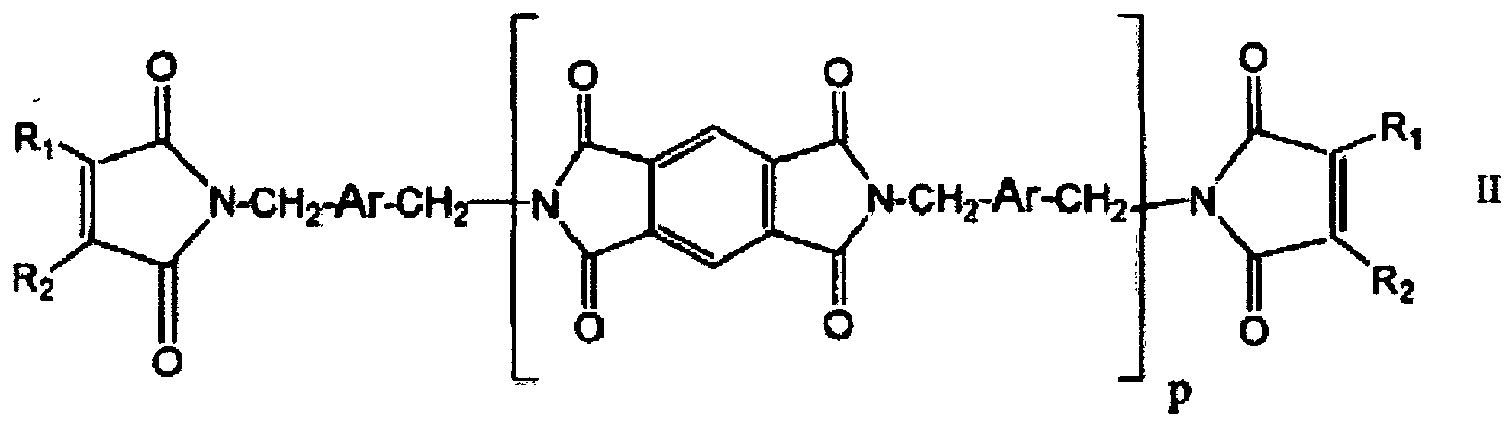 Ar is an o-, m-, or p-phenylene moiety, a substituted phenylene moiety, or a naphthalene moiety;Ri and R2 are independently selected from the group consisting of: hydrogen, alkyl, alkenyl, and aryl; andX is O or -(CH2)n-; andn = 0, 1, or 2;p = 0, 1, or 2; andc) at least one transition metal in a positive oxidation state, said metal being present in the composition in an amount of from 10 to 400 ppm,wherein said compound is present in an amount of from 0.10 to 10 weight percent of the composition.
 - The composition of claim 1 or 2, wherein said at least one transition metal is cobalt; said at least one transition metal further comprises zinc.
- The composition of claim 1 or 2 wherein said base polymer comprises a polyester polymer; preferably the polyester polymer is polyethylene terephthalate.
- The composition of claim 1 or 2 wherein the compound is present in an amount of 1 to 10 weight percent based on the weight of the composition; preferably the compound is present in an amount of 1 to 5 weight percent based on the weight of the composition; more preferably the compound is present in an amount of 1 to 3 weight percent based on the weight of the composition.
- The composition of claim 1 or 2 wherein the concentration of transition metal is 30 to 150 ppm.
- The composition of claim 1 or 2 wherein the non-polymeric oxidizable organic compound is m-xylylene-bis-(tetrahydrophthalimide):

- The composition of claim 1 wherein the non-polymeric oxidizabie organic compound is m-xylylene-bis-citraconimide:

- A method for packaging an oxygen sensitive material comprising:(a) preparing a package having a wall comprising at least one layer, at least one of said layers comprising a composition according to claim 1, said composition comprising a base polymer; at least one compound having the structure of Formula I or II

 Ar is an o-, m-, or p-phenylene moiety, a substituted phenylene moiety, or a naphthalene moiety;Ri and R2 are independently selected from the group consisting of: hydrogen, alkyl, alkenyl, and aryl; and X is O or -(CH2)n-; n = 0, 1 , or 2; and p = 0, 1, or 2; and; and at least one transition metal in a positive oxidation state, said metal being present in the composition in an amount of from 10 to 400 ppm, wherein said compound is present in an amount of from 0.10 to 10 weight percent of the composition;(b) introducing said oxygen sensitive material into said package; and(c) closing said package.
 - The method of claim 9, wherein said at least one transition metal is cobalt; preferably said at least one transition metal further comprises zinc.
- The method of claim 9 wherein said base polymer comprises a polyester polymer; preferably the
- The method of claim 9 wherein the compound is present in an amount of 1 to 10 weight percent based on the weight of the composition; preferably the compound is present in an amount of 1 to 5 weight percent based on the weight of the composition; more prerferably the compound is present in an amount of 1 to 3 weight percent based on the weight of the composition.
- The method of claim 9 wherein the concentration of transition metal is 30 to 150 ppm.
- A composition comprising:a) polyethylene terephthalate;b) m-xylylene-bis-(tetrahydrophthalimide):
 c) at least one transition metal in a positive oxidation state, said metal being present in the composition in an amount of from 10 to 400 ppm,wherein the m-xylylene-bis-(tetrahydrophthalimide) is present in an amount of from 0.10 to 10 weight percent of the composition.
 - A wall for a package comprising at least one layer, said layer comprising a composition, said composition according to claim 1 comprising:a) polyethylene terephthalate;b) m-xylylene-bis-(tetrahydrophthalimide):
 c) at least one transition metal in a positive oxidation state, said metal being present in the composition in an amount of from 10 to 400 ppm,wherein the m-xylylene-bis-(tetrahydrophthalimide) is present in an amount of from 0.10 to 10 weight percent of the composition.
 - The composition of claim 8 or 9, wherein said at least one transition metal is cobalt preferably the concentration of transition metal is 30 to 150 ppm.
Priority Applications (1)
| Application Number | Priority Date | Filing Date | Title |
|---|---|---|---|
| PL11720936T PL2566917T3 (en) | 2010-05-06 | 2011-05-06 | Oxygen scavenging additives for plastic containers |
Applications Claiming Priority (2)
| Application Number | Priority Date | Filing Date | Title |
|---|---|---|---|
| US33205410P | 2010-05-06 | 2010-05-06 | |
| PCT/US2011/035570 WO2011140473A1 (en) | 2010-05-06 | 2011-05-06 | Oxygen scavenging additives for plastic containers |
Publications (2)
| Publication Number | Publication Date |
|---|---|
| EP2566917A1 EP2566917A1 (en) | 2013-03-13 |
| EP2566917B1 true EP2566917B1 (en) | 2015-03-04 |
Family
ID=44307677
Family Applications (1)
| Application Number | Title | Priority Date | Filing Date |
|---|---|---|---|
| EP11720936.1A Not-in-force EP2566917B1 (en) | 2010-05-06 | 2011-05-06 | Oxygen scavenging additives for plastic containers |
Country Status (10)
| Country | Link |
|---|---|
| US (1) | US9018284B2 (en) |
| EP (1) | EP2566917B1 (en) |
| JP (1) | JP5816681B2 (en) |
| CN (1) | CN102884118B (en) |
| AU (1) | AU2011247935B2 (en) |
| CA (1) | CA2797127C (en) |
| ES (1) | ES2542405T3 (en) |
| MX (1) | MX338700B (en) |
| PL (1) | PL2566917T3 (en) |
| WO (1) | WO2011140473A1 (en) |
Families Citing this family (23)
| Publication number | Priority date | Publication date | Assignee | Title |
|---|---|---|---|---|
| EP2669334B1 (en) * | 2011-01-27 | 2022-04-06 | Toyo Seikan Group Holdings, Ltd. | Oxygen-absorbing resin composition |
| US20120283366A1 (en) * | 2011-05-06 | 2012-11-08 | Graham Packaging Company, L.P. | Activated oxygen scavenging compositions for plastic containers |
| US10227432B2 (en) | 2011-08-31 | 2019-03-12 | Carver Scientific, Inc. | Formation of xylylene type copolymers, block polymers, and mixed composition materials |
| US10233306B2 (en) | 2011-12-26 | 2019-03-19 | Toyo Seikan Group Holdings, Ltd. | Oxygen-absorbing resin composition |
| US9068113B2 (en) | 2012-05-16 | 2015-06-30 | Graham Packaging Company, L.P. | Low phosphorous oxygen scavenging compositions requiring no induction period |
| US8962740B2 (en) | 2012-09-10 | 2015-02-24 | Kraft Foods Group Brands Llc | Oxygen scavenger system in a polyolefin matrix |
| JP6245457B2 (en) * | 2013-03-05 | 2017-12-13 | 三菱瓦斯化学株式会社 | Oxygen-absorbing resin composition |
| DE102013005307A1 (en) | 2013-03-25 | 2014-09-25 | Fraunhofer-Gesellschaft zur Förderung der angewandten Forschung e.V. | Use of organic oxyimides as flame retardants for plastics and flame-retardant plastic composition and molded part produced therefrom |
| US9447321B2 (en) | 2014-01-16 | 2016-09-20 | Graham Packaging Company, L.P. | Oxygen scavenging compositions for plastic containers |
| JP2015174895A (en) * | 2014-03-14 | 2015-10-05 | 東洋製罐グループホールディングス株式会社 | oxygen-absorbing resin composition |
| WO2016048811A1 (en) * | 2014-09-26 | 2016-03-31 | Carver Scientific, Inc. | Formation of xylylene type copolymers, block polymers, and mixed composition materials |
| US20160130434A1 (en) | 2014-11-07 | 2016-05-12 | Graham Packaging Company, L.P. | Oxygen scavenging compositions requiring no induction period |
| CN104387347B (en) * | 2014-11-19 | 2016-07-13 | 山东阳谷华泰化工股份有限公司 | 2-methyl maleic anhydride and the preparation method of double (citraconimidomethyl) benzene of 1,3- |
| JP6790560B2 (en) | 2016-08-04 | 2020-11-25 | 東洋製罐グループホールディングス株式会社 | Oxygen Absorbent Resin Composition Containing Organic Oxygen Absorbent |
| JP2018051902A (en) | 2016-09-28 | 2018-04-05 | 東洋製罐グループホールディングス株式会社 | Multilayer structure molded body |
| JP6984608B2 (en) | 2016-09-28 | 2021-12-22 | 東洋製罐グループホールディングス株式会社 | Molded body with excellent gas barrier properties |
| US10208200B2 (en) | 2017-03-30 | 2019-02-19 | Graham Packaging Company, L.P. | Dual oxygen-scavenging compositions requiring no induction period |
| EP3651987A1 (en) | 2017-07-14 | 2020-05-20 | Flex Films (USA) Inc. | High barrier oriented films |
| EP3886854A4 (en) | 2018-11-30 | 2022-07-06 | Nuvation Bio Inc. | PYRROLE AND PYRAZOLE COMPOUNDS AND METHODS OF USE THEREOF |
| US12435181B2 (en) | 2019-01-26 | 2025-10-07 | Shenshen Li | Formulations capable of reacting with or removal of molecular oxygen |
| JP7466989B2 (en) * | 2020-02-28 | 2024-04-15 | 株式会社吉野工業所 | Barrier Cap |
| US10894625B1 (en) | 2020-07-29 | 2021-01-19 | Verre Vert, Inc. | Lightweight polymer bottle for wine and spirits |
| US12012253B1 (en) | 2023-03-02 | 2024-06-18 | Verre Vert, Inc. | Lightweight polymer wine bottle suitable for use with natural cork or synthetic stoppers |
Family Cites Families (32)
| Publication number | Priority date | Publication date | Assignee | Title |
|---|---|---|---|---|
| US4536409A (en) | 1981-01-23 | 1985-08-20 | American Can Company | Oxygen scavenger |
| US4611049A (en) | 1984-06-07 | 1986-09-09 | Teijin Limited | Process for producing aromatic polyester |
| DE301719T1 (en) | 1987-07-27 | 1990-12-20 | MB Group plc, Reading, Berkshire | PACKAGING AGENTS. |
| GB2207439B (en) | 1987-07-27 | 1992-02-12 | Metal Box Plc | Improvements in and relating to packaging |
| GB8803062D0 (en) | 1988-02-10 | 1988-03-09 | Grace W R & Co | Sealed containers & sealing compositions for them |
| BR8906385A (en) | 1988-03-12 | 1990-08-28 | Metal Box Plc | WALL FOR PACKING AND PACKAGING |
| US5211875A (en) | 1991-06-27 | 1993-05-18 | W. R. Grace & Co.-Conn. | Methods and compositions for oxygen scavenging |
| JP3562723B2 (en) | 1996-09-23 | 2004-09-08 | ビーピー・コーポレーション・ノース・アメリカ・インコーポレーテッド | Zero oxygen permeable plastic bottles for beer and other uses |
| US6083585A (en) | 1996-09-23 | 2000-07-04 | Bp Amoco Corporation | Oxygen scavenging condensation copolymers for bottles and packaging articles |
| US20020037377A1 (en) | 1998-02-03 | 2002-03-28 | Schmidt Steven L. | Enhanced oxygen-scavenging polymers, and packaging made therefrom |
| US6254803B1 (en) | 1998-03-25 | 2001-07-03 | Cryovac, Inc. | Oxygen scavengers with reduced oxidation products for use in plastic films |
| US6015851A (en) * | 1998-06-17 | 2000-01-18 | The Goodyear Tire & Rubber Company | Rubber compositions containing bis anil compounds |
| US6455620B1 (en) | 1999-08-10 | 2002-09-24 | Eastman Chemical Company | Polyether containing polymers for oxygen scavenging |
| US6423776B1 (en) | 2000-05-02 | 2002-07-23 | Honeywell International Inc. | Oxygen scavenging high barrier polyamide compositions for packaging applications |
| US6939921B2 (en) * | 2001-10-16 | 2005-09-06 | Exxonmobil Chemical Patents Inc. | Colorable elastomeric composition |
| WO2003080731A2 (en) | 2002-03-21 | 2003-10-02 | Advanced Plastics Technologies, Ltd. | Compatibilized polyester/polyamide blends |
| EP1650265A4 (en) | 2003-07-24 | 2006-08-02 | Kuraray Co | OXYGEN-ABSORBING BODY, PROCESS FOR PRODUCING THE BODY, AND PACKAGING MATERIAL USING THE SAME |
| JP2005146012A (en) * | 2003-11-11 | 2005-06-09 | Yokohama Rubber Co Ltd:The | Pneumatic tire |
| CA2589915A1 (en) | 2004-12-06 | 2006-06-15 | Constar International Inc. | Blends of oxygen scavenging polyamides with polyesters which contain zinc and cobalt |
| US20090278087A1 (en) | 2005-02-15 | 2009-11-12 | Constar International, Inc | Oxygen Scavenging Compositions and Packaging Comprising Said Compositions |
| US8043534B2 (en) * | 2005-10-21 | 2011-10-25 | Designer Molecules, Inc. | Maleimide compositions and methods for use thereof |
| JP2007146035A (en) * | 2005-11-29 | 2007-06-14 | Tokai Rubber Ind Ltd | Anti-vibration rubber composition and method for producing anti-vibration rubber using the same |
| US7789119B2 (en) | 2006-10-10 | 2010-09-07 | The Goodyear Tire & Rubber Company | Runflat tire |
| US20080161529A1 (en) | 2006-12-28 | 2008-07-03 | Jason Christopher Jenkins | Oxygen-scavenging polyesters useful for packaging |
| DK2152794T3 (en) * | 2007-05-10 | 2014-03-31 | Constar Internat Llc | OXYGEN REMOVAL MOLECULES, ARTICLES CONTAINING THESE, AND PROCEDURE FOR THEIR USE |
| ATE548423T1 (en) | 2007-08-31 | 2012-03-15 | Invista Tech Sarl | OXYGEN ABSORBING PLASTIC COMPOSITIONS |
| JP5134592B2 (en) * | 2008-08-08 | 2013-01-30 | 住友ゴム工業株式会社 | Rubber composition for cap tread and tire having cap tread comprising the same |
| US8308976B2 (en) | 2008-10-10 | 2012-11-13 | Valspar Sourcing, Inc. | Oxygen-scavenging materials and articles formed therefrom |
| JP5779507B2 (en) | 2009-02-20 | 2015-09-16 | インヴィスタ テクノロジーズ エスアエルエル | Oxygen scavenging resin with a short induction period |
| BR112012005319A2 (en) | 2009-09-11 | 2016-03-22 | Invista Tech Sarl | method for producing an oxygen sequestering resin, composition and method for producing an article |
| WO2011043969A2 (en) | 2009-09-29 | 2011-04-14 | Constar International | Colorant compatible oxygen scavenging polymer compositions and articles made from same |
| EP2499134B1 (en) | 2009-11-13 | 2018-04-18 | Plastipak Packaging, Inc. | Oxygen scavengers, composition comprising the scavengers, and articles made from the compositions |
-
2011
- 2011-05-06 CA CA2797127A patent/CA2797127C/en not_active Expired - Fee Related
- 2011-05-06 US US13/102,597 patent/US9018284B2/en not_active Expired - Fee Related
- 2011-05-06 WO PCT/US2011/035570 patent/WO2011140473A1/en not_active Ceased
- 2011-05-06 PL PL11720936T patent/PL2566917T3/en unknown
- 2011-05-06 AU AU2011247935A patent/AU2011247935B2/en not_active Ceased
- 2011-05-06 MX MX2012012737A patent/MX338700B/en active IP Right Grant
- 2011-05-06 CN CN201180022776.8A patent/CN102884118B/en not_active Expired - Fee Related
- 2011-05-06 JP JP2013509300A patent/JP5816681B2/en not_active Expired - Fee Related
- 2011-05-06 EP EP11720936.1A patent/EP2566917B1/en not_active Not-in-force
- 2011-05-06 ES ES11720936.1T patent/ES2542405T3/en active Active
Also Published As
| Publication number | Publication date |
|---|---|
| JP2013531084A (en) | 2013-08-01 |
| US20110275742A1 (en) | 2011-11-10 |
| EP2566917A1 (en) | 2013-03-13 |
| US9018284B2 (en) | 2015-04-28 |
| MX338700B (en) | 2016-04-28 |
| WO2011140473A1 (en) | 2011-11-10 |
| CN102884118A (en) | 2013-01-16 |
| CA2797127C (en) | 2017-09-05 |
| PL2566917T3 (en) | 2015-08-31 |
| CA2797127A1 (en) | 2011-11-10 |
| AU2011247935A1 (en) | 2012-11-29 |
| JP5816681B2 (en) | 2015-11-18 |
| CN102884118B (en) | 2014-03-19 |
| AU2011247935B2 (en) | 2014-06-05 |
| ES2542405T3 (en) | 2015-08-05 |
| MX2012012737A (en) | 2012-11-21 |
Similar Documents
| Publication | Publication Date | Title |
|---|---|---|
| AU2011247935B2 (en) | Oxygen scavenging additives for plastic containers | |
| EP2705081B1 (en) | Activated oxygen scavenging compositions for plastic containers | |
| EP2850128B1 (en) | Low phosphorous oxygen scavenging compositions requiring no induction period | |
| US20260042913A1 (en) | Oxygen scavenging compositions requiring no induction period | |
| EP3094663B1 (en) | Oxygen scavenging compositions for plastic containers | |
| US10208200B2 (en) | Dual oxygen-scavenging compositions requiring no induction period | |
| US20160130433A1 (en) | Oxygen scavenging compositions requiring no induction period |
Legal Events
| Date | Code | Title | Description |
|---|---|---|---|
| PUAI | Public reference made under article 153(3) epc to a published international application that has entered the european phase |
Free format text: ORIGINAL CODE: 0009012 |
|
| 17P | Request for examination filed |
Effective date: 20121106 |
|
| AK | Designated contracting states |
Kind code of ref document: A1 Designated state(s): AL AT BE BG CH CY CZ DE DK EE ES FI FR GB GR HR HU IE IS IT LI LT LU LV MC MK MT NL NO PL PT RO RS SE SI SK SM TR |
|
| DAX | Request for extension of the european patent (deleted) | ||
| REG | Reference to a national code |
Ref country code: DE Ref legal event code: R079 Ref document number: 602011014335 Country of ref document: DE Free format text: PREVIOUS MAIN CLASS: C08K0005344500 Ipc: C08K0005098000 |
|
| GRAP | Despatch of communication of intention to grant a patent |
Free format text: ORIGINAL CODE: EPIDOSNIGR1 |
|
| RIC1 | Information provided on ipc code assigned before grant |
Ipc: C08K 5/3417 20060101ALI20140901BHEP Ipc: C08K 5/098 20060101AFI20140901BHEP Ipc: C08K 5/3415 20060101ALI20140901BHEP |
|
| INTG | Intention to grant announced |
Effective date: 20140915 |
|
| GRAS | Grant fee paid |
Free format text: ORIGINAL CODE: EPIDOSNIGR3 |
|
| GRAA | (expected) grant |
Free format text: ORIGINAL CODE: 0009210 |
|
| AK | Designated contracting states |
Kind code of ref document: B1 Designated state(s): AL AT BE BG CH CY CZ DE DK EE ES FI FR GB GR HR HU IE IS IT LI LT LU LV MC MK MT NL NO PL PT RO RS SE SI SK SM TR |
|
| REG | Reference to a national code |
Ref country code: GB Ref legal event code: FG4D |
|
| REG | Reference to a national code |
Ref country code: CH Ref legal event code: EP |
|
| REG | Reference to a national code |
Ref country code: IE Ref legal event code: FG4D |
|
| REG | Reference to a national code |
Ref country code: AT Ref legal event code: REF Ref document number: 713859 Country of ref document: AT Kind code of ref document: T Effective date: 20150415 |
|
| REG | Reference to a national code |
Ref country code: DE Ref legal event code: R096 Ref document number: 602011014335 Country of ref document: DE Effective date: 20150416 |
|
| REG | Reference to a national code |
Ref country code: NL Ref legal event code: T3 |
|
| RAP2 | Party data changed (patent owner data changed or rights of a patent transferred) |
Owner name: GRAHAM PACKAGING COMPANY, L.P. |
|
| REG | Reference to a national code |
Ref country code: AT Ref legal event code: MK05 Ref document number: 713859 Country of ref document: AT Kind code of ref document: T Effective date: 20150304 |
|
| PG25 | Lapsed in a contracting state [announced via postgrant information from national office to epo] |
Ref country code: SE Free format text: LAPSE BECAUSE OF FAILURE TO SUBMIT A TRANSLATION OF THE DESCRIPTION OR TO PAY THE FEE WITHIN THE PRESCRIBED TIME-LIMIT Effective date: 20150304 Ref country code: NO Free format text: LAPSE BECAUSE OF FAILURE TO SUBMIT A TRANSLATION OF THE DESCRIPTION OR TO PAY THE FEE WITHIN THE PRESCRIBED TIME-LIMIT Effective date: 20150604 Ref country code: HR Free format text: LAPSE BECAUSE OF FAILURE TO SUBMIT A TRANSLATION OF THE DESCRIPTION OR TO PAY THE FEE WITHIN THE PRESCRIBED TIME-LIMIT Effective date: 20150304 Ref country code: LT Free format text: LAPSE BECAUSE OF FAILURE TO SUBMIT A TRANSLATION OF THE DESCRIPTION OR TO PAY THE FEE WITHIN THE PRESCRIBED TIME-LIMIT Effective date: 20150304 |
|
| REG | Reference to a national code |
Ref country code: ES Ref legal event code: FG2A Ref document number: 2542405 Country of ref document: ES Kind code of ref document: T3 Effective date: 20150805 |
|
| REG | Reference to a national code |
Ref country code: LT Ref legal event code: MG4D |
|
| PG25 | Lapsed in a contracting state [announced via postgrant information from national office to epo] |
Ref country code: RS Free format text: LAPSE BECAUSE OF FAILURE TO SUBMIT A TRANSLATION OF THE DESCRIPTION OR TO PAY THE FEE WITHIN THE PRESCRIBED TIME-LIMIT Effective date: 20150304 Ref country code: LV Free format text: LAPSE BECAUSE OF FAILURE TO SUBMIT A TRANSLATION OF THE DESCRIPTION OR TO PAY THE FEE WITHIN THE PRESCRIBED TIME-LIMIT Effective date: 20150304 Ref country code: GR Free format text: LAPSE BECAUSE OF FAILURE TO SUBMIT A TRANSLATION OF THE DESCRIPTION OR TO PAY THE FEE WITHIN THE PRESCRIBED TIME-LIMIT Effective date: 20150605 Ref country code: AT Free format text: LAPSE BECAUSE OF FAILURE TO SUBMIT A TRANSLATION OF THE DESCRIPTION OR TO PAY THE FEE WITHIN THE PRESCRIBED TIME-LIMIT Effective date: 20150304 |
|
| REG | Reference to a national code |
Ref country code: PL Ref legal event code: T3 |
|
| PG25 | Lapsed in a contracting state [announced via postgrant information from national office to epo] |
Ref country code: CZ Free format text: LAPSE BECAUSE OF FAILURE TO SUBMIT A TRANSLATION OF THE DESCRIPTION OR TO PAY THE FEE WITHIN THE PRESCRIBED TIME-LIMIT Effective date: 20150304 Ref country code: PT Free format text: LAPSE BECAUSE OF FAILURE TO SUBMIT A TRANSLATION OF THE DESCRIPTION OR TO PAY THE FEE WITHIN THE PRESCRIBED TIME-LIMIT Effective date: 20150706 Ref country code: EE Free format text: LAPSE BECAUSE OF FAILURE TO SUBMIT A TRANSLATION OF THE DESCRIPTION OR TO PAY THE FEE WITHIN THE PRESCRIBED TIME-LIMIT Effective date: 20150304 Ref country code: SK Free format text: LAPSE BECAUSE OF FAILURE TO SUBMIT A TRANSLATION OF THE DESCRIPTION OR TO PAY THE FEE WITHIN THE PRESCRIBED TIME-LIMIT Effective date: 20150304 Ref country code: RO Free format text: LAPSE BECAUSE OF FAILURE TO SUBMIT A TRANSLATION OF THE DESCRIPTION OR TO PAY THE FEE WITHIN THE PRESCRIBED TIME-LIMIT Effective date: 20150304 |
|
| PG25 | Lapsed in a contracting state [announced via postgrant information from national office to epo] |
Ref country code: IS Free format text: LAPSE BECAUSE OF FAILURE TO SUBMIT A TRANSLATION OF THE DESCRIPTION OR TO PAY THE FEE WITHIN THE PRESCRIBED TIME-LIMIT Effective date: 20150704 |
|
| REG | Reference to a national code |
Ref country code: DE Ref legal event code: R097 Ref document number: 602011014335 Country of ref document: DE |
|
| REG | Reference to a national code |
Ref country code: CH Ref legal event code: PL |
|
| PLBE | No opposition filed within time limit |
Free format text: ORIGINAL CODE: 0009261 |
|
| STAA | Information on the status of an ep patent application or granted ep patent |
Free format text: STATUS: NO OPPOSITION FILED WITHIN TIME LIMIT |
|
| PG25 | Lapsed in a contracting state [announced via postgrant information from national office to epo] |
Ref country code: CH Free format text: LAPSE BECAUSE OF NON-PAYMENT OF DUE FEES Effective date: 20150531 Ref country code: DK Free format text: LAPSE BECAUSE OF FAILURE TO SUBMIT A TRANSLATION OF THE DESCRIPTION OR TO PAY THE FEE WITHIN THE PRESCRIBED TIME-LIMIT Effective date: 20150304 Ref country code: LI Free format text: LAPSE BECAUSE OF NON-PAYMENT OF DUE FEES Effective date: 20150531 Ref country code: MC Free format text: LAPSE BECAUSE OF FAILURE TO SUBMIT A TRANSLATION OF THE DESCRIPTION OR TO PAY THE FEE WITHIN THE PRESCRIBED TIME-LIMIT Effective date: 20150304 Ref country code: LU Free format text: LAPSE BECAUSE OF FAILURE TO SUBMIT A TRANSLATION OF THE DESCRIPTION OR TO PAY THE FEE WITHIN THE PRESCRIBED TIME-LIMIT Effective date: 20150506 |
|
| 26N | No opposition filed |
Effective date: 20151207 |
|
| REG | Reference to a national code |
Ref country code: IE Ref legal event code: MM4A |
|
| PG25 | Lapsed in a contracting state [announced via postgrant information from national office to epo] |
Ref country code: SI Free format text: LAPSE BECAUSE OF FAILURE TO SUBMIT A TRANSLATION OF THE DESCRIPTION OR TO PAY THE FEE WITHIN THE PRESCRIBED TIME-LIMIT Effective date: 20150304 |
|
| PG25 | Lapsed in a contracting state [announced via postgrant information from national office to epo] |
Ref country code: IE Free format text: LAPSE BECAUSE OF NON-PAYMENT OF DUE FEES Effective date: 20150506 |
|
| REG | Reference to a national code |
Ref country code: FR Ref legal event code: PLFP Year of fee payment: 6 |
|
| PG25 | Lapsed in a contracting state [announced via postgrant information from national office to epo] |
Ref country code: MT Free format text: LAPSE BECAUSE OF FAILURE TO SUBMIT A TRANSLATION OF THE DESCRIPTION OR TO PAY THE FEE WITHIN THE PRESCRIBED TIME-LIMIT Effective date: 20150304 |
|
| REG | Reference to a national code |
Ref country code: FR Ref legal event code: PLFP Year of fee payment: 7 |
|
| PG25 | Lapsed in a contracting state [announced via postgrant information from national office to epo] |
Ref country code: SM Free format text: LAPSE BECAUSE OF FAILURE TO SUBMIT A TRANSLATION OF THE DESCRIPTION OR TO PAY THE FEE WITHIN THE PRESCRIBED TIME-LIMIT Effective date: 20150304 Ref country code: BG Free format text: LAPSE BECAUSE OF FAILURE TO SUBMIT A TRANSLATION OF THE DESCRIPTION OR TO PAY THE FEE WITHIN THE PRESCRIBED TIME-LIMIT Effective date: 20150304 Ref country code: HU Free format text: LAPSE BECAUSE OF FAILURE TO SUBMIT A TRANSLATION OF THE DESCRIPTION OR TO PAY THE FEE WITHIN THE PRESCRIBED TIME-LIMIT; INVALID AB INITIO Effective date: 20110506 |
|
| PG25 | Lapsed in a contracting state [announced via postgrant information from national office to epo] |
Ref country code: CY Free format text: LAPSE BECAUSE OF FAILURE TO SUBMIT A TRANSLATION OF THE DESCRIPTION OR TO PAY THE FEE WITHIN THE PRESCRIBED TIME-LIMIT Effective date: 20150304 |
|
| PG25 | Lapsed in a contracting state [announced via postgrant information from national office to epo] |
Ref country code: TR Free format text: LAPSE BECAUSE OF FAILURE TO SUBMIT A TRANSLATION OF THE DESCRIPTION OR TO PAY THE FEE WITHIN THE PRESCRIBED TIME-LIMIT Effective date: 20150304 |
|
| REG | Reference to a national code |
Ref country code: FR Ref legal event code: PLFP Year of fee payment: 8 |
|
| PG25 | Lapsed in a contracting state [announced via postgrant information from national office to epo] |
Ref country code: MK Free format text: LAPSE BECAUSE OF FAILURE TO SUBMIT A TRANSLATION OF THE DESCRIPTION OR TO PAY THE FEE WITHIN THE PRESCRIBED TIME-LIMIT Effective date: 20150304 |
|
| PG25 | Lapsed in a contracting state [announced via postgrant information from national office to epo] |
Ref country code: AL Free format text: LAPSE BECAUSE OF FAILURE TO SUBMIT A TRANSLATION OF THE DESCRIPTION OR TO PAY THE FEE WITHIN THE PRESCRIBED TIME-LIMIT Effective date: 20150304 |
|
| PGFP | Annual fee paid to national office [announced via postgrant information from national office to epo] |
Ref country code: NL Payment date: 20190527 Year of fee payment: 9 |
|
| PGFP | Annual fee paid to national office [announced via postgrant information from national office to epo] |
Ref country code: IT Payment date: 20190524 Year of fee payment: 9 Ref country code: FI Payment date: 20190521 Year of fee payment: 9 Ref country code: PL Payment date: 20190425 Year of fee payment: 9 Ref country code: ES Payment date: 20190625 Year of fee payment: 9 |
|
| PGFP | Annual fee paid to national office [announced via postgrant information from national office to epo] |
Ref country code: BE Payment date: 20190527 Year of fee payment: 9 Ref country code: FR Payment date: 20190528 Year of fee payment: 9 |
|
| PGFP | Annual fee paid to national office [announced via postgrant information from national office to epo] |
Ref country code: GB Payment date: 20190529 Year of fee payment: 9 Ref country code: DE Payment date: 20190731 Year of fee payment: 9 |
|
| REG | Reference to a national code |
Ref country code: DE Ref legal event code: R082 Ref document number: 602011014335 Country of ref document: DE Representative=s name: MEISSNER BOLTE PATENTANWAELTE RECHTSANWAELTE P, DE |
|
| REG | Reference to a national code |
Ref country code: DE Ref legal event code: R119 Ref document number: 602011014335 Country of ref document: DE |
|
| REG | Reference to a national code |
Ref country code: FI Ref legal event code: MAE |
|
| REG | Reference to a national code |
Ref country code: NL Ref legal event code: MM Effective date: 20200601 |
|
| PG25 | Lapsed in a contracting state [announced via postgrant information from national office to epo] |
Ref country code: FI Free format text: LAPSE BECAUSE OF NON-PAYMENT OF DUE FEES Effective date: 20200506 |
|
| PG25 | Lapsed in a contracting state [announced via postgrant information from national office to epo] |
Ref country code: NL Free format text: LAPSE BECAUSE OF NON-PAYMENT OF DUE FEES Effective date: 20200601 |
|
| REG | Reference to a national code |
Ref country code: BE Ref legal event code: MM Effective date: 20200531 |
|
| GBPC | Gb: european patent ceased through non-payment of renewal fee |
Effective date: 20200506 |
|
| PG25 | Lapsed in a contracting state [announced via postgrant information from national office to epo] |
Ref country code: GB Free format text: LAPSE BECAUSE OF NON-PAYMENT OF DUE FEES Effective date: 20200506 Ref country code: FR Free format text: LAPSE BECAUSE OF NON-PAYMENT OF DUE FEES Effective date: 20200531 |
|
| PG25 | Lapsed in a contracting state [announced via postgrant information from national office to epo] |
Ref country code: DE Free format text: LAPSE BECAUSE OF NON-PAYMENT OF DUE FEES Effective date: 20201201 Ref country code: BE Free format text: LAPSE BECAUSE OF NON-PAYMENT OF DUE FEES Effective date: 20200531 |
|
| REG | Reference to a national code |
Ref country code: ES Ref legal event code: FD2A Effective date: 20210928 |
|
| PG25 | Lapsed in a contracting state [announced via postgrant information from national office to epo] |
Ref country code: IT Free format text: LAPSE BECAUSE OF NON-PAYMENT OF DUE FEES Effective date: 20200506 |
|
| PG25 | Lapsed in a contracting state [announced via postgrant information from national office to epo] |
Ref country code: ES Free format text: LAPSE BECAUSE OF NON-PAYMENT OF DUE FEES Effective date: 20200507 |
|
| PG25 | Lapsed in a contracting state [announced via postgrant information from national office to epo] |
Ref country code: PL Free format text: LAPSE BECAUSE OF NON-PAYMENT OF DUE FEES Effective date: 20200506 |