EP2566479B1 - Azaindazoles - Google Patents
Azaindazoles Download PDFInfo
- Publication number
- EP2566479B1 EP2566479B1 EP11803965.0A EP11803965A EP2566479B1 EP 2566479 B1 EP2566479 B1 EP 2566479B1 EP 11803965 A EP11803965 A EP 11803965A EP 2566479 B1 EP2566479 B1 EP 2566479B1
- Authority
- EP
- European Patent Office
- Prior art keywords
- methyl
- pyridinyl
- oxo
- dihydro
- pyridine
- Prior art date
- Legal status (The legal status is an assumption and is not a legal conclusion. Google has not performed a legal analysis and makes no representation as to the accuracy of the status listed.)
- Not-in-force
Links
- 150000001875 compounds Chemical class 0.000 claims description 223
- 229910003827 NRaRb Inorganic materials 0.000 claims description 207
- IJGRMHOSHXDMSA-UHFFFAOYSA-N nitrogen Substances N#N IJGRMHOSHXDMSA-UHFFFAOYSA-N 0.000 claims description 138
- -1 amino, methyl Chemical group 0.000 claims description 135
- 125000004178 (C1-C4) alkyl group Chemical group 0.000 claims description 100
- 229910052757 nitrogen Inorganic materials 0.000 claims description 88
- 125000006552 (C3-C8) cycloalkyl group Chemical group 0.000 claims description 86
- 125000004209 (C1-C8) alkyl group Chemical group 0.000 claims description 74
- 125000001072 heteroaryl group Chemical group 0.000 claims description 74
- 125000003118 aryl group Chemical group 0.000 claims description 68
- 238000011282 treatment Methods 0.000 claims description 55
- 125000000592 heterocycloalkyl group Chemical group 0.000 claims description 54
- FABMZTHRDOHPDN-UHFFFAOYSA-N 6-chloro-n-[(4,6-dimethyl-2-oxo-1h-pyridin-3-yl)methyl]-1-propan-2-ylpyrazolo[3,4-b]pyridine-4-carboxamide Chemical compound C1=C(Cl)N=C2N(C(C)C)N=CC2=C1C(=O)NCC1=C(C)C=C(C)NC1=O FABMZTHRDOHPDN-UHFFFAOYSA-N 0.000 claims description 50
- 229910052739 hydrogen Inorganic materials 0.000 claims description 48
- 206010028980 Neoplasm Diseases 0.000 claims description 47
- 239000001257 hydrogen Substances 0.000 claims description 46
- 125000002924 primary amino group Chemical group [H]N([H])* 0.000 claims description 46
- 125000004093 cyano group Chemical group *C#N 0.000 claims description 44
- 125000004435 hydrogen atom Chemical group [H]* 0.000 claims description 38
- 125000000081 (C5-C8) cycloalkenyl group Chemical group 0.000 claims description 31
- 125000000449 nitro group Chemical group [O-][N+](*)=O 0.000 claims description 29
- 150000003839 salts Chemical class 0.000 claims description 29
- 125000004649 C2-C8 alkynyl group Chemical group 0.000 claims description 28
- 229910052760 oxygen Inorganic materials 0.000 claims description 28
- 201000011510 cancer Diseases 0.000 claims description 27
- YLQBMQCUIZJEEH-UHFFFAOYSA-N Furan Chemical compound C=1C=COC=1 YLQBMQCUIZJEEH-UHFFFAOYSA-N 0.000 claims description 25
- 229910052701 rubidium Inorganic materials 0.000 claims description 24
- 125000002023 trifluoromethyl group Chemical group FC(F)(F)* 0.000 claims description 21
- 125000004169 (C1-C6) alkyl group Chemical group 0.000 claims description 20
- 125000000171 (C1-C6) haloalkyl group Chemical group 0.000 claims description 20
- 102100038970 Histone-lysine N-methyltransferase EZH2 Human genes 0.000 claims description 20
- 101000882127 Homo sapiens Histone-lysine N-methyltransferase EZH2 Proteins 0.000 claims description 20
- 150000001602 bicycloalkyls Chemical group 0.000 claims description 20
- 125000004648 C2-C8 alkenyl group Chemical group 0.000 claims description 19
- 125000000229 (C1-C4)alkoxy group Chemical group 0.000 claims description 18
- 239000008194 pharmaceutical composition Substances 0.000 claims description 17
- 208000037265 diseases, disorders, signs and symptoms Diseases 0.000 claims description 15
- 125000002887 hydroxy group Chemical group [H]O* 0.000 claims description 13
- 125000003282 alkyl amino group Chemical group 0.000 claims description 12
- RAXXELZNTBOGNW-UHFFFAOYSA-N imidazole Natural products C1=CNC=N1 RAXXELZNTBOGNW-UHFFFAOYSA-N 0.000 claims description 12
- 125000002496 methyl group Chemical group [H]C([H])([H])* 0.000 claims description 12
- QJGQUHMNIGDVPM-UHFFFAOYSA-N nitrogen group Chemical group [N] QJGQUHMNIGDVPM-UHFFFAOYSA-N 0.000 claims description 12
- 125000001997 phenyl group Chemical group [H]C1=C([H])C([H])=C(*)C([H])=C1[H] 0.000 claims description 12
- 229910052717 sulfur Chemical group 0.000 claims description 12
- 229910052799 carbon Inorganic materials 0.000 claims description 11
- 125000000753 cycloalkyl group Chemical group 0.000 claims description 11
- GULQTEYKOJRRSJ-UHFFFAOYSA-N 6-chloro-n-[(4,6-dimethyl-2-oxo-1h-pyridin-3-yl)methyl]-3-methyl-1-propan-2-ylpyrazolo[3,4-b]pyridine-4-carboxamide Chemical compound C1=C(Cl)N=C2N(C(C)C)N=C(C)C2=C1C(=O)NCC1=C(C)C=C(C)NC1=O GULQTEYKOJRRSJ-UHFFFAOYSA-N 0.000 claims description 10
- JUJWROOIHBZHMG-UHFFFAOYSA-N Pyridine Chemical compound C1=CC=NC=C1 JUJWROOIHBZHMG-UHFFFAOYSA-N 0.000 claims description 10
- 239000003814 drug Substances 0.000 claims description 10
- QVGXLLKOCUKJST-UHFFFAOYSA-N atomic oxygen Chemical group [O] QVGXLLKOCUKJST-UHFFFAOYSA-N 0.000 claims description 9
- 125000000392 cycloalkenyl group Chemical group 0.000 claims description 9
- 125000001495 ethyl group Chemical group [H]C([H])([H])C([H])([H])* 0.000 claims description 9
- 239000001301 oxygen Substances 0.000 claims description 9
- FCEHBMOGCRZNNI-UHFFFAOYSA-N 1-benzothiophene Chemical compound C1=CC=C2SC=CC2=C1 FCEHBMOGCRZNNI-UHFFFAOYSA-N 0.000 claims description 8
- UFHFLCQGNIYNRP-UHFFFAOYSA-N Hydrogen Chemical compound [H][H] UFHFLCQGNIYNRP-UHFFFAOYSA-N 0.000 claims description 8
- KYQCOXFCLRTKLS-UHFFFAOYSA-N Pyrazine Chemical compound C1=CN=CC=N1 KYQCOXFCLRTKLS-UHFFFAOYSA-N 0.000 claims description 8
- KAESVJOAVNADME-UHFFFAOYSA-N Pyrrole Chemical compound C=1C=CNC=1 KAESVJOAVNADME-UHFFFAOYSA-N 0.000 claims description 8
- SMWDFEZZVXVKRB-UHFFFAOYSA-N Quinoline Chemical compound N1=CC=CC2=CC=CC=C21 SMWDFEZZVXVKRB-UHFFFAOYSA-N 0.000 claims description 8
- YTPLMLYBLZKORZ-UHFFFAOYSA-N Thiophene Chemical compound C=1C=CSC=1 YTPLMLYBLZKORZ-UHFFFAOYSA-N 0.000 claims description 8
- 125000005015 aryl alkynyl group Chemical group 0.000 claims description 8
- IOJUPLGTWVMSFF-UHFFFAOYSA-N benzothiazole Chemical compound C1=CC=C2SC=NC2=C1 IOJUPLGTWVMSFF-UHFFFAOYSA-N 0.000 claims description 8
- 125000005312 heteroarylalkynyl group Chemical group 0.000 claims description 8
- 125000001449 isopropyl group Chemical group [H]C([H])([H])C([H])(*)C([H])([H])[H] 0.000 claims description 8
- XSCHRSMBECNVNS-UHFFFAOYSA-N quinoxaline Chemical compound N1=CC=NC2=CC=CC=C21 XSCHRSMBECNVNS-UHFFFAOYSA-N 0.000 claims description 8
- 229920006395 saturated elastomer Polymers 0.000 claims description 8
- 125000003107 substituted aryl group Chemical group 0.000 claims description 8
- 238000002560 therapeutic procedure Methods 0.000 claims description 8
- 125000003178 carboxy group Chemical group [H]OC(*)=O 0.000 claims description 7
- 125000005842 heteroatom Chemical group 0.000 claims description 7
- 125000004765 (C1-C4) haloalkyl group Chemical group 0.000 claims description 6
- 229910006074 SO2NH2 Inorganic materials 0.000 claims description 6
- NINIDFKCEFEMDL-UHFFFAOYSA-N Sulfur Chemical group [S] NINIDFKCEFEMDL-UHFFFAOYSA-N 0.000 claims description 6
- 125000001797 benzyl group Chemical group [H]C1=C([H])C([H])=C(C([H])=C1[H])C([H])([H])* 0.000 claims description 6
- 229910002091 carbon monoxide Inorganic materials 0.000 claims description 6
- 125000004043 oxo group Chemical group O=* 0.000 claims description 6
- 239000000546 pharmaceutical excipient Substances 0.000 claims description 6
- 238000002360 preparation method Methods 0.000 claims description 6
- 239000011593 sulfur Chemical group 0.000 claims description 6
- VKSDJJINVLWPPN-UHFFFAOYSA-N 1-tert-butyl-6-chloro-n-[(4,6-dimethyl-2-oxo-1h-pyridin-3-yl)methyl]-3-methylpyrazolo[3,4-b]pyridine-4-carboxamide Chemical compound C=12C(C)=NN(C(C)(C)C)C2=NC(Cl)=CC=1C(=O)NCC1=C(C)C=C(C)NC1=O VKSDJJINVLWPPN-UHFFFAOYSA-N 0.000 claims description 5
- CZPWVGJYEJSRLH-UHFFFAOYSA-N Pyrimidine Chemical compound C1=CN=CN=C1 CZPWVGJYEJSRLH-UHFFFAOYSA-N 0.000 claims description 5
- 125000004442 acylamino group Chemical group 0.000 claims description 5
- 125000001995 cyclobutyl group Chemical group [H]C1([H])C([H])([H])C([H])(*)C1([H])[H] 0.000 claims description 5
- 125000000113 cyclohexyl group Chemical group [H]C1([H])C([H])([H])C([H])([H])C([H])(*)C([H])([H])C1([H])[H] 0.000 claims description 5
- 125000001511 cyclopentyl group Chemical group [H]C1([H])C([H])([H])C([H])([H])C([H])(*)C1([H])[H] 0.000 claims description 5
- 125000001559 cyclopropyl group Chemical group [H]C1([H])C([H])([H])C1([H])* 0.000 claims description 5
- 230000001404 mediated effect Effects 0.000 claims description 5
- 125000004123 n-propyl group Chemical group [H]C([H])([H])C([H])([H])C([H])([H])* 0.000 claims description 5
- UMJSCPRVCHMLSP-UHFFFAOYSA-N pyridine Natural products COC1=CC=CN=C1 UMJSCPRVCHMLSP-UHFFFAOYSA-N 0.000 claims description 5
- 125000000999 tert-butyl group Chemical group [H]C([H])([H])C(*)(C([H])([H])[H])C([H])([H])[H] 0.000 claims description 5
- JYEUMXHLPRZUAT-UHFFFAOYSA-N 1,2,3-triazine Chemical compound C1=CN=NN=C1 JYEUMXHLPRZUAT-UHFFFAOYSA-N 0.000 claims description 4
- BCMCBBGGLRIHSE-UHFFFAOYSA-N 1,3-benzoxazole Chemical compound C1=CC=C2OC=NC2=C1 BCMCBBGGLRIHSE-UHFFFAOYSA-N 0.000 claims description 4
- FLBAYUMRQUHISI-UHFFFAOYSA-N 1,8-naphthyridine Chemical compound N1=CC=CC2=CC=CN=C21 FLBAYUMRQUHISI-UHFFFAOYSA-N 0.000 claims description 4
- ZCQWOFVYLHDMMC-UHFFFAOYSA-N Oxazole Chemical compound C1=COC=N1 ZCQWOFVYLHDMMC-UHFFFAOYSA-N 0.000 claims description 4
- PCNDJXKNXGMECE-UHFFFAOYSA-N Phenazine Natural products C1=CC=CC2=NC3=CC=CC=C3N=C21 PCNDJXKNXGMECE-UHFFFAOYSA-N 0.000 claims description 4
- WTKZEGDFNFYCGP-UHFFFAOYSA-N Pyrazole Chemical compound C=1C=NNC=1 WTKZEGDFNFYCGP-UHFFFAOYSA-N 0.000 claims description 4
- DPOPAJRDYZGTIR-UHFFFAOYSA-N Tetrazine Chemical compound C1=CN=NN=N1 DPOPAJRDYZGTIR-UHFFFAOYSA-N 0.000 claims description 4
- FZWLAAWBMGSTSO-UHFFFAOYSA-N Thiazole Chemical compound C1=CSC=N1 FZWLAAWBMGSTSO-UHFFFAOYSA-N 0.000 claims description 4
- RFRXIWQYSOIBDI-UHFFFAOYSA-N benzarone Chemical compound CCC=1OC2=CC=CC=C2C=1C(=O)C1=CC=C(O)C=C1 RFRXIWQYSOIBDI-UHFFFAOYSA-N 0.000 claims description 4
- WCZVZNOTHYJIEI-UHFFFAOYSA-N cinnoline Chemical compound N1=NC=CC2=CC=CC=C21 WCZVZNOTHYJIEI-UHFFFAOYSA-N 0.000 claims description 4
- SNICLKHAPMIQAK-UHFFFAOYSA-N n-[(4,6-dimethyl-2-oxo-1h-pyridin-3-yl)methyl]-6-[6-(4-methylpiperazin-1-yl)pyridin-3-yl]-1-propan-2-ylpyrazolo[3,4-b]pyridine-4-carboxamide Chemical compound N1=C2N(C(C)C)N=CC2=C(C(=O)NCC=2C(NC(C)=CC=2C)=O)C=C1C(C=N1)=CC=C1N1CCN(C)CC1 SNICLKHAPMIQAK-UHFFFAOYSA-N 0.000 claims description 4
- WCPAKWJPBJAGKN-UHFFFAOYSA-N oxadiazole Chemical compound C1=CON=N1 WCPAKWJPBJAGKN-UHFFFAOYSA-N 0.000 claims description 4
- PBMFSQRYOILNGV-UHFFFAOYSA-N pyridazine Chemical compound C1=CC=NN=C1 PBMFSQRYOILNGV-UHFFFAOYSA-N 0.000 claims description 4
- JWVCLYRUEFBMGU-UHFFFAOYSA-N quinazoline Chemical compound N1=CN=CC2=CC=CC=C21 JWVCLYRUEFBMGU-UHFFFAOYSA-N 0.000 claims description 4
- 150000003536 tetrazoles Chemical class 0.000 claims description 4
- VLLMWSRANPNYQX-UHFFFAOYSA-N thiadiazole Chemical compound C1=CSN=N1.C1=CSN=N1 VLLMWSRANPNYQX-UHFFFAOYSA-N 0.000 claims description 4
- 229930192474 thiophene Natural products 0.000 claims description 4
- 150000003852 triazoles Chemical class 0.000 claims description 4
- LVQZSFQDGDBHJW-UHFFFAOYSA-N n-[(4,6-dimethyl-2-oxo-1h-pyridin-3-yl)methyl]-1-propan-2-yl-6-(2-pyridin-4-ylethynyl)pyrazolo[3,4-b]pyridine-4-carboxamide Chemical compound N1=C2N(C(C)C)N=CC2=C(C(=O)NCC=2C(NC(C)=CC=2C)=O)C=C1C#CC1=CC=NC=C1 LVQZSFQDGDBHJW-UHFFFAOYSA-N 0.000 claims description 3
- MMDJLTWESKNNRE-UHFFFAOYSA-N n-[(4,6-dimethyl-2-oxo-1h-pyridin-3-yl)methyl]-1-propan-2-yl-6-(prop-2-enylamino)pyrazolo[3,4-b]pyridine-4-carboxamide Chemical compound C1=C(NCC=C)N=C2N(C(C)C)N=CC2=C1C(=O)NCC1=C(C)C=C(C)NC1=O MMDJLTWESKNNRE-UHFFFAOYSA-N 0.000 claims description 3
- 125000002941 2-furyl group Chemical group O1C([*])=C([H])C([H])=C1[H] 0.000 claims description 2
- 125000000094 2-phenylethyl group Chemical group [H]C1=C([H])C([H])=C(C([H])=C1[H])C([H])([H])C([H])([H])* 0.000 claims description 2
- LJGHYPLBDBRCRZ-UHFFFAOYSA-N 3-(3-aminophenyl)sulfonylaniline Chemical group NC1=CC=CC(S(=O)(=O)C=2C=C(N)C=CC=2)=C1 LJGHYPLBDBRCRZ-UHFFFAOYSA-N 0.000 claims description 2
- 125000001541 3-thienyl group Chemical group S1C([H])=C([*])C([H])=C1[H] 0.000 claims description 2
- 125000001255 4-fluorophenyl group Chemical group [H]C1=C([H])C(*)=C([H])C([H])=C1F 0.000 claims description 2
- 125000000339 4-pyridyl group Chemical group N1=C([H])C([H])=C([*])C([H])=C1[H] 0.000 claims description 2
- PYZYAPPUGKUPEE-UHFFFAOYSA-N 6-(3-acetamidophenyl)-n-[(4,6-dimethyl-2-oxo-1h-pyridin-3-yl)methyl]-1-propan-2-ylpyrazolo[3,4-b]pyridine-4-carboxamide Chemical compound N1=C2N(C(C)C)N=CC2=C(C(=O)NCC=2C(NC(C)=CC=2C)=O)C=C1C1=CC=CC(NC(C)=O)=C1 PYZYAPPUGKUPEE-UHFFFAOYSA-N 0.000 claims description 2
- GQCKGKFHRBAKCN-UHFFFAOYSA-N 6-(4-acetamidophenyl)-n-[(4,6-dimethyl-2-oxo-1h-pyridin-3-yl)methyl]-1-propan-2-ylpyrazolo[3,4-b]pyridine-4-carboxamide Chemical compound N1=C2N(C(C)C)N=CC2=C(C(=O)NCC=2C(NC(C)=CC=2C)=O)C=C1C1=CC=C(NC(C)=O)C=C1 GQCKGKFHRBAKCN-UHFFFAOYSA-N 0.000 claims description 2
- SPDITUWEEYOCJY-UHFFFAOYSA-N 6-(4-acetamidophenyl)-n-[(4,6-dimethyl-2-oxo-1h-pyridin-3-yl)methyl]-3-methyl-1-propan-2-ylpyrazolo[3,4-b]pyridine-4-carboxamide Chemical compound N1=C2N(C(C)C)N=C(C)C2=C(C(=O)NCC=2C(NC(C)=CC=2C)=O)C=C1C1=CC=C(NC(C)=O)C=C1 SPDITUWEEYOCJY-UHFFFAOYSA-N 0.000 claims description 2
- KWPKXQFYRMVTLS-UHFFFAOYSA-N 6-(4-carbamoylanilino)-n-[(4,6-dimethyl-2-oxo-1h-pyridin-3-yl)methyl]-1-propan-2-ylpyrazolo[3,4-b]pyridine-4-carboxamide Chemical compound N1=C2N(C(C)C)N=CC2=C(C(=O)NCC=2C(NC(C)=CC=2C)=O)C=C1NC1=CC=C(C(N)=O)C=C1 KWPKXQFYRMVTLS-UHFFFAOYSA-N 0.000 claims description 2
- QZGYRKOMVWBKSE-UHFFFAOYSA-N 6-(4-carbamoylphenyl)-n-[(4,6-dimethyl-2-oxo-1h-pyridin-3-yl)methyl]-1-propan-2-ylpyrazolo[3,4-b]pyridine-4-carboxamide Chemical compound N1=C2N(C(C)C)N=CC2=C(C(=O)NCC=2C(NC(C)=CC=2C)=O)C=C1C1=CC=C(C(N)=O)C=C1 QZGYRKOMVWBKSE-UHFFFAOYSA-N 0.000 claims description 2
- LPCJTPOYPJHJRS-UHFFFAOYSA-N 6-(6-acetamidopyridin-3-yl)-n-[(4,6-dimethyl-2-oxo-1h-pyridin-3-yl)methyl]-1-propan-2-ylpyrazolo[3,4-b]pyridine-4-carboxamide Chemical compound N1=C2N(C(C)C)N=CC2=C(C(=O)NCC=2C(NC(C)=CC=2C)=O)C=C1C1=CC=C(NC(C)=O)N=C1 LPCJTPOYPJHJRS-UHFFFAOYSA-N 0.000 claims description 2
- OXYLZYCQFHCRDZ-UHFFFAOYSA-N 6-(benzylamino)-n-[(4,6-dimethyl-2-oxo-1h-pyridin-3-yl)methyl]-1-propan-2-ylpyrazolo[3,4-b]pyridine-4-carboxamide Chemical compound N1=C2N(C(C)C)N=CC2=C(C(=O)NCC=2C(NC(C)=CC=2C)=O)C=C1NCC1=CC=CC=C1 OXYLZYCQFHCRDZ-UHFFFAOYSA-N 0.000 claims description 2
- PYPWLVFEJOOVDR-UHFFFAOYSA-N 6-[2-(dimethylamino)ethylamino]-n-[(4,6-dimethyl-2-oxo-1h-pyridin-3-yl)methyl]-1-propan-2-ylpyrazolo[3,4-b]pyridine-4-carboxamide Chemical compound C1=C(NCCN(C)C)N=C2N(C(C)C)N=CC2=C1C(=O)NCC1=C(C)C=C(C)NC1=O PYPWLVFEJOOVDR-UHFFFAOYSA-N 0.000 claims description 2
- ROLJNRNHZVGSDA-UHFFFAOYSA-N 6-[5-(benzenesulfonamido)pyridin-3-yl]-n-[(4,6-dimethyl-2-oxo-1h-pyridin-3-yl)methyl]-1-propan-2-ylpyrazolo[3,4-b]pyridine-4-carboxamide Chemical compound N1=C2N(C(C)C)N=CC2=C(C(=O)NCC=2C(NC(C)=CC=2C)=O)C=C1C(C=1)=CN=CC=1NS(=O)(=O)C1=CC=CC=C1 ROLJNRNHZVGSDA-UHFFFAOYSA-N 0.000 claims description 2
- OPKVDCHRFVMHAG-UHFFFAOYSA-N 6-[5-(cyclopropylsulfonylamino)-6-methoxypyridin-3-yl]-n-[(4,6-dimethyl-2-oxo-1h-pyridin-3-yl)methyl]-1-propan-2-ylpyrazolo[3,4-b]pyridine-4-carboxamide Chemical compound COC1=NC=C(C=2N=C3N(C(C)C)N=CC3=C(C(=O)NCC=3C(NC(C)=CC=3C)=O)C=2)C=C1NS(=O)(=O)C1CC1 OPKVDCHRFVMHAG-UHFFFAOYSA-N 0.000 claims description 2
- VZGZROHQXCXVNG-UHFFFAOYSA-N 6-[6-(dimethylamino)pyridin-3-yl]-n-[(4,6-dimethyl-2-oxo-1h-pyridin-3-yl)methyl]-1-propan-2-ylpyrazolo[3,4-b]pyridine-4-carboxamide Chemical compound N1=C2N(C(C)C)N=CC2=C(C(=O)NCC=2C(NC(C)=CC=2C)=O)C=C1C1=CC=C(N(C)C)N=C1 VZGZROHQXCXVNG-UHFFFAOYSA-N 0.000 claims description 2
- SEKDNVJKSGMKBR-UHFFFAOYSA-N 6-amino-n-[(4,6-dimethyl-2-oxo-1h-pyridin-3-yl)methyl]-1-propan-2-ylpyrazolo[3,4-b]pyridine-4-carboxamide Chemical compound C1=C(N)N=C2N(C(C)C)N=CC2=C1C(=O)NCC1=C(C)C=C(C)NC1=O SEKDNVJKSGMKBR-UHFFFAOYSA-N 0.000 claims description 2
- ZJBQVJXGTZEWCX-UHFFFAOYSA-N 6-anilino-n-[(4,6-dimethyl-2-oxo-1h-pyridin-3-yl)methyl]-1-propan-2-ylpyrazolo[3,4-b]pyridine-4-carboxamide Chemical compound N1=C2N(C(C)C)N=CC2=C(C(=O)NCC=2C(NC(C)=CC=2C)=O)C=C1NC1=CC=CC=C1 ZJBQVJXGTZEWCX-UHFFFAOYSA-N 0.000 claims description 2
- AWMFEVJSBRGMKX-UHFFFAOYSA-N 6-cyclopropyl-n-[(4-methyl-2-oxo-6-propyl-1h-pyridin-3-yl)methyl]-1-propan-2-ylpyrazolo[3,4-b]pyridine-4-carboxamide Chemical compound O=C1NC(CCC)=CC(C)=C1CNC(=O)C1=CC(C2CC2)=NC2=C1C=NN2C(C)C AWMFEVJSBRGMKX-UHFFFAOYSA-N 0.000 claims description 2
- OAANCGPNPUHUAK-UHFFFAOYSA-N 6-cyclopropyl-n-[(6-cyclopropyl-4-methyl-2-oxo-1h-pyridin-3-yl)methyl]-1-propan-2-ylpyrazolo[3,4-b]pyridine-4-carboxamide Chemical compound N1=C2N(C(C)C)N=CC2=C(C(=O)NCC=2C(NC(=CC=2C)C2CC2)=O)C=C1C1CC1 OAANCGPNPUHUAK-UHFFFAOYSA-N 0.000 claims description 2
- GDDSMOUZBSWFPX-UHFFFAOYSA-N 6-cyclopropyl-n-[(6-methyl-2-oxo-4-phenyl-1h-pyridin-3-yl)methyl]-1-propan-2-ylpyrazolo[3,4-b]pyridine-4-carboxamide Chemical compound N1=C2N(C(C)C)N=CC2=C(C(=O)NCC=2C(NC(C)=CC=2C=2C=CC=CC=2)=O)C=C1C1CC1 GDDSMOUZBSWFPX-UHFFFAOYSA-N 0.000 claims description 2
- YBGKRLSRBCWQEQ-UHFFFAOYSA-N 6-cyclopropyl-n-[(6-methyl-2-oxo-4-propan-2-yl-1h-pyridin-3-yl)methyl]-1-propan-2-ylpyrazolo[3,4-b]pyridine-4-carboxamide Chemical compound C1=C(C)NC(=O)C(CNC(=O)C=2C=3C=NN(C=3N=C(C=2)C2CC2)C(C)C)=C1C(C)C YBGKRLSRBCWQEQ-UHFFFAOYSA-N 0.000 claims description 2
- FSDXIBKXOHYNOA-UHFFFAOYSA-N 6-cyclopropyl-n-[(6-methyl-2-oxo-4-propyl-1h-pyridin-3-yl)methyl]-1-propan-2-ylpyrazolo[3,4-b]pyridine-4-carboxamide Chemical compound C1=C(C)NC(=O)C(CNC(=O)C=2C=3C=NN(C=3N=C(C=2)C2CC2)C(C)C)=C1CCC FSDXIBKXOHYNOA-UHFFFAOYSA-N 0.000 claims description 2
- DHKHLSCPKJCJNP-UHFFFAOYSA-N 6-cyclopropyl-n-[[6-methyl-2-oxo-4-(trifluoromethyl)-1h-pyridin-3-yl]methyl]-1-propan-2-ylpyrazolo[3,4-b]pyridine-4-carboxamide Chemical compound N1=C2N(C(C)C)N=CC2=C(C(=O)NCC=2C(NC(C)=CC=2C(F)(F)F)=O)C=C1C1CC1 DHKHLSCPKJCJNP-UHFFFAOYSA-N 0.000 claims description 2
- DHXVGJBLRPWPCS-UHFFFAOYSA-N Tetrahydropyran Chemical group C1CCOCC1 DHXVGJBLRPWPCS-UHFFFAOYSA-N 0.000 claims description 2
- KPCZJLGGXRGYIE-UHFFFAOYSA-N [C]1=CC=CN=C1 Chemical group [C]1=CC=CN=C1 KPCZJLGGXRGYIE-UHFFFAOYSA-N 0.000 claims description 2
- UKJLNMAFNRKWGR-UHFFFAOYSA-N cyclohexatrienamine Chemical group NC1=CC=C=C[CH]1 UKJLNMAFNRKWGR-UHFFFAOYSA-N 0.000 claims description 2
- 125000004029 hydroxymethyl group Chemical group [H]OC([H])([H])* 0.000 claims description 2
- 125000004184 methoxymethyl group Chemical group [H]C([H])([H])OC([H])([H])* 0.000 claims description 2
- 125000004573 morpholin-4-yl group Chemical group N1(CCOCC1)* 0.000 claims description 2
- RVPHJHONMNAGSK-UHFFFAOYSA-N n-[(4,6-dimethyl-2-oxo-1h-pyridin-3-yl)methyl]-1,6-di(propan-2-yl)pyrazolo[3,4-b]pyridine-4-carboxamide Chemical compound C=12C=NN(C(C)C)C2=NC(C(C)C)=CC=1C(=O)NCC1=C(C)C=C(C)NC1=O RVPHJHONMNAGSK-UHFFFAOYSA-N 0.000 claims description 2
- CPVQOGUURKEJJM-UHFFFAOYSA-N n-[(4,6-dimethyl-2-oxo-1h-pyridin-3-yl)methyl]-1-propan-2-yl-6-(1h-pyrazol-4-yl)pyrazolo[3,4-b]pyridine-4-carboxamide Chemical compound N1=C2N(C(C)C)N=CC2=C(C(=O)NCC=2C(NC(C)=CC=2C)=O)C=C1C=1C=NNC=1 CPVQOGUURKEJJM-UHFFFAOYSA-N 0.000 claims description 2
- IWIDAPBNWDDLAR-UHFFFAOYSA-N n-[(4,6-dimethyl-2-oxo-1h-pyridin-3-yl)methyl]-1-propan-2-yl-6-(4-sulfamoylphenyl)pyrazolo[3,4-b]pyridine-4-carboxamide Chemical compound N1=C2N(C(C)C)N=CC2=C(C(=O)NCC=2C(NC(C)=CC=2C)=O)C=C1C1=CC=C(S(N)(=O)=O)C=C1 IWIDAPBNWDDLAR-UHFFFAOYSA-N 0.000 claims description 2
- DBSRRYLQCZLHSB-UHFFFAOYSA-N n-[(4,6-dimethyl-2-oxo-1h-pyridin-3-yl)methyl]-1-propan-2-yl-6-(pyridin-4-ylamino)pyrazolo[3,4-b]pyridine-4-carboxamide Chemical compound N1=C2N(C(C)C)N=CC2=C(C(=O)NCC=2C(NC(C)=CC=2C)=O)C=C1NC1=CC=NC=C1 DBSRRYLQCZLHSB-UHFFFAOYSA-N 0.000 claims description 2
- LYTGPDCLJDARQE-UHFFFAOYSA-N n-[(4,6-dimethyl-2-oxo-1h-pyridin-3-yl)methyl]-1-propan-2-yl-6-(pyridin-4-ylmethylamino)pyrazolo[3,4-b]pyridine-4-carboxamide Chemical compound N1=C2N(C(C)C)N=CC2=C(C(=O)NCC=2C(NC(C)=CC=2C)=O)C=C1NCC1=CC=NC=C1 LYTGPDCLJDARQE-UHFFFAOYSA-N 0.000 claims description 2
- MPJYQHLASWTWKG-UHFFFAOYSA-N n-[(4,6-dimethyl-2-oxo-1h-pyridin-3-yl)methyl]-1-propan-2-yl-6-[2-(pyridin-2-ylamino)ethylamino]pyrazolo[3,4-b]pyridine-4-carboxamide Chemical compound N1=C2N(C(C)C)N=CC2=C(C(=O)NCC=2C(NC(C)=CC=2C)=O)C=C1NCCNC1=CC=CC=N1 MPJYQHLASWTWKG-UHFFFAOYSA-N 0.000 claims description 2
- AVTXHTOBIUQHEM-UHFFFAOYSA-N n-[(4,6-dimethyl-2-oxo-1h-pyridin-3-yl)methyl]-1-propan-2-yl-6-pyridin-3-ylpyrazolo[3,4-b]pyridine-4-carboxamide Chemical compound N1=C2N(C(C)C)N=CC2=C(C(=O)NCC=2C(NC(C)=CC=2C)=O)C=C1C1=CC=CN=C1 AVTXHTOBIUQHEM-UHFFFAOYSA-N 0.000 claims description 2
- WBBKYFYCKKAWJT-UHFFFAOYSA-N n-[(4,6-dimethyl-2-oxo-1h-pyridin-3-yl)methyl]-1-propan-2-yl-6-pyridin-4-yloxypyrazolo[3,4-b]pyridine-4-carboxamide Chemical compound N1=C2N(C(C)C)N=CC2=C(C(=O)NCC=2C(NC(C)=CC=2C)=O)C=C1OC1=CC=NC=C1 WBBKYFYCKKAWJT-UHFFFAOYSA-N 0.000 claims description 2
- GQEAQQLZXOTRPN-UHFFFAOYSA-N n-[(4,6-dimethyl-2-oxo-1h-pyridin-3-yl)methyl]-1-propan-2-ylpyrazolo[3,4-b]pyridine-4-carboxamide Chemical compound C1=CN=C2N(C(C)C)N=CC2=C1C(=O)NCC1=C(C)C=C(C)NC1=O GQEAQQLZXOTRPN-UHFFFAOYSA-N 0.000 claims description 2
- MAMZJJPZEPIRKX-UHFFFAOYSA-N n-[(4,6-dimethyl-2-oxo-1h-pyridin-3-yl)methyl]-3-methyl-6-(2-oxo-1,3-dihydrobenzimidazol-5-yl)-1-propan-2-ylpyrazolo[3,4-b]pyridine-4-carboxamide Chemical compound C1=C(C=2C=C3NC(=O)NC3=CC=2)N=C2N(C(C)C)N=C(C)C2=C1C(=O)NCC1=C(C)C=C(C)NC1=O MAMZJJPZEPIRKX-UHFFFAOYSA-N 0.000 claims description 2
- HHFDOLJYRZAQEN-UHFFFAOYSA-N n-[(4,6-dimethyl-2-oxo-1h-pyridin-3-yl)methyl]-3-methyl-6-(6-morpholin-4-ylpyridin-3-yl)-1-propan-2-ylpyrazolo[3,4-b]pyridine-4-carboxamide Chemical compound N1=C2N(C(C)C)N=C(C)C2=C(C(=O)NCC=2C(NC(C)=CC=2C)=O)C=C1C(C=N1)=CC=C1N1CCOCC1 HHFDOLJYRZAQEN-UHFFFAOYSA-N 0.000 claims description 2
- UVODPARGBXNUQU-UHFFFAOYSA-N n-[(4,6-dimethyl-2-oxo-1h-pyridin-3-yl)methyl]-3-methyl-6-[4-(methylsulfamoyl)phenyl]-1-propan-2-ylpyrazolo[3,4-b]pyridine-4-carboxamide Chemical compound C1=CC(S(=O)(=O)NC)=CC=C1C1=CC(C(=O)NCC=2C(NC(C)=CC=2C)=O)=C(C(C)=NN2C(C)C)C2=N1 UVODPARGBXNUQU-UHFFFAOYSA-N 0.000 claims description 2
- DYBCKEUECIXCMR-UHFFFAOYSA-N n-[(4,6-dimethyl-2-oxo-1h-pyridin-3-yl)methyl]-3-methyl-6-[6-(4-methylpiperazin-1-yl)pyridin-3-yl]-1-propan-2-ylpyrazolo[3,4-b]pyridine-4-carboxamide Chemical compound N1=C2N(C(C)C)N=C(C)C2=C(C(=O)NCC=2C(NC(C)=CC=2C)=O)C=C1C(C=N1)=CC=C1N1CCN(C)CC1 DYBCKEUECIXCMR-UHFFFAOYSA-N 0.000 claims description 2
- HXLVZOZISHVQAP-UHFFFAOYSA-N n-[(4,6-dimethyl-2-oxo-1h-pyridin-3-yl)methyl]-6-(1h-indazol-5-yl)-1-propan-2-ylpyrazolo[3,4-b]pyridine-4-carboxamide Chemical compound C1=C(C=2C=C3C=NNC3=CC=2)N=C2N(C(C)C)N=CC2=C1C(=O)NCC1=C(C)C=C(C)NC1=O HXLVZOZISHVQAP-UHFFFAOYSA-N 0.000 claims description 2
- DPOKPPDUEUFLKK-UHFFFAOYSA-N n-[(4,6-dimethyl-2-oxo-1h-pyridin-3-yl)methyl]-6-(1h-indazol-6-yl)-1-propan-2-ylpyrazolo[3,4-b]pyridine-4-carboxamide Chemical compound C1=C(C=2C=C3NN=CC3=CC=2)N=C2N(C(C)C)N=CC2=C1C(=O)NCC1=C(C)C=C(C)NC1=O DPOKPPDUEUFLKK-UHFFFAOYSA-N 0.000 claims description 2
- SWERKTWCPWPYOB-UHFFFAOYSA-N n-[(4,6-dimethyl-2-oxo-1h-pyridin-3-yl)methyl]-6-(2,4-dioxo-1h-pyrimidin-5-yl)-1-propan-2-ylpyrazolo[3,4-b]pyridine-4-carboxamide Chemical compound N1=C2N(C(C)C)N=CC2=C(C(=O)NCC=2C(NC(C)=CC=2C)=O)C=C1C1=CNC(=O)NC1=O SWERKTWCPWPYOB-UHFFFAOYSA-N 0.000 claims description 2
- CRYXKQPGUZMKLK-UHFFFAOYSA-N n-[(4,6-dimethyl-2-oxo-1h-pyridin-3-yl)methyl]-6-(2-hydroxyethylamino)-1-propan-2-ylpyrazolo[3,4-b]pyridine-4-carboxamide Chemical compound C1=C(NCCO)N=C2N(C(C)C)N=CC2=C1C(=O)NCC1=C(C)C=C(C)NC1=O CRYXKQPGUZMKLK-UHFFFAOYSA-N 0.000 claims description 2
- FENLBPIFXYKGLZ-UHFFFAOYSA-N n-[(4,6-dimethyl-2-oxo-1h-pyridin-3-yl)methyl]-6-(2-methoxypyridin-4-yl)-1-propan-2-ylpyrazolo[3,4-b]pyridine-4-carboxamide Chemical compound C1=NC(OC)=CC(C=2N=C3N(C(C)C)N=CC3=C(C(=O)NCC=3C(NC(C)=CC=3C)=O)C=2)=C1 FENLBPIFXYKGLZ-UHFFFAOYSA-N 0.000 claims description 2
- LXJKHNJMAHAASA-UHFFFAOYSA-N n-[(4,6-dimethyl-2-oxo-1h-pyridin-3-yl)methyl]-6-(2-methylphenyl)-1-propan-2-ylpyrazolo[3,4-b]pyridine-4-carboxamide Chemical compound N1=C2N(C(C)C)N=CC2=C(C(=O)NCC=2C(NC(C)=CC=2C)=O)C=C1C1=CC=CC=C1C LXJKHNJMAHAASA-UHFFFAOYSA-N 0.000 claims description 2
- AVQKYORNLOKWBI-UHFFFAOYSA-N n-[(4,6-dimethyl-2-oxo-1h-pyridin-3-yl)methyl]-6-(2-morpholin-4-ylpyridin-4-yl)-1-propan-2-ylpyrazolo[3,4-b]pyridine-4-carboxamide Chemical compound N1=C2N(C(C)C)N=CC2=C(C(=O)NCC=2C(NC(C)=CC=2C)=O)C=C1C(C=1)=CC=NC=1N1CCOCC1 AVQKYORNLOKWBI-UHFFFAOYSA-N 0.000 claims description 2
- DHDAGJRZBJHQQW-UHFFFAOYSA-N n-[(4,6-dimethyl-2-oxo-1h-pyridin-3-yl)methyl]-6-(2-oxo-1,3-dihydrobenzimidazol-5-yl)-1-propan-2-ylpyrazolo[3,4-b]pyridine-4-carboxamide Chemical compound C1=C(C=2C=C3NC(=O)NC3=CC=2)N=C2N(C(C)C)N=CC2=C1C(=O)NCC1=C(C)C=C(C)NC1=O DHDAGJRZBJHQQW-UHFFFAOYSA-N 0.000 claims description 2
- KXXLCLVJGUVBTJ-UHFFFAOYSA-N n-[(4,6-dimethyl-2-oxo-1h-pyridin-3-yl)methyl]-6-(2-oxo-1,3-dihydroindol-5-yl)-1-propan-2-ylpyrazolo[3,4-b]pyridine-4-carboxamide Chemical compound C1=C(C=2C=C3CC(=O)NC3=CC=2)N=C2N(C(C)C)N=CC2=C1C(=O)NCC1=C(C)C=C(C)NC1=O KXXLCLVJGUVBTJ-UHFFFAOYSA-N 0.000 claims description 2
- VJRHUHGJWWANDO-UHFFFAOYSA-N n-[(4,6-dimethyl-2-oxo-1h-pyridin-3-yl)methyl]-6-(2-oxo-1,3-dihydroindol-6-yl)-1-propan-2-ylpyrazolo[3,4-b]pyridine-4-carboxamide Chemical compound C1=C(C=2C=C3NC(=O)CC3=CC=2)N=C2N(C(C)C)N=CC2=C1C(=O)NCC1=C(C)C=C(C)NC1=O VJRHUHGJWWANDO-UHFFFAOYSA-N 0.000 claims description 2
- YWNPYDHFOXXNNH-UHFFFAOYSA-N n-[(4,6-dimethyl-2-oxo-1h-pyridin-3-yl)methyl]-6-(2-phenylethyl)-1-propan-2-ylpyrazolo[3,4-b]pyridine-4-carboxamide Chemical compound N1=C2N(C(C)C)N=CC2=C(C(=O)NCC=2C(NC(C)=CC=2C)=O)C=C1CCC1=CC=CC=C1 YWNPYDHFOXXNNH-UHFFFAOYSA-N 0.000 claims description 2
- WCUROQOMQQPYKI-UHFFFAOYSA-N n-[(4,6-dimethyl-2-oxo-1h-pyridin-3-yl)methyl]-6-(2-phenylethynyl)-1-propan-2-ylpyrazolo[3,4-b]pyridine-4-carboxamide Chemical compound N1=C2N(C(C)C)N=CC2=C(C(=O)NCC=2C(NC(C)=CC=2C)=O)C=C1C#CC1=CC=CC=C1 WCUROQOMQQPYKI-UHFFFAOYSA-N 0.000 claims description 2
- FSUVZKXRKBJLHO-UHFFFAOYSA-N n-[(4,6-dimethyl-2-oxo-1h-pyridin-3-yl)methyl]-6-(3-hydroxy-3-methylbut-1-ynyl)-1-propan-2-ylpyrazolo[3,4-b]pyridine-4-carboxamide Chemical compound C1=C(C#CC(C)(C)O)N=C2N(C(C)C)N=CC2=C1C(=O)NCC1=C(C)C=C(C)NC1=O FSUVZKXRKBJLHO-UHFFFAOYSA-N 0.000 claims description 2
- ZFTBTZYCUSUGSY-UHFFFAOYSA-N n-[(4,6-dimethyl-2-oxo-1h-pyridin-3-yl)methyl]-6-(3-methyl-2h-indazol-5-yl)-1-propan-2-ylpyrazolo[3,4-b]pyridine-4-carboxamide Chemical compound C1=C(C=2C=C3C(C)=NNC3=CC=2)N=C2N(C(C)C)N=CC2=C1C(=O)NCC1=C(C)C=C(C)NC1=O ZFTBTZYCUSUGSY-UHFFFAOYSA-N 0.000 claims description 2
- YBAJUXLZNKTGDL-UHFFFAOYSA-N n-[(4,6-dimethyl-2-oxo-1h-pyridin-3-yl)methyl]-6-(4-fluorophenyl)-1-propan-2-ylpyrazolo[3,4-b]pyridine-4-carboxamide Chemical compound N1=C2N(C(C)C)N=CC2=C(C(=O)NCC=2C(NC(C)=CC=2C)=O)C=C1C1=CC=C(F)C=C1 YBAJUXLZNKTGDL-UHFFFAOYSA-N 0.000 claims description 2
- KFMVMEOFGDXIJR-UHFFFAOYSA-N n-[(4,6-dimethyl-2-oxo-1h-pyridin-3-yl)methyl]-6-(5-methoxypyridin-3-yl)-1-propan-2-ylpyrazolo[3,4-b]pyridine-4-carboxamide Chemical compound COC1=CN=CC(C=2N=C3N(C(C)C)N=CC3=C(C(=O)NCC=3C(NC(C)=CC=3C)=O)C=2)=C1 KFMVMEOFGDXIJR-UHFFFAOYSA-N 0.000 claims description 2
- KMQGNFBUFRVFNI-UHFFFAOYSA-N n-[(4,6-dimethyl-2-oxo-1h-pyridin-3-yl)methyl]-6-(5-methylsulfonylpyridin-3-yl)-1-propan-2-ylpyrazolo[3,4-b]pyridine-4-carboxamide Chemical compound N1=C2N(C(C)C)N=CC2=C(C(=O)NCC=2C(NC(C)=CC=2C)=O)C=C1C1=CN=CC(S(C)(=O)=O)=C1 KMQGNFBUFRVFNI-UHFFFAOYSA-N 0.000 claims description 2
- STTDFESLIVVLKE-UHFFFAOYSA-N n-[(4,6-dimethyl-2-oxo-1h-pyridin-3-yl)methyl]-6-(6-methoxypyridin-3-yl)-1-propan-2-ylpyrazolo[3,4-b]pyridine-4-carboxamide Chemical compound C1=NC(OC)=CC=C1C1=CC(C(=O)NCC=2C(NC(C)=CC=2C)=O)=C(C=NN2C(C)C)C2=N1 STTDFESLIVVLKE-UHFFFAOYSA-N 0.000 claims description 2
- OBASFAPNSSLYMR-UHFFFAOYSA-N n-[(4,6-dimethyl-2-oxo-1h-pyridin-3-yl)methyl]-6-(6-morpholin-4-ylpyridin-3-yl)-1-propan-2-ylpyrazolo[3,4-b]pyridine-4-carboxamide Chemical compound N1=C2N(C(C)C)N=CC2=C(C(=O)NCC=2C(NC(C)=CC=2C)=O)C=C1C(C=N1)=CC=C1N1CCOCC1 OBASFAPNSSLYMR-UHFFFAOYSA-N 0.000 claims description 2
- TVEDDGSQQZGNAT-UHFFFAOYSA-N n-[(4,6-dimethyl-2-oxo-1h-pyridin-3-yl)methyl]-6-(ethylamino)-1-propan-2-ylpyrazolo[3,4-b]pyridine-4-carboxamide Chemical compound C=12C=NN(C(C)C)C2=NC(NCC)=CC=1C(=O)NCC1=C(C)C=C(C)NC1=O TVEDDGSQQZGNAT-UHFFFAOYSA-N 0.000 claims description 2
- AHBXPTBMDZYFTN-UHFFFAOYSA-N n-[(4,6-dimethyl-2-oxo-1h-pyridin-3-yl)methyl]-6-(furan-2-yl)-1-propan-2-ylpyrazolo[3,4-b]pyridine-4-carboxamide Chemical compound N1=C2N(C(C)C)N=CC2=C(C(=O)NCC=2C(NC(C)=CC=2C)=O)C=C1C1=CC=CO1 AHBXPTBMDZYFTN-UHFFFAOYSA-N 0.000 claims description 2
- FJMKUHGWRIGUAK-UHFFFAOYSA-N n-[(4,6-dimethyl-2-oxo-1h-pyridin-3-yl)methyl]-6-(oxan-4-ylamino)-1-propan-2-ylpyrazolo[3,4-b]pyridine-4-carboxamide Chemical compound N1=C2N(C(C)C)N=CC2=C(C(=O)NCC=2C(NC(C)=CC=2C)=O)C=C1NC1CCOCC1 FJMKUHGWRIGUAK-UHFFFAOYSA-N 0.000 claims description 2
- KHDOEYMZHHRWEA-UHFFFAOYSA-N n-[(4,6-dimethyl-2-oxo-1h-pyridin-3-yl)methyl]-6-(piperidin-4-ylamino)-1-propan-2-ylpyrazolo[3,4-b]pyridine-4-carboxamide Chemical compound N1=C2N(C(C)C)N=CC2=C(C(=O)NCC=2C(NC(C)=CC=2C)=O)C=C1NC1CCNCC1 KHDOEYMZHHRWEA-UHFFFAOYSA-N 0.000 claims description 2
- CZQGOIXSJFKZPT-UHFFFAOYSA-N n-[(4,6-dimethyl-2-oxo-1h-pyridin-3-yl)methyl]-6-[(2-oxo-1,3-dihydrobenzimidazol-5-yl)amino]-1-propan-2-ylpyrazolo[3,4-b]pyridine-4-carboxamide Chemical compound C1=C(NC=2C=C3NC(=O)NC3=CC=2)N=C2N(C(C)C)N=CC2=C1C(=O)NCC1=C(C)C=C(C)NC1=O CZQGOIXSJFKZPT-UHFFFAOYSA-N 0.000 claims description 2
- SXFSERCDFHFHJK-UHFFFAOYSA-N n-[(4,6-dimethyl-2-oxo-1h-pyridin-3-yl)methyl]-6-[4-(dimethylsulfamoyl)phenyl]-1-propan-2-ylpyrazolo[3,4-b]pyridine-4-carboxamide Chemical compound N1=C2N(C(C)C)N=CC2=C(C(=O)NCC=2C(NC(C)=CC=2C)=O)C=C1C1=CC=C(S(=O)(=O)N(C)C)C=C1 SXFSERCDFHFHJK-UHFFFAOYSA-N 0.000 claims description 2
- YJGGPWSQBLSTLJ-UHFFFAOYSA-N n-[(4,6-dimethyl-2-oxo-1h-pyridin-3-yl)methyl]-6-[4-(dimethylsulfamoyl)phenyl]-3-methyl-1-propan-2-ylpyrazolo[3,4-b]pyridine-4-carboxamide Chemical compound N1=C2N(C(C)C)N=C(C)C2=C(C(=O)NCC=2C(NC(C)=CC=2C)=O)C=C1C1=CC=C(S(=O)(=O)N(C)C)C=C1 YJGGPWSQBLSTLJ-UHFFFAOYSA-N 0.000 claims description 2
- AKBZTJSWWZBIFH-UHFFFAOYSA-N n-[(4,6-dimethyl-2-oxo-1h-pyridin-3-yl)methyl]-6-[4-(methanesulfonamido)phenyl]-1-propan-2-ylpyrazolo[3,4-b]pyridine-4-carboxamide Chemical compound N1=C2N(C(C)C)N=CC2=C(C(=O)NCC=2C(NC(C)=CC=2C)=O)C=C1C1=CC=C(NS(C)(=O)=O)C=C1 AKBZTJSWWZBIFH-UHFFFAOYSA-N 0.000 claims description 2
- KLLPIDYLSWTUIN-UHFFFAOYSA-N n-[(4,6-dimethyl-2-oxo-1h-pyridin-3-yl)methyl]-6-[4-(methylcarbamoyl)phenyl]-1-propan-2-ylpyrazolo[3,4-b]pyridine-4-carboxamide Chemical compound C1=CC(C(=O)NC)=CC=C1C1=CC(C(=O)NCC=2C(NC(C)=CC=2C)=O)=C(C=NN2C(C)C)C2=N1 KLLPIDYLSWTUIN-UHFFFAOYSA-N 0.000 claims description 2
- MDSJORDMNXSQSC-UHFFFAOYSA-N n-[(4,6-dimethyl-2-oxo-1h-pyridin-3-yl)methyl]-6-[4-(methylsulfamoyl)phenyl]-1-propan-2-ylpyrazolo[3,4-b]pyridine-4-carboxamide Chemical compound C1=CC(S(=O)(=O)NC)=CC=C1C1=CC(C(=O)NCC=2C(NC(C)=CC=2C)=O)=C(C=NN2C(C)C)C2=N1 MDSJORDMNXSQSC-UHFFFAOYSA-N 0.000 claims description 2
- GBVZGIPBVWHTPF-UHFFFAOYSA-N n-[(4,6-dimethyl-2-oxo-1h-pyridin-3-yl)methyl]-6-[6-(methylcarbamoyl)pyridin-3-yl]-1-propan-2-ylpyrazolo[3,4-b]pyridine-4-carboxamide Chemical compound C1=NC(C(=O)NC)=CC=C1C1=CC(C(=O)NCC=2C(NC(C)=CC=2C)=O)=C(C=NN2C(C)C)C2=N1 GBVZGIPBVWHTPF-UHFFFAOYSA-N 0.000 claims description 2
- RENWHTRYJDRPJJ-UHFFFAOYSA-N n-[(4,6-dimethyl-2-oxo-1h-pyridin-3-yl)methyl]-6-methyl-1-propan-2-ylpyrazolo[3,4-b]pyridine-4-carboxamide Chemical compound C1=C(C)N=C2N(C(C)C)N=CC2=C1C(=O)NCC1=C(C)C=C(C)NC1=O RENWHTRYJDRPJJ-UHFFFAOYSA-N 0.000 claims description 2
- ZMWAJMKGAJPKER-UHFFFAOYSA-N n-[(4,6-dimethyl-2-oxo-1h-pyridin-3-yl)methyl]-6-morpholin-4-yl-1-propan-2-ylpyrazolo[3,4-b]pyridine-4-carboxamide Chemical compound N1=C2N(C(C)C)N=CC2=C(C(=O)NCC=2C(NC(C)=CC=2C)=O)C=C1N1CCOCC1 ZMWAJMKGAJPKER-UHFFFAOYSA-N 0.000 claims description 2
- ZZVBQHITBBGRCU-UHFFFAOYSA-N n-[(4,6-dimethyl-2-oxo-1h-pyridin-3-yl)methyl]-6-phenyl-1-propan-2-ylpyrazolo[3,4-b]pyridine-4-carboxamide Chemical compound N1=C2N(C(C)C)N=CC2=C(C(=O)NCC=2C(NC(C)=CC=2C)=O)C=C1C1=CC=CC=C1 ZZVBQHITBBGRCU-UHFFFAOYSA-N 0.000 claims description 2
- FWBKNNLCVUAXME-UHFFFAOYSA-N n-[(4,6-dimethyl-2-oxo-1h-pyridin-3-yl)methyl]-6-piperazin-1-yl-1-propan-2-ylpyrazolo[3,4-b]pyridine-4-carboxamide Chemical compound N1=C2N(C(C)C)N=CC2=C(C(=O)NCC=2C(NC(C)=CC=2C)=O)C=C1N1CCNCC1 FWBKNNLCVUAXME-UHFFFAOYSA-N 0.000 claims description 2
- YLJSDNXHOHOAPW-UHFFFAOYSA-N n-[(4,6-dimethyl-2-oxo-1h-pyridin-3-yl)methyl]-6-piperidin-1-yl-1-propan-2-ylpyrazolo[3,4-b]pyridine-4-carboxamide Chemical compound N1=C2N(C(C)C)N=CC2=C(C(=O)NCC=2C(NC(C)=CC=2C)=O)C=C1N1CCCCC1 YLJSDNXHOHOAPW-UHFFFAOYSA-N 0.000 claims description 2
- BNUXDHYJYYPKDG-UHFFFAOYSA-N n-[(4-cyclohexyl-6-methyl-2-oxo-1h-pyridin-3-yl)methyl]-1-propan-2-yl-6-pyridin-4-ylpyrazolo[3,4-b]pyridine-4-carboxamide Chemical compound N1=C2N(C(C)C)N=CC2=C(C(=O)NCC=2C(NC(C)=CC=2C2CCCCC2)=O)C=C1C1=CC=NC=C1 BNUXDHYJYYPKDG-UHFFFAOYSA-N 0.000 claims description 2
- OZPJVSPZDPAKRN-UHFFFAOYSA-N n-[(4-cyclohexyl-6-methyl-2-oxo-1h-pyridin-3-yl)methyl]-6-cyclopropyl-1-propan-2-ylpyrazolo[3,4-b]pyridine-4-carboxamide Chemical compound N1=C2N(C(C)C)N=CC2=C(C(=O)NCC=2C(NC(C)=CC=2C2CCCCC2)=O)C=C1C1CC1 OZPJVSPZDPAKRN-UHFFFAOYSA-N 0.000 claims description 2
- OTXZCSZGICIBRE-UHFFFAOYSA-N n-[(4-cyclopropyl-6-methyl-2-oxo-1h-pyridin-3-yl)methyl]-1-propan-2-yl-6-pyridin-4-ylpyrazolo[3,4-b]pyridine-4-carboxamide Chemical compound N1=C2N(C(C)C)N=CC2=C(C(=O)NCC=2C(NC(C)=CC=2C2CC2)=O)C=C1C1=CC=NC=C1 OTXZCSZGICIBRE-UHFFFAOYSA-N 0.000 claims description 2
- LGVTYHNKQRPTBZ-UHFFFAOYSA-N n-[(5-fluoro-4,6-dimethyl-2-oxo-1h-pyridin-3-yl)methyl]-1-propan-2-yl-6-pyridin-4-ylpyrazolo[3,4-b]pyridine-4-carboxamide Chemical compound N1=C2N(C(C)C)N=CC2=C(C(=O)NCC=2C(NC(C)=C(F)C=2C)=O)C=C1C1=CC=NC=C1 LGVTYHNKQRPTBZ-UHFFFAOYSA-N 0.000 claims description 2
- PETSJQBBHVYOOQ-UHFFFAOYSA-N n-[(6-ethyl-4-methyl-2-oxo-1h-pyridin-3-yl)methyl]-1-propan-2-yl-6-pyridin-4-ylpyrazolo[3,4-b]pyridine-4-carboxamide Chemical compound O=C1NC(CC)=CC(C)=C1CNC(=O)C1=CC(C=2C=CN=CC=2)=NC2=C1C=NN2C(C)C PETSJQBBHVYOOQ-UHFFFAOYSA-N 0.000 claims description 2
- 125000003261 o-tolyl group Chemical group [H]C1=C([H])C(*)=C(C([H])=C1[H])C([H])([H])[H] 0.000 claims description 2
- 125000003854 p-chlorophenyl group Chemical group [H]C1=C([H])C(*)=C([H])C([H])=C1Cl 0.000 claims description 2
- 125000000587 piperidin-1-yl group Chemical group [H]C1([H])N(*)C([H])([H])C([H])([H])C([H])([H])C1([H])[H] 0.000 claims description 2
- 125000001436 propyl group Chemical group [H]C([*])([H])C([H])([H])C([H])([H])[H] 0.000 claims description 2
- 125000005843 halogen group Chemical group 0.000 claims 23
- JCWWOICHWDKSPS-UHFFFAOYSA-N 1,6-ditert-butyl-n-[(4,6-dimethyl-2-oxo-1h-pyridin-3-yl)methyl]-3-methylpyrazolo[3,4-b]pyridine-4-carboxamide Chemical compound C=12C(C)=NN(C(C)(C)C)C2=NC(C(C)(C)C)=CC=1C(=O)NCC1=C(C)C=C(C)NC1=O JCWWOICHWDKSPS-UHFFFAOYSA-N 0.000 claims 1
- ZPVOFDSZWZKZJS-UHFFFAOYSA-N 1-amino-6-cyclopropyl-n-[(4,6-dimethyl-2-oxo-1h-pyridin-3-yl)methyl]pyrazolo[3,4-b]pyridine-4-carboxamide Chemical compound O=C1NC(C)=CC(C)=C1CNC(=O)C1=CC(C2CC2)=NC2=C1C=NN2N ZPVOFDSZWZKZJS-UHFFFAOYSA-N 0.000 claims 1
- FTRNTBOWPSRAEH-UHFFFAOYSA-N 1-benzyl-n-[(4,6-dimethyl-2-oxo-1h-pyridin-3-yl)methyl]-6-methylpyrazolo[3,4-b]pyridine-4-carboxamide Chemical compound C=12C=NN(CC=3C=CC=CC=3)C2=NC(C)=CC=1C(=O)NCC1=C(C)C=C(C)NC1=O FTRNTBOWPSRAEH-UHFFFAOYSA-N 0.000 claims 1
- IIDGHJNVOYHFLT-UHFFFAOYSA-N 1-cyclobutyl-6-cyclopropyl-n-[(4,6-dimethyl-2-oxo-1h-pyridin-3-yl)methyl]-3-methylpyrazolo[3,4-b]pyridine-4-carboxamide Chemical compound C12=NC(C3CC3)=CC(C(=O)NCC=3C(NC(C)=CC=3C)=O)=C2C(C)=NN1C1CCC1 IIDGHJNVOYHFLT-UHFFFAOYSA-N 0.000 claims 1
- ZVWGPMUZNXVNEB-UHFFFAOYSA-N 1-cyclohexyl-6-cyclopropyl-n-[(4,6-dimethyl-2-oxo-1h-pyridin-3-yl)methyl]-3-methylpyrazolo[3,4-b]pyridine-4-carboxamide Chemical compound C12=NC(C3CC3)=CC(C(=O)NCC=3C(NC(C)=CC=3C)=O)=C2C(C)=NN1C1CCCCC1 ZVWGPMUZNXVNEB-UHFFFAOYSA-N 0.000 claims 1
- BCXVOWWRYJQHNM-UHFFFAOYSA-N 1-cyclopentyl-6-cyclopropyl-n-[(4,6-dimethyl-2-oxo-1h-pyridin-3-yl)methyl]-3-methylpyrazolo[3,4-b]pyridine-4-carboxamide Chemical compound C12=NC(C3CC3)=CC(C(=O)NCC=3C(NC(C)=CC=3C)=O)=C2C(C)=NN1C1CCCC1 BCXVOWWRYJQHNM-UHFFFAOYSA-N 0.000 claims 1
- VUJVCWWIQRDSNQ-UHFFFAOYSA-N 1-tert-butyl-6-cyclopropyl-n-[(4,6-dimethyl-2-oxo-1h-pyridin-3-yl)methyl]-3-methylpyrazolo[3,4-b]pyridine-4-carboxamide Chemical compound C=12C(C)=NN(C(C)(C)C)C2=NC(C2CC2)=CC=1C(=O)NCC1=C(C)C=C(C)NC1=O VUJVCWWIQRDSNQ-UHFFFAOYSA-N 0.000 claims 1
- OOPKYZNDNSXAEB-UHFFFAOYSA-N 3-bromo-n-[(4,6-dimethyl-2-oxo-1h-pyridin-3-yl)methyl]-6-phenyl-1-propan-2-ylpyrazolo[3,4-b]pyridine-4-carboxamide Chemical compound N1=C2N(C(C)C)N=C(Br)C2=C(C(=O)NCC=2C(NC(C)=CC=2C)=O)C=C1C1=CC=CC=C1 OOPKYZNDNSXAEB-UHFFFAOYSA-N 0.000 claims 1
- SWHWPZPVKCRCLG-UHFFFAOYSA-N 6-cyclopropyl-1-(1-cyclopropylethyl)-n-[(4,6-dimethyl-2-oxo-1h-pyridin-3-yl)methyl]-3-methylpyrazolo[3,4-b]pyridine-4-carboxamide Chemical compound N1=C(C)C2=C(C(=O)NCC=3C(NC(C)=CC=3C)=O)C=C(C3CC3)N=C2N1C(C)C1CC1 SWHWPZPVKCRCLG-UHFFFAOYSA-N 0.000 claims 1
- RQNMLYXYHKMXAV-UHFFFAOYSA-N 6-cyclopropyl-n-[(4,6-dimethyl-2-oxo-1h-pyridin-3-yl)methyl]-1-[2-(methanesulfonamido)ethyl]pyrazolo[3,4-b]pyridine-4-carboxamide Chemical compound O=C1NC(C)=CC(C)=C1CNC(=O)C1=CC(C2CC2)=NC2=C1C=NN2CCNS(C)(=O)=O RQNMLYXYHKMXAV-UHFFFAOYSA-N 0.000 claims 1
- NAGLYMIXBUFMJR-UHFFFAOYSA-N 6-cyclopropyl-n-[(4,6-dimethyl-2-oxo-1h-pyridin-3-yl)methyl]-1-ethylpyrazolo[3,4-b]pyridine-4-carboxamide Chemical compound N1=C2N(CC)N=CC2=C(C(=O)NCC=2C(NC(C)=CC=2C)=O)C=C1C1CC1 NAGLYMIXBUFMJR-UHFFFAOYSA-N 0.000 claims 1
- CKWGNYPWTNPJTL-UHFFFAOYSA-N 6-cyclopropyl-n-[(4,6-dimethyl-2-oxo-1h-pyridin-3-yl)methyl]-1-propylpyrazolo[3,4-b]pyridine-4-carboxamide Chemical compound N1=C2N(CCC)N=CC2=C(C(=O)NCC=2C(NC(C)=CC=2C)=O)C=C1C1CC1 CKWGNYPWTNPJTL-UHFFFAOYSA-N 0.000 claims 1
- ONAZPLZAUCSZBY-UHFFFAOYSA-N 6-cyclopropyl-n-[(4,6-dimethyl-2-oxo-1h-pyridin-3-yl)methyl]-1-pyridin-4-ylpyrazolo[3,4-b]pyridine-4-carboxamide Chemical compound O=C1NC(C)=CC(C)=C1CNC(=O)C1=CC(C2CC2)=NC2=C1C=NN2C1=CC=NC=C1 ONAZPLZAUCSZBY-UHFFFAOYSA-N 0.000 claims 1
- PKSJPYKWNYLLFG-UHFFFAOYSA-N 6-cyclopropyl-n-[(4,6-dimethyl-2-oxo-1h-pyridin-3-yl)methyl]-3-methyl-1-(1-methylpiperidin-4-yl)pyrazolo[3,4-b]pyridine-4-carboxamide Chemical compound C1CN(C)CCC1N1C2=NC(C3CC3)=CC(C(=O)NCC=3C(NC(C)=CC=3C)=O)=C2C(C)=N1 PKSJPYKWNYLLFG-UHFFFAOYSA-N 0.000 claims 1
- CDIJNQNSRQUHHH-UHFFFAOYSA-N 6-cyclopropyl-n-[(4,6-dimethyl-2-oxo-1h-pyridin-3-yl)methyl]-3-methyl-1-(oxan-4-yl)pyrazolo[3,4-b]pyridine-4-carboxamide Chemical compound C12=NC(C3CC3)=CC(C(=O)NCC=3C(NC(C)=CC=3C)=O)=C2C(C)=NN1C1CCOCC1 CDIJNQNSRQUHHH-UHFFFAOYSA-N 0.000 claims 1
- IYHWHTORRRTBJP-UHFFFAOYSA-N 6-cyclopropyl-n-[(4,6-dimethyl-2-oxo-1h-pyridin-3-yl)methyl]-3-methyl-1-propan-2-ylpyrazolo[3,4-b]pyridine-4-carboxamide Chemical compound N1=C2N(C(C)C)N=C(C)C2=C(C(=O)NCC=2C(NC(C)=CC=2C)=O)C=C1C1CC1 IYHWHTORRRTBJP-UHFFFAOYSA-N 0.000 claims 1
- HFENIZQGGJKRRU-UHFFFAOYSA-N n-[(4,6-dimethyl-2-oxo-1h-pyridin-3-yl)methyl]-1-propan-2-yl-6-[4-(1h-pyrazol-4-yl)phenyl]pyrazolo[3,4-b]pyridine-4-carboxamide Chemical compound N1=C2N(C(C)C)N=CC2=C(C(=O)NCC=2C(NC(C)=CC=2C)=O)C=C1C(C=C1)=CC=C1C=1C=NNC=1 HFENIZQGGJKRRU-UHFFFAOYSA-N 0.000 claims 1
- FBUOPTHGPMRXSB-UHFFFAOYSA-N n-[(4,6-dimethyl-2-oxo-1h-pyridin-3-yl)methyl]-1-propan-2-yl-6-propylpyrazolo[3,4-b]pyridine-4-carboxamide Chemical compound C=12C=NN(C(C)C)C2=NC(CCC)=CC=1C(=O)NCC1=C(C)C=C(C)NC1=O FBUOPTHGPMRXSB-UHFFFAOYSA-N 0.000 claims 1
- OLBDRRCUBVQHCU-UHFFFAOYSA-N n-[(4,6-dimethyl-2-oxo-1h-pyridin-3-yl)methyl]-1-propan-2-yl-6-pyridin-4-ylpyrazolo[3,4-b]pyridine-4-carboxamide Chemical compound N1=C2N(C(C)C)N=CC2=C(C(=O)NCC=2C(NC(C)=CC=2C)=O)C=C1C1=CC=NC=C1 OLBDRRCUBVQHCU-UHFFFAOYSA-N 0.000 claims 1
- XJYLZXDOLYJAHR-UHFFFAOYSA-N n-[(4,6-dimethyl-2-oxo-1h-pyridin-3-yl)methyl]-1-propan-2-yl-6-thiophen-3-ylpyrazolo[3,4-b]pyridine-4-carboxamide Chemical compound N1=C2N(C(C)C)N=CC2=C(C(=O)NCC=2C(NC(C)=CC=2C)=O)C=C1C=1C=CSC=1 XJYLZXDOLYJAHR-UHFFFAOYSA-N 0.000 claims 1
- SHDVMUJMBBILPO-UHFFFAOYSA-N n-[(4,6-dimethyl-2-oxo-1h-pyridin-3-yl)methyl]-3-methyl-1-propan-2-yl-6-pyridin-4-ylpyrazolo[3,4-b]pyridine-4-carboxamide Chemical compound N1=C2N(C(C)C)N=C(C)C2=C(C(=O)NCC=2C(NC(C)=CC=2C)=O)C=C1C1=CC=NC=C1 SHDVMUJMBBILPO-UHFFFAOYSA-N 0.000 claims 1
- DEHLJNLCDLWSGP-UHFFFAOYSA-N n-[(4,6-dimethyl-2-oxo-1h-pyridin-3-yl)methyl]-6-(2-nitrophenyl)-1-propan-2-ylpyrazolo[3,4-b]pyridine-4-carboxamide Chemical compound N1=C2N(C(C)C)N=CC2=C(C(=O)NCC=2C(NC(C)=CC=2C)=O)C=C1C1=CC=CC=C1[N+]([O-])=O DEHLJNLCDLWSGP-UHFFFAOYSA-N 0.000 claims 1
- ATORHKLYJPRWNI-UHFFFAOYSA-N n-[(4,6-dimethyl-2-oxo-1h-pyridin-3-yl)methyl]-6-(4-methylsulfonylphenyl)-1-propan-2-ylpyrazolo[3,4-b]pyridine-4-carboxamide Chemical compound N1=C2N(C(C)C)N=CC2=C(C(=O)NCC=2C(NC(C)=CC=2C)=O)C=C1C1=CC=C(S(C)(=O)=O)C=C1 ATORHKLYJPRWNI-UHFFFAOYSA-N 0.000 claims 1
- FWXFWFSWSFPYIC-UHFFFAOYSA-N n-[(4,6-dimethyl-2-oxo-1h-pyridin-3-yl)methyl]-6-[6-(methylsulfamoyl)pyridin-3-yl]-1-propan-2-ylpyrazolo[3,4-b]pyridine-4-carboxamide Chemical compound C1=NC(S(=O)(=O)NC)=CC=C1C1=CC(C(=O)NCC=2C(NC(C)=CC=2C)=O)=C(C=NN2C(C)C)C2=N1 FWXFWFSWSFPYIC-UHFFFAOYSA-N 0.000 claims 1
- OKKJLVBELUTLKV-UHFFFAOYSA-N Methanol Chemical compound OC OKKJLVBELUTLKV-UHFFFAOYSA-N 0.000 description 249
- YMWUJEATGCHHMB-UHFFFAOYSA-N Dichloromethane Chemical compound ClCCl YMWUJEATGCHHMB-UHFFFAOYSA-N 0.000 description 202
- IAZDPXIOMUYVGZ-WFGJKAKNSA-N Dimethyl sulfoxide Chemical compound [2H]C([2H])([2H])S(=O)C([2H])([2H])[2H] IAZDPXIOMUYVGZ-WFGJKAKNSA-N 0.000 description 200
- 239000007787 solid Substances 0.000 description 162
- XEKOWRVHYACXOJ-UHFFFAOYSA-N Ethyl acetate Chemical compound CCOC(C)=O XEKOWRVHYACXOJ-UHFFFAOYSA-N 0.000 description 151
- LFQSCWFLJHTTHZ-UHFFFAOYSA-N Ethanol Chemical compound CCO LFQSCWFLJHTTHZ-UHFFFAOYSA-N 0.000 description 140
- IAZDPXIOMUYVGZ-UHFFFAOYSA-N Dimethylsulphoxide Chemical compound CS(C)=O IAZDPXIOMUYVGZ-UHFFFAOYSA-N 0.000 description 137
- 238000005160 1H NMR spectroscopy Methods 0.000 description 133
- 238000004895 liquid chromatography mass spectrometry Methods 0.000 description 126
- XLYOFNOQVPJJNP-UHFFFAOYSA-N water Substances O XLYOFNOQVPJJNP-UHFFFAOYSA-N 0.000 description 122
- 239000000203 mixture Substances 0.000 description 121
- 239000000047 product Substances 0.000 description 83
- 235000019439 ethyl acetate Nutrition 0.000 description 74
- 239000011541 reaction mixture Substances 0.000 description 72
- SJRJJKPEHAURKC-UHFFFAOYSA-N N-Methylmorpholine Chemical compound CN1CCOCC1 SJRJJKPEHAURKC-UHFFFAOYSA-N 0.000 description 66
- 239000012467 final product Substances 0.000 description 60
- 239000003480 eluent Substances 0.000 description 50
- UIIMBOGNXHQVGW-UHFFFAOYSA-M Sodium bicarbonate Chemical compound [Na+].OC([O-])=O UIIMBOGNXHQVGW-UHFFFAOYSA-M 0.000 description 49
- QTBSBXVTEAMEQO-UHFFFAOYSA-N Acetic acid Chemical compound CC(O)=O QTBSBXVTEAMEQO-UHFFFAOYSA-N 0.000 description 48
- 238000010898 silica gel chromatography Methods 0.000 description 45
- CDBYLPFSWZWCQE-UHFFFAOYSA-L Sodium Carbonate Chemical compound [Na+].[Na+].[O-]C([O-])=O CDBYLPFSWZWCQE-UHFFFAOYSA-L 0.000 description 44
- HEMHJVSKTPXQMS-UHFFFAOYSA-M sodium hydroxide Inorganic materials [OH-].[Na+] HEMHJVSKTPXQMS-UHFFFAOYSA-M 0.000 description 44
- VYPSYNLAJGMNEJ-UHFFFAOYSA-N Silicium dioxide Chemical compound O=[Si]=O VYPSYNLAJGMNEJ-UHFFFAOYSA-N 0.000 description 42
- CSNNHWWHGAXBCP-UHFFFAOYSA-L Magnesium sulfate Chemical compound [Mg+2].[O-][S+2]([O-])([O-])[O-] CSNNHWWHGAXBCP-UHFFFAOYSA-L 0.000 description 40
- 230000000694 effects Effects 0.000 description 38
- 239000000243 solution Substances 0.000 description 38
- 238000003756 stirring Methods 0.000 description 37
- WYURNTSHIVDZCO-UHFFFAOYSA-N Tetrahydrofuran Chemical compound C1CCOC1 WYURNTSHIVDZCO-UHFFFAOYSA-N 0.000 description 34
- 238000001816 cooling Methods 0.000 description 34
- VEXZGXHMUGYJMC-UHFFFAOYSA-N Hydrochloric acid Chemical compound Cl VEXZGXHMUGYJMC-UHFFFAOYSA-N 0.000 description 33
- ZMXDDKWLCZADIW-UHFFFAOYSA-N N,N-Dimethylformamide Chemical compound CN(C)C=O ZMXDDKWLCZADIW-UHFFFAOYSA-N 0.000 description 30
- 239000012043 crude product Substances 0.000 description 30
- VLKZOEOYAKHREP-UHFFFAOYSA-N n-Hexane Chemical class CCCCCC VLKZOEOYAKHREP-UHFFFAOYSA-N 0.000 description 30
- 239000012071 phase Substances 0.000 description 29
- 239000003795 chemical substances by application Substances 0.000 description 28
- RTZKZFJDLAIYFH-UHFFFAOYSA-N Diethyl ether Chemical compound CCOCC RTZKZFJDLAIYFH-UHFFFAOYSA-N 0.000 description 26
- VHUUQVKOLVNVRT-UHFFFAOYSA-N Ammonium hydroxide Chemical compound [NH4+].[OH-] VHUUQVKOLVNVRT-UHFFFAOYSA-N 0.000 description 25
- DTQVDTLACAAQTR-UHFFFAOYSA-N trifluoroacetic acid Substances OC(=O)C(F)(F)F DTQVDTLACAAQTR-UHFFFAOYSA-N 0.000 description 25
- 210000004027 cell Anatomy 0.000 description 24
- 238000000034 method Methods 0.000 description 24
- WSLDOOZREJYCGB-UHFFFAOYSA-N 1,2-Dichloroethane Chemical compound ClCCCl WSLDOOZREJYCGB-UHFFFAOYSA-N 0.000 description 23
- QGZKDVFQNNGYKY-UHFFFAOYSA-N Ammonia Chemical compound N QGZKDVFQNNGYKY-UHFFFAOYSA-N 0.000 description 23
- 125000001475 halogen functional group Chemical group 0.000 description 23
- 239000003112 inhibitor Substances 0.000 description 23
- HEDRZPFGACZZDS-UHFFFAOYSA-N Chloroform Chemical compound ClC(Cl)Cl HEDRZPFGACZZDS-UHFFFAOYSA-N 0.000 description 22
- XTHFKEDIFFGKHM-UHFFFAOYSA-N Dimethoxyethane Chemical compound COCCOC XTHFKEDIFFGKHM-UHFFFAOYSA-N 0.000 description 22
- KDLHZDBZIXYQEI-UHFFFAOYSA-N Palladium Chemical compound [Pd] KDLHZDBZIXYQEI-UHFFFAOYSA-N 0.000 description 22
- 230000000670 limiting effect Effects 0.000 description 22
- 229910000029 sodium carbonate Inorganic materials 0.000 description 22
- 235000002639 sodium chloride Nutrition 0.000 description 22
- FPIRBHDGWMWJEP-UHFFFAOYSA-N 1-hydroxy-7-azabenzotriazole Chemical compound C1=CN=C2N(O)N=NC2=C1 FPIRBHDGWMWJEP-UHFFFAOYSA-N 0.000 description 21
- YXFVVABEGXRONW-UHFFFAOYSA-N Toluene Chemical compound CC1=CC=CC=C1 YXFVVABEGXRONW-UHFFFAOYSA-N 0.000 description 21
- YNHIGQDRGKUECZ-UHFFFAOYSA-L bis(triphenylphosphine)palladium(ii) dichloride Chemical compound [Cl-].[Cl-].[Pd+2].C1=CC=CC=C1P(C=1C=CC=CC=1)C1=CC=CC=C1.C1=CC=CC=C1P(C=1C=CC=CC=1)C1=CC=CC=C1 YNHIGQDRGKUECZ-UHFFFAOYSA-L 0.000 description 21
- 239000012044 organic layer Substances 0.000 description 21
- 239000000741 silica gel Substances 0.000 description 21
- 229910002027 silica gel Inorganic materials 0.000 description 21
- 239000002904 solvent Substances 0.000 description 21
- KZPYGQFFRCFCPP-UHFFFAOYSA-N 1,1'-bis(diphenylphosphino)ferrocene Chemical compound [Fe+2].C1=CC=C[C-]1P(C=1C=CC=CC=1)C1=CC=CC=C1.C1=CC=C[C-]1P(C=1C=CC=CC=1)C1=CC=CC=C1 KZPYGQFFRCFCPP-UHFFFAOYSA-N 0.000 description 20
- 229910052943 magnesium sulfate Inorganic materials 0.000 description 20
- 229910000030 sodium bicarbonate Inorganic materials 0.000 description 20
- 238000010992 reflux Methods 0.000 description 19
- 239000000725 suspension Substances 0.000 description 19
- 229910002666 PdCl2 Inorganic materials 0.000 description 18
- PIBWKRNGBLPSSY-UHFFFAOYSA-L palladium(II) chloride Chemical compound Cl[Pd]Cl PIBWKRNGBLPSSY-UHFFFAOYSA-L 0.000 description 18
- 108020004414 DNA Proteins 0.000 description 17
- 235000017557 sodium bicarbonate Nutrition 0.000 description 17
- 239000002246 antineoplastic agent Substances 0.000 description 16
- 239000000706 filtrate Substances 0.000 description 16
- ZMANZCXQSJIPKH-UHFFFAOYSA-N Triethylamine Chemical compound CCN(CC)CC ZMANZCXQSJIPKH-UHFFFAOYSA-N 0.000 description 15
- 206010065553 Bone marrow failure Diseases 0.000 description 14
- 238000001704 evaporation Methods 0.000 description 14
- 230000008020 evaporation Effects 0.000 description 14
- 238000004007 reversed phase HPLC Methods 0.000 description 14
- 206010025323 Lymphomas Diseases 0.000 description 13
- 238000010438 heat treatment Methods 0.000 description 13
- 229940102223 injectable solution Drugs 0.000 description 13
- 239000010410 layer Substances 0.000 description 13
- KFZMGEQAYNKOFK-UHFFFAOYSA-N Isopropanol Chemical compound CC(C)O KFZMGEQAYNKOFK-UHFFFAOYSA-N 0.000 description 12
- 238000006243 chemical reaction Methods 0.000 description 12
- WYWHKKSPHMUBEB-UHFFFAOYSA-N tioguanine Chemical compound N1C(N)=NC(=S)C2=C1N=CN2 WYWHKKSPHMUBEB-UHFFFAOYSA-N 0.000 description 12
- RJURFGZVJUQBHK-UHFFFAOYSA-N actinomycin D Natural products CC1OC(=O)C(C(C)C)N(C)C(=O)CN(C)C(=O)C2CCCN2C(=O)C(C(C)C)NC(=O)C1NC(=O)C1=C(N)C(=O)C(C)=C2OC(C(C)=CC=C3C(=O)NC4C(=O)NC(C(N5CCCC5C(=O)N(C)CC(=O)N(C)C(C(C)C)C(=O)OC4C)=O)C(C)C)=C3N=C21 RJURFGZVJUQBHK-UHFFFAOYSA-N 0.000 description 11
- 229910021529 ammonia Inorganic materials 0.000 description 11
- 239000012267 brine Substances 0.000 description 11
- 230000002401 inhibitory effect Effects 0.000 description 11
- 230000035484 reaction time Effects 0.000 description 11
- HPALAKNZSZLMCH-UHFFFAOYSA-M sodium;chloride;hydrate Chemical compound O.[Na+].[Cl-] HPALAKNZSZLMCH-UHFFFAOYSA-M 0.000 description 11
- 238000003786 synthesis reaction Methods 0.000 description 11
- 239000003826 tablet Substances 0.000 description 11
- 201000009030 Carcinoma Diseases 0.000 description 10
- 108010033040 Histones Proteins 0.000 description 10
- SECXISVLQFMRJM-UHFFFAOYSA-N N-Methylpyrrolidone Chemical compound CN1CCCC1=O SECXISVLQFMRJM-UHFFFAOYSA-N 0.000 description 10
- PMZURENOXWZQFD-UHFFFAOYSA-L Sodium Sulfate Chemical compound [Na+].[Na+].[O-]S([O-])(=O)=O PMZURENOXWZQFD-UHFFFAOYSA-L 0.000 description 10
- HEDRZPFGACZZDS-MICDWDOJSA-N Trichloro(2H)methane Chemical compound [2H]C(Cl)(Cl)Cl HEDRZPFGACZZDS-MICDWDOJSA-N 0.000 description 10
- 229940034982 antineoplastic agent Drugs 0.000 description 10
- 239000003921 oil Substances 0.000 description 10
- 230000002829 reductive effect Effects 0.000 description 10
- 229910052938 sodium sulfate Inorganic materials 0.000 description 10
- RYHBNJHYFVUHQT-UHFFFAOYSA-N 1,4-Dioxane Chemical compound C1COCCO1 RYHBNJHYFVUHQT-UHFFFAOYSA-N 0.000 description 9
- GQHTUMJGOHRCHB-UHFFFAOYSA-N 2,3,4,6,7,8,9,10-octahydropyrimido[1,2-a]azepine Chemical compound C1CCCCN2CCCN=C21 GQHTUMJGOHRCHB-UHFFFAOYSA-N 0.000 description 9
- WEVYAHXRMPXWCK-UHFFFAOYSA-N Acetonitrile Chemical compound CC#N WEVYAHXRMPXWCK-UHFFFAOYSA-N 0.000 description 9
- UHOVQNZJYSORNB-UHFFFAOYSA-N Benzene Chemical compound C1=CC=CC=C1 UHOVQNZJYSORNB-UHFFFAOYSA-N 0.000 description 9
- UHDGCWIWMRVCDJ-CCXZUQQUSA-N Cytarabine Chemical compound O=C1N=C(N)C=CN1[C@H]1[C@@H](O)[C@H](O)[C@@H](CO)O1 UHDGCWIWMRVCDJ-CCXZUQQUSA-N 0.000 description 9
- AOJJSUZBOXZQNB-TZSSRYMLSA-N Doxorubicin Chemical compound O([C@H]1C[C@@](O)(CC=2C(O)=C3C(=O)C=4C=CC=C(C=4C(=O)C3=C(O)C=21)OC)C(=O)CO)[C@H]1C[C@H](N)[C@H](O)[C@H](C)O1 AOJJSUZBOXZQNB-TZSSRYMLSA-N 0.000 description 9
- 239000004480 active ingredient Substances 0.000 description 9
- 125000000217 alkyl group Chemical group 0.000 description 9
- 235000019198 oils Nutrition 0.000 description 9
- FVAUCKIRQBBSSJ-UHFFFAOYSA-M sodium iodide Chemical compound [Na+].[I-] FVAUCKIRQBBSSJ-UHFFFAOYSA-M 0.000 description 9
- 239000003039 volatile agent Substances 0.000 description 9
- PBRNAFCVYDLODR-UHFFFAOYSA-N 1-propan-2-yl-6-pyridin-4-ylpyrazolo[3,4-b]pyridine-4-carboxylic acid Chemical compound N1=C2N(C(C)C)N=CC2=C(C(O)=O)C=C1C1=CC=NC=C1 PBRNAFCVYDLODR-UHFFFAOYSA-N 0.000 description 8
- GHASVSINZRGABV-UHFFFAOYSA-N Fluorouracil Chemical compound FC1=CNC(=O)NC1=O GHASVSINZRGABV-UHFFFAOYSA-N 0.000 description 8
- 102000006947 Histones Human genes 0.000 description 8
- NQRYJNQNLNOLGT-UHFFFAOYSA-N Piperidine Chemical compound C1CCNCC1 NQRYJNQNLNOLGT-UHFFFAOYSA-N 0.000 description 8
- 230000018199 S phase Effects 0.000 description 8
- 206010039491 Sarcoma Diseases 0.000 description 8
- 208000009956 adenocarcinoma Diseases 0.000 description 8
- 230000015572 biosynthetic process Effects 0.000 description 8
- FJDQFPXHSGXQBY-UHFFFAOYSA-L caesium carbonate Chemical compound [Cs+].[Cs+].[O-]C([O-])=O FJDQFPXHSGXQBY-UHFFFAOYSA-L 0.000 description 8
- 125000004432 carbon atom Chemical group C* 0.000 description 8
- 230000006870 function Effects 0.000 description 8
- BASFCYQUMIYNBI-UHFFFAOYSA-N platinum Chemical compound [Pt] BASFCYQUMIYNBI-UHFFFAOYSA-N 0.000 description 8
- YZDILIKIHKVAHO-UHFFFAOYSA-N 6-cyclopropyl-1-propan-2-ylpyrazolo[3,4-b]pyridine-4-carboxylic acid Chemical compound N1=C2N(C(C)C)N=CC2=C(C(O)=O)C=C1C1CC1 YZDILIKIHKVAHO-UHFFFAOYSA-N 0.000 description 7
- 208000017604 Hodgkin disease Diseases 0.000 description 7
- 239000002253 acid Substances 0.000 description 7
- 229910000024 caesium carbonate Inorganic materials 0.000 description 7
- 230000030833 cell death Effects 0.000 description 7
- 239000012829 chemotherapy agent Substances 0.000 description 7
- 201000010099 disease Diseases 0.000 description 7
- SDUQYLNIPVEERB-QPPQHZFASA-N gemcitabine Chemical compound O=C1N=C(N)C=CN1[C@H]1C(F)(F)[C@H](O)[C@@H](CO)O1 SDUQYLNIPVEERB-QPPQHZFASA-N 0.000 description 7
- 238000004128 high performance liquid chromatography Methods 0.000 description 7
- 201000002364 leukopenia Diseases 0.000 description 7
- 239000000843 powder Substances 0.000 description 7
- 239000002244 precipitate Substances 0.000 description 7
- 108090000623 proteins and genes Proteins 0.000 description 7
- 230000019491 signal transduction Effects 0.000 description 7
- 239000012453 solvate Substances 0.000 description 7
- RCINICONZNJXQF-MZXODVADSA-N taxol Chemical compound O([C@@H]1[C@@]2(C[C@@H](C(C)=C(C2(C)C)[C@H](C([C@]2(C)[C@@H](O)C[C@H]3OC[C@]3([C@H]21)OC(C)=O)=O)OC(=O)C)OC(=O)[C@H](O)[C@@H](NC(=O)C=1C=CC=CC=1)C=1C=CC=CC=1)O)C(=O)C1=CC=CC=C1 RCINICONZNJXQF-MZXODVADSA-N 0.000 description 7
- NRUKOCRGYNPUPR-QBPJDGROSA-N teniposide Chemical compound COC1=C(O)C(OC)=CC([C@@H]2C3=CC=4OCOC=4C=C3[C@@H](O[C@H]3[C@@H]([C@@H](O)[C@@H]4O[C@@H](OC[C@H]4O3)C=3SC=CC=3)O)[C@@H]3[C@@H]2C(OC3)=O)=C1 NRUKOCRGYNPUPR-QBPJDGROSA-N 0.000 description 7
- FDKXTQMXEQVLRF-ZHACJKMWSA-N (E)-dacarbazine Chemical compound CN(C)\N=N\c1[nH]cnc1C(N)=O FDKXTQMXEQVLRF-ZHACJKMWSA-N 0.000 description 6
- CSCPPACGZOOCGX-UHFFFAOYSA-N Acetone Chemical compound CC(C)=O CSCPPACGZOOCGX-UHFFFAOYSA-N 0.000 description 6
- 108010006654 Bleomycin Proteins 0.000 description 6
- COVZYZSDYWQREU-UHFFFAOYSA-N Busulfan Chemical compound CS(=O)(=O)OCCCCOS(C)(=O)=O COVZYZSDYWQREU-UHFFFAOYSA-N 0.000 description 6
- DLGOEMSEDOSKAD-UHFFFAOYSA-N Carmustine Chemical compound ClCCNC(=O)N(N=O)CCCl DLGOEMSEDOSKAD-UHFFFAOYSA-N 0.000 description 6
- 102000003915 DNA Topoisomerases Human genes 0.000 description 6
- 108090000323 DNA Topoisomerases Proteins 0.000 description 6
- 230000006820 DNA synthesis Effects 0.000 description 6
- 108010092160 Dactinomycin Proteins 0.000 description 6
- QUSNBJAOOMFDIB-UHFFFAOYSA-N Ethylamine Chemical compound CCN QUSNBJAOOMFDIB-UHFFFAOYSA-N 0.000 description 6
- FBOZXECLQNJBKD-ZDUSSCGKSA-N L-methotrexate Chemical compound C=1N=C2N=C(N)N=C(N)C2=NC=1CN(C)C1=CC=C(C(=O)N[C@@H](CCC(O)=O)C(O)=O)C=C1 FBOZXECLQNJBKD-ZDUSSCGKSA-N 0.000 description 6
- BZLVMXJERCGZMT-UHFFFAOYSA-N Methyl tert-butyl ether Chemical compound COC(C)(C)C BZLVMXJERCGZMT-UHFFFAOYSA-N 0.000 description 6
- 208000034578 Multiple myelomas Diseases 0.000 description 6
- ZDZOTLJHXYCWBA-VCVYQWHSSA-N N-debenzoyl-N-(tert-butoxycarbonyl)-10-deacetyltaxol Chemical compound O([C@H]1[C@H]2[C@@](C([C@H](O)C3=C(C)[C@@H](OC(=O)[C@H](O)[C@@H](NC(=O)OC(C)(C)C)C=4C=CC=CC=4)C[C@]1(O)C3(C)C)=O)(C)[C@@H](O)C[C@H]1OC[C@]12OC(=O)C)C(=O)C1=CC=CC=C1 ZDZOTLJHXYCWBA-VCVYQWHSSA-N 0.000 description 6
- 239000007832 Na2SO4 Substances 0.000 description 6
- 206010033128 Ovarian cancer Diseases 0.000 description 6
- 229930012538 Paclitaxel Natural products 0.000 description 6
- 206010035226 Plasma cell myeloma Diseases 0.000 description 6
- KWYUFKZDYYNOTN-UHFFFAOYSA-M Potassium hydroxide Chemical compound [OH-].[K+] KWYUFKZDYYNOTN-UHFFFAOYSA-M 0.000 description 6
- 229940122803 Vinca alkaloid Drugs 0.000 description 6
- RJURFGZVJUQBHK-IIXSONLDSA-N actinomycin D Chemical compound C[C@H]1OC(=O)[C@H](C(C)C)N(C)C(=O)CN(C)C(=O)[C@@H]2CCCN2C(=O)[C@@H](C(C)C)NC(=O)[C@H]1NC(=O)C1=C(N)C(=O)C(C)=C2OC(C(C)=CC=C3C(=O)N[C@@H]4C(=O)N[C@@H](C(N5CCC[C@H]5C(=O)N(C)CC(=O)N(C)[C@@H](C(C)C)C(=O)O[C@@H]4C)=O)C(C)C)=C3N=C21 RJURFGZVJUQBHK-IIXSONLDSA-N 0.000 description 6
- 210000000481 breast Anatomy 0.000 description 6
- 230000022131 cell cycle Effects 0.000 description 6
- JCKYGMPEJWAADB-UHFFFAOYSA-N chlorambucil Chemical compound OC(=O)CCCC1=CC=C(N(CCCl)CCCl)C=C1 JCKYGMPEJWAADB-UHFFFAOYSA-N 0.000 description 6
- DQLATGHUWYMOKM-UHFFFAOYSA-L cisplatin Chemical compound N[Pt](N)(Cl)Cl DQLATGHUWYMOKM-UHFFFAOYSA-L 0.000 description 6
- 229960004316 cisplatin Drugs 0.000 description 6
- DGJMPUGMZIKDRO-UHFFFAOYSA-N cyanoacetamide Chemical compound NC(=O)CC#N DGJMPUGMZIKDRO-UHFFFAOYSA-N 0.000 description 6
- 229960000684 cytarabine Drugs 0.000 description 6
- STQGQHZAVUOBTE-VGBVRHCVSA-N daunorubicin Chemical compound O([C@H]1C[C@@](O)(CC=2C(O)=C3C(=O)C=4C=CC=C(C=4C(=O)C3=C(O)C=21)OC)C(C)=O)[C@H]1C[C@H](N)[C@H](O)[C@H](C)O1 STQGQHZAVUOBTE-VGBVRHCVSA-N 0.000 description 6
- 208000035475 disorder Diseases 0.000 description 6
- 150000004141 diterpene derivatives Chemical class 0.000 description 6
- VJJPUSNTGOMMGY-MRVIYFEKSA-N etoposide Chemical compound COC1=C(O)C(OC)=CC([C@@H]2C3=CC=4OCOC=4C=C3[C@@H](O[C@H]3[C@@H]([C@@H](O)[C@@H]4O[C@H](C)OC[C@H]4O3)O)[C@@H]3[C@@H]2C(OC3)=O)=C1 VJJPUSNTGOMMGY-MRVIYFEKSA-N 0.000 description 6
- 229960002949 fluorouracil Drugs 0.000 description 6
- 229960005277 gemcitabine Drugs 0.000 description 6
- GURKHSYORGJETM-WAQYZQTGSA-N irinotecan hydrochloride (anhydrous) Chemical compound Cl.C1=C2C(CC)=C3CN(C(C4=C([C@@](C(=O)OC4)(O)CC)C=4)=O)C=4C3=NC2=CC=C1OC(=O)N(CC1)CCC1N1CCCCC1 GURKHSYORGJETM-WAQYZQTGSA-N 0.000 description 6
- 239000007788 liquid Substances 0.000 description 6
- SGDBTWWWUNNDEQ-LBPRGKRZSA-N melphalan Chemical compound OC(=O)[C@@H](N)CC1=CC=C(N(CCCl)CCCl)C=C1 SGDBTWWWUNNDEQ-LBPRGKRZSA-N 0.000 description 6
- GLVAUDGFNGKCSF-UHFFFAOYSA-N mercaptopurine Chemical compound S=C1NC=NC2=C1NC=N2 GLVAUDGFNGKCSF-UHFFFAOYSA-N 0.000 description 6
- BDAGIHXWWSANSR-UHFFFAOYSA-N methanoic acid Natural products OC=O BDAGIHXWWSANSR-UHFFFAOYSA-N 0.000 description 6
- NFHFRUOZVGFOOS-UHFFFAOYSA-N palladium;triphenylphosphane Chemical compound [Pd].C1=CC=CC=C1P(C=1C=CC=CC=1)C1=CC=CC=C1.C1=CC=CC=C1P(C=1C=CC=CC=1)C1=CC=CC=C1.C1=CC=CC=C1P(C=1C=CC=CC=1)C1=CC=CC=C1.C1=CC=CC=C1P(C=1C=CC=CC=1)C1=CC=CC=C1 NFHFRUOZVGFOOS-UHFFFAOYSA-N 0.000 description 6
- XHXFXVLFKHQFAL-UHFFFAOYSA-N phosphoryl trichloride Chemical compound ClP(Cl)(Cl)=O XHXFXVLFKHQFAL-UHFFFAOYSA-N 0.000 description 6
- BWHMMNNQKKPAPP-UHFFFAOYSA-L potassium carbonate Chemical compound [K+].[K+].[O-]C([O-])=O BWHMMNNQKKPAPP-UHFFFAOYSA-L 0.000 description 6
- LPNYRYFBWFDTMA-UHFFFAOYSA-N potassium tert-butoxide Chemical compound [K+].CC(C)(C)[O-] LPNYRYFBWFDTMA-UHFFFAOYSA-N 0.000 description 6
- 239000012265 solid product Substances 0.000 description 6
- 206010041823 squamous cell carcinoma Diseases 0.000 description 6
- 206010043554 thrombocytopenia Diseases 0.000 description 6
- UCFGDBYHRUNTLO-QHCPKHFHSA-N topotecan Chemical compound C1=C(O)C(CN(C)C)=C2C=C(CN3C4=CC5=C(C3=O)COC(=O)[C@]5(O)CC)C4=NC2=C1 UCFGDBYHRUNTLO-QHCPKHFHSA-N 0.000 description 6
- HZAXFHJVJLSVMW-UHFFFAOYSA-N 2-Aminoethan-1-ol Chemical compound NCCO HZAXFHJVJLSVMW-UHFFFAOYSA-N 0.000 description 5
- STQGQHZAVUOBTE-UHFFFAOYSA-N 7-Cyan-hept-2t-en-4,6-diinsaeure Natural products C1=2C(O)=C3C(=O)C=4C(OC)=CC=CC=4C(=O)C3=C(O)C=2CC(O)(C(C)=O)CC1OC1CC(N)C(O)C(C)O1 STQGQHZAVUOBTE-UHFFFAOYSA-N 0.000 description 5
- 206010000830 Acute leukaemia Diseases 0.000 description 5
- 206010006187 Breast cancer Diseases 0.000 description 5
- CMSMOCZEIVJLDB-UHFFFAOYSA-N Cyclophosphamide Chemical compound ClCCN(CCCl)P1(=O)NCCCO1 CMSMOCZEIVJLDB-UHFFFAOYSA-N 0.000 description 5
- 208000010747 Hodgkins lymphoma Diseases 0.000 description 5
- 208000015914 Non-Hodgkin lymphomas Diseases 0.000 description 5
- VMHLLURERBWHNL-UHFFFAOYSA-M Sodium acetate Chemical compound [Na+].CC([O-])=O VMHLLURERBWHNL-UHFFFAOYSA-M 0.000 description 5
- 108091008605 VEGF receptors Proteins 0.000 description 5
- 102100033177 Vascular endothelial growth factor receptor 2 Human genes 0.000 description 5
- 229940100198 alkylating agent Drugs 0.000 description 5
- 239000002168 alkylating agent Substances 0.000 description 5
- 239000012298 atmosphere Substances 0.000 description 5
- VSRXQHXAPYXROS-UHFFFAOYSA-N azanide;cyclobutane-1,1-dicarboxylic acid;platinum(2+) Chemical compound [NH2-].[NH2-].[Pt+2].OC(=O)C1(C(O)=O)CCC1 VSRXQHXAPYXROS-UHFFFAOYSA-N 0.000 description 5
- OYVAGSVQBOHSSS-UAPAGMARSA-O bleomycin A2 Chemical class N([C@H](C(=O)N[C@H](C)[C@@H](O)[C@H](C)C(=O)N[C@@H]([C@H](O)C)C(=O)NCCC=1SC=C(N=1)C=1SC=C(N=1)C(=O)NCCC[S+](C)C)[C@@H](O[C@H]1[C@H]([C@@H](O)[C@H](O)[C@H](CO)O1)O[C@@H]1[C@H]([C@@H](OC(N)=O)[C@H](O)[C@@H](CO)O1)O)C=1N=CNC=1)C(=O)C1=NC([C@H](CC(N)=O)NC[C@H](N)C(N)=O)=NC(N)=C1C OYVAGSVQBOHSSS-UAPAGMARSA-O 0.000 description 5
- 210000001185 bone marrow Anatomy 0.000 description 5
- 238000002648 combination therapy Methods 0.000 description 5
- 229960000640 dactinomycin Drugs 0.000 description 5
- 239000003085 diluting agent Substances 0.000 description 5
- 229960003668 docetaxel Drugs 0.000 description 5
- 239000000839 emulsion Substances 0.000 description 5
- 229960005420 etoposide Drugs 0.000 description 5
- 238000001914 filtration Methods 0.000 description 5
- 238000009472 formulation Methods 0.000 description 5
- 230000005764 inhibitory process Effects 0.000 description 5
- 230000007246 mechanism Effects 0.000 description 5
- 229960000485 methotrexate Drugs 0.000 description 5
- 229960001592 paclitaxel Drugs 0.000 description 5
- 238000002638 palliative care Methods 0.000 description 5
- 230000035755 proliferation Effects 0.000 description 5
- 239000001632 sodium acetate Substances 0.000 description 5
- 235000017281 sodium acetate Nutrition 0.000 description 5
- 238000010561 standard procedure Methods 0.000 description 5
- 125000001424 substituent group Chemical group 0.000 description 5
- 230000001629 suppression Effects 0.000 description 5
- 229960001278 teniposide Drugs 0.000 description 5
- 229960003087 tioguanine Drugs 0.000 description 5
- 229960000303 topotecan Drugs 0.000 description 5
- JXLYSJRDGCGARV-CFWMRBGOSA-N vinblastine Chemical compound C([C@H](C[C@]1(C(=O)OC)C=2C(=CC3=C([C@]45[C@H]([C@@]([C@H](OC(C)=O)[C@]6(CC)C=CCN([C@H]56)CC4)(O)C(=O)OC)N3C)C=2)OC)C[C@@](C2)(O)CC)N2CCC2=C1NC1=CC=CC=C21 JXLYSJRDGCGARV-CFWMRBGOSA-N 0.000 description 5
- OGWKCGZFUXNPDA-XQKSVPLYSA-N vincristine Chemical compound C([N@]1C[C@@H](C[C@]2(C(=O)OC)C=3C(=CC4=C([C@]56[C@H]([C@@]([C@H](OC(C)=O)[C@]7(CC)C=CCN([C@H]67)CC5)(O)C(=O)OC)N4C=O)C=3)OC)C[C@@](C1)(O)CC)CC1=C2NC2=CC=CC=C12 OGWKCGZFUXNPDA-XQKSVPLYSA-N 0.000 description 5
- 229960004528 vincristine Drugs 0.000 description 5
- OGWKCGZFUXNPDA-UHFFFAOYSA-N vincristine Natural products C1C(CC)(O)CC(CC2(C(=O)OC)C=3C(=CC4=C(C56C(C(C(OC(C)=O)C7(CC)C=CCN(C67)CC5)(O)C(=O)OC)N4C=O)C=3)OC)CN1CCC1=C2NC2=CC=CC=C12 OGWKCGZFUXNPDA-UHFFFAOYSA-N 0.000 description 5
- 238000005406 washing Methods 0.000 description 5
- DELJOESCKJGFML-RQOWECAXSA-N (z)-3-aminobut-2-enenitrile Chemical compound C\C(N)=C\C#N DELJOESCKJGFML-RQOWECAXSA-N 0.000 description 4
- QHRUXDXIVIYFJJ-UHFFFAOYSA-N 3-(aminomethyl)-1h-pyridin-2-one Chemical class NCC1=CC=CNC1=O QHRUXDXIVIYFJJ-UHFFFAOYSA-N 0.000 description 4
- PCJPGNCABBDNJU-UHFFFAOYSA-N 3-(aminomethyl)-4,6-dimethyl-1h-pyridin-2-one Chemical compound CC1=CC(C)=C(CN)C(=O)N1 PCJPGNCABBDNJU-UHFFFAOYSA-N 0.000 description 4
- HBAQYPYDRFILMT-UHFFFAOYSA-N 8-[3-(1-cyclopropylpyrazol-4-yl)-1H-pyrazolo[4,3-d]pyrimidin-5-yl]-3-methyl-3,8-diazabicyclo[3.2.1]octan-2-one Chemical class C1(CC1)N1N=CC(=C1)C1=NNC2=C1N=C(N=C2)N1C2C(N(CC1CC2)C)=O HBAQYPYDRFILMT-UHFFFAOYSA-N 0.000 description 4
- XKRFYHLGVUSROY-UHFFFAOYSA-N Argon Chemical compound [Ar] XKRFYHLGVUSROY-UHFFFAOYSA-N 0.000 description 4
- 208000026310 Breast neoplasm Diseases 0.000 description 4
- 206010024612 Lipoma Diseases 0.000 description 4
- AFVFQIVMOAPDHO-UHFFFAOYSA-N Methanesulfonic acid Chemical compound CS(O)(=O)=O AFVFQIVMOAPDHO-UHFFFAOYSA-N 0.000 description 4
- BAVYZALUXZFZLV-UHFFFAOYSA-N Methylamine Chemical compound NC BAVYZALUXZFZLV-UHFFFAOYSA-N 0.000 description 4
- FXHOOIRPVKKKFG-UHFFFAOYSA-N N,N-Dimethylacetamide Chemical compound CN(C)C(C)=O FXHOOIRPVKKKFG-UHFFFAOYSA-N 0.000 description 4
- LRHPLDYGYMQRHN-UHFFFAOYSA-N N-Butanol Chemical compound CCCCO LRHPLDYGYMQRHN-UHFFFAOYSA-N 0.000 description 4
- FAPWRFPIFSIZLT-UHFFFAOYSA-M Sodium chloride Chemical compound [Na+].[Cl-] FAPWRFPIFSIZLT-UHFFFAOYSA-M 0.000 description 4
- 102000004243 Tubulin Human genes 0.000 description 4
- 108090000704 Tubulin Proteins 0.000 description 4
- HCHKCACWOHOZIP-UHFFFAOYSA-N Zinc Chemical compound [Zn] HCHKCACWOHOZIP-UHFFFAOYSA-N 0.000 description 4
- 208000007502 anemia Diseases 0.000 description 4
- 230000000340 anti-metabolite Effects 0.000 description 4
- 229940100197 antimetabolite Drugs 0.000 description 4
- 239000002256 antimetabolite Substances 0.000 description 4
- 238000010945 base-catalyzed hydrolysis reactiony Methods 0.000 description 4
- VSJKWCGYPAHWDS-FQEVSTJZSA-N camptothecin Chemical compound C1=CC=C2C=C(CN3C4=CC5=C(C3=O)COC(=O)[C@]5(O)CC)C4=NC2=C1 VSJKWCGYPAHWDS-FQEVSTJZSA-N 0.000 description 4
- 239000002775 capsule Substances 0.000 description 4
- 229960004562 carboplatin Drugs 0.000 description 4
- 229960005243 carmustine Drugs 0.000 description 4
- 230000003197 catalytic effect Effects 0.000 description 4
- 230000004663 cell proliferation Effects 0.000 description 4
- 229960004630 chlorambucil Drugs 0.000 description 4
- 238000000576 coating method Methods 0.000 description 4
- 238000004440 column chromatography Methods 0.000 description 4
- 229960004397 cyclophosphamide Drugs 0.000 description 4
- 229940127089 cytotoxic agent Drugs 0.000 description 4
- 229960003901 dacarbazine Drugs 0.000 description 4
- 229960000975 daunorubicin Drugs 0.000 description 4
- 229960004679 doxorubicin Drugs 0.000 description 4
- 229940079593 drug Drugs 0.000 description 4
- 238000000105 evaporative light scattering detection Methods 0.000 description 4
- 239000005457 ice water Substances 0.000 description 4
- 238000002347 injection Methods 0.000 description 4
- 239000007924 injection Substances 0.000 description 4
- 239000000314 lubricant Substances 0.000 description 4
- 210000004072 lung Anatomy 0.000 description 4
- HQKMJHAJHXVSDF-UHFFFAOYSA-L magnesium stearate Chemical compound [Mg+2].CCCCCCCCCCCCCCCCCC([O-])=O.CCCCCCCCCCCCCCCCCC([O-])=O HQKMJHAJHXVSDF-UHFFFAOYSA-L 0.000 description 4
- 229960001924 melphalan Drugs 0.000 description 4
- 229960001428 mercaptopurine Drugs 0.000 description 4
- 210000001672 ovary Anatomy 0.000 description 4
- LXNAVEXFUKBNMK-UHFFFAOYSA-N palladium(II) acetate Substances [Pd].CC(O)=O.CC(O)=O LXNAVEXFUKBNMK-UHFFFAOYSA-N 0.000 description 4
- YJVFFLUZDVXJQI-UHFFFAOYSA-L palladium(ii) acetate Chemical compound [Pd+2].CC([O-])=O.CC([O-])=O YJVFFLUZDVXJQI-UHFFFAOYSA-L 0.000 description 4
- 229910052697 platinum Inorganic materials 0.000 description 4
- SCVFZCLFOSHCOH-UHFFFAOYSA-M potassium acetate Chemical compound [K+].CC([O-])=O SCVFZCLFOSHCOH-UHFFFAOYSA-M 0.000 description 4
- 230000008569 process Effects 0.000 description 4
- 229940002612 prodrug Drugs 0.000 description 4
- 239000000651 prodrug Substances 0.000 description 4
- 210000002307 prostate Anatomy 0.000 description 4
- 108091008598 receptor tyrosine kinases Proteins 0.000 description 4
- 102000027426 receptor tyrosine kinases Human genes 0.000 description 4
- 239000012279 sodium borohydride Substances 0.000 description 4
- 229910000033 sodium borohydride Inorganic materials 0.000 description 4
- 235000011152 sodium sulphate Nutrition 0.000 description 4
- 230000004083 survival effect Effects 0.000 description 4
- 230000002381 testicular Effects 0.000 description 4
- FYSNRJHAOHDILO-UHFFFAOYSA-N thionyl chloride Chemical compound ClS(Cl)=O FYSNRJHAOHDILO-UHFFFAOYSA-N 0.000 description 4
- 229960003048 vinblastine Drugs 0.000 description 4
- GBABOYUKABKIAF-IELIFDKJSA-N vinorelbine Chemical compound C1N(CC=2C3=CC=CC=C3NC=22)CC(CC)=C[C@H]1C[C@]2(C(=O)OC)C1=CC([C@]23[C@H]([C@@]([C@H](OC(C)=O)[C@]4(CC)C=CCN([C@H]34)CC2)(O)C(=O)OC)N2C)=C2C=C1OC GBABOYUKABKIAF-IELIFDKJSA-N 0.000 description 4
- 229960002066 vinorelbine Drugs 0.000 description 4
- CXNIUSPIQKWYAI-UHFFFAOYSA-N xantphos Chemical compound C=12OC3=C(P(C=4C=CC=CC=4)C=4C=CC=CC=4)C=CC=C3C(C)(C)C2=CC=CC=1P(C=1C=CC=CC=1)C1=CC=CC=C1 CXNIUSPIQKWYAI-UHFFFAOYSA-N 0.000 description 4
- 229910052725 zinc Inorganic materials 0.000 description 4
- 239000011701 zinc Substances 0.000 description 4
- FFPQELNXDVTLEW-UHFFFAOYSA-N (6-morpholin-4-ylpyridin-3-yl)boronic acid Chemical compound N1=CC(B(O)O)=CC=C1N1CCOCC1 FFPQELNXDVTLEW-UHFFFAOYSA-N 0.000 description 3
- MHCVCKDNQYMGEX-UHFFFAOYSA-N 1,1'-biphenyl;phenoxybenzene Chemical compound C1=CC=CC=C1C1=CC=CC=C1.C=1C=CC=CC=1OC1=CC=CC=C1 MHCVCKDNQYMGEX-UHFFFAOYSA-N 0.000 description 3
- KVQXFNGVIIPCSX-UHFFFAOYSA-N 1-methyl-4-[5-(4,4,5,5-tetramethyl-1,3,2-dioxaborolan-2-yl)pyridin-2-yl]piperazine Chemical compound C1CN(C)CCN1C1=CC=C(B2OC(C)(C)C(C)(C)O2)C=N1 KVQXFNGVIIPCSX-UHFFFAOYSA-N 0.000 description 3
- JVVRJMXHNUAPHW-UHFFFAOYSA-N 1h-pyrazol-5-amine Chemical class NC=1C=CNN=1 JVVRJMXHNUAPHW-UHFFFAOYSA-N 0.000 description 3
- DOWZZENLBJUPCR-UHFFFAOYSA-N 3-(aminomethyl)-6-methyl-4-phenyl-1h-pyridin-2-one Chemical compound O=C1NC(C)=CC(C=2C=CC=CC=2)=C1CN DOWZZENLBJUPCR-UHFFFAOYSA-N 0.000 description 3
- JSRPCAOFGDZBRH-UHFFFAOYSA-N 3-(aminomethyl)-6-methyl-4-propan-2-yl-1h-pyridin-2-one Chemical compound CC(C)C=1C=C(C)NC(=O)C=1CN JSRPCAOFGDZBRH-UHFFFAOYSA-N 0.000 description 3
- MDWOQBMDDFJUOR-UHFFFAOYSA-N 3-methyl-6-oxo-1-propan-2-yl-7H-pyrazolo[3,4-b]pyridine-4-carboxylic acid Chemical compound OC(=O)C1=CC(=O)NC2=C1C(C)=NN2C(C)C MDWOQBMDDFJUOR-UHFFFAOYSA-N 0.000 description 3
- OSWFIVFLDKOXQC-UHFFFAOYSA-N 4-(3-methoxyphenyl)aniline Chemical compound COC1=CC=CC(C=2C=CC(N)=CC=2)=C1 OSWFIVFLDKOXQC-UHFFFAOYSA-N 0.000 description 3
- LQVSXEXWXILGBH-UHFFFAOYSA-N 5-(4,4,5,5-tetramethyl-1,3,2-dioxaborolan-2-yl)-1,3-dihydrobenzimidazol-2-one Chemical compound O1C(C)(C)C(C)(C)OB1C1=CC=C(NC(=O)N2)C2=C1 LQVSXEXWXILGBH-UHFFFAOYSA-N 0.000 description 3
- NMUSYJAQQFHJEW-KVTDHHQDSA-N 5-azacytidine Chemical compound O=C1N=C(N)N=CN1[C@H]1[C@H](O)[C@H](O)[C@@H](CO)O1 NMUSYJAQQFHJEW-KVTDHHQDSA-N 0.000 description 3
- UCEGMQCPDMISAQ-UHFFFAOYSA-N 6-oxo-1-propan-2-yl-7H-pyrazolo[3,4-b]pyridine-4-carboxylic acid Chemical compound OC(=O)C1=CC(=O)NC2=C1C=NN2C(C)C UCEGMQCPDMISAQ-UHFFFAOYSA-N 0.000 description 3
- KDCGOANMDULRCW-UHFFFAOYSA-N 7H-purine Chemical compound N1=CNC2=NC=NC2=C1 KDCGOANMDULRCW-UHFFFAOYSA-N 0.000 description 3
- 102000004190 Enzymes Human genes 0.000 description 3
- 108090000790 Enzymes Proteins 0.000 description 3
- 201000008808 Fibrosarcoma Diseases 0.000 description 3
- 108010010803 Gelatin Proteins 0.000 description 3
- 102000003964 Histone deacetylase Human genes 0.000 description 3
- 108090000353 Histone deacetylase Proteins 0.000 description 3
- 208000031422 Lymphocytic Chronic B-Cell Leukemia Diseases 0.000 description 3
- 102000029749 Microtubule Human genes 0.000 description 3
- 108091022875 Microtubule Proteins 0.000 description 3
- 206010028116 Mucosal inflammation Diseases 0.000 description 3
- 201000010927 Mucositis Diseases 0.000 description 3
- JGFZNNIVVJXRND-UHFFFAOYSA-N N,N-Diisopropylethylamine (DIPEA) Chemical compound CCN(C(C)C)C(C)C JGFZNNIVVJXRND-UHFFFAOYSA-N 0.000 description 3
- 206010028813 Nausea Diseases 0.000 description 3
- 206010061535 Ovarian neoplasm Diseases 0.000 description 3
- 206010043276 Teratoma Diseases 0.000 description 3
- 208000024313 Testicular Neoplasms Diseases 0.000 description 3
- JXLYSJRDGCGARV-WWYNWVTFSA-N Vinblastine Natural products O=C(O[C@H]1[C@](O)(C(=O)OC)[C@@H]2N(C)c3c(cc(c(OC)c3)[C@]3(C(=O)OC)c4[nH]c5c(c4CCN4C[C@](O)(CC)C[C@H](C3)C4)cccc5)[C@@]32[C@H]2[C@@]1(CC)C=CCN2CC3)C JXLYSJRDGCGARV-WWYNWVTFSA-N 0.000 description 3
- 206010047700 Vomiting Diseases 0.000 description 3
- 208000008383 Wilms tumor Diseases 0.000 description 3
- 125000003342 alkenyl group Chemical group 0.000 description 3
- 239000004037 angiogenesis inhibitor Substances 0.000 description 3
- 229940121369 angiogenesis inhibitor Drugs 0.000 description 3
- 230000006907 apoptotic process Effects 0.000 description 3
- 229960002756 azacitidine Drugs 0.000 description 3
- 239000002585 base Substances 0.000 description 3
- 239000011230 binding agent Substances 0.000 description 3
- 230000003115 biocidal effect Effects 0.000 description 3
- 229960001561 bleomycin Drugs 0.000 description 3
- 229940045348 brown mixture Drugs 0.000 description 3
- 229960002092 busulfan Drugs 0.000 description 3
- 239000011203 carbon fibre reinforced carbon Substances 0.000 description 3
- 239000003054 catalyst Substances 0.000 description 3
- 239000011248 coating agent Substances 0.000 description 3
- 210000001072 colon Anatomy 0.000 description 3
- 239000013058 crude material Substances 0.000 description 3
- 230000007423 decrease Effects 0.000 description 3
- 238000001514 detection method Methods 0.000 description 3
- 238000011161 development Methods 0.000 description 3
- 230000018109 developmental process Effects 0.000 description 3
- 125000004177 diethyl group Chemical group [H]C([H])([H])C([H])([H])* 0.000 description 3
- 239000002552 dosage form Substances 0.000 description 3
- 206010016629 fibroma Diseases 0.000 description 3
- 235000019253 formic acid Nutrition 0.000 description 3
- 230000002496 gastric effect Effects 0.000 description 3
- 229920000159 gelatin Polymers 0.000 description 3
- 239000008273 gelatin Substances 0.000 description 3
- 235000019322 gelatine Nutrition 0.000 description 3
- 235000011852 gelatine desserts Nutrition 0.000 description 3
- 208000005017 glioblastoma Diseases 0.000 description 3
- 239000003102 growth factor Substances 0.000 description 3
- 201000011066 hemangioma Diseases 0.000 description 3
- 206010073071 hepatocellular carcinoma Diseases 0.000 description 3
- 239000008241 heterogeneous mixture Substances 0.000 description 3
- 230000001939 inductive effect Effects 0.000 description 3
- 230000009545 invasion Effects 0.000 description 3
- 229960004768 irinotecan Drugs 0.000 description 3
- 239000000463 material Substances 0.000 description 3
- 206010061289 metastatic neoplasm Diseases 0.000 description 3
- 210000004688 microtubule Anatomy 0.000 description 3
- 230000011278 mitosis Effects 0.000 description 3
- 230000008693 nausea Effects 0.000 description 3
- 208000004235 neutropenia Diseases 0.000 description 3
- 208000002154 non-small cell lung carcinoma Diseases 0.000 description 3
- 229940127073 nucleoside analogue Drugs 0.000 description 3
- QIQXTHQIDYTFRH-UHFFFAOYSA-N octadecanoic acid Chemical compound CCCCCCCCCCCCCCCCCC(O)=O QIQXTHQIDYTFRH-UHFFFAOYSA-N 0.000 description 3
- MUMZUERVLWJKNR-UHFFFAOYSA-N oxoplatinum Chemical compound [Pt]=O MUMZUERVLWJKNR-UHFFFAOYSA-N 0.000 description 3
- 229910052763 palladium Inorganic materials 0.000 description 3
- 210000000496 pancreas Anatomy 0.000 description 3
- 229910003446 platinum oxide Inorganic materials 0.000 description 3
- 229910000027 potassium carbonate Inorganic materials 0.000 description 3
- 125000006239 protecting group Chemical group 0.000 description 3
- 102000004169 proteins and genes Human genes 0.000 description 3
- 238000000746 purification Methods 0.000 description 3
- 238000011519 second-line treatment Methods 0.000 description 3
- 230000011664 signaling Effects 0.000 description 3
- 239000002002 slurry Substances 0.000 description 3
- 239000011734 sodium Substances 0.000 description 3
- 235000009518 sodium iodide Nutrition 0.000 description 3
- VNFWTIYUKDMAOP-UHFFFAOYSA-N sphos Chemical compound COC1=CC=CC(OC)=C1C1=CC=CC=C1P(C1CCCCC1)C1CCCCC1 VNFWTIYUKDMAOP-UHFFFAOYSA-N 0.000 description 3
- 238000006467 substitution reaction Methods 0.000 description 3
- ITMCEJHCFYSIIV-UHFFFAOYSA-M triflate Chemical compound [O-]S(=O)(=O)C(F)(F)F ITMCEJHCFYSIIV-UHFFFAOYSA-M 0.000 description 3
- 208000029729 tumor suppressor gene on chromosome 11 Diseases 0.000 description 3
- 230000008673 vomiting Effects 0.000 description 3
- 238000010792 warming Methods 0.000 description 3
- 239000001993 wax Substances 0.000 description 3
- CYPYTURSJDMMMP-WVCUSYJESA-N (1e,4e)-1,5-diphenylpenta-1,4-dien-3-one;palladium Chemical compound [Pd].[Pd].C=1C=CC=CC=1\C=C\C(=O)\C=C\C1=CC=CC=C1.C=1C=CC=CC=1\C=C\C(=O)\C=C\C1=CC=CC=C1.C=1C=CC=CC=1\C=C\C(=O)\C=C\C1=CC=CC=C1 CYPYTURSJDMMMP-WVCUSYJESA-N 0.000 description 2
- NWZSZGALRFJKBT-KNIFDHDWSA-N (2s)-2,6-diaminohexanoic acid;(2s)-2-hydroxybutanedioic acid Chemical compound OC(=O)[C@@H](O)CC(O)=O.NCCCC[C@H](N)C(O)=O NWZSZGALRFJKBT-KNIFDHDWSA-N 0.000 description 2
- VYEWTHXZHHATTA-UHFFFAOYSA-N (4-acetamidophenyl)boronic acid Chemical compound CC(=O)NC1=CC=C(B(O)O)C=C1 VYEWTHXZHHATTA-UHFFFAOYSA-N 0.000 description 2
- FOVRGQUEGRCWPD-UHFFFAOYSA-N (5aR)-9t-beta-D-Glucopyranosyloxy-5t-(4-hydroxy-3,5-dimethoxy-phenyl)-(5ar,8at)-5,8,8a,9-tetrahydro-5aH-furo[3',4';6,7]naphtho[2,3-d][1,3]dioxol-6-on Natural products COC1=C(O)C(OC)=CC(C2C3=CC=4OCOC=4C=C3C(OC3C(C(O)C(O)C(CO)O3)O)C3C2C(OC3)=O)=C1 FOVRGQUEGRCWPD-UHFFFAOYSA-N 0.000 description 2
- AOJKMVYSCVMEJS-UHFFFAOYSA-N 1-benzyl-6-methyl-7H-pyrazolo[3,4-b]pyridin-4-one Chemical compound C12=NC(C)=CC(O)=C2C=NN1CC1=CC=CC=C1 AOJKMVYSCVMEJS-UHFFFAOYSA-N 0.000 description 2
- KLCGMDWRXACELA-UHFFFAOYSA-N 1-cyclopropylbutane-1,3-dione Chemical compound CC(=O)CC(=O)C1CC1 KLCGMDWRXACELA-UHFFFAOYSA-N 0.000 description 2
- VGFWZJFGKJJENC-UHFFFAOYSA-N 1-tert-butyl-3-methyl-6-oxo-7H-pyrazolo[3,4-b]pyridine-4-carboxylic acid Chemical compound N1C(=O)C=C(C(O)=O)C2=C1N(C(C)(C)C)N=C2C VGFWZJFGKJJENC-UHFFFAOYSA-N 0.000 description 2
- DVXPVWRTRDDTHT-UHFFFAOYSA-N 1-tert-butyl-6-chloro-3-methylpyrazolo[3,4-b]pyridine-4-carboxylic acid Chemical compound ClC1=CC(C(O)=O)=C2C(C)=NN(C(C)(C)C)C2=N1 DVXPVWRTRDDTHT-UHFFFAOYSA-N 0.000 description 2
- AHRQLLLOCPXPCS-UHFFFAOYSA-N 2-propan-2-ylpyrazol-3-amine Chemical compound CC(C)N1N=CC=C1N AHRQLLLOCPXPCS-UHFFFAOYSA-N 0.000 description 2
- ZMDPNGUJHPRAMG-UHFFFAOYSA-N 3-(aminomethyl)-4,6-dimethyl-1h-pyridin-2-one;hydrochloride Chemical compound Cl.CC1=CC(C)=C(CN)C(=O)N1 ZMDPNGUJHPRAMG-UHFFFAOYSA-N 0.000 description 2
- RLLUYBQTEVLUMS-UHFFFAOYSA-N 3-(aminomethyl)-4-cyclohexyl-6-methyl-1h-pyridin-2-one;2,2,2-trifluoroacetic acid Chemical compound OC(=O)C(F)(F)F.O=C1NC(C)=CC(C2CCCCC2)=C1CN RLLUYBQTEVLUMS-UHFFFAOYSA-N 0.000 description 2
- RUEXFLOOPCZLPC-UHFFFAOYSA-N 3-(aminomethyl)-4-methyl-6-propyl-1h-pyridin-2-one Chemical compound CCCC1=CC(C)=C(CN)C(=O)N1 RUEXFLOOPCZLPC-UHFFFAOYSA-N 0.000 description 2
- AGQUJRIEBZYNDB-UHFFFAOYSA-N 3-(aminomethyl)-6-cyclopropyl-4-methyl-1h-pyridin-2-one;hydrochloride Chemical compound Cl.N1C(=O)C(CN)=C(C)C=C1C1CC1 AGQUJRIEBZYNDB-UHFFFAOYSA-N 0.000 description 2
- WQHDTHDJPDGYLZ-UHFFFAOYSA-N 3-(aminomethyl)-6-methyl-4-(trifluoromethyl)-1h-pyridin-2-one Chemical compound CC1=CC(C(F)(F)F)=C(CN)C(=O)N1 WQHDTHDJPDGYLZ-UHFFFAOYSA-N 0.000 description 2
- JBKWKHWTUAUEFI-UHFFFAOYSA-N 3-(aminomethyl)-6-methyl-4-propyl-1h-pyridin-2-one Chemical compound CCCC=1C=C(C)NC(=O)C=1CN JBKWKHWTUAUEFI-UHFFFAOYSA-N 0.000 description 2
- YVCVYCSAAZQOJI-JHQYFNNDSA-N 4'-demethylepipodophyllotoxin Chemical compound COC1=C(O)C(OC)=CC([C@@H]2C3=CC=4OCOC=4C=C3[C@@H](O)[C@@H]3[C@@H]2C(OC3)=O)=C1 YVCVYCSAAZQOJI-JHQYFNNDSA-N 0.000 description 2
- ZZZPJCCGVJYNAH-UHFFFAOYSA-N 4-methyl-2-oxo-6-propyl-1h-pyridine-3-carbonitrile Chemical compound CCCC1=CC(C)=C(C#N)C(=O)N1 ZZZPJCCGVJYNAH-UHFFFAOYSA-N 0.000 description 2
- MQXANAGMQAYTMV-UHFFFAOYSA-N 5-(4,4,5,5-tetramethyl-1,3,2-dioxaborolan-2-yl)-2,1,3-benzoxadiazole Chemical compound O1C(C)(C)C(C)(C)OB1C1=CC2=NON=C2C=C1 MQXANAGMQAYTMV-UHFFFAOYSA-N 0.000 description 2
- XAUDJQYHKZQPEU-KVQBGUIXSA-N 5-aza-2'-deoxycytidine Chemical compound O=C1N=C(N)N=CN1[C@@H]1O[C@H](CO)[C@@H](O)C1 XAUDJQYHKZQPEU-KVQBGUIXSA-N 0.000 description 2
- IKFFKLGLDGPWFJ-UHFFFAOYSA-N 5-bromo-n-methylpyridine-2-sulfonamide Chemical compound CNS(=O)(=O)C1=CC=C(Br)C=N1 IKFFKLGLDGPWFJ-UHFFFAOYSA-N 0.000 description 2
- OCSWHADWFJTNAZ-UHFFFAOYSA-N 5-methyl-2-propan-2-ylpyrazol-3-amine Chemical compound CC(C)N1N=C(C)C=C1N OCSWHADWFJTNAZ-UHFFFAOYSA-N 0.000 description 2
- YWLXLRUDGLRYDR-ZHPRIASZSA-N 5beta,20-epoxy-1,7beta,10beta,13alpha-tetrahydroxy-9-oxotax-11-ene-2alpha,4alpha-diyl 4-acetate 2-benzoate Chemical compound O([C@H]1[C@H]2[C@@](C([C@H](O)C3=C(C)[C@@H](O)C[C@]1(O)C3(C)C)=O)(C)[C@@H](O)C[C@H]1OC[C@]12OC(=O)C)C(=O)C1=CC=CC=C1 YWLXLRUDGLRYDR-ZHPRIASZSA-N 0.000 description 2
- MLBZAPHWNMNAJG-UHFFFAOYSA-N 6-chloro-1-propan-2-ylpyrazolo[3,4-b]pyridine-4-carboxylic acid Chemical compound C1=C(Cl)N=C2N(C(C)C)N=CC2=C1C(O)=O MLBZAPHWNMNAJG-UHFFFAOYSA-N 0.000 description 2
- HCNLJCWUXKHIRQ-UHFFFAOYSA-N 6-chloro-3-methyl-1-propan-2-ylpyrazolo[3,4-b]pyridine-4-carboxylic acid Chemical compound C1=C(Cl)N=C2N(C(C)C)N=C(C)C2=C1C(O)=O HCNLJCWUXKHIRQ-UHFFFAOYSA-N 0.000 description 2
- SMGBURLUQWAZGR-UHFFFAOYSA-N 6-cyclopropyl-4-methyl-2-oxo-1h-pyridine-3-carbonitrile Chemical compound N1C(=O)C(C#N)=C(C)C=C1C1CC1 SMGBURLUQWAZGR-UHFFFAOYSA-N 0.000 description 2
- NLHHRLWOUZZQLW-UHFFFAOYSA-N Acrylonitrile Chemical compound C=CC#N NLHHRLWOUZZQLW-UHFFFAOYSA-N 0.000 description 2
- 208000024893 Acute lymphoblastic leukemia Diseases 0.000 description 2
- 208000014697 Acute lymphocytic leukaemia Diseases 0.000 description 2
- 208000031261 Acute myeloid leukaemia Diseases 0.000 description 2
- 229920001817 Agar Polymers 0.000 description 2
- VVJKKWFAADXIJK-UHFFFAOYSA-N Allylamine Chemical compound NCC=C VVJKKWFAADXIJK-UHFFFAOYSA-N 0.000 description 2
- 201000004384 Alopecia Diseases 0.000 description 2
- 201000003076 Angiosarcoma Diseases 0.000 description 2
- PAYRUJLWNCNPSJ-UHFFFAOYSA-N Aniline Chemical compound NC1=CC=CC=C1 PAYRUJLWNCNPSJ-UHFFFAOYSA-N 0.000 description 2
- CIWBSHSKHKDKBQ-JLAZNSOCSA-N Ascorbic acid Chemical compound OC[C@H](O)[C@H]1OC(=O)C(O)=C1O CIWBSHSKHKDKBQ-JLAZNSOCSA-N 0.000 description 2
- 208000010839 B-cell chronic lymphocytic leukemia Diseases 0.000 description 2
- 208000032791 BCR-ABL1 positive chronic myelogenous leukemia Diseases 0.000 description 2
- OYPRJOBELJOOCE-UHFFFAOYSA-N Calcium Chemical compound [Ca] OYPRJOBELJOOCE-UHFFFAOYSA-N 0.000 description 2
- VTYYLEPIZMXCLO-UHFFFAOYSA-L Calcium carbonate Chemical compound [Ca+2].[O-]C([O-])=O VTYYLEPIZMXCLO-UHFFFAOYSA-L 0.000 description 2
- CURLTUGMZLYLDI-UHFFFAOYSA-N Carbon dioxide Chemical compound O=C=O CURLTUGMZLYLDI-UHFFFAOYSA-N 0.000 description 2
- 229920002134 Carboxymethyl cellulose Polymers 0.000 description 2
- 208000006332 Choriocarcinoma Diseases 0.000 description 2
- 108010077544 Chromatin Proteins 0.000 description 2
- 208000010833 Chronic myeloid leukaemia Diseases 0.000 description 2
- 102000053602 DNA Human genes 0.000 description 2
- 230000007067 DNA methylation Effects 0.000 description 2
- 229940123780 DNA topoisomerase I inhibitor Drugs 0.000 description 2
- 229940124087 DNA topoisomerase II inhibitor Drugs 0.000 description 2
- FEWJPZIEWOKRBE-JCYAYHJZSA-N Dextrotartaric acid Chemical compound OC(=O)[C@H](O)[C@@H](O)C(O)=O FEWJPZIEWOKRBE-JCYAYHJZSA-N 0.000 description 2
- ROSDSFDQCJNGOL-UHFFFAOYSA-N Dimethylamine Chemical compound CNC ROSDSFDQCJNGOL-UHFFFAOYSA-N 0.000 description 2
- UEXCJVNBTNXOEH-UHFFFAOYSA-N Ethynylbenzene Chemical group C#CC1=CC=CC=C1 UEXCJVNBTNXOEH-UHFFFAOYSA-N 0.000 description 2
- 230000005526 G1 to G0 transition Effects 0.000 description 2
- 206010064147 Gastrointestinal inflammation Diseases 0.000 description 2
- 208000032612 Glial tumor Diseases 0.000 description 2
- 206010018338 Glioma Diseases 0.000 description 2
- 108010009202 Growth Factor Receptors Proteins 0.000 description 2
- 102000009465 Growth Factor Receptors Human genes 0.000 description 2
- 208000002927 Hamartoma Diseases 0.000 description 2
- 208000001258 Hemangiosarcoma Diseases 0.000 description 2
- 102100039869 Histone H2B type F-S Human genes 0.000 description 2
- 101001035372 Homo sapiens Histone H2B type F-S Proteins 0.000 description 2
- DGAQECJNVWCQMB-PUAWFVPOSA-M Ilexoside XXIX Chemical compound C[C@@H]1CC[C@@]2(CC[C@@]3(C(=CC[C@H]4[C@]3(CC[C@@H]5[C@@]4(CC[C@@H](C5(C)C)OS(=O)(=O)[O-])C)C)[C@@H]2[C@]1(C)O)C)C(=O)O[C@H]6[C@@H]([C@H]([C@@H]([C@H](O6)CO)O)O)O.[Na+] DGAQECJNVWCQMB-PUAWFVPOSA-M 0.000 description 2
- 239000005551 L01XE03 - Erlotinib Substances 0.000 description 2
- 239000002136 L01XE07 - Lapatinib Substances 0.000 description 2
- 208000018142 Leiomyosarcoma Diseases 0.000 description 2
- WHXSMMKQMYFTQS-UHFFFAOYSA-N Lithium Chemical compound [Li] WHXSMMKQMYFTQS-UHFFFAOYSA-N 0.000 description 2
- 206010058467 Lung neoplasm malignant Diseases 0.000 description 2
- FYYHWMGAXLPEAU-UHFFFAOYSA-N Magnesium Chemical compound [Mg] FYYHWMGAXLPEAU-UHFFFAOYSA-N 0.000 description 2
- 206010027476 Metastases Diseases 0.000 description 2
- YNAVUWVOSKDBBP-UHFFFAOYSA-N Morpholine Chemical compound C1COCCN1 YNAVUWVOSKDBBP-UHFFFAOYSA-N 0.000 description 2
- 208000033761 Myelogenous Chronic BCR-ABL Positive Leukemia Diseases 0.000 description 2
- 208000033776 Myeloid Acute Leukemia Diseases 0.000 description 2
- 108010047956 Nucleosomes Proteins 0.000 description 2
- 229910019142 PO4 Inorganic materials 0.000 description 2
- 239000004698 Polyethylene Substances 0.000 description 2
- 239000002202 Polyethylene glycol Substances 0.000 description 2
- ZLMJMSJWJFRBEC-UHFFFAOYSA-N Potassium Chemical compound [K] ZLMJMSJWJFRBEC-UHFFFAOYSA-N 0.000 description 2
- 208000006664 Precursor Cell Lymphoblastic Leukemia-Lymphoma Diseases 0.000 description 2
- 229920002472 Starch Polymers 0.000 description 2
- QAOWNCQODCNURD-UHFFFAOYSA-L Sulfate Chemical compound [O-]S([O-])(=O)=O QAOWNCQODCNURD-UHFFFAOYSA-L 0.000 description 2
- 241000202349 Taxus brevifolia Species 0.000 description 2
- 206010057644 Testis cancer Diseases 0.000 description 2
- 239000000365 Topoisomerase I Inhibitor Substances 0.000 description 2
- 239000000317 Topoisomerase II Inhibitor Substances 0.000 description 2
- 108010046308 Type II DNA Topoisomerases Proteins 0.000 description 2
- 102000007537 Type II DNA Topoisomerases Human genes 0.000 description 2
- DOQOQZHSIBBHMY-UHFFFAOYSA-N [4-(methylsulfamoyl)phenyl]boronic acid Chemical compound CNS(=O)(=O)C1=CC=C(B(O)O)C=C1 DOQOQZHSIBBHMY-UHFFFAOYSA-N 0.000 description 2
- 230000001594 aberrant effect Effects 0.000 description 2
- 230000002378 acidificating effect Effects 0.000 description 2
- 229930183665 actinomycin Natural products 0.000 description 2
- 239000008186 active pharmaceutical agent Substances 0.000 description 2
- 235000010419 agar Nutrition 0.000 description 2
- 229940045714 alkyl sulfonate alkylating agent Drugs 0.000 description 2
- 150000008052 alkyl sulfonates Chemical class 0.000 description 2
- 230000029936 alkylation Effects 0.000 description 2
- 238000005804 alkylation reaction Methods 0.000 description 2
- 231100000360 alopecia Toxicity 0.000 description 2
- 229910052782 aluminium Inorganic materials 0.000 description 2
- XAGFODPZIPBFFR-UHFFFAOYSA-N aluminium Chemical compound [Al] XAGFODPZIPBFFR-UHFFFAOYSA-N 0.000 description 2
- 230000033115 angiogenesis Effects 0.000 description 2
- 208000022531 anorexia Diseases 0.000 description 2
- 230000001093 anti-cancer Effects 0.000 description 2
- 229940044684 anti-microtubule agent Drugs 0.000 description 2
- 239000003080 antimitotic agent Substances 0.000 description 2
- 229940045719 antineoplastic alkylating agent nitrosoureas Drugs 0.000 description 2
- 239000008346 aqueous phase Substances 0.000 description 2
- 239000007864 aqueous solution Substances 0.000 description 2
- 229910052786 argon Inorganic materials 0.000 description 2
- 229940120638 avastin Drugs 0.000 description 2
- 239000000440 bentonite Substances 0.000 description 2
- 235000012216 bentonite Nutrition 0.000 description 2
- 229910000278 bentonite Inorganic materials 0.000 description 2
- SVPXDRXYRYOSEX-UHFFFAOYSA-N bentoquatam Chemical compound O.O=[Si]=O.O=[Al]O[Al]=O SVPXDRXYRYOSEX-UHFFFAOYSA-N 0.000 description 2
- HUMNYLRZRPPJDN-UHFFFAOYSA-N benzaldehyde Chemical compound O=CC1=CC=CC=C1 HUMNYLRZRPPJDN-UHFFFAOYSA-N 0.000 description 2
- SRSXLGNVWSONIS-UHFFFAOYSA-M benzenesulfonate Chemical compound [O-]S(=O)(=O)C1=CC=CC=C1 SRSXLGNVWSONIS-UHFFFAOYSA-M 0.000 description 2
- WGQKYBSKWIADBV-UHFFFAOYSA-N benzylamine Chemical compound NCC1=CC=CC=C1 WGQKYBSKWIADBV-UHFFFAOYSA-N 0.000 description 2
- 229960000397 bevacizumab Drugs 0.000 description 2
- MUALRAIOVNYAIW-UHFFFAOYSA-N binap Chemical compound C1=CC=CC=C1P(C=1C(=C2C=CC=CC2=CC=1)C=1C2=CC=CC=C2C=CC=1P(C=1C=CC=CC=1)C=1C=CC=CC=1)C1=CC=CC=C1 MUALRAIOVNYAIW-UHFFFAOYSA-N 0.000 description 2
- 230000027455 binding Effects 0.000 description 2
- 230000004071 biological effect Effects 0.000 description 2
- IPWKHHSGDUIRAH-UHFFFAOYSA-N bis(pinacolato)diboron Chemical compound O1C(C)(C)C(C)(C)OB1B1OC(C)(C)C(C)(C)O1 IPWKHHSGDUIRAH-UHFFFAOYSA-N 0.000 description 2
- 239000008280 blood Substances 0.000 description 2
- 210000004369 blood Anatomy 0.000 description 2
- 230000037396 body weight Effects 0.000 description 2
- 210000004556 brain Anatomy 0.000 description 2
- 230000031709 bromination Effects 0.000 description 2
- 238000005893 bromination reaction Methods 0.000 description 2
- 239000000872 buffer Substances 0.000 description 2
- 239000011575 calcium Substances 0.000 description 2
- 229910052791 calcium Inorganic materials 0.000 description 2
- 229940127093 camptothecin Drugs 0.000 description 2
- 235000011089 carbon dioxide Nutrition 0.000 description 2
- 150000004649 carbonic acid derivatives Chemical class 0.000 description 2
- 239000001768 carboxy methyl cellulose Substances 0.000 description 2
- 235000010948 carboxy methyl cellulose Nutrition 0.000 description 2
- 150000001732 carboxylic acid derivatives Chemical class 0.000 description 2
- 239000008112 carboxymethyl-cellulose Substances 0.000 description 2
- 208000002458 carcinoid tumor Diseases 0.000 description 2
- 230000024245 cell differentiation Effects 0.000 description 2
- 230000010261 cell growth Effects 0.000 description 2
- 208000019065 cervical carcinoma Diseases 0.000 description 2
- 230000008859 change Effects 0.000 description 2
- 239000003153 chemical reaction reagent Substances 0.000 description 2
- 238000002512 chemotherapy Methods 0.000 description 2
- 208000006990 cholangiocarcinoma Diseases 0.000 description 2
- 210000003483 chromatin Anatomy 0.000 description 2
- 208000032852 chronic lymphocytic leukemia Diseases 0.000 description 2
- 238000006880 cross-coupling reaction Methods 0.000 description 2
- 239000010779 crude oil Substances 0.000 description 2
- KVFDZFBHBWTVID-UHFFFAOYSA-N cyclohexanecarbaldehyde Chemical compound O=CC1CCCCC1 KVFDZFBHBWTVID-UHFFFAOYSA-N 0.000 description 2
- PAFZNILMFXTMIY-UHFFFAOYSA-N cyclohexylamine Chemical compound NC1CCCCC1 PAFZNILMFXTMIY-UHFFFAOYSA-N 0.000 description 2
- OPTASPLRGRRNAP-UHFFFAOYSA-N cytosine Chemical compound NC=1C=CNC(=O)N=1 OPTASPLRGRRNAP-UHFFFAOYSA-N 0.000 description 2
- 230000001472 cytotoxic effect Effects 0.000 description 2
- GYOZYWVXFNDGLU-XLPZGREQSA-N dTMP Chemical compound O=C1NC(=O)C(C)=CN1[C@@H]1O[C@H](COP(O)(O)=O)[C@@H](O)C1 GYOZYWVXFNDGLU-XLPZGREQSA-N 0.000 description 2
- 229960003603 decitabine Drugs 0.000 description 2
- 206010061428 decreased appetite Diseases 0.000 description 2
- ZUOUZKKEUPVFJK-UHFFFAOYSA-N diphenyl Chemical compound C1=CC=CC=C1C1=CC=CC=C1 ZUOUZKKEUPVFJK-UHFFFAOYSA-N 0.000 description 2
- USIUVYZYUHIAEV-UHFFFAOYSA-N diphenyl ether Chemical compound C=1C=CC=CC=1OC1=CC=CC=C1 USIUVYZYUHIAEV-UHFFFAOYSA-N 0.000 description 2
- 231100000371 dose-limiting toxicity Toxicity 0.000 description 2
- 239000003937 drug carrier Substances 0.000 description 2
- 238000001035 drying Methods 0.000 description 2
- 230000004049 epigenetic modification Effects 0.000 description 2
- AAKJLRGGTJKAMG-UHFFFAOYSA-N erlotinib Chemical compound C=12C=C(OCCOC)C(OCCOC)=CC2=NC=NC=1NC1=CC=CC(C#C)=C1 AAKJLRGGTJKAMG-UHFFFAOYSA-N 0.000 description 2
- CCIVGXIOQKPBKL-UHFFFAOYSA-M ethanesulfonate Chemical compound CCS([O-])(=O)=O CCIVGXIOQKPBKL-UHFFFAOYSA-M 0.000 description 2
- WHXZBFMHKIICHR-UHFFFAOYSA-N ethyl 1-tert-butyl-3-methyl-6-oxo-7H-pyrazolo[3,4-b]pyridine-4-carboxylate Chemical compound CCOC(=O)C1=CC(=O)NC2=C1C(C)=NN2C(C)(C)C WHXZBFMHKIICHR-UHFFFAOYSA-N 0.000 description 2
- OBNCKNCVKJNDBV-UHFFFAOYSA-N ethyl butyrate Chemical compound CCCC(=O)OCC OBNCKNCVKJNDBV-UHFFFAOYSA-N 0.000 description 2
- 125000004494 ethyl ester group Chemical group 0.000 description 2
- 238000002474 experimental method Methods 0.000 description 2
- 239000000284 extract Substances 0.000 description 2
- 238000011049 filling Methods 0.000 description 2
- 229960000961 floxuridine Drugs 0.000 description 2
- ODKNJVUHOIMIIZ-RRKCRQDMSA-N floxuridine Chemical compound C1[C@H](O)[C@@H](CO)O[C@H]1N1C(=O)NC(=O)C(F)=C1 ODKNJVUHOIMIIZ-RRKCRQDMSA-N 0.000 description 2
- 239000006260 foam Substances 0.000 description 2
- 235000013355 food flavoring agent Nutrition 0.000 description 2
- 125000000524 functional group Chemical group 0.000 description 2
- 239000007789 gas Substances 0.000 description 2
- 208000018925 gastrointestinal mucositis Diseases 0.000 description 2
- 239000008187 granular material Substances 0.000 description 2
- 125000001188 haloalkyl group Chemical group 0.000 description 2
- 210000003128 head Anatomy 0.000 description 2
- 201000003911 head and neck carcinoma Diseases 0.000 description 2
- 239000003276 histone deacetylase inhibitor Substances 0.000 description 2
- 230000003054 hormonal effect Effects 0.000 description 2
- 239000005556 hormone Substances 0.000 description 2
- 229940088597 hormone Drugs 0.000 description 2
- IKDUDTNKRLTJSI-UHFFFAOYSA-N hydrazine monohydrate Substances O.NN IKDUDTNKRLTJSI-UHFFFAOYSA-N 0.000 description 2
- 150000002430 hydrocarbons Chemical group 0.000 description 2
- 150000003840 hydrochlorides Chemical class 0.000 description 2
- YLMAHDNUQAMNNX-UHFFFAOYSA-N imatinib methanesulfonate Chemical compound CS(O)(=O)=O.C1CN(C)CCN1CC1=CC=C(C(=O)NC=2C=C(NC=3N=C(C=CN=3)C=3C=NC=CC=3)C(C)=CC=2)C=C1 YLMAHDNUQAMNNX-UHFFFAOYSA-N 0.000 description 2
- 239000002955 immunomodulating agent Substances 0.000 description 2
- 239000004615 ingredient Substances 0.000 description 2
- 201000010260 leiomyoma Diseases 0.000 description 2
- 208000032839 leukemia Diseases 0.000 description 2
- 239000003446 ligand Substances 0.000 description 2
- 229910052744 lithium Inorganic materials 0.000 description 2
- 210000004185 liver Anatomy 0.000 description 2
- 229910052749 magnesium Inorganic materials 0.000 description 2
- 239000011777 magnesium Substances 0.000 description 2
- 235000019359 magnesium stearate Nutrition 0.000 description 2
- 235000019341 magnesium sulphate Nutrition 0.000 description 2
- 238000004949 mass spectrometry Methods 0.000 description 2
- 201000001441 melanoma Diseases 0.000 description 2
- 206010027191 meningioma Diseases 0.000 description 2
- 229910052751 metal Inorganic materials 0.000 description 2
- 239000002184 metal Substances 0.000 description 2
- 230000009401 metastasis Effects 0.000 description 2
- 230000001394 metastastic effect Effects 0.000 description 2
- QPJVMBTYPHYUOC-UHFFFAOYSA-N methyl benzoate Chemical compound COC(=O)C1=CC=CC=C1 QPJVMBTYPHYUOC-UHFFFAOYSA-N 0.000 description 2
- 230000004048 modification Effects 0.000 description 2
- 238000012986 modification Methods 0.000 description 2
- 230000035772 mutation Effects 0.000 description 2
- 210000003739 neck Anatomy 0.000 description 2
- 150000002825 nitriles Chemical class 0.000 description 2
- 108091008046 non-receptor tyrosine kinases Proteins 0.000 description 2
- 102000037979 non-receptor tyrosine kinases Human genes 0.000 description 2
- 231100000252 nontoxic Toxicity 0.000 description 2
- 230000003000 nontoxic effect Effects 0.000 description 2
- 150000007523 nucleic acids Chemical group 0.000 description 2
- 210000001623 nucleosome Anatomy 0.000 description 2
- 201000008968 osteosarcoma Diseases 0.000 description 2
- CMXVPHSHKFQSHM-UHFFFAOYSA-N oxan-4-ylhydrazine Chemical compound NNC1CCOCC1 CMXVPHSHKFQSHM-UHFFFAOYSA-N 0.000 description 2
- AICOOMRHRUFYCM-ZRRPKQBOSA-N oxazine, 1 Chemical compound C([C@@H]1[C@H](C(C[C@]2(C)[C@@H]([C@H](C)N(C)C)[C@H](O)C[C@]21C)=O)CC1=CC2)C[C@H]1[C@@]1(C)[C@H]2N=C(C(C)C)OC1 AICOOMRHRUFYCM-ZRRPKQBOSA-N 0.000 description 2
- 239000003208 petroleum Substances 0.000 description 2
- 239000010452 phosphate Substances 0.000 description 2
- NBIIXXVUZAFLBC-UHFFFAOYSA-K phosphate Chemical compound [O-]P([O-])([O-])=O NBIIXXVUZAFLBC-UHFFFAOYSA-K 0.000 description 2
- UXCDUFKZSUBXGM-UHFFFAOYSA-N phosphoric tribromide Chemical compound BrP(Br)(Br)=O UXCDUFKZSUBXGM-UHFFFAOYSA-N 0.000 description 2
- 229920001223 polyethylene glycol Polymers 0.000 description 2
- 239000011591 potassium Substances 0.000 description 2
- 229910052700 potassium Inorganic materials 0.000 description 2
- 235000011056 potassium acetate Nutrition 0.000 description 2
- 238000001556 precipitation Methods 0.000 description 2
- 230000002062 proliferating effect Effects 0.000 description 2
- KJAQRHMKLVGSCG-UHFFFAOYSA-N propan-2-ylhydrazine Chemical compound CC(C)NN KJAQRHMKLVGSCG-UHFFFAOYSA-N 0.000 description 2
- 150000003212 purines Chemical class 0.000 description 2
- TXQWFIVRZNOPCK-UHFFFAOYSA-N pyridin-4-ylmethanamine Chemical compound NCC1=CC=NC=C1 TXQWFIVRZNOPCK-UHFFFAOYSA-N 0.000 description 2
- 210000000664 rectum Anatomy 0.000 description 2
- 230000010076 replication Effects 0.000 description 2
- 230000004044 response Effects 0.000 description 2
- 230000002441 reversible effect Effects 0.000 description 2
- 201000009410 rhabdomyosarcoma Diseases 0.000 description 2
- 125000006413 ring segment Chemical group 0.000 description 2
- YGSDEFSMJLZEOE-UHFFFAOYSA-M salicylate Chemical compound OC1=CC=CC=C1C([O-])=O YGSDEFSMJLZEOE-UHFFFAOYSA-M 0.000 description 2
- 239000000377 silicon dioxide Substances 0.000 description 2
- 210000003491 skin Anatomy 0.000 description 2
- 238000009491 slugging Methods 0.000 description 2
- 150000003384 small molecules Chemical class 0.000 description 2
- 229910052708 sodium Inorganic materials 0.000 description 2
- 235000015424 sodium Nutrition 0.000 description 2
- 239000011780 sodium chloride Substances 0.000 description 2
- 239000008107 starch Substances 0.000 description 2
- 235000019698 starch Nutrition 0.000 description 2
- 239000007858 starting material Substances 0.000 description 2
- 230000000707 stereoselective effect Effects 0.000 description 2
- 210000002784 stomach Anatomy 0.000 description 2
- 239000000126 substance Substances 0.000 description 2
- 235000000346 sugar Nutrition 0.000 description 2
- 238000010189 synthetic method Methods 0.000 description 2
- 239000006188 syrup Substances 0.000 description 2
- 235000020357 syrup Nutrition 0.000 description 2
- 239000000454 talc Substances 0.000 description 2
- 229910052623 talc Inorganic materials 0.000 description 2
- 235000012222 talc Nutrition 0.000 description 2
- 229940095064 tartrate Drugs 0.000 description 2
- KBMQRTAUUQMJGF-UHFFFAOYSA-N tert-butyl n-(oxan-4-ylamino)carbamate Chemical compound CC(C)(C)OC(=O)NNC1CCOCC1 KBMQRTAUUQMJGF-UHFFFAOYSA-N 0.000 description 2
- VTZLKGHELSHARD-UHFFFAOYSA-N tert-butyl n-[(6-cyclopropyl-4-methyl-2-oxo-1h-pyridin-3-yl)methyl]carbamate Chemical compound N1C(=O)C(CNC(=O)OC(C)(C)C)=C(C)C=C1C1CC1 VTZLKGHELSHARD-UHFFFAOYSA-N 0.000 description 2
- 201000003120 testicular cancer Diseases 0.000 description 2
- 229940124597 therapeutic agent Drugs 0.000 description 2
- 230000001225 therapeutic effect Effects 0.000 description 2
- 238000004809 thin layer chromatography Methods 0.000 description 2
- VZCYOOQTPOCHFL-UHFFFAOYSA-N trans-butenedioic acid Natural products OC(=O)C=CC(O)=O VZCYOOQTPOCHFL-UHFFFAOYSA-N 0.000 description 2
- 150000004654 triazenes Chemical class 0.000 description 2
- LWIHDJKSTIGBAC-UHFFFAOYSA-K tripotassium phosphate Chemical compound [K+].[K+].[K+].[O-]P([O-])([O-])=O LWIHDJKSTIGBAC-UHFFFAOYSA-K 0.000 description 2
- 210000004881 tumor cell Anatomy 0.000 description 2
- 210000003932 urinary bladder Anatomy 0.000 description 2
- 238000003828 vacuum filtration Methods 0.000 description 2
- 239000003981 vehicle Substances 0.000 description 2
- PVEJOCQTIVCDNO-UHFFFAOYSA-N (2,4-dioxo-1h-pyrimidin-5-yl)boronic acid Chemical compound OB(O)C1=CNC(=O)NC1=O PVEJOCQTIVCDNO-UHFFFAOYSA-N 0.000 description 1
- NSJVYHOPHZMZPN-UHFFFAOYSA-N (2-methylphenyl)boronic acid Chemical compound CC1=CC=CC=C1B(O)O NSJVYHOPHZMZPN-UHFFFAOYSA-N 0.000 description 1
- JNSWIYCWZPFQQF-JGVFFNPUSA-N (2r,3s)-3-(carboxyamino)-2-hydroxy-3-phenylpropanoic acid Chemical compound OC(=O)[C@H](O)[C@@H](NC(O)=O)C1=CC=CC=C1 JNSWIYCWZPFQQF-JGVFFNPUSA-N 0.000 description 1
- IBTSWKLSEOGJGJ-UHFFFAOYSA-N (3-acetamidophenyl)boronic acid Chemical compound CC(=O)NC1=CC=CC(B(O)O)=C1 IBTSWKLSEOGJGJ-UHFFFAOYSA-N 0.000 description 1
- MKPDAJWEBQRQCO-UHFFFAOYSA-N (4-aminophenyl)boronic acid Chemical compound NC1=CC=C(B(O)O)C=C1 MKPDAJWEBQRQCO-UHFFFAOYSA-N 0.000 description 1
- GNRHNKBJNUVWFZ-UHFFFAOYSA-N (4-carbamoylphenyl)boronic acid Chemical compound NC(=O)C1=CC=C(B(O)O)C=C1 GNRHNKBJNUVWFZ-UHFFFAOYSA-N 0.000 description 1
- AKSXQPCIAOIJGP-UHFFFAOYSA-N (4-sulfamoylphenyl)boronic acid Chemical compound NS(=O)(=O)C1=CC=C(B(O)O)C=C1 AKSXQPCIAOIJGP-UHFFFAOYSA-N 0.000 description 1
- YGXNPQDXWDCWET-UHFFFAOYSA-N (5-methylsulfonylpyridin-3-yl)boronic acid Chemical compound CS(=O)(=O)C1=CN=CC(B(O)O)=C1 YGXNPQDXWDCWET-UHFFFAOYSA-N 0.000 description 1
- DHADXDMPEUWEAS-UHFFFAOYSA-N (6-methoxypyridin-3-yl)boronic acid Chemical compound COC1=CC=C(B(O)O)C=N1 DHADXDMPEUWEAS-UHFFFAOYSA-N 0.000 description 1
- FPVKHBSQESCIEP-UHFFFAOYSA-N (8S)-3-(2-deoxy-beta-D-erythro-pentofuranosyl)-3,6,7,8-tetrahydroimidazo[4,5-d][1,3]diazepin-8-ol Natural products C1C(O)C(CO)OC1N1C(NC=NCC2O)=C2N=C1 FPVKHBSQESCIEP-UHFFFAOYSA-N 0.000 description 1
- UWYVPFMHMJIBHE-OWOJBTEDSA-N (e)-2-hydroxybut-2-enedioic acid Chemical compound OC(=O)\C=C(\O)C(O)=O UWYVPFMHMJIBHE-OWOJBTEDSA-N 0.000 description 1
- IYMKNYVCXUEFJE-SNAWJCMRSA-N (e)-5-methylhex-3-en-2-one Chemical compound CC(C)\C=C\C(C)=O IYMKNYVCXUEFJE-SNAWJCMRSA-N 0.000 description 1
- 108091032973 (ribonucleotides)n+m Proteins 0.000 description 1
- SCYULBFZEHDVBN-UHFFFAOYSA-N 1,1-Dichloroethane Chemical compound CC(Cl)Cl SCYULBFZEHDVBN-UHFFFAOYSA-N 0.000 description 1
- CSVFWMMPUJDVKH-UHFFFAOYSA-N 1,1-dichloropropan-2-one Chemical compound CC(=O)C(Cl)Cl CSVFWMMPUJDVKH-UHFFFAOYSA-N 0.000 description 1
- DMECABOZAOLLJG-UHFFFAOYSA-N 1,6-di(propan-2-yl)pyrazolo[3,4-b]pyridine-4-carboxylic acid Chemical compound CC(C)C1=CC(C(O)=O)=C2C=NN(C(C)C)C2=N1 DMECABOZAOLLJG-UHFFFAOYSA-N 0.000 description 1
- KZRXNRYUGKUZGD-UHFFFAOYSA-N 1-benzyl-4-bromo-6-methylpyrazolo[3,4-b]pyridine Chemical compound C12=NC(C)=CC(Br)=C2C=NN1CC1=CC=CC=C1 KZRXNRYUGKUZGD-UHFFFAOYSA-N 0.000 description 1
- HKIIDGKOOZXNQC-UHFFFAOYSA-N 1-benzylpyrazol-4-amine Chemical compound C1=C(N)C=NN1CC1=CC=CC=C1 HKIIDGKOOZXNQC-UHFFFAOYSA-N 0.000 description 1
- HVCFCNAITDHQFX-UHFFFAOYSA-N 1-cyclopropylethanone Chemical compound CC(=O)C1CC1 HVCFCNAITDHQFX-UHFFFAOYSA-N 0.000 description 1
- IXPNQXFRVYWDDI-UHFFFAOYSA-N 1-methyl-2,4-dioxo-1,3-diazinane-5-carboximidamide Chemical compound CN1CC(C(N)=N)C(=O)NC1=O IXPNQXFRVYWDDI-UHFFFAOYSA-N 0.000 description 1
- RDFJBDMCBVSCFI-UHFFFAOYSA-N 1-methyl-4-[4-(4,4,5,5-tetramethyl-1,3,2-dioxaborolan-2-yl)phenyl]piperazine Chemical compound C1CN(C)CCN1C1=CC=C(B2OC(C)(C)C(C)(C)O2)C=C1 RDFJBDMCBVSCFI-UHFFFAOYSA-N 0.000 description 1
- TZTXTIBZSSSFDI-UHFFFAOYSA-N 1-pyridin-2-ylpropan-2-one Chemical compound CC(=O)CC1=CC=CC=N1 TZTXTIBZSSSFDI-UHFFFAOYSA-N 0.000 description 1
- GBNAZZHFAWCZDP-UHFFFAOYSA-N 1-tert-butyl-n-[(4,6-dimethyl-2-oxo-1h-pyridin-3-yl)methyl]-3-methyl-6-(2-oxo-1,3-dihydrobenzimidazol-5-yl)pyrazolo[3,4-b]pyridine-4-carboxamide Chemical compound C=12C(C)=NN(C(C)(C)C)C2=NC(C=2C=C3NC(=O)NC3=CC=2)=CC=1C(=O)NCC1=C(C)C=C(C)NC1=O GBNAZZHFAWCZDP-UHFFFAOYSA-N 0.000 description 1
- KFGLSNDZHPVZLB-UHFFFAOYSA-N 1-tert-butyl-n-[(4,6-dimethyl-2-oxo-1h-pyridin-3-yl)methyl]-3-methyl-6-(6-morpholin-4-ylpyridin-3-yl)pyrazolo[3,4-b]pyridine-4-carboxamide Chemical compound C=12C(C)=NN(C(C)(C)C)C2=NC(C=2C=NC(=CC=2)N2CCOCC2)=CC=1C(=O)NCC1=C(C)C=C(C)NC1=O KFGLSNDZHPVZLB-UHFFFAOYSA-N 0.000 description 1
- MNFXCZXHQVNDKD-UHFFFAOYSA-N 1-tert-butyl-n-[(4,6-dimethyl-2-oxo-1h-pyridin-3-yl)methyl]-3-methyl-6-[6-(4-methylpiperazin-1-yl)pyridin-3-yl]pyrazolo[3,4-b]pyridine-4-carboxamide Chemical compound C1CN(C)CCN1C1=CC=C(C=2N=C3N(N=C(C)C3=C(C(=O)NCC=3C(NC(C)=CC=3C)=O)C=2)C(C)(C)C)C=N1 MNFXCZXHQVNDKD-UHFFFAOYSA-N 0.000 description 1
- HCSBTDBGTNZOAB-UHFFFAOYSA-N 2,3-dinitrobenzoic acid Chemical compound OC(=O)C1=CC=CC([N+]([O-])=O)=C1[N+]([O-])=O HCSBTDBGTNZOAB-UHFFFAOYSA-N 0.000 description 1
- GWEWQKZABZXLJH-UHFFFAOYSA-N 2-(furan-2-yl)-4,4,5,5-tetramethyl-1,3,2-dioxaborolane Chemical compound O1C(C)(C)C(C)(C)OB1C1=CC=CO1 GWEWQKZABZXLJH-UHFFFAOYSA-N 0.000 description 1
- JEBIFRSQWFZFMT-UHFFFAOYSA-N 2-[(4-methoxyphenyl)methyl]pyrazol-3-amine Chemical compound C1=CC(OC)=CC=C1CN1C(N)=CC=N1 JEBIFRSQWFZFMT-UHFFFAOYSA-N 0.000 description 1
- CJDYNUBRSBSSJU-UHFFFAOYSA-N 2-benzylpyrazol-3-amine Chemical compound NC1=CC=NN1CC1=CC=CC=C1 CJDYNUBRSBSSJU-UHFFFAOYSA-N 0.000 description 1
- CZTSQAJDJOITRC-UHFFFAOYSA-N 2-cyclobutyl-5-methylpyrazol-3-amine Chemical compound N1=C(C)C=C(N)N1C1CCC1 CZTSQAJDJOITRC-UHFFFAOYSA-N 0.000 description 1
- RLHAGSICYJAHMN-UHFFFAOYSA-N 2-methoxy-4-(4,4,5,5-tetramethyl-1,3,2-dioxaborolan-2-yl)pyridine Chemical compound C1=NC(OC)=CC(B2OC(C)(C)C(C)(C)O2)=C1 RLHAGSICYJAHMN-UHFFFAOYSA-N 0.000 description 1
- CEBKHWWANWSNTI-UHFFFAOYSA-N 2-methylbut-3-yn-2-ol Chemical compound CC(C)(O)C#C CEBKHWWANWSNTI-UHFFFAOYSA-N 0.000 description 1
- CMPRMWFPGYBHTQ-UHFFFAOYSA-N 2-tert-butyl-5-methylpyrazol-3-amine Chemical compound CC=1C=C(N)N(C(C)(C)C)N=1 CMPRMWFPGYBHTQ-UHFFFAOYSA-N 0.000 description 1
- FXWWSHVAIPUGQM-UHFFFAOYSA-N 2h-benzotriazol-5-ylboronic acid Chemical compound C1=C(B(O)O)C=CC2=NNN=C21 FXWWSHVAIPUGQM-UHFFFAOYSA-N 0.000 description 1
- ZZVDXRCAGGQFAK-UHFFFAOYSA-N 2h-oxazaphosphinine Chemical class N1OC=CC=P1 ZZVDXRCAGGQFAK-UHFFFAOYSA-N 0.000 description 1
- PBGAZQLIFHVHCX-UHFFFAOYSA-N 3-(aminomethyl)-4-cyclohexyl-6-methyl-1h-pyridin-2-one Chemical compound O=C1NC(C)=CC(C2CCCCC2)=C1CN PBGAZQLIFHVHCX-UHFFFAOYSA-N 0.000 description 1
- NBCTZIZRDMGIPQ-UHFFFAOYSA-N 3-(aminomethyl)-4-cyclopropyl-6-methyl-1h-pyridin-2-one Chemical compound O=C1NC(C)=CC(C2CC2)=C1CN NBCTZIZRDMGIPQ-UHFFFAOYSA-N 0.000 description 1
- BAVXDKPOILXFMA-UHFFFAOYSA-N 3-(aminomethyl)-4-cyclopropyl-6-methyl-1h-pyridin-2-one;hydrochloride Chemical compound Cl.O=C1NC(C)=CC(C2CC2)=C1CN BAVXDKPOILXFMA-UHFFFAOYSA-N 0.000 description 1
- GUKYWJUKCYHNAQ-UHFFFAOYSA-N 3-(aminomethyl)-4-methyl-6-propyl-1h-pyridin-2-one;2,2,2-trifluoroacetic acid Chemical compound OC(=O)C(F)(F)F.CCCC1=CC(C)=C(CN)C(=O)N1 GUKYWJUKCYHNAQ-UHFFFAOYSA-N 0.000 description 1
- NSVQBSIXBBDJTB-UHFFFAOYSA-N 3-(aminomethyl)-5-fluoro-4,6-dimethyl-1h-pyridin-2-one;hydrochloride Chemical compound Cl.CC=1NC(=O)C(CN)=C(C)C=1F NSVQBSIXBBDJTB-UHFFFAOYSA-N 0.000 description 1
- AWQYPAVOIYFYRY-UHFFFAOYSA-N 3-(aminomethyl)-6-cyclopropyl-4-methyl-1h-pyridin-2-one Chemical compound N1C(=O)C(CN)=C(C)C=C1C1CC1 AWQYPAVOIYFYRY-UHFFFAOYSA-N 0.000 description 1
- SAGQDADZYGKKAO-UHFFFAOYSA-N 3-(aminomethyl)-6-ethyl-4-methyl-1h-pyridin-2-one Chemical compound CCC1=CC(C)=C(CN)C(=O)N1 SAGQDADZYGKKAO-UHFFFAOYSA-N 0.000 description 1
- JHHZQADGLDKIPM-AATRIKPKSA-N 3-Hepten-2-one Chemical compound CCC\C=C\C(C)=O JHHZQADGLDKIPM-AATRIKPKSA-N 0.000 description 1
- WUIABRMSWOKTOF-OYALTWQYSA-N 3-[[2-[2-[2-[[(2s,3r)-2-[[(2s,3s,4r)-4-[[(2s,3r)-2-[[6-amino-2-[(1s)-3-amino-1-[[(2s)-2,3-diamino-3-oxopropyl]amino]-3-oxopropyl]-5-methylpyrimidine-4-carbonyl]amino]-3-[(2r,3s,4s,5s,6s)-3-[(2r,3s,4s,5r,6r)-4-carbamoyloxy-3,5-dihydroxy-6-(hydroxymethyl)ox Chemical compound OS([O-])(=O)=O.N([C@H](C(=O)N[C@H](C)[C@@H](O)[C@H](C)C(=O)N[C@@H]([C@H](O)C)C(=O)NCCC=1SC=C(N=1)C=1SC=C(N=1)C(=O)NCCC[S+](C)C)[C@@H](O[C@H]1[C@H]([C@@H](O)[C@H](O)[C@H](CO)O1)O[C@@H]1[C@H]([C@@H](OC(N)=O)[C@H](O)[C@@H](CO)O1)O)C=1NC=NC=1)C(=O)C1=NC([C@H](CC(N)=O)NC[C@H](N)C(N)=O)=NC(N)=C1C WUIABRMSWOKTOF-OYALTWQYSA-N 0.000 description 1
- OMKHWTRUYNAGFG-IEBDPFPHSA-N 3-deazaneplanocin a Chemical compound C1=NC=2C(N)=NC=CC=2N1[C@@H]1C=C(CO)[C@@H](O)[C@H]1O OMKHWTRUYNAGFG-IEBDPFPHSA-N 0.000 description 1
- RRRCPCOJPQLWEP-UHFFFAOYSA-N 3-hydroxytriazolo[4,5-b]pyridine Chemical compound C1=CN=C2N(O)N=NC2=C1.C1=CN=C2N(O)N=NC2=C1 RRRCPCOJPQLWEP-UHFFFAOYSA-N 0.000 description 1
- HENXUFOAGXNWKH-UHFFFAOYSA-N 3-methoxy-5-(4,4,5,5-tetramethyl-1,3,2-dioxaborolan-2-yl)pyridine Chemical compound COC1=CN=CC(B2OC(C)(C)C(C)(C)O2)=C1 HENXUFOAGXNWKH-UHFFFAOYSA-N 0.000 description 1
- OCYMJCILWYHKAU-UHFFFAOYSA-N 4,6-dimethyl-2-oxo-1h-pyridine-3-carbonitrile Chemical compound CC1=CC(C)=C(C#N)C(O)=N1 OCYMJCILWYHKAU-UHFFFAOYSA-N 0.000 description 1
- TVOJIBGZFYMWDT-UHFFFAOYSA-N 4-(4,4,5,5-tetramethyl-1,3,2-dioxaborolan-2-yl)-1h-pyrazole Chemical compound O1C(C)(C)C(C)(C)OB1C1=CNN=C1 TVOJIBGZFYMWDT-UHFFFAOYSA-N 0.000 description 1
- DCYKWKYBNWRLLZ-UHFFFAOYSA-N 4-(4,4,5,5-tetramethyl-1,3,2-dioxaborolan-2-yl)pyridin-2-amine Chemical compound O1C(C)(C)C(C)(C)OB1C1=CC=NC(N)=C1 DCYKWKYBNWRLLZ-UHFFFAOYSA-N 0.000 description 1
- QIKYZXDTTPVVAC-UHFFFAOYSA-N 4-Aminobenzamide Chemical compound NC(=O)C1=CC=C(N)C=C1 QIKYZXDTTPVVAC-UHFFFAOYSA-N 0.000 description 1
- XXJWYDDUDKYVKI-UHFFFAOYSA-N 4-[(4-fluoro-2-methyl-1H-indol-5-yl)oxy]-6-methoxy-7-[3-(1-pyrrolidinyl)propoxy]quinazoline Chemical compound COC1=CC2=C(OC=3C(=C4C=C(C)NC4=CC=3)F)N=CN=C2C=C1OCCCN1CCCC1 XXJWYDDUDKYVKI-UHFFFAOYSA-N 0.000 description 1
- HZJIGVGLNZISJU-UHFFFAOYSA-N 4-[4-(4,4,5,5-tetramethyl-1,3,2-dioxaborolan-2-yl)pyridin-2-yl]morpholine Chemical compound O1C(C)(C)C(C)(C)OB1C1=CC=NC(N2CCOCC2)=C1 HZJIGVGLNZISJU-UHFFFAOYSA-N 0.000 description 1
- HVBSAKJJOYLTQU-UHFFFAOYSA-M 4-aminobenzenesulfonate Chemical compound NC1=CC=C(S([O-])(=O)=O)C=C1 HVBSAKJJOYLTQU-UHFFFAOYSA-M 0.000 description 1
- NUKYPUAOHBNCPY-UHFFFAOYSA-N 4-aminopyridine Chemical compound NC1=CC=NC=C1 NUKYPUAOHBNCPY-UHFFFAOYSA-N 0.000 description 1
- PLNLUZYSEVYBIK-UHFFFAOYSA-N 4-cyclohexyl-6-methyl-2-oxo-1h-pyridine-3-carbonitrile Chemical compound O=C1NC(C)=CC(C2CCCCC2)=C1C#N PLNLUZYSEVYBIK-UHFFFAOYSA-N 0.000 description 1
- PQYDGUICOMJCLY-UHFFFAOYSA-N 4-cyclopropyl-6-methyl-2-oxo-1h-pyridine-3-carbonitrile Chemical compound O=C1NC(C)=CC(C2CC2)=C1C#N PQYDGUICOMJCLY-UHFFFAOYSA-N 0.000 description 1
- FDEDJRHULYIJOR-UHFFFAOYSA-N 4-ethynylpyridine Chemical compound C#CC1=CC=NC=C1 FDEDJRHULYIJOR-UHFFFAOYSA-N 0.000 description 1
- LBUNNMJLXWQQBY-UHFFFAOYSA-N 4-fluorophenylboronic acid Chemical compound OB(O)C1=CC=C(F)C=C1 LBUNNMJLXWQQBY-UHFFFAOYSA-N 0.000 description 1
- GCNTZFIIOFTKIY-UHFFFAOYSA-N 4-hydroxypyridine Chemical compound OC1=CC=NC=C1 GCNTZFIIOFTKIY-UHFFFAOYSA-N 0.000 description 1
- BNNMDMGPZUOOOE-UHFFFAOYSA-N 4-methylbenzenesulfonic acid Chemical compound CC1=CC=C(S(O)(=O)=O)C=C1.CC1=CC=C(S(O)(=O)=O)C=C1 BNNMDMGPZUOOOE-UHFFFAOYSA-N 0.000 description 1
- BXFPTCYBFJOZHJ-UHFFFAOYSA-N 5-(4,4,5,5-tetramethyl-1,3,2-dioxaborolan-2-yl)-1,3-dihydroindol-2-one Chemical compound O1C(C)(C)C(C)(C)OB1C1=CC=C(NC(=O)C2)C2=C1 BXFPTCYBFJOZHJ-UHFFFAOYSA-N 0.000 description 1
- SAGPUUKLGWNGOS-UHFFFAOYSA-N 5-(4,4,5,5-tetramethyl-1,3,2-dioxaborolan-2-yl)-1h-indazole Chemical compound O1C(C)(C)C(C)(C)OB1C1=CC=C(NN=C2)C2=C1 SAGPUUKLGWNGOS-UHFFFAOYSA-N 0.000 description 1
- YFTAUNOLAHRUIE-UHFFFAOYSA-N 5-(4,4,5,5-tetramethyl-1,3,2-dioxaborolan-2-yl)pyridin-2-amine Chemical compound O1C(C)(C)C(C)(C)OB1C1=CC=C(N)N=C1 YFTAUNOLAHRUIE-UHFFFAOYSA-N 0.000 description 1
- BPQVMIDUTRJYSC-UHFFFAOYSA-N 5-(4,4,5,5-tetramethyl-1,3,2-dioxaborolan-2-yl)pyrimidin-2-amine Chemical compound O1C(C)(C)C(C)(C)OB1C1=CN=C(N)N=C1 BPQVMIDUTRJYSC-UHFFFAOYSA-N 0.000 description 1
- NMUSYJAQQFHJEW-UHFFFAOYSA-N 5-Azacytidine Natural products O=C1N=C(N)N=CN1C1C(O)C(O)C(CO)O1 NMUSYJAQQFHJEW-UHFFFAOYSA-N 0.000 description 1
- BCXSVFBDMPSKPT-UHFFFAOYSA-N 5-amino-1,3-dihydrobenzimidazol-2-one Chemical compound NC1=CC=C2NC(=O)NC2=C1 BCXSVFBDMPSKPT-UHFFFAOYSA-N 0.000 description 1
- IAJRTGABDFKUSX-UHFFFAOYSA-N 5-amino-1-propan-2-ylpyrazole-4-carboxylic acid Chemical compound CC(C)N1N=CC(C(O)=O)=C1N IAJRTGABDFKUSX-UHFFFAOYSA-N 0.000 description 1
- CZPJXSLJOVFCOH-UHFFFAOYSA-N 5-bromopyridine-2-sulfonyl chloride Chemical compound ClS(=O)(=O)C1=CC=C(Br)C=N1 CZPJXSLJOVFCOH-UHFFFAOYSA-N 0.000 description 1
- HFEKDTCAMMOLQP-RRKCRQDMSA-N 5-fluorodeoxyuridine monophosphate Chemical compound O1[C@H](COP(O)(O)=O)[C@@H](O)C[C@@H]1N1C(=O)NC(=O)C(F)=C1 HFEKDTCAMMOLQP-RRKCRQDMSA-N 0.000 description 1
- SFUBOCVBYZCIFG-UHFFFAOYSA-N 5-methyl-2-(oxan-4-yl)pyrazol-3-amine Chemical compound N1=C(C)C=C(N)N1C1CCOCC1 SFUBOCVBYZCIFG-UHFFFAOYSA-N 0.000 description 1
- RGBUBXPAZXBNMI-UHFFFAOYSA-N 6,8,11-trihydroxy-1-methoxy-7,8,9,10-tetrahydrotetracene-5,12-dione;hydrochloride Chemical compound Cl.C1C(O)CCC2=C1C(O)=C1C(=O)C(C=CC=C3OC)=C3C(=O)C1=C2O RGBUBXPAZXBNMI-UHFFFAOYSA-N 0.000 description 1
- ZYGCNKBZFDOZPV-UHFFFAOYSA-N 6-(2,1,3-benzoxadiazol-5-yl)-n-[(4,6-dimethyl-2-oxo-1h-pyridin-3-yl)methyl]-3-methyl-1-propan-2-ylpyrazolo[3,4-b]pyridine-4-carboxamide Chemical compound C1=C(C2=CC3=NON=C3C=C2)N=C2N(C(C)C)N=C(C)C2=C1C(=O)NCC1=C(C)C=C(C)NC1=O ZYGCNKBZFDOZPV-UHFFFAOYSA-N 0.000 description 1
- ROUZJNZVOLGBLI-UHFFFAOYSA-N 6-(2-aminopyridin-4-yl)-n-[(4,6-dimethyl-2-oxo-1h-pyridin-3-yl)methyl]-1-propan-2-ylpyrazolo[3,4-b]pyridine-4-carboxamide Chemical compound N1=C2N(C(C)C)N=CC2=C(C(=O)NCC=2C(NC(C)=CC=2C)=O)C=C1C1=CC=NC(N)=C1 ROUZJNZVOLGBLI-UHFFFAOYSA-N 0.000 description 1
- JNXHLGFBCMVYNR-UHFFFAOYSA-N 6-(2-aminopyrimidin-5-yl)-n-[(4,6-dimethyl-2-oxo-1h-pyridin-3-yl)methyl]-1-propan-2-ylpyrazolo[3,4-b]pyridine-4-carboxamide Chemical compound N1=C2N(C(C)C)N=CC2=C(C(=O)NCC=2C(NC(C)=CC=2C)=O)C=C1C1=CN=C(N)N=C1 JNXHLGFBCMVYNR-UHFFFAOYSA-N 0.000 description 1
- SWIDHBXIQYEALH-UHFFFAOYSA-N 6-(2-aminoquinazolin-6-yl)-n-[(4,6-dimethyl-2-oxo-1h-pyridin-3-yl)methyl]-3-methyl-1-propan-2-ylpyrazolo[3,4-b]pyridine-4-carboxamide Chemical compound C1=C(C=2C=C3C=NC(N)=NC3=CC=2)N=C2N(C(C)C)N=C(C)C2=C1C(=O)NCC1=C(C)C=C(C)NC1=O SWIDHBXIQYEALH-UHFFFAOYSA-N 0.000 description 1
- BBSASWROZCPDRJ-UHFFFAOYSA-N 6-(2h-benzotriazol-5-yl)-n-[(4,6-dimethyl-2-oxo-1h-pyridin-3-yl)methyl]-1-propan-2-ylpyrazolo[3,4-b]pyridine-4-carboxamide Chemical compound C1=C(C=2C=C3N=NNC3=CC=2)N=C2N(C(C)C)N=CC2=C1C(=O)NCC1=C(C)C=C(C)NC1=O BBSASWROZCPDRJ-UHFFFAOYSA-N 0.000 description 1
- CYKQSUGLXKUFHX-UHFFFAOYSA-N 6-(3-aminophenyl)-n-[(4,6-dimethyl-2-oxo-1h-pyridin-3-yl)methyl]-1-propan-2-ylpyrazolo[3,4-b]pyridine-4-carboxamide Chemical compound N1=C2N(C(C)C)N=CC2=C(C(=O)NCC=2C(NC(C)=CC=2C)=O)C=C1C1=CC=CC(N)=C1 CYKQSUGLXKUFHX-UHFFFAOYSA-N 0.000 description 1
- NXJYMGPXHVQNOT-UHFFFAOYSA-N 6-(4,4,5,5-tetramethyl-1,3,2-dioxaborolan-2-yl)-1,3-dihydroindol-2-one Chemical compound O1C(C)(C)C(C)(C)OB1C1=CC=C(CC(=O)N2)C2=C1 NXJYMGPXHVQNOT-UHFFFAOYSA-N 0.000 description 1
- YDWZPHAJTNZBEG-UHFFFAOYSA-N 6-(4,4,5,5-tetramethyl-1,3,2-dioxaborolan-2-yl)-1h-indazole Chemical compound O1C(C)(C)C(C)(C)OB1C1=CC=C(C=NN2)C2=C1 YDWZPHAJTNZBEG-UHFFFAOYSA-N 0.000 description 1
- NCTMOSCJBLHHAG-UHFFFAOYSA-N 6-(4-aminophenyl)-n-[(4,6-dimethyl-2-oxo-1h-pyridin-3-yl)methyl]-1-propan-2-ylpyrazolo[3,4-b]pyridine-4-carboxamide Chemical compound N1=C2N(C(C)C)N=CC2=C(C(=O)NCC=2C(NC(C)=CC=2C)=O)C=C1C1=CC=C(N)C=C1 NCTMOSCJBLHHAG-UHFFFAOYSA-N 0.000 description 1
- QMMFSKNFVSSDEK-UHFFFAOYSA-N 6-(6-aminopyridin-3-yl)-n-[(4,6-dimethyl-2-oxo-1h-pyridin-3-yl)methyl]-1-propan-2-ylpyrazolo[3,4-b]pyridine-4-carboxamide Chemical compound N1=C2N(C(C)C)N=CC2=C(C(=O)NCC=2C(NC(C)=CC=2C)=O)C=C1C1=CC=C(N)N=C1 QMMFSKNFVSSDEK-UHFFFAOYSA-N 0.000 description 1
- HVKVYHKBDPYCHS-UHFFFAOYSA-N 6-(dimethylamino)-n-[(4,6-dimethyl-2-oxo-1h-pyridin-3-yl)methyl]-1-propan-2-ylpyrazolo[3,4-b]pyridine-4-carboxamide Chemical compound C1=C(N(C)C)N=C2N(C(C)C)N=CC2=C1C(=O)NCC1=C(C)C=C(C)NC1=O HVKVYHKBDPYCHS-UHFFFAOYSA-N 0.000 description 1
- VJEOGGNIBLORIJ-UHFFFAOYSA-N 6-bromo-3,4-dihydro-1h-1,8-naphthyridin-2-one Chemical compound N1C(=O)CCC2=CC(Br)=CN=C21 VJEOGGNIBLORIJ-UHFFFAOYSA-N 0.000 description 1
- FZTBEHSMFGKXNA-UHFFFAOYSA-N 6-methyl-1-propan-2-ylpyrazolo[3,4-b]pyridine-4-carboxylic acid Chemical compound C1=C(C)N=C2N(C(C)C)N=CC2=C1C(O)=O FZTBEHSMFGKXNA-UHFFFAOYSA-N 0.000 description 1
- IMPQPQKUDMOZHV-UHFFFAOYSA-N 6-methyl-2-oxo-4-(trifluoromethyl)-1H-pyridine-3-carbonitrile Chemical compound CC1=CC(C(F)(F)F)=C(C#N)C(=O)N1 IMPQPQKUDMOZHV-UHFFFAOYSA-N 0.000 description 1
- FVWHXCPGGVRTCS-UHFFFAOYSA-N 6-phenyl-1-propan-2-ylpyrazolo[3,4-b]pyridine-4-carboxylic acid Chemical compound N1=C2N(C(C)C)N=CC2=C(C(O)=O)C=C1C1=CC=CC=C1 FVWHXCPGGVRTCS-UHFFFAOYSA-N 0.000 description 1
- ZCYVEMRRCGMTRW-UHFFFAOYSA-N 7553-56-2 Chemical compound [I] ZCYVEMRRCGMTRW-UHFFFAOYSA-N 0.000 description 1
- QTBSBXVTEAMEQO-UHFFFAOYSA-M Acetate Chemical compound CC([O-])=O QTBSBXVTEAMEQO-UHFFFAOYSA-M 0.000 description 1
- NIXOWILDQLNWCW-UHFFFAOYSA-M Acrylate Chemical compound [O-]C(=O)C=C NIXOWILDQLNWCW-UHFFFAOYSA-M 0.000 description 1
- 206010001233 Adenoma benign Diseases 0.000 description 1
- 102000005234 Adenosylhomocysteinase Human genes 0.000 description 1
- 108020002202 Adenosylhomocysteinase Proteins 0.000 description 1
- 239000005995 Aluminium silicate Substances 0.000 description 1
- USFZMSVCRYTOJT-UHFFFAOYSA-N Ammonium acetate Chemical compound N.CC(O)=O USFZMSVCRYTOJT-UHFFFAOYSA-N 0.000 description 1
- 239000005695 Ammonium acetate Substances 0.000 description 1
- 102100022014 Angiopoietin-1 receptor Human genes 0.000 description 1
- 102400000068 Angiostatin Human genes 0.000 description 1
- 108010079709 Angiostatins Proteins 0.000 description 1
- 108020000948 Antisense Oligonucleotides Proteins 0.000 description 1
- 108091023037 Aptamer Proteins 0.000 description 1
- BSYNRYMUTXBXSQ-UHFFFAOYSA-N Aspirin Chemical compound CC(=O)OC1=CC=CC=C1C(O)=O BSYNRYMUTXBXSQ-UHFFFAOYSA-N 0.000 description 1
- 241000416162 Astragalus gummifer Species 0.000 description 1
- 206010003571 Astrocytoma Diseases 0.000 description 1
- 208000023275 Autoimmune disease Diseases 0.000 description 1
- MLDQJTXFUGDVEO-UHFFFAOYSA-N BAY-43-9006 Chemical compound C1=NC(C(=O)NC)=CC(OC=2C=CC(NC(=O)NC=3C=C(C(Cl)=CC=3)C(F)(F)F)=CC=2)=C1 MLDQJTXFUGDVEO-UHFFFAOYSA-N 0.000 description 1
- 206010004146 Basal cell carcinoma Diseases 0.000 description 1
- BWHOZHOGCMHOBV-UHFFFAOYSA-N Benzalacetone Natural products CC(=O)C=CC1=CC=CC=C1 BWHOZHOGCMHOBV-UHFFFAOYSA-N 0.000 description 1
- GUBGYTABKSRVRQ-DCSYEGIMSA-N Beta-Lactose Chemical compound OC[C@H]1O[C@@H](O[C@H]2[C@H](O)[C@@H](O)[C@H](O)O[C@@H]2CO)[C@H](O)[C@@H](O)[C@H]1O GUBGYTABKSRVRQ-DCSYEGIMSA-N 0.000 description 1
- BVKZGUZCCUSVTD-UHFFFAOYSA-M Bicarbonate Chemical class OC([O-])=O BVKZGUZCCUSVTD-UHFFFAOYSA-M 0.000 description 1
- 206010005003 Bladder cancer Diseases 0.000 description 1
- 206010073106 Bone giant cell tumour malignant Diseases 0.000 description 1
- 239000004135 Bone phosphate Substances 0.000 description 1
- 208000003174 Brain Neoplasms Diseases 0.000 description 1
- FERIUCNNQQJTOY-UHFFFAOYSA-M Butyrate Chemical compound CCCC([O-])=O FERIUCNNQQJTOY-UHFFFAOYSA-M 0.000 description 1
- FERIUCNNQQJTOY-UHFFFAOYSA-N Butyric acid Natural products CCCC(O)=O FERIUCNNQQJTOY-UHFFFAOYSA-N 0.000 description 1
- KLWPJMFMVPTNCC-UHFFFAOYSA-N Camptothecin Natural products CCC1(O)C(=O)OCC2=C1C=C3C4Nc5ccccc5C=C4CN3C2=O KLWPJMFMVPTNCC-UHFFFAOYSA-N 0.000 description 1
- OKTJSMMVPCPJKN-UHFFFAOYSA-N Carbon Chemical compound [C] OKTJSMMVPCPJKN-UHFFFAOYSA-N 0.000 description 1
- 239000004215 Carbon black (E152) Substances 0.000 description 1
- BVKZGUZCCUSVTD-UHFFFAOYSA-L Carbonate Chemical compound [O-]C([O-])=O BVKZGUZCCUSVTD-UHFFFAOYSA-L 0.000 description 1
- 208000009458 Carcinoma in Situ Diseases 0.000 description 1
- 206010008263 Cervical dysplasia Diseases 0.000 description 1
- 201000005262 Chondroma Diseases 0.000 description 1
- 208000005243 Chondrosarcoma Diseases 0.000 description 1
- 201000009047 Chordoma Diseases 0.000 description 1
- 229910021554 Chromium(II) chloride Inorganic materials 0.000 description 1
- KRKNYBCHXYNGOX-UHFFFAOYSA-K Citrate Chemical compound [O-]C(=O)CC(O)(CC([O-])=O)C([O-])=O KRKNYBCHXYNGOX-UHFFFAOYSA-K 0.000 description 1
- PTOAARAWEBMLNO-KVQBGUIXSA-N Cladribine Chemical compound C1=NC=2C(N)=NC(Cl)=NC=2N1[C@H]1C[C@H](O)[C@@H](CO)O1 PTOAARAWEBMLNO-KVQBGUIXSA-N 0.000 description 1
- 238000003512 Claisen condensation reaction Methods 0.000 description 1
- 206010048832 Colon adenoma Diseases 0.000 description 1
- 206010010356 Congenital anomaly Diseases 0.000 description 1
- 229910021589 Copper(I) bromide Inorganic materials 0.000 description 1
- FBPFZTCFMRRESA-FSIIMWSLSA-N D-Glucitol Natural products OC[C@H](O)[C@H](O)[C@@H](O)[C@H](O)CO FBPFZTCFMRRESA-FSIIMWSLSA-N 0.000 description 1
- 231100001074 DNA strand break Toxicity 0.000 description 1
- OKKJLVBELUTLKV-MZCSYVLQSA-N Deuterated methanol Chemical compound [2H]OC([2H])([2H])[2H] OKKJLVBELUTLKV-MZCSYVLQSA-N 0.000 description 1
- 206010012735 Diarrhoea Diseases 0.000 description 1
- 235000019739 Dicalciumphosphate Nutrition 0.000 description 1
- MWWSFMDVAYGXBV-RUELKSSGSA-N Doxorubicin hydrochloride Chemical compound Cl.O([C@H]1C[C@@](O)(CC=2C(O)=C3C(=O)C=4C=CC=C(C=4C(=O)C3=C(O)C=21)OC)C(=O)CO)[C@H]1C[C@H](N)[C@H](O)[C@H](C)O1 MWWSFMDVAYGXBV-RUELKSSGSA-N 0.000 description 1
- 208000007033 Dysgerminoma Diseases 0.000 description 1
- 208000000471 Dysplastic Nevus Syndrome Diseases 0.000 description 1
- 102000001301 EGF receptor Human genes 0.000 description 1
- 108060006698 EGF receptor Proteins 0.000 description 1
- 201000009051 Embryonal Carcinoma Diseases 0.000 description 1
- 206010014733 Endometrial cancer Diseases 0.000 description 1
- 206010014759 Endometrial neoplasm Diseases 0.000 description 1
- 102400001047 Endostatin Human genes 0.000 description 1
- 108010079505 Endostatins Proteins 0.000 description 1
- 241000792859 Enema Species 0.000 description 1
- 102000058017 Enhancer of Zeste Homolog 2 Human genes 0.000 description 1
- 206010014967 Ependymoma Diseases 0.000 description 1
- PIICEJLVQHRZGT-UHFFFAOYSA-N Ethylenediamine Chemical compound NCCN PIICEJLVQHRZGT-UHFFFAOYSA-N 0.000 description 1
- 208000006168 Ewing Sarcoma Diseases 0.000 description 1
- 208000007659 Fibroadenoma Diseases 0.000 description 1
- 206010053717 Fibrous histiocytoma Diseases 0.000 description 1
- BDAGIHXWWSANSR-UHFFFAOYSA-M Formate Chemical compound [O-]C=O BDAGIHXWWSANSR-UHFFFAOYSA-M 0.000 description 1
- VZCYOOQTPOCHFL-OWOJBTEDSA-N Fumaric acid Chemical compound OC(=O)\C=C\C(O)=O VZCYOOQTPOCHFL-OWOJBTEDSA-N 0.000 description 1
- 230000010337 G2 phase Effects 0.000 description 1
- 230000004668 G2/M phase Effects 0.000 description 1
- 241000206672 Gelidium Species 0.000 description 1
- 208000000527 Germinoma Diseases 0.000 description 1
- 208000007569 Giant Cell Tumors Diseases 0.000 description 1
- 201000005409 Gliomatosis cerebri Diseases 0.000 description 1
- 206010018404 Glucagonoma Diseases 0.000 description 1
- WQZGKKKJIJFFOK-GASJEMHNSA-N Glucose Natural products OC[C@H]1OC(O)[C@H](O)[C@@H](O)[C@@H]1O WQZGKKKJIJFFOK-GASJEMHNSA-N 0.000 description 1
- AEMRFAOFKBGASW-UHFFFAOYSA-M Glycolate Chemical compound OCC([O-])=O AEMRFAOFKBGASW-UHFFFAOYSA-M 0.000 description 1
- 206010018691 Granuloma Diseases 0.000 description 1
- 206010019629 Hepatic adenoma Diseases 0.000 description 1
- 101710196274 Histone-lysine N-methyltransferase EZH2 Proteins 0.000 description 1
- 101000753291 Homo sapiens Angiopoietin-1 receptor Proteins 0.000 description 1
- 101100389970 Homo sapiens EZH2 gene Proteins 0.000 description 1
- 101000615488 Homo sapiens Methyl-CpG-binding domain protein 2 Proteins 0.000 description 1
- 101000692455 Homo sapiens Platelet-derived growth factor receptor beta Proteins 0.000 description 1
- 101001059454 Homo sapiens Serine/threonine-protein kinase MARK2 Proteins 0.000 description 1
- 206010062904 Hormone-refractory prostate cancer Diseases 0.000 description 1
- CPELXLSAUQHCOX-UHFFFAOYSA-N Hydrogen bromide Chemical compound Br CPELXLSAUQHCOX-UHFFFAOYSA-N 0.000 description 1
- 229940124036 Hydrolase inhibitor Drugs 0.000 description 1
- 208000022559 Inflammatory bowel disease Diseases 0.000 description 1
- 208000005045 Interdigitating dendritic cell sarcoma Diseases 0.000 description 1
- 208000007766 Kaposi sarcoma Diseases 0.000 description 1
- 208000002260 Keloid Diseases 0.000 description 1
- 239000005909 Kieselgur Substances 0.000 description 1
- WHUUTDBJXJRKMK-VKHMYHEASA-N L-glutamic acid Chemical compound OC(=O)[C@@H](N)CCC(O)=O WHUUTDBJXJRKMK-VKHMYHEASA-N 0.000 description 1
- 239000005517 L01XE01 - Imatinib Substances 0.000 description 1
- 239000002147 L01XE04 - Sunitinib Substances 0.000 description 1
- 239000005511 L01XE05 - Sorafenib Substances 0.000 description 1
- 239000003798 L01XE11 - Pazopanib Substances 0.000 description 1
- JVTAAEKCZFNVCJ-UHFFFAOYSA-M Lactate Chemical compound CC(O)C([O-])=O JVTAAEKCZFNVCJ-UHFFFAOYSA-M 0.000 description 1
- XNRVGTHNYCNCFF-UHFFFAOYSA-N Lapatinib ditosylate monohydrate Chemical compound O.CC1=CC=C(S(O)(=O)=O)C=C1.CC1=CC=C(S(O)(=O)=O)C=C1.O1C(CNCCS(=O)(=O)C)=CC=C1C1=CC=C(N=CN=C2NC=3C=C(Cl)C(OCC=4C=C(F)C=CC=4)=CC=3)C2=C1 XNRVGTHNYCNCFF-UHFFFAOYSA-N 0.000 description 1
- 208000031671 Large B-Cell Diffuse Lymphoma Diseases 0.000 description 1
- 235000010643 Leucaena leucocephala Nutrition 0.000 description 1
- 240000007472 Leucaena leucocephala Species 0.000 description 1
- 208000035561 Leukaemic infiltration brain Diseases 0.000 description 1
- 206010061523 Lip and/or oral cavity cancer Diseases 0.000 description 1
- 208000002404 Liver Cell Adenoma Diseases 0.000 description 1
- 239000004472 Lysine Substances 0.000 description 1
- KDXKERNSBIXSRK-UHFFFAOYSA-N Lysine Natural products NCCCCC(N)C(O)=O KDXKERNSBIXSRK-UHFFFAOYSA-N 0.000 description 1
- 208000006644 Malignant Fibrous Histiocytoma Diseases 0.000 description 1
- OFOBLEOULBTSOW-UHFFFAOYSA-L Malonate Chemical compound [O-]C(=O)CC([O-])=O OFOBLEOULBTSOW-UHFFFAOYSA-L 0.000 description 1
- 241000124008 Mammalia Species 0.000 description 1
- 208000000172 Medulloblastoma Diseases 0.000 description 1
- 206010027406 Mesothelioma Diseases 0.000 description 1
- 206010027480 Metastatic malignant melanoma Diseases 0.000 description 1
- 241001465754 Metazoa Species 0.000 description 1
- 102100021299 Methyl-CpG-binding domain protein 2 Human genes 0.000 description 1
- 108060004795 Methyltransferase Proteins 0.000 description 1
- 102000016397 Methyltransferase Human genes 0.000 description 1
- 201000003793 Myelodysplastic syndrome Diseases 0.000 description 1
- 208000014767 Myeloproliferative disease Diseases 0.000 description 1
- 238000005481 NMR spectroscopy Methods 0.000 description 1
- 229910002651 NO3 Inorganic materials 0.000 description 1
- 229910018954 NaNH2 Inorganic materials 0.000 description 1
- 206010029155 Nephropathy toxic Diseases 0.000 description 1
- 206010029260 Neuroblastoma Diseases 0.000 description 1
- 201000004404 Neurofibroma Diseases 0.000 description 1
- NHNBFGGVMKEFGY-UHFFFAOYSA-N Nitrate Chemical compound [O-][N+]([O-])=O NHNBFGGVMKEFGY-UHFFFAOYSA-N 0.000 description 1
- 201000010133 Oligodendroglioma Diseases 0.000 description 1
- 108700020796 Oncogene Proteins 0.000 description 1
- 102000043276 Oncogene Human genes 0.000 description 1
- 235000019502 Orange oil Nutrition 0.000 description 1
- 208000010191 Osteitis Deformans Diseases 0.000 description 1
- 208000000035 Osteochondroma Diseases 0.000 description 1
- 206010033109 Ototoxicity Diseases 0.000 description 1
- MUBZPKHOEPUJKR-UHFFFAOYSA-N Oxalic acid Chemical compound OC(=O)C(O)=O MUBZPKHOEPUJKR-UHFFFAOYSA-N 0.000 description 1
- 229910019201 POBr3 Inorganic materials 0.000 description 1
- 229910019213 POCl3 Inorganic materials 0.000 description 1
- 208000027067 Paget disease of bone Diseases 0.000 description 1
- 206010061902 Pancreatic neoplasm Diseases 0.000 description 1
- 102000003993 Phosphatidylinositol 3-kinases Human genes 0.000 description 1
- 108090000430 Phosphatidylinositol 3-kinases Proteins 0.000 description 1
- 208000007641 Pinealoma Diseases 0.000 description 1
- 102100026547 Platelet-derived growth factor receptor beta Human genes 0.000 description 1
- 244000236480 Podophyllum peltatum Species 0.000 description 1
- 229920003171 Poly (ethylene oxide) Polymers 0.000 description 1
- 208000004880 Polyuria Diseases 0.000 description 1
- XBDQKXXYIPTUBI-UHFFFAOYSA-M Propionate Chemical compound CCC([O-])=O XBDQKXXYIPTUBI-UHFFFAOYSA-M 0.000 description 1
- 206010060862 Prostate cancer Diseases 0.000 description 1
- 201000004681 Psoriasis Diseases 0.000 description 1
- LCTONWCANYUPML-UHFFFAOYSA-M Pyruvate Chemical compound CC(=O)C([O-])=O LCTONWCANYUPML-UHFFFAOYSA-M 0.000 description 1
- 108091005682 Receptor kinases Proteins 0.000 description 1
- 208000015634 Rectal Neoplasms Diseases 0.000 description 1
- 201000000582 Retinoblastoma Diseases 0.000 description 1
- 208000005678 Rhabdomyoma Diseases 0.000 description 1
- 102000014400 SH2 domains Human genes 0.000 description 1
- 108050003452 SH2 domains Proteins 0.000 description 1
- 102000000395 SH3 domains Human genes 0.000 description 1
- 108050008861 SH3 domains Proteins 0.000 description 1
- 229910005960 SO2 a Inorganic materials 0.000 description 1
- 229910006124 SOCl2 Inorganic materials 0.000 description 1
- 229940124639 Selective inhibitor Drugs 0.000 description 1
- 201000010208 Seminoma Diseases 0.000 description 1
- MTCFGRXMJLQNBG-UHFFFAOYSA-N Serine Natural products OCC(N)C(O)=O MTCFGRXMJLQNBG-UHFFFAOYSA-N 0.000 description 1
- 102100028904 Serine/threonine-protein kinase MARK2 Human genes 0.000 description 1
- 208000000097 Sertoli-Leydig cell tumor Diseases 0.000 description 1
- 229920001800 Shellac Polymers 0.000 description 1
- XUIMIQQOPSSXEZ-UHFFFAOYSA-N Silicon Chemical compound [Si] XUIMIQQOPSSXEZ-UHFFFAOYSA-N 0.000 description 1
- 206010041067 Small cell lung cancer Diseases 0.000 description 1
- 108091027967 Small hairpin RNA Proteins 0.000 description 1
- 108020004459 Small interfering RNA Proteins 0.000 description 1
- BCKXLBQYZLBQEK-KVVVOXFISA-M Sodium oleate Chemical compound [Na+].CCCCCCCC\C=C/CCCCCCCC([O-])=O BCKXLBQYZLBQEK-KVVVOXFISA-M 0.000 description 1
- 235000021355 Stearic acid Nutrition 0.000 description 1
- 208000031673 T-Cell Cutaneous Lymphoma Diseases 0.000 description 1
- 229920002253 Tannate Polymers 0.000 description 1
- 229940123237 Taxane Drugs 0.000 description 1
- 241001116498 Taxus baccata Species 0.000 description 1
- AYFVYJQAPQTCCC-UHFFFAOYSA-N Threonine Natural products CC(O)C(N)C(O)=O AYFVYJQAPQTCCC-UHFFFAOYSA-N 0.000 description 1
- 239000004473 Threonine Substances 0.000 description 1
- 208000024770 Thyroid neoplasm Diseases 0.000 description 1
- 229920001615 Tragacanth Polymers 0.000 description 1
- 108091023040 Transcription factor Proteins 0.000 description 1
- 102000040945 Transcription factor Human genes 0.000 description 1
- 206010052779 Transplant rejections Diseases 0.000 description 1
- 102000001742 Tumor Suppressor Proteins Human genes 0.000 description 1
- 108010040002 Tumor Suppressor Proteins Proteins 0.000 description 1
- 208000015778 Undifferentiated pleomorphic sarcoma Diseases 0.000 description 1
- 208000007097 Urinary Bladder Neoplasms Diseases 0.000 description 1
- 208000009311 VIPoma Diseases 0.000 description 1
- 241000863480 Vinca Species 0.000 description 1
- 206010048214 Xanthoma Diseases 0.000 description 1
- 206010048215 Xanthomatosis Diseases 0.000 description 1
- 240000008042 Zea mays Species 0.000 description 1
- 235000005824 Zea mays ssp. parviglumis Nutrition 0.000 description 1
- 235000002017 Zea mays subsp mays Nutrition 0.000 description 1
- VVUGXBSXXJTVDS-UHFFFAOYSA-N [4-(dimethylsulfamoyl)phenyl]boronic acid Chemical compound CN(C)S(=O)(=O)C1=CC=C(B(O)O)C=C1 VVUGXBSXXJTVDS-UHFFFAOYSA-N 0.000 description 1
- NDVJJEADFLTFCD-UHFFFAOYSA-N [4-(methanesulfonamido)phenyl]boronic acid Chemical compound CS(=O)(=O)NC1=CC=C(B(O)O)C=C1 NDVJJEADFLTFCD-UHFFFAOYSA-N 0.000 description 1
- UWKSYZHFTGONHY-UHFFFAOYSA-N [4-(methylcarbamoyl)phenyl]boronic acid Chemical compound CNC(=O)C1=CC=C(B(O)O)C=C1 UWKSYZHFTGONHY-UHFFFAOYSA-N 0.000 description 1
- NIDRXNINGRRBFV-UHFFFAOYSA-N [6-(dimethylamino)pyridin-3-yl]boronic acid Chemical compound CN(C)C1=CC=C(B(O)O)C=N1 NIDRXNINGRRBFV-UHFFFAOYSA-N 0.000 description 1
- 230000002159 abnormal effect Effects 0.000 description 1
- 238000010521 absorption reaction Methods 0.000 description 1
- 150000001241 acetals Chemical class 0.000 description 1
- IPBVNPXQWQGGJP-UHFFFAOYSA-N acetic acid phenyl ester Natural products CC(=O)OC1=CC=CC=C1 IPBVNPXQWQGGJP-UHFFFAOYSA-N 0.000 description 1
- 150000007513 acids Chemical class 0.000 description 1
- 229940048053 acrylate Drugs 0.000 description 1
- 230000009471 action Effects 0.000 description 1
- 230000004913 activation Effects 0.000 description 1
- 230000001154 acute effect Effects 0.000 description 1
- 125000004423 acyloxy group Chemical group 0.000 description 1
- YKIOKAURTKXMSB-UHFFFAOYSA-N adams's catalyst Chemical compound O=[Pt]=O YKIOKAURTKXMSB-UHFFFAOYSA-N 0.000 description 1
- 208000002718 adenomatoid tumor Diseases 0.000 description 1
- 210000004100 adrenal gland Anatomy 0.000 description 1
- 230000002411 adverse Effects 0.000 description 1
- 239000008272 agar Substances 0.000 description 1
- 230000001476 alcoholic effect Effects 0.000 description 1
- 150000001335 aliphatic alkanes Chemical class 0.000 description 1
- 125000004450 alkenylene group Chemical group 0.000 description 1
- 229940098174 alkeran Drugs 0.000 description 1
- 125000003545 alkoxy group Chemical group 0.000 description 1
- 125000004414 alkyl thio group Chemical group 0.000 description 1
- 125000000304 alkynyl group Chemical group 0.000 description 1
- 125000004419 alkynylene group Chemical group 0.000 description 1
- HSFWRNGVRCDJHI-UHFFFAOYSA-N alpha-acetylene Natural products C#C HSFWRNGVRCDJHI-UHFFFAOYSA-N 0.000 description 1
- 235000012211 aluminium silicate Nutrition 0.000 description 1
- 150000001408 amides Chemical class 0.000 description 1
- 235000019257 ammonium acetate Nutrition 0.000 description 1
- 229940043376 ammonium acetate Drugs 0.000 description 1
- 239000000908 ammonium hydroxide Substances 0.000 description 1
- 201000007434 ampulla of Vater carcinoma Diseases 0.000 description 1
- 238000012435 analytical chromatography Methods 0.000 description 1
- 238000002399 angioplasty Methods 0.000 description 1
- 239000005557 antagonist Substances 0.000 description 1
- 125000002178 anthracenyl group Chemical group C1(=CC=CC2=CC3=CC=CC=C3C=C12)* 0.000 description 1
- 239000003242 anti bacterial agent Substances 0.000 description 1
- 230000003432 anti-folate effect Effects 0.000 description 1
- 230000001946 anti-microtubular Effects 0.000 description 1
- 230000000118 anti-neoplastic effect Effects 0.000 description 1
- 230000000692 anti-sense effect Effects 0.000 description 1
- 230000000259 anti-tumor effect Effects 0.000 description 1
- 229940088710 antibiotic agent Drugs 0.000 description 1
- 239000002111 antiemetic agent Substances 0.000 description 1
- 229940125683 antiemetic agent Drugs 0.000 description 1
- 229940127074 antifolate Drugs 0.000 description 1
- 229940045686 antimetabolites antineoplastic purine analogs Drugs 0.000 description 1
- 229940045688 antineoplastic antimetabolites pyrimidine analogues Drugs 0.000 description 1
- 239000003963 antioxidant agent Substances 0.000 description 1
- 235000006708 antioxidants Nutrition 0.000 description 1
- 239000000074 antisense oligonucleotide Substances 0.000 description 1
- 238000012230 antisense oligonucleotides Methods 0.000 description 1
- 150000004982 aromatic amines Chemical class 0.000 description 1
- 125000006615 aromatic heterocyclic group Chemical group 0.000 description 1
- 206010003246 arthritis Diseases 0.000 description 1
- 239000008122 artificial sweetener Substances 0.000 description 1
- 235000021311 artificial sweeteners Nutrition 0.000 description 1
- 125000001769 aryl amino group Chemical group 0.000 description 1
- 125000004104 aryloxy group Chemical group 0.000 description 1
- 229940072107 ascorbate Drugs 0.000 description 1
- 235000010323 ascorbic acid Nutrition 0.000 description 1
- 239000011668 ascorbic acid Substances 0.000 description 1
- FZCSTZYAHCUGEM-UHFFFAOYSA-N aspergillomarasmine B Natural products OC(=O)CNC(C(O)=O)CNC(C(O)=O)CC(O)=O FZCSTZYAHCUGEM-UHFFFAOYSA-N 0.000 description 1
- 230000003140 astrocytic effect Effects 0.000 description 1
- 125000004429 atom Chemical group 0.000 description 1
- 229960002170 azathioprine Drugs 0.000 description 1
- LMEKQMALGUDUQG-UHFFFAOYSA-N azathioprine Chemical compound CN1C=NC([N+]([O-])=O)=C1SC1=NC=NC2=C1NC=N2 LMEKQMALGUDUQG-UHFFFAOYSA-N 0.000 description 1
- 239000011324 bead Substances 0.000 description 1
- 230000008901 benefit Effects 0.000 description 1
- 208000001119 benign fibrous histiocytoma Diseases 0.000 description 1
- 229940077388 benzenesulfonate Drugs 0.000 description 1
- WPYMKLBDIGXBTP-UHFFFAOYSA-N benzoic acid Chemical compound OC(=O)C1=CC=CC=C1 WPYMKLBDIGXBTP-UHFFFAOYSA-N 0.000 description 1
- QRUDEWIWKLJBPS-UHFFFAOYSA-N benzotriazole Chemical class C1=CC=C2N[N][N]C2=C1 QRUDEWIWKLJBPS-UHFFFAOYSA-N 0.000 description 1
- 208000036815 beta tubulin Diseases 0.000 description 1
- WQZGKKKJIJFFOK-VFUOTHLCSA-N beta-D-glucose Chemical compound OC[C@H]1O[C@@H](O)[C@H](O)[C@@H](O)[C@@H]1O WQZGKKKJIJFFOK-VFUOTHLCSA-N 0.000 description 1
- 229940108502 bicnu Drugs 0.000 description 1
- 210000003445 biliary tract Anatomy 0.000 description 1
- 239000003124 biologic agent Substances 0.000 description 1
- 230000033228 biological regulation Effects 0.000 description 1
- 239000004305 biphenyl Substances 0.000 description 1
- 235000010290 biphenyl Nutrition 0.000 description 1
- 230000000903 blocking effect Effects 0.000 description 1
- 208000016738 bone Paget disease Diseases 0.000 description 1
- 210000000988 bone and bone Anatomy 0.000 description 1
- ZADPBFCGQRWHPN-UHFFFAOYSA-N boronic acid Chemical compound OBO ZADPBFCGQRWHPN-UHFFFAOYSA-N 0.000 description 1
- 201000009480 botryoid rhabdomyosarcoma Diseases 0.000 description 1
- 201000003149 breast fibroadenoma Diseases 0.000 description 1
- 208000003362 bronchogenic carcinoma Diseases 0.000 description 1
- 201000002143 bronchus adenoma Diseases 0.000 description 1
- 229910000019 calcium carbonate Inorganic materials 0.000 description 1
- 239000001506 calcium phosphate Substances 0.000 description 1
- CJZGTCYPCWQAJB-UHFFFAOYSA-L calcium stearate Chemical compound [Ca+2].CCCCCCCCCCCCCCCCCC([O-])=O.CCCCCCCCCCCCCCCCCC([O-])=O CJZGTCYPCWQAJB-UHFFFAOYSA-L 0.000 description 1
- 239000008116 calcium stearate Substances 0.000 description 1
- 235000013539 calcium stearate Nutrition 0.000 description 1
- 229940088954 camptosar Drugs 0.000 description 1
- 208000035269 cancer or benign tumor Diseases 0.000 description 1
- 150000004657 carbamic acid derivatives Chemical class 0.000 description 1
- 125000005708 carbonyloxy group Chemical group [*:2]OC([*:1])=O 0.000 description 1
- 229940105329 carboxymethylcellulose Drugs 0.000 description 1
- 208000011825 carcinoma of the ampulla of vater Diseases 0.000 description 1
- 230000000747 cardiac effect Effects 0.000 description 1
- 150000001768 cations Chemical class 0.000 description 1
- 229960002412 cediranib Drugs 0.000 description 1
- 230000033077 cellular process Effects 0.000 description 1
- 210000003679 cervix uteri Anatomy 0.000 description 1
- 229960005395 cetuximab Drugs 0.000 description 1
- ARQRPTNYUOLOGH-UHFFFAOYSA-N chcl3 chloroform Chemical compound ClC(Cl)Cl.ClC(Cl)Cl ARQRPTNYUOLOGH-UHFFFAOYSA-N 0.000 description 1
- 238000001311 chemical methods and process Methods 0.000 description 1
- 238000005660 chlorination reaction Methods 0.000 description 1
- KVSASDOGYIBWTA-UHFFFAOYSA-N chloro benzoate Chemical compound ClOC(=O)C1=CC=CC=C1 KVSASDOGYIBWTA-UHFFFAOYSA-N 0.000 description 1
- 201000005217 chondroblastoma Diseases 0.000 description 1
- 238000004587 chromatography analysis Methods 0.000 description 1
- XBWRJSSJWDOUSJ-UHFFFAOYSA-L chromium(ii) chloride Chemical compound Cl[Cr]Cl XBWRJSSJWDOUSJ-UHFFFAOYSA-L 0.000 description 1
- 230000001684 chronic effect Effects 0.000 description 1
- 229940001468 citrate Drugs 0.000 description 1
- 229960002436 cladribine Drugs 0.000 description 1
- 208000009060 clear cell adenocarcinoma Diseases 0.000 description 1
- 229910052681 coesite Inorganic materials 0.000 description 1
- 239000008119 colloidal silica Substances 0.000 description 1
- 239000003086 colorant Substances 0.000 description 1
- 238000007796 conventional method Methods 0.000 description 1
- NKNDPYCGAZPOFS-UHFFFAOYSA-M copper(i) bromide Chemical compound Br[Cu] NKNDPYCGAZPOFS-UHFFFAOYSA-M 0.000 description 1
- 235000005822 corn Nutrition 0.000 description 1
- 229940088547 cosmegen Drugs 0.000 description 1
- 239000006071 cream Substances 0.000 description 1
- 229910052906 cristobalite Inorganic materials 0.000 description 1
- 201000007241 cutaneous T cell lymphoma Diseases 0.000 description 1
- 201000010305 cutaneous fibrous histiocytoma Diseases 0.000 description 1
- 208000035250 cutaneous malignant susceptibility to 1 melanoma Diseases 0.000 description 1
- 125000004122 cyclic group Chemical group 0.000 description 1
- 239000002875 cyclin dependent kinase inhibitor Substances 0.000 description 1
- 229940043378 cyclin-dependent kinase inhibitor Drugs 0.000 description 1
- CCQPAEQGAVNNIA-UHFFFAOYSA-N cyclobutane-1,1-dicarboxylic acid Chemical compound OC(=O)C1(C(O)=O)CCC1 CCQPAEQGAVNNIA-UHFFFAOYSA-N 0.000 description 1
- AQOZZSWECZTDNR-UHFFFAOYSA-N cyclobutylhydrazine;hydrochloride Chemical compound Cl.NNC1CCC1 AQOZZSWECZTDNR-UHFFFAOYSA-N 0.000 description 1
- 125000000582 cycloheptyl group Chemical group [H]C1([H])C([H])([H])C([H])([H])C([H])([H])C([H])(*)C([H])([H])C1([H])[H] 0.000 description 1
- 125000000596 cyclohexenyl group Chemical group C1(=CCCCC1)* 0.000 description 1
- 125000000640 cyclooctyl group Chemical group [H]C1([H])C([H])([H])C([H])([H])C([H])([H])C([H])(*)C([H])([H])C([H])([H])C1([H])[H] 0.000 description 1
- NXQGGXCHGDYOHB-UHFFFAOYSA-L cyclopenta-1,4-dien-1-yl(diphenyl)phosphane;dichloropalladium;iron(2+) Chemical compound [Fe+2].Cl[Pd]Cl.[CH-]1C=CC(P(C=2C=CC=CC=2)C=2C=CC=CC=2)=C1.[CH-]1C=CC(P(C=2C=CC=CC=2)C=2C=CC=CC=2)=C1 NXQGGXCHGDYOHB-UHFFFAOYSA-L 0.000 description 1
- 125000002433 cyclopentenyl group Chemical group C1(=CCCC1)* 0.000 description 1
- GONHTJWVIZVBOU-UHFFFAOYSA-N cyclopentylhydrazine;hydron;chloride Chemical compound Cl.NNC1CCCC1 GONHTJWVIZVBOU-UHFFFAOYSA-N 0.000 description 1
- PWOQRKCAHTVFLB-UHFFFAOYSA-N cyclophosphamide hydrate Chemical compound O.ClCCN(CCCl)P1(=O)NCCCO1 PWOQRKCAHTVFLB-UHFFFAOYSA-N 0.000 description 1
- UHDGCWIWMRVCDJ-ZAKLUEHWSA-N cytidine Chemical class O=C1N=C(N)C=CN1[C@H]1[C@H](O)[C@@H](O)[C@H](CO)O1 UHDGCWIWMRVCDJ-ZAKLUEHWSA-N 0.000 description 1
- 229940104302 cytosine Drugs 0.000 description 1
- 231100000433 cytotoxic Toxicity 0.000 description 1
- 230000003013 cytotoxicity Effects 0.000 description 1
- 231100000135 cytotoxicity Toxicity 0.000 description 1
- 229940107841 daunoxome Drugs 0.000 description 1
- 230000034994 death Effects 0.000 description 1
- 238000007872 degassing Methods 0.000 description 1
- 230000003111 delayed effect Effects 0.000 description 1
- 230000002939 deleterious effect Effects 0.000 description 1
- 238000010511 deprotection reaction Methods 0.000 description 1
- 239000002274 desiccant Substances 0.000 description 1
- NEFBYIFKOOEVPA-UHFFFAOYSA-K dicalcium phosphate Chemical compound [Ca+2].[Ca+2].[O-]P([O-])([O-])=O NEFBYIFKOOEVPA-UHFFFAOYSA-K 0.000 description 1
- 229940038472 dicalcium phosphate Drugs 0.000 description 1
- 229910000390 dicalcium phosphate Inorganic materials 0.000 description 1
- ZBCBWPMODOFKDW-UHFFFAOYSA-N diethanolamine Chemical compound OCCNCCO ZBCBWPMODOFKDW-UHFFFAOYSA-N 0.000 description 1
- WYACBZDAHNBPPB-UHFFFAOYSA-N diethyl oxalate Chemical compound CCOC(=O)C(=O)OCC WYACBZDAHNBPPB-UHFFFAOYSA-N 0.000 description 1
- HPNMFZURTQLUMO-UHFFFAOYSA-N diethylamine Chemical compound CCNCC HPNMFZURTQLUMO-UHFFFAOYSA-N 0.000 description 1
- UXGNZZKBCMGWAZ-UHFFFAOYSA-N dimethylformamide dmf Chemical compound CN(C)C=O.CN(C)C=O UXGNZZKBCMGWAZ-UHFFFAOYSA-N 0.000 description 1
- 239000007884 disintegrant Substances 0.000 description 1
- 238000004090 dissolution Methods 0.000 description 1
- 229930004069 diterpene Natural products 0.000 description 1
- ODCCJTMPMUFERV-UHFFFAOYSA-N ditert-butyl carbonate Chemical group CC(C)(C)OC(=O)OC(C)(C)C ODCCJTMPMUFERV-UHFFFAOYSA-N 0.000 description 1
- 230000035619 diuresis Effects 0.000 description 1
- VSJKWCGYPAHWDS-UHFFFAOYSA-N dl-camptothecin Natural products C1=CC=C2C=C(CN3C4=CC5=C(C3=O)COC(=O)C5(O)CC)C4=NC2=C1 VSJKWCGYPAHWDS-UHFFFAOYSA-N 0.000 description 1
- UZZWBUYVTBPQIV-UHFFFAOYSA-N dme dimethoxyethane Chemical compound COCCOC.COCCOC UZZWBUYVTBPQIV-UHFFFAOYSA-N 0.000 description 1
- 239000003968 dna methyltransferase inhibitor Substances 0.000 description 1
- POULHZVOKOAJMA-UHFFFAOYSA-M dodecanoate Chemical compound CCCCCCCCCCCC([O-])=O POULHZVOKOAJMA-UHFFFAOYSA-M 0.000 description 1
- 230000005782 double-strand break Effects 0.000 description 1
- 230000008482 dysregulation Effects 0.000 description 1
- 239000012039 electrophile Substances 0.000 description 1
- 238000000132 electrospray ionisation Methods 0.000 description 1
- 201000009409 embryonal rhabdomyosarcoma Diseases 0.000 description 1
- 239000003995 emulsifying agent Substances 0.000 description 1
- 201000003914 endometrial carcinoma Diseases 0.000 description 1
- 230000002357 endometrial effect Effects 0.000 description 1
- 239000007920 enema Substances 0.000 description 1
- 229940079360 enema for constipation Drugs 0.000 description 1
- 238000005516 engineering process Methods 0.000 description 1
- 230000008995 epigenetic change Effects 0.000 description 1
- 208000037828 epithelial carcinoma Diseases 0.000 description 1
- 210000002919 epithelial cell Anatomy 0.000 description 1
- 229960001433 erlotinib Drugs 0.000 description 1
- 210000003238 esophagus Anatomy 0.000 description 1
- 150000002148 esters Chemical class 0.000 description 1
- 229950000206 estolate Drugs 0.000 description 1
- 125000005678 ethenylene group Chemical group [H]C([*:1])=C([H])[*:2] 0.000 description 1
- 150000002170 ethers Chemical class 0.000 description 1
- 125000005677 ethinylene group Chemical group [*:2]C#C[*:1] 0.000 description 1
- KTMGNAIGXYODKQ-SREVYHEPSA-N ethyl (z)-2-cyano-3-ethoxyprop-2-enoate Chemical compound CCO\C=C(\C#N)C(=O)OCC KTMGNAIGXYODKQ-SREVYHEPSA-N 0.000 description 1
- OFSRMXPYRMMISS-UHFFFAOYSA-N ethyl 5-amino-1-propan-2-ylpyrazole-4-carboxylate Chemical compound CCOC(=O)C=1C=NN(C(C)C)C=1N OFSRMXPYRMMISS-UHFFFAOYSA-N 0.000 description 1
- 239000002024 ethyl acetate extract Substances 0.000 description 1
- XYIBRDXRRQCHLP-UHFFFAOYSA-N ethyl acetoacetate Chemical compound CCOC(=O)CC(C)=O XYIBRDXRRQCHLP-UHFFFAOYSA-N 0.000 description 1
- 125000004705 ethylthio group Chemical group C(C)S* 0.000 description 1
- 125000002534 ethynyl group Chemical group [H]C#C* 0.000 description 1
- OJCSPXHYDFONPU-UHFFFAOYSA-N etoac etoac Chemical compound CCOC(C)=O.CCOC(C)=O OJCSPXHYDFONPU-UHFFFAOYSA-N 0.000 description 1
- 210000003527 eukaryotic cell Anatomy 0.000 description 1
- 238000000605 extraction Methods 0.000 description 1
- 239000012065 filter cake Substances 0.000 description 1
- 239000000796 flavoring agent Substances 0.000 description 1
- GIUYCYHIANZCFB-FJFJXFQQSA-N fludarabine phosphate Chemical compound C1=NC=2C(N)=NC(F)=NC=2N1[C@@H]1O[C@H](COP(O)(O)=O)[C@@H](O)[C@@H]1O GIUYCYHIANZCFB-FJFJXFQQSA-N 0.000 description 1
- 229960005304 fludarabine phosphate Drugs 0.000 description 1
- 239000012530 fluid Substances 0.000 description 1
- 150000005699 fluoropyrimidines Chemical class 0.000 description 1
- 239000004052 folic acid antagonist Substances 0.000 description 1
- 201000003444 follicular lymphoma Diseases 0.000 description 1
- 235000003599 food sweetener Nutrition 0.000 description 1
- 239000012458 free base Substances 0.000 description 1
- 229940050411 fumarate Drugs 0.000 description 1
- 230000002538 fungal effect Effects 0.000 description 1
- 201000010175 gallbladder cancer Diseases 0.000 description 1
- 201000007487 gallbladder carcinoma Diseases 0.000 description 1
- 208000015419 gastrin-producing neuroendocrine tumor Diseases 0.000 description 1
- 201000000052 gastrinoma Diseases 0.000 description 1
- 239000000499 gel Substances 0.000 description 1
- OKKDEIYWILRZIA-OSZBKLCCSA-N gemcitabine hydrochloride Chemical compound [H+].[Cl-].O=C1N=C(N)C=CN1[C@H]1C(F)(F)[C@H](O)[C@@H](CO)O1 OKKDEIYWILRZIA-OSZBKLCCSA-N 0.000 description 1
- 229940020967 gemzar Drugs 0.000 description 1
- 230000014509 gene expression Effects 0.000 description 1
- 201000003115 germ cell cancer Diseases 0.000 description 1
- 229940080856 gleevec Drugs 0.000 description 1
- 239000008103 glucose Substances 0.000 description 1
- 229930195712 glutamate Natural products 0.000 description 1
- 229940049906 glutamate Drugs 0.000 description 1
- JFCQEDHGNNZCLN-UHFFFAOYSA-N glutaric acid Chemical compound OC(=O)CCCC(O)=O JFCQEDHGNNZCLN-UHFFFAOYSA-N 0.000 description 1
- 229930182470 glycoside Natural products 0.000 description 1
- 150000002338 glycosides Chemical class 0.000 description 1
- PCHJSUWPFVWCPO-UHFFFAOYSA-N gold Chemical compound [Au] PCHJSUWPFVWCPO-UHFFFAOYSA-N 0.000 description 1
- 229910052737 gold Inorganic materials 0.000 description 1
- 239000010931 gold Substances 0.000 description 1
- 230000012010 growth Effects 0.000 description 1
- 230000035876 healing Effects 0.000 description 1
- 230000002489 hematologic effect Effects 0.000 description 1
- 208000019691 hematopoietic and lymphoid cell neoplasm Diseases 0.000 description 1
- 208000006359 hepatoblastoma Diseases 0.000 description 1
- 201000002735 hepatocellular adenoma Diseases 0.000 description 1
- 231100000844 hepatocellular carcinoma Toxicity 0.000 description 1
- MNWFXJYAOYHMED-UHFFFAOYSA-N heptanoic acid Chemical compound CCCCCCC(O)=O MNWFXJYAOYHMED-UHFFFAOYSA-N 0.000 description 1
- 229940022353 herceptin Drugs 0.000 description 1
- 125000000623 heterocyclic group Chemical group 0.000 description 1
- IPCSVZSSVZVIGE-UHFFFAOYSA-M hexadecanoate Chemical compound CCCCCCCCCCCCCCCC([O-])=O IPCSVZSSVZVIGE-UHFFFAOYSA-M 0.000 description 1
- 229940121372 histone deacetylase inhibitor Drugs 0.000 description 1
- 229940088013 hycamtin Drugs 0.000 description 1
- 150000004677 hydrates Chemical class 0.000 description 1
- 230000036571 hydration Effects 0.000 description 1
- 238000006703 hydration reaction Methods 0.000 description 1
- 229930195733 hydrocarbon Natural products 0.000 description 1
- 238000005984 hydrogenation reaction Methods 0.000 description 1
- QAOWNCQODCNURD-UHFFFAOYSA-M hydrogensulfate Chemical compound OS([O-])(=O)=O QAOWNCQODCNURD-UHFFFAOYSA-M 0.000 description 1
- 239000004093 hydrolase inhibitor Substances 0.000 description 1
- 229960003685 imatinib mesylate Drugs 0.000 description 1
- 125000002883 imidazolyl group Chemical group 0.000 description 1
- 201000004933 in situ carcinoma Diseases 0.000 description 1
- 238000000338 in vitro Methods 0.000 description 1
- 238000001727 in vivo Methods 0.000 description 1
- 238000011065 in-situ storage Methods 0.000 description 1
- 230000000415 inactivating effect Effects 0.000 description 1
- 230000002779 inactivation Effects 0.000 description 1
- 238000010348 incorporation Methods 0.000 description 1
- 230000006698 induction Effects 0.000 description 1
- 239000003999 initiator Substances 0.000 description 1
- CDAISMWEOUEBRE-GPIVLXJGSA-N inositol Chemical compound O[C@H]1[C@H](O)[C@@H](O)[C@H](O)[C@H](O)[C@@H]1O CDAISMWEOUEBRE-GPIVLXJGSA-N 0.000 description 1
- 229960000367 inositol Drugs 0.000 description 1
- 206010022498 insulinoma Diseases 0.000 description 1
- 102000006495 integrins Human genes 0.000 description 1
- 108010044426 integrins Proteins 0.000 description 1
- 230000003993 interaction Effects 0.000 description 1
- 230000002452 interceptive effect Effects 0.000 description 1
- 210000002570 interstitial cell Anatomy 0.000 description 1
- 230000003834 intracellular effect Effects 0.000 description 1
- 238000007918 intramuscular administration Methods 0.000 description 1
- 238000001990 intravenous administration Methods 0.000 description 1
- 201000010985 invasive ductal carcinoma Diseases 0.000 description 1
- 229910052740 iodine Inorganic materials 0.000 description 1
- 239000011630 iodine Substances 0.000 description 1
- 150000002500 ions Chemical class 0.000 description 1
- SUMDYPCJJOFFON-UHFFFAOYSA-N isethionic acid Chemical compound OCCS(O)(=O)=O SUMDYPCJJOFFON-UHFFFAOYSA-N 0.000 description 1
- 125000000959 isobutyl group Chemical group [H]C([H])([H])C([H])(C([H])([H])[H])C([H])([H])* 0.000 description 1
- KQNPFQTWMSNSAP-UHFFFAOYSA-N isobutyric acid Chemical compound CC(C)C(O)=O KQNPFQTWMSNSAP-UHFFFAOYSA-N 0.000 description 1
- 238000002955 isolation Methods 0.000 description 1
- 125000001972 isopentyl group Chemical group [H]C([H])([H])C([H])(C([H])([H])[H])C([H])([H])C([H])([H])* 0.000 description 1
- NLYAJNPCOHFWQQ-UHFFFAOYSA-N kaolin Chemical compound O.O.O=[Al]O[Si](=O)O[Si](=O)O[Al]=O NLYAJNPCOHFWQQ-UHFFFAOYSA-N 0.000 description 1
- 210000001117 keloid Anatomy 0.000 description 1
- 150000002576 ketones Chemical class 0.000 description 1
- 210000003734 kidney Anatomy 0.000 description 1
- 208000022013 kidney Wilms tumor Diseases 0.000 description 1
- 229940043355 kinase inhibitor Drugs 0.000 description 1
- 229960004891 lapatinib Drugs 0.000 description 1
- 201000005264 laryngeal carcinoma Diseases 0.000 description 1
- 229940070765 laurate Drugs 0.000 description 1
- 229940063725 leukeran Drugs 0.000 description 1
- 231100001022 leukopenia Toxicity 0.000 description 1
- 208000012987 lip and oral cavity carcinoma Diseases 0.000 description 1
- 206010024627 liposarcoma Diseases 0.000 description 1
- 238000004811 liquid chromatography Methods 0.000 description 1
- 230000009063 long-term regulation Effects 0.000 description 1
- 201000005202 lung cancer Diseases 0.000 description 1
- 201000005296 lung carcinoma Diseases 0.000 description 1
- 208000020816 lung neoplasm Diseases 0.000 description 1
- 230000000527 lymphocytic effect Effects 0.000 description 1
- 208000025036 lymphosarcoma Diseases 0.000 description 1
- JMZFEHDNIAQMNB-UHFFFAOYSA-N m-aminophenylboronic acid Chemical compound NC1=CC=CC(B(O)O)=C1 JMZFEHDNIAQMNB-UHFFFAOYSA-N 0.000 description 1
- 201000004792 malaria Diseases 0.000 description 1
- 229940049920 malate Drugs 0.000 description 1
- VZCYOOQTPOCHFL-UPHRSURJSA-N maleic acid Chemical compound OC(=O)\C=C/C(O)=O VZCYOOQTPOCHFL-UPHRSURJSA-N 0.000 description 1
- BJEPYKJPYRNKOW-UHFFFAOYSA-N malic acid Chemical compound OC(=O)C(O)CC(O)=O BJEPYKJPYRNKOW-UHFFFAOYSA-N 0.000 description 1
- 201000004593 malignant giant cell tumor Diseases 0.000 description 1
- 208000015486 malignant pancreatic neoplasm Diseases 0.000 description 1
- 201000000289 malignant teratoma Diseases 0.000 description 1
- IWYDHOAUDWTVEP-UHFFFAOYSA-M mandelate Chemical compound [O-]C(=O)C(O)C1=CC=CC=C1 IWYDHOAUDWTVEP-UHFFFAOYSA-M 0.000 description 1
- BCVXHSPFUWZLGQ-UHFFFAOYSA-N mecn acetonitrile Chemical compound CC#N.CC#N BCVXHSPFUWZLGQ-UHFFFAOYSA-N 0.000 description 1
- 210000002418 meninge Anatomy 0.000 description 1
- 239000001525 mentha piperita l. herb oil Substances 0.000 description 1
- COTNUBDHGSIOTA-UHFFFAOYSA-N meoh methanol Chemical compound OC.OC COTNUBDHGSIOTA-UHFFFAOYSA-N 0.000 description 1
- WFFQYWAAEWLHJC-UHFFFAOYSA-N mercaptopurine hydrate Chemical compound O.S=C1NC=NC2=C1NC=N2 WFFQYWAAEWLHJC-UHFFFAOYSA-N 0.000 description 1
- 239000002207 metabolite Substances 0.000 description 1
- 230000031864 metaphase Effects 0.000 description 1
- 208000037819 metastatic cancer Diseases 0.000 description 1
- 208000011645 metastatic carcinoma Diseases 0.000 description 1
- 208000011575 metastatic malignant neoplasm Diseases 0.000 description 1
- 208000021039 metastatic melanoma Diseases 0.000 description 1
- 229940098779 methanesulfonic acid Drugs 0.000 description 1
- OKKJLVBELUTLKV-VMNATFBRSA-N methanol-d1 Chemical compound [2H]OC OKKJLVBELUTLKV-VMNATFBRSA-N 0.000 description 1
- BKBBTCORRZMASO-ZOWNYOTGSA-M methotrexate monosodium Chemical compound [Na+].C=1N=C2N=C(N)N=C(N)C2=NC=1CN(C)C1=CC=C(C(=O)N[C@@H](CCC(O)=O)C([O-])=O)C=C1 BKBBTCORRZMASO-ZOWNYOTGSA-M 0.000 description 1
- 229960003058 methotrexate sodium Drugs 0.000 description 1
- 125000000956 methoxy group Chemical group [H]C([H])([H])O* 0.000 description 1
- IZYBEMGNIUSSAX-UHFFFAOYSA-N methyl benzenecarboperoxoate Chemical compound COOC(=O)C1=CC=CC=C1 IZYBEMGNIUSSAX-UHFFFAOYSA-N 0.000 description 1
- 229940095102 methyl benzoate Drugs 0.000 description 1
- 229920000609 methyl cellulose Polymers 0.000 description 1
- LRMHVVPPGGOAJQ-UHFFFAOYSA-N methyl nitrate Chemical compound CO[N+]([O-])=O LRMHVVPPGGOAJQ-UHFFFAOYSA-N 0.000 description 1
- 125000000250 methylamino group Chemical group [H]N(*)C([H])([H])[H] 0.000 description 1
- 230000011987 methylation Effects 0.000 description 1
- 238000007069 methylation reaction Methods 0.000 description 1
- 239000001923 methylcellulose Substances 0.000 description 1
- 235000010981 methylcellulose Nutrition 0.000 description 1
- 125000002816 methylsulfanyl group Chemical group [H]C([H])([H])S[*] 0.000 description 1
- 239000002480 mineral oil Substances 0.000 description 1
- 235000010446 mineral oil Nutrition 0.000 description 1
- 150000007522 mineralic acids Chemical class 0.000 description 1
- 230000035773 mitosis phase Effects 0.000 description 1
- 238000002156 mixing Methods 0.000 description 1
- 125000002950 monocyclic group Chemical group 0.000 description 1
- 208000010492 mucinous cystadenocarcinoma Diseases 0.000 description 1
- 201000005962 mycosis fungoides Diseases 0.000 description 1
- 208000025113 myeloid leukemia Diseases 0.000 description 1
- 229940090009 myleran Drugs 0.000 description 1
- 208000009091 myxoma Diseases 0.000 description 1
- DILRJUIACXKSQE-UHFFFAOYSA-N n',n'-dimethylethane-1,2-diamine Chemical compound CN(C)CCN DILRJUIACXKSQE-UHFFFAOYSA-N 0.000 description 1
- TYHXIJJQIJKFSO-UHFFFAOYSA-N n'-pyridin-2-ylethane-1,2-diamine Chemical compound NCCNC1=CC=CC=N1 TYHXIJJQIJKFSO-UHFFFAOYSA-N 0.000 description 1
- CTBRPVYZBIZUDQ-UHFFFAOYSA-N n,n-dimethyl-4-(4,4,5,5-tetramethyl-1,3,2-dioxaborolan-2-yl)benzenesulfonamide Chemical compound C1=CC(S(=O)(=O)N(C)C)=CC=C1B1OC(C)(C)C(C)(C)O1 CTBRPVYZBIZUDQ-UHFFFAOYSA-N 0.000 description 1
- DXASQZJWWGZNSF-UHFFFAOYSA-N n,n-dimethylmethanamine;sulfur trioxide Chemical group CN(C)C.O=S(=O)=O DXASQZJWWGZNSF-UHFFFAOYSA-N 0.000 description 1
- JRHSMAGHHVRSNA-UHFFFAOYSA-N n-[(4,6-dimethyl-2-oxo-1h-pyridin-3-yl)methyl]-6-(7-oxo-6,8-dihydro-5h-1,8-naphthyridin-3-yl)-1-propan-2-ylpyrazolo[3,4-b]pyridine-4-carboxamide Chemical compound C1=C(C=2C=C3CCC(=O)N=C3NC=2)N=C2N(C(C)C)N=CC2=C1C(=O)NCC1=C(C)C=C(C)NC1=O JRHSMAGHHVRSNA-UHFFFAOYSA-N 0.000 description 1
- MMOQOQZQWHKDKV-UHFFFAOYSA-N n-[(4-methyl-2-oxo-6-propyl-1h-pyridin-3-yl)methyl]-1-propan-2-yl-6-pyridin-4-ylpyrazolo[3,4-b]pyridine-4-carboxamide Chemical compound O=C1NC(CCC)=CC(C)=C1CNC(=O)C1=CC(C=2C=CN=CC=2)=NC2=C1C=NN2C(C)C MMOQOQZQWHKDKV-UHFFFAOYSA-N 0.000 description 1
- DCBXUYVKNBIIEC-UHFFFAOYSA-N n-[(6-methyl-2-oxo-4-phenyl-1h-pyridin-3-yl)methyl]-1-propan-2-yl-6-pyridin-4-ylpyrazolo[3,4-b]pyridine-4-carboxamide Chemical compound N1=C2N(C(C)C)N=CC2=C(C(=O)NCC=2C(NC(C)=CC=2C=2C=CC=CC=2)=O)C=C1C1=CC=NC=C1 DCBXUYVKNBIIEC-UHFFFAOYSA-N 0.000 description 1
- UHUSXQZYBIFRSI-UHFFFAOYSA-N n-[(6-methyl-2-oxo-4-propan-2-yl-1h-pyridin-3-yl)methyl]-1-propan-2-yl-6-pyridin-4-ylpyrazolo[3,4-b]pyridine-4-carboxamide Chemical compound C1=C(C)NC(=O)C(CNC(=O)C=2C=3C=NN(C=3N=C(C=2)C=2C=CN=CC=2)C(C)C)=C1C(C)C UHUSXQZYBIFRSI-UHFFFAOYSA-N 0.000 description 1
- DJCPQWZBLRFOMD-UHFFFAOYSA-N n-[(6-methyl-2-oxo-4-propyl-1h-pyridin-3-yl)methyl]-1-propan-2-yl-6-pyridin-4-ylpyrazolo[3,4-b]pyridine-4-carboxamide Chemical compound C1=C(C)NC(=O)C(CNC(=O)C=2C=3C=NN(C=3N=C(C=2)C=2C=CN=CC=2)C(C)C)=C1CCC DJCPQWZBLRFOMD-UHFFFAOYSA-N 0.000 description 1
- VRVLTKRJAJYXLT-UHFFFAOYSA-N n-[2-methoxy-5-(4,4,5,5-tetramethyl-1,3,2-dioxaborolan-2-yl)pyridin-3-yl]cyclopropanesulfonamide Chemical compound COC1=NC=C(B2OC(C)(C)C(C)(C)O2)C=C1NS(=O)(=O)C1CC1 VRVLTKRJAJYXLT-UHFFFAOYSA-N 0.000 description 1
- YCWPTBAHVWJMEY-UHFFFAOYSA-N n-[5-(4,4,5,5-tetramethyl-1,3,2-dioxaborolan-2-yl)pyridin-2-yl]acetamide Chemical compound C1=NC(NC(=O)C)=CC=C1B1OC(C)(C)C(C)(C)O1 YCWPTBAHVWJMEY-UHFFFAOYSA-N 0.000 description 1
- UXJVHVXONVGHIL-UHFFFAOYSA-N n-[5-(4,4,5,5-tetramethyl-1,3,2-dioxaborolan-2-yl)pyridin-3-yl]benzenesulfonamide Chemical compound O1C(C)(C)C(C)(C)OB1C1=CN=CC(NS(=O)(=O)C=2C=CC=CC=2)=C1 UXJVHVXONVGHIL-UHFFFAOYSA-N 0.000 description 1
- 125000004108 n-butyl group Chemical group [H]C([H])([H])C([H])([H])C([H])([H])C([H])([H])* 0.000 description 1
- 125000003136 n-heptyl group Chemical group [H]C([H])([H])C([H])([H])C([H])([H])C([H])([H])C([H])([H])C([H])([H])C([H])([H])* 0.000 description 1
- 125000001280 n-hexyl group Chemical group C(CCCCC)* 0.000 description 1
- LUMBLRWRRONQMO-UHFFFAOYSA-N n-methyl-5-(4,4,5,5-tetramethyl-1,3,2-dioxaborolan-2-yl)pyridine-2-carboxamide Chemical compound C1=NC(C(=O)NC)=CC=C1B1OC(C)(C)C(C)(C)O1 LUMBLRWRRONQMO-UHFFFAOYSA-N 0.000 description 1
- 125000000740 n-pentyl group Chemical group [H]C([H])([H])C([H])([H])C([H])([H])C([H])([H])C([H])([H])* 0.000 description 1
- 125000001624 naphthyl group Chemical group 0.000 description 1
- 229930014626 natural product Natural products 0.000 description 1
- 235000021096 natural sweeteners Nutrition 0.000 description 1
- 229940086322 navelbine Drugs 0.000 description 1
- 230000001613 neoplastic effect Effects 0.000 description 1
- 201000008026 nephroblastoma Diseases 0.000 description 1
- 231100000417 nephrotoxicity Toxicity 0.000 description 1
- 230000007694 nephrotoxicity Effects 0.000 description 1
- 210000000653 nervous system Anatomy 0.000 description 1
- 208000007538 neurilemmoma Diseases 0.000 description 1
- 201000004662 neurofibroma of spinal cord Diseases 0.000 description 1
- 208000004649 neutrophil actin dysfunction Diseases 0.000 description 1
- 238000006396 nitration reaction Methods 0.000 description 1
- 239000012299 nitrogen atmosphere Substances 0.000 description 1
- 229910000069 nitrogen hydride Inorganic materials 0.000 description 1
- VWBWQOUWDOULQN-UHFFFAOYSA-N nmp n-methylpyrrolidone Chemical compound CN1CCCC1=O.CN1CCCC1=O VWBWQOUWDOULQN-UHFFFAOYSA-N 0.000 description 1
- 108091027963 non-coding RNA Proteins 0.000 description 1
- 102000042567 non-coding RNA Human genes 0.000 description 1
- 108020004707 nucleic acids Proteins 0.000 description 1
- 102000039446 nucleic acids Human genes 0.000 description 1
- 230000000269 nucleophilic effect Effects 0.000 description 1
- ZWLPBLYKEWSWPD-UHFFFAOYSA-N o-toluic acid Chemical compound CC1=CC=CC=C1C(O)=O ZWLPBLYKEWSWPD-UHFFFAOYSA-N 0.000 description 1
- OQCDKBAXFALNLD-UHFFFAOYSA-N octadecanoic acid Natural products CCCCCCCC(C)CCCCCCCCC(O)=O OQCDKBAXFALNLD-UHFFFAOYSA-N 0.000 description 1
- ZWQAMTPIXASAMC-UHFFFAOYSA-N octane-3,4,5-trione Chemical compound CCCC(=O)C(=O)C(=O)CC ZWQAMTPIXASAMC-UHFFFAOYSA-N 0.000 description 1
- 229940049964 oleate Drugs 0.000 description 1
- ZQPPMHVWECSIRJ-KTKRTIGZSA-N oleic acid Chemical compound CCCCCCCC\C=C/CCCCCCCC(O)=O ZQPPMHVWECSIRJ-KTKRTIGZSA-N 0.000 description 1
- 238000011275 oncology therapy Methods 0.000 description 1
- 230000003287 optical effect Effects 0.000 description 1
- 239000010502 orange oil Substances 0.000 description 1
- 150000007524 organic acids Chemical class 0.000 description 1
- 235000005985 organic acids Nutrition 0.000 description 1
- 150000002894 organic compounds Chemical class 0.000 description 1
- 239000012074 organic phase Substances 0.000 description 1
- 208000003388 osteoid osteoma Diseases 0.000 description 1
- 208000008798 osteoma Diseases 0.000 description 1
- 231100000262 ototoxicity Toxicity 0.000 description 1
- 230000002611 ovarian Effects 0.000 description 1
- 230000002018 overexpression Effects 0.000 description 1
- 210000003101 oviduct Anatomy 0.000 description 1
- AHVQYHFYQWKUKB-UHFFFAOYSA-N oxan-4-amine Chemical compound NC1CCOCC1 AHVQYHFYQWKUKB-UHFFFAOYSA-N 0.000 description 1
- JMJRYTGVHCAYCT-UHFFFAOYSA-N oxan-4-one Chemical compound O=C1CCOCC1 JMJRYTGVHCAYCT-UHFFFAOYSA-N 0.000 description 1
- ZRSNZINYAWTAHE-UHFFFAOYSA-N p-methoxybenzaldehyde Chemical compound COC1=CC=C(C=O)C=C1 ZRSNZINYAWTAHE-UHFFFAOYSA-N 0.000 description 1
- 201000002528 pancreatic cancer Diseases 0.000 description 1
- 208000008443 pancreatic carcinoma Diseases 0.000 description 1
- 208000021255 pancreatic insulinoma Diseases 0.000 description 1
- QNGNSVIICDLXHT-UHFFFAOYSA-N para-ethylbenzaldehyde Natural products CCC1=CC=C(C=O)C=C1 QNGNSVIICDLXHT-UHFFFAOYSA-N 0.000 description 1
- 239000012188 paraffin wax Substances 0.000 description 1
- 238000007911 parenteral administration Methods 0.000 description 1
- 239000011236 particulate material Substances 0.000 description 1
- 239000006072 paste Substances 0.000 description 1
- CUIHSIWYWATEQL-UHFFFAOYSA-N pazopanib Chemical compound C1=CC2=C(C)N(C)N=C2C=C1N(C)C(N=1)=CC=NC=1NC1=CC=C(C)C(S(N)(=O)=O)=C1 CUIHSIWYWATEQL-UHFFFAOYSA-N 0.000 description 1
- 229960000639 pazopanib Drugs 0.000 description 1
- 229960002340 pentostatin Drugs 0.000 description 1
- FPVKHBSQESCIEP-JQCXWYLXSA-N pentostatin Chemical compound C1[C@H](O)[C@@H](CO)O[C@H]1N1C(N=CNC[C@H]2O)=C2N=C1 FPVKHBSQESCIEP-JQCXWYLXSA-N 0.000 description 1
- 235000019477 peppermint oil Nutrition 0.000 description 1
- 239000008177 pharmaceutical agent Substances 0.000 description 1
- 239000000825 pharmaceutical preparation Substances 0.000 description 1
- 230000000144 pharmacologic effect Effects 0.000 description 1
- 125000001792 phenanthrenyl group Chemical group C1(=CC=CC=2C3=CC=CC=C3C=CC12)* 0.000 description 1
- 229940049953 phenylacetate Drugs 0.000 description 1
- WLJVXDMOQOGPHL-UHFFFAOYSA-N phenylacetic acid Chemical compound OC(=O)CC1=CC=CC=C1 WLJVXDMOQOGPHL-UHFFFAOYSA-N 0.000 description 1
- 150000003014 phosphoric acid esters Chemical class 0.000 description 1
- 239000003757 phosphotransferase inhibitor Substances 0.000 description 1
- XNGIFLGASWRNHJ-UHFFFAOYSA-L phthalate(2-) Chemical compound [O-]C(=O)C1=CC=CC=C1C([O-])=O XNGIFLGASWRNHJ-UHFFFAOYSA-L 0.000 description 1
- 230000035790 physiological processes and functions Effects 0.000 description 1
- 208000024724 pineal body neoplasm Diseases 0.000 description 1
- 201000004123 pineal gland cancer Diseases 0.000 description 1
- BCIIMDOZSUCSEN-UHFFFAOYSA-N piperidin-4-amine Chemical compound NC1CCNCC1 BCIIMDOZSUCSEN-UHFFFAOYSA-N 0.000 description 1
- 229940063179 platinol Drugs 0.000 description 1
- 150000003057 platinum Chemical class 0.000 description 1
- 208000030761 polycystic kidney disease Diseases 0.000 description 1
- 229920000642 polymer Polymers 0.000 description 1
- 239000003910 polypeptide antibiotic agent Substances 0.000 description 1
- 239000001267 polyvinylpyrrolidone Substances 0.000 description 1
- 235000013855 polyvinylpyrrolidone Nutrition 0.000 description 1
- 229920000036 polyvinylpyrrolidone Polymers 0.000 description 1
- 229910000160 potassium phosphate Inorganic materials 0.000 description 1
- 235000011009 potassium phosphates Nutrition 0.000 description 1
- 239000002243 precursor Substances 0.000 description 1
- 238000002953 preparative HPLC Methods 0.000 description 1
- 239000003755 preservative agent Substances 0.000 description 1
- 238000003825 pressing Methods 0.000 description 1
- 230000002265 prevention Effects 0.000 description 1
- 150000003141 primary amines Chemical class 0.000 description 1
- 208000025638 primary cutaneous T-cell non-Hodgkin lymphoma Diseases 0.000 description 1
- 230000000861 pro-apoptotic effect Effects 0.000 description 1
- 125000004368 propenyl group Chemical group C(=CC)* 0.000 description 1
- 125000006410 propenylene group Chemical group 0.000 description 1
- 125000002568 propynyl group Chemical group [*]C#CC([H])([H])[H] 0.000 description 1
- 201000001514 prostate carcinoma Diseases 0.000 description 1
- 238000011471 prostatectomy Methods 0.000 description 1
- 239000011253 protective coating Substances 0.000 description 1
- 238000000425 proton nuclear magnetic resonance spectrum Methods 0.000 description 1
- 230000002685 pulmonary effect Effects 0.000 description 1
- IGFXRKMLLMBKSA-UHFFFAOYSA-N purine Chemical compound N1=C[N]C2=NC=NC2=C1 IGFXRKMLLMBKSA-UHFFFAOYSA-N 0.000 description 1
- 239000002213 purine nucleotide Substances 0.000 description 1
- 229940117820 purinethol Drugs 0.000 description 1
- ABMYEXAYWZJVOV-UHFFFAOYSA-N pyridin-3-ylboronic acid Chemical compound OB(O)C1=CC=CN=C1 ABMYEXAYWZJVOV-UHFFFAOYSA-N 0.000 description 1
- 150000003230 pyrimidines Chemical class 0.000 description 1
- 230000005855 radiation Effects 0.000 description 1
- 238000001959 radiotherapy Methods 0.000 description 1
- 108700042226 ras Genes Proteins 0.000 description 1
- 230000009467 reduction Effects 0.000 description 1
- 238000007634 remodeling Methods 0.000 description 1
- 230000008439 repair process Effects 0.000 description 1
- 230000003362 replicative effect Effects 0.000 description 1
- 238000012958 reprocessing Methods 0.000 description 1
- 239000013557 residual solvent Substances 0.000 description 1
- 239000011347 resin Substances 0.000 description 1
- 229920005989 resin Polymers 0.000 description 1
- 208000029922 reticulum cell sarcoma Diseases 0.000 description 1
- 238000012552 review Methods 0.000 description 1
- 238000002390 rotary evaporation Methods 0.000 description 1
- 235000019204 saccharin Nutrition 0.000 description 1
- CVHZOJJKTDOEJC-UHFFFAOYSA-N saccharin Chemical compound C1=CC=C2C(=O)NS(=O)(=O)C2=C1 CVHZOJJKTDOEJC-UHFFFAOYSA-N 0.000 description 1
- 229940081974 saccharin Drugs 0.000 description 1
- 239000000901 saccharin and its Na,K and Ca salt Substances 0.000 description 1
- 229960001860 salicylate Drugs 0.000 description 1
- 206010039667 schwannoma Diseases 0.000 description 1
- CDAISMWEOUEBRE-UHFFFAOYSA-N scyllo-inosotol Natural products OC1C(O)C(O)C(O)C(O)C1O CDAISMWEOUEBRE-UHFFFAOYSA-N 0.000 description 1
- 238000007789 sealing Methods 0.000 description 1
- 238000009094 second-line therapy Methods 0.000 description 1
- 150000003335 secondary amines Chemical class 0.000 description 1
- 238000000926 separation method Methods 0.000 description 1
- 208000004548 serous cystadenocarcinoma Diseases 0.000 description 1
- 239000004208 shellac Substances 0.000 description 1
- ZLGIYFNHBLSMPS-ATJNOEHPSA-N shellac Chemical compound OCCCCCC(O)C(O)CCCCCCCC(O)=O.C1C23[C@H](C(O)=O)CCC2[C@](C)(CO)[C@@H]1C(C(O)=O)=C[C@@H]3O ZLGIYFNHBLSMPS-ATJNOEHPSA-N 0.000 description 1
- 229940113147 shellac Drugs 0.000 description 1
- 235000013874 shellac Nutrition 0.000 description 1
- 229910052710 silicon Inorganic materials 0.000 description 1
- 239000010703 silicon Substances 0.000 description 1
- 210000003625 skull Anatomy 0.000 description 1
- 239000004055 small Interfering RNA Substances 0.000 description 1
- 208000000587 small cell lung carcinoma Diseases 0.000 description 1
- 235000010413 sodium alginate Nutrition 0.000 description 1
- 239000000661 sodium alginate Substances 0.000 description 1
- 229940005550 sodium alginate Drugs 0.000 description 1
- ODZPKZBBUMBTMG-UHFFFAOYSA-N sodium amide Chemical compound [NH2-].[Na+] ODZPKZBBUMBTMG-UHFFFAOYSA-N 0.000 description 1
- WXMKPNITSTVMEF-UHFFFAOYSA-M sodium benzoate Chemical compound [Na+].[O-]C(=O)C1=CC=CC=C1 WXMKPNITSTVMEF-UHFFFAOYSA-M 0.000 description 1
- 239000004299 sodium benzoate Substances 0.000 description 1
- 235000010234 sodium benzoate Nutrition 0.000 description 1
- BEOOHQFXGBMRKU-UHFFFAOYSA-N sodium cyanoborohydride Chemical compound [Na+].[B-]C#N BEOOHQFXGBMRKU-UHFFFAOYSA-N 0.000 description 1
- RYYKJJJTJZKILX-UHFFFAOYSA-M sodium octadecanoate Chemical compound [Na+].CCCCCCCCCCCCCCCCCC([O-])=O RYYKJJJTJZKILX-UHFFFAOYSA-M 0.000 description 1
- SYXYWTXQFUUWLP-UHFFFAOYSA-N sodium;butan-1-olate Chemical compound [Na+].CCCC[O-] SYXYWTXQFUUWLP-UHFFFAOYSA-N 0.000 description 1
- WGRULTCAYDOGQK-UHFFFAOYSA-M sodium;sodium;hydroxide Chemical compound [OH-].[Na].[Na+] WGRULTCAYDOGQK-UHFFFAOYSA-M 0.000 description 1
- 239000007790 solid phase Substances 0.000 description 1
- 229960003787 sorafenib Drugs 0.000 description 1
- 239000000600 sorbitol Substances 0.000 description 1
- 239000007921 spray Substances 0.000 description 1
- 239000008117 stearic acid Substances 0.000 description 1
- 229910052682 stishovite Inorganic materials 0.000 description 1
- 238000007920 subcutaneous administration Methods 0.000 description 1
- 239000000758 substrate Substances 0.000 description 1
- KDYFGRWQOYBRFD-UHFFFAOYSA-L succinate(2-) Chemical compound [O-]C(=O)CCC([O-])=O KDYFGRWQOYBRFD-UHFFFAOYSA-L 0.000 description 1
- 150000008163 sugars Chemical class 0.000 description 1
- IIACRCGMVDHOTQ-UHFFFAOYSA-M sulfamate Chemical compound NS([O-])(=O)=O IIACRCGMVDHOTQ-UHFFFAOYSA-M 0.000 description 1
- 125000000472 sulfonyl group Chemical group *S(*)(=O)=O 0.000 description 1
- 150000003462 sulfoxides Chemical class 0.000 description 1
- 150000003467 sulfuric acid derivatives Chemical class 0.000 description 1
- WINHZLLDWRZWRT-ATVHPVEESA-N sunitinib Chemical compound CCN(CC)CCNC(=O)C1=C(C)NC(\C=C/2C3=CC(F)=CC=C3NC\2=O)=C1C WINHZLLDWRZWRT-ATVHPVEESA-N 0.000 description 1
- 229960001796 sunitinib Drugs 0.000 description 1
- 230000003319 supportive effect Effects 0.000 description 1
- 239000000829 suppository Substances 0.000 description 1
- 238000001356 surgical procedure Methods 0.000 description 1
- 239000000375 suspending agent Substances 0.000 description 1
- 239000003765 sweetening agent Substances 0.000 description 1
- 229940095374 tabloid Drugs 0.000 description 1
- 229940120982 tarceva Drugs 0.000 description 1
- DKPFODGZWDEEBT-QFIAKTPHSA-N taxane Chemical class C([C@]1(C)CCC[C@@H](C)[C@H]1C1)C[C@H]2[C@H](C)CC[C@@H]1C2(C)C DKPFODGZWDEEBT-QFIAKTPHSA-N 0.000 description 1
- 150000004579 taxol derivatives Chemical class 0.000 description 1
- RCINICONZNJXQF-XAZOAEDWSA-N taxol® Chemical compound O([C@@H]1[C@@]2(CC(C(C)=C(C2(C)C)[C@H](C([C@]2(C)[C@@H](O)C[C@H]3OC[C@]3(C21)OC(C)=O)=O)OC(=O)C)OC(=O)[C@H](O)[C@@H](NC(=O)C=1C=CC=CC=1)C=1C=CC=CC=1)O)C(=O)C1=CC=CC=C1 RCINICONZNJXQF-XAZOAEDWSA-N 0.000 description 1
- 229940063683 taxotere Drugs 0.000 description 1
- 208000001608 teratocarcinoma Diseases 0.000 description 1
- 150000003505 terpenes Chemical class 0.000 description 1
- 235000007586 terpenes Nutrition 0.000 description 1
- FQAORYQTZLGOBK-UHFFFAOYSA-N tert-butyl 3-methyl-5-(4,4,5,5-tetramethyl-1,3,2-dioxaborolan-2-yl)indazole-1-carboxylate Chemical compound C1=C2C(C)=NN(C(=O)OC(C)(C)C)C2=CC=C1B1OC(C)(C)C(C)(C)O1 FQAORYQTZLGOBK-UHFFFAOYSA-N 0.000 description 1
- DKACXUFSLUYRFU-UHFFFAOYSA-N tert-butyl n-aminocarbamate Chemical compound CC(C)(C)OC(=O)NN DKACXUFSLUYRFU-UHFFFAOYSA-N 0.000 description 1
- CWXPZXBSDSIRCS-UHFFFAOYSA-N tert-butyl piperazine-1-carboxylate Chemical compound CC(C)(C)OC(=O)N1CCNCC1 CWXPZXBSDSIRCS-UHFFFAOYSA-N 0.000 description 1
- 150000003512 tertiary amines Chemical class 0.000 description 1
- 210000001550 testis Anatomy 0.000 description 1
- WHRNULOCNSKMGB-UHFFFAOYSA-N tetrahydrofuran thf Chemical compound C1CCOC1.C1CCOC1 WHRNULOCNSKMGB-UHFFFAOYSA-N 0.000 description 1
- PHCBRBWANGJMHS-UHFFFAOYSA-J tetrasodium;disulfate Chemical compound [Na+].[Na+].[Na+].[Na+].[O-]S([O-])(=O)=O.[O-]S([O-])(=O)=O PHCBRBWANGJMHS-UHFFFAOYSA-J 0.000 description 1
- 238000011285 therapeutic regimen Methods 0.000 description 1
- 239000002562 thickening agent Substances 0.000 description 1
- 210000001519 tissue Anatomy 0.000 description 1
- 238000004448 titration Methods 0.000 description 1
- 230000000699 topical effect Effects 0.000 description 1
- 231100000419 toxicity Toxicity 0.000 description 1
- 230000001988 toxicity Effects 0.000 description 1
- 230000002110 toxicologic effect Effects 0.000 description 1
- 231100000759 toxicological effect Toxicity 0.000 description 1
- 235000010487 tragacanth Nutrition 0.000 description 1
- 239000000196 tragacanth Substances 0.000 description 1
- 229940116362 tragacanth Drugs 0.000 description 1
- BWHOZHOGCMHOBV-BQYQJAHWSA-N trans-benzylideneacetone Chemical compound CC(=O)\C=C\C1=CC=CC=C1 BWHOZHOGCMHOBV-BQYQJAHWSA-N 0.000 description 1
- JHHZQADGLDKIPM-UHFFFAOYSA-N trans-hept-3-en-2-one Natural products CCCC=CC(C)=O JHHZQADGLDKIPM-UHFFFAOYSA-N 0.000 description 1
- 206010044412 transitional cell carcinoma Diseases 0.000 description 1
- 229960000575 trastuzumab Drugs 0.000 description 1
- 238000011269 treatment regimen Methods 0.000 description 1
- 229910052905 tridymite Inorganic materials 0.000 description 1
- 150000004684 trihydrates Chemical class 0.000 description 1
- 239000001226 triphosphate Substances 0.000 description 1
- 235000011178 triphosphate Nutrition 0.000 description 1
- 125000002264 triphosphate group Chemical class [H]OP(=O)(O[H])OP(=O)(O[H])OP(=O)(O[H])O* 0.000 description 1
- 208000022271 tubular adenoma Diseases 0.000 description 1
- 230000004614 tumor growth Effects 0.000 description 1
- 229940121358 tyrosine kinase inhibitor Drugs 0.000 description 1
- 239000005483 tyrosine kinase inhibitor Substances 0.000 description 1
- 238000004704 ultra performance liquid chromatography Methods 0.000 description 1
- 238000000825 ultraviolet detection Methods 0.000 description 1
- 210000003708 urethra Anatomy 0.000 description 1
- 201000005112 urinary bladder cancer Diseases 0.000 description 1
- 210000004291 uterus Anatomy 0.000 description 1
- 229960005486 vaccine Drugs 0.000 description 1
- 210000001215 vagina Anatomy 0.000 description 1
- 229940070710 valerate Drugs 0.000 description 1
- NQPDZGIKBAWPEJ-UHFFFAOYSA-N valeric acid Chemical compound CCCCC(O)=O NQPDZGIKBAWPEJ-UHFFFAOYSA-N 0.000 description 1
- 229960000241 vandetanib Drugs 0.000 description 1
- UHTHHESEBZOYNR-UHFFFAOYSA-N vandetanib Chemical compound COC1=CC(C(/N=CN2)=N/C=3C(=CC(Br)=CC=3)F)=C2C=C1OCC1CCN(C)CC1 UHTHHESEBZOYNR-UHFFFAOYSA-N 0.000 description 1
- YCOYDOIWSSHVCK-UHFFFAOYSA-N vatalanib Chemical compound C1=CC(Cl)=CC=C1NC(C1=CC=CC=C11)=NN=C1CC1=CC=NC=C1 YCOYDOIWSSHVCK-UHFFFAOYSA-N 0.000 description 1
- 229950000578 vatalanib Drugs 0.000 description 1
- 210000003462 vein Anatomy 0.000 description 1
- 208000009540 villous adenoma Diseases 0.000 description 1
- KDQAABAKXDWYSZ-PNYVAJAMSA-N vinblastine sulfate Chemical compound OS(O)(=O)=O.C([C@H](C[C@]1(C(=O)OC)C=2C(=CC3=C([C@]45[C@H]([C@@]([C@H](OC(C)=O)[C@]6(CC)C=CCN([C@H]56)CC4)(O)C(=O)OC)N3C)C=2)OC)C[C@@](C2)(O)CC)N2CCC2=C1NC1=CC=CC=C21 KDQAABAKXDWYSZ-PNYVAJAMSA-N 0.000 description 1
- CILBMBUYJCWATM-PYGJLNRPSA-N vinorelbine ditartrate Chemical compound OC(=O)[C@H](O)[C@@H](O)C(O)=O.OC(=O)[C@H](O)[C@@H](O)C(O)=O.C1N(CC=2C3=CC=CC=C3NC=22)CC(CC)=C[C@H]1C[C@]2(C(=O)OC)C1=CC([C@]23[C@H]([C@@]([C@H](OC(C)=O)[C@]4(CC)C=CCN([C@H]34)CC2)(O)C(=O)OC)N2C)=C2C=C1OC CILBMBUYJCWATM-PYGJLNRPSA-N 0.000 description 1
- 125000000391 vinyl group Chemical group [H]C([*])=C([H])[H] 0.000 description 1
- WAEXFXRVDQXREF-UHFFFAOYSA-N vorinostat Chemical compound ONC(=O)CCCCCCC(=O)NC1=CC=CC=C1 WAEXFXRVDQXREF-UHFFFAOYSA-N 0.000 description 1
- 229960000237 vorinostat Drugs 0.000 description 1
- 210000003905 vulva Anatomy 0.000 description 1
- 239000008215 water for injection Substances 0.000 description 1
- 238000010626 work up procedure Methods 0.000 description 1
- 230000029663 wound healing Effects 0.000 description 1
- 238000002424 x-ray crystallography Methods 0.000 description 1
- 239000000230 xanthan gum Substances 0.000 description 1
- 235000010493 xanthan gum Nutrition 0.000 description 1
- 229920001285 xanthan gum Polymers 0.000 description 1
- 229940082509 xanthan gum Drugs 0.000 description 1
- 150000003751 zinc Chemical class 0.000 description 1
- GTLDTDOJJJZVBW-UHFFFAOYSA-N zinc cyanide Chemical compound [Zn+2].N#[C-].N#[C-] GTLDTDOJJJZVBW-UHFFFAOYSA-N 0.000 description 1
- 229930195724 β-lactose Natural products 0.000 description 1
Classifications
-
- C—CHEMISTRY; METALLURGY
- C07—ORGANIC CHEMISTRY
- C07D—HETEROCYCLIC COMPOUNDS
- C07D471/00—Heterocyclic compounds containing nitrogen atoms as the only ring hetero atoms in the condensed system, at least one ring being a six-membered ring with one nitrogen atom, not provided for by groups C07D451/00 - C07D463/00
- C07D471/02—Heterocyclic compounds containing nitrogen atoms as the only ring hetero atoms in the condensed system, at least one ring being a six-membered ring with one nitrogen atom, not provided for by groups C07D451/00 - C07D463/00 in which the condensed system contains two hetero rings
- C07D471/04—Ortho-condensed systems
-
- A—HUMAN NECESSITIES
- A61—MEDICAL OR VETERINARY SCIENCE; HYGIENE
- A61P—SPECIFIC THERAPEUTIC ACTIVITY OF CHEMICAL COMPOUNDS OR MEDICINAL PREPARATIONS
- A61P35/00—Antineoplastic agents
-
- A—HUMAN NECESSITIES
- A61—MEDICAL OR VETERINARY SCIENCE; HYGIENE
- A61P—SPECIFIC THERAPEUTIC ACTIVITY OF CHEMICAL COMPOUNDS OR MEDICINAL PREPARATIONS
- A61P43/00—Drugs for specific purposes, not provided for in groups A61P1/00-A61P41/00
-
- C—CHEMISTRY; METALLURGY
- C07—ORGANIC CHEMISTRY
- C07D—HETEROCYCLIC COMPOUNDS
- C07D519/00—Heterocyclic compounds containing more than one system of two or more relevant hetero rings condensed among themselves or condensed with a common carbocyclic ring system not provided for in groups C07D453/00 or C07D455/00
Definitions
- This invention relates to substituted azaindazoles which inhibit EZH2 and thus are useful for inhibiting the proliferation of and/or inducing apoptosis in cancer cells.
- Epigenetic modifications play an important role in the regulation of many cellular processes including cell proliferation, differentiation, and cell survival.
- Global epigenetic modifications are common in cancer, and include global changes in DNA and/or histone methylation, dysregulation of non-coding RNAs and nucleosome remodeling leading to aberrant activation or inactivation of oncogenes, tumor suppressors and signaling pathways.
- these epigenetic changes can be reversed through selective inhibition of the enzymes involved.
- Several methylases involved in histone or DNA methylation are known to be dysregulated in cancer. Thus, selective inhibitors of particular methylases will be useful in the treatment of proliferative diseases such as cancer.
- EZH2 (enhancer of zeste homolog 2; human EZH2 gene: Cardoso, C, et al; European J of Human Genetics, Vol. 8, No. 3 Pages 174-180, 2000 ) is the catalytic subunit of the Polycomb Repressor Complex 2 (PRC2) which functions to silence target genes by tri-methylating lysine 27 of histone H3 (H3K27me3).
- Histone H3 is one of the five main histone proteins involved in the structure of chromatin in eukaryotic cells. Featuring a main globular domain and a long N-terminal tall, Histones are involved with the structure of the nucleosomes , a 'beads on a string' structure.
- Histone proteins are highly post-translationally modified however Histone H3 is the most extensively modified of the five histones.
- Histone H3 alone is purposely ambiguous in that it does not distinguish between sequence variants or modification state.
- Histone H3 is an important protein in the emerging field of epigenetics , where its sequence variants and variable modification states are thought to play a role in the dynamic and long term regulation of genes.
- Increased EZH2 expression has been observed in numerous solid tumors including those of the prostate, breast, skin, bladder, liver, pancreas, head and neck and correlates with cancer aggressiveness, metastasis and poor outcome (Varambally et al., 2002; Kleer et al., 2003; Breuer et al., 2004; Bachmann et al., 2005; Weikert et al., 2005; Sudo et al., 2005; Bachmann et al., 2006).
- this invention relates to compounds of formula (I) wherein
- compositions comprising compounds of formula (I) and pharmaceutically acceptable excipients.
- a compound of formula (I) or a pharmaceutically acceptable salt or solvate thereof in the preparation of a medicament for use in the treatment of a disorder mediated by inhibiting EZH2, such as inducing apoptosis in cancer cells.
- substituted means substituted by one or more defined groups.
- groups may be selected from a number of alternative groups the selected groups may be the same or different.
- an “effective amount” means that amount of a drug or pharmaceutical agent that will elicit the biological or medical response of a tissue, system, animal or human that is being sought, for instance, by a researcher or clinician.
- therapeutically effective amount means any amount which, as compared to a corresponding subject who has not received such amount, results in improved treatment, healing, prevention, or amelioration of a disease, disorder, or side effect, or a decrease in the rate of advancement of a disease or disorder.
- the term also includes within its scope amounts effective to enhance normal physiological function.
- alkyl refers to a straight- or branched-chain hydrocarbon radical having the specified number of carbon atoms, so for example, as used herein, the terms “C 1 -C 8 alkyl” refers to an alkyl group having at least 1 and up to 8 carbon atoms respectively.
- Examples of such branched or straight-chained alkyl groups useful in the present invention include, but are not limited to, methyl, ethyl, n-propyl, isopropyl, isobutyl, n-butyl, t-butyl, n-pentyl, isopentyl, n-hexyl, n-heptyl, and n-octyl and branched analogs of the latter 5 normal alkanes.
- alkoxy as used herein means -O(C 1 -C 8 alkyl) including -OCH 3 , -OCH 2 CH 3 and -OC(CH 3 ) 3 and the like per the definition of alkyl above.
- alkylthio as used herein is meant -S(C 1 -C 8 alkyl) including -SCH 3 , -SCH 2 CH 3 and the like per the definition of alkyl above.
- acyloxy means -OC(O)C 1 C 8 alkyl and the like per the definition of alkyl above.
- Alkylamino means-N(H)C(O)C 1- C 8 alkyl and the like per the definition of alkyl above.
- Aryloxy means -O(aryl), -O(substituted aryl), -O(heteroaryl) or -O(substituted heteroaryl).
- Arylamino means -NH(aryl), -NH(substituted aryl), -NH(heteroaryl) or -NH(substituted heteroaryl), and the like.
- alkenyl refers to straight or branched hydrocarbon chains containing the specified number of carbon atoms and at least 1 and up to 5 carbon-carbon double bonds. Examples include ethenyl (or ethenylene) and propenyl (or propenylene).
- alkynyl refers to straight or branched hydrocarbon chains containing the specified number of carbon atoms and at least 1 and up to 5 carbon-carbon triple bonds. Examples include ethynyl (or ethynylene) and propynyl (or propynylene).
- Haloalkyl refers to an alkyl group group that is substituted with one or more halo substituents, suitably from 1 to 6 substituents. Haloalkyl includes trifluoromethyl.
- cycloalkyl refers to a non-aromatic, saturated, cyclic hydrocarbon ring containing the specified number of carbon atoms.
- C 3- C 8 cycloalkyl refers to a non-aromatic cyclic hydrocarbon ring having from three to eight carbon atoms.
- Exemplary "C 3 -C 8 cycloalkyl” groups useful in the present invention include, but are not limited to, cyclopropyl, cyclobutyl, cyclopentyl, cyclohexyl, cycloheptyl and cyclooctyl.
- C 5 -C 8 cycloalkenyl refers to a non-aromatic monocyclic carboxycyclic ring having the specified number of carbon atoms and up to 3 carbon-carbon double bonds.
- Cycloalkenyl includes by way of example cyclopentenyl and cyclohexenyl.
- C 3 -C 8 heterocycloalkyl means a non-aromatic heterocyclic ring containing the specified number of ring atoms being, saturated or having one or more degrees of unsaturation and containing one or more heteroatom substitutions independently selected from O, S and N. Such a ring may be optionally fused to one or more other "heterocyclic" ring(s) or cycloalkyl ring(s). Examples are given herein below.
- Aryl refers to optionally substituted monocyclic or polycarbocyclic unfused or fused groups having 6 to 14 carbon atoms and having at least one aromatic ring that complies with Hückel's Rule.
- aryl groups are phenyl, biphenyl, naphthyl, anthracenyl, phenanthrenyl, and the like, as further illustrated below.
- Heteroaryl means an optionally substituted aromatic monocyclic ring or polycarbocyclic fused ring system wherein at least one ring complies with Hückel's Rule, has the specified number of ring atoms, and that ring contains at least one heteratom independently selected from N, O and S. Examples of “heteroaryl” groups are given herein below.
- event(s) may or may not occur, and includes both event(s), which occur, and events that do not occur.
- pharmaceutically-acceptable salts refers to salts that retain the desired biological activity of the subject compound and exhibit minimal undesired toxicological effects. These pharmaceutically-acceptable salts may be prepared in situ during the final isolation and purification of the compound, or by separately reacting the purified compound in its free acid or free base form with a suitable base or acid, respectively.
- co-administering and derivatives thereof as used herein is meant either simultaneous administration or any manner of separate sequential administration of one or more additional pharmaceutically active compounds, whether for treating cancer, the side effects of cancer or cancer therapy, or some other disease.
- the compounds are administered in a close time proximity to each other.
- the compounds are administered in the same dosage form, e.g. one compound may be administered topically and another compound may be administered orally.
- compounds according to Formula I may contain an acidic functional group, one acidic enough to form salts.
- Representative salts include pharmaceutically-acceptable metal salts such as sodium, potassium, lithium, calcium, magnesium, aluminum, and zinc salts; carbonates and bicarbonates of a pharmaceutically-acceptable metal cation such as sodium, potassium, lithium, calcium, magnesium, aluminum, and zinc; pharmaceutically-acceptable organic primary, secondary, and tertiary amines including aliphatic amines, aromatic amines, aliphatic diamines, and hydroxy alkylamines such as methylamine, ethylamine, 2-hydroxyethylamine, diethylamine, triethylamine, ethylenediamine, ethanolamine, diethanolamine, and cyclohexylamine.
- pharmaceutically-acceptable metal salts such as sodium, potassium, lithium, calcium, magnesium, aluminum, and zinc salts
- carbonates and bicarbonates of a pharmaceutically-acceptable metal cation such as sodium, potassium, lithium, calcium
- compounds according to Formula (I) may contain a basic functional group and are therefore capable of forming pharmaceutically-acceptable acid addition salts by treatment with a suitable acid.
- Suitable acids include pharmaceutically-acceptable inorganic acids and pharmaceutically-acceptable organic acids.
- Representative pharmaceutically-acceptable acid addition salts include hydrochloride, hydrobromide, nitrate, methylnitrate, sulfate, bisulfate, sulfamate, phosphate, acetate, hydroxyacetate, phenylacetate, propionate, butyrate, isobutyrate, valerate, maleate, hydroxymaleate, acrylate, fumarate, malate, tartrate, citrate, salicylate, p -aminosalicyclate, glycollate, lactate, heptanoate, phthalate, oxalate, succinate, benzoate, o -acetoxybenzoate, chlorobenzoate, methylbenzoate, dinitrobenzoate, hydroxybenzoate, methoxybenzoate, mandelate, tannate, formate, stearate, ascorbate, palmitate, oleate, pyruvate, pamoate, malonate, laurate, glutarate, glut
- the compounds of formula (I) may be prepared in crystalline or non-crystalline form, and, if crystalline, may optionally be solvated, e.g. as the hydrate.
- This invention includes within its scope stoichiometric solvates (e.g. hydrates) as well as compounds containing variable amounts of solvent (e.g. water).
- Certain of the compounds described herein may contain one or more chiral atoms, or may otherwise be capable of existing as two enantiomers.
- the compounds claimed below include mixtures of enantiomers as well as purified enantiomers or enantiomerically enriched mixtures. Also included within the scope of the invention are the individual isomers of the compounds represented by formula (I), or claimed below, as well as any wholly or partially equilibrated mixtures thereof.
- the present invention also covers the individual isomers of the claimed compounds as mixtures with isomers thereof in which one or more chiral centers are inverted.
- compositions which includes a compound of formula (I) and salts, solvates and the like, and one or more pharmaceutically acceptable carriers, diluents, or excipients.
- the compounds of formula (I) and salts, solvates, etc, are as described above.
- the carrier(s), diluent(s) or excipient(s) must be acceptable in the sense of being compatible with the other ingredients of the formulation and not deleterious to the recipient thereof.
- a process for the preparation of a pharmaceutical formulation including admixing a compound of the formula (I), or salts, solvates etc, with one or more pharmaceutically acceptable carriers, diluents or excipients.
- prodrugs for compounds of the invention include: esters, carbonate esters, hemi-esters, phosphate esters, nitro esters, sulfate esters, sulfoxides, amides, carbamates, azo-compounds, phosphamides, glycosides, ethers, acetals and ketals.
- the compounds and compositions of the invention are used to treat cellular proliferation diseases.
- Disease states which can be treated by the methods and compositions provided herein include, but are not limited to, cancer (further discussed below), autoimmune disease, fungal disorders, arthritis, graft rejection, inflammatory bowel disease, proliferation induced after medical procedures, including, but not limited to, surgery, angioplasty, and the like. It is appreciated that in some cases the cells may not be in a hyper or hypo proliferation state (abnormal state) and still requires treatment. For example, during wound healing, the cells may be proliferating "normally", but proliferation enhancement may be desired.
- the invention herein includes compounds for application to cells or individuals afflicted or impending affliction with any one of these disorders or states.
- compositions provided herein are particularly deemed useful for the treatment of cancer including tumors such as prostate, breast, brain, skin, cervical carcinomas, testicular carcinomas, etc. They are particularly useful in treating metastatic or malignant tumors. More particularly, cancers that may be treated by the compositions and methods of the invention include, but are not limited to tumor types such as astrocytic, breast, cervical, colorectal, endometrial, esophageal, gastric, head and neck, hepatocellular, laryngeal, lung, oral, ovarian, prostate and thyroid carcinomas and sarcomas.
- tumor types such as astrocytic, breast, cervical, colorectal, endometrial, esophageal, gastric, head and neck, hepatocellular, laryngeal, lung, oral, ovarian, prostate and thyroid carcinomas and sarcomas.
- these compounds can be used to treat: Cardiac: sarcoma (angiosarcoma, fibrosarcoma, rhabdomyosarcoma, liposarcoma), myxoma, rhabdomyoma, fibroma, lipoma and teratoma; Lung: bronchogenic carcinoma (squamous cell, undifferentiated small cell, undifferentiated large cell, adenocarcinoma), alveolar (bronchiolar) carcinoma, bronchial adenoma, sarcoma, lymphoma, chondromatous hamartoma, mesothelioma; Gastrointestinal: esophagus (squamous cell carcinoma, adenocarcinoma, leiomyosarcoma, lymphoma), stomach (carcinoma, lymphoma, leiomyosarcoma), pancreas (ductal adenocarcinoma, insulinom
- Combination therapies comprise the administration of at least one compound of the invention and the use of at least one other treatment method.
- combination therapies comprise the administration of at least one compound of the invention and surgical therapy.
- combination therapies comprise the administration of at least one compound of the invention and radiotherapy.
- combination therapies comprise the administration of at least one compound of the invention and at least one supportive care agent (e.g., at least one anti-emetic agent).
- combination therapies comprise the administration of at least one compound of the invention and at least one other chemotherapeutic agent.
- one particular embodiment comprises the administration of at least one compound of the invention and at least one anti-neoplastic agent.
- yet another embodiment comprises a therapeutic regimen where the EZH2 inhibitors of this disclosure are not in and of themselves active or significantly active, but when combined with another therapy, which may or may not be active as a standalone therapy, the combination provides a useful therapeutic outcome.
- co-administering and derivatives thereof as used herein is meant either simultaneous administration or any manner of separate sequential administration of an EZH2 inhibiting compound, as described herein, and a further active ingredient or ingredients, known to be useful in the treatment of cancer, including chemotherapy and radiation treatment.
- further active ingredient or ingredients includes any compound or therapeutic agent known to or that demonstrates advantageous properties when administered to a patient in need of treatment for cancer.
- the compounds are administered in a close time proximity to each other.
- the compounds are administered in the same dosage form, e.g. one compound may be administered topically and another compound may be administered orally.
- any anti-neoplastic agent that has activity versus a susceptible tumor being treated may be co-administered in the treatment of specified cancers in the present invention.
- examples of such agents can be found in Cancer Principles and Practice of Oncology by V.T. Devita and S. Hellman (editors), 6th edition (February 15, 2001), Lippincott Williams & Wilkins Publishers .
- a person of ordinary skill in the art would be able to discern which combinations of agents would be useful based on the particular characteristics of the drugs and the cancer involved.
- Typical anti-neoplastic agents useful in the present invention include, but are not limited to, anti-microtubule agents such as diterpenoids and vinca alkaloids; platinum coordination complexes; alkylating agents such as nitrogen mustards, oxazaphosphorines, alkylsulfonates, nitrosoureas, and triazenes; antibiotic agents such as anthracyclins, actinomycins and bleomycins; topoisomerase II inhibitors such as epipodophyllotoxins; antimetabolites such as purine and pyrimidine analogues and anti-folate compounds; topoisomerase I inhibitors such as camptothecins; hormones and hormonal analogues; DNA methyltransferase inhibitors such as azacitidine and decitabine; signal transduction pathway inhibitors; non-receptor tyrosine kinase angiogenesis inhibitors; immunotherapeutic agents; proapoptotic agents; and cell cycle signaling inhibitors.
- any chemotherapeutic agent that has activity against a susceptible neoplasm being treated may be utilized in combination with the compounds the invention, provided that the particular agent is clinically compatible with therapy employing a compound of the invention.
- Typical anti-neoplastic agents useful in the present invention include, but are not limited to: alkylating agents, anti-metabolites, antitumor antibiotics, antimitotic agents, nucleoside analogues, topoisomerase I and II inhibitors, hormones and hormonal analogues; retinoids, histone deacetylase inhibitors; signal transduction pathway inhibitors including inhibitors of cell growth or growth factor function, angiogenesis inhibitors, and serine/threonine or other kinase inhibitors; cyclin dependent kinase inhibitors; antisense therapies and immunotherapeutic agents, including monoclonals, vaccines or other biological agents.
- Nucleoside analogues are those compounds which are converted to deoxynucleotide triphosphates and incorporated into replicating DNA in place of cytosine. DNA methyltransferases become covalently bound to the modified bases resulting in an inactive enzyme and reduced DNA methylation.
- Examples of nucleoside analogues include azacitidine and decitabine which are used for the treatment of myelodysplastic disorder.
- Histone deacetylase (HDAC) inhibitors include vorinostat, for the treatment of cutaneous T-cell lymphoma. HDACs modify chromatin through the deactylation of histones. In addition, they have a variety of substrates including numerous transcription factors and signaling molecules. Other HDAC inhibitors are in development.
- Signal transduction pathway inhibitors are those inhibitors which block or inhibit a chemical process which evokes an intracellular change. As used herein this change is cell proliferation or differentiation or survival.
- Signal transduction pathway inhibitors useful in the present invention include, but are not limited to, inhibitors of receptor tyrosine kinases, non-receptor tyrosine kinases, SH2/SH3 domain blockers, serine/threonine kinases, phosphatidyl inositol-3-OH kinases, myoinositol signaling, and Ras oncogenes. Signal transduction pathway inhibitors may be employed in combination with the compounds of the invention in the compositions and methods described above.
- Receptor kinase angiogenesis inhibitors may also find use in the present invention.
- Inhibitors of angiogenesis related to VEGFR and TIE-2 are discussed above in regard to signal transduction inhibitors (both are receptor tyrosine kinases).
- Other inhibitors may be used in combination with the compounds of the invention.
- anti-VEGF antibodies which do not recognize VEGFR (the receptor tyrosine kinase), but bind to the ligand; small molecule inhibitors of integrin (alpha v beta 3 ) that inhibit angiogenesis; endostatin and angiostatin (non-RTK) may also prove useful in combination with the compounds of the invention.
- VEGFR antibody is bevacizumab (AVASTIN ® ).
- Trastuzumab (Herceptin ® ) is an example of an anti-erbB2 antibody inhibitor of growth factor function.
- An anti-erbB1 antibody inhibitor of growth factor function is cetuximab (Erbitux TM , C225).
- Bevacizumab (Avastin ® ) is an example of a monoclonal antibody directed against VEGFR.
- small molecule inhibitors of epidermal growth factor receptors include but are not limited to lapatinib (Tykerb TM ) and erlotinib (TARCEVA ® ).
- Imatinib mesylate is one example of a PDGFR inhibitor.
- VEGFR inhibitors include pazopanib, ZD6474, AZD2171, PTK787, sunitinib and sorafenib.
- Anti-microtubule or anti-mitotic agents are phase specific agents active against the microtubules of tumor cells during M or the mitosis phase of the cell cycle.
- anti-microtubule agents include, but are not limited to, diterpenoids and vinca alkaloids.
- Diterpenoids which are derived from natural sources, are phase specific anti -cancer agents that operate at the G 2 /M phases of the cell cycle. It is believed that the diterpenoids stabilize the ⁇ -tubulin subunit of the microtubules, by binding with this protein. Disassembly of the protein appears then to be inhibited with mitosis being arrested and cell death following. Examples of diterpenoids include, but are not limited to, paclitaxel and its analog docetaxel.
- Paclitaxel 5 ⁇ ,20-epoxy-1,2 ⁇ ,4,7 ⁇ ,10 ⁇ ,13 ⁇ -hexa-hydroxytax-11-en-9-one 4,10-diacetate 2-benzoate 13-ester with (2R,3S)-N-benzoyl-3-phenylisoserine; is a natural diterpene product isolated from the Pacific yew tree Taxus brevifolia and is commercially available as an injectable solution TAXOL ® . It is a member of the taxane family of terpenes. It was first isolated in 1971 by Wani et al. J. Am. Chem, Soc., 93:2325. 1971 ), who characterized its structure by chemical and X-ray crystallographic methods.
- Paclitaxel has been approved for clinical use in the treatment of refractory ovarian cancer in the United States ( Markman et al., Yale Journal of Biology and Medicine, 64:583, 1991 ; McGuire et al., Ann. Intem, Med., 111:273,1989 ) and for the treatment of breast cancer ( Holmes et al., J. Nat. Cancer Inst., 83:1797,1991 .) It is a potential candidate for treatment of neoplasms in the skin ( Einzig et. al., Proc. Am. Soc. Clin. Oncol., 20:46 ) and head and neck carcinomas ( Forastire et. al., Sem. Oncol., 20:56, 1990 ).
- the compound also shows potential for the treatment of polycystic kidney disease ( Woo et. al., Nature, 368:750. 1994 ), lung cancer and malaria.
- Treatment of patients with paclitaxel results in bone marrow suppression (multiple cell lineages, Ignoff, R.J. et. al, Cancer Chemotherapy Pocket Guide, 1998 ) related to the duration of dosing above a threshold concentration (50nM) ( Kearns, C.M. et. al., Seminars in Oncology, 3(6) p.16-23, 1995 ).
- Docetaxel (2R,3S)-N-carboxy-3-phenylisoserine,N- tert -butyl ester, 13-ester with 5 ⁇ -20-epoxy-1,2a,4,7 ⁇ ,10 ⁇ ,13 ⁇ -hexahydroxytax-11-en-9-one 4-acetate 2-benzoate, trihydrate; is commercially available as an injectable solution as TAXOTERE ® .
- Docetaxel is indicated for the treatment of breast cancer.
- Docetaxel is a semisynthetic derivative of paclitaxel q.v., prepared using a natural precursor, 10-deacetyl-baccatin III, extracted from the needle of the European Yew tree. The dose limiting toxicity of docetaxel is neutropenia.
- Vinca alkaloids are phase specific anti-neoplastic agents derived from the periwinkle plant. Vinca alkaloids act at the M phase (mitosis) of the cell cycle by binding specifically to tubulin. Consequently, the bound tubulin molecule is unable to polymerize into microtubules. Mitosis is believed to be arrested in metaphase with cell death following. Examples of vinca alkaloids include, but are not limited to, vinblastine, vincristine, and vinorelbine.
- Vinblastine vincaleukoblastine sulfate
- VELBAN ® an injectable solution
- Myelosuppression is the dose limiting side effect of vinblastine.
- Vincristine vincaleukoblastine, 22-oxo-, sulfate
- ONCOVIN ® an injectable solution.
- Vincristine is indicated for the treatment of acute leukemias and has also found use in treatment regimens for Hodgkin's and non-Hodgkin's malignant lymphomas.
- Alopecia and neurologic effects are the most common side effect of vincristine and to a lesser extent myelosupression and gastrointestinal mucositis effects occur.
- Vinorelbine 3',4'-didehydro -4'-deoxy-C'-norvincaleukoblastine [R-(R*,R*)-2,3-dihydroxybutanedioate (1:2)(salt)], commercially available as an injectable solution ofvinorelbine tartrate (NAVELBINE ® ), is a semisynthetic vinca alkaloid. Vinorelbine is indicated as a single agent or in combination with other chemotherapeutic agents, such as cisplatin, in the treatment of various solid tumors, particularly non-small cell lung, advanced breast, and hormone refractory prostate cancers. Myelosuppression is the most common dose limiting side effect of vinorelbine.
- Platinum coordination complexes are non-phase specific anti-cancer agents, which are interactive with DNA.
- the platinum complexes enter tumor cells, undergo, aquation and form intra- and interstrand crosslinks with DNA causing adverse biological effects to the tumor.
- Examples of platinum coordination complexes include, but are not limited to, cisplatin and carboplatin.
- Cisplatin cis-diamminedichloroplatinum
- PLATINOL ® an injectable solution.
- Cisplatin is primarily indicated in the treatment of metastatic testicular and ovarian cancer and advanced bladder cancer.
- the primary dose limiting side effects of cisplatin are nephrotoxicity, which may be controlled by hydration and diuresis, and ototoxicity.
- Carboplatin platinum, diammine [1,1-cyclobutane-dicarboxylate(2-)-O,O'], is commercially available as PARAPLATIN ® as an injectable solution.
- Carboplatin is primarily indicated in the first and second line treatment of advanced ovarian carcinoma. Bone marrow suppression is the dose limiting toxicity of carboplatin.
- Alkylating agents are non-phase anti-cancer specific agents and strong electrophiles. Typically, alkylating agents form covalent linkages, by alkylation, to DNA through nucleophilic moieties of the DNA molecule such as phosphate, amino, sulfhydryl, hydroxyl, carboxyl, and imidazole groups. Such alkylation disrupts nucleic acid function leading to cell death.
- alkylating agents include, but are not limited to, nitrogen mustards such as cyclophosphamide, melphalan, and chlorambucil; alkyl sulfonates such as busulfan; nitrosoureas such as carmustine; and triazenes such as dacarbazine.
- Cyclophosphamide 2-[bis(2-chloroethyl)amino]tetrahydro-2H-1,3,2-oxazaphosphorine 2-oxide monohydrate, is commercially available as an injectable solution or tablets as CYTOXAN ® . Cyclophosphamide is indicated as a single agent or in combination with other chemotherapeutic agents, in the treatment of malignant lymphomas, multiple myeloma, and leukemias. Alopecia, nausea, vomiting and leukopenia are the most common dose limiting side effects of cyclophosphamide.
- Melphalan 4-[bis(2-chloroethyl)amino]-L-phenylalanine, is commercially available as an injectable solution or tablets as ALKERAN ® .
- Melphalan is indicated for the palliative treatment of multiple myeloma and non-resectable epithelial carcinoma of the ovary. Bone marrow suppression is the most common dose limiting side effect of melphalan.
- Chlorambucil 4-[bis(2-chloroethyl)amino]benzenebutanoic acid, is commercially available as LEUKERAN ® tablets. Chlorambucil is indicated for the palliative treatment of chronic lymphatic leukemia, and malignant lymphomas such as lymphosarcoma, giant follicular lymphoma, and Hodgkin's disease. Bone marrow suppression is the most common dose limiting side effect of chlorambucil.
- Busulfan 1,4-butanediol dimethanesulfonate, is commercially available as MYLERAN ® TABLETS. Busulfan is indicated for the palliative treatment of chronic myelogenous leukemia. Bone marrow suppression is the most common dose limiting side effects of busulfan.
- Carmustine 1,3-[bis(2-chloroethyl)-1-nitrosourea, is commercially available as single vials of lyophilized material as BiCNU ® .
- Carmustine is indicated for the palliative treatment as a single agent or in combination with other agents for brain tumors, multiple myeloma, Hodgkin's disease, and non-Hodgkin's lymphomas. Delayed myelosuppression is the most common dose limiting side effects of carmustine.
- dacarbazine 5-(3,3-dimethyl-1-triazeno)-imidazole-4-carboxamide, is commercially available as single vials of material as DTIC-Dome ® .
- dacarbazine is indicated for the treatment of metastatic malignant melanoma and in combination with other agents for the second line treatment of Hodgkin's Disease. Nausea, vomiting, and anorexia are the most common dose limiting side effects of dacarbazine.
- Antibiotic anti-neoplastics are non-phase specific agents, which bind or intercalate with DNA. Typically, such action results in stable DNA complexes or strand breakage, which disrupts ordinary function of the nucleic acids leading to cell death.
- antibiotic anti-neoplastic agents include, but are not limited to, actinomycins such as dactinomycin, anthrocyclins such as daunorubicin and doxorubicin; and bleomycins.
- Dactinomycin also know as Actinomycin D, is commercially available in injectable form as COSMEGEN ® . Dactinomycin is indicated for the treatment of Wilm's tumor and rhabdomyosarcoma. Nausea, vomiting, and anorexia are the most common dose limiting side effects of dactinomycin.
- Daunorubicin (8S-cis-)-8-acetyl-10-[(3-amino-2,3,6-trideoxy-a-L-lyxo-hexopyranosyl)oxy]-7,8,9,10-tetrahydro-6,8,11-trihydroxy-1-methoxy-5,12 naphthacenedione hydrochloride, is commercially available as a liposomal injectable form as DAUNOXOME ® or as an injectable as CERUBIDINE ® . Daunorubicin is indicated for remission induction in the treatment of acute nonlymphocytic leukemia and advanced HIV associated Kaposi's sarcoma. Myelosuppression is the most common dose limiting side effect of daunorubicin.
- Doxorubicin (8S, 10S)-10-[(3-amino-2,3,6-trideoxy- ⁇ -L-lyxo-hexopyranosyl)oxy]-8-glycoloyl, 7,8,9,10-tetrahydro-6,8,11-trihydroxy-1-methoxy-5,12 naphthacenedione hydrochloride, is commercially available as an injectable form as RUBEX ® or ADRIAMYCIN RDF ® .
- Doxorubicin is primarily indicated for the treatment of acute lymphoblastic leukemia and acute myeloblastic leukemia, but is also a useful component in the treatment of some solid tumors and lymphomas. Myelosuppression is the most common dose limiting side effect of doxorubicin.
- Bleomycin a mixture of cytotoxic glycopeptide antibiotics isolated from a strain of Streptonyces verticillus, is commercially available as BLENOXANE ® .
- Bleomycin is indicated as a palliative treatment, as a single agent or in combination with other agents, of squamous cell carcinoma, lymphomas, and testicular carcinomas. Pulmonary and cutaneous toxicities are the most common dose limiting side effects of bleomycin.
- Topoisomerase II inhibitors include, but are not limited to, epipodophyllotoxins.
- Epipodophyllotoxins are phase specific anti-neoplastic agents derived from the mandrake plant. Epipodophyllotoxins typically affect cells in the S and G 2 phases of the cell cycle by forming a ternary complex with topoisomerase II and DNA causing DNA strand breaks. The strand breaks accumulate and cell death follows. Examples of epipodophyllotoxins include, but are not limited to, etoposide and teniposide.
- Etoposide 4'-demethyl-epipodophyllotoxin 9[4,6-0-(R)-ethylidene- ⁇ -D-glucopyranoside]
- VePESID ® an injectable solution or capsules
- VP-16 an injectable solution or capsules
- Etoposide is indicated as a single agent or in combination with other chemotherapy agents in the treatment of testicular and non-small cell lung cancers. Myelosuppression is the most common side effect of etoposide. The incidence of leucopenia tends to be more severe than thrombocytopenia.
- Teniposide 4'-demethyl-epipodophyllotoxin 9[4,6-0-(R)-thenylidene- ⁇ -D-glucopyranoside], is commercially available as an injectable solution as VUMON ® and is commonly known as VM-26.
- Teniposide is indicated as a single agent or in combination with other chemotherapy agents in the treatment of acute leukemia in children. Myelosuppression is the most common dose limiting side effect of teniposide.
- Teniposide can induce both leucopenia and thrombocytopenia.
- Antimetabolite neoplastic agents are phase specific anti-neoplastic agents that act at S phase (DNA synthesis) of the cell cycle by inhibiting DNA synthesis or by inhibiting purine or pyrimidine base synthesis and thereby limiting DNA synthesis. Consequently, S phase does not proceed and cell death follows.
- Examples of antimetabolite anti-neoplastic agents include, but are not limited to, fluorouracil, methotrexate, cytarabine, mecaptopurine, thioguanine, and gemcitabine.
- 5-fluorouracil 5-fluoro-2,4- (1H,3H) pyrimidinedione
- fluorouracil is commercially available as fluorouracil.
- Administration of 5-fluorouracil leads to inhibition of thymidylate synthesis and is also incorporated into both RNA and DNA. The result typically is cell death.
- 5-fluorouracil is indicated as a single agent or in combination with other chemotherapy agents in the treatment of carcinomas of the breast, colon, rectum, stomach and pancreas. Myelosuppression and mucositis are dose limiting side effects of 5-fluorouracil.
- Other fluoropyrimidine analogs include 5-fluoro deoxyuridine (floxuridine) and 5-fluorodeoxyuridine monophosphate.
- Cytarabine 4-amino-1- ⁇ -D-arabinofuranosyl-2 (1H)-pyrimidinone, is commercially available as CYTOSAR-U ® and is commonly known as Ara-C. It is believed that cytarabine exhibits cell phase specificity at S-phase by inhibiting DNA chain elongation by terminal incorporation of cytarabine into the growing DNA chain. Cytarabine is indicated as a single agent or in combination with other chemotherapy agents in the treatment of acute leukemia. Other cytidine analogs include 5-azacytidine and 2',2'-difluorodeoxycytidine (gemcitabine). Cytarabine induces leucopenia, thrombocytopenia, and mucositis.
- Mercaptopurine 1,7-dihydro-6H-purine-6-thione monohydrate, is commercially available as PURINETHOL ® .
- Mercaptopurine exhibits cell phase specificity at S-phase by inhibiting DNA synthesis by an as of yet unspecified mechanism.
- Mercaptopurine is indicated as a single agent or in combination with other chemotherapy agents in the treatment of acute leukemia. Myelosuppression and gastrointestinal mucositis are expected side effects of mercaptopurine at high doses.
- a useful mercaptopurine analog is azathioprine.
- Thioguanine 2-amino-1,7-dihydro-6H-purine-6-thione, is commercially available as TABLOID ® .
- Thioguanine exhibits cell phase specificity at S-phase by inhibiting DNA synthesis by an as of yet unspecified mechanism.
- Thioguanine is indicated as a single agent or in combination with other chemotherapy agents in the treatment of acute leukemia.
- Myelosuppression including leucopenia, thrombocytopenia, and anemia, is the most common dose limiting side effect of thioguanine administration. However, gastrointestinal side effects occur and can be dose limiting.
- Other purine analogs include pentostatin, erythrohydroxynonyladenine, fludarabine phosphate, and cladribine.
- Gemcitabine 2'-deoxy-2', 2'-difluorocytidine monohydrochloride ( ⁇ -isomer), is commercially available as GEMZAR ® .
- Gemcitabine exhibits cell phase specificity at S-phase and by blocking progression of cells through the G1/S boundary.
- Gemcitabine is indicated in combination with cisplatin in the treatment of locally advanced non-small cell lung cancer and alone in the treatment of locally advanced pancreatic cancer.
- Myelosuppression including leucopenia, thrombocytopenia, and anemia, is the most common dose limiting side effect of gemcitabine administration.
- Methotrexate N-[4[[(2,4-diamino-6-pteridinyl) methyl]methylamino] benzoyl]-L-glutamic acid, is commercially available as methotrexate sodium. Methotrexate exhibits cell phase effects specifically at S-phase by inhibiting DNA synthesis, repair and/or replication through the inhibition of dyhydrofolic acid reductase which is required for synthesis of purine nucleotides and thymidylate.
- Methotrexate is indicated as a single agent or in combination with other chemotherapy agents in the treatment of choriocarcinoma, meningeal leukemia, non-Hodgkin's lymphoma, and carcinomas of the breast, head, neck, ovary and bladder.
- Myelosuppression (leucopenia, thrombocytopenia, and anemia) and mucositis are expected side effect of methotrexate administration.
- Camptothecins including, camptothecin and camptothecin derivatives are available or under development as Topoisomerase I inhibitors. Camptothecins cytotoxic activity is believed to be related to its Topoisomerase I inhibitory activity. Examples of camptothecins include, but are not limited to irinotecan, topotecan, and the various optical forms of 7-(4-methylpiperazino-methylene)-10, 11-ethylenedioxy-20-camptothecin described below.
- Irinotecan HCl (4S)-4,11-diethyl-4-hydroxy-9-[(4-piperidinopiperidino) carbonyloxy]-1H-pyrano[3',4',6,7]indolizino[1,2-b]quinoline-3,14(4H,12H)-dione hydrochloride, is commercially available as the injectable solution CAMPTOSAR ® .
- Irinotecan is a derivative of camptothecin which binds, along with its active metabolite SN-38, to the topoisomerase I - DNA complex. It is believed that cytotoxicity occurs as a result of irreparable double strand breaks caused by interaction of the topoisomerase I : DNA : irintecan or SN-38 ternary complex with replication enzymes. Irinotecan is indicated for treatment of metastatic cancer of the colon or rectum. The dose limiting side effects of irinotecan HCl are myelosuppression, including neutropenia, and GI effects, including diarrhea.
- Topotecan HCl (S)-10-[(dimethylamino)methyl]-4-ethyl-4,9-dihydroxy-1H-pyrano[3',4',6,7]indolizino[1,2-b]quinoline-3,14-(4H,12H)-dione monohydrochloride, is commercially available as the injectable solution HYCAMTIN ® .
- Topotecan is a derivative of camptothecin which binds to the topoisomerase I - DNA complex and prevents religation of singles strand breaks caused by Topoisomerase I in response to torsional strain of the DNA molecule.
- Topotecan is indicated for second line treatment of metastatic carcinoma of the ovary and small cell lung cancer.
- the dose limiting side effect of topotecan HCl is myelosuppression, primarily neutropenia.
- compositions may be presented in unit dose forms containing a predetermined amount of active ingredient per unit dose.
- a unit may contain, for example, 0.5 mg to 1 g, preferably 1 mg to 700 mg, more preferably 5 mg to 100 mg of a compound of the formula (I), depending on the condition being treated, the route of administration and the age, weight and condition of the patient, or pharmaceutical compositions may be presented in unit dose forms containing a predetermined amount of active ingredient per unit dose.
- Preferred unit dosage compositions are those containing a daily dose or sub-dose, as herein above recited, or an appropriate fraction thereof, of an active ingredient.
- such pharmaceutical compositions may be prepared by any of the methods well known in the pharmacy art.
- compositions may be adapted for administration by any appropriate route, for example by the oral (including buccal or sublingual), rectal, nasal, topical (including buccal, sublingual or transdermal), vaginal or parenteral (including subcutaneous, intramuscular, intravenous or intradermal) route.
- Such compositions may be prepared by any method known in the art of pharmacy, for example by bringing into association a compound of formal (I) with the carrier(s) or excipient(s).
- compositions adapted for oral administration may be presented as discrete units such as capsules or tablets; powders or granules; solutions or suspensions in aqueous or non-aqueous liquids; edible foams or whips; or oil-in-water liquid emulsions or water-in-oil liquid emulsions.
- Capsules are made by preparing a powder mixture, as described above, and filling formed gelatin sheaths.
- Glidants and lubricants such as colloidal silica, talc, magnesium stearate, calcium stearate or solid polyethylene glycol can be added to the powder mixture before the filling operation.
- a disintegrating or solubilizing agent such as agar-agar, calcium carbonate or sodium carbonate can also be added to improve the availability of the medicament when the capsule is ingested.
- suitable binders include starch, gelatin, natural sugars such as glucose or beta-lactose, corn sweeteners, natural and synthetic gums such as acacia, tragacanth or sodium alginate, carboxymethylcellulose, polyethylene glycol, waxes and the like.
- Lubricants used in these dosage forms include sodium oleate, sodium stearate, magnesium stearate, sodium benzoate, sodium acetate, sodium chloride and the like.
- Disintegrators include, without limitation, starch, methyl cellulose, agar, bentonite, xanthan gum and the like.
- Tablets are formulated, for example, by preparing a powder mixture, granulating or slugging, adding a lubricant and disintegrant and pressing into tablets.
- a powder mixture is prepared by mixing the compound, suitably comminuted, with a diluent or base as described above, and optionally, with a binder such as carboxymethylcellulose, an aliginate, gelatin, or polyvinyl pyrrolidone, a solution retardant such as paraffin, a resorption accelerator such as a quaternary salt and/or an absorption agent such as bentonite, kaolin or dicalcium phosphate.
- a binder such as carboxymethylcellulose, an aliginate, gelatin, or polyvinyl pyrrolidone
- a solution retardant such as paraffin
- a resorption accelerator such as a quaternary salt
- an absorption agent such as bentonite, kaolin or dicalcium phosphate.
- the powder mixture can be granulated by tablet forming dies by means of the addition of stearic acid, a stearate salt, talc or mineral oil.
- the lubricated mixture is then compressed into tablets.
- the compounds of the present invention can also be combined with a free flowing inert carrier and compressed into tablets directly without going through the granulating or slugging steps.
- a clear or opaque protective coating consisting of a sealing coat of shellac, a coating of sugar or polymeric material and a polish coating of wax can be provided. Dyestuffs can be added to these coatings to distinguish different unit dosages.
- Oral fluids such as solution, syrups and elixirs can be prepared in dosage unit form so that a given quantity contains a predetermined amount of a compound of formula (I).
- Syrups can be prepared by dissolving the compound in a suitably flavored aqueous solution, while elixirs are prepared through the use of a non-toxic alcoholic vehicle.
- Suspensions can be formulated by dispersing the compound in a non-toxic vehicle.
- Solubilizers and emulsifiers such as ethoxylated isostearyl alcohols and polyoxy ethylene sorbitol ethers, preservatives, flavor additive such as peppermint oil or natural sweeteners or saccharin or other artificial sweeteners, and the like can also be added.
- dosage unit pharmaceutical compositions for oral administration can be microencapsulated.
- the formulation can also be prepared to prolong or sustain the release as for example by coating or embedding particulate material in polymers, wax or the like.
- compositions adapted for rectal administration may be presented as suppositories or as enemas.
- compositions adapted for vaginal administration may be presented as pessaries, tampons, creams, gels, pastes, foams or spray formulations.
- compositions adapted for parenteral administration include aqueous and non-aqueous sterile injection solutions which may contain anti-oxidants, buffers, bacteriostats and solutes which render the composition isotonic with the blood of the intended recipient; and aqueous and non-aqueous sterile suspensions which may include suspending agents and thickening agents.
- the pharmaceutical compositions may be presented in unit-dose or multi-dose containers, for example sealed ampoules and vials, and may be stored in a freeze-dried (lyophilized) condition requiring only the addition of the sterile liquid carrier, for example water for injections, immediately prior to use.
- Extemporaneous injection solutions and suspensions may be prepared from sterile powders, granules and tablets.
- compositions may include other agents conventional in the art having regard to the type of formulation in question, for example those suitable for oral administration may include flavouring agents.
- a therapeutically effective amount of a compound of the present invention will depend upon a number of factors including, for example, the age and weight of the intended recipient, the precise condition requiring treatment and its severity, the nature of the formulation, and the route of administration, and will ultimately be at the discretion of the attendant prescribing the medication.
- an effective amount of a compound of formula (I) for the treatment of anemia will generally be in the range of 0.001 to 100 mg/kg body weight of recipient per day, suitably in the range of .01 to 10 mg/kg body weight per day.
- the actual amount per day would suitably be from 7 to 700 mg and this amount may be given in a single dose per day or in a number (such as two, three, four, five or six) of sub-doses per day such that the total daily dose is the same.
- An effective amount of a salt or solvate, etc. may be determined as a proportion of the effective amount of the compound of formula (I) per se. It is envisaged that similar dosages would be appropriate for treatment of the other conditions referred to above.
- the compounds of this invention may be made by a variety of methods, including standard chemistry. Any previously defined variable will continue to have the previously defined meaning unless otherwise indicated. Illustrative general synthetic methods are set out below and then specific compounds of the invention as prepared are given in the examples.
- the present invention includes both possible stereoisomers and includes not only racemic compounds but the individual enantiomers as well.
- a compound When a compound is desired as a single enantiomer, it may be obtained by stereospecific synthesis or by resolution of the final product or any convenient intermediate. Resolution of the final product, an intermediate, or a starting material may be effected by any suitable method known in the art. See, for example, Stereochemistry of Organic Compounds by E. L. Eliel, S. H. Wilen, and L. N. Mander (Wiley-Interscience, 1994 ).
- Preparative normal phase silica gel chromatography was carried out using either a Teledyne ISCO CombiFlash Companion instrument with RediSep or ISCO Gold silica gel cartridges (4 g-330 g), or an Analogix IF280 instrument with SF25 silica gel cartridges (4 g - 3-00g), or a Biotage SP1 instrument with HP silica gel cartridges (10g - 100 g).
- Purification by reverse phase HPLC was conducted using a YMC-pack column (ODS-A 75x30mm) as solid phase, unless otherwise noted.
- a mobile phase of 25mL/min A (acetonitrile-0.1%TFA) : B (water-0.1% TFA), 10-80% gradient A (10 min) was utilized, with UV detection at 214 nM, unless otherwise noted.
- a PE Sciex API 150 single quadrupole mass spectrometer (PE Sciex, Thornhill, Ontario, Canada) was operated using electrospray ionization in the positive ion detection mode.
- the nebulizing gas was generated from a zero air generator (Balston Inc., Haverhill, MA, USA) and delivered at 65 psi and the curtain gas was high purity nitrogen delivered from a Dewar liquid nitrogen vessel at 50 psi.
- the voltage applied to the electrospray needle was 4.8 kV.
- the orifice was set at 25 V and mass spectrometer was scanned at a rate of 0.5 scan/sec using a step mass of 0.2 amu and collecting profile data.
- Method A LCMS Method A LCMS. Samples were introduced into the mass spectrometer using a CTC PAL autosampler (LEAP Technologies, Carrboro, NC) equipped with a hamilton 10 uL syringe which performed the injection into a Valco 10-port injection valve.
- the HPLC pump was a Shimadzu LC-10ADvp (Shimadzu Scientific Instruments, Columbia, MD) operated at 0.3 mL/min and a linear gradient 4.5% A to 90% B in 3.2 min. with a 0.4 min. hold.
- the mobile phase was composed of 100% (H 2 O 0.02% TFA) in vessel A and 100% (CH 3 CN 0.018% TFA) in vessel B.
- the stationary phase is Aquasil (C18) and the column dimensions were 1 mm x 40 mm. Detection was by UV at 214 nm, evaporative light-scattering (ELSD) and MS.
- Method B LCMS.
- an Agilent 1100 analytical HPLC system with an LC/MS was used and operated at 1 mL/min and a linear gradient 5% A to 100% B in 2.2 min with a 0.4 min hold.
- the mobile phase was composed of 100% (H 2 O, 0.02% TFA) in vessel A and 100% (CH 3 CN 0.018% TFA) in vessel B.
- the stationary phase was Zobax (C8) with a 3.5 um partical size and the column dimensions were 2.1 mm x 50 mm. Detection was by UV at 214 nm, evaporative light-scattering (ELSD) and MS.
- ELSD evaporative light-scattering
- Method C LCMS.
- an MDSSCIEX API 2000 equipped with a capillary column of (50 ⁇ 4.6 mm, 5 ⁇ m) was used.
- HPLC was done on Agilent-1200 series UPLC system equipped with column Zorbax SB-C18 (50 ⁇ 4.6 mm, 1.8 ⁇ m) eluting with CH 3 CN: ammonium acetate buffer. The reactions were performed in the microwave (CEM, Discover).
- Analytical HPLC Products were analyzed by Agilent 1100 Analytical Chromatography system, with 4.5 x 75 mm Zorbax XDB-C18 column (3.5 um) at 2 mL/min with a 4 min gradient from 5% CH 3 CN (0.1% formic acid) to 95% CH 3 CN (0.1% formic acid) in H 2 O (0.1% formic acid) and a 1 min hold.
- Scheme 1 illustrates two methods to synthesize a compound of formula (VII).
- Substituted aminopyrazoles of formula (I) are heated with diethyl oxobutanedione in benzene or toluene at 62 °C overnight.
- Treatment of the putative intermediate with acetic acid and typically heating at reflux furnishes azaindazole compounds of formula (II).
- Compounds of formula (II) are converted to compounds of formula (III) by base-catalyzed hydrolysis of the ethyl ester and then chlorination of the putative carboxylic acid intermediate with POCl 3 under standard conditions to afford compounds of formula (IV).
- compounds of formula (II) are converted to the corresponding triflate (IIa) using standard methods.
- Compounds of formula (IIa) are then substituted at the 6-pos. using standard palladium mediated cross-coupling conditions, followed by base-catalyzed hydrolysis of the ethyl ester group to afford compounds of formula (IVa).
- Treatment of compounds of formula (IVa) with substituted aminomethyl pyridones of formula (V) using EDC, HOAT, N-methylmorpholine, and DMSO at room temperature for a period of no less than 12 h stirring at room temperature affords compounds of formula (VII).
- Scheme 4 illustrates the method to synthesize a compound of formula (V). Heating of compounds of formula (XV) with cyanoacetamide in ethanol at reflux containing catalytic piperidine for typically 30 min, affords compounds of formula (XVII). Alternatively, treatment of compounds of formula (XVI) with cyanoacetamide in DMSO at room temperature with an excess of potassium tert-butoxide under an atmosphere of oxygen for ca. 90 min. also affords compounds of formula (XVII). Regioisomeric mixtures, are separable and the individual compounds regiochemical assignments can be confirmed by 2D HNMR techniques.
- 6-Cyclopropyl-4-methyl-2-oxo-1,2-dihydro-3-pyridinecarbonitrile (0.35 g, 2.01 mmol) was added to methanol (20 mL) and the stirring contents cooled to -10 °C.
- di-tert-butyloxycarbonyl (0.933 mL, 4.02 mmol) and the suspension was stirred for 15 min.
- NiCl 2 -6H 2 O 0.055 g, 0.201 mmol
- NaBH 4 0.532 g, 14.06 mmol
- the crude product was purified by silica gel chromatography (eluent: 10% Methanol in Dichloromethane). The collected product was dried under hi-vacuum for 1 h, and then treated with ether and filtered. After drying in vacuum oven at 45 °C for 2 h, the product was collected as 0.28 g (50%).
- 6-Chloro-1-(1-methylethyl)-1H-pyrazolo[3,4-b]pyridine-4-carboxylic acid (0.12g, 0.501 mmol), 1-hydroxy-7-azabenzotriazole (0.102 g, 0.751 mmol), EDC (0.144 g, 0.751 mmol), and 3-(aminomethyl)-4,6-dimethyl-2(1H)-pyridinone (0.123 g, 0.651 mmol) were dissolved in dimethyl sulfoxide (3.0 mL) and stirred at room temperature. Added next to the stirring contents was N-methylmorpholine (0.220 mL, 2.003 mmol) via syringe at once.
- the title compound was prepared in the same manner as described in example 17 using 6-chloro-3-methyl-1-(1-methylethyl)-1H-pyrazolo[3,4-b]pyridine-4-carboxylic acid (486.6 mg, 1.92 mmol), 3-(aminomethyl)-4,6-dimethyl-2(1H)-pyridinoneHCl (489 mg, 2.59 mmol), 1-hydroxy-7-azabenzotriazole (392 mg, 2.88 mmol), N-methylmorpholine (0.84 ml, 7.67 mmol) and EDC (552 mg, 2.88 mmol). An additional 10 mL DMSO was added to the reaction mixture to facilitate stirring, and 10% K 2 CO 3 was used instead of 50% aq.
- 6-Cyclopropyl-1-(1-methylethyl)-1H-pyrazolo[3,4-b]pyridine-4-carboxylic acid (167 mg, 0.680 mmol), 3-(aminomethyl)-4-methyl-6-propyl-2(1 H )-pyridinone trifluoroacetate (200 mg, 0.680 mmol), HOAT (139 mg, 1.019 mmol), EDC (195 mg, 1.019 mmol), and N-methylmorpholine (0.299 mL, 2.72 mmol) were dissolved in DMF(6 mL) and stirred at 40 °C for 24 h.
- the title compound was prepared in the same manner as described in example 7 from 6-cyclopropyl-1-(1-methylethyl)-1H-pyrazolo[3,4-b]pyridine-4-carboxylic acid (250 mg, 1.019 mmol), 3-(aminomethyl)-6-methyl-4-(1-methylethyl)-2(1H)-pyridinone ⁇ TFA (300 mg, 1.019 mmol), HOAT (208 mg, 1.529 mmol), EDC (293 mg, 1.529 mmol), N-methylmorpholine (0.448 mL, 4.08 mmol), and DMF(6 mL), wherein the reaction time was 48 h.
- the title compound was prepared in the same manner as described in example 9 from 1-(1-methylethyl)-6-(4-pyridinyl)-1H-pyrazolo[3,4-b]pyridine-4-carboxylic acid (403 mg, 1.427 mmol), 3-(aminomethyl)-6-ethyl-4-methyl-2(1H)-pyridinone ⁇ TFA (400 mg, 1.427 mmol), HOAT (291 mg, 2.141 mmol), EDC (1094 mg, 5.71 mmol), N-methylmorpholine (0.628 mL, 5.71 mmol), and DMF(6 mL). The final product was collected as a white solid, 232 mg (38%).
- the title compound was prepared in the same manner as described in example 15 from 6-cyclopropyl-1-(1-methylethyl)-1H-pyrazolo[3,4-b]pyridine-4-carboxylic acid (147 mg, 0.60 mmol), 3-(aminomethyl)-4-cyclohexyl-6-methyl-2(1H)-pyridinone trifluoroacetate (221 mg, 0.660 mmol), EDC (150 mg, 0.780 mmol), HOAT (106 mg, 0.780 mmol), N-methylmorpholine (0.264 mL, 2.400 mmol) and DMF(3 mL), wherein the stir time was 3 d and the final product was not treated with EtOH.
- the title compound was prepared in the same manner as described in example 19 from 6-cyclopropyl-1-(1-methylethyl)-1H-pyrazolo[3,4-b]pyridine-4-carboxylic acid (0.12 g, 0.489 mmol), 1-hydroxy-7-azabenzotriazole (0.100 g, 0.734 mmol), 3-(aminomethyl)-6-methyl-4-(trifluoromethyl)-2(1H)-pyridinone (0.154 g, 0.636 mmol, DMSO (3.0 mL), N-methylmorpholine (0.215 mL, 1.957 mmol), and EDC (0.141 g, 0.734 mmol)
- the crude solid was purified by silica gel chromatography (eluent: gradient 5-100% of 10% 2M NH 3 (in MeOH/DCM) and DCM) and the collected product dried in vacuum oven for 5h.
- the stirring suspension was degassed with nitrogen for 5 min., wherein an emulsion had formed.
- Added next were phenylacetylene (0.110 mL, 1.003 mmol) and Pd(Ph 3 P) 4 (0.039 g, 0.033 mmol).
- the sealed reaction mixture was placed onto a heat block, stirred at 90 °C for 3 hr, and then allowed to cool to room temperature overnight.
- the contents were poured onto water and 20% THF/EtOAc, stirred, and the layers separted.
- the organic layer was washed with brine, dried over MgSO 4 , filtered, and concentrated in vacuo.
- the filter pad was washed with additional EtOAc.
- the combined filtrates were concentrated i n vacuo to a yellow/orange residue that was dried on hi-vac pump.
- the crude solid was then pre-adsorbed onto silica gel and purified by silica gel chromatography (dry loaded, eluent: 5-80 % gradient of DCM and chloroform containing 10% 2M Ammonia (in methanol)).
- the isolated product was obtained as a yellow solid which was then further purified by reverse phase HPLC (mobile phase: 20-90% ACN in H 2 O, 0.1% TFA, Gradient time: 8min).
- the isolated solid was dissolved in 10% MeOH/ CH 2 Cl 2 and treated with 0.6 g of Silicycle carbonate resin for 30 min.
- the title compound was prepared in the same manner as described in example 31 from 6-chloro-N-[(4,6-dimethyl-2-oxo-1,2-dihydro-3-pyridinyl)methyl]-1-(1-methylethyl)-1H-pyrazolo[3,4-b]pyridine-4-carboxamide (.15 g, 0.401 mmol), sodium iodide (0.012 g, 0.080 mmol), zinc (5.25 mg, 0.080 mmol), DMSO (4.0 mL), triethylamine (0.168 mL, 1.204 mmol), DBU (0.121 mL, 0.802), 4-ethynylpyridine (0.112 g, 0.802 mmol), and Pd(Ph 3 P) 4 (0.046 g, 0.040 mmol).
- N-methylmorpholine (0.11 ml, 0.96 mmol) and EDC (79 mg, 0.41 mmol) were added, the vessel was sealed, and the light brown mixture was stirred at room temperature for 2 days. Next added 2 mL of water and the mixture was stirred for 10 min. Solids that precipitated were sonicated, and allowed to stand at room temperature for 10 min. The contents were filtered, washed with water, and dried to afford the title compound (68 mg, 68%) as a light pink solid.
- LCMS E-S (M+H) 354.3.
- N-methylmorpholine (0.1 ml, 0.87 mmol) and EDC (72 mg, 0.37 mmol) were added, the vessel was sealed, and the bright yellow mixture was stirred at room temperature for 2 days. Next added 2 mL of water, and the contents were stirred for 10 min. Solids that precipitated were sonicated, and allowed to stand at room temperature for 10 min. The reaction contents were filtered and washed with water. The solid was treated with 2 mL of EtOH, sonicated and heated, and then allowed to cool to room temperature. The contents were filtered, washed with water and dried to afford the title compound (74 mg, 70%) as a white solid.
- LCMS E-S (M+H) 416.3.
- the EtOH solvent was removed under reduced pressure, 2 mL of NMP was added, and the mixture was then irradiated (microwave) at 180 °C for 90 min. The mixture was evaporated under vacuum, and the resulting residue was partitioned between EtOAc and water. The crude residue was extracted with EtOAc, DCM and DCM/isopropanol (70:30). The combined organics were washed with water (2x) and brine, dried over MgSO 4 , filtered and evaporated. The residue was purified by silica gel chromatography (eluent: gradient 0 to 90:10:1 DCM/MeOH/NH 4 OH). The isolated yellow oil was treated with EtOAc and sonicated.
- the reaction mixture was degassed with nitrogen for 5 min.
- Sodium bicarbonate (67.4 mg, 0.802 mmol) was added and the contents sealed and irradiated (microwave) at 140 °C.
- the reaction mixture was cooled to room temperature and poured on a silica column (through Na 2 SO 4 ) and purified by silica gel chromatography (eluent: 5% MeOH/CH 2 Cl 2 ) which provided the desired product as an off-white solid after preciptation from EtOAc/MeOH.
- the final product was collected as 0.090 g (76%).
- the mixture was degassed for additional 5 min, sealed, and irradiated (microwave) at 135 °C for 15h.
- the mixture was filtered and the residue was washed with DMSO.
- the DMSO solution of the crude product was purified using reverse-phase HPLC.
- the TFA salt of the product was neutralized with saturated NaHCO 3 solution, filtered, washed with water, and dried under high vacuum to give 14 mg (17%) of product.
- reaction mixture was irradiated (microwave) at 140 °C overnight.
- the reaction mixture was filtered and the residue was washed with DMSO.
- the crude product in DMSO was purified using reverse-phase HPLC.
- the TFA salt of the product was neutralized using saturated NaHCO 3 , filtered, washed with water and dried under high vacuum to give 33 mg (42%) of product.
- the title compound was prepared in the same manner as described in example 74 from 6-chloro-N-[(4,6-dimethyl-2-oxo-1,2-dihydro-3-pyridinyl)methyl]-1-(1-methylethyl)-1H-pyrazolo[3,4-b]pyridine-4-carboxamide (70 mg, 0.187 mmol), 6-(4,4,5,5-tetramethyl-1,3,2-dioxaborolan-2-yl)-1H-indazole (59.4 mg, 0.243 mmol), DMSO(1.5 mL), sodium carbonate (0.281 mL, 0.562 mmol), and bis(triphenylphosphine)palladium(II) chloride (10.51 mg, 0.015 mmol).
- the title compound was prepared in the same manner as described in example 74 using 6-chloro-N-[(4,6-dimethyl-2-oxo-1,2-dihydro-3-pyridinyl)methyl]-1-(1-methylethyl)-1H-pyrazolo[3,4-b]pyridine-4-carboxamide (70 mg, 0.187 mmol), 1H-1,2,3-benzotriazol-5-ylboronic acid (39.7 mg, 0.243 mmol), DMSO(2 mL), sodium carbonate (0.281 mL, 0.562 mmol) and bis(triphenylphosphine)palladium(II) chloride (10.51 mg, 0.015 mmol).
- the title compound was prepared in the same manner as described in example 74 using 6-chloro-N-[(4,6-dimethyl-2-oxo-1,2-dihydro-3-pyridinyl)methyl]-1-(1-methylethyl)-1H-pyrazolo[3,4-b]pyridine-4-carboxamide (70 mg, 0.187 mmol), 5-(4,4,5,5-tetramethyl-1,3,2-dioxaborolan-2-yl)-1,3-dihydro-2H-benzimidazol-2-one (61.0 mg, 0.235 mmol), DMSO(1.5 mL) sodium carbonate (0.281 mL, 0.562 mmol), and bis(triphenylphosphine)palladium(II) chloride (10.13 mg, 0.014 mmol).
- the title compound was prepared in the same manner as described in example 74 using 6-chloro-N-[(4,6-dimethyl-2-oxo-1,2-dihydro-3-pyridinyl)methyl]-1-(1-methylethyl)-1H-pyrazolo[3,4-b]pyridine-4-carboxamide (70 mg, 0.187 mmol), 6-(4,4,5,5-tetramethyl-1,3,2-dioxaborolan-2-yl)-1,3-dihydro-2H-indol-2-one (63.1 mg, 0.243 mmol), DMSO(1.5 mL), sodium carbonate (0.281 mL, 0.562 mmol), and bis(triphenylphosphine)palladium(II) chloride (10.51 mg, 0.015 mmol).
- the title compound was prepared in the same manner as described in example 74 using 6-chloro-N-[(4,6-dimethyl-2-oxo-1,2-dihydro-3-pyridinyl)methyl]-1-(1-methylethyl)-1H-pyrazolo[3,4-b]pyridine-4-carboxamide (70 mg, 0.187 mmol), 5-(4,4,5,5-tetramethyl-1,3,2-dioxaborolan-2-yl)-1,3-dihydro-2H-indol-2-one (63.1 mg, 0.243 mmol), DMSO(1.5 mL), sodium carbonate (0.281 mL, 0.562 mmol), and bis(triphenylphosphine)palladium(II) chloride (10.51 mg, 0.015 mmol).
- the title compound was prepared in the same manner as described in example 74 using 6-chloro-N-[(4,6-dimethyl-2-oxo-1,2-dihydro-3-pyridinyl)methyl]-1-(1-methylethyl)-1H-pyrazolo[3,4-b]pyridine-4-carboxamide (70 mg, 0.187 mmol), 5-(4,4,5,5-tetramethyl-1,3,2-dioxaborolan-2-yl)-1,3-dihydro-2H-benzimidazol-2-one (63.3 mg, 0.243 mmol), DMSO(2 mL), sodium carbonate (0.281 mL, 0.562 mmol), and bis(triphenylphosphine)palladium(II) chloride (10.51 mg, 0.015 mmol).
- the title compound was prepared in the same manner as described in example 74 using 6-chloro-N-[(4,6-dimethyl-2-oxo-1,2-dihydro-3-pyridinyl)methyl]-1-(1-methylethyl)-1H-pyrazolo[3,4-b]pyridine-4-carboxamide (70 mg, 0.187 mmol), 1-methyl-4-[5-(4,4,5,5-tetramethyl-1,3,2-dioxaborolan-2-yl)-2-pyridinyl]piperazine (73.8 mg, 0.243 mmol), DMSO(2 mL), sodium carbonate (0.281 mL, 0.562 mmol), and bis(triphenylphosphine)palladium(II) chloride (10.51 mg, 0.015 mmol).
- the title compound was prepared in the same manner as described in example 74 using 6-chloro-N-[(4,6-dimethyl-2-oxo-1,2-dihydro-3-pyridinyl)methyl]-1-(1-methylethyl)-1H-pyrazolo[3,4-b]pyridine-4-carboxamide (50 mg, 0.134 mmol), 4-pyridinamine (12.59 mg, 0.134 mmol), cesium carbonate (131 mg, 0.401 mmol), 1,4-dioxane (2 mL), palladium(II) acetate (1.501 mg, 6.69 ⁇ mol) and BINAP (8.33 mg, 0.013 mmol), wherein the reaction time was 2h.
- the title compound was prepared in the same manner as described in example 74 using 6-chloro-N-[(4,6-dimethyl-2-oxo-1,2-dihydro-3-pyridinyl)methyl]-3-methyl-1-(1-methylethyl)-1H-pyrazolo[3,4-b]pyridine-4-carboxamide (70 mg, 0.180 mmol), 4-aminobenzamide (29.5 mg, 0.217 mmol), cesium carbonate (88 mg, 0.271 mmol), N,N-dimethylacetamide (DMA) (1.5 mL), palladium(II) acetate (2.431 mg, 10.83 ⁇ mol) and Xantphos (10.44 mg, 0.018 mmol) wherein the reaction temperature was 150 °C and reaction time was 1h.
- the title compound was prepared in the same manner as described in example 74 using 6-chloro-1-(1,1-dimethylethyl)-N-[(4,6-dimethyl-2-oxo-1,2-dihydro-3-pyridinyl)methyl]-3-methyl-1H-pyrazolo[3,4-b]pyridine-4-carboxamide (70 mg, 0.174 mmol), 1-methyl-4-[5-(4,4,5,5-tetramethyl-1,3,2-dioxaborolan-2-yl)-2-pyridinyl]piperazine (68.7 mg, 0.226 mmol), DME (3 mL), water (1.00 mL), sodium carbonate (0.261 mL, 0.523 mmol) and PdCl 2 (dppf)-CH 2 Cl 2 adduct (11.38 mg, 0.014 mmol), wherein the reaction time was 40 min.
- the title compound was prepared in the same manner as described in example 74 using 6-chloro-N-[(4,6-dimethyl-2-oxo-1,2-dihydro-3-pyridinyl)methyl]-3-methyl-1-(1-methylethyl)-1H-pyrazolo[3,4-b]pyridine-4-carboxamide (70 mg, 0.180 mmol), 5-(4,4,5,5-tetramethyl-1,3,2-dioxaborolan-2-yl)-2,1,3-benzoxadiazole (57.7 mg, 0.235 mmol), DMSO(2 mL), sodium carbonate (0.271 mL, 0.541 mmol), and bis(triphenylphosphine)palladium(II) chloride (12.67 mg, 0.018 mmol) wherein the reaction time was 8h.
- the title compound was prepared in the same manner as described in example 74 using 6-chloro-N-[(4,6-dimethyl-2-oxo-1,2-dihydro-3-pyridinyl)methyl]-3-methyl-1-(1-methylethyl)-1H-pyrazolo[3,4-b]pyridine-4-carboxamide (70 mg, 0.180 mmol), 5-(4,4,5,5-tetramethyl-1,3,2-dioxaborolan-2-yl)-2,1,3-benzoxadiazole (57.7 mg, 0.235 mmol), DMSO(2 mL), sodium carbonate (0.271 mL, 0.541 mmol), and bis(triphenylphosphine)palladium(II) chloride (12.67 mg, 0.018 mmol), wherein the reaction time was 8h.
- the crude product was dissolved in DCM/MeOH (1:1) and preabsorbed onto silica gel.
- the product was purified by silica gel chromatography (eluent: DCM/MeOH/NH 4 OH (gradient 0 to 90:10:1).
- the collected solid was suspended in EtOH, sonicated, and filtered. After further washing with EtOH/DCM, the filtered solid was then air-dried for 15 min, and then in vacuum oven overnight. The final product was collected as 70 mg (69%).
- 6-chloro-N-[(4,6-dimethyl-2-oxo-1,2-dihydro-3-pyridinyl)methyl]-1-(1-methylethyl)-1H-pyrazolo[3,4-b]pyridine-4-carboxamide (329 mg, 0.881 mmol), bis(triphenylphosphine)palladium(II) chloride (71.9 mg, 0.088 mmol) and sodium bicarbonate (222 mg, 2.64 mmol) were added, followed by DME (5 mL) and water (3 mL). The reaction mixture was irradiated (microwave) at 120 °C for 2 h.
- 6-chloro-N-[(4,6-dimethyl-2-oxo-1,2-dihydro-3-pyridinyl)methyl]-1-(1-methylethyl)-1H-pyrazolo[3,4-b]pyridine-4-carboxamide (368 mg, 0.986 mmol), bis(triphenylphosphine)palladium(II) chloride (73.2 mg, 0.090 mmol) and sodium bicarbonate (226 mg, 2.69 mmol) were added, followed by DME (5 mL) and water (3 mL). The reaction mixture was irradiated (microwave) at 120 °C for 2h.
- the reaction mixture was concentrated to 50% volume under reduced pressure, poured onto 300 mL of water, and then extracted with Et 2 O (2 x 200 mL).
- the combined ether phases were extracted with 1N HCl (3 x 100 mL).
- the combined HCl extracts were combined and cooled in an ice/water bath. Added next was 6N NaOH until basic (pH> 12).
- the contents were extracted with Et 2 O (4 x 100 mL), washed with water, dried over MgSO 4 , filtered, and concentrated under reduced pressure.
- the residue was purified via silica gel chromatography (eluent : 0 - 50% EtOAc:Hex). The final product was collected as 8.94 g (11%).
- the reaction mixture was heated at reflux for 1 h, and then cooled to room temperature. The contents were poured onto 300 mL of water and then extracted with Et 2 O (2 x 200 mL). The ether phase was extracted with 1N HCl (3 x 100 mL). The combined HCl extracts were combined and cooled in a ice/water bath, followed by addition of 6N NaOH until basic (pH > 12). The mixture was extracted with Et 2 O (4 x 100 mL), washed with water, dried over MgSO 4 , filtered, and concentrated under reduced pressure. The crude residue was purified via silica gel chromatography (eluent: 0 to 50% EtOAc:Hex). The final product was collected as 6.96 g (14%).
- Tetrahydro-4H-pyran-4-one (9.69 g, 97 mmol) was added to a solution of 1,1-dimethylethyl hydrazinecarboxylate (14.07 g, 106 mmol) in methanol (100 mL) and stirred at room temperature for 3 h. The solvent was removed in vacuo, and the crude residue was suspended in acetic acid (140 mL). Next added sodium cyanoborohydride (6.69 g, 106 mmol) in portions over 3 minutes. The contents were stirred at room temperature for 60 h. The solvent was removed in vacuo , and the crude residue was suspended in DCM (100 mL). The reaction mixture was adjusted to pH 7 with 6N NaOH.
- 1,1-Dimethylethyl 2-(tetrahydro-2H-pyran-4-yl)hydrazinecarboxylate was added to 1,4-Dioxane (10 mL) followed by hydrochloric acid (4M in 1,4-Dioxane, 10 mL, 329 mmol).
- the reaction mixture was stirred at room temperature for 60 h.
- the reaction mixture was filtered to afford the product as a solid, 1.02 g. (72%).
- the title compound was prepared in the same manner as described for intermediate 33 using 1-cyclopentyl-3-methyl-1H-pyrazol-5-amine (570 mg, 3.45 mmol), ethyl 4-cyclopropyl-2,4-dioxobutanoate (635 mg, 3.45 mmol), and benzene (50 mL) wherein the reaction time was 4 h.
- the crude product was purified via silica gel chromatography (eluent: 0 to 10% EtOAc:Hex). The final product was collected as 0.740 g (68%).
- Ethyl 6-cyclopropyl-1H-pyrazolo[3,4-b]pyridine-4-carboxylate (125 mg, 0.541 mmol) was dissolved in DMF(10 mL), followed by addition of potassium tert-butoxide (79 mg, 0.703 mmol). After stirring for 15 minutes, 1,1-dimethylethyl (2-bromoethyl)carbamate (121 mg, 0.541 mmol) was added and the mixture was stirred at room temperature for 16 h. The reaction mixture was concentrated to dryness. The crude residue was diluted with water (50 mL) and acidified with acetic acid. The contents were extracted with DCM (4 x 50 mL).
Landscapes
- Organic Chemistry (AREA)
- Chemical & Material Sciences (AREA)
- Health & Medical Sciences (AREA)
- Nuclear Medicine, Radiotherapy & Molecular Imaging (AREA)
- Life Sciences & Earth Sciences (AREA)
- Chemical Kinetics & Catalysis (AREA)
- General Chemical & Material Sciences (AREA)
- Medicinal Chemistry (AREA)
- Veterinary Medicine (AREA)
- Pharmacology & Pharmacy (AREA)
- Public Health (AREA)
- Animal Behavior & Ethology (AREA)
- General Health & Medical Sciences (AREA)
- Bioinformatics & Cheminformatics (AREA)
- Engineering & Computer Science (AREA)
- Pharmaceuticals Containing Other Organic And Inorganic Compounds (AREA)
- Nitrogen Condensed Heterocyclic Rings (AREA)
- Nitrogen And Oxygen Or Sulfur-Condensed Heterocyclic Ring Systems (AREA)
- Plural Heterocyclic Compounds (AREA)
Description
- This invention relates to substituted azaindazoles which inhibit EZH2 and thus are useful for inhibiting the proliferation of and/or inducing apoptosis in cancer cells.
- Epigenetic modifications play an important role in the regulation of many cellular processes including cell proliferation, differentiation, and cell survival. Global epigenetic modifications are common in cancer, and include global changes in DNA and/or histone methylation, dysregulation of non-coding RNAs and nucleosome remodeling leading to aberrant activation or inactivation of oncogenes, tumor suppressors and signaling pathways. However, unlike genetic mutations which arise in cancer, these epigenetic changes can be reversed through selective inhibition of the enzymes involved. Several methylases involved in histone or DNA methylation are known to be dysregulated in cancer. Thus, selective inhibitors of particular methylases will be useful in the treatment of proliferative diseases such as cancer.
- EZH2 (enhancer of zeste homolog 2; human EZH2 gene: Cardoso, C, et al; European J of Human Genetics, Vol. 8, No. 3 Pages 174-180, 2000) is the catalytic subunit of the Polycomb Repressor Complex 2 (PRC2) which functions to silence target genes by tri-methylating lysine 27 of histone H3 (H3K27me3). Histone H3 is one of the five main histone proteins involved in the structure of chromatin in eukaryotic cells. Featuring a main globular domain and a long N-terminal tall, Histones are involved with the structure of the nucleosomes, a 'beads on a string' structure. Histone proteins are highly post-translationally modified however Histone H3 is the most extensively modified of the five histones. The term "Histone H3" alone is purposely ambiguous in that it does not distinguish between sequence variants or modification state. Histone H3 is an important protein in the emerging field of epigenetics, where its sequence variants and variable modification states are thought to play a role in the dynamic and long term regulation of genes.
- Increased EZH2 expression has been observed in numerous solid tumors including those of the prostate, breast, skin, bladder, liver, pancreas, head and neck and correlates with cancer aggressiveness, metastasis and poor outcome (Varambally et al., 2002; Kleer et al., 2003; Breuer et al., 2004; Bachmann et al., 2005; Weikert et al., 2005; Sudo et al., 2005; Bachmann et al., 2006). For instance, there is a greater risk of recurrence after prostatectomy in tumors expressing high levels of EZH2, increased metastasis, shorter disease-free survival and increased death in breast cancer patients with high EZH2 levels (Varambally et al., 2002; Kleer et al., 2003). More recently, inactivating mutations in UTX (ubiquitously transcribed tetratricopeptixe repeats X), a H3K27 demethylase which functions in opposition to EZH2, have been identified in multiple solid and hematological tumor types (including renal, glioblastoma, esophageal, breast, colon, non-small cell lung, small cell lung, bladder, multiple myeloma, and chronic myeloid leukemia tumors), and low UTX levels correlate with poor survival in breast cancer suggesting that loss of UTX function leads to increased H3K27me3 and repression of target genes (Wang et al., 2010). Together, these data suggest that increased H3K27me3 levels contribute to cancer aggressiveness in many tumor types and that inhibition of EZH2 activity may provide therapeutic benefit.
- Numerous studies have reported that direct knockdown of EZH2 via siRNA or shRNA or indirect loss of EZH2 via treatment with the SAH hydrolase inhibitor 3-deazaneplanocin A (DZNep) decreases cancer cell line proliferation and invasion in vitro and tumor growth in vivo (Gonzalez et al., 2008, GBM 2009). While the precise mechanism by which aberrant EZH2 activity leads to cancer progression is not known, many EZH2 target genes are tumor suppressors suggesting that loss of tumor suppressor function is a key mechanism (refs). In addition, EZH2 overexpression in immortalized or primary epithelial cells promotes anchorage independent growth and invasion and requires EZH2 catalytic activity.(Kleer et al., 2003; Cao et al., 2008).
- Thus, there is strong evidence to suggest that inhibition of EZH2 activity decreases cellular proliferation and invasion. Accordingly, compounds that inhibit EZH2 activity would be useful for the treatment of cancer. The azaindazoles of this invention provide such treatment.
- In a first instance, this invention relates to compounds of formula (I)

- X and Z are selected independently from the group consisting of hydrogen, (C1-C8)alkyl, (C2-C8)alkenyl, (C2-C8)alkynyl, unsubstituted or substituted (C3-C8)cycloalkyl, unsubstituted or substituted (C3-C8)cycloalkyl-(Ci-C8)alkyl or -(C2-C8)alkenyl, unsubstituted or substituted (C5-C8)cycloalkenyl, unsubstituted or substituted (C5-C8)cycloalkenyl-(C1-C8)alkyl or -(C2-C58)alkenyl, (C6-C10)bicycloalkyl, unsubstituted or substituted heterocycloalkyl, unsubstituted or substituted heterocycloalkyl-(C1-C8)alkyl or -(C2-C8)alkenyl, unsubstituted or substituted aryl, unsubstituted or substituted aryl-(C1-C8)alkyl or -(C2-C8)alkenyl, unsubstituted or substituted heteroaryl, unsubstituted or substituted heteroaryl-(C1-C8)alkyl or -(C2-C8)alkenyl, halo, cyano, -CORa, - CO2Ra, -CONRaRb, -CONRaNRaRb, -SRa, -SORa, -SO2Ra, -SO2NRaRb, nitro, -NRaRb, - NRaC(O)Rb, -NRaC(O)NRaRb, -NRaC(O)ORa, -NRaSO2Rb, -NRaSO2NRaRb, -NRaNRaRb, - NRaNRaC(O)Rb, -NRaNRaC(O)NRaRb, -NRaNRaC(O)ORa, -ORa, -OC(O)Ra, and -OC(O)NRaRb;
- Y is H or halo;
- R1 is (C1-C8)alkyl, (C2-C8)alkenyl, (C2-C8)alkynyl, unsubstituted or substituted (C3-C8)cycloalkyl, unsubstituted or substituted (C3-C8)cycloalkyl-(C1-C8)alkyl or -(C2-C8)alkenyl, unsubstituted or substituted (C5-C8)cycloalkenyl, unsubstituted or substituted (C5-C8)cycloalkenyl-(C1-C8)alkyl or -(C2-C8)alkenyl, unsubstituted or substituted (C6-C10)bicycloalkyl, unsubstituted or substituted heterocycloalkyl or -(C2-C8)alkenyl, unsubstituted or substituted heterocycloalkyl-(C1-C8)alkyl, unsubstituted or substituted aryl, unsubstituted or substituted aryl-(C1-C8)alkyl or - (C2-C8)alkenyl, unsubstituted or substituted heteroaryl, unsubstituted or substituted heteroaryl-(C1-C8)alkyl or -(C2-C8)alkenyl, -CORa, -CO2Ra, -CONRaRb, -CONRaNRaRb;
- R3 is hydrogen, (C1-C8)alkyl, cyano, trifluoromethyl, -NRaRb, or halo;
- R6 is selected from the group consisting of hydrogen, halo, (C1-C8)alkyl, (C2-C8)alkenyl, (C2-C8)alkynyl, unsubstituted or substituted (C3-C8)cycloalkyl, unsubstituted or substituted (C3-C8)cycloalkyl-(C1-C8)alkyl, unsubstituted or substituted (C5-C8)cycloalkenyl, unsubstituted or substituted (C5-C8)cycloalkenyl-(C1-C8)alkyl, (C6-C10)bicycloalkyl, unsubstituted or substituted heterocycloalkyl, unsubstituted or substituted heterocycloalkyl-(C1-C8)alkyl, unsubstituted or substituted aryl, unsubstituted or substituted aryl-(C1-C8)alkyl, unsubstituted or substituted heteroaryl, unsubstituted or substituted heteroaryl-(C1-C8)alkyl, cyano, -CORa, -CO2Ra, - CONRaRb, -CONRaNRaRb, -SRa, -SORa, -SO2Ra, -SO2NRaRb, nitro, -NRaRb, -NRaC(O)Rb, - NRaC(O)NRaRb, -NRaC(O)ORa, -NRaSO2Rb, -NRaSO2NRaRb, -NRaNRaRb, -NRaNRaC(O)Rb, - NRaNRaC(O)NRaRb, -NRaNRaC(O)ORa, -ORa, -OC(O)Ra, -OC(O)NRaRb;
- wherein any (C1-C8)alkyl, (C2-C8)alkenyl, (C2-C8)alkynyl, cycloalkyl, cycloalkenyl, bicycloalkyl, heterocycloalkyl, aryl, or heteroaryl group is optionally substituted by 1, 2 or 3 groups independently selected from the group consisting of halo, (C1-C6)alkyl, (C3-C8)cycloalkyl, (C5-C8)cycloloalkenyl, (C1-C6)haloalkyl, cyano, -CORa, -CO2Ra,-CONRaRb, -SRa, -SORa, -SO2 a, -SO2NRaRb, nitro, -NRaRb, -NRaC(O)Rb, - NRaC(O)NRaRb, -NRaC(O)ORa, -NRaSO2Rb, -NRaSO2NRaRb, -ORa, -OC(O)Ra, - OC(O)NRaRb, heterocycloalkyl, aryl, heteroaryl, aryl(C1-C4)alkyl, and heteroaryl(C1-C4)alkyl;
- wherein any aryl or heteroaryl moiety of said aryl, heteroaryl, aryl(C1-C4)alkyl, or heteroaryl(C1-C4)alkyl is optionally substituted by 1, 2 or 3 groups independently selected from the group consisting of halo, (C1-C6)alkyl, (C3-C8)cycloalkyl, (C5-C8)cycloalkenyl, (C1-C6)haloalkyl, cyano, -CORa, -CO2Ra, -CONRaRb, -SRa, -SORa, -O2Ra, -SO2NRaRb, nitro, -NRaRb, -NRaC(O)Rb, -OC(O)Ra, and -OC(O)NRaRb;
- wherein any (C1-C8)alkyl, (C2-C8)alkenyl, (C2-C8)alkynyl, cycloalkyl, cycloalkenyl, bicycloalkyl, heterocycloalkyl, aryl, or heteroaryl group is optionally substituted by 1, 2 or 3 groups independently selected from the group consisting of halo, (C1-C6)alkyl, (C3-C8)cycloalkyl, (C5-C8)cycloloalkenyl, (C1-C6)haloalkyl, cyano, -CORa, -CO2Ra,-CONRaRb, -SRa, -SORa, -SO2 a, -SO2NRaRb, nitro, -NRaRb, -NRaC(O)Rb, - NRaC(O)NRaRb, -NRaC(O)ORa, -NRaSO2Rb, -NRaSO2NRaRb, -ORa, -OC(O)Ra, - OC(O)NRaRb, heterocycloalkyl, aryl, heteroaryl, aryl(C1-C4)alkyl, and heteroaryl(C1-C4)alkyl;
- Ra and Rb are each independently hydrogen, (C1-C8)alkyl, (C2-C8)alkenyl, (C2-C8)alkynyl, (C3-C8)cycloalkyl, (C5-C8)cycloalkenyl, (C6-C10)bicycloalkyl, heterocycloalkyl, aryl, heteroaryl, wherein said (C1-C8)alkyl, (C2-Cg)alkenyl, (C2-C8)alkynyl, cycloalkyl, cycloalkenyl, bicycloalkyl, heterocycloalkyl ,aryl or heteroaryl group is optionally substituted by 1, 2 or 3 groups independently selected from halo, hydroxyl, (C1-C4)alkoxy, amino, (C1-C4)alkylamino, ((C1-C4)alkyl)((C1-C4)alkyl)amino, -CO2H, -CO2(C1-C4)alkyl, -CONH2,-CONH(C1-C4)alkyl, - CON((C1-C4)alkyl)((C1-C4)alkyl), -SO2(C1-C4)alkyl, -SO2NH2,-SO2NH(C1-C4)alkyl, or - SO2N((C1-C4)alkyl)((C1-C4)alkyl);
- or Ra and Rb taken together with the nitrogen to which they are attached represent a 5-8 membered saturated or unsaturated ring, optionally containing an additional heteroatom selected from oxygen, nitrogen, and sulfur, wherein said ring is optionally substituted by 1, 2 or 3 groups independently selected from (C1-C4)alkyl, (C1-C4)haloalkyl, amino, (C1-C4)alkylamino, ((C1-C4)alkyl)((C1-C4)alkyl)amino, hydroxyl, oxo, (C1-C4)alkoxy, and (C1-C4)alkoxy(C1-C4)alkyl, wherein said ring is optionally fused to a (C3-C8)cycloalkyl, heterocycloalkyl, aryl, or heteroaryl ring;
- or Ra and Rb taken together with the nitrogen to which they are attached represent a 6- to 10-membered bridged bicyclic ring system optionally fused to a (C3-C8)cycloalkyl, heterocycloalkyl, aryl, or heteroaryl ring;
- In a further iteration of this invention it relates to compounds useful in a method of treating cancer.
- Another aspect of the invention are pharmaceutical preparations comprising compounds of formula (I) and pharmaceutically acceptable excipients.
- In a fourth aspect, there is provided the use of a compound of formula (I) or a pharmaceutically acceptable salt or solvate thereof, in the preparation of a medicament for use in the treatment of a disorder mediated by inhibiting EZH2, such as inducing apoptosis in cancer cells.
- In a fifth aspect there is the presently invented compounds of formula (I) for use in co-administering with other active ingredients.
- For the avoidance of doubt, unless otherwise indicated, the term "substituted" means substituted by one or more defined groups. In the case where groups may be selected from a number of alternative groups the selected groups may be the same or different.
- The term "independently" means that where more than one substituent is selected from a number of possible substituents, those substituents may be the same or different.
- An "effective amount" means that amount of a drug or pharmaceutical agent that will elicit the biological or medical response of a tissue, system, animal or human that is being sought, for instance, by a researcher or clinician. Furthermore, the term "therapeutically effective amount" means any amount which, as compared to a corresponding subject who has not received such amount, results in improved treatment, healing, prevention, or amelioration of a disease, disorder, or side effect, or a decrease in the rate of advancement of a disease or disorder. The term also includes within its scope amounts effective to enhance normal physiological function.
- As used herein the term "alkyl" refers to a straight- or branched-chain hydrocarbon radical having the specified number of carbon atoms, so for example, as used herein, the terms "C1-C8alkyl" refers to an alkyl group having at least 1 and up to 8 carbon atoms respectively. Examples of such branched or straight-chained alkyl groups useful in the present invention include, but are not limited to, methyl, ethyl, n-propyl, isopropyl, isobutyl, n-butyl, t-butyl, n-pentyl, isopentyl, n-hexyl, n-heptyl, and n-octyl and branched analogs of the latter 5 normal alkanes.
- The term "alkoxy" as used herein means -O(C1-C8alkyl) including -OCH3, -OCH2CH3 and -OC(CH3)3 and the like per the definition of alkyl above.
- The term "alkylthio" as used herein is meant -S(C1-C8alkyl) including -SCH3, -SCH2CH3 and the like per the definition of alkyl above.
- The term "acyloxy" means -OC(O)C1C8alkyl and the like per the definition of alkyl above.
- "Acylamino" means-N(H)C(O)C1-C8alkyl and the like per the definition of alkyl above.
- "Aryloxy" means -O(aryl), -O(substituted aryl), -O(heteroaryl) or -O(substituted heteroaryl).
- "Arylamino" means -NH(aryl), -NH(substituted aryl), -NH(heteroaryl) or -NH(substituted heteroaryl), and the like.
- When the term "alkenyl" (or "alkenylene") is used it refers to straight or branched hydrocarbon chains containing the specified number of carbon atoms and at least 1 and up to 5 carbon-carbon double bonds. Examples include ethenyl (or ethenylene) and propenyl (or propenylene).
- When the term "alkynyl" (or "alkynylene") is used it refers to straight or branched hydrocarbon chains containing the specified number of carbon atoms and at least 1 and up to 5 carbon-carbon triple bonds. Examples include ethynyl (or ethynylene) and propynyl (or propynylene).
- "Haloalkyl" refers to an alkyl group group that is substituted with one or more halo substituents, suitably from 1 to 6 substituents. Haloalkyl includes trifluoromethyl.
- When "cycloalkyl" is used it refers to a non-aromatic, saturated, cyclic hydrocarbon ring containing the specified number of carbon atoms. So, for example, the term "C3-C8cycloalkyl" refers to a non-aromatic cyclic hydrocarbon ring having from three to eight carbon atoms. Exemplary "C3-C8cycloalkyl" groups useful in the present invention include, but are not limited to, cyclopropyl, cyclobutyl, cyclopentyl, cyclohexyl, cycloheptyl and cyclooctyl.
- The term "C5-C8cycloalkenyl" refers to a non-aromatic monocyclic carboxycyclic ring having the specified number of carbon atoms and up to 3 carbon-carbon double bonds. "Cycloalkenyl" includes by way of example cyclopentenyl and cyclohexenyl.
- Where "C3-C8heterocycloalkyl" is used, it means a non-aromatic heterocyclic ring containing the specified number of ring atoms being, saturated or having one or more degrees of unsaturation and containing one or more heteroatom substitutions independently selected from O, S and N. Such a ring may be optionally fused to one or more other "heterocyclic" ring(s) or cycloalkyl ring(s). Examples are given herein below.
- "Aryl" refers to optionally substituted monocyclic or polycarbocyclic unfused or fused groups having 6 to 14 carbon atoms and having at least one aromatic ring that complies with Hückel's Rule. Examples of aryl groups are phenyl, biphenyl, naphthyl, anthracenyl, phenanthrenyl, and the like, as further illustrated below.
- "Heteroaryl" means an optionally substituted aromatic monocyclic ring or polycarbocyclic fused ring system wherein at least one ring complies with Hückel's Rule, has the specified number of ring atoms, and that ring contains at least one heteratom independently selected from N, O and S. Examples of "heteroaryl" groups are given herein below.
- The term "optionally" means that the subsequently described event(s) may or may not occur, and includes both event(s), which occur, and events that do not occur.
- Herein, the term "pharmaceutically-acceptable salts" refers to salts that retain the desired biological activity of the subject compound and exhibit minimal undesired toxicological effects. These pharmaceutically-acceptable salts may be prepared in situ during the final isolation and purification of the compound, or by separately reacting the purified compound in its free acid or free base form with a suitable base or acid, respectively.
- While the compounds encompassed by the general structure of formula (I) as defined herein are believed to be useful for inducing apoptosis in cancer cells, some of these compounds are more active that others. In that vein, the following subgroups delineate certain compounds believed to have greater potency or other properties which suggest they may be a better choice for use in therapy, versus other. Those subgroups are represented as follows:
- Subgroup A
- X and Z are selected from the group consisting of (C1-C8)alkyl, (C3-C8)cycloalkyl, heterocycloalkyl, aryl, heteroaryl, -NRaRb, and -ORa;
- Y is H or F;
- R1 is selected from the group consisting of (C1-C8)alkyl, (C3-C8)cycloalkyl, heterocycloalkyl, aryl, and heteroaryl;
- R3 is selected from the group consisting of hydrogen, (C1-C8)alkyl, cyano, trifluoromethyl, NRaRb, and halo;
- R6 is selected from the group consisting of hydrogen, halo, cyano, trifluoromethyl, amino, (C1-C8)alkyl, (C3-C8)cycloalkyl;, aryl, heteroaryl, acylamino; (C2-C8)alkynyl, arylalkynyl, heteroarylalkynyl; -SO2Ra; -SO2NRaRb , and -NRaSO2Rb ;
- wherein any (C1-C8)alkyl, (C3-C8)cycloalkyl, (C2-C8)alkynyl, arylalkynyl, heteroarylalkynyl group is optionally substituted by 1, 2 or 3 groups independently selected from halo, (C1-C6)alkyl, (C3-C8)cycloalkyl, (C5-C8)cycloalkenyl, (C1-C6)haloalkyl, cyano, -CORa, -CO2Ra, -CONRaRb, -SRa, -SORa, -SO2Ra, -SO2NRaRb, nitro, -NRaRb, -NRaC(O)Rb, -NRaC(O)NRaRb, -NRaC(O)ORa, -NRaSO2Rb, - NRaSO2RaRb, -ORa, -OC(O)Ra, -OC(O)NRaRb, heterocycloalkyl, aryl, heteroaryl, aryl(C1-C4)alkyl, and heteroaryl(C1-C4)alkyl;
- Ra and Rb are each independently hydrogen, (C1-C8)alkyl, (C2-C8)alkenyl, (C2-C8)alkynyl, (C3-C8)cycloalkyl, (C5-C8)Cycloalkenyl, (C6-C10)bicycloalkyl, heterocycloalkyl, aryl, heteroaryl, wherein said (C1-C8)alkyl, (C2-C8)alkenyl, (C2-C8)alkynyl, cycloalkyl, cycloalkenyl, bicycloalkyl, heterocycloalkyl ,aryl or heteroaryl group is optionally substituted by 1, 2 or 3 groups independently selected from halo, hydroxyl, (C1-C4)alkoxy, amino, (C1-C4)alkylamino, ((C1-C4)alkyl)((C1-C4)alkyl)amino, -CO2H, -CO2(C1-C4)alkyl, -CONH2, -CONH(C1-C4)alkyl, - CON((C1-C4)alkyl)((C1-C4)alkyl), -SO2(C1-C4)alkyl, -SO2NH2,-SO2NH(C1-C4)alkyl, and - SO2N((C1-C4)alkyl)((C1-C4)alkyl);
- or Ra and Rb taken together with the nitrogen to which they are attached represent a 5-8 membered saturated or unsaturated ring, optionally containing an additional heteroatom selected from oxygen, nitrogen, and sulfur, wherein said ring is optionally substituted by 1, 2 or 3 groups independently selected from (C1-C4)alkyl, (C1-C4)haloalkyl, amino, (C1-C4)alkylamino, ((C1-C4)alkyl)((C1-C4)alkyl)amino, hydroxyl, oxo, (C1-C4)alkoxy, and (C1-C4)alkoxy(C1-C4)alkyl, wherein said ring is optionally fused to a (C3-C8)cycloalkyl, heterocycloalkyl, aryl, or heteroaryl ring;
- or Ra and Rb taken together with the nitrogen to which they are attached represent a 6- to 10-membered bridged bicyclic ring system optionally fused to a (C3-C8)cycloalkyl, heterocycloalkyl, aryl, or heteroaryl ring. An aryl or heteroaryl group in this particular subgroup A is selected independently from the group consisting of furan, thiophene, pyrrole, oxazole, thiazole, imidazole, pyrazole, oxadiazole, thiadiazole, triazole, tetrazole, benzofuran, benzothiophene, benzoxazole, benzothiazole, phenyl, pyridine, pyridazine, pyrimidine, pyrazine, triazine, tetrazine, quinoline, cinnoline, quinazoline, quinoxaline, and naphthyridine or another aryl or heteroaryl group as follows:

- A is O, NH, or S; B is CH or N, and C is hydrogen or C1-C8 alkyl; or

- D is N or C optionally substituted by hydrogen or C1-C8 alkyl; or

- E is NH or CH2; F is O or CO; and G is NH or CH2; or

- J is O, S or CO; or

- Q is CH or N;
- M is CH or N; and
- L/(5) is hydrogen, halo, amino, cyano, (C1-C8)alkyl, (C3-C8)cycloalkyl, -CORa, -CO2Ra, - CONRaRb, -CONRaNRaRb, -SO2Ra, -SO2NRaRb, -NRaRb, -NRaC(O)Rb,-NRaSO2Rb, - NRaSO2NRaRb, -NRaNRaRb, -NRaNRaC(O)Rb, -NRaNRaC(O)NRaRb, -ORa,
- wherein any (C1-C8)alkyl, (C3-C8)cycloalkyl, group is optionally substituted by 1, 2 or 3 groups independently selected from (C1-C6)alkyl, (C3-C8)cycloalkyl, (C5-C8)cycloalkenyl, (C1-C6)haloalkyl, cyano, -CORa, -CO2Ra, -CONRaRb, -SRa, -SORa, -SO2Ra, -SO2NRaRb, nitro, -NRaRb, -NRaC(O)Rb, -NRaC(O)NRaRb, -NRaC(O)ORa, - NRaSO2Rb, -NRaSO2NRaRb, -ORa, -OC(O)Ra, -OC(O)NRaRb; wherein Ra and Rb are defined as above; or

- L/(6) is NH or CH2; or

- M/(7) is hydrogen, halo, amino, cyano, (C1-C8)alkyl, (C3-C8)cycloalkyl, heterocycloalkyl, -CORa, -CO2Ra, -CONRaRb, -CONRaNRaRb, -SO2Ra, -SO2NRaRb, - NRaRb, -NRaC(O)Rb,-NRaSO2Rb, -NRaSO2NRaRb, -NRaNRaRb, -NRaNRaC(O)Rb, - NRaNRaC(O)NRaRb, -ORa,
- wherein any (C1-C8)alkyl, (C3-C8)cycloalkyl, heterocycloalkyl group is optionally substituted by 1, 2 or 3 groups independently selected from (C1-C6)alkyl, (C3-C8)cycloalkyl, (C5-C8)cycloalkenyl, (C1-C6)haloalkyl, cyano, -CORa, -CO2Ra, - CONRaRb, -SRa, -SORa, -SO2Ra, -SO2NRaRb, nitro, -NRaRb, -NRaC(O)Rb, - NRaC(O)NRaRb, -NRaC(O)ORa, -NRaSO2Rb, -NRaSO2NRaRb, -ORa, -OC(O)Ra, - OC(O)NRaRb; wherein Ra and Rb are defined as above; or

- P is CH2, NH, O, or S; Q/(8) is CH or N; and n is 0-2; or

- S/(9) and T(9) is C, or S/(9) is C and T(9) is N, or S/(9) is N and T/(9) is C;
- R is hydrogen, amino, methyl, trifluoromethyl, halo;
- U is hydrogen, halo, amino, cyano, nitro, trifluoromethyl, (C1-C8)alkyl, (C3-C8)cycloalkyl, -CORa, -CO2Ra, -CONRaRb, -SO2Ra, -SO2NRaRb, -NRaRb, -NRaC(O)Rb,-NRaSO2Rb, - NRaSO2NRaRb, -NRaNRaRb, -NRaNRaC(O)Rb, -ORa, 4-(1H-pyrazol-4-yl),
- wherein any (C1-C8)alkyl, (C3-C8)cycloalkyl, group is optionally substituted by 1, 2 or 3 groups independently selected from (C1-C6)alkyl, (C3-C8)cycloalkyl, (C5-C8)cycloalkenyl, (C1-C6)haloalkyl, cyano, -CORa, -CO2Ra,-CONRaRb, -SRa, -SORa, -SO2Ra, -SO2NRaRb, nitro, -NRaRb, -NRaC(O)Rb, -NRaC(O)NRaRb, -NRaC(O)ORa, - NRaSO2Rb, -NRaSO2NRaRb, -ORa, -OC(O)Ra, -OC(O)NRaRb; wherein Ra and Rb are defined as above.
- Subgroup B
- X and Z are selected independently from the group consisting of (C1-C8)alkyl, (C3-C8)cycloalkyl, heterocycloalkyl, aryl, heteroaryl, -NRaRb, and -ORa;
- Y is H;
- R1 is (C1-C8)alkyl, (C3-C8)cycloalkyl, or heterocycloalkyl;
- R3 is hydrogen, (C1-C8)alkyl or halo;
- R6 is hydrogen, halo, cyano, trifluoromethyl, amino, (C1-C8)alkyl, (C3-C8)cycloalkyl;, aryl, heteroaryl, acylamino; (C2-C8)alkynyl, arylalkynyl, heteroarylalkynyl; -SO2Ra; -SO2NRaRb, or - NRaSO2Rb;
- wherein any (C1-C8)alkyl, (C3-C8)cycloalkyl, (C2-C8)alkynyl, arylalkynyl, heteroarylalkynyl group is optionally substituted by 1, 2 or 3 groups independently selected from halo, (C1-C6)alkyl, (C3-C8)cycloalkyl, (C5-C8)cycloalkenyl, (C1-C6)haloalkyl, cyano, -CORa, -CO2Ra, -CONRaRb, -SRa, -SORa, -SO2Ra, - SO2NRaRb, nitro, -NRaRb, -NRaC(O)Rb, -NRaC(O)NRaRb, -NRaC(O)ORa, -NRaSO2Rb, - NRaSO2NRaRb, -ORa, -OC(O)Ra, -OC(O)NRaRb, heterocycloalkyl, aryl, heteroaryl, aryl(C1-C4)alkyl, and heteroaryl(C1-C4)alkyl;
- Ra and Rb are each independently hydrogen, (C1-C8)alkyl, (C2-C8)alkenyl, (C2-C8)alkynyl, (C3-C8)cycloalkyl, (C5-C8)cycloalkcnyl, (C6-C10)bicycloalkyl, heterocycloalkyl, aryl, heteroaryl, wherein said (C1-C8)alkyl, (C2-C8)alkenyl, (C2-C8)alkynyl, cycloalkyl, cycloalkenyl, bicycloalkyl, heterocycloalkyl ,aryl or heteroaryl group is optionally substituted by 1, 2 or 3 groups independently selected from halo, hydroxyl, (C1-C4)alkoxy, amino, (C1-C4)alkylamino, ((C1-C4)alkyl)((C1-C4)alkyl)amino, -CO2H, -CO2(C1-C4)alkyl, -CONH2,-CONH(C1-C4)alkyl, - CON((C1-C4)alkyl)((C1-C4)alkyl), -SO2(C1-C4)alkyl, -SO2NH2, -SO2NH(C1-C4)alkyl, and - SO2N((C1-C4)alkyl)((C1-C4)alkyl);
- or Ra and Rb taken together with the nitrogen to which they are attached represent a 5-8 membered saturated or unsaturated ring, optionally containing an additional heteroatom selected from oxygen, nitrogen, and sulfur, wherein said ring is optionally substituted by 1, 2 or 3 groups independently selected from (C1-C4)alkyl, (C1-C4)haloalkyl, amino, (C1-C4)alkylamino, ((C1-C4)alkyl)((C1-C4)alkyl)amino, hydroxyl, oxo, (C1-C4)alkoxy, and (C1-C4)alkoxy(C1-C4)alkyl, wherein said ring is optionally fused to a (C3-C8)cycloalkyl, heterocycloalkyl, aryl, or heteroaryl ring;
- or Ra and Rb taken together with the nitrogen to which they are attached represent a 6- to 10-membered bridged bicyclic ring system optionally fused to a (C3-C8)cycloalkyl, heterocycloalkyl, aryl, or heteroaryl ring. Aryl and heteroaryl in this definition are selected from the group consisting of furan, thiophene, pyrrole, oxazole, thiazole, imidazole, pyrazole, oxadiazole, thiadiazole, triazole, tetrazole, benzofuran, benzothiophene, benzoxazole, benzothiazole, phenyl, pyridine, pyridazine, pyrimidine, pyrazine, triazine, tetrazine, quinoline, cinnoline, quinazoline, quinoxaline, and naphthyridine as or a compound of or another aryl or heteroaryl group as follows:

- A is O, NH, or S; B is CH or N, and C is hydrogen or C1-C8 alkyl; or

- D is N or C optionally substituted by hydrogen or C1-C8 alkyl; or

- E is NH or CH2; F is O or CO; and G is NH or CH2; or

- J is O, S or CO; or

- Q is CH or N;
- M is CH or N; and
- L/(5) is hydrogen, halo, amino, cyano, (C1-C8)alkyl, (C3-C8)cycloalkyl, -CORa, -CO2Ra, - CONRaRb, -CONRaNRaRb, -SO2Ra, -SO2NRaRb, -NRaRb, -NRaC(O)Rb,-NRaSO2Rb, - NRaSO2NRaRb, -NRaNRaRb, -NRaNRaC(O)Rb, -NRaNRaC(O)NRaRb, -ORa,
- wherein any (C1-C8)alkyl, (C3-C8)cycloalkyl, group is optionally substituted by 1, 2 or 3 groups independently selected from (C1-C6)alkyl, (C3-C8)cycloalkyl, (C5-C8)cycloalkenyl, (C1-C6)haloalkyl, cyano, -CORa, -CO2Ra, -CONRaRb, -SRa, -SORa, -SO2Ra, -SO2NRaRb, nitro, -NRaRb, -NRaC(O)Rb, -NRaC(O)NRaRb, -NRaC(O)ORa, - NRaSO2Rb, -NRaSO2NRaRb, -ORa, -OC(O)Ra, -OC(O)NRaRb,

- L/(6) is NH or CH2; or

- M/(7) is hydrogen, halo, amino, cyano, (C1-C8)alkyl, (C3-C8)cycloalkyl, heterocycloalkyl, -CORa, -CO2Ra, -CONRaRb, -CONRaNRaRb, -SO2Ra, -SO2NRaRb, - NRaRb, -NRaC(O)Rb,-NRaSO2Rb, -NRaSO2NRaRb, -NRaNRaRb, -NRaNRaC(O)Rb, - NRaNRaC(O)NRaRb, -ORa,
- wherein any (C1-C8)alkyl, (C3-C8)cycloalkyl, heterocycloalkyl group is optionally substituted by 1, 2 or 3 groups independently selected from (C1-C6)alkyl, (C3-C8)cycloalkyl, (C5-C8)cycloalkenyl, (C1-C6)haloalkyl, cyano, -CORa, -CO2Ra, - CONRaRb, -SRa, -SORa, -SO2Ra, -SO2NRaRb, nitro, -NRaRb, -NRaC(O)Rb, - NRaC(O)NRaRb, -NRaC(O)ORa, -NRaSO2Rb, -NRaSO2NRaRb, -ORa, -OC(O)Ra, - OC(O)NRaRb; wherein Ra and Rb are defined as above; or
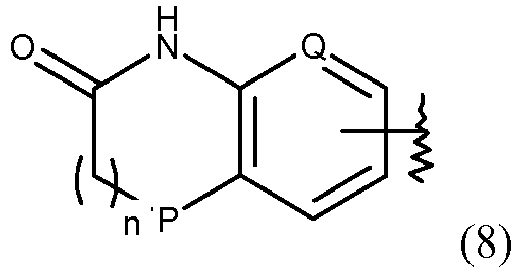
- P is CH2, NH, O, or S; Q/(8) is CH or N; and n is 0-2; or

- S/(9) and T(9) is C, or S/(9) is C and T(9) is N, or S/(9) is N and T/(9) is C;
- R is hydrogen, amino, methyl, trifluoromethyl, halo;
- U is hydrogen, halo, amino, cyano, nitro, trifluoromethyl, (C1-C8)alkyl, (C3-C8)cycloalkyl, -CORa, -CO2Ra, -CONRaRb, -SO2Ra, -SO2NRaRb, -NRaRb, -NRaC(O)Rb,-NRaSO2Rb, - NRaSO2NRaRb, -NRaNRaRb, -NRaNRaC(O)Rb, , -ORa, 4-(1H-pyrazol-4-yl),
- wherein any (C1-C8)alkyl, (C3-C8)cycloalkyl, group is optionally substituted by 1, 2 or 3 groups independently selected from (C1-C6)alkyl, (C3-C8)cycloalkyl, (C5-C8)cycloalkenyl, (C1-C6)haloalkyl, cyano, -CORa, -CO2Ra,-CONRaRb, -SRa, -SORa, -SO2Ra, -SO2NRaRb, nitro, -NRaRb, -NRaC(O)Rb, -NRaC(O)NRaRb, -NRaC(O)ORa, - NRaSO2Rb, -NRaSO2NRaRb, -ORa, -OC(O)Ra, -OC(O)NRaRb, wherein Ra and Rb are defined as above.
- Subgroup C
- X is methyl, ethyl, n-propyl, isopropyl , cyclopropyl, cyclobutyl, cyclopentyl, cyclohexyl, phenyl, trifluoromethyl, tetrahydropyran, hydroxymethyl, methoxymethyl, or benzyl;
- Y is H;
- Z is methyl, ethyl, n-propyl, isopropyl, trifluoromethyl, or benzyl;
- R1 is isopropyl, tert-butyl, cyclobutyl, cyclopentyl, cyclohexyl, (1-methylethyl)cyclopropyl, 1,1-dioxo-tetrahydrothiophene-3-yl, 1-Me-piperidin-4-yl, tetrahydrofuran-3-yl, tetrahydropyran-4-yl, N,N-dimethyl-1-propanaminyl, benzyl, or 4-pyridyl;
- R3 is H, methyl, or Br; and
- R6 is methyl, bis(1,1-dimethylethyl), bis(1-methylethyl), cyclopropyl, propyl, dimethylamino, ethylamino, (2-hydroxyethyl)amino, 2-propen-1-ylamino, 1-piperazinyl, 1-piperidinyl, 4-morpholinyl, 4-piperidinylamino, tetrahydro-2H-pyran-4-ylamino, phenylamino, (phenylmethyl)amino, (4-pyridinylmethyl)amino, [2-(2-pyridinylamino)ethyl]amino, 2-(dimethylamino)ethyl]amino, 4-pyridinylamino , 4-(aminocarbonyl)phenyl]amino, 3-hydroxy-3-methyl-1-butyn-1-yl, 4-pyridinylethynyl, phenylethynyl, 2-furanyl, 3-thienyl; 1H-pyrazol-4-yl, 1H-indazol-5-yl, 1H-indazol-6-yl, 3-methyl-1H-indazol-5-yl, 1H-1,2,3-benzotriazol-5-yl, 2-oxo-2,3-dihydro-1H-benzimidazol-5-yl, 2-oxo-2,3-dihydro-1H-indol-5-yl, 2-oxo-2,3-dihydro-1H-indol-6-yl, 2,1,3-benzoxadiazol-5-yl, 2-amino-6-quinazolinyl, 2,4-dioxo-1,2,3,4-tetrahydro-5-pyrimidinyl, 2-amino-5-pyrimidinyl, 7-oxo-1,5,6,7-tetrahydro-1,8-naphthyridin-3-yl, phenyl, 2-methylphenyl, 2-nitrophenyl, 2-phenylethyl, 3-aminophenyl, 4-aminophenyl, 4-chlorophenyl, 4-fluorophenyl, 4-(methyloxy)phenyl, 3-(acetylamino)phenyl, 4-(acetylamino)phenyl, 4-(aminocarbonyl)phenyl, 4-(1H-pyrazol-4-yl)phenyl, 4-(aminosulfonyl)phenyl, 4-(methylsulfonyl)phenyl, 4-[(dimethylamino)sulfonyl]phenyl, 4-[(methylamino)carbonyl]phenyl, 4-[(methylamino)sulfonyl]phenyl, 4-[(methylsulfonyl)amino]phenyl, 3-pyridinyl, 4-pyridinyl, 2-(4-morpholinyl)-4-pyridinyl, 2-amino-4-pyridinyl, 5-(methyloxy)-3-pyridinyl, 5-(methylsulfonyl)-3-pyridinyl, 5-[(cyclopropylsulfonyl)amino]-6-(methyloxy)-3-pyridinyl, 5-[(phenylsulfonyl)amino]-3-pyridinyl, 6-(4-methyl-1-piperazinyl)-3-pyridinyl, 6-(4-morpholinyl)-3-pyridinyl, 6-(acetylamino)-3-pyridinyl, 6-(dimethylamino)-3-pyridinyl, 6-(methyloxy)-3-pyridinyl, 6-[(methylamino)carbonyl]-3-pyridinyl, 6-[(methylamino)sulfonyl]-3-pyridinyl, 6-methyl-3-pyridinyl, 4-pyridinyloxy.
- Individual compounds can be found in the Examples set out below.
- By the term "co-administering" and derivatives thereof as used herein is meant either simultaneous administration or any manner of separate sequential administration of one or more additional pharmaceutically active compounds, whether for treating cancer, the side effects of cancer or cancer therapy, or some other disease. Preferably, if the administration is not simultaneous, the compounds are administered in a close time proximity to each other. Furthermore, it does not matter if the compounds are administered in the same dosage form, e.g. one compound may be administered topically and another compound may be administered orally.
- In certain embodiments, compounds according to Formula I may contain an acidic functional group, one acidic enough to form salts. Representative salts include pharmaceutically-acceptable metal salts such as sodium, potassium, lithium, calcium, magnesium, aluminum, and zinc salts; carbonates and bicarbonates of a pharmaceutically-acceptable metal cation such as sodium, potassium, lithium, calcium, magnesium, aluminum, and zinc; pharmaceutically-acceptable organic primary, secondary, and tertiary amines including aliphatic amines, aromatic amines, aliphatic diamines, and hydroxy alkylamines such as methylamine, ethylamine, 2-hydroxyethylamine, diethylamine, triethylamine, ethylenediamine, ethanolamine, diethanolamine, and cyclohexylamine.
- In certain embodiments, compounds according to Formula (I) may contain a basic functional group and are therefore capable of forming pharmaceutically-acceptable acid addition salts by treatment with a suitable acid. Suitable acids include pharmaceutically-acceptable inorganic acids and pharmaceutically-acceptable organic acids. Representative pharmaceutically-acceptable acid addition salts include hydrochloride, hydrobromide, nitrate, methylnitrate, sulfate, bisulfate, sulfamate, phosphate, acetate, hydroxyacetate, phenylacetate, propionate, butyrate, isobutyrate, valerate, maleate, hydroxymaleate, acrylate, fumarate, malate, tartrate, citrate, salicylate, p-aminosalicyclate, glycollate, lactate, heptanoate, phthalate, oxalate, succinate, benzoate, o-acetoxybenzoate, chlorobenzoate, methylbenzoate, dinitrobenzoate, hydroxybenzoate, methoxybenzoate, mandelate, tannate, formate, stearate, ascorbate, palmitate, oleate, pyruvate, pamoate, malonate, laurate, glutarate, glutamate, estolate, methanesulfonate (mesylate), ethanesulfonate (esylate), 2-hydroxyethanesulfonate, benzenesulfonate (besylate), p-aminobenzenesulfonate, p-toluenesulfonate (tosylate) and napthalene-2-sulfonate.
- All tautomeric forms of the compounds described herein, including mixtures thereof, are intended to be encompassed within the scope of the invention. Generally, the compounds exemplified herein have been assigned names based on the structure of the tautomer of formaula (IA). It should be understood that any reference to named compounds of this invention is intended to encompass all tautomers of the named compounds and any mixtures of tautomers of the named compounds.
- The compounds of formula (I) may be prepared in crystalline or non-crystalline form, and, if crystalline, may optionally be solvated, e.g. as the hydrate. This invention includes within its scope stoichiometric solvates (e.g. hydrates) as well as compounds containing variable amounts of solvent (e.g. water).
- Certain of the compounds described herein may contain one or more chiral atoms, or may otherwise be capable of existing as two enantiomers. The compounds claimed below include mixtures of enantiomers as well as purified enantiomers or enantiomerically enriched mixtures. Also included within the scope of the invention are the individual isomers of the compounds represented by formula (I), or claimed below, as well as any wholly or partially equilibrated mixtures thereof. The present invention also covers the individual isomers of the claimed compounds as mixtures with isomers thereof in which one or more chiral centers are inverted.
- Where there are different isomeric forms they may be separated or resolved one from the other by conventional methods, or any given isomer may be obtained by conventional synthetic methods or by stereospecific or asymmetric syntheses.
- While it is possible that, for use in therapy, a compound of formula (I), as well as salts, solvates and the like, may be administered as a neat preparation, i.e. no additional carrier, the more usual practice is to present the active ingredient confected with a carrier or diluent. Accordingly, the invention further provides pharmaceutical compositions, which includes a compound of formula (I) and salts, solvates and the like, and one or more pharmaceutically acceptable carriers, diluents, or excipients. The compounds of formula (I) and salts, solvates, etc, are as described above. The carrier(s), diluent(s) or excipient(s) must be acceptable in the sense of being compatible with the other ingredients of the formulation and not deleterious to the recipient thereof. In accordance with another aspect of the invention there is also provided a process for the preparation of a pharmaceutical formulation including admixing a compound of the formula (I), or salts, solvates etc, with one or more pharmaceutically acceptable carriers, diluents or excipients.
- It will be appreciated by those skilled in the art that certain protected derivatives of compounds of formula (I), which may be made prior to a final deprotection stage, may not possess pharmacological activity as such, but may, in certain instances, be administered orally or parenterally and thereafter metabolised in the body to form compounds of the invention which are pharmacologically active. Such derivatives may therefore be described as "prodrugs". Further, certain compounds of the invention may act as prodrugs of other compounds of the invention. All protected derivatives and prodrugs of compounds of the invention are included within the scope of the invention. It will further be appreciated by those skilled in the art, that certain moieties, known to those skilled in the art as "pro-moieties" may be placed on appropriate functionalities when such functionalities are present within compounds of the invention. Preferred prodrugs for compounds of the invention include: esters, carbonate esters, hemi-esters, phosphate esters, nitro esters, sulfate esters, sulfoxides, amides, carbamates, azo-compounds, phosphamides, glycosides, ethers, acetals and ketals.
- The compounds and compositions of the invention are used to treat cellular proliferation diseases. Disease states which can be treated by the methods and compositions provided herein include, but are not limited to, cancer (further discussed below), autoimmune disease, fungal disorders, arthritis, graft rejection, inflammatory bowel disease, proliferation induced after medical procedures, including, but not limited to, surgery, angioplasty, and the like. It is appreciated that in some cases the cells may not be in a hyper or hypo proliferation state (abnormal state) and still requires treatment. For example, during wound healing, the cells may be proliferating "normally", but proliferation enhancement may be desired. Thus, in one embodiment, the invention herein includes compounds for application to cells or individuals afflicted or impending affliction with any one of these disorders or states.
- The compositions provided herein are particularly deemed useful for the treatment of cancer including tumors such as prostate, breast, brain, skin, cervical carcinomas, testicular carcinomas, etc. They are particularly useful in treating metastatic or malignant tumors. More particularly, cancers that may be treated by the compositions and methods of the invention include, but are not limited to tumor types such as astrocytic, breast, cervical, colorectal, endometrial, esophageal, gastric, head and neck, hepatocellular, laryngeal, lung, oral, ovarian, prostate and thyroid carcinomas and sarcomas. More specifically, these compounds can be used to treat: Cardiac: sarcoma (angiosarcoma, fibrosarcoma, rhabdomyosarcoma, liposarcoma), myxoma, rhabdomyoma, fibroma, lipoma and teratoma; Lung: bronchogenic carcinoma (squamous cell, undifferentiated small cell, undifferentiated large cell, adenocarcinoma), alveolar (bronchiolar) carcinoma, bronchial adenoma, sarcoma, lymphoma, chondromatous hamartoma, mesothelioma; Gastrointestinal: esophagus (squamous cell carcinoma, adenocarcinoma, leiomyosarcoma, lymphoma), stomach (carcinoma, lymphoma, leiomyosarcoma), pancreas (ductal adenocarcinoma, insulinoma, glucagonoma, gastrinoma, carcinoid tumors, vipoma), small bowel (adenocarcinoma, lymphoma, carcinoid tumors, Karposi's sarcoma, leiomyoma, hemangioma, lipoma, neurofibroma, fibroma), large bowel (adenocarcinoma, tubular adenoma, villous adenoma, hamartoma, leiomyoma); Genitourinary tract: kidney (adenocarcinoma, Wilm's tumor (nephroblastoma), lymphoma, leukemia), bladder and urethra (squamous cell carcinoma, transitional cell carcinoma, adenocarcinoma), prostate (adenocarcinoma, sarcoma), testis (seminoma, teratoma, embryonal carcinoma, teratocarcinoma, choriocarcinoma, sarcoma, interstitial cell carcinoma, fibroma, fibroadenoma, adenomatoid tumors, lipoma); Liver: hepatoma (hepatocellular carcinoma), cholangiocarcinoma, hepatoblastoma, angiosarcoma, hepatocellular adenoma, hemangioma; Biliary tract: gall bladder carcinoma, ampullary carcinoma, cholangiocarcinoma; Bone: osteogenic sarcoma (osteosarcoma), fibrosarcoma, malignant fibrous histiocytoma, chondrosarcoma, Ewing's sarcoma, malignant lymphoma (reticulum cell sarcoma), multiple myeloma, malignant giant cell tumor chordoma, osteochronfroma (osteocartilaginous exostoses), benign chondroma, chondroblastoma, chondromyxofibroma, osteoid osteoma and giant cell tumors; Nervous system: skull (osteoma, hemangioma, granuloma, xanthoma, osteitis deformans), meninges (meningioma, meningiosarcoma, gliomatosis), brain (astrocytoma, medulloblastoma, glioma, ependymoma, germinoma (pinealoma), glioblastoma multiform, oligodendroglioma, schwannoma, retinoblastoma, congenital tumors), spinal cord neurofibroma, meningioma, glioma, sarcoma); Gynecological: uterus (endometrial carcinoma), cervix (cervical carcinoma, pre-tumor cervical dysplasia), ovaries (ovarian carcinoma (serous cystadenocarcinoma, mucinous cystadenocarcinoma, unclassified carcinoma), granulosa-thecal cell tumors, Sertoli-Leydig cell tumors, dysgerminoma, malignant teratoma), vulva (squamous cell carcinoma, intraepithelial carcinoma, adenocarcinoma, fibrosarcoma, melanoma), vagina (clear cell carcinoma, squamous cell carcinoma, botryoid sarcoma (embryonal rhabdomyosarcoma), fallopian tubes (carcinoma); Hematologic: blood (myeloid leukemia (acute and chronic), acute lymphoblastic leukemia, chronic lymphocytic leukemia, myeloproliferative diseases, multiple myeloma, myelodysplastic syndrome), Hodgkin's disease, non-Hodgkin's lymphoma (malignant lymphoma); Skin: malignant melanoma, basal cell carcinoma, squamous cell carcinoma, Karposi's sarcoma, moles dysplastic nevi, lipoma, angioma, dermatofibroma, keloids, psoriasis; and Adrenal glands: neuroblastoma. Thus, the term "cancerous cell" as provided herein, includes a cell afflicted by any one or related of the above identified conditions.
- The instant compounds can be combined with or co-administered with other therapeutic agents, particularly agents that may enhance the activity or time of disposition of the compounds. Combination therapies comprise the administration of at least one compound of the invention and the use of at least one other treatment method. In one embodiment, combination therapies comprise the administration of at least one compound of the invention and surgical therapy. In one embodiment, combination therapies comprise the administration of at least one compound of the invention and radiotherapy. In one embodiment, combination therapies comprise the administration of at least one compound of the invention and at least one supportive care agent (e.g., at least one anti-emetic agent). In one embodiment, combination therapies comprise the administration of at least one compound of the invention and at least one other chemotherapeutic agent. one particular embodiment, comprises the administration of at least one compound of the invention and at least one anti-neoplastic agent. yet another embodiment, comprises a therapeutic regimen where the EZH2 inhibitors of this disclosure are not in and of themselves active or significantly active, but when combined with another therapy, which may or may not be active as a standalone therapy, the combination provides a useful therapeutic outcome.
- By the term "co-administering" and derivatives thereof as used herein is meant either simultaneous administration or any manner of separate sequential administration of an EZH2 inhibiting compound, as described herein, and a further active ingredient or ingredients, known to be useful in the treatment of cancer, including chemotherapy and radiation treatment. The term further active ingredient or ingredients, as used herein, includes any compound or therapeutic agent known to or that demonstrates advantageous properties when administered to a patient in need of treatment for cancer. Preferably, if the administration is not simultaneous, the compounds are administered in a close time proximity to each other. Furthermore, it does not matter if the compounds are administered in the same dosage form, e.g. one compound may be administered topically and another compound may be administered orally.
- Typically, any anti-neoplastic agent that has activity versus a susceptible tumor being treated may be co-administered in the treatment of specified cancers in the present invention. Examples of such agents can be found in Cancer Principles and Practice of Oncology by V.T. Devita and S. Hellman (editors), 6th edition (February 15, 2001), Lippincott Williams & Wilkins Publishers. A person of ordinary skill in the art would be able to discern which combinations of agents would be useful based on the particular characteristics of the drugs and the cancer involved. Typical anti-neoplastic agents useful in the present invention include, but are not limited to, anti-microtubule agents such as diterpenoids and vinca alkaloids; platinum coordination complexes; alkylating agents such as nitrogen mustards, oxazaphosphorines, alkylsulfonates, nitrosoureas, and triazenes; antibiotic agents such as anthracyclins, actinomycins and bleomycins; topoisomerase II inhibitors such as epipodophyllotoxins; antimetabolites such as purine and pyrimidine analogues and anti-folate compounds; topoisomerase I inhibitors such as camptothecins; hormones and hormonal analogues; DNA methyltransferase inhibitors such as azacitidine and decitabine; signal transduction pathway inhibitors; non-receptor tyrosine kinase angiogenesis inhibitors; immunotherapeutic agents; proapoptotic agents; and cell cycle signaling inhibitors.
- Typically, any chemotherapeutic agent that has activity against a susceptible neoplasm being treated may be utilized in combination with the compounds the invention, provided that the particular agent is clinically compatible with therapy employing a compound of the invention. Typical anti-neoplastic agents useful in the present invention include, but are not limited to: alkylating agents, anti-metabolites, antitumor antibiotics, antimitotic agents, nucleoside analogues, topoisomerase I and II inhibitors, hormones and hormonal analogues; retinoids, histone deacetylase inhibitors; signal transduction pathway inhibitors including inhibitors of cell growth or growth factor function, angiogenesis inhibitors, and serine/threonine or other kinase inhibitors; cyclin dependent kinase inhibitors; antisense therapies and immunotherapeutic agents, including monoclonals, vaccines or other biological agents.
- Nucleoside analogues are those compounds which are converted to deoxynucleotide triphosphates and incorporated into replicating DNA in place of cytosine. DNA methyltransferases become covalently bound to the modified bases resulting in an inactive enzyme and reduced DNA methylation. Examples of nucleoside analogues include azacitidine and decitabine which are used for the treatment of myelodysplastic disorder.Histone deacetylase (HDAC) inhibitors include vorinostat, for the treatment of cutaneous T-cell lymphoma. HDACs modify chromatin through the deactylation of histones. In addition, they have a variety of substrates including numerous transcription factors and signaling molecules. Other HDAC inhibitors are in development.
- Signal transduction pathway inhibitors are those inhibitors which block or inhibit a chemical process which evokes an intracellular change. As used herein this change is cell proliferation or differentiation or survival. Signal transduction pathway inhibitors useful in the present invention include, but are not limited to, inhibitors of receptor tyrosine kinases, non-receptor tyrosine kinases, SH2/SH3 domain blockers, serine/threonine kinases, phosphatidyl inositol-3-OH kinases, myoinositol signaling, and Ras oncogenes. Signal transduction pathway inhibitors may be employed in combination with the compounds of the invention in the compositions and methods described above.
- Receptor kinase angiogenesis inhibitors may also find use in the present invention. Inhibitors of angiogenesis related to VEGFR and TIE-2 are discussed above in regard to signal transduction inhibitors (both are receptor tyrosine kinases). Other inhibitors may be used in combination with the compounds of the invention. For example, anti-VEGF antibodies, which do not recognize VEGFR (the receptor tyrosine kinase), but bind to the ligand; small molecule inhibitors of integrin (alphav beta3) that inhibit angiogenesis; endostatin and angiostatin (non-RTK) may also prove useful in combination with the compounds of the invention. One example of a VEGFR antibody is bevacizumab (AVASTIN®).
- Several inhibitors of growth factor receptors are under development and include ligand antagonists, antibodies, tyrosine kinase inhibitors, anti-sense oligonucleotides and aptamers. Any of these growth factor receptor inhibitors may be employed in combination with the compounds of the invention in any of the compositions and methods/uses described herein. Trastuzumab (Herceptin®) is an example of an anti-erbB2 antibody inhibitor of growth factor function. One example of an anti-erbB1 antibody inhibitor of growth factor function is cetuximab (Erbitux™, C225). Bevacizumab (Avastin®) is an example of a monoclonal antibody directed against VEGFR. Examples of small molecule inhibitors of epidermal growth factor receptors include but are not limited to lapatinib (Tykerb™) and erlotinib (TARCEVA®). Imatinib mesylate (GLEEVEC®) is one example of a PDGFR inhibitor. Examples of VEGFR inhibitors include pazopanib, ZD6474, AZD2171, PTK787, sunitinib and sorafenib.
- Anti-microtubule or anti-mitotic agents are phase specific agents active against the microtubules of tumor cells during M or the mitosis phase of the cell cycle. Examples of anti-microtubule agents include, but are not limited to, diterpenoids and vinca alkaloids.
- Diterpenoids, which are derived from natural sources, are phase specific anti -cancer agents that operate at the G2/M phases of the cell cycle. It is believed that the diterpenoids stabilize the β-tubulin subunit of the microtubules, by binding with this protein. Disassembly of the protein appears then to be inhibited with mitosis being arrested and cell death following. Examples of diterpenoids include, but are not limited to, paclitaxel and its analog docetaxel.
- Paclitaxel, 5β,20-epoxy-1,2α,4,7β,10β,13α-hexa-hydroxytax-11-en-9-one 4,10-diacetate 2-benzoate 13-ester with (2R,3S)-N-benzoyl-3-phenylisoserine; is a natural diterpene product isolated from the Pacific yew tree Taxus brevifolia and is commercially available as an injectable solution TAXOL®. It is a member of the taxane family of terpenes. It was first isolated in 1971 by Wani et al. J. Am. Chem, Soc., 93:2325. 1971), who characterized its structure by chemical and X-ray crystallographic methods. One mechanism for its activity relates to paclitaxel's capacity to bind tubulin, thereby inhibiting cancer cell growth. Schiff et al., Proc. Natl, Acad, Sci. USA, 77:1561-1565 (1980); Schiff et al., Nature, 277:665-667 (1979); Kumar, J. Biol, Chem, 256: 10435-10441 (1981). For a review of synthesis and anticancer activity of some paclitaxel derivatives see: D. G. 1. Kingston et al., Studies in Organic Chemistry vol. 26, entitled "New trends in Natural Products Chemistry 1986", Attaur-Rahman, P.W. Le Quesne, Eds. (Elsevier, Amsterdam, 1986) pp 219-235.
- Paclitaxel has been approved for clinical use in the treatment of refractory ovarian cancer in the United States (Markman et al., Yale Journal of Biology and Medicine, 64:583, 1991; McGuire et al., Ann. Intem, Med., 111:273,1989) and for the treatment of breast cancer (Holmes et al., J. Nat. Cancer Inst., 83:1797,1991.) It is a potential candidate for treatment of neoplasms in the skin (Einzig et. al., Proc. Am. Soc. Clin. Oncol., 20:46) and head and neck carcinomas (Forastire et. al., Sem. Oncol., 20:56, 1990). The compound also shows potential for the treatment of polycystic kidney disease (Woo et. al., Nature, 368:750. 1994), lung cancer and malaria. Treatment of patients with paclitaxel results in bone marrow suppression (multiple cell lineages, Ignoff, R.J. et. al, Cancer Chemotherapy Pocket Guide, 1998) related to the duration of dosing above a threshold concentration (50nM) (Kearns, C.M. et. al., Seminars in Oncology, 3(6) p.16-23, 1995).
- Docetaxel, (2R,3S)-N-carboxy-3-phenylisoserine,N-tert-butyl ester, 13-ester with 5β-20-epoxy-1,2a,4,7α,10β,13α-hexahydroxytax-11-en-9-one 4-acetate 2-benzoate, trihydrate; is commercially available as an injectable solution as TAXOTERE®. Docetaxel is indicated for the treatment of breast cancer. Docetaxel is a semisynthetic derivative of paclitaxel q.v., prepared using a natural precursor, 10-deacetyl-baccatin III, extracted from the needle of the European Yew tree. The dose limiting toxicity of docetaxel is neutropenia.
- Vinca alkaloids are phase specific anti-neoplastic agents derived from the periwinkle plant. Vinca alkaloids act at the M phase (mitosis) of the cell cycle by binding specifically to tubulin. Consequently, the bound tubulin molecule is unable to polymerize into microtubules. Mitosis is believed to be arrested in metaphase with cell death following. Examples of vinca alkaloids include, but are not limited to, vinblastine, vincristine, and vinorelbine.
- Vinblastine, vincaleukoblastine sulfate, is commercially available as VELBAN® as an injectable solution. Although, it has possible indication as a second line therapy of various solid tumors, it is primarily indicated in the treatment of testicular cancer and various lymphomas including Hodgkin's Disease; and lymphocytic and histiocytic lymphomas. Myelosuppression is the dose limiting side effect of vinblastine.
- Vincristine, vincaleukoblastine, 22-oxo-, sulfate, is commercially available as ONCOVIN® as an injectable solution. Vincristine is indicated for the treatment of acute leukemias and has also found use in treatment regimens for Hodgkin's and non-Hodgkin's malignant lymphomas. Alopecia and neurologic effects are the most common side effect of vincristine and to a lesser extent myelosupression and gastrointestinal mucositis effects occur.
- Vinorelbine, 3',4'-didehydro -4'-deoxy-C'-norvincaleukoblastine [R-(R*,R*)-2,3-dihydroxybutanedioate (1:2)(salt)], commercially available as an injectable solution ofvinorelbine tartrate (NAVELBINE®), is a semisynthetic vinca alkaloid. Vinorelbine is indicated as a single agent or in combination with other chemotherapeutic agents, such as cisplatin, in the treatment of various solid tumors, particularly non-small cell lung, advanced breast, and hormone refractory prostate cancers. Myelosuppression is the most common dose limiting side effect of vinorelbine.
- Platinum coordination complexes are non-phase specific anti-cancer agents, which are interactive with DNA. The platinum complexes enter tumor cells, undergo, aquation and form intra- and interstrand crosslinks with DNA causing adverse biological effects to the tumor. Examples of platinum coordination complexes include, but are not limited to, cisplatin and carboplatin.
- Cisplatin, cis-diamminedichloroplatinum, is commercially available as PLATINOL® as an injectable solution. Cisplatin is primarily indicated in the treatment of metastatic testicular and ovarian cancer and advanced bladder cancer. The primary dose limiting side effects of cisplatin are nephrotoxicity, which may be controlled by hydration and diuresis, and ototoxicity.
- Carboplatin, platinum, diammine [1,1-cyclobutane-dicarboxylate(2-)-O,O'], is commercially available as PARAPLATIN® as an injectable solution. Carboplatin is primarily indicated in the first and second line treatment of advanced ovarian carcinoma. Bone marrow suppression is the dose limiting toxicity of carboplatin.
- Alkylating agents are non-phase anti-cancer specific agents and strong electrophiles. Typically, alkylating agents form covalent linkages, by alkylation, to DNA through nucleophilic moieties of the DNA molecule such as phosphate, amino, sulfhydryl, hydroxyl, carboxyl, and imidazole groups. Such alkylation disrupts nucleic acid function leading to cell death. Examples of alkylating agents include, but are not limited to, nitrogen mustards such as cyclophosphamide, melphalan, and chlorambucil; alkyl sulfonates such as busulfan; nitrosoureas such as carmustine; and triazenes such as dacarbazine.
- Cyclophosphamide, 2-[bis(2-chloroethyl)amino]tetrahydro-2H-1,3,2-oxazaphosphorine 2-oxide monohydrate, is commercially available as an injectable solution or tablets as CYTOXAN®. Cyclophosphamide is indicated as a single agent or in combination with other chemotherapeutic agents, in the treatment of malignant lymphomas, multiple myeloma, and leukemias. Alopecia, nausea, vomiting and leukopenia are the most common dose limiting side effects of cyclophosphamide.
- Melphalan, 4-[bis(2-chloroethyl)amino]-L-phenylalanine, is commercially available as an injectable solution or tablets as ALKERAN®. Melphalan is indicated for the palliative treatment of multiple myeloma and non-resectable epithelial carcinoma of the ovary. Bone marrow suppression is the most common dose limiting side effect of melphalan.
- Chlorambucil, 4-[bis(2-chloroethyl)amino]benzenebutanoic acid, is commercially available as LEUKERAN® tablets. Chlorambucil is indicated for the palliative treatment of chronic lymphatic leukemia, and malignant lymphomas such as lymphosarcoma, giant follicular lymphoma, and Hodgkin's disease. Bone marrow suppression is the most common dose limiting side effect of chlorambucil.
- Busulfan, 1,4-butanediol dimethanesulfonate, is commercially available as MYLERAN® TABLETS. Busulfan is indicated for the palliative treatment of chronic myelogenous leukemia. Bone marrow suppression is the most common dose limiting side effects of busulfan.
- Carmustine, 1,3-[bis(2-chloroethyl)-1-nitrosourea, is commercially available as single vials of lyophilized material as BiCNU®. Carmustine is indicated for the palliative treatment as a single agent or in combination with other agents for brain tumors, multiple myeloma, Hodgkin's disease, and non-Hodgkin's lymphomas. Delayed myelosuppression is the most common dose limiting side effects of carmustine.
- Dacarbazine, 5-(3,3-dimethyl-1-triazeno)-imidazole-4-carboxamide, is commercially available as single vials of material as DTIC-Dome®. Dacarbazine is indicated for the treatment of metastatic malignant melanoma and in combination with other agents for the second line treatment of Hodgkin's Disease. Nausea, vomiting, and anorexia are the most common dose limiting side effects of dacarbazine.
- Antibiotic anti-neoplastics are non-phase specific agents, which bind or intercalate with DNA. Typically, such action results in stable DNA complexes or strand breakage, which disrupts ordinary function of the nucleic acids leading to cell death. Examples of antibiotic anti-neoplastic agents include, but are not limited to, actinomycins such as dactinomycin, anthrocyclins such as daunorubicin and doxorubicin; and bleomycins.
- Dactinomycin, also know as Actinomycin D, is commercially available in injectable form as COSMEGEN®. Dactinomycin is indicated for the treatment of Wilm's tumor and rhabdomyosarcoma. Nausea, vomiting, and anorexia are the most common dose limiting side effects of dactinomycin.
- Daunorubicin, (8S-cis-)-8-acetyl-10-[(3-amino-2,3,6-trideoxy-a-L-lyxo-hexopyranosyl)oxy]-7,8,9,10-tetrahydro-6,8,11-trihydroxy-1-methoxy-5,12 naphthacenedione hydrochloride, is commercially available as a liposomal injectable form as DAUNOXOME® or as an injectable as CERUBIDINE®. Daunorubicin is indicated for remission induction in the treatment of acute nonlymphocytic leukemia and advanced HIV associated Kaposi's sarcoma. Myelosuppression is the most common dose limiting side effect of daunorubicin.
- Doxorubicin, (8S, 10S)-10-[(3-amino-2,3,6-trideoxy-α-L-lyxo-hexopyranosyl)oxy]-8-glycoloyl, 7,8,9,10-tetrahydro-6,8,11-trihydroxy-1-methoxy-5,12 naphthacenedione hydrochloride, is commercially available as an injectable form as RUBEX® or ADRIAMYCIN RDF®. Doxorubicin is primarily indicated for the treatment of acute lymphoblastic leukemia and acute myeloblastic leukemia, but is also a useful component in the treatment of some solid tumors and lymphomas. Myelosuppression is the most common dose limiting side effect of doxorubicin.
- Bleomycin, a mixture of cytotoxic glycopeptide antibiotics isolated from a strain of Streptonyces verticillus, is commercially available as BLENOXANE®. Bleomycin is indicated as a palliative treatment, as a single agent or in combination with other agents, of squamous cell carcinoma, lymphomas, and testicular carcinomas. Pulmonary and cutaneous toxicities are the most common dose limiting side effects of bleomycin.
- Topoisomerase II inhibitors include, but are not limited to, epipodophyllotoxins.
- Epipodophyllotoxins are phase specific anti-neoplastic agents derived from the mandrake plant. Epipodophyllotoxins typically affect cells in the S and G2 phases of the cell cycle by forming a ternary complex with topoisomerase II and DNA causing DNA strand breaks. The strand breaks accumulate and cell death follows. Examples of epipodophyllotoxins include, but are not limited to, etoposide and teniposide.
- Etoposide, 4'-demethyl-epipodophyllotoxin 9[4,6-0-(R)-ethylidene-β-D-glucopyranoside], is commercially available as an injectable solution or capsules as VePESID® and is commonly known as VP-16. Etoposide is indicated as a single agent or in combination with other chemotherapy agents in the treatment of testicular and non-small cell lung cancers. Myelosuppression is the most common side effect of etoposide. The incidence of leucopenia tends to be more severe than thrombocytopenia.
- Teniposide, 4'-demethyl-epipodophyllotoxin 9[4,6-0-(R)-thenylidene-β-D-glucopyranoside], is commercially available as an injectable solution as VUMON® and is commonly known as VM-26. Teniposide is indicated as a single agent or in combination with other chemotherapy agents in the treatment of acute leukemia in children. Myelosuppression is the most common dose limiting side effect of teniposide. Teniposide can induce both leucopenia and thrombocytopenia.
- Antimetabolite neoplastic agents are phase specific anti-neoplastic agents that act at S phase (DNA synthesis) of the cell cycle by inhibiting DNA synthesis or by inhibiting purine or pyrimidine base synthesis and thereby limiting DNA synthesis. Consequently, S phase does not proceed and cell death follows. Examples of antimetabolite anti-neoplastic agents include, but are not limited to, fluorouracil, methotrexate, cytarabine, mecaptopurine, thioguanine, and gemcitabine.
- 5-fluorouracil, 5-fluoro-2,4- (1H,3H) pyrimidinedione, is commercially available as fluorouracil. Administration of 5-fluorouracil leads to inhibition of thymidylate synthesis and is also incorporated into both RNA and DNA. The result typically is cell death. 5-fluorouracil is indicated as a single agent or in combination with other chemotherapy agents in the treatment of carcinomas of the breast, colon, rectum, stomach and pancreas. Myelosuppression and mucositis are dose limiting side effects of 5-fluorouracil. Other fluoropyrimidine analogs include 5-fluoro deoxyuridine (floxuridine) and 5-fluorodeoxyuridine monophosphate.
- Cytarabine, 4-amino-1-β-D-arabinofuranosyl-2 (1H)-pyrimidinone, is commercially available as CYTOSAR-U® and is commonly known as Ara-C. It is believed that cytarabine exhibits cell phase specificity at S-phase by inhibiting DNA chain elongation by terminal incorporation of cytarabine into the growing DNA chain. Cytarabine is indicated as a single agent or in combination with other chemotherapy agents in the treatment of acute leukemia. Other cytidine analogs include 5-azacytidine and 2',2'-difluorodeoxycytidine (gemcitabine). Cytarabine induces leucopenia, thrombocytopenia, and mucositis.
- Mercaptopurine, 1,7-dihydro-6H-purine-6-thione monohydrate, is commercially available as PURINETHOL®. Mercaptopurine exhibits cell phase specificity at S-phase by inhibiting DNA synthesis by an as of yet unspecified mechanism. Mercaptopurine is indicated as a single agent or in combination with other chemotherapy agents in the treatment of acute leukemia. Myelosuppression and gastrointestinal mucositis are expected side effects of mercaptopurine at high doses. A useful mercaptopurine analog is azathioprine.
- Thioguanine, 2-amino-1,7-dihydro-6H-purine-6-thione, is commercially available as TABLOID®. Thioguanine exhibits cell phase specificity at S-phase by inhibiting DNA synthesis by an as of yet unspecified mechanism. Thioguanine is indicated as a single agent or in combination with other chemotherapy agents in the treatment of acute leukemia. Myelosuppression, including leucopenia, thrombocytopenia, and anemia, is the most common dose limiting side effect of thioguanine administration. However, gastrointestinal side effects occur and can be dose limiting. Other purine analogs include pentostatin, erythrohydroxynonyladenine, fludarabine phosphate, and cladribine.
- Gemcitabine, 2'-deoxy-2', 2'-difluorocytidine monohydrochloride (β-isomer), is commercially available as GEMZAR®. Gemcitabine exhibits cell phase specificity at S-phase and by blocking progression of cells through the G1/S boundary. Gemcitabine is indicated in combination with cisplatin in the treatment of locally advanced non-small cell lung cancer and alone in the treatment of locally advanced pancreatic cancer. Myelosuppression, including leucopenia, thrombocytopenia, and anemia, is the most common dose limiting side effect of gemcitabine administration.
- Methotrexate, N-[4[[(2,4-diamino-6-pteridinyl) methyl]methylamino] benzoyl]-L-glutamic acid, is commercially available as methotrexate sodium. Methotrexate exhibits cell phase effects specifically at S-phase by inhibiting DNA synthesis, repair and/or replication through the inhibition of dyhydrofolic acid reductase which is required for synthesis of purine nucleotides and thymidylate. Methotrexate is indicated as a single agent or in combination with other chemotherapy agents in the treatment of choriocarcinoma, meningeal leukemia, non-Hodgkin's lymphoma, and carcinomas of the breast, head, neck, ovary and bladder. Myelosuppression (leucopenia, thrombocytopenia, and anemia) and mucositis are expected side effect of methotrexate administration.
- Camptothecins, including, camptothecin and camptothecin derivatives are available or under development as Topoisomerase I inhibitors. Camptothecins cytotoxic activity is believed to be related to its Topoisomerase I inhibitory activity. Examples of camptothecins include, but are not limited to irinotecan, topotecan, and the various optical forms of 7-(4-methylpiperazino-methylene)-10, 11-ethylenedioxy-20-camptothecin described below.
- Irinotecan HCl, (4S)-4,11-diethyl-4-hydroxy-9-[(4-piperidinopiperidino) carbonyloxy]-1H-pyrano[3',4',6,7]indolizino[1,2-b]quinoline-3,14(4H,12H)-dione hydrochloride, is commercially available as the injectable solution CAMPTOSAR®.
- Irinotecan is a derivative of camptothecin which binds, along with its active metabolite SN-38, to the topoisomerase I - DNA complex. It is believed that cytotoxicity occurs as a result of irreparable double strand breaks caused by interaction of the topoisomerase I : DNA : irintecan or SN-38 ternary complex with replication enzymes. Irinotecan is indicated for treatment of metastatic cancer of the colon or rectum. The dose limiting side effects of irinotecan HCl are myelosuppression, including neutropenia, and GI effects, including diarrhea.
- Topotecan HCl, (S)-10-[(dimethylamino)methyl]-4-ethyl-4,9-dihydroxy-1H-pyrano[3',4',6,7]indolizino[1,2-b]quinoline-3,14-(4H,12H)-dione monohydrochloride, is commercially available as the injectable solution HYCAMTIN®. Topotecan is a derivative of camptothecin which binds to the topoisomerase I - DNA complex and prevents religation of singles strand breaks caused by Topoisomerase I in response to torsional strain of the DNA molecule. Topotecan is indicated for second line treatment of metastatic carcinoma of the ovary and small cell lung cancer. The dose limiting side effect of topotecan HCl is myelosuppression, primarily neutropenia.
- Pharmaceutical compositions may be presented in unit dose forms containing a predetermined amount of active ingredient per unit dose. Such a unit may contain, for example, 0.5 mg to 1 g, preferably 1 mg to 700 mg, more preferably 5 mg to 100 mg of a compound of the formula (I), depending on the condition being treated, the route of administration and the age, weight and condition of the patient, or pharmaceutical compositions may be presented in unit dose forms containing a predetermined amount of active ingredient per unit dose. Preferred unit dosage compositions are those containing a daily dose or sub-dose, as herein above recited, or an appropriate fraction thereof, of an active ingredient. Furthermore, such pharmaceutical compositions may be prepared by any of the methods well known in the pharmacy art.
- Pharmaceutical compositions may be adapted for administration by any appropriate route, for example by the oral (including buccal or sublingual), rectal, nasal, topical (including buccal, sublingual or transdermal), vaginal or parenteral (including subcutaneous, intramuscular, intravenous or intradermal) route. Such compositions may be prepared by any method known in the art of pharmacy, for example by bringing into association a compound of formal (I) with the carrier(s) or excipient(s).
- Pharmaceutical compositions adapted for oral administration may be presented as discrete units such as capsules or tablets; powders or granules; solutions or suspensions in aqueous or non-aqueous liquids; edible foams or whips; or oil-in-water liquid emulsions or water-in-oil liquid emulsions.
- Capsules are made by preparing a powder mixture, as described above, and filling formed gelatin sheaths. Glidants and lubricants such as colloidal silica, talc, magnesium stearate, calcium stearate or solid polyethylene glycol can be added to the powder mixture before the filling operation. A disintegrating or solubilizing agent such as agar-agar, calcium carbonate or sodium carbonate can also be added to improve the availability of the medicament when the capsule is ingested.
- Moreover, when desired or necessary, suitable binders, lubricants, disintegrating agents and coloring agents can also be incorporated into the mixture. Suitable binders include starch, gelatin, natural sugars such as glucose or beta-lactose, corn sweeteners, natural and synthetic gums such as acacia, tragacanth or sodium alginate, carboxymethylcellulose, polyethylene glycol, waxes and the like. Lubricants used in these dosage forms include sodium oleate, sodium stearate, magnesium stearate, sodium benzoate, sodium acetate, sodium chloride and the like. Disintegrators include, without limitation, starch, methyl cellulose, agar, bentonite, xanthan gum and the like. Tablets are formulated, for example, by preparing a powder mixture, granulating or slugging, adding a lubricant and disintegrant and pressing into tablets. A powder mixture is prepared by mixing the compound, suitably comminuted, with a diluent or base as described above, and optionally, with a binder such as carboxymethylcellulose, an aliginate, gelatin, or polyvinyl pyrrolidone, a solution retardant such as paraffin, a resorption accelerator such as a quaternary salt and/or an absorption agent such as bentonite, kaolin or dicalcium phosphate. The powder mixture can be granulated by tablet forming dies by means of the addition of stearic acid, a stearate salt, talc or mineral oil. The lubricated mixture is then compressed into tablets. The compounds of the present invention can also be combined with a free flowing inert carrier and compressed into tablets directly without going through the granulating or slugging steps. A clear or opaque protective coating consisting of a sealing coat of shellac, a coating of sugar or polymeric material and a polish coating of wax can be provided. Dyestuffs can be added to these coatings to distinguish different unit dosages.
- Oral fluids such as solution, syrups and elixirs can be prepared in dosage unit form so that a given quantity contains a predetermined amount of a compound of formula (I). Syrups can be prepared by dissolving the compound in a suitably flavored aqueous solution, while elixirs are prepared through the use of a non-toxic alcoholic vehicle. Suspensions can be formulated by dispersing the compound in a non-toxic vehicle. Solubilizers and emulsifiers such as ethoxylated isostearyl alcohols and polyoxy ethylene sorbitol ethers, preservatives, flavor additive such as peppermint oil or natural sweeteners or saccharin or other artificial sweeteners, and the like can also be added.
- Where appropriate, dosage unit pharmaceutical compositions for oral administration can be microencapsulated. The formulation can also be prepared to prolong or sustain the release as for example by coating or embedding particulate material in polymers, wax or the like.
- Pharmaceutical compositions adapted for rectal administration may be presented as suppositories or as enemas.
- Pharmaceutical compositions adapted for vaginal administration may be presented as pessaries, tampons, creams, gels, pastes, foams or spray formulations.
- Pharmaceutical formulations adapted for parenteral administration include aqueous and non-aqueous sterile injection solutions which may contain anti-oxidants, buffers, bacteriostats and solutes which render the composition isotonic with the blood of the intended recipient; and aqueous and non-aqueous sterile suspensions which may include suspending agents and thickening agents. The pharmaceutical compositions may be presented in unit-dose or multi-dose containers, for example sealed ampoules and vials, and may be stored in a freeze-dried (lyophilized) condition requiring only the addition of the sterile liquid carrier, for example water for injections, immediately prior to use. Extemporaneous injection solutions and suspensions may be prepared from sterile powders, granules and tablets.
- It should be understood that in addition to the ingredients particularly mentioned above, the pharmaceutical compositions may include other agents conventional in the art having regard to the type of formulation in question, for example those suitable for oral administration may include flavouring agents.
- A therapeutically effective amount of a compound of the present invention will depend upon a number of factors including, for example, the age and weight of the intended recipient, the precise condition requiring treatment and its severity, the nature of the formulation, and the route of administration, and will ultimately be at the discretion of the attendant prescribing the medication. However, an effective amount of a compound of formula (I) for the treatment of anemia will generally be in the range of 0.001 to 100 mg/kg body weight of recipient per day, suitably in the range of .01 to 10 mg/kg body weight per day. For a 70kg adult mammal, the actual amount per day would suitably be from 7 to 700 mg and this amount may be given in a single dose per day or in a number (such as two, three, four, five or six) of sub-doses per day such that the total daily dose is the same. An effective amount of a salt or solvate, etc., may be determined as a proportion of the effective amount of the compound of formula (I) per se. It is envisaged that similar dosages would be appropriate for treatment of the other conditions referred to above.
- The compounds of this invention may be made by a variety of methods, including standard chemistry. Any previously defined variable will continue to have the previously defined meaning unless otherwise indicated. Illustrative general synthetic methods are set out below and then specific compounds of the invention as prepared are given in the examples.
- Compounds of general formula (I) may be prepared by methods known in the art of organic synthesis as set forth in part by the following synthesis schemes. In all of the schemes described below, it is well understood that protecting groups for sensitive or reactive groups are employed where necessary in accordance with general principles of chemistry. Protecting groups are manipulated according to standard methods of organic synthesis (T. W. Green and P. G. M. Wuts (1991) Protecting Groups in Organic Synthesis, John Wiley & Sons). These groups are removed at a convenient stage of the compound synthesis using methods that are readily apparent to those skilled in the art. The selection of processes as well as the reaction conditions and order of their execution shall be consistent with the preparation of compounds of formula (I). Those skilled in the art will recognize if a stereocenter exists in compounds of formula (I). Accordingly, the present invention includes both possible stereoisomers and includes not only racemic compounds but the individual enantiomers as well. When a compound is desired as a single enantiomer, it may be obtained by stereospecific synthesis or by resolution of the final product or any convenient intermediate. Resolution of the final product, an intermediate, or a starting material may be effected by any suitable method known in the art. See, for example, Stereochemistry of Organic Compounds by E. L. Eliel, S. H. Wilen, and L. N. Mander (Wiley-Interscience, 1994).
- The following abbreviations are used throughout the experimental and have the following meaning:
- aq
- aqueous
- BINAP
- 2,2'-bis(diphenylphosphino) -1,1'-binapthyl
- ca.
- circa
- CDCl3-d
- chloroform-d
- CD3OD-d 4
- methanol-d 4
- Cs2CO3
- cesium carbonate
- CHCl3
- chloroform
- ACN
- acetonitrile
- CH3CN
- acetonitrile
- Celite®
- registered trademark of Celite Corp. brand of diatomaceous earth
- DBU
- 1,8-diazabicyclo[5.4.0]undeca-7-ene
- DCE
- dichloroethane
- DCM
- methylene chloride
- DME
- 1,2 dimethoxyethane
- DMF
- N,N-dimethyl formamide
- DIEA
- diisopropyl ethylamine
- DMSO-d 6
- dimethylsulfoxide-d 6
- EtOAc
- ethyl acetate
- EDC
- 1-(3-dimethylaminopropyl)-3-ethylcarbodimmide hydrochloride
- h
- hour(s)
- 1H NMR
- proton nuclear magnetic resonance
- HCl
- hydrochloric acid
- HOAT
- 1-hydroxy-7-azabenzotriazole
- HPLC
- high performance liquid chromatography
- IPA
- 2-propanol
- K2CO3
- potassium carbonate
- KOH
- potassium hydroxide
- LC/MS
- liquid chromatography/mass spectroscopy
- MgSO4
- magnesium sulfate
- MeOH
- methanol
- min
- minute(s)
- MTBE
- methyl tert-butyl ether
- MS
- mass spectrometry
- NaOH
- sodium hydroxide
- Na2SO4
- sodium sulfate
- NH4OH
- ammonium hydroxide
- NMM
- 4-methylmorpholine
- NMP
- N-methyl-2-pyrrolidone
- Pd/C
- palladium (10% by wt) on carbon
- PdCl2(dppf)-CH2Cl2
- 1,1'-bis(diphenylphosphino)ferrocene-palladium(II)dichloride dichloromethane complex
- Pd(Ph3P)4
- tetrakis(triphenylphosphine)palladium(0)
- SOCl2
- thionyl chloride
- SPhos
- 2-dicyclohexylphosphino-2',6'-dimethoxybiphenyl
- TFA
- trifluoroacetic acd
- THF
- tetrahydrofuran
- TLC
- thin layer chromatography
- The following guidelines apply to all experimental procedures described herein. All reactions were conducted under a positive pressure of nitrogen using oven-dried glassware, unless otherwise indicated. Temperatures designated are external (i.e. bath temperatures), and are approximate. Air and moisture-sensitive liquids were transferred via syringe. Reagents were used as received. Solvents utilized were those listed as "anhydrous" by vendors. Molarities listed for reagents in solutions are approximate, and were used without prior titration against a corresponding standard. All reactions were agitated by stir bar, unless otherwise indicated. Heating was conducted using heating baths containing silicon oil, unless otherwise indicated. Reactions conducted by microwave irradiation (0 - 400 W at 2.45 GHz) were done so using a Biotage Initiator™ 2.0 instrument with Biotage microwave EXP vials (0.2 - 20 mL) and septa and caps. Irradiation levels utilized (i.e. high, normal, low) based on solvent and ionic charge were based on vendor specifications. Cooling to temperatures below -70 °C was conducted using dry ice/acetone or dry ice/2-propanol. Magnesium sulfate and sodium sulfate used as drying agents were of anhydrous grade, and were used interchangeably. Solvents described as being removed "in vacuo " or "under reduced pressure" were done so by rotary evaporation.
- Preparative normal phase silica gel chromatography was carried out using either a Teledyne ISCO CombiFlash Companion instrument with RediSep or ISCO Gold silica gel cartridges (4 g-330 g), or an Analogix IF280 instrument with SF25 silica gel cartridges (4 g - 3-00g), or a Biotage SP1 instrument with HP silica gel cartridges (10g - 100 g). Purification by reverse phase HPLC was conducted using a YMC-pack column (ODS-A 75x30mm) as solid phase, unless otherwise noted. A mobile phase of 25mL/min A (acetonitrile-0.1%TFA) : B (water-0.1% TFA), 10-80% gradient A (10 min) was utilized, with UV detection at 214 nM, unless otherwise noted.
- A PE Sciex API 150 single quadrupole mass spectrometer (PE Sciex, Thornhill, Ontario, Canada) was operated using electrospray ionization in the positive ion detection mode. The nebulizing gas was generated from a zero air generator (Balston Inc., Haverhill, MA, USA) and delivered at 65 psi and the curtain gas was high purity nitrogen delivered from a Dewar liquid nitrogen vessel at 50 psi. The voltage applied to the electrospray needle was 4.8 kV. The orifice was set at 25 V and mass spectrometer was scanned at a rate of 0.5 scan/sec using a step mass of 0.2 amu and collecting profile data.
- Method A LCMS. Samples were introduced into the mass spectrometer using a CTC PAL autosampler (LEAP Technologies, Carrboro, NC) equipped with a hamilton 10 uL syringe which performed the injection into a Valco 10-port injection valve. The HPLC pump was a Shimadzu LC-10ADvp (Shimadzu Scientific Instruments, Columbia, MD) operated at 0.3 mL/min and a linear gradient 4.5% A to 90% B in 3.2 min. with a 0.4 min. hold. The mobile phase was composed of 100% (H2O 0.02% TFA) in vessel A and 100% (CH3CN 0.018% TFA) in vessel B. The stationary phase is Aquasil (C18) and the column dimensions were 1 mm x 40 mm. Detection was by UV at 214 nm, evaporative light-scattering (ELSD) and MS.
- Method B, LCMS. Alternatively, an Agilent 1100 analytical HPLC system with an LC/MS was used and operated at 1 mL/min and a linear gradient 5% A to 100% B in 2.2 min with a 0.4 min hold. The mobile phase was composed of 100% (H2O, 0.02% TFA) in vessel A and 100% (CH3CN 0.018% TFA) in vessel B. The stationary phase was Zobax (C8) with a 3.5 um partical size and the column dimensions were 2.1 mm x 50 mm. Detection was by UV at 214 nm, evaporative light-scattering (ELSD) and MS.
- Method C, LCMS. Alternatively, an MDSSCIEX API 2000 equipped with a capillary column of (50 × 4.6 mm, 5 µm) was used. HPLC was done on Agilent-1200 series UPLC system equipped with column Zorbax SB-C18 (50 × 4.6 mm, 1.8 µm) eluting with CH3CN: ammonium acetate buffer. The reactions were performed in the microwave (CEM, Discover).
- 1H-NMR spectra were recorded at 400 MHz using a Bruker AVANCE 400 MHz instrument, with ACD Spect manager v. 10 used for reprocessing. Multiplicities indicated are: s=singlet, d=doublet, t=triplet, q=quartet, quint= quintet, sxt= sextet, m=multiplet, dd = doublet of doublets, dt=doublet of triplets etc. and br indicates a broad signal.
Analytical HPLC: Products were analyzed by Agilent 1100 Analytical Chromatography system, with 4.5 x 75 mm Zorbax XDB-C18 column (3.5 um) at 2 mL/min with a 4 min gradient from 5% CH3CN (0.1% formic acid) to 95% CH3CN (0.1% formic acid) in H2O (0.1% formic acid) and a 1 min hold. - The compounds of the present invention were prepared according to the following schemes 1-4 described in detail below. The groups and substituents shown in the schemes 1-4, such as X, Y, Z and the various R groups have the same definition in what follows as they have herein above. The solvents and conditions referred to are illustrative and are not intended to be limiting.

- Scheme 1 illustrates two methods to synthesize a compound of formula (VII). Substituted aminopyrazoles of formula (I) are heated with diethyl oxobutanedione in benzene or toluene at 62 °C overnight. Treatment of the putative intermediate with acetic acid and typically heating at reflux furnishes azaindazole compounds of formula (II). Compounds of formula (II) are converted to compounds of formula (III) by base-catalyzed hydrolysis of the ethyl ester and then chlorination of the putative carboxylic acid intermediate with POCl3 under standard conditions to afford compounds of formula (IV). Treatment of compounds of formula (IV) with substituted aminomethyl pyridones of formula (V) using EDC, HOAT, N-methylmorpholine, and DMSO for a period of no less than 12 h stirring typically at room temperature (in some instances, heating at 40 °C may be required), affords compounds of formula (VI). Compounds of formula (VI) are substituted at the 6-position using standard methods known to those skilled in the art (i.e. nucleophillic substitution, palladium mediated cross couplings), to afford compounds of formula (VII). Alternatively, compounds of formula (VII) can be obtained from a compound of formula (II) via compounds (IIa) and (IVa). In this route, compounds of formula (II) are converted to the corresponding triflate (IIa) using standard methods. Compounds of formula (IIa) are then substituted at the 6-pos. using standard palladium mediated cross-coupling conditions, followed by base-catalyzed hydrolysis of the ethyl ester group to afford compounds of formula (IVa). Treatment of compounds of formula (IVa) with substituted aminomethyl pyridones of formula (V) using EDC, HOAT, N-methylmorpholine, and DMSO at room temperature for a period of no less than 12 h stirring at room temperature affords compounds of formula (VII).

- Compounds of formula (VII) are also prepared as depicted in scheme 2. In this embodiment, substituted oxobutanediones of formula (VIII) (prepared by Claisen condensation between an appropriately substitutued ketone and diethyloxalate) are heated with substituted aminopyrazoles of formula (I) (as described for scheme 1), to afford compounds of formula (IX). Compounds of formula (IX) are converted to compounds of formula (X) by base-catalyzed hydrolysis. Substitutions respectively at either the R3-position, or on the R6 substituted group of compounds of formulas (IX) and (X) are done so using methods known to those skilled in the art (e.g. bromination, nitration). Treatment of compounds of formula (X) with substituted aminomethyl pyridones of formula (V) using EDC, HOAT, N-methylmorpholine, and DMSO at room temperature for a period no less than 12 h stirring at room temperature, affords compounds of formula (VII).

- Compounds of formula (VII) are also prepared as depicted in scheme 3. In this embodiment, substituted aminopyrazoles of formula (I) are heated with a keto-ester of formula (XI) in benzene containing catalytic acetic acid at 62 °C overnight. Exposure of the putative intermediate to refluxing Dowtherm A overnight affords a compound of formula (XII). Compounds of formula (XI) that are not commercially available are prepared using standard methods known to those skilled in the art, and are described herein. Compounds of formula (XII) are converted to compounds of formula (XIII) by bromination with refluxing POBr3 in toluene/DMF for 1h. Heating of compounds of formula (XIII) with dicyano zinc, tris(dibenzylideneacetone)dipalladium(0), and SPhos in DMFand water at 120° C for 2 hours furnishes compounds of formula (XIV). The compounds of formula (XIV) are hydrolyzed to the compounds of formula (X) using standard base-catalyzed hydrolysis conditions.
- Compounds of formula (X) are treated with substituted aminomethyl pyridones of formula (V) using EDC, HOAT, N-methylmorpholine, and DMSO at room temperature for a period no less than 12 h stirring at room temperature, to afford compounds of formula (VII).

- Scheme 4 illustrates the method to synthesize a compound of formula (V). Heating of compounds of formula (XV) with cyanoacetamide in ethanol at reflux containing catalytic piperidine for typically 30 min, affords compounds of formula (XVII). Alternatively, treatment of compounds of formula (XVI) with cyanoacetamide in DMSO at room temperature with an excess of potassium tert-butoxide under an atmosphere of oxygen for ca. 90 min. also affords compounds of formula (XVII). Regioisomeric mixtures, are separable and the individual compounds regiochemical assignments can be confirmed by 2D HNMR techniques. Compounds of formula (XV) and (XVI) which are not commercially available are prepared using standard methods known to those skilled in the art, and are described herein. Compounds of formula (XVII) can be converted to compounds of formula (V) either by hydrogenation using sodium acetate, palladium on carbon, and platinum oxide, or reduction conditions using NaBH4 with either iodine or NiCl2-6H2O.
-

-

- To a solution of ethyl (2Z)-2-cyano-3-(ethyloxy)-2-propenoate (114.2 g, 0.67 mol) in ethanol (250 mL) was slowly added isopropylhydrazine (55 g, 0.74 mol) in a dropwise manner. The mixture was heated at reflux for 4 h, and then cooled to room temperature. The mixture was concentrated in vacua. Approximately half of the crude 5-amino-1-isopropyl-1H-pyrazole-4-carboxylic acid ethyl ester (50 g) was suspended in an aqueous solution of sodium hydroxide (4M, 130 mL), and stirred with heating at reflux for 2 h. The reaction mixture was then cooled to room temperature and adjusted to pH=3.5 with concentrated HCl, wherein precipitate formation ensued. The solid was collected by filtration and dried in vacuum oven overnight to afford crude 5-amino-1-isopropyl-1H-pyrazole-4-carboxylic acid (30 g). The solid was suspended in diphenyl ether (120 mL) and stirred with heating at 160-165 °C for 2 h. The solution was then cooled to room temperature and the solvent removed in vacuo. The crude product was purified by silica gel chromatography (eluent: petroleum ether/EtOAc=1:1) to afford the product as 12 g. 1H NMR (400 MHz, DMSO-d 6) δ ppm 1.24 (d, 6H, J= 6.4 Hz), 4.32 (m, 1H), 5.06 (s, 2H), 5.21 (s, 1H), 7.00 (s, 1H).
- To a solution of diethyl 2-oxobutanedione (96 g) in toluene (500 mL) was added 1-(1-methylethyl)-1H-pyrazol-5-amine (30 g, 0.24 mol) and the mixture was stirred at 60 °C overnight. The mixture was concentrated in vacuo, the crude residue dissolved into acetic acid (500 mL), and then heated at reflux for 2 h. The mixture was then cooled to room temperature and concentrated in vacuo to give a residue, which was recrystallized from DCM to afford the product as a yellow colored solid, collected as 40 g. This solid was suspended in in ethanol (700 mL) and THF (100 mL), followed by addition of 3 M NaOH (150 mL). The reaction mixture was stirred at 40 °C for 40 min. The mixture was concentrated in vacuo to remove the volatiles, and the aqueous layer then acidified using 1M HCl. The resulting precipitate was collected by filtration and dried under high vacuum to give the title compound, 6-hydroxy-1-(1-methylethyl)-1H-pyrazolo[3,4-b]pyridine-4-carboxylic acid, as 27 g. LCMS E-S (M+H) = 222.0. 1H NMR (400 MHz, DMSO-d 6) δ ppm 1.48 (d, J=6.82 Hz, 6 H), 4.89 - 4.96 (m, 1H), 6.81 (s, 1H), 8.13 (s, 1H).
-
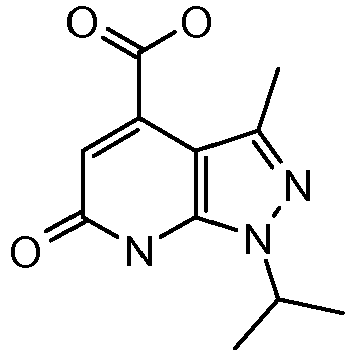
-

- 3-Amino-2-butenenitrile (33.3 g, 0.41 mol) and ethanol (170 mL) were combined and stirred at room temperature for 30 min., after which time isopropylhydrazine (50 g, 0.67 mol) was added at once. After stirring at room temperature for 5 min., the contents were then heated at reflux for 10 h. After cooling to room temperature, the mixture was concentrated in vacuo to give the desired product (85 g) which was used in the next step directly. 1H NMR (400 MHz, DMSO-d 6) δ ppm 1.21 (d, 6 H, J =6.4 Hz), 1.94 (s, 3H), 4.21 (m, 1H), 4.93 (s, 2H), 5.02 (s, 1H).
- To a solution of diethyl 2-oxobutanedione (176 g, 0.94 mol) in toluene (2 L) was added 3-methyl-1-(1-methylethyl)-1H-pyrazol-5-amine (82.5 g, 0.59 mol), and the mixture stirred at 62 °C, overnight. After cooling to room temperature, the mixture was concentrated in vacuo and the crude residue dissolved into acetic acid (1.5 L). The mixture was heated at reflux for 2 h. After cooling to room temperature, the mixture was concentrated in vacuo to afford a solid residue, which was recrystallized from DCM to afford the desired product as a yellow colored solid. The collected solid was suspended in ethanol (1510 mL) and THF (216 mL) followed by addition of 3N NaOH (334 mL) and the reaction mixture was stirred at 40 °C for 40 min. The mixture was concentrated in vacuo to remove the volatiles and the aqueous phase acidified using 1N HCl. The resulting precipitate was collected by filtration and dried under high vacuum to give the title compound, 3-methyl-1-(1-methylethyl)-6-oxo-6,7-dihydro-1H-pyrazolo[3,4-b]pyridine-4-carboxylic acid, as 51.38 g. LCMS E-S (M+H) = 236.1. 1H NMR (400 MHz, DMSO-d 6) δ ppm 1.35 (d, J=6.8 Hz, 6 H), 2.41 (s, 3H), 4.84-4.91 (m, 1H), 6.64 (s, 1H). Carboxylic acid proton not observed.
-
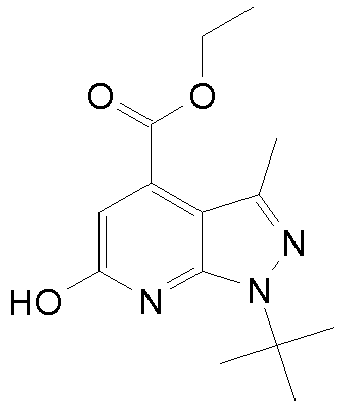
- 1-(1,1-Dimethylethyl)-3-methyl-1H-pyrazol-5-amine (5 g, 32.6 mmol), diethyl 2-oxobutanedione (6.14 g, 32.6 mmol) and toluene (100 mL) were heated at 70 °C for 16 hours. The solvent was removed in vacuo, the crude residue dissolved in acetic acid (100 mL), and heated at reflux for 4 hours. The solvent was removed in vacuo, and the crude product purified via silica gel chromatography (eluent: gradient of 0 to 10% EtOAc/Hexanes). The product was collected as a solid, 6.32 g (70%). LCMS E-S (M+H) = 278.4. 1H NMR (400 MHz, DMSO-d 6) δ ppm 11.39 (s, 1H), 6.82 (s, 1H), 4.36 (q, 2H, J = 7.2 Hz), 2.45 (s, 3H), 1.69 (s, 9H), 1.32 (t, 3H, J = 7.2 Hz).
-

- Sodium hydroxide (52.6 mL, 52.6 mmol) was added to an EtOH solution (100 mL) of ethyl 1-(1,1-dimethylethyl)-3-methyl-6-oxo-6,7-dihydro-1H-pyrazolo[3,4-b]pyridine-4-carboxylate (7.3 g, 26.3 mmol) and stirred at room temperature for 16 h. The solvent was removed in vacuo. The crude residue was suspended in water, and extracted with EtOAc. The combined organic layers were washed with water, dried over MgSO4, filtered, and concentrated in vacuo. The solid product obtained was set aside. The aqueous phase was concentrated in vacuo and the crude product purified by reverse phase HPLC (mobile phase : 20 -50% ACN/H2O, 0.1%TFA) to afford additional product. The combined products were collected as a solid, 5.76 g (88%). LCMS E-S (M+H) = 250.3. 1H NMR (400 MHz, DMSO-d 6) δ ppm 13.5 - 13.9 (br s, 1H), 11.2 - 11.5 (br s, 1H), 6.78 (s, 1H), 2.46 (s, 3H), 1.70 (s, 9H).
-

- To a 75 mL pressure vessel was added 1-(1-methylethyl)-6-oxo-6,7-dihydro-1H-pyrazolo[3,4-b]pyridine-4-carboxylic acid (4.12 g, 18.62 mmol), followed by phosphorous oxychloride (26.0 ml, 279 mmol). The flask was sealed and the stirring mixture heated at ca. 105 °C for ca. 18 h. After cooling to room temperature, the contents were concentrated in vacuo to remove most of volatiles. The residual contents were poured into a mixture of ice and 3M NaOH (60 mL), followed by additional 3M NaOH to ensure the pH stayed basic. The mixture was stirred for 30 min., and then cooled in an ice bath. The heterogenous mixture was slowly acidified to pH = 3-4 with 6M HCl. The resulting suspension was extracted with EtOAc (3x). The combined organic layers were dried over MgSO4, filtered, and concentrated in vacuo to afford a yellow solid which was dried in a hi-vac oven overnight. The title compound was collected as 4.11 g (90%), and used without further purification. LCMS E-S (M+H) = 240.2/242.2. 1H NMR (400 MHz, DMSO-d6) δ ppm 1.51 (d, J=6.57 Hz, 6 H) 5.17 (quin, J=6.63 Hz, 1 H) 7.65 (s, 1 H) 8.41 (s, 1 H) 14.25 (br. s., 1 H).
-

- 3-Methyl-1-(1-methylethyl)-6-oxo-6,7-dihydro-1H-pyrazolo[3,4-b]pyridine-4-carboxylic acid (1.5 g, 6.38 mmol) was added to a solution of THF (15 mL) followed by addition of phosphorous oxychloride (8.9 mL, 96 mmol), and the contents heated at 105 °C overnight. After cooling to room temperature, the contents were concentrated in vacuo to remove most of the volatiles. The residual contents were slowly poured into a solution of iced water and 1N NaOH (10 mL), and the contents were stirred at room temperature for 24 h, during which time solid precipitation ensued. Additional 1N NaOH was added, upon which the solids went into solution. After stirring at room temperature for an additional 30 min., the contents were cooled in an ice bath and the mixture slowly acidified to pH = 3-4 by slow addition of 6N HCl, to afford a heterogenous mixture. The mixture was filtered and a white solid set aside. The aq. layer was further extracted with EtOAc and DCM. The combined organic layers dried were dried over MgSO4, filtered and concentrated in vacuo. The resultant light brown solid was triturated in EtOAc/EtOH (1:1) and filtered to afford a first crop of white solid product, which was set aside. The filtrate was again concentrated in vacuo. The residue was diluted with EtOAc, sonicated, treated with hexanes, and filtered. The process was repeated. The isolated solid product crops were dried under vacuum (3 h) and collected as 1.33 g (80%). LCMS E-S (M+H) : 254.3 1H NMR (400 MHz, DMSO-d6) δ ppm 1.46 (d, 6 H), 2.60 (s, 3 H), 5.10 (quin, J=6.63 Hz, 1 H), 7.50 (s, 1 H), 14.17 (br. s., 1 H).
-
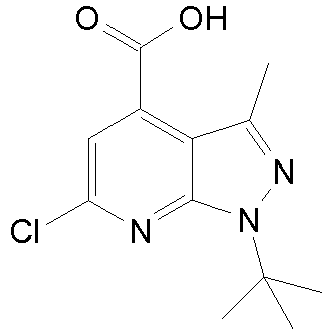
- 1-(1,1-Dimethylethyl)-3-methyl-6-oxo-6,7-dihydro-1H-pyrazolo[3,4-b]pyridine-4-carboxylic acid (5.07 g, 20.34 mmol) and phosphorus oxychloride (28.4 ml, 305 mmol) were heated at 100 °C for 16 hours. The contents were concentrated in vacuo. The residue was added to ice water followed by 1N NaOH until basic (pH > 10). After stirring for 15 minutes, the mixture was adjusted to pH 3-4 by addition of 1N HCl. The contents were extracted with EtOAc, then washed with water, brine and concentrated in vacuo. The crude product was purified by reverse phase HPLC (40 - 70% ACN/H2O, 0.1%TFA). The product was collected as a solid, 0.50 g (9%). LCMS E-S (M+H) =268.3 1H NMR (400 MHz, DMSO-d6) δ ppm 1.73 (s, 9 H), 2.56 (s, 3 H), 7.48 (s, 1 H), 14.17 (br. s., 1 H).
-

- Sodium acetate (10.24 g, 124.8 mmol), 10% palladium on carbon (1.08 g) and platinum oxide (76 mg) were placed in a dried Parr bottle under nitrogen, and a small amount of acetic acid was added to wet the catalysts. A solution of 4,6-dimethyl-2-oxo-1,2-dihydro- pyridine-3-carbonitrile (10 g , 67.6 mmol) in acetic acid was added to the Parr bottle followed by additional acetic acid. The bottle was capped, placed on Parr apparatus, and shaken under an atmosphere of hydrogen (45 psi) for 12 h. The reaction mixture was filtered. The solvent was removed to give a residue, which was dried. After addition of 50 mL of conc. HCl the formed solids were filtered. The yellow filtrate was concentrated and dried, followed by addition of 10 mL conc. HCl, and 50 mL of EtOH. The mixture was stored at ca. 0°C (i.e. freezer) for 2 h. The formed solids were filtered and washed with cold EtOH, and dried to give the product as an HCl salt (39 g, 76%,). 1H NMR (400 MHz, DMSO-d6) δ ppm 11.85 (br. s., 1 H) 8.13 (br. s., 3 H) 5.93 - 6.01 (m, 1 H) 3.72 - 3.80 (m, 2 H) 2.22 (s, 3 H) 2.16 (s, 3 H).
-

- To a dried 500 mL Parr bottle equipped with nitrogen inlet were placed sodium acetate (1.502 g, 18.30 mmol), 10% palladium on carbon (1.579 g, 0.742 mmol), platinum(IV) oxide (0.011 g, 0.049 mmol) and a small amount of acetic acid to wet the catalysts under nitrogen stream. Next added 2-hydroxy-6-methyl-4-(trifluoromethyl)-3-pyridinecarbonitrile (2.0g, 9.89 mmol) followed by acetic acid (175 mL) while under nitrogen atmosphere. The contents were sealed, placed on a Parr shaker, and reacted at 40 psi of H2 for ca. 6 hr., keeping the H2 psi between 20 and 40 psi (vessel was refilled twice). The vessel was purged with nitrogen and the reaction mixture filtered through Celite, and the filter pad was further washed with a small amount of acetic acid. The volatiles were removed in vacuo to afford a residue, which was dried under hi-vacuum for 45 min. The solid was suspended in conc. HCl (12 mL), stirred, and filtered (removed NaCl). The clear filtrate was concentrated in vacuo and the residue dried under hi-vacuum. The collected solid was suspended in conc. HCl (2 mL) and diluted with EtOH (13 mL). The contents were agitated (i.e. spatula) and stored at ca. 0 °C (i.e. freezer) for 30 min to give a white solid. The solid was filtered and washed with cold ethanol (5 mL). The solid was filtered and dried in vacuum oven for 1 h. The final product was collected as 0.95 g (40%). LCMS E-S (M+H) = 206.9. 1H NMR (400 MHz, DMSO-d 6) δ ppm 2.31 (s, 3 H), 3.87 (d, J=5.05 Hz, 2 H), 6.41 (s, 1H), 8.12 - 8.37 (m, 3 H).
-

- To a stirred suspension of CrCl2 (58 g, 472.8 mmol in THF (1500 mL) was added a THF solution (500 mL) of 1,1-dichloro-2-propanone (10 g, 78.8 mmol) and cyclohexanecarbaldehyde (8.84 g, 78.8 mmol). The reaction mixture was heated at reflux for 2 h, and then quenched by the addition of 1.0 M HCl. The reaction mixture was filtered through a pad of Celite and concentrated in vacuo. The crude residue (10 g) was added to a solution of DMSO (150 mL) containing t-BuOK (7.5 g, 65.7 mmol), and cyanoacetamide (6.1 g, 72.3 mmol) and stirred at room temperature for 30 min. Additional t-BuOK (22.5 g, 197.1 mmol) was added and the reaction mixture was stirred under an atmosphere of oxygen for an additional 1h. The contents were purged with argon, diluted with 4 volumes of H2O, and then 5 volumes of 4 N HCl, which were added slowly. The reaction mixture was filtered, washed with water and dried to give 4-cyclohexyl-6-methyl-2-oxo-1,2-dihydro-3-pyridinecarbonitrile as 4.5 g (32%). 1H NMR (400 MHz, DMSO-d6) δ ppm 6.25 (s, 1H), 2.61-2.65 (m, 1H), 2.22 (s, 3H), 1.66-1.79 (m, 4H), 1.24-1.46 (m, 6H).
- To an ice-bath cooled THF (100 mL) solution of the product from step 1 (2 g, 9.26 mmol) were added NaBH4 (0.81 g, 21.3mmol), and I2 (2.3 g, 9.26 mmol), and the mixture stirred for 30 min. The reaction mixture was then heated at reflux for 3h, and then allowed to cool to room temperature. After cooling to 0 °C, the reaction mixture was acidified by slow addition of 3N HCl (1mL). The reaction mixture was concentrated in vacuo and the crude product purified by reverse phase HPLC to give the title compound as a solid (TFA salt), 0.5 g (25%). LCMS E-S (M+H) = 221.1. 1H NMR (400 MHz, DMSO-d6) δ ppm 11.8 - 11.9 (br s, 1H), 7.80-7.93 (br s, 3H), 6.07 (s, 1H), 3.69 (s, 2H), 2.67-2.75 (m, 1H), 2.17 (s, 3H), 1.58-1.72 (m, 5H), 1.19-1.41 (m, 5H).
-
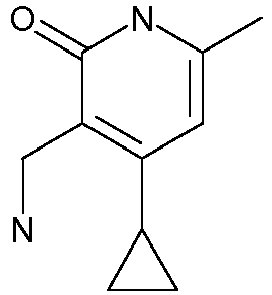
- The title compound was prepared in the same manner as described for intermediate 10 (step 2) from 4-cyclopropyl-6-methyl-2-oxo-1,2-dihydro-3-pyridinecarbonitrile (5 g, 28.7 mmol). The product was collected as a TFA salt, 0.50 g. LCMS E-S (M+H) = 179.1. 1H NMR (400 MHz, DMSO-d6) δ ppm 11.76-11.78 (br s, 1H), 7.82-7.92 (br s, 3H), 5.61 (s, 1H), 3.94-3.99 (m, 2H), 2.11 (s, 3H), 1.98 - 2.05 (m, 1H), 0.95 - 1.01 (m, 2H), 0.74 - 0.79 (m, 2H).
-

- To a solution of DMSO (300 mL) containing t-BuOK (20 g, 178 mmol) and cyanoacetamide (16.5 g, 196 mmol) was added (3E)-3-hepten-2-one (20 g, 178 mmol), and contents stirred at room temperature for 30 min. Additional t-BuOK (60 g, 534 mmol) was added and the reaction mixture was under an atmosphere of oxygen for an additional 1 h. The reaction mixture was purged with argon, diluted with 4 volumes of H2O, and then 5 volumes of 4 N HCl, which were added slowly. The reaction mixture was filtered, washed with water, and dried to give the product as 10 g (32%). 1H NMR (400 MHz, DMSO-d 6) δ ppm 12.25 - 12.40 (br s, 1H), 6.18 (s, 1H), 2.53 (t, 2H), 2.22 (s, 3H), 1.57 - 1.64 (m, 2H), 0.84 (t, 3H).
- The title compound was prepared in the same manner as described for intermediate 10 (step 2) from the product of step 1 (2 g, 11.2 mmol). The product was collected as 1.2 g (60%). LCMS E-S (M+H) = 181.1. 1H NMR (400 MHz, DMSO-d6) δ ppm 7.85 - 7.95 (br s, 3H), 5.99 (s, 1H), 3.80 - 3.85 (m, 2H), 2.42 (t, 2H), 2.14 (s, 3H), 1.43 - 1.49 (m, 2H), 0.86 (t, 3H).
-

- The title compound was prepared in the same manner as described for intermediate 12 (steps 1 and 2) from (3E)-4-phenyl-3 -buten-2 -one (20 g, 137 mmol). The crude nitrile intermediate was obtained as 10 g (35%), of which 4 g of this putative intermediate was converted to the title compound 1.2 g as a TFA salt. LCMS E-S (M+H) = 215.0. 1H NMR (400 MHz, DMSO-d 6) δ ppm 12.2 - 12.3 (br s, 1H), 7.88 - 8.00 (br s, 3H), 7.43 - 7.51 (m, 3H), 7.29 - 7.38 (m, 2H), 6.08 (s, 1H), 3.67 - 3.70 (m, 2H), 2.23 (s, 3H).
-

- The title compound was prepared in the same manner as described for intermediate 12 (steps 1 and 2) from (3E)-5-methyl-3-hexen-2-one (20 g, 137 mmol). The crude nitrile intermediate was obtained as 7 g (22 %), of which 3 g of this putative intermediate was converted to the title compound 1.3 g as a TFA salt. LCMS E-S (M+H) = 181.1. 1H NMR (400 MHz, DMSO-d 6) δ ppm 11.8 - 11.9 (br s, 1H), 7.86 - 7.96 (br s, 3H), 6,. 10 (s, 1H), 3.82 - 3.86 (m, 2H), 3.02 - 3.09 (m, 1H), 2.17 (s, 3H), 1.08 (d, 6H).
-

- To a solution of NaNH2 (32.5 g ,862 mmol) in anhydrous ether (500 mL) at 30 °C was added dropwise a mixture of butyric acid ethyl ester (50 g ,431 mmol) and acetone (37.5 g 646.5 mol). After addition, the reaction mixture was stirred for 4 h. The reaction mixture was poured onto ice water with stirring. Additional ether was added, and the layers were separated. The aqueous layer was acidified to pH 5.0 with 2 N HCl and then to pH 7.5 with Na2CO3. The aq. layer was then extracted with ether. The combined organic layers were dried over Na2SO4, filtered, and concentrated in vacuo. The crude product (20 g, 156 mmol) and 2-cyanoacetamide (13.12 g , 156 mmol) were suspended in EtOH (160 mL) at 75 °C, followed by addition of piperidine (13.2 g,156 mmol). The contents were stirred and heated at reflux for 1h. The mixture was cooled to room temperature, and filtered. The collected solid was suspended in water and stirred for 1 h. The mixture was filtered and dried to give 4-methyl-2-oxo-6-propyl-1,2-dihydro-3-pyridinecarbonitrile (11g, 40%). LCMS E-S (M+H) = 181.1. 1H NMR (400 MHz, DMSO-d6) δ ppm 12.3-12.4 (br s, 1H), 6.25 (s, 1H), 3.64 (s, 3H), 2.50 (t, 2H), 1.63 (m, 2H), 0.94 (t, 3H).
- Sodium acetate (3.5 g, 42.6 mmol), palladium on carbon (0.81 g) and platinum oxide (0.1 g) were placed in a dried Parr bottle flushed with nitrogen, followed by addition of a small amount of acetic acid (to wet the catalysts). A solution of 4-methyl-2-oxo-6-propyl-1,2-dihydro-pyridine-3-carbonitrile (5 g, 28 mmol) in acetic acid was added to the Parr bottle followed by additional acetic acid (200 mL). The vessel was capped, placed on Parr apparatus and hydrogenated at 45 psi for 12 h. The reaction mixture was filtered and the filtrate concentrated in vacuo. The crude product was purified by preparative HPLC to afford the title compound (TFA salt) as 4.1 g. LCMS E-S (M+H)) = 181.1. 1H NMR (400 MHz, DMSO-d 6) δ ppm 11.8-11.9 (br s, 1H), 7.83-7.88 (br s, 3H), 5.99 (s, 1H), 3.77 - 3.81 (m, 2H), 2.37 (t, 2H), 1.53 (m, 2H), 0.83 (t, 3H).
-

- To a a stirring solution of THF (100 mL) was suspended potassium tert-butoxide (5.60 g, 49.5 mmol), followed by a mixture of cyclopropyl methyl ketone (3.27mL, 33 mmol) and ethyl acetate (9.69 mL, 99 mmol) in 30 mL THF at 35 °C, via addition funnel over a 25 min period. The contents were heated and stirred at 60 °C. After 3 h, the contents were removed from heating, and allowed to stir with cooling to room temperature. The reaction mixture was carefully diluted with 30 mL 2N HCl and stirred for 10 min. The mixture was extracted with diethyl ether (3 x 50 mL), and the combined organic layers washed with brine (1 x 50 mL). The organic layer was dried over MgSO4, filtered, and concentrated in vacuo. The crude oil was chromatographed on silica gel (eluent: 0 to 15% EtOAc in hexanes) with good separation to afford the desired product as a light yellow colored oil, 3.9 g in ∼75% purity (residual solvent), for an overall yield of 70%. 1H NMR (400 MHz, CHLOROFORM-d) δ ppm 0.89 - 0.96 (m, 2 H), 1.09-1.15 (m, 2 H), 1.59-1.69 (m, 1H), 2.04 (s, 3H), 5.63 (s, 1 H), 15.5 - 16.0 (br s, 1H).
-

- To a stirring solution of ethanol (5 mL) were suspended 1-cyclopropyl-1,3-butanedione (505 mg, 3.00 mmol) and cyanoacetamide (252 mg, 3.00 mmol), and the heterogenous contents heated until homogenous (ca. 75 °C). Next added piperidine (0.395 mL, 4.00 mmol), and the mixture was stirred with warming at reflux for 30 min. The reaction mixture was allowed to cool to room temperature, wherein precipitation ensued. The solid precipitate was filtered and set aside. The filtrate was concentrated in vacuo, and the oily residue treated with minimal EtOAc and then 10 mL hexanes to afford a 2nd crop of solid. The solid product crops were combined, suspended in water (7 mL), vigorously stirred, and vacuum filtered to afford a nearly white solid as 380 mg (73%). LCMS E-S (M+H) = 175.1. 1H NMR (400 MHz, CHLOROFORM-d) δ ppm 1.01-1.09 (m, 2 H), 1.28 (dd, J=8.59, 2.27 Hz, 2 H), 1.95-2.01 (m, 1H), 2.43 (s, 3H), 5.82 (s, 1 H).
-

- 6-Cyclopropyl-4-methyl-2-oxo-1,2-dihydro-3-pyridinecarbonitrile (0.35 g, 2.01 mmol) was added to methanol (20 mL) and the stirring contents cooled to -10 °C. Next added di-tert-butyloxycarbonyl (0.933 mL, 4.02 mmol) and the suspension was stirred for 15 min. Next added in NiCl2-6H2O (0.055 g, 0.201 mmol) as a solid and stirred for 5 min. Next added NaBH4 (0.532 g, 14.06 mmol) in 6 portions with 5 min. increments between each portion. After completed addition (ca. 30min), the ice bath was removed and the contents were stirred with warming to room temperature overnight. The reaction mixture was returned to - 10 °C, followed by addition of 3 more portions of NaBH4 (0.532 g, 14.06 mmol). The ice bath was removed and the mixture stirred at room temperature for 1 h. The contents were quenched by addition of diethylethylene amine (0.218 mL, 2.01 mmol) and stirred for 45 min. at room temperature. The volatiles were removed in vacuo and the residue suspended in EtOAc and sat. NaHCO3. The organic layer was washed with additional NaHCO3. The layers were separated, and the organic layer dried over MgSO4, filtered, and concentrated in vacuo. The crude product was purified by silica gel chromatography (eluent: 10% Methanol in Dichloromethane). The collected product was dried under hi-vacuum for 1 h, and then treated with ether and filtered. After drying in vacuum oven at 45 °C for 2 h, the product was collected as 0.28 g (50%). 1H NMR (400 MHz, DMSO-d 6) δ ppm 0.73 - 0.80 (m, 2 H), 0.88 - 0.96 (m, 2 H), 1.36 (s, 9 H), 1.70-1.82 (m, 1 H), 2.11 (s, 3 H), 3.95 (d, J=5.31 Hz, 2 H), 5.66 (s, 1 H), 6.51 (t, J=4.80 Hz, 1H) ,11.50 (br. s., 1 H).
- 1,1-Dimethylethyl [(6-cyclopropyl-4-methyl-2-oxo-1,2-dihydro-3-pyridinyl)methyl]carbamate (0.28g, 1.006 mmol) was added to EtOAc (9 mL) and methanol (1.0mL). The suspension was stirred at room temperature for 5 min., followed by addition of 4M HCl in dioxane (5.03 mL, 20.12 mmol), and the contents were stirred at room temperature overnight. The volatiles were then removed in vacuo to afford a solid. The solid was triturated with ether, filtered, and dried in a vacuum oven at 45°C for 4 h. The title compound was collected as 0.22 g (100% yield). 1H NMR (400 MHz, DMSO-d 6) δ ppm 0.78 - 0.86 (m, 2 H), 0.95 - 1.03 (m, 2 H), 1.83 (tt, J=8.46, 5.05 Hz, 1 H), 2.16 - 2.22 (m, 3 H), 3.75 (q, J=5.47 Hz, 2 H), 5.79 (s, 1 H), 8.02 (br. s., 3 H), 11.92 (br. s., 1 H).
-

- 6-Chloro-1-(1-methylethyl)-1H-pyrazolo[3,4-b]pyridine-4-carboxylic acid (0.12g, 0.501 mmol), 1-hydroxy-7-azabenzotriazole (0.102 g, 0.751 mmol), EDC (0.144 g, 0.751 mmol), and 3-(aminomethyl)-4,6-dimethyl-2(1H)-pyridinone (0.123 g, 0.651 mmol) were dissolved in dimethyl sulfoxide (3.0 mL) and stirred at room temperature. Added next to the stirring contents was N-methylmorpholine (0.220 mL, 2.003 mmol) via syringe at once. After stirring at room temperature overnight, the reaction mixture was slowly added to water (75 mL) and stirred for 10 min. After sitting for 10 min. at room temperature, the contents were filtered to afford a tan solid which was washed with water and then cold 50% aq EtOH. The contents were filtered, air-dried for 10 min., and then dried under vacuum for 1hr. The collected solid was then further dried in a vacuum oven at 45 °C for 4 hr. The title compound was collected as 0.105 g (55%). LCMS E-S (M+H) = 373.9. 1H NMR (400 MHz, DMSO-d 6) δ ppm 1.49 (d, J=6.82 Hz, 6 H), 2.13 (s, 3 H), 2.20 (s, 3 H), 4.35 (d, J=4.80 Hz, 2 H), 5.07 - 5.20 (m, 1 H), 5.89 (s, 1H), 7.66 (s, 1 H), 8.39 (s, 1 H), 8.91 (t, J=4.80 Hz, 1 H), 11.55 (s, 1 H).
-

- The title compound was prepared in the same manner as described in example 17 using 6-chloro-3-methyl-1-(1-methylethyl)-1H-pyrazolo[3,4-b]pyridine-4-carboxylic acid (486.6 mg, 1.92 mmol), 3-(aminomethyl)-4,6-dimethyl-2(1H)-pyridinoneHCl (489 mg, 2.59 mmol), 1-hydroxy-7-azabenzotriazole (392 mg, 2.88 mmol), N-methylmorpholine (0.84 ml, 7.67 mmol) and EDC (552 mg, 2.88 mmol). An additional 10 mL DMSO was added to the reaction mixture to facilitate stirring, and 10% K2CO3 was used instead of 50% aq. NaOH during the work up. LCMS E-S (M+H) = 388.1. 1H NMR (400 MHz, DMSO-d 6) δ ppm 1.44 (d, 6 H), 2.12 (s, 3 H), 2.22 (s, 3 H), 2.40 (s, 3 H), 4.34 (d, J=5.05 Hz, 2 H), 5.05 (quin, J=6.63 Hz, 1 H), 5.88 (s, 1 H), 7.16 (s, 1 H), 8.78 (t, J=4.93 Hz, 1 H), 11.53 (br. s., 1 H).
-

- To a solution of 6-chloro-1-(1,1-dimethylethyl)-3-methyl-1H-pyrazolo[3,4-b]pyridine-4-carboxylic acid (320 mg, 1.195 mmol) in DMSO(7 mL) were added 3-(aminomethyl)-4,6-dimethyl-2(1H)-pyridinone (338 mg, 1.793 mmol), N-methylmorpholine (0.526 mL, 4.78 mmol), 1-hydroxy-7-azabenzotriazole (325 mg, 2.391 mmol) and EDC (458 mg, 2.391 mmol), and the reaction mixture was stirred overnight. The reaction mixture was quenched with water (20 mL) and stirred for 10 min. The precipitate was collected by filtration and further dried under high vacuum to give the product as a solid, 450 mg (94%). LCMS E-S (M+H) = 402.1. 1H NMR (400 MHz, DMSO-d6) δ ppm 1.71 (s, 9 H), 2.12 (s, 3 H), 2.22 (s, 3 H), 2.37 (s, 3 H), 4.33 (d, J=4.80 Hz, 2 H), 5.88 (s, 1 H), 7.09 - 7.21 (m, 1 H), 8.77 (t, J= 4.93 Hz, 1 H), 11.53 (s, 1 H).
-

- 6-Chloro-N-[(4,6-dimethyl-2-oxo-1,2-dihydro-3-pyridinyl)methyl]-1-(1-methylethyl)-1H-pyrazolo[3,4-b]pyridine-4-carboxamide (0.15 g, 0.401 mmol), 4-pyridinol (0.057 g, 0.602 mmol), cesium carbonate (0.261 g, 0.802 mmol), and 1-(2-pyridinyl)-2-propanone (10.85 mg, 0.080 mmol) were sequentially dissolved in DMSO (4.0 mL). Next added copper(I) bromide (5.76 mg, 0.040 mmol) and the suspension was stirred under nitrogen (degassed) for 1 min. The sealed reaction mixture was stirred with heating at 110 °C (heating block) for 20 h, and then allowed to cool to room temperature overnight. The reaction mixture was diluted with EtOAc (25 mL) and water. The contents were vigorously stirred and then fitlered through Celite, washing the filter pad with 20%THF/EtOAc. The layers were separated and the aq. layer extracted with EtOAc. The combined organic layers were dried over MgSO4, filtered, and concentrated in vacuo to a dark residue that was dried under hi-vacuum overnight. The crude product was purified by silica gel chromatography (eluent: gradient of 5-95 % Dichloromethane/ Chloroform containing 2M Ammonia (in methanol). The collected product was washed with MTBE, filtered, and dried in a vacuum oven at 45 °C for 5 hr. The final product was collected as 0.075 g (42%). LCMS E-S (M+H) = 433.2. 1H NMR (400 MHz, DMSO-d 6) δ ppm 1H NMR (400 MHz, DMSO-d6) δ ppm 1.52 (d, J=6.57 Hz, 6 H), 2.13 (s, 3 H), 2.22 (s, 3 H), 4.41 (d, J=5.05 Hz, 2 H), 5.18 - 5.30 (m, 1 H), 5.91 (s, 1H), 6.30 - 6.40 (m, 2 H), 7.91 (s, 1 H), 8.41 (s, 1 H), 8.57 - 8.65 (m, 2 H), 8.92 (t, J=4.93 Hz, 1 H), 11.58 (s, 1H).
-

- 6-Chloro-N-[(4,6-dimethyl-2-oxo-1,2-dihydro-3-pyridinyl)methyl]-1-(1-methylethyl)-1H-pyrazolo[3,4-b]pyridine-4-carboxamide (0.25 g, 0.669 mmol) was suspended in ethanol (4 mL) followed by addition of allylamine (0.753 mL, 10.03 mmol). The sealed contents were heated (heat block) at 140 °C for ca. 60 h, and then allowed to cool to room temperature. The reaction mixture was diluted with water (100 mL) and then filtered. The collected solid was washed with additional water and then dried in vacuum oven at 45 °C for 18h. The final product was isolated as an off-white solid, 0.225 g (83%). LCMS E-S (M+H) = 394.2. 1H NMR (400 MHz, DMSO-d6) δ ppm 1.42 (d, J=6.82 Hz, 6 H), 2.12 (s, 3 H), 2.21 (s, 3 H), 4.00 (t, J=5.43 Hz, 2 H), 4.32 (d, J=5.05 Hz, 2 H), 4.94 (quin, J=6.69 Hz, 1 H), 5.09 (dd, J=10.36, 1.77 Hz, 1 H), 5.18 - 5.29 (m, 1 H), 5.85 - 6.01 (m, 2 H), 6.68 (s, 1 H), 7.37 (t, J=5.56 Hz, 1 H), 7.84 (s, 1 H), 8.45 (t, J=5.05 Hz, 1 H), 11.55 (br. s., 1 H).
-
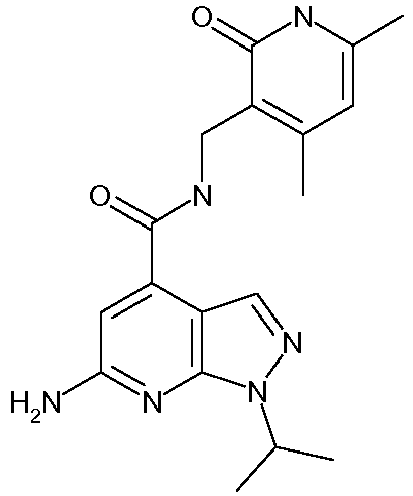
- A mixture of 10% Pd/C (0.200 g, 0.188 mmol) and N-[(4,6-dimethyl-2-oxo-1,2-dihydro-3-pyridinyl)methyl]-1-(1-methylethyl)-6-(2-propen-1-ylamino)-1H-pyrazolo[3,4-b]pyridine-4-carboxamide (0.200g, 0.507 mmol) was suspended in ethanol (10 mL) and stirred. Added next was methanesulfonic acid (0.033 mL, 0.507 mmol), and the stirring contents were heated at reflux for 2 h. After cooling to room temperature, the reaction mixture was diluted with DCM and filtered through Celite. The filter pad was washed with 10% MeOH/DCM. The filtrate was pre-adsorped onto silica gel, and the crude product purified by silica gel chromatography (dry loaded, eluent: gradient of 5-80% Dichloromethane/Chloroform containing 10% 2M Ammonia (in methanol)). The collected product was dried in vacuum oven at 45 °C overnight. The final product was collected as 0.065 g (36%). LCMS E-S (M+H) = 355.3. 1H NMR (400 MHz, DMSO-d 6) δ ppm 1.40 (d, J=6.82 Hz, 6 H), 2.12 (s, 3 H), 2.21 (s, 3 H), 4.31 (d, J=5.05 Hz, 2 H), 4.85 - 5.00 (m, 1 H), 5.89 (s, 1H), 6.49 - 6.68 (m, 3 H), 7.85 (s, 1 H), 8.46 (t, J=5.05 Hz, 1 H), 11.54 (br. s., 1 H).
-

- 6-Cyclopropyl-1-(1-methylethyl)-1H-pyrazolo[3,4-b]pyridine-4-carboxylic acid (167 mg, 0.680 mmol), 3-(aminomethyl)-4-methyl-6-propyl-2(1H)-pyridinone trifluoroacetate (200 mg, 0.680 mmol), HOAT (139 mg, 1.019 mmol), EDC (195 mg, 1.019 mmol), and N-methylmorpholine (0.299 mL, 2.72 mmol) were dissolved in DMF(6 mL) and stirred at 40 °C for 24 h. The reaction mixture was poured into water (20 mL) and extracted with ethyl acetate (3 x 50 mL). The combined organic layers were dried over sodium sulfate and concentrated to an orange oil. The residue was dissolved in DMSO, and purified by reverse phase HPLC (mobile phase: 40-60% ACN in H2O, 0.1% TFA). The isolated product was dried in a vacuum oven overnight and furnished the TFA salt of the title compound as a white solid, 0.113 g (32%). LCMS E-S (M+H) = 408.1. 1H NMR (400 MHz, DMSO-d6) δ ppm 0.80 - 0.98 (m, 3 H), 1.06 (d, J=7.07 Hz, 4 H), 1.46 (d, J=6.82 Hz, 6 H), 1.52 - 1.67 (m, 2 H), 2.17 - 2.31 (m, 4 H), 2.37 (t, J= 7.58 Hz, 2 H), 4.36 (d, J=4.80 Hz, 2 H), 5.02 - 5.27 (m, 1 H), 5.91 (s, 1 H), 7.43 (s, 1 H), 8.21 (s, 1 H), 8.62 - 8.87 (m, 1 H), 11.54 (br. s., 1 H).
-

- The title compound was prepared in the same manner as described in example 7 from 6-cyclopropyl-1-(1-methylethyl)-1H-pyrazolo[3,4-b]pyridine-4-carboxylic acid (250 mg, 1.019 mmol), 3-(aminomethyl)-6-methyl-4-(1-methylethyl)-2(1H)-pyridinone·TFA (300 mg, 1.019 mmol), HOAT (208 mg, 1.529 mmol), EDC (293 mg, 1.529 mmol), N-methylmorpholine (0.448 mL, 4.08 mmol), and DMF(6 mL), wherein the reaction time was 48 h. The final product was collected following a basic extraction (to remove residual starting material) as a white solid, 30 mg (7%). LCMS E-S (M+H) = 408.3. 1H NMR (400 MHz, DMSO-d6) δ ppm 0.95 - 1.16 (m, 10 H), 1.38 - 1.54 (m, 6 H), 2.16 (s 3 H), 2.19 - 2.30 (m, 1H), 3.12 - 3.29 (m, 1 H), 4.29 - 4.48 (m, 2 H), 5.03 - 5.21 (m, 1 H), 6.03 (s, 1 H), 7.39 (s, 1 H), 8.21 (s, 1 H), 8.63 - 8.81 (m, 1 H), 11.56 (s, 1 H).
-

- 1-(1-Methylethyl)-6-(4-pyridinyl)-1H-pyrazolo[3,4-b]pyridine-4-carboxylic acid (192 mg, 0.680 mmol), 3-(aminomethyl)-4-methyl-6-propyl-2(1H)-pyridinone·TFA (200 mg, 0.680 mmol), HOAT (139 mg, 1.019 mmol), EDC (195 mg, 1.019 mmol), and N-methylmorpholine (0.299 mL, 2.72 mmol) were sequentially added to DMF(6 mL), and the mixture stirred at 40 °C overnight. The reaction mixture was then filtered. The collected solid was washed with ethanol, and dried, affording the final product as a white solid, 0.160 g (53%). LCMS E-S (M+H) = 445.3. 1H NMR (400 MHz, DMSO-d6) δ ppm 0.88 (t, 3 H), 1.46 - 1.65 (m, 8 H), 2.24 (s, 3 H), 2.38 (t, J= 7.58 Hz, 2 H), 4.43 (d, J= 4.80 Hz, 2 H), 5.37 (s, 1 H), 5.93 (s, 1 H), 8.23 (d, J= 5.81 Hz, 2 H), 8.30 (s, 1 H), 8.45 (s, 1 H), 8.78 (d, J= 5.31 Hz, 2 H), 9.00 (br. s., 1 H), 11.56 (s, 1 H).
-

- The title compound was prepared in the same manner as described in example 9 from 1-(1-methylethyl)-6-(4-pyridinyl)-1H-pyrazolo[3,4-b]pyridine-4-carboxylic acid (403 mg, 1.427 mmol), 3-(aminomethyl)-6-ethyl-4-methyl-2(1H)-pyridinone·TFA (400 mg, 1.427 mmol), HOAT (291 mg, 2.141 mmol), EDC (1094 mg, 5.71 mmol), N-methylmorpholine (0.628 mL, 5.71 mmol), and DMF(6 mL). The final product was collected as a white solid, 232 mg (38%). LCMS E-S (M+H) = 432.4. 1H NMR (400 MHz, DMSO-d6) δ ppm 1.14 (t, 3 H), 1.56 (d, J=6.57 Hz, 6 H), 2.25 (s, 3 H), 2.42 (q, J=7.41 Hz, 2 H), 4.43 (d, J=4.55 Hz, 2 H), 5.29 - 5.45 (m, 1 H), 5.93 (s, 1 H), 8.22 (d, J=6.06 Hz, 2 H), 8.30 (s, 1 H), 8.45 (s, 1 H), 8.78 (d, J=5.81 Hz, 2 H), 9.01 (t, J=4.55 Hz, 1 H), 11.58 (s, 1 H).
-

- 1-(1-Methylethyl)-6-(4-pyridinyl)-1H-pyrazolo[3,4-b]pyridine-4-carboxylic acid (150 mg, 0.531 mmol), 3-(aminomethyl)-6-methyl-4-propyl-2(1H)-pyridinone (115 mg, 0.531 mmol), EDC (122 mg, 0.638 mmol), HOAt (72.3 mg, 0.531 mmol), and N-methylmorpholine (0.233 mL, 2.12 mmol) were suspended in DMF (5 mL) and stirred at room temperature overnight. water was added to the reaction mixture, and the contents were filtered. The filter cake was washed with addional water (2x). The crude solid was purified by reverse phase HPLC (mobile phase: 10-30% ACN in H2O, 0.1% TFA). The isolated solid was then neutralized with saturated NaHCO3, and washed with EtOAc (5 x 15 mL). The combined organic layers were dried over Na2SO4, filtered, and concentrated in vacuo to afford the title compound as an off-white solid, 0.060 g (24%). LCMS E-S (M+H) = 445.3. 1H NMR (400 MHz, DMSO-d 6) δ ppm 0.84 - 0.92 (m, 3 H), 1.47 - 1.54 (m, 2 H), 1.57 (d, J=6.82 Hz, 6 H), 2.14 (s, 3 H), 2.48 - 2.52 (m, 2 H), 4.42 - 4.49 (m, 2 H), 5.33 - 5.43 (m, 1 H), 5.90 - 5.96 (m, 1 H), 8.28 - 8.37 (m, 3 H), 8.44 - 8.48 (m, 1 H), 8.82 - 8.87 (m, 2 H), 8.99 -9.04 (m, 1H), 11.58 (s, 1H).
-

- A DMF solution (6 mL) of 1-(1-methylethyl)-6-(4-pyridinyl)-1H-pyrazolo[3,4-b]pyridine-4-carboxylic acid (288 mg, 1.019 mmol), 3-(aminomethyl)-6-methyl-4-(1-methylethyl)-2(1H)-pyridinone·TFA (300 mg, 1.019 mmol), HOAT (208 mg, 1.529 mmol), EDC (782 mg, 4.08 mmol), and N-methylmorpholine (0.448 mL, 4.08 mmol) was stirred overnight at 40 °C. After cooling to room temperature, the reaction mixture was poured into H2O (50 mL) and EtOAc (50 mL). The aqueous layer was extracted with EtOAC (2 x 50 mL). The organic layers were dried over sodium sulfate, filtered, and concentrated in vacuo. The residue was dissolved in DMSO and purified by reverse phase (15-40% ACN in H2O, 0.1% TFA). The product fractions were poured into sodium bicarbonate and extracted with ethyl acetate. The organic layer was dried over sodium sulfate, filtered, and concentrated in vacuo to afford the title compound as a white solid (123 mg, 27% yield). LCMS E-S (M+H) = 445.4. 1H NMR (400 MHz, DMSO-d6) δ ppm 1.10 (m, 6 H), 1.56 (m, 6 H), 2.17 (s, 3 H), 3.17 - 3.28 (m, 1 H), 4.45 - 4.56 (m, 2 H), 5.29 - 5.43 (m, 1 H), 5.99 - 6.12 (m, 1 H), 8.16 - 8.23 (m, 2 H), 8.24 - 8.29 (m, 1 H), 8.40 - 8.46 (m, 1 H), 8.71 - 8.82 (m, 2 H), 8.96 - 9.04 (m, 1 H), 11.53 - 11.63 (m, 1 H).
-

- The title compound was prepared in the same manner as described in example 11 from 1-(1-methylethyl)-6-(cyclopropyl)-1H-pyrazolo[3,4-b]pyridine-4-carboxylic acid (150 mg, 0.612 mmol). The product was collected as a white solid, 0.043 g (16%). LCMS E-S (M+H) = 408.3. 1H NMR (400 MHz, DMSO-d 6) δ ppm 0.89 (t, J=7.20 Hz, 3 H), 1.06 (d, J=2.78 Hz, 3 H), 1.08 (br. s., 1 H), 1.47 (d, J=6.57 Hz, 8 H), 1.49 - 1.57 (m, 2 H), 2.14 (s, 3 H), 2.19-2.30 (m, 1 H), 4.38 (d, J=4.80 Hz, 2 H), 5.03 - 5.18 (m, 1 H), 5.92 (s, 1 H), 7.40 (s, 1 H), 8.21 (s, 1 H), 8.69 - 8.76 (m, 1 H), 11.55 (s, 1 H).
-

- The title compound was prepared in the same manner as described in example 11 from 1-(1-methylethyl)-6-(4-pyridinyl)-1H-pyrazolo[3,4-b]pyridine-4-carboxylic acid (150 mg, 0.531 mmol) and 3-(aminomethyl)-6-methyl-4-phenyl-2(1H)-pyridinone (133 mg, 0.531 mmol). The product was collected as a white solid, 0.041 g (15%). LCMS E-S (M+H) = 479.3. 1H NMR (400 MHz, DMSO-d 6) δ ppm 1.57 (d, J=6.82 Hz, 6 H) 2.23 (s, 3 H) 4.23 - 4.27 (m, 2 H) 5.33 - 5.42 (m, 1 H) 6.02 - 6.04 (m, 1 H) 7.35 - 7.42 (m, 1 H) 7.43 (s, 4 H) 8.23 - 8.26 (m, 1 H) 8.34 - 8.39 (m, 2 H) 8.41 - 8.42 (m, 1 H) 8.84 - 8.88 (m, 2 H) 8.91 - 8.96 (m, 1 H) 11.91 (s, 1 H).
-

- A mixture of 1-(1-methylethyl)-6-(4-pyridinyl)-1H-pyrazolo[3,4-b]pyridine-4-carboxylic acid (169 mg, 0.6 mmol), 3-(aminomethyl)-4-cyclohexyl-6-methyl-2(1H)-pyridinone trifluoroacetate (221 mg, 0.660 mmol), EDC (150 mg, 0.780 mmol), HOAT (106 mg, 0.780 mmol), and N-methylmorpholine (0.264 mL, 2.400 mmol) in DMF(3 mL) were stirred at room temperature for 6 days. water (15 mL) was added to the slurry, and it was stirred for an hour. The precipitate was then collected by vacuum filtration and rinsed with EtOH (4 mL), and the solid was dried in the vacuum oven overnight to give the title compounds as an off-white solid (137 mg, 45%). LCMS E-S (M+H) = 485.2. 1H NMR (400 MHz, DMSO-d6) δ ppm 1.09 - 1.44 (m, 5 H), 1.56 (d, J=6.57 Hz, 6 H), 1.55 - 1.72 (m, 5 H), 2.15 (s, 3 H), 2.80 - 2.92 (m, 1 H), 4.53 (d, J= 4.55 Hz, 2 H), 5.36 (spt, J=6.53 Hz, 1 H), 6.03 (s, 1 H), 8.18 - 8.23 (m, 2 H), 8.26 (s, 1 H), 8.45 (s, 1 H), 8.75 - 8.82 (m, 2 H), 9.01 (t, J= 4.55 Hz, 1 H), 11.59 (s, 1 H).
-

- The title compound was prepared in the same manner as described in example 15 from 6-cyclopropyl-1-(1-methylethyl)-1H-pyrazolo[3,4-b]pyridine-4-carboxylic acid (147 mg, 0.60 mmol), 3-(aminomethyl)-4-cyclohexyl-6-methyl-2(1H)-pyridinone trifluoroacetate (221 mg, 0.660 mmol), EDC (150 mg, 0.780 mmol), HOAT (106 mg, 0.780 mmol), N-methylmorpholine (0.264 mL, 2.400 mmol) and DMF(3 mL), wherein the stir time was 3 d and the final product was not treated with EtOH. The final product was collected as 193 mg (68%). LCMS E-S (M+H) = 448.4. 1HNMR(400MHz,DMSO-d6) δ ppm 1.01 - 1.11 (m, 4 H), 1.15 - 1.43 (m, 5 H), 1.47 (d, J=6.57 Hz, 6 H), 1.55 - 1.76 (m, 5 H), 2.15 (s, 3 H), 2.19-2.28 (m, 1H), 2.83 (t, J= 11.12 Hz, 1 H), 4.45 (d, J= 5.05 Hz, 2 H), 5.12 (spt, J= 6.69 Hz, 1 H), 6.02 (s, 1 H), 7.37 (s, 1 H), 8.21 (s, 1 H), 8.74 (t, J= 4.80 Hz, 1 H), 11.56 (s, 1 H).
-

-

- 1-(1-Methylethyl)-6-(4-pyridinyl)-1H-pyrazolo[3,4-b]pyridine-4-carboxylic acid (100 mg, 0.354 mmol), 3-(aminomethyl)-4-cyclopropyl-6-methyl-2(1H)-pyridinone (104 mg, 0.354 mmol), EDC (81 mg, 0.425 mmol), HOAt (48 mg, 0.354 mmol), and N-methylmorpholine (0.156 mL, 1.42 mmol) were suspended in DMF(5 mL) and stirred at room temperature overnight. The contents were filtered, washed with ethanol, and then concentrated in vacuo. The crude solid was purified by reverse phase HPLC (mobile phase : 20-40%, ACN in H2O, 0.1% TFA). The isolated solid was then neutralized with saturated NaHCO3, and washed with EtOAc (3x). The combined organic layers were dried over Na2SO4, filtered, and concentrated in vacuo to afford the title compound as an off-white solid, 0.042 g (26%). LCMS E-S (M+H) = 443.3. 1H NMR (400 MHz, DMSO-d6) δ ppm 0.71 - 0.78 (m, 2 H), 0.94 (dd, J=8.34, 2.27 Hz, 2 H), 1.57 (d, J=6.57 Hz, 6 H), 2.12 (s, 3 H), 2.13 - 2.18 (m, 1 H), 4.62 (d, J=4.80 Hz, 2 H), 5.38 (s, 1 H), 5.54 (s, 1 H), 8.37 (s, 1 H), 8.44 - 8.54 (m, 3 H), 8.91 (d, J=6.06 Hz, 2 H), 9.04 (s, 1 H), 11.51 (br. s., 1 H).
-

- To a 4 mL solution of DMSO were sequentially added 6-cyclopropyl-1-(1-methylethyl)-1H-pyrazolo[3,4-b]pyridine-4-carboxylic acid (0.11 g, 0.448 mmol), 3-(aminomethyl)-6-cyclopropyl-4-methyl-2(1H)-pyridinone hydrochloride (0.106 g, 0.493 mmol), 1-hydroxy-7-azabenzotriazole (0.073 g, 0.538 mmol), EDC (0.103 g, 0.538 mmol), and then N-methylmorpholine (0.197 mL, 1.79 mmol) via syringe. After stirring overnight at room temperature, the suspension was diluted with 50 mL of water and stirred for 15 min. After standing at room temperature for 15 min., the reaction mixture was filtered and the collected solid washed with additional water. The solid was then dried in a vacuum oven at 45 °C for 4 h. The product was obtained as 0.165 g (89%). LCMS E-S (M+H) = 406.5. 1H NMR (400 MHz, DMSO-d6) δ ppm 0.76 - 0.82 (m, 2 H), 0.91 - 0.98 (m, 2 H), 1.03-1.12 (m, 4 H), 1.46 (d, J=6.82 Hz, 6 H), 1.74 - 1.84 (m, 1 H), 2.19 (s, 3 H), 2.21 - 2.31 (m, 1 H), 4.34 (d, J=5.05 Hz, 2 H), 5.05 - 5.18 (m, 1 H), 5.73 (s, 1 H), 7.42 (s, 1 H), 8.21 (s, 1 H), 8.72 (t, J=4.93 Hz, 1 H), 11.61 (br. s., 1 H).
-

- A mixture of 1-(1-methylethyl)-6-(4-pyridinyl)-1H-pyrazolo[3,4-b]pyridine-4-carboxylic acid (169 mg, 0.60 mmol), 3-(aminomethyl)-5-fluoro-4,6-dimethyl-2(1H)-pyridinone hydrochloride (136 mg, 0.660 mmol), EDC (150 mg, 0.780 mmol), HOAT (106 mg, 0.780 mmol), and N-methylmorpholine (0.264 mL, 2.400 mmol) in DMF(3 mL) was stirred at room temperature for 3 days. water (15 mL) was added to the slurry, and it was stirred for an hour. The precipitate was then collected by vacuum filtration and rinsed with EtOH (4 mL), and the solid was dried in the vacuum oven overnight to give the title compound as 220 mg (76%). LCMS E-S (M+H) = 435.0. 1H NMR (400 MHz, DMSO-d6) δ ppm 1.56 (d, 7 H), 2.18 (d, J=2.78 Hz, 3 H), 2.25 (d, J = 2.02 Hz, 3 H), 4.45 (d, J=4.80 Hz, 2 H), 5.37 (spt, J= 6.65 Hz, 1 H), 8.19 - 8.25 (m, 2 H), 8.29 (s, 1 H), 8.44 (s, 1 H), 8.74 - 8.81 (m, 2 H), 9.07 (t, J= 4.80 Hz, 1 H), 11.66 (br. s., 1 H).
-

- To a 10 mL microwave vial equipped with stir bar, septum cap and nitrogen inlet were added 6-chloro-N-[(4,6-dimethyl-2-oxo-1,2-dihydro-3-pyridinyl)methyl]-1-(1-methylethyl)-1H-pyrazolo[3,4-b]pyridine-4-carboxamide (23 mg, 0.062 mmol) and ethanol (1 mL). Added next to the stirring suspension was ethylamine (0.100 mL, 1.230 mmol) via syringe at once. The sealed reaction mixture was irradiated (microwave) at 110 °C for 40 min, followed by addition of 0.1 mL ethylamine and further irradiation for 7 hr at 130 °C. After cooling to room temperature, about 50% of the volatiles were removed by a stream of nitrogen. The reaction mixture was diluted with water (20 mL) and stirred for 10 min. The mixture was then filtered and the collected solid washed with water. The solid was dried in vacuum oven at 50 °C for 18h, to afford the title compound as 0.17 g (71 %). LCMS E-S (M+H) = 383.3. 1H NMR (400 MHz, DMSO-d6) δ ppm 1.17 (t, J=7.07 Hz, 3 H), 1.43 (d, J=6.57 Hz, 6 H), 2.12 (s, 3 H), 2.21 (s, 3 H), 3.35 - 3.39 (m, 2 H), 4.31 (d,J=5.05 Hz, 2 H), 4.89 - 5.01 (m, 1 H), 5.89 (s, 1 H), 6.61 (s, 1 H), 7.18 (t, J=5.31 Hz, 1 H), 7.83 (s, 1 H), 8.44 (t, J=5.05 Hz, 1 H), 11.55 (br. s., 1 H).
-

- To a 50 mL round bottom flask fitted with a 3-way inlet was placed 10% Pd/C (0.071 g, 0.033 mmol) followed by degassing with N2, and then addition of 2 mL ethanol. Added next to the stirring slurry was 6-chloro-N-[(4,6-dimethyl-2-oxo-1,2-dihydro-3-pyridinyl)methyl]-1-(1-methylethyl)-1H-pyrazolo[3,4-b]pyridine-4-carboxamide (.25 g, 0.669 mmol). Additional ethanol (8mL) and THF (10mL) were added with slight warming to facilitate dissolution. The stirring contents were allowed to cool (15 min.) then fitted with a balloon of H2 and allowed to stir at room temperature overnight. The contents were then purged with N2. The mixture was then diluted with 10% MeOH/DCM (20mL), stirred for 10 min., and filtered through Celite. The filtrate was concentrated in vacuo and the crude solid was triturated with ethanol. After filtration and washing the collected solid with additional ethanol (cold), the solid was air-dried for 15 min, then in vacuum oven at 40 °C overnight. The final product was collected as 185 mg (80%). LCMS E-S (M+H) = 340.2. 1H NMR (400 MHz, DMSO-d6) δ ppm 1.50 (d, J=6.82 Hz, 6 H), 2.13 (s, 3 H), 2.22 (s, 3 H), 4.37 (d, J=4.80 Hz, 2 H), 5.18 - 5.31 (m, 1 H), 5.89 (s, 1H), 7.54 (d, J=4.80 Hz, 1 H), 8.36 (s, 1 H), 8.63 (d, J=4.55 Hz, 1 H), 8.82 (t, J=4.93 Hz, 1 H), 11.56 (s, 1 H).
-

- The title compound was prepared in the same manner as described in example 19 from 6-cyclopropyl-1-(1-methylethyl)-1H-pyrazolo[3,4-b]pyridine-4-carboxylic acid (0.12 g, 0.489 mmol), 1-hydroxy-7-azabenzotriazole (0.100 g, 0.734 mmol), 3-(aminomethyl)-6-methyl-4-(trifluoromethyl)-2(1H)-pyridinone (0.154 g, 0.636 mmol, DMSO (3.0 mL), N-methylmorpholine (0.215 mL, 1.957 mmol), and EDC (0.141 g, 0.734 mmol) The crude solid was purified by silica gel chromatography (eluent: gradient 5-100% of 10% 2M NH3 (in MeOH/DCM) and DCM) and the collected product dried in vacuum oven for 5h. The final product was collected as 0.112g (50%). LCMS E-S (M+H) = 434.3. 1H NMR (400 MHz, DMSO-d6) δ ppm 1.03-1.12 (m, 4 H), 1.47 (d, J=6.82 Hz, 6 H), 2.20 - 2.33 (m, 4 H), 4.34 - 4.54 (m, 2 H), 5.12 (quin, J=6.63Hz, 1 H), 6.33 (s, 1 H), 7.39 (s, 1 H), 8.18 (s, 1 H), 8.70 (t, J=4.04 Hz, 1 H), 12.43 (s, 1 H).
-

- The title compound was prepared in the same manner as described in example 21 from 6-chloro-N-[(4,6-dimethyl-2-oxo-1,2-dihydro-3-pyridinyl)methyl]-1-(1-methylethyl)-1H-pyrazolo[3,4-b]pyridine-4-carboxamide (23 mg, 0.062 mmol), ethanol (0.7 mL), and dimethylamine (0.461 mL, 0.923 mmol). The product was dried in vacuum oven at 50 °C for 5 hr and collected as 0.016 g (67%). LCMS E-S (M+H) = 383.3. 1H NMR (400 MHz, DMSO-d6) δ ppm 1.44 (d, J=6.57 Hz, 6 H), 2.05 - 2.25 (m, 6 H), 3.14 (s, 6 H), 4.34 (d, J=4.80 Hz, 2 H), 4.99 (dt, J=13.39, 6.69 Hz, 1 H), 5.89 (s, 1 H), 6.94 (s, 1 H), 7.96 (s, 1 H), 8.64 (t, J=4.93 Hz, 1 H), 11.56 (br. s., 1 H).
-

- To a 10 mL reaction vial containing stir bar were added 6-chloro-N-[(4,6-dimethyl-2-oxo-1,2-dihydro-3-pyridinyl)methyl]-1-(1-methylethyl)-1H-pyrazolo[3,4-b]pyridine-4-carboxamide (.060g, 0.160 mmol), ethanol (1.5 mL), and then piperidine (0.318 mL, 3.21 mmol) via syringe at once. The contents were capped, placed into a heat block, and heated at 120 °C for 18 h. After cooling to room temperature, the reaction mixture was diluted with water (40 mL), adjusted to pH 6-7, and stirred for 15 min. The contents were filtered and washed with water. The product was dried in vacuum oven at 50 °C for 5 hr. The product was obtained as 57 mg (82%). LCMS E-S (M+H) = 422.8. 1H NMR (400 MHz, DMSO-d6) δ ppm 1.43 (d, J=6.82 Hz, 6 H), 1.53 - 1.67 (m, 6 H), 2.12 (s, 3 H), 2.20 (s, 3 H), 3.61 - 3.73 (m, 4 H), 4.34 (d, J=5.05Hz, 2 H), 4.91 - 5.04 (m, 1 H), 5.89 (s, 1 H), 7.10 (s, 1 H), 7.97 (s, 1 H), 8.65 (t, J=4.93 Hz, 1 H), 11.51 (br. s., 1 H).
-

- To a 10 mL reaction vial containing stir bar were added 6-chloro-N-[(4,6-dimethyl-2-oxo-1,2-dihydro-3-pyridinyl)methyl]-1-(1-methylethyl)-1H-pyrazolo[3,4-b]pyridine-4-carboxamide (.060 g, 0.160 mmol), ethanol (1.5 mL), and then morpholine (0.280 mL, 3.21 mmol) via syringe at once. The contents were capped, placed into a heat block, and heated at 120 °C for 18 h and then at 135 °C for 2 hr. After cooling to room temperature, the reaction mixture was diluted with water (40 mL), adjusted to pH 6-7, and stirred for 15 min. The contents were filtered and washed with water. The product was dried in vacuum oven at 50 °C for 5 hr. The product was obtained as 57mg (79%). LCMS E-S (M+H) = 425.0. 1H NMR (400 MHz, DMSO-d6) δ ppm 1.44 (d, J=6.57 Hz, 6 H), 2.12 (s, 3 H), 2.19 (s, 3 H), 3.56 - 3.66 (m, 4 H), 3.69 - 3.78 (m, 4 H), 4.35 (d, J=4.80 Hz, 2 H), 5.00 (quin, J=6.63 Hz, 1 H), 5.89 (s, 1 H), 7.13 (s, 1 H), 8.03 (s, 1 H), 8.65 (t, J=4.93 Hz, 1 H), 11.56 (br. s., 1 H).
-

- To a 10-mL microwave vial were added 6-chloro-N-[(4,6-dimethyl-2-oxo-1,2-dihydro-3-pyridinyl)methyl]-3-methyl-1-(1-methylethyl)-1H-pyrazolo[3,4-b]pyridine-4-carboxamide (70 mg, 0.180 mmol),1-methyl-4-[5-(4,4,5,5-tetramethyl-1,3,2-dioxaborolan-2-yl)-2-pyridinyl]piperazine (71.1 mg, 0.235 mmol), DMSO (2.0 mL) and sodium carbonate (0.271 mL, 0.541 mmol) and the mixture was degassed for 10 min under nitrogen. Bis(triphenylphosphine)palladium(II) chloride (10.13 mg, 0.014 mmol) was added and the contents were sealed. The mixture was irradiated (microwave) at 140 °C for 8 h. The reaction mixture was then quenched with water (5 mL) and filtered. The crude product was washed with water, dried, and then purified via silica gel chromatography (eluent: gradient of 0 to 15% (9:1 MeOH/NH4OH)/DCM). The resulting product was treated with MeOH and 1N HCl. The mixture was concentrated in vacuo, dried under high vacuum and collected as the HCl salt, 42 mg (36%). LCMS E-S (M+H) = 529.0 1H NMR (400 MHz, DMSO-d 6) δ ppm 1.50 (d, 6 H), 2.13 (s, 3 H), 2.25 (s, 3 H), 2.42 (s, 3 H), 2.81 (d, J= 4.55 Hz, 3 H), 3.03 - 3.21 (m, 2 H), 3.41 (br. s., 2 H), 3.52 (d, J= 11.37 Hz, 2 H), 4.39 (d, J= 5.05 Hz, 2 H), 4.56 (d, J= 14.40 Hz, 2 H), 5.23 (quin, J= 6.63 Hz, 1 H), 5.91 (s, 1 H), 7.19 (d, J= 9.09 Hz, 1 H), 7.68 (s, 1 H), 8.50 (dd, J= 9.09, 2.27 Hz, 1 H), 8.73 (t, J= 4.93 Hz, 3 H), 8.98 (d, J=2.02 Hz, 3 H), 10.97 - 11.21 (m, 2 H)
-

- To a 10 mL microwave vial equipped with stir bar were added 6-chloro-N-[(4,6-dimethyl-2-oxo-1,2-dihydro-3-pyridinyl)methyl]-1-(1-methylethyl)-1H-pyrazolo[3,4-b]pyridine-4-carboxamide (.060g, 0.160 mmol), ethanol (1.5 mL), and 1,1-dimethylethyl 1-piperazinecarboxylate (0.299 g, 1.605 mmol). The stirring suspension was placed onto heat block and heated at 120 °C for 18 h, and then irradiated (microwave) at 160 °C for 2 hr. The contents were cooled to room temperature, diluted into water (40 mL), and then adjusted to pH 6-7 and stirred for 15 min. The contents were filtered, washed with water, and then dried in hi-vac oven at 50 °C for 5 hr. The collected solid (52 mg) was dissolved in CH2Cl2/TFA (3 mL, 2:1) and stirred at room temperature for 2 hr. The volatiles were removed in vacuo to afford a residue which was then dissolved in CH2Cl2 and 10% 2M Ammonia (in methanol) in Chloroform. The crude product was purified by silica gel chromatography (eluent : gradient of 10% 2M Ammonia (in Methanol/Chloroform) and Dichloromethane). The isolated solid was dried in vacuum oven at 45 °C for 18 hr. to afford the final product as 38 mg (55 % yield). LCMS E-S (M+H) = 423.9. 1H NMR (400 MHz, DMSO-d6) δ ppm 1.43 (d, J=6.82 Hz, 6 H), 2.08 - 2.24 (m, 6 H), 2.75 - 2.89 (m, 4 H), 3.53 - 3.64 (m, 4 H), 4.34 (d, J=4.80 Hz, 2H), 4.98 (quin, J=6.69 Hz, 1 H), 5.89 (s, 1 H), 7.10 (s, 1 H), 8.00 (s, 1 H), 8.65 (t, J=4.93 Hz, 1 H), 11.55 (br. s., 1 H).
-

- To a 10 mL microwave vial were sequentially added 6-chloro-N-[(4,6-dimethyl-2-oxo-1,2-dihydro-3-pyridinyl)methyl]-1-(1-methylethyl)-1H-pyrazolo[3,4-b]pyridine-4-carboxamide (.15 g, 0.401 mmol), sodium iodide (0.012 g, 0.080 mmol), zinc (5.25 mg, 0.080 mmol), DMSO(2.5 mL), triethylamine (0.112 mL, 0.802 mmol), and DBU (0.121 mL, 0.802 mmol). The suspension was stirred and degassed with nitrogen for 5 min, forming an emulsion. Next added 2-methyl-3-butyn-2-ol (0.194 mL, 2.006 mmol) and Pd(Ph3P)4 (0.046 g, 0.040 mmol). The stirring contents were heated at 90 °C for 3 hr, and then allowed to cool to room temperature. The reaction mixture was poured into a solution of water and 20% THF/EtOAc, and stirred. The layers were separated, and the organic layer washed with brine. The organic layer was dried over MgSO4, and then filtered through Celite, washing the filter pad with additional EtOAc. The filtrate was concentrated in vacuo and the crude residue dried overnight on a hi-vac pump. The crude product was purified by silica gel chromatography (eluent: gradient: 5-80% of DCM and Chloroform containing 10% 2M Ammonia (in methanol)). The collected product was dried in vacuum oven at 45 °C overnight, to afford the final product as 0.116 g (67% yield). LCMS E-S (M+H) = 421.9. 1H NMR (400 MHz, DMSO-d6) δ ppm 1.44 - 1.55 (m, 12 H), 2.13 (s, 3 H), 2.20 (s, 3 H), 4.35 (d, J=4.80 Hz, 2 H), 5.15 - 5.26 (m, 1 H), 5.70 (s, 1 H), 5.89 (s, 1 H), 7.65 (s, 1 H), 8.38 (s, 1 H), 8.93 (t, J=4.80 Hz, 1 H), 11.55 (s, 1 H).
-

- To a 10 mL microwave vial were sequentially added 6-chloro-N-[(4,6-dimethyl-2-oxo-1,2-dihydro-3-pyridinyl)methyl]-1-(1-methylethyl)-1H-pyrazolo[3,4-b]pyridine-4-carboxamide (0.12 g, 0.321 mmol), 1,1-dimethylethyl 3-methyl-5-(4,4,5,5-tetramethyl-1,3,2-dioxaborolan-2-yl)-1H-indazole-1-carboxylate (0.138 g, 0.385 mmol), potassium phosphate (tribasic) (0.204 g, 0.963 mmol), 1,4-dioxane (3 mL), and water (0.75 mL). The stirring suspension was degassed with nitrogen for 10 min., wherein an emulsion had formed. Next added PdCl2(dppf)-CH2Cl2 adduct (0.039 g, 0.048 mmol) and the contents were placed onto a heat block and stirred at 105 °C overnight. After cooling to room temperature, the reaction mixture was diluted with EtOAc and filtered through Celite. The filter pad was washed with 50% THF/EtOAc. Silica gel was added to the combined filtrates and the mixture concentrated in vacuo to a solid. The contents were purified by silica gel chromatography (dry loaded, eluent: 5 - 80% gradient of DCM and chloroform containing 10% 2M Ammonia (in methanol)). The isolated solid was dried in vacuum oven at 45 °C overnight to afford the final product as 0.126 g (81%). LCMS E-S (M+H) = 470.3. 1H NMR (400 MHz, DMSO-d6) δ ppm 1.56 (d, J=6.57 Hz, 6 H), 2.13 (s, 3 H), 2.25 (s, 3 H), 2.60 (s, 3 H), 4.43 (d, J=5.05 Hz, 2 H), 5.31 - 5.43 (m, 1H), 5.91 (s, 1 H), 7.60 (d, J=8.84 Hz, 1 H), 8.22 (s, 1 H), 8.29 - 8.37 (m, 2 H), 8.60 (s, 1 H), 8.97 (t, J=5.05 Hz, 1 H), 11.58 (br. s., 1 H), 12.84 (s, 1 H).
-

- To a 10 mL microwave vial were sequentially added 6-chloro-N-[(4,6-dimethyl-2-oxo-1,2-dihydro-3-pyridinyl)methyl]-1-(1-methylethyl)-1H-pyrazolo[3,4-b]pyridine-4-carboxamide (0.125 g, 0.334 mmol), sodium iodide (10.02 mg, 0.067 mmol) and zinc (4.37 mg, 0.067 mmol), DMSO(2.5 mL), triethylamine (0.093 mL, 0.669 mmol) and DBU (0.101 mL, 0.669 mmol). The stirring suspension was degassed with nitrogen for 5 min., wherein an emulsion had formed. Added next were phenylacetylene (0.110 mL, 1.003 mmol) and Pd(Ph3P)4 (0.039 g, 0.033 mmol). The sealed reaction mixture was placed onto a heat block, stirred at 90 °C for 3 hr, and then allowed to cool to room temperature overnight. The contents were poured onto water and 20% THF/EtOAc, stirred, and the layers separted. The organic layer was washed with brine, dried over MgSO4, filtered, and concentrated in vacuo. The filter pad was washed with additional EtOAc. The combined filtrates were concentrated in vacuo to a yellow/orange residue that was dried on hi-vac pump. The crude solid was then pre-adsorbed onto silica gel and purified by silica gel chromatography (dry loaded, eluent: 5-80 % gradient of DCM and chloroform containing 10% 2M Ammonia (in methanol)). The isolated product was obtained as a yellow solid which was then further purified by reverse phase HPLC (mobile phase: 20-90% ACN in H2O, 0.1% TFA, Gradient time: 8min). The isolated solid was dissolved in 10% MeOH/ CH2Cl2 and treated with 0.6 g of Silicycle carbonate resin for 30 min. The contents were filtered through Celite and the filter pad washed with additional 10% MeOH/CH2Cl2. The combined filtrates were concentrated in vacuo to afford a solid which was dried in vacuum oven for 18 hr. The final product was collected as 0.045 g (30%). LCMS E-S (M+H) = 440.2. 1H NMR (400 MHz, DMSO-d6) δ ppm 1.51 (d, J=6.82 Hz, 6 H), 2.13 (s, 3 H), 2.21 (s, 3 H), 4.37 (d, J=4.80 Hz, 2 H), 5.18 - 5.33 (m, 1 H), 5.90 (s, 1H), 7.45 - 7.56 (m, 3 H), 7.64 - 7.73 (m, 2 H), 7.86 (s, 1 H), 8.42 (s, 1 H), 8.92 (t, J=4.80 Hz, 1 H), 11.55 (br. s., 1 H).
-

- To a suspension of palladium on carbon (0.063 g, 0.059 mmol) in ethanol (1 mL) under nitrogen was added N-[(4,6-dimethyl-2-oxo-1,2-dihydro-3-pyridinyl)methyl]-1-(1-methylethyl)-6-(4-pyridinylethynyl)-1H-pyrazolo[3,4-b]pyridine-4-carboxamide (0.13 g, 0.295 mmol) and then ethanol (5 mL) and tetrahydrofuran (THF) (1.5 mL). The suspension was stirred under an atmosphere of hydrogen (ca. 1 atm, balloon) overnight. The reaction mixture was then evacuated with nitrogen, and diluted with 10% MeOH/DCM. Celite was added and the contents stirred for 15 min., and then filtered through Celite (analytical grade) and washed with 10%MeOH/DCM. The filtrate was concentrated in vacuo and purified by silica gel chromatography (eluent: gradient of 5-95 %. Dichloromethane/Chloroform containing 10% 2M ammonia (in methanol). The collected solid was dried in vacuum oven at 45 °C for 18 h. The final product was collected as 0.112 g (84%). LCMS E-S (M+H) = 445.3. 1H NMR (400 MHz, DMSO-d6) δ ppm 1.46 (d, J=6.57 Hz, 6 H), 2.13 (s, 3 H), 2.21 (s, 3 H), 3.08 - 3.18 (m, 2 H), 3.22 - 3.29 (m, 2 H), 4.36 (d, J=5.05Hz, 2 H), 5.18 (quin, J=6.69 Hz, 1 H), 5.90 (s, 1 H), 7.28 (d, J=6.06 Hz, 2 H), 7.53 (s, 1 H), 8.26 (s, 1 H), 8.38 - 8.47 (m, 2 H), 8.72 (t, J=5.05 Hz, 1 H),11.56 (s, 1 H).
-

- The title compound was prepared in the same manner as described in example 31 from 6-chloro-N-[(4,6-dimethyl-2-oxo-1,2-dihydro-3-pyridinyl)methyl]-1-(1-methylethyl)-1H-pyrazolo[3,4-b]pyridine-4-carboxamide (.15 g, 0.401 mmol), sodium iodide (0.012 g, 0.080 mmol), zinc (5.25 mg, 0.080 mmol), DMSO (4.0 mL), triethylamine (0.168 mL, 1.204 mmol), DBU (0.121 mL, 0.802), 4-ethynylpyridine (0.112 g, 0.802 mmol), and Pd(Ph3P)4 (0.046 g, 0.040 mmol). The crude product was purified by silica gel chromatography (eluent: Gradient of 5-100% of DCM and chloroform containing 10% 2M Ammonia (in methanol)). The isolated product was dried in vacuum oven for 18 hr. to afford the final product as 0.032 g (18%). LCMS E-S (M+H) = 441.1. 1H NMR (400 MHz, DMSO-d6) δ ppm 1.51 (d, J=6.57 Hz, 6 H), 2.13 (s, 3 H), 2.21 (s, 3 H), 4.37 (d, J=4.80 Hz, 2 H), 5.20 - 5.32 (m, 1 H), 5.90 (s, 1 H), 7.62 - 7.69 (m, 2 H), 7.93 (s, 1 H), 8.45 (s, 1 H), 8.67 - 8.75 (m, 2 H), 8.93 (t, J=4.80 Hz, 1 H), 11.55 (s, 1 H).
-

- To a 10 mL microwave vial were sequentially added 6-chloro-N-[(4,6-dimethyl-2-oxo-1,2-dihydro-3-pyridinyl)methyl]-1-(1-methylethyl)-1H-pyrazolo[3,4-b]pyridine-4-carboxamide (0.100 g, 0.267 mmol), cesium carbonate (0.305 g, 0.936 mmol), 1,4-Dioxane (2.5 mL) and aniline (0.049mL, 0.535 mmol). The stirring suspension was degassed with nitrogen for 10 min. Added next were BINAP (0.033 g, 0.053 mmol) and palladium(II) acetate (6.01 mg, 0.027 mmol). The sealed mixture was stirred at 105 °C overnight. After cooling to room temperature, the contents were poured onto EtOAc and filtered through Celite. The filter pad was washed with additional 50% THF/EtOAc. The combined filtrates were treated with silica gel and concentrated in vacuo. The crude product was purified by silica gel chromatography (dry loaded, eluent: Gradient 5-80% of DCM and chloroform containing 10% 2M Ammonia (in methanol))). The isolated solid was dried in a vacuum oven overnight and the final product collected as 0.061 g (52%). LCMS E-S (M+H) = 431.3. 1H NMR (400 MHz, DMSO-d6) δ ppm 1.50 (d, J=6.57 Hz, 6 H), 2.13 (s, 3 H), 2.23 (s, 3 H), 4.35 (d, J=5.05 Hz, 2 H), 4.98 - 5.11 (m, 1 H), 5.90 (s, 1H), 6.93 - 7.00 (m, 2 H), 7.34 (t, J=7.96 Hz, 2 H), 7.86 (d, J=7.58 Hz, 2 H), 7.97 (s, 1 H), 8.59 (t, J=5.05 Hz, 1 H), 9.62 (s, 1 H), 11.58 (br. s., 1 H).
-

- To a 10 mL microwave vial were sequentially added 6-chloro-N-[(4,6-dimethyl-2-oxo-1,2-dihydro-3-pyridinyl)methyl]-1-(1-methylethyl)-1H-pyrazolo[3,4-b]pyridine-4-carboxamide (0.100 g, 0.267 mmol), ethanol (2.0mL) and then benzylamine (0.350 mL, 3.21 mmol) via syringe at once. The sealed contents were irradiated at 140 °C for 3 hr. The contents were transferred to a heat block and heated at 135 °C for 16 hr., and then at 145 °C for an additional 12 h. After cooling to room temperature, the contents were diluted with CH2Cl2 and pre-absorbed onto silica gel. The crude product was purified by silica gel chromatography (dry loaded, eluent; gradient of 5-80% DCM and chloroform containing 10% 2M Ammonia (in methanol)). The isolated solid was triturated with MTBE, filtered, and washed with additional MTBE. The collected solid was dried in vacuum oven at 45 °C overnight to afford the final product as 0.067 g (55%). LCMS E-S (M+H) = 445.3. 1H NMR (400 MHz, DMSO-d6) δ ppm 1.38 (d, J=6.57 Hz, 6 H), 2.12 (s, 3 H), 2.20 (s, 3 H), 4.31 (d, J=5.05 Hz, 2 H), 4.56 (d, J=6.06 Hz, 2 H), 4.92 (quin, J=6.69 Hz, 1 H), 5.88 (s, 1 H), 6.69 (s, 1 H), 7.18 - 7.25 (m, 1 H), 7.26 - 7.35 (m, 2 H), 7.35 - 7.43 (m, 2 H), 7.77 (t, J=5.94 Hz, 1 H), 7.83 (s, 1H), 8.47 (t, J=5.05 Hz, 1 H), 11.55 (br. s., 1 H).
-
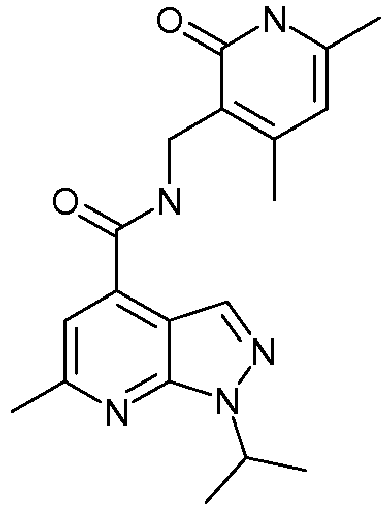
- In a 25 mL sealable tube under nitrogen were combined 6-methyl-1-(1-methylethyl)-1H-pyrazolo [3, 4-b] pyridine-4-carboxylic acid (60 mg, 0.27 mmol) and 3-(aminomethyl)-4,6-dimethyl-2(1H)-pyridinone.HCl (62 mg, 0.33 mmol) in DMSO (3 mL). 1-hydroxy-7-azabenzotriazole (56 mg, 0.41 mmol) was added and the resulting mixture was degassed with nitrogen for 10 minutes. N-methylmorpholine (0.11 ml, 0.96 mmol) and EDC (79 mg, 0.41 mmol) were added, the vessel was sealed, and the light brown mixture was stirred at room temperature for 2 days. Next added 2 mL of water and the mixture was stirred for 10 min. Solids that precipitated were sonicated, and allowed to stand at room temperature for 10 min. The contents were filtered, washed with water, and dried to afford the title compound (68 mg, 68%) as a light pink solid. LCMS E-S (M+H) = 354.3. 1H NMR (400 MHz, DMSO-d6) δ ppm 11.54 (s, 1 H), 8.69 (t, J=4.80 Hz, 1 H), 8.26 (s, 1 H), 7.46 (s, 1 H), 5.89 (s, 1 H), 5.20 (quin, J=6.69 Hz, 1 H), 4.36 (d, J=5.05 Hz, 2 H), 2.63 (s, 3 H), 2.21 (s, 3 H), 2.13 (s, 3 H), 1.48 (d, J=6.57 Hz, 6 H).
-

- The title compound was prepared in the same manner as described in example 52 using 1,6-bis(1-methylethyl)-1H-pyrazolo[3,4-b]pyridine-4-carboxylic acid (70 mg, 0.28 mmol) to afford an off-white solid (95 mg, 86%). LCMS E-S (M+H) = 382.3. 1H NMR (400 MHz, DMSO-d6) δ ppm 11.56 (br. s., 1 H, 8.76 (t, J=4.93 Hz, 1 H), 8.26 (s, 1 H), 7.50 (s, 1 H), 5.90 (s, 1 H), 5.15 - 5.25 (m, 1 H), 4.37 (d, J=5.05 Hz, 2 H), 3.13 - 3.23 (m, 1 H), 2.22 (s, 3 H), 2.13 (s, 3 H), 1.50 (d, J=6.57 Hz, 6 H), 1.32 (d, J=6.82 Hz, 6 H).
-

- In a 25 mL sealable tube under nitrogen were combined 1-(1-methylethyl)-6-phenyl-1H-pyrazolo[3,4-b]pyridine-4-carboxylic acid (70 mg, 0.25 mmol) and 3-(aminomethyl)-4,6-dimethyl-2(1H)-pyridinone.HCl (56.3 mg, 0.3 mmol) in DMSO (3 mL). 1-hydroxy-7-azabenzotriazole (51 mg, 0.37 mmol) was added and the resulting mixture was degassed with nitrogen for 10 min. N-methylmorpholine (0.1 ml, 0.87 mmol) and EDC (72 mg, 0.37 mmol) were added, the vessel was sealed, and the bright yellow mixture was stirred at room temperature for 2 days. Next added 2 mL of water, and the contents were stirred for 10 min. Solids that precipitated were sonicated, and allowed to stand at room temperature for 10 min. The reaction contents were filtered and washed with water. The solid was treated with 2 mL of EtOH, sonicated and heated, and then allowed to cool to room temperature. The contents were filtered, washed with water and dried to afford the title compound (74 mg, 70%) as a white solid. LCMS E-S (M+H) = 416.3. 1H NMR (400 MHz, DMSO-d6) δ ppm 11.58 (s, 1 H), 8.98 (t, J=4.80 Hz, 1 H), 8.38 (s, 1 H), 8.25 - 8.30 (m, 2 H), 8.17 (s, 1 H), 7.49 - 7.59 (m, 3 H), 5.91 (s, 1 H), 5.30 - 5.38 (m, 1 H), 4.42 (d, J=4.80 Hz, 2 H), 2.23 (s, 3 H), 2.13 (s, 3 H), 1.55 (d, J=6.57 Hz, 6 H).
-
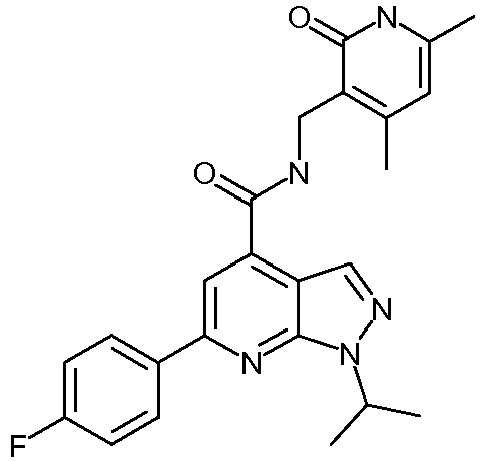
- In a 25 mL sealable tube under nitrogen were combined 6-chloro-N-[(4,6-dimethyl-2-oxo-1,2-dihydro-3-pyridinyl)methyl]-1-(1-methylethyl)-1H-pyrazolo[3,4-b]pyridine-4-carboxamide (90 mg, 0.24 mmol), (4-fluorophenyl)boronic acid (33.7 mg, 0.24 mmol) in 1,4-dioxane (3 mL). PdCl2(dppf)-CH2Cl2 adduct (19.7 mg, 0.024 mmol) was added and the resulting mixture was degassed with nitrogen for 10 min. Sodium carbonate (77 mg, 0.72 mmol) was added, the vessel was sealed, and the mixture was heated at 85 °C for 2 hrs and then at 100 °C overnight. Added an additional 2 eq of boronic acid and 0.2 eq of PdCl2(dppf)-CH2Cl2 adduct. The contents were heated at 120 °C for 4 hr. and then irradiated (microwave) first at 160 °C for 90 min, and then at 190 °C for 2 hrs. After cooling to room temperature, the solids were filtered, washed with DMSO and the filtrate was evaporated. The crude product was purified first by reverse-phase HPLC (C18, 5% to 80% CH3CN in water with 0.1% TFA, 18 minute gradient) and then silica gel chromatography (eluent: gradient 0 to 90:10:1 DCM/MeOH/NH4OH). The collected solid was dried to afford the title compound (13 mg, 12%) as a white solid. LCMS E-S (M+H) = 434.2. 1H NMR (400 MHz, DMSO-d6) δ ppm 11.58 (br. s., 1 H), 8.96 (t, J=4.67 Hz, 1 H), 8.38 (s, 1 H), 8.33 (dd, J=8.84, 5.56 Hz, 2 H), 8.16 (s, 1 H), 7.40 (t, J=8.84 Hz, 2 H), 5.91 (s, 1 H), 5.33 (dt, J=13.26, 6.76 Hz, 1 H), 4.41 (d, J=4.55 Hz, 2 H), 2.23 (s, 3 H), 2.13 (s, 3 H), 1.55 (d, J=6.57 Hz, 6 H).
-

- In a 25 mL sealable tube under nitrogen were combined 6-chloro-N-[(4,6-dimethyl-2-oxo-1,2-dihydro-3-pyridinyl)methyl]-1-(1-methylethyl)-1H-pyrazolo[3,4-b]pyridine-4-carboxamide (85 mg, 0.23 mmol) and {4-[(dimethylamino)sulfonyl]phenyl}boronic acid (104 mg, 0.46 mmol) in DME/water (3 ml: 1 ml). PdCl2(dppf)-CH2Cl2 adduct (9.3 mg, 0.011 mmol) was added and the resulting mixture was degassed with nitrogen for 10 min. Sodium bicarbonate (57.3 mg, 0.68 mmol) was added and the insoluble light brown mixture was heated in an oil bath at 110 °C for 3 hrs. After cooling, 2 mL of water was added to the black mixture and solids that precipitated were filtered. DMF was added along with a few drops of water and solids were filtered. DCM/MeOH (1:1) was added to the grey solids and they were filtered and dried to afford the title compound (69 mg, 57%) as a grayish solid. LCMS E-S (M+H) = 523.2. 1H NMR (400 MHz, DMSO-d6) δ ppm 11.59 (br. s., 1 H), 9.01 (br. s., 1 H), 8.51 (m, J=8.34 Hz, 2 H), 8.44 (s, 1 H), 8.27 (s, 1 H), 7.93 (m, J=8.34 Hz, 2 H), 5.91 (s, 1 H), 5.36 (dt, J=13.14, 6.57 Hz, 1 H), 4.43 (d, J=4.55 Hz, 2 H), 2.66 (s, 6 H), 2.23 (s, 3 H), 2.13 (s, 3 H), 1.56 (d, J=6.57 Hz, 6 H).
-

- In a 25 mL sealable tube under nitrogen were combined 6-chloro-N-[(4,6-dimethyl-2-oxo-1,2-dihydro-3-pyridinyl)methyl]-1-(1-methylethyl)-1H-pyrazolo[3,4-b]pyridine-4-carboxamide (80 mg, 0.21 mmol) and [6-(dimethylamino)-3-pyridinyl]boronic acid (53.3 mg, 0.32 mmol) in DME/water (3 mL : 1 mL). PdCl2 (dppf)-CH2Cl2 adduct (8.7 mg, 0.011 mmol) was added and the resulting mixture was degassed with nitrogen for 10 min. Sodium bicarbonate (53.9 mg, 0.64 mmol) was added, the vessel was sealed, and the insoluble green mixture was irradiated (microwave) at 150 °C for 20 min. After cooling, 2 mL of water was added to the dark green mixture and solids that precipitated were filtered. EtOAc was added, the mixture was heated and some hexanes were added. Solids were filtered, dissolved in DCM/MeOH (1:1), and filtered through a pad of silica gel and the filtrate was evaporated. The residue was dissolved in DCM and purified by SiO2 chromatography (eluent: gradient of 0 to 90:10 DCM/MeOH) to afford a residual oil that was triturated with EtOH/EtOAc (1:1). The resultant solid was filtered and dried to afford the title compound (46 mg, 45%) as a yellow solid. LCMS E-S (M+H) = 460.2. 1H NMR (400 MHz, DMSO-d6) δ ppm 11.58 (s, 1 H), 9.02 (d, J=2.27 Hz, 1 H), 8.87 (t, J=4.67 Hz, 1 H), 8.36 (dd, J=8.84, 2.53 Hz, 1 H), 8.31 (s, 1 H), 8.08 (s, 1 H), 6.79 (d, J=8.84 Hz, 1 H), 5.91 (s, 1 H), 5.25 - 5.34 (m, 1 H), 4.40 (d, J=4.80 Hz, 2 H), 3.12 (s, 6 H), 2.23 (s, 3 H), 2.13 (s, 3 H), 1.53 (d, J=6.57 Hz, 6 H).
-

- In a 25 mL sealable tube under nitrogen were combined 6-chloro-N-[(4,6-dimethyl-2-oxo-1,2-dihydro-3-pyridinyl)methyl]-1-(1-methylethyl)-1H-pyrazolo[3,4-b]pyridine-4-carboxamide (75 mg, 0.2 mmol), {4-[(methylamino)sulfonyl]phenyl}boronic acid (69 mg, 0.32 mmol) in DME/water (3 ml:1ml). PdCl2(dppf)-CH2Cl2 adduct (8.2 mg, 0.01 mmol) was added and the resulting mixture was degassed with nitrogen for 10 min. Sodium bicarbonate (50.6 mg, 0.6 mmol) was added , the vessel was sealed, and the insoluble mixture was heated in a microwave at 150 °C for 30 min. After cooling, 2 mL of water was added to the mixture and solids that precipitated were filtered. DCM/MeOH (1:1) was added and the solution was filtered through a pad of silica gel and the filtrate was evaporated. The residue was purified by silica gel chromatography (eluent: gradient of 0 to 90:10 DCM/MeOH) and the isolated solid triturated in EtOAc. The solids were filtered and dried to afford the title compound (29 mg, 28%) as an off-white solid. LCMS E-S (M+H) = 509.0. 1H NMR (400 MHz, DMSO-d6) δ ppm 11.58 (br. s., 1 H), 8.99 (t, J=4.93 Hz, 1 H), 8.47 (m, J=8.59 Hz, 2 H), 8.43 (s, 1 H), 8.25 (s, 1 H), 7.95 (m, J=8.59 Hz, 2 H), 7.60 (br. s., 1 H), 5.91 (s, 1 H), 5.36 (quin, J=6.69 Hz, 1 H), 4.42 (d, J=4.80 Hz, 2 H), 2.46 (s, 3 H), 2.23 (s, 3 H), 2.13 (s, 3 H), 1.56 (d, J=6.82 Hz, 6 H).
-

- In a 25 mL sealable tube under nitrogen were combined 6-chloro-N-[(4,6-dimethyl-2-oxo-1,2-dihydro-3-pyridinyl)methyl]-1-(1-methylethyl)-1H-pyrazolo[3,4-b]pyridine-4-carboxamide (80 mg, 0.21 mmol) and (4-aminophenyl)boronic acid (44 mg, 0.32 mmol) in DME/water (3 ml:1 ml). PdCl2(dppf)-CH2Cl2 adduct (8.74 mg, 0.011 mmol) was added and the resulting mixture was degassed with nitrogen for 10 min. Sodium bicarbonate (53.9 mg, 0.64 mmol) was added, the vessel was sealed, and the insoluble light pink mixture was irradiated (microwave) at 150 °C for 30 min. After cooling, DCM/MeOH (1:1) was added, it was pre-absorbed on silica gel and purified by silica gel chromatography (eluent: gradient 0 to 90:10:1 DCM/MeOH/NH4OH). The isolated solid was treated with MeOH. The solids that precipitated were filtered and dried to afford the title compound (63 mg, 66%) as a yellow solid. LCMS E-S (M+H) = 431.3. 1H NMR (400 MHz, DMSO-d6) δ ppm 11.56 (s, 1 H), 8.88 (t, J=4.93 Hz, 1 H), 8.27 (s, 1 H), 8.01 (s, 1 H), 7.99 (d, J=2.02 Hz, 2 H), 6.69 (s, 1 H), 6.67 (s, 1 H), 5.90 (s, 1 H), 5.61 (s, 2 H), 5.24 - 5.32 (m, 1 H), 4.40 (d, J=4.80 Hz, 2 H), 2.22 (s, 3 H), 2.13 (s, 3 H), 1.53 (s, 3 H), 1.51 (s, 3 H).
-
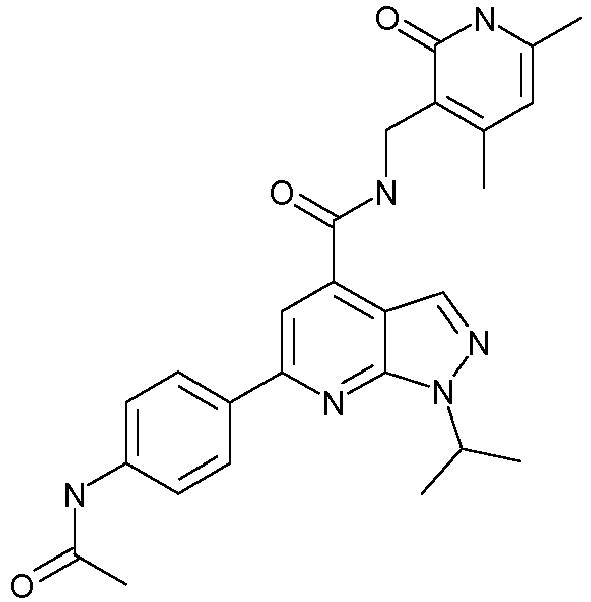
- In a 25 mL sealable tube under nitrogen were combined 6-chloro-N-[(4,6-dimethyl-2-oxo-1,2-dihydro-3-pyridinyl)methyl]-1-(1-methylethyl)-1H-pyrazolo[3,4-b]pyridine-4-carboxamide (80 mg, 0.21 mmol) and [4-(acetylamino)phenyl]boronic acid (57.5 mg, 0.32 mmol) in DME/water (3 ml: 1 ml). PdCl2(dppf)-CH2Cl2 adduct (8.7 mg, 0.010 mmol) was added and the resulting mixture was degassed with nitrogen for 10 min. Sodium bicarbonate (53.9 mg, 0.64 mmol) was added, the vessel was sealed, and the insoluble light brown mixture was heated at 110 °C for 2.5 h. After cooling, 2 mL of water was added to the dark grey mixture and solids that precipitated were filtered. EtOAc was added, the mixture was heated and some hexanes were added. The solids were filtered, dissolved in DCM/MeOH (1:1) and 1 mL of DMF. The contents were pre-absorbed onto silica gel and purified by silica gel chromatography (eluent: gradient 0 to 90:10:1 DCM/MeOH/NH4OH). The isolated product was treated with MeOH, and the solids that precipitated were filtered, washed with hexanes and dried to afford the title compound (55 mg, 52%) as a white solid. LCMS E-S (M+H) = 473.1. 1H NMR (400 MHz, DMSO-d6) δ ppm 11.57 (s, 1 H), 10.18 (s, 1 H), 8.93 (t, J=4.93 Hz, 1 H), 8.35 (s, 1 H), 8.22 (m, J=8.84 Hz, 2 H), 8.13 (s, 1 H), 7.76 (m, J=8.84 Hz, 2 H), 5.91 (s, 1 H), 5.28 - 5.37 (m, 1 H), 4.41 (d, J=4.80 Hz, 2 H), 2.23 (s, 3 H), 2.13 (s, 3 H), 2.09 (s, 3 H), 1.54 (d, J=6.82 Hz, 6 H).
-

- In a 25 mL sealable tube under nitrogen were combined 6-chloro-N-[(4,6-dimethyl-2-oxo-1,2-dihydro-3-pyridinyl)methyl]-1-(1-methylethyl)-1H-pyrazolo[3,4-b]pyridine-4-carboxamide (80 mg, 0.21 mmol) and (3-aminophenyl)boronic acid (46.9 mg, 0.34 mmol) in DME/water (3 ml:1 ml). PdCl2(dppf)-CH2Cl2 adduct (8.74 mg, 0.01 mmol) was added and the resulting mixture was degassed with nitrogen for 10 min. Sodium bicarbonate (53.9 mg, 0.64 mmol) was added, the vessel was sealed, and the reaction mixture was irradiated (microwave) at 150 °C for 25 min. After cooling, 2 mL of water was added to the black mixture and solids that precipitated were filtered. DCM/MeOH (1:1) was added, the mixture was pre-absorbed on silica gel and purified by silica gel chromatography (eluent: gradient 0 to 90:10:1 DCM/MeOH/NH4OH). The isolated product was treated with EtOH/EtOAc/hexanes (1:1:1). The solids that precipitated were filtered and dried to afford the title compound (40 mg, 42%) as a light grey solid. LCMS E-S (M+H) = 431.3. 1H NMR (400 MHz, DMSO-d6) δ ppm 11.56 (br. s., 1 H), 8.96 (t, J=4.93 Hz, 1 H), 8.34 (s, 1 H), 8.02 (s, 1 H), 7.46 (t, J=1.89 Hz, 1 H), 7.36 (d, J=7.58 Hz, 1 H), 7.18 (t, J=7.71 Hz, 1 H), 6.69 (dd, J=7.83, 1.52 Hz, 1 H), 5.90 (s, 1 H), 5.25 - 5.37 (m, 3 H), 4.40 (d, J=4.80 Hz, 2 H), 2.22 (s, 3 H), 2.13 (s, 3 H), 1.55 (s, 3 H), 1.54 (s, 3 H).
-

- The title compound was prepared in the same manner as described in example 61 using {4-[(methylamino) carbonyl] phenyl} boronic acid (57.5 mg, 0.32 mmol) to afford a light grey solid (70 mg, 68%). LCMS E-S (M+H) = 473.1. 1H NMR (400 MHz, DMSO-d6) δ ppm 11.58 (s, 1 H), 9.00 (t, J=4.80 Hz, 1 H), 8.59 (q, J=4.38 Hz, 1 H), 8.41 (s, 1 H), 8.35 (m, J=8.59 Hz, 2 H), 8.24 (s, 1 H) 8.01 (m, J=8.59 Hz, 2 H), 5.91 (s, 1 H), 5.33 - 5.41 (m, 1 H), 4.42 (d, J=4.80 Hz, 2 H), 2.83 (d, J=4.55 Hz, 3 H), 2.23 (s, 3 H), 2.13 (s, 3 H), 1.56 (s, 3 H), 1.55 (s, 3 H).
-

- In a 25 mL sealable tube under nitrogen were combined 6-chloro-N-[(4,6-dimethyl-2-oxo-1,2-dihydro-3-pyridinyl)methyl]-1-(1-methylethyl)-1H-pyrazolo[3,4-b]pyridine-4-carboxamide (80 mg, 0.21 mmol) and [3-(acetylamino)phenyl]boronic acid (57.5 mg, 0.32 mmol) in DME/water (3 ml: 1 ml). PdCl2(dppf)-CH2Cl2 adduct (8.7 mg, 0.010 mmol) was added and the resulting mixture was degassed with nitrogen for 10 min. Sodium bicarbonate (53.9 mg, 0.64 mmol) was added, the vessel was sealed and the reaction mixture was irradiated (microwave) at 150 °C for 30 min. After cooling, 2 mL of water was added and solids that precipitated were filtered. DCM/MeOH (1:1) was added, the mixture was pre-absorbed on silica gel and purified by silica gel chromatography (eluent: gradient 0 to 90:10:1 DCM/MeOH/NH4OH). The isolated product was treated with EtOH and DCM, filtered, and dried to afford the title compound (65 mg, 63%) as a white solid. LCMS E-S(M+H)= 473.1. 1H NMR (400 MHz, DMSO-d6) δ ppm 11.58 (s, 1 H), 9.02 (t, J=4.80 Hz, 1 H), 8.61 - 8.68 (m, 2 H), 8.37 - 8.43 (m, 2 H), 8.21 (s, 1 H), 7.94 (d, J=7.83 Hz, 1 H), 7.65 (t, J=7.83 Hz, 1 H), 5.91 (s, 1 H), 5.37 (quin, J=6.63 Hz, 1 H), 4.42 (d, J=4.80 Hz, 2 H), 2.84 (d, J=4.29 Hz, 3 H), 2.24 (s, 3 H), 2.13 (s, 3 H), 1.57 (s, 3 H), 1.55 (s, 3 H).
-

- In a 25 mL sealable tube under nitrogen were combined 6-chloro-N-[(4,6-dimethyl-2-oxo-1,2-dihydro-3-pyridinyl)methyl]-1-(1-methylethyl)-1H-pyrazolo[3,4-b]pyridine-4-carboxamide (80 mg, 0.21 mmol) and (2,4-dioxo-1,2,3,4-tetrahydro-5-pyrimidinyl)boronic acid (50 mg, 0.32 mmol) in DME/water (3 ml: 1 ml). PdCl2(dppf)-CH2Cl2 adduct (8.74 mg, 0.011 mmol) was added and the resulting mixture was degassed with nitrogen for 10 min. Sodium bicarbonate (53.9 mg, 0.64 mmol) was added, the vessel was sealed, and reaction mixture was heated in a microwave at 150 °C for 30 min. After cooling, 2 mL of water was added to the black mixture and solids that precipitated were filtered. DCM/MeOH (1:1) was added, the mixture was pre-absorbed on silica gel and purified by silica gel chromatography (eluent: gradient 0 to 90:10:1 DCM/MeOH/NH4OH). The isolated product was treated with EtOH/EtOAc (1:1) and sonicated. The solids that precipitated were filtered, washed with EtOH and DCM, and dried to afford the title compound (41 mg, 42%) as a light grey solid. LCMS E-S (M+H) = 449.9. 1H NMR (400 MHz, DMSO-d6) δ ppm 11.58 (s, 1 H), 11.52 (br. s., 1 H), 11.47 (s, 1 H), 8.75 (t, J=5.05 Hz, 1 H), 8.36 (s, 1 H), 8.31 (s, 1 H), 8.23 (s, 1 H), 5.90 (s, 1 H), 5.27 (quin, J=6.69 Hz, 1 H), 4.37 (d, J=5.05 Hz, 2 H), 2.23 (s, 3 H), 2.13 (s, 3 H), 1.52 (s, 3 H), 1.50 (s, 3 H).
-

- The title compound was prepared in the same manner as example 48 using 4-(4,4,5,5-tetramethyl-1,3,2-dioxaborolan-2-yl)-2-pyridinamine (65.9 mg, 0.3 mmol) to afford an off-white solid (60 mg, 73%). LCMS E-S (M+H) = 432.3. 1H NMR (400 MHz, DMSO-d6) δ ppm 11.57 (s, 1 H), 8.99 (t, J=4.80 Hz, 1 H), 8.41 (s, 1 H), 8.05 - 8.13 (m, 2 H), 7.24 - 7.32 (m, 2 H), 6.14 (s, 2 H), 5.91 (s, 1 H), 5.33 (quin, J=6.69 Hz, 1 H), 4.41 (d, J=4.80 Hz, 2 H), 2.22 (s, 3 H), 2.13 (s, 3 H), 1.55 (d, J=6.57 Hz, 6 H).
-

- The title compound was prepared in the same manner as example 48 using [4-(aminosulfonyl) phenyl] boronic acid (64.5 mg, 0.32 mmol) to afford a light grey solid (76 mg, 74 %). LCMS E-S (M+H) = 495.0. 1H NMR (400 MHz, DMSO-d6) δ ppm 11.58 (br. s., 1 H), 8.99 (t, J=4.80 Hz, 1 H), 8.41 - 8.48 (m, 3 H), 8.25 (s, 1 H), 8.00 (d, J=8.59 Hz, 2 H), 7.50 (s, 2 H), 5.91 (s, 1 H), 5.37 (quin, J=6.69 Hz, 1 H), 4.43 (d, J=4.80 Hz, 2 H), 2.23 (s, 3H), 2.14 (s, 3 H), 1.56 (d, J=6.57 Hz, 6 H).
-

- In a 25 mL sealable tube under nitrogen were combined 6-chloro-N-[(4,6-dimethyl-2-oxo-1,2-dihydro-3-pyridinyl)methyl]-1-(1-methylethyl)-1H-pyrazolo[3,4-b]pyridine-4-carboxamide (75 mg, 0.2 mmol) and {4-[(methylsulfonyl)amino]phenyl}boronic acid (43.1 mg, 0.2 mmol) in DME/water (3 ml:1 ml). PdCl2(dppf)-CH2Cl2 adduct (8.2 mg, 0.01 mmol) was added and the resulting mixture was degassed with nitrogen for 10 min. Sodium bicarbonate (50.6 mg, 0.6 mmol) was added, the vessel was sealed, and the reaction mixture was irradiated (microwave) at 150 °C for 25 min. After cooling, 2 mL of water was added to the black mixture and solids that precipitated were filtered. DCM/MeOH (1:1) was added, the mixture was pre-absorbed on silica gel and purified by silica gel chromatography (eluent: gradient 0 to 90:10:1 DCM/MeOH/NH4OH). The isolated product was suspended in EtOAc heated, and sonicated. Some hexanes was added and the contents allowed to cool to room temperature. Solids that precipitated were filtered. The solid was then suspended in EtOH, heated, and sonicated. After cooling to room temperature, the solids were filtered and dried to afford the title compound (38 mg, 36%) as a beige solid. LCMS E-S (M+H) = 509.0. 1H NMR (400 MHz, DMSO-d6) δ ppm 11.57 (s, 1 H), 10.05 (br. s., 1 H), 8.93 (t, J=4.93 Hz, 1 H), 8.35 (s, 1 H), 8.24 (m, J=8.59 Hz, 2 H), 8.11 (s, 1 H), 7.37 (m, J=8.84 Hz, 2 H), 5.91 (s, 1 H), 5.32 (quin, J=6.69 Hz, 1 H), 4.41 (d, J=4.80 Hz, 2 H), 3.08 (s, 3 H), 2.23 (s, 3 H), 2.13 (s, 3 H), 1.55 (s, 3 H), 1.54 (s, 3 H).
-

- In a 25 mL sealable tube under nitrogen were combined 6-chloro-N-[(4,6-dimethyl-2-oxo-1,2-dihydro-3-pyridinyl)methyl]-3-methyl-1-(1-methylethyl)-1H-pyrazolo[3,4-b]pyridine-4-carboxamide (75 mg, 0.19 mmol) and N,N-dimethyl-4-(4,4,5,5-tetramethyl-1,3,2-dioxaborolan-2-yl)benzenesulfonamide (90 mg, 0.29 mmol) in DME/water (3 ml:1 ml). PdCl2 (dppf)-CH2Cl2 adduct (7.9 mg, 0.009 mmol) was added and the resulting mixture was degassed with nitrogen for 10 min. Sodium bicarbonate (48.7 mg, 0.58 mmol) was added, the vessel was sealed, and the reaction mixture was irradiated (microwave) at 150 °C for 30 min. After cooling, 2 mL of water was added and solids that precipitated were filtered. DCM/MeOH (1:1) was added, the mixture was pre-absorbed on silica gel and purified by silica gel chromatography (eluent: gradient 0 to 90:10:1 DCM/MeOH/NH4OH). The isolated product was treated with EtOH/EtOAc (1:1), the solids filtered and washed with EtOAc and DCM, and then dried to afford the title compound (83 mg, 78%) as a white solid. LCMS E-S (M+H) = 537.1. 1H NMR (400 MHz, DMSO-d6) δ ppm 11.54 (s, 1 H) 8.79 (t, J=4.93 Hz, 1 H) 8.47 (m, J=8.59 Hz, 2 H) 7.90 (m, J=8.59 Hz, 2 H) 7.80 (s, 1 H) 5.89 (s, 1 H) 5.28 (quin, J=6.69 Hz, 1 H) 4.40 (d, J=5.05 Hz, 2 H) 2.66 (s, 6 H) 2.47 (s, 3 H) 2.25 (s, 3 H) 2.12 (s, 3 H) 1.53 (s, 3 H) 1.51 (s, 3 H).
-

- In a 25 mL sealable tube under nitrogen were combined 6-chloro-N-[(4,6-dimethyl-2-oxo-1,2-dihydro-3-pyridinyl)methyl]-1-(1-methylethyl)-1H-pyrazolo [3,4-b]pyridine-4-carboxamide ( 60 mg, 0.16 mmol) and 4-piperidinamine (2 mL) in EtOH (3 mL). The vessel was sealed and the reaction mixture was irradiated (microwave) at 125 °C for 5 hr and then at 160 °C for 90 min. The mixture was evaporated under vacuum and the resulting residue was partitioned between EtOAc and water. Organics were washed with water (2x) and brine, dried over MgSO4, filtered and evaporated. The residue was purified by silica gel chromatography (eluent: gradient 0 to 90:10:1 DCM/MeOH/NH4OH). The isolated product was treated with EtOAc/ether (1:1) and allowed to stand at room temperature overnight. The solids that had precipitated were triturated, filtered, and dried to afford the title compound as a pale yellow solid 25 mg (35%). LCMS E-S (M+H) = 438.0. 1H NMR (400 MHz, DMSO-d6) δ ppm 8.66 (t, J=4.67 Hz, 1 H) 7.98 (s, 1 H) 7.12 (s, 1 H) 5.89 (s, 1 H) 4.98 (dt, J=13.33, 6.60 Hz, 1 H) 4.30 - 4.41 (m, 4 H) 3.01 (t, J=11.62 Hz, 2 H) 2.85 (br. s., 1 H) 2.20 (s, 3 H) 2.12 (s, 3 H) 1.80 (d, J=10.36 Hz, 2 H) 1.44 (s, 3 H) 1.43 (s, 3 H) 1.18 - 1.30 (m, 3 H) 0.79 - 0.91 (m, 1 H)
-

- In a 25 mL sealable tube under nitrogen were combined 6-chloro-N-[(4,6-dimethyl-2-oxo-1,2-dihydro-3-pyridinyl)methyl]-1-(1-methylethyl)-1H-pyrazolo[3,4-b]pyridine-4-carboxamide (60 mg, 0.16 mmol) and tetrahydro-2H-pyran-4-amine (2 ml, 19 mmol) in EtOH (3 mL). The vessel was sealed and the reaction mixture was irradiated (microwave) at 125 °C for 2 hr. and then at 170 °C for 1 hr. The mixture was concentrated to ca. 20% volume and NMP (2 mL) added to the reaction mixture. The contents were again irradiated (microwave) first at 180 °C for 2.5 h and then at 190 °C for 75 min. The mixture was evaporated under vacuum, and the resulting residue was purified by silica gel chromatography (eluent: gradient 0 to 90:10:1 DCM/MeOH/NH4OH). The isolated product was treated with EtOAc/hexanes (1:1), sonicated, and heated. After cooling, solids that precipitated were filtered and dried to afford the title compound (46 mg, 64%) as an off-white solid. LCMS E-S (M+H) = 439.1. 1H NMR (400 MHz, DMSO-d6) δ ppm 11.55 (s, 1 H) 8.44 (t, J=5.05 Hz, 1 H) 7.83 (s, 1 H) 7.20 (d, J=7.33 Hz, 1 H) 6.63 (s, 1 H) 5.89 (s, 1 H) 4.93 (quin, J=6.69 Hz, 1 H) 4.32 (d, J=5.05 Hz, 2 H) 3.99 - 4.06 (m, 1 H) 3.88 (dt, J=11.49, 3.47 Hz, 2 H) 3.45 (td, J=11.37, 2.02 Hz, 2 H) 2.21 (s, 3 H) 2.13 (s, 3 H) 1.95 (d, J=10.61 Hz, 2 H) 1.41 - 1.51 (m, 8 H).
-

- In a 25 mL sealable tube under nitrogen were combined 6-chloro-N-[(4,6-dimethyl-2-oxo-1,2-dihydro-3-pyridinyl)methyl]-1-(1-methylethyl)-1H-pyrazolo[3,4-b]pyridine-4-carboxamide (60 mg, 0.16 mmol) and (4-pyridinylmethyl)amine (0.065 ml, 0.64 mmol) in EtOH (2 mL). The vessel was sealed and the reaction mixture was heated at 90 °C overnight. An additional 1 mL of (4-pyridinylmethyl) amine was added and the mixture was heated in a microwave at 160 °C for 90 min. The EtOH solvent was removed under reduced pressure, 2 mL of NMP was added, and the mixture was then irradiated (microwave) at 180 °C for 90 min. The mixture was evaporated under vacuum, and the resulting residue was partitioned between EtOAc and water. The crude residue was extracted with EtOAc, DCM and DCM/isopropanol (70:30). The combined organics were washed with water (2x) and brine, dried over MgSO4, filtered and evaporated. The residue was purified by silica gel chromatography (eluent: gradient 0 to 90:10:1 DCM/MeOH/NH4OH). The isolated yellow oil was treated with EtOAc and sonicated. The filtered solid was washed with hexanes and dried to afford the title compound (26 mg, 36%) as a white solid. LCMS E-S (M+H) = 446.1. 1H NMR (400 MHz, DMSO-d6) δ ppm 11.56 (s, 1 H) 8.50 (t, J=5.18 Hz, 1 H) 8.43 - 8.48 (m, 2 H) 7.89 (t, J=5.94 Hz, 1 H) 7.84 (s, 1 H) 7.34 (d, J=6.06 Hz, 2 H) 6.73 (s, 1 H) 5.89 (s, 1 H) 4.83 (quin, J=6.69 Hz, 1 H) 4.58 (d, J=5.81 Hz, 2 H) 4.32 (d, J=5.05 Hz, 2 H) 2.21 (s, 3 H) 2.13 (s, 3 H) 1.32 (d, J=6.82 Hz, 6 H).
-

- In a 25 mL sealable tube under nitrogen were combined 6-chloro-N-[(4,6-dimethyl-2-oxo-1,2-dihydro-3-pyridinyl)methyl]-1-(1-methylethyl)-1H-pyrazolo[3,4-b]pyridine-4-carboxamide (80 mg, 0.21 mmol) and (2-aminoethyl)dimethylamine (37.7 mg, 0.43 mmol) in NMP (2 mL). The vessel was sealed and the reaction mixture was irradiated (microwave) at 150 °C for 1h. The mixture was evaporated under vacuum, and the resulting residue was partitioned between EtOAc and water. The contents were extracted with EtOAc, DCM and DCM/isopropanol (70:30). The combined organics were washed with water (2x) and brine, dried over MgSO4, filtered and evaporated. The residue was purified by silica gel chromatography (eluent: gradient 0 to 90:10:1 DCM/MeOH/NH4OH). The isolated yellow oil was treated with EtOAc and sonicated. Solids that precipitated were filtered, washed with hexanes, and dried to afford the title compound (60 mg, 65%) as a white solid. LCMS E-S (M+H) = 425.9. 1H NMR (400 MHz, DMSO-d6) δ ppm 11.55 (br. s., 1 H) 8.43 (t, J=5.05 Hz, 1 H) 7.84 (s, 1 H) 7.08 (t, J=5.05 Hz, 1 H) 6.67 (s, 1 H) 5.89 (s, 1 H) 4.94 (quin, J=6.63 Hz, 1 H) 4.32 (d, J=5.05 Hz, 2 H) 3.44 (q, J=6.48 Hz, 2 H) 2.44 (t, J=6.69 Hz, 2 H) 2.17 - 2.22 (m, 9 H) 2.12 (s, 3 H) 1.43 (d, J=6.57 Hz, 6 H).
-

- In a 25 mL sealable tube under nitrogen were combined 6-chloro-N-[(4,6-dimethyl-2-oxo-1,2-dihydro-3-pyridinyl)methyl]-1-(1-methylethyl)-1H-pyrazolo[3,4-b]pyridine-4-carboxamide (80 mg, 0.21 mmol) and 2-aminoethanol (1 ml) in NMP (2 mL). The vessel was sealed and the reaction mixture was irradiated (microwave) at 130 °C for 1 h and then at 140 °C for 90 min. The mixture was evaporated under vacuum and the residue was purified by silica gel chromatography (eluent: gradient 0 to 90:10:1 DCM/MeOH/NH4OH). The isolated yellow oil was treated with EtOAc, sonicated, and treated with hexanes. The solids were filtered, dissolved in DMF (1 mL), and a few drops of water were added. The solution was allowed to stand at room temperature overnight, and then sonicated. The filtered solid was washed with Hexanes/EtOAc (1:1), and then dried to afford the title compound (55 mg, 63%) as a light yellow solid. LCMS E-S (M+H) = 399.0. 1H NMR (400 MHz, DMSO-d6) δ ppm 11.56 (br. s., 1 H) 8.44 (br. s., 1 H) 7.84 (s, 1 H) 7.20 (br. s., 1 H) 6.68 (s, 1 H) 5.89 (s, 1 H) 4.95 (dt, J=13.01, 6.38 Hz, 1 H) 4.72 (t, J=4.93 Hz, 1 H) 4.32 (d, J=4.80 Hz, 2 H) 3.58 (d, J=5.56 Hz, 2 H) 3.38 - 3.46 (m, 2 H) 2.21 (s, 3 H) 2.12 (s, 3 H) 1.43 (d, J=6.57 Hz, 6 H)
-

- To a 20 mL microwave vial were sequentially added 6-chloro-N-[(4,6-dimethyl-2-oxo-1,2-dihydro-3-pyridinyl)methyl]-1-(1-methylethyl)-1H-pyrazolo[3,4-b]pyridine-4-carboxamide (100 mg, 0.267 mmol, 3-(methyloxy)-5-(4,4,5,5-tetramethyl-1,3,2-dioxaborolan-2-yl)pyridine (69.2 mg, 0.294 mmol), PdCl2(dppf)-CH2Cl2 adduct (21.84 mg, 0.027 mmol), (DME) (5 mL), and water (2 mL). The reaction mixture was degassed with nitrogen for 5 min. Sodium bicarbonate (67.4 mg, 0.802 mmol) was added and the contents sealed and irradiated (microwave) at 140 °C. The reaction mixture was cooled to room temperature and poured on a silica column (through Na2SO4) and purified by silica gel chromatography (eluent: 5% MeOH/CH2Cl2) which provided the desired product as an off-white solid after preciptation from EtOAc/MeOH. The final product was collected as 0.090 g (76%). LCMS E-S (M+H) 447.2. 1H NMR (400 MHz, DMSO-d6 ) δ ppm 11.57 (s., 1 H), 9.06 (d, J=1.52 Hz, 1 H), 8.92 - 9.00 (m, 1 H), 8.39 - 8.48 (m, 2 H), 8.24 (s, 1 H), 8.14 (d, J=1.77 Hz, 1H), 5.91 (s, 1 H), 5.30 - 5.45 (m, 1 H), 4.42 (d, J=4.80 Hz, 2 H), 3.97 (s, 3 H), 2.24 (s, 3 H), 2.13 (s, 3 H), 1.55 (d, J=6.82 Hz, 6 H).
-

- The title compound was prepared in the same manner as described in example 58 using 2-methoxypyridine-4-boronic acid pinacol ester (69.2 mg, 0.294 mmol) to give the desired product as a grey solid after evaporation and preciptation from EtOAc/MeOH. The final product was collected as 0.051 g (41%). LCMS E-S (M+H) 447.2. 1H NMR (400 MHz, DMSO-d6 ) δ ppm 11.57 (br. s., 1 H) 9.00 (t, J=4.80 Hz, 1 H) 8.44 (s, 1 H) 8.36 (s, 1 H) 8.26 (s, 1 H) 7.84 (dd, J=5.31, 1.52 Hz, 1 H) 7.67 (s, 1 H) 5.91 (s, 1 H) 5.32 - 5.40 (m, 1 H) 4.42 (d, J=4.80 Hz, 2 H) 3.94 (s, 3 H) 2.23 (s, 3 H) 2.13 (s, 3 H) 1.55 (d, 6 H).
-

- The title compound was prepared in the same manner as described in example 58 using 6-aminopyridine-3-boronic acid pinacol ester (64.8 mg, 0.294 mmol) to give the desired product as a grey solid after evaporation and preciptation from EtOAc/MeOH. The final product was collected as 0.060 g (49%). LCMS E-S (M+H) = 432.2. 1H NMR (400 MHz, DMSO-d6 ) δ ppm 11.57 (br. s., 1 H) 8.85 - 8.92 (m, 2 H) 8.31 (s, 1 H) 8.26 (dd, J=8.59, 2.53 Hz, 1 H) 8.04 (s, 1 H) 6.57 (d, J=8.59 Hz, 1 H) 6.46 (s, 2 H) 5.90 (s, 1 H) 5.25 - 5.33 (m, 1 H) 4.40 (d, J=4.80 Hz, 2 H) 2.22 (s, 3 H) 2.13 (s, 3 H) 1.53 (d, 6 H).
-

- The title compound was prepared in the same manner as described in example 58 using [5-(methylsulfonyl)-3-pyridinyl]boronic acid (59.1 mg, 0.294 mmol) to give the desired product as an off-white solid after evaporation and preciptation from EtOAc/MeOH. The final product was collected as 0.079 g (59%). LCMS E-S (M+H) = 495.0. 1H NMR (400 MHz, DMSO-d6 ) δ ppm 11.59 (br. s., 1 H), 9.76 (d, J=2.27 Hz, 1 H), 9.21 (d, J=2.02 Hz, 1 H), 9.00 - 9.06 (m, 2 H), 8.46 (s, 1 H), 8.37 (s, 1 H), 5.91 (s, 1 H), 5.36 - 5.44 (m, 1 H), 4.43 (d, J=4.80 Hz, 2 H), 3.45 (s, 3 H), 2.24 (s, 3 H), 2.13 (s, 3 H), 1.56 (d, 6 H).
-

- The title compound was prepared in the same manner as described in example 74 using 2-(2-furanyl)-4,4,5,5-tetramethyl-1,3,2-dioxaborolane (57.1 mg, 0.294 mmol) to give the desired product as an white solid after evaporation and preciptation from EtOAc/MeOH. The final product was collected as 0.049 g (44%). LCMS E-S (M+H) 406.2. 1H NMR (400 MHz, DMSO-d6 ) δ ppm 11.57 (s, 1 H) 8.93 (t, J=4.93 Hz, 1 H) 8.33 (s, 1 H) 7.97 (s, 1 H) 7.94 (d, J=1.01 Hz, 1 H) 7.34 (d, J=2.78 Hz, 1 H) 6.73 (dd, J=3.54, 1.77 Hz, 1 H) 5.90 (s, 1 H) 5.19 - 5.32 (m, 1 H) 4.39 (d, J=4.80 Hz, 2 H) 2.23 (s, 3 H) 2.13 (s, 3 H) 1.52 (d, 6 H).
-

- The title compound was prepared in the same manner as described in example 58 using 2-(N-methylamidocarboxy)-5-pyridineboronic acid pinacol ester (70.1 mg, 0.267 mmol) to give the desired product as an off-white solid after evaporation and preciptation from EtOAc/MeOH. The final product was collected as 0.080 g (60%). LCMS E-S (M+H) = 474.1. 1H NMR (400 MHz, DMSO-d6 ) δ ppm 11.59 (br. s., 1 H), 9.46 (d, J=1.52 Hz, 1 H), 8.98 (t, J=4.55 Hz, 1 H), 8.85 (d, J=5.05 Hz, 1 H), 8.78 (dd, J=8.21, 2.15 Hz, 1 H), 8.44 (s, 1 H), 8.31 (s, 1 H), 8.20 (d, J=8.08 Hz, 1 H), 5.91 (s, 1 H), 5.30 - 5.42 (m, 1 H), 4.42 (d, J=4.55 Hz, 2 H), 2.87 (d, J=4.80 Hz, 3 H), 2.23 (s, 3 H), 2.13 (s, 3 H), 1.56 (d, 6 H).
-

- The title compound was prepared in the same manner as described in example 58 using N-[2-(methyloxy)-5-(4,4,5,5-tetramethyl-1,3,2-dioxaborolan-2-yl)-3-pyridinyl]cyclopropanesulfonamide (95 mg, 0.267 mmol) to give the desired product as an off-white solid after evaporation and preciptation from EtOAc/MeOH. The final product was collected as 0.100 g (66%). LCMS E-S (M+H) 566.4. 1H NMR (400 MHz, DMSO-d6) δ ppm 11.57 (s, 1 H) 9.47 (s, 1 H) 8.94 (t, J=4.93 Hz, 1 H) 8.89 (d, J=2.27 Hz, 1 H) 8.49 (d, J=2.27 Hz, 1 H) 8.37 (s, 1 H) 8.15 (s, 1 H) 5.91 (s, 1 H) 5.29 (m, 1 H) 4.41 (d, J=4.80 Hz, 2 H) 4.01 (s, 3 H) 2.70 - 2.78 (m, 1 H) 2.23 (s, 3 H) 2.13 (s, 3 H) 1.56 (d, J=6.57 Hz, 6 H) 0.91 - 1.00 (m, 4 H).
-

- The title compound was prepared in the same manner as described in example 58 using N-[5-(4,4,5,5-tetramethyl-1,3,2-dioxaborolan-2-yl)-3-pyridinyl]benzenesulfonamide (96 mg, 0.267 mmol) to give the desired product as an off-whitesolid after evaporation and preciptation from EtOAc/MeOH. The final product was collected as 0.050 g (33%). LCMS E-S (M+H) = 572.2. 1H NMR (400 MHz, DMSO-d6) δ ppm 11.57 (s, 1 H), 10.83 (s, 1 H), 9.10 (d, J=1.77 Hz, 1 H), 8.95 (t, J=5.05 Hz, 1 H), 8.37 - 8.45 (m, 2 H), 8.32 (t, J=2.15 Hz, 1 H), 8.17 (s, 1 H), 7.82 - 7.91 (m, 2 H), 7.55 - 7.69 (m, 3 H), 5.90 (s, 1 H), 5.18 - 5.30 (m, 1 H), 4.41 (d, J=5.05 Hz, 2 H), 2.22 (s, 3 H), 2.13 (s, 3 H), 1.58 (d, J=6.82 Hz, 6 H).
-

- The title compound was prepared in the same manner as described in example 58 using 4-[4-(4,4,5,5-tetramethyl-1,3,2-dioxaborolan-2-yl)-2-pyridinyl]morpholine (78 mg, 0.267 mmol) to give the desired product as an off-white solid after evaporation and preciptation from EtOAc/MeOH. The final product was collected as 0.110 g (58%). LCMS E-S (M+H) 502.1. 1H NMR (400 MHz, DMSO-d6) δ ppm 11.57 (s, 1 H), 8.95 (t, J=5.05 Hz, 1 H), 8.40 (s, 1 H), 8.31 (d, J=5.30 Hz, 1 H), 8.18 (s, 1 H), 7.58 (s, 1 H), 7.51 (dd, J=5.31, 1.26 Hz, 1 H), 5.90 (s, 1 H), 5.39-5.30 (m, 1 H), 4.42 (d, J=4.80 Hz, 2 H), 3.72 - 3.80 (m, 4 H), 3.54 - 3.62 (m, 4 H), 2.24 (s, 3 H), 2.13 (s, 3 H), 1.55 (d, J=6.57 Hz, 6 H).
-

- The title compound was prepared in the same manner as described in example 58 using 6-morpholinopyridine-3-boronic acid (55.6 mg 0.267 mmol) to give the desired product as an off-white solid after evaporation and preciptation from EtOAc/MeOH. The final product was collected as 0.110 g (82%). LCMS E-S (M+H) 502.1. 1H NMR (400 MHz, DMSO-d6 ) δ ppm 11.57 (s, 1 H), 9.06 (d, J=2.27 Hz, 1 H), 8.88 (t, J=4.93 Hz, 1 H), 8.41 (dd, J=8.97, 2.40 Hz, 1 H), 8.33 (s, 1 H), 8.11 (s, 1 H), 7.00 (d, J=9.09 Hz, 1 H), 5.91 (s, 1 H), 5.34-5.28 (m, 1 H), 4.40 (d, J=4.80 Hz, 2 H), 3.71 - 3.78 (m, 4 H), 3.55 - 3.62 (m, 4 H), 2.23 (s, 3 H), 2.13 (s, 3 H), 1.54 (d, J=6.82 Hz, 6 H).
-
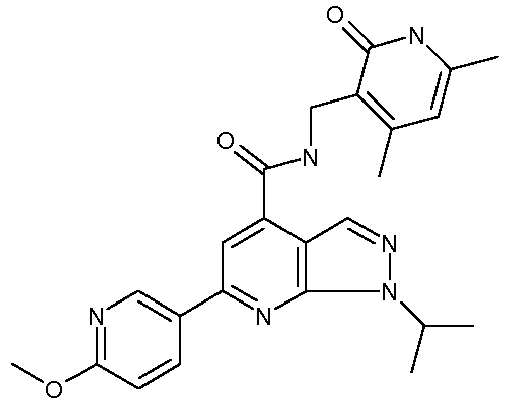
- The title compound was prepared in the same manner as described in example 58 using [6-(methyloxy)-3-pyridinyl]boronic acid (40.9 mg 0.267 mmol) to give the desired product as an off-white solid after evaporation and preciptation from EtOAc/MeOH. The final product was collected as 0.060 g (50%). LCMS E-S (M+H) 447.2. 1H NMR (400 MHz, DMSO-d6 ) δ ppm 11.58 (s, 1 H), 9.07 (d, J=2.02 Hz, 1 H), 8.90 (t, J=4.93 Hz, 1 H), 8.55 (dd, J=8.59, 2.53 Hz, 1 H), 8.37 (s, 1 H), 8.17 (s, 1 H), 7.01 (d, J=8.84 Hz, 1 H), 5.91 (s, 1 H), 5.36-5.28 (m, 1 H), 4.41 (d, J=5.05 Hz, 2 H), 3.95 (s, 3 H), 2.23 (s, 3 H), 2.13 (s, 3 H), 1.55 (d, J=6.57 Hz, 6 H).
-

- The title compound was prepared in the same manner as described in example 58 using 2-acetamidopyridine-5-boronic acid pinacol ester (77 mg, 0.294 mmol) to give the desired product as an off-white solid after evaporation and preciptation from EtOAc/MeOH. The final product was collected as 0.065 g (51%). LCMS E-S (M+H) = 474.0. 1H NMR (400 MHz, DMSO-d6 ) δ ppm 11.57 (s, 1 H), 10.76 (s, 1 H), 9.19 (d, J=1.77 Hz, 1 H), 8.93 (t, J=4.80 Hz, 1H), 8.61 (dd, J=8.84, 2.27 Hz, 1 H), 8.38 (s, 1 H), 8.25 (d, J=8.84 Hz, 1 H), 8.20 (s, 1 H), 5.91 (s, 1 H), 5.30 - 5.40 (m, 1 H), 4.42 (d, J=5.05 Hz, 2 H), 2.23 (s, 3 H), 2.14 (s, 3 H), 2.13 (s, 3 H), 1.54 (d, J=6.82 Hz, 6 H).
-

- The title compound was prepared in the same manner as described in example 58 using 2-methylphenyl boronic acid (40.0 mg, 0.294 mmol) to give the desired product as an off-white solid after evaporation and preciptation from MeOH. The final product was collected as 0.065 g (51%). LCMS E-S (M+H) = 430.2. 1H NMR (400 MHz, DMSO-d6 ) δ ppm 11.54 (s, 1 H) 8.89 (t, J=4.93 Hz, 1 H) 8.39 (s, 1 H) 7.74 (s, 1 H) 7.56 (d, J=7.07 Hz, 1 H) 7.31 - 7.41 (m, 3 H) 5.89 (s, 1 H) 5.20 - 5.27 (m, 1 H) 4.38 (d, J=4.80 Hz, 2 H) 2.40 (s, 3 H) 2.21 (s, 3 H) 2.12 (s, 3 H) 1.53 (d, 6 H).
-

- To a 5-mL microwave vial were added 6-chloro-N-[(4,6-dimethyl-2-oxo-1,2-dihydro-3-pyridinyl)methyl]-1-(1-methylethyl)-1H-pyrazolo[3,4-b]pyridine-4-carboxamide (70 mg, 0.187 mmol), 4-(4,4,5,5-tetramethyl-1,3,2-dioxaborolan-2-yl)-1H-pyrazole (47.2 mg, 0.243 mmol), DMSO(1.5 mL) and sodium carbonate (0.281 mL, 0.562 mmol), and the mixture was degassed with nitrogen for 5 min. Next added bis(triphenylphosphine) palladium(II) chloride (10.51 mg, 0.015 mmol) and the vial was sealed. The mixture was irradiated (microwave) at 140 °C for 12h. The reaction mixture was filtered and the residue was washed with DMSO. The DMSO solution of crude product was purified using reverse-phase HPLC. The TFA salt of the product obtained was neutralized with saturated NaHCO3, washed with water, and dried under high vacuum to give 12 mg (16%) of product. LCMS: (M+H)+=406.2 1H NMR (400 MHz, DMSO-d6 ) δ ppm 1.45 - 1.60 (m, J = 6.4 Hz, 6 H), 2.13 (s, 3 H), 2.23 (s, 3 H), 4.39 (d, J = 4.6 Hz, 2 H), 5.27 (quin, J= 6.7 Hz, 1 H), 5.90 (s, 1 H), 7.91 (s, 1 H), 8.22 - 8.31 (m, 1 H), 8.33 (m, 2 H), 8.77 (t, J = 4.7 Hz, 1 H).
-

- To a 5-mL microwave vial was added DMSO (2 mL) and it was degassed with nitrogen for 5 min. Next added 6-chloro-N-[(4,6-dimethyl-2-oxo-1,2-dihydro-3-pyridinyl)methyl]-1-(1-methylethyl)-1H-pyrazolo[3,4-b]pyridine-4-carboxamide (70 mg, 0.187 mmol), 5-(4,4,5,5-tetramethyl-1,3,2-dioxaborolan-2-yl)-2-pyrimidinamine (49.7 mg, 0.225 mmol), sodium carbonate (59.5 mg, 0.562 mmol) and bis(triphenylphosphine)palladium(II) chloride (9.20 mg, 0.013 mmol). The mixture was degassed for additional 5 min, sealed, and irradiated (microwave) at 135 °C for 15h. The mixture was filtered and the residue was washed with DMSO. The DMSO solution of the crude product was purified using reverse-phase HPLC. The TFA salt of the product was neutralized with saturated NaHCO3 solution, filtered, washed with water, and dried under high vacuum to give 14 mg (17%) of product. LCMS E-S (M+H) = 433.2 1H NMR (400 MHz, DMSO-d6 ) δ ppm 1.52 (d, J= 6.4 Hz, 6 H), 2.13 (s, 3 H), 2.22 (s, 3 H), 4.40 (d, J= 4.6 Hz, 2 H) 5.22 - 5.41 (m, 1 H), 5.90 (s, 1 H), 7.18 (m, 2 H), 8.08 (s, 1 H), 8.34 (s, 1 H), 8.86 (m, 1 H), 9.11 (s, 2 H), 11.58 (br. s., 1 H).
-

- To a 5-mL microwave vial were added 6-chloro-N-[(4,6-dimethyl-2-oxo-1,2-dihydro-3-pyridinyl)methyl]-1-(1-methylethyl)-1H-pyrazolo[3,4-b]pyridine-4-carboxamide (70 mg, 0.187 mmol), 3-pyridinylboronic acid (29.9 mg, 0.243 mmol), DMSO (1.5 mL) and sodium carbonate (0.281 mL, 0.562 mmol), and the mixture was degassed with nitrogen for 10 min. Next was added bis(triphenylphosphine)palladium(II) chloride (10.51 mg, 0.015 mmol) and the vial was sealed. The reaction mixture was irradiated (microwave) at 140 °C overnight. The reaction mixture was filtered and the residue was washed with DMSO. The crude product in DMSO was purified using reverse-phase HPLC. The TFA salt of the product was neutralized using saturated NaHCO3, filtered, washed with water and dried under high vacuum to give 33 mg (42%) of product. LCMS E-S (M+H) = 417.2 1H NMR (400 MHz, DMSO-d6 ) δ ppm 1.56 (d, J= 6.4 Hz , 6 H), 2.13 (s, 3 H), 2.23 (s, 3 H), 4.42 (d, J= 4.29 Hz, 2 H), 5.26 - 5.43 (m, 1 H), 5.91 (s, 1 H), 7.62 (dd, J = 7.3, 5.0 Hz, 1 H), 8.26 (s, 1 H), 8.43 (s, 1 H), 8.64 (d, J = 7.8 Hz, 1 H), 8.70 - 8.79 (m, 1 H), 8.96 (br. s., 1 H), 9.46 (br. s., 1 H), 11.59 (br. s., 1 H).
-

- To a 5-mL microwave vial were added 6-chloro-N-[(4,6-dimethyl-2-oxo-1,2-dihydro-3-pyridinyl)methyl]-1-(1-methylethyl)-1H-pyrazolo[3,4-b]pyridine-4-carboxamide (70 mg, 0.187 mmol), 5-(4,4,5,5-tetramethyl-1,3,2-dioxaborolan-2-yl)-1H-indazole (59.4 mg, 0.243 mmol), DMSO(1.5 mL) and sodium carbonate (0.281 mL, 0.562 mmol), and the mixture was degassed with nitrogen for 10 min. Next was added bis(triphenylphosphine)palladium(II) chloride (10.51 mg, 0.015 mmol). The contents were sealed and irradiated (microwave) at 140 °C overnight. The mixture was filtered and the residue was washed with DMSO. The crude product in DMSO was purified using reverse-phase HPLC. The TFA salt of the product was neutralized using saturated NaHCO3, filtered, washed with water and dried under high vacuum to give 41 mg (48%) of product. LCMS E-S (M+H) = 456.0 1H NMR (400 MHz, DMSO-d6 ) δ ppm 1.56 (d, J = 6.8 Hz, 6 H), 2.14 (s, 3 H), 2.23 (s, 3 H), 4.38 - 4.53 (m, 2 H), 5.27 - 5.49 (m, 1 H), 5.91 (s, 1 H), 7.59 - 7.75 (m, 1 H), 8.24 (s, 2 H), 8.37 (s, 2 H), 8.69 (s, 1 H), 8.95 - 9.09 (m, 1 H), 11.49 - 11.67 (m, 1 H), 13.21 - 13.35 (m, 1 H).
-

- The title compound was prepared in the same manner as described in example 74 from 6-chloro-N-[(4,6-dimethyl-2-oxo-1,2-dihydro-3-pyridinyl)methyl]-1-(1-methylethyl)-1H-pyrazolo[3,4-b]pyridine-4-carboxamide (70 mg, 0.187 mmol), 6-(4,4,5,5-tetramethyl-1,3,2-dioxaborolan-2-yl)-1H-indazole (59.4 mg, 0.243 mmol), DMSO(1.5 mL), sodium carbonate (0.281 mL, 0.562 mmol), and bis(triphenylphosphine)palladium(II) chloride (10.51 mg, 0.015 mmol). The final product was collected as 55 mg (65%). LCMS E-S (M+H) = 456.0 1H NMR (400 MHz, DMSO-d6 ) δ ppm 1.49 - 1.65 (m, J = 6.4 Hz, 6 H), 2.14 (s, 3 H), 2.23 (s, 3 H), 4.43 (d, J = 4.6 Hz, 2 H), 5.36 (quin, J = 6.7 Hz, 1 H), 5.87 - 5.97 (m, 1 H), 7.52 - 7.72 (m, 2 H) 7.92 (d, J = 8.6 Hz, 1 H), 8.08 (d, J = 8.6 Hz, 1 H), 8.16 (s, 1 H), 8.26 (s, 1 H), 8.37 - 8.49 (m, 2 H), 8.96 - 9.14 (m, 1 H), 11.59 (br. s., 1 H).
-

- The title compound was prepared in the same manner as described in example 74 using 6-chloro-N-[(4,6-dimethyl-2-oxo-1,2-dihydro-3-pyridinyl)methyl]-1-(1-methylethyl)-1H-pyrazolo[3,4-b]pyridine-4-carboxamide (70 mg, 0.187 mmol), 1H-1,2,3-benzotriazol-5-ylboronic acid (39.7 mg, 0.243 mmol), DMSO(2 mL), sodium carbonate (0.281 mL, 0.562 mmol) and bis(triphenylphosphine)palladium(II) chloride (10.51 mg, 0.015 mmol). The final product was collected as 22 mg (26%). LCMS E-S (M+H) = 457.1 1H NMR (400 MHz, DMSO-d6 ) δ ppm 1.57 (d, 6 J = 6.4 Hz, H), 2.14 (s, 3 H), 2.24 (s, 3 H), 4.43 (d, J = 4.3 Hz, 2 H), 5.31 - 5.46 (m, 1 H), 5.91 (s, 1 H), 8.07 (br. s., 1 H), 8.34 (s, 1 H), 8.41 (m, 2 H), 8.85 (br. s., 1 H), 9.02 (br. s., 1 H), 11.59 (br. s., 1 H).
-

- The title compound was prepared in the same manner as described in example 74 using 6-chloro-N-[(4,6-dimethyl-2-oxo-1,2-dihydro-3-pyridinyl)methyl]-1-(1-methylethyl)-1H-pyrazolo[3,4-b]pyridine-4-carboxamide (70 mg, 0.187 mmol), 5-(4,4,5,5-tetramethyl-1,3,2-dioxaborolan-2-yl)-1,3-dihydro-2H-benzimidazol-2-one (61.0 mg, 0.235 mmol), DMSO(1.5 mL) sodium carbonate (0.281 mL, 0.562 mmol), and bis(triphenylphosphine)palladium(II) chloride (10.13 mg, 0.014 mmol). The final product was collected as 19 mg (21%). LCMS E-S (M+H) = 486.3 1H NMR (400 MHz, DMSO-d6 ) δ ppm 1.50 (d, J = 6.8 Hz, 6 H), 2.12 (s, 3 H), 2.24 (s, 3 H), 2.43 (s, 3 H), 4.39 (d, J = 4.6 Hz, 2 H), 5.15 - 5.35 (m, 1 H), 5.89 (s, 1 H), 7.05 (d, J = 8.1 Hz, 1 H), 7.61 (s, 1 H), 7.77 - 7.93 (m, 2 H), 8.70 - 8.85 (m, 1 H), 10.79 (br. s., 1 H), 10.87 (br. s., 1 H), 11.54 (br. s., 1 H).
-

- The title compound was prepared in the same manner as described in example 74 using 6-chloro-N-[(4,6-dimethyl-2-oxo-1,2-dihydro-3-pyridinyl)methyl]-1-(1-methylethyl)-1H-pyrazolo[3,4-b]pyridine-4-carboxamide (70 mg, 0.187 mmol), 6-(4,4,5,5-tetramethyl-1,3,2-dioxaborolan-2-yl)-1,3-dihydro-2H-indol-2-one (63.1 mg, 0.243 mmol), DMSO(1.5 mL), sodium carbonate (0.281 mL, 0.562 mmol), and bis(triphenylphosphine)palladium(II) chloride (10.51 mg, 0.015 mmol). The final product was collected as 10 mg (11%). LCMS E-S (M+H) = 471.1 1H NMR (400 MHz, DMSO-d6 ) δ ppm 1.55 (d, J = 6.8 Hz, 6 H), 2.13 (s, 3 H), 2.22 (s, 3 H), 3.58 (s, 2 H), 4.41 (d, J = 4.8 Hz, 2 H), 5.31 (quin, J = 6.6 Hz, 1 H), 5.91 (s, 1 H), 7.38 (d, J = 7.6 Hz, 1 H), 7.73 (d, J= 1.0 Hz, 1 H), 7.87 (dd, J=7.8, 1.5 Hz, 1 H), 8.12 (s, 1 H), 8.37 (s, 1 H), 9.00 (t, J= 4.8 Hz, 1 H), 10.55 (s, 1 H), 11.58 (s, 1 H).
-
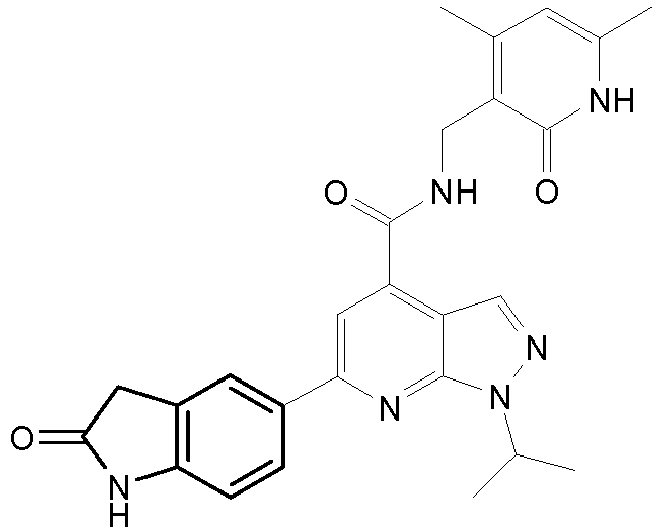
- The title compound was prepared in the same manner as described in example 74 using 6-chloro-N-[(4,6-dimethyl-2-oxo-1,2-dihydro-3-pyridinyl)methyl]-1-(1-methylethyl)-1H-pyrazolo[3,4-b]pyridine-4-carboxamide (70 mg, 0.187 mmol), 5-(4,4,5,5-tetramethyl-1,3,2-dioxaborolan-2-yl)-1,3-dihydro-2H-indol-2-one (63.1 mg, 0.243 mmol), DMSO(1.5 mL), sodium carbonate (0.281 mL, 0.562 mmol), and bis(triphenylphosphine)palladium(II) chloride (10.51 mg, 0.015 mmol). The final product was collected as 30 mg (34%). LCMS E-S (M+H) = 471.3 1H NMR (400 MHz, DMSO-d6 ) δ ppm 1.54 (d, J = 6.4 Hz, 6 H), 2.13 (s, 3 H), 2.22 (s, 3 H), 3.40 (br. s., 2 H), 4.41 (d, J = 4.6 Hz, 2 H), 5.25 - 5.41 (m, 1 H), 5.91 (s, 1 H), 6.97 (d, J = 8.1 Hz, 1 H), 8.08 - 8.21 (m, 3 H), 8.34 (s, 1 H), 8.96 (br. s., 1 H), 10.64 (s, 1 H), 11.58 (br. s., 1 H).
-

- The title compound was prepared in the same manner as described in example 74 using 6-chloro-N-[(4,6-dimethyl-2-oxo-1,2-dihydro-3-pyridinyl)methyl]-1-(1-methylethyl)-1H-pyrazolo[3,4-b]pyridine-4-carboxamide (70 mg, 0.187 mmol), 5-(4,4,5,5-tetramethyl-1,3,2-dioxaborolan-2-yl)-1,3-dihydro-2H-benzimidazol-2-one (63.3 mg, 0.243 mmol), DMSO(2 mL), sodium carbonate (0.281 mL, 0.562 mmol), and bis(triphenylphosphine)palladium(II) chloride (10.51 mg, 0.015 mmol). The final product was collected as 35 mg (40%). LCMS E-S (M+H) = 472.4 1H NMR (400 MHz, DMSO-d6 ) δ ppm 1.55 (d, J = 6.4 Hz, 6 H), 2.13 (s, 3 H), 2.22 (s, 3 H), 4.41 (d, J = 4.8 Hz, 2 H), 5.30 (quin, J = 6.6 Hz, 1 H), 5.91 (s, 1 H), 7.07 (d, J = 8.3 Hz, 1 H), 7.86 (s, 1 H), 7.92 (dd, J = 8.3, 1.8 Hz, 1 H), 8.10 (s, 1 H), 8.30 - 8.41 (m, 1 H), 8.98 (t, J = 4.8 Hz, 1 H), 10.82 (s, 1 H), 10.89 (s, 1 H). 11.58 (s, 1 H).
-

- The title compound was prepared in the same manner as described in example 74 using 6-chloro-N-[(4,6-dimethyl-2-oxo-1,2-dihydro-3-pyridinyl)methyl]-1-(1-methylethyl)-1H-pyrazolo[3,4-b]pyridine-4-carboxamide (70 mg, 0.187 mmol), 1-methyl-4-[5-(4,4,5,5-tetramethyl-1,3,2-dioxaborolan-2-yl)-2-pyridinyl]piperazine (73.8 mg, 0.243 mmol), DMSO(2 mL), sodium carbonate (0.281 mL, 0.562 mmol), and bis(triphenylphosphine)palladium(II) chloride (10.51 mg, 0.015 mmol). The final product was collected as 12 mg (13%). LCMS E-S (M+H) = 515.1 1H NMR (400 MHz, DMSO-d6 ) δ ppm 1.53 (d, J= 6.4 Hz , 6 H), 2.13 (s, 3 H), 2.23 (m, 6 H), 2.37-2.46 (m, 4 H), 3.56 - 3.69 (m, 4 H), 4.40 (d, J= 4.6 Hz, 2 H), 5.30 (quin, J= 6.7 Hz, 1 H), 5.91 (s, 1 H), 6.99 (d, J= 9.1 Hz, 1 H), 8.10 (s, 1 H), 8.32 (s, 1 H), 8.38 (dd, J= 9.1, 2.5 Hz, 1 H), 8.91 (br. s., 1 H), 9.03 (d, J=2.3 Hz, 1 H).
-

- The title compound was prepared in the same manner as described in example 74 using 6-chloro-N-[(4,6-dimethyl-2-oxo-1,2-dihydro-3-pyridinyl)methyl]-1-(1-methylethyl)-1H-pyrazolo[3,4-b]pyridine-4-carboxamide (70 mg, 0.187 mmol), 1-methyl-4-[4-(4,4,5,5-tetramethyl-1,3,2-dioxaborolan-2-yl)phenyl]piperazine (73.6 mg, 0.243 mmol), 1,2-Dimethoxyethane (DME) (3 mL), water (1 mL) sodium carbonate (0.281 mL, 0.562 mmol), and bis(triphenylphosphine)palladium(II) chloride (12.23 mg, 0.015 mmol), wherein the reaction time was 30 min. The crude product was purified by column chromatography (eluent: gradient of 0 to 15% (9 :1 MeOH/NH4OH)/DCM). The product was dried under high vacuum and collected as 58 mg (59%). LCMS E-S (M+H) = 514.3 1H NMR (400 MHz, DMSO-d6 ) δ ppm 1.51 - 1.58 (m, 6 H), 2.13 (s, 3 H), 2.23 (s, 6 H), 2.24 (s, 3H), 2.47 (m, 4H), 3.24 - 3.30 (m, 4 H), 4.41 (d, J = 5.05 Hz, 2 H), 5.30 (quin, J = 6.63 Hz, 1 H), 5.90 (s, 1 H), 7.07 (d, J = 9.09 Hz, 2 H), 8.06 (s, 1 H), 8.15 (d, J = 8.84 Hz, 2H), 8.30 (s, 1 H), 8.92 (t, J = 4.80 Hz, 1 H), 11.55 (s, 1 H).
-

- The title compound was prepared in the same manner as described in example 74 using 6-chloro-N-[(4,6-dimethyl-2-oxo-1,2-dihydro-3-pyridinyl)methyl]-3-methyl-1-(1-methylethyl)-1H-pyrazolo[3,4-b]pyridine-4-carboxamide (70 mg, 0.180 mmol), [6-(4-morpholinyl)-3-pyridinyl]boronic acid (48.8 mg, 0.235 mmol), DMSO(2.0 mL), sodium carbonate (0.271 mL, 0.541 mmol), and bis(triphenylphosphine)palladium(II) chloride (10.13 mg, 0.014 mmol), wherein the reaction time was 8 h. The mixture was filtered and the residue was washed with DMSO. The crude product in DMSO was purified by reverse-phase HPLC (mobile phase: 25 - 60 % CAN in H2O, 0.1%TFA). The TFA product salt obtained was neutralized with saturated NaHCO3, filtered, washed with water, and dried under high vacuum to give the product as 24 mg (25%). LCMS E-S (M+H) = 516.2 1H NMR (400 MHz, DMSO-d6 ) δ ppm 1.50 (d, J = 6.57 Hz, 6 H), 2.12 (s, 3 H), 2.25 (s, 3 H), 2.42 (s, 3 H), 3.54 - 3.63 (m, 4 H), 3.73 (m, 4 H), 4.39 (d, J= 4.80 Hz, 2 H), 5.14 - 5.29 (m, 1 H), 5.89 (s, 1 H), 6.97 (d,J= 8.84 Hz, 1 H), 7.63 (s, 1 H), 8.37 (dd, J = 9.09, 2.53 Hz, 1 H), 8.68 (t, J = 4.93 Hz, 1 H), 8.98 (d, J = 2.27 Hz, 1 H), 11.51 (s, 1 H).
-

- The title compound was prepared in the same manner as described in example 74 using 6-chloro-N-[(4,6-dimethyl-2-oxo-1,2-dihydro-3-pyridinyl)methyl]-1-(1-methylethyl)-1H-pyrazolo[3,4-b]pyridine-4-carboxamide (50 mg, 0.134 mmol), 4-pyridinamine (12.59 mg, 0.134 mmol), cesium carbonate (131 mg, 0.401 mmol), 1,4-dioxane (2 mL), palladium(II) acetate (1.501 mg, 6.69 µmol) and BINAP (8.33 mg, 0.013 mmol), wherein the reaction time was 2h. The final product was collected as 29 mg (50%). LCMS E-S (M+H) = 432.3 1H NMR (400 MHz, DMSO-d6 ) δ ppm 1.45 - 1.59 (d, J = 6.8 Hz, 6 H), 2.14 (s, 3 H), 2.23 (s, 3 H), 4.36 (d, J = 5.0 Hz, 2 H), 5.16 (m, 1 H), 5.91 (s, 1 H), 7.09 (s, 1 H), 7.99 (d, J = 6.1 Hz, 2 H), 8.12 (s, 1 H) 8.49 (d, J = 6.6 Hz, 2 H), 8.74 (t, J= 5.1 Hz, 1 H), 10.58 (s, 1 H), 11.58 (s, 1 H).
-

- The title compound was prepared in the same manner as described in example 74 using 6-chloro-N-[(4,6-dimethyl-2-oxo-1,2-dihydro-3-pyridinyl)methyl]-1-(1-methylethyl)-1H-pyrazolo[3,4-b]pyridine-4-carboxamide (70 mg, 0.187 mmol), 5-amino-1,3-dihydro-2H-benzimidazol-2-one (33.5 mg, 0.225 mmol), cesium carbonate (92 mg, 0.281 mmol), N,N-dimethylacetamide (DMA) (2 mL), palladium(II) acetate (2.52 mg, 0.011 mmol) and Xantphos (10.83 mg, 0.019 mmol) wherein the reaction temperature was 150 °C and reaction time was 8h. The final product was collected as 25 mg (27%). LCMS E-S (M+H) = 487.2 1H NMR (400 MHz, DMSO-d6 ) δ ppm 1.50 - 1.61 (m, 6 H), 2.13 (s, 3 H), 2.23 (s, 3 H), 4.38 (d, J = 5.0 Hz, 2 H), 5.20 (quin, J = 6.6 Hz, 1 H), 5.90 (s, 1 H), 6.79 - 6.91 (m, 2 H), 8.04 (d, J = 8.3 Hz, 1 H), 8.26 - 8.33 (m, 2 H), 8.84 (t, J = 5.0 Hz, 1 H), 11.50 (s, 1 H).
-

- The title compound was prepared in the same manner as described in example 74 using 6-chloro-N-[(4,6-dimethyl-2-oxo-1,2-dihydro-3-pyridinyl)methyl]-3-methyl-1-(1-methylethyl)-1H-pyrazolo[3,4-b]pyridine-4-carboxamide (70 mg, 0.180 mmol), 4-aminobenzamide (29.5 mg, 0.217 mmol), cesium carbonate (88 mg, 0.271 mmol), N,N-dimethylacetamide (DMA) (1.5 mL), palladium(II) acetate (2.431 mg, 10.83 µmol) and Xantphos (10.44 mg, 0.018 mmol) wherein the reaction temperature was 150 °C and reaction time was 1h. The final product was collected as 12 mg (14%). LCMS E-S (M+H) = 488.2 1H NMR (400 MHz, DMSO-d6 ) δ ppm 1.48 (d, J= 6.4 Hz, 6 H), 2.13 (s, 3 H), 2.23 (s, 3 H), 2.32 (s, 3 H), 4.35 (d, J = 4.8 Hz, 2 H), 4.99 (quin, J = 6.8 Hz, 1 H), 5.89 (s, 1 H), 6.65 (s, 1 H), 7.15 (br. s., 1 H), 7.75 - 7.82 (m, 1 H), 7.84 - 7.96 (m, 4 H), 8.56 (t, J = 4.9 Hz, 1 H), 9.77 (s, 1 H).
-

- The title compound was prepared in the same manner as described in example 74 using 6-chloro-1-(1,1-dimethylethyl)-N-[(4,6-dimethyl-2-oxo-1,2-dihydro-3-pyridinyl)methyl]-3-methyl-1H-pyrazolo[3,4-b]pyridine-4-carboxamide (70 mg, 0.174 mmol), 1-methyl-4-[5-(4,4,5,5-tetramethyl-1,3,2-dioxaborolan-2-yl)-2-pyridinyl]piperazine (68.7 mg, 0.226 mmol), DME (3 mL), water (1.00 mL), sodium carbonate (0.261 mL, 0.523 mmol) and PdCl2(dppf)-CH2Cl2 adduct (11.38 mg, 0.014 mmol), wherein the reaction time was 40 min. The crude product was purified by column chromatography (eluent: gradient of 0 to 15% (9:1 MeOH/NH4OH)/DCM). The final product was collected as a solid, 41 mg (43%).. LCMS E-S (M+H) = 543.2 1H NMR (400 MHz, DMSO-d6 ) δ ppm 1.78 (s, 9 H), 2.12 (s, 3 H), 2.24 (m, 7 H), 2.38 (s, 3 H), 2.39 - 2.49 (m, 4 H), 3.34 (s, 3 H), 4.38 (m, 2 H), 5.88 (s, 1 H), 6.98 (d, J = 9.09 Hz, 1 H), 7.59 (s, 1 H), 8.93 - 8.97 (m, 1 H), 11.49 - 11.57 (m, 1 H), 11.53 (s, 1 H), 11.53 (s, 1 H).
-

- The title compound was prepared in the same manner as described in example 74 using 6-chloro-1-(1,1-dimethylethyl)-N-[(4,6-dimethyl-2-oxo-1,2-dihydro-3-pyridinyl)methyl]-3-methyl-1H-pyrazolo[3,4-b]pyridine-4-carboxamide (70 mg, 0.174 mmol), 5-(4,4,5,5-tetramethyl-1,3,2-dioxaborolan-2-yl)-1,3-dihydro-2H-benzimidazol-2-one (58.9 mg, 0.226 mmol), DME (3 mL), water (1.00 mL), sodium carbonate (0.261 mL, 0.523 mmol) and PdCl2(dppf)-CH2Cl2 adduct (11.38 mg, 0.014 mmol) wherein the reaction time was 40 min. The crude product was purified by column chromatography (eluent: gradient of 0 to 15% (9:1 MeOH/NH4OH)/DCM). The final product was collected as a solid, 24 mg (27%). LCMS E-S (M+H) = 500.2 1H NMR (400 MHz, DMSO-d6 ) δ ppm 1.77 (m, 9 H), 2.12 (s, 3 H), 2.24 (s, 3 H), 2.40 (s, 3 H), 4.38 (d, J = 4.55 Hz, 2 H), 5.89 (s, 1 H), 7.06 (d, J = 8.08 Hz, 1 H), 7.59 (s, 1 H), 7.72 - 7.86 (m, 2 H), 8.73 (br. s., 2 H), 10.74 - 10.92 (m, 1 H), 11.53 (br. s., 1 H).
-

- The title compound was prepared in the same manner as described in example 74 using 6-chloro-1-(1,1-dimethylethyl)-N-[(4,6-dimethyl-2-oxo-1,2-dihydro-3-pyridinyl)methyl]-3-methyl-1H-pyrazolo[3,4-b]pyridine-4-carboxamide (70 mg, 0.174 mmol), [6-(4-morpholinyl)-3-pyridinyl]boronic acid (47.1 mg, 0.226 mmol), DME (3 mL), water (1.00 mL), sodium carbonate (0.261 mL, 0.523 mmol) and PdCl2(dppf)-CH2Cl2 adduct (11.38 mg, 0.014 mmol) wherein the reaction time was 40 min. The crude product was purified by column chromatography (eluent: gradient of 0 to 15% (9:1 MeOH/NH4OH)/DCM). The final product was collected as a solid, 61 mg (65%). LCMS E-S (M+H) = 530.0 1H NMR (400 MHz, DMSO-d6 ) δ ppm 1.78 (s, 9 H), 2.12 (s, 3 H), 2.24 (s, 3 H), 2.38 (s, 3 H), 3.52 - 3.64 (m, 4 H), 3.68 - 3.80 (m, 4 H), 4.38 (d, J = 5.05 Hz, 2 H), 5.88 (s, 1 H), 6.99 (d, J = 9.09 Hz, 1 H), 7.61 (s, 1 H), 8.34 (dd, J=8.84, 2.53 Hz, 1 H), 8.68 (t, J = 5.05 Hz, 1 H), 8.97 (d, J = 2.27 Hz, 1 H), 11.53 (s, 1H).
-

- The title compound was prepared in the same manner as described in example 74 using 6-chloro-N-[(4,6-dimethyl-2-oxo-1,2-dihydro-3-pyridinyl)methyl]-3-methyl-1-(1-methylethyl)-1H-pyrazolo[3,4-b]pyridine-4-carboxamide (70 mg, 0.180 mmol), 5-(4,4,5,5-tetramethyl-1,3,2-dioxaborolan-2-yl)-2,1,3-benzoxadiazole (57.7 mg, 0.235 mmol), DMSO(2 mL), sodium carbonate (0.271 mL, 0.541 mmol), and bis(triphenylphosphine)palladium(II) chloride (12.67 mg, 0.018 mmol) wherein the reaction time was 8h. The final product was collected as 17 mg (20%). LCMS LCMS E-S (M+H) = 472.4 1H NMR (400 MHz, DMSO-d6 ) δ ppm 1.53 (d, J = 6.8 Hz ,6 H), 2.12 (s, 3 H), 2.27 (s, 3 H) 4.42 (d, J = 4.8 Hz, 2 H) 5.32 (quin, J = 6.6 Hz, 1 H), 5.90 (s, 1 H), 8.00 (s, 1 H), 8.23 (d, J = 9.4 Hz, 1 H), 8.54 - 8.64 (m, 1 H), 8.79 (t, J = 4.7 Hz, 1 H), 8.91 (s, 1 H), 11.54 (br. s., 1 H).
-
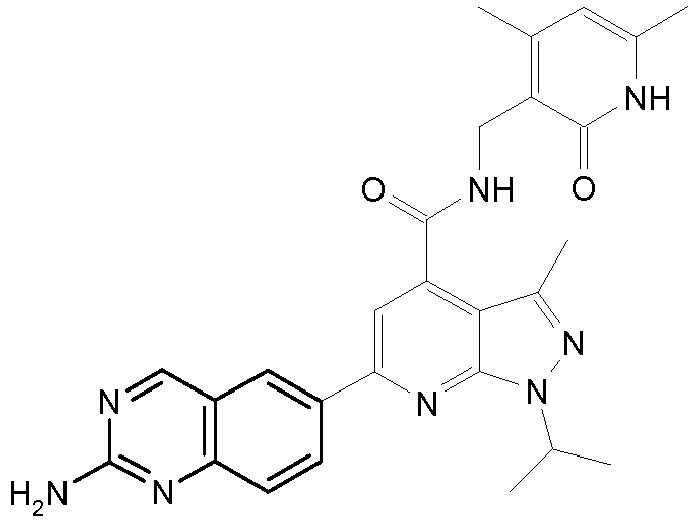
- The title compound was prepared in the same manner as described in example 74 using 6-chloro-N-[(4,6-dimethyl-2-oxo-1,2-dihydro-3-pyridinyl)methyl]-3-methyl-1-(1-methylethyl)-1H-pyrazolo[3,4-b]pyridine-4-carboxamide (70 mg, 0.180 mmol), 5-(4,4,5,5-tetramethyl-1,3,2-dioxaborolan-2-yl)-2,1,3-benzoxadiazole (57.7 mg, 0.235 mmol), DMSO(2 mL), sodium carbonate (0.271 mL, 0.541 mmol), and bis(triphenylphosphine)palladium(II) chloride (12.67 mg, 0.018 mmol), wherein the reaction time was 8h. The final product was collected as 28 mg (31%). LCMS E-S (M+H) = 497.3 1H NMR (400 MHz, DMSO-d6 ) δ ppm 1.52 (d, J= 6.8 Hz , 6 H), 2.12 (s, 3 H), 2.26 (s, 3 H), 4.41 (d, J = 5.0 Hz, 2 H) 5.30 (quin, J = 6.6 Hz, 1 H), 5.89 (s, 1 H), 7.16 (br. s., 2 H), 7.56 (d, J = 9.1 Hz, 1 H), 7.78 (s, 1 H) 8.60 (dd, J = 8.8, 2.0 Hz, 1 H), 8.69 (d, J = 1.8 Hz, 1 H), 8.76 (t, J = 4.9 Hz, 1 H), 9.28 (s, 1 H), 11.53 (s, 1 H).
-

- 6-Chloro-N-[(4,6-dimethyl-2-oxo-1,2-dihydro-3-pyridinyl)methyl]-3-methyl-1-(1-methylethyl)-1H-pyrazolo[3,4-b]pyridine-4-carboxamide (80 mg, 0.21 mmol), {4-[(methylamino)sulfonyl]phenyl}boronic acid (66.5 mg, 0.31 mmol) and bis(triphenylphosphine)palladium(II) chloride (8.4 mg, 0.01 mmol) were suspended in DME/water (4 mL, 3:1) and stirred for 10 min under nitrogen at room temperature. Sodium bicarbonate (52 mg, 0.62 mmol) was added and the heterogenous mixture was irradiated (microwave) at 150 °C for 30 min. After cooling to room temperature, water was added to the black mixture, and the contents were vacuum filtered. The crude product was dissolved in DCM/MeOH (1:1) and preabsorbed onto silica gel. The product was purified by silica gel chromatography (eluent: DCM/MeOH/NH4OH, gradient of 0 to 90:10:1). The light beige solid that was collected was suspended in EtOH, sonicated, and filtered. The solid was then air-dried for 15 min, and then in vacuum oven overnight. The final product was collected as 77mg (70%). LCMS E-S (M+H) = 523.2 1H NMR (400 MHz, DMSO-d6 ) δ ppm 11.54 (br. s., 1 H) 8.78 (t, J=5.05 Hz, 1 H) 8.43 (m, J=8.59 Hz, 2 H) 7.93 (m, J=8.59 Hz, 2 H) 7.78 (s, 1 H) 7.58 (br. s., 1 H) 5.89 (s, 1 H) 5.29 (quin, J=6.63 Hz, 1 H) 4.40 (d, J=4.80 Hz, 2 H) 2.46 (d, J=1.26 Hz, 6 H) 2.25 (s, 3 H) 2.12 (s, 3 H) 1.52 (s, 3 H) 1.51 (s, 3 H).
-

- The title compound was prepared in the same manner as described in example 93 using 6-chloro-N-[(4,6-dimethyl-2-oxo-1,2-dihydro-3-pyridinyl)methyl]-3-methyl-1-(1-methylethyl)-1H-pyrazolo[3,4-b]pyridine-4-carboxamide (80 mg, 0.21 mmol), [4-(acetylamino)phenyl]boronic acid (55.4 mg, 0.31 mmol), bis(triphenylphosphine)palladium(II) chloride (8.4 mg, 0.01 mmol), DME/water (4 mL, 3:1) and sodium bicarbonate (52 mg, 0.62 mmol). The crude product was dissolved in DCM/MeOH (1:1) and preabsorbed onto silica gel. The product was purified by silica gel chromatography (eluent: DCM/MeOH/NH4OH. gradient of 0 to 80:20:2). The collected solid was suspended in EtOH/EtOAc (1:1), sonicated, and filtered. After further washing with hexanes, the solid was then air-dried for 15 min, and then in vacuum oven overnight. The final product was collected as 70 mg (69%). LCMS E-S (M+H) = 487.3 1H NMR (400 MHz, DMSO-d6 ) δ ppm 11.53 (br. s., 1 H) 10.16 (s, 1 H) 8.73 (t, J=5.05 Hz, 1 H) 8.17 (m, J=8.84 Hz, 2 H) 7.74 (m, J=8.84 Hz, 2 H) 7.64 (s, 1 H) 5.89 (s, 1 H) 5.25 (quin, J=6.69 Hz, 1 H) 4.39 (d, J=4.80 Hz, 2 H) 2.43 (s, 3 H) 2.25 (s, 3 H) 2.12 (s, 3 H) 2.09 (s, 3 H) 1.51 (s, 3 H) 1.49 (s, 3 H).
-

- The title compound was prepared in the same manner as described in example 93 using 6-chloro-N-[(4,6-dimethyl-2-oxo-1,2-dihydro-3-pyridinyl)methyl]-1-(1-methylethyl)-1H-pyrazolo[3,4-b]pyridine-4-carboxamide (80 mg, 0.21 mmol), [4-(aminocarbonyl)phenyl]boronic acid (52.9 mg, 0.31 mmol), bis(triphenylphosphine)palladium(II) chloride (8.7 mg, 0.01 mmol), DME/water (4 mL, 3:1) and sodium bicarbonate (54 mg, 0.62 mmol). The crude product was dissolved in DCM/MeOH (1:1) and preabsorbed onto silica gel. The product was purified by silica gel chromatography (eluent: DCM/MeOH/NH4OH (gradient 0 to 90:10:1). The collected solid was suspended in EtOH, sonicated, and filtered. After further washing with EtOH/DCM, the filtered solid was then air-dried for 15 min, and then in vacuum oven overnight. The final product was collected as 70 mg (69%). LCMS E-S (M+H) = 459.3 1H NMR (400 MHz, DMSO-d6 ) δ ppm 11.58 (s, 1 H) 9.00 (t, J=4.93 Hz, 1 H) 8.41 (s, 1 H) 8.36 (s, 1 H) 8.34 (s, 1 H) 8.24 (s, 1 H) 8.13 (s, 1 H) 8.06 (s, 1 H) 8.04 (s, 1 H) 7.51 (s, 1 H) 5.91 (s, 1 H) 5.37 (quin, J=6.69 Hz, 1 H) 4.42 (d, J=4.80 Hz, 2 H) 2.23 (s, 3 H) 2.13 (s, 3 H) 1.56 (s, 3 H) 1.55 (s, 3 H).
-

-

- 6-Bromo-3,4-dihydro-1,8-naphthyridin-2(1H)-one (200 mg, 0.881 mmol) (J. Med. Chem. 2003; 46; 9; 1627-1635), bis(pinacolato)diboron (268 mg, 1.057 mmol), Pd(dppf) (35.7 mg, 0.044 mmol) and potassium acetate (259 mg, 2.64 mmol) were suspended in 1,4-Dioxane (8 mL), and stirred with heating at 100 °C for 1h. After cooling to room temperature, 6-chloro-N-[(4,6-dimethyl-2-oxo-1,2-dihydro-3-pyridinyl)methyl]-1-(1-methylethyl)-1H-pyrazolo[3,4-b]pyridine-4-carboxamide (329 mg, 0.881 mmol), bis(triphenylphosphine)palladium(II) chloride (71.9 mg, 0.088 mmol) and sodium bicarbonate (222 mg, 2.64 mmol) were added, followed by DME (5 mL) and water (3 mL). The reaction mixture was irradiated (microwave) at 120 °C for 2 h. The reaction mxiture was cooled cooled to room temperature and filtered through Na2SO4. The contents were purified directly by silica gel chromatography (eluent: 5% MeOH/CH2Cl2) to furnish the desired product as a grey solid after evaporation and preciptation from warm EtOAc/MeOH (1:9). The product was collected as 55 mg (13%). LCMS E-S (M+H) = 486.3 1H NMR (400 MHz, DMSO-d6 ) δ ppm 11.57 (br. s., 1 H), 10.74 (s, 1 H), 8.99 (d, J=2.27 Hz, 1 H), 8.93 (t, J=4.93 Hz, 1 H), 8.44 (d, J=1.77 Hz, 1 H), 8.37 (s, 1 H), 8.16 (s, 1 H), 5.91 (s, 1 H), 5.29 - 5.40 (m, 1 H), 4.42 (d, J=5.05 Hz, 2 H), 3.04 (t, J=7.58 Hz, 2 H), 2.53 - 2.62 (m, 2 H), 2.23 (s, 3 H), 2.13 (s, 3 H), 1.54 (d, 6 H).
-

- 5-Bromo-N-methyl-2-pyridinesulfonamide (225 mg, 0.896 mmol), Bis(pinacolato)diboron (296 mg, 1.165 mmol), Pd(dppf) (35.7 mg, 0.044 mmol) and potassium acetate (264 mg, 2.69 mmol) were suspended in 1,4-Dioxane (8 mL), and stirred with heating at 100 °C for 1h. After cooling to room temperature, 6-chloro-N-[(4,6-dimethyl-2-oxo-1,2-dihydro-3-pyridinyl)methyl]-1-(1-methylethyl)-1H-pyrazolo[3,4-b]pyridine-4-carboxamide (368 mg, 0.986 mmol), bis(triphenylphosphine)palladium(II) chloride (73.2 mg, 0.090 mmol) and sodium bicarbonate (226 mg, 2.69 mmol) were added, followed by DME (5 mL) and water (3 mL). The reaction mixture was irradiated (microwave) at 120 °C for 2h. The reaction mxiture was cooled cooled to room temperature and filtered through Na2SO4. The contents were purified directly by silica gel chromatography (eluent: 15% MeOH/CH2Cl2) to furnish the desired product as a grey solid after evaporation and preciptation from warm EtOAc/MeOH (1:9). The product was again purified by silica gel chromatography (eluent : 5% MeOH/CH2Cl2) to afford the final product as a white solid, 83 mg (18%). LCMS E-S (M+H) = 510.0 1H NMR (400 MHz, DMSO-d6 ) δ ppm 11.59 (br. s., 1 H), 9.56 (d, J=1.52 Hz, 1 H), 8.96 (s, 1 H), 8.86 (dd, J=8.34, 2.27 Hz, 1 H), 8.46 (s, 1 H), 8.34 (s, 1 H), 8.12 (d, J=8.34 Hz, 1 H), 7.85 (br. s., 1 H), 5.91 (s, 1 H), 5.27 - 5.46 (m, 1 H), 4.43 (d, J=4.80 Hz, 2 H), 2.60 (s, 3 H), 2.23 (s, 3 H), 2.13 (s, 3 H), 1.56 (d, 6 H).
-

- 5-Bromo-2-pyridinesulfonyl chloride (500 mg, 1.949 mmol) was added to a 0 °C solution of pyridine (0.315 ml, 3.90 mmol), methylamine (0.975 ml, 1.949 mmol, 2M in THF) and CH2Cl2 (2 mL). The reaction mixture was stirred at room temperature for 1 hr, then quenched with brine. The contents were extracted with DCM, dried, filtered, and concentrated in vacuo. The crude product was purified by silica gel chromatography (eluent: 50%, EtOAC/CH2Cl2). The product was collected as a clear oil, 225 mg (75%). LCMS E-S (M+H) = 251.1. 1H NMR (400 MHz, Chloroform-d) δ ppm 8.77 (s, 1 H), 8.07 (dd, J=8.34, 2.27 Hz, 1 H), 7.92 (d, J=8.34 Hz, 1 H), 5.45 (d, J=5.05 Hz, 1 H), 2.76 (d, 3 H).
-

- Hydrazine hydrate (12.82 g, 400 mmol) was added dropwise to a cooled (< 20 °C) solution of 2-propenenitrile (21.76 g, 410 mmol) and ethanol (200 mL). After 16 h stirring the reaction mixture was cooled in an ice water bath and 4-(methyloxy)benzaldehyde (53.8 g, 395 mmol) was added dropwise. The mixture was stirred at room temperature for 16 h. The reaction mixture was concentrated to dryness. The residue was dissolved in n-butanol (200 mL), sodium hydroxide was added (1 g, 25.00 mmol), and the mixture heated at 120 °C for 6 h. The reaction mixture was concentrated to 50% volume under reduced pressure, poured onto 300 mL of water, and then extracted with Et2O (2 x 200 mL). The combined ether phases were extracted with 1N HCl (3 x 100 mL). The combined HCl extracts were combined and cooled in an ice/water bath. Added next was 6N NaOH until basic (pH> 12). The contents were extracted with Et2O (4 x 100 mL), washed with water, dried over MgSO4, filtered, and concentrated under reduced pressure. The residue was purified via silica gel chromatography (eluent : 0 - 50% EtOAc:Hex). The final product was collected as 8.94 g (11%). 1H NMR (400 MHz, CHLOROFORM-d) δ ppm 3.79 (s, 3 H), 5.14 (s, 2 H), 5.55 (d, J=1.77 Hz, 1 H), 6.81 - 6.94 (m, 2 H), 7.12 (d, J=8.84 Hz, 2 H), 7.31 (d, J=2.02 Hz, 1 H).
-

- (2Z)-3-Amino-2-butenenitrile (1.339 g, 16.31 mmol) and cyclobutylhydrazine HCl (2 g, 16.31 mmol) were added to ethanol (20 mL) and heated at 75 °C for 16 h. After cooling to room temperature, the solvent was removed under reduced pressure. The crude residue was suspended in saturated NaHCO3 (30 mL) and EtOAc (50 mL), and stirred for 10 min. The phases were separated and the aq. phase extracted with EtOAc (3 x 50 mL). The combined EtOAc extracts were washed with brine, dried over MgSO4, filtered, and concentrated in vacuo. The crude residue was purified via silica gel chromatography (eluent: 0 to 5% EtOAc:DCM, then gradient to 100% EtOAc). The final product was collected as 0.4 g (16%). LCMS E-S (M+H) =:152.0. 1H NMR (400 MHz, CHLOROFORM-d) δ ppm 1.67 - 2.00 (m, 2 H) 2.21 (s, 3 H) 2.32 - 2.43 (m, 2 H) 2.69 (ddd, J=10.55, 9.41, 2.53 Hz, 2 H) 3.26 - 3.55 (br s, 2 H) 4.48 - 4.59 (m, 1 H) 5.36 (s, 1 H)
-

- The title compound was prepared in the same manner as described for intermediate 19 using cyclopentylhydrazine hydrochloride (2 g, 14.64 mmol), (2Z)-3-amino-2-butenenitrile (1.202 g, 14.64 mmol) and ethanol (20 mL). The final product was collected as 0.57 g (24%). LCMS E-S (M+H) =166.0.1H NMR (400 MHz, CHLOROFORM-d) δ ppm 1.60 - 1.69 (m, 2 H), 1.86 - 1.95 (m, 2 H), 1.99 - 2.09 (m, 4 H), 2.19 (s, 3 H), 3.46 (br. s., 2 H), 4.38 (quin, J=7.89 Hz, 1 H), 5.36 (s, 1 H).
-

- A solution of hydrazine hydrate (14.55 mL, 300 mmol) and ethanol (75 mL) was cooled in an ice water bath and then 2-propenenitrile (15.3 g, 288 mmol) was added dropwise. After stirring at room temperature for 2 h, benzaldehyde (31.8 g, 300 mmol) was added dropwise and the reaction mixture was allowed to stir at room temperature for 2 d. The solvent was removed under reduced pressure. The crude oil was cooled in an ice/water bath followed by dropwise addition of a n-BuONa solution (Na 6.9 g, (300 mmol) in n-Butanol (300 mL)). The reaction mixture was heated at reflux for 1 h, and then cooled to room temperature. The contents were poured onto 300 mL of water and then extracted with Et2O (2 x 200 mL). The ether phase was extracted with 1N HCl (3 x 100 mL). The combined HCl extracts were combined and cooled in a ice/water bath, followed by addition of 6N NaOH until basic (pH > 12). The mixture was extracted with Et2O (4 x 100 mL), washed with water, dried over MgSO4, filtered, and concentrated under reduced pressure. The crude residue was purified via silica gel chromatography (eluent: 0 to 50% EtOAc:Hex). The final product was collected as 6.96 g (14%). LCMS E-S (M+H) = 174.0. 1H NMR (400 MHz, CHLOROFORM-d) δ ppm 3.39 (br. s., 2 H), 5.23 (s, 2 H), 5.59 (d, J=1.77 Hz, 1 H), 7.17 (d, J=6.82 Hz, 2 H), 7.28 - 7.37 (m, 4 H)
-

- Tetrahydro-4H-pyran-4-one (9.69 g, 97 mmol) was added to a solution of 1,1-dimethylethyl hydrazinecarboxylate (14.07 g, 106 mmol) in methanol (100 mL) and stirred at room temperature for 3 h. The solvent was removed in vacuo, and the crude residue was suspended in acetic acid (140 mL). Next added sodium cyanoborohydride (6.69 g, 106 mmol) in portions over 3 minutes. The contents were stirred at room temperature for 60 h. The solvent was removed in vacuo, and the crude residue was suspended in DCM (100 mL). The reaction mixture was adjusted to pH 7 with 6N NaOH. The layers were separated, and the aq. layer extracted with DCM. The combined organic layers were washed with saturated NaHCO3, and brine. The organic layer was dried over MgSO4, filtered, and concentrated in vacuo to afford the product as a solid, 18.4 g (88%). 1H NMR (400 MHz, DMSO-d6 ) δ ppm 1.22 (m, 2 H), 1.39 (s, 9 H), 1.43 - 1.48 (m, 1 H), 1.59 - 1.69 (m, 2 H), 2.82 - 2.98 (m, 1 H), 3.20 - 3.32 (m, 2 H), 3.80 (d, J=11.62 Hz, 2 H), 4.36 (br. s., 1 H), 8.07 - 8.34 (m, 1 H).
-

- 1,1-Dimethylethyl 2-(tetrahydro-2H-pyran-4-yl)hydrazinecarboxylate was added to 1,4-Dioxane (10 mL) followed by hydrochloric acid (4M in 1,4-Dioxane, 10 mL, 329 mmol). The reaction mixture was stirred at room temperature for 60 h. The reaction mixture was filtered to afford the product as a solid, 1.02 g. (72%). 1H NMR (400 MHz, CHLOROFORM-d) δ ppm 1.45 (qd, J=11.79, 4.29 Hz, 2 H), 1.81 - 2.01 (m, 2 H), 3.00 - 3.19 (m, 1 H), 3.20 - 3.35 (m, 2 H), 3.78 - 3.97 (m, 2 H), 6.5-9.5(br m, 3 H).
-

- (2Z)-3-Amino-2-butenenitrile (0.538 g, 6.55 mmol), tetrahydro-2H-pyran-4-ylhydrazine (1 g, 6.55 mmol) and triethylamine (0.913 mL, 6.55 mmol) were added to ethanol (300 mL), and the reaction mixture was stirred at 75 °C for 16 hours. The solvent was removed in vacuo, and the crude material suspended in EtOAc. The organic phase was washed with water and then brine. The organic layer was then dried over MgSO4, filtered, and concentrated in vacuo. Half of the crude material was purified by reverse HPLC (mobile phase : 0 - 30% ACN/H2O, 0.1%TFA) to afford 380 mg of the desired product. The other half of the crude material was purified via silica gel chromatography (eluent: 0% to 100% EtOAc:Hex then 0% to 20% MeOH:DCM). An additional 300 mg of the desired product was obtained (overall yield : 57%). LCMS E-S (M+H) = 182.0. 1H NMR (400 MHz, CHLOROFORM-d) δ ppm 1.78 (dd, 2 H), 1.94 (qd, J=12.13, 4.55 Hz, 2 H), 2.19 (s, 3 H), 3.30 - 3.46 (m, 2 H), 3.99 (dd, J=11.49, 4.17 Hz, 2 H), 4.49 (m, J=11.65, 11.65, 4.11, 3.92 Hz, 1 H), 5.53 (s, 1 H).
-

- A mixture of 1-(phenylmethyl)-1H-pyrazol-4-amine (6.25 g, 36.1 mmol), ethyl 3-oxobutanoate (4.70 g, 36.1 mmol), acetic acid (.2 mL, 3.49 mmol) and benzene (50 mL) were refluxed for 16 h (Dean-Stark trap used). The solvent was removed under reduced pressure and the crude residue purified via silica gel chromatography (eluent; 0 to 60% EtOAc:Hex). The collected product (7.35 g, 25.8 mmol) was then dissolved in 10 mL of Dowtherm A and this solution added dropwise to 10 mL of refluxing Dowtherm A. After refluxing for an additional 20 minutes, the reaction mixture was cooled to room temperature, and 20 mL of petroleum ether were added. After stirring at room temperature for 16 hr, the solid product was filtered and dried on hi-vacuum. The final product was collected as 6.23 g (72%). LCMS E-S (M+H) = 240.0. 1H NMR (400 MHz, MeOD) ppm 4.89 (s, 3 H), 5.59 (s, 2 H), 6.17 (br. s., 1 H), 7.17 (d, J=6.82 Hz, 2 H), 7.25 - 7.37 (m, 3 H), 8.05 (s, 1 H).
-

- Phosphorus oxybromide (5.31 g, 18.54 mmol) was added to a suspension of 6-methyl-1-(phenylmethyl)-1H-pyrazolo[3,4-b]pyridin-4-ol (3.08 g, 12.87 mmol) and toluene (25 mL). The contents were heated to reflux for 1 h, wherein 10 mL DMF were added during this process. The solvent was removed under reduced pressure. The crude residue was suspended in 30 mL water containing ice. The contents were adjusted to pH = 10 by addition of sat. NaHCO3. The solid product was filtered and dried under hi-vacuum. The final product was collected as 3.55 g (91%). LCMS E-S (M+H) = 302.1/304.0. 1H NMR (400 MHz, DMSO-d6 ) δ ppm 2.61 (s, 3 H), 5.65 (s, 2 H), 7.16 - 7.35 (m, 5 H), 7.48 (s, 1 H), 8.12 s, 1 H).
-

- A mixture of 4-bromo-6-methyl-1-(phenylmethyl)-1H-pyrazolo[3,4-b]pyridine (3.45 g, 11.42 mmol), dicyanozinc (1.542 g, 13.13 mmol), tris(dibenzylideneacetone)dipalladium(0) (0.523 g, 0.571 mmol), SPhos (0.562 g, 1.370 mmol), DMF(49 mL), and water (0.5 mL) was degassed with nitrogen for 10 minutes. The reaction mixture was heated at 120 °C for 2 hours, and then cooled to room temperature. The contents were concentrated to 50% volume and then 50 mL of 1N NaOH and 50 mL of EtOAc were added. The solids were filtered off. The phases were separated and the aqueous phase extracted with EtOAc (3 x 50 mL). The combined EtOAc extracts were washed with water (3 x 50 mL), brine (50 mL), dried over MgSO4, filtered, and concentrated in vacuo. The crude product containing SPhos reagent (∼30-40%) was collected as 3.69 g and used without further purification. LCMS E-S (M+H) =249.1. 1H NMR (400 MHz, CHLOROFORM-d) δ ppm 2.77 (s, 3 H), 5.73 (s, 2 H), 7.08 - 7.44 (m, 6 H), 8.16 (s, 1 H)
-

- 6-Methyl-1-(phenylmethyl)-1H-pyrazolo[3,4-b]pyridine-4-carbonitrile (1 g), sodium hydroxide (0.805 g, 20.14 mmol), ethanol (25 mL) and water (10 mL) were heated at reflux for 2 hours. After cooling to room temperature, the solvent was removed under reduced pressure. The crude product was suspended in water (50 mL) and acidified by dropwise addition of 6N HCl. The solid product was filtered off and dissolved in 100ml of EtOAc. The solution dried over MgSO4, filtered, and concentrated in vacuo. The final product was obtained as 0.730 g. LCMS E-S (M+H) =267.9. 1H NMR (400 MHz, DMSO-d6 ) δ ppm 2.71 (s, 3 H), 5.70 (s, 2 H), 7.15 - 7.37 (m, 5 H), 7.63 (s, 1 H), 8.33 (s, 1 H), 13.86 (s, 1 H).
-

- Sodium metal (2.411 g, 105 mmol) was dissolved in ethanol (50 mL). The solution was heated to reflux followed by addition of a mixture of 1-cyclopropylethanone (8.4 g, 100 mmol) and diethyl oxalate (14.59 g, 100 mmol) dropwise over 30 minutes. The reaction mixture was heated at reflux for an additional 2h, and then allowed to cool to room temperature over a 2 d period. The contents were diluted with water (200 mL) and acidified by dropwise addition of 6N HCl. The contents were extracted with EtOAc (3 x 75 mL), washed with water, brine, dried over MgSO4, filtered, and concentrated in vacuo. The final product was collected as 14.3g (74%). LCMS E-S (M+H) =184.8 1H NMR (400 MHz, CHLOROFORM-d) δ ppm 1.03 (d, J=7.83 Hz, 2 H) 1.13 - 1.19 (m, 2 H) 1.31 (t, J=7.07 Hz, 3 H) 1.81 - 1.90 (m, 1 H) 4.29 (q, J=7.16 Hz, 2 H) 6.43 (s, 1 H).
-

- A mixture of 1-{[4-(methyloxy)phenyl]methyl}-1H-pyrazol-5-amine (3 g, 14.76 mmol), ethyl 4-cyclopropyl-2,4-dioxobutanoate (2.72 g, 14.76 mmol) and benzene (50 mL) were heated at 63 °C for 16 h. The solvent was removed under reduced pressure. The crude residue was purified via silica gel chromatography (eluent: 0 to 25% EtOAc:Hex) to afford 2.56 g of the desired cyclized product and 1.71 g of the uncyclized adduct. The uncyclized adduct was dissolved in 25 mL of AcOH and heated to reflux for 16 hours. The solvent was removed under reduced pressure and the residue purified via silica gel chromatography (eluent: 0 to 25% EtOAc:Hex) to afford an additional 1.15 g of the desired cyclized product (combined yield = 71%). LCMS E-S (M+H) = 352.3. 1H NMR (400 MHz, DMSO-d6 ) δ ppm 1.07 - 1.13 (m, 4 H) 1.38 (t, J=7.07 Hz, 3 H) 2.39 (s, 1 H) 3.67 (s, 3 H) 4.41 (q, J=7.07 Hz, 2 H) 5.51 (s, 2 H) 6.84 (d, J=8.84 Hz, 2 H) 7.21 (d, J=8.59 Hz, 2 H) 7.64 (s, 1 H) 8.23 (s, 1 H).
-
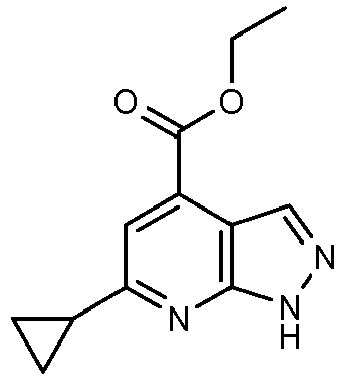
- To a 20 mL microwave vial were combined ethyl 6-cyclopropyl-1-{[4-(methyloxy)phenyl]methyl}-1H-pyrazolo[3,4-b]pyridine-4-carboxylate (2.05 g, 5.83 mmol), trifluoroacetic acid (6.74 ml, 88 mmol) and anisole (1.912 ml, 17.50 mmol). The reaction vessel was sealed and irradiated (microwave) at 100 °C for 5 minutes. After cooling to room temperature, the reaction mixture was concentrated in vacuo. The residue was diluted with water (20 mL) and then saturated NaHCO3 until basic. The contents were extracted with DCM (4 x 20 mL). The combined organic layers were washed with water, brine, dried over MgSO4, filtered and concentrated in vacuo. The crude product was purified via silica gel chromatography (eluent: 0 to 20% EtOAc:Hex). The final product was obtained as 1.06 g (79%). LCMS E-S (M+H) = 232.2. 1H NMR (400 MHz, DMSO-d6 ) δ ppm 0.95 - 1.21 (m, 4 H) 1.41 (t, J=7.07 Hz, 3 H) 2.33 - 2.46 (m, 1 H) 4.44 (q, J=7.07 Hz, 2 H) 7.67 (s, 1 H) 8.26 (d, J=1.26 Hz, 1 H) 13.75 (s, 1 H).
-

- Ethyl 6-cyclopropyl-1H-pyrazolo[3,4-b]pyridine-4-carboxylate (200 mg, 0.865 mmol) was dissolved in N-Methyl-2-pyrrolidone (NMP) (8 mL), followed by addition of potassium tert-butoxide (116 mg, 1.038 mmol). After 20 minutes stirring, O-{[4-(methyloxy)phenyl]carbonyl}hydroxylamine 1-[(aminooxy)carbonyl]-4-(methyloxy)benzene (289 mg, 1.730 mmol) was added and the mixture stirred at room temperature for 16 h. The contents were diluted with EtOAc, and then washed with brine, and saturated NaHCO3. The organic phase was dried over MgSO4, filtered, and concentrated in vacuo. The crude product was purified via silica gel chromatography (eluent: 0 to 50% EtOAc). The final product as collected as 106 mg (50%). LCMS E-S (M+H) = 274.4. 1H NMR (400 MHz, DMSO-d6 ) δ ppm 1.00 - 1.14 (m, 4 H), 1.41 (t, J=7.07 Hz, 3 H), 2.34 - 2.47 (m, 1 H), 4.44 (q, J=7.07 Hz, 2 H), 6.39 (s, 2 H), 7.64 (s, 1 H), 8.09 (s, 1 H).
-

- A solution of ethyl 4-cyclopropyl-2,4-dioxobutanoate (700 mg, 3.76 mmol), 3-methyl-1-(1-methylethyl)-1H-pyrazol-5-amine (523 mg, 3.76 mmol) and benzene (20 mL) were heated at 65 °C for 6 hr, and then allowed to cool to room temperature for 2 d. The solvent was removed under reduced pressure and the residue purified via silica gel chromatography (eluent: 0 to 25% EtOAc:Hex). The final product was collected as 0.77 g (71%). LCMS E-S (M+H) = 288.0. 1H NMR (400 MHz, CHLOROFORM-d) δ ppm 1.04 - 1.11 (m, 2 H), 1.13 - 1.20 (m, 4 H), 1.47 (t, J=7.20 Hz, 6 H), 1.55 (d, J=6.82 Hz, 12 H), 2.16 - 2.25 (m, 2 H), 2.68 (s, 6 H), 4.49 (q, J=7.07 Hz, 4 H), 5.20 (spt, J=6.78 Hz, 2 H), 7.41 (s, 1 H).
-

- The title compound was prepared in the same manner as described for intermediate 33 using 1-cyclobutyl-3-methyl-1H-pyrazol-5-amine (400 mg, 2.65 mmol), ethyl 4-cyclopropyl-2,4-dioxobutanoate (487 mg, 2.65 mmol) and benzene (50 mL), wherein the reaction time was 4 h. The final product was collected as 0.556 g (70%). LCMS E-S (M+H) = 300.6 1H NMR (400 MHz, CHLOROFORM-d) δ ppm 1.02 - 1.22 (m, 4 H) 1.47 (t, J=7.07 Hz, 3 H) 1.80 - 2.01 (m, 2 H) 2.15 - 2.28 (m, 1 H) 2.38 - 2.51 (m, 2 H) 2.70 (s, 3 H) 2.82 (td, J=9.85, 2.53 Hz, 2 H) 4.49 (q, J=7.07 Hz, 2 H) 5.32 - 5.57 (m, 1 H) 7.41 (s, 1 H).
-
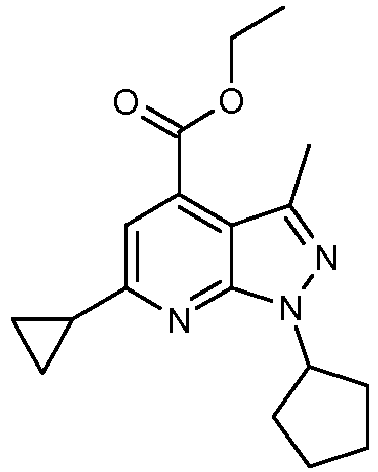
- The title compound was prepared in the same manner as described for intermediate 33 using 1-cyclopentyl-3-methyl-1H-pyrazol-5-amine (570 mg, 3.45 mmol), ethyl 4-cyclopropyl-2,4-dioxobutanoate (635 mg, 3.45 mmol), and benzene (50 mL) wherein the reaction time was 4 h. The crude product was purified via silica gel chromatography (eluent: 0 to 10% EtOAc:Hex). The final product was collected as 0.740 g (68%). LCMS E-S (M+H) = 314.3 1H NMR (400 MHz, CHLOROFORM-d) δ ppm 1.04 - 1.21 (m, 4 H) 1.47 (t, J=7.20 Hz, 3 H) 1.73 (br. s., 2 H) 2.00 (d, J=2.78 Hz, 2 H) 2.08 - 2.16 (m, 4 H) 2.21 (s, 1 H) 2.67 (s, 3 H) 4.49 (q, J=7.16 Hz, 2 H) 5.32 (t, J=7.83 Hz, 1 H) 7.40 (s, 1 H).
-

- The title compound was prepared in the same manner as described for intermediate 33 using ethyl 4-cyclopropyl-2,4-dioxobutanoate (481 mg, 2.61 mmol), 1-(1,1-dimethylethyl)-3-methyl-1H-pyrazol-5-amine (400 mg, 2.61 mmol), and toluene (20 mL), wherein the reaction time was 3 h. The crude product was purified via silica gel chromatography (eluent: 0 to 10% EtOAc:Hex). The final product was collected as 0.24 g (30%). LCMS E-S (M+H) = 302.5. 1H NMR (400 MHz, CHLOROFORM-d) δ ppm 1.02 - 1.23 (m, 4 H) 1.47 (t, J=7.20 Hz, 3 H) 1.79 (s, 9 H) 2.19 (s, 1 H) 2.66 (s, 3 H) 4.49 (q, J=7.07 Hz, 2 H) 7.44 (s, 1 H).
-

- 1-(1-Cyclopropylethyl)-3-methyl-1H-pyrazol-5-amine (500 mg, 3.03 mmol) and ethyl 4-cyclopropyl-2,4-dioxobutanoate (557 mg, 3.03 mmol) were suspended in Toluene (10 mL) and heated at 70 °C for 16 h. The solvent was removed in vacuo and the crude residue was purified via silica gel chromatography (eluent: gradient of 0 to 10% EtOAc:Hex). The final product was collected as a solid, 0.722 g (76%). LCMS E-S (M+H) = 314.3 1H NMR (400 MHz, DMSO-d6 ) ppm 0.17 - 0.32 (m, 2 H), 0.39 (m, J=9.69, 4.82, 4.82, 4.67 Hz, 1 H), 0.51 - 0.62 (m, 1 H), 0.94 - 1.11 (m, 4 H), 1.28 - 1.41 (m, 4 H), 1.58 (d, J=6.82 Hz, 3 H), 2.30 - 2.38 (m, 1 H), 2.56 (s, 3 H), 4.19 (dq, J=9.44, 6.87 Hz, 1 H), 4.43 (q, J=7.07 Hz, 2 H), 7.48 (s, 1 H)
-

- The title compound was prepared in the same manner as described for intermediate 37 using 1-(1-cyclohexyl)-3-methyl-1H-pyrazol-5-amine (500 mg, 2.79 mmol) and ethyl 4-cyclopropyl-2,4-dioxobutanoate (514 mg, 2.79 mmol). The final product was collected as a solid, 0.827 g (91%). LCMS E-S (M+H) = 328.3 1H NMR (400 MHz, DMSO-d6 ) δ ppm 1.01 - 1.10 (m, 3 H), 1.20 - 1.30 (m, 1 H), 1.37 (t, J=7.07 Hz, 3 H), 1.41 - 1.52 (m, 2 H), 1.70 (d, 1 H), 1.79 - 1.98 (m, 6 H), 2.30 - 2.38 (m, 1 H), 2.54 (s, 3 H), 4.42 (q, J=7.07 Hz, 2 H), 4.60 - 4.74 (m, 1 H), 7.44 (s, 1 H).
-

- 3-Methyl-1-(1-methyl-4-piperidinyl)-1H-pyrazol-5-amine (500 mg, 2.57 mmol) and ethyl 4-cyclopropyl-2,4-dioxobutanoate (474 mg, 2.57 mmol) were suspended in Toluene (10 mL) and heated at 70 °C for 5 h. The solvent was removed in vacuo and the crude residue was purified via silica gel chromatography (eluent: gradient of 0 to 10% MeOH:DCM). The final product was collected as a solid, 0.722 g (76%). LCMS E-S (M+H) = 343.1 1H NMR (400 MHz, DMSO-d 6) δ ppm 1.03 - 1.11 (m, 4 H), 1.38 (t, J=7.07 Hz, 3 H), 1.83 (d, J=6.06 Hz, 2 H), 2.12 - 2.22 (m, 4 H), 2.27 (s, 3 H), 2.35 (m, J=7.83, 7.83, 5.05, 4.80 Hz, 1 H), 2.54 (s, 3 H), 2.94 (d, J=6.57 Hz, 2 H), 4.42 (q, J=7.16 Hz, 2 H), 4.57 - 4.73 (m, 1 H), 7.46 (s, 1 H).
-

- A mixture of 3-methyl-1-(tetrahydro-2H-pyran-4-yl)-1H-pyrazol-5-amine (380 mg, 2.097 mmol), ethyl (3Z)-4-cyclopropyl-4-hydroxy-2-oxo-3-butenoate (386 mg, 2.097 mmol) and acetic acid (50 mL) were heated at 117 °C for 2 hours. The solvent was removed in vacuo, and the crude residue was purified via silica gel chromatography (eluent: 0 to 25% EtOAc:Hex). The desired product was collected as a solid, 300 mg (43%). LCMS E-S (M+H) = 330.3 1H NMR (400 MHz, DMSO-d 6) δ ppm 1.00 - 1.12 (m, 4 H), 1.37 (t, J=7.20 Hz, 3 H), 1.82 (dd, J=12.51, 2.40 Hz, 2 H), 2.16 (qd, J=12.21, 4.55 Hz, 2 H), 2.29 - 2.42 (m, 1 H), 2.54 (s, 3 H), 3.47 - 3.60 (m, 2 H), 3.99 (dd, J=11.37, 3.79 Hz, 2 H), 4.42 (q, J=7.24 Hz, 2 H), 4.92 (tt, J=11.59, 4.20 Hz, 1 H), 7.46 (s, 1 H).
-

- Ethyl 6-cyclopropyl-1H-pyrazolo[3,4-b]pyridine-4-carboxylate (125 mg, 0.541 mmol) was dissolved in DMF(10 mL), followed by addition of potassium tert-butoxide (79 mg, 0.703 mmol). After stirring for 15 minutes, 1,1-dimethylethyl (2-bromoethyl)carbamate (121 mg, 0.541 mmol) was added and the mixture was stirred at room temperature for 16 h. The reaction mixture was concentrated to dryness. The crude residue was diluted with water (50 mL) and acidified with acetic acid. The contents were extracted with DCM (4 x 50 mL). The combined organic layers were washed with water, brine, dried over MgSO4, filtered, and concentrated in vacuo. The crude residue was purified via silica gel chromatography (eluent: 0 to 50% EtOAc:Hex). The final product was obtained as 0.114 g (56%). LCMS E-S (M+H) = 375.1. 1H NMR (400 MHz, DMSO-d 6) δ ppm 1.04 - 1.14 (m, 4 H), 1.15 - 1.20 (m, 2 H), 1.27 (s, 7 H), 1.41 (t, J=7.07 Hz, 3 H), 2.36 - 2.45 (m, 1 H), 3.31 - 3.41 (m, 3 H), 4.36 - 4.50 (m, 5 H), 6.84 (t, J=5.81 Hz, 1 H), 7.65 (s, 1 H), 8.24 (s, 3 H).
-

- The title compound was prepared in the same manner as described for intermediate 30 using 3-methyl-1-(4-pyridinyl)-1H-pyrazol-5-amine (310 mg, 1.780 mmol), ethyl 4-cyclopropyl-2,4-dioxobutanoate (328 mg, 1.780 mmol), benzene (50 mL), and acetic acid (25 mL). The final product was collected as 3.71 (71% overall). LCMS E-S (M+H) = 323.5 1H NMR (400 MHz, DMSO-d 6) δ ppm 1.15 - 1.22 (m, 4 H), 1.41 (t, J=7.07 Hz, 3 H), 2.64 - 2.69 (m, 4 H), 4.47 (q, J=7.07 Hz, 2 H), 7.74 (s, 1 H), 8.27 - 8.36 (m, 2 H), 8.66 - 8.71 (m, 2 H).
-

- To a solution of ethyl 6-cyclopropyl-1H-pyrazolo[3,4-b]pyridine-4-carboxylate (200 mg, 0.865 mmol) in DMF(10 mL) was carefully added sodium hydride (29.1 mg, 1.211 mmol). After 15 minutes stirring, iodoethane (0.077 mL, 0.951 mmol) was added and the mixture stirred at room temperature for 2 hr. Sodium hydroxide (1 mL, 1.000 mmol) was added and the mixture allowed to stir at room temperature for 1 h. The contents were concentrated in vacuo. The crude residue was diluted with water (50 mL) and acidified with acetic acid. The contents were then extracted with DCM (4 x 50 mL). The combined organic layers were washed with water, brine, dried over MgSO4, filtered and concentrated in vacuo. The crude product was purified by silica gel chromatography (eluent: hexanes to 100% EtOAc, then DCM to 20% MeOH:DCM). The final product was collected as 90 mg (45%). LCMS E-S (M+H) = 232.1 1H NMR (400 MHz, DMSO-d 6) δ ppm 1.06 - 1.17 (m, 4 H) 1.41 (t, J=7.33 Hz, 3 H) 2.35 - 2.45 (m, 1 H) 4.34 - 4.57 (m, 2 H) 7.62 (s, 1 H) 8.24 (s, 1 H) 13.83 (br. s., 1 H). Regiochemical assignment supported by 2D HNMR.
-

- The title compound was prepared as in the same manner as described for intermediate 43 using ethyl 6-cyclopropyl-1H-pyrazolo[3,4-b]pyridine-4-carboxylate (200 mg, 0.865 mmol), sodium hydride (29.1 mg, 1.211 mmol), DMF (10 mL), 1-iodopropane (162 mg, 0.951 mmol), and NaOH (1 mL). The crude product was purified by silica gel chromatography (eluent: 0 to 10% MeOH:DCM) to afford the final product as a solid, 90 mg (42%). Regiochemical assignment supported by 2D HNMR. LCMS E-S (M+H) = 246.0 1H NMR (400 MHz, DMSO-d 6) δ ppm 13.83 (br s, 1H), 8.24 (s, 1H), 7.62 (s, 1H), 4.26 (t, 2H, J = 7.2 Hz), 2.37 - 2.40 (m, 2H), 1.83 - 1.89 (m, 2H), 1.07 - 1.11 (m, 4H), 0.77 (t, 3H, J = 7.2 Hz).
-
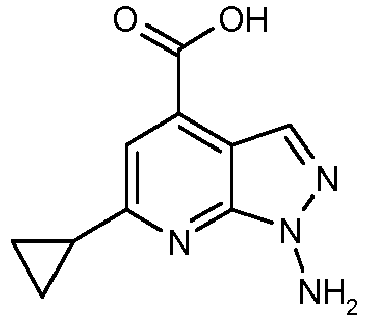
- To a solution of ethyl 1-amino-6-cyclopropyl-1H-pyrazolo[3,4-b]pyridine-4-carboxylate (100 mg, 0.406 mmol) in ethanol (10 mL) was added sodium hydroxide (1 ml, 0.406 mmol), and the mixture stirred at room temperature for 2h. The solvent was removed in vacuo, and the residue diluted with EtOAc (30 mL) and water (20 mL). The reaction mixture was acidified to pH 3 with citric acid. The phases were separated and the aq. phase extracted with EtOAc (4 x 20 mL). The combined organic layers were washed with water, dried over MgSO4, filtered, and concentrated in vacuo. The final product was collected as 0.075 g (84%). LCMS E-S (M+H) =219.5. 1H NMR (400 MHz, DMSO-d 6) δ ppm 1.00 - 1.13 (m, 4 H), 2.27 - 2.45 (m, 1 H), 6.36 (s, 2 H), 7.60 (s, 1 H), 8.06 (s, 1 H), 13.81 (br. s., 1 H).
-

- To a solution of ethyl 6-cyclopropyl-3-methyl-1-(1-methylethyl)-1H-pyrazolo[3,4-b]pyridine-4-carboxylate (200 mg, 0.696 mmol) in ethanol (5 mL) was added sodium hydroxide (2.088 mL, 2.088 mmol), and the mixture stirred at room temperature for 30 min. The reaction mixture was concentrated in vacuo. The residue was diluted with water (30 mL) and then acidified with acetic acid. The contents were extracted with DCM (3 x 30 mL). The combined organic layers were washed with water, brine, dried over MgSO4, filtered, and concentrated in vacuo. The final product was obtained as 0.17 g (94%). LCMS E-S (M+H) = 260.0. 1H NMR (400 MHz, DMSO-d 6) δ ppm 0.97 - 1.12 (m, 4 H) 1.44 (d, J=6.57 Hz, 6 H) 2.27 - 2.38 (m, 1 H) 2.55 (s, 3 H) 5.07 (quin, J=6.69 Hz, 1 H) 7.43 (s, 1 H) 13.30 - 14.08 (m, 1 H).
-

- The title compound was prepared in the same manner as described for intermediate 46 using ethyl 6-cyclopropyl-1-[2-({[(1,1-dimethylethyl)oxy]carbonyl}amino)ethyl]-1H-pyrazolo[3,4-b]pyridine-4-carboxylate (110 mg, 0.294 mmol), sodium hydroxide (1 mL, 0.294 mmol), and ethanol (10 mL) wherein the stir time was 16h. The final product was collected as 0.060 g (59%). LCMS E-S (M+H) = 347.1 1H NMR (400 MHz, DMSO-d 6) δ ppm 1.06 - 1.13 (m, 4 H) 1.27 (s, 9 H) 2.33 - 2.43 (m, 1 H) 3.37 (q, J=5.81 Hz, 2 H) 4.44 (t, J=5.94 Hz, 2 H) 6.84 (t, J=5.81 Hz, 1 H) 7.62 (s, 5 H) 8.24 (s, 1 H).
-

- The title compound was prepared in the same manner as described for intermediate 46 using ethyl 1-cyclobutyl-6-cyclopropyl-3-methyl-1H-pyrazolo[3,4-b]pyridine-4-carboxylate (550 mg, 1.837 mmol), sodium hydroxide (3 ml, 3.00 mmol), and ethanol (30 mL) wherein the stir time was 1h. The final product was collected as 0.490 g (98%). LCMS E-S (M+H) = 272.5 1H NMR (400 MHz, DMSO-d 6) δ ppm 1.03 - 1.10 (m, 4 H), 1.80 - 1.91 (m, 2 H), 2.26 - 2.43 (m, 3 H), 2.58 (s, 3 H), 2.59 - 2.71 (m, 2 H), 5.35 (dq, J=8.59, 8.42 Hz, 1 H), 7.44 (s, 1 H), 13.73 (br. s., 1 H).
-

- The title compound was prepared in the same manner as described for intermediate 46 using ethyl 1-cyclopentyl-6-cyclopropyl-3-methyl-1H-pyrazolo[3,4-b]pyridine-4-carboxylate (740 mg, 2.361 mmol), sodium hydroxide (4ml, 4.00 mmol), and ethanol (30 mL), wherein the stir time was 1h. The final product was collected as 0.530 g (79%). LCMS E-S (M+H) = 286.3 1H NMR (400 MHz, DMSO-d 6) δ ppm 0.96 - 1.12 (m, 4 H) 1.52 - 1.74 (m, 2 H) 1.82 - 2.13 (m, 6 H) 2.26 - 2.37 (m, 1 H) 2.55 (s, 3 H) 5.17 - 5.30 (m, 1 H) 7.43 (s, 1 H) 13.70 (br. s., 1 H).
-

- The title compound was prepared in the same manner as described for intermediate 46 using ethyl 6-cyclopropyl-1-(1,1-dimethylethyl)-3-methyl-1H-pyrazolo[3,4-b]pyridine-4-carboxylate (240 mg, 0.796 mmol), sodium hydroxide (4 mL, 4.00 mmol), and ethanol (30 mL), wherein the stir time was 1h. The final product was collected as 0.210 g (96%). LCMS E-S (M+H) = 274.4. 1H NMR (400 MHz, DMSO-d 6) δ ppm 1.05 (m, 4 H) 1.70 (s, 9 H) 2.33 (m, 1 H) 2.51 (s, 3 H) 7.46 (s, 1 H) 13.70 (br. s., 1 H).
-

- The title compound was prepared in the same manner as described for intermediate 46 using ethyl 6-cyclopropyl-1-(4-pyridinyl)-3-methyl-1H-pyrazolo[3,4-b]pyridine-4-carboxylate (240 mg, 0.796 mmol), sodium hydroxide (4 mL, 4.00 mmol), and ethanol (30 mL), wherein the stir time was 1 h. The final product was collected as 0.210 g (89%). LCMS E-S (M+H) = 295.3.
-

- To an EtOH (10 mL) solution of ethyl 6-cyclopropyl-1-(1-cyclopropylethyl)-3-methyl-1H-pyrazolo[3,4-b]pyridine-4-carboxylate (720 mg, 2.297 mmol) was added sodium hydroxide (6.89 mL, 6.89 mmol) and the mixture heated at 70 °C for 1 hour. The solvent was removed in vacuo. and the residue was dissolved in 20 mL of water. The contents were acidifed with acetic acid, and extracted with EtOAc (4 x 30mL). The combined organic extracts were washed with water, brine, dried over MgSO4, filtered, and concentrated in vacuo. The final product was collected as a solid, 0.560 g (85%). LCMS E-S (M+H) = 286.3 1H NMR (400 MHz, DMSO-d6) 6 ppm 0.15 - 0.33 (m, 2 H), 0.38 (dq, J=9.57, 4.89 Hz, 1 H), 0.50 - 0.65 (m, 1 H), 0.90 - 1.10 (m, 4 H), 1.27 - 1.42 (m, 1 H), 1.57 (d, J=6.82 Hz, 3 H), 2.23 - 2.36 (m, 1 H), 2.57 (s, 3 H), 4.18 (dq, J=9.32, 6.83 Hz, 1 H), 7.44 (s, 1 H), 12.79 (br. s., 1H).
-

- The title compound was prepared in the same manner as described for intermediate 52 using ethyl 6-cyclopropyl-1-(1-cyclohexyl)-3-methyl-1H-pyrazolo[3,4-b]pyridine-4-carboxylate (820 mg, 2.5 mmol) and sodium hydroxide (7.51 mL, 7.51 mmol). The final product was collected as a solid, 0.660 g (88%). LCMS E-S (M+H) = 300.4 1H NMR (400 MHz, DMSO-d 6) δ ppm 1.01 - 1.11 (m, 4 H), 1.16 - 1.31 (m, 1 H), 1.36 - 1.55 (m, 2 H), 1.70 (d, J=12.38 Hz, 1 H), 1.80 - 1.98 (m, 6 H), 2.32 (m, J=7.80, 7.80, 5.05, 4.86 Hz, 1 H), 2.55 (s, 3 H), 4.60 - 4.73 (m, 1 H), 7.40 (s, 1 H), 13.71 (br. s., 1 H).
-

- To an EtOH solution (10 mL) of ethyl 6-cyclopropyl-3-methyl-1-(1-methyl-4-piperidinyl)-1H-pyrazolo[3,4-b]pyridine-4-carboxylate (620 mg, 1.811 mmol) was added sodium hydroxide (5.43 mL, 5.43 mmol) and the mixture heated at 70 °C for 1 hour. The solvent was removed in vacuo and the residue was dissolved in 20 mL of water. The contents were acidifed with acetic acid, and extracted with EtOAc (4 x 30mL). The combined organic extracts were washed with water, brine, dried over MgSO4, filtered, and concentrated in vacuo to afford a minor amount of product. The aqueous phase was concentrated in vacuo and the crude residue purified by reverse phase HPLC purification (eluent: 0% ACN/H2O, 0.1%TFA to 45% ACN/H2O, 0.1% TFA). The isolated solid product was concentrated from toluene to afford the final product as 510 mg (90%). LCMS E-S (M+H) = 315.2. 1H NMR (400 MHz, DMSO-d 6) δ ppm 1.08 (d, J=6.57 Hz, 4 H), 2.10 (d, J=13.14 Hz, 2 H), 2.30 - 2.42 (m, 3 H), 2.55 (s, 3 H), 2.77 - 2.92 (m, 3 H), 3.30 (br. s., 2 H), 3.57 (d, J=12.13 Hz, 2 H), 4.98 (m, J=11.78, 11.78, 3.85, 3.66 Hz, 1 H), 7.46 (s, 1 H), 9.87 (br. s., 1 H).
-

- To an EtOH solution (30 mL) of ethyl 6-cyclopropyl-3-methyl-1-(tetrahydro-2H-pyran-4-yl)-1H-pyrazolo[3,4-b]pyridine-4-carboxylate (300 mg, 0.911 mmol) was added sodium hydroxide (1.82 mL, 1.82 mmol) and the mixture stirred at room temperature for 16 h. The solvent was removed in vacuo and the residue was dissolved in 20 mL of water. The contents were acidifed with acetic acid, and extracted with EtOAc (4 x 30mL). The combined organic extracts were washed with water, brine, dried over MgSO4, filtered, and concentrated in vacuo to afford the final product as 265 mg (97%). LCMS E-S (M+H)= 302.4 1H NMR (400 MHz, DMSO-d6) δ ppm 1.02 - 1.09 (m, 4 H), 1.81 (dd, J=12.38, 2.27 Hz, 2 H), 2.15 (qd, J=12.25, 4.42 Hz, 2 H), 2.28 - 2.37 (m, 1 H), 2.54 (s, 3 H), 3.46 - 3.60 (m, 2 H), 3.89 - 4.02 (m, 2 H), 4.91 (m, J=11.56, 11.56, 4.17, 4.04 Hz, 1 H), 7.42 (s, 1 H), 13.73 (br. s., 1 H).
-

- To a solution ofDMSO (10 mL) were sequentially added 6-cyclopropyl-1-[2-({[(1,1-dimethylethyl)oxy]carbonyl}amino)ethyl]-1H-pyrazolo[3,4-b]pyridine-4-carboxylic acid (270 mg, 0.779 mmol), 3-(aminomethyl)-4,6-dimethyl-2(1H)-pyridinone (178 mg, 1.169 mmol), and 1-hydroxy-7-azabenzotriazole (212 mg, 1.559 mmol), and the mixture stirred at room temperature for 10 min. Next was added EDC (299 mg, 1.559 mmol) and N-methylmorpholine (0.343 mL, 3.12 mmol), and reaction mixture was stirred at room temperature for 16 h.. The contents were diluted with water (25 mL) and stirred for 10 min. The solid product was filtered off, dried, and collected as 0.290 g (98%). LCMS E-S (M+H) = 381.2. 1H NMR (400 MHz, DMSO-d 6) δ ppm 1.00 - 1.15 (m, 4 H), 1.30 (s, 9H), 2.13 (s, 3 H), 2.18 - 2.32 (m, 4 H), 4.36 (d, J=4.80 Hz, 2 H), 4.42 (t, J=5.81 Hz, 2 H), 5.90 (s, 1 H), 6.85 (t, J=5.56 Hz, 1 H), 7.44 (s, 1 H), 8.22 (s, 2 H), 8.73 (t, J=4.67 Hz, 1 H), 11.57 (br. s., 1 H).
-

- To a solution of 1,1-dimethylethyl {2-[6-cyclopropyl-4-([[(4,6-dimethyl-2-oxo-1,2-dihydro-3-pyridinyl)methyl]amino}carbonyl)-1H-pyrazolo[3,4-b]pyridin-1-yl]ethyl}carbamate (260 mg, 0.541 mmol) in DCM (15 mL) was added trifluoroacetic acid (3 ml, 38.9 mmol) and the mixture stirred at room temperature for 2 h. The contents were concentrated in vacuo and the crude residue purified by reverse phase HPLC. (mobile phase : 10 to 70% ACN in H2O, 0.1% NH4OH). The final product was collected as 0.170 g (89%). LCMS E-S (M+H) = 353.3 1H NMR (400 MHz, DMSO-d 6) δ ppm 1.07 (d, J=6.32 Hz, 4 H), 2.13 (s, 3 H), 2.21 (s, 4 H), 3.00 (t, J=6.19 Hz, 2 H), 4.29 - 4.47 (m, 4 H), 5.90 (s, 1 H,) 7.43 (s, 1 H), 8.22 (s, 1 H), 8.75 (t, 1 H).
-

- To a solution of 1-(2-aminoethyl)-6-cyclopropyl-N-[(4,6-dimethyl-2-oxo-1,2-dihydro-3-pyridinyl)methyl]-1H-pyrazolo[3,4-b]pyridine-4-carboxamide (120 mg, 0.315 mmol) in pyridine (2 mL) was added methanesulfonyl chloride (0.025 mL, 0.315 mmol) and the reaction mixture stirred at room temperature for 16 hours. The reaction mixture was concentrated in vacuo, diluted with water, and extracted with EtOAc. The combined organic extracts were washed with brine, dried over MgSO4, filtered, and concentrated in vacuo. The crude product was purified by reverse phase HPLC to afford a solid (25 mg). This solid was suspended in MeOH (1 mL) and treated with 4N HCl (1 mL). The solvent was removed under reduced pressure to afford the final product as a solid which was collected as 15 mg (9%). LCMS E-S (M+H) = 459.2. 1H NMR (400 MHz, DMSO-d 6) δ ppm 1.02 - 1.15 (m, 4 H), 2.13 (s, 3 H), 2.22 (s, 3 H), 2.23 - 2.31 (m, 1 H), 2.82 (s, 3 H), 3.45 (q,2 H), 4.36 (d, J=5.05 Hz, 2 H), 4.49 (t, J=6.44 Hz, 2 H), 5.90 (s, 1 H), 7.19 (s, 1 H), 7.47 (s, 1 H), 8.25 (s, 1 H), 8.76 (t, J=4.93 Hz, 1 H), 11.56 (s, 1 H).
-
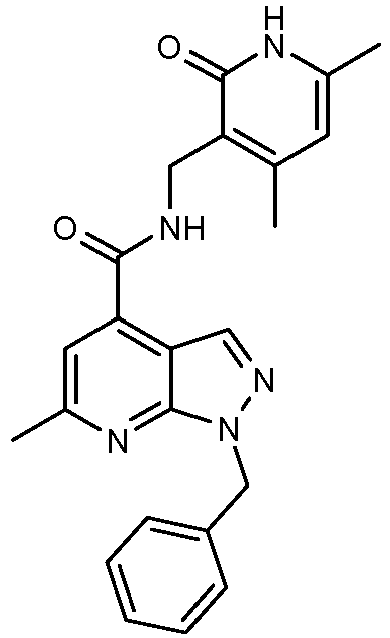
- The title compound was prepared in the same manner as described for intermediate 56 using 6-methyl-1-(phenylmethyl)-1H-pyrazolo[3,4-b]pyridine-4-carboxylic acid (200 mg, 0.748 mmol), 3-(aminomethyl)-4,6-dimethyl-2(1H)-pyridinone (142 mg, 0.935 mmol), 1-hydroxy-7-azabenzotriazole (204 mg, 1.497 mmol), DMSO (10 mL), EDC (287 mg, 1.497 mmol), and N-methylmorpholine (0.329 mL, 2.99 mmol). The final product was collected as 0.25 g (83%). LCMS E-S (M+H) = 402.2. 1H NMR (400 MHz, DMSO-d 6) δ ppm 0.93 - 1.12 (m, 4 H), 1.42 (d, J=6.82 Hz, 6 H), 2.12 (s, 3 H), 2.22 (s, 4 H), 2.36 (s, 3 H), 4.34 (d, J=4.80 Hz, 2 H), 4.90 - 5.11 (m, 1 H), 5.87 (s, 1 H), 6.99 (s, 1 H), 8.58 (s, 1 H), 11.51 (s, 1 H.
-

- The title compound was prepared in the same manner as described for intermediate 56 using 6-cyclopropyl-1-ethyl-1H-pyrazolo[3,4-b]pyridine-4-carboxylic acid (91 mg, 0.394 mmol), 3-(aminomethyl)-4,6-dimethyl-2(1H)-pyridinone (75 mg, 0.493 mmol), 1-hydroxy-7-azabenzotriazole (107 mg, 0.788 mmol), DMSO(10 mL), EDC (151 mg, 0.788 mmol), and N-methylmorpholine (0.173 mL, 1.577 mmol). The final product was collected as 0.090 g (63%). LCMS E-S (M+H) = 366.3 1H NMR (400 MHz, DMSO-d 6) δ ppm 1.07 (d, J=6.32 Hz, 4 H), 1.39 (t, J=7.20 Hz, 3 H), 2.13 (s, 3 H), 2.19 - 2.32 (m, 4 H), 4.36 (d, J=4.80 Hz, 2 H), 4.42 (q, J=7.07 Hz, 2 H), 5.90 (s, 1 H), 7.43 (s, 1 H), 8.21 (s, 1 H), 8.75 (t, J=4.67 Hz, 1 H), 11.57 (br. s., 1 H).
-

- The title compound was prepared in the same manner as described for intermediate 56 using 6-cyclopropyl-1-propyl-1H-pyrazolo[3,4-b]pyridine-4-carboxylic acid (90 mg, 0.368 mmol), 3-(aminomethyl)-4,6-dimethyl-2(1H)-pyridinone (70 mg, 0.460 mmol), 1-hydroxy-7-azabenzotriazole (100 mg, 0.736 mmol), DMSO(10 mL), EDC (141 mg, 0.736 mmol), and N-methylmorpholine (0.162 mL, 1.472 mmol). The final product was collected as 0.118 g (84%). LCMS E-S (M+H) = 380.3. 1H NMR (400 MHz, DMSO-d 6) δ ppm 0.78 (t, 3 H), 0.99 - 1.16 (m, 4 H), 1.85 (d, J=7.33 Hz, 2 H), 2.13 (s, 3 H), 2.22 (s, 4 H), 4.25 - 4.43 (m, 4 H), 5.90 (s, 1 H), 7.43 (s, 1 H), 8.21 (s, 1 H), 8.75 (s, 1 H), 11.57 (s, 1 H).
-

- The title compound was prepared in the same manner as described for intermediate 56 using 6-cyclopropyl-1-(2-methylpropyl)-1H-pyrazolo[3,4-b]pyridine-4-carboxylic acid (80 mg, 0.309 mmol), 3-(aminomethyl)-4,6-dimethyl-2(1H)-pyridinone (70.4 mg, 0.463 mmol), 1-hydroxy-7-azabenzotriazole (84 mg, 0.617 mmol), DMSO(10 mL), EDC (118 mg, 0.617 mmol), and N-methylmorpholine (0.136 mL, 1.234 mmol). The final product was collected as 0.123 g (100%). LCMS E-S (M+H) = 394.2 1H NMR (400 MHz, DMSO-d 6) δ ppm 0.93 - 1.12 (m, 4 H), 1.42 (d, J=6.82 Hz, 6 H), 2.12 (s, 3 H), 2.22 (s, 4 H), 2.36 (s, 3 H), 4.34 (d, J=4.80 Hz, 2 H), 4.90 - 5.11 (m, 1 H), 5.87 (s, 1 H), 6.99 (s, 1 H), 8.58 (s, 1 H), 11.51 (s, 1 H).
-

- The title compound was prepared in the same manner as described for intermediate 56 using 1-amino-6-cyclopropyl-1H-pyrazolo[3,4-b]pyridine-4-carboxylic acid (73 mg, 0.335 mmol), 3-(aminomethyl)-4,6-dimethyl-2(1H)-pyridinone (76 mg, 0.502 mmol), 1-hydroxy-7-azabenzotriazole (91 mg, 0.669 mmol), DMSO(10 mL), EDC (128 mg, 0.669 mmol), and N-methylmorpholine (0.147 mL, 1.338 mmol). The aq. phase was extracted with EtOAc (5 x 30 mL). The combined EtOAc extracts were dried over MgSO4, filtered, and concentrated in vacuo. The final product was collected as 0.068 g (58%). LCMS E-S (M+H) = 353.3. 1H NMR (400 MHz, DMSO-d 6) δ ppm 0.99 - 1.14 (m, 4 H), 2.13 (s, 3 H), 2.22 (s, 4 H), 4.35 (d, J=4.80 Hz, 2 H), 5.90 (s, 1 H), 6.31 (s, 2 H), 7.41 (s, 1 H), 8.04 (s, 1 H), 8.74 (s, 1 H), 11.58 (br. s., 1 H).
-

- The title compound was prepared in the same manner as described for intermediate 56 using 1-cyclobutyl-6-cyclopropyl-3-methyl-1H-pyrazolo[3,4-b]pyridine-4-carboxylic acid (164 mg, 0.604 mmol), 3-(aminomethyl)-4,6-dimethyl-2(1H)-pyridinone (129 mg, 0.846mmol), 1-hydroxy-7-azabenzotriazole (165 mg, 1.209 mmol), EDC (232 mg, 1.209 mmol), N-methylmorpholine (0.266 mL, 2.418 mmol), and DMSO(10 mL). The final product was collected as 0.240 g (98%). LCMS E-S (M+H) = 406.3. 1H NMR (400 MHz, DMSO-d 6) δ ppm 1.03 (d, J=6.06 Hz, 4 H), 1.85 (dd, J=9.35, 5.05 Hz, 3 H), 2.12 (s, 4 H), 2.16 - 2.28 (m, 6 H), 2.30 - 2.44 (m, 7 H), 2.63 (d, J=19.96 Hz, 3 H), 4.34 (d, J=4.29 Hz, 2 H), 5.31 (t, J=8.34 Hz, 1 H), 5.87 (s, 1 H), 7.01 (s, 1 H), 8.59 (br. s., 1 H), 11.52 (br. s., 1 H).
-

- The title compound was prepared in the same manner as described for intermediate 56 using 1-cyclopentyl-6-cyclopropyl-3-methyl-1H-pyrazolo[3,4-b]pyridine-4-carboxylic acid (160 mg, 0.561 mmol), 3-(aminomethyl)-4,6-dimethyl-2(1H)-pyridinone (119 mg, 0.785 mmol), 1-hydroxy-7-azabenzotriazole (153 mg, 1.121 mmol), EDC (215 mg, 1.121 mmol), N-methylmorpholine (0.247 mL, 2.243 mmol) and DMSO(10 mL). The final product was collected as 0.205 g (87%). LCMS E-S (M+H) = 420.0. 1H NMR (400 MHz, DMSO-d 6) δ ppm 1.03 (d, J=6.06 Hz, 4 H), 1.85 (dd, J=9.35, 5.05 Hz, 3 H), 2.12 (s, 4 H), 2.16 - 2.28 (m, 6 H), 2.30 - 2.44 (m, 7 H), 2.63 (d, J=19.96 Hz, 3 H), 4.34 (d, J=4.29 Hz, 2 H), 5.31 (t, J=8.34 Hz, 1 H), 5.87 (s, 1 H), 7.01 (s, 1 H), 8.59 (br. s., 1 H), 11.52 (br. s., 1 H).
-

- The title compound was prepared in the same manner as described for intermediate 56 using 6-cyclopropyl-1-(1,1-dimethylethyl)-3-methyl-1H-pyrazolo[3,4-b]pyridine-4-carboxylic acid (210 mg, 0.768 mmol), 3-(aminomethyl)-4,6-dimethyl-2(1H)-pyridinone (158 mg, 1.037 mmol), 1-hydroxy-7-azabenzotriazole (209 mg, 1.537 mmol), EDC (295 mg, 1.537 mmol), N-methylmorpholine (0.338 mL, 3.07 mmol), and DMSO(10 mL). The final product was collected as 0.280 g (89%). LCMS E-S (M+H) = 408.2. 1H NMR (400 MHz, DMSO-d 6) δ ppm 1.02 (dddd, 4 H), 1.69 (m, 9 H), 2.12 (s, 3 H), 2.22 (m, 4 H), 2.33 (s, 3 H), 4.34 (d, J=4.80 Hz, 2 H), 5.87 (s, 1 H), 7.04 (s, 1 H), 8.55 (m, 1 H), 11.51 (s, 1 H).
-

- The title compound was prepared in the same manner as described for intermediate 56 using 6-cyclopropyl-3-methyl-1-(4-pyridinyl)-1H-pyrazolo[3,4-b]pyridine-4-carboxylic acid (89 mg, 0.302 mmol), 3-(aminomethyl)-4,6-dimethyl-2(1H)-pyridinone (69.0 mg, 0.454 mmol), 1-hydroxy-7-azabenzotriazole (82 mg, 0.605 mmol), DMSO(20 mL), EDC (116 mg, 0.605 mmol), and N-methylmorpholine (0.133 mL, 1.210 mmol). The final product was collected as 0.110 g (80%). LCMS E-S (M+H) = 429.1 1H NMR (400 MHz, DMSO-d 6) δ ppm 1.15 (br. s., 4 H), 2.13 (br. s., 3H), 2.25 (br. s., 4 H), 3.34 (br. s., 3 H), 4.37 (br. s., 2 H), 5.89 (br. s., 1 H), 7.30 (br. s., 1 H), 8.33 (br. s., 2 H), 8.67 (br. s., 3 H), 11.54 (br. s., 1 H).
-

- 6-Cyclopropyl-1-(1-cyclopropylethyl)-3-methyl-1H-pyrazolo[3,4-b]pyridine-4-carboxylic acid (186 mg, 0.652 mmol), 3-(aminomethyl)-4,6-dimethyl-2(1H)-pyridinone (160 mg, 0.847 mmol), 1-hydroxy-7-azabenzotriazole (177 mg, 1.304 mmol), EDC (250 mg, 1.304 mmol) and N-methylmorpholine (0.287 mL, 2.61 mmol) were dissolved in DMSO (10 mL) and stirred at room temperature for 3 days. The reaction mixture was diluted with water (25 mL), stirred, and filtered. The product was dried and collected as a solid, 0.200 g (73%). LCMS E-S (M+H) = 420.0. 1H NMR (400 MHz, DMSO-d 6) δ ppm 0.14 - 0.30 (m, 2 H), 0.32 - 0.43 (m, 1 H), 0.48 - 0.64 (m, 1 H), 0.89 - 1.11 (m, 4 H), 1.22 - 1.43 (m, 1 H), 1.55 (d, J=6.82 Hz, 3 H), 2.11 (s, 3 H), 2.18 - 2.28 (m, 4 H), 2.37 (s, 3 H), 4.05 - 4.21 (m, 1 H), 4.34 (d, J=4.80 Hz, 2 H), 5.87 (s, 1 H), 6.99 (s, 1 H), 8.59 (t, J=4.67 Hz, 1 H), 11.51 (br. s., 1 H).
-

- The title compound was prepared in the same manner as described in example 109 using 6-cyclopropyl-1-(1-cyclohexyl)-3-methyl-1H-pyrazolo[3,4-b]pyridine-4-carboxylic acid (150 mg, 0.501 mmol), and 3-(aminomethyl)-4,6-dimethyl-2(1H)-pyridinone (123 mg, 0.651 mmol). The product was collected as a solid, 0.190 g (87%). LCMS E-S (M+H) = 434.2. 1H NMR (400 MHz, DMSO-d 6) δ ppm 0.95 - 1.07 (m, 4 H), 1.15 - 1.31 (m, 1 H), 1.36 - 1.52 (m, 2 H), 1.68 (br. s., 1 H), 1.77 - 1.99 (m, 6 H), 2.11 (s, 3 H), 2.18 - 2.29 (m, 4 H), 2.35 (s, 3 H), 4.33 (d, J=4.80 Hz, 2 H), 4.53 - 4.73 (m, 1 H), 5.87 (s, 1 H), 6.96 (s, 1 H), 8.58 (t, J=4.93 Hz, 1 H), 11.51 (s, 1 H).
-

- 6-Cyclopropyl-3-methyl-1-(1-methyl-4-piperidinyl)-1H-pyrazolo[3,4-b]pyridine-4-carboxylic acid (150 mg, 0.477 mmol), 3-(aminomethyl)-4,6-dimethyl-2(1H)-pyridinone (117 mg, 0.620 mmol), 1-hydroxy-7-azabenzotriazole (130 mg, 0.954 mmol), EDC (183 mg, 0.954 mmol) and N-methylmorpholine (0.210 mL, 1.909 mmol) were suspended in DMSO(10 mL) and stirred at room temperature for 16 h. Next was added 25 mL of water, stirred for 10 minutes, and then extracted with EtOAc (5x). The organic layers were concentrated in vacuo to afford 20 mg product. The aqueous phase was concentrated in vacuo and the crude residue purified by reverse phase HPLC (mobile phase : 10 - 60% ACN in H2O, 0.1%NH4OH) to afford additional product. The final product was collected as a solid, 0.100 g (47%). LCMS E-S (M+H) = 449.0. 1H NMR (400 MHz, DMSO-d 6) δ ppm 0.97 - 1.05 (m, 4 H), 1.79 (d, J=9.60 Hz, 2 H), 2.11 (s, 3 H), 2.15 (d, J=8.34 Hz, 3 H), 2.21 (s, 3 H), 2.23 - 2.27 (m, 3 H), 2.35 (s, 3 H), 2.91 (d, J=8.08 Hz, 2 H), 4.33 (d, J=4.80 Hz, 2 H), 4.49 - 4.72 (m, 1 H), 5.86 (s, 1 H), 6.97 (s, 1 H), 6.92 - 7.07 (m, 1 H), 8.58 (t, J=4.93 Hz, 1 H), 11.50 (s, 1H).
-
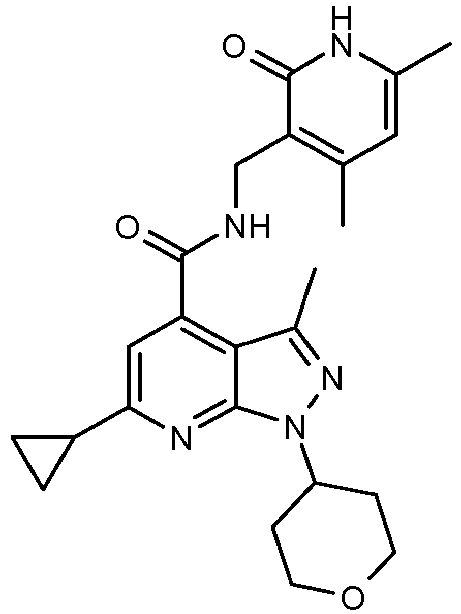
- The title compound was prepared in the same manner as described in example 109 using 6-cyclopropyl-3-methyl-1-(tetrahydro-2H-pyran-4-yl)-1H-pyrazolo[3,4-b]pyridine-4-carboxylic acid (150 mg, 0.498 mmol), and 3-(aminomethyl)-4,6-dimethyl-2(1H)-pyridinone (98 mg, 0.647 mmol). The product was collected as a solid, 0.170 g (78%). LCMS E-S (M+H) = 436.1. 1H NMR (400 MHz, DMSO-d 6) δ ppm 0.95 - 1.14 (m, 4 H), 1.79 (dd, J=12.63, 2.27 Hz, 2 H), 2.05 - 2.18 (m, 5 H), 2.19 - 2.27 (m, 4 H), 2.36 (s, 3 H), 3.53 (t, J=11.12 Hz, 2 H), 3.98 (dd, J=711.49, 3.41 Hz, 2 H), 4.33 (d, J=4.80 Hz, 2 H), 4.87 (m, J=11.53, 11.53, 4.11, 3.92 Hz, 1 H), 5.87 (s, 1 H), 6.99 (s, 1 H), 8.59 (t, J=4.93 Hz, 1 H), 11.51 (s, 1 H).
-

- To a solution of ethyl 2,4-dioxoheptanoate (446 mg, 2.397 mmol) in benzene (5 mL) was added 1-(1-methylethyl)-1H-pyrazol-5-amine (300 mg, 2.397 mmol), and the mixture was stirred at 62 °C for 18 h. The reaction mixture was concentrated in vacuo and the residue purified by column chromatography (Silica gel, gradient of 0 to 100% EtOAc/hexanes) to give 370 mg (56%) of product. LCMS E-S (M+H) = 276.1. 1H NMR (400 MHz, CHLOROFORM-d) δ ppm 0.99 - 1.12 (m, 3 H), 1.46 - 1.54 (m, 3 H), 1.58 - 1.70 (m, 6 H), 1.82 - 1.96 (m, 2 H), 2.91 - 3.02 (m, 2 H), 4.51 (q, J = 7.2 Hz, 2 H), 5.28 - 5.44 (m, 1 H), 7.58 - 7.68 (s, 1 H), 8.27 - 8.40 (s, 1 H)
-

- To a solution of ethyl 1-(1-methylethyl)-6-propyl-1H-pyrazolo[3,4-b]pyridine-4-carboxylate (180 mg, 0.654 mmol) in ethanol (5 mL) and THF (1 mL) was added sodium hydroxide (1.090 mL, 3.27 mmol), and the mixture was stirred at 40 °C for 1h. The volatiles were removed under reduced pressure. The aqueous phase was acidified to pH 3 with aq. 1N HCl. The solid precipitate formed was collected by filtration and dried under high vacuum to give 144 mg (89%) of product, which was used for next reaction without further purification. LCMS E-S (M+H) = 248.1 1H NMR (400 MHz, DMSO-d 6) δ ppm 0.82 - 1.12 (m, 3 H), 1.50 (d, J = 6.6 Hz, 6 H), 1.78 (m, 2 H), 2.80 - 3.11 (m, 2 H), 5.09 - 5.38 (m, 1 H), 7.47 - 7.72 (s, 1 H), 8.18 - 8.46 (s, 1 H), 13.82 (s, 1 H).
-

- The title compound was prepared in the same manner as intermediate 29 using sodium metal (0.168 g, 7.32 mmol), 1-[4-(methyloxy)phenyl]ethanone (1g, 6.66 mmol), and diethyl ethanedioate (0.903 mL, 6.66 mmol). The crude product was purified using column chromatography (0 to 100 % EtOAc/hexanes) to give 0.95 g of product (57%). LCMS E-S (M+H) = 250.9. 1H NMR (400 MHz, CHLOROFORM) δ ppm 1.43 (m, 3 H), 3.91 (s, 3 H), 4.41 (q, J = 6.65 Hz, 2 H), 6.94 - 7.12 (m, 3 H), 8.01 (d, J= 8.59 Hz, 2 H).
-

- To a solution of ethyl 4-[4-(methyloxy)phenyl]-2,4-dioxobutanoate (600 mg, 2.397 mmol) in benzene (5 mL) was added 1-(1-methylethyl)-1H-pyrazol-5-amine (300 mg, 2.397 mmol), and the reaction mixture was stirred at 62 °C overnight. The mixture was concentrated in vacuo and the residue was dissolved into acetic acid (3 mL). The solution was stirred at reflux for 1h and concentrated in vacuo. The residue was purified using column chromatography (Silica gel, 0 to 100% EtOAc/hexanes) to give 530 mg (65%) of product. LCMS E-S (M+H) = 340.1 1H NMR (400 MHz, CHLOROFORM-d) δ ppm 1.47 - 1.57 (m, 3 H), 1.61 - 1.71 (m, 6 H), 3.88 - 3.96 (s, 3 H), 4.55 (q, J = 7.2 Hz, 2 H), 5.46 (m, 1 H), 7.03 - 7.12 (m, 2 H), 8.13 - 8.25 (m, 3 H), 8.36 - 8.43 (m, 1 H).
-

- The title compound was prepared in the same manner as described for intermediate 58 using ethyl 1-(1-methylethyl)-6-[4-(methyloxy)phenyl]-1H-pyrazolo[3,4-b]pyridine-4-carboxylate (200 mg, 0.589 mmol), Ethanol (4 mL) and THF (1 mL), and sodium hydroxide (0.982 mL, 2.95 mmol). The final product was collected as 181 mg (98%). LCMS E-S (M+H) = 312.3. 1H NMR (400 MHz, DMSO-d 6) δ ppm 1.51 - 1.63 (m, 6 H), 3.85 (s, 3 H), 5.35 (m, 1 H), 7.11 (d, J= 9.1 Hz, 2 H), 8.15 (s, 1 H), 8.18 - 8.25 (m, 2 H), 8.33 (s, 1 H) ,13.95 (br. s., 1 H).
-

- The title compound was prepared in the same manner as described in example 109 using 1-(1-methylethyl)-6-[4-(methyloxy)phenyl]-1H-pyrazolo[3,4-b]pyridine-4-carboxylic acid (70 mg, 0.225 mmol), DMSO(3 mL), 3-(aminomethyl)-4,6-dimethyl-2(1H)-pyridinone (63.6 mg, 0.337 mmol) HCl salt, N-methylmorpholine (0.099 mL, 0.899 mmol), 1-hydroxy-7-azabenzotriazole (61.2 mg, 0.450 mmol), and EDC (86 mg, 0.450 mmol). The final product was collected as 89 mg (89%). LCMS E-S (M+H) = 446.5. 1H NMR (400 MHz, DMSO-d 6) δ ppm 1.54 (d, J = 6.8 Hz, 6 H), 2.13 (s, 3 H), 2.23 (s, 3 H), 3.85 (s, 3 H), 4.41 (d, J = 4.8 Hz, 2 H), 5.20 - 5.48 (m, 1 H), 5.91 (s, 1 H), 7.11 (d, J = 8.8 Hz, 2 H), 8.11 (s, 1 H), 8.24 (d, J = 8.8 Hz, 2 H), 8.34 (s, 1 H), 8.95 (m, 1 H), 11.58 (s, 1 H).
-

- The title compound was prepared in the same manner as intermediate 29 using sodium metal (0.466 g, 20.26 mmol), 1-(4-pyridinyl)ethanone (1g, 6.66 mmol), and diethyl ethanedioate (2.388 mL, 17.62 mmol). The crude product was purified using column chromatography (0 to 100 % EtOAc/hexanes) to give 0.95 g of product (24%). LCMS E-S (M+H) = 222.0. 1H NMR (400 MHz, CHLOROFORM-d) δ ppm 1.37 - 1.55 (m, 3 H), 4.43 (q, J = 7.07 Hz, 2 H), 7.06 - 7.16 (m, 1 H), 7.72 - 7.92 (m, 2 H), 8.82 - 8.94 (m, 2 H).
-

- To a suspension of ethyl 2,4-dioxo-4-(4-pyridinyl)butanoate (442 mg, 1.997 mmol) in benzene (5 mL) was added 1-(1-methylethyl)-1H-pyrazol-5-amine (250 mg, 1.997 mmol), and the reaction mixture was stirred at 62 °C overnight. The reaction mixture was concentrated in vacuo. and the residue was purified using column chromatography (Silica gel, 0 to 100% EtOAc/hexanes) to give 270 mg (43%) of product. LCMS E-S (M+H) = 311.3 1H NMR (400 MHz, CHLOROFORM-d) δ ppm 1.54 (t, J = 7.2 Hz, 3 H), 1.68 (d, J = 6.6 Hz, 6 H), 4.58 (q, J = 7.1 Hz, 2 H), 5.41 - 5.60 (m, 1 H), 8.04 - 8.19 (m, 2 H), 8.29 (s, 1 H), 8.44 - 8.55 (m, 2 H), 8.76 - 8.91 (m, 1 H).
-

- The title compound was prepared in the same manner as described for intermediate 58 using ethyl 1-(1-methylethyl)-6-(4-pyridinyl)-1H-pyrazolo[3,4-b]pyridine-4-carboxylate (100 mg, 0.322 mmol), ethanol (4 mL), THF (0.8 mL), and sodium hydroxide (0.537 mL, 1.611 mmol). The final product was collected as 88 mg (97%). LCMS E-S (M+H) = 283.2. 1H NMR (400 MHz, DMSO-d 6) δ ppm 1.58 (d, J = 6.4 Hz, 6 H), 5.40 (m, 1 H), 8.25 (d, J = 5.6 Hz, 2 H), 8.32 (s, 1 H), 8.44 (s, 1 H), 8.79 (d, J = 5.6 Hz, 2 H), 14.12 (br. s., 1 H).
-
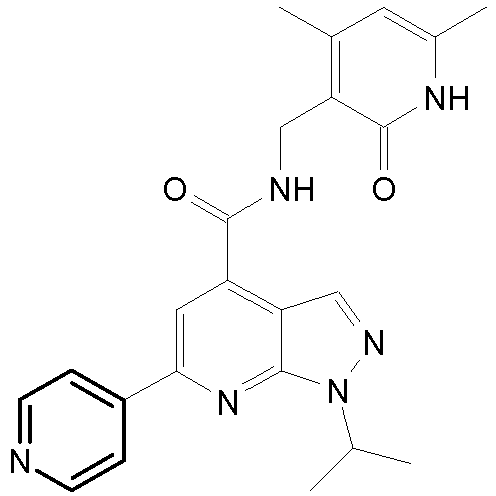
- The title compound was prepared in the same manner as described in example 109 using 1-(1-methylethyl)-6-(4-pyridinyl)-1H-pyrazolo[3,4-b]pyridine-4-carboxylic acid (60 mg, 0.213 mmol), DMSO(2 mL), 3-(aminomethyl)-4,6-dimethyl-2(1H)-pyridinone (60.1 mg, 0.319 mmol) HCl salt, N-methylmorpholine (0.093 mL, 0.850 mmol), 1-hydroxy-7-azabenzotriazole (57.9 mg, 0.425 mmol), and EDC (81 mg, 0.425 mmol). The final product was collected as 66 mg (74%). LCMS E-S (M+H) = 446.5. 1H NMR (400 MHz, DMSO-d 6) δ ppm 1.56 (d, J = 6.0 Hz, 6 H), 2.13 (br. s., 3 H), 2.23 (br. s., 3 H), 4.43 (m, 2 H), 5.37 (m, 1 H), 5.91 (br. s., 1 H), 8.15 - 8.34 (m, 3 H), 8.44 (s, 1 H), 8.78 (br. s., 2 H), 9.00 (br. s., 1 H), 11.58 (br. s., 1 H).
-

- Sodium metal (0.143 g, 6.21 mmol) was dissolved into ethanol (3 mL) and the resulting solution was cooled with an ice bath. A mixture of 1-(4-chlorophenyl)ethanone (0.756 mL, 5.65 mmol) and diethyl ethanedioate (0.766 mL, 5.65 mmol) were added dropwise, and the reaction mixture was stirred for 16h. The reaction mixture was quenched with ice water (5 mL) and acidified to ~pH 3 with 1N HCl. The precipitate was collected by filtration and dried under high vacuum to give 1.39 g (97%) of product. LCMS E-S (M+H) = 255.1. 1H NMR (400 MHz, DMSO-d 6) δ ppm 1.29 (m, 3 H), 4.27 (d, J = 6.57 Hz, 2 H) ,7.60 (d, J = 7.58 Hz, 2 H), 8.02 (d, J = 6.57 Hz, 2 H).
-

- The title compound was prepared in the same manner as described for intermediate 61 using ethyl 4-(4-chlorophenyl)-2,4-dioxobutanoate (610 mg, 2.397 mmol), benzene (5 mL), 1-(1-methylethyl)-1H-pyrazol-5-amine (300 mg, 2.397 mmol), and acetic acid (4mL). The crude product was purified by column chromatography (Silica gel, eluent: 0 to 100% EtOAc /hexanes) to give 621 mg (75%) of product. LCMS E-S (M+H) = 344.1. 1H NMR (400 MHz, CHLOROFORM-d) δ ppm 1.48 - 1.57 (m, 3 H), 1.64 - 1.74 (m, 6 H), 4.56 (q, J = 7.1 Hz, 2 H), 5.46 (m, 1 H), 7.49 - 7.55 (m, 2 H), 8.15 - 8.18 (m, 2 H), 8.21 (s, 1 H), 8.42 (s, 1 H).
-

- The title compound was prepared in the same manner as described for intermediate 58 using ethyl 6-(4-chlorophenyl)-1-(1-methylethyl)-1H-pyrazolo[3,4-b]pyridine-4-carboxylate (400 mg, 1.163 mmol), Ethanol (6 mL), THF (1 mL), and added sodium hydroxide (1.939 mL, 5.82 mmol) wherein the reaction time was 2h. The final product was collected as 330 mg (90%). LCMS E-S (M+H) = 315.8. 1H NMR (400 MHz, DMSO-d 6) δ ppm 1.56 (d, J = 6.8 Hz, 6 H), 5.26 - 5.47 (m, 1 H), 7.62 (d, J = 8.6 Hz, 2 H) ,8.20 (s, 1 H), 8.28 (d, J = 8.6 Hz , 2 H), 8.38 (s, 1 H), 14.03 (s, 1 H).
-

- The title compound was prepared in the same manner as described in example 109 using 6-(4-chlorophenyl)-1-(1-methylethyl)-1H-pyrazolo[3,4-b]pyridine-4-carboxylic acid (70 mg, 0.222 mmol), DMSO(2 mL), 3-(aminomethyl)-4,6-dimethyl-2(1H)-pyridinone HCl salt (62.7 mg, 0.333 mmol), N-methylmorpholine (0.097 mL, 0.887 mmol), 1-hydroxy-7-azabenzotriazole (60.3 mg, 0.443 mmol) and EDC (85 mg, 0.443 mmol). The final product was collected as 77 mg (78%). LCMS E-S (M+H) = 450.3. 1H NMR (400 MHz, DMSO-d 6) δ ppm 1.55 (d, J = 6.6 Hz, 6 H), 2.13 (s, 3 H), 2.22 (s, 3 H), 4.41 (d, J = 4.6 Hz, 2 H), 5.34 (quin, J = 6.7 Hz, 1 H), 5.91 (s, 1 H), 7.64 (d, J = 8.6 Hz, 2 H), 8.19 (s, 1 H), 8.31 (d, J = 8.6 Hz, 2 H), 8.39 (s, 1 H), 8.97 (t, J = 4.7 Hz, 1 H), 11.58 (s, 1 H).
-
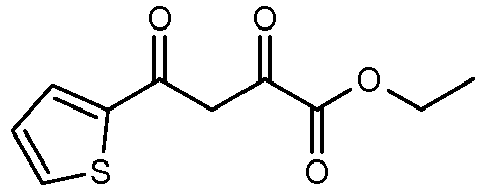
- The title compound was prepared in the same manner as for intermediate 66 using sodium metal (0.180 g, 7.85 mmol), 1-(3-thienyl)ethanone (0.9 g, 7.13 mmol) and diethyl ethanedioate (0.967 mL, 7.13 mmol). The product was collected as 1.41 g (87%). LCMS E-S (M+H) = 226.9. 1H NMR (400 MHz, DMSO-d 6) δ ppm 1.30 (m, 3 H), 4.29 (q, J = 6.82 Hz, 2 H), 6.96 (br. s., 1 H), 7.60 - 7.81 (m, 2 H), 8.74 (br. s., 1 H).
-

- The title compound was prepared in the same manner as described for intermediate 61 using ethyl 2,4-dioxo-4-(3-thienyl)butanoate (542 mg, 2.397 mmol), benzene (5 mL), 1-(1-methylethyl)-1H-pyrazol-5-amine (300 mg, 2.397 mmol), and acetic acid (5 ml). The crude product was purified using column chromatography (silica gel, eluent: 0 to 100% EtOAc/hexanes) to afford the product as 590 mg (78%). LCMS E-S (M+H) = 315.8. 1H NMR (400 MHz, CHLOROFORM-d) δ ppm 1.53 (t, J= 6.8 Hz, 3 H), 1.66 (d, J= 6.8 Hz, 6 H), 4.56 (q, J= 7.1 Hz, 2 H), 5.43 (spt, J = 6.7 Hz, 1 H), 7.47 (dd, J = 5.1, 3.0 Hz, 1 H), 7.84 - 7.95 (m, 1 H), 8.08 - 8.18 (m, 2 H), 8.32 - 8.43 (m, 1 H).
-

- The title compound was prepared in the same manner as described for intermediate 58 using ethyl 1-(1-methylethyl)-6-(3-thienyl)-1H-pyrazolo[3,4-b]pyridine-4-carboxylate (400 mg, 1.268 mmol), Ethanol (5 mL) THF (1 mL), and sodium hydroxide (2.114 mL, 6.34 mmol). The final product was collected as 370 mg (100%). LCMS E-S (M+H) = 287.9. 1H NMR (400 MHz, DMSO-d 6) δ ppm 1.55 (d, J = 6.8 Hz, 6 H), 5.34 (quin, J = 6.6 Hz, 1 H), 7.72 (dd, J = 5.0, 3.0 Hz, 1 H), 7.93 (dd, J = 5.0, 1.3 Hz, 1 H), 8.15 (s, 1 H), 8.34 (s, 1 H), 8.49 (dd, J = 3.0, 1.3 Hz, 1 H), 13.97 (s, 1 H).
-

- The title compound was prepared in the same manner as described in example 109 using 1-(1-methylethyl)-6-(3-thienyl)-1H-pyrazolo[3,4-b]pyridine-4-carboxylic acid (70 mg, 0.244 mmol), DMSO(2 mL), 3-(aminomethyl)-4,6-dimethyl-2(1H)-pyridinone (68.9 mg, 0.365 mmol) HC1 salt, N-methylmorpholine (0.107 mL, 0.974 mmol), 1-hydroxy-7-azabenzotriazole (33.2 mg, 0.244 mmol) and EDC (93 mg, 0.487 mmol). The final product was collected as 75 mg (73%). LCMS E-S (M+H) = 422.2. 1H NMR (400 MHz, DMSO-d 6) δ ppm 1.53 (d, J = 6.8 Hz, 6 H), 2.13 (s, 3 H), 2.23 (s, 3 H), 4.41 (d, J = 4.8 Hz, 2 H), 5.30 (quin, J = 6.6 Hz, 1 H), 5.91 (s, 1 H), 7.71 (dd, J = 5.0, 3.0 Hz, 1 H), 7.92 (d, J = 5.0 Hz, 1 H), 8.09 (s, 1 H), 8.34 (s, 1 H), 8.37 (d, J = 1.8 Hz, 1 H), 8.79 - 8.95 (m, 1 H), 11.58 (s, 1 H).
-

- The title compound was prepared in the same manner as described for intermediate 64 using ethyl 2,4-dioxo-4-(4-pyridinyl)butanoate (766 mg, 2.87 mmol), benzene (6 mL), and 3-methyl-1-(1-methylethyl)-1H-pyrazol-5-amine (400 mg, 2.87 mmol). The crude product was purified using column chromatography (Silica gel ,eluent: 0 to 30% MeOH/DCM) to give 95 mg (10%) of product. LCMS E-S (M+H) = 325.3. 1H NMR (400 MHz, CHLOROFORM-d) δ ppm 1.48 - 1.56 (m, 3 H), 1.61 - 1.73 (m, 6 H), 2.77 (s, 3 H), 4.56 (q, J=7.2 Hz, 2 H), 5.37 - 5.50 (m, 1 H), 8.02 - 8.16 (m, 3 H), 8.76 - 8.83 (m, 2 H).
-

- The title compound was prepared in the same manner as described for intermediate 58 using ethyl 3-methyl-1-(1-methylethyl)-6-(4-pyridinyl)-1H-pyrazolo[3,4-b]pyridine-4-carboxylate (36 mg, 0.111 mmol), Ethanol (2 ml) and sodium hydroxide (0.185 mL, 0.555 mmol). The final product was collected as 26 mg 79%). LCMS E-S (M+H) = 297.2. 1H NMR (400 MHz, DMSO-d 6) δ ppm 1.54 (d, J = 6.4 Hz, 6 H), 2.65 (s, 3 H), 5.35 (m, 1 H), 8.17 (s, 1 H) 8.24 (m, 2 H), 8.78 (m, 2 H).
-

- The title compound was prepared in the same manner as described in example 109 using 3-methyl-1-(1-methylethyl)-6-(4-pyridinyl)-1H-pyrazolo[3,4-b]pyridine-4-carboxylic acid (20 mg, 0.067 mmol), DMSO(1 mL), 3-(aminomethyl)-4,6-dimethyl-2(1H)-pyridinone (19.10 mg, 0.101 mmol), N-methylmorpholine (0.030 mL, 0.270 mmol), 1-hydroxy-7-azabenzotriazole (18.37 mg, 0.135 mmol) and EDC (25.9 mg, 0.135 mmol). The final product was collected as 29 mg (100%). LCMS E-S (M+H) = 431.2. 1H NMR (400 MHz, DMSO-d 6) δ ppm 1.52 (d, J = 6.57 Hz, 6 H), 2.12 (s, 3 H), 2.25 (s, 3 H), 2.46 (s, 3H), 4.40 (d, J = 5.0 Hz, 2 H), 5.29 (quin, J = 6.7 Hz, 1 H), 5.89 (s, 1 H), 7.83 (s, 1 H), 8.19 (d, J= 6.1 Hz, 2 H), 8.64 - 8.89 (m, 3 H), 11.55 (br. s., 1 H).
-

- The title compound was prepared in the same manner as described for intermediate 61 using ethyl 5,5-dimethyl-2,4-dioxohexanoate (392 mg, 1.958 mmol), benzene (10 mL), 1-(1,1-dimethylethyl)-3-methyl-1H-pyrazol-5-amine (300 mg, 1.958 mmol), and acetic acid (2 mL). The crude product was purified by column chromatography (Silica gel, eluent: 0 to 100% EtOAc /hexanes) to give 530 mg (85%) of product. LCMS E-S (M+H) = 318.3. 1H NMR (400 MHz, CHLOROFORM-d) δ ppm 1.43 - 1.52 (m, 12 H), 1.84 (s, 9 H), 2.67 (s, 3 H), 4.50 (q, J = 7.07 Hz, 2 H), 7.59 (s, 1 H).
-

- To an EtOH solution (8 mL) of ethyl 1,6-bis(1,1-dimethylethyl)-3-methyl-1H-pyrazolo[3,4-b]pyridine-4-carboxylate (528 mg, 1.663 mmol) was added sodium hydroxide (2.77 mL, 8.32 mmol), and the mixture was stirred for at room temperature for 2h. The volatiles were removed under reduced pressure and the aqueous phase was acidified using 1H HCl to ~pH 3. The precipitate was filtered, washed with water, and dried under high vacuum to give the product as 445 mg (92%). LCMS E-S (M+H) = 289.4. 1H NMR (400 MHz, DMSO-d 6) δ ppm 1.49 (s, 9 H), 1.76 (s, 9 H), 2.51 (s, 3 H), 7.51 (s, 1 H).
-
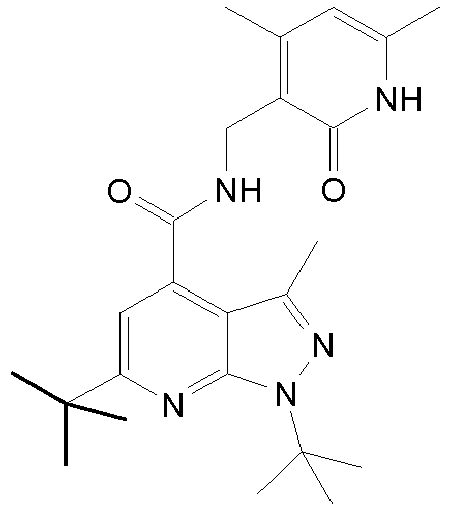
- The title compound was prepared in the same manner as described in example 109 using 1,6-bis(1,1-dimethylethyl)-3-methyl-1H-pyrazolo[3,4-b]pyridine-4-carboxylic acid (70 mg, 0.242 mmol), DMSO (2 mL), 3-(aminomethyl)-4,6-dimethyl-2(1H)-pyridinone (68.5 mg, 0.363 mmol), N-methylmorpholine (0.106 mL, 0.968 mmol), 1-hydroxy-7-azabenzotriazole (65.9 mg, 0.484 mmol) and EDC (93 mg, 0.484 mmol). The final product was collected as 91 mg (87%). LCMS E-S (M+H) = 424.0. 1H NMR (400 MHz, DMSO-d 6) δ ppm 1H NMR (400 MHz, DMSO-d 6) δ ppm 1.38 (s, 9 H), 1.74 (s, 9 H), 2.12 (s, 3 H), 2.23 (s, 3 H), 2.35 (s, 3 H), 4.35 (d, J = 4.80 Hz, 2 H), 5.88 (s, 1 H), 7.15 (s, 1 H), 8.61 (t, J = 4.93 Hz, 1 H), 11.52 (s, 1 H).
-

- The title compound was prepared in the same manner as for intermediate 66 using sodium metal (0.160 g, 6.95 mmol), 1-[4-(methylthio)phenyl]ethanone (1.05 g, 6.32 mmol) and diethyl ethanedioate (0.856 mL, 6.32 mmol). The product was collected as 1.58 g (59%). LCMS E-S (M+H) = 266.9. 1H NMR (400 MHz, CHLOROFORM-d) δ ppm 1.29 - 1.50 (m, 3 H), 2.41 - 2.62 (m, 3 H), 4.23 - 4.49 (m, 2 H), 7.15 - 7.38 (m, 2 H), 7.89 (dd, J = 8.72, 2.15 Hz, 2 H).
-

- The title compound was prepared in the same manner as described for intermediate 61 using ethyl 4-[4-(methylthio)phenyl]-2,4-dioxobutanoate (851 mg, 3.20 mmol), benzene (6 mL), 1-(1-methylethyl)-1H-pyrazol-5-amine (400 mg, 3.20 mmol), and acetic acid (3 mL). The crude product was purified by column chromatography (Silica gel, eluent; 0 to 100% EtOAc/hexanes) to give 870 mg (63%) of product. LCMS E-S (M+H) = 433.2. 1H NMR (400 MHz, CHLOROFORM-d) δ ppm 1.47 - 1.57 (m, 3 H), 1.66 (d, J = 6.8 Hz, 6 H), 2.58 (s, 3 H), 4.56 (q, J = 7.2 Hz, 2 H), 5.38 - 5.55 (m, 1 H), 7.36 - 7.46 (m, 2 H), 8.12 - 8.19 (m, 2 H), 8.22 (s, 1 H), 8.40 (s, 1 H).
-

- Oxone (1712 mg, 2.79 mmol) was added to a solution of ethyl 1-(1-methylethyl)-6-[4-(methylthio)phenyl]-1H-pyrazolo[3,4-b]pyridine-4-carboxylate (330mg, 0.928 mmol) in acetone (6 mL) and water (2 mL), and the reaction mixture was stirred for 6 h. The reaction mixture was quenched with water (10 mL) and then neutralized with NaHCO3 solution. The mixture was extracted with EtOAc (3x) and the combined extracts dried over Na2SO4, filtered and concentrated in vacuo. The residue was purified using column chromatography (Silica gel, 0 to 100% EtOAc/hexanes) to give 295 mg (82%) of product. LCMS E-S (M+H) = 388.1. 1H NMR (400 MHz, CHLOROFORM-d) δ ppm 1.54 (t, J = 7.2 Hz, 3 H), 1.67 - 1.69 (d, J = 6.8 Hz, 6 H), 3.14 (s, 3 H), 4.58 (q, J = 7.2 Hz, 2 H), 5.48 (spt, J = 6.7 Hz, 1 H), 8.06 - 8.18 (m, 2 H), 8.29 (s, 1 H), 8.39 - 8.44 (m, 2 H), 8.47 (s, 1 H).
-

- The title compound was prepared in the same manner as described for intermediate 58 using ethyl 1-(1-methylethyl)-6-[4-(methylsulfonyl)phenyl]-1H-pyrazolo[3,4-b]pyridine-4-carboxylate (260 mg, 0.671 mmol), Ethanol (4 mL), THF (1 mL) and sodium hydroxide (2N, 1.118 mL, 3.36 mmol). The final product was collected as 231 mg (96%). LCMS E-S (M+H) = 360.1. 1H NMR (400 MHz, DMSO-d 6) δ ppm 1.58 (d, J = 6.8 Hz , 6 H), 3.30 (s, 3H), 5.34 - 5.49 (m, 1 H), 8.11 (d, J = 8.6 Hz, 2 H), 8.30 (s, 1 H), 8.44 (s, 1 H), 8.51 (d, J = 8.6 Hz, 2 H).
-
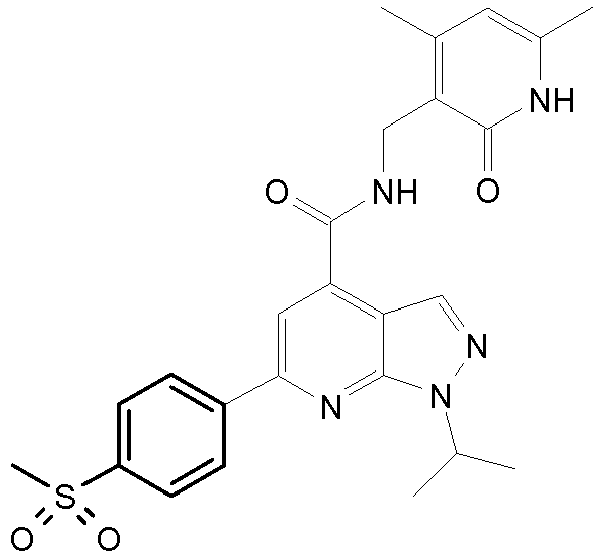
- The title compound was prepared in the same manner as described in example 109 using 1-(1-methylethyl)-6-[4-(methylsulfonyl)phenyl]-1H-pyrazolo[3,4-b]pyridine-4-carboxylic acid (90 mg, 0.250 mmol), DMSO(2 mL), 3-(aminomethyl)-4,6-dimethyl-2(1H)-pyridinone (70.9 mg, 0.376 mmol), N-methylmorpholine (0.110 mL, 1.002 mmol), 1-hydroxy-7-azabenzotriazole (68.2 mg, 0.501 mmol) and EDC (96 mg, 0.501 mmol). The final product was collected as 106 mg (85%). LCMS E-S (M+H) = 494.2. 1H NMR (400 MHz, DMSO-d 6) δ ppm 1.56 (d, J = 5.6 Hz, 6 H), 2.13 (br. s., 3 H), 2.23 (br. s., 3 H), 4.42 (m, 2 H), 5.36 (br. s., 1 H), 5.91 (br. s., 1 H), 8.11 (d, J = 7.3 Hz, 2 H), 8.27 (br. s., 1 H), 8.39 - 8.64 (m, 3 H), 9.01 (br. s., 1 H), 11.58 (br. s., 1 H).
-

- The title compound was prepared in the same manner as for intermediate 66 using sodium metal (0.404 g, 17.58 mmol), 1-(4-bromophenyl)ethanone (3.5 g, 17.58 mmol), and diethyl ethanedioate (2.384 mL, 17.58 mmol). The product was collected as 5.1 g (97%). LCMS E-S (M+H) = 299.1. 1H NMR (400 MHz, DMSO-d 6) δ ppm 1.22 - 1.37 (m, 3 H), 4.25 (d, J = 6.57 Hz, 2 H), 7.72 (m, 2 H), 7.92 (m, 2 H).
-

- The title compound was prepared in the same manner as described for intermediate 61 using ethyl 4-(4-bromophenyl)-2,4-dioxobutanoate (956 mg, 3.20 mmol), benzene (10 mL), 1-(1-methylethyl)-1H-pyrazol-5-amine (400 mg, 3.20 mmol), and acetic acid (4 mL). The crude product was purified using column chromatography (Silica gel, eluent: 0 to 100% EtOAc/hexanes) to give 1.1 g (89%) of product. LCMS E-S (M+H) = 388.1. 1H NMR (400 MHz, CHLOROFORM-d) δ ppm 1.49 - 1.57 (t, J = 67.2 Hz , 3 H), 1.63 - 1.74 (d, J= 6.8 Hz 6 H), 4.56 (q, J=7.2 Hz, 2 H), 5.46 (spt, J=6.7 Hz, 1 H), 7.65 - 7.71 (m, 2 H), 8.04 - 8.15 (m, 2 H), 8.21 (s, 1 H), 8.42 (s, 1 H).
-

- To a 5-mL microwave vial were added ethyl 6-(4-bromophenyl)-1-(1-methylethyl)-1H-pyrazolo[3,4-b]pyridine-4-carboxylate (80 mg, 0.206 mmol), 4-(4,4,5,5-tetramethyl-1,3,2-dioxaborolan-2-yl)-1H-pyrazole (56.0 mg, 0.288 mmol), 1,4-dioxane (2 mL) and sodium carbonate (0.206 mL, 0.412 mmol), and the mixture was degassed with nitrogen for 10 min. Next added PdP(Ph3)4 (19.05 mg, 0.016 mmol) and the vial was sealed. The reaction mixture was irradiated (microwave) at 120 °C overnight. The reaction mixture was filtered and concentrated in vacuo. The residue was purified using reverse-phase HPLC to give 25 mg (35%) of product. LCMS E-S (M+H) = 348.1. 1H NMR (400 MHz, DMSO-d 6) δ ppm 1.58 (d, J = 6.8 Hz, 6 H), 5.38 (quin, J = 6.6 Hz, 1 H), 7.81 (d, J= 8.3 Hz, 2 H), 8.14 - 8.30 (m, 4H), 8.36 (s, 1 H).
-

- The title compound was prepared in the same manner as described in example 109 using 1-(1-methylethyl)-6-[4-(1H-pyrazol-4-yl)phenyl]-1H-pyrazolo[3,4-b]pyridine-4-carboxylic acid (20 mg, 0.058 mmol), DMSO(1mL), 3-(aminomethyl)-4,6-dimethyl-2(1H)-pyridinone (16.29 mg, 0.086 mmol), N-methylmorpholine (0.025 mL, 0.230 mmol), 1-hydroxy-7-azabenzotriazole (15.67 mg, 0.115 mmol) and EDC (22.07 mg, 0.115 mmol). The final product was collected as 12 mg (43%). LCMS E-S (M+H) = 482.0. 1H NMR (400 MHz, DMSO-d 6) δ ppm 1.56 (d, J = 6.4 Hz, 6 H), 2.14 (s, 3 H), 2.24 (s, 3 H), 4.42 (d, J = 4.8 Hz, 2 H) 5.27 - 5.47 (m, 1 H), 5.91 (s, 1 H), 7.79 (d, J = 8.3 Hz, 2 H), 8.04 (br. s., 1 H), 8.15 - 8.21 (m, 1 H), 8.27 (d, J = 8.3 Hz, 2 H), 8.35 - 8.42 (m, 1 H), 8.99 (t, J = 4.8 Hz, 1 H), 11.58 (br. s., 3 H).
-

- The title compound was prepared in the same manner as described for intermediate 61 using ethyl 4-[4-(methyloxy)phenyl]-2,4-dioxobutanoate (327 mg, 1.305 mmol), benzene (8 mL), 1-(1,1-dimethylethyl)-3-methyl-1H-pyrazol-5-amine (200 mg, 1.305 mmol), and acetic acid (2 mL). The crude product was purified using column chromatography (Silica gel, eluent: 0 to 100% EtOAc/hexanes) to give 0.41 g (85%) of product. LCMS E-S (M+H) = 368.1. 1H NMR (400 MHz, DMSO-d 6) δ ppm 1.81 (s, 9 H), 2.55 (s, 3 H), 7.11 (d, J= 8.84 Hz, 2 H), 7.89 (s, 1 H), 8.16 (d, J = 8.84 Hz, 2 H).
-

- The title compound was prepared in the same manner as described for intermediate 75 using ethyl 1-(1,1-dimethylethyl)-3-methyl-6-[4-(methyloxy)phenyl]-1H-pyrazolo[3,4-b]pyridine-4-carboxylate (400 mg, 1.089 mmol), 3N sodium hydroxide (1.814 mL, 5.44 mmol), and EtOH (6 mL). The product was collected as 347 mg (94%). LCMS E-S (M+H) = 340.2. 1H NMR (400 MHz, DMSO-d 6) δ ppm 1.81 (s, 9 H), 2.55 (s, 3 H), 7.11 (d, J = 8.84 Hz, 2 H), 7.89 (s, 1 H), 8.16 (d, J=8.84 Hz, 2 H).
-

- To a solution of 1-(1,1-dimethylethyl)-3-methyl-6-[4-(methyloxy)phenyl]-1H-pyrazolo[3,4-b]pyridine-4-carboxylic acid (70 mg, 0.206 mmol) in DMSO (1 mL) were added 3-(aminomethyl)-4,6-dimethyl-2(1H)-pyridinone (19.10 mg, 0.101 mmol), N-methylmorpholine (0.030 mL, 0.270 mmol), 1-hydroxy-7-azabenzotriazole (18.37 mg, 0.135 mmol) and EDC (25.9 mg, 0.135 mmol), and the mixture was stirred overnight at room temperature. The reaction mixture was quenched with water (10 mL), stirred for 10 min.,and filtered. The contents were dried under high vacuum and collected as 71 mg (71%). LCMS E-S (M+H) = 474.1. 1H NMR (400 MHz, DMSO-d6) δ ppm 1.79 (s, 9 H), 2.12 (s, 3 H), 2.25 (s, 3 H), 2.39 (s, 3 H), 3.33 (s, 1 H), 4.38 (d, J= 4.80 Hz, 2 H), 5.88 (s, 1 H), 7.10 (d, J= 8.84 Hz, 2 H), 7.61 (s, 1 H), 8.16 (d, J= 8.84 Hz, 2 H), 8.70 (s, 1 H), 11.53 (s, 1 H).
-
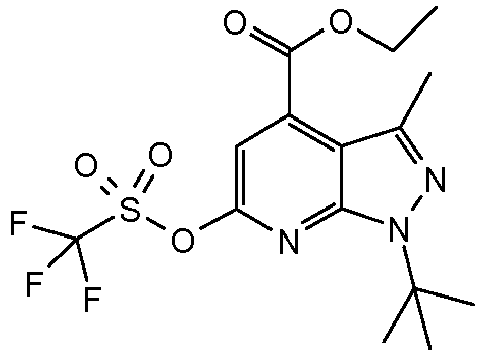
- Trifluoromethanesulfonic anhydride (0.457 mL, 2.70 mmol) was added dropwise to a solution of ethyl 1-(1,1-dimethylethyl)-3-methyl-6-oxo-6,7-dihydro-1H-pyrazolo[3,4-b]pyridine-4-carboxylate (500 mg, 1.803 mmol) in pyridine (10 mL), and the reaction mixture was stirred at room temperature for 16 h. The contents were diluted with EtOAc and washed with saturated NaHCO3, and then brine. The organic layer was dried over MgSO4, filtered, and concentrated in vacuo. The crude residue was purified via silica gel chromatography (0% to 100% DCM:Hex) to afford the final product as a solid, 670 mg (91%). LCMS E-S (M+H) = 410.0. 1H NMR (400 MHz, DMSO-d 6) δ ppm 1.38 (t, J = 7.07 Hz, 3 H), 1.71 (s, 9 H), 2.58 (s, 3 H), 4.46 (q, J = 7.07 Hz, 2 H), 7.63 (s, 1 H).
-
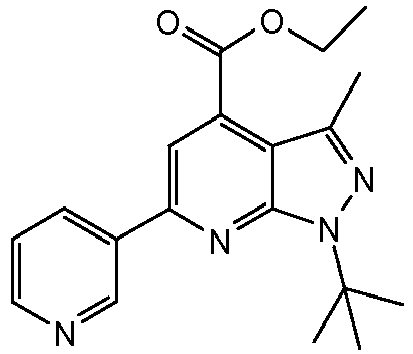
- Ethyl 1-(1,1-dimethylethyl)-3-methyl-6-{[(trifluoromethyl)sulfonyl]oxy}-1H-pyrazolo[3,4-b]pyridine-4-carboxylate (100 mg, 0.244 mmol), 3-pyridinylboronic acid (39.0 mg, 0.318 mmol), aq. saturated NaHCO3 (1 mL) and 1,4-dioxane (3 mL) were degassed with nitrogen (10 min) followed by addition of PdCl2(dppf)-CH2Cl2 adduct (9.97 mg, 0.012 mmol). The sealed mixture was irradiated (microwave) at 120 °C for 40 min. The reaction mixture was diluted with EtOAc and filtered. The filtrate was concentrated in vacuo and the crude residue was purified by silica gel chromatography (0 to 100% EtOAc/hexanes). The final product was collected as a solid, 72 mg (87%). LCMS E-S (M+H) = 339.3. 1H NMR (400 MHz, DMSO-d 6) δ ppm 1.46 - 1.57 (m, 3 H), 1.90 (s, 9 H), 2.72 (s, 3 H), 4.45 - 4.64 (m, 2 H), 7.47 (dd, J=8.08, 4.80 Hz, 1 H), 8.03 (s, 1 H), 8.46 (dt, J= 8.08, 2.02 Hz, 1 H), 8.72 (dd, J=4.80, 1.52 Hz, 1 H), 9.43 (d, J=1.52 Hz, 1 H).
-

- Ethyl 1-(1,1-dimethylethyl)-3-methyl-6-(3-pyridinyl)-1H-pyrazolo[3,4-b]pyridine-4-carboxylate (68 mg, 0.201 mmol) was suspended in ethanol (2 mL) followed by addition of sodium hydroxide (0.335 mL, 1.005 mmol). The mixture was stirred at room temperature for 2. 5h. The mixture was concentrated and the residue was diluted with water (1 mL) and acidified to pH 3 using 1N HCl. The precipitate was collected by filtration and further dried under high vacuum to give the product as an HCl salt, 60 mg (86%). LCMS E-S (M+H) = 311.5. 1H NMR (400 MHz, DMSO-d 6) δ ppm 1.82 (s, 9 H), 2.60 (s, 3 H), 7.60 (dd, J = 7.96, 4.67 Hz, 1 H), 8.08 (s, 1 H), 8.57 (dt, J = 8.34, 1.89 Hz, 1 H), 8.70 (dd, J = 4.80, 1.52 Hz, 1 H), 9.39 (d, J = 1.52 Hz, 1 H), 14.03 (br. s., 1 H).
-

- The title compound was prepared in the same manner as described in example 121 using 1-(1,1-dimethylethyl)-3-methyl-6-[3-pyridinyl]-1H-pyrazolo[3,4-b]pyridine-4-carboxylic acid (58 mg, 0.167 mmol), 3-(aminomethyl)-4,6-dimethyl-2(1H)-pyridinone (47 mg, 0.251 mmol), N-methylmorpholine (0.092 mL, 0.836 mmol), 1-hydroxy-7-azabenzotriazole (46 mg, 0.334 mmol), EDC (64 mg, 0.334 mmol), and DMSO (1 mL). The product was collected as 73 mg (96%). LCMS E-S (M+H) = 445.1. 1H NMR (400 MHz, DMSO-d 6) δ ppm 1.81 (s, 9 H), 2.12 (s, 3 H), 2.25 (s, 3 H), 2.42 (s, 3 H), 4.39 (d, J = 5.05 Hz, 2 H), 5.89 (s, 1 H), 7.59 (dd, J = 8.08, 4.80 Hz, 1 H), 7.78 (s, 1 H), 8.55 (dt, J = 8.15, 1.86 Hz, 1 H), 8.68 (dd, J = 4.80, 1.52 Hz, 1 H), 8.74 (t, J= 5.05 Hz, 1 H) 9.38 (d, J= 1.77 Hz, 1 H), 11.54 (s,1 H).
-

- 3-Bromo-1-(1-methylethyl)-6-phenyl-1H-pyrazolo[3,4-b]pyridine-4-carboxylic acid (93 mg, 0.258 mmol), 3-(aminomethyl)-4,6-dimethyl-2(1H)-pyridinone hydrochloride (64 mg, 0.336 mmol), HOBT (60 mg, 0.387 mmol) and EDC (74 mg, 0.387 mmol) were suspended in DMSO (14 mL) and stirred at room temperature for 10 minutes, after which time DIEA (0.9 ml, 5.16 mmol) was added. After stirring for 2 h, 4-methylmorpholine (1 ml, 9.04 mmol) was added. The reaction mixture was stirred first at room temperature for 21h, and then at 80 °C (aluminum heating block) for 31h. The reaction mixture was cooled to room temperature and then added dropwise to a cold, slightly basic solution (pH ~ 8-10) of water (100 mL) and 1N Na2CO3 (8 mL). After stirring for 20 min., the contents were extracted with EtOAc (2 x 100 mL). The combined organic layers are washed with brine, dried over Na2SO4, filtered, and concentrated to a residue. The crude residue was dissolved in 10%MeOH/DCM and purified by silica gel chromatography (eluent: 10-95% gradient EtOAc/Hexanes and then 10% (5%NH4OH/MeOH)/DCM and EtOAc, 10-90% gradient). The product was collected as an off-white solid. (35 mg, 27%). LCMS E-S (M+H) = 494.1 / 496.0. 1H NMR (400 MHz, CHLOROFORM-d) δ 11.58 (br. s., 1H), 8.11 (dd, J = 1.89, 7.71 Hz, 2H), 7.68 (br. s., 1H), 7.60 (br. s., 1H), 7.44 - 7.53 (m, 3H), 5.92 (s, 1H), 5.42 (quin, J = 6.69 Hz, 1H), 4.63 (br. s., 1H), 2.41 (br. s., 3H), 2.11 (br. s., 3H), 1.62 (d, J = 6.57 Hz, 6H).
-
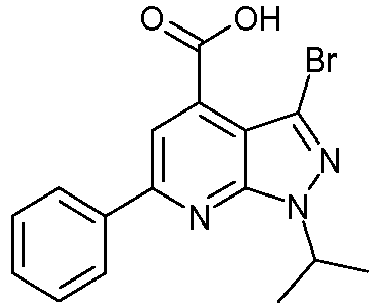
- Ethyl 3-bromo-1-(1-methylethyl)-6-phenyl-1H-pyrazolo[3,4-b]pyridine-4-carboxylate (112 mg, 0.288 mmol) was suspended in THF (0.5 mL) and ethanol (1.5 mL), followed by addition of 3N NaOH (150 µl, 0.433 mmol). The reaction mixture was stirred at 55 °C for 3 hours, and then allowed to cool to room temperature. The reaction mixture was diluted with water (1.5 mL), cooled in an ice bath, and acidified with 1N HCl in a dropwise manner. The mixture was extracted with EtOAc. The organic layer was separated and concentrated in vacuo to afford a solid that dried on the high vacuum 3 hours. The product was collected as a pale yellow solid (93.6 mg, 90%). LCMS E-S (M+H) = 360.0 / 362.2. 1H NMR (400 MHz, MeOD) δ8.22 (dd, J = 1.52, 8.08 Hz, 2H), 8.05 (s, 1H), 7.48 - 7.59 (m, 3H), 5.47 (quin, J= 6.76 Hz, 1H), 1.63 (d, J = 6.82 Hz, 6H)
-

- Ethyl 1-(1-methylethyl)-6-phenyl-1H-pyrazolo[3,4-b]pyridine-4-carboxylate (120 mg, 0.388 mmol), was suspended in acetic acid (2 mL) followed by addition of bromine (26 µl, 0.504 mmol). The reaction mixture was stirred with heating at 80 °C. After 1h, a second portion of bromine was added (26 µl, 0.504 mmol) and the reaction mixture heated at 80 °C for an additional 2h. After cooling to room temperature, the solution was added to a saturated aqueous solution of sodium bicarbonate (6 mL) and extracted with dichloromethane (2 x 10 mL) The combined organic layers were concentrated in vacuo. The crude product was purified by silica gel chromatography (eluent: EtOAc/Hexanes, 0-50% gradient). The product was collected as a white powder (112 mg, 74%). LCMS E-S (M+H) = 388.0 / 390.2. 1H NMR (400 MHz, CHLOROFORM-d) δ 8.18 (dd, J = 1.52, 8.08 Hz, 2H), 8.00 (s, 1H), 7.48 - 7.58 (m, 3H), 5.47 (quin, J = 6.76 Hz, 1H), 4.58 (q, J = 7.16 Hz, 2H), 1.65 (d, J = 6.82 Hz, 6H), 1.52 (t, J = 7.20 Hz, 3H).
-

-

- 1-(1-Methylethyl)-3-nitro-6-phenyl-1H-pyrazolo[3,4-b]pyridine-4-carboxylic acid (24 mg, 0.074 mmol), 3-(aminomethyl)-4,6-dimethyl-2(1H)-pyridinone hydrochloride (18 mg, 0.096 mmol), HOAT (17 mg, 0.110 mmol) and EDC (21 mg, 0.110 mmol) were suspended in DMSO (800 µL) and the reaction mixture stirred at room temperature. Next added 4-methylmorpholine (41 µl, 0.368 mmol), and the reaction was stirred at room temperature for 16 h. The reaction mixture was added dropwise to cold, slightly basic solution of water (3 mL) and 1N Na2CO3 (0.5 mL). After stirring for 20 min., the precipitated solids were collected via vacuum filtration and washed with water. The solid was dried on the high vacuum (72 h). The product, was collected as an off-white powder (28 mg, 82%). LCMS E-S (M+H) = 461.1. 1H NMR (400 MHz, DMSO-d6) δ 9.01 (br. s., 1H), 8.42 (s, 1H), 8.02 (ddd, J = 1.14, 4.99, 7.77 Hz, 2H), 7.99 (s, 1H), 7.86 (td, J = 1.26, 7.58 Hz, 1H), 7.72 - 7.77 (m, 1H), 5.90 (s, 1H), 5.04 (quin, J = 6.69 Hz, 1H), 4.41 (d, J = 4.55 Hz, 1H), 3.34 (s, 2H), 2.22 (s, 3H), 2.12 (s, 3H), 1.49 (d, J = 6.57 Hz, 6H).
-

- Ethyl 1-(1-methylethyl)-3-nitro-6-phenyl-1H-pyrazolo[3,4-b]pyridine-4-carboxylate was suspended in THF (0.5 ml) and ethanol (1 mL), followed by addition of 3N NaOH aq (50 µL). The reaction mixture was heated at 55 °C for 1h, and then allowed to cool to room temperature. The volatiles were removed in vacuo and the residue was dissolved in water (1.5 mL). The reaction mixture was cooled in an ice bath and acidified by dropwise addition of 1N HCl. After stirring for 20 minutes, the precipitated solids were collected by vacuum filtration dried under high vacuum overnight for 16 h. The product was collected as a white solid (24.5 mg, 76%). LCMS E-S (M+H) = 327.2. 1H NMR (400 MHz, DMSO-d6) δ 14.14 (br. s., 1H), 8.43 (s, 1H), 8.04 (dd, J = 1.14, 7.96 Hz, 1H), 7.98 - 8.02 (m, J = 1.26 Hz, 2H), 7.86 (td, J = 1.26, 7.58 Hz, 1H), 7.72 - 7.80 (m, 1H), 5.09 (qd, J = 6.57, 6.74 Hz, 1H), 1.51 (d, J= 6.57 Hz, 6H).
-

- Ethyl 1-(1-methylethyl)-6-phenyl-1H-pyrazolo[3,4-b]pyridine-4-carboxylate (120 mg, 0.388 mmol) was dissolved in concentrated nitric acid (1.7 mL) followed by addition of concentrated sulfuric acid (0.200 mL), and the reaction mixture was stirred at room temperature. After 40 min., the reaction mixture was cooled in an ice bath and with stirring was diluted with water (3 mL) and then slowly with saturated Na2CO3 (1 mL). The reaction mixture was extracted with EtOAc (2 x 6 mL). The combined organic layers were concentrated in vacuo and the crude product purified by silica gel chromatography (eluent: EtOAc/Hexanes, 0-70% gradient). The product, was collected as a white solid (35 mg, 26%). LCMS E-S (M+H) = 355.2. 1H NMR (400 MHz, CHLOROFORM-d) 8.46 (s, 1H), 7.99 (s, 1H), 7.94 (dd, J = 1.14, 7.96 Hz, 1H), 7.76 - 7.81 (m, 1H), 7.73 (td, J= 1.26, 7.58 Hz, 1H), 7.59 - 7.66 (m, 1H), 5.25 (ddd, J = 6.57, 6.69, 13.52 Hz, 1H), 4.51 - 4.59 (m, 2H), 1.61 (d, J= 6.82 Hz, 6H), 1.52 (t, J= 7.07 Hz, 3H).
-

- The title compound was prepared in the same manner as described in example 109 using 1-(1-methylethyl)-6-propyl-1H-pyrazolo[3,4-b]pyridine-4-carboxylic acid (70 mg, 0.283 mmol), DMSO(3 mL), 3-(aminomethyl)-4,6-dimethyl-2(1H)-pyridinone (80 mg, 0.425 mmol), N-methylmorpholine (0.124 mL, 1.132 mmol), 1-hydroxy-7-azabenzotriazole (77 mg, 0.566 mmol), and EDC (109 mg, 0.566 mmol). The collected solid was washed with water and methanol and dried under high vacuum to give 73 mg (68%) of product. LCMS E-S (M+H) = 382.3 1H NMR (400 MHz, DMSO-d 6) δ ppm 0.82 - 1.10 (m, 3 H), 1.48 (d, J = 6.8 Hz, 6 H), 1.77 (m, 2 H), 2.13 (s, 3 H), 2.21 (s, 3 H), 2.85 (t, J= 7.6 Hz, 2 H), 4.36 (d, J= 4.8 Hz, 2 H), 5.20 (m, 1 H), 5.90 (s, 1 H), 7.38 - 7.58 (m, 1 H), 8.26 (s, 1 H), 8.73 (t, J= 4.7 Hz, 1 H), 11.57 (br. s., 1 H).
-

- 2,4-Hexanedione (2.283 g, 20 mmol) and cyanacetamide (1.682 g, 20.00 mmol) were added to ethanol (20 mL). The contents were initially heterogenous, but gradually dissolved upon reaching ca. 70 °C. Next added piperidine (1.976 mL, 20.00 mmol) and stirred with warming to reflux. After 30 min, the heterogenous contents were removed from heating and allowed to stir with cooling to room temperature. The contents were filtered in vacuo to afford a light yellowish colored solid and yellow filtrate. The collected solid filter cake was copiously washed with water which removed the yellow color. The final product was collected as fine white crystalline solid (1.66 g after drying). LCMS E-S (M+H) = 163.2. 1H NMR (400 MHz, CHLOROFORM-d) δ ppm 1.34 (t, J=7.58 Hz, 3H) 2.47 (s, 3H) 2.71 (q, J=7.58 Hz, 2H), 6.12 (s, 1 H).
- To a stirred solution of 6-ethyl-4-methyl-2-oxo-1,2-dihydro-3-pyridinecarbonitrile (1.462 g, 9.01 mmol) in Methanol (50 mL), cooled to 0 °C were added di-tertbutoxycarbonyl anhydride (4.19 mL, 18.03 mmol) and nickel(II) chloride·hexahydrate (0.214 g, 0.901 mmol). Sodium borohydride (2.387 g, 63.1 mmol) was added portionwise over 30 min, then the mixture was allowed to warm to room termperature and stirred overnight. Additional sodium borohydride (2.387 g, 63.1 mmol) was added and the reaction stirred overnight again. Diethylenetriamine (0.979 mL, 9.01 mmol) was added, and the reaction mixture was stirred for 30 min. at room temperature. The solvent was evaporated, and the residue was dissolved in ethyl acetate (20 mL) and extracted with sodium bicarbonate (2 x 10 mL). The organics were dried over sodium sulfate, and concentrated. The residue was dissolved in chloroform (25 mL) and TFA (3.47 mL, 45.1 mmol) was added. The reaction was heated to 50 °C for 3 h, then cooled to room temperature and concentrated. The reaction mixture was concentrated in vacuo and the crude product was purified by reverse phase HPLC (eluent; 0-30% gradient ACN in H2O, 0.1% TFA) to afford the title compound (TFA salt, 1.37 g, 54.1% yield) as a white solid. LC-MS(ES) m/z = 167 [M+H]+. 1H NMR (400 MHz, DMSO-d) δ ppm 1.12 (t, J=7.58 Hz, 3H), 2.20 (s, 3H), 2.44 (q, J=7.58 Hz, 2H), 3.78 - 3.83 (m, 2H), 6.01 (s, 1H), 7.75 - 7.9 (br s, 3H), 11.86 (s, 1H).
-

- 2,4-Pentanedione (12 g, 120 mmol) was suspended in deuterated MeCN (39 mL), to which was added Selectfluor (44.7 g, 120 mmol) in one portion. The resulting paste was then heated in an oil bath to 50 °C. After 5 min, an exotherm was observed, and the mixture was removed from the oil bath. The mixture was then heated at 50 °C for 1 h. The mixture was then aged at room temperature for 16 h, and then distilled under vacuum. The desired product distilled at 40-60 °C at 10-15 torr and was collected as a light yellowish liquid (1.8 mL, 1.95 g). A less pure fraction (ca. 80%) distilled at 25-35 °C at 15-20 torr, and was collected as a light yellowish liquid (3.33 g). 1H NMR (400 MHz, ACETONITRILE-d3) δ ppm 2.24 (s, 3 H), 2.26 (s, 3 H), 5.46 (d, J=48.0 Hz, 1 H).
- A mixture of 3-fluoro-2,4-pentanedione (247 mg, 2.10 mmol), cyanoacetamide (176 mg, 2.1 mmol, 1 equiv) and piperidine (0.21 mL, 2.1 mmol, 1 equiv) in 3 mL of EtOH was heated at 85 °C for 16 h, resulting in a clear but dark brown solution. The mixture was concentrated in vacuo. The residue was taken up in 2 mL of 1N HCl to give a suspension, which was filtered. The tan solids collected were dried under vacuum to give the desired product as 80 mg. 1H NMR (400 MHz, CHLOROFORM-d) δ ppm 2.33 (s, 3H), 2.42 (s, 3H).
- 5-Fluoro-4,6-dimethyl-2-oxo-1,2-dihydro-3-pyridinecarbonitrile (1.0 g, 6.02 mmol) was suspended in 50 mL of HOAc at room temperature to give a dark brownish solution. NaOAc (1.0 g, 12.3 mmol, 2 equiv), PtO2 (20 mg) and 5% Pd/C (1.3 g) were charged into a 500 mL Parr bottle, followed by wetting with some acetic acid under nitrogen. The substrate solution was then added, and rinsed with another 50 mL of acetic acid. The mixture was hydrogenated under a pressure of 40 psi. There was initial drop of hydrogen pressure and the vessel was refilled. The mixture was hydroganted for 6 h. The mixture was filtered through Celite, and concentrated in vacuo to give a solid residue, which was suspended in 6 mL of conc. HCl to give a paste. The paste was filtered, and the cake was washed with 1 mL of conc HCl (in duplicate). The filtrate was concentrated in vacuo. The solid residue dissolved in 0.4 mL of conc. HCl and 6 mL of EtOH as a suspension, which was stored in the freezer for 2h, followed by filtration. The cake was washed with 2 mL of cold EtOH (in duplicate). The solids were dried under vacuum at room temperature for 18h to give the title compound as a cream-colored solid (1.03 g). LC-MS (ES) m/z = 171 [M+H]+ and a dominant peak at 154. 1H NMR (400 MHz, DMSO-d 6) δ ppm , 2.20 (d, J=3.0 Hz, 3 H), 2.22 (d, J=2.0 Hz, 3 H), 3.83 (q, J=5.2 Hz, 2 H), 7.99 (br. s., 3 H), 11.99 (br. s., 1 H).
-
- 1. Prepare 10 mM stock of compounds from solid in 100% DMSO.
- 2. In a 384-well Greiner plate (Cat # 781280), plate compounds in columns 1 and 13.
- 3. Set up a Multiprobe instrument to do an 11 point serial dilution (1:3 dilution, columns 6 and 18 are DMSO controls).
- 4. Stamp 100 nL of compound from the dilution plate into reaction plates (Corning, 384-well, Cat# 3706) using the Hummingbird.
-
- 1. Prepare 2x assay buffer mix with final concentrations of 50 mM Tris pH 8, 5 mM MgCl2, 4 mM DTT, 0.00185% Tween-20, and 7 µg/ml Hela nucleosomes (GRITS36431).
- 2. Prepare 2x EZH2 (GRITS37108) enzyme mix in assay buffer with a final enzyme concentration of 10 nM.
- 3. Prepare 2x mix of hot and cold SAM in ddH20 with final concentrations of 0.24 µM cold SAM (Sigma) and 0.02 µCi/µL 3H- SAM (Perkin Elmer).
- 4. Prepare 500 µM SAH quench solution in ddH20 with 5-10 drops of concentrated HCl to dissolve.
- 5. Prepare 6 mg/ml RNA binding SPA beads (Perkin Elmer) suspended in 0.2 M Citric Acid, pH 2.2
- In reaction plates stamped with 100 nL compound,
- 1. Dispense 5 µL no enzyme control (assay buffer mix) to column 18 of plates.
- 2. Dispense 5 µL of enzyme mix to the remaining wells in the plate. Centrifuge plate to mix and incubate at room temperature for 30 minutes.
- 3. Dispense 5 µL of substrate mix to all wells to initiate the reactions. Centrifuge plate to mix and incubate at room temperature for 2 hours.
- 4. Quench the reactions with 10 µL of 500 µM SAH solution (250 µM final).
- 5. Dispense 10 µL of 6 mg/ml RNA binding SPA beads prepared in 0.2 M citric acid, pH 2.2 using the Evolution instrument. Continuously shake the beads while adding to plates to prevent beads from settling.
- 6. Seal the plates with Perkin Elmer top seals and allow the beads to equilibrate in the plate for at least 30 minutes at room temperature.
- 7. Centrifuge the plates > 2000 RPM (657 rcf) for one minute. Read plates in Microbeta after at least 5 hours incubation. Plates can be read immediately, but signal increases over time.
- Reagent addition can be done manually or with automated liquid handler.
- *The final DMSO concentration in this assay is 1%.
- *The positive control is in column 6; negative control is in column 18.
- *Final starting concentration of compounds is 100 µM.
- Results were analyzed using a 2-parameter IC 50 fit in GraFit data analysis program (Erithacus Software Ltd, P.O. Bos 274, Horley, Surrey UK; www.erithacus.com).
- Compounds of the several Examples above gave the following IC50 data: Ex 1, 475; Ex 2, 806; Ex 4, 116; Ex 5, 705; Ex 6, 695; Ex 7, 1296; Ex 8, 167; Ex 9, 1309; Ex 10, 569; Ex 11, 18; Ex 12, 55; Ex 13, 55; Ex 14, 735; Ex 15, 179; Ex 16, 105; Ex 17, 2591; Ex 18, 40; Ex 19, 3372; Ex 20, 4647; Ex 21, 1040; Ex 22, 1362; Ex 23, 1428; Ex 24, 873; Ex 25, 685; Ex 26, 673; Ex 27, 24; Ex 28, 348; Ex 29, 234; Ex 30, 154; Ex 31, 232; Ex 32, 856; Ex 33, 70; Ex 35, 673; Ex 36, 924; Ex 37, 1095; Ex 38, 392; Ex 41, 86; Ex 42, 56; Ex 43, 204; Ex 44, 74; Ex 45, 248; Ex 46, 128; Ex 47, 88; Ex 48, 198; Ex 49, 115; Ex 50, 81; Ex 51, 161; Ex 53, 436; Ex 54, 514; Ex 55, 260; Ex 56, 2111; Ex 57, 784; Ex 58, 78; Ex 59, 155; Ex 60, 198; Ex 61, 112; Ex 62, 581; Ex 63, 96; Ex 64, 79; Ex 65, 55; Ex 66, 81; Ex 67, 58; Ex 68, 76; Ex 69, 25; Ex 70, 1893; Ex 71, 402; Ex 72, 171; Ex 73, 533; Ex 74, 151; Ex 75, 131; Ex 76, 82; Ex 77, 52; Ex 78, 43; Ex 79, 140; Ex 80, 71; Ex 81, 30; Ex 82, 108; Ex 83, 43; Ex 84, 99; Ex 85, 31; Ex 86, 142; Ex 87, 18; Ex 88, 52; Ex 89, 67; Ex 90, 173; Ex 92, 76; Ex 93, 83; Ex 94, 103; Ex 95, 489; Ex 96, 57; Ex 97, 55; Ex 99, 25044; Ex 100, 5747; Ex 103, 373; Ex 105, 315; Ex 106, 119; Ex 107, 75; Ex 109, 207; Ex 110, 231; Ex 111, 367; Ex 112, 693; Ex 113, 248; Ex 114, 199; Ex 117, 190; Ex 118, 273; Ex 119, 333; Ex 120, 270; Ex 121, 407; Ex 122, 153; Ex 123, 218; Ex 124, 1052; Ex 125, 2164.
- The values in this table are single-point-in-time values and repeating the assay run(s) my result in a somewhat different number for any given test run and compound.
- Compounds of this invention are not expected to have an unacceptable untoward effect when used in accordance with the teachings herein above and when used in accordance with appropriate and usual scientific and medical practice
- The foregoing examples are provided to illustrate the invention and are not intended to limit it in any way. What is reserved to the inventors can be found by reference to the claims.


Claims (11)
- A compound of formula (I):
 X and Z are selected independently from the group consisting of hydrogen, (C1-C8)alkyl, (C2-C8)alkenyl, (C2-C8)alkynyl, unsubstituted or substituted (C3-C8)cycloalkyl, unsubstituted or substituted (C3-C8)cycloalkyl-(C1-C8)alkyl or -(C2-C8)alkenyl, unsubstituted or substituted (C5-C8)cycloalkenyl, unsubstituted or substituted (C5-C8)cycloalkenyl-(C1-C8)alkyl or -(C2-C8)alkenyl, (C6-C10)bicycloalkyl, unsubstituted or substituted heterocycloalkyl, unsubstituted or substituted heterocycloalkyl-(C1-C8)alkyl or -(C2-C8)alkenyl, unsubstituted or substituted aryl, unsubstituted or substituted aryl-(C1-C8)alkyl or -(C2-C8)alkenyl, unsubstituted or substituted heteroaryl, unsubstituted or substituted heteroaryl-(C1-C8)alkyl or -(C2-C8)alkenyl, halo, cyano, -CORa, -CO2Ra, -CONRaRb, - CONRaNRaRb, -SRa, -SORa, -SO2Ra, -SO2NRaRb, nitro, NRaRb, -NRaC(O)Rb, -NRaC(O)NRaRb, - NRaC(O)ORa, -NRaSO2Rb, -NRaSO2NRaRb, -NRaNRaRb, -NRaNRaC(O)Rb, -NRaNRaC(O)NRaRb, - NRaNRaC(O)ORa, -ORa, -OC(O)Ra, and -OC(O)NRaRb;Y is H or halo;R1 is (C1-C8)alkyl, (C2-C8)alkenyl, (C2-C8)alkynyl, unsubstituted or substituted (C3-C8)cycloalkyl, unsubstituted or substituted (C3-C8)cycloalkyl-(C1-C8)alkyl or -(C2-C8)alkenyl, unsubstituted or substituted (C5-C8)cycloalkenyl, unsubstituted or substituted (C5-C8)cycloalkenyl-(C1-C8)alkyl or -(C2-C8)alkenyl, unsubstituted or substituted (C6-C10)bicycloalkyl, unsubstituted or substituted heterocycloalkyl, unsubstituted or substituted heterocycloalkyl-(C1-C8)alkyl or - (C2-C8)alkenyl, unsubstituted or substituted aryl, unsubstituted or substituted aryl-(C1-C8)alkyl or - (C2-C8)alkenyl, unsubstituted or substituted heteroaryl, unsubstituted or substituted heteroaryl-(C1-C8)alkyl or -(C2-C8)alkenyl, -CORa, -CO2Ra, -CONRaRb, or -CONRaNRaRb;R3 is hydrogen, (C1-C8)alkyl, cyano, trifluoromethyl, -NRaRb, or halo;R6 is selected from the group consisting of hydrogen, halo, (C1-C8)alkyl, (C2-C8)alkenyl, (C2-C8)alkynyl, unsubstituted or substituted (C3-C8)cycloalkyl, unsubstituted or substituted (C3-C8)cycloalkyl-(C1-C8)alkyl, unsubstituted or substituted (C5-C8)cycloalkenyl, unsubstituted or substituted(C5-C8)cycloalkenyl-(C1-C8)alkyl, (C6-C10)bicycloalkyl, unsubstituted or substituted heterocycloalkyl, unsubstituted or substituted heterocycloalkyl-(C1-C8)alkyl, unsubstituted or substituted aryl, unsubstituted or substituted aryl-(C1-C8)alkyl, unsubstituted or substituted heteroaryl, unsubstituted or substituted heteroaryl-(C1-C8)alkyl, cyano, -CORa, -CO2Ra, -CONRaRb, - CONRaNRaRb, -SRa, -SORa, -SO2Ra, -SO2NRaRb, nitro, -NRaRb, -NRaC(O)Rb, -NRaC(O)NRaRb, - NRaC(O)ORa, -NRaSO2Rb, -NRaSO2NRaRb, -NRaNRaRb, -NRaNRaC(O)Rb, -NRaNRaC(O)NRaRb, - NRaNRaC(O)ORa, -ORa, -OC(O)Ra, and -OC(O)NRaRb;wherein any (C1-C8)alkyl, (C2-C8)alkenyl, (C2-C8)alkynyl, cycloalkyl, cycloalkenyl, bicycloalkyl, heterocycloalkyl, aryl, or heteroaryl group is optionally substituted by 1, 2, or 3 groups independently selected from the group consisting of halo, (C1-C6)alkyl, (C3-C8)cycloalkyl, (C5-C8)cycloalkenyl, (C1-C6)haloalkyl, cyano, -CORa, -CO2Ra,-CONRaRb, -SRa, -SORa, -SO2Ra, -SO2NRaRb, nitro, -NRaRb, -NRaC(O)Rb, -NRaC(O)NRaRb, - NRaC(O)ORa, -NRaSO2Rb, -NRaSO2NRaRb, -ORa, -OC(O)Ra, -OC(O)NRaRb, heterocycloalkyl, aryl, heteroaryl, aryl(C1-C4)alkyl, and heteroaryl(C1-C4)alkyl;wherein any aryl or heteroaryl moiety of said aryl, heteroaryl, aryl(C1-C4)alkyl, or heteroaryl(C1-C4)alkyl is optionally substituted by 1, 2, or 3 groups independently selected from the group consisting of halo, (C1-C6)alkyl, (C3-C8)cycloalkyl, (C5-C8)cycloalkenyl, (C1-C6)haloalkyl, cyano, -CORa, -CO2Ra, -CONRaRb, -SRa, -SORa, -SO2Ra, -SO2NRaRb, nitro, -NRaRb, -NRaC(O)Rb, -NRaC(O)NRaRb, -NRaC(O)ORa, -NRaSO2Rb, -NRaSO2NRaRb, -ORa, -OC(O)Ra, and -OC(O)NRaRb; andRa and Rb are each independently hydrogen, (C1-C8)alkyl, (C2-C8)alkenyl, (C2-C8)alkynyl, (C3-C8)cycloalkyl, (C5-C8)cycloalkenyl, (C6-C10)bicycloalkyl, heterocycloalkyl, aryl, or heteroaryl, wherein said (C1-C8)alkyl, (C2-C8)alkenyl, (C2-C8)alkynyl, cycloalkyl, cycloalkenyl, bicycloalkyl, heterocycloalkyl, aryl, or heteroaryl group is optionally substituted by 1, 2, or 3 groups independently selected from halo, hydroxyl, (C1-C4)alkoxy, amino, (C1-C4)alkylamino, ((C1-C4)alkyl)((C1-C4)alkyl)amino, -CO2H, -CO2(C1-C4)alkyl, -CONH2,-CONH(C1-C4)alkyl, - CON((C1-C4)alkyl)((C1-C4)alkyl), -SO2(C1-C4)alkyl, -SO2NH2,-SO2NH(C1-C4)alkyl, and - SO2N((C1-C4)alkyl)((C1-C4)alkyl);or Ra and Rb taken together with the nitrogen to which they are attached represent a 5-8 membered saturated or unsaturated ring, optionally containing an additional heteroatom selected from oxygen, nitrogen, and sulfur, wherein said ring is optionally substituted by 1, 2, or 3 groups independently selected from (C1-C4)alkyl, (C1-C4)haloalkyl, amino, (C1-C4)alkylamino, ((C1-C4)alkyl)((C1-C4)alkyl)amino, hydroxyl, oxo, (C1-C4)alkoxy, and (C1-C4)alkoxy(C1-C4)alkyl, wherein said ring is optionally fused to a (C3-C8)cycloalkyl, heterocycloalkyl, aryl, or heteroaryl ring;or Ra and Rb taken together with the nitrogen to which they are attached represent a 6- to 10-membered bridged bicyclic ring system optionally fused to a (C3-C8)cycloalkyl, heterocycloalkyl, aryl, or heteroaryl ring;or a pharmaceutically acceptable salt thereof.
 - A compound of formula (I) according to claim 1 or a pharmaceutically acceptable salt thereof wherein:X and Z are selected from the group consisting of (C1-C8)alkyl, (C3-C8)cycloalkyl, heterocycloalkyl, aryl, heteroaryl, -NRaRb, and -ORa;Y is H or F;R1 is selected from the group consisting of (C1-C8)alkyl, (C3-C8)cycloalkyl, heterocycloalkyl, aryl, and heteroaryl;R3 is selected from the group consisting of hydrogen, (C1-C8)alkyl, cyano, trifluoromethyl, - NRaRb, and halo;R6 is selected from the group consisting of hydrogen, halo, cyano, trifluoromethyl, amino, (C1-C8)alkyl, (C3-C8)cycloalkyl, aryl, heteroaryl, acylamino, (C2-C8)alkynyl, arylalkynyl, heteroarylalkynyl, -SO2Ra, -SO2NRaRb, and -NRaSO2Rb;wherein any (C1-C8)alkyl, (C3-C8)cycloalkyl, (C2-C8)alkynyl, arylalkynyl, or heteroarylalkynyl group is optionally substituted by 1, 2, or 3 groups independently selected from halo, (C1-C6)alkyl, (C3-C8)cycloalkyl, (C5-C8)cycloalkenyl, (C1-C6)haloalkyl, cyano, -CORa, - CO2Ra, -CONRaRb, -SRa, -SORa, -SO2Ra, -SO2NRaRb, nitro, -NRaRb, -NRaC(O)Rb, - NRaC(O)NRaRb, -NRaC(O)ORa, -NRaSO2Rb, -NRaSO2NRaRb, -ORa, -OC(O)Ra, - OC(O)NRaRb, heterocycloalkyl, aryl, heteroaryl, aryl(C1-C4)alkyl, and heteroaryl(C1-C4)alkyl; andRa and Rb are each independently hydrogen, (C1-C8)alkyl, (C2-C8)alkenyl, (C2-C8)alkynyl, (C3-C8)cycloalkyl, (C5-C8)cycloalkenyl, (C6-C10)bicycloalkyl, heterocycloalkyl, aryl, or heteroaryl, wherein said (C1-C8)alkyl, (C2-C8)alkenyl, (C2-C8)alkynyl, cycloalkyl, cycloalkenyl, bicycloalkyl, heterocycloalkyl, aryl, or heteroaryl group is optionally substituted by 1, 2, or 3 groups independently selected from halo, hydroxyl, (C1-C4)alkoxy, amino, (C1-C4)alkylamino, ((C1-C4)alkyl)((C1-C4)alkyl)amino, -CO2H, -CO2(C1-C4)alkyl, -CONH2, -CONH(C1-C4)alkyl, - CON((C1-C4)alkyl)((C1-C4)alkyl), -SO2(C1-C4)alkyl, -SO2NH2,-SO2NH(C1-C4)alkyl, and - SO2N((C1-C4)alkyl)((C1-C4)alkyl);or Ra and Rb taken together with the nitrogen to which they are attached represent a 5-8 membered saturated or unsaturated ring, optionally containing an additional heteroatom selected from oxygen, nitrogen, and sulfur, wherein said ring is optionally substituted by 1, 2, or 3 groups independently selected from (C1-C4)alkyl, (C1-C4)haloalkyl, amino, (C1-C4)alkylamino, ((C1-C4)alkyl)((C1-C4)alkyl)amino, hydroxyl, oxo, (C1-C4)alkoxy, and (C1-C4)alkoxy(C1-C4)alkyl, wherein said ring is optionally fused to a (C3-C8)cycloalkyl, heterocycloalkyl, aryl, or heteroaryl ring;or Ra and Rb taken together with the nitrogen to which they are attached represent a 6- to 10-membered bridged bicyclic ring system optionally fused to a (C3-C8)cycloalkyl, heterocycloalkyl, aryl, or heteroaryl ring;wherein any aryl or heteroaryl group is selected independently from the group consisting of furan, thiophene, pyrrole, oxazole, thiazole, imidazole, pyrazole, oxadiazole, thiadiazole, triazole, tetrazole, benzofuran, benzothiophene, benzoxazole, benzothiazole, phenyl, pyridine, pyridazine, pyrimidine, pyrazine, triazine, tetrazine, quinoline, cinnoline, quinazoline, quinoxaline, and naphthyridine, or another aryl or heteroaryl group as follows:
 A is O, NH, or S; B is CH or N, and C is hydrogen or C1-C8 alkyl; or
 D is N or C optionally substituted by hydrogen or C1-C8 alkyl; or
 E is NH or CH2; F is O or CO; and G is NH or CH2; or
 J is O, S, or CO; or
 Q is CH orN;M is CH or N; andL/(5) is hydrogen, halo, amino, cyano, (C1-C8)alkyl, (C3-C8)cycloalkyl, -CORa, -CO2Ra, - CONRaRb, -CONRaNRaRb, -SO2R a, -SO2NRaRb, -NRaRb, -NRaC(O)Rb,-NRaSO2Rb, -NRaSO2NRaRb, -NRaNRaRb, -NRaNRaC(O)Rb, -NRaNRaC(O)NRaRb, or -ORa;wherein any (C1-C8)alkyl or (C3-C8)cycloalkyl, group is optionally substituted by 1, 2, or 3 groups independently selected from (C1-C6)alkyl, (C3-C8)cycloalkyl, (C5-C8)cycloalkenyl, (C1-C6)haloalkyl, cyano, -CORa, -CO2Ra, -CONRaRb, -SRa, -SORa, -SO2Ra, -SO2NRaRb, nitro, -NRaRb, -NRaC(O)Rb, -NRaC(O)NRaRb, -NRaC(O)ORa, -NRaSO2Rb, -NRaSO2NRaRb, -ORa, -OC(O)Ra, and -OC(O)NRaRb; or
 L/(6) is NH or CH2; or
 M/(7) is hydrogen, halo, amino, cyano, (C1-C8)alkyl, (C3-C8)cycloalkyl, heterocycloalkyl, -CORa, -CO2Ra, -CONRaRb, -CONRaNRaRb, -SO2Ra, -SO2NRaRb, - NRaRb, -NRaC(O)Rb,-NRaSO2Rb, -NRaSO2NRaRb, -NRaNRaRb, -NRaNRaC(O)Rb, - NRaNRaC(O)NRaRb, or -ORa;wherein any (C1-C8)alkyl, (C3-C8)cycloalkyl, or heterocycloalkyl group is optionally substituted by 1, 2, or 3 groups independently selected from (C1-C6)alkyl, (C3-C8)cycloalkyl, (C5-C8)cycloalkenyl, (C1-C6)haloalkyl, cyano, -CORa, -CO2Ra, -CONRaRb, -SRa, -SORa, - SO2Ra, -SO2NRaRb, nitro, -NRaRb, -NRaC(O)Rb, -NRaC(O)NRaRb, -NRaC(O)ORa, - NRaSO2Rb, -NRaSO2NRaRb, -ORa, -OC(O)Ra, and -OC(O)NRaRb; or
 P is CH2, NH, O, or S; Q/(8) is CH or N; and n is 0-2; or
 S/(9) and T(9) are each CH, or S/(9) is CH and T(9) is N, or S/(9) is N and T/(9) is CH;R is hydrogen, amino, methyl, trifluoromethyl, or halo;U is hydrogen, halo, amino, cyano, nitro, trifluoromethyl, (C1-C8)alkyl, (C3-C8)cycloalkyl, - CORa, -CO2Ra, -CONRaRb, -SO2Ra, -SO2NRaRb, -NRaRb, -NRaC(O)Rb,-NRaSO2Rb, - NRaSO2NRaRb, -NRaNRaRb, -NRaNRaC(O)Rb, -ORa, or 4-(1H-pyrazol-4-yl);wherein any (C1-C8)alkyl or (C3-C8)cycloalkyl, group is optionally substituted by 1, 2, or 3 groups independently selected from (C1-C6)alkyl, (C3-C8)cycloalkyl, (C5-C8)cycloalkenyl, (C1-C6)haloalkyl, cyano, -CORa, -CO2Ra,-CONRaRb, -SRa, -SORa, -SO2Ra, -SO2NRaRb, nitro, -NRaRb, -NRaC(O)Rb, -NRaC(O)NRaRb, -NRaC(O)ORa, -NRaSO2Rb, -NRaSO2NRaRb, -ORa, -OC(O)Ra, and -OC(O)NRaRb.
 - A compound of formula (I) according to claim 1 or claim 2 wherein:X and Z are selected independently from the group consisting of (C1-C8)alkyl, (C3-C8)cycloalkyl, heterocycloalkyl, aryl, heteroaryl, -NRaRb, and -ORa;Y is H;R1 is (C1-C8)alkyl, (C3-C8)cycloalkyl, or heterocycloalkyl;R3 is hydrogen, (C1-C8)alkyl, or halo;R6 is hydrogen, halo, cyano, trifluoromethyl, amino, (C1-C8)alkyl, (C3-C8)cycloalkyl, aryl, heteroaryl, acylamino, (C2-C8)alkynyl, arylalkynyl, heteroarylalkynyl, -SO2Ra, -SO2NRaRb, or - NRaSO2Rb;wherein any (C1-C8)alkyl, (C3-C8)cycloalkyl, (C2-C8)alkynyl, arylalkynyl, or heteroarylalkynyl group is optionally substituted by 1, 2, or 3 groups independently selected from halo, (C1-C6)alkyl, (C3-C8)cycloalkyl, (C5-C8)cycloalkenyl, (C1-C6)haloalkyl, cyano, - CORa, -CO2Ra, -CONRaRb, -SRa, -SORa, -SO2Ra, -SO2NRaRb, nitro, -NRaRb, -NRaC(O)Rb, -NRaC(O)NRaRb, -NRaC(O)ORa, -NRaSO2Rb, -NRaSO2NRaRb, -ORa, -OC(O)Ra, - OC(O)NRaRb, heterocycloalkyl, aryl, heteroaryl, aryl(C1-C4)alkyl, and heteroaryl(C1-C4)alkyl; andRa and Rb are each independently hydrogen, (C1-C8)alkyl, (C2-C8)alkenyl, (C2-C8)alkynyl, (C3-C8)cycloalkyl, (C5-C8)cycloalkenyl, (C6-C10)bicycloalkyl, heterocycloalkyl, aryl, or heteroaryl, wherein said (C1-C8)alkyl, (C2-C8)alkenyl, (C2-C8)alkynyl, cycloalkyl, cycloalkenyl, bicycloalkyl, heterocycloalkyl, aryl, or heteroaryl group is optionally substituted by 1, 2, or 3 groups independently selected from halo, hydroxyl, (C1-C4)alkoxy, amino, (C1-C4)alkylamino, ((C1-C4)alkyl)((C1-C4)alkyl)amino, -CO2H, -CO2(C1-C4)alkyl, -CONH2,-CONH(C1-C4)alkyl, - CON((C1-C4)alkyl)((C1-C4)alkyl), -SO2(C1-C4)alkyl, -SO2NH2, -SO2NH(C1-C4)alkyl, and-SO2N((C1-C4)alkyl)((C1-C4)alkyl);or Ra and Rb taken together with the nitrogen to which they are attached represent a 5-8 membered saturated or unsaturated ring, optionally containing an additional heteroatom selected from oxygen, nitrogen, and sulfur, wherein said ring is optionally substituted by 1, 2, or 3 groups independently selected from (C1-C4)alkyl, (C1-C4)haloalkyl, amino, (C1-C4)alkylamino, ((C1-C4)alkyl)((C1-C4)alkyl)amino, hydroxyl, oxo, (C1-C4)alkoxy, and (C1-C4)alkoxy(C1-C4)alkyl, wherein said ring is optionally fused to a (C3-C8)cycloalkyl, heterocycloalkyl, aryl, or heteroaryl ring;or Ra and Rb taken together with the nitrogen to which they are attached represent a 6- to 10-membered bridged bicyclic ring system optionally fused to a (C3-C8)cycloalkyl, heterocycloalkyl, aryl, or heteroaryl ring;wherein any aryl or heteroaryl is selected from the group consisting of furan, thiophene, pyrrole, oxazole, thiazole, imidazole, pyrazole, oxadiazole, thiadiazole, triazole, tetrazole, benzofuran, benzothiophene, benzoxazole, benzothiazole, phenyl, pyridine, pyridazine, pyrimidine, pyrazine, triazine, tetrazine, quinoline, cinnoline, quinazoline, quinoxaline, and naphthyridine, or another aryl or heteroaryl group as follows:
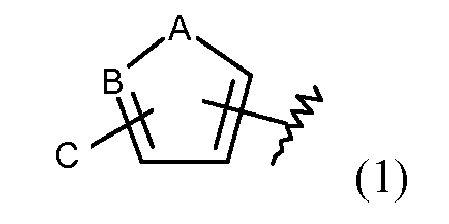 A is O, NH, or S; B is CH or N, and C is hydrogen or C1-C8 alkyl; or
 D is N or C optionally substituted by hydrogen or C1-C8 alkyl; or
 E is NH or CH2; F is O or CO; and G is NH or CH2; or
 J is O, S, or CO; or
 Q is CH or N;M is CH or N; andL/(5) is hydrogen, halo, amino, cyano, (C1-C8)alkyl, (C3-C8)cycloalkyl, -CORa, -CO2Ra, - CONRaRb, -CONRaNRaRb, -SO2Ra, -SO2NRaRb, -NRaRb, -NRaC(O)Rb,-NRaSO2Rb, -NRaSO2NRaRb, -NRaNRaRb, -NRaNRaC(O)Rb, -NRaNRaC(O)NRaRb, or -ORa;wherein any (C1-C8)alkyl or (C3-C8)cycloalkyl, group is optionally substituted by 1, 2, or 3 groups independently selected from (C1-C6)alkyl, (C3-C8)cycloalkyl, (C5-C8)cycloalkenyl, (C1-C6)haloalkyl, cyano, -CORa, -CO2Ra, -CONRaRb, -SRa, -SORa, -SO2Ra, -SO2NRaRb, nitro, -NRaRb, -NRaC(O)Rb, -NRaC(O)NRaRb, -NRaC(O)ORa, -NRaSO2Rb, -NRaSO2NRaRb, -ORa, -OC(O)Ra, and -OC(O)NRaRb; or
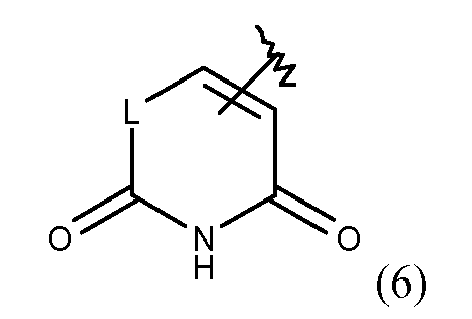 L/(6) is NH or CH2; or
 M/(7) is hydrogen, halo, amino, cyano, (C1-C8)alkyl, (C3-C8)cycloalkyl, heterocycloalkyl, -CORa, -CO2Ra, -CONRaRb, -CONRaNRaRb, -SO2Ra, -SO2NRaRb, - NRaRb, -NRaC(O)Rb,-NRaSO2Rb, -NRaSO2NRaRb, -NRaNRaRb, -NRaNRaC(O)Rb, - NRaNRaC(O)NRaRb, or-ORa;wherein any (C1-C8)alkyl, (C3-C8)cycloalkyl, or heterocycloalkyl group is optionally substituted by 1, 2, or 3 groups independently selected from (C1-C6)alkyl, (C3-C8)cycloalkyl, (C5-C8)cycloalkenyl, (C1-C6)haloalkyl, cyano, -CORa, -CO2Ra, -CONRaRb, -SRa, -SORa, - SO2Ra, -SO2NRaRb, nitro, -NRaRb, -NRaC(O)Rb, -NRaC(O)NRaRb, -NRaC(O)ORa, - NRaSO2Rb, -NRaSO2NRaRb, -ORa, -OC(O)Ra, and -OC(O)NRaRb; or
 P is CH2, NH, O, or S; Q/(8) is CH or N; and n is 0-2; or
 S/(9) and T(9) are each CH, or S/(9) is CH and T(9) is N, or S/(9) is N and T/(9) is CH;R is hydrogen, amino, methyl, trifluoromethyl, or halo;U is hydrogen, halo, amino, cyano, nitro, trifluoromethyl, (C1-C8)alkyl, (C3-C8)cycloalkyl, - CORa, -CO2Ra, -CONRaRb, -SO2Ra, -SO2NRaRb, -NRaRb, -NRaC(O)Rb,-NRaSO2Rb, - NRaSO2NRaRb, -NRaNRaRb, -NRaNRaC(O)Rb, -ORa, or 4-(1H-pyrazol-4-yl);or a pharmaceutically acceptable salt thereof.wherein any (C1-C8)alkyl or (C3-C8)cycloalkyl, group is optionally substituted by 1, 2, or 3 groups independently selected from (C1-C6)alkyl, (C3-C8)cycloalkyl, (C5-C8)cycloalkenyl, (C1-C6)haloalkyl, cyano, -CORa, -CO2Ra,-CONRaRb, -SRa, -SORa, -SO2Ra, -SO2NRaRb, nitro, -NRaRb, -NRaC(O)Rb, -NRaC(O)NRaRb, -NRaC(O)ORa, -NRaSO2Rb, -NRaSO2NRaRb, -ORa, -OC(O)Ra, and -OC(O)NRaRb.;
 - A compound of formula (I) according to any one of claims 1, 2, or 3, wherein:X is methyl, ethyl, n-propyl, isopropyl, cyclopropyl, cyclobutyl, cyclopentyl, cyclohexyl, phenyl, trifluoromethyl, tetrahydropyran, hydroxymethyl, methoxymethyl, or benzyl;Y is H;Z is methyl, ethyl, n-propyl, isopropyl, trifluoromethyl, or benzyl;R1 is isopropyl, tert-butyl, cyclobutyl, cyclopentyl, cyclohexyl, (1-methylethyl)cyclopropyl, 1,1-dioxo-tetrahydrothiophene-3-yl, 1-Me-piperidin-4-yl, tetrahydrofuran-3-yl, tetrahydropyran-4-yl, N,N-dimethyl-1-propanaminyl, benzyl, or 4-pyridyl;R3 is H, methyl, or Br; andR6 is methyl, cyclopropyl, propyl, dimethylamino, ethylamino, (2-hydroxyethyl)amino, 2-propen-1-ylamino, 1-piperazinyl, 1-piperidinyl, 4-morpholinyl, 4-piperidinylamino, tetrahydro-2H-pyran-4-ylamino, phenylamino, (phenylmethyl)amino, (4-pyridinylmethyl)amino, [2-(2-pyridinylamino)ethyl]amino, 2-(dimethylamino)ethyl]amino, 4-pyridinylamino, 4-(aminocarbonyl)phenyl]amino, 3-hydroxy-3-methyl-1-butyn-1-yl, 4-pyridinylethynyl, phenylethynyl, 2-furanyl, 3-thienyl, 1H-pyrazol-4-yl, 1H-indazol-5-yl, 1H-indazol-6-yl, 3-methyl-1H-indazol-5-yl, 1H-1,2,3-benzotriazol-5-yl, 2-oxo-2,3-dihydro-1H-benzimidazol-5-yl, 2-oxo-2,3-dihydro-1H-indol-5-yl, 2-oxo-2,3-dihydro-1H-indol-6-yl, 2,1,3-benzoxadiazol-5-yl, 2-amino-6-quinazolinyl, 2,4-dioxo-1,2,3,4-tetrahydro-5-pyrimidinyl, 2-amino-5-pyrimidinyl, 7-oxo-1,5,6,7-tetrahydro-1,8-naphthyridin-3-yl, phenyl, 2-methylphenyl, 2-nitrophenyl, 2-phenylethyl, 3-aminophenyl, 4-aminophenyl, 4-chlorophenyl, 4-fluorophenyl, 4-(methyloxy)phenyl, 3-(acetylamino)phenyl, 4-(acetylamino)phenyl, 4-(aminocarbonyl)phenyl, 4-(1H-pyrazol-4-yl)phenyl, 4-(aminosulfonyl)phenyl, 4-(methylsulfonyl)phenyl, 4-[(dimethylamino)sulfonyl]phenyl, 4-[(methylamino)carbonyl]phenyl, 4-[(methylamino)sulfonyl]phenyl, 4-[(methylsulfonyl)amino]phenyl, 3-pyridinyl, 4-pyridinyl, 2-(4-morpholinyl)-4-pyridinyl, 2-amino-4-pyridinyl, 5-(methyloxy)-3-pyridinyl, 5-(methylsulfonyl)-3-pyridinyl, 5-[(cyclopropylsulfonyl)amino]-6-(methyloxy)-3-pyridinyl, 5-[(phenylsulfonyl)amino]-3-pyridinyl, 6-(4-methyl-1-piperazinyl)-3-pyridinyl, 6-(4-morpholinyl)-3-pyridinyl, 6-(acetylamino)-3-pyridinyl, 6-(dimethylamino)-3-pyridinyl, 6-(methyloxy)-3-pyridinyl, 6-[(methylamino)carbonyl]-3-pyridinyl, 6-[(methylamino)sulfonyl]-3-pyridinyl, 6-methyl-3-pyridinyl, or 4-pyridinyloxy;or a pharmaceutically acceptable salt thereof.
- A compound according to claim 1 which is:6-chloro-N-[(4,6-dimethyl-2-oxo-1,2-dihydro-3-pyridinyl)methyl]-1-(1-methylethyl)-1H-pyrazolo[3,4-b]pyridine-4-carboxamide;6-chloro-N-[(4,6-dimethyl-2-oxo-1,2-dihydro-3-pyridinyl)methyl]-3-methyl-1-(1-methylethyl)-1H-pyrazolo[3,4-b]pyridine-4-carboxamide;6-chloro-1-(1,1-dimethylethyl)-N-[(4,6-dimethyl-2-oxo-1,2-dihydro-3-pyridinyl)methyl]-3-methyl-1H-pyrazolo[3,4-b]pyridine-4-carboxamide;N-[(4,6-dimethyl-2-oxo-1,2-dihydro-3-pyridinyl)methyl]-1-(1-methylethyl)-6-(4-pyridinyloxy)-1H-pyrazolo[3,4-b]pyridine-4-carboxamide;N-[(4,6-dimethyl-2-oxo-1,2-dihydro-3-pyridinyl)methyl]-1-(1-methylethyl)-6-(2-propen-1-ylamino)-1H-pyrazolo[3,4-b]pyridine-4-carboxamide;6-amino-N-[(4,6-dimethyl-2-oxo-1,2-dihydro-3-pyridinyl)methyl]-1-(1-methylethyl)-1H-pyrazolo[3,4-b]pyridine-4-carboxamide;6-cyclopropyl-1-(1-methylethyl)-N-[(4-methyl-2-oxo-6-propyl-1,2-dihydro-3-pyridinyl)methyl]-1H-pyrazolo[3,4-b]pyridine-4-carboxamide;6-cyclopropyl-1-(1-methylethyl)-N-{[6-methyl-4-(1-methylethyl)-2-oxo-1,2-dihydro-3-pyridinyl]methyl}-1H-pyrazolo[3,4-b]pyridine-4-carboxamide;1-((1-methylethyl)-N-[(4-methyl-2-oxo-6-propyl-1,2-dihydro-3-pyridinyl)methyl]-6-(4-pyridinyl)-1H-pyrazolo[3,4-b]pyridine-4-carboxamide;N-[(6-ethyl-4-methyl-2-oxo-1,2-dihydro-3-pyridinyl)methyl]-1-(1-methylethyl)-6-(4-pyridinyl)-1H-pyrazolo[3,4-b]pyridine-4-carboxamide;1-((1-methylethyl)-N-[(6-methyl-2-oxo-4-propyl-1,2-dihydro-3-pyridinyl)methyl]-6-(4-pyridinyl)-1H-pyrazolo[3,4-b]pyridine-4-carboxamide;1-((1-methylethyl)-N-{[6-methyl-4-(1-methylethyl)-2-oxo-1,2-dihydro-3-pyridinyl]methyl}-6-(4-pyridinyl)-1H-pyrazolo[3,4-b]pyridine-4-carboxamide;6-cyclopropyl-1-(1-methylethyl)-N-[(6-methyl-2-oxo-4-propyl-1,2-dihydro-3-pyridinyl)methyl]-1H-pyrazolo[3,4-b]pyridine-4-carboxamide;1-((1-methylethyl)-N-[(6-methyl-2-oxo-4-phenyl-1,2-dihydro-3-pyridinyl)methyl]-6-(4-pyridinyl)-1H-pyrazolo[3,4-b]pyridine-4-carboxamide;N-[(4-cyclohexyl-6-methyl-2-oxo-1,2-dihydro-3-pyridinyl)methyl]-1-(1-methylethyl)-6-(4-pyridinyl)-1H-pyrazolo[3,4-b]pyridine-4-carboxamide;N-[(4-cyclohexyl-6-methyl-2-oxo-1,2-dihydro-3-pyridinyl)methyl]-6-cyclopropyl-1-(1-methylethyl)-1H-pyrazolo[3,4-b]pyridine-4-carboxamide;6-cyclopropyl-1-(1-methylethyl)-N-[(6-methyl-2-oxo-4-phenyl-1,2-dihydro-3-pyridinyl)methyl]-1H-pyrazolo[3,4-b]pyridine-4-carboxamide;N-[(4-cyclopropyl-6-methyl-2-oxo-1,2-dihydro-3-pyridinyl)methyl]-1-(1-methylethyl)-6-(4-pyridinyl)-1H-pyrazolo[3,4-b]pyridine-4-carboxamide;6-cyclopropyl-N-[(6-cyclopropyl-4-methyl-2-oxo-1,2-dihydro-3-pyridinyl)methyl]-1-(1-methylethyl)-1H-pyrazolo[3,4-b]pyridine-4-carboxamide;N-[(5-fluoro-4,6-dimethyl-2-oxo-1,2-dihydro-3-pyridinyl)methyl]-1-(1-methylethyl)-6-(4-pyridinyl)-1H-pyrazolo[3,4-b]pyridine-4-carboxamide;N-[(4,6-dimethyl-2-oxo-1,2-dihydro-3-pyridinyl)methyl]-6-(ethylamino)-1-(1-methylethyl)-1H-pyrazolo[3,4-b]pyridine-4-carboxamide;N-[(4,6-dimethyl-2-oxo-1,2-dihydro-3-pyridinyl)methyl]-1-(1-methylethyl)-1H-pyrazolo[3,4-b]pyridine-4-carboxamide;6-cyclopropyl-1-(1-methylethyl)-N-{[6-methyl-2-oxo-4-(trifluoromethyl)-1,2-dihydro-3-pyridinyl]methyl}-1H-pyrazolo[3,4-b]pyridine-4-carboxamide;6-((dimethylamino)-N-[(4,6-dimethyl-2-oxo-1,2-dihydro-3-pyridinyl)methyl]-1-(1-methylethyl)-1H-pyrazolo[3,4-b]pyridine-4-carboxamide;N-[(4,6-dimethyl-2-oxo-1,2-dihydro-3-pyridinyl)methyl]-1-(1-methylethyl)-6-(1-piperidinyl)-1H-pyrazolo[3,4-b]pyridine-4-carboxamide;N-[(4,6-dimethyl-2-oxo-1,2-dihydro-3-pyridinyl)methyl]-1-(1-methylethyl)-6-(4-morpholinyl)-1H-pyrazolo[3,4-b]pyridine-4-carboxamide;N-[(4,6-dimethyl-2-oxo-1,2-dihydro-3-pyridinyl)methyl]-3-methyl-1-(1-methylethyl)-6-[6-(4-methyl-1-piperazinyl)-3-pyridinyl]-1H-pyrazolo[3,4-b]pyridine-4-carboxamide;N-[(4,6-dimethyl-2-oxo-1,2-dihydro-3-pyridinyl)methyl]-1-(1-methylethyl)-6-(1-piperazinyl)-1H-pyrazolo[3,4-b]pyridine-4-carboxamide;N-[(4,6-dimethyl-2-oxo-1,2-dihydro-3-pyridinyl)methyl]-6-(3-hydroxy-3-methyl-1-butyn-1-yl)-1-(1-methylethyl)-1H-pyrazolo[3,4-b]pyridine-4-carboxamide;N-[(4,6-dimethyl-2-oxo-1,2-dihydro-3-pyridinyl)methyl]-1-(1-methylethyl)-6-(3-methyl-1H-indazol-5-yl)-1H-pyrazolo[3,4-b]pyridine-4-carboxamide;N-[(4,6-dimethyl-2-oxo-1,2-dihydro-3-pyridinyl)methyl]-1-(1-methylethyl)-6-(phenylethynyl)-1H-pyrazolo[3,4-b]pyridine-4-carboxamide;N-[(4,6-dimethyl-2-oxo-1,2-dihydro-3-pyridinyl)methyl]-1-(1-methylethyl)-6-(2-phenylethyl)-1H-pyrazolo[3,4-b]pyridine-4-carboxamide;N-[(4,6-dimethyl-2-oxo-1,2-dihydro-3-pyridinyl)methyl]-1-(1-methylethyl)-6-(4-pyridinylethynyl)-1H-pyrazolo[3,4-b]pyridine-4-carboxamide;N-[(4,6-dimethyl-2-oxo-1,2-dihydro-3-pyridinyl)methyl]-1-(1-methylethyl)-6-(phenylamino)-1H-pyrazolo[3,4-b]pyridine-4-carboxamide;N-[(4,6-dimethyl-2-oxo-1,2-dihydro-3-pyridinyl)methyl]-1-(1-methylethyl)-6-[(phenylmethyl)amino]-1H-pyrazolo[3,4-b]pyridine-4-carboxamide;N-[(4,6-dimethyl-2-oxo-1,2-dihydro-3-pyridinyl)methyl]-6-methyl-1-(1-methylethyl)-1H-pyrazolo[3,4-b]pyridine-4-carboxamide;N-[(4,6-dimethyl-2-oxo-1,2-dihydro-3-pyridinyl)methyl]-1,6-bis(1-methylethyl)-1H-pyrazolo[3,4-b]pyridine-4-carboxamide;N-[(4,6-dimethyl-2-oxo-1,2-dihydro-3-pyridinyl)methyl]-1-(1-methylethyl)-6-phenyl-1H-pyrazolo[3,4-b]pyridine-4-carboxamide;N-[(4,6-dimethyl-2-oxo-1,2-dihydro-3-pyridinyl)methyl]-6-(4-fluorophenyl)-1-(1-methylethyl)-1H-pyrazolo[3,4-b]pyridine-4-carboxamide;6-{4-[(dimethylamino)sulfonyl]phenyl}-N-[(4,6-dimethyl-2-oxo-1,2-dihydro-3-pyridinyl)methyl]-1-(1-methylethyl)-1H-pyrazolo[3,4-b]pyridine-4-carboxamide;6-[6-(dimethylamino)-3-pyridinyl]-N-[(4,6-dimethyl-2-oxo-1,2-dihydro-3-pyridinyl)methyl]-1-(1-methylethyl)-1H-pyrazolo[3,4-b]pyridine-4-carboxamide;N-[(4,6-dimethyl-2-oxo-1,2-dihydro-3-pyridinyl)methyl]-6-{4-[(methylamino)sulfonyl]phenyl}-1-(1-methylethyl)-1H-pyrazolo[3,4-b]pyridine-4-carboxamide;6-((4-aminophenyl)-N-[(4,6-dimethyl-2-oxo-1,2-dihydro-3-pyridinyl)methyl]-1-(1-methylethyl)-1H-pyrazolo[3,4-b]pyridine-4-carboxamide;6-[4-(acetylamino)phenyl]-N-[(4,6-dimethyl-2-oxo-1,2-dihydro-3-pyridinyl)methyl]-1-(1-methylethyl)-1H-pyrazolo[3,4-b]pyridine-4-carboxamide;6-((3-aminophenyl)-N-[(4,6-dimethyl-2-oxo-1,2-dihydro-3-pyridinyl)methyl]-1-(1-methylethyl)-1H-pyrazolo[3,4-b]pyridine-4-carboxamide;N-[(4,6-dimethyl-2-oxo-1,2-dihydro-3-pyridinyl)methyl]-6-{4-[(methylamino)carbonyl]phenyl}-1-(1-methylethyl)-1H-pyrazolo[3,4-b]pyridine-4-carboxamide;6-[3-(acetylamino)phenyl]-N-[(4,6-dimethyl-2-oxo-1,2-dihydro-3-pyridinyl)methyl]-1-(1-methylethyl)-1H-pyrazolo[3,4-b]pyridine-4-carboxamide;N-[(4,6-dimethyl-2-oxo-1,2-dihydro-3-pyridinyl)methyl]-6-(2,4-dioxo-1,2,3,4-tetrahydro-5-pyrimidinyl)-1-(1-methylethyl)-1H-pyrazolo[3,4-b]pyridine-4-carboxamide;6-((2-amino-4-pyridinyl)-N-[(4,6-dimethyl-2-oxo-1,2-dihydro-3-pyridinyl)methyl]-1-(1-methylethyl)-1H-pyrazolo[3,4-b]pyridine-4-carboxamide;6-[4-(aminosulfonyl)phenyl]-N-[(4,6-dimethyl-2-oxo-1,2-dihydro-3-pyridinyl)methyl]-1-(1-methylethyl)-1H-pyrazolo[3,4-b]pyridine-4-carboxamide;N-[(4,6-dimethyl-2-oxo-1,2-dihydro-3-pyridinyl)methyl]-1-(1-methylethyl)-6-{4-[(methylsulfonyl)amino]phenyl}-1H-pyrazolo[3,4-b]pyridine-4-carboxamide;6-{4-[(dimethylamino)sulfonyl]phenyl}-N-[(4,6-dimethyl-2-oxo-1,2-dihydro-3-pyridinyl)methyl]-3-methyl-1-(1-methylethyl)-1H-pyrazolo[3,4-b]pyridine-4-carboxamide;N-[(4,6-dimethyl-2-oxo-1,2-dihydro-3-pyridinyl)methyl]-1-(1-methylethyl)-6-(4-piperidinylamino)-1H-pyrazolo[3,4-b]pyridine-4-carboxamide;N-[(4,6-dimethyl-2-oxo-1,2-dihydro-3-pyridinyl)methyl]-1-(1-methylethyl)-6-(tetrahydro-2H-pyran-4-ylamino)-1H-pyrazolo[3,4-b]pyridine-4-carboxamide;N-[(4,6-dimethyl-2-oxo-1,2-dihydro-3-pyridinyl)methyl]-1-(1-methylethyl)-6-[(4-pyridinylmethyl)amino]-1H-pyrazolo[3,4-b]pyridine-4-carboxamide;6-{[2-(dimethylamino)ethyl]amino}-N-[(4,6-dimethyl-2-oxo-1,2-dihydro-3-pyridinyl)methyl]-1-(1-methylethyl)-1H-pyrazolo[3,4-b]pyridine-4-carboxamide;N-[(4,6-dimethyl-2-oxo-1,2-dihydro-3-pyridinyl)methyl]-6-[(2-hydroxyethyl)amino]-1-(1-methylethyl)-1H-pyrazolo[3,4-b]pyridine-4-carboxamide;N-[(4,6-dimethyl-2-oxo-1,2-dihydro-3-pyridinyl)methyl]-1-(1-methylethyl)-6-[5-(methyloxy)-3-pyridinyl]-1H-pyrazolo[3,4-b]pyridine-4-carboxamide;N-[(4,6-dimethyl-2-oxo-1,2-dihydro-3-pyridinyl)methyl]-1-(1-methylethyl)-6-[2-(methyloxy)-4-pyridinyl]-1H-pyrazolo[3,4-b]pyridine-4-carboxamide;6-((6-amino-3-pyridinyl)-N-[(4,6-dimethyl-2-oxo-1,2-dihydro-3-pyridinyl)methyl]-1-(1-methylethyl)-1H-pyrazolo[3,4-b]pyridine-4-carboxamide;N-[(4,6-dimethyl-2-oxo-1,2-dihydro-3-pyridinyl)methyl]-1-(1-methylethyl)-6-[5-(methylsulfonyl)-3-pyridinyl]-1H-pyrazolo[3,4-b]pyridine-4-carboxamide;N-[(4,6-dimethyl-2-oxo-1,2-dihydro-3-pyridinyl)methyl]-6-(2-furanyl)-1-(1-methylethyl)-1H-pyrazolo[3,4-b]pyridine-4-carboxamide;N-[(4,6-dimethyl-2-oxo-1,2-dihydro-3-pyridinyl)methyl]-6-{6-[(methylamino)carbonyl]-3-pyridinyl}-1-(1-methylethyl)-1H-pyrazolo[3,4-b]pyridine-4-carboxamide;6-[5-[(cyclopropylsulfonyl)amino]-6-(methyloxy)-3-pyridinyl]-N-[(4,6-dimethyl-2-oxo-1,2-dihydro-3-pyridinyl)methyl]-1-(1-methylethyl)-1H-pyrazolo[3,4-b]pyridine-4-carboxamide;N-[(4,6-dimethyl-2-oxo-1,2-dihydro-3-pyridinyl)methyl]-1-(1-methylethyl)-6-{5-[(phenylsulfonyl)amino]-3-pyridinyl}-1H-pyrazolo[3,4-b]pyridine-4-carboxamide;N-[(4,6-dimethyl-2-oxo-1,2-dihydro-3-pyridinyl)methyl]-1-(1-methylethyl)-6-[2-(4-morpholinyl)-4-pyridinyl]-1H-pyrazolo[3,4-b]pyridine-4-carboxamide;N-[(4,6-dimethyl-2-oxo-1,2-dihydro-3-pyridinyl)methyl]-1-(1-methylethyl)-6-[6-(4-morpholinyl)-3-pyridinyl]-1H-pyrazolo[3,4-b]pyridine-4-carboxamide;N-[(4,6-dimethyl-2-oxo-1,2-dihydro-3-pyridinyl)methyl]-1-(1-methylethyl)-6-[6-(methyloxy)-3-pyridinyl]-1H-pyrazolo[3,4-b]pyridine-4-carboxamide;6-[6-(acetylamino)-3-pyridinyl]-N-[(4,6-dimethyl-2-oxo-1,2-dihydro-3-pyridinyl)methyl]-1-(1-methylethyl)-1H-pyrazolo[3,4-b]pyridine-4-carboxamide;N-[(4,6-dimethyl-2-oxo-1,2-dihydro-3-pyridinyl)methyl]-1-(1-methylethyl)-6-(2-methylphenyl)-1H-pyrazolo[3,4-b]pyridine-4-carboxamide;N-[(4,6-dimethyl-2-oxo-1,2-dihydro-3-pyridinyl)methyl]-1-(1-methylethyl)-6-(1H-pyrazol-4-yl)-1H-pyrazolo[3,4-b]pyridine-4-carboxamide;6-((2-amino-5-pyrimidinyl)-N-[(4,6-dimethyl-2-oxo-1,2-dihydro-3-pyridinyl)methyl]-1-(1-methylethyl)-1H-pyrazolo[3,4-b]pyridine-4-carboxamide;N-[(4,6-dimethyl-2-oxo-1,2-dihydro-3-pyridinyl)methyl]-1-(1-methylethyl)-6-(3-pyridinyl)-1H-pyrazolo[3,4-b]pyridine-4-carboxamide;N-[(4,6-dimethyl-2-oxo-1,2-dihydro-3-pyridinyl)methyl]-6-(1H-indazol-5-yl)-1-(1-methylethyl)-1H-pyrazolo[3,4-b]pyridine-4-carboxamide;N-[(4,6-dimethyl-2-oxo-1,2-dihydro-3-pyridinyl)methyl]-6-(1H-indazol-6-yl)-1-(1-methylethyl)-1H-pyrazolo[3,4-b]pyridine-4-carboxamide;6-((1H-1,2,3-benzotriazol-5-yl)-N-[(4,6-dimethyl-2-oxo-1,2-dihydro-3-pyridinyl)methyl]-1-(1-methylethyl)-1H-pyrazolo[3,4-b]pyridine-4-carboxamide;N-[(4,6-dimethyl-2-oxo-1,2-dihydro-3-pyridinyl)methyl]-3-methyl-1-(1-methylethyl)-6-(2-oxo-2,3-dihydro-1H-benzimidazol-5-yl)-1H-pyrazolo[3,4-b]pyridine-4-carboxamide;N-[(4,6-dimethyl-2-oxo-1,2-dihydro-3-pyridinyl)methyl]-1-(1-methylethyl)-6-(2-oxo-2,3-dihydro-1H-indol-6-yl)-1H-pyrazolo[3,4-b]pyridine-4-carboxamide;N-[(4,6-dimethyl-2-oxo-1,2-dihydro-3-pyridinyl)methyl]-1-(1-methylethyl)-6-(2-oxo-2,3-dihydro-1H-indol-5-yl)-1H-pyrazolo[3,4-b]pyridine-4-carboxamide;N-[(4,6-dimethyl-2-oxo-1,2-dihydro-3-pyridinyl)methyl]-1-(1-methylethyl)-6-(2-oxo-2,3-dihydro-1H-benzimidazol-5-yl)-1H-pyrazolo[3,4-b]pyridine-4-carboxamide;N-[(4,6-dimethyl-2-oxo-1,2-dihydro-3-pyridinyl)methyl]-1-(1-methylethyl)-6-[6-(4-methyl-1-piperazinyl)-3-pyridinyl]-1H-pyrazolo[3,4-b]pyridine-4-carboxamide;N-[(4,6-dimethyl-2-oxo-1,2-dihydro-3-pyridinyl)methyl]-1-(1-methylethyl)-6-[6-(4-methyl-1-piperazinyl)-3-pyridinyl]-1H-pyrazolo[3,4-b]pyridine-4-carboxamide;N-[(4,6-dimethyl-2-oxo-1,2-dihydro-3-pyridinyl)methyl]-3-methyl-1-(1-methylethyl)-6-[6-(4-morpholinyl)-3-pyridinyl]-1H-pyrazolo[3,4-b]pyridine-4-carboxamide;N-[(4,6-dimethyl-2-oxo-1,2-dihydro-3-pyridinyl)methyl]-1-(1-methylethyl)-6-(4-pyridinylamino)-1H-pyrazolo[3,4-b]pyridine-4-carboxamide;N-[(4,6-dimethyl-2-oxo-1,2-dihydro-3-pyridinyl)methyl]-1-(1-methylethyl)-6-[(2-oxo-2,3-dihydro-1H-benzimidazol-5-yl)amino]-1H-pyrazolo[3,4-b]pyridine-4-carboxamide;6-{[4-(aminocarbonyl)phenyl]amino}-N-[(4,6-dimethyl-2-oxo-1,2-dihydro-3-pyridinyl)methyl]-1-(1-methylethyl)-1H-pyrazolo[3,4-b]pyridine-4-carboxamide;1-((1,1-dimethylethyl)-N-[(4,6-dimethyl-2-oxo-1,2-dihydro-3-pyridinyl)methyl]-3-methyl-6-[6-(4-methyl-1-piperazinyl)-3-pyridinyl]-1H-pyrazolo[3,4-b]pyridine-4-carboxamide;1-((1,1-dimethylethyl)-N-[(4,6-dimethyl-2-oxo-1,2-dihydro-3-pyridinyl)methyl]-3-methyl-6-(2-oxo-2,3-dihydro-1H-benzimidazol-5-yl)-1H-pyrazolo[3,4-b]pyridine-4-carboxamide;1-((1,1-dimethylethyl)-N-[(4,6-dimethyl-2-oxo-1,2-dihydro-3-pyridinyl)methyl]-3-methyl-6-[6-(4-morpholinyl)-3-pyridinyl]-1H-pyrazolo[3,4-b]pyridine-4-carboxamide;6-((2,1,3-benzoxadiazol-5-yl)-N-[(4,6-dimethyl-2-oxo-1,2-dihydro-3-pyridinyl)methyl]-3-methyl-1-(1-methylethyl)-1H-pyrazolo[3,4-b]pyridine-4-carboxamide;6-((2-amino-6-quinazolinyl)-N-[(4,6-dimethyl-2-oxo-1,2-dihydro-3-pyridinyl)methyl]-3-methyl-1-(1-methylethyl)-1H-pyrazolo[3,4-b]pyridine-4-carboxamide;N-[(4,6-dimethyl-2-oxo-1,2-dihydro-3-pyridinyl)methyl]-3-methyl-6-{4-[(methylamino)sulfonyl]phenyl}-1-(1-methylethyl)-1H-pyrazolo[3,4-b]pyridine-4-carboxamide;6-[4-(acetylamino)phenyl]-N-[(4,6-dimethyl-2-oxo-1,2-dihydro-3-pyridinyl)methyl]-3-methyl-1-(1-methylethyl)-1H-pyrazolo[3,4-b]pyridine-4-carboxamide;6-[4-(aminocarbonyl)phenyl]-N-[(4,6-dimethyl-2-oxo-1,2-dihydro-3-pyridinyl)methyl]-1-(1-methylethyl)-1H-pyrazolo[3,4-b]pyridine-4-carboxamide;N-[(4,6-dimethyl-2-oxo-1,2-dihydro-3-pyridinyl)methyl]-1-(1-methylethyl)-6-{[2-(2-pyridinylamino)ethyl]amino}-1H-pyrazolo[3,4-b]pyridine-4-carboxamide;N-[(4,6-dimethyl-2-oxo-1,2-dihydro-3-pyridinyl)methyl]-1-(1-methylethyl)-6-(7-oxo-1,5,6,7-tctrahydro-1,8-naphthyridin-3-yl)-1H-pyrazolo[3,4-b]pyridine-4-carboxamide;N-[(4,6-dimethyl-2-oxo-1,2-dihydro-3-pyridinyl)methyl]-6-{6-[(methylamino)sulfonyl]-3-pyridinyl}-1-(1-methylethyl)-1H-pyrazolo[3,4-b]pyridine-4-carboxamide;1-((2-aminoethyl)-6-cyclopropyl-N-[(4,6-dimethyl-2-oxo-1,2-dihydro-3-pyridinyl)methyl]-1H-pyrazolo[3,4-b]pyridine-4-carboxamide;6-cyclopropyl-N-[(4,6-dimethyl-2-oxo-1,2-dihydro-3-pyridinyl)methyl]-1-{2-[(methylsulfonyl)amino]ethyl}-1H-pyrazolo[3,4-b]pyridine-4-carboxamide;N-[(4,6-dimethyl-2-oxo-1,2-dihydro-3-pyridinyl)methyl]-6-methyl-1-(phenylmethyl)-1H-pyrazolo[3,4-b]pyridine-4-carboxamide;6-cyclopropyl-N-[(4,6-dimethyl-2-oxo-1,2-dihydro-3-pyridinyl)methyl]-1-ethyl-1H-pyrazolo[3,4-b]pyridine-4-carboxamide;6-cyclopropyl-N-[(4,6-dimethyl-2-oxo-1,2-dihydro-3-pyridinyl)methyl]-1-propyl-1H-pyrazolo[3,4-b]pyridine-4-carboxamide;6-cyclopropyl-N-[(4,6-dimethyl-2-oxo-1,2-dihydro-3-pyridinyl)methyl]-3-methyl-1-(1-methylethyl)-1H-pyrazolo[3,4-b]pyridine-4-carboxamide;1-amino-6-cyclopropyl-N-[(4,6-dimethyl-2-oxo-1,2-dihydro-3-pyridinyl)methyl]-1H-pyrazolo[3,4-b]pyridine-4-carboxamide;1-cyclobutyl-6-cyclopropyl-N-[(4,6-dimethyl-2-oxo-1,2-dihydro-3-pyridinyl)methyl]-3-methyl-1H-pyrazolo[3,4-b]pyridine-4-carboxamide;1-cyclopentyl-6-cyclopropyl-N-[(4,6-dimethyl-2-oxo-1,2-dihydro-3-pyridinyl)methyl]-3-methyl-1H-pyrazolo[3,4-b]pyridine-4-carboxamide;6-cyclopropyl-1-(1,1-dimethylethyl)-N-[(4,6-dimethyl-2-oxo-1,2-dihydro-3-pyridinyl)methyl]-3-methyl-1H-pyrazolo[3,4-b]pyridine-4-carboxamide;6-cyclopropyl-N-[(4,6-dimethyl-2-oxo-1,2-dihydro-3-pyridinyl)methyl]-1-(4-pyridinyl)-1H-pyrazolo[3,4-b]pyridine-4-carboxamide;6-cyclopropyl-1-(1-cyclopropylethyl)-N-[(4,6-dimethyl-2-oxo-1,2-dihydro-3-pyridinyl)methyl]-3-methyl-1H-pyrazolo[3,4-b]pyridine-4-carboxamide;1-cyclohexyl-6-cyclopropyl-N-[(4,6-dimethyl-2-oxo-1,2-dihydro-3-pyridinyl)methyl]-3-methyl-1H-pyrazolo[3,4-b]pyridine-4-carboxamide;6-cyclopropyl-N-[(4,6-dimethyl-2-oxo-1,2-dihydro-3-pyridinyl)methyl]-3-methyl-1-(1-methyl-4-piperidinyl)-1H-pyrazolo[3,4-b]pyridine-4-carboxamide;6-cyclopropyl-N-[(4,6-dimethyl-2-oxo-1,2-dihydro-3-pyridinyl)methyl]-3-methyl-1-(tetrahydro-2H-pyran-4-yl)-1H-pyrazolo[3,4-b]pyridine-4-carboxamide;N-(4,6-dimethyl-2-oxo-1,2-dihydro-3-pyridinyl)methyl]-1-(1-methylethyl)-6-[4-(methyloxy)phenyl]-1H-pyrazolo[3,4-b]pyridine-4-carboxamide;N-[(4,6-dimethyl-2-oxo-1,2-dihydro-3-pyridinyl)methyl]-1-(1-methylethyl)-6-(4-pyridinyl)-1H-pyrazolo[3,4-b]pyridine-4-carboxamide;6-((4-chlorophenyl)-N-[(4,6-dimethyl-2-oxo-1,2-dihydro-3-pyridinyl)methyl]-1-(1-methylethyl)-1H-pyrazolo[3,4-b]pyridine-4-carboxamide;N-[(4,6-dimethyl-2-oxo-1,2-dihydro-3-pyridinyl)methyl]-1-(1-methylethyl)-6-(3-thienyl)-1H-pyrazolo[3,4-b]pyridine-4-carboxamide;N-[(4,6-dimethyl-2-oxo-1,2-dihydro-3-pyridinyl)methyl]-3-methyl-1-(1-methylethyl)-6-(4-pyridinyl)-1H-pyrazolo[3,4-b]pyridine-4-carboxamide;1,6-bis(1,1-dimethylethyl)-N-[(4,6-dimethyl-2-oxo-1,2-dihydro-3-pyridinyl)methyl]-3-methyl-1H-pyrazolo[3,4-b]pyridine-4-carboxamide;N-[(4,6-dimethyl-2-oxo-1,2-dihydro-3-pyridinyl)methyl]-1-(1-methylethyl)-6-[4-(methylsulfonyl)phenyl]-1H-pyrazolo[3,4-b]pyridine-4-carboxamide;N-[(4,6-dimethyl-2-oxo-1,2-dihydro-3-pyridinyl)methyl]-1-(1-methylethyl)-6-[4-(1H-pyrazol-4-yl)phenyl]-1H-pyrazolo[3,4-b]pyridine-4-carboxamide;1-((1,1-dimethylethyl)-N-[(4,6-dimethyl-2-oxo-1,2-dihydro-3-pyridinyl)methyl]-3-methyl-6-[4-(methyloxy)phenyl]-1H-pyrazolo[3,4-b]pyridine-4-carboxamide;1-((1,1-dimethylethyl)-N-[(4,6-dimethyl-2-oxo-1,2-dihydro-3-pyridinyl)methyl]-3-methyl-6-(3-pyridinyl)-1H-pyrazolo[3,4-b]pyridine-4-carboxamide;3-bromo-N-[(4,6-dimethyl-2-oxo-1,2-dihydro-3-pyridinyl)methyl]-1-(1-methylethyl)-6-phenyl-1H-pyrazolo[3,4-b]pyridine-4-carboxamide;N-[(4,6-dimethyl-2-oxo-1,2-dihydro-3-pyridinyl)methyl]-1-(1-methylethyl)-6-(2-nitrophenyl)-1H-pyrazolo[3,4-b]pyridine-4-carboxamide; orN-[(4,6-dimethyl-2-oxo-1,2-dihydro-3-pyridinyl)methyl]-1-(1-methylethyl)-6-propyl-1H-pyrazolo[3,4-b]pyridine-4-carboxamide;or a pharmaceutically acceptable salt thereof.
- A pharmaceutical composition comprising a compound of formula (I) according to any one of claims 1 to 5, or a pharmaceutically acceptable salt thereof, and a pharmaceutically acceptable excipient.
- A compound of formula (I) according to any one of claims 1 to 5 or a pharmaceutically acceptable salt thereof, or a pharmaceutical composition according to claim 6, for use in therapy.
- A compound of formula (I) according to any one of claims 1 to 5 or a pharmaceutically acceptable salt thereof, or a pharmaceutical composition according to claim 6, for use in the treatment of cancer.
- A compound of formula (I) according to any one of claims 1 to 5 or a pharmaceutically acceptable salt thereof, or a pharmaceutical composition according to claim 6, for use in the treatment of a disorder mediated by EZH2.
- The use of a compound of formula (I) according to any one of claims 1 to 5 or a pharmaceutically acceptable salt thereof, in the preparation of a medicament for use in the treatment of cancer.
- The use of a compound of formula (I) according to any one of claims 1 to 5 or a pharmaceutically acceptable salt thereof, in the preparation of a medicament for use in the treatment of a disorder mediated by EZH2.
Applications Claiming Priority (2)
| Application Number | Priority Date | Filing Date | Title |
|---|---|---|---|
| US33231410P | 2010-05-07 | 2010-05-07 | |
| PCT/US2011/035344 WO2012005805A1 (en) | 2010-05-07 | 2011-05-05 | Azaindazoles |
Publications (3)
| Publication Number | Publication Date |
|---|---|
| EP2566479A1 EP2566479A1 (en) | 2013-03-13 |
| EP2566479A4 EP2566479A4 (en) | 2013-10-23 |
| EP2566479B1 true EP2566479B1 (en) | 2014-12-24 |
Family
ID=45441481
Family Applications (1)
| Application Number | Title | Priority Date | Filing Date |
|---|---|---|---|
| EP11803965.0A Not-in-force EP2566479B1 (en) | 2010-05-07 | 2011-05-05 | Azaindazoles |
Country Status (5)
| Country | Link |
|---|---|
| US (1) | US8637509B2 (en) |
| EP (1) | EP2566479B1 (en) |
| JP (1) | JP5889875B2 (en) |
| ES (1) | ES2528269T3 (en) |
| WO (1) | WO2012005805A1 (en) |
Families Citing this family (79)
| Publication number | Priority date | Publication date | Assignee | Title |
|---|---|---|---|---|
| EP2094836B1 (en) | 2006-11-15 | 2016-06-08 | Massachusetts Eye & Ear Infirmary | Generation of inner ear cells |
| WO2011140325A1 (en) | 2010-05-07 | 2011-11-10 | Glaxosmithkline Llc | Indazoles |
| US8536179B2 (en) | 2010-05-07 | 2013-09-17 | Glaxosmithkline Llc | Indoles |
| US20130102477A1 (en) | 2010-06-23 | 2013-04-25 | Ryan D. Morin | Biomarkers for non-hodgkin lymphomas and uses thereof |
| AU2011298987B2 (en) | 2010-09-10 | 2017-09-28 | Epizyme, Inc. | Inhibitors of human EZH2, and methods of use thereof |
| US9175331B2 (en) | 2010-09-10 | 2015-11-03 | Epizyme, Inc. | Inhibitors of human EZH2, and methods of use thereof |
| US8765792B2 (en) | 2010-12-01 | 2014-07-01 | Glaxosmithkline Llc | Indoles |
| EP3323820B1 (en) | 2011-02-28 | 2023-05-10 | Epizyme, Inc. | Substituted 6,5-fused bicyclic heteroaryl compounds |
| JO3363B1 (en) * | 2011-04-13 | 2019-03-13 | Epizyme Inc | Heterocyclic benzene compounds with aryl or aryl |
| TW201733984A (en) | 2011-04-13 | 2017-10-01 | 雅酶股份有限公司 | Substituted benzene compounds |
| AU2013203641B2 (en) * | 2011-04-13 | 2014-08-21 | Epizyme, Inc. | Aryl-or heteroaryl-substituted benzene compounds |
| US9073924B2 (en) * | 2011-09-13 | 2015-07-07 | Glaxosmithkline Llc | Azaindazoles |
| CA2854447A1 (en) | 2011-11-04 | 2013-05-10 | Glaxosmithkline Intellectual Property (No.2) Limited | Method of treatment |
| WO2013075084A1 (en) | 2011-11-18 | 2013-05-23 | Constellation Pharmaceuticals | Modulators of methyl modifying enzymes, compositions and uses thereof |
| US9206128B2 (en) | 2011-11-18 | 2015-12-08 | Constellation Pharmaceuticals, Inc. | Modulators of methyl modifying enzymes, compositions and uses thereof |
| CA2862289C (en) | 2012-02-10 | 2019-11-26 | Constellation Pharmaceuticals, Inc. | Modulators of methyl modifying enzymes, compositions and uses thereof |
| HUE042271T2 (en) | 2012-03-12 | 2019-06-28 | Epizyme Inc | Human EZH2 inhibitors and methods of their use |
| EP2828250B1 (en) | 2012-03-19 | 2021-03-10 | Imperial College Innovations Limited | Quinazoline compounds and their use in therapy |
| DK3628670T3 (en) | 2012-04-13 | 2022-12-05 | Epizyme Inc | SALT FORM FOR EZH2 INHIBITION |
| US9562041B2 (en) | 2012-05-16 | 2017-02-07 | Glaxosmithkline Llc | Enhancer of zeste homolog 2 inhibitors |
| EP3970725B1 (en) | 2012-09-07 | 2025-08-20 | Massachusetts Eye & Ear Infirmary | A gamma secretase inhibitor for treating hearing loss |
| US20150239842A1 (en) * | 2012-09-28 | 2015-08-27 | Pfizer Inc. | Benzamide and heterobenzamide compounds |
| CN105102432B (en) | 2012-10-15 | 2019-01-04 | Epizyme股份有限公司 | Substituted Benzene Compounds |
| KR102021642B1 (en) | 2012-10-15 | 2019-09-16 | 에피자임, 인코포레이티드 | Methods of treating cancer |
| UA111305C2 (en) | 2012-12-21 | 2016-04-11 | Пфайзер Інк. | Condensed with lactams of aryl and heteroaryl |
| AU2013361079B2 (en) | 2012-12-21 | 2018-07-26 | Epizyme, Inc. | 1,4-pyridone bicyclic heteroaryl compounds |
| US9394258B2 (en) | 2013-03-14 | 2016-07-19 | Epizyme, Inc. | Arginine methyltransferase inhibitors and uses thereof |
| US9447079B2 (en) | 2013-03-14 | 2016-09-20 | Epizyme, Inc. | PRMT1 inhibitors and uses thereof |
| JP2016514164A (en) | 2013-03-14 | 2016-05-19 | エピザイム,インコーポレイティド | Pyrazole derivatives and their use as arginine methyltransferase inhibitors |
| US9120757B2 (en) | 2013-03-14 | 2015-09-01 | Epizyme, Inc. | Arginine methyltransferase inhibitors and uses thereof |
| EP2970136A1 (en) | 2013-03-14 | 2016-01-20 | Epizyme, Inc. | Arginine methyl transferase inhibtors and uses thereof |
| EP2970131B1 (en) | 2013-03-14 | 2017-11-15 | Epizyme, Inc. | Arginine methyltransferase inhibitors and uses thereof |
| US9023883B2 (en) | 2013-03-14 | 2015-05-05 | Epizyme, Inc. | PRMT1 inhibitors and uses thereof |
| WO2014153226A1 (en) | 2013-03-14 | 2014-09-25 | Epizyme, Inc. | Arginine methyltransferase inhibitors and uses thereof |
| EP2970181B1 (en) | 2013-03-14 | 2017-06-07 | Epizyme, Inc. | Arginine methyltransferase inhibitors and uses thereof |
| US20160039767A1 (en) | 2013-03-14 | 2016-02-11 | Epizyme, Inc. | Pyrazole derivatives as prmt1 inhibitors and uses thereof |
| KR20150127216A (en) | 2013-03-14 | 2015-11-16 | 제넨테크, 인크. | Methods of treating cancer and preventing cancer drug resistance |
| WO2014151142A1 (en) | 2013-03-15 | 2014-09-25 | Constellation Pharmaceuticals, Inc. | Modulators of methyl modifying enzymes, compositions and uses thereof |
| US9505745B2 (en) | 2013-04-30 | 2016-11-29 | Glaxosmithkline Intellectual Property (No. 2) Limited | Enhancer of zeste homolog 2 inhibitors |
| EP3019494B1 (en) | 2013-07-10 | 2017-06-21 | Glaxosmithkline Intellectual Property (No. 2) Limited | Enhancer of zeste homolog 2 inhibitors |
| US9624205B2 (en) * | 2013-07-19 | 2017-04-18 | Epizyme, Inc. | Substituted 6,5-fused bicyclic heteroaryl compounds |
| WO2015023915A1 (en) | 2013-08-15 | 2015-02-19 | Constellation Pharmaceuticals, Inc. | Indole derivatives as modulators of methyl modifying enzymes, compositions and uses thereof |
| EP3057962B1 (en) | 2013-10-16 | 2023-10-18 | Epizyme, Inc. | Hydrochloride salt form for ezh2 inhibition |
| US10603295B2 (en) | 2014-04-28 | 2020-03-31 | Massachusetts Eye And Ear Infirmary | Sensorineural hair cell differentiation |
| CN105017221B (en) * | 2014-04-30 | 2019-05-28 | 中国医学科学院药物研究所 | Benzimidazole derivatives and their preparation methods and pharmaceutical compositions and uses |
| AP2016009605A0 (en) | 2014-06-17 | 2016-12-31 | Pfizer | Substituted dihydroisoquinolinone compounds |
| US20170314027A1 (en) | 2014-08-06 | 2017-11-02 | Massachusetts Eye And Ear Infirmary | Increasing atoh1 life to drive sensorineural hair cell differentiantion |
| JP2017533922A (en) * | 2014-11-06 | 2017-11-16 | ダナ−ファーバー キャンサー インスティテュート, インコーポレイテッド | Use of compositions that modulate chromatin structure for graft-versus-host disease (GVHD) |
| WO2016073956A1 (en) * | 2014-11-06 | 2016-05-12 | Dana-Farber Cancer Institute, Inc. | Ezh2 inhibitors and uses thereof |
| TW201636344A (en) | 2014-12-05 | 2016-10-16 | 美國禮來大藥廠 | Inhibitors of EZH2 |
| WO2016102493A1 (en) * | 2014-12-22 | 2016-06-30 | Bayer Pharma Aktiengesellschaft | Imidazopyridine ezh2 inhibitors |
| EP3236962A2 (en) | 2014-12-23 | 2017-11-01 | University of Copenhagen | Treatment of cancer by inhibiting ezh2 activity |
| US10961532B2 (en) | 2015-04-07 | 2021-03-30 | The General Hospital Corporation | Methods for reactivating genes on the inactive X chromosome |
| JP2018522045A (en) * | 2015-08-03 | 2018-08-09 | コンステレーション・ファーマシューティカルズ・インコーポレイテッドConstellation Pharmaceuticals,Inc. | Modulation of EZH2 inhibitor and regulatory T cell function |
| CN108025191A (en) | 2015-08-24 | 2018-05-11 | Epizyme股份有限公司 | The method for the treatment of cancer |
| TW201718598A (en) | 2015-08-27 | 2017-06-01 | 美國禮來大藥廠 | Inhibitors of EZH2 |
| US10577350B2 (en) | 2015-08-28 | 2020-03-03 | Constellation Pharmaceuticals, Inc. | Crystalline forms of (R)-N-((4-methoxy-6-methyl-2-oxo-1,2-dihydropyridin-3-yl)methyl)-2-methyl-1-(1-(1-(2,2,2-trifluoroethyl)piperidin-4-yl)ethyl)-1H-indole-3-carboxamide |
| WO2017084494A1 (en) * | 2015-11-19 | 2017-05-26 | 江苏恒瑞医药股份有限公司 | Benzofuran derivative, preparation method thereof and use thereof in medicine |
| US11185536B2 (en) | 2015-12-04 | 2021-11-30 | Massachusetts Eye And Ear Infirmary | Treatment of hearing loss by inhibition of casein kinase 1 |
| CA3013038A1 (en) | 2016-01-29 | 2017-08-03 | Massachusetts Eye And Ear Infirmary | Expansion and differentiation of inner ear supporting cells and methods of use thereof |
| AU2017217688B2 (en) | 2016-02-10 | 2023-01-19 | Wake Forest University Health Sciences | Model system of liver fibrosis and method of making and using the same |
| EP3445365A4 (en) | 2016-04-22 | 2019-10-16 | Dana-Farber Cancer Institute, Inc. | EZH2 INHIBITORS AND USES THEREOF |
| WO2017192290A1 (en) | 2016-05-04 | 2017-11-09 | The Wistar Institute Of Anatomy And Biology | Methods of treating cancers overexpressing carm1 with ezh2 inhibitors and platinum-based antineoplastic drugs |
| EP3529242A1 (en) | 2016-10-19 | 2019-08-28 | Constellation Pharmaceuticals, Inc. | Synthesis of inhibitors of ezh2 |
| MY198008A (en) | 2017-05-18 | 2023-07-25 | Jiangsu Hengrui Medicine Co | Crystal of benzofuran derivative free base and preparation method |
| BR112020008325A2 (en) | 2017-11-14 | 2020-10-20 | Pfizer Inc. | combination therapies with the ezh2 inhibitor |
| JP2021531340A (en) | 2018-07-09 | 2021-11-18 | フォンダシヨン、アジール、デ、アブグルスFondation Asile Des Aveugles | Inhibition of the PRC2 subunit to treat eye disorders |
| JP2022510501A (en) | 2018-10-30 | 2022-01-26 | リペア セラピューティクス インコーポレイテッド | Compounds, pharmaceutical compositions, and methods of preparing compounds and their use as ATR kinase inhibitors. |
| WO2020192650A1 (en) | 2019-03-25 | 2020-10-01 | 上海华汇拓医药科技有限公司 | Preparation method for amide compound and application thereof in field of medicine |
| WO2020216898A1 (en) | 2019-04-24 | 2020-10-29 | Institut Curie | Biomarkers for predicting resistance to cancer drugs |
| AU2020317381A1 (en) * | 2019-07-22 | 2022-02-10 | Repare Therapeutics Inc. | Substituted 2-morpholinopyridine derivatives as ATR kinase inhibitors |
| US11535621B2 (en) | 2019-07-31 | 2022-12-27 | Ribon Therapeutics, Inc. | Heterobicyclic amides as inhibitors of CD38 |
| CN114555112A (en) | 2019-08-22 | 2022-05-27 | 朱诺治疗学股份有限公司 | Combination therapy of T cell therapy and ZESTE enhancer homolog 2(EZH2) inhibitors and related methods |
| US12110294B2 (en) * | 2020-05-01 | 2024-10-08 | Gilead Sciences, Inc. | CD73 compounds |
| WO2022068929A1 (en) * | 2020-09-30 | 2022-04-07 | 武汉人福创新药物研发中心有限公司 | Pyrimidinedione compound and use thereof |
| CN113292489B (en) * | 2021-06-16 | 2022-08-30 | 泓博智源(开原)药业有限公司 | Preparation method of dichlorodialkyl nicotinonitrile |
| AU2022376954B2 (en) | 2021-10-29 | 2026-04-23 | Gilead Sciences, Inc. | Cd73 compounds |
| AU2023292893A1 (en) | 2022-06-13 | 2025-01-02 | Treeline Biosciences, Inc. | Quinolone bcl6 bifunctional degraders |
| JP2025525324A (en) | 2022-06-13 | 2025-08-05 | ツリーライン バイオサイエンシズ インコーポレイテッド | 1,8-naphthyridin-2-one heterobifunctional BCL6 degrading agents |
Family Cites Families (6)
| Publication number | Priority date | Publication date | Assignee | Title |
|---|---|---|---|---|
| FR2889526B1 (en) * | 2005-08-04 | 2012-02-17 | Aventis Pharma Sa | SUBSTITUTED 7-AZA-INDAZOLES, COMPOSITIONS CONTAINING SAME, PROCESS FOR PRODUCTION AND USE |
| CA2651072A1 (en) * | 2006-05-01 | 2007-11-08 | Pfizer Products Inc. | Substituted 2-amino-fused heterocyclic compounds |
| WO2009006577A2 (en) * | 2007-07-03 | 2009-01-08 | The Regents Of The University Of Michigan | Compositions and methods for inhibiting ezh2 |
| EP2285783B1 (en) * | 2008-04-29 | 2014-05-21 | Boehringer Ingelheim International GmbH | Indazole compounds as ccr1 receptor antagonists |
| US20100113415A1 (en) * | 2008-05-29 | 2010-05-06 | Rajapakse Hemaka A | Epha4 rtk inhibitors for treatment of neurological and neurodegenerative disorders and cancer |
| EP3323820B1 (en) | 2011-02-28 | 2023-05-10 | Epizyme, Inc. | Substituted 6,5-fused bicyclic heteroaryl compounds |
-
2011
- 2011-05-05 ES ES11803965.0T patent/ES2528269T3/en active Active
- 2011-05-05 JP JP2013509262A patent/JP5889875B2/en not_active Expired - Fee Related
- 2011-05-05 US US13/696,601 patent/US8637509B2/en not_active Expired - Fee Related
- 2011-05-05 WO PCT/US2011/035344 patent/WO2012005805A1/en not_active Ceased
- 2011-05-05 EP EP11803965.0A patent/EP2566479B1/en not_active Not-in-force
Also Published As
| Publication number | Publication date |
|---|---|
| ES2528269T3 (en) | 2015-02-06 |
| US8637509B2 (en) | 2014-01-28 |
| EP2566479A4 (en) | 2013-10-23 |
| EP2566479A1 (en) | 2013-03-13 |
| US20130059849A1 (en) | 2013-03-07 |
| WO2012005805A1 (en) | 2012-01-12 |
| JP2013527173A (en) | 2013-06-27 |
| JP5889875B2 (en) | 2016-03-22 |
Similar Documents
| Publication | Publication Date | Title |
|---|---|---|
| US8637509B2 (en) | Azaindazoles | |
| US9073924B2 (en) | Azaindazoles | |
| EP2566328B1 (en) | Indazoles | |
| EP2646020B1 (en) | Indoles | |
| US9649307B2 (en) | Indoles |
Legal Events
| Date | Code | Title | Description |
|---|---|---|---|
| PUAI | Public reference made under article 153(3) epc to a published international application that has entered the european phase |
Free format text: ORIGINAL CODE: 0009012 |
|
| 17P | Request for examination filed |
Effective date: 20121203 |
|
| AK | Designated contracting states |
Kind code of ref document: A1 Designated state(s): AL AT BE BG CH CY CZ DE DK EE ES FI FR GB GR HR HU IE IS IT LI LT LU LV MC MK MT NL NO PL PT RO RS SE SI SK SM TR |
|
| DAX | Request for extension of the european patent (deleted) | ||
| A4 | Supplementary search report drawn up and despatched |
Effective date: 20130923 |
|
| RIC1 | Information provided on ipc code assigned before grant |
Ipc: A61P 35/00 20060101ALI20130917BHEP Ipc: C07D 471/04 20060101AFI20130917BHEP Ipc: C07D 519/00 20060101ALI20130917BHEP Ipc: A61K 31/437 20060101ALI20130917BHEP |
|
| RAP1 | Party data changed (applicant data changed or rights of an application transferred) |
Owner name: GLAXOSMITHKLINE LLC |
|
| REG | Reference to a national code |
Ref country code: DE Ref legal event code: R079 Ref document number: 602011012607 Country of ref document: DE Free format text: PREVIOUS MAIN CLASS: A61K0031497000 Ipc: C07D0471040000 |
|
| RIC1 | Information provided on ipc code assigned before grant |
Ipc: A61P 35/00 20060101ALI20140514BHEP Ipc: C07D 519/00 20060101ALI20140514BHEP Ipc: A61K 31/437 20060101ALI20140514BHEP Ipc: C07D 471/04 20060101AFI20140514BHEP |
|
| GRAP | Despatch of communication of intention to grant a patent |
Free format text: ORIGINAL CODE: EPIDOSNIGR1 |
|
| INTG | Intention to grant announced |
Effective date: 20140715 |
|
| GRAS | Grant fee paid |
Free format text: ORIGINAL CODE: EPIDOSNIGR3 |
|
| GRAA | (expected) grant |
Free format text: ORIGINAL CODE: 0009210 |
|
| AK | Designated contracting states |
Kind code of ref document: B1 Designated state(s): AL AT BE BG CH CY CZ DE DK EE ES FI FR GB GR HR HU IE IS IT LI LT LU LV MC MK MT NL NO PL PT RO RS SE SI SK SM TR |
|
| REG | Reference to a national code |
Ref country code: GB Ref legal event code: FG4D |
|
| REG | Reference to a national code |
Ref country code: CH Ref legal event code: EP |
|
| REG | Reference to a national code |
Ref country code: IE Ref legal event code: FG4D |
|
| REG | Reference to a national code |
Ref country code: AT Ref legal event code: REF Ref document number: 703049 Country of ref document: AT Kind code of ref document: T Effective date: 20150115 |
|
| REG | Reference to a national code |
Ref country code: ES Ref legal event code: FG2A Ref document number: 2528269 Country of ref document: ES Kind code of ref document: T3 Effective date: 20150206 |
|
| REG | Reference to a national code |
Ref country code: DE Ref legal event code: R096 Ref document number: 602011012607 Country of ref document: DE Effective date: 20150212 |
|
| REG | Reference to a national code |
Ref country code: FR Ref legal event code: PLFP Year of fee payment: 5 |
|
| REG | Reference to a national code |
Ref country code: NL Ref legal event code: VDEP Effective date: 20141224 |
|
| PG25 | Lapsed in a contracting state [announced via postgrant information from national office to epo] |
Ref country code: FI Free format text: LAPSE BECAUSE OF FAILURE TO SUBMIT A TRANSLATION OF THE DESCRIPTION OR TO PAY THE FEE WITHIN THE PRESCRIBED TIME-LIMIT Effective date: 20141224 Ref country code: LT Free format text: LAPSE BECAUSE OF FAILURE TO SUBMIT A TRANSLATION OF THE DESCRIPTION OR TO PAY THE FEE WITHIN THE PRESCRIBED TIME-LIMIT Effective date: 20141224 Ref country code: NO Free format text: LAPSE BECAUSE OF FAILURE TO SUBMIT A TRANSLATION OF THE DESCRIPTION OR TO PAY THE FEE WITHIN THE PRESCRIBED TIME-LIMIT Effective date: 20150324 |
|
| REG | Reference to a national code |
Ref country code: LT Ref legal event code: MG4D |
|
| PG25 | Lapsed in a contracting state [announced via postgrant information from national office to epo] |
Ref country code: RS Free format text: LAPSE BECAUSE OF FAILURE TO SUBMIT A TRANSLATION OF THE DESCRIPTION OR TO PAY THE FEE WITHIN THE PRESCRIBED TIME-LIMIT Effective date: 20141224 Ref country code: HR Free format text: LAPSE BECAUSE OF FAILURE TO SUBMIT A TRANSLATION OF THE DESCRIPTION OR TO PAY THE FEE WITHIN THE PRESCRIBED TIME-LIMIT Effective date: 20141224 Ref country code: GR Free format text: LAPSE BECAUSE OF FAILURE TO SUBMIT A TRANSLATION OF THE DESCRIPTION OR TO PAY THE FEE WITHIN THE PRESCRIBED TIME-LIMIT Effective date: 20150325 Ref country code: SE Free format text: LAPSE BECAUSE OF FAILURE TO SUBMIT A TRANSLATION OF THE DESCRIPTION OR TO PAY THE FEE WITHIN THE PRESCRIBED TIME-LIMIT Effective date: 20141224 Ref country code: LV Free format text: LAPSE BECAUSE OF FAILURE TO SUBMIT A TRANSLATION OF THE DESCRIPTION OR TO PAY THE FEE WITHIN THE PRESCRIBED TIME-LIMIT Effective date: 20141224 |
|
| REG | Reference to a national code |
Ref country code: AT Ref legal event code: MK05 Ref document number: 703049 Country of ref document: AT Kind code of ref document: T Effective date: 20141224 |
|
| PG25 | Lapsed in a contracting state [announced via postgrant information from national office to epo] |
Ref country code: NL Free format text: LAPSE BECAUSE OF FAILURE TO SUBMIT A TRANSLATION OF THE DESCRIPTION OR TO PAY THE FEE WITHIN THE PRESCRIBED TIME-LIMIT Effective date: 20141224 |
|
| PG25 | Lapsed in a contracting state [announced via postgrant information from national office to epo] |
Ref country code: CZ Free format text: LAPSE BECAUSE OF FAILURE TO SUBMIT A TRANSLATION OF THE DESCRIPTION OR TO PAY THE FEE WITHIN THE PRESCRIBED TIME-LIMIT Effective date: 20141224 Ref country code: RO Free format text: LAPSE BECAUSE OF FAILURE TO SUBMIT A TRANSLATION OF THE DESCRIPTION OR TO PAY THE FEE WITHIN THE PRESCRIBED TIME-LIMIT Effective date: 20141224 Ref country code: SK Free format text: LAPSE BECAUSE OF FAILURE TO SUBMIT A TRANSLATION OF THE DESCRIPTION OR TO PAY THE FEE WITHIN THE PRESCRIBED TIME-LIMIT Effective date: 20141224 Ref country code: EE Free format text: LAPSE BECAUSE OF FAILURE TO SUBMIT A TRANSLATION OF THE DESCRIPTION OR TO PAY THE FEE WITHIN THE PRESCRIBED TIME-LIMIT Effective date: 20141224 |
|
| PG25 | Lapsed in a contracting state [announced via postgrant information from national office to epo] |
Ref country code: PL Free format text: LAPSE BECAUSE OF FAILURE TO SUBMIT A TRANSLATION OF THE DESCRIPTION OR TO PAY THE FEE WITHIN THE PRESCRIBED TIME-LIMIT Effective date: 20141224 Ref country code: IS Free format text: LAPSE BECAUSE OF FAILURE TO SUBMIT A TRANSLATION OF THE DESCRIPTION OR TO PAY THE FEE WITHIN THE PRESCRIBED TIME-LIMIT Effective date: 20150424 Ref country code: AT Free format text: LAPSE BECAUSE OF FAILURE TO SUBMIT A TRANSLATION OF THE DESCRIPTION OR TO PAY THE FEE WITHIN THE PRESCRIBED TIME-LIMIT Effective date: 20141224 |
|
| REG | Reference to a national code |
Ref country code: DE Ref legal event code: R097 Ref document number: 602011012607 Country of ref document: DE |
|
| PG25 | Lapsed in a contracting state [announced via postgrant information from national office to epo] |
Ref country code: DK Free format text: LAPSE BECAUSE OF FAILURE TO SUBMIT A TRANSLATION OF THE DESCRIPTION OR TO PAY THE FEE WITHIN THE PRESCRIBED TIME-LIMIT Effective date: 20141224 |
|
| PLBE | No opposition filed within time limit |
Free format text: ORIGINAL CODE: 0009261 |
|
| STAA | Information on the status of an ep patent application or granted ep patent |
Free format text: STATUS: NO OPPOSITION FILED WITHIN TIME LIMIT |
|
| 26N | No opposition filed |
Effective date: 20150925 |
|
| REG | Reference to a national code |
Ref country code: CH Ref legal event code: PL |
|
| PG25 | Lapsed in a contracting state [announced via postgrant information from national office to epo] |
Ref country code: LI Free format text: LAPSE BECAUSE OF NON-PAYMENT OF DUE FEES Effective date: 20150531 Ref country code: LU Free format text: LAPSE BECAUSE OF FAILURE TO SUBMIT A TRANSLATION OF THE DESCRIPTION OR TO PAY THE FEE WITHIN THE PRESCRIBED TIME-LIMIT Effective date: 20150505 Ref country code: MC Free format text: LAPSE BECAUSE OF FAILURE TO SUBMIT A TRANSLATION OF THE DESCRIPTION OR TO PAY THE FEE WITHIN THE PRESCRIBED TIME-LIMIT Effective date: 20141224 Ref country code: CH Free format text: LAPSE BECAUSE OF NON-PAYMENT OF DUE FEES Effective date: 20150531 |
|
| REG | Reference to a national code |
Ref country code: IE Ref legal event code: MM4A |
|
| PG25 | Lapsed in a contracting state [announced via postgrant information from national office to epo] |
Ref country code: SI Free format text: LAPSE BECAUSE OF FAILURE TO SUBMIT A TRANSLATION OF THE DESCRIPTION OR TO PAY THE FEE WITHIN THE PRESCRIBED TIME-LIMIT Effective date: 20141224 |
|
| REG | Reference to a national code |
Ref country code: FR Ref legal event code: PLFP Year of fee payment: 6 |
|
| PG25 | Lapsed in a contracting state [announced via postgrant information from national office to epo] |
Ref country code: IE Free format text: LAPSE BECAUSE OF NON-PAYMENT OF DUE FEES Effective date: 20150505 |
|
| PG25 | Lapsed in a contracting state [announced via postgrant information from national office to epo] |
Ref country code: BE Free format text: LAPSE BECAUSE OF FAILURE TO SUBMIT A TRANSLATION OF THE DESCRIPTION OR TO PAY THE FEE WITHIN THE PRESCRIBED TIME-LIMIT Effective date: 20141224 |
|
| PG25 | Lapsed in a contracting state [announced via postgrant information from national office to epo] |
Ref country code: MT Free format text: LAPSE BECAUSE OF FAILURE TO SUBMIT A TRANSLATION OF THE DESCRIPTION OR TO PAY THE FEE WITHIN THE PRESCRIBED TIME-LIMIT Effective date: 20141224 |
|
| REG | Reference to a national code |
Ref country code: FR Ref legal event code: PLFP Year of fee payment: 7 |
|
| PG25 | Lapsed in a contracting state [announced via postgrant information from national office to epo] |
Ref country code: HU Free format text: LAPSE BECAUSE OF FAILURE TO SUBMIT A TRANSLATION OF THE DESCRIPTION OR TO PAY THE FEE WITHIN THE PRESCRIBED TIME-LIMIT; INVALID AB INITIO Effective date: 20110505 Ref country code: BG Free format text: LAPSE BECAUSE OF FAILURE TO SUBMIT A TRANSLATION OF THE DESCRIPTION OR TO PAY THE FEE WITHIN THE PRESCRIBED TIME-LIMIT Effective date: 20141224 Ref country code: SM Free format text: LAPSE BECAUSE OF FAILURE TO SUBMIT A TRANSLATION OF THE DESCRIPTION OR TO PAY THE FEE WITHIN THE PRESCRIBED TIME-LIMIT Effective date: 20141224 |
|
| PG25 | Lapsed in a contracting state [announced via postgrant information from national office to epo] |
Ref country code: CY Free format text: LAPSE BECAUSE OF FAILURE TO SUBMIT A TRANSLATION OF THE DESCRIPTION OR TO PAY THE FEE WITHIN THE PRESCRIBED TIME-LIMIT Effective date: 20141224 |
|
| PG25 | Lapsed in a contracting state [announced via postgrant information from national office to epo] |
Ref country code: PT Free format text: LAPSE BECAUSE OF FAILURE TO SUBMIT A TRANSLATION OF THE DESCRIPTION OR TO PAY THE FEE WITHIN THE PRESCRIBED TIME-LIMIT Effective date: 20150424 |
|
| PGFP | Annual fee paid to national office [announced via postgrant information from national office to epo] |
Ref country code: FR Payment date: 20170418 Year of fee payment: 7 Ref country code: DE Payment date: 20170531 Year of fee payment: 7 Ref country code: GB Payment date: 20170426 Year of fee payment: 7 |
|
| PG25 | Lapsed in a contracting state [announced via postgrant information from national office to epo] |
Ref country code: TR Free format text: LAPSE BECAUSE OF FAILURE TO SUBMIT A TRANSLATION OF THE DESCRIPTION OR TO PAY THE FEE WITHIN THE PRESCRIBED TIME-LIMIT Effective date: 20141224 |
|
| PGFP | Annual fee paid to national office [announced via postgrant information from national office to epo] |
Ref country code: IT Payment date: 20170515 Year of fee payment: 7 Ref country code: ES Payment date: 20170612 Year of fee payment: 7 |
|
| REG | Reference to a national code |
Ref country code: FR Ref legal event code: CA Effective date: 20180515 |
|
| PG25 | Lapsed in a contracting state [announced via postgrant information from national office to epo] |
Ref country code: MK Free format text: LAPSE BECAUSE OF FAILURE TO SUBMIT A TRANSLATION OF THE DESCRIPTION OR TO PAY THE FEE WITHIN THE PRESCRIBED TIME-LIMIT Effective date: 20141224 |
|
| PG25 | Lapsed in a contracting state [announced via postgrant information from national office to epo] |
Ref country code: AL Free format text: LAPSE BECAUSE OF FAILURE TO SUBMIT A TRANSLATION OF THE DESCRIPTION OR TO PAY THE FEE WITHIN THE PRESCRIBED TIME-LIMIT Effective date: 20141224 |
|
| REG | Reference to a national code |
Ref country code: DE Ref legal event code: R119 Ref document number: 602011012607 Country of ref document: DE |
|
| GBPC | Gb: european patent ceased through non-payment of renewal fee |
Effective date: 20180505 |
|
| PG25 | Lapsed in a contracting state [announced via postgrant information from national office to epo] |
Ref country code: IT Free format text: LAPSE BECAUSE OF NON-PAYMENT OF DUE FEES Effective date: 20180505 Ref country code: DE Free format text: LAPSE BECAUSE OF NON-PAYMENT OF DUE FEES Effective date: 20181201 Ref country code: GB Free format text: LAPSE BECAUSE OF NON-PAYMENT OF DUE FEES Effective date: 20180505 Ref country code: FR Free format text: LAPSE BECAUSE OF NON-PAYMENT OF DUE FEES Effective date: 20180531 |
|
| REG | Reference to a national code |
Ref country code: ES Ref legal event code: FD2A Effective date: 20190913 |
|
| PG25 | Lapsed in a contracting state [announced via postgrant information from national office to epo] |
Ref country code: ES Free format text: LAPSE BECAUSE OF NON-PAYMENT OF DUE FEES Effective date: 20180506 |