EP2566214A1 - Apparatus, method, computer program and base station transceiver for selecting users - Google Patents
Apparatus, method, computer program and base station transceiver for selecting users Download PDFInfo
- Publication number
- EP2566214A1 EP2566214A1 EP11306075A EP11306075A EP2566214A1 EP 2566214 A1 EP2566214 A1 EP 2566214A1 EP 11306075 A EP11306075 A EP 11306075A EP 11306075 A EP11306075 A EP 11306075A EP 2566214 A1 EP2566214 A1 EP 2566214A1
- Authority
- EP
- European Patent Office
- Prior art keywords
- users
- assignment
- ijk
- radio resources
- sets
- Prior art date
- Legal status (The legal status is an assumption and is not a legal conclusion. Google has not performed a legal analysis and makes no representation as to the accuracy of the status listed.)
- Granted
Links
Images


Classifications
-
- H—ELECTRICITY
- H04—ELECTRIC COMMUNICATION TECHNIQUE
- H04W—WIRELESS COMMUNICATION NETWORKS
- H04W16/00—Network planning, e.g. coverage or traffic planning tools; Network deployment, e.g. resource partitioning or cells structures
- H04W16/18—Network planning tools
-
- H—ELECTRICITY
- H04—ELECTRIC COMMUNICATION TECHNIQUE
- H04W—WIRELESS COMMUNICATION NETWORKS
- H04W28/00—Network traffic management; Network resource management
- H04W28/16—Central resource management; Negotiation of resources or communication parameters, e.g. negotiating bandwidth or QoS [Quality of Service]
- H04W28/24—Negotiating SLA [Service Level Agreement]; Negotiating QoS [Quality of Service]
Definitions
- Embodiments of the present invention relate to mobile communications, more particularly to mobile communication networks using scheduled data transmission.
- Embodiments are based on the finding that a spectral efficiency of a radio system can be further improved by sharing a radio resource between multiple users.
- a radio resource can for example correspond to time resources, in terms of time slots in a frame structure, frequency resources in terms of sub-bands, code resources in terms of channelization or scrambling codes, etc.
- Each of the radio resources can be used by multiple users at a time, e.g. by using multiple antennas and/or different spatial signatures, beamforming, spatial interference cancellation, spatial division multiple access, spatial multiplexing etc.
- Other concepts can use non-orthogonal superposition and/or multi-user detection.
- Embodiments further provide a computer program having a program code for performing one of the above described methods, when the computer program is executed on a computer or processor.
- Figure 1 shows a base station transceiver 100, which comprises the apparatus 10.
- any block diagrams herein represent conceptual views of illustrative circuitry embodying the principles of the invention.
- any flow charts, flow diagrams, state transition diagrams, pseudo code, and the like represent various processes which may be substantially represented in computer readable medium and so executed by a computer or processor, whether or not such computer or processor is explicitly shown.
Landscapes
- Engineering & Computer Science (AREA)
- Computer Networks & Wireless Communication (AREA)
- Signal Processing (AREA)
- Mobile Radio Communication Systems (AREA)
Abstract
Description
- Embodiments of the present invention relate to mobile communications, more particularly to mobile communication networks using scheduled data transmission.
- Demands for higher data rates for mobile services are steadily increasing. At the same time, modem mobile communication systems as 3rd Generation systems (3G) and 4th Generation systems (4G) provide enhanced technologies, which enable higher spectral efficiencies and allow for higher data rates and cell capacities.
- Transmission of packet switched data has become an important feature in mobile communication systems. The fact that packet switched data can be scheduled, i.e. radio resources are not assigned permanently to users, can be used to improve the spectral efficiency. That is to say, that users report on the radio channel quality they experience and the network, mostly an instance called scheduler in a base station transceiver, assigns radio resources to users with better channel qualities taking advantage of quick assignment mechanisms and enabling spectral efficiency improvements. These gains are possible as long as the scheduling process and the radio resources, especially the time frame for transmission, are fast enough to not influence the service quality significantly. In other words, for delay critical services as voice services or streaming services, the gain in spectral efficiency may not be as high as for delay tolerant services.
- Embodiments are based on the finding that a spectral efficiency of a radio system can be further improved by sharing a radio resource between multiple users. For example, in a given wireless radio system with a frame structure and a number of independent (e.g. mutually orthogonal) radio resources and a number of users can be scheduled in each frame. Such radio resources can for example correspond to time resources, in terms of time slots in a frame structure, frequency resources in terms of sub-bands, code resources in terms of channelization or scrambling codes, etc. Each of the radio resources can be used by multiple users at a time, e.g. by using multiple antennas and/or different spatial signatures, beamforming, spatial interference cancellation, spatial division multiple access, spatial multiplexing etc. Other concepts can use non-orthogonal superposition and/or multi-user detection.
- Embodiments are further based on the finding that the spectral efficiency of a mobile communication system may even be further improved when selecting certain combinations of users sharing the same resource. In other words, embodiments are based on the finding that the spectral efficiency even further depends on the combination of the particular users, which share a radio resource. The improvement of the spectral efficiency may depend on which particular user is co-scheduled with which other user, i.e. which particular user shares the same radio resource with which other user. In is a further finding that radio resource can be shared between users in the uplink and in the downlink. The following description refers to both directions.
- Embodiments provide an apparatus for selecting users from a group of users to be assigned to radio resources from a set of radio resources. A radio resource is used for communicating packet switched data between users and a mobile communication system. The set of radio resources may, for example, correspond to one of or a combination of time resources, as time frames or time slots, a frequency resource, as frequency sub-carriers or sub-bands, a code resource, as channelization or scrambling codes, etc. The terms mobile communication network and mobile communication system will be used synonymously. The mobile communication system may, for example, correspond to one of the mobile communication networks standardized by the 3rd Generation Partnership Project (3GPP), as e.g. Long Term Evolution (LTE), an LTE-Advanced (LTE-A), a Universal Mobile Telecommunication System (UMTS) or a UMTS Terrestrial Radio Access network (UTRAN), an Evolved-UTRAN (E-UTRAN), a Global System for Mobile Communication (GSM) or Enhanced Data Rates for GSM Evolution (EDGE) network, a GSM/EDGE Radio Access Network (GERAN), generally an Orthogonal Frequency Division Multiple Access (OFDMA) network, etc., or mobile communication networks with different standards, e.g. Worldwide Interoperability for Microwave Access (WIMAX). Moreover, in the following the terms user, User Equipment (UE) and mobile transceiver will be used synonymously, these terms refer to a transceiver which is adapted to exchange data with a mobile communication network.
- The apparatus for selecting users from a group of users comprises means for grouping a plurality of subgroups of users from the group of users. In other words, the group of users can, for example, refer to a group of mobile transceivers, which are assigned to or associated with a base station transceiver, which belongs to the mobile communication network. According to the above, some of these mobile transceivers may share the same radio resource, e.g. they may use the same Time Transmission Interval (TTI), the same sub-band and/or the same code. The means for grouping is adapted to form subgroups of mobile transceivers for radio resource sharing, e.g., one user of each subgroup can be selected for radio resource sharing.
- The apparatus for selecting further comprises means for forming a plurality of assignment sets. An assignment set comprises one radio resource from the set of radio resources and one user from each of the plurality of subgroups. The plurality of assignment sets comprises one assignment set for each combination of a radio resource from the set of radio resources with one user from each of the subgroups. In other words, an assignment set corresponds to a combination of a radio resource with a number of users, where the number of users corresponds to the number of subgroups. Any combination of any one user from any subgroup with any one user from the other subgroups is combined with any radio resource from the set of radio resources.
- Furthermore, the apparatus comprises means for determining a quality measure for each of the assignment sets. The quality measure of an assignment set comprises information on a communication quality achieved when jointly using the radio resource of the assignment set for communicating packet switched data between the users of the assignment set and the mobile communication system. In other words, for each assignment set a quality measure is determined. The quality measure can indicate a communication quality that is achieved when the users of said assignment set communicate with the mobile communication system using and sharing the radio resource, which is part of the assignment set. Such a quality measure may consider the mutual interference the users of the assignment set generate among each other when sharing the radio resource. For example, the quality measure may be determined in terms of one of or a combination of a Signal-to-Noise Ratio (SNR), a Signal-to-Interference Ratio (SIR), a Signal-to-Interference-and-Noise Ratio (SINR), a pathloss, a received signal strength, a data rate, etc. of the users in an assignment set, when sharing the radio resource of the assignment set. Hence, the quality measure may combine individual communication quality information of the users in the assignment set to an overall quality measure for the assignment set. Hence, the quality measure may provide an indication of the efficiency achieved by an assignment set, i.e. the efficiency achieved, when sharing the radio resource of the assignment set between the users of the assignment set. In embodiments, the quality measure can correspond to a cumulated data rate achieved by the users of an assignment set, when jointly using the radio resource of the assignment set.
- The apparatus for selecting further comprises means for selecting a subset of assignment sets from the plurality of assignments sets based on the quality measures, the subset of assignment sets comprising one assignment set for each radio resource from the set of radio resources. In other words, finally one assignment set per radio resource from the set of radio resources is selected, i.e. all radio resources are assigned to one combination of users. These assignments sets are also referred to as subset of assignment sets. The subset of assignment sets is then used for actual packet switched data transmission between the mobile communication network and the users of the subset of assignment sets. The subset of assignment sets is selected based on the quality measures of the assignment sets. In some embodiments a combination of assignment sets can be selected, which delivers the best overall quality or system efficiency or highest data rate. In embodiments, the subset of assignment sets may be selected such that a cumulated quality measure of the subset is optimized with respect to any other possible combination of the subset.
- In other words, for any radio resource as many assignment sets and quality measures can be available as there are combinations of users between the subgroups of users. From these assignment sets one is selected for the subset of assignment sets. In some embodiments, the assignment set with the best quality measure may be selected. In some embodiments cumulated quality measures may be determined for any combination of subsets. In other words, when an assignment set is selected for the subset, then that combination of users can be ruled out to be selected for any other radio resource. Therefore, the means for selecting may not only take into account the quality measures of the assignment sets for each individual radio resource, but also an overall quality measure for all assignment sets in the subset. Therefore in embodiments, a joint optimization may be carried out across all possible subsets. A subset may be selected which provides better system efficiency than the subset providing the lowest system efficiency. Thus, in embodiments, the means for selecting can be adapted to select the subset of assignment sets based on a maximization of a cumulated quality measure based on all radio resources in the set of radio resources.
- Consequently, the means for determining the quality measure for each of the assignment sets can be adapted to determine the quality measure by evaluating an individual quality measure of each user in the assignment set based on a joint utilization of the radio resource by all users from the assignment set and an interference reduction technique between the users of the assignment set. The inference reduction technique may e.g. be carried out by using multiple antennas, different spatial signatures, beamforming, spatial interference cancellation, spatial division multiple access, spatial multiplexing, non-orthogonal superposition and/or multi-user detection.
- In embodiments, the means for grouping can be adapted to group at least a first subgroup of users and a second group of users. The means for forming the assignment sets can be adapted to form an assignment set for each radio resource and any pair of users from the first and the second subgroups of users, wherein each pair of users comprises one user from the first subgroup and one user from the second subgroup. In other words, in an embodiment only two subgroups of users may be formed, for example, each comprising as many users as there are radio resources in the set of radio resources. It is to be noted, that some users may be part of multiple subgroups, in the embodiment with the two subgroups, some users may be in both subgroups.
- In embodiments the radio resources can correspond to uplink radio resources for transmission from a mobile transceiver or a user to the mobile communication system or the radio resources can correspond to downlink radio resources for transmission from the mobile communication system to the mobile transceiver or the user. The group of users may correspond to the users of a base station transceiver of the mobile communication system and each subgroup may have the same number of users. The set of radio resources may have the same number of radio resources as there are users in a subgroup.
- In some embodiments, the group of users can correspond to J = {0,..., K - 1} having K users and the set of radio resources can correspond to I = {0,..., N - 1} having N radio resources. The first subgroup and the second subgroup may comprise the same number of users. The means for grouping can be adapted to group a first subgroup J1 of users and an identical second subgroup J2 of users, and wherein the means for forming the assignment sets is adapted to form a set of N triples (i,j,k) with i ∈ I, j ∈ J 1 and k ∈ J 2 as the plurality of assignment sets. The means for determining can be adapted to determine a sum of positive coefficients cijk assigned to each of the triples as quality measure. The means for selecting can be adapted to solve a three index assignment problem in such a way that each radio resource i ∈ I is in exactly one of the assignment sets, where the subset of assignment sets is selected based on searching for

subject to


and
- The means for selecting can be adapted to solve the axial three-index assignment problem by solving an integer linear programming problem by defining

and coefficients α v,u , with v = 0,..., N + K 1 + K 2 - 1 and µ = 0,..., NK 1 K 2 - 1 with the following N + K 1 + K 2 constraints


additionally, defining coefficients γi as
and solving the optimization problem as
search for
with the constraints


- The means for selecting can be further adapted for calculating the coefficients cijk from channel states of the users taking into account an interference condition between the users of the respective assignment set, transforming the coefficients cijk into coefficients ξi , calculating ξi by solving the optimization problem and transforming the ξi into xijk , searching for indices of non-zero valued xijk , and selecting the subset of the assignment sets based on the indices of non-zero valued xijk .
- The means for selecting can be adapted to convert the integer linear programming problem into a linear programming problem with the constraint of

- The means for selecting can be adapted to solve the linear programming problem and to verify whether ξv ∈ {0,1} ∀ v ∈ {0,...,NK 1 K 2 -1} and if not, to further solve the integer linear programming problem to find ξv ∈ {0,1} ∀ v ∈ {0,..., NK 1 K 2 -1}. Moreover, in embodiments

∀ k ∈ J 2 with the integer L > 1, - i.e. instead of having each user from the second subgroup only be scheduled once, users of the second subgroup may then be scheduled up to L times. A user being in both subgroups may then be scheduled L+1 times.
- In embodiments the means for grouping can be adapted to group at least a first subgroup of users and a second subgroup of users, wherein the users of the second subgroup have a better radio channel quality in the mobile communication system than the users of the first group. The radio channel quality may be determined in terms of one of or a combination of a Signal-to-Noise Ratio (SNR), a Signal-to-Interference Ratio (SIR), a Signal-to-Interference-and-Noise Ratio (SINR), a pathloss, a received signal strength, a data rate, etc. of the users in the mobile communication system. The radio channel quality may be determined in terms of measurements, which can be carried out by the user, i.e. a mobile terminal or transceiver, or an entity of the mobile communication system as e.g. a base station transceiver.
- Embodiments further provide a base station transceiver of a mobile communication system comprising the above apparatus.
- Embodiments further provide a method for selecting users from a group of users to be assigned to radio resources from a set of radio resources. A radio resource being used for communicating packet switched data between users and a mobile communication system. The method comprises a step of grouping a plurality of subgroups of users from the group of users and a step of forming a plurality of assignment sets, an assignment set comprising one radio resource from the set of radio resources and one user from each of the plurality of subgroups, the plurality of assignment sets comprising one assignment set for each combination of a radio resource from the set of radio resources with the users from the subgroups. The method comprises a further step of determining a quality measure for each of the assignment sets, the quality measure of an assignment set comprises information on a communication quality achieved when using the radio resource of the assignment set for communicating packet switched data between the users of the assignment set and the mobile communication system and a step of selecting a subset of assignment sets from the plurality of assignments sets based on the quality measures, the subset of assignment sets comprising one assignment set for each radio resource of the set of radio resources.
- Embodiments further provide a computer program having a program code for performing one of the above described methods, when the computer program is executed on a computer or processor.
- Some other features or aspects will be described using the following non-limiting embodiments of apparatuses and/or methods and/or computer programs by way of example only, and with reference to the accompanying figures, in which
-
Figure 1 shows an embodiment of an apparatus for selecting users; -
Figure 2 illustrates the selection of users in an embodiment; and -
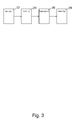
Figure 3 shows a block diagram of an embodiment of a method for selecting users. -
Figure 1 shows an embodiment of anapparatus 10 for selecting users from a group of users to be assigned to radio resources from a set of radio resources. A radio resource being used for communicating packet switched data between users and a mobile communication system. The embodiment of theapparatus 10 comprises means for grouping 12 a plurality of subgroups of users from the group of users. Theapparatus 10 further comprises means for forming 14 a plurality of assignment sets. An assignment set comprises one radio resource from the set of radio resources and one user from each of the plurality of subgroups. The plurality of assignment sets comprises one assignment set for each combination of a radio resource from the set of radio resources with the users from the subgroups. Moreover, theapparatus 10 comprises means for determining 16 a quality measure for each of the assignment sets. The quality measure of an assignment set comprises information on a communication quality achieved when jointly using the radio resource of the assignment set for communicating packet switched data between the users of the assignment set and the mobile communication system. Theapparatus 10 comprises means for selecting 18 a subset of assignment sets from the plurality of assignments sets based on the quality measures. The subset of assignment sets comprises one assignment set for each radio resource from the set of radio resources. - Furthermore,
Figure 1 shows abase station transceiver 100, which comprises theapparatus 10. - In the following embodiment, it is assumed that the group users has K active users, an active user can be scheduled, e.g. has data for scheduling in his buffers or in the buffers of the associated base station transceiver. Moreover, the number of radio resources available in a frame, i.e. in the set of radio resources is termed N. The
apparatus 10 is adapted to select for each radio resource i in a frame a set of users in such a way that the number of times a user is scheduled in a frame is limited and an objective function, i.e. a quality measure like for example the sum or the weighted sum of the rates achievable by taking into account multi-user interference, is maximized. Resources and users are identified by their indexes and the set of resources will be referred to as I = {0,...,N-1}, the group of users will be referred to as J = {0,..., K-1}. - In a first step, an embodiment is considered for the case where each of the resources is assigned to a pair of two users and each user is scheduled exactly twice. Subsequently, further embodiments will be considered, where the above embodiment is generalized to the cases where some users are scheduled more often or more than two users share one resource.
- In the present embodiment, a special case is considered, where pairs consisting of two users are assigned to each of the resources in an assignment set. Referring to
Figure 1 , the means for grouping 12 is adapted to group at least a first subgroup J 1 of users and a second group of users J 2. The means for forming 14 is adapted to form an assignment set for each radio resource and any pair of users from the first subgroup J1 and the second subgroup J2 of users, wherein each pair of users comprises one user from the first subgroup J1 , and one user from the second subgroup J2 . - According to the embodiment a scheduling problem, i.e. the selection of the subset of assignment sets, is solved in the following way. The two subgroups of J: J 1 ⊆ J with K 1 elements and J 2 ⊆ J with K 2 elements are selected. In this embodiment, the first subgroup J1 and the second subgroup J2 comprise the same number of users. In other words, each of the two subgroups has the same number of elements as I , which is the number of radio resources in the set of radio resources. The subgroups are not necessarily disjoint, i.e., for example, both subgroups may be equal to the complete set of users J. There are three sets and subgroups: The first set is the set of radio resources I , the second set is the first subgroup of users J 1, and the third set is the second subgroup of users J 2.
- The
apparatus 10, i.e. the means for forming 14, may now find or form sets of N triples (i,j,k) as assignment sets with i ∈ I, j ∈ J 1 and k ∈ J 2 in such a way that each radio resource i ∈ I is in exactly one of the triples, each user from the first subgroup j ∈ J 1 is exactly in one of the triples, and each user from the second subgroup k ∈ J 2 is exactly in one of the triples, i.e. each user is scheduled once from each of the subgroups he is contained in. These triples correspond to assignment sets. If a user is in both subgroups, he is scheduled twice. In this embodiment, the group of users J corresponds to the users of thebase station transceiver 100 of the mobile communication system. Each subgroup J1 , J2 has the same number of users and the set of radio resources I has the same number of radio resources as there are users in a subgroup J1 , J2 . -
Figure 2 illustrates the selection of users in this embodiment.Figure 2 shows the set of radio resources I, the first subgroup of users J1 and the second subgroup of users J2 . The elements of the sets, i.e. radio resources in I and the users in J1 and J2 are indicated bydots radio resource 20i includesuser 20j from subgroup J1 anduser 20k from subgroup J2 .Figure 2 further illustrates that all radio resources are assigned to assignment sets, as well as all users from both subgroups. Each radio resource and each user belong to a single assignment set of the subset of assignment sets. - Additionally a sum of positive coefficients cijk is assigned to each of the selected triples as quality measures for the assignment sets by the means for determining 16 and forming an objective function, which shall be maximized. In other words, the means for selecting 18 is adapted to select the subset of assignment sets based on a maximization of a cumulated quality measure based on all radio resources i ∈ I in the set of radio resources I.
- The coefficients cijk can for example represent the sum or a weighted sum of the rates achievable by the users j and k when sharing radio resource i. That is to say, cijk is the weighted sum of rates achieved by using this resource and taking into account the interference between these users' signals. The sum rate corresponds to the sum of the individual user rates in the assignment set and is the special case where both weights are equal to one. In other words, the means for determining 16 the quality measure cijk for each of the assignment sets is adapted to determine the quality measure by evaluating an individual quality measure of each user in the assignment set based on a joint utilization of the radio resource by all users from the assignment set and an interference reduction technique between the users of the assignment set. Here, the quality measure cijk corresponds to a cumulated data rate achieved by the users of the assignment set when jointly using the radio resource of the assignment set.
- Note that embodiments are not limited to a certain direction of data transmission between the users and the mobile communication system. The radio resources can correspond to uplink radio resources for transmission from a mobile transceiver or a user to the mobile communication system or the radio resources can correspond to downlink radio resources for transmission from the mobile communication system to the mobile transceiver or the user.
- In other words, the group of users corresponds to J = {0,..., K-1} having K users and the set of radio resources corresponds to I = {0, ..., N - 1} having N radio resources. The means for grouping 12 is adapted to group a first subgroup J1 of users and an identical second subgroup J2 of users, and the means for forming 14 the assignment sets is adapted to form a set of N triples (i,j,k) with i ∈ I, j ∈ J 1 and k ∈ J 2 as the plurality of assignment sets. The means for determining 16 is adapted to determine a sum of positive coefficients cijk assigned to each of the triples as quality measure. The means for selecting 18 is adapted to solve a three index assignment problem in such a way that each radio resource i ∈ I is in exactly one of the assignment sets. The subset of assignment sets is selected based on searching for

subject to


and with
where the numbers xijk ∈ {0,1} indicate whether a possible triple (i, j, k) has been selected (x ijk =1) or not (xijk = 0). This is a so called axial three-index assignment problem or in graph theory a maximum weighted tripartite matching problem. It can be solved by methods, which are for example described in Burkard, R., Dell'Amico. M. and Martello, S.: "Assignment Problems", SIAM, 2009. - In a further embodiment, the means for selecting 18 is further adapted to solve the axial three-index assignment problem by solving an integer linear programming problem by defining NK 1 K 2 variables

and coefficients αν,µ , with ν = 0,..., N + K 1 + K 2 - 1 and µ = 0,..., NK 1 K 2 -1 with the following N + K 1 + K 2 constraints


additionally defined coefficients γ i as
and solving the optimization problem as
with the constraints



- This is an Integer Linear Programming (ILP) problem because the values of the variables are restricted to the integers 0 or 1. There are methods for solving such problems, cf., e.g.
chapters 13, 14 in Christos H. Papadimtriou and Kenneth Steiglitz, Combinatorial Optimization: Algorithms and Complexity, Dover 1998 - The algorithm for scheduling or selecting the subset of assignment sets of users can be summarized as follows:
- Calculate the coefficients cijk from channel states taking into account the interference between the users and transform them into coefficients γν
- Calculate ξν by solving the optimization problem and transform them into xijk
- Search for non-zero valued xijk , of which the indices of non-zero valued xijk refer to the scheduled users: users j and k are scheduled on resource i, i.e. the assignment set i,j,k is selected for the subset of assignment sets.
- In other words, the means for selecting 18 is adapted for calculating the coefficients cijk from channel states of the users taking into account an interference condition between the users of the respective assignment set. The means for selecting 18 is adapted for transforming the coefficients cijk into coefficients γν and for calculating ξν by solving the optimization problem. The means for selecting 18 is further adapted for transforming the ξν into xijk and for searching for indices of non-zero valued xijk . Hence, the means for selecting 18 is adapted for selecting the subset of the assignment sets based on the indices of non-zero valued xijk .
- To reduce the computational complexity, the problem formulation can be modified by replacing constraint (5e) by

- Now the problem is a Linear Programming (LP) problem and can be solved more efficiently by standard linear programming algorithms like the Simplex method, cf., e.g., chapters 2 - 4 in Christos H. Papadimtriou and Kenneth Steiglitz, Combinatorial Optimization: Algorithms and Complexity, Dover 1998 or so-called interior-point methods, cf, e.g., Stephen Wright, Primal-Dual Interior-Point Methods. Philadelphia, PA: SIAM, 2007 or chapter 11 in Stephen Boyd and Lieven Vandenberghe, Convex Optimization, Cambridge, 2004. Software for solving LP problems is also included in the GLPK, cf. above. In this embodiment, the means for selecting 18 is adapted to convert the integer linear programming problem into a linear programming problem with the constraint of equation (6). However, in this embodiment, it is no longer guaranteed that the solution is integer, i.e.

- Therefore after solving the LP problem it is checked, whether the solution is integer, and if this is not the case, which typically can happen in certain cases when using interior-point methods, the LP problem is solved by a Simplex method, which generates solutions on the vertices of the feasible region and such can provide an integer solution where interior-point methods don't, or the original problem is solved by an integer LP algorithm or a mixed integer LP algorithm, which possibly requires more computation time/operations. Thus, the means for selecting 18 is adapted to solve the LP problem and to verify whether ξν ∈ {0,1} V ν ∈ {0,..., NK 1 K 2 -1} and if not, to further solve the LP problem by an alternative method or to solve the integer LP problem to find ξν ∈ {0,1} V ν ∈ {0,..., NK 1 K 2 -1}.
- It turned out that in most of the practical cases an integer solution was found for the linear programming problem, and only in a small number of cases it was necessary to solve the integer linear programming problem. This means that if the linear programming algorithm is more efficient, computational complexity can be significantly reduced by the embodiment, which can be summarized as follows:
- Solve the linear programming problem
- Check whether the solution is integer
- If the solution is not integer, solve LP problem by an alternative method or search for integer solution with (Mixed) Integer linear Programming (MIP) solver; see e.g. Gnu Linear Programming Toolkit (GLPK). Online: www.gnu.org/s/glpk/.
- There are different methods for choosing the subgroups J 1 and J 2. Different choices may require changing the number of resources by dividing the available frequency band or time slot differently in order to match the sizes of the three sets (the set of radio resources and the two subgroups). According to the above embodiment, one choice is J 1 = J 2 = J . In that case each user is scheduled twice per frame, once from each of the two subgroups.
- In another embodiment, the means for grouping 12 is adapted to group at least a first subgroup J1 of users and a second subgroup J2 of users, where the users of the second subgroup J2 have a better radio channel quality in the mobile communication system than the users of the first group J1 . The radio channel quality may be determined in line with the above mentioned options for determining the quality measure. In other words, in this embodiment, the users are sorted, for example, according to their average path loss (or their SNR or SINR) and the means for grouping is adapted to choose the K/2 users with the lowest path losses as J 1 and the K/2 users with the highest path losses as J 2. This special choice still leaves enough degrees of freedom for the pairing and is especially well suited for wireless transmission methods based on non-orthogonal superposition in systems where the users have significantly different path losses. In this case N should be chosen to be K/2 and each user is scheduled once per frame or in the set of radio resources.
- To make the embodiment more flexible some generalizations can be done. E.g. to allow some users to be scheduled more often than others the constraint (5d) can be replaced by

- In that case each user from the first subgroup J 1 is scheduled once and additionally each user in the second set J 2 is scheduled up to L times. This means that a user who is in both sets will be scheduled between once and L+1 times in that frame.
- The proposed embodiments and methods can in principle be extended to mapping larger groups of Q users to a single resource by searching for a set of (Q+1)-tuples. The actual computation of a solution for such a Q-user problem may be complex. In such a general embodiment the means for selecting 18 may search for

subject to


and
- Each of the constraints guarantees that each element of a set Jν , ν ∈ {1,...,Q} is taken exactly once (or after modification corresponding to (7) not more than L times). (8f) can be modified similar to (6).
- The proposed method and embodiments can be applied to capacity estimations via simulations or potentially for real-time scheduling in a running system.
-
Figure 3 shows a block diagram of an embodiment of a method for selecting users from a group of users to be assigned to radio resources from a set of radio resources. A radio resource being used for communicating packet switched data between users and a mobile communication system. The method comprises a step of grouping 22 a plurality of subgroups of users from the group of users and a step of forming 24 a plurality of assignment sets. An assignment set comprises one radio resource from the set of radio resources and one user from each of the plurality of subgroups and the plurality of assignment sets comprises one assignment set for each combination of a radio resource from the set of radio resources with the users from the subgroups. The method further comprises a step of determining 26 a quality measure for each of the assignment sets. The quality measure of an assignment set comprises information on a communication quality achieved when using the radio resource of the assignment set for communicating packet switched data between the users of the assignment set and the mobile communication system. The method further comprises a step of selecting 28 a subset of assignment sets from the plurality of assignments sets based on the quality measures, the subset of assignment sets comprising one assignment set for each radio resource of the set of radio resources. - Embodiments may further provide a computer program having a program code for performing one of the above methods, when the computer program is executed on a computer or processor.
- A person of skill in the art would readily recognize that steps of various above-described methods can be performed by programmed computers. Herein, some embodiments are also intended to cover program storage devices, e.g., digital data storage media, which are machine or computer readable and encode machine-executable or computer-executable programs of instructions, wherein said instructions perform some or all of the steps of said above-described methods. The program storage devices may be, e.g., digital memories, magnetic storage media such as magnetic disks and magnetic tapes, hard drives, or optically readable digital data storage media. The embodiments are also intended to cover computers programmed to perform said steps of the above-described methods or (field) programmable logic arrays ((F)PLAs) or (field) programmable gate arrays ((F)PGAs), programmed to perform said steps of the above-described methods.
- The description and drawings merely illustrate the principles of the invention. It will thus be appreciated that those skilled in the art will be able to devise various arrangements that, although not explicitly described or shown herein, embody the principles of the invention and are included within its spirit and scope. Furthermore, all examples recited herein are principally intended expressly to be only for pedagogical purposes to aid the reader in understanding the principles of the invention and the concepts contributed by the inventor(s) to furthering the art, and are to be construed as being without limitation to such specifically recited examples and conditions. Moreover, all statements herein reciting principles, aspects, and embodiments of the invention, as well as specific examples thereof, are intended to encompass equivalents thereof.
- Functional blocks denoted as "means for ..." (performing a certain function) shall be understood as functional blocks comprising circuitry that is adapted for performing or to perform a certain function, respectively. Hence, a "means for s.th." may as well be understood as a "means being adapted or suited for s.th.". A means being adapted for performing a certain function does, hence, not imply that such means necessarily is performing said function (at a given time instant).
- The functions of the various elements shown in the Figures, including any functional blocks labeled as "means", "means for forming", "means for grouping", "means for determining", "means for selecting", etc., may be provided through the use of dedicated hardware, such as "a former", "a determiner", "a selector", "a grouper" etc. as well as hardware capable of executing software in association with appropriate software. When provided by a processor, the functions may be provided by a single dedicated processor, by a single shared processor, or by a plurality of individual processors, some of which may be shared. Moreover, explicit use of the term "processor" or "controller" should not be construed to refer exclusively to hardware capable of executing software, and may implicitly include, without limitation, digital signal processor (DSP) hardware, network processor, application specific integrated circuit (ASIC), field programmable gate array (FPGA), read only memory (ROM) for storing software, random access memory (RAM), and non volatile storage. Other hardware, conventional and/or custom, may also be included. Similarly, any switches shown in the Figures are conceptual only. Their function may be carried out through the operation of program logic, through dedicated logic, through the interaction of program control and dedicated logic, or even manually, the particular technique being selectable by the implementer as more specifically understood from the context.
- It should be appreciated by those skilled in the art that any block diagrams herein represent conceptual views of illustrative circuitry embodying the principles of the invention. Similarly, it will be appreciated that any flow charts, flow diagrams, state transition diagrams, pseudo code, and the like represent various processes which may be substantially represented in computer readable medium and so executed by a computer or processor, whether or not such computer or processor is explicitly shown.
Claims (15)
- An apparatus (10) for selecting users (j;k) from a group of users (K) to be assigned to radio resources from a set of radio resources (I), a radio resource (i) being used for communicating packet switched data between users (j;k) and a mobile communication system, the apparatus (10) comprising
means for grouping (12) a plurality of subgroups (J1;J2 ) of users from the group of users (K);
means for forming (14) a plurality of assignment sets, an assignment set comprising one radio resource (i) from the set of radio resources (I) and one user (j;k) from each of the plurality of subgroups (J1;J2 ), the plurality of assignment sets comprising one assignment set for each combination of a radio resource (i) from the set of radio resources (I) with the users (j;k) from the subgroups (J1 ;J2 );
means for determining (16) a quality measure (cijk ) for each of the assignment sets, the quality measure (cijk ) of an assignment set comprising information on a communication quality achieved when jointly using the radio resource (i) of the assignment set for communicating packet switched data between the users (j;k) of the assignment set and the mobile communication system; and
means for selecting (18) a subset of assignment sets from the plurality of assignments sets based on the quality measures (cijk ), the subset of assignment sets comprising one assignment set for each radio resource (i) from the set of radio resources (I). - The apparatus (10) of claim 1, wherein the means for grouping (12) is adapted to group at least a first subgroup (J1 ) of users and a second group of users (J2 ) and wherein the means for forming (14) is adapted to form an assignment set for each radio resource (i) and any pair of users (j;k) from the first subgroup (J1 ) and the second subgroup (J2 ) of users, each pair of users (j;k) comprising one user (j) from the first subgroup (J1 ) and one user (k) from the second subgroup (J2 ) and/or wherein the first subgroup (J1 ) and the second subgroup (J2 ) comprise the same number of users.
- The apparatus (10) of claim 1, wherein the means for selecting (18) is adapted to select the subset of assignment sets based on a maximization of a cumulated quality measure based on all radio resources (i ∈ I) in the set of radio resources (I).
- The apparatus (10) of claim 1, wherein the radio resources (i) correspond to uplink radio resources for transmission from a mobile transceiver (100) or a user (j;k) to the mobile communication system or wherein the radio resources (i) correspond to downlink radio resources for transmission from the mobile communication system to the mobile transceiver (100) or the user (j;k).
- The apparatus (10) of claim 1, wherein the means for determining (16) the quality measure (cijk ) for each of the assignment sets is adapted to determine the quality measure (c ijk ) by evaluating an individual quality measure of each user in the assignment set based on a joint utilization of the radio resource (i) by all users (j;k) from the assignment set and an interference reduction technique between the users (j;k) of the assignment set.
- The apparatus (10) of claim 1, wherein the quality measure (c ijk ) corresponds to a cumulated data rate achieved by the users (j;k) of an assignment set when jointly using the radio resource (i) of the assignment set.
- The apparatus (10) of claim 1, wherein the group of users (J) corresponds to the users of a base station transceiver (100) of the mobile communication system and wherein each subgroup (J1;J2 ) has the same number of users and wherein the set of radio resources (I) has the same number of radio resources as there are users in a subgroup (J1;J2).
- The apparatus (10) of claim 7, wherein the group of users (J) corresponds to J ={0, ..., K-1} having K users and wherein the set of radio resources corresponds to I = {0,...,N-1} having N radio resources, wherein the means for grouping (12) is adapted to group a first subgroup (J1 ) of users and an identical second subgroup (J2 ) of users, and wherein the means for forming (14) the assignment sets is adapted to form a set of N triples (i,j,k) with i ∈ I, j ∈ J 1 and k ∈ J 2 as the plurality of assignment sets, wherein the means for determining (16) is adapted to determine a sum of positive coefficients (cijk ) assigned to each of the triples as quality measure (c ijk ), and wherein the means for selecting (18) is adapted to solve a three index assignment problem in such a way that each radio resource i ∈ I is in exactly one of the assignment sets, where the subset of assignment sets is selected based on searching for

subject to


and
and/or wherein
with the integer L > 1. - The apparatus (10) of claim 8, wherein the means for selecting (18) is further adapted to solve the axial three-index assignment problem by solving an integer linear programming problem by defining NK 1 K 2 variables

and coefficients αν,µ, with ν = 0,..., N + K 1 + K 2 -1 and µ = 0,..., NK 1 K 2 -1 with the following N + K 1 + K 2 constraints


additionally defined coefficients γ i as
and solving
the optimization problem as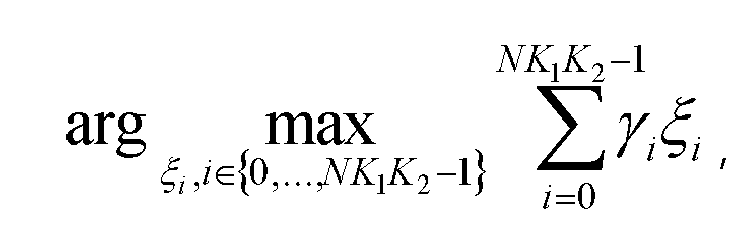
with the constraints


- The apparatus (10) of claim 9, wherein the means for selecting (18) is further adapted for calculating the coefficients (cijk ) from channel states of the users (j;k) taking into account an interference condition between the users of the respective assignment set, transforming the coefficients (cijk ) into coefficients ξ i, calculating ξ i by solving the optimization problem and transforming the ξ i into xijk , searching for indices of non-zero valued xijk , selecting the subset of the assignment sets based on the indices of non-zero valued xijk , and/or wherein the means for selecting (18) is adapted to convert the integer linear programming problem into a linear programming problem with the constraint of 0 ≤ξν ≤1, ξν ∈ R ∀ ν ∈ {0,...,NK 1 K 2-1}.
- The apparatus (10) of claim 10, wherein the means for selecting (18) is adapted to solve the linear programming problem by an interior point method and to verify whether ξν ∈ {0,1} ∀ ν ∈ {0,...,NK 1 K 2 -1} and if not, to solve the linear programming problem by a Simplex method and to verify whether ξ ν ∈ {0,1} ∀ ν ∈ {0,...,NK 1 K 2 -1} and if not, to further solve the integer linear programming problem to find ξ ν ∈ {0,1} ∀ ν ∈ {0,...,NK 1 K 2, -1}.
- The apparatus (10) of claim 1, wherein the means for grouping (12) is adapted to group at least a first subgroup (J1 ) of users and a second subgroup (J2 ) of users, wherein the users of the second subgroup (J2 ) have a better radio channel quality in the mobile communication system than the users of the first group (J1 ).
- A base station transceiver (100) of a mobile communication system comprising the apparatus (10) of claim 1.
- A method for selecting users from a group of users to be assigned to radio resources from a set of radio resources, a radio resource being used for communicating packet switched data between users and a mobile communication system, the method comprises
grouping (22) a plurality of subgroups of users from the group of users;
forming (24) a plurality of assignment sets, an assignment set comprising one radio resource from the set of radio resources and one user from each of the plurality of subgroups, the plurality of assignment sets comprising one assignment set for each combination of a radio resource from the set of radio resources with the users from the subgroups;
determining (26) a quality measure for each of the assignment sets, the quality measure of an assignment set comprising information on a communication quality achieved when using the radio resource of the assignment set for communicating packet switched data between the users of the assignment set and the mobile communication system; and
selecting (28) a subset of assignment sets from the plurality of assignments sets based on the quality measures, the subset of assignment sets comprising one assignment set for each of the set of radio resources. - A computer program having a program code for performing the method of claim 14, when the computer program is executed on a computer or processor.
Priority Applications (1)
| Application Number | Priority Date | Filing Date | Title |
|---|---|---|---|
| EP20110306075 EP2566214B1 (en) | 2011-08-29 | 2011-08-29 | Apparatus, method, computer program and base station transceiver for selecting users |
Applications Claiming Priority (1)
| Application Number | Priority Date | Filing Date | Title |
|---|---|---|---|
| EP20110306075 EP2566214B1 (en) | 2011-08-29 | 2011-08-29 | Apparatus, method, computer program and base station transceiver for selecting users |
Publications (2)
| Publication Number | Publication Date |
|---|---|
| EP2566214A1 true EP2566214A1 (en) | 2013-03-06 |
| EP2566214B1 EP2566214B1 (en) | 2013-11-13 |
Family
ID=44735851
Family Applications (1)
| Application Number | Title | Priority Date | Filing Date |
|---|---|---|---|
| EP20110306075 Active EP2566214B1 (en) | 2011-08-29 | 2011-08-29 | Apparatus, method, computer program and base station transceiver for selecting users |
Country Status (1)
| Country | Link |
|---|---|
| EP (1) | EP2566214B1 (en) |
Families Citing this family (1)
| Publication number | Priority date | Publication date | Assignee | Title |
|---|---|---|---|---|
| WO2015198103A1 (en) * | 2014-06-27 | 2015-12-30 | Telefonaktiebolaget L M Ericsson (Publ) | Rate scheduling coordination in a wireless cellular network |
Citations (1)
| Publication number | Priority date | Publication date | Assignee | Title |
|---|---|---|---|---|
| EP2037693A1 (en) * | 2006-06-19 | 2009-03-18 | NTT DoCoMo, Inc. | Base station and method in mobile communication system |
-
2011
- 2011-08-29 EP EP20110306075 patent/EP2566214B1/en active Active
Patent Citations (1)
| Publication number | Priority date | Publication date | Assignee | Title |
|---|---|---|---|---|
| EP2037693A1 (en) * | 2006-06-19 | 2009-03-18 | NTT DoCoMo, Inc. | Base station and method in mobile communication system |
Non-Patent Citations (9)
| Title |
|---|
| "Part IV of Alexander Schrijver, Theory of Linear and Integer Programming", 1987, JOHN WILEY AND SONS |
| BURKARD, R., DELL'AMICO. M., MARTELLO, S.: "Assignment Problems", SIAM, 2009 |
| CHRISTOS H. PAPADIMTRIOU, KENNETH STEIGLITZ: "Combinatorial Optimization: Algorithms and Complexity", 1998, DOVER |
| GEORGE L. NEMHAUSER, LAURENCE A. WOLSEY: "Integer and Combinatorial Optimization", 1988, JOHN WILEY & SONS |
| HAN Z ET AL: "Fair Multiuser Channel Allocation for OFDMA Networks Using Nash Bargaining Solutions and Coalitions", IEEE TRANSACTIONS ON COMMUNICATIONS, IEEE SERVICE CENTER, PISCATAWAY, NJ. USA, vol. 53, no. 8, 1 August 2005 (2005-08-01), pages 1366 - 1376, XP011137832, ISSN: 0090-6778, DOI: 10.1109/TCOMM.2005.852826 * |
| JOERG SCHAEPPERLE: "Throughput of a wireless cell using superposition based multiple-access with optimized scheduling", PERSONAL INDOOR AND MOBILE RADIO COMMUNICATIONS (PIMRC), 2010 IEEE 21ST INTERNATIONAL SYMPOSIUM ON, IEEE, PISCATAWAY, NJ, USA, 26 September 2010 (2010-09-26), pages 212 - 217, XP031837932, ISBN: 978-1-4244-8017-3 * |
| SHIDONG ZHOU ET AL: "Novel techniques to improve downlink multiple access capacity for Beyond 3G", IEEE COMMUNICATIONS MAGAZINE, IEEE SERVICE CENTER, PISCATAWAY, US, vol. 43, no. 1, 1 January 2005 (2005-01-01), pages 61 - 69, XP011201246, ISSN: 0163-6804 * |
| STEPHEN BOYD, LIEVEN VANDENBERGHE: "Convex Optimization", 2004 |
| STEPHEN WRIGHT: "Primal-Dual Interior-Point Methods", 2007 |
Also Published As
| Publication number | Publication date |
|---|---|
| EP2566214B1 (en) | 2013-11-13 |
Similar Documents
| Publication | Publication Date | Title |
|---|---|---|
| EP3493438B1 (en) | Channel quality information calculation method, apparatus and system | |
| US8797983B2 (en) | Apparatuses and methods for allocating spectrum resources in a wireless communication network | |
| JP5295977B2 (en) | Characterizing co-channel interference in wireless communication systems | |
| US20090069023A1 (en) | Method for resource partition, assignment, transmission and reception for inter-cell interference migration in downlink of ofdm cellular systems | |
| US20110205929A1 (en) | method of optimising bandwidth allocation in a wireless communication network | |
| EP2836003A1 (en) | Quality prediction method and device for physical downlink control channel of long term evolution system | |
| EP2734006B1 (en) | Resource allocation for minimum satisfaction guarantees in multi-service and multi-antenna networks | |
| US20090082028A1 (en) | System and Method for Utility-Based Scheduling for Space Division Multiple Access (SDMA) on an Uplink of a Wireless Communications Network | |
| US11025399B2 (en) | Interference suppression | |
| Awoyemi et al. | Resource allocation for heterogeneous cognitive radio networks | |
| CN104170505B (en) | Dispatching method and dispatching device and base station | |
| EP3138343B1 (en) | Method and system for allocating radio resources for uplink transmission in cellular networks | |
| EP2640145B1 (en) | Multiple-input-multiple-output (MIMO) communication with selection of TBS per stream based on E-DPDCH to DPCCH power ratios | |
| CN103621171B (en) | Scheduling method, scheduling device and base station | |
| EP3878114B1 (en) | Processing of uplink data streams | |
| Chakrapani | Efficient resource scheduling for eMTC/NB-IoT communications in LTE Rel. 13 | |
| EP2921017B1 (en) | Method and apparatus for resource allocation satisfying multiple performance constraints | |
| EP1988654A1 (en) | Communication scheme for channel quality information | |
| EP2566214A1 (en) | Apparatus, method, computer program and base station transceiver for selecting users | |
| US20130090143A1 (en) | System and method for enhancing cell-edge performance in a wireless communication network | |
| US8781486B1 (en) | Resource allocation and band assignment in carrier-aggregated wireless networks | |
| Aiyetoro et al. | Packet scheduling in MIMO satellite long term evolution networks | |
| Sousa et al. | Resource management for rate maximization with QoE provisioning in wireless networks | |
| EP3337232A1 (en) | Method and apparatus for determining multi-point transmission resource | |
| EP2050283B1 (en) | Method for selecting multiple customer premises equipments to share a channel in a wireless communications network |
Legal Events
| Date | Code | Title | Description |
|---|---|---|---|
| PUAI | Public reference made under article 153(3) epc to a published international application that has entered the european phase |
Free format text: ORIGINAL CODE: 0009012 |
|
| 17P | Request for examination filed |
Effective date: 20120523 |
|
| AK | Designated contracting states |
Kind code of ref document: A1 Designated state(s): AL AT BE BG CH CY CZ DE DK EE ES FI FR GB GR HR HU IE IS IT LI LT LU LV MC MK MT NL NO PL PT RO RS SE SI SK SM TR |
|
| AX | Request for extension of the european patent |
Extension state: BA ME |
|
| GRAP | Despatch of communication of intention to grant a patent |
Free format text: ORIGINAL CODE: EPIDOSNIGR1 |
|
| GRAS | Grant fee paid |
Free format text: ORIGINAL CODE: EPIDOSNIGR3 |
|
| 111Z | Information provided on other rights and legal means of execution |
Free format text: AL AT BE BG CH CY CZ DE DK EE ES FI FR GB GR HR HU IE IS IT LI LT LU LV MC MK MT NL NO PL PT RO RS SE SI SK SM TR Effective date: 20130410 |
|
| GRAA | (expected) grant |
Free format text: ORIGINAL CODE: 0009210 |
|
| RBV | Designated contracting states (corrected) |
Designated state(s): AL AT BE BG CH CY CZ DE DK EE ES FI FR GB GR HR HU IE IS IT LI LT LU LV MC MK MT NL NO PL PT RO RS SE SI SK SM TR |
|
| AK | Designated contracting states |
Kind code of ref document: B1 Designated state(s): AL AT BE BG CH CY CZ DE DK EE ES FI FR GB GR HR HU IE IS IT LI LT LU LV MC MK MT NL NO PL PT RO RS SE SI SK SM TR |
|
| REG | Reference to a national code |
Ref country code: GB Ref legal event code: FG4D |
|
| REG | Reference to a national code |
Ref country code: CH Ref legal event code: EP |
|
| REG | Reference to a national code |
Ref country code: AT Ref legal event code: REF Ref document number: 641002 Country of ref document: AT Kind code of ref document: T Effective date: 20131215 |
|
| REG | Reference to a national code |
Ref country code: IE Ref legal event code: FG4D |
|
| REG | Reference to a national code |
Ref country code: DE Ref legal event code: R096 Ref document number: 602011003714 Country of ref document: DE Effective date: 20140109 |
|
| REG | Reference to a national code |
Ref country code: NL Ref legal event code: VDEP Effective date: 20131113 |
|
| REG | Reference to a national code |
Ref country code: AT Ref legal event code: MK05 Ref document number: 641002 Country of ref document: AT Kind code of ref document: T Effective date: 20131113 |
|
| REG | Reference to a national code |
Ref country code: LT Ref legal event code: MG4D |
|
| PG25 | Lapsed in a contracting state [announced via postgrant information from national office to epo] |
Ref country code: NL Free format text: LAPSE BECAUSE OF FAILURE TO SUBMIT A TRANSLATION OF THE DESCRIPTION OR TO PAY THE FEE WITHIN THE PRESCRIBED TIME-LIMIT Effective date: 20131113 Ref country code: HR Free format text: LAPSE BECAUSE OF FAILURE TO SUBMIT A TRANSLATION OF THE DESCRIPTION OR TO PAY THE FEE WITHIN THE PRESCRIBED TIME-LIMIT Effective date: 20131113 Ref country code: SE Free format text: LAPSE BECAUSE OF FAILURE TO SUBMIT A TRANSLATION OF THE DESCRIPTION OR TO PAY THE FEE WITHIN THE PRESCRIBED TIME-LIMIT Effective date: 20131113 Ref country code: IS Free format text: LAPSE BECAUSE OF FAILURE TO SUBMIT A TRANSLATION OF THE DESCRIPTION OR TO PAY THE FEE WITHIN THE PRESCRIBED TIME-LIMIT Effective date: 20140313 Ref country code: FI Free format text: LAPSE BECAUSE OF FAILURE TO SUBMIT A TRANSLATION OF THE DESCRIPTION OR TO PAY THE FEE WITHIN THE PRESCRIBED TIME-LIMIT Effective date: 20131113 Ref country code: LT Free format text: LAPSE BECAUSE OF FAILURE TO SUBMIT A TRANSLATION OF THE DESCRIPTION OR TO PAY THE FEE WITHIN THE PRESCRIBED TIME-LIMIT Effective date: 20131113 Ref country code: NO Free format text: LAPSE BECAUSE OF FAILURE TO SUBMIT A TRANSLATION OF THE DESCRIPTION OR TO PAY THE FEE WITHIN THE PRESCRIBED TIME-LIMIT Effective date: 20140213 |
|
| PG25 | Lapsed in a contracting state [announced via postgrant information from national office to epo] |
Ref country code: LV Free format text: LAPSE BECAUSE OF FAILURE TO SUBMIT A TRANSLATION OF THE DESCRIPTION OR TO PAY THE FEE WITHIN THE PRESCRIBED TIME-LIMIT Effective date: 20131113 Ref country code: CY Free format text: LAPSE BECAUSE OF FAILURE TO SUBMIT A TRANSLATION OF THE DESCRIPTION OR TO PAY THE FEE WITHIN THE PRESCRIBED TIME-LIMIT Effective date: 20131113 Ref country code: ES Free format text: LAPSE BECAUSE OF FAILURE TO SUBMIT A TRANSLATION OF THE DESCRIPTION OR TO PAY THE FEE WITHIN THE PRESCRIBED TIME-LIMIT Effective date: 20131113 Ref country code: AT Free format text: LAPSE BECAUSE OF FAILURE TO SUBMIT A TRANSLATION OF THE DESCRIPTION OR TO PAY THE FEE WITHIN THE PRESCRIBED TIME-LIMIT Effective date: 20131113 Ref country code: RS Free format text: LAPSE BECAUSE OF FAILURE TO SUBMIT A TRANSLATION OF THE DESCRIPTION OR TO PAY THE FEE WITHIN THE PRESCRIBED TIME-LIMIT Effective date: 20131113 Ref country code: BE Free format text: LAPSE BECAUSE OF FAILURE TO SUBMIT A TRANSLATION OF THE DESCRIPTION OR TO PAY THE FEE WITHIN THE PRESCRIBED TIME-LIMIT Effective date: 20131113 |
|
| PG25 | Lapsed in a contracting state [announced via postgrant information from national office to epo] |
Ref country code: PT Free format text: LAPSE BECAUSE OF FAILURE TO SUBMIT A TRANSLATION OF THE DESCRIPTION OR TO PAY THE FEE WITHIN THE PRESCRIBED TIME-LIMIT Effective date: 20140313 |
|
| PG25 | Lapsed in a contracting state [announced via postgrant information from national office to epo] |
Ref country code: EE Free format text: LAPSE BECAUSE OF FAILURE TO SUBMIT A TRANSLATION OF THE DESCRIPTION OR TO PAY THE FEE WITHIN THE PRESCRIBED TIME-LIMIT Effective date: 20131113 |
|
| REG | Reference to a national code |
Ref country code: CH Ref legal event code: PCOW Free format text: NEW ADDRESS: 148/152 ROUTE DE LA REINE, 92100 BOULOGNE-BILLANCOURT (FR) |
|
| REG | Reference to a national code |
Ref country code: DE Ref legal event code: R097 Ref document number: 602011003714 Country of ref document: DE |
|
| RAP2 | Party data changed (patent owner data changed or rights of a patent transferred) |
Owner name: ALCATEL LUCENT |
|
| PG25 | Lapsed in a contracting state [announced via postgrant information from national office to epo] |
Ref country code: CZ Free format text: LAPSE BECAUSE OF FAILURE TO SUBMIT A TRANSLATION OF THE DESCRIPTION OR TO PAY THE FEE WITHIN THE PRESCRIBED TIME-LIMIT Effective date: 20131113 Ref country code: RO Free format text: LAPSE BECAUSE OF FAILURE TO SUBMIT A TRANSLATION OF THE DESCRIPTION OR TO PAY THE FEE WITHIN THE PRESCRIBED TIME-LIMIT Effective date: 20131113 Ref country code: SK Free format text: LAPSE BECAUSE OF FAILURE TO SUBMIT A TRANSLATION OF THE DESCRIPTION OR TO PAY THE FEE WITHIN THE PRESCRIBED TIME-LIMIT Effective date: 20131113 Ref country code: PL Free format text: LAPSE BECAUSE OF FAILURE TO SUBMIT A TRANSLATION OF THE DESCRIPTION OR TO PAY THE FEE WITHIN THE PRESCRIBED TIME-LIMIT Effective date: 20131113 |
|
| PLBE | No opposition filed within time limit |
Free format text: ORIGINAL CODE: 0009261 |
|
| STAA | Information on the status of an ep patent application or granted ep patent |
Free format text: STATUS: NO OPPOSITION FILED WITHIN TIME LIMIT |
|
| PG25 | Lapsed in a contracting state [announced via postgrant information from national office to epo] |
Ref country code: DK Free format text: LAPSE BECAUSE OF FAILURE TO SUBMIT A TRANSLATION OF THE DESCRIPTION OR TO PAY THE FEE WITHIN THE PRESCRIBED TIME-LIMIT Effective date: 20131113 |
|
| 26N | No opposition filed |
Effective date: 20140814 |
|
| REG | Reference to a national code |
Ref country code: DE Ref legal event code: R097 Ref document number: 602011003714 Country of ref document: DE Effective date: 20140814 |
|
| PG25 | Lapsed in a contracting state [announced via postgrant information from national office to epo] |
Ref country code: SI Free format text: LAPSE BECAUSE OF FAILURE TO SUBMIT A TRANSLATION OF THE DESCRIPTION OR TO PAY THE FEE WITHIN THE PRESCRIBED TIME-LIMIT Effective date: 20131113 |
|
| PG25 | Lapsed in a contracting state [announced via postgrant information from national office to epo] |
Ref country code: LU Free format text: LAPSE BECAUSE OF FAILURE TO SUBMIT A TRANSLATION OF THE DESCRIPTION OR TO PAY THE FEE WITHIN THE PRESCRIBED TIME-LIMIT Effective date: 20140829 Ref country code: MC Free format text: LAPSE BECAUSE OF FAILURE TO SUBMIT A TRANSLATION OF THE DESCRIPTION OR TO PAY THE FEE WITHIN THE PRESCRIBED TIME-LIMIT Effective date: 20131113 |
|
| REG | Reference to a national code |
Ref country code: CH Ref legal event code: PL |
|
| PG25 | Lapsed in a contracting state [announced via postgrant information from national office to epo] |
Ref country code: CH Free format text: LAPSE BECAUSE OF NON-PAYMENT OF DUE FEES Effective date: 20140831 Ref country code: IT Free format text: LAPSE BECAUSE OF FAILURE TO SUBMIT A TRANSLATION OF THE DESCRIPTION OR TO PAY THE FEE WITHIN THE PRESCRIBED TIME-LIMIT Effective date: 20131113 Ref country code: LI Free format text: LAPSE BECAUSE OF NON-PAYMENT OF DUE FEES Effective date: 20140831 |
|
| REG | Reference to a national code |
Ref country code: IE Ref legal event code: MM4A |
|
| REG | Reference to a national code |
Ref country code: FR Ref legal event code: PLFP Year of fee payment: 5 |
|
| PG25 | Lapsed in a contracting state [announced via postgrant information from national office to epo] |
Ref country code: IE Free format text: LAPSE BECAUSE OF NON-PAYMENT OF DUE FEES Effective date: 20140829 |
|
| PG25 | Lapsed in a contracting state [announced via postgrant information from national office to epo] |
Ref country code: SM Free format text: LAPSE BECAUSE OF FAILURE TO SUBMIT A TRANSLATION OF THE DESCRIPTION OR TO PAY THE FEE WITHIN THE PRESCRIBED TIME-LIMIT Effective date: 20131113 |
|
| PG25 | Lapsed in a contracting state [announced via postgrant information from national office to epo] |
Ref country code: MT Free format text: LAPSE BECAUSE OF FAILURE TO SUBMIT A TRANSLATION OF THE DESCRIPTION OR TO PAY THE FEE WITHIN THE PRESCRIBED TIME-LIMIT Effective date: 20131113 Ref country code: BG Free format text: LAPSE BECAUSE OF FAILURE TO SUBMIT A TRANSLATION OF THE DESCRIPTION OR TO PAY THE FEE WITHIN THE PRESCRIBED TIME-LIMIT Effective date: 20131113 Ref country code: GR Free format text: LAPSE BECAUSE OF FAILURE TO SUBMIT A TRANSLATION OF THE DESCRIPTION OR TO PAY THE FEE WITHIN THE PRESCRIBED TIME-LIMIT Effective date: 20140214 |
|
| PG25 | Lapsed in a contracting state [announced via postgrant information from national office to epo] |
Ref country code: HU Free format text: LAPSE BECAUSE OF FAILURE TO SUBMIT A TRANSLATION OF THE DESCRIPTION OR TO PAY THE FEE WITHIN THE PRESCRIBED TIME-LIMIT; INVALID AB INITIO Effective date: 20110829 Ref country code: TR Free format text: LAPSE BECAUSE OF FAILURE TO SUBMIT A TRANSLATION OF THE DESCRIPTION OR TO PAY THE FEE WITHIN THE PRESCRIBED TIME-LIMIT Effective date: 20131113 |
|
| REG | Reference to a national code |
Ref country code: FR Ref legal event code: PLFP Year of fee payment: 6 |
|
| REG | Reference to a national code |
Ref country code: FR Ref legal event code: PLFP Year of fee payment: 7 |
|
| PG25 | Lapsed in a contracting state [announced via postgrant information from national office to epo] |
Ref country code: MK Free format text: LAPSE BECAUSE OF FAILURE TO SUBMIT A TRANSLATION OF THE DESCRIPTION OR TO PAY THE FEE WITHIN THE PRESCRIBED TIME-LIMIT Effective date: 20131113 |
|
| REG | Reference to a national code |
Ref country code: FR Ref legal event code: PLFP Year of fee payment: 8 |
|
| PG25 | Lapsed in a contracting state [announced via postgrant information from national office to epo] |
Ref country code: AL Free format text: LAPSE BECAUSE OF FAILURE TO SUBMIT A TRANSLATION OF THE DESCRIPTION OR TO PAY THE FEE WITHIN THE PRESCRIBED TIME-LIMIT Effective date: 20131113 |
|
| PGFP | Annual fee paid to national office [announced via postgrant information from national office to epo] |
Ref country code: FR Payment date: 20210714 Year of fee payment: 11 |
|
| PG25 | Lapsed in a contracting state [announced via postgrant information from national office to epo] |
Ref country code: FR Free format text: LAPSE BECAUSE OF NON-PAYMENT OF DUE FEES Effective date: 20220831 |
|
| PGFP | Annual fee paid to national office [announced via postgrant information from national office to epo] |
Ref country code: DE Payment date: 20240702 Year of fee payment: 14 |
|
| PGFP | Annual fee paid to national office [announced via postgrant information from national office to epo] |
Ref country code: GB Payment date: 20240701 Year of fee payment: 14 |
|
| REG | Reference to a national code |
Ref country code: DE Ref legal event code: R119 Ref document number: 602011003714 Country of ref document: DE |