EP2560690B1 - Cyclopentapeptide derivatives and uses thereof - Google Patents
Cyclopentapeptide derivatives and uses thereof Download PDFInfo
- Publication number
- EP2560690B1 EP2560690B1 EP11716880.7A EP11716880A EP2560690B1 EP 2560690 B1 EP2560690 B1 EP 2560690B1 EP 11716880 A EP11716880 A EP 11716880A EP 2560690 B1 EP2560690 B1 EP 2560690B1
- Authority
- EP
- European Patent Office
- Prior art keywords
- dota
- imaging
- cxcr4
- yorn
- rnalg
- Prior art date
- Legal status (The legal status is an assumption and is not a legal conclusion. Google has not performed a legal analysis and makes no representation as to the accuracy of the status listed.)
- Active
Links
- 0 CC(C(N*=CC(N(*)**)I[Al]*)=C[C@@]1C=Cc2ccccc2C1)=O Chemical compound CC(C(N*=CC(N(*)**)I[Al]*)=C[C@@]1C=Cc2ccccc2C1)=O 0.000 description 2
- BMUJROGYMHFRLG-BPUVMDJSSA-M CCN(CCN(CC(OC)=O)CN(C)OC(CN(C)CCN(C)CC([O-])=O)=O)CC(NCCCCC(NCCCCC(NCCC[C@H](C(N[C@@H](CCCNC(N)=N)C(N[C@@H](Cc1cc2ccccc2cc1)C(NC1)=O)=O)=O)N(C)[C@](Cc(cc2)ccc2O)(C=O)NC1=O)=O)=O)=O Chemical compound CCN(CCN(CC(OC)=O)CN(C)OC(CN(C)CCN(C)CC([O-])=O)=O)CC(NCCCCC(NCCCCC(NCCC[C@H](C(N[C@@H](CCCNC(N)=N)C(N[C@@H](Cc1cc2ccccc2cc1)C(NC1)=O)=O)=O)N(C)[C@](Cc(cc2)ccc2O)(C=O)NC1=O)=O)=O)=O BMUJROGYMHFRLG-BPUVMDJSSA-M 0.000 description 1
- RWLNNVNXBUPSRS-WDQVZYJFSA-N CN([C@H](CCCNC(CN1CCN(CC(O)=O)CCN(CC(O)=O)CCN(CC(O)=O)CC1)=O)C(N[C@@H](CCCNC(N)=N)C(NC(Cc1cc2ccccc2cc1)C(NCC(N[C@@H]1Cc(cc2)ccc2O)=O)=O)=O)=O)C1=O Chemical compound CN([C@H](CCCNC(CN1CCN(CC(O)=O)CCN(CC(O)=O)CCN(CC(O)=O)CC1)=O)C(N[C@@H](CCCNC(N)=N)C(NC(Cc1cc2ccccc2cc1)C(NCC(N[C@@H]1Cc(cc2)ccc2O)=O)=O)=O)=O)C1=O RWLNNVNXBUPSRS-WDQVZYJFSA-N 0.000 description 1
- XCAYBKCLJBAYID-FZNYXOLMSA-N CN([C@H](CCCNC(c(cc1)ccc1NC(CCCCCNC(CN1CCN(CC(O)=O)CCN(CC(O)O)CCN(CC(O)=O)CC1)=O)=O)=O)C(N[C@@H](CCCNC(N)=N)C(N[C@H]1Cc2cc3ccccc3cc2)=[O]N(CC(N[C@@H]2Cc(cc3)ccc3O)=O)C1=O)=O)C2O Chemical compound CN([C@H](CCCNC(c(cc1)ccc1NC(CCCCCNC(CN1CCN(CC(O)=O)CCN(CC(O)O)CCN(CC(O)=O)CC1)=O)=O)=O)C(N[C@@H](CCCNC(N)=N)C(N[C@H]1Cc2cc3ccccc3cc2)=[O]N(CC(N[C@@H]2Cc(cc3)ccc3O)=O)C1=O)=O)C2O XCAYBKCLJBAYID-FZNYXOLMSA-N 0.000 description 1
- UMOXRQBKBVOBDE-SRNTVKITSA-N CN([C@H](CCCNC(c(cc1)ccc1NC(CCCCNC(CN1CCN(CC(O)=O)CCN(CC(O)=O)CCN(CC(O)=O)CC1)O)=O)=O)C(N[C@@H](CCCNC(N)=N)C(NC(Cc1cc(cccc2)c2cc1)C(NC1)=O)=O)=O)[C@](Cc(cc2)ccc2O)(C=O)NC1=O Chemical compound CN([C@H](CCCNC(c(cc1)ccc1NC(CCCCNC(CN1CCN(CC(O)=O)CCN(CC(O)=O)CCN(CC(O)=O)CC1)O)=O)=O)C(N[C@@H](CCCNC(N)=N)C(NC(Cc1cc(cccc2)c2cc1)C(NC1)=O)=O)=O)[C@](Cc(cc2)ccc2O)(C=O)NC1=O UMOXRQBKBVOBDE-SRNTVKITSA-N 0.000 description 1
- OSUJVKAXNLHVRB-HUMWUIFSSA-N CN([C@H](CCCNC(c1ccc(CNC(CN2CCN(CC(O)=O)CCN(CC(O)=O)CCN(CC(O)=O)CC2)=O)cc1)=O)C(N[C@@H](CCCNC(N)=N)C(N[C@@H](Cc1cc2ccccc2cc1)C(NCC(N[C@@H]1Cc(cc2)ccc2O)=O)=O)=O)=O)C1=O Chemical compound CN([C@H](CCCNC(c1ccc(CNC(CN2CCN(CC(O)=O)CCN(CC(O)=O)CCN(CC(O)=O)CC2)=O)cc1)=O)C(N[C@@H](CCCNC(N)=N)C(N[C@@H](Cc1cc2ccccc2cc1)C(NCC(N[C@@H]1Cc(cc2)ccc2O)=O)=O)=O)=O)C1=O OSUJVKAXNLHVRB-HUMWUIFSSA-N 0.000 description 1
- FUBYIZSAWZWUSJ-UHFFFAOYSA-N OC(CN(CCNCC(O)=O)CCN(CCNCC(O)=O)CC(O)=O)O Chemical compound OC(CN(CCNCC(O)=O)CCN(CCNCC(O)=O)CC(O)=O)O FUBYIZSAWZWUSJ-UHFFFAOYSA-N 0.000 description 1
Images


Classifications
-
- C—CHEMISTRY; METALLURGY
- C07—ORGANIC CHEMISTRY
- C07K—PEPTIDES
- C07K7/00—Peptides having 5 to 20 amino acids in a fully defined sequence; Derivatives thereof
- C07K7/64—Cyclic peptides containing only normal peptide links
-
- A—HUMAN NECESSITIES
- A61—MEDICAL OR VETERINARY SCIENCE; HYGIENE
- A61K—PREPARATIONS FOR MEDICAL, DENTAL OR TOILETRY PURPOSES
- A61K51/00—Preparations containing radioactive substances for use in therapy or testing in vivo
- A61K51/02—Preparations containing radioactive substances for use in therapy or testing in vivo characterised by the carrier, i.e. characterised by the agent or material covalently linked or complexing the radioactive nucleus
- A61K51/04—Organic compounds
- A61K51/08—Peptides, e.g. proteins, carriers being peptides, polyamino acids, proteins
- A61K51/088—Peptides, e.g. proteins, carriers being peptides, polyamino acids, proteins conjugates with carriers being peptides, polyamino acids or proteins
Definitions
- the present invention is concerned with cyclopeptide derivatives, pharmaceutical compositions comprising same and the application of said derivatives in imaging and medical applications. Specifically, the present invention relates to a compound having a structure according to general formula (I)
- the compounds of the invention are believed to be capable of binding to the seven transmembrane G-protein coupled chemokine receptor CXCR4 with high affinity and are thus considered CXCR4 ligands. They may act as antagonists, agonists or inverse agonists.
- CXCR4 and its natural ligand ⁇ -chemokine stromal-derived factor (SDF-1 ⁇ / CXCL12) is a key factor in diverse bodily functions. Starting at the beginning of life with normal stem cell trafficking during embryogenesis it is also responsible for normal cardiovascular, hematopoietic and brain development as well as functions in the nervous and immune system.
- SDF-1 ⁇ / CXCL12 natural ligand ⁇ -chemokine stromal-derived factor
- the CXCR4 receptor has been found to be involved in a variety of diseases. For example, it mediates HIV-1 entry into T-cells as a co-receptor where it was first identified. Furthermore, in rheumatoid arthritis (RA) CXCR4 expressing CD4 + memory T cells accumulate in the inflamed synovium because of the high local CXCL12 concentration. Additionally CXCR4 is overexpressed on numerous different tumor cell types ranging from melanoma over prostate and pancreatic cancer to brain tumor cells.
- RA rheumatoid arthritis
- Coronary heart disease has become a leading cause of death worldwide.
- the pathologic basis for coronary heart disease (CHD) is the growth of atherosclerotic plaques in the vascular wall over a period of many years resulting in bloss-flow-limiting stenosis or plaques disruption with acute thrombotic occlusion (Ross, 1993; Libby, 2002; Hansson 2005).
- Substantial evidence supports the concept that chronic inflammation of the vessel wall characterized by the influx of circulating immune cells is responsible for the development of atherosclerotic lesions (Schober et al., 2008).
- MIF cytokine macrophage migration inhibitory factor
- CXCR4 and other chemokine receptors like CXCR2 play a role in atherosclerotic plaque development, vascular remodeling after injury, in atherosclerosis plaque destabilization and aneurysm formation (Schober et al., 2008).
- MIF Like chemokines, the interaction of MIF with the chemokine receptors CXCR2 and CXR4 as a noncanonical ligand induces recruitment of monocytes and T cells to atherosclerotic lesions, Furthermore, MIF regulates smooth muscle cell migration and proliferation, which may promote lesion growth. Increased foam-cell transformation of lesional macrophages and enhanced degradation of extracellular matrix proteins by MIF contribute to the progression into an unstable plaque phenotype. These data were largely confirmed in a study using human specimens from patients undergoing heart transplantation, carotis endarterectomy, or from autopsied individuals ( Burger-Kentischer et al, 2002).
- peptidic and non-peptidic CXCR4 antagonists have been developed.
- One example is the bicyclam AMD3100 (plerixafor) that has been approved by the FDA for the treatment of the two blood cancer types non-Hodgkin's lymphoma and multiple myeloma.
- AMD3100 further CXCR4 antagonists such as peptidic CXCR4 antagonists have been developed.
- Examples include T140 and its derivatives which are side-chain cyclized peptides that contain one or two cyclization sites. Further downsizing of T140 gave the head-to-tail cyclized pentapeptide FC131 with good antagonistic activity ( Fujii et al., 2003).
- CXCR4 antagonists derived from T140 may be their suggested mechanism of action as inverse agonists in contrast to agents like AMD3100 which are partial agonists.
- FC131 a number of modifications of FC131 have been described ( WO 2007/096662 ).
- no aromatic spacers between a linker attached to a cyclopeptide and a detectable label are described.
- certain multimeric and in particular dimeric compounds of such cyclized pentapeptides have been described, wherein a spacer moiety between the monomeric ligands is selected such that the ligands are spaced apart to avoid an interference between both ligands. ( WO 2009/027706 ).
- radiolabeld cyclic polypeptides which use non-aromatic heterocycles as spacer moiety ( WO 2009/134382 ).
- Orn(FB) is a N-fluorobenzyl substituted ornithine residue for use as CXCR4 detectable ligand ( WO 2007/096662 ).
- CXCR4 ligands such as antagonists
- Other antiinflammatory uses of CXCR4 ligands have been described for asthma and multiple sclerosis.
- CXCR4 ligands can mobilize stem cells, e.g. for stem cell transplantations.
- attenuation of pain has been observed (in rodents) by a specific CXCR4 ligand.
- CXCR4 ligands are also discussed for the treatment of neurological diseases.
- CXCR4 ligands comprising additional moieties may be particularly suitable in the treatment of the above diseases.
- Examples for the latter ligands include but are not limited to those comprising cytotoxic, (oligo)nucleotide, radioactive, and (radio)metal-chelate moieties or combinations thereof.
- the general concepts pursued with such moieties are known from certain other peptidic and peptidomimetic ligands.
- CXCR4 ligands In addition to the therapeutic potential of CXCR4 ligands, their affinity towards the receptor may be used for other applications. These include but are not limited to the imaging of CXCR4 receptors, e.g. for the diagnosis of related diseases or the visualization of CXCR4 and CXCR4 containing tissue, as well as affinity purification of CXCR4 receptors. In most of these cases, the CXCR4 ligands are modified with additional (functional) moieties and/or moieties that immobilize the CXCR4 ligands.
- the present invention provides such new CXCR4 ligands and their uses in medicinal and scientific applications as well as such ligands comprising additional (functional) moieties and their uses in medicinal and scientific applications.
- the compounds of the invention are considered capable of binding to CXCR4 and, hence, are considered CXCR4 ligands. They may be capable of functioning as CXCR4 antagonists, agonists or inverse agonists. Generally, they are based on the peptide backbone structure of FC131.
- compounds of the present invention comprise a particular linker and further moieties. These advantageously enable e.g. various imaging applications referred to herein.
- compounds of the invention are shown herein to have high affinity to the CXCR4 receptor despite the attachment of said linker and additional moieties such as a detectable label.
- compounds of the invention are considered particularly suitable for medical applications such as imaging and therapeutic applications, such as endoradiotherapy.
- the present invention provides compounds, compositions, uses and methods as defined in the claims.
- the present invention thus provides a compound, or a pharmaceutically acceptable salt thereof, having a structure according to formula I or a pharmaceutically acceptable salt thereof,
- the invention also relates to compositions, methods and uses related to said compounds as defined in the claims.
- the present invention provides compounds, compositions, uses and methods as defined in the claims.
- the general structure -Xaa- is denoted to encompass natural as well as unnatural amino acids, optionally being substituted at the alpha nitrogen (N-alpha) of said amino acid with an alkyl group, such as a methyl group or ethyl group.
- alkyl group preferably refers to a linear or branched, optionally substituted, saturated aliphatic chain of preferably 1 to 12, more preferably 1 to 8, and more preferably 1 to 6 carbon atoms and includes, but is not limited to, optionally substituted methyl, ethyl, propyl, isopropyl, n-butyl, sec-butyl, tert-butyl, pentyl, isopentyl, and hexyl.
- the alkyl group may be interrupted by one or more heteroatoms, cyclic groups and/or heterocyclic groups.
- substituted as used in this context preferably refers to alkyl groups being substituted in any position by one or more substituents, preferably by 1, 2, 3, 4, 5 or 6 substituents, more preferably by 1, 2, or 3 substituents. If two or more substituents are present, each substituent may be the same or may be different from the at least one other substituent. Suitable substituents are known to the skilled person.
- a substituent may be, for example, a halogen atom, a hydroxy, an amino group or an alkoxy group.
- alkoxy preferably represents a linear or branched alkyl group, preferably having from 1 to 6 carbon atoms attached to an oxygen atom.
- Typical alkoxy groups include methoxy, ethoxy, propoxy, isopropoxy, butoxy, t-butoxy, pentoxy, and the like.
- halogen atom preferably refers to a chlorine, iodine, bromine or fluorine atom. Preferred halogen atoms are fluorine and/or chlorine atoms.
- Natural amino acid refers to naturally occurring amino acids or residues which typically occur in proteins including their stereoisomeric forms. Natural amino acids include alanine (Ala), arginine (Arg), asparagine (Asn), aspartic acid (Asp), cysteine (Cys), glutamine (Gln), glutamic acid (Glu), glycine (Gly), histidine (His), isoleucine (Ile), leucine (Leu), lysine (Lys), methionine (Met), phenylalanine (Phe), proline (Pro), serine (Ser), threonine (Thr), tryptophan (Trp), tyrosine (Tyr) and valine (Val).
- Natural amino acids include alanine (Ala), arginine (Arg), asparagine (Asn), aspartic acid (Asp), cysteine (Cys), glutamine (Gln), glutamic acid (Glu), glycine (Gly
- unnatural amino acid includes any conceivable amino acid.
- This term includes amino acids bearing a side chain comprising acidic, basic, neutral and/or aromatic moieties.
- Conceivable amino acids to be mentioned are, for example, azetidinecarboxylic acid, 2-aminoadipic acid, 3-aminoadipic acid, beta-alanine, aminopropionic acid, 2-aminobutyric acid, 4-aminobutyric acid, 6-aminocaproic acid, 2-aminoheptanoic acid, 2-aminoisobutyric acid, 3-aminoisobutyric acid, 2-aminopimelic acid, 2,4-diaminoisobutyric acid, desmosine, 2,2'-diaminopimelic acid, 2,3-diaminopropionic acid, N-ethylglycine, N-ethylasparagine, hydroxylysine, allo-hydroxylysine, 3-hydroxyproline, 4-hydroxyproline, iso
- Xaa 1 is is D-tyrosine.
- residues refers to building blocks being incorporated in the cyclic pentapeptide having the structure: wherein S 1 is the side chain of the natural or unnatural amino acid.
- S 1 is the side chain of the natural or unnatural amino acid.
- S 1 is a hydrogen atom.
- S 1 may form a cyclic ring with the group N.
- R 1 in the above shown structure is a hydrogen atom or an alkyl group, preferably a hydrogen atom or a methyl group, in particular a hydrogen atom.
- halogen or "halogen atom” preferably refers to a chlorine, iodine, bromine or fluorine atom and the respective radioactive and non-radioactive isotopes.
- halogen is, for example, selected from the group consisting of Cl Br, I, 127 I, 123 I, 120 I, 124 I, 125 I, 131 I, 75 Br, 76 Br, 77 Br, 18 F and 19 F and 34 Cl.
- Preferred halogen atoms are fluorine and/or iodine atoms.
- the term halogen also includes the respective isotopes of these atoms.
- the iodine may be selected from the group consisting of 127 I, 123 I, 120 I, 124 I, 125 I, and 131 I.
- the fluorine atom may be selected from the group consisting of 18 F and 19 F.
- alkyl chain and the term “alkyl”, as used in this context of the invention preferably refers to alkyl chains or alkyl groups of 1 to 20 carbon atoms, preferably of 1 to 10 carbon atoms, more preferably of 1 to 8 carbon atoms, most preferably of 1 to 6 carbon atoms, such as for example, 1, 2, 3, 4, 5 or 6 carbon atoms.
- the alkyl chains or alkyl groups, respectively, may be branched or unbranched, substituted or unsubstituted, and may be interrupted by one or more heteroatoms, cyclic groups and/or heterocyclic groups.
- An amino acid may have multiple asymmetric centers.
- the resulting cyclopeptides may occur as racemates, mixtures of enantiomers and as individual enantiomers, as well as diastereomers and mixtures of diastereomers. All asymmetric forms, possible stereoisomers, single isomers and mixtures of isomers are included within the scope of the present invention.
- the designation " " shown in formulas (III) and (III') above refers to a bond to which the stereochemistry is not specifically designated.
- enantiomerically pure refers to compounds having an enantiomeric excess of at least 95 % (i.e. minimum 97,5 % of one enantiomer and maximum 2,5% of the other enantiomer) up to an enantiomeric excess of 100% (i.e. 100% of one enantiomer and none of the other), in particular compounds having an enantiomeric excess of at least 98 %, more in particular having an enantiomeric excess of at least 99.% and most in particular having an enantiomeric excess of at least 99.9 %, especially of 100 %.
- Xaa 1 is D-tyrosine.
- the present invention also relates to a compound having the general structure:
- Xaa 2 is arginine.
- basic amino acid refers to any amino acid having a basic residue such as a primary, secondary or tertiary amine, or a cyclic nitrogen containing ring and their respective isomeric forms.
- Basic preferably means a group, which has a net positive charge at pH 6 or lower in aqueous solvents.
- Naturally occurring basic amino acids or residues which typically occur in proteins include arginine (Arg), histidine (His) and lysine (Lys).
- unnatural basic amino acid includes any conceivable basic amino acid, thus this term includes amino acids comprising at least one basic moiety in its side chain.
- Xaa 2 is L-arginine or D-arginine, in particular L-arginine. More preferably
- Xaa 3 is is naphthylalanine (Nal).
- aromatic moiety refers to an optionally substituted aryl group and/or optionally substituted heteroaryl group, with the terms , terms “aryl” and “substituted aryl”, “heteroaryl” and “substituted heteroaryl” being as defined above.
- Xaa 3 is L-naphthylalanine (Nal) or D-naphthylalanine (D-Nal).
- the present invention relates to a compound having the structure: more preferably the structure:
- Xaa 4 is glycine.
- the invention particularly also relates to compounds having the following structure:
- residue R this residue is a methyl group or a hydrogen, preferably a methyl group.
- L has the formula -(CH 2 ) 3 - NH-, L has the following structure:
- Ar is selected from the group consisting of
- aromatic moiety if used in the context of the invention, refers to an optionally substituted aryl group and/or heteroaryl group, wherein the term “aryl”, in turn, refers to, but is not limited to, optionally suitably substituted 5- and 6-membered single-ring aromatic groups as well as optionally suitably substituted multicyclic groups, for example bicyclic or tricyclic aryl groups.
- aryl thus includes, for example, optionally substituted phenyl groups or optionally suitably substituted naphthyl groups.
- Aryl groups can also be fused or bridged with alicyclic or heterocycloalkyl rings which are not aromatic so as to form a polycycle, e.g., benzodioxolyl or tetraline.
- heteroaryl includes optionally suitably substituted 5- and 6-membered single-ring aromatic groups as well as substituted or unsubstituted multicyclic aryl groups, for example tricyclic or bicyclic aryl groups, comprising one or more, preferably from 1 to 4 such as 1, 2, 3 or 4, heteroatoms, wherein in case the aryl residue comprises more than 1 heteroatom, the heteroatoms may be the same or different.
- heteroaryl groups including from 1 to 4 heteroatoms are, for example, benzodioxolyl, pyrrolyl, furanyl, thiophenyl, thiazolyl, isothiaozolyl, imidazolyl, triazolyl, tetrazolyl, pyrazolyl, oxazolyl, isoxazolyl, pyridinyl, pyrazinyl, pyridazinyl, benzoxazolyl, benzodioxazolyl, benzothiazolyl, benzoimidazolyl, benzothiophenyl, methylenedioxyphenylyl, naphthridinyl, quinolinyl, isoquinolinyl, indolyl, benzofuranyl, purinyl, benzofuranyl, deazapurinyl, or indolizinyl.
- substituted aryl and the term “substituted heteroaryl” if used in the context of the present invention describes moieties having substituents replacing a hydrogen on one or more atoms, e.g. C or N, of an aryl or heteroaryl moiety. There are in general no limitations as to the substituent.
- the substituents may be, for example, selected from the group consisting of alkyl, alkenyl, alkynyl, halogen, hydroxyl, alkylcarbonyloxy, arylcarbonyloxy, alkoxycarbonyloxy, aryloxycarbonyloxy, carboxylate, alkylcarbonyl, arylcarbonyl, alkoxycarbonyl, aminocarbonyl, alkylaminocarbonyl, dialkylaminocarbonyl, alkylthiocarbonyl, alkoxy, phosphate, phosphonato, phosphinato, amino, acylamino, including alkylcarbonylamino, arylcarbonylamino, carbamoyl and ureido, amidino, nitro, imino, sulfhydryl, alkylthio, arylthio, thiocarboxylate, sulfates, alkylsulfinyl, sulfonate, s
- the present invention also relates to a compound having the following structure:
- the compound D may also be referred to herein as "D” or "further compound D".
- the radionuclide is a Ga radionuclide.
- the combination is Ga with DOTAIn an additional aspect of the invention, Ga is not a radionuclide, such as any non-radioactive isotope.
- the detectable label is a radionuclide selected from the group consisting of 66 Ga, 68 Ga, and 67 Ga,.
- active substances are well-known to the skilled person.
- the term "active substance” as used in the context of the present invention preferably refers to substances selected from the group consisting of cytotoxic agents, lipids, sugars, sugar conjugates, sugar derivatives, proteins and combinations thereof.
- the active substance is a cytotoxic agent.
- the active substance is a radionuclide, particularly a radionuclide disclosed herein.
- the active substance is selected from sugars, sugar conjugates, sugar derivatives, proteins and combinations thereof, or is a lipid.
- Cytotoxic agents which may also be referred to herein as “cytotoxic moieties” or “cytotoxic compounds”, are well known to the skilled person. They include the cytotoxic compounds disclosed hereinbelow, particularly the radionuclides disclosed hereinbelow. Also lipids, sugars, sugar conjugates, sugar derivatives, and proteins, all of which are well-known to the skilled person, are not particularly limited. Preferably, the protein is an enzyme or an antibody.
- detectable label refers to any label which provides directly or indirectly a detectable signal.
- the label may be detectable without the addition of further reagents, such as by means of an output of detectable electromagnetic radiation or other nuclear radiation from the label itself, or as a result of its magnetic or paramagnetic properties.
- the label may also be detectable upon addition of one or more further reagent(s). A person skilled in the art will readily select said further reagent(s) in dependence of the label.
- the detectable label is preferably a moiety being suitable for imaging and/or assaying, for example, for identifying, diagnosing, evaluating, detecting and/or quantitating, in vivo or in vitro, in particular for in vivo or in vitro detection via radioscintigraphy, magnetic resonance imaging (MRI), chemiluminescence, near infrared luminescence, gamma imaging, magnetic resonance spectroscopy, fluorescence spectroscopy, SPECT, computed tomography (CT scan), positron emission tomography (PET) or methods for optical tomography.
- MRI magnetic resonance imaging
- chemiluminescence chemiluminescence
- near infrared luminescence gamma imaging
- magnetic resonance spectroscopy near infrared luminescence
- gamma imaging magnetic resonance spectroscopy
- fluorescence spectroscopy fluorescence spectroscopy
- SPECT computed tomography
- CT scan computed tomography
- PET posi
- Suitable detectable labels include, for example, radiolabels, such as radioisotopes, radionuclides, isotopes, enzymes, enzyme substrates or co-factors, enzyme inhibitors, magnetic or paramagnetic moieties or particles, fluorescent groups, biotin (in conjunction with streptavidin complexation), radiolabels in conjugation with organic complexation agents, photo affinity groups, or enzymes and substrates for bioluminescent imaging, such as firefly luciferase and L-luciferin as the substrate, or combinations thereof.
- radiolabels such as radioisotopes, radionuclides, isotopes, enzymes, enzyme substrates or co-factors, enzyme inhibitors, magnetic or paramagnetic moieties or particles, fluorescent groups, biotin (in conjunction with streptavidin complexation), radiolabels in conjugation with organic complexation agents, photo affinity groups, or enzymes and substrates for bioluminescent imaging, such as firefly luciferase and L-lucifer
- Fluorescent labels include, but are not limited to NBD (7-nitro-1,2,3-benzoxadiazole), Texas red, phycoerythrin (PE), Cy5, Cy 5.5, cytochrome c, and fluoresceine isothiocyanate (FITC).
- Magnetic or paramagnetic moieties or particles include, but are not limited to MR contrast agents, e.g. chelates of paramagnetic, ferromagnetic, or diamagnetic metal ions, or magnetic particles.
- MR contrast agents e.g. chelates of paramagnetic, ferromagnetic, or diamagnetic metal ions, or magnetic particles.
- a paramagnetic label is gadolinium (Gd) and chelates thereof.
- said detectable label is preferably a radiolabel or an organic complexation agent or a combination of a radiolabel and an organic complexation agent thereof.
- said radiolabel is a radionuclide selected from the group consisting of 66 Ga, 68 Ga, and 67 Ga, especially 68 Ga.
- Radionuclide and “radioisotope” are used interchangeably herein.
- a “radionuclide” as used herein may e.g. be a radiolabel or a cytotoxic moiety.
- organic complexation agent refers to a chelating agent, preferably capable of complexing at least one radionuclide.
- the organic complexation agent is a DOTA.
- CBTE2a stands for bis(carboxymethyl)-1,4,8,11-tetraazabicyclo[6.6.2]hexadecane
- CDTA stands for cyclohexyl 1,2-diamine tetraacetic acid
- CPTA stand for [4-(1,4,8,11-tetraazacyclotetradec-1-yl)-methyl benzoic acid] hydrochloride
- DFO stands for N'-[5-[acetyl(hydroxy)amino]pentyl]-N-[5-[4-[5-aminopentyl(hydroxy) amino]-4-oxobutanoyl]amino]pentyl]-N-hydroxybutanediamide
- DO2A stands for 4,11-bis(carboxymethyl)-1,4,8,11-tetraazabicyclo[6.6.2]hexadecane.
- DOTA stands for 1,4,7,10-tetracyclododecane-N,N',N",N"', tetraacetic acid
- DPDP stands for (N,N'-dipyridoxylethylenediamine-N,N'-diacetate-5,5'-bis(phosphate)
- DTPA dietehylenetriaminepentaacetic acid
- EDTA stands for ethylenediamine-N,N'-tetraacetic acid
- EGTA stands ethyleneglycol-O,O-bis (2-aminoethyl)
- HBED stands for N, N-bis (hydroxybenzyl)-ethylenediamine-N,N'-diacetic acid
- HEDTA stands for hydroxyethylediamine triacetic acid
- HP-DOA3 stands for 1-(p-nitrobenzyl)-1,4,710-tetraazacyclodecane-4,
- Organic complexation agent can be macrocyclic chelating agents, for example, a porphyrin-like molecule, a pentaaza-macrocycle as described by Zhang et al., 1998, a phthalocyanine, a crown ether, e.g. a nitrogen crown ether such as the sepulchrates, or crypates.
- macrocyclic chelating agents for example, a porphyrin-like molecule, a pentaaza-macrocycle as described by Zhang et al., 1998, a phthalocyanine, a crown ether, e.g. a nitrogen crown ether such as the sepulchrates, or crypates.
- a further organic complexation agent is a N t S (4-t) chelating agents, such as the chelating agents described on page 8 to page 9 in WO 97/31657 .
- chelators are further described in the international patent application WO 89/07456 , such as unsubstituted or substituted 2-imino-thiolanes and 2-iminothiacyclohexanes, in particular 2-imino-4-mercaptomethylthiolane.
- the organic complexation agent is DOTA.
- DOTA is preferably coupled via one of its carboxy functions to the moiety Ar.
- Specific embodiments are 66 Ga with DOTA, 68 Ga with DOTA, and 67 Ga with DOTA.
- Ar-groups 1 to 6 Linker group L Table I Structure L Ar R D 1 Structure 1 Selected from the group consisting of L1*, L2, and L3* Ar2 H DOTA 2 Structure 1 Selected from the group consisting of L1*, L2, and L3* Ar2 H DOTA-Ga-complex 3 Structure 1 Selected from the group consisting of L1*, L2, and L3* Ar2 H DOTA-In-complex* 4 Structure 1 Selected from the group consisting of L1*, L2, and L3* Ar1 H DOTA 5 Structure 1 Selected from the group consisting of L1*, L2, and L3* Ar1 H DOTA-Ga-complex 6 Structure 1 Selected from the group consisting of L1*, L2, and L3* Ar1 H DOTA-In-complex* 7 Structure 1 Selected from the group consist
- Particularly preferred compounds of the present invention are selected from the group of compounds consisting of:
- Particularly preferred examples include yorn'(AMBS, DOTA, Ga)RNalG ("Ga-CPCR4-2"), yorn'(ABS, DOTA, Ga)RNalG and yorn'(ABS, G, DOTA, Ga)RNalG, Among those, yorn'(AMBS, DOTA, Ga)RNalG (“Ga-CPCR4-2”)is especially preferred.
- the abbreviation “yorn” specifies that in the respective cyclopeptide, Xaa 1 is D-Tyr, the residue between Xaa 1 and Xaa2 is derived from D-Orn, and R is H; whereas the abbreviation “yorn”' specifies that in the respective cyclopeptide, Xaa 1 is D-Tyr, the residue between Xaa 1 and Xaa2 is derived from D-Orn, and R is Me.
- the compound of the present invention can be formulated as pharmaceutically acceptable salt.
- Typical pharmaceutically acceptable salts include those salts prepared by reaction of the compounds of the present invention with a pharmaceutically acceptable mineral or organic acid or an organic or inorganic base. Such salts are known as acid addition and base addition salts.
- Acids commonly employed to form acid addition salts are inorganic acids such as hydrochloric acid, hydrobromic acid, hydroiodic acid, sulfuric acid, phosphoric acid, and the like, and organic acids such as p-toluenesulfonic acid, methanesulfonic acid, oxalic acid, p-bromophenylsulfonic acid, carbonic acid, succinic acid, citric acid, benzoic acid, acetic acid, and the like.
- inorganic acids such as hydrochloric acid, hydrobromic acid, hydroiodic acid, sulfuric acid, phosphoric acid, and the like
- organic acids such as p-toluenesulfonic acid, methanesulfonic acid, oxalic acid, p-bromophenylsulfonic acid, carbonic acid, succinic acid, citric acid, benzoic acid, acetic acid, and the like.
- salts examples include the sulfate, pyrosulfate, bisulfate, sulfite, bisulfite, phosphate, monohydrogenphosphate, dihydrogenphosphate, metaphosphate, pyrophosphate, bromide, iodide, acetate, propionate, decanoate, caprylate, acrylate, formate, hydrochloride, dihydrochloride, isobutyrate, caproate, heptanoate, propiolate, oxalate, malonate, succinate, suberate, sebacate, fumarate, maleate, butyne-1,4-dioate, hexyne-1,6-dioate, benzoate, chlorobenzoate, methylbenzoate, hydroxybenzoate, methoxybenzoate, phthalate, xylenesulfonate, phenylacetate, phenylpropionate, phenylbutyrate, cit
- Preferred pharmaceutically acceptable acid addition salts are those formed with mineral acids such as hydrochloric acid and hydrobromic acid, and those formed with organic acids such as maleic acid and methanesulfonic acid.
- Salts of amine groups may also comprise quarternary ammonium salts in which the amino nitrogen carries a suitable organic group such as an alkyl, alkenyl, alkynyl, or aralkyl moiety.
- Base addition salts include those derived from inorganic bases, such as ammonium or alkali or alkaline earth metal hydroxides, carbonates, bicarbonates, and the like.
- Such bases useful in preparing the salts of this invention thus include sodium hydroxide, potassium hydroxide, ammonium hydroxide, potassium carbonate, sodium carbonate, sodium bicarbonate, potassium bicarbonate, calcium hydroxide, calcium carbonate, and the like.
- the potassium and sodium salt forms are particularly preferred. It should be recognized that the particular counterion forming a part of any salt of this invention is usually not of a critical nature, so long as the salt as a whole is pharmacologically acceptable and as long as the counterion does not contribute undesired qualities to the salt as a whole.
- acceptable salt encompasses also pharmaceutically acceptable solvates of the compounds of the invention, wherein the compound combines with a solvent such as water, methanol, ethanol or acetonitrile to form a pharmaceutically acceptable solvate such as the corresponding hydrate, methanolate, ethanolate or acetonitrilate.
- a solvent such as water, methanol, ethanol or acetonitrile to form a pharmaceutically acceptable solvate such as the corresponding hydrate, methanolate, ethanolate or acetonitrilate.
- the present invention relates to a pharmaceutical composition
- a pharmaceutical composition comprising a compound of the invention and at least one pharmaceutically acceptable excipient.
- “Pharmaceutically acceptable excipients” are well known in the art as substances other than the active ingredients that may be part of pharmaceutical compositions. Examples for excipients include, but are not limited to one or more carriers, coatings, disintegrants, binders, fillers, diluents, lubricants, stabilizers, surfactants, preservatives, flavouring agents, colouring agents, sorbents, sweeteners, and any combinations thereof.
- the pharmaceutical composition may also comprise one or more additional active ingredients known to the skilled person to provide a combination therapy, such as of a disease or disorder described herein.
- An exemplary dosage of the compound of the invention may be in the range from about 0.01 to about 1000 mg, such as from about 0.05 to about 500 mg, such as from about 0.1 to about 100 mg, such as from about 0.2 to about 10 mg per kg body weight per day.
- “about” refers to a range around a given value plus/minus 10% thereof. Accordingly, about 10 mg per kg body weight per day refers to 9 to 11 mg per kg body weight per day.
- compositions of the invention may be administered by routine methods, for example via oral/peroral, parenteral (preferably intravenous, e.g. by injection), intraperitoneal, intradermal, transdermal, inhalational, topical, nasal, buccal, rectal or vaginal administration routes or via an implanted reservoir.
- Suitable dosage forms include, but are not limited to capsules, tablets, pellets, aqueous suspensions, aqueous solutions, aerosols, suppositories, creams, gels, ointments and transdermal patches.
- the pharmaceutical composition is administered intravenously.
- Preferred embodiments involve injection.
- Other preferred embodiments involve infusion.
- pharmaceutical composition is administered perorally.
- subcutaneous depots are examples of subcutaneous depots.
- the compounds of the invention which are believed to bind the CXCR4 receptor with high affinity, may be suitable for blocking, disrupting or otherwise interfering with the interaction between the CXCR4 receptor and its natural ligand. Likewise, they may be suitable for targeting cytotoxic moieties or the like to CXCR4 receptors.
- the compounds and compositions of the invention may be used in methods of treating CXCR4 receptor-related conditions, disorders and diseases.
- the present invention relates to a compound as defined above for use as a medicament.
- the present invention relates to a compound as defined above or composition as defined above for use in a method for the prevention or treatment of a CXCR4 receptor-related disease or disorder.
- the invention relates to the use of a compound as defined above or composition as defined above for the manufacture of a medicament for preventing a CXCR4 receptor-related disease or disorder, as well as to the use of a compound or composition as defined above for the manufacture of a medicament for treating a CXCR4 receptor-related disease or disorder.
- the invention relates to a method of preventing a CXCR4 receptor-related disease or disorder, the method comprising a step of administering a compound as defined above or composition as defined above to a subject in need thereof, as well as to a method of treating a CXCR4 receptor-related disease or disorder, the method comprising a step of administering a compound as defined above or composition as defined above to a subject in need thereof.
- CXCR4 or CXCR4 receptor refers to a particular receptor, the CXC chemokine receptor 4, which well-known to the skilled person, and which is also called “fusin”. It is e.g. expressed on many stem cells, but also in numerous cancers.
- CXCR4 or CXCR4 receptor as used herein also includes variants thereof. Variants particularly include isoforms encoded by alternative transcriptional splice variants, as well as mutated or truncated forms of said receptor. Preferably the gene or protein sequences of a variant CXCR4 has at least 10%, 20%, 30%, 40%, 50%, 60%, 70%, particularly at least 80% or 90%, more particularly at least 95% or 97%, especially at least 99% sequence identity to a native sequence of CXCR4.
- a gene or protein is said to have "X % sequence identity" to a given sequence if upon an alignment with the best matching sequence of said given sequence the number of matching nucleotides or amino acids, respectively, divided by the number of nucleotides or amino acids of the shorter sequence multiplied by 100 is X.
- Methods and tools of aligning sequences are well known to the skilled person.
- Mutations of a CXCR4 encoding sequence leading to truncated forms of the CXCR4 receptor may e.g. influence the extent of an inflammatory reaction or the metastatic potential of a cancer.
- mutations in the CXCR4 gene have been shown to be associated with e.g. WHIM (warts, hypogammaglobulinemia, infections, and myelokathexis) syndrome.
- CXCR4 receptor-related disease or disorder includes any pathological condition, a disease or a disorder, which is directly or indirectly related to the CXCR4 receptor per se or to its function, such as to the interaction of the CXCR4 receptor with its natural ligand CXCL12 (SDF-1).
- CXCR4 receptor-related disease or disorder particularly includes any disease or disorder that is related directly, indirectly, immediately and/or not immediately to the CXCR4 receptor, the CXCR4 receptor status or CXCR4 receptor signaling.
- Numerous CXCR4 receptor-related diseases or disorders are known in the art (cf. e.g. Taniuchi et al., 2005; Kim et al., 2005; Phillips et al., 2003).
- said CXCR4 receptor-related disease or disorder e.g. also includes any disease or disorder involving cells expressing the CXCR4 receptor, such as cancer cells. It may also be a disease or disorder caused or promoted by a cellular pathway such as a signaling pathway involving the CXCR4 receptor. It may also be a disease or disorder caused or promoted by an altered expression such as an overexpression of the CXCR4 receptor and/or by a modification of the CXCR4 receptor.
- a CXCR4 receptor-related disease or disorder may be any disease or disorder involving any alteration in the status of the CXCR4 receptor, e.g. an altered expression such as an overexpression or decreased expression of the CXCR4 receptor.
- any CXCR4 receptor-related disease or disorder is envisaged, the therapy or treatment of which is directly or indirectly related to an alteration in the status of the CXCR4 receptor, e.g. an altered expression such as an overexpression or decreased expression of the CXCR4 receptor.
- the CXCR4 receptor-related disease or disorder may be a neoplastic condition, an immune disease, an autoimmune disease, a vascular disease, an inflammatory condition and/or a neurological disease.
- a "neoplastic condition” as used herein refers to a condition characterized by an increase in mass of a tissue resulting in a neoplasm. Said neoplasm results from a neoplasia, i.e. the proliferation of cells.
- neoplastic condition relates to an abnormal mass of a tissue, such as a tumor, particularly a malignant tumor. Accordingly, in a preferred embodiment the neoplastic condition is a cancer.
- Immuno diseases are diseases involving a dysfunction of the immune system, such as by an overactive or insufficiently active immune system, which diseases may be congenital or acquired and may affect various components of the immune system.
- Autoimmune diseases are particular immune diseases, which are known within the art as diseases arising from an overly active immune response of the body against substances and tissues that are normally present in the body. They include, but are not limited to multiple sclerosis (MS), lupus erythematosus, Sjögren's syndrome, ulcerative colitis and rheumatoid arthritis.
- MS multiple sclerosis
- lupus erythematosus Sjögren's syndrome
- ulcerative colitis and rheumatoid arthritis.
- Vascular diseases are known to the skilled person as diseases primarily affecting the blood vessels. They include e.g. atherosclerosis, hypertonic diseases and thrombosis. Vascular diseases may involve an inadequate ratio of oxygen need to oxygen supply.
- “Inflammatory conditions” as used herein comprise diseases or disorders associated with inflammation which include, but are not limited to atherosclerosis, rheumatoid arthritis, vasculitis and asthma.
- the inflammatory condition is a vascular inflammatory condition such as atherosclerosis or a disease related to atherosclerosis such as coronary heart disease (CHD).
- CHD coronary heart disease
- Neurological diseases include diseases and disorders that can affect the central nervous system, the peripheral nervous system, or the autonomic nervous system. They include but are not limited to multiple sclerosis (MS) and Alzheimer's disease.
- MS multiple sclerosis
- the CXCR4 receptor-related disease or disorder is any one selected from HIV infection, cancer, rheumatoid arthritis, multiple sclerosis, atherosclerosis and asthma.
- the CXCR4 receptor-related disease or disorder is atherosclerosis.
- the CXCR4 receptor-related disease or disorder is a leukaemia, particularly chronic lymphocytic B-cell leukaemia (B-CLL).
- B-CLL chronic lymphocytic B-cell leukaemia
- the CXCR4 receptor-related disease or disorder is pain or involves pain.
- the CXCR4 receptor-related disease or disorder is selected from any of the diseases and disorders referred to on pages 49 to 58 of WO2008/08854A .
- the CXCR4 receptor-related disease or disorder is a cancer.
- cancer as used herein particularly includes carcinomas, sarcomas, melanomas, blastomas and lymphomas.
- cancer may refer to a cancer not including metastases, a cancer including metastases, or to cancer metastases. Hence, it may refer to primary tumors with or without at least one metastasis, or solely refer to cancer metastasis/metastases.
- the cancer and/or cancer metastases expresses the CXCR4 receptor. Accordingly, "cancer metastasis" or “cancer metastases” per se is/are another preferred example for a CXCR4 receptor-related disease or disorder.
- the cancer is selected from the group consisting of astrocytoma, B-cell lymphoma, breast adenocarcinoma, breast carcinoma, cervical adenocarcinoma, colon adenocarcinoma, colorectal adenocarcinoma, colorectal carcinoma, glioblastoma, hepatocellular carcinoma, hepatoma and pancreatic carcinoma, leukaemia, large cell lung cancer, lung adenocarcinoma, lung carcinoma, lung mesothelioma, lung squamous cell carcinoma, melanoma, neuroblastoma, non small cell and small cell lung cancer (NSCLC and SCLC), ovarian adenocarcinoma, pancreatic adenocarcinoma, pancreatic carcinoma, prostate adenocarcinoma, prostate carcinoma, rectal adenocarcinoma, and renal cell adenocarcinoma.
- astrocytoma B-cell lymphoma,
- the cancer is selected from the group consisting of breast adenocarcinomas, Burkitt's B-cell lymphoma, cervical adenocarcinomas, colon and rectal adenocarcinomas, oesophageal cancer, gliomas, glioblastomas, hepatocellular carcinomas (malignant hepatomas), hepatomas, leukaemia, mamma-carcinomas, melanoma, neuroblastoma, nasopharyngeal adenocarcinoma, non small cell lung cancer (NSCLC), pancreatic adenocarcinomas, prostate cancer, small cell lung cancer (SCLC), T-cell lymphoma, and thyroid cancer.
- NSCLC non small cell lung cancer
- SCLC small cell lung cancer
- the cancer is selected from the group consisting of breast adenocarcinoma, colorectal adenocarcinoma, lymphoma, melanoma carcinoma, prostate carcinoma, prostate adenocarcinoma, small cell lung cancer.
- the CXCR4 receptor-related diseases and disorders described herein may be treated by a compound of the invention by administering it to a subject in need thereof.
- the compound may be administered in form of a pharmaceutical composition as described hereinabove. It may be administered by any known administration route including the ones described hereinabove.
- the compound is formulated as pharmaceutically acceptable salt as described hereinabove.
- a “subject” as used herein may be an animal or human subject.
- the subject is a mammalian subject, more preferably a human subject.
- the subject is a human subject having a neoplasia such as a cancer or suspected of having a neoplasia such as a cancer, wherein the cancer may or may not involve metastases.
- cancer metastasis may be caused by circulating cancer cells expressing CXCR4 that are targeted to sites that attract CXCR4-expressing cells such as stem cells, e.g. to the lungs, liver and bone marrow.
- CXCR4 overexpression has been shown on numerous tumors.
- CXCR4 expression on cancer cells may particularly be increased under hypoxic conditions.
- the invention relates to a compound of the invention for use in reducing, preferably preventing, cancer metastases.
- the invention relates to a method of reducing, preferably preventing metastases, the method comprising administering a compound of the present invention to a subject in need thereof, particularly a subject having cancer or suspecting of having cancer.
- the compounds of the invention may or may not include one or more cytotoxic moieties.
- the compounds include one or more cytotoxic moieties for targeted chemotherapy of CXCR4-positive tumors, such as CXCR4-expressing cancer.
- cytotoxic moieties are well-known within the art and include radionuclides as described herein and chemotherapeutical agents.
- Chemotherapeutical agents include, but are not limited to bleomycin, carboplatin, cisplatin, cyclophosphamide, chlorambucil, docetaxel, doxorubicin, etoposide, methotrexate, mitoxantrone, paclitaxel, prednisone, teniposide, valrubicin, vinblastine, vincristine, vindesine, vinorelbine.
- Preferred cytotoxic moieties may be selected from any of those cytotoxic compounds generally used for chemotherapy of the tumor concerned.
- the compounds of the invention which are thought to bind the CXCR4 receptor with high affinity, may be particularly suitable for use in any type of imaging applications and/or any applications involving the labelling of CXCR4 receptor(s).
- the invention relates to the use of a compound as defined above, wherein the compound comprises a detectable label, for the imaging of CXCR4 receptors, in particular for medical imaging, especially for diagnostic imaging.
- the imaging may be any one of in vivo -imaging, ex vivo -imaging, and in vitro -imaging.
- the invention relates to a method of imaging CXCR4 receptors, in particular of medical imaging, especially of diagnostic imaging, the method comprising administering a compound as defined above or composition as defined above to a sample or a subject, wherein the compound comprises a detectable label.
- Said method may be any one of an in vivo- method, an ex vivo- method, and an in vitro- method.
- said method is neither a method for treatment of the human or animal body by surgery or therapy nor a diagnostic method practiced on the human or animal body.
- a method of the invention does not comprise, preferably is not, a method for treatment of the human or animal body by surgery or therapy or a diagnostic method practiced on the human or animal body.
- Imaging is well known to the skilled person. Non-limiting suitable imaging techniques and methods are e.g. described in Weissleder R et al, 2008, Shah K et al, 2005, Weissleder R et al, 2003 and Kuehl H et al, 2007.
- imaging preferably relates to "biological imaging” and/or “molecular imaging”, particularly to “medical imaging”, and especially to “diagnostic imaging”.
- Bio imaging as used herein generally refers to any imaging used in biology or medicine, particularly to imaging for examining biological material such as a biological sample or a biological subject or part thereof.
- Molecular imaging is well known in the art (cf. e.g. Shah K et al, 2005) and includes imaging any type of molecular and/or cellular processes, e.g. with the aim of monitoring gene expression, simultaneous molecular events, progression or regression of a disease such as cancer.
- Medical imaging which is generally well-known within the art, concerns imaging for medical purposes. It preferably includes creating images of a sample derived from a subject, or of a subject or part of a subject. Medical imaging may be performed to reveal, diagnose or examine a disease or disorder, preferably a CXCR4 receptor-related disease or disorder such as any of the ones described hereinabove.
- Diagnostic imaging refers to imaging for diagnostic purposes, such as for diagnosing a disease or disorder, preferably a CXCR4 receptor-related disease or disorder such as any of the ones described hereinabove.
- a method of diagnostic imaging may or may not be a diagnostic method practised on the human or animal body.
- sample may be any sample.
- Non-limiting examples for a sample are cells, tissue section(s), tissue(s), and organ(s).
- the sample is derived from a subject, particularly from a human subject.
- imaging may be carried out on any sample or subject or part of a subject comprising CXCR4 receptors.
- imaging may involve any kind of imaging techniques known to the skilled person, wherein said techniques include, but are not limited to positron emission tomography (PET), single photon emission computed tomography (SPECT), magnetic resonance imaging (MRI), tomography such as computed tomography (CT), imaging via gamma cameras, imaging via autoradiography, imaging via phosphor imagers, and any combination(s) thereof.
- PET positron emission tomography
- SPECT single photon emission computed tomography
- MRI magnetic resonance imaging
- CT computed tomography
- imaging via gamma cameras imaging via autoradiography
- imaging via phosphor imagers and any combination(s) thereof.
- imaging occurs via any of positron emission tomography (PET), single photon emission computed tomography (SPECT), and magnetic resonance imaging (MRI).
- PET positron emission tomography
- SPECT single photon emission computed tomography
- MRI Magnetic resonance imaging
- the detectable label is a fluorescent label.
- the detectable label allows simultaneous imaging, such as dual PET/CT or PET/MRI.
- CT or MRI are preferably employed to analyze the morphology of the sample, subject, or part thereof, which is subjected to imaging.
- Imaging may be carried out to determine the distribution or the accumulation of the detectable label, preferably via commonly used methods, such as autoradiography or phosphor imagers. Imaging may e.g. be carried out to obtain relative or quantitative distribution or accumulation data.
- (a method of) in vitro- or ex vivo -imaging involves the following steps: A compound of the invention comprising a detectable label is contacted with a sample such as cells, tissue section(s), tissue(s) or organ(s). The compound is preferably dissolved in a suitable buffer and said sample is incubated with this buffer. Incubation may occur for any suitable period of time such as in the range of seconds, minutes or hours. Subsequently, the detectable label is detected. This is effected by a suitable device, the nature of which depends on the imaging method used. Preferably or alternatively, in a further step, one or more images are obtained. This may e.g. be by direct imaging or imaging of slices of the incubated tissues.
- a method of in vivo -imaging involves the following steps: A compound of the invention comprising a detectable label is introduced into the living organism e.g. by injection, and, subsequently, the detectable label is detected. This is effected by a suitable device, the nature of which depends on the imaging method used. Preferably or alternatively, in a further step, one or more images are obtained. The acquisition of the imaging data such as the emission data is carried out over a suitable period of time such as for minutes to hours. Using commonly employed equipment and suitable software packages, these data may e.g. result in planar or 3D distribution pattern of the activity distribution in the organism. Depending on the method, the obtained data can be qualitative or quantitative.
- (a method of) in vivo -imaging involves the following steps: a) positioning a subject in an imaging device, b) delivering a compound of the invention to the subject, c) acquiring at least one image; or a) delivering a compound of the invention to the subject, b) positioning a subject in an imaging device, c) acquiring at least one image.
- a method of imaging does not involve a step of treatment of the human or animal body by surgery or therapy.
- certain aspects of the invention explicitly concern a compound or composition of the invention for use in a method of imaging CXCR4 receptors, in particular of medical imaging, especially of diagnostic imaging, wherein said method involves at least one step of treatment of the human or animal body by surgery or therapy.
- any of the (methods of) imaging referred to herein is employed for the imaging of CXCR4 receptors on stem cells, tumor stem cells, hematopoietic stem cells and other progenitor cells and tissues under remodeling and repair by stem and progenitor cell adhesion.
- tissues under remodeling and repair by stem and progenitor cell adhesion as used herein relates to, without being limited thereto, cells or tissues such as cells or tissues engaged in a neoangiogenic process, cells or tissues affected by vascular injury and cells or tissues affected by myocardial infarction.
- in vivo -imaging of CXCR4 expression using compounds of the present invention that are radiolabeled with appropriate radionuclides is effected via PET or SPECT.
- images of the subject may be taken after a short time after administration, by which stage any tissues having a relatively high expression of CXCR4 will show a relative concentration of the compound of the invention.
- the compound preferably comprises a radiolabel and the imaging is preferably performed using PET or SPECT.
- Preferred embodiments concern in vivo -methods for the diagnostic imaging of a neoplastic condition.
- the compound preferably comprises a radiolabel or fluorescent label and the imaging is preferably performed using autoradiography or fluorescence.
- Preferred embodiments concern in vitro -methods for the diagnostic imaging of a neoplastic condition.
- the invention relates to the imaging of tumors such as cancer.
- cancer may refer to a cancer not including metastases, to a cancer including metastases, or to cancer metastases.
- the cancer is selected from the group consisting of astrocytoma, B-cell lymphoma, breast adenocarcinoma, breast carcinoma, cervical adenocarcinoma, colon adenocarcinoma, colorectal adenocarcinoma, colorectal carcinoma, glioblastoma, hepatocellular carcinoma, hepatoma and pancreatic carcinoma, leukaemia, large cell lung cancer, lung adenocarcinoma, lung carcinoma, lung mesothelioma, lung squamous cell carcinoma, melanoma, neuroblastoma, non small cell and small cell lung cancer (NSCLC and SCLC), ovarian adenocarcinoma, pancreatic adenocarcinoma, pancreatic carcinoma, prostate adenocarcinoma, prostate carcinoma, rectal adenocarcinoma, and renal cell adenocarcinoma.
- astrocytoma B-cell lymphoma,
- the cancer is selected from the group consisting of breast adenocarcinomas, Burkitt's B-cell lymphoma, cervical adenocarcinomas, colon and rectal adenocarcinomas, oesophageal cancer, gliomas, glioblastomas, hepatocellular carcinomas (malignant hepatomas), hepatomas, leukaemia, mamma-carcinomas, melanoma, neuroblastoma, nasopharyngeal adenocarcinoma, non small cell lung cancer (NSCLC), pancreatic adenocarcinomas, prostate cancer, small cell lung cancer (SCLC), T-cell lymphoma, and thyroid cancer.
- NSCLC non small cell lung cancer
- SCLC small cell lung cancer
- the cancer is selected from the group consisting of breast adenocarcinoma, colorectal adenocarcinoma, lymphoma, melanoma carcinoma, prostate carcinoma, prostate adenocarcinoma, small cell lung cancer.
- the imaging allows a clear delineation of CXCR4 positive tumors (including or not including any metastases), e.g. in vivo.
- Imaging according to the invention may provide tools for the diagnosis of cancer, the detection of tumors and/or tumor metastases, the investigation of tumors and/or tumor metastases, the removal of tumors and/or tumor metastases via surgery, and the like.
- the imaging is employed for diagnosing or investigating any CXCR4 receptor-related disease or disorder, such as the ones referred to herein.
- said disease or disorder is selected from any of the diseases and disorders referred to on pages 49 to 58 of WO2008/08854A .
- imaging is employed for diagnosing or investigating an immune disease, an autoimmune disease, an inflammatory condition and/or a neurological disease, preferred examples thereof being as described above.
- (a method of) imaging is employed for monitoring any CXCR4 receptor-related disease or disorder, such as the ones referred to herein.
- (a method of) imaging is employed for monitoring for investigating inflammatory processes or angiogenic processes.
- the invention relates to a method for monitoring a CXCR4 receptor-related disease or disorder.
- the invention also relates to a compound or composition of the invention for use in monitoring a CXCR4 receptor-related disease or disorder.
- the invention also relates to a compound or composition of the invention for use in a method of monitoring a CXCR4 receptor-related disease or disorder.
- Using a compound of the invention in imaging as described herein, or employing a method of imaging as described herein, is preferably done to determine the localization, the extent and/or the kinetics of a disease or disorder.
- the extent of the disease is preferably analyzed early during therapy in order to be able to quickly detect a response to therapy.
- the compounds of the invention are expected to allow early response monitoring as well as the selection of patients that may especially benefit from a planned therapy.
- a selection of patients means that patients are selected before commencing any therapy, for which disease it is know that the density of CXCR4 receptors correlates with the reaction to therapy or with the expected response.
- the therapy must not necessarily be a therapy directed to CXCR4, such as by employing a compound of the invention as an antagonist, but can be directed to any target structure which correlates with CXCR4 receptor density.
- One exemplary embodiment relates to the qualitative or quantitative imaging of the CXCR4 receptor status in vivo using compounds of the invention comprising a detectable label, e.g. by means of PET using the aforementioned compounds, for planning of individualized therapies that directly address (are mediated by) the CXCR4 receptor status or indirectly affect or modulate the CXCR4 receptor status.
- Non-limiting examples in this respect relate to the therapy of mammacarcinomas by means of anti-Her2/neu antibodies (e.g. with trastuzumab, trade name Herceptin®) and the anti-angiogenetic antibody therapy of colon carconmas using anti-VEGF-A antibody bevacizumab (trade name Avastin®).
- anti-Her2/neu antibodies e.g. with trastuzumab, trade name Herceptin®
- anti-angiogenetic antibody therapy of colon carconmas using anti-VEGF-A antibody bevacizumab trade name Avastin®
- a compound of the invention is employed to follow or monitor the efficiency of such therapies by therapy response evaluation, preferably early therapy response evaluation.
- therapy response evaluation preferably early therapy response evaluation.
- the compounds of interest may be injected prior to or early after beginning of such therapies to evaluate response to therapy via comparison of the signal, such as the CXCR4-PET signal, prior to (baseline scan) as well as early after or during therapy.
- a further aspect of the invention relates to the use of a CXCR4 receptor ligand, preferably a compound as defined hereinabove, to monitor the extent of stem cell depletion, such as during an endoradiotherapeutic approach.
- the use alternatively or further includes monitoring an increasing pool of stem cells in the bone marrow, such as after stem cell transplantation.
- One embodiment concerns a method of monitoring the extent of stem cell depletion during an endoradiotherapeutic approach, the method comprising administering a CXCR4 receptor ligand, preferably a compound as defined hereinabove, to a sample or a subject.
- the method includes a subsequent step of monitoring the increasing pool of stem cells in the bone marrow after stem cell transplantation.
- Said CXCR4 receptor ligand may be any known molecule that specifically binds to the CXCR4 receptor. Examples include but are not limited to FC131 referred to above and its derivatives, particularly i) the ligands disclosed in WO 2007/096662 A2 , ii) the ligands disclosed in WO 2009/027706 A2 .
- the CXCR4 receptor ligand is any of the compounds described hereinabove.
- said ligand comprises a detectable label, particularly the ones described herein.
- the invention relates to the use of a compound of the invention for the diagnostic imaging of changes of the status of CXCR4 expressing cells, particularly stem cells, in the bone marrow.
- the present invention relates to a compound as defined above or composition as defined above for use in a diagnostic method practiced on the human or animal body for the diagnosis of a CXCR4 receptor-related disease or disorder.
- Such diagnostic method includes technical steps that are constitutive for making the diagnosis, wherein specific interactions with the human or animal body occur when carrying out these steps, as well as the diagnosis for curative purposes.
- Said diagnosis stricto sensu represents the deductive medical decision phase as a purely intellectual exercise.
- such diagnostic method comprises the steps of administering a compound of the invention to a subject, collecting imaging data from the subject, comparing the imaging data with standard values, finding a symptom of a CXCR4 receptor-related disease or disorder during the comparison, attributing the symptom to a particular clinical picture to establish the diagnosis.
- the invention relates to a method of diagnosing a CXCR4 receptor-related disease or disorder, wherein the method comprises a step of administering a compound as defined above or composition as defined above to a sample derived from a subject or to a subject, and a subsequent step of imaging CXCR4 receptors.
- the compound comprises a detectable label
- the method comprises a step of administering a compound as defined above to a sample derived from a subject or to a subject, and particularly comprises a subsequent step of detecting the detectable label and/or a subsequent step of obtaining one or more images.
- the compounds of the invention may be suitably used for various other applications directly or indirectly related to the CXCR4 receptor. Accordingly, in even further aspects, the present invention relates to any of the following embodiments:
- a compound of the invention for the diagnostic imaging of changes of CXCR4 receptor expression of cells, preferably stem cells, particularly cells in the bone marrow.
- a method of affinity purification of CXCR4 receptors or cells containing one or more CXCR4 receptors comprising a step of contacting a compound of the invention with a sample containing a CXCR4 receptor or cells containing one or more CXCR4 receptors, particularly wherein the method further comprises one or more steps of removing other constituents from the sample to increase purity of the CXCR4 receptor or cells containing one or more CXCR4 receptors.
- a method of determining the metastatic potential of cells of a neoplasia comprising exposing said cells to a compound of the invention, so as to allow the compound to bind to CXCR4 receptors on the surface of the cells, and determining the presence and/or amount of compound bound to the cells.
- an increased number of CXCR4 receptors correlates to an increased metastatic potential of the primary tumor.
- conclusions as to the metastatic potential of cells of a neoplasia may be drawn from the presence and/or amount of a compound described above bound to the cells via CXCR4 receptors.
- the compounds of the invention may allow for imaging of the metastatic potential of primary tumors of e.g.
- a cancer selected from the group consisting breast adenocarcinomas, Burkitt's B-cell lymphoma, cervical adenocarcinomas, colon and rectal adenocarcinomas, oesophageal cancer, gliomas, glioblastomas, hepatocellular carcinomas (malignant hepatomas), hepatomas, leukaemia, mamma-carcinomas, melanoma, neuroblastoma, nasopharyngeal adenocarcinoma, non small cell lung cancer (NSCLC), pancreatic adenocarcinomas, prostate cancer, small cell lung cancer (SCLC), T-cell lymphoma, and thyroid cancer.
- NSCLC non small cell lung cancer
- SCLC small cell lung cancer
- Said method of determining the metastatic potential of cells may be carried out in vivo or in vitro (i.e. using a sample of cells or tissue removed from a patient).
- the imaging, or the determination of the presence and/or amount of bound compound may in particular be performed using PET or SPECT.
- magnetic or paramagnetic labels are employed, magnetic resonance imaging is preferred.
- HSCs hematopoietic stem cells
- mobilization which is used clinically to harvest large numbers of HSCs for transplantation.
- a suitable compound is plerixafor described above.
- the mobilization of hematopoietic stem cells from the bone marrow to the bloodstream makes use of the interaction between the chemokine SDF-1/CXCL12 and its receptor CXCR4, which serves to retain HSCs within the bone marrow.
- the compounds of the present invention may function as such mobilizing agents and may be used for improving the stem-cell harvest from bone-marrow donors and shorten the collection time as compared to originally employed methods.
- a compound described hereinabove can be used for mobilizing and/or harvesting stem cells.
- the compounds of the invention as defined hereinabove can be used in a method of mobilizing and/or harvesting stem cells.
- the invention can be used in a method of mobilizing stem cells in a subject, the method comprising a step of administering a compound of the present invention to a sample containing stem cells or to a subject. Also envisaged is a method of harvesting stem cells, the method comprising a step of administering a compound of the present invention to a sample containing stem cells or to a subject and a subsequent step of collecting stem cells from said sample or subject.
- the latter methods are no methods for the treatment of the human or animal body by surgery or therapy.
- stem cell mobilization is its use during cancer therapy, such as by radioimmunotherapeutic treatment, e.g. of lymphomas by means of anti-CD20 radiolabeled antibodies.
- radioimmunotherapeutic treatment e.g. of lymphomas by means of anti-CD20 radiolabeled antibodies.
- stem cell transplantations are carried out prior to the radiotherapeutic approach.
- stem cells Prior to the radiotherapeutic approach, stem cells are mobilized from their niches in the bone marrow, are collected from the blood, stored and re-injected after the therapy. Since CXCR4 ligands have been described to mobilize stem cell from the bone marrow niches, the compounds of the invention may be valuable compounds for this therapeutic approach.
- the invention can be used in a method of stem cell transplantation comprising the following steps
- N ⁇ - o -nitrobenzoesulfonyl- N ⁇ -Alloc-D-ornithine N ⁇ -Ns- N ⁇ -Alloc-D-Orn
- Ns protection, Boc deprotection, and Alloc reprotection was synthesized starting from N ⁇ -H- N ⁇ -Boc-D-Orn by Ns protection, Boc deprotection, and Alloc reprotection.
- 1,4,7-tris( tert- butoxycarbonylmethyl)-1,4,7,10-tetraazacyclododecane-10-acetic acid tris(t-Bu)DOTA
- tris(t-Bu)DOTA 4-(9-Fluorenylmethyloxycarbonylaminomethyl)-benzoic acid
- Yang et al., 2008 4-(9-Fluorenylmethyloxycarbonylamino)-benzoic acid
- Fmoc-Trigas N -fluorenylmethoxycarbonyl-triethylenglycol-8-amino-1-acid
- N -alkylated amines were acylated using 2-(7-aza-1H-benzotriazole-1-yl)-1,1,3,3-tetramethyluronium hexafluorophosphate (HATU) with 1-hydroxy-7-azabenzotriazole (HOAt) as racemization suppressant.
- HATU was also used to acylate anilines and to attach tris(t-Bu)DOTA.
- Gly was chosen as C-terminal residue to avoid racemization in the cyclization step and at the same time raise its yields by turn preformation of the N-terminal D-amino acid.
- N -methylation was achieved via the Fukuyama-Mitsunobu reaction by treating Ns-protected amines with methanol under typical Mitsunobu conditions (diisopropylazodicarboxylate (DIAD) and triphenylphosphine) (Demmer et al., 2008). Ns was cleaved by treatment with 1,8-diazabicyclo[5.4.0]undec-7-ene (DBU) and 2-mercaptoethanol to yield the secondary amine.
- DBU 1,8-diazabicyclo[5.4.0]undec-7-ene
- N ⁇ -methylated peptides were built from resin-bound N ⁇ -Ns- N ⁇ -Alloc-D-Orn-Arg(Pbf)-Nal-Gly by N -methylation, Alloc deprotection, modification of the side chain with standard Fmoc strategy, Ns deprotection, attachment of Fmoc-D-Tyr(t-Bu) with HATU followed by Fmoc deprotection, cleavage of the peptide, cyclization and deprotection of the acid labile protection groups (Scheme 1). Alloc was chosen as orthogonal protecting group as it is - in contrast to Fmoc - stable under Mitsunobu as well as under alkaline Ns deprotection conditions.
- the branched peptides were cleaved from the resin with 20% 1,1,1,3,3,3-hexafluoroisopropanol (HFIP) in DCM and cyclized with DPPA and NaHCO 3 in DMF.
- Final deprotection of acid labile groups was done in 95% trifluoroacetic acid (TFA) containing 2.5% H 2 O and 2.5% triisopropylsilane (TIPS) before RP-HPLC purification.
- ESI-MS was used to identify the peptides and the purity determined by analytical RP-HPLC was better than 95%.
- Indium and Gallium ions were chelated by DOTA bearing peptides in an additional step in aqueous NH 4 Ac solution and again purified by RP-HPLC.
- Trityl resins were purchased from PepChem and amino acid derivatives from Iris Biotech GmbH, NovaBiochem, Merck, Bachem, Neosystem, Aldrich, while all other chemicals were bought from Aldrich, Fluka und Merck if not stated otherwise.
- NMP was obtained from BASF and used without further distillation. Dry solvents were purchased from Aldrich, Fluka and Merck. Dry dichloromethane was distilled from calciumhydride under argon and kept over 4 ⁇ molecular sieve. Water for RP-HPLC was filtered through a 0,22 ⁇ m filter (Millipore, Millipak40).
- RP-HPLC analyses were performed using an Omnicrom YMC column (4.6 mm x 250 mm, 5 ⁇ m C 18 , 1 mL/min).
- the eluent was a linear gradient from water (0.1% TFA) to acetonitrile (0.1% TFA) over 30 minutes and detection at 220 nm and 254 nm.
- the retention time ( R t ) of the analytical RP-HPLC is given in minutes with the gradient in percentage of acetonitrile. Purities were determined at 220 nm with the Unicorn software package and are given relative to their starting compound.
- NMR spectra were recorded on a Bruker Avance 250 or Bruker DMX 500 at 298K. The chemical shifts are reported in ppm on the ⁇ scale relative to the solvent signal. 13 C-NMR-spectra were recorded using 1 H-broad band decoupling. Pulse programs were taken from the Bruker library or written by members of our group. Samples were prepared in tubes with a diameter of 5 mm using 0.5 ml of deuterated solvent with a final concentration of approximately 20-50 mM. The resulting spectra were processed on a PC workstation using Bruker TOPSPIN 1.3 and MestRe Nova software.
- ESI mass spectra were recorded on a Finnigan LCQ in combination with a Agilent/HP 1100 RP-HPLC system using a Omnicrom YMC ODS-A C18 column (120 A, 3 ⁇ m, 125 mm x 2 mm) with a flow rate of 0.2 mL/min.
- the eluent was a linear gradient from water to acetonitrile with 0.1% formic acid over 20 min with detection at 220 nm.
- N ⁇ -Boc-D-ornithine (1.51 g, 6.5 mmol) was protected with o -nitrobenzenesulfonylchloride (NsCl) (1.44 g, 6.5 mmol) after procedure A. and gave a slightly yellow, sticky oil as sufficiently pure product (2.43 g, 90%).
- NsCl o -nitrobenzenesulfonylchloride
- Example 2 N ⁇ -Ns- N ⁇ -Alloc-D-ornithine.
- N ⁇ -Ns- N ⁇ -Boc-L-ornithine (2.41 g, 5.78 mmol) was subjected to Boc deprotection (procedure B. ) and subsequently reprotected with allyl chloroformate (0.61 mL, 5.78 mmol) after procedure A. and gave a colorless, sticky syrup as sufficiently pure product (2.18 g, 94%).
- N -Fmoc-5-aminopentanoic acid N -Fmoc-5-aminopentanoic acid .
- 5-aminopentanoic acid (0.35 g, 3 mmol) was protected with o - Fmoc-OSu (1.01 g, 3 mmol) after procedure A. and gave a slightly yellow, sticky oil as sufficiently pure product (0.92 g, 90%).
- the linear peptide N ⁇ -Ns- N ⁇ -Alloc-D-Orn-R(Pbf)-Nal-G was synthesized with standard Fmoc peptide chemistry following general protocols for resin-attachment ( 1. ) of Gly and repeated Fmoc deprotection ( 2. ) and attachment of the following (protected) amino acid ( 3. ). Subsequently the Orn N ⁇ was N -methylated ( 4. ), Alloc cleaved ( 5. ), and tris(t-Bu)DOTA attached ( 6. ). After this modification of the side-chain the Orn N ⁇ -Ns group was cleaved ( 7. ), Fmoc-Tyr(tBu) attached ( 6.
- the linear peptide N ⁇ -Ns- N ⁇ -Alloc-D-Orn-R(Pbf)-Nal-G was synthesized with standard Fmoc peptide chemistry following general protocols for resin-attachment ( 1. ) of Gly and repeated Fmoc deprotection ( 2. ) and attachment of the following (protected) amino acid ( 3. ). Subsequently the Orn N ⁇ was N -methylated ( 4. ), Alloc cleaved ( 5. ), 4-(Fluorenylmethyloxycarbonylamino)-benzoic acid attached ( 3. ), Fmoc cleaved ( 2. ), and tris(t-Bu)DOTA attached ( 6. ).
- the linear peptide N ⁇ -Ns- N ⁇ -Alloc-D-Orn-R(Pbf)-Nal-G was synthesized with standard Fmoc peptide chemistry following general protocols for resin-attachment ( 1. ) of Gly and repeated Fmoc deprotection ( 2. ) and attachment of the following (protected) amino acid ( 3. ). Subsequently the Orn N ⁇ was N -methylated ( 4. ), Alloc cleaved ( 5. ), 4-(Fluorenylmethyloxycarbonylaminomethyl)-benzoic acid attached ( 3. ), Fmoc cleaved ( 2. ), and tris(t-Bu)DOTA attached ( 6. ).
- the linear peptide N ⁇ -Ns- N ⁇ -Alloc-D-Orn-R(Pbf)-Nal-G was synthesized with standard Fmoc peptide chemistry following general protocols for resin-attachment ( 1. ) of Gly and repeated Fmoc deprotection ( 2. ) and attachment of the following (protected) amino acid ( 3. ). Subsequently the Orn N ⁇ was N -methylated ( 4. ), Alloc cleaved ( 5. ), 4-(Fluorenylmethyloxycarbonylamino)-benzoic acid attached ( 3. ), Fmoc cleaved ( 2. ), Fmoc-Gly attached ( 6.
- the linear peptide N ⁇ -Ns- N ⁇ -Alloc-D-Orn-R(Pbf)-Nal-G was synthesized with standard Fmoc peptide chemistry following general protocols for resin-attachment ( 1. ) of Gly and repeated Fmoc deprotection ( 2. ) and attachment of the following (protected) amino acid ( 3. ). Subsequently the Orn N ⁇ was N -methylated ( 4. ), Alloc cleaved ( 5. ), 4-(Fluorenylmethyloxycarbonylamino)-benzoic acid attached ( 3. ), Fmoc cleaved ( 2. ), Fmoc-betaAla attached ( 6.
- the linear peptide N ⁇ -Ns- N ⁇ -Alloc-D-Orn-R(Pbf)-Nal-G was synthesized with standard Fmoc peptide chemistry following general protocols for resin-attachment ( 1. ) of Gly and repeated Fmoc deprotection ( 2. ) and attachment of the following (protected) amino acid ( 3. ). Subsequently the Orn N ⁇ was N -methylated ( 4. ), Alloc cleaved ( 5. ), 4-(Fluorenylmethyloxycarbonylamino)-benzoic acid attached ( 3. ), Fmoc cleaved ( 2. ), Fmoc-Ava attached ( 6.
- the linear peptide N ⁇ -Ns- N ⁇ -Alloc-D-Orn-R(Pbf)-Nal-G was synthesized with standard Fmoc peptide chemistry following general protocols for resin-attachment ( 1. ) of Gly and repeated Fmoc deprotection ( 2. ) and attachment of the following (protected) amino acid ( 3. ). Subsequently the Orn N ⁇ was N -methylated ( 4. ), Alloc cleaved ( 5. ), 4-(Fluorenylmethyloxycarbonylamino)-benzoic acid attached ( 3. ), Fmoc cleaved ( 2. ), Fmoc-Ahx attached ( 6.
- the linear peptide N ⁇ -Ns- N ⁇ -Alloc-D-Orn-R(Pbf)-Nal-G was synthesized with standard Fmoc peptide chemistry following general protocols for resin-attachment ( 1. ) of Gly and repeated Fmoc deprotection ( 2. ) and attachment of the following (protected) amino acid ( 3. ). Subsequently the Orn N ⁇ was N -methylated ( 4. ), Alloc cleaved ( 5. ), Fmoc-Ava attached ( 3. ), Fmoc cleaved ( 2. ), Fmoc-Ava attached ( 3. ), Fmoc cleaved ( 2.
- Receptor Binding Assays For receptor binding assays cells may be resuspended in PBS/0.2 % BSA. A total of 200 ⁇ l of the suspension containing 400,000 Jurkat cells may be incubated with 25 ⁇ l of the tracer solution (containing 3.1 kBq, approx. 0.1 nM) and 25 ⁇ l of the diluent or the competitor at different concentrations. For determination of IC 50 values, cyclo(-D-Tyr 1 [ 125 I]-Arg 2 -Arg 3 -Nal 4 -Gly 5 ) may be used as a tracer.
- Nonspecific binding may be determined in the presence of 1 ⁇ M cold cyclo(-D-Tyr 1 [ 127 I] - Arg 2 -Arg 3 -Nal 4 -Gly 5 ). After shaking for 2 h at room temperature, the incubation may be terminated by centrifugation at 1300 rpm for 5 min. Cell pellets may be washed once with cold PBS followed by a second centrifugation step. Cell bound radioactivity may be determined by using a gamma counter. Experiments may be repeated 2-3 times in triplicates. IC 50 values of the compounds may be calculated by nonlinear regression using GraphPad Prism (GraphPad Prism 4.0 Software, Inc., San Diego, CA, USA). Each data point may be the average of three determinations.
- CPCR4 as a CXCR4-radioligand was tested first at Jurkat cells that endogenously express the CXCR4 receptor.
- Iodogen iodination reagent (IODO-GEN Iodination Reagent", Perbio Science Deutschland GmbH) was dissolved in 50 ⁇ l dry dichloromethane, transferred into a 1.5 ml Eppendorf tube, carefully dried with argon gas. Tubes prepared in the aforementioned manner were stored at -20°C.
- CPCR4-peptide 20 ⁇ g of the cyclic pentapeptide cyclo(D-Tyr-Arg-Arg-Nal-Gly) ("CPCR4-peptide") were dissolved in 100 ⁇ l phosphate buffered saline (PBS) and transferred into an Iodogen coated cup. Approximately 37 - 74 MBq sodium 125 I-iodide in 10 ⁇ l - 20 ⁇ l 0.04 M NaOH solution was added (also feasible are e.g. 185 MBq sodium 125 I-iodide in 50 ⁇ l 0.04 M NaOH solution).
- PBS phosphate buffered saline
- Confluent Jurkat cells were cultured in RPMI 1640 Medium with 10% Nu-serum. After centrifugation of 3 - 4 culture flasks, the supernatant were discarded and the aggregated pellets were resuspended in 40 mL PBS. The cell concentration was determined with a Casy cell counter (50 ⁇ l cell suspension in 10ml Casy solution (Innovartis AG, Casy technology). The desired cell suspension volume was transferred into an Eppendorf tube, centrifuged, the supernatant was discarded and the pellet was resuspended in 20 ml 0.2 % PBS-BSA-buffer.
- the competition assay was carried out at competitor concentrations of 10 -11 to 10 -5 M.
- 200 ⁇ l of the prepared Jurkat-cell solution was added followed by 25 ⁇ l 125 I-CPCR4 stock solution.
- the tubes were placed on a shaker for 2 h (200 mot/min). Thereafter, the tubes were centrifuged for 5 min at 2000 rpm and the supernatant carefully removed. The pellets were washed with 400 ⁇ l PBS and the tubes were again centrifuged for 5 min at 2000 rpm. After the supernatant was carefully removed, the tubes were measured in a gamma counter. All data were analyzed with a suitable software package, i.e.
- the collected eluate was fractionated and one fraction of approx. 1-1.2 mL with approx. 80% of the entire eluted activity was used for labelling of yorn'(AMBS, DOTA)RNalG using a commercially available fully automated labelling module (Gallelut-Synthesizer, Scintomics GmbH, Princestenfeldbruck, Germany).
- the eluate was buffered with a suitable amount of HEPES (4-(2-hydroxyethyl)-1-piperazineethanesulfonic acid) buffer and 20 ⁇ g of the peptide.
- HEPES 4-(2-hydroxyethyl)-1-piperazineethanesulfonic acid
- the solution was passed through a water RP-cartridge.
- the cartridge was flushed with 10 mL water.
- the labelled peptide was removed from the cartridge with 500 ⁇ L ethanol, followed by 10 mL phosphate buffered saline.
- FIGS. 2 and 3 show radio-TLC profiles.
- FIG 2 shows an exemplary radio-TLC profile under TLC condition 1; start (at 1 cm): Ga-CPCR4-2, 98.18 % purity, non-complexed Ga-68 at the front (8-9cm): 1.78 %.
- FIG 3 shows an exemplary radio-TLC profile under TLC condition 2; start (at 1 cm): non-complexed Ga-68, 3.89%, at the front Ga-CPCR4-2 (4.5 - 6.5 cm): 96.11% purity.
- binding data (IC 50 values) of exemplary compounds of the invention are depicted in the following: Table V: Binding Data No. Abbreviation IC 50 [nM] 1 yorn'(ABS, betaAla, DOTA )RNalG 37.6 ⁇ 14.7 2* yorn'(ABS, Ahx, DOTA, In )RNalG 26.5 ⁇ 22.6 3 yorn'(ABS, Ahx, DOTA, Ga )RNalG 30.3 ⁇ 6.52 4* yorn'(ABS, betaAla, DOTA, In )RNalG 30.4 ⁇ 3.68 5 yorn'(ABS, betaAla, DOTA, Ga )RNalG 33.3 ⁇ 3.68 CPCR4-1 6* yorn'(ABS, AVS, DOTA, In )RNalG 40.9 ⁇ 21.6 7 yorn'(ABS, AVS, DOTA, Ga )RNalG 14.2 ⁇ 3.01 8* yorn'
- compound 14 shows a higher IC50 value. Without intending to be bound by theory, the present inventors consider it possible that this is due to a longer alkyl chain between the aromatic moiety and the complexing agent. In any case, it is observed that upon addition of Ga or In to said compound, tight binding was observed as well (cf. compounds 2 and 3).
- Table VI summarizes in vivo experiments performed in different tumor models for the evaluation of CPCR4-2, labelled with either Ga-68 or Lu-177.
- a suspension of cells (cell number see Table VI) in 100 ⁇ l of medium was injected subcutaneously in one of the flanks or one of the shoulders of the mice. After 4-9 weeks of tumor growth mice were used for imaging and biodistribution purposes.
- yorn'(AMBS-DOTA(Ga))RnalG (Ga-CPCR4-2) labelled with 125 I was used for the experiments. Results are expressed as percent injected dose per gram tissue weight (%ID/g).
- FIG 9 shows ROI quantification of [ 68 Ga]CPCR4-2 activity levels in OH-1 tumor, muscle and background. ROI 1: tumor; ROI 3: muscle; ROI 2: background.
Landscapes
- Life Sciences & Earth Sciences (AREA)
- Chemical & Material Sciences (AREA)
- Health & Medical Sciences (AREA)
- Proteomics, Peptides & Aminoacids (AREA)
- Organic Chemistry (AREA)
- Medicinal Chemistry (AREA)
- General Health & Medical Sciences (AREA)
- Pharmacology & Pharmacy (AREA)
- Epidemiology (AREA)
- Biophysics (AREA)
- Biochemistry (AREA)
- Physics & Mathematics (AREA)
- Optics & Photonics (AREA)
- Genetics & Genomics (AREA)
- Molecular Biology (AREA)
- Animal Behavior & Ethology (AREA)
- Public Health (AREA)
- Veterinary Medicine (AREA)
- Medicines That Contain Protein Lipid Enzymes And Other Medicines (AREA)
- Peptides Or Proteins (AREA)
- Medicines Containing Antibodies Or Antigens For Use As Internal Diagnostic Agents (AREA)
Description
- The present invention is concerned with cyclopeptide derivatives, pharmaceutical compositions comprising same and the application of said derivatives in imaging and medical applications. Specifically, the present invention relates to a compound having a structure according to general formula (I)
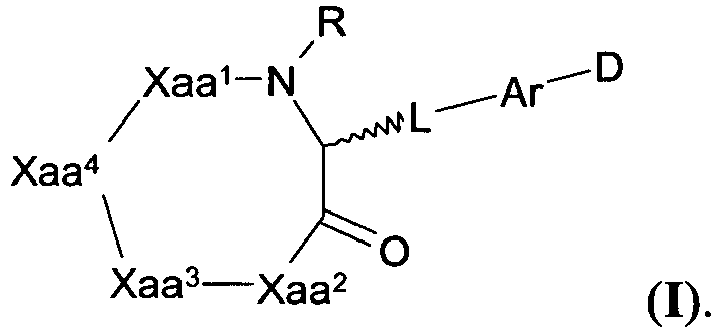
- The compounds of the invention are believed to be capable of binding to the seven transmembrane G-protein coupled chemokine receptor CXCR4 with high affinity and are thus considered CXCR4 ligands. They may act as antagonists, agonists or inverse agonists.
- The interaction between CXCR4 and its natural ligand α-chemokine stromal-derived factor (SDF-1α/ CXCL12) is a key factor in diverse bodily functions. Starting at the beginning of life with normal stem cell trafficking during embryogenesis it is also responsible for normal cardiovascular, hematopoietic and brain development as well as functions in the nervous and immune system.
- The CXCR4 receptor has been found to be involved in a variety of diseases. For example, it mediates HIV-1 entry into T-cells as a co-receptor where it was first identified. Furthermore, in rheumatoid arthritis (RA) CXCR4 expressing CD4+ memory T cells accumulate in the inflamed synovium because of the high local CXCL12 concentration. Additionally CXCR4 is overexpressed on numerous different tumor cell types ranging from melanoma over prostate and pancreatic cancer to brain tumor cells.
- Coronary heart disease has become a leading cause of death worldwide. The pathologic basis for coronary heart disease (CHD) is the growth of atherosclerotic plaques in the vascular wall over a period of many years resulting in bloss-flow-limiting stenosis or plaques disruption with acute thrombotic occlusion (Ross, 1993; Libby, 2002; Hansson 2005). Substantial evidence supports the concept that chronic inflammation of the vessel wall characterized by the influx of circulating immune cells is responsible for the development of atherosclerotic lesions (Schober et al., 2008).
- In the pathogenesis of atherosclerosis, chronic inflammation of the arterial wall characterized by chemokine-mediated influx of leukocytes plays a central role. The cytokine macrophage migration inhibitory factor (MIF) is a unique pro-inflammatory regulator of many acute and chronic inflammatory diseases that contribute to lesion progression and plaque inflammation. These chemokine-like functions are mediated through interaction of MIF with the chemokine receptors CXCR2 and CXCR4, thus demonstrating the role of CXCR4 in native atherosclerosis, plaque destabilization and aneurysm formation.
- Via binding of MIF, CXCR4 and other chemokine receptors, like CXCR2 play a role in atherosclerotic plaque development, vascular remodeling after injury, in atherosclerosis plaque destabilization and aneurysm formation (Schober et al., 2008).
- Like chemokines, the interaction of MIF with the chemokine receptors CXCR2 and CXR4 as a noncanonical ligand induces recruitment of monocytes and T cells to atherosclerotic lesions, Furthermore, MIF regulates smooth muscle cell migration and proliferation, which may promote lesion growth. Increased foam-cell transformation of lesional macrophages and enhanced degradation of extracellular matrix proteins by MIF contribute to the progression into an unstable plaque phenotype. These data were largely confirmed in a study using human specimens from patients undergoing heart transplantation, carotis endarterectomy, or from autopsied individuals (Burger-Kentischer et al, 2002).
- Accordingly, due to their potential use for medicinal applications, a variety of peptidic and non-peptidic CXCR4 antagonists have been developed. One example is the bicyclam AMD3100 (plerixafor)

WO 2007/096662 ). However, no aromatic spacers between a linker attached to a cyclopeptide and a detectable label are described. Besides, certain multimeric and in particular dimeric compounds of such cyclized pentapeptides have been described, wherein a spacer moiety between the monomeric ligands is selected such that the ligands are spaced apart to avoid an interference between both ligands. (WO 2009/027706 ). - Barry et al. describes cyclic RGD peptides labeled with a DOTA as chelator coupled via a non aromatic spacer moiety, wherein the spacer moiety is attached to the cyclic RGD peptide with a (-CH2)4NH-group (Barry et al, 2009).
- Also known are radiolabeld cyclic polypeptides, which use non-aromatic heterocycles as spacer moiety (
WO 2009/134382 ). - Further known is cyclo (Arg-Nal-Gly-D-Tyr-Orn(FB)), wherein Orn(FB) is a N-fluorobenzyl substituted ornithine residue for use as CXCR4 detectable ligand (
WO 2007/096662 ). - So far, therapeutic potential of CXCR4 ligands, such as antagonists, has been shown e.g. for the treatment of HIV infection, cancer, and rheumatoid arthritis. Other antiinflammatory uses of CXCR4 ligands have been described for asthma and multiple sclerosis. Furthermore, CXCR4 ligands can mobilize stem cells, e.g. for stem cell transplantations. Moreover, attenuation of pain has been observed (in rodents) by a specific CXCR4 ligand. In addition CXCR4 ligands are also discussed for the treatment of neurological diseases.
- CXCR4 ligands comprising additional moieties may be particularly suitable in the treatment of the above diseases. Examples for the latter ligands include but are not limited to those comprising cytotoxic, (oligo)nucleotide, radioactive, and (radio)metal-chelate moieties or combinations thereof. The general concepts pursued with such moieties are known from certain other peptidic and peptidomimetic ligands.
- In addition to the therapeutic potential of CXCR4 ligands, their affinity towards the receptor may be used for other applications. These include but are not limited to the imaging of CXCR4 receptors, e.g. for the diagnosis of related diseases or the visualization of CXCR4 and CXCR4 containing tissue, as well as affinity purification of CXCR4 receptors. In most of these cases, the CXCR4 ligands are modified with additional (functional) moieties and/or moieties that immobilize the CXCR4 ligands.
- However, the attachment of such additional moieties to the CXCR4 ligands may result in that the ligands substantially loose their affinity to the CXCR4 receptor. Therefore, there is a need in the art to develop new CXCR4 ligands, particularly ligands having high affinity to CXCR4, more particularly such ligands that allow the introduction of additional (functional) moieties while retaining sufficient affinity to the CXCR4 receptor.
- The present invention provides such new CXCR4 ligands and their uses in medicinal and scientific applications as well as such ligands comprising additional (functional) moieties and their uses in medicinal and scientific applications.
- The compounds of the invention are considered capable of binding to CXCR4 and, hence, are considered CXCR4 ligands. They may be capable of functioning as CXCR4 antagonists, agonists or inverse agonists. Generally, they are based on the peptide backbone structure of FC131. However, as opposed to the compounds known from the prior art, compounds of the present invention comprise a particular linker and further moieties. These advantageously enable e.g. various imaging applications referred to herein. Surprisingly, compounds of the invention are shown herein to have high affinity to the CXCR4 receptor despite the attachment of said linker and additional moieties such as a detectable label. As shown herein, surprisingly, compounds of the invention are considered particularly suitable for medical applications such as imaging and therapeutic applications, such as endoradiotherapy.
- The present invention provides compounds, compositions, uses and methods as defined in the claims. In one aspect, the present invention thus provides a compound, or a pharmaceutically acceptable salt thereof, having a structure according to formula I

- wherein Xaa1 is D-tyrosine, Xaa2 is arginine, Xaa3 is naphthylalanine (Nal) and Xaa4 is glycine,
- R is H or methyl,
- L has the formula -(CH2)3- NH-,
- and Ar is selected from the group consisting of


- and D is
- i) DOTA, or
- ii) a combination of a Ga-atom and DOTA.
- Disclosed are methods for preparing the above mentioned compounds. The invention also relates to compositions, methods and uses related to said compounds as defined in the claims.
-
-
FIG 1 shows an analysis of cell tests for CPCR4-2 with GraphPad-Prism 4. -
FIG 2 shows an exemplary radio-TLC profile underTLC condition 1; start (at 1 cm): Ga-CPCR4-2, 98.18 % purity, non-complexed Ga-68 at the front (8-9cm): 1.78 % -
FIG 3 shows an exemplary radio-TLC profile underTLC condition 2; start (at 1 cm): non-complexed Ga-68, 3.89%, at the front Ga-CPCR4-2 (4.5 - 6.5 cm): 96.11% purity. -
FIG 4 shows biodistribution of [68Ga]CPCR4-2 in A431 tumor bearing CD1 nu/nu mice at 1 h p.i. -
FIG 5 shows tumor-to-organ ratios of yorn'(AMBS-[68Ga]DOTA) RNalG (A431 tumor bearing CD-1 nude, 60 min p.i., n = 3-5. -
FIG 6 shows biodistribution of [125I]yorn'(AMBS-DOTA(Ga))RNalG ([125 I]Ga-CPCR4-2) in HT-29 tumor bearing CD1 nu/nu mice at 60 min p.i., n = 4. -
FIG 7 shows tumor-to-organ ratios of [125I]yorn'(AMBS-DOTA(Ga))RNalG (HT-29 tumor bearing CD1 nude mice, 60 min p.i., n = 4). -
FIG 8 shows biodistribution of [68Ga]CPCR4-2 in OH-1 tumor bearing CD1 nu/nu mice at 1 h p.i. -
FIG 9 shows ROI quantification of [68Ga]CPCR4-2 activity levels in OH-1 tumor, muscle and background. -
FIG 10 shows PET imaging of OH-1 tumor bearing CD1 nu/nu mouse using [68Ga]CPCR4-2. -
FIG 11 shows SPECT imaging of OH-1 tumor bearing CD1 nu/nu mouse using [177Lu]CPCR4-2. -
FIG 12 shows biodistribution of yorn'(AMBS-[68Ga]DOTA)RNalG ([68Ga]CPCR4-2) in PC-3 tumor bearing CD1 nu/nu mice at 60 min p.i., n = 4. -
FIG 13 shows tumor-to-organ ratios of yorn'(AMBS-[68Ga]DOTA)RNalG (PC-3 tumor bearing CD1 nude mice, 60 min p.i., n = 3-4. -
FIG 14 shows biodistribution of yorn'(AMBS-[68Ga]DOTA)RNalG ([68Ga]CPCR4-2) in SKBR3 tumor bearing CD1 nu/nu mice at 60 min p.i., n = 4. -
FIG 15 shows tumor-to-organ ratios of yorn'(AMBS-[68Ga]DOTA)RNalG (SKBR3 tumor bearing CD1 nude mice, 60 min p.i., n = 3-4. Results are expressed as tumor-to-organ ratio. -
FIG 16 shows biodistribution of [68Ga]CPCR4-2 in SUDHL4 tumor bearing CD1 nu/nu mice. -
FIG 17 shows 68Ga-CPCR4-2.1: imaging in OH-1 tumor bearing mice.FIG 17A shows PET imaging, 1h post injection of the 68Ga-CPCR4-2.1 andFIG 17B shows PET imaging of an OH-1 bearing mouse, 1h post injection of 68Ga-CPCR4-2.1 in the presence of an excess of cold CPCR4 peptide. -
FIG 18 shows another example of 68Ga-CPCR4-2.1 imaging in OH-1 tumor bearing mice. -
FIG 18A shows PET imaging, 1h post injection of the 68Ga-CPCR4-2.1 andFIG 18B shows PET imaging of an OH-1 bearing mouse, 1h post injection of 68Ga-CPCR4-2.1 in the presence of an excess of cold CPCR4 peptide. - The present invention provides compounds, compositions, uses and methods as defined in the claims.
- As far as the structural units -Xaa1-, -Xaa2-, -Xaa3- and -Xaa4- are concerned, the general structure -Xaa- is denoted to encompass natural as well as unnatural amino acids, optionally being substituted at the alpha nitrogen (N-alpha) of said amino acid with an alkyl group, such as a methyl group or ethyl group.
- In this context, the term "alkyl group" preferably refers to a linear or branched, optionally substituted, saturated aliphatic chain of preferably 1 to 12, more preferably 1 to 8, and more preferably 1 to 6 carbon atoms and includes, but is not limited to, optionally substituted methyl, ethyl, propyl, isopropyl, n-butyl, sec-butyl, tert-butyl, pentyl, isopentyl, and hexyl. The alkyl group may be interrupted by one or more heteroatoms, cyclic groups and/or heterocyclic groups. The term "substituted" as used in this context preferably refers to alkyl groups being substituted in any position by one or more substituents, preferably by 1, 2, 3, 4, 5 or 6 substituents, more preferably by 1, 2, or 3 substituents. If two or more substituents are present, each substituent may be the same or may be different from the at least one other substituent. Suitable substituents are known to the skilled person. A substituent may be, for example, a halogen atom, a hydroxy, an amino group or an alkoxy group. In this context, the term "alkoxy" preferably represents a linear or branched alkyl group, preferably having from 1 to 6 carbon atoms attached to an oxygen atom. Typical alkoxy groups include methoxy, ethoxy, propoxy, isopropoxy, butoxy, t-butoxy, pentoxy, and the like. The term "halogen atom" preferably refers to a chlorine, iodine, bromine or fluorine atom. Preferred halogen atoms are fluorine and/or chlorine atoms.
- The term "natural amino acid" refers to naturally occurring amino acids or residues which typically occur in proteins including their stereoisomeric forms. Natural amino acids include alanine (Ala), arginine (Arg), asparagine (Asn), aspartic acid (Asp), cysteine (Cys), glutamine (Gln), glutamic acid (Glu), glycine (Gly), histidine (His), isoleucine (Ile), leucine (Leu), lysine (Lys), methionine (Met), phenylalanine (Phe), proline (Pro), serine (Ser), threonine (Thr), tryptophan (Trp), tyrosine (Tyr) and valine (Val).
- The term unnatural amino acid includes any conceivable amino acid. This term includes amino acids bearing a side chain comprising acidic, basic, neutral and/or aromatic moieties. Conceivable amino acids to be mentioned are, for example, azetidinecarboxylic acid, 2-aminoadipic acid, 3-aminoadipic acid, beta-alanine, aminopropionic acid, 2-aminobutyric acid, 4-aminobutyric acid, 6-aminocaproic acid, 2-aminoheptanoic acid, 2-aminoisobutyric acid, 3-aminoisobutyric acid, 2-aminopimelic acid, 2,4-diaminoisobutyric acid, desmosine, 2,2'-diaminopimelic acid, 2,3-diaminopropionic acid, N-ethylglycine, N-ethylasparagine, hydroxylysine, allo-hydroxylysine, 3-hydroxyproline, 4-hydroxyproline, isodesmosine, allo-isoleucine, N-methylglycine, N-methylisoleucine, N-methylvaline, norvaline, norleucine, ornithine, naphthylalanine, diaminopropionic acid, N-(fluoropropionyl)-diaminobutyric acid, N-fluorobenzoyl-diaminobutyric acid, N-fluorobenzoyl-diaminopropionic acid, citrulliune and pipecolic acid.
- As regards the general amino acid abbreviations Xaa1, Xaa2, Xaa3, Xaa4, said abbreviations encompass the L-enantiomer as well as the respective D-enantiomers.
- Xaa1 is is D-tyrosine.
- The term residues refers to building blocks being incorporated in the cyclic pentapeptide having the structure:

- R1 in the above shown structure is a hydrogen atom or an alkyl group, preferably a hydrogen atom or a methyl group, in particular a hydrogen atom.
- In this context of the present invention, the term "halogen" or "halogen atom" preferably refers to a chlorine, iodine, bromine or fluorine atom and the respective radioactive and non-radioactive isotopes. Thus, the term halogen is, for example, selected from the group consisting of Cl Br, I, 127I, 123I, 120I, 124I, 125I, 131I, 75Br, 76Br, 77Br, 18F and 19F and 34Cl. Preferred halogen atoms are fluorine and/or iodine atoms. The term halogen also includes the respective isotopes of these atoms. Thus, in case the S1 comprises an aryl group or heteroaryl being substituted at at least one position with an iodine, the iodine may be selected from the group consisting of 127I, 123I, 120I, 124I, 125I, and 131I. In case S1 comprises an aryl group or heteroaryl being substituted at at least one position with a fluorine atom, the fluorine atom may be selected from the group consisting of 18F and 19F.
- The term "alkyl chain" and the term "alkyl", as used in this context of the invention preferably refers to alkyl chains or alkyl groups of 1 to 20 carbon atoms, preferably of 1 to 10 carbon atoms, more preferably of 1 to 8 carbon atoms, most preferably of 1 to 6 carbon atoms, such as for example, 1, 2, 3, 4, 5 or 6 carbon atoms. The alkyl chains or alkyl groups, respectively, may be branched or unbranched, substituted or unsubstituted, and may be interrupted by one or more heteroatoms, cyclic groups and/or heterocyclic groups.
- An amino acid may have multiple asymmetric centers. As a consequence, the resulting cyclopeptides may occur as racemates, mixtures of enantiomers and as individual enantiomers, as well as diastereomers and mixtures of diastereomers. All asymmetric forms, possible stereoisomers, single isomers and mixtures of isomers are included within the scope of the present invention. The designation "" shown in formulas (III) and (III') above refers to a bond to which the stereochemistry is not specifically designated.

- The term "enantiomerically pure" as used in the context of the present invention refers to compounds having an enantiomeric excess of at least 95 % (i.e.
minimum 97,5 % of one enantiomer and maximum 2,5% of the other enantiomer) up to an enantiomeric excess of 100% (i.e. 100% of one enantiomer and none of the other), in particular compounds having an enantiomeric excess of at least 98 %, more in particular having an enantiomeric excess of at least 99.% and most in particular having an enantiomeric excess of at least 99.9 %, especially of 100 %. - According to the invention, Xaa1 is D-tyrosine. Thus, the present invention also relates to a compound having the general structure:
- or

- Xaa2 is arginine.
- The term "basic amino acid" refers to any amino acid having a basic residue such as a primary, secondary or tertiary amine, or a cyclic nitrogen containing ring and their respective isomeric forms. Basic preferably means a group, which has a net positive charge at
pH 6 or lower in aqueous solvents. Naturally occurring basic amino acids or residues which typically occur in proteins include arginine (Arg), histidine (His) and lysine (Lys). - The term unnatural basic amino acid includes any conceivable basic amino acid, thus this term includes amino acids comprising at least one basic moiety in its side chain.
- Xaa2 is L-arginine or D-arginine, in particular L-arginine.


- Xaa3 is is naphthylalanine (Nal).
- The term aromatic moiety as used in this context of the invention, refers to an optionally substituted aryl group and/or optionally substituted heteroaryl group, with the terms , terms "aryl" and "substituted aryl", "heteroaryl" and "substituted heteroaryl" being as defined above.
- Xaa3 is L-naphthylalanine (Nal) or D-naphthylalanine (D-Nal).
- Since Xaa3 is Nal, e.g. the following structures are conceivable:

- Thus according to a particular preferred embodiment, the present invention relates to a compound having the structure:


- Xaa4 is glycine. Thus, the invention particularly also relates to compounds having the following structure:
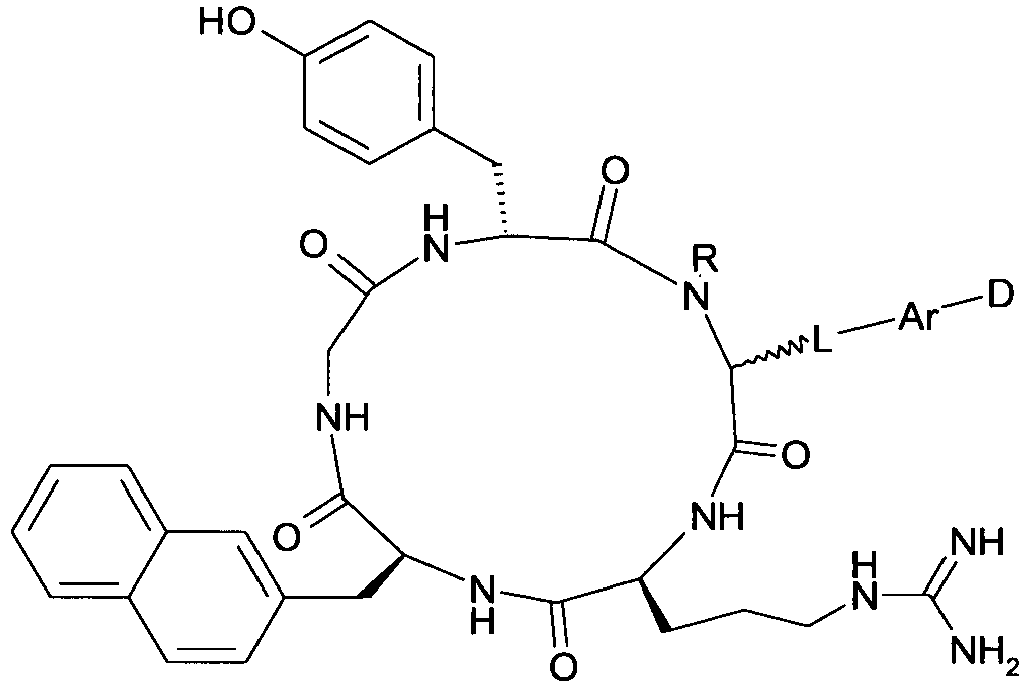
- As regards residue R, this residue is a methyl group or a hydrogen, preferably a methyl group.
- L has the formula -(CH2)3- NH-,
L has the following structure:
- Ar is selected from the group consisting of


- The term aromatic moiety if used in the context of the invention, refers to an optionally substituted aryl group and/or heteroaryl group, wherein the term "aryl", in turn, refers to, but is not limited to, optionally suitably substituted 5- and 6-membered single-ring aromatic groups as well as optionally suitably substituted multicyclic groups, for example bicyclic or tricyclic aryl groups. The term "aryl" thus includes, for example, optionally substituted phenyl groups or optionally suitably substituted naphthyl groups. Aryl groups can also be fused or bridged with alicyclic or heterocycloalkyl rings which are not aromatic so as to form a polycycle, e.g., benzodioxolyl or tetraline. The term heteroaryl includes optionally suitably substituted 5- and 6-membered single-ring aromatic groups as well as substituted or unsubstituted multicyclic aryl groups, for example tricyclic or bicyclic aryl groups, comprising one or more, preferably from 1 to 4 such as 1, 2, 3 or 4, heteroatoms, wherein in case the aryl residue comprises more than 1 heteroatom, the heteroatoms may be the same or different. Such heteroaryl groups including from 1 to 4 heteroatoms are, for example, benzodioxolyl, pyrrolyl, furanyl, thiophenyl, thiazolyl, isothiaozolyl, imidazolyl, triazolyl, tetrazolyl, pyrazolyl, oxazolyl, isoxazolyl, pyridinyl, pyrazinyl, pyridazinyl, benzoxazolyl, benzodioxazolyl, benzothiazolyl, benzoimidazolyl, benzothiophenyl, methylenedioxyphenylyl, naphthridinyl, quinolinyl, isoquinolinyl, indolyl, benzofuranyl, purinyl, benzofuranyl, deazapurinyl, or indolizinyl.
- The term "substituted aryl" and the term "substituted heteroaryl" if used in the context of the present invention describes moieties having substituents replacing a hydrogen on one or more atoms, e.g. C or N, of an aryl or heteroaryl moiety. There are in general no limitations as to the substituent. The substituents may be, for example, selected from the group consisting of alkyl, alkenyl, alkynyl, halogen, hydroxyl, alkylcarbonyloxy, arylcarbonyloxy, alkoxycarbonyloxy, aryloxycarbonyloxy, carboxylate, alkylcarbonyl, arylcarbonyl, alkoxycarbonyl, aminocarbonyl, alkylaminocarbonyl, dialkylaminocarbonyl, alkylthiocarbonyl, alkoxy, phosphate, phosphonato, phosphinato, amino, acylamino, including alkylcarbonylamino, arylcarbonylamino, carbamoyl and ureido, amidino, nitro, imino, sulfhydryl, alkylthio, arylthio, thiocarboxylate, sulfates, alkylsulfinyl, sulfonate, sulfamoyl, sulfonamido, trifluoromethyl, cyano, azido, heterocyclyl, alkylaryl, morpholino, piperizinyl, cyclopentanyl, cyclohexanyl, and piperidinyl.
- Thus, the present invention also relates to a compound having the following structure:

- D is
- i) DOTA, or
- ii) a combination of a Ga-atom and DOTA.
- The compound D may also be referred to herein as "D" or "further compound D".
- In certain preferred embodiments, the radionuclide is a Ga radionuclide. The combination is Ga with DOTAIn an additional aspect of the invention, Ga is not a radionuclide, such as any non-radioactive isotope.
- In preferred embodiments of the invention the detectable label is a radionuclide selected from the group consisting of 66Ga, 68Ga, and 67Ga,.
- "Active substances" are well-known to the skilled person. The term "active substance" as used in the context of the present invention preferably refers to substances selected from the group consisting of cytotoxic agents, lipids, sugars, sugar conjugates, sugar derivatives, proteins and combinations thereof. In certain preferred embodiment, the active substance is a cytotoxic agent. In certain embodiments, the active substance is a radionuclide, particularly a radionuclide disclosed herein. In other preferred embodiments, the active substance is selected from sugars, sugar conjugates, sugar derivatives, proteins and combinations thereof, or is a lipid.
- "Cytotoxic agents", which may also be referred to herein as "cytotoxic moieties" or "cytotoxic compounds", are well known to the skilled person. They include the cytotoxic compounds disclosed hereinbelow, particularly the radionuclides disclosed hereinbelow. Also lipids, sugars, sugar conjugates, sugar derivatives, and proteins, all of which are well-known to the skilled person, are not particularly limited. Preferably, the protein is an enzyme or an antibody.
- The term "detectable label" as used herein refers to any label which provides directly or indirectly a detectable signal.
- For example, the label may be detectable without the addition of further reagents, such as by means of an output of detectable electromagnetic radiation or other nuclear radiation from the label itself, or as a result of its magnetic or paramagnetic properties. The label may also be detectable upon addition of one or more further reagent(s). A person skilled in the art will readily select said further reagent(s) in dependence of the label.
- The detectable label is preferably a moiety being suitable for imaging and/or assaying, for example, for identifying, diagnosing, evaluating, detecting and/or quantitating, in vivo or in vitro, in particular for in vivo or in vitro detection via radioscintigraphy, magnetic resonance imaging (MRI), chemiluminescence, near infrared luminescence, gamma imaging, magnetic resonance spectroscopy, fluorescence spectroscopy, SPECT, computed tomography (CT scan), positron emission tomography (PET) or methods for optical tomography.
- Suitable detectable labels include, for example, radiolabels, such as radioisotopes, radionuclides, isotopes, enzymes, enzyme substrates or co-factors, enzyme inhibitors, magnetic or paramagnetic moieties or particles, fluorescent groups, biotin (in conjunction with streptavidin complexation), radiolabels in conjugation with organic complexation agents, photo affinity groups, or enzymes and substrates for bioluminescent imaging, such as firefly luciferase and L-luciferin as the substrate, or combinations thereof.
- "Fluorescent labels" or "fluorescent groups" include, but are not limited to NBD (7-nitro-1,2,3-benzoxadiazole), Texas red, phycoerythrin (PE), Cy5, Cy 5.5, cytochrome c, and fluoresceine isothiocyanate (FITC).
- "Magnetic or paramagnetic moieties or particles" include, but are not limited to MR contrast agents, e.g. chelates of paramagnetic, ferromagnetic, or diamagnetic metal ions, or magnetic particles. One specific example for a paramagnetic label is gadolinium (Gd) and chelates thereof.
- According to preferred embodiments of the present invention, in case the compound of formula (I) comprises a detectable label, said detectable label is preferably a radiolabel or an organic complexation agent or a combination of a radiolabel and an organic complexation agent thereof.
- According to the invention, said radiolabel is a radionuclide selected from the group consisting of 66Ga, 68Ga, and 67Ga, especially 68Ga.
- "Radionuclide" and "radioisotope" are used interchangeably herein. A "radionuclide" as used herein may e.g. be a radiolabel or a cytotoxic moiety.
- The term "organic complexation agent" refers to a chelating agent, preferably capable of complexing at least one radionuclide.
- As regards complexation agents, reference is made to
WO 2009/109332 ,pages 9 to 14, and the respective metal chelators disclosed therein as well as toWO 97/31657 - According to the present invention, the organic complexation agent is a DOTA.
- CBTE2a stands for bis(carboxymethyl)-1,4,8,11-tetraazabicyclo[6.6.2]hexadecane,
CDTA stands forcyclohexyl 1,2-diamine tetraacetic acid,
CPTA stand for [4-(1,4,8,11-tetraazacyclotetradec-1-yl)-methyl benzoic
acid] hydrochloride,
DFO stands for N'-[5-[acetyl(hydroxy)amino]pentyl]-N-[5-[[4-[5-aminopentyl(hydroxy) amino]-4-oxobutanoyl]amino]pentyl]-N-hydroxybutanediamide,
DO2A stands for 4,11-bis(carboxymethyl)-1,4,8,11-tetraazabicyclo[6.6.2]hexadecane.
DOTA stands for 1,4,7,10-tetracyclododecane-N,N',N",N"', tetraacetic acid,
DPDP stands for (N,N'-dipyridoxylethylenediamine-N,N'-diacetate-5,5'-bis(phosphate),
DTPA stands for dietehylenetriaminepentaacetic acid,
EDTA stands for ethylenediamine-N,N'-tetraacetic acid,
EGTA stands ethyleneglycol-O,O-bis (2-aminoethyl), N, N, N', N' tetraacetic acid,
HBED stands for N, N-bis (hydroxybenzyl)-ethylenediamine-N,N'-diacetic acid,
HEDTA stands for hydroxyethylediamine triacetic acid,
HP-DOA3 stands for 1-(p-nitrobenzyl)-1,4,710-tetraazacyclodecane-4,7,10-triacetate,
HYNIC stands for 6-hydrazinyl-N-methylpyridine-3-carboxamide,
NODASA stands for 1,4,7-Triazacyclononane-1-succinic acid-4,7-diacetic acid,
NODAGA stands for 1-(1-Carboxy-3-carboxypropyl)-4,7-(carbooxy)-1,4,7-triazacyclononane,
NOTA stands for 1,4,7-triazacyclononanetriacetic acid,
TE2A stands for 4,11-bis(carboxymethyl)-1,4,8,11-tetraazabicyclo[6.6.2]hexadecane,
TETA stands for 1,4,8,11-tetraazacyclododecane-1,4,8,11-tetraacetic acid,
TMT stands for terpyridine-bis(methylenaminetetraacetic acid,
TRITA stands for 1,4,7,10-tetraazacyclotridecane-N,N',N",N"'-tetraacetic acid,
TTHA stands for triethylene tetraamine hexaacetic acid. - Organic complexation agent can be macrocyclic chelating agents, for example, a porphyrin-like molecule, a pentaaza-macrocycle as described by Zhang et al., 1998, a phthalocyanine, a crown ether, e.g. a nitrogen crown ether such as the sepulchrates, or crypates.
- A further organic complexation agent is a NtS(4-t) chelating agents, such as the chelating agents described on
page 8 topage 9 inWO 97/31657 - Examples of chelators are further described in the international patent application
WO 89/07456 - According to the invention, the organic complexation agent is DOTA.

- Specific embodiments are 66Ga with DOTA, 68Ga with DOTA, and 67Ga with DOTA.
- In the following tables I to V, structures are mentioned by way of example, wherein the following abbreviations are used (compounds/moieties designated as "*" are not according to the invention):

Ar-groups 1 to 6 Linker group L: 


Table I Structure L Ar R D 1 Structure 1 Selected from the group consisting of L1*, L2, and L3* Ar2 H DOTA 2 Structure 1 Selected from the group consisting of L1*, L2, and L3* Ar2 H DOTA-Ga-complex 3 Structure 1 Selected from the group consisting of L1*, L2, and L3* Ar2 H DOTA-In-complex* 4 Structure 1 Selected from the group consisting of L1*, L2, and L3* Ar1 H DOTA 5 Structure 1 Selected from the group consisting of L1*, L2, and L3* Ar1 H DOTA-Ga-complex 6 Structure 1 Selected from the group consisting of L1*, L2, and L3* Ar1 H DOTA-In-complex* 7 Structure 1 Selected from the group consisting of L1*, L2, and L3* Ar4 H DOTA 8 Structure 1 Selected from the group consisting of L1*, L2, and L3* Ar4 H DOTA-Ga-complex 9 Structure 1 Selected from the group consisting of L1*, L2, and L3* Ar4 H DOTA-In-complex* 10 Structure 1 L1* Selected from the group consisting of Ar1, Ar2, Ar3, Ar4, Ar5 and Ar6 H DOTA 11 Structure 1 L1* Selected from the group consisting of Ar1, Ar2, Ar3, Ar4, Ar5 and Ar6 H DOTA-Ga-complex 12 Structure 1 L1* Selected from the group consisting of Ar1, Ar2, Ar3, Ar4, Ar5 and Ar6 H DOTA-In-complex* 13 Structure 1 L2 Selected from the group consisting of Ar1, Ar2, Ar3, Ar4, Ar5 and Ar6 H DOTA 14 Structure 1 L2 Selected from the group consisting of Ar1, Ar2, Ar3, Ar4, Ar5 and Ar6 H DOTA-Ga-complex 15 Structure 1 L2 Selected from the group consisting of Ar1, Ar2, Ar3, Ar4, Ar5 and Ar6 H DOTA-In-complex* Table II Structure L Ar R D 1 Structure 1 Selected from the group consisting of L1*, L2, and L3* Ar2 Me DOTA 2 Structure 1 Selected from the group consisting of L1*, L2, and L3* Ar2 Me DOTA-Ga-complex 3 Structure 1 Selected from the group consisting of L1*, L2, and L3* Ar2 Me DOTA-In-complex* 4 Structure 1 Selected from the group consisting of L1*, L2, and L3* Ar1 Me DOTA 5 Structure 1 Selected from the group consisting of L1*, L2, and L3* Ar1 Me DOTA-Ga-complex 6 Structure 1 Selected from the group consisting of L1*, L2, and L3* Ar1 Me DOTA-In-complex* 7 Structure 1 Selected from the group consisting of L1*, L2, and L3* Ar4 Me DOTA 8 Structure 1 Selected from the group consisting of L1*, L2, and L3* Ar4 Me DOTA-Ga-complex 9 Structure 1 Selected from the group consisting of L1*, L2, and L3* Ar4 Me DOTA-In-complex* 10 Structure 1 L1* Selected from the group consisting of Ar1, Ar2, Ar3, Ar4, Ar5 and Ar6 Me DOTA 11 Structure 1 L1* Selected from the group consisting of Ar1, Ar2, Ar3, Ar4, Ar5 and Ar6 Me DOTA-Ga-complex 12 Structure 1 L1* Selected from the group consisting of Ar1, Ar2, Ar3, Ar4, Ar5 and Ar6 Me DOTA-In-complex* 13 Structure 1 L2 Selected from the group consisting of Ar1, Ar2, Ar3, Ar4, Ar5 and Ar6 Me DOTA 14 Structure 1 L2 Selected from the group consisting of Ar1, Ar2, Ar3, Ar4, Ar5 and Ar6 Me DOTA-Ga-complex 15 Structure 1 L2 Selected from the group consisting of Ar1, Ar2, Ar3, Ar4, Ar5 and Ar6 Me DOTA-In-complex* Table III Structure L Ar R D 1 Structure 2 Selected from the group consisting of L1*, L2, and L3* Ar2 H DOTA 2 Structure 2 Selected from the group consisting of L1*, L2, and L3* Ar2 H DOTA-Ga-complex 3 Structure 2 Selected from the group consisting of L1*, L2, and L3* Ar2 H DOTA-In-complex* 4 Structure 2 Selected from the group consisting of L1*, L2, and L3* Ar1 H DOTA 5 Structure 2 Selected from the group consisting of L1*, L2, and L3* Ar1 H DOTA-Ga-complex 6 Structure 2 Selected from the group consisting of L1*, L2, and L3* Ar1 H DOTA-In-complex* 7 Structure 2 Selected from the group consisting of L1*, L2, and L3* Ar4 H DOTA 8 Structure 2 Selected from the group consisting of L1*, L2, and L3* Ar4 H DOTA-Ga-complex 9 Structure 2 Selected from the group consisting of L1*, L2, and L3* Ar4 H DOTA-In-complex* 10 Structure 2 L1* Selected from the group consisting of Ar1, Ar2, Ar3, Ar4, Ar5 and Ar6 H DOTA 11 Structure 2 L1* Selected from the group consisting of Ar1, Ar2, Ar3, Ar4, Ar5 and Ar6 H DOTA-Ga-complex 12 Structure 2 L1* Selected from the group consisting of Ar1, Ar2, Ar3, Ar4, Ar5 and Ar6 H DOTA-In-complex* 13 Structure 2 L2 Selected from the group consisting of Ar1, Ar2, Ar3, Ar4, Ar5 and Ar6 H DOTA 14 Structure 2 L2 Selected from the group consisting of Ar1, Ar2, Ar3, Ar4, Ar5 and Ar6 H DOTA-Ga-complex 15 Structure 2 L2 Selected from the group consisting of Ar1, Ar2, Ar3, Ar4, Ar5 and Ar6 H DOTA-In-complex* Table IV Structure L Ar R D 1 Structure 2 Selected from the group consisting of L1*, L2, and L3* Ar2 Me DOTA 2 Structure 2 Selected from the group consisting of L1*, L2, and L3* Ar2 Me DOTA-Ga-complex 3 Structure 2 Selected from the group consisting of L1*, L2, and L3* Ar2 Me DOTA-In-complex* 4 Structure 2 Selected from the group consisting of L1*, L2, and L3* Ar1 Me DOTA 5 Structure 2 Selected from the group consisting of L1*, L2, and L3* Ar1 Me DOTA-Ga-complex 6 Structure 2 Selected from the group consisting of L1*, L2, and L3* Ar1 Me DOTA-In-complex* 7 Structure 2 Selected from the group consisting of L1*, L2, and L3* Ar4 Me DOTA 8 Structure 2 Selected from the group consisting of L1*, L2, and L3* Ar4 Me DOTA-Ga-complex 9 Structure 2 Selected from the group consisting of L1*, L2, and L3* Ar4 Me DOTA-In-complex* 10 Structure 2 L1* Selected from the group consisting of Ar1, Ar2, Ar3, Ar4, Ar5 and Ar6 Me DOTA 11 Structure 2 L1* Selected from the group consisting of Ar1, Ar2, Ar3, Ar4, Ar5 and Ar6 Me DOTA-Ga-complex 12 Structure 2 L1* Selected from the group consisting of Ar1, Ar2, Ar3, Ar4, Ar5 and Ar6 Me DOTA-In-complex* 13 Structure 2 L2 Selected from the group consisting of Ar1, Ar2, Ar3, Ar4, Ar5 and Ar6 Me DOTA 14 Structure 2 L2 Selected from the group consisting of Ar1, Ar2, Ar3, Ar4, Ar5 and Ar6 Me DOTA-Ga-complex 15 Structure 2 L2 Selected from the group consisting of Ar1, Ar2, Ar3, Ar4, Ar5 and Ar6 Me DOTA-In-complex* - Particularly preferred compounds of the present invention are selected from the group of compounds consisting of:
- yorn'(ABS, DOTA)RNalG, yorn'(ABS, DOTA, Ga)RNalG, yorn'(AMBS, DOTA)RNalG ("CPCR4-2"), yorn'(AMBS, DOTA, Ga)RNalG ("Ga-CPCR4-2"), yorn'(ABS, G, DOTA)RNalG, yorn'(ABS, G, DOTA, Ga)RNalG, yorn'(ABS, betaAla, DOTA)RNalG,
- yorn'(ABS, betaAla, DOTA, Ga)RNalG, yorn'(ABS, ABuS, DOTA)RNalG, yorn'(ABS, ABuS, DOTA, Ga)RNalG, yorn'(ABS, AVS, DOTA)RNalG, yorn'(ABS, AVS, DOTA, Ga)RNalG, yorn'(ABS, Ahx, DOTA)RNalG, yorn'(ABS, Ahx, DOTA, Ga)RNalG (see abbreviations below).
- Particularly preferred examples include yorn'(AMBS, DOTA, Ga)RNalG ("Ga-CPCR4-2"), yorn'(ABS, DOTA, Ga)RNalG and yorn'(ABS, G, DOTA, Ga)RNalG,
Among those, yorn'(AMBS, DOTA, Ga)RNalG ("Ga-CPCR4-2")is especially preferred. - DCM: Dichloromethane, RP-HPLC: Reversed Phase High Pressure Liquid Chromatography, TFA: Trifluoroacetic acid, NMR: Nuclear Magnetic Resonance, THF: Tetrahydrofuran, EtOAc: Ethylacetate, RT: room temperature, Boc: tert-butyloxycarbonyl, DIEA: Diisopropylethylamine, MeOH: methanol, NMP: N-methyl-pyrollidone, DPPA: Diphenylphosphoryl azide, DMF: N,N-dimethylformamide, Ac: acetate, Fmoc: Fluorenylmethyloxycarbonyl, Alloc: Allyloxycarbonyl, Xaa: undefined amino acid, SPPS: Solid Phase Peptide Synthesis, Orn: ornithine, Nal: L-3-(2-naphthyl)alanine, R(Pbf): arginine with Pbf protected side chain, Tyr(tBu): tyrosine with tBu protected side chain, Fmoc-Tyr(tBu): tyrosine with tBu protected side chain and Fmoc protected Nα, ABA/ABS: 4-aminobenzoic acid, AMBA/AMBS: 4-(aminomethyl)benzoic acid, betaAla: beta-alanine, AVA/AVS: 5-aminovaleric acid, Ahx: 6-aminohexanoic acid, Fmoc-Aba: N-Fmoc protected 4-aminobenzoic acid, Fmoc-Aba: N-Fmoc protected 4-aminomethylbenzoic acid, be-taAla: beta-alanine; 3-aminopropanoic acid, Fmoc-betaAla: N-Fmoc protected beta-alanine, Fmoc-Ava: N-Fmoc protected 5-aminovaleric acid, Fmoc-Ahx: N-Fmoc protected 6-aminohexanoic acid, Trigas: triethy-lenglycol-8-amino-1-acid, Fmoc-Trigas: N-fluorenylmethoxycarbonyl-triethylenglycol-8-amino-1-acid, RNalG / R Nal G: arginine, L-3-(2-naphthyl)alanine, glycine. Besides, the abbreviation "yorn" specifies that in the respective cyclopeptide, Xaa1 is D-Tyr, the residue between Xaa1 and Xaa2 is derived from D-Orn, and R is H; whereas the abbreviation "yorn"' specifies that in the respective cyclopeptide, Xaa1 is D-Tyr, the residue between Xaa1 and Xaa2 is derived from D-Orn, and R is Me.
- As described above, the compound of the present invention can be formulated as pharmaceutically acceptable salt. Typical pharmaceutically acceptable salts include those salts prepared by reaction of the compounds of the present invention with a pharmaceutically acceptable mineral or organic acid or an organic or inorganic base. Such salts are known as acid addition and base addition salts. Acids commonly employed to form acid addition salts are inorganic acids such as hydrochloric acid, hydrobromic acid, hydroiodic acid, sulfuric acid, phosphoric acid, and the like, and organic acids such as p-toluenesulfonic acid, methanesulfonic acid, oxalic acid, p-bromophenylsulfonic acid, carbonic acid, succinic acid, citric acid, benzoic acid, acetic acid, and the like. Examples of such pharmaceutically acceptable salts are the sulfate, pyrosulfate, bisulfate, sulfite, bisulfite, phosphate, monohydrogenphosphate, dihydrogenphosphate, metaphosphate, pyrophosphate, bromide, iodide, acetate, propionate, decanoate, caprylate, acrylate, formate, hydrochloride, dihydrochloride, isobutyrate, caproate, heptanoate, propiolate, oxalate, malonate, succinate, suberate, sebacate, fumarate, maleate, butyne-1,4-dioate, hexyne-1,6-dioate, benzoate, chlorobenzoate, methylbenzoate, hydroxybenzoate, methoxybenzoate, phthalate, xylenesulfonate, phenylacetate, phenylpropionate, phenylbutyrate, citrate, lactate, .gamma.-hydroxybutyrate, glycolate, tartrate, methanesulfonate, propanesulfonate, naphthalene-1-sulfonate, napththalene-2-sulfonate, mandelate and the like. Preferred pharmaceutically acceptable acid addition salts are those formed with mineral acids such as hydrochloric acid and hydrobromic acid, and those formed with organic acids such as maleic acid and methanesulfonic acid. Salts of amine groups may also comprise quarternary ammonium salts in which the amino nitrogen carries a suitable organic group such as an alkyl, alkenyl, alkynyl, or aralkyl moiety. Base addition salts include those derived from inorganic bases, such as ammonium or alkali or alkaline earth metal hydroxides, carbonates, bicarbonates, and the like. Such bases useful in preparing the salts of this invention thus include sodium hydroxide, potassium hydroxide, ammonium hydroxide, potassium carbonate, sodium carbonate, sodium bicarbonate, potassium bicarbonate, calcium hydroxide, calcium carbonate, and the like. The potassium and sodium salt forms are particularly preferred. It should be recognized that the particular counterion forming a part of any salt of this invention is usually not of a critical nature, so long as the salt as a whole is pharmacologically acceptable and as long as the counterion does not contribute undesired qualities to the salt as a whole. The term acceptable salt encompasses also pharmaceutically acceptable solvates of the compounds of the invention, wherein the compound combines with a solvent such as water, methanol, ethanol or acetonitrile to form a pharmaceutically acceptable solvate such as the corresponding hydrate, methanolate, ethanolate or acetonitrilate.
- In a further aspect, the present invention relates to a pharmaceutical composition comprising a compound of the invention and at least one pharmaceutically acceptable excipient.
- "Pharmaceutically acceptable excipients" are well known in the art as substances other than the active ingredients that may be part of pharmaceutical compositions. Examples for excipients include, but are not limited to one or more carriers, coatings, disintegrants, binders, fillers, diluents, lubricants, stabilizers, surfactants, preservatives, flavouring agents, colouring agents, sorbents, sweeteners, and any combinations thereof.
- The pharmaceutical composition may also comprise one or more additional active ingredients known to the skilled person to provide a combination therapy, such as of a disease or disorder described herein.
- An exemplary dosage of the compound of the invention may be in the range from about 0.01 to about 1000 mg, such as from about 0.05 to about 500 mg, such as from about 0.1 to about 100 mg, such as from about 0.2 to about 10 mg per kg body weight per day. As used herein, "about" refers to a range around a given value plus/minus 10% thereof. Accordingly, about 10 mg per kg body weight per day refers to 9 to 11 mg per kg body weight per day.
- It will be understood that a person skilled in the art can readily determine suitable dosages and administration schemes on the basis of his knowledge, wherein preferred dosages and administration schemes will depend on the condition to be treated.
- The pharmaceutical compositions of the invention may be administered by routine methods, for example via oral/peroral, parenteral (preferably intravenous, e.g. by injection), intraperitoneal, intradermal, transdermal, inhalational, topical, nasal, buccal, rectal or vaginal administration routes or via an implanted reservoir. Suitable dosage forms include, but are not limited to capsules, tablets, pellets, aqueous suspensions, aqueous solutions, aerosols, suppositories, creams, gels, ointments and transdermal patches. According to a preferred embodiment, the pharmaceutical composition is administered intravenously. Preferred embodiments involve injection. Other preferred embodiments involve infusion. According to another preferred embodiment, the pharmaceutical composition is administered perorally. Other preferred embodiments involve subcutaneous depots.
- The compounds of the invention, which are believed to bind the CXCR4 receptor with high affinity, may be suitable for blocking, disrupting or otherwise interfering with the interaction between the CXCR4 receptor and its natural ligand. Likewise, they may be suitable for targeting cytotoxic moieties or the like to CXCR4 receptors.
- Therefore, the compounds and compositions of the invention may be used in methods of treating CXCR4 receptor-related conditions, disorders and diseases.
- Accordingly, in a further aspect, the present invention relates to a compound as defined above for use as a medicament.
- In a further aspect, the present invention relates to a compound as defined above or composition as defined above for use in a method for the prevention or treatment of a CXCR4 receptor-related disease or disorder.
- In addition, the invention relates to the use of a compound as defined above or composition as defined above for the manufacture of a medicament for preventing a CXCR4 receptor-related disease or disorder, as well as to the use of a compound or composition as defined above for the manufacture of a medicament for treating a CXCR4 receptor-related disease or disorder.
- In addition, the invention relates to a method of preventing a CXCR4 receptor-related disease or disorder, the method comprising a step of administering a compound as defined above or composition as defined above to a subject in need thereof, as well as to a method of treating a CXCR4 receptor-related disease or disorder, the method comprising a step of administering a compound as defined above or composition as defined above to a subject in need thereof.
- "CXCR4" or "CXCR4 receptor" as used herein, refers to a particular receptor, the
CXC chemokine receptor 4, which well-known to the skilled person, and which is also called "fusin". It is e.g. expressed on many stem cells, but also in numerous cancers. - Term "CXCR4" or "CXCR4 receptor" as used herein also includes variants thereof. Variants particularly include isoforms encoded by alternative transcriptional splice variants, as well as mutated or truncated forms of said receptor. Preferably the gene or protein sequences of a variant CXCR4 has at least 10%, 20%, 30%, 40%, 50%, 60%, 70%, particularly at least 80% or 90%, more particularly at least 95% or 97%, especially at least 99% sequence identity to a native sequence of CXCR4. As used herein, a gene or protein is said to have "X % sequence identity" to a given sequence if upon an alignment with the best matching sequence of said given sequence the number of matching nucleotides or amino acids, respectively, divided by the number of nucleotides or amino acids of the shorter sequence multiplied by 100 is X. Methods and tools of aligning sequences are well known to the skilled person.
- Mutations of a CXCR4 encoding sequence leading to truncated forms of the CXCR4 receptor may e.g. influence the extent of an inflammatory reaction or the metastatic potential of a cancer. Besides, mutations in the CXCR4 gene have been shown to be associated with e.g. WHIM (warts, hypogammaglobulinemia, infections, and myelokathexis) syndrome.
- A "CXCR4 receptor-related disease or disorder" as used herein includes any pathological condition, a disease or a disorder, which is directly or indirectly related to the CXCR4 receptor per se or to its function, such as to the interaction of the CXCR4 receptor with its natural ligand CXCL12 (SDF-1). CXCR4 receptor-related disease or disorder particularly includes any disease or disorder that is related directly, indirectly, immediately and/or not immediately to the CXCR4 receptor, the CXCR4 receptor status or CXCR4 receptor signaling. Numerous CXCR4 receptor-related diseases or disorders are known in the art (cf. e.g. Taniuchi et al., 2005; Kim et al., 2005; Phillips et al., 2003).
- As to the prevention or treatment of a CXCR4 receptor-related disease or disorder, said CXCR4 receptor-related disease or disorder e.g. also includes any disease or disorder involving cells expressing the CXCR4 receptor, such as cancer cells. It may also be a disease or disorder caused or promoted by a cellular pathway such as a signaling pathway involving the CXCR4 receptor. It may also be a disease or disorder caused or promoted by an altered expression such as an overexpression of the CXCR4 receptor and/or by a modification of the CXCR4 receptor.
- Particularly as to aspects of the invention that involve imaging or monitoring of CXCR4 receptors, a CXCR4 receptor-related disease or disorder may be any disease or disorder involving any alteration in the status of the CXCR4 receptor, e.g. an altered expression such as an overexpression or decreased expression of the CXCR4 receptor. Likewise, also any CXCR4 receptor-related disease or disorder is envisaged, the therapy or treatment of which is directly or indirectly related to an alteration in the status of the CXCR4 receptor, e.g. an altered expression such as an overexpression or decreased expression of the CXCR4 receptor.
- As one non-limiting example in this respect, reference is made to Her2/neu expression in mammacarcinoma, where Her2/neu stabilizes the CXCR4 receptor status, and where an antibody therapy towards Her2/neu leads to a destabilization the CXCR4 receptor status and finally a decreased CXCR4 expression.
- As referred to herein, the CXCR4 receptor-related disease or disorder may be a neoplastic condition, an immune disease, an autoimmune disease, a vascular disease, an inflammatory condition and/or a neurological disease.
- A "neoplastic condition" as used herein refers to a condition characterized by an increase in mass of a tissue resulting in a neoplasm. Said neoplasm results from a neoplasia, i.e. the proliferation of cells. Preferably, according to the invention, such neoplastic condition relates to an abnormal mass of a tissue, such as a tumor, particularly a malignant tumor. Accordingly, in a preferred embodiment the neoplastic condition is a cancer.
- "Immune diseases" are diseases involving a dysfunction of the immune system, such as by an overactive or insufficiently active immune system, which diseases may be congenital or acquired and may affect various components of the immune system.
- "Autoimmune diseases" are particular immune diseases, which are known within the art as diseases arising from an overly active immune response of the body against substances and tissues that are normally present in the body. They include, but are not limited to multiple sclerosis (MS), lupus erythematosus, Sjögren's syndrome, ulcerative colitis and rheumatoid arthritis.
- "Vascular diseases" are known to the skilled person as diseases primarily affecting the blood vessels. They include e.g. atherosclerosis, hypertonic diseases and thrombosis. Vascular diseases may involve an inadequate ratio of oxygen need to oxygen supply.
- "Inflammatory conditions" as used herein comprise diseases or disorders associated with inflammation which include, but are not limited to atherosclerosis, rheumatoid arthritis, vasculitis and asthma. Preferably, the inflammatory condition is a vascular inflammatory condition such as atherosclerosis or a disease related to atherosclerosis such as coronary heart disease (CHD).
- "Neurological diseases" include diseases and disorders that can affect the central nervous system, the peripheral nervous system, or the autonomic nervous system. They include but are not limited to multiple sclerosis (MS) and Alzheimer's disease.
- In a preferred embodiment of the invention, the CXCR4 receptor-related disease or disorder is any one selected from HIV infection, cancer, rheumatoid arthritis, multiple sclerosis, atherosclerosis and asthma. In one particular embodiment, the CXCR4 receptor-related disease or disorder is atherosclerosis. In another particular embodiment, the CXCR4 receptor-related disease or disorder is a leukaemia, particularly chronic lymphocytic B-cell leukaemia (B-CLL). In another particular embodiment, the CXCR4 receptor-related disease or disorder is pain or involves pain.
- In another embodiment of the invention, the CXCR4 receptor-related disease or disorder is selected from any of the diseases and disorders referred to on pages 49 to 58 of
WO2008/08854A - According to a particular preferred embodiment, the CXCR4 receptor-related disease or disorder is a cancer. The term "cancer" as used herein particularly includes carcinomas, sarcomas, melanomas, blastomas and lymphomas. The term "cancer" may refer to a cancer not including metastases, a cancer including metastases, or to cancer metastases. Hence, it may refer to primary tumors with or without at least one metastasis, or solely refer to cancer metastasis/metastases. Preferably, the cancer and/or cancer metastases expresses the CXCR4 receptor. Accordingly, "cancer metastasis" or "cancer metastases" per se is/are another preferred example for a CXCR4 receptor-related disease or disorder.
- In one embodiment of the invention, the cancer is selected from the group consisting of astrocytoma, B-cell lymphoma, breast adenocarcinoma, breast carcinoma, cervical adenocarcinoma, colon adenocarcinoma, colorectal adenocarcinoma, colorectal carcinoma, glioblastoma, hepatocellular carcinoma, hepatoma and pancreatic carcinoma, leukaemia, large cell lung cancer, lung adenocarcinoma, lung carcinoma, lung mesothelioma, lung squamous cell carcinoma, melanoma, neuroblastoma, non small cell and small cell lung cancer (NSCLC and SCLC), ovarian adenocarcinoma, pancreatic adenocarcinoma, pancreatic carcinoma, prostate adenocarcinoma, prostate carcinoma, rectal adenocarcinoma, and renal cell adenocarcinoma.
- In another embodiment, the cancer is selected from the group consisting of breast adenocarcinomas, Burkitt's B-cell lymphoma, cervical adenocarcinomas, colon and rectal adenocarcinomas, oesophageal cancer, gliomas, glioblastomas, hepatocellular carcinomas (malignant hepatomas), hepatomas, leukaemia, mamma-carcinomas, melanoma, neuroblastoma, nasopharyngeal adenocarcinoma, non small cell lung cancer (NSCLC), pancreatic adenocarcinomas, prostate cancer, small cell lung cancer (SCLC), T-cell lymphoma, and thyroid cancer.
- In a preferred embodiment, the cancer is selected from the group consisting of breast adenocarcinoma, colorectal adenocarcinoma, lymphoma, melanoma carcinoma, prostate carcinoma, prostate adenocarcinoma, small cell lung cancer.
- The CXCR4 receptor-related diseases and disorders described herein may be treated by a compound of the invention by administering it to a subject in need thereof. The compound may be administered in form of a pharmaceutical composition as described hereinabove. It may be administered by any known administration route including the ones described hereinabove. In a preferred embodiment, the compound is formulated as pharmaceutically acceptable salt as described hereinabove.
- A "subject" as used herein may be an animal or human subject. In preferred embodiments, the subject is a mammalian subject, more preferably a human subject. In one embodiment, the subject is a human subject having a neoplasia such as a cancer or suspected of having a neoplasia such as a cancer, wherein the cancer may or may not involve metastases.
- Without the intention of being bound by theory, the present inventors consider that cancer metastasis may be caused by circulating cancer cells expressing CXCR4 that are targeted to sites that attract CXCR4-expressing cells such as stem cells, e.g. to the lungs, liver and bone marrow. CXCR4 overexpression has been shown on numerous tumors. CXCR4 expression on cancer cells may particularly be increased under hypoxic conditions. Accordingly, in a particular embodiment, the invention relates to a compound of the invention for use in reducing, preferably preventing, cancer metastases. In another embodiment, the invention relates to a method of reducing, preferably preventing metastases, the method comprising administering a compound of the present invention to a subject in need thereof, particularly a subject having cancer or suspecting of having cancer.
- When used in preventing or treating a CXCR4 receptor-related disease or disorder such as a cancer, the compounds of the invention may or may not include one or more cytotoxic moieties. In one embodiment, the compounds include one or more cytotoxic moieties for targeted chemotherapy of CXCR4-positive tumors, such as CXCR4-expressing cancer.
- Examples for "cytotoxic moieties" are well-known within the art and include radionuclides as described herein and chemotherapeutical agents. Chemotherapeutical agents include, but are not limited to bleomycin, carboplatin, cisplatin, cyclophosphamide, chlorambucil, docetaxel, doxorubicin, etoposide, methotrexate, mitoxantrone, paclitaxel, prednisone, teniposide, valrubicin, vinblastine, vincristine, vindesine, vinorelbine. Preferred cytotoxic moieties may be selected from any of those cytotoxic compounds generally used for chemotherapy of the tumor concerned.
- In addition, the compounds of the invention, which are thought to bind the CXCR4 receptor with high affinity, may be particularly suitable for use in any type of imaging applications and/or any applications involving the labelling of CXCR4 receptor(s).
- Accordingly, in a further aspect, the invention relates to the use of a compound as defined above, wherein the compound comprises a detectable label, for the imaging of CXCR4 receptors, in particular for medical imaging, especially for diagnostic imaging.
- The imaging may be any one of in vivo-imaging, ex vivo-imaging, and in vitro-imaging.
- Likewise, in another aspect, the invention relates to a method of imaging CXCR4 receptors, in particular of medical imaging, especially of diagnostic imaging, the method comprising administering a compound as defined above or composition as defined above to a sample or a subject, wherein the compound comprises a detectable label.
- Said method may be any one of an in vivo- method, an ex vivo- method, and an in vitro-method. Preferably, said method is neither a method for treatment of the human or animal body by surgery or therapy nor a diagnostic method practiced on the human or animal body. Generally, in certain embodiments, a method of the invention does not comprise, preferably is not, a method for treatment of the human or animal body by surgery or therapy or a diagnostic method practiced on the human or animal body.
- "Imaging" is well known to the skilled person. Non-limiting suitable imaging techniques and methods are e.g. described in Weissleder R et al, 2008, Shah K et al, 2005, Weissleder R et al, 2003 and Kuehl H et al, 2007.
- As used herein, imaging preferably relates to "biological imaging" and/or "molecular imaging", particularly to "medical imaging", and especially to "diagnostic imaging".
- "Biological imaging" as used herein generally refers to any imaging used in biology or medicine, particularly to imaging for examining biological material such as a biological sample or a biological subject or part thereof.
- "Molecular imaging" is well known in the art (cf. e.g. Shah K et al, 2005) and includes imaging any type of molecular and/or cellular processes, e.g. with the aim of monitoring gene expression, simultaneous molecular events, progression or regression of a disease such as cancer.
- "Medical imaging", which is generally well-known within the art, concerns imaging for medical purposes. It preferably includes creating images of a sample derived from a subject, or of a subject or part of a subject. Medical imaging may be performed to reveal, diagnose or examine a disease or disorder, preferably a CXCR4 receptor-related disease or disorder such as any of the ones described hereinabove.
- "Diagnostic imaging" as used herein refers to imaging for diagnostic purposes, such as for diagnosing a disease or disorder, preferably a CXCR4 receptor-related disease or disorder such as any of the ones described hereinabove.
- A method of diagnostic imaging may or may not be a diagnostic method practised on the human or animal body.
- A "sample" may be any sample. Non-limiting examples for a sample are cells, tissue section(s), tissue(s), and organ(s).
- Preferably, the sample is derived from a subject, particularly from a human subject.
- According to the invention, imaging may be carried out on any sample or subject or part of a subject comprising CXCR4 receptors.
- According to the invention, imaging may involve any kind of imaging techniques known to the skilled person, wherein said techniques include, but are not limited to positron emission tomography (PET), single photon emission computed tomography (SPECT), magnetic resonance imaging (MRI), tomography such as computed tomography (CT), imaging via gamma cameras, imaging via autoradiography, imaging via phosphor imagers, and any combination(s) thereof.
- Preferably, imaging occurs via any of positron emission tomography (PET), single photon emission computed tomography (SPECT), and magnetic resonance imaging (MRI). As will be understood by the skilled person, particularly preferred embodiments for such techniques depend on the respective detectable label used. Generally, when the label is a radionuclide, the detection step may preferably be performed using positron emission tomography (PET) or single photon emission computed tomography (SPECT). Magnetic resonance imaging (MRI) is preferred when magnetic or paramagnetic labels, such as a gadolinium label, are employed. Detectable labels for use with the compounds of the present invention are described hereinabove. In one embodiment, the detectable label is a fluorescent label. In one embodiment, the detectable label allows simultaneous imaging, such as dual PET/CT or PET/MRI. In this case, CT or MRI are preferably employed to analyze the morphology of the sample, subject, or part thereof, which is subjected to imaging.
- Imaging may be carried out to determine the distribution or the accumulation of the detectable label, preferably via commonly used methods, such as autoradiography or phosphor imagers. Imaging may e.g. be carried out to obtain relative or quantitative distribution or accumulation data.
- In an exemplary embodiment, (a method of) in vitro- or ex vivo-imaging involves the following steps: A compound of the invention comprising a detectable label is contacted with a sample such as cells, tissue section(s), tissue(s) or organ(s). The compound is preferably dissolved in a suitable buffer and said sample is incubated with this buffer. Incubation may occur for any suitable period of time such as in the range of seconds, minutes or hours. Subsequently, the detectable label is detected. This is effected by a suitable device, the nature of which depends on the imaging method used. Preferably or alternatively, in a further step, one or more images are obtained. This may e.g. be by direct imaging or imaging of slices of the incubated tissues.
- In an exemplary embodiment, (a method of) in vivo-imaging involves the following steps: A compound of the invention comprising a detectable label is introduced into the living organism e.g. by injection, and, subsequently, the detectable label is detected. This is effected by a suitable device, the nature of which depends on the imaging method used. Preferably or alternatively, in a further step, one or more images are obtained. The acquisition of the imaging data such as the emission data is carried out over a suitable period of time such as for minutes to hours. Using commonly employed equipment and suitable software packages, these data may e.g. result in planar or 3D distribution pattern of the activity distribution in the organism. Depending on the method, the obtained data can be qualitative or quantitative.
- In an exemplary embodiment, (a method of) in vivo-imaging involves the following steps: a) positioning a subject in an imaging device, b) delivering a compound of the invention to the subject, c) acquiring at least one image; or a) delivering a compound of the invention to the subject, b) positioning a subject in an imaging device, c) acquiring at least one image.
- In preferred embodiments, a method of imaging does not involve a step of treatment of the human or animal body by surgery or therapy. Yet, certain aspects of the invention explicitly concern a compound or composition of the invention for use in a method of imaging CXCR4 receptors, in particular of medical imaging, especially of diagnostic imaging, wherein said method involves at least one step of treatment of the human or animal body by surgery or therapy.
- Preferably, any of the (methods of) imaging referred to herein is employed for the imaging of CXCR4 receptors on stem cells, tumor stem cells, hematopoietic stem cells and other progenitor cells and tissues under remodeling and repair by stem and progenitor cell adhesion.
- "Tissues under remodeling and repair by stem and progenitor cell adhesion" as used herein relates to, without being limited thereto, cells or tissues such as cells or tissues engaged in a neoangiogenic process, cells or tissues affected by vascular injury and cells or tissues affected by myocardial infarction.
- Preferably, in vivo-imaging of CXCR4 expression using compounds of the present invention that are radiolabeled with appropriate radionuclides is effected via PET or SPECT. In in vivo-imaging, images of the subject may be taken after a short time after administration, by which stage any tissues having a relatively high expression of CXCR4 will show a relative concentration of the compound of the invention.
- In case of in vivo-methods for imaging, the compound preferably comprises a radiolabel and the imaging is preferably performed using PET or SPECT. Preferred embodiments concern in vivo-methods for the diagnostic imaging of a neoplastic condition.
- In case of in vitro-methods for imaging, the compound preferably comprises a radiolabel or fluorescent label and the imaging is preferably performed using autoradiography or fluorescence. Preferred embodiments concern in vitro-methods for the diagnostic imaging of a neoplastic condition.
- In preferred embodiments, the invention relates to the imaging of tumors such as cancer. As described above, cancer may refer to a cancer not including metastases, to a cancer including metastases, or to cancer metastases.
- In one embodiment, the cancer is selected from the group consisting of astrocytoma, B-cell lymphoma, breast adenocarcinoma, breast carcinoma, cervical adenocarcinoma, colon adenocarcinoma, colorectal adenocarcinoma, colorectal carcinoma, glioblastoma, hepatocellular carcinoma, hepatoma and pancreatic carcinoma, leukaemia, large cell lung cancer, lung adenocarcinoma, lung carcinoma, lung mesothelioma, lung squamous cell carcinoma, melanoma, neuroblastoma, non small cell and small cell lung cancer (NSCLC and SCLC), ovarian adenocarcinoma, pancreatic adenocarcinoma, pancreatic carcinoma, prostate adenocarcinoma, prostate carcinoma, rectal adenocarcinoma, and renal cell adenocarcinoma.
- In another embodiment, the cancer is selected from the group consisting of breast adenocarcinomas, Burkitt's B-cell lymphoma, cervical adenocarcinomas, colon and rectal adenocarcinomas, oesophageal cancer, gliomas, glioblastomas, hepatocellular carcinomas (malignant hepatomas), hepatomas, leukaemia, mamma-carcinomas, melanoma, neuroblastoma, nasopharyngeal adenocarcinoma, non small cell lung cancer (NSCLC), pancreatic adenocarcinomas, prostate cancer, small cell lung cancer (SCLC), T-cell lymphoma, and thyroid cancer.
- In a preferred embodiment, the cancer is selected from the group consisting of breast adenocarcinoma, colorectal adenocarcinoma, lymphoma, melanoma carcinoma, prostate carcinoma, prostate adenocarcinoma, small cell lung cancer.
- Preferably, the imaging allows a clear delineation of CXCR4 positive tumors (including or not including any metastases), e.g. in vivo. Imaging according to the invention may provide tools for the diagnosis of cancer, the detection of tumors and/or tumor metastases, the investigation of tumors and/or tumor metastases, the removal of tumors and/or tumor metastases via surgery, and the like.
- In one embodiment of the invention, the imaging is employed for diagnosing or investigating any CXCR4 receptor-related disease or disorder, such as the ones referred to herein.
- In one particular embodiment, said disease or disorder is selected from any of the diseases and disorders referred to on pages 49 to 58 of
WO2008/08854A - In one preferred embodiment, imaging is employed for diagnosing or investigating an immune disease, an autoimmune disease, an inflammatory condition and/or a neurological disease, preferred examples thereof being as described above.
- In other preferred embodiments, (a method of) imaging is employed for monitoring any CXCR4 receptor-related disease or disorder, such as the ones referred to herein. In particular embodiments, (a method of) imaging is employed for monitoring for investigating inflammatory processes or angiogenic processes.
- Accordingly, in a further aspect, the invention relates to a method for monitoring a CXCR4 receptor-related disease or disorder. The invention also relates to a compound or composition of the invention for use in monitoring a CXCR4 receptor-related disease or disorder. The invention also relates to a compound or composition of the invention for use in a method of monitoring a CXCR4 receptor-related disease or disorder.
- Using a compound of the invention in imaging as described herein, or employing a method of imaging as described herein, is preferably done to determine the localization, the extent and/or the kinetics of a disease or disorder. In the case of analyzing kinetics, the extent of the disease is preferably analyzed early during therapy in order to be able to quickly detect a response to therapy.
- The compounds of the invention are expected to allow early response monitoring as well as the selection of patients that may especially benefit from a planned therapy. A selection of patients means that patients are selected before commencing any therapy, for which disease it is know that the density of CXCR4 receptors correlates with the reaction to therapy or with the expected response. The therapy must not necessarily be a therapy directed to CXCR4, such as by employing a compound of the invention as an antagonist, but can be directed to any target structure which correlates with CXCR4 receptor density.
- One exemplary embodiment relates to the qualitative or quantitative imaging of the CXCR4 receptor status in vivo using compounds of the invention comprising a detectable label, e.g. by means of PET using the aforementioned compounds, for planning of individualized therapies that directly address (are mediated by) the CXCR4 receptor status or indirectly affect or modulate the CXCR4 receptor status.
- Non-limiting examples in this respect relate to the therapy of mammacarcinomas by means of anti-Her2/neu antibodies (e.g. with trastuzumab, trade name Herceptin®) and the anti-angiogenetic antibody therapy of colon carconmas using anti-VEGF-A antibody bevacizumab (trade name Avastin®).
- In another embodiment, a compound of the invention is employed to follow or monitor the efficiency of such therapies by therapy response evaluation, preferably early therapy response evaluation. For this purpose the compounds of interest may be injected prior to or early after beginning of such therapies to evaluate response to therapy via comparison of the signal, such as the CXCR4-PET signal, prior to (baseline scan) as well as early after or during therapy.
- Other preferred embodiments relate to the use of a compound of the invention for imaging inflammatory processes, preferably in vivo, particularly via PET imaging, and to a corresponding method.
- Other preferred embodiments relates to the use of a compound of the invention for imaging angiogenetic processes / angiogenesis processes as well as to a corresponding method.
- A further aspect of the invention relates to the use of a CXCR4 receptor ligand, preferably a compound as defined hereinabove, to monitor the extent of stem cell depletion, such as during an endoradiotherapeutic approach. Preferably, the use alternatively or further includes monitoring an increasing pool of stem cells in the bone marrow, such as after stem cell transplantation.
- One embodiment concerns a method of monitoring the extent of stem cell depletion during an endoradiotherapeutic approach, the method comprising administering a CXCR4 receptor ligand, preferably a compound as defined hereinabove, to a sample or a subject. Preferably, the method includes a subsequent step of monitoring the increasing pool of stem cells in the bone marrow after stem cell transplantation.
- Said CXCR4 receptor ligand may be any known molecule that specifically binds to the CXCR4 receptor. Examples include but are not limited to FC131 referred to above and its derivatives, particularly i) the ligands disclosed in
WO 2007/096662 A2 , ii) the ligands disclosed inWO 2009/027706 A2 . Preferably, the CXCR4 receptor ligand is any of the compounds described hereinabove. Preferably, said ligand comprises a detectable label, particularly the ones described herein. - In one embodiment, the invention relates to the use of a compound of the invention for the diagnostic imaging of changes of the status of CXCR4 expressing cells, particularly stem cells, in the bone marrow.
- In a further aspect, the present invention relates to a compound as defined above or composition as defined above for use in a diagnostic method practiced on the human or animal body for the diagnosis of a CXCR4 receptor-related disease or disorder.
- Such diagnostic method includes technical steps that are constitutive for making the diagnosis, wherein specific interactions with the human or animal body occur when carrying out these steps, as well as the diagnosis for curative purposes. Said diagnosis stricto sensu represents the deductive medical decision phase as a purely intellectual exercise.
- In one embodiment, such diagnostic method comprises the steps of administering a compound of the invention to a subject, collecting imaging data from the subject, comparing the imaging data with standard values, finding a symptom of a CXCR4 receptor-related disease or disorder during the comparison, attributing the symptom to a particular clinical picture to establish the diagnosis.
- Moreover, the invention relates to a method of diagnosing a CXCR4 receptor-related disease or disorder, wherein the method comprises a step of administering a compound as defined above or composition as defined above to a sample derived from a subject or to a subject, and a subsequent step of imaging CXCR4 receptors.
- Preferably, the compound comprises a detectable label, and the method comprises a step of administering a compound as defined above to a sample derived from a subject or to a subject, and particularly comprises a subsequent step of detecting the detectable label and/or a subsequent step of obtaining one or more images.
- Due to their features, the compounds of the invention may be suitably used for various other applications directly or indirectly related to the CXCR4 receptor. Accordingly, in even further aspects, the present invention relates to any of the following embodiments:
- Use of a compound of the invention, particularly wherein the compound comprises a detectable label, in the visualization of CXCR4 receptor and CXCR4 receptor containing tissue.
- Use of a compound of the invention for affinity purification of CXCR4 receptors or cells containing one or more CXCR4 receptors.
- Use of a compound of the invention for the diagnostic imaging of changes of CXCR4 receptor expression of cells, preferably stem cells, particularly cells in the bone marrow.
- A method of affinity purification of CXCR4 receptors or cells containing one or more CXCR4 receptors, comprising a step of contacting a compound of the invention with a sample containing a CXCR4 receptor or cells containing one or more CXCR4 receptors, particularly wherein the method further comprises one or more steps of removing other constituents from the sample to increase purity of the CXCR4 receptor or cells containing one or more CXCR4 receptors.
- A method of determining the metastatic potential of cells of a neoplasia, the method comprising exposing said cells to a compound of the invention, so as to allow the compound to bind to CXCR4 receptors on the surface of the cells, and determining the presence and/or amount of compound bound to the cells. In this method, an increased number of CXCR4 receptors correlates to an increased metastatic potential of the primary tumor. Accordingly, conclusions as to the metastatic potential of cells of a neoplasia may be drawn from the presence and/or amount of a compound described above bound to the cells via CXCR4 receptors. According to the current knowledge of the inventors, the compounds of the invention may allow for imaging of the metastatic potential of primary tumors of e.g. a cancer selected from the group consisting breast adenocarcinomas, Burkitt's B-cell lymphoma, cervical adenocarcinomas, colon and rectal adenocarcinomas, oesophageal cancer, gliomas, glioblastomas, hepatocellular carcinomas (malignant hepatomas), hepatomas, leukaemia, mamma-carcinomas, melanoma, neuroblastoma, nasopharyngeal adenocarcinoma, non small cell lung cancer (NSCLC), pancreatic adenocarcinomas, prostate cancer, small cell lung cancer (SCLC), T-cell lymphoma, and thyroid cancer. Said method of determining the metastatic potential of cells may be carried out in vivo or in vitro (i.e. using a sample of cells or tissue removed from a patient). When the compound of the invention comprises a radionuclide, the imaging, or the determination of the presence and/or amount of bound compound, may in particular be performed using PET or SPECT. When magnetic or paramagnetic labels are employed, magnetic resonance imaging is preferred.
- The compounds described hereinabove may also be suitably employed in the field of stem cell mobilization and/or transplantation. As it is known in the art (cf. Levesque et al., 2008), hematopoietic stem cells (HSCs), which normally reside in the bone marrow, can be forced into the blood by mobilization, which is used clinically to harvest large numbers of HSCs for transplantation. One example for a suitable compound is plerixafor described above. The mobilization of hematopoietic stem cells from the bone marrow to the bloodstream makes use of the interaction between the chemokine SDF-1/CXCL12 and its receptor CXCR4, which serves to retain HSCs within the bone marrow. For mobilization, this interaction may be disturbed by molecules acting as CXCR4 ligands, which is why the compounds of the present invention, e.g. as direct antagonists of the interaction between SDF-1 and CXCR4, may be suitable for inducing mobilization of stem cells. Therefore, it is envisaged that the compounds of the present invention may function as such mobilizing agents and may be used for improving the stem-cell harvest from bone-marrow donors and shorten the collection time as compared to originally employed methods.
- Accordingly, in a further aspect, a compound described hereinabove can be used for mobilizing and/or harvesting stem cells. The compounds of the invention as defined hereinabove can be used in a method of mobilizing and/or harvesting stem cells.
- The invention can be used in a method of mobilizing stem cells in a subject, the method comprising a step of administering a compound of the present invention to a sample containing stem cells or to a subject. Also envisaged is a method of harvesting stem cells, the method comprising a step of administering a compound of the present invention to a sample containing stem cells or to a subject and a subsequent step of collecting stem cells from said sample or subject. Preferably, the latter methods are no methods for the treatment of the human or animal body by surgery or therapy.
- One exemplary application for stem cell mobilization is its use during cancer therapy, such as by radioimmunotherapeutic treatment, e.g. of lymphomas by means of anti-CD20 radiolabeled antibodies. To overcome the side effects of such therapies, i.e. complete stem cell (bone marrow) depletion, stem cell transplantations are carried out. Prior to the radiotherapeutic approach, stem cells are mobilized from their niches in the bone marrow, are collected from the blood, stored and re-injected after the therapy. Since CXCR4 ligands have been described to mobilize stem cell from the bone marrow niches, the compounds of the invention may be valuable compounds for this therapeutic approach.
- Thus, in a further aspect, the invention can be used in a method of stem cell transplantation comprising the following steps
- i) administering a compound of the present invention to a subject,
- ii) collecting stem cells from said subject,
- iii) optionally storing the collected stem cells, and
- iv) re-introducing the collected stem cells into the subject.
- Further uses and methods in which the compounds of the invention may be employed will be readily apparent to a person skilled in the art based on the disclosures herein.
- Compounds designated as "*" are not according to the invention.
- Building blocks for solid phase peptide synthesis (SPPS). N α-o-nitrobenzoesulfonyl-N δ-Alloc-D-ornithine (Nα -Ns-N δ-Alloc-D-Orn) was synthesized starting from N α-H-N δ-Boc-D-Orn by Ns protection, Boc deprotection, and Alloc reprotection. 1,4,7-tris(tert-butoxycarbonylmethyl)-1,4,7,10-tetraazacyclododecane-10-acetic acid (tris(t-Bu)DOTA) (Mizukami et al., 2008), 4-(9-Fluorenylmethyloxycarbonylaminomethyl)-benzoic acid (Yang et al., 2008), 4-(9-Fluorenylmethyloxycarbonylamino)-benzoic acid (Van der Plas et al., 2008), and N-fluorenylmethoxycarbonyl-triethylenglycol-8-amino-1-acid (Fmoc-Trigas) (Aldrich et al., 2003), were synthesized according to literature.
- Peptide synthesis. Standard Fmoc strategy with acid labile side chain protecting groups (t-Bu for Tyr and 2,2,4,6,7- pentamethyldihydrobenzofurane-5-sulfonyl (Pbf) for Arg) was employed to construct peptides on tritylchloridpolystyrene (TCP) Resin. Standard peptide bonds were built by coupling with O-(benzotriazol-1-yl)-N,N,N',N'-tetramethyluronium tetrafluoroborate (TBTU) and addition of N-hydroxybenzotriazole (HOBt) to suppress racemization. N-alkylated amines were acylated using 2-(7-aza-1H-benzotriazole-1-yl)-1,1,3,3-tetramethyluronium hexafluorophosphate (HATU) with 1-hydroxy-7-azabenzotriazole (HOAt) as racemization suppressant. HATU was also used to acylate anilines and to attach tris(t-Bu)DOTA. Gly was chosen as C-terminal residue to avoid racemization in the cyclization step and at the same time raise its yields by turn preformation of the N-terminal D-amino acid.
- N-methylation was achieved via the Fukuyama-Mitsunobu reaction by treating Ns-protected amines with methanol under typical Mitsunobu conditions (diisopropylazodicarboxylate (DIAD) and triphenylphosphine) (Demmer et al., 2008). Ns was cleaved by treatment with 1,8-diazabicyclo[5.4.0]undec-7-ene (DBU) and 2-mercaptoethanol to yield the secondary amine.
- N α-methylated peptides were built from resin-bound N α-Ns-N δ-Alloc-D-Orn-Arg(Pbf)-Nal-Gly by N-methylation, Alloc deprotection, modification of the side chain with standard Fmoc strategy, Ns deprotection, attachment of Fmoc-D-Tyr(t-Bu) with HATU followed by Fmoc deprotection, cleavage of the peptide, cyclization and deprotection of the acid labile protection groups (Scheme 1). Alloc was chosen as orthogonal protecting group as it is - in contrast to Fmoc - stable under Mitsunobu as well as under alkaline Ns deprotection conditions.

- The branched peptides were cleaved from the resin with 20% 1,1,1,3,3,3-hexafluoroisopropanol (HFIP) in DCM and cyclized with DPPA and NaHCO3 in DMF. Final deprotection of acid labile groups was done in 95% trifluoroacetic acid (TFA) containing 2.5% H2O and 2.5% triisopropylsilane (TIPS) before RP-HPLC purification. ESI-MS was used to identify the peptides and the purity determined by analytical RP-HPLC was better than 95%. Indium and Gallium ions were chelated by DOTA bearing peptides in an additional step in aqueous NH4Ac solution and again purified by RP-HPLC.
- All commercially available chemical reagents were used without further purification. Technical solvents were distilled before use.
- Trityl resins were purchased from PepChem and amino acid derivatives from Iris Biotech GmbH, NovaBiochem, Merck, Bachem, Neosystem, Aldrich, while all other chemicals were bought from Aldrich, Fluka und Merck if not stated otherwise.
- NMP was obtained from BASF and used without further distillation. Dry solvents were purchased from Aldrich, Fluka and Merck. Dry dichloromethane was distilled from calciumhydride under argon and kept over 4 Å molecular sieve. Water for RP-HPLC was filtered through a 0,22 µm filter (Millipore, Millipak40).
- RP-HPLC analyses were performed using an Omnicrom YMC column (4.6 mm x 250 mm, 5 µm C18, 1 mL/min). The eluent was a linear gradient from water (0.1% TFA) to acetonitrile (0.1% TFA) over 30 minutes and detection at 220 nm and 254 nm. The retention time (R t) of the analytical RP-HPLC is given in minutes with the gradient in percentage of acetonitrile. Purities were determined at 220 nm with the Unicorn software package and are given relative to their starting compound.
- Semi-preparative RP-HPLC was done on a Beckman System Gold equipped with high pressure module 125, UV-detector 166, and using an Omnicrom ODS-A C18 (120 A, 5 µm, 250 mm x 20 mm) column in combination with the same solvents as stated above.
- NMR spectra were recorded on a Bruker Avance 250 or Bruker DMX 500 at 298K. The chemical shifts are reported in ppm on the δ scale relative to the solvent signal. 13C-NMR-spectra were recorded using 1H-broad band decoupling. Pulse programs were taken from the Bruker library or written by members of our group. Samples were prepared in tubes with a diameter of 5 mm using 0.5 ml of deuterated solvent with a final concentration of approximately 20-50 mM. The resulting spectra were processed on a PC workstation using Bruker TOPSPIN 1.3 and MestRe Nova software.
- ESI mass spectra were recorded on a Finnigan LCQ in combination with a Agilent/HP 1100 RP-HPLC system using a Omnicrom YMC ODS-A C18 column (120 A, 3 µm, 125 mm x 2 mm) with a flow rate of 0.2 mL/min. The eluent was a linear gradient from water to acetonitrile with 0.1% formic acid over 20 min with detection at 220 nm.
- A. General amine protection procedure. To a 0.2 M solution of amino acid and NaHCO3 (0.5 M) the same volume of a 0.2 M reagent solution in THF was added and stirred at RT for 1 h. The THF was evaporated under reduced pressure, the aqueous phase washed once with diethyl ether and acidified with conc. HCl to
pH 1 and the product extracted with EtOAc. The combined organic layers were dried (Na2SO4), filtered, concentrated and dried in vacuo. - B. Boc deprotection. 3-8 mmol of Boc protected amino acid were dissolved in 10 ml DCM and 5 ml of TFA added slowly. The solution was stirred at RT for 45 min and the solvent evaporated in vacuo to yield the crude product ready for reprotection.
- 1. Loading of Tritylchloridpolystyrene (TCP) Resin. Peptide synthesis was carried out using TCP-resin (0.9 mmol/g) following standard Fmoc-strategy. Fmoc-Xaa-OH (1.2 eq.) were attached to the TCP resin with DIEA (2.5 eq.) in anhydrous DCM (0.8 mL/g resin) at room temperature for 1 h. The remaining trityl chloride groups were capped by addition of 1 mL/g(resin) of a solution of MeOH, DIEA (5:1; v:v) for 15 min. The resin was filtered and washed 5 times with DCM and 3 times with MeOH. The loading capacity was determined by weight after drying the resin under vacuum and ranged from 0.4-0.9 mmol/g.
- 2. On-Resin Fmoc Deprotection. The resin-bound Fmoc peptide was treated with 20% piperidine in NMP (v:v) for 10 minutes and a second time for 5 minutes. The resin was washed 5 times with NMP.
- 3. TBTU/HOBt Coupling. A solution of Fmoc-Xaa-OH (2 eq.), TBTU (2 eq.), HOBt (2 eq.), DIEA (5.2 eq.) in NMP (1 mL/g resin) was added to the resin-bound free amine peptide and shaken for 60 min at room temperature and washed 5 times with NMP.
- 4. N-Methylation under Mitsunobu Conditions. A solution of triphenylphosphine (5 eq.), DIAD (5eq.) and MeOH (10 eq.) in dry THF (1 mL/g resin) was added to the resin-bound Ns protected peptides and shaken at room temperature for 10 minutes. The resin was filtered off, and washed 3 times with dry THF and 3 times with NMP.
- 5. Alloc Deprotection. Pd(PPh3)4 (0.125 eq.) in dry DCM (0.5 mL/g resin) was added to the resin-bound Alloc peptide followed by an addition of phenylsilan in dry DCM (0.5 ml/g resin) and shaken for 1 hour. The resin was washed 5 times with DCM.
- 6. HATU/HOAt Coupling. A solution of Fmoc-Xaa-OH or tris(t-Bu)DOTA (2 eq.), HA-TU (2 eq.), HOAt (2 eq.), DIEA (4 eq.) in NMP (1 mL/g resin) was added to the resin-bound peptides and shaken for 3 hours at room temperature and washed 5 times with NMP.
- 7. On-Resin Ns Deprotection. For Ns deprotection, the resin-bound Ns-peptides were stirred in a solution of mercaptoethanol (10 eq.) and DBU (5 eq.) in NMP (1 mL/g resin) for 5 minutes. The deprotection procedure was repeated one more time and the resin was washed 5 times with NMP.
- 8. Peptide Cleavage. For complete cleavage from the resin the peptides were treated three times with a solution of DCM and HFIP (4:1; v:v) at room temperature for half an hour and the solvent evaporated under reduced pressure.
- 9. Cyclization. To a solution of peptide in DMF (1 mM peptide concentration) and Na-HCO3 (5 eq.) DPPA (3 eq.) was added at RT and stirred over night or until no linear peptide could be observed by ESI-MS. The solvent was evaporated to a small volume under reduced pressure and the peptides precipitated in saturated NaCl solution and washed two times in HPLC grade water.
- 10. Removal of Acid Labile Side Chain Protecting Groups. Cyclized peptides were stirred in a solution of TFA, water and TIPS (95:2.5:2.5; v:v:v) at room temperature for one hour or until no more protected peptide could be observed by ESI-MS and precipitated in diethyl ether and washed two more times.
- 11. Chelation of In with DOTA Ligands. DOTA ligands were dissolved in 5 M aqueous ammonium acetate (0.5 ml; pH 4.5) and treated with InCl3 (5 eq.) dissolved in 5 M ammonium acetate (0.05 ml). After 15 min of stirring at RT the solution was subjected to HPLC purification.
- 12. Chelation of Ga with DOTA Ligands. DOTA ligands were dissolved in 0.01 M aqueous ammonium acetate (0.5 ml; pH 4.5) and treated with Ga(NO3)3 (10 eq.) dissolved in 0.01 M ammonium acetate (0.05 ml) resulting in a final pH of 3. After 2-4 h of stirring at RT the solution was subjected to HPLC purification.
-

- N α-Boc-D-ornithine (1.51 g, 6.5 mmol) was protected with o-nitrobenzenesulfonylchloride (NsCl) (1.44 g, 6.5 mmol) after procedure A. and gave a slightly yellow, sticky oil as sufficiently pure product (2.43 g, 90%). 1H NMR (250 MHz, DMSO-d6): δ 12.72 (s, 1H), 8.46 (d, 1H), 8.01 (m, 1H), 7.93 (m, 1H), 7.86 (m, 2 H), 6.78 (t, 1 H), 3.85 (m, 1H), 2.85 (m, 2 H), 1.38 (m, 13H). 13C NMR (125 MHz, DMSO-d6): 172.3, 147.7, 134.4, 133.8, 132.9, 130.3, 124.5, 110.7, 77.9, 56.2, 29.7, 28.7, 26.4. R t (10-100%): 18.6 min. m/z calculated for C16H23N3O8S: 417.12; found 440.1 [M + Na+].
-

- N α-Ns-N δ-Boc-L-ornithine (2.41 g, 5.78 mmol) was subjected to Boc deprotection (procedure B.) and subsequently reprotected with allyl chloroformate (0.61 mL, 5.78 mmol) after procedure A. and gave a colorless, sticky syrup as sufficiently pure product (2.18 g, 94%). 1H NMR (250 MHz, DMSO-d6): δ 8.1 (dd, 1H,), 8.0 (dd, 1H), 7.8 (m, 2H), 7.2 (t, 1H), 5.9 (br m, 1H), 5.2 (m, 2H), 4.5 (d, 2H), 3.5 (t, 1H), 2.9 (dd, 2H), 1.7 (m, 2H), 1.4 (br m, 2H). 13C NMR (125 MHz, DMSO-d6): 172.9, 156.4 147.9, 134.4, 134.3, 133.3, 133.2, 130.3, 125.1, 117.3, 64.6, 57.5, 30.7, 25.8. R t (10-100%): 16.9 min. m/z calculated for C15H19N3O8S: 401.09; found 402.2 [M + H+].
- N-Fmoc-5-aminopentanoic acid. 5-aminopentanoic acid (0.35 g, 3 mmol) was protected with o- Fmoc-OSu (1.01 g, 3 mmol) after procedure A. and gave a slightly yellow, sticky oil as sufficiently pure product (0.92 g, 90%). 1H NMR (500 MHz, DMSO-d6): δ 12.02 (br s, 1H), 7.86 (d, 2 H), 7.67 (d, 2H), 7.39 (t, 2H), 7.31 (t, 2H), 7.26 (t, 1H), 4.28 (d, 2H), 4.19 (t, 1H), 2.97 (dd, 2H), 2.19 (t, 2H), 1.43 (br m, 4H). 13C NMR (125 MHz, DMSO-d6): 174.9, 156.7, 144.4, 141.2, 128.0, 127.5, 125.6, 120.5, 65.6, 64, 47.2, 33.8, 29.3, 22.2. R t (10-100%): 20.73 min. m/z calculated for C20H21NO4: 339.15; found 701.3 [2M + Na+].
-

- Exact Mass: 1087.55
Mol.Wt.: 1088.22 - The linear peptide N α-Ns-N δ-Alloc-D-Orn-R(Pbf)-Nal-G was synthesized with standard Fmoc peptide chemistry following general protocols for resin-attachment (1.) of Gly and repeated Fmoc deprotection (2.) and attachment of the following (protected) amino acid (3.). Subsequently the Orn N α was N-methylated (4.), Alloc cleaved (5.), and tris(t-Bu)DOTA attached (6.). After this modification of the side-chain the Orn N α-Ns group was cleaved (7.), Fmoc-Tyr(tBu) attached (6.), its Fmoc group cleaved (2.) and the resulting branched peptide cleaved from the resin (8.). The peptide was cyclized (9.), deprotected (10.) and purified by RP-HPLC. The metal chelates of the pure peptides were obtained by labeling with Indium (11.) or Gallium (12.) with subsequent RP-HPLC purification.
-

- Exact Mass: 1206.58
Mol.Wt.: 1207.34 - The linear peptide N α-Ns-N δ-Alloc-D-Orn-R(Pbf)-Nal-G was synthesized with standard Fmoc peptide chemistry following general protocols for resin-attachment (1.) of Gly and repeated Fmoc deprotection (2.) and attachment of the following (protected) amino acid (3.). Subsequently the Orn N α was N-methylated (4.), Alloc cleaved (5.), 4-(Fluorenylmethyloxycarbonylamino)-benzoic acid attached (3.), Fmoc cleaved (2.), and tris(t-Bu)DOTA attached (6.). After this modification of the side-chain the Orn N α-Ns group was cleaved (7.), Fmoc-Tyr(tBu) attached (6.), its Fmoc group cleaved (2.) and the resulting branched peptide cleaved from the resin (8.). The peptide was cyclized (9.), deprotected (10.) and purified by RP-HPLC. The metal chelates of the pure peptides were obtained by labeling with Indium (11.) or Gallium (12.) with subsequent RP-HPLC purification.
-

- Exact Mass: 1220.6
Mol.Wt.: 1221.36 - The linear peptide N α-Ns-N δ-Alloc-D-Orn-R(Pbf)-Nal-G was synthesized with standard Fmoc peptide chemistry following general protocols for resin-attachment (1.) of Gly and repeated Fmoc deprotection (2.) and attachment of the following (protected) amino acid (3.). Subsequently the Orn N α was N-methylated (4.), Alloc cleaved (5.), 4-(Fluorenylmethyloxycarbonylaminomethyl)-benzoic acid attached (3.), Fmoc cleaved (2.), and tris(t-Bu)DOTA attached (6.). After this modification of the side-chain the Orn N α-Ns group was cleaved (7.), Fmoc-Tyr(tBu) attached (6.), its Fmoc group cleaved (2.) and the resulting branched peptide cleaved from the resin (8.). The peptide was cyclized (9.), deprotected (10.) and purified by RP-HPLC. The metal chelates of the pure peptides were obtained by labeling with Indium (11.) or Gallium (12.) with subsequent RP-HPLC purification.
-

- Exact Mass: 1263.6
Mol.Wt.: 1264.39 - The linear peptide N α-Ns-N δ-Alloc-D-Orn-R(Pbf)-Nal-G was synthesized with standard Fmoc peptide chemistry following general protocols for resin-attachment (1.) of Gly and repeated Fmoc deprotection (2.) and attachment of the following (protected) amino acid (3.). Subsequently the Orn N α was N-methylated (4.), Alloc cleaved (5.), 4-(Fluorenylmethyloxycarbonylamino)-benzoic acid attached (3.), Fmoc cleaved (2.), Fmoc-Gly attached (6.), Fmoc cleaved (2.), and tris(t-Bu)DOTA attached (6.). After this modification of the side-chain the Orn N α-Ns group was cleaved (7.), Fmoc-Tyr(tBu) attached (6.), its Fmoc group cleaved (2.) and the resulting branched peptide cleaved from the resin (8.). The peptide was cyclized (9.), deprotected (10.) and purified by RP-HPLC. The metal chelates of the pure peptides were obtained by labeling with Indium (11.) or Gallium (12.) with subsequent RP-HPLC purification.
-

- Exact Mass: 1277.62
Mol.Wt.: 1278.41 - The linear peptide N α-Ns-N δ-Alloc-D-Orn-R(Pbf)-Nal-G was synthesized with standard Fmoc peptide chemistry following general protocols for resin-attachment (1.) of Gly and repeated Fmoc deprotection (2.) and attachment of the following (protected) amino acid (3.). Subsequently the Orn Nα was N-methylated (4.), Alloc cleaved (5.), 4-(Fluorenylmethyloxycarbonylamino)-benzoic acid attached (3.), Fmoc cleaved (2.), Fmoc-betaAla attached (6.), Fmoc cleaved (2.), and tris(t-Bu)DOTA attached (6.). After this modification of the side-chain the Orn N α-Ns group was cleaved (7.), Fmoc-Tyr(tBu) attached (6.), its Fmoc group cleaved (2.) and the resulting branched peptide cleaved from the resin (8.). The peptide was cyclized (9.), deprotected (10.) and purified by RP-HPLC. The metal chelates of the pure peptides were obtained by labeling with Indium (11.) or Gallium (12.) with subsequent RP-HPLC purification.
-

- Exact Mass: 1305.65
Mol.Wt.: 1306.46 - The linear peptide N α-Ns-N δ-Alloc-D-Orn-R(Pbf)-Nal-G was synthesized with standard Fmoc peptide chemistry following general protocols for resin-attachment (1.) of Gly and repeated Fmoc deprotection (2.) and attachment of the following (protected) amino acid (3.). Subsequently the Orn N α was N-methylated (4.), Alloc cleaved (5.), 4-(Fluorenylmethyloxycarbonylamino)-benzoic acid attached (3.), Fmoc cleaved (2.), Fmoc-Ava attached (6.), Fmoc cleaved (2.), and tris(t-Bu)DOTA attached (6.). After this modification of the side-chain the Orn N α-Ns group was cleaved (7.), Fmoc-Tyr(tBu) attached (6.), its Fmoc group cleaved (2.) and the resulting branched peptide cleaved from the resin (8.). The peptide was cyclized (9.), deprotected (10.) and purified by RP-HPLC. The metal chelates of the pure peptides were obtained by labeling with Indium (11.) or Gallium (12.) with subsequent RP-HPLC purification.
-
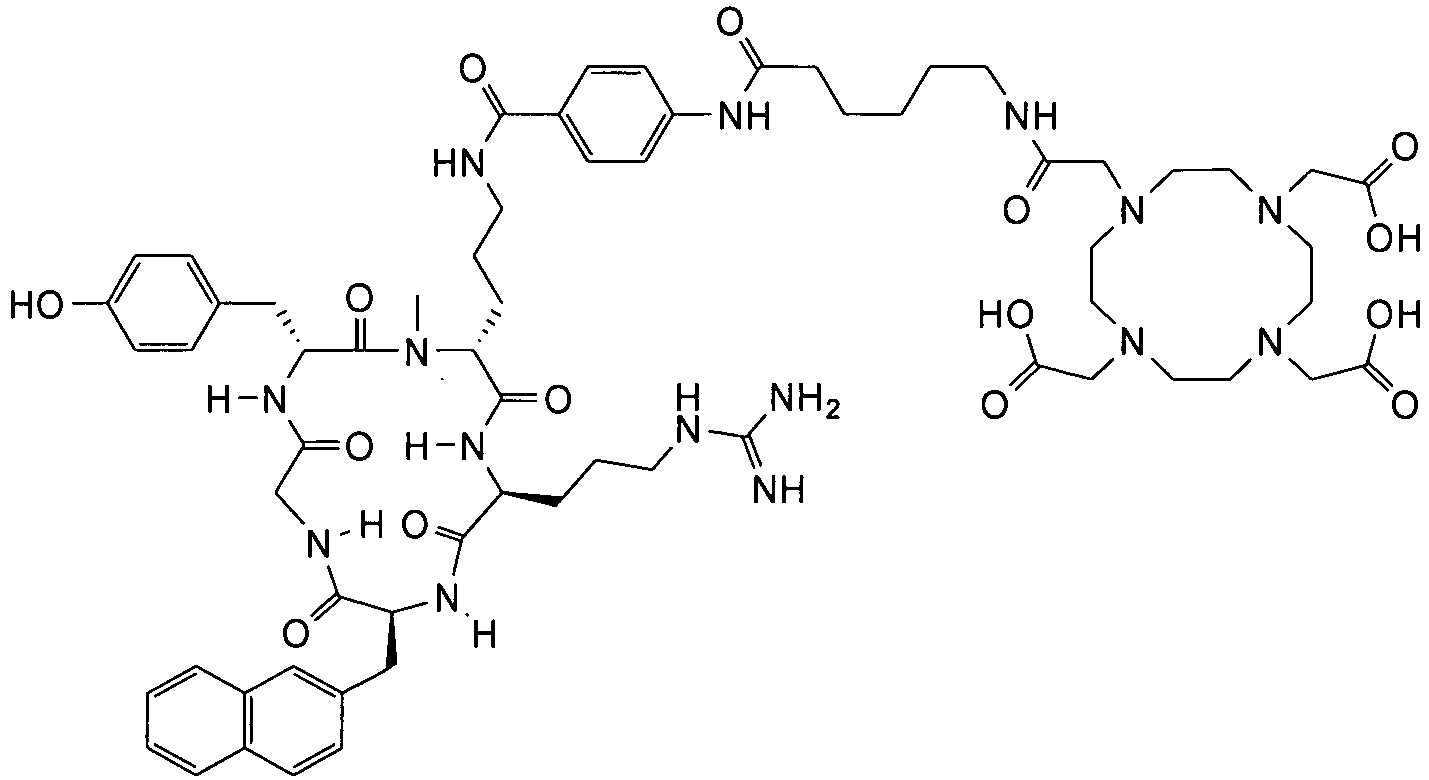
- Exact Mass: 1319.67
Mol.Wt.: 1320.49 - The linear peptide N α-Ns-N δ-Alloc-D-Orn-R(Pbf)-Nal-G was synthesized with standard Fmoc peptide chemistry following general protocols for resin-attachment (1.) of Gly and repeated Fmoc deprotection (2.) and attachment of the following (protected) amino acid (3.). Subsequently the Orn N α was N-methylated (4.), Alloc cleaved (5.), 4-(Fluorenylmethyloxycarbonylamino)-benzoic acid attached (3.), Fmoc cleaved (2.), Fmoc-Ahx attached (6.), Fmoc cleaved (2.), and tris(t-Bu)DOTA attached (6.). After this modification of the side-chain the Orn N α-Ns group was cleaved (7.), Fmoc-Tyr(tBu) attached (6.), its Fmoc group cleaved (2.) and the resulting branched peptide cleaved from the resin (8.). The peptide was cyclized (9.), deprotected (10.) and purified by RP-HPLC. The metal chelates of the pure peptides were obtained by labeling with Indium (11.) or Gallium (12.) with subsequent RP-HPLC purification.
-
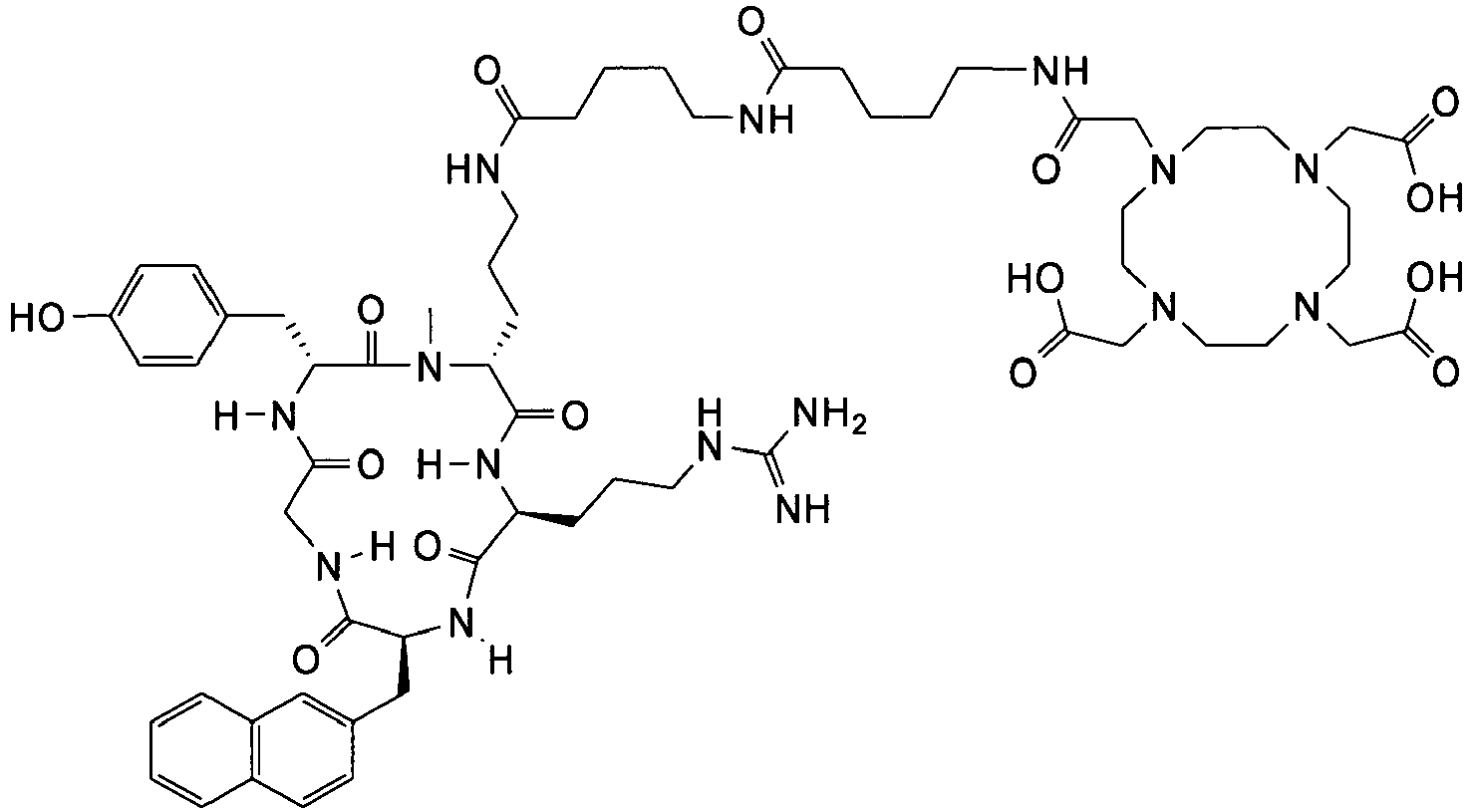
- Exact Mass: 1285.68
Mol.Wt.: 1286.48 - The linear peptide N α-Ns-N δ-Alloc-D-Orn-R(Pbf)-Nal-G was synthesized with standard Fmoc peptide chemistry following general protocols for resin-attachment (1.) of Gly and repeated Fmoc deprotection (2.) and attachment of the following (protected) amino acid (3.). Subsequently the Orn N α was N-methylated (4.), Alloc cleaved (5.), Fmoc-Ava attached (3.), Fmoc cleaved (2.), Fmoc-Ava attached (3.), Fmoc cleaved (2.), and tris(t-Bu)DOTA attached (6.). After this modification of the side-chain the Orn N α-Ns group was cleaved (7.), Fmoc-Tyr(tBu) attached (6.), its Fmoc group cleaved (2.) and the resulting branched peptide cleaved from the resin (8.). The peptide was cyclized (9.), deprotected (10.) and purified by RP-HPLC. The metal chelates of the pure peptides were obtained by labeling with Indium (11.) or Gallium (12.) with subsequent RP-HPLC purification.
-

- Exact Mass: 1289.64
Mol.Wt.: 1290.42 - The linear peptide N α-Ns-N δ-Alloc-D-Orn-R(Pbf)-Nal-G was synthesized with standard Fmoc peptide chemistry following general protocols for resin-attachment (1.) of Gly and repeated Fmoc deprotection (2.) and attachment of the following (protected) amino acid (3.). Subsequently the Orn N α was N-methylated (4.), Alloc cleaved (5.), Fmoc-Gly attached (3.), Fmoc cleaved (2.), Fmoc-Trigas attached (6.), Fmoc cleaved (2.), and tris(t-Bu)DOTA attached (6.). After this modification of the side-chain the Orn N α-Ns group was cleaved (7.), Fmoc-Tyr(tBu) attached (6.), its Fmoc group cleaved (2.) and the resulting branched peptide cleaved from the resin (8.). The peptide was cyclized (9.), deprotected (10.) and purified by RP-HPLC. The metal chelate of the pure peptide was obtained by labeling with Indium (11.) and subsequent RP-HPLC purification.
- Receptor Binding Assays. For receptor binding assays cells may be resuspended in PBS/0.2 % BSA. A total of 200 µl of the suspension containing 400,000 Jurkat cells may be incubated with 25 µl of the tracer solution (containing 3.1 kBq, approx. 0.1 nM) and 25 µl of the diluent or the competitor at different concentrations. For determination of IC50 values, cyclo(-D-Tyr1[125I]-Arg2-Arg3-Nal4-Gly5) may be used as a tracer. Nonspecific binding may be determined in the presence of 1 µM cold cyclo(-D-Tyr1[127I]-Arg2-Arg3-Nal4-Gly5). After shaking for 2 h at room temperature, the incubation may be terminated by centrifugation at 1300 rpm for 5 min. Cell pellets may be washed once with cold PBS followed by a second centrifugation step. Cell bound radioactivity may be determined by using a gamma counter. Experiments may be repeated 2-3 times in triplicates. IC50 values of the compounds may be calculated by nonlinear regression using GraphPad Prism (GraphPad Prism 4.0 Software, Inc., San Diego, CA, USA). Each data point may be the average of three determinations.
- The affinity of peptides to human-CXCR4 was tested in binding studies. 125I-CPCR4 was used as radiotracer, the cold reference peptides as competitors.
- The suitability of e.g. CPCR4 as a CXCR4-radioligand was tested first at Jurkat cells that endogenously express the CXCR4 receptor.
- Cells were resuspended in 0.2% PBS/0.2% BSA. A total of 200 µL of the suspension containing 2 × 10⁶ Jurkat cells /ml or 400000 cell/200 µl were incubated with 25 µL of the tracer solution (containing 100,000 cpm, approx. 0.1 nM) and 25 µL of competitor dissolved in ultra pure H2O or, if necessary, up to 20% DMSO at different concentrations. The tracer concentration was varied from 5 to 500 pM. Nonspecific binding was determined in the presence of 1 µM cold CPCR4. Nonspecific binding is present in case of a total blockage upon addition of 1 yM cold, unlabelled CPCR4 to the tracer.
- After 2 h at room temperature, the incubation was terminated by centrifugation at 2000 rpm for 5 min. Cell pellets were washed once with 400 µL cold PBS. Cell bound radioactivity was determined by using a gamma counter. Experiments were repeated three times in triplicates. IC50 values of the peptides were calculated by nonlinear regression using GraphPad Prism (GraphPad Prism 4.0 Software, San Diego, CA, USA).
- 50 µg Iodogen iodination reagent ("IODO-GEN Iodination Reagent", Perbio Science Deutschland GmbH) was dissolved in 50 µl dry dichloromethane, transferred into a 1.5 ml Eppendorf tube, carefully dried with argon gas. Tubes prepared in the aforementioned manner were stored at -20°C.
- 20 µg of the cyclic pentapeptide cyclo(D-Tyr-Arg-Arg-Nal-Gly) ("CPCR4-peptide") were dissolved in 100 µl phosphate buffered saline (PBS) and transferred into an Iodogen coated cup. Approximately 37 - 74 MBq sodium 125I-iodide in 10µl - 20µl 0.04 M NaOH solution was added (also feasible are e.g. 185 MBq sodium 125I-iodide in 50 µl 0.04 M NaOH solution). After reaction at room temperature for 15 min the solution was removed from the Iodogen cup and the peptide purified by radio-HPLC (UV-detection at 220 nm, NaI well counter, Nucleosil 100-5 C 18 column, eluent A = 0.1% TFA in water; eluent B = 0.1% TFA in acetonitril (MeCN), gradient: 20% B - 35% B in 20 min; flow rate: 1 ml/min; product: k'= 7.25; k' parent peptide = 5.1. Quality control was carried out on a second HPLC using otherwise identical conditions. After removal of solvents the product was diluted with ethanol and stored for up to 2 months. For the binding assays, a precalculated volume of the stock solution was diluted with PBS to yield a 2 mL solution with an activity concentration of 100,000 cpm/25 µL.
- Confluent Jurkat cells were cultured in RPMI 1640 Medium with 10% Nu-serum. After centrifugation of 3 - 4 culture flasks, the supernatant were discarded and the aggregated pellets were resuspended in 40 mL PBS. The cell concentration was determined with a Casy cell counter (50µl cell suspension in 10ml Casy solution (Innovartis AG, Casy technology). The desired cell suspension volume was transferred into an Eppendorf tube, centrifuged, the supernatant was discarded and the pellet was resuspended in 20 ml 0.2 % PBS-BSA-buffer.
- The competition assay was carried out at competitor concentrations of 10-11 to 10-5 M. To these tubes 200 µl of the prepared Jurkat-cell solution was added followed by 25 µl 125I-CPCR4 stock solution. Subsequently, the tubes were placed on a shaker for 2 h (200 mot/min). Thereafter, the tubes were centrifuged for 5 min at 2000 rpm and the supernatant carefully removed. The pellets were washed with 400 µl PBS and the tubes were again centrifuged for 5 min at 2000 rpm. After the supernatant was carefully removed, the tubes were measured in a gamma counter. All data were analyzed with a suitable software package, i.e.
GraphPad Prism 4 with the following parameters: Equation: Sigmoidal dose-response, Y=Bottom + (Top-Bottom)/(1+10^((LogEC50-X))); X is the logarithm of concentration; Y is the response; Y starts at bottom and goes to top with a sigmoid shape. -

- Gallium-68 (β+ = 89%, t1/2 = 68.1 min, Eß+max = 1.90 MeV) was eluted from a commercially available Ge-68/Ga-68 generator by diluted HCl. The collected eluate was fractionated and one fraction of approx. 1-1.2 mL with approx. 80% of the entire eluted activity was used for labelling of yorn'(AMBS, DOTA)RNalG using a commercially available fully automated labelling module (Gallelut-Synthesizer, Scintomics GmbH, Fürstenfeldbruck, Germany). Briefly, the eluate was buffered with a suitable amount of HEPES (4-(2-hydroxyethyl)-1-piperazineethanesulfonic acid) buffer and 20 µg of the peptide. After reaction for 5 min at 95°C, the solution was passed through a water RP-cartridge. To remove residual and non-complexed Ga-68 radioactivity, the cartridge was flushed with 10 mL water. Finally, the labelled peptide was removed from the cartridge with 500 µL ethanol, followed by 10 mL phosphate buffered saline. These solutions were directly passed through a sterile filter into a sterile vial.
- In some cases, the aforementioned cartridge purification was replaced by a HPLC-purification of the labelled peptide (radio HPLC - conditions: Sykam HPLC system, Ray-test software system, Linear UVIS 200 spectrophotometer, NaI-well type activity detector;
Multosphere 100 RP18 - 5µ column; eluent A = 0.2 M ammonium acetate (15.461 g in 11 H2O Millipore), eluent B = methanol; 49% - 60% (B) in 20 min; flow rate: 5 ml/min; product at 11.0- 12.5 min). - Quality control of product was carried out by radio thin layer chromatography on Silica gel 60-plates using 0.5µl of product solution on 2 different TLC systems: a) eluent TLC-1: 0.1 M sodium citrate (5.882 g tri-sodium citrate dihydrate in 200 ml ultrapure water); eluent TLC-2: (1/1, v/v) methanol / 1M ammonium acetate (15.461 g ammonium acetate in 200 ml ultra pure water). Using the
TLC method 1, the product and Ga-colloid stay at the starting point, whereas free Ga3+ moves with front. Using theTLC method 2, uncomplexed Gaspecies stay at starting point, whereas the labelled peptide moves with front
FIGUREs 2 and 3 show radio-TLC profiles.FIG 2 shows an exemplary radio-TLC profile underTLC condition 1; start (at 1 cm): Ga-CPCR4-2, 98.18 % purity, non-complexed Ga-68 at the front (8-9cm): 1.78 %.FIG 3 shows an exemplary radio-TLC profile underTLC condition 2; start (at 1 cm): non-complexed Ga-68, 3.89%, at the front Ga-CPCR4-2 (4.5 - 6.5 cm): 96.11% purity. - After the quality control via TLC was finished, the solvent of the product solution was completely removed by evaporation under reduced pressure and the product dissolved in isotonic saline / 5% ethanol.
- [177Lu]CPCR4-2 was prepared by dissolving 20 µg of CPCR4-2 in 300 µL sodium acetate buffer (0.4 mol/L, pH 5.0) and by incubation with 177LuCl3 for 1 hour at room temperature. Subsequently, the radiometalated peptide was purified using a water RP-cartridge (see the above described procedure for 68Ga-CPCR4-2).
- Labelling of e.g. DOTA ligands with In is known to the skilled person. It may e.g. essentially be performed as described above.
- The binding data (IC50 values) of exemplary compounds of the invention are depicted in the following:
Table V: Binding Data No. Abbreviation IC50 [nM] 1 yorn'(ABS, betaAla, DOTA)RNalG 37.6 ± 14.7 2* yorn'(ABS, Ahx, DOTA, In)RNalG 26.5 ± 22.6 3 yorn'(ABS, Ahx, DOTA, Ga)RNalG 30.3 ± 6.52 4* yorn'(ABS, betaAla, DOTA, In)RNalG 30.4 ± 3.68 5 yorn'(ABS, betaAla, DOTA, Ga)RNalG 33.3 ± 3.68 CPCR4-1 6* yorn'(ABS, AVS, DOTA, In)RNalG 40.9 ± 21.6 7 yorn'(ABS, AVS, DOTA, Ga)RNalG 14.2 ± 3.01 8* yorn'(AMBS, DOTA, In)RNalG 44.9 ± 10.4 9 yorn'(AMBS, DOTA, Ga)RNalG 4,78 ± 0,73 CPCR4-2 10 yorn'(ABS, G, DOTA)RNalG 88.8 ± 18.4 11* yorn'(ABS, G, DOTA, In)RNalG 20.9 ± 3.46 12 yorn'(ABS, G, DOTA, Ga)RNalG 16.7 ± 3.28 13 yorn'(ABS, DOTA, Ga)RNalG 11.5 ± 4.4 14 yorn'(ABS, Ahx, DOTA)RNalG > 1000 15 yorn'(ABS, DOTA)RNalG 334.7 16* yorn'(ABS, DOTA, In)RNalG 105.2 17 yorn'(ABS, DOTA, Ga)RNalG 11.5 ± 4.4 18 yorn'(ABS, AVS, DOTA)RNalG 121 ± 17 19* yorn'(DOTA)RNalG 807 ± 477 20* yorn'(DOTA, In)RNalG >1000 21* yorn'(DOTA, Ga)RNalG 288.9 22* yorn'(AVS, AVS, DOTA)RNalG >1000 23* yorn'(AVS, AVS, DOTA, In)RNalG 123.0 ± 25.02 24* yorn'(AVS, AVS, DOTA, Ga)RNalG 89.7 ± 18.3 25* yorn'(G, Trigas, DOTA)RNalG 903 ± 439 26* yorn'(G, Trigas, DOTA, In)RNalG 456.8 (n=1) No. Abbreviation IC50 [nM] 1 yorn'(ABS, betaAla, DOTA)RNalG 137.6 ± 14.7 
2 yorn'(ABS, Ahx, DOTA, In)RNalG 126.5 ± 22.6 
3 yorn'(ABS, Ahx, DOTA, Ga)RNalG 130.3 ± 6.52 
4* yorn'(ABS, betaAla, DOTA, In)RNalG 30.4 ± 3.68 
5 yorn'(ABS, betaAla, DOTA, Ga)RNalG (CPCR4-1) 33.3 ± 3.68 
6* yorn'(ABS, AVS, DOTA, In)RNaLG 40.9 ± 21.6 
7 yorn'(ABS, AVS, DOTA, Ga)RNalG 14.2 ± 3.01 
8* yorn'(AMBS, DOTA, In)RNaLG 44.9 ± 10.4 
9 yorn'(AMBS, DOTA, Ga)RnalG (CPCR4-2) 7.0 ± 4.25 
10 yorn'(ABS, G, DOTA)RNalG 88.8 ± 18.4 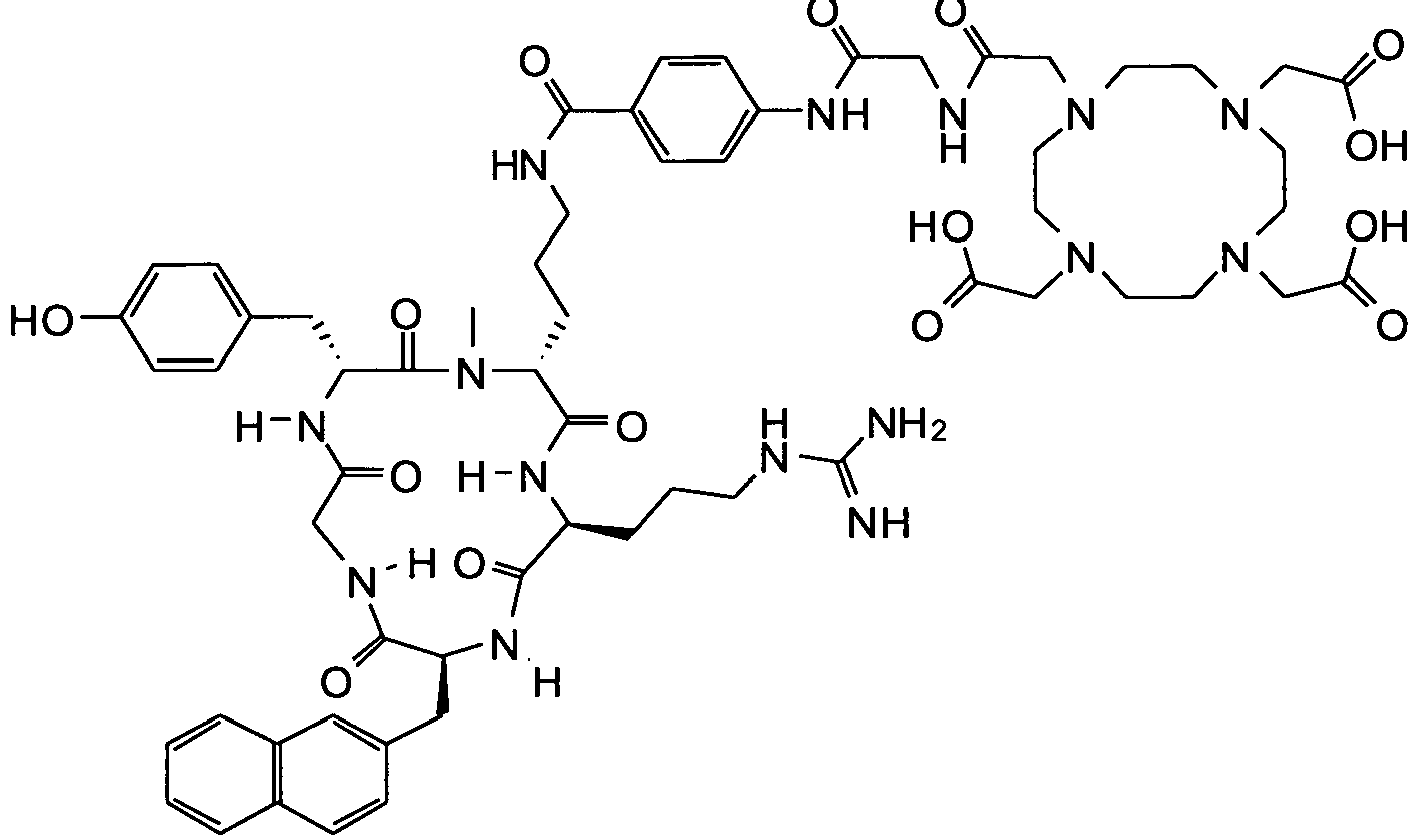
11* yorn'(ABS, G, DOTA, In)RNalG 20.9 ± 3.46 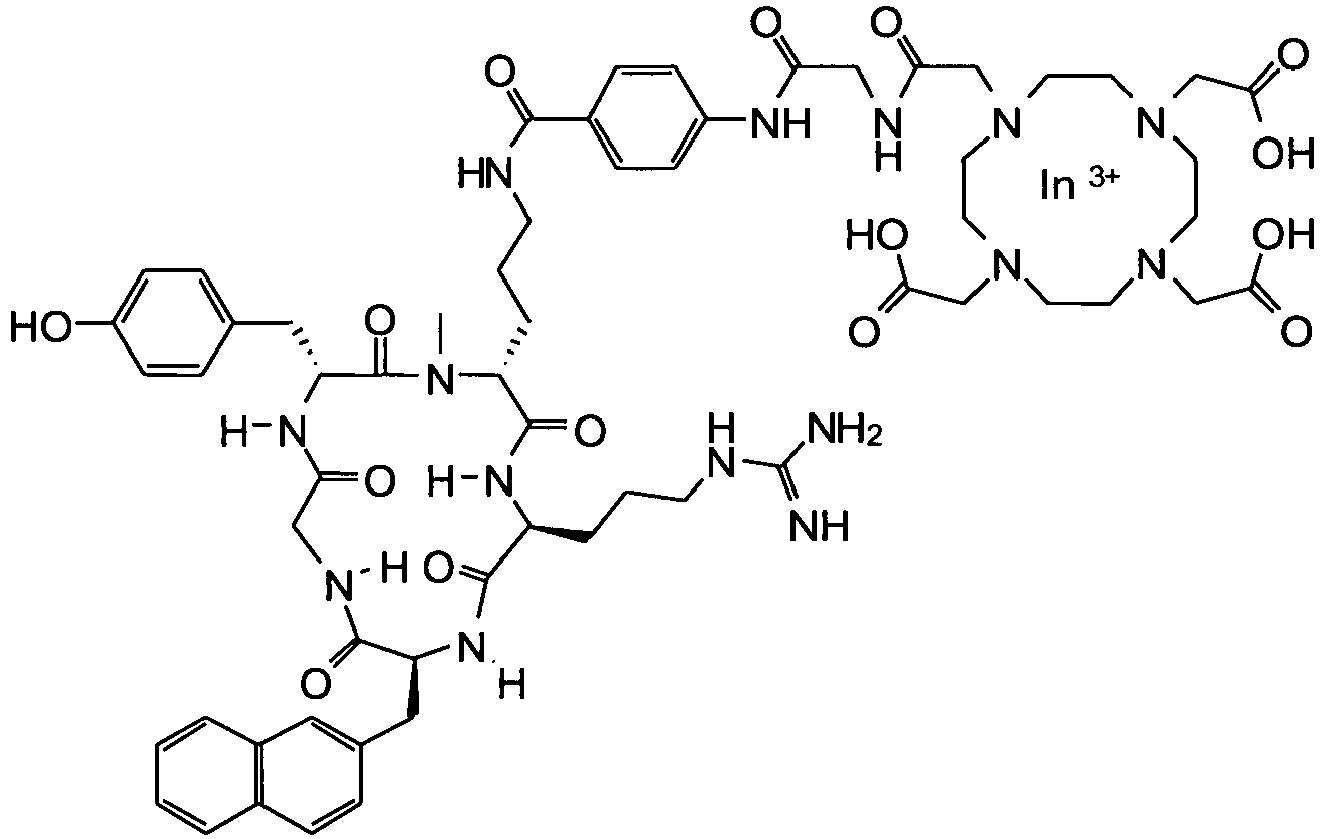
2 yorn'(ABS, G, DOTA, Ga)RNalG 16.7 ± 3.28 
13 yorn'(ABS, DOTA, Ga)RNalG 11.5 ± 4.4 
14 yorn'(ABS, Ahx, DOTA)RNalG > 1000 
15 yorn'(ABS, DOTA)RNalG 334.7 
16* yorn'(ABS, DOTA, In)RNaLG 105.2 
17 yorn'(ABS, DOTA, Ga)RNalG 11.5 ± 4.4 
18 yorn'(ABS, AVS, DOTA)RNalG 121 ± 17 
19* yorn'(DOTA)RNalG 807 ± 477 
20* yorn'(DOTA, In)RNalG >1000 
21 * yorn'(DOTA, Ga)RNalG 288.9 
22* yorn'(AVS, AVS, DOTA)RNalG >1000 
23* yorn'(AVS, AVS, DOTA, In)RNalG 123.0 ± 25.02 
24* yorn'(AVS, AVS, DOTA, Ga)RNalG 89.7 ± 18.3 
25* yorn'(G, Trigas, DOTA)RNalG 903 ± 439 
26* yorn'(G, Trigas, DOTA, In)RNaLG 456.8 (n=1) 
- It is noted that among the above compounds comprising L-Ar, compound 14 shows a higher IC50 value. Without intending to be bound by theory, the present inventors consider it possible that this is due to a longer alkyl chain between the aromatic moiety and the complexing agent. In any case, it is observed that upon addition of Ga or In to said compound, tight binding was observed as well (cf.
compounds 2 and 3). - Table VI summarizes in vivo experiments performed in different tumor models for the evaluation of CPCR4-2, labelled with either Ga-68 or Lu-177.
- For all tumor models, biodistribution studies (BD) were performed at 1 h p.i. of the 68Ga-labeled tracer, both under n.c.a. (non carrier added; n = 4-5) and competition (co-injection of unlabeled CPCR4, 50 µg/mouse, n = 3) conditions to evaluate binding specificity. PET and SPECT imaging studies were not conducted uniformly, but exact experimental procedures (amount of injected activity, type of camera, duration of scan etc.) are given for each respective experiment.
Table VI: Summary of in vivo experiments performed for the evaluation of CPCR4-2 (DOTA-peptide), labelled with either Ga-68 or Lu-177. No Cell line Human tumor type Media & supplements Number of injected cells Tumor growth (days) Tumor weight (g) 1 A431 Melanoma DMEM+GlutaM AX, 10% FCS 2x10⁶ 35-63 0.07-1.0 2 HT29 Colorectal Carcinoma DMEM, 10% FCS, 1% P/S 1x10⁶ 33 0.03-1.0 3 OH1 Small Cell Lung Cancer RPMI, 10% FCS, 1% L-Glutamin, 1% P/S 5x10⁶ 35-63 0.4-1.0 4 PC3 Prostate Carcinoma RPMI, 10% FCS, 1% P/S, 1% NEA 1x10⁷ 30-50 0.01 -3.1 5 SKBR3 Breast Cancer DMEM, 10% FCS, 1% P/S 3x10⁶ 63 0.6-0.8 6 SUDHL4 Lymphoma RPMI, 10% FCS 5x10⁶ 63 days 0.7-3.0 g - All cell lines were maintained at 37°C, 5% CO2: 95% air atmosphere and cultured in Medium with supplements (Table VI). Media and supplements were obtained from Biochrom (Berlin, Germany).
- For all in vivo studies female CD1 nu/nu mice (Charles River, Germany) were used. All animal experiments were approved by the local authorities and are in compliance with the institution guidelines.
- For tumor inoculation, a suspension of cells (cell number see Table VI) in 100µl of medium was injected subcutaneously in one of the flanks or one of the shoulders of the mice. After 4-9 weeks of tumor growth mice were used for imaging and biodistribution purposes.
- 68Ga-labeled CPCR4-2 (usually 2-3 MBq/mouse in 100 µl of PBS) was injected intravenously into the tail vein of tumor bearing mice. For competition studies, 50µg of unlabeled CPCR4 in 50 µl of PBS were co-injected. The animals were sacrificed and dissected at 1 h p.i. Organs of interest were removed and radioactivity was counted in weighted tissue samples using a 1480 Wizard3 gamma counter from Wallac (Turku, Finland). Data are represented as % injected dose per gram tissue (%iD/g) and are means ± SD (n = 3-5).
- Results of biodistribution studies and imaging experiments are shown in
Figures 4 to 18 . - The results of performed studies are depicted in the Figures, particularly in
Figures 4 to 18 .FIG 4 shows biodistribution of [68Ga]CPCR4-2 in A431 tumor bearing CD1 nu/nu mice at 1 h p.i. Results are expressed as percent injected dose per gram tissue weight (%ID/g); 1 h p.i.; n=8.FIG 5 shows tumor-to-organ ratios of yorn'(AMBS-[68Ga]DOTA) RNalG (A431 tumor bearing CD-1 nude, 60 min p.i., n = 3-5. Results are expressed as tumor to organ ratio (blockade n = 3 in white; control n = 5 in black).FIG 6 shows biodistribution of [125I]yorn'(AMBS-DOTA(Ga))RNalG ([125I]Ga-CPCR4-2) in HT-29 tumor bearing CD1 nu/nu mice at 60 min p.i., n = 4. In this study, yorn'(AMBS-DOTA(Ga))RnalG (Ga-CPCR4-2) labelled with 125I was used for the experiments. Results are expressed as percent injected dose per gram tissue weight (%ID/g).FIG 7 shows tumor-to-organ ratios of [125I]yorn'(AMBS-DOTA(Ga))RNalG (HT-29 tumor bearing CD1 nude mice, 60 min p.i., n = 4). Results are expressed as tumor to organ ratios.FIG 8 shows biodistribution of [68Ga]CPCR4-2 in OH-1 tumor bearing CD1 nu/nu mice at 1 h p.i.. Results are expressed as percent injected dose per gram tissue weight (%ID/g); 1h p.i.; n = 6.FIG 9 shows ROI quantification of [68Ga]CPCR4-2 activity levels in OH-1 tumor, muscle and background. ROI 1: tumor; ROI 3: muscle; ROI 2: background.FIG 10 shows PET imaging of OH-1 tumor bearing CD1 nu/nu mouse using [68Ga]CPCR4-2. A PET/CT image of a mouse is shown in transaxial, coronal and saggital view (from left to right). Injected activity: 10 MBq; PET Scanner: Inveon Siemens; Duration of Scan: 90 min, on-bed-injection; Scan mode: dynamical (1 sec and 1 picture per frame, 39 frames).FIG 11 shows SPECT imaging of OH-1 tumor bearing CD1 nu/nu mouse using [177Lu]CPCR4-2 (2.9.2009). Injected activity : 22 MBq; SPECT Scanner: NanoSPECT Bioscan; Duration of Scan: 72 min (60-75 min after tracer injection); Scan mode: 48 projections, 90s per projection; summation image.FIG 12 shows biodistribution of yorn'(AMBS-[68Ga]DOTA)RNalG ([68Ga]CPCR4-2) in PC-3 tumor bearing CD1 nu/nu mice at 60 min p.i., n = 4. Results are expressed as percent injected dose per gram tissue weight (%ID/g); 1 h p.i.; n=4.FIG 13 shows tumor-to-organ ratios of yorn'(AMBS-[68Ga]DOTA)RNalG (PC-3 tumor bearing CD1 nude mice, 60 min p.i., n = 3-4. Results are expressed as tumor-to-organ ratio.FIG 14 shows biodistribution of yorn'(AMBS-[68Ga]DOTA)RNalG ([68Ga]CPCR4-2) in SKBR3 tumor bearing CD1 nu/nu mice at 60 min p.i., n = 4. Results are expressed as percent injected dose per gram tissue weight (%ID/g); 1h p.i.; n = 8.FIG 15 shows tumor-to-organ ratios of yorn'(AMBS-[68Ga]DOTA)RNalG (SKBR3 tumor bearing CD1 nude mice, 60 min p.i., n = 3-4. Results are expressed as tumor-to-organ ratio.FIG 16 shows biodistribution of [68Ga]CPCR4-2 in SUDHL4 tumor bearing CD1 nu/nu mice. Results are expressed as percent injected dose per gram tissue weight (%ID/g); 1 h p.i.; n=2.FIG 17 shows 68Ga-CPCR4-2.1: imaging in OH-1 tumor bearing mice.FIG 17A shows PET imaging, 1h post injection of the 68Ga-CPCR4-2.1 andFIG 17B shows PET imaging of an OH-1 bearing mouse, 1h post injection of 68 Ga-CPCR4-2.1 in the presence of an excess of cold CPCR4 peptide.FIG 18 shows another example of 68 Ga-CPCR4-2.1 imaging in OH-1 tumor bearing mice.FIG 18A shows PET imaging, 1h post injection of the 68 Ga-CPCR4-2.1 andFIG 18B shows PET imaging of an OH-1 bearing mouse, 1h post injection of 68Ga-CPCR4-2.1 in the presence of an excess of cold CPCR4 peptide. - In summary, the above experiments suggest that the compounds of the present invention have a sufficiently high specific enrichment. Moreover, the above experiments suggest that suitably labeled compounds of the invention are suitable for imaging applications, such as as contrast agents e.g. for depicting the CXCR4 receptor status in vivo.
-
- Aldrich, J. V.; Kumar, V (2003) Methods of synthesizing and using derivatives of [2-(2-aminoethoxy)ethoxy] acetic acid: United States of America,; pp 14.
- Barry Edwards, W.; Akers, W. J.; Ye, Y.; Cheney, P. P.; Bloch, S.; Laforest, R.; Achilefu, S. Multimodal Imaging of Integrin Receptor-Positive Tumors by Bioluminescence, Fluorescence, Gamma Scintigraphy and SPECT Methods Using a Cyclic RGD Peptide Labeled with a Near Infrared Fluorescent Dye and a Radionuclide, .
- Burger-Kentischer A et al, 2002, Expression of macrophage migration inhibitory factor in different stages of human atherosclerosis, Circulation 105, 1561-1566.
- Demmer, O.; Dijkgraaf, I.; Schottelius, M.; Wester, H. J.; Kessler, H (2008) Introduction of functional groups into peptides via N-alkylation. Organic Letters, 10, 2015-2018.
- N. Fujii, S. Oishi, K. Hiramatsu, T. Araki, S. Ueda, H. Tamamura, A. Otaka, S. Kusano, S. Terakubo, H. Nakashima, J. A. Broach, J. O. Trent, Z. X. Wang, S. C. Peiper, Angewandte Chemie-International Edition 2003, 42, 3251.
- Hansson, GK, 2005, Inflammation, atherosclerosis, and coronary artery disease, N. Engl. J. Med. 351, 1985-1695.
- Kim J, Takeuchi H, Lam ST, Turner RR, Wang HJ, Kuo C, Foshag L, Bilchik AJ, Hoon DS (2005) Chemokine receptor CXCR4 expression in colorectal cancer patients increases the risk for recurrence and for poor survival. J Clin Oncol.; 23(12):2744-53.
- Kuehl H, Veit P, Rosenbaum SJ, Bockisch A, Antoch G (2007) Can PET/CT replace separate diagnostic CT for cancer imaging? Optimizing CT protocols for imaging cancers of the chest and abdomen. J Nucl Med.; 48 Suppl 1:45S-57S.
- J. P. Levesque and I.G. Winkler, Curr Opin Organ Transplant. 2008 Feb;13(1):53-8) Libby P. (2002) Inflammation in atherosclerosis. Nature 420, 868-874.
- Mizukami, S.; Takikawa, R.; Sugihara, F.; Hori, Y.; Tochio, H. et al (2008) Paramagnetic relaxation-based F-19 MRI probe to detect protease activity. Journal of the American Chemical Society, 130, 794-795.
- Phillips RJ, Burdick MD, Lutz M, Belperio JA, Keane MP, Strieter RM (2003) The stromal derived factor-1/CXCL12-.
- Ross R (1993), The pathogenesis of atherosclerosis: a perspective for the 1990s. Nature 362:801-80).
- Schober A. Bernhagen J, Weber C. Chemokine-like functions of MIF in atherosclerosis, J. Mol. Med (2008), 86, 761-770.
- Shah K, Weissleder R. (2005) Molecular optical imaging: applications leading to the development of present day therapeutics. NeuroRx.;2(2):215-25.
- Taniuchi S, Masuda M, Fujii Y, Izawa K, Kanegane H, Kobayashi Y (2005) The role of a mutation of the CXCR4 gene in WHIM syndrome. Haematologica; 90(9):1271-2.
- Van der Plas, S. E.; Gea, A.; Figaroli, S.; De Clercq, P. J. (2008) Madder, A. Synthesis of a tripodal scaffold for solid phase synthesis of artificial receptors. European Journal of Organic Chemistry, 1582-1588.
- Weissleder R, Ntziachristos V (2003) Shedding light onto live molecular targets. Nat Med.; 9(1):123-8.
- Weissleder R, Pittet MJ (2008) Imaging in the era of molecular oncology, Nature ; 452(7187):580-9.
- Yang, P. Y.; Wu, H.; Lee, M. Y.; Xu, A. (2008) Srinivasan, R. et al. Solid-phase synthesis of azidomethylene inhibitors targeting cysteine proteases. Organic Letters, 10, 1881-1884. Zhang et al., Inorg. Chem. 37(5), 1998, 956-963.
-
WO 89/07456 -
WO 97/31657 -
WO 2007/096662 -
WO 2008/08854 -
WO 2009/027706 -
WO 2009/109332 -
WO 2009/13438
Claims (9)
- A compound having a structure according to formula I
 wherein Xaa1 is D-tyrosine, Xaa2 is arginine, Xaa3 is naphthylalanine (Nal) and Xaa4 is glycine,R is H or methyl,L has the formula -(CH2)3- NH-,and Ar is selected from the group consisting of


 D isi) DOTA, orii) a combination of a Ga-atom and DOTA.
 - The compound of claim 1, wherein Ar is a group having the formula:

- The compound of any of claims 1 to 2, wherein the Ga-atom is a radionuclide or is not a radionuclide, such as any non-radioactive isotope, preferably is 66Ga, 67Ga or 68Ga.
- The compound of any of claims 1 to 3, wherein the Ga-atom is a Ga radionuclide.
- The compound of any of claims 1 to 4,i) having the structure:
 ii) having the structure:
- A pharmaceutical composition comprising a compound as defined in any of claims 1 to 5 and at least one pharmaceutically acceptable excipient.
- A compound as defined in any of claims 1 to 5 or composition as defined in claim 6i) for use as a medicament; orii) for use in a method for the prevention or treatment of a CXCR4 receptor-related disease or disorder; oriii) for use in a diagnostic method practiced on the human or animal body for the diagnosis of a CXCR4 receptor-related disease or disorder; oriv) for use in a method of imaging CXCR4 receptors, in particular of medical imaging, especially of diagnostic imaging.
- Use of a compound as defined in any of claims 1 to 5 or of a composition as defined in claim 6, for the imaging of CXCR4 receptors, in particular for medical imaging, especially for diagnostic imaging.
- A method of imaging CXCR4 receptors, in particular of medical imaging, especially of diagnostic imaging, the method comprising adding a compound as defined in any of claims 1 to 5 to a sample.
Priority Applications (1)
| Application Number | Priority Date | Filing Date | Title |
|---|---|---|---|
| EP11716880.7A EP2560690B1 (en) | 2010-04-20 | 2011-04-20 | Cyclopentapeptide derivatives and uses thereof |
Applications Claiming Priority (4)
| Application Number | Priority Date | Filing Date | Title |
|---|---|---|---|
| US32595610P | 2010-04-20 | 2010-04-20 | |
| EP10004177A EP2380596A1 (en) | 2010-04-20 | 2010-04-20 | Cyclopentapeptide derivatives and uses thereof |
| EP11716880.7A EP2560690B1 (en) | 2010-04-20 | 2011-04-20 | Cyclopentapeptide derivatives and uses thereof |
| PCT/EP2011/056358 WO2011131735A1 (en) | 2010-04-20 | 2011-04-20 | Cyclopentapeptide derivatives and uses thereof |
Publications (2)
| Publication Number | Publication Date |
|---|---|
| EP2560690A1 EP2560690A1 (en) | 2013-02-27 |
| EP2560690B1 true EP2560690B1 (en) | 2017-03-08 |
Family
ID=42711838
Family Applications (2)
| Application Number | Title | Priority Date | Filing Date |
|---|---|---|---|
| EP10004177A Withdrawn EP2380596A1 (en) | 2010-04-20 | 2010-04-20 | Cyclopentapeptide derivatives and uses thereof |
| EP11716880.7A Active EP2560690B1 (en) | 2010-04-20 | 2011-04-20 | Cyclopentapeptide derivatives and uses thereof |
Family Applications Before (1)
| Application Number | Title | Priority Date | Filing Date |
|---|---|---|---|
| EP10004177A Withdrawn EP2380596A1 (en) | 2010-04-20 | 2010-04-20 | Cyclopentapeptide derivatives and uses thereof |
Country Status (3)
| Country | Link |
|---|---|
| US (1) | US9266924B2 (en) |
| EP (2) | EP2380596A1 (en) |
| WO (1) | WO2011131735A1 (en) |
Families Citing this family (16)
| Publication number | Priority date | Publication date | Assignee | Title |
|---|---|---|---|---|
| TWI640541B (en) | 2011-12-28 | 2018-11-11 | 中外製藥股份有限公司 | Peptide compound having an annular portion and pharmaceutical composition |
| WO2015185162A1 (en) * | 2014-06-06 | 2015-12-10 | Technische Universität München | Modified cyclopentapeptides and uses thereof |
| US10815489B2 (en) | 2015-03-13 | 2020-10-27 | Chugai Seiyaku Kabushiki Kaisha | Modified aminoacyl-tRNA synthetase and use thereof |
| US12391971B2 (en) | 2017-01-31 | 2025-08-19 | Chugai Seiyaku Kabushiki Kaisha | Method for synthesizing peptides in cell-free translation system |
| KR20250007021A (en) * | 2017-06-09 | 2025-01-13 | 추가이 세이야쿠 가부시키가이샤 | Method for synthesizing peptide containing n-substituted amino acid |
| CN111479819B (en) | 2017-12-15 | 2024-06-14 | 中外制药株式会社 | Method for preparing peptide and method for treating base |
| WO2020053256A1 (en) | 2018-09-12 | 2020-03-19 | Technische Universität München | Cxcr4-targeted diagnostic and therapeutic agents with reduced species selectivity |
| WO2020053255A1 (en) | 2018-09-12 | 2020-03-19 | Technische Universität München | Therapeutic and diagnostic agents for cancer |
| EP3878836B1 (en) | 2018-11-07 | 2025-07-23 | Chugai Seiyaku Kabushiki Kaisha | O-substituted serine derivative production method |
| WO2020111238A1 (en) | 2018-11-30 | 2020-06-04 | 中外製薬株式会社 | Deprotection method and resin removal method in solid-phase reaction for peptide compound or amide compound, and method for producing peptide compound |
| CN113692401A (en) | 2019-03-15 | 2021-11-23 | 中外制药株式会社 | Process for producing aromatic amino acid derivative |
| JP6880352B1 (en) | 2019-11-07 | 2021-06-02 | 中外製薬株式会社 | Cyclic peptide compound with Kras inhibitory effect |
| WO2021130329A1 (en) * | 2019-12-27 | 2021-07-01 | Istituto Nazionale Tumori Irccs - Fondazione G. Pascale | Radiolabeled peptides for non-invasive diagnosis and treatment of cxcr4 expressing tumors |
| EP4043041A1 (en) | 2021-02-15 | 2022-08-17 | Technische Universität München | Cxcr4-ligands for diagnostic and therapeutic use and precursors thereof |
| AU2022262350B2 (en) | 2021-04-20 | 2026-05-07 | Terrapower Isotopes, Llc | Titania based generators for ac-225 generation |
| WO2026027415A1 (en) | 2024-07-30 | 2026-02-05 | Technische Universität München, in Vertretung des Freistaates Bayern | Cxcr4 ligand suitable for radiopharmaceutical applications and method for preparation thereof |
Family Cites Families (10)
| Publication number | Priority date | Publication date | Assignee | Title |
|---|---|---|---|---|
| IL89222A (en) | 1988-02-09 | 1995-03-30 | Mallinckrodt Inc | Preparation of metal-radionuclide-labelled proteins, certain novel compounds used therein and radiopharmaceutical compositions containing the labelled proteins |
| MY147327A (en) * | 1995-06-29 | 2012-11-30 | Novartis Ag | Somatostatin peptides |
| EP0885017A2 (en) | 1996-02-27 | 1998-12-23 | Mallinckrodt Medical, Inc. | Use of labelled cck-b receptor ligands for the detection and localization of malignant human tumours |
| WO2002042259A2 (en) | 2000-11-27 | 2002-05-30 | University Of Maryland, Baltimore | Methods of synthesizing and using derivatives of [2-(2-aminoethoxy)ethoxy] acetic acid |
| US7211240B2 (en) * | 2002-03-01 | 2007-05-01 | Bracco International B.V. | Multivalent constructs for therapeutic and diagnostic applications |
| US8628750B2 (en) * | 2006-02-27 | 2014-01-14 | Technische Universitat Munchen | Cancer imaging and treatment |
| JP2009543802A (en) | 2006-07-11 | 2009-12-10 | エモリー・ユニバーシテイ | CXCR4 antagonists containing diazine and triazine structures for the treatment of medical diseases |
| GB0716897D0 (en) * | 2007-08-30 | 2007-10-10 | Univ Muenchen Tech | Cancer imaging and treatment |
| EP2100900A1 (en) | 2008-03-07 | 2009-09-16 | Universitätsspital Basel | Bombesin analog peptide antagonist conjugates |
| WO2009134382A2 (en) * | 2008-04-30 | 2009-11-05 | Siemens Medical Solutions Usa, Inc. | Cyclopeptides containing rgd mimetics as imaging markers for integrins |
-
2010
- 2010-04-20 EP EP10004177A patent/EP2380596A1/en not_active Withdrawn
-
2011
- 2011-04-20 EP EP11716880.7A patent/EP2560690B1/en active Active
- 2011-04-20 WO PCT/EP2011/056358 patent/WO2011131735A1/en not_active Ceased
- 2011-04-20 US US13/641,947 patent/US9266924B2/en active Active
Non-Patent Citations (1)
| Title |
|---|
| None * |
Also Published As
| Publication number | Publication date |
|---|---|
| EP2560690A1 (en) | 2013-02-27 |
| US9266924B2 (en) | 2016-02-23 |
| US20130129622A1 (en) | 2013-05-23 |
| EP2380596A1 (en) | 2011-10-26 |
| WO2011131735A1 (en) | 2011-10-27 |
Similar Documents
| Publication | Publication Date | Title |
|---|---|---|
| US9266924B2 (en) | Cyclopentapeptide derivatives and uses thereof | |
| EP3152226B1 (en) | Modified cyclopentapeptides and uses thereof | |
| US20110027175A1 (en) | Cancer imaging and treatment | |
| US9206237B2 (en) | Cystine knot peptides that bind alpha-V-beta-6 integrin | |
| JP2025521237A (en) | Trifunctional compounds and uses thereof | |
| PL178252B1 (en) | Radioisotope labelled antagonists of the platelet receptor gpiib/iiia as visualising agents in diagnosing thrombotic/embolic diseases | |
| WO2019065774A1 (en) | Radioactive drug | |
| JP2022507296A (en) | Radiolabeled bombesin-derived compounds for in vivo imaging of gastrin-releasing peptide receptors (GRPR) and treatment of GRPR-related disorders | |
| JP2023549469A (en) | Novel CXCR4 target compound | |
| EP2895204B1 (en) | Compositions targeting bradykinin receptor b1 for medical imaging of cancer and other disorders | |
| WO2011131731A1 (en) | Cyclopeptide derivatives and uses thereof | |
| JP6186371B2 (en) | Patient selection method | |
| JP2002527450A (en) | Arg-Gly-Asp (RGD) mimetic synthetic disintegrins incorporating chelator as image forming reagent | |
| CN114845742B (en) | Modified GRPR antagonist peptides for cancer imaging and treatment | |
| Class et al. | Patent application title: CYCLOPENTAPEPTIDE DERIVATIVES AND USES THEREOF Inventors: Oliver Demmer (Muenchen, DE) Horst Kessler (Garching, DE) Horst Kessler (Garching, DE) Hans Jürgen Wester (Ilmmunster, DE) Hans Jürgen Wester (Ilmmunster, DE) Margret Schottelius (Muenchen, DE) Ingrid Dijkgraaf (Kranenburg, DE) Andreas Konard Buck (Muenchen, DE) Assignees: Technische Universität München Technische Universität München | |
| JP4318985B2 (en) | Somatostatin analog derivatives and uses thereof | |
| JP2005538966A (en) | Labeled somatostatin homolog skeleton cyclized by metal complex formation | |
| KR20250011145A (en) | Prostate-specific membrane antigen (PSMA) ligand with improved renal clearance | |
| HK40029075A (en) | Radioactive drug | |
| RO114895B1 (en) | Radiopharmaceutical product and reagent for preparing such product, method for viewing mammal platelet deposit position and radiolabeled compound |
Legal Events
| Date | Code | Title | Description |
|---|---|---|---|
| PUAI | Public reference made under article 153(3) epc to a published international application that has entered the european phase |
Free format text: ORIGINAL CODE: 0009012 |
|
| 17P | Request for examination filed |
Effective date: 20121107 |
|
| AK | Designated contracting states |
Kind code of ref document: A1 Designated state(s): AL AT BE BG CH CY CZ DE DK EE ES FI FR GB GR HR HU IE IS IT LI LT LU LV MC MK MT NL NO PL PT RO RS SE SI SK SM TR |
|
| DAX | Request for extension of the european patent (deleted) | ||
| 17Q | First examination report despatched |
Effective date: 20131212 |
|
| GRAP | Despatch of communication of intention to grant a patent |
Free format text: ORIGINAL CODE: EPIDOSNIGR1 |
|
| INTG | Intention to grant announced |
Effective date: 20160921 |
|
| STAA | Information on the status of an ep patent application or granted ep patent |
Free format text: STATUS: GRANT OF PATENT IS INTENDED |
|
| GRAS | Grant fee paid |
Free format text: ORIGINAL CODE: EPIDOSNIGR3 |
|
| GRAA | (expected) grant |
Free format text: ORIGINAL CODE: 0009210 |
|
| STAA | Information on the status of an ep patent application or granted ep patent |
Free format text: STATUS: THE PATENT HAS BEEN GRANTED |
|
| AK | Designated contracting states |
Kind code of ref document: B1 Designated state(s): AL AT BE BG CH CY CZ DE DK EE ES FI FR GB GR HR HU IE IS IT LI LT LU LV MC MK MT NL NO PL PT RO RS SE SI SK SM TR |
|
| REG | Reference to a national code |
Ref country code: GB Ref legal event code: FG4D |
|
| REG | Reference to a national code |
Ref country code: CH Ref legal event code: EP Ref country code: AT Ref legal event code: REF Ref document number: 872941 Country of ref document: AT Kind code of ref document: T Effective date: 20170315 |
|
| REG | Reference to a national code |
Ref country code: IE Ref legal event code: FG4D |
|
| REG | Reference to a national code |
Ref country code: DE Ref legal event code: R096 Ref document number: 602011035680 Country of ref document: DE |
|
| REG | Reference to a national code |
Ref country code: FR Ref legal event code: PLFP Year of fee payment: 7 |
|
| REG | Reference to a national code |
Ref country code: NL Ref legal event code: FP |
|
| REG | Reference to a national code |
Ref country code: LT Ref legal event code: MG4D |
|
| PG25 | Lapsed in a contracting state [announced via postgrant information from national office to epo] |
Ref country code: LT Free format text: LAPSE BECAUSE OF FAILURE TO SUBMIT A TRANSLATION OF THE DESCRIPTION OR TO PAY THE FEE WITHIN THE PRESCRIBED TIME-LIMIT Effective date: 20170308 Ref country code: FI Free format text: LAPSE BECAUSE OF FAILURE TO SUBMIT A TRANSLATION OF THE DESCRIPTION OR TO PAY THE FEE WITHIN THE PRESCRIBED TIME-LIMIT Effective date: 20170308 Ref country code: GR Free format text: LAPSE BECAUSE OF FAILURE TO SUBMIT A TRANSLATION OF THE DESCRIPTION OR TO PAY THE FEE WITHIN THE PRESCRIBED TIME-LIMIT Effective date: 20170609 Ref country code: NO Free format text: LAPSE BECAUSE OF FAILURE TO SUBMIT A TRANSLATION OF THE DESCRIPTION OR TO PAY THE FEE WITHIN THE PRESCRIBED TIME-LIMIT Effective date: 20170608 Ref country code: HR Free format text: LAPSE BECAUSE OF FAILURE TO SUBMIT A TRANSLATION OF THE DESCRIPTION OR TO PAY THE FEE WITHIN THE PRESCRIBED TIME-LIMIT Effective date: 20170308 |
|
| PG25 | Lapsed in a contracting state [announced via postgrant information from national office to epo] |
Ref country code: LV Free format text: LAPSE BECAUSE OF FAILURE TO SUBMIT A TRANSLATION OF THE DESCRIPTION OR TO PAY THE FEE WITHIN THE PRESCRIBED TIME-LIMIT Effective date: 20170308 Ref country code: SE Free format text: LAPSE BECAUSE OF FAILURE TO SUBMIT A TRANSLATION OF THE DESCRIPTION OR TO PAY THE FEE WITHIN THE PRESCRIBED TIME-LIMIT Effective date: 20170308 Ref country code: RS Free format text: LAPSE BECAUSE OF FAILURE TO SUBMIT A TRANSLATION OF THE DESCRIPTION OR TO PAY THE FEE WITHIN THE PRESCRIBED TIME-LIMIT Effective date: 20170308 Ref country code: ES Free format text: LAPSE BECAUSE OF FAILURE TO SUBMIT A TRANSLATION OF THE DESCRIPTION OR TO PAY THE FEE WITHIN THE PRESCRIBED TIME-LIMIT Effective date: 20170308 Ref country code: BG Free format text: LAPSE BECAUSE OF FAILURE TO SUBMIT A TRANSLATION OF THE DESCRIPTION OR TO PAY THE FEE WITHIN THE PRESCRIBED TIME-LIMIT Effective date: 20170608 |
|
| PG25 | Lapsed in a contracting state [announced via postgrant information from national office to epo] |
Ref country code: SK Free format text: LAPSE BECAUSE OF FAILURE TO SUBMIT A TRANSLATION OF THE DESCRIPTION OR TO PAY THE FEE WITHIN THE PRESCRIBED TIME-LIMIT Effective date: 20170308 Ref country code: EE Free format text: LAPSE BECAUSE OF FAILURE TO SUBMIT A TRANSLATION OF THE DESCRIPTION OR TO PAY THE FEE WITHIN THE PRESCRIBED TIME-LIMIT Effective date: 20170308 Ref country code: CZ Free format text: LAPSE BECAUSE OF FAILURE TO SUBMIT A TRANSLATION OF THE DESCRIPTION OR TO PAY THE FEE WITHIN THE PRESCRIBED TIME-LIMIT Effective date: 20170308 Ref country code: RO Free format text: LAPSE BECAUSE OF FAILURE TO SUBMIT A TRANSLATION OF THE DESCRIPTION OR TO PAY THE FEE WITHIN THE PRESCRIBED TIME-LIMIT Effective date: 20170308 |
|
| PG25 | Lapsed in a contracting state [announced via postgrant information from national office to epo] |
Ref country code: PL Free format text: LAPSE BECAUSE OF FAILURE TO SUBMIT A TRANSLATION OF THE DESCRIPTION OR TO PAY THE FEE WITHIN THE PRESCRIBED TIME-LIMIT Effective date: 20170308 Ref country code: PT Free format text: LAPSE BECAUSE OF FAILURE TO SUBMIT A TRANSLATION OF THE DESCRIPTION OR TO PAY THE FEE WITHIN THE PRESCRIBED TIME-LIMIT Effective date: 20170710 Ref country code: SM Free format text: LAPSE BECAUSE OF FAILURE TO SUBMIT A TRANSLATION OF THE DESCRIPTION OR TO PAY THE FEE WITHIN THE PRESCRIBED TIME-LIMIT Effective date: 20170308 Ref country code: IS Free format text: LAPSE BECAUSE OF FAILURE TO SUBMIT A TRANSLATION OF THE DESCRIPTION OR TO PAY THE FEE WITHIN THE PRESCRIBED TIME-LIMIT Effective date: 20170708 |
|
| REG | Reference to a national code |
Ref country code: CH Ref legal event code: PL |
|
| REG | Reference to a national code |
Ref country code: DE Ref legal event code: R097 Ref document number: 602011035680 Country of ref document: DE |
|
| PLBE | No opposition filed within time limit |
Free format text: ORIGINAL CODE: 0009261 |
|
| STAA | Information on the status of an ep patent application or granted ep patent |
Free format text: STATUS: NO OPPOSITION FILED WITHIN TIME LIMIT |
|
| REG | Reference to a national code |
Ref country code: IE Ref legal event code: MM4A |
|
| PG25 | Lapsed in a contracting state [announced via postgrant information from national office to epo] |
Ref country code: MC Free format text: LAPSE BECAUSE OF FAILURE TO SUBMIT A TRANSLATION OF THE DESCRIPTION OR TO PAY THE FEE WITHIN THE PRESCRIBED TIME-LIMIT Effective date: 20170308 Ref country code: DK Free format text: LAPSE BECAUSE OF FAILURE TO SUBMIT A TRANSLATION OF THE DESCRIPTION OR TO PAY THE FEE WITHIN THE PRESCRIBED TIME-LIMIT Effective date: 20170308 |
|
| 26N | No opposition filed |
Effective date: 20171211 |
|
| PG25 | Lapsed in a contracting state [announced via postgrant information from national office to epo] |
Ref country code: LI Free format text: LAPSE BECAUSE OF NON-PAYMENT OF DUE FEES Effective date: 20170430 Ref country code: LU Free format text: LAPSE BECAUSE OF NON-PAYMENT OF DUE FEES Effective date: 20170420 Ref country code: CH Free format text: LAPSE BECAUSE OF NON-PAYMENT OF DUE FEES Effective date: 20170430 Ref country code: SI Free format text: LAPSE BECAUSE OF FAILURE TO SUBMIT A TRANSLATION OF THE DESCRIPTION OR TO PAY THE FEE WITHIN THE PRESCRIBED TIME-LIMIT Effective date: 20170308 |
|
| REG | Reference to a national code |
Ref country code: FR Ref legal event code: PLFP Year of fee payment: 8 |
|
| PG25 | Lapsed in a contracting state [announced via postgrant information from national office to epo] |
Ref country code: IE Free format text: LAPSE BECAUSE OF NON-PAYMENT OF DUE FEES Effective date: 20170420 |
|
| PG25 | Lapsed in a contracting state [announced via postgrant information from national office to epo] |
Ref country code: MT Free format text: LAPSE BECAUSE OF NON-PAYMENT OF DUE FEES Effective date: 20170420 |
|
| PG25 | Lapsed in a contracting state [announced via postgrant information from national office to epo] |
Ref country code: HU Free format text: LAPSE BECAUSE OF FAILURE TO SUBMIT A TRANSLATION OF THE DESCRIPTION OR TO PAY THE FEE WITHIN THE PRESCRIBED TIME-LIMIT; INVALID AB INITIO Effective date: 20110420 |
|
| REG | Reference to a national code |
Ref country code: DE Ref legal event code: R082 Ref document number: 602011035680 Country of ref document: DE Representative=s name: WUESTHOFF & WUESTHOFF, PATENTANWAELTE PARTG MB, DE Ref country code: DE Ref legal event code: R081 Ref document number: 602011035680 Country of ref document: DE Owner name: BAYERISCHE PATENTALLIANZ GMBH, DE Free format text: FORMER OWNER: TECHNISCHE UNIVERSITAET MUENCHEN, 80333 MUENCHEN, DE |
|
| REG | Reference to a national code |
Ref country code: NL Ref legal event code: PD Owner name: BAYERISCHE PATENTALLIANZ GMBH; DE Free format text: DETAILS ASSIGNMENT: CHANGE OF OWNER(S), ASSIGNMENT; FORMER OWNER NAME: TECHNISCHE UNIVERSITAET MUENCHEN Effective date: 20190705 |
|
| REG | Reference to a national code |
Ref country code: BE Ref legal event code: PD Owner name: BAYERISCHE PATENTALLIANZ GMBH; DE Free format text: DETAILS ASSIGNMENT: CHANGE OF OWNER(S), CESSION; FORMER OWNER NAME: SCINTOMICS GMBH Effective date: 20190704 |
|
| REG | Reference to a national code |
Ref country code: GB Ref legal event code: 732E Free format text: REGISTERED BETWEEN 20190815 AND 20190821 |
|
| REG | Reference to a national code |
Ref country code: AT Ref legal event code: PC Ref document number: 872941 Country of ref document: AT Kind code of ref document: T Owner name: BAYERISCHE PATENTALLIANZ GMBH, DE Effective date: 20190729 |
|
| REG | Reference to a national code |
Ref country code: AT Ref legal event code: UEP Ref document number: 872941 Country of ref document: AT Kind code of ref document: T Effective date: 20170308 |
|
| PG25 | Lapsed in a contracting state [announced via postgrant information from national office to epo] |
Ref country code: CY Free format text: LAPSE BECAUSE OF NON-PAYMENT OF DUE FEES Effective date: 20170308 |
|
| PG25 | Lapsed in a contracting state [announced via postgrant information from national office to epo] |
Ref country code: MK Free format text: LAPSE BECAUSE OF FAILURE TO SUBMIT A TRANSLATION OF THE DESCRIPTION OR TO PAY THE FEE WITHIN THE PRESCRIBED TIME-LIMIT Effective date: 20170308 |
|
| PG25 | Lapsed in a contracting state [announced via postgrant information from national office to epo] |
Ref country code: AL Free format text: LAPSE BECAUSE OF FAILURE TO SUBMIT A TRANSLATION OF THE DESCRIPTION OR TO PAY THE FEE WITHIN THE PRESCRIBED TIME-LIMIT Effective date: 20170308 |
|
| PGFP | Annual fee paid to national office [announced via postgrant information from national office to epo] |
Ref country code: NL Payment date: 20250422 Year of fee payment: 15 |
|
| PGFP | Annual fee paid to national office [announced via postgrant information from national office to epo] |
Ref country code: DE Payment date: 20250417 Year of fee payment: 15 |
|
| PGFP | Annual fee paid to national office [announced via postgrant information from national office to epo] |
Ref country code: GB Payment date: 20250423 Year of fee payment: 15 |
|
| PGFP | Annual fee paid to national office [announced via postgrant information from national office to epo] |
Ref country code: BE Payment date: 20250422 Year of fee payment: 15 Ref country code: IT Payment date: 20250422 Year of fee payment: 15 |
|
| PGFP | Annual fee paid to national office [announced via postgrant information from national office to epo] |
Ref country code: FR Payment date: 20250422 Year of fee payment: 15 |
|
| PGFP | Annual fee paid to national office [announced via postgrant information from national office to epo] |
Ref country code: AT Payment date: 20250416 Year of fee payment: 15 |
|
| PGFP | Annual fee paid to national office [announced via postgrant information from national office to epo] |
Ref country code: TR Payment date: 20250411 Year of fee payment: 15 |