EP2560424A2 - Dynamic operator network selection using rate information - Google Patents
Dynamic operator network selection using rate information Download PDFInfo
- Publication number
- EP2560424A2 EP2560424A2 EP12192461A EP12192461A EP2560424A2 EP 2560424 A2 EP2560424 A2 EP 2560424A2 EP 12192461 A EP12192461 A EP 12192461A EP 12192461 A EP12192461 A EP 12192461A EP 2560424 A2 EP2560424 A2 EP 2560424A2
- Authority
- EP
- European Patent Office
- Prior art keywords
- network
- user interface
- mobile device
- operator
- information
- Prior art date
- Legal status (The legal status is an assumption and is not a legal conclusion. Google has not performed a legal analysis and makes no representation as to the accuracy of the status listed.)
- Withdrawn
Links
- 238000004891 communication Methods 0.000 claims abstract description 57
- 238000000034 method Methods 0.000 claims description 97
- 230000008859 change Effects 0.000 claims description 10
- 230000010267 cellular communication Effects 0.000 claims description 5
- 230000001960 triggered effect Effects 0.000 claims 1
- 230000004044 response Effects 0.000 description 67
- 230000008569 process Effects 0.000 description 11
- 238000004590 computer program Methods 0.000 description 9
- 238000010586 diagram Methods 0.000 description 8
- 238000013507 mapping Methods 0.000 description 7
- 238000006073 displacement reaction Methods 0.000 description 6
- 239000000969 carrier Substances 0.000 description 4
- 230000003287 optical effect Effects 0.000 description 3
- 238000012545 processing Methods 0.000 description 3
- 238000001228 spectrum Methods 0.000 description 3
- 230000004913 activation Effects 0.000 description 2
- 238000013475 authorization Methods 0.000 description 2
- 230000010365 information processing Effects 0.000 description 2
- 230000003993 interaction Effects 0.000 description 2
- 230000011664 signaling Effects 0.000 description 2
- 238000012546 transfer Methods 0.000 description 2
- 230000009471 action Effects 0.000 description 1
- 230000005540 biological transmission Effects 0.000 description 1
- 230000001413 cellular effect Effects 0.000 description 1
- 230000001419 dependent effect Effects 0.000 description 1
- 230000006870 function Effects 0.000 description 1
- 239000004973 liquid crystal related substance Substances 0.000 description 1
- 238000012986 modification Methods 0.000 description 1
- 230000004048 modification Effects 0.000 description 1
- 230000000644 propagated effect Effects 0.000 description 1
- 239000004065 semiconductor Substances 0.000 description 1
- 230000001953 sensory effect Effects 0.000 description 1
- 230000000007 visual effect Effects 0.000 description 1
Images


Classifications
-
- H—ELECTRICITY
- H04—ELECTRIC COMMUNICATION TECHNIQUE
- H04W—WIRELESS COMMUNICATION NETWORKS
- H04W8/00—Network data management
- H04W8/02—Processing of mobility data, e.g. registration information at HLR [Home Location Register] or VLR [Visitor Location Register]; Transfer of mobility data, e.g. between HLR, VLR or external networks
- H04W8/06—Registration at serving network Location Register, VLR or user mobility server
-
- H—ELECTRICITY
- H04—ELECTRIC COMMUNICATION TECHNIQUE
- H04W—WIRELESS COMMUNICATION NETWORKS
- H04W8/00—Network data management
- H04W8/02—Processing of mobility data, e.g. registration information at HLR [Home Location Register] or VLR [Visitor Location Register]; Transfer of mobility data, e.g. between HLR, VLR or external networks
- H04W8/06—Registration at serving network Location Register, VLR or user mobility server
- H04W8/065—Registration at serving network Location Register, VLR or user mobility server involving selection of the user mobility server
-
- H—ELECTRICITY
- H04—ELECTRIC COMMUNICATION TECHNIQUE
- H04W—WIRELESS COMMUNICATION NETWORKS
- H04W48/00—Access restriction; Network selection; Access point selection
- H04W48/18—Selecting a network or a communication service
Definitions
- the invention relates to the field of telecommunications, and more particularly to dynamically selecting mobile carriers.
- a typical mobile phone or other cellular communication device is preprogrammed with a carrier or network operator that serves as the home network for the device. Normally, the device communicates over the home network when it is in an area served by the home network. When the device is outside of the home network area (or is roaming), the device typically uses a preferred roaming list to determine which network operator or carrier to use. In other words, the phone is programmed with a preferred roaming list, which is a list of identifiers for carriers that can be used, in order of preference, when the home carrier cannot be used.
- a service subscriber is served by a mobile virtual network operator (MVNO).
- MVNO mobile virtual network operator
- An MVNO is a mobile operator that does not own communications spectrum and typically does not possess any network infrastructure. Instead, MVNO's contract with traditional mobile operators to buy service (e.g., usage minutes) for their own customers.
- An MVNO is typically tied to a specific carrier (e.g., Sprint or Verizon, which does own spectrum and has its own network infrastructure). Accordingly, primary service to an MVNO customer is provided through that specific carrier (i.e., the carrier is the "home" carrier).
- carrier preference data can be updated in accordance with or to reflect bids from actual carriers as to the cost of network access (i.e., usage minutes).
- access to a wireless cellular communication network can be provided by storing a network address on a mobile device.
- the network address can identify a mobile virtual network operator server storing mobile network operator data for use by the mobile device.
- a request for network operator data can be sent from the mobile device to the mobile virtual network operator server, and, in response to the request, network operator data can be received.
- a network operator for the mobile device can be selected based on the received network operator data, and communications can be conducted using the selected network operator.
- the mobile device may not be associated with a particular home network operator.
- Bids can be received from multiple network operators for rates at which communication services using each network operator can be obtained. Preferences among the network operators can be determined using the received bids, and the preferences are used to select the network operator. Preferences may be further based on a location of the mobile device, the quality of service offered by the network operator, and/or type of communication. Bids from multiple network operators for rate information relating to rates at which communication services using each network operator can be obtained and the rate information can be sent to the mobile device for use in selecting the network operator. The rate information can be displayed on a user interface of the mobile device and a user selection of the network operator can be received from a user.
- the mobile device can be registered with a network operator for a limited purpose of sending the request and receiving the network operator data in response to the request, and the mobile device can be separately registered with the selected network operator for conducting communications after receiving the network operator data.
- Negotiations can be conducted with one or more network operators to provide access for the purpose of sending the request and the network operator data can be received in response to the request.
- the network operator data can be dynamically updated in the mobile virtual network operator server based on parameters associated with multiple network operators.
- the mobile device is preprogrammed with a carrier identifier associated with the mobile virtual network operator server.
- a message can be received from a mobile device identifying a current location of the mobile device.
- Network operator preference data can be sent to the mobile device, and the network operator preference data can identify a first set of preferences among multiple network operators for use by the mobile device in selecting one or more network operators.
- the network operator preference data can be updated to identify a second set of preferences among the multiple network operators, and the updated network operator preference data can be sent to the mobile device.
- updating the network operator preference data can be performed dynamically based on parameters associated with the multiple network operators.
- the parameters include bids relating to rates at which communication services are available from each network operator, data relating to the network operators in an area corresponding to the current location of the mobile device, and/or rate information for different communication services available from each network operator.
- Bid information for each of multiple network operators can be received, and the bid information can relate to one or more rates at which communication services are available from each network operator.
- the network operator preference data can be updated using the bid information.
- the updated network operator preference data enables a user of the mobile device to select among multiple network operators.
- the updated network operator preference data can enable the mobile device to automatically select among multiple network operators.
- a mobile virtual network operator server can operate to receive location data from mobile devices and, in response to the received location data, send network operator preference data to each mobile device.
- the network operator preference data can include data indicating preferences among multiple network operators and/or data for use in determining preferences among multiple network operators.
- An interface with each of multiple network operators can enable the mobile virtual network operator server to receive location data from each of the mobile devices and send network operator preference data to each of the mobile devices.
- the mobile virtual network operator server can be a home location register.
- the mobile virtual network operator server may be operable to generate the network operator preference data based on parameters relating to the multiple network operators.
- the parameters can include pricing information for each of the network operators.
- the mobile virtual network operator server can operate to dynamically update the network operator preference data using the pricing information.
- FIG. 1 is a block diagram of a system for providing access to mobile or cellular communications services in accordance with an embodiment of the present invention.
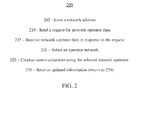
- FIG. 2 is a flow diagram of a process 200 for providing access to a wireless communication services in accordance with an embodiment of the present invention.
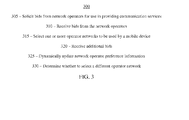
- FIG. 3 is a flow diagram of a process 300 for receiving rate bids from network operators to dynamically update network operator preference data in accordance with an embodiment of the present invention.
- FIG. 4 is a signaling and flow diagram of a process 400 for dynamically updating network operator selection information in accordance with an embodiment of the present invention.
- FIG. 1 is a block diagram of system 100 for providing access to mobile or cellular communications services.
- Mobile device 105 may be capable of establishing voice and/or data communications across wireless interface 110 with base station 115 in one or more operator networks 120(1), 120(2), and 120(3).
- operator networks 120(1), 120(2), and 120(3) can be run by different operators and may use different parts of the available spectrum.
- mobile device 105 can communicate with a home network or, when in an area not served by the home network, with a visited network (i.e., in a roaming mode).
- mobile device 105 may not have an available home network. Instead, mobile device 105 can roam and use a carrier ID for a mobile virtual network operator (MVNO) associated with MVNO server 125.
- the carrier ID can typically bpreprogrammed into mobile device 105 and identifies the carrier (the MVNO, in this case) for mobile device 105 both to mobile device 105 and to operator networks 120(1), 120(2), and 120(3).
- MVNO mobile virtual network operator
- mobile device 105 first may be authorized to communicate through at least one of operator networks 120(1), 120(2), or 120(3).
- Mobile device 105 can communicate with MVNO server 125 to receive authorization.
- mobile device 105 when mobile device 105 is powered up or enters a new area with wireless coverage, mobile device 105 registers with at least one of operator networks 120(1), 120(2), or 120(3).
- mobile device 105 may register with operator network 120(1), 120(2), or 120(3) for the limited purpose of communicating with the MVNO server 125 to obtain necessary authorizations and/or to receive data from MVNO server 125.
- the MVNO may negotiate and contract with operator network 120(1), 120(2), or 120(3) to provide such limited purpose communications, such that when operator network 120(1), 120(2), or 120(3) receives the initial registration signal, it can selectively allow communications between mobile device 105 and MVNO server 125 based upon recognition of the carrier ID included in the initial registration signal.
- Mobile device 105 can send a message to MVNO server 125 through interface 130 between operator network 120(1), 120(2), or 120(3) and MVNO server 125.
- This message can serve to identify mobile device 105 as well as a current location (e.g., cellular service area) of the mobile device.
- MVNO server 125 can provide operator network preference information to mobile device 105.
- the information may be an update to information previously received by mobile device 105 or an indication that there is nothing to update.
- the operator preference information can be a preferred roaming list that indicates an order of preference for operator networks 120(1), 120(2), or 120(3) to be used by mobile device 105.
- the operator preference information may be based on the current location, current usage rate data, type of communication (e.g., data, voice, packet-switched, or circuit-switched), quality of service information, and/or user preference information stored in MVNO server 125.
- the operator preference information may provide data that enables the device itself or a user of the device to select the particular operator network 120(1), 120(2), or 120(3) instead of simply listing an order of preference for operator networks 120(1), 120(2), and 120(3).
- MVNO server 125 may send rate information (e.g., cost per minute, cost per unit of data, etc.) and quality of service data that enables software on mobile device 105: (a) to determine which operator network 120(1), 120(2), or 120(3) to use in accordance with criteria stored locally on mobile device 105 or (b) to display a selection on a user interface to allow a user to make a manual selection.
- rate information e.g., cost per minute, cost per unit of data, etc.
- quality of service data that enables software on mobile device 105: (a) to determine which operator network 120(1), 120(2), or 120(3) to use in accordance with criteria stored locally on mobile device 105 or (b) to display a selection on a user interface to allow a user to make a manual selection.
- mobile device 105 After receiving the operator network preference information, mobile device 105 can establish communication sessions based on the operator network preference information. Subsequent communications need not be conducted through the particular operator network 120(1), 120(2), or 120(3) with which the mobile device initially registered. As a result, mobile device 105 may register with another operator network 120(1), 120(2), or 120(3) for purposes of conducting voice or data communications. The subsequent registration may result in an exchange of data between MVNO server 125 and selected operator network 120(1), 120(2), or 120(3) through corresponding interface 130. For example, such a data exchange may enable operator network 120(1), 120(2), or 120(3) to receive authentication information for mobile device 105 from MVNO server 125 and send billing or usage information to MVNO server 125.
- MVNO server 125 may serve as a home location register (HLR) for mobile device 105. Accordingly, MVNO server 125 may store and/or track additional information relating to mobile device 105 (e.g., user preferences, information about services that mobile device 105 subscribes to, and the like). Such information may be retrieved, as necessary, by operator network 120(1), 120(2), or 120(3) for use in providing communication services to mobile device 105.
- HLR home location register
- the subsequent communications may be distinguished from the initial communications with MVNO server 125 using the initial registration because the initial communications involve transmission and exchange of network overhead data, while the subsequent communications may involve both network overhead data (e.g., registration signals, call setup information, handoff messages, location updates, and the like) and user data and signals (e.g., voice communications, user-initiated data requests and transfers, and responses to user data requests).
- the initial communications may select operator network 120(1), 120(2), or 120(3) at random or based on previously stored operator network preference information, while the subsequent communications select operator network 120(1), 120(2), or 120(3) based on the most up-to-the-minute operator network preference information.
- mobile device 105 may send an initial registration signal across wireless interface 110 to base station 115 associated with first operator network 120(1) for sending a location update message to MVNO server 125.
- MVNO server 125 may provide updated operator network preference information to mobile device 105.
- mobile device 105 may select a different operator network 120(3) for handling communications. Accordingly, mobile device 105 may send another registration signal to selected operator network 120(3) to obtain broader or further communication services.
- mobile device 105 can conduct communications over wireless interface 110 with base stations 115 associated with selected operator network 120(3). These communications may include voice, data, or other communications with other subscribers, devices, or servers in selected operator network 120(3), other operator networks 120(1) and 120(2), public switched telephone network (PSTN) 135, or other external networks (not explicitly shown).
- PSTN public switched telephone network
- the mobile device After registering with selected operator network 120(3), the mobile device can operate in a roaming mode.
- the location of mobile device 105 may be periodically updated in MVNO server 125 in case mobile device 105 travels between different service areas in operator network 120(3).
- MVNO server 125 can periodically or on an as-needed basis send messages to mobile device 105.
- other circumstances e.g., available rates
- MVNO server 125 can dynamically update the operator network preference information by sending an update message to mobile device 105 through currently selected operator network 120(3).
- Software residing on MVNO server 125 may include instructions for updating the network operator preference information based on information relating to various available operator networks 120(1), 120(2), and 120(3). For example, the software may simply update the network operator preference information and forward the updated information to mobile device 105 as such updated information is received. Alternatively, the software may use received information to calculate new usage rate information or to identify a operator network preferences based on other parameters, such as the location of mobile device 105 or the quality of service available from different operator networks 120(1), 120(2), and 120(3) at the current location. In some implementations, the network operator preference information may be dynamically updated based on bids relating to rates at which communication services are available from each operator network 120(1), 120(2), and 120(3).
- network operators 120(1), 120(2), and 120(3) may continuously or periodically bid on usage rates that they each make available to mobile devices 105 associated with MVNO server 125.
- available rates may change as a result of a particular network operator offering only a limited number of minutes of usage at a particular rate or offering a particular rate for only a limited time. When this number of minutes have been used or the limited time has expired, MVNO server 125 may need to update the network operator preference information provided to mobile device 105.
- the updated operator network preference information may result in a selection of another available operator network 120(2) for use by mobile device 105.
- mobile device 105 may register with the new operator network 120(2) and cease communications with the previously selected operator network.
- the updated information may be received during an ongoing communication session (e.g., a voice call), in which case a handoff of mobile device 105 may be initiated by mobile device 105 or one of operator networks 120(2) or 120(3), assuming such an inter-network handoff is supported by operator networks 120(2) and 120(3).
- the operator network preferences may be dynamically updated (e.g., substantially in real time) as circumstances within overall system 100 change or evolve.
- FIG. 2 is a flow diagram of process 200 for providing access to a wireless communication services.
- Process 200 involves storing (205) a network address for MVNO server 125 on mobile device 105.
- the network address may be in the form of an IP address, an address in an SS7 network, or simply a carrier ID.
- the network address can allow operator network 120(1), 120(2), or 120(3) to identify and contact MVNO server 125 associated with mobile device 105 and that maintains subscription, authentication, and preference data for mobile device 105.
- mobile device 105 can send (210) a request for network operator data and/or other information to MVNO server 125.
- the request can be a specific request for updated operator network preference data for use in selecting among multiple available operator networks.
- the request need not be a specific request but can be a location update or other type of message that serves as an implicit request for any information updates or other data.
- network operator data such as preferences among operator networks or data identifying usage rates available from the operator networks is received (215).
- the network operator data can be sent from MVNO server 125 to mobile device 105.
- the network operator data can be received by MVNO server 125 from the operator networks themselves or from other third party data providers.
- operator network 120(1), 120(2), or 120(3) can be selected (220) for use by mobile device 105 in conducting communications.
- the selection can be made by MVNO server 125 and communicated to mobile device 105.
- the selection of a particular operator network can be made by the mobile device based on information provided by MVNO server 125.
- communications involving mobile device 105 can be conducted (225) using the selected network operator.
- updated information can be subsequently received (230).
- the updated information may relate to the location of mobile device 105 or a change in rates or other circumstances within the available operator networks.
- the updated information can be received by MVNO server 125, while in other cases the updated information can be received by mobile device 105.
- a selection of an operator network may be made (220). In some cases, the selection may be of the same operator network as previously selected. In other cases, the selection may be of a different operator network. In the latter case, communications involving mobile device 105 can be subsequently conducted (225) using the newly selected network operator.
- FIG. 3 is a flow diagram of process 300 for receiving rate bids from network operators to dynamically update network operator preference data.
- An MVNO or other entity can solicit (305) bids from a plurality of network operators for use in providing communication services to subscribers of the MVNO.
- bids can be received (310) from the network operators.
- the bids can indicate rate information and potentially other restrictions or conditions for communication services provided through the respective operator networks. For example, a bid may indicate that a first network operator is willing to provide wireless voice communication services for a first specified per-minute rate. Another bid may indicate that a second network is willing to provide wireless voice communication services for a second specified per-minute rate and data communication services for a particular rate per megabyte of data transferred.
- one or more operator networks to be used by a mobile device served by the MVNO can be selected (315).
- network operator preference information can be dynamically updated (325), and a determination can be made (330) as to whether to select a different operator network.
- the selection of operator networks can be made by either the mobile device itself using information provided by the MVNO server or by the MVNO server, where the selection is communicated to the mobile device.
- the selection of the operator network can be made by the user in response to viewing a display on the mobile device of the rate information and/or other data relating to the operator networks.
- the selection may also be based on a current location of the mobile device, the quality of service offered by the various network operators, and/or the type of communication.
- FIG. 4 is a signaling and flow diagram of process 400 for dynamically updating network operator selection information.
- Mobile device 405 can register (410) with first operator network 415(1). After registering, message 420 identifying a current location of mobile device 405 can be sent from mobile device 405, through first operator network 415(1) to server 425 associated with mobile device 405. Server 425 can determine (430) a set of network operator preference data for the current location of mobile device 405 and sends response 435 to mobile device 405, again through first operator network 415(1). Based on processing or reading of the information in the received response, mobile device 405 can select (440) second operator network 415(2) for conducting additional communications. Accordingly, mobile device 405 can register (445) with second operator network 415(2).
- server 425 can receive (450) new information reflecting new circumstances in the overall environment.
- the new information may relate to rates offered by one or more network operators, a location of the mobile device, or any other data that may have an impact on the selection of a network operator.
- the server can send message 455 to mobile device 405 to dynamically update the set of network operator preference data.
- mobile device 405 can select (460), in this example, first operator network 415(1) for conducting further communications. Accordingly, mobile device 405 can again register (465) with first operator network 415(1).
- process 400 may continue indefinitely, with the network operator preference data being repeatedly dynamically updated to result in selections among any number of available operator networks.
- the described invention can be implemented in the context of a mobile device that is not associated with a particular home network (i.e., a device that continuously operates in roaming mode), or in the context of a mobile device that is associated with a home network. In the latter case, the techniques described herein can be used by the mobile device while roaming.
- a mobile device is not limited to a particular operator network, but can constantly roam among different operator networks depending upon a current set of network operator preferences.
- the techniques allow an MVNO to provide the cheapest available rates, to provide the cheapest rates with an acceptable quality of service, and/or to allow users to tailor their selection of operator networks according to their own parameters.
- the techniques allow network operators to establish better network utilization. For example, if a network operator has excess capacity, the network operator can offer low rates to an MVNO for a limited period of time to fill some of the excess capacity and provide an additional revenue stream. Similarly, if there are times of day when or locations where network utilization is low, the network operator can attempt to improve utilization by offering low rates to an MVNO. At the same time, the network operator has greater control over rates by being able to bid for providing service. As a result, the described techniques can be used to establish increased liquidity of network resources.
- the invention and all of the functional operations described in this specification can be implemented in digital electronic circuitry, or in computer software, firmware, or hardware, including the structural means disclosed in this specification and structural equivalents thereof, or in combinations of them.
- the invention can be implemented as one or more computer program products, i.e., one or more computer programs tangibly embodied in an information carrier, e.g., in a machine readable storage device or in a propagated signal, for execution by, or to control the operation of, data processing apparatus, e.g., a programmable processor, a computer, or multiple computers.
- a computer program (also known as a program, software, software application, or code) can be written in any form of programming language, including compiled or interpreted languages, and it can be deployed in any form, including as a stand alone program or as a module, component, subroutine, or other unit suitable for use in a computing environment.
- a computer program does not necessarily correspond to a file.
- a program can be stored in a portion of a file that holds other programs or data, in a single file dedicated to the program in question, or in multiple coordinated files (e.g., files that store one or more modules, sub programs, or portions of code).
- a computer program can be deployed to be executed on one computer or on multiple computers at one site or distributed across multiple sites and interconnected by a communication network.
- processors suitable for the execution of a computer program include, by way of example, both general and special purpose microprocessors, and any one or more processors of any kind of digital computer.
- the processor will receive instructions and data from a read only memory or a random access memory or both.
- the essential elements of a computer are a processor for executing instructions and one or more memory devices for storing instructions and data.
- a computer will also include, or be operatively coupled to receive data from or transfer data to, or both, one or more mass storage devices for storing data, e.g., magnetic, magneto optical disks, or optical disks.
- Information carriers suitable for embodying computer program instructions and data include all forms of non volatile memory, including by way of example semiconductor memory devices, e.g., EPROM, EEPROM, and flash memory devices; magnetic disks, e.g., internal hard disks or removable disks; magneto optical disks; and CD ROM and DVD-ROM disks.
- semiconductor memory devices e.g., EPROM, EEPROM, and flash memory devices
- magnetic disks e.g., internal hard disks or removable disks
- magneto optical disks e.g., CD ROM and DVD-ROM disks.
- the processor and the memory can be supplemented by, or incorporated in, special purpose logic circuitry.
- the invention can be implemented on a computer having a display device, e.g., a CRT (cathode ray tube) or LCD (liquid crystal display) monitor, for displaying information to the user and a keyboard and a pointing device, e.g., a mouse or a trackball, by which the user can provide input to the computer.
- a display device e.g., a CRT (cathode ray tube) or LCD (liquid crystal display) monitor
- a keyboard and a pointing device e.g., a mouse or a trackball
- Other kinds of devices can be used to provide for interaction with a user as well; for example, feedback provided to the user can be any form of sensory feedback, e.g., visual feedback, auditory feedback, or tactile feedback; and input from the user can be received in any form, including acoustic, speech, or tactile input.
- the invention can be implemented in a computing system that includes a back-end component, e.g., as a data server, or that includes a middleware component, e.g., an application server, or that includes a front-end component, e.g., a client computer having a graphical user interface or a Web browser through which a user can interact with an implementation of the invention, or any combination of such back-end, middleware, or front-end components.
- the components of the system can be interconnected by any form or medium of digital data communication, e.g., a communication network. Examples of communication networks include a local area network ("LAN”) and a wide area network (“WAN”), e.g., the Internet.
- LAN local area network
- WAN wide area network
- the computing system can include clients and servers.
- a client and server are generally remote from each other and typically interact through a communication network.
- the relationship of client and server arises by virtue of computer programs running on the respective computers and having a client-server relationship to each other.
Landscapes
- Engineering & Computer Science (AREA)
- Computer Networks & Wireless Communication (AREA)
- Signal Processing (AREA)
- Databases & Information Systems (AREA)
- Mobile Radio Communication Systems (AREA)
- Computer Security & Cryptography (AREA)
- Telephonic Communication Services (AREA)
Abstract
a processor;
a wireless interface in data communication with the processor;
wherein the processor is configured to:
send a message to a network entity, where the message comprises at least identification information of the mobile device;
receive operator network preference information from the network entity, the operator network preference information based at least in part on the message;
select an operator network based at least in part on the operator network preference information; and
establish a communication session with the selected operator network.
Description
- The invention relates to the field of telecommunications, and more particularly to dynamically selecting mobile carriers.
- A typical mobile phone or other cellular communication device is preprogrammed with a carrier or network operator that serves as the home network for the device. Normally, the device communicates over the home network when it is in an area served by the home network. When the device is outside of the home network area (or is roaming), the device typically uses a preferred roaming list to determine which network operator or carrier to use. In other words, the phone is programmed with a preferred roaming list, which is a list of identifiers for carriers that can be used, in order of preference, when the home carrier cannot be used.
- In some cases, a service subscriber is served by a mobile virtual network operator (MVNO). An MVNO is a mobile operator that does not own communications spectrum and typically does not possess any network infrastructure. Instead, MVNO's contract with traditional mobile operators to buy service (e.g., usage minutes) for their own customers. An MVNO is typically tied to a specific carrier (e.g., Sprint or Verizon, which does own spectrum and has its own network infrastructure). Accordingly, primary service to an MVNO customer is provided through that specific carrier (i.e., the carrier is the "home" carrier).
- This invention relates generally to the dynamic updating of carrier preference data for a mobile device. For example, carrier preference data can be updated in accordance with or to reflect bids from actual carriers as to the cost of network access (i.e., usage minutes).
- According to one embodiment of the invention, access to a wireless cellular communication network can be provided by storing a network address on a mobile device. The network address can identify a mobile virtual network operator server storing mobile network operator data for use by the mobile device. A request for network operator data can be sent from the mobile device to the mobile virtual network operator server, and, in response to the request, network operator data can be received. A network operator for the mobile device can be selected based on the received network operator data, and communications can be conducted using the selected network operator.
- Specific implementations of the invention can include one or more of the following features. The mobile device may not be associated with a particular home network operator. Bids can be received from multiple network operators for rates at which communication services using each network operator can be obtained. Preferences among the network operators can be determined using the received bids, and the preferences are used to select the network operator. Preferences may be further based on a location of the mobile device, the quality of service offered by the network operator, and/or type of communication. Bids from multiple network operators for rate information relating to rates at which communication services using each network operator can be obtained and the rate information can be sent to the mobile device for use in selecting the network operator. The rate information can be displayed on a user interface of the mobile device and a user selection of the network operator can be received from a user. The mobile device can be registered with a network operator for a limited purpose of sending the request and receiving the network operator data in response to the request, and the mobile device can be separately registered with the selected network operator for conducting communications after receiving the network operator data. Negotiations can be conducted with one or more network operators to provide access for the purpose of sending the request and the network operator data can be received in response to the request. The network operator data can be dynamically updated in the mobile virtual network operator server based on parameters associated with multiple network operators. The mobile device is preprogrammed with a carrier identifier associated with the mobile virtual network operator server.
- According to another specific implementation, a message can be received from a mobile device identifying a current location of the mobile device. Network operator preference data can be sent to the mobile device, and the network operator preference data can identify a first set of preferences among multiple network operators for use by the mobile device in selecting one or more network operators. The network operator preference data can be updated to identify a second set of preferences among the multiple network operators, and the updated network operator preference data can be sent to the mobile device.
- In addition, updating the network operator preference data can be performed dynamically based on parameters associated with the multiple network operators. The parameters include bids relating to rates at which communication services are available from each network operator, data relating to the network operators in an area corresponding to the current location of the mobile device, and/or rate information for different communication services available from each network operator. Bid information for each of multiple network operators can be received, and the bid information can relate to one or more rates at which communication services are available from each network operator. The network operator preference data can be updated using the bid information. The updated network operator preference data enables a user of the mobile device to select among multiple network operators. The updated network operator preference data can enable the mobile device to automatically select among multiple network operators.
- A mobile virtual network operator server can operate to receive location data from mobile devices and, in response to the received location data, send network operator preference data to each mobile device. The network operator preference data can include data indicating preferences among multiple network operators and/or data for use in determining preferences among multiple network operators. An interface with each of multiple network operators can enable the mobile virtual network operator server to receive location data from each of the mobile devices and send network operator preference data to each of the mobile devices.
- In addition, the mobile virtual network operator server can be a home location register. The mobile virtual network operator server may be operable to generate the network operator preference data based on parameters relating to the multiple network operators. The parameters can include pricing information for each of the network operators. The mobile virtual network operator server can operate to dynamically update the network operator preference data using the pricing information.
- The details of one or more implementations are set forth in the accompanying drawings and the description below. Other features will be apparent from the description and drawings, and from the claims.
-
FIG. 1 is a block diagram of a system for providing access to mobile or cellular communications services in accordance with an embodiment of the present invention. -
FIG. 2 is a flow diagram of aprocess 200 for providing access to a wireless communication services in accordance with an embodiment of the present invention. -
FIG. 3 is a flow diagram of aprocess 300 for receiving rate bids from network operators to dynamically update network operator preference data in accordance with an embodiment of the present invention. -
FIG. 4 is a signaling and flow diagram of aprocess 400 for dynamically updating network operator selection information in accordance with an embodiment of the present invention. -
FIG. 1 is a block diagram ofsystem 100 for providing access to mobile or cellular communications services. Mobile device 105 may be capable of establishing voice and/or data communications acrosswireless interface 110 withbase station 115 in one or more operator networks 120(1), 120(2), and 120(3). For example, operator networks 120(1), 120(2), and 120(3) can be run by different operators and may use different parts of the available spectrum. In one scenario, mobile device 105 can communicate with a home network or, when in an area not served by the home network, with a visited network (i.e., in a roaming mode). - In one embodiment, mobile device 105 may not have an available home network. Instead, mobile device 105 can roam and use a carrier ID for a mobile virtual network operator (MVNO) associated with MVNO
server 125. The carrier ID can typically bpreprogrammed into mobile device 105 and identifies the carrier (the MVNO, in this case) for mobile device 105 both to mobile device 105 and to operator networks 120(1), 120(2), and 120(3). To obtain wireless connectivity, mobile device 105 first may be authorized to communicate through at least one of operator networks 120(1), 120(2), or 120(3). Mobile device 105 can communicate with MVNOserver 125 to receive authorization. For example, when mobile device 105 is powered up or enters a new area with wireless coverage, mobile device 105 registers with at least one of operator networks 120(1), 120(2), or 120(3). In some implementations, mobile device 105 may register with operator network 120(1), 120(2), or 120(3) for the limited purpose of communicating with theMVNO server 125 to obtain necessary authorizations and/or to receive data from MVNOserver 125. The MVNO may negotiate and contract with operator network 120(1), 120(2), or 120(3) to provide such limited purpose communications, such that when operator network 120(1), 120(2), or 120(3) receives the initial registration signal, it can selectively allow communications between mobile device 105 andMVNO server 125 based upon recognition of the carrier ID included in the initial registration signal. - Mobile device 105 can send a message to
MVNO server 125 throughinterface 130 between operator network 120(1), 120(2), or 120(3) andMVNO server 125. This message can serve to identify mobile device 105 as well as a current location (e.g., cellular service area) of the mobile device. In response,MVNO server 125 can provide operator network preference information to mobile device 105. In some cases, the information may be an update to information previously received by mobile device 105 or an indication that there is nothing to update. The operator preference information can be a preferred roaming list that indicates an order of preference for operator networks 120(1), 120(2), or 120(3) to be used by mobile device 105. The operator preference information may be based on the current location, current usage rate data, type of communication (e.g., data, voice, packet-switched, or circuit-switched), quality of service information, and/or user preference information stored inMVNO server 125. In some implementations, the operator preference information may provide data that enables the device itself or a user of the device to select the particular operator network 120(1), 120(2), or 120(3) instead of simply listing an order of preference for operator networks 120(1), 120(2), and 120(3). For example,MVNO server 125 may send rate information (e.g., cost per minute, cost per unit of data, etc.) and quality of service data that enables software on mobile device 105: (a) to determine which operator network 120(1), 120(2), or 120(3) to use in accordance with criteria stored locally on mobile device 105 or (b) to display a selection on a user interface to allow a user to make a manual selection. - After receiving the operator network preference information, mobile device 105 can establish communication sessions based on the operator network preference information. Subsequent communications need not be conducted through the particular operator network 120(1), 120(2), or 120(3) with which the mobile device initially registered. As a result, mobile device 105 may register with another operator network 120(1), 120(2), or 120(3) for purposes of conducting voice or data communications. The subsequent registration may result in an exchange of data between
MVNO server 125 and selected operator network 120(1), 120(2), or 120(3) throughcorresponding interface 130. For example, such a data exchange may enable operator network 120(1), 120(2), or 120(3) to receive authentication information for mobile device 105 fromMVNO server 125 and send billing or usage information toMVNO server 125. In addition,MVNO server 125 may serve as a home location register (HLR) for mobile device 105. Accordingly,MVNO server 125 may store and/or track additional information relating to mobile device 105 (e.g., user preferences, information about services that mobile device 105 subscribes to, and the like). Such information may be retrieved, as necessary, by operator network 120(1), 120(2), or 120(3) for use in providing communication services to mobile device 105. - The subsequent communications may be distinguished from the initial communications with
MVNO server 125 using the initial registration because the initial communications involve transmission and exchange of network overhead data, while the subsequent communications may involve both network overhead data (e.g., registration signals, call setup information, handoff messages, location updates, and the like) and user data and signals (e.g., voice communications, user-initiated data requests and transfers, and responses to user data requests). The initial communications may select operator network 120(1), 120(2), or 120(3) at random or based on previously stored operator network preference information, while the subsequent communications select operator network 120(1), 120(2), or 120(3) based on the most up-to-the-minute operator network preference information. - As an example of a typical scenario, mobile device 105 may send an initial registration signal across
wireless interface 110 tobase station 115 associated with first operator network 120(1) for sending a location update message toMVNO server 125. In response to the location update message,MVNO server 125 may provide updated operator network preference information to mobile device 105. Based on this preference information, mobile device 105 may select a different operator network 120(3) for handling communications. Accordingly, mobile device 105 may send another registration signal to selected operator network 120(3) to obtain broader or further communication services. Once mobile device 105 is registered with selected operator network 120(3), mobile device 105 can conduct communications overwireless interface 110 withbase stations 115 associated with selected operator network 120(3). These communications may include voice, data, or other communications with other subscribers, devices, or servers in selected operator network 120(3), other operator networks 120(1) and 120(2), public switched telephone network (PSTN) 135, or other external networks (not explicitly shown). - After registering with selected operator network 120(3), the mobile device can operate in a roaming mode. In the roaming mode, the location of mobile device 105 may be periodically updated in
MVNO server 125 in case mobile device 105 travels between different service areas in operator network 120(3). Thus,MVNO server 125 can periodically or on an as-needed basis send messages to mobile device 105. In addition to location, other circumstances (e.g., available rates) may change. These changes may impact the operator network preference information. For example, the ordering of operator networks 120(1), 120(2), and 120(3) in the preference list may change or there may otherwise be a change in the data that was sent to mobile device 105 for use in selecting operator network 120(1), 120(2), or 120(3). In such a case,MVNO server 125 can dynamically update the operator network preference information by sending an update message to mobile device 105 through currently selected operator network 120(3). - Software residing on
MVNO server 125 may include instructions for updating the network operator preference information based on information relating to various available operator networks 120(1), 120(2), and 120(3). For example, the software may simply update the network operator preference information and forward the updated information to mobile device 105 as such updated information is received. Alternatively, the software may use received information to calculate new usage rate information or to identify a operator network preferences based on other parameters, such as the location of mobile device 105 or the quality of service available from different operator networks 120(1), 120(2), and 120(3) at the current location. In some implementations, the network operator preference information may be dynamically updated based on bids relating to rates at which communication services are available from each operator network 120(1), 120(2), and 120(3). For example, network operators 120(1), 120(2), and 120(3) may continuously or periodically bid on usage rates that they each make available to mobile devices 105 associated withMVNO server 125. In addition, available rates may change as a result of a particular network operator offering only a limited number of minutes of usage at a particular rate or offering a particular rate for only a limited time. When this number of minutes have been used or the limited time has expired,MVNO server 125 may need to update the network operator preference information provided to mobile device 105. - In some cases, the updated operator network preference information may result in a selection of another available operator network 120(2) for use by mobile device 105. As a result, mobile device 105 may register with the new operator network 120(2) and cease communications with the previously selected operator network. In some implementations, the updated information may be received during an ongoing communication session (e.g., a voice call), in which case a handoff of mobile device 105 may be initiated by mobile device 105 or one of operator networks 120(2) or 120(3), assuming such an inter-network handoff is supported by operator networks 120(2) and 120(3). Thus, the operator network preferences may be dynamically updated (e.g., substantially in real time) as circumstances within
overall system 100 change or evolve. -
FIG. 2 is a flow diagram ofprocess 200 for providing access to a wireless communication services.Process 200 involves storing (205) a network address forMVNO server 125 on mobile device 105. The network address may be in the form of an IP address, an address in an SS7 network, or simply a carrier ID. The network address can allow operator network 120(1), 120(2), or 120(3) to identify and contactMVNO server 125 associated with mobile device 105 and that maintains subscription, authentication, and preference data for mobile device 105. Using the network address, mobile device 105 can send (210) a request for network operator data and/or other information toMVNO server 125. In some cases, the request can be a specific request for updated operator network preference data for use in selecting among multiple available operator networks. In other cases, the request need not be a specific request but can be a location update or other type of message that serves as an implicit request for any information updates or other data. - In response to the request, network operator data, such as preferences among operator networks or data identifying usage rates available from the operator networks is received (215). For example, the network operator data can be sent from
MVNO server 125 to mobile device 105. Alternatively, the network operator data can be received byMVNO server 125 from the operator networks themselves or from other third party data providers. Using the received network operator data, operator network 120(1), 120(2), or 120(3) can be selected (220) for use by mobile device 105 in conducting communications. In some implementations, the selection can be made byMVNO server 125 and communicated to mobile device 105. In other implementations, the selection of a particular operator network can be made by the mobile device based on information provided byMVNO server 125. Thereafter, communications involving mobile device 105 can be conducted (225) using the selected network operator. - In some cases, updated information can be subsequently received (230). The updated information may relate to the location of mobile device 105 or a change in rates or other circumstances within the available operator networks. In some cases, the updated information can be received by
MVNO server 125, while in other cases the updated information can be received by mobile device 105. Based on the updated information, a selection of an operator network may be made (220). In some cases, the selection may be of the same operator network as previously selected. In other cases, the selection may be of a different operator network. In the latter case, communications involving mobile device 105 can be subsequently conducted (225) using the newly selected network operator. -
FIG. 3 is a flow diagram ofprocess 300 for receiving rate bids from network operators to dynamically update network operator preference data. An MVNO or other entity can solicit (305) bids from a plurality of network operators for use in providing communication services to subscribers of the MVNO. In response, bids can be received (310) from the network operators. The bids can indicate rate information and potentially other restrictions or conditions for communication services provided through the respective operator networks. For example, a bid may indicate that a first network operator is willing to provide wireless voice communication services for a first specified per-minute rate. Another bid may indicate that a second network is willing to provide wireless voice communication services for a second specified per-minute rate and data communication services for a particular rate per megabyte of data transferred. Based on the bids and potentially on other information regarding the operator networks, one or more operator networks to be used by a mobile device served by the MVNO can be selected (315). - As additional bids are received over time (320), network operator preference information can be dynamically updated (325), and a determination can be made (330) as to whether to select a different operator network. The selection of operator networks can be made by either the mobile device itself using information provided by the MVNO server or by the MVNO server, where the selection is communicated to the mobile device. In some implementations, the selection of the operator network can be made by the user in response to viewing a display on the mobile device of the rate information and/or other data relating to the operator networks. In addition to the rate information, the selection may also be based on a current location of the mobile device, the quality of service offered by the various network operators, and/or the type of communication.
-
FIG. 4 is a signaling and flow diagram ofprocess 400 for dynamically updating network operator selection information. Mobile device 405 can register (410) with first operator network 415(1). After registering,message 420 identifying a current location of mobile device 405 can be sent from mobile device 405, through first operator network 415(1) toserver 425 associated with mobile device 405.Server 425 can determine (430) a set of network operator preference data for the current location of mobile device 405 and sendsresponse 435 to mobile device 405, again through first operator network 415(1). Based on processing or reading of the information in the received response, mobile device 405 can select (440) second operator network 415(2) for conducting additional communications. Accordingly, mobile device 405 can register (445) with second operator network 415(2). - Subsequently,
server 425 can receive (450) new information reflecting new circumstances in the overall environment. For example, the new information may relate to rates offered by one or more network operators, a location of the mobile device, or any other data that may have an impact on the selection of a network operator. Using the new information, the server can sendmessage 455 to mobile device 405 to dynamically update the set of network operator preference data. Based on processing or reading of the information inmessage 455, mobile device 405 can select (460), in this example, first operator network 415(1) for conducting further communications. Accordingly, mobile device 405 can again register (465) with first operator network 415(1). As will be understood to persons of ordinary skill,process 400 may continue indefinitely, with the network operator preference data being repeatedly dynamically updated to result in selections among any number of available operator networks. - The described invention can be implemented in the context of a mobile device that is not associated with a particular home network (i.e., a device that continuously operates in roaming mode), or in the context of a mobile device that is associated with a home network. In the latter case, the techniques described herein can be used by the mobile device while roaming.
- Using the techniques described herein, a mobile device is not limited to a particular operator network, but can constantly roam among different operator networks depending upon a current set of network operator preferences. Furthermore, the techniques allow an MVNO to provide the cheapest available rates, to provide the cheapest rates with an acceptable quality of service, and/or to allow users to tailor their selection of operator networks according to their own parameters. Moreover, the techniques allow network operators to establish better network utilization. For example, if a network operator has excess capacity, the network operator can offer low rates to an MVNO for a limited period of time to fill some of the excess capacity and provide an additional revenue stream. Similarly, if there are times of day when or locations where network utilization is low, the network operator can attempt to improve utilization by offering low rates to an MVNO. At the same time, the network operator has greater control over rates by being able to bid for providing service. As a result, the described techniques can be used to establish increased liquidity of network resources.
- The invention and all of the functional operations described in this specification can be implemented in digital electronic circuitry, or in computer software, firmware, or hardware, including the structural means disclosed in this specification and structural equivalents thereof, or in combinations of them. The invention can be implemented as one or more computer program products, i.e., one or more computer programs tangibly embodied in an information carrier, e.g., in a machine readable storage device or in a propagated signal, for execution by, or to control the operation of, data processing apparatus, e.g., a programmable processor, a computer, or multiple computers. A computer program (also known as a program, software, software application, or code) can be written in any form of programming language, including compiled or interpreted languages, and it can be deployed in any form, including as a stand alone program or as a module, component, subroutine, or other unit suitable for use in a computing environment. A computer program does not necessarily correspond to a file. A program can be stored in a portion of a file that holds other programs or data, in a single file dedicated to the program in question, or in multiple coordinated files (e.g., files that store one or more modules, sub programs, or portions of code). A computer program can be deployed to be executed on one computer or on multiple computers at one site or distributed across multiple sites and interconnected by a communication network.
- The processes and logic flows described in this specification, including the method steps of the invention, can be performed by one or more programmable processors executing one or more computer programs to perform functions of the invention by operating on input data and generating output. The processes and logic flows can also be performed by, and apparatus of the invention can be implemented as, special purpose logic circuitry, e.g., an FPGA (field programmable gate array) or an ASIC (application specific integrated circuit).
- Processors suitable for the execution of a computer program include, by way of example, both general and special purpose microprocessors, and any one or more processors of any kind of digital computer. Generally, the processor will receive instructions and data from a read only memory or a random access memory or both. The essential elements of a computer are a processor for executing instructions and one or more memory devices for storing instructions and data. Generally, a computer will also include, or be operatively coupled to receive data from or transfer data to, or both, one or more mass storage devices for storing data, e.g., magnetic, magneto optical disks, or optical disks. Information carriers suitable for embodying computer program instructions and data include all forms of non volatile memory, including by way of example semiconductor memory devices, e.g., EPROM, EEPROM, and flash memory devices; magnetic disks, e.g., internal hard disks or removable disks; magneto optical disks; and CD ROM and DVD-ROM disks. The processor and the memory can be supplemented by, or incorporated in, special purpose logic circuitry.
- To provide for interaction with a user, the invention can be implemented on a computer having a display device, e.g., a CRT (cathode ray tube) or LCD (liquid crystal display) monitor, for displaying information to the user and a keyboard and a pointing device, e.g., a mouse or a trackball, by which the user can provide input to the computer. Other kinds of devices can be used to provide for interaction with a user as well; for example, feedback provided to the user can be any form of sensory feedback, e.g., visual feedback, auditory feedback, or tactile feedback; and input from the user can be received in any form, including acoustic, speech, or tactile input.
- The invention can be implemented in a computing system that includes a back-end component, e.g., as a data server, or that includes a middleware component, e.g., an application server, or that includes a front-end component, e.g., a client computer having a graphical user interface or a Web browser through which a user can interact with an implementation of the invention, or any combination of such back-end, middleware, or front-end components. The components of the system can be interconnected by any form or medium of digital data communication, e.g., a communication network. Examples of communication networks include a local area network ("LAN") and a wide area network ("WAN"), e.g., the Internet.
- The computing system can include clients and servers. A client and server are generally remote from each other and typically interact through a communication network. The relationship of client and server arises by virtue of computer programs running on the respective computers and having a client-server relationship to each other.
- A number of implementations have been described. Nevertheless, it will be understood that various modifications may be made. For example, the described techniques may be implemented in systems with a different architecture than that shown and described. Furthermore, some operations performed in the described processes can be reordered, omitted, or supplemented with additional operations. Accordingly, other implementations are within the scope of the following claims.
Before going on to set out the claims, we shall first provide a set of clauses describing some salient features of some embodiments of the invention: - 1. A method, comprising:
- at an accessible electronic device with a touch-sensitive surface and a display:
- displaying a plurality of user interface elements on the display, wherein a current focus is on a first user interface element;
- detecting a first finger gesture on the touch-sensitive surface, wherein the first finger gesture is independent of contacting a location on the touch-sensitive surface that corresponds to a second user interface element; and,
- in response to detecting the first finger gesture:
- changing the current focus from the first user interface element in the plurality of user interface elements to the second user interface element in the plurality of user interface elements; and
- outputting accessibility information associated with the second user interface element.
- at an accessible electronic device with a touch-sensitive surface and a display:
- 2. The method of
clause 1, wherein the display is a touch screen display and the touch-sensitive surface is on the display. - 3. The method of
clause 1, wherein the first finger gesture does not contact the location on the touch-sensitive surface that corresponds to the second user interface element. - 4. The method of
clause 1, further comprising:- detecting selection of an activation gesture; and
- in response to detecting selection of the activation gesture, executing an action associated with a user interface element that corresponds to the current focus.
- 5. The method of
clause 1, wherein the accessibility information includes one or more words outputted as spoken text that corresponds to the second user interface element. - 6. The method of clause 5, wherein the spoken text that corresponds to the second user interface element includes user options for the second user interface element.
- 7. The method of
clause 1, wherein the accessibility information includes textual accessibility information. - 8. The method of
clause 1, wherein the accessibility information includes a border hit sound to indicate that the current focus has changed from the first user interface element to the second user interface element. - 9. The method of
clause 1, further comprising:- detecting a second finger gesture on the touch-sensitive surface, wherein the second finger gesture is independent of contacting a location on the touch-sensitive surface that corresponds to a third user interface element, and wherein the second finger gesture is substantially similar to the first finger gesture;
- in response to detecting the second finger gesture:
- changing the current focus from the second user interface element in the plurality of user interface elements to the third user interface element in the plurality of user interface elements; and
- outputting accessibility information associated with the third user interface element.
- 10. The method of clause 9, wherein the accessibility information associated with the third user interface element includes a wrapping sound if the third user interface element is either above or below the second user interface element on the display.
- 11. The method of clause 10, further comprising scrolling the plurality of user interface elements, if the plurality of user interface elements is in a scrollable view.
- 12. The method of clause 9, further comprising:
- detecting a third finger gesture on the touch-sensitive surface, wherein the third finger gesture is independent of contacting the location on the touch-sensitive surface that corresponds to the second user interface element, and wherein the third finger gesture is substantially opposite to the first finger gesture;
- in response to detecting the third finger gesture:
- changing the current focus from the third user interface element in the plurality of user interface elements to the second user interface element in the plurality of user interface elements; and
- outputting accessibility information associated with the second user interface element.
- 13. The method of
clause 1, further comprising:- if the second user interface element is determined to be a first editable text field:
- setting a cursor at a first cursor location in the first editable text field; and
- outputting accessibility information associated with the first editable text field.
- if the second user interface element is determined to be a first editable text field:
- 14. The method of clause 13, wherein the accessibility information associated with the first editable text field includes one or more words outputted as spoken text that corresponds to the first editable text field.
- 15. The method of clause 13, wherein the accessibility information associated with the first editable text field includes a text character outputted as spoken text that corresponds to a first character in the first editable text field.
- 16. The method of clause 13, further comprising:
- detecting a fourth finger gesture on the touch-sensitive surface in a direction substantially perpendicular to the first gesture;
- in response to detecting the fourth finger gesture:
- if the cursor is not at the end of the first editable text field:
- moving the cursor forward in the first editable text field to a second cursor location within the first editable text field; and
- outputting accessibility information associated with the second cursor location within the first editable text field; and,
- if the cursor is at the end of the first editable text field:
- maintaining the cursor at the end of the first editable text field; and
- outputting accessibility information indicating that the cursor is at the end of the first editable text field.
- if the cursor is not at the end of the first editable text field:
- 17. The method of clause 16, further comprising:
- detecting a fifth finger gesture on the touch-sensitive surface in a direction substantially opposite to the fourth gesture when the cursor is in the first editable text field;
- in response to detecting the fifth finger gesture:
- moving the cursor backward in the first editable text field to a third cursor location within the first editable text field; and
- outputting accessibility information associated with the third cursor location within the first editable text field.
- 18. An accessible electronic device, comprising:
- a touch-sensitive surface;
- a display;
- one or more processors;
- memory; and
- one or more programs, wherein the one or more programs are stored in the memory and configured to be executed by the one or more processors, the one or more programs including instructions for:
- displaying a plurality of user interface elements on the display, wherein a current focus is on a first user interface element;
- detecting a first finger gesture on the touch-sensitive surface, wherein the first finger gesture is independent of contacting a location on the touch-sensitive surface that corresponds to a second user interface element; and,
- in response to detecting the first finger gesture:
- changing the current focus from the first user interface element in the plurality of user interface elements to the second user interface element in the plurality of user interface elements; and
- outputting accessibility information associated with the second user interface element.
- 19. A computer readable storage medium having stored therein instructions, which when executed by an accessible electronic device with a touch-sensitive surface and a display, cause the device to:
- display a plurality of user interface elements on the display, wherein a current focus is on a first user interface element;
- detect a first finger gesture on the touch-sensitive surface, wherein the first finger gesture is independent of contacting a location on the touch-sensitive surface that corresponds to a second user interface element;
- in response to detecting the first finger gesture:
- change the current focus from the first user interface element in the plurality of user interface elements to the second user interface element in the plurality of user interface elements; and
- output accessibility information associated with the second user interface element.
- 20. A graphical user interface on an accessible electronic device with a touch-sensitive surface and a display, the graphical user interface comprising:
- a plurality of user interface elements on the display, wherein a current focus is on a first user interface element;
- wherein:
- in response to detecting a first finger gesture on the touch-sensitive surface, wherein the first finger gesture is independent of contacting a location on the touch-sensitive surface that corresponds to a second user interface element:
- the current focus is changed from the first user interface element in the plurality of user interface elements to the second user interface element in the plurality of user interface elements; and
- accessibility information associated with the second user interface element is outputted.
- in response to detecting a first finger gesture on the touch-sensitive surface, wherein the first finger gesture is independent of contacting a location on the touch-sensitive surface that corresponds to a second user interface element:
- 21. An accessible electronic device, comprising:
- a touch-sensitive surface;
- a display;
- means for displaying a plurality of user interface elements on the display, wherein a current focus is on a first user interface element;
- means for detecting a first finger gesture on the touch-sensitive surface, wherein the first finger gesture is independent of contacting a location on the touch-sensitive surface that corresponds to a second user interface element;
- in response to detecting the first finger gesture:
- means for changing the current focus from the first user interface element in the plurality of user interface elements to the second user interface element in the plurality of user interface elements; and
- means for outputting accessibility information associated with the second user interface element.
- 22. An accessibility method, comprising:
- at an electronic device with a touch-sensitive surface and a display:
- displaying a first section of a document on the display, wherein the document has a plurality of sections;
- outputting an audible document section indicia that corresponds to the first section of the document;
- detecting a first finger gesture on the touch-sensitive surface; and,
- in response to detecting the first finger gesture:
- ceasing to display the first section of the document;
- displaying a second section of the document on the display, wherein the second section of the document is adjacent to the first section of the document; and
- outputting an audible document section indicia that corresponds to the second section of the document.
- at an electronic device with a touch-sensitive surface and a display:
- 23. The method of clause 22, wherein the display is a touch screen display and the touch-sensitive surface is on the display.
- 24. The method of clause 22, wherein the first finger gesture includes multiple concurrent finger contacts on the touch-sensitive surface.
- 25. The method of clause 22, wherein the audible document section indicia includes one or more words outputted as spoken text that provide navigation information about a currently displayed section of the document.
- 26. The method of clause 22, further comprising:
- detecting a second finger gesture on the touch-sensitive surface while displaying the second section of the document;
- in response to detecting the second finger gesture on the touch-sensitive surface:
- ceasing to display the second section of the document;
- displaying a third section of the document on the display, wherein the third section of the document is adjacent to the second section of the document; and
- outputting an audible document section indicia that corresponds to the third section of the document.
- 27. The method of clause 26, wherein the audible document section indicia that corresponds to the third section of the document includes one or more words outputted as spoken text that corresponds to the third section of the document.
- 28. The method of clause 26, further comprising:
- detecting a third finger gesture on the touch-sensitive surface while displaying the third section of the document, wherein the third finger gesture is in a direction substantially opposite the second finger gesture;
- in response to detecting the third finger gesture on the touch-sensitive surface:
- ceasing to display the third section of the document;
- redisplaying the second section of the document on the display; and
- outputting the audible document section indicia that corresponds to the second section of the document.
- 29. An accessible electronic device, comprising:
- a touch-sensitive surface;
- a display;
- one or more processors;
- memory; and
- one or more programs, wherein the one or more programs are stored in the memory and configured to be executed by the one or more processors, the one or more programs including instructions for:
- displaying a first section of a document on the display, wherein the document has a plurality of sections;
- outputting an audible document section indicia that corresponds to the first section of the document;
- detecting a first finger gesture on the touch-sensitive surface;
- in response to detecting the first finger gesture:
- ceasing to display the first section of the document;
- displaying a second section of the document on the display, wherein the second section of the document is adjacent to the first section of the document; and
- outputting an audible document section indicia that corresponds to the second section of the document.
- 30. A computer readable storage medium having stored therein instructions, which when executed by an accessible electronic device with a touch-sensitive surface and a display, cause the device to:
- display a first section of a document on the display, wherein the document has a plurality of sections;
- output an audible document section indicia that corresponds to the first section of the document;
- detect a first finger gesture on the touch-sensitive surface;
- in response to detecting the first finger gesture:
- cease to display the first section of the document;
- display a second section of the document on the display, wherein the second section of the document is adjacent to the first section of the document; and
- output an audible document section indicia that corresponds to the second section of the document.
- 31. A graphical user interface on an accessible electronic device with a touch-sensitive surface and a display, the graphical user interface comprising:
- a first section of a document, wherein the document has a plurality of sections ;
- wherein, in response to detecting a first finger gesture on the touch-sensitive surface:
- a second section of the document is displayed, replacing the displayed first section of the document, wherein the second section of the document is adjacent to the first section of the document; and
- an audible document section indicia that corresponds to the second section of the document is output.
- 32. An accessible electronic device , comprising:
- a touch-sensitive surface;
- a display;
- means for displaying a first section of a document on the display, wherein the document has a plurality of sections;
- means for outputting an audible document section indicia that corresponds to the first section of the document;
- means for detecting a first finger gesture on the touch-sensitive surface;
- in response to detecting the first finger gesture:
- means for ceasing to display the first section of the document;
- means for displaying a second section of the document on the display, wherein the second section of the document is adjacent to the first section of the document; and
- means for outputting an audible document section indicia that corresponds to the second section of the document.
- 33. A method, comprising:
- at an accessible electronic device with a touch-sensitive surface and a display:
- displaying a plurality of user interface elements on the display;
- detecting a first user interface navigation gesture by a finger on the touch-sensitive surface;
- in response to detecting the first user interface navigation gesture by the finger on the touch-sensitive surface, navigating in the plurality of user interface elements in accordance with a current navigable unit type, wherein the current navigable unit type is set to a first navigable unit type selected from a plurality of navigable unit types;
- detecting a first user interface navigation setting gesture on the touch-sensitive surface, wherein the first user interface navigation setting gesture is independent of contacting a location on the touch-sensitive surface that corresponds to any of the plurality of user interface elements;
- in response to detecting the first user interface navigation setting gesture on the touch-sensitive surface:
- changing the current navigable unit type from the first navigable unit type to a second navigable unit type selected from the plurality of navigable unit types; and
- outputting accessibility information about the second navigable unit type;
- after changing the current navigable unit type from the first navigable unit type to the second navigable unit type, detecting a second user interface navigation gesture by the finger on the touch-sensitive surface, wherein the second user interface navigation gesture is substantially the same as the first user interface navigation gesture; and,
- in response to detecting the second user interface navigation gesture by the finger on the touch-sensitive surface, navigating in the plurality of user interface elements in accordance with the current navigable unit type, wherein the current navigable unit type is set to the second navigable unit type.
- at an accessible electronic device with a touch-sensitive surface and a display:
- 34. The method of clause 33, wherein the first user interface navigation setting gesture has an associated direction, further comprising:
- detecting a second user interface navigation setting gesture on the touch-sensitive surface, wherein:
- the second user interface navigation setting gesture is independent of contacting a location on the touch-sensitive surface that corresponds to any of the plurality of user interface elements, and
- the second user interface navigation setting gesture has an associated direction that is substantially opposite the direction of the first user interface navigation setting gesture;
- in response to detecting the second user interface navigation setting gesture:
- changing the current navigable unit type from the second navigable unit type to the first navigable unit type; and
- outputting accessibility information about the first navigable unit type.
- detecting a second user interface navigation setting gesture on the touch-sensitive surface, wherein:
- 35. The method of clause 33, wherein the plurality of navigable unit types includes characters, words, sentences, lines, paragraphs, and/or pages.
- 36. The method of clause 35, wherein the accessibility information about the second navigable unit type is a spoken word selected from the group consisting of "characters," "words," "sentences," "lines," "paragraphs," and "pages."
- 37. The method of clause 33, wherein the display is a touch screen display and the touch-sensitive surface is on the display.
- 38. The method of clause 33, wherein the first user interface navigation setting gesture is a multi-finger gesture.
- 39. The method of clause 33, wherein the first user interface navigation setting gesture is a two-finger rotation gesture.
- 40. The method of clause 33, wherein the first user interface navigation setting gesture includes:
- a first finger contact and a concurrent second finger contact that are separated by a distance;
- the distance between the first finger contact and the second finger contact includes a center point; and,
- the first finger contact and the second finger contact rotate on the touch-sensitive surface around the center point.
- 41. The method of clause 33, wherein the current navigable unit type is context-dependent, and a current focus is on a user interface element in the plurality of user interface elements.
- 42. The method of clause 41, further comprising changing the current navigable unit type based on a type of the user interface element in the plurality of user interface elements that has the current focus.
- 43. An accessible electronic device, comprising:
- a touch-sensitive surface;
- a display;
- one or more processors;
- memory; and
- one or more programs, wherein the one or more programs are stored in the memory and configured to be executed by the one or more processors, the one or more programs including instructions for:
- displaying a plurality of user interface elements on the display;
- detecting a first user interface navigation gesture by a finger on the touch-sensitive surface;
- in response to detecting the first user interface navigation gesture by the finger on the touch-sensitive surface, navigating in the plurality of user interface elements on the display in accordance with a current navigable unit type, wherein the current navigable unit type is set to a first navigable unit type selected from a plurality of navigable unit types;
detecting a first user interface navigation setting gesture on the touch-sensitive surface, wherein the first user interface navigation setting gesture is independent of contacting a location on the touch-sensitive surface that corresponds to any of the plurality of user interface elements;
in response to detecting the first user interface navigation setting gesture on the touch-sensitive surface:- changing the current navigable unit type from the first navigable unit type to a second navigable unit type selected from the plurality of navigable unit types; and
- outputting accessibility information about the second navigable unit type;
- in response to detecting the second user interface navigation gesture by the finger on the touch-sensitive surface, navigating in the plurality of user interface elements on the display in accordance with the current navigable unit type, wherein the current navigable unit type is set to the second navigable unit type.
- 44. A computer readable storage medium having stored therein instructions, which when executed by an accessible electronic device with a touch-sensitive surface and a display, cause the device to:
- display a plurality of user interface elements on the display;
- detect a first user interface navigation gesture by a finger on the touch-sensitive surface;
- in response to detecting the first user interface navigation gesture by the finger on the touch-sensitive surface, navigate in the plurality of user interface elements in accordance with a current navigable unit type, wherein the current navigable unit type is set to a first navigable unit type selected from a plurality of navigable unit types;
- detect a first user interface navigation setting gesture on the touch-sensitive surface, wherein the first user interface navigation setting gesture is independent of contacting a location on the touch-sensitive surface that corresponds to any of the plurality of user interface elements;
- in response to detecting the first user interface navigation setting gesture on the touch-sensitive surface:
- change the current navigable unit type from the first navigable unit type to a second navigable unit type selected from the plurality of navigable unit types; and
- output accessibility information about the second navigable unit type;
- after changing the current navigable unit type from the first navigable unit type to the second navigable unit type, detect a second user interface navigation gesture by the finger on the touch-sensitive surface, wherein the second user interface navigation gesture is substantially the same as the first user interface navigation gesture; and,
- in response to detecting the second user interface navigation gesture by the finger on the touch-sensitive surface, navigate in the plurality of user interface elements in accordance with the current navigable unit type, wherein the current navigable unit type is set to the second navigable unit type.
- 45. A graphical user interface on an accessible electronic device with a touch-sensitive surface and a display, the graphical user interface comprising:
- a plurality of user interface elements on the display,
- wherein:
- in response to detecting a first user interface navigation gesture by a finger on the touch-sensitive surface, navigation in the plurality of user interface elements occurs in accordance with a current navigable unit type, wherein the current navigable unit type is set to a first navigable unit type selected from a plurality of navigable unit types;
- in response to detecting a first user interface navigation setting gesture on the touch-sensitive surface, wherein the first user interface navigation setting gesture is independent of contacting a location on the touch-sensitive surface that corresponds to any of the plurality of user interface elements:
- the current navigable unit type is changed from the first navigable unit type to a second navigable unit type selected from the plurality of navigable unit types; and
- accessibility information about the second navigable unit type is outputted;
- after changing the current navigable unit type from the first navigable unit type to the second navigable unit type, in response to detecting a second user interface navigation gesture by the finger on the touch-sensitive surface, wherein the second user interface navigation gesture is substantially the same as the first user interface navigation gesture, navigation in the plurality of user interface elements occurs in accordance with the current navigable unit type, wherein the current navigable unit type is set to the second navigable unit type.
- 46. An accessible electronic device, comprising:
- a touch-sensitive surface;
- a display;
- means for displaying a plurality of user interface elements on the display;
- means for detecting a first user interface navigation gesture by a finger on the touch-sensitive surface;
- in response to detecting the first user interface navigation gesture by the finger on the touch-sensitive surface, means for navigating in the plurality of user interface elements in accordance with a current navigable unit type, wherein the current navigable unit type is set to a first navigable unit type selected from a plurality of navigable unit types;
- means for detecting a first user interface navigation setting gesture on the touch-sensitive surface, wherein the first user interface navigation setting gesture is independent of contacting a location on the touch-sensitive surface that corresponds to any of the plurality of user interface elements;
- in response to detecting the first user interface navigation setting gesture on the touch-sensitive surface:
- means for changing the current navigable unit type from the first navigable unit type to a second navigable unit type selected from the plurality of navigable unit types; and
- means for outputting accessibility information about the second navigable unit type;
- after changing the current navigable unit type from the first navigable unit type to the second navigable unit type, means for detecting a second user interface navigation gesture by the finger on the touch-sensitive surface, wherein the second user interface navigation gesture is substantially the same as the first user interface navigation gesture; and
- in response to detecting the second user interface navigation gesture by the finger on the touch-sensitive surface, means for navigating in the plurality of user interface elements in accordance with the current navigable unit type, wherein the current navigable unit type is set to the second navigable unit type.
- 47. A method, comprising:
- at an accessible electronic device with a touch-sensitive surface and a display:
- mapping at least a first portion of the display to the touch-sensitive surface;
- concurrently displaying a plurality of user interface containers on the display;
- detecting a user interface container selection event that selects a first user interface container in the plurality of user interface containers; and,
- in response to detecting the user interface container selection event:
- ceasing to map the first portion of the display to the touch-sensitive surface,
- and
- proportionally mapping the first user interface container to be substantially coextensive with the touch-sensitive surface.
- at an accessible electronic device with a touch-sensitive surface and a display:
- 48. The method of clause 47, further comprising outputting accessibility information associated with the first user interface container in response to detecting the user interface container selection event.
- 49. The method of clause 47, further comprising visually highlighting the first user interface container in response to detecting the user interface container selection event.
- 50. The method of clause 47, further comprising:
- detecting a user interface container navigation event that deselects the first user interface container;
- in response to detecting the user interface container navigation event:
- ceasing to proportionally map the first user interface container to be substantially coextensive with the touch-sensitive surface, and
- remapping the first portion of the display to the touch-sensitive surface.
- 51. The method of clause 47, wherein the first user interface container includes a plurality of user interface elements.
- 52. The method of clause 51, further comprising:
- while the first user interface container is proportionally mapped to be substantially coextensive with the touch-sensitive surface, detecting a first user interface element navigation gesture on the touch-sensitive surface, wherein the first user interface element navigation gesture contacts an area of the touch-sensitive surface to which at least one user interface element of the plurality of user interface elements is mapped;
- in response to detecting the first user interface element navigation gesture, outputting accessibility information associated with the at least one user interface element of the plurality of user interface elements.
- 53. The method of clause 51, wherein multiple user interface elements in the plurality of user interface elements are substantially aligned in one direction within the first user interface container.
- 54. The method of clause 53, further comprising:
- while the first user interface container is proportionally mapped to be substantially coextensive with the touch-sensitive surface, detecting a second user interface element navigation gesture on the touch-sensitive surface, wherein detecting the second user interface element navigation gesture includes:
- detecting a finger contact, and
- detecting movement of the finger contact in substantially one direction;
- in response to detecting the movement of the finger contact in substantially one direction, moving a current focus in the first user interface container in accordance with the movement of the finger contact, wherein locations for the current focus are substantially confined within a first axis aligned with the multiple user interface elements.
- while the first user interface container is proportionally mapped to be substantially coextensive with the touch-sensitive surface, detecting a second user interface element navigation gesture on the touch-sensitive surface, wherein detecting the second user interface element navigation gesture includes:
- 55. The method of clause 54, further comprising:
- detecting movement of the finger contact that substantially departs from the one direction; and
- in response to detecting movement of the finger contact that substantially departs from the one direction, moving the current focus away from a user interface element within the first aligned axis to a user interface element in the first user interface container other than one of the multiple user interface elements that are along the first aligned axis.
- 56. The method of clause 47, wherein the plurality of user interface containers comprises a hierarchy of user interface containers.
- 57. The method of clause 56, further comprising:
- while the first user interface container is proportionally mapped to be substantially coextensive with the touch-sensitive surface, detecting another user interface container selection event that selects a second user interface container in the plurality of user interface containers; and,
- in response to detecting the another user interface container selection event:
- ceasing to proportionally map the first user interface container to be substantially coextensive with the touch-sensitive surface, and
- proportionally mapping the second user interface container to be substantially coextensive with the touch-sensitive surface,
- wherein the second user interface container is in a level of the hierarchy of user interface containers that is immediately below the first user interface container.
- 58. The method of clause 56, further comprising traversing down the hierarchy of user interface containers in response to detecting the user interface container selection event.
- 59. The method of clause 58, wherein the user interface container selection event is a multi-finger gesture.
- 60. The method of clause 58, wherein the user interface container selection event is a multi-finger depinching gesture.
- 61. The method of clause 58, wherein the user interface container selection event is a multi-finger swipe gesture.
- 62. The method of clause 56, further comprising traversing up the hierarchy of user interface containers in response to detecting a user interface container deselection event.
- 63. The method of clause 61, wherein the user interface container deselection event is a multi-finger gesture.
- 64. The method of clause 61, wherein the user interface container selection event is a multi-finger pinching gesture.
- 65. The method of clause 61, wherein the user interface container selection event is a multi-finger swipe gesture.
- 66. An accessible electronic device, comprising:
- a touch-sensitive surface;
- a display;
- one or more processors;
- memory; and
- one or more programs, wherein the one or more programs are stored in the memory and
- configured to be executed by the one or more processors, the one or more programs including instructions for:
- mapping at least a first portion of the display to the touch-sensitive surface;
- concurrently displaying a plurality of user interface containers on the display;
- detecting a user interface container selection event that selects a first user interface container in the plurality of user interface containers; and,
- in response to detecting the user interface container selection event:
- ceasing to map the first portion of the display to the touch-sensitive surface,
and - proportionally mapping the first user interface container to be substantially coextensive with the touch-sensitive surface.
- ceasing to map the first portion of the display to the touch-sensitive surface,
- 67. A computer readable storage medium having stored therein instructions, which when executed by an accessible electronic device with a touch-sensitive surface and a display, cause the device to:
- map at least a first portion of the display to the touch-sensitive surface;
- concurrently display a plurality of user interface containers on the display;
- detect a user interface container selection event that selects a first user interface container in the plurality of user interface containers; and,
- in response to detecting the user interface container selection event:
- cease to map the first portion of the display to the touch-sensitive surface, and
- proportionally map the first user interface container to be substantially coextensive with the touch-sensitive surface.
- 68. A graphical user interface on an accessible electronic device with a touch-sensitive surface and a display, the graphical user interface comprising:
- a plurality of user interface containers on the display,
- wherein:
- at least a first portion of the display is mapped to the touch-sensitive surface; and,
- in response to detecting a user interface container selection event that selects a first user interface container in the plurality of user interface containers:
- the first portion of the display ceases to be mapped to the touch-sensitive surface, and
- the first user interface container is proportionally mapped to be substantially coextensive with the touch-sensitive surface.
- 69. An accessible electronic device, comprising:
- a touch-sensitive surface;
- a display;
- means for mapping at least a first portion of the display to the touch-sensitive surface;
- means for concurrently displaying a plurality of user interface containers on the display;
- means for detecting a user interface container selection event that selects a first user interface container in the plurality of user interface containers; and,
- in response to detecting the user interface container selection event:
- means for ceasing to map the first portion of the display to the touch-sensitive surface, and
- means for proportionally mapping the first user interface container to be substantially coextensive with the touch-sensitive surface.
- 70. An accessibility method, comprising:
- at an electronic device with a touch screen display, the touch screen display having a center:
- displaying content in a user interface at a first magnification on the touch screen display;
- detecting a first multi-finger gesture on the touch screen display, wherein detecting the first multi-finger gesture includes detecting concurrent multi-finger contacts on the touch screen display;
- determining a bounding box for the concurrent multi-finger contacts; and,
- in response to detecting the first multi-finger gesture on the touch screen display, magnifying the content in the user interface about a point in the bounding box to a second magnification, greater than the first magnification, on the touch screen display, wherein:
- the point in the bounding box is at a default position within the bounding box when the bounding box is located at the center of the touch screen display, and,
- when the bounding box is located away from the center of the touch screen display, the point in the bounding box is displaced from the default position within the bounding box towards a respective edge of the bounding box by an amount that corresponds to a displacement of the bounding box from the center of the touch screen display towards a corresponding edge of the touch screen display.
- at an electronic device with a touch screen display, the touch screen display having a center:
- 71. The method of clause 70, wherein the first magnification corresponds to a default unmagnified view.
- 72. The method of clause 70, wherein the point in the bounding box is displaced from a centroid of the bounding box towards a respective edge of the bounding box by an amount that increases as a distance that the bounding box is displaced from the center of the touch screen display towards a corresponding edge of the touch screen display increases.
- 73. The method of clause 70, wherein the first multi-finger gesture is a three-finger gesture.
- 74. The method of clause 70, wherein the first multi-finger gesture is a three-finger, double-tap gesture.
- 75. The method of clause 70, wherein the bounding box is a rectangular bounding box.
- 76. The method of clause 70, wherein magnifying the content in the user interface about the point in the bounding box includes displaying a zooming-in animation about the point in the bounding box.
- 77. The method of clause 70, wherein the point in the bounding box is displaced from the default position in the bounding box towards the respective edge of the bounding box by an amount that is proportional to the distance that the bounding box is displaced from the center of the touch screen display towards the corresponding edge of the touch screen display.
- 78. The method of clause 70, wherein the point in the bounding box is displaced from the default position in the bounding box to the respective edge of the bounding box when the respective edge of the bounding box is located at a corresponding edge of the touch screen display.
- 79. The method of clause 70, including;
while displaying the content in the user interface at the second magnification on the touch screen display:- detecting a second multi-finger gesture on the touch screen display; and,
- in response to detecting the second multi-finger gesture on the touch screen display, demagnifying the content in the user interface to the first magnification.
- 80. The method of clause 79, wherein the second multi-finger gesture is a three-finger gesture.
- 81. The method of clause 79, wherein the second multi-finger gesture is a three-finger, double-tap gesture.
- 82. The method of clause 79, wherein the second multi-finger gesture is substantially the same as the first multi-finger gesture.
- 83. The method of clause 79, wherein demagnifying the content in the user interface includes displaying a zooming-out animation.
- 84. A graphical user interface on an accessible electronic device with a touch screen display having a center, the graphical user interface comprising:
- content displayed at a first magnification on the touch screen display;
- wherein:
- a first multi-finger gesture is detected on the touch screen display;
- detecting the first multi-finger gesture includes detecting concurrent multi-finger contacts on the touch screen display;
- a bounding box for the concurrent multi-finger contacts is determined; and,
- in response to detecting the first multi-finger gesture on the touch screen display, the content in the user interface is magnified about a point in the bounding box to a second magnification, greater than the first magnification, on the touch screen display, wherein:
- the point in the bounding box is at a default position within the bounding box when the bounding box is located at the center of the touch screen display, and,
- when the bounding box is located away from the center of the touch screen display, the point in the bounding box is displaced from the default position within the bounding box towards a respective edge of the bounding box by an amount that corresponds to a displacement of the bounding box from the center of the touch screen display towards a corresponding edge of the touch screen display.
- 85. An accessible electronic device, comprising:
- a touch screen display having a center;
- one or more processors;
- memory; and
- one or more programs, wherein the one or more programs are stored in the memory and
- configured to be executed by the one or more processors, the one or more programs including instructions for:
- displaying content in a user interface at a first magnification on the touch screen display;
- detecting a first multi-finger gesture on the touch screen display, wherein detecting the first multi-finger gesture includes detecting concurrent multi-finger contacts on the touch screen display;
- determining a bounding box for the concurrent multi-finger contacts; and,
- in response to detecting the first multi-finger gesture on the touch screen display, magnifying the content in the user interface about a point in the bounding box to a second magnification, greater than the first magnification, on the touch screen display, wherein:
- the point in the bounding box is at a default position within the bounding box when the bounding box is located at the center of the touch screen display, and,
- when the bounding box is located away from the center of the touch screen display, the point in the bounding box is displaced from the default position within the bounding box towards a respective edge of the bounding box by an amount that corresponds to a displacement of the bounding box from the center of the touch screen display towards a corresponding edge of the touch screen display.
- 86. A computer readable storage medium storing one or more programs, the one or more programs comprising instructions, which when executed by an accessible electronic device with a touch screen display having a center, cause the device to:
- display content in a user interface at a first magnification on the touch screen display;
- detect a first multi-finger gesture on the touch screen display, wherein detecting the first multi-finger gesture includes detecting concurrent multi-finger contacts on the touch screen display;
- determine a bounding box for the concurrent multi-finger contacts; and,
- in response to detecting the first multi-finger gesture on the touch screen display, magnify the content in the user interface about a point in the bounding box to a second magnification, greater than the first magnification, on the touch screen display, wherein:
- the point in the bounding box is at a default position within the bounding box when the bounding box is located at the center of the touch screen display, and,
- when the bounding box is located away from the center of the touch screen display, the point in the bounding box is displaced from the default position within the bounding box towards a respective edge of the bounding box by an amount that corresponds to a displacement of the bounding box from the center of the touch screen display towards a corresponding edge of the touch screen display.
- 87. An accessible electronic device, comprising:
- a touch screen display having a center;
- means for displaying content in a user interface at a first magnification on the touch screen display;
- means for detecting a first multi-finger gesture on the touch screen display, wherein detecting the first multi-finger gesture includes detecting concurrent multi-finger contacts on the touch screen display;
- means for determining a bounding box for the concurrent multi-finger contacts; and,
- in response to detecting the first multi-finger gesture on the touch screen display, means for magnifying the content in the user interface about a point in the bounding box to a second magnification, greater than the first magnification, on the touch screen display, wherein:
- the point in the bounding box is at a default position within the bounding box when the bounding box is located at the center of the touch screen display, and,
- when the bounding box is located away from the center of the touch screen display, the point in the bounding box is displaced from the default position within the bounding box towards a respective edge of the bounding box by an amount that corresponds to a displacement of the bounding box from the center of the touch screen display towards a corresponding edge of the touch screen display.
- 88. An information processing apparatus for use in an accessible electronic device with a touch screen display having a center, comprising:
- means for displaying content in a user interface at a first magnification on the touch screen display;
- means for detecting a first multi-finger gesture on the touch screen display, wherein detecting the first multi-finger gesture includes detecting concurrent multi-finger contacts on the touch screen display;
- means for determining a bounding box for the concurrent multi-finger contacts; and,
- in response to detecting the first multi-finger gesture on the touch screen display, means for magnifying the content in the user interface about a point in the bounding box to a second magnification, greater than the first magnification, on the touch screen display, wherein:
- the point in the bounding box is at a default position within the bounding box when the bounding box is located at the center of the touch screen display, and,
- when the bounding box is located away from the center of the touch screen display, the point in the bounding box is displaced from the default position within the bounding box towards a respective edge of the bounding box by an amount that corresponds to a displacement of the bounding box from the center of the touch screen display towards a corresponding edge of the touch screen display.
- 89. An accessibility method, comprising:
- at an electronic device with a touch screen display:
- displaying content in a user interface on the touch screen display;
- detecting a plurality of concurrent finger contacts on the touch screen display;
- detecting movement of the plurality of concurrent finger contacts on the touch screen display;
- scrolling the content in the user interface in accordance with the movement of the plurality of concurrent finger contacts;
- detecting lift off of all but one of the plurality of concurrent finger contacts while continuing to detect a single remaining finger contact;
- ceasing scrolling of the content in the user interface when the single remaining finger contact is located in a predefined central portion of the touch screen display; and
- scrolling the content in the user interface when the single remaining finger contact is located in a predefined border portion of the touch screen display.
- at an electronic device with a touch screen display:
- 90. The method of clause 89, wherein displaying the content in the user interface on the touch screen display comprises displaying a magnified view of the content in the user interface.
- 91. The method of clause 89, wherein the plurality of concurrent finger contacts are three concurrent finger contacts.
- 92. The method of clause 89, including:
- before detecting lift off of all but one of the plurality of concurrent finger contacts:
- detecting lift off of some of the plurality of concurrent finger contacts while continuing to detect at least two remaining finger contacts;
- detecting movement of the at least two remaining finger contacts on the touch screen display; and
- scrolling the content in the user interface in accordance with the movement of the at least two remaining finger contacts.
- 93. The method of clause 89, wherein scrolling the content in the user interface when the single remaining finger contact is located in the predefined border portion of the touch screen display includes:
- scrolling the content in the user interface away from an edge of the touch screen display that is nearest to the single remaining finger contact.
- 94. The method of clause 93, wherein the scrolling of the content in the user interface away from the edge of the touch screen display that is nearest to the single remaining finger contact has a scrolling speed that inversely corresponds to a distance between the single remaining finger contact and the edge of the touch screen display that is nearest to the single remaining finger contact.
- 95. The method of clause 89, including:
- after detecting lift off of all but one of the plurality of concurrent finger contacts:
- detecting lift off of the single remaining finger contact in the predefined border portion of the touch screen display; and,
- in response to detecting lift off of the single remaining finger contact in the predefined border portion of the touch screen display, ceasing to scroll the content in the user interface.
- after detecting lift off of all but one of the plurality of concurrent finger contacts:
- 96. A graphical user interface on an accessible electronic device with a touch screen display, the graphical user interface comprising:
- content displayed on the touch screen display;
- wherein:
- a plurality of concurrent finger contacts is detected on the touch screen display;
- movement of the plurality of concurrent finger contacts on the touch screen display is detected;
- the content in the user interface is scrolled in accordance with the movement of the plurality of concurrent finger contacts;
- lift off of all but one of the plurality of concurrent finger contacts is detected while continuing to detect a single remaining finger contact;
- scrolling of the content in the user interface is ceased when the single remaining finger contact is located in a predefined central portion of the touch screen display; and
- the content in the user interface is scrolled when the single remaining finger contact is located in a predefined border portion of the touch screen display.
- 97. An accessible electronic device, comprising:
- a touch screen display;
- one or more processors;
- memory; and
- one or more programs, wherein the one or more programs are stored in the memory and
- configured to be executed by the one or more processors, the one or more programs including instructions for:
- displaying content in a user interface on the touch screen display;
- detecting a plurality of concurrent finger contacts on the touch screen display;
- detecting movement of the plurality of concurrent finger contacts on the touch screen display;
- scrolling the content in the user interface in accordance with the movement of the plurality of concurrent finger contacts;
- detecting lift off of all but one of the plurality of concurrent finger contacts while continuing to detect a single remaining finger contact;
- ceasing scrolling of the content in the user interface when the single remaining finger contact is located in a predefined central portion of the touch screen display; and
- scrolling the content in the user interface when the single remaining finger contact is located in a predefined border portion of the touch screen display.
- 98. A computer readable storage medium storing one or more programs, the one or more programs comprising instructions, which when executed by an accessible electronic device with a touch screen display, cause the device to:
- display content in a user interface on the touch screen display;
- detect a plurality of concurrent finger contacts on the touch screen display;
- detect movement of the plurality of concurrent finger contacts on the touch screen display;
- scroll the content in the user interface in accordance with the movement of the plurality of concurrent finger contacts;
- detect lift off of all but one of the plurality of concurrent finger contacts while continuing to detect a single remaining finger contact;
- cease scrolling of the content in the user interface when the single remaining finger contact is located in a predefined central portion of the touch screen display; and
- scroll the content in the user interface when the single remaining finger contact is located in a predefined border portion of the touch screen display.
- 99. An accessible electronic device, comprising:
- a touch screen display;
- means for displaying content in a user interface on the touch screen display;
- means for detecting a plurality of concurrent finger contacts on the touch screen display;
- means for detecting movement of the plurality of concurrent finger contacts on the touch screen display;
- means for scrolling the content in the user interface in accordance with the movement of the plurality of concurrent finger contacts;
- means for detecting lift off of all but one of the plurality of concurrent finger contacts while continuing to detect a single remaining finger contact;
- means for ceasing scrolling of the content in the user interface when the single remaining finger contact is located in a predefined central portion of the touch screen display; and
- means for scrolling the content in the user interface when the single remaining finger contact is located in a predefined border portion of the touch screen display.
- 100. An information processing apparatus for use in an accessible electronic device with a touch screen display, comprising:
- means for displaying content in a user interface on the touch screen display;
- detecting a plurality of concurrent finger contacts on the touch screen display;
- means for detecting movement of the plurality of concurrent finger contacts on the touch screen display;
- means for scrolling the content in the user interface in accordance with the movement of the plurality of concurrent finger contacts;
- means for detecting lift off of all but one of the plurality of concurrent finger contacts while continuing to detect a single remaining finger contact;
- means for ceasing scrolling of the content in the user interface when the single remaining finger contact is located in a predefined central portion of the touch screen display; and
- means for scrolling the content in the user interface when the single remaining finger contact is located in a predefined border portion of the touch screen display.
Claims (15)
- A mobile device, comprising:a processor;a wireless interface in data communication with the processor;wherein the processor is configured to:send a message to a network entity, where the message comprises at least identification information of the mobile device;receive operator network preference information from the network entity, the operator network preference information based at least in part on the message;select an operator network based at least in part on the operator network preference information; andestablish a communication session with the selected operator network.
- The mobile device of Claim 1, wherein the message further comprises geographical location information of the mobile device.
- The mobile device of Claim 1, the processor further configured to:receive new operator network preference information from the network entity;determine when to select a new operator network based at least in part on the new operator network preference information; andselect the operator network based at least in part on the determination.
- The mobile device of Claim 1, wherein the network preference information comprises at least a list of available network operators and associated rate information relating to rates at which communications services can be obtained by a respective network operator.
- The mobile device of Claim 1, wherein the processor is configured to select an operator based is further configured to:display a list of available network operators to a user of the mobile device, the list obtained from the operation network preference information; andprompt the user to select a network operator.
- A method for providing access to a wireless cellular communication network, the method comprising:receiving at a network entity a message from a mobile device, where the message comprises at least identification information of the mobile device; andgenerating network preference information based at least in part on the received message; andsending the network preference information to the mobile device;wherein the network preference information is configured to enable the mobile device to select a desired network operator.
- The method of Claim 6, further comprising:receiving one or more bids for communications services from one or more network operators, the one or more bids comprising at least rate information relating to rates at which services can be obtained from the respective one or more network operators;wherein the act of generating network information is further based at least in part on the received one or more bids.
- The method of Claim 7, wherein the one or more bids is based at least in part on the message from the mobile device.
- The method of Claim 6, wherein the act of generating the network preference information is based at least in part on the identification information.
- A system comprising:means for receiving a message from a mobile device, where the message comprises at least identification information of the mobile device; andmeans for generating network preference information based at least in part on the received message; andmeans for sending the network preference information to the mobile device;wherein the network preference information is configured to enable the mobile device to select a desired network operator.
- The system of claim 10, further comprising means for sending network operator preference data to the mobile device, wherein the network operator preference data identifies a first set of preferences among a plurality of network operators for use by the mobile device in selecting one or more network operators;
- The system of Claim 11, further comprising:means for updating the network operator preference data to identify a second set of preferences among the plurality of network operators; andmeans for sending the updated network operator preference data to the mobile device.
- The system of Claim 12, further comprising means for determining a change in the current location of the mobile device;
wherein the means for updating the network operator preference data is triggered based at least in part on the determined change. - The system of Claim 11, further comprising means for dynamically updating the network operator preference data based on bids relating to rates at which communication services are available from each network operator.
- The system of Claim 11, wherein the network operator preference data is based at least in part on the message.
Applications Claiming Priority (2)
| Application Number | Priority Date | Filing Date | Title |
|---|---|---|---|
| US11/548,162 US7885654B2 (en) | 2006-10-10 | 2006-10-10 | Dynamic carrier selection |
| EP07843927A EP2074858B1 (en) | 2006-10-10 | 2007-10-05 | Dynamic carrier selection |
Related Parent Applications (1)
| Application Number | Title | Priority Date | Filing Date |
|---|---|---|---|
| EP07843927.0 Division | 2007-10-05 |
Publications (2)
| Publication Number | Publication Date |
|---|---|
| EP2560424A2 true EP2560424A2 (en) | 2013-02-20 |
| EP2560424A3 EP2560424A3 (en) | 2013-03-20 |
Family
ID=39218008
Family Applications (2)
| Application Number | Title | Priority Date | Filing Date |
|---|---|---|---|
| EP12192461A Withdrawn EP2560424A3 (en) | 2006-10-10 | 2007-10-05 | Dynamic operator network selection using rate information |
| EP07843927A Not-in-force EP2074858B1 (en) | 2006-10-10 | 2007-10-05 | Dynamic carrier selection |
Family Applications After (1)
| Application Number | Title | Priority Date | Filing Date |
|---|---|---|---|
| EP07843927A Not-in-force EP2074858B1 (en) | 2006-10-10 | 2007-10-05 | Dynamic carrier selection |
Country Status (4)
| Country | Link |
|---|---|
| US (2) | US7885654B2 (en) |
| EP (2) | EP2560424A3 (en) |
| CN (2) | CN104540118B (en) |
| WO (1) | WO2008045797A2 (en) |
Families Citing this family (142)
| Publication number | Priority date | Publication date | Assignee | Title |
|---|---|---|---|---|
| US7120438B2 (en) * | 2004-04-23 | 2006-10-10 | Research In Motion Limited | System and method for assigning a network address to a wireless device |
| US8009628B2 (en) * | 2007-02-28 | 2011-08-30 | Telefonaktiebolaget Lm Ericsson (Publ) | Private mobility management enhancements |
| US8036367B2 (en) | 2007-03-19 | 2011-10-11 | Google Inc. | Flexible communication systems and methods |
| KR101055109B1 (en) | 2007-07-25 | 2011-08-08 | 엘지전자 주식회사 | How to Move Sessions and How to Support Session Continuity |
| WO2009025232A1 (en) * | 2007-08-22 | 2009-02-26 | Sharp Kabushiki Kaisha | Mobile terminal, relay equipment and mobile communication system |
| US8107921B2 (en) * | 2008-01-11 | 2012-01-31 | Seven Networks, Inc. | Mobile virtual network operator |
| US8238533B2 (en) * | 2008-01-14 | 2012-08-07 | Cricket Communications, Inc. | Telecommunications least cost routing system |
| ES2575682T3 (en) * | 2008-03-14 | 2016-06-30 | Nec Corporation | Communication system via mobile telephony and band control method |
| US8731622B2 (en) * | 2008-05-23 | 2014-05-20 | Qualcomm Incorporated | Method and apparatus for system acquisition while maintaining a defined battery life span |
| US8275830B2 (en) | 2009-01-28 | 2012-09-25 | Headwater Partners I Llc | Device assisted CDR creation, aggregation, mediation and billing |
| US8340634B2 (en) | 2009-01-28 | 2012-12-25 | Headwater Partners I, Llc | Enhanced roaming services and converged carrier networks with device assisted services and a proxy |
| US8270952B2 (en) | 2009-01-28 | 2012-09-18 | Headwater Partners I Llc | Open development system for access service providers |
| US8924543B2 (en) | 2009-01-28 | 2014-12-30 | Headwater Partners I Llc | Service design center for device assisted services |
| US8589541B2 (en) | 2009-01-28 | 2013-11-19 | Headwater Partners I Llc | Device-assisted services for protecting network capacity |
| US8626115B2 (en) | 2009-01-28 | 2014-01-07 | Headwater Partners I Llc | Wireless network service interfaces |
| US8391834B2 (en) | 2009-01-28 | 2013-03-05 | Headwater Partners I Llc | Security techniques for device assisted services |
| US8832777B2 (en) | 2009-03-02 | 2014-09-09 | Headwater Partners I Llc | Adapting network policies based on device service processor configuration |
| US8725123B2 (en) | 2008-06-05 | 2014-05-13 | Headwater Partners I Llc | Communications device with secure data path processing agents |
| US8548428B2 (en) | 2009-01-28 | 2013-10-01 | Headwater Partners I Llc | Device group partitions and settlement platform |
| US8402111B2 (en) | 2009-01-28 | 2013-03-19 | Headwater Partners I, Llc | Device assisted services install |
| US8635335B2 (en) | 2009-01-28 | 2014-01-21 | Headwater Partners I Llc | System and method for wireless network offloading |
| US8924469B2 (en) | 2008-12-18 | 2014-12-30 | Headwater Partners I Llc | Enterprise access control and accounting allocation for access networks |
| US8898293B2 (en) | 2009-01-28 | 2014-11-25 | Headwater Partners I Llc | Service offer set publishing to device agent with on-device service selection |
| US8346225B2 (en) | 2009-01-28 | 2013-01-01 | Headwater Partners I, Llc | Quality of service for device assisted services |
| US8406748B2 (en) | 2009-01-28 | 2013-03-26 | Headwater Partners I Llc | Adaptive ambient services |
| US8825876B2 (en) * | 2008-07-17 | 2014-09-02 | Qualcomm Incorporated | Apparatus and method for mobile virtual network operator (MVNO) hosting and pricing |
| US9064275B1 (en) | 2008-07-25 | 2015-06-23 | At&T Intellectual Property I, L.P. | Systems and methods for charging and billing in converged communications networks |
| US9008653B2 (en) | 2008-08-15 | 2015-04-14 | Tekelec, Inc. | Systems, methods, and computer readable media for providing dynamic steering of roaming in a telecommunications network |
| US8380593B1 (en) * | 2009-01-05 | 2013-02-19 | Amdocs Software Systems Limited | System, method, and computer program for dynamically altering a rating based on network conditions |
| US8600857B2 (en) | 2009-01-21 | 2013-12-03 | Truaxis, Inc. | System and method for providing a savings opportunity in association with a financial account |
| US20100185489A1 (en) * | 2009-01-21 | 2010-07-22 | Satyavolu Ramakrishna V | Method for determining a personalized true cost of service offerings |
| US8566197B2 (en) | 2009-01-21 | 2013-10-22 | Truaxis, Inc. | System and method for providing socially enabled rewards through a user financial instrument |
| US10504126B2 (en) | 2009-01-21 | 2019-12-10 | Truaxis, Llc | System and method of obtaining merchant sales information for marketing or sales teams |
| US10594870B2 (en) | 2009-01-21 | 2020-03-17 | Truaxis, Llc | System and method for matching a savings opportunity using census data |
| US11218854B2 (en) | 2009-01-28 | 2022-01-04 | Headwater Research Llc | Service plan design, user interfaces, application programming interfaces, and device management |
| US11973804B2 (en) | 2009-01-28 | 2024-04-30 | Headwater Research Llc | Network service plan design |
| US10715342B2 (en) | 2009-01-28 | 2020-07-14 | Headwater Research Llc | Managing service user discovery and service launch object placement on a device |
| US10779177B2 (en) | 2009-01-28 | 2020-09-15 | Headwater Research Llc | Device group partitions and settlement platform |
| US9706061B2 (en) | 2009-01-28 | 2017-07-11 | Headwater Partners I Llc | Service design center for device assisted services |
| US9954975B2 (en) | 2009-01-28 | 2018-04-24 | Headwater Research Llc | Enhanced curfew and protection associated with a device group |
| US10798252B2 (en) | 2009-01-28 | 2020-10-06 | Headwater Research Llc | System and method for providing user notifications |
| US12452377B2 (en) | 2009-01-28 | 2025-10-21 | Headwater Research Llc | Service design center for device assisted services |
| US10326800B2 (en) | 2009-01-28 | 2019-06-18 | Headwater Research Llc | Wireless network service interfaces |
| US10492102B2 (en) | 2009-01-28 | 2019-11-26 | Headwater Research Llc | Intermediate networking devices |
| US8606911B2 (en) | 2009-03-02 | 2013-12-10 | Headwater Partners I Llc | Flow tagging for service policy implementation |
| US10248996B2 (en) | 2009-01-28 | 2019-04-02 | Headwater Research Llc | Method for operating a wireless end-user device mobile payment agent |
| US10064055B2 (en) | 2009-01-28 | 2018-08-28 | Headwater Research Llc | Security, fraud detection, and fraud mitigation in device-assisted services systems |
| US8893009B2 (en) | 2009-01-28 | 2014-11-18 | Headwater Partners I Llc | End user device that secures an association of application to service policy with an application certificate check |
| US10237757B2 (en) | 2009-01-28 | 2019-03-19 | Headwater Research Llc | System and method for wireless network offloading |
| US9351193B2 (en) | 2009-01-28 | 2016-05-24 | Headwater Partners I Llc | Intermediate networking devices |
| US9565707B2 (en) | 2009-01-28 | 2017-02-07 | Headwater Partners I Llc | Wireless end-user device with wireless data attribution to multiple personas |
| US10783581B2 (en) | 2009-01-28 | 2020-09-22 | Headwater Research Llc | Wireless end-user device providing ambient or sponsored services |
| US9578182B2 (en) | 2009-01-28 | 2017-02-21 | Headwater Partners I Llc | Mobile device and service management |
| US12543031B2 (en) | 2009-01-28 | 2026-02-03 | Headwater Research Llc | Adapting network policies based on device service processor configuration |
| US9253663B2 (en) | 2009-01-28 | 2016-02-02 | Headwater Partners I Llc | Controlling mobile device communications on a roaming network based on device state |
| US8351898B2 (en) | 2009-01-28 | 2013-01-08 | Headwater Partners I Llc | Verifiable device assisted service usage billing with integrated accounting, mediation accounting, and multi-account |
| US12389218B2 (en) | 2009-01-28 | 2025-08-12 | Headwater Research Llc | Service selection set publishing to device agent with on-device service selection |
| US9572019B2 (en) | 2009-01-28 | 2017-02-14 | Headwater Partners LLC | Service selection set published to device agent with on-device service selection |
| US9955332B2 (en) | 2009-01-28 | 2018-04-24 | Headwater Research Llc | Method for child wireless device activation to subscriber account of a master wireless device |
| US9392462B2 (en) | 2009-01-28 | 2016-07-12 | Headwater Partners I Llc | Mobile end-user device with agent limiting wireless data communication for specified background applications based on a stored policy |
| US10057775B2 (en) | 2009-01-28 | 2018-08-21 | Headwater Research Llc | Virtualized policy and charging system |
| US9980146B2 (en) | 2009-01-28 | 2018-05-22 | Headwater Research Llc | Communications device with secure data path processing agents |
| US11985155B2 (en) | 2009-01-28 | 2024-05-14 | Headwater Research Llc | Communications device with secure data path processing agents |
| US9755842B2 (en) | 2009-01-28 | 2017-09-05 | Headwater Research Llc | Managing service user discovery and service launch object placement on a device |
| US8793758B2 (en) | 2009-01-28 | 2014-07-29 | Headwater Partners I Llc | Security, fraud detection, and fraud mitigation in device-assisted services systems |
| US12432130B2 (en) | 2009-01-28 | 2025-09-30 | Headwater Research Llc | Flow tagging for service policy implementation |
| US10484858B2 (en) | 2009-01-28 | 2019-11-19 | Headwater Research Llc | Enhanced roaming services and converged carrier networks with device assisted services and a proxy |
| US9557889B2 (en) | 2009-01-28 | 2017-01-31 | Headwater Partners I Llc | Service plan design, user interfaces, application programming interfaces, and device management |
| US12388810B2 (en) | 2009-01-28 | 2025-08-12 | Headwater Research Llc | End user device that secures an association of application to service policy with an application certificate check |
| US10841839B2 (en) | 2009-01-28 | 2020-11-17 | Headwater Research Llc | Security, fraud detection, and fraud mitigation in device-assisted services systems |
| US9270559B2 (en) | 2009-01-28 | 2016-02-23 | Headwater Partners I Llc | Service policy implementation for an end-user device having a control application or a proxy agent for routing an application traffic flow |
| US10264138B2 (en) | 2009-01-28 | 2019-04-16 | Headwater Research Llc | Mobile device and service management |
| US8745191B2 (en) | 2009-01-28 | 2014-06-03 | Headwater Partners I Llc | System and method for providing user notifications |
| US9647918B2 (en) | 2009-01-28 | 2017-05-09 | Headwater Research Llc | Mobile device and method attributing media services network usage to requesting application |
| US10200541B2 (en) | 2009-01-28 | 2019-02-05 | Headwater Research Llc | Wireless end-user device with divided user space/kernel space traffic policy system |
| US9858559B2 (en) | 2009-01-28 | 2018-01-02 | Headwater Research Llc | Network service plan design |
| US12166596B2 (en) | 2009-01-28 | 2024-12-10 | Disney Enterprises, Inc. | Device-assisted services for protecting network capacity |
| US8463269B2 (en) * | 2009-02-20 | 2013-06-11 | Research In Motion Limited | System and method of wireless network selection based on list prioritized by service offered |
| JP5348013B2 (en) * | 2009-05-26 | 2013-11-20 | ソニー株式会社 | Wireless communication apparatus, estimation server, wireless communication method, and estimation method |
| JP5182422B2 (en) * | 2009-06-19 | 2013-04-17 | 富士通株式会社 | COMMUNICATION METHOD, MANAGEMENT DEVICE, AND MOBILE DEVICE |
| JP5257273B2 (en) * | 2009-06-30 | 2013-08-07 | 富士通株式会社 | Mobile terminal authentication method and apparatus used in the method |
| US8116757B2 (en) * | 2009-07-29 | 2012-02-14 | Intel Corporation | Virtual network service provider for mobile virtual network operator activation |
| US8955756B2 (en) * | 2010-03-05 | 2015-02-17 | Tyco Fire & Security Gmbh | Security system tag having combined clamp and antenna |
| BR112012029719B1 (en) * | 2010-05-25 | 2021-03-16 | Headwater Research Llc | method to reduce congestion on a wireless cellular network |
| US8406756B1 (en) * | 2010-08-13 | 2013-03-26 | Sprint Communications Company L.P. | Wireless network load balancing and roaming management system |
| US9054883B2 (en) | 2010-10-05 | 2015-06-09 | Tekelec, Inc. | Methods, systems, and computer readable media for user activated policy enhancement |
| US9020467B2 (en) | 2010-11-19 | 2015-04-28 | Aicent, Inc. | Method of and system for extending the WISPr authentication procedure |
| US9154826B2 (en) | 2011-04-06 | 2015-10-06 | Headwater Partners Ii Llc | Distributing content and service launch objects to mobile devices |
| US9716999B2 (en) | 2011-04-18 | 2017-07-25 | Syniverse Communicationsm, Inc. | Method of and system for utilizing a first network authentication result for a second network |
| US8611307B2 (en) * | 2011-04-21 | 2013-12-17 | Amazon Technologies, Inc. | Server assisted higher priority PLMN scan |
| US20140099951A1 (en) * | 2011-06-15 | 2014-04-10 | Telefonaktiebolaget L M Ericsson (Publ) | Handling of Operator Connection Offers in a Communication Network |
| US20130035095A1 (en) * | 2011-08-01 | 2013-02-07 | Mediatek Inc. | Apparatuses and methods for roaming public land mobile network (plmn) selection |
| EP2751702B1 (en) | 2011-09-01 | 2018-05-16 | Google LLC | Establishing network connections |
| US8838070B2 (en) | 2011-09-13 | 2014-09-16 | Aicent, Inc. | Method of and system for data access over dual data channels with dynamic sim credential |
| JP5942374B2 (en) * | 2011-09-30 | 2016-06-29 | ソニー株式会社 | Information processing apparatus, communication system, and information processing apparatus control method |
| RU2624251C2 (en) * | 2011-10-31 | 2017-07-03 | Филипс Лайтинг Холдинг Б.В. | Improved lighting network for mobile cellular users service and its operation method |
| US8938544B2 (en) * | 2012-03-09 | 2015-01-20 | Toyota Jidosha Kabushiki Kaisha | Vehicle network connectivity management |
| EP2661129B1 (en) | 2012-04-30 | 2018-10-03 | Uros Technology S.à r.l. | Management of multiple subscriber identity modules |
| US9949197B2 (en) * | 2012-06-25 | 2018-04-17 | Sony Corporation | Information processor, communication system and method |
| CN103813373B (en) * | 2012-11-05 | 2017-11-21 | 中国移动通信集团设计院有限公司 | One kind access network selection apparatus and method |
| US8805323B2 (en) | 2012-11-06 | 2014-08-12 | Tracfone Wireless, Inc. | Hybrid network based metering server and tracking client for wireless services |
| US9270596B2 (en) * | 2012-11-26 | 2016-02-23 | Verizon Patent And Licensing Inc. | Selection of virtual network elements |
| CN103857003B (en) * | 2012-11-30 | 2018-12-18 | 上海诺基亚贝尔股份有限公司 | A kind of method and apparatus for accessing Wireless LAN for user equipment |
| US10375629B2 (en) * | 2012-12-31 | 2019-08-06 | T-Mobile Usa, Inc. | Service preferences for multiple-carrier-enabled devices |
| US9609575B2 (en) | 2012-12-31 | 2017-03-28 | T-Mobile Usa, Inc. | Intelligent routing of network packets on telecommunication devices |
| US9408136B2 (en) | 2013-03-12 | 2016-08-02 | Qualcomm Incorporated | Method and apparatus for performing scan operations |
| US20140274009A1 (en) * | 2013-03-12 | 2014-09-18 | Qualcomm Incorporated | Location-aware network selection |
| WO2014159862A1 (en) | 2013-03-14 | 2014-10-02 | Headwater Partners I Llc | Automated credential porting for mobile devices |
| EP2983414B1 (en) | 2013-05-14 | 2018-01-31 | Huawei Technologies Co., Ltd. | Method, device and system for processing data service under roaming scenario |
| EP3017631B1 (en) * | 2013-07-05 | 2019-05-22 | Telefonaktiebolaget LM Ericsson (publ) | Connecting to radio access networks selected based on charging data for a subscription of a user |
| US9603003B2 (en) | 2014-03-05 | 2017-03-21 | Google Technology Holdings LLC | Methods and apparatus for radio network scanning using geo-tagged information from wireless client devices of heterogeneous wide area networks |
| EP2955948A1 (en) | 2014-06-12 | 2015-12-16 | Uros Technology S.à r.l. | Management of subscriber identity modules |
| EP2955947B1 (en) | 2014-06-12 | 2019-07-31 | Uros Technology S.à r.l. | Processing of preferred roaming lists |
| WO2015190895A1 (en) | 2014-06-13 | 2015-12-17 | Samsung Electronics Co., Ltd. | Method and device for selective communication service in communication system |
| KR102299384B1 (en) * | 2014-06-13 | 2021-09-08 | 삼성전자주식회사 | Apparatus and method for selective communication service in communication system |
| CN104581884B (en) * | 2014-12-18 | 2018-05-29 | 广东欧珀移动通信有限公司 | A kind of method and mobile terminal of search by mobile terminal network |
| KR102341109B1 (en) | 2015-04-28 | 2021-12-21 | 삼성전자주식회사 | Method and apparatus for providing data service in wireless communication system |
| CN106304277B (en) * | 2015-05-12 | 2020-12-04 | 中兴通讯股份有限公司 | A method and terminal for realizing network access |
| US9264944B1 (en) | 2015-07-06 | 2016-02-16 | Peerless Network, Inc. | SBC-localized handoff |
| US9686415B2 (en) | 2015-11-06 | 2017-06-20 | At&T Intellectual Property I, L.P. | Systems and methods of split billing |
| CN105307241A (en) * | 2015-11-06 | 2016-02-03 | 小米科技有限责任公司 | Network connection method and device |
| US10326822B2 (en) * | 2015-12-03 | 2019-06-18 | Google Llc | Methods, systems and media for presenting a virtual operating system on a display device |
| US9648443B1 (en) | 2016-01-21 | 2017-05-09 | Amdocs Development Limited | System, method, and computer program for device management |
| US9743331B1 (en) * | 2016-01-29 | 2017-08-22 | Google Inc. | Techniques for remotely managing device connectivity in response to cellular network outages |
| EP3937546A1 (en) * | 2016-01-29 | 2022-01-12 | Google LLC | Techniques for remotely managing device connectivity in response to cellular network outages |
| US10341923B2 (en) * | 2016-01-29 | 2019-07-02 | Google Llc | Techniques for minimizing user disruption during network connection switching |
| US9497606B1 (en) | 2016-03-24 | 2016-11-15 | Peerless Network, Inc. | Native dialer fall-back |
| CN105898695A (en) * | 2016-04-08 | 2016-08-24 | 宇龙计算机通信科技(深圳)有限公司 | Communication method, communication device and terminal |
| US9706351B1 (en) | 2016-04-29 | 2017-07-11 | Peerless Network, Inc. | Emergency call over a data network |
| US10834554B2 (en) | 2016-05-24 | 2020-11-10 | Blackberry Limited | Customization of device configuration settings |
| US9900765B2 (en) | 2016-06-02 | 2018-02-20 | Apple Inc. | Method and apparatus for creating and using a roaming list based on a user roaming plan |
| FR3059196B1 (en) * | 2016-11-22 | 2021-01-15 | Thales Sa | PROCESS FOR MANAGING ACCESS TO A TELECOMMUNICATION INFRASTRUCTURE, COMPUTER PROGRAM PRODUCT AND ASSOCIATED INFRASTRUCTURE |
| CN106792945B (en) * | 2017-01-09 | 2019-11-08 | 北京小米移动软件有限公司 | Roaming operator selection method and device |
| CN108430059B (en) * | 2018-03-19 | 2022-02-11 | 深圳市优克联新技术有限公司 | Method, device, system and readable storage medium for assigning subscriber identity card |
| CN108632476B (en) * | 2018-04-26 | 2021-10-15 | 贵阳朗玛信息技术股份有限公司 | PSTN-fused mobile internet voice platform system and communication method thereof |
| CN110121161B (en) * | 2019-04-15 | 2022-07-19 | 北京三快在线科技有限公司 | Data transmission method, device and system and server |
| US10826945B1 (en) | 2019-06-26 | 2020-11-03 | Syniverse Technologies, Llc | Apparatuses, methods and systems of network connectivity management for secure access |
| CN114258087B (en) * | 2020-09-11 | 2025-05-02 | 华为云计算技术有限公司 | Method and device for connecting to cloud site |
| US12452640B2 (en) | 2022-12-01 | 2025-10-21 | T-Mobile Usa, Inc. | Automated audits relating to network configuration updates in response to roaming partner updates |
| US20250274746A1 (en) * | 2024-02-26 | 2025-08-28 | Dish Wireless L.L.C. | Network switching including user profile field cloning |
| US12615194B2 (en) | 2024-03-04 | 2026-04-28 | Boost Subscriber Co L.L.C. | Interface for digital operator platform including task disaggregation |
| US20260059437A1 (en) * | 2024-08-26 | 2026-02-26 | Telia Company Ab | Selection of a communication network |
Family Cites Families (22)
| Publication number | Priority date | Publication date | Assignee | Title |
|---|---|---|---|---|
| US5915214A (en) * | 1995-02-23 | 1999-06-22 | Reece; Richard W. | Mobile communication service provider selection system |
| JP2002520913A (en) * | 1998-07-03 | 2002-07-09 | コーニンクレッカ フィリップス エレクトロニクス エヌ ヴィ | System with fee information feature |
| GB9901036D0 (en) | 1999-01-18 | 1999-03-10 | Pathfinder Tech Resources Ltd | Apparatus and method for routing communications |
| WO2001076272A2 (en) * | 2000-03-31 | 2001-10-11 | Detemobil Deutsche Telekom Mobilnet Gmbh | Method and device for selectively controlling network selection in an area covered by at least two mobile communication networks |
| GB0009167D0 (en) * | 2000-04-14 | 2000-05-31 | Univ Strathclyde | Wireless networks |
| WO2001091382A1 (en) * | 2000-05-22 | 2001-11-29 | Nokia Corporation | System and method for providing a connection in a communication network |
| US7433929B2 (en) * | 2000-12-29 | 2008-10-07 | At&T Mobility Ii Llc | Intelligent network selection based on quality of service and applications over different wireless networks |
| US20030050070A1 (en) * | 2001-03-14 | 2003-03-13 | Alex Mashinsky | Method and system for dynamic spectrum allocation and management |
| SE0102136D0 (en) | 2001-06-15 | 2001-06-15 | Ericsson Telefon Ab L M | A system for mobile radio communication and a method relating to service provision in mobile radio communication networks |
| SE0102200D0 (en) | 2001-06-18 | 2001-06-18 | Ericsson Telefon Ab L M | Method and system of channel allocation |
| WO2003050743A1 (en) * | 2001-12-06 | 2003-06-19 | Access Co., Ltd. | System and method for providing subscription content services to mobile devices |
| EP1563702A1 (en) | 2002-11-20 | 2005-08-17 | International Business Machines Corporation | Managing network resources for wireless communication |
| US20040148343A1 (en) * | 2002-11-29 | 2004-07-29 | Dorron Mottes | Method and system for a hosted MVNO platform and management |
| US20040162058A1 (en) * | 2002-12-23 | 2004-08-19 | Dorron Mottes | Multi MVNO and service provider platform and management |
| US7400600B2 (en) * | 2003-06-30 | 2008-07-15 | Lucent Technologies Inc. | Method of transport provision for a service to a user |
| CN1271822C (en) * | 2003-07-04 | 2006-08-23 | 华为技术有限公司 | Method of interactive processing of user terminal network selection information in WLAN |
| US20050074014A1 (en) * | 2003-10-01 | 2005-04-07 | Rao Chunghwa Heman | Network brokering system |
| US7565141B2 (en) * | 2003-10-08 | 2009-07-21 | Macaluso Anthony G | Over the air provisioning of mobile device settings |
| US20050124338A1 (en) * | 2003-12-08 | 2005-06-09 | Benco David S. | Network supported selection of service provider when roaming |
| US20050213566A1 (en) * | 2004-03-29 | 2005-09-29 | Sami Jutila | System and method for network selection in a communication system using a shared RAN |
| CN100531466C (en) * | 2004-08-11 | 2009-08-19 | 华为技术有限公司 | Multi mode mobile communication terminal and its operating method |
| US20060166669A1 (en) * | 2005-01-27 | 2006-07-27 | Holger Claussen | Brokering services between wireless device users and operators |
-
2006
- 2006-10-10 US US11/548,162 patent/US7885654B2/en active Active
-
2007
- 2007-10-05 EP EP12192461A patent/EP2560424A3/en not_active Withdrawn
- 2007-10-05 CN CN201510024585.5A patent/CN104540118B/en not_active Expired - Fee Related
- 2007-10-05 WO PCT/US2007/080599 patent/WO2008045797A2/en not_active Ceased
- 2007-10-05 EP EP07843927A patent/EP2074858B1/en not_active Not-in-force
- 2007-10-05 CN CN200780045516.6A patent/CN101554070B/en not_active Expired - Fee Related
-
2011
- 2011-02-07 US US13/022,569 patent/US8843132B2/en active Active
Non-Patent Citations (1)
| Title |
|---|
| None |
Also Published As
| Publication number | Publication date |
|---|---|
| WO2008045797A2 (en) | 2008-04-17 |
| EP2560424A3 (en) | 2013-03-20 |
| WO2008045797A3 (en) | 2008-07-24 |
| US20110130140A1 (en) | 2011-06-02 |
| US7885654B2 (en) | 2011-02-08 |
| CN104540118B (en) | 2019-02-15 |
| EP2074858A2 (en) | 2009-07-01 |
| CN101554070A (en) | 2009-10-07 |
| US20080085707A1 (en) | 2008-04-10 |
| CN101554070B (en) | 2014-12-10 |
| HK1138139A1 (en) | 2010-08-13 |
| EP2074858B1 (en) | 2013-01-02 |
| CN104540118A (en) | 2015-04-22 |
| US8843132B2 (en) | 2014-09-23 |
Similar Documents
| Publication | Publication Date | Title |
|---|---|---|
| EP2560424A2 (en) | Dynamic operator network selection using rate information | |
| EP4560498B1 (en) | Electronic map interfaces | |
| RU2467394C2 (en) | Set of actions and icons for advertising in mobile devices | |
| US8843107B2 (en) | Methods and apparatuses to connect users of mobile devices to advertisers | |
| US8458611B2 (en) | Displaying a map on a handheld wireless telecommunication device | |
| US9208496B2 (en) | Systems and methods to provide a communication reference in a representation of a geographical region | |
| EP2003849A2 (en) | System and method for mobile digital media content delivery and services marketing | |
| US20060259365A1 (en) | Methods and apparatuses for pay-per-call advertising in mobile/wireless applications | |
| US20130115925A1 (en) | System And Method For Using Symbol Command Language Within A Communications Network Via SMS Or Internet Communications Protocols | |
| US20140315516A1 (en) | Selection of wireless devices and service plans | |
| EP2572269A1 (en) | Personal wireless navigation system | |
| US20070197228A1 (en) | System and method for improved mobile connectivity via a content management platform | |
| CN101946256A (en) | Method of operation of a mobile advertisement system with advertisement status | |
| US9674685B2 (en) | Data toll subsidy management | |
| CN117742853A (en) | Interactive user interface for profile management | |
| AU2024201669A1 (en) | Technologies for content presentation | |
| CN101925918B (en) | Advertisement and rating system for mobile clients and method of operation | |
| JP2001022767A (en) | Advertisement providing system and method | |
| US20140164187A1 (en) | Services marketplace | |
| EP3785143A1 (en) | A swipe to connect system for providing targeted content to a device | |
| KR101277104B1 (en) | Portal service system and method thereof using rhone number | |
| KR20120029512A (en) | Application service method and system for ring back tone | |
| KR20100051918A (en) | Method for searching for a best call charge service by using a virtual machine application and system thereof | |
| JP2009003694A (en) | Display charge notification method, charge pre-calculation server, and display charge notification system |
Legal Events
| Date | Code | Title | Description |
|---|---|---|---|
| PUAL | Search report despatched |
Free format text: ORIGINAL CODE: 0009013 |
|
| PUAI | Public reference made under article 153(3) epc to a published international application that has entered the european phase |
Free format text: ORIGINAL CODE: 0009012 |
|
| 17P | Request for examination filed |
Effective date: 20121113 |
|
| AC | Divisional application: reference to earlier application |
Ref document number: 2074858 Country of ref document: EP Kind code of ref document: P |
|
| AK | Designated contracting states |
Kind code of ref document: A2 Designated state(s): AT BE BG CH CY CZ DE DK EE ES FI FR GB GR HU IE IS IT LI LT LU LV MC MT NL PL PT RO SE SI SK TR |
|
| AK | Designated contracting states |
Kind code of ref document: A3 Designated state(s): AT BE BG CH CY CZ DE DK EE ES FI FR GB GR HU IE IS IT LI LT LU LV MC MT NL PL PT RO SE SI SK TR |
|
| RIC1 | Information provided on ipc code assigned before grant |
Ipc: H04W 8/06 20090101AFI20130213BHEP |
|
| 17Q | First examination report despatched |
Effective date: 20160601 |
|
| STAA | Information on the status of an ep patent application or granted ep patent |
Free format text: STATUS: EXAMINATION IS IN PROGRESS |
|
| GRAP | Despatch of communication of intention to grant a patent |
Free format text: ORIGINAL CODE: EPIDOSNIGR1 |
|
| STAA | Information on the status of an ep patent application or granted ep patent |
Free format text: STATUS: GRANT OF PATENT IS INTENDED |
|
| INTG | Intention to grant announced |
Effective date: 20171009 |
|
| STAA | Information on the status of an ep patent application or granted ep patent |
Free format text: STATUS: THE APPLICATION IS DEEMED TO BE WITHDRAWN |
|
| RAP1 | Party data changed (applicant data changed or rights of an application transferred) |
Owner name: APPLE INC. |
|
| 18D | Application deemed to be withdrawn |
Effective date: 20180220 |