EP2560141B1 - Interactive virtual care - Google Patents
Interactive virtual care Download PDFInfo
- Publication number
- EP2560141B1 EP2560141B1 EP12005871.4A EP12005871A EP2560141B1 EP 2560141 B1 EP2560141 B1 EP 2560141B1 EP 12005871 A EP12005871 A EP 12005871A EP 2560141 B1 EP2560141 B1 EP 2560141B1
- Authority
- EP
- European Patent Office
- Prior art keywords
- user
- responder
- data
- movement
- modal
- Prior art date
- Legal status (The legal status is an assumption and is not a legal conclusion. Google has not performed a legal analysis and makes no representation as to the accuracy of the status listed.)
- Active
Links
Images





Classifications
-
- A—HUMAN NECESSITIES
- A61—MEDICAL OR VETERINARY SCIENCE; HYGIENE
- A61B—DIAGNOSIS; SURGERY; IDENTIFICATION
- A61B5/00—Measuring for diagnostic purposes; Identification of persons
- A61B5/0002—Remote monitoring of patients using telemetry, e.g. transmission of vital signals via a communication network
-
- A—HUMAN NECESSITIES
- A61—MEDICAL OR VETERINARY SCIENCE; HYGIENE
- A61B—DIAGNOSIS; SURGERY; IDENTIFICATION
- A61B3/00—Apparatus for testing the eyes; Instruments for examining the eyes
- A61B3/0016—Operational features thereof
- A61B3/0041—Operational features thereof characterised by display arrangements
-
- A—HUMAN NECESSITIES
- A61—MEDICAL OR VETERINARY SCIENCE; HYGIENE
- A61B—DIAGNOSIS; SURGERY; IDENTIFICATION
- A61B34/00—Computer-aided surgery; Manipulators or robots specially adapted for use in surgery
- A61B34/10—Computer-aided planning, simulation or modelling of surgical operations
-
- A—HUMAN NECESSITIES
- A61—MEDICAL OR VETERINARY SCIENCE; HYGIENE
- A61B—DIAGNOSIS; SURGERY; IDENTIFICATION
- A61B34/00—Computer-aided surgery; Manipulators or robots specially adapted for use in surgery
- A61B34/25—User interfaces for surgical systems
-
- A—HUMAN NECESSITIES
- A61—MEDICAL OR VETERINARY SCIENCE; HYGIENE
- A61B—DIAGNOSIS; SURGERY; IDENTIFICATION
- A61B5/00—Measuring for diagnostic purposes; Identification of persons
- A61B5/0059—Measuring for diagnostic purposes; Identification of persons using light, e.g. diagnosis by transillumination, diascopy, fluorescence
- A61B5/0062—Arrangements for scanning
-
- A—HUMAN NECESSITIES
- A61—MEDICAL OR VETERINARY SCIENCE; HYGIENE
- A61B—DIAGNOSIS; SURGERY; IDENTIFICATION
- A61B5/00—Measuring for diagnostic purposes; Identification of persons
- A61B5/0059—Measuring for diagnostic purposes; Identification of persons using light, e.g. diagnosis by transillumination, diascopy, fluorescence
- A61B5/0077—Devices for viewing the surface of the body, e.g. camera, magnifying lens
-
- A—HUMAN NECESSITIES
- A61—MEDICAL OR VETERINARY SCIENCE; HYGIENE
- A61B—DIAGNOSIS; SURGERY; IDENTIFICATION
- A61B5/00—Measuring for diagnostic purposes; Identification of persons
- A61B5/103—Measuring devices for testing the shape, pattern, colour, size or movement of the body or parts thereof, for diagnostic purposes
- A61B5/11—Measuring movement of the entire body or parts thereof, e.g. head or hand tremor or mobility of a limb
-
- A—HUMAN NECESSITIES
- A61—MEDICAL OR VETERINARY SCIENCE; HYGIENE
- A61B—DIAGNOSIS; SURGERY; IDENTIFICATION
- A61B5/00—Measuring for diagnostic purposes; Identification of persons
- A61B5/103—Measuring devices for testing the shape, pattern, colour, size or movement of the body or parts thereof, for diagnostic purposes
- A61B5/11—Measuring movement of the entire body or parts thereof, e.g. head or hand tremor or mobility of a limb
- A61B5/1118—Determining activity level
-
- A—HUMAN NECESSITIES
- A61—MEDICAL OR VETERINARY SCIENCE; HYGIENE
- A61B—DIAGNOSIS; SURGERY; IDENTIFICATION
- A61B5/00—Measuring for diagnostic purposes; Identification of persons
- A61B5/103—Measuring devices for testing the shape, pattern, colour, size or movement of the body or parts thereof, for diagnostic purposes
- A61B5/11—Measuring movement of the entire body or parts thereof, e.g. head or hand tremor or mobility of a limb
- A61B5/112—Gait analysis
-
- A—HUMAN NECESSITIES
- A61—MEDICAL OR VETERINARY SCIENCE; HYGIENE
- A61B—DIAGNOSIS; SURGERY; IDENTIFICATION
- A61B5/00—Measuring for diagnostic purposes; Identification of persons
- A61B5/48—Other medical applications
- A61B5/4803—Speech analysis specially adapted for diagnostic purposes
-
- A—HUMAN NECESSITIES
- A61—MEDICAL OR VETERINARY SCIENCE; HYGIENE
- A61B—DIAGNOSIS; SURGERY; IDENTIFICATION
- A61B5/00—Measuring for diagnostic purposes; Identification of persons
- A61B5/74—Details of notification to user or communication with user or patient; User input means
- A61B5/742—Details of notification to user or communication with user or patient; User input means using visual displays
- A61B5/744—Displaying an avatar, e.g. an animated cartoon character
-
- G—PHYSICS
- G06—COMPUTING OR CALCULATING; COUNTING
- G06T—IMAGE DATA PROCESSING OR GENERATION, IN GENERAL
- G06T7/00—Image analysis
- G06T7/0002—Inspection of images, e.g. flaw detection
- G06T7/0012—Biomedical image inspection
- G06T7/0014—Biomedical image inspection using an image reference approach
-
- G—PHYSICS
- G06—COMPUTING OR CALCULATING; COUNTING
- G06V—IMAGE OR VIDEO RECOGNITION OR UNDERSTANDING
- G06V40/00—Recognition of biometric, human-related or animal-related patterns in image or video data
- G06V40/20—Movements or behaviour, e.g. gesture recognition
- G06V40/23—Recognition of whole body movements, e.g. for sport training
-
- G—PHYSICS
- G16—INFORMATION AND COMMUNICATION TECHNOLOGY [ICT] SPECIALLY ADAPTED FOR SPECIFIC APPLICATION FIELDS
- G16H—HEALTHCARE INFORMATICS, i.e. INFORMATION AND COMMUNICATION TECHNOLOGY [ICT] SPECIALLY ADAPTED FOR THE HANDLING OR PROCESSING OF MEDICAL OR HEALTHCARE DATA
- G16H10/00—ICT specially adapted for the handling or processing of patient-related medical or healthcare data
- G16H10/60—ICT specially adapted for the handling or processing of patient-related medical or healthcare data for patient-specific data, e.g. for electronic patient records
-
- G—PHYSICS
- G16—INFORMATION AND COMMUNICATION TECHNOLOGY [ICT] SPECIALLY ADAPTED FOR SPECIFIC APPLICATION FIELDS
- G16H—HEALTHCARE INFORMATICS, i.e. INFORMATION AND COMMUNICATION TECHNOLOGY [ICT] SPECIALLY ADAPTED FOR THE HANDLING OR PROCESSING OF MEDICAL OR HEALTHCARE DATA
- G16H40/00—ICT specially adapted for the management or administration of healthcare resources or facilities; ICT specially adapted for the management or operation of medical equipment or devices
- G16H40/60—ICT specially adapted for the management or administration of healthcare resources or facilities; ICT specially adapted for the management or operation of medical equipment or devices for the operation of medical equipment or devices
- G16H40/67—ICT specially adapted for the management or administration of healthcare resources or facilities; ICT specially adapted for the management or operation of medical equipment or devices for the operation of medical equipment or devices for remote operation
-
- G—PHYSICS
- G16—INFORMATION AND COMMUNICATION TECHNOLOGY [ICT] SPECIALLY ADAPTED FOR SPECIFIC APPLICATION FIELDS
- G16H—HEALTHCARE INFORMATICS, i.e. INFORMATION AND COMMUNICATION TECHNOLOGY [ICT] SPECIALLY ADAPTED FOR THE HANDLING OR PROCESSING OF MEDICAL OR HEALTHCARE DATA
- G16H50/00—ICT specially adapted for medical diagnosis, medical simulation or medical data mining; ICT specially adapted for detecting, monitoring or modelling epidemics or pandemics
- G16H50/50—ICT specially adapted for medical diagnosis, medical simulation or medical data mining; ICT specially adapted for detecting, monitoring or modelling epidemics or pandemics for simulation or modelling of medical disorders
-
- G—PHYSICS
- G16—INFORMATION AND COMMUNICATION TECHNOLOGY [ICT] SPECIALLY ADAPTED FOR SPECIFIC APPLICATION FIELDS
- G16H—HEALTHCARE INFORMATICS, i.e. INFORMATION AND COMMUNICATION TECHNOLOGY [ICT] SPECIALLY ADAPTED FOR THE HANDLING OR PROCESSING OF MEDICAL OR HEALTHCARE DATA
- G16H50/00—ICT specially adapted for medical diagnosis, medical simulation or medical data mining; ICT specially adapted for detecting, monitoring or modelling epidemics or pandemics
- G16H50/70—ICT specially adapted for medical diagnosis, medical simulation or medical data mining; ICT specially adapted for detecting, monitoring or modelling epidemics or pandemics for mining of medical data, e.g. analysing previous cases of other patients
-
- G—PHYSICS
- G16—INFORMATION AND COMMUNICATION TECHNOLOGY [ICT] SPECIALLY ADAPTED FOR SPECIFIC APPLICATION FIELDS
- G16Z—INFORMATION AND COMMUNICATION TECHNOLOGY [ICT] SPECIALLY ADAPTED FOR SPECIFIC APPLICATION FIELDS, NOT OTHERWISE PROVIDED FOR
- G16Z99/00—Subject matter not provided for in other main groups of this subclass
-
- A—HUMAN NECESSITIES
- A61—MEDICAL OR VETERINARY SCIENCE; HYGIENE
- A61B—DIAGNOSIS; SURGERY; IDENTIFICATION
- A61B2505/00—Evaluating, monitoring or diagnosing in the context of a particular type of medical care
- A61B2505/07—Home care
-
- A—HUMAN NECESSITIES
- A61—MEDICAL OR VETERINARY SCIENCE; HYGIENE
- A61B—DIAGNOSIS; SURGERY; IDENTIFICATION
- A61B5/00—Measuring for diagnostic purposes; Identification of persons
- A61B5/68—Arrangements of detecting, measuring or recording means, e.g. sensors, in relation to patient
- A61B5/6887—Arrangements of detecting, measuring or recording means, e.g. sensors, in relation to patient mounted on external non-worn devices, e.g. non-medical devices
- A61B5/6898—Portable consumer electronic devices, e.g. music players, telephones, tablet computers
-
- G—PHYSICS
- G06—COMPUTING OR CALCULATING; COUNTING
- G06T—IMAGE DATA PROCESSING OR GENERATION, IN GENERAL
- G06T2207/00—Indexing scheme for image analysis or image enhancement
- G06T2207/10—Image acquisition modality
- G06T2207/10016—Video; Image sequence
- G06T2207/10021—Stereoscopic video; Stereoscopic image sequence
-
- G—PHYSICS
- G06—COMPUTING OR CALCULATING; COUNTING
- G06T—IMAGE DATA PROCESSING OR GENERATION, IN GENERAL
- G06T2207/00—Indexing scheme for image analysis or image enhancement
- G06T2207/10—Image acquisition modality
- G06T2207/10028—Range image; Depth image; 3D point clouds
-
- G—PHYSICS
- G06—COMPUTING OR CALCULATING; COUNTING
- G06T—IMAGE DATA PROCESSING OR GENERATION, IN GENERAL
- G06T2207/00—Indexing scheme for image analysis or image enhancement
- G06T2207/30—Subject of image; Context of image processing
- G06T2207/30004—Biomedical image processing
Definitions
- an individual e.g., a patient
- the evaluation may be based, for example, on visual inspection of the individual's movements. Such visual inspection can result in subjective diagnosis based on the health care provider's interpretation of the individual's movements. The degree or type of impairment of an individual's movements can be a relevant factor in interpretation of the individual's movements. An objective understanding of an individual's movements may facilitate accurate interpretation.
- DAVID D. et al.: "Method and apparatus for remote medical monitoring incorporating video processing and system of motor tasks" ( US 2003/228033), December 11, 2003 , discloses a method to receive video image data of a subject performing one or more predetermined tasks within a new environment. From the video image date, a plurality of silhouettes is generated and combined to provide a motion portrait. Based on the motion portrait, motion characteristics are calculated and compared with normal or previous motion characteristics as part of diagnostic analysis.
- WOLFSON R.: "Interactive surface and display system” ( US 2008/0191864), August 14, 2008 , discloses an interactive training system for generating continuous feedback for physical therapy and training applications based on capturing and analyzing the movement of a user on an interactive surface. To do so, input such as entire areas in contact with the interactive surface, center of gravity, pressure distribution, velocity, acceleration, direction, orientation etc. is captured. In addition, the position of a body part while in the air, not touching the interactive surface is captured. The training system can provide alerts for predefined events such as a fall or the beginning of a fall.
- An interactive virtual care system may provide for highly interactive virtual care consultations, for example, between two remote individuals.
- facilities such as, for example, a health care facility
- the individuals may include a user (e.g., a patient) and a responder (e.g., a health care provider) located at a remote location from the user.
- a user e.g., a patient
- a responder e.g., a health care provider
- the system may be used with other industries for evaluation of any type of movement of an individual.
- the system may provide for face-to-face video and two-way sharing of a patient's health information, and further include the use of computer-vision technology to assist the remote interaction by capturing and analyzing, for example, the patient's movements. These capabilities may offer a remote health care provider an enhanced view of a patient's condition.
- the system may also provide for computer-assisted speech and audio analysis of a health care provider's and patient's interactions.
- the interactive virtual care system may include a user sensory module to acquire multi-modal user data related to user movement.
- the modules and other components of the system may include machine readable instructions, hardware or a combination of machine readable instructions and hardware.
- Multi-modal user data may refer to data acquired by multiple modes of input or output, such as a depth camera and/or a microphone array as discussed below.
- a data analysis module may compare the multi-modal user data to predetermined historical user data and/or statistical norm data for users to identify an anomaly in the user movement.
- the user sensory module may include a depth camera to acquire the multi-modal user data.
- the user sensory module may also include a microphone array to acquire multi-modal user data related to speech.
- a responder sensory module may acquire multi-modal responder data related to responder movement.
- the data analysis module may compare the multi-modal user data to the multi-modal responder data to identify an anomaly in the user movement.
- a user and/or responder interface modules may display a computer-generated version of the user movement that highlights movements of predetermined portions of a user's body.
- the user and/or responder interface modules may further display a real-time version of the user movement adjacent to and/or superimposed on the computer-generated version of the user movement, for example, to facilitate identification of an anomaly.
- the user and/or responder interface modules may further highlight the anomaly in the user movement in the computer-generated version of the user movement.
- a range of the predetermined historical user data is selectable.
- the user and/or responder interface modules may include, for example, a keyboard and/or touch screen format for data entry.
- a method for interactive virtual care may include acquiring multi-modal user data related to user movement, and comparing the multi-modal user data to predetermined historical user data and/or statistical norm data for users to identify at least one anomaly in the user movement.
- the method may further include acquiring the multi-modal user data by a depth camera and multi-modal user data related to speech by a microphone array.
- the method may include displaying a computer-generated version of the user movement that highlights movements of predetermined portions of a user's body.
- the method may include displaying a real-time version of the user movement adjacent to and/or superimposed on the computer-generated version of the user movement.
- the method may include highlighting the anomaly in the user movement in the computer-generated version of the user movement.
- a non-transitory computer readable medium having stored thereon a computer executable program to provide interactive virtual care the computer executable program when executed may cause a computer system to acquire multi-modal user data related to user movement, and compare the multi-modal user data to predetermined historical user data and/or statistical norm data for users to identify at least one anomaly in the user movement.
- An example of a use scenario of the interactive virtual care system may include a user (e.g., a patient) with a medical condition visiting, for example, a retail clinic for a virtual visit with a remotely located responder (e.g., a health care provider).
- a remotely located responder e.g., a health care provider
- the user may be checked into the system by a nurse or another locally disposed health care provider.
- the health care provider may collect the user data, such as, for example, vitals and enter the information via the user interface module.
- the user data may be sent to the responder interface module for viewing by the remotely located responder.
- the remote responder may send, for example, exercises to the user interface module for user diagnosis and evaluation, and may otherwise communicate with the user via the responder sensory module.
- the user may perform the exercises or proceed as directed by the remote responder, and all user activities may be captured by the user sensory module.
- the data analysis module may analyze all data captured from the user and responder interface modules, and all data captured by the user and responder sensory modules to generate results based on comparison of user specific history data and/or history data of a range of users generally to determine any anomalies.
- the history data for the range of users may be in the form of statistical norms for users.
- the interactive virtual care system may provide remote acquisition of multi-modal user data via the user sensory module, which may include, for example, high-fidelity audio-video sensory devices.
- responder data may be remotely acquired via the responder sensory module, which may also include, for example, high-fidelity audio-video sensory devices.
- the audio-video sensory devices may include, for example, a depth camera and microphone arrays.
- the depth camera may include, for example, a MICROSOFT KINECT camera system.
- the data acquired from the user and responder sensory modules may be used to augment patient reported symptoms and professionally obtained biometric data to assist a remote health care provider in arriving at more accurate medical diagnoses.
- the interactive virtual care system may facilitate an interactive care delivery approach that may involve the use of user data to help a responder arrive at more accurate medical diagnoses.
- data related to a user's walking and gesture patterns e.g., gaits, strides, balances
- data related to a user's vocal and/or speech patterns may be acquired unobtrusively using, for example, microphone arrays.
- the visual and audio data may be transmitted to the data analysis module and analyzed for anomaly identification by comparing, for example, population norms as well as historical patterns of the particular user. Such anomalies may be highlighted and presented on the user and/or responder interface modules based on the system configuration.
- the responder interface module may be used by a health care provider at a remote location to simultaneously view a real-time live video stream of the user (e.g., the patient) performing an action (e.g., walking, stretching) side-by-side with results generated by the data analysis module to assist in arriving at a medical diagnosis.
- the results generated by the data analysis module may also be shown as an overlay to the real-time video stream of the user.
- the interactive virtual care system may also be used in an unsupervised environment (e.g., without interaction with a responder) to provide a user (e.g., a patient) visual cues to guide the user through the correct process.
- a treatment process e.g., physical therapy routine or exercise
- a derivative outline from the recorded footage may be used to automatically guide a user through a treatment process regimen while the user is in an unsupervised setting, such as, for example, at home.
- the user's subsequent unsupervised in-home exercise/physical therapy sessions may be recorded and transmitted through the same remote hosting application for purposes of being viewed by a remote health care provider and/or additional analysis and comparison against the user's historical patterns.
- the remote health care provider may adapt the user's treatment regimen over time, for example, by adjusting and transmitting a new or modified derivative outline from the user's recorded footage.
- the interactive virtual care system may be usable, for example, to provide remote health care expertise to any environment located a distance away from a primary health care provider, such as, for example, a remote clinic.
- the system may also be usable at any location convenient to a user, such as, for example, a user's home.
- the system may be usable in a stand-alone configuration, such as, for example, a kiosk, or may be uploaded to an existing computer system, for example, in a clinic environment.
- the systems and methods described herein provide a technical solution to the technical problem of comparing user movement and/or speech with prior historical data or statistical norms for users to determine anomalies.
- manual comparison of user movement or speech with prior historical data or statistical norms is not a viable solution given the size of such data and variability involved in the manual comparison, which can lead to inconsistent results.
- the systems and methods according to the embodiments provide the technical solution of objectively determining anomalies based on, for example, a computer-generated version of the user movement that highlights anomalies.
- Figure 1 illustrates an interactive virtual care system 100, according to an embodiment.
- the system 100 may include a user interface module 101 to input user data 102, and a responder interface module 103 to input responder data 104.
- the various components of the system 100 may be operable to capture and analyze data from multiple users and responders, which may include data pertaining to a user, for example a patient, and data pertaining to a responder, for example a health care provider.
- the modules and sub-components of the system 100 may be combined or partitioned without departing from the scope of the system 100, and are partitioned as shown in Figure 1 for facilitating an understanding of the system 100.
- the user and responder interface modules 101, 103 may be combined as a general system interface module.
- a user sensory module 105 may include audio and video capture and relay capabilities for respectively capturing and relaying information related to a user to a responder.
- a responder sensory module 106 may likewise include audio and video capture and relay capabilities for respectively capturing and relaying information from a responder to a user.
- a data analysis module 107 may analyze the user and responder data 102, 104 and data captured by the user and responder sensory modules 105, 106 to generate results 108, such as, for example, patient specific metrics to a health care provider or results and/or instructions to a patient.
- the data analysis module 107 may be implemented in a cloud environment, instead of as a component of the system 100.
- the system 100 may provide for the same data to be viewed by either the user or the responder without sending the actual data between the user and responder interface modules 101, 103.
- a data storage 109 may be provided for storing information utilized by the system 100, which may include, for example, user specific history data or history data of a range of users generally. The user data and history data may be used to generate statistical norms used for comparison as described below.
- a user screen display 120 for the user interface module 101 illustrating, for example, use of the system 100 in a health care facility and a patient view of general patient data.
- the screen display 120 may include, for example, general patient data, such as, patient date of birth at 121, insurance information at 122, health care provider information at 123, and agreements to proceed with the virtual health care process at 124.
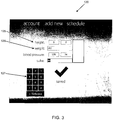
- Figure 3 illustrates an example of the user screen display 120 illustrating, for example, patient vital data entry.
- the screen display 120 may include, for example, patient vital data, such as, patient height at 125, weight at 126 etc., and a touch screen keypad 127 for entry of the patient vital data.
- patient vital data such as, patient height at 125, weight at 126 etc.
- biometric devices such as, for example, a blood pressure monitor or a weight scale may be coupled to the user sensory module 105 for automatic capture of patient vital data.
- a responder screen display 130 for the responder interface module 103 illustrating, for example, a health care provider view of the general and patient vital data.
- the screen displays 120, 130 may be provided adjacent each other so that the user and healthcare provider may each see two or more displays.
- the screen displays 120, 130 are provided for illustrative purposes only and may be combined in a single or distributed across other multiple displays. For example, a user may see the screen display 120 including user specific information and the screen display 130 including instructions from the responder as a combined display.
- the screen display 130 may include, for example, general patient data, such as, patient date of birth at 121, and patient vital data, such as, patient height at 125, weight at 126 etc.
- the screen display 130 may also include a timeline 131 selectable to determine a patient's medical history for comparison.
- a health care provider may select a timeline from March 25, 2010 - April 1, 2010.
- the user medical records may be displayed at windows 132, and may include, for example, notes related to previous patient ailments at 133 and health care provider diagnosis at 134.
- Other windows may display metrics related to a patient's walking goals at 135, with the goal metrics being displayed at 136 and patient actual metrics being displayed at 137.
- a history of patient performance in other tests may be displayed at 138 and 139.
- Figure 5 illustrates an example of the screen display 130, illustrating, for example, a health care provider view of a patient movement test which may be initiated by selecting a "tools & tests" option at 140 as shown in the Figure 4 screen display.
- the test options 141 or 142 may be selected.
- Figure 6 illustrates an example of the user screen display 120, illustrating, for example, a patient view of remote movement instructions. Assuming the health care provider selects the test at 141, the user screen display 120 may provide the patient an example of movement at 143 requested by the health care provider. For example, the patient may be requested to walk ten feet as shown in the illustration of Figure 6 .
- an example of the responder screen display 130 may illustrate, for example, a health care provider view of patient movement recorded by the user sensory module 105.
- the user sensory module 105 may include high-fidelity audio-video sensory devices.
- the audio-video sensory devices may include, for example, a depth camera and microphone arrays.
- the depth camera may include, for example, a MICROSOFT KINECT camera system.
- Responder data may also be acquired via the responder sensory module 106, which may also include, for example, high-fidelity audio-video sensory devices.
- the user sensory module 105 provides real-time digitization of user movement to produce a computer-generated version of the user movement that highlights anomalies, where the movement may be displayed at 150.
- an anomaly related to a knee joint may highlight the knee joint area in the display at 150 and/or provide metrics related to the degree or extent of the anomaly in the results 108.
- the real-time digitization is based on interpretation of movement by the user sensory module 105.
- Options for selecting user historical movements may be presented at 151, and a listing of all previously recorded user movement analysis may be presented at 152.
- the data acquired from the user sensory module 105 may be used to augment patient reported symptoms and the biometric data related to patient movement at 150 to assist the remote health care provider in arriving at more accurate medical diagnoses.
- Data related to the user's vocal and/or speech patterns may also be acquired by the user sensory module 105 by using, for example, microphone arrays.
- FIG. 8 an example is shown of the screen display 130, illustrating, for example, a health care provider view of patient movement and historical analysis.
- the current and historical movements may be displayed adjacent each other as shown.
- the historical movement may be selected from the user historical movements at 151 or the listing of previously recorded user analysis at 152.
- the data analysis module 107 may perform an analysis for anomaly identification by comparing the patient's current movement at 150 with the patient's selected historical movement.
- the data analysis module 107 may perform an analysis for anomaly identification by comparing the patient's current movement at 150 with statistical population norms, and identifying any significant deviation from such population norms. Such anomalies may be highlighted and presented on the user and/or responder interface modules 101, 103 based on the system configuration.
- the responder interface module 103 may include the display at 130 as shown in Figure 8 .
- the display may be used by a health care provider at a remote location to simultaneously view in real-time a live video stream of the user (e.g., the patient) performing an action side-by-side with the computer-generated results (e.g., the patient's current movement at 150) generated by the data analysis module 107 to assist in arriving at a medical diagnosis.
- the health care provider at the remote location may provide a medical diagnosis and further instructions as needed.
- the anomaly identification performed by the data analysis module 107 may be determined by comparing user specific movement and/or audio information with prior history information for the user (e.g., movement data collected 6 months ago), or with statistical norms of similar users.
- the similarity of users may be based, for example, on metrics such as age, gender, race, height, weight, general demographics and other health conditions.
- the real-time digitization of user movement captured by the user sensory module 105 may be used to compare points of interest for the patient to prior patient history information and/or statistical norms of similar users as described above.
- the data analysis module 107 may compare changes at various joints of a patient to determine, for example, limp development, changes in posture, a length of time taken for a certain movement etc.
- the data analysis module 107 may determine that based on a starting position, the patient has a longer stride using a right leg as compared to a left leg. Factors such as a length of time taken for certain movement may also be compared to historical data for the patient which may be used as a threshold to determine if there has been improvement compared to the historical data. Alternatively, factors such as a length of time taken for certain movement may also be compared to statistical norms which may be used as a threshold to determine if the user falls within or outside of such statistical norms.
- the data analysis module 107 may also be trainable to recommend diagnosis based on anomaly identification. For example, for an anomaly related to a length of time it takes for movement of a right leg versus a left leg, or based on the length of a stride using a right leg versus a left leg, the data analysis module 107 may recommend a diagnosis related to limp development (e.g., physical therapy focused on gait). The data analysis module 107 may also be trainable to generate a recommended treatment based on the recommended diagnosis.
- a diagnosis related to limp development e.g., physical therapy focused on gait
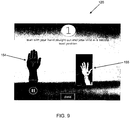
- FIG. 9 an example is shown of the screen display 120, illustrating, for example, a user view for on-screen instructions.
- an example of the on-screen instructions is shown at 154 where the user (e.g., the patient) may follow the instructions and the user's movements may be displayed in the window at 155.
- the on-screen instructions 154 of Figure 9 may be performed with a responder (e.g., the health care provider) viewing the user response at a remote location or under unsupervised conditions.
- a responder e.g., the health care provider
- a user or a responder may record the on-screen instructions 154, which may serve as a template for the user to follow, and the user may perform the movements under unsupervised conditions.
- the template may serve as the baseline for anomaly identification.
- the data analysis module 107 may identify anomalies based on comparison of the data obtained by the user sensory module 105 with the template, or based on comparison of the data obtained by the user sensory module 105 with prior user-specific historical data or with statistical norms of similar users as discussed above.
- the user may also follow instructions from a responder and the multi-modal user data may be compared to the multi-modal responder data to identify an anomaly in the user movement.
- the identified anomalies may be subsequently analyzed by a responder (e.g., the health care provider).
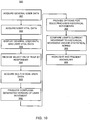
- Figure 10 illustrates a flowchart of a method 300 for interactive virtual care, according to an embodiment.
- Figure 11 illustrates a flowchart of a method 400 for interactive virtual care, according to an embodiment.
- the methods 300 and 400 may be implemented on the interactive virtual care system 100 described above with reference to Figures 1-9 by way of example and not limitation. The methods 300 and 400 may be practiced in other systems.
- the interactive virtual care system 100 may acquire general user (e.g., patient) data, such as, patient date of birth at 121, insurance information at 122, health care provider information at 123, and agreements to proceed with the virtual health care process at 124.
- general user data may be automated, for example, by attaching a magnetic strip card or a user-specific ID issued, for example, by a health insurer.
- the system 100 may acquire user vital data, such as, patient height at 125, weight at 126 etc.
- the system 100 may display the general user data and user vital data at the responder interface module 103.
- the system 100 may receive selection of the timeline 131, which is selectable to determine a patient's medical history for comparison.
- the user medical records may be displayed at windows 132, and may include, for example, notes related to previous patient ailments at 133 and health care provider diagnosis at 134.
- Other windows may display metrics related to a patient's walking goals at 135, with the goal metrics being displayed at 136 and patient actual metrics being displayed at 137.
- a history of patient performance in other tests may be displayed at 138 and 139.
- the system 100 may receive a selection of a test by a responder.
- the system 100 may receive selection of the "tools & tests" option at 140 as shown in the Figure 4 screen display.
- the user screen display 120 may provide the patient an example of movement at 143 requested by the health care provider.
- the patient may be requested to walk ten feet as shown in the illustration of Figure 6 .
- the user sensory module 105 may acquire multi-modal user data related to user movement.
- an example of the responder screen display 130 may illustrate, for example, a health care provider view of patient movement recorded by the user sensory module 105.
- the user sensory module 105 may provide real-time digitization of user movement to produce a computer-generated version of the user movement that highlights anomalies, where the movement may be displayed at 150.
- the real-time digitization may be based on interpretation of movement by the user sensory module 105.
- the responder interface module 103 may provide options for selecting user historical movements at 151, and a listing of all previously recorded user movement analysis may be displayed at 152.
- the data analysis module 107 may compare a patient's current movement at 150 and historical movement at 153, with the current and historical movements being displayed adjacent each other as shown.
- the historical movement may be selected from the user historical movements at 151 or the listing of previously recorded user analysis at 152. Based on the selection, the data analysis module 107 may perform an analysis for anomaly identification by comparing the patient's current movement at 150 with the patient's selected historical movement. Alternatively, the data analysis module 107 may perform an analysis for anomaly identification by comparing the patient's current movement at 150 with statistical population norms, and identifying any significant deviation from such population norms.
- the data analysis module 107 may highlight and present anomalies on the user and/or responder interface modules 101, 103 based on the system configuration.
- the data analysis module 107 may also generate metrics of the degree or extent of the anomalies as the results 108.
- the responder interface module 103 may include the display at 130 as shown in Figure 8 .
- the display may be used by a health care provider at a remote location to simultaneously view in real-time a live video stream of the user (e.g., the patient) performing an action side-by-side with the computer-generated results (e.g., the patient's current movement at 150) generated by the data analysis module 107 to assist in arriving at a medical diagnosis.
- the health care provider at the remote location may provide a medical diagnosis and further instructions as needed.
- the interactive virtual care system 100 may acquire general user (e.g., patient) data.
- the user interface module 101 may present on-screen instructions as shown at 154 where the user (e.g., the patient) may follow the instructions and the user's movements may be displayed in the window at 155.
- the on-screen instructions 154 of Figure 9 may be performed with a responder (e.g., the health care provider) viewing the user response at a remote location or under unsupervised conditions.
- a responder e.g., the health care provider
- a user or a responder may record the on-screen instructions 154, which may serve as a template for the user to follow, and the user may perform the movements under unsupervised conditions.
- the template may serve as the baseline for anomaly identification.
- a user may contact the responder at a remote location for assistance as needed.
- the data analysis module 107 may identify anomalies based on comparison of the data obtained by the user sensory module 105 with the template, or based on comparison of the data obtained by the user sensory module 105 with prior user-specific historical data or with statistical norms of similar users as discussed above.
- the identified anomalies may be subsequently analyzed by a responder (e.g., the health care provider).
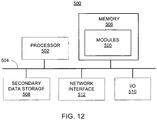
- FIG 12 shows a computer system 500 that may be used with the embodiments described herein.
- the computer system 500 represents a generic platform that includes components that may be in a server or another computer system.
- the computer system 500 may be used as a platform for the system 100.
- the computer system 500 may execute, by a processor or other hardware processing circuit, the methods, functions and other processes described herein. These methods, functions and other processes may be embodied as machine readable instructions stored on computer readable medium, which may be non-transitory, such as hardware storage devices (e.g., RAM (random access memory), ROM (read only memory), EPROM (erasable, programmable ROM), EEPROM (electrically erasable, programmable ROM), hard drives, and flash memory).
- RAM random access memory
- ROM read only memory
- EPROM erasable, programmable ROM
- EEPROM electrically erasable, programmable ROM
- hard drives and flash memory
- the computer system 500 includes a processor 502 that may implement or execute machine readable instructions performing some or all of the methods, functions and other processes described herein. Commands and data from the processor 502 are communicated over a communication bus 504.
- the computer system 500 also includes a main memory 506, such as a random access memory (RAM), where the machine readable instructions and data for the processor 502 may reside during runtime, and a secondary data storage 508, which may be nonvolatile and stores machine readable instructions and data.
- the memory and data storage are examples of computer readable mediums.
- the memory 506 may include modules 520 including machine readable instructions residing in the memory 506 during runtime and executed by the processor 502.
- the modules 520 may include the modules 101, 103 and 105-107 of the system 100 shown in Figure 1 .
- the computer system 500 may include an I/O device 510, such as a keyboard, a mouse, a display, touchscreen, etc.
- the computer system 500 may include a network interface 512 for connecting to a network.
- Other known electronic components may be added or substituted in the computer system 500.
Landscapes
- Health & Medical Sciences (AREA)
- Engineering & Computer Science (AREA)
- Life Sciences & Earth Sciences (AREA)
- Medical Informatics (AREA)
- Public Health (AREA)
- General Health & Medical Sciences (AREA)
- Biomedical Technology (AREA)
- Surgery (AREA)
- Physics & Mathematics (AREA)
- Molecular Biology (AREA)
- Heart & Thoracic Surgery (AREA)
- Animal Behavior & Ethology (AREA)
- Veterinary Medicine (AREA)
- Pathology (AREA)
- Biophysics (AREA)
- Primary Health Care (AREA)
- Epidemiology (AREA)
- Nuclear Medicine, Radiotherapy & Molecular Imaging (AREA)
- Data Mining & Analysis (AREA)
- Oral & Maxillofacial Surgery (AREA)
- Physiology (AREA)
- Dentistry (AREA)
- Databases & Information Systems (AREA)
- Radiology & Medical Imaging (AREA)
- Computer Vision & Pattern Recognition (AREA)
- General Physics & Mathematics (AREA)
- Theoretical Computer Science (AREA)
- Robotics (AREA)
- Human Computer Interaction (AREA)
- Audiology, Speech & Language Pathology (AREA)
- Computer Networks & Wireless Communication (AREA)
- Quality & Reliability (AREA)
- Business, Economics & Management (AREA)
- General Business, Economics & Management (AREA)
- Ophthalmology & Optometry (AREA)
- Social Psychology (AREA)
- Multimedia (AREA)
- Psychiatry (AREA)
- Medical Treatment And Welfare Office Work (AREA)
Description
- In facilities, such as, for example, a health care facility, where an individual's movements may be evaluated, an individual (e.g., a patient) may be evaluated by a health care provider. The evaluation may be based, for example, on visual inspection of the individual's movements. Such visual inspection can result in subjective diagnosis based on the health care provider's interpretation of the individual's movements. The degree or type of impairment of an individual's movements can be a relevant factor in interpretation of the individual's movements. An objective understanding of an individual's movements may facilitate accurate interpretation.
- DAVID, D. et al.: "Method and apparatus for remote medical monitoring incorporating video processing and system of motor tasks" (
US 2003/228033), December 11, 2003 , discloses a method to receive video image data of a subject performing one or more predetermined tasks within a new environment. From the video image date, a plurality of silhouettes is generated and combined to provide a motion portrait. Based on the motion portrait, motion characteristics are calculated and compared with normal or previous motion characteristics as part of diagnostic analysis. - DOELLING, E. N. et al.: "Devices, systems and methods for monitoring, analyzing, and/or adjusting sleep conditions" (
WO 2011/082346), July 07, 2011 , discloses therapeutic and diagnostic systems and methods for helping an individual with a sleep disordered breathing condition, such as habitual snoring or obstructive sleep apnea to achieved deep, restorative sleep. To do so, components that serve complementary sensing, monitoring and corrective or diagnostic functions are utilized. - WOLFSON, R.: "Interactive surface and display system" (
US 2008/0191864), August 14, 2008 , discloses an interactive training system for generating continuous feedback for physical therapy and training applications based on capturing and analyzing the movement of a user on an interactive surface. To do so, input such as entire areas in contact with the interactive surface, center of gravity, pressure distribution, velocity, acceleration, direction, orientation etc. is captured. In addition, the position of a body part while in the air, not touching the interactive surface is captured. The training system can provide alerts for predefined events such as a fall or the beginning of a fall. - The embodiments are described with reference to the following figures:
-
Figure 1 illustrates a system diagram for an interactive virtual care system, according to an embodiment; -
Figure 2 illustrates an example of a screen display for the interactive virtual care system, illustrating, for example, a user view of general user data; -
Figure 3 illustrates an example of a screen display for the interactive virtual care system, illustrating, for example, user vital data entry; -
Figure 4 illustrates an example of a screen display for the interactive virtual care system, illustrating, for example, a responder view of general and user vital data; -
Figure 5 illustrates an example of a screen display for the interactive virtual care system, illustrating, for example, a responder view of a user movement test; -
Figure 6 illustrates an example of a screen display for the interactive virtual care system, illustrating, for example, a user view of remote movement instructions; -
Figure 7 illustrates an example of a screen display for the interactive virtual care system, illustrating, for example, a responder view of user movement; -
Figure 8 illustrates an example of a screen display for the interactive virtual care system, illustrating, for example, a responder view of user movement and historical analysis; -
Figure 9 illustrates an example of a screen display for the interactive virtual care system, illustrating, for example, a user view for on-screen instructions; -
Figure 10 illustrates a method for interactive virtual care, according to an embodiment; -
Figure 11 illustrates a method for interactive virtual care, according to an embodiment; and -
Figure 12 illustrates a computer system, according to an embodiment. - For simplicity and illustrative purposes, the principles of the embodiments are described by referring mainly to examples thereof. In the following description, numerous specific details are set forth in order to provide a thorough understanding of the embodiments. It will be apparent that the embodiments may be practiced without limitation to all the specific details. Also, the embodiments may be used together in various combinations.
- An interactive virtual care system may provide for highly interactive virtual care consultations, for example, between two remote individuals. For facilities, such as, for example, a health care facility, the individuals may include a user (e.g., a patient) and a responder (e.g., a health care provider) located at a remote location from the user. The discussion below includes examples of application of the system for a patient and a health care provider. However, the system may be used with other industries for evaluation of any type of movement of an individual. For a health care facility, the system may provide for face-to-face video and two-way sharing of a patient's health information, and further include the use of computer-vision technology to assist the remote interaction by capturing and analyzing, for example, the patient's movements. These capabilities may offer a remote health care provider an enhanced view of a patient's condition. The system may also provide for computer-assisted speech and audio analysis of a health care provider's and patient's interactions.
- The interactive virtual care system may include a user sensory module to acquire multi-modal user data related to user movement. The modules and other components of the system may include machine readable instructions, hardware or a combination of machine readable instructions and hardware. Multi-modal user data may refer to data acquired by multiple modes of input or output, such as a depth camera and/or a microphone array as discussed below. A data analysis module may compare the multi-modal user data to predetermined historical user data and/or statistical norm data for users to identify an anomaly in the user movement. The user sensory module may include a depth camera to acquire the multi-modal user data. The user sensory module may also include a microphone array to acquire multi-modal user data related to speech. A responder sensory module may acquire multi-modal responder data related to responder movement. The data analysis module may compare the multi-modal user data to the multi-modal responder data to identify an anomaly in the user movement. A user and/or responder interface modules may display a computer-generated version of the user movement that highlights movements of predetermined portions of a user's body. The user and/or responder interface modules may further display a real-time version of the user movement adjacent to and/or superimposed on the computer-generated version of the user movement, for example, to facilitate identification of an anomaly. The user and/or responder interface modules may further highlight the anomaly in the user movement in the computer-generated version of the user movement. For comparison of the multi-modal user data to the predetermined historical user data, a range of the predetermined historical user data is selectable. The user and/or responder interface modules may include, for example, a keyboard and/or touch screen format for data entry.
- A method for interactive virtual care may include acquiring multi-modal user data related to user movement, and comparing the multi-modal user data to predetermined historical user data and/or statistical norm data for users to identify at least one anomaly in the user movement. The method may further include acquiring the multi-modal user data by a depth camera and multi-modal user data related to speech by a microphone array. The method may include displaying a computer-generated version of the user movement that highlights movements of predetermined portions of a user's body. The method may include displaying a real-time version of the user movement adjacent to and/or superimposed on the computer-generated version of the user movement. The method may include highlighting the anomaly in the user movement in the computer-generated version of the user movement.
- A non-transitory computer readable medium having stored thereon a computer executable program to provide interactive virtual care, the computer executable program when executed may cause a computer system to acquire multi-modal user data related to user movement, and compare the multi-modal user data to predetermined historical user data and/or statistical norm data for users to identify at least one anomaly in the user movement.
- An example of a use scenario of the interactive virtual care system may include a user (e.g., a patient) with a medical condition visiting, for example, a retail clinic for a virtual visit with a remotely located responder (e.g., a health care provider). The user may be checked into the system by a nurse or another locally disposed health care provider. The health care provider may collect the user data, such as, for example, vitals and enter the information via the user interface module. The user data may be sent to the responder interface module for viewing by the remotely located responder. The remote responder may send, for example, exercises to the user interface module for user diagnosis and evaluation, and may otherwise communicate with the user via the responder sensory module. The user may perform the exercises or proceed as directed by the remote responder, and all user activities may be captured by the user sensory module. The data analysis module may analyze all data captured from the user and responder interface modules, and all data captured by the user and responder sensory modules to generate results based on comparison of user specific history data and/or history data of a range of users generally to determine any anomalies. The history data for the range of users may be in the form of statistical norms for users. These anomalies and other result data may be reported to the remote responder, whereby the responder may diagnose the user's condition and render appropriate treatment in the form of a prescription or other activities.
- As discussed above, the interactive virtual care system may provide remote acquisition of multi-modal user data via the user sensory module, which may include, for example, high-fidelity audio-video sensory devices. Likewise, responder data may be remotely acquired via the responder sensory module, which may also include, for example, high-fidelity audio-video sensory devices. As described in detail below, the audio-video sensory devices may include, for example, a depth camera and microphone arrays. The depth camera may include, for example, a MICROSOFT KINECT camera system. In a healthcare environment, the data acquired from the user and responder sensory modules may be used to augment patient reported symptoms and professionally obtained biometric data to assist a remote health care provider in arriving at more accurate medical diagnoses.
- As discussed herein, the interactive virtual care system may facilitate an interactive care delivery approach that may involve the use of user data to help a responder arrive at more accurate medical diagnoses. For example, data related to a user's walking and gesture patterns (e.g., gaits, strides, balances) may be acquired unobtrusively using, for example, depth-perceiving camera arrays. Data related to a user's vocal and/or speech patterns may be acquired unobtrusively using, for example, microphone arrays. The visual and audio data may be transmitted to the data analysis module and analyzed for anomaly identification by comparing, for example, population norms as well as historical patterns of the particular user. Such anomalies may be highlighted and presented on the user and/or responder interface modules based on the system configuration. For example, the responder interface module may be used by a health care provider at a remote location to simultaneously view a real-time live video stream of the user (e.g., the patient) performing an action (e.g., walking, stretching) side-by-side with results generated by the data analysis module to assist in arriving at a medical diagnosis. The results generated by the data analysis module may also be shown as an overlay to the real-time video stream of the user.
- The interactive virtual care system may also be used in an unsupervised environment (e.g., without interaction with a responder) to provide a user (e.g., a patient) visual cues to guide the user through the correct process. For example, a treatment process (e.g., physical therapy routine or exercise) may be observed, validated and recorded under the direction of a health care provider at a remote location. A derivative outline from the recorded footage may be used to automatically guide a user through a treatment process regimen while the user is in an unsupervised setting, such as, for example, at home. The user's subsequent unsupervised in-home exercise/physical therapy sessions may be recorded and transmitted through the same remote hosting application for purposes of being viewed by a remote health care provider and/or additional analysis and comparison against the user's historical patterns. As the remote health care provider monitors the user's progress, the remote health care provider may adapt the user's treatment regimen over time, for example, by adjusting and transmitting a new or modified derivative outline from the user's recorded footage.
- The interactive virtual care system may be usable, for example, to provide remote health care expertise to any environment located a distance away from a primary health care provider, such as, for example, a remote clinic. The system may also be usable at any location convenient to a user, such as, for example, a user's home. The system may be usable in a stand-alone configuration, such as, for example, a kiosk, or may be uploaded to an existing computer system, for example, in a clinic environment.
- The systems and methods described herein provide a technical solution to the technical problem of comparing user movement and/or speech with prior historical data or statistical norms for users to determine anomalies. In many instances, manual comparison of user movement or speech with prior historical data or statistical norms is not a viable solution given the size of such data and variability involved in the manual comparison, which can lead to inconsistent results. The systems and methods according to the embodiments provide the technical solution of objectively determining anomalies based on, for example, a computer-generated version of the user movement that highlights anomalies.
-
Figure 1 illustrates an interactivevirtual care system 100, according to an embodiment. Referring toFigure 1 , thesystem 100 may include auser interface module 101 to inputuser data 102, and aresponder interface module 103 to inputresponder data 104. As described in further detail below, the various components of thesystem 100 may be operable to capture and analyze data from multiple users and responders, which may include data pertaining to a user, for example a patient, and data pertaining to a responder, for example a health care provider. The modules and sub-components of thesystem 100 may be combined or partitioned without departing from the scope of thesystem 100, and are partitioned as shown inFigure 1 for facilitating an understanding of thesystem 100. For example, the user andresponder interface modules user sensory module 105 may include audio and video capture and relay capabilities for respectively capturing and relaying information related to a user to a responder. A respondersensory module 106 may likewise include audio and video capture and relay capabilities for respectively capturing and relaying information from a responder to a user. Adata analysis module 107 may analyze the user andresponder data sensory modules results 108, such as, for example, patient specific metrics to a health care provider or results and/or instructions to a patient. Thedata analysis module 107 may be implemented in a cloud environment, instead of as a component of thesystem 100. Thesystem 100 may provide for the same data to be viewed by either the user or the responder without sending the actual data between the user andresponder interface modules data storage 109 may be provided for storing information utilized by thesystem 100, which may include, for example, user specific history data or history data of a range of users generally. The user data and history data may be used to generate statistical norms used for comparison as described below. - Referring to
Figure 2 , an example is shown of auser screen display 120 for theuser interface module 101, illustrating, for example, use of thesystem 100 in a health care facility and a patient view of general patient data. Thescreen display 120 may include, for example, general patient data, such as, patient date of birth at 121, insurance information at 122, health care provider information at 123, and agreements to proceed with the virtual health care process at 124. -
Figure 3 illustrates an example of theuser screen display 120 illustrating, for example, patient vital data entry. Thescreen display 120 may include, for example, patient vital data, such as, patient height at 125, weight at 126 etc., and atouch screen keypad 127 for entry of the patient vital data. Alternatively, biometric devices, such as, for example, a blood pressure monitor or a weight scale may be coupled to theuser sensory module 105 for automatic capture of patient vital data. - Referring to
Figure 4 , an example is shown of aresponder screen display 130 for theresponder interface module 103, illustrating, for example, a health care provider view of the general and patient vital data. For thesystem 100 implemented, for example, as a kiosk, the screen displays 120, 130 may be provided adjacent each other so that the user and healthcare provider may each see two or more displays. As discussed above, the screen displays 120, 130 are provided for illustrative purposes only and may be combined in a single or distributed across other multiple displays. For example, a user may see thescreen display 120 including user specific information and thescreen display 130 including instructions from the responder as a combined display. - Referring to
Figure 4 , thescreen display 130 may include, for example, general patient data, such as, patient date of birth at 121, and patient vital data, such as, patient height at 125, weight at 126 etc. Thescreen display 130 may also include atimeline 131 selectable to determine a patient's medical history for comparison. For example, as shown inFigure 4 , a health care provider may select a timeline from March 25, 2010 - April 1, 2010. The user medical records may be displayed atwindows 132, and may include, for example, notes related to previous patient ailments at 133 and health care provider diagnosis at 134. Other windows may display metrics related to a patient's walking goals at 135, with the goal metrics being displayed at 136 and patient actual metrics being displayed at 137. A history of patient performance in other tests may be displayed at 138 and 139. -
Figure 5 illustrates an example of thescreen display 130, illustrating, for example, a health care provider view of a patient movement test which may be initiated by selecting a "tools & tests" option at 140 as shown in theFigure 4 screen display. Assuming for example the user complains of knee pain, thetest options Figure 6 illustrates an example of theuser screen display 120, illustrating, for example, a patient view of remote movement instructions. Assuming the health care provider selects the test at 141, theuser screen display 120 may provide the patient an example of movement at 143 requested by the health care provider. For example, the patient may be requested to walk ten feet as shown in the illustration ofFigure 6 . - Referring to
Figure 7 , an example of theresponder screen display 130 may illustrate, for example, a health care provider view of patient movement recorded by theuser sensory module 105. Theuser sensory module 105 may include high-fidelity audio-video sensory devices. The audio-video sensory devices may include, for example, a depth camera and microphone arrays. The depth camera may include, for example, a MICROSOFT KINECT camera system. Responder data may also be acquired via the respondersensory module 106, which may also include, for example, high-fidelity audio-video sensory devices. Theuser sensory module 105 provides real-time digitization of user movement to produce a computer-generated version of the user movement that highlights anomalies, where the movement may be displayed at 150. For example, an anomaly related to a knee joint may highlight the knee joint area in the display at 150 and/or provide metrics related to the degree or extent of the anomaly in theresults 108. The real-time digitization is based on interpretation of movement by theuser sensory module 105. - Options for selecting user historical movements may be presented at 151, and a listing of all previously recorded user movement analysis may be presented at 152. The data acquired from the
user sensory module 105 may be used to augment patient reported symptoms and the biometric data related to patient movement at 150 to assist the remote health care provider in arriving at more accurate medical diagnoses. Data related to the user's vocal and/or speech patterns may also be acquired by theuser sensory module 105 by using, for example, microphone arrays. - Referring to
Figure 8 , an example is shown of thescreen display 130, illustrating, for example, a health care provider view of patient movement and historical analysis. Referring toFigures 7 and8 , assuming a comparison is made between a patient's current movement at 150 and historical movement at 153, the current and historical movements may be displayed adjacent each other as shown. The historical movement may be selected from the user historical movements at 151 or the listing of previously recorded user analysis at 152. Based on the selection, thedata analysis module 107 may perform an analysis for anomaly identification by comparing the patient's current movement at 150 with the patient's selected historical movement. Alternatively, thedata analysis module 107 may perform an analysis for anomaly identification by comparing the patient's current movement at 150 with statistical population norms, and identifying any significant deviation from such population norms. Such anomalies may be highlighted and presented on the user and/orresponder interface modules responder interface module 103 may include the display at 130 as shown inFigure 8 . The display may be used by a health care provider at a remote location to simultaneously view in real-time a live video stream of the user (e.g., the patient) performing an action side-by-side with the computer-generated results (e.g., the patient's current movement at 150) generated by thedata analysis module 107 to assist in arriving at a medical diagnosis. Based on anomaly identification, the health care provider at the remote location may provide a medical diagnosis and further instructions as needed. - The anomaly identification performed by the
data analysis module 107 may be determined by comparing user specific movement and/or audio information with prior history information for the user (e.g., movement data collected 6 months ago), or with statistical norms of similar users. The similarity of users may be based, for example, on metrics such as age, gender, race, height, weight, general demographics and other health conditions. The real-time digitization of user movement captured by theuser sensory module 105 may be used to compare points of interest for the patient to prior patient history information and/or statistical norms of similar users as described above. For example, for movement information, thedata analysis module 107 may compare changes at various joints of a patient to determine, for example, limp development, changes in posture, a length of time taken for a certain movement etc. For example, in order to determine limp development, thedata analysis module 107 may determine that based on a starting position, the patient has a longer stride using a right leg as compared to a left leg. Factors such as a length of time taken for certain movement may also be compared to historical data for the patient which may be used as a threshold to determine if there has been improvement compared to the historical data. Alternatively, factors such as a length of time taken for certain movement may also be compared to statistical norms which may be used as a threshold to determine if the user falls within or outside of such statistical norms. - The
data analysis module 107 may also be trainable to recommend diagnosis based on anomaly identification. For example, for an anomaly related to a length of time it takes for movement of a right leg versus a left leg, or based on the length of a stride using a right leg versus a left leg, thedata analysis module 107 may recommend a diagnosis related to limp development (e.g., physical therapy focused on gait). Thedata analysis module 107 may also be trainable to generate a recommended treatment based on the recommended diagnosis. - Referring to
Figure 9 , an example is shown of thescreen display 120, illustrating, for example, a user view for on-screen instructions. As shown inFigure 9 , an example of the on-screen instructions is shown at 154 where the user (e.g., the patient) may follow the instructions and the user's movements may be displayed in the window at 155. The on-screen instructions 154 ofFigure 9 may be performed with a responder (e.g., the health care provider) viewing the user response at a remote location or under unsupervised conditions. Alternatively, a user or a responder may record the on-screen instructions 154, which may serve as a template for the user to follow, and the user may perform the movements under unsupervised conditions. The template may serve as the baseline for anomaly identification. Thedata analysis module 107 may identify anomalies based on comparison of the data obtained by theuser sensory module 105 with the template, or based on comparison of the data obtained by theuser sensory module 105 with prior user-specific historical data or with statistical norms of similar users as discussed above. The user may also follow instructions from a responder and the multi-modal user data may be compared to the multi-modal responder data to identify an anomaly in the user movement. The identified anomalies may be subsequently analyzed by a responder (e.g., the health care provider). -
Figure 10 illustrates a flowchart of amethod 300 for interactive virtual care, according to an embodiment.Figure 11 illustrates a flowchart of amethod 400 for interactive virtual care, according to an embodiment. Themethods virtual care system 100 described above with reference toFigures 1-9 by way of example and not limitation. Themethods - For the
method 300, referring toFigures 1 ,2 and10 , atblock 301, for use in a health care facility, the interactivevirtual care system 100 may acquire general user (e.g., patient) data, such as, patient date of birth at 121, insurance information at 122, health care provider information at 123, and agreements to proceed with the virtual health care process at 124. Capture of the general user data may be automated, for example, by attaching a magnetic strip card or a user-specific ID issued, for example, by a health insurer. - At block 302, referring to
Figures 1 ,3 and10 , thesystem 100 may acquire user vital data, such as, patient height at 125, weight at 126 etc. - At block 303, referring to
Figures 1 ,4 and10 , thesystem 100 may display the general user data and user vital data at theresponder interface module 103. Thesystem 100 may receive selection of thetimeline 131, which is selectable to determine a patient's medical history for comparison. As discussed above, the user medical records may be displayed atwindows 132, and may include, for example, notes related to previous patient ailments at 133 and health care provider diagnosis at 134. Other windows may display metrics related to a patient's walking goals at 135, with the goal metrics being displayed at 136 and patient actual metrics being displayed at 137. A history of patient performance in other tests may be displayed at 138 and 139. - At
block 304, referring toFigures 1 ,5 and10 , thesystem 100 may receive a selection of a test by a responder. For example, thesystem 100 may receive selection of the "tools & tests" option at 140 as shown in theFigure 4 screen display. Assuming thesystem 100 receives selection of thetest 141, theuser screen display 120 may provide the patient an example of movement at 143 requested by the health care provider. For example, the patient may be requested to walk ten feet as shown in the illustration ofFigure 6 . - At
block 305, referring toFigures 1 ,7 and10 , theuser sensory module 105 may acquire multi-modal user data related to user movement. Referring toFigure 7 , an example of theresponder screen display 130 may illustrate, for example, a health care provider view of patient movement recorded by theuser sensory module 105. - At
block 306, referring toFigures 7 and10 , theuser sensory module 105 may provide real-time digitization of user movement to produce a computer-generated version of the user movement that highlights anomalies, where the movement may be displayed at 150. The real-time digitization may be based on interpretation of movement by theuser sensory module 105. - At block 307, referring to
Figures 7 and10 , theresponder interface module 103 may provide options for selecting user historical movements at 151, and a listing of all previously recorded user movement analysis may be displayed at 152. - At block 308, referring to
Figures 1 ,7 ,8 and10 , thedata analysis module 107 may compare a patient's current movement at 150 and historical movement at 153, with the current and historical movements being displayed adjacent each other as shown. The historical movement may be selected from the user historical movements at 151 or the listing of previously recorded user analysis at 152. Based on the selection, thedata analysis module 107 may perform an analysis for anomaly identification by comparing the patient's current movement at 150 with the patient's selected historical movement. Alternatively, thedata analysis module 107 may perform an analysis for anomaly identification by comparing the patient's current movement at 150 with statistical population norms, and identifying any significant deviation from such population norms. - At
block 309, referring toFigures 1 ,7 ,8 and10 , thedata analysis module 107 may highlight and present anomalies on the user and/orresponder interface modules data analysis module 107 may also generate metrics of the degree or extent of the anomalies as theresults 108. For example, theresponder interface module 103 may include the display at 130 as shown inFigure 8 . The display may be used by a health care provider at a remote location to simultaneously view in real-time a live video stream of the user (e.g., the patient) performing an action side-by-side with the computer-generated results (e.g., the patient's current movement at 150) generated by thedata analysis module 107 to assist in arriving at a medical diagnosis. Based on anomaly identification, the health care provider at the remote location may provide a medical diagnosis and further instructions as needed. - For the
method 400, referring toFigures 1 ,9 and11 , atblock 401, the interactivevirtual care system 100 may acquire general user (e.g., patient) data. - At block 402, if a user is to perform tests under unsupervised conditions or following a responder's movements, the
user interface module 101 may present on-screen instructions as shown at 154 where the user (e.g., the patient) may follow the instructions and the user's movements may be displayed in the window at 155. The on-screen instructions 154 ofFigure 9 may be performed with a responder (e.g., the health care provider) viewing the user response at a remote location or under unsupervised conditions. Alternatively, a user or a responder may record the on-screen instructions 154, which may serve as a template for the user to follow, and the user may perform the movements under unsupervised conditions. The template may serve as the baseline for anomaly identification. In the unsupervised setting, a user may contact the responder at a remote location for assistance as needed. - At
block 403, thedata analysis module 107 may identify anomalies based on comparison of the data obtained by theuser sensory module 105 with the template, or based on comparison of the data obtained by theuser sensory module 105 with prior user-specific historical data or with statistical norms of similar users as discussed above. The identified anomalies may be subsequently analyzed by a responder (e.g., the health care provider). -
Figure 12 shows acomputer system 500 that may be used with the embodiments described herein. Thecomputer system 500 represents a generic platform that includes components that may be in a server or another computer system. Thecomputer system 500 may be used as a platform for thesystem 100. Thecomputer system 500 may execute, by a processor or other hardware processing circuit, the methods, functions and other processes described herein. These methods, functions and other processes may be embodied as machine readable instructions stored on computer readable medium, which may be non-transitory, such as hardware storage devices (e.g., RAM (random access memory), ROM (read only memory), EPROM (erasable, programmable ROM), EEPROM (electrically erasable, programmable ROM), hard drives, and flash memory). - The
computer system 500 includes aprocessor 502 that may implement or execute machine readable instructions performing some or all of the methods, functions and other processes described herein. Commands and data from theprocessor 502 are communicated over acommunication bus 504. Thecomputer system 500 also includes amain memory 506, such as a random access memory (RAM), where the machine readable instructions and data for theprocessor 502 may reside during runtime, and asecondary data storage 508, which may be nonvolatile and stores machine readable instructions and data. The memory and data storage are examples of computer readable mediums. Thememory 506 may includemodules 520 including machine readable instructions residing in thememory 506 during runtime and executed by theprocessor 502. Themodules 520 may include themodules system 100 shown inFigure 1 . - The
computer system 500 may include an I/O device 510, such as a keyboard, a mouse, a display, touchscreen, etc. Thecomputer system 500 may include anetwork interface 512 for connecting to a network. Other known electronic components may be added or substituted in thecomputer system 500. - While the embodiments have been described with reference to examples, various modifications to the described embodiments may be made without departing from the scope of the claimed embodiments.
Claims (9)
- An interactive virtual care system (100) comprising:a user sensory module (105) to acquire multi-modal user data related to user movement, wherein the user sensory module (105) includes a depth camera to acquire the multi-modal user data, and wherein the user sensory module (105) is adapted to provide real-time digitization of the user movement, based on an interpretation of the user movement by the user sensory module (105), and to produce a computer-generated version of the user movement, wherein the user sensory module (105) includes audio and video capture and relay capabilities for respectively capturing and relaying information related to a user to a responder;a responder sensory module (106) to acquire multi-modal responder data related to responder movement;a data analysis module (107), executed by a processor, to- compare the multi-modal user data to predetermined historical user data and statistical norm data for users to identify at least one anomaly being a first anomaly in the user movement, and- compare the multi-modal user data to the multi-modal responder data (104) to identify at least one anomaly being a second anomaly in the user movement,wherein the data analysis module (107) is adapted to analyse the multi-modal user data captured by the user sensory module (105), and the multi-modal responder data captured by the responder sensory module (106) to generate results (108) ; wherein the results (108) comprise metrics related to a degree or an extent of the first and/or second anomalies in the results (108);a responder interface module (103) and a user interface module (101) adapted to display the computer-generated version of the user movement with highlights of movements of predetermined portions of a user's body,wherein the responder interface module (103) is adapted to further highlight the first anomaly in the user movement in the computer-generated version of the user movement, wherein at least one of the responder interface module (103) and the user interface module (101) provide options for selecting a range of the predetermined historical user data for comparison of the multi-modal user data to the predetermined historical user data,wherein the responder interface module (103) is adapted to further display a real-time version of the multi-modal user data of the user movement superimposed on the computer-generated version of the user movement; andwherein the user interface module (101) is further adapted to- highlight the first anomaly in the user movement in the computer-generated version of the user movement; and- display the real-time version of the multi-modal user data of the user movement superimposed on the computer-generated version of the user movement.
- The system of claim 1, wherein the user sensory module (105) includes a microphone array to acquire the multi-modal user data related to speech.
- The system of any one of claims 1 to 2, wherein each user is a patient and each responder is a health care provider; and/or
further comprising a responder sensory module (106) to acquire the multi-modal responder data for a responder disposed at a remote location from a user. - The system of claim 1, wherein the responder interface module (103) is further adapted to further display the real-time version of the multi-modal user data of the user movement adjacent to the computer-generated version of the user movement.
- The system of any one of the preceding claims, wherein the user interface module (101) is adapted to further display the real-time version of the multi-modal user data of the user movement adjacent to the computer-generated version of the user movement.
- The system of any one of the preceding claims, wherein the responder interface module (103) is disposed at a remote location compared to the user interface module (101).
- A non-transitory computer readable medium having stored thereon a computer executable program to provide interactive virtual care, the computer executable program, when executed on an interactive virtual care system of any claims 1 to 6, being configured to carry out the steps of:acquiring (301), at a user sensory module (105), multi-modal user data related to user movement by using a depth camera to acquire the multi-modal user data;performing, by the user sensory module (105), real-time digitization of the user movement, based on an interpretation of the user movement, to produce a computer-generated version of the user movement,capturing and relaying, respectively by audio and video capture and relay capabilities included in the user sensory module (105), information related to a user to a responder;providing a responder interface module (103) and a user interface module (101) to display the computer-generated version of the user movement with highlights of movements of predetermined portions of a user's body, wherein the responder interface module is to further highlight a first anomaly in the user movement in the computer-generated version of the user movement, wherein at least one of the responder interface module (103) and the user interface module (101) having options for selecting a range of predetermined historical user data for comparison of the multi-modal user data to the predetermined historical user data;comparing (308), by a data analysis module (107) executed by a processor, the multi-modal user data to the predetermined historical user data and statistical norm data for users to identify at least one anomaly being the first anomaly in the user movement to generate results (108);displaying, at the responder interface module (103) a real-time version of the multi-modal user data of the user movement superimposed on the computer-generated version of the user movement;highlighting, at a user interface module (101), the first anomaly in the user movement in the computer-generated version of the user movement; anddisplaying, at the user interface module (101), the real-time version of the multi-modal user data of the user movement superimposed on the computer-generated version of the user movement;acquiring, by a responder sensory module (106), multi-modal responder data related to responder movement;analyzing the multi-modal user data captured by the user sensory module (105), and the multi-modal responder data captured by the responder sensory module (106) to generate results (108) by comparing the multi-modal user data to the multi-modal responder data to identify at least one anomaly being a second anomaly in the user movement; andgenerating metrics related to a degree or extent of the first and/or second anomalies in the results (108).
- The non-transitory computer readable medium of claim 7, further carrying out the step of acquiring the multi-modal user data related to speech by a microphone array.
- The non-transitory computer readable medium of claim 7 or 8, further carrying out the step of displaying the real-time version of the multi-modal user data of the user movement adjacent to the computer-generated version of the user movement.
Applications Claiming Priority (1)
| Application Number | Priority Date | Filing Date | Title |
|---|---|---|---|
| US13/213,930 US8771206B2 (en) | 2011-08-19 | 2011-08-19 | Interactive virtual care |
Publications (2)
| Publication Number | Publication Date |
|---|---|
| EP2560141A1 EP2560141A1 (en) | 2013-02-20 |
| EP2560141B1 true EP2560141B1 (en) | 2018-03-14 |
Family
ID=46758570
Family Applications (1)
| Application Number | Title | Priority Date | Filing Date |
|---|---|---|---|
| EP12005871.4A Active EP2560141B1 (en) | 2011-08-19 | 2012-08-14 | Interactive virtual care |
Country Status (3)
| Country | Link |
|---|---|
| US (6) | US8771206B2 (en) |
| EP (1) | EP2560141B1 (en) |
| AU (1) | AU2012216277B2 (en) |
Families Citing this family (58)
| Publication number | Priority date | Publication date | Assignee | Title |
|---|---|---|---|---|
| US7806189B2 (en) | 2007-12-03 | 2010-10-05 | W. Lynn Frazier | Downhole valve assembly |
| US10176827B2 (en) | 2008-01-15 | 2019-01-08 | Verint Americas Inc. | Active lab |
| US10489434B2 (en) | 2008-12-12 | 2019-11-26 | Verint Americas Inc. | Leveraging concepts with information retrieval techniques and knowledge bases |
| US8943094B2 (en) | 2009-09-22 | 2015-01-27 | Next It Corporation | Apparatus, system, and method for natural language processing |
| US9122744B2 (en) | 2010-10-11 | 2015-09-01 | Next It Corporation | System and method for providing distributed intelligent assistance |
| JP5701685B2 (en) * | 2011-05-26 | 2015-04-15 | 富士フイルム株式会社 | MEDICAL INFORMATION DISPLAY DEVICE, ITS OPERATION METHOD, AND MEDICAL INFORMATION DISPLAY PROGRAM |
| US9836177B2 (en) | 2011-12-30 | 2017-12-05 | Next IT Innovation Labs, LLC | Providing variable responses in a virtual-assistant environment |
| US9339691B2 (en) | 2012-01-05 | 2016-05-17 | Icon Health & Fitness, Inc. | System and method for controlling an exercise device |
| US9223537B2 (en) | 2012-04-18 | 2015-12-29 | Next It Corporation | Conversation user interface |
| TWM444565U (en) * | 2012-08-03 | 2013-01-01 | Kuo-Yuan Chang | Electronic vital-sign system with manually entering vital-sign data function |
| US9536049B2 (en) | 2012-09-07 | 2017-01-03 | Next It Corporation | Conversational virtual healthcare assistant |
| US20160081594A1 (en) * | 2013-03-13 | 2016-03-24 | Virtusense Technologies | Range of motion system, and method |
| CN104884133B (en) | 2013-03-14 | 2018-02-23 | 艾肯运动与健康公司 | Force exercise equipment with flywheel |
| US10445115B2 (en) | 2013-04-18 | 2019-10-15 | Verint Americas Inc. | Virtual assistant focused user interfaces |
| US9075906B2 (en) * | 2013-06-28 | 2015-07-07 | Elwha Llc | Medical support system including medical equipment case |
| US10320903B2 (en) * | 2013-09-16 | 2019-06-11 | Vii Network, Inc. | Web and mobile-based platform that unites workflow management and asynchronous video collaboration for healthcare |
| US9403047B2 (en) | 2013-12-26 | 2016-08-02 | Icon Health & Fitness, Inc. | Magnetic resistance mechanism in a cable machine |
| US10088972B2 (en) | 2013-12-31 | 2018-10-02 | Verint Americas Inc. | Virtual assistant conversations |
| US20150235395A1 (en) * | 2014-02-19 | 2015-08-20 | Mckesson Financial Holdings | Method And Apparatus For Displaying One Or More Waveforms |
| US9646395B2 (en) | 2014-02-27 | 2017-05-09 | Change Healthcare Llc | Method and apparatus for comparing portions of a waveform |
| WO2015138339A1 (en) | 2014-03-10 | 2015-09-17 | Icon Health & Fitness, Inc. | Pressure sensor to quantify work |
| CN106470739B (en) | 2014-06-09 | 2019-06-21 | 爱康保健健身有限公司 | Cable system incorporated into the treadmill |
| WO2015195965A1 (en) | 2014-06-20 | 2015-12-23 | Icon Health & Fitness, Inc. | Post workout massage device |
| WO2016016277A1 (en) | 2014-07-30 | 2016-02-04 | Universitat Autonoma De Barcelona | A computer-implemented method and a system for remotely monitoring a user, and a computer program product implementing the method |
| US20160071517A1 (en) | 2014-09-09 | 2016-03-10 | Next It Corporation | Evaluating Conversation Data based on Risk Factors |
| US10391361B2 (en) | 2015-02-27 | 2019-08-27 | Icon Health & Fitness, Inc. | Simulating real-world terrain on an exercise device |
| WO2016193839A1 (en) * | 2015-06-03 | 2016-12-08 | Koninklijke Philips N.V. | System and method for generating an adaptive embodied conversational agent configured to provide interactive virtual coaching to a subject |
| CN105310665A (en) * | 2015-10-29 | 2016-02-10 | 芜湖迈特电子科技有限公司 | Automatic physical examination system and wearable equipment |
| US10096383B2 (en) | 2015-11-24 | 2018-10-09 | International Business Machines Corporation | Performing a health analysis using a smart floor mat |
| US10813572B2 (en) * | 2015-12-11 | 2020-10-27 | Electronic Caregiver, Inc. | Intelligent system for multi-function electronic caregiving to facilitate advanced health diagnosis, health monitoring, fall and injury prediction, health maintenance and support, and emergency response |
| US12265900B2 (en) | 2018-01-17 | 2025-04-01 | Electronic Caregiver, Inc. | Computing devices with improved interactive animated conversational interface systems |
| US12315640B2 (en) | 2015-12-11 | 2025-05-27 | Electronic Caregiver, Inc. | Atmospheric mirroring and dynamically varying three-dimensional assistant addison interface for interior environments |
| USD806730S1 (en) * | 2016-01-05 | 2018-01-02 | Kneevoice, Inc. | Display screen or portion thereof with graphical user interface |
| US10625137B2 (en) | 2016-03-18 | 2020-04-21 | Icon Health & Fitness, Inc. | Coordinated displays in an exercise device |
| US10272317B2 (en) | 2016-03-18 | 2019-04-30 | Icon Health & Fitness, Inc. | Lighted pace feature in a treadmill |
| US10493349B2 (en) | 2016-03-18 | 2019-12-03 | Icon Health & Fitness, Inc. | Display on exercise device |
| US11311210B2 (en) * | 2016-07-14 | 2022-04-26 | Brightday Technologies, Inc. | Posture analysis systems and methods |
| US10671705B2 (en) | 2016-09-28 | 2020-06-02 | Icon Health & Fitness, Inc. | Customizing recipe recommendations |
| CA3042535C (en) | 2016-11-03 | 2022-05-17 | Zimmer, Inc. | Augmented reality therapeutic movement display and gesture analyzer |
| US11253173B1 (en) * | 2017-05-30 | 2022-02-22 | Verily Life Sciences Llc | Digital characterization of movement to detect and monitor disorders |
| CN107741196B (en) * | 2017-12-04 | 2019-11-12 | 成都思悟革科技有限公司 | A kind of human body attitude preparation method and system |
| US11904224B2 (en) | 2018-02-20 | 2024-02-20 | Koninklijke Philips N.V. | System and method for client-side physiological condition estimations based on a video of an individual |
| US11213224B2 (en) | 2018-03-19 | 2022-01-04 | Electronic Caregiver, Inc. | Consumer application for mobile assessment of functional capacity and falls risk |
| US11923058B2 (en) | 2018-04-10 | 2024-03-05 | Electronic Caregiver, Inc. | Mobile system for the assessment of consumer medication compliance and provision of mobile caregiving |
| US11488724B2 (en) | 2018-06-18 | 2022-11-01 | Electronic Caregiver, Inc. | Systems and methods for a virtual, intelligent and customizable personal medical assistant |
| US11568175B2 (en) | 2018-09-07 | 2023-01-31 | Verint Americas Inc. | Dynamic intent classification based on environment variables |
| US11232264B2 (en) | 2018-10-19 | 2022-01-25 | Verint Americas Inc. | Natural language processing with non-ontological hierarchy models |
| US11196863B2 (en) | 2018-10-24 | 2021-12-07 | Verint Americas Inc. | Method and system for virtual assistant conversations |
| WO2020163180A1 (en) | 2019-02-05 | 2020-08-13 | Electronic Caregiver, Inc. | 3d environment risks identification utilizing reinforced learning |
| US11113943B2 (en) | 2019-05-07 | 2021-09-07 | Electronic Caregiver, Inc. | Systems and methods for predictive environmental fall risk identification |
| US20210022668A1 (en) * | 2019-07-24 | 2021-01-28 | Kessler Foundation Inc. | Feedback systems and methods for gait training for pediatric subjects afflicted with gait disorders |
| US12034748B2 (en) | 2020-02-28 | 2024-07-09 | Electronic Caregiver, Inc. | Intelligent platform for real-time precision care plan support during remote care management |
| US12125137B2 (en) | 2020-05-13 | 2024-10-22 | Electronic Caregiver, Inc. | Room labeling drawing interface for activity tracking and detection |
| CA3172406A1 (en) * | 2020-05-28 | 2021-12-02 | Jose Ricardo Dos Santos | Systems and methods for monitoring user activity |
| US12127817B2 (en) | 2020-07-22 | 2024-10-29 | Electronic Caregiver, Inc. | Systems and methods for mitigating the spread of infectious diseases |
| US12176079B2 (en) * | 2020-08-07 | 2024-12-24 | HCL Technologies Italy S.p.A. | Method, system, and device for providing assistance to patients with communication and memory impairment |
| US12009083B2 (en) * | 2020-11-16 | 2024-06-11 | Electronic Caregiver, Inc. | Remote physical therapy and assessment of patients |
| JP7694454B2 (en) * | 2022-05-10 | 2025-06-18 | トヨタ自動車株式会社 | Vehicle display control device, vehicle display control system, and vehicle |
Family Cites Families (90)
| Publication number | Priority date | Publication date | Assignee | Title |
|---|---|---|---|---|
| US4813436A (en) * | 1987-07-30 | 1989-03-21 | Human Performance Technologies, Inc. | Motion analysis system employing various operating modes |
| EP0455700A1 (en) * | 1989-01-24 | 1991-11-13 | Dolphin Imaging Systems Inc. | Method and apparatus for generating cephalometric images |
| US5231483A (en) * | 1990-09-05 | 1993-07-27 | Visionary Products, Inc. | Smart tracking system |
| US5375610A (en) * | 1992-04-28 | 1994-12-27 | University Of New Hampshire | Apparatus for the functional assessment of human activity |
| US5826578A (en) * | 1994-05-26 | 1998-10-27 | Curchod; Donald B. | Motion measurement apparatus |
| US5524637A (en) * | 1994-06-29 | 1996-06-11 | Erickson; Jon W. | Interactive system for measuring physiological exertion |
| US6142913A (en) * | 1995-10-11 | 2000-11-07 | Ewert; Bruce | Dynamic real time exercise video apparatus and method |
| US6228038B1 (en) * | 1997-04-14 | 2001-05-08 | Eyelight Research N.V. | Measuring and processing data in reaction to stimuli |
| US7956894B2 (en) * | 1997-10-14 | 2011-06-07 | William Rex Akers | Apparatus and method for computerized multi-media medical and pharmaceutical data organization and transmission |
| US6072494A (en) * | 1997-10-15 | 2000-06-06 | Electric Planet, Inc. | Method and apparatus for real-time gesture recognition |
| US6176837B1 (en) * | 1998-04-17 | 2001-01-23 | Massachusetts Institute Of Technology | Motion tracking system |
| US6774885B1 (en) * | 1999-01-20 | 2004-08-10 | Motek B.V. | System for dynamic registration, evaluation, and correction of functional human behavior |
| US20030181790A1 (en) | 2000-05-18 | 2003-09-25 | Daniel David | Methods and apparatus for facilitated, hierarchical medical diagnosis and symptom coding and definition |
| US8306635B2 (en) * | 2001-03-07 | 2012-11-06 | Motion Games, Llc | Motivation and enhancement of physical and mental exercise, rehabilitation, health and social interaction |
| US6705522B2 (en) * | 2001-10-03 | 2004-03-16 | Accenture Global Services, Gmbh | Mobile object tracker |
| FR2834197B1 (en) * | 2001-12-28 | 2004-02-27 | Optimage | METHOD AND DEVICE FOR EVALUATING SKELETON BALANCING FORCES |
| JP2004248794A (en) * | 2003-02-19 | 2004-09-09 | Hitachi Kiden Kogyo Ltd | Footprint analyzer |
| US20030203730A1 (en) * | 2002-04-11 | 2003-10-30 | Dadong Wan | Location-based remote monitoring |
| AU2003247273A1 (en) * | 2002-04-11 | 2003-10-20 | Accenture Global Services Gmbh | On demand real-time knowledge based connectivity |
| US7231834B2 (en) * | 2003-07-28 | 2007-06-19 | Hamamatsu Photonics K. K. | Stride measuring apparatus |
| JP2005224452A (en) * | 2004-02-13 | 2005-08-25 | Big Sports:Kk | Posture diagnostic apparatus and program thereof |
| CN1960674B (en) * | 2004-06-03 | 2010-05-12 | 斯蒂芬妮·利特埃尔 | System and method for ergonomic tracking of individual physical exertion |
| JP4284538B2 (en) * | 2004-10-19 | 2009-06-24 | ソニー株式会社 | Playback apparatus and playback method |
| TWI266217B (en) * | 2004-12-28 | 2006-11-11 | Ind Tech Res Inst | Methods and devices of a multi-functional operating interface for a nursing machine |
| EP1863385B1 (en) * | 2005-03-11 | 2017-01-11 | Rsscan International | Method and appartus for displaying 3d images of a part of the skeleton |
| US8702629B2 (en) * | 2005-03-17 | 2014-04-22 | Great Lakes Neuro Technologies Inc. | Movement disorder recovery system and method for continuous monitoring |
| KR100635906B1 (en) * | 2005-03-24 | 2006-10-18 | 경북대학교 산학협력단 | Leg Rehabilitation Training Device and Leg Rehabilitation Training Method Using Weight Load and Joint Angle as Variables |
| US20080191864A1 (en) * | 2005-03-31 | 2008-08-14 | Ronen Wolfson | Interactive Surface and Display System |
| US20070027369A1 (en) * | 2005-07-28 | 2007-02-01 | Guido Pagnacco | Apparatus and methods for assessing human physical performance |
| US20070197938A1 (en) * | 2005-12-14 | 2007-08-23 | Tyson William R | Performance tracking systems and methods |
| US7978081B2 (en) * | 2006-01-09 | 2011-07-12 | Applied Technology Holdings, Inc. | Apparatus, systems, and methods for communicating biometric and biomechanical information |
| WO2007114901A2 (en) * | 2006-04-04 | 2007-10-11 | The Mclean Hospital Corporation | Method for diagnosing adhd and related behavioral disorders |
| US8140353B2 (en) * | 2006-06-29 | 2012-03-20 | The Invention Science Fund I, Llc | Compliance data for health-related procedures |
| JP5156013B2 (en) | 2006-07-10 | 2013-03-06 | アクセンチュア グローバル サービスィズ ゲーエムベーハー | Mobile personal service platform to provide feedback |
| US20080065468A1 (en) * | 2006-09-07 | 2008-03-13 | Charles John Berg | Methods for Measuring Emotive Response and Selection Preference |
| EP2469436B1 (en) * | 2006-11-01 | 2021-09-22 | ResMed Sensor Technologies Limited | System and method for monitoring cardiorespiratory parameters |
| US20080119763A1 (en) * | 2006-11-21 | 2008-05-22 | Jay Wiener | Acquisition processing and reporting physical exercise data |
| US20080221487A1 (en) * | 2007-03-07 | 2008-09-11 | Motek Bv | Method for real time interactive visualization of muscle forces and joint torques in the human body |
| DE102007011844B4 (en) * | 2007-03-12 | 2012-10-31 | Siemens Ag | Device for remote control and / or communication |
| WO2008111800A2 (en) * | 2007-03-13 | 2008-09-18 | Mzen | Method for three-dimensional biomechanical data and parameter analysis and system using the same method |
| US20080287821A1 (en) * | 2007-03-30 | 2008-11-20 | Searete Llc, A Limited Liability Corporation Of The State Of Delaware | Computational user-health testing |
| US20080294012A1 (en) * | 2007-05-22 | 2008-11-27 | Kurtz Andrew F | Monitoring physiological conditions |
| US8038615B2 (en) * | 2007-05-22 | 2011-10-18 | Eastman Kodak Company | Inferring wellness from physiological conditions data |
| US20090099480A1 (en) * | 2007-05-24 | 2009-04-16 | Peter Salgo | System and method for patient monitoring |
| US7782358B2 (en) * | 2007-06-08 | 2010-08-24 | Nokia Corporation | Measuring human movements—method and apparatus |
| FR2919406B1 (en) * | 2007-07-23 | 2009-10-23 | Commissariat Energie Atomique | METHOD AND DEVICE FOR RECOGNIZING THE POSITION OR MOVEMENT OF A DEVICE OR LIVING. |
| US8221290B2 (en) * | 2007-08-17 | 2012-07-17 | Adidas International Marketing B.V. | Sports electronic training system with electronic gaming features, and applications thereof |
| DE602008006203D1 (en) | 2007-08-22 | 2011-05-26 | Philips Intellectual Property | SYSTEM AND METHOD FOR DISPLAYING SELECTED INFORMATION FOR A TRAINING ACTIVE PERSON |
| US20090287120A1 (en) * | 2007-12-18 | 2009-11-19 | Searete Llc, A Limited Liability Corporation Of The State Of Delaware | Circulatory monitoring systems and methods |
| US8834391B2 (en) * | 2008-01-09 | 2014-09-16 | Allergan, Inc. | Computer analysis of a breast shape to assist breast surgery |
| US7988647B2 (en) * | 2008-03-14 | 2011-08-02 | Bunn Frank E | Assessment of medical conditions by determining mobility |
| US20110060248A1 (en) * | 2008-03-18 | 2011-03-10 | Tomotoshi Ishida | Physical configuration detector, physical configuration detecting program, and physical configuration detecting method |
| US8182424B2 (en) * | 2008-03-19 | 2012-05-22 | Microsoft Corporation | Diary-free calorimeter |
| US8514251B2 (en) * | 2008-06-23 | 2013-08-20 | Qualcomm Incorporated | Enhanced character input using recognized gestures |
| US8315710B2 (en) * | 2008-07-11 | 2012-11-20 | Medtronic, Inc. | Associating therapy adjustments with patient posture states |
| US8708934B2 (en) * | 2008-07-11 | 2014-04-29 | Medtronic, Inc. | Reorientation of patient posture states for posture-responsive therapy |
| US8282580B2 (en) * | 2008-07-11 | 2012-10-09 | Medtronic, Inc. | Data rejection for posture state analysis |
| US20100199228A1 (en) * | 2009-01-30 | 2010-08-05 | Microsoft Corporation | Gesture Keyboarding |
| US20100234769A1 (en) * | 2009-03-11 | 2010-09-16 | GFXCoach LLC | Sports training system |
| US8251874B2 (en) * | 2009-03-27 | 2012-08-28 | Icon Health & Fitness, Inc. | Exercise systems for simulating real world terrain |
| US8231555B2 (en) * | 2009-04-30 | 2012-07-31 | Medtronic, Inc. | Therapy system including multiple posture sensors |
| EP2258265A3 (en) * | 2009-06-03 | 2012-02-15 | MINIMEDREAM Co., Ltd. | Human body measurement system and information provision method using the same |
| US8460215B2 (en) * | 2009-06-08 | 2013-06-11 | The Brigham And Women's Hospital, Inc. | Systems and methods for predicting potentially difficult intubation of a subject |
| US8292832B2 (en) * | 2009-07-27 | 2012-10-23 | Anthony Vallone | Event-based health activity tracking with icon-based user interface |
| IT1395537B1 (en) * | 2009-08-04 | 2012-09-28 | Technogym Spa | MONITORING METHOD |
| US8139822B2 (en) * | 2009-08-28 | 2012-03-20 | Allen Joseph Selner | Designation of a characteristic of a physical capability by motion analysis, systems and methods |
| US20110066082A1 (en) * | 2009-09-16 | 2011-03-17 | Duffy Charles J | Method and system for quantitative assessment of visual motor response |
| US20110066003A1 (en) * | 2009-09-16 | 2011-03-17 | Duffy Charles J | Method and system for quantitative assessment of facial emotion nulling |
| US20110077718A1 (en) * | 2009-09-30 | 2011-03-31 | Broadcom Corporation | Electromagnetic power booster for bio-medical units |
| US8515548B2 (en) * | 2009-09-30 | 2013-08-20 | Broadcom Corporation | Article of clothing including bio-medical units |
| WO2011062890A1 (en) * | 2009-11-18 | 2011-05-26 | The Mclean Hospital Corporation | Method for diagnosing adhd and related behavioral disorders |
| KR20110073756A (en) * | 2009-12-24 | 2011-06-30 | 삼성전자주식회사 | Condition information tagging method and multimedia device using same |
| EP2519296A4 (en) | 2009-12-31 | 2015-03-11 | Eric N Doelling | Devices, systems, and methods for monitoring, analyzing, and/or adjusting sleep conditions |
| US8579834B2 (en) * | 2010-01-08 | 2013-11-12 | Medtronic, Inc. | Display of detected patient posture state |
| US9357949B2 (en) * | 2010-01-08 | 2016-06-07 | Medtronic, Inc. | User interface that displays medical therapy and posture data |
| WO2011091517A1 (en) * | 2010-01-27 | 2011-08-04 | Xsensor Technology Corporation | Risk modeling for pressure ulcer formation |
| US8409178B2 (en) * | 2010-03-30 | 2013-04-02 | Amo Development Llc. | Systems and methods for evaluating treatment tables for refractive surgery |
| US9717439B2 (en) * | 2010-03-31 | 2017-08-01 | Medtronic, Inc. | Patient data display |
| US20110263946A1 (en) * | 2010-04-22 | 2011-10-27 | Mit Media Lab | Method and system for real-time and offline analysis, inference, tagging of and responding to person(s) experiences |
| US9532732B2 (en) * | 2010-05-03 | 2017-01-03 | Emovi Inc. | Method and system for knee joint evaluation and diagnostic aid in normal and pathologic state |
| US8508372B2 (en) * | 2010-06-21 | 2013-08-13 | General Electric Company | Method and system for fall detection |
| US9940437B2 (en) * | 2010-07-26 | 2018-04-10 | Michael Chillemi | Computer-aided multiple standard-based functional evaluation and medical reporting system |
| US20120053015A1 (en) * | 2010-08-31 | 2012-03-01 | Microsoft Corporation | Coordinated Motion and Audio Experience Using Looped Motions |
| US9167991B2 (en) * | 2010-09-30 | 2015-10-27 | Fitbit, Inc. | Portable monitoring devices and methods of operating same |
| US20120116252A1 (en) * | 2010-10-13 | 2012-05-10 | The Regents Of The University Of Colorado, A Body Corporate | Systems and methods for detecting body orientation or posture |
| US20120143032A1 (en) * | 2010-11-05 | 2012-06-07 | Charles Dean Cyphery | Sensor web device for measuring electromyographic signals |
| US9223936B2 (en) * | 2010-11-24 | 2015-12-29 | Nike, Inc. | Fatigue indices and uses thereof |
| US20120165703A1 (en) * | 2010-12-22 | 2012-06-28 | Paul William Bottum | Preempt Muscle Map Screen |
| US9084565B2 (en) * | 2011-07-29 | 2015-07-21 | Wisconsin Alumni Research Foundation | Hand-function therapy system with sensory isolation |
| US8556831B1 (en) * | 2012-09-05 | 2013-10-15 | Robert Branch Faber | Body trauma analysis method and apparatus |
-
2011
- 2011-08-19 US US13/213,930 patent/US8771206B2/en not_active Expired - Fee Related
-
2012
- 2012-08-14 EP EP12005871.4A patent/EP2560141B1/en active Active
- 2012-08-17 AU AU2012216277A patent/AU2012216277B2/en not_active Ceased
-
2014
- 2014-06-02 US US14/293,562 patent/US8888721B2/en active Active
- 2014-10-14 US US14/513,960 patent/US9149209B2/en active Active
-
2015
- 2015-09-01 US US14/842,519 patent/US9370319B2/en active Active
-
2016
- 2016-05-24 US US15/163,192 patent/US9629573B2/en active Active
-
2017
- 2017-03-15 US US15/459,760 patent/US9861300B2/en not_active Expired - Fee Related
Non-Patent Citations (1)
| Title |
|---|
| None * |
Also Published As
| Publication number | Publication date |
|---|---|
| US20150045646A1 (en) | 2015-02-12 |
| EP2560141A1 (en) | 2013-02-20 |
| US9149209B2 (en) | 2015-10-06 |
| AU2012216277B2 (en) | 2014-09-18 |
| US9629573B2 (en) | 2017-04-25 |
| US20130046149A1 (en) | 2013-02-21 |
| US9861300B2 (en) | 2018-01-09 |
| US8888721B2 (en) | 2014-11-18 |
| US8771206B2 (en) | 2014-07-08 |
| US20160262660A1 (en) | 2016-09-15 |
| US9370319B2 (en) | 2016-06-21 |
| AU2012216277A1 (en) | 2013-03-07 |
| US20150366486A1 (en) | 2015-12-24 |
| US20170181667A1 (en) | 2017-06-29 |
| US20140276106A1 (en) | 2014-09-18 |
Similar Documents
| Publication | Publication Date | Title |
|---|---|---|
| US9861300B2 (en) | Interactive virtual care | |
| US20220005577A1 (en) | Systems, apparatus and methods for non-invasive motion tracking to augment patient administered physical rehabilitation | |
| US12394509B2 (en) | Artificially intelligent remote physical therapy and assessment of patients | |
| RU2603047C2 (en) | System and methods for medical use of motion imaging and capture | |
| US20190290129A1 (en) | Apparatus and method for user evaluation | |
| US20180092595A1 (en) | System and method for training and monitoring administration of inhaler medication | |
| US11039763B2 (en) | Interactive physical therapy | |
| US20160364549A1 (en) | System and method for patient behavior and health monitoring | |
| CN105338884A (en) | Collection of Medical Data | |
| Xiahou et al. | A feature-level fusion-based multimodal analysis of recognition and classification of awkward working postures in construction | |
| US20230397864A1 (en) | Assessing developmental disorders via eye tracking | |
| US20240082638A1 (en) | Wearable device systems and methods for movement signatures | |
| Jaramillo-Isaza et al. | Enhancing telerehabilitation using wearable sensors and AI-based machine learning methods | |
| KR102421739B1 (en) | System and method for monitoring oral health using camera device | |
| US20250349411A1 (en) | Systems and methods for use of computer vision and artificial intelligence for remote physical therapy | |
| US20250069516A1 (en) | Apparatus and method for enabling personalized community post-stroke rehabilitation | |
| WO2017039704A1 (en) | Biometric medical information system including mobile application, scoring model and provider portal | |
| Cavero et al. | An Integrated AI and Sensor-Based System for Optimizing Gallbladder Ultrasound Image Acquisition | |
| WO2025216856A1 (en) | Portable computer devices having eye-tracking capability for patient data and network-connected computing systems for clustering multi-faceted data of patients | |
| US20210352066A1 (en) | Range of Motion Tracking System | |
| Nerino et al. | Home-Based Automated Assessment of Upper Limb Motor Function in Parkinson’s |
Legal Events
| Date | Code | Title | Description |
|---|---|---|---|
| PUAI | Public reference made under article 153(3) epc to a published international application that has entered the european phase |
Free format text: ORIGINAL CODE: 0009012 |
|
| AK | Designated contracting states |
Kind code of ref document: A1 Designated state(s): AL AT BE BG CH CY CZ DE DK EE ES FI FR GB GR HR HU IE IS IT LI LT LU LV MC MK MT NL NO PL PT RO RS SE SI SK SM TR |
|
| AX | Request for extension of the european patent |
Extension state: BA ME |
|
| 17P | Request for examination filed |
Effective date: 20130820 |
|
| RBV | Designated contracting states (corrected) |
Designated state(s): AL AT BE BG CH CY CZ DE DK EE ES FI FR GB GR HR HU IE IS IT LI LT LU LV MC MK MT NL NO PL PT RO RS SE SI SK SM TR |
|
| 17Q | First examination report despatched |
Effective date: 20131017 |
|
| RIC1 | Information provided on ipc code assigned before grant |
Ipc: A61B 5/11 20060101ALI20170601BHEP Ipc: A61B 5/00 20060101ALN20170601BHEP Ipc: G06T 7/20 20170101AFI20170601BHEP |
|
| RIC1 | Information provided on ipc code assigned before grant |
Ipc: G06T 7/20 20170101AFI20170613BHEP Ipc: A61B 5/11 20060101ALI20170613BHEP Ipc: A61B 5/00 20060101ALN20170613BHEP |
|
| RIC1 | Information provided on ipc code assigned before grant |
Ipc: G06T 7/20 20170101AFI20170705BHEP Ipc: A61B 5/11 20060101ALI20170705BHEP Ipc: A61B 5/00 20060101ALN20170705BHEP |
|
| GRAP | Despatch of communication of intention to grant a patent |
Free format text: ORIGINAL CODE: EPIDOSNIGR1 |
|
| RIC1 | Information provided on ipc code assigned before grant |
Ipc: G06T 7/20 20170101AFI20170803BHEP Ipc: A61B 5/11 20060101ALI20170803BHEP Ipc: A61B 5/00 20060101ALN20170803BHEP |
|
| RIC1 | Information provided on ipc code assigned before grant |
Ipc: A61B 5/00 20060101ALN20170804BHEP Ipc: A61B 5/11 20060101ALI20170804BHEP Ipc: G06T 7/20 20170101AFI20170804BHEP |
|
| INTG | Intention to grant announced |
Effective date: 20170906 |
|
| GRAS | Grant fee paid |
Free format text: ORIGINAL CODE: EPIDOSNIGR3 |
|
| GRAJ | Information related to disapproval of communication of intention to grant by the applicant or resumption of examination proceedings by the epo deleted |
Free format text: ORIGINAL CODE: EPIDOSDIGR1 |
|
| GRAL | Information related to payment of fee for publishing/printing deleted |
Free format text: ORIGINAL CODE: EPIDOSDIGR3 |
|
| INTC | Intention to grant announced (deleted) | ||
| GRAR | Information related to intention to grant a patent recorded |
Free format text: ORIGINAL CODE: EPIDOSNIGR71 |
|
| GRAA | (expected) grant |
Free format text: ORIGINAL CODE: 0009210 |
|
| RIC1 | Information provided on ipc code assigned before grant |
Ipc: A61B 5/00 20060101ALN20180110BHEP Ipc: G06T 7/20 20170101AFI20180110BHEP Ipc: A61B 5/11 20060101ALI20180110BHEP |
|
| AK | Designated contracting states |
Kind code of ref document: B1 Designated state(s): AL AT BE BG CH CY CZ DE DK EE ES FI FR GB GR HR HU IE IS IT LI LT LU LV MC MK MT NL NO PL PT RO RS SE SI SK SM TR |
|
| INTG | Intention to grant announced |
Effective date: 20180205 |
|
| REG | Reference to a national code |
Ref country code: GB Ref legal event code: FG4D |
|
| REG | Reference to a national code |
Ref country code: CH Ref legal event code: EP Ref country code: AT Ref legal event code: REF Ref document number: 979554 Country of ref document: AT Kind code of ref document: T Effective date: 20180315 |
|
| REG | Reference to a national code |
Ref country code: IE Ref legal event code: FG4D |
|
| REG | Reference to a national code |
Ref country code: DE Ref legal event code: R096 Ref document number: 602012043911 Country of ref document: DE |
|
| REG | Reference to a national code |
Ref country code: FR Ref legal event code: PLFP Year of fee payment: 7 |
|
| REG | Reference to a national code |
Ref country code: NL Ref legal event code: MP Effective date: 20180314 |
|
| REG | Reference to a national code |
Ref country code: LT Ref legal event code: MG4D |
|
| PG25 | Lapsed in a contracting state [announced via postgrant information from national office to epo] |
Ref country code: FI Free format text: LAPSE BECAUSE OF FAILURE TO SUBMIT A TRANSLATION OF THE DESCRIPTION OR TO PAY THE FEE WITHIN THE PRESCRIBED TIME-LIMIT Effective date: 20180314 Ref country code: NO Free format text: LAPSE BECAUSE OF FAILURE TO SUBMIT A TRANSLATION OF THE DESCRIPTION OR TO PAY THE FEE WITHIN THE PRESCRIBED TIME-LIMIT Effective date: 20180614 Ref country code: CY Free format text: LAPSE BECAUSE OF FAILURE TO SUBMIT A TRANSLATION OF THE DESCRIPTION OR TO PAY THE FEE WITHIN THE PRESCRIBED TIME-LIMIT Effective date: 20180314 Ref country code: LT Free format text: LAPSE BECAUSE OF FAILURE TO SUBMIT A TRANSLATION OF THE DESCRIPTION OR TO PAY THE FEE WITHIN THE PRESCRIBED TIME-LIMIT Effective date: 20180314 Ref country code: ES Free format text: LAPSE BECAUSE OF FAILURE TO SUBMIT A TRANSLATION OF THE DESCRIPTION OR TO PAY THE FEE WITHIN THE PRESCRIBED TIME-LIMIT Effective date: 20180314 Ref country code: HR Free format text: LAPSE BECAUSE OF FAILURE TO SUBMIT A TRANSLATION OF THE DESCRIPTION OR TO PAY THE FEE WITHIN THE PRESCRIBED TIME-LIMIT Effective date: 20180314 |
|
| REG | Reference to a national code |
Ref country code: AT Ref legal event code: MK05 Ref document number: 979554 Country of ref document: AT Kind code of ref document: T Effective date: 20180314 |
|
| PG25 | Lapsed in a contracting state [announced via postgrant information from national office to epo] |
Ref country code: BG Free format text: LAPSE BECAUSE OF FAILURE TO SUBMIT A TRANSLATION OF THE DESCRIPTION OR TO PAY THE FEE WITHIN THE PRESCRIBED TIME-LIMIT Effective date: 20180614 Ref country code: GR Free format text: LAPSE BECAUSE OF FAILURE TO SUBMIT A TRANSLATION OF THE DESCRIPTION OR TO PAY THE FEE WITHIN THE PRESCRIBED TIME-LIMIT Effective date: 20180615 Ref country code: RS Free format text: LAPSE BECAUSE OF FAILURE TO SUBMIT A TRANSLATION OF THE DESCRIPTION OR TO PAY THE FEE WITHIN THE PRESCRIBED TIME-LIMIT Effective date: 20180314 Ref country code: LV Free format text: LAPSE BECAUSE OF FAILURE TO SUBMIT A TRANSLATION OF THE DESCRIPTION OR TO PAY THE FEE WITHIN THE PRESCRIBED TIME-LIMIT Effective date: 20180314 Ref country code: SE Free format text: LAPSE BECAUSE OF FAILURE TO SUBMIT A TRANSLATION OF THE DESCRIPTION OR TO PAY THE FEE WITHIN THE PRESCRIBED TIME-LIMIT Effective date: 20180314 |
|
| PG25 | Lapsed in a contracting state [announced via postgrant information from national office to epo] |
Ref country code: PL Free format text: LAPSE BECAUSE OF FAILURE TO SUBMIT A TRANSLATION OF THE DESCRIPTION OR TO PAY THE FEE WITHIN THE PRESCRIBED TIME-LIMIT Effective date: 20180314 Ref country code: EE Free format text: LAPSE BECAUSE OF FAILURE TO SUBMIT A TRANSLATION OF THE DESCRIPTION OR TO PAY THE FEE WITHIN THE PRESCRIBED TIME-LIMIT Effective date: 20180314 Ref country code: NL Free format text: LAPSE BECAUSE OF FAILURE TO SUBMIT A TRANSLATION OF THE DESCRIPTION OR TO PAY THE FEE WITHIN THE PRESCRIBED TIME-LIMIT Effective date: 20180314 Ref country code: RO Free format text: LAPSE BECAUSE OF FAILURE TO SUBMIT A TRANSLATION OF THE DESCRIPTION OR TO PAY THE FEE WITHIN THE PRESCRIBED TIME-LIMIT Effective date: 20180314 Ref country code: IT Free format text: LAPSE BECAUSE OF FAILURE TO SUBMIT A TRANSLATION OF THE DESCRIPTION OR TO PAY THE FEE WITHIN THE PRESCRIBED TIME-LIMIT Effective date: 20180314 Ref country code: AL Free format text: LAPSE BECAUSE OF FAILURE TO SUBMIT A TRANSLATION OF THE DESCRIPTION OR TO PAY THE FEE WITHIN THE PRESCRIBED TIME-LIMIT Effective date: 20180314 |
|
| PG25 | Lapsed in a contracting state [announced via postgrant information from national office to epo] |
Ref country code: SK Free format text: LAPSE BECAUSE OF FAILURE TO SUBMIT A TRANSLATION OF THE DESCRIPTION OR TO PAY THE FEE WITHIN THE PRESCRIBED TIME-LIMIT Effective date: 20180314 Ref country code: SM Free format text: LAPSE BECAUSE OF FAILURE TO SUBMIT A TRANSLATION OF THE DESCRIPTION OR TO PAY THE FEE WITHIN THE PRESCRIBED TIME-LIMIT Effective date: 20180314 Ref country code: AT Free format text: LAPSE BECAUSE OF FAILURE TO SUBMIT A TRANSLATION OF THE DESCRIPTION OR TO PAY THE FEE WITHIN THE PRESCRIBED TIME-LIMIT Effective date: 20180314 Ref country code: CZ Free format text: LAPSE BECAUSE OF FAILURE TO SUBMIT A TRANSLATION OF THE DESCRIPTION OR TO PAY THE FEE WITHIN THE PRESCRIBED TIME-LIMIT Effective date: 20180314 |
|
| REG | Reference to a national code |
Ref country code: DE Ref legal event code: R097 Ref document number: 602012043911 Country of ref document: DE |
|
| PG25 | Lapsed in a contracting state [announced via postgrant information from national office to epo] |
Ref country code: PT Free format text: LAPSE BECAUSE OF FAILURE TO SUBMIT A TRANSLATION OF THE DESCRIPTION OR TO PAY THE FEE WITHIN THE PRESCRIBED TIME-LIMIT Effective date: 20180716 |
|
| PLBE | No opposition filed within time limit |
Free format text: ORIGINAL CODE: 0009261 |
|
| STAA | Information on the status of an ep patent application or granted ep patent |
Free format text: STATUS: NO OPPOSITION FILED WITHIN TIME LIMIT |
|
| PG25 | Lapsed in a contracting state [announced via postgrant information from national office to epo] |
Ref country code: DK Free format text: LAPSE BECAUSE OF FAILURE TO SUBMIT A TRANSLATION OF THE DESCRIPTION OR TO PAY THE FEE WITHIN THE PRESCRIBED TIME-LIMIT Effective date: 20180314 |
|
| 26N | No opposition filed |
Effective date: 20181217 |
|
| PG25 | Lapsed in a contracting state [announced via postgrant information from national office to epo] |
Ref country code: SI Free format text: LAPSE BECAUSE OF FAILURE TO SUBMIT A TRANSLATION OF THE DESCRIPTION OR TO PAY THE FEE WITHIN THE PRESCRIBED TIME-LIMIT Effective date: 20180314 |
|
| PG25 | Lapsed in a contracting state [announced via postgrant information from national office to epo] |
Ref country code: MC Free format text: LAPSE BECAUSE OF FAILURE TO SUBMIT A TRANSLATION OF THE DESCRIPTION OR TO PAY THE FEE WITHIN THE PRESCRIBED TIME-LIMIT Effective date: 20180314 |
|
| REG | Reference to a national code |
Ref country code: CH Ref legal event code: PL |
|
| PG25 | Lapsed in a contracting state [announced via postgrant information from national office to epo] |
Ref country code: CH Free format text: LAPSE BECAUSE OF NON-PAYMENT OF DUE FEES Effective date: 20180831 Ref country code: LI Free format text: LAPSE BECAUSE OF NON-PAYMENT OF DUE FEES Effective date: 20180831 Ref country code: LU Free format text: LAPSE BECAUSE OF NON-PAYMENT OF DUE FEES Effective date: 20180814 |
|
| REG | Reference to a national code |
Ref country code: BE Ref legal event code: MM Effective date: 20180831 |
|
| PG25 | Lapsed in a contracting state [announced via postgrant information from national office to epo] |
Ref country code: BE Free format text: LAPSE BECAUSE OF NON-PAYMENT OF DUE FEES Effective date: 20180831 |
|
| PG25 | Lapsed in a contracting state [announced via postgrant information from national office to epo] |
Ref country code: MT Free format text: LAPSE BECAUSE OF NON-PAYMENT OF DUE FEES Effective date: 20180814 |
|
| PG25 | Lapsed in a contracting state [announced via postgrant information from national office to epo] |
Ref country code: TR Free format text: LAPSE BECAUSE OF FAILURE TO SUBMIT A TRANSLATION OF THE DESCRIPTION OR TO PAY THE FEE WITHIN THE PRESCRIBED TIME-LIMIT Effective date: 20180314 |
|
| PG25 | Lapsed in a contracting state [announced via postgrant information from national office to epo] |
Ref country code: HU Free format text: LAPSE BECAUSE OF FAILURE TO SUBMIT A TRANSLATION OF THE DESCRIPTION OR TO PAY THE FEE WITHIN THE PRESCRIBED TIME-LIMIT; INVALID AB INITIO Effective date: 20120814 |
|
| PG25 | Lapsed in a contracting state [announced via postgrant information from national office to epo] |
Ref country code: MK Free format text: LAPSE BECAUSE OF NON-PAYMENT OF DUE FEES Effective date: 20180314 |
|
| PG25 | Lapsed in a contracting state [announced via postgrant information from national office to epo] |
Ref country code: IS Free format text: LAPSE BECAUSE OF FAILURE TO SUBMIT A TRANSLATION OF THE DESCRIPTION OR TO PAY THE FEE WITHIN THE PRESCRIBED TIME-LIMIT Effective date: 20180714 |
|
| P01 | Opt-out of the competence of the unified patent court (upc) registered |
Effective date: 20230523 |
|
| PGFP | Annual fee paid to national office [announced via postgrant information from national office to epo] |
Ref country code: GB Payment date: 20240620 Year of fee payment: 13 |
|
| PGFP | Annual fee paid to national office [announced via postgrant information from national office to epo] |
Ref country code: FR Payment date: 20240611 Year of fee payment: 13 |
|
| PGFP | Annual fee paid to national office [announced via postgrant information from national office to epo] |
Ref country code: DE Payment date: 20240618 Year of fee payment: 13 |
|
| REG | Reference to a national code |
Ref country code: DE Ref legal event code: R119 Ref document number: 602012043911 Country of ref document: DE |
|
| GBPC | Gb: european patent ceased through non-payment of renewal fee |
Effective date: 20250814 |
|
| PG25 | Lapsed in a contracting state [announced via postgrant information from national office to epo] |
Ref country code: GB Free format text: LAPSE BECAUSE OF NON-PAYMENT OF DUE FEES Effective date: 20250814 |
|
| PG25 | Lapsed in a contracting state [announced via postgrant information from national office to epo] |
Ref country code: DE Free format text: LAPSE BECAUSE OF NON-PAYMENT OF DUE FEES Effective date: 20260303 |
|
| PGFP | Annual fee paid to national office [announced via postgrant information from national office to epo] |
Ref country code: IE Payment date: 20260619 Year of fee payment: 15 |
|
| PG25 | Lapsed in a contracting state [announced via postgrant information from national office to epo] |
Ref country code: FR Free format text: LAPSE BECAUSE OF NON-PAYMENT OF DUE FEES Effective date: 20250831 |