EP2558485B1 - Antigènes polypeptidiques de trichinella, et leurs applications - Google Patents
Antigènes polypeptidiques de trichinella, et leurs applications Download PDFInfo
- Publication number
- EP2558485B1 EP2558485B1 EP11709481.3A EP11709481A EP2558485B1 EP 2558485 B1 EP2558485 B1 EP 2558485B1 EP 11709481 A EP11709481 A EP 11709481A EP 2558485 B1 EP2558485 B1 EP 2558485B1
- Authority
- EP
- European Patent Office
- Prior art keywords
- polypeptide
- trichinella
- sequence
- sequence seq
- antibodies
- Prior art date
- Legal status (The legal status is an assumption and is not a legal conclusion. Google has not performed a legal analysis and makes no representation as to the accuracy of the status listed.)
- Active
Links
Images



Classifications
-
- C—CHEMISTRY; METALLURGY
- C07—ORGANIC CHEMISTRY
- C07K—PEPTIDES
- C07K14/00—Peptides having more than 20 amino acids; Gastrins; Somatostatins; Melanotropins; Derivatives thereof
- C07K14/435—Peptides having more than 20 amino acids; Gastrins; Somatostatins; Melanotropins; Derivatives thereof from animals; from humans
- C07K14/43504—Peptides having more than 20 amino acids; Gastrins; Somatostatins; Melanotropins; Derivatives thereof from animals; from humans from invertebrates
- C07K14/43536—Peptides having more than 20 amino acids; Gastrins; Somatostatins; Melanotropins; Derivatives thereof from animals; from humans from invertebrates from worms
- C07K14/4354—Peptides having more than 20 amino acids; Gastrins; Somatostatins; Melanotropins; Derivatives thereof from animals; from humans from invertebrates from worms from nematodes
-
- A—HUMAN NECESSITIES
- A61—MEDICAL OR VETERINARY SCIENCE; HYGIENE
- A61K—PREPARATIONS FOR MEDICAL, DENTAL OR TOILETRY PURPOSES
- A61K39/00—Medicinal preparations containing antigens or antibodies
- A61K39/0003—Invertebrate antigens
-
- A—HUMAN NECESSITIES
- A61—MEDICAL OR VETERINARY SCIENCE; HYGIENE
- A61P—SPECIFIC THERAPEUTIC ACTIVITY OF CHEMICAL COMPOUNDS OR MEDICINAL PREPARATIONS
- A61P33/00—Antiparasitic agents
-
- C—CHEMISTRY; METALLURGY
- C07—ORGANIC CHEMISTRY
- C07K—PEPTIDES
- C07K14/00—Peptides having more than 20 amino acids; Gastrins; Somatostatins; Melanotropins; Derivatives thereof
- C07K14/435—Peptides having more than 20 amino acids; Gastrins; Somatostatins; Melanotropins; Derivatives thereof from animals; from humans
- C07K14/43504—Peptides having more than 20 amino acids; Gastrins; Somatostatins; Melanotropins; Derivatives thereof from animals; from humans from invertebrates
- C07K14/43536—Peptides having more than 20 amino acids; Gastrins; Somatostatins; Melanotropins; Derivatives thereof from animals; from humans from invertebrates from worms
-
- C—CHEMISTRY; METALLURGY
- C07—ORGANIC CHEMISTRY
- C07K—PEPTIDES
- C07K16/00—Immunoglobulins [IG], e.g. monoclonal or polyclonal antibodies
- C07K16/18—Immunoglobulins [IG], e.g. monoclonal or polyclonal antibodies against material from animals or humans
-
- G—PHYSICS
- G01—MEASURING; TESTING
- G01N—INVESTIGATING OR ANALYSING MATERIALS BY DETERMINING THEIR CHEMICAL OR PHYSICAL PROPERTIES
- G01N33/00—Investigating or analysing materials by specific methods not covered by groups G01N1/00 - G01N31/00
- G01N33/48—Biological material, e.g. blood, urine; Haemocytometers
- G01N33/50—Chemical analysis of biological material, e.g. blood, urine; Testing involving biospecific ligand binding methods; Immunological testing
- G01N33/53—Immunoassay; Biospecific binding assay; Materials therefor
- G01N33/569—Immunoassay; Biospecific binding assay; Materials therefor for microorganisms, e.g. protozoa, bacteria, viruses
- G01N33/56966—Animal cells
-
- G—PHYSICS
- G01—MEASURING; TESTING
- G01N—INVESTIGATING OR ANALYSING MATERIALS BY DETERMINING THEIR CHEMICAL OR PHYSICAL PROPERTIES
- G01N33/00—Investigating or analysing materials by specific methods not covered by groups G01N1/00 - G01N31/00
- G01N33/48—Biological material, e.g. blood, urine; Haemocytometers
- G01N33/50—Chemical analysis of biological material, e.g. blood, urine; Testing involving biospecific ligand binding methods; Immunological testing
- G01N33/68—Chemical analysis of biological material, e.g. blood, urine; Testing involving biospecific ligand binding methods; Immunological testing involving proteins, peptides or amino acids
- G01N33/6854—Immunoglobulins
-
- A—HUMAN NECESSITIES
- A61—MEDICAL OR VETERINARY SCIENCE; HYGIENE
- A61K—PREPARATIONS FOR MEDICAL, DENTAL OR TOILETRY PURPOSES
- A61K39/00—Medicinal preparations containing antigens or antibodies
-
- C—CHEMISTRY; METALLURGY
- C07—ORGANIC CHEMISTRY
- C07K—PEPTIDES
- C07K2319/00—Fusion polypeptide
- C07K2319/40—Fusion polypeptide containing a tag for immunodetection, or an epitope for immunisation
-
- G—PHYSICS
- G01—MEASURING; TESTING
- G01N—INVESTIGATING OR ANALYSING MATERIALS BY DETERMINING THEIR CHEMICAL OR PHYSICAL PROPERTIES
- G01N2333/00—Assays involving biological materials from specific organisms or of a specific nature
- G01N2333/435—Assays involving biological materials from specific organisms or of a specific nature from animals; from humans
- G01N2333/43504—Assays involving biological materials from specific organisms or of a specific nature from animals; from humans from invertebrates
- G01N2333/43526—Assays involving biological materials from specific organisms or of a specific nature from animals; from humans from invertebrates from worms
- G01N2333/4353—Assays involving biological materials from specific organisms or of a specific nature from animals; from humans from invertebrates from worms from nematodes
-
- G—PHYSICS
- G01—MEASURING; TESTING
- G01N—INVESTIGATING OR ANALYSING MATERIALS BY DETERMINING THEIR CHEMICAL OR PHYSICAL PROPERTIES
- G01N2469/00—Immunoassays for the detection of microorganisms
- G01N2469/20—Detection of antibodies in sample from host which are directed against antigens from microorganisms
-
- Y—GENERAL TAGGING OF NEW TECHNOLOGICAL DEVELOPMENTS; GENERAL TAGGING OF CROSS-SECTIONAL TECHNOLOGIES SPANNING OVER SEVERAL SECTIONS OF THE IPC; TECHNICAL SUBJECTS COVERED BY FORMER USPC CROSS-REFERENCE ART COLLECTIONS [XRACs] AND DIGESTS
- Y02—TECHNOLOGIES OR APPLICATIONS FOR MITIGATION OR ADAPTATION AGAINST CLIMATE CHANGE
- Y02P—CLIMATE CHANGE MITIGATION TECHNOLOGIES IN THE PRODUCTION OR PROCESSING OF GOODS
- Y02P20/00—Technologies relating to chemical industry
- Y02P20/50—Improvements relating to the production of bulk chemicals
- Y02P20/582—Recycling of unreacted starting or intermediate materials
Definitions
- the present invention relates to the use of new antigens identified in the Trichinella parasite in the diagnosis and prevention of trichinellosis.
- Trichinellosis is a zoonosis associated with the consumption of meat infested by the parasite Trichinella ( MURRELL et al., Vet Parasitol, 93, 293-307, 2000 ).
- This nematode belongs to the family Trichinellidae which comprises 8 species and 3 related genotypes in 2 phylogenetically distinct groups: on the one hand encapsulated trichines ( T. spiralis, T. nativa, T. britovi; murrelli, T. nelsoni ) infesting mammals, and non-encapsulated trichinae ( T. pseudospiralis, T. papuae, T. zimbabwensis) infesting mammals, birds and reptiles ( GASSER et al., Electrophoresis, 25, 3357-64, 2004 ). All of these species can infest humans.
- the life cycle of the parasite is auto-heteroxenic: it takes place entirely in the same host which is both intermediate host and definitive host ( BOIREAU et al., French Review of Laboratories, 71-89, 2002 ).
- the passage of infective larvae from one host to another is necessary for the realization of a new cycle. This passage is made by ingestion of raw or undercooked meat contaminated with parasite larvae. During digestion, they are released, and enter the intestinal epithelium where they will moult into sexual adult (Ad) worms. The fertilized females then expel L1 Newborn larvae (L1NN) that gain the striated muscles via the lymphatic and blood circulation.
- L1NN larvae penetrate the muscle cells (L1M: Muscle Larva L1 development stage) and cause them to be dedifferentiated into feeder cells surrounded by a thick protective collagen capsule in the case of encapsulated trichines, which are very fine in the case of trichines. non-encapsulated.
- trichinellosis is asymptomatic in animals, during the intestinal phase, human infestation is characterized by diarrhea associated with nausea, vomiting and severe abdominal pain, whereas symptoms related to the muscle invasion phase are characterized fever, edema of the face and myalgia ( CAPO & DESPOMMIER, Clin Microbiol Rev, 9, 47-54, 1996 ). Ocular, pulmonary, gastrointestinal, cardiac and neurological disorders can complete the clinical picture of trichinellosis, which can be fatal. The chronic nature of the infestation, marked by the persistence of muscle pain in patients, is associated with the survival of the parasite within the feeder cell.
- Epidemiological data have shown a geographical distribution of the parasite at all latitudes associated with a mode of transmission involving many species of wildlife which also maintain a cycle of domestic infestation mainly represented by pork ( DUPOUY-CAMET, Vet Parasitol, 93, 191-200, 2000 ).
- the prevention of human contamination therefore involves a thorough cooking of the meat and the improvement of rearing conditions and / or control of animal trichinellosis (pigs, horses, wild boars and other wild animal species susceptible to Trichinella ) ( BOIREAU et al., French Review of Laboratories, 71-89, 2002 ).
- Screening techniques for trichinellosis fall into two categories: 1) direct detection of L1M larvae, after artificial digestion of muscle samples, and 2) indirect detection by different immunological methods, to detect antibodies against Trichinella antigens .
- Ad Ad
- L1NN L1M
- the I / O antigens are produced during the survival of L1M larvae in a culture medium; they come from a particular organ, called the stichosome, which consists of about fifty discoid cells, the stichocytes. Stichocytes contain granules whose contents are evacuated through a canaliculus into the lumen of the esophagus of the parasite. This content, which is very strongly antigenic, constitutes a part of the I / O antigens. These antigens form a complex mixture of proteins, containing in particular a group of glycoproteins (called TSL-1 antigens) carrying a particular carbohydrate molecule, known only in Trichinella and present in all the species of this parasite, beta-tyvelose.
- TSL-1 antigens glycoproteins
- the I / O antigen preparations that are currently used as reference for immunodiagnosis of trichinellosis are obtained from L1M larvae culture of T. spiralis. After 18 to 20 hours of culture, the medium is recovered by filtration and then concentrated ( GAMBLE et al., Vet Parasitol, 13, 349-61, 1983 ; GAMBLE et al., Vet Parasitol, 30, 131-7, 1988 ).
- Soluble total antigen preparations have the main drawback of their lack of specificity. Cross-reactive antigenic reactions with other parasitic infections are frequently observed. The I / O antigens make it possible to obtain a better specificity. However, in both cases, it is difficult to produce a large quantity of standard batches of antigen.
- Trichinella Another problem encountered in the serological diagnosis of Trichinella is the existence of a "blind window" of detection corresponding to the early stages of infestation, which results in false negative serological results. This blind window can last from 3 to 8 weeks, depending on the initial infectious dose. In addition, in horses, progressive disappearance of antibodies was observed 25 weeks after infestation.
- NBL1 antigen is expressed specifically at the L1NN stage, while the other, called the 411 antigen, appears common at several stages of Trichinella development .
- ELISA-type serological diagnostic tests have been developed from these antigens produced as purified recombinant proteins. These tests allow very early serological detection of specific anti- Trichinella antibodies .
- Comparison with a reference ELISA using E / S antigens (ELISA E / S test) has shown that ELISA tests using NBL1 and 411 antigens can detect the presence of specific anti- Trichinella antibodies 5 to 45 respectively. days earlier and 5 to 20 days earlier than the ELISA E / S test.
- the humoral response targeting the NBL1 antigen then tends to decrease (on average 8 weeks after infestation), and the 411 antigen has the disadvantage of having a lower sensitivity than the ELISA ELISA test. for detection of infestation with Trichinella species other than T. nativa.
- the inventors have now identified two new immunodominant Trichinella antigens , which can be used for the development of new serological diagnostic tests, or to improve the performance of existing tests.
- the first of these antigens is hereinafter referred to as "L20h-Ts3".
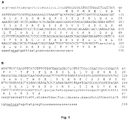
- the sequence of a cDNA clone coding for this antigen and the deduced polypeptide sequence are represented on the Figure 1A , and are also respectively reproduced in the attached sequence listing under the numbers SEQ ID NO: 1 and SEQ ID NO: 2.
- the polypeptide SEQ ID NO: 2 has a high identity (91%) with the protein SML-3 ( GenBank ACJ06741) recently identified among the proteins presumably secreted by T.
- the second antigen is hereinafter referred to as "L20h-Ts1".
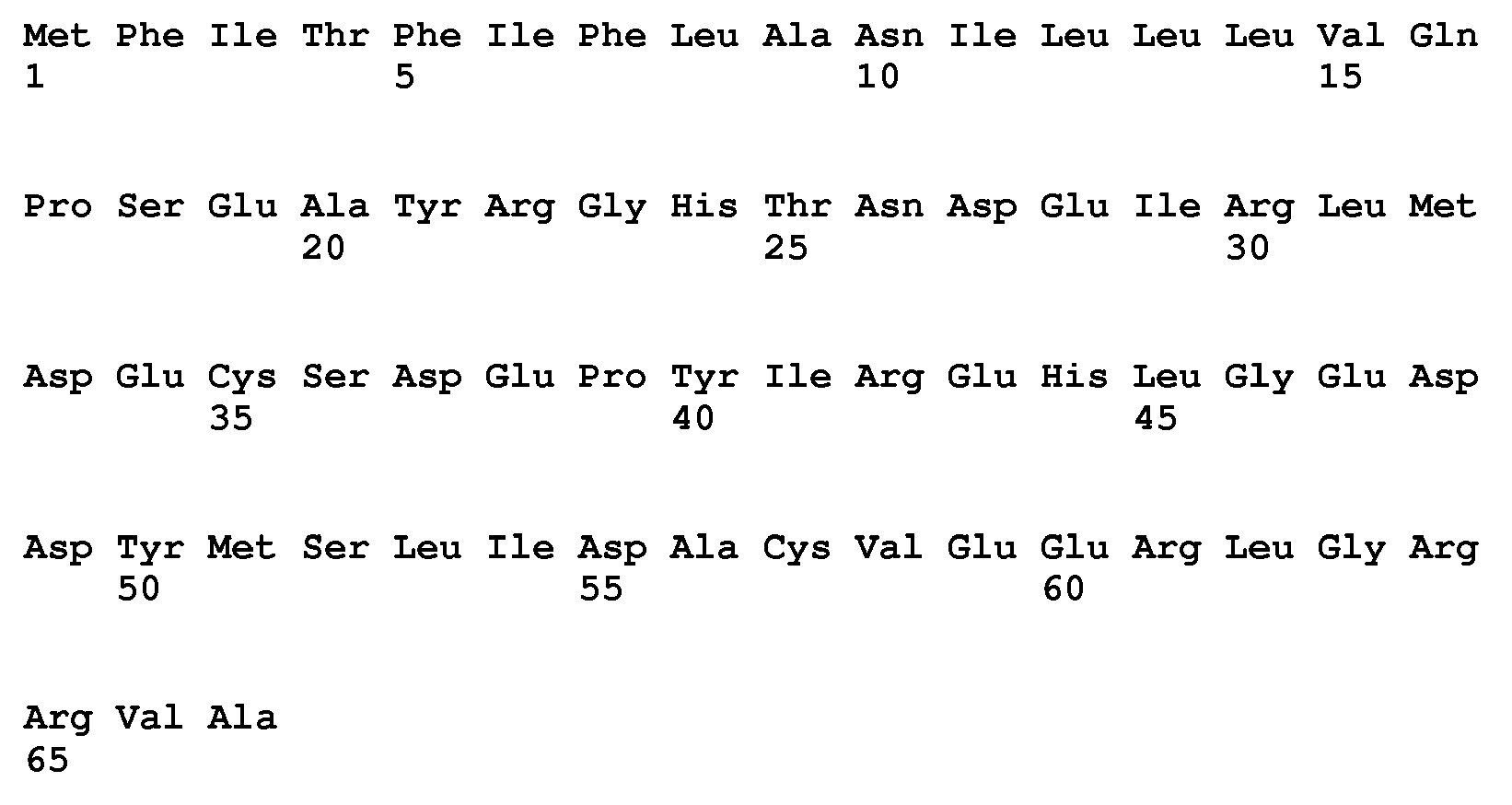
- the sequence of a cDNA clone coding for this antigen and the deduced polypeptide sequence are represented on the Figure 1B , and are also respectively reproduced in the list of sequences in the appendix under the numbers SEQ ID NO: 3 and SEQ ID NO: 4.
- the polypeptide SEQ ID NO: 4 has no identity with any known protein of Trichinella and other organizations.
- the L20h-Ts3 and L20h-Ts1 polypeptides make it possible to detect, at an early stage, the humoral response directed against Trichinella.
- the humoral response targeting these antigens persists later after the infestation than in the case NBL1 recombinant antigen, where it begins to attenuate approximately 8 weeks after infestation.
- the use of the L20h-Ts3 and L20h-Ts1 polypeptides thus makes it possible to broaden the time window for detecting the humoral response.
- the subject of the present invention is therefore the use of an antigenic polypeptide recognized by anti- Trichinella antibodies as a reagent for the detection of anti-Trichinella antibodies in a biological sample, characterized in that said polypeptide is a polypeptide. comprising the sequence SEQ ID NO: 2, or comprising a sequence having at least 95% identity with the sequence SEQ ID NO: 2.
- a mixture comprising a polypeptide a) as defined above and a polypeptide b) comprising amino acids 21-67 of the sequence SEQ ID NO : 4 (which represent the mature form of the L20h-Tsl protein), or comprising a sequence having at least 95% identity with the amino acid sequence 21-67 of the sequence SEQ ID NO: 4, or a mixture comprising a polypeptide a) and a polypeptide b) as defined above, associated with one or more other antigenic polypeptide (s) recognized by anti- Trichinella antibodies , for example one or more of the polypeptides derived from the antigens NBL1 and 411, described in the application PCT WO / 2007/090960 .
- said biological sample is a serum sample. It can be obtained from any subject (mammal, bird or reptile) belonging to a species may be infested with Trichinella, and in which it is desired to detect the presence of this parasite.
- it is a sample obtained from a mammal, for example a farm animal, or a human patient.
- This combination makes it possible in particular to broaden the spectrum of reactivity, as well as the time window of detection of the humoral response, with respect to each of the polypeptides used individually.
- the present invention notably encompasses chimeric polypeptides comprising one or more copies of a polypeptide a) and one or more copies of a polypeptide b) or several copies of a polypeptide a) as defined above, optionally fused to a or more heterologous polypeptide (s), for example one or more of the polypeptides derived from the antigens NBL1 and 411, described in the application PCT WO / 2007/090960 .
- the subject of the present invention is also the polynucleotides encoding a chimeric polypeptide according to the invention, as well as recombinant vectors comprising said polynucleotides, and host cells transformed by said vectors.
- polypeptides a) and b) defined above can be used in the context of various antibody detection methods, which are known per se. Examples include ELISA (direct, indirect or sandwich) methods, micro agglutination methods on beads, and electrophoretic transfer methods coupled with immunostaining.
- the present invention also relates to a kit for the detection of the presence of anti- Trichinella antibodies in a biological sample, characterized in that it comprises a polypeptide a) or a polypeptide a) and a polypeptide b) as defined above, and, where appropriate, buffers and reagents suitable for the constitution of a reaction medium for the formation of an antigen / antibody complex, and, optionally, means for detecting said antigen / antibody complex.
- it may comprise one or more other antigenic polypeptides recognized by anti- Trichinella antibodies , for example one or more of the polypeptides derived from the antigens NBL1 and 411, described in the application PCT WO / 2007/090960 .
- polypeptide (s) is (are) immobilized on a solid support.
- solid supports that may be used, mention may be made of microtiter plates, beads, microbeads or microparticles, strips, etc.
- Said kit may also comprise reference samples, such as one or more negative serum (s) and one or more positive serum (s).
- the L20h-Ts3 gene was identified in 41 clones of the cDNA libraries obtained 14h and 20h after infection of the mice.
- the nucleotide sequence and the polypeptide sequence deduced from one of these clones are represented on the Figure 1A .
- This clone was digested with BamHI-Not I (New England BioLabs, Beverly, MA) and restriction fragment containing the complete coding sequence L20H-Ts3 was sub-cloned into the vector pGEX-6P-1 (GenBank U78872).
- This vector has a Schutosoma japonicum Glutathione S-transferase (GST sj ) N-terminal label (GST sj does not exhibit immunological cross-reactions with Trichinella ).
- the resulting expression vector designated pGEX-6P-1- (L20h-Ts3), encodes a recombinant protein containing the entire L20h-Ts3 sequence and carrying a GST sj and C-position tag in the N-terminal position. -terminal a poly-histidine tag.
- the L20h-Ts1 gene was identified in 121 clones of the cDNA libraries obtained 20h and 48h after infection of the mice. The sequence of one of these clones is represented on the Figure 1B . Its length is 339 bp, of which 139 bp is 3'UTR, a putative polyadenylation signal (underlined on Figure 1B ), and an open reading frame encoding a 67 aa protein, with a molecular weight of 7834.9 Da and an isoelectric point of 4.42.
- a signal peptide of 20 aa (in bold on the Figure 1B ) was identified based on the algorithm of BENDTSEN et al. (2004). The search for homologues on the databases showed no homology with known proteins of Trichinella.
- pGEX-6P-1- (L20h-Ts1) encodes a recombinant protein containing the sequence of the mature form of L20h-Ts1 and bearing in the N-terminal position a GST label sj and in the C-terminal position a poly-histidine tag.
- the vectors pGEX-6P-1- (L20h-Ts3) or pGEX-6P-1- (L20h-Ts1) were used to transform E. coli bacteria (strain BL21), and the expression of each recombinant protein (containing a GST tag Sj in N-Ter and a Histidine tag in C-Ter) was induced by addition of 0.5 mM isopropyl- ⁇ -D-thiogalactopyranoside (IPTG) (final concentration) and incubation for 3 h at 37 ° C. and 225 rpm.
- IPTG isopropyl- ⁇ -D-thiogalactopyranoside
- the induced bacteria were centrifuged (4000xg, 20 min at 4 ° C), resuspended in lysis buffer (20mM Tris-HCl pH 8.0, 150mM NaCl) supplemented with lysozyme 0.5mg / mL, and lysed by three cycles of freezing / thawing in liquid nitrogen.
- the lysate-matrix mixture was deposited on a PD-10 column (GE Healthcare Europe, Orsay, France) to remove unbound proteins or contaminants and transferred to a new 50 mL Falcon® tube and washed with 50 ml Wash Buffer I (20 mM Tris-HCl pH 8.0, 300 mM NaCl) for 30 min at 4 ° C on a rotary shaker. After centrifugation for 5 min (1500 xg, 4 ° C), the mixture was washed 4 times with 50 mL Wash Buffer II (20 mM Tris-HCl pH 8.0, 300 mM NaCl, 30 mM Imidazole) for 30 min.
- 50 mL Wash Buffer II (20 mM Tris-HCl pH 8.0, 300 mM NaCl, 30 mM Imidazole
- each recombinant protein was eluted with the elution buffer (20mM pH 8.0 Tris-HCl, 300mM NaCl, 500mM imidazole) and the concentration determined using a spectrophotometer at 280nm. The recombinant protein was aliquoted and stored at -20 ° C to 10% glycerol.
- the denaturing electrophoresis gels (SDS-PAGE) of the GST fusion proteins sj- L20h-Ts3 and GST sj- L20h-Ts1 are respectively represented on the Figures 2A and 2B (lane 1: molecular weight markers).
- the GSTs1-L20h-Ts3 and GST sj- L20h-Ts1 proteins both appear as a single band at the size expected for the fusion protein.
- Pigs free of Specified Pathogenic Organisms or pigs from conventional breeding were infested with 200, 1000, 20000 T. spiralis infective larvae (ISS004, International Trichinella Reference Center, Rome, Italy) or T. britovi (ISS100). Blood samples were taken 48h before infestation (negative control), and at 5, 10, 15, 20, 25, 30, 40, 50, 60 days post-infestation (pi).
- L20H-Ts3 antigens and recombinants L20H-Ts1 (in the form of GST fusion proteins -L20h-sj sj -L20h Ts3 and GST-Ts1) was analyzed by Western blotting.
- the recombinant L20h-Ts1 antigen (GST sj- L20h-Ts1) is also recognized (a weak band is visible) at 60 days pi in the case of a pig infested with 200 T. spiralis L1M larvae (data not shown) .
- the immunoreactivity of the recombinant L20h-Ts3 antigen was evaluated by indirect ELISA, in comparison with the T. spiralis E / S antigen , and with the NBL1 antigen described in the Application. PCT WO / 2007/090960 .
- the sera from Trichinella- infested pigs used are those described in Example 2 above.
- For the determination of the diagnostic threshold a total of 220 sera of negative pig references were used.
- the I / O antigen used as reference is that of the ELISA test marketed by Institut Pourquier (Montpellier, France).
- the protocol used for the ELISA tests is as follows: 100 ⁇ L / well of antigen diluted in sensitization buffer (12 mM sodium carbonate, 35 mM sodium bicarbonate, pH 9.6) were deposited and incubated for 2 hours at 37 ° C. ° C in a microtiter plate (Immuno 96 MicroWell Plates MaxiSorp F96, Nunc, Roskil, Denmark). Then, each well was washed 5 times with 250 ⁇ l of washing buffer (distilled water, Tween®-20 0.05%) and incubated for 30 min at 37 ° C. with 200 ⁇ l of saturation buffer (PBS, gelatin 1). % Tween®-20 0.05%).
- reaction was stopped with 50 ⁇ l / well of 12.5% sulfuric acid and read at 450 nm using a Labsystems iEMS Reader MF plate reader coupled to the Ascent 2.6 software (Thermo LabSystems, Cergy Pontoise , France).
- Optimal conditions for ELISA were defined by testing serum samples at 1/10, 1/100, and 1/300 dilutions, and L20h-Ts3 protein quantities of 50 ng, 250 ng, and 500 ng. 1 ⁇ g per well. The results obtained were then analyzed via a Wilcoxon-Mann-Whitney test. Thus, the largest difference between the values of the positive samples and the values of the negative samples was observed for a dilution of 1/10 of the sera and 250 ng of L20h-Ts3 protein. These conditions were therefore used during subsequent ELISAs.
- the diagnostic threshold was determined from reference negative sera. The calculation is based on the use of the formula defined by the Office International des Epizooties ( Manual of Diagnostic Tests and Vaccines for Terrestrial Animals, 6th ed., 2008, Chapter 2.01.6 ), corresponding to the average OD measured at 450 nm to which the standard deviation is added 3 times.
- Seroconversion was associated with a humoral response profile with high and held shares until 25 weeks pi 2/3 pigs and up to 12 weeks pi 1/3 pigs infested with T. spiralis ( Figure 7 ).
- One in three pigs were detected earlier (1 week earlier) than with the ELISA E / S ( Figure 8 ).
- the NBL1 antigen Figure 9
- the NBL1 antigen Figure 9
- a drop in response is observed at 7 weeks pi for 2 of these 3 pigs.
- the presence of anti- Trichinella antibodies is no longer detected after 12 weeks.
Landscapes
- Health & Medical Sciences (AREA)
- Life Sciences & Earth Sciences (AREA)
- Chemical & Material Sciences (AREA)
- Organic Chemistry (AREA)
- Immunology (AREA)
- Molecular Biology (AREA)
- General Health & Medical Sciences (AREA)
- Medicinal Chemistry (AREA)
- Tropical Medicine & Parasitology (AREA)
- Biochemistry (AREA)
- Engineering & Computer Science (AREA)
- Proteomics, Peptides & Aminoacids (AREA)
- Biomedical Technology (AREA)
- Hematology (AREA)
- Urology & Nephrology (AREA)
- Biophysics (AREA)
- Genetics & Genomics (AREA)
- Zoology (AREA)
- Microbiology (AREA)
- Cell Biology (AREA)
- Toxicology (AREA)
- Gastroenterology & Hepatology (AREA)
- Veterinary Medicine (AREA)
- Pathology (AREA)
- General Physics & Mathematics (AREA)
- Analytical Chemistry (AREA)
- Physics & Mathematics (AREA)
- Food Science & Technology (AREA)
- Biotechnology (AREA)
- Pharmacology & Pharmacy (AREA)
- Animal Behavior & Ethology (AREA)
- Public Health (AREA)
- Virology (AREA)
- Epidemiology (AREA)
- Mycology (AREA)
- Chemical Kinetics & Catalysis (AREA)
- General Chemical & Material Sciences (AREA)
- Nuclear Medicine, Radiotherapy & Molecular Imaging (AREA)
- Peptides Or Proteins (AREA)
- Medicines Containing Antibodies Or Antigens For Use As Internal Diagnostic Agents (AREA)
Description
- La présente invention concerne l'utilisation de nouveaux antigènes identifiés chez le parasite Trichinella dans le cadre du diagnostic et de la prévention de la trichinellose.
- La trichinellose est une zoonose associée à la consommation de viande infestée par le parasite Trichinella (MURRELL et al., Vet Parasitol, 93, 293-307, 2000).
- Ce nématode, de la classe des Adenophorea, appartient à la famille des Trichinellidae laquelle comprend 8 espèces et 3 génotypes apparentés en 2 groupes phylogénétiquement distincts : d'une part les trichines encapsulées (T. spiralis; T. nativa; T. britovi; T. murrelli; T. nelsoni) qui infestent les mammifères, et d'autre part les trichines non-encapsulées (T. pseudospiralis; T. papuae; T. zimbabwensis) qui infestent les mammifères, les oiseaux et les reptiles (GASSER et al., Electrophoresis, 25, 3357-64, 2004). Toutes ces espèces peuvent infester l'homme.
- Le cycle biologique du parasite est auto-hétéroxène : il se déroule entièrement chez un même hôte qui est à la fois hôte intermédiaire et hôte définitif (BOIREAU et al., Revue française des laboratoires, 71-89, 2002). Le passage des larves infestantes d'un hôte à un autre est nécessaire pour la réalisation d'un nouveau cycle. Ce passage se fait par ingestion de viande crue ou peu cuite contaminée par des larves du parasite. Au cours de la digestion, celles-ci sont libérées, et pénètrent dans l'épithélium intestinal où elles vont muer en vers adultes (Ad) sexués. Les femelles fécondées expulsent ensuite des larves L1 Nouveau-Nées (L1NN) qui gagnent les muscles striés via la circulation lymphatique et sanguine. Ces larves L1NN pénètrent dans les cellules musculaires (stade de développement infestant L1M : Larve L1 Musculaire) dont elles provoquent la dédifférenciation en cellules nourricières entourées d'une capsule de collagène protectrice épaisse dans le cas des trichines encapsulées, très fine dans le cas des trichines non-encapsulées.
- Alors que la trichinellose est asymptomatique chez l'animal, l'infestation humaine se traduit durant la phase intestinale par des diarrhées associées à des nausées, vomissements et de violentes douleurs abdominales, alors que les symptômes liés à la phase d'invasion musculaire se caractérisent par l'association fièvre, oedème de la face et myalgies (CAPO & DESPOMMIER, Clin Microbiol Rev, 9, 47-54, 1996). Des atteintes oculaires, pulmonaires, gastro-intestinales, cardiaques et neurologiques peuvent venir compléter le tableau clinique de la trichinellose dont l'évolution peut être mortelle. Le caractère chronique de l'infestation, marqué par la persistance de douleurs musculaires chez les patients, est associé à la survie du parasite au sein de la cellule nourricière.
- Le traitement spécifique des trichinelloses humaines par des anthelminthiques est d'autant plus efficace que le diagnostic de l'infestation est posé précocement pour permettre une action contre tous les stades parasitaires et surtout avant la formation de la capsule protectrice de collagène autour des larves L1M (FOURESTIE et al., Parasitol Res, 75, 36-41, 1988).
- Les données épidémiologiques ont démontré une distribution géographique du parasite sous toutes les latitudes associée à un mode de transmission impliquant de nombreuses espèces de la faune sauvage qui entretiennent aussi un cycle d'infestation domestique principalement représenté par le porc (DUPOUY-CAMET, Vet Parasitol, 93, 191-200, 2000).
- Les épidémies de trichinellose humaine, zoonose émergente ou ré-émergente, constituent un véritable problème de santé publique à travers le monde en raison des habitudes alimentaires et des contrôles sanitaires pas toujours efficaces (MURRELL & POZIO, Int J Parasitol, 30, 1339-49, 2000). Ces épidémies impliquent essentiellement la viande de porc et de sanglier ainsi que celle de cheval (BOIREAU et al., Vet Parasitol, 93, 309-20, 2000).
- La prévention de la contamination humaine passe donc par une cuisson à coeur de la viande et l'amélioration des conditions d'élevage et/ou de contrôle des trichinelloses animales (porc, cheval, sanglier et autres espèces animales sauvages sensibles à Trichinella) (BOIREAU et al., Revue française des laboratoires, 71-89, 2002).
- Les techniques de dépistage de la trichinellose se divisent en deux catégories : 1) la détection directe des larves L1M, après digestion artificielle d'échantillons de muscles, et 2) la détection indirecte par différentes méthodes immunologiques, permettant de détecter des anticorps dirigés contre les antigènes de Trichinella.
- A chacun des stades de développement du parasite : Ad, L1NN, et L1M, correspond un profil antigénique particulier.
- Ce sont des préparations antigéniques issues de larves du stade L1M qui sont actuellement utilisées pour l'immunodiagnostic. En effet, les fractions antigéniques des deux stades précoces Ad et L1NN sont difficiles à purifier, et des antigènes immunodominants associés à l'un et/ou l'autre de ces deux stades n'avaient pas pu être identifiés jusqu'à récemment (LIU et al., 1-13,2007).
- On utilise principalement soit des préparations d'antigène total soluble, obtenues par lyse des larves, centrifugation du lysat, et récupération du surnageant, soit plus fréquemment, des antigènes d'excrétion/sécrétion (antigènes E/S).
- Les antigènes E/S sont produits lors de la mise en survie des larves L1M dans un milieu de culture ; ils proviennent d'un organe particulier, dénommé le stichosome, qui est constitué d'une cinquantaine de cellules discoïdes, les stichocytes. Les stichocytes contiennent des granules dont le contenu est évacué par un canalicule dans la lumière de l'oesophage du parasite. Ce contenu qui est très fortement antigénique, constitue une partie des antigènes E/S. Ces antigènes forment un mélange complexe de protéines, contenant notamment un groupe de glycoprotéines (dénommées antigènes TSL-1) portant une molécule glucidique particulière, connue uniquement chez Trichinella et présente chez toutes les espèces de ce parasite, le béta-tyvélose.
- Les préparations d'antigènes E/S qui sont actuellement utilisées comme référence en matière d'immunodiagnostic de la trichinellose sont obtenues à partir de milieu de culture de larves L1M de T. spiralis. Après 18 à 20 heures de culture, le milieu est récupéré par filtration, puis concentré (GAMBLE et al., Vet Parasitol, 13, 349-61, 1983; GAMBLE et al., Vet Parasitol, 30, 131-7, 1988).
- Les préparations d'antigène total soluble ont comme principal inconvénient leur manque de spécificité. Des réactions antigéniques croisées avec d'autres parasitoses sont fréquemment observées. Les antigènes E/S permettent d'obtenir une meilleure spécificité. Cependant, dans les deux cas, il est délicat de produire en quantité importante des lots standardisés d'antigène.
- Un autre problème rencontré dans le cadre du diagnostic sérologique de Trichinella est l'existence d'une « fenêtre aveugle » de détection correspondant aux stades précoces de l'infestation, qui se traduit par des résultats sérologiques faussement négatifs. Cette fenêtre aveugle peut durer de 3 à 8 semaines, selon la dose infectieuse initiale. En outre, chez le cheval, une disparition progressive des anticorps a été observée 25 semaines après infestation.
- Lors de travaux précédents, l'équipe des Inventeurs a identifié deux antigènes immunodominants conservés au sein du genre Trichinella et spécifiques de celui-ci. Ces antigènes sont décrits dans la demande
PCT WO/2007/090960 . L'un de ces antigènes, dénommé antigène NBL1, est exprimé spécifiquement au stade L1NN, tandis que l'autre, dénommé antigène 411, apparaît commun à plusieurs stades du développement de Trichinella. - Des tests de diagnostic sérologique de type ELISA ont été développés à partir de ces antigènes produits sous forme de protéines recombinantes purifiées. Ces tests permettent une détection sérologique très précoce des anticorps spécifiques anti-Trichinella. La comparaison avec un test ELISA de référence utilisant les antigènes E/S (test ELISA E/S) a permis de montrer que les tests ELISA utilisant les antigènes NBL1 et 411 peuvent détecter la présence d'anticorps spécifiques anti-Trichinella respectivement 5 à 45 jours plus tôt et 5 à 20 jours plus tôt que le test ELISA E/S. Cependant, la réponse humorale ciblant l'antigène NBL1 a ensuite tendance à s'atténuer (en moyenne 8 semaines après l'infestation), et l'antigène 411 présente l'inconvénient de présenter une sensibilité plus faible que le test ELISA E/S pour la détection d'une infestation par des espèces de Trichinella autres que T. nativa.
- Les Inventeurs ont maintenant identifié deux nouveaux antigènes immunodominants de Trichinella, utilisables pour le développement de nouveaux tests de diagnostic sérologique, ou pour améliorer les performances des tests existants.
- Le premier de ces antigènes est dénommé ci-après « L20h-Ts3 ». La séquence d'un clone d'ADNc codant pour cet antigène et la séquence polypeptidique déduite sont représentées sur la
Figure 1A , et sont également respectivement reproduites dans la liste de séquences en annexe sous les numéros SEQ ID NO: 1 et SEQ ID NO: 2. Le polypeptide SEQ ID NO: 2 possède une identité élevée (91%) avec la protéine SML-3 (GenBank ACJ06741) récemment identifiée parmi les protéines vraisemblablement sécrétées par les larves de T. spiralis au stade musculaire, et qui pourrait jouer un rôle dans la formation de la cellule nourricière (GUILIANO et al., Int J Parasitol, 39, 515-24, 2009) ; cependant, les propriétés antigéniques de la protéine SML-3 n'ont pas été étudiées jusqu'à présent. - Le second antigène est dénommé ci-après « L20h-Ts1 ». La séquence d'un clone d'ADNc codant pour cet antigène et la séquence polypeptidique déduite sont représentées sur la
Figure 1B , et sont aussi respectivement reproduites dans la liste de séquences en annexe sous les numéros SEQ ID NO: 3 et SEQ ID NO: 4. Le polypeptide SEQ ID NO: 4 ne possède d'identité avec aucune protéine connue de Trichinella et d'autres organismes. - Les polypeptides L20h-Ts3 et L20h-Ts1, produits sous forme recombinante, permettent de détecter à un stade précoce, la réponse humorale dirigée contre Trichinella, En outre, la réponse humorale ciblant ces antigènes persiste plus tardivement après l'infestation que dans le cas de l'antigène recombinant NBL1, où elle commence à s'atténuer approximativement 8 semaines après l'infestation. L'utilisation des polypeptides L20h-Ts3 et L20h-Ts1 permet donc d'élargir la fenêtre temporelle de détection de la réponse humorale.
- La présente invention a en conséquence pour objet l'utilisation d'un polypeptide antigénique reconnu par des anticorps anti-Trichinella comme réactif pour la détection d'anticorps anti-Trichinella dans un prélèvement biologique, caractérisée en ce que ledit polypeptide est un polypeptide a) comprenant la séquence SEQ ID NO: 2, ou comprenant une séquence présentant au moins 95% d'identité avec la séquence SEQ ID NO: 2.
- Avantageusement, dans le cadre de la mise en oeuvre de la présente invention, on peut utiliser un mélange, comprenant un polypeptide a) tel que défini ci-dessus et un polypeptide b) comprenant les acides aminés 21-67 de la séquence SEQ ID NO: 4 (qui représentent la forme mature de la protéine L20h-Tsl), ou comprenant une séquence présentant au moins 95% d'identité avec la séquence des acides aminés 21-67 de la séquence SEQ ID NO: 4, ou bien un mélange comprenant un polypeptide a) et un polypeptide b) tels que définis ci-dessus, associé(s) avec un ou plusieurs autre(s) polypeptide(s) antigénique(s) reconnu(s) par des anticorps anti-Trichinella, par exemple un ou plusieurs des polypeptides issus des antigènes NBL1 et 411, décrits dans la demande
PCT WO/2007/090960 . - La présente invention a plus particulièrement pour objet un procédé de détection de la présence d'anticorps anti-Trichinella dans un échantillon biologique, lequel procédé est caractérisé en ce qu'il comprend :
- la mise en contact dudit échantillon biologique avec un polypeptide a) ou un polypeptide a) et un polypeptide b), tels que définis ci-dessus, dans des conditions permettant la formation d'un complexe antigène/anticorps entre le(s)dit(s) polypeptide(s) et les anticorps anti-Trichinella éventuellement présents dans ledit échantillon ;
- la détection, par tous moyens appropriés, du complexe antigène/anticorps éventuellement formé.
- Généralement, ledit prélèvement biologique est un prélèvement de sérum. Il peut être obtenu à partir de tout sujet (mammifères, oiseau ou reptile) appartenant à une espèce pouvant être infestée par Trichinella, et chez lequel on souhaite détecter la présence de ce parasite. Avantageusement, il s'agit d'un prélèvement obtenu à partir d'un mammifère, par exemple d'un animal d'élevage, ou d'un patient humain.
- Cette association permet notamment d'élargir le spectre de réactivité, ainsi que la fenêtre temporelle de détection de la réponse humorale, par rapport à chacun des polypeptides utilisés individuellement.
- La présente invention englobe notamment des polypeptides chimériques comprenant une ou plusieurs copies d'un polypeptide a) et une ou plusieurs copies d'un polypeptide b) ou plusieurs copies d'un polypeptide a) tels que définis ci-dessus, éventuellement fusionnés à un ou plusieurs polypeptide(s) hétérologue(s), par exemple un ou plusieurs des polypeptides issus des antigènes NBL1 et 411, décrits dans la demande
PCT WO/2007/090960 . - La présente invention a également pour objet les polynucléotides codant pour un polypeptide chimérique conforme à l'invention, ainsi que des vecteurs recombinants comprenant lesdits polynucléotides, et des cellules-hôtes transformées par lesdits vecteurs.
- Les polypeptides a) et b) définis ci-dessus peuvent être utilisés dans le cadre de différentes méthodes de détection d'anticorps, qui sont connues en elles-mêmes. A titre d'exemples, on citera notamment les méthodes de type ELISA (direct, indirect ou sandwich), les méthodes de micro agglutination sur billes, ainsi que les méthodes de transfert électrophorétique couplé à un immunomarquage.
- La présente invention a également pour objet un nécessaire pour la détection de la présence d'anticorps anti-Trichinella dans un échantillon biologique, caractérisé en ce qu'il comprend un polypeptide a) ou un polypeptide a) et un polypeptide b) tels que définis ci-dessus, et, le cas échéant, des tampons et réactifs appropriés pour la constitution d'un milieu réactionnel permettant la formation d'un complexe antigène/anticorps, et, optionnellement, des moyens de détection dudit complexe antigène/anticorps. Éventuellement il peut comprendre un ou plusieurs autres polypeptides antigéniques reconnus par des anticorps anti-Trichinella, par exemple un ou plusieurs des polypeptides issus des antigènes NBL1 et 411, décrits dans la demande
PCT WO/2007/090960 . - Avantageusement, le ou lesdits polypeptide(s) est (sont), immobilisé(s) sur un support solide. A titre d'exemples non-limitatifs de supports solides utilisables, on citera des plaques de microtitration, des billes, des microbilles ou microparticules, des bandelettes, etc....
- Ledit nécessaire peut également comprendre des échantillons de référence, tels qu'un ou plusieurs sérum(s) négatif(s) et un ou plusieurs sérum(s) positif(s).
- La présente invention sera mieux comprise à l'aide du complément de description qui va suivre, qui se réfère à des exemples illustrant l'utilisation des antigènes L20h-Ts3 et L20h-Ts1, pour l'immunodiagnostic de la trichinellose.
- Un immunocriblage de banques d'ADNc d'expression des stades précoces de Trichinella (14h, 20h, 48h après infection de souris) a été effectué avec des sérums et des surnageants de culture de muqueuse intestinale de porcs expérimentalement infestés par T. spiralis.
- Le gène L20h-Ts3 a été identifié dans 41 des clones des banques d'ADNc obtenues 14h et 20h après infection des souris. La séquence nucléotidique et la séquence polypeptidique déduite de l'un de ces clones sont représentées sur la
Figure 1A . - Sa longueur est de 398 pb, dont 33 pb de 3'UTR, un signal de polyadénylation putatif (souligné sur la
Figure 1A ), et un cadre ouvert de lecture codant pour une protéine de 106 a.a., avec une masse moléculaire de 11906,0 Da et un point isoélectrique de 4,21. Aucun peptide signal n'a été identifié sur la base de l'algorithme de BENDTSEN et al. (BENDTSEN et al., J Mol Biol, 340, 783-95, 2004). La recherche d'homologues sur les bases de données fait apparaître une forte identité (91%) entre la séquence polypeptidique déduite de L20h-Ts3 et une protéine de T. spiralis, dénommée SML-3 (GUILIANO et al., Int J Parasitol, 39, 515-24, 2009). - Ce clone a été digéré par BamHI-NotI (New England BioLabs, Beverly, Massachusetts), et le fragment de restriction contenant la séquence codante complète de L20h-Ts3 a été sous-cloné dans le vecteur pGEX-6P-1 (GenBank U78872). Ce vecteur possède une étiquette Glutathion S-transférase de Schistosoma japonicum (GSTsj) en N-terminal (La GSTsj ne présente pas de réactions immunologiques croisées avec Trichinella). Le vecteur d'expression résultant, dénommé pGEX-6P-1-(L20h-Ts3), code pour une protéine recombinante contenant la totalité de la séquence de L20h-Ts3 et portant en position N-terminale une étiquette GSTsj et en position C-terminale une étiquette poly-histidine.
- Le gène L20h-Ts1 a été identifié dans 121 des clones des banques d'ADNc obtenues 20h et 48h après infection des souris. La séquence de l'un de ces clones est représentée sur la
Figure 1B . Sa longueur est de 339 pb, dont 139 pb de 3'UTR, un signal de polyadénylation putatif (souligné sur laFigure 1B ), et un cadre ouvert de lecture codant pour une protéine de 67 a.a., avec une masse moléculaire de 7834,9 Da et un point isoélectrique de 4,42. Un peptide signal de 20 a.a. (en gras sur laFigure 1B ) a été identifié sur la base de l'algorithme de BENDTSEN et al. (2004). La recherche d'homologues sur les bases de données n'a fait apparaître aucune homologie avec des protéines connues de Trichinella. - Ce clone a été digéré par BamHI-NotI (New England BioLabs, Beverly, Massachusetts), et un fragment de restriction codant pour le fragment Tyr21-Ala67 de L20h-Ts1 (correspondant à la forme mature, sans le peptide signal) a été sous-cloné dans le vecteur pGEX-6P-1. Le vecteur d'expression résultant dénommé pGEX-6P-1-(L20h-Ts1) code pour une protéine recombinante contenant la séquence de la forme mature de L20h-Ts1 et portant en position N-terminale une étiquette GSTsj et en position C-terminale une étiquette poly-histidine.
- Les vecteurs pGEX-6P-1-(L20h-Ts3) ou pGEX-6P-1-(L20h-Ts1) ont été utilisés pour transformer des bactéries E. coli (souche BL21), et l'expression de chaque protéine recombinante (contenant un tag GSTsj en N-Ter et un tag Histidine en C-Ter) a été induite par ajout d'isopropyl-β-D-thiogalactopyranoside (IPTG) 0,5 mM (concentration finale) et incubation 3h, à 37°C et 225 tr/min. Les bactéries induites ont été centrifugées (4000 x g, 20 min à 4°C), resuspendues en tampon de lyse (Tris-HCl 20 mM pH 8,0; NaCl 150mM) supplémenté en lysozyme 0,5 mg/mL, et lysées par trois cycles de congélation/décongélation en azote liquide.
- Ensuite, 5 µg/mL de DNase I ont été ajoutés au lysat incubé 15 min à 37°C. Puis, le lysat a été incubé pendant 1h30 à 4°C sur agitateur rotatif dans un tube Falcon® à fond conique de 50 mL (Becton Dickinson, Le Pont-De-Claix, France) en présence d'une matrice Ni-NTA (GE Healthcare Europe, Orsay, France) pré-équilibrée en tampon de lyse. Le mélange lysat-matrice a été déposé sur une colonne PD-10 (GE Healthcare Europe, Orsay, France) afin d'éliminer les protéines non-fixées ou les contaminants, puis transféré dans un nouveau tube Falcon® de 50 mL et lavé avec 50 mL de tampon de lavage I (Tris-HCl 20 mM pH 8.0; NaCl 300 mM) pendant 30 min à 4°C sur agitateur rotatif. Après centrifugation pendant 5 min (1500 x g, 4°C), le mélange a été lavé 4 fois avec 50 mL de tampon de lavage II (Tris-HCl 20 mM pH 8.0; NaCl 300 mM; imidazole 30 mM) pendant 30 min à 4°C ; ces lavages ont été suivis d'une ultime centrifugation pendant 5 min (1500 x g, 4°C). Enfin, chaque protéine recombinante a été éluée avec le tampon d'élution (Tris-HCl pH 8.0 20 mM; NaCl 300 mM; imidazole 500 mM) et la concentration déterminée à l'aide d'un spectrophotomètre à 280 nm. La protéine recombinante a été mise en fractions aliquotes et conservée à -20°C en glycérol 10 %.
- Les gels d'électrophorèse en conditions dénaturantes (SDS-PAGE) des protéines de fusion GSTsj-L20h-Ts3 et GSTsj-L20h-Ts1 sont respectivement représentés sur les
Figures 2A et 2B (piste 1 : marqueurs de poids moléculaire). Sur ces gels, les protéines GSTsj-L20h-Ts3 et GSTsj-L20h-Ts1 apparaissent toutes deux sous la forme d'une seule bande à la taille attendue pour la protéine de fusion. - Des porcs Exempts d'Organismes Pathogènes Spécifiés (porcs EOPS) ou des porcs issus d'un élevage conventionnel ont été infestés avec 200, 1000, 20000 larves infestantes de T. spiralis (ISS004, International Trichinella Reference Centre, Rome, Italie) ou de T. britovi (ISS100). Des prélèvements sanguins ont été réalisés 48h avant infestation (témoin négatif), et à 5, 10, 15, 20, 25, 30, 40, 50, 60 jours post-infestation (pi).
- Des sérums provenant de porcs EOPS infestés avec 20000 larves L1M de T. spiralis (ISS003) ou T. britovi (ISS002) ont également été utilisés. Des prélèvements sanguins ont été réalisés 24h avant infestation (témoin négatif), et à 1, 2, 3, 4, 5, 6, 7, 8, 12, 16, 20, 25 semaines pi.
- Des sérums de porcs provenant d'élevages industriels hors-sol d'Ille-et-Vilaine (France), et contrôlés négatifs pour la trichinellose par digestion artificielle, ont été collectés en 2004 et ont servi de sérums de référence négatifs.
- L'immunoréactivité des antigènes L20h-Ts3 et L20h-Ts1 recombinants (sous forme des protéines de fusion GSTsj-L20h-Ts3 et GSTsj-L20h-Ts1) a été analysée par transfert de Western.
- Les protéines recombinantes ont été soumises à une électrophorèse en conditions dénaturantes (15 % SDS-PAGE, 700 ng de protéine par puits), et transférées sur membrane de nitrocellulose. Après blocage des membranes par incubation pendant 1 nuit à 4°C dans du tampon PBS contenant 0,1% de Tween®-20(PBS-T) et 5 % de lait écrémé, celles-ci ont été lavées 3 fois en PBS-T pendant 5 min. Ensuite, les membranes ont été incubées pendant 1 h à température ambiante avec :
- dans le cas de L20h-Ts3, des sérums de porcs EOPS expérimentalement infestés avec 20000 larves L1M de T. spiralis, collectés à -2, 5, 12, 15, 20, 28, et 60 jours après infestation et dilués au 1/300 en PBS-T contenant 5 % de lait écrémé,
- dans le cas de L20h-Ts1, le sérum d'un porc EOPS expérimentalement infesté avec 20000 larves L1M de T. spiralis, collectés à -1, 7, 14, 21, 28, 49, 84 jours après infestation et dilués au 1/300 en PBS-T contenant 5 % de lait écrémé.
- Après 3 lavages de 5 min en PBS-T, les membranes ont été incubées pendant 1h à température ambiante avec un anticorps secondaire de lapin anti-IgG de porc marqué à la peroxydase dilué au 1/10000. Après 3 nouveaux lavages, la révélation a été effectuée à l'aide du kit « ECL PLUS WESTERN BLOTTING ET AMERSHAM HYPERFILM ECL » (GE Healthcare Europe, Orsay, France).
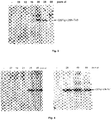
- Les résultats obtenus avec les sérums de porcs EOPS expérimentalement infestés avec 20000 larves L1M de T. spiralis et collectés à -2, 5, 12, 15, 20, 28, et 60 jours pi sont illustrés par la
Figure 3 . Ces résultats montrent que l'antigène recombinant L20h-Ts3 (GSTsj-L20h-Ts3) est nettement reconnu dès 20 jours pi (une faible bande est visible dès 15 jours pi), et au moins jusqu'à 60 jours pi. - Les résultats sont illustrés par la
Figure 4 . Ces résultats montrent que l'antigène recombinant L20h-Ts1 (GSTsj-L20h-Ts1) est nettement reconnu dès 28 jours pi (une faible bande est visible dès 21 jours pi), et au moins jusqu'à 84 jours pi par le sérum d'un porc EOPS expérimentalement infesté avec 20000 larves L1M de T. spiralis (Figures 4A et 4B ) (Il est à noter qu'une détection à 112 jours pi a également été possible avec un autre porc EOPS expérimentalement infesté avec 20000 larves L1M T. spiralis, donnée non montrée). L'antigène recombinant L20h-Ts1 (GSTsj-L20h-Ts1) est également reconnu (une faible bande est visible) à 60 jours pi dans le cas d'un porc infesté avec 200 larves L1M de T. spiralis (donnée non montrée). - L'immunoréactivité de l'antigène recombinant L20h-Ts3 a été évaluée par ELISA indirect, par comparaison avec l'antigène E/S de T. spiralis, et avec l'antigène NBL1 décrit dans la Demande
PCT WO/2007/090960 . - Les sérums issus de porcs infestés par Trichinella utilisés sont ceux décrits à l'Exemple 2 ci-dessus. Pour la détermination du seuil de diagnostic, un total de 220 sérums de références de porcs négatifs a été utilisé.
- L'antigène E/S utilisé comme référence est celui du test ELISA commercialisé par l'Institut Pourquier (Montpellier, France).
- Le protocole utilisé pour les tests ELISA est le suivant : 100 µL/puits d'antigène dilué en tampon de sensibilisation (carbonate de sodium 12 mM; bicarbonate de sodium 35 mM, pH 9,6) ont été déposés et incubés pendant 2h à 37°C dans une plaque de microtitration (Immuno 96 MicroWell Plates F96 MaxiSorp, Nunc, Roskil, Danemark). Ensuite, chaque puits a été lavé 5 fois avec 250 µL de tampon de lavage (eau distillée, Tween®-20 0,05 %) et incubé pendant 30 min à 37°C avec 200 µL de tampon de saturation (PBS, gélatine 1 %; Tween®-20 0,05 %). Après 5 lavages avec la solution de lavage, 200 µL/puits d'anticorps primaires (sérums) dilué en tampon de saturation ont été déposés et incubés 1h à 37°C. Après 5 lavages avec la solution de lavage, 100 µL/puits d'anticorps secondaires de lapin anti-IgG de porc conjugués à la peroxydase (dilué au 1/50000 en tampon de saturation) ont été déposés et incubés pendant 1h à 37°C. Enfin, les puits ont été lavés 5 fois avec la solution de lavage et 100 µL/puits de 3, 3', 5, 5' TetraMethylBenzidine (TMB, Zymed, California, USA) ont été utilisés pour la révélation en chambre noire. La réaction a été arrêtée avec 50 µL/puits d'acide sulfurique 12,5 % et la lecture faite à 450 nm à l'aide d'un lecteur de plaque Labsystems iEMS Reader MF couplé au logiciel Ascent 2.6 (Thermo LabSystems, Cergy Pontoise, France).
- Les conditions optimales pour l'ELISA ont été définies en testant des échantillons de sérum à des dilutions de 1/10, 1/100 et 1/300, et des quantités de protéine L20h-Ts3 de 50 ng, 250 ng, 500 ng and 1 µg par puits. Les résultats obtenus ont ensuite été analysés par l'intermédiaire d'un test de Wilcoxon-Mann-Whitney. Ainsi, la différence la plus importante entre les valeurs des échantillons positifs et les valeurs des échantillons négatifs a été observée pour une dilution de 1/10 des sérums et 250 ng de protéine L20h-Ts3. Ces conditions ont donc été utilisées lors des ELISA ultérieurs.
- Ces conditions ont donc été utilisées pour la suite des tests. Le seuil de diagnostic a été déterminé à partir de sérums négatifs de référence. Le calcul repose sur l'utilisation de la formule définie par l'Office International des Epizooties (Manuel des tests de diagnostic et des vaccins pour les animaux terrestres, 6e éd., 2008, Chapitre 2.01.6), correspondant à la moyenne des D.O. mesurées à 450 nm à laquelle on ajoute 3 fois la déviation standard.
- Les résultats sont illustrés par les
Figures 5 à 13 . - La
Figure 5 représente les valeurs de densités optiques mesurées sur 220 sérums négatifs de référence. Le seuil diagnostic établi à partir de ces mesures est de 0,33 unités de D.O. - La
Figure 6 représente les valeurs de densité optique mesurées avec des sérums de porcs EOPS (▲) ou des porcs issus d'un élevage conventionnel (■), infestés avec 20000 larves L1M de T. spiralis, pour des sérums collectés 5 (porcs 1-3), 12 (porcs 4-6), 15 (porcs 7-9), 20 (porcs 10-12) et 60 (porcs 13-15) jours pi. La fenêtre aveugle, pendant laquelle aucune détection n'est possible avec l'ELISA E/S, est représentée en grisé. - La
Figure 7 représente l'évolution de la densité optique (en ordonnée) au cours des semaines suivant l'infestation (en abscisse) pour les sérums de 3 porcs EOPS expérimentalement infestés avec 20000 larves L1M de T. spiralis et testés avec l'antigène L20h-Ts3. - La
Figure 8 représente l'évolution de la densité optique (en ordonnée) au cours des semaines suivant l'infestation (en abscisse) pour les sérums de 3 porcs EOPS expérimentalement infestés avec 20000 larves L1M de T. spiralis et testés avec l'antigène E/S. Le % E/P est défini par la formule suivante : (D.O. de l'échantillon à tester) / (D.O. moyenne de l'échantillon de contrôle positif) x 100. - La
Figure 9 représente l'évolution de la densité optique (en ordonnée) au cours des semaines suivant l'infestation (en abscisse) pour les sérums de 3 porcs EOPS expérimentalement infestés avec 20000 larves L1M de T. spiralis et testés avec l'antigène NBL1. - La
Figure 10 représente l'évolution de la densité optique (en ordonnée) au cours des semaines suivant l'infestation (en abscisse) pour les sérums de 3 porcs EOPS expérimentalement infestés avec 20000 larves L1M de T. britovi et testés avec l'antigène L20h-Ts3. - La
Figure 11 représente l'évolution de la densité optique (en ordonnée) au cours des semaines suivant l'infestation (en abscisse) pour les sérums de 3 porcs EOPS expérimentalement infestés avec 20000 larves L1M de T. britovi et testés avec l'antigène E/S. - La
Figure 12 représente l'évolution de la densité optique (en ordonnée) au cours des semaines suivant l'infestation (en abscisse) pour les sérums de 3 porcs EOPS expérimentalement infestés avec 20000 larves L1M de T. britovi et testés avec l'antigène NBL1. - La
Figure 13 représente les valeurs de densité optique mesurée avec des sérums de porcs EOPS (▲) ou de porcs issus d'un élevage conventionnel (■), infestés avec 200 (porcs 1-3) ou 1000 (porcs 4-6) larves L1M de T. spiralis et testés avec l'antigène L20h-Ts3. - Dans le cas de porcs expérimentalement infestés avec 20000 L1M T. spiralis, la détection avec l'antigène L20h-Ts3 était possible dès 15 jours pi pour 1/6 porc (porc 8) et 20 jours pi pour 4/6 porcs (
Figure 6 ). L'ELISA E/S n'a quant à lui pas permis une détection de l'infection avant 25 jours. Les résultats obtenus étaient différents selon le statut sanitaire des porcs. En effet, les porcs EOPS ont été détectés de façon plus précoce par rapport aux porcs conventionnels. - La séroconversion s'est accompagnée d'un profil de réponses humorales ayant des titres élevés et maintenus jusqu'à 25 semaines pi pour 2/3 porcs et jusqu'à 12 semaines pi pour 1/3 porc infestés avec T. spiralis (
Figure 7 ). Un porc sur trois a été détecté plus précocement (1 semaine plus tôt) qu'avec l'ELISA E/S (Figure 8 ). Sur les 3 mêmes animaux, l'antigène NBL1 (Figure 9 ) a permis une détection d'anticorps anti-Trichinella dès 3 semaines pi. En revanche, une chute de réponse est observée à 7 semaines pi pour 2 de ces 3 porcs. Pour le troisième porc, la présence d'anticorps anti-Trichinella n'est plus détectée après 12 semaines. - Dans le cas de porcs expérimentalement infestés avec 20000 L1M T. britovi, la séroconversion a été observée une à deux semaines plus précocement avec l'antigène L20h-Ts3 qu'avec l'ELISA E/S (
Figures 10 et 11 ) avec des D.O. mesurées élevées dès 3 semaines pi et maintenues jusqu'à 25 semaines pi pour les trois porcs testés. Sur les 3 mêmes animaux, l'antigène NBL1 (Figure 12 ) a permis la détection des anticorps anti-Trichinella dans le sérum de l'un des porcs dès 2 semaines pi et jusqu'à 16 semaines pi. La présence d'anticorps antiTrichinella a été détectée dans le sérum d'un second porc uniquement les troisième et quatrième semaines pi. Enfin, aucun anticorps anti-Trichinella n'a été détecté dans le sérum du troisième porc. - De plus, 3/6 porcs avec une dose infestante modérée (1000 L1M, T. spiralis) ont été détectés à 60 jours pi avec l'antigène L20h-Ts3 (
Figure 13 ). De nouveau, les résultats obtenus dépendaient du statut sanitaire des porcs. En effet, 2/3 porcs EOPS et 1/3 porc conventionnel ont été détectés. Les porcs infestés avec une dose infestante faible (200 L1M, T. spiralis) n'ont pas été détectés à 60 jours pi. -
- <110> AGENCE NATIONALE CHARGEE DE LA SECURITE SANITAIRE DE
L'ALIMENTATION, DE L'ENVIRONNEMENT ET DU TRAVAIL
ZOCEVIC, Aleksandar
BALDISSERA, Giovani
LACOUR, Sandrine A.
MACE, Pauline
VALLEE, Isabelle
BOIREAU, Pascal - <120> Antigènes polypeptidiques de Trichinella, et leurs applications
- <130> MJP/11-F1159-7 WO
- <150>
FR 10 00660
<151> 2010-12-17 - <160> 4
- <170> PatentIn version 3.5
- <210> 1
<211> 398
<212> DNA
<213> Trichinella spiralis - <220>
<221> CDS
<222> (34)..(351) - <400> 1

- <210> 2
<211> 106
<212> PRT
<213> Trichinella spiralis - <400> 2

- <210> 3
<211> 339
<212> DNA
<213> Trichinella spiralis - <220>
<221> CDS
<222> (1)..(201) - <400> 3


- <210> 4
<211> 67
<212> PRT
<213> Trichinella spiralis - <400> 4
Claims (9)
- Utilisation d'un polypeptide antigénique comme réactif pour la détection d'anticorps anti-Trichinella induits par l'infestation par Trichinella dans un prélèvement biologique, caractérisée en ce que ledit polypeptide comprend la séquence SEQ ID NO: 2 ou une séquence présentant au moins 95% d'identité avec la séquence SEQ ID NO: 2 et ledit polypeptide étant reconnu par des anticorps anti-Trichinella.
- Utilisation selon la revendication 1, caractérisée en ce que l'on utilise un mélange comprenant un premier polypeptide tel que défini dans la revendication 1 et un second polypeptide comprenant les acides aminés 21-67 de la séquence SEQ ID NO: 4 ou une séquence présentant au moins 95% d'identité avec la séquence des acides aminés 21-67 de la séquence SEQ ID NO: 4 et le dit second polypeptide étant reconnu par des anticorps anti-Trichinella.
- Polypeptide antigénique reconnu par des anticorps anti-Trichinella, caractérisé en ce qu'il est choisi parmi :- un polypeptide chimérique comprenant :(i) une ou plusieurs copies d'un premier polypeptide comprenant la séquence SEQ ID NO: 2 ou une séquence présentant au moins 95% d'identité avec la séquence SEQ ID NO: 2 et ledit polypeptide étant reconnu par des anticorps anti-Trichinella, et(ii) une ou plusieurs copies d'un second polypeptide comprenant les acides aminés 21-67 de la séquence SEQ ID NO: 4 ou une séquence présentant au moins 95% d'identité avec la séquence des acides aminés 21-67 de la séquence SEQ ID NO: 4 et ledit polypeptide étant reconnu par des anticorps anti-Trichinella, éventuellement fusionnés à un ou plusieurs polypeptide(s) hétérologue(s) ;- un polypeptide chimérique comprenant plusieurs copies d'un polypeptide comprenant la séquence SEQ ID NO: 2 ou une séquence présentant au moins 95% d'identité avec la séquence SEQ ID NO: 2 et ledit polypeptide étant reconnu par des anticorps anti-Trichinella, éventuellement fusionnés à un ou plusieurs polypeptide(s) hétérologue(s).
- Polynucléotide codant pour un polypeptide antigénique selon la revendication 3.
- Vecteur recombinant contenant un ou plusieurs polynucléotide(s) selon la revendication 4.
- Cellule-hôte transformée par un vecteur recombinant selon la revendication 5.
- Procédé de détection de la présence d'anticorps anti-Trichinella induits par l'infestation par Trichinella, dans un échantillon biologique, lequel procédé est caractérisé en ce qu'il comprend :- la mise en contact dudit échantillon biologique avec un polypeptide tel que défini dans la revendication 1, un mélange de peptides tel que défini dans la revendication 2, ou un peptide chimérique tel que défini dans la revendication 3, dans des conditions permettant la formation d'un complexe antigène/anticorps avec les anticorps anti-Trichinella éventuellement présents dans ledit échantillon ;- la détection, par tous moyens appropriés, du complexe antigène/anticorps éventuellement formé.
- Nécessaire pour la détection de la présence d'anticorps anti-Trichinella induits par l'infestation par Trichinella, dans un échantillon biologique, caractérisé en ce qu'il comprend :- un polypeptide, lequel polypeptide comprenant la séquence SEQ ID NO: 2 ou une séquence présentant au moins 95% d'identité avec la séquence SEQ ID NO: 2 et ledit polypeptide étant reconnu par des anticorps anti-Trichinella,- un mélange de polypeptides comprenant un premier polypeptide tel que défini ci-dessus et un second polypeptide comprenant les acides aminés 21-67 de la séquence SEQ ID NO: 4 ou une séquence présentant au moins 95% d'identité avec la séquence des acides aminés 21-67 de la séquence SEQ ID NO: 4 et ledit second polypeptide étant reconnu par des anticorps anti-Trichinella, ou- un polypeptide chimérique tel que défini dans la revendication 3, et- des tampons et réactifs appropriés pour la constitution d'un milieu réactionnel permettant la formation d'un complexe antigène/anticorps.
- Nécessaire selon la revendication 8, caractérisé en ce que le(s)dit(s) polypeptide(s) est (sont) immobilisé(s) sur un support solide.
Priority Applications (2)
| Application Number | Priority Date | Filing Date | Title |
|---|---|---|---|
| PL11709481T PL2558485T3 (pl) | 2010-02-17 | 2011-02-16 | Antygeny polipeptydowe z trichinella i ich zastosowania |
| RS20170507A RS56040B1 (sr) | 2010-02-17 | 2011-02-16 | Antigenski polipeptidi trihinele i njihove upotrebe |
Applications Claiming Priority (2)
| Application Number | Priority Date | Filing Date | Title |
|---|---|---|---|
| FR1000660A FR2956403B1 (fr) | 2010-02-17 | 2010-02-17 | Antigenes polypeptidiques de trichinella, et leurs applications |
| PCT/IB2011/050645 WO2011101790A1 (fr) | 2010-02-17 | 2011-02-16 | Antigenes polypeptidiques de trichinella, et leurs applications |
Publications (2)
| Publication Number | Publication Date |
|---|---|
| EP2558485A1 EP2558485A1 (fr) | 2013-02-20 |
| EP2558485B1 true EP2558485B1 (fr) | 2017-02-22 |
Family
ID=42315214
Family Applications (1)
| Application Number | Title | Priority Date | Filing Date |
|---|---|---|---|
| EP11709481.3A Active EP2558485B1 (fr) | 2010-02-17 | 2011-02-16 | Antigènes polypeptidiques de trichinella, et leurs applications |
Country Status (8)
| Country | Link |
|---|---|
| US (2) | US9359414B2 (fr) |
| EP (1) | EP2558485B1 (fr) |
| CN (1) | CN102933597B (fr) |
| ES (1) | ES2627839T3 (fr) |
| FR (1) | FR2956403B1 (fr) |
| PL (1) | PL2558485T3 (fr) |
| RS (1) | RS56040B1 (fr) |
| WO (1) | WO2011101790A1 (fr) |
Families Citing this family (2)
| Publication number | Priority date | Publication date | Assignee | Title |
|---|---|---|---|---|
| CN112526125B (zh) * | 2020-11-30 | 2024-08-30 | 吉林大学 | 一种可检测猪旋毛虫早期感染的荧光免疫层析试纸条及其制备方法 |
| CN119351473B (zh) * | 2024-12-24 | 2025-04-29 | 吉林大学 | 携带旋毛虫clp基因的腺病毒载体及其构建方法与应用 |
Family Cites Families (5)
| Publication number | Priority date | Publication date | Assignee | Title |
|---|---|---|---|---|
| FR2649013B1 (fr) | 1989-07-03 | 1991-10-25 | Seppic Sa | Vaccins et vecteurs de principes actifs fluides contenant une huile metabolisable |
| CN1081621A (zh) * | 1992-07-25 | 1994-02-09 | 杭州商学院 | 猪旋毛虫病疫苗的制备方法 |
| FR2733151B1 (fr) | 1995-04-20 | 1997-05-23 | Seppic Sa | Composition therapeutique comprenant un antigene ou un generateur in vivo d'un compose comprenant une sequence d'acides amines |
| FR2897063B1 (fr) * | 2006-02-07 | 2011-04-01 | Agronomique Inst Nat Rech | Polypeptides reconnus par des anticorps anti-trichinella, et leurs applications. |
| EP2160608A1 (fr) * | 2007-06-29 | 2010-03-10 | Prionics AG | Composition de diagnostic et procede pour la detection d'une infection par trichinella |
-
2010
- 2010-02-17 FR FR1000660A patent/FR2956403B1/fr not_active Expired - Fee Related
-
2011
- 2011-02-16 US US13/579,790 patent/US9359414B2/en not_active Expired - Fee Related
- 2011-02-16 CN CN201180009999.0A patent/CN102933597B/zh not_active Expired - Fee Related
- 2011-02-16 ES ES11709481.3T patent/ES2627839T3/es active Active
- 2011-02-16 EP EP11709481.3A patent/EP2558485B1/fr active Active
- 2011-02-16 RS RS20170507A patent/RS56040B1/sr unknown
- 2011-02-16 PL PL11709481T patent/PL2558485T3/pl unknown
- 2011-02-16 WO PCT/IB2011/050645 patent/WO2011101790A1/fr not_active Ceased
-
2016
- 2016-01-28 US US15/008,863 patent/US9783583B2/en not_active Expired - Fee Related
Non-Patent Citations (1)
| Title |
|---|
| None * |
Also Published As
| Publication number | Publication date |
|---|---|
| RS56040B1 (sr) | 2017-09-29 |
| FR2956403B1 (fr) | 2014-10-17 |
| EP2558485A1 (fr) | 2013-02-20 |
| CN102933597A (zh) | 2013-02-13 |
| US20130156806A1 (en) | 2013-06-20 |
| FR2956403A1 (fr) | 2011-08-19 |
| CN102933597B (zh) | 2015-10-14 |
| US9359414B2 (en) | 2016-06-07 |
| WO2011101790A1 (fr) | 2011-08-25 |
| PL2558485T3 (pl) | 2017-10-31 |
| ES2627839T3 (es) | 2017-07-31 |
| US20160257723A1 (en) | 2016-09-08 |
| US9783583B2 (en) | 2017-10-10 |
Similar Documents
| Publication | Publication Date | Title |
|---|---|---|
| EP1987357B1 (fr) | Polypeptides reconnus par des anticorps anti-trichinella, et leurs applications | |
| Zhang et al. | Proteomic analysis of tegument-exposed proteins of female and male Schistosoma japonicum worms | |
| Zhang et al. | Molecular characterization of Trichinella spiralis aminopeptidase and its potential as a novel vaccine candidate antigen against trichinellosis in BALB/c mice | |
| US20120219545A1 (en) | Materials and methods for diagnosing and treating shellfish allergy | |
| Tang et al. | Characterisation of a high-frequency gene encoding a strongly antigenic cystatin-like protein from Trichinella spiralis at its early invasion stage | |
| Rogé et al. | Recombinant expression of trypanosome surface glycoproteins in Pichia pastoris for the diagnosis of Trypanosoma evansi infection | |
| Broekman et al. | Cod cathelicidin: isolation of the mature peptide, cleavage site characterisation and developmental expression | |
| KR20260017488A (ko) | 알레르기 항원 및 그 에피토프 | |
| Githaka et al. | Identification and functional analysis of ferritin 2 from the Taiga tick Ixodes persulcatus Schulze | |
| Yang et al. | Identification and characterization of a full-length cDNA encoding paramyosin of Trichinella spiralis | |
| DK2563806T3 (en) | Human leukolectiner and uses thereof | |
| Sumova et al. | Amine-binding properties of salivary yellow-related proteins in phlebotomine sand flies | |
| Minamikawa et al. | Isolation and partial characterization of a calcium-dependent lectin (chiletin) from the haemolymph of the flat oyster, Ostrea chilensis | |
| FR2956403A1 (fr) | Antigenes polypeptidiques de trichinella, et leurs applications | |
| Li et al. | Molecular cloning and analysis of stage and tissue-specific expression of Cathepsin L-like protease from Clonorchis sinensis | |
| FR2841556A1 (fr) | Peptides ayant des proprietes antimicrobiennes et les compositions les contenant notamment pour la conservation des aliments | |
| FR2714065A1 (fr) | Antigène visant à conférer une immunité protectrice contre les helminthiases chez l'homme et l'animal et procédé de vaccination pour l'application dans l'immunoprophylaxie des helminthiases. | |
| Balqis et al. | The ability of immunoglobulin yolk recognized the antigen in the tissue of Ascaridia galli | |
| Li et al. | Cloning and characterization of a novel gene encoding 16 kDa protein (Ac16) from Angiostrongylus cantonensis | |
| RU2287342C1 (ru) | СПОСОБ ПОЛУЧЕНИЯ ИММУНОГЕННОГО АНТИГЕНА Trichinella spiralis | |
| Yang et al. | Molecular cloning, expression, and characterization of a putative activation-associated secreted protein from Angiostrongylus cantonensis | |
| WO2011128863A1 (fr) | Construction antigenique et ses applications pour le depistage de trypanosomoses chez l'homme et l'animal | |
| Karsten | Antibody levels against select marine bacteria and biomarkers of inflammation in the Atlantic sharpnose shark (Rhizoprionodon terraenovae) from three southeastern United States estuaries | |
| Osei | Evaluation of Galectin Gene Expression During the Periparturient Period and After Modulation in St. Croix Sheep | |
| Gujral | Antibody-based diagnostic and therapeutic approaches on gluten-sensitive enteropathy |
Legal Events
| Date | Code | Title | Description |
|---|---|---|---|
| PUAI | Public reference made under article 153(3) epc to a published international application that has entered the european phase |
Free format text: ORIGINAL CODE: 0009012 |
|
| 17P | Request for examination filed |
Effective date: 20120917 |
|
| AK | Designated contracting states |
Kind code of ref document: A1 Designated state(s): AL AT BE BG CH CY CZ DE DK EE ES FI FR GB GR HR HU IE IS IT LI LT LU LV MC MK MT NL NO PL PT RO RS SE SI SK SM TR |
|
| DAX | Request for extension of the european patent (deleted) | ||
| 17Q | First examination report despatched |
Effective date: 20131209 |
|
| GRAP | Despatch of communication of intention to grant a patent |
Free format text: ORIGINAL CODE: EPIDOSNIGR1 |
|
| RIC1 | Information provided on ipc code assigned before grant |
Ipc: C07K 14/435 20060101AFI20160914BHEP Ipc: G01N 33/68 20060101ALI20160914BHEP Ipc: C07K 16/18 20060101ALI20160914BHEP Ipc: G01N 33/569 20060101ALI20160914BHEP Ipc: A61K 39/00 20060101ALI20160914BHEP |
|
| INTG | Intention to grant announced |
Effective date: 20161006 |
|
| GRAS | Grant fee paid |
Free format text: ORIGINAL CODE: EPIDOSNIGR3 |
|
| GRAA | (expected) grant |
Free format text: ORIGINAL CODE: 0009210 |
|
| AK | Designated contracting states |
Kind code of ref document: B1 Designated state(s): AL AT BE BG CH CY CZ DE DK EE ES FI FR GB GR HR HU IE IS IT LI LT LU LV MC MK MT NL NO PL PT RO RS SE SI SK SM TR |
|
| REG | Reference to a national code |
Ref country code: GB Ref legal event code: FG4D Free format text: NOT ENGLISH |
|
| REG | Reference to a national code |
Ref country code: CH Ref legal event code: EP |
|
| REG | Reference to a national code |
Ref country code: AT Ref legal event code: REF Ref document number: 869187 Country of ref document: AT Kind code of ref document: T Effective date: 20170315 |
|
| REG | Reference to a national code |
Ref country code: IE Ref legal event code: FG4D Free format text: LANGUAGE OF EP DOCUMENT: FRENCH |
|
| REG | Reference to a national code |
Ref country code: DE Ref legal event code: R096 Ref document number: 602011035187 Country of ref document: DE |
|
| REG | Reference to a national code |
Ref country code: CH Ref legal event code: NV Representative=s name: GEVERS SA, CH Ref country code: NL Ref legal event code: FP |
|
| REG | Reference to a national code |
Ref country code: RO Ref legal event code: EPE |
|
| REG | Reference to a national code |
Ref country code: LT Ref legal event code: MG4D |
|
| REG | Reference to a national code |
Ref country code: AT Ref legal event code: MK05 Ref document number: 869187 Country of ref document: AT Kind code of ref document: T Effective date: 20170222 |
|
| PG25 | Lapsed in a contracting state [announced via postgrant information from national office to epo] |
Ref country code: LT Free format text: LAPSE BECAUSE OF FAILURE TO SUBMIT A TRANSLATION OF THE DESCRIPTION OR TO PAY THE FEE WITHIN THE PRESCRIBED TIME-LIMIT Effective date: 20170222 Ref country code: NO Free format text: LAPSE BECAUSE OF FAILURE TO SUBMIT A TRANSLATION OF THE DESCRIPTION OR TO PAY THE FEE WITHIN THE PRESCRIBED TIME-LIMIT Effective date: 20170522 Ref country code: FI Free format text: LAPSE BECAUSE OF FAILURE TO SUBMIT A TRANSLATION OF THE DESCRIPTION OR TO PAY THE FEE WITHIN THE PRESCRIBED TIME-LIMIT Effective date: 20170222 Ref country code: HR Free format text: LAPSE BECAUSE OF FAILURE TO SUBMIT A TRANSLATION OF THE DESCRIPTION OR TO PAY THE FEE WITHIN THE PRESCRIBED TIME-LIMIT Effective date: 20170222 Ref country code: GR Free format text: LAPSE BECAUSE OF FAILURE TO SUBMIT A TRANSLATION OF THE DESCRIPTION OR TO PAY THE FEE WITHIN THE PRESCRIBED TIME-LIMIT Effective date: 20170523 |
|
| REG | Reference to a national code |
Ref country code: ES Ref legal event code: FG2A Ref document number: 2627839 Country of ref document: ES Kind code of ref document: T3 Effective date: 20170731 |
|
| PG25 | Lapsed in a contracting state [announced via postgrant information from national office to epo] |
Ref country code: SE Free format text: LAPSE BECAUSE OF FAILURE TO SUBMIT A TRANSLATION OF THE DESCRIPTION OR TO PAY THE FEE WITHIN THE PRESCRIBED TIME-LIMIT Effective date: 20170222 Ref country code: BG Free format text: LAPSE BECAUSE OF FAILURE TO SUBMIT A TRANSLATION OF THE DESCRIPTION OR TO PAY THE FEE WITHIN THE PRESCRIBED TIME-LIMIT Effective date: 20170522 Ref country code: LV Free format text: LAPSE BECAUSE OF FAILURE TO SUBMIT A TRANSLATION OF THE DESCRIPTION OR TO PAY THE FEE WITHIN THE PRESCRIBED TIME-LIMIT Effective date: 20170222 Ref country code: PT Free format text: LAPSE BECAUSE OF FAILURE TO SUBMIT A TRANSLATION OF THE DESCRIPTION OR TO PAY THE FEE WITHIN THE PRESCRIBED TIME-LIMIT Effective date: 20170622 Ref country code: AT Free format text: LAPSE BECAUSE OF FAILURE TO SUBMIT A TRANSLATION OF THE DESCRIPTION OR TO PAY THE FEE WITHIN THE PRESCRIBED TIME-LIMIT Effective date: 20170222 |
|
| PG25 | Lapsed in a contracting state [announced via postgrant information from national office to epo] |
Ref country code: SK Free format text: LAPSE BECAUSE OF FAILURE TO SUBMIT A TRANSLATION OF THE DESCRIPTION OR TO PAY THE FEE WITHIN THE PRESCRIBED TIME-LIMIT Effective date: 20170222 Ref country code: EE Free format text: LAPSE BECAUSE OF FAILURE TO SUBMIT A TRANSLATION OF THE DESCRIPTION OR TO PAY THE FEE WITHIN THE PRESCRIBED TIME-LIMIT Effective date: 20170222 Ref country code: CZ Free format text: LAPSE BECAUSE OF FAILURE TO SUBMIT A TRANSLATION OF THE DESCRIPTION OR TO PAY THE FEE WITHIN THE PRESCRIBED TIME-LIMIT Effective date: 20170222 |
|
| REG | Reference to a national code |
Ref country code: DE Ref legal event code: R097 Ref document number: 602011035187 Country of ref document: DE |
|
| PG25 | Lapsed in a contracting state [announced via postgrant information from national office to epo] |
Ref country code: DK Free format text: LAPSE BECAUSE OF FAILURE TO SUBMIT A TRANSLATION OF THE DESCRIPTION OR TO PAY THE FEE WITHIN THE PRESCRIBED TIME-LIMIT Effective date: 20170222 Ref country code: SM Free format text: LAPSE BECAUSE OF FAILURE TO SUBMIT A TRANSLATION OF THE DESCRIPTION OR TO PAY THE FEE WITHIN THE PRESCRIBED TIME-LIMIT Effective date: 20170222 |
|
| PLBE | No opposition filed within time limit |
Free format text: ORIGINAL CODE: 0009261 |
|
| STAA | Information on the status of an ep patent application or granted ep patent |
Free format text: STATUS: NO OPPOSITION FILED WITHIN TIME LIMIT |
|
| 26N | No opposition filed |
Effective date: 20171123 |
|
| PG25 | Lapsed in a contracting state [announced via postgrant information from national office to epo] |
Ref country code: SI Free format text: LAPSE BECAUSE OF FAILURE TO SUBMIT A TRANSLATION OF THE DESCRIPTION OR TO PAY THE FEE WITHIN THE PRESCRIBED TIME-LIMIT Effective date: 20170222 |
|
| PG25 | Lapsed in a contracting state [announced via postgrant information from national office to epo] |
Ref country code: MT Free format text: LAPSE BECAUSE OF FAILURE TO SUBMIT A TRANSLATION OF THE DESCRIPTION OR TO PAY THE FEE WITHIN THE PRESCRIBED TIME-LIMIT Effective date: 20170222 Ref country code: MC Free format text: LAPSE BECAUSE OF FAILURE TO SUBMIT A TRANSLATION OF THE DESCRIPTION OR TO PAY THE FEE WITHIN THE PRESCRIBED TIME-LIMIT Effective date: 20170222 |
|
| GBPC | Gb: european patent ceased through non-payment of renewal fee |
Effective date: 20180216 |
|
| REG | Reference to a national code |
Ref country code: IE Ref legal event code: MM4A |
|
| REG | Reference to a national code |
Ref country code: BE Ref legal event code: MM Effective date: 20180228 |
|
| PG25 | Lapsed in a contracting state [announced via postgrant information from national office to epo] |
Ref country code: LU Free format text: LAPSE BECAUSE OF NON-PAYMENT OF DUE FEES Effective date: 20180216 |
|
| REG | Reference to a national code |
Ref country code: FR Ref legal event code: ST Effective date: 20181031 |
|
| PG25 | Lapsed in a contracting state [announced via postgrant information from national office to epo] |
Ref country code: IE Free format text: LAPSE BECAUSE OF NON-PAYMENT OF DUE FEES Effective date: 20180216 |
|
| PG25 | Lapsed in a contracting state [announced via postgrant information from national office to epo] |
Ref country code: FR Free format text: LAPSE BECAUSE OF NON-PAYMENT OF DUE FEES Effective date: 20180228 Ref country code: GB Free format text: LAPSE BECAUSE OF NON-PAYMENT OF DUE FEES Effective date: 20180216 Ref country code: BE Free format text: LAPSE BECAUSE OF NON-PAYMENT OF DUE FEES Effective date: 20180228 |
|
| REG | Reference to a national code |
Ref country code: CH Ref legal event code: NV Representative=s name: BOVARD SA NEUCHATEL CONSEILS EN PROPRIETE INTE, CH |
|
| PG25 | Lapsed in a contracting state [announced via postgrant information from national office to epo] |
Ref country code: TR Free format text: LAPSE BECAUSE OF FAILURE TO SUBMIT A TRANSLATION OF THE DESCRIPTION OR TO PAY THE FEE WITHIN THE PRESCRIBED TIME-LIMIT Effective date: 20170222 |
|
| PG25 | Lapsed in a contracting state [announced via postgrant information from national office to epo] |
Ref country code: HU Free format text: LAPSE BECAUSE OF FAILURE TO SUBMIT A TRANSLATION OF THE DESCRIPTION OR TO PAY THE FEE WITHIN THE PRESCRIBED TIME-LIMIT; INVALID AB INITIO Effective date: 20110216 |
|
| PG25 | Lapsed in a contracting state [announced via postgrant information from national office to epo] |
Ref country code: CY Free format text: LAPSE BECAUSE OF FAILURE TO SUBMIT A TRANSLATION OF THE DESCRIPTION OR TO PAY THE FEE WITHIN THE PRESCRIBED TIME-LIMIT Effective date: 20170222 Ref country code: MK Free format text: LAPSE BECAUSE OF NON-PAYMENT OF DUE FEES Effective date: 20170222 |
|
| PG25 | Lapsed in a contracting state [announced via postgrant information from national office to epo] |
Ref country code: AL Free format text: LAPSE BECAUSE OF FAILURE TO SUBMIT A TRANSLATION OF THE DESCRIPTION OR TO PAY THE FEE WITHIN THE PRESCRIBED TIME-LIMIT Effective date: 20170222 Ref country code: IS Free format text: LAPSE BECAUSE OF FAILURE TO SUBMIT A TRANSLATION OF THE DESCRIPTION OR TO PAY THE FEE WITHIN THE PRESCRIBED TIME-LIMIT Effective date: 20170622 |
|
| PGFP | Annual fee paid to national office [announced via postgrant information from national office to epo] |
Ref country code: NL Payment date: 20230216 Year of fee payment: 13 |
|
| PGFP | Annual fee paid to national office [announced via postgrant information from national office to epo] |
Ref country code: RO Payment date: 20230203 Year of fee payment: 13 Ref country code: CH Payment date: 20230307 Year of fee payment: 13 |
|
| PGFP | Annual fee paid to national office [announced via postgrant information from national office to epo] |
Ref country code: RS Payment date: 20230202 Year of fee payment: 13 Ref country code: PL Payment date: 20230206 Year of fee payment: 13 Ref country code: IT Payment date: 20230223 Year of fee payment: 13 Ref country code: DE Payment date: 20230216 Year of fee payment: 13 |
|
| PGFP | Annual fee paid to national office [announced via postgrant information from national office to epo] |
Ref country code: ES Payment date: 20230426 Year of fee payment: 13 |
|
| REG | Reference to a national code |
Ref country code: DE Ref legal event code: R119 Ref document number: 602011035187 Country of ref document: DE |
|
| REG | Reference to a national code |
Ref country code: CH Ref legal event code: PL |
|
| REG | Reference to a national code |
Ref country code: NL Ref legal event code: MM Effective date: 20240301 |
|
| PG25 | Lapsed in a contracting state [announced via postgrant information from national office to epo] |
Ref country code: CH Free format text: LAPSE BECAUSE OF NON-PAYMENT OF DUE FEES Effective date: 20240229 |
|
| PG25 | Lapsed in a contracting state [announced via postgrant information from national office to epo] |
Ref country code: RO Free format text: LAPSE BECAUSE OF NON-PAYMENT OF DUE FEES Effective date: 20240216 Ref country code: CH Free format text: LAPSE BECAUSE OF NON-PAYMENT OF DUE FEES Effective date: 20240229 Ref country code: RS Free format text: LAPSE BECAUSE OF NON-PAYMENT OF DUE FEES Effective date: 20240216 |
|
| PG25 | Lapsed in a contracting state [announced via postgrant information from national office to epo] |
Ref country code: NL Free format text: LAPSE BECAUSE OF NON-PAYMENT OF DUE FEES Effective date: 20240301 |
|
| PG25 | Lapsed in a contracting state [announced via postgrant information from national office to epo] |
Ref country code: NL Free format text: LAPSE BECAUSE OF NON-PAYMENT OF DUE FEES Effective date: 20240301 |
|
| PG25 | Lapsed in a contracting state [announced via postgrant information from national office to epo] |
Ref country code: DE Free format text: LAPSE BECAUSE OF NON-PAYMENT OF DUE FEES Effective date: 20240903 |
|
| PG25 | Lapsed in a contracting state [announced via postgrant information from national office to epo] |
Ref country code: DE Free format text: LAPSE BECAUSE OF NON-PAYMENT OF DUE FEES Effective date: 20240903 |
|
| PG25 | Lapsed in a contracting state [announced via postgrant information from national office to epo] |
Ref country code: IT Free format text: LAPSE BECAUSE OF NON-PAYMENT OF DUE FEES Effective date: 20240216 |
|
| REG | Reference to a national code |
Ref country code: ES Ref legal event code: FD2A Effective date: 20250331 |
|
| PG25 | Lapsed in a contracting state [announced via postgrant information from national office to epo] |
Ref country code: ES Free format text: LAPSE BECAUSE OF NON-PAYMENT OF DUE FEES Effective date: 20240217 |
|
| PG25 | Lapsed in a contracting state [announced via postgrant information from national office to epo] |
Ref country code: PL Free format text: LAPSE BECAUSE OF NON-PAYMENT OF DUE FEES Effective date: 20240216 |