EP2558092B1 - Combination comprising a cyclin dependent kinase 4 or cyclin dependent kinase 6 (cdk4/6) inhibitor and an mtor inhibitor for treating cancer - Google Patents
Combination comprising a cyclin dependent kinase 4 or cyclin dependent kinase 6 (cdk4/6) inhibitor and an mtor inhibitor for treating cancer Download PDFInfo
- Publication number
- EP2558092B1 EP2558092B1 EP11715370.0A EP11715370A EP2558092B1 EP 2558092 B1 EP2558092 B1 EP 2558092B1 EP 11715370 A EP11715370 A EP 11715370A EP 2558092 B1 EP2558092 B1 EP 2558092B1
- Authority
- EP
- European Patent Office
- Prior art keywords
- cancer
- combination
- cdk4
- compound
- inhibitor
- Prior art date
- Legal status (The legal status is an assumption and is not a legal conclusion. Google has not performed a legal analysis and makes no representation as to the accuracy of the status listed.)
- Revoked
Links
- 206010028980 Neoplasm Diseases 0.000 title claims description 59
- 229940124302 mTOR inhibitor Drugs 0.000 title claims description 47
- 239000003628 mammalian target of rapamycin inhibitor Substances 0.000 title claims description 47
- 201000011510 cancer Diseases 0.000 title claims description 24
- 239000003112 inhibitor Substances 0.000 title claims description 13
- 108010025464 Cyclin-Dependent Kinase 4 Proteins 0.000 title claims description 10
- 108010025468 Cyclin-Dependent Kinase 6 Proteins 0.000 title claims description 10
- 102000013698 Cyclin-Dependent Kinase 6 Human genes 0.000 title claims description 10
- 102000013701 Cyclin-Dependent Kinase 4 Human genes 0.000 title claims 3
- 101100005789 Caenorhabditis elegans cdk-4 gene Proteins 0.000 title 1
- 101000715943 Caenorhabditis elegans Cyclin-dependent kinase 4 homolog Proteins 0.000 claims description 38
- 239000003795 chemical substances by application Substances 0.000 claims description 36
- 238000011282 treatment Methods 0.000 claims description 18
- 102000013530 TOR Serine-Threonine Kinases Human genes 0.000 claims description 17
- 108010065917 TOR Serine-Threonine Kinases Proteins 0.000 claims description 17
- 208000026310 Breast neoplasm Diseases 0.000 claims description 14
- 206010006187 Breast cancer Diseases 0.000 claims description 13
- 230000037361 pathway Effects 0.000 claims description 13
- 208000025205 Mantle-Cell Lymphoma Diseases 0.000 claims description 11
- HKVAMNSJSFKALM-GKUWKFKPSA-N Everolimus Chemical compound C1C[C@@H](OCCO)[C@H](OC)C[C@@H]1C[C@@H](C)[C@H]1OC(=O)[C@@H]2CCCCN2C(=O)C(=O)[C@](O)(O2)[C@H](C)CC[C@H]2C[C@H](OC)/C(C)=C/C=C/C=C/[C@@H](C)C[C@@H](C)C(=O)[C@H](OC)[C@H](O)/C(C)=C/[C@@H](C)C(=O)C1 HKVAMNSJSFKALM-GKUWKFKPSA-N 0.000 claims description 10
- 208000008443 pancreatic carcinoma Diseases 0.000 claims description 10
- RHXHGRAEPCAFML-UHFFFAOYSA-N 7-cyclopentyl-n,n-dimethyl-2-[(5-piperazin-1-ylpyridin-2-yl)amino]pyrrolo[2,3-d]pyrimidine-6-carboxamide Chemical group N1=C2N(C3CCCC3)C(C(=O)N(C)C)=CC2=CN=C1NC(N=C1)=CC=C1N1CCNCC1 RHXHGRAEPCAFML-UHFFFAOYSA-N 0.000 claims description 9
- 208000029742 colonic neoplasm Diseases 0.000 claims description 9
- 229960005167 everolimus Drugs 0.000 claims description 9
- 206010009944 Colon cancer Diseases 0.000 claims description 8
- 206010030155 Oesophageal carcinoma Diseases 0.000 claims description 8
- 206010061902 Pancreatic neoplasm Diseases 0.000 claims description 8
- 208000015486 malignant pancreatic neoplasm Diseases 0.000 claims description 8
- 201000002528 pancreatic cancer Diseases 0.000 claims description 8
- 208000000461 Esophageal Neoplasms Diseases 0.000 claims description 7
- 230000001419 dependent effect Effects 0.000 claims description 7
- 201000004101 esophageal cancer Diseases 0.000 claims description 7
- 208000002154 non-small cell lung carcinoma Diseases 0.000 claims description 7
- 150000003839 salts Chemical class 0.000 claims description 7
- 208000006265 Renal cell carcinoma Diseases 0.000 claims description 6
- 208000005718 Stomach Neoplasms Diseases 0.000 claims description 6
- 206010017758 gastric cancer Diseases 0.000 claims description 6
- 201000001441 melanoma Diseases 0.000 claims description 6
- 201000011549 stomach cancer Diseases 0.000 claims description 6
- 208000029729 tumor suppressor gene on chromosome 11 Diseases 0.000 claims description 6
- 208000034578 Multiple myelomas Diseases 0.000 claims description 4
- 206010035226 Plasma cell myeloma Diseases 0.000 claims description 4
- 206010024627 liposarcoma Diseases 0.000 claims description 4
- 206010058467 Lung neoplasm malignant Diseases 0.000 claims description 3
- 208000000389 T-cell leukemia Diseases 0.000 claims description 3
- 208000028530 T-cell lymphoblastic leukemia/lymphoma Diseases 0.000 claims description 3
- 239000002552 dosage form Substances 0.000 claims description 3
- 208000005017 glioblastoma Diseases 0.000 claims description 3
- 206010073071 hepatocellular carcinoma Diseases 0.000 claims description 3
- 231100000844 hepatocellular carcinoma Toxicity 0.000 claims description 3
- 201000005202 lung cancer Diseases 0.000 claims description 3
- 208000020816 lung neoplasm Diseases 0.000 claims description 3
- 206010025323 Lymphomas Diseases 0.000 claims description 2
- 150000001875 compounds Chemical class 0.000 description 86
- 230000005764 inhibitory process Effects 0.000 description 52
- 210000004027 cell Anatomy 0.000 description 42
- 230000009036 growth inhibition Effects 0.000 description 36
- 229940124297 CDK 4/6 inhibitor Drugs 0.000 description 27
- 230000000694 effects Effects 0.000 description 21
- -1 C3-14cycloalkyl Chemical group 0.000 description 18
- 108091007914 CDKs Proteins 0.000 description 14
- 108090000623 proteins and genes Proteins 0.000 description 13
- 230000002195 synergetic effect Effects 0.000 description 12
- 230000004614 tumor growth Effects 0.000 description 12
- 125000004209 (C1-C8) alkyl group Chemical group 0.000 description 11
- 241001465754 Metazoa Species 0.000 description 11
- 238000012054 celltiter-glo Methods 0.000 description 11
- 238000000034 method Methods 0.000 description 11
- 102000016736 Cyclin Human genes 0.000 description 10
- 108050006400 Cyclin Proteins 0.000 description 10
- YMWUJEATGCHHMB-UHFFFAOYSA-N Dichloromethane Chemical compound ClCCl YMWUJEATGCHHMB-UHFFFAOYSA-N 0.000 description 9
- 108091000080 Phosphotransferase Proteins 0.000 description 9
- 102000020233 phosphotransferase Human genes 0.000 description 9
- 230000010261 cell growth Effects 0.000 description 8
- 230000012010 growth Effects 0.000 description 8
- 102000004169 proteins and genes Human genes 0.000 description 8
- 239000000126 substance Substances 0.000 description 8
- 102100036252 Cyclin-dependent kinase 4 Human genes 0.000 description 7
- 102100038042 Retinoblastoma-associated protein Human genes 0.000 description 7
- 239000003814 drug Substances 0.000 description 7
- 208000012766 Growth delay Diseases 0.000 description 6
- 238000004458 analytical method Methods 0.000 description 6
- 230000026731 phosphorylation Effects 0.000 description 6
- 238000006366 phosphorylation reaction Methods 0.000 description 6
- 239000000243 solution Substances 0.000 description 6
- 102000006311 Cyclin D1 Human genes 0.000 description 5
- 108010058546 Cyclin D1 Proteins 0.000 description 5
- 102100024458 Cyclin-dependent kinase inhibitor 2A Human genes 0.000 description 5
- 239000011159 matrix material Substances 0.000 description 5
- 239000000203 mixture Substances 0.000 description 5
- 239000000758 substrate Substances 0.000 description 5
- 125000006708 (C5-C14) heteroaryl group Chemical group 0.000 description 4
- WEVYAHXRMPXWCK-UHFFFAOYSA-N Acetonitrile Chemical compound CC#N WEVYAHXRMPXWCK-UHFFFAOYSA-N 0.000 description 4
- XEKOWRVHYACXOJ-UHFFFAOYSA-N Ethyl acetate Chemical compound CCOC(C)=O XEKOWRVHYACXOJ-UHFFFAOYSA-N 0.000 description 4
- 108050002653 Retinoblastoma protein Proteins 0.000 description 4
- 230000018199 S phase Effects 0.000 description 4
- 230000000259 anti-tumor effect Effects 0.000 description 4
- 230000004663 cell proliferation Effects 0.000 description 4
- 239000003153 chemical reaction reagent Substances 0.000 description 4
- 208000037265 diseases, disorders, signs and symptoms Diseases 0.000 description 4
- 230000001225 therapeutic effect Effects 0.000 description 4
- 239000003981 vehicle Substances 0.000 description 4
- UOXJNGFFPMOZDM-UHFFFAOYSA-N 2-[di(propan-2-yl)amino]ethylsulfanyl-methylphosphinic acid Chemical compound CC(C)N(C(C)C)CCSP(C)(O)=O UOXJNGFFPMOZDM-UHFFFAOYSA-N 0.000 description 3
- SFHYNDMGZXWXBU-LIMNOBDPSA-N 6-amino-2-[[(e)-(3-formylphenyl)methylideneamino]carbamoylamino]-1,3-dioxobenzo[de]isoquinoline-5,8-disulfonic acid Chemical compound O=C1C(C2=3)=CC(S(O)(=O)=O)=CC=3C(N)=C(S(O)(=O)=O)C=C2C(=O)N1NC(=O)N\N=C\C1=CC=CC(C=O)=C1 SFHYNDMGZXWXBU-LIMNOBDPSA-N 0.000 description 3
- PEDCQBHIVMGVHV-UHFFFAOYSA-N Glycerine Chemical compound OCC(O)CO PEDCQBHIVMGVHV-UHFFFAOYSA-N 0.000 description 3
- OKKJLVBELUTLKV-UHFFFAOYSA-N Methanol Chemical compound OC OKKJLVBELUTLKV-UHFFFAOYSA-N 0.000 description 3
- 241000699670 Mus sp. Species 0.000 description 3
- 241000282320 Panthera leo Species 0.000 description 3
- 125000003545 alkoxy group Chemical group 0.000 description 3
- 230000003321 amplification Effects 0.000 description 3
- 229910052799 carbon Inorganic materials 0.000 description 3
- 201000010099 disease Diseases 0.000 description 3
- 239000003937 drug carrier Substances 0.000 description 3
- 239000012636 effector Substances 0.000 description 3
- 230000006870 function Effects 0.000 description 3
- 229910052736 halogen Inorganic materials 0.000 description 3
- 150000002367 halogens Chemical group 0.000 description 3
- 238000002513 implantation Methods 0.000 description 3
- 230000002401 inhibitory effect Effects 0.000 description 3
- 230000000977 initiatory effect Effects 0.000 description 3
- 238000003199 nucleic acid amplification method Methods 0.000 description 3
- 230000002018 overexpression Effects 0.000 description 3
- 229920001184 polypeptide Polymers 0.000 description 3
- 102000004196 processed proteins & peptides Human genes 0.000 description 3
- 108090000765 processed proteins & peptides Proteins 0.000 description 3
- 230000001105 regulatory effect Effects 0.000 description 3
- 230000004044 response Effects 0.000 description 3
- 230000007704 transition Effects 0.000 description 3
- XLYOFNOQVPJJNP-UHFFFAOYSA-N water Substances O XLYOFNOQVPJJNP-UHFFFAOYSA-N 0.000 description 3
- 125000006273 (C1-C3) alkyl group Chemical group 0.000 description 2
- 125000006648 (C1-C8) haloalkyl group Chemical group 0.000 description 2
- PMDDQOHZLBZUSO-UHFFFAOYSA-N 2-chloro-7-cyclopentyl-n,n-dimethylpyrrolo[2,3-d]pyrimidine-6-carboxamide Chemical compound CN(C)C(=O)C1=CC2=CN=C(Cl)N=C2N1C1CCCC1 PMDDQOHZLBZUSO-UHFFFAOYSA-N 0.000 description 2
- IJGRMHOSHXDMSA-UHFFFAOYSA-N Atomic nitrogen Chemical compound N#N IJGRMHOSHXDMSA-UHFFFAOYSA-N 0.000 description 2
- 125000005915 C6-C14 aryl group Chemical group 0.000 description 2
- 101150108519 CDK4 gene Proteins 0.000 description 2
- 108010024986 Cyclin-Dependent Kinase 2 Proteins 0.000 description 2
- 102100036239 Cyclin-dependent kinase 2 Human genes 0.000 description 2
- 102000004190 Enzymes Human genes 0.000 description 2
- 108090000790 Enzymes Proteins 0.000 description 2
- WQZGKKKJIJFFOK-GASJEMHNSA-N Glucose Natural products OC[C@H]1OC(O)[C@H](O)[C@@H](O)[C@@H]1O WQZGKKKJIJFFOK-GASJEMHNSA-N 0.000 description 2
- 101000599951 Homo sapiens Insulin-like growth factor I Proteins 0.000 description 2
- 102100037852 Insulin-like growth factor I Human genes 0.000 description 2
- CSNNHWWHGAXBCP-UHFFFAOYSA-L Magnesium sulfate Chemical compound [Mg+2].[O-][S+2]([O-])([O-])[O-] CSNNHWWHGAXBCP-UHFFFAOYSA-L 0.000 description 2
- JGFZNNIVVJXRND-UHFFFAOYSA-N N,N-Diisopropylethylamine (DIPEA) Chemical compound CCN(C(C)C)C(C)C JGFZNNIVVJXRND-UHFFFAOYSA-N 0.000 description 2
- 108700020796 Oncogene Proteins 0.000 description 2
- 102000043276 Oncogene Human genes 0.000 description 2
- 108010038512 Platelet-Derived Growth Factor Proteins 0.000 description 2
- 102000010780 Platelet-Derived Growth Factor Human genes 0.000 description 2
- RJKFOVLPORLFTN-LEKSSAKUSA-N Progesterone Chemical compound C1CC2=CC(=O)CC[C@]2(C)[C@@H]2[C@@H]1[C@@H]1CC[C@H](C(=O)C)[C@@]1(C)CC2 RJKFOVLPORLFTN-LEKSSAKUSA-N 0.000 description 2
- 201000000582 Retinoblastoma Diseases 0.000 description 2
- 102000005789 Vascular Endothelial Growth Factors Human genes 0.000 description 2
- 108010019530 Vascular Endothelial Growth Factors Proteins 0.000 description 2
- 230000002159 abnormal effect Effects 0.000 description 2
- 230000003213 activating effect Effects 0.000 description 2
- 239000000654 additive Substances 0.000 description 2
- 230000000996 additive effect Effects 0.000 description 2
- 230000004075 alteration Effects 0.000 description 2
- 230000003042 antagnostic effect Effects 0.000 description 2
- 239000002246 antineoplastic agent Substances 0.000 description 2
- 125000004429 atom Chemical group 0.000 description 2
- QVGXLLKOCUKJST-UHFFFAOYSA-N atomic oxygen Chemical compound [O] QVGXLLKOCUKJST-UHFFFAOYSA-N 0.000 description 2
- 108700042656 bcl-1 Genes Proteins 0.000 description 2
- 230000008901 benefit Effects 0.000 description 2
- WQZGKKKJIJFFOK-VFUOTHLCSA-N beta-D-glucose Chemical compound OC[C@H]1O[C@@H](O)[C@H](O)[C@@H](O)[C@@H]1O WQZGKKKJIJFFOK-VFUOTHLCSA-N 0.000 description 2
- 210000000481 breast Anatomy 0.000 description 2
- 239000000872 buffer Substances 0.000 description 2
- 238000004364 calculation method Methods 0.000 description 2
- 230000019522 cellular metabolic process Effects 0.000 description 2
- 238000006243 chemical reaction Methods 0.000 description 2
- 239000000460 chlorine Substances 0.000 description 2
- 108010072268 cyclin-dependent kinase-activating kinase Proteins 0.000 description 2
- 230000003111 delayed effect Effects 0.000 description 2
- 230000037430 deletion Effects 0.000 description 2
- 238000012217 deletion Methods 0.000 description 2
- 230000030609 dephosphorylation Effects 0.000 description 2
- 238000006209 dephosphorylation reaction Methods 0.000 description 2
- 238000011161 development Methods 0.000 description 2
- 230000018109 developmental process Effects 0.000 description 2
- 229940079593 drug Drugs 0.000 description 2
- 239000000890 drug combination Substances 0.000 description 2
- 201000010894 esophagus liposarcoma Diseases 0.000 description 2
- 235000019439 ethyl acetate Nutrition 0.000 description 2
- 208000021045 exocrine pancreatic carcinoma Diseases 0.000 description 2
- 229910052731 fluorine Inorganic materials 0.000 description 2
- 239000012634 fragment Substances 0.000 description 2
- 230000014509 gene expression Effects 0.000 description 2
- 229910052739 hydrogen Inorganic materials 0.000 description 2
- 230000003463 hyperproliferative effect Effects 0.000 description 2
- 238000004519 manufacturing process Methods 0.000 description 2
- 239000000463 material Substances 0.000 description 2
- 230000007246 mechanism Effects 0.000 description 2
- 239000003226 mitogen Substances 0.000 description 2
- 230000035772 mutation Effects 0.000 description 2
- 239000002773 nucleotide Substances 0.000 description 2
- 125000003729 nucleotide group Chemical group 0.000 description 2
- 239000001301 oxygen Substances 0.000 description 2
- 229910052760 oxygen Inorganic materials 0.000 description 2
- 239000008194 pharmaceutical composition Substances 0.000 description 2
- 238000012877 positron emission topography Methods 0.000 description 2
- 230000008569 process Effects 0.000 description 2
- 239000000047 product Substances 0.000 description 2
- 230000002062 proliferating effect Effects 0.000 description 2
- 230000035755 proliferation Effects 0.000 description 2
- 230000002285 radioactive effect Effects 0.000 description 2
- 230000019491 signal transduction Effects 0.000 description 2
- 238000009097 single-agent therapy Methods 0.000 description 2
- QFJCIRLUMZQUOT-HPLJOQBZSA-N sirolimus Chemical compound C1C[C@@H](O)[C@H](OC)C[C@@H]1C[C@@H](C)[C@H]1OC(=O)[C@@H]2CCCCN2C(=O)C(=O)[C@](O)(O2)[C@H](C)CC[C@H]2C[C@H](OC)/C(C)=C/C=C/C=C/[C@@H](C)C[C@@H](C)C(=O)[C@H](OC)[C@H](O)/C(C)=C/[C@@H](C)C(=O)C1 QFJCIRLUMZQUOT-HPLJOQBZSA-N 0.000 description 2
- MFRIHAYPQRLWNB-UHFFFAOYSA-N sodium tert-butoxide Chemical compound [Na+].CC(C)(C)[O-] MFRIHAYPQRLWNB-UHFFFAOYSA-N 0.000 description 2
- 238000006467 substitution reaction Methods 0.000 description 2
- 210000001519 tissue Anatomy 0.000 description 2
- 238000013518 transcription Methods 0.000 description 2
- 230000035897 transcription Effects 0.000 description 2
- 230000005945 translocation Effects 0.000 description 2
- 230000005748 tumor development Effects 0.000 description 2
- 238000011144 upstream manufacturing Methods 0.000 description 2
- RYHBNJHYFVUHQT-UHFFFAOYSA-N 1,4-Dioxane Chemical compound C1COCCO1 RYHBNJHYFVUHQT-UHFFFAOYSA-N 0.000 description 1
- KKVYYGGCHJGEFJ-UHFFFAOYSA-N 1-n-(4-chlorophenyl)-6-methyl-5-n-[3-(7h-purin-6-yl)pyridin-2-yl]isoquinoline-1,5-diamine Chemical compound N=1C=CC2=C(NC=3C(=CC=CN=3)C=3C=4N=CNC=4N=CN=3)C(C)=CC=C2C=1NC1=CC=C(Cl)C=C1 KKVYYGGCHJGEFJ-UHFFFAOYSA-N 0.000 description 1
- 238000005160 1H NMR spectroscopy Methods 0.000 description 1
- OAEROHBZMMWNPI-UHFFFAOYSA-N 5-[4-(2,2,2-trifluoroethyl)piperazin-1-yl]pyridin-2-amine Chemical compound C1=NC(N)=CC=C1N1CCN(CC(F)(F)F)CC1 OAEROHBZMMWNPI-UHFFFAOYSA-N 0.000 description 1
- ATXXLNCPVSUCNK-UHFFFAOYSA-N 5-bromo-2-nitropyridine Chemical compound [O-][N+](=O)C1=CC=C(Br)C=N1 ATXXLNCPVSUCNK-UHFFFAOYSA-N 0.000 description 1
- VBBGHNGROGZGHG-UHFFFAOYSA-N 5-piperazin-1-ylpyridin-2-amine Chemical compound C1=NC(N)=CC=C1N1CCNCC1 VBBGHNGROGZGHG-UHFFFAOYSA-N 0.000 description 1
- FJWYXWJQDPCIEZ-UHFFFAOYSA-N 7-cyclopentyl-2-[[5-(3,8-diazabicyclo[3.2.1]octane-3-carbonyl)pyridin-2-yl]amino]-n,n-dimethylpyrrolo[2,3-d]pyrimidine-6-carboxamide Chemical compound CN(C)C(=O)C1=CC2=CN=C(NC=3N=CC(=CC=3)C(=O)N3CC4CCC(N4)C3)N=C2N1C1CCCC1 FJWYXWJQDPCIEZ-UHFFFAOYSA-N 0.000 description 1
- FIMQVRFSGKERNW-PZJWPPBQSA-N 7-cyclopentyl-n,n-dimethyl-2-[[5-[(1s,6r)-9-methyl-3-oxo-4,9-diazabicyclo[4.2.1]nonan-4-yl]pyridin-2-yl]amino]pyrrolo[2,3-d]pyrimidine-6-carboxamide Chemical compound C([C@@]1(CC[C@](C2)(N1C)[H])[H])C(=O)N2C(C=N1)=CC=C1NC(N=C12)=NC=C1C=C(C(=O)N(C)C)N2C1CCCC1 FIMQVRFSGKERNW-PZJWPPBQSA-N 0.000 description 1
- SYAXRYQDQQFUSR-UHFFFAOYSA-N 7-cyclopentyl-n,n-dimethyl-2-[[5-[4-(2,2,2-trifluoroethyl)piperazin-1-yl]pyridin-2-yl]amino]pyrrolo[2,3-d]pyrimidine-6-carboxamide Chemical compound N1=C2N(C3CCCC3)C(C(=O)N(C)C)=CC2=CN=C1NC(N=C1)=CC=C1N1CCN(CC(F)(F)F)CC1 SYAXRYQDQQFUSR-UHFFFAOYSA-N 0.000 description 1
- OKTJSMMVPCPJKN-UHFFFAOYSA-N Carbon Chemical compound [C] OKTJSMMVPCPJKN-UHFFFAOYSA-N 0.000 description 1
- OKTJSMMVPCPJKN-NJFSPNSNSA-N Carbon-14 Chemical compound [14C] OKTJSMMVPCPJKN-NJFSPNSNSA-N 0.000 description 1
- ZAMOUSCENKQFHK-UHFFFAOYSA-N Chlorine atom Chemical compound [Cl] ZAMOUSCENKQFHK-UHFFFAOYSA-N 0.000 description 1
- 102000003910 Cyclin D Human genes 0.000 description 1
- 108090000259 Cyclin D Proteins 0.000 description 1
- 102000003909 Cyclin E Human genes 0.000 description 1
- 108090000257 Cyclin E Proteins 0.000 description 1
- 108010009392 Cyclin-Dependent Kinase Inhibitor p16 Proteins 0.000 description 1
- 102000003903 Cyclin-dependent kinases Human genes 0.000 description 1
- 108090000266 Cyclin-dependent kinases Proteins 0.000 description 1
- 230000004544 DNA amplification Effects 0.000 description 1
- YZCKVEUIGOORGS-OUBTZVSYSA-N Deuterium Chemical compound [2H] YZCKVEUIGOORGS-OUBTZVSYSA-N 0.000 description 1
- 101100457919 Drosophila melanogaster stg gene Proteins 0.000 description 1
- 102000001388 E2F Transcription Factors Human genes 0.000 description 1
- 108010093502 E2F Transcription Factors Proteins 0.000 description 1
- PXGOKWXKJXAPGV-UHFFFAOYSA-N Fluorine Chemical compound FF PXGOKWXKJXAPGV-UHFFFAOYSA-N 0.000 description 1
- 208000002250 Hematologic Neoplasms Diseases 0.000 description 1
- 108010033040 Histones Proteins 0.000 description 1
- 102000006947 Histones Human genes 0.000 description 1
- 241000282412 Homo Species 0.000 description 1
- 101000733249 Homo sapiens Tumor suppressor ARF Proteins 0.000 description 1
- 102000006496 Immunoglobulin Heavy Chains Human genes 0.000 description 1
- 108010019476 Immunoglobulin Heavy Chains Proteins 0.000 description 1
- 102000006835 Lamins Human genes 0.000 description 1
- 108010047294 Lamins Proteins 0.000 description 1
- 108091054455 MAP kinase family Proteins 0.000 description 1
- 102000043136 MAP kinase family Human genes 0.000 description 1
- 206010027406 Mesothelioma Diseases 0.000 description 1
- 206010027476 Metastases Diseases 0.000 description 1
- 241000699660 Mus musculus Species 0.000 description 1
- 101100381978 Mus musculus Braf gene Proteins 0.000 description 1
- 101150092630 Myt1 gene Proteins 0.000 description 1
- 102400001093 PAK-2p27 Human genes 0.000 description 1
- 102000038030 PI3Ks Human genes 0.000 description 1
- 108091007960 PI3Ks Proteins 0.000 description 1
- 108010011536 PTEN Phosphohydrolase Proteins 0.000 description 1
- 102000014160 PTEN Phosphohydrolase Human genes 0.000 description 1
- 235000019483 Peanut oil Nutrition 0.000 description 1
- 102000004160 Phosphoric Monoester Hydrolases Human genes 0.000 description 1
- 108090000608 Phosphoric Monoester Hydrolases Proteins 0.000 description 1
- OAICVXFJPJFONN-UHFFFAOYSA-N Phosphorus Chemical compound [P] OAICVXFJPJFONN-UHFFFAOYSA-N 0.000 description 1
- 208000000236 Prostatic Neoplasms Diseases 0.000 description 1
- 108010029485 Protein Isoforms Proteins 0.000 description 1
- 102000001708 Protein Isoforms Human genes 0.000 description 1
- UIIMBOGNXHQVGW-UHFFFAOYSA-M Sodium bicarbonate Chemical class [Na+].OC([O-])=O UIIMBOGNXHQVGW-UHFFFAOYSA-M 0.000 description 1
- FAPWRFPIFSIZLT-UHFFFAOYSA-M Sodium chloride Chemical compound [Na+].[Cl-] FAPWRFPIFSIZLT-UHFFFAOYSA-M 0.000 description 1
- NINIDFKCEFEMDL-UHFFFAOYSA-N Sulfur Chemical compound [S] NINIDFKCEFEMDL-UHFFFAOYSA-N 0.000 description 1
- 239000005864 Sulphur Substances 0.000 description 1
- 108700025695 Suppressor Genes Proteins 0.000 description 1
- YZCKVEUIGOORGS-NJFSPNSNSA-N Tritium Chemical compound [3H] YZCKVEUIGOORGS-NJFSPNSNSA-N 0.000 description 1
- 108010040002 Tumor Suppressor Proteins Proteins 0.000 description 1
- 102000001742 Tumor Suppressor Proteins Human genes 0.000 description 1
- 101100102932 Xenopus laevis wee2-b gene Proteins 0.000 description 1
- 230000004913 activation Effects 0.000 description 1
- 239000012190 activator Substances 0.000 description 1
- 239000002671 adjuvant Substances 0.000 description 1
- 125000000217 alkyl group Chemical group 0.000 description 1
- 230000000172 allergic effect Effects 0.000 description 1
- 150000001413 amino acids Chemical class 0.000 description 1
- MDFFNEOEWAXZRQ-UHFFFAOYSA-N aminyl Chemical compound [NH2] MDFFNEOEWAXZRQ-UHFFFAOYSA-N 0.000 description 1
- 230000033115 angiogenesis Effects 0.000 description 1
- 230000008485 antagonism Effects 0.000 description 1
- 230000001028 anti-proliverative effect Effects 0.000 description 1
- 229940034982 antineoplastic agent Drugs 0.000 description 1
- 239000007864 aqueous solution Substances 0.000 description 1
- 238000003556 assay Methods 0.000 description 1
- 208000010668 atopic eczema Diseases 0.000 description 1
- MUALRAIOVNYAIW-UHFFFAOYSA-N binap Chemical compound C1=CC=CC=C1P(C=1C(=C2C=CC=CC2=CC=1)C=1C2=CC=CC=C2C=CC=1P(C=1C=CC=CC=1)C=1C=CC=CC=1)C1=CC=CC=C1 MUALRAIOVNYAIW-UHFFFAOYSA-N 0.000 description 1
- 230000008238 biochemical pathway Effects 0.000 description 1
- 230000031018 biological processes and functions Effects 0.000 description 1
- 230000000903 blocking effect Effects 0.000 description 1
- 239000012267 brine Substances 0.000 description 1
- 239000000969 carrier Substances 0.000 description 1
- 230000003197 catalytic effect Effects 0.000 description 1
- 230000001364 causal effect Effects 0.000 description 1
- 101150069072 cdc25 gene Proteins 0.000 description 1
- 230000022131 cell cycle Effects 0.000 description 1
- 230000006369 cell cycle progression Effects 0.000 description 1
- 238000003570 cell viability assay Methods 0.000 description 1
- 230000001413 cellular effect Effects 0.000 description 1
- 230000005754 cellular signaling Effects 0.000 description 1
- 229910052801 chlorine Inorganic materials 0.000 description 1
- 210000001072 colon Anatomy 0.000 description 1
- 238000002648 combination therapy Methods 0.000 description 1
- 238000007796 conventional method Methods 0.000 description 1
- 239000012043 crude product Substances 0.000 description 1
- 208000035250 cutaneous malignant susceptibility to 1 melanoma Diseases 0.000 description 1
- 125000000753 cycloalkyl group Chemical group 0.000 description 1
- 210000000805 cytoplasm Anatomy 0.000 description 1
- 239000000824 cytostatic agent Substances 0.000 description 1
- 231100000433 cytotoxic Toxicity 0.000 description 1
- 230000001472 cytotoxic effect Effects 0.000 description 1
- 230000009849 deactivation Effects 0.000 description 1
- 230000034994 death Effects 0.000 description 1
- 230000006735 deficit Effects 0.000 description 1
- 230000002074 deregulated effect Effects 0.000 description 1
- 230000003831 deregulation Effects 0.000 description 1
- 238000001514 detection method Methods 0.000 description 1
- 229910052805 deuterium Inorganic materials 0.000 description 1
- 239000008121 dextrose Substances 0.000 description 1
- 239000003085 diluting agent Substances 0.000 description 1
- 208000035475 disorder Diseases 0.000 description 1
- 238000009826 distribution Methods 0.000 description 1
- 208000002173 dizziness Diseases 0.000 description 1
- 238000007876 drug discovery Methods 0.000 description 1
- 230000001973 epigenetic effect Effects 0.000 description 1
- 229940011871 estrogen Drugs 0.000 description 1
- 239000000262 estrogen Substances 0.000 description 1
- 201000000497 familial melanoma Diseases 0.000 description 1
- 239000000706 filtrate Substances 0.000 description 1
- 238000001914 filtration Methods 0.000 description 1
- 238000003818 flash chromatography Methods 0.000 description 1
- 239000011737 fluorine Substances 0.000 description 1
- 230000002496 gastric effect Effects 0.000 description 1
- 230000030279 gene silencing Effects 0.000 description 1
- 230000004077 genetic alteration Effects 0.000 description 1
- 231100000118 genetic alteration Toxicity 0.000 description 1
- 230000009395 genetic defect Effects 0.000 description 1
- 239000008103 glucose Substances 0.000 description 1
- 239000003102 growth factor Substances 0.000 description 1
- 229940088597 hormone Drugs 0.000 description 1
- 239000005556 hormone Substances 0.000 description 1
- 239000001257 hydrogen Substances 0.000 description 1
- 150000002431 hydrogen Chemical class 0.000 description 1
- 230000006872 improvement Effects 0.000 description 1
- 238000001727 in vivo Methods 0.000 description 1
- 230000002779 inactivation Effects 0.000 description 1
- 238000010348 incorporation Methods 0.000 description 1
- 230000003993 interaction Effects 0.000 description 1
- 230000003834 intracellular effect Effects 0.000 description 1
- PNDPGZBMCMUPRI-UHFFFAOYSA-N iodine Chemical compound II PNDPGZBMCMUPRI-UHFFFAOYSA-N 0.000 description 1
- 210000005053 lamin Anatomy 0.000 description 1
- 239000010410 layer Substances 0.000 description 1
- 238000012417 linear regression Methods 0.000 description 1
- 239000007788 liquid Substances 0.000 description 1
- 201000005243 lung squamous cell carcinoma Diseases 0.000 description 1
- 229910052943 magnesium sulfate Inorganic materials 0.000 description 1
- 238000012423 maintenance Methods 0.000 description 1
- 230000014759 maintenance of location Effects 0.000 description 1
- 210000004962 mammalian cell Anatomy 0.000 description 1
- 101150024228 mdm2 gene Proteins 0.000 description 1
- 230000001404 mediated effect Effects 0.000 description 1
- 230000002503 metabolic effect Effects 0.000 description 1
- 230000009401 metastasis Effects 0.000 description 1
- 125000000956 methoxy group Chemical group [H]C([H])([H])O* 0.000 description 1
- 239000002480 mineral oil Substances 0.000 description 1
- 235000010446 mineral oil Nutrition 0.000 description 1
- 230000000394 mitotic effect Effects 0.000 description 1
- MKJQNJOYGXZGII-UHFFFAOYSA-N n-(5-piperazin-1-ylpyridin-2-yl)-4-(5-propan-2-yl-1h-pyrazol-4-yl)pyrimidin-2-amine Chemical compound N1N=CC(C=2N=C(NC=3N=CC(=CC=3)N3CCNCC3)N=CC=2)=C1C(C)C MKJQNJOYGXZGII-UHFFFAOYSA-N 0.000 description 1
- 150000002825 nitriles Chemical class 0.000 description 1
- 229910052757 nitrogen Inorganic materials 0.000 description 1
- 102000039446 nucleic acids Human genes 0.000 description 1
- 108020004707 nucleic acids Proteins 0.000 description 1
- 150000007523 nucleic acids Chemical class 0.000 description 1
- 238000011580 nude mouse model Methods 0.000 description 1
- 235000015097 nutrients Nutrition 0.000 description 1
- 239000003921 oil Substances 0.000 description 1
- 235000019198 oils Nutrition 0.000 description 1
- 150000002894 organic compounds Chemical class 0.000 description 1
- 239000012044 organic layer Substances 0.000 description 1
- 125000004043 oxo group Chemical group O=* 0.000 description 1
- AHJRHEGDXFFMBM-UHFFFAOYSA-N palbociclib Chemical compound N1=C2N(C3CCCC3)C(=O)C(C(=O)C)=C(C)C2=CN=C1NC(N=C1)=CC=C1N1CCNCC1 AHJRHEGDXFFMBM-UHFFFAOYSA-N 0.000 description 1
- 239000000312 peanut oil Substances 0.000 description 1
- 239000003208 petroleum Substances 0.000 description 1
- 239000000546 pharmaceutical excipient Substances 0.000 description 1
- 229910052698 phosphorus Inorganic materials 0.000 description 1
- 239000011574 phosphorus Substances 0.000 description 1
- 238000002360 preparation method Methods 0.000 description 1
- 239000000186 progesterone Substances 0.000 description 1
- 229960003387 progesterone Drugs 0.000 description 1
- 238000004393 prognosis Methods 0.000 description 1
- 238000001243 protein synthesis Methods 0.000 description 1
- ZAHRKKWIAAJSAO-UHFFFAOYSA-N rapamycin Natural products COCC(O)C(=C/C(C)C(=O)CC(OC(=O)C1CCCCN1C(=O)C(=O)C2(O)OC(CC(OC)C(=CC=CC=CC(C)CC(C)C(=O)C)C)CCC2C)C(C)CC3CCC(O)C(C3)OC)C ZAHRKKWIAAJSAO-UHFFFAOYSA-N 0.000 description 1
- 239000011541 reaction mixture Substances 0.000 description 1
- 238000010992 reflux Methods 0.000 description 1
- 230000009711 regulatory function Effects 0.000 description 1
- 210000003705 ribosome Anatomy 0.000 description 1
- 239000008159 sesame oil Substances 0.000 description 1
- 235000011803 sesame oil Nutrition 0.000 description 1
- 238000010898 silica gel chromatography Methods 0.000 description 1
- 229960002930 sirolimus Drugs 0.000 description 1
- 239000011780 sodium chloride Substances 0.000 description 1
- HPALAKNZSZLMCH-UHFFFAOYSA-M sodium;chloride;hydrate Chemical compound O.[Na+].[Cl-] HPALAKNZSZLMCH-UHFFFAOYSA-M 0.000 description 1
- 239000003549 soybean oil Substances 0.000 description 1
- 235000012424 soybean oil Nutrition 0.000 description 1
- 230000004936 stimulating effect Effects 0.000 description 1
- 230000000638 stimulation Effects 0.000 description 1
- 230000001629 suppression Effects 0.000 description 1
- 208000024891 symptom Diseases 0.000 description 1
- 230000009044 synergistic interaction Effects 0.000 description 1
- 230000002194 synthesizing effect Effects 0.000 description 1
- SUWKOEMQNOBJEQ-UHFFFAOYSA-N tert-butyl 4-(6-nitropyridin-3-yl)piperazine-1-carboxylate Chemical compound C1CN(C(=O)OC(C)(C)C)CCN1C1=CC=C([N+]([O-])=O)N=C1 SUWKOEMQNOBJEQ-UHFFFAOYSA-N 0.000 description 1
- CWXPZXBSDSIRCS-UHFFFAOYSA-N tert-butyl piperazine-1-carboxylate Chemical compound CC(C)(C)OC(=O)N1CCNCC1 CWXPZXBSDSIRCS-UHFFFAOYSA-N 0.000 description 1
- 238000012360 testing method Methods 0.000 description 1
- 238000010257 thawing Methods 0.000 description 1
- 229940124597 therapeutic agent Drugs 0.000 description 1
- 231100000419 toxicity Toxicity 0.000 description 1
- 230000001988 toxicity Effects 0.000 description 1
- 238000006276 transfer reaction Methods 0.000 description 1
- 230000014616 translation Effects 0.000 description 1
- 229910052722 tritium Inorganic materials 0.000 description 1
- 238000001665 trituration Methods 0.000 description 1
- 230000005747 tumor angiogenesis Effects 0.000 description 1
- 210000004881 tumor cell Anatomy 0.000 description 1
- 239000000225 tumor suppressor protein Substances 0.000 description 1
- VBEQCZHXXJYVRD-GACYYNSASA-N uroanthelone Chemical compound C([C@@H](C(=O)N[C@H](C(=O)N[C@@H](CS)C(=O)N[C@@H](CC(N)=O)C(=O)N[C@@H](CS)C(=O)N[C@H](C(=O)N[C@@H]([C@@H](C)CC)C(=O)NCC(=O)N[C@@H](CC=1C=CC(O)=CC=1)C(=O)N[C@@H](CO)C(=O)NCC(=O)N[C@@H](CC(O)=O)C(=O)N[C@@H](CCCNC(N)=N)C(=O)N[C@@H](CS)C(=O)N[C@@H](CCC(N)=O)C(=O)N[C@@H]([C@@H](C)O)C(=O)N[C@@H](CCCNC(N)=N)C(=O)N[C@@H](CC(O)=O)C(=O)N[C@@H](CC(C)C)C(=O)N[C@@H](CCCNC(N)=N)C(=O)N[C@@H](CC=1C2=CC=CC=C2NC=1)C(=O)N[C@@H](CC=1C2=CC=CC=C2NC=1)C(=O)N[C@@H](CCC(O)=O)C(=O)N[C@@H](CC(C)C)C(=O)N[C@@H](CCCNC(N)=N)C(O)=O)C(C)C)[C@@H](C)O)NC(=O)[C@H](CO)NC(=O)[C@H](CC(O)=O)NC(=O)[C@H](CC(C)C)NC(=O)[C@H](CO)NC(=O)[C@H](CCC(O)=O)NC(=O)[C@@H](NC(=O)[C@H](CC=1NC=NC=1)NC(=O)[C@H](CCSC)NC(=O)[C@H](CS)NC(=O)[C@@H](NC(=O)CNC(=O)CNC(=O)[C@H](CC(N)=O)NC(=O)[C@H](CC(C)C)NC(=O)[C@H](CS)NC(=O)[C@H](CC=1C=CC(O)=CC=1)NC(=O)CNC(=O)[C@H](CC(O)=O)NC(=O)[C@H](CC=1C=CC(O)=CC=1)NC(=O)[C@H](CO)NC(=O)[C@H](CO)NC(=O)[C@H]1N(CCC1)C(=O)[C@H](CS)NC(=O)CNC(=O)[C@H]1N(CCC1)C(=O)[C@H](CC=1C=CC(O)=CC=1)NC(=O)[C@H](CO)NC(=O)[C@@H](N)CC(N)=O)C(C)C)[C@@H](C)CC)C1=CC=C(O)C=C1 VBEQCZHXXJYVRD-GACYYNSASA-N 0.000 description 1
- 235000013311 vegetables Nutrition 0.000 description 1
- 230000003442 weekly effect Effects 0.000 description 1
Images


Classifications
-
- A—HUMAN NECESSITIES
- A61—MEDICAL OR VETERINARY SCIENCE; HYGIENE
- A61K—PREPARATIONS FOR MEDICAL, DENTAL OR TOILETRY PURPOSES
- A61K31/00—Medicinal preparations containing organic active ingredients
- A61K31/33—Heterocyclic compounds
- A61K31/395—Heterocyclic compounds having nitrogen as a ring hetero atom, e.g. guanethidine or rifamycins
- A61K31/495—Heterocyclic compounds having nitrogen as a ring hetero atom, e.g. guanethidine or rifamycins having six-membered rings with two or more nitrogen atoms as the only ring heteroatoms, e.g. piperazine or tetrazines
- A61K31/505—Pyrimidines; Hydrogenated pyrimidines, e.g. trimethoprim
- A61K31/519—Pyrimidines; Hydrogenated pyrimidines, e.g. trimethoprim ortho- or peri-condensed with heterocyclic rings
-
- A—HUMAN NECESSITIES
- A61—MEDICAL OR VETERINARY SCIENCE; HYGIENE
- A61K—PREPARATIONS FOR MEDICAL, DENTAL OR TOILETRY PURPOSES
- A61K31/00—Medicinal preparations containing organic active ingredients
- A61K31/33—Heterocyclic compounds
- A61K31/395—Heterocyclic compounds having nitrogen as a ring hetero atom, e.g. guanethidine or rifamycins
- A61K31/435—Heterocyclic compounds having nitrogen as a ring hetero atom, e.g. guanethidine or rifamycins having six-membered rings with one nitrogen as the only ring hetero atom
- A61K31/4353—Heterocyclic compounds having nitrogen as a ring hetero atom, e.g. guanethidine or rifamycins having six-membered rings with one nitrogen as the only ring hetero atom ortho- or peri-condensed with heterocyclic ring systems
- A61K31/436—Heterocyclic compounds having nitrogen as a ring hetero atom, e.g. guanethidine or rifamycins having six-membered rings with one nitrogen as the only ring hetero atom ortho- or peri-condensed with heterocyclic ring systems the heterocyclic ring system containing a six-membered ring having oxygen as a ring hetero atom, e.g. rapamycin
-
- A—HUMAN NECESSITIES
- A61—MEDICAL OR VETERINARY SCIENCE; HYGIENE
- A61K—PREPARATIONS FOR MEDICAL, DENTAL OR TOILETRY PURPOSES
- A61K31/00—Medicinal preparations containing organic active ingredients
- A61K31/33—Heterocyclic compounds
- A61K31/395—Heterocyclic compounds having nitrogen as a ring hetero atom, e.g. guanethidine or rifamycins
- A61K31/435—Heterocyclic compounds having nitrogen as a ring hetero atom, e.g. guanethidine or rifamycins having six-membered rings with one nitrogen as the only ring hetero atom
- A61K31/439—Heterocyclic compounds having nitrogen as a ring hetero atom, e.g. guanethidine or rifamycins having six-membered rings with one nitrogen as the only ring hetero atom the ring forming part of a bridged ring system, e.g. quinuclidine
-
- A—HUMAN NECESSITIES
- A61—MEDICAL OR VETERINARY SCIENCE; HYGIENE
- A61K—PREPARATIONS FOR MEDICAL, DENTAL OR TOILETRY PURPOSES
- A61K31/00—Medicinal preparations containing organic active ingredients
- A61K31/33—Heterocyclic compounds
- A61K31/395—Heterocyclic compounds having nitrogen as a ring hetero atom, e.g. guanethidine or rifamycins
- A61K31/495—Heterocyclic compounds having nitrogen as a ring hetero atom, e.g. guanethidine or rifamycins having six-membered rings with two or more nitrogen atoms as the only ring heteroatoms, e.g. piperazine or tetrazines
- A61K31/50—Pyridazines; Hydrogenated pyridazines
- A61K31/5025—Pyridazines; Hydrogenated pyridazines ortho- or peri-condensed with heterocyclic ring systems
-
- A—HUMAN NECESSITIES
- A61—MEDICAL OR VETERINARY SCIENCE; HYGIENE
- A61K—PREPARATIONS FOR MEDICAL, DENTAL OR TOILETRY PURPOSES
- A61K31/00—Medicinal preparations containing organic active ingredients
- A61K31/33—Heterocyclic compounds
- A61K31/395—Heterocyclic compounds having nitrogen as a ring hetero atom, e.g. guanethidine or rifamycins
- A61K31/535—Heterocyclic compounds having nitrogen as a ring hetero atom, e.g. guanethidine or rifamycins having six-membered rings with at least one nitrogen and one oxygen as the ring hetero atoms, e.g. 1,2-oxazines
- A61K31/5375—1,4-Oxazines, e.g. morpholine
- A61K31/5377—1,4-Oxazines, e.g. morpholine not condensed and containing further heterocyclic rings, e.g. timolol
-
- A—HUMAN NECESSITIES
- A61—MEDICAL OR VETERINARY SCIENCE; HYGIENE
- A61K—PREPARATIONS FOR MEDICAL, DENTAL OR TOILETRY PURPOSES
- A61K45/00—Medicinal preparations containing active ingredients not provided for in groups A61K31/00 - A61K41/00
- A61K45/06—Mixtures of active ingredients without chemical characterisation, e.g. antiphlogistics and cardiaca
-
- A—HUMAN NECESSITIES
- A61—MEDICAL OR VETERINARY SCIENCE; HYGIENE
- A61P—SPECIFIC THERAPEUTIC ACTIVITY OF CHEMICAL COMPOUNDS OR MEDICINAL PREPARATIONS
- A61P35/00—Antineoplastic agents
-
- A—HUMAN NECESSITIES
- A61—MEDICAL OR VETERINARY SCIENCE; HYGIENE
- A61P—SPECIFIC THERAPEUTIC ACTIVITY OF CHEMICAL COMPOUNDS OR MEDICINAL PREPARATIONS
- A61P35/00—Antineoplastic agents
- A61P35/02—Antineoplastic agents specific for leukemia
-
- A—HUMAN NECESSITIES
- A61—MEDICAL OR VETERINARY SCIENCE; HYGIENE
- A61P—SPECIFIC THERAPEUTIC ACTIVITY OF CHEMICAL COMPOUNDS OR MEDICINAL PREPARATIONS
- A61P43/00—Drugs for specific purposes, not provided for in groups A61P1/00-A61P41/00
Definitions
- This invention also relates to the use of the combination thereof, in the management of hyperproliferative diseases like cancer.
- CDKs The function of CDKs is to phosphorylate and thus activate or deactivate certain proteins, including e.g. retinoblastoma proteins, lamins, histone H1, and components of the mitotic spindle.
- the catalytic step mediated by CDKs involves a phospho-transfer reaction from ATP to the macromolecular enzyme substrate.
- Several groups of compounds (reviewed in e.g. Fischer, P. M. Curr. Opin. Drug Discovery Dev. 2001, 4, 623-634 ) have been found to possess anti-proliferative properties by virtue of CDK-specific ATP antagonism.
- CDK phosphorylation is performed by a group of CDK activating kinases (CAKs) and/or kinases such as wee1, Myt1 and Mik1.
- Dephosphorylation is performed by phosphatases such as cdc25(a & c), pp2a, or KAP.
- CDK/cyclin complex activity may be further regulated by two families of endogenous cellular proteinaceous inhibitors: the Kip/Cip family, or the INK family.
- the INK proteins specifically bind CDK4 and CDK6.
- p16 ink4 also known as MTS1
- MTS1 MTS1
- the Kip/Cip family contains proteins such as p21 Cip1,Waf1 , p27 Kip1 and p57 kip2 , where p21 is induced by p53 and is able to inactivate the CDK2/cyclin(E/A) complex.
- Atypically low levels of p27 expression have been observed in breast, colon and prostate cancers.
- Conversely over expression of cyclin E in solid tumours has been shown to correlate with poor patient prognosis.
- Over expression of cyclin D1 has been associated with oesophageal, breast, squamous, and non-small cell lung carcinomas.
- CDKs The pivotal roles of CDKs, and their associated proteins, in co-ordinating and driving the cell cycle in proliferating cells have been outlined above. Some of the biochemical pathways in which CDKs play a key role have also been described. The development of monotherapies for the treatment of proliferative disorders, such as cancers, using therapeutics targeted generically at CDKs, or at specific CDKs, is therefore potentially highly desirable. Thus, there is a continued need to find new therapeutic agents to treat human diseases.
- mTOR is a kinase protein predominantly found in the cytoplasm of the cell. It acts as a central regulator of many biological processes related to cell proliferation, angiogenesis, and cell metabolism. mTOR exerts its effects primarily by turning on and off the cell's translational machinery, which includes the ribosomes, and is responsible for protein synthesis. mTOR is a key intracellular point of convergence for a number of cellular signaling pathways. mTOR performs its regulatory function in response to activating or inhibitory signals transmitted through these pathways, which are located upstream from mTOR in the cell.
- VEGFs vascular endothelial growth factors
- PDGF platelet-derived growth factor
- EGF epidermal growth factor
- IGF-1 insulin-like growth factor 1
- hormones estrogen, progesterone
- glucose glucose
- one or more of these signaling pathways may be abnormally activated in patients with many different types of cancer, resulting in deregulated cell proliferation, tumor angiogenesis, and abnormal cell metabolism.
- US 2005/222163 discloses a method of treating abnormal cell growth, in particular cancer, using a combination of a CDK/inhibitor and an mTor inhibitor.
- Liu Q. et al, Drug Discovery Today: Therapeutic Strategies 2009, Vol. 6, no. 2, 47-55 is a review article that focuses on the development of small molecule ATP-competitive inhibitors of mTOR and their potential therapeutic uses.
- Goy A, Current Oncology Reports 2007, vol. 9, no. 5, 391-398 disusses evolving approaches to the treatment of mantle cell lymphoma. These include mTor and Bcl-2 inhibitors, novel antibodies and new cytotoxic agents.
- the invention provides a combination comprising a first agent that inhibits the CDK4/6 pathway and a second agent that inhibits mTOR, i.e. the kinase activity of mTOR and its downstream effectors as described in the claims.
- the invention provides a combination comprising a first agent that is a cyclin dependent kinase 4 or cyclin dependent kinase 6 (CDK4/6) inhibitor, and a second agent that is an mTOR inhibitor, wherein the first agent is 7-Cyclopentyl-2-(5-piperazin-1-yl-pyridin-2-ylamino)-7H-pyrrolo[2,3-d]pyrimidine-6-carboxylic acid dimethylamide, or a pharmaceutically acceptable salt, and the second agent is everolimus.
- the invention also provides this combination for use in the treatment of cancer and this combination for use in the treatment of cancer as described in the claims.
- the invention provides combinations including pharmaceutical compositions comprising a therapeutically effective amount of a first agent that inhibits CDK4/6, a second agent that inhibits the kinase activity of mTOR and downstream effectors, and a pharmaceutically acceptable carrier, wherein the first agent is 7-Cyclopentyl-2-(5-piperazin-1-yl-pyridin-2-ylamino)-7H-pyrrolo[2,3-d]pyrimidine-6-carboxylic acid dimethylamide, or a pharmaceutically acceptable salt, and the second agent is everolimus.
- the present invention provides for the use of a therapeutically effective amount of a combination comprising a first agent that inhibits the CDK4/6 pathway and a second agent that inhibits the kinase activity of mTOR and downstream effectors, or a pharmaceutically acceptable salt or pharmaceutical composition thereof, in the manufacture of a medicament for treating cancer, wherein the first agent is 7-Cyclopentyl-2-(5-piperazin-1-yl-pyridin-2-ylamino)-7H-pyrrolo[2,3-d]pyrimidine-6-carboxylic acid dimethylamide, or a pharmaceutically acceptable salt and the second agent is everolimus.
- the present invention has a therapeutic use in the treatment of cancer, particularly retinoblastoma protein (retinoblastoma tumor suppressor protein or pRb) positive cancers.
- cancers particularly retinoblastoma protein (retinoblastoma tumor suppressor protein or pRb) positive cancers.
- Types of such cancers include mantle cell lymphoma, pancreatic cancer, breast cancer, non small cell lung cancer, melanoma, colon cancer, esophageal cancer and liposarcoma.
- compositions can be administered to a system comprising cells or tissues, as well as a human patient or and animal subject.
- retinoblastoma protein is the checkpoint protein for G1 to S phase transition, which associates with a family of E2F transcription factors to prevent their activity in the absence of appropriate growth stimuli.
- quiescent cells Upon mitogen stimulation, quiescent cells begin their entry into S phase by newly synthesizing D-cyclins, which are the activators of cyclin dependent kinases 4 and 6 (CDK4/6). Once bound by the cyclins, CDK4/6 deactivate the pRb protein via phosphorylation and this releases E2F to direct transcription of genes required for S phase.
- cyclin D-CDK4/6 Full deactivation of pRb requires phosphorylations by both cyclin D-CDK4/6 and cyclin E-CDK2, where phosphorylations by CDK4/6 at specific sites of pRb (Ser780, Ser795) have been shown to be a prerequisite for cyclin E-CDK2 phosphorylation.
- the activity of CDK4/6 is regulated by p16, encoded by INK4a gene, which inhibits the kinase activity.
- the CIP/KIP proteins which are the inhibitors of cyclin E-CDK2, also bind to cyclin D-CDK4/6 complex, and this results in further activation of CDK2 by sequestering the CIP/KIP away from their target. Therefore, the cyclin D-CDK4/6 is a key enzyme complex that regulates the G1 to S phase transition.
- the D-cyclin-CDK4/6-INK4a-pRb pathway is universally disrupted to favor cell proliferation in cancer.
- cancers maintain a functional pRb and utilize different mechanisms to increase the CDK4/6 kinase activity.
- One of the most common events is the inactivation of p16 via mutations, deletions and epigenetic silencing. Indeed, the functional absence of p16 is frequently observed in large portions of non small cell lung cancer, melanoma, pancreatic cancer and mesothelioma.
- CDKR24C a specific mutation of the CDK4 gene that confers resistance to p16 binding
- Another mechanism to enhance the kinase activity is to increase the abundance of D-cyclins and this is accomplished by translocation, amplification and overexpression of the gene.
- Cyclin D1 gene is translocated to the immunoglobulin heavy chain in a majority of mantle cell lymphoma and this aberration leads to constitutive expression of the gene resulting in unchecked cell proliferation.
- the translocation is also observed in many cases of multiple myeloma.
- the example of the gene amplification is seen in squamous cell esophageal cancer, where approximately 50% of the cases have been reported to harbor cyclin D1 amplifications. This suggests that a large portion of the esophageal cancer may be highly dependent on activated kinases for growth.
- Cyclin D1 amplification is also often detected in breast cancers.
- its transcription can also be profoundly elevated by activated oncogenes that are upstream regulators of the gene.
- Activated Ras or Neu oncogenes have been shown to promote breast cancer in mice by primarily upregulating cyclin D1. Suppression of the cyclin D1 levels or inhibition of the kinase activity were able to prevent tumor growth in both initiation and maintenance phases, demonstrating that an unchecked CDK4/6 was the key element in the development of the cancers.
- CDK4/6 may also be crucial for the cancers bearing the.
- the genes encoding CDK4 and 6 are also amplified in subset of human neoplasms.
- CDK4 gene is amplified in 100% of liposarcomas along with MDM2 gene, while CDK6 is frequently amplified in T-LBL/ALL.
- CDK4/6 appears to be a crucial protein necessary for proliferation of numerous human cancers with a functional pRb, including mantle cell lymphoma, pancreatic cancer, breast cancer, non small cell lung cancer, melanoma, colon cancer, esophageal cancer and liposarcoma.
- a combination comprising a first agent that is a cyclin dependent kinase 4/6(CDK4/6) inhibitor and a second agent that is an mTOR inhibitor, wherein the first agent is a compound of Formula I: or a pharmaceutically acceptable salt thereof, wherein
- the combination includes a CDK4/6 inhibitor of Formula I, wherein R 3 is H, C 1-8 alkyl, C 3-14 cycloalkyl, C(O)C 1-8 alkyl, C 1-8 alkylOH, C 1-8 cyanoalkyl, C 0-8 alkylC(O)C 0-8 alkylNR 14 R 15 , C 0-8 alkylC(O)OR 14 , NR 14 R 15 , C 1-8 alkylC 3-14 cycloalkyl, C(O)C 1-8 alkylC 3-14 cycloalkyl, C 0-8 alkoxy, C 1-8 alkylR 14 , C 1-8 haloalkyl, or C(O)R 14 , which may be substituted with one or more of OH, CN, F, or NH 2 , and wherein R 14 and R 15 are each independently selected from H, C 1-8 alkyl, C 3-14 cycloalkyl, alkoxy,
- the compound of Formula I present in the combination of the present invention is 7-Cyclopentyl-2-(5-piperazin-1-yl-pyridin-2-ylamino)-7H-pyrrolo[2,3-d]pyrimidine-6-carboxylic acid dimethylamide or a pharmaceutically acceptable salt thereof.
- cyclin dependent kinase 4/6(CDK4/6) inhibitors include, but not limited to:
- the mTOR inhibitor in the combination of the present invention is Everolimus (RAD001, Novartis).
- Everolimus which is Compound B1 has the chemical name((1R,9S,12S,15R,16E,18R,19R,21R,23S,24E,26E,28E,30S,32S,35R)-1,18-dihydroxy-12- ⁇ (1R)-2-[(1S,3R,4R)-4-(2-hydroxyethoxy)-3-methoxycyclohexyl]-1-methylethyl ⁇ -19,30-dimethoxy-15,17,21,23,29,35-hexamethyl-11,36-dioxa-4-aza-tricyclo[30.3.1.04,9] hexatriaconta-16,24, 26,28-tetraene-2,3,10,14,20-pentaone.) Everolimus and analogues are described in US Patent No. 5,665,772 , at column 1, line 39 to column 3, line 11. Everolimus is described by the following structure:
- Rapamycin which is Compound B2
- the present invention includes a combination of the present invention for use in a method of treating a hyperproliferative disease, preferably cancer, dependent on CDK4/6 or mTOR.
- CDK4/6 dependent cancers are also generally marked by a hyperphosphorlyated (retinoblastoma) Rb protein.
- a cancer is dependent on a pathway if inhibiting or blocking that pathway will slow or disrupt growth of that cancer.
- Examples of CDK4 or CDK6 pathway dependent cancers include breast cancer, non small cell lung cancer, melanoma, colon cancer, esophageal cancer, liposarcoma, mantle cell lyomphoma, multiple myeloma, T-cell leukemia, renal cell carcinoma, gastric cancer and pancreatic cancer.
- mTOR pathway dependent cancers include breast cancer, pancreatic cancer, renal cell carcinoma, mantle cell lymphoma, glioblastoma, hepatocellular carcinoma, gastric cancer, lung cancer and colon cancer. Correlation of cancers with the CDK4/6 pathway or the mTOR pathway has been established in the art. For example, see Shapiro, Journal of Clinical Oncology, Vol. 24, No. 11 (2006) pp. 1770-1783 or Fasolo, Expert Opin. Investig. Drugs Vol. 17, No. 11 (2008) pp. 1717-1734 .
- a CDK4/6 inhibitor for use in treating cancer, by manufacture in a medicament, which can be sold as either a combined or separate dosage form, or a method of treating cancer by administering the combination to a patient in need thereof.
- the cancer can be a solid tumor cancer or a lymphoma.
- Preferred cancers include pancreatic cancer, breast cancer, mantle cell lyomphoma, non small cell lung cancer, melanoma, colon cancer, esophageal cancer, liposarcoma, multiple myeloma, T-cell leukemia, renal cell carcinoma, gastric cancer, renal cell carcinoma, glioblastoma, hepatocellular carcinoma, gastric cancer, lung cancer or colon cancer.
- pharmaceutically acceptable refers to molecular entities and compositions that are physiologically tolerable and do not typically produce an allergic or similar untoward reaction, such as gastric upset, dizziness and the like, when administered to a human.
- pharmaceutically acceptable means approved by a regulatory agency of the Federal or a state government or listed in the U.S. Pharmacopeia or other generally recognized pharmacopeia for use in animals, and more particularly in humans.
- carrier refers to a diluent, adjuvant, excipient, or vehicle with which the compound is administered.
- Such pharmaceutical carriers can be sterile liquids, such as water and oils, including those of petroleum, animal, vegetable or synthetic origin, such as peanut oil, soybean oil, mineral oil, sesame oil and the like.
- Water or aqueous solution saline solutions and aqueous dextrose and glycerol solutions are preferably employed as carriers, particularly for injectable solutions. Suitable pharmaceutical carriers are described in "Remington's Pharmaceutical Sciences” by E. W. Martin.
- terapéuticaally effective amount is used herein to mean an amount sufficient to reduce by at least about 15 percent, preferably by at least 50 percent, more preferably by at least 90 percent, and most preferably prevent, a clinically significant deficit in the activity, function and response of the host. Alternatively, a therapeutically effective amount is sufficient to cause an improvement in a clinically significant condition/symptom in the host.
- Agent refers to all materials that may be used to prepare pharmaceutical and diagnostic compositions, or that may be compounds, nucleic acids, polypeptides, fragments, isoforms, variants, or other materials that may be used independently for such purposes, all in accordance with the present invention.
- Analog refers to a small organic compound, a nucleotide, a protein, or a polypeptide that possesses similar or identical activity or function(s) as the compound, nucleotide, protein or polypeptide or compound having the desired activity and therapeutic effect of the present invention. (e.g., inhibition of tumor growth), but need not necessarily comprise a sequence or structure that is similar or identical to the sequence or structure of the preferred embodiment
- the present disclosure includes all pharmaceutically acceptable isotopically-labelled compounds of the invention, i.e. compounds of Formula (I), wherein one or more atoms are replaced by atoms having the same atomic number, but an atomic mass or mass number different from the atomic mass or mass number usually found in nature.
- isotopes suitable for inclusion in the compounds of the disclosure comprises isotopes of hydrogen, such as 2 H and 3 H, carbon, such as 11 C, 13 C and 14 C, chlorine, such as 36 Cl, fluorine, such as 18 F, iodine, such as 123 I and 125 I, nitrogen, such as 13 N and 15 N, oxygen, such as 15 O, 17 O and 18 O, phosphorus, such as 32 P, and sulphur, such as 35 S.
- hydrogen such as 2 H and 3 H
- carbon such as 11 C, 13 C and 14 C
- chlorine such as 36 Cl
- fluorine such as 18 F
- iodine such as 123 I and 125 I
- nitrogen such as 13 N and 15 N
- oxygen such as 15 O, 17 O and 18 O
- phosphorus such as 32 P
- sulphur such as 35 S.
- isotopically-labelled compounds of Formula (I) for example, those incorporating a radioactive isotope, are useful in drug and/or substrate tissue distribution studies.
- substitution with heavier isotopes such as deuterium, i.e. 2 H, may afford certain therapeutic advantages resulting from greater metabolic stability, for example, increased in vivo half-life or reduced dosage requirements, and hence may be preferred in some circumstances.
- Isotopically-labeled compounds of Formula (I) can generally be prepared by conventional techniques known to those skilled in the art or by processes analogous to those described in the accompanying Examples and Preparations using an appropriate isotopically-labelled reagents in place of the non-labelled reagent previously employed.
- Examples 1-3 illustrate the general procedure can be used to make 7-Cyclopentyl-2-(5-piperazin-1-yl-pyridin-2-ylamino)-7H-pyrrolo[2,3-d]pyrimidine-6-carboxylic acid dimethylamide (Compound A1). Additional methods for making the CDK4/6 inhibitors described herein can be found in WO Application No. PCT/EP09/060793 , published as WO 2010/020675 .
- Nitrile analogues can be made by the following. To a stirred solution of 5-bromo-2-nitropyridine (4.93 g, 24.3 mmol) and piperazine-1-carboxylic acid tert -butyl ester (4.97 g, 26.7 mmol) in CH 3 CN (60 ml) is added DIPEA (4.65 mL, 26.7 mmol). The mixture is heated at reflux for 72 hours then cooled to room temperature and the precipitated product collected by filtration. The filtrate is concentrated and purified by flash column chromatography eluting with 30% EtOAc/petrol.
- a mixture of 5-[4-(2,2,2-trifluoro-ethyl)-piperazin-1-yl]-pyridin-2-ylamine (158mg, 0.607mmol), 2-chloro-7-cyclopentyl-7H-pyrrolo[2,3-d]pyrimidine-6-carboxylic acid dimethylamide (118 mg, 0.405mmol), Pd 2 (dba) 3 (18.5mg, 0.020mmol), BINAP (25mg, 0.040mmol) and sodium- tert -butoxide (70mg, 0.728mmol) in dioxane (3.5mL) is degassed and heated to 100°C for 1 h in a CEM Discover microwave.
- reaction mixture is partitioned between dichloromethane and saturated NaHCO 3 solution.
- the organic layer is separated and the aqueous layer extracted with further dichloromethane.
- the combined organics are ished with brine, dried (MgSO 4 ), filtered and concentrated.
- the Cell Titer-Glo Luminscent Cell Viability Assay (Promega# G7572) generates a luminescent signal that is proportional to the number of metabolically active cells present in a reaction, based on the quantitation of ATP.
- Cell Titer-Glo Reagent was prepared by thawing a vial of Cell Titer-Glo Buffer in a 37°C water bath. The entire bottle of buffer was then added to the bottle of lyophilized Cell Titer-Glo Substrate provided in the kit. Lyophilized substrate was allowed to dissolve; the solution was then mixed by inversion and was ready for use. Jeko-1 cells were diluted to a density of 200,000 cells/mL and cultured in T250 flask.
- Jeko-1 mantle cell lymphoma cells were treated with 100 nM of CDK4/6 inhibitor, 1, 2.5 and 5 nM of mTOR inhibitor and the combinations of the two inhibitors, as shown in Figure 1 .
- Growth inhibitions are measured using the CellTiter-Glo kit of Example 4. % growth of the treated cells, compared to the vehicle control, was obtained.
- the treatment with 100 nM of CDK4/6 inhibitor led to 70% cell growth compared to the vehicle control, while the treatments with mTOR inhibitor alone led to approximately 30% growth at all three concentrations tested.
- CDK4/6 and mTOR inhibitor led to much more pronounced growth inhibitions at all combinations tested. For example, less than 10% cell growth was observed for the 100 nM/5 nM CDK4/6 and mTOR inhibitor combination. This shows that CDK4/6 and mTOR inhibitor combination induces higher amounts of cell growth inhibitions, when evaluated against the single agent activities of the individual compound.
- Axis X and Y represent mTOR and CDK4/6 inhibitor concentrations, respectively.
- Line 1 represents the growth inhibitions predicted for additivity, when considering 50% growth inhibitions.
- Line 2 is the plot generated for the observed combinations concentrations that gave the 50% growth inhibitions, and it is profoundly placed below the line of additivity, suggesting a strong synergy for the growth inhibition.
- the CDK4/6 and mTOR inhibitor combination inhibited cell growth in synergistic manner in Jeko-1 mantle cell lymphoma cells.
- the synergistic effect in a breast cancer cell line MDA-MB453 by the CDK4/6 and mTOR inhibitor combination was also analyzed using an isoloblogram analysis as described in Example 7 above. Also in accordance with Example 7, the CDK4/6 and mTOR inhibitor combination inhibited cell growth in synergistic manner in MDA-MB453 breast cancer cells.
- a Jeko-1 xenograft model was used to measure anti-tumor activity in a 35 day treatment period of Compound A1, Compound B1, and the combination of Compounds A1 and B1. Significant anti-tumor activity was observed. When dosing was stopped and tumors were allowed to re-grow, the combination of Compounds A1 and B1 significantly delayed tumor growth by 20 days. In this model, both Compound A1 and Compound B1 had anti-tumor activity. However, the combination of Compounds A1 and B1 significantly extended tumor growth delay when treatment was stopped. See Figure 4 .
- the PANC-1 pancreatic carcinomas used for implantation were maintained by serial engraftment in nude mice.
- a 1 mm3 fragment was implanted subcutaneously in the right flank of each test animal. Tumors were monitored twice weekly and then daily as their mean volume approached 100-150 mm3.
- mice received the Compound A1 and Compound B1 vehicles, and served as controls for all analyses.
- Groups 2 and 3 received monotherapies with 250 mg/kg qd, po x 21 days of Compound A1 or 10 mg/kg qd, po x 21 days of Compound B1.
- Group 4 received the combination therapy of Compound A1 and Compound B1.
- TTE log 10 endpoint volume ⁇ b / m
- TTE is expressed in days
- endpoint volume is in mm3
- b is the intercept
- m is the slope of the line obtained by linear regression of a log-transformed tumor growth data set.
- the data set is comprised of the first observation that exceeded the study endpoint volume and the three consecutive observations that immediately preceded the attainment of the endpoint volume.
- the calculated TTE is usually less than the day on which an animal is euthanized for tumor size.
- An animal with a tumor that did not reach the endpoint is assigned a TTE value equal to the last day.
- An animal classified as having died from TR causes or non-treatment-related metastasis (NTRm) is assigned a TTE value equal to the day of death.
- NTRm non-treatment-related metastasis
- TGD tumor growth delay
- the inhibition level for each isobologram was chosen manually so as to observe the best synergistic effects. Isobologram was generated with CDK4/6 inhibitor concentrations shown on the y-axis and mTOR inhibitor concentrations shown on the x-axis. A straight line connecting the CDK4/6 inhibitor and the mTOR inhibitor concentrations which produce the chosen level of inhibition represented growth inhibitions that were strictly additive for the combinations. Plots placed below the line of additivity (more growth inhibition) represented synergistic growth inhibitions, while plots above the line of additivity (less growth inhibition) represented antagonistic growth inhibitions.
- CDK4/6 inhibitor mTOR inhibitor Synergy Score Figure Compound A1 Compound B1 4.92 6 Compound A1 Compound B2 7.77 7 Compound A4 Compound B1 7.16 8 Compound A2 Compound B1 3.76 9 Compound A3 Compound B1 7.1 10 Compound A6 Compound B1 6.41 11 Compound A5 Compound B1 4.04 12 Compound A4 Compound B2 5.73 13 Compound A2 Compound B2 4.57 14 Compound A3 Compound B2 6.85 15 Compound A6 Compound B2 3.24 16 Compound A5 Compound B2 5.86 17
Landscapes
- Health & Medical Sciences (AREA)
- Chemical & Material Sciences (AREA)
- Medicinal Chemistry (AREA)
- Pharmacology & Pharmacy (AREA)
- Life Sciences & Earth Sciences (AREA)
- Animal Behavior & Ethology (AREA)
- General Health & Medical Sciences (AREA)
- Public Health (AREA)
- Veterinary Medicine (AREA)
- Epidemiology (AREA)
- Organic Chemistry (AREA)
- Chemical Kinetics & Catalysis (AREA)
- General Chemical & Material Sciences (AREA)
- Nuclear Medicine, Radiotherapy & Molecular Imaging (AREA)
- Bioinformatics & Cheminformatics (AREA)
- Engineering & Computer Science (AREA)
- Hematology (AREA)
- Oncology (AREA)
- Pharmaceuticals Containing Other Organic And Inorganic Compounds (AREA)
- Medicines That Contain Protein Lipid Enzymes And Other Medicines (AREA)
- Nitrogen Condensed Heterocyclic Rings (AREA)
- Nitrogen And Oxygen Or Sulfur-Condensed Heterocyclic Ring Systems (AREA)
Description
- A combination of a mammalian target of rapamycin (mTOR) inhibitor and a cyclin dependent kinase 4/6 (CDK4/6) inhibitor for the treatment of solid tumors and hematological malignancies. This invention also relates to the use of the combination thereof, in the management of hyperproliferative diseases like cancer.
- Tumor development is closely associated with genetic alteration and deregulation of CDKs and their regulators, suggesting that inhibitors of CDKs may be useful anticancer therapeutics. Indeed, early results suggest that transformed and normal cells differ in their requirement for, e.g., cyclin D/CDK4/6 and that it may be possible to develop novel antineoplastic agents devoid of the general host toxicity observed with conventional cytotoxic and cytostatic drugs.
- The function of CDKs is to phosphorylate and thus activate or deactivate certain proteins, including e.g. retinoblastoma proteins, lamins, histone H1, and components of the mitotic spindle. The catalytic step mediated by CDKs involves a phospho-transfer reaction from ATP to the macromolecular enzyme substrate. Several groups of compounds (reviewed in e.g. Fischer, P. M. Curr. Opin. Drug Discovery Dev. 2001, 4, 623-634) have been found to possess anti-proliferative properties by virtue of CDK-specific ATP antagonism.
- At a molecular level mediation of CDK/cyclin complex activity requires a series of stimulatory and inhibitory phosphorylation, or dephosphorylation, events. CDK phosphorylation is performed by a group of CDK activating kinases (CAKs) and/or kinases such as wee1, Myt1 and Mik1. Dephosphorylation is performed by phosphatases such as cdc25(a & c), pp2a, or KAP.
- CDK/cyclin complex activity may be further regulated by two families of endogenous cellular proteinaceous inhibitors: the Kip/Cip family, or the INK family. The INK proteins specifically bind CDK4 and CDK6. p16ink4 (also known as MTS1) is a potential tumour suppressor gene that is mutated, or deleted, in a large number of primary cancers. The Kip/Cip family contains proteins such as p21Cip1,Waf1, p27Kip1 and p57kip2, where p21 is induced by p53 and is able to inactivate the CDK2/cyclin(E/A) complex. Atypically low levels of p27 expression have been observed in breast, colon and prostate cancers. Conversely over expression of cyclin E in solid tumours has been shown to correlate with poor patient prognosis. Over expression of cyclin D1 has been associated with oesophageal, breast, squamous, and non-small cell lung carcinomas.
- The pivotal roles of CDKs, and their associated proteins, in co-ordinating and driving the cell cycle in proliferating cells have been outlined above. Some of the biochemical pathways in which CDKs play a key role have also been described. The development of monotherapies for the treatment of proliferative disorders, such as cancers, using therapeutics targeted generically at CDKs, or at specific CDKs, is therefore potentially highly desirable. Thus, there is a continued need to find new therapeutic agents to treat human diseases.
- mTOR is a kinase protein predominantly found in the cytoplasm of the cell. It acts as a central regulator of many biological processes related to cell proliferation, angiogenesis, and cell metabolism. mTOR exerts its effects primarily by turning on and off the cell's translational machinery, which includes the ribosomes, and is responsible for protein synthesis. mTOR is a key intracellular point of convergence for a number of cellular signaling pathways. mTOR performs its regulatory function in response to activating or inhibitory signals transmitted through these pathways, which are located upstream from mTOR in the cell. These diverse signaling pathways are activated by a variety of growth factors (including vascular endothelial growth factors (VEGFs), platelet-derived growth factor (PDGF), epidermal growth factor (EGF), insulin-like growth factor 1 (IGF-1)), hormones (estrogen, progesterone), and the presence or absence of nutrients (glucose, amino acids) or oxygen. One or more of these signaling pathways may be abnormally activated in patients with many different types of cancer, resulting in deregulated cell proliferation, tumor angiogenesis, and abnormal cell metabolism.
-
US 2005/222163 discloses a method of treating abnormal cell growth, in particular cancer, using a combination of a CDK/inhibitor and an mTor inhibitor. Liu Q. et al, Drug Discovery Today: Therapeutic Strategies 2009, Vol. 6, no. 2, 47-55 is a review article that focuses on the development of small molecule ATP-competitive inhibitors of mTOR and their potential therapeutic uses. Goy A, Current Oncology Reports 2007, vol. 9, no. 5, 391-398 disusses evolving approaches to the treatment of mantle cell lymphoma. These include mTor and Bcl-2 inhibitors, novel antibodies and new cytotoxic agents. - The invention provides a combination comprising a first agent that inhibits the CDK4/6 pathway and a second agent that inhibits mTOR, i.e. the kinase activity of mTOR and its downstream effectors as described in the claims.
The invention provides a combination comprising a first agent that is a cyclin dependent kinase 4 or cyclin dependent kinase 6 (CDK4/6) inhibitor, and a second agent that is an mTOR inhibitor, wherein the first agent is 7-Cyclopentyl-2-(5-piperazin-1-yl-pyridin-2-ylamino)-7H-pyrrolo[2,3-d]pyrimidine-6-carboxylic acid dimethylamide, or a pharmaceutically acceptable salt, and the second agent is everolimus. The invention also provides this combination for use in the treatment of cancer and this combination for use in the treatment of cancer as described in the claims. - In another aspect, the invention provides combinations including pharmaceutical compositions comprising a therapeutically effective amount of a first agent that inhibits CDK4/6, a second agent that inhibits the kinase activity of mTOR and downstream effectors, and a pharmaceutically acceptable carrier, wherein the first agent is 7-Cyclopentyl-2-(5-piperazin-1-yl-pyridin-2-ylamino)-7H-pyrrolo[2,3-d]pyrimidine-6-carboxylic acid dimethylamide, or a pharmaceutically acceptable salt, and the second agent is everolimus.
- Furthermore, the present invention provides for the use of a therapeutically effective amount of a combination comprising a first agent that inhibits the CDK4/6 pathway and a second agent that inhibits the kinase activity of mTOR and downstream effectors, or a pharmaceutically acceptable salt or pharmaceutical composition thereof, in the manufacture of a medicament for treating cancer, wherein the first agent is 7-Cyclopentyl-2-(5-piperazin-1-yl-pyridin-2-ylamino)-7H-pyrrolo[2,3-d]pyrimidine-6-carboxylic acid dimethylamide, or a pharmaceutically acceptable salt and the second agent is everolimus.
- The present invention has a therapeutic use in the treatment of cancer, particularly retinoblastoma protein (retinoblastoma tumor suppressor protein or pRb) positive cancers. Types of such cancers include mantle cell lymphoma, pancreatic cancer, breast cancer, non small cell lung cancer, melanoma, colon cancer, esophageal cancer and liposarcoma.
- The above combinations and compositions can be administered to a system comprising cells or tissues, as well as a human patient or and animal subject.
-
-
Figure 1 shows enhanced growth inhibitions by CDK4/6 and mTOR inhibitor combinations. Jeko-1 mantle cell lymphoma cells were used to evaluate the effects on cell growth. % growth compared to control (100%) is shown. Compound A1 is a CDK4/6 inhibitor and Compound B1 is an mTOR inhibitor. A1+B1 combinations are growth inhibitions observed when Jeko-1 cells were co-treated with A1 and B1 compounds at the same time. Actual concentrations used are shown in the graphs. -
Figure 2 is an isobologram analysis of a CDK4/6 and mTOR inhibitor combination in a Jeko-1 mantle cell lymphoma cell line. Compound A1 and B1 are CDK4/6 and mTOR inhibitors, respectively. The graph shown was constructed using the concentrations that gave 50% growth inhibitions. DottedLine 1 represents the growth inhibitions predicted for a simple additivity when the effects of A1 and B1 are combined.Line 2 is the observed growth inhibitions, indicating that A1/B1 combination results in strong synergistic growth inhibition. -
Figure 3 is an isobologram analysis of a CDK4/6 and mTOR inhibitor combination in a MDA-MB453 breast cancer cell line. Compound A1 and B1 are CDK4/6 and mTOR inhibitors, respectively. Similar toFigure 2 above, the graph shown was constructed using the concentrations that gave 50% growth inhibitions, withdotted Line 1 representing the growth inhibitions predicted for a simple additivity.Line 2 is the observed growth inhibitions, indicating that A1/B1 combination results in strong synergistic growth inhibition. -
Figure 4 shows that a combination of Compound A1 with Compound B1 enhanced tumor growth delay in the Jeko-1 mantle cell lymphoma xenograft model. Dosing was stopped 35 days post treatment initiation (56 days post implantation) and tumors were allowed to re-grow. The combination dosing group had significantly enhanced tumor growth delay (20 days). -
Figure 5 is a combination of Compound A1 with Compound B1 that enhanced tumor growth delay and tumor growth inhibition in the PANC-1 pancreatic carcinoma xenograft model, for tumor volume (Fig. 5A ) and percentage alive (Fig. 5B ). Dosing was stopped 22 days post treatment initiation and tumors were allowed to re-grow. The combination dosing group had significantly enhanced tumor growth delay (18 days). -
Figure 6 illustrates, when the combination of CDK4/6 inhibitor Compound A1 and mTOR inhibitor Compound B1, is used to treat Jeko-1 cells, the resulting inhibition values were used by CHALICE software to generate Inhibition and ADD Excess Inhibition matrices, as well as the isobolograms. -
Figure 7 illustrates, when the combination of CDK4/6 inhibitor Compound A1 and mTOR inhibitor Compound B2, is used to treat Jeko-1 cells, the resulting inhibition values were used by CHALICE software to generate Inhibition and ADD Excess Inhibition matrices, as well as the isobolograms. -
Figure 8 illustrates, when the combination of CDK4/6 inhibitor Compound A4 and mTOR inhibitor Compound B1, is used to treat Jeko-1 cells, the resulting inhibition values were used by CHALICE software to generate Inhibition and ADD Excess Inhibition matrices, as well as the isobolograms. -
Figure 9 illustrates, when the combination of CDK4/6 inhibitor Compound A2 and mTOR inhibitor Compound B1, is used to treat Jeko-1 cells, the resulting inhibition values were used by CHALICE software to generate Inhibition and ADD Excess Inhibition matrices, as well as the isobolograms. -
Figure 10 illustrates, when the combination of CDK4/6 inhibitor Compound A3 and mTOR inhibitor Compound B1, is used to treat Jeko-1 cells, the resulting inhibition values were used by CHALICE software to generate Inhibition and ADD Excess Inhibition matrices, as well as the isobolograms. -
Figure 11 illustrates, when the combination of CDK4/6 inhibitor Compound A6 and mTOR inhibitor Compound B1, is used to treat Jeko-1 cells, the resulting inhibition values were used by CHALICE software to generate Inhibition and ADD Excess Inhibition matrices, as well as the isobolograms. -
Figure 12 illustrates, when the combination of CDK4/6 inhibitor Compound A5 and mTOR inhibitor Compound B1, is used to treat Jeko-1 cells, the resulting inhibition values were used by CHALICE software to generate Inhibition and ADD Excess Inhibition matrices, as well as the isobolograms. -
Figure 13 illustrates, when the combination of CDK4/6 inhibitor Compound A4 and mTOR inhibitor Compound B2, is used to treat Jeko-1 cells, the resulting inhibition values were used by CHALICE software to generate Inhibition and ADD Excess Inhibition matrices, as well as the isobolograms. -
Figure 14 illustrates, when the combination of CDK4/6 inhibitor Compound A2 and mTOR inhibitor Compound B2, is used to treat Jeko-1 cells, the resulting inhibition values were used by CHALICE software to generate Inhibition and ADD Excess Inhibition matrices, as well as the isobolograms. -
Figure 15 illustrates, when the combination of CDK4/6 inhibitor Compound A3 and mTOR inhibitor Compound B2, is used to treat Jeko-1 cells, the resulting inhibition values were used by CHALICE software to generate Inhibition and ADD Excess Inhibition matrices, as well as the isobolograms. -
Figure 16 illustrates, when the combination of CDK4/6 inhibitor Compound A6 and mTOR inhibitor Compound B2, is used to treat Jeko-1 cells, the resulting inhibition values were used by CHALICE software to generate Inhibition and ADD Excess Inhibition matrices, as well as the isobolograms. -
Figure 17 illustrates, when the combination of CDK4/6 inhibitor Compound A5 and mTOR inhibitor Compound B2, is used to treat Jeko-1 cells, the resulting inhibition values were used by CHALICE software to generate Inhibition and ADD Excess Inhibition matrices, as well as the isobolograms. - Mammalian cell cycle progression is a tightly controlled process in which transitions through different phases are conducted in a highly ordered manner and guarded by multiple checkpoints. The retinoblastoma protein (pRb) is the checkpoint protein for G1 to S phase transition, which associates with a family of E2F transcription factors to prevent their activity in the absence of appropriate growth stimuli. Upon mitogen stimulation, quiescent cells begin their entry into S phase by newly synthesizing D-cyclins, which are the activators of cyclin dependent kinases 4 and 6 (CDK4/6). Once bound by the cyclins, CDK4/6 deactivate the pRb protein via phosphorylation and this releases E2F to direct transcription of genes required for S phase. Full deactivation of pRb requires phosphorylations by both cyclin D-CDK4/6 and cyclin E-CDK2, where phosphorylations by CDK4/6 at specific sites of pRb (Ser780, Ser795) have been shown to be a prerequisite for cyclin E-CDK2 phosphorylation. In addition to D-cyclins, the activity of CDK4/6 is regulated by p16, encoded by INK4a gene, which inhibits the kinase activity. The CIP/KIP proteins, which are the inhibitors of cyclin E-CDK2, also bind to cyclin D-CDK4/6 complex, and this results in further activation of CDK2 by sequestering the CIP/KIP away from their target. Therefore, the cyclin D-CDK4/6 is a key enzyme complex that regulates the G1 to S phase transition.
- The D-cyclin-CDK4/6-INK4a-pRb pathway is universally disrupted to favor cell proliferation in cancer. In a majority of cases (∼80%), cancers maintain a functional pRb and utilize different mechanisms to increase the CDK4/6 kinase activity. One of the most common events is the inactivation of p16 via mutations, deletions and epigenetic silencing. Indeed, the functional absence of p16 is frequently observed in large portions of non small cell lung cancer, melanoma, pancreatic cancer and mesothelioma. Coupled with the observation that a specific mutation of the CDK4 gene (CDKR24C), that confers resistance to p16 binding, has been shown to play a causal role in a familial melanoma, the growth advantage provided by unchecked CDK4/6 activity appear to be one of the key elements associated with a tumor development.
- Another mechanism to enhance the kinase activity is to increase the abundance of D-cyclins and this is accomplished by translocation, amplification and overexpression of the gene. Cyclin D1 gene is translocated to the immunoglobulin heavy chain in a majority of mantle cell lymphoma and this aberration leads to constitutive expression of the gene resulting in unchecked cell proliferation. The translocation is also observed in many cases of multiple myeloma. The example of the gene amplification is seen in squamous cell esophageal cancer, where approximately 50% of the cases have been reported to harbor cyclin D1 amplifications. This suggests that a large portion of the esophageal cancer may be highly dependent on activated kinases for growth. Cyclin D1 amplification is also often detected in breast cancers. In addition to the genetic defects directed related to the cyclin D1 gene, its transcription can also be profoundly elevated by activated oncogenes that are upstream regulators of the gene. Activated Ras or Neu oncogenes have been shown to promote breast cancer in mice by primarily upregulating cyclin D1. Suppression of the cyclin D1 levels or inhibition of the kinase activity were able to prevent tumor growth in both initiation and maintenance phases, demonstrating that an unchecked CDK4/6 was the key element in the development of the cancers. Other activating aberrations of mitogen pathways such as V600E B-Raf in MAPK and PTEN deletions in PI3K also increase D-cyclins to achieve accelerated proliferations, suggesting CDK4/6 may also be crucial for the cancers bearing the. Lastly, the genes encoding CDK4 and 6 are also amplified in subset of human neoplasms. CDK4 gene is amplified in 100% of liposarcomas along with MDM2 gene, while CDK6 is frequently amplified in T-LBL/ALL. Taken together, CDK4/6 appears to be a crucial protein necessary for proliferation of numerous human cancers with a functional pRb, including mantle cell lymphoma, pancreatic cancer, breast cancer, non small cell lung cancer, melanoma, colon cancer, esophageal cancer and liposarcoma.
- Disclosed herein is a combination comprising a first agent that is a cyclin dependent kinase 4/6(CDK4/6) inhibitor and a second agent that is an mTOR inhibitor, wherein the first agent is a compound of Formula I:

- X is CR9, or N;
- R1 is C1-8alkyl, CN, C(O)OR4 or CONR5R6, a 5-14 membered heteroaryl group, or a 3-14 membered cycloheteroalkyl group;
- R2 is C1-8alkyl, C3-14cycloalkyl, or a 5-14 membered heteroaryl group, and wherein R2 may be substituted with one or more C1-8alkyl, or OH;
- L is a bond, C1-8alkylene, C(O), or C(O)NR10, and wherein L may be substituted or unsubstituted;
- Y is H, R11, NR12R13, OH, or Y is part of the following group

- where 0-3 R8may be present, and R8 is C1-8alkyl, oxo, halogen, or two or more R8 may form a bridged alkyl group;
- W is CR9, or N;
- R3 is H, C1-8alkyl, C1-8alkylR14, C3-14cycloalkyl, C(O)C1-8 alkyl, C1-8haloalkyl, C1-8alkylOH, C(O)NR14R15, C1-8cyanoalkyl, C(O)R14, C0-8alkylC(O)C0-8alkylNR14R15, C0-8alkylC(O)OR14, NR14R15, SO2C1-8alkyl, C1-8alkylC3-14cycloalkyl, C(O)C1-8alkylC3-14cycloalkyl, C1-8alkoxy, or OH which may be substituted or unsubstituted when R3 is not H.
- R9 is H or halogen;
- R4, R5, R6, R7 , R10, R11 , R12, R13, R14, and R15 are each independently selected from H, C1-8alkyl, C3-14 cycloalkyl, a 3-14 membered cycloheteroalkyl group, a C6-14 aryl group, a 5-14 membered heteroaryl group, alkoxy, C(O)H, C(N)OH, C(N)OCH3, C(O)C1-3alkyl, C1-8alkylNH2, C1-6alkylOH, and wherein R4, R5, R6, R7, R10, R11 , R12, and R13, R14, and R15 when not H may be substituted or unsubstituted;
- m and n are independently 0-2; and
- wherein L, R3, R4, R5 , R6, R7, R10, R11, R12, and R13, R14, and R15 may be substituted with one or more of C1-8alkyl, C2-8alkenyl, C2-8alkynyl, C3-14cycloalkyl, 5-14 membered heteroaryl group, C6-14aryl group, a 3-14 membered cycloheteroalkyl group, OH, (O), CN, alkoxy, halogen, or NH2.
- In an embodiment of the first general embodiment, the combination includes a CDK4/6 inhibitor of Formula I, wherein R3 is H, C1-8alkyl, C3-14cycloalkyl, C(O)C1-8 alkyl, C1-8alkylOH, C1-8cyanoalkyl, C0-8alkylC(O)C0-8alkylNR14R15, C0-8alkylC(O)OR14, NR14R15, C1-8alkylC3-14cycloalkyl, C(O)C1-8alkylC3-14cycloalkyl, C0-8alkoxy, C1-8alkylR14, C1-8haloalkyl, or C(O)R14, which may be substituted with one or more of OH, CN, F, or NH2, and wherein R14 and R15 are each independently selected from H, C1-8alkyl, C3-14cycloalkyl, alkoxy, C(O)C1-3alkyl, C1-8alkylNH2, or C1-6alkylOH.
- The compound of Formula I present in the combination of the present invention is
7-Cyclopentyl-2-(5-piperazin-1-yl-pyridin-2-ylamino)-7H-pyrrolo[2,3-d]pyrimidine-6-carboxylic acid dimethylamide
or a pharmaceutically acceptable salt thereof. - The compounds of Formula (I) are generally and specifically described in published
PCT patent application WO2010/020675 . - Specific exemplary cyclin dependent kinase 4/6(CDK4/6) inhibitors include, but not limited to:
- Compound A1: 7-Cyclopentyl-2-(5-piperazin-1-yl-pyridin-2-ylamino)-7H-pyrrolo[2,3-d]pyrimidine-6-carboxylic acid dimethylamide, which has the following chemical structure

- Compound A2: 7-Cyclopentyl-2-[5-(3,8-diaza-bicyclo[3.2.1]octane-3-carbonyl)-pyridin-2-ylamino]-7H-pyrrolo[2,3-d]pyrimidine-6-carboxylic acid dimethylamide, which has the following chemical structure:

- Compound A3: 7-Cyclopentyl-2-[5-((1R,6S)-9-methyl-4-oxo-3,9-diaza-bicyclo[4.2.1]non-3-yl)-pyridin-2-ylamino]-7H-pyrrolo[2,3-d]pyrimidine-6-carboxylic acid dimethylamide, which has the following chemical structure:

- Compound A4: 6-Acetyl-8-cyclopentyl-5-methyl-2-(5-piperazin-1-yl-pyridin-2-ylamino)-8H-pyrido[2,3-d]pyrimidin-7-one, which has the following chemical structure:

- Compound A5: N*6'*-[4-(5-Isopropyl-3-trifluoromethyl-1H-pyrazol-4-yl)-pyrimidin-2-yl]-N*4*,N*4*-dimethyl-3,4,5,6-tetrahydro-2H-[1,3']bipyridinyl-4,6'-diamine, which has the following chemical structure:

- Compound A6: [4-(5-Isopropyl-1H-pyrazol-4-yl)-pyrimidin-2-yl]-(5-piperazin-1-yl-pyridin-2-yl)-amine, which has the following chemical structure:

- The mTOR inhibitor in the combination of the present invention is Everolimus (RAD001, Novartis).
- Everolimus, which is Compound B1, has the chemical name((1R,9S,12S,15R,16E,18R,19R,21R,23S,24E,26E,28E,30S,32S,35R)-1,18-dihydroxy-12-{(1R)-2-[(1S,3R,4R)-4-(2-hydroxyethoxy)-3-methoxycyclohexyl]-1-methylethyl}-19,30-dimethoxy-15,17,21,23,29,35-hexamethyl-11,36-dioxa-4-aza-tricyclo[30.3.1.04,9] hexatriaconta-16,24, 26,28-tetraene-2,3,10,14,20-pentaone.) Everolimus and analogues are described in
US Patent No. 5,665,772 , atcolumn 1, line 39 to column 3, line 11. Everolimus is described by the following structure:
- Rapamycin, which is Compound B2, is an mTOR inhibitor and has the chemical name (3S,6R,7E,9R,10R,12R,14S,15E,17E,19E,21S,23S,26R,27R,34aS)-9,10,12,13,14,21,22,23,24,25,26,27,32,33,34,34a-hexadecahydro-9,27-dihydroxy-3-[(1R)-2-[(1S,3R,4R)-4-hydroxy-3-methoxycyclohexyl]-1-methylethyl]-10,21-dimethoxy-6,8,12,14,20,26-hexamethyl-23,27-epoxy-3H-pyrido[2,1-c][1,4]-oxaazacyclohentriacontine-1,5,11,28,29(4H,6H,31H)-pentone. It is described by the following structure:
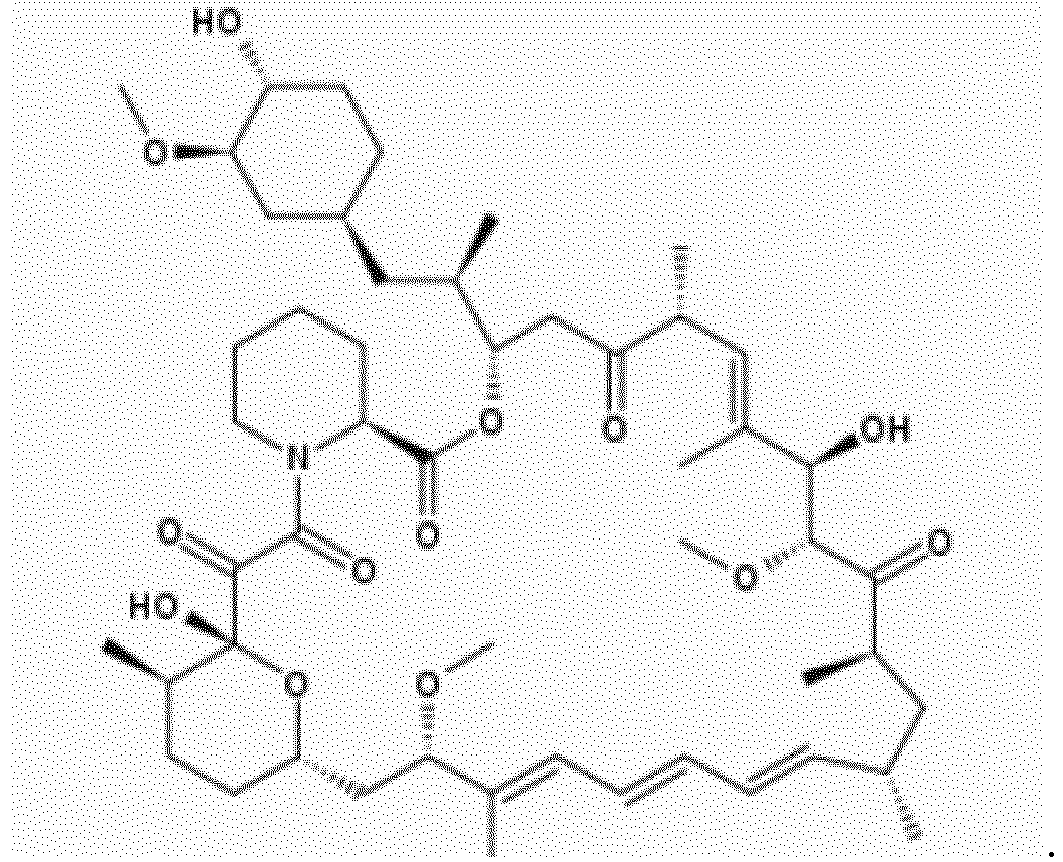
- In another embodiment, the present invention includes a combination of the present invention for use in a method of treating a hyperproliferative disease, preferably cancer, dependent on CDK4/6 or mTOR. CDK4/6 dependent cancers are also generally marked by a hyperphosphorlyated (retinoblastoma) Rb protein. A cancer is dependent on a pathway if inhibiting or blocking that pathway will slow or disrupt growth of that cancer. Examples of CDK4 or CDK6 pathway dependent cancers include breast cancer, non small cell lung cancer, melanoma, colon cancer, esophageal cancer, liposarcoma, mantle cell lyomphoma, multiple myeloma, T-cell leukemia, renal cell carcinoma, gastric cancer and pancreatic cancer. Examples of mTOR pathway dependent cancers include breast cancer, pancreatic cancer, renal cell carcinoma, mantle cell lymphoma, glioblastoma, hepatocellular carcinoma, gastric cancer, lung cancer and colon cancer. Correlation of cancers with the CDK4/6 pathway or the mTOR pathway has been established in the art. For example, see Shapiro, Journal of Clinical Oncology, Vol. 24, No. 11 (2006) pp. 1770-1783 or Fasolo, Expert Opin. Investig. Drugs Vol. 17, No. 11 (2008) pp. 1717-1734.
- Therefore in an embodiment of the invention is a combination of a CDK4/6 inhibitor and an mTOR inhibition for use in treating cancer, by manufacture in a medicament, which can be sold as either a combined or separate dosage form, or a method of treating cancer by administering the combination to a patient in need thereof. The cancer can be a solid tumor cancer or a lymphoma. Preferred cancers include pancreatic cancer, breast cancer, mantle cell lyomphoma, non small cell lung cancer, melanoma, colon cancer, esophageal cancer, liposarcoma, multiple myeloma, T-cell leukemia, renal cell carcinoma, gastric cancer, renal cell carcinoma, glioblastoma, hepatocellular carcinoma, gastric cancer, lung cancer or colon cancer.
- The phrase "pharmaceutically acceptable" refers to molecular entities and compositions that are physiologically tolerable and do not typically produce an allergic or similar untoward reaction, such as gastric upset, dizziness and the like, when administered to a human. Preferably, as used herein, the term "pharmaceutically acceptable" means approved by a regulatory agency of the Federal or a state government or listed in the U.S. Pharmacopeia or other generally recognized pharmacopeia for use in animals, and more particularly in humans.
- The term "carrier" refers to a diluent, adjuvant, excipient, or vehicle with which the compound is administered. Such pharmaceutical carriers can be sterile liquids, such as water and oils, including those of petroleum, animal, vegetable or synthetic origin, such as peanut oil, soybean oil, mineral oil, sesame oil and the like. Water or aqueous solution saline solutions and aqueous dextrose and glycerol solutions are preferably employed as carriers, particularly for injectable solutions. Suitable pharmaceutical carriers are described in "Remington's Pharmaceutical Sciences" by E. W. Martin.
- The phrase "therapeutically effective amount" is used herein to mean an amount sufficient to reduce by at least about 15 percent, preferably by at least 50 percent, more preferably by at least 90 percent, and most preferably prevent, a clinically significant deficit in the activity, function and response of the host. Alternatively, a therapeutically effective amount is sufficient to cause an improvement in a clinically significant condition/symptom in the host.
- "Agent" refers to all materials that may be used to prepare pharmaceutical and diagnostic compositions, or that may be compounds, nucleic acids, polypeptides, fragments, isoforms, variants, or other materials that may be used independently for such purposes, all in accordance with the present invention.
- "Analog" as used herein, refers to a small organic compound, a nucleotide, a protein, or a polypeptide that possesses similar or identical activity or function(s) as the compound, nucleotide, protein or polypeptide or compound having the desired activity and therapeutic effect of the present invention. (e.g., inhibition of tumor growth), but need not necessarily comprise a sequence or structure that is similar or identical to the sequence or structure of the preferred embodiment
- The present disclosure includes all pharmaceutically acceptable isotopically-labelled compounds of the invention, i.e. compounds of Formula (I), wherein one or more atoms are replaced by atoms having the same atomic number, but an atomic mass or mass number different from the atomic mass or mass number usually found in nature.
- Examples of isotopes suitable for inclusion in the compounds of the disclosure comprises isotopes of hydrogen, such as 2H and 3H, carbon, such as 11C, 13C and 14C, chlorine, such as 36Cl, fluorine, such as 18F, iodine, such as 123I and 125I, nitrogen, such as 13N and 15N, oxygen, such as 15O, 17O and 18O, phosphorus, such as 32P, and sulphur, such as 35S.
- Certain isotopically-labelled compounds of Formula (I), for example, those incorporating a radioactive isotope, are useful in drug and/or substrate tissue distribution studies. The radioactive isotopes tritium, i.e. 3H, and carbon-14, i.e. 14C, are particularly useful for this purpose in view of their ease of incorporation and ready means of detection.
- Substitution with heavier isotopes such as deuterium, i.e. 2H, may afford certain therapeutic advantages resulting from greater metabolic stability, for example, increased in vivo half-life or reduced dosage requirements, and hence may be preferred in some circumstances.
- Substitution with positron emitting isotopes, such as 11C, 18F, 15O and 13N, can be useful in Positron Emission Topography (PET) studies for examining substrate receptor occupancy.
- Isotopically-labeled compounds of Formula (I) can generally be prepared by conventional techniques known to those skilled in the art or by processes analogous to those described in the accompanying Examples and Preparations using an appropriate isotopically-labelled reagents in place of the non-labelled reagent previously employed.
- Examples 1-3 illustrate the general procedure can be used to make 7-Cyclopentyl-2-(5-piperazin-1-yl-pyridin-2-ylamino)-7H-pyrrolo[2,3-d]pyrimidine-6-carboxylic acid dimethylamide (Compound A1). Additional methods for making the CDK4/6 inhibitors described herein can be found in WO Application No.
PCT/EP09/060793 WO 2010/020675 . -

- Nitrile analogues can be made by the following. To a stirred solution of 5-bromo-2-nitropyridine (4.93 g, 24.3 mmol) and piperazine-1-carboxylic acid tert-butyl ester (4.97 g, 26.7 mmol) in CH3CN (60 ml) is added DIPEA (4.65 mL, 26.7 mmol). The mixture is heated at reflux for 72 hours then cooled to room temperature and the precipitated product collected by filtration. The filtrate is concentrated and purified by flash column chromatography eluting with 30% EtOAc/petrol. The combined products are re-crystallized from EtOAc/petrol to give 4-(6-nitro-pyridin-3-yl)-piperazine-1-carboxylic acid tert-butyl ester, (4.50 g, 80% yield). MS(ESI) m/z 308 (M+H)+
- A mixture of 5-[4-(2,2,2-trifluoro-ethyl)-piperazin-1-yl]-pyridin-2-ylamine (158mg, 0.607mmol), 2-chloro-7-cyclopentyl-7H-pyrrolo[2,3-d]pyrimidine-6-carboxylic acid dimethylamide (118 mg, 0.405mmol), Pd2(dba)3 (18.5mg, 0.020mmol), BINAP (25mg, 0.040mmol) and sodium-tert-butoxide (70mg, 0.728mmol) in dioxane (3.5mL) is degassed and heated to 100°C for 1 h in a CEM Discover microwave. The reaction mixture is partitioned between dichloromethane and saturated NaHCO3 solution. The organic layer is separated and the aqueous layer extracted with further dichloromethane. The combined organics are ished with brine, dried (MgSO4), filtered and concentrated. The crude product is purified using silica gel chromatography (0 to 10% methanol/dichloromethane) to give 7-cyclopentyl-2-{5-[4-(2,2,2-trifluoro-ethyl)-piperazin-1-yl]-pyridin-2-ylamino}-7H-pyrrolo[2,3-d]pyrimidine-6-carboxylic acid dimethylamide, which is purified further by trituration with acetonitrile (115mg, 55%). MS(ESI) m/z 517.2 (M+H)+ (method A).
1H NMR (400 MHz, Me-d3-OD): 8.72 (1H, s), 8.24 (1H, d), 7.98 (1H, d), 7.50 (1H, dd), 6.62 (1H, s), 4.81-4.72 (1H, m), 3.27-3.09 (12H, m), 2.89 (4H, t), 2.61-2.49 (2H, m), 2.16-2.01 (4H, m), 1.81-1.69 (2H, m). -

- Following Buchwald Method of Example 2, then General Procedure of Example 1, 2-chloro-7-cyclopentyl-7H-pyrrolo[2,3-d]pyrimidine-6-carboxylic acid dimethylamide (300 mg, 1.02 mmol) and 5-piperazin-1-yl-pyridin-2-ylamine (314 mg, 1.13 mmol) gave 7-cyclopentyl-2-(5-piperazin-1-yl-pyridin-2-ylamino)-7H-pyrrolo[2,3-d]pyrimidine-6-carboxylic acid dimethylamide (142 mg, 36%). MS(ESI) m/z 435.3 (M+H)+
- The Cell Titer-Glo Luminscent Cell Viability Assay (Promega# G7572) generates a luminescent signal that is proportional to the number of metabolically active cells present in a reaction, based on the quantitation of ATP. Cell Titer-Glo Reagent was prepared by thawing a vial of Cell Titer-Glo Buffer in a 37°C water bath. The entire bottle of buffer was then added to the bottle of lyophilized Cell Titer-Glo Substrate provided in the kit. Lyophilized substrate was allowed to dissolve; the solution was then mixed by inversion and was ready for use. Jeko-1 cells were diluted to a density of 200,000 cells/mL and cultured in T250 flask. Before treatment (time 0), 3 x 100 micro liter aliquots were removed and placed into a black 96 well plate with clear bottom (Costar#3904). 50 uL of CTG reagent was added to each well. The plate was placed on an Orbital Shaker, protected from light and incubated using setting 4 for 30 minutes at RT. The plate was then read using the Envision Luminometer, and results exported. The cells remaining in the T250 flasks were either left untreated or treated with single agents or in combinations. The concentration of CDK4/6 inhibitor used was 100 nM and those of mTOR inhibitor used were 1, 2.5 and 5 nM. Plates were allowed to incubate for 72 hrs at 37°C and 5% CO2. After 72hrs, 3 x 100 uL aliquots were removed and subjected to CTG as described above. Results were exported and analyzed using Microsoft Excel. The percentage of viable cells as compared to control growth was calculated using following equation:

- A is the CTG read under treatment condition
- B is the CTG read for
Time 0 cells - C is CTG read for 72hr untreated cells
- To evaluate whether the CDK4/6 and mTOR inhibitor combination leads to more pronounced growth inhibition compared to the growth inhibitions observed with single agents, Jeko-1 mantle cell lymphoma cells were treated with 100 nM of CDK4/6 inhibitor, 1, 2.5 and 5 nM of mTOR inhibitor and the combinations of the two inhibitors, as shown in
Figure 1 . Growth inhibitions are measured using the CellTiter-Glo kit of Example 4. % growth of the treated cells, compared to the vehicle control, was obtained. As shown infigure 1 , the treatment with 100 nM of CDK4/6 inhibitor led to 70% cell growth compared to the vehicle control, while the treatments with mTOR inhibitor alone led to approximately 30% growth at all three concentrations tested. Notably, the combinations of CDK4/6 and mTOR inhibitor led to much more pronounced growth inhibitions at all combinations tested. For example, less than 10% cell growth was observed for the 100 nM/5 nM CDK4/6 and mTOR inhibitor combination. This shows that CDK4/6 and mTOR inhibitor combination induces higher amounts of cell growth inhibitions, when evaluated against the single agent activities of the individual compound. - To determine if CDK4/6 and mTOR inhibitor combinations resulted in synergistic growth inhibitions, we generated isobolograms, where we compared the actual growth inhibition values in combinations, to 25, 50 and 75% growth inhibitions predicted for additivity (Tallarida RJ (2006) An overview of drug combination analysis with isobolograms. Journal of Pharmacology and Experimental Therapeutics; 319 (1):1-7). Briefly, 9 titrating concentration points including 0 nM that yielded growth inhibition values that ranged from 0 to 100% as single agents were determined for both CDK4/6 and mTOR inhibitor. In a 96 well plate, the 9 concentration points for each agent were mixed in a matrix format, generating 81 combinations. This plate was used to treat Jeko-1 cells, and the resulting growth inhibition values were used to generate IC50 values for the single agents and combinations. Graph was generated with CDK4/6 inhibitor concentrations shown on the y-axis and mTOR inhibitor concentrations shown on the x-axis. A straight line connecting the CDK4/6 inhibitor and the mTOR inhibitor IC50 values represented growth inhibitions that were strictly additive for the combinations. Plots placed below the line of additivity (more growth inhibition) represented synergistic growth inhibitions, while plots above the line of additivity (less growth inhibition) represented antagonistic growth inhibitions.
- To evaluate whether the cell growth inhibition by the CDK4/6 and mTOR inhibitor combination is synergistic, we measured the single agent and combination activities in Jeko-1 cells and analyzed them using the isolobologram analysis prepared according to Example 6. Briefly, the single agent activities of CDK4/6 and mTOR inhibitors were measured to determine 9 titrating concentration points that would give 0 to 100% growth inhibitions for each agent. In a matrix format, all possible combinations for the 9 concentration points of each inhibitor were co-administered to Jeko-1 cells and the observed growth inhibitions were recorded. The concentrations that gave 50% growth inhibitions were then calculated for each compound and the combinations, and used to generate the graph shown in
figure 2 . Axis X and Y represent mTOR and CDK4/6 inhibitor concentrations, respectively.Line 1 represents the growth inhibitions predicted for additivity, when considering 50% growth inhibitions.Line 2 is the plot generated for the observed combinations concentrations that gave the 50% growth inhibitions, and it is profoundly placed below the line of additivity, suggesting a strong synergy for the growth inhibition. In summary, the CDK4/6 and mTOR inhibitor combination inhibited cell growth in synergistic manner in Jeko-1 mantle cell lymphoma cells. - The synergistic effect in a breast cancer cell line MDA-MB453 by the CDK4/6 and mTOR inhibitor combination was also analyzed using an isoloblogram analysis as described in Example 7 above. Also in accordance with Example 7, the CDK4/6 and mTOR inhibitor combination inhibited cell growth in synergistic manner in MDA-MB453 breast cancer cells.
- A Jeko-1 xenograft model was used to measure anti-tumor activity in a 35 day treatment period of Compound A1, Compound B1, and the combination of Compounds A1 and B1. Significant anti-tumor activity was observed. When dosing was stopped and tumors were allowed to re-grow, the combination of Compounds A1 and B1 significantly delayed tumor growth by 20 days. In this model, both Compound A1 and Compound B1 had anti-tumor activity. However, the combination of Compounds A1 and B1 significantly extended tumor growth delay when treatment was stopped. See
Figure 4 . - The PANC-1 pancreatic carcinomas used for implantation were maintained by serial engraftment in nude mice. To initiate tumor growth, a 1 mm3 fragment was implanted subcutaneously in the right flank of each test animal. Tumors were monitored twice weekly and then daily as their mean volume approached 100-150 mm3. Twenty two days after tumor cell implantation, on D1 of the study, the animals were sorted into four groups of ten mice, with individual tumor sizes of 108-221 mm3 and group mean tumor sizes of 150-153 mm3. Tumor size, in mm3, was calculated from:

-
Group 1 mice received the Compound A1 and Compound B1 vehicles, and served as controls for all analyses.Groups 2 and 3 received monotherapies with 250 mg/kg qd, po x 21 days of Compound A1 or 10 mg/kg qd, po x 21 days of Compound B1. Group 4 received the combination therapy of Compound A1 and Compound B1. - Each animal was euthanized when tumor volume reached 1200mm3, or on the last day of the study (D55). For each animal whose tumor reached the endpoint volume, the time to endpoint (TTE) was calculated by the following equation:

- Where TTE is expressed in days, endpoint volume is in mm3, b is the intercept, and m is the slope of the line obtained by linear regression of a log-transformed tumor growth data set. The data set is comprised of the first observation that exceeded the study endpoint volume and the three consecutive observations that immediately preceded the attainment of the endpoint volume. The calculated TTE is usually less than the day on which an animal is euthanized for tumor size. An animal with a tumor that did not reach the endpoint is assigned a TTE value equal to the last day. An animal classified as having died from TR causes or non-treatment-related metastasis (NTRm) is assigned a TTE value equal to the day of death. An animal classified as having died from NTR causes is excluded from TTE calculations.
- Treatment efficacy was determined from tumor growth delay (TGD), which is defined as the increase in the median TTE for a treatment group compared with the control group: TGD = T - C, expressed in days, or as a percentage of the median TTE of the control group: %TGD = [(T - C)/C] x 100, where: T = median TTE for a treatment group, C = median TTE for the designated control group.
- These studies demonstrate that neither Compound A1 nor Compound B1 had significant anti-tumor activity in the PANC-1 xenograft model. However, the combination of Compounds A1 and B1 resulted in tumor stasis (
Figure 5A ) and significantly delayed tumor regrowth by 18 days (Figure 5B ). - Potential synergistic interactions between CDK4/6 and mTOR inhibitor combinations were assessed relative to the Loewe additivity model using CHALICE software, via a synergy score calculated from the differences between the observed and Loewe model values across the response matrix. Briefly, 9 titrating concentration ranging from 10uM diluted serially three folds for CDK4/6 inhibitors and 0.1uM diluted serially 3 folds for the mTOR inhibitors, including 0uM, were used. In a 96 well plate, the 9 concentration points for each agent were mixed in a matrix format, generating 81 combinations. This plate was used to treat Jeko-1 cells, and the resulting inhibition values were used by CHALICE software to generate Inhibition and ADD Excess Inhibition matrices, as well as the isobolograms. A more detailed explanation of the technique and calculation can be found in Lehar et al. "Synergistic drug combinations improve therapeutic selectivity", Nat. Biotechnol. 2009, July; 27(7), 659-666Inhibition matrix shows the actual inhibition observed by the CTG assay at the respective concentrations of the compounds. ADD Excess inhibition shows the excess inhibition observed over the inhibition predicted by the Loewe additivity model. In addition to the matrices, one can use isobolograms to observe synergy. The inhibition level for each isobologram was chosen manually so as to observe the best synergistic effects. Isobologram was generated with CDK4/6 inhibitor concentrations shown on the y-axis and mTOR inhibitor concentrations shown on the x-axis. A straight line connecting the CDK4/6 inhibitor and the mTOR inhibitor concentrations which produce the chosen level of inhibition represented growth inhibitions that were strictly additive for the combinations. Plots placed below the line of additivity (more growth inhibition) represented synergistic growth inhibitions, while plots above the line of additivity (less growth inhibition) represented antagonistic growth inhibitions.
- Synergic interaction between the following pairs of CDK4/6 inhibitor and the mTOR inhibitor combination were studied, the synergy scores, and the corresponding figure illustrations are listed below. The combination of Compound A1 with Compound B1 falls within the definition of the present invention. Other combinations described below are reference examples.
CDK4/6 inhibitor mTOR inhibitor Synergy Score Figure Compound A1 Compound B1 4.92 6 Compound A1 Compound B2 7.77 7 Compound A4 Compound B1 7.16 8 Compound A2 Compound B1 3.76 9 Compound A3 Compound B1 7.1 10 Compound A6 Compound B1 6.41 11 Compound A5 Compound B1 4.04 12 Compound A4 Compound B2 5.73 13 Compound A2 Compound B2 4.57 14 Compound A3 Compound B2 6.85 15 Compound A6 Compound B2 3.24 16 Compound A5 Compound B2 5.86 17
Claims (9)
- A combination comprising a first agent that is a cyclin dependent kinase 4 or cyclin dependent kinase 6 (CDK4/6) inhibitor, and a second agent that is an mTOR inhibitor, wherein the first agent is 7-Cyclopentyl-2-(5-piperazin-1-yl-pyridin-2-ylamino)-7H-pyrrolo[2,3-d]pyrimidine-6-carboxylic acid dimethylamide, or a pharmaceutically acceptable salt thereof, and the second agent is everolimus.
- The combination according to claim 1 for use in the treatment of cancer.
- The combination for use according to claim 2, wherein the cancer is dependent on the CDK4, CDK6 or mTOR pathway.
- The combination for use according to claim 2, wherein the cancer is a solid tumor cancer.
- The combination for use according to claim 2, wherein the cancer is pancreatic cancer, breast cancer, mantle cell lymphoma, non small cell lung cancer, melanoma, colon cancer, esophageal cancer, liposarcoma, multiple myeloma, T-cell leukemia, renal cell carcinoma, gastric cancer, renal cell carcinoma, glioblastoma, hepatocellular carcinoma, gastric cancer, lung cancer or colon cancer.
- The combination for use according to claim 2, wherein the cancer is pancreatic cancer, breast cancer, or mantle cell lymphoma.
- The combination for use according to claim 2, wherein the cancer is a lymphoma.
- The combination for use according to claim 2, wherein the first agent and the second agent are present in a combined dosage form.
- The combination for use according to claim 2 wherein the first agent and the second agent are present in a separate dosage form.
Applications Claiming Priority (2)
| Application Number | Priority Date | Filing Date | Title |
|---|---|---|---|
| US32354110P | 2010-04-13 | 2010-04-13 | |
| PCT/US2011/032062 WO2011130232A1 (en) | 2010-04-13 | 2011-04-12 | Combination comprising a cyclin dependent kinase 4 or cyclin dependent kinase (cdk4/6) inhibitor and an mtor inhibitor for treating cancer |
Publications (2)
| Publication Number | Publication Date |
|---|---|
| EP2558092A1 EP2558092A1 (en) | 2013-02-20 |
| EP2558092B1 true EP2558092B1 (en) | 2018-06-27 |
Family
ID=44146770
Family Applications (1)
| Application Number | Title | Priority Date | Filing Date |
|---|---|---|---|
| EP11715370.0A Revoked EP2558092B1 (en) | 2010-04-13 | 2011-04-12 | Combination comprising a cyclin dependent kinase 4 or cyclin dependent kinase 6 (cdk4/6) inhibitor and an mtor inhibitor for treating cancer |
Country Status (11)
| Country | Link |
|---|---|
| US (3) | US20130035336A1 (en) |
| EP (1) | EP2558092B1 (en) |
| JP (1) | JP5918214B2 (en) |
| KR (1) | KR101830455B1 (en) |
| CN (1) | CN102869358B (en) |
| AU (1) | AU2011240735B2 (en) |
| CA (1) | CA2800327A1 (en) |
| ES (1) | ES2689177T3 (en) |
| MX (2) | MX2012011912A (en) |
| RU (1) | RU2589696C2 (en) |
| WO (1) | WO2011130232A1 (en) |
Families Citing this family (59)
| Publication number | Priority date | Publication date | Assignee | Title |
|---|---|---|---|---|
| EA019094B1 (en) | 2008-08-22 | 2014-01-30 | Новартис Аг | Pyrrolopyrimidine compounds and use thereof |
| UY33227A (en) | 2010-02-19 | 2011-09-30 | Novartis Ag | PIRROLOPIRIMIDINE COMPOUNDS AS INHIBITORS OF THE CDK4 / 6 |
| AR091876A1 (en) | 2012-07-26 | 2015-03-04 | Novartis Ag | PHARMACEUTICAL COMBINATIONS FOR THE TREATMENT OF PROLIFERATIVE DISEASES |
| CA2880764C (en) | 2012-08-03 | 2022-08-30 | Foundation Medicine, Inc. | Human papilloma virus as predictor of cancer prognosis |
| BR112015012197A8 (en) * | 2012-11-28 | 2019-10-01 | Novartis Ag | cdk mtor inhibitor uses, and pharmaceutical combination comprising the same |
| EP3327144B1 (en) | 2013-02-25 | 2020-03-25 | Novartis AG | Novel androgen receptor mutation |
| CA2904054A1 (en) | 2013-03-15 | 2014-09-25 | Concert Pharmaceuticals, Inc. | Deuterated palbociclib |
| SI3033086T1 (en) * | 2013-08-14 | 2022-01-31 | Novartis Ag | Combination therapy for cancer treatment |
| ES2674361T3 (en) * | 2013-08-28 | 2018-06-29 | Novartis Ag | Combination of an ALK inhibitor and a CDK inhibitor for the treatment of proliferative cell diseases |
| US20150320754A1 (en) | 2014-04-16 | 2015-11-12 | Infinity Pharmaceuticals, Inc. | Combination therapies |
| CA2954189A1 (en) * | 2014-07-26 | 2016-02-04 | Sunshine Lake Pharma Co., Ltd. | 2-amino-pyrido[2,3-d]pyrimidin-7(8h)-one derivatives as cdk inhibitors and uses thereof |
| CN105294737B (en) * | 2014-07-26 | 2019-02-12 | 广东东阳光药业有限公司 | Compounds of CDK class small molecule inhibitors and their uses |
| EP3778605A3 (en) * | 2015-02-13 | 2021-03-10 | Dana Farber Cancer Institute, Inc. | Lrrk2 inhibitors and methods of making and using the same |
| ES2806206T3 (en) | 2015-03-11 | 2021-02-16 | Chia Tai Tianqing Pharmaceutical Group Co Ltd | 2-hydrogen substituted pyrazole derivative that serves as an anticancer drug |
| EP3156406A1 (en) * | 2015-10-14 | 2017-04-19 | ratiopharm GmbH | Crystalline forms of ribociclib free base |
| EA202092442A3 (en) | 2016-06-07 | 2021-08-31 | Джакобио Фармасьютикалс Ко., Лтд. | NEW HETEROCYCLIC DERIVATIVES USED AS SHP2 INHIBITORS |
| US20190175598A1 (en) * | 2016-08-23 | 2019-06-13 | Eisai R&D Management Co., Ltd. | Combination therapies for the treatment of hepatocellular carcinoma |
| WO2018049233A1 (en) | 2016-09-08 | 2018-03-15 | Nicolas Stransky | Inhibitors of the fibroblast growth factor receptor in combination with cyclin-dependent kinase inhibitors |
| KR102513448B1 (en) | 2016-12-16 | 2023-03-23 | 씨스톤 파마슈티컬즈 | CDK4/6 inhibitor |
| PE20191474A1 (en) | 2016-12-20 | 2019-10-16 | Astrazeneca Ab | AMINO-TRIAZOLOPYRIDINE COMPOUNDS AND THEIR USE IN THE TREATMENT OF CANCER |
| BR112019019261A2 (en) | 2017-03-16 | 2020-06-16 | Eisai R & D Management Co., Ltd. | COMBINATION THERAPIES FOR THE TREATMENT OF BREAST CANCER |
| WO2018172984A1 (en) | 2017-03-23 | 2018-09-27 | Jacobio Pharmaceuticals Co., Ltd. | Novel heterocyclic derivatives useful as shp2 inhibitors |
| CN108794452B (en) | 2017-05-05 | 2021-05-28 | 上海时莱生物技术有限公司 | Compound with kinase inhibition activity, preparation method and application thereof |
| WO2018218633A1 (en) | 2017-06-02 | 2018-12-06 | Beijing Percans Oncology Co. Ltd. | Combination therapies for treating cancers |
| JP7100125B2 (en) | 2017-10-27 | 2022-07-12 | フレゼニウス・カビ・オンコロジー・リミテッド | Process for improved preparation of ribociclib and its salts |
| EP3728228A1 (en) | 2017-12-22 | 2020-10-28 | Ravenna Pharmaceuticals, Inc. | Aminopyridine derivatives as phosphatidylinositol phosphate kinase inhibitors |
| US10519136B2 (en) | 2017-12-29 | 2019-12-31 | Accutar Biotechnology | Dual inhibitors of PARP1 and CDK |
| WO2019195959A1 (en) | 2018-04-08 | 2019-10-17 | Cothera Biosciences, Inc. | Combination therapy for cancers with braf mutation |
| WO2019222524A1 (en) * | 2018-05-16 | 2019-11-21 | The University Of North Carolina At Chapel Hill | Alkyl pyrrolopyrimidines as pan-tam inhibitors and their application in cancer treatment |
| IL314362A (en) | 2018-06-15 | 2024-09-01 | Janssen Pharmaceutica Nv | Rapamycin analogs and uses thereof |
| JP7507145B2 (en) | 2018-08-13 | 2024-06-27 | ベイジン パーカンズ オンコロジー カンパニー リミテッド | Biomarkers for Cancer Treatment |
| ES3004338T3 (en) * | 2018-09-10 | 2025-03-12 | Mirati Therapeutics Inc | Combination therapies |
| CN112839935A (en) | 2018-09-26 | 2021-05-25 | 北京加科思新药研发有限公司 | Novel heterocyclic derivatives useful as SHP2 inhibitors |
| US11066404B2 (en) | 2018-10-11 | 2021-07-20 | Incyte Corporation | Dihydropyrido[2,3-d]pyrimidinone compounds as CDK2 inhibitors |
| US20230065740A1 (en) * | 2018-12-28 | 2023-03-02 | Spv Therapeutics Inc. | Cyclin-dependent kinase inhibitors |
| WO2020140052A1 (en) * | 2018-12-28 | 2020-07-02 | Spv Therapeutics Inc. | Cyclin-dependent kinase inhibitors |
| US11384083B2 (en) | 2019-02-15 | 2022-07-12 | Incyte Corporation | Substituted spiro[cyclopropane-1,5′-pyrrolo[2,3-d]pyrimidin]-6′(7′h)-ones as CDK2 inhibitors |
| TW202100520A (en) | 2019-03-05 | 2021-01-01 | 美商英塞特公司 | Pyrazolyl pyrimidinylamine compounds as cdk2 inhibitors |
| WO2020205560A1 (en) | 2019-03-29 | 2020-10-08 | Incyte Corporation | Sulfonylamide compounds as cdk2 inhibitors |
| US11440914B2 (en) | 2019-05-01 | 2022-09-13 | Incyte Corporation | Tricyclic amine compounds as CDK2 inhibitors |
| US11447494B2 (en) | 2019-05-01 | 2022-09-20 | Incyte Corporation | Tricyclic amine compounds as CDK2 inhibitors |
| BR112021022105A2 (en) | 2019-05-05 | 2021-12-28 | Qilu Regor Therapeutics Inc | cdk inhibitors |
| TWI899080B (en) * | 2019-05-27 | 2025-10-01 | 大陸商迪哲(江蘇)醫藥股份有限公司 | Dna-dependent protein kinase inhibitor |
| TW202112767A (en) | 2019-06-17 | 2021-04-01 | 美商佩特拉製藥公司 | Aminopyridine derivatives as phosphatidylinositol phosphate kinase inhibitors |
| CN112094272A (en) * | 2019-06-18 | 2020-12-18 | 北京睿熙生物科技有限公司 | CDK kinase inhibitors |
| CN116348458A (en) | 2019-08-14 | 2023-06-27 | 因赛特公司 | Imidazolylpyrimidinylamine compounds as CDK2 inhibitors |
| CN119930611A (en) | 2019-10-11 | 2025-05-06 | 因赛特公司 | Dicyclomine as a CDK2 inhibitor |
| WO2021108803A1 (en) | 2019-11-26 | 2021-06-03 | Theravance Biopharma R&D Ip, Llc | Fused pyrimidine pyridinone compounds as jak inhibitors |
| BR112022010754A2 (en) | 2019-12-05 | 2022-08-23 | Anakuria Therapeutics Inc | RAPAMICIN ANALOGS AND USES THEREOF |
| IL293940B2 (en) * | 2019-12-16 | 2026-05-01 | Lunella Biotech Inc | Selective cdk4/6 inhibitor cancer therapeutics |
| WO2021124104A1 (en) | 2019-12-16 | 2021-06-24 | Lunella Biotech, Inc. | Selective cdk4/6 inhibitor cancer therapeutics |
| WO2021133886A1 (en) | 2019-12-23 | 2021-07-01 | Accutar Biotechnology | Combinations of estrogen receptor degraders and cyclin-dependent kinase inhibitors for treating cancer |
| JP2024503898A (en) * | 2021-01-22 | 2024-01-29 | ヤンセン ファーマシューティカ エヌ.ベー. | Rapamycin analogues and their uses |
| KR102693170B1 (en) | 2021-04-27 | 2024-08-08 | 재단법인 아산사회복지재단 | Composition for inhibiting cyclin-dependent kinase and medical uses thereof |
| US11981671B2 (en) | 2021-06-21 | 2024-05-14 | Incyte Corporation | Bicyclic pyrazolyl amines as CDK2 inhibitors |
| US11976073B2 (en) | 2021-12-10 | 2024-05-07 | Incyte Corporation | Bicyclic amines as CDK2 inhibitors |
| CN114957248B (en) * | 2022-05-09 | 2023-12-29 | 南开大学 | Pyrrolo pyrimidine compound and preparation method, pharmaceutical composition and application thereof |
| WO2024115680A1 (en) | 2022-12-01 | 2024-06-06 | Krka, D.D., Novo Mesto | Ribociclib salts and formulations thereof |
| WO2024249554A1 (en) * | 2023-05-30 | 2024-12-05 | The Charlotte Mecklenburg Hospital Authority D/B/A Atrium Health | Multitarget small molecule inhibitors and uses thereof |
Citations (5)
| Publication number | Priority date | Publication date | Assignee | Title |
|---|---|---|---|---|
| US20050222163A1 (en) | 2004-03-30 | 2005-10-06 | Pfizer Inc | Combinations of signal transduction inhibitors |
| WO2007140222A2 (en) | 2006-05-26 | 2007-12-06 | Novartis Ag | Pyrrolopyrimidine compounds and their uses |
| WO2009061345A2 (en) | 2007-11-07 | 2009-05-14 | Cornell Research Foundation, Inc. | Targeting cdk4 and cdk6 in cancer therapy |
| WO2010020675A1 (en) | 2008-08-22 | 2010-02-25 | Novartis Ag | Pyrrolopyrimidine compounds as cdk inhibitors |
| FR2945747A1 (en) | 2009-05-25 | 2010-11-26 | Centre Nat Rech Scient | ANTITUMOR PHARMACEUTICAL COMPOSITION COMPRISING A CDKS INHIBITOR AND A CELL GROWTH INHIBITOR |
Family Cites Families (32)
| Publication number | Priority date | Publication date | Assignee | Title |
|---|---|---|---|---|
| PT98990A (en) | 1990-09-19 | 1992-08-31 | American Home Prod | PROCESS FOR THE PREPARATION OF CARBOXYLIC ACID ESTERS OF RAPAMICIN |
| US5120842A (en) | 1991-04-01 | 1992-06-09 | American Home Products Corporation | Silyl ethers of rapamycin |
| US5100883A (en) | 1991-04-08 | 1992-03-31 | American Home Products Corporation | Fluorinated esters of rapamycin |
| US5118678A (en) | 1991-04-17 | 1992-06-02 | American Home Products Corporation | Carbamates of rapamycin |
| US5118677A (en) | 1991-05-20 | 1992-06-02 | American Home Products Corporation | Amide esters of rapamycin |
| US5151413A (en) | 1991-11-06 | 1992-09-29 | American Home Products Corporation | Rapamycin acetals as immunosuppressant and antifungal agents |
| GB9125660D0 (en) | 1991-12-03 | 1992-01-29 | Smithkline Beecham Plc | Novel compound |
| ZA935112B (en) | 1992-07-17 | 1994-02-08 | Smithkline Beecham Corp | Rapamycin derivatives |
| ZA935111B (en) | 1992-07-17 | 1994-02-04 | Smithkline Beecham Corp | Rapamycin derivatives |
| US5256790A (en) | 1992-08-13 | 1993-10-26 | American Home Products Corporation | 27-hydroxyrapamycin and derivatives thereof |
| GB9221220D0 (en) | 1992-10-09 | 1992-11-25 | Sandoz Ag | Organic componds |
| US5258389A (en) | 1992-11-09 | 1993-11-02 | Merck & Co., Inc. | O-aryl, O-alkyl, O-alkenyl and O-alkynylrapamycin derivatives |
| WO1995014023A1 (en) | 1993-11-19 | 1995-05-26 | Abbott Laboratories | Semisynthetic analogs of rapamycin (macrolides) being immunomodulators |
| PT734389E (en) | 1993-12-17 | 2000-09-29 | Novartis Ag | US RAPAMICINE DERIVATIVES AS IMMUNOSUPRESSORS |
| CZ292233B6 (en) | 1995-06-09 | 2003-08-13 | Novartis Ag | Rapamycin derivatives and their use as medicaments |
| US6258823B1 (en) | 1996-07-12 | 2001-07-10 | Ariad Pharmaceuticals, Inc. | Materials and method for treating or preventing pathogenic fungal infection |
| AU783158B2 (en) | 1999-08-24 | 2005-09-29 | Ariad Pharmaceuticals, Inc. | 28-epirapalogs |
| ATE314370T1 (en) * | 2002-01-22 | 2006-01-15 | Warner Lambert Co | 2-(PYRIDINE-2-YLAMINO)-PYRIDO(2,3-D)PYRIMIDINE-7-ONE |
| PT2298768E (en) * | 2004-06-11 | 2012-12-05 | Japan Tobacco Inc | 5-amino-2,4,7-trioxo-3,4,7,8-tetrahydro-2h-pyrido[2,3-d]pyrimidine derivatives and related compounds for the treatment of cancer |
| JP2008531537A (en) | 2005-02-25 | 2008-08-14 | クドス ファーマシューティカルズ リミテッド | Compound |
| EP1871377A1 (en) | 2005-02-25 | 2008-01-02 | Kudos Pharmaceuticals Ltd | 2,4-diamino-pyridopyrimidine derivatives and their use as mtor inhibitors |
| CN102579467A (en) * | 2005-11-14 | 2012-07-18 | 阿里亚德医药股份有限公司 | Administration of mntor inhibitor to treat patients with cancer |
| ES2436877T3 (en) | 2005-11-17 | 2014-01-07 | OSI Pharmaceuticals, LLC | Intermediates for the preparation of condensed bicyclic mTOR inhibitors |
| KR101464384B1 (en) | 2005-11-22 | 2014-11-21 | 쿠도스 파마슈티칼스 리미티드 | As mTOR inhibitors, pyridopyrimidine, pyrazopyrimidine and pyrimidopyrimidine derivatives |
| KR20080083188A (en) | 2006-01-11 | 2008-09-16 | 아스트라제네카 아베 | Morpholino pyrimidine derivatives and their use in therapy |
| US7659274B2 (en) | 2006-01-25 | 2010-02-09 | Osi Pharmaceuticals, Inc. | Unsaturated mTOR inhibitors |
| US7480581B2 (en) | 2006-06-27 | 2009-01-20 | Teradyne, Inc. | Calibrating a testing device |
| EP2049516A2 (en) | 2006-07-14 | 2009-04-22 | Astex Therapeutics Limited | Pharmaceutical compounds |
| PT2057156T (en) | 2006-08-23 | 2017-05-04 | Kudos Pharm Ltd | 2-methylmorpholine pyrido-,pyrazo- and pyrimido-pyrimidine derivatives as mtor inhibitors |
| JP2011506303A (en) * | 2007-12-07 | 2011-03-03 | ノバルティス アーゲー | Pyrazole derivatives and their use as inhibitors of cyclin-dependent kinases |
| PL2424843T3 (en) | 2009-04-30 | 2014-07-31 | Novartis Ag | Imidazole derivatives and their use as modulators of cyclin dependent kinases |
| UY33227A (en) * | 2010-02-19 | 2011-09-30 | Novartis Ag | PIRROLOPIRIMIDINE COMPOUNDS AS INHIBITORS OF THE CDK4 / 6 |
-
2011
- 2011-04-12 KR KR1020127029596A patent/KR101830455B1/en not_active Expired - Fee Related
- 2011-04-12 CN CN201180019111.1A patent/CN102869358B/en not_active Expired - Fee Related
- 2011-04-12 AU AU2011240735A patent/AU2011240735B2/en not_active Ceased
- 2011-04-12 EP EP11715370.0A patent/EP2558092B1/en not_active Revoked
- 2011-04-12 WO PCT/US2011/032062 patent/WO2011130232A1/en not_active Ceased
- 2011-04-12 CA CA2800327A patent/CA2800327A1/en not_active Abandoned
- 2011-04-12 JP JP2013505045A patent/JP5918214B2/en active Active
- 2011-04-12 RU RU2012148133/15A patent/RU2589696C2/en not_active IP Right Cessation
- 2011-04-12 US US13/640,863 patent/US20130035336A1/en not_active Abandoned
- 2011-04-12 MX MX2012011912A patent/MX2012011912A/en active IP Right Grant
- 2011-04-12 ES ES11715370.0T patent/ES2689177T3/en active Active
-
2012
- 2012-10-12 MX MX2013011693A patent/MX346379B/en unknown
-
2015
- 2015-07-16 US US14/800,893 patent/US20160008367A1/en not_active Abandoned
-
2018
- 2018-03-26 US US15/935,294 patent/US20180207163A1/en not_active Abandoned
Patent Citations (5)
| Publication number | Priority date | Publication date | Assignee | Title |
|---|---|---|---|---|
| US20050222163A1 (en) | 2004-03-30 | 2005-10-06 | Pfizer Inc | Combinations of signal transduction inhibitors |
| WO2007140222A2 (en) | 2006-05-26 | 2007-12-06 | Novartis Ag | Pyrrolopyrimidine compounds and their uses |
| WO2009061345A2 (en) | 2007-11-07 | 2009-05-14 | Cornell Research Foundation, Inc. | Targeting cdk4 and cdk6 in cancer therapy |
| WO2010020675A1 (en) | 2008-08-22 | 2010-02-25 | Novartis Ag | Pyrrolopyrimidine compounds as cdk inhibitors |
| FR2945747A1 (en) | 2009-05-25 | 2010-11-26 | Centre Nat Rech Scient | ANTITUMOR PHARMACEUTICAL COMPOSITION COMPRISING A CDKS INHIBITOR AND A CELL GROWTH INHIBITOR |
Non-Patent Citations (11)
| Title |
|---|
| A. GOY: "Mantle cell lymphoma: Evolving novel options", CURRENT ONCOLOGY REPORTS, vol. 9, no. 5, 2007, pages 391 - 398, XP008085785 |
| E. DRAKOS ET AL.: "Mammalian target of rapamycin (mTOR) pathway signalling in lymphomas", EXPERT REV MOL MED, vol. 10, 2008, pages 1 - 21, XP009157157 |
| J. LEHAR ET AL.: "Synergistic drug combinations improve therapeutic selectivity", NAT. BIOTECHNOL, vol. 27, no. 7, 2009, pages 659 - 666, XP055447444 |
| J. RODRIGUEZ ET AL.: "Molecular biology of mantle cell lymphoma: From profiling studies to new therapeutic strategies", BLOOD REVIEWS, vol. 23, no. 5, 2009, pages 205 - 216, XP026458132 |
| M. A. WASIK ET AL.: "Mantle cell lymphoma cells express predominantly cyclin D1a isoform and are highly sensitive to selective inhibition of CDK4 kinase activity", BLOOD, vol. 108, no. 5, 2006, pages 1744 - 1750, XP055578941 |
| O. A. O'CONNOR: "Mantle Cell Lymphoma: Identifying Novel Molecular Targets in Growth and Survival Pathways", AMERICAN SOCIETY OF HEMATOLOGY, 2007, pages 270 - 276, XP055578951 |
| P. J. HOUGHTON: "Everolimus", CLIN CANCER RES, vol. 16, no. 5, 2010, pages 1368 - 1372, XP055578953 |
| P. JARES ET AL.: "Advances in the understanding of mantle cell lymphoma", BJG REVIEW, vol. 142, no. 2, 2008, pages 149 - 165, XP055050104 |
| P. L. TOOGOOD ET AL.: "Specific inhibition of cyclin-dependent kinase 4/6 by PD 0332991 and associated antitumor activity in human tumor xenografts", MOL CANCER THER, vol. 3, no. 11, 2004, pages 1427 - 1437, XP002333887 |
| Q. LIU: "MTOR mediated anti-cancer drug discovery", DRUG DISCOVERY TODAY, vol. 6, no. 2, 2009, pages 47 - 55, XP055272609 |
| T. HARITUNIANS ET AL.: "Antiproliferative activity of RAD001 (everolimus) as a single agent and combined with other agents in mantle cell lymphoma", LEUKEMIA, vol. 21, no. 2, 2007, pages 333 - 339, XP002568686 |
Also Published As
| Publication number | Publication date |
|---|---|
| US20180207163A1 (en) | 2018-07-26 |
| WO2011130232A1 (en) | 2011-10-20 |
| MX2012011912A (en) | 2012-11-16 |
| CA2800327A1 (en) | 2011-10-20 |
| ES2689177T3 (en) | 2018-11-08 |
| US20160008367A1 (en) | 2016-01-14 |
| JP2013523885A (en) | 2013-06-17 |
| KR101830455B1 (en) | 2018-02-20 |
| RU2012148133A (en) | 2014-05-20 |
| US20130035336A1 (en) | 2013-02-07 |
| JP5918214B2 (en) | 2016-05-18 |
| RU2589696C2 (en) | 2016-07-10 |
| CN102869358A (en) | 2013-01-09 |
| KR20130098151A (en) | 2013-09-04 |
| EP2558092A1 (en) | 2013-02-20 |
| AU2011240735A1 (en) | 2012-11-01 |
| AU2011240735B2 (en) | 2015-01-29 |
| MX346379B (en) | 2017-03-16 |
| CN102869358B (en) | 2016-03-23 |
Similar Documents
| Publication | Publication Date | Title |
|---|---|---|
| ES2689177T3 (en) | Combination comprising a cyclin dependent kinase 4 inhibitor or cyclin dependent kinase (CDK4 / 6) and an mTOR inhibitor for treating cancer | |
| Cohen et al. | Kinase drug discovery 20 years after imatinib: progress and future directions | |
| Nitulescu et al. | Akt inhibitors in cancer treatment: The long journey from drug discovery to clinical use | |
| Shi et al. | From structure modification to drug launch: a systematic review of the ongoing development of cyclin-dependent kinase inhibitors for multiple cancer therapy | |
| JP2023512040A (en) | Compounds and uses thereof | |
| EP2802586B1 (en) | Substituted imidazopyrazines as akt kinase inhibitors | |
| EP3325488A1 (en) | Chiral diaryl macrocycles and uses thereof | |
| Pinto-Leite et al. | mTOR inhibitors in urinary bladder cancer | |
| Lakkaniga et al. | Revisiting Aurora Kinase B: A promising therapeutic target for cancer therapy | |
| KR20170134462A (en) | Treatment method combining mdm2 inhibitor and btk inhibitor | |
| WO2023093840A1 (en) | Use of wee1 kinase inhibitors in the treatment of cancer | |
| CN114502559A (en) | Dihydroimidazopyrimidopyrimidinones | |
| De Falco et al. | Cell cycle as a target of antineoplastic drugs | |
| TW202202143A (en) | Co-treatment with cdk4/6 and cdk2 inhibitors to suppress tumor adaptation to cdk2 inhibitors | |
| JP2022518555A (en) | Non-immunosuppressive FK506 analogs and their use | |
| WO2013104611A1 (en) | Substituted pyrazolopyrimidines as akt kinase inhibitors | |
| KR20140144215A (en) | Methods of treating cancer using aurora kinase inhibitors | |
| EP2651949B1 (en) | Substituted pyrimido[1,2-b]indazoles and their use as modulators of the pi3k/akt pathway | |
| Ma et al. | Discovery of dCDK9-202 as a Highly Potent and Selective PROTAC CDK9 Degrader with Strong In Vivo Antitumor Activity | |
| Temps | Preclinical investigation of the novel SRC inhibitor eCF506 in cancer | |
| Chang | HI-511 inhibits both BRAF and AURKB to overcome malignant melanoma drug resistance and metastasis | |
| HK40080957A (en) | Compounds and uses thereof | |
| Balusu et al. | 515 Superior Efficacy of Co-treatment with NPM1 Antagonist and FLT3 Inhibitor or Pan-histone Deacetylase Inhibitor Against Cultured and Primary Human AML Cells Co-expressing Mutant NPM1 and FLT3-ITD | |
| HK1187047A (en) | Bicyclic pyrimidines |
Legal Events
| Date | Code | Title | Description |
|---|---|---|---|
| PUAI | Public reference made under article 153(3) epc to a published international application that has entered the european phase |
Free format text: ORIGINAL CODE: 0009012 |
|
| 17P | Request for examination filed |
Effective date: 20121113 |
|
| AK | Designated contracting states |
Kind code of ref document: A1 Designated state(s): AL AT BE BG CH CY CZ DE DK EE ES FI FR GB GR HR HU IE IS IT LI LT LU LV MC MK MT NL NO PL PT RO RS SE SI SK SM TR |
|
| DAX | Request for extension of the european patent (deleted) | ||
| 17Q | First examination report despatched |
Effective date: 20150805 |
|
| GRAP | Despatch of communication of intention to grant a patent |
Free format text: ORIGINAL CODE: EPIDOSNIGR1 |
|
| INTG | Intention to grant announced |
Effective date: 20161018 |
|
| GRAJ | Information related to disapproval of communication of intention to grant by the applicant or resumption of examination proceedings by the epo deleted |
Free format text: ORIGINAL CODE: EPIDOSDIGR1 |
|
| STAA | Information on the status of an ep patent application or granted ep patent |
Free format text: STATUS: EXAMINATION IS IN PROGRESS |
|
| GRAP | Despatch of communication of intention to grant a patent |
Free format text: ORIGINAL CODE: EPIDOSNIGR1 |
|
| STAA | Information on the status of an ep patent application or granted ep patent |
Free format text: STATUS: GRANT OF PATENT IS INTENDED |
|
| INTC | Intention to grant announced (deleted) | ||
| INTG | Intention to grant announced |
Effective date: 20170307 |
|
| GRAS | Grant fee paid |
Free format text: ORIGINAL CODE: EPIDOSNIGR3 |
|
| GRAJ | Information related to disapproval of communication of intention to grant by the applicant or resumption of examination proceedings by the epo deleted |
Free format text: ORIGINAL CODE: EPIDOSDIGR1 |
|
| GRAL | Information related to payment of fee for publishing/printing deleted |
Free format text: ORIGINAL CODE: EPIDOSDIGR3 |
|
| STAA | Information on the status of an ep patent application or granted ep patent |
Free format text: STATUS: EXAMINATION IS IN PROGRESS |
|
| INTC | Intention to grant announced (deleted) | ||
| GRAP | Despatch of communication of intention to grant a patent |
Free format text: ORIGINAL CODE: EPIDOSNIGR1 |
|
| STAA | Information on the status of an ep patent application or granted ep patent |
Free format text: STATUS: GRANT OF PATENT IS INTENDED |
|
| INTG | Intention to grant announced |
Effective date: 20180122 |
|
| GRAA | (expected) grant |
Free format text: ORIGINAL CODE: 0009210 |
|
| STAA | Information on the status of an ep patent application or granted ep patent |
Free format text: STATUS: THE PATENT HAS BEEN GRANTED |
|
| AK | Designated contracting states |
Kind code of ref document: B1 Designated state(s): AL AT BE BG CH CY CZ DE DK EE ES FI FR GB GR HR HU IE IS IT LI LT LU LV MC MK MT NL NO PL PT RO RS SE SI SK SM TR |
|
| REG | Reference to a national code |
Ref country code: GB Ref legal event code: FG4D |
|
| REG | Reference to a national code |
Ref country code: AT Ref legal event code: REF Ref document number: 1011694 Country of ref document: AT Kind code of ref document: T Effective date: 20180715 |
|
| REG | Reference to a national code |
Ref country code: IE Ref legal event code: FG4D |
|
| REG | Reference to a national code |
Ref country code: DE Ref legal event code: R096 Ref document number: 602011049544 Country of ref document: DE |
|
| PG25 | Lapsed in a contracting state [announced via postgrant information from national office to epo] |
Ref country code: BG Free format text: LAPSE BECAUSE OF FAILURE TO SUBMIT A TRANSLATION OF THE DESCRIPTION OR TO PAY THE FEE WITHIN THE PRESCRIBED TIME-LIMIT Effective date: 20180927 Ref country code: SE Free format text: LAPSE BECAUSE OF FAILURE TO SUBMIT A TRANSLATION OF THE DESCRIPTION OR TO PAY THE FEE WITHIN THE PRESCRIBED TIME-LIMIT Effective date: 20180627 Ref country code: FI Free format text: LAPSE BECAUSE OF FAILURE TO SUBMIT A TRANSLATION OF THE DESCRIPTION OR TO PAY THE FEE WITHIN THE PRESCRIBED TIME-LIMIT Effective date: 20180627 Ref country code: NO Free format text: LAPSE BECAUSE OF FAILURE TO SUBMIT A TRANSLATION OF THE DESCRIPTION OR TO PAY THE FEE WITHIN THE PRESCRIBED TIME-LIMIT Effective date: 20180927 Ref country code: LT Free format text: LAPSE BECAUSE OF FAILURE TO SUBMIT A TRANSLATION OF THE DESCRIPTION OR TO PAY THE FEE WITHIN THE PRESCRIBED TIME-LIMIT Effective date: 20180627 |
|
| REG | Reference to a national code |
Ref country code: NL Ref legal event code: MP Effective date: 20180627 |
|
| REG | Reference to a national code |
Ref country code: ES Ref legal event code: FG2A Ref document number: 2689177 Country of ref document: ES Kind code of ref document: T3 Effective date: 20181108 |
|
| REG | Reference to a national code |
Ref country code: LT Ref legal event code: MG4D |
|
| PG25 | Lapsed in a contracting state [announced via postgrant information from national office to epo] |
Ref country code: GR Free format text: LAPSE BECAUSE OF FAILURE TO SUBMIT A TRANSLATION OF THE DESCRIPTION OR TO PAY THE FEE WITHIN THE PRESCRIBED TIME-LIMIT Effective date: 20180928 Ref country code: HR Free format text: LAPSE BECAUSE OF FAILURE TO SUBMIT A TRANSLATION OF THE DESCRIPTION OR TO PAY THE FEE WITHIN THE PRESCRIBED TIME-LIMIT Effective date: 20180627 Ref country code: LV Free format text: LAPSE BECAUSE OF FAILURE TO SUBMIT A TRANSLATION OF THE DESCRIPTION OR TO PAY THE FEE WITHIN THE PRESCRIBED TIME-LIMIT Effective date: 20180627 Ref country code: RS Free format text: LAPSE BECAUSE OF FAILURE TO SUBMIT A TRANSLATION OF THE DESCRIPTION OR TO PAY THE FEE WITHIN THE PRESCRIBED TIME-LIMIT Effective date: 20180627 |
|
| REG | Reference to a national code |
Ref country code: AT Ref legal event code: MK05 Ref document number: 1011694 Country of ref document: AT Kind code of ref document: T Effective date: 20180627 |
|
| PG25 | Lapsed in a contracting state [announced via postgrant information from national office to epo] |
Ref country code: NL Free format text: LAPSE BECAUSE OF FAILURE TO SUBMIT A TRANSLATION OF THE DESCRIPTION OR TO PAY THE FEE WITHIN THE PRESCRIBED TIME-LIMIT Effective date: 20180627 |
|
| PG25 | Lapsed in a contracting state [announced via postgrant information from national office to epo] |
Ref country code: RO Free format text: LAPSE BECAUSE OF FAILURE TO SUBMIT A TRANSLATION OF THE DESCRIPTION OR TO PAY THE FEE WITHIN THE PRESCRIBED TIME-LIMIT Effective date: 20180627 Ref country code: CZ Free format text: LAPSE BECAUSE OF FAILURE TO SUBMIT A TRANSLATION OF THE DESCRIPTION OR TO PAY THE FEE WITHIN THE PRESCRIBED TIME-LIMIT Effective date: 20180627 Ref country code: EE Free format text: LAPSE BECAUSE OF FAILURE TO SUBMIT A TRANSLATION OF THE DESCRIPTION OR TO PAY THE FEE WITHIN THE PRESCRIBED TIME-LIMIT Effective date: 20180627 Ref country code: AT Free format text: LAPSE BECAUSE OF FAILURE TO SUBMIT A TRANSLATION OF THE DESCRIPTION OR TO PAY THE FEE WITHIN THE PRESCRIBED TIME-LIMIT Effective date: 20180627 Ref country code: IS Free format text: LAPSE BECAUSE OF FAILURE TO SUBMIT A TRANSLATION OF THE DESCRIPTION OR TO PAY THE FEE WITHIN THE PRESCRIBED TIME-LIMIT Effective date: 20181027 Ref country code: PL Free format text: LAPSE BECAUSE OF FAILURE TO SUBMIT A TRANSLATION OF THE DESCRIPTION OR TO PAY THE FEE WITHIN THE PRESCRIBED TIME-LIMIT Effective date: 20180627 Ref country code: SK Free format text: LAPSE BECAUSE OF FAILURE TO SUBMIT A TRANSLATION OF THE DESCRIPTION OR TO PAY THE FEE WITHIN THE PRESCRIBED TIME-LIMIT Effective date: 20180627 |
|
| PG25 | Lapsed in a contracting state [announced via postgrant information from national office to epo] |
Ref country code: SM Free format text: LAPSE BECAUSE OF FAILURE TO SUBMIT A TRANSLATION OF THE DESCRIPTION OR TO PAY THE FEE WITHIN THE PRESCRIBED TIME-LIMIT Effective date: 20180627 |
|
| REG | Reference to a national code |
Ref country code: DE Ref legal event code: R026 Ref document number: 602011049544 Country of ref document: DE |
|
| PLBI | Opposition filed |
Free format text: ORIGINAL CODE: 0009260 |
|
| PLAX | Notice of opposition and request to file observation + time limit sent |
Free format text: ORIGINAL CODE: EPIDOSNOBS2 |
|
| 26 | Opposition filed |
Opponent name: GENERICS (UK) LTD Effective date: 20190327 |
|
| PG25 | Lapsed in a contracting state [announced via postgrant information from national office to epo] |
Ref country code: DK Free format text: LAPSE BECAUSE OF FAILURE TO SUBMIT A TRANSLATION OF THE DESCRIPTION OR TO PAY THE FEE WITHIN THE PRESCRIBED TIME-LIMIT Effective date: 20180627 |
|
| PLBB | Reply of patent proprietor to notice(s) of opposition received |
Free format text: ORIGINAL CODE: EPIDOSNOBS3 |
|
| RDAF | Communication despatched that patent is revoked |
Free format text: ORIGINAL CODE: EPIDOSNREV1 |
|
| REG | Reference to a national code |
Ref country code: DE Ref legal event code: R064 Ref document number: 602011049544 Country of ref document: DE Ref country code: DE Ref legal event code: R103 Ref document number: 602011049544 Country of ref document: DE |
|
| PG25 | Lapsed in a contracting state [announced via postgrant information from national office to epo] |
Ref country code: SI Free format text: LAPSE BECAUSE OF FAILURE TO SUBMIT A TRANSLATION OF THE DESCRIPTION OR TO PAY THE FEE WITHIN THE PRESCRIBED TIME-LIMIT Effective date: 20180627 |
|
| PG25 | Lapsed in a contracting state [announced via postgrant information from national office to epo] |
Ref country code: AL Free format text: LAPSE BECAUSE OF FAILURE TO SUBMIT A TRANSLATION OF THE DESCRIPTION OR TO PAY THE FEE WITHIN THE PRESCRIBED TIME-LIMIT Effective date: 20180627 |
|
| REG | Reference to a national code |
Ref country code: CH Ref legal event code: PL |
|
| RDAG | Patent revoked |
Free format text: ORIGINAL CODE: 0009271 |
|
| STAA | Information on the status of an ep patent application or granted ep patent |
Free format text: STATUS: PATENT REVOKED |
|
| REG | Reference to a national code |
Ref country code: BE Ref legal event code: MM Effective date: 20190430 |
|
| GBPC | Gb: european patent ceased through non-payment of renewal fee |
Effective date: 20190412 |
|
| PG25 | Lapsed in a contracting state [announced via postgrant information from national office to epo] |
Ref country code: MC Free format text: LAPSE BECAUSE OF FAILURE TO SUBMIT A TRANSLATION OF THE DESCRIPTION OR TO PAY THE FEE WITHIN THE PRESCRIBED TIME-LIMIT Effective date: 20180627 Ref country code: LU Free format text: LAPSE BECAUSE OF NON-PAYMENT OF DUE FEES Effective date: 20190412 |
|
| 27W | Patent revoked |
Effective date: 20190824 |
|
| REG | Reference to a national code |
Ref country code: FI Ref legal event code: MGE |
|
| PG25 | Lapsed in a contracting state [announced via postgrant information from national office to epo] |
Ref country code: CH Free format text: LAPSE BECAUSE OF NON-PAYMENT OF DUE FEES Effective date: 20190430 Ref country code: GB Free format text: LAPSE BECAUSE OF NON-PAYMENT OF DUE FEES Effective date: 20190412 Ref country code: LI Free format text: LAPSE BECAUSE OF NON-PAYMENT OF DUE FEES Effective date: 20190430 |
|
| PG25 | Lapsed in a contracting state [announced via postgrant information from national office to epo] |
Ref country code: FR Free format text: LAPSE BECAUSE OF NON-PAYMENT OF DUE FEES Effective date: 20190430 Ref country code: BE Free format text: LAPSE BECAUSE OF NON-PAYMENT OF DUE FEES Effective date: 20190430 |
|
| PG25 | Lapsed in a contracting state [announced via postgrant information from national office to epo] |
Ref country code: PT Free format text: LAPSE BECAUSE OF FAILURE TO SUBMIT A TRANSLATION OF THE DESCRIPTION OR TO PAY THE FEE WITHIN THE PRESCRIBED TIME-LIMIT Effective date: 20181029 |
|
| PG25 | Lapsed in a contracting state [announced via postgrant information from national office to epo] |
Ref country code: HU Free format text: LAPSE BECAUSE OF FAILURE TO SUBMIT A TRANSLATION OF THE DESCRIPTION OR TO PAY THE FEE WITHIN THE PRESCRIBED TIME-LIMIT; INVALID AB INITIO Effective date: 20110412 |
|
| PG25 | Lapsed in a contracting state [announced via postgrant information from national office to epo] |
Ref country code: ES Free format text: LAPSE BECAUSE OF NON-PAYMENT OF DUE FEES Effective date: 20190413 |
|
| PG25 | Lapsed in a contracting state [announced via postgrant information from national office to epo] |
Ref country code: MK Free format text: LAPSE BECAUSE OF FAILURE TO SUBMIT A TRANSLATION OF THE DESCRIPTION OR TO PAY THE FEE WITHIN THE PRESCRIBED TIME-LIMIT Effective date: 20180627 Ref country code: ES Free format text: LAPSE BECAUSE OF NON-PAYMENT OF DUE FEES Effective date: 20190413 |
|
| PG25 | Lapsed in a contracting state [announced via postgrant information from national office to epo] |
Ref country code: IE Free format text: LAPSE BECAUSE OF NON-PAYMENT OF DUE FEES Effective date: 20190412 |