EP2557606A1 - Luminescent solar concentrator comprising disubstituted benzothiadiazole compounds - Google Patents
Luminescent solar concentrator comprising disubstituted benzothiadiazole compounds Download PDFInfo
- Publication number
- EP2557606A1 EP2557606A1 EP12175110A EP12175110A EP2557606A1 EP 2557606 A1 EP2557606 A1 EP 2557606A1 EP 12175110 A EP12175110 A EP 12175110A EP 12175110 A EP12175110 A EP 12175110A EP 2557606 A1 EP2557606 A1 EP 2557606A1
- Authority
- EP
- European Patent Office
- Prior art keywords
- carbon atoms
- bound
- optionally
- general formula
- benzothiadiazole
- Prior art date
- Legal status (The legal status is an assumption and is not a legal conclusion. Google has not performed a legal analysis and makes no representation as to the accuracy of the status listed.)
- Granted
Links
Images

Classifications
-
- C—CHEMISTRY; METALLURGY
- C07—ORGANIC CHEMISTRY
- C07D—HETEROCYCLIC COMPOUNDS
- C07D417/00—Heterocyclic compounds containing two or more hetero rings, at least one ring having nitrogen and sulfur atoms as the only ring hetero atoms, not provided for by group C07D415/00
- C07D417/14—Heterocyclic compounds containing two or more hetero rings, at least one ring having nitrogen and sulfur atoms as the only ring hetero atoms, not provided for by group C07D415/00 containing three or more hetero rings
-
- C—CHEMISTRY; METALLURGY
- C08—ORGANIC MACROMOLECULAR COMPOUNDS; THEIR PREPARATION OR CHEMICAL WORKING-UP; COMPOSITIONS BASED THEREON
- C08G—MACROMOLECULAR COMPOUNDS OBTAINED OTHERWISE THAN BY REACTIONS ONLY INVOLVING UNSATURATED CARBON-TO-CARBON BONDS
- C08G61/00—Macromolecular compounds obtained by reactions forming a carbon-to-carbon link in the main chain of the macromolecule
- C08G61/12—Macromolecular compounds containing atoms other than carbon in the main chain of the macromolecule
- C08G61/122—Macromolecular compounds containing atoms other than carbon in the main chain of the macromolecule derived from five- or six-membered heterocyclic compounds, other than imides
- C08G61/123—Macromolecular compounds containing atoms other than carbon in the main chain of the macromolecule derived from five- or six-membered heterocyclic compounds, other than imides derived from five-membered heterocyclic compounds
-
- C—CHEMISTRY; METALLURGY
- C08—ORGANIC MACROMOLECULAR COMPOUNDS; THEIR PREPARATION OR CHEMICAL WORKING-UP; COMPOSITIONS BASED THEREON
- C08G—MACROMOLECULAR COMPOUNDS OBTAINED OTHERWISE THAN BY REACTIONS ONLY INVOLVING UNSATURATED CARBON-TO-CARBON BONDS
- C08G61/00—Macromolecular compounds obtained by reactions forming a carbon-to-carbon link in the main chain of the macromolecule
- C08G61/12—Macromolecular compounds containing atoms other than carbon in the main chain of the macromolecule
- C08G61/122—Macromolecular compounds containing atoms other than carbon in the main chain of the macromolecule derived from five- or six-membered heterocyclic compounds, other than imides
- C08G61/123—Macromolecular compounds containing atoms other than carbon in the main chain of the macromolecule derived from five- or six-membered heterocyclic compounds, other than imides derived from five-membered heterocyclic compounds
- C08G61/126—Macromolecular compounds containing atoms other than carbon in the main chain of the macromolecule derived from five- or six-membered heterocyclic compounds, other than imides derived from five-membered heterocyclic compounds with a five-membered ring containing one sulfur atom in the ring
-
- C—CHEMISTRY; METALLURGY
- C09—DYES; PAINTS; POLISHES; NATURAL RESINS; ADHESIVES; COMPOSITIONS NOT OTHERWISE PROVIDED FOR; APPLICATIONS OF MATERIALS NOT OTHERWISE PROVIDED FOR
- C09K—MATERIALS FOR MISCELLANEOUS APPLICATIONS, NOT PROVIDED FOR ELSEWHERE
- C09K11/00—Luminescent materials, e.g. electroluminescent or chemiluminescent
- C09K11/06—Luminescent materials, e.g. electroluminescent or chemiluminescent containing organic luminescent materials
-
- H—ELECTRICITY
- H10—SEMICONDUCTOR DEVICES; ELECTRIC SOLID-STATE DEVICES NOT OTHERWISE PROVIDED FOR
- H10F—INORGANIC SEMICONDUCTOR DEVICES SENSITIVE TO INFRARED RADIATION, LIGHT, ELECTROMAGNETIC RADIATION OF SHORTER WAVELENGTH OR CORPUSCULAR RADIATION
- H10F77/00—Constructional details of devices covered by this subclass
- H10F77/40—Optical elements or arrangements
- H10F77/42—Optical elements or arrangements directly associated or integrated with photovoltaic cells, e.g. light-reflecting means or light-concentrating means
- H10F77/45—Wavelength conversion means, e.g. by using luminescent material, fluorescent concentrators or up-conversion arrangements
-
- H—ELECTRICITY
- H10—SEMICONDUCTOR DEVICES; ELECTRIC SOLID-STATE DEVICES NOT OTHERWISE PROVIDED FOR
- H10K—ORGANIC ELECTRIC SOLID-STATE DEVICES
- H10K85/00—Organic materials used in the body or electrodes of devices covered by this subclass
-
- C—CHEMISTRY; METALLURGY
- C08—ORGANIC MACROMOLECULAR COMPOUNDS; THEIR PREPARATION OR CHEMICAL WORKING-UP; COMPOSITIONS BASED THEREON
- C08G—MACROMOLECULAR COMPOUNDS OBTAINED OTHERWISE THAN BY REACTIONS ONLY INVOLVING UNSATURATED CARBON-TO-CARBON BONDS
- C08G2261/00—Macromolecular compounds obtained by reactions forming a carbon-to-carbon link in the main chain of the macromolecule
- C08G2261/10—Definition of the polymer structure
- C08G2261/22—Molecular weight
- C08G2261/226—Oligomers, i.e. up to 10 repeat units
-
- C—CHEMISTRY; METALLURGY
- C08—ORGANIC MACROMOLECULAR COMPOUNDS; THEIR PREPARATION OR CHEMICAL WORKING-UP; COMPOSITIONS BASED THEREON
- C08G—MACROMOLECULAR COMPOUNDS OBTAINED OTHERWISE THAN BY REACTIONS ONLY INVOLVING UNSATURATED CARBON-TO-CARBON BONDS
- C08G2261/00—Macromolecular compounds obtained by reactions forming a carbon-to-carbon link in the main chain of the macromolecule
- C08G2261/30—Monomer units or repeat units incorporating structural elements in the main chain
- C08G2261/32—Monomer units or repeat units incorporating structural elements in the main chain incorporating heteroaromatic structural elements in the main chain
- C08G2261/322—Monomer units or repeat units incorporating structural elements in the main chain incorporating heteroaromatic structural elements in the main chain non-condensed
- C08G2261/3223—Monomer units or repeat units incorporating structural elements in the main chain incorporating heteroaromatic structural elements in the main chain non-condensed containing one or more sulfur atoms as the only heteroatom, e.g. thiophene
-
- C—CHEMISTRY; METALLURGY
- C08—ORGANIC MACROMOLECULAR COMPOUNDS; THEIR PREPARATION OR CHEMICAL WORKING-UP; COMPOSITIONS BASED THEREON
- C08G—MACROMOLECULAR COMPOUNDS OBTAINED OTHERWISE THAN BY REACTIONS ONLY INVOLVING UNSATURATED CARBON-TO-CARBON BONDS
- C08G2261/00—Macromolecular compounds obtained by reactions forming a carbon-to-carbon link in the main chain of the macromolecule
- C08G2261/30—Monomer units or repeat units incorporating structural elements in the main chain
- C08G2261/32—Monomer units or repeat units incorporating structural elements in the main chain incorporating heteroaromatic structural elements in the main chain
- C08G2261/324—Monomer units or repeat units incorporating structural elements in the main chain incorporating heteroaromatic structural elements in the main chain condensed
- C08G2261/3246—Monomer units or repeat units incorporating structural elements in the main chain incorporating heteroaromatic structural elements in the main chain condensed containing nitrogen and sulfur as heteroatoms
-
- C—CHEMISTRY; METALLURGY
- C08—ORGANIC MACROMOLECULAR COMPOUNDS; THEIR PREPARATION OR CHEMICAL WORKING-UP; COMPOSITIONS BASED THEREON
- C08G—MACROMOLECULAR COMPOUNDS OBTAINED OTHERWISE THAN BY REACTIONS ONLY INVOLVING UNSATURATED CARBON-TO-CARBON BONDS
- C08G2261/00—Macromolecular compounds obtained by reactions forming a carbon-to-carbon link in the main chain of the macromolecule
- C08G2261/40—Polymerisation processes
- C08G2261/41—Organometallic coupling reactions
- C08G2261/414—Stille reactions
-
- C—CHEMISTRY; METALLURGY
- C08—ORGANIC MACROMOLECULAR COMPOUNDS; THEIR PREPARATION OR CHEMICAL WORKING-UP; COMPOSITIONS BASED THEREON
- C08G—MACROMOLECULAR COMPOUNDS OBTAINED OTHERWISE THAN BY REACTIONS ONLY INVOLVING UNSATURATED CARBON-TO-CARBON BONDS
- C08G2261/00—Macromolecular compounds obtained by reactions forming a carbon-to-carbon link in the main chain of the macromolecule
- C08G2261/90—Applications
-
- C—CHEMISTRY; METALLURGY
- C09—DYES; PAINTS; POLISHES; NATURAL RESINS; ADHESIVES; COMPOSITIONS NOT OTHERWISE PROVIDED FOR; APPLICATIONS OF MATERIALS NOT OTHERWISE PROVIDED FOR
- C09K—MATERIALS FOR MISCELLANEOUS APPLICATIONS, NOT PROVIDED FOR ELSEWHERE
- C09K2211/00—Chemical nature of organic luminescent or tenebrescent compounds
- C09K2211/10—Non-macromolecular compounds
- C09K2211/1003—Carbocyclic compounds
- C09K2211/1007—Non-condensed systems
-
- C—CHEMISTRY; METALLURGY
- C09—DYES; PAINTS; POLISHES; NATURAL RESINS; ADHESIVES; COMPOSITIONS NOT OTHERWISE PROVIDED FOR; APPLICATIONS OF MATERIALS NOT OTHERWISE PROVIDED FOR
- C09K—MATERIALS FOR MISCELLANEOUS APPLICATIONS, NOT PROVIDED FOR ELSEWHERE
- C09K2211/00—Chemical nature of organic luminescent or tenebrescent compounds
- C09K2211/10—Non-macromolecular compounds
- C09K2211/1003—Carbocyclic compounds
- C09K2211/1011—Condensed systems
-
- C—CHEMISTRY; METALLURGY
- C09—DYES; PAINTS; POLISHES; NATURAL RESINS; ADHESIVES; COMPOSITIONS NOT OTHERWISE PROVIDED FOR; APPLICATIONS OF MATERIALS NOT OTHERWISE PROVIDED FOR
- C09K—MATERIALS FOR MISCELLANEOUS APPLICATIONS, NOT PROVIDED FOR ELSEWHERE
- C09K2211/00—Chemical nature of organic luminescent or tenebrescent compounds
- C09K2211/10—Non-macromolecular compounds
- C09K2211/1018—Heterocyclic compounds
- C09K2211/1025—Heterocyclic compounds characterised by ligands
- C09K2211/1044—Heterocyclic compounds characterised by ligands containing two nitrogen atoms as heteroatoms
- C09K2211/1051—Heterocyclic compounds characterised by ligands containing two nitrogen atoms as heteroatoms with sulfur
-
- C—CHEMISTRY; METALLURGY
- C09—DYES; PAINTS; POLISHES; NATURAL RESINS; ADHESIVES; COMPOSITIONS NOT OTHERWISE PROVIDED FOR; APPLICATIONS OF MATERIALS NOT OTHERWISE PROVIDED FOR
- C09K—MATERIALS FOR MISCELLANEOUS APPLICATIONS, NOT PROVIDED FOR ELSEWHERE
- C09K2211/00—Chemical nature of organic luminescent or tenebrescent compounds
- C09K2211/10—Non-macromolecular compounds
- C09K2211/1018—Heterocyclic compounds
- C09K2211/1025—Heterocyclic compounds characterised by ligands
- C09K2211/1092—Heterocyclic compounds characterised by ligands containing sulfur as the only heteroatom
-
- Y—GENERAL TAGGING OF NEW TECHNOLOGICAL DEVELOPMENTS; GENERAL TAGGING OF CROSS-SECTIONAL TECHNOLOGIES SPANNING OVER SEVERAL SECTIONS OF THE IPC; TECHNICAL SUBJECTS COVERED BY FORMER USPC CROSS-REFERENCE ART COLLECTIONS [XRACs] AND DIGESTS
- Y02—TECHNOLOGIES OR APPLICATIONS FOR MITIGATION OR ADAPTATION AGAINST CLIMATE CHANGE
- Y02E—REDUCTION OF GREENHOUSE GAS [GHG] EMISSIONS, RELATED TO ENERGY GENERATION, TRANSMISSION OR DISTRIBUTION
- Y02E10/00—Energy generation through renewable energy sources
- Y02E10/50—Photovoltaic [PV] energy
- Y02E10/52—PV systems with concentrators
-
- Y—GENERAL TAGGING OF NEW TECHNOLOGICAL DEVELOPMENTS; GENERAL TAGGING OF CROSS-SECTIONAL TECHNOLOGIES SPANNING OVER SEVERAL SECTIONS OF THE IPC; TECHNICAL SUBJECTS COVERED BY FORMER USPC CROSS-REFERENCE ART COLLECTIONS [XRACs] AND DIGESTS
- Y02—TECHNOLOGIES OR APPLICATIONS FOR MITIGATION OR ADAPTATION AGAINST CLIMATE CHANGE
- Y02E—REDUCTION OF GREENHOUSE GAS [GHG] EMISSIONS, RELATED TO ENERGY GENERATION, TRANSMISSION OR DISTRIBUTION
- Y02E10/00—Energy generation through renewable energy sources
- Y02E10/50—Photovoltaic [PV] energy
- Y02E10/549—Organic PV cells
Definitions
- the present invention relates to a luminescent solar concentrator (LSC) comprising at least one disubstituted benzothiadiazole compound.
- LSC luminescent solar concentrator
- the present invention also relates to the use of at least one disubstituted benzothiadiazole compound in the construction of luminescent solar concentrators (LSC).
- LSC luminescent solar concentrators
- the present invention also relates to a photovoltaic device selected, for example, from photovoltaic cells, photovoltaic modules, solar cells, solar modules, on both rigid and flexible support, comprising a luminescent solar concentrator (LSC) including at least one disubstituted benzothiadiazole compound.
- a photovoltaic device selected, for example, from photovoltaic cells, photovoltaic modules, solar cells, solar modules, on both rigid and flexible support, comprising a luminescent solar concentrator (LSC) including at least one disubstituted benzothiadiazole compound.
- LSC luminescent solar concentrator
- Spectrum converter materials capable of capturing solar radiation outside the optimal spectral range and og converting it to effective radiation, can be used for enhancing the performance of photovoltaic cells. Furthermore, luminescent solar concentrators (LSC) can be produced with these materials, which allow a further increase in the production of current of photovoltaic cells.
- LSC luminescent solar concentrators
- Said luminescent solar concentrators generally consist of large sheets of material transparent to solar radiation, in which fluorescent substances are dispersed, or chemically bound to said material, which act as spectrum converters. Due to the effect of the optical phenomenon of total reflection, the radiation emitted by the fluorescent molecules is "driven” towards the thin edges of the sheet where it is concentrated on photovoltaic cells or solar cells positioned therein. In this way, large surfaces of low-cost materials (photoluminescent sheets) can be used for concentrating the light on small surfaces of high-cost materials (photovoltaic cells or solar cells).
- a fluorescent compound should have numerous characteristics for being advantageously used in the construction of luminescent solar concentrators (LSC) and these are not always mutually compatible.
- the frequency of the radiation emitted by fluorescence must correspond to an energy higher than the threshold value below which the semiconductor, representing the core of the photovoltaic cell, is no longer able to work.
- the absorption spectrum of the fluorescent compound should be as extensive as possible, so as to absorb most of the inciding solar radiation and then to re-emit it at the desired frequency.
- the absorption of the solar radiation be extremely intense, so that the fluorescent compound can exert its function at the lowest possible concentrations, avoiding the use of huge quantities.
- the absorption process of solar radiation and its subsequent re-emission at lower frequencies must take place with the highest possible efficiency, minimizing the so-called non-radiative losses, often collectively indicated with the term “thermalization”: the efficiency of the process is measured by its quantum yield.
- the absorption and emission frequencies must be as diverse as possible, as, otherwise, the radiation emitted by a molecule of the fluorescent compound would be absorbed and at least partially diffused by the adjacent molecules. This phenomenon, normally called self-absorption, inevitably leads to a significant loss in efficiency.
- the difference between the frequencies of the peak with the lower frequency of the absorption spectrum and the peak of the radiation emitted, is normally indicated as Stokes shift and measured as nm (it is not the difference between the two frequencies that is measured, but the difference between the two wavelengths which correspond to them).
- High Stokes shifts are absolutely necessary for obtaining high efficiencies of luminescent solar concentrators (LSC), bearing in mind the already mentioned necessity that the frequency of the radiation emitted corresponds to an energy higher than the threshold value below which the photovoltaic cell cannot function.
- benzothiadiazole compounds in particular 4,7-di(thien-2'-yl)-2,1,3-benzothiadiazole (DTB) are fluorescent compounds which can be used in the construction of luminescent solar concentrators (LSC).
- LSC luminescent solar concentrators
- DTB 4,7-di(thien-2'-yl)-2,1,3-benzothiadiazole
- DTB is characterized by an emission centred around 579 nm, which corresponds to an energy well above the minimum threshold value for the functioning of photovoltaic cells, said threshold corresponding for example to a wavelength of about 1100 nm for the most widely-used cells, based on silicon.
- its absorption of the light radiation is intense and extends over a relatively wide range of wavelengths, indicatively ranging from 550 nm (green radiation wavelength) to ultraviolet.
- DTB 4,7-di(thien-2'-yl)-2,1,3-benzothiadiazole
- DTB 4,7-di(thien-2'-yl)-2,1,3-benzothiadiazole
- the Applicant has therefore considered the problem of finding compounds having a more red-shifted absorption spectrum.
- Said luminescent solar concentrators can be advantageously used in the construction of photovoltaic devices such as, for example, photovoltaic cells, photovoltaic modules, solar cells, solar modules, on both rigid and flexible supports.
- Said disubstituted benzothiadiazole compounds in fact, have a much more red-shifted absorption spectrum with respect to known benzothiadiazole compounds.
- said disubstituted benzothiadiazole compounds have higher Stokes shifts than those of the known benzothiadiazole compounds.
- An object of the present invention therefore relates to a luminescent solar concentrator (LSC) comprising at least one disubstituted benzothiadiazole compound having general formula (I): wherein:
- the substituents R 1 , R 2 , R 3 , R 4 , R 5 , R 6 and R 7 represent a hydrogen atom.
- a particularly preferred aspect of the present invention therefore relates to a luminescent solar concentrator (LSC) comprising 4,7-di(2',2"-bi-thien-5'-yl)-2,1,3-benzothiadiazole (QTB) having formula (Ia):
- the substituents R 1 , R 2 , R 3 , R 4 , R 5 and R 6 represent a hydrogen atom
- the substituent R 7 represents a hexyl group
- a particularly preferred aspect of the present invention therefore relates to a luminescent solar concentrator (LSC) comprising 4,7-di(5"-n-hexyl-2',2"-bithien-5'-yl)-2,1,3-benzothiadiazole (QTB-ex) having formula (Ib):
- the benzothiadiazole compound having general formula (I) has an absorption, with respect to that of 4,7-di(thien-2'-yl)-2,1,3-benzothia diazole (DTB), which is more red-shifted: this absorption is intense and extensive over a relatively wide wavelength range which, for example, for both 4,7-di(2',2"-bi-thien-5'-yl)-2,1,3-benzothiadiazole (QTB) having formula (Ia) and for 4,7-di-(5"-n-hexyl-2',2"-bithien-5'-yl)-2,1,3-benzothia-diazole (QTB-ex) having formula (Ib), ranges from 230 nm to 590 nm.
- DTB 4,7-di(thien-2'-yl)-2,1,3-benzothia diazole
- said compound having general formula (I) has a particularly high Stokes shift.
- 4,7-di(2',2"-bi-thien-5'-yl)-2,1,3-benzothiadiazole (QTB) having formula (Ia) for example, has a Stokes shift, in dichloromethane solution, equal to 158 nm
- 4,7-di(5"-n-hexyl-2',2"-bithien-5'-yl)-2,1,3-benzothiadiazole (QTB-ex) having formula (Ib) has a Stokes shift, in dichloromethane solution, equal to 166 nm: consequently, higher Stokes shifts than that, already high, of 4,7-di(thien-2'-yl)-2,1,3-benzothiadiazole (DTB).
- C 1 -C 20 alkyl groups refers to linear or branched alkyl groups having from 1 to 20 carbon atoms. Specific examples of C 1 -C 20 alkyl groups are: methyl, ethyl, n -propyl, iso -propyl, n -butyl, iso -butyl, t- butyl, pentyl, ethyl-hexyl, hexyl, heptyl, octyl, nonyl, decyl, dodecyl.
- cycloalkyl groups refers to cycloalkyl groups having from 3 to 10 carbon atoms. Said cycloalkyl groups can be optionally substituted with one or more groups, equal to or different from each other, selected from: halogen atoms such as, for example, fluorine, chlorine, preferably fluorine; hydroxyl groups; C 1 -C 20 alkyl groups; C 1 -C 20 alkoxyl groups; cyano groups; amino groups; nitro groups; aryl groups.
- halogen atoms such as, for example, fluorine, chlorine, preferably fluorine
- hydroxyl groups C 1 -C 20 alkyl groups
- C 1 -C 20 alkoxyl groups C 1 -C 20 alkoxyl groups
- cyano groups amino groups
- nitro groups aryl groups.
- cycloalkyl groups are: cyclopropyl, 1,4-dioxine, 2,2-difluorocyclopropyl, cyclobutyl, cyclopentyl, cyclohexyl, methylcyclohexyl, methoxycyclohexyl, fluorocyclohexyl, phenylcyclohexyl.
- aryl groups means aromatic carbocyclic groups. Said aryl groups can be optionally substituted with one or more groups, equal to or different from each other, selected from: halogen atoms such as, for example, fluorine, chlorine, preferably fluorine; hydroxyl groups; C 1 -C 20 alkyl groups; C 1 -C 20 alkoxyl groups; cyano groups; amino groups; nitro groups; aryl groups.
- aryl groups are: phenyl, methylphenyl, trimethylphenyl, methoxyphenyl, hydroxyphenyl, phenyloxyphenyl, fluorophenyl, pentafluorophenyl, chlorophenyl, nitrophenyl, dimethylamminophenyl, naphthyl, phenylnaphthyl, phenanthrene, anthracene.
- C 1 -C 20 alkoxyl groups refers to linear or branched alkoxyl groups having from 1 to 20 carbon atoms. Said alkoxyl groups can be optionally substituted with one or more groups, equal to or different from each other, selected from: halogen atoms such as, for example, fluorine, chlorine, preferably fluorine; hydroxyl groups; C 1 -C 20 alkyl groups; C 1 -C 20 alkoxyl groups; cyano groups; amino groups; nitro groups.
- C 1 -C 20 alkoxyl groups are: methoxyl, ethoxyl, fluoroethoxyl, n-propoxyl, iso- propoxyl, n -butoxyl, n -fluoro-butoxyl, iso -butoxyl, t-butoxyl, pentoxyl, hexyloxyl, heptyloxyl, octyloxyl, nonyloxyl, decyloxyl, dodecyloxyl.
- cyclo or polycyclic system relates to a system containing one or more rings containing from 3 to 14 carbon atoms, optionally containing heteroatoms selected from nitrogen, oxygen, sulfur, silicon, selenium, phosphorous.
- Specific examples of cyclo or polycyclic system are: thieno[3,2-b]thiophene, thiadiazole, benzothiophene, quinoxaline, pyridine.
- Said compound having general formula (I) can be obtained according to processes known in the art as described, for example, in: “ Organic Letters” (2011), Vol. 13, pages 90-93 ; “ Chemistry - A European Journal” (1998), Vol. 4, pages 1235-1243 ; “ Chemistry - A European Journal” (2007), Vol. 13, pages 10046-10054 , “ Journal of Materials Chemistry” (2009), Vol. 19, pages 7730-7737 .
- Said compound having general formula (I) can be obtained, for example, as indicated in the following scheme: wherein R 1 , R 2 , R 3 , R 4 , R 5 , R 6 and R 7 , have the same meanings defined above, Pd(PPh 3 ) 2 Cl 2 is palladium dichlorotriphenylphosphine, THF is tetrahydrofuran, NBS is N-bromosuccinimide, CHCl 3 is chloroform, rt indicates room temperature (25°C).
- the benzothiadiazole compound having general formula (II) can be obtained according to processes known in the art, for example, by halogenation of the corresponding benzothiadiazole compounds. Further details relating to these processes can be found, for example, in: " Tetrahedron” (2005), Vol. 61, pages 7453-7460 ; " European Journal of Organic Chemistry” (2006), pages 4924-4933 .
- tri- n -butyl(thien-2-yl)stannane having general formula (III) and the tri- n -butyl(thien-2-yl)stannane having general formula (VI), can be obtained according to processes known in the art such as, for example, by lithiation and subsequent stannylation of the corresponding thiophene compounds. Further details relating to these processes can be found, for example, in: " Journal of the Chemical Society, Perkin Transactions 1: Organic and Bio-Organic Chemistry” (1988), pages 2415-2422 ; “ Journal of Polymer Science, Part A: Polymer Chemistry” (2010), Vol. 48, pages 1714-1720 .
- tri-n-butyl(thien-2-yl)stannane having general formula (III), wherein R 3 and R 4 , are hydrogen atoms can be easily found on the market.
- a further object of the present invention relates to the use of at least one disubstituted benzothiadiazole compound having general formula (I) in the construction of luminescent solar concentrators (LSC).
- the benzothiadiazole compound having general formula (I) can be used in said luminescent solar concentrator (LSC) in the following forms: dispersed in the polymer or in glass, chemically bound to the polymer or glass, in solution, in gel form.
- the luminescent solar concentrator can contain, for example, a transparent matrix, wherein the term "transparent matrix” refers to any transparent material used in the form of a carrier, ligand, or a material in which at least one disubstituted benzothiadiazole compound having general formula (I) is dispersed or englobed.
- the material used for the matrix is transparent, as such, to the radiations of interest and, in particular, to radiations having a frequency within the effective spectrum of the photovoltaic device (e.g., the photovoltaic cell) in which it is used.
- Materials suitable for the purpose of the present invention can therefore be selected from materials transparent to at least radiations having a wavelength ranging from 250 nm to 1100 nm.
- the transparent matrix that can be used for the purpose of the present invention can be selected, for example, from polymeric or vitreous materials. Said matrix is characterized by a high transparency and a high duration with respect to heat and light.
- Polymeric materials which can be advantageously used for the purpose of the present invention are, for example, polymethylmethacrylate (PMMA), epoxy resins, silicon resins, polyalkylene terephthalates, polycarbonates, polystyrene, polypropylene.
- Vitreous materials which can be advantageously used for the purposes of the present invention are, for example, silicas.
- said at least one disubstituted benzothiadiazole compound having general formula (I) can be dispersed in the polymer of said matrix by means, for example, of melt dispersion, and subsequent formation of a sheet comprising said polymer and said at least one disubstituted benzothiadiazole compound having general formula (I), operating, for example, according to the technique known as casting.
- said at least one disubstituted benzothiadiazole compound having general formula (I) and the polymer of said matrix can be solubilized in at least one solvent obtaining a solution which is deposited on a sheet of said polymer, forming a film comprising said at least one disubstituted benzothiadiazole compound having general formula (I) and said polymer, operating, for example, with the use of a Doctor Blade-type film applicator: said solvent is subsequently left to evaporate.
- said at least one disubstituted benzothiadiazole compound having general formula (I) can be solubilized in at least one solvent obtaining a solution which is deposited on a sheet of said matrix of the vitreous type, forming a film comprising said at least one disubstituted benzothiadiazole compound having general formula (I), operating, for example, with the use of a Doctor Blade-type film applicator: said solvent is subsequently left to evaporate.
- a further object of the present invention also relates to a photovoltaic device selected from photovoltaic cells, photovoltaic modules, solar cells, solar modules, on both rigid and flexible supports, comprising a luminescent solar concentrator (LSC) including at least one disubstituted benzothiadiazole compound having general formula (I).
- LSC luminescent solar concentrator
- Said photovoltaic device can be obtained, for example, by assembling the above luminescent solar concentrator with a photovoltaic cell.
- the above solar concentrator can be produced in the form of a transparent sheet obtained through the solubilization of said at least one disubstituted benzothiadiazole compound having general formula (I) and of the polymer of the matrix of the polymeric type, in at least one solvent, obtaining a solution which is deposited on a sheet of said polymer forming a film comprising said at least one disubstituted benzothiadiazole compound having general formula (I) and said polymer, operating, for example, with the use of a Doctor Blade-type film applicator: said solvent is subsequently left to evaporate.
- said sheets can then be coupled with a photovoltaic cell.
- a photovoltaic cell IXYS-XOD17, having a surface of 1.2 cm 2 was then applied to one of the edges of the polymeric sheet.
- the main side of the polymeric sheet [that covered by the thin film containing 4,7-di(2',2"-bithien-5'-yl)-2,1,3-benzothiadiazole (QTB)] was then illuminated, with a light source having a power of 1 sun (1000 W/m 2 ) and the electric power generated by the illumination was measured.
- the power measurements were carried out by covering, with an opaque coating (cover), surfaces having variable areas of the polymeric support, at an increasing distance from the edge on which the photovoltaic cells were fixed. These measurements under variable screening conditions allow to quantify the contribution of possible waveguide, edge or multiple diffusion effects due to the support and consequently to be subtracted.
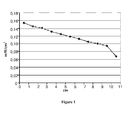
- Figure 1 shows the curve relating to the value of the power generated per unit of surface illuminated, expressed as mW/cm 2 , in relation to the distance of the cover from the edge of the support containing the solar cell.
- a photovoltaic cell IXYS-XOD17, having a surface of 1.2 cm 2 was then applied to one of the edges of the polymeric sheet.
- the main side of the polymeric sheet (that covered with the thin film containing 4,7-di(5"-n-hexyl-2',2"-bithien-5'-yl)-2,1,3-benzothiadiazole (QTB-ex)) was then illuminated with a light source having a power of 1 sun (1000 W/m 2 ) and the electric power generated by the effect of the illumination was measured.
- the power measurements were carried out by covering, with an opaque coating (cover), surfaces having variable areas of the polymeric support, at an increasing distance from the edge on which the photovoltaic cells were fixed. These measurements under variable screening conditions allow to quantify the contribution of possible waveguide, edge or multiple diffusion effects due to the support and consequently to be subtracted.
- Figure 2 shows the curve relating to the value of the power generated per unit of surface illuminated, expressed as mW/cm 2 , in relation to the distance of the cover from the edge of the support containing the solar cell.
- a photovoltaic cell IXYS-XOD17, having a surface of 1.2 cm 2 was then applied to one of the edges of the polymeric sheet.
- the main side of the polymeric sheet (that covered by the thin film containing 4,7-di(thien-2'-yl)2,1,3-benzothiadiazole was then illuminated with a light source having a power of 1 sun (1000 W/m 2 ) and the electric power generated by the effect of the illumination was measured.
- the power measurements were carried out by covering, with an opaque coating (cover), surfaces having variable areas of the polymeric support, at an increasing distance from the edge on which the photovoltaic cells were fixed. These measurements under variable screening conditions allow to quantify the contribution of possible waveguide, edge or multiple diffusion effects due to the support and consequently to be subtracted.
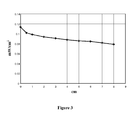
- Figure 3 shows the curve relating to the value of the power generated per unit of surface illuminated, expressed as mW/cm 2 , in relation to the distance of the cover from the edge of the support containing the solar cell.
Landscapes
- Chemical & Material Sciences (AREA)
- Organic Chemistry (AREA)
- Medicinal Chemistry (AREA)
- Health & Medical Sciences (AREA)
- Chemical Kinetics & Catalysis (AREA)
- Polymers & Plastics (AREA)
- Engineering & Computer Science (AREA)
- Materials Engineering (AREA)
- Photovoltaic Devices (AREA)
- Nitrogen And Oxygen Or Sulfur-Condensed Heterocyclic Ring Systems (AREA)
- Electroluminescent Light Sources (AREA)
- Manufacturing & Machinery (AREA)
- Heterocyclic Carbon Compounds Containing A Hetero Ring Having Oxygen Or Sulfur (AREA)
Abstract
- R1, R2, R3, R4, R5, R6 and R7, equal to or different from each other, represent a hydrogen atom; or they are selected from linear or branched C1-C20, preferably C1-C10, alkyl groups, cycloalkyl groups optionally substituted, aryl groups optionally substituted, linear or branched C1-C20, preferably C1-C10, alkoxyl groups, optionally substituted;
- or R1 and R2, can be optionally bound to each other so as to form, together with the carbon atoms to which they are bound, a cycle or a polycyclic system containing from 3 to 14, preferably from 4 to 6 carbon atoms, saturated, unsaturated, or aromatic, optionally containing one or more heteroatoms such as, for example, oxygen, sulfur, nitrogen, silicon, phosphorous, selenium;
- or R3 and R4, can be optionally bound to each other so as to form, together with the carbon atoms to which they are bound, a cycle or a polycyclic system containing from 3 to 14, preferably from 4 to 6, carbon atoms, saturated, unsaturated, or aromatic, optionally containing one or more heteroatoms such as, for example, oxygen, sulfur, nitrogen, silicon, phosphorous, selenium;
- or R5 and R6, can be optionally bound to each other so as to form, together with the carbon atoms to which they are bound, a cycle or a polycyclic system containing from 3 to 14, preferably from 4 to 6, carbon atoms, saturated, unsaturated, or aromatic, optionally containing one or more heteroatoms such as, for example, oxygen, sulfur, nitrogen, silicon, phosphorous, selenium;
- or R6 and R7, can be optionally bound to each other so as to form, together with the carbon atoms to which they are bound, a cycle or a polycyclic system containing from 3 to 14, preferably from 4 to 6, carbon atoms, saturated, unsaturated, or aromatic, optionally containing one or more heteroatoms such as, for example, oxygen, sulfur, nitrogen, silicon, phosphorous, selenium.
Description
- The present invention relates to a luminescent solar concentrator (LSC) comprising at least one disubstituted benzothiadiazole compound.
- The present invention also relates to the use of at least one disubstituted benzothiadiazole compound in the construction of luminescent solar concentrators (LSC).
- The present invention also relates to a photovoltaic device selected, for example, from photovoltaic cells, photovoltaic modules, solar cells, solar modules, on both rigid and flexible support, comprising a luminescent solar concentrator (LSC) including at least one disubstituted benzothiadiazole compound.
- It is known that single-junction photovoltaic cells are not capable of efficiently exploiting all the solar radiation. Their efficiency, in fact, is maximum only within a certain spectrum range which comprises a part of visible radiation and a part of infrared radiation.
- Spectrum converter materials capable of capturing solar radiation outside the optimal spectral range and og converting it to effective radiation, can be used for enhancing the performance of photovoltaic cells. Furthermore, luminescent solar concentrators (LSC) can be produced with these materials, which allow a further increase in the production of current of photovoltaic cells.
- Said luminescent solar concentrators (LSC) generally consist of large sheets of material transparent to solar radiation, in which fluorescent substances are dispersed, or chemically bound to said material, which act as spectrum converters. Due to the effect of the optical phenomenon of total reflection, the radiation emitted by the fluorescent molecules is "driven" towards the thin edges of the sheet where it is concentrated on photovoltaic cells or solar cells positioned therein. In this way, large surfaces of low-cost materials (photoluminescent sheets) can be used for concentrating the light on small surfaces of high-cost materials (photovoltaic cells or solar cells).
- A fluorescent compound should have numerous characteristics for being advantageously used in the construction of luminescent solar concentrators (LSC) and these are not always mutually compatible.
- First of all, the frequency of the radiation emitted by fluorescence must correspond to an energy higher than the threshold value below which the semiconductor, representing the core of the photovoltaic cell, is no longer able to work.
- Secondly, the absorption spectrum of the fluorescent compound should be as extensive as possible, so as to absorb most of the inciding solar radiation and then to re-emit it at the desired frequency.
- It is also desirable that the absorption of the solar radiation be extremely intense, so that the fluorescent compound can exert its function at the lowest possible concentrations, avoiding the use of huge quantities.
- Furthermore, the absorption process of solar radiation and its subsequent re-emission at lower frequencies, must take place with the highest possible efficiency, minimizing the so-called non-radiative losses, often collectively indicated with the term "thermalization": the efficiency of the process is measured by its quantum yield.
- Finally, the absorption and emission frequencies must be as diverse as possible, as, otherwise, the radiation emitted by a molecule of the fluorescent compound would be absorbed and at least partially diffused by the adjacent molecules. This phenomenon, normally called self-absorption, inevitably leads to a significant loss in efficiency. The difference between the frequencies of the peak with the lower frequency of the absorption spectrum and the peak of the radiation emitted, is normally indicated as Stokes shift and measured as nm (it is not the difference between the two frequencies that is measured, but the difference between the two wavelengths which correspond to them). High Stokes shifts are absolutely necessary for obtaining high efficiencies of luminescent solar concentrators (LSC), bearing in mind the already mentioned necessity that the frequency of the radiation emitted corresponds to an energy higher than the threshold value below which the photovoltaic cell cannot function.
- It is known that some benzothiadiazole compounds, in particular 4,7-di(thien-2'-yl)-2,1,3-benzothiadiazole (DTB), are fluorescent compounds which can be used in the construction of luminescent solar concentrators (LSC). Compounds of this type are described in Italian patent application
MI 2009 A 001796 - 4,7-di(thien-2'-yl)-2,1,3-benzothiadiazole (DTB) is characterized by an emission centred around 579 nm, which corresponds to an energy well above the minimum threshold value for the functioning of photovoltaic cells, said threshold corresponding for example to a wavelength of about 1100 nm for the most widely-used cells, based on silicon. Furthermore, its absorption of the light radiation is intense and extends over a relatively wide range of wavelengths, indicatively ranging from 550 nm (green radiation wavelength) to ultraviolet. Finally, 4,7-di(thien-2'-yl)-2,1,3-benzothiadiazole (DTB) has a Stokes shift in dichloromethane solution, equal to 133 nm, well above that of most of the commercial products so far proposed for use in luminescent solar concentrators.
- For these reasons, the use of 4,7-di(thien-2'-yl)-2,1,3-benzothiadiazole (DTB) has enabled the production of high-quality luminescent solar concentrators (LSC).
- Although 4,7-di(thien-2'-yl)-2,1,3-benzothiadiazole (DTB) absorbs a significant part of the solar spectrum, however, it has a modest absorption in its higher wavelength regions, corresponding to yellow and red radiations which cannot therefore be converted into other radiations more effectively exploited by the photovoltaic cell. For this reason, it is desirable to avail of fluorescent compounds having a more red-shifted absorption spectrum.
- The Applicant has therefore considered the problem of finding compounds having a more red-shifted absorption spectrum.
- The Applicant has now found that disubstituted benzothiadiazole compounds having a specific general formula (i.e. having general formula (I) indicated hereunder), can be advantageously used in the construction of luminescent solar concentrators (LSC).
- Said luminescent solar concentrators (LSC) can be advantageously used in the construction of photovoltaic devices such as, for example, photovoltaic cells, photovoltaic modules, solar cells, solar modules, on both rigid and flexible supports. Said disubstituted benzothiadiazole compounds, in fact, have a much more red-shifted absorption spectrum with respect to known benzothiadiazole compounds.
- Furthermore, said disubstituted benzothiadiazole compounds have higher Stokes shifts than those of the known benzothiadiazole compounds.
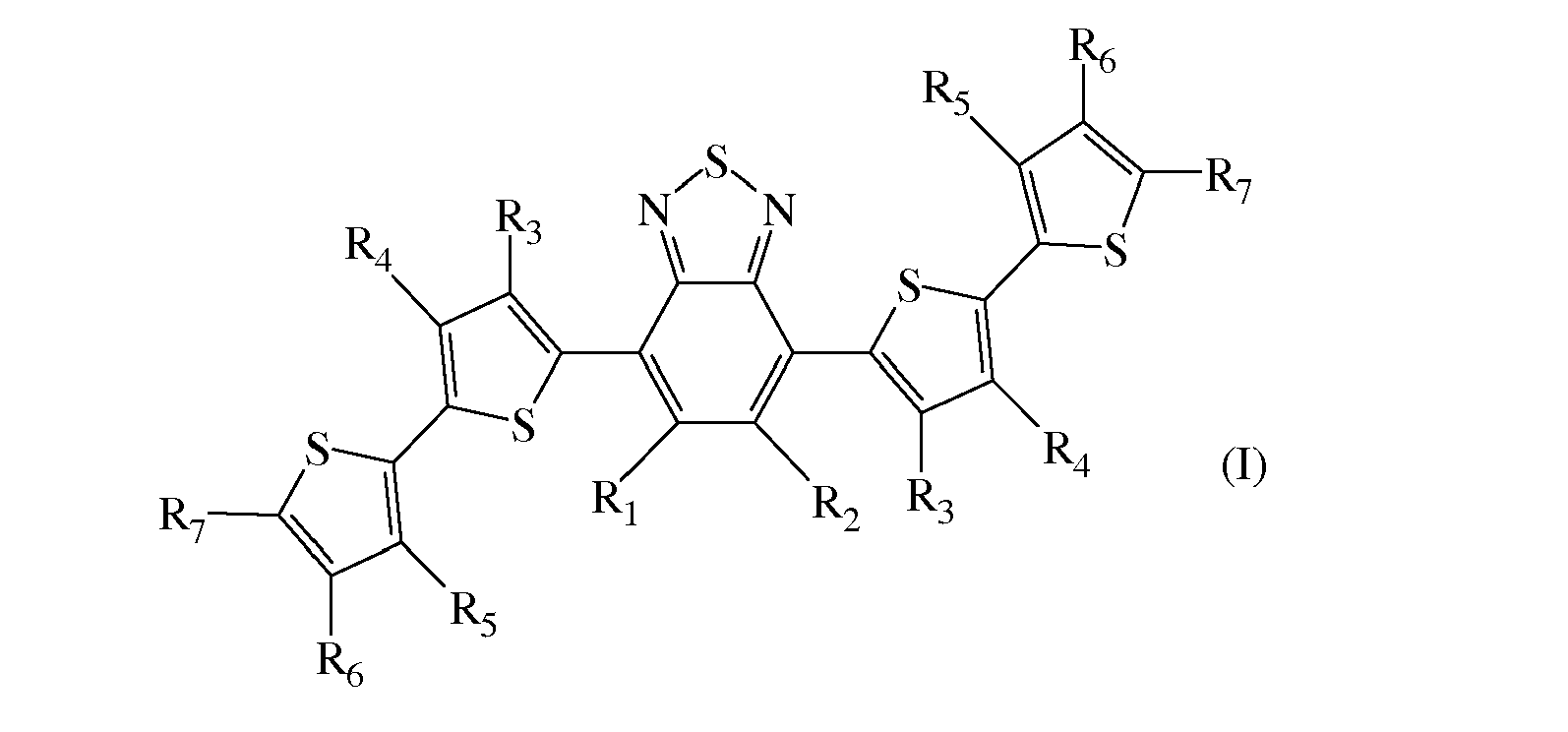
- An object of the present invention therefore relates to a luminescent solar concentrator (LSC) comprising at least one disubstituted benzothiadiazole compound having general formula (I):

- R1, R2, R3, R4, R5, R6 and R7, equal to or different from each other, represent a hydrogen atom; or they are selected from linear or branched C1-C20, preferably C1-C10, alkyl groups, cycloalkyl groups optionally substituted, aryl groups optionally substituted, linear or branched C1-C20, preferably C1-C10, alkoxyl groups, optionally substituted;
- or R1 and R2, can be optionally bound to each other so as to form, together with the carbon atoms to which they are bound, a cycle or a polycyclic system containing from 3 to 14 carbon atoms, preferably from 4 to 6 carbon atoms, saturated, unsaturated, or aromatic, optionally containing one or more heteroatoms such as, for example, oxygen, sulfur, nitrogen, silicon, phosphorous, selenium;
- or R3 and R4, can be optionally bound to each other so as to form, together with the carbon atoms to which they are bound, a cycle or a polycyclic system containing from 3 to 14 carbon atoms, preferably from 4 to 6 carbon atoms, saturated, unsaturated, or aromatic, optionally containing one or more heteroatoms such as, for example, oxygen, sulfur, nitrogen, silicon, phosphorous, selenium;
- or R5 and R6, can be optionally bound to each other so as to form, together with the carbon atoms to which they are bound, a cycle or a polycyclic system containing from 3 to 14 carbon atoms, preferably from 4 to 6 carbon atoms, saturated, unsaturated, or aromatic, optionally containing one or more heteroatoms such as, for example, oxygen, sulfur, nitrogen, silicon, phosphorous, selenium;
- or R6 and R7, can be optionally bound to each other so as to form, together with the carbon atoms to which they are bound, a cycle or a polycyclic system containing from 3 to 14 carbon atoms, preferably from 4 to 6 carbon atoms, saturated, unsaturated, or aromatic, optionally containing one or more heteroatoms such as, for example, oxygen, sulfur, nitrogen, silicon, phosphorous, selenium.
- According to a preferred embodiment of the present invention, in said general formula (I), the substituents R1, R2, R3, R4, R5, R6 and R7, represent a hydrogen atom.
- A particularly preferred aspect of the present invention therefore relates to a luminescent solar concentrator (LSC) comprising 4,7-di(2',2"-bi-thien-5'-yl)-2,1,3-benzothiadiazole (QTB) having formula (Ia):

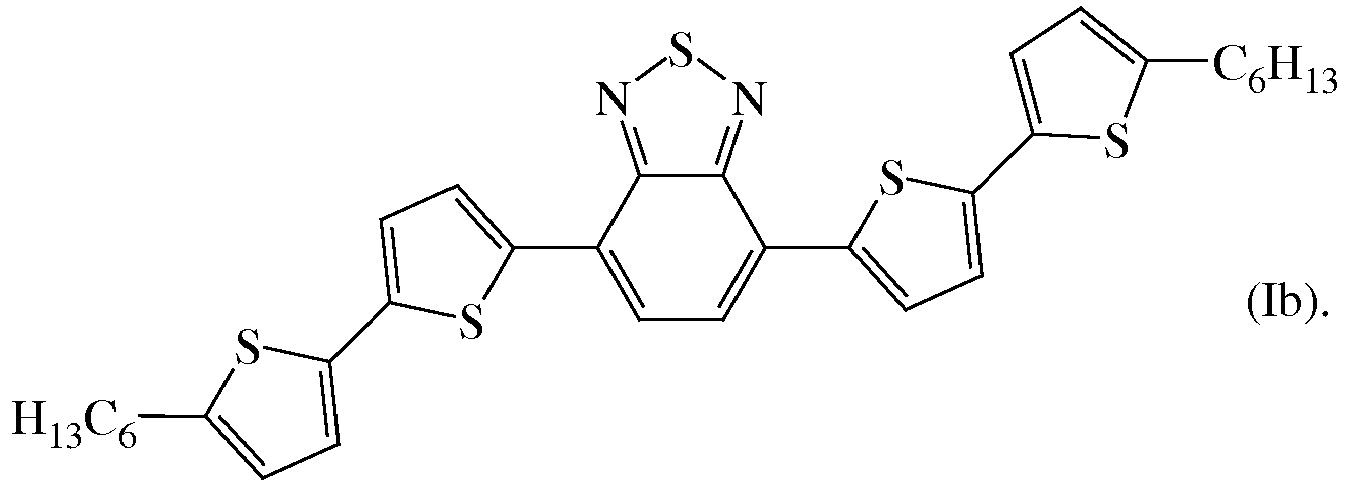
- According to a further preferred embodiment of the present invention, in said general formula (I), the substituents R1, R2, R3, R4, R5 and R6, represent a hydrogen atom, the substituent R7 represents a hexyl group.
- A particularly preferred aspect of the present invention therefore relates to a luminescent solar concentrator (LSC) comprising 4,7-di(5"-n-hexyl-2',2"-bithien-5'-yl)-2,1,3-benzothiadiazole (QTB-ex) having formula (Ib):
- As indicated above, the benzothiadiazole compound having general formula (I) has an absorption, with respect to that of 4,7-di(thien-2'-yl)-2,1,3-benzothia diazole (DTB), which is more red-shifted: this absorption is intense and extensive over a relatively wide wavelength range which, for example, for both 4,7-di(2',2"-bi-thien-5'-yl)-2,1,3-benzothiadiazole (QTB) having formula (Ia) and for 4,7-di-(5"-n-hexyl-2',2"-bithien-5'-yl)-2,1,3-benzothia-diazole (QTB-ex) having formula (Ib), ranges from 230 nm to 590 nm. Furthermore, said compound having general formula (I) has a particularly high Stokes shift. 4,7-di(2',2"-bi-thien-5'-yl)-2,1,3-benzothiadiazole (QTB) having formula (Ia), for example, has a Stokes shift, in dichloromethane solution, equal to 158 nm, whereas 4,7-di(5"-n-hexyl-2',2"-bithien-5'-yl)-2,1,3-benzothiadiazole (QTB-ex) having formula (Ib), has a Stokes shift, in dichloromethane solution, equal to 166 nm: consequently, higher Stokes shifts than that, already high, of 4,7-di(thien-2'-yl)-2,1,3-benzothiadiazole (DTB).
- For the purpose of the present description and of the following claims, the definitions of the numerical ranges always comprise the extremes unless otherwise specified.
- The term "C1-C20 alkyl groups" refers to linear or branched alkyl groups having from 1 to 20 carbon atoms. Specific examples of C1-C20 alkyl groups are: methyl, ethyl, n-propyl, iso-propyl, n-butyl, iso-butyl, t-butyl, pentyl, ethyl-hexyl, hexyl, heptyl, octyl, nonyl, decyl, dodecyl.
- The term "cycloalkyl groups" refers to cycloalkyl groups having from 3 to 10 carbon atoms. Said cycloalkyl groups can be optionally substituted with one or more groups, equal to or different from each other, selected from: halogen atoms such as, for example, fluorine, chlorine, preferably fluorine; hydroxyl groups; C1-C20 alkyl groups; C1-C20 alkoxyl groups; cyano groups; amino groups; nitro groups; aryl groups. Specific examples of cycloalkyl groups are: cyclopropyl, 1,4-dioxine, 2,2-difluorocyclopropyl, cyclobutyl, cyclopentyl, cyclohexyl, methylcyclohexyl, methoxycyclohexyl, fluorocyclohexyl, phenylcyclohexyl.
- The term "aryl groups" means aromatic carbocyclic groups. Said aryl groups can be optionally substituted with one or more groups, equal to or different from each other, selected from: halogen atoms such as, for example, fluorine, chlorine, preferably fluorine; hydroxyl groups; C1-C20 alkyl groups; C1-C20 alkoxyl groups; cyano groups; amino groups; nitro groups; aryl groups. Specific examples of aryl groups are: phenyl, methylphenyl, trimethylphenyl, methoxyphenyl, hydroxyphenyl, phenyloxyphenyl, fluorophenyl, pentafluorophenyl, chlorophenyl, nitrophenyl, dimethylamminophenyl, naphthyl, phenylnaphthyl, phenanthrene, anthracene.
- The term "C1-C20 alkoxyl groups" refers to linear or branched alkoxyl groups having from 1 to 20 carbon atoms. Said alkoxyl groups can be optionally substituted with one or more groups, equal to or different from each other, selected from: halogen atoms such as, for example, fluorine, chlorine, preferably fluorine; hydroxyl groups; C1-C20 alkyl groups; C1-C20 alkoxyl groups; cyano groups; amino groups; nitro groups. Specific examples of C1-C20 alkoxyl groups are: methoxyl, ethoxyl, fluoroethoxyl, n-propoxyl, iso-propoxyl, n-butoxyl, n-fluoro-butoxyl, iso-butoxyl, t-butoxyl, pentoxyl, hexyloxyl, heptyloxyl, octyloxyl, nonyloxyl, decyloxyl, dodecyloxyl.
- The term "cyclo or polycyclic system" relates to a system containing one or more rings containing from 3 to 14 carbon atoms, optionally containing heteroatoms selected from nitrogen, oxygen, sulfur, silicon, selenium, phosphorous. Specific examples of cyclo or polycyclic system are: thieno[3,2-b]thiophene, thiadiazole, benzothiophene, quinoxaline, pyridine.
- Said compound having general formula (I) can be obtained according to processes known in the art as described, for example, in: "Organic Letters" (2011), Vol. 13, pages 90-93; "Chemistry - A European Journal" (1998), Vol. 4, pages 1235-1243; "Chemistry - A European Journal" (2007), Vol. 13, pages 10046-10054, "Journal of Materials Chemistry" (2009), Vol. 19, pages 7730-7737.
- Said compound having general formula (I) can be obtained, for example, as indicated in the following scheme:

- The benzothiadiazole compound having general formula (II) can be obtained according to processes known in the art, for example, by halogenation of the corresponding benzothiadiazole compounds. Further details relating to these processes can be found, for example, in: "Tetrahedron" (2005), Vol. 61, pages 7453-7460; "European Journal of Organic Chemistry" (2006), pages 4924-4933.
- The tri-n-butyl(thien-2-yl)stannane having general formula (III) and the tri-n-butyl(thien-2-yl)stannane having general formula (VI), can be obtained according to processes known in the art such as, for example, by lithiation and subsequent stannylation of the corresponding thiophene compounds. Further details relating to these processes can be found, for example, in: "Journal of the Chemical Society, Perkin Transactions 1: Organic and Bio-Organic Chemistry" (1988), pages 2415-2422; "Journal of Polymer Science, Part A: Polymer Chemistry" (2010), Vol. 48, pages 1714-1720. In particular, tri-n-butyl(thien-2-yl)stannane having general formula (III), wherein R3 and R4, are hydrogen atoms, can be easily found on the market.
- A further object of the present invention relates to the use of at least one disubstituted benzothiadiazole compound having general formula (I) in the construction of luminescent solar concentrators (LSC).
- The benzothiadiazole compound having general formula (I) can be used in said luminescent solar concentrator (LSC) in the following forms: dispersed in the polymer or in glass, chemically bound to the polymer or glass, in solution, in gel form.
- The luminescent solar concentrator (LSC) can contain, for example, a transparent matrix, wherein the term "transparent matrix" refers to any transparent material used in the form of a carrier, ligand, or a material in which at least one disubstituted benzothiadiazole compound having general formula (I) is dispersed or englobed. The material used for the matrix is transparent, as such, to the radiations of interest and, in particular, to radiations having a frequency within the effective spectrum of the photovoltaic device (e.g., the photovoltaic cell) in which it is used. Materials suitable for the purpose of the present invention can therefore be selected from materials transparent to at least radiations having a wavelength ranging from 250 nm to 1100 nm.
- The transparent matrix that can be used for the purpose of the present invention can be selected, for example, from polymeric or vitreous materials. Said matrix is characterized by a high transparency and a high duration with respect to heat and light. Polymeric materials which can be advantageously used for the purpose of the present invention are, for example, polymethylmethacrylate (PMMA), epoxy resins, silicon resins, polyalkylene terephthalates, polycarbonates, polystyrene, polypropylene. Vitreous materials which can be advantageously used for the purposes of the present invention are, for example, silicas.
- If the matrix is of the polymeric type, said at least one disubstituted benzothiadiazole compound having general formula (I) can be dispersed in the polymer of said matrix by means, for example, of melt dispersion, and subsequent formation of a sheet comprising said polymer and said at least one disubstituted benzothiadiazole compound having general formula (I), operating, for example, according to the technique known as casting. Alternatively, said at least one disubstituted benzothiadiazole compound having general formula (I) and the polymer of said matrix can be solubilized in at least one solvent obtaining a solution which is deposited on a sheet of said polymer, forming a film comprising said at least one disubstituted benzothiadiazole compound having general formula (I) and said polymer, operating, for example, with the use of a Doctor Blade-type film applicator: said solvent is subsequently left to evaporate.
- If the matrix is of the vitreous type, said at least one disubstituted benzothiadiazole compound having general formula (I) can be solubilized in at least one solvent obtaining a solution which is deposited on a sheet of said matrix of the vitreous type, forming a film comprising said at least one disubstituted benzothiadiazole compound having general formula (I), operating, for example, with the use of a Doctor Blade-type film applicator: said solvent is subsequently left to evaporate.
- A further object of the present invention also relates to a photovoltaic device selected from photovoltaic cells, photovoltaic modules, solar cells, solar modules, on both rigid and flexible supports, comprising a luminescent solar concentrator (LSC) including at least one disubstituted benzothiadiazole compound having general formula (I).
- Said photovoltaic device can be obtained, for example, by assembling the above luminescent solar concentrator with a photovoltaic cell.
- According to a preferred embodiment of the present invention, the above solar concentrator can be produced in the form of a transparent sheet obtained through the solubilization of said at least one disubstituted benzothiadiazole compound having general formula (I) and of the polymer of the matrix of the polymeric type, in at least one solvent, obtaining a solution which is deposited on a sheet of said polymer forming a film comprising said at least one disubstituted benzothiadiazole compound having general formula (I) and said polymer, operating, for example, with the use of a Doctor Blade-type film applicator: said solvent is subsequently left to evaporate. In said solar devices, said sheets can then be coupled with a photovoltaic cell.
- Some illustrative and non-limiting examples are provided hereunder for a better understanding of the present invention and for its embodiment.
- 4,7-Di(2',2"-bithien-5'-yl)-2,1,3-benzothiadiazole (QTB) having formula (Ia) was obtained as described in "Organic Letters" (2011), Vol. 13, pages 90-93; whereas 4,7-di(5"-n-hexyl-2',2"-bithien-5'-yl)-2,1,3-benzothiadiazole (QTB-ex) having formula (Ib) was obtained as described in "Chemistry - A European Journal" (2007), Vol. 13, pages 10046-10054.
- 4,7-Di(thien-2'-yl)-2,1,3-benzothiadiazole (DTB) was obtained as described in patent application
MI 2010 A 001316 - 6 g of polymethylmethacrylate Altuglas VSUVT 100 (PMMA) and 76.5 mg of 4,7-di(2',2"-bithien-5'-yl)-2,1,3-benzothiadiazole (QTB), were dissolved in 30 ml of 1,2-dichlorobenzene. The solution obtained was subsequently uniformly deposited on a polymethylmethacrylate sheet Altuglas VSUVT 100 (PMMA) (dimensions 90 x 90 x 6 mm) using a Doctor Blade-type film applicator and the solvent was left to evaporate at room temperature (25°C), in a light stream of air, for 24 hours. A red-coloured transparent sheet was obtained (sheet 1), the colour being conferred by the film, whose thickness proved to range from 50 µm to 350 µm.
- A photovoltaic cell IXYS-XOD17, having a surface of 1.2 cm2 was then applied to one of the edges of the polymeric sheet.
- The main side of the polymeric sheet [that covered by the thin film containing 4,7-di(2',2"-bithien-5'-yl)-2,1,3-benzothiadiazole (QTB)] was then illuminated, with a light source having a power of 1 sun (1000 W/m2) and the electric power generated by the illumination was measured.
- The power measurements were carried out by covering, with an opaque coating (cover), surfaces having variable areas of the polymeric support, at an increasing distance from the edge on which the photovoltaic cells were fixed. These measurements under variable screening conditions allow to quantify the contribution of possible waveguide, edge or multiple diffusion effects due to the support and consequently to be subtracted.
-
Figure 1 shows the curve relating to the value of the power generated per unit of surface illuminated, expressed as mW/cm2, in relation to the distance of the cover from the edge of the support containing the solar cell. - It can be seen that, in the absence of edge effects, the average power generated is equal to 0.12 W/cm2 (
Figure 1 ). - 6 g di polymethylmethacrylate Altuglas VSUVT 100 (PMMA) and 104.2 mg of 4,7-di(5"-n-hexyl-2',2"-bithien-5'-yl)-2,1,3-benzothiadiazoloe (QTB-ex) were dissolved in 30 ml of 1,2-dichlorobenzene. The solution obtained was then uniformly deposited on a sheet of polymethylmethacrylate Altuglas VSUVT 100 (PMMA) (dimensions 90 x 90 x 6 mm) ) using a Doctor Blade-type film applicator and the solvent was left to evaporate at room temperature (25°C), in a light stream of air, for 24 hours. A red-coloured transparent sheet was obtained (sheet 2), the colour being conferred by the film, whose thickness proved to range from 50 µm to 350 µm.
- A photovoltaic cell IXYS-XOD17, having a surface of 1.2 cm2 was then applied to one of the edges of the polymeric sheet.
- The main side of the polymeric sheet (that covered with the thin film containing 4,7-di(5"-n-hexyl-2',2"-bithien-5'-yl)-2,1,3-benzothiadiazole (QTB-ex)) was then illuminated with a light source having a power of 1 sun (1000 W/m2) and the electric power generated by the effect of the illumination was measured.
- The power measurements were carried out by covering, with an opaque coating (cover), surfaces having variable areas of the polymeric support, at an increasing distance from the edge on which the photovoltaic cells were fixed. These measurements under variable screening conditions allow to quantify the contribution of possible waveguide, edge or multiple diffusion effects due to the support and consequently to be subtracted.
-
Figure 2 shows the curve relating to the value of the power generated per unit of surface illuminated, expressed as mW/cm2, in relation to the distance of the cover from the edge of the support containing the solar cell. - It can be seen that, in the absence of edge effects, the average power generated is equal to 0.10 W/cm2 (
Figure 2 ). - 6 g of polymethylmethacrylate Altuglas VSUVT 100 (PMMA) and 49.5 mg of 4,7-di(thien-2'-yl)-2,1,3-benzothiadiazole (DTB) were dissolved in 30 ml of 1,2-dichlorobenzene. The solution obtained was then uniformly deposited on a sheet of polymethylmethacrylate Altuglas VSUVT 100 (PMMA) (dimensions 90 x 90 x 6 mm) ) using a Doctor Blade-type film applicator and the solvent was left to evaporate at room temperature (25°C), in a light stream of air, for 24 hours. A yellow-coloured transparent sheet was obtained (sheet 3), the colour being conferred by the film, whose thickness proved to range from 50 µm to 350 µm.
- A photovoltaic cell IXYS-XOD17, having a surface of 1.2 cm2 was then applied to one of the edges of the polymeric sheet.
- The main side of the polymeric sheet (that covered by the thin film containing 4,7-di(thien-2'-yl)2,1,3-benzothiadiazole was then illuminated with a light source having a power of 1 sun (1000 W/m2) and the electric power generated by the effect of the illumination was measured.
- The power measurements were carried out by covering, with an opaque coating (cover), surfaces having variable areas of the polymeric support, at an increasing distance from the edge on which the photovoltaic cells were fixed. These measurements under variable screening conditions allow to quantify the contribution of possible waveguide, edge or multiple diffusion effects due to the support and consequently to be subtracted.
-
Figure 3 shows the curve relating to the value of the power generated per unit of surface illuminated, expressed as mW/cm2, in relation to the distance of the cover from the edge of the support containing the solar cell. - It can be seen that, in the absence of edge effects, the power generated is fixed at around 0.079 mW/cm2 (
Figure 3 ) lower than that generated using both 4,7-di(2',2"-bithien-5'-yl)-2,1,3-benzothiadiazole (QTB) (Example 1), and 4,7-di(5"-n-hexyl-2',2"-bithien-5'-yl)-2,1,3-benzothiadiazole (QTB-ex) (Example 2) according to the present invention.
Claims (11)
- A luminescent solar concentrator comprising at least one disubstituted benzothiadiazole compound having general formula (I):
 - R1, R2, R3, R4, R5, R6 and R7, equal to or different from each other, represent a hydrogen atom; or they are selected from linear or branched C1-C20 alkyl groups, cycloalkyl groups optionally substituted, aryl groups optionally substituted, linear or branched C1-C20 alkoxyl groups, optionally substituted;- or R1 and R2, can be optionally bound to each other so as to form, together with the carbon atoms to which they are bound, a cycle or a polycyclic system containing from 3 to 14 carbon atoms, saturated, unsaturated, or aromatic, optionally containing one or more heteroatoms such as oxygen, sulfur, nitrogen, silicon, phosphorous, selenium;- or R3 and R4, can be optionally bound to each other so as to form, together with the carbon atoms to which they are bound, a cycle or a polycyclic system containing from 3 to 14 carbon atoms, saturated, unsaturated, or aromatic, optionally containing one or more heteroatoms such as oxygen, sulfur, nitrogen, silicon, phosphorous, selenium;- or R5 and R6, can be optionally bound to each other so as to form, together with the carbon atoms to which they are bound, a cycle or a polycyclic system containing from 3 to 14 carbon atoms, saturated, unsaturated, or aromatic, optionally containing one or more heteroatoms such as oxygen, sulfur, nitrogen, silicon, phosphorous, selenium;- or R6 and R7, can be optionally bound to each other so as to form, together with the carbon atoms to which they are bound, a cycle or a polycyclic system containing from 3 to 14 carbon atoms, saturated, unsaturated, or aromatic, optionally containing one or more heteroatoms such as oxygen, sulfur, nitrogen, silicon, phosphorous, selenium.
 - The luminescent solar concentrator according to claim 1, wherein in said general formula (I), the substituents R1, R2, R3, R4, R5, R6 and R7, represent a hydrogen atom.
- The luminescent solar concentrator according to claim 2, wherein said disubstituted benzothiadiazole compound having general formula (I) is 4,7-di(2',2"-bi-thien-5'-yl)-2,1,3-benzothiadiazole (QTB) having formula (Ia):

- The luminescent solar concentrator according to claim 1, wherein in said general formula (I), the substituents R1, R2, R3, R4, R5 and R6, represent a hydrogen atom, the substituent R7 represents a hexyl group.
- The luminescent solar concentrator according to claim 4, wherein said disubstituted benzothiadiazole compound having general formula (I) is 4,7-di(5"-n-hexyl-2',2"-bithien-5'-yl)-2,1,3-benzothiadiazole (QTB-ex) having formula (Ib):

- Use of at least one disubstituted benzothiadiazole compound having general formula (I):
 - R1, R2, R3, R4, R5, R6 and R7, equal to or different from each other, represent a hydrogen atom; or they are selected from linear or branched C1-C20 alkyl groups, cycloalkyl groups optionally substituted, aryl groups optionally substituted, linear or branched C1-C20 alkoxyl groups, optionally substituted;- or R1 and R2, can be optionally bound to each other so as to form, together with the carbon atoms to which they are bound, a cycle or a polycyclic system containing from 3 to 14 carbon atoms, saturated, unsaturated, or aromatic, optionally containing one or more heteroatoms such as oxygen, sulfur, nitrogen, silicon, phosphorous, selenium;- or R3 and R4, can be optionally bound to each other so as to form, together with the carbon atoms to which they are bound, a cycle or a polycyclic system containing from 3 to 14 carbon atoms, saturated, unsaturated, or aromatic, optionally containing one or more heteroatoms such as oxygen, sulfur, nitrogen, silicon, phosphorous, selenium;- or R5 and R6, can be optionally bound to each other so as to form, together with the carbon atoms to which they are bound, a cycle or a polycyclic system containing from 3 to 14 carbon atoms, saturated, unsaturated, or aromatic, optionally containing one or more heteroatoms such as oxygen, sulfur, nitrogen, silicon, phosphorous, selenium;- or R6 and R7, can be optionally bound to each other so as to form, together with the carbon atoms to which they are bound, a cycle or a polycyclic system containing from 3 to 14 carbon atoms, saturated, unsaturated, or aromatic, optionally containing one or more heteroatoms such as oxygen, sulfur, nitrogen, silicon, phosphorous, selenium,
in the construction of luminescent solar concentrators (LSC). - Use according to claim 6, wherein in said general formula (I), the substituents R1, R2, R3, R4, R5, R6 and R7, represent a hydrogen atom.
- Use according to claim 7, wherein said disubstituted benzothiadiazole compound having general formula (I) is 4,7-di(2',2"-bi-thien-5'-yl)-2,1,3-benzothiadiazole (QTB) having formula (Ia):

- Use according to claim 6, wherein in said general formula (I), the substituents R1, R2, R3, R4, R5 and R6, represent a hydrogen atom, the substituent R7 represents a hexyl group.
- Use according to claim 9, wherein said disubstituted benzothiadiazole compound having general formula (I) is 4,7-di(5"-n-hexyl-2',2"-bithien-5'-yl)-2,1,3-benzothiadiazole (QTB-ex) having formula (Ib):

- A photovoltaic device selected from photovoltaic cells, photovoltaic modules, solar cells, solar modules, on both rigid and flexible supports, comprising a luminescent solar concentrator (LSC) including at least one disubstituted benzothiadiazole compound having general formula (I), according to any of the claims from 1 to 5.
Applications Claiming Priority (1)
| Application Number | Priority Date | Filing Date | Title |
|---|---|---|---|
| IT001520A ITMI20111520A1 (en) | 2011-08-08 | 2011-08-08 | LUMINESCENT SOLAR CONCENTRATOR INCLUDING DISPOSED BENZOTIADIAZOLIC COMPOUNDS |
Publications (2)
| Publication Number | Publication Date |
|---|---|
| EP2557606A1 true EP2557606A1 (en) | 2013-02-13 |
| EP2557606B1 EP2557606B1 (en) | 2013-08-28 |
Family
ID=44584394
Family Applications (1)
| Application Number | Title | Priority Date | Filing Date |
|---|---|---|---|
| EP12175110.1A Active EP2557606B1 (en) | 2011-08-08 | 2012-07-05 | Luminescent solar concentrator comprising disubstituted benzothiadiazole compounds |
Country Status (6)
| Country | Link |
|---|---|
| US (1) | US8846942B2 (en) |
| EP (1) | EP2557606B1 (en) |
| CN (1) | CN102931265B (en) |
| DK (1) | DK2557606T3 (en) |
| ES (1) | ES2436743T3 (en) |
| IT (1) | ITMI20111520A1 (en) |
Cited By (6)
| Publication number | Priority date | Publication date | Assignee | Title |
|---|---|---|---|---|
| WO2014160707A1 (en) * | 2013-03-26 | 2014-10-02 | Nitto Denko Corporation | Wavelength conversion films with multiple photostable organic chromophores |
| ITMI20131158A1 (en) * | 2013-07-10 | 2015-01-11 | Eni Spa | DISPOSED NAFTOSELENADIAZOLIC COMPOUNDS |
| WO2016046319A1 (en) * | 2014-09-25 | 2016-03-31 | Eni S.P.A. | Disubstituted diaryloxybenzoheterodiazole compounds |
| US9399730B2 (en) | 2011-12-06 | 2016-07-26 | Nitto Denko Corporation | Wavelength conversion material as encapsulate for solar module systems to enhance solar harvesting efficiency |
| ITUB20160479A1 (en) * | 2016-01-27 | 2017-07-27 | Eni Spa | POLYZAMACROCYCLIC COMPOUND WITH A BRIDGE A BENZOETERODIAZOLIC UNIT |
| US11706979B2 (en) | 2014-09-25 | 2023-07-18 | Eni S.P.A. | Disubstituted diaryloxybenzoheterodiazole compounds |
Families Citing this family (7)
| Publication number | Priority date | Publication date | Assignee | Title |
|---|---|---|---|---|
| WO2012094409A2 (en) | 2011-01-05 | 2012-07-12 | Nitto Denko Corporation | Wavelength conversion perylene diester chromophores and luminescent films |
| JP5468119B2 (en) | 2011-09-26 | 2014-04-09 | 日東電工株式会社 | A highly fluorescent and photostable chromophore for enhanced sunlight collection efficiency |
| TW201317327A (en) | 2011-10-05 | 2013-05-01 | Nitto Denko Corp | Wavelength conversion film, method of forming the same, and method of using same |
| ITMI20130606A1 (en) * | 2013-04-12 | 2014-10-13 | Eni Spa | DISCOVERED NAPHTHO-AERODIAZOLIC COMPOUNDS |
| ITMI20131325A1 (en) | 2013-08-02 | 2015-02-03 | Eni Spa | INTEGRATED SYSTEM FOR CULTIVATION OF ALGAE OR PLANT AND PRODUCTION OF ELECTRICITY |
| ITMI20131620A1 (en) * | 2013-10-01 | 2015-04-02 | Eni Spa | LUMINESCENT SOLAR CONCENTRATOR INCLUDING TETRASOSTITUTE BENZOETERODIAZOLIC COMPOUNDS |
| CN111233824B (en) * | 2018-11-28 | 2022-09-09 | 紫石能源有限公司 | Organic spectral conversion material, method for making the same, and luminescent solar concentrator comprising the same |
Citations (2)
| Publication number | Priority date | Publication date | Assignee | Title |
|---|---|---|---|---|
| US20080087326A1 (en) * | 2006-06-05 | 2008-04-17 | Scholes Gregory D | Light-harvesting antennae for organic solar cells |
| WO2011048458A1 (en) * | 2009-10-19 | 2011-04-28 | Eni S.P.A. | Photoluminescent compositions for spectrum converters with enhanced efficiency |
Family Cites Families (3)
| Publication number | Priority date | Publication date | Assignee | Title |
|---|---|---|---|---|
| US20060063027A1 (en) * | 2002-12-23 | 2006-03-23 | Covion Organic Semiconductors Gmbh | Organic electroluminescent element |
| US7446207B2 (en) * | 2005-09-27 | 2008-11-04 | Ctci Foundation | Organic dye used in dye-sensitized solar cell |
| IT1401129B1 (en) * | 2010-07-16 | 2013-07-12 | Eni Spa | PROCESS FOR THE SYNTHESIS OF BENZOTIADIAZOLIC COMPOUNDS |
-
2011
- 2011-08-08 IT IT001520A patent/ITMI20111520A1/en unknown
-
2012
- 2012-07-05 DK DK12175110.1T patent/DK2557606T3/en active
- 2012-07-05 EP EP12175110.1A patent/EP2557606B1/en active Active
- 2012-07-05 ES ES12175110.1T patent/ES2436743T3/en active Active
- 2012-08-08 CN CN201210279794.0A patent/CN102931265B/en not_active Expired - Fee Related
- 2012-08-08 US US13/569,840 patent/US8846942B2/en active Active
Patent Citations (2)
| Publication number | Priority date | Publication date | Assignee | Title |
|---|---|---|---|---|
| US20080087326A1 (en) * | 2006-06-05 | 2008-04-17 | Scholes Gregory D | Light-harvesting antennae for organic solar cells |
| WO2011048458A1 (en) * | 2009-10-19 | 2011-04-28 | Eni S.P.A. | Photoluminescent compositions for spectrum converters with enhanced efficiency |
Non-Patent Citations (8)
| Title |
|---|
| CHEMISTRY - A EUROPEAN JOURNAL, vol. 13, 2007, pages 10046 - 10054 |
| CHEMISTRY - A EUROPEAN JOURNAL, vol. 4, 1998, pages 1235 - 1243 |
| EUROPEAN JOURNAL OF ORGANIC CHEMISTRY, 2006, pages 4924 - 4933 |
| JOURNAL OF MATERIALS CHEMISTRY, vol. 19, 2009, pages 7730 - 7737 |
| JOURNAL OF POLYMER SCIENCE, PART A: POLYMER CHEMISTRY, vol. 48, 2010, pages 1714 - 1720 |
| JOURNAL OF THE CHEMICAL SOCIETY, PERKIN TRANSACTIONS 1: ORGANIC AND BIO-ORGANIC CHEMISTRY, 1988, pages 2415 - 2422 |
| ORGANIC LETTERS, vol. 13, 2011, pages 90 - 93 |
| TETRAHEDRON, vol. 61, 2005, pages 7453 - 7460 |
Cited By (8)
| Publication number | Priority date | Publication date | Assignee | Title |
|---|---|---|---|---|
| US9399730B2 (en) | 2011-12-06 | 2016-07-26 | Nitto Denko Corporation | Wavelength conversion material as encapsulate for solar module systems to enhance solar harvesting efficiency |
| WO2014160707A1 (en) * | 2013-03-26 | 2014-10-02 | Nitto Denko Corporation | Wavelength conversion films with multiple photostable organic chromophores |
| JP2016522906A (en) * | 2013-03-26 | 2016-08-04 | 日東電工株式会社 | Wavelength conversion film having multiple light stable organic chromophores |
| ITMI20131158A1 (en) * | 2013-07-10 | 2015-01-11 | Eni Spa | DISPOSED NAFTOSELENADIAZOLIC COMPOUNDS |
| WO2016046319A1 (en) * | 2014-09-25 | 2016-03-31 | Eni S.P.A. | Disubstituted diaryloxybenzoheterodiazole compounds |
| US11133474B2 (en) | 2014-09-25 | 2021-09-28 | Eni S.P.A. | Disubstituted diaryloxybenzoheterodiazole compounds |
| US11706979B2 (en) | 2014-09-25 | 2023-07-18 | Eni S.P.A. | Disubstituted diaryloxybenzoheterodiazole compounds |
| ITUB20160479A1 (en) * | 2016-01-27 | 2017-07-27 | Eni Spa | POLYZAMACROCYCLIC COMPOUND WITH A BRIDGE A BENZOETERODIAZOLIC UNIT |
Also Published As
| Publication number | Publication date |
|---|---|
| EP2557606B1 (en) | 2013-08-28 |
| US20130204007A1 (en) | 2013-08-08 |
| CN102931265A (en) | 2013-02-13 |
| CN102931265B (en) | 2016-09-07 |
| DK2557606T3 (en) | 2013-11-18 |
| ES2436743T3 (en) | 2014-01-07 |
| ITMI20111520A1 (en) | 2013-02-09 |
| US8846942B2 (en) | 2014-09-30 |
Similar Documents
| Publication | Publication Date | Title |
|---|---|---|
| EP2557606B1 (en) | Luminescent solar concentrator comprising disubstituted benzothiadiazole compounds | |
| US20140303379A1 (en) | Luminescent solar concentrator comprising disubstituted benzoselenadiazole compounds | |
| EP3198658B1 (en) | Luminescent solar concentrator comprising disubstituted benzoheterodiazole compounds | |
| EP3197890B1 (en) | Disubstituted diaryloxybenzoheterodiazole compounds | |
| EP3036774B1 (en) | Luminescent solar concentrator comprising tetra- substituted benzoheterodiazole compounds | |
| WO2014128648A1 (en) | Luminescent solar concentrator comprising disubstituted naphthothiadiazole compounds | |
| CN103227285A (en) | Bridged triphenylamine-based polymer solar battery | |
| EP3898889B1 (en) | Luminescent solar concentrator comprising dithienylpyridinethiadiazole compounds | |
| EP3867333B1 (en) | Disubstituted diaryloxybenzoheterodiazole compounds | |
| WO2021094976A1 (en) | Diaryloxybenzoheterodiazole compounds di-substituted with thienothiophenic groups | |
| EP3941995B1 (en) | Disubstituted fluoroaryloxybenzoheterodiazole compounds | |
| KR101508564B1 (en) | Derivatives of squaraine, dye for dye-sensitized solar cells and dye-sensitized solar cells | |
| Tamilavan et al. | Thiadiazoloquinoxaline-Based Low Band Gap Polymer for Solar Cell Applications | |
| ITMI20131871A1 (en) | DISPOSED BENZOTIADIAZOLIC COMPOUNDS AND THEIR USE IN SPECTRUM CONVERTERS |
Legal Events
| Date | Code | Title | Description |
|---|---|---|---|
| PUAI | Public reference made under article 153(3) epc to a published international application that has entered the european phase |
Free format text: ORIGINAL CODE: 0009012 |
|
| 17P | Request for examination filed |
Effective date: 20121129 |
|
| AK | Designated contracting states |
Kind code of ref document: A1 Designated state(s): AL AT BE BG CH CY CZ DE DK EE ES FI FR GB GR HR HU IE IS IT LI LT LU LV MC MK MT NL NO PL PT RO RS SE SI SK SM TR |
|
| AX | Request for extension of the european patent |
Extension state: BA ME |
|
| GRAP | Despatch of communication of intention to grant a patent |
Free format text: ORIGINAL CODE: EPIDOSNIGR1 |
|
| RIC1 | Information provided on ipc code assigned before grant |
Ipc: H01L 31/055 20060101AFI20130221BHEP |
|
| GRAS | Grant fee paid |
Free format text: ORIGINAL CODE: EPIDOSNIGR3 |
|
| RBV | Designated contracting states (corrected) |
Designated state(s): AL AT BE BG CH CY CZ DE DK EE ES FI FR GB GR HR HU IE IS IT LI LT LU LV MC MK MT NL NO PL PT RO RS SE SI SK SM TR |
|
| GRAA | (expected) grant |
Free format text: ORIGINAL CODE: 0009210 |
|
| AK | Designated contracting states |
Kind code of ref document: B1 Designated state(s): AL AT BE BG CH CY CZ DE DK EE ES FI FR GB GR HR HU IE IS IT LI LT LU LV MC MK MT NL NO PL PT RO RS SE SI SK SM TR |
|
| REG | Reference to a national code |
Ref country code: GB Ref legal event code: FG4D |
|
| REG | Reference to a national code |
Ref country code: CH Ref legal event code: EP |
|
| REG | Reference to a national code |
Ref country code: AT Ref legal event code: REF Ref document number: 629759 Country of ref document: AT Kind code of ref document: T Effective date: 20130915 |
|
| REG | Reference to a national code |
Ref country code: IE Ref legal event code: FG4D |
|
| REG | Reference to a national code |
Ref country code: DE Ref legal event code: R096 Ref document number: 602012000248 Country of ref document: DE Effective date: 20131017 |
|
| REG | Reference to a national code |
Ref country code: DK Ref legal event code: T3 Effective date: 20131115 |
|
| REG | Reference to a national code |
Ref country code: SE Ref legal event code: TRGR |
|
| REG | Reference to a national code |
Ref country code: NL Ref legal event code: T3 |
|
| REG | Reference to a national code |
Ref country code: CH Ref legal event code: NV Representative=s name: MAIWALD PATENTANWALTSGESELLSCHAFT (SCHWEIZ) MB, CH |
|
| REG | Reference to a national code |
Ref country code: ES Ref legal event code: FG2A Ref document number: 2436743 Country of ref document: ES Kind code of ref document: T3 Effective date: 20140107 |
|
| REG | Reference to a national code |
Ref country code: NO Ref legal event code: T2 Effective date: 20130828 Ref country code: LT Ref legal event code: MG4D |
|
| PG25 | Lapsed in a contracting state [announced via postgrant information from national office to epo] |
Ref country code: CY Free format text: LAPSE BECAUSE OF FAILURE TO SUBMIT A TRANSLATION OF THE DESCRIPTION OR TO PAY THE FEE WITHIN THE PRESCRIBED TIME-LIMIT Effective date: 20130918 Ref country code: HR Free format text: LAPSE BECAUSE OF FAILURE TO SUBMIT A TRANSLATION OF THE DESCRIPTION OR TO PAY THE FEE WITHIN THE PRESCRIBED TIME-LIMIT Effective date: 20130828 Ref country code: LT Free format text: LAPSE BECAUSE OF FAILURE TO SUBMIT A TRANSLATION OF THE DESCRIPTION OR TO PAY THE FEE WITHIN THE PRESCRIBED TIME-LIMIT Effective date: 20130828 Ref country code: PT Free format text: LAPSE BECAUSE OF FAILURE TO SUBMIT A TRANSLATION OF THE DESCRIPTION OR TO PAY THE FEE WITHIN THE PRESCRIBED TIME-LIMIT Effective date: 20131230 Ref country code: IS Free format text: LAPSE BECAUSE OF FAILURE TO SUBMIT A TRANSLATION OF THE DESCRIPTION OR TO PAY THE FEE WITHIN THE PRESCRIBED TIME-LIMIT Effective date: 20131228 |
|
| PG25 | Lapsed in a contracting state [announced via postgrant information from national office to epo] |
Ref country code: BE Free format text: LAPSE BECAUSE OF FAILURE TO SUBMIT A TRANSLATION OF THE DESCRIPTION OR TO PAY THE FEE WITHIN THE PRESCRIBED TIME-LIMIT Effective date: 20130828 Ref country code: GR Free format text: LAPSE BECAUSE OF FAILURE TO SUBMIT A TRANSLATION OF THE DESCRIPTION OR TO PAY THE FEE WITHIN THE PRESCRIBED TIME-LIMIT Effective date: 20131129 Ref country code: LV Free format text: LAPSE BECAUSE OF FAILURE TO SUBMIT A TRANSLATION OF THE DESCRIPTION OR TO PAY THE FEE WITHIN THE PRESCRIBED TIME-LIMIT Effective date: 20130828 Ref country code: PL Free format text: LAPSE BECAUSE OF FAILURE TO SUBMIT A TRANSLATION OF THE DESCRIPTION OR TO PAY THE FEE WITHIN THE PRESCRIBED TIME-LIMIT Effective date: 20130828 |
|
| PG25 | Lapsed in a contracting state [announced via postgrant information from national office to epo] |
Ref country code: CY Free format text: LAPSE BECAUSE OF FAILURE TO SUBMIT A TRANSLATION OF THE DESCRIPTION OR TO PAY THE FEE WITHIN THE PRESCRIBED TIME-LIMIT Effective date: 20130828 |
|
| PG25 | Lapsed in a contracting state [announced via postgrant information from national office to epo] |
Ref country code: RO Free format text: LAPSE BECAUSE OF FAILURE TO SUBMIT A TRANSLATION OF THE DESCRIPTION OR TO PAY THE FEE WITHIN THE PRESCRIBED TIME-LIMIT Effective date: 20130828 Ref country code: CZ Free format text: LAPSE BECAUSE OF FAILURE TO SUBMIT A TRANSLATION OF THE DESCRIPTION OR TO PAY THE FEE WITHIN THE PRESCRIBED TIME-LIMIT Effective date: 20130828 Ref country code: EE Free format text: LAPSE BECAUSE OF FAILURE TO SUBMIT A TRANSLATION OF THE DESCRIPTION OR TO PAY THE FEE WITHIN THE PRESCRIBED TIME-LIMIT Effective date: 20130828 Ref country code: SK Free format text: LAPSE BECAUSE OF FAILURE TO SUBMIT A TRANSLATION OF THE DESCRIPTION OR TO PAY THE FEE WITHIN THE PRESCRIBED TIME-LIMIT Effective date: 20130828 |
|
| REG | Reference to a national code |
Ref country code: DE Ref legal event code: R097 Ref document number: 602012000248 Country of ref document: DE |
|
| PLBE | No opposition filed within time limit |
Free format text: ORIGINAL CODE: 0009261 |
|
| STAA | Information on the status of an ep patent application or granted ep patent |
Free format text: STATUS: NO OPPOSITION FILED WITHIN TIME LIMIT |
|
| 26N | No opposition filed |
Effective date: 20140530 |
|
| REG | Reference to a national code |
Ref country code: DE Ref legal event code: R097 Ref document number: 602012000248 Country of ref document: DE Effective date: 20140530 |
|
| PG25 | Lapsed in a contracting state [announced via postgrant information from national office to epo] |
Ref country code: LU Free format text: LAPSE BECAUSE OF FAILURE TO SUBMIT A TRANSLATION OF THE DESCRIPTION OR TO PAY THE FEE WITHIN THE PRESCRIBED TIME-LIMIT Effective date: 20140705 |
|
| REG | Reference to a national code |
Ref country code: IE Ref legal event code: MM4A |
|
| PG25 | Lapsed in a contracting state [announced via postgrant information from national office to epo] |
Ref country code: IE Free format text: LAPSE BECAUSE OF NON-PAYMENT OF DUE FEES Effective date: 20140705 |
|
| PG25 | Lapsed in a contracting state [announced via postgrant information from national office to epo] |
Ref country code: SM Free format text: LAPSE BECAUSE OF FAILURE TO SUBMIT A TRANSLATION OF THE DESCRIPTION OR TO PAY THE FEE WITHIN THE PRESCRIBED TIME-LIMIT Effective date: 20130828 Ref country code: MC Free format text: LAPSE BECAUSE OF FAILURE TO SUBMIT A TRANSLATION OF THE DESCRIPTION OR TO PAY THE FEE WITHIN THE PRESCRIBED TIME-LIMIT Effective date: 20130828 |
|
| PG25 | Lapsed in a contracting state [announced via postgrant information from national office to epo] |
Ref country code: BG Free format text: LAPSE BECAUSE OF FAILURE TO SUBMIT A TRANSLATION OF THE DESCRIPTION OR TO PAY THE FEE WITHIN THE PRESCRIBED TIME-LIMIT Effective date: 20130828 Ref country code: RS Free format text: LAPSE BECAUSE OF FAILURE TO SUBMIT A TRANSLATION OF THE DESCRIPTION OR TO PAY THE FEE WITHIN THE PRESCRIBED TIME-LIMIT Effective date: 20130828 Ref country code: MT Free format text: LAPSE BECAUSE OF FAILURE TO SUBMIT A TRANSLATION OF THE DESCRIPTION OR TO PAY THE FEE WITHIN THE PRESCRIBED TIME-LIMIT Effective date: 20130828 |
|
| REG | Reference to a national code |
Ref country code: FR Ref legal event code: PLFP Year of fee payment: 5 |
|
| PG25 | Lapsed in a contracting state [announced via postgrant information from national office to epo] |
Ref country code: SI Free format text: LAPSE BECAUSE OF FAILURE TO SUBMIT A TRANSLATION OF THE DESCRIPTION OR TO PAY THE FEE WITHIN THE PRESCRIBED TIME-LIMIT Effective date: 20130828 Ref country code: HU Free format text: LAPSE BECAUSE OF FAILURE TO SUBMIT A TRANSLATION OF THE DESCRIPTION OR TO PAY THE FEE WITHIN THE PRESCRIBED TIME-LIMIT; INVALID AB INITIO Effective date: 20120705 Ref country code: TR Free format text: LAPSE BECAUSE OF FAILURE TO SUBMIT A TRANSLATION OF THE DESCRIPTION OR TO PAY THE FEE WITHIN THE PRESCRIBED TIME-LIMIT Effective date: 20130828 |
|
| REG | Reference to a national code |
Ref country code: CH Ref legal event code: PFA Owner name: ENI S.P.A., IT Free format text: FORMER OWNER: ENI S.P.A., IT |
|
| REG | Reference to a national code |
Ref country code: FR Ref legal event code: PLFP Year of fee payment: 6 |
|
| PG25 | Lapsed in a contracting state [announced via postgrant information from national office to epo] |
Ref country code: MK Free format text: LAPSE BECAUSE OF FAILURE TO SUBMIT A TRANSLATION OF THE DESCRIPTION OR TO PAY THE FEE WITHIN THE PRESCRIBED TIME-LIMIT Effective date: 20130828 |
|
| REG | Reference to a national code |
Ref country code: FR Ref legal event code: PLFP Year of fee payment: 7 |
|
| PG25 | Lapsed in a contracting state [announced via postgrant information from national office to epo] |
Ref country code: AL Free format text: LAPSE BECAUSE OF FAILURE TO SUBMIT A TRANSLATION OF THE DESCRIPTION OR TO PAY THE FEE WITHIN THE PRESCRIBED TIME-LIMIT Effective date: 20130828 |
|
| P01 | Opt-out of the competence of the unified patent court (upc) registered |
Effective date: 20230414 |
|
| PGFP | Annual fee paid to national office [announced via postgrant information from national office to epo] |
Ref country code: NL Payment date: 20230726 Year of fee payment: 12 |
|
| PGFP | Annual fee paid to national office [announced via postgrant information from national office to epo] |
Ref country code: NO Payment date: 20230727 Year of fee payment: 12 Ref country code: IT Payment date: 20230720 Year of fee payment: 12 Ref country code: GB Payment date: 20230727 Year of fee payment: 12 Ref country code: FI Payment date: 20230725 Year of fee payment: 12 Ref country code: ES Payment date: 20230804 Year of fee payment: 12 Ref country code: CH Payment date: 20230802 Year of fee payment: 12 Ref country code: AT Payment date: 20230621 Year of fee payment: 12 |
|
| PGFP | Annual fee paid to national office [announced via postgrant information from national office to epo] |
Ref country code: SE Payment date: 20230727 Year of fee payment: 12 Ref country code: FR Payment date: 20230725 Year of fee payment: 12 Ref country code: DK Payment date: 20230727 Year of fee payment: 12 Ref country code: DE Payment date: 20230727 Year of fee payment: 12 |
|
| REG | Reference to a national code |
Ref country code: DE Ref legal event code: R079 Ref document number: 602012000248 Country of ref document: DE Free format text: PREVIOUS MAIN CLASS: H01L0031055000 Ipc: H10F0077450000 |
|
| REG | Reference to a national code |
Ref country code: DE Ref legal event code: R119 Ref document number: 602012000248 Country of ref document: DE |
|
| REG | Reference to a national code |
Ref country code: DK Ref legal event code: EBP Effective date: 20240731 |
|
| REG | Reference to a national code |
Ref country code: CH Ref legal event code: PL |
|
| REG | Reference to a national code |
Ref country code: SE Ref legal event code: EUG |
|
| REG | Reference to a national code |
Ref country code: NL Ref legal event code: MM Effective date: 20240801 |
|
| REG | Reference to a national code |
Ref country code: AT Ref legal event code: MM01 Ref document number: 629759 Country of ref document: AT Kind code of ref document: T Effective date: 20240705 |
|
| GBPC | Gb: european patent ceased through non-payment of renewal fee |
Effective date: 20240705 |
|
| PG25 | Lapsed in a contracting state [announced via postgrant information from national office to epo] |
Ref country code: DE Free format text: LAPSE BECAUSE OF NON-PAYMENT OF DUE FEES Effective date: 20250201 |
|
| PG25 | Lapsed in a contracting state [announced via postgrant information from national office to epo] |
Ref country code: FI Free format text: LAPSE BECAUSE OF NON-PAYMENT OF DUE FEES Effective date: 20240705 Ref country code: NL Free format text: LAPSE BECAUSE OF NON-PAYMENT OF DUE FEES Effective date: 20240801 |
|
| PG25 | Lapsed in a contracting state [announced via postgrant information from national office to epo] |
Ref country code: NO Free format text: LAPSE BECAUSE OF NON-PAYMENT OF DUE FEES Effective date: 20240731 |
|
| PG25 | Lapsed in a contracting state [announced via postgrant information from national office to epo] |
Ref country code: AT Free format text: LAPSE BECAUSE OF NON-PAYMENT OF DUE FEES Effective date: 20240705 Ref country code: CH Free format text: LAPSE BECAUSE OF NON-PAYMENT OF DUE FEES Effective date: 20240731 |
|
| PG25 | Lapsed in a contracting state [announced via postgrant information from national office to epo] |
Ref country code: FR Free format text: LAPSE BECAUSE OF NON-PAYMENT OF DUE FEES Effective date: 20240731 |
|
| PG25 | Lapsed in a contracting state [announced via postgrant information from national office to epo] |
Ref country code: GB Free format text: LAPSE BECAUSE OF NON-PAYMENT OF DUE FEES Effective date: 20240705 |
|
| PG25 | Lapsed in a contracting state [announced via postgrant information from national office to epo] |
Ref country code: DK Free format text: LAPSE BECAUSE OF NON-PAYMENT OF DUE FEES Effective date: 20240731 |
|
| PG25 | Lapsed in a contracting state [announced via postgrant information from national office to epo] |
Ref country code: IT Free format text: LAPSE BECAUSE OF NON-PAYMENT OF DUE FEES Effective date: 20240705 |
|
| REG | Reference to a national code |
Ref country code: ES Ref legal event code: FD2A Effective date: 20250827 |
|
| PG25 | Lapsed in a contracting state [announced via postgrant information from national office to epo] |
Ref country code: ES Free format text: LAPSE BECAUSE OF NON-PAYMENT OF DUE FEES Effective date: 20240706 |
|
| PG25 | Lapsed in a contracting state [announced via postgrant information from national office to epo] |
Ref country code: SE Free format text: LAPSE BECAUSE OF NON-PAYMENT OF DUE FEES Effective date: 20240706 |