EP2555581A2 - Method of increasing data throughput of a wireless network system by dynamically adjusting window size of communication protocol - Google Patents
Method of increasing data throughput of a wireless network system by dynamically adjusting window size of communication protocol Download PDFInfo
- Publication number
- EP2555581A2 EP2555581A2 EP11189679A EP11189679A EP2555581A2 EP 2555581 A2 EP2555581 A2 EP 2555581A2 EP 11189679 A EP11189679 A EP 11189679A EP 11189679 A EP11189679 A EP 11189679A EP 2555581 A2 EP2555581 A2 EP 2555581A2
- Authority
- EP
- European Patent Office
- Prior art keywords
- layer
- data transmission
- window size
- network system
- adjusting
- Prior art date
- Legal status (The legal status is an assumption and is not a legal conclusion. Google has not performed a legal analysis and makes no representation as to the accuracy of the status listed.)
- Withdrawn
Links
- 238000000034 method Methods 0.000 title claims description 16
- 238000004891 communication Methods 0.000 title description 5
- 230000005540 biological transmission Effects 0.000 claims abstract description 52
- 230000008054 signal transmission Effects 0.000 claims abstract description 11
- 238000010586 diagram Methods 0.000 description 6
- 101001107782 Homo sapiens Iron-sulfur protein NUBPL Proteins 0.000 description 1
- 102100021998 Iron-sulfur protein NUBPL Human genes 0.000 description 1
- 101100072620 Streptomyces griseus ind2 gene Proteins 0.000 description 1
- 230000007123 defense Effects 0.000 description 1
- 230000001419 dependent effect Effects 0.000 description 1
- 238000011161 development Methods 0.000 description 1
- 230000018109 developmental process Effects 0.000 description 1
- 238000005516 engineering process Methods 0.000 description 1
- 239000000835 fiber Substances 0.000 description 1
- 238000013467 fragmentation Methods 0.000 description 1
- 238000006062 fragmentation reaction Methods 0.000 description 1
- 230000008520 organization Effects 0.000 description 1
- 230000010363 phase shift Effects 0.000 description 1
Images


Classifications
-
- H—ELECTRICITY
- H04—ELECTRIC COMMUNICATION TECHNIQUE
- H04W—WIRELESS COMMUNICATION NETWORKS
- H04W76/00—Connection management
- H04W76/10—Connection setup
-
- H—ELECTRICITY
- H04—ELECTRIC COMMUNICATION TECHNIQUE
- H04W—WIRELESS COMMUNICATION NETWORKS
- H04W72/00—Local resource management
- H04W72/50—Allocation or scheduling criteria for wireless resources
- H04W72/535—Allocation or scheduling criteria for wireless resources based on resource usage policies
-
- H—ELECTRICITY
- H04—ELECTRIC COMMUNICATION TECHNIQUE
- H04W—WIRELESS COMMUNICATION NETWORKS
- H04W24/00—Supervisory, monitoring or testing arrangements
- H04W24/08—Testing, supervising or monitoring using real traffic
-
- H—ELECTRICITY
- H04—ELECTRIC COMMUNICATION TECHNIQUE
- H04W—WIRELESS COMMUNICATION NETWORKS
- H04W24/00—Supervisory, monitoring or testing arrangements
- H04W24/10—Scheduling measurement reports ; Arrangements for measurement reports
-
- H—ELECTRICITY
- H04—ELECTRIC COMMUNICATION TECHNIQUE
- H04W—WIRELESS COMMUNICATION NETWORKS
- H04W28/00—Network traffic management; Network resource management
- H04W28/16—Central resource management; Negotiation of resources or communication parameters, e.g. negotiating bandwidth or QoS [Quality of Service]
- H04W28/18—Negotiating wireless communication parameters
Definitions
- the present invention is related to a method of increasing data throughput of a wireless network system according to the pre-characterizing clause of claim 1.
- Electronic equipment such as desktop computers, notebook computers, personal digital assistants (PDAs), or smart phones, provide easy access to a network.
- OSI Open Systems Interconnection
- IP Internet protocol
- DoD department of defense
- each layer of a receiving device or a transmitting device is configured to recognize data from the same layer.
- Data packets are sequentially transmitted from the top layer to the bottom layer of a transmitting network device and then to a receiving network device using application programs.
- the receiving network device After receiving data packages, the receiving network device sequentially unpacks each data package, which is then distributed to a corresponding layer of the receiving network device.
- each layer may have varying transmission parameters and buffer sizes. Data stall may happen when transmitting data from a fast higher layer to a slow lower layer. Also, a fast lower layer may not be able to improve data throughput if a higher layer encounters insufficient data buffer or transmission blockages.
- the present invention aims at providing a method of increasing data throughput of a wireless network system by dynamically adjusting window size of communication protocol.
- the claimed method of data transmission between a user equipment and a base station in a wireless network system having a multi-layer structure includes establishing a wireless transmission channel between the user equipment and the base station; measuring a signal transmission status associated with a first layer in the wireless transmission channel; and adjusting a data transmission parameter of a second layer in the wireless transmission channel, wherein the second layer is hierarchically higher than the first layer in the multi-layer structure.
- the present invention provides a method of data transmission in a wireless network system.
- the present invention may improve overall data throughput.
- FIG. 1 is a diagram illustrating a multi-layer structure according to the OSI model. From bottom to top, Layer 1 ⁇ Layer 7 sequentially include a physical layer, a data link layer, a network layer, a transport layer, a session layer, a presentation layer, and an application layer.
- the 1 st layer, the physical layer is defined as the bottom layer closest to hardware devices, while the 7 th layer, the application layer, is defined as the top layer closest to software programs.
- the physical layer and the data link layer in the OSI model are configured to handle network hardware connection and may be implemented on various network access interfaces, such as Ethernet, Token-Ring or Fiber Distributed Data Interface (FDDI), etc.
- the network layer in the OSI model is configured to deliver messages between a transmitting device and a receiving device using various protocols, such as identifying addresses or selecting transmission path using IP, Address Resolution Protocol (ARP), Reverse Address Resolution Protocol RARP or Internet Control Message Protocol (ICMP).
- the transport layer in the OSI model is configured to deliver messages between different hosts using TCP and User Datagram Protocol (UDP).
- the session layer, the presentation layer, and the application layer in the OSI model are configured to provide various application protocols, such as TELNET, File Transfer Protocol (FTP), Simple Mail Transfer Protocol (SMTP), Post Office Protocol 3 (POP3), Simple Network Management Protocol (SNMP), Network News Transport Protocol (NNTP), Domain Name System (DNS), Network Information Service (NIS), Network File System (NFS), and Hypertext Transfer Protocol (HTTP).
- TELNET File Transfer Protocol
- SMTP Simple Mail Transfer Protocol
- POP3 Post Office Protocol 3
- NTP Network News Transport Protocol
- DNS Domain Name System
- NIS Network Information Service
- NFS Network File System
- HTTP Hypertext Transfer Protocol
- the present invention may be applied to any wireless network system having a multi-layer structure for data transmission.
- FIG. 1 is only for illustrative purpose, and does not limit the scope of the present invention.
- FIG. 2 is a flowchart illustrating a method of data transmission in a wireless network system. The flowchart in FIG. 2 includes the following steps:
- the lower layer may be the physical layer, while the higher layer may be the transport layer or the network layer.
- the signal transmission status may be acquired by measuring a channel quality indicator (CQI) when corresponding layers of the user equipment and the base station are in communication.
- the data transmission parameter may be a protocol window size of the transport layer or the network layer.
- the transport layer in the OSI model normally adopts TCP for handling packet sequence number, acknowledgement packets, checksum and re-transmission.
- the network layer in the OSI model normally adopts IP for handling addressing, routing, service type specification, packet fragmentation, packet reassembling and security. Therefore, the data transmission parameter may be TCP/IP window size which indicates the maximum packet number permitted to be transmitted without waiting for acknowledgement packets.
- the present invention may adjust other parameters associated with data transmission rate according to other parameters associated with signal transmission status. CQI and TCP/IP window size are merely illustrative embodiments, and do not limit the scope of the present invention.
- a high-speed downlink packet access (HSDPA) network system may adopt various types of user equipment, each of which is provided with a corresponding CQI table.
- FIG. 3 is a table illustrating the present invention using a category 10 UE.
- the CQI table corresponding to category 10 UE is depicted on the left side of FIG. 3 , while the two columns on the right side of the table in FIG. 3 illustrates how step 220 is executed.
- the CQI value is between 0 and 30, and related to parameters of the wireless transmission channel, such as signal-to-noise ratio (SNR), signal-to-interference plus noise ratio (SINR), or signal-to-noise plus distortion ratio (SNDR).
- SNR signal-to-noise ratio
- SINR signal-to-interference plus noise ratio
- SNDR signal-to-noise plus distortion ratio
- a larger CQI value indicates a better signal transmission status.
- Each CQI value corresponds to specific settings, wherein transport block size (TBS) represents the amount of data packets which are transmitted to the user equipment, code count represents the amount of high speed physical downlink shared channel (HS-PDSCH), and data packets maybe transmitted using a quadrature phase-shift keying (QPSK) modulation or a high-speed 16 quadrature amplitude modulation (16-QAM) modulation.
- TBS transport block size
- code count represents the amount of high speed physical downlink shared channel (HS-PDSCH)
- data packets maybe transmitted using a quadrature phase-shift keying (QPSK) modulation or a high-speed 16 quadrature amplitude modulation (16-QAM) modulation.
- QPSK quadrature phase-shift keying
- 16-QAM 16 quadrature amplitude modulation
- each measured CQI value may be mapped to a corresponding TCP/IP parameter
- each TCP/IP parameter may be mapped to a corresponding TCP/IP window size.
- lNDl -lND30 represent the TCP/IP parameters
- WS1-WS30 represent the TCP/IP window sizes, wherein IND1 ⁇ IND2 ⁇ ... ⁇ lND30 and WS1 ⁇ WS2 ⁇ ... ⁇ WS30.
- a receiving device may inform a transmitting device of the available buffer size for receiving packets using TCP/IP window size.
- the transmitting device may decrease its data throughput when TCP/IP window size drops, or increase its data throughput when TCP/IP window size rises. Therefore, the present invention may optimize the data transmission between different layers by dynamically adjusting the TCP/IP window size of the higher layer according to the measured CQI value of the lower layer.
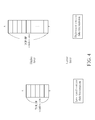
- FIG. 4 is a diagram illustrating the operation of the present invention in an uplink mode.
- the left side of FIG. 4 illustrates an embodiment when a smaller CQI value is measured in step 220, indicating that the lower layer can only provide low-speed wireless data transmission.
- the higher layer with a higher transmission speed only consumes more power without improving the overall uplink data throughput. Therefore, the present invention may reduce the TCP/IP window size of the higher layer.
- the right side of FIG. 4 illustrates an embodiment when a larger CQI value is measured in step 220, indicating that the lower layer can provide high-speed wireless data transmission. Under such circumstances, the overall uplink data throughput may not be improved if the higher layer only has a low transmission speed. Therefore, the present invention may increase the TCP/IP window size of the higher layer.
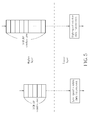
- FIG. 5 is a diagram illustrating the operation of the present invention in a downlink mode.
- the left side of FIG. 5 illustrates an embodiment when a smaller CQI value is measured in step 220, indicating that the lower layer can only provide low-speed wireless data transmission.
- the higher layer with a higher transmission speed only consumes more power or causes data stall without improving the overall downlink data throughput. Therefore, the present invention may reduce the TCP/IP window size of the higher layer.
- the right side of FIG. 5 illustrates an embodiment when a larger CQI value is measured in step 220, indicating that the lower layer can provide high-speed wireless data transmission. Under such circumstance, the overall downlink data throughput may not be improved if the higher layer only has a low transmission speed. Therefore, the present invention may increase the TCP/IP window size of the higher layer.
- the present invention may provide a method of data transmission in a wireless network system.
- the present invention may dynamically adjust the data transmission parameter of a higher layer according to the transmission status of a lower layer. By optimizing the data transmission between different layers, the present invention may improve network resource utilization and overall data throughput.
Landscapes
- Engineering & Computer Science (AREA)
- Computer Networks & Wireless Communication (AREA)
- Signal Processing (AREA)
- Mobile Radio Communication Systems (AREA)
Abstract
In a wireless network system which adopts a multi-layer data transmission structure, a wireless channel is established between a user equipment and a base station. A signal transmission status of a first layer is measured for adjusting a data transmission parameter of a second layer accordingly. The second layer is hierarchically higher than the first layer according to the multi-layer data transmission structure
Description
- The present invention is related to a method of increasing data throughput of a wireless network system according to the pre-characterizing clause of
claim 1. - Electronic equipment, such as desktop computers, notebook computers, personal digital assistants (PDAs), or smart phones, provide easy access to a network. In order for electronic equipment having varying specifications to be able to communicate with the same network, an OSI (Open Systems Interconnection) network model has been provided by ISO (International Organization for Standardization) for managing the network intercommunication between two systems. Meanwhile, transmission control protocol (TCP) /Internet protocol(IP) , developed by IETF (Internet engineer task force) according to DoD (department of defense) model, is the most common standard network protocol.
- The OSI model and the TCP/IP define various layers for network transmission. In a network environment, each layer of a receiving device or a transmitting device is configured to recognize data from the same layer. Data packets are sequentially transmitted from the top layer to the bottom layer of a transmitting network device and then to a receiving network device using application programs. After receiving data packages, the receiving network device sequentially unpacks each data package, which is then distributed to a corresponding layer of the receiving network device. Assigned for different tasks, each layer may have varying transmission parameters and buffer sizes. Data stall may happen when transmitting data from a fast higher layer to a slow lower layer. Also, a fast lower layer may not be able to improve data throughput if a higher layer encounters insufficient data buffer or transmission blockages.
- This in mind, the present invention aims at providing a method of increasing data throughput of a wireless network system by dynamically adjusting window size of communication protocol.
- This is achieved by a method of data transmission between a user equipment and a base station in a wireless network system according to
claim 1. The dependent claims pertain to corresponding further developments and improvements. - As will be seen more clearly from the detailed description following below, the claimed method of data transmission between a user equipment and a base station in a wireless network system having a multi-layer structure includes establishing a wireless transmission channel between the user equipment and the base station; measuring a signal transmission status associated with a first layer in the wireless transmission channel; and adjusting a data transmission parameter of a second layer in the wireless transmission channel, wherein the second layer is hierarchically higher than the first layer in the multi-layer structure.
- In the following, the invention is further illustrated by way of example, taking reference to the accompanying drawings. Thereof
-
FIG. 1 is a diagram illustrating a multi-layer structure according to the OSI model; -
FIG. 2 is a flowchart illustrating a method for data transmission in a wireless network system; -
FIG. 3 is a table illustrating the operation of the present invention; -
FIG. 4 is a diagram illustrating the operation of the present invention in an uplink mode; and -
FIG. 5 is a diagram illustrating the operation of the present invention in a downlink mode. - The present invention provides a method of data transmission in a wireless network system. When a user equipment and a base station in the wireless network system are in communication using a multi-layer structure, the present invention may improve overall data throughput.
-
FIG. 1 is a diagram illustrating a multi-layer structure according to the OSI model. From bottom to top,Layer 1∼Layer 7 sequentially include a physical layer, a data link layer, a network layer, a transport layer, a session layer, a presentation layer, and an application layer. The 1st layer, the physical layer, is defined as the bottom layer closest to hardware devices, while the 7th layer, the application layer, is defined as the top layer closest to software programs. - The physical layer and the data link layer in the OSI model are configured to handle network hardware connection and may be implemented on various network access interfaces, such as Ethernet, Token-Ring or Fiber Distributed Data Interface (FDDI), etc. The network layer in the OSI model is configured to deliver messages between a transmitting device and a receiving device using various protocols, such as identifying addresses or selecting transmission path using IP, Address Resolution Protocol (ARP), Reverse Address Resolution Protocol RARP or Internet Control Message Protocol (ICMP). The transport layer in the OSI model is configured to deliver messages between different hosts using TCP and User Datagram Protocol (UDP). The session layer, the presentation layer, and the application layer in the OSI model are configured to provide various application protocols, such as TELNET, File Transfer Protocol (FTP), Simple Mail Transfer Protocol (SMTP), Post Office Protocol 3 (POP3), Simple Network Management Protocol (SNMP), Network News Transport Protocol (NNTP), Domain Name System (DNS), Network Information Service (NIS), Network File System (NFS), and Hypertext Transfer Protocol (HTTP). The present invention may be applied to any wireless network system having a multi-layer structure for data transmission.
FIG. 1 is only for illustrative purpose, and does not limit the scope of the present invention. -
FIG. 2 is a flowchart illustrating a method of data transmission in a wireless network system. The flowchart inFIG. 2 includes the following steps: - Step 210: establish a wireless transmission channel between a user equipment and a base station;
- Step 220: measure a signal transmission status associated with a hierarchically lower layer in the wireless transmission channel; and
- Step 220: adjust a data transmission parameter of a hierarchically higher layer in the wireless transmission channel according to the signal transmission status.
- In the multi-layered OSI network system which adopts TCP/IP, the lower layer may be the physical layer, while the higher layer may be the transport layer or the network layer. The signal transmission status may be acquired by measuring a channel quality indicator (CQI) when corresponding layers of the user equipment and the base station are in communication. The data transmission parameter may be a protocol window size of the transport layer or the network layer.
- For example, the transport layer in the OSI model normally adopts TCP for handling packet sequence number, acknowledgement packets, checksum and re-transmission. The network layer in the OSI model normally adopts IP for handling addressing, routing, service type specification, packet fragmentation, packet reassembling and security. Therefore, the data transmission parameter may be TCP/IP window size which indicates the maximum packet number permitted to be transmitted without waiting for acknowledgement packets. However, the present invention may adjust other parameters associated with data transmission rate according to other parameters associated with signal transmission status. CQI and TCP/IP window size are merely illustrative embodiments, and do not limit the scope of the present invention.
- A high-speed downlink packet access (HSDPA) network system may adopt various types of user equipment, each of which is provided with a corresponding CQI table.
FIG. 3 is a table illustrating the present invention using acategory 10 UE. The CQI table corresponding tocategory 10 UE is depicted on the left side ofFIG. 3 , while the two columns on the right side of the table inFIG. 3 illustrates howstep 220 is executed. In the CQI table depicted on the left side ofFIG. 3 , the CQI value is between 0 and 30, and related to parameters of the wireless transmission channel, such as signal-to-noise ratio (SNR), signal-to-interference plus noise ratio (SINR), or signal-to-noise plus distortion ratio (SNDR). Measured during intercommunication between corresponding layers of the user equipment and the base station, a larger CQI value indicates a better signal transmission status. Each CQI value corresponds to specific settings, wherein transport block size (TBS) represents the amount of data packets which are transmitted to the user equipment, code count represents the amount of high speed physical downlink shared channel (HS-PDSCH), and data packets maybe transmitted using a quadrature phase-shift keying (QPSK) modulation or a high-speed 16 quadrature amplitude modulation (16-QAM) modulation. - The right side of the table in
FIG. 3 illustrates a method of executingstep 220 in the present invention. In the present invention, each measured CQI value may be mapped to a corresponding TCP/IP parameter, and each TCP/IP parameter may be mapped to a corresponding TCP/IP window size. InFIG. 3 , lNDl -lND30 represent the TCP/IP parameters and WS1-WS30 represent the TCP/IP window sizes, wherein IND1 ≦ IND2 ≦ ... ≦ lND30 and WS1 ≦ WS2 ≦ ... ≦ WS30. - As known to those skilled in the art, the concept of a sliding window is used in TCP/IP for allowing multiple packets to be transmitted before the receiving device accepts acknowledgement packets. This kind of multi-transmission-multi-acknowledgement technology can increase network bandwidth utilization and the data transmission speed. Simply speaking, a receiving device may inform a transmitting device of the available buffer size for receiving packets using TCP/IP window size. The transmitting device may decrease its data throughput when TCP/IP window size drops, or increase its data throughput when TCP/IP window size rises. Therefore, the present invention may optimize the data transmission between different layers by dynamically adjusting the TCP/IP window size of the higher layer according to the measured CQI value of the lower layer.
-
FIG. 4 is a diagram illustrating the operation of the present invention in an uplink mode. The left side ofFIG. 4 illustrates an embodiment when a smaller CQI value is measured instep 220, indicating that the lower layer can only provide low-speed wireless data transmission. Under such circumstance, the higher layer with a higher transmission speed only consumes more power without improving the overall uplink data throughput. Therefore, the present invention may reduce the TCP/IP window size of the higher layer. - The right side of
FIG. 4 illustrates an embodiment when a larger CQI value is measured instep 220, indicating that the lower layer can provide high-speed wireless data transmission. Under such circumstances, the overall uplink data throughput may not be improved if the higher layer only has a low transmission speed. Therefore, the present invention may increase the TCP/IP window size of the higher layer. -
FIG. 5 is a diagram illustrating the operation of the present invention in a downlink mode. The left side ofFIG. 5 illustrates an embodiment when a smaller CQI value is measured instep 220, indicating that the lower layer can only provide low-speed wireless data transmission. Under such circumstances, the higher layer with a higher transmission speed only consumes more power or causes data stall without improving the overall downlink data throughput. Therefore, the present invention may reduce the TCP/IP window size of the higher layer. - The right side of
FIG. 5 illustrates an embodiment when a larger CQI value is measured instep 220, indicating that the lower layer can provide high-speed wireless data transmission. Under such circumstance, the overall downlink data throughput may not be improved if the higher layer only has a low transmission speed. Therefore, the present invention may increase the TCP/IP window size of the higher layer. - In conclusion, the present invention may provide a method of data transmission in a wireless network system. When a user equipment and a base station in the wireless network system are in communication using a multi-layer structure, the present invention may dynamically adjust the data transmission parameter of a higher layer according to the transmission status of a lower layer. By optimizing the data transmission between different layers, the present invention may improve network resource utilization and overall data throughput.
Claims (6)
- A method of data transmission between a user equipment and a base station in a wireless network system having a multi-layer structure, comprising:establishing a wireless transmission channel between the user equipment and the base station;characterized bymeasuring a signal transmission status associated with a first layer in the wireless transmission channel; andadjusting a data transmission parameter of a second layer in the wireless transmission channel, wherein the second layer is hierarchically higher than the first layer in the multi-layer structure.
- The method of claim 1, further characterized by:adjusting the data transmission parameter of the second layer in an uplink mode when communicating with a third layer in the wireless transmission channel according to the signal transmission status, wherein the third layer is hierarchically higher than the second layer in the multi-layer structure.
- The method of claim 1, further characterized by:adjusting the data transmission parameter of the second layer in a downlink mode when communicating with the first layer in the wireless transmission channel according to the signal transmission status.
- The method of claim 1, further characterized by:measuring the signal transmission status by measuring a channel quality indicator of the first layer.
- The method of claim 1, further characterized by:adjusting the data transmission parameter of the second layer by adjusting a transmission control protocol window size.
- The method of claim 1, further characterized by:adjusting the data transmission parameter of the second layer by adjusting an Internet protocol window size.
Applications Claiming Priority (1)
| Application Number | Priority Date | Filing Date | Title |
|---|---|---|---|
| TW100127532A TW201309053A (en) | 2011-08-03 | 2011-08-03 | Method for increasing data throughput of a wireless network system by dynamically adjusting window size of communication protocol |
Publications (1)
| Publication Number | Publication Date |
|---|---|
| EP2555581A2 true EP2555581A2 (en) | 2013-02-06 |
Family
ID=45033830
Family Applications (1)
| Application Number | Title | Priority Date | Filing Date |
|---|---|---|---|
| EP11189679A Withdrawn EP2555581A2 (en) | 2011-08-03 | 2011-11-18 | Method of increasing data throughput of a wireless network system by dynamically adjusting window size of communication protocol |
Country Status (3)
| Country | Link |
|---|---|
| US (2) | US20130033997A1 (en) |
| EP (1) | EP2555581A2 (en) |
| TW (1) | TW201309053A (en) |
Families Citing this family (5)
| Publication number | Priority date | Publication date | Assignee | Title |
|---|---|---|---|---|
| US20170132042A1 (en) * | 2014-04-23 | 2017-05-11 | Hewlett Packard Enterprise Development Lp | Selecting a platform configuration for a workload |
| JP6290055B2 (en) * | 2014-09-19 | 2018-03-07 | 株式会社東芝 | COMMUNICATION DEVICE, COMMUNICATION CONTROL METHOD, AND COMPUTER PROGRAM |
| WO2016164723A1 (en) * | 2015-04-09 | 2016-10-13 | Altiostar Networks, Inc. | Application intelligence controller |
| DE102015109951B4 (en) * | 2015-06-22 | 2021-10-21 | Apple Inc. | Method and apparatus for providing robust data communication between a client and a server |
| EP3462794A1 (en) * | 2017-09-29 | 2019-04-03 | Intel Corporation | Techniques for controlling communication networks |
Family Cites Families (11)
| Publication number | Priority date | Publication date | Assignee | Title |
|---|---|---|---|---|
| EP1134941A1 (en) * | 2000-03-15 | 2001-09-19 | TELEFONAKTIEBOLAGET LM ERICSSON (publ) | Method and arrangement for flow control |
| US7012893B2 (en) * | 2001-06-12 | 2006-03-14 | Smartpackets, Inc. | Adaptive control of data packet size in networks |
| KR100765121B1 (en) * | 2001-11-24 | 2007-10-11 | 엘지전자 주식회사 | How to poll the protocol data unit of the send buffer |
| US20050169305A1 (en) * | 2003-04-04 | 2005-08-04 | Masaru Mori | Mobile terminal and radio access point in radio access system |
| SE0301048D0 (en) * | 2003-04-07 | 2003-04-07 | Ericsson Telefon Ab L M | RLC window reconfiguration |
| JP2005045642A (en) * | 2003-07-24 | 2005-02-17 | Matsushita Electric Ind Co Ltd | Packet communication apparatus and packet communication method |
| US20050041586A1 (en) * | 2003-08-24 | 2005-02-24 | Sam Shiaw-Shiang Jiang | Method of controlling a receiver and a transmitter in a wireless communication system to handle a transmission window size change procedure |
| TWI299620B (en) * | 2005-04-05 | 2008-08-01 | Innovative Sonic Ltd | Method and related apparatus for reconfiguring size of a receiving window in a communication system |
| US8265563B2 (en) * | 2006-10-31 | 2012-09-11 | Hewlett-Packard Development Company, L.P. | Techniques for enhanced co-existence of co-located radios |
| US8897266B2 (en) * | 2009-03-27 | 2014-11-25 | Qualcomm Incorporated | Method and apparatus for transmitting control information via upper layer |
| US8601153B2 (en) * | 2009-10-16 | 2013-12-03 | Qualcomm Incorporated | System and method for optimizing media playback quality for a wireless handheld computing device |
-
2011
- 2011-08-03 TW TW100127532A patent/TW201309053A/en unknown
- 2011-11-07 US US13/290,132 patent/US20130033997A1/en not_active Abandoned
- 2011-11-18 EP EP11189679A patent/EP2555581A2/en not_active Withdrawn
-
2015
- 2015-03-03 US US14/637,359 patent/US20150189670A1/en not_active Abandoned
Non-Patent Citations (1)
| Title |
|---|
| None |
Also Published As
| Publication number | Publication date |
|---|---|
| TW201309053A (en) | 2013-02-16 |
| US20130033997A1 (en) | 2013-02-07 |
| US20150189670A1 (en) | 2015-07-02 |
Similar Documents
| Publication | Publication Date | Title |
|---|---|---|
| US9271164B2 (en) | Method of increasing data throughput of a wireless network system by dynamically adjusting MTU/fragmentation size according to current transmission status | |
| EP2636193B1 (en) | Systems and methods for communicating in a network | |
| US7995478B2 (en) | Network communication with path MTU size discovery | |
| RU2409898C2 (en) | Flexible segmentation scheme for communication systems | |
| EP3075110B1 (en) | Controlling a transmission control protocol window size | |
| CN100534069C (en) | Acceleration methods for asymmetric and multi-concurrent networks | |
| US20150189670A1 (en) | Method of increasing data throughput of a wireless network system by dynamically adjusting window size of communication protocol | |
| US9270489B1 (en) | Explicit congestion notification in mixed fabric networks | |
| EP2602968B1 (en) | Method of data transmission in a wireless network system by optimizing window size scaling of communication protocol | |
| US9088965B2 (en) | Data transmission methods and apparatuses using the same | |
| CN103905331B (en) | Real-time media data transmission method, device and system | |
| US20110228714A1 (en) | Method and system for retransmission in asm | |
| US20180234207A1 (en) | Methods and devices for providing a robust data communication between a client and a server | |
| EP2590381B1 (en) | Data transmission method and mobile communication device for adjusting a TCP/IP window size based on physical layer characteristics | |
| US9112906B2 (en) | Data transmission methods and appratuses using the same | |
| CN103139836B (en) | Method for transmitting data in wireless network system | |
| CN102484820A (en) | System And Method For Controlling Parameters For Applications Serviced In A Best Effort Communication Link | |
| CN103024815A (en) | Method for transmitting data in wireless network system | |
| TWI466574B (en) | Mobile communication devices and data transmission methods | |
| Adolfsson | TCP performance in an EGPRS system | |
| RU2389139C2 (en) | Information flow control in universal mobile telecommunication system (umts) | |
| Wang | 3G HSDPA Performance In Mobile Internet Connections |
Legal Events
| Date | Code | Title | Description |
|---|---|---|---|
| PUAI | Public reference made under article 153(3) epc to a published international application that has entered the european phase |
Free format text: ORIGINAL CODE: 0009012 |
|
| AK | Designated contracting states |
Kind code of ref document: A2 Designated state(s): AL AT BE BG CH CY CZ DE DK EE ES FI FR GB GR HR HU IE IS IT LI LT LU LV MC MK MT NL NO PL PT RO RS SE SI SK SM TR |
|
| AX | Request for extension of the european patent |
Extension state: BA ME |
|
| STAA | Information on the status of an ep patent application or granted ep patent |
Free format text: STATUS: THE APPLICATION IS DEEMED TO BE WITHDRAWN |
|
| 18D | Application deemed to be withdrawn |
Effective date: 20140603 |