EP2555404A2 - Power management for loads supplied with ac power from variable frequency generators - Google Patents
Power management for loads supplied with ac power from variable frequency generators Download PDFInfo
- Publication number
- EP2555404A2 EP2555404A2 EP12177678A EP12177678A EP2555404A2 EP 2555404 A2 EP2555404 A2 EP 2555404A2 EP 12177678 A EP12177678 A EP 12177678A EP 12177678 A EP12177678 A EP 12177678A EP 2555404 A2 EP2555404 A2 EP 2555404A2
- Authority
- EP
- European Patent Office
- Prior art keywords
- frequency
- power
- solid
- load
- switching device
- Prior art date
- Legal status (The legal status is an assumption and is not a legal conclusion. Google has not performed a legal analysis and makes no representation as to the accuracy of the status listed.)
- Ceased
Links
Images


Classifications
-
- H—ELECTRICITY
- H02—GENERATION; CONVERSION OR DISTRIBUTION OF ELECTRIC POWER
- H02M—APPARATUS FOR CONVERSION BETWEEN AC AND AC, BETWEEN AC AND DC, OR BETWEEN DC AND DC, AND FOR USE WITH MAINS OR SIMILAR POWER SUPPLY SYSTEMS; CONVERSION OF DC OR AC INPUT POWER INTO SURGE OUTPUT POWER; CONTROL OR REGULATION THEREOF
- H02M5/00—Conversion of AC power input into AC power output, e.g. for change of voltage, for change of frequency, for change of number of phases
- H02M5/02—Conversion of AC power input into AC power output, e.g. for change of voltage, for change of frequency, for change of number of phases without intermediate conversion into DC
- H02M5/04—Conversion of AC power input into AC power output, e.g. for change of voltage, for change of frequency, for change of number of phases without intermediate conversion into DC by static converters
- H02M5/22—Conversion of AC power input into AC power output, e.g. for change of voltage, for change of frequency, for change of number of phases without intermediate conversion into DC by static converters using discharge tubes with control electrode or semiconductor devices with control electrode
- H02M5/275—Conversion of AC power input into AC power output, e.g. for change of voltage, for change of frequency, for change of number of phases without intermediate conversion into DC by static converters using discharge tubes with control electrode or semiconductor devices with control electrode using devices of a triode or transistor type requiring continuous application of a control signal
- H02M5/293—Conversion of AC power input into AC power output, e.g. for change of voltage, for change of frequency, for change of number of phases without intermediate conversion into DC by static converters using discharge tubes with control electrode or semiconductor devices with control electrode using devices of a triode or transistor type requiring continuous application of a control signal using semiconductor devices only
-
- B—PERFORMING OPERATIONS; TRANSPORTING
- B60—VEHICLES IN GENERAL
- B60L—PROPULSION OF ELECTRICALLY-PROPELLED VEHICLES; SUPPLYING ELECTRIC POWER FOR AUXILIARY EQUIPMENT OF ELECTRICALLY-PROPELLED VEHICLES; ELECTRODYNAMIC BRAKE SYSTEMS FOR VEHICLES IN GENERAL; MAGNETIC SUSPENSION OR LEVITATION FOR VEHICLES; MONITORING OPERATING VARIABLES OF ELECTRICALLY-PROPELLED VEHICLES; ELECTRIC SAFETY DEVICES FOR ELECTRICALLY-PROPELLED VEHICLES
- B60L1/00—Supplying electric power to auxiliary equipment of vehicles
-
- H—ELECTRICITY
- H05—ELECTRIC TECHNIQUES NOT OTHERWISE PROVIDED FOR
- H05B—ELECTRIC HEATING; ELECTRIC LIGHT SOURCES NOT OTHERWISE PROVIDED FOR; CIRCUIT ARRANGEMENTS FOR ELECTRIC LIGHT SOURCES, IN GENERAL
- H05B1/00—Details of electric heating devices
- H05B1/02—Automatic switching arrangements specially adapted to apparatus ; Control of heating devices
- H05B1/0227—Applications
- H05B1/023—Industrial applications
- H05B1/0236—Industrial applications for vehicles
-
- B—PERFORMING OPERATIONS; TRANSPORTING
- B60—VEHICLES IN GENERAL
- B60L—PROPULSION OF ELECTRICALLY-PROPELLED VEHICLES; SUPPLYING ELECTRIC POWER FOR AUXILIARY EQUIPMENT OF ELECTRICALLY-PROPELLED VEHICLES; ELECTRODYNAMIC BRAKE SYSTEMS FOR VEHICLES IN GENERAL; MAGNETIC SUSPENSION OR LEVITATION FOR VEHICLES; MONITORING OPERATING VARIABLES OF ELECTRICALLY-PROPELLED VEHICLES; ELECTRIC SAFETY DEVICES FOR ELECTRICALLY-PROPELLED VEHICLES
- B60L2200/00—Type of vehicles
- B60L2200/10—Air crafts
-
- B—PERFORMING OPERATIONS; TRANSPORTING
- B64—AIRCRAFT; AVIATION; COSMONAUTICS
- B64D—EQUIPMENT FOR FITTING IN OR TO AIRCRAFT; FLIGHT SUITS; PARACHUTES; ARRANGEMENT OR MOUNTING OF POWER PLANTS OR PROPULSION TRANSMISSIONS IN AIRCRAFT
- B64D2221/00—Electric power distribution systems onboard aircraft
-
- G—PHYSICS
- G05—CONTROLLING; REGULATING
- G05F—SYSTEMS FOR REGULATING ELECTRIC OR MAGNETIC VARIABLES
- G05F1/00—Automatic systems in which deviations of an electric quantity from one or more predetermined values are detected at the output of the system and fed back to a device within the system to restore the detected quantity to its predetermined value or values, i.e. retroactive systems
- G05F1/66—Regulating electric power
-
- H—ELECTRICITY
- H02—GENERATION; CONVERSION OR DISTRIBUTION OF ELECTRIC POWER
- H02J—ELECTRIC POWER NETWORKS; CIRCUIT ARRANGEMENTS OR SYSTEMS FOR SUPPLYING OR DISTRIBUTING ELECTRIC POWER; SYSTEMS FOR STORING ELECTRIC ENERGY
- H02J2105/00—Networks for supplying or distributing electric power characterised by their spatial reach or by the load
- H02J2105/30—Networks for supplying or distributing electric power characterised by their spatial reach or by the load the load networks being external to vehicles, i.e. exchanging power with vehicles
- H02J2105/32—Networks for supplying or distributing electric power characterised by their spatial reach or by the load the load networks being external to vehicles, i.e. exchanging power with vehicles for aircrafts
-
- H—ELECTRICITY
- H02—GENERATION; CONVERSION OR DISTRIBUTION OF ELECTRIC POWER
- H02J—ELECTRIC POWER NETWORKS; CIRCUIT ARRANGEMENTS OR SYSTEMS FOR SUPPLYING OR DISTRIBUTING ELECTRIC POWER; SYSTEMS FOR STORING ELECTRIC ENERGY
- H02J3/00—Circuit arrangements for AC mains or AC distribution networks
- H02J3/12—Arrangements for adjusting voltage in AC networks by changing a characteristic of the network load
Definitions
- the present invention is related to power distribution, and in particular to power distribution and management to loads from "wild" power sources.
- variable-frequency generators In aircraft applications, electric power generation is derived, in large part, from mechanical power supplied by the aircraft's engines, which is converted to alternating current (AC) electric power by a generator. Variations in aircraft engine speed results in variation in the output voltage generated by the generator. However, some loads are sensitive to variations in frequency, and therefore most generators employed on modem-day aircraft provide either a constant output frequency or a variable frequency that varies within a defined range that is acceptable to attached loads. For example, constant frequency generators use mechanical couplings to provide a constant-frequency AC output despite variations in engine speed, The mechanical couplings add to the cost and weight of the generator however. Variable-frequency generators are an alternative to constant frequency generators, but must still be capable of providing an AC output within a well-defined range (e,g., 350 Hz-800 Hz). This requirement also adds to the weight and cost of variable-frequency generators,
- variable-frequency generators A cheaper alternative to constant-frequency generators and variable-frequency generators is a wild-source generator that provides an AC output that varies in both frequency and voltage more than that of the variable-frequency generators.
- wild-source generators have not found applicability in aircraft applications because of their inability to provide the type of power required by most loads on the aircraft.
- a solid-state power regulator regulates power delivered to a frequency tolerant load from a wild-source power source.
- the SSPR includes a solid-state switching device and a controller.
- the solid-state switching device is turned On to deliver power from the wild-source power source to the frequency-tolerant load and Off to prevent the delivery of power to the frequency-tolerant load.
- the controller monitors the power delivered to the frequency-tolerant load and selectively modulates the solid-state switching device to regulate the power delivered.
- FIG. 1 is a block diagram of an electric power generation/distribution system (EPGDS) that employs "wild" sources according to an embodiment of the present invention.
- EPGDS electric power generation/distribution system
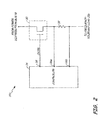
- FIG. 2 is a block diagram of a solid-state power regulator (SSPR) employed in an EPGDS to regulate power supplied by a "wild" source to a load according to an embodiment of the present invention.
- SSPR solid-state power regulator
- FIG. 3 is a block diagram of functions performed by a controller employed by a SSPR to regulate power delivered to the load according to an embodiment of the present invention.
- the present invention provides a system and method of employing wild-source generators that provides an AC output that varies in voltage and frequency more than that of traditional variable-frequency generators.
- the present invention employs wild power sources to supply power to particular types of loads (e.g., resistive loads) that can accommodate large variations in frequency.
- loads e.g., resistive loads
- a solid-state switching device is employed to regulate the power delivered from the wild source to a particular load to ensure the load is not overloaded or damaged. This requires the power delivered to the load to be monitored and used to regulate the On/Off time of the solid-state switch to provide the desired amount of power to the attached load,
- FIG. 1 is a block diagram of electric power generation/distribution system (EPGDS) 10 that employs wild-source generators according to an embodiment of the present invention.
- EPGDS 10 includes aircraft engine 12, shaft 14, wild-source generator 16, power distribution bus 18, solid state power regulators (SSPR) 20a, 20b, ... 20N, and frequency tolerant loads 22a, 22b ... 22N.
- SSPR solid state power regulators
- motive power generated by aircraft engine 12 is communicated via shaft 14 to wild-source generator 16,
- wild-source generator 16 may receive mechanical energy via a direct drive from the shaft (not shown) of aircraft engine 12, may be mounted around aircraft engine 12 in which the shaft of the engine serves as either the stator or the rotor of the wild-source generator, via mechanical gearbox coupling, or other well-known means of communicating mechanical power from aircraft engine 12 to wild-source generator 16.
- Wild-source generator 16 converts mechanical energy supplied by aircraft engine 12 to a variable frequency, variable voltage AC output for distribution to attached loads via power distribution bus 18.
- Wild-source generator 16 is referred to as a "wild" source generator due to the range of frequencies and voltages generated by the generator, which can be defined as a frequency range that is greater than the frequency range associated with variable-frequency generators, For example, various specifications (e,g., military specification MIL-STD-704F) define the maximum allowable range of frequencies that may be generated by a variable-frequency generator.
- a generator providing a frequency range greater than that defined with respect to variable-frequency generators is classified as wild-source.
- variable-frequency generators provide an AC output in the frequency range of 350Hz - 800Hz.
- a wild-source generator would therefore provide an AC output in a frequency range greater than that defined with respect to the variable-frequency generator.
- Power distribution bus 18 supplies the AC output provided by wild-source generator 16 to loads 22a-22N via SSPRs 20a-20N, respectively.
- Each load 22a-22N is a frequency-tolerant load.
- frequency-tolerant loads i.e., resistive loads
- Resistive loads operate in the same manner regardless of the frequency of the AC power with which they are supplied, and may therefore be sourced with power from wild-source generator 16.
- SSPRs 20a-20N control the supply of power from power distribution bus 18 to individual loads 22a-22N.
- each SSPR 20a-20N includes a solid-state power device selectively controlled to supply power from power distribution bus 18 to loads 22a-22N.
- SSPRs 20a-20N monitor and regulate the power delivered to loads 22a-22N. As described in more detail with respect to FIG. 3 , in one embodiment, SSPRs 20a-20N regulate the power delivered to loads 22a-22N by modulating the solid-state switching device On and Off at a frequency greater than the output frequency of wild-source generator 16.
- FIG, 2 is a block diagram of solid-state power regulator (SSPR) 20a employed in EPGDS 10 to regulate power supplied by wild-source generator 16 to frequency-tolerant load 22a according to an embodiment of the present invention.
- SSPR solid-state power regulator
- Solid-state switching device 30 includes a control terminal (e.g., gate) and first and second controlled terminals (e.g., source and drain). Controller 34 provides an input to the control terminal of solid-state switching device 30 to selectively turn the device On and Off. When On, input power received at a first controlled terminal from power distribution bus 18 is supplied to load 22a via the second controlled terminal. When Off, input power received at the first controlled terminal is prevented from being supplied to load 22a.
- solid-state switching device is a metal-oxide semiconductor field-effect transistor (MOSFET) although other well-known solid-state devices may be employed depending on the application.
- MOSFET metal-oxide semiconductor field-effect transistor
- the solid-state device selected must be capable of communicating large amounts of power (e.g., greater than 15 amperes), and be capable of high-speed switching necessary to regulate the power delivered to load 22a.
- solid-state switching device 30 is implemented with silicon carbide (SiC) transistors.
- Controller 34 monitors and regulates the power delivered to load 22a.
- the power delivered to each load can be calculated or closely estimated based on the monitored current.
- Controller 34 therefore monitors both current and voltage supplied to load 22a to determine the power delivered to load 22a.
- controller 34 monitors the current by measuring the voltage across current-sense resistor 32 via input terminals 36a, 36b.
- controller 34 monitors the voltage provided to load 22a by monitoring the voltage at either input terminal 36a or input terminal 36b.
- controller 34 includes additional input terminals for monitoring the voltage independent of the input terminals used to monitor the current. To ensure accurate measurement of the power delivered to load 22a, rapid sampling of the voltage and current is employed (e.g., sampling rate of more than twenty times the frequency of the wild-source generators 16.
- controller 34 calculates the power supplied to load 22a and regulates the supply of power by selectively turning solid-state switching device 30 On and Off via a control signal provided at output ten-ninal 38 to the gate of solid-state switching device 30.
- controller 34 employs a pulse-width modulation (PWM) switching scheme to control the On/Off times of solid-state switching device 30 to regulate power supplied to load 22a.
- PWM pulse-width modulation
- the switching frequency of solid-state switching device 30 is greater than the frequency of the wild-source supplied to load 22a. More specifically, to ensure regulation of the power supplied to the load, a switching frequency of more than five times the frequency of the wild-source generator 16 is employed by controller 34.
- FIG. 3 is a block diagram of functions performed by a controller employed by a SSPR to regulate power delivered to the load according to an embodiment of the present invention. These functions may be implemented by a microcontroller executing software to implement the desired function, by analog and/or digital circuitry, or a combination thereof.
- Controller 34 receives a monitored voltage V(t) and monitored current I(t) as inputs. Controller 34 calculates the instantaneous power P(t) delivered to load 22a by multiplying the monitored voltage V(t) with the monitored current I(t) at multiplier 40. The instantaneous power P(t) is integrated over a defined period of time (e.g., one cycle on the output provided by wild-source generators 16) by integrator 42 to calculate an average power Pavg delivered to load 22a.
- a defined period of time e.g., one cycle on the output provided by wild-source generators 16
- Controller 34 calculates the difference or error diff between the average power delivered to load 22a and the reference power Pref (i.e., the desired power to deliver to load 22a) at block 44 by taking the difference between the average power Pavg and the reference power Pref.
- the difference Pdiff is used to calculate whether more or less power should be applied to load 22a.
- proportional-integral (P-I) controller 46 generates an output to minimize the difference between the average power Pavg and the reference power Pref.
- PWM pulse-width modulation
- controller 34 may employ other control schemes to regulate the monitored power to a desired value.
- the present invention employs wild-source generators to supply power to various frequency-tolerant loads within a power distribution system.
- Power supplied to the loads is regulated via solid-state power regulator (SSPRs), which include a controller and a solid-state power device turned On and Off to control the delivery of power to the load.
- the controller monitors power delivered to the load and modulates the On/Off time of the solid-state power device to regulate the power delivered to the load.
- SSPRs solid-state power regulator
- the present invention may be employed in other applications in which wild-source generators are used to deliver power to frequency-tolerant loads.
Landscapes
- Engineering & Computer Science (AREA)
- Power Engineering (AREA)
- Transportation (AREA)
- Mechanical Engineering (AREA)
- Supply And Distribution Of Alternating Current (AREA)
- Control Of Eletrric Generators (AREA)
Abstract
Description
- The present invention is related to power distribution, and in particular to power distribution and management to loads from "wild" power sources.
- In aircraft applications, electric power generation is derived, in large part, from mechanical power supplied by the aircraft's engines, which is converted to alternating current (AC) electric power by a generator. Variations in aircraft engine speed results in variation in the output voltage generated by the generator. However, some loads are sensitive to variations in frequency, and therefore most generators employed on modem-day aircraft provide either a constant output frequency or a variable frequency that varies within a defined range that is acceptable to attached loads. For example, constant frequency generators use mechanical couplings to provide a constant-frequency AC output despite variations in engine speed, The mechanical couplings add to the cost and weight of the generator however. Variable-frequency generators are an alternative to constant frequency generators, but must still be capable of providing an AC output within a well-defined range (e,g., 350 Hz-800 Hz). This requirement also adds to the weight and cost of variable-frequency generators,
- A cheaper alternative to constant-frequency generators and variable-frequency generators is a wild-source generator that provides an AC output that varies in both frequency and voltage more than that of the variable-frequency generators, Traditionally, wild-source generators have not found applicability in aircraft applications because of their inability to provide the type of power required by most loads on the aircraft.
- A solid-state power regulator (SSPR) regulates power delivered to a frequency tolerant load from a wild-source power source. The SSPR includes a solid-state switching device and a controller. The solid-state switching device is turned On to deliver power from the wild-source power source to the frequency-tolerant load and Off to prevent the delivery of power to the frequency-tolerant load. The controller monitors the power delivered to the frequency-tolerant load and selectively modulates the solid-state switching device to regulate the power delivered.
-
FIG. 1 is a block diagram of an electric power generation/distribution system (EPGDS) that employs "wild" sources according to an embodiment of the present invention. -
FIG. 2 is a block diagram of a solid-state power regulator (SSPR) employed in an EPGDS to regulate power supplied by a "wild" source to a load according to an embodiment of the present invention. -
FIG. 3 is a block diagram of functions performed by a controller employed by a SSPR to regulate power delivered to the load according to an embodiment of the present invention. - The present invention provides a system and method of employing wild-source generators that provides an AC output that varies in voltage and frequency more than that of traditional variable-frequency generators. In particular, the present invention employs wild power sources to supply power to particular types of loads (e.g., resistive loads) that can accommodate large variations in frequency. A solid-state switching device is employed to regulate the power delivered from the wild source to a particular load to ensure the load is not overloaded or damaged. This requires the power delivered to the load to be monitored and used to regulate the On/Off time of the solid-state switch to provide the desired amount of power to the attached load,
-
FIG. 1 is a block diagram of electric power generation/distribution system (EPGDS) 10 that employs wild-source generators according to an embodiment of the present invention. EPGDS 10 includesaircraft engine 12,shaft 14, wild-source generator 16,power distribution bus 18, solid state power regulators (SSPR) 20a, 20b, ... 20N, and frequencytolerant loads - In the embodiment shown in
FIG. 1 , motive power generated byaircraft engine 12 is communicated viashaft 14 to wild-source generator 16, In other embodiments, other well-known means of mounting wild-source generator 16 with respect toaircraft engine 12 to communicate mechanical energy fromengine 12 togenerator 16 may be employed. For example, wild-source generator 16 may receive mechanical energy via a direct drive from the shaft (not shown) ofaircraft engine 12, may be mounted aroundaircraft engine 12 in which the shaft of the engine serves as either the stator or the rotor of the wild-source generator, via mechanical gearbox coupling, or other well-known means of communicating mechanical power fromaircraft engine 12 to wild-source generator 16. - Wild-
source generator 16 converts mechanical energy supplied byaircraft engine 12 to a variable frequency, variable voltage AC output for distribution to attached loads viapower distribution bus 18. Wild-source generator 16 is referred to as a "wild" source generator due to the range of frequencies and voltages generated by the generator, which can be defined as a frequency range that is greater than the frequency range associated with variable-frequency generators, For example, various specifications (e,g., military specification MIL-STD-704F) define the maximum allowable range of frequencies that may be generated by a variable-frequency generator. A generator providing a frequency range greater than that defined with respect to variable-frequency generators is classified as wild-source. In one embodiment, variable-frequency generators provide an AC output in the frequency range of 350Hz - 800Hz. A wild-source generator would therefore provide an AC output in a frequency range greater than that defined with respect to the variable-frequency generator. -
Power distribution bus 18 supplies the AC output provided by wild-source generator 16 to loads 22a-22N viaSSPRs 20a-20N, respectively. Eachload 22a-22N is a frequency-tolerant load. For example, in aircraft applications, frequency-tolerant loads (i.e., resistive loads) include heating elements used for de-icing operations, Resistive loads operate in the same manner regardless of the frequency of the AC power with which they are supplied, and may therefore be sourced with power from wild-source generator 16. SSPRs 20a-20N control the supply of power frompower distribution bus 18 toindividual loads 22a-22N. In particular, each SSPR 20a-20N includes a solid-state power device selectively controlled to supply power frompower distribution bus 18 to loads 22a-22N. - In addition, SSPRs 20a-20N monitor and regulate the power delivered to
loads 22a-22N. As described in more detail with respect toFIG. 3 , in one embodiment,SSPRs 20a-20N regulate the power delivered toloads 22a-22N by modulating the solid-state switching device On and Off at a frequency greater than the output frequency of wild-source generator 16. -
FIG, 2 is a block diagram of solid-state power regulator (SSPR) 20a employed inEPGDS 10 to regulate power supplied by wild-source generator 16 to frequency-tolerant load 22a according to an embodiment of the present invention. - SSPR 20a includes solid-
state switching device 30, current-sense resistor 32 andcontroller 34. Solid-state switching device 30 includes a control terminal (e.g., gate) and first and second controlled terminals (e.g., source and drain).Controller 34 provides an input to the control terminal of solid-state switching device 30 to selectively turn the device On and Off. When On, input power received at a first controlled terminal frompower distribution bus 18 is supplied to load 22a via the second controlled terminal. When Off, input power received at the first controlled terminal is prevented from being supplied to load 22a. In the embodiment shown inFIG. 2 solid-state switching device is a metal-oxide semiconductor field-effect transistor (MOSFET) although other well-known solid-state devices may be employed depending on the application. In particular, the solid-state device selected must be capable of communicating large amounts of power (e.g., greater than 15 amperes), and be capable of high-speed switching necessary to regulate the power delivered to load 22a. For example, in one embodiment solid-state switching device 30 is implemented with silicon carbide (SiC) transistors. -
Controller 34 monitors and regulates the power delivered to load 22a. In variable frequency applications, in which the frequency of the power supplied to the loads is within a defined range, the power delivered to each load can be calculated or closely estimated based on the monitored current. However, the range of frequencies provided by wild-source generators makes it difficult to accurately monitor power delivered to the load based on monitored current alone.Controller 34 therefore monitors both current and voltage supplied to load 22a to determine the power delivered to load 22a. - In the embodiment shown in
FIG. 2 ,controller 34 monitors the current by measuring the voltage across current-sense resistor 32 viainput terminals 36a, 36b. In addition,controller 34 monitors the voltage provided to load 22a by monitoring the voltage at eitherinput terminal 36a or input terminal 36b. In other embodiments,controller 34 includes additional input terminals for monitoring the voltage independent of the input terminals used to monitor the current. To ensure accurate measurement of the power delivered to load 22a, rapid sampling of the voltage and current is employed (e.g., sampling rate of more than twenty times the frequency of the wild-source generators 16. Based on the monitored voltage and current,controller 34 calculates the power supplied to load 22a and regulates the supply of power by selectively turning solid-state switching device 30 On and Off via a control signal provided at output ten-ninal 38 to the gate of solid-state switching device 30. In one embodiment,controller 34 employs a pulse-width modulation (PWM) switching scheme to control the On/Off times of solid-state switching device 30 to regulate power supplied to load 22a. The switching frequency of solid-state switching device 30 is greater than the frequency of the wild-source supplied to load 22a. More specifically, to ensure regulation of the power supplied to the load, a switching frequency of more than five times the frequency of the wild-source generator 16 is employed bycontroller 34. -
FIG. 3 is a block diagram of functions performed by a controller employed by a SSPR to regulate power delivered to the load according to an embodiment of the present invention. These functions may be implemented by a microcontroller executing software to implement the desired function, by analog and/or digital circuitry, or a combination thereof. -
Controller 34 receives a monitored voltage V(t) and monitored current I(t) as inputs.Controller 34 calculates the instantaneous power P(t) delivered to load 22a by multiplying the monitored voltage V(t) with the monitored current I(t) atmultiplier 40. The instantaneous power P(t) is integrated over a defined period of time (e.g., one cycle on the output provided by wild-source generators 16) byintegrator 42 to calculate an average power Pavg delivered to load 22a. -
Controller 34 calculates the difference or error diff between the average power delivered to load 22a and the reference power Pref (i.e., the desired power to deliver to load 22a) atblock 44 by taking the difference between the average power Pavg and the reference power Pref. The difference Pdiff is used to calculate whether more or less power should be applied to load 22a. In the embodiment shown inFIG. 3 , proportional-integral (P-I)controller 46 generates an output to minimize the difference between the average power Pavg and the reference power Pref. The output ofP-I controller 46 is provided to pulse-width modulation (PWM)generator 48, which generates a PWM control signal (labeled 'CNTRL') that is supplied to the gate of solid-state switching device 30 to selectively control the supply of power to load 22a. In other embodiments,controller 34 may employ other control schemes to regulate the monitored power to a desired value. - In this way, the present invention employs wild-source generators to supply power to various frequency-tolerant loads within a power distribution system. Power supplied to the loads is regulated via solid-state power regulator (SSPRs), which include a controller and a solid-state power device turned On and Off to control the delivery of power to the load. The controller monitors power delivered to the load and modulates the On/Off time of the solid-state power device to regulate the power delivered to the load. Although described with respect to an aircraft application, the present invention may be employed in other applications in which wild-source generators are used to deliver power to frequency-tolerant loads.
- While the invention has been described with reference to an exemplary embodiment(s), it will be understood by those skilled in the art that various changes may be made and equivalents may be substituted for elements thereof without departing from the scope of the invention, In addition, many modifications may be made to adapt a particular situation or material to the teachings of the invention without departing from the essential scope thereof. Therefore, it is intended that the invention not be limited to the particular embodiment(s) disclosed, but that the invention will include all embodiments falling within the scope of the appended claims.
Claims (12)
- A solid-state power regulator (SSPR) for regulating power delivered to a frequency tolerant load from a wild-source power source (16), the SSPR comprising:a solid-state switching device (30) that delivers power from the wild-source power
source to the frequency-tolerant load (22) when On and prevents the delivery of power from the wild-source power source to the frequency-tolerant load when Off; anda controller (34) connected to monitor current delivered to the frequency-tolerant
load and voltage applied to the frequency-tolerant load, wherein the controller calculates power delivered to the frequency-tolerant load and selectively turns the solid-state switching device On and Off to regulate power delivered to the frequency-tolerant load. - The SSPR of claim 1 wherein calculating the power delivered to the frequency-tolerant load includes calculating instantaneous power delivered to the frequency-tolerant load and calculating an average power delivered to the frequency-tolerant load.
- The SSPR of claim 2 wherein the controller selectively modulates the solid-state switching device to minimize the difference between the average power delivered to the frequency-tolerant load and a desired power,
- The SSPR of claim 3 wherein the controller employs pulse-width modulation (PWM) to modulate the solid-state switching device.
- The SSPR of claim 1 wherein the solid-state switching device is a silicon carbide (SiC) transistor.
- An electric power generation and distribution system (EPGDS) for comprising:a wild-source generator (16) that generates a wild-source output;a frequency-tolerant load (22);a solid-state power regulator (SSPR) (20) having a solid-state switching device (30) and a controller (34), wherein the controller monitors power delivered to the frequency-tolerant load from the wild-source generator and modulates the solid-state switching device to regulate the power delivered to the frequency-tolerant load.
- The EPGDS of claim 6 wherein the frequency-tolerant load is a resistive load.
- The EPGDS of claim 6 wherein the controller monitors the power delivered to the frequency-tolerant load by monitoring the current provided to the frequency-tolerant load and the voltage provided to the frequency-tolerant load and calculating in response an instantaneous power.
- The EPGDS of claim 8 wherein the controller calculates an average power delivered to the frequency-tolerant load based on the calculated instantaneous power and modulates the solid-state switching device to regulate the average power delivered to the frequency-tolerant load.
- The EPGDS of claim 9, wherein the controller selectively modulates the solid-state switching device to minimize a difference between the average power delivered to the frequency-tolerant load and a desired power,
- The EPGDS of claim 6, wherein the controller employs pulse-width modulation (PWM) to modulate the solid-state switching device.
- The EPGDS of claim 6, wherein the solid-state switching device is a silicon carbide (SiC) transistor.
Applications Claiming Priority (1)
| Application Number | Priority Date | Filing Date | Title |
|---|---|---|---|
| US13/197,954 US8773101B2 (en) | 2011-08-04 | 2011-08-04 | Power management for loads supplied with power from wild sources |
Publications (2)
| Publication Number | Publication Date |
|---|---|
| EP2555404A2 true EP2555404A2 (en) | 2013-02-06 |
| EP2555404A3 EP2555404A3 (en) | 2014-04-09 |
Family
ID=47076033
Family Applications (1)
| Application Number | Title | Priority Date | Filing Date |
|---|---|---|---|
| EP12177678.5A Ceased EP2555404A3 (en) | 2011-08-04 | 2012-07-24 | Power management for loads supplied with ac power from variable frequency generators |
Country Status (3)
| Country | Link |
|---|---|
| US (1) | US8773101B2 (en) |
| EP (1) | EP2555404A3 (en) |
| CN (1) | CN102915005B (en) |
Families Citing this family (7)
| Publication number | Priority date | Publication date | Assignee | Title |
|---|---|---|---|---|
| US8928166B2 (en) * | 2011-08-31 | 2015-01-06 | Hamilton Sundstrand Corporation | Mixed mode power generation architecture |
| CN105182861A (en) * | 2015-10-10 | 2015-12-23 | 重庆凯比科技有限公司 | Generator monitoring control device |
| US20180214971A1 (en) * | 2017-02-02 | 2018-08-02 | Illinois Tool Works Inc. | Methods and apparatus for a multi-mode welding-type power supply |
| US11465759B2 (en) * | 2018-07-13 | 2022-10-11 | The Boeing Company | Multi-mode generator for ice protection on aircraft |
| US11721508B2 (en) * | 2019-12-06 | 2023-08-08 | Amber Semiconductor, Inc. | Solid-state ground-fault circuit interrupter |
| US12362646B2 (en) | 2022-01-26 | 2025-07-15 | Amber Semiconductor, Inc. | Controlling AC power to inductive loads |
| CN120255627B (en) * | 2025-06-05 | 2026-02-03 | 江苏神州半导体科技有限公司 | Remote plasma source load impedance disturbance protection control method and device |
Citations (5)
| Publication number | Priority date | Publication date | Assignee | Title |
|---|---|---|---|---|
| GB2131984A (en) * | 1982-09-20 | 1984-06-27 | Plessey Co Plc | Power control circuit arrangement |
| US4908956A (en) * | 1989-03-28 | 1990-03-20 | Impact Systems, Inc. | Power controller for heater load |
| EP1716044A1 (en) * | 2004-01-30 | 2006-11-02 | Ultra Electronics Limited | Modular aircraft ice protection system and method |
| WO2009061802A1 (en) * | 2007-11-05 | 2009-05-14 | Phillips & Temro Industries Inc. | Relay switching method and hybrid relay switch |
| US20100013443A1 (en) * | 2008-07-15 | 2010-01-21 | David Hodge | Regulation control for variable frequency generators |
Family Cites Families (25)
| Publication number | Priority date | Publication date | Assignee | Title |
|---|---|---|---|---|
| US4908565A (en) * | 1987-02-18 | 1990-03-13 | Sundstrand Corporation | Power generating system |
| US4888493A (en) * | 1988-08-24 | 1989-12-19 | Sundstrand Corporation | Speed trimming integrated drive generator |
| US4937720A (en) * | 1989-10-13 | 1990-06-26 | Sundstrand Corporation | PWM inverter circuit analytically compensating for DC link distortion |
| US5075839A (en) * | 1990-04-05 | 1991-12-24 | General Electric Company | Inductor shunt, output voltage regulation system for a power supply |
| US4977492A (en) * | 1990-04-25 | 1990-12-11 | Sundstrand Corporation | Suppression of switching harmonics |
| US5550463A (en) * | 1993-05-20 | 1996-08-27 | Coveley; Michael | Power supply connected in parallel with solid state switch for phase control of average power to a load |
| US7015682B2 (en) * | 2003-01-30 | 2006-03-21 | Hewlett-Packard Development Company, L.P. | Control of a power factor corrected switching power supply |
| US7034263B2 (en) * | 2003-07-02 | 2006-04-25 | Itherm Technologies, Lp | Apparatus and method for inductive heating |
| WO2005031956A1 (en) * | 2003-09-25 | 2005-04-07 | Koninklijke Philips Electronics N.V. | A switch mode power converter |
| US7117380B2 (en) * | 2003-09-30 | 2006-10-03 | International Business Machines Corporation | Apparatus, system, and method for autonomic power adjustment in an electronic device |
| US7038435B2 (en) * | 2003-11-24 | 2006-05-02 | Raytheon Company | Method for input current regulation and active-power filter with input voltage feedforward and output load feedforward |
| KR100971673B1 (en) * | 2004-09-03 | 2010-07-22 | 와틀로 일렉트릭 매뉴팩츄어링 컴파니 | Power control system |
| US7486053B2 (en) * | 2005-06-17 | 2009-02-03 | Hamilton Sundstrand Corporation | Power manager for an electrical power generator |
| TWI312218B (en) * | 2005-11-10 | 2009-07-11 | Ablerex Electronics Co Ltd | Islanding detection method for a distributed generation power system |
| US20090039848A1 (en) * | 2007-03-21 | 2009-02-12 | Board Of Governors For Higher Education, State Of Rhode Island And Providence | Systems and methods for on-chip power management |
| US7868603B2 (en) | 2006-10-04 | 2011-01-11 | Microsemi Corporation | Method and apparatus to compensate for supply voltage variations in a PWM-based voltage regulator |
| US20080316779A1 (en) * | 2007-06-19 | 2008-12-25 | Chandrasekaran Jayaraman | System and method for estimating input power for a power processing circuit |
| US8080769B2 (en) | 2008-01-10 | 2011-12-20 | Hewlett-Packard Development Company, L.P. | Characterization of AC mains circuit parameters |
| JP4535153B2 (en) * | 2008-03-21 | 2010-09-01 | 株式会社デンソー | Power conversion circuit control device and power conversion system |
| US20100164450A1 (en) * | 2008-12-30 | 2010-07-01 | International Business Machines Corporation | Apparatus, system, and method for providing high efficiency in a power supply over a range of load conditions |
| JP5017346B2 (en) * | 2009-10-19 | 2012-09-05 | 株式会社東芝 | Power amplifier |
| US20120153920A1 (en) * | 2010-12-20 | 2012-06-21 | Gary David Guenther | Systems for indirect average current measurement |
| US9093902B2 (en) * | 2011-02-15 | 2015-07-28 | Cyboenergy, Inc. | Scalable and redundant mini-inverters |
| US9331488B2 (en) * | 2011-06-30 | 2016-05-03 | Cyboenergy, Inc. | Enclosure and message system of smart and scalable power inverters |
| US9368965B2 (en) * | 2011-07-28 | 2016-06-14 | Tigo Energy, Inc. | Enhanced system and method for string-balancing |
-
2011
- 2011-08-04 US US13/197,954 patent/US8773101B2/en not_active Expired - Fee Related
-
2012
- 2012-07-24 EP EP12177678.5A patent/EP2555404A3/en not_active Ceased
- 2012-08-03 CN CN201210274872.8A patent/CN102915005B/en not_active Expired - Fee Related
Patent Citations (5)
| Publication number | Priority date | Publication date | Assignee | Title |
|---|---|---|---|---|
| GB2131984A (en) * | 1982-09-20 | 1984-06-27 | Plessey Co Plc | Power control circuit arrangement |
| US4908956A (en) * | 1989-03-28 | 1990-03-20 | Impact Systems, Inc. | Power controller for heater load |
| EP1716044A1 (en) * | 2004-01-30 | 2006-11-02 | Ultra Electronics Limited | Modular aircraft ice protection system and method |
| WO2009061802A1 (en) * | 2007-11-05 | 2009-05-14 | Phillips & Temro Industries Inc. | Relay switching method and hybrid relay switch |
| US20100013443A1 (en) * | 2008-07-15 | 2010-01-21 | David Hodge | Regulation control for variable frequency generators |
Non-Patent Citations (2)
| Title |
|---|
| DEPARTMENT OF DEFENCE ET AL: "MIL-STD-704F 12 MARCH 2004 SUPERSEDING MIL-STD-704E 1 MAY 1991 DEPARTMENT OF DEFENSE INTERFACE STANDARD AIRCRAFT ELECTRIC POWER CHARACTERISTICS AMSC N/A AREA SESS NOT MEASUREMENT SENSITIVE", 12 March 2004 (2004-03-12), XP055639389, Retrieved from the Internet <URL:http://www.sullivanuv.com/wp-content/uploads/2014/06/MIL-STD-704F-Aircraft-Electrical-Power-Characteristics.pdf> [retrieved on 20191106] * |
| W.K. BOICE ET AL: "Basic Considerations in Selection of Electric Systems for Large Aircraft", ELECTRICAL ENGINEERING., vol. 63, 1 June 1944 (1944-06-01), US, pages 279 - 287, XP055639385, ISSN: 0095-9197 * |
Also Published As
| Publication number | Publication date |
|---|---|
| US20130033246A1 (en) | 2013-02-07 |
| CN102915005B (en) | 2017-05-03 |
| US8773101B2 (en) | 2014-07-08 |
| CN102915005A (en) | 2013-02-06 |
| EP2555404A3 (en) | 2014-04-09 |
Similar Documents
| Publication | Publication Date | Title |
|---|---|---|
| EP2555404A2 (en) | Power management for loads supplied with ac power from variable frequency generators | |
| EP2771754B1 (en) | Power conditioning circuit to maximize power delivered by a non-linear generator | |
| CN103166280B (en) | Power-supply management system and method for managing power supply | |
| JP5307333B2 (en) | Wind power facility operation method | |
| US8699243B2 (en) | Power converter system with synchronous rectifier output stage and reduced no-load power consumption | |
| AU2007328395B2 (en) | System and method for electric current and power monitoring and control of a generator | |
| EP2673870B1 (en) | Control arrangement and method for regulating the output voltage of a dc source power converter connected to a multi-source dc system | |
| US11050257B2 (en) | Power supply supporting virtual inertia for grid control (micro-spring converter) | |
| US10910948B2 (en) | Voltage droop control in a voltage-regulated switched mode power supply | |
| CN106873708B (en) | The power free of discontinuities of multi-source electic power system is converted | |
| US20190123636A1 (en) | Start-up circuit | |
| US9906072B2 (en) | Systems and methods for matching an end of discharge for multiple batteries | |
| CN103733499B (en) | Regulation is connected to the control apparatus and method of the output electric current of the DC source power converter of multi-source straight-flow system | |
| CN106685287B (en) | Intelligent load group and excitation control | |
| US9337761B1 (en) | Generator excitation regulation using pulse width modulation | |
| WO2015025133A1 (en) | Voltage regulator | |
| CN103597706B (en) | Battery charging system | |
| KR20190133826A (en) | Wireless power transmitter | |
| KR101805131B1 (en) | Power supply for enhancing hold-up time | |
| EP4730633A1 (en) | Power converter linearization | |
| RU2793827C2 (en) | Adjusting the engine braking depending on the average rectified voltage | |
| KR20160022506A (en) | Power precision control apparatus for vehicle |
Legal Events
| Date | Code | Title | Description |
|---|---|---|---|
| PUAI | Public reference made under article 153(3) epc to a published international application that has entered the european phase |
Free format text: ORIGINAL CODE: 0009012 |
|
| AK | Designated contracting states |
Kind code of ref document: A2 Designated state(s): AL AT BE BG CH CY CZ DE DK EE ES FI FR GB GR HR HU IE IS IT LI LT LU LV MC MK MT NL NO PL PT RO RS SE SI SK SM TR |
|
| AX | Request for extension of the european patent |
Extension state: BA ME |
|
| PUAL | Search report despatched |
Free format text: ORIGINAL CODE: 0009013 |
|
| AK | Designated contracting states |
Kind code of ref document: A3 Designated state(s): AL AT BE BG CH CY CZ DE DK EE ES FI FR GB GR HR HU IE IS IT LI LT LU LV MC MK MT NL NO PL PT RO RS SE SI SK SM TR |
|
| AX | Request for extension of the european patent |
Extension state: BA ME |
|
| RIC1 | Information provided on ipc code assigned before grant |
Ipc: H02M 5/293 20060101AFI20140303BHEP |
|
| 17P | Request for examination filed |
Effective date: 20141009 |
|
| RBV | Designated contracting states (corrected) |
Designated state(s): AL AT BE BG CH CY CZ DE DK EE ES FI FR GB GR HR HU IE IS IT LI LT LU LV MC MK MT NL NO PL PT RO RS SE SI SK SM TR |
|
| 17Q | First examination report despatched |
Effective date: 20160201 |
|
| STAA | Information on the status of an ep patent application or granted ep patent |
Free format text: STATUS: EXAMINATION IS IN PROGRESS |
|
| STAA | Information on the status of an ep patent application or granted ep patent |
Free format text: STATUS: THE APPLICATION HAS BEEN REFUSED |
|
| 18R | Application refused |
Effective date: 20200612 |