EP2554887B9 - Fuel hose and method for producing same - Google Patents
Fuel hose and method for producing same Download PDFInfo
- Publication number
- EP2554887B9 EP2554887B9 EP11762384.3A EP11762384A EP2554887B9 EP 2554887 B9 EP2554887 B9 EP 2554887B9 EP 11762384 A EP11762384 A EP 11762384A EP 2554887 B9 EP2554887 B9 EP 2554887B9
- Authority
- EP
- European Patent Office
- Prior art keywords
- polyamide
- inner layer
- layer
- organic acid
- acid salt
- Prior art date
- Legal status (The legal status is an assumption and is not a legal conclusion. Google has not performed a legal analysis and makes no representation as to the accuracy of the status listed.)
- Active
Links
Images
Classifications
-
- F—MECHANICAL ENGINEERING; LIGHTING; HEATING; WEAPONS; BLASTING
- F16—ENGINEERING ELEMENTS AND UNITS; GENERAL MEASURES FOR PRODUCING AND MAINTAINING EFFECTIVE FUNCTIONING OF MACHINES OR INSTALLATIONS; THERMAL INSULATION IN GENERAL
- F16L—PIPES; JOINTS OR FITTINGS FOR PIPES; SUPPORTS FOR PIPES, CABLES OR PROTECTIVE TUBING; MEANS FOR THERMAL INSULATION IN GENERAL
- F16L11/00—Hoses, i.e. flexible pipes
- F16L11/04—Hoses, i.e. flexible pipes made of rubber or flexible plastics
-
- B—PERFORMING OPERATIONS; TRANSPORTING
- B32—LAYERED PRODUCTS
- B32B—LAYERED PRODUCTS, i.e. PRODUCTS BUILT-UP OF STRATA OF FLAT OR NON-FLAT, e.g. CELLULAR OR HONEYCOMB, FORM
- B32B1/00—Layered products having a non-planar shape
- B32B1/08—Tubular products
-
- B—PERFORMING OPERATIONS; TRANSPORTING
- B32—LAYERED PRODUCTS
- B32B—LAYERED PRODUCTS, i.e. PRODUCTS BUILT-UP OF STRATA OF FLAT OR NON-FLAT, e.g. CELLULAR OR HONEYCOMB, FORM
- B32B27/00—Layered products comprising a layer of synthetic resin
- B32B27/06—Layered products comprising a layer of synthetic resin as the main or only constituent of a layer, which is next to another layer of the same or of a different material
- B32B27/08—Layered products comprising a layer of synthetic resin as the main or only constituent of a layer, which is next to another layer of the same or of a different material of synthetic resin
-
- B—PERFORMING OPERATIONS; TRANSPORTING
- B32—LAYERED PRODUCTS
- B32B—LAYERED PRODUCTS, i.e. PRODUCTS BUILT-UP OF STRATA OF FLAT OR NON-FLAT, e.g. CELLULAR OR HONEYCOMB, FORM
- B32B27/00—Layered products comprising a layer of synthetic resin
- B32B27/18—Layered products comprising a layer of synthetic resin characterised by the use of special additives
-
- B—PERFORMING OPERATIONS; TRANSPORTING
- B32—LAYERED PRODUCTS
- B32B—LAYERED PRODUCTS, i.e. PRODUCTS BUILT-UP OF STRATA OF FLAT OR NON-FLAT, e.g. CELLULAR OR HONEYCOMB, FORM
- B32B27/00—Layered products comprising a layer of synthetic resin
- B32B27/30—Layered products comprising a layer of synthetic resin comprising vinyl (co)polymers; comprising acrylic (co)polymers
- B32B27/304—Layered products comprising a layer of synthetic resin comprising vinyl (co)polymers; comprising acrylic (co)polymers comprising vinyl halide (co)polymers, e.g. PVC, PVDC, PVF, PVDF
-
- B—PERFORMING OPERATIONS; TRANSPORTING
- B32—LAYERED PRODUCTS
- B32B—LAYERED PRODUCTS, i.e. PRODUCTS BUILT-UP OF STRATA OF FLAT OR NON-FLAT, e.g. CELLULAR OR HONEYCOMB, FORM
- B32B27/00—Layered products comprising a layer of synthetic resin
- B32B27/32—Layered products comprising a layer of synthetic resin comprising polyolefins
- B32B27/322—Layered products comprising a layer of synthetic resin comprising polyolefins comprising halogenated polyolefins, e.g. PTFE
-
- B—PERFORMING OPERATIONS; TRANSPORTING
- B32—LAYERED PRODUCTS
- B32B—LAYERED PRODUCTS, i.e. PRODUCTS BUILT-UP OF STRATA OF FLAT OR NON-FLAT, e.g. CELLULAR OR HONEYCOMB, FORM
- B32B27/00—Layered products comprising a layer of synthetic resin
- B32B27/34—Layered products comprising a layer of synthetic resin comprising polyamides
-
- B—PERFORMING OPERATIONS; TRANSPORTING
- B32—LAYERED PRODUCTS
- B32B—LAYERED PRODUCTS, i.e. PRODUCTS BUILT-UP OF STRATA OF FLAT OR NON-FLAT, e.g. CELLULAR OR HONEYCOMB, FORM
- B32B7/00—Layered products characterised by the relation between layers; Layered products characterised by the relative orientation of features between layers, or by the relative values of a measurable parameter between layers, i.e. products comprising layers having different physical, chemical or physicochemical properties; Layered products characterised by the interconnection of layers
- B32B7/04—Interconnection of layers
- B32B7/10—Interconnection of layers at least one layer having inter-reactive properties
-
- B—PERFORMING OPERATIONS; TRANSPORTING
- B32—LAYERED PRODUCTS
- B32B—LAYERED PRODUCTS, i.e. PRODUCTS BUILT-UP OF STRATA OF FLAT OR NON-FLAT, e.g. CELLULAR OR HONEYCOMB, FORM
- B32B7/00—Layered products characterised by the relation between layers; Layered products characterised by the relative orientation of features between layers, or by the relative values of a measurable parameter between layers, i.e. products comprising layers having different physical, chemical or physicochemical properties; Layered products characterised by the interconnection of layers
- B32B7/04—Interconnection of layers
- B32B7/12—Interconnection of layers using interposed adhesives or interposed materials with bonding properties
-
- B—PERFORMING OPERATIONS; TRANSPORTING
- B32—LAYERED PRODUCTS
- B32B—LAYERED PRODUCTS, i.e. PRODUCTS BUILT-UP OF STRATA OF FLAT OR NON-FLAT, e.g. CELLULAR OR HONEYCOMB, FORM
- B32B2250/00—Layers arrangement
- B32B2250/24—All layers being polymeric
-
- B—PERFORMING OPERATIONS; TRANSPORTING
- B32—LAYERED PRODUCTS
- B32B—LAYERED PRODUCTS, i.e. PRODUCTS BUILT-UP OF STRATA OF FLAT OR NON-FLAT, e.g. CELLULAR OR HONEYCOMB, FORM
- B32B2262/00—Composition or structural features of fibres which form a fibrous or filamentary layer or are present as additives
- B32B2262/10—Inorganic fibres
- B32B2262/101—Glass fibres
-
- B—PERFORMING OPERATIONS; TRANSPORTING
- B32—LAYERED PRODUCTS
- B32B—LAYERED PRODUCTS, i.e. PRODUCTS BUILT-UP OF STRATA OF FLAT OR NON-FLAT, e.g. CELLULAR OR HONEYCOMB, FORM
- B32B2262/00—Composition or structural features of fibres which form a fibrous or filamentary layer or are present as additives
- B32B2262/10—Inorganic fibres
- B32B2262/103—Metal fibres
-
- B—PERFORMING OPERATIONS; TRANSPORTING
- B32—LAYERED PRODUCTS
- B32B—LAYERED PRODUCTS, i.e. PRODUCTS BUILT-UP OF STRATA OF FLAT OR NON-FLAT, e.g. CELLULAR OR HONEYCOMB, FORM
- B32B2262/00—Composition or structural features of fibres which form a fibrous or filamentary layer or are present as additives
- B32B2262/10—Inorganic fibres
- B32B2262/106—Carbon fibres, e.g. graphite fibres
-
- B—PERFORMING OPERATIONS; TRANSPORTING
- B32—LAYERED PRODUCTS
- B32B—LAYERED PRODUCTS, i.e. PRODUCTS BUILT-UP OF STRATA OF FLAT OR NON-FLAT, e.g. CELLULAR OR HONEYCOMB, FORM
- B32B2307/00—Properties of the layers or laminate
- B32B2307/20—Properties of the layers or laminate having particular electrical or magnetic properties, e.g. piezoelectric
- B32B2307/202—Conductive
-
- B—PERFORMING OPERATIONS; TRANSPORTING
- B32—LAYERED PRODUCTS
- B32B—LAYERED PRODUCTS, i.e. PRODUCTS BUILT-UP OF STRATA OF FLAT OR NON-FLAT, e.g. CELLULAR OR HONEYCOMB, FORM
- B32B2307/00—Properties of the layers or laminate
- B32B2307/30—Properties of the layers or laminate having particular thermal properties
- B32B2307/306—Resistant to heat
-
- B—PERFORMING OPERATIONS; TRANSPORTING
- B32—LAYERED PRODUCTS
- B32B—LAYERED PRODUCTS, i.e. PRODUCTS BUILT-UP OF STRATA OF FLAT OR NON-FLAT, e.g. CELLULAR OR HONEYCOMB, FORM
- B32B2307/00—Properties of the layers or laminate
- B32B2307/50—Properties of the layers or laminate having particular mechanical properties
- B32B2307/546—Flexural strength; Flexion stiffness
-
- B—PERFORMING OPERATIONS; TRANSPORTING
- B32—LAYERED PRODUCTS
- B32B—LAYERED PRODUCTS, i.e. PRODUCTS BUILT-UP OF STRATA OF FLAT OR NON-FLAT, e.g. CELLULAR OR HONEYCOMB, FORM
- B32B2307/00—Properties of the layers or laminate
- B32B2307/50—Properties of the layers or laminate having particular mechanical properties
- B32B2307/56—Damping, energy absorption
-
- B—PERFORMING OPERATIONS; TRANSPORTING
- B32—LAYERED PRODUCTS
- B32B—LAYERED PRODUCTS, i.e. PRODUCTS BUILT-UP OF STRATA OF FLAT OR NON-FLAT, e.g. CELLULAR OR HONEYCOMB, FORM
- B32B2307/00—Properties of the layers or laminate
- B32B2307/70—Other properties
- B32B2307/732—Dimensional properties
-
- B—PERFORMING OPERATIONS; TRANSPORTING
- B32—LAYERED PRODUCTS
- B32B—LAYERED PRODUCTS, i.e. PRODUCTS BUILT-UP OF STRATA OF FLAT OR NON-FLAT, e.g. CELLULAR OR HONEYCOMB, FORM
- B32B2597/00—Tubular articles, e.g. hoses, pipes
-
- B—PERFORMING OPERATIONS; TRANSPORTING
- B32—LAYERED PRODUCTS
- B32B—LAYERED PRODUCTS, i.e. PRODUCTS BUILT-UP OF STRATA OF FLAT OR NON-FLAT, e.g. CELLULAR OR HONEYCOMB, FORM
- B32B2605/00—Vehicles
Definitions
- the present invention relates to a fuel hose used as a transport hose for automotive fuels or the like (e.g., gasoline, alcohol-blended gasoline, and diesel fuel) and to a method for producing the fuel hose.
- automotive fuels or the like e.g., gasoline, alcohol-blended gasoline, and diesel fuel
- Hoses made of a fluorocarbon resin have been mainly used as fuel hoses.
- aromatic polyamide resins such as polyphenylene sulfide resin (PPS) and polyamide 9T (PA9T) and aromatic polyester resins such as polybutylene terephthalate (PBT) have been receiving attention as resins that are cheaper than fluorocarbon resins and that have good low fuel permeability.
- PPS polyphenylene sulfide resin
- PA9T polyamide 9T
- PBT polybutylene terephthalate
- Various hoses including a low-fuel-permeability layer composed of the above-described resin have been proposed recently (e.g., refer to PTLs 1 to 3).
- An aromatic polyamide resin such as PA9T that particularly has good low fuel permeability and is used as a material for hoses has high rigidity.
- a single layer hose composed of only the aromatic polyamide resin has poor flexibility and, particularly, is vulnerable to a shock at low temperature, which easily causes the breakage of hoses.
- a hose having a layered structure in which the thickness of the aromatic polyamide resin layer is decreased and an outer layer composed of a flexible thermoplastic resin such as an aliphatic polyamide resin or a polyethylene resin is formed on the outer peripheral surface of the aromatic polyamide resin layer.
- the aromatic polyamide resin has poor adhesion with other materials.
- an adhesive layer normally needs to be formed at an interface between the layers. This poses problems in that the production process becomes complicated due to the formation of the adhesive layer and the weight of hoses is increased.
- an object of the present invention is to provide a fuel hose having good low fuel permeability and interlayer adhesion and a method for producing the fuel hose.
- a fuel hose includes a tube-shaped inner layer made of a resin composition (A) below and an outer layer formed on an outer peripheral surface of the inner layer and made of a resin composition (B) below, wherein the inner layer and the outer layer are bonded to each other through interlayer adhesion.
- a method for producing the fuel hose according to the first aspect includes coextruding the resin composition (A) for forming the inner layer and the resin composition (B) for forming the outer layer by melt extrusion.
- the inventors of the present invention have eagerly studied to solve the problems above.
- the hose having a layered structure in which an outer layer composed of an aliphatic polyamide resin such as PA12 is formed on the outer peripheral surface of an inner layer composed of an aromatic polyamide resin such as PA9T having good low fuel permeability
- the inventors have focused on an improvement in the interlayer adhesion between the inner layer and the outer layer.
- the inventors have found that poor interlayer adhesion between the inner layer and the outer layer in the above-described hose having a layered structure is caused, for example, due to the following reason.
- the amide bond (-CONH-) of the aliphatic polyamide resin.serving as a material for the outer layer is easily cleaved (-CO NH-) through heat fusion during melt extrusion whereas the amide bond of the aromatic polyamide resin serving as a material for the inner layer is not easily cleaved only through heat fusion.
- the inventors have found the following and have completed the present invention.
- the amide bond of the aromatic polyamide resin serving as a material for the inner layer is easily cleaved (the organic acid salt is dissociated by heat during molding processing, and an acid generated through the dissociation of the organic acid salt easily causes the cleavage of the amide bond).
- the -CO NH- obtained by the cleavage of the amide bonds of both the layers form amide bonds again in the inner layer, in the outer layer, and between the inner layer and the outer layer (amide-converting reaction). Therefore, a desired interlayer adhesive strength is achieved.
- the fuel hose of the present invention includes a tube-shaped inner layer made of a resin composition that contains an aromatic polyamide resin, such as PA9T, as a main component and an outer layer made of a resin composition that contains an aliphatic polyamide resin as a main component, the resin composition for forming the inner layer containing an organic acid salt having 10 to 28 carbon atoms, wherein the organic acid salt is a calcium or zinc salt of a saturated fatty acid. Therefore, the fuel hose of the present invention is a lightweight fuel hose having good interlayer adhesion, low fuel permeability, flexibility, low-temperature shock resistance, and heat resistance. In the fuel hose of the present invention, the layers can be bonded to each other without using an adhesive and the cost of materials is low. Thus, a fuel hose with high performance can be produced at low cost.
- the fuel hose further includes an innermost layer on an inner peripheral surface of the inner layer, the innermost layer being composed of a fluorocarbon resin, better low fuel permeability is achieved.
- the resin composition for forming the inner layer and the resin composition for forming the outer layer are coextruded by melt extrusion, whereby the inner layer and the outer layer are bonded to each other through interlayer adhesion without using an adhesive due to the effect of the organic acid salt contained in the material for the inner layer.
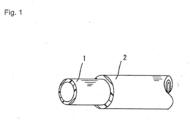
- Fig. 1 shows an example of a fuel hose of the present invention.
- a fuel hose of the present invention includes a tube-shaped inner layer 1 that allows fuel to flow therein and an outer layer 2 formed on the outer peripheral surface of the inner layer 1.
- the inner layer 1 is made of a resin composition (A) below.
- the outer layer 2. is made of a resin composition (B) below.
- the inner layer 1 and the outer layer 2 are bonded to each other through interlayer adhesion.
- the term "main component" of the resin compositions (A) and (B) below is a component that significantly affects the characteristics of the entire resin composition. In the present invention, the content of the main component is 50% or more by weight.
- the aromatic polyamide resin used as a material for the inner layer 1 is selected from the group consisting of polyamide 4T (PA4T), polyamide 6T (PA6T), polyamide MXD6 (PAMXD6), polyamide 9T (PA9T), polyamide 10T (PA10T), polyamide 11T (PA11T), polyamide 12T (PA12T), and polyamide 13T (PA13T). These resins may be used alone or in combination. In particular, PA9T is preferably used in terms of flexibility and barrier property.
- the organic acid salt having 10 to 28 carbon atoms is blended in the material for the inner layer 1.
- the organic acid salt preferably has 10 to 26 carbon atoms. If the number of carbon atoms is less than 10, an organic acid generated through dissociation of the organic acid salt is gasified at an extrusion temperature and left in the aromatic polyamide resin in the form of foam. As a result, a regular molded product is not obtained. If the number of carbon atoms is more than 28, the activity of the organic acid generated through dissociation of the organic acid salt is decreased, and thus the cleavage effect on an amide bond of the aromatic polyamide resin is decreased. As a result, a desired interlayer adhesion effect is not achieved.
- the organic acid salt is zinc stearate (C18) or calcium stearate (C18).
- Zinc stearate and calcium stearate are used because they are decomposed at a melting temperature (about 300°C) of the aromatic polyamide resin during melt extrusion and have high reactivity (cleavage effect on an amide bond caused by an acid generated from the organic acid salt) with the aromatic polyamide resin.
- the content of the organic acid salt in the resin composition (A) serving as a material for the inner layer 1 is preferably 0.05 to 5% by weight and more preferably 0.1 to 1% by weight. If the content is less than 0.05% by weight, a desired interlayer adhesion effect produced by the organic acid salt is not achieved. If the content is more than 5% by weight, the dissociation of amide bonds proceeds more favorably than the recombination thereof near the adhesive interface due to an acid generated through dissociation of an excessive amount of organic acid salt. As a result, a desired interlayer adhesion effect is also not achieved.
- Examples of the aliphatic polyamide resin used as a material for the outer layer 2 include polyamide 46 (PA46), polyamide 6 (PA6), polyamide 66 (PA66), polyamide 99 (PA99), polyamide 610 (PA610), polyamide 612 (PA612), polyamide 11 (PA11), polyamide 912 (PA912), polyamide 12 (PA12), a copolymer (PA6/66) of polyamide 6 and polyamide 66, and a copolymer (PA6/12) of polyamide 6 and polyamide 12. These resins may be used alone or in combination.
- the following additives may be optionally added to the material for the inner layer 1 and the material for the outer layer 2.
- the additives include pigments such as carbon black and titanium oxide; fillers such as calcium carbonate; plasticizers such as fatty acid esters, mineral oil, and butylbenzene sulfonamide; hindered phenol antioxidants; antioxidants such as phosphorus-based heat stabilizers; heat aging resistive agents; shock absorbers such as ⁇ -polyolefin; ultraviolet absorbers; antistatic agents; reinforcing agents such as organic fiber, glass fiber, carbon fiber, and metal whisker; and flame retardants.
- the fuel hose of the present invention shown in Fig. 1 can be produced as follows.
- the material for the inner layer 1 and the material for the outer layer 2 described above are prepared.
- the layer forming materials are coextruded with, for example, an extruder (multilayer extruder manufactured by Research Laboratory of Plastics Technology Co., Ltd.) while being melt-kneaded (the material for the inner layer is kneaded at 260 to 330°C and the material for the outer layer is kneaded at 200 to 250°C).
- the coextruded molten tube is then made to pass through a sizing die, and thus a fuel hose having a two-layer structure in which the outer layer 2 is formed on the outer peripheral surface of the inner layer 1 can be produced.
- the inner layer 1 and the outer layer 2 are satisfactorily bonded to each other due to the effect of the organic acid salt contained in the material for the inner layer 1.
- the coextruded molten tube is made to pass through a corrugating machine, and thus a pleated hose with a predetermined size can be produced.
- the inner diameter is preferably 1 to 40 mm and more preferably 2 to 36 mm.
- the outer diameter is preferably 2 to 44 mm and more preferably 3 to 40 mm.
- the thickness of the inner layer 1 is preferably 0.02 to 1.0 mm and more preferably 0.05 to 0.6 mm.
- the thickness of the outer layer 2 is preferably 0.03 to 1.5 mm and more preferably 0.05 to 1.0 mm.
- the structure of the fuel hose of the present invention is not limited to the two-layer structure shown in Fig. 1 , and may be a three-layer structure in which, for example, an innermost layer is formed on the inner peripheral surface of the inner layer 1.
- the innermost layer is preferably composed of a fluorocarbon resin because the fuel hose of the present invention has better low fuel permeability.
- the fluorocarbon resin include polyvinyl fluoride (PVF), polyvinylidene fluoride (PVDF), polychlorotrifluoroethylene (CTFE), and polytetrafluoroethylene (PTFE); copolymers such as a tetrafluoroethylene-hexafluoropropylene copolymer (FEP), a tetrafluoroethylene-perfluoroalkylvinylether copolymer (PFA), a tetrafluoroethylene-hexafluoropropylene-vinylidene fluoride copolymer (THV), an ethylene-tetrafluoroethylene copolymer (ETFE), and an ethylene-polychlorotrifluoroethylene copolymer (ECTFE); modified copolymers thereof; various graft polymers and blends; and
- the fuel hose of the present invention including the innermost layer formed on the inner peripheral surface of the inner layer 1 can be produced as follows.
- a material for the innermost layer is prepared together with the material for the inner layer 1 and the material for the outer layer 2.
- the materials for the innermost layer, inner layer 1, and outer layer 2 are coextruded.
- the material for the innermost layer is extruded with an extruder for the innermost layer so that the innermost layer is formed on the inner peripheral surface of the inner layer 1 that has been extruded by the production method described above.
- the resultant molten tube is made to pass through a sizing die, and thus a fuel hose including the innermost layer formed on the inner peripheral surface of the inner layer 1 can be produced.
- the thickness of the innermost layer is preferably 0.03 to 0.5 mm and more preferably 0.05 to 0.3 mm.
- the preferred ranges of the thicknesses of the inner layer 1 and outer layer 2 and the inner diameter and outer diameter of hoses are the same as those described above.
- the fuel hose of the present invention may optionally include, for example, an outermost layer composed of a proper material and formed on the outer peripheral surface of the outer layer 2.
- the fuel hose of the present invention is suitably used as a transport hose for automotive fuels such as gasoline, alcohol-blended gasoline, diesel fuel, compressed natural gas (CNG), and liquefied petroleum gas (LPG), but is not limited thereto.
- the fuel hose of the present invention can also be used as a transport hose for fuel-cell-powered vehicle fuels such as methanol, hydrogen, and dimethyl ether (DME).
- a hose was then produced using the above materials as described below.
- Materials for an innermost layer (only Examples 16 to 21), materials for an inner layer, and materials for an outer layer shown in Tables 1 to 5 below were prepared. These materials were melt-kneaded and coextruded using an extruder (multilayer extruder manufactured by Research Laboratory of Plastics Technology Co., Ltd.) to produce a smooth hose having an inner diameter of 6 mm.
- an extruder multilayer extruder manufactured by Research Laboratory of Plastics Technology Co., Ltd.
- the thickness of the inner layer was 0.3 mm and the thickness of the outer layer was 0.7 mm.
- the thickness of the innermost layer was 0.05 mm
- the thickness of the inner layer was 0.25,mm
- the thickness of the outer layer was 0.7 mm.
- Example 1 Example 1 2 3 4* 5* Material for inner layer PA9T (i) PA9T (i) PA9T (i) PA9T (i) PA9T (i) PA9T (i) 99.95 wt% 99.5 wt% 95.0 wt% 99.5 wt% 99.5 wt% Organic acid salt (i) Organic acid salt (i) Organic acid salt (ii) Organic acid salt (iii) 0.05 wt% 0.5wt% 5.0 wt% 0.5 wt% 0.5 wt% Material for outer layer PA12 PA12 PA12 PA12 PA12 PA12 PA12 PA12 PA12 100 wt% 100 wt% 100 wt% 100 wt% 100 wt% * reference example (not falling within the scope of the present invention) [Table 2] Example 6 7 Material for inner layer PA9T (i) PA9T (i) 99.5 wt% 99.5 wt% Organic acid salt (i) Organic acid salt (i) 0.5 wt% 0.5 w
- the permeation coefficient (unit: mg/m/day) of an alcohol-blended model gasoline obtained by mixing toluene/isooctane/ethanol at a volume ratio of 45:45:10 was measured at 40°C for one month using a constant-pressure permeation rate measuring apparatus for hoses (GTR-TUBE3-TG manufactured by GTR Tec Corporation).
- the value shown in Tables is a value when equilibrium is reached. When the value was less than 50 (mg/m/day), an evaluation of " ⁇ " was given. When the value was 50 (mg/m/day) or more, an evaluation of "x" was given.
- Each of the hoses was cut into strips having a width of 10 mm to obtain a sample.
- the sample was delaminated into its constituent layers (inner layer/outer layer in Examples 1 to 14 and Comparative Examples 1 and 2, innermost layer/inner layer and inner layer/outer layer in Examples 15 to 20).
- the layers were then each set in a chuck of a tensile testing machine, and 180° peel strength (N/cm) was measured at a cross head speed of 50 mm/minute.
- N/cm 180° peel strength
- Example 1 2 3 4* 5* 6 7 Fuel permeation rate (mg/m/day) 8.3 8.6 8.7 8.9 8.6 8.6 8.7 Evaluation ⁇ ⁇ ⁇ ⁇ ⁇ ⁇ ⁇ ⁇ ⁇ Interlayer adhesive strength (N/cm) Inner layer /Outer layer 15 24 18 27 29 21 18 Evaluation ⁇ ⁇ ⁇ ⁇ ⁇ ⁇ ⁇ [Table 7]
- Example 8 9 10 11 12* 13 14 15* Fuel permeation rate (mg/m/day) 7.6 9.2 9.2 8.9 8.5 8.6 8.2 8.9 Evaluation ⁇ ⁇ ⁇ ⁇ ⁇ ⁇ ⁇ Interlayer adhesive strength (N/cm) Inner layer /Outer layer 20 18 20 22 16 10 13 22 Evaluation ⁇ ⁇ ⁇ ⁇ ⁇ ⁇ ⁇ * reference example (not falling within the scope of the present invention) [Table 8]
- the hoses of Examples 1 to 21 each had a low fuel permeation rate and good interlayer adhesion.
- the hose of Comparative Example 1 had a layered structure including a PA9T inner layer and a PA12 outer layer as in the hoses of Examples, but a certain organic acid salt was not contained in the material for the inner layer.
- the interlayer adhesion achieved in Examples was not provided.
- the hose of Comparative Example 2 could not be molded because foaming occurred in the inner layer.
- the fuel hose of the present invention can be suitably used as a transport hose for automotive fuels such as gasoline, alcohol-blended gasoline, diesel fuel, compressed natural gas (CNG), and liquefied petroleum gas (LPG).
- automotive fuels such as gasoline, alcohol-blended gasoline, diesel fuel, compressed natural gas (CNG), and liquefied petroleum gas (LPG).
Landscapes
- Engineering & Computer Science (AREA)
- General Engineering & Computer Science (AREA)
- Mechanical Engineering (AREA)
- Rigid Pipes And Flexible Pipes (AREA)
- Laminated Bodies (AREA)
Description
- The present invention relates to a fuel hose used as a transport hose for automotive fuels or the like (e.g., gasoline, alcohol-blended gasoline, and diesel fuel) and to a method for producing the fuel hose.
- In recent years, in the automobile industry, the evaporation of fuel gas has been increasingly strictly regulated, and various low-permeation fuel hoses that satisfy the strict regulation have been investigated.. Hoses made of a fluorocarbon resin have been mainly used as fuel hoses. However, when low fuel permeability is more strictly required, the thickness of the fluorocarbon resin layer needs to be increased and thus the cost of hoses increases. Therefore, aromatic polyamide resins such as polyphenylene sulfide resin (PPS) and polyamide 9T (PA9T) and aromatic polyester resins such as polybutylene terephthalate (PBT) have been receiving attention as resins that are cheaper than fluorocarbon resins and that have good low fuel permeability. Various hoses including a low-fuel-permeability layer composed of the above-described resin have been proposed recently (e.g., refer to PTLs 1 to 3).
-
- PTL 1:
Japanese Unexamined Patent Application Publication No. 10-138372 - PTL 2:
Japanese Unexamined Patent Application Publication No. 2003-287165 - PTL 3:
Japanese Unexamined Patent Application Publication No. 2003-110736 - An aromatic polyamide resin such as PA9T that particularly has good low fuel permeability and is used as a material for hoses has high rigidity. A single layer hose composed of only the aromatic polyamide resin has poor flexibility and, particularly, is vulnerable to a shock at low temperature, which easily causes the breakage of hoses. To solve the problem, there has been considered a hose having a layered structure in which the thickness of the aromatic polyamide resin layer is decreased and an outer layer composed of a flexible thermoplastic resin such as an aliphatic polyamide resin or a polyethylene resin is formed on the outer peripheral surface of the aromatic polyamide resin layer. However, the aromatic polyamide resin has poor adhesion with other materials. When the inner layer and the outer layer are laminated with each other, an adhesive layer normally needs to be formed at an interface between the layers. This poses problems in that the production process becomes complicated due to the formation of the adhesive layer and the weight of hoses is increased.
- In view of the foregoing, an object of the present invention is to provide a fuel hose having good low fuel permeability and interlayer adhesion and a method for producing the fuel hose.
- To achieve the object above, according to a first aspect of the present invention, a fuel hose includes a tube-shaped inner layer made of a resin composition (A) below and an outer layer formed on an outer peripheral surface of the inner layer and made of a resin composition (B) below, wherein the inner layer and the outer layer are bonded to each other through interlayer adhesion.
- 1. (A) a resin composition that contains an aromatic polyamide resin, wherein the aromatic polyamide resin is selected from the group consisting of polyamide 4T (PA4T), polyamide 6T (PA6T), polyamide MXD6 (PAMXD6), polyamide 9T (PA9T), polyamide 10T (PA10T), polyamide 11T (PA11T), polyamide 12T (PA12T), and polyamide 13T (PA13T), alone or in combination, as a main component, wherein the content of the main component is 50% or more by weight, and an organic acid salt having 10 to 28 carbon atoms, wherein the organic acid salt is calcium stearate (C18) or zinc stearate (C18)
- 2. (B) a resin composition that contains an aliphatic polyamide resin as a main component, wherein the content of the main component is 50% or more by weight
- According to a second aspect of the present invention, a method for producing the fuel hose according to the first aspect includes coextruding the resin composition (A) for forming the inner layer and the resin composition (B) for forming the outer layer by melt extrusion.
- The inventors of the present invention have eagerly studied to solve the problems above. Regarding the hose having a layered structure in which an outer layer composed of an aliphatic polyamide resin such as PA12 is formed on the outer peripheral surface of an inner layer composed of an aromatic polyamide resin such as PA9T having good low fuel permeability, the inventors have focused on an improvement in the interlayer adhesion between the inner layer and the outer layer. In the process of the study, the inventors have found that poor interlayer adhesion between the inner layer and the outer layer in the above-described hose having a layered structure is caused, for example, due to the following reason. That is, the amide bond (-CONH-) of the aliphatic polyamide resin.serving as a material for the outer layer is easily cleaved (-CO NH-) through heat fusion during melt extrusion whereas the amide bond of the aromatic polyamide resin serving as a material for the inner layer is not easily cleaved only through heat fusion. As a result of further study, the inventors have found the following and have completed the present invention. That is, by blending a certain organic acid salt in the material for the inner layer, the amide bond of the aromatic polyamide resin serving as a material for the inner layer is easily cleaved (the organic acid salt is dissociated by heat during molding processing, and an acid generated through the dissociation of the organic acid salt easily causes the cleavage of the amide bond). Near the head of an extruder, the -CO NH- obtained by the cleavage of the amide bonds of both the layers form amide bonds again in the inner layer, in the outer layer, and between the inner layer and the outer layer (amide-converting reaction). Therefore, a desired interlayer adhesive strength is achieved.
- As described above, the fuel hose of the present invention includes a tube-shaped inner layer made of a resin composition that contains an aromatic polyamide resin, such as PA9T, as a main component and an outer layer made of a resin composition that contains an aliphatic polyamide resin as a main component, the resin composition for forming the inner layer containing an organic acid salt having 10 to 28 carbon atoms, wherein the organic acid salt is a calcium or zinc salt of a saturated fatty acid. Therefore, the fuel hose of the present invention is a lightweight fuel hose having good interlayer adhesion, low fuel permeability, flexibility, low-temperature shock resistance, and heat resistance. In the fuel hose of the present invention, the layers can be bonded to each other without using an adhesive and the cost of materials is low. Thus, a fuel hose with high performance can be produced at low cost.
- When the fuel hose further includes an innermost layer on an inner peripheral surface of the inner layer, the innermost layer being composed of a fluorocarbon resin, better low fuel permeability is achieved.
- In the fuel hose, the resin composition for forming the inner layer and the resin composition for forming the outer layer are coextruded by melt extrusion, whereby the inner layer and the outer layer are bonded to each other through interlayer adhesion without using an adhesive due to the effect of the organic acid salt contained in the material for the inner layer.
- [
Fig. 1] Fig. 1 shows an example of a fuel hose of the present invention. - An embodiment of the present invention will now be described.
- As shown in
Fig. 1 , a fuel hose of the present invention includes a tube-shaped inner layer 1 that allows fuel to flow therein and anouter layer 2 formed on the outer peripheral surface of the inner layer 1. The inner layer 1 is made of a resin composition (A) below. The outer layer 2.is made of a resin composition (B) below. In this fuel hose, the inner layer 1 and theouter layer 2 are bonded to each other through interlayer adhesion. Note that the term "main component" of the resin compositions (A) and (B) below is a component that significantly affects the characteristics of the entire resin composition. In the present invention, the content of the main component is 50% or more by weight. - 1. (A) a resin composition that contains an aromatic polyamide resin as a main component, wherein the aromatic polyamide resin is selected from the group consisting of polyamide 4T (PA4T), polyamide 6T (PA6T), polyamide MXD6 (PAMXD6), polyamide 9T (PA9T), polyamide 10T (PA10T), polyamide 11T (PA11T), polyamide 12T (PA12T), and polyamide 13T (PA13T), alone or in combination, and an organic acid salt having 10 to 28 carbon atoms, wherein the organic acid salt is calcium stearate (C18) or zinc stearate (C18)
- 2. (B) a resin composition that contains an aliphatic polyamide resin as a main component
- According to the present invention, the aromatic polyamide resin used as a material for the inner layer 1 is selected from the group consisting of polyamide 4T (PA4T), polyamide 6T (PA6T), polyamide MXD6 (PAMXD6), polyamide 9T (PA9T), polyamide 10T (PA10T), polyamide 11T (PA11T), polyamide 12T (PA12T), and polyamide 13T (PA13T). These resins may be used alone or in combination. In particular, PA9T is preferably used in terms of flexibility and barrier property.
- As described above, the organic acid salt having 10 to 28 carbon atoms is blended in the material for the inner layer 1. The organic acid salt preferably has 10 to 26 carbon atoms. If the number of carbon atoms is less than 10, an organic acid generated through dissociation of the organic acid salt is gasified at an extrusion temperature and left in the aromatic polyamide resin in the form of foam. As a result, a regular molded product is not obtained. If the number of carbon atoms is more than 28, the activity of the organic acid generated through dissociation of the organic acid salt is decreased, and thus the cleavage effect on an amide bond of the aromatic polyamide resin is decreased. As a result, a desired interlayer adhesion effect is not achieved. In view of the foregoing, the organic acid salt is zinc stearate (C18) or calcium stearate (C18). Zinc stearate and calcium stearate are used because they are decomposed at a melting temperature (about 300°C) of the aromatic polyamide resin during melt extrusion and have high reactivity (cleavage effect on an amide bond caused by an acid generated from the organic acid salt) with the aromatic polyamide resin.
- The content of the organic acid salt in the resin composition (A) serving as a material for the inner layer 1 is preferably 0.05 to 5% by weight and more preferably 0.1 to 1% by weight. If the content is less than 0.05% by weight, a desired interlayer adhesion effect produced by the organic acid salt is not achieved. If the content is more than 5% by weight, the dissociation of amide bonds proceeds more favorably than the recombination thereof near the adhesive interface due to an acid generated through dissociation of an excessive amount of organic acid salt. As a result, a desired interlayer adhesion effect is also not achieved.
- Examples of the aliphatic polyamide resin used as a material for the
outer layer 2 include polyamide 46 (PA46), polyamide 6 (PA6), polyamide 66 (PA66), polyamide 99 (PA99), polyamide 610 (PA610), polyamide 612 (PA612), polyamide 11 (PA11), polyamide 912 (PA912), polyamide 12 (PA12), a copolymer (PA6/66) of polyamide 6 and polyamide 66, and a copolymer (PA6/12) of polyamide 6 and polyamide 12. These resins may be used alone or in combination. - In addition to the resin, which is a main component, and the organic acid salt added to the resin, the following additives may be optionally added to the material for the inner layer 1 and the material for the
outer layer 2. Examples of the additives include pigments such as carbon black and titanium oxide; fillers such as calcium carbonate; plasticizers such as fatty acid esters, mineral oil, and butylbenzene sulfonamide; hindered phenol antioxidants; antioxidants such as phosphorus-based heat stabilizers; heat aging resistive agents; shock absorbers such as α-polyolefin; ultraviolet absorbers; antistatic agents; reinforcing agents such as organic fiber, glass fiber, carbon fiber, and metal whisker; and flame retardants. - The fuel hose of the present invention shown in
Fig. 1 can be produced as follows. The material for the inner layer 1 and the material for theouter layer 2 described above are prepared. The layer forming materials are coextruded with, for example, an extruder (multilayer extruder manufactured by Research Laboratory of Plastics Technology Co., Ltd.) while being melt-kneaded (the material for the inner layer is kneaded at 260 to 330°C and the material for the outer layer is kneaded at 200 to 250°C). The coextruded molten tube is then made to pass through a sizing die, and thus a fuel hose having a two-layer structure in which theouter layer 2 is formed on the outer peripheral surface of the inner layer 1 can be produced. Through this melt extrusion (coextrusion), the inner layer 1 and theouter layer 2 are satisfactorily bonded to each other due to the effect of the organic acid salt contained in the material for the inner layer 1. - In the case where a fuel hose having a pleated shape is produced, the coextruded molten tube is made to pass through a corrugating machine, and thus a pleated hose with a predetermined size can be produced.
- In the thus-obtained fuel hose of the present invention, the inner diameter is preferably 1 to 40 mm and more preferably 2 to 36 mm. The outer diameter is preferably 2 to 44 mm and more preferably 3 to 40 mm. The thickness of the inner layer 1 is preferably 0.02 to 1.0 mm and more preferably 0.05 to 0.6 mm. The thickness of the
outer layer 2 is preferably 0.03 to 1.5 mm and more preferably 0.05 to 1.0 mm. - The structure of the fuel hose of the present invention is not limited to the two-layer structure shown in
Fig. 1 , and may be a three-layer structure in which, for example, an innermost layer is formed on the inner peripheral surface of the inner layer 1. - The innermost layer is preferably composed of a fluorocarbon resin because the fuel hose of the present invention has better low fuel permeability. Examples of the fluorocarbon resin include polyvinyl fluoride (PVF), polyvinylidene fluoride (PVDF), polychlorotrifluoroethylene (CTFE), and polytetrafluoroethylene (PTFE); copolymers such as a tetrafluoroethylene-hexafluoropropylene copolymer (FEP), a tetrafluoroethylene-perfluoroalkylvinylether copolymer (PFA), a tetrafluoroethylene-hexafluoropropylene-vinylidene fluoride copolymer (THV), an ethylene-tetrafluoroethylene copolymer (ETFE), and an ethylene-polychlorotrifluoroethylene copolymer (ECTFE); modified copolymers thereof; various graft polymers and blends; and conductive fluorocarbon resins to which conductivity is imparted by adding carbon black, carbon fiber, carbon nanotube, a conductive polymer, or the like to the above resin. These resins may be used alone or in combination.
- The fuel hose of the present invention including the innermost layer formed on the inner peripheral surface of the inner layer 1 can be produced as follows. A material for the innermost layer is prepared together with the material for the inner layer 1 and the material for the
outer layer 2. On the basis of the production method described above, the materials for the innermost layer, inner layer 1, andouter layer 2 are coextruded. Alternatively, the material for the innermost layer is extruded with an extruder for the innermost layer so that the innermost layer is formed on the inner peripheral surface of the inner layer 1 that has been extruded by the production method described above. The resultant molten tube is made to pass through a sizing die, and thus a fuel hose including the innermost layer formed on the inner peripheral surface of the inner layer 1 can be produced. - In the fuel hose of the present invention, the thickness of the innermost layer is preferably 0.03 to 0.5 mm and more preferably 0.05 to 0.3 mm. In the fuel hose of the present invention including the innermost layer, the preferred ranges of the thicknesses of the inner layer 1 and
outer layer 2 and the inner diameter and outer diameter of hoses are the same as those described above. - The fuel hose of the present invention may optionally include, for example, an outermost layer composed of a proper material and formed on the outer peripheral surface of the
outer layer 2. - The fuel hose of the present invention is suitably used as a transport hose for automotive fuels such as gasoline, alcohol-blended gasoline, diesel fuel, compressed natural gas (CNG), and liquefied petroleum gas (LPG), but is not limited thereto. The fuel hose of the present invention can also be used as a transport hose for fuel-cell-powered vehicle fuels such as methanol, hydrogen, and dimethyl ether (DME).
- Examples will now be described together with Comparative Examples. The present invention is not limited to Examples.
- First, the following materials were prepared prior to Examples and Comparative Examples.
- [PA9T (i)]
Genestar N1001A (melting point: 304°C) manufactured by KURARAY CO., LTD. - [PA9T (ii)]
Genestar N1001D (melting point: 262°C) manufactured by KURARAY CO., LTD. - [PA6T]
ARLEN AE4200 manufactured by Mitsui Chemicals, Inc. - [MXD6]
Reny S6007 manufactured by MITSUBISHI GAS CHEMICAL COMPANY, INC. - [PA10T]
Rilsan HT manufactured by Arkema K.K. - [Organic acid salt (i)]
Zinc stearate manufactured by Wako Pure Chemical Industries, Ltd. - [Organic acid salt (ii)]
Zinc laurate manufactured by Wako Pure Chemical Industries, Ltd. - [Organic acid salt (iii)]
Zinc octanoate manufactured by Wako Pure Chemical Industries, Ltd. - [Organic acid salt (iv)]
Calcium stearate manufactured by Wako Pure Chemical Industries, Ltd. - [Organic acid salt (v)]
Copper (II) stearate manufactured by Wako Pure Chemical Industries, Ltd. - [Organic acid salt (vi)]
ZS-8 (zinc montanate) manufactured by NITTO KASEI KOGYO K.K. - [Organic acid salt (vii)]
Zinc hexanoate manufactured by Mitsuwa Chemicals Co., Ltd. - [PA12]
Rilsan AESN NOIR P20TL manufactured by Arkema K.K. - [PA610]
Amilan CM2402 manufactured by Toray Industries, Inc. - [PA612]
UBE Nylon 7034U manufactured by Ube Industries, Ltd. - [Shock absorber]
Tafmer A-4085 (α-polyolefin) manufactured by Mitsui Chemicals, Inc. - [Plasticizer]
Butylbenzene sulfonamide manufactured by Wako Pure Chemical Industries, Ltd. - [Heat aging resistive agent]
IRGANOX 1010 manufactured by Ciba Japan - [Fluorocarbon resin]
Neoflon RP5000 manufactured by DAIKIN INDUSTRIES, Ltd. - [Conductive fluorocarbon resin]
Neoflon RP5000AS manufactured by DAIKIN INDUSTRIES, Ltd. - A hose was then produced using the above materials as described below.
- Materials for an innermost layer (only Examples 16 to 21), materials for an inner layer, and materials for an outer layer shown in Tables 1 to 5 below were prepared. These materials were melt-kneaded and coextruded using an extruder (multilayer extruder manufactured by Research Laboratory of Plastics Technology Co., Ltd.) to produce a smooth hose having an inner diameter of 6 mm. When the smooth hose had a two-layer structure, the thickness of the inner layer was 0.3 mm and the thickness of the outer layer was 0.7 mm. When the smooth hose had a three-layer structure, the thickness of the innermost layer was 0.05 mm, the thickness of the inner layer was 0.25,mm, and the thickness of the outer layer was 0.7 mm.
[Table 1] Example 1 2 3 4* 5* Material for inner layer PA9T (i) PA9T (i) PA9T (i) PA9T (i) PA9T (i) 99.95 wt% 99.5 wt% 95.0 wt% 99.5 wt% 99.5 wt% Organic acid salt (i) Organic acid salt (i) Organic acid salt (i) Organic acid salt (ii) Organic acid salt (iii) 0.05 wt% 0.5wt% 5.0 wt% 0.5 wt% 0.5 wt% Material for outer layer PA12 PA12 PA12 PA12 PA12 100 wt% 100 wt% 100 wt% 100 wt% 100 wt% * reference example (not falling within the scope of the present invention) [Table 2] Example 6 7 Material for inner layer PA9T (i) PA9T (i) 99.5 wt% 99.5 wt% Organic acid salt (i) Organic acid salt (i) 0.5 wt% 0.5 wt% Material for outer layer PA610 PA612 79.95 wt% 79.95 wt% Shock absorber Shock absorber 10.0 wt% 10.0 wt% Plasticizer Plasticizer 10.0 wt% 10.0 wt% Heat aging resistive agent Heat aging resistive agent 0.05 wt% 0.05 wt% [Table 3] Example 8 9 10 11 12* 13 14 15* Material for inner layer PA6T MXD6 PA10T PA9T (i) PA9T (i) PA9T (i) PA9T (i) PA9T (i) 99.5 wt% 99.5 wt% 99.5 wt% 99.5 wt% 99.5 wt% 99.99 wt% 90.0 wt% 99.5 wt% Organic acid salt (i) Organic acid salt (i) Organic acid salt (i) Organic acid salt (iv) Organic acid salt (v) Organic acid salt (i) Organic acid salt (i) Organic acid salt (vi) 0.5 wt% 0.5 wt% 0.5 wt% 0.5 wt% 0.5 wt% 0.01 wt% 10.0 wt% 0.5 wt% Material for outer layer PA12 PA12 PA12 PA12 PA12 PA12 PA12 PA12 100 wt% 100 wt% 100 wt% 100 wt% 100 wt% 100 wt% 100 wt% 100 wt% * reference example (not falling within the scope of the present invention) [Table 4] Example 16 17 18 19 20 21 Material for innermost layer Fluorocarbon resin Conductive fluorocarbon resin Fluorocarbon resin Fluorocarbon resin Fluorocarbon resin Fluorocarbon resin 100 wt% 100 wt% 100 wt% 100 wt% 100 wt% 100 wt% Material for inner layer PA9T (i) PA9T (i) PA9T (i) PA9T (i) PA9T (ii) PA9T (ii) 99.5 wt% 99.5 wt% 99.5 wt% 99.5 wt% 99.5 wt% 99.5 wt% Organic acid salt (i) Organic acid salt (i) Organic acid salt (i) Organic acid salt (i) Organic acid salt (i) Organic acid salt (i) 0.5 wt% 0.5 wt% 0.5 wt% 0.5 wt% 0.5 wt% 0.5 wt% Material for outer layer PA12 PA12 PA610 PA612 PA610 PA612 100 wt% 100 wt% 79.95 wt% 79.95 wt% 79.95 wt% 79.95 wt% - - Shock absorber Shock absorber Shock absorber Shock absorber - - 10.0 wt% 10.0 wt% 10.0 wt% 10.0 wt% - - Plasticizer Plasticizer Plasticizer Plasticizer - - 10.0 wt% 10.0 wt% 10.0 wt%. 10.0 wt% - - Heat aging resistive agent Heat aging resistive agent Heat aging resistive agent Heat aging resistive agent - - 0.05 wt% 0.05 wt% 0.05 wt% 0.05 wt% [Table 5] Comparative Example 1 2 Material for inner layer PA9T (i) PA9T (i) 100 wt% 99.95 wt% - Organic acid salt (vii) - 0.05 wt% Material for outer layer PA12 PA12 100 wt% 100 wt% - The characteristics of the thus-obtained hoses of Examples and Comparative Examples were evaluated in accordance with the criteria below. Tables 6 to 9 collectively show the results.
- Regarding each of the hoses, the permeation coefficient (unit: mg/m/day) of an alcohol-blended model gasoline obtained by mixing toluene/isooctane/ethanol at a volume ratio of 45:45:10 was measured at 40°C for one month using a constant-pressure permeation rate measuring apparatus for hoses (GTR-TUBE3-TG manufactured by GTR Tec Corporation). The value shown in Tables is a value when equilibrium is reached. When the value was less than 50 (mg/m/day), an evaluation of "○" was given. When the value was 50 (mg/m/day) or more, an evaluation of "x" was given.
- Each of the hoses was cut into strips having a width of 10 mm to obtain a sample. The sample was delaminated into its constituent layers (inner layer/outer layer in Examples 1 to 14 and Comparative Examples 1 and 2, innermost layer/inner layer and inner layer/outer layer in Examples 15 to 20). The layers were then each set in a chuck of a tensile testing machine, and 180° peel strength (N/cm) was measured at a cross head speed of 50 mm/minute. In terms of interlayer adhesion, when the peel strength was 20 N/cm or more, an evaluation of "○" was given. When the peel strength was 15 N/cm or more and less than 20 N/cm, an evaluation of "Δ" was given. When the peel strength was 10 N/cm or more and less than 15 N/cm, an evaluation of "ΔΔ" was given. When the peel strength was less than 10 N/cm, an evaluation of "x" was given. In the present invention, an evaluation of "○", "Δ", or "ΔΔ" is required.
[Table 6] Example 1 2 3 4* 5* 6 7 Fuel permeation rate (mg/m/day) 8.3 8.6 8.7 8.9 8.6 8.6 8.7 Evaluation ○ ○ ○ ○ ○ ○ ○ Interlayer adhesive strength (N/cm) Inner layer /Outer layer 15 24 18 27 29 21 18 Evaluation Δ ○ Δ ○ ○ ○ Δ [Table 7] Example 8 9 10 11 12* 13 14 15* Fuel permeation rate (mg/m/day) 7.6 9.2 9.2 8.9 8.5 8.6 8.2 8.9 Evaluation ○ ○ ○ ○ ○ ○ ○ ○ Interlayer adhesive strength (N/cm) Inner layer /Outer layer 20 18 20 22 16 10 13 22 Evaluation ○ Δ ○ ○ Δ ΔΔ ΔΔ ○ * reference example (not falling within the scope of the present invention) [Table 8] Example 16 17 18 19 20 21 Fuel permeation rate (mg/m/day) 8.3 8.4 8.6 8.5 12.2 12.3 Evaluation ○ ○ ○ ○ ○ ○ Interlayer adhesive strength (N/cm) Innermost layer/Inner layer 24 25 21 23 28 27 Inner layer /Outer layer 24 25 22 22 26 25 Evaluation ○ ○ ○ ○ ○ ○ [Table 9] Comparative Example 1 2 Fuel permeation rate (mg/m/day) 8.6 * Evaluation ○ × Interlayer adhesive strength (N/cm) Inner layer /Outer layer 0.9 * Evaluation × × *Foaming occurred in the inner layer and thus the hose could not be molded. - As is clear from the results above, the hoses of Examples 1 to 21 each had a low fuel permeation rate and good interlayer adhesion.
- In contrast, the hose of Comparative Example 1 had a layered structure including a PA9T inner layer and a PA12 outer layer as in the hoses of Examples, but a certain organic acid salt was not contained in the material for the inner layer. Thus, the interlayer adhesion achieved in Examples was not provided. The hose of Comparative Example 2 could not be molded because foaming occurred in the inner layer.
- In Examples above, specific configurations of the present invention have been described. However, Examples above are merely examples and the present invention should not be interpreted in a restrictive manner. Furthermore, all modifications and alterations within the scope of the claims are within the scope of the present invention.
- The fuel hose of the present invention can be suitably used as a transport hose for automotive fuels such as gasoline, alcohol-blended gasoline, diesel fuel, compressed natural gas (CNG), and liquefied petroleum gas (LPG).
-
- 1
- inner layer
- 2
- outer layer
Claims (5)
- A fuel hose comprising a tube-shaped inner layer made of a resin composition (A) below and an outer layer formed on an outer peripheral surface of the inner layer and made of a resin composition (B) below,(A) a resin composition that contains an aromatic polyamide resin,
wherein the aromatic polyamide resin is selected from the group consisting of polyamide 4T (PA4T), polyamide 6T (PA6T), polyamide MXD6 (PAMXD6), polyamide 9T (PA9T), polyamide 10T (PA10T), polyamide 11T (PA11T), polyamide 12T (PA12T), and polyamide 13T (PA13T), alone or in combination, as a main component, wherein the content of the main component is 50% or more by weight, and an organic acid salt having 10 to 28 carbon atoms(B) a resin composition (B) that contains an aliphatic polyamide resin as a main component, wherein the content of the main component is 50% or more by weightwherein the inner layer and the outer layer are bonded to each other through interlayer adhesion, andwherein the organic acid salt contained in the resin composition (A) is calcium stearate (C18) or zinc stearate (C18). - The fuel hose according to Claim 1, wherein the aromatic polyamide resin serving as a main component of the resin composition (A) is polyamide 9T (PA9T).
- The fuel hose according to Claim 1 or 2, wherein the content of the organic acid salt in the resin composition (A) is 0.05 to 5% by weight.
- The fuel hose according to any one of Claims 1 to 3, further comprising an innermost layer on an inner peripheral surface of the inner layer, the innermost layer being composed of a fluorocarbon resin.
- A method for producing the fuel hose according to any one of Claims 1 to 4, the method comprising coextruding the resin composition (A) for forming the inner layer and the resin composition (B) for forming the outer layer by melt extrusion.
Applications Claiming Priority (2)
| Application Number | Priority Date | Filing Date | Title |
|---|---|---|---|
| JP2010080416A JP5568356B2 (en) | 2010-03-31 | 2010-03-31 | Fuel hose and manufacturing method thereof |
| PCT/JP2011/053278 WO2011122143A1 (en) | 2010-03-31 | 2011-02-16 | Fuel hose and method for producing same |
Publications (5)
| Publication Number | Publication Date |
|---|---|
| EP2554887A1 EP2554887A1 (en) | 2013-02-06 |
| EP2554887A4 EP2554887A4 (en) | 2014-07-09 |
| EP2554887B1 EP2554887B1 (en) | 2017-08-09 |
| EP2554887B2 EP2554887B2 (en) | 2023-09-20 |
| EP2554887B9 true EP2554887B9 (en) | 2023-12-27 |
Family
ID=44711878
Family Applications (1)
| Application Number | Title | Priority Date | Filing Date |
|---|---|---|---|
| EP11762384.3A Active EP2554887B9 (en) | 2010-03-31 | 2011-02-16 | Fuel hose and method for producing same |
Country Status (5)
| Country | Link |
|---|---|
| US (1) | US20120012222A1 (en) |
| EP (1) | EP2554887B9 (en) |
| JP (1) | JP5568356B2 (en) |
| CN (1) | CN102483185B (en) |
| WO (1) | WO2011122143A1 (en) |
Families Citing this family (12)
| Publication number | Priority date | Publication date | Assignee | Title |
|---|---|---|---|---|
| EP2467916A4 (en) | 2009-08-21 | 2014-06-04 | Titeflex Corp | ENERGY DISSIPATING TUBES, SEALING DEVICES AND METHODS OF MANUFACTURING AND INSTALLATION THEREOF |
| WO2013058027A1 (en) * | 2011-10-21 | 2013-04-25 | 宇部興産株式会社 | Polyamide resin composition and hollow molded body containing same |
| JP5883370B2 (en) * | 2012-09-25 | 2016-03-15 | 住友理工株式会社 | Resin composition for fuel tube and fuel tube |
| ITTO20120926A1 (en) * | 2012-10-19 | 2014-04-20 | Dytech Dynamic Fluid Tech Spa | MULTILAYER PIPE FOR AIR CONDITIONING SYSTEMS FOR VEHICLES |
| EP2772354B1 (en) * | 2013-03-01 | 2018-12-05 | TI Automotive (Fuldabrück) GmbH | Multilayer fuel pipe |
| WO2015033982A1 (en) | 2013-09-04 | 2015-03-12 | 宇部興産株式会社 | Laminated tube |
| EP3069875B1 (en) | 2015-03-17 | 2017-07-05 | Evonik Degussa GmbH | Multilayer compound with one fluoropolymer layer |
| FR3046827B1 (en) | 2016-01-15 | 2018-05-25 | Arkema France | MULTILAYER TUBULAR STRUCTURE HAVING IMPROVED RESISTANCE TO EXTRACTION IN BIO-GASOLINE AND USE THEREOF |
| CN109311259B (en) | 2016-03-31 | 2021-05-25 | 宇部兴产株式会社 | Laminated tubes |
| EP3406440B1 (en) * | 2017-05-23 | 2022-11-02 | Cooper-Standard Automotive (Deutschland) GmbH | Multilayer tube for guiding fuel fluid and method of manufacturing same |
| US20190360616A1 (en) * | 2018-05-24 | 2019-11-28 | GM Global Technology Operations LLC | High temperature resistant multilayer tubing |
| JP7602882B2 (en) * | 2020-09-07 | 2024-12-19 | 住友理工株式会社 | Fuel tube and manufacturing method thereof |
Family Cites Families (15)
| Publication number | Priority date | Publication date | Assignee | Title |
|---|---|---|---|---|
| JP3150280B2 (en) | 1995-12-13 | 2001-03-26 | 電気化学工業株式会社 | Polyester-based multilayer sheet, container, and method for producing the same |
| JP3969461B2 (en) | 1996-11-08 | 2007-09-05 | 東レ株式会社 | Multilayer fuel tube |
| US6166171A (en) | 1998-03-06 | 2000-12-26 | Mitsubishi Gas Chemical Company, Inc. | Polyamide resin composition |
| JP2003110736A (en) | 2001-10-01 | 2003-04-11 | Nakayo Telecommun Inc | Moving image distribution server |
| JP2003287165A (en) | 2002-01-24 | 2003-10-10 | Tokai Rubber Ind Ltd | Hose for fuel |
| JP2004123773A (en) * | 2002-09-30 | 2004-04-22 | Asahi Kasei Chemicals Corp | Copolyamide resin composition |
| JP4175942B2 (en) † | 2002-10-29 | 2008-11-05 | 株式会社クラレ | Laminated structure |
| JP2005178078A (en) * | 2003-12-17 | 2005-07-07 | Ube Ind Ltd | Laminated structure |
| CN100519167C (en) † | 2004-04-27 | 2009-07-29 | 宇部兴产株式会社 | Multilayer hose for transporting high-temperature chemical and/or gas |
| JP4619885B2 (en) * | 2005-07-26 | 2011-01-26 | 三桜工業株式会社 | Multi-layer resin tube |
| JP2007090563A (en) * | 2005-09-27 | 2007-04-12 | Tokai Rubber Ind Ltd | Low-permeability hose and its manufacturing method |
| KR101455565B1 (en) † | 2006-05-31 | 2014-10-28 | 미츠비시 가스 가가쿠 가부시키가이샤 | Polyamide resin composition |
| ATE478762T1 (en) * | 2006-09-26 | 2010-09-15 | Dytech Dynamic Fluid Technolog | MULTI-LAYER PIPE FOR CONDUCTING FUEL IN A MOTOR VEHICLE |
| CN101224649A (en) * | 2007-01-17 | 2008-07-23 | 福懋兴业股份有限公司 | Metallized fabric with heat dissipation performance and electromagnetic wave interference shielding performance and preparation method thereof |
| FR2912153B1 (en) * | 2007-02-02 | 2009-04-17 | Bostik S A Sa | ADHESIVE COMPOSITION FOR SELF-ADHESIVE DECOLLABLE LABEL |
-
2010
- 2010-03-31 JP JP2010080416A patent/JP5568356B2/en active Active
-
2011
- 2011-02-16 EP EP11762384.3A patent/EP2554887B9/en active Active
- 2011-02-16 WO PCT/JP2011/053278 patent/WO2011122143A1/en not_active Ceased
- 2011-02-16 CN CN201180002464.0A patent/CN102483185B/en active Active
- 2011-09-22 US US13/240,618 patent/US20120012222A1/en not_active Abandoned
Also Published As
| Publication number | Publication date |
|---|---|
| US20120012222A1 (en) | 2012-01-19 |
| EP2554887A1 (en) | 2013-02-06 |
| CN102483185A (en) | 2012-05-30 |
| JP5568356B2 (en) | 2014-08-06 |
| EP2554887B2 (en) | 2023-09-20 |
| WO2011122143A1 (en) | 2011-10-06 |
| EP2554887B1 (en) | 2017-08-09 |
| JP2011214592A (en) | 2011-10-27 |
| EP2554887A4 (en) | 2014-07-09 |
| CN102483185B (en) | 2015-02-11 |
Similar Documents
| Publication | Publication Date | Title |
|---|---|---|
| EP2554887B2 (en) | Fuel hose and method for producing same | |
| KR102121152B1 (en) | Multi-layered fuel feed pipe | |
| EP1565681B1 (en) | Tubular polymeric composites for tubing and hose constructions | |
| US7011114B2 (en) | Automotive fuel hose | |
| AU2001265114B2 (en) | Thermoplastic tubing | |
| JP5871246B2 (en) | Multi-layer fuel pipe | |
| US6041826A (en) | Petrol supply tube | |
| KR100337680B1 (en) | Gasoline supply pipe | |
| AU2001265114A1 (en) | Thermoplastic tubing | |
| EP2551101A1 (en) | Fuel hose | |
| US20040146679A1 (en) | Automotive fuel hose | |
| WO2014084991A1 (en) | Photovoltaic module backsheet having a thermoplastic polyolefin composite layer | |
| EP1582339B1 (en) | Fuel tube | |
| US6739356B2 (en) | Tube for transporting a fluid in an automobile | |
| WO2007047926A1 (en) | Tubular copolyester member for tubing and hose constructions | |
| CN109982844A (en) | Composite component | |
| JP7602882B2 (en) | Fuel tube and manufacturing method thereof | |
| WO2001094829A1 (en) | Multilayer resin tube | |
| CN116457413A (en) | Hose for filling hydrogen | |
| JP7678391B2 (en) | Fuel-contacting laminate | |
| KR101649864B1 (en) | Inner layer tube of the automotive fuel tube and manufacturing method thereof | |
| JP2011245773A (en) | Hose for fuel | |
| JPH06238843A (en) | Multilayered resin tube |
Legal Events
| Date | Code | Title | Description |
|---|---|---|---|
| PUAI | Public reference made under article 153(3) epc to a published international application that has entered the european phase |
Free format text: ORIGINAL CODE: 0009012 |
|
| 17P | Request for examination filed |
Effective date: 20120426 |
|
| AK | Designated contracting states |
Kind code of ref document: A1 Designated state(s): AL AT BE BG CH CY CZ DE DK EE ES FI FR GB GR HR HU IE IS IT LI LT LU LV MC MK MT NL NO PL PT RO RS SE SI SK SM TR |
|
| DAX | Request for extension of the european patent (deleted) | ||
| A4 | Supplementary search report drawn up and despatched |
Effective date: 20140610 |
|
| RIC1 | Information provided on ipc code assigned before grant |
Ipc: B32B 27/18 20060101ALI20140603BHEP Ipc: B32B 7/10 20060101AFI20140603BHEP Ipc: B32B 27/34 20060101ALI20140603BHEP Ipc: B32B 27/30 20060101ALI20140603BHEP Ipc: B32B 27/08 20060101ALI20140603BHEP Ipc: B32B 1/08 20060101ALI20140603BHEP Ipc: F16L 11/04 20060101ALI20140603BHEP |
|
| RAP1 | Party data changed (applicant data changed or rights of an application transferred) |
Owner name: SUMITOMO RIKO COMPANY LIMITED |
|
| 17Q | First examination report despatched |
Effective date: 20160629 |
|
| STAA | Information on the status of an ep patent application or granted ep patent |
Free format text: STATUS: EXAMINATION IS IN PROGRESS |
|
| REG | Reference to a national code |
Ref country code: DE Ref legal event code: R079 Ref document number: 602011040423 Country of ref document: DE Free format text: PREVIOUS MAIN CLASS: F16L0011040000 Ipc: B32B0007100000 |
|
| GRAP | Despatch of communication of intention to grant a patent |
Free format text: ORIGINAL CODE: EPIDOSNIGR1 |
|
| STAA | Information on the status of an ep patent application or granted ep patent |
Free format text: STATUS: GRANT OF PATENT IS INTENDED |
|
| RIC1 | Information provided on ipc code assigned before grant |
Ipc: B32B 27/30 20060101ALI20170113BHEP Ipc: B32B 7/10 20060101AFI20170113BHEP Ipc: B32B 1/08 20060101ALI20170113BHEP Ipc: B32B 27/18 20060101ALI20170113BHEP Ipc: F16L 11/04 20060101ALI20170113BHEP Ipc: B32B 27/34 20060101ALI20170113BHEP Ipc: B32B 27/08 20060101ALI20170113BHEP Ipc: B32B 27/32 20060101ALI20170113BHEP |
|
| INTG | Intention to grant announced |
Effective date: 20170222 |
|
| GRAS | Grant fee paid |
Free format text: ORIGINAL CODE: EPIDOSNIGR3 |
|
| GRAA | (expected) grant |
Free format text: ORIGINAL CODE: 0009210 |
|
| STAA | Information on the status of an ep patent application or granted ep patent |
Free format text: STATUS: THE PATENT HAS BEEN GRANTED |
|
| AK | Designated contracting states |
Kind code of ref document: B1 Designated state(s): AL AT BE BG CH CY CZ DE DK EE ES FI FR GB GR HR HU IE IS IT LI LT LU LV MC MK MT NL NO PL PT RO RS SE SI SK SM TR |
|
| REG | Reference to a national code |
Ref country code: GB Ref legal event code: FG4D |
|
| RIN1 | Information on inventor provided before grant (corrected) |
Inventor name: MIZUTANI KOJI Inventor name: TAKIMOTO YORIHIRO Inventor name: KASAHARA KAZUHITO Inventor name: KATAYAMA KAZUTAKA Inventor name: TAMURA DAIGO |
|
| REG | Reference to a national code |
Ref country code: CH Ref legal event code: EP Ref country code: AT Ref legal event code: REF Ref document number: 916362 Country of ref document: AT Kind code of ref document: T Effective date: 20170815 |
|
| REG | Reference to a national code |
Ref country code: IE Ref legal event code: FG4D |
|
| REG | Reference to a national code |
Ref country code: DE Ref legal event code: R096 Ref document number: 602011040423 Country of ref document: DE |
|
| REG | Reference to a national code |
Ref country code: NL Ref legal event code: MP Effective date: 20170809 |
|
| REG | Reference to a national code |
Ref country code: LT Ref legal event code: MG4D |
|
| REG | Reference to a national code |
Ref country code: FR Ref legal event code: PLFP Year of fee payment: 8 |
|
| REG | Reference to a national code |
Ref country code: AT Ref legal event code: MK05 Ref document number: 916362 Country of ref document: AT Kind code of ref document: T Effective date: 20170809 |
|
| PG25 | Lapsed in a contracting state [announced via postgrant information from national office to epo] |
Ref country code: LT Free format text: LAPSE BECAUSE OF FAILURE TO SUBMIT A TRANSLATION OF THE DESCRIPTION OR TO PAY THE FEE WITHIN THE PRESCRIBED TIME-LIMIT Effective date: 20170809 Ref country code: NL Free format text: LAPSE BECAUSE OF FAILURE TO SUBMIT A TRANSLATION OF THE DESCRIPTION OR TO PAY THE FEE WITHIN THE PRESCRIBED TIME-LIMIT Effective date: 20170809 Ref country code: FI Free format text: LAPSE BECAUSE OF FAILURE TO SUBMIT A TRANSLATION OF THE DESCRIPTION OR TO PAY THE FEE WITHIN THE PRESCRIBED TIME-LIMIT Effective date: 20170809 Ref country code: NO Free format text: LAPSE BECAUSE OF FAILURE TO SUBMIT A TRANSLATION OF THE DESCRIPTION OR TO PAY THE FEE WITHIN THE PRESCRIBED TIME-LIMIT Effective date: 20171109 Ref country code: AT Free format text: LAPSE BECAUSE OF FAILURE TO SUBMIT A TRANSLATION OF THE DESCRIPTION OR TO PAY THE FEE WITHIN THE PRESCRIBED TIME-LIMIT Effective date: 20170809 Ref country code: SE Free format text: LAPSE BECAUSE OF FAILURE TO SUBMIT A TRANSLATION OF THE DESCRIPTION OR TO PAY THE FEE WITHIN THE PRESCRIBED TIME-LIMIT Effective date: 20170809 Ref country code: HR Free format text: LAPSE BECAUSE OF FAILURE TO SUBMIT A TRANSLATION OF THE DESCRIPTION OR TO PAY THE FEE WITHIN THE PRESCRIBED TIME-LIMIT Effective date: 20170809 |
|
| PG25 | Lapsed in a contracting state [announced via postgrant information from national office to epo] |
Ref country code: ES Free format text: LAPSE BECAUSE OF FAILURE TO SUBMIT A TRANSLATION OF THE DESCRIPTION OR TO PAY THE FEE WITHIN THE PRESCRIBED TIME-LIMIT Effective date: 20170809 Ref country code: BG Free format text: LAPSE BECAUSE OF FAILURE TO SUBMIT A TRANSLATION OF THE DESCRIPTION OR TO PAY THE FEE WITHIN THE PRESCRIBED TIME-LIMIT Effective date: 20171109 Ref country code: IS Free format text: LAPSE BECAUSE OF FAILURE TO SUBMIT A TRANSLATION OF THE DESCRIPTION OR TO PAY THE FEE WITHIN THE PRESCRIBED TIME-LIMIT Effective date: 20171209 Ref country code: PL Free format text: LAPSE BECAUSE OF FAILURE TO SUBMIT A TRANSLATION OF THE DESCRIPTION OR TO PAY THE FEE WITHIN THE PRESCRIBED TIME-LIMIT Effective date: 20170809 Ref country code: GR Free format text: LAPSE BECAUSE OF FAILURE TO SUBMIT A TRANSLATION OF THE DESCRIPTION OR TO PAY THE FEE WITHIN THE PRESCRIBED TIME-LIMIT Effective date: 20171110 Ref country code: RS Free format text: LAPSE BECAUSE OF FAILURE TO SUBMIT A TRANSLATION OF THE DESCRIPTION OR TO PAY THE FEE WITHIN THE PRESCRIBED TIME-LIMIT Effective date: 20170809 Ref country code: LV Free format text: LAPSE BECAUSE OF FAILURE TO SUBMIT A TRANSLATION OF THE DESCRIPTION OR TO PAY THE FEE WITHIN THE PRESCRIBED TIME-LIMIT Effective date: 20170809 |
|
| PG25 | Lapsed in a contracting state [announced via postgrant information from national office to epo] |
Ref country code: DK Free format text: LAPSE BECAUSE OF FAILURE TO SUBMIT A TRANSLATION OF THE DESCRIPTION OR TO PAY THE FEE WITHIN THE PRESCRIBED TIME-LIMIT Effective date: 20170809 Ref country code: CZ Free format text: LAPSE BECAUSE OF FAILURE TO SUBMIT A TRANSLATION OF THE DESCRIPTION OR TO PAY THE FEE WITHIN THE PRESCRIBED TIME-LIMIT Effective date: 20170809 Ref country code: RO Free format text: LAPSE BECAUSE OF FAILURE TO SUBMIT A TRANSLATION OF THE DESCRIPTION OR TO PAY THE FEE WITHIN THE PRESCRIBED TIME-LIMIT Effective date: 20170809 |
|
| REG | Reference to a national code |
Ref country code: DE Ref legal event code: R026 Ref document number: 602011040423 Country of ref document: DE |
|
| PLBI | Opposition filed |
Free format text: ORIGINAL CODE: 0009260 |
|
| PLAX | Notice of opposition and request to file observation + time limit sent |
Free format text: ORIGINAL CODE: EPIDOSNOBS2 |
|
| PG25 | Lapsed in a contracting state [announced via postgrant information from national office to epo] |
Ref country code: EE Free format text: LAPSE BECAUSE OF FAILURE TO SUBMIT A TRANSLATION OF THE DESCRIPTION OR TO PAY THE FEE WITHIN THE PRESCRIBED TIME-LIMIT Effective date: 20170809 Ref country code: SM Free format text: LAPSE BECAUSE OF FAILURE TO SUBMIT A TRANSLATION OF THE DESCRIPTION OR TO PAY THE FEE WITHIN THE PRESCRIBED TIME-LIMIT Effective date: 20170809 Ref country code: IT Free format text: LAPSE BECAUSE OF FAILURE TO SUBMIT A TRANSLATION OF THE DESCRIPTION OR TO PAY THE FEE WITHIN THE PRESCRIBED TIME-LIMIT Effective date: 20170809 Ref country code: SK Free format text: LAPSE BECAUSE OF FAILURE TO SUBMIT A TRANSLATION OF THE DESCRIPTION OR TO PAY THE FEE WITHIN THE PRESCRIBED TIME-LIMIT Effective date: 20170809 |
|
| 26 | Opposition filed |
Opponent name: TI AUTOMOTIVE (FULDABRUECK) GMBH Effective date: 20180504 |
|
| PG25 | Lapsed in a contracting state [announced via postgrant information from national office to epo] |
Ref country code: SI Free format text: LAPSE BECAUSE OF FAILURE TO SUBMIT A TRANSLATION OF THE DESCRIPTION OR TO PAY THE FEE WITHIN THE PRESCRIBED TIME-LIMIT Effective date: 20170809 |
|
| REG | Reference to a national code |
Ref country code: CH Ref legal event code: PL |
|
| PLBB | Reply of patent proprietor to notice(s) of opposition received |
Free format text: ORIGINAL CODE: EPIDOSNOBS3 |
|
| PG25 | Lapsed in a contracting state [announced via postgrant information from national office to epo] |
Ref country code: MC Free format text: LAPSE BECAUSE OF FAILURE TO SUBMIT A TRANSLATION OF THE DESCRIPTION OR TO PAY THE FEE WITHIN THE PRESCRIBED TIME-LIMIT Effective date: 20170809 |
|
| GBPC | Gb: european patent ceased through non-payment of renewal fee |
Effective date: 20180216 |
|
| REG | Reference to a national code |
Ref country code: IE Ref legal event code: MM4A |
|
| REG | Reference to a national code |
Ref country code: BE Ref legal event code: MM Effective date: 20180228 |
|
| PG25 | Lapsed in a contracting state [announced via postgrant information from national office to epo] |
Ref country code: LI Free format text: LAPSE BECAUSE OF NON-PAYMENT OF DUE FEES Effective date: 20180228 Ref country code: LU Free format text: LAPSE BECAUSE OF NON-PAYMENT OF DUE FEES Effective date: 20180216 Ref country code: CH Free format text: LAPSE BECAUSE OF NON-PAYMENT OF DUE FEES Effective date: 20180228 |
|
| PG25 | Lapsed in a contracting state [announced via postgrant information from national office to epo] |
Ref country code: IE Free format text: LAPSE BECAUSE OF NON-PAYMENT OF DUE FEES Effective date: 20180216 |
|
| PG25 | Lapsed in a contracting state [announced via postgrant information from national office to epo] |
Ref country code: GB Free format text: LAPSE BECAUSE OF NON-PAYMENT OF DUE FEES Effective date: 20180216 Ref country code: BE Free format text: LAPSE BECAUSE OF NON-PAYMENT OF DUE FEES Effective date: 20180228 |
|
| APBM | Appeal reference recorded |
Free format text: ORIGINAL CODE: EPIDOSNREFNO |
|
| APBP | Date of receipt of notice of appeal recorded |
Free format text: ORIGINAL CODE: EPIDOSNNOA2O |
|
| APAH | Appeal reference modified |
Free format text: ORIGINAL CODE: EPIDOSCREFNO |
|
| PG25 | Lapsed in a contracting state [announced via postgrant information from national office to epo] |
Ref country code: MT Free format text: LAPSE BECAUSE OF NON-PAYMENT OF DUE FEES Effective date: 20180216 |
|
| APBQ | Date of receipt of statement of grounds of appeal recorded |
Free format text: ORIGINAL CODE: EPIDOSNNOA3O |
|
| PG25 | Lapsed in a contracting state [announced via postgrant information from national office to epo] |
Ref country code: TR Free format text: LAPSE BECAUSE OF FAILURE TO SUBMIT A TRANSLATION OF THE DESCRIPTION OR TO PAY THE FEE WITHIN THE PRESCRIBED TIME-LIMIT Effective date: 20170809 |
|
| PG25 | Lapsed in a contracting state [announced via postgrant information from national office to epo] |
Ref country code: PT Free format text: LAPSE BECAUSE OF FAILURE TO SUBMIT A TRANSLATION OF THE DESCRIPTION OR TO PAY THE FEE WITHIN THE PRESCRIBED TIME-LIMIT Effective date: 20170809 Ref country code: HU Free format text: LAPSE BECAUSE OF FAILURE TO SUBMIT A TRANSLATION OF THE DESCRIPTION OR TO PAY THE FEE WITHIN THE PRESCRIBED TIME-LIMIT; INVALID AB INITIO Effective date: 20110216 |
|
| PG25 | Lapsed in a contracting state [announced via postgrant information from national office to epo] |
Ref country code: CY Free format text: LAPSE BECAUSE OF FAILURE TO SUBMIT A TRANSLATION OF THE DESCRIPTION OR TO PAY THE FEE WITHIN THE PRESCRIBED TIME-LIMIT Effective date: 20170809 Ref country code: MK Free format text: LAPSE BECAUSE OF NON-PAYMENT OF DUE FEES Effective date: 20170809 |
|
| PG25 | Lapsed in a contracting state [announced via postgrant information from national office to epo] |
Ref country code: AL Free format text: LAPSE BECAUSE OF FAILURE TO SUBMIT A TRANSLATION OF THE DESCRIPTION OR TO PAY THE FEE WITHIN THE PRESCRIBED TIME-LIMIT Effective date: 20170809 |
|
| APBU | Appeal procedure closed |
Free format text: ORIGINAL CODE: EPIDOSNNOA9O |
|
| PUAH | Patent maintained in amended form |
Free format text: ORIGINAL CODE: 0009272 |
|
| STAA | Information on the status of an ep patent application or granted ep patent |
Free format text: STATUS: PATENT MAINTAINED AS AMENDED |
|
| 27A | Patent maintained in amended form |
Effective date: 20230920 |
|
| AK | Designated contracting states |
Kind code of ref document: B2 Designated state(s): AL AT BE BG CH CY CZ DE DK EE ES FI FR GB GR HR HU IE IS IT LI LT LU LV MC MK MT NL NO PL PT RO RS SE SI SK SM TR |
|
| REG | Reference to a national code |
Ref country code: DE Ref legal event code: R102 Ref document number: 602011040423 Country of ref document: DE |
|
| REG | Reference to a national code |
Ref country code: CH Ref legal event code: PK Free format text: BERICHTIGUNG B9 |
|
| PG25 | Lapsed in a contracting state [announced via postgrant information from national office to epo] |
Ref country code: SK Free format text: LAPSE BECAUSE OF FAILURE TO SUBMIT A TRANSLATION OF THE DESCRIPTION OR TO PAY THE FEE WITHIN THE PRESCRIBED TIME-LIMIT Effective date: 20170809 |
|
| PG25 | Lapsed in a contracting state [announced via postgrant information from national office to epo] |
Ref country code: SK Free format text: LAPSE BECAUSE OF FAILURE TO SUBMIT A TRANSLATION OF THE DESCRIPTION OR TO PAY THE FEE WITHIN THE PRESCRIBED TIME-LIMIT Effective date: 20170809 |
|
| PG25 | Lapsed in a contracting state [announced via postgrant information from national office to epo] |
Ref country code: ES Free format text: LAPSE BECAUSE OF FAILURE TO SUBMIT A TRANSLATION OF THE DESCRIPTION OR TO PAY THE FEE WITHIN THE PRESCRIBED TIME-LIMIT Effective date: 20230620 |
|
| PG25 | Lapsed in a contracting state [announced via postgrant information from national office to epo] |
Ref country code: ES Free format text: LAPSE BECAUSE OF FAILURE TO SUBMIT A TRANSLATION OF THE DESCRIPTION OR TO PAY THE FEE WITHIN THE PRESCRIBED TIME-LIMIT Effective date: 20230620 |
|
| PG25 | Lapsed in a contracting state [announced via postgrant information from national office to epo] |
Ref country code: MC Free format text: LAPSE BECAUSE OF FAILURE TO SUBMIT A TRANSLATION OF THE DESCRIPTION OR TO PAY THE FEE WITHIN THE PRESCRIBED TIME-LIMIT Effective date: 20170809 |
|
| PG25 | Lapsed in a contracting state [announced via postgrant information from national office to epo] |
Ref country code: MC Free format text: LAPSE BECAUSE OF FAILURE TO SUBMIT A TRANSLATION OF THE DESCRIPTION OR TO PAY THE FEE WITHIN THE PRESCRIBED TIME-LIMIT Effective date: 20170809 |
|
| PG25 | Lapsed in a contracting state [announced via postgrant information from national office to epo] |
Ref country code: GR Free format text: LAPSE BECAUSE OF FAILURE TO SUBMIT A TRANSLATION OF THE DESCRIPTION OR TO PAY THE FEE WITHIN THE PRESCRIBED TIME-LIMIT; INVALID AB INITIO Effective date: 20110216 |
|
| PG25 | Lapsed in a contracting state [announced via postgrant information from national office to epo] |
Ref country code: IS Free format text: LAPSE BECAUSE OF NON-PAYMENT OF DUE FEES Effective date: 20171209 |
|
| PG25 | Lapsed in a contracting state [announced via postgrant information from national office to epo] |
Ref country code: GB Free format text: LAPSE BECAUSE OF NON-PAYMENT OF DUE FEES Effective date: 20180216 |
|
| PGFP | Annual fee paid to national office [announced via postgrant information from national office to epo] |
Ref country code: FR Payment date: 20251231 Year of fee payment: 16 |
|
| PGFP | Annual fee paid to national office [announced via postgrant information from national office to epo] |
Ref country code: DE Payment date: 20251230 Year of fee payment: 16 |