Background
-
Clostridium difficile is a Gram-positive, spore forming anaerobic bacterium that colonizes the intestinal tract of humans thus leading to C. difficile infections (CDI). CDI has become the most commonly diagnosed cause of hospital-acquired diarrhea, particularly in the risk groups including elderly and immunodeficient patients as well as those receiving antibiotic treatment. A steep rise in CDI incidents over the past decade is attributed to the emergence of the hypervirulent, and now predominant strain ribotype 27, causing epidemic outbreaks with increased morbidity, mortality and high relapse rates. The costs to treat patients have greatly increased, particularly in the case of recurring CDI. Preventive methods, such as vaccination of risk groups, may be useful and cost-efficient means to avoid future infections. Although vaccination against C. difficile should be economically feasible (B. Y. Lee et al., Vaccine, 2010, 28, 5245) a vaccine has not yet been developed.
-
Carbohydrates exposed on the cell-surface of pathogens are often immunogenic and constitute potential candidates for vaccine development. When covalently connected to carrier proteins, carbohydrate antigen vaccines can elicit a long lasting T-cell dependent protection (C. Snapper and J. Mond, J. Immunol., 1996, 157, 2229). Several vaccines containing carbohydrates, isolated from biological sources, are in routine use (G. Ada and D. Isaacs, Clin. Microbiol. Infect., 2003, 9, 79). Vaccines based on synthetic carbohydrate antigens against bacteria, viruses, parasites and cancer are currently in preclinical and clinical development (a) R. D. Astronomo and D. R. Burton, Nature Rev., 2010, 9, 308; b) M.-L. Hecht, P. Stallforth, D. V. Silva, A. Adibekian and P. H. Seeberger, Curr. Opin. Chem. Biol., 2009, 13, 354).
-
The chemical structure of two C. difficile cell-surface polysaccharides, PS-I and PS-II has been elucidated recently (J. Ganeshapillai et al., Carbohydr. Res., 2008, 343, 703). Initial focus has been turned towards the PS-II hexasaccharide antigen that is believed to be common to several C. difficile strains (a) E. Danieli et al., Org. Lett., 2010, 13, 378; b) M. Oberli, M.-L. Hecht, P. Bindschädler, A. Adibekian, T. Adam and P. H. Seeberger, Chem. Biol., 2011, 18, 580). The synthetic PS-II hapten is immunogenic when conjugated to a carrier protein and antibodies found in the stool of C. difficile patients bind to the synthetic PS-II hexasaccharide (Oberli et al., ibid.). The pentasaccharide phosphate repeating unit PS-I was reported as [→4)-α-Rhap-(1→3)-β-Glcp-(1→4)-[α-Rhap-(1→3]-α-Glcp-(1→2)-α-Glcp-(1→P] and it is suggested to be specific for the strain ribotype 27.
-
In conclusion, the pathogen C. difficile represents a major risk for patients and causes significant costs to health care systems. Unfortunately, however, currently no licensed vaccine against C. difficile is available.
-
Thus, a main object of the present invention is to provide novel and effective means to prevent and/or to treat C. difficile associated diseases, in particular related to the hypervirulent strain ribotype 027. A further object is to provide novel and effective means to detect C. difficile in a sample and/or a C. difficile infection in a subject. A further object is to provide novel and effective means to identify a certain strain of C. difficile in a sample and/or a C. difficile infected subject. A further object is to provide novel and effective standards for immunoassays for the detection of C. difficile.
-
The present inventors succeeded in the first total synthesis of a pentasaccharide derived from the repeating unit of the C. difficile polysaccharide PS-I, and its conjugation to the diphtheria toxoid Crm197.
-
Consequently, the above main object of the invention is achieved by providing the synthetic oligosaccharide, in particular pentasaccharide, according to claim 1, the oligosaccharide-protein conjugate according to claim 7 and the composition according to claim 9. Further objects are achieved by providing the antibody of claim 12, the method of detection according to claim 13, and the methods of synthesis according to claims 14 and 15. Preferred embodiments and other aspects of the invention are the subject of further claims.
Description of the invention
-
The present invention provides an oligosaccharide, in particular synthetic oligosaccharide, derived from the repeating unit of the Clostridium difficile glycopolymer PS-I and an oligosaccharide-protein conjugate comprising said oligosaccharide coupled to a protein carrier.
-
More specifically, the oligosaccharide is the pentasaccharide having the sequence α-L-Rhap-(1→3)-β-D-Glcp-(1→4)-[α-L-Rhap-(1→3]-α-D-Glcp-(1→2)-α-D-Glcp or a synthetic fragment or derivative thereof.
-
Preferably, the oligosaccharide bears at least one linker L for conjugation to a carrier protein or for immobilization on a surface.
-
The linker or spacer group L may be any moiety that enables to couple the oligosaccharide to a carrier molecule or to the surface of a microarray. A large variety of such linker groups are known in the art and a suitable linker group can be selected in dependence from the respective carrier molecule or surface group. For example, L may be an aliphatic or aromatic residue, e.g. an alkyl(en) group or phenyl(en) group, comprising a reactive functional group, such as an amino group, preferably a primary amino group, (activated) carboxy group, aldehyde, azide, alkenyl or alkinyl group. In specific embodiments L may comprise a polyether or polyester chain. In particular, L is selected from the group comprising primary alkylamines, alkyl or aralkyl residues with a terminal aldehyde, azide, alkine or alkene group or (activated) carboxy group, and alkylaryl and aryl residues, e.g. phenyl residues, comprising a reactive amine, aldehyde or azide group, or (activated) carboxy group.
-
In a specific embodiment of the invention, L is (CH2)nNH2, with n being an integer from 2 to 50, preferably 3 to 20 or 3 to 10, such as 4 to 8.
-
The carrier may be any carrier molecule known in the art, in particular in the field of vaccine development, e.g. as disclosed in Hecht et al., Curr. Opin. Chem. Biol. 13, 354-359. (2009). More specifically the carrier is a protein carrier selected from the group comprising diphtheria toxoid Crm197, tetanus toxoid (TT), outer membrane protein (OMP), bovine serum albumin, (BSA), keyhole limpet hemocyanine (KLH), diphtheria toxoid (DT), cholera toxoid (CT), recombinant Pseudomonas aeruginosa exotoxin A (rEPA), Clostridium difficile toxin A (TcdA), Clostridium difficile toxin B (TcdB).
-
The synthetic pentasaccharide derived from the repeating unit of C. difficile PS-I will induce an immunogenic and antigenic response in mice, livestock and human patients.
-
Consequently, an aspect of the present invention relates to a vaccine against the pathogen Clostridium difficile comprising at least one of the group consisting of the synthetic oligosaccharide according to claim 1, the oligosaccharide-protein conjugate according to claim 7, or a conjugate of the oligosaccharide according to claim 1 or derivative thereof with a non-protein carrier molecule.
-
The oligosaccharide-protein conjugate or the oligosaccharide, in particular the pentasaccharide, of the invention may be advantageously used for preparing a pharmaceutical composition for the treatment or prevention of a disease caused by a pathogenic strain of Clostridium difficile.
-
In a related aspect they may be used in a method for the treatment or prevention of a disease caused by the pathogen Clostridium difficile.
-
In a further related aspect they may be used as diagnostic tools for detecting Clostridium difficile or identifying a certain strain of Clostridium difficile in a sample and/or a Clostridium difficile infection in a subject. Such a method may be, e.g. a diagnostic method for Clostridium difficile infection comprising the use of the synthetic oligosaccharide of any one of claims 1-8 or a mixture thereof. They may for example be used as effective standards for immunoassays for the detection of C. difficile.
-
A further aspect of the invention relates to an antibody having specificity for an immunogenic determinant derived from or comprising the repeating unit of the Clostridium difficile glycopolymer PS-I. More specifically, the immunogenic determinant comprises or consists of the pentasaccharide of claim 1.
-
In a specific embodiment, said antibody has been raised against a oligosaccharide-protein conjugate wherein the oligosaccharide is the pentasacharide 1 or a derivative thereof and the protein carrier is diphtheria toxoid Crm197.
-
The antibody may be a polyclonal or monoclonal antibody and monoclonal antibodies can be readily prepared by standard methods of the art (e.g. Köhler and Milstein (1975), Nature, 495-497).
-
The present invention also provides very favourable and efficient methods for synthesizing the pentasaccharide and pentasaccharide-protein conjugates selectively and in high yields.
-
A preferred method for synthesizing the
pentasaccharide 1 shown in
Scheme 1 below
comprises assembling the
monosaccharide building blocks 2 and
3 or
4 shown in
Scheme 1 to yield the corresponding disaccharide
21 of
Scheme 5, reacting the disaccharide
21 with
building block 4 to form the trisaccharide
23 of
Scheme 5, subjecting the trisaccharide
23 to a bis-glycosylation reaction with 2 molecules of
building block 5 shown in
Scheme 1 to yield the fully protected pentasaccharide
24 in
Scheme 5 and finally, after deprotection, to yield
pentasaccharide 1.
-
This method can be generalized for preparing other pentasaccharides having the sequence α-L-Rhap-(1→3)-β-D-Glcp-(1→4)-[α-L-Rhap-(1→3]-α-D-Glcp-(1→2)-α-D-Glcp-L according to claim 1 wherein the specific amino linker of compound 1 is replaced by any linker L, in particular any linker L as defined in claims 3 or 4. This linker may also be present on a position (sugar moiety) different from the specific position (sugar moiety) indicated above. The generalized method comprises assembling a monosaccharide building block 2', wherein the specific protected amino linker of building block 2 is replaced by a protected or unprotected linker L, in particular a linker L as defined in claim 3 or 4, and building blocks 3 or 4 shown in Scheme 1 to yield the corresponding disaccharide 21', reacting the disaccharide 21' with building block 4 to form the trisaccharide 23', subjecting the trisaccharide 23' to a bis-glycosylation reaction with 2 molecules of building block 5 shown in Scheme 1 to yield the fully protected pentasaccharide 24' in Scheme 5 and finally, after deprotection, to yield pentasaccharide 1', wherein the specific amino linker of pentasaccharide 1 is replaced by a different linker L, in particular a linker L as defined in claim 3 or 4.
-
The method for preparing the oligosaccharide-protein conjugate of the present invention typically comprises coupling the oligosaccharide of claim 2 bearing a linker or spacer group L, in particular wherein L is (CH2)nNH2, with n being an integer from 2 to 50, preferably from 3 to 20, with a protein carrier.
-
More specifically, said method comprises providing a pentasaccharide having the sequence α-L-Rhap-(1→3)-β-D-Glcp-(1→4)-[α-L-Rhap-(1→3]-α-D-Glcp-(1→2)-α-D-Glcp-L bearing a linker L = (CH2)nNH2, with n being an integer from 2 to 50, preferably from 3 to 20, and reacting the unique terminal amine of the linker L with one of the two NHS-activated esters of Di(N-succinimidyl) adipate to form an amide and subsequent coupling of the activated amide moiety to the protein carrier.
-
The protein carrier may be any carrier disclosed above and in one specific embodiment the protein carrier is Crm197.
-
In the following, the methods of synthesis according to the invention are outlined in more detail with respect to preferred embodiments but are not limited thereto.
General oligosaccharide synthesis
-
The present inventors developed a very effective method for synthesizing a pentasaccharide having the sequence α-L-Rhap-(1→3)-β-D-Glcp-(1→4)-[α-L-Rhap-(1→3]-α-D-Glcp-(1→2)-α-D-Glcp-L that comprises the PS-I repeating unit but differs from the natural pentasaccharide by the linker L. In a preferred embodiment, the oligosaccharide was designed to carry a primary amine at the reducing terminus via a linker to facilitate conjugation to a protein carrier and attachment to microarrays or other surfaces. Based on the retrosynthetic analysis (Scheme 1), the pentasaccharide 1 - wherein the linker comprises the (CH2)5NH2 group - can be assembled from the monosaccharide building blocks 2 and 3 or 4, and the monosaccharide building block 5 and these assembling steps are outlined in more detail below.
-
However, it is to be understood that analogous assembling steps can be performed using an analogous building block 2' differing from building block 2 only by the presence of a different linker, in particular such as defined in claims 3 or 4, resulting in an analogous pentasaccharide 1'.
-
The 1,2-cis glycosidic linkages of the glucose residues A and B were installed early in the synthesis by employing the non-participating protecting groups 2-naphthylmethyl (NAP) and benzyl in 2-positions. The temporary protecting groups Lev and Fmoc present in the glucose building blocks B and C were chosen for their compatibility with automated solid phase synthesis (K. R. Love and P. H. Seeberger, Angew. Chem. Int. Ed., 2004, 43, 602). Both Rha residues D and D' were installed in a single bisglycosylation reaction.
-
Following placement of the NAP-protection in thioglycoside
6 (
S. J. Danishefsky, S. Hu, P. F. Cirillo, M. Eckhardt and P. H. Seeberger, Chem. Eur. J., 1997, 3, 1617) the terminal linker carrying a latent amine was introduced by union of thioglucoside
7 and the linker prior to subsequent DDQ-mediated cleavage of the C-2 napthyl ether in order to produce glucose building block
2 (Scheme 2) a)
J.-G. Delcros, S. Tomasi, S. Carrington, B. Martin, J. Renault, I. S. Blagbrough and P. Uriac, J. Med. Chem., 2002, 45, 5098; b)
J. Xia, S. A. Abbas, R. D. Locke, C. F. Piskorz, J. L. Alderfer and K. L. Matta, Tetrahedron Lett., 2000, 41, 169)
-
Reagents and conditions: a) NaH, NAPBr, DMF, 0 °C to rt, 92%; b) HO(CH2)5NBnCbz, NIS, TfOH, toluene/dioxane, -40°C to -20°C; c) DDQ, DCM, H2O, 35% over 2 steps.
-
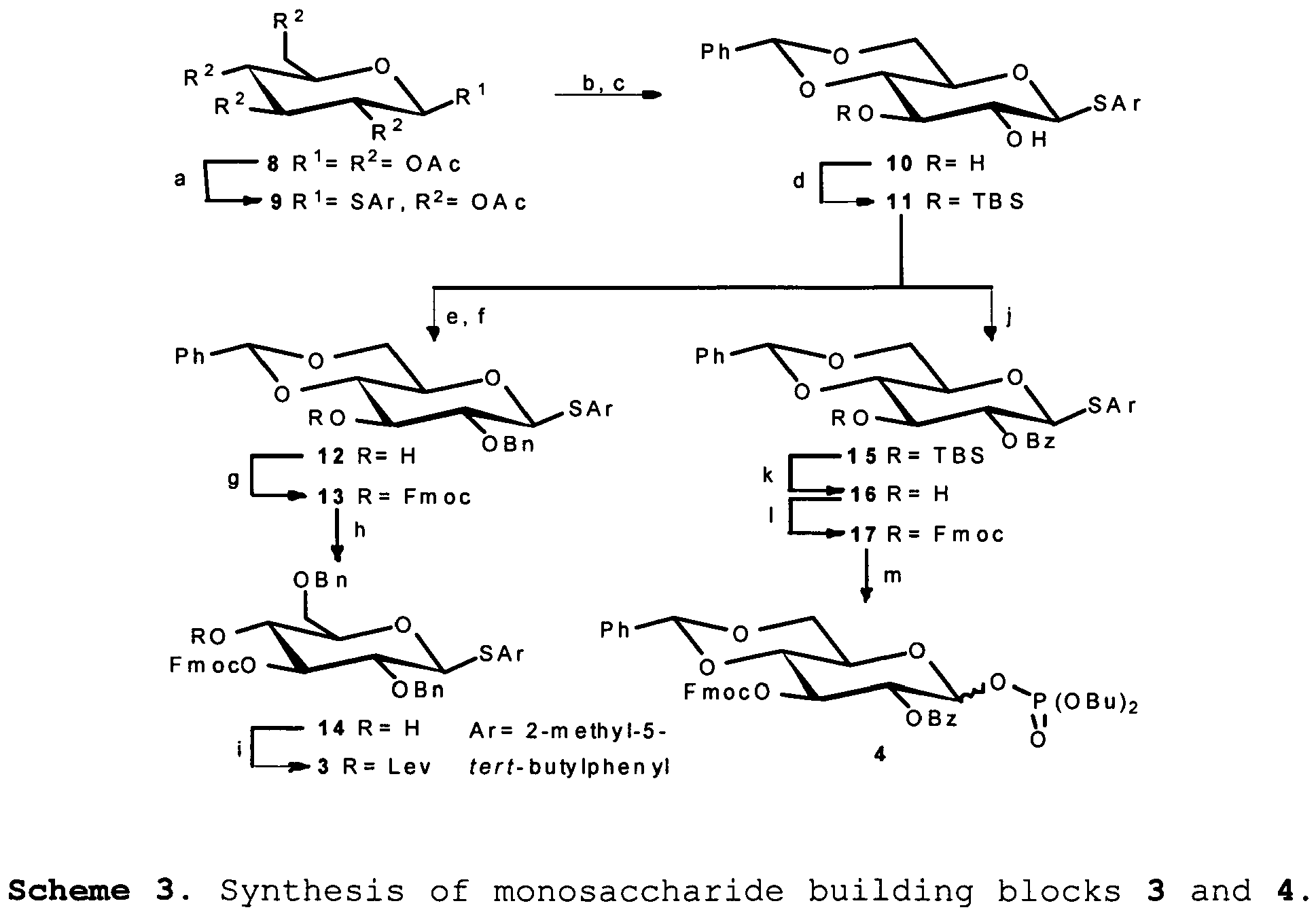
The synthesis of thioglucoside
11 that served as common precursor for
building blocks 3 and
4 commenced from β-d-glucose pentaacetate
8 (Scheme 3). Use of the nontoxic and odorless 2-methyl-5-
tert-butyl-thiophenol group ensured exclusive formation of β-anomer of thioglucoside
9 (
M. Collot, J. Savreux and J.-M. Mallet, Tetrahedron, 2008, 64, 1523). The acetyl groups were removed and the 4- and 6-hydroxyl groups of the resulting tetraol were regioselectively protected as a 4,6-
O-benzylidene acetal (
J. S. S. Rountree and P. V. Murphy, Org. Lett., 2009, 11, 871) to afford
diol 10. Regioselective placement of a TBS-ether protecting group at the 3-OH gave thioglycoside
11 (
K. C. Nicolaou, N. Winssinger, J. Pastor and F. DeRoose, J. Am. Chem. Soc., 1997, 119, 449).
-
Reagents and conditions: a) 2-methyl-5-tert-butylthiophenol, BF3· OEt2, DCM, 85%; b) NaOMe, MeOH, rt; c) benzaldehyde dimethyl acetal, CSA, MeCN, 87% over 2 steps; d) TBS-Cl, imidazole, DMF, 0 °C, 69%; e) NaH, BnBr, DMF, 0 °C to rt; f) 1M TBAF in THF, 0 °C to rt, 93% over 2 steps; g) Fmoc-Cl, pyridine, DCM, 95%; h) TES, TfOH, DCM, 4 Å MS, -78 °C, 73%; i) Lev2O, pyridine, DCM, 3 days, 79%; j) BzCl, DMAP, pyridine, 70 °C, 88%. k) TBAF·3H2O, AcOH, DMF, 35 °C, 91%; 1) Fmoc-Cl, pyridine, DCM, 96%; m) HOPO(OBu)2, NIS/TfOH, DCM, 4 Å MS 0°C, 81%.
-
Synthesis of building block 3 began with the installation of the non-participating benzyl group at the 2-position of 12 to favor the formation of the α-glycosidic linkage between monosaccharides A and B fragments. Subsequent placement of the 3-O-Fmoc-protection furnished compound 13. Finally, the regioselective opening of the 4,6-O-benzylidene acetal with TES-TfOH and protection of the free 4-hydroxyl gave orthogonally protected building block 3. Preparation of differentially protected glucosyl phosphate 4 from 11 followed a similar route. In anticipation of the formation of a 1,2-trans linkage between the B and C saccharide fragments, a participating benzoyl group was installed at the 2-position of 15. During TBAF-mediated desilylation of 15, careful control of the TBAF:AcOH ratio was essential to prevent benzoylmigration from the C2- to C3-positions. Fmoc-protected thioglycoside 17 was further converted to glycosyl phosphate 4.
-
Synthesis of the
rhamnosyl building block 5 to provide the D fragment commenced with the bis-benzoylation of 4-methoxyphenyl glycoside
18 (Scheme 3) (
D. B. Werz, A. Adibekian and P. H. Seeberger, Eur. J. Org. Chem., 2007, 12, 1976). CAN-mediated removal of the anomeric p-methoxyphenyl group yielded the free lactol that was immediately converted into rhamnosyl
N-phenyl trifluoroacetimidate
5 (
B. Yu and H. Tao, Tetrahedron Lett., 2001, 42, 2405).
-
The assembly of the pentasaccharide target was achieved in seven linear steps by combining the monosaccharide building blocks in sequence (Scheme 5).
-
Installation of the α-glycosidic linkage was the result of the union of glycosylating agent 3 and nucleophile 2. Disaccharide 20 was obtained in good yield and stereoselectivity when NIS and TfOH in Et2O was employed as promoter system. Selective cleavage of the levulinic ester with hydrazine hydrate in pyridine/AcOH, did not compromise the integrity of the Fmoc-group but cleanly produced disaccharide acceptor 21. Thioglucoside building block 17, a very storage-stable monomer unit had been intended for the installation of the next glycosidic linkage to form trisaccharide 22. Upon a variety of conditions only traces of the desired product 22 were isolated. As a first means to remedy the situation, replacement of the anomeric leaving group was executed. Glycosyl phosphate 4 was activated by TMSOTf to promote the glycosylation of 21 and afforded 22, although purification was achieved only following Fmoc cleavage to yield 23. Conversion of diol 23 to fully protected pentasaccharide 24 was achieved by bis-glycosylation using rhamnosyl-imidate 5 in the presence of TMSOTf. Final deprotection of compound 24 required two transformations: saponification of the benzoate esters and catalytic hydrogenation of the aromatic groups gave pentasaccharide 1. Careful comparison of the spectroscopic data for synthetic pentasaccharide 1 and NMR spectra of native PS-I revealed excellent agreement.
-
In summary, the first synthesis of the C. difficile cell-surface PS-I pentasaccharide 1 was achieved employing a linear strategy that serves to scout reaction conditions for automated solid phase synthesis and to identify robust and efficient monosaccharide building blocks. Four such building blocks 2-5 were prepared. Glycosyl phosphate 4 proved a significantly better building block than identically protected thioglycoside 3.
-
The pentasaccharide 1 or 1' obtained as outlined above or a fragment or derivative thereof can be coupled to a carrier protein by a variety of known methods.
-
A particular advantageous and preferred method uses the approach shown in scheme 6 below. For this the unique, terminal amine of
1 was first reacted with one of the two NHS-activated esters of Di(N-succinimidyl) adipate to form an amide. The coupling of the activated pentasaccharide to CRM
197 proceeded in phosphate buffer (any other usual buffer providing the desired pH is also suitable) and resulted in a load that averaged 3.6 pentasaccharide units per protein, as determined by MALDI-TOF mass spectrometry.
-
The invention is further illustrating by the following nonlimiting Examples and Figures.
FIGURES
-
- Fig. 1 . Glycoconjugate 1 composed of hapten 1 (pentasaccharide 1) and protein CRM197
- Fig. 2 . Characterization of conjugate 1; a) SDS-PAGE; b) MALDI-TOF; c) HPLC
EXAMPLE 1
Preparation and characterization of a pentasaccharide based on the repeating unit of C. difficile polysaccharide PS-I
-
The pentasaccharide was designed to provide, by means of a linker group, a primary amine at the reducing terminus to facilitate conjugation to a protein carrier and attachment to microarrays and other surfaces. In the following synthesis, the linker comprises the (CH2)5NH2 group and the overall synthesis was performed according to scheme 5 above.
General Experimental
-
Commercial grade reagents and solvents were used without further purification except as indicated below. All batch reactions conducted under an Ar atmosphere. 1H-NMR and 13C-NMR spectra were measured with a Varian 400-MR or Varian 600 spectrometer. The proton signal of residual, non-deuterated solvent (δ 7.26 ppm for CHCl3; δ 4.79 ppm for H2O, 2.84 ppm for acetone) was used as an internal reference for 1H spectra. For 13C spectra, the chemical shifts are reported relative to the respective solvent (δ 77.16 ppm for CDCl3, δ 29.84 ppm for acetone). For 13C spectra in D2O, MeOH (δ 49.50 ppm) was added as internal standard. Coupling constants are reported in Hertz (Hz). The following abbreviations are used to indicate the multiplicities: s, singlet; d, doublet; t, triplet; m multiplet. Infrared (IR) spectra were recorded as thin films on a Perkin Elmer Spectrum 100 FTIR spectrophotometer. Optical rotations (OR) were measured with a Schmidt & Haensch UniPol L 1000 at 589 nm and a concentration (c) expressed in g/100 mL. High-resolution mass spectra (HRMS) were recorded with an Agilent 6210 ESI-TOF mass spectrometer at the Freie Universität Berlin, Mass Spectrometry Core Facility. MALDI-TOF spectra were recorded on a Bruker Daltonics Autoflex Speed. Synthetic carbohydrates were measured using a 2,4,6-trihydroxyacetophenone (THAP) matrix, proteins and glycoconjugates were measured using 2,4-dihydroxyacetophenone (DHAP) as matrix.
-
Analytical thin layer chromatography (TLC) was performed on Kieselgel 60 F254 glass plates precoated with a 0.25 mm thickness of silica gel. The TLC plates were visualized with UV light and by staining with Hanessian solution (ceric sulfate and ammonium molybdate in aqueous sulfuric acid) or a 1:1 mixture of H2SO4 (2N) and resorcine monomethylether (0.2%) in ethanol. Column chromatography was performed using Kieselgel 60 (230-400 mesh). SEC-HPLC analyses were performed on a TSKgel-G4000SWXL column connected to an Agilent 1200 HPLC system equipped with a PDA detector. Elution buffer was constituted by 100mM sodium phosphate pH 7.2, 100 mM NaCl flow rate was 0.4 mL/min. SDS PAGE gels were run with 10 % SDS PAGE gel in reducing conditions at 130 V and 50 mA, molecular weight marker (Invitrogen bench marker) was used.
Synthesis of pentasaccharide 1 and intermediates according to schemes 1-5
Ethyl-3,4,6-tri-O-benzyl-2-O-(2-naphthalenylmethyl)-1-thio-D-glucopyranoside (7)
-
To a solution of 6 (284 mg, 0.57 mmol) in anhydrous DMF (1 mL), NaH (20.7 mg, 0.86 mmol) followed by NAP-Br (228 mg, 1.03 mmol) were added at 0 °C. The mixture was warmed to room temperature over 1 h, cooled to 0 °C and quenched by the addition of MeOH (0.1 mL). Et2O was added and the organic layer washed with 0.01 M HCl solution and with saturated aqueous NaHCO3 solution. The phases were separated and the organic layer was dried over MgSO4 and concentrated. Column chromatography (hexanes/ethyl acetate) afforded 7 (335 mg, 0.53 mmol, 92%) in a mixture of α/β-anomers as a white solid.
-
Analytical data is reported for the β-anomer. [α]D 20 = +26.1 ° (c = 5.3, CHCl3), IR νmax (film) 3061, 3030, 2864, 1949, 1808, 1603, 1497, 1453, 1360, 1065 cm-1; 1H-NMR (400 MHz, CDCl3) δ 7.82-7.69 (4H, m, Ar-H), 7.52-7.09 (18H, m, Ar-H), 5.08-5.02 (1H, m, -CH2-Ar), 4.93-4.77 (4H, m, -CH2-Ar), 4.60-4.50 (3H, m, -CH2-Ar), 4.47 (1H, d, J 9.7, 1-H), 3.80-3.54 (4H, m), 3.52-3.41 (2H, m), 2.84-2.66 (2H, m, S-CH2-), 1.31 (3H, t, J 7.3, CH3) ; 13C-NMR (100 MHz, CDCl3) δ 138.7, 138.4, 138.2, 135.6, 133.4, 133.2, 128.56, 128.55, 128.5, 128.2, 128.1, 127.92, 127.87, 127.84, 127.80, 127.77, 127.7, 127.2, 126.5, 126.1, 126.0, 86.8, 85.2 (C-1), 82.0, 79.3, 78.2, 75.9, 75.7, 75.2, 73.6, 69.3, 25.2, 15.3; HRMS (ESI): Calcd for C40H42O5S [M+Na]+ 657.2651, found 657.2651.
N-(Benzyl)benzyloxycarbonyl-5-amino-pentanyl-3,4,6-tri-O-benzyl-B-D-glucopyranoside (2)
-
Thioglucoside 7 (335 mg, 0.53 mmol) and HO(CH2)5NBnCbz (518 mg, 1.58 mmol) were coevaporated with toluene (3 x 10 ml), dried in vacuo, then the compounds were dissolved in a solution of anhydrous toluene:dioxane=2:1 (4.5 ml). The solution was cooled to -40 °C, treated with NIS (131 mg, 0.58 mmol) and TfOH (4.7 7 µl, 53 µmol) and warmed to -20 °C over 1.5 h. The reaction was quenched with pyridine, diluted with DCM and washed with saturated aqueous Na2S2O3 solution. The organic layer was dried over MgSO4 and concentrated. Column chromatography on silica gel (hexanes/ethyl acetate) gave a mixture of anomers which was dissolved in DCM (10 ml) and water (1 ml) and treated with DDQ (202 mg, 0.89 mmol) at 0 °C for 2 h. The mixture was diluted with DCM and the organic layer washed with saturated aqueous NaHCO3 solution, dried over MgSO4 and concentrated. Column chromatography on silica gel (hexanes/ethyl acetate) afforded 2 (140 mg, 0.184 mmol, 35%) as a colorless oil. [α]D 20 = +53.3 ° (c = 5.5), IR νmax (film) 3458, 3031, 2927, 1952, 1876, 1808, 1454, 1421, 1360, 1229, 1129, 1067 cm-1; 1H-NMR (400 MHz, acetone-d6) δ 7.48-7.10 (25H, m, Ar-H), 5.15 (2H, bs), 4.99 (1H, d, J 11.4, -CH2-Bn), 4.84 (1H, d, J 11.1, -CH2-Bn). 4.79 (1H, d, J 11.4, -CH2-Bn), 4.75 (1H, bs, 1-H), 4.62-4.49 (5H, m, -CH2-Bn), 3.84-3.86 (6H, m), 3.62-3.47 (2H, m), 3.40 (1H, m), 3.31-3.18 (2H, m, linker-CH2-), 1.67-1.50 (4H, m, linker-CH2-), 1.43-1.29 (2H, m, linker-CH2-); 13C-NMR (100 MHz, acetone-d6) δ 140.5, 139.8, 139.7, 139.5, 129.3, 129.1, 129.0, 128.9, 128.60, 128.58, 128.43, 128.41, 128.2, 128.0, 99.9 (C-1), 84.3, 78.7, 75.5, 75.4, 74.2, 73.3, 71.5, 70.2, 68.5, 67.4, 24.1; HRMS (ESI): Calcd for C47H53NO8 [M+Na]+ 782.3669, found 782.3633.
(2-Methyl-5-tert-butylphenyl) 2,3,4,6-tetra-O-acetyl-1-thio-ß-D-glucopyranoside (9)
-
1,2,3,4,6-Penta-O-acetyl-ß-D-glucopyranose 8 (30 g, 77 mmol) was dissolved in anhydrous DCM (34 mL). 2-Methyl-5-tert-butyl thiophenol (17 mL, 92 mmol, 1.2 eq) were added under stirring. BF3·OEt2 (13.6 mL, 108 mmol, 1.4 eq) was added dropwise and the resulting yellow solution was stirred over night. After completion the solution was diluted with DCM and extracted with saturated aqueous NaHCO3 and H2O, and the organic layer was dried over MgSO4. The solvent was evaporated in vacuo and the residue was dried in high vacuum. The resulting yellow solid was purified by column chromatography on silica gel (cyclohexane/ethyl acetate) to afford 9 (33.4 g, 65.4 mmol, 85%). [α]D 20 = -8.0 ° (c = 1.0, CHCl3); IR (CHCl3) : 2961, 1747, 1366, 1211, 1034, 912 cm-1; 1H-NMR (400 MHz, CDCl3) δ 7.52 (1H, d, J 2.0, Ar-H), 7.25-7.10 (2H, m, Ar-H), 5.19 (1H, dd, J1J2 9.4, 1-H), 5.10-4.98 (2H, m, 4-H, 2-H), 4.64 (1H, d, J 10.6, 1-H), 4.23 (1H, dd, J1 12.2, J2 5.0, 6-Ha), 4.10 (1H, dd, J1 12.2, J2 1.9, 6-Hb), 3.71-3.63 (1H, m, 5-H), 2.34 (3H, s, CH3), 2.07-2.03 (6H, m, OAc), 2.00-1.96 (6H, m, OAc), 1.29 (9H, s, tBu); 13C-NMR (100 MHz, CDCl3) δ 170.8, 170.3, 169.5, 169.4 (C=O OAc), 149.8, 137.51, 131.47, 130.53, 130.2, 125.8, 87.0 (C-1), 75.9 (C-5), 74.2 (C-3), 70.3 (C-3), 68.3(C-4), 62.4 (C-6), 31.4 4 (tBu), 20.89, 20.88, 20.74, 20.70 (OAc), 20.5 (CH3) ; HRMS (ESI) : Calcd for C25H34O9S [M+Na]+ 533.1816, found 533.1832.
(2-Methyl-5-tert-butylphenyl)-4,6-O-benzylidene-1-thio-B-D-glucopyranoside (10)
-
Thioglycoside 9 (1.5 g, 2.94 mmol) was dissolved in of methanol (12 mL). Sodium methoxide (58 mg, 1.07 mmol, 0.37 eq) was added and the reaction was stirred over night. After completion, the solution was neutralized with Amberlite IR 120 (H+) ion exchange resin, filtered and concentrated in vacuo. The remainder was dried in high vacuum to give (2-Methyl-5-tert-butylphenyl) 1-thio-ß-D-glucopyranoside S1 (1.0 g) which was used for the next reaction step without further purification. Tetrol S1 (1.0 g) was dissolved in anhydrous acetonitrile (11.3 mL) at RT under argon atmosphere and benzaldehyde dimethylacetal (880 µL, 5.84 mmol, 2 eq) and camphorsulfonic acid (7 mg, 0.029 mmol, 0.01 eq) were added. After 2.5 h (TLC: cyclohexane/ethyl acetate, 1:2), the reaction was quenched with triethylamine, and the solvents were evaporated in vacuo to give 1.5 g of colorless oil. The crude product was purified by column chromatography on silica gel (cyclohexane/ethyl acetate) to afford 10 (1.09 g, 2.53 mmol, 87%). [α]D 20 = -49.4 ° (c = 1.0, CH2Cl2) ; IR (CH2Cl2): 3410, 2963, 2870, 1384, 1264, 1082, 1072, 1029, 1003, 972 cm-1; 1H-NMR (400 MHz, CDCl3) δ 7.61 (1H, d, J 2.0 Hz, Ar-H), 7.51-7.46 (2H, m, Ar-H), 7.39-7.35 (m, 3H, Ar-H), 7.29-7.23 (m, 2H, Ar-H), 7.16 (1H, d, J = 8.0, Ar-H), 5.54 (1H, s, benzylidene-H), 4.64 (1H, d, J 10.0, 1-H), 4.36 (1H, dd, J1 10.3, J2 4.5, 6-Ha), 3.90-3.73 (2H, m, 3-H, 6-Hb), 3.59-3.47 (3H, m, 2-H, 4-H, 5-H), 2.86 (1H, d, J 2.2, OH), 2.69 (1H, d, J 2.4, OH), 2.42 (3H, s, CH3), 1.32 (9H, s, t-Bu); 13C-NMR (100 MHz, CDCl3) δ 149.7, 137.1, 137.0, 131.0, 130.3, 130.2, 129.4, 128.5, 126.4, 125.5 (C-aromatic), 102.0 (C-benzylidene), 88.8 (C-1), 80.4 (C-2), 74.8 (C-3), 73.0 (C-4), 70.5 (C-5), 68.7 (C-6), 31.4 (tBu), 20.6 (CH3) ; HRMS (ESI): Calcd for C24H30O5S [M+Na]+ 453.1706, found 453.1714.
(2-Methyl-5-tert-butylphenyl)-4,6-O-benzylidene-3-O-tertbutyldimethylsilyl-1-thio-ß-D-glucopyranoside (11)
-
Compound 10 (658 mg, 1.53 mmol) and imidazole (208 mg, 3.06 mmol, 2 eq) were dissolved in anhydrous DMF (880 µL). TBSCl (346 mg, 2.29 mmol, 1.5 eq) was gradually added with stirring. After 4 h, the solvent was evaporated and the resulting oil was dissolved in DCM. The solution was extracted with 1 M HCl and saturated aqueous NaHCO3 solution, the organic layer was dried over MgSO4 and the solvent was evaporated in vacuo. The colorless solid was dried in high vacuum and the crude product (820 mg) was purified using flash column chromatography (cyclohexane/ethyl acetate) to afford 11 (573 mg, 1.05 mmol, 69 %). [α]D 20 = -49.1 ° (c = 1.0, CH2Cl2); IR (CH2Cl2): 3559, 2957, 2928, 2858, 1631, 1383, 1259, 1110, 1086, 1067, 1009 cm-1; 1H-NMR (400 MHz, CDCl3) δ 7.61 (1H, d, J 2.1, Ar-H), 7.51-7.46 (2H, m, Ar-H), 7.39-7.33 (3H, m, Ar-H), 7.26-7.22 (1H, m, Ar-H), 7.15 (1H, d, J 8.0, Ar-H), 5.52 (1H, s, benzylidene-H), 4.65 (1H, d, J 9.8, 1-H), 4.34 (1H, dd, J1 10.4, J2 4.4, 6-Ha), 3.84-3.74 (2H, m, 6-Hb, 3-H), 3.54-3.45 (3H, m, 4-H, 5-H, 2-H), 2.42 (3H, s, CH3), 1.31 (9H, s, tBu), 0.88 (9H, s, tBu), 0.11 (3H, s, CH3), 0.04 (3H, s, CH3) ; 13C-NMR (100 MHz, CDCl3) δ 149.7, 137.3, 137.0, 131.4, 130.1, 130.1, 129.1, 128.3, 126.3, 125.3 (C-aromatic), 101.8 (C-benzylidene), 89.0 (C-1), 81.2 (C-4), 76.2 (C-3), 74.0 (C-2), 70.8 (C-5), 68.8 (C-6), 31.4 (tBu), 26.0 (tBu), 20.6 (CH3), -4.2 (CH3), -4.6 (CH3) ; HRMS (ESI): Calcd for C30H44O5SSi [M+Na]+ 567.2571, found 567.2584.
(2-Methyl-5-tert-butylphenyl) 4,6-O-benzylidene-2-O-benzyl-1-thio-ß-D-glucopyranoside (12)
-
To a solution of 11 (2.00 g, 3.67 mmol) in anhydrous DMF (20 ml), NaH (0.21 g, 8.81 mmol) and BnBr (1.31 ml, 11.01 mmol) were added at 0 °C. The mixture was warmed to room temperature and stirred over night. Then cooled to 0 °C, quenched with MeOH and diluted with Et2O. The organic layers were washed with H2O and brine, dried over MgSO4 and concentrated. Column chromatography on silica gel (hexanes/ethyl acetate) afforded crude (2-methyl-5-tert-butylphenyl) 4,6-O-benzylidene-2-O-benzyl-3-O-tert-butyldimethylsilyl-1-thio-ß-D-glucopyranoside S2 (2.4 g), which was taken directly to the next step. Crude S2 (2.4 g) was dissolved in THF (30 ml), cooled to 0 °C and treated with a solution of TBAF (1 M in THF, 7.24 ml, 7.24 mmol). The mixture was warmed to room temperature over night and concentrated. Column chromatography on silica gel (hexanes/ethyl acetate) afforded 12 (1.77 g, 3.40 mmol, 93%). [α]D 20 = -11.4 ° (c = 3.7, CHCl3), IR νmax (film) 3463, 3033, 2962, 1810, 1670, 1602, 1488, 1455, 1384, 1264, 1215, 1088 cm-1; 1H-NMR (400 MHz, CDCl3) δ 7.64-7.61 (1H, m, Ar-H), 7.51-7.20 (11H, m, Ar-H), 7.17-7.12 (1H, m, Ar-H), 5.55 (1H, s, benzylidene-H), 4.99 (1H, d, A of AB, JAB 10.9, -CH2-Bn), 4.84 (1H, d, B of AB, JAB 10.9, -CH2-Bn), 4.75 (1H, d, J 9.8, 1-H), 4.34 (1H, dd, J1 10.5, J2 5.0, 6-Ha), 3.97-3.89 (1H, m, 3-H), 3.81 (1H, dd, J1 J2 10.3, 6-Hb), 3. 60 (1H, dd, J1 J2 9.4, 4-H), 3.55-3.42 (2H, m, 2-H, 5-H), 2.52 (1H, d, J 2.4, 3-OH), 2.42 (3H, s, CH3), 1.31 (9H, s, tBu) ; 13C-NMR (100 MHz, CDCl3) δ 149.7, 138.1, 137.1, 136.3, 132.8, 130.1, 129.4, 129.1, 128.7, 128.5, 128.4, 128.2, 126.4, 125.0, 102.0, 88.2 (C-1), 81.1 (C-2), 80.5 (C-4), 75.7, 75.6 (C-3), 70.1 (C-5), 68.8 (C-6), 34.6, 31.5, 20.5; HRMS (ESI): Calcd for C31H36O5S [M+Na]+ 543.2181, found 543.2181.
(2-Methyl-5-tert-butylphenyl) 4,6-O-benzylidene-2-O-benzyl-3-O-fluorenylmethoxycarbonyl-1-thio-β-D-glucopyranoside (13)
-
To a solution of 12 (415 mg, 0.80 mmol) and pyridine (129 µl) in DCM (5 ml), Fmoc-Cl (309 mg, 1.20 mmol) was added and the mixture was stirred over night, diluted with DCM and the organic layers were washed with a 0.01 M HCl solution and saturated aqueous NaHCO3 solution. The organic layer was dried over MgSO4 and concentrated. Column chromatography on silica gel (hexanes/ethyl acetate) afforded 13 (561 mg, 0.76 mmol, 95%) as a white solid. [α]D 20 = -0.3 ° (c = 5.9, CHCl3), IR νmax (film) 3033, 2961, 1955, 1754, 1605, 1451, 1385, 1251, 1077 cm-1; 1H-NMR (400 MHz, CDCl3) δ 7.79-7.73 (2H, m, Fmoc-H), 7.65-7.13 (19H, m, Ar-H), 5.55 (1H, s, benzylidene-H), 5.29-5.22 (1H, m), 4.98 (1H, A of AB, JAB 10.7, -CH2-Bn), 4.82 (1H, d, J 9.8, H-1), 4.72 (1H, B of AB, J 10.7, -CH2-Bn), 4.49-4.42 (1H, m), 4.40-4.28 (2H, m), 4.24-4.18 (1H, m), 3.88-3.67 (3H, m), 3.60-3.52 (1H, m), 2.42 (3H, s, CH3), 1.31 (9H, s, tBu); 13C-NMR (100 MHz, CDCl3) δ 154.6, 149.8, 143.5, 143.3, 141.4, 137.5, 136.9, 136.6, 130.2, 129.6, 129.2, 128.4, 128.3, 128.2, 128.00, 127.97, 127.30, 127.27, 126.3, 126.2, 125.2, 120.1, 101.6, 88.7 (C-1), 79.5, 79.3, 78.5, 75.7, 70.33, 70.27, 68.8, 46.8, 34.6, 31.4, 20.5; HRMS (ESI): Calcd for C46H46O7S [M+Na]+ 765.2862, found 765.2886.
(2-Methyl-5-tert-butylphenyl)-2,6-di-O-benzyl-3-O-fluorenylmethoxycarbonyl-1-thio-β-D-glucopyranoside (14)
-
To a solution of 13 (100 mg, 0.14 mmol) in anhydrous DCM (3 ml) freshly activated molecular sieves (4 Å) were added. The mixture was cooled to -78 °C, TES (64 µl, 0.40 mmol) and TfOH (41 µl, 0.46 mmol) were added. After stirring for 3 hours at - 78 °C the reaction was quenched by the addition of pyridine, diluted with DCM and washed with a saturated aqueous NaHCO3 solution. The organic phase was then dried over MgSO4, filtered and concentrated. Column chromatography on silica gel (hexanes/ethyl acetate) afforded 14 (73 mg, 0.10 mmol, 73%). [α]D 20 = +10.5 ° (c = 4.9, CHCl3), IR νmax (film) 3486, 3031, 2959, 1951, 1750, 1604, 1451, 1387, 1254, 1054 cm-1; 1H-NMR (400 MHz, CDCl3) δ 7.80-7.74 (2H, m, Fmoc-H), 7.66-7.56 (3H, m, Ar-H), 7.44-7.09 (16H, m, Ar-H), 4.95 (1H, dd, J1 J2 9.2 , 3-H), 4.92 (1H, d, J 10.7, -CH2-Bn), 4.69 (1H, d, J 9.8, 1-H), 4.68 (1H, d, J 10.8, -CH2-Bn), 4.61 (1H, A of AB, JAB 12.0, - CH2-Bn), 4.55 (1H, B of AB, JAB 12.0, -CH2-Bn), 4.50-4.43 (1H, m, Fmoc-CH2), 4.40-4.31 (1H, m, Fmoc-CH2), 4.26-4.20 (1H, m, Fmoc-CH), 3.84 (1H, ddd, J 1 J2 9.5, J3 3.6, 4-H), 3.81-3.74 (2H, m, 6-H), 3.61 (1H, dd, J1 J2 9.5, 2-H), 3.56-4.49 (1H, m, 5-H), 2.97 (1H, d, J 3.6, 4-OH), 2.40 (1H, s, CH3), 1.26 (9H, s, tBu); 13C-NMR (100 MHz, CDCl3) δ 155.7, 149.8, 143.5,143.4, 141.4, 137.7, 137.6, 136.5, 132.8, 130.1, 129.5, 128.6, 128.4, 128.2 128.04, 127.98, 127.9, 127.3, 125.3, 125.2, 125.0, 120.2, 88.1 (C-1), 83.2 (C-3), 78.5 (C-2), 77.8 (C-5), 75.4, 73.9, 71.0 (C-4), 70.4, 70.3 (C-6), 46.9, 34.6, 31.4, 20.5; HRMS (ESI): Calcd for C46H48O7S [M+Na]+ 767.3018, found 767.3038.
(2-Methyl-5-tert-butylphenyl)-2,6-di-O-benzyl-3-O-fluorenyl-methoxycarbonyl-4-O-levulinoyl-1-thio-β-D-glucopyranoside (3)
-
To a solution of 14 (480 mg, 0.64 mmol) in DCM (8 ml) and pyridine (0.3 ml) Lev2O (55 mg, 0.26 mmol) was added and stirred for three days. The mixture was diluted with DCM and washed with a 1 M HCl solution and with saturated aqueous NaHCO3 solution. The organic layers were dried over MgSO4 and concentrated. Column chromatography on silica gel (hexanes/ethyl acetate) afforded 3 (428 mg, 0.51 mmol, 79%). [α]D 20 = +19.2 ° (c = 1.0, CHCl3), IR νmax (film) 3065, 2955, 1754, 1719, 1604, 1488, 1452, 1363, 1259, 1152, 1070, 1039 cm-1; 1H-NMR (400 MHz, CDCl3) δ 7.80-7.74 (2H, m, Ar-H), 7.68-7.58 (3H, m, Ar-H), 7.44-7.17 (15H, m, Ar-H), 7.15-7.11 (1H, m, Ar-H), 5.20 (1H, dd, J1 J2 9.7, 4-H), 5.15-5.07 (1H, m, 3-H), 4.95 (1H, A of AB, JAB 10.8, -CH2-Bn), 4.71 (1H, d, J 9.8, 1-H), 4.69 (1H, B of AB, JAB 10.4, -CH2-Bn), 4.56-4.41 (3H, m), 4.29-4.20 (2H, m), 3.74-3.55 (4H, m, 2-H, 4-H, 6-H), 2.60-2.52 (2H, m, Lev-CH2), 2.42 (3H, s, Lev-CH3), 2.41-2.32 (2H, m, Lev-CH2), 2.02 (3H, s, SPhCH3), 1.26 (9H, s, tBu); 13C-NMR (100 MHz, CDCl3) δ 206.0, 171.6, 154.8, 149.9, 143.7, 143. 5, 141.4, 141.3, 138.0, 137.6, 136.6, 132.7, 130.1, 129.5, 128.4, 128.2, 128.1, 128.0, 127.9, 127.7, 127.4, 127.3, 125.5, 125.4, 125.0, 120.1, 88.2, 80.5, 78.9, 77.3, 75.6, 73.7, 70.6, 69.4, 69.2, 46.7, 37.8, 34.6, 31.4, 29.7, 28.0, 20.5; HRMS (ESI): Calcd for C51H54O9S [M+Na]+ 865.3386 found 865.3412.
(2-Methyl-5-tert-butylphenyl) 2-O-benzoyl-4,6-O-benzylidene-3-O-tert-butyldimethylsilyl-1-thio-ß-D-glucopyranoside (15)
-
Thioglycoside 12 (1.00 g, 1.84 mmol) was dissolved under argon in anhydrous pyridine (4 mL). DMAP (67 mg, 0.55 mmol) was added and the solution was cooled to 0 °C. BzCl (639 µL, 5.51 mmol) was added dropwise and the solution was heated to 70 °C and stirred for 12 h. After completion (TLC: cyclohexane/ethyl acetate, 9:1), the reaction was quenched with methanol. The suspension was diluted with DCM and extracted with 1 M HCl and H2O. Column chromatography on silica gel (hexanes/ethyl acetate) afforded 15 (1.05 g, 1.62 mmol, 88%). [α]D 20 = +22.9 °(c = 1.0, CH2Cl2); IR (CH2Cl2): 2959, 2929, 2858, 1732, 1384, 1266, 1096, 1069 cm-1; 1H-NMR (400 MHz, CDCl3) δ 8.08 (2H, dd, J 8.3, Ar-H), 7.56 (1H, d, J 1.8, Ar-H), 7.52-7.43 (5H, m, Ar-H), 7.37 (3H, dd, J1 5.2, J2 2.0, Ar-H), 7.20 (1H, dd, J1 8.0, J2 2.1, Ar-H), 7.07 (1H, d, J 8.0, Ar-H), 5.58 (1H, s, benzylidene-H), 5.35 (1H, dd, J1 10.3, J2 8.6, 2-H), 4.84 (1H, d, J 10.3, 1-H), 4.38 (1H, dd, J1 10.5, J2 5.0, 6-Ha), 4.06 (1H, dd, J1 J2 8.9, 3-H), 3.88 (1H, dd, J1 10.3, J2 5.0, 6-Hb), 3.69 (1H, dd, J1 J2 9.1 Hz, 4-H), 3.60-3.52 (1H, m, 5-H), 2.18 (3H, s, CH3), 1.28 (9H, s, tBu), 0.70 (9H, s, tBu), -0.05 (3H, s, CH3), -0.14 (3H, s, CH3) ; 13C-NMR (100 MHz, CDCl3) δ 133.1, 129.9, 129.8, 129.4, 129.1, 128.3, 128.1, 126.2, 125.1 (C-Ar), 101.9 (C-benzylidene), 88.1 (C-1), 81.3 (C-4), 74.3 (C-3), 73.6 (C-2), 70.6 (C-5), 68.7 (C-6), 31.3 (tBu), 25.5 (tBu), 20.2 (CH3), -4.2 (CH3), -5.0 (CH3) ; HRMS (ESI): Calcd for C37H48O6SSi [M+Na]+ 671.2833, found 671.2852.
(2-Methyl-5-tert-butylphenyl) 2-O-benzoyl-4,6-O-benzylidene-1-thio-B-D-glucopyranoside (16)
-
To a solution of 15 (200 mg, 0.31 mmol) in DMF (1 mL) a solution of TBAF·3H2O (683 mg, 1.85 mmol) and glacial acetic acid (124 µL, 2.16 mmol) in DMF (1 mL) were added. The mixture was warmed to 35 °C for 9 h, diluted with ether and washed with a 0.01 M HCl solution and saturated aqueous NaHCO3 solution. The organic layer was dried over MgSO4 and concentrated. Column chromatography on silica gel (hexanes/ethyl acetate) afforded 16 (150 mg, 0.28 mmol, 91%). [α]D 20 = -5.5 ° (c = 0.8, CHCl3) ; IR (CHCl3) : 3455, 2963, 2870, 1729, 1268, 1100, 1071 cm-1; 1H-NMR (400 MHz, CDCl3) δ 8.11 (2H, d, J 7.4, Ar-H), 7.64-7.33 (9H, m, Ar-H), 7.27-7.20 (1H, m, Ar-H), 7.10 (1H, d, J 8.0, Ar-H), 5.59 (1H, s, benzylidene-H), 5.25 (1H, dd, J1 10.1, J2 8.7, 2-H), 4.88 (1H, d, J 10.1, 1-H), 4.40 (1H, dd, J1 10.5, J2 5.0, 6-Ha), 4.09 (1H, dd, J1 9.0, J2 = 8.7, 3-H), 3.87 (1H, dd, J1 10.4, J2 5.0, 6-Hb), 3.71 (1H, dd, J1 9.0, J2 9.7, 4-H), 3.57 (1H, td, J1 9.7, J2 5.0, 5-H), 2.83 (1H, br, 3-OH), 2.23 (3H, s, CH3), 1.29 (9H, s, tBu); 13C-NMR (100 MHz, CDCl3) δ 166.1 (C=O benzoyl), 149.7, 137.32, 136.9, 133.6, 131.9, 130.4, 130.2, 129.5, 128.6, 128.5, 126.4, 125.6 (aromatics), 102.1 (C-benzylidene), 87.5 (C-1), 80.9 (C-4), 74.0 (C-3), 73.6 (C-2), 70.5 (C-5), 68.7 (C-6), 31.4 (tBu), 20.4 (CH3); HRMS (ESI): Calcd for C31H34O6S [M+Na]+ 557.1968, found 557.1975.
(2-Methyl-5-tert-butylphenyl) 2-O-benzoyl-4,6-O-benzylidene-3-O-fluorenylmethoxycarbonyl-1-thio-B-D-glucopyranoside (17)
-
To a solution of 16 (277 mg, 0.52 mmol) and pyridine (130 µl) in DCM (4 ml), Fmoc-Cl (268 mg, 1.04 mmol) was added and the mixture stirred over night, diluted with DCM and the organic layers were washed with a 0.01 M HCl solution and saturated aqueous NaHCO3 solution. The organic layer was dried over MgSO4 and concentrated. Column chromatography on silica gel (hexanes/ethyl acetate) afforded 17 (378 mg, 0.50 mmol, 96%). [α]D 20 = +50.2 ° (c = 4.5, CHCl3), IR νmax (film) 3066, 2961, 1752, 1732, 1602, 1488, 1450, 1385, 1316, 1268, 1250, 1093 cm-1; 1H-NMR (400 MHz, CDCl3) δ 8.06-7.99 (2H, m, Ar-H), 7.73-7.67 (2H, m, Ar-H), 7.61-7.07 (19H, m, Ar-H), 5.60 (1H, s, benzylidene-H), 5.51-5.36 (2H, m, 2-H, 3-H), 4.95 (1H, d, J 9.9, 1-H), 4.46-4.39 (1H, m, 6-H), 4.27-4.16 (2H, m, Fmoc-CH2), 4.06-4.00 (1H, m, Fmoc-CH), 3.98-3.88 (2H, m, 4-H, 6-H), 3.72-3.63 (1H, m, 5-H) 2.23 (1H, s, CH3), 1.29 (9H, s, tBu); 13C-NMR (100 MHz, CDCl3) δ 165.3, 154.6, 149.8, 143.4, 143.2, 141.3, 141.2, 137.4, 136.8, 133.6, 131.7, 130.5, 130.2, 130.1, 129.3, 129.2, 128.5, 128.3, 127.9, 127.27, 127.25, 126.3, 125.8, 125.3, 125.1, 120.00, 119.99, 101.8, 88.0 (C-1), 78.3 (4-H), 77.3 (C-3), 71.4 (C-2), 70.8 (C-5), 70.5, 68.7 (C-6), 46.6, 34.6, 31.7, 31.4, 20.4, 14.3; HRMS (ESI): Calcd for C46H44O8S [M+Na]+ 779.2655, found 779.2649.
Dibutyl-2-O-benzoyl-4,6-O-benzylidene-3-O-fluorenyl-methoxycarbonyl-D-gluco-pyranosidephosphate (4)
-
Thioglucoside 17 (690 mg, 0.91 mmol) was coevaporated with toluene three times and dried in vacuo, then dissolved in anhydrous DCM (10 ml). Freshly activated molecular sieves (4 Å) and dibutyl hydrogen phosphate (542 µl, 2.73 mmol) were added and the solution cooled to 0 °C. NIS (246 mg, 1.09 mmol), followed by TfOH (10 µl, 0.11 mmol) was added and stirred at 0 °C for one hour. The reaction was quenched by the addition of pyridine, diluted with DCM and washed with aqueous Na2S2O3 and saturated aqueous NaHCO3 solutions. The organic phase was dried over MgSO4, filtered and concentrated. The crude product was purified by column chromatography on silica gel (hexanes/ethyl acetate) to afford 4 (583 mg, 0.74 mmol, 81%) in a mixture of α/β-anomers (α/β=1:4). NMR data are reported for the β-anomer. [α]D 20 = +8.9 ° (c = 3.1, CHCl3), IR νmax (film) 3067, 2961, 1755, 1733, 1602, 1451, 1268, 1096, 1026 cm-1; 1H-NMR (400 MHz, CDCl3) δ 8.06-7.99 (2H, m, Ar-H), 7.72-7.66 (2H, m, Ar-H), 7.55-7.29 (12H, m, Ar-H), 7.18-7.11 (2H, m, Ar-H), 5.60-5.54 (2H, m, benzylidene-H, 1-H), 5.50 (1H, dd, J1 J2 9.4, 2-H), 5.36 (1H, dd, J1 J2 9.4, 3-H), 4.49-4,41 (1H, m, 6-H), 4.30-4.18 (2H, m, Fmoc-CH2), 4.10-4.01 (3H, m, Fmoc-H, phosphate-CH2), 4.00-3.94 (1H, m, 4-H), 3.90-3.86 (1H, m, 6-H), 3.82-3.67 (3H, m, phosphate-CH2, 5-H), 1.67-1.60 (2H, m, phosphate-CH2), 1.42-1.25 (4H, m, phosphate-CH2), 1.10-1.01 (2H, m, phosphate-CH2), 0.92 (3H, t, J 7.4, phosphate-CH-3), 0.70 (3H, t, J 7.4, phosphate-CH3) ; 13C-NMR (100 MHz, CDCl3) δ 165.1, 154.5, 143.4, 143.1, 141.3, 136.6, 133.8, 130.1, 129.4, 128.6, 128.4, 127.9, 127.2, 126.3, 125.3, 125.2, 120.0, 101.9, 96.91, 96.86, 78.1, 77.5, 77.2, 76.8, 75.8, 72.6, 70.6, 68.4, 68.1, 67.1, 46.6, 32.2, 32.1, 32.0, 31.9, 18.7, 18.4, 13.7, 13.5; δP (160 MHz, CDCl3) -2.95; HRMS (ESI): Calcd for C43H47O12P [M+Na]+ 809.2703, found 809.2690.
4-Methoxyphenyl-2,3-di-O-benzoyl-4-O-benzyl-α-L-rhamno-pyranoside (19)
-
Rhamnoside 18 (500 mg, 1.39 mmol) was dissolved in a solution of DCM (1 ml) and pyridine (1 ml). DMAP (68 mg, 0.56 mmol) was added and the mixture cooled to 0 °C, then BzCl (780 mg, 5.56 mmol) was added and the reaction warmed to room temperature over night. The reaction was quenched with MeOH, diluted with DCM and the organic layer was washed with a 0.01 M HCl solution and saturated aqueous NaHCO3 solution. The organic layer was dried over MgSO4 and concentrated. Column chromatography on silica gel (hexanes/ethyl acetate) afforded 19 (768 g, 1.35 mmol, 97%). [α]D 20 = +17.6 ° (c = 3.1, CHCl3), IR νmax (film) 3064, 2934, 1725, 1602, 1506, 1452, 1363, 1273, 1213, 1094, 1027 cm-1; 1H-NMR (400 MHz, CDCl3) δ 8.11-8.05 (2H, m, Ar-H), 7.98-7.93 (2H, m, Ar-H), 7.67-7.61 (1H, m, Ar-H), 7.56-7.49 (3H, m, Ar-H), 7.40-7.35 (2H, m, Ar-H), 7.25-7.16 (5H, m, Ar-H), 7.08-7.03 (2H, m, Ar-H), 6.87-6.82 (2H, m, Ar-H), 5.94 (1H, dd, J1 9.6, J2 3.4, 3-H), 5.79 (1H, dd, J1 3.4, J2 1.9, 2-H), 5.54 (1H, d, J 1.8, 1-H), 4.75 (1H, A of AB, JAB 10.9, -CH2-Bn), 4.68 (1H, B of AB, JAB 10.9, -CH2-Bn), 4.20-4.11 (1H, m, 5-H), 3.88 (1H, dd, J1 J2 9.6, 4-H), 3.78 (3H, s, - CH3), 1.41 (3H, d, J 6.2, 6-H); 13C-NMR (100 MHz, CDCl3) δ 165.58, 165.55, 155.21, 150.20, 137.7, 133.6, 133.3, 130.0, 129.9, 129.8, 129.71, 128.69, 128.53, 128.48, 128.2, 128.0, 117.9, 114.7, 96.6 (C-1), 79.1 (C-4), 75.3, 72.3 (C-3), 71.2 (C-2), 68.5 (C-5), 55.8, 18.3 (C-6); HRMS (ESI): Calcd for C34H32O8 [M+Na]+ 591.1995, found 591.1985.
2,3-Di-O-benzoyl-4-O-benzyl-α-L-rhamnopyranoside-N-phenyl-trifluoroacetimidate (5)
-
CAN (2.17 g, 3.96 mmol) was added to a mixture of 19 (750 mg, 1.32 mmol) in MeCN (12 ml) and H2O (12 ml) and stirred vigorously for 2 h. H2O and EtOAc were added, the layers separated, the organic layer washed with H2O and brine, dried over MgSO4 and concentrated. Column chromatography on silica gel (hexanes/ethyl acetate) afforded the lactol as an orange solid (548 mg). A solution of the lactol (548 mg) in DCM (10 ml) was cooled to 0 °C, CF3C(NPh)Cl (438 mg, 2.11 mmol) and Cs2CO3 (688 mg, 2.11 mmol) were added and the resulting solution was stirred overnight at room temperature, diluted with DCM, filtered through a plug of celite and concentrated. Column chromatography on silica gel (hexanes/ethyl acetate) afforded 5 (619 mg, 0.98 mmol, 74%). [α]D 20 = +41.2 ° (c = 4.8, CHCl3), IR νmax (film) 3065, 2981, 1727, 1600, 1490, 1452, 1270, 1208, 1164, 1091 cm-1; 1H-NMR (400 MHz, CDCl3) δ 8.07-8.02 (2H, m, Ar-H), 7.96-7.89 (2H, m, Ar-H), 7.66-7.60 (1H, m, Ar-H), 7.57-7.46 (3H, m, Ar-H), 7.40-7.19 (9H, m, Ar-H), 7.40-7.19 (9H, m, Ar-H), 7.14-7.07 (1H, m, Ar-H), 6.91-6.82 (2H, m, Ar-H), 6.35 (1H, bs, 1-H), 5.84 (1H, s, 2-H), 5.77 (1H, dd, J1 9.4, J2 3.3, 3-H), 5.35 (1H, dd, J1 3.7, J2 1.9, 1-H), 4.76 (1H, A of AB, JAB 10.9, -CH2-Bn), 4.68 (1H, B of AB, JAB 10.9, - CH2-Bn), 4.21-4.08 (1H, m, 5-H), 3.87 (1H, dd, J1 J2 9.5, 4-H), 1.48 (3H, d, J 6.1, 6-H); 13C-NMR (100 MHz, CDCl3) δ 165.5, 165.3, 143.4, 137.4, 133.7, 133.4, 130.0, 129.8, 129.7, 129.4, 128.9, 128.7, 128.58, 128.57, 128.3, 128.2, 124.6, 119.6, 94.1 (C-1), 78.5 (C-4), 75.5, 72.0 (C-3), 70.7 (C-3), 69.6 (C-2), 18.4 (C-6); HRMS (ESI): Calcd for C35H30F3NO7 [M+Na]+ 656.1872, found 656.1852.
N-(Benzyl)benzyloxycarbonyl-5-amino-pentanyl 2,6-di-O-benzyl-3-O-fluorenylmethoxycarbonyl-4-O-levulinoyl-α-D-glucopyranosyl-(1-2)-3,4,6-tri-O-benzyl-α-D-glucopyranoside (20)
-
Glucoside donor 3 (326 mg, 0.34 mmol) and glucoside acceptor 2 (262 mg, 0.35 mmol) were coevaporated with toluene three times and dried in vacuo. The mixture was dissolved in anhydrous Et2O (3 ml), NIS (93 mg, 0.41 mmol) was added and cooled to -35 °C . TfOH (3.7 µl, 41 µmol) was added and the mixture was stirred and warmed up to -10 °C in one hour. The reaction was quenched by the addition of pyridine, diluted with DCM and washed with aqueous Na2S2O3 and saturated aqueous NaHCO3 solutions. The phases were separated and the aqueous phase was extracted with DCM. The combined organic phases were dried over MgSO4, filtered and concentrated. The crude product was purified by column chromatography on silica gel (hexanes/ethyl acetate) to afford 20 (343 mg, 0.24 mmol, 70%). [α]D 20 = +64.4 ° (c = 5.9), IR νma, (film) 3032, 2932, 1755, 1700, 1605, 1497, 1452, 1362, 1259 cm-1; 1H-NMR (400 MHz, CDCl3) δ 8.00-6.90 (43H, m, Ar-H), 5.41 (1H, dd, J1 J2 9.7), 5.26 (1H, dd, J1 J2 9.8), 5.18-5.10 (2H, m), 5.06 (1H, bs, anomeric-H), 5.03-4.96 (2H, m, anomeric-H), 4.88 (1H, app d, J 11.0), 4.82 (1H, app d, J 10.8), 4.68-4.58 (3H, m), 4.52-4.41 (5H, m), 4.39-4.30 (2H, m), 4.26 (1H, app t, J 7.5), 4.14-4.08 (1H, m), 4.07-4.01 (1H, m), 3.82 (1H, dd, J1 9.9, J2 3.4), 3.80-3.56 (6H, m), 3.34-3.31 (2H, m), 3.28-3.06 (4H, m), 2.54-2.42 (2H, m), 2.32-2.17 (2H, m), 2.00 (1H, s, Lev-CH3), 1.65-1.50 (4H, m, linker-CH2-), 1.30-1.23 (4H, m, linker-CH2-) ; 13C-NMR (100 MHz, CDCl3) δ 206.0, 171.5, 154.9, 143.7, 143.6, 141.40, 141.35, 138.0, 137.8, 128.6, 128.54, 128.53, 128.39, 128.37, 128.2, 128.1, 128.0, 127.94, 127.87, 127.74, 127.66, 127.5, 127.3, 126.3, 125.5, 120.1, 120.0, 95.6 (C-anomeric), 94.0 (C-anomeric), 80.7, 78.2, 77.4, 77.0, 76.8, 76.2, 75.9, 75.4, 73.7, 73.5, 72.4, 70.5, 70.3, 68.8, 68.6, 68.4, 67.3, 46.8, 37.8, 31.4, 29.8, 27.9, 23.7; HRMS (ESI): Calcd for C87H91NO17 [M+Na]+ 1444.6179, found 1444.6128.
N-(Benzyl)benzyloxycarbonyl-5-amino-pentanyl-2,6-di-O-benzyl-3-O-fluorenylmethoxycarbonyl-α-D-glucopyranosyl-(1→2)-3,4,6-tri-O-benzyl-α-D-glucopyranoside (21)
-
To a solution of 20 (224 mg, 0.16 mmol) in DCM (4.5 ml) hydrazine hydrate (31 µl, 0.63 mmol) dissolved in AcOH (0.4 ml) and pyridine (0.6 ml) was added and the solution stirred for 1 h. The reaction was then quenched by the addition of acetone and concentrated. Column chromatography on silica gel (hexanes/ethyl acetate) afforded 21 (196 mg, 0.15 mmol, 94%). [α]D 20 = +57.7 ° (c = 1.7), IR νmax (film) 3423, 3031, 2926, 1753, 1697, 1605, 1586, 1497, 1452, 1422, 1362, 1255, 1068 cm-1; 1H-NMR (400 MHz, acetone-d6) δ 7.92-7.84 (2H, m, Ar-H), 7.78-7.64 (2H, m, Ar-H), 7.56-7.14 (35H, m, Ar-H), 5.44-5.37 (2H, m), 5.20-5.10 (3H, m), 5.07 (1H, d, J 10.7), 4.89-4.77 (3H, m), 4.66-4.47 (8H, m), 4.46-4.39 (2H, m), 4.27 (1H, app t, J 6.9), 4-20-4.14 (1H, m), 3.99 (1H, app t, J 9.3), 3.89-3.80 (2H, m), 3.78-3.59 (7H, m), 3.59-3.52 (1H, m), 3.49-3.42 (1H, m), 3.25-3.15 (2H, m), 2.82-2.79 (1H, m), 1.60-1.44 (4H, m, linker-CH2-), 1.33-1.25 (2H, m, linker-CH2-); 13C-NMR (100 MHz, acetone-d6) δ 155.9, 144.7, 144.6, 142.2, 142.1, 139.9, 139.8, 139.74, 139.68, 139.5, 139.4, 129.34, 129.26, 129.1, 129.02, 129.00, 128.9, 128.7, 128.62, 128.55, 128.5, 128.4, 128.20, 128.16, 128.14, 128.05, 128.0, 127.9, 126.1, 126.0, 120.88, 120.86, 96.3, 94.2, 81.8, 80.0, 79.2, 78.0, 76.5, 75.5, 73.8, 73.5, 72.1, 71.9, 71.5, 70.2, 70.08, 70.06, 69.5, 68.6, 67.4, 47.6, 27.5, 24.2; HRMS (ESI) : Calcd for C82H85NO15 [M+Na]+ 1346.5817, found 1346.5784.
N-(Benzyl)benzyloxycarbonyl-5-amino-pentanyl-2-O-benzoyl-4,6-O-benzylidene-B-D-glucopyranosyl-(1→4)-2,6-di-O-benzyl-α-D-glucopyranosyl-(1→2)-3,4,6-tri-O-benzyl-α-D-glucopyranoside (23)
-
Phosphate 4 (74 mg, 94 µmol) and 21 (48 mg, 36 µmol) were coevaporated with toluene three times, dried in vacuo and then dissolved in anhydrous DCM (1.0 ml). Freshly activated molecular sieves (4 Å) were added and the mixture cooled to - 30 °C. TMSOTf (18 µl, 98 µmol) was added and then warmed to -7 °C over 1.5 h. The reaction was quenched with pyridine and concentrated in vacuo. Column chromatography on silica gel (toluene/acetone) afforded crude 22. 20% NEt3 in DCM (1 ml) was added to crude 22 and stirred for 4 h, the mixture was concentrated in vacuo column chromatography on silica gel (toluene/acetone) afforded 23 (20 mg, 14 µmol, 38 %). [α]D 20 = +8. 1 ° (c = 1.6), IR νmax (film) 3462, 3032, 2924, 1732, 1699, 1603, 1497, 1453, 1364, 1268, 1093 cm-1; 1H-NMR (400 MHz, CDCl3) δ 8.05-7.92 (2H, m, Ar-H), 7.63-7.06 (43H, m, Ar-H), 5.56 (1H, s, benzylidene-H), 5.24 (1H, app t, J 8.5), 5.20-5.11 (2H, m), 5.09-4.98 (2H, m, anomeric-H), 4.88 (1H, app d, J 10.7), 4.79-4.66 (4H, m, anomeric-H), 4.62-4.54 (1H, m), 4.49-4.36 (5H, m), 4.19-4.05 (2H, m), 4.03-3.91 (2H, m), 3.89-3.44 (14H, m), 3.39-3.04 (4H, m), 1.57-1.36 (4H, m, linker-CH2-), 1.32-1.14 (2H, m, linker-CH2-); 13C-NMR (100 MHz, CDCl3) δ 165.6, 138.51, 138.46, 138.4, 138.1, 136.8, 133.7, 130.1, 129.6, 129.4, 128.7, 128.6, 128.54, 128.52, 128.47, 128.45, 128.4, 127.98, 127.9, 127.84, 127.78, 127.7, 127.4, 126.4, 102.1, 101.7 (C-anomeric), 95.8 (C-anomeric), 94.5 (C-anomeric), 81.1, 80.8, 80.6, 78.2, 77.9, 77.4, 76.1, 75.2, 74.7, 73.6, 73.4, 72.8, 72.1, 71.6, 70.4, 69.5, 68.7, 68.4, 68.2, 67.8, 67.3, 66.4, 29.8, 29.4, 23.6; HRMS (ESI): Calcd for C87H93NO19 [M+Na]+ 1478.6239, found 1478.6136.
N-(Benzyl)benzyloxycarbonyl-5-amino-pentanyl 2,3-di-O-benzoyl-4-O-benzyl-α-L-rhamnopyranosyl-(1→3)-2-O-benzoyl-4,6-O-benzylidene-3-ß-D-glucopyranosyl-(1→4)-[2,3-Di-O-benzoyl-4-O-benzyl-α-L-rhamnopyranosyl-(1→3)]-2,6-di-O-benzyl-α-D-glucopyranosyl-(1→2)-3,4,6-tri-O-benzyl-α-D-glucopyranoside (24)
-
Compounds 5 (26 mg, 41 µmol) and 23 (10 mg, 6.9 µmol) were coevaporated with toluene three times, dried in vacuo and dissolved in anhydrous DCM (1.0 ml). Freshly activated molecular sieves (4 Å) were added and the mixture cooled to - 30 °C. TMSOTf (10 µl of a solution of 7.4 µl TMSOTf in 93 µl DCM, 4.1 umol) was added and the reaction was stirred at -30 °C for 1.5 h. The reaction was quenched with pyridine and concentrated in vacuo. Column chromatography on silica gel (toluene/acetone) afforded 24 (14 mg, 5.5 µmol, 81 %). [α]D 20 = + 5.2° (c =0.7), IR νmax (film) 3032, 2933, 1728, 1602, 1585, 1496, 1452, 1363, 1263, 1094, 1069 cm-1; 1H-NMR (400 MHz, CDCl3) δ 8.20-6.90 (75H, m, Ar-H), 5.79-5.67 (3H, m), 5.46 (1H, s, benylidene-H), 5.33-5.29 (1H, m), 5.28-5.21 (1H, m), 5.17-5.08 (3H, m, anomeric-H), 5.02 (1H, bs, anomeric-H), 4.92-4.78 (4H, m, anomeric-H), 4.74-4.60 (4H, m), 4.59-4.49 (4H, m, anomeric-H), 4.48-4.44 (1H, m), 4.43-4.31 (4H, m), 4.29-4.13 (4H, m, anomeric-H), 4.03-3.88 (3H, m), 3.83-3.45 (13H, m), 3.40-3.02 (7H, m), 1.65 (1H, d, J 6.2, Rha-CH3), 1.53-1.32 (4H, m, linker-CH2-), 1.24-1.10 (2H, m, linker-CH2-), 0.90 (1H, d, J 6.1, Rha-CH3) ; 13C-NMR (100 MHz, CDCl3) δ 165.6, 165.48, 165.5, 164.5, 164.2, 138.3, 137.8, 137.6, 133.1, 130.1, 130.0, 129.94, 129.85, 129.7, 129.4, 129.1, 129.0, 128.9, 128.83, 128.76, 128.7, 128.6, 128.51, 128.47, 128.45, 128.42, 128.36, 128.32, 128.29, 128.23, 128.17, 128.04, 128.00, 127.94, 127.88, 127.8, 127.7, 126.5, 126.4, 100.6 (C-anomeric), 100.5 (C-anomeric), 97.9 (C-anomeric), 97.5, 95.8 (C-anomeric), 93.5 (C-anomeric), 80.2, 79.2, 78.1, 77.5, 77.4, 77.2, 76.8, 76.2, 76.1, 76.0, 74.2, 74.0, 73.6, 72.9, 72.1, 71.6, 71.2, 70.9, 68.7, 67.4, 67.2, 50.6, 47.2, 46.2, 29.9, 23.6, 18.4, 17.5; HRMS (ESI): Calcd for C141H141NO31 [M+Na]+ 2366.9385, found 2366.9440.
5-Amino-pentanyl α-L-rhamnopyranosyl-(1→3)-ß-D-glucopyranosyl-(1→4)-[α-L-rhamnopyranosyl-(1→3)]-α-D-glucopyranosyl-(1→2)-α-D-glucopyranoside (1)
-
Fully protected pentasaccharide
24 (10 mg, 4.3 µmol) was dissolved in a solution of NaOMe (0.5 M) in THF/MeOH (1:1, 1 ml) and heated to 50 °C for 12 h. The mixture was neutralized with Amberlite IR 120 (H
+) ion exchange resin, filtered and concentrated. Size exclusion chromatography on Sephadex LH-20 (CHCl
3/MeOH=1:1) afforded the de-benzoylated pentasaccharide (5.6 mg), which was dissolved in a mixture of MeOH (0.9 ml), H
2O (0.1 ml) and AcOH (25 µl). The solution was purged with Argon, 10% Pd/C (10 mg) was added and the solution purged with H
2 for 30 min, then stirred under an H
2 atmosphere for 12 h, filtered and concentrated. Size exclusion chromatography on Sephadex LH-20 (MeOH) afforded
1 (2.3 mg, 2.6 µmol, 61%). NMR data are reported in Table 1, comparison with the data from native PS-I is reported in Table 2. HRMS (MALDI-TOF): Calcd for C
35H
63NO
24 [M+Na]
+ 904.3632, found 904.3606.
Table 1: 1H NMR δ (600 MHz, D2O) and 13C NMR δ (150 MHz, D2O) of pentasaccharide 1.a | | α-Glc (A) | α-Glc (B) | β-Glc (C) | α-Rha (D) | α-Rha (D') | Linker |
| H-1 | 5.18 | 5.09 | 4.53 | 5.24 | 5.14 | |
| C-1 | 96.1 | 96.8 | 102.4 | 101.8 | 102.0 | |
| H-2 | 3.70 | 3.73 | 3.38 | 4.06 | 4.06 | |
| C-2 | 72.7 | 73.4 | 75.3 | 71.4 | 71.2 | |
| H-3 | 3.70 | 4.03 | 3.61 | 3.88 | 3.81 | |
| C-3 | 76.1 | 77.0 | 83.2 | 71.1 | 71.2 | |
| H-4 | 3.48 | 3.86 | 3.46 | 3.47 | 3.47 | |
| C-4 | 70.5 | 73.8 | 69.1 | 73.0 | 73.0 | |
| H-5 | 3.82 | 4.05 | 3.45 | 4.43 | 4.03 | |
| C-5 | 72.5 | 72.3 | 77.2 | 69.5 | 69.8 | |
| H-6 | 3.88/3. | 3.92 | 3.80/3. | 1.27 | 1.27 | |
| a/b | 78 | | 96 | | | |
| C-6 | 61.6 | 60.3 | 62.2 | 17.5 | 17.5 | |
| H-1' | | | | | | 3.79/3. |
| a/b | | | | | | 59 |
| C-1' | | | | | | 68.7 |
| H-2' | | | | | | 1.70 |
| C-2' | | | | | | 29.0 |
| H-3' | | | | | | 1.49 |
| C-3' | | | | | | 23.5 |
| H-4' | | | | | | 1.70 |
| C-4' | | | | | | 27.7 |
| H-5' | | | | | | 3.01 |
| C-5' | | | | | | 40.4 |
| a 1H and 13C NMR resonances were assigned based on HSQC, HMBC, COSY and TOCSY experiments. |
Table 2: Comparison of 1H and 13C NMR δ between 1 and the native PS-I repeating unit.a | | α-Glc (A) | α-Glc (B) | β-Glc (C) | α-Rha (D) | α-Rha (D') |
| H-1 | 5.18 | 5.09 | 4.53 | 5.24 | 5.14 |
| | 5.75 | 5.13 | 4.53 | 5.23 | 5.17 |
| C-1 | 96.1 | 96.8 | 102.4 | 101.8 | 102.0 |
| | 93.5 | 98.0 | 102.4 | 101.9 | 101.4 |
| H-2 | 3.70 | 3.73 | 3.38 | 4.06 | 4.06 |
| | 3.68 | 3.70 | 3.38 | 4.07 | 4.09 |
| C-2 | 72.7 | 73.4 | 75.3 | 71.4 | 71.2 |
| | 77.3 | 73.6 | 75.2 | 71.1 | 71.2 |
| H-3 | 3.70 | 4.03 | 3.61 | 3.88 | 3.81 |
| | 3.89 | 4.01 | 3.62 | 3.85 | 3.97 |
| C-3 | 76.1 | 77.0 | 83.2 | 71.1 | 71.2 |
| | 72.1 | 77.5 | 83.0 | 71.0 | 70.9 |
| H-4 | 3.48 | 3.86 | 3.46 | 3.47 | 3.47 |
| | 3.53 | 3.86 | 3.46 | 3.46 | 4.07 |
| C-4 | 70.5 | 73.8 | 69.1 | 73.0 | 73.0 |
| | 70.1 | 73.6 | 69.1 | 73.0 | 78.9 |
| H-5 | 3.82 | 4.05 | 3.45 | 4.43 | 4.03 |
| | 3.91 | 4.06 | 3.45 | 4.44 | 4.12 |
| C-5 | 72.5 | 72.3 | 77.2 | 69.5 | 69.8 |
| | 73.8 | 72.4 | 77.1 | 69.4 | 68.6 |
| H-6 a/b | 3.88/3.7 8 | 3.92 | 3.80/3. 96 | 1.27 | 1.27 |
| | n.d. | n.d. | 3.80/3. 95 | 1.27 | 1.33 |
| C-6 | 61.6 | 60.3 | 62.2 | 17.5 | 17.5 |
| | n.d. | n.d. | 62.2 | 17.5 | 17.8 |
| a data of native PS-I reported in italic taken from: J. Ganeshapillai et al., Carbohydr. Res., 2008, 343, 703. |
EXAMPLE 2
Preparation and characterization of an pentasaccharide protein Conjugate
-
Polysaccharide vaccines provoke exclusively a T-cell independent immune response and do not induce an immunoglobulin class switch. The synthetic repeating unit 1 of the Clostridium difficile glycopolymer PS-I was conjugated to the protein carrier Crm197. The detoxified diphtheria toxoid Crm197 was chosen as a carrier since it is an approved constituent of licensed vaccines (Barocchi et al. (2007), ).
Conjugation
-
To a solution of Di(N-succinimidyl) adipate (5.8 mg, 17 µmol) in DMSO (250 µl) and NEt3 (20 µl) pentasaccharide 1 (500 pg, 0.57 µmol) dissolved in DMSO (250 µl) was added dropwise. The solution was stirred for 2 h, diluted with phosphate buffer (1.0 ml, 100 µM, pH 7.5) and extracted with CHCl3. CRM197 (rDNA) (250 µl, 250 µg, Pfenex Inc (USA)) was added to the aqueous layer and stirred for 5 h. Conjugate 1 was desalted and concentrated. An average load of 3.6 pentasaccharide units per protein was determined by MALDI-TOF MS, SEC-HPLC and SDS PAGE confirmed modification of the protein (Fig. 2). SEC-HPLC t R = 22.49 min, MS (MALDI-TOF) found 61853 Da.