EP2554547A1 - Transition-metal catalyzed synthesis of diboranes(4) - Google Patents
Transition-metal catalyzed synthesis of diboranes(4) Download PDFInfo
- Publication number
- EP2554547A1 EP2554547A1 EP11176448A EP11176448A EP2554547A1 EP 2554547 A1 EP2554547 A1 EP 2554547A1 EP 11176448 A EP11176448 A EP 11176448A EP 11176448 A EP11176448 A EP 11176448A EP 2554547 A1 EP2554547 A1 EP 2554547A1
- Authority
- EP
- European Patent Office
- Prior art keywords
- alkyl
- divalent
- formula
- cyc
- transition metal
- Prior art date
- Legal status (The legal status is an assumption and is not a legal conclusion. Google has not performed a legal analysis and makes no representation as to the accuracy of the status listed.)
- Granted
Links
- 229910052723 transition metal Inorganic materials 0.000 title claims abstract description 14
- 150000003624 transition metals Chemical class 0.000 title claims abstract description 12
- 230000015572 biosynthetic process Effects 0.000 title description 9
- 238000003786 synthesis reaction Methods 0.000 title description 6
- 239000003054 catalyst Substances 0.000 claims abstract description 40
- 238000000034 method Methods 0.000 claims abstract description 28
- 230000008569 process Effects 0.000 claims abstract description 27
- QSJRRLWJRLPVID-UHFFFAOYSA-N diborane(4) Chemical compound BB QSJRRLWJRLPVID-UHFFFAOYSA-N 0.000 claims abstract description 14
- 229910052697 platinum Inorganic materials 0.000 claims abstract description 13
- 238000005859 coupling reaction Methods 0.000 claims abstract description 12
- 238000007172 homogeneous catalysis Methods 0.000 claims abstract description 10
- 229910052763 palladium Inorganic materials 0.000 claims abstract description 10
- 229910052759 nickel Inorganic materials 0.000 claims abstract description 9
- 229910052735 hafnium Inorganic materials 0.000 claims abstract description 8
- 238000007210 heterogeneous catalysis Methods 0.000 claims abstract description 8
- 229910052719 titanium Inorganic materials 0.000 claims abstract description 8
- 229910052726 zirconium Inorganic materials 0.000 claims abstract description 8
- 238000002360 preparation method Methods 0.000 claims abstract description 7
- 230000008878 coupling Effects 0.000 claims abstract description 6
- 238000010168 coupling process Methods 0.000 claims abstract description 6
- 229910052703 rhodium Inorganic materials 0.000 claims abstract description 6
- 229910052741 iridium Inorganic materials 0.000 claims abstract description 5
- 150000001875 compounds Chemical class 0.000 claims description 28
- 125000000217 alkyl group Chemical group 0.000 claims description 27
- 238000006243 chemical reaction Methods 0.000 claims description 27
- 125000004169 (C1-C6) alkyl group Chemical group 0.000 claims description 20
- 125000003118 aryl group Chemical group 0.000 claims description 15
- 125000000753 cycloalkyl group Chemical group 0.000 claims description 14
- 229910052736 halogen Inorganic materials 0.000 claims description 13
- 150000002367 halogens Chemical class 0.000 claims description 13
- 125000004404 heteroalkyl group Chemical group 0.000 claims description 12
- 125000001424 substituent group Chemical group 0.000 claims description 12
- 229910052751 metal Inorganic materials 0.000 claims description 10
- 239000002184 metal Substances 0.000 claims description 10
- 229910052760 oxygen Inorganic materials 0.000 claims description 10
- 229910052717 sulfur Inorganic materials 0.000 claims description 9
- 239000011541 reaction mixture Substances 0.000 claims description 8
- 150000003623 transition metal compounds Chemical class 0.000 claims description 8
- 229910052757 nitrogen Inorganic materials 0.000 claims description 7
- -1 transition metal salt Chemical class 0.000 claims description 7
- 125000000171 (C1-C6) haloalkyl group Chemical group 0.000 claims description 6
- 125000001072 heteroaryl group Chemical group 0.000 claims description 6
- 125000000592 heterocycloalkyl group Chemical group 0.000 claims description 6
- 125000004433 nitrogen atom Chemical group N* 0.000 claims description 6
- 239000003446 ligand Substances 0.000 claims description 5
- 125000001997 phenyl group Chemical group [H]C1=C([H])C([H])=C(*)C([H])=C1[H] 0.000 claims description 5
- 125000000058 cyclopentadienyl group Chemical group C1(=CC=CC1)* 0.000 claims description 4
- ZSWFCLXCOIISFI-UHFFFAOYSA-N endo-cyclopentadiene Natural products C1C=CC=C1 ZSWFCLXCOIISFI-UHFFFAOYSA-N 0.000 claims description 4
- 125000004191 (C1-C6) alkoxy group Chemical group 0.000 claims description 3
- ZOXJGFHDIHLPTG-UHFFFAOYSA-N Boron Chemical group [B] ZOXJGFHDIHLPTG-UHFFFAOYSA-N 0.000 claims description 3
- 229910052796 boron Inorganic materials 0.000 claims description 3
- BOUYBUIVMHNXQB-UHFFFAOYSA-N dicyclohexyl(2-dicyclohexylphosphanylethyl)phosphane Chemical compound C1CCCCC1P(C1CCCCC1)CCP(C1CCCCC1)C1CCCCC1 BOUYBUIVMHNXQB-UHFFFAOYSA-N 0.000 claims description 3
- 125000004435 hydrogen atom Chemical class [H]* 0.000 claims description 3
- 125000002097 pentamethylcyclopentadienyl group Chemical group 0.000 claims description 3
- 229910052739 hydrogen Inorganic materials 0.000 claims description 2
- 239000001257 hydrogen Substances 0.000 claims description 2
- 230000000737 periodic effect Effects 0.000 claims description 2
- 125000002887 hydroxy group Chemical group [H]O* 0.000 claims 4
- UJNZOIKQAUQOCN-UHFFFAOYSA-N methyl(diphenyl)phosphane Chemical compound C=1C=CC=CC=1P(C)C1=CC=CC=C1 UJNZOIKQAUQOCN-UHFFFAOYSA-N 0.000 claims 1
- UORVGPXVDQYIDP-UHFFFAOYSA-N borane Chemical class B UORVGPXVDQYIDP-UHFFFAOYSA-N 0.000 abstract description 30
- 229910000085 borane Inorganic materials 0.000 abstract description 17
- BASFCYQUMIYNBI-UHFFFAOYSA-N platinum Substances [Pt] BASFCYQUMIYNBI-UHFFFAOYSA-N 0.000 description 26
- LZPWAYBEOJRFAX-UHFFFAOYSA-N 4,4,5,5-tetramethyl-1,3,2$l^{2}-dioxaborolane Chemical compound CC1(C)O[B]OC1(C)C LZPWAYBEOJRFAX-UHFFFAOYSA-N 0.000 description 17
- KDLHZDBZIXYQEI-UHFFFAOYSA-N palladium Substances [Pd] KDLHZDBZIXYQEI-UHFFFAOYSA-N 0.000 description 16
- 125000004432 carbon atom Chemical group C* 0.000 description 15
- IPWKHHSGDUIRAH-UHFFFAOYSA-N bis(pinacolato)diboron Chemical compound O1C(C)(C)C(C)(C)OB1B1OC(C)(C)C(C)(C)O1 IPWKHHSGDUIRAH-UHFFFAOYSA-N 0.000 description 13
- WYBQOWXCLDXZNR-UHFFFAOYSA-N 2-(1,3,2-benzodioxaborol-2-yl)-1,3,2-benzodioxaborole Chemical compound O1C2=CC=CC=C2OB1B1OC2=CC=CC=C2O1 WYBQOWXCLDXZNR-UHFFFAOYSA-N 0.000 description 12
- RTZKZFJDLAIYFH-UHFFFAOYSA-N Diethyl ether Chemical compound CCOCC RTZKZFJDLAIYFH-UHFFFAOYSA-N 0.000 description 11
- 238000011068 loading method Methods 0.000 description 10
- 239000007858 starting material Substances 0.000 description 10
- 125000004356 hydroxy functional group Chemical group O* 0.000 description 9
- XGCDBGRZEKYHNV-UHFFFAOYSA-N 1,1-bis(diphenylphosphino)methane Chemical compound C=1C=CC=CC=1P(C=1C=CC=CC=1)CP(C=1C=CC=CC=1)C1=CC=CC=C1 XGCDBGRZEKYHNV-UHFFFAOYSA-N 0.000 description 8
- 125000005842 heteroatom Chemical group 0.000 description 8
- 239000002638 heterogeneous catalyst Substances 0.000 description 8
- 239000002904 solvent Substances 0.000 description 8
- PXHVJJICTQNCMI-UHFFFAOYSA-N nickel Substances [Ni] PXHVJJICTQNCMI-UHFFFAOYSA-N 0.000 description 7
- 239000010948 rhodium Substances 0.000 description 7
- 229910019032 PtCl2 Inorganic materials 0.000 description 6
- YCIMNLLNPGFGHC-UHFFFAOYSA-N catechol Chemical compound OC1=CC=CC=C1O YCIMNLLNPGFGHC-UHFFFAOYSA-N 0.000 description 6
- VCRYGHPVKURQMM-UHFFFAOYSA-N methane;platinum Chemical compound C.[Pt] VCRYGHPVKURQMM-UHFFFAOYSA-N 0.000 description 6
- 238000006578 reductive coupling reaction Methods 0.000 description 6
- 238000000859 sublimation Methods 0.000 description 6
- 230000008022 sublimation Effects 0.000 description 6
- 239000010936 titanium Substances 0.000 description 6
- 239000000047 product Substances 0.000 description 5
- JUJWROOIHBZHMG-UHFFFAOYSA-N Pyridine Chemical group C1=CC=NC=C1 JUJWROOIHBZHMG-UHFFFAOYSA-N 0.000 description 4
- PNEYBMLMFCGWSK-UHFFFAOYSA-N aluminium oxide Inorganic materials [O-2].[O-2].[O-2].[Al+3].[Al+3] PNEYBMLMFCGWSK-UHFFFAOYSA-N 0.000 description 4
- 239000006227 byproduct Substances 0.000 description 4
- ZDQWVKDDJDIVAL-UHFFFAOYSA-N catecholborane Chemical compound C1=CC=C2O[B]OC2=C1 ZDQWVKDDJDIVAL-UHFFFAOYSA-N 0.000 description 4
- 229910052801 chlorine Inorganic materials 0.000 description 4
- 239000012043 crude product Substances 0.000 description 4
- 229910052731 fluorine Inorganic materials 0.000 description 4
- 239000000203 mixture Substances 0.000 description 4
- 230000035484 reaction time Effects 0.000 description 4
- YMWUJEATGCHHMB-UHFFFAOYSA-N Dichloromethane Chemical compound ClCCl YMWUJEATGCHHMB-UHFFFAOYSA-N 0.000 description 3
- 229910007928 ZrCl2 Inorganic materials 0.000 description 3
- 239000003610 charcoal Substances 0.000 description 3
- 239000003153 chemical reaction reagent Substances 0.000 description 3
- 238000001816 cooling Methods 0.000 description 3
- MKNXBRLZBFVUPV-UHFFFAOYSA-L cyclopenta-1,3-diene;dichlorotitanium Chemical compound Cl[Ti]Cl.C=1C=C[CH-]C=1.C=1C=C[CH-]C=1 MKNXBRLZBFVUPV-UHFFFAOYSA-L 0.000 description 3
- 238000000354 decomposition reaction Methods 0.000 description 3
- AUHZEENZYGFFBQ-UHFFFAOYSA-N mesitylene Substances CC1=CC(C)=CC(C)=C1 AUHZEENZYGFFBQ-UHFFFAOYSA-N 0.000 description 3
- 125000001827 mesitylenyl group Chemical group [H]C1=C(C(*)=C(C([H])=C1C([H])([H])[H])C([H])([H])[H])C([H])([H])[H] 0.000 description 3
- 238000000746 purification Methods 0.000 description 3
- 238000001953 recrystallisation Methods 0.000 description 3
- MHOVAHRLVXNVSD-UHFFFAOYSA-N rhodium atom Chemical compound [Rh] MHOVAHRLVXNVSD-UHFFFAOYSA-N 0.000 description 3
- 239000007787 solid Substances 0.000 description 3
- YLQBMQCUIZJEEH-UHFFFAOYSA-N tetrahydrofuran Natural products C=1C=COC=1 YLQBMQCUIZJEEH-UHFFFAOYSA-N 0.000 description 3
- RWRDLPDLKQPQOW-UHFFFAOYSA-N tetrahydropyrrole Natural products C1CCNC1 RWRDLPDLKQPQOW-UHFFFAOYSA-N 0.000 description 3
- 239000002699 waste material Substances 0.000 description 3
- XKRFYHLGVUSROY-UHFFFAOYSA-N Argon Chemical compound [Ar] XKRFYHLGVUSROY-UHFFFAOYSA-N 0.000 description 2
- VTYYLEPIZMXCLO-UHFFFAOYSA-L Calcium carbonate Chemical compound [Ca+2].[O-]C([O-])=O VTYYLEPIZMXCLO-UHFFFAOYSA-L 0.000 description 2
- 229910021586 Nickel(II) chloride Inorganic materials 0.000 description 2
- 229910002666 PdCl2 Inorganic materials 0.000 description 2
- OFBQJSOFQDEBGM-UHFFFAOYSA-N Pentane Chemical compound CCCCC OFBQJSOFQDEBGM-UHFFFAOYSA-N 0.000 description 2
- KYQCOXFCLRTKLS-UHFFFAOYSA-N Pyrazine Chemical group C1=CN=CC=N1 KYQCOXFCLRTKLS-UHFFFAOYSA-N 0.000 description 2
- VYPSYNLAJGMNEJ-UHFFFAOYSA-N Silicium dioxide Chemical compound O=[Si]=O VYPSYNLAJGMNEJ-UHFFFAOYSA-N 0.000 description 2
- 239000004809 Teflon Substances 0.000 description 2
- 229920006362 Teflon® Polymers 0.000 description 2
- WYURNTSHIVDZCO-UHFFFAOYSA-N Tetrahydrofuran Chemical compound C1CCOC1 WYURNTSHIVDZCO-UHFFFAOYSA-N 0.000 description 2
- ZMANZCXQSJIPKH-UHFFFAOYSA-N Triethylamine Chemical compound CCN(CC)CC ZMANZCXQSJIPKH-UHFFFAOYSA-N 0.000 description 2
- AYJRCSIUFZENHW-UHFFFAOYSA-L barium carbonate Chemical compound [Ba+2].[O-]C([O-])=O AYJRCSIUFZENHW-UHFFFAOYSA-L 0.000 description 2
- TZCXTZWJZNENPQ-UHFFFAOYSA-L barium sulfate Chemical compound [Ba+2].[O-]S([O-])(=O)=O TZCXTZWJZNENPQ-UHFFFAOYSA-L 0.000 description 2
- 230000008901 benefit Effects 0.000 description 2
- ILAHWRKJUDSMFH-UHFFFAOYSA-N boron tribromide Chemical compound BrB(Br)Br ILAHWRKJUDSMFH-UHFFFAOYSA-N 0.000 description 2
- 229910052794 bromium Inorganic materials 0.000 description 2
- 239000011203 carbon fibre reinforced carbon Substances 0.000 description 2
- 125000000113 cyclohexyl group Chemical group [H]C1([H])C([H])([H])C([H])([H])C([H])(*)C([H])([H])C1([H])[H] 0.000 description 2
- 125000001495 ethyl group Chemical group [H]C([H])([H])C([H])([H])* 0.000 description 2
- 239000011521 glass Substances 0.000 description 2
- 238000010438 heat treatment Methods 0.000 description 2
- 238000002955 isolation Methods 0.000 description 2
- 150000002739 metals Chemical class 0.000 description 2
- QMMRZOWCJAIUJA-UHFFFAOYSA-L nickel dichloride Chemical compound Cl[Ni]Cl QMMRZOWCJAIUJA-UHFFFAOYSA-L 0.000 description 2
- PIBWKRNGBLPSSY-UHFFFAOYSA-L palladium(II) chloride Chemical compound Cl[Pd]Cl PIBWKRNGBLPSSY-UHFFFAOYSA-L 0.000 description 2
- 230000037361 pathway Effects 0.000 description 2
- 239000008188 pellet Substances 0.000 description 2
- FVZVCSNXTFCBQU-UHFFFAOYSA-N phosphanyl Chemical group [PH2] FVZVCSNXTFCBQU-UHFFFAOYSA-N 0.000 description 2
- 125000003386 piperidinyl group Chemical group 0.000 description 2
- 239000000843 powder Substances 0.000 description 2
- UMJSCPRVCHMLSP-UHFFFAOYSA-N pyridine Chemical group COC1=CC=CN=C1 UMJSCPRVCHMLSP-UHFFFAOYSA-N 0.000 description 2
- 239000000243 solution Substances 0.000 description 2
- 125000002023 trifluoromethyl group Chemical group FC(F)(F)* 0.000 description 2
- 125000004178 (C1-C4) alkyl group Chemical group 0.000 description 1
- KAESVJOAVNADME-UHFFFAOYSA-N 1H-pyrrole Natural products C=1C=CNC=1 KAESVJOAVNADME-UHFFFAOYSA-N 0.000 description 1
- AZYGEWXDKHFOKB-UHFFFAOYSA-N 2-chloro-1,3,2-benzodioxaborole Chemical compound C1=CC=C2OB(Cl)OC2=C1 AZYGEWXDKHFOKB-UHFFFAOYSA-N 0.000 description 1
- PPUOCQCBMTVAHA-UHFFFAOYSA-N B(N1CCCC1)N1CCCC1 Chemical compound B(N1CCCC1)N1CCCC1 PPUOCQCBMTVAHA-UHFFFAOYSA-N 0.000 description 1
- OKTJSMMVPCPJKN-UHFFFAOYSA-N Carbon Chemical compound [C] OKTJSMMVPCPJKN-UHFFFAOYSA-N 0.000 description 1
- VEXZGXHMUGYJMC-UHFFFAOYSA-M Chloride anion Chemical compound [Cl-] VEXZGXHMUGYJMC-UHFFFAOYSA-M 0.000 description 1
- 229910003865 HfCl4 Inorganic materials 0.000 description 1
- VEXZGXHMUGYJMC-UHFFFAOYSA-N Hydrochloric acid Chemical compound Cl VEXZGXHMUGYJMC-UHFFFAOYSA-N 0.000 description 1
- 239000002879 Lewis base Substances 0.000 description 1
- 238000005684 Liebig rearrangement reaction Methods 0.000 description 1
- PCNDJXKNXGMECE-UHFFFAOYSA-N Phenazine Chemical group C1=CC=CC2=NC3=CC=CC=C3N=C21 PCNDJXKNXGMECE-UHFFFAOYSA-N 0.000 description 1
- WTKZEGDFNFYCGP-UHFFFAOYSA-N Pyrazole Chemical group C=1C=NNC=1 WTKZEGDFNFYCGP-UHFFFAOYSA-N 0.000 description 1
- YTPLMLYBLZKORZ-UHFFFAOYSA-N Thiophene Chemical group C=1C=CSC=1 YTPLMLYBLZKORZ-UHFFFAOYSA-N 0.000 description 1
- RTAQQCXQSZGOHL-UHFFFAOYSA-N Titanium Chemical compound [Ti] RTAQQCXQSZGOHL-UHFFFAOYSA-N 0.000 description 1
- QCWXUUIWCKQGHC-UHFFFAOYSA-N Zirconium Chemical compound [Zr] QCWXUUIWCKQGHC-UHFFFAOYSA-N 0.000 description 1
- CKUAXEQHGKSLHN-UHFFFAOYSA-N [C].[N] Chemical compound [C].[N] CKUAXEQHGKSLHN-UHFFFAOYSA-N 0.000 description 1
- 229910052783 alkali metal Inorganic materials 0.000 description 1
- 150000001340 alkali metals Chemical class 0.000 description 1
- 125000003545 alkoxy group Chemical group 0.000 description 1
- 229910052786 argon Inorganic materials 0.000 description 1
- 238000009835 boiling Methods 0.000 description 1
- 238000006795 borylation reaction Methods 0.000 description 1
- 125000000484 butyl group Chemical group [H]C([*])([H])C([H])([H])C([H])([H])C([H])([H])[H] 0.000 description 1
- 229910000019 calcium carbonate Inorganic materials 0.000 description 1
- 229910052799 carbon Inorganic materials 0.000 description 1
- CREMABGTGYGIQB-UHFFFAOYSA-N carbon carbon Chemical compound C.C CREMABGTGYGIQB-UHFFFAOYSA-N 0.000 description 1
- 238000006555 catalytic reaction Methods 0.000 description 1
- 229910052923 celestite Inorganic materials 0.000 description 1
- 239000000919 ceramic Substances 0.000 description 1
- 125000004218 chloromethyl group Chemical group [H]C([H])(Cl)* 0.000 description 1
- 238000007796 conventional method Methods 0.000 description 1
- 125000001511 cyclopentyl group Chemical group [H]C1([H])C([H])([H])C([H])([H])C([H])(*)C1([H])[H] 0.000 description 1
- 238000010790 dilution Methods 0.000 description 1
- 239000012895 dilution Substances 0.000 description 1
- 150000002009 diols Chemical class 0.000 description 1
- 230000000694 effects Effects 0.000 description 1
- 150000002148 esters Chemical class 0.000 description 1
- 125000001033 ether group Chemical group 0.000 description 1
- 230000002349 favourable effect Effects 0.000 description 1
- 238000001914 filtration Methods 0.000 description 1
- 239000012530 fluid Substances 0.000 description 1
- 125000004216 fluoromethyl group Chemical group [H]C([H])(F)* 0.000 description 1
- VBJZVLUMGGDVMO-UHFFFAOYSA-N hafnium atom Chemical compound [Hf] VBJZVLUMGGDVMO-UHFFFAOYSA-N 0.000 description 1
- PDPJQWYGJJBYLF-UHFFFAOYSA-J hafnium tetrachloride Chemical compound Cl[Hf](Cl)(Cl)Cl PDPJQWYGJJBYLF-UHFFFAOYSA-J 0.000 description 1
- 125000001188 haloalkyl group Chemical group 0.000 description 1
- 125000005843 halogen group Chemical group 0.000 description 1
- 239000002815 homogeneous catalyst Substances 0.000 description 1
- 239000012535 impurity Substances 0.000 description 1
- 238000011065 in-situ storage Methods 0.000 description 1
- 229910052740 iodine Inorganic materials 0.000 description 1
- 125000000959 isobutyl group Chemical group [H]C([H])([H])C([H])(C([H])([H])[H])C([H])([H])* 0.000 description 1
- 125000001449 isopropyl group Chemical group [H]C([H])([H])C([H])(*)C([H])([H])[H] 0.000 description 1
- 238000011031 large-scale manufacturing process Methods 0.000 description 1
- 231100001231 less toxic Toxicity 0.000 description 1
- 150000007527 lewis bases Chemical class 0.000 description 1
- 239000007788 liquid Substances 0.000 description 1
- MJGFBOZCAJSGQW-UHFFFAOYSA-N mercury sodium Chemical compound [Na].[Hg] MJGFBOZCAJSGQW-UHFFFAOYSA-N 0.000 description 1
- 125000002496 methyl group Chemical group [H]C([H])([H])* 0.000 description 1
- 238000007040 multi-step synthesis reaction Methods 0.000 description 1
- KMCDRSZVZMXKRL-UHFFFAOYSA-N n-[bis(dimethylamino)boranyl-(dimethylamino)boranyl]-n-methylmethanamine Chemical compound CN(C)B(N(C)C)B(N(C)C)N(C)C KMCDRSZVZMXKRL-UHFFFAOYSA-N 0.000 description 1
- UBDPZBLACZIAPS-UHFFFAOYSA-N n-[bromo(dimethylamino)boranyl]-n-methylmethanamine Chemical compound CN(C)B(Br)N(C)C UBDPZBLACZIAPS-UHFFFAOYSA-N 0.000 description 1
- 125000004108 n-butyl group Chemical group [H]C([H])([H])C([H])([H])C([H])([H])C([H])([H])* 0.000 description 1
- 125000004123 n-propyl group Chemical group [H]C([H])([H])C([H])([H])C([H])([H])* 0.000 description 1
- 125000001624 naphthyl group Chemical group 0.000 description 1
- 125000002524 organometallic group Chemical group 0.000 description 1
- 125000006340 pentafluoro ethyl group Chemical group FC(F)(F)C(F)(F)* 0.000 description 1
- 125000004817 pentamethylene group Chemical group [H]C([H])([*:2])C([H])([H])C([H])([H])C([H])([H])C([H])([H])[*:1] 0.000 description 1
- 229940068918 polyethylene glycol 400 Drugs 0.000 description 1
- 239000002244 precipitate Substances 0.000 description 1
- 239000002243 precursor Substances 0.000 description 1
- 125000001436 propyl group Chemical group [H]C([*])([H])C([H])([H])C([H])([H])[H] 0.000 description 1
- 125000000719 pyrrolidinyl group Chemical group 0.000 description 1
- 125000000168 pyrrolyl group Chemical group 0.000 description 1
- 230000001105 regulatory effect Effects 0.000 description 1
- 150000003839 salts Chemical class 0.000 description 1
- 125000002914 sec-butyl group Chemical group [H]C([H])([H])C([H])([H])C([H])(*)C([H])([H])[H] 0.000 description 1
- 238000000926 separation method Methods 0.000 description 1
- 239000000377 silicon dioxide Substances 0.000 description 1
- 239000011734 sodium Substances 0.000 description 1
- 229910001023 sodium amalgam Inorganic materials 0.000 description 1
- LEDMRZGFZIAGGB-UHFFFAOYSA-L strontium carbonate Chemical compound [Sr+2].[O-]C([O-])=O LEDMRZGFZIAGGB-UHFFFAOYSA-L 0.000 description 1
- 229910000018 strontium carbonate Inorganic materials 0.000 description 1
- 125000000383 tetramethylene group Chemical group [H]C([H])([*:1])C([H])([H])C([H])([H])C([H])([H])[*:2] 0.000 description 1
- 231100000331 toxic Toxicity 0.000 description 1
- 230000002588 toxic effect Effects 0.000 description 1
- BWHDROKFUHTORW-UHFFFAOYSA-N tritert-butylphosphane Chemical compound CC(C)(C)P(C(C)(C)C)C(C)(C)C BWHDROKFUHTORW-UHFFFAOYSA-N 0.000 description 1
- 230000007306 turnover Effects 0.000 description 1
- 238000005292 vacuum distillation Methods 0.000 description 1
- XLYOFNOQVPJJNP-UHFFFAOYSA-N water Substances O XLYOFNOQVPJJNP-UHFFFAOYSA-N 0.000 description 1
Images
Classifications
-
- C—CHEMISTRY; METALLURGY
- C07—ORGANIC CHEMISTRY
- C07F—ACYCLIC, CARBOCYCLIC OR HETEROCYCLIC COMPOUNDS CONTAINING ELEMENTS OTHER THAN CARBON, HYDROGEN, HALOGEN, OXYGEN, NITROGEN, SULFUR, SELENIUM OR TELLURIUM
- C07F5/00—Compounds containing elements of Groups 3 or 13 of the Periodic Table
- C07F5/02—Boron compounds
- C07F5/022—Boron compounds without C-boron linkages
Definitions
- the invention relates to a porcess for the preparation of diborane(4) compounds.
- This class of compounds constitutes an important precursor for organoboronic esters, which are versatile reagents for the formation of carbon-carbon bonds.
- bromobis(dimethylamino)borane is synthesized in two steps. Subsequently, the formation of a boron-boron-bond is achieved by reductive coupling with Na/K to yield tetrakis(dimethylamino)diborane (B 2 (NMe 2 ) 4 ).
- B 2 (NMe 2 ) 4 bis(catecholato)diborane (B 2 Cat 2 ) and bis(pinacolato)diborane (B 2 Pin 2 ) can be obtained by the reaction of B 2 (NMe 2 ) 4 with the corresponding diols ( T. Ilshiyama, M. Murata, T. A.
- chlorocatecholborane can be used as a starting material for the synthesis of B 2 Cat 2 . !n this case, the boron-boron bond is formed by reductive coupling with sodium amalgam. B 2 Pin 2 is not accessible on this reaction pathway ( N. R. Anastasi, K. M. Waltz, W. L. Weerakoon, J. F. Hartwig, Organometallics 2003, 22, 365-369 ).
- the present invention relates to a process for the preparation of diboranes(4), comprising the step of coupling two compounds of the general formula (II), which may be identical or different, (R n Z) 2 BH (II) wherein each Z is independently selected from N, O or S; n is 1 in case Z is O or S and n is 2 in case Z is N; each R is independently selected from alkyl, heteroalkyl, -Cyc, -alkyl-Cyc and -heteroalkyl-Cyc, or two groups R attached to different Zs at one boron atom may represent together a divalent group selected from divalent alkyl, divalent heteroalkyl, -Cyc-, -alkyl-Cyc- and -alkyl-Cyc-alkyl-, which divalent group forms a ring together with the moiety -Z-B-Z-, and if Z is N, one of the two groups R attached to the nitrogen atom can additionally
- alkyl as used in the above definition and the following preferred embodiments, encompasses straight and branched alkyl moieties. Unless indicated otherwise, preferred examples of alkyl groups have 1 to 6 carbon atoms (C 1-6 alkyl), in particular 1 to 4 carbon atoms (C 1-4 alkyl), and include methyl, ethyl, propyl (e.g., n-propyl, or isopropyl) and butyl (e.g., n-butyl, isobutyl, tert-buty!, or sec-butyl).
- the divalent alkyl group contains a linear chain with 2 to 6, preferably 2 to 4 carbon atoms extending from one group Z to the other, and the total number of carbon atoms, including branches, is preferably 2 to 10.
- the divalent alkyl group contains a linear chain with 3 to 6, preferably 4 or 5 carbon atoms, and the total number of carbon atoms, including branches, is preferably 3 to 10.
- heteroalkyl refers to an alkyl group and its preferred embodiments as described above, wherein one or more of the carbon atoms have been replaced by a heteroatom.
- Preferred examples of heteroatoms are O, S and N, in particular O.
- Preferred examples of heteroalkyl groups contain 1 to 6 carbon atoms and 1, 2 or 3 heteroatoms.
- preferred heteroalkyl groups are ether groups which may contain one or more, such as 1, 2 or 3, ether linkages.
- Cyc as used in the above definition and the following preferred embodiments denotes a cycloalkyl, aryl, heterocycloalkyl or heteroaryl group, preferably a cycloalkyl or aryl group.
- cycloalkyl refers to a cyclic alkyl moiety.
- Preferred examples of suitable alkyl groups have 4 to 10 carbon atoms, in particular 5 or 6 carbon atoms, and include cyclopentyl and cyclohexyl.
- heterocycloalkyl refers to a cycloalkyl group in which one or more of the carbon atoms have been replaced by a heteroatom.
- Preferred examples of heterotaoms are N, O and S.
- Preferred examples of heterocycloalkyl groups contain 2 to 5 carbon atoms and 1, 2 or 3 heteroatoms.
- Further preferred examples of heterocycloalkyl groups include pyrrolidine, tetrahydrofuran or piperidine groups.
- aryl refers to an aromatic ring system, including single rings and condensed rings, which preferably has 6 to 10 carbon atoms. Particular examples are a phenyl or a naphthyl group.
- heteroaryl refers to an aryl group as defined above in which one or more of the carbon atoms, e.g. 1, 2 or 3, have been replaced by a heteroatom.
- Preferred examples of heteroatoms are N, O or S.
- Preferred examples of heteroaryl groups contain 3 to 9 carbon atoms and 1, 2 or 3 heteroatoms.
- Further preferred examples of heteroaryl groups include pyrrole, pyridine, pyrazole, pyrazine, furan and thiophene groups.
- haloalkyl refers to an alkyl group in which one or more hydrogen atoms, such as 1, 2 or 3, have been replaced by halogen atoms. Examples are fluoromethyl, trifluoromethyl, pentafluoroethyl or chloromethyl.
- alkoxy refers to the group -O-alkyl.
- halogen as used in the above definitions and the following preferred embodiments, denotes F, Cl, Br or I, preferably F, Cl or Br.
- any optionally substituted mono- or divalent alkyl or heteroalkyl group is optionally substituted with one or more, such as 1, 2 or 3, substituents selected from halogen, hydroxy, -NH 2 , -NH(C 1-6 alkyl) or -N(C 1-6 alkyl) 2 .
- substituents selected from halogen, hydroxy, -NH 2 , -NH(C 1-6 alkyl) or -N(C 1-6 alkyl) 2 .
- Preferred are F, Cl, hydroxy and -NH 2 .
- General preference is given to the case where the optionally substituted moieties are unsubstituted.
- Cyc is optionally substituted with one or more, such as 1, 2, 3 or 4, substituents selected from halogen, hydroxy, C 1-6 alkyl, C 1-6 haloalkyl, C 1-6 alkoxy, phenyl, -NH 2 , -NH(C 1-6 alkyl) or -N(C 1-6 alkyl) 2 .
- substituents selected from halogen, hydroxy, C 1-6 alkyl, C 1-6 haloalkyl, C 1-6 alkoxy, phenyl, -NH 2 , -NH(C 1-6 alkyl) or -N(C 1-6 alkyl) 2 .
- Preferred are F, Cl, hydroxy, methyl, ethyl, trifluormethyl, methoxy, ethoxy and -NH 2 .
- General preference is given to the case where the optionally substituted moieties are unsubstituted.
- Z is preferably N or O, in particular O.
- each R is independently selected from alkyl, cycloalkyl and aryl, or two groups R attached to different groups Z at one boron atom together represent a divalent group selected from divalent alkyl, divalent cycloalkyl or divalent aryl, which divalent group forms a ring together with the moiety -Z-B-Z-; wherein any mono- or divalent alkyl group is optionally substituted with one or more substituents selected from halogen, hydroxy, -NH 2 , -NH(C 1-6 alkyl) or -N(C 1-6 alkyl) 2 , and any mono- or divalent cycloalkyl or aryl group is optionally substituted with one or more substituents selected from halogen, hydroxy, C 1-6 alkyl, C 1-6 haloalkyl, -NH 2 , -NH(C 1-6 al
- both groups Z are O or S, particularly O, and where R is independently alkyl, cycloalkyl or aryl, it is preferred that both R in the compound of formula (II) are the same.
- the compound of formula (II) is a compound of formula (IIa): and the borane resulting from the step of coupling two compounds of formula IIa is a compound of formula (Ia) wherein R a is a group independently selected from divalent alkyl, divalent cycloalkyl or divalent aryl; wherein the divalent alkyl is optionally substituted with one or more substituents selected from halogen, hydroxy, -NH 2 , -NH(C 1-6 alkyl) or -N(C 1-6 alkyl) 2 , and the divalent cycloalkyl and aryl are optionally substituted with one or more substituents selected from halogen, hydroxy, C 1-6 alkyl, C 1-6 haloalkyl, -NH 2 , -NH(C 1-6 alkyl) or -N(C 1-6 alkyl) 2 .
- Preferred boranes of formula (IIa) are 2-methyl-2,4-pentanediolborane, neopentylglycolborane, catecholborane and pinacolborane, of which catecholborane (HBCat) and pinacolborane (HBPin) are particularly preferred.
- the R groups attached to the same N may be the same or different as long as not both R groups are H.
- one group NR 2 in the compounds of formula (II) is the same as the other group NR 2 in the case where both Z are N.
- R is selected from H, C 1-6 alkyl, cyclohexyl or phenyl or two R groups attached to the same N form together a divalent group selected from butylene or pentylene (in this case, the groups R form together with the N a pyrrolidine ring or a piperidine ring, respectively).
- Particularly preferred N-substituted boranes of formula (II) are (Me 2 N) 2 BH, (Et 2 N) 2 BH and bis(pyrrolidino)borane.
- one type or a mixture of two or more types of compounds of formula (II) may be used as a starting material for the coupling reaction.
- reaction proceeds via heterogeneous or homogeneous catalysis.
- transition metal compounds containing a metal selected from Ti, Zr, Hf, Rh, Ir, Pt, Pd and Ni can be used. Preferred are Ti, Zr, Hf, Pt, Pd and Ni, and in particular the metals of Group 4 of the periodic table, Ti, Zr and Hf.
- the transition metal compound can be a salt of the transition metal, such as a halogenide, e.g. a chloride.
- a complex of one of the above transition metals is used as a catalyst for homogeneous catalysis.
- the transition metal complex preferably contains an optionally substituted cyclopentadienyl ligand, such as cyclopentadienyl (Cp) or pentamethylcyclopentadienyl (Cp*), or a phosphino ligand, especially a chelating ligand combining two phosphino groups, such as bis(diphenylphosphino)methane (dppm) or bis(dicyclohexylphosphino)ethane (dcpe).
- a chelating phosphino ligand is preferably present in the complexes of Ni, Pd and Pt.
- Preferred examples of catalysts for homogeneous catalysis are [Cp 2 TiCl 2 ], [Cp 2 ZrCl 2 ], [Cp 2 HfCl 2 ] [Cp* 2 HfCl 2 ], [CpTiCl 3] ( A. M. Cardoso, R. J. H. Clark, S. Moorhouse, J. Chem. Soc., Dalton Trans. 1980, 1156-1160 ), [(dppm)PtCl 2 ] ( T. G. Appleton, M. A. Bennett, I. B. Tomkins, J. Chem. Soc. , Dalton Trans. 1976, 439-446 ), [(dcpe)PtCl 2 ] ( M. hackett, G.
- a transition metal selected from Ti, Zr, Hf, Rh, Ir, Pt, Pd and Ni can be used which is generally in elemental form.
- Ti, Zr, Hf, Pt, Pd and Ni and in particular Ni, Pd and Pt.
- Most preferred metals for the heterogeneous catalysis are selected from Pd and Pt.
- a metal powder may be used.
- the metal supported on a carrier such as carbon (e.g. charcoal), a ceramic support (e.g. alumina, silica or combinations thereof), or another inorganic carrier, such as BaSO 4 , BaCO 3 , CaCO 3 , SrSO 4 or SrCO 3 .
- the support is typically a particulate support or a support in the form of pellets.
- Especially preferred heterogeneous catalysts are Rh/alumina Pt/charcoal, Pt/alumina, Pd/charcoal and Pd/alumina.
- the amount of the transition metal on the support is preferably 0.1 to 20 wt%, more preferably 0.5 to 15 wt% based on the total weight of the catalyst including the support.
- the catalyst is generally employed in an amount of 0.001 to 5 mol%, preferably 0.001 to 1 mol%, in terms of the ratio of the moles of metal to the moles of the starting compound (II) used.
- the turnover-numbers (TON) for the formation of diborane(4) may be improved if the borane is used in large excess. It is therefore preferable to keep the amount of the catalyst relatively low in the reaction mixture.
- catalyst loadings in the range of 0.001 to 0.5 mol % , in particular 0.002 to 0.1 mol% and most preferably 0.002 to 0.05 mol% (in terms of the ratio of the moles of metal to the moles of the starting compound (II)) are typically used.
- a preferred range for the catalyst loading is 0.01 to 0.1 mol%.
- the coupling reaction in accordance with the process of the present invention may be carried out in a solvent, but is preferably carried out without a solvent, i.e. by contacting the neat starting compound of formula (II) with the catalyst.
- the reaction temperature of the reductive coupling reaction according to the present invention is not particularly limited.
- the reaction temperature is chosen to be in a range of from 50 to 150 °C, more preferably from 80 to 120 °C and most preferably between 100 and 115 °C.
- higher temperatures can be chosen.
- a reaction temperature of from 100 to 120°C is preferred, more preferably 105 to 110 °C.
- the reaction time for the coupling reaction according to the present invention is not particularly limited.
- the reaction time is between 0.5 h and 3 days, more preferably between 3 and 30 h, most preferably between 6 and 24 h.
- excess starting material may be removed, e.g. via vacuum distillation, and may be collected in a cooling trap to be reused.
- the desired diborane(4) can be recovered, e.g., via sublimation, and can be purified, if needed, via recrystallization or other methods known to the skilled person.
- formed product is continuously removed, in part or completely, from the reaction mixture.
- the mixure of starting compounds of formula (II) and diborane(4) of formula (I) can be subjected to a separation process to separate these components from each other.
- the starting compounds of formula (II) can be distilled from the mixture and can be recycled to the reaction zone.
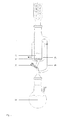
- Fig. 1 shows an exemplary schematic reaction setup on a laboratory scale for implementing the process in accordance with the present invention such that the formed product can be continuously removed.
- the starting borane of formula (II) can be placed in a vessel (e.g. a flask) (A) and be diluted with a high boiling solvent, e.g. mesitylene, in order to minimize its decomposition during heating.
- a high boiling solvent e.g. mesitylene
- the decomposition of the starting borane, such as HBPin (pinacolborane) can be further minimized by adding between 1 and 10 mol% of NEt 3 or other Lewis-bases such as pyridine or alkyl phosphines (preferably PiPr 3 and PtBu 3 ).
- the starting borane is then distilled from this mixture (B) and condensed into a reaction chamber (C) which can be heated, e.g.
- D a heating fluid
- the distilled borane of formula (II) entering into the reaction chamber is neat, as dilution with co-distilled solvent can impair the coupling reaction.
- a stationary catalyst is provided, which can be contacted by the borane of formula (II).
- the catalysts can be placed on a tray (E) which is permeable for liquids, and forms a reaction mixture with the borane of formula (I). Under these conditions, heterogeneous catalysts e.g. in the form of carrier pellets can be favourably used.
- a flow regulator such as a Teflon stop cock
- a continuous flow of the reaction mixture containing the diborane(4) of formula (I) resulting from the coupling redaction back into the flask (A) is maintained.
- the diboranes(4) can be removed from the actual reaction mixture and TONs of more than 1000 are achieved. After removing excess borane and the solvent in vacuo, the diboranes(4) can be isolated as described above.
- the diborane By adding a further catalyst to the reaction mixture containing the resulting diborane(4) of formula (I), the diborane can be reacted in situ with unsaturated compounds, such as compounds containing multiple carbon-carbon, carbon-nitrogen or nitrogen-nitrogen bonds.
- the catalysts should be added at the beginning of the reaction in order to remove the diborane(4) from the reaction mixture continuously.
- Possible catalysts useful for this purpose are complexes of Pt(0), Rh(0), and Ir(0), which can transfer the diborane(4) to unsaturated compounds that do not react with HBPin or HBCat.
- a number of advantages are associated with the process for the preparation of diborane(4) according to the present invention.
- only one step is needed, with a rather easily accessible borane as a starting material.
- solvents are needed only for the isolation of the product, whereas the reaction itself may be conducted in neat borane.
- Another important advantage is that the catalysts used for the dehydrocoupling are much easier to handle than the alkali metals needed for the reductive coupling employed in the prior art.
- only small quantities of byproduct are formed, which reduces the amount of the resulting waste material to a minimum and diminishes the necessity of purification of the resulting product.
- Recrystallization from diethyl ether affords B 2 Cat 2 , which can occasionally contain a smaller amount of the catecholato-bridged byproduct B 2 Cat 3 .
- This byproduct can be destroyed by adding some drops of water to the product dissolved in diethyl ether or dichloromethane, which turns the initially clear solution cloudy. After filtration, the solvent is removed, leaving catechol as the only impurity. Further purification is achieved by sublimation at 120 °C and 4 ⁇ 10 -2 mbar within 60 minutes. During this sublimation, pure B 2 Cat 2 (4.36 g, 18.3 mmol) is collected on a sublimation finger, which is heated to 55 °C, whereas the catechol precipitates at the cooler wall of the flask. Alternatively, catechol can be removed by further recrystallization from diethyl ether and crystallizing at -30 °C.
- B 2 Cat 2 has been prepared using other heterogeneous catalysts, as shown in table 1.
- Table 1 Example Catalyst (loading [mol%]) Turnover-Number 1 Platinum charcoal (0.006%) 350 2 Titanium powder (0.4%) 13 3 Zirconium powder (0.4%) 3 4 Hafnium powder (0.4%) 13 5 Palladium charcoal (0.05%) 35 6 Platinum charcoal (0.05%) 105 7 Platinum on alumina (0.05%) 95 8 Palladium charcoal (0.025%) 75 9 Platinum charcoal (0.025%) 190 10 Platinum on alumina (0.025%) 220
- B 2 Cat 2 was prepared using the catalysts shown in table 2.
- Table 2 Example Catalyst (loading [mol%]) Turnover-Number 11 [Cp 2 TiCl 2 ] (0.05%) 130 12 [Cp 2 ZrCl 2 ] (0.05%) 200 13 [Cp* 2 HfCl 2 ] (0.05%) 164 14 [CpTiCl 3 ] (0.05%) 106 15 HfCl 4 (0.05%) 48 16 Hfl 4 (0.05%) 59 17 [(dppm)PtCl 2 ] (0.05%) 90 18 [(dcpe)PtCl 2 ] (0.05%) 65 19 [(dcpe)PdCl 2 ] (0.05%) 75 20 [(dcpe)NiCl 2 ] (0.05%) 35 21 [(dppm)PtCl 2 ] (0.025%)
- group-4-compounds are the best catalysts, with a maximum TON of 200.
- HBPin pinacolborane, 85.0 g, 513 mmol
- platinum on alumina 100 mg, 25.6 ⁇ mol
- Excess HBPin is removed in vacuo and collected in a cooling trap for reuse.
- Subsequent sublimation affords a white crude product consisting of B 2 Pin 2 and (PinB) 2 O.
- Isolation of B 2 Pin 2 is achieved by dissolving the crude product in pentane and extracting with dilute hydrochloric acid. After removing the solvent, pure B 2 Pin 2 is obtained. In case further purification is necessary, this can be achieved by sublimation at 65 °C and 4 ⁇ 10 -2 mbar within 60 minutes.
- B 2 Pin 2 has been prepared using other heterogeneous catalysts as shown in table 3.
- Table 3 Example Catalyst (loading [mol%]) Turnover-Number 25 Platinum on alumina (0.005%) 90 26 Palladium charcoal (0.025%) 60 27 Platinum charcoal (0.025%) 60
- a TON (turnover number) of 90 can be achieved with platinum on alumina, whereas platinum and palladium charcoal afford TONs of 60 each.
- HBPin 3-5 mL HBPin is in contact with the catalyst (effective catalyst loading in the reaction chamber 0.015-0.025 mol%).
- the reaction time can be extended to more than one week, since no significant loss in catalyst activity is observed.
- reaction times of 20-50 hours are most favorable. Excess HBPin and mesitylene were removed in vacuo and the resulting crude product was purified as described above, yielding 1.36 g (6.06 mmol, TON 1050) B 2 Pin 2 .
- B 2 Pin 2 has been prepared using other heterogeneous catalysts, as shown in table 4.
- Table 4 Example Catalyst (loading [mol%]) Turnover-Number 28 Platinum on alumina 1050 29 Rhodium on alumina 284 30 Palladium on alumina 513
Landscapes
- Chemical & Material Sciences (AREA)
- Organic Chemistry (AREA)
- Organic Low-Molecular-Weight Compounds And Preparation Thereof (AREA)
- Low-Molecular Organic Synthesis Reactions Using Catalysts (AREA)
Abstract
Description
- The invention relates to a porcess for the preparation of diborane(4) compounds. This class of compounds constitutes an important precursor for organoboronic esters, which are versatile reagents for the formation of carbon-carbon bonds.
- The current synthesis of diboranes(4) was established by Brotherton in 1960 (R. J. Brotherton, A. L. McCloskey, L. L. Petterson, H. Steinberg, J. Am. Chem. Soc. 1960, 82, 6242-6245) and has been modified several times during the past decades (C. N. Welch, S. G. Shore, Inorg. Chem. 1968, 7, 225-230; P. Nguyen, G. Lesley, N. J. Taylor, T. B. Marder, N. L. Pickett, W. Clegg, M. R. J. Elsegood, N. C. Norman, Inorg. Chem. 1994, 33, 4623-4624; D. Loderer, H. Nöth, H. Pommerening, W. Rattay, H. Schick, Chem. Ber. 1994, 127, 1605-1611; W. Clegg, M.R. J. Elsegood, F. J. Lawlor, N. C. Norman, N. L. Pickett, E. G. Robins, A. J. Scott, P. Nguyen, N. J. Taylor, T. B. Marder, Inorg. Chem. 1998, 37, 5289-5293; T. Ishiyama, M. Murata, T. A. Ahiko, N. Miyaura, Org. Synth. 2000, 77, 176-185; H. A. Ali, I. Goldberg, M. Srebnik, Eur. J. Inorg. Chem. 2002, 73-78). Starting from borontribromide, bromobis(dimethylamino)borane is synthesized in two steps. Subsequently, the formation of a boron-boron-bond is achieved by reductive coupling with Na/K to yield tetrakis(dimethylamino)diborane (B2(NMe2)4). Bis(catecholato)diborane (B2Cat2) and bis(pinacolato)diborane (B2Pin2) can be obtained by the reaction of B2(NMe2)4 with the corresponding diols (T. Ilshiyama, M. Murata, T. A. Ahiko, N. Miyaura, Org. Synth. 2000, 77, 176-185; R. J. Brotherton, A. L. McCloskey, J. L. Boone, H. M. Manasevit, J. Am. Chem. Soc. 1960, 82, 6245-6248; H. Nöth, Z. Naturforsch. B: Chem. Sci. 1984, 39B, 1463-1466).

- Alternatively, chlorocatecholborane can be used as a starting material for the synthesis of B2Cat2. !n this case, the boron-boron bond is formed by reductive coupling with sodium amalgam. B2Pin2 is not accessible on this reaction pathway (N. R. Anastasi, K. M. Waltz, W. L. Weerakoon, J. F. Hartwig, Organometallics 2003, 22, 365-369).
- However, these syntheses imply several disadvantages, especially in regard to the large-scale production of diboranes(4). For example, very reactive or toxic reagents are required for the reductive coupling. Furthermore, as this is a multistep-synthesis, it is quite time consuming and each step produces waste material, which makes the commercially available diboranes(4) rather expensive.
- Marder et al. (W. H. Lam, K. C. Lam, Z. Lin, S. Shimada, R. N. Perutz, T. B. Marder, Dalton Trans. 2004, 1556-1562) conducted a theoretical study of reaction pathways for the rhodium phosphine-catalysed borylation of C-H bonds with pinacolborane (HBPin). Therein, they also examined the dehydrodimerisation of HBPin to B2Pin2 + H2 in the presence of a [(P i Pr3)2Rh(Cl)(N2)] catalyst. According to their theoretical calculations, there is no thermodynamic driving force for this reaction. However, experimental data indicate an equilibrium between HBPin and B2Pin2 (S. Shimada, A. S. Batsanov, J. A. K. Howard, T. B. Marder, Angew. Chem. 2001, 113, 2226-2229; Angew. Chem. Int. Ed. Engl. 2001, 40, 2168-2171).
- In view of the prior art, it was an object of the present invention to provide a process for the preparation of diboranes(4) which uses less reactive and less toxic reagents, is fast and simple and produces less waste material.
- The present inventors have surprisingly found that these objects can be achieved by a process for the preparation of compounds of the general formula (I) (hereinafter also called "diboranes(4)") by coupling of the corresponding boranes of the general formula (II) in the presence of a homogeneous or heterogeneous catalyst as described hereinafter.
- Accordingly, the present invention relates to a process for the preparation of diboranes(4), comprising the step of coupling two compounds of the general formula (II), which may be identical or different,
(RnZ)2BH (II)
wherein
each Z is independently selected from N, O or S;
n is 1 in case Z is O or S and n is 2 in case Z is N;
each R is independently selected from alkyl, heteroalkyl, -Cyc, -alkyl-Cyc and -heteroalkyl-Cyc, or two groups R attached to different Zs at one boron atom may represent together a divalent group selected from divalent alkyl, divalent heteroalkyl, -Cyc-, -alkyl-Cyc- and -alkyl-Cyc-alkyl-, which divalent group forms a ring together with the moiety -Z-B-Z-,
and if Z is N, one of the two groups R attached to the nitrogen atom can additionally be hydrogen, or two groups R attached to the same nitrogen atom may additionally represent together a divalent group selected from divalent alkyl, divalent heteroalkyl, -alkyl-Cyc- and -alkyl-Cyc-alkyl-, which divalent group forms a ring together with the nitrogen atom to which it is attached;
and wherein Cyc denotes a cycloalkyl, aryl, heterocycloalkyl or heteroaryl group, and wherein any mono- or divalent alkyl or heteroalkyl group is optionally substituted with one or more substituents selected from halogen, hydroxy, -NH2, -NH(C1-6 alkyl) or -N(C1-6 alkyl)2, and any mono- or divalent group Cyc is optionally substituted with one or more substituents selected from halogen, hydroxy, C1-6 alkyl, C1-6 haloalkyl, C1-6 alkoxy, phenyl, -NH2, -NH(C1-6 alkyl) or -N(C1-6 alkyl)2;
via homogeneous or heterogeneous catalysis in the presence of a catalyst comprising a transition metal selected from Ti, Zr, Hf, Rh, Ir, Ni, Pd and Pt,
to form a diborane(4) of the general formula (I)
(RnZ)2B-B(ZRn)2 (I)
wherein Z, n and R are as defined above. - The term "alkyl" as used in the above definition and the following preferred embodiments, encompasses straight and branched alkyl moieties. Unless indicated otherwise, preferred examples of alkyl groups have 1 to 6 carbon atoms (C1-6 alkyl), in particular 1 to 4 carbon atoms (C1-4 alkyl), and include methyl, ethyl, propyl (e.g., n-propyl, or isopropyl) and butyl (e.g., n-butyl, isobutyl, tert-buty!, or sec-butyl). Specifically in the case where two Rs attached to different Zs represent a divalent alkyl group which forms a ring with the moiety -Z-B-Z- it is preferred that the divalent alkyl group contains a linear chain with 2 to 6, preferably 2 to 4 carbon atoms extending from one group Z to the other, and the total number of carbon atoms, including branches, is preferably 2 to 10. In the case where two Rs attached to one Z are a divalent alkyl group which forms a ring with Z, it is preferred that the divalent alkyl group contains a linear chain with 3 to 6, preferably 4 or 5 carbon atoms, and the total number of carbon atoms, including branches, is preferably 3 to 10.
- The term "heteroalkyl", as used in the above definition and the following preferred embodiments, refers to an alkyl group and its preferred embodiments as described above, wherein one or more of the carbon atoms have been replaced by a heteroatom. Preferred examples of heteroatoms are O, S and N, in particular O. Preferred examples of heteroalkyl groups contain 1 to 6 carbon atoms and 1, 2 or 3 heteroatoms. Thus, preferred heteroalkyl groups are ether groups which may contain one or more, such as 1, 2 or 3, ether linkages.
- "Cyc", as used in the above definition and the following preferred embodiments denotes a cycloalkyl, aryl, heterocycloalkyl or heteroaryl group, preferably a cycloalkyl or aryl group.
- The term "cycloalkyl", as used in the above definition and the following preferred embodiments, refers to a cyclic alkyl moiety. Preferred examples of suitable alkyl groups have 4 to 10 carbon atoms, in particular 5 or 6 carbon atoms, and include cyclopentyl and cyclohexyl.
- The term "heterocycloalkyl", as used in the above definition and the following preferred embodiments, refers to a cycloalkyl group in which one or more of the carbon atoms have been replaced by a heteroatom. Preferred examples of heterotaoms are N, O and S. Preferred examples of heterocycloalkyl groups contain 2 to 5 carbon atoms and 1, 2 or 3 heteroatoms. Further preferred examples of heterocycloalkyl groups include pyrrolidine, tetrahydrofuran or piperidine groups.
- The term "aryl", as used in the above definition and the following preferred embodiments, refers to an aromatic ring system, including single rings and condensed rings, which preferably has 6 to 10 carbon atoms. Particular examples are a phenyl or a naphthyl group.
- The term "heteroaryl", as used in the above definition and the following preferred embodiments, refers to an aryl group as defined above in which one or more of the carbon atoms, e.g. 1, 2 or 3, have been replaced by a heteroatom. Preferred examples of heteroatoms are N, O or S. Preferred examples of heteroaryl groups contain 3 to 9 carbon atoms and 1, 2 or 3 heteroatoms. Further preferred examples of heteroaryl groups include pyrrole, pyridine, pyrazole, pyrazine, furan and thiophene groups.
- The term "haloalkyl", as used in the above definition and the following preferred embodiments, refers to an alkyl group in which one or more hydrogen atoms, such as 1, 2 or 3, have been replaced by halogen atoms. Examples are fluoromethyl, trifluoromethyl, pentafluoroethyl or chloromethyl.
- The term "alkoxy", as used in the above definition and the following preferred embodiments, refers to the group -O-alkyl.
- The term "halogen", as used in the above definitions and the following preferred embodiments, denotes F, Cl, Br or I, preferably F, Cl or Br.
- Any optionally substituted mono- or divalent alkyl or heteroalkyl group is optionally substituted with one or more, such as 1, 2 or 3, substituents selected from halogen, hydroxy, -NH2, -NH(C1-6 alkyl) or -N(C1-6 alkyl)2. Preferred are F, Cl, hydroxy and -NH2. General preference is given to the case where the optionally substituted moieties are unsubstituted.
- Any mono- or divalent group Cyc is optionally substituted with one or more, such as 1, 2, 3 or 4, substituents selected from halogen, hydroxy, C1-6 alkyl, C1-6 haloalkyl, C1-6 alkoxy, phenyl, -NH2, -NH(C1-6 alkyl) or -N(C1-6 alkyl)2. Preferred are F, Cl, hydroxy, methyl, ethyl, trifluormethyl, methoxy, ethoxy and -NH2. General preference is given to the case where the optionally substituted moieties are unsubstituted.
- In the compounds of formula (I) and (II), Z is preferably N or O, in particular O.
- Furthermore, it is generally preferred that all groups Z in a compound of formula (I) and (II) are identical.
- In the case where Z is O or S, particularly O, it is preferred for the compounds of formula (I) and (II) that each R is independently selected from alkyl, cycloalkyl and aryl, or two groups R attached to different groups Z at one boron atom together represent a divalent group selected from divalent alkyl, divalent cycloalkyl or divalent aryl, which divalent group forms a ring together with the moiety -Z-B-Z-; wherein any mono- or divalent alkyl group is optionally substituted with one or more substituents selected from halogen, hydroxy, -NH2, -NH(C1-6 alkyl) or -N(C1-6 alkyl)2, and any mono- or divalent cycloalkyl or aryl group is optionally substituted with one or more substituents selected from halogen, hydroxy, C1-6 alkyl, C1-6 haloalkyl, -NH2, -NH(C1-6 alkyl) or -N(C1-6 alkyl)2.
- In the case where both groups Z are O or S, particularly O, and where R is independently alkyl, cycloalkyl or aryl, it is preferred that both R in the compound of formula (II) are the same.
- In accordance with another particularly preferred embodiment of the present invention, the compound of formula (II) is a compound of formula (IIa):


- In the case where Z is N, the R groups attached to the same N may be the same or different as long as not both R groups are H. Preferably, one group NR2 in the compounds of formula (II) is the same as the other group NR2 in the case where both Z are N. Preferably, R is selected from H, C1-6 alkyl, cyclohexyl or phenyl or two R groups attached to the same N form together a divalent group selected from butylene or pentylene (in this case, the groups R form together with the N a pyrrolidine ring or a piperidine ring, respectively). Particularly preferred N-substituted boranes of formula (II) are (Me2N)2BH, (Et2N)2BH and bis(pyrrolidino)borane.
- In the process in accordance with the invention, one type or a mixture of two or more types of compounds of formula (II) may be used as a starting material for the coupling reaction. However, in terms of the control of the obtained structure, it is preferable to use only one type of compound of formula (II). Thus, it is made sure that two identical compounds of formula (II) are coupled in the process in accordance with the invention.
- The compounds of formula (II) are conveniently accessible via processes described in the literature, e.g. as discussed above, or in H. C. Newsom, W. G. Woods, Inorg. Chem. 1968, 7, 177-178 and H. Noeth, W. A. Dorochov, P. Fritz, F. Pfab, Z. Anorg. Allg. Chem. 1962, 318, 293-303; R. Köster, H. Bellut, S. Hattori, Justus Liebigs Ann. Chem. 1969, 720, 1-22; H. C. Brown, S. K. Gupta, J. Am. Chem. Soc. 1975, 97, 5249-5255; D. Männig, H. Nöth, J. Chem. Soc. Dalton Trans. 1985, 1689-1692; J. V. B. Kanth, M. Periasamy, H. C. Brown, Org. Process Res. Dev. 2000, 4, 550-553; N. Praveen Ganesh, S. D'Hondt, P. Y. Chavant, J. Org. Chem. 2007, 72, 4510-4514 or B. M. Rosen, C. Huang, V. Percec, Org. Lett. 2008, 10, 2597-2600.
- As noted above, the reaction proceeds via heterogeneous or homogeneous catalysis.
- As a catalyst for homogeneous catalysis, transition metal compounds containing a metal selected from Ti, Zr, Hf, Rh, Ir, Pt, Pd and Ni can be used. Preferred are Ti, Zr, Hf, Pt, Pd and Ni, and in particular the metals of Group 4 of the periodic table, Ti, Zr and Hf. The transition metal compound can be a salt of the transition metal, such as a halogenide, e.g. a chloride. Preferably, a complex of one of the above transition metals is used as a catalyst for homogeneous catalysis. The transition metal complex preferably contains an optionally substituted cyclopentadienyl ligand, such as cyclopentadienyl (Cp) or pentamethylcyclopentadienyl (Cp*), or a phosphino ligand, especially a chelating ligand combining two phosphino groups, such as bis(diphenylphosphino)methane (dppm) or bis(dicyclohexylphosphino)ethane (dcpe). A chelating phosphino ligand is preferably present in the complexes of Ni, Pd and Pt.
- Preferred examples of catalysts for homogeneous catalysis are [Cp2TiCl2], [Cp2ZrCl2], [Cp2HfCl2] [Cp*2HfCl2], [CpTiCl3] (A. M. Cardoso, R. J. H. Clark, S. Moorhouse, J. Chem. Soc., Dalton Trans. 1980, 1156-1160), [(dppm)PtCl2] (T. G. Appleton, M. A. Bennett, I. B. Tomkins, J. Chem. Soc. , Dalton Trans. 1976, 439-446), [(dcpe)PtCl2] (M. Hackett, G. M. Whitesides, J. Am. Chem. Soc. 1908, 110, 1449-1462), [(dcpe)PdCl2] (P. Diversi, G. Ingrosso, A. Lucherini, T. Lumini, F. Marchetti, V. Adovasio, M. Nardelli, J. Chem. Soc., Dalton Trans. 1988, 133-140) and [(dcpe)NiCl2] (I. M. Angulo, E. Bouwman, R. van Gorkum, S. M. Loh, M. Lutz, A. L. Spek, J. Mol. Catal. A: Chem. 2003, 202, 97-106). [Cp2TiCl2], [Cp2ZrCl2], [Cp*2HfCl2] [CpTiCl3], and [(dppm)PtCl2] are particularly preferred.
- As a catalyst for heterogeneous catalysis, a transition metal selected from Ti, Zr, Hf, Rh, Ir, Pt, Pd and Ni can be used which is generally in elemental form. Preferred are Ti, Zr, Hf, Pt, Pd and Ni, and in particular Ni, Pd and Pt. Most preferred metals for the heterogeneous catalysis are selected from Pd and Pt. For example, a metal powder may be used. However,
- it is preferred to use the metal supported on a carrier, such as carbon (e.g. charcoal), a ceramic support (e.g. alumina, silica or combinations thereof), or another inorganic carrier, such as BaSO4, BaCO3, CaCO3, SrSO4 or SrCO3. The support is typically a particulate support or a support in the form of pellets. Especially preferred heterogeneous catalysts are Rh/alumina Pt/charcoal, Pt/alumina, Pd/charcoal and Pd/alumina. In case of a supported catalyst, the amount of the transition metal on the support is preferably 0.1 to 20 wt%, more preferably 0.5 to 15 wt% based on the total weight of the catalyst including the support.
- The catalyst is generally employed in an amount of 0.001 to 5 mol%, preferably 0.001 to 1 mol%, in terms of the ratio of the moles of metal to the moles of the starting compound (II) used.
- It has been found that the turnover-numbers (TON) for the formation of diborane(4) may be improved if the borane is used in large excess. It is therefore preferable to keep the amount of the catalyst relatively low in the reaction mixture. For example, for the heterogeneous catalysis, catalyst loadings in the range of 0.001 to 0.5 mol % , in particular 0.002 to 0.1 mol% and most preferably 0.002 to 0.05 mol% (in terms of the ratio of the moles of metal to the moles of the starting compound (II)) are typically used. For the homogeneous catalysis, a preferred range for the catalyst loading is 0.01 to 0.1 mol%.
- The coupling reaction in accordance with the process of the present invention may be carried out in a solvent, but is preferably carried out without a solvent, i.e. by contacting the neat starting compound of formula (II) with the catalyst.
- The reaction temperature of the reductive coupling reaction according to the present invention is not particularly limited. Preferably, the reaction temperature is chosen to be in a range of from 50 to 150 °C, more preferably from 80 to 120 °C and most preferably between 100 and 115 °C. However, for compounds of formula (II) which are stable under heat, higher temperatures can be chosen. For example, in case catecholborane or piracolborane are used, a reaction temperature of from 100 to 120°C is preferred, more preferably 105 to 110 °C.
- The reaction time for the coupling reaction according to the present invention is not particularly limited. Preferably, the reaction time is between 0.5 h and 3 days, more preferably between 3 and 30 h, most preferably between 6 and 24 h.
- At the end of the reductive coupling reaction, excess starting material may be removed, e.g. via vacuum distillation, and may be collected in a cooling trap to be reused. From the remaining solid, the desired diborane(4) can be recovered, e.g., via sublimation, and can be purified, if needed, via recrystallization or other methods known to the skilled person.
- In accordance with a preferred variant of the process in accordance with the invention, formed product is continuously removed, in part or completely, from the reaction mixture.
- This can be achieved, e.g., by allowing the starting compounds of formula (II) to pass a reaction zone where they are in contact with the catalyst, favorably in a heterogeneously catalyzed reaction such that the catalyst can be conveniently held in place in the reaction zone. After passing the reaction zone, the mixure of starting compounds of formula (II) and diborane(4) of formula (I) can be subjected to a separation process to separate these components from each other. For example, the starting compounds of formula (II) can be distilled from the mixture and can be recycled to the reaction zone.
-
Fig. 1 shows an exemplary schematic reaction setup on a laboratory scale for implementing the process in accordance with the present invention such that the formed product can be continuously removed. - In this exemplary embodiment, the starting borane of formula (II) can be placed in a vessel (e.g. a flask) (A) and be diluted with a high boiling solvent, e.g. mesitylene, in order to minimize its decomposition during heating. The decomposition of the starting borane, such as HBPin (pinacolborane), can be further minimized by adding between 1 and 10 mol% of NEt3 or other Lewis-bases such as pyridine or alkyl phosphines (preferably PiPr3 and PtBu3). The starting borane is then distilled from this mixture (B) and condensed into a reaction chamber (C) which can be heated, e.g. by a glass jacket containing a heating fluid (D). It is preferred that the distilled borane of formula (II) entering into the reaction chamber is neat, as dilution with co-distilled solvent can impair the coupling reaction. Inside the reaction chamber, a stationary catalyst is provided, which can be contacted by the borane of formula (II). For example, the catalysts can be placed on a tray (E) which is permeable for liquids, and forms a reaction mixture with the borane of formula (I). Under these conditions, heterogeneous catalysts e.g. in the form of carrier pellets can be favourably used. Via a flow regulator (F), such as a Teflon stop cock, a continuous flow of the reaction mixture containing the diborane(4) of formula (I) resulting from the coupling redaction back into the flask (A) is maintained. Via this equipment, the diboranes(4) can be removed from the actual reaction mixture and TONs of more than 1000 are achieved. After removing excess borane and the solvent in vacuo, the diboranes(4) can be isolated as described above.
- By adding a further catalyst to the reaction mixture containing the resulting diborane(4) of formula (I), the diborane can be reacted in situ with unsaturated compounds, such as compounds containing multiple carbon-carbon, carbon-nitrogen or nitrogen-nitrogen bonds.
- The catalysts should be added at the beginning of the reaction in order to remove the diborane(4) from the reaction mixture continuously. Possible catalysts useful for this purpose are complexes of Pt(0), Rh(0), and Ir(0), which can transfer the diborane(4) to unsaturated compounds that do not react with HBPin or HBCat.
- A number of advantages are associated with the process for the preparation of diborane(4) according to the present invention. In contrast to the conventional method, only one step is needed, with a rather easily accessible borane as a starting material. Furthermore, solvents are needed only for the isolation of the product, whereas the reaction itself may be conducted in neat borane. Another important advantage is that the catalysts used for the dehydrocoupling are much easier to handle than the alkali metals needed for the reductive coupling employed in the prior art. Finally, only small quantities of byproduct are formed, which reduces the amount of the resulting waste material to a minimum and diminishes the necessity of purification of the resulting product.
- In a typical reaction, neat HBCat (catecholborane, 105 g, 872 mmol) is heated with platinum charcoal (10 wt% platinum, 100 mg, 51.3 µmol, loading: 0.006 mol%) to 105 °C, while a light stream of dry argon is passed through the solution. After 20 h, excess HBCat is removed in vacuo and collected in a cooling trap for reuse. The remaining black solid is sublimed at 125°C and 4·10-2 mbar for 10 h to yield a solid colorless crude product consisting of B2Cat2 and several byproducts. Recrystallization from diethyl ether affords B2Cat2, which can occasionally contain a smaller amount of the catecholato-bridged byproduct B2Cat3. This byproduct can be destroyed by adding some drops of water to the product dissolved in diethyl ether or dichloromethane, which turns the initially clear solution cloudy. After filtration, the solvent is removed, leaving catechol as the only impurity. Further purification is achieved by sublimation at 120 °C and 4·10-2 mbar within 60 minutes. During this sublimation, pure B2Cat2 (4.36 g, 18.3 mmol) is collected on a sublimation finger, which is heated to 55 °C, whereas the catechol precipitates at the cooler wall of the flask. Alternatively, catechol can be removed by further recrystallization from diethyl ether and crystallizing at -30 °C.
- In the same way as in Example 1, B2Cat2 has been prepared using other heterogeneous catalysts, as shown in table 1.
Table 1 Example Catalyst (loading [mol%]) Turnover-Number 1 Platinum charcoal (0.006%) 350 2 Titanium powder (0.4%) 13 3 Zirconium powder (0.4%) 3 4 Hafnium powder (0.4%) 13 5 Palladium charcoal (0.05%) 35 6 Platinum charcoal (0.05%) 105 7 Platinum on alumina (0.05%) 95 8 Palladium charcoal (0.025%) 75 9 Platinum charcoal (0.025%) 190 10 Platinum on alumina (0.025%) 220 - Under heterogeneous conditions, a maximum turnover-number of 350 is obtained by the reaction of 0.006 mol% platinum charcoal (10wt% platinum) with neat HBCat. Platinum on alumina and palladium charcoal can also be used as heterogeneous catalysts, affording different TONs depending on the catalyst loading. Group-4-metal powders also catalyze the formation of B2Cat2, but the efficiency of the process is not as high.
- In a similar reaction as in Example 1, except for adding a transition metal compound as indicated in table 2 to the neat HBCat instead of an elemental metal to perform homogeneous catalysis, B2Cat2 was prepared using the catalysts shown in table 2.
Table 2 Example Catalyst (loading [mol%]) Turnover-Number 11 [Cp2TiCl2] (0.05%) 130 12 [Cp2ZrCl2] (0.05%) 200 13 [Cp*2HfCl2] (0.05%) 164 14 [CpTiCl3] (0.05%) 106 15 HfCl4 (0.05%) 48 16 Hfl4 (0.05%) 59 17 [(dppm)PtCl2] (0.05%) 90 18 [(dcpe)PtCl2] (0.05%) 65 19 [(dcpe)PdCl2] (0.05%) 75 20 [(dcpe)NiCl2] (0.05%) 35 21 [(dppm)PtCl2] (0.025%) 160 22 [(dcpe)PtCl2] (0.025%) 90 23 [(dcpe)PdCl2] (0.025%) 90 24 [(dcpe)NiCl2] (0.025%) 50 - Under these conditions, group-4-compounds are the best catalysts, with a maximum TON of 200. Among the late transition metal compounds, [(dppm)PtCl2] turned out to be the most effective catalyst, with a maximum TON of 160 (see table 2; Cp = cyclopentadienyl, Cp* = pentamethylcyclopentadienyl, dppm = bis(diphenylphosphino)methane), dcpe = bis(dicyclohexylphosphino)ethane).
- In a typical reaction, neat HBPin (pinacolborane, 85.0 g, 513 mmol) is heated with platinum on alumina (100 mg, 25.6 µmol) to 105 °C for several hours and monitored by GC. Excess HBPin is removed in vacuo and collected in a cooling trap for reuse. Subsequent sublimation affords a white crude product consisting of B2Pin2 and (PinB)2O. Isolation of B2Pin2 is achieved by dissolving the crude product in pentane and extracting with dilute hydrochloric acid. After removing the solvent, pure B2Pin2 is obtained. In case further purification is necessary, this can be achieved by sublimation at 65 °C and 4·10-2 mbar within 60 minutes.
- In the same way as in Example 25, B2Pin2 has been prepared using other heterogeneous catalysts as shown in table 3.
Table 3 Example Catalyst (loading [mol%]) Turnover-Number 25 Platinum on alumina (0.005%) 90 26 Palladium charcoal (0.025%) 60 27 Platinum charcoal (0.025%) 60 - A TON (turnover number) of 90 can be achieved with platinum on alumina, whereas platinum and palladium charcoal afford TONs of 60 each.
- Using the reaction setup illustrated in
Fig. 1 , a mixture of HBPin (17.6 g, 20 mL, 138 mmol), NEt3 (7.23 mmol) and 100 mL mesitylene was heated to ca. 160 °C. The neat borane was thus distilled into the reaction chamber equipped with platinum on alumina (0.5 wt%, 200 mg, 5.13 µmol). A constant reaction temperature of 120 °C was maintained by a glass jacket heated with polyethylene glycol 400. Via a Teflon stop cock, the flow of borane back into the flask was regulated, so that a constant volume of ca. 3-5 mL HBPin is in contact with the catalyst (effective catalyst loading in the reaction chamber 0.015-0.025 mol%). In general, the reaction time can be extended to more than one week, since no significant loss in catalyst activity is observed. However, in order to avoid an excessive decomposition of HBPin, reaction times of 20-50 hours are most favorable. Excess HBPin and mesitylene were removed in vacuo and the resulting crude product was purified as described above, yielding 1.36 g (6.06 mmol, TON 1050) B2Pin2. - In the same way as in Example 28, B2Pin2 has been prepared using other heterogeneous catalysts, as shown in table 4.
Table 4 Example Catalyst (loading [mol%]) Turnover-Number 28 Platinum on alumina 1050 29 Rhodium on alumina 284 30 Palladium on alumina 513 - In the same way as in Example 28, B2Cat2 has been prepared using heterogeneous catalysts, whereas TONs of up to 9200 were achieved, as shown in table 5.
Table 5 Example Catalyst (loading [mol%]) Turnover-Number 31 Platinum on alumina 9200 29 Rhodium on alumina 6500
Claims (14)
- A Process for the preparation of a diborane(4), comprising the step of coupling two compounds of the general formula (II), which may be identical or different,
(RnZ)2BH (II)
wherein
each Z is independently selected from N, O or S;
n is 1 in case Z is O or S and n is 2 in case Z is N;
each R is independently selected from alkyl, heteroalkyl, -Cyc, -alkyl-Cyc and -heteroalkyl-Cyc, or two groups R attached to different groups Z at one boron atom may represent together a divalent group selected from divalent alkyl, divalent heteroalkyl, -Cyc-, -alkyl-Cyc- and -alkyl-Cyc-alkyl-, which divalent group forms a ring together with the moiety -Z-B-Z-,
and if Z is N, one of the two groups R attached to the nitrogen atom can additionally be hydrogen, or two groups R attached to the same nitrogen atom may additionally represent together a divalent group selected from divalent alkyl, divalent heteroalkyl, -alkyl-Cyc- and -alkyl-Cyc-alkyl-, which divalent group forms a ring together with the nitrogen atom to which it is attached;
and wherein Cyc denotes a cycloalkyl, aryl, heterocycloalkyl or heteroaryl group, and wherein any mono- or divalent alkyl or heteroalkyl group is optionally substituted with one or more substituents selected from halogen, hydroxy, -NH2, -NH(C1-6 alkyl) or -N(C1-6 alkyl)2, and any mono- or divalent group Cyc is optionally substituted with one or more substituents selected from halogen, hydroxy, C1-6 alkyl, C1-6 haloalkyl, C1-6 alkoxy, phenyl, -NH2, -NH(C1-6 alkyl) or -N(C1-6 alkyl)2;
via homogeneous or heterogeneous catalysis in the presence of a catalyst comprising a transition metal selected from Ti, Zr, Hf, Rh, Ir, Ni, Pd and Pt,
to form a diborane(4) of the general formula (I)
(RnZ)2B-B(ZRn)2 (I)
wherein Z, n and R are as defined above. - The process of claim 1 wherein the compounds of formula (II) are coupled via heterogeneous catalysis in the presence of an elemental transition metal as a catalyst.
- The process of claim 2 wherein the transition metal is supported on a carrier.
- The process of claim 3 wherein the amount of the transition metal is 0.1 to 20 wt% based on the total weight of the supported catalyst.
- The process of claim 1 wherein the compounds of formula (II) are coupled via homogeneous catalysis in the presence of a transition metal compound as a catalyst.
- The process of claim 5 wherein the transition metal compound is a transition metal complex.
- The process of claim 6, wherein the complex comprises a ligand selected from cyclopentadienyl, pentamethylcyclopentadienyl, bis((diphenylphosphino)methane), and bis(dicyclohexylphosphino)ethane.
- The process of claim 5 wherein the transition metal compound is a transition metal salt.
- The process of any of claims 5 to 8, wherein the transition metal compound comprises a metal selected from Group 4 of the periodic table.
- The process of any of claims 1 to 9 wherein the catalyst is employed in an amount of 0.001 to 5 mol%, based on the total amount of the compound formula (II) used in the coupling reaction.
- The process of any of claims 1 to 10 wherein the catalyst is contacted with the neat compound of formula (II).
- The process of any of claims 1 to 11, wherein the diborane(4) of formula (I) is removed from the reaction mixture while the reaction proceeds.
- The process of any of claims 1 to 12, wherein only one type of compound of formula (II) is used in the coupling reaction.
- The process of any of claims 1 to 13, wherein the compounds of formula (II) are compounds of formula (IIa):

Priority Applications (1)
| Application Number | Priority Date | Filing Date | Title |
|---|---|---|---|
| EP20110176448 EP2554547B1 (en) | 2011-08-03 | 2011-08-03 | Transition-metal catalyzed synthesis of diboranes(4) |
Applications Claiming Priority (1)
| Application Number | Priority Date | Filing Date | Title |
|---|---|---|---|
| EP20110176448 EP2554547B1 (en) | 2011-08-03 | 2011-08-03 | Transition-metal catalyzed synthesis of diboranes(4) |
Publications (2)
| Publication Number | Publication Date |
|---|---|
| EP2554547A1 true EP2554547A1 (en) | 2013-02-06 |
| EP2554547B1 EP2554547B1 (en) | 2015-04-29 |
Family
ID=44644969
Family Applications (1)
| Application Number | Title | Priority Date | Filing Date |
|---|---|---|---|
| EP20110176448 Not-in-force EP2554547B1 (en) | 2011-08-03 | 2011-08-03 | Transition-metal catalyzed synthesis of diboranes(4) |
Country Status (1)
| Country | Link |
|---|---|
| EP (1) | EP2554547B1 (en) |
Cited By (1)
| Publication number | Priority date | Publication date | Assignee | Title |
|---|---|---|---|---|
| CN120289966A (en) * | 2025-06-13 | 2025-07-11 | 双枪科技股份有限公司 | A modified PET material and its application in preparing catering supplies |
-
2011
- 2011-08-03 EP EP20110176448 patent/EP2554547B1/en not_active Not-in-force
Non-Patent Citations (28)
| Title |
|---|
| A. M. CARDOSO, R. J. H. CLARK, S. MOORHOUSE, J. CHEM. SOC. , DALTON TRANS., 1980, pages 1156 - 1160 |
| ANGEW. CHEM. INT. ED. ENGL., vol. 40, 2001, pages 2168 - 2171 |
| B. M. ROSEN, C. HUANG, V. PERCEC, ORG. LETT., vol. 10, 2008, pages 2597 - 2600 |
| C. N. WELCH, S. G. SHORE, INORG. CHEM., vol. 7, 1968, pages 225 - 230 |
| D. LODERER, H. NOTH, H. POMMERENING, W. RATTAY, H. SCHICK, CHEM. BER., vol. 127, 1994, pages 1605 - 1611 |
| D. MANNIG, H. NOTH, J. CHEM. SOC. DALTON TRANS., 1985, pages 1689 - 1692 |
| H. A. ALI, I. GOLDBERG, M. SREBNIK, EUR. J. INORG. CHEM., 2002, pages 73 - 78 |
| H. C. BROWN, S. K. GUPTA, J. AM. CHEM. SOC., vol. 97, 1975, pages 5249 - 5255 |
| H. C. NEWSOM, W. G. WOODS, INORG. CHEM., vol. 7, 1968, pages 177 - 178 |
| H. NBTH, Z. NATURFORSCH. B: CHEM. SCI., vol. 39B, 1984, pages 1463 - 1466 |
| H. NOETH, W. A. DOROCHOV, P. FRITZ, F. PFAB, Z. ANORG. ALLG. CHEM., vol. 318, 1962, pages 293 - 303 |
| I. M. ANGULO, E. BOUWMAN, R. VAN GORKUM, S. M. LOK, M. LUTZ, A. L. SPEK, J. MOL. CATAL. A: CHEM., vol. 202, 2003, pages 97 - 106 |
| J. V. B. KANTH, M. PERIASAMY, H. C. BROWN, ORG. PROCESS RES. DEV., vol. 4, 2000, pages 550 - 553 |
| M. HACKETT, G. M. WHITESIDES, J. AM. CHEM. SOC., vol. 110, 1988, pages 1449 - 1462 |
| N. PRAVEEN GANESH, S. D'HONDT, P. Y. CHAVANT, J. ORG. CHEM., vol. 72, 2007, pages 4510 - 4514 |
| N. R. ANASTASI, K. M. WALTZ, W. L. WEERAKOON, J. F. HARTWIG, ORGANOMETALLICS, vol. 22, 2003, pages 365 - 369 |
| P. DIVERSI, G. INGROSSO, A. LUCHERINI, T. LUMINI, F. MARCHETTI, V. ADOVASIO, M. NARDELLI, J. CHEM. SOC. , DALTON TRANS., 1988, pages 133 - 140 |
| P. NGUYEN, G. LESLEY, N. J. TAYLOR, T. B. MARDER, N. L. PICKETT, W. CLEGG, M. R. J. ELSEGOOD, N. C. NORMAN, INORG. CHEM., vol. 33, 1994, pages 4623 - 4624 |
| R. J. BROTHERTON, A. L. MCCLOSKEY, J. L. BOONE, H. M. MANASEVIT, J. AM. CHEM. SOC., vol. 82, 1960, pages 6245 - 6248 |
| R. J. BROTHERTON, A. L. MCCLOSKEY, L. L. PETTERSON, H. STEINBERG, J. AM. CHEM. SOC., vol. 82, 1960, pages 6242 - 6245 |
| R. KOSTER, H. BELLUT, S. HATTORI, JUSTUS LIEBIGS ANN. CHEM., vol. 720, 1969, pages 1 - 22 |
| S. SHIMADA, A. S. BATSANOV, J. A. K. HOWARD, T. B. MARDER, ANGEW. CHEM., vol. 113, 2001, pages 2226 - 2229 |
| SHIMADA ET AL: "Formation of Aryl- and Benzylboronate Esters by Rhodium-Catalyzed C-H Bond Functionalization with Pinacolborane", ANGEW. CHEM. INT. ED., vol. 40, no. 11, 1 January 2001 (2001-01-01), pages 2168 - 2171, XP055014507 * |
| T. !SHIYAMA, M. MURATA, T. A. AHIKO, N. MIYAURA, ORG. SYNTH., vol. 77, 2000, pages 176 - 185 |
| T. G. APPLETON, M. A. BENNETT, I. B. TOMKINS, J. CHEM. SOC. , DALTON TRANS., 1976, pages 439 - 446 |
| T. LSHIYAMA, M. MURATA, T. A. AHIKO, N. MIYAURA, ORG. SYNTH., vol. 77, 2000, pages 176 - 185 |
| W. CLEGG, M.R. J. ELSEGOOD, F. J. LAWLOR, N. C. NORMAN, N. L. PICKETT, E. G. ROBINS, A. J. SCOTT, P. NGUYEN, N. J. TAYLOR, T. B. M, INORG. CHEM., vol. 37, 1998, pages 5289 - 5293 |
| W. H. LAM, K. C. LAM, Z. LIN, S. SHIMADA, R. N. PERUTZ, T. B. MARDE, DALTON TRANS., 2004, pages 1556 - 1562 |
Cited By (1)
| Publication number | Priority date | Publication date | Assignee | Title |
|---|---|---|---|---|
| CN120289966A (en) * | 2025-06-13 | 2025-07-11 | 双枪科技股份有限公司 | A modified PET material and its application in preparing catering supplies |
Also Published As
| Publication number | Publication date |
|---|---|
| EP2554547B1 (en) | 2015-04-29 |
Similar Documents
| Publication | Publication Date | Title |
|---|---|---|
| Bebbington et al. | Photoisomerizable heterodienes derived from a phosphine borane | |
| Roesler et al. | Synthesis, structural characterization and reactivity of the amino borane 1-(NPh2)-2-[B (C6F5) 2] C6H4 | |
| Sadow et al. | Synthesis and characterization of scandium silyl complexes of the type Cp* 2ScSiHRR ‘. σ-bond metathesis reactions and catalytic dehydrogenative silation of hydrocarbons | |
| Budiman et al. | Copper‐Catalysed suzuki‐miyaura cross‐coupling of highly fluorinated aryl boronate esters with aryl iodides and bromides and Fluoroarene− arene π‐stacking interactions in the products | |
| Neu et al. | Bulky derivatives of boranes, boronic acids and boronate esters via reaction with diazomethanes | |
| Sahoo et al. | Synthesis of low oxidation state zinc (I) complexes and their catalytic studies in the dehydroborylation of terminal alkynes | |
| CA3006603A1 (en) | Precatalysts and process for the metal-free functionalization of sp2 carbons using the same | |
| Kharel et al. | A Nontemplated Route to Macrocyclic Dibridgehead Diphosphorus Compounds: Crystallographic Characterization of a “Crossed‐Chain” Variant of in/out Stereoisomers | |
| Chamberlain et al. | The chemistry of sterically crowded aryl-oxide ligands. Part 2. Cyclotantalation of 2, 6-di-tert-butylphenoxide | |
| Han et al. | Template-controlled topochemical photodimerization based on “organometallic macrocycles” through single-crystal to single-crystal transformation | |
| EP0599633B1 (en) | Boronic ester synthesis | |
| US11827653B2 (en) | Tridentate macrocyclic compounds | |
| Schumann et al. | Organometallic compounds of the lanthanides XCVII. Synthesis and crystal structures of monomeric bis (ethyltetramethylcyclopentadienyl) amide and alkyl derivatives of the lanthanides | |
| EP2554547B1 (en) | Transition-metal catalyzed synthesis of diboranes(4) | |
| Wang et al. | Half-sandwich scandium boryl complexes bearing a silylene-linked cyclopentadienyl-amido ligand | |
| JP2005513135A (en) | (Aryl) (amino) borane compounds and processes for their preparation | |
| Alonso‐Moreno et al. | Well‐Defined Regioselective Iminopyridine Rhodium Catalysts for Anti‐Markovnikov Addition of Aromatic Primary Amines to 1‐Octyne | |
| US6878830B2 (en) | Catalytic boronate ester synthesis from boron reagents and hydrocarbons | |
| Wark et al. | Synthesis and characterization of the rhodium tin mixed-metal alkoxides [((L2) Rh) 2Sn (OEt) 6], where L2= 1, 5-cyclooctadiene (COD) and (CO) 2 and the conversion of the COD complex to Rh and SnO2 under mild conditions | |
| US10821429B2 (en) | Precatalysts and process for the metal-free functionalization of SP2 carbons using the same | |
| Evans et al. | Synthesis and Structure of Lanthanide Complexes Derived from the O, N-Chelating, Bis (methylpyridine)-Substituted Alcohol HOC (CMe3)(2-CH2NC5H3Me-6) 2 | |
| Wang et al. | Synthesis of a phosphapyracene via metal-mediated cyclization: structural and reactivity effects of acenaphthene precursors | |
| Davies et al. | Use of Suzuki cross-coupling as a route to 2-phenoxy-6-iminopyridines and chiral 2-phenoxy-6-(methanamino) pyridines | |
| Nishihara et al. | Synthesis and reactivity of boryloxorhodium complexes. Relevance to intermolecular transmetalation from boron to rhodium in Rh-catalyzed reactions | |
| Genoux et al. | Covalent capture of nitrous oxide by phosphanides |
Legal Events
| Date | Code | Title | Description |
|---|---|---|---|
| PUAI | Public reference made under article 153(3) epc to a published international application that has entered the european phase |
Free format text: ORIGINAL CODE: 0009012 |
|
| AK | Designated contracting states |
Kind code of ref document: A1 Designated state(s): AL AT BE BG CH CY CZ DE DK EE ES FI FR GB GR HR HU IE IS IT LI LT LU LV MC MK MT NL NO PL PT RO RS SE SI SK SM TR |
|
| AX | Request for extension of the european patent |
Extension state: BA ME |
|
| 17P | Request for examination filed |
Effective date: 20130806 |
|
| RBV | Designated contracting states (corrected) |
Designated state(s): AL AT BE BG CH CY CZ DE DK EE ES FI FR GB GR HR HU IE IS IT LI LT LU LV MC MK MT NL NO PL PT RO RS SE SI SK SM TR |
|
| 17Q | First examination report despatched |
Effective date: 20131021 |
|
| GRAP | Despatch of communication of intention to grant a patent |
Free format text: ORIGINAL CODE: EPIDOSNIGR1 |
|
| GRAJ | Information related to disapproval of communication of intention to grant by the applicant or resumption of examination proceedings by the epo deleted |
Free format text: ORIGINAL CODE: EPIDOSDIGR1 |
|
| GRAP | Despatch of communication of intention to grant a patent |
Free format text: ORIGINAL CODE: EPIDOSNIGR1 |
|
| INTG | Intention to grant announced |
Effective date: 20140703 |
|
| INTG | Intention to grant announced |
Effective date: 20140711 |
|
| GRAS | Grant fee paid |
Free format text: ORIGINAL CODE: EPIDOSNIGR3 |
|
| GRAP | Despatch of communication of intention to grant a patent |
Free format text: ORIGINAL CODE: EPIDOSNIGR1 |
|
| INTG | Intention to grant announced |
Effective date: 20150305 |
|
| GRAA | (expected) grant |
Free format text: ORIGINAL CODE: 0009210 |
|
| AK | Designated contracting states |
Kind code of ref document: B1 Designated state(s): AL AT BE BG CH CY CZ DE DK EE ES FI FR GB GR HR HU IE IS IT LI LT LU LV MC MK MT NL NO PL PT RO RS SE SI SK SM TR |
|
| REG | Reference to a national code |
Ref country code: GB Ref legal event code: FG4D |
|
| REG | Reference to a national code |
Ref country code: CH Ref legal event code: EP |
|
| REG | Reference to a national code |
Ref country code: AT Ref legal event code: REF Ref document number: 724386 Country of ref document: AT Kind code of ref document: T Effective date: 20150515 |
|
| REG | Reference to a national code |
Ref country code: IE Ref legal event code: FG4D |
|
| REG | Reference to a national code |
Ref country code: DE Ref legal event code: R096 Ref document number: 602011016047 Country of ref document: DE Effective date: 20150611 |
|
| REG | Reference to a national code |
Ref country code: FR Ref legal event code: PLFP Year of fee payment: 5 |
|
| REG | Reference to a national code |
Ref country code: NL Ref legal event code: VDEP Effective date: 20150429 |
|
| REG | Reference to a national code |
Ref country code: AT Ref legal event code: MK05 Ref document number: 724386 Country of ref document: AT Kind code of ref document: T Effective date: 20150429 |
|
| REG | Reference to a national code |
Ref country code: LT Ref legal event code: MG4D |
|
| PG25 | Lapsed in a contracting state [announced via postgrant information from national office to epo] |
Ref country code: NL Free format text: LAPSE BECAUSE OF FAILURE TO SUBMIT A TRANSLATION OF THE DESCRIPTION OR TO PAY THE FEE WITHIN THE PRESCRIBED TIME-LIMIT Effective date: 20150429 |
|
| PG25 | Lapsed in a contracting state [announced via postgrant information from national office to epo] |
Ref country code: ES Free format text: LAPSE BECAUSE OF FAILURE TO SUBMIT A TRANSLATION OF THE DESCRIPTION OR TO PAY THE FEE WITHIN THE PRESCRIBED TIME-LIMIT Effective date: 20150429 Ref country code: HR Free format text: LAPSE BECAUSE OF FAILURE TO SUBMIT A TRANSLATION OF THE DESCRIPTION OR TO PAY THE FEE WITHIN THE PRESCRIBED TIME-LIMIT Effective date: 20150429 Ref country code: LT Free format text: LAPSE BECAUSE OF FAILURE TO SUBMIT A TRANSLATION OF THE DESCRIPTION OR TO PAY THE FEE WITHIN THE PRESCRIBED TIME-LIMIT Effective date: 20150429 Ref country code: PT Free format text: LAPSE BECAUSE OF FAILURE TO SUBMIT A TRANSLATION OF THE DESCRIPTION OR TO PAY THE FEE WITHIN THE PRESCRIBED TIME-LIMIT Effective date: 20150831 Ref country code: FI Free format text: LAPSE BECAUSE OF FAILURE TO SUBMIT A TRANSLATION OF THE DESCRIPTION OR TO PAY THE FEE WITHIN THE PRESCRIBED TIME-LIMIT Effective date: 20150429 Ref country code: NO Free format text: LAPSE BECAUSE OF FAILURE TO SUBMIT A TRANSLATION OF THE DESCRIPTION OR TO PAY THE FEE WITHIN THE PRESCRIBED TIME-LIMIT Effective date: 20150729 |
|
| PGFP | Annual fee paid to national office [announced via postgrant information from national office to epo] |
Ref country code: DE Payment date: 20150625 Year of fee payment: 5 Ref country code: GB Payment date: 20150828 Year of fee payment: 5 |
|
| PG25 | Lapsed in a contracting state [announced via postgrant information from national office to epo] |
Ref country code: IS Free format text: LAPSE BECAUSE OF FAILURE TO SUBMIT A TRANSLATION OF THE DESCRIPTION OR TO PAY THE FEE WITHIN THE PRESCRIBED TIME-LIMIT Effective date: 20150829 Ref country code: RS Free format text: LAPSE BECAUSE OF FAILURE TO SUBMIT A TRANSLATION OF THE DESCRIPTION OR TO PAY THE FEE WITHIN THE PRESCRIBED TIME-LIMIT Effective date: 20150429 Ref country code: LV Free format text: LAPSE BECAUSE OF FAILURE TO SUBMIT A TRANSLATION OF THE DESCRIPTION OR TO PAY THE FEE WITHIN THE PRESCRIBED TIME-LIMIT Effective date: 20150429 Ref country code: GR Free format text: LAPSE BECAUSE OF FAILURE TO SUBMIT A TRANSLATION OF THE DESCRIPTION OR TO PAY THE FEE WITHIN THE PRESCRIBED TIME-LIMIT Effective date: 20150730 Ref country code: AT Free format text: LAPSE BECAUSE OF FAILURE TO SUBMIT A TRANSLATION OF THE DESCRIPTION OR TO PAY THE FEE WITHIN THE PRESCRIBED TIME-LIMIT Effective date: 20150429 |
|
| PGFP | Annual fee paid to national office [announced via postgrant information from national office to epo] |
Ref country code: FR Payment date: 20150824 Year of fee payment: 5 |
|
| PG25 | Lapsed in a contracting state [announced via postgrant information from national office to epo] |
Ref country code: EE Free format text: LAPSE BECAUSE OF FAILURE TO SUBMIT A TRANSLATION OF THE DESCRIPTION OR TO PAY THE FEE WITHIN THE PRESCRIBED TIME-LIMIT Effective date: 20150429 Ref country code: DK Free format text: LAPSE BECAUSE OF FAILURE TO SUBMIT A TRANSLATION OF THE DESCRIPTION OR TO PAY THE FEE WITHIN THE PRESCRIBED TIME-LIMIT Effective date: 20150429 |
|
| REG | Reference to a national code |
Ref country code: DE Ref legal event code: R097 Ref document number: 602011016047 Country of ref document: DE |
|
| PG25 | Lapsed in a contracting state [announced via postgrant information from national office to epo] |
Ref country code: CZ Free format text: LAPSE BECAUSE OF FAILURE TO SUBMIT A TRANSLATION OF THE DESCRIPTION OR TO PAY THE FEE WITHIN THE PRESCRIBED TIME-LIMIT Effective date: 20150429 Ref country code: RO Free format text: LAPSE BECAUSE OF NON-PAYMENT OF DUE FEES Effective date: 20150429 Ref country code: PL Free format text: LAPSE BECAUSE OF FAILURE TO SUBMIT A TRANSLATION OF THE DESCRIPTION OR TO PAY THE FEE WITHIN THE PRESCRIBED TIME-LIMIT Effective date: 20150429 Ref country code: SK Free format text: LAPSE BECAUSE OF FAILURE TO SUBMIT A TRANSLATION OF THE DESCRIPTION OR TO PAY THE FEE WITHIN THE PRESCRIBED TIME-LIMIT Effective date: 20150429 |
|
| PLBE | No opposition filed within time limit |
Free format text: ORIGINAL CODE: 0009261 |
|
| STAA | Information on the status of an ep patent application or granted ep patent |
Free format text: STATUS: NO OPPOSITION FILED WITHIN TIME LIMIT |
|
| PG25 | Lapsed in a contracting state [announced via postgrant information from national office to epo] |
Ref country code: LU Free format text: LAPSE BECAUSE OF FAILURE TO SUBMIT A TRANSLATION OF THE DESCRIPTION OR TO PAY THE FEE WITHIN THE PRESCRIBED TIME-LIMIT Effective date: 20150803 Ref country code: MC Free format text: LAPSE BECAUSE OF FAILURE TO SUBMIT A TRANSLATION OF THE DESCRIPTION OR TO PAY THE FEE WITHIN THE PRESCRIBED TIME-LIMIT Effective date: 20150429 |
|
| REG | Reference to a national code |
Ref country code: CH Ref legal event code: PL |
|
| 26N | No opposition filed |
Effective date: 20160201 |
|
| PG25 | Lapsed in a contracting state [announced via postgrant information from national office to epo] |
Ref country code: LI Free format text: LAPSE BECAUSE OF NON-PAYMENT OF DUE FEES Effective date: 20150831 Ref country code: CH Free format text: LAPSE BECAUSE OF NON-PAYMENT OF DUE FEES Effective date: 20150831 Ref country code: IT Free format text: LAPSE BECAUSE OF FAILURE TO SUBMIT A TRANSLATION OF THE DESCRIPTION OR TO PAY THE FEE WITHIN THE PRESCRIBED TIME-LIMIT Effective date: 20150429 |
|
| PG25 | Lapsed in a contracting state [announced via postgrant information from national office to epo] |
Ref country code: SI Free format text: LAPSE BECAUSE OF FAILURE TO SUBMIT A TRANSLATION OF THE DESCRIPTION OR TO PAY THE FEE WITHIN THE PRESCRIBED TIME-LIMIT Effective date: 20150429 |
|
| REG | Reference to a national code |
Ref country code: IE Ref legal event code: MM4A |
|
| PG25 | Lapsed in a contracting state [announced via postgrant information from national office to epo] |
Ref country code: IE Free format text: LAPSE BECAUSE OF NON-PAYMENT OF DUE FEES Effective date: 20150803 |
|
| PG25 | Lapsed in a contracting state [announced via postgrant information from national office to epo] |
Ref country code: BE Free format text: LAPSE BECAUSE OF FAILURE TO SUBMIT A TRANSLATION OF THE DESCRIPTION OR TO PAY THE FEE WITHIN THE PRESCRIBED TIME-LIMIT Effective date: 20150429 |
|
| REG | Reference to a national code |
Ref country code: DE Ref legal event code: R119 Ref document number: 602011016047 Country of ref document: DE |
|
| PG25 | Lapsed in a contracting state [announced via postgrant information from national office to epo] |
Ref country code: MT Free format text: LAPSE BECAUSE OF FAILURE TO SUBMIT A TRANSLATION OF THE DESCRIPTION OR TO PAY THE FEE WITHIN THE PRESCRIBED TIME-LIMIT Effective date: 20150429 |
|
| GBPC | Gb: european patent ceased through non-payment of renewal fee |
Effective date: 20160803 |
|
| REG | Reference to a national code |
Ref country code: FR Ref legal event code: ST Effective date: 20170428 |
|
| PG25 | Lapsed in a contracting state [announced via postgrant information from national office to epo] |
Ref country code: SM Free format text: LAPSE BECAUSE OF FAILURE TO SUBMIT A TRANSLATION OF THE DESCRIPTION OR TO PAY THE FEE WITHIN THE PRESCRIBED TIME-LIMIT Effective date: 20150429 Ref country code: BG Free format text: LAPSE BECAUSE OF FAILURE TO SUBMIT A TRANSLATION OF THE DESCRIPTION OR TO PAY THE FEE WITHIN THE PRESCRIBED TIME-LIMIT Effective date: 20150429 Ref country code: HU Free format text: LAPSE BECAUSE OF FAILURE TO SUBMIT A TRANSLATION OF THE DESCRIPTION OR TO PAY THE FEE WITHIN THE PRESCRIBED TIME-LIMIT; INVALID AB INITIO Effective date: 20110803 |
|
| PG25 | Lapsed in a contracting state [announced via postgrant information from national office to epo] |
Ref country code: CY Free format text: LAPSE BECAUSE OF FAILURE TO SUBMIT A TRANSLATION OF THE DESCRIPTION OR TO PAY THE FEE WITHIN THE PRESCRIBED TIME-LIMIT Effective date: 20150429 Ref country code: SE Free format text: LAPSE BECAUSE OF FAILURE TO SUBMIT A TRANSLATION OF THE DESCRIPTION OR TO PAY THE FEE WITHIN THE PRESCRIBED TIME-LIMIT Effective date: 20150429 |
|
| PG25 | Lapsed in a contracting state [announced via postgrant information from national office to epo] |
Ref country code: FR Free format text: LAPSE BECAUSE OF NON-PAYMENT OF DUE FEES Effective date: 20160831 Ref country code: DE Free format text: LAPSE BECAUSE OF NON-PAYMENT OF DUE FEES Effective date: 20170301 Ref country code: GB Free format text: LAPSE BECAUSE OF NON-PAYMENT OF DUE FEES Effective date: 20160803 |
|
| PG25 | Lapsed in a contracting state [announced via postgrant information from national office to epo] |
Ref country code: TR Free format text: LAPSE BECAUSE OF FAILURE TO SUBMIT A TRANSLATION OF THE DESCRIPTION OR TO PAY THE FEE WITHIN THE PRESCRIBED TIME-LIMIT Effective date: 20150429 |
|
| PG25 | Lapsed in a contracting state [announced via postgrant information from national office to epo] |
Ref country code: MK Free format text: LAPSE BECAUSE OF FAILURE TO SUBMIT A TRANSLATION OF THE DESCRIPTION OR TO PAY THE FEE WITHIN THE PRESCRIBED TIME-LIMIT Effective date: 20150429 |
|
| PG25 | Lapsed in a contracting state [announced via postgrant information from national office to epo] |
Ref country code: AL Free format text: LAPSE BECAUSE OF FAILURE TO SUBMIT A TRANSLATION OF THE DESCRIPTION OR TO PAY THE FEE WITHIN THE PRESCRIBED TIME-LIMIT Effective date: 20150429 |