EP2554541A1 - Therapeutic agent or prophylactic agent for fibromyalgia - Google Patents
Therapeutic agent or prophylactic agent for fibromyalgia Download PDFInfo
- Publication number
- EP2554541A1 EP2554541A1 EP11765736A EP11765736A EP2554541A1 EP 2554541 A1 EP2554541 A1 EP 2554541A1 EP 11765736 A EP11765736 A EP 11765736A EP 11765736 A EP11765736 A EP 11765736A EP 2554541 A1 EP2554541 A1 EP 2554541A1
- Authority
- EP
- European Patent Office
- Prior art keywords
- compound
- group
- mmol
- reaction
- solution
- Prior art date
- Legal status (The legal status is an assumption and is not a legal conclusion. Google has not performed a legal analysis and makes no representation as to the accuracy of the status listed.)
- Granted
Links
- 0 Cc(cc1)ccc1-c1cc(C2(CCCCC2)O)n[n]1-c1ccc(*=C)cc1 Chemical compound Cc(cc1)ccc1-c1cc(C2(CCCCC2)O)n[n]1-c1ccc(*=C)cc1 0.000 description 14
- FMBGUERGZFGLAY-UHFFFAOYSA-N Cc(ccc(-c1cc(C(CC2)(CCC2O)O)n[n]1-c(cc1)ccc1OC)c1)c1F Chemical compound Cc(ccc(-c1cc(C(CC2)(CCC2O)O)n[n]1-c(cc1)ccc1OC)c1)c1F FMBGUERGZFGLAY-UHFFFAOYSA-N 0.000 description 2
- USXRKVNXIKVLPX-UHFFFAOYSA-N CC(C)(C)C(OC(CC1)CCC1(c(cc1-c2ccc(C)cc2)n[n]1-c(cc1)ccc1OC)O)=O Chemical compound CC(C)(C)C(OC(CC1)CCC1(c(cc1-c2ccc(C)cc2)n[n]1-c(cc1)ccc1OC)O)=O USXRKVNXIKVLPX-UHFFFAOYSA-N 0.000 description 1
- FPQCDMLVVGAHPB-UHFFFAOYSA-N CC(C)(C)C(OCOC(CC1)CCC1(c(cc1-c2ccc(C)cc2)n[n]1-c(cc1)ccc1OC)O)=O Chemical compound CC(C)(C)C(OCOC(CC1)CCC1(c(cc1-c2ccc(C)cc2)n[n]1-c(cc1)ccc1OC)O)=O FPQCDMLVVGAHPB-UHFFFAOYSA-N 0.000 description 1
- SNCSWNYRTCYOOP-UHFFFAOYSA-N COc(cc1)ccc1-[n]1nc(C(CC2)(CCC2O)O)cc1-c(cc1)ccc1C#N Chemical compound COc(cc1)ccc1-[n]1nc(C(CC2)(CCC2O)O)cc1-c(cc1)ccc1C#N SNCSWNYRTCYOOP-UHFFFAOYSA-N 0.000 description 1
- QBIRCRUIUVDDAY-UHFFFAOYSA-N COc(cc1)ccc1-c1c(-c(cc2)ccc2OC)[o]c(C(CC2)(CCC2=O)O)n1 Chemical compound COc(cc1)ccc1-c1c(-c(cc2)ccc2OC)[o]c(C(CC2)(CCC2=O)O)n1 QBIRCRUIUVDDAY-UHFFFAOYSA-N 0.000 description 1
- HUZZTSAPOLGYRN-UHFFFAOYSA-N COc(cc1)ccc1-c1cc(C(CC2)(CCC2O)O)n[n]1-c(cc1)ccc1Cl Chemical compound COc(cc1)ccc1-c1cc(C(CC2)(CCC2O)O)n[n]1-c(cc1)ccc1Cl HUZZTSAPOLGYRN-UHFFFAOYSA-N 0.000 description 1
- QNIPUMODLQVGBB-UHFFFAOYSA-N Cc(cc1)ccc1-[n]1nc(C(CC2)(CCC2O)O)cc1-c(cc1)ccc1OC Chemical compound Cc(cc1)ccc1-[n]1nc(C(CC2)(CCC2O)O)cc1-c(cc1)ccc1OC QNIPUMODLQVGBB-UHFFFAOYSA-N 0.000 description 1
- LAPIWTCMIDJJRW-UHFFFAOYSA-N Cc(cc1)ccc1-c1cc(C(CC2)(CCC2O)O)n[n]1-c(cc1)ccc1Cl Chemical compound Cc(cc1)ccc1-c1cc(C(CC2)(CCC2O)O)n[n]1-c(cc1)ccc1Cl LAPIWTCMIDJJRW-UHFFFAOYSA-N 0.000 description 1
- QEUTUZODSDZJRQ-UHFFFAOYSA-N Cc(cc1)ccc1-c1cc(C(CC2)(CCC2OC(CCC(O)=O)=O)O)n[n]1-c(cc1)ccc1OC Chemical compound Cc(cc1)ccc1-c1cc(C(CC2)(CCC2OC(CCC(O)=O)=O)O)n[n]1-c(cc1)ccc1OC QEUTUZODSDZJRQ-UHFFFAOYSA-N 0.000 description 1
- DMDLPPIQMVLEEJ-UHFFFAOYSA-N Cc(nc1)ccc1-c1cc(C(CC2)(CCC2=O)O)n[n]1-c(cc1)ccc1OC Chemical compound Cc(nc1)ccc1-c1cc(C(CC2)(CCC2=O)O)n[n]1-c(cc1)ccc1OC DMDLPPIQMVLEEJ-UHFFFAOYSA-N 0.000 description 1
- JWVFSJOLWWYQSQ-UHFFFAOYSA-N Cc1ccc(C(C#CC2(CCCCC2)O)O)cc1 Chemical compound Cc1ccc(C(C#CC2(CCCCC2)O)O)cc1 JWVFSJOLWWYQSQ-UHFFFAOYSA-N 0.000 description 1
Images

Classifications
-
- A—HUMAN NECESSITIES
- A61—MEDICAL OR VETERINARY SCIENCE; HYGIENE
- A61K—PREPARATIONS FOR MEDICAL, DENTAL OR TOILETRY PURPOSES
- A61K31/00—Medicinal preparations containing organic active ingredients
- A61K31/33—Heterocyclic compounds
- A61K31/395—Heterocyclic compounds having nitrogen as a ring hetero atom, e.g. guanethidine or rifamycins
- A61K31/41—Heterocyclic compounds having nitrogen as a ring hetero atom, e.g. guanethidine or rifamycins having five-membered rings with two or more ring hetero atoms, at least one of which being nitrogen, e.g. tetrazole
- A61K31/415—1,2-Diazoles
-
- A—HUMAN NECESSITIES
- A61—MEDICAL OR VETERINARY SCIENCE; HYGIENE
- A61K—PREPARATIONS FOR MEDICAL, DENTAL OR TOILETRY PURPOSES
- A61K31/00—Medicinal preparations containing organic active ingredients
- A61K31/33—Heterocyclic compounds
- A61K31/395—Heterocyclic compounds having nitrogen as a ring hetero atom, e.g. guanethidine or rifamycins
- A61K31/41—Heterocyclic compounds having nitrogen as a ring hetero atom, e.g. guanethidine or rifamycins having five-membered rings with two or more ring hetero atoms, at least one of which being nitrogen, e.g. tetrazole
- A61K31/415—1,2-Diazoles
- A61K31/4155—1,2-Diazoles non condensed and containing further heterocyclic rings
-
- A—HUMAN NECESSITIES
- A61—MEDICAL OR VETERINARY SCIENCE; HYGIENE
- A61K—PREPARATIONS FOR MEDICAL, DENTAL OR TOILETRY PURPOSES
- A61K31/00—Medicinal preparations containing organic active ingredients
- A61K31/33—Heterocyclic compounds
- A61K31/395—Heterocyclic compounds having nitrogen as a ring hetero atom, e.g. guanethidine or rifamycins
- A61K31/41—Heterocyclic compounds having nitrogen as a ring hetero atom, e.g. guanethidine or rifamycins having five-membered rings with two or more ring hetero atoms, at least one of which being nitrogen, e.g. tetrazole
- A61K31/42—Oxazoles
- A61K31/421—1,3-Oxazoles, e.g. pemoline, trimethadione
-
- A—HUMAN NECESSITIES
- A61—MEDICAL OR VETERINARY SCIENCE; HYGIENE
- A61K—PREPARATIONS FOR MEDICAL, DENTAL OR TOILETRY PURPOSES
- A61K31/00—Medicinal preparations containing organic active ingredients
- A61K31/33—Heterocyclic compounds
- A61K31/395—Heterocyclic compounds having nitrogen as a ring hetero atom, e.g. guanethidine or rifamycins
- A61K31/41—Heterocyclic compounds having nitrogen as a ring hetero atom, e.g. guanethidine or rifamycins having five-membered rings with two or more ring hetero atoms, at least one of which being nitrogen, e.g. tetrazole
- A61K31/425—Thiazoles
- A61K31/426—1,3-Thiazoles
-
- A—HUMAN NECESSITIES
- A61—MEDICAL OR VETERINARY SCIENCE; HYGIENE
- A61K—PREPARATIONS FOR MEDICAL, DENTAL OR TOILETRY PURPOSES
- A61K31/00—Medicinal preparations containing organic active ingredients
- A61K31/33—Heterocyclic compounds
- A61K31/395—Heterocyclic compounds having nitrogen as a ring hetero atom, e.g. guanethidine or rifamycins
- A61K31/435—Heterocyclic compounds having nitrogen as a ring hetero atom, e.g. guanethidine or rifamycins having six-membered rings with one nitrogen as the only ring hetero atom
- A61K31/44—Non condensed pyridines; Hydrogenated derivatives thereof
- A61K31/4427—Non condensed pyridines; Hydrogenated derivatives thereof containing further heterocyclic ring systems
- A61K31/4439—Non condensed pyridines; Hydrogenated derivatives thereof containing further heterocyclic ring systems containing a five-membered ring with nitrogen as a ring hetero atom, e.g. omeprazole
-
- A—HUMAN NECESSITIES
- A61—MEDICAL OR VETERINARY SCIENCE; HYGIENE
- A61K—PREPARATIONS FOR MEDICAL, DENTAL OR TOILETRY PURPOSES
- A61K31/00—Medicinal preparations containing organic active ingredients
- A61K31/66—Phosphorus compounds
- A61K31/675—Phosphorus compounds having nitrogen as a ring hetero atom, e.g. pyridoxal phosphate
-
- A—HUMAN NECESSITIES
- A61—MEDICAL OR VETERINARY SCIENCE; HYGIENE
- A61P—SPECIFIC THERAPEUTIC ACTIVITY OF CHEMICAL COMPOUNDS OR MEDICINAL PREPARATIONS
- A61P21/00—Drugs for disorders of the muscular or neuromuscular system
-
- A—HUMAN NECESSITIES
- A61—MEDICAL OR VETERINARY SCIENCE; HYGIENE
- A61P—SPECIFIC THERAPEUTIC ACTIVITY OF CHEMICAL COMPOUNDS OR MEDICINAL PREPARATIONS
- A61P25/00—Drugs for disorders of the nervous system
- A61P25/02—Drugs for disorders of the nervous system for peripheral neuropathies
-
- A—HUMAN NECESSITIES
- A61—MEDICAL OR VETERINARY SCIENCE; HYGIENE
- A61P—SPECIFIC THERAPEUTIC ACTIVITY OF CHEMICAL COMPOUNDS OR MEDICINAL PREPARATIONS
- A61P25/00—Drugs for disorders of the nervous system
- A61P25/04—Centrally acting analgesics, e.g. opioids
-
- C—CHEMISTRY; METALLURGY
- C07—ORGANIC CHEMISTRY
- C07D—HETEROCYCLIC COMPOUNDS
- C07D231/00—Heterocyclic compounds containing 1,2-diazole or hydrogenated 1,2-diazole rings
- C07D231/02—Heterocyclic compounds containing 1,2-diazole or hydrogenated 1,2-diazole rings not condensed with other rings
- C07D231/10—Heterocyclic compounds containing 1,2-diazole or hydrogenated 1,2-diazole rings not condensed with other rings having two or three double bonds between ring members or between ring members and non-ring members
- C07D231/12—Heterocyclic compounds containing 1,2-diazole or hydrogenated 1,2-diazole rings not condensed with other rings having two or three double bonds between ring members or between ring members and non-ring members with only hydrogen atoms, hydrocarbon or substituted hydrocarbon radicals, directly attached to ring carbon atoms
-
- C—CHEMISTRY; METALLURGY
- C07—ORGANIC CHEMISTRY
- C07D—HETEROCYCLIC COMPOUNDS
- C07D263/00—Heterocyclic compounds containing 1,3-oxazole or hydrogenated 1,3-oxazole rings
- C07D263/02—Heterocyclic compounds containing 1,3-oxazole or hydrogenated 1,3-oxazole rings not condensed with other rings
- C07D263/30—Heterocyclic compounds containing 1,3-oxazole or hydrogenated 1,3-oxazole rings not condensed with other rings having two or three double bonds between ring members or between ring members and non-ring members
- C07D263/32—Heterocyclic compounds containing 1,3-oxazole or hydrogenated 1,3-oxazole rings not condensed with other rings having two or three double bonds between ring members or between ring members and non-ring members with only hydrogen atoms, hydrocarbon or substituted hydrocarbon radicals, directly attached to ring carbon atoms
-
- C—CHEMISTRY; METALLURGY
- C07—ORGANIC CHEMISTRY
- C07D—HETEROCYCLIC COMPOUNDS
- C07D277/00—Heterocyclic compounds containing 1,3-thiazole or hydrogenated 1,3-thiazole rings
- C07D277/02—Heterocyclic compounds containing 1,3-thiazole or hydrogenated 1,3-thiazole rings not condensed with other rings
- C07D277/20—Heterocyclic compounds containing 1,3-thiazole or hydrogenated 1,3-thiazole rings not condensed with other rings having two or three double bonds between ring members or between ring members and non-ring members
- C07D277/22—Heterocyclic compounds containing 1,3-thiazole or hydrogenated 1,3-thiazole rings not condensed with other rings having two or three double bonds between ring members or between ring members and non-ring members with only hydrogen atoms, hydrocarbon or substituted hydrocarbon radicals, directly attached to ring carbon atoms
- C07D277/24—Radicals substituted by oxygen atoms
-
- C—CHEMISTRY; METALLURGY
- C07—ORGANIC CHEMISTRY
- C07D—HETEROCYCLIC COMPOUNDS
- C07D401/00—Heterocyclic compounds containing two or more hetero rings, having nitrogen atoms as the only ring hetero atoms, at least one ring being a six-membered ring with only one nitrogen atom
- C07D401/02—Heterocyclic compounds containing two or more hetero rings, having nitrogen atoms as the only ring hetero atoms, at least one ring being a six-membered ring with only one nitrogen atom containing two hetero rings
- C07D401/04—Heterocyclic compounds containing two or more hetero rings, having nitrogen atoms as the only ring hetero atoms, at least one ring being a six-membered ring with only one nitrogen atom containing two hetero rings directly linked by a ring-member-to-ring-member bond
Definitions
- the present invention relates to a therapeutic agent or prophylactic agent for fibromyalgia.
- Fibromyalgia is a disease with chief complaints of systemic diffuse pain and fatigue and with objective symptoms of characteristic tender points. It is said that psychosomatic disorder-like symptoms such as sleep disturbance, anxiety, depression and fretfulness and/or associated disorders such as frequent urination, irritable bowel syndrome, dysmenorrhea and sicca syndrome are often observed in fibromyalgia. It has been known that, as the symptoms of fibromyalgia progress, patients may feel severe pain even when they receive a slight stimulus, and that thus the daily life becomes difficult and the quality of life will be markedly reduced.
- Non-patent Document 1 The current diagnosis of fibromyalgia in our country has been performed based on the classification criteria of the American College of Rheumatology which was published in 1990 (Non-patent Document 1). Although the pathogenic mechanism of fibromyalgia has not yet been clarified, it is thought that its pathogenic mechanism would be different from that of nociceptive pain which is caused by damage to the living body or that of neuropathic pain which is caused or evoked by temporal damage or dysfunction in the nervous system, since it is not accompanied by inflammation nor nerve damage.
- Non-patent Document 2 As therapeutic agents for fibromyalgia, pregabalin which is a calcium channel blocker, and duloxetine and milnacipran which are antidepressants having a serotonin noradrenaline reuptake inhibition (SNRI) action have been approved by the U.S. Food and Drug Administration, and some of nonsteroidal anti-inflammatory agents have been used as they are considered to be effective in treating fibromyalgia (Non-patent Document 2).
- SNRI serotonin noradrenaline reuptake inhibition
- Patent Document 1 a pyrazole derivative (Patent Document 1) and a cyclohexane derivative of the following Formula which has a sulfonyl group on the aromatic ring linked to the pyrazole ring (Patent Document 2)
- Patent Document 2 therapeutic effects thereof on nociceptive pain and/or neuropathic pain are disclosed, but its application as a pharmaceutical for any specific disease such as fibromyalgia is neither disclosed nor even suggested.
- an object of the present invention is to provide a therapeutic agent or prophylactic agent which has an analgesic effect on both nociceptive pain and neuropathic pain and is effective in treatment of fibromyalgia.
- the present inventors have intensively studied in order to solve the above-described problem to find that novel cyclohexane derivatives having an excellent analgesic effect on both nociceptive pain and neuropathic pain also have excellent therapeutic and prophylactic effects on fibromyalgia.
- the present invention provides a therapeutic agent or prophylactic agent for fibromyalgia, said agent comprising as an effective ingredient a cyclohexane derivative represented by Formula (I): or a pharmaceutically acceptable salt thereof or a prodrug thereof.
- R 1 and R 2 are each independently a hydrogen atom, a chlorine atom, a C 1 -C 3 haloalkyl group, a C 1 -C 4 alkyl group or a C 1 -C 4 alkoxy group;
- R 3 is a hydrogen atom or a chlorine atom;
- R 4 is a fluorine atom, a hydroxymethyl group or a hydroxyl group;
- R 5 and R 6 are each independently a hydrogen atom, a fluorine atom, a C 1 -C 3 haloalkyl group, a carboxyl group, a methoxycarbonyl group, an ethoxycarbonyl group, a C 1 -C 4 alkoxy group, a hydroxyl group or a C 2 -C 5 alkylcarbonyloxy group, or optionally together form an oxo group;
- R 7 and R 8 are each independently a hydrogen atom or
- R 1 and R 2 be each independently a trifluoromethyl group, a methyl group or a methoxy group, and it is more preferred that R 3 be a hydrogen atom; R 4 be a hydroxymethyl group or a hydroxyl group; R 5 and R 6 be each independently a hydrogen atom, a fluorine atom, a trifluoromethyl group, a carboxyl group, a methoxy group, a hydroxyl group or an acetyloxy group (or may optionally together form an oxo group).
- the cyclohexane derivative or a pharmaceutically acceptable salt thereof or a prodrug thereof according to the present invention shows a remarkable analgesic effect on fibromyalgia.
- the therapeutic agent or the prophylactic agent for fibromyalgia of the present invention is characterized by comprising as an effective ingredient a cyclohexane derivative represented by Formula (I):
- A is a substituent represented by the following Formula (IIa) or (IIb):
- R 1 and R 2 are each independently a hydrogen atom, a chlorine atom, a C 1 -C 3 haloalkyl group, a C 1 -C 4 alkyl group or a C 1 -C 4 alkoxy group;
- R 3 is a hydrogen atom or a chlorine atom;
- R 4 is a fluorine atom, a hydroxymethyl group or a hydroxyl group;
- R 5 and R 6 are each independently a hydrogen atom, a fluorine atom, a C 1 -C 3 haloalkyl group, a carboxyl group, a methoxycarbonyl group, an ethoxycarbonyl group, a C 1 -
- C 1 -C 4 alkyl group means a linear, branched or cyclic alkyl group having 1 to 4 carbon atoms, and examples thereof include a methyl group, an ethyl group, an n -propyl group, an isopropyl group, a cyclopropyl group, a cyclopropylmethyl group, an n -butyl group, a sec -butyl group and a tert -butyl group.
- C 1 -C 4 alkoxy group means a linear, branched or cyclic alkyl-oxy group having 1 to 4 carbon atoms, and examples thereof include a methoxy group, an ethoxy group, an n -propyloxy group, an isopropyloxy group, a cyclopropyloxy group, an n -butoxy group, a sec -butoxy group and a tert -butoxy group.
- C 1 -C 3 haloalkyl group means a linear alkyl group having 1 to 3 carbon atoms wherein a part or all of the hydrogen atoms on the group are replaced by a halogen atom(s) (the halogen atom means a fluorine atom, a chlorine atom, a bromine atom or an iodine atom), and examples thereof include a monochloromethyl group, a monofluoromethyl group, a difluoromethyl group, a trifluoromethyl group, a trichloromethyl group and a pentafluoroethyl group.
- C 2 -C 5 alkylcarbonyloxy group examples include an acetyloxy group, an ethanoyloxy group, a propanoyloxy group, an isopropanoyloxy group, a butanoyloxy group and an isobutanoyloxy group and a pivaloyloxy group.
- A is preferably Formula (IIa); Y is preferably an oxygen atom; and Z is preferably a methine group.
- R 1 is preferably a hydrogen atom, a chlorine atom, a trifluoromethyl group, a methyl group, an ethyl group, an n -propyl group, an isopropyl group, a methoxy group, an ethoxy group, an n -propyloxy group or an isopropyloxy group, more preferably a trifluoromethyl group, a methyl group or a methoxy group, and still more preferably a methyl group.
- R 2 is preferably a hydrogen atom, a chlorine atom, a trifluoromethyl group, a methyl group, an ethyl group, an n -propyl group, an isopropyl group, a methoxy group, an ethoxy group, an n -propyloxy group or an isopropyloxy group, and more preferably a methoxy group.
- R 3 is preferably a hydrogen atom; and R 4 is preferably a hydroxymethyl group or a hydroxyl group, and more preferably a hydroxyl group.
- R 5 is preferably a hydrogen atom, a fluorine atom, a trifluoromethyl group, a carboxyl group, a methoxy group, an ethoxy group, an n -propyloxy group, an isopropyloxy group, a hydroxyl group, an acetyloxy group, a propanoyloxy group, a butanoyloxy group or an isobutanoyloxy group, more preferably a hydrogen atom, a hydroxyl group or a carboxyl group, and still more preferably a hydroxyl group.
- R 6 is preferably a hydrogen atom, a fluorine atom, a trifluoromethyl group, a carboxyl group, a methoxy group, an ethoxy group, an n -propyloxy group, an isopropyloxy group, a hydroxyl group, an acetyloxy group, a propanoyloxy group, a butanoyloxy group or an isobutanoyloxy group, more preferably a hydrogen atom or a hydroxyl group, and still more preferably a hydrogen atom.
- R 5 and R 6 may optionally together form an oxo group.
- R 7 and R 8 are each preferably a hydrogen atom.
- Compound (I) Among the compounds represented by Formula (I) or the pharmaceutically acceptable salts thereof (hereinafter referred to as "Compound (I)”), preferred specific examples are shown in Table 1, but the present invention is not limited by these.
- Examples of the "pharmaceutically acceptable salt” include inorganic acid salts such as hydrochloric acid salt, sulfuric acid salt, phosphoric acid salt and hydrobromic acid salt; organic acid salts such as oxalic acid salt, malonic acid salt, citric acid salt, fumaric acid salt, lactic acid salt, malic acid salt, succinic acid salt, tartaric acid salt, acetic acid salt, trifluoroacetic acid salt, maleic acid salt, gluconic acid salt, benzoic acid salt, ascorbic acid salt, methanesulfonic acid salt, p-toluenesulfonic acid salt and cinnamic acid salt; inorganic base salts such as sodium salt, potassium salt, calcium salt, magnesium salt and ammonium salt; and organic base salts such as methylamine salt, diethylamine salt, trimethylamine salt, triethylamine salt, pyridinium salt, triethanolamine salt, ethylenediamine salt and guanidine salt.
- Compound (1) can be synthesized, for example, according to the production methods described below.
- the symbols in each reaction formula have the same meanings as defined above unless otherwise specified.
- a protecting group as commonly used may be introduced thereto, and the protecting group may be removed as required after the reaction.
- the protecting group for a hydroxyl group include a C 1 -C 4 alkyl group, a phenyl group, a trityl group, a C 1 -C 4 aralkyl group (e.g., a benzyl group), an acyl group (e.g., a formyl group, an acetyl group or a benzoyl group), a C 7 -C 10 aralkyl-carbonyl group (e.g., a benzylcarbonyl group) and a substituted silyl group (e.g., a trimethylsilyl group, a triethylsilyl group or a tert -butyldimethylsilyl group).
- the protecting group for a carboxyl group examples include a C 1 -C 4 alkyl group, a phenyl group
- the method to remove the protecting group varies depending on the type of the protecting group, and the removal may be carried out according to a method as described in a prior art document ( PROTECTIVE GROUPS IN ORGANIC SYNTHESIS (WILEY-INTERSCIENCE )) or a method similar thereto.
- a salt may be used as a raw material compound.
- the salt include the same ones as the pharmaceutically acceptable salts described above.
- Compound (I) obtained by the production methods described below may be isolated and purified according to known means, and examples of the known means include solvent extraction, recrystallization and chromatography.
- each of these may be obtained as a single compound by a known synthesis method and a known separation method.
- R 5a and R 6a are each independently a hydrogen atom, a C 1 -C 3 haloalkyl group, a carboxyl group or the like; R 7 and R 8 are each independently a C 1 -C 4 alkyl group or the like; and the other symbols have the same meanings as defined above.
- Compound (Ic) can be obtained by alkylation of Compound (Ia), and Compound (Id) can be obtained by alkylation of Compound (Ib).
- Compound (Ie) can be obtained by acylation of Compound (Ia), and Compound (If) can be obtained by acylation of Compound (Ib).
- the alkylation reaction of Compound (Ia) or Compound (Ib) is usually performed by reacting Compound (Ia) or Compound (Ib) with an alkyl halide in a solvent in the presence of a base.
- a solvent a solvent that does not inhibit the reaction is appropriately selected.
- the solvent that does not inhibit the reaction include ethers such as tetrahydrofuran, 1,4-dioxane and ethylene glycol dimethyl ether; acetone; acetonitrile; and N,N -dimethylformamide.
- a mixed solvent of these may also be used as the solvent.
- Examples of the base include alkali metal hydrogen carbonates such as sodium hydrogen carbonate and potassium hydrogen carbonate; alkali metal carbonates such as potassium carbonate and cesium carbonate; amines such as triethylamine, diisopropylethylamine and pyridine; potassium tert-butoxide; and sodium hydride.
- alkali metal hydrogen carbonates such as sodium hydrogen carbonate and potassium hydrogen carbonate
- alkali metal carbonates such as potassium carbonate and cesium carbonate
- amines such as triethylamine, diisopropylethylamine and pyridine
- potassium tert-butoxide potassium tert-butoxide
- sodium hydride sodium hydride
- the amount of the base to be used is preferably 0.5 to 6 mol, more preferably 0.8 to 3 mol, with respect to 1 mol of Compound (Ia) or Compound (Ib).
- the amount of the alkyl halide to be used is preferably 0.5 to 5 mol, more preferably 0.8 to 2 mol, with respect to 1 mol of Compound (Ia) or Compound (Ib).
- the reaction temperature of the alkylation reaction is preferably -78°C to 200°C, more preferably -20°C to 100°C.
- the reaction time of the alkylation reaction varies depending on the reaction conditions, and is preferably 5 minutes to 78 hours, more preferably 30 minutes to 48 hours.
- the acylation reaction of Compound (Ia) or Compound (Ib) is usually performed by reacting Compound (Ia) or Compound (Ib) with an acylating agent, such as an acid halide or an acid anhydride, in a solvent in the presence of a base.
- an acylating agent such as an acid halide or an acid anhydride
- a solvent a solvent that does not inhibit the reaction is appropriately selected.
- the solvent that does not inhibit the reaction include halogenated hydrocarbons such as dichloromethane, chloroform, carbon tetrachloride and 1,2-dichloroethane; and ethers such as tetrahydrofuran, 1,2-dimethoxyethane and 1,4-dioxane.
- a mixed solvent of these may also be used as the solvent.
- Examples of the base include pyridine, triethylamine, diisopropylethylamine, N,N- dimethylaminopyridine and the like.
- the amount of the acid halide or the acid anhydride to be used is preferably 0.5 to 3 mol, more preferably 0.8 to 1.5 mol, with respect to 1 mol of Compound (Ia) or Compound (Ib).
- the amount of the base to be used is preferably 0.1 to 6 mol, more preferably 0.8 to 3 mol, with respect to 1 mol of Compound (Ia) or Compound (Ib).
- the reaction temperature of the acylation reaction is preferably -20°C to 150°C, more preferably 0°C to 100°C.
- the reaction time of the acylation reaction varies depending on the reaction conditions, and is preferably 5 minutes to 72 hours, more preferably 30 minutes to 48 hours.
- R 5b and R 6b are each independently a hydrogen atom, a fluorine atom, a C 1 -C 3 haloalkyl group, a C 1 -C 4 alkoxy group, a C 2 -C 5 alkylcarbonyloxy group or the like; and the other symbols have the same meanings as defined above.
- Compound (Ih) can be obtained by fluorination of Compound (Ig).
- the fluorination reaction of Compound (Ig) is usually performed by reacting Compound (Ig) with a fluorinating agent in a solvent.
- a solvent that does not inhibit the reaction is appropriately selected.
- the solvent that does not inhibit the reaction include hydrocarbons such as octane, hexane, benzene and toluene; halogenated hydrocarbons such as dichloromethane, chloroform, carbon tetrachloride and 1,2-dichloroethane; ethers such as tetrahydrofuran, 1,2-dimethoxyethane and 1,4-dioxane; and alkyl nitriles such as acetonitrile.
- a mixed solvent of these may also be used as the solvent.
- fluorinating agent examples include alkylaminosulfur trifluorides such as (dimethylamino)sulfur trifluoride (DAST) and bis(2-methoxyethyl)aminosulfur trifluoride acid.
- DAST dimethylaminosulfur trifluoride
- DAST bis(2-methoxyethyl)aminosulfur trifluoride acid
- the amount of the fluorinating agent to be used is preferably 0.25 to 20 mol, more preferably 0.5 to 4 mol, with respect to 1 mol of Compound (Ig).
- the reaction temperature of the fluorination reaction is preferably -20°C to 150°C, more preferably 0°C to 100°C.
- the reaction time of the fluorination reaction varies depending on the reaction conditions, and is preferably 5 minutes to 72 hours, more preferably 30 minutes to 48 hours.
- Compound (Ij) can be obtained by fluorination of Compound (Ii).
- the fluorination reaction of Compound (Ii) is usually performed by reacting Compound (Ii) with a fluorinating agent in a solvent.
- a solvent a solvent that does not inhibit the reaction is appropriately selected.
- the solvent that does not inhibit the reaction include hydrocarbons such as octane, hexane, benzene and toluene; halogenated hydrocarbons such as dichloromethane, chloroform, carbon tetrachloride and 1,2-dichloroethane; ethers such as tetrahydrofuran, 1,2-dimethoxyethane and 1,4-dioxane; and alkyl nitriles such as acetonitrile.
- a mixed solvent of these may be use as the solvent.
- fluorinating agent examples include alkylaminosulfur trifluorides such as (dimethylamino)sulfur trifluoride (DAST) and bis(2-methoxyethyl)aminosulfur trifluoride acid.
- DAST dimethylaminosulfur trifluoride
- DAST bis(2-methoxyethyl)aminosulfur trifluoride acid
- the amount of the fluorinating agent to be used is preferably 0.25 to 20 mol, more preferably 0.5 to 4 mol, with respect to 1 mol of Compound (Ii).
- the reaction temperature of the fluorination reaction is preferably -20°C to 150°C, more preferably 0°C to 100°C.
- the reaction time of the fluorination reaction varies depending on the reaction conditions, and is preferably 5 minutes to 72 hours, more preferably 30 minutes to 48 hours.
- Compound (Ik) and Compound (Il) can be obtained by reducing Compound (Ii).
- the reduction reaction of Compound (Ii) is usually performed by reacting Compound (Ii) with a reducing agent in a solvent.
- a solvent that does not inhibit the reaction is appropriately selected.
- the solvent that does not inhibit the reaction include hydrocarbons such as octane, hexane, benzene and toluene; ethers such as tetrahydrofuran, 1,4-dioxane, ethylene glycol dimethyl ether and diethyl ether; and alcohols such as methanol, ethanol and isopropyl alcohol.
- a mixed solvent of these may also be used as the solvent.
- Examples of the reducing agent include sodium borohydride, lithium borohydride, diisobutylaluminium hydride, lithium aluminum hydride, lithium triethyl hydride, sodium bis(2-methoxyethoxy)aluminum hydride and borane complexes.
- the amount of the reducing agent to be used is preferably 0.25 to 100 mol, more preferably 0.5 to 20 mol, with respect to 1 mol of Compound (Ii).
- the reaction temperature of the reduction reaction is preferably -78°C to 150°C, more preferably -78°C to 100°C.
- the reaction time of the reduction reaction varies depending on the reaction conditions such as the reaction temperature, the amount of the reducing agent and the like, and is preferably 5 minutes to 72 hours, more preferably 30 minutes to 24 hours.
- Compound (Im) and Compound (In) can be obtained by trifluoromethylation of Compound (Ii).
- trifluoromethylating agent examples include organosilicon compounds such as (trifluoromethyl)trimethylsilane.
- organosilicon compounds such as (trifluoromethyl)trimethylsilane.
- the trifluoromethylation reaction using an organosilicon compound may be carried out according to a method as described in a prior art document ( Joumal of the American Chemical Society, 1989, Vol. 39, pp. 393-395 ) or a method similar thereto.
- Compound (SI) can be obtained by allowing a Wittig reagent (LI) to act on Compound (Ii), and then hydrolyzing the resulting compound.
- a Wittig reagent a commercially available compound may be used, or it may be synthesized according to a method obvious to those skilled in the art.
- Compound (Io) can be obtained by oxidizing Compound (SI).
- the Wittig reaction of Compound (Ii) is usually performed by reacting Compound (Ii) with a Wittig reagent in a solvent in the presence of a base.
- a solvent a solvent that does not inhibit the reaction is appropriately selected.
- the solvent that does not inhibit the reaction include hydrocarbons such as octane, hexane, benzene and toluene; and ethers such as tetrahydrofuran, 1,4-dioxane, ethylene glycol dimethyl ether and diethyl ether. A mixed solvent of these may also be used as the solvent.
- Examples of the base include lithium diisopropylamide, potassium tert- butoxide, sodium hydride, phenyllithium and tert -butyllithium.
- the amount of the base to be used is preferably 0.5 to 3 mol, more preferably 0.8 to 2 mol, with respect to 1 mol of Compound (Ii).
- the amount of Compound (LI) to be used is preferably 0.5 to 3 mol, more preferably 0.8 to 2 mol, with respect to 1 mol of Compound (Ii).
- the reaction temperature of the Wittig reaction is preferably -78°C to 100°C, more preferably -78°C to 50°C.
- the reaction time of the Wittig reaction varies depending on the reaction conditions such as the reaction temperature, and is preferably 5 minutes to 48 hours, more preferably 30 minutes to 24 hours.
- the hydrolysis reaction to obtain Compound (SI) is performed in an appropriately selected solvent that does not inhibit the reaction.
- the solvent that does not inhibit the reaction include ethers such as tetrahydrofuran, 1,4-dioxane and ethylene glycol dimethyl ether; alcohols such as methanol, ethanol and tert- butanol; acetonitrile; and water.
- a mixed solvent of these may also be used as the solvent.
- the concentration of the acid which is used in the hydrolysis reaction is preferably 0.1 M to 12 M, and the amount of the acid to be used is preferably from 1 mol to an excess amount with respect to 1 mol of Compound (Ii).
- Examples of the acid which is used in the hydrolysis reaction include inorganic acids such as hydrochloric acid and sulfuric acid; and organic acids such as acetic acid.
- the reaction temperature of the hydrolysis reaction is preferably -20°C to 200°C, more preferably 0°C to 100°C.
- the reaction time of the hydrolysis reaction varies depending on the reaction conditions, and is preferably 5 minutes to 48 hours, more preferably 30 minutes to 24 hours.
- oxidizing agent which is used in oxidation reaction of Compound (SI) include chromium (VI) oxide-acetic acid, Jones reagent, sodium chlorite and the like.
- the oxidation reaction may be carried out according to a method obvious to those skilled in the art.
- R 9 and R 10 are each independently a methyl group, an ethyl group, an n- propyl group, an isopropyl group, an n -butyl group, a sec- butyl group or a tert -butyl group or the like, or R 9 and R 10 may together form an ethylene group (-CH 2 CH 2 -), a propylene group (-CH 2 CH 2 CH 2 -) or the like; and the other symbols have the same meanings as defined above.]
- Compound (Ii) can be obtained by deprotection of Compound (Ip).
- the deprotection reaction of Compound (Ip) may be carried out according to a method as described in a prior art document ( PROTECTIVE GROUPS IN ORGANIC SYNTHESIS (WILEY-INTERSCIENCE )) or a method similar thereto.
- Compound (IIIb) can be obtained by chlorination of Compound (IIIa).
- the chlorination reaction of Compound (IIIa) is usually performed by reacting Compound (IIIa) with a chlorinating agent in a solvent.
- a solvent a solvent that does not inhibit the reaction is appropriately selected.
- the solvent that does not inhibit the reaction include halogenated hydrocarbons such as dichloromethane, chloroform, carbon tetrachloride and 1,2-dichloroethane; acetonitrile; and ethyl acetate.
- a mixed solvent of these may also be used as the solvent.
- chlorinating agent examples include N- chlorosuccinimide (NCS).
- the amount of the chlorinating agent to be used is preferably 0.5 to 2 mol, more preferably 0.8 to 1.2 mol, with respect to 1 mol of Compound (IIIa).
- the reaction temperature of the chlorination reaction is preferably 0°C to 200°C, more preferably 0°C to 120°C.
- the reaction time of the chlorination reaction varies depending on the reaction conditions such as the reaction temperature, and is preferably 5 minutes to 72 hours, more preferably 30 minutes to 48 hours.
- Compound (IIIa) can be obtained by cyclization of Compound (LII) with Compound (SII).
- Compound (LII) a commercially available compound may be used, or it may be synthesized according to a method obvious to those skilled in the art.
- the cyclization reaction of Compound (LII) with Compound (SII) is usually performed in an appropriately selected solvent that does not inhibit the reaction.
- the solvent that does not inhibit the reaction include alcohols such as methanol, ethanol and isopropyl alcohol; halogenated hydrocarbons such as dichloromethane, chloroform, carbon tetrachloride and 1,2-dichloroethane; ethers such as tetrahydrofuran, 1,2-dimethoxyethane and 1,4-dioxane; benzene; toluene; acetic acid; and water.
- a mixed solvent of these may also be used as the solvent.
- the amount of Compound (LII) to be used is preferably 0.5 to 1.5 mol, more preferably 0.8 to 1.2 mol, with respect to 1 mol of Compound (SII).
- a catalyst may be used, and examples of the catalyst include organic bases such as triethylamine and pyridine; inorganic acids such as hydrochloric acid and sulfuric acid; and organic acids such as acetic acid.
- the amount of the catalyst to be used is preferably 0.1 to 3 mol with respect to 1 mol of Compound (SII).
- the reaction temperature of the cyclization reaction is preferably 0°C to 200°C, more preferably 0°C to 120°C.
- the reaction time of the cyclization reaction varies depending on the reaction conditions such as the reaction temperature, and is preferably 5 minutes to 72 hours, more preferably 30 minutes to 48 hours.
- Compound (IV) can be obtained by deprotonation and oxidization of Compound (SIII).
- the oxidation reaction may be carried out according to a method as described in a prior art document ( Tetrahedron, 1989, Vol. 45, pp..5703-5742 ) or a method similar thereto.
- the deprotonation reaction and the oxidation reaction of Compound (SIII) are usually performed by reacting Compound (SIII) with a base and an oxidizing agent in an anhydrous solvent.
- a solvent a solvent that does not inhibit the reactions is appropriately selected.
- the solvent that does not inhibit the reactions include hydrocarbons such as octane, hexane and heptane; and ethers such as tetrahydrofuran, 1,4-dioxane, ethylene glycol dimethyl ether and diethyl ether. A mixed solvent of these may also be used as the solvent.
- Examples of the base include butyllithiums such as n -butyllithium, sec- butyllithium and tert -butyllithium.
- the amount of the base to be used is preferably 0.8 to 5 mol, more preferably 0.9 to 3 mol, with respect to 1 mol of Compound (SIII).
- the amount of Compound (LIII) to be used is preferably 0.8 to 5 mol, more preferably 0.9 to 3 mol, with respect to 1 mol of Compound (SIII).
- Examples of the oxidizing agent which is used in the oxidation reaction include 3-phenyl-2-(phenylsulfonyl)-1,2-oxaziridine.
- the reaction temperature of the deprotonation reaction and the oxidation reaction is preferably -78°C to 150°C, more preferably 0°C to 50°C.
- the reaction time of the deprotonation reaction and the oxidation reaction varies depending on the reaction conditions, and is preferably 5 minutes to 72 hours, more preferably 30 minutes to 48 hours.
- Compound (VI) can be obtained by solvolysis of Compound (V) which has been obtained by reacting Compound (LIV) and Compound (LV).
- Compound (LIV) and Compound (LV) commercially available compounds may be used, or they may be synthesized according to methods obvious to those skilled in the art.
- the reaction between Compound (LIV) and Compound (LV) is usually performed in an anhydrous solvent in the presence of a base; and, as the solvent, a solvent that does not inhibit the reaction is appropriately selected.
- a solvent that does not inhibit the reaction include hydrocarbons such as octane, hexane, benzene and toluene; and ethers such as tetrahydrofuran, 1,4-dioxane, ethylene glycol dimethyl ether and diethyl ether.
- a mixed solvent of these may also be used as the solvent.
- Examples of the base include alkyllithiums such as methyllithium and n- butyllithium; and salts of dialkylamines such as lithium diisopropylamide, lithium bis(trimethylsilyl)amide and potassium bis(trimethylsilyl)amide.
- the amount of the base to be used is preferably 0.8 to 5 mol, more preferably 0.9 to 3 mol, with respect to 1 mol of Compound (LIV).
- the amount of Compound (LV) to be used is preferably 0.8 to 5 mol, more preferably 0.9 to 3 mol, with respect to 1 mol of Compound (LIV).
- the reaction temperature of the reaction between Compound (LIV) and Compound (LV) is preferably -78°C to 150°C, more preferably -78°C to 100°C.
- the reaction time of the reaction between Compound (LIV) and Compound (LV) varies depending on the reaction conditions, and is preferably 5 minutes to 72 hours, more preferably 30 minutes to 48 hours.
- the solvolysis reaction is usually performed in a solvent in the presence of a base; and, as the solvent, a solvent that does not inhibit the reaction is appropriately selected.
- a solvent that does not inhibit the reaction include alcohols such as methanol and ethanol; and water. A mixed solvent of these may also be used as the solvent.
- Examples of the base include potassium carbonate, sodium carbonate, potassium hydroxide and sodium hydroxide.
- the amount of the base to be used is preferably 0.5 to 10 mol, more preferably 0.8 to 3 mol, with respect to 1 mol of Compound (V).
- the reaction temperature of the solvolysis reaction is preferably -20°C to 150°C, more preferably 0°C to 100°C.
- the reaction time of the solvolysis reaction varies depending on the reaction conditions, and is preferably 5 minutes to 72 hours, more preferably 30 minutes to 48 hours.
- R 11 represents a chlorine atom, an imidazolyl group, an N -methoxy- N- methylamino group, an alkoxy group such as a methoxy group or an ethoxy group, or the like; and the other symbols have the same meanings as defined above.
- Compound (SIIa) can be obtained by oxidizing Compound (VII) which has been obtained by reacting Compound (VI) and Compound (LVI).
- Compound (SIIa) can also be obtained by reacting Compound (VI) and Compound (LVII).
- Commercially available compounds may be used, or they may be synthesized according to a method obvious to those skilled in the art.
- the reaction between Compound (VI) and Compound (LVI) or Compound (LVII) is usually performed in an anhydrous solvent in the presence of a base; and, as the solvent, a solvent that does not inhibit the reaction is appropriately selected.
- a solvent that does not inhibit the reaction include hydrocarbons such as octane, hexane, benzene and toluene; and ethers such as tetrahydrofuran, 1,4-dioxane, ethylene glycol dimethyl ether and diethyl ether. A mixed solvent of these may also be used as the solvent.
- Examples of the base include alkyllithiums such as methyllithium and n- butyllithium; and salts of dialkylamines such as lithium diisopropylamide, lithium bis(trimethylsilyl)amide and potassium bis(trimethylsilyl)amide.
- the amount of the base to be used is preferably 0.8 to 5 mol, more preferably 0.9 to 3 mol, with respect to 1 mol of Compound (VI).
- the amount of Compound (LVI) to be used in Step 17 or Compound (LVII) to be used in Step 18 is preferably 0.8 to 5 mol, more preferably 0.9 to 3 mol, with respect to 1 mol of Compound (VI).
- the reaction temperature of the reaction between Compound (VI) and Compound (LVI) in Step 17 or Compound (LVII) in Step 18 is preferably -78°C to 150°C, more preferably 0°C to 50°C.
- the reaction time of the reaction between Compound (VI) and Compound (LVI) in Step 17 or Compound (LVII) in Step 18 varies depending on the reaction conditions, and is preferably 5 minutes to 72 hours, more preferably 30 minutes to 48 hours.
- the oxidation reaction of Compound (VII) is usually performed by reacting Compound (VII) with an oxidizing agent in a solvent.
- a solvent that does not inhibit the reaction is appropriately selected.
- the solvent that does not inhibit the reaction include hydrocarbons such as octane, hexane, benzene and toluene; halogenated hydrocarbons such as dichloromethane, chloroform, carbon tetrachloride and 1,2-dichloroethane; ethers such as tetrahydrofuran, 1,2-dimethoxyethane and 1,4-dioxane; and alkyl nitriles such as acetonitrile; trifluoroacetic acid; pyridine; acetone; and the like.
- a mixed solvent of these may also be used as the solvent.
- oxidizing agent examples include commercially available reagents such as manganese dioxide, sulfur trioxide-pyridine, activated dimethyl sulfoxide and Dess-Martin reagent.
- the amount of the oxidizing agent to be used is preferably 0.5 to 3 mol, more preferably 0.8 to 2 mol, with respect to 1 mol of Compound (VII).
- the reaction temperature of the oxidation reaction varies depending on the type of the oxidizing agent, and is preferably -78°C to 100°C, more preferably -78°C to 40°C.
- the reaction time of the oxidation reaction varies depending on the reaction conditions such as the type of the oxidizing agent, the reaction temperature and the like, and is preferably 5 minutes to 72 hours, more preferably 1 hour to 24 hours.
- X 1 is a halogen atom
- PG is a protecting group such as methyl or benzyl
- R 12 is an alkoxy group such as a methoxy group or an ethoxy group, or the like; and the other symbols have the same meanings as defined above.
- Compound (IX) can be obtained by reacting Compound (VIII) and Compound (LVIII).
- Compound (VIII) and Compound (LVIII) commercially available compounds may be used, or they may be synthesized according to a method obvious to those skilled in the art.
- the reaction between Compound (VIII) and Compound (LVIII) is usually performed in an anhydrous solvent in the presence of a base; and, as the solvent, a solvent that does not inhibit the reaction is appropriately selected.
- a solvent that does not inhibit the reaction include hydrocarbons such as octane, hexane, benzene and toluene; and ethers such as tetrahydrofuran, 1,4-dioxane, ethylene glycol dimethyl ether and diethyl ether.
- a mixed solvent of these may also be used as the solvent.
- Examples of the base include lithium diisopropylamide, lithium bis(trimethylsilyl)amide and potassium bis(trimethylsilyl)amide.
- the amount of the base to be used is preferably 0.8 to 4 mol, more preferably 0.9 to 3.5 mol, with respect to 1 mol of Compound (VIII).
- the amount of Compound (LVIII) to be used is preferably 0.8 to 5 mol, more preferably 0.9 to 3 mol, with respect to 1 mol of Compound (VIII).
- the reaction temperature of the reaction between Compound (VIII) and Compound (LVIII) is preferably -78°C to 150°C, more preferably 0°C to 50°C.
- the reaction time of the reaction between Compound (VIII) and Compound (LVIII) varies depending on the reaction conditions, and is preferably 5 minutes to 72 hours, more preferably 30 minutes to 48 hours.
- Compound (XI) can be obtained by oxidizing Compound (X) which has been obtained by reducing Compound (IX).
- the reduction reaction of Compound (IX) is usually performed by reacting Compound (IX) with a reducing agent in a solvent.
- a solvent that does not inhibit the reaction is appropriately selected.
- the solvent that does not inhibit the reaction include hydrocarbons such as octane, hexane, benzene and toluene; ethers such as tetrahydrofuran, 1,4-dioxane, ethylene glycol dimethyl ether and diethyl ether; and alcohols such as methanol, ethanol and isopropyl alcohol.
- a mixed solvent of these may also be used as the solvent.
- Examples of the reducing agent include lithium borohydride, diisobutylaluminium hydride, lithium aluminum hydride, lithium triethyl hydride, sodium bis(2-methoxyethoxy)aluminum hydride and borane complexes.
- the amount of the reducing agent to be used is preferably 0.25 to 100 mol, more preferably 0.5 to 20 mol, with respect to 1 mol of Compound (IX).
- the reaction temperature of the reduction reaction is preferably -78°C to 150°C, more preferably -78°C to 100°C.
- the reaction time of the reduction reaction varies depending on the reaction conditions such as the reaction temperature, the amount of the reducing agent and the like, and is preferably 5 minutes to 72 hours, more preferably 30 minutes to 24 hours.
- the oxidation reaction of Compound (X) is usually performed by reacting Compound (X) with an oxidizing agent in a solvent.
- a solvent that does not inhibit the reaction is appropriately selected.
- the solvent that does not inhibit the reaction include trifluoroacetic acid; pyridine; acetone; hydrocarbons such as octane, hexane, benzene and toluene; halogenated hydrocarbons such as dichloromethane, chloroform, carbon tetrachloride and 1,2-dichloroethane; ethers such as tetrahydrofuran, 1,2-dimethoxyethane and 1,4-dioxane; and alkyl nitriles such as acetonitrile.
- a mixed solvent of these may also be used as the solvent.
- oxidizing agent examples include commercially available reagents such as sulfur trioxide-pyridine, activated dimethyl sulfoxide and Dess-Martin reagent.
- the amount of the oxidizing agent to be used is preferably 0.5 to 3 mol, more preferably 0.8 to 2 mol, with respect to 1 mol of Compound (X).
- the reaction temperature of the oxidation reaction varies depending on the type of the oxidizing agent, and is preferably -78°C to 100°C, more preferably -78°C to 40°C.
- the reaction time of the oxidation reaction varies depending on the reaction conditions such as the type of the oxidizing agent, reaction temperature and the like, and is preferably 5 minutes to 72 hours, more preferably 1 hour to 24 hours.
- Compound (XII) can be obtained by converting Compound (XI) to an alkyne.
- the reagent which is used in the conversion reaction include dimethyl-1-diazo-2-oxopropylphosphonate.
- the conversion reaction may be carried out according to a method as described in a prior art document ( Tetrahedron Letters, 2006, Vol. 47, pp. 1729-1731 ) or a method similar thereto.
- Compound (SIIb) can be obtained by oxidizing Compound (XIII) which has been obtained by reacting Compound (XII) and Compound (LVI).
- Compound (SIIb) can also be obtained by reacting Compound (XII) and Compound (LVII).
- Compound (LVI) and Compound (LVII) commercially available compounds may be used, or they may be synthesized according to a method obvious to those skilled in the art.
- the nucleophilic addition reaction of Compound (XII) is usually performed in an anhydrous solvent in the presence of a base; and, as the solvent, a solvent that does not inhibit the reaction is appropriately selected.
- the solvent that does not inhibit the reaction include hydrocarbons such as octane, hexane, benzene and toluene; and ethers such as tetrahydrofuran, 1,4-dioxane, ethylene glycol dimethyl ether and diethyl ether.
- a mixed solvent of these may also be used as the solvent.
- Examples of the base include alkyllithiums such as methyllithium and n- butyllithium; and salts of dialkylamines such as lithium diisopropylamide, lithium bis(trimethylsilyl)amide and potassium bis(trimethylsilyl)amide.
- the amount of the base to be used is preferably 0.8 to 5 mol, more preferably 0.9 to 3 mol, with respect to 1 mol of Compound (XII).
- the amount of Compound (LVI) to be used in Step 24 or Compound (LVII) to be used in Step 25 is preferably 0.8 to 5 mol, more preferably 0.9 to 3 mol, with respect to 1 mol of Compound (XII).
- the reaction temperature of the nucleophilic addition reaction is preferably - 78°C to 150°C, more preferably 0°C to 50°C.
- the reaction time of the nucleophilic addition reaction varies depending on the reaction conditions, and is preferably 5 minutes to 72 hours, more preferably 30 minutes to 48 hours.
- the oxidation reaction of Compound (XIII) is usually performed by reacting Compound (XIII) with an oxidizing agent in a solvent.
- a solvent that does not inhibit the reaction is appropriately selected.
- the solvent that does not inhibit the reaction include trifluoroacetic acid; pyridine; acetone; hydrocarbons such as octane, hexane, benzene and toluene; halogenated hydrocarbons such as dichloromethane, chloroform, carbon tetrachloride and 1,2-dichloroethane; ethers such as tetrahydrofuran, 1,2-dimethoxyethane and 1,4-dioxane; and alkyl nitriles such as acetonitrile.
- a mixed solvent of these may also be used as the solvent.
- oxidizing agent examples include commercially available reagents such as manganese dioxide, sulfur trioxide-pyridine, activated dimethyl sulfoxide and Dess-Martin reagent.
- the amount of the oxidizing agent to be used is preferably 0.5 to 3 mol, more preferably 0.8 to 2 mol, with respect to 1 mol of Compound (XIII).
- the reaction temperature of the oxidation reaction varies depending on the type of the oxidizing agent, and is preferably -78°C to 100°C, more preferably -78°C to 40°C.
- the reaction time of the oxidation reaction varies depending on the reaction conditions such as the type of the oxidizing agent, the reaction temperature and the like, and is preferably 5 minutes to 72 hours, more preferably 1 hour to 24 hours.
- Compound (SIIIa) can be obtained by cyclizing Compound (XV) which has been obtained by alkylating Compound (XIV) with Compound (LX) or acylating Compound (XVI), obtained from Compound (XIV), with Compound (LXI).
- Compound (XIV) and Compound (LX) may be synthesized according to methods obvious to those skilled in the art.
- Compound (LXI) a commercially available compound may be used, or it may be synthesized according to a method obvious to those skilled in the art.
- the alkylation reaction of Compound (XIV) is usually performed by reacting Compound (XIV) with an alkyl halide in a solvent in the presence of a base; and, as the solvent, a solvent that does not inhibit the reaction is appropriately selected.
- the solvent that does not inhibit the reaction include ethers such as tetrahydrofuran, 1,4-dioxane and ethylene glycol dimethyl ether; acetone; acetonitrile; and N,N dimethylformamide.
- a mixed solvent of these may also be used as the solvent.
- Examples of the base include alkali metal hydrogen carbonates such as sodium hydrogen carbonate and potassium hydrogen carbonate; alkali metal carbonates such as potassium carbonate and cesium carbonate; amines such as triethylamine, diisopropylethylamine and pyridine; potassium tert -butoxide; and sodium hydride.
- alkali metal hydrogen carbonates such as sodium hydrogen carbonate and potassium hydrogen carbonate
- alkali metal carbonates such as potassium carbonate and cesium carbonate
- amines such as triethylamine, diisopropylethylamine and pyridine
- potassium tert -butoxide potassium tert -butoxide
- sodium hydride sodium hydride
- the amount of the base to be used is preferably 0.5 to 6 mol, more preferably 0.8 to 3 mol, with respect to 1 mol of Compound (XIV).
- the amount of Compound (LX) to be used is preferably 0.5 to 5 mol, more preferably 0.8 to 2 mol, with respect to 1 mol of Compound (XIV).
- the reaction temperature of the alkylation reaction is preferably -78°C to 200°C, more preferably -20°C to 100°C.
- the reaction time of the alkylation reaction varies depending on the reaction conditions, and is preferably 5 minutes to 78 hours, more preferably 30 minutes to 48 hours.
- Compound (XVI) can be synthesized from Compound (XIV) in accordance with, for example, a method obvious to those skilled in the art in which thionyl chloride, oxalyl chloride or the like is used.
- the acylation reaction of Compound (LXI) with Compound (XVI) is usually performed in a solvent in the presence of a base; and, as the solvent, a solvent that does not inhibit the reaction is appropriately selected.
- the solvent that does not inhibit the reaction include halogenated hydrocarbons such as dichloromethane, chloroform, carbon tetrachloride and 1,2-dichloroethane; and ethers such as tetrahydrofuran, 1,2-dimethoxyethane and 1,4-dioxane.
- a mixed solvent of these may also be used as the solvent.
- Examples of the base include pyridine, triethylamine, diisopropylethylamine, N,N- dimethylaminopyridine and the like.
- the amount of the base to be used is preferably 0.1 to 6 mol, more preferably 0.8 to 3 mol, with respect to 1 mol of Compound (XVI).
- the amount of Compound (LXI) to be used is preferably 0.5 to 3 mol, more preferably 0.8 to 1.5 mol, with respect to 1 mol of Compound (XVI).
- the reaction temperature of the acylation reaction is preferably -20°C to 150°C, more preferably 0°C to 100°C.
- the reaction time of the acylation reaction varies depending on the reaction conditions, and is preferably 5 minutes to 72 hours, more preferably 30 minutes to 48 hours.
- the cyclization reaction of Compound (XV) is usually performed in a solvent in the presence of an ammonium salt, and, as the solvent, a solvent that does not inhibit the reaction is appropriately selected.
- a solvent that does not inhibit the reaction include acetic acid and formic acid. A mixed solvent of these may also be used as the solvent.
- ammonium salt examples include commercially available reagents such as ammonium acetate, ammonium formate and ammonium carbonate.
- the amount of the ammonium salt to be used is preferably 1 to 20 mol, more preferably 2 to 15 mol, with respect to 1 mol of Compound (XV).
- the reaction temperature of the cyclization reaction is preferably 0°C to 200°C, more preferably 50°C to 120°C.
- the reaction time of the cyclization reaction varies depending on the reaction conditions, and is preferably 5 minutes to 100 hours, more preferably 30 minutes to 48 hours.
- Compound (SIIIb) can be obtained by amidating Compound (XIV) to obtain Compound (XVII), then thioamidating it to obtain Compound (XVIII), and thereafter cyclizing it with Compound (LX).
- Compound (XIV) may be synthesized according to a method obvious to those skilled in the art.
- Compound (LX) may be synthesized according to a method obvious to those skilled in the art.
- the amidation reaction of Compound (XIV) is usually performed by forming a mixed acid anhydride in a solvent in the presence of a base using a chloroformic ester or the like, and then allowing aqueous ammonia to react therewith.
- a solvent a solvent that does not inhibit the reaction is appropriately selected.
- the solvent that does not inhibit the reaction include ethers such as tetrahydrofuran, 1,4-dioxane and ethylene glycol dimethyl ether; halogenated hydrocarbons such as dichloromethane and chloroform; and N,N- dimethylformamide.
- a mixed solvent of these may also be used as the solvent.
- chloroformic ester examples include methyl chloroformate, ethyl chloroformate, isopropyl chloroformate and sec -butyl chloroformate.
- the amount of the chloroformic ester to be used is preferably 0.5 to 4 mol, more preferably 0.9 to 2 mol, with respect to 1 mol of Compound (XIV).
- the base examples include inorganic bases such as sodium hydrogen carbonate, sodium carbonate, potassium carbonate and cesium carbonate; and organic bases such as triethylamine, diisopropylethylamine and pyridine.
- the amount of the base to be used is preferably 0.5 to 5 mol, more preferably 0.9 to 2.5 mol, with respect to 1 mol of Compound (XIV).
- the formation of a mixed acid anhydride is carried out preferably at -78°C to 200°C, more preferably at -20°C to 100°C, and the reaction after adding aqueous ammonia is carried out preferably at -78°C to 200°C, more preferably at -20°C to 100°C.
- the reaction time of the amidation reaction varies depending on the reaction conditions; and the formation of a mixed acid anhydride is carried out preferably for 5 minutes to 48 hours, more preferably for 30 minutes to 24 hours, and the reaction after adding aqueous ammonia is carried out preferably for 5 minutes to 72 hours, more preferably 30 minutes to 48 hours.
- the thioamidation reaction of Compound (XVII) is usually performed by reacting Compound (XVII) with a commercially available reagent such as Lawesson's reagent, phosphorus pentasulfide or the like in a solvent.
- a solvent a solvent that does not inhibit the reaction is appropriately selected.
- the solvent that does not inhibit the reaction include saturated hydrocarbons such as benzene and toluene; halogenated solvents such as dichloromethane and chloroform; and ethers such as tetrahydrofuran and 1,4-dioxane. A mixed solvent of these may also be used as the solvent.
- the amount of the Lawesson's reagent, phosphorus pentasulfide or the like to be used is preferably 0.3 to 4 mol, more preferably 0.4 to 2 mol, with respect to 1 mol of Compound (XVII).
- the reaction temperature of the thioamidation reaction is preferably -20°C to 200°C, more preferably 0°C to 120°C.
- the reaction time of the thioamidation reaction varies depending on the reaction conditions, and is preferably 5 minutes to 72 hours, more preferably 30 minutes to 48 hours.
- the cyclization reaction of Compound (XVIII) is usually performed in an appropriately selected solvent that does not inhibit the reaction.
- the solvent that does not inhibit the reaction include alcohols such as methanol and ethanol; ethers such as tetrahydrofuran and 1,4-dioxane; and acetonitrile.
- a mixed solvent of these may also be used as the solvent.
- the amount of Compound (LX) to be used is preferably 0.5 to 4 mol, more preferably 0.9 to 1.5 mol, with respect to 1 mol of Compound (XVIII).
- the reaction temperature of the cyclization reaction is preferably -20°C to 200°C, more preferably 0°C to 100°C.
- the reaction time of the cyclization reaction varies depending on the reaction conditions, and is preferably 5 minutes to 72 hours, more preferably 30 minutes to 48 hours.
- Compound (I) may be used in a prodrug form.
- a prodrug of Compound (I) include compounds which will be changed into Compound (I) by reaction with an enzyme, gastric acid or the like under physiological conditions in a living body; that is, compounds which will be changed into Compound (I) through enzymatic oxidation, reduction, hydrolysis or the like , and compounds having a structure in which a hydroxyl group(s) of Compound (I) is(are) acylated, alkylated, phosphorylated and/or borated, which compounds will be changed into Compound (I) of the present invention through hydrolysis or the like by gastric acid or the like.
- Preferred specific examples of the prodrug of Compound (I) are shown in Table 2, but the present invention is not limited by these.
- the prodrug of Compound (I) can be synthesized from Compound (I) of the present invention according to a known method.
- the prodrug of Compound (I) may be those which will be changed into Compound (I) under the physiological conditions described in prior art documents (" Iyakuhin no Kaihatsu (Development of Pharmaceuticals),” Hirokawa Shoten, 1990, Vol. 7, p. 163-198 ; and Prog. Med. 5, 1985, p. 2157-2161 ).
- a pharmaceutical comprising Compound (I) shows an excellent therapeutic effect on fibromyalgia also in cases where it is administered to a mammal other than human.
- the mammal other than human include mouse, rat, hamster, rabbit, cat, dog, bovine, sheep and monkey.
- Compound (I) may be administered orally or parenterally as it is or after blending it with a pharmaceutically acceptable carrier(s).
- examples of the dosage form include tablets (including sugar coated tablets and film coated tablets), pills, granules, powders, capsules (including soft capsules and microcapsules), syrups, emulsions and suspensions.
- examples of the dosage form include injection solutions, impregnating agents, drops and suppositories.
- an appropriate base for example, a polymer of butyric acid, a polymer of glycolic acid, a copolymer of butyric acid-glycolic acid, a mixture of a polymer of butyric acid and a polymer of glycolic acid, or a polyglycerol fatty acid ester
- an appropriate base for example, a polymer of butyric acid, a polymer of glycolic acid, a copolymer of butyric acid-glycolic acid, a mixture of a polymer of butyric acid and a polymer of glycolic acid, or a polyglycerol fatty acid ester
- Preparation of the formulation which comprises Compound (I) and is in the above-mentioned dosage form may be carried out according to a known production method commonly used in the field of formulation of pharmaceuticals.
- the formulation may be produced such that an excipient, a binder, a lubricant, a disintegrator, a sweetener, a surfactant, a suspending agent, an emulsifier and/or the like which is(are) commonly used in the field of formulation of pharmaceuticals is(are) contained therein as required.
- Preparation of a tablet comprising Compound (I) may be carried out such that an excipient, a binder, a disintegrator, a lubricant and/or the like is(are) contained therein; and preparation of a pill or a granule may be carried out such that an excipient, a binder, a disintegrator and/or the like is(are) contained therein.
- Preparation of a powder or a capsule may be carried out such that an excipient and/or the like is(are) contained therein; preparation of a syrup may be carried out such that a sweetener and/or the like is(are) contained therein; and preparation of an emulsion or a suspension may be carried out such that a surfactant, a suspending agent, an emulsifier and/or the like is(are) contained therein.
- excipient examples include lactose, glucose, starch, sucrose, microcrystalline cellulose, powdered glycyrrhiza, mannitol, sodium hydrogen carbonate, calcium phosphate and calcium sulfate.
- binder examples include a starch paste solution, a gum arabic solution, a gelatin solution, a tragacanth solution, a carboxymethylcellulose solution, a sodium alginate solution and glycerin.
- disintegrator examples include starch and calcium carbonate.
- Examples of the lubricant include magnesium stearate, stearic acid, calcium stearate and purified talc.
- sweetener examples include glucose, fructose, invert sugar, sorbitol, xylitol, glycerin and simple syrup.
- surfactant examples include sodium lauryl sulfate, polysorbate 80, sorbitan monofatty acid ester and polyoxyl 40 stearate.
- suspending agent examples include gum arabic, sodium alginate, sodium carboxymethylcellulose, methylcellulose and bentonite.
- emulsifier examples include gum arabic, tragacanth, gelatin and polysorbate 80.
- a colorant in cases where the formulation comprising Compound (I) is formulated into the above-mentioned dosage form, a colorant, a preservative, an aromatic, a corrigent, a stabilizer, a thickener and/or the like which is(are) commonly used in the field of formulation of pharmaceuticals may be added therein.
- the daily dose of the formulation varies depending on the conditions and the body weight of the patient, type of the compound, administration route and/or the like.
- administration in the case of oral administration, it is preferred that administration be carried out at an amount of 1 mg to 1000 mg per adult (body weight: about 60 kg), once or up to three times dividedly.
- parenteral administration it is preferred that, if the formulation is injection solution, administration be carried out at an amount of 0.01 to 100 mg per 1 kg of body weight by intravenous injection.
- Compound (I) may be concomitantly administered with or may be formulated as a mixture with one or more other drugs.
- opioid receptor agonists such as morphine and tramadol
- antidepressants such as amitriptyline, duloxetine and milnacipran
- antianxiety agents such as alprazolam
- anticonvulsants such as carbamazepine
- local anesthetics such as lidocaine
- sympathetic agents such as adrenalin
- NMDA receptor antagonists such as ketamine
- GABA transaminase inhibitors such as sodium valproate
- calcium channel blockers such as pregabalin; serotonin receptor antagonists such as risperidone; enhancers of GABA receptor function such as diazepam
- anti-inflammatory agents such as diclofenac
- enhancers of descending pain inhibitory systems such as neurotropin
- therapeutic agents for sleep disorder such as sodium oxybate
- dopamine receptor agonists such as
- fibromyalgia refers to a symptom(s) diagnosed as fibromyalgia by a medical specialist.
- diagnosis by a medical specialist is performed referring to the criteria of the American College of Rheumatology.
- a 50% withdrawal threshold was determined using von Frey filaments in accordance with the method described in a prior art reference ( Chaplan et al., J. Neurosci. Methods, 1994, vol. 53, p.55 ).
- Pre the mean value of right and left hind paws
- Pregabalin was used as a positive control.
- Compound 3 which is included in Compound (I), was suspended in 0.5% methylcellulose solution (hereinafter "0.5% MC") to a concentration of 5 mg/mL or 10 mg/mL, and orally administered at an administration volume of 1 mL per 1 kg body weight.
- Pregabalin was suspended in 0.5% MC to a concentration of 10 mg/mL, and orally administered at an administration volume of 1 mL per 1kg body weight.
- the vehicle group received oral administration of 0.5% MC.
- Statistical processing was carried out by unpaired multigroup t test (adjusted by Dunnett).
- Fig. 1 The results are shown in Fig. 1 .
- Asterisks in the figure indicate a statistical significance (*: p ⁇ 0.05) from the vehicle group of the rat fibromyalgia model ("Acidic Saline-Vehicle" group in the figure).
- the mouse acetic acid writhing model by which nociceptive pain can be evaluated, was used to evaluate the analgesic effect of Compound (I).
- DMSO dimethyl sulfoxide
- HP- ⁇ -CD 27% hydroxypropyl- ⁇ -cyclodextrin
- mice partial sciatic nerve ligation model (Seltzer model), by which neuropathic pain can be evaluated, was used to evaluate the analgesic effect of Compound (I).
- mice of 5 weeks old were anesthetized with Sodium pentobarbital (70 mg/kg, i.p.), and thereafter, the sciatic nerve at the femoral region of the right hindlimb of each mouse was exposed, and the sciatic nerve was triply ligated tightly with silk suture of 8-0 (NATSUME SEISAKUSHO) under microscope so that only half thickness of the nerve was trapped in the ligature, which mice were used as a ligation group.
- the mice whose sciatic nerves were exposed but not ligated were used as a sham surgery group.
- total score The withdrawal response observed during each mechanical tactile stimuli was scored (0, no response; 1, showed slow and/or slight withdrawal response in response to the stimulation; 2, showed quick withdrawal response without flinching (shaking paws quickly and continuously) nor licking (licking paws) in response to the stimulation; 3, showed quick withdrawal response with flinching and/or licking), and the total of the scores obtained in the triplicate trials (hereinafter "total score") were used as an indicator of pain.
- test compounds were orally administered to the mice.
- the von Frey test was carried out to split the animals of the ligation group into vehicle groups and test compound-administered groups so that the sums of the total scores of the groups were equalized.
- the mice of the sham surgery groups, the vehicle groups and the test compound-administered groups were subjected to the von Frey test 1 hour, 2 hours and 3 hours after oral administration of a vehicle or a test compound, and the obtained scores were used as an indicator of analgesic effect.
- DMSO:Tween80 distilled water (1:1:8), 27% HP- ⁇ -CD or 0.5% MC was used.
- Score Improvement 100 - mean value of total scores of test compound - administered group - mean value of total scores of sham surgery group / ( [ mean value of total scores of vehicule group ] - mean value of total scores of sham surgery group ) x 100
- Solvent names in the parentheses shown in the NMR data indicate solvents used for the measurements.
- JNM-AL400 nuclear magnetic resonance apparatus produced by JEOL LTD. was used to measure 400 MHz NMR spectrum. Chemical shifts were represented by ⁇ (in ppm) using tetramethylsilane as a standard. Signals were represented by s (singlet), d (doublet), t (triplet), q (quartet), quint (quintet), sept (septet), m (multiplet), br (broad), dd (double doublet), dt (double triplet), ddd (double double doublet), dq (double quartet), td (triple doublet), tt (triple triplet), respectively.
- IR spectrum was measured using FT/IR-41 produced by Jasco, and ESI-MS spectrum was measured using Micromass ZQ2K produced by Waters or 1200LC/MSD produced by AgilentTechnology. Solvents used were all commercially available products. For flash chromatography, YFLC W-prep2XY produced by Yamazen was used.
- Triethylamine (258 ⁇ L, 1.88 mmol) was added to a suspension of 4-methoxyphenylhydrazine hydrochloride (165 mg, 0.944 mmol) in ethanol (5.0 mL). The resulting mixture was stirred at room temperature for 30 minutes, and then added to a solution of 3-(1-hydroxycyclohexyl)-1-( p -tolyl)-2-propyn-1-one (Intermediate 8) (214 mg, 0.883 mmol) in ethanol (3.0 mL), followed by stirring the mixture at room temperature for 20 hours. The reaction solution was concentrated under reduced pressure, and distilled water was added to the residue, followed by extraction of the resulting mixture with ethyl acetate.
- Potassium carbonate (102 mg, 0.736 mmol) was added to a solution of 4-(4-chloro-1-(4-methoxyphenyl)-5-( p -tolyl)-1 H -pyrazol-3-yl)- c -4-hydroxy-cyclohexan- r- 1-yl acetate (Intermediate 81) (67 mg, 0.147 mmol) in methanol (1.5 mL), and the resulting mixture was stirred at room temperature for 2 hours. Water was added to the reaction solution to stop the reaction, and the resulting solution was extracted with ethyl acetate. The organic layer was washed with brine, dried over anhydrous sodium sulfate, and concentrated under reduced pressure.
- DeoxofluorTM (48 ⁇ L, 0.262 mmol) was added to a solution of c -4-hydroxy-4-(1-(4-methoxyphenyl)-5-( p -tolyl)-1 H -pyrazol-3-yl)-cyclohexan- r -1-yl acetate (Compound 12) (100 mg, 0.238 mmol) in dichloromethane (1.19 mL), and the resulting mixture was stirred at room temperature for 15 minutes. To the reaction solution, 1 M hydrochloric acid was added, and the resulting solution was extracted with chloroform. The organic layer was washed with brine, and then dried over anhydrous magnesium sulfate, and concentrated under reduced pressure to obtain a residue.
- Acetic anhydride (0.312 mL, 3.30 mmol), pyridine (0.267 mL, 3.30 mmol), and 4-dimethylaminopyridine (16.1 mg, 0.132 mmol) were added to a suspension of 1-(1-(4-methoxyphenyl)-5-( p -tolyl)-1 H -pyrazol-3-yl)cyclohexan- cis -1,4-diol (Compound 3) (500 mg, 1.32 mmol) in dichloromethane (4.4 mL), and the resulting mixture was stirred at room temperature for 45 minutes. Water was added to the reaction solution to stop the reaction, and the resulting solution was extracted with ethyl acetate.
- reaction solution was allowed to warm to room temperature, and thereafter poured into a saturated aqueous ammonium chloride solution.
- the reaction solution was extracted with ethyl acetate.
- the organic layer was washed with brine, dried over anhydrous sodium sulfate, and concentrated under reduced pressure.
- the residue was purified by flash chromatography (silica gel, n -hexane/ethyl acetate) to obtain Intermediate 3 (17.7 g, 58.5 mmol, 71%) as an amorphous product.
- Manganese dioxide (29.6 g, 289 mmol) was added to a solution of 8-(3-hydroxy-3-( p -tolyl)propyn-1-yl)-1,4-dioxaspiro[4.5]decan-8-ol (Intermediate 3) (17.5 g, 57.9 mmol) in dichloromethane (289 mL), and the resulting mixture was stirred at room temperature for 15 hours. The reaction solution was filtered through Celite, and the filtrate was concentrated under reduced pressure.
- Triethylamine (5.87 mL, 42.1 mmol) was added dropwise to a solution of 4-methoxyphenylhydrazine hydrochloride (7.35 g, 42.1 mmol) in ethanol (76.6 mL), and the resulting mixture was stirred at room temperature for 30 minutes.
- a solution of 3-(8-hydroxy-1,4-dioxaspiro[4.5]decan-8-yl)-1-( p- tolyl)-2-propyn-1-one (Intermediate 9) (11.5 g, 38.3 mmol) in ethanol (76.6 mL) was added dropwise, and the resulting mixture was stirred at room temperature for 15 hours. Thereafter, the reaction solution was concentrated under reduced pressure.
- Triethylamine (286 ⁇ L, 2.06 mmol) was added dropwise to a solution of 4-methoxyphenylhydrazine hydrochloride (359 mg, 2.06 mmol) in ethanol (4 mL), and the resulting mixture was stirred at room temperature for 30 minutes.
- a solution of 3-(8-hydroxy-1,4-dioxaspiro[4.5]decan-8-yl)-1-(6-methylpyridin-3-yl)-2-propyn-1-one (Intermediate 10) (563.7 mg, 1.87 mmol) in ethanol (5.4 mL) was added dropwise, and the resulting mixture was stirred at room temperature for 22 hours. Thereafter, the reaction solution was concentrated under reduced pressure.
- Triethylamine (0.730 mL, 5.24 mmol) was added dropwise to a solution of 4-methoxyphenylhydrazine hydrochloride (457 mg, 2.62 mmol) in ethanol (4.4 mL), and the resulting mixture was stirred at room temperature for 30 minutes.
- a solution of 1-(4-chlorophenyl)-3-(8-hydroxy-1,4-dioxaspiro[4.5]decan-8-yl)-2-propyn-1-one (Intermediate 12) (700 mg, 2.18 mmol) in ethanol (4.4 mL) was added dropwise, and the resulting mixture was stirred at room temperature for 14 hours. Thereafter, the reaction solution was concentrated under reduced pressure.
- Triethylamine (5.87 mL, 42.1 mmol) was added dropwise to a solution of 4-chlorophenylhydrazine hydrochloride (418 mg, 2.33 mmol) in ethanol (4.8 mL), and the resulting mixture was stirred at room temperature for 30 minutes.
- a solution of 3-(8-hydroxy-1,4-dioxaspiro[4.5]decan-8-yl)-1-( p- tolyl)-2-propyn-1-one (Intermediate 9) (698 mg, 2.32 mmol) in ethanol (4.7 mL) was added dropwise, and the resulting mixture was stirred at room temperature for 14 hours. Thereafter, the reaction solution was concentrated under reduced pressure.
- Acetic anhydride (0.187 mL, 1.98 mmol), pyridine (0.192 mL, 2.38 mmol), and 4-dimethylaminopyridine (48.4 mg, 0.396 mmol) were added to a suspension of 1-(1-(4-methoxyphenyl)-5-( p -tolyl)-1 H -pyrazol-3-yl)cyclohexan- cis -1,4-diol (Compound 3) (300 mg, 0.793 mmol) in dichloromethane (2.6 mL), and the resulting mixture was stirred at room temperature for 60 hours.
- Compound 3 1-(1-(4-methoxyphenyl)-5-( p -tolyl)-1 H -pyrazol-3-yl)cyclohexan- cis -1,4-diol
- Dess-Martin reagent (172 mg, 0.405 mmol) was added to a solution of c -4-hydroxy-1-(1-(4-methoxyphenyl)-5-( p -tolyl)-1 H -pyrazol-3-yl)-cyclohexan- r -1-yl acetate (Intermediate 84) (142 mg, 0.338 mmol) in dichloromethane (3.38 mL), and the resulting mixture was stirred at 0°C for 2 hours.
- a saturated aqueous ammonium chloride solution was added to the reaction solution, and the resulting solution was extracted with ethyl acetate. The organic layer was dried over anhydrous sodium sulfate, and concentrated under reduced pressure. To the residue, a 3 M aqueous sodium hydroxide solution (1.0 mL) was added, and the resulting mixture was stirred for 4 hours. The reaction solution was extracted with ether, and the organic layer was washed with brine, dried over anhydrous sodium sulfate, and concentrated under reduced pressure.
- Manganese dioxide (625 mg, 7.19 mmol) was added to a solution of 3-(8-(benzyloxymethyl)-1,4-dioxaspiro[4.5]decan-8-yl)-1-( p -tolyl)propyn-1-ol (Intermediate 48) (585 mg, 1.44 mmol) in dichloromethane (7.2 mL), and the resulting mixture was stirred at room temperature for 13 hours. The reaction solution was filtered through Celite, and thereafter the filtrate was concentrated under reduced pressure.
- Triethylamine (0.447 mL, 3.20 mmol) was added dropwise to a solution of 4-methoxyphenylhydrazine hydrochloride (280 mg, 1.60 mmol) in ethanol (2.7 mL), and the resulting mixture was stirred at room temperature for 30 minutes.
- a solution of 3-(8-(benzyloxymethyl)-1,4-dioxaspiro[4.5]decan-8-yl)-1-( p -tolyl)propyn-1-one (Intermediate 49) (540 mg, 1.33 mmol) in ethanol (2.7 mL) was added dropwise, and the resulting mixture was stirred at room temperature for 14 hours.
- 1,4-dioxaspiro[4.5]decan-8-carboxyamide was synthesized by the following procedure.
- Triethylamine (5.87 mL, 42.1 mmol) and n -propyl chloroformate were added at 0°C to a solution of 1,4-dioxaspiro[4.5]decan-8-carboxylic acid (823 mg, 4.42 mmol) in tetrahydrofuran (22 mL), and the resulting mixture was stirred at the same temperature for 1 hour. After adding dropwise, the resulting mixture was stirred at room temperature for 30 minutes. To the reaction solution, 28% aqueous ammonia (1.5 mL) was added, and the resulting mixture was stirred at room temperature for 1 hour. The organic layer was separated from the reaction solution, dried over sodium sulfate and concentrated under reduced pressure.
- 1,4-dioxaspiro[4.5]decan-8-carbothioamide was synthesized by the following procedure.
- the reaction solution was added at -78°C to a solution of 3-phenyl-2-(phenylsulfonyl)-1,2-oxaziridine (546 mg, 2.09 mmol) in tetrahydrofuran (8.7 mL), and the obtained solution was allowed to warm gradually to room temperature with stirring. Distilled water was added to the reaction solution, and the resulting solution was extracted with ethyl acetate. The organic layer was washed with brine, and then dried over sodium sulfate, and concentrated under reduced pressure.
- Triethylamine (0.084 mL, 0.60 mmol), 2-benzyloxycarbonylamino acetic acid (46.2 mg, 0.241 mmol), 1-ethyl-3-(3-dimethylaminopropyl)carbodiimide hydrochloride (46.2 mg, 0.241 mmol), and 1-hydroxybenzotriazole (15.4 mg, 0.100 mmol) were added at room temperature to a solution of 1-(1-(4-methoxyphenyl)-5-( p -tolyl)-1 H- pyrazol-3-yl)-cyclohexan- cis -1,4-diol (Compound 3) (76.0 mg, 0.201 mmol) in dichloromethane (2.00 mL), and the resulting mixture was stirred for 20 hours.
- Potassium carbonate (89.0 mg, 0.642 mmol) was added to a solution of 1-(1-(4-methoxyphenyl)-5-( p -tolyl)-1 H- pyrazol-3-yl)-cyclohexan- cis -1,4-diyl diacetate (Intermediate 38) (297 mg, 0.642 mmol) in methanol (4.3 mL), and the resulting mixture was stirred at room temperature for 4 hours. Water was added to the reaction solution to stop the reaction, and the resulting solution was extracted with ethyl acetate. The organic layer was washed with brine, dried over anhydrous sodium sulfate, and concentrated under reduced pressure.
- cyclohexane derivatives or pharmaceutically acceptable salts thereof according to the present invention can be utilized as a pharmaceutical, especially a therapeutic agent or prophylactic agent for fibromyalgia, comprising them as an effective ingredient.
Landscapes
- Chemical & Material Sciences (AREA)
- Health & Medical Sciences (AREA)
- Organic Chemistry (AREA)
- Pharmacology & Pharmacy (AREA)
- Animal Behavior & Ethology (AREA)
- Veterinary Medicine (AREA)
- Public Health (AREA)
- General Health & Medical Sciences (AREA)
- Life Sciences & Earth Sciences (AREA)
- Medicinal Chemistry (AREA)
- Epidemiology (AREA)
- Bioinformatics & Cheminformatics (AREA)
- Engineering & Computer Science (AREA)
- General Chemical & Material Sciences (AREA)
- Neurology (AREA)
- Chemical Kinetics & Catalysis (AREA)
- Nuclear Medicine, Radiotherapy & Molecular Imaging (AREA)
- Biomedical Technology (AREA)
- Neurosurgery (AREA)
- Pain & Pain Management (AREA)
- Orthopedic Medicine & Surgery (AREA)
- Physical Education & Sports Medicine (AREA)
- Pharmaceuticals Containing Other Organic And Inorganic Compounds (AREA)
- Acyclic And Carbocyclic Compounds In Medicinal Compositions (AREA)
- Heterocyclic Carbon Compounds Containing A Hetero Ring Having Oxygen Or Sulfur (AREA)
Abstract
Description
- The present invention relates to a therapeutic agent or prophylactic agent for fibromyalgia.
- Fibromyalgia is a disease with chief complaints of systemic diffuse pain and fatigue and with objective symptoms of characteristic tender points. It is said that psychosomatic disorder-like symptoms such as sleep disturbance, anxiety, depression and fretfulness and/or associated disorders such as frequent urination, irritable bowel syndrome, dysmenorrhea and sicca syndrome are often observed in fibromyalgia. It has been known that, as the symptoms of fibromyalgia progress, patients may feel severe pain even when they receive a slight stimulus, and that thus the daily life becomes difficult and the quality of life will be markedly reduced.
- The current diagnosis of fibromyalgia in our country has been performed based on the classification criteria of the American College of Rheumatology which was published in 1990 (Non-patent Document 1). Although the pathogenic mechanism of fibromyalgia has not yet been clarified, it is thought that its pathogenic mechanism would be different from that of nociceptive pain which is caused by damage to the living body or that of neuropathic pain which is caused or evoked by temporal damage or dysfunction in the nervous system, since it is not accompanied by inflammation nor nerve damage.
- As therapeutic agents for fibromyalgia, pregabalin which is a calcium channel blocker, and duloxetine and milnacipran which are antidepressants having a serotonin noradrenaline reuptake inhibition (SNRI) action have been approved by the U.S. Food and Drug Administration, and some of nonsteroidal anti-inflammatory agents have been used as they are considered to be effective in treating fibromyalgia (Non-patent Document 2).
- However, at present, the analgesic effect of pregabalin and duloxetine which has been approved as a therapeutic agent for fibromyalgia may be poor in some patients, and there are large individual differences in the efficacy of the drugs among patients. In cases of ibuprofen and naproxen which are nonsteroidal anti-inflammatory agents, it has been reported that any statistically significant analgesic effect is not observed in treating fibromyalgia (Non-patent Document 3). Therefore, a new drug that has a strong analgesic effect on pains caused by various mechanisms and is effective in a wide range of fibromyalgia patients has been strongly demanded to be discovered.
- On the other hand, in regard to a pyrazole derivative (Patent Document 1) and a cyclohexane derivative of the following Formula which has a sulfonyl group on the aromatic ring linked to the pyrazole ring (Patent Document 2), therapeutic effects thereof on nociceptive pain and/or neuropathic pain are disclosed, but its application as a pharmaceutical for any specific disease such as fibromyalgia is neither disclosed nor even suggested.

-
- Patent Document 1:
WO 08/105383 - Patent Document 2:
WO 00/066562 -
- Non-patent Document 1: Wolfe et al., Arthritis Rheum., 1990, vol. 33, p.160
- Non-patent Document 2: Nickerson B, US Pharma., 2009, vol. 34, p.49
- Non-patent Document 3: Abeles et al., Am J Med., 2008, vol. 121, p.555
- Accordingly, an object of the present invention is to provide a therapeutic agent or prophylactic agent which has an analgesic effect on both nociceptive pain and neuropathic pain and is effective in treatment of fibromyalgia.
- The present inventors have intensively studied in order to solve the above-described problem to find that novel cyclohexane derivatives having an excellent analgesic effect on both nociceptive pain and neuropathic pain also have excellent therapeutic and prophylactic effects on fibromyalgia.
- That is, the present invention provides a therapeutic agent or prophylactic agent for fibromyalgia, said agent comprising as an effective ingredient a cyclohexane derivative represented by Formula (I):
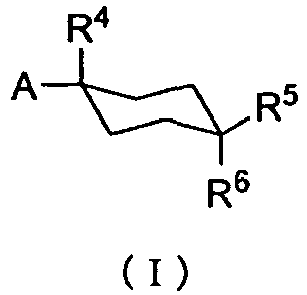
[wherein A is a substituent represented by Formula (IIa) or (IIb):
- In the above-described cyclohexane derivative, it is preferred that R1 and R2 be each independently a trifluoromethyl group, a methyl group or a methoxy group, and it is more preferred that R3 be a hydrogen atom; R4 be a hydroxymethyl group or a hydroxyl group; R5 and R6 be each independently a hydrogen atom, a fluorine atom, a trifluoromethyl group, a carboxyl group, a methoxy group, a hydroxyl group or an acetyloxy group (or may optionally together form an oxo group).
- The cyclohexane derivative or a pharmaceutically acceptable salt thereof or a prodrug thereof according to the present invention shows a remarkable analgesic effect on fibromyalgia.
-
-
Fig. 1 shows the effect of the cyclohexane derivative according the present invention on a rat fibromyalgia model (oral administration). - The therapeutic agent or the prophylactic agent for fibromyalgia of the present invention is characterized by comprising as an effective ingredient a cyclohexane derivative represented by Formula (I):


or a pharmaceutically acceptable salt thereof or a prodrug thereof. - The term "C1-C4 alkyl group" means a linear, branched or cyclic alkyl group having 1 to 4 carbon atoms, and examples thereof include a methyl group, an ethyl group, an n-propyl group, an isopropyl group, a cyclopropyl group, a cyclopropylmethyl group, an n-butyl group, a sec-butyl group and a tert-butyl group.
- The term "C1-C4 alkoxy group" means a linear, branched or cyclic alkyl-oxy group having 1 to 4 carbon atoms, and examples thereof include a methoxy group, an ethoxy group, an n-propyloxy group, an isopropyloxy group, a cyclopropyloxy group, an n-butoxy group, a sec-butoxy group and a tert-butoxy group.
- The term "C1-C3 haloalkyl group" means a linear alkyl group having 1 to 3 carbon atoms wherein a part or all of the hydrogen atoms on the group are replaced by a halogen atom(s) (the halogen atom means a fluorine atom, a chlorine atom, a bromine atom or an iodine atom), and examples thereof include a monochloromethyl group, a monofluoromethyl group, a difluoromethyl group, a trifluoromethyl group, a trichloromethyl group and a pentafluoroethyl group.
- Examples of the "C2-C5 alkylcarbonyloxy group" include an acetyloxy group, an ethanoyloxy group, a propanoyloxy group, an isopropanoyloxy group, a butanoyloxy group and an isobutanoyloxy group and a pivaloyloxy group.
- In Formula (I), A is preferably Formula (IIa); Y is preferably an oxygen atom; and Z is preferably a methine group.
- R1 is preferably a hydrogen atom, a chlorine atom, a trifluoromethyl group, a methyl group, an ethyl group, an n-propyl group, an isopropyl group, a methoxy group, an ethoxy group, an n-propyloxy group or an isopropyloxy group, more preferably a trifluoromethyl group, a methyl group or a methoxy group, and still more preferably a methyl group.
- R2 is preferably a hydrogen atom, a chlorine atom, a trifluoromethyl group, a methyl group, an ethyl group, an n-propyl group, an isopropyl group, a methoxy group, an ethoxy group, an n-propyloxy group or an isopropyloxy group, and more preferably a methoxy group.
- R3 is preferably a hydrogen atom; and R4 is preferably a hydroxymethyl group or a hydroxyl group, and more preferably a hydroxyl group.
- R5 is preferably a hydrogen atom, a fluorine atom, a trifluoromethyl group, a carboxyl group, a methoxy group, an ethoxy group, an n-propyloxy group, an isopropyloxy group, a hydroxyl group, an acetyloxy group, a propanoyloxy group, a butanoyloxy group or an isobutanoyloxy group, more preferably a hydrogen atom, a hydroxyl group or a carboxyl group, and still more preferably a hydroxyl group.
- R6 is preferably a hydrogen atom, a fluorine atom, a trifluoromethyl group, a carboxyl group, a methoxy group, an ethoxy group, an n-propyloxy group, an isopropyloxy group, a hydroxyl group, an acetyloxy group, a propanoyloxy group, a butanoyloxy group or an isobutanoyloxy group, more preferably a hydrogen atom or a hydroxyl group, and still more preferably a hydrogen atom. R5 and R6 may optionally together form an oxo group.
- R7 and R8 are each preferably a hydrogen atom.
- Among the compounds represented by Formula (I) or the pharmaceutically acceptable salts thereof (hereinafter referred to as "Compound (I)"), preferred specific examples are shown in Table 1, but the present invention is not limited by these.
-
[Table 1-1] Compound Structural Formula Compound Structural Formula 1 
2 
3 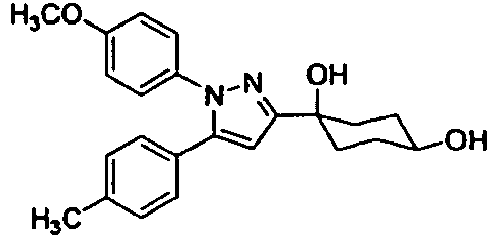
4 
5 
6 
7 
8 
9 
10 
11 
12 
13 
14 
15 
16 
-
[Table 1-2] Compound Structural Formula Compound Structural Formula 17 
18 
19 
20 
21 
22 
23 
24 
25 
26 
27 
28 
29 
30 
31 
32 
-
[Table 1-3] Compound Structural Formula Compound Structural Formula 33 
34 
35 
36 
37 
38 
39 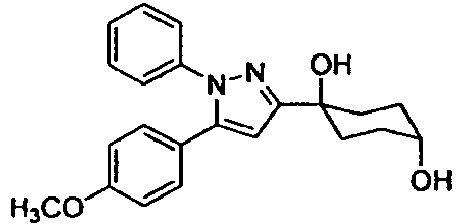
40 
41 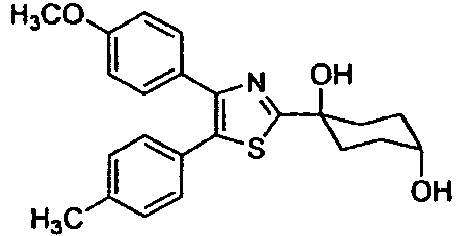
42 
43 
44 
45 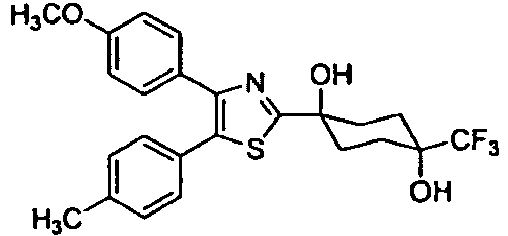
46 
47 
48 
-
[Table 1-4] Compound Structural Formula Compound Structural Formula 49 
50 
51 
52 
53 
54 
55 
56 
57 
58 
- In cases where Compound (I) has an asymmetric carbon(s), all the enantiomers and mixtures thereof are within the scope of the present invention.
- In cases where Compound (I) has a stereoisomer(s), all the stereoisomers and mixtures thereof are also within the scope of the present invention.
- Examples of the "pharmaceutically acceptable salt" include inorganic acid salts such as hydrochloric acid salt, sulfuric acid salt, phosphoric acid salt and hydrobromic acid salt; organic acid salts such as oxalic acid salt, malonic acid salt, citric acid salt, fumaric acid salt, lactic acid salt, malic acid salt, succinic acid salt, tartaric acid salt, acetic acid salt, trifluoroacetic acid salt, maleic acid salt, gluconic acid salt, benzoic acid salt, ascorbic acid salt, methanesulfonic acid salt, p-toluenesulfonic acid salt and cinnamic acid salt; inorganic base salts such as sodium salt, potassium salt, calcium salt, magnesium salt and ammonium salt; and organic base salts such as methylamine salt, diethylamine salt, trimethylamine salt, triethylamine salt, pyridinium salt, triethanolamine salt, ethylenediamine salt and guanidine salt. Further, Compound (I) may form a hydrate or a solvate, and crystalline polymorphs are also included in Compound (I).
- Compound (1) can be synthesized, for example, according to the production methods described below. The symbols in each reaction formula have the same meanings as defined above unless otherwise specified.
- In cases where a raw material compound has a carboxyl group or a hydroxyl group, a protecting group as commonly used may be introduced thereto, and the protecting group may be removed as required after the reaction. Examples of the protecting group for a hydroxyl group include a C1-C4 alkyl group, a phenyl group, a trityl group, a C1-C4 aralkyl group (e.g., a benzyl group), an acyl group (e.g., a formyl group, an acetyl group or a benzoyl group), a C7-C10 aralkyl-carbonyl group (e.g., a benzylcarbonyl group) and a substituted silyl group (e.g., a trimethylsilyl group, a triethylsilyl group or a tert-butyldimethylsilyl group). Examples of the protecting group for a carboxyl group include a C1-C4 alkyl group.
- The method to remove the protecting group varies depending on the type of the protecting group, and the removal may be carried out according to a method as described in a prior art document (PROTECTIVE GROUPS IN ORGANIC SYNTHESIS (WILEY-INTERSCIENCE)) or a method similar thereto.
- In the production methods described below, a salt may be used as a raw material compound. Examples of the salt include the same ones as the pharmaceutically acceptable salts described above.
- Compound (I) obtained by the production methods described below may be isolated and purified according to known means, and examples of the known means include solvent extraction, recrystallization and chromatography.
- In cases where Compound (I) has optical isomers, stereoisomers, regioisomers and/or rotamers, each of these may be obtained as a single compound by a known synthesis method and a known separation method.
-

- Compound (Ic) can be obtained by alkylation of Compound (Ia), and Compound (Id) can be obtained by alkylation of Compound (Ib). Compound (Ie) can be obtained by acylation of Compound (Ia), and Compound (If) can be obtained by acylation of Compound (Ib).
- The alkylation reaction of Compound (Ia) or Compound (Ib) is usually performed by reacting Compound (Ia) or Compound (Ib) with an alkyl halide in a solvent in the presence of a base. As the solvent, a solvent that does not inhibit the reaction is appropriately selected. Examples of the solvent that does not inhibit the reaction include ethers such as tetrahydrofuran, 1,4-dioxane and ethylene glycol dimethyl ether; acetone; acetonitrile; and N,N-dimethylformamide. A mixed solvent of these may also be used as the solvent.
- Examples of the base include alkali metal hydrogen carbonates such as sodium hydrogen carbonate and potassium hydrogen carbonate; alkali metal carbonates such as potassium carbonate and cesium carbonate; amines such as triethylamine, diisopropylethylamine and pyridine; potassium tert-butoxide; and sodium hydride.
- The amount of the base to be used is preferably 0.5 to 6 mol, more preferably 0.8 to 3 mol, with respect to 1 mol of Compound (Ia) or Compound (Ib).
- The amount of the alkyl halide to be used is preferably 0.5 to 5 mol, more preferably 0.8 to 2 mol, with respect to 1 mol of Compound (Ia) or Compound (Ib).
- The reaction temperature of the alkylation reaction is preferably -78°C to 200°C, more preferably -20°C to 100°C.
- The reaction time of the alkylation reaction varies depending on the reaction conditions, and is preferably 5 minutes to 78 hours, more preferably 30 minutes to 48 hours.
- The acylation reaction of Compound (Ia) or Compound (Ib) is usually performed by reacting Compound (Ia) or Compound (Ib) with an acylating agent, such as an acid halide or an acid anhydride, in a solvent in the presence of a base. As the solvent, a solvent that does not inhibit the reaction is appropriately selected. Examples of the solvent that does not inhibit the reaction include halogenated hydrocarbons such as dichloromethane, chloroform, carbon tetrachloride and 1,2-dichloroethane; and ethers such as tetrahydrofuran, 1,2-dimethoxyethane and 1,4-dioxane. A mixed solvent of these may also be used as the solvent.
- Examples of the base include pyridine, triethylamine, diisopropylethylamine, N,N-dimethylaminopyridine and the like.
- The amount of the acid halide or the acid anhydride to be used is preferably 0.5 to 3 mol, more preferably 0.8 to 1.5 mol, with respect to 1 mol of Compound (Ia) or Compound (Ib).
- The amount of the base to be used is preferably 0.1 to 6 mol, more preferably 0.8 to 3 mol, with respect to 1 mol of Compound (Ia) or Compound (Ib).
- The reaction temperature of the acylation reaction is preferably -20°C to 150°C, more preferably 0°C to 100°C.
- The reaction time of the acylation reaction varies depending on the reaction conditions, and is preferably 5 minutes to 72 hours, more preferably 30 minutes to 48 hours.
-

- Compound (Ih) can be obtained by fluorination of Compound (Ig).
- The fluorination reaction of Compound (Ig) is usually performed by reacting Compound (Ig) with a fluorinating agent in a solvent. As the solvent, a solvent that does not inhibit the reaction is appropriately selected. Examples of the solvent that does not inhibit the reaction include hydrocarbons such as octane, hexane, benzene and toluene; halogenated hydrocarbons such as dichloromethane, chloroform, carbon tetrachloride and 1,2-dichloroethane; ethers such as tetrahydrofuran, 1,2-dimethoxyethane and 1,4-dioxane; and alkyl nitriles such as acetonitrile. A mixed solvent of these may also be used as the solvent.
- Examples of the fluorinating agent include alkylaminosulfur trifluorides such as (dimethylamino)sulfur trifluoride (DAST) and bis(2-methoxyethyl)aminosulfur trifluoride acid.
- The amount of the fluorinating agent to be used is preferably 0.25 to 20 mol, more preferably 0.5 to 4 mol, with respect to 1 mol of Compound (Ig).
- The reaction temperature of the fluorination reaction is preferably -20°C to 150°C, more preferably 0°C to 100°C.
- The reaction time of the fluorination reaction varies depending on the reaction conditions, and is preferably 5 minutes to 72 hours, more preferably 30 minutes to 48 hours.
-

- Compound (Ij) can be obtained by fluorination of Compound (Ii).
- The fluorination reaction of Compound (Ii) is usually performed by reacting Compound (Ii) with a fluorinating agent in a solvent. As the solvent, a solvent that does not inhibit the reaction is appropriately selected. Examples of the solvent that does not inhibit the reaction include hydrocarbons such as octane, hexane, benzene and toluene; halogenated hydrocarbons such as dichloromethane, chloroform, carbon tetrachloride and 1,2-dichloroethane; ethers such as tetrahydrofuran, 1,2-dimethoxyethane and 1,4-dioxane; and alkyl nitriles such as acetonitrile. Alternatively, a mixed solvent of these may be use as the solvent.
- Examples of the fluorinating agent include alkylaminosulfur trifluorides such as (dimethylamino)sulfur trifluoride (DAST) and bis(2-methoxyethyl)aminosulfur trifluoride acid.
- The amount of the fluorinating agent to be used is preferably 0.25 to 20 mol, more preferably 0.5 to 4 mol, with respect to 1 mol of Compound (Ii).
- The reaction temperature of the fluorination reaction is preferably -20°C to 150°C, more preferably 0°C to 100°C.
- The reaction time of the fluorination reaction varies depending on the reaction conditions, and is preferably 5 minutes to 72 hours, more preferably 30 minutes to 48 hours.
-

- Compound (Ik) and Compound (Il) can be obtained by reducing Compound (Ii).
- The reduction reaction of Compound (Ii) is usually performed by reacting Compound (Ii) with a reducing agent in a solvent. As the solvent, a solvent that does not inhibit the reaction is appropriately selected. Examples of the solvent that does not inhibit the reaction include hydrocarbons such as octane, hexane, benzene and toluene; ethers such as tetrahydrofuran, 1,4-dioxane, ethylene glycol dimethyl ether and diethyl ether; and alcohols such as methanol, ethanol and isopropyl alcohol. A mixed solvent of these may also be used as the solvent.
- Examples of the reducing agent include sodium borohydride, lithium borohydride, diisobutylaluminium hydride, lithium aluminum hydride, lithium triethyl hydride, sodium bis(2-methoxyethoxy)aluminum hydride and borane complexes.
- The amount of the reducing agent to be used is preferably 0.25 to 100 mol, more preferably 0.5 to 20 mol, with respect to 1 mol of Compound (Ii).
- The reaction temperature of the reduction reaction is preferably -78°C to 150°C, more preferably -78°C to 100°C.
- The reaction time of the reduction reaction varies depending on the reaction conditions such as the reaction temperature, the amount of the reducing agent and the like, and is preferably 5 minutes to 72 hours, more preferably 30 minutes to 24 hours.
-

- Compound (Im) and Compound (In) can be obtained by trifluoromethylation of Compound (Ii).
- Examples of the trifluoromethylating agent include organosilicon compounds such as (trifluoromethyl)trimethylsilane. The trifluoromethylation reaction using an organosilicon compound may be carried out according to a method as described in a prior art document (Joumal of the American Chemical Society, 1989, Vol. 39, pp. 393-395) or a method similar thereto.
-

- Compound (SI) can be obtained by allowing a Wittig reagent (LI) to act on Compound (Ii), and then hydrolyzing the resulting compound. As the Wittig reagent, a commercially available compound may be used, or it may be synthesized according to a method obvious to those skilled in the art. Compound (Io) can be obtained by oxidizing Compound (SI).
- The Wittig reaction of Compound (Ii) is usually performed by reacting Compound (Ii) with a Wittig reagent in a solvent in the presence of a base. As the solvent, a solvent that does not inhibit the reaction is appropriately selected. Examples of the solvent that does not inhibit the reaction include hydrocarbons such as octane, hexane, benzene and toluene; and ethers such as tetrahydrofuran, 1,4-dioxane, ethylene glycol dimethyl ether and diethyl ether. A mixed solvent of these may also be used as the solvent.
- Examples of the base include lithium diisopropylamide, potassium tert-butoxide, sodium hydride, phenyllithium and tert-butyllithium.
- The amount of the base to be used is preferably 0.5 to 3 mol, more preferably 0.8 to 2 mol, with respect to 1 mol of Compound (Ii).
- The amount of Compound (LI) to be used is preferably 0.5 to 3 mol, more preferably 0.8 to 2 mol, with respect to 1 mol of Compound (Ii).
- The reaction temperature of the Wittig reaction is preferably -78°C to 100°C, more preferably -78°C to 50°C.
- The reaction time of the Wittig reaction varies depending on the reaction conditions such as the reaction temperature, and is preferably 5 minutes to 48 hours, more preferably 30 minutes to 24 hours.
- The hydrolysis reaction to obtain Compound (SI) is performed in an appropriately selected solvent that does not inhibit the reaction. Examples of the solvent that does not inhibit the reaction include ethers such as tetrahydrofuran, 1,4-dioxane and ethylene glycol dimethyl ether; alcohols such as methanol, ethanol and tert-butanol; acetonitrile; and water. A mixed solvent of these may also be used as the solvent.
- The concentration of the acid which is used in the hydrolysis reaction is preferably 0.1 M to 12 M, and the amount of the acid to be used is preferably from 1 mol to an excess amount with respect to 1 mol of Compound (Ii).
- Examples of the acid which is used in the hydrolysis reaction include inorganic acids such as hydrochloric acid and sulfuric acid; and organic acids such as acetic acid.
- The reaction temperature of the hydrolysis reaction is preferably -20°C to 200°C, more preferably 0°C to 100°C.
- The reaction time of the hydrolysis reaction varies depending on the reaction conditions, and is preferably 5 minutes to 48 hours, more preferably 30 minutes to 24 hours.
- Examples of the oxidizing agent which is used in oxidation reaction of Compound (SI) include chromium (VI) oxide-acetic acid, Jones reagent, sodium chlorite and the like. The oxidation reaction may be carried out according to a method obvious to those skilled in the art.
-

- Compound (Ii) can be obtained by deprotection of Compound (Ip).
- The deprotection reaction of Compound (Ip) may be carried out according to a method as described in a prior art document (PROTECTIVE GROUPS IN ORGANIC SYNTHESIS (WILEY-INTERSCIENCE)) or a method similar thereto.
-

- Compound (IIIb) can be obtained by chlorination of Compound (IIIa).
- The chlorination reaction of Compound (IIIa) is usually performed by reacting Compound (IIIa) with a chlorinating agent in a solvent. As the solvent, a solvent that does not inhibit the reaction is appropriately selected. Examples of the solvent that does not inhibit the reaction include halogenated hydrocarbons such as dichloromethane, chloroform, carbon tetrachloride and 1,2-dichloroethane; acetonitrile; and ethyl acetate. A mixed solvent of these may also be used as the solvent.
- Examples of the chlorinating agent include N-chlorosuccinimide (NCS).
- The amount of the chlorinating agent to be used is preferably 0.5 to 2 mol, more preferably 0.8 to 1.2 mol, with respect to 1 mol of Compound (IIIa).
- The reaction temperature of the chlorination reaction is preferably 0°C to 200°C, more preferably 0°C to 120°C.
- The reaction time of the chlorination reaction varies depending on the reaction conditions such as the reaction temperature, and is preferably 5 minutes to 72 hours, more preferably 30 minutes to 48 hours.
-

- Compound (IIIa) can be obtained by cyclization of Compound (LII) with Compound (SII). As Compound (LII), a commercially available compound may be used, or it may be synthesized according to a method obvious to those skilled in the art.
- The cyclization reaction of Compound (LII) with Compound (SII) is usually performed in an appropriately selected solvent that does not inhibit the reaction. Examples of the solvent that does not inhibit the reaction include alcohols such as methanol, ethanol and isopropyl alcohol; halogenated hydrocarbons such as dichloromethane, chloroform, carbon tetrachloride and 1,2-dichloroethane; ethers such as tetrahydrofuran, 1,2-dimethoxyethane and 1,4-dioxane; benzene; toluene; acetic acid; and water. A mixed solvent of these may also be used as the solvent.
- The amount of Compound (LII) to be used is preferably 0.5 to 1.5 mol, more preferably 0.8 to 1.2 mol, with respect to 1 mol of Compound (SII).
- In the cyclization reaction, a catalyst may be used, and examples of the catalyst include organic bases such as triethylamine and pyridine; inorganic acids such as hydrochloric acid and sulfuric acid; and organic acids such as acetic acid.
- The amount of the catalyst to be used is preferably 0.1 to 3 mol with respect to 1 mol of Compound (SII).
- The reaction temperature of the cyclization reaction is preferably 0°C to 200°C, more preferably 0°C to 120°C.
- The reaction time of the cyclization reaction varies depending on the reaction conditions such as the reaction temperature, and is preferably 5 minutes to 72 hours, more preferably 30 minutes to 48 hours.
-

- Compound (IV) can be obtained by deprotonation and oxidization of Compound (SIII). The oxidation reaction may be carried out according to a method as described in a prior art document (Tetrahedron, 1989, Vol. 45, pp..5703-5742) or a method similar thereto.
- The deprotonation reaction and the oxidation reaction of Compound (SIII) are usually performed by reacting Compound (SIII) with a base and an oxidizing agent in an anhydrous solvent. As the solvent, a solvent that does not inhibit the reactions is appropriately selected. Examples of the solvent that does not inhibit the reactions include hydrocarbons such as octane, hexane and heptane; and ethers such as tetrahydrofuran, 1,4-dioxane, ethylene glycol dimethyl ether and diethyl ether. A mixed solvent of these may also be used as the solvent.
- Examples of the base include butyllithiums such as n-butyllithium, sec-butyllithium and tert-butyllithium.
- The amount of the base to be used is preferably 0.8 to 5 mol, more preferably 0.9 to 3 mol, with respect to 1 mol of Compound (SIII).
- The amount of Compound (LIII) to be used is preferably 0.8 to 5 mol, more preferably 0.9 to 3 mol, with respect to 1 mol of Compound (SIII).
- Examples of the oxidizing agent which is used in the oxidation reaction include 3-phenyl-2-(phenylsulfonyl)-1,2-oxaziridine.
- The reaction temperature of the deprotonation reaction and the oxidation reaction is preferably -78°C to 150°C, more preferably 0°C to 50°C.
- The reaction time of the deprotonation reaction and the oxidation reaction varies depending on the reaction conditions, and is preferably 5 minutes to 72 hours, more preferably 30 minutes to 48 hours.
-

- Compound (VI) can be obtained by solvolysis of Compound (V) which has been obtained by reacting Compound (LIV) and Compound (LV). As Compound (LIV) and Compound (LV), commercially available compounds may be used, or they may be synthesized according to methods obvious to those skilled in the art.
- The reaction between Compound (LIV) and Compound (LV) is usually performed in an anhydrous solvent in the presence of a base; and, as the solvent, a solvent that does not inhibit the reaction is appropriately selected. Examples of the solvent that does not inhibit the reaction include hydrocarbons such as octane, hexane, benzene and toluene; and ethers such as tetrahydrofuran, 1,4-dioxane, ethylene glycol dimethyl ether and diethyl ether. A mixed solvent of these may also be used as the solvent.
- Examples of the base include alkyllithiums such as methyllithium and n-butyllithium; and salts of dialkylamines such as lithium diisopropylamide, lithium bis(trimethylsilyl)amide and potassium bis(trimethylsilyl)amide.
- The amount of the base to be used is preferably 0.8 to 5 mol, more preferably 0.9 to 3 mol, with respect to 1 mol of Compound (LIV).
- The amount of Compound (LV) to be used is preferably 0.8 to 5 mol, more preferably 0.9 to 3 mol, with respect to 1 mol of Compound (LIV).
- The reaction temperature of the reaction between Compound (LIV) and Compound (LV) is preferably -78°C to 150°C, more preferably -78°C to 100°C.
- The reaction time of the reaction between Compound (LIV) and Compound (LV) varies depending on the reaction conditions, and is preferably 5 minutes to 72 hours, more preferably 30 minutes to 48 hours.
- The solvolysis reaction is usually performed in a solvent in the presence of a base; and, as the solvent, a solvent that does not inhibit the reaction is appropriately selected. Examples of the solvent that does not inhibit the reaction include alcohols such as methanol and ethanol; and water. A mixed solvent of these may also be used as the solvent.
- Examples of the base include potassium carbonate, sodium carbonate, potassium hydroxide and sodium hydroxide.
- The amount of the base to be used is preferably 0.5 to 10 mol, more preferably 0.8 to 3 mol, with respect to 1 mol of Compound (V).
- The reaction temperature of the solvolysis reaction is preferably -20°C to 150°C, more preferably 0°C to 100°C.
- The reaction time of the solvolysis reaction varies depending on the reaction conditions, and is preferably 5 minutes to 72 hours, more preferably 30 minutes to 48 hours.
-

- Compound (SIIa) can be obtained by oxidizing Compound (VII) which has been obtained by reacting Compound (VI) and Compound (LVI). Compound (SIIa) can also be obtained by reacting Compound (VI) and Compound (LVII). As Compound (LVI) and Compound (LVII), commercially available compounds may be used, or they may be synthesized according to a method obvious to those skilled in the art.
- The reaction between Compound (VI) and Compound (LVI) or Compound (LVII) is usually performed in an anhydrous solvent in the presence of a base; and, as the solvent, a solvent that does not inhibit the reaction is appropriately selected. Examples of the solvent that does not inhibit the reaction include hydrocarbons such as octane, hexane, benzene and toluene; and ethers such as tetrahydrofuran, 1,4-dioxane, ethylene glycol dimethyl ether and diethyl ether. A mixed solvent of these may also be used as the solvent.
- Examples of the base include alkyllithiums such as methyllithium and n-butyllithium; and salts of dialkylamines such as lithium diisopropylamide, lithium bis(trimethylsilyl)amide and potassium bis(trimethylsilyl)amide.
- The amount of the base to be used is preferably 0.8 to 5 mol, more preferably 0.9 to 3 mol, with respect to 1 mol of Compound (VI).
- The amount of Compound (LVI) to be used in Step 17 or Compound (LVII) to be used in Step 18 is preferably 0.8 to 5 mol, more preferably 0.9 to 3 mol, with respect to 1 mol of Compound (VI).
- The reaction temperature of the reaction between Compound (VI) and Compound (LVI) in Step 17 or Compound (LVII) in Step 18 is preferably -78°C to 150°C, more preferably 0°C to 50°C.
- The reaction time of the reaction between Compound (VI) and Compound (LVI) in Step 17 or Compound (LVII) in Step 18 varies depending on the reaction conditions, and is preferably 5 minutes to 72 hours, more preferably 30 minutes to 48 hours.
- The oxidation reaction of Compound (VII) is usually performed by reacting Compound (VII) with an oxidizing agent in a solvent. As the solvent, a solvent that does not inhibit the reaction is appropriately selected. Examples of the solvent that does not inhibit the reaction include hydrocarbons such as octane, hexane, benzene and toluene; halogenated hydrocarbons such as dichloromethane, chloroform, carbon tetrachloride and 1,2-dichloroethane; ethers such as tetrahydrofuran, 1,2-dimethoxyethane and 1,4-dioxane; and alkyl nitriles such as acetonitrile; trifluoroacetic acid; pyridine; acetone; and the like. A mixed solvent of these may also be used as the solvent.
- Examples of the oxidizing agent include commercially available reagents such as manganese dioxide, sulfur trioxide-pyridine, activated dimethyl sulfoxide and Dess-Martin reagent.
- The amount of the oxidizing agent to be used is preferably 0.5 to 3 mol, more preferably 0.8 to 2 mol, with respect to 1 mol of Compound (VII).
- The reaction temperature of the oxidation reaction varies depending on the type of the oxidizing agent, and is preferably -78°C to 100°C, more preferably -78°C to 40°C.
- The reaction time of the oxidation reaction varies depending on the reaction conditions such as the type of the oxidizing agent, the reaction temperature and the like, and is preferably 5 minutes to 72 hours, more preferably 1 hour to 24 hours.
-

- Compound (IX) can be obtained by reacting Compound (VIII) and Compound (LVIII). As Compound (VIII) and Compound (LVIII), commercially available compounds may be used, or they may be synthesized according to a method obvious to those skilled in the art.
- The reaction between Compound (VIII) and Compound (LVIII) is usually performed in an anhydrous solvent in the presence of a base; and, as the solvent, a solvent that does not inhibit the reaction is appropriately selected. Examples of the solvent that does not inhibit the reaction include hydrocarbons such as octane, hexane, benzene and toluene; and ethers such as tetrahydrofuran, 1,4-dioxane, ethylene glycol dimethyl ether and diethyl ether. A mixed solvent of these may also be used as the solvent.
- Examples of the base include lithium diisopropylamide, lithium bis(trimethylsilyl)amide and potassium bis(trimethylsilyl)amide.
- The amount of the base to be used is preferably 0.8 to 4 mol, more preferably 0.9 to 3.5 mol, with respect to 1 mol of Compound (VIII).
- The amount of Compound (LVIII) to be used is preferably 0.8 to 5 mol, more preferably 0.9 to 3 mol, with respect to 1 mol of Compound (VIII).
- The reaction temperature of the reaction between Compound (VIII) and Compound (LVIII) is preferably -78°C to 150°C, more preferably 0°C to 50°C.
- The reaction time of the reaction between Compound (VIII) and Compound (LVIII) varies depending on the reaction conditions, and is preferably 5 minutes to 72 hours, more preferably 30 minutes to 48 hours.
-

- Compound (XI) can be obtained by oxidizing Compound (X) which has been obtained by reducing Compound (IX).
- The reduction reaction of Compound (IX) is usually performed by reacting Compound (IX) with a reducing agent in a solvent. As the solvent, a solvent that does not inhibit the reaction is appropriately selected. Examples of the solvent that does not inhibit the reaction include hydrocarbons such as octane, hexane, benzene and toluene; ethers such as tetrahydrofuran, 1,4-dioxane, ethylene glycol dimethyl ether and diethyl ether; and alcohols such as methanol, ethanol and isopropyl alcohol. A mixed solvent of these may also be used as the solvent.
- Examples of the reducing agent include lithium borohydride, diisobutylaluminium hydride, lithium aluminum hydride, lithium triethyl hydride, sodium bis(2-methoxyethoxy)aluminum hydride and borane complexes.
- The amount of the reducing agent to be used is preferably 0.25 to 100 mol, more preferably 0.5 to 20 mol, with respect to 1 mol of Compound (IX).
- The reaction temperature of the reduction reaction is preferably -78°C to 150°C, more preferably -78°C to 100°C.
- The reaction time of the reduction reaction varies depending on the reaction conditions such as the reaction temperature, the amount of the reducing agent and the like, and is preferably 5 minutes to 72 hours, more preferably 30 minutes to 24 hours.
- The oxidation reaction of Compound (X) is usually performed by reacting Compound (X) with an oxidizing agent in a solvent. As the solvent, a solvent that does not inhibit the reaction is appropriately selected. Examples of the solvent that does not inhibit the reaction include trifluoroacetic acid; pyridine; acetone; hydrocarbons such as octane, hexane, benzene and toluene; halogenated hydrocarbons such as dichloromethane, chloroform, carbon tetrachloride and 1,2-dichloroethane; ethers such as tetrahydrofuran, 1,2-dimethoxyethane and 1,4-dioxane; and alkyl nitriles such as acetonitrile. A mixed solvent of these may also be used as the solvent.
- Examples of the oxidizing agent include commercially available reagents such as sulfur trioxide-pyridine, activated dimethyl sulfoxide and Dess-Martin reagent.
- The amount of the oxidizing agent to be used is preferably 0.5 to 3 mol, more preferably 0.8 to 2 mol, with respect to 1 mol of Compound (X).
- The reaction temperature of the oxidation reaction varies depending on the type of the oxidizing agent, and is preferably -78°C to 100°C, more preferably -78°C to 40°C.
- The reaction time of the oxidation reaction varies depending on the reaction conditions such as the type of the oxidizing agent, reaction temperature and the like, and is preferably 5 minutes to 72 hours, more preferably 1 hour to 24 hours.
-

- Compound (XII) can be obtained by converting Compound (XI) to an alkyne. Examples of the reagent which is used in the conversion reaction include dimethyl-1-diazo-2-oxopropylphosphonate. The conversion reaction may be carried out according to a method as described in a prior art document (Tetrahedron Letters, 2006, Vol. 47, pp. 1729-1731) or a method similar thereto.
-

- Compound (SIIb) can be obtained by oxidizing Compound (XIII) which has been obtained by reacting Compound (XII) and Compound (LVI). Compound (SIIb) can also be obtained by reacting Compound (XII) and Compound (LVII). As Compound (LVI) and Compound (LVII), commercially available compounds may be used, or they may be synthesized according to a method obvious to those skilled in the art.
- The nucleophilic addition reaction of Compound (XII) is usually performed in an anhydrous solvent in the presence of a base; and, as the solvent, a solvent that does not inhibit the reaction is appropriately selected. Examples of the solvent that does not inhibit the reaction include hydrocarbons such as octane, hexane, benzene and toluene; and ethers such as tetrahydrofuran, 1,4-dioxane, ethylene glycol dimethyl ether and diethyl ether. A mixed solvent of these may also be used as the solvent.
- Examples of the base include alkyllithiums such as methyllithium and n-butyllithium; and salts of dialkylamines such as lithium diisopropylamide, lithium bis(trimethylsilyl)amide and potassium bis(trimethylsilyl)amide.
- The amount of the base to be used is preferably 0.8 to 5 mol, more preferably 0.9 to 3 mol, with respect to 1 mol of Compound (XII).
- The amount of Compound (LVI) to be used in Step 24 or Compound (LVII) to be used in Step 25 is preferably 0.8 to 5 mol, more preferably 0.9 to 3 mol, with respect to 1 mol of Compound (XII).
- The reaction temperature of the nucleophilic addition reaction is preferably - 78°C to 150°C, more preferably 0°C to 50°C.
- The reaction time of the nucleophilic addition reaction varies depending on the reaction conditions, and is preferably 5 minutes to 72 hours, more preferably 30 minutes to 48 hours.
- The oxidation reaction of Compound (XIII) is usually performed by reacting Compound (XIII) with an oxidizing agent in a solvent. As the solvent, a solvent that does not inhibit the reaction is appropriately selected. Examples of the solvent that does not inhibit the reaction include trifluoroacetic acid; pyridine; acetone; hydrocarbons such as octane, hexane, benzene and toluene; halogenated hydrocarbons such as dichloromethane, chloroform, carbon tetrachloride and 1,2-dichloroethane; ethers such as tetrahydrofuran, 1,2-dimethoxyethane and 1,4-dioxane; and alkyl nitriles such as acetonitrile. A mixed solvent of these may also be used as the solvent.
- Examples of the oxidizing agent include commercially available reagents such as manganese dioxide, sulfur trioxide-pyridine, activated dimethyl sulfoxide and Dess-Martin reagent.
- The amount of the oxidizing agent to be used is preferably 0.5 to 3 mol, more preferably 0.8 to 2 mol, with respect to 1 mol of Compound (XIII).
- The reaction temperature of the oxidation reaction varies depending on the type of the oxidizing agent, and is preferably -78°C to 100°C, more preferably -78°C to 40°C.
- The reaction time of the oxidation reaction varies depending on the reaction conditions such as the type of the oxidizing agent, the reaction temperature and the like, and is preferably 5 minutes to 72 hours, more preferably 1 hour to 24 hours.
-

- Compound (SIIIa) can be obtained by cyclizing Compound (XV) which has been obtained by alkylating Compound (XIV) with Compound (LX) or acylating Compound (XVI), obtained from Compound (XIV), with Compound (LXI). Compound (XIV) and Compound (LX) may be synthesized according to methods obvious to those skilled in the art. As Compound (LXI), a commercially available compound may be used, or it may be synthesized according to a method obvious to those skilled in the art.
- The alkylation reaction of Compound (XIV) is usually performed by reacting Compound (XIV) with an alkyl halide in a solvent in the presence of a base; and, as the solvent, a solvent that does not inhibit the reaction is appropriately selected. Examples of the solvent that does not inhibit the reaction include ethers such as tetrahydrofuran, 1,4-dioxane and ethylene glycol dimethyl ether; acetone; acetonitrile; and N,N dimethylformamide. A mixed solvent of these may also be used as the solvent.
- Examples of the base include alkali metal hydrogen carbonates such as sodium hydrogen carbonate and potassium hydrogen carbonate; alkali metal carbonates such as potassium carbonate and cesium carbonate; amines such as triethylamine, diisopropylethylamine and pyridine; potassium tert-butoxide; and sodium hydride.
- The amount of the base to be used is preferably 0.5 to 6 mol, more preferably 0.8 to 3 mol, with respect to 1 mol of Compound (XIV).
- The amount of Compound (LX) to be used is preferably 0.5 to 5 mol, more preferably 0.8 to 2 mol, with respect to 1 mol of Compound (XIV).
- The reaction temperature of the alkylation reaction is preferably -78°C to 200°C, more preferably -20°C to 100°C.
- The reaction time of the alkylation reaction varies depending on the reaction conditions, and is preferably 5 minutes to 78 hours, more preferably 30 minutes to 48 hours.
- Compound (XVI) can be synthesized from Compound (XIV) in accordance with, for example, a method obvious to those skilled in the art in which thionyl chloride, oxalyl chloride or the like is used.
- The acylation reaction of Compound (LXI) with Compound (XVI) is usually performed in a solvent in the presence of a base; and, as the solvent, a solvent that does not inhibit the reaction is appropriately selected. Examples of the solvent that does not inhibit the reaction include halogenated hydrocarbons such as dichloromethane, chloroform, carbon tetrachloride and 1,2-dichloroethane; and ethers such as tetrahydrofuran, 1,2-dimethoxyethane and 1,4-dioxane. A mixed solvent of these may also be used as the solvent.
- Examples of the base include pyridine, triethylamine, diisopropylethylamine, N,N-dimethylaminopyridine and the like.
- The amount of the base to be used is preferably 0.1 to 6 mol, more preferably 0.8 to 3 mol, with respect to 1 mol of Compound (XVI).
- The amount of Compound (LXI) to be used is preferably 0.5 to 3 mol, more preferably 0.8 to 1.5 mol, with respect to 1 mol of Compound (XVI).
- The reaction temperature of the acylation reaction is preferably -20°C to 150°C, more preferably 0°C to 100°C.
- The reaction time of the acylation reaction varies depending on the reaction conditions, and is preferably 5 minutes to 72 hours, more preferably 30 minutes to 48 hours.
- The cyclization reaction of Compound (XV) is usually performed in a solvent in the presence of an ammonium salt, and, as the solvent, a solvent that does not inhibit the reaction is appropriately selected. Examples of the solvent that does not inhibit the reaction include acetic acid and formic acid. A mixed solvent of these may also be used as the solvent.
- Examples of the ammonium salt include commercially available reagents such as ammonium acetate, ammonium formate and ammonium carbonate.
- The amount of the ammonium salt to be used is preferably 1 to 20 mol, more preferably 2 to 15 mol, with respect to 1 mol of Compound (XV).
- The reaction temperature of the cyclization reaction is preferably 0°C to 200°C, more preferably 50°C to 120°C.
- The reaction time of the cyclization reaction varies depending on the reaction conditions, and is preferably 5 minutes to 100 hours, more preferably 30 minutes to 48 hours.
-

- Compound (SIIIb) can be obtained by amidating Compound (XIV) to obtain Compound (XVII), then thioamidating it to obtain Compound (XVIII), and thereafter cyclizing it with Compound (LX). Compound (XIV) may be synthesized according to a method obvious to those skilled in the art. Also, Compound (LX) may be synthesized according to a method obvious to those skilled in the art.
- The amidation reaction of Compound (XIV) is usually performed by forming a mixed acid anhydride in a solvent in the presence of a base using a chloroformic ester or the like, and then allowing aqueous ammonia to react therewith. As the solvent, a solvent that does not inhibit the reaction is appropriately selected. Examples of the solvent that does not inhibit the reaction include ethers such as tetrahydrofuran, 1,4-dioxane and ethylene glycol dimethyl ether; halogenated hydrocarbons such as dichloromethane and chloroform; and N,N-dimethylformamide. A mixed solvent of these may also be used as the solvent.
- Examples of the chloroformic ester include methyl chloroformate, ethyl chloroformate, isopropyl chloroformate and sec-butyl chloroformate.
- The amount of the chloroformic ester to be used is preferably 0.5 to 4 mol, more preferably 0.9 to 2 mol, with respect to 1 mol of Compound (XIV).
- Examples of the base include inorganic bases such as sodium hydrogen carbonate, sodium carbonate, potassium carbonate and cesium carbonate; and organic bases such as triethylamine, diisopropylethylamine and pyridine.
- The amount of the base to be used is preferably 0.5 to 5 mol, more preferably 0.9 to 2.5 mol, with respect to 1 mol of Compound (XIV).
- As for the reaction temperature of the amidation reaction, the formation of a mixed acid anhydride is carried out preferably at -78°C to 200°C, more preferably at -20°C to 100°C, and the reaction after adding aqueous ammonia is carried out preferably at -78°C to 200°C, more preferably at -20°C to 100°C.
- The reaction time of the amidation reaction varies depending on the reaction conditions; and the formation of a mixed acid anhydride is carried out preferably for 5 minutes to 48 hours, more preferably for 30 minutes to 24 hours, and the reaction after adding aqueous ammonia is carried out preferably for 5 minutes to 72 hours, more preferably 30 minutes to 48 hours.
- The thioamidation reaction of Compound (XVII) is usually performed by reacting Compound (XVII) with a commercially available reagent such as Lawesson's reagent, phosphorus pentasulfide or the like in a solvent. As the solvent, a solvent that does not inhibit the reaction is appropriately selected. Examples of the solvent that does not inhibit the reaction include saturated hydrocarbons such as benzene and toluene; halogenated solvents such as dichloromethane and chloroform; and ethers such as tetrahydrofuran and 1,4-dioxane. A mixed solvent of these may also be used as the solvent.
- The amount of the Lawesson's reagent, phosphorus pentasulfide or the like to be used is preferably 0.3 to 4 mol, more preferably 0.4 to 2 mol, with respect to 1 mol of Compound (XVII).
- The reaction temperature of the thioamidation reaction is preferably -20°C to 200°C, more preferably 0°C to 120°C.
- The reaction time of the thioamidation reaction varies depending on the reaction conditions, and is preferably 5 minutes to 72 hours, more preferably 30 minutes to 48 hours.
- The cyclization reaction of Compound (XVIII) is usually performed in an appropriately selected solvent that does not inhibit the reaction. Examples of the solvent that does not inhibit the reaction include alcohols such as methanol and ethanol; ethers such as tetrahydrofuran and 1,4-dioxane; and acetonitrile. A mixed solvent of these may also be used as the solvent.
- The amount of Compound (LX) to be used is preferably 0.5 to 4 mol, more preferably 0.9 to 1.5 mol, with respect to 1 mol of Compound (XVIII).
- The reaction temperature of the cyclization reaction is preferably -20°C to 200°C, more preferably 0°C to 100°C.
- The reaction time of the cyclization reaction varies depending on the reaction conditions, and is preferably 5 minutes to 72 hours, more preferably 30 minutes to 48 hours.
- In cases where Compound (I) was obtained in a free form, it may be converted to a desired salt according to a known method or a method similar thereto. Conversely, in cases where it was obtained as a salt, it may be converted to a free form or another desired salt according to a known method or a method similar thereto.
- Compound (I) may be used in a prodrug form. Examples of such a prodrug of Compound (I) include compounds which will be changed into Compound (I) by reaction with an enzyme, gastric acid or the like under physiological conditions in a living body; that is, compounds which will be changed into Compound (I) through enzymatic oxidation, reduction, hydrolysis or the like , and compounds having a structure in which a hydroxyl group(s) of Compound (I) is(are) acylated, alkylated, phosphorylated and/or borated, which compounds will be changed into Compound (I) of the present invention through hydrolysis or the like by gastric acid or the like. Preferred specific examples of the prodrug of Compound (I) are shown in Table 2, but the present invention is not limited by these.
-
[Table 2] Compound Structural Formula Compound Structural Formula 59 
60 
61 
62 
63 
64 
65 
66 
67 
68 
69 
70 
- The prodrug of Compound (I) can be synthesized from Compound (I) of the present invention according to a known method. The prodrug of Compound (I) may be those which will be changed into Compound (I) under the physiological conditions described in prior art documents ("Iyakuhin no Kaihatsu (Development of Pharmaceuticals)," Hirokawa Shoten, 1990, Vol. 7, p. 163-198; and Prog. Med. 5, 1985, p. 2157-2161).
- A pharmaceutical comprising Compound (I) shows an excellent therapeutic effect on fibromyalgia also in cases where it is administered to a mammal other than human. Examples of the mammal other than human include mouse, rat, hamster, rabbit, cat, dog, bovine, sheep and monkey.
- As a mode of administration of Compound (I), Compound (I) may be administered orally or parenterally as it is or after blending it with a pharmaceutically acceptable carrier(s).
- In cases where a formulation comprising Compound (I) is orally administered, examples of the dosage form include tablets (including sugar coated tablets and film coated tablets), pills, granules, powders, capsules (including soft capsules and microcapsules), syrups, emulsions and suspensions. In cases where it is parenterally administered, examples of the dosage form include injection solutions, impregnating agents, drops and suppositories. It is also useful to combine the formulation with an appropriate base (for example, a polymer of butyric acid, a polymer of glycolic acid, a copolymer of butyric acid-glycolic acid, a mixture of a polymer of butyric acid and a polymer of glycolic acid, or a polyglycerol fatty acid ester) to form a sustained release formulation.
- Preparation of the formulation which comprises Compound (I) and is in the above-mentioned dosage form may be carried out according to a known production method commonly used in the field of formulation of pharmaceuticals. In this case, the formulation may be produced such that an excipient, a binder, a lubricant, a disintegrator, a sweetener, a surfactant, a suspending agent, an emulsifier and/or the like which is(are) commonly used in the field of formulation of pharmaceuticals is(are) contained therein as required.
- Preparation of a tablet comprising Compound (I) may be carried out such that an excipient, a binder, a disintegrator, a lubricant and/or the like is(are) contained therein; and preparation of a pill or a granule may be carried out such that an excipient, a binder, a disintegrator and/or the like is(are) contained therein. Preparation of a powder or a capsule may be carried out such that an excipient and/or the like is(are) contained therein; preparation of a syrup may be carried out such that a sweetener and/or the like is(are) contained therein; and preparation of an emulsion or a suspension may be carried out such that a surfactant, a suspending agent, an emulsifier and/or the like is(are) contained therein.
- Examples of the excipient include lactose, glucose, starch, sucrose, microcrystalline cellulose, powdered glycyrrhiza, mannitol, sodium hydrogen carbonate, calcium phosphate and calcium sulfate.
- Examples of the binder include a starch paste solution, a gum arabic solution, a gelatin solution, a tragacanth solution, a carboxymethylcellulose solution, a sodium alginate solution and glycerin.
- Examples of the disintegrator include starch and calcium carbonate.
- Examples of the lubricant include magnesium stearate, stearic acid, calcium stearate and purified talc.
- Examples of the sweetener include glucose, fructose, invert sugar, sorbitol, xylitol, glycerin and simple syrup.
- Examples of the surfactant include sodium lauryl sulfate, polysorbate 80, sorbitan monofatty acid ester and polyoxyl 40 stearate.
- Examples of the suspending agent include gum arabic, sodium alginate, sodium carboxymethylcellulose, methylcellulose and bentonite.
- Examples of the emulsifier include gum arabic, tragacanth, gelatin and polysorbate 80.
- In addition, in cases where the formulation comprising Compound (I) is formulated into the above-mentioned dosage form, a colorant, a preservative, an aromatic, a corrigent, a stabilizer, a thickener and/or the like which is(are) commonly used in the field of formulation of pharmaceuticals may be added therein.
- The daily dose of the formulation varies depending on the conditions and the body weight of the patient, type of the compound, administration route and/or the like. For example, in the case of oral administration, it is preferred that administration be carried out at an amount of 1 mg to 1000 mg per adult (body weight: about 60 kg), once or up to three times dividedly. In the case of parenteral administration, it is preferred that, if the formulation is injection solution, administration be carried out at an amount of 0.01 to 100 mg per 1 kg of body weight by intravenous injection.
- Compound (I) may be concomitantly administered with or may be formulated as a mixture with one or more other drugs. Examples of the above-mentioned other drug include opioid receptor agonists such as morphine and tramadol; antidepressants such as amitriptyline, duloxetine and milnacipran; antianxiety agents such as alprazolam; anticonvulsants such as carbamazepine; local anesthetics such as lidocaine; sympathetic agents such as adrenalin; NMDA receptor antagonists such as ketamine; GABA transaminase inhibitors such as sodium valproate; calcium channel blockers such as pregabalin; serotonin receptor antagonists such as risperidone; enhancers of GABA receptor function such as diazepam; anti-inflammatory agents such as diclofenac; enhancers of descending pain inhibitory systems such as neurotropin; therapeutic agents for sleep disorder such as sodium oxybate; dopamine receptor agonists such as pramipexole and the like.
- The term "fibromyalgia" refers to a symptom(s) diagnosed as fibromyalgia by a medical specialist. In general, the diagnosis by a medical specialist is performed referring to the criteria of the American College of Rheumatology.
- The present invention will now be described practically by way of examples thereof, but the present invention is not restricted thereto.
- In the experiments, 5 to 6 male SD rats of 6 to 7 weeks old were used for one experimental group. One hundred microliters of acidic physiological saline with pH of 4.0 was injected twice (taking the day when administration of acidic physiological saline started as
Day 1, the administration was carried out once onDay 1 and once on Day 6) to gastrocnemius muscle of right hindlimb of each anesthetized rat to prepare a rat fibromyalgia model (Sluka et al., J. Pharmacol. Exp. Ther., 2002, vol. 302, p.1146; Nagakura et al., Pain, 2009, vol. 146, p.26; Sluka et al., Pain, 2009, vol. 146, p.3), which was considered to reflect clinical symptoms of fibromyalgia based on their pharmacological characteristics and thus widely used in basic studies of fibromyalgia. In the same manner, physiological saline was administered to the control group. - For measurement of allodynia observed in a rat fibromyalgia model, a 50% withdrawal threshold (g) was determined using von Frey filaments in accordance with the method described in a prior art reference (Chaplan et al., J. Neurosci. Methods, 1994, vol. 53, p.55). On Day 7, allodynia was measured before oral administration of the test compound as Pre, and 1-, 2- and 3-hour after oral administration of the test compound. Rats which developed allodynia by receiving intramuscular injection of acidic physiological saline were used as a rat fibromyalgia model to evaluate the analgesic effect of the test compound. The term "rats which developed allodynia" herein means the rats showing a 50% withdrawal threshold (g) (the mean value of right and left hind paws) of 6 g or less. Pregabalin was used as a positive control.
-
Compound 3, which is included in Compound (I), was suspended in 0.5% methylcellulose solution (hereinafter "0.5% MC") to a concentration of 5 mg/mL or 10 mg/mL, and orally administered at an administration volume of 1 mL per 1 kg body weight. Pregabalin was suspended in 0.5% MC to a concentration of 10 mg/mL, and orally administered at an administration volume of 1 mL per 1kg body weight. The vehicle group received oral administration of 0.5% MC. Statistical processing was carried out by unpaired multigroup t test (adjusted by Dunnett). - The results are shown in
Fig. 1 . The horizontal axis shows the time before oral administration of the test compound (Pre) or the elapsed time since the oral administration, and the vertical axis shows the 50% withdrawal threshold (g) (the mean value of right and left hind paws) (mean ± standard error, N=5 to 6). Asterisks in the figure indicate a statistical significance (*: p<0.05) from the vehicle group of the rat fibromyalgia model ("Acidic Saline-Vehicle" group in the figure). - Similarly to the positive control of oral administration of 10 mg/mL pregabalin, oral administration of 5 mg/kg or 10 mg/
kg Compound 3 significantly improved allodynia observed in the rat fibromyalgia model compared with the vehicle group, indicating that the Compound (I) having a cyclohexane skeleton is effective against fibromyalgia. - As a reference example, the mouse acetic acid writhing model, by which nociceptive pain can be evaluated, was used to evaluate the analgesic effect of Compound (I).
- Male ddY mice of 5 to 6 weeks old were fasted for 16 hours while allowing them to freely drink water, and test compound solutions or vehicle thereof were orally administered (10 mL/kg) to them. Dimethyl sulfoxide (hereinafter "DMSO"): Tween80: distilled water (1:1:8) or 27% hydroxypropyl-β-cyclodextrin (hereinafter "HP-β-CD") was used as a vehicle of test compound solutions. Forty five minutes after the administration, 0.6% acetic acid solution (10 mL/kg) was intraperitoneally administered to induce writhing responses (i.e., the behavior to stretch the body and/or bend the body backward). The number of the writhing response observed for 10 minutes from 10 minutes after the administration of acetic acid solution was counted, which was taken as an indicator of pain.
- Taking the mean number of writhing response of the vehicle group as 100%, the dose of a test compound by which the response was inhibited by 50% was expressed as "ED50". The results are shown in Table 3.
-
[Table 3] Compound ED50 (mg/kg) Vehicle 1 3.78 A 2 1.80 A 3 1.40 A 4 1.95 A 5 7.97 B 9 9.92 B 10 0.54 B 11 1.37 B 12 1.77 B 13 5.36 B 14 1.44 B 15 6.07 B 16 1.19 B 41 3.02 A 43 7.32 B 46 9.65 B 48 5.27 B 49 2.69 B 51 4.69 B 53 3.77 A 54 3.73 B 55 0.41 B 58 1.58 A 60 6.18 B 61 4.79 B Vehicle A is DMSO: Tween80: distilled water=1:1:8; Vehicle B is 27% HP-β-CD. - The compounds listed in Table 3 all inhibited the writhing response in the mouse acetic acid writhing model, indicating that Compound (I) has an analgesic effect on nociceptive pain.
- As a reference example, the mouse partial sciatic nerve ligation model (Seltzer model), by which neuropathic pain can be evaluated, was used to evaluate the analgesic effect of Compound (I).
- Mouse models of partial sciatic nerve ligation were prepared according to Seltzer's method (Malmberg et al., Pain, 1998, vol. 76, p.215-222). Male ICR mice of 5 weeks old were anesthetized with Sodium pentobarbital (70 mg/kg, i.p.), and thereafter, the sciatic nerve at the femoral region of the right hindlimb of each mouse was exposed, and the sciatic nerve was triply ligated tightly with silk suture of 8-0 (NATSUME SEISAKUSHO) under microscope so that only half thickness of the nerve was trapped in the ligature, which mice were used as a ligation group. The mice whose sciatic nerves were exposed but not ligated were used as a sham surgery group.
- Evaluation of neuropathic pain (hereinafter "von Frey test") was carried out as follows. Mice were conditioned for at least 1 hour in an acryl cage for measurement (NATSUME SEISAKUSHO) placed on a wire net. Thereafter, using a filament (North Coast Medical,Inc. CA, USA) which exerted a pressure of 0.16 g, the mice were subjected to mechanical tactile stimulus by appling the filament to the plantar surface of both
hindpaws 3 times, each for 3 seconds, with an interval of 3 seconds. The withdrawal response observed during each mechanical tactile stimuli was scored (0, no response; 1, showed slow and/or slight withdrawal response in response to the stimulation; 2, showed quick withdrawal response without flinching (shaking paws quickly and continuously) nor licking (licking paws) in response to the stimulation; 3, showed quick withdrawal response with flinching and/or licking), and the total of the scores obtained in the triplicate trials (hereinafter "total score") were used as an indicator of pain. - Seven days after the sciatic nerve ligation, test compounds were orally administered to the mice. Prior to the oral administration of the test compounds, the von Frey test was carried out to split the animals of the ligation group into vehicle groups and test compound-administered groups so that the sums of the total scores of the groups were equalized. The mice of the sham surgery groups, the vehicle groups and the test compound-administered groups were subjected to the
von Frey test 1 hour, 2 hours and 3 hours after oral administration of a vehicle or a test compound, and the obtained scores were used as an indicator of analgesic effect. As a vehicle of test compound solution or suspension, DMSO:Tween80:distilled water (1:1:8), 27% HP-β-CD or 0.5% MC was used. - The results obtained 1 hour after oral administration of vehicles and test compounds are shown in Table 4. For evaluation of drug efficacy, data were statistically processed by unpaired multigroup t test (adjusted by Dunnett), taking the vehicle group of each measurement time as a control.
-
[Table 4] Compound Dose (mg/kg) von Frey Total Score of 1 Hour after Oral Administration (Mean ± S.E.) Score Improvement Vehicle (n=5-6) Sham Surgery Group Vehicle Group Test Compound-Administered Group % 2 0.3 1.0±0.5 5.5±0.3 0.8±0.5 104 B 3 0.3 0.2±0.2 6.0±0.3 1.2±0.8 83 A 8 10 0.8±0.2 5.4±0.4 2.2±0.5 70 A 9 10 0.2±0.2 4.6±0.5 1.7±0.6 66 A 10 1 0.4±0.4 5.4±0.5 1.5±0.5 78 B 16 1 0.4±0.2 4.8±0.4 2.3±0.5 57 C 43 10 0.8+0.2 5.4±0.4 0.8±0.7 100 A 54 10 0.4±0.2 5.0±0.3 1.2±0.6 83 A 55 3 0.4±0.2 4.8±0.4 0.7±0.5 93 B Vehicle A is DMSO: Tween80: distilled water = 1:1:8; Vehicle B is 27% HP-β-CD; and Vehicle C is 0.5% MC.


- The compounds listed in Table 4 all significantly decreased total scores in von Frey tests carried out using the mouse partial sciatic nerve ligation model (a significance level of less than 5%), indicating that Compound (I) having a cyclohexane skeleton is effective against neuropathic pain.
- Synthesis processes of Compound (I) and source materials and intermediates thereof were described below. Those used in synthesis of intermediates but whose synthesis process was not described hereinbelow were commercially available compounds.
- Solvent names in the parentheses shown in the NMR data indicate solvents used for the measurements.
- JNM-AL400 nuclear magnetic resonance apparatus produced by JEOL LTD. was used to measure 400 MHz NMR spectrum. Chemical shifts were represented by δ (in ppm) using tetramethylsilane as a standard. Signals were represented by s (singlet), d (doublet), t (triplet), q (quartet), quint (quintet), sept (septet), m (multiplet), br (broad), dd (double doublet), dt (double triplet), ddd (double double doublet), dq (double quartet), td (triple doublet), tt (triple triplet), respectively. IR spectrum was measured using FT/IR-41 produced by Jasco, and ESI-MS spectrum was measured using Micromass ZQ2K produced by Waters or 1200LC/MSD produced by AgilentTechnology. Solvents used were all commercially available products. For flash chromatography, YFLC W-prep2XY produced by Yamazen was used.
- As
Compound 1, 1-(1-(4-methoxyphenyl)-5-(p-tolyl)-1H-pyrazol-3-yl)cyclohexanol:
- Triethylamine (258 µL, 1.88 mmol) was added to a suspension of 4-methoxyphenylhydrazine hydrochloride (165 mg, 0.944 mmol) in ethanol (5.0 mL). The resulting mixture was stirred at room temperature for 30 minutes, and then added to a solution of 3-(1-hydroxycyclohexyl)-1-(p-tolyl)-2-propyn-1-one (Intermediate 8) (214 mg, 0.883 mmol) in ethanol (3.0 mL), followed by stirring the mixture at room temperature for 20 hours. The reaction solution was concentrated under reduced pressure, and distilled water was added to the residue, followed by extraction of the resulting mixture with ethyl acetate. The organic layer was dried over anhydrous magnesium sulfate, and concentrated under reduced pressure. The residue was purified by flash chromatography (silica gel, n-hexane/ethyl acetate) to obtain Compound 1 (141 mg, 0.389 mmol, 44%) as a yellow amorphous product. 1H-NMR (400 MHz, CDCl3) δ: 1.31-1.42 (1H, m), 1.54-2.03 (9H, m), 2.33 (3H, s), 2.52 (1H, brs), 3.81 (3H, s), 6.40 (1H, s), 6.84 (2H, d, J= 8.8 Hz), 7.09 (4H, s), 7.21 (2H, d, J= 8.8 Hz).
- As
Compound 2, 1-(1-(4-methoxyphenyl)-5-(p-tolyl)-1H-pyrazol-3-yl)cyclohexan-trans-1,4-diol:
Compound 3, 1-(1-(4-methoxyphenyl)-5-(p-tolyl)- 1H-pyrazol-3-yl)cyclohexan-cis-1,4-diol:
- Sodium borohydride (804 mg, 21.3 mmol) was added to a solution of 4-hydroxy-4-(1-(4-methoxyphenyl)-5-(p-tolyl)-1H-pyrazol-3-yl)-cyclohexan-1-one (Compound 4) (8.00 g, 21.3 mmol) in methanol (200 mL). The resulting mixture was stirred at room temperature for 2 hours, and thereafter poured into 1 M hydrochloric acid. The reaction solution was extracted with ethyl acetate. The organic layer was washed with brine, dried over anhydrous sodium sulfate, and concentrated under reduced pressure. The residue was purified by flash chromatography (silica gel, n-hexane/ethyl acetate) to obtain Compound 2 (1.66 g, 4.39 mmol, 21 %) and Compound 3 (4.85 g, 12.8 mmol, 60%) as a white solid, respectively.
Compound 2: 1H-NMR (400 MHz, CDCl3) δ: 1.36 (1H, d, J= 3.6 Hz), 1.64-1.72 (2H, m), 1.77-1.83 (2H, m), 2.04-2.12 (2H, m), 2.32-2.39 (5H, m), 2.56 (1H, s), 3.81 (3H, s), 4.03-4.06 (1H, m), 6.43 (1H, s), 6.85 (2H, d, J= 8.8 Hz), 7.10 (4H, s), 7.21 (2H, d, J = 8.8 Hz).
IR (KBr, cm-1): 3344, 2929, 2875, 1740, 1516, 1443, 1369, 1251, 1032, 1001, 832.
ESI-MS: m/z = 379 (M+H)+
Mp 151-153°C
Anal. Calcd for C23H26N2O3: C, 72.99; H, 6.92; N, 7.40. found: C, 72.97; H, 6.92; N, 7.34.
Compound 3: 1H-NMR (400 MHz, CDCl3) δ: 1.44 (1H, s), 1.81-1.99 (6H, m), 2.04-2.12 (2H, m), 2.33 (3H, s), 2.56 (1H, s), 3.70-3.77 (1H, m), 3.80 (3H, s), 6.37 (1H, s), 6.85 (2H, d, J= 8.8 Hz), 7.09 (4H, s), 7.20 (2H, d, J= 8.8 Hz). IR (KBr, cm-1): 3303, 2918, 1517, 1442, 1366, 1248, 1063, 1026, 837, 807.
ESI-MS: m/z = 379 (M+H)+
Mp 164-166°C
Anal. Calcd for C23H26N2O3: C, 72.99; H, 6.92; N, 7.40. found: C, 72.87; H, 6.86; N, 7.22. - As
Compound 5, 1-(1-(4-chlorophenyl)-5-(p-tolyl)-1Hpyrazol-3-yl)cyclohexan-trans-1,4-diol: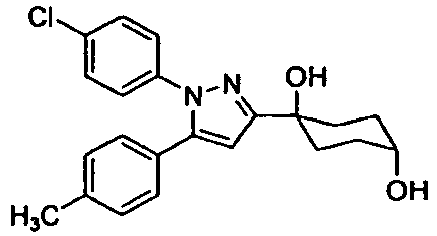

- Sodium borohydride (53 mg, 1.40 mmol) was added to a solution of 4-hydroxy-4-(1-(4-chlorophenyl)-5-(p-tolyl)-1H-pyrazol-3-yl)-cyclohexan-1-one (Intermediate 65) (510 mg, 1.34 mmol) in methanol (13 mL), and the resulting mixture was stirred at room temperature for 2 hours. The reaction solution was concentrated under reduced pressure, and thereafter dissolved in ethyl acetate, and washed with distilled water and brine. The organic layer was dried over anhydrous sodium sulfate, and concentrated under reduced pressure. The residue was purified by flash chromatography (silica gel, n-hexane/ethyl acetate) to obtain Compound 5 (114 mg, 0.298 mmol, 22%) and Compound 22 (360 mg, 0.940 mmol, 70%) as a white solid, respectively.
Compound 5: 1H-NMR (400 MHz, CDCl3) δ: 1.36 (1H, br), 1.65-1.72 (2H, m), 1.77-1.82 (2H, m), 2.04-2.11 (2H, m), 2.31-2.38 (2H, m), 2.36 (3H, s), 2.51 (1H, s), 4.03-4.08 (1H, m), 6.44 (1H, s), 7.10 (2H, d, J= 8.8 Hz), 7.13 (2H, d, J= 8.8 Hz), 7.22-7.30 (4H, m).
IR (KBr, cm-1): 3349, 2918, 1497, 1440, 1366, 1240, 1098, 1007, 969, 833, 810.
ESI-MS: m/z = 383 (M+H)+
Compound 22: 1H-NMR (400 MHz, CDCl3) δ: 1.45 (1H, br), 1.80-1.99 (6H, m), 2.03-2.07 (2H, m), 2.35 (3H, s), 2.51 (1H, s), 3.70-3.80 (1H, m), 6.39 (1H, s), 7.09 (2H, d, J = 8.4 Hz), 7.13 (2H, d, J= 8.4 Hz), 7.21-7.24 (2H, m), 7.27-7.31 (2H, m).
IR (KBr, cm-1): 3365, 2946, 1496, 1442, 1368, 1241, 1095, 1059, 1014, 970, 887.
ESI-MS: m/z = 365 (M-OH)+ - As Compound 6,1-(1,5-bis(4-methoxyphenyl)-1H-pyrazol-3-yl)cyclohexan-trans-1,4-diol:

Compound 8, 1-(1,5-bis(4-methoxyphenyl)-1H-pyrazol-3-yl)cyclohexan-cis-1,4-diol:
- Sodium borohydride (65 mg, 1.7 mmol) was added to a solution of 4-(1,5-bis(4-methoxyphenyl)-1H-pyrazol-3-yl)-4-hydroxy-cyclohexan-1-one (Intermediate 63) (523 mg, 1.38 mmol) in methanol, and the resulting mixture was stirred at room temperature for 1.5 hours and concentrated under reduced pressure. Distilled water was added to the residue, and the resulting solution was extracted with ethyl acetate. The organic layer was dried over anhydrous magnesium sulfate, and concentrated under reduced pressure. The residue was purified by flash chromatography to separate into low polar components and high polar components. The low polar components were purified by recrystallization (ethyl acetate/n-hexane = 2/1) to obtain Compound 6 (79 mg, 0.20 mmol, 14%) as a white crystal. The high polar components were purified by recrystallization (ethyl acetate/n-hexane = 2/1) to obtain Compound 8 (186 mg, 0.471 mmol, 34%) as a white crystal.
Compound 6: 1H-NMR (400 MHz, CDCl3) δ: 1.33 (1H, d, J = 3.4 Hz), 1.63-1.73 (2H, m), 1.75-1.84 (2H, m), 2.03-2.13 (2H, m), 2.30-2.39 (2H, m), 2.55 (1H, s), 3.80 (3H, s), 3.81 (3H, s), 4.02-4.08 (1H, m), 6.40 (1H, s), 6.82 (2H, d, J= 8.8 Hz), 6.85 (2H, d, J= 8.8 Hz), 7.14 (2H, d, J= 8.8 Hz), 7.21 (2H, d, J= 8.8 Hz).
IR (KBr, cm-1): 3379, 1613, 1517, 1503, 1251, 1180, 1032, 1001, 835.
ESI-MS: m/z = 395 (M+H)+
Compound 8: 1H-NMR (400 MHz, CDCl3) δ: 1.41 (1H, d, J= 4.1 Hz), 1.79-2.55 (8H, m), 2.55 (1H, s), 3.69-3.78 (1H, m), 3.80 (3H, s), 3.81 (3H, s), 6.34 (1H, s), 6.81 (2H, d, J= 8.8 Hz), 6.85 (2H, d, J= 8.8 Hz), 7.13 (2H, d, J= 8.8 Hz), 7.20 (2H, d, J= 8.8 Hz).
IR (KBr, cm-1): 3385, 1613, 1517, 1503, 1250, 1064, 1031, 970, 835.
ESI-MS: m/z = 395 (M+H)+ - As Compound 7, 1-(5-(4-chlorophenyl)-1-(4-methoxyphenyl)-1H-pyrazol-3-yl)cyclohexan-trans-1,4-diol:


- Sodium borohydride (59.0 mg, 1.56 mmol) was added to a solution of 4-(5-(4-chlorophenyl)-1-(4-methoxyphenyl)-1H-pyrazol-3-yl)-4-hydroxy-cyclohexan-1-one (Intermediate 64) (619 mg, 1.56 mmol) in methanol (15.6 mL). The resulting mixture was stirred at room temperature for 1 hour, and thereafter poured into 1 M hydrochloric acid. The reaction solution was extracted with ethyl acetate. The organic layer was washed with brine, dried over anhydrous sodium sulfate, and concentrated under reduced pressure. The residue was purified by flash chromatography (silica gel, n-hexane/ethyl acetate) to obtain Compound 7 (131 mg, 0.328 mmol, 21 %) and Compound 21 (291 mg, 0.730 mmol, 47%) as a white solid, respectively.
Compound 7: 1H-NMR (400 MHz, CDCl3) δ: 1.32 (1H, d, J= 3.2 Hz), 1.63-1.73 (2H, m), 1.76-1.84 (2H, m), 2.03-2.12 (2H, m), 2.30-2.39 (2H, m), 2.50 (1H, s), 3.82 (3H, s), 4.02-4.09 (1H, m), 6.46 (1H, s), 6.84-6.87 (2H, m), 7.14 (2H, d, J = 8.8 Hz), 7.19 (2H, d, J= 8.8 Hz), 7.26-7.28 (2H, m).
ESI-MS: m/z = 399 (M+H)+
Compound 21: 1H-NMR(400 MHz, CDCl3) δ: 1.41 (1H, d, J = 5.2 Hz), 1.82-2.09 (8H, m), 2.49 (1H, s), 3.70-3.78 (1H, s), 3.82 (3H, s), 6.41 (1H, s), 6.85-6.87 (2H, m), 7.13 (2H, d, J= 8.4 Hz), 7.18 (2H, d, J= 8.4 Hz), 7.25-7.27 (2H, m).
ESI-MS: mlz = 399 (M+H)+ - As Compound 9, 1-(4-chloro-1-(4-methoxyphenyl)-5-(p-tolyl)-1H-pyrazol-3-yl)cyclohexan-cis-1,4-diol:

- Potassium carbonate (102 mg, 0.736 mmol) was added to a solution of 4-(4-chloro-1-(4-methoxyphenyl)-5-(p-tolyl)-1H-pyrazol-3-yl)-c-4-hydroxy-cyclohexan-r-1-yl acetate (Intermediate 81) (67 mg, 0.147 mmol) in methanol (1.5 mL), and the resulting mixture was stirred at room temperature for 2 hours. Water was added to the reaction solution to stop the reaction, and the resulting solution was extracted with ethyl acetate. The organic layer was washed with brine, dried over anhydrous sodium sulfate, and concentrated under reduced pressure. The residue was purified by flash chromatography (silica gel, n-hexane/ethyl acetate) to obtain Compound 9 (58 mg, 0.140 mmol, 95%) as a white solid.
1H-NMR (400 MHz, CDCl3) δ: 1.45 (1H, s), 1.83-2.05 (6H, m), 2.21-2.23 (2H, m), 2.36 (3H, s), 3.04 (1H, s), 3.76-3.79 (4H, m), 6.79-6.83 (2H, m), 7.11-7.16 (6H, m).
ESI-MS: m/z = 395, 397 (M-OH)+ - As
Compound 10, 1-(1-(4-methoxyphenyl)-5-(p-tolyl)-1H pyrazol-3-yl)-4-(trifluoromethyl)cyclohexan-cis-1,4-diol:
- To a solution of 4-hydroxy-4-(1-(4-methoxyphenyl)-5-(p-tolyl)-1H-pyrazol-3-yl)cyclohexan-1-one (Compound 4) (620 mg, 1.65 mmol) in tetrahydrofuran (6.60 mL), (trifluoromethyl)trimethylsilane (535 µL, 3.62 mmol) was added at 0°C. Thereafter, tetra-n-butylammonium fluoride (TBAF, 1M solution in tetrahydrofuran) (362 µL, 0.36 mmol) was added dropwise thereto, and the obtained solution was stirred at room temperature for 6 hours. To the reaction solution, tetra-n-butylammonium fluoride (TBAF, 1 M solution in tetrahydrofuran) (3.29 mL, 3.29 mmol) was added. The resulting mixture was stirred at room temperature for 1 hour, and thereafter poured into 1 M hydrochloric acid. The reaction solution was extracted with diethyl ether. The organic layer was washed with brine, dried over anhydrous sodium sulfate, and concentrated under reduced pressure. The residue was purified by flash chromatography (silica gel, n-hexane/ethyl acetate) to obtain Compound 10 (410 mg, 0.92 mmol, 56%) as a white solid.
1H-NMR (400 MHz, CDCl3) δ: 1.60 (1H, s), 1.87-2.02 (4H, m), 2.09-2.02 (2H, m), 2.34-2.40 (6H, m), 3.82 (3H, s), 6.47 (1H, s), 6.86 (2H, d, J= 8.8 Hz), 7.08-7.11 (4H, m), 7.20 (2H, d, J= 8.8 Hz).
IR (KBr, cm-1): 3402, 2954, 1517, 1463, 1305, 1250, 1249, 1179, 1121, 1056, 1024, 834.
ESI-MS: m/z = 447 (M+H)+ - As Compound 11, t-4-fluoro-4-(1-(4-methoxyphenyl)-5-(p-tolyl)-1H-pyrazol-3-yl)-cyclohexan-r-1-ol:

- Deoxofluor™ (48 µL, 0.262 mmol) was added to a solution of c-4-hydroxy-4-(1-(4-methoxyphenyl)-5-(p-tolyl)-1H-pyrazol-3-yl)-cyclohexan-r-1-yl acetate (Compound 12) (100 mg, 0.238 mmol) in dichloromethane (1.19 mL), and the resulting mixture was stirred at room temperature for 15 minutes. To the reaction solution, 1 M hydrochloric acid was added, and the resulting solution was extracted with chloroform. The organic layer was washed with brine, and then dried over anhydrous magnesium sulfate, and concentrated under reduced pressure to obtain a residue.
- Potassium carbonate (164 mg, 1.18 mmol) was added to a solution of the obtained residue in methanol (2.4 mL), and the resulting mixture was stirred at room temperature for 2 hours. Water was added to the reaction solution to stop the reaction, and the resulting solution was extracted with ethyl acetate. The organic layer was washed with brine, dried over anhydrous sodium sulfate, and concentrated under reduced pressure. The residue was purified by flash chromatography (silica gel, n-hexane/ethyl acetate) to obtain Compound 11 (22.4 mg, 0.058 mmol, 25%) as a white solid.
1H-NMR (400 MHz, CDCl3) δ: 1.37 (1H, m), 1.72-1.77 (2H, m), 2.02-2.14 (4H, m), 2.34 (3H, s), 2.38-2.49 (2H, m), 3.81 (3H, s), 4.11 (1H, m), 6.52 (1H, m), 6.84 (2H, d, J = 8.8 Hz), 7.22 (2H, d, J = 8.8 Hz), 7.26 (4H, s).
ESI-MS: m/z = 381 (M+H)+ - As
Compound 12, c-4-hydroxy-4-(1-(4-methoxyphenyl)-5-(p-tolyl)-1H-pyrazol-3-yl)-cyclohexan-r-1-yl acetate:
- Acetic anhydride (0.312 mL, 3.30 mmol), pyridine (0.267 mL, 3.30 mmol), and 4-dimethylaminopyridine (16.1 mg, 0.132 mmol) were added to a suspension of 1-(1-(4-methoxyphenyl)-5-(p-tolyl)-1H-pyrazol-3-yl)cyclohexan-cis-1,4-diol (Compound 3) (500 mg, 1.32 mmol) in dichloromethane (4.4 mL), and the resulting mixture was stirred at room temperature for 45 minutes. Water was added to the reaction solution to stop the reaction, and the resulting solution was extracted with ethyl acetate. The organic layer was washed with brine, dried over anhydrous sodium sulfate, and concentrated under reduced pressure. The residue was purified by flash chromatography (silica gel, n-hexane/ethyl acetate) to obtain Compound 12 (556 mg, 1.32 mmol, quant.) as an amorphous product.
1H-NMR (400 MHz, CDCl3) δ: 1.89-2.08 (11H, m), 2.34 (3H, s), 2.64 (1H, brs), 3.81 (3H, s), 4.80-4.88 (1H, m), 6.36 (1H, s), 6.85 (2H, d, J= 8.8 Hz), 7.00 (4H, s), 7.20 (2H, d, J = 8.8 Hz).
ESI-MS: m/z = 421 (M+H)+ - As Compound 13, 4-methoxy-1-(1-(4-metboxyphenyl)-5-(p-tolyl)-1H-pyrazol-3-yl)cyclohexanol:

- Potassium carbonate (197 mg, 1.42 mmol) was added to a solution of c-4-methoxy-1-(1-(4-methoxyphenyl)-5-(p-tolyl)-1H-pyrazol-3-yl)-cyclohexan-r-1-yl acetate (Intermediate 39) (124 mg, 0.284 mmol) in methanol (2.8 mL), and the resulting mixture was stirred at room temperature for 18 hours. Water was added to the reaction solution to stop the reaction, and the resulting solution was extracted with ethyl acetate. The organic layer was washed with brine, dried over anhydrous sodium sulfate, and concentrated under reduced pressure. The residue was purified by flash chromatography (silica gel, n-hexane/ethyl acetate) to obtain Compound 13 (102 mg, 0.260 mmol, 91 %) as a white amorphous product.
1H-NMR (400 MHz, CDCl3) δ: 1.78-1.88 (2H, m), 1.90-1.99 (4H, m), 2.03-2.09 (2H, m), 2.33 (3H, s), 2.49 (1H, s), 3.24-3.32 (1H, m), 3.39 (3H, s), 3.81 (3H, s), 6.39 (1H, s), 6.85 (2H, d, J= 8.8 Hz), 7.09 (4H, s), 7.20 (2H, d, J= 8.8 Hz).
IR (KBr, cm-1): 3425, 2937, 1516, 1443, 1369, 1300, 1249, 1171, 1099, 1030, 968, 834,801.
ESI-MS: m/z = 393 (M+H)+ - As
Compound 14, 4-(hydroxymethyl)-4-(1-(4-methoxyphenyl)-5-(p-tolyl)-1H-pyrazol-3-yl)-trans-1,4-cyclohexanol:

- Sodium borohydride (30.4 mg, 0.804 mmol) was added to a solution of 4-(benzyloxymethyl)-4-(1-(4-methoxyphenyl)-5-(p-tolyl)-1H-pyrazol-3-yl)cyclohexan-1-one (Intermediate 51) (387 mg, 0.804 mmol) in methanol (8.0 mL). The resulting mixture was stirred at room temperature for 1 hour, and thereafter poured into 1 M hydrochloric acid. The reaction solution was extracted with ethyl acetate. The organic layer was washed with brine, dried over anhydrous sodium sulfate, and concentrated under reduced pressure to obtain a residue.
- To a solution of the obtained residue in methanol (8.0 mL), 10% palladium carbon (86.0 mg, 0.080 mmol) was added under hydrogen atmosphere, and the resulting mixture was stirred at room temperature for 3 hours. The reaction solution was filtered through Celite, and the filtrate was concentrated under reduced pressure. The residue was purified by flash chromatography (amine silica gel, n-hexane/ethyl acetate) to obtain Compound 14 (51.6 mg, 0.131 mmol, 16%) as a white solid and Compound 20 (164 mg, 0.418 mmol, 52%) as a white amorphous product. Compound 14: 1H-NMR (400 MHz, CDCl3) δ: 1.43 (1H; brs), 1.54-1.67 (2H, m), 1.83-1.91 (4H, m), 2.00-2.08 (2H, m), 2.34 (3H, s), 3.24-3.33 (1H, m), 3.78-3.86 (6H, m), 6.32 (1H, s), 6.84 (2H, d, J = 8.8 Hz), 7.10 (4H, s), 7.19 (2H, d, J = 8.8 Hz).
ESI-MS: m/z = 393 (M+H)+
Compound 20: 1H-NMR (400 MHz, CDCl3) δ: 1.39 (1H, d, J=4.8 Hz), 1.46-1.60 (4H, m), 1.85-1.95 (2H, m), 2.33-2.40 (5H, m), 2.71 (1H, t, J= 6.4 Hz), 3.55 (2H, d, J= 6.4 Hz), 3.71-3.83 (4H, m), 6.37 (1H, s), 6.85 (2H, d, J= 8.8 Hz), 7.10 (4H, s), 7.20 (2H, d, J= 8.8 Hz).
ESI-MS: m/z = 393 (M+H)+ - As Compound 15, 1-(1-(4-methoxyphenyl)-5-(6-methylpyridin-3-yl)-1H pyrazol-3-yl)cyclohexan-cis-1,4-diol:

- Sodium borohydride (12.1 mg, 0.32 mmol) was added to a solution of 4-hydroxy-4-(1-(4-methoxyphenyl)-5-(6-methylpyridin-3-yl)-1H-pyrazol-3-yl)-cyclohexan-1-one (Intermediate 62) (109.5 mg, 0.29 mmol) in methanol (1.5 mL). The resulting mixture was stirred at room temperature for 40 minutes, and thereafter 1 M hydrochloric acid was added thereto. The reaction solution was washed with ethyl acetate, and the aqueous layer was basified with 1 M aqueous sodium hydroxide solution, followed by extraction of the resulting mixture twice with ethyl acetate. The organic layer was washed with brine, dried over anhydrous sodium sulfate, and concentrated under reduced pressure. The residue was purified by flash chromatography (silica gel, ethyl acetate) to obtain Compound 15 (30.6 mg, 0.81 mmol, 28%) as a white solid.
1H-NMR (400 MHz, CDCl3) δ: 1.59 (1H, brs), 1.81-2.00 (6H, m), 2.05-2.08 (2H, m), 2.55 (3H, s), 2.61 (1H, s), 3.71-3.78 (1H, m), 3.81 (3H, s), 6.46 (1H, s), 6.86 (2H, d, J= 8.8 Hz), 7.06 (1H, d, J= 8.0 Hz), 7.18 (2H, d, J = 8.8 Hz), 7.32 (1H, dd, J= 2.0, 8.0 Hz), 8.40 (1 H, d, J = 2.0 Hz).
IR (KBr, cm-1): 3444, 2933, 2858, 1516, 1249, 1067, 968, 839.
ESI-MS: m/z = 380 (M+H)+ - As
Compound 16, 4-hydroxy-4-(1-(4-methoxyphenyl)-5-(p-tolyl)-1H-pyrazol-3-yl)-cis-cyclohexanecarboxylic acid:
- Distilled water (0.8 ml) and 2-methyl-2-butene (101 µL, 0.96 mmol) were added to a solution of c-4-hydroxy-4-(1-(4-methoxyphenyl)-5-(p-tolyl)-1H-pyrazol-3 yl)-cis-cyclohexan-r-1-carbaldehyde (Intermediate 42) (124.9 mg, 0.32 mmol) in t-butanol (2.4 ml), and the obtained solution was cooled in ice. At 0°C, sodium dihydrogen phosphate (42.1 mg, 0.35 mmol) and sodium chlorite (72.3 mg, 0.80 mmol) were added thereto, and the obtained mixture was stirred for 5 minutes. The mixture was allowed to warm to room temperature, stirred for 1 hour, and then cooled in ice to 0°C. Thereafter, an aqueous sodium thiosulfate solution was added thereto, and the resulting mixture was stirred. To the mixture, 1 M hydrochloric acid and ethyl acetate were added, and the resulting solution was subjected to extraction. The organic layer was washed with brine, dried over anhydrous sodium sulfate, and concentrated under reduced pressure. The residue was purified by flash chromatography (silica gel, n-hexane/ethyl acetate) to obtain Compound 16 (116.6 mg, 0.29 mmol, 93%) as a white solid.
1H-NMR (400 MHz, CDCl3) δ: 1.87-2.11 (9H, m), 2.33 (3H, s), 2.40-2.43 (1H, m), 3.81 (3H, s), 6.38 (1H, s), 6.84 (2H, d, J= 9.2 Hz), 7.09-7.09 (4H, m), 7.20 (2H, d, J = 9.2 Hz).
IR (KBr, cm-1): 3523, 2928, 1706, 1517, 1252, 831.
ESI-MS: m/z = 407 (M+H)+ - As Compound 17, 4,4-difluoro-1-(1-(4-methoxyphenyl)-5-(p-tolyl)-1H-pyrazol-3-yl)cyclohexanol:

- To a solution of 1-(1-(4-methoxyphenyl)-5-(p-tolyl)-1H-pyrazol-3-yl)-4-oxo-cyclohexan-1-yl acetate (Intermediate 41) (110 mg, 0.263 mmol) in dichloromethane (2.63 mL), (dimethylamino)sulfur trifluoride (DAST) (104 µL, 0.578 mmol) was added, and the resulting mixture was stirred at room temperature for 2 hours. To the reaction solution, 1 M hydrochloric acid was added, and the resulting solution was extracted with chloroform. The organic layer was washed with brine, and then dried over anhydrous magnesium sulfate, and concentrated under reduced pressure to obtain a residue.
- To a solution of the obtained residue in tetrahydrofuran (193 µL) and methanol (386 µL), a 4 M aqueous sodium hydroxide solution (193 µL, 0.772 mmol) was added, and the resulting mixture was stirred at room temperature for 6 hours. Water was added to the reaction solution to stop the reaction, and the resulting solution was extracted with ethyl acetate. The organic layer was washed with brine, dried over anhydrous sodium sulfate, and concentrated under reduced pressure. The residue was purified by flash chromatography (silica gel, n-hexane/ethyl acetate) to obtain Compound 17 (41.0 mg, 0.103 mmol, 39%) as a white solid.
1H-NMR (400 MHz, CDCl3) δ: 2.01-2.31 (8H, m), 2.34 (3H, s), 2.77 (1H, s), 3.81 (3H, s), 6.37 (1H, s), 6.86 (2H, d, J= 8.8 Hz), 7.10 (4H, s), 7.21 (2H, d, J= 8.8 Hz).
ESI-MS: m/z = 399 (M+H)+ - The following compounds were synthesized in the same manner as in the synthesis of the above-described
Compound 2 andCompound 3. -
[Table 5-1] Compound Structural Formula Compound Data 18 
1H-NMR (400 MHz, CDCl3) δ: 1.44 (1H, d, J = 4.0 Hz), 1.84-2.01 (8H, m), 2.48 (1H, s), 3.75 (1H, s), 3.82 (3H, s), 6.49 (1H, s), 6.87 (2H, d, J = 9.2 Hz), 7.19 (2H, d, J= 9.2 Hz), 7.32 (2H, d, J= 8.2 Hz), 7.55 (2H, d, J= 8.2 Hz). ESI-MS: m/z = 433 (M+H)+ 19 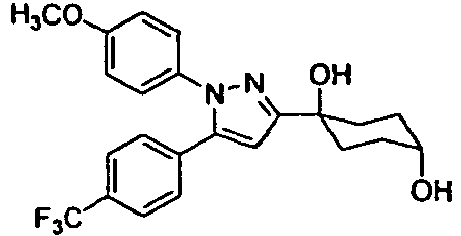
1H-NMR (400 MHz, CDCl3) δ: 1.35 (1H, s), 1.67-1.71 (2H, m), 1.78-1.84 (2H, m), 2.0-2.11 (2H, m), 2.33-2.40 (2H, m), 2.49 (1H, s), 3.83 (3H, s), 4.07 (1H, m), 6.53 (1H, s), 6.87 (2H, d, J = 8.2 Hz), 7.19 (2H, d, J. 8.2 Hz), 7.33 (2H, d, J= 8.2 Hz), 7.55 (2H, d, J = 8.2 Hz). ESI-MS: m/z = 433 (M+H)+ 23 
1H-NMR (400 MHz, CDCl3) δ: 1.34 (1H, d, J = 3.2 Hz), 1.64-1.72 (2H, m), 1.76-1.83 (2H, m), 2.03-2.12 (2H, m), 2.30-2.39 (2H, m), 2.45 (1H, s), 4.03-4.09 (1H, m), 6.48 (1H, s), 7.15 (2H, d, J= 8.8 Hz), 7.22 (2H, d, J= 8.8 Hz), 7.30-7.33 (4H, m). ESI-MS: m/z = 403 (M+H)+ 24 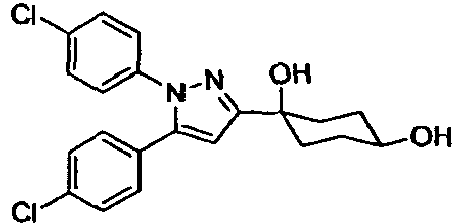
1H-NMR (400 MHz, CDCl3) δ: 1.45 (1H, d, J = 4.0 Hz), 1.80-2.07 (8H, m), 2.46 (1H, s), 3.70-3.79 (1H, s), 6.43 (1H, s), 7.14 (2H, d, J = 8.8 Hz), 7.21 (2H, d, J = 8.8 Hz), 7.29-7.33 (4H, m). ESI-MS: m/z = 403 (M+H)+ 25 
1H-NMR (400 MHz, CDCl3) δ: 1.33 (1H, d, J = 3.2 Hz), 1.65-1.73 (2H, m), 1.78-1.84 (2H, m), 2.04-2.13 (2H, m), 2.32-2.40 (2H, m), 2.51 (1H, s), 4.03-4.09 (1H, m), 6.48 (1H, s), 7.14-7.16 (2H, m), 7.26-7.28 (7H, m). ESI-MS: m/z = 369 (M+H)+ 26 
1H-NMR (400 MHz, CDCl3) δ: 1.43 (1H, d, J = 5.2 Hz), 1.81-2.09 (8H, m), 2.50 (1H, s), 3.71-3.79 (1H, m), 6.43 (1H, s), 7.12-7.16 (2H, m), 7.25-7.38 (7H, m). ESI-MS: mlz = 369 (M+H)+ 27 
1H-NMR (400 MHz, CDCl3) δ 1.41 (1H, brs), 1.64-1.72 (2H, m), 1.77-1.83 (2H, m), 2.04-2.11 (2H, m), 2.31-2.38 (2H, m), 2.34 (3H, s), 2.35 (3H, s), 2.59 (1H, s), 4.02-4.07 (1H, m), 6.43 (1H, s), 7.09-7.11 (4H, m), 7.12 (2H, d, J= 8.4 Hz), 7.18 (2H, d, J= 8.4 Hz). IR (KBr, cm-1): 3343, 2918, 1518, 1440, 1367, 1266, 1240, 1196, 1159, 1107, 1007, 824, 810. ESI-MS: mlz = 363 (M+H)+ -
[Table 5-2] Compound Structural Formula Compound Data 28 
1H-NMR (400 MHz, CDCl3) δ: 1.48 (1H, brs), 1.80-1.99 (6H, m), 2.02-2.09 (2H, m), 2.34 (3H, s), 2.35 (3H, s), 2.61 (1H, s), 3.70-3.78 (1H, m), 6.38 (1H, s), 7.08-7.12 (4H, m), 7.12 (2H, d, J = 8.8 Hz), 7.17 (2H, d, J= 8.8 Hz). IR (KBr, cm-1): 3375, 2937, 2870, 1519, 1502, 1440, 1362, 1217, 1193, 1112, 1064, 1042, 1017, 973, 886, 821,804. ESI-MS: m/z = 345 (M-OH)+ 29 
1H-NMR (400 MHz, CDCl3) δ: 1.47 (1H, brs), 1.64-1.73 (2H, m), 1.76-1.85 (2H, m), 2.03-2.12 (2H, m), 2.31-2.40 (2H, m), 2.34 (3H, s), 2.62 (1H, s), 4.02-4.08 (1H, m), 6.45 (1H, s), 7.08-7.14 (4H, m), 7.26-7.36 (5H, m). IR (KBr, cm-1): 3337, 2920, 1599, 1506, 1437, 1366, 1005,810,765,696. ESI-MS: m/z = 349 (M+H)+ 30 
1H-NMR (400 MHz, CDCl3) δ: 1.50 (1H, brs), 1.80-2.00 (6H, m), 2.03-2.09 (2H, m), 2.34 (3H, s), 2.60 (1H, s), 3.70-3.79 (1H, m), 6.40 (1H, s), 7.08-7.12 (4H, m), 7.27-7.35 (5H, m). IR (KBr, cm-1): 3374, 2919, 1596, 1505, 1440, 1361, 1217, 1112, 1064, 1044, 1019, 973, 886, 819, 799, 771, 693. ESI-MS: m/z = 33 (M-OH)+ 31 
1H-NMR (400 MHz, CDCl3) δ 1.42 (1H, d, J = 4.8 Hz), 1.79-2.01 (6H, m), 2.03-2.08 (2H, m), 2.54 (1H, s), 3.71-3.80 (1H, m), 3.81 (3H, s), 6.41 (1H, s), 6.84 (2H, d, J= 6.8 Hz), 7.18-7.23 (4H, m), 7.28-7.30 (3H, m). ESI-MS: m/z = 365 (M+H)+ -
[Table 5-3] Compound Structural Formula Compound Data 32 
1H-NMR (400 MHz, CDCl3) δ: 1.34 (1H, d, J = 3.6 . Hz), 1.65-1.73 (2H, m), 1.17-1.85 (2H, m), 2.03-2.12 (2H, m), 2.32-2.40 (2H, m), 2.54 (1H, s), 3.81 (3H, s), 4.00-4.10 (1H, m), 6.46 (1H, s), 6.85 (2H, d, J = 8.8 Hz), 7.19-7.24 (4H, m), 7.28-7.31 (3H, m). ESI-MS: mlz = 365 (M+H)+ 33 
1H-NMR (400 MHz, CDCl3) δ 1.34 (1H, d, J = 3.6 Hz), 1.62-1.73 (2H, m), 1.77-1.85 (2H, m), 2.03-2.12 (2H, m), 2.31-2.40 (5H, m), 2.57 (1H, s), 4.00-4.08 (1H, m), 6.61 (1H, s), 7.12 (2H, d, J = 8.4 Hz), 7.17 (2H, d, J= 8.8 Hz), 7.21-7.24 (2H, m), 7.28-7.30 (3H, m). ESI-MS: mlz = 349 (M+H)+ 34 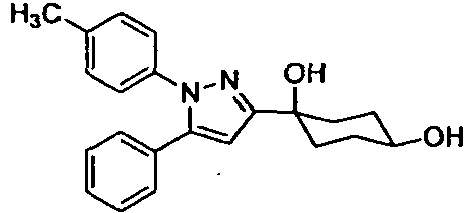
1H-NMR (400 MHz, CDCl3) δ: 1.79-2.00 (6H, m), 2.03-2.08 (2H, m), 2.34 (3H, s), 2.57 (1H, s), 3.70-3.79 (1H, m), 6.41 (1H, s), 7.10 (2H, d, J = 8.4 Hz), 7.16 (2H, d, J= 8.4 Hz), 7.27-7.31 (3H, m), 7.19-7.23 (2H, m). ESI-MS: m/z = 349 (M+H)+ 35 
1H-NMR (400 MHz, CDCl3) δ: 1.35 (1H, d, J = 3.6 Hz), 1.62-1.73 (2H, m), 1.75-1.86 (2H, m), 2.02-2.13 (2H, m), 2.29-2.40 (5H, m), 2.58 (1H, s), 3.80 (3H, s), 4.01-4.09 (1H, m), 6.40 (1H, s), 6.82 (2H, d, J = 8.8 Hz), 7.10-7.20 (6H, m). 36 
1H-NMR (400 MHz, CDCl3) δ: 1.34 (1H, d, J = 5.6 Hz), 1.80-2.10 (8H, m), 2.34 (3H, s), 2.59 (1H, s), 3.68-3.79 (1H, m), 3.80 (3H, s), 6.34 (1H, s), 6.81 (2H, d, J= 8.4 Hz), 7.08-7.20 (6H, m). -
[Table 5-4] Compound Structural Formula Compound Data 37 
1H-NMR (400 MHz, CDCl3) δ: 1.48 (1H, s), 1.62-1.72 (2H, m), 1.73-1.83 (2H, m), 2.02-2.12 (2H, m), 2.30-2.39 (2H, m), 2.57 (1H, s), 3.82 (3H, s), 4.02-4.06 (1 H, m), 6.42 (1H, s), 6.84 (2H, d, J = 8.8 Hz), 7.13 (2H, d, J= 12.0 Hz), 7.23 (2H, d, J= 8.8 Hz), 7.29 (2H, d, J= 8.8 Hz). ESI-MS: mlz = 399 (M+H)+ 38 
1H-NMR (400 MHz, CDCl3) δ: 1.79-1.99 (6H, m), 2.03-2.07 (3H, m), 3.70-3.79 (1H, m), 3.81 (3H, s), 6.37 (1H, s), 6.84 (2H, d, J= 8.8 Hz), 7.14 (2H, d, J= 8.8 Hz), 7.22 (2H, d, J = 8.8 Hz), 7.29 (2H, d, J = 8.8 Hz). ESI-MS: mlz = 399 (M+H)+ 39 
1H-NMR (400 MHz, CDCl3) δ: 1.38 (1H, s), 1.64-1.74 (2H, m), 1.76-1.85 (2H, m), 2.03-2.13 (2H, m), 2.31-2.40 (2H, m), 2.58 (1H, s), 3.81 (3H, s), 4.06 (1H, s), 6.42 (1H, s), 6.82 (2H, d, J = 8.8 Hz), 7.14 (2H, d, J = 8.8 Hz), 7.28-7.37 (5H, m). ESI-MS: m/z = 365 (M+H)+ 40 
1H-NMR (400 MHz, CDCl3) δ: 1.47 (1H, s), 1.79-1.99 (6H, m), 2.03-2.07 (2H, m), 2.59 (1H, s), 3.70-3.79 (1H, m), 3.80 (3H, s), 6.37 (1H, s), 6.82 (2H, d, J= 8.6 Hz), 7.13 (2H, d, J= 8.6 Hz), 7.27-7.36 (5H, m). ESI-MS: mlz = 365 (M+H)+ - As Compound 41, 1-(4-(4-methoxyphenyl)-5-(p-tolyl)thiazol-2-yl)cyclohexan-trans-1,4-diol:


- Sodium borohydride (36 mg, 0.943 mmol) was added to a solution of 4-hydroxy-4-(4-(4-methoxyphenyl)-5-(p-tolyl)thiazol-2-yl)cyclohexan-1-one (Intermediate 83) (186 mg, 0.471 mmol) in methanol (4.7 mL), and the resulting mixture was stirred at room temperature for 1 hour. The reaction solution was concentrated under reduced pressure, and thereafter dissolved in ethyl acetate, and washed with distilled water and brine. The organic layer was dried over anhydrous sodium sulfate, and concentrated under reduced pressure. The residue was purified by flash chromatography (silica gel, n-hexane/ethyl acetate) to obtain Compound 41 (42 mg, 0.106 mmol, 23%) and Compound 42 (136 mg, 0.344 mmol, 73%) as a white solid, respectively.
Compound 41: 1H-NMR (400 MHz, CDCl3) δ: 1.53-1.57 (1H, m), 1.76-1.87 (4H, m), 2.05-2.12 (2H, m), 2.35-2.42 (2H, m), 2.36 (3H, s), 3.15 (1H, br), 3.80 (3H, s), 4.10-4.14 (1H, m), 6.80-6.84 (2H, m), 7.13 (2H, d, J= 8.0 Hz), 7.24 (2H, d, J= 8.0 Hz), 7.45-7.49 (2H, m).
IR (KBr, cm-1): 3409, 2923, 1613, 1515, 1252, 1179, 1004, 815.
ESI-MS: mlz = 396 (M+H)+
Compound 42: 1H-NMR (400 MHz, CDCl3) δ: 1.48 (1H, d, J= 4.8 Hz), 1.82-1.89 (2H, m), 1.95-2.01 (2H, m), 2.05-2.09 (4H, m), 2.36 (3H, s), 3.01 (1H, s), 3.76-3.82 (1H, m), 3.80 (3H, s), 6.80-6.83 (2H, m), 7.13 (2H, d, J= 8.0 Hz), 7.22 (2H, d, J= 8.0 Hz), 7.43-7.47 (2H, m).
IR (KBr, cm-1): 3418, 2938, 1611, 1515, 1249, 1177, 1058, 816.
ESI-MS: m/z = 396 (M+H)+ - As Compound 43, 4-(4,5-bis(4-methoxyphenyl)oxazol-2-yl)cyclohexan-cis-1,4-diol:


- Sodium borohydride (47 mg, 1.24 mmol) was added to a solution of 4-(4,5-bis(4-methoxyphenyl)oxazol-2-yl)-4-hydroxycyclohexan-1-one (Intermediate 82) (395 mg, 1.00 mmol) in methanol (20 mL), and the resulting mixture was stirred at room temperature for 16 hours. The reaction solution was concentrated under reduced pressure, and distilled water was added to the residue, followed by extraction of the resulting mixture with ethyl acetate. The organic layer was dried over anhydrous magnesium sulfate, and concentrated under reduced pressure. The residue was purified by flash chromatography (silica gel, n-hexane/ethyl acetate) to obtain Compound 43 (207 mg, 0.523 mmol, 52%) and Compound 44 (73 mg, 0.18 mmol, 18%) as a white solid, respectively.
Compound 43: 1H-NMR (400 MHz, CDCl3) δ: 1.49 (1H, brs), 1.78-2.13 (8H, m), 2.76 (1H, s), 3.72-3.78 (1H, m), 3.83 (6H, s), 6.89 (2H, d, J = 8.8 Hz), 6.90 (2H, d, J = 8.8 Hz), 7.49 (2H, d, J= 8.8 Hz), 7.55 (2H, d, J= 8.8 Hz).
IR (KBr, cm-1): 3364, 1615, 1599, 1520, 1500, 1302, 1252, 1176, 1069, 1053, 1028, 965, 833.
ESI-MS: m/z = 396 (M+H)+
Compound 44: 1H-NMR (400 MHz, CDCl3) δ: 1.63-1.75 (2H, m), 1.78-1.88 (2H, m), 2.01-2.12 (2H, m), 2.44-2.53 (2H, m), 2.67 (1H, s), 4.00-4.07 (1H, m), 6.89 (2H, d, J = 8.8 Hz), 6.90 (2H, d, J= 8.8 Hz), 7.51 (2H, d, J= 8.8 Hz), 7.57 (2H, d, J= 8.8 Hz).
IR (KBr, cm-1): 3356, 1613, 1600, 1520, 1503, 1254, 1182, 1033, 999, 966, 834.
ESI-MS: m/z = 396 (M+H)+ - As Compound 45, 1-(4-(4-methoxyphenyl)-5-(p-tolyl)thiazol-2-yl)-4-(trifluoromethyl)cyclohexan-trans-1,4-diol:


- To a solution of 4-hydroxy-4-(4-(4-methoxyphenyl)-5-(p-tolyl)thiazol-2-yl)cyclohexan-1-one (Intermediate 83) (199 mg, 0.506 mmol) and Ruppert's reagent (0.187 mL, 1.26 mmol) in tetrahydrofuran (2.5 mL), a 1.0 M tetrabutylammonium fluoride/tetrahydrofuran solution (0.051 mL, 0.051 mmol) was added at room temperature, and the resulting mixture was stirred for 10 minutes. The reaction solution was concentrated under reduced pressure, and thereafter dissolved in tetrahydrofuran (3.0 mL). Distilled water (0.2 mL) and a 1.0 M tetrabutylammonium fluoride/tetrahydrofuran solution (1.02 mL, 1.02 mmol) were added thereto, and the resulting mixture was stirred at room temperature for 30 minutes. Distilled water was added to the reaction solution, and the resulting solution was extracted with ethyl acetate, followed by washing with brine. The organic layer was dried over anhydrous sodium sulfate, and concentrated under reduced pressure. The residue was purified by flash chromatography (silica gel, n-hexane/ethyl acetate) to obtain Compound 45 (70 mg, 0.151 mmol, 30%) and Compound 46 (132 mg, 0.285 mmol, 56%) as a white solid, respectively.
Compound 45: 1H-NMR (400 MHz, CDCl3) δ: 1.79-1.84 (2H, m), 1.90 (1H, s), 1.96-2.01 (2H, m), 2.21-2.33 (4H, m), 2.37 (3H, s), 3.28 (1H, s), 3.80 (3H, s), 6.80-6.84 (2H, m), 7.13 (2H, d, J= 8.0 Hz), 7.23 (2H, d, J= 8.0 Hz), 7.44-7.48 (2H, m).
IR (KBr, cm-1): 3460, 2940, 1610, 1515, 1494, 1442, 1310, 1245, 1175, 1035, 1005,837, 813
ESI-MS: m/z = 464 (M+H)+
Compound 46: 1H-NMR (400 MHz, CDCl3) δ: 1.90-1.96 (2H, m), 1.97 (1H, br), 2.16-2.23 (2H, m), 2.28-2.36 (4H, m), 2.37 (3H, s), 2.81 (1H, br), 3.80 (3H, s), 6.80-6.83 (2H, m), 7.14 (2H, d, J = 8.0 Hz), 7.26 (2H, d, J = 8.0 Hz), 7.44-7.48 (2H, m).
IR (KBr, cm-1): 3419, 2940, 1611, 1515, 1443, 1290, 1250, 1175, 1120, 1066, 993,837, 814
ESI-MS: m/z = 464 (M+H)+ - The following compounds were synthesized in the same manner as in the synthesis of the above-described
Compound 2 andCompound 3. -
[Table 6-1] Compound Structural Formula Compound Data 47 
1H-NMR (400 MHz, CDCl3) δ 1.23 (3H, t, J = 7.6 Hz), 1.33 (1H, br), 1.64-1.73 (2H, m), 1.77-1.84 (2H, m), 2.03-2.12 (2H, m), 2.31-2.40 (2H, m), 2.55 (1H, s), 2.63 (2H, q, J = 7.6 Hz), 3.81 (3H, s), 4.02-4.07 (1H, m), 6.43 (1H, s), 6.83-6.89 (2H, m), 7.12 (4H, s), 7.19-7.28 (2H, m). ESI-MS: m/z = 393 (M+H)+ 48 
1H-NMR (400 MHz, CDCl3) δ: 1.23 (3H, t, J = 7.6 Hz), 1.41 (1H, d, J = 4.4 Hz), 1.80-2.09 (8H, m), 2.55 (1H, s), 2.63 (2H, q, J = 7.6 Hz), 3.69-3.83 (4H, m), 6.38 (1H, s), 6.82-6.87 (2H, m), 7.12 (4H, s), 7.17-7.28 (2H, m). ESI-MS: m/z = 393 (M+H)+ -
[Table 6-2] Compound Structural Formula Compound Data 49 
1H-NMR (400 MHz, CDCl3) δ: 1.33 (1H, br), 1.6 5-1.82 (4H, m), 2.03-2.12 (2H, m), 2.30-2.39 (5H, m), 2.43 (1H, s), 4.03-4.11 (1H, m), 6.48 (1H, s), 7.10-7.19 (4H, m), 7.41-7.45 (2H, m), 7.57-7.61 (2H, m). ESI-MS: mlz = 374 (M+H)+ 50 
1H-NMR (400 MHz, CDCl3) δ: 1.45 (1H, br), 1.8 1-2.07 (8H, m), 2.38 (3H, s), 2.45 (1H, br), 3.70-3.80 (1H, m), 6.43 (1H, s), 7.09-7.18 (4H, m), 7.4 0-7.44 (2H, m), 7.57-7.61 (2H, m). ESI-MS: m/z = 374 (M+H)+ 51 
1H-NMR (400 MHz, CDCl3) δ 1.62-1.90 (4H, m), 2.02-2.16 (2H, m), 2.31-2.49 (3H, m), 3.83 (3H, s), 4.03-4.11 (1H, m), 6.55 (1H, s), 6.86-6.90 (2H, m), 7.16-7.22 (2H, m), 7.29-7.33 (2H, m), 7.53-7. 60 (2H, m). ESI-MS: m/z = 390 (M+H)+ 52 
1H-NMR (400 MHz, CDCl3) δ: 1.43 (1H, br), 1.8 0-2.10 (8H, m), 2.43 (1H, s), 3.70-3.80 (1H, m), 3.83 (3H, s), 6.51 (1H, s), 6.85-6.91 (2H, m), 7.1 5-7.21 (2H, m), 7.27-7.33 (2H, m), 7.55-7.61 (2H, m). ESI-MS: m/z = 390 (M+H)+ -
[Table 6-3] Compound Structural Formula Compound Data 53 
1H-NMR (400 MHz, CDCl3) δ 1.32 (1H, br), 1.65-1.72 (2H, m), 1.77-1.83 (2H, m), 2.04-2.11 (2H, m), 2.30-2.39 (5H, m), 2.48 (1H, br), 3.89 (3H, s), 4.02-4.08 (1H, m), 6.43 (1H, s), 6.88 (1H, t, J = 8.8 Hz), 6.93-7.02 (1H, m), 7.08-7.15 (5H, m). ESI-MS: m/z = 397 (M+H)+ 54 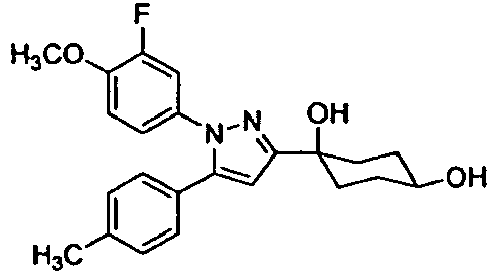
1H-NMR (400 MHz, CDCl3) δ: 1.41 (1H, br), 1.80-2.08 (8H, m), 2.35 (3H, s), 2.48 (1H, s), 3.70-3.80 (1H, m), 3.89 (3H, s), 6.38 (1H, s), 6.88 (1H, t, J= 8.8 Hz), 6.96-7.01 (1H, m), 7.06-7.14 (5H, m). ESI-MS: mlz = 397 (M+H)+ 55 
1H-NMR (400 MHz, CDCl3) δ: 1.63-1.84 (4H, m), 2.03-2.12 (2H, m), 2.26 (3H, d, J = 1.6 Hz), 2.31-2.41 (2H, m), 2.51 (1H, br), 3.82 (3H, s), 4.03-4.08 (1H, m), 6.44 (1H, s), 6.84-6.90 (4H, m), 7.08 (1H, t, J = 8.0 Hz), 7.18-7.23 (2H, m). ESI-MS: mlz = 397 (M+H)+ 56 
1H-NMR (400 MHz, CDCl3) δ: 1.41 (1H, d, J = 4.8 Hz), 1.81-2.08 (8H, m), 2.25 (3H, d, J = 1.6 Hz), 2.51 (1H, s), 3.69-3.78 (1H, m), 3.82 (3H, s), 6.39 (1H, s), 6.84-6.89 (4H, m), 7.09 (1H, t, J = 7.6 Hz), 7.17-7.24 (2H, m). ESI-MS: m/z = 397 (M+H)+ - As Compound 58, ethyl 4-hydroxy-4-(1-(4-methoxyphenyl)-5-(p-tolyl)-1H pyrazol-3-yl)-cis-cyclohexanecarboxylate:

- Potassium carbonate (41.4 mg, 0.3 mmol) and ethyl iodide (24.8 µL, 0.3 mmol) were added to a solution of 4-hydroxy-4-(1-(4-methoxyphenyl)-5-(p-tolyl)-1H-pyrazol-3-yl)-cis-cyclohexanecarboxylic acid (Compound 16) (41.6 mg, 0.10 mmol) in DMF (1.0 ml), and the resulting mixture was stirred for 2 hours. Brine was added to the reaction solution, and the resulting solution was extracted with ethyl acetate. The organic layer was washed with brine, dried over anhydrous sodium sulfate, and concentrated under reduced pressure. The residue was purified by flash column chromatography (silica gel, n-hexane/ethyl acetate) to obtain Compound 58 (44.1 mg, 0.10 mmol, 97%) as a white amorphous product.
1H-NMR (400 MHz, CDCl3) δ: 1.27 (3H, t, J= 6.8 Hz), 1.85-2.09 (8H, m), 2.33 (3H, s), 2.34-2.41 (1H, m), 2.59 (1H, s), 3.80 (3H, s), 4.15 (2H, q, J= 6.8 Hz), 6.38 (1H, s), 6.84 (2H, d, J= 8.8 Hz), 7.09-7.09 (4H, m), 7.20 (2H, d, J= 8.8 Hz).
ESI-MS: m/z = 435 (M+H)+ - Prodrugs of the above-described
Compound 3 were synthesized (Compounds 59 to 70). - As Compound 59, 4-hydroxy-4-(1-(4-methoxyphenyl)-5-(p-tolyl)-1H-pyrazol-3-yl)-cis-cyclohexyl dimethylcarbamate:

- A solution of 1-(1-(4-methoxyphenyl)-5-(p-tolyl)-1H-pyrazol-3-yl)cyclohexan-cis-1,4-diol (Compound 3) (230 mg, 0.60 mmol) in tetrahydrofuran (6.0 ml) was stirred for 10 minutes under ice-cooling. Sodium hydride (26.4 mg, 0.66 mmol) was added to the reaction solution, and the resulting mixture was stirred at the same temperature for 20 minutes. Dimethylcarbamoyl chloride (84 µL, 0.9 mmol) was added dropwise thereto, and the resulting mixture was stirred at room temperature for 3 hours. Thereafter, brine was added to the reaction solution, and the resulting solution was extracted with ethyl acetate. The organic layer was washed with brine, dried using anhydrous sodium sulfate, and concentrated under reduced pressure. The residue was purified by flash column chromatography (silica gel, n-hexane/ethyl acetate) to obtain Compound 59 (95.6 mg, 0.21 mmol, 35%) as a pale yellow amorphous product.
1H-NMR (400 MHz, CDCl3) δ: 1.93-2.04 (8H, m), 2.33 (3H, s), 2.71 (1H, s), 2.92 (6H, s), 3.80 (3H, s), 4.73-4.79 (1H, m), 6.37 (1H, s), 6.84 (2H, d, J= 8.8 Hz), 7.09-7.09 (4H, m), 7.20 (2H, J = 8.8 Hz).
ESI-MS: m/z = 450 (M+H)+ - As Compound 60, cyclohexyl 4-hydroxy-4-(1-(4-methoxyphenyl)-5-(p-tolyl)-1H-pyrazol-3-yl)-cis-cyclohexyl carbonate:

- A solution of 1-(1-(4-methoxyphenyl)-5-(p-tolyl)-1H-pyrazol-3-yl)cyclohexan-cis-1,4-diol (Compound 3) (250 mg, 0.66 mmol) in tetrahydrofuran (2.2 ml) was cooled in ice, and sodium hydride (63.4 mg, 1.45 mmol) was added thereto, followed by stirring the resulting mixture at the same temperature for 10 minutes. Cyclohexyl 1-iodoethyl carbonate (354 mg, 1.18 mmol) was then added to the mixture, and the resulting mixture was stirred at room temperature for 12 hours. Brine was added to the reaction solution, and the resulting solution was extracted with ethyl acetate. The organic layer was washed with brine, dried using anhydrous sodium sulfate, and concentrated under reduced pressure. The residue was purified by flash column chromatography (silica gel, n-hexane/ethyl acetate) to obtain Compound 60 (161 mg, 0.29 mmol, 44%) as a white amorphous product.
1H-NMR (400 MHz, CDCl3) δ: 1.23-1.28 (4H, m), 1.31-1.40 (2H, m), 1.44-1.56 (4H, m), 1.70-1.79 (4H, m), 1.93-2.08 (4H, m), 2.32 (3H, s), 2.82 (1H, s), 3.79 (3H, s), 4.57-4.64 (1H, m), 4.67-4.71 (1H, m), 6.38 (1H, s), 6.84 (2H, d, J = 8.4 Hz), 7.08-7.08 (4H, m), 7.19 (2H, J= 8.4 Hz).
ESI-MS: m/z = 505 (M+H)+ - The following compounds were synthesized in the same manner as in the synthesis of the above-described Compound 59 and Compound 60.
-
[Table 7] Compound Structural Formula Compound Data 61 
1H-NMR (400 MHz, CDCl3) δ: 1.32 (3H, t, J = 8.0 Hz), 1.97-2.09 (8H, m), 2.33 (3H, s), 2.62 (1H, s), 3.80 (3H, s), 4.20 (2H, q, J= 8.0 Hz), 4.69-4.71 (1H, m), 6.37 (1H, s), 6.84 (2H, d, J = 8.8 Hz), 7.09-7.09 (4H, m), 7.20 (2H, J = 8.8 Hz). ESI-MS: m/z = 451 (M+H)+ 62 
1H-NMR (400 MHz, CDCl3) δ: 1.21 (9H, s), 1.92-2.06 (9H, m), 2.33 (3H, s), 3.80 (3H, s), 4.80-4.86 (1H, m), 6.38 (1H, s), 6.84 (2H, d, J = 8.4 Hz), 7.09-7.09 (4H, m), 7.20 (2H, J = 8.4 Hz). ESI-MS: m/z = 463 (M+H)+ - As Compound 63, succinic acid mono-4-hydroxy-4-(1-(4-methoxyphenyl)-5-(p-tolyl)-1H-pyrazol-3-yl)-cis-cyclohexyl ester:
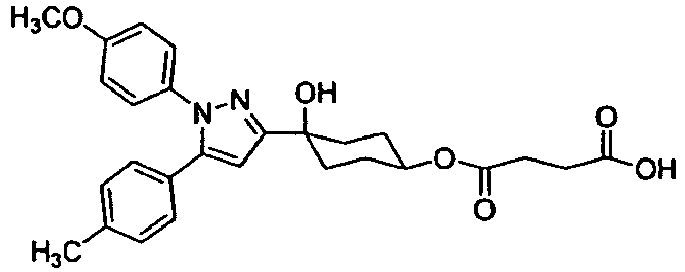
- Sodium hydride (63.4 mg, 1.45 mmol) was added to a solution of 1-(1-(4-methoxyphenyl)-5-(p-tolyl)-1H-pyrazol-3-yl)cyclohexan-cis-1,4-diol (Compound 3) (250 mg, 0.66 mmol) in DMF (3.3 ml), and the resulting mixture was stirred for 30 minutes. Succinic anhydride (99 mg, 0.99 mmol) was added thereto, and the resulting mixture was stirred for 12 hours. Thereafter, 1 M hydrochloric acid and ethyl acetate were added to the reaction solution, and the resulting solution was extracted with ethyl acetate. The organic layer was washed with brine, dried using anhydrous sodium sulfate, and concentrated under reduced pressure. The residue was purified by flash column chromatography (silica gel, n-hexane/ethyl acetate) to obtain Compound 63 (87.0 mg, 0.18 mmol, 28%) as a white amorphous product.
1H-NMR (400 MHz, CDCl3) δ: 1.86-1.88 (2H, m), 1.96-2.02 (4H, m), 2.08-2.11 (3H, m), 2.32 (3H, s), 2.58-2.64 (4H, m), 3.81 (3H, s), 4.82-4.88 (1H, m), 6.38 (1H, s), 6.84 (2H, d, J= 8.0 Hz), 7.09-7.09 (4H, m), 7.18 (2H, J= 8.0 Hz).
ESI-MS: m/z = 479 (M+H)+ - As Compound 64, cyclohexyl (4-hydroxy4-(1-(4-methoxyphenyl)-5-(p-tolyl)-1H-pyrazol-3-yl)-cis-cyclohexyloxy)ethyl carbonate:

- Cyclohexyl 1-iodoethyl carbonate (567 mg, 1.90 mmol), diisopropylethylamine (460 µL, 2.64 mmol) and silver chloride (273 mg, 1.90 mmol) were added to a solution of 1-(1-(4-methoxyphenyl)-5-(p-tolyl)-1H-pyrazol-3-yl)cyclohexan-cis-1,4-diol (Compound 3) (400 mg, 1.05 mmol) in dichloroethane (5.4 ml), and the resulting mixture was stirred at 80°C for 12 hours. The mixture was allowed to cool to room temperature, and the reaction solution was filtered through Celite. To the filtrate, 1 M hydrochloric acid and ethyl acetate were added, and thereafter the resulting solution was extracted with ethyl acetate. The organic layer was washed with brine, dried using anhydrous sodium sulfate, and concentrated under reduced pressure. The residue was purified by flash column chromatography (silica gel, n-hexane/ethyl acetate) to obtain Compound 64 (31.9 mg, 0.058 mmol, 5.1 %) as a white amorphous product.
1H-NMR (400 MHz, CDCl3) δ: 1.15-1.34 (9H, m), 1.48-1.65 (4H, m), 1.83-1.98 (8H, m), 2.33 (3H, s), 2.49 (1H, s), 3.52-3.58 (1H, m), 3.64-3.71 (1H, m), 3.81 (3H, s), 4.92 (1H, q, J = 5.2 Hz), 6.39 (1H, s), 6.84 (2H, d, J = 8.8 Hz), 7.09-7.09 (4H, m), 7.19 (2H, J= 8.8 Hz).
ESI-MS: m/z = 549 (M+H)+ - The following compounds were synthesized in the same manner as in the synthesis of the above-described Compound 59 and Compound 60.
-
[Table 8] Compound Structural Formula Compound Data 65 
1H-NMR (400 MHz, CDCl3) δ: 1.26 (3H, t, J = 5.0 Hz), 1.33 (3H, d, J = 4.8 Hz), 1.86-2.01 (8H, m), 2.33 (3H, s), 2.49 (1H, s), 3.49-3.53 (1H, m), 3.65-3.70 (2H, m), 3.80 (3H, s), 4.84 (1H, q, J = 4.8 Hz), 6.39 (1H, s), 6.84 (2H, d, J = 8.0 Hz), 7.09-7.09 (4H, m), 7.19 (2H, J = 8.0 Hz). ESI-MS: m/z = 495 (M+H)+ 66 
1H-NMR (400 MHz, CDCl3) δ: 1.23 (9H, s), 1.89-2.00 (6H, m), 2.05-2.08 (2H, m),2.33 (3H, s), 2.48 (1H, s), 3.67-3.71 (1H, m), 3.81 (3H, s), 5.39 (2H, s), 6.38 (1H, s), 6.84 (2H, d, J = 9.2 Hz), 7.09-7.09 (4H, m), 7.19 (2H, J = 9.2 Hz). ESI-MS: m/z = 493 (M+H)+ - As Compound 67,4-hydroxy-4-(1-(4-methoxyphenyl)-5-(p-tolyl)-1H-pyrazol-3-yl)-cis-cyclohexyl 2-aminoacetate:

- To a solution of 4-hydroxy-4-(1-(4-methoxyphenyl)-5-(p-tolyl)-1H-pyrazol-3-yl)-cis-cyclohexyl 2-benzyloxycarbonylaminoacetate (Intermediate 57) (33.2 mg, 0.058 mmol) in methanol (2.00 mL), 10% palladium/carbon (6.16 mg, 50 wt%) was added at room temperature, and the resulting mixture was stirred under hydrogen atmosphere for 14 hours. The reaction solution was filtered through Celite, and the filtrate was concentrated under reduced pressure. The residue was purified by flash chromatography (NH silica gel, chloroform/methanol) to obtain Compound 67 (18.4 mg, 0.042 mmol, 73%) as a colorless amorphous product.
1H-NMR (400 MHz, CDCl3) δ: 1.58-1.82 (2H, m), 1.88-2.12 (9H, m), 2.33 (3H, s), 3.43 (2H, s), 3.81 (3H, s), 4.88-4.94 (1H, m), 6.37 (1H, s), 6.83-6.87 (2H, m), 7.09-7.11 (4H, m), 7.18-7.22 (2H, m).
ESI-MS: m/z = 436 (M+H)+ - The following compound was synthesized in the same manner as in the synthesis of Compound 67 as described above.
[Table 9] Compound Structural Formula Compound Data 68 
1H-NMR (400 MHz, CDCl3) δ: 0.93 (3H, d, J = 6.4 Hz), 1.00 (3H, d, J = 6.4 Hz), 1.90-2.10 (9H, m), 2.34 (3H, s), 3.31 (1H, d, J= 8.0 Hz), 3.81 (3H, s), 4.88-4.94 (1H, s), 6.36, (1H, s), 6.83-6.87 (2H, m), 7.09-7.11 (4H, m), 7.18-7.22 (2H, m). ESI-MS: m/z = 460 (M-OH)+ - As Compound 69, (S)-4-hydroxy-4-(1-(4-methoxyphenyl)-5-(p-tolyl)-1H-pyrazol-3-yl)-cis-cyclohexyl 2-amino-3-methylbutanoate:

- To a mixed solution of (S)-4-hydroxy-4-(1-(4-methoxyphenyl)-5-(p-tolyl)-1H-pyrazol-3-yl)cyclohexyloxy)methyl 2-(benzyloxycarbonylamino)-3-methylbutanoate (Intermediate 59) (122 mg, 0.190 mmol) in dioxane/ethanol (2.00 mL/2.00 mL), 2,2'-bipyridyl (15.0 mg, 0.096 mmol) and 10% palladium/carbon (49.0 mg, 40 wt%) were added at room temperature, and the resulting mixture was stirred under hydrogen atmosphere for 14 hours. The reaction solution was filtered through Celite, and the filtrate was concentrated under reduced pressure. The residue was purified by flash chromatography (silica gel, chloroform/methanol) to obtain Compound 69 (38.6 mg, 0.076 mmol, 40%) as a colorless amorphous product.
1H-NMR (400 MHz, CDCl3) δ: 0.92 (3H, d, J = 6.8 Hz), 1.02 (3H, d, J= 6.8 Hz), 1.90-2.12 (9H, m), 2.34 (3H, s), 3.32-3.34 (1H, m), 3.67-3.76 (1H, m), 3.81 (3H, s), 5.41 (1H, d; J= 6.4 Hz), 5.47 (1H, d, J= 6.4 Hz), 6.38, (1H, s), 6.83-6.87 (2H, m), 7.09-7.12 (4H, m), 7.18-7.22 (2H, m).
ESI-MS: m/z = 490 (M-OH)+ - As Compound 70, 4-hydroxy-4-(1-(4-methoxyphenyl)-5-(p-tolyl)-1H-pyrazol-3-yl)-cis-cyclohexyl dihydrogen phosphate:

- To a mixed solution of dibenzyl 4-hydroxy-4-(1-(4-methoxyphenyl)-5-(p-tolyl)-1H-pyrazol-3-yl)-cis-cyclohexyl phosphate (Intermediate 60) (251 mg, 0.393 mmol), methanol (2.6 mL) and ethyl acetate (2.6 mL), 10% palladium/carbon (41.8 mg, 50 wt%) was added, and the resulting mixture was stirred under hydrogen atmosphere at room temperature for 2.5 hours. The reaction solution was filtered through Celite, and the filtrate was concentrated under reduced pressure. The residue was recrystallized from dichloromethane/diethyl ether to obtain Compound 70 (97.2 mg, 0.212 mmol, 54%) as a white solid.
1H-NMR (400 MHz, DMSO-d6) δ: 1.68-1.98 (8H, m), 2.28 (3H, s), 3.76 (3H, s), 4.13 (1H, br), 4.92 (1H, br), 6.53 (1H, s), 6.91-6.95 (2H, m), 7.08-7.17 (6H, m).
ESI-MS: m/z = 459 (M+H)+ - As
Intermediate 1, 8-ethinyl-1,4-dioxaspiro[4.5]decan-8-ol:
- To a solution of trimethylsilylacetylene (27.1 mL, 0.192 mol) in tetrahydrofuran (300 mL), 2.77 M n-butyllithium (a solution in n-hexane, 69.3 mL, 0.192 mol) was added dropwise at -76°C for 30 minutes, and the resulting mixture was stirred at the same temperature for 30 minutes. Thereafter, a solution of 1,4-dioxaspiro[4.5]decan-8-one (25.0 g, 0.160 mol) in tetrahydrofuran (100 mL) was added dropwise thereto at -74°C for 30 minutes, and the resulting mixture was stirred at the same temperature for 1 hour and 30 minutes. The reaction solution was poured into a saturated aqueous ammonium chloride solution, and the resulting solution was extracted with ethyl acetate. The organic layer was washed with brine, dried over anhydrous sodium sulfate, and concentrated under reduced pressure.
- Methanol (320 mL) was added to the residue to dissolve it, and potassium carbonate (55.3 g, 0.400 mol) was added thereto. The resulting mixture was stirred at room temperature for 2 hours, and the reaction solution was concentrated under reduced pressure. Distilled water was added to the residue, and the resulting solution was extracted with ethyl acetate. The organic layer was washed with distilled water and brine. The organic layer was dried over anhydrous sodium sulfate, and concentrated under reduced pressure. The residue was purified by flash chromatography (silica gel, n-hexane/ethyl acetate) to obtain Intermediate 1 (29.1 g, 0.160 mol, 100%) as a white solid.
1H-NMR (400 MHz, CDCl3) δ: 1.75-2.03 (9H, m), 2.49 (1H, m), 3.95 (4H, s).
ESI-MS: m/z = 165 (M-OH)+ - As
Intermediate 2, 1-(3-hydroxy-3-(p-tolyl)propyn-1-yl)cyclohexanol:
- To a solution of 1-ethynylcyclohexanol (500 mg, 4.02 mmol) in tetrahydrofuran (20 mL), 2.77 M n-butyllithium (a solution in n-hexane, 3.6 mL, 9.90 mmol) was added dropwise at -78°C, and the resulting mixture was stirred at the same temperature for 1 hour. To the reaction solution, p-tolualdehyde (0.52 mL,4.40 mmol) was added at -78°C, and the obtained solution was allowed to warm gradually to room temperature with stirring. Distilled water and 1 M hydrochloric acid were added to the reaction solution to acidify it, and thereafter the resulting solution was extracted with ethyl acetate. The organic layer was dried over anhydrous magnesium sulfate, and concentrated under reduced pressure. The residue was purified by flash chromatography (silica gel, n-hexane/ethyl acetate) to obtain Intermediate 2 (598 mg, 2.44 mmol, 61%) as a pale yellow solid.
1H-NMR (400 MHz, CDCl3) δ: 1.18-1.30 (1H, m), 1.47-1.74 (7H, m), 1.89-1.98 (2H, m), 2.08 (1H, brs), 2.22 (1H, brs), 2.36 (3H, s), 5.47 (1H, s), 7.19 (2H, d, J = 8.0 Hz), 7.43 (2H, d, J= 8.0 Hz).
ESI-MS: m/z = 227 (M-OH)+ - As
Intermediate 3, 8-(3-hydroxy-3-(p-tolyl)propyn-1-yl)-1,4-dioxaspiro[4.5]decan-8-ol:
- To a solution of 8-ethinyl-1,4-dioxaspiro[4.5]decan-8-ol (Intermediate 1) (15.0 g, 82.3 mmol) in tetrahydrofuran (165 mL), 2.77 M n-butyllithium (a solution in n-hexane, 62.4 mL, 172.9 mmol) was added dropwise at -72°C for 25 minutes, and the resulting mixture was stirred at the same temperature for 30 minutes. Then, p-tolualdehyde (10.2 mL, 86.4 mmol) was added dropwise thereto at -72°C for 5 minutes, and the resulting mixture was stirred at the same temperature for 30 minutes. The reaction solution was allowed to warm to room temperature, and thereafter poured into a saturated aqueous ammonium chloride solution. The reaction solution was extracted with ethyl acetate. The organic layer was washed with brine, dried over anhydrous sodium sulfate, and concentrated under reduced pressure. The residue was purified by flash chromatography (silica gel, n-hexane/ethyl acetate) to obtain Intermediate 3 (17.7 g, 58.5 mmol, 71%) as an amorphous product.
1H-NMR (400 MHz, CDCl3) δ: 1.72-1.85 (4H, m), 1.90-2.04 (4H, m), 2.35 (3H, s), 2.55 (1H, s), 2.78 (1H, d, J = 6.0 Hz), 3.93 (4H, s), 5.44 (1H, d, J = 6.0 Hz), 7.17 (2H, d, J= 8.0 Hz), 7.40 (2H, d, J= 8.0 Hz).
ESI-MS: m/z = 285 (M-OH)+ - As Intermediate 4, 8-(3-hydroxy-3-(4-methoxyphenyl)propyn-1-yl)-1,4-dioxaspiro[4.5]decan-8-ol:
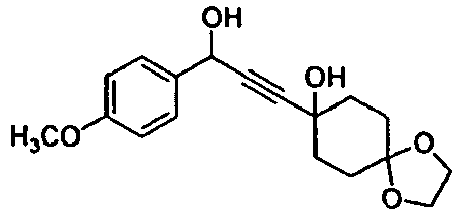
- To a solution of 8-ethinyl-1,4-dioxaspiro[4.5]decan-8-ol (Intermediate 1) (5.02 g, 27.6 mmol) in tetrahydrofuran (100 mL), 2.63 M n-butyllithium (a solution in n-hexane, 22.0 mL, 57.9 mmol) was added dropwise at -72°C for 15 minutes, and the resulting mixture was stirred at the same temperature for 60 minutes. Then, 4-methoxyaldehyde (3.52 mL, 28.9 mmol) was added dropwise thereto at -72°C for 10 minutes, and the resulting mixture was stirred at the same temperature for 60 minutes. The reaction solution was allowed to warm to room temperature, and thereafter poured into a saturated aqueous ammonium chloride solution. The reaction solution was extracted with ethyl acetate. The organic layer was washed with brine, dried over anhydrous sodium sulfate, and concentrated under reduced pressure. The residue was purified by flash chromatography (silica gel, n-hexane/ethyl acetate) to obtain Intermediate 4 (7.46 g, 23.4 mmol, 85%) as an amorphous product.
1H-NMR (400 MHz, CDCl3) δ: 1.73-1.85 (4H, m), 1.91-2.04 (4H, m), 2.32 (1H, s), 2.52 (1H, d, J = 6.1 Hz), 3.81 (3H, s), 3.94 (4H, s), 5.44 (1H, d, J = 6.1 Hz), 6.89 (2H, d, J= 8.5 Hz), 7.44 (2H, d, J= 8.5 Hz). - As
Intermediate 5, 8-(3-(4-chlorophenyl)-3-hydroxypropyn-1-yl)-1,4-dioxaspiro[4.5]decan-8-ol:
- To a solution of 8-ethinyl-1,4-dioxaspiro[4.5]decan-8-ol (Intermediate 1) (5.03 g, 27.6 mmol) in tetrahydrofuran (100 mL), 2.63 M n-butyllithium (a solution in n-hexane, 22.1 mL, 57.9 mmol) was added dropwise at -72°C for 15 minutes, and the resulting mixture was stirred at the same temperature for 60 minutes. Then, 4-chlorobenzaldehyde (4.06 g, 28.9 mmol) was added dropwise thereto at -72°C for 10 minutes, and the resulting mixture was stirred at the same temperature for 60 minutes. The reaction solution was allowed to warm to room temperature, and thereafter poured into a saturated aqueous ammonium chloride solution. The reaction solution was extracted with ethyl acetate. The organic layer was washed with brine, dried over anhydrous sodium sulfate, and concentrated under reduced pressure. The residue was purified by flash chromatography (silica gel, n-hexane/ethyl acetate) to obtain Intermediate 5 (8.13 g, 25.2 mmol, 91 %) as an amorphous product.
1H-NMR (400 MHz, CDCl3) δ: 1.68-1.81 (4H, m), 1.86-1.90 (4H, m), 3.55 (1H, s), 3.90 (4H, s), 4.03 (1H, d, J = 4.2 Hz), 5.41 (1H, d, J = 4.2 Hz), 7.28 (2H, d, J = 8.3 Hz), 7.41 (2H, d, J= 8.3 Hz). - The following compounds were synthesized in the same manner as in the synthesis of the above-described
Intermediates 1 to 5. -
[Table 10] Intermediate Structural Formula Compound Data 6 
1H-NMR (400 MHz, CDCl3) δ: 1.71-1.84 (4H, m), 1.88-2.03 (4H, m), 2.65-3.31 (2H, m), 3.91 (4H, s), 5.47 (1H, d, J = 5.2 Hz), 7.29-7.38 (3H, m), 7.51 (2H, d, J= 8.4 Hz). ESI-MS: m/z = 271 (M-OH)+ 7 
1H-NMR (400 MHz, CDCl3) δ: 1.63 (1H, s), 1.75-1.83 (4H, m), 1.95-2.05 (4H, m), 2.62 (1H, s), 3.94 (4H, s), 5.56 (1H, s), 7.64 (4H, s). ESI-MS: m/z = 339 (M-OH)+ - As
Intermediate 8, 3-(1-hydroxycyclohexyl)-1-(p-tolyl)-2-propyn-1-one:
- Manganese dioxide (1.15 g, 13.2 mmol) was added to a solution of 1-(3-hydroxy-3-(p-tolyl)propyn-1-yl)cyclohexanol (Intermediate 2) (593 mg, 2.42 mmol) in dichloromethane (20 mL), and the resulting mixture was stirred at room temperature for 5 hours. The reaction solution was filtered through Celite, and the filtrate was concentrated under reduced pressure. The residue was purified by flash chromatography (silica gel, n-hexane/ethyl acetate) to obtain Intermediate 8 (534 mg, 2.20 mmol, 91%) as a pale yellow oily product.
1H-NMR (400 MHz, CDCl3) δ: 1.28-1.39 (1H, m), 1.55-1.84 (7H, m), 2.02-2.11 (2H, m), 2.23 (1H, brs), 2.43 (3H, s), 7.28 (2H, d, J= 8.0 Hz), 8.02 (2H, d, J= 8.0 Hz). - As Intermediate 9, 3-(8-hydroxy-1,4-dioxaspiro[4.5]decan-8-yl)-1-(p-tolyl)-2-propyn-1-one:

- Manganese dioxide (29.6 g, 289 mmol) was added to a solution of 8-(3-hydroxy-3-(p-tolyl)propyn-1-yl)-1,4-dioxaspiro[4.5]decan-8-ol (Intermediate 3) (17.5 g, 57.9 mmol) in dichloromethane (289 mL), and the resulting mixture was stirred at room temperature for 15 hours. The reaction solution was filtered through Celite, and the filtrate was concentrated under reduced pressure. The residue was purified by flash chromatography (silica gel, n-hexane/ethyl acetate) to obtain Intermediate 9 (14.3 g, 47.6 mmol, 82%) as an oily product.
1H-NMR (400 MHz, CDCl3) δ: 1.79-1.85 (2H, m), 1.87-1.93 (2H, m), 2.04-2.15 (4H, m), 2.20 (1H, s), 2.43 (3H, s), 3.97 (4H, s), 7.28 (2H, d, J = 8.0 Hz), 8.00 (2H, d, J = 8.0 Hz).
ESI-MS: m/z = 284 (M-OH)+ - As
Intermediate 10, 3-(8-hydroxy-1,4-dioxaspiro[4.5]decan-8-yl)-1-(6-methylpyridin-3-yl)-2-propyn-1-one:
- To a solution of 8-ethinyl-1,4-dioxaspiro[4.5]decan-8-ol (Intermediate 1) (592 mg, 3.25 mmol) in tetrahydrofuran (6 mL), 2.63 M n-butyllithium (a solution in n-hexane, 2.6 mL, 6.82 mmol) was added dropwise at -78°C for 5 minutes, and the resulting mixture was stirred at the same temperature for 30 minutes. Then, a solution of N-methoxy-N-methyl-6-methylnicotinamide (614.5 mg, 3.41 mmol) in tetrahydrofuran (5 ml) was added dropwise thereto at -78°C for 20 minutes, and the resulting mixture was stirred at the same temperature for 30 minutes. The reaction solution was allowed to warm to room temperature, and thereafter poured into a saturated aqueous ammonium chloride solution. The reaction solution was extracted with ethyl acetate. The organic layer was washed with brine, dried over anhydrous sodium sulfate, and concentrated under reduced pressure. The residue was purified by flash chromatography (silica gel, n-hexane/ethyl acetate) to obtain Intermediate 10 (626.3 mg, 2.08 mmol, 65%) as a pale yellow solid.
1H-NMR (400 MHz, CDCl3) δ: 1.76-1.83 (2H, m), 1.87-1.94 (2H, m), 2.04-2.10 (2H, m), 2.12-2.19 (2H, m), 2.30 (1H, s), 2.66 (3H, s), 3.97 (4H, s), 7.29 (1H, d, J = 8.0 Hz), 8.22 (1H, dd, J= 2.4, 8.0 Hz), 9.21 (1H, d, J= 2.4 Hz).
ESI-MS: m/z = 284 (M-OH)+ - As Intermediate 11, 3-(8-hydroxy-1,4-dioxaspiro[4.5]decan-8-yl)-1-(4-methoxyphenyl)-2-propyn-1-one:

- Manganese dioxide (9.69 g, 112 mmol) was added to a solution of 8-(3-hydroxy-3-(4-methoxyphenyl)propyn-1-yl)-1,4-dioxaspiro[4.5]decan-8-ol (Intermediate 4) (7.10 g, 22.3 mmol) in dichloromethane (100 mL), and the resulting mixture was stirred at room temperature for 18 hours. The reaction solution was filtered through Celite, and the filtrate was concentrated under reduced pressure. The residue was purified by flash chromatography (silica gel, n-hexane/ethyl acetate) to obtain Intermediate 11 (5.45 g, 17.2 mmol, 77%) as an oily product. 1H-NMR (400 MHz, CDCl3) δ: 1.78-1.93 (4H, m), 2.03-2.17 (4H, m), 2.27 (1H, s), 3.89 (3H, s), 3.97 (4H, s), 6.95 (2H, d, J= 9.0 Hz), 8.08 (2H, d, J= 9.0 Hz). ESI-MS: m/z = 299 (M-OH)+
- As
Intermediate 12, 1-(4-chlorophenyl)-3-(8-hydroxy-1,4-dioxaspiro[4.5]decan-8-yl)-2-propyn-1-one:
- Manganese dioxide (10.4 g, 119 mmol) was added to a solution of 8-(3-(4-chlorophenyl)-3-hydroxypropyn-1-yl)-1,4-dioxaspiro[4.5]decan-8-ol (Intermediate 5) (7.70 g, 23.9 mmol) in dichloromethane (120 mL), and the resulting mixture was stirred at room temperature for 18 hours. The reaction solution was filtered through Celite, and the filtrate was concentrated under reduced pressure. The residue was purified by flash chromatography (silica gel, n-hexane/ethyl acetate) to obtain Intermediate 12 (5.45 g, 17.0 mmol, 71 %) as an oily product.
1H-NMR (400 MHz, CDCl3) δ: 1.77-1.94 (4H, m), 2.04-2.19 (4H, m), 2.15 (1H, s), 3.98 (4H, s), 7.47 (2H, d, J= 8.5 Hz), 8.04 (2H, d, J= 8.5 Hz).
ESI-MS: m/z = 303 (M-OH)+ - The following compounds were synthesized in the same manner as in the synthesis of the above-described
Intermediates 8 to 12. -
[Table 11] Intermediate Structural Formula Compound Data 13 
1H-NMR (400 MHz, CDCl3) δ: 1.78-1.94 (4H, m), 2.04-2.20 (4H, m), 2.33 (1H, s), 3.97 (4H, s), 7.49 (2H, t, J = 7.2 Hz), 7.62 (1H, t, J = 7.2 Hz), 7.69 (2H, d, J= 7.2 Hz). ESI-MS: m/z = 269 (M-OH)+ 14 
1H-NMR (400 MHz, CDCl3) δ: 1.81-1.84 (2H, m), 1.89-1.94 (2H, m), 2.09-2.17 (4H, m), 2.38 (1H, s), 3.98 (4H, s), 7.76 (2H, d, J= 8.0 Hz), 8.21 (2H, d, J= 8.0 Hz). 15 
1H-NMR (400 MHz, CDCl3) δ: 1.76-1.95 (4H, m), 2.04-2.20 (5H, m), 2.36 (3H, d, J= 2.0 Hz), 3.97 (4H, s), 7.31 (1H, t, J = 8.0 Hz), 7.71 (1H, d, J = 10.0 Hz), 7.81 (1H, d, J= 8.0 Hz). ESI-MS: m/z = 319 (M+H)+ 16 
1H-NMR (400 MHz, CDCl3) δ: 1.75-1.96 (4H, m), 2.03-2.25 (4H, m), 2.47-2.60 (1H, m), 3.98 (4H, s), 7.77-7.82 (2H, m), 8.16-8.23 (2H, m). ESI-MS: m/z = 312 (M+H)+ 17 
1H-NMR (400 MHz, CDCl3) δ: 1.26 (3H, t, J = 7.6 Hz), 1.78-1.94 (4H, m), 2.03-2.19 (4H, m), 2.27 (1H, br), 2.72 (2H, q, J= 7.6 Hz), 3.98 (4H, s), 7.30 (2H, d, J = 8.4 Hz), 8.03 (2H, d, J = 8.4 Hz). ESI-MS: m/z = 315 (M+H)+ - As Intermediate 18, 8-(1-(4-methoxyphenyl)-5-(p-tolyl)-1H-pyrazol-3-yl)-1,4-dioxaspiro[4.5]decan-8-ol:

- Triethylamine (5.87 mL, 42.1 mmol) was added dropwise to a solution of 4-methoxyphenylhydrazine hydrochloride (7.35 g, 42.1 mmol) in ethanol (76.6 mL), and the resulting mixture was stirred at room temperature for 30 minutes. To the reaction solution, a solution of 3-(8-hydroxy-1,4-dioxaspiro[4.5]decan-8-yl)-1-(p-tolyl)-2-propyn-1-one (Intermediate 9) (11.5 g, 38.3 mmol) in ethanol (76.6 mL) was added dropwise, and the resulting mixture was stirred at room temperature for 15 hours. Thereafter, the reaction solution was concentrated under reduced pressure. Water was added to the residue, and the resulting solution was extracted with ethyl acetate. The organic layer was washed with 1 M hydrochloric acid, distilled water and brine, and then dried over anhydrous magnesium sulfate, and concentrated under reduced pressure. The residue was purified by flash chromatography (silica gel, n-hexane/ethyl acetate) to obtain Intermediate 18 (14.7 g, 35.0 mmol, 91%) as an amorphous product.
1H-NMR (400 MHz, CDCl3) δ: 1.71-1.74 (2H, m), 1.99-2.25 (6H, m), 2.33 (3H, s), 2.71 (1H, s), 3.81 (3H, s), 3.96-4.01 (4H, m), 6.39 (1H, s), 6.84 (2H, d, J= 8.0 Hz), 7.09 (4H, s), 7.21 (2H, d, J= 8.0 Hz).
ESI-MS: m/z = 421 (M+H)+ - As Intermediate 19, 8-(1-(4-methoxyphenyl)-5-(6-methylpyridin-3-yl)-1H-pyrazol-3-yl)-1,4-dioxaspiro[4.5]decan-8-ol:

- Triethylamine (286 µL, 2.06 mmol) was added dropwise to a solution of 4-methoxyphenylhydrazine hydrochloride (359 mg, 2.06 mmol) in ethanol (4 mL), and the resulting mixture was stirred at room temperature for 30 minutes. To the reaction solution, a solution of 3-(8-hydroxy-1,4-dioxaspiro[4.5]decan-8-yl)-1-(6-methylpyridin-3-yl)-2-propyn-1-one (Intermediate 10) (563.7 mg, 1.87 mmol) in ethanol (5.4 mL) was added dropwise, and the resulting mixture was stirred at room temperature for 22 hours. Thereafter, the reaction solution was concentrated under reduced pressure. Water was added to the residue, and the resulting solution was extracted with ethyl acetate. The organic layer was washed with distilled water and brine, and then dried over anhydrous magnesium sulfate, and concentrated under reduced pressure. The residue was purified by flash chromatography (silica gel, n-hexane/ethyl acetate) to obtain Intermediate 19 (177 mg, 0.42 mmol, 22%) as an amorphous product.
1H-NMR (400 MHz, CDCl3) δ: 1.72-1.75 (2H, m), 2.00-2.03 (2H, m), 2.07-2.14 (2H, m), 2.19-2.26 (2H, m), 2.55 (3H, s), 2.65 (1H, s), 3.81 (3H, s), 3.96-4.03 (4H, m), 6.47 (1H, s), 6.86 (2H, d, J= 8.8 Hz), 7.06 (1H, d, J= 8.0 Hz), 7.20 (2H, d, J= 8.8 Hz), 7.33 (1H, dd, J = 2.2, 8.0 Hz), 8.40 (1H, d, J= 2.2 Hz).
ESI-MS: m/z = 422 (M+H)+ - As Intermediate 20, 8-(1,5-bis(4-methoxyphenyl)-1H-pyrazol-3-yl)-1,4-dioxaspiro[4.5]decan-8-ol:

- A solution of 4-methoxyphenylhydrazine hydrochloride (470 mg, 2.69 mmol) and triethylamine (0.74 mL, 5.41 mmol) in ethanol (4.5 mL) was added to a solution of 3-(8-hydroxy-1,4-dioxaspiro[4.5]decan-8-yl)-1-(4-methoxyphenyl)-2-propyn-1-one (Intermediate 11) (700 mg, 2.24 mmol) in ethanol (4.5 mL), and the resulting mixture was stirred at room temperature for 20 hours. The reaction solution was concentrated under reduced pressure, and distilled water was added to the residue, followed by extraction of the resulting mixture with ethyl acetate. The organic layer was dried over anhydrous magnesium sulfate, and concentrated under reduced pressure. The residue was purified by flash chromatography (silica gel, n-hexane/ethyl acetate) to obtain Intermediate 20 (864 mg, 1.98 mmol, 88%) as a white amorphous product.
1H-NMR (400 MHz, CDCl3) δ: 1.68-1.77 (2H, m), 1.96-2.26 (6H, m), 2.70 (1H, brs), 3.80 (3H, s), 3.81 (3H, s), 3.94-4.04 (4H, m), 6.37 (1H, s), 6.81 (2H, d, J= 8.8 Hz), 6.85 (2H, d, J = 8.8 Hz), 7.13 (2H, d, J = 8.8 Hz), 7.21 (2H, d, J= 8.8 Hz).
ESI-MS: m/z = 437 (M+H)+ - As Intermediate 21, 8-(5-(4-chlorophenyl)-1-(4-methoxyphenyl)-1H-pyrazol-3-yl)-1,4-dioxaspiro[4.5]decan-8-ol:

- Triethylamine (0.730 mL, 5.24 mmol) was added dropwise to a solution of 4-methoxyphenylhydrazine hydrochloride (457 mg, 2.62 mmol) in ethanol (4.4 mL), and the resulting mixture was stirred at room temperature for 30 minutes. To the reaction solution, a solution of 1-(4-chlorophenyl)-3-(8-hydroxy-1,4-dioxaspiro[4.5]decan-8-yl)-2-propyn-1-one (Intermediate 12) (700 mg, 2.18 mmol) in ethanol (4.4 mL) was added dropwise, and the resulting mixture was stirred at room temperature for 14 hours. Thereafter, the reaction solution was concentrated under reduced pressure. Water was added to the residue, and the resulting solution was extracted with ethyl acetate. The organic layer was washed with 1 M hydrochloric acid, distilled water and brine, and then dried over anhydrous magnesium sulfate, and concentrated under reduced pressure. The residue was purified by flash chromatography (silica gel, n-hexane/ethyl acetate) to obtain Intermediate 21 (756 mg, 1.71 mmol, 79%) as an amorphous product.
1H-NMR (400 MHz, CDCl3) δ: 1.69-1.76 (2H, m), 1.97-2.25 (6H, m), 2.66 (1H, brs), 3.82 (3H, s), 3.94-4.03 (4H, m), 6.43 (1H, s), 6.85-6.87 (2H, m), 7.13 (2H, d, J= 8.4 Hz), 7.19 (2H, d, J= 8.4 Hz), 7.25-7.27 (2H, m).
ESI-MS: m/z = 441 (M+H)+ - As Intermediate 22, 8-(1-(4-chlorophenyl)-5-(p-tolyl)-1H-pyrazol-3-yl)-1,4-dioxaspiro[4.5]decan-8-ol:

- Triethylamine (5.87 mL, 42.1 mmol) was added dropwise to a solution of 4-chlorophenylhydrazine hydrochloride (418 mg, 2.33 mmol) in ethanol (4.8 mL), and the resulting mixture was stirred at room temperature for 30 minutes. To the reaction solution, a solution of 3-(8-hydroxy-1,4-dioxaspiro[4.5]decan-8-yl)-1-(p-tolyl)-2-propyn-1-one (Intermediate 9) (698 mg, 2.32 mmol) in ethanol (4.7 mL) was added dropwise, and the resulting mixture was stirred at room temperature for 14 hours. Thereafter, the reaction solution was concentrated under reduced pressure. Water was added to the residue, and the resulting solution was extracted with ethyl acetate. The organic layer was washed with distilled water and brine, and then dried over anhydrous sodium sulfate, and concentrated under reduced pressure. The residue was purified by flash chromatography (silica gel, n-hexane/ethyl acetate) to obtain Intermediate 22 (948 mg, 2.23 mmol, yield: 96%) as an amorphous product.
1H-NMR (400 MHz, CDCl3) δ: 1.71-1.75 (2H, m), 1.98-2.14 (4H, m), 2.17-2.25 (2H,m), 2.36 (3H, s), 2.62 (1H, s), 3.96-4.03 (4H, m), 6.41 (1H, s), 7.09 (2H, d, J = 8.0 Hz), 7.13 (2H, d, J= 8.0 Hz), 7.22-7.30 (4H, m).
ESI-MS: m/z = 407 (M-OH)+ - The following compounds were synthesized in the same manner as in the synthesis of the above-described Intermediates 18 to 22.
-
[Table 12-1] Intermediate Structural Formula Compound Data 23 
1H-NMR (400 MHz, CDCl3) δ: 1.69-1.76 (2H, m), 2.16-2.25 (2H, m), 1.96-2.23 (4H, m), 2.63 (1H, s), 3.94-4.03 (4H, m), 6.45 (1H, s), 7.14 (2H, d, J= 8.4 Hz), 7.21 (2H, d, J= 8.4 Hz), 7.29-7.32 (4H, m). ESI-MS: m/z = 445 (M+H)+ 24 
1H-NMR (400 MHz, CDCl3) δ: 1.70-1.76 (2H, m), 1.98-2.14 (4H, m), 2.18-2.25 (2H, m), 2.68 (1H, s), 3.95-4.02 (4H, m), 6.45 (1H, s), 7.13-7.15 (2H, m), 7.25-7.37 (7H, m). ESI-MS: m/z = 411 (M+H)+ 25 
1H-NMR (400 MHz, CDCl3) δ: 1.70-1.76 (2H, m), 1.98-2.04 (2H, m), 2.07-2.14 (2H,m), 2.18-2.25 (2H, m), 2.34 (3H, s), 2,35 (3H, s), 2.70 (1H, s), 3.95-4.02 (4H, m), 6.40 (1H, s), 7.08-7.11 (4H, m), 7.12 (2H, d, J= 8.4 Hz), 7.17 (2H, d, J= 8.4 Hz). ESI-MS: m/z = 387 (M-OH)+ 26 
1H-NMR (400 MHz, CDCl3) δ: 1.71-1.77 (2H, m), 1.98-2.05 (2H, m), 2.07-2.14 (2H,m), 2.18-2.26 (2H, m), 2.34 (3H, s), 2.69 (1H, s), 3.96-4.03 (4H, m), 6.42 (1H, s), 7.09-7.11 (4H, m), 7.26-7.35 (5H, m). ESI-MS: m/z = 373 (M-OH)+ -
[Table 12-2] Intermediate Structural Formula Compound Data 27 
1H-NMR (400 MHz, CDCl3) δ: 1.60 (2H, m), 1.73 (2H, d, J = 12.4 Hz), 2.10 (2H, td, J = 3.4, 12.8 Hz), 2.22 (2H, td, J = 3.9, 12.4 Hz), 3.80 (3H, s), 3,96-4.03 (4H, m), 6.44 (1H, s), 6.83-6.85 (2H, m), 7.18-7.22 (4H, m), 7.26-7.30 (3H, m). 28 
1H-NMR (400 MHz, CDCl3) δ: 1.73 (2H, d, J = 12.0 Hz), 2.01 (2H, d, J = 12.4 Hz), 2.10 (2H, td, J = 3.2 Hz), 2.22 (2H, td, J = 3.2, J = 12.4 Hz), 2.24 (3H, s), 3.96-4.03 (4H, m), 6.44 (1H, s), 7.12 (2H, d, J = 8.4 Hz), 7.16 (2H, d, J= 8.8 Hz), 7.21-7.23 (2H, m), 7.27-7.30 (3H, m). ESI-MS: m/z = 391 (M+H)+ 29 
1H-NMR (400 MHz, CDCl3) δ: 1.73 (2H, d, J = 12.4 Hz), 1.99 (2H, d, J = 12.4 Hz), 2.10 (2H, td, J = 3.2, 12.4 Hz), 2.21 (2H, td, J= 3.6, 12.4 Hz), 2.25 (3H, s), 2.73 (1H, s), 3.80 (3H, s), 3,96-4.03 (4H, m), 6.37 (1H, s), 6.82 (2H, m), 7.09-7.18 (6H, m). ESI-MS: m/z = 421 (M+H)+ -
[Table 12-3] Intermediate Structural Formula Compound Data 30 
1H-NMR (400 MHz, CDCl3) δ: 1.73 (2H, d, J = 12.4 Hz), 2.01 (2H, d, J = 12.4 Hz), 2.10 (2H, td, J = 3.2, 12.8 Hz), 2.21 (2H, td, J = 3.2, 12.4 Hz), 2.64 (1H, s), 3.82 (3H, s), 3,95-4.03 (4H, m), 6.40 (1H, s), 6.84 (2H, d, J= 8.4 Hz), 7.12 (2H, d, J= 8.8 Hz), 7.23 (2H, d, J = 8.8 Hz), 7.28 (2H, d, J= 8.8 Hz). ESI-MS: m/z = 441 (M+H)+ 31 
1H-NMR (400 MHz, CDCl3) δ: 1.70 (2H, d, J = 12.0 Hz), 2.01 (2H, d, J = 8.8 Hz), 2.10 (2H, td, J = 4.0, 12.8 Hz), 2.21 (2H, td, J = 3.6, 12.4 Hz), 2.71 (1H, s), 3.80 (3H, s), 3,92-4.03 (4H, m), 6.39 (1H, s), 6.81 (2H, d, J= 12.0 Hz), 7.13 (2H, d, J= 12.0 Hz), 7.22-7.35 (5H, m). 32 
1H-NMR (400 MHz, CDCl3) δ: 1.71-1.74 (4H, m), 1.96-2.16 (4H, m), 2.87 (1H, s), 3.81 (3H, s), 3.94-4.01 (4H, m), 6.52 (1H, s), 6.86 (2H, d, J = 8.0 Hz), 7.19 (2H, d, J= 8.0 Hz), 7.32 (2H, d, J= 8.0 Hz), 7.54 (2H, d, J= 8.0 Hz). 33 
1H-NMR (400 MHz, CDCl3) δ: 1.23 (3H, t, J = 7.6 Hz), 1.69-1.76 (2H, m), 1.98-2.26 (6H, m), 2.63 (2H, q, J = 7.6 Hz), 2.69 (1H, br), 3.81 (3H, s), 3.95-4.03 (4H, m), 6.40 (1H, s), 6.82-6.87 (2H, m), 7.12 (4H, s), 7.19-7.24 (2H, m). ESI-MS: m/z = 425 (M+H)+ -
[Table 12-4] Intermediate Structural Formula Compound Data 34 
1H-NMR (400 MHz, CDCl3) δ: 1.68-1.77 (2H, m), 1.97-2.25 (6H, m), 2.35 (3H, s), 2.64 (1H, s), 3.89 (3H, s), 3.94-4.03 (4H, m), 6.40 (1H, s), 6.87 (1H, t, J = 8.8 Hz), 6.94-7.01 (1H, m), 7.07-7.13 (5H, m). ESI-MS: m/z = 425 (M+H)+ 35 
1H-NMR (400 MHz, CDCl3) δ: 1.69-1.77 (2H, m), 1.97-2.28 (9H, m), 2.64 (1H, s), 3.82 (3H, s), 3.95-4.03 (4H, m), 6.41 (1H, s), 6.83-6.89 (4H, m), 7.08 (1H, t, J = 8.0 Hz), 7.18-7.27 (2H, m). ESI-MS: m/z = 439 (M+H)+ 36 
1H-NMR (400 MHz, CDCl3) δ: 1.70-1.78 (2H, m), 1.97-2.27 (6H, m), 2.38 (3H, s), 2.54 (1H, s), 3.94-4.03 (4H, m), 6.45 (1H, s), 7.09-7.20 (4H, m), 7.40-7.44 (2H, m), 7.57-7.62 (2H, m). ESI-MS: m/z = 416 (M+H)+ 37 
1H-NMR (400 MHz, CDCl3) δ: 1.69-1.76 (2H, m), 1.97-2.26 (6H, m), 2.56 (1H, br), 3.83 (3H, s), 3.94-4.03 (4H, m), 6.52 (1H, s), 6.84-6.90 (2H, m), 7.14-7.20 (2H, m), 7.29-7.33 (2H, m), 7.55-7.59 (2H, m). ESI-MS: mlz = 432 (M+H)+ - As Intermediate 38, 1-(1-(4-methoxyphenyl)-5-(p-tolyl)-1H-pyrazol-3-yl)-cyclohexan-cis-1,4-diyl diacetate:

- Acetic anhydride (0.187 mL, 1.98 mmol), pyridine (0.192 mL, 2.38 mmol), and 4-dimethylaminopyridine (48.4 mg, 0.396 mmol) were added to a suspension of 1-(1-(4-methoxyphenyl)-5-(p-tolyl)-1H-pyrazol-3-yl)cyclohexan-cis-1,4-diol (Compound 3) (300 mg, 0.793 mmol) in dichloromethane (2.6 mL), and the resulting mixture was stirred at room temperature for 60 hours. Again, 4-dimethylaminopyridine (48.4 mg, 0.396 mmol) was added thereto, and the resulting mixture was stirred at room temperature for an additional 6 hours. Water was added to the reaction solution to stop the reaction, and the resulting solution was extracted with ethyl acetate. The organic layer was washed with brine, dried over anhydrous sodium sulfate, and concentrated under reduced pressure. The residue was purified by flash chromatography (silica gel, n-hexane/ethyl acetate) to obtain Intermediate 38 (297 mg, 0.642 mmol, 81%) as a white solid.
1H-NMR (400 MHz, CDCl3) δ: 1.74-1.82 (2H, m), 1.92-1.98 (2H, m), 2.01-2.08 (5H, m), 2.10 (3H, s), 2.32 (3H, s), 2.70-2.77 (2H, m), 3.80 (3H, s), 4.80-4.89 (1H, m), 6.38 (1H, s), 6.83 (2H, d, J= 8.8 Hz), 7.08 (4H, s), 7.20 (2H, d, J= 8.8 Hz).
ESI-MS: m/z = 463 (M+H)+ - As Intermediate 39, c-4-methoxy-1-(1-(4-methoxyphenyl)-5-(p-tolyl)-1H-pyrazol-3-yl)-cyclohexan-r-1-yl acetate:

- To a solution of c-4-hydroxy-1-(1-(4-methoxyphenyl)-5-(p-tolyl)-1H-pyrazol-3-yl)-cyclohexan-r-1-yl acetate (Intermediate 84) (0.150 g, 0.357 mmol) in N,N-dimethylformamide (1.8 mL), 55% sodium hydride (23.4 mg, 0.535 mmol) and methyl iodide (29.0 µL, 0.464 mmol) were added with stirring under ice-cooling, and the resulting mixture was stirred at room temperature for 9 hours. Water was added to the reaction solution with stirring under ice-cooling to stop the reaction, and the resulting solution was extracted with ethyl acetate. The organic layer was washed with brine, dried over anhydrous sodium sulfate, and concentrated under reduced pressure. The residue was purified by flash chromatography (silica gel, n-hexane/ethyl acetate) to obtain Intermediate 39 (124 mg, 0.284 mmol, 80%) as a white solid.
1H-NMR (400 MHz, CDCl3) δ: 1.60-1.68 (2H, m), 1.94-2.03 (4H, m), 2.08 (3H, s), 2.32 (3H, s), 2.69-2.76 (2H, m), 3.24-3.33 (1H, m), 3.39 (3H, s), 3.80 (3H, s), 6.37 (1H, s), 6.83 (2H, d, J= 8.8 Hz), 7.08 (4H, s), 7.20 (2H, d, J= 8.8 Hz).
ESI-MS: m/z = 435 (M+H)+ - As Intermediate 40, 4-(4-fluoro-1-(4-methoxyphenyl)-5-(p-tolyl)-1H-pyrazol-3-yl)-c-4-hydroxy-cyclohexan-r-1-yl acetate:

- Selectfluor™ (120 mg, 0.340 mmol) was added to a solution of c-4-hydroxy-4-(1-(4-methoxyphenyl)-5-(p-tolyl)-1H-pyrazol-3-yl)-cyclohexan-r-1-yl acetate (Compound 12) (130 mg, 0.309 mmol) in acetonitrile (3.09 mL), and the resulting mixture was stirred at room temperature for 3 hours. A saturated aqueous sodium thiosulfate solution was added to the reaction solution, and the resulting solution was extracted with ethyl acetate. The organic layer was washed with brine, and then dried over anhydrous magnesium sulfate, and concentrated under reduced pressure. The residue was purified by flash chromatography (silica gel, n-hexane/ethyl acetate) to obtain Intermediate 40 (61 mg, 0.140 mmol, 45%) as a pale yellow amorphous product.
1H-NMR (400 MHz, CDCl3) δ: 1.89-2.15 (11H, m), 2.35 (3H, m), 2.73 (1H, s), 3.81 (3H, s), 4.82-4.89 (1H, m), 6.84-6.86 (2H, m), 7.10-7.18 (6H, m).
ESI-MS: m/z = 439 (M+H)+ - As Intermediate 41, 1-(1-(4-methoxyphenyl)-5-(p-tolyl)-1H-pyrazol-3-yl)-4-oxo-cyclohexan-1-yl acetate:

- Dess-Martin reagent (172 mg, 0.405 mmol) was added to a solution of c-4-hydroxy-1-(1-(4-methoxyphenyl)-5-(p-tolyl)-1H-pyrazol-3-yl)-cyclohexan-r-1-yl acetate (Intermediate 84) (142 mg, 0.338 mmol) in dichloromethane (3.38 mL), and the resulting mixture was stirred at 0°C for 2 hours. The reaction solution was filtered through Celite, and the residue was purified by flash chromatography (silica gel, n-hexane/ethyl acetate) to obtain Intermediate 41 (120 mg, 0.287 mmol, 85%) as a white amorphous product.
1H-NMR (400 MHz, CDCl3) δ: 2.13 (3H, s), 2.33 (3H, s), 2.44-2.52 (4H, m), 2.59-2.65 (2H, m), 2.93-2.96 (2H, m), 3.81 (3H, s), 6.45 (1H, s), 6.84 (2H, d, J= 8.8 Hz), 7.08 (4H, s), 7.20 (2H, d, J= 8.8 Hz).
ESI-MS: m/z = 419 (M+H)+ - As Intermediate 42, c-4-hydroxy-4-(1-(4-methoxyphenyl)-5-(p-tolyl)-1H-pyrazol-3-yl)-cis-cyclohexan-r-1-carbaldehyde:

- To a solution of (methoxymethyl)triphenylphosphonium chloride (546.3 mg, 1.59 mmol) in tetrahydrofuran (1.3 mL), potassium tert-butoxide (178.7 mg, 1.59 mmol) was added at -40°C, and the resulting mixture was stirred at the same temperature for 60 minutes. A solution of 4-hydroxy-4-(1-(4-methoxyphenyl)-5-(p-tolyl)-1H-pyrazol-3-yl)cyclohexan-1-one (Compound 4) (200 mg, 0.53 mmol) in tetrahydrofuran (1.35 mL) was added dropwise to the reaction solution at -40°C, and thereafter the resulting mixture was stirred at room temperature for 1.5 hours. To the reaction solution, a 6 M aqueous hydrochloric acid solution was added at 0°C, and the resulting mixture was stirred for 12 hours. Distilled water was added to the reaction solution, and the resulting solution was extracted with ethyl acetate. The organic layer was washed with a saturated aqueous sodium hydrogen carbonate solution and brine, dried over anhydrous sodium sulfate, and concentrated under reduced pressure. The residue was purified by flash chromatography (silica gel, n-hexane/ethyl acetate) to obtain Intermediate 42 (87.5 mg, 0.23 mmol, 42%) as a colorless oily product.
1H-NMR (400 MHz, CDCl3) δ:1.88-1.96 (6H, m), 2.09-2.11 (2H, m), 2.25-2.36 (5H, m), 3.80 (3H, s), 6.39 (1H, s), 6.84 (2H, d, J= 8.8 Hz), 7.09-7.14 (4H, m), 7.20 (2H, d, J = 8.8 Hz), 9.66 (1H, d, J = 2.0 Hz).
ESI-MS: m/z = 391 (M+H)+ - As Intermediate 43,
ethyl 1,4-dioxaspiro[4.5]decan-8-carboxylate:
- Ethylene glycol (3.6 mL, 64.6 mmol) and p-toluenesulfonic acid monohydrate (1.12 g, 5.88 mmol) were added to a solution of ethyl 4-oxocyclohexanecarboxylate (10.0 g, 58.8 mmol) in toluene (196 mL), and the obtained solution was heated to reflux at 150°C. The resulting solution was stirred for 18 hours. To the reaction solution, a saturated sodium bicarbonate solution was added to stop the reaction, and the resulting solution was extracted with ethyl acetate. The organic layer was washed with brine, dried over anhydrous sodium sulfate, and concentrated under reduced pressure. The residue was purified by flash chromatography (silica gel, n-hexane/ethyl acetate) to obtain Intermediate 43 (12.3 g, 57.4 mmol, 98%) as a colorless oily compound.
1H-NMR (400 MHz, CDCl3) δ: 1.25 (3H, t, J = 7.2 Hz), 1.51-1.61 (2H, m), 1.75-1.86 (4H, m), 1.90-1.98 (2H, m), 2.29-2.38 (1H, s), 3.95 (4H, s), 4.13 (2H, q, J= 7.2 Hz).
ESI-MS: m/z = 215 (M+H)+ - As Intermediate 44, ethyl 8-(benzyloxymethyl)-1,4-dioxaspiro[4.5]decan-8-carboxylate:

- To a solution of
ethyl 1,4-dioxaspiro[4.5]decan-8-carboxylate (Intermediate 43) (500 mg, 2.33 mmol) in tetrahydrofuran (7.8 mL), 0.5 M potassium bis(trimethylsilyl)amide (a solution in toluene, 4.67 mL, 2.33 mmol) was added at - 78°C, and the resulting mixture was stirred for 20 minutes. Thereafter, benzylchloromethyl ether (0.379 mL, 2.45 mmol) was added thereto, and the resulting mixture was stirred at -78°C for 30 minutes and at room temperature for 1.5 hours. A saturated aqueous ammonium chloride solution was added to the reaction solution, and the resulting solution was extracted with ethyl acetate. The organic layer was dried over anhydrous sodium sulfate, and concentrated under reduced pressure. To the residue, a 3 M aqueous sodium hydroxide solution (1.0 mL) was added, and the resulting mixture was stirred for 4 hours. The reaction solution was extracted with ether, and the organic layer was washed with brine, dried over anhydrous sodium sulfate, and concentrated under reduced pressure. The residue was purified by flash chromatography (silica gel, n-hexane/ethyl acetate) to obtain Intermediate 44 (279 mg, 0.834 mmol, 36%) as a colorless oily compound.
1H-NMR (400 MHz, CDCl3) δ: 1.24 (3H, t, J= 7.2 Hz), 1.52-1.68 (6H, m), 2.16-2.23 (2H, m), 3.46 (2H, s), 3.88-3.96 (4H, m), 4.17 (2H, q, J= 7.2 Hz), 4.49 (2H, s), 7.25-7.39 (5H, m).
ESI-MS: m/z = 335 (M+H)+ - As Intermediate 45, (8-(benzyloxymethyl)-1,4-dioxaspiro[4.5]decan-8-yl)methanol:

- To a solution of ethyl 8-(benzyloxymethyl)-1,4-dioxaspiro[4.5]decan-8-carboxylate (Intermediate 44) (279 mg, 0.834 mmol) in tetrahydrofuran (4.2 mL), lithium borohydride (91.0 mg, 4.17 mmol) was added with stirring under ice-cooling, and the resulting mixture was stirred at 70°C for 4 hours. A saturated aqueous ammonium chloride solution was added to the reaction solution to stop the reaction, and the resulting solution was extracted with ethyl acetate. The organic layer was washed with brine, dried over anhydrous sodium sulfate, and concentrated under reduced pressure. The residue was purified by flash chromatography (silica gel, n-hexane/ethyl acetate) to obtain Intermediate 45 (183 mg, 0.625 mmol, 75%) as a colorless oily compound.
1H-NMR (400 MHz, CDCl3) δ: 1.48-1.66 (8H, m), 2.76 (1H, t, J= 6.0 Hz), 3.43 (2H, s), 3.60 (2H, d, J= 6.0 Hz), 3.91-3.95 (4H, m), 4.52 (2H, s), 7.27-7.38 (5H, m).
ESI-MS: m/z = 293 (M+H)+ - As Intermediate 46, 8-(benzyloxymethyl)-1,4-dioxaspiro[4.5]decan-8-carboaldehyde:

- To a solution of (8-(benzyloxymethyl)-1,4-dioxaspiro[4.5]decan-8-yl)methanol (Intermediate 45) (183 mg, 0.625 mmol) in DMSO (2.1 mL), 50% sulfur trioxide-pyridine complex (596 mg, 1.87 mmol) and triethylamine (0.522 mL, 3.75 mmol) were added, and the resulting mixture was stirred at room temperature for 20 minutes. Water was added to the reaction solution to stop the reaction, and the resulting solution was extracted with ethyl acetate. The organic layer was washed sequentially with a 20% aqueous citric acid solution, a saturated sodium bicarbonate solution and brine, dried over anhydrous sodium sulfate, and concentrated under reduced pressure. The residue was purified by flash chromatography (silica gel, n-hexane/ethyl acetate) to obtain Intermediate 46 (172 mg, 0.592 mmol, 95%) as a colorless oily compound.
1H-NMR (400 MHz, CDCl3) δ: 1.55-1.67 (6H, m), 2.03-2.11 (2H, m), 3.45 (2H, s), 3.90-3.95 (4H, m), 4.47 (2H, s), 7.25-7.36 (5H, m), 9.60 (1H, s).
ESI-MS: m/z = 291 (M+H)+ - As Intermediate 47, 8-(benzyloxymethyl)-8-ethinyl-1,4-dioxaspiro[4.5]decane:
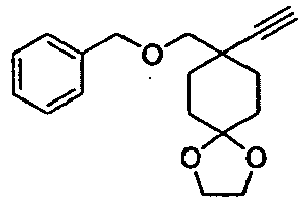
- To a solution of 8-(benzyloxymethyl)-1,4-dioxaspiro[4.5]decan-8-carboaldehyde (Intermediate 46) (100 mg, 0.344 mmol) in methanol (5.2 mL), potassium carbonate (143 mg, 1.03 mmol) and dimethyl-1-diazo-2-oxopropylphosphonate (165 mg, 0.861 mmol) were added with stirring under ice-cooling, and the resulting mixture was stirred at room temperature for 1 hour. Water was added to the reaction solution to stop the reaction, and the resulting solution was extracted with ethyl acetate. The organic layer was washed with brine, dried over anhydrous sodium sulfate, and concentrated under reduced pressure. The residue was purified by flash chromatography (silica gel, n-hexane/ethyl acetate) to obtain Intermediate 47 (88.9 mg, 0.310 mmol, 90%) as a colorless oily compound.
1H-NMR(400 MHz, CDCl3) δ: 1.52-1.71 (4H, m), 1.77-1.85 (2H, m), 1.94-2.04 (2H, m), 2.19 (1H, s), 3.38 (2H, s), 3.89-3.99 (4H, s), 4.61 (2H, s), 7.25-7.37 (5H, m).
ESI-MS: m/z = 287 (M+H)+ - As Intermediate 48, 3-(8-(benzyloxymethyl)-1,4-dioxaspiro[4.5]decan-8-yl)-1-(p-tolyl)propyn-1-ol:

- To a solution of 8-(benzyloxymethyl)-8-ethinyl-1,4-dioxaspiro[4.5]decane (Intermediate 47) (393 mg, 1.37 mmol) in tetrahydrofuran (4.6 mL), 2.6 M n-butyllithium (a solution in hexane, 0.555 mL, 1.44 mmol) was added at -78°C, and the resulting mixture was stirred for 10 minutes. Further, 4-methylbenzaldehyde (0.178 mL, 1.51 mmol) was added thereto, and thereafter the resulting mixture was allowed to warm gradually to room temperature and stirred for 1 hour. A saturated aqueous ammonium chloride solution was added to the reaction solution, and the resulting solution was extracted with ethyl acetate. The organic layer was washed with brine, dried over anhydrous sodium sulfate, and concentrated under reduced pressure. The residue was purified by flash chromatography (silica gel, n-hexane/ethyl acetate) to obtain Intermediate 48 (459 mg, 1.13 mmol, 82%) as a colorless oily compound.
1H-NMR (400 MHz, CDCl3) δ: 1.62-1.71 (4H, m), 1.79-1.86 (2H, m), 1.92-2.02 (2H, m), 2.23 (1H, brs), 2.34 (3H, s), 3.41 (2H, s), 3.89-3.98 (4H, m), 4.59 (2H, m), 5.44 (1H, d, J = 5.2 Hz), 7.15 (2H, d, J= 8.0 Hz), 7.25-7.35 (5H, m), 7.43 (2H, d, J= 8.0 Hz).
ESI-MS: m/z = 407 (M+H)+ - As Intermediate 49, 3-(8-(benzyloxymethyl)-1,4-dioxaspiro[4.5]decan-8-yl)-1-(p-tolyl)propyn-1-one:
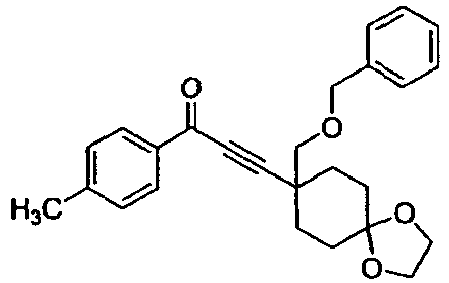
- Manganese dioxide (625 mg, 7.19 mmol) was added to a solution of 3-(8-(benzyloxymethyl)-1,4-dioxaspiro[4.5]decan-8-yl)-1-(p-tolyl)propyn-1-ol (Intermediate 48) (585 mg, 1.44 mmol) in dichloromethane (7.2 mL), and the resulting mixture was stirred at room temperature for 13 hours. The reaction solution was filtered through Celite, and thereafter the filtrate was concentrated under reduced pressure. The residue was purified by flash chromatography (silica gel, n-hexane/ethyl acetate) to obtain Intermediate 49 (540 mg, 1.33 mmol, 93%) as a colorless oily compound.
1H-NMR (400 MHz, CDCl3) δ: 1.71-1.80 (4H, m), 1.97-2.03 (4H, m), 2.41 (3H, s), 3.52 (2H, s), 3.91-4.00 (4H, m), 4.63 (2H, m), 7.21 (2H, d, J= 8.0 Hz), 7.25-7.38 (5H, m), 8.03 (2H, d, J= 8.0 Hz).
ESI-MS: m/z = 405 (M+H)+ - As
Intermediate 50, 3-(8-(benzyloxymethyl)-1,4-dioxaspiro[4.5]decan-8-yl)-1-(4-methoxyphenyl)-5-(p-tolyl)-1H-pyrazole: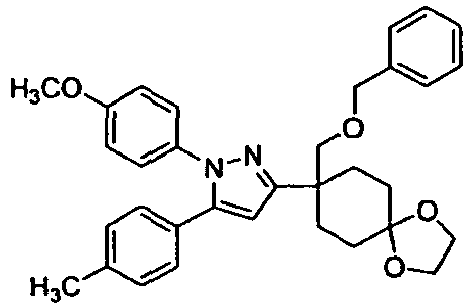
- Triethylamine (0.447 mL, 3.20 mmol) was added dropwise to a solution of 4-methoxyphenylhydrazine hydrochloride (280 mg, 1.60 mmol) in ethanol (2.7 mL), and the resulting mixture was stirred at room temperature for 30 minutes. To the reaction solution, a solution of 3-(8-(benzyloxymethyl)-1,4-dioxaspiro[4.5]decan-8-yl)-1-(p-tolyl)propyn-1-one (Intermediate 49) (540 mg, 1.33 mmol) in ethanol (2.7 mL) was added dropwise, and the resulting mixture was stirred at room temperature for 14 hours. Thereafter, the reaction solution was concentrated under reduced pressure. Water was added to the residue, and the resulting solution was extracted with ethyl acetate. The organic layer was washed with 1 M hydrochloric acid, distilled water and brine, and then dried over anhydrous magnesium sulfate, and concentrated under reduced pressure. The residue was purified by flash chromatography (silica gel, n-hexane/ethyl acetate) to obtain Intermediate 50 (458 mg, 0.872 mmol, 65%) as a white amorphous product.
1H-NMR (400 MHz, CDCl3) δ: 1.64-1.72 (2H, m), 1.76-1.85 (2H, m), 1.89-1.98 (2H, m), 2.27-2.35 (5H, m), 3.50 (2H, s), 3.80 (3H, s), 3.90-3.99 (4H, m), 4.49 (2H, s), 6.38 (1H, s), 6.80-6.85 (2H, m), 7.06-7.31 (11H, m).
ESI-MS: m/z = 525 (M+H)+ - As Intermediate 51, 4-(benzyloxymethyl)-4-(1-(4-methoxyphenyl)-5-(p-tolyl)-1H-pyrazol-3-yl)cyclohexan-1-one:

- To a solution of 3-(8-(benzyloxymethyl)-1,4-dioxaspiro[4.5]decan-8-yl)-1-(4-methoxyphenyl)-5-(p-tolyl)-1H-pyrazole (Intermediate 50) (458 mg, 0.872 mmol) in tetrahydrofuran (2.2 mL), 6 M hydrochloric acid (4.4 mL) was added, and the resulting mixture was stirred at room temperature for 15 hours. The reaction solution was cooled in ice, and a 50% aqueous sodium hydroxide solution was added dropwise thereto at 0°C until it became basic, followed by extraction of the resulting solution with ethyl acetate. The organic layer was washed with brine, dried over anhydrous sodium sulfate, and concentrated under reduced pressure. The residue was purified by flash chromatography (silica gel, n-hexane/ethyl acetate) to obtain Intermediate 51 (387 mg, 0.804 mmol, 92%) as a white amorphous product.
1H-NMR (400 MHz, CDCl3) δ: 2.11-2.21 (2H, m), 2.31-2.39 (5H, m), 2.52-2.68 (4H, m), 3.57 (2H, s), 3.81 (3H, s), 4.51 (2H, s), 6.44 (1H, s), 6.83-6.88 (2H, m), 7.08-7.34 (11H, m).
ESI-MS: m/z = 481 (M+H)+ - As Intermediate 52, 8-(4,5-bis(4-methoxyphenyl)oxazol)-2-yl)-1,4-dioxaspiro[4.5]decan-8-ol:

- To a solution of 2-chloro-1,4-bis(4-methoxyphenyl)oxazole (1.01 g, 3.20 mmol) in tetrahydrofuran (32 mL), which had been synthesized by the known production method (
WO 07/111323
1H-NMR (400 MHz, CDCl3) δ: 1.71-1.80 (2H, m), 2.01-2.11 (4H, m), 2.30-2.41 (2H, m), 2.76 (1H, s), 3.83 (3H, s), 3.84 (3H, s), 3.99 (4H, dd, J=Hz), 6.89 (2H, d, J= 8.8 Hz), 6.90 (2H, d, J= 8.8 Hz), 7.50 (2H, d, J= 8.8 Hz), 7.56 (2H, d, J= 8.8 Hz). - As
Intermediate 53, 1,4-dioxaspiro[4.5]decan-8-carboxyamide:
- Triethylamine (5.87 mL, 42.1 mmol) and n-propyl chloroformate were added at 0°C to a solution of 1,4-dioxaspiro[4.5]decan-8-carboxylic acid (823 mg, 4.42 mmol) in tetrahydrofuran (22 mL), and the resulting mixture was stirred at the same temperature for 1 hour. After adding dropwise, the resulting mixture was stirred at room temperature for 30 minutes. To the reaction solution, 28% aqueous ammonia (1.5 mL) was added, and the resulting mixture was stirred at room temperature for 1 hour. The organic layer was separated from the reaction solution, dried over sodium sulfate and concentrated under reduced pressure. The residue was purified by flash chromatography (silica gel, n-hexane/ethyl acetate) to obtain Intermediate 53 (694 mg, 3.75 mmol, 85%) as a colorless amorphous product.
1H-NMR (400 MHz, CDCl3) δ: 1.53-1.61 (2H, m), 1.72-1.86 (4H, m), 1.91-1.98 (2H, m), 2.17-2.25 (1H, m), 3.95 (4H, s), 5.29 (1H, brs), 5.46 (1H, brs).
ESI-MS: m/z = 186 (M+H)+ - As
Intermediate 54, 1,4-dioxaspiro[4.5]decan-8-carbothioamide:
- Lawesson's reagent (337 mg, 0.834 mmol) was added to a solution of 1,4-dioxaspiro[4.5]decan-8-carboxyamide (Intermediate 53) (281 mg, 1.52 mmol) in toluene (5 mL), and the resulting mixture was stirred at 100°C for 1 hour and then allowed to cool to room temperature. Methanol was added to the reaction solution, and the obtained solution was concentrated under reduced pressure. The residue was purified by flash chromatography (silica gel, n-hexane/ethyl acetate) to obtain Intermediate 54 (147 mg, 0.730 mmol, 48%) as a white solid.
1H-NMR (400 MHz, CDCl3) δ: 1.57-1.66 (2H, m), 1.79-1.90 (4H, m), 1.97-2.03 (2H, m), 2.64-2.72 (1H, m), 3.96 (4H, s), 6. 89 (1H, brs), 7.46 (1H, brs).
ESI-MS: m/z = 202 (M+H)+ - As Intermediate 55, 8-(4-(4-methoxyphenyl)-5-(p-tolyl)thiazol-2-yl)-1,4-dioxaspiro[4.5]decane:
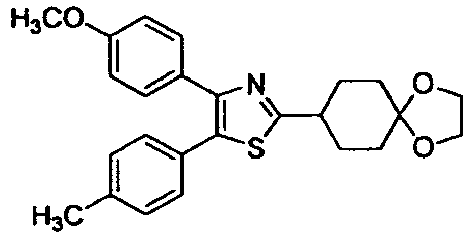
- A solution of 1,4-dioxaspiro[4.5]decan-8-carbothioamide (Intermediate 54) (389 mg, 1.93 mmol) and 2-bromo-1-(4-methoxyphenyl)-2-(p-tolyl)ethanone (588 mg, 1.84 mmol) in acetonitrile (9.2 mL) was stirred at room temperature for 4 hours. A saturated aqueous sodium hydrogen carbonate solution was added to the reaction solution, and the resulting solution was extracted with ethyl acetate. The organic layer was washed with brine, dried over anhydrous sodium sulfate, and concentrated under reduced pressure. The residue was purified by flash chromatography (silica gel, n-hexane/ethyl acetate) to obtain Intermediate 55 (630 mg, 1.49 mmol, 81%) as a colorless amorphous product.
1H-NMR (400 MHz, CDCl3) δ: 1.68-1.76 (2H, m), 1.88-1.98 (4H, m), 2.18-2.24 (2H, m), 2.35 (3H, s), 3.05-3.13 (1H, m), 3.80 (3H, s), 3.99 (4H, s), 6.79-6.82 (2H, m), 7.11 (2H, d, J = 8.0 Hz), 7.22 (2H, d, J = 8.0 Hz), 7.43-7.46 (2H, m).
ESI-MS: m/z = 422 (M+H)+ - As Intermediate 56, 8-(4-(4-methoxyphenyl)-5-(p-tolyl)thiazol-2-yl)-1,4-dioxaspiro[4.5]decan-8-ol:

- To a solution of 8-(4-(4-methoxyphenyl)-5-(p-tolyl)thiazol-2-yl)-1,4-dioxaspiro[4.5]decane (Intermediate 55) (734 mg, 1.74 mmol) in tetrahydrofuran (8.7 mL), a 1.63 M n-butyllithium/n-hexane solution (1.17 mL) was added at -78°C, and the resulting mixture was stirred at the same temperature for 1 hour. The reaction solution was added at -78°C to a solution of 3-phenyl-2-(phenylsulfonyl)-1,2-oxaziridine (546 mg, 2.09 mmol) in tetrahydrofuran (8.7 mL), and the obtained solution was allowed to warm gradually to room temperature with stirring. Distilled water was added to the reaction solution, and the resulting solution was extracted with ethyl acetate. The organic layer was washed with brine, and then dried over sodium sulfate, and concentrated under reduced pressure. The residue was purified by flash chromatography (silica gel, n-hexane/ethyl acetate) to obtain Intermediate 56 (417 mg, 0.954 mmol, 55%) as a colorless amorphous product.
1H-NMR (400 MHz, CDCl3) δ: 1.73-1.79 (2H, m), 2.03-2.10 (4H, m), 2.32-2.39 (2H, m), 2.37 (3H, s), 2.78 (1H, s), 3.84 (3H, s), 3.97-4.02 (4H, m), 6.88-6.92 (2H, m), 7.16 (2H, d, J= 8.4 Hz), 7.47 (2H, d, J= 8.4 Hz), 7.55-7.58 (2H, m).
ESI-MS: m/z = 438 (M+H)+ - As Intermediate 57, 4-hydroxy-4-(1-(4-methoxyphenyl)-5-(p-tolyl)-1H-pyrazol-3-yl)-cis-cyclohexyl 2-benzyloxycarbonylaminoacetate:

- Triethylamine (0.084 mL, 0.60 mmol), 2-benzyloxycarbonylamino acetic acid (46.2 mg, 0.241 mmol), 1-ethyl-3-(3-dimethylaminopropyl)carbodiimide hydrochloride (46.2 mg, 0.241 mmol), and 1-hydroxybenzotriazole (15.4 mg, 0.100 mmol) were added at room temperature to a solution of 1-(1-(4-methoxyphenyl)-5-(p-tolyl)-1H-pyrazol-3-yl)-cyclohexan-cis-1,4-diol (Compound 3) (76.0 mg, 0.201 mmol) in dichloromethane (2.00 mL), and the resulting mixture was stirred for 20 hours. Distilled water was added to the reaction solution, and the resulting solution was extracted with ethyl acetate. The organic layer was washed with brine, dried over anhydrous sodium sulfate, and concentrated under reduced pressure. The residue was purified by flash chromatography (silica gel, n-hexane/ethyl acetate) to obtain Intermediate 57 (33.2 mg, 0.058 mmol, 29%) as a colorless amorphous product.
1H-NMR (400 MHz, CDCl3) δ: 1.91-2.07 (8H, m), 2.33 (3H, s), 2.75 (1H, s), 3.80 (3H, s), 3.98-3.99 (2H, m), 4.89-4.94 (1H, m), 5.14 (2H, s), 5.33-5.35 (1H, m), 6.36 (1H, s), 6.82-6.86 (2H, m), 7.08-7.10 (4H, m), 7.17-7.21 (2H, m), 7.29-7.38 (5H, m).
ESI-MS: m/z = 552 (M-OH)+ - As Intermediate 58, (S)-4-hydroxy-4-(1-(4-methoxyphenyl)-5-(p-tolyl)-1H-pyrazol-3-yl)-cis-cyclohexyl 2-(benzyloxycarbonylamino)-3-methylbutanoate was synthesized in the same manner as Intermediate 57.

ESI-MS: m/z = 594 (M-OH)+ - As Intermediate 59, (S)-4-hydroxy-4-(1-(4-methoxyphenyl)-5-(p-tolyl)-1H-pyrazol-3-yl)cyclohexyloxy)methyl 2-(benzyloxycarbonylamino)-3-methylbutanoate:

- Molecular sieves 4A (300 mg) and diisopropylethylamine (0.210 mL, 1.21 mmol) were added at room temperature to a solution of 1-(1-(4-methoxyphenyl)-5-(p-tolyl)-1H-pyrazol-3-yl)-cyclohexan-cis-1,4-diol (Compound 3) (199 mg, 0.506 mmol) in dichloromethane (3.00 mL), and the obtained mixture was cooled to -50°C. Then, (S)-iodomethyl 2-benzyloxycarbonylamino-3-methylbutanoate (0.187 mL, 1.26 mmol) and silver trifluoromethanesulfonate (232 mg, 0.904 mmol) were added thereto at the same temperature, and the resulting mixture was stirred for 2 hours, followed by stirring the mixture at -30°C for 14 hours. A saturated sodium bicarbonate solution was added to the reaction solution, and the resulting solution was filtered through Celite. The filtrate was washed with brine, and the organic layer was dried over anhydrous sodium sulfate and concentrated under reduced pressure. The residue was purified by flash chromatography (silica gel, n-hexane/ethyl acetate) to obtain Intermediate 59 (123 mg, 0.192 mmol, 64%) as a colorless amorphous product.
1H-NMR (400 MHz, CDCl3) δ: 0.92 (3H, d, J = 6.4 Hz), 1.01 (3H, d, J = 6.4 Hz), 1.88-1.99 (6H, m), 2.02-2.09 (2H, m), 2.20-2.26 (1H, m), 2.34 (3H, s), 2.50 (1H, s), 3.66-3.72 (1H, m), 3.81 (3H, s), 4.32-4.36 (1H, m), 5.12 (2H, s), 5.38 (1H, d, J = 6.4 Hz), 5.50 (1H, d, J = 6.4 Hz), 6.37 (1H, s), 6.83-6.87 (2H, m), 7.08-7.11 (4H, m), 7.18-7.24 (2H, m), 7.29-7.38 (5H, m).
ESI-MS: m/z = 624 (M-OH)+ - As Intermediate 60, dibenzyl 4-hydroxy-4-(1-(4-methoxyphenyl)-5-(p-tolyl)-1H-pyrazol-3-yl)-cis-cyclohexyl phosphate:

- To a solution of 1-(1-(4-methoxyphenyl)-5-(p-tolyl)-1H-pyrazol-3-yl)cyclohexan-cis-1,4-diol (Compound 3) (200 mg, 0.528 mmol) in tetrahydrofuran (2.6 mL), 55% sodium hydride (55.3 mg, 1.27 mmol) and tetrabenzylpyrophosphonate (370 mg, 0.687 mmol) were sequentially added with stirring under ice-cooling, and the resulting mixture was stirred at room temperature for 15 hours. The reaction solution was cooled in ice, and water was added thereto. The resulting solution was extracted with ethyl acetate. The organic layer was washed with brine, dried over anhydrous sodium sulfate, and concentrated under reduced pressure. The residue was purified by flash chromatography (silica gel, n-hexane/ethyl acetate) to obtain Intermediate 60 (251 mg, 0.393 mmol, 74%) as a colorless transparent oily compound.
1H-NMR (400 MHz, CDCl3) δ: 1.87-2.11 (8H, m), 2.33 (3H, s), 3.79 (3H, s), 4.42-4.51 (1H, m), 5.00-5.12 (4H, m), 6.34 (1H, s), 6.81-6.87 (2H, m), 7.09 (4H, s), 7.16-7.23 (2H, m), 7.29-7.37 (10H, m).
ESI-MS: m/z = 639 (M+H)+ - As Compound 4, 4-hydroxy-4-(1-(4-methoxyphenyl)-5-(p-tolyl)-1H-pyrazol-3-yl)cyclohexan-1-one:

- To a solution of 8-(1-(4-methoxyphenyl)-5-(p-tolyl)-1H-pyrazol-3-yl)-1,4-dioxaspiro[4.5]decan-8-ol (Intermediate 18) (14.6 g, 34.7 mmol) in tetrahydrofuran (69.4 mL), 6 M hydrochloric acid (138.9 mL) was added, and the resulting mixture was stirred at room temperature for 15 hours. The reaction solution was cooled in ice, and a 50% aqueous sodium hydroxide solution was added dropwise thereto at 0°C until it became basic, followed by extraction of the resulting solution with ethyl acetate. The organic layer was washed with brine, dried over anhydrous sodium sulfate, and concentrated under reduced pressure. The residue was purified by recrystallization (n-hexane/ethyl acetate, 70°C) to obtain Compound 4 (10.5 g, 27.9 mmol, 80%) as a white solid.
1H-NMR (400 MHz, CDCl3) δ: 2.33-2.43 (9H, m), 2.87-2.95 (3H, m), 3.82 (3H, s), 6.39 (1H, s), 6.86 (2H, d, J = 8.8 Hz), 7.10 (4H, s), 7.22 (2H, d, J = 8.8 Hz).
IR (KBr, cm-1): 3321, 2929, 1712, 1518, 1463, 1299, 1249, 1179, 1114, 1027, 961, 821.
ESI-MS: m/z = 377 (M+H)+ - As Intermediate 62, 4-hydroxy-4-(1-(4-methoxyphenyl)-5-(6-methylpyridin-3-yl)-1H-pyrazol-3-yl)-cyclohexan-1-one:

- To a solution of 8-(1-(4-methoxyphenyl)-5-(6-methylpyridin-3-yl)-1H-pyrazol-3-yl)-1,4-dioxaspiro[4.5]decan-8-ol (Intermediate 19) (128.8 mg, 0.30 mmol) in tetrahydrofuran (0.6 mL), 6 M hydrochloric acid (1.2 mL) was added, and the resulting mixture was stirred at room temperature for 3 hours. The reaction solution was cooled in ice, and a 50% aqueous sodium hydroxide solution was added dropwise thereto at 0°C until it became basic, followed by extraction of the resulting solution with ethyl acetate. The organic layer was washed with brine, dried over anhydrous sodium sulfate, and concentrated under reduced pressure. The residue was purified by flash chromatography (silica gel, n-hexane/ethyl acetate) to obtain Intermediate 62 (109.5 mg, 0.29 mmol, 96%) as an amorphous product.
1H-NMR (400 MHz, CDCl3) δ: 2.34-2.44 (6H, m), 2.55 (3H, s), 2.87-2.95 (2H, m),3.18 (1H, s), 3.82 (3H, s), 6.49 (1H, s), 6.87 (2H, d, J = 8.8 Hz), 7.08 (1H, d, J = 8.1 Hz), 7.19 (2H, d, J = 8.8 Hz), 7.35 (1H, dd, J = 2.2, 8.1 Hz), 8.40 (1 H, d, J = 2.2 Hz).
ESI-MS: m/z = 378 (M+H)+ - As Intermediate 63, 4-(1,5-bis(4-methoxyphenyl)-1H-pyrazol-3-yl)-4-hydroxy-cyclohexan-1-one:

- To a solution of 8-(1,5-bis(4-methoxyphenyl)-1H-pyrazol-3-yl)-1,4-dioxaspiro[4.5]decan-8-ol (Intermediate 20) (658 mg, 1.50 mmol) in tetrahydrofuran (3.75 mL), 6 M hydrochloric acid (7.5 mL) was added at 0°C, and the resulting mixture was stirred at room temperature for 5 hours. The reaction solution was neutralized by pouring it into an ice-cooled 10% aqueous sodium hydroxide solution. The resulting solution was then basified by adding thereto a saturated sodium bicarbonate solution, and extracted with ethyl acetate. The organic layer was dried over anhydrous magnesium sulfate, and concentrated under reduced pressure. The residue was purified by flash chromatography (silica gel, n-hexane/ethyl acetate) to obtain Intermediate 63 (523 mg, 1.33 mmol, 89%) as an amorphous product.
1H-NMR (400 MHz, CDCl3) δ: 2.30-2.45 (6H, m), 2.86-2.96 (2H, m), 2.99 (1H, s), 3.80 (3H, s), 3.82 (3H, s), 6.36 (1H, s), 6.82 (2H, d, J = 8.8 Hz), 6.87 (2H, d, J = 8.8 Hz), 7.13 (2H, d, J = 8.8 Hz), 7.21 (2H, d, J = 8.8 Hz).
ESI-MS: m/z = 393 (M+H)+ - As Intermediate 64, 4-(5-(4-chlorophenyl)-1-(4-methoxyphenyl)-1H-pyrazol-3-yl)-4-hydroxy-cyclohexan-1-one:

- To a solution of 8-(5-(4-chlorophenyl)-1-(4-methoxyphenyl)-1H-pyrazol-3-yl)-1,4-dioxaspiro[4.5]decan-8-ol (Intermediate 21) (756 mg, 1.71 mmol) in tetrahydrofuran (4.3 mL), 6 M hydrochloric acid (8.6 mL) was added, and the resulting mixture was stirred at room temperature for 15 hours. The reaction solution was cooled in ice, and a 50% aqueous sodium hydroxide solution was added dropwise thereto at 0°C until it became basic, followed by extraction of the resulting solution with ethyl acetate. The organic layer was washed with brine, dried over anhydrous sodium sulfate, and concentrated under reduced pressure. The residue was purified by flash chromatography (silica gel, n-hexane/ethyl acetate) to obtain Intermediate 64 (619 mg, 1.56 mmol, 91 %) as an amorphous product.
1H-NMR (400 MHz, CDCl3) δ: 2.31-2.45 (6H, m), 2.85-2.98 (3H, m), 3.82 (3H, s), 6.43 (1H, s), 6.86-6.90 (2H, m), 7.14 (2H, d, J = 8.8 Hz), 7.19 (2H, d, J = 8.8 Hz), 7.26-7.29 (2H, m).
ESI-MS: m/z = 397 (M+H)+ - As Intermediate 65, 4-hydroxy-4-(1-(4-chlorophenyl)-5-(p-tolyl)-1H-pyrazol-3-yl)-cyclohexan-1-one:

- To a solution of 8-(1-(4-chlorophenyl)-5-(p-tolyl)-1H-pyrazol-3-yl)-1,4-dioxaspiro[4.5]decan-8-ol (Intermediate 22) (931 mg, 2.19 mmol) in tetrahydrofuran (5.5 mL), 6 M hydrochloric acid (11 mL) was added, and the resulting mixture was stirred at room temperature for 15 hours. The reaction solution was basified by pouring it into a saturated aqueous sodium hydrogen carbonate solution, and the resulting solution was extracted with ethyl acetate. The organic layer was washed with brine, dried over anhydrous sodium sulfate, and concentrated under reduced pressure. The residue was purified by flash chromatography (silica gel, n-hexane/ethyl acetate) to obtain Intermediate 65 (513 mg, 1.35 mmol, 61%) as a white solid.
1H-NMR (400 MHz, CDCl3) δ: 2.32-2.36 (4H, m), 2.36 (3H, s), 2.38-2.44 (2H, m), 2.87-2.95 (2H, m), 2.90 (1H, s), 6.41 (1H, s), 7.10 (2H, d, J = 8.0 Hz), 7.14 (2H, d, J = 8.0 Hz), 7.23 (2H, d, J = 8.8 Hz), 7.31 (2H, d, J = 8.8 Hz).
ESI-MS: m/z = 381 (M+H)+ - The following compounds were synthesized in the same manner as in the synthesis of the above-described Intermediates.
-
[Table 13-1] Intermediate Structural Formula Compound Data 66 
1H-NMR (400 MHz, CDCl3) δ: 2.31-2.45 (6H, m), 2.86-2.96 (3H, m), 6.45 (1H, s), 7.15 (2H, d, J = 8.8 Hz), 7.22 (2H, d, J = 8.8 Hz), 7.31-7.35 (4H, m). ESI-MS: m/z = 401 (M+H)+ 67 
1H-NMR (400 MHz, CDCl3) δ: 2.32-2.44 (6H, m), 2.85-2.95 (2H, m), 3.10 (1H, brs), 6.45 (1H, s), 7.13-7.16 (2H, m), 7.26-7.39 (7H, m). ESI-MS: m/z = 367 (M+H)+ 68 
1H-NMR (400 MHz, CDCl3) δ: 2.32-2.45 (6H, m), 2.34 (3H, s), 2.36 (3H, s), 2.87-2.95 (2H, m), 2.98 (1H, s), 6.37 (1H, s), 7.10-7.19 (8H, m). ESI-MS: m/z = 361 (M+H)+ 69 
1H-NMR (400 MHz, CDCl3) δ: 2.32-2.45 (6H, m), 2.35 (3H, s), 2.87-2.96 (2H, m), 2.97 (1H, s), 6.41 (1H, s), 7.09-7.13 (4H, m), 7.27-7.37 (5H, m). ESI-MS: m/z = 347 (M+H)+ 70 
1H-NMR (400 MHz, CD3OD) δ: 2.44-2.38 (6H, m), 2.87-2.96 (3H, m), 3.82 (3H, s), 6.43 (1H, s), 6.86 (2H, d, J = 9.0 Hz), 7.19-7.24 (4H, m), 7.29-7.32 (3H, m). ESI-MS: m/z = 363 (M+H)+ 71 
1H-NMR (400 MHz, CDCl3) δ: 2.32-2.44 (2H, m), 2.35-2.39 (5H, m), 2.43-2.50 (2H, m), 2.89-2.96 (2H, m), 6.43 (1H, s), 7.13 (2H, d, J = 8.8 Hz), 7.17 (2H, d, J = 8.8 Hz), 7.20-7.24 (2H, m), 7.29-7.32 (3H, m). ESI-MS: m/z = 347 (M+H)+ -
[Table 13-2] Intermediate Structural Formula Compound Data 72 
1H-NMR (400 MHz, CDCl3) δ: 2.31-2.34 (2H, m), 2.36 (3H, s), 2.37-2.39 (2H, m), 2.41-2.43 (2H, m), 2.86-2.96 (2H, m), 2.99 (1H, s), 3.80 (3H, s), 6.36 (1 H, s), 6.83 (2H, d, J = 8.8 Hz), 7.13-7.19 (6H, m). ESI-MS: m/z = 377 (M+H)+ 73 
1H-NMR (400 MHz, CDCl3) δ: 2.31-2.35 (4H, m), 2.38-2.43 (2H, m), 2.86-2.96 (3H, m), 3.82 (3H, s), 6.38 (1H, s), 6.84 (2H, d, J = 9.0 Hz), 7.13 (2H, d, J = 11.7 Hz), 7.23 (2H, t, J = 8.9 Hz), 7.31 (2H, d, J = 11.5 Hz). ESI-MS: m/z = 397 (M+H)+ 74 
1H-NMR (400 MHz, CDCl3) δ: 2.31-2.45 (6H, m), 2.86-2.96 (2H, m), 3.02 (1H, s), 3.80 (3H, s), 6.37 (1H, s), 6.83 (2H, d, J = 8.8 Hz), 7.14 (2H, d, J = 8.8 Hz), 7.28-7.37 (5H, m). 75 
1H-NMR (400 MHz, CDCl3) δ: 2.33-2.37 (4H, m), 2.39-2.43 (2H, m), 2.87-2.95 (3H, m), 3.83 (3H, s), 6.50 (1H, s), 6.89 (2H, d, J = 8.0 Hz), 7.20 (2H, d, J = 8.0 Hz), 7.33 (2H, d, J = 8.0 Hz), 7.56 (2H, d, J = 8.0 Hz). ESI-MS: m/z = 431 (M+H)+ 76 
1H-NMR (400 MHz, CDCl3) δ: 1.23 (3H, t, J = 7.6 Hz), 2.31-2.45 (6H, m), 2.64 (2H, q, J = 7.6 Hz), 2.86-2.96 (3H, m), 3.82 (3H, s), 6.39 (1H, s), 6.83-6.89 (2H, m), 7.13 (4H, s), 7.20-7.25 (2H, m). ESI-MS: m/z = 391 (M+H)+ -
[Table 13-3] Intermediate Structural Formula Compound Data 77 
1H-NMR (400 MHz, CDCl3) δ: 2.31-2.45 (9H, m), 2.86-2.97 (3H, m), 3.90 (3H, s), 6.39 (1H, s), 6.89 (1H, t, J = 8.8 Hz), 6.98-7.01 (1H, m), 7.08-7.15 (5H, m). ESI-MS: m/z = 395 (M+H)+ 78 
1H-NMR (400 MHz, CDCl3) δ: 2.26 (3H, d, J = 1.6 Hz), 2.31-2.45 (6H, m), 2.85-2.96 (3H, m), 3.82 (3H, s), 6.41 (1H, s), 6.84-6.90 (4H, m), 7.10 (1H, t, J = 8.0 Hz), 7.18-7.23 (2H, m). ESI-MS: m/z = 395 (M+H)+ 79 
1H-NMR (400 MHz, CDCl3) δ: 2.30-2.45 (9H, m), 2.83 (1H, s), 2.86-2.97 (2H, m), 6.45 (1H, s), 7.10-7.20 (4H, m), 7.40-7.45 (2H, m), 7.59-7.64 (2H, m). ESI-MS: m/z = 372 (M+H)+ 80 
1H-NMR (400 MHz, CDCl3) δ: 2.31-2.46 (6H, m), 2.84-2.96 (3H, m), 3.83 (3H, s), 6.53 (1H, s), 6.87-6.92 (2H, m), 7.15-7.21 (2H, m), 7.30-7.34 (2H, m), 7.57-7.61 (2H, m). ESI-MS: m/z = 425 (M+H)+ - As Intermediate 81, 4-(4-chloro-1-(4-methoxyphenyl)-5-(p-tolyl)-1H-pyrazol-3-yl)-c-4-hydroxy-cyclohexan-r-1-yl acetate:

- To a solution of c-4-hydroxy-4-(1-(4-methoxyphenyl)-5-(p-tolyl)-1H-pyrazol-3-yl)-cyclohexan-r-1-yl acetate (Compound 12) (140 mg, 0.333 mmol) in acetonitrile (1.66 mL), N-chlorosuccinimide (49 mg, 0.366 mmol) was added. The resulting mixture was stirred at 80°C for 15 hours, and allowed to cool to room temperature. Brine was added to the reaction solution, and the resulting solution was extracted with ethyl acetate. The organic layer was dried over anhydrous magnesium sulfate, and concentrated under reduced pressure. The residue was purified by flash chromatography (silica gel, n-hexane/ethyl acetate) to obtain Intermediate 81 (67 mg, 0.147 mmol, 44%) as a white solid.
1H-NMR (400 MHz, CDCl3) δ: 1.92-2.04 (6H, m), 2.28-2.36 (8H, m), 3.10 (1H, s), 3.79 (3H, s), 4.85-4.88 (1H, m), 6.80-6.82 (2H, m), 7.11-7.16 (6H, m). - As Intermediate 82, 4-(4,5-bis(4-methoxyphenyl)oxazol-2-yl)-4-hydroxycyclohexan-1-one:

- To a solution of 8-(4,5-bis(4-methoxyphenyl)oxazol-2-yl)-1,4-dioxaspiro[4.5]decan-8-ol (Intermediate 52) (781 mg, 1.78 mmol) in tetrahydrofuran (4.5 mL), 6 M hydrochloric acid (9.0 mL) was added at 0°C, and the resulting mixture was stirred at room temperature for 2 hours. The reaction solution was cooled to 0°C, and alkalified by addition of a 10% aqueous sodium hydroxide solution and a saturated sodium bicarbonate solution. The resulting solution was extracted with ethyl acetate. The organic layer was dried over anhydrous magnesium sulfate, and concentrated under reduced pressure. The residue was purified by recrystallization (ethyl acetate/n-hexane) to obtain Intermediate 82 (445 mg, 1.13 mmol, 63%) as a pale yellow solid.
1H-NMR (400 MHz, CDCl3) δ: 2.32-2.54 (6H, m), 2.81-2.92 (2H, m), 3.17 (1H, m), 3.84 (6H, s), 6.90 (2H, d, J = 8.8 Hz), 6.91 (2H, d, J = 8.8 Hz), 7.49 (2H, d, J = 8.8 Hz), 7.56 (2H, d, J = 8.8 Hz).
ESI-MS: m/z = 394 (M+H)+ - As Intermediate 83, 4-hydroxy-4-(4-(4-methoxyphenyl)-5-(p-tolyl)thiazol-2-yl)cyclohexan-1-one:

- To a solution of 8-(4-(4-methoxyphenyl)-5-(p-tolyl)thiazol-2-yl)-1,4-dioxaspiro[4.5]decan-8-ol (Intermediate 56) (469 mg, 1.07 mmol) in tetrahydrofuran (5.4 mL), 6 M hydrochloric acid (5.4 mL) was added at 0°C, and the resulting mixture was stirred at room temperature for 14 hours. The reaction solution was basified by pouring it into a saturated aqueous sodium hydrogen carbonate solution, and the resulting solution was extracted with ethyl acetate. The organic layer was washed with brine, dried over anhydrous sodium sulfate, and concentrated under reduced pressure. The residue was purified by flash chromatography (silica gel, n-hexane/ethyl acetate) to obtain Intermediate 83 (352 mg, 0.895 mmol, 83%) as a white solid.
1H-NMR (400 MHz, CDCl3) δ: 2.33-2.51 (6H, m), 2.37 (3H, s), 2.86-2.95 (2H, m), 3.50 (1H, s), 3.81 (3H, s), 6.81-6.84 (2H, m), 7.14 (2H, d, J = 8.0 Hz), 7.24 (2H, d, J = 8.0 Hz), 7.44-7.48 (2H, m).
ESI-MS: m/z = 394 (M+H)+ - As Intermediate 84, c-4-hydroxy-1-(1-(4-methoxyphenyl)-5-(p-tolyl)-1H-pyrazol-3-yl)-cyclohexan-r-1-yl acetate:

- Potassium carbonate (89.0 mg, 0.642 mmol) was added to a solution of 1-(1-(4-methoxyphenyl)-5-(p-tolyl)-1H-pyrazol-3-yl)-cyclohexan-cis-1,4-diyl diacetate (Intermediate 38) (297 mg, 0.642 mmol) in methanol (4.3 mL), and the resulting mixture was stirred at room temperature for 4 hours. Water was added to the reaction solution to stop the reaction, and the resulting solution was extracted with ethyl acetate. The organic layer was washed with brine, dried over anhydrous sodium sulfate, and concentrated under reduced pressure. The residue was purified by flash chromatography (silica gel, n-hexane/ethyl acetate) to obtain Intermediate 84 (213 mg, 0.507 mmol, 79%) as a white solid.
1H-NMR (400 MHz, CDCl3) δ: 1.49 (1H, d, J = 4.4 Hz), 1.65-1.74 (2H, m), 1.90-1.98 (4H, m), 2.10 (3H, s), 2.32 (3H, s), 2.71-2.78 (2H, m), 3.74-3.81 (4H, m), 6.37 (1H, s), 6.83 (2H, d, J = 9.2 Hz), 7.08 (4H, s), 7.20 (2H, d, J = 9.2 Hz).
ESI-MS: m/z = 421 (M+H)+ - The cyclohexane derivatives or pharmaceutically acceptable salts thereof according to the present invention can be utilized as a pharmaceutical, especially a therapeutic agent or prophylactic agent for fibromyalgia, comprising them as an effective ingredient.
Claims (5)
- A therapeutic agent or prophylactic agent for fibromyalgia, said agent comprising as an effective ingredient a cyclohexane derivative represented by the Formula (I):

A is a substituent represented by the Formula (IIa) or (IIb): R1 and R2 are each independently a hydrogen atom, a chlorine atom, a C1-C3 haloalkyl group, a C1-C4 alkyl group or a C1-C4 alkoxy group;R3 is a hydrogen atom or a chlorine atom; R4 is a fluorine atom, a hydroxymethyl group or a hydroxyl group;R5 and R6 are each independently a hydrogen atom, a fluorine atom, a C1-C3 haloalkyl group, a carboxyl group, a methoxycarbonyl group, an ethoxycarbonyl group, a C1-C4 alkoxy group, a hydroxyl group or a C2-C5 alkylcarbonyloxy group, or optionally together form an oxo group;R7 and R8 are each independently a hydrogen atom or a fluorine atom;Y is an oxygen atom or a sulfur atom;Z is a nitrogen atom or a methine group.]or a pharmaceutically acceptable salt thereof or a prodrug thereof.
 - The therapeutic agent or prophylactic agent according to claim 1, wherein R1 and R2 are each independently a trifluoromethyl group, a methyl group or a methoxy group.
- The therapeutic agent or prophylactic agent according to claim 1 or 2, wherein R3 is a hydrogen atom.
- The therapeutic agent or prophylactic agent according to any one of claims 1 to 3, wherein R4 is a hydroxymethyl group or a hydroxyl group.
- The therapeutic agent or prophylactic agent according to any one of claims 1 to 4, wherein R5 and R6 are each independently a hydrogen atom, a fluorine atom, a trifluoromethyl group, a carboxyl group, a methoxy group, a hydroxyl group or an acetyloxy group, or optionally together form an oxo group.
Priority Applications (1)
| Application Number | Priority Date | Filing Date | Title |
|---|---|---|---|
| PL11765736T PL2554541T3 (en) | 2010-03-31 | 2011-03-31 | Therapeutic agent or prophylactic agent for fibromyalgia |
Applications Claiming Priority (2)
| Application Number | Priority Date | Filing Date | Title |
|---|---|---|---|
| JP2010083721 | 2010-03-31 | ||
| PCT/JP2011/058218 WO2011125836A1 (en) | 2010-03-31 | 2011-03-31 | Therapeutic agent or prophylactic agent for fibromyalgia |
Publications (3)
| Publication Number | Publication Date |
|---|---|
| EP2554541A1 true EP2554541A1 (en) | 2013-02-06 |
| EP2554541A4 EP2554541A4 (en) | 2013-10-09 |
| EP2554541B1 EP2554541B1 (en) | 2015-12-09 |
Family
ID=44762774
Family Applications (1)
| Application Number | Title | Priority Date | Filing Date |
|---|---|---|---|
| EP11765736.1A Not-in-force EP2554541B1 (en) | 2010-03-31 | 2011-03-31 | Therapeutic agent or prophylactic agent for fibromyalgia |
Country Status (13)
| Country | Link |
|---|---|
| US (1) | US8957094B2 (en) |
| EP (1) | EP2554541B1 (en) |
| JP (1) | JP5751168B2 (en) |
| KR (1) | KR101738471B1 (en) |
| CN (1) | CN102822148B (en) |
| AU (1) | AU2011237072B2 (en) |
| BR (1) | BR112012022947B1 (en) |
| CA (1) | CA2793709C (en) |
| ES (1) | ES2562470T3 (en) |
| MX (1) | MX2012010767A (en) |
| PL (1) | PL2554541T3 (en) |
| RU (1) | RU2560168C2 (en) |
| WO (1) | WO2011125836A1 (en) |
Cited By (1)
| Publication number | Priority date | Publication date | Assignee | Title |
|---|---|---|---|---|
| AU2011283462B2 (en) * | 2010-07-30 | 2014-05-22 | Toray Industries, Inc. | Therapeutic agent or prophylactic agent for neuropathic pain |
Families Citing this family (7)
| Publication number | Priority date | Publication date | Assignee | Title |
|---|---|---|---|---|
| BR112012024346A2 (en) * | 2010-04-28 | 2016-05-24 | Toray Industries | therapeutic agent or prophylactic agent for alzheimer's disease |
| JPWO2014088106A1 (en) * | 2012-12-06 | 2017-01-05 | 株式会社PRISM Pharma | Prevention or treatment of fibromyalgia |
| JP6447496B2 (en) | 2014-01-29 | 2019-01-09 | 東レ株式会社 | Agents for treating or preventing multiple sclerosis |
| EP3328819B1 (en) * | 2015-07-28 | 2020-04-01 | Beta Cat Pharmaceuticals, Inc. | Anthracene-9, 10-dione dioxime compounds prodrugs and their uses |
| WO2017096148A1 (en) * | 2015-12-03 | 2017-06-08 | Katz Robert S | Methods and systems for diagnosing and treating fibromyalgia |
| EP3492452B1 (en) | 2016-07-29 | 2022-08-31 | Japan Tobacco Inc. | Production method for pyrazole-amide compound |
| WO2018181859A1 (en) * | 2017-03-31 | 2018-10-04 | 東レ株式会社 | Therapeutic agent or prophylactic agent for anticancer agent-induced peripheral neuropathy |
Family Cites Families (9)
| Publication number | Priority date | Publication date | Assignee | Title |
|---|---|---|---|---|
| AUPP608898A0 (en) * | 1998-09-23 | 1998-10-15 | Fujisawa Pharmaceutical Co., Ltd. | New use of prostaglandin E2 antagonists |
| US6437146B1 (en) | 1998-09-25 | 2002-08-20 | Fujisawa Pharmaceutical Co., Ltd. | Oxazole compounds as prostaglandin e2 agonists or antagonists |
| WO2000066562A1 (en) * | 1999-05-03 | 2000-11-09 | Dr. Reddy's Research Foundation | Pyrazoles having antiinflammatory activity |
| US20040122008A1 (en) | 2002-09-05 | 2004-06-24 | Protter Andrew A. | Treatment of pain by inhibition of p38 MAP kinase |
| CN101454299A (en) * | 2006-03-27 | 2009-06-10 | 东丽株式会社 | Ureide derivative and use thereof for medical purposes |
| JP2010503656A (en) * | 2006-09-13 | 2010-02-04 | アストラゼネカ アクチボラグ | Spiro-oxazolidinone compounds and their use as metabotropic glutamate receptor potentiators |
| US20080171762A1 (en) * | 2007-01-16 | 2008-07-17 | Ockert David M | Treatment of pain with naloxone |
| WO2008105383A1 (en) | 2007-02-26 | 2008-09-04 | Toray Industries, Inc. | Pyrazole derivative and use thereof for medical purposes |
| TWI435874B (en) * | 2008-10-31 | 2014-05-01 | Toray Industries | A cyclohexane derivative and the medical and pharmaceutical use |
-
2011
- 2011-03-31 ES ES11765736.1T patent/ES2562470T3/en active Active
- 2011-03-31 RU RU2012146325/04A patent/RU2560168C2/en not_active IP Right Cessation
- 2011-03-31 BR BR112012022947-8A patent/BR112012022947B1/en not_active IP Right Cessation
- 2011-03-31 MX MX2012010767A patent/MX2012010767A/en active IP Right Grant
- 2011-03-31 CN CN201180016967.3A patent/CN102822148B/en not_active Expired - Fee Related
- 2011-03-31 CA CA2793709A patent/CA2793709C/en active Active
- 2011-03-31 PL PL11765736T patent/PL2554541T3/en unknown
- 2011-03-31 KR KR1020127023059A patent/KR101738471B1/en not_active Expired - Fee Related
- 2011-03-31 JP JP2011514905A patent/JP5751168B2/en not_active Expired - Fee Related
- 2011-03-31 AU AU2011237072A patent/AU2011237072B2/en not_active Ceased
- 2011-03-31 WO PCT/JP2011/058218 patent/WO2011125836A1/en not_active Ceased
- 2011-03-31 US US13/636,805 patent/US8957094B2/en active Active
- 2011-03-31 EP EP11765736.1A patent/EP2554541B1/en not_active Not-in-force
Cited By (1)
| Publication number | Priority date | Publication date | Assignee | Title |
|---|---|---|---|---|
| AU2011283462B2 (en) * | 2010-07-30 | 2014-05-22 | Toray Industries, Inc. | Therapeutic agent or prophylactic agent for neuropathic pain |
Also Published As
| Publication number | Publication date |
|---|---|
| MX2012010767A (en) | 2012-10-15 |
| JPWO2011125836A1 (en) | 2013-07-11 |
| CN102822148B (en) | 2015-03-11 |
| CN102822148A (en) | 2012-12-12 |
| US8957094B2 (en) | 2015-02-17 |
| PL2554541T3 (en) | 2016-06-30 |
| EP2554541A4 (en) | 2013-10-09 |
| EP2554541B1 (en) | 2015-12-09 |
| BR112012022947A2 (en) | 2020-07-28 |
| WO2011125836A1 (en) | 2011-10-13 |
| RU2012146325A (en) | 2014-05-10 |
| CA2793709A1 (en) | 2011-10-13 |
| AU2011237072B2 (en) | 2014-09-04 |
| BR112012022947B1 (en) | 2021-06-15 |
| CA2793709C (en) | 2017-09-12 |
| KR101738471B1 (en) | 2017-05-22 |
| ES2562470T3 (en) | 2016-03-04 |
| JP5751168B2 (en) | 2015-07-22 |
| AU2011237072A1 (en) | 2012-10-18 |
| KR20130052536A (en) | 2013-05-22 |
| RU2560168C2 (en) | 2015-08-20 |
| US20130190503A1 (en) | 2013-07-25 |
Similar Documents
| Publication | Publication Date | Title |
|---|---|---|
| EP2554541B1 (en) | Therapeutic agent or prophylactic agent for fibromyalgia | |
| EP2341047B1 (en) | Cyclohexane derivative and pharmaceutical use thereof | |
| EP2562160B1 (en) | Therapeutic agent or preventive agent for urine collection disorder | |
| US8598212B2 (en) | Therapeutic agent and preventative agent for alzheimer's disease |
Legal Events
| Date | Code | Title | Description |
|---|---|---|---|
| PUAI | Public reference made under article 153(3) epc to a published international application that has entered the european phase |
Free format text: ORIGINAL CODE: 0009012 |
|
| 17P | Request for examination filed |
Effective date: 20121019 |
|
| AK | Designated contracting states |
Kind code of ref document: A1 Designated state(s): AL AT BE BG CH CY CZ DE DK EE ES FI FR GB GR HR HU IE IS IT LI LT LU LV MC MK MT NL NO PL PT RO RS SE SI SK SM TR |
|
| DAX | Request for extension of the european patent (deleted) | ||
| A4 | Supplementary search report drawn up and despatched |
Effective date: 20130909 |
|
| RIC1 | Information provided on ipc code assigned before grant |
Ipc: C07D 277/24 20060101ALI20130903BHEP Ipc: A61K 31/4439 20060101ALI20130903BHEP Ipc: A61K 31/426 20060101ALI20130903BHEP Ipc: A61P 25/04 20060101ALI20130903BHEP Ipc: A61P 21/00 20060101ALI20130903BHEP Ipc: C07D 231/12 20060101AFI20130903BHEP Ipc: A61K 31/421 20060101ALI20130903BHEP Ipc: A61K 31/415 20060101ALI20130903BHEP Ipc: A61P 25/02 20060101ALI20130903BHEP Ipc: C07D 401/04 20060101ALI20130903BHEP Ipc: C07D 263/32 20060101ALI20130903BHEP |
|
| 17Q | First examination report despatched |
Effective date: 20140714 |
|
| REG | Reference to a national code |
Ref country code: DE Ref legal event code: R079 Ref document number: 602011021872 Country of ref document: DE Free format text: PREVIOUS MAIN CLASS: C07D0231120000 Ipc: A61K0031415000 |
|
| RIC1 | Information provided on ipc code assigned before grant |
Ipc: A61P 25/02 20060101ALI20150429BHEP Ipc: A61K 31/421 20060101ALI20150429BHEP Ipc: A61K 31/426 20060101ALI20150429BHEP Ipc: A61K 31/415 20060101AFI20150429BHEP Ipc: A61K 31/4439 20060101ALI20150429BHEP Ipc: A61P 25/04 20060101ALI20150429BHEP Ipc: A61P 21/00 20060101ALI20150429BHEP |
|
| GRAP | Despatch of communication of intention to grant a patent |
Free format text: ORIGINAL CODE: EPIDOSNIGR1 |
|
| INTG | Intention to grant announced |
Effective date: 20150615 |
|
| GRAS | Grant fee paid |
Free format text: ORIGINAL CODE: EPIDOSNIGR3 |
|
| GRAR | Information related to intention to grant a patent recorded |
Free format text: ORIGINAL CODE: EPIDOSNIGR71 |
|
| GRAA | (expected) grant |
Free format text: ORIGINAL CODE: 0009210 |
|
| INTG | Intention to grant announced |
Effective date: 20151016 |
|
| AK | Designated contracting states |
Kind code of ref document: B1 Designated state(s): AL AT BE BG CH CY CZ DE DK EE ES FI FR GB GR HR HU IE IS IT LI LT LU LV MC MK MT NL NO PL PT RO RS SE SI SK SM TR |
|
| REG | Reference to a national code |
Ref country code: GB Ref legal event code: FG4D |
|
| REG | Reference to a national code |
Ref country code: AT Ref legal event code: REF Ref document number: 764256 Country of ref document: AT Kind code of ref document: T Effective date: 20151215 Ref country code: CH Ref legal event code: EP |
|
| REG | Reference to a national code |
Ref country code: IE Ref legal event code: FG4D |
|
| REG | Reference to a national code |
Ref country code: CH Ref legal event code: NV Representative=s name: E. BLUM AND CO. AG PATENT- UND MARKENANWAELTE , CH |
|
| REG | Reference to a national code |
Ref country code: DE Ref legal event code: R096 Ref document number: 602011021872 Country of ref document: DE |
|
| REG | Reference to a national code |
Ref country code: SE Ref legal event code: TRGR |
|
| REG | Reference to a national code |
Ref country code: ES Ref legal event code: FG2A Ref document number: 2562470 Country of ref document: ES Kind code of ref document: T3 Effective date: 20160304 |
|
| REG | Reference to a national code |
Ref country code: FR Ref legal event code: PLFP Year of fee payment: 6 |
|
| REG | Reference to a national code |
Ref country code: NL Ref legal event code: FP |
|
| REG | Reference to a national code |
Ref country code: LT Ref legal event code: MG4D |
|
| PG25 | Lapsed in a contracting state [announced via postgrant information from national office to epo] |
Ref country code: LT Free format text: LAPSE BECAUSE OF FAILURE TO SUBMIT A TRANSLATION OF THE DESCRIPTION OR TO PAY THE FEE WITHIN THE PRESCRIBED TIME-LIMIT Effective date: 20151209 Ref country code: NO Free format text: LAPSE BECAUSE OF FAILURE TO SUBMIT A TRANSLATION OF THE DESCRIPTION OR TO PAY THE FEE WITHIN THE PRESCRIBED TIME-LIMIT Effective date: 20160309 |
|
| REG | Reference to a national code |
Ref country code: AT Ref legal event code: MK05 Ref document number: 764256 Country of ref document: AT Kind code of ref document: T Effective date: 20151209 |
|
| PG25 | Lapsed in a contracting state [announced via postgrant information from national office to epo] |
Ref country code: RS Free format text: LAPSE BECAUSE OF FAILURE TO SUBMIT A TRANSLATION OF THE DESCRIPTION OR TO PAY THE FEE WITHIN THE PRESCRIBED TIME-LIMIT Effective date: 20151209 Ref country code: GR Free format text: LAPSE BECAUSE OF FAILURE TO SUBMIT A TRANSLATION OF THE DESCRIPTION OR TO PAY THE FEE WITHIN THE PRESCRIBED TIME-LIMIT Effective date: 20160310 Ref country code: LV Free format text: LAPSE BECAUSE OF FAILURE TO SUBMIT A TRANSLATION OF THE DESCRIPTION OR TO PAY THE FEE WITHIN THE PRESCRIBED TIME-LIMIT Effective date: 20151209 Ref country code: FI Free format text: LAPSE BECAUSE OF FAILURE TO SUBMIT A TRANSLATION OF THE DESCRIPTION OR TO PAY THE FEE WITHIN THE PRESCRIBED TIME-LIMIT Effective date: 20151209 |
|
| PG25 | Lapsed in a contracting state [announced via postgrant information from national office to epo] |
Ref country code: IS Free format text: LAPSE BECAUSE OF FAILURE TO SUBMIT A TRANSLATION OF THE DESCRIPTION OR TO PAY THE FEE WITHIN THE PRESCRIBED TIME-LIMIT Effective date: 20151209 |
|
| PG25 | Lapsed in a contracting state [announced via postgrant information from national office to epo] |
Ref country code: CZ Free format text: LAPSE BECAUSE OF FAILURE TO SUBMIT A TRANSLATION OF THE DESCRIPTION OR TO PAY THE FEE WITHIN THE PRESCRIBED TIME-LIMIT Effective date: 20151209 |
|
| PG25 | Lapsed in a contracting state [announced via postgrant information from national office to epo] |
Ref country code: PT Free format text: LAPSE BECAUSE OF FAILURE TO SUBMIT A TRANSLATION OF THE DESCRIPTION OR TO PAY THE FEE WITHIN THE PRESCRIBED TIME-LIMIT Effective date: 20160411 Ref country code: SK Free format text: LAPSE BECAUSE OF FAILURE TO SUBMIT A TRANSLATION OF THE DESCRIPTION OR TO PAY THE FEE WITHIN THE PRESCRIBED TIME-LIMIT Effective date: 20151209 Ref country code: EE Free format text: LAPSE BECAUSE OF FAILURE TO SUBMIT A TRANSLATION OF THE DESCRIPTION OR TO PAY THE FEE WITHIN THE PRESCRIBED TIME-LIMIT Effective date: 20151209 Ref country code: SM Free format text: LAPSE BECAUSE OF FAILURE TO SUBMIT A TRANSLATION OF THE DESCRIPTION OR TO PAY THE FEE WITHIN THE PRESCRIBED TIME-LIMIT Effective date: 20151209 Ref country code: AT Free format text: LAPSE BECAUSE OF FAILURE TO SUBMIT A TRANSLATION OF THE DESCRIPTION OR TO PAY THE FEE WITHIN THE PRESCRIBED TIME-LIMIT Effective date: 20151209 Ref country code: RO Free format text: LAPSE BECAUSE OF FAILURE TO SUBMIT A TRANSLATION OF THE DESCRIPTION OR TO PAY THE FEE WITHIN THE PRESCRIBED TIME-LIMIT Effective date: 20151209 Ref country code: IS Free format text: LAPSE BECAUSE OF FAILURE TO SUBMIT A TRANSLATION OF THE DESCRIPTION OR TO PAY THE FEE WITHIN THE PRESCRIBED TIME-LIMIT Effective date: 20160409 |
|
| REG | Reference to a national code |
Ref country code: DE Ref legal event code: R097 Ref document number: 602011021872 Country of ref document: DE |
|
| PLBE | No opposition filed within time limit |
Free format text: ORIGINAL CODE: 0009261 |
|
| STAA | Information on the status of an ep patent application or granted ep patent |
Free format text: STATUS: NO OPPOSITION FILED WITHIN TIME LIMIT |
|
| PG25 | Lapsed in a contracting state [announced via postgrant information from national office to epo] |
Ref country code: MC Free format text: LAPSE BECAUSE OF FAILURE TO SUBMIT A TRANSLATION OF THE DESCRIPTION OR TO PAY THE FEE WITHIN THE PRESCRIBED TIME-LIMIT Effective date: 20151209 Ref country code: LU Free format text: LAPSE BECAUSE OF FAILURE TO SUBMIT A TRANSLATION OF THE DESCRIPTION OR TO PAY THE FEE WITHIN THE PRESCRIBED TIME-LIMIT Effective date: 20160331 Ref country code: DK Free format text: LAPSE BECAUSE OF FAILURE TO SUBMIT A TRANSLATION OF THE DESCRIPTION OR TO PAY THE FEE WITHIN THE PRESCRIBED TIME-LIMIT Effective date: 20151209 |
|
| 26N | No opposition filed |
Effective date: 20160912 |
|
| PG25 | Lapsed in a contracting state [announced via postgrant information from national office to epo] |
Ref country code: SI Free format text: LAPSE BECAUSE OF FAILURE TO SUBMIT A TRANSLATION OF THE DESCRIPTION OR TO PAY THE FEE WITHIN THE PRESCRIBED TIME-LIMIT Effective date: 20151209 |
|
| REG | Reference to a national code |
Ref country code: IE Ref legal event code: MM4A |
|
| PG25 | Lapsed in a contracting state [announced via postgrant information from national office to epo] |
Ref country code: IE Free format text: LAPSE BECAUSE OF NON-PAYMENT OF DUE FEES Effective date: 20160331 |
|
| REG | Reference to a national code |
Ref country code: FR Ref legal event code: PLFP Year of fee payment: 7 |
|
| PG25 | Lapsed in a contracting state [announced via postgrant information from national office to epo] |
Ref country code: MT Free format text: LAPSE BECAUSE OF FAILURE TO SUBMIT A TRANSLATION OF THE DESCRIPTION OR TO PAY THE FEE WITHIN THE PRESCRIBED TIME-LIMIT Effective date: 20151209 |
|
| REG | Reference to a national code |
Ref country code: FR Ref legal event code: PLFP Year of fee payment: 8 |
|
| PGFP | Annual fee paid to national office [announced via postgrant information from national office to epo] |
Ref country code: NL Payment date: 20180214 Year of fee payment: 8 |
|
| PGFP | Annual fee paid to national office [announced via postgrant information from national office to epo] |
Ref country code: CH Payment date: 20180314 Year of fee payment: 8 |
|
| PG25 | Lapsed in a contracting state [announced via postgrant information from national office to epo] |
Ref country code: HU Free format text: LAPSE BECAUSE OF FAILURE TO SUBMIT A TRANSLATION OF THE DESCRIPTION OR TO PAY THE FEE WITHIN THE PRESCRIBED TIME-LIMIT; INVALID AB INITIO Effective date: 20110331 Ref country code: CY Free format text: LAPSE BECAUSE OF FAILURE TO SUBMIT A TRANSLATION OF THE DESCRIPTION OR TO PAY THE FEE WITHIN THE PRESCRIBED TIME-LIMIT Effective date: 20151209 |
|
| PGFP | Annual fee paid to national office [announced via postgrant information from national office to epo] |
Ref country code: BE Payment date: 20180214 Year of fee payment: 8 Ref country code: TR Payment date: 20180328 Year of fee payment: 8 Ref country code: SE Payment date: 20180313 Year of fee payment: 8 Ref country code: PL Payment date: 20180213 Year of fee payment: 8 |
|
| PG25 | Lapsed in a contracting state [announced via postgrant information from national office to epo] |
Ref country code: HR Free format text: LAPSE BECAUSE OF FAILURE TO SUBMIT A TRANSLATION OF THE DESCRIPTION OR TO PAY THE FEE WITHIN THE PRESCRIBED TIME-LIMIT Effective date: 20151209 Ref country code: MK Free format text: LAPSE BECAUSE OF FAILURE TO SUBMIT A TRANSLATION OF THE DESCRIPTION OR TO PAY THE FEE WITHIN THE PRESCRIBED TIME-LIMIT Effective date: 20151209 |
|
| PG25 | Lapsed in a contracting state [announced via postgrant information from national office to epo] |
Ref country code: BG Free format text: LAPSE BECAUSE OF FAILURE TO SUBMIT A TRANSLATION OF THE DESCRIPTION OR TO PAY THE FEE WITHIN THE PRESCRIBED TIME-LIMIT Effective date: 20151209 |
|
| PG25 | Lapsed in a contracting state [announced via postgrant information from national office to epo] |
Ref country code: AL Free format text: LAPSE BECAUSE OF FAILURE TO SUBMIT A TRANSLATION OF THE DESCRIPTION OR TO PAY THE FEE WITHIN THE PRESCRIBED TIME-LIMIT Effective date: 20151209 |
|
| REG | Reference to a national code |
Ref country code: CH Ref legal event code: PL |
|
| REG | Reference to a national code |
Ref country code: NL Ref legal event code: MM Effective date: 20190401 |
|
| REG | Reference to a national code |
Ref country code: SE Ref legal event code: EUG |
|
| REG | Reference to a national code |
Ref country code: BE Ref legal event code: MM Effective date: 20190331 |
|
| PG25 | Lapsed in a contracting state [announced via postgrant information from national office to epo] |
Ref country code: NL Free format text: LAPSE BECAUSE OF NON-PAYMENT OF DUE FEES Effective date: 20190401 Ref country code: SE Free format text: LAPSE BECAUSE OF NON-PAYMENT OF DUE FEES Effective date: 20190401 Ref country code: LI Free format text: LAPSE BECAUSE OF NON-PAYMENT OF DUE FEES Effective date: 20190331 Ref country code: CH Free format text: LAPSE BECAUSE OF NON-PAYMENT OF DUE FEES Effective date: 20190331 |
|
| PG25 | Lapsed in a contracting state [announced via postgrant information from national office to epo] |
Ref country code: BE Free format text: LAPSE BECAUSE OF NON-PAYMENT OF DUE FEES Effective date: 20190331 |
|
| PG25 | Lapsed in a contracting state [announced via postgrant information from national office to epo] |
Ref country code: PL Free format text: LAPSE BECAUSE OF NON-PAYMENT OF DUE FEES Effective date: 20190331 |
|
| PGFP | Annual fee paid to national office [announced via postgrant information from national office to epo] |
Ref country code: GB Payment date: 20220210 Year of fee payment: 12 Ref country code: DE Payment date: 20220203 Year of fee payment: 12 |
|
| PGFP | Annual fee paid to national office [announced via postgrant information from national office to epo] |
Ref country code: IT Payment date: 20220210 Year of fee payment: 12 Ref country code: FR Payment date: 20220209 Year of fee payment: 12 |
|
| PG25 | Lapsed in a contracting state [announced via postgrant information from national office to epo] |
Ref country code: TR Free format text: LAPSE BECAUSE OF NON-PAYMENT OF DUE FEES Effective date: 20190331 |
|
| PGFP | Annual fee paid to national office [announced via postgrant information from national office to epo] |
Ref country code: ES Payment date: 20220401 Year of fee payment: 12 |
|
| REG | Reference to a national code |
Ref country code: DE Ref legal event code: R119 Ref document number: 602011021872 Country of ref document: DE |
|
| GBPC | Gb: european patent ceased through non-payment of renewal fee |
Effective date: 20230331 |
|
| PG25 | Lapsed in a contracting state [announced via postgrant information from national office to epo] |
Ref country code: GB Free format text: LAPSE BECAUSE OF NON-PAYMENT OF DUE FEES Effective date: 20230331 |
|
| PG25 | Lapsed in a contracting state [announced via postgrant information from national office to epo] |
Ref country code: GB Free format text: LAPSE BECAUSE OF NON-PAYMENT OF DUE FEES Effective date: 20230331 Ref country code: FR Free format text: LAPSE BECAUSE OF NON-PAYMENT OF DUE FEES Effective date: 20230331 Ref country code: DE Free format text: LAPSE BECAUSE OF NON-PAYMENT OF DUE FEES Effective date: 20231003 |
|
| PG25 | Lapsed in a contracting state [announced via postgrant information from national office to epo] |
Ref country code: IT Free format text: LAPSE BECAUSE OF NON-PAYMENT OF DUE FEES Effective date: 20230331 |
|
| REG | Reference to a national code |
Ref country code: ES Ref legal event code: FD2A Effective date: 20240524 |
|
| PG25 | Lapsed in a contracting state [announced via postgrant information from national office to epo] |
Ref country code: ES Free format text: LAPSE BECAUSE OF NON-PAYMENT OF DUE FEES Effective date: 20230401 |
|
| PG25 | Lapsed in a contracting state [announced via postgrant information from national office to epo] |
Ref country code: ES Free format text: LAPSE BECAUSE OF NON-PAYMENT OF DUE FEES Effective date: 20230401 |