EP2552121B1 - Method and system for message tracking configuration in telecom services - Google Patents
Method and system for message tracking configuration in telecom services Download PDFInfo
- Publication number
- EP2552121B1 EP2552121B1 EP11816006.8A EP11816006A EP2552121B1 EP 2552121 B1 EP2552121 B1 EP 2552121B1 EP 11816006 A EP11816006 A EP 11816006A EP 2552121 B1 EP2552121 B1 EP 2552121B1
- Authority
- EP
- European Patent Office
- Prior art keywords
- tracking
- message
- service module
- monitoring client
- service
- Prior art date
- Legal status (The legal status is an assumption and is not a legal conclusion. Google has not performed a legal analysis and makes no representation as to the accuracy of the status listed.)
- Active
Links
- 238000000034 method Methods 0.000 title claims description 28
- 238000012544 monitoring process Methods 0.000 claims description 96
- 230000001360 synchronised effect Effects 0.000 claims description 5
- 230000000977 initiatory effect Effects 0.000 claims 3
- 230000005540 biological transmission Effects 0.000 description 10
- 230000011664 signaling Effects 0.000 description 10
- 238000004458 analytical method Methods 0.000 description 2
- 238000010586 diagram Methods 0.000 description 2
- 238000011161 development Methods 0.000 description 1
- 238000007429 general method Methods 0.000 description 1
- 230000007774 longterm Effects 0.000 description 1
- 238000012423 maintenance Methods 0.000 description 1
Images

Classifications
-
- H—ELECTRICITY
- H04—ELECTRIC COMMUNICATION TECHNIQUE
- H04L—TRANSMISSION OF DIGITAL INFORMATION, e.g. TELEGRAPHIC COMMUNICATION
- H04L51/00—User-to-user messaging in packet-switching networks, transmitted according to store-and-forward or real-time protocols, e.g. e-mail
- H04L51/21—Monitoring or handling of messages
- H04L51/234—Monitoring or handling of messages for tracking messages
-
- H—ELECTRICITY
- H04—ELECTRIC COMMUNICATION TECHNIQUE
- H04Q—SELECTING
- H04Q3/00—Selecting arrangements
- H04Q3/0016—Arrangements providing connection between exchanges
- H04Q3/0029—Provisions for intelligent networking
Definitions
- the present disclosure relates to the field of telecom service products, and more particularly, to a method and system for configuring message tracking in a telecom service.
- the message tracking may be classified as tracking based on management and tracking based on message transmission.
- the tracking method based on management focuses on the management operation process of a tracked service at a service node. Specifically, the method tracks the management of a tracked message at a single service node by the triggering of a message with specific content. For example, message tracking is only performed on the calling service of the mobile terminal at a specific network node rather than the calling service of the mobile terminal at other network nodes.
- the tracking method based on the message transmission focuses on the tracking of specific message content, which may involve multiple service nodes.
- a network node may trigger a specific message transmission between network nodes due to the receiving or sending of the specific message content, and the tracking of the above transmission process is based on the message transmission.
- D1 ( CN 101631261 A ) provides a signaling tracking method, a signaling tracking background device and a tracking system, wherein the method comprises: a signaling tracking background device acquires a common interface file, the common interface file comprises a tracking condition of a logical network element of the signaling tracking foreground device; the signaling tracking background device processes the common interface file to generate a signaling tracking interface; the signaling tracking background device displays signaling tracking data satisfying the chosen tracking condition in the signaling tracking interface.
- Technical solutions of D1 unify signaling tracking background module codes to reduce the maintenance workload of developers.
- the main objective of the disclosure is to provide a general method and system for implementing message tracking, which is able to integrate the message tracking of various services, so as to solve the problem of incompatibility between current message tracking platforms.
- a method for configuring message tracking in a telecom service includes following steps:
- the method may further include the following step that is performed after the step of sending the synchronization message of configuration information to the corresponding service module:
- the registration message initiated by the service module to the tracking server may include: identity information and address information of the service module, and a name and/or type of a service performed by the service module.
- the registration message initiated by the monitoring client to the tracking server may include: identify information and address information of the monitoring client.
- the tracking condition synchronously sent by the tracking server to the monitoring client may include: a key identification field name of a trackable message in the service executed by a service module and an Extensible Markup Language (XML) format description document of a message structure of the trackable message.
- XML Extensible Markup Language
- the disclosure further provides a system for configuring message tracking in a telecom service, which includes a service module, a tracking server and a monitoring client.
- the service module is configured to initiate a registration message to the tracking server, to synchronize a tracking condition with the tracking server, and to receive a synchronization message of configuration information sent by the tracking server to complete configuration of message tracking.
- the tracking server is configured to receive the registration messages from the service module and a registration message from the monitoring client, and to synchronize the tracking condition, obtained by synchronizing with the service module, with the monitoring client.
- the monitoring client is configured to initiate the registration message to the tracking server, to perform a configuration on the tracking condition, and to send the synchronization message of configuration information to the corresponding service module through the tracking server to complete a message tracking configuration.
- the service module may further be configured to track a message according to the configured tracking condition, to forward tracking results to the corresponding monitoring client through the tracking server, and to stop tracking the message after receiving a tracking stop message.
- the monitoring client may further be configured to initiate the message tracking, to display, analyze and manage the tracking results, and to send the tracking stop message to the service module through the tracking server.
- the present disclosure provides a solution for configuring message tracking in the telecom service: the service module initiates the registration message to the tracking server, and synchronizes the tracking condition with the tracking server; the monitoring client initiates the registration message to the tracking server, and receives the tracking condition synchronously sent by the tracking server; and the monitoring client performs the configuration on the tracking condition and sends the synchronization message of configuration information to the corresponding service module through the tracking server to complete the message tracking configuration.
- a general platform for the message tracking is constructed, which is able to integrate the message tracking of various different services. A new service module or new monitoring client could be added more flexibly.
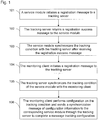
- Fig. 1 is a flowchart of a method for configuring message tracking in a telecom service in one embodiment of the disclosure. As shown in Fig. 1 , the method for configuring message tracking specifically includes following steps:
- the service module may be a whole service system of a respective service, or be multiple separate sub-modules that are involved in the tracking in a service system.
- the whole service system may be regarded as a service module; and when the tracking focuses on the management of multiple separate sub-modules in the service system or on the message transmission between the sub-modules, the multiple sub-modules in the service system may be respectively regarded as the service module.
- the registration message initiated by the service module to the tracking server includes: identity information and address information of the service module, and a name and/or type of a service performed by the service module.
- the tracking server saves the service name and/or service type in the registration message initiated by the service module, and then returns the registration success message to the service module.
- synchronizing the tracking condition with the tracking server includes following steps: the service module sends the tracking condition to the tracking server, the tracking server correlates the registration message with the tracking condition and then saves the registration message.
- the tracking condition may be a trackable message in the service performed by the service module.
- the trackable message may be the key identification field name of the trackable message and the XML format description document of the message structure of the trackable message.
- the synchronizing of the tracking condition with the tracking server by the service module may not be limited to be performed immediately after a successful registration, it can also be performed during the operation process of the service module, during which the service module synchronizes a new tracking condition with the tracking server.
- the registration message initiated by the monitoring client to the tracking server includes identify information and address information of the monitoring client.
- the tracking server saves the identity information and address information of the monitoring client in the registration message of the monitoring client, so as to synchronize the tracking condition of the service module that can be tracked by the tracking server with the monitoring client according to the address information.
- the returned tracking condition is the key identification field name of the trackable message synchronized by the service module with the tracking server and the XML format description document of the message structure of the trackable message.
- the synchronizing of the tracking condition with the monitoring client by the tracking server may not be limited to be performed immediately after the registration, it may also be performed during the operation process of the service module, during which the tracking server may directly synchronize the tracking condition with the monitoring client after receiving the tracking condition synchronized by the service module.
- the monitoring client may preferably adopt a Web displaying client, which displays a configuration interface after receiving the tracking condition.
- An administrator configures a key value for the key identification field of the trackable message through the configuration interface, and then sends the key value to the service module through the tracking server in the synchronization message of the configuration information. Since the tracking server has saved the registration messages of the service module and the monitoring client, the service module to which the key value is sent is the service module corresponding to the configured tracking condition.
- the synchronization message of configuration information further includes the identity information and/or address information of the monitoring client that sends the configuration, according to which, the service module sends the tracking results to the monitoring client.
- the service module returns a configuration success message to the monitoring client after the service module completes the configuration of message tracking according to the received synchronization message of configuration information.
- Fig. 2 is a flowchart of a method for performing message tracking in a telecom service in one embodiment of the disclosure. As shown in Fig. 2 , the method for performing message tracking specifically includes following steps:
- the administrator sends a startup message to the service module through the monitoring client.
- the service module determines whether the key value of the key field in the message received and sent in its own service logic is equal to the configured key value; if so, the message is sent to the tracking server. Since the tracking server has saved the registration messages of the service module and the monitoring client, and the synchronization message of configuration information includes the identity information and/or address information of the monitoring client that sends the configuration, tracking results are forwarded to the corresponding monitoring client continuously.
- the monitoring client may preferably adopt a Web displaying client to display tracking results in a tree structure, so as to further analyze and manage the tracking results according to the policy preset by the administrator.
- the analyses are sorted according to such rule as time or size, so as to facilitate the further management of the administrator, such as saving some tracking results that are necessary to be saved.
- the administrator sends a tracking stop message to the service module through the monitoring client.
- the methods in Fig. 1 and Fig. 2 further include a step: the tracking server keeps a Transmission Control Protocol (TCP) long link with one or more service modules and one or more monitoring clients.
- TCP Transmission Control Protocol
- the TCP long link is different from a TCP short link.
- the TCP short link is automatically disconnected after the service completes, while the TCP long link remains connected in a long term and its disconnection is independent of the completion of the service, instead, it depends on the device establishing the TCP long link.
- Any monitoring client can be connected with the tracking server at any time, and acquire by synchronization the tracking condition of the service module registered in the tracking server, thus, it is necessary to keep the link normal.
- the service module and the monitoring client may periodically detect the heartbeat message of the tracking server respectively.
- the link is normal.
- the heartbeat message is not received normally, it means the link is disconnected, and the service module or monitoring client that fails to receive the heartbeat message will re-initiate a link with the tracking server automatically.
- Fig. 3 is a structural diagram of a system for configuring message tracking in a telecom service in one embodiment of the disclosure.
- the system for message tracking includes a service module 31, a tracking server 32 and a monitoring client 33.
- the service module 31 is configured to initiate a registration message to the tracking server 32, to synchronize a tracking condition with the tracking server 32, and to receive a synchronization message of configuration information sent by the tracking server 32 to complete the configuration of message tracking.
- the service module 31 may be a whole service system of a respective service, or be multiple separate sub-modules that are involved in the tracking in a service system.
- the whole service system may be regarded as a service module 31; and when the tracking focuses on the management of multiple separate sub-modules in the service system or on the message transmission between the sub-modules, all the multiple sub-modules in the service system may be respectively regarded as the service module 31.
- the registration message initiated by the service module 31 to the tracking server 32 includes: the identity information and address information of the service module 31, and a name and/or type of a service performed by the service module.
- Synchronizing the tracking condition with the tracking server 32 includes the following steps: the service module 31 sends the tracking condition to the tracking server 32, the tracking server 32 correlates the registration message with the tracking condition and then saves the registration message.
- the tracking condition may be a trackable message in the service performed by the service module 31.
- the trackable message may be the key identification field name of the trackable message and the XML format description document of the message structure of the trackable message.
- the synchronizing of the tracking condition with the tracking server 32 by the service module 31 may not be limited to be performed immediately after a successful registration, it can also be performed during the operation process of the service module 31, during which the service module 31 synchronizes a new tracking condition with the tracking server 32.
- the service module 31 is further configured to return a configuration success message to the monitoring client after the service module 31 completes the configuration of message tracking according to the received synchronization message of configuration information.
- the tracking server 32 is configured to receive a registration message from the service module 31 and a registration message from the monitoring client 33, and to synchronize the tracking condition, obtained by synchronizing with the service module 31, with the monitoring client 33.
- the tracking server 32 saves the service name and/or service type in the registration message initiated by the service module 31, and then returns the registration success message to the service module 31.
- the tracking server 32 saves the identity information and address information of the monitoring client in the registration message of the monitoring client 33, so as to synchronize the tracking condition of the service module which can be tracked by the tracking server 32 with the monitoring client 33 according to the address information.
- the returned tracking condition is the key identification field name of the trackable message synchronized by the service module 31 with the tracking server 32 and the XML format description document of the message structure of the trackable message.
- the synchronizing of the tracking condition with the monitoring client 33 by the tracking server 32 may not be limited to be performed immediately after the registration, it may also be performed during the operation process of the service module 31, during which the tracking server 32 may directly synchronize the tracking condition with the monitoring client 33 after receiving the tracking condition synchronized by the service module 31.
- the monitoring client 33 is configured to initiate the registration message to the tracking server 32, to perform the configuration on the tracking condition, and to send the synchronization message of configuration information to the corresponding service module 31 through the tracking server 32 to complete a message tracking configuration.
- the registration message initiated by the monitoring client 33 to the tracking server 32 includes the identify information and address information of the monitoring client.
- the monitoring client 33 may preferably adopt a Web displaying client, which displays a configuration interface after receiving the tracking condition.
- An administrator configures a key value for the key identification field of the trackable message through the configuration interface, and then sends the key value to the service module 31 through the tracking server 32 in the synchronization message of the configuration information. Since the tracking server 32 has saved the registration messages of the service module 31 and the monitoring client 33, the service module 31 to which the key value is sent is the service module 31 corresponding to the configured tracking condition.
- the synchronization message of configuration information further includes the identity information and/or address information of the monitoring client 33 that sends the configuration, according to which, the service module 31 sends the tracking results to the monitoring client 33.
- the service module 31 is further configured to track a message according to the configured tracking condition, to forward the tracking results to the corresponding monitoring client 33 through the tracking server 32, and to stop tracking the message after receiving a tracking stop message.
- the service module 31 determines whether the key value of the key field in the message sent and received in its own service logic is equal to the configured key value, if so, the message is sent to the tracking server 32. Since the tracking server 32 has saved the registration messages of the service module 31 and the monitoring client 33, and the synchronization message of configuration information includes the identity information and/or address information of the monitoring client 33 that sends the configuration, tracking results are forwarded to the corresponding monitoring client 33 continuously.
- the monitoring client 33 is further configured to initiate the message tracking, to display, analyze and manage the tracking results, and to send a tracking stop message to the service module 31 through the tracking server 32.
- the administrator when the message tracking needs to be initiated, the administrator sends a startup message to the service module 31 through the monitoring client 33.
- the administrator sends a tracking stop message to the service module 31 through the monitoring client 33.
- the monitoring client 33 may preferably adopt a Web displaying client to display tracking results in a tree structure, so as to further analyze and manage the tracking results according to the policy preset by the administrator.
- the analyses are sorted according to such rule as time or size, so as to facilitate the further management of the administrator, such as saving some tracking results that are necessary to be saved.
- the tracking server 32 respectively keeps a TCP long link with one or more service modules 31 and one or more monitoring clients 33.
- Any monitoring client 31 can be connected with the tracking server 32 at any time, and acquire by synchronization the tracking condition of the service module 31 registered in the tracking server 32, thus, it is necessary to keep the link normal.
- the service module 31 and the monitoring client 33 may periodically detect the heartbeat message of the tracking server 32 respectively. When the heartbeat message is received normally, it means the link is normal. When the heartbeat message is not received normally, it means the link is disconnected, and the service module 31 or the monitoring client 33 that fails to receive the heartbeat message will re-initiate a link with the tracking server 32 automatically.
Landscapes
- Engineering & Computer Science (AREA)
- Computer Networks & Wireless Communication (AREA)
- Signal Processing (AREA)
- Telephonic Communication Services (AREA)
- Computer And Data Communications (AREA)
Description
- The present disclosure relates to the field of telecom service products, and more particularly, to a method and system for configuring message tracking in a telecom service.
- In the telecom service products, to acquire the operation state and other data of a service, it is required to track a message so as to subsequently analyze the operation of the service and further manage the service. Based on different focuses of tracking, the message tracking may be classified as tracking based on management and tracking based on message transmission.
- The tracking method based on management focuses on the management operation process of a tracked service at a service node. Specifically, the method tracks the management of a tracked message at a single service node by the triggering of a message with specific content. For example, message tracking is only performed on the calling service of the mobile terminal at a specific network node rather than the calling service of the mobile terminal at other network nodes.
- The tracking method based on the message transmission focuses on the tracking of specific message content, which may involve multiple service nodes. In the service execution process, a network node may trigger a specific message transmission between network nodes due to the receiving or sending of the specific message content, and the tracking of the above transmission process is based on the message transmission.
- It can be seen from the above that, due to different focuses of the message tracking, the current message tracking platforms are separately set up according to the characteristics and management requirements of a service or a certain type of service, and are therefore incompatible with each other. With the rapid development of the telecom industry, more and more services of different types are available, and the types and contents of messages to be tracked in various services are different, therefore, a uniform general message tracking platform is urgently needed to implement the service tracking.
- D1 (
CN 101631261 A ) D1 (CN 101631261 A ) provides a signaling tracking method, a signaling tracking background device and a tracking system, wherein the method comprises: a signaling tracking background device acquires a common interface file, the common interface file comprises a tracking condition of a logical network element of the signaling tracking foreground device; the signaling tracking background device processes the common interface file to generate a signaling tracking interface; the signaling tracking background device displays signaling tracking data satisfying the chosen tracking condition in the signaling tracking interface. Technical solutions of D1 unify signaling tracking background module codes to reduce the maintenance workload of developers. - In view of this, the main objective of the disclosure is to provide a general method and system for implementing message tracking, which is able to integrate the message tracking of various services, so as to solve the problem of incompatibility between current message tracking platforms.
- In order to achieve the objective, following technical solutions of the disclosure are provided.
- A method for configuring message tracking in a telecom service is provided, which includes following steps:
- a service module initiates a registration message to a tracking server, and synchronizes a tracking condition with the tracking server;
- a monitoring client initiates a registration message to the tracking server and receives the tracking condition synchronously sent by the tracking server; and
- The method may further include the following step that is performed after the step of sending the synchronization message of configuration information to the corresponding service module:
- the monitoring client initiates the message tracking;
- the service module tracks a message according to the configured tracking condition, and forwards tracking results to the corresponding monitoring client through the tracking server;
- the monitoring client displays, analyzes and manages the tracking results; and
- the monitoring client sends a tracking stop message to the service module through the tracking server, and the service module stops tracking the message after the service module receives the tracking stop message.
- The registration message initiated by the service module to the tracking server may include: identity information and address information of the service module, and a name and/or type of a service performed by the service module.
- The registration message initiated by the monitoring client to the tracking server may include: identify information and address information of the monitoring client.
- The tracking condition synchronously sent by the tracking server to the monitoring client may include: a key identification field name of a trackable message in the service executed by a service module and an Extensible Markup Language (XML) format description document of a message structure of the trackable message.
- The disclosure further provides a system for configuring message tracking in a telecom service, which includes a service module, a tracking server and a monitoring client.
- The service module is configured to initiate a registration message to the tracking server, to synchronize a tracking condition with the tracking server, and to receive a synchronization message of configuration information sent by the tracking server to complete configuration of message tracking.
- The tracking server is configured to receive the registration messages from the service module and a registration message from the monitoring client, and to synchronize the tracking condition, obtained by synchronizing with the service module, with the monitoring client.
- The monitoring client is configured to initiate the registration message to the tracking server, to perform a configuration on the tracking condition, and to send the synchronization message of configuration information to the corresponding service module through the tracking server to complete a message tracking configuration.
- The service module may further be configured to track a message according to the configured tracking condition, to forward tracking results to the corresponding monitoring client through the tracking server, and to stop tracking the message after receiving a tracking stop message.
- The monitoring client may further be configured to initiate the message tracking, to display, analyze and manage the tracking results, and to send the tracking stop message to the service module through the tracking server.
- The present disclosure provides a solution for configuring message tracking in the telecom service: the service module initiates the registration message to the tracking server, and synchronizes the tracking condition with the tracking server; the monitoring client initiates the registration message to the tracking server, and receives the tracking condition synchronously sent by the tracking server; and the monitoring client performs the configuration on the tracking condition and sends the synchronization message of configuration information to the corresponding service module through the tracking server to complete the message tracking configuration. According to the above solution, a general platform for the message tracking is constructed, which is able to integrate the message tracking of various different services. A new service module or new monitoring client could be added more flexibly.
-
-
Fig. 1 is a flowchart of a method for configuring message tracking in a telecom service in one embodiment of the disclosure; -
Fig. 2 is a flowchart of a method for executing message tracking in a telecom service in one embodiment of the disclosure; and -
Fig. 3 is a structural diagram of a system for configuring message tracking in a telecom service in one embodiment of the disclosure. - The technical solutions of the disclosure are further described in detail below in conjunction with drawings and specific embodiments.
-
Fig. 1 is a flowchart of a method for configuring message tracking in a telecom service in one embodiment of the disclosure. As shown inFig. 1 , the method for configuring message tracking specifically includes following steps: - Step 101: A service module initiates a registration message to a tracking server.
- Specifically, the service module may be a whole service system of a respective service, or be multiple separate sub-modules that are involved in the tracking in a service system. When the tracking focuses on the management of the whole service system, the whole service system may be regarded as a service module; and when the tracking focuses on the management of multiple separate sub-modules in the service system or on the message transmission between the sub-modules, the multiple sub-modules in the service system may be respectively regarded as the service module. The registration message initiated by the service module to the tracking server includes: identity information and address information of the service module, and a name and/or type of a service performed by the service module.
- Step 102: The tracking server returns a registration success message to the service module.
- Specifically, the tracking server saves the service name and/or service type in the registration message initiated by the service module, and then returns the registration success message to the service module.
- Step 103: The service module synchronizes a tracking condition with the tracking server after receiving the registration success message.
- Specifically, synchronizing the tracking condition with the tracking server includes following steps: the service module sends the tracking condition to the tracking server, the tracking server correlates the registration message with the tracking condition and then saves the registration message. The tracking condition may be a trackable message in the service performed by the service module. The trackable message may be the key identification field name of the trackable message and the XML format description document of the message structure of the trackable message.
- Preferably, the synchronizing of the tracking condition with the tracking server by the service module may not be limited to be performed immediately after a successful registration, it can also be performed during the operation process of the service module, during which the service module synchronizes a new tracking condition with the tracking server.
- Step 104: The monitoring client initiates a registration message to the tracking server.
- Specifically, the registration message initiated by the monitoring client to the tracking server includes identify information and address information of the monitoring client.
- Step 105: The tracking server synchronizes the tracking condition of the service module with the monitoring client.
- Specifically, the tracking server saves the identity information and address information of the monitoring client in the registration message of the monitoring client, so as to synchronize the tracking condition of the service module that can be tracked by the tracking server with the monitoring client according to the address information. Wherein, the returned tracking condition is the key identification field name of the trackable message synchronized by the service module with the tracking server and the XML format description document of the message structure of the trackable message.
- Preferably, the synchronizing of the tracking condition with the monitoring client by the tracking server may not be limited to be performed immediately after the registration, it may also be performed during the operation process of the service module, during which the tracking server may directly synchronize the tracking condition with the monitoring client after receiving the tracking condition synchronized by the service module.
- Step 106: The monitoring client performs configuration on the tracking condition, and sends a synchronization message of configuration information to the corresponding service module through the tracking server to complete a message tracking configuration.
- Specifically, the monitoring client may preferably adopt a Web displaying client, which displays a configuration interface after receiving the tracking condition. An administrator configures a key value for the key identification field of the trackable message through the configuration interface, and then sends the key value to the service module through the tracking server in the synchronization message of the configuration information. Since the tracking server has saved the registration messages of the service module and the monitoring client, the service module to which the key value is sent is the service module corresponding to the configured tracking condition. Besides the key value configured for the key identification field, the synchronization message of configuration information further includes the identity information and/or address information of the monitoring client that sends the configuration, according to which, the service module sends the tracking results to the monitoring client.
- Preferably, to avoid failure in the message transmission among the service module, the tracking server and the monitoring client, the service module returns a configuration success message to the monitoring client after the service module completes the configuration of message tracking according to the received synchronization message of configuration information.
-
Fig. 2 is a flowchart of a method for performing message tracking in a telecom service in one embodiment of the disclosure. As shown inFig. 2 , the method for performing message tracking specifically includes following steps: - Step 201: The monitoring client initiates the message tracking.
- Specifically, when the message tracking needs to be initiated, the administrator sends a startup message to the service module through the monitoring client.
- Step 202: The service module tracks a message according to the configured tracking condition, and forwards the tracking results to the corresponding monitoring client through the tracking server.
- Specifically, the service module determines whether the key value of the key field in the message received and sent in its own service logic is equal to the configured key value; if so, the message is sent to the tracking server. Since the tracking server has saved the registration messages of the service module and the monitoring client, and the synchronization message of configuration information includes the identity information and/or address information of the monitoring client that sends the configuration, tracking results are forwarded to the corresponding monitoring client continuously.
- Step 203: The monitoring client displays, analyzes and manages the tracking results.
- Specifically, the monitoring client may preferably adopt a Web displaying client to display tracking results in a tree structure, so as to further analyze and manage the tracking results according to the policy preset by the administrator. The analyses are sorted according to such rule as time or size, so as to facilitate the further management of the administrator, such as saving some tracking results that are necessary to be saved.
- Step 204: The monitoring client sends a tracking stop message to the service module through the tracking server.
- Specifically, when the message tracking needs to be stopped, the administrator sends a tracking stop message to the service module through the monitoring client.
- Step 205: The service module stops the tracking after receiving the tracking stop message, and returns a stop success message to the monitoring client.
- Preferably, the methods in
Fig. 1 andFig. 2 further include a step: the tracking server keeps a Transmission Control Protocol (TCP) long link with one or more service modules and one or more monitoring clients. The TCP long link is different from a TCP short link. The TCP short link is automatically disconnected after the service completes, while the TCP long link remains connected in a long term and its disconnection is independent of the completion of the service, instead, it depends on the device establishing the TCP long link. Any monitoring client can be connected with the tracking server at any time, and acquire by synchronization the tracking condition of the service module registered in the tracking server, thus, it is necessary to keep the link normal. A preferred solution is that the service module and the monitoring client may periodically detect the heartbeat message of the tracking server respectively. When the heartbeat message is received normally, it means the link is normal. When the heartbeat message is not received normally, it means the link is disconnected, and the service module or monitoring client that fails to receive the heartbeat message will re-initiate a link with the tracking server automatically. -
Fig. 3 is a structural diagram of a system for configuring message tracking in a telecom service in one embodiment of the disclosure. As shown inFig. 3 , the system for message tracking includes aservice module 31, a trackingserver 32 and amonitoring client 33. - The
service module 31 is configured to initiate a registration message to the trackingserver 32, to synchronize a tracking condition with the trackingserver 32, and to receive a synchronization message of configuration information sent by the trackingserver 32 to complete the configuration of message tracking. - Specifically, the
service module 31 may be a whole service system of a respective service, or be multiple separate sub-modules that are involved in the tracking in a service system. When the tracking focuses on the management of the whole service system, the whole service system may be regarded as aservice module 31; and when the tracking focuses on the management of multiple separate sub-modules in the service system or on the message transmission between the sub-modules, all the multiple sub-modules in the service system may be respectively regarded as the service module 31.The registration message initiated by theservice module 31 to the trackingserver 32 includes: the identity information and address information of theservice module 31, and a name and/or type of a service performed by the service module. - Synchronizing the tracking condition with the tracking
server 32 includes the following steps: theservice module 31 sends the tracking condition to the trackingserver 32, the trackingserver 32 correlates the registration message with the tracking condition and then saves the registration message. The tracking condition may be a trackable message in the service performed by theservice module 31. The trackable message may be the key identification field name of the trackable message and the XML format description document of the message structure of the trackable message. - Preferably, the synchronizing of the tracking condition with the tracking
server 32 by theservice module 31 may not be limited to be performed immediately after a successful registration, it can also be performed during the operation process of theservice module 31, during which theservice module 31 synchronizes a new tracking condition with the trackingserver 32. - Preferably, to avoid failure in the message transmission among the
service module 31, the trackingserver 32 and themonitoring client 32, theservice module 31 is further configured to return a configuration success message to the monitoring client after theservice module 31 completes the configuration of message tracking according to the received synchronization message of configuration information. - The tracking
server 32 is configured to receive a registration message from theservice module 31 and a registration message from themonitoring client 33, and to synchronize the tracking condition, obtained by synchronizing with theservice module 31, with themonitoring client 33. - Specifically, the tracking
server 32 saves the service name and/or service type in the registration message initiated by theservice module 31, and then returns the registration success message to theservice module 31. - The tracking
server 32 saves the identity information and address information of the monitoring client in the registration message of themonitoring client 33, so as to synchronize the tracking condition of the service module which can be tracked by the trackingserver 32 with themonitoring client 33 according to the address information. The returned tracking condition is the key identification field name of the trackable message synchronized by theservice module 31 with the trackingserver 32 and the XML format description document of the message structure of the trackable message. - Preferably, the synchronizing of the tracking condition with the
monitoring client 33 by the trackingserver 32 may not be limited to be performed immediately after the registration, it may also be performed during the operation process of theservice module 31, during which the trackingserver 32 may directly synchronize the tracking condition with themonitoring client 33 after receiving the tracking condition synchronized by theservice module 31. - The
monitoring client 33 is configured to initiate the registration message to the trackingserver 32, to perform the configuration on the tracking condition, and to send the synchronization message of configuration information to thecorresponding service module 31 through the trackingserver 32 to complete a message tracking configuration. - Specifically, the registration message initiated by the
monitoring client 33 to the trackingserver 32 includes the identify information and address information of the monitoring client. - The
monitoring client 33 may preferably adopt a Web displaying client, which displays a configuration interface after receiving the tracking condition. An administrator configures a key value for the key identification field of the trackable message through the configuration interface, and then sends the key value to theservice module 31 through the trackingserver 32 in the synchronization message of the configuration information. Since the trackingserver 32 has saved the registration messages of theservice module 31 and themonitoring client 33, theservice module 31 to which the key value is sent is theservice module 31 corresponding to the configured tracking condition. Besides the key value configured for the key identification field, the synchronization message of configuration information further includes the identity information and/or address information of themonitoring client 33 that sends the configuration, according to which, theservice module 31 sends the tracking results to themonitoring client 33. - Preferably, in the system, the
service module 31 is further configured to track a message according to the configured tracking condition, to forward the tracking results to thecorresponding monitoring client 33 through the trackingserver 32, and to stop tracking the message after receiving a tracking stop message. - Specifically, the
service module 31 determines whether the key value of the key field in the message sent and received in its own service logic is equal to the configured key value, if so, the message is sent to the trackingserver 32. Since the trackingserver 32 has saved the registration messages of theservice module 31 and themonitoring client 33, and the synchronization message of configuration information includes the identity information and/or address information of themonitoring client 33 that sends the configuration, tracking results are forwarded to thecorresponding monitoring client 33 continuously. - The
monitoring client 33 is further configured to initiate the message tracking, to display, analyze and manage the tracking results, and to send a tracking stop message to theservice module 31 through the trackingserver 32. - Specifically, when the message tracking needs to be initiated, the administrator sends a startup message to the
service module 31 through themonitoring client 33. When the message tracking needs to be stopped, the administrator sends a tracking stop message to theservice module 31 through themonitoring client 33. - The
monitoring client 33 may preferably adopt a Web displaying client to display tracking results in a tree structure, so as to further analyze and manage the tracking results according to the policy preset by the administrator. The analyses are sorted according to such rule as time or size, so as to facilitate the further management of the administrator, such as saving some tracking results that are necessary to be saved. - Preferably, in the system shown in
Fig. 3 , the trackingserver 32 respectively keeps a TCP long link with one ormore service modules 31 and one ormore monitoring clients 33. Anymonitoring client 31 can be connected with the trackingserver 32 at any time, and acquire by synchronization the tracking condition of theservice module 31 registered in the trackingserver 32, thus, it is necessary to keep the link normal. A preferred solution is that theservice module 31 and themonitoring client 33 may periodically detect the heartbeat message of the trackingserver 32 respectively. When the heartbeat message is received normally, it means the link is normal. When the heartbeat message is not received normally, it means the link is disconnected, and theservice module 31 or themonitoring client 33 that fails to receive the heartbeat message will re-initiate a link with the trackingserver 32 automatically. - What described above are only preferred embodiments of the disclosure, and many variations and alternatives thereof are possible.
Claims (10)
- A method for configuring message tracking in a telecom service, comprising:initiating, by a service module, a registration message to a tracking server, and synchronizing a tracking condition with the tracking server;initiating, by a monitoring client, a registration message to the tracking server, and receiving the tracking condition synchronously sent by the tracking server; andconfiguring, by the monitoring client, a key value for the tracking condition, and sending the key value to the corresponding service module through the tracking server in a synchronization message of configuration information to complete a message tracking configuration, then receiving a configuration success message returned from the service module.
- The method according to claim 1, further comprising the step, performed after the step of sending the synchronization message of configuration information to the corresponding service module, of:initiating, by the monitoring client, the message tracking;tracking, by the service module, a message according to the configured tracking condition, and forwarding tracking results to the corresponding monitoring client through the tracking server;displaying, analyzing and managing the tracking results by the monitoring client; andsending, by the monitoring client, a tracking stop message to the service module through the tracking server, and stopping, by the service module, tracking the message after the service module receives the tracking stop message.
- The method according to claim 1 or 2, wherein the registration message initiated by the service module to the tracking server comprises: identity information and address information of the service module, and a name and/or type of a service performed by the service module.
- The method according to claim 1 or 2, wherein the registration message initiated by the monitoring client to the tracking server comprises identify information and address information of the monitoring client.
- The method according to claim 1 or 2, wherein the tracking condition synchronously sent by the tracking server to the monitoring client comprises: a key identification field name of a trackable message in a service executed by the service module, and an Extensible Markup Language (XML) format description document of a message structure of the trackable message.
- A system for configuring message tracking in a telecom service, comprising: a service module, a tracking server and a monitoring client, wherein
the service module is configured to initiate a registration message to the tracking server, to synchronize a tracking condition with the tracking server, and to receive a synchronization message of configuration information sent by the tracking server to complete configuration of message tracking;
the tracking server is configured to receive the registration message from the service module and a registration message from the monitoring client, and to synchronize the tracking condition, obtained by synchronizing with the service module, with the monitoring client; and
the monitoring client is configured to initiate the registration message to the tracking server, to configure a key value for the tracking condition, to send the key value to the corresponding service module through the tracking server in a synchronization message of configuration information to complete a message tracking configuration, and to receive a configuration success message returned from the service module. - The system according to claim 6, wherein the service module is further configured to track a message according to the configured tracking condition, to forward tracking results to the corresponding monitoring client through the tracking server, and to stop tracking the message after receiving a tracking stop message; and
the monitoring client is further configured to initiate the message tracking, to display, analyze and manage the tracking results, and to send the tracking stop message to the service module through the tracking server. - The system according to claim 6 or 7, wherein the registration message initiated by the service module to the tracking server comprises: identity information and address information of the service module, and a name and/or type of a service performed by the service module.
- The system according to claim 6 or 7, wherein the registration message initiated by the monitoring client to the tracking server comprises identify information and address information of the monitoring client.
- The system according to claim 6 or 7, wherein the tracking condition synchronized with the monitoring client by the tracking server comprises: a key identification field name of a trackable message in a service executed by the service module, and an Extensible Markup Language (XML) format description document of a message structure of the trackable message.
Applications Claiming Priority (2)
| Application Number | Priority Date | Filing Date | Title |
|---|---|---|---|
| CN2010102514020A CN102036268A (en) | 2010-08-09 | 2010-08-09 | Configuration method and system for message tracing in telecommunication service |
| PCT/CN2011/070808 WO2012019447A1 (en) | 2010-08-09 | 2011-01-30 | Method and system for message tracking configuration in telecom services |
Publications (3)
| Publication Number | Publication Date |
|---|---|
| EP2552121A1 EP2552121A1 (en) | 2013-01-30 |
| EP2552121A4 EP2552121A4 (en) | 2013-08-28 |
| EP2552121B1 true EP2552121B1 (en) | 2016-12-28 |
Family
ID=43888425
Family Applications (1)
| Application Number | Title | Priority Date | Filing Date |
|---|---|---|---|
| EP11816006.8A Active EP2552121B1 (en) | 2010-08-09 | 2011-01-30 | Method and system for message tracking configuration in telecom services |
Country Status (6)
| Country | Link |
|---|---|
| US (1) | US9686225B2 (en) |
| EP (1) | EP2552121B1 (en) |
| CN (1) | CN102036268A (en) |
| AU (1) | AU2011288842B2 (en) |
| CA (1) | CA2797252C (en) |
| WO (1) | WO2012019447A1 (en) |
Families Citing this family (1)
| Publication number | Priority date | Publication date | Assignee | Title |
|---|---|---|---|---|
| CN104426997B (en) * | 2013-09-11 | 2019-06-21 | 中兴通讯股份有限公司 | Method and device for processing signaling tracking |
Family Cites Families (8)
| Publication number | Priority date | Publication date | Assignee | Title |
|---|---|---|---|---|
| KR100403748B1 (en) * | 1999-01-23 | 2003-11-03 | 삼성전자주식회사 | Method for tracking a location of mobile telephone in mobile telecommunication network |
| US20020049815A1 (en) * | 2000-04-14 | 2002-04-25 | Kayshav Dattatri | System for monitoring and managing information and information transfers in a computer network |
| US20040122937A1 (en) * | 2002-12-18 | 2004-06-24 | International Business Machines Corporation | System and method of tracking messaging flows in a distributed network |
| US8351914B2 (en) * | 2003-08-29 | 2013-01-08 | Sony Mobile Communications Ab | Method and system for registration of licensed modules in mobile devices |
| US20050091367A1 (en) * | 2003-10-23 | 2005-04-28 | Nokia Corporation | System and method for tracking content communicated over networks |
| US7668303B2 (en) * | 2004-08-31 | 2010-02-23 | Aspect Software, Inc. | Call tracking using SIP presence mechanism |
| CN101296119B (en) * | 2008-06-10 | 2011-03-16 | 中兴通讯股份有限公司 | Information tracking system and method |
| CN101631261B (en) * | 2009-08-19 | 2012-09-26 | 中兴通讯股份有限公司 | Signaling tracking method, signaling tracking background device and tracking system |
-
2010
- 2010-08-09 CN CN2010102514020A patent/CN102036268A/en active Pending
-
2011
- 2011-01-30 CA CA2797252A patent/CA2797252C/en not_active Expired - Fee Related
- 2011-01-30 US US13/642,920 patent/US9686225B2/en active Active
- 2011-01-30 EP EP11816006.8A patent/EP2552121B1/en active Active
- 2011-01-30 AU AU2011288842A patent/AU2011288842B2/en not_active Ceased
- 2011-01-30 WO PCT/CN2011/070808 patent/WO2012019447A1/en not_active Ceased
Non-Patent Citations (1)
| Title |
|---|
| None * |
Also Published As
| Publication number | Publication date |
|---|---|
| US9686225B2 (en) | 2017-06-20 |
| CN102036268A (en) | 2011-04-27 |
| CA2797252C (en) | 2016-10-18 |
| EP2552121A1 (en) | 2013-01-30 |
| EP2552121A4 (en) | 2013-08-28 |
| CA2797252A1 (en) | 2012-02-16 |
| US20130041944A1 (en) | 2013-02-14 |
| AU2011288842A1 (en) | 2012-11-15 |
| WO2012019447A1 (en) | 2012-02-16 |
| AU2011288842B2 (en) | 2014-05-01 |
Similar Documents
| Publication | Publication Date | Title |
|---|---|---|
| EP3125117B1 (en) | Update management system and update management method | |
| EP3288269B1 (en) | Method and system for cloud storage of video, and method and system for previewing cloud-stored video | |
| CN102664747B (en) | Cloud calculating platform system | |
| CN110086652A (en) | A kind of management system and its method for service network element in 5G core net | |
| US9596313B2 (en) | Method, terminal, cache server and system for updating webpage data | |
| CN109960634B (en) | Application program monitoring method, device and system | |
| CN103036716B (en) | Link switch-over method and system | |
| CN105978721B (en) | The methods, devices and systems of monitoring service operating status in a kind of group system | |
| CN112422684A (en) | Target message processing method and device, storage medium and electronic device | |
| CN102957623B (en) | A kind of maintaining method of neighborhood of border gate protocol and equipment | |
| US20170318483A1 (en) | Self-recovery method and device after disconnection of base station | |
| US20210274020A1 (en) | Communication method, client device, and server device | |
| CN106993043A (en) | Agent-based data communication system and method | |
| CN100426751C (en) | Method for ensuring accordant configuration information in cluster system | |
| CN108833565A (en) | A kind of method, apparatus of monitoring server, server and storage medium | |
| CN114328115A (en) | Cloud monitoring and edge operation and maintenance method and system | |
| CN115811778B (en) | Service processing method, device, storage medium and equipment | |
| CN115022877B (en) | Terminal authentication method, device, electronic device and computer-readable storage medium | |
| CA2797252C (en) | Method and system for message tracking configuration in telecom services | |
| CN111078463A (en) | Data backup method, device and system | |
| CN115865651B (en) | Data acquisition method and device, electronic equipment and storage medium | |
| CN116800604B (en) | Configurable laser communication equipment control method, device, equipment and medium | |
| CN116367204B (en) | User equipment service processing method, electronic equipment, storage medium and system | |
| CN102855249A (en) | Network element log synchronizing method and network element log synchronizing system | |
| US20250343794A1 (en) | Data access method and apparatus, electronic device and storage medium |
Legal Events
| Date | Code | Title | Description |
|---|---|---|---|
| PUAI | Public reference made under article 153(3) epc to a published international application that has entered the european phase |
Free format text: ORIGINAL CODE: 0009012 |
|
| 17P | Request for examination filed |
Effective date: 20121024 |
|
| AK | Designated contracting states |
Kind code of ref document: A1 Designated state(s): AL AT BE BG CH CY CZ DE DK EE ES FI FR GB GR HR HU IE IS IT LI LT LU LV MC MK MT NL NO PL PT RO RS SE SI SK SM TR |
|
| A4 | Supplementary search report drawn up and despatched |
Effective date: 20130729 |
|
| RIC1 | Information provided on ipc code assigned before grant |
Ipc: H04L 12/58 20060101ALI20130723BHEP Ipc: H04Q 3/00 20060101AFI20130723BHEP |
|
| DAX | Request for extension of the european patent (deleted) | ||
| GRAP | Despatch of communication of intention to grant a patent |
Free format text: ORIGINAL CODE: EPIDOSNIGR1 |
|
| INTG | Intention to grant announced |
Effective date: 20161005 |
|
| RAP1 | Party data changed (applicant data changed or rights of an application transferred) |
Owner name: ZTE CORPORATION |
|
| GRAS | Grant fee paid |
Free format text: ORIGINAL CODE: EPIDOSNIGR3 |
|
| GRAA | (expected) grant |
Free format text: ORIGINAL CODE: 0009210 |
|
| AK | Designated contracting states |
Kind code of ref document: B1 Designated state(s): AL AT BE BG CH CY CZ DE DK EE ES FI FR GB GR HR HU IE IS IT LI LT LU LV MC MK MT NL NO PL PT RO RS SE SI SK SM TR |
|
| REG | Reference to a national code |
Ref country code: GB Ref legal event code: FG4D |
|
| REG | Reference to a national code |
Ref country code: CH Ref legal event code: EP |
|
| REG | Reference to a national code |
Ref country code: AT Ref legal event code: REF Ref document number: 858182 Country of ref document: AT Kind code of ref document: T Effective date: 20170115 |
|
| REG | Reference to a national code |
Ref country code: IE Ref legal event code: FG4D |
|
| REG | Reference to a national code |
Ref country code: FR Ref legal event code: PLFP Year of fee payment: 7 |
|
| REG | Reference to a national code |
Ref country code: DE Ref legal event code: R096 Ref document number: 602011033907 Country of ref document: DE |
|
| PG25 | Lapsed in a contracting state [announced via postgrant information from national office to epo] |
Ref country code: LV Free format text: LAPSE BECAUSE OF FAILURE TO SUBMIT A TRANSLATION OF THE DESCRIPTION OR TO PAY THE FEE WITHIN THE PRESCRIBED TIME-LIMIT Effective date: 20161228 |
|
| REG | Reference to a national code |
Ref country code: LT Ref legal event code: MG4D |
|
| PG25 | Lapsed in a contracting state [announced via postgrant information from national office to epo] |
Ref country code: GR Free format text: LAPSE BECAUSE OF FAILURE TO SUBMIT A TRANSLATION OF THE DESCRIPTION OR TO PAY THE FEE WITHIN THE PRESCRIBED TIME-LIMIT Effective date: 20170329 Ref country code: LT Free format text: LAPSE BECAUSE OF FAILURE TO SUBMIT A TRANSLATION OF THE DESCRIPTION OR TO PAY THE FEE WITHIN THE PRESCRIBED TIME-LIMIT Effective date: 20161228 Ref country code: NO Free format text: LAPSE BECAUSE OF FAILURE TO SUBMIT A TRANSLATION OF THE DESCRIPTION OR TO PAY THE FEE WITHIN THE PRESCRIBED TIME-LIMIT Effective date: 20170328 Ref country code: SE Free format text: LAPSE BECAUSE OF FAILURE TO SUBMIT A TRANSLATION OF THE DESCRIPTION OR TO PAY THE FEE WITHIN THE PRESCRIBED TIME-LIMIT Effective date: 20161228 |
|
| REG | Reference to a national code |
Ref country code: NL Ref legal event code: MP Effective date: 20161228 |
|
| REG | Reference to a national code |
Ref country code: AT Ref legal event code: MK05 Ref document number: 858182 Country of ref document: AT Kind code of ref document: T Effective date: 20161228 |
|
| PG25 | Lapsed in a contracting state [announced via postgrant information from national office to epo] |
Ref country code: BE Free format text: LAPSE BECAUSE OF NON-PAYMENT OF DUE FEES Effective date: 20170131 Ref country code: RS Free format text: LAPSE BECAUSE OF FAILURE TO SUBMIT A TRANSLATION OF THE DESCRIPTION OR TO PAY THE FEE WITHIN THE PRESCRIBED TIME-LIMIT Effective date: 20161228 Ref country code: FI Free format text: LAPSE BECAUSE OF FAILURE TO SUBMIT A TRANSLATION OF THE DESCRIPTION OR TO PAY THE FEE WITHIN THE PRESCRIBED TIME-LIMIT Effective date: 20161228 Ref country code: HR Free format text: LAPSE BECAUSE OF FAILURE TO SUBMIT A TRANSLATION OF THE DESCRIPTION OR TO PAY THE FEE WITHIN THE PRESCRIBED TIME-LIMIT Effective date: 20161228 |
|
| PG25 | Lapsed in a contracting state [announced via postgrant information from national office to epo] |
Ref country code: NL Free format text: LAPSE BECAUSE OF FAILURE TO SUBMIT A TRANSLATION OF THE DESCRIPTION OR TO PAY THE FEE WITHIN THE PRESCRIBED TIME-LIMIT Effective date: 20161228 |
|
| PG25 | Lapsed in a contracting state [announced via postgrant information from national office to epo] |
Ref country code: EE Free format text: LAPSE BECAUSE OF FAILURE TO SUBMIT A TRANSLATION OF THE DESCRIPTION OR TO PAY THE FEE WITHIN THE PRESCRIBED TIME-LIMIT Effective date: 20161228 Ref country code: CZ Free format text: LAPSE BECAUSE OF FAILURE TO SUBMIT A TRANSLATION OF THE DESCRIPTION OR TO PAY THE FEE WITHIN THE PRESCRIBED TIME-LIMIT Effective date: 20161228 Ref country code: RO Free format text: LAPSE BECAUSE OF FAILURE TO SUBMIT A TRANSLATION OF THE DESCRIPTION OR TO PAY THE FEE WITHIN THE PRESCRIBED TIME-LIMIT Effective date: 20161228 Ref country code: SK Free format text: LAPSE BECAUSE OF FAILURE TO SUBMIT A TRANSLATION OF THE DESCRIPTION OR TO PAY THE FEE WITHIN THE PRESCRIBED TIME-LIMIT Effective date: 20161228 Ref country code: IS Free format text: LAPSE BECAUSE OF FAILURE TO SUBMIT A TRANSLATION OF THE DESCRIPTION OR TO PAY THE FEE WITHIN THE PRESCRIBED TIME-LIMIT Effective date: 20170428 |
|
| REG | Reference to a national code |
Ref country code: DE Ref legal event code: R119 Ref document number: 602011033907 Country of ref document: DE |
|
| PG25 | Lapsed in a contracting state [announced via postgrant information from national office to epo] |
Ref country code: IT Free format text: LAPSE BECAUSE OF FAILURE TO SUBMIT A TRANSLATION OF THE DESCRIPTION OR TO PAY THE FEE WITHIN THE PRESCRIBED TIME-LIMIT Effective date: 20161228 Ref country code: BG Free format text: LAPSE BECAUSE OF FAILURE TO SUBMIT A TRANSLATION OF THE DESCRIPTION OR TO PAY THE FEE WITHIN THE PRESCRIBED TIME-LIMIT Effective date: 20170328 Ref country code: PT Free format text: LAPSE BECAUSE OF FAILURE TO SUBMIT A TRANSLATION OF THE DESCRIPTION OR TO PAY THE FEE WITHIN THE PRESCRIBED TIME-LIMIT Effective date: 20170428 Ref country code: AT Free format text: LAPSE BECAUSE OF FAILURE TO SUBMIT A TRANSLATION OF THE DESCRIPTION OR TO PAY THE FEE WITHIN THE PRESCRIBED TIME-LIMIT Effective date: 20161228 Ref country code: PL Free format text: LAPSE BECAUSE OF FAILURE TO SUBMIT A TRANSLATION OF THE DESCRIPTION OR TO PAY THE FEE WITHIN THE PRESCRIBED TIME-LIMIT Effective date: 20161228 Ref country code: SM Free format text: LAPSE BECAUSE OF FAILURE TO SUBMIT A TRANSLATION OF THE DESCRIPTION OR TO PAY THE FEE WITHIN THE PRESCRIBED TIME-LIMIT Effective date: 20161228 Ref country code: ES Free format text: LAPSE BECAUSE OF FAILURE TO SUBMIT A TRANSLATION OF THE DESCRIPTION OR TO PAY THE FEE WITHIN THE PRESCRIBED TIME-LIMIT Effective date: 20161228 Ref country code: BE Free format text: LAPSE BECAUSE OF FAILURE TO SUBMIT A TRANSLATION OF THE DESCRIPTION OR TO PAY THE FEE WITHIN THE PRESCRIBED TIME-LIMIT Effective date: 20161228 |
|
| REG | Reference to a national code |
Ref country code: CH Ref legal event code: PL |
|
| PG25 | Lapsed in a contracting state [announced via postgrant information from national office to epo] |
Ref country code: MC Free format text: LAPSE BECAUSE OF FAILURE TO SUBMIT A TRANSLATION OF THE DESCRIPTION OR TO PAY THE FEE WITHIN THE PRESCRIBED TIME-LIMIT Effective date: 20161228 |
|
| PG25 | Lapsed in a contracting state [announced via postgrant information from national office to epo] |
Ref country code: CH Free format text: LAPSE BECAUSE OF NON-PAYMENT OF DUE FEES Effective date: 20170131 Ref country code: LI Free format text: LAPSE BECAUSE OF NON-PAYMENT OF DUE FEES Effective date: 20170131 |
|
| REG | Reference to a national code |
Ref country code: IE Ref legal event code: MM4A |
|
| PLBE | No opposition filed within time limit |
Free format text: ORIGINAL CODE: 0009261 |
|
| STAA | Information on the status of an ep patent application or granted ep patent |
Free format text: STATUS: NO OPPOSITION FILED WITHIN TIME LIMIT |
|
| GBPC | Gb: european patent ceased through non-payment of renewal fee |
Effective date: 20170328 |
|
| PG25 | Lapsed in a contracting state [announced via postgrant information from national office to epo] |
Ref country code: DK Free format text: LAPSE BECAUSE OF FAILURE TO SUBMIT A TRANSLATION OF THE DESCRIPTION OR TO PAY THE FEE WITHIN THE PRESCRIBED TIME-LIMIT Effective date: 20161228 Ref country code: LU Free format text: LAPSE BECAUSE OF NON-PAYMENT OF DUE FEES Effective date: 20170130 Ref country code: DE Free format text: LAPSE BECAUSE OF NON-PAYMENT OF DUE FEES Effective date: 20170801 |
|
| 26N | No opposition filed |
Effective date: 20170929 |
|
| REG | Reference to a national code |
Ref country code: FR Ref legal event code: PLFP Year of fee payment: 8 |
|
| PG25 | Lapsed in a contracting state [announced via postgrant information from national office to epo] |
Ref country code: SI Free format text: LAPSE BECAUSE OF FAILURE TO SUBMIT A TRANSLATION OF THE DESCRIPTION OR TO PAY THE FEE WITHIN THE PRESCRIBED TIME-LIMIT Effective date: 20161228 Ref country code: IE Free format text: LAPSE BECAUSE OF NON-PAYMENT OF DUE FEES Effective date: 20170130 Ref country code: GB Free format text: LAPSE BECAUSE OF NON-PAYMENT OF DUE FEES Effective date: 20170328 |
|
| PG25 | Lapsed in a contracting state [announced via postgrant information from national office to epo] |
Ref country code: MT Free format text: LAPSE BECAUSE OF NON-PAYMENT OF DUE FEES Effective date: 20170130 |
|
| PG25 | Lapsed in a contracting state [announced via postgrant information from national office to epo] |
Ref country code: HU Free format text: LAPSE BECAUSE OF FAILURE TO SUBMIT A TRANSLATION OF THE DESCRIPTION OR TO PAY THE FEE WITHIN THE PRESCRIBED TIME-LIMIT; INVALID AB INITIO Effective date: 20110130 |
|
| PG25 | Lapsed in a contracting state [announced via postgrant information from national office to epo] |
Ref country code: CY Free format text: LAPSE BECAUSE OF NON-PAYMENT OF DUE FEES Effective date: 20161228 |
|
| PG25 | Lapsed in a contracting state [announced via postgrant information from national office to epo] |
Ref country code: MK Free format text: LAPSE BECAUSE OF FAILURE TO SUBMIT A TRANSLATION OF THE DESCRIPTION OR TO PAY THE FEE WITHIN THE PRESCRIBED TIME-LIMIT Effective date: 20161228 |
|
| PG25 | Lapsed in a contracting state [announced via postgrant information from national office to epo] |
Ref country code: TR Free format text: LAPSE BECAUSE OF FAILURE TO SUBMIT A TRANSLATION OF THE DESCRIPTION OR TO PAY THE FEE WITHIN THE PRESCRIBED TIME-LIMIT Effective date: 20161228 |
|
| PG25 | Lapsed in a contracting state [announced via postgrant information from national office to epo] |
Ref country code: AL Free format text: LAPSE BECAUSE OF FAILURE TO SUBMIT A TRANSLATION OF THE DESCRIPTION OR TO PAY THE FEE WITHIN THE PRESCRIBED TIME-LIMIT Effective date: 20161228 |
|
| PGFP | Annual fee paid to national office [announced via postgrant information from national office to epo] |
Ref country code: FR Payment date: 20241209 Year of fee payment: 15 |