EP2552078B1 - System and Method for Identification of Wireless Communication Terminals using Speaker Recognition - Google Patents
System and Method for Identification of Wireless Communication Terminals using Speaker Recognition Download PDFInfo
- Publication number
- EP2552078B1 EP2552078B1 EP12177974.8A EP12177974A EP2552078B1 EP 2552078 B1 EP2552078 B1 EP 2552078B1 EP 12177974 A EP12177974 A EP 12177974A EP 2552078 B1 EP2552078 B1 EP 2552078B1
- Authority
- EP
- European Patent Office
- Prior art keywords
- wireless communication
- voice calls
- monitoring
- voice
- individuals
- Prior art date
- Legal status (The legal status is an assumption and is not a legal conclusion. Google has not performed a legal analysis and makes no representation as to the accuracy of the status listed.)
- Not-in-force
Links
Images

Classifications
-
- H—ELECTRICITY
- H04—ELECTRIC COMMUNICATION TECHNIQUE
- H04L—TRANSMISSION OF DIGITAL INFORMATION, e.g. TELEGRAPHIC COMMUNICATION
- H04L63/00—Network architectures or network communication protocols for network security
- H04L63/30—Network architectures or network communication protocols for network security for supporting lawful interception, monitoring or retaining of communications or communication related information
-
- H—ELECTRICITY
- H04—ELECTRIC COMMUNICATION TECHNIQUE
- H04W—WIRELESS COMMUNICATION NETWORKS
- H04W12/00—Security arrangements; Authentication; Protecting privacy or anonymity
- H04W12/02—Protecting privacy or anonymity, e.g. protecting personally identifiable information [PII]
-
- H—ELECTRICITY
- H04—ELECTRIC COMMUNICATION TECHNIQUE
- H04W—WIRELESS COMMUNICATION NETWORKS
- H04W12/00—Security arrangements; Authentication; Protecting privacy or anonymity
- H04W12/03—Protecting confidentiality, e.g. by encryption
- H04W12/033—Protecting confidentiality, e.g. by encryption of the user plane, e.g. user's traffic
-
- G—PHYSICS
- G10—MUSICAL INSTRUMENTS; ACOUSTICS
- G10L—SPEECH ANALYSIS TECHNIQUES OR SPEECH SYNTHESIS; SPEECH RECOGNITION; SPEECH OR VOICE PROCESSING TECHNIQUES; SPEECH OR AUDIO CODING OR DECODING
- G10L17/00—Speaker identification or verification techniques
Definitions
- the present disclosure relates generally to communication monitoring, and particularly to methods and systems for identifying wireless communication terminals using speaker recognition.
- WO 2007/105193A1 discloses a method and apparatus for capturing a communication item according to an interception criteria and then analyzing a captured communication item using an analysis engine.
- a method comprising: holding in a memory respective digital voice signatures of individuals; monitoring voice calls conducted by wireless communication terminals in a wireless communication network, and extracting speech content from the monitored voice calls; and identifying a wireless communication terminal that is operated by one of the individuals by comparing the speech content extracted from the voice calls of the terminal to the voice signatures, characterized in that monitoring the voice calls comprises extracting from the voice calls respective identifiers of the wireless communication terminals, and wherein identifying the wireless communication terminal comprises associating between the one of the individuals and an extracted identifier of the identified wireless communication terminal.
- monitoring the voice calls includes receiving wireless signals that carry the voice calls and are exchanged between the wireless communication terminals and one or more base stations of the wireless communication network.
- monitoring the voice calls includes receiving the voice calls passively without affecting the wireless communication network.
- at least some of the voice calls in the wireless communication network are encrypted, and monitoring the voice calls includes decrypting the encrypted voice calls so as to enable extraction of the speech content.
- monitoring the voice calls and extracting the speech content include indiscriminately processing all receivable voice calls.
- the extracted identifier includes a temporary identifier that is assigned temporarily by the wireless communication network to the identified wireless communication terminal.
- the extracted identifier may be Temporary Mobile Subscriber Identity (TMSI).
- the method includes outputting an association between the identified terminal and the one of the target individuals. In an embodiment, the method includes tracking the one of the target individuals based on the association.
- apparatus including a memory, a receiver and a processor.
- the memory is configured to hold digital voice signatures of respective target individuals.
- the receiver is configured to monitor voice calls conducted by wireless communication terminals in a wireless communication network.
- the processor is configured to extract speech content from the monitored voice calls, and to identify a wireless communication terminal that is operated by one of the target individuals, by comparing the speech content extracted from the voice calls of the terminal to the voice signatures.
- Embodiments that are described herein provide improved methods and systems for monitoring communication of wireless communication terminals such as cellular phones.
- the disclosed techniques identify wireless communication terminals that are operated by target individuals, by comparing speech content that is extracted from voice calls of the terminals to known voice signatures of the target individuals.
- a passive monitoring system monitors voice calls that are conducted by wireless communication terminals in a wireless communication network.
- Some of the terminals may be operated by individuals who are defined as targets for surveillance, but the association between the target individuals and the terminals may not be known.
- a target individual may use a prepaid Subscriber Identity Module (SIM) that was never used before in order to evade surveillance.
- SIM Subscriber Identity Module
- the over-the-air communication with the terminal rarely indicates permanent identifiers of the terminal such as International Mobile Subscriber Identities (IMSI), International Mobile Equipment Identities (IMEI) or Mobile Subscriber Integrated Services Digital Network Number (MSISDN typically corresponding to the telephone number associated with the terminal).
- IMSI International Mobile Subscriber Identities
- IMEI International Mobile Equipment Identities
- MSISDN Mobile Subscriber Integrated Services Digital Network Number
- TMSI Temporary Mobile Subscriber Identities
- the system In order to find terminals that are operated by target individuals, the system extracts speech content from the monitored voice calls and compares the speech content to known digital voice signatures of the target individuals. If a match is found, the system concludes that the matching speech content originates from a terminal that is operated by a target individual. Based on the voice signature matching, the system is able to correlate the temporary terminal identifier (e.g., TMSI) with the target individual, and to enable tracking of that TMSI until association with a permanent terminal identifier is available.
- TMSI temporary terminal identifier
- the terminal can be tracked using any suitable method in order to collect information related to this individual.
- the system is able to produce the temporary identifiers of the terminal (e.g., TMSI) within seconds, so as to enable real-time tracking and surveillance.
- TMSI temporary identifiers of the terminal
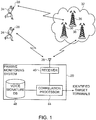
- Fig. 1 is a block diagram that schematically illustrates a system 20 for passive monitoring of wireless communication terminals 28 operated by users or individuals 24, in accordance with an embodiment that is described herein.
- system 20 uses methods that are described below to identify terminals that are operated by certain individuals who are defined as targets.
- Systems of this sort may be operated, for example, by intelligence or law enforcement agencies in order to track suspect individuals, or by any other entity for any other purpose.
- Terminals 28 communicate over a wireless communication network 32.
- Terminals 28 may comprise, for example, cellular phones, wireless-enabled mobile computers or Personal Digital Assistants (PDAs), or any other suitable type of communication terminals.
- Network 32 may comprise, for example, a cellular network such as a Global System for Mobile communication (GSM) or Universal Mobile Telecommunications System (UMTS) network, a Wireless Local-Area Network (WLAN - also referred to as Wi-Fi network), or any other suitable network type.
- GSM Global System for Mobile communication
- UMTS Universal Mobile Telecommunications System
- WLAN - Wireless Local-Area Network
- network 32 comprises a cellular network that comprises multiple base stations 36 with which terminals 28 communicate.
- System 20 monitors voice calls that are conducted by terminals 28 over network 32.
- system 20 is passive, i.e., monitors the communication using reception only without transmitting to network 32 or otherwise affecting the network operation.
- the disclosed techniques can be applied in active monitoring systems, as well.
- system 20 monitors the voice calls off-the-air, i.e., by receiving wireless signals that are exchanged between terminals 28 and base stations 36.
- system 20 may monitor the voice calls using other mechanisms, such as by tapping one or more of the wire-line interfaces within network 32.
- system 20 comprises a receiver 40 that receives wireless signals from network 32 via a receive antenna 38.
- System 20 further comprises a correlation processor 44 that carries out the methods described herein, and a voice signature database 48.
- Database 48 holds digital voice signatures of target individuals.
- voice signature refers to any information that is uniquely indicative of the voice characteristics of a certain target individual, such that comparing digitized speech to the voice signature enables deciding with high likelihood whether the digitized speech was enunciated by the target individual.
- Voice signatures are sometimes referred to as voiceprints.
- the voice signatures in database 48 may be produced or provided to system 20 in any suitable way.
- Receiver 40 processes the signals received from network 32, so as to decode voice calls that are conducted by terminals 28.
- the receiver extracts digitized speech content from the calls.
- the receiver extracts one or more identifiers of the terminals conducting the calls.
- Extracted identifiers typically comprise temporary identifiers that are assigned temporarily by network 32 to the terminals and transmitted over the air.
- temporary identifiers typically comprise TMSI.
- temporary identifiers typically comprise Internet Protocol (IP) addresses of the terminals.
- IP Internet Protocol
- Receiver 40 provides the speech content, and the corresponding identifiers of the terminals from which the speech content originated, to correlation processor 44.
- the over-the-air communication between terminals and base stations 36 is encrypted.
- receiver 40 decrypts the received voice calls in real time, and then extracts the speech content from the decrypted calls.
- the encryption scheme may differ from one network type to another.
- GSM networks typically use A5.0/A5.1/A5.2 encryption
- UMTS networks typically use A5.3 encryption
- WLANs typically use WEP/WPA encryption.
- receiver 40 may decrypt any other suitable encryption scheme that is used in network 32.
- receiver 40 is modular and comprises multiple modules (not shown) - e.g., one or more Radio frequency (RF) modules for receiving signals from network 32, and one or more decryption modules for decrypting the over-the-air encryption.
- RF Radio frequency
- Processor 44 compares the speech content extracted from the voice calls to the voice signatures stored in database 48. In this comparison, processor 44 attempts to find speech content that matches one of the signatures. If certain speech content is found to match a given voice signature, processor 44 concludes that the terminal from which the speech content originated is operated by the target individual whose voice signature was found to match the speech content. Thus, processor 44 associates the temporary identifier or identifiers of this terminal with the target individual.
- processor 44 later associates the temporary identifiers extracted from the over-the-air communication with permanent identifiers of the terminals. This stage is often not performed in real time.
- the terminal TMSI may later be associated with IMSI or MSISDN.
- the terminal's IP address may later be associated with a Medium Access Control (MAC) address.
- MAC Medium Access Control
- the voice-signature based correlation techniques described herein enable system 20 to associate terminal identifiers with target individuals, even in the absence of any prior knowledge regarding such an association. For example, suspect individuals often use new cellular phones or prepaid Subscriber Identity Modules (SIM) that was never used before in order to evade surveillance.
- SIM Subscriber Identity Modules
- system 20 is able to associate new identifiers with known target individuals based on voice signature matching.
- the disclosed techniques assist passive monitoring systems to correlate temporary terminal identifiers (e.g., TMSI or IP address) with target individuals, so as to enable tracking of the terminals until association with a permanent identifier (e.g., IMSI or MAC address) is available.
- Processor 44 may act upon the identified associations between terminals and target individuals in any desired way. For example, the processor may output the associations to an operator or to another system for further analysis. The processor may issue an alert upon finding a new association, or perform any other suitable action.
- the correlation process carried out by processor 44 is typically fast, and produces correlations within seconds. Therefore, the disclosed techniques are particularly suitable for real-time surveillance applications.
- system 20 shown in Fig. 1 is an example configuration, which is chosen purely for the sake of conceptual clarity. In alternative embodiments, any other suitable system configuration can also be used. Some elements of system 20 may be implemented in hardware, e.g., in one or more Application-Specific Integrated Circuits (ASICs) or Field-Programmable Gate Arrays (FPGAs). Additionally or alternatively, some system elements can be implemented using software, or using a combination of hardware and software elements.
- Signature database 48 may be implemented using any suitable type of memory, such as using one or more magnetic or solid state memory devices.
- processor 44 comprises a general-purpose processor, which is programmed in software to carry out the functions described herein.
- the software may be downloaded to the processor in electronic form, over a network, for example, or it may, alternatively or additionally, be provided and/or stored on non-transitory tangible media, such as magnetic, optical, or electronic memory.
- Fig. 2 is a flow chart that schematically illustrates a method for passive monitoring of wireless communication terminals, in accordance with an embodiment that is described herein.
- the method begins with system 20 storing digital voice signatures of target individuals in database 48, at a signature storage step 60.
- System 20 monitors voice call conducted by terminals 28 over network 32, at a monitoring step 64.
- the system carries out passive, off-the-air monitoring using receiver 40.
- the system indiscriminately monitors any received voice call.
- the system monitors only a certain subset of the voice calls.
- receiver 40 decrypts the encryption that is used to encrypt the monitored voice calls.
- Receiver 40 extracts speech content from the monitored voice calls, at a speech extraction step 68. In addition, the receiver extracts identifiers of the terminals. Correlation processor 44 compares the extracted speech content with the voice signatures in database 48, at a signature correlation step 72. Any suitable correlation method can be used for this purpose.
- processor 44 associates the terminal and target individual in question, at a correlation step 80. In other words, processor 44 associates the terminal identifier (of the terminal conducting the voice calls from which the matching speech content was extracted) with the target individual (whose voice signature matched the speech content). System 20 then tracks the identified terminal, at a tracking step 84. The method loops back to step 64 for monitoring and analyzing additional voice calls. If no match is found at step 76 above, the method loops back from step 76 to step 64, and steps 80 and 84 are skipped.
Landscapes
- Engineering & Computer Science (AREA)
- Computer Security & Cryptography (AREA)
- Computer Networks & Wireless Communication (AREA)
- Signal Processing (AREA)
- Technology Law (AREA)
- Computer Hardware Design (AREA)
- Computing Systems (AREA)
- General Engineering & Computer Science (AREA)
- Telephonic Communication Services (AREA)
Description
- The present disclosure relates generally to communication monitoring, and particularly to methods and systems for identifying wireless communication terminals using speaker recognition.
- Various speaker recognition techniques are known in the art. For example, Reynolds and Rose describe text-independent speaker identification techniques, in "Robust Text-Independent Speaker Identification using Gaussian Mixture Speaker Models," IEEE Transactions on Speech and Audio Processing, volume 3, no. 1, January, 1995. Another technique is described by Monte et al., in "Text-Independent Speaker Identification on Noisy Environments by Means of Self Organizing Maps," Proceedings of the Fourth International Conference on Spoken Language (ICSLP), October, 1996.
-
WO 2007/105193A1 discloses a method and apparatus for capturing a communication item according to an interception criteria and then analyzing a captured communication item using an analysis engine. - According to the invention, there is provided a method comprising: holding in a memory respective digital voice signatures of individuals; monitoring voice calls conducted by wireless communication terminals in a wireless communication network, and extracting speech content from the monitored voice calls; and identifying a wireless communication terminal that is operated by one of the individuals by comparing the speech content extracted from the voice calls of the terminal to the voice signatures, characterized in that monitoring the voice calls comprises extracting from the voice calls respective identifiers of the wireless communication terminals, and wherein identifying the wireless communication terminal comprises associating between the one of the individuals and an extracted identifier of the identified wireless communication terminal. In some embodiments, monitoring the voice calls includes receiving wireless signals that carry the voice calls and are exchanged between the wireless communication terminals and one or more base stations of the wireless communication network. In an embodiment, monitoring the voice calls includes receiving the voice calls passively without affecting the wireless communication network. In a disclosed embodiment, at least some of the voice calls in the wireless communication network are encrypted, and monitoring the voice calls includes decrypting the encrypted voice calls so as to enable extraction of the speech content. In another embodiment, monitoring the voice calls and extracting the speech content include indiscriminately processing all receivable voice calls.
- In another embodiment, the extracted identifier includes a temporary identifier that is assigned temporarily by the wireless communication network to the identified wireless communication terminal. The extracted identifier may be Temporary Mobile Subscriber Identity (TMSI).
- In yet another embodiment, the method includes outputting an association between the identified terminal and the one of the target individuals. In an embodiment, the method includes tracking the one of the target individuals based on the association.
- There is additionally provided, in accordance with an embodiment that is described herein, apparatus including a memory, a receiver and a processor. The memory is configured to hold digital voice signatures of respective target individuals. The receiver is configured to monitor voice calls conducted by wireless communication terminals in a wireless communication network. The processor is configured to extract speech content from the monitored voice calls, and to identify a wireless communication terminal that is operated by one of the target individuals, by comparing the speech content extracted from the voice calls of the terminal to the voice signatures.
- The present disclosure will be more fully understood from the following detailed description of the embodiments thereof, taken together with the drawings in which:
-
-
Fig. 1 is a block diagram that schematically illustrates a system for passive monitoring of wireless communication terminals, in accordance with an embodiment that is described herein; and -
Fig. 2 is a flow chart that schematically illustrates a method for passive monitoring of wireless communication terminals, in accordance with an embodiment that is described herein. - Embodiments that are described herein provide improved methods and systems for monitoring communication of wireless communication terminals such as cellular phones. The disclosed techniques identify wireless communication terminals that are operated by target individuals, by comparing speech content that is extracted from voice calls of the terminals to known voice signatures of the target individuals.
- In some embodiments, a passive monitoring system monitors voice calls that are conducted by wireless communication terminals in a wireless communication network. Some of the terminals may be operated by individuals who are defined as targets for surveillance, but the association between the target individuals and the terminals may not be known. For example, a target individual may use a prepaid Subscriber Identity Module (SIM) that was never used before in order to evade surveillance.
- Moreover, in most network types the over-the-air communication with the terminal rarely indicates permanent identifiers of the terminal such as International Mobile Subscriber Identities (IMSI), International Mobile Equipment Identities (IMEI) or Mobile Subscriber Integrated Services Digital Network Number (MSISDN typically corresponding to the telephone number associated with the terminal). Other than on rare occasions, the over-the-air communication indicates temporary identifiers, such as Temporary Mobile Subscriber Identities (TMSI). Therefore, it is difficult for a passive monitoring system to correlate target individuals with the terminals they use, because the system usually intercepts temporary identifiers.
- In order to find terminals that are operated by target individuals, the system extracts speech content from the monitored voice calls and compares the speech content to known digital voice signatures of the target individuals. If a match is found, the system concludes that the matching speech content originates from a terminal that is operated by a target individual. Based on the voice signature matching, the system is able to correlate the temporary terminal identifier (e.g., TMSI) with the target individual, and to enable tracking of that TMSI until association with a permanent terminal identifier is available.
- Once a terminal is identified as being operated by a target individual, the terminal can be tracked using any suitable method in order to collect information related to this individual. In a typical application, the system is able to produce the temporary identifiers of the terminal (e.g., TMSI) within seconds, so as to enable real-time tracking and surveillance. The disclosed techniques are thus particularly suitable for passive, off-the-air monitoring systems.
-
Fig. 1 is a block diagram that schematically illustrates asystem 20 for passive monitoring ofwireless communication terminals 28 operated by users orindividuals 24, in accordance with an embodiment that is described herein. In particular,system 20 uses methods that are described below to identify terminals that are operated by certain individuals who are defined as targets. Systems of this sort may be operated, for example, by intelligence or law enforcement agencies in order to track suspect individuals, or by any other entity for any other purpose. -
Terminals 28 communicate over awireless communication network 32.Terminals 28 may comprise, for example, cellular phones, wireless-enabled mobile computers or Personal Digital Assistants (PDAs), or any other suitable type of communication terminals.Network 32 may comprise, for example, a cellular network such as a Global System for Mobile communication (GSM) or Universal Mobile Telecommunications System (UMTS) network, a Wireless Local-Area Network (WLAN - also referred to as Wi-Fi network), or any other suitable network type. In the present example,network 32 comprises a cellular network that comprisesmultiple base stations 36 with whichterminals 28 communicate. -
System 20 monitors voice calls that are conducted byterminals 28 overnetwork 32. In the embodiment ofFig. 1 ,system 20 is passive, i.e., monitors the communication using reception only without transmitting tonetwork 32 or otherwise affecting the network operation. In alternative embodiments, however, the disclosed techniques can be applied in active monitoring systems, as well. In the embodiment ofFig. 1 ,system 20 monitors the voice calls off-the-air, i.e., by receiving wireless signals that are exchanged betweenterminals 28 andbase stations 36. Alternatively,system 20 may monitor the voice calls using other mechanisms, such as by tapping one or more of the wire-line interfaces withinnetwork 32. - In the present example,
system 20 comprises areceiver 40 that receives wireless signals fromnetwork 32 via areceive antenna 38.System 20 further comprises acorrelation processor 44 that carries out the methods described herein, and avoice signature database 48. -
Database 48 holds digital voice signatures of target individuals. The term "voice signature" refers to any information that is uniquely indicative of the voice characteristics of a certain target individual, such that comparing digitized speech to the voice signature enables deciding with high likelihood whether the digitized speech was enunciated by the target individual. Voice signatures are sometimes referred to as voiceprints. The voice signatures indatabase 48 may be produced or provided tosystem 20 in any suitable way. -
Receiver 40 processes the signals received fromnetwork 32, so as to decode voice calls that are conducted byterminals 28. The receiver extracts digitized speech content from the calls. In addition, the receiver extracts one or more identifiers of the terminals conducting the calls. Extracted identifiers typically comprise temporary identifiers that are assigned temporarily bynetwork 32 to the terminals and transmitted over the air. In GSM and UMTS networks, for example, temporary identifiers typically comprise TMSI. In WLANs, temporary identifiers typically comprise Internet Protocol (IP) addresses of the terminals. Alternatively, any other suitable identifiers can be used.Receiver 40 provides the speech content, and the corresponding identifiers of the terminals from which the speech content originated, tocorrelation processor 44. - In some embodiments, the over-the-air communication between terminals and
base stations 36 is encrypted. In these embodiments,receiver 40 decrypts the received voice calls in real time, and then extracts the speech content from the decrypted calls. The encryption scheme may differ from one network type to another. GSM networks, for example, typically use A5.0/A5.1/A5.2 encryption, UMTS networks typically use A5.3 encryption, while WLANs typically use WEP/WPA encryption. Alternatively,receiver 40 may decrypt any other suitable encryption scheme that is used innetwork 32. - Thus, in some
embodiments receiver 40 is modular and comprises multiple modules (not shown) - e.g., one or more Radio frequency (RF) modules for receiving signals fromnetwork 32, and one or more decryption modules for decrypting the over-the-air encryption. -
Processor 44 compares the speech content extracted from the voice calls to the voice signatures stored indatabase 48. In this comparison,processor 44 attempts to find speech content that matches one of the signatures. If certain speech content is found to match a given voice signature,processor 44 concludes that the terminal from which the speech content originated is operated by the target individual whose voice signature was found to match the speech content. Thus,processor 44 associates the temporary identifier or identifiers of this terminal with the target individual. - In some embodiments,
processor 44 later associates the temporary identifiers extracted from the over-the-air communication with permanent identifiers of the terminals. This stage is often not performed in real time. In GSM and UMTS networks, for example, the terminal TMSI may later be associated with IMSI or MSISDN. As another example, in a WLAN, the terminal's IP address may later be associated with a Medium Access Control (MAC) address. - The voice-signature based correlation techniques described herein enable
system 20 to associate terminal identifiers with target individuals, even in the absence of any prior knowledge regarding such an association. For example, suspect individuals often use new cellular phones or prepaid Subscriber Identity Modules (SIM) that was never used before in order to evade surveillance. Using the disclosed correlation technique,system 20 is able to associate new identifiers with known target individuals based on voice signature matching. As described above, the disclosed techniques assist passive monitoring systems to correlate temporary terminal identifiers (e.g., TMSI or IP address) with target individuals, so as to enable tracking of the terminals until association with a permanent identifier (e.g., IMSI or MAC address) is available. -
Processor 44 may act upon the identified associations between terminals and target individuals in any desired way. For example, the processor may output the associations to an operator or to another system for further analysis. The processor may issue an alert upon finding a new association, or perform any other suitable action. The correlation process carried out byprocessor 44 is typically fast, and produces correlations within seconds. Therefore, the disclosed techniques are particularly suitable for real-time surveillance applications. - The configuration of
system 20 shown inFig. 1 is an example configuration, which is chosen purely for the sake of conceptual clarity. In alternative embodiments, any other suitable system configuration can also be used. Some elements ofsystem 20 may be implemented in hardware, e.g., in one or more Application-Specific Integrated Circuits (ASICs) or Field-Programmable Gate Arrays (FPGAs). Additionally or alternatively, some system elements can be implemented using software, or using a combination of hardware and software elements.Signature database 48 may be implemented using any suitable type of memory, such as using one or more magnetic or solid state memory devices. - Typically,
processor 44 comprises a general-purpose processor, which is programmed in software to carry out the functions described herein. The software may be downloaded to the processor in electronic form, over a network, for example, or it may, alternatively or additionally, be provided and/or stored on non-transitory tangible media, such as magnetic, optical, or electronic memory. -
Fig. 2 is a flow chart that schematically illustrates a method for passive monitoring of wireless communication terminals, in accordance with an embodiment that is described herein. The method begins withsystem 20 storing digital voice signatures of target individuals indatabase 48, at asignature storage step 60.System 20 monitors voice call conducted byterminals 28 overnetwork 32, at amonitoring step 64. - In the present example, the system carries out passive, off-the-air
monitoring using receiver 40. In an embodiment, the system indiscriminately monitors any received voice call. In alternative embodiments, the system monitors only a certain subset of the voice calls. Typically,receiver 40 decrypts the encryption that is used to encrypt the monitored voice calls. -
Receiver 40 extracts speech content from the monitored voice calls, at aspeech extraction step 68. In addition, the receiver extracts identifiers of the terminals.Correlation processor 44 compares the extracted speech content with the voice signatures indatabase 48, at asignature correlation step 72. Any suitable correlation method can be used for this purpose. - If a match is found, as checked at a checking
step 76,processor 44 associates the terminal and target individual in question, at acorrelation step 80. In other words,processor 44 associates the terminal identifier (of the terminal conducting the voice calls from which the matching speech content was extracted) with the target individual (whose voice signature matched the speech content).System 20 then tracks the identified terminal, at a trackingstep 84. The method loops back to step 64 for monitoring and analyzing additional voice calls. If no match is found atstep 76 above, the method loops back fromstep 76 to step 64, and steps 80 and 84 are skipped. - It will be appreciated that the embodiments described above are cited by way of example, and that the present disclosure is not limited to what has been particularly shown and described hereinabove. Rather, the scope of the present disclosure includes both combinations and sub-combinations of the various features described hereinabove, as well as variations and modifications thereof which would occur to persons skilled in the art upon reading the foregoing description and which are not disclosed in the prior art.
- The scope of the invention is defined by the appended claims.
Claims (9)
- A method, comprising:holding in a memory (48) respective digital voice signatures of individuals;monitoring (64) voice calls conducted by wireless communication terminals (28) in a wireless communication network (32), and extracting (68) speech content from the monitored voice calls; andidentifying a wireless communication terminal (28) that is operated by one of the individuals by comparing (72) the speech content extracted from the voice calls of the terminal (28) to the voice signatures, characterized in that monitoring (64) the voice calls comprises extracting from the voice calls respective identifiers of the wireless communication terminals (28), and wherein identifying the wireless communication terminal comprises associating (80) between the one of the individuals and an extracted identifier of the identified wireless communication terminal (28).
- The method according to claim 1, wherein monitoring (64) the voice calls comprises receiving wireless signals that carry the voice calls and are exchanged between the wireless communication terminals (28) and one or more base stations (36) of the wireless communication network (32) .
- The method according to claim 1, wherein monitoring (64) the voice calls comprises receiving the voice calls passively without affecting the wireless communication network (32).
- The method according to claim 1, wherein at least some of the voice calls in the wireless communication network (32) are encrypted, and wherein monitoring (64) the voice calls comprises decrypting the encrypted voice calls so as to enable extraction of the speech content.
- The method according to claim 1, wherein monitoring (64) the voice calls and extracting (68) the speech content comprise indiscriminately processing all receivable voice calls.
- The method according to claim 1, wherein the extracted identifier comprises a temporary identifier that is assigned temporarily by the wireless communication network (32) to the identified wireless communication terminal (28).
- The method according to claim 1, and comprising outputting an association between the identified terminal (28) and the one of the individuals.
- The method according to claim 7, and comprising tracking (84) the one of the individuals based on the association.
- The method of claim 1 wherein the extracted identifier is Temporary Mobile Subscriber Identity (TMSI).
Applications Claiming Priority (1)
| Application Number | Priority Date | Filing Date | Title |
|---|---|---|---|
| IL214297A IL214297A (en) | 2011-07-26 | 2011-07-26 | System and method for identification of wireless communication terminals using speaker recognition |
Publications (2)
| Publication Number | Publication Date |
|---|---|
| EP2552078A1 EP2552078A1 (en) | 2013-01-30 |
| EP2552078B1 true EP2552078B1 (en) | 2018-09-19 |
Family
ID=45773710
Family Applications (1)
| Application Number | Title | Priority Date | Filing Date |
|---|---|---|---|
| EP12177974.8A Not-in-force EP2552078B1 (en) | 2011-07-26 | 2012-07-26 | System and Method for Identification of Wireless Communication Terminals using Speaker Recognition |
Country Status (2)
| Country | Link |
|---|---|
| EP (1) | EP2552078B1 (en) |
| IL (1) | IL214297A (en) |
Families Citing this family (1)
| Publication number | Priority date | Publication date | Assignee | Title |
|---|---|---|---|---|
| CN103533028A (en) * | 2013-09-26 | 2014-01-22 | 深圳市金立通信设备有限公司 | Method and terminal for monitoring state information |
Family Cites Families (4)
| Publication number | Priority date | Publication date | Assignee | Title |
|---|---|---|---|---|
| EP1096474A2 (en) * | 1999-10-26 | 2001-05-02 | Persay Inc., c/o Corporation Service Company | Speaker verification system and method |
| AU2002253449A1 (en) * | 2002-04-12 | 2003-10-27 | Nokia Corporation | Infection-based monitoring of a party in a communication network |
| US20100199189A1 (en) * | 2006-03-12 | 2010-08-05 | Nice Systems, Ltd. | Apparatus and method for target oriented law enforcement interception and analysis |
| US8675863B2 (en) * | 2009-12-22 | 2014-03-18 | Trueposition, Inc. | Passive system for recovering cryptography keys |
-
2011
- 2011-07-26 IL IL214297A patent/IL214297A/en active IP Right Grant
-
2012
- 2012-07-26 EP EP12177974.8A patent/EP2552078B1/en not_active Not-in-force
Non-Patent Citations (1)
| Title |
|---|
| None * |
Also Published As
| Publication number | Publication date |
|---|---|
| IL214297A0 (en) | 2011-09-27 |
| EP2552078A1 (en) | 2013-01-30 |
| IL214297A (en) | 2016-08-31 |
Similar Documents
| Publication | Publication Date | Title |
|---|---|---|
| EP2587405B1 (en) | System and method for interception of IP traffic based on image processing | |
| US8675863B2 (en) | Passive system for recovering cryptography keys | |
| US20200107195A1 (en) | System and method for combined network-side and off-air monitoring of wireless networks | |
| US20210211369A1 (en) | System and method for extracting identifiers from traffic of an unknown protocol | |
| US11381977B2 (en) | System and method for decrypting communication exchanged on a wireless local area network | |
| US8483672B2 (en) | System and method for selective monitoring of mobile communication terminals based on speech key-phrases | |
| CN109151827B (en) | WiFi positioning spoofing detection method and device based on radio frequency fingerprint | |
| US8254573B2 (en) | System and method for ciphering key forwarding and RRC packet deciphering in a UMTS monitoring system | |
| Van Do et al. | Detecting IMSI-catcher using soft computing | |
| US10079933B2 (en) | System and method for user-privacy-aware communication monitoring and analysis | |
| US9380412B2 (en) | System and method for location of wireless communication terminals using application-level location data | |
| US9025833B2 (en) | System and method for video-assisted identification of mobile phone users | |
| CN104751848A (en) | Call voice recognition method and call voice recognition device | |
| US9107042B2 (en) | System and method for joint passive interception of satellite and cellular communication | |
| EP2552078A1 (en) | System and Method for Identification of Wireless Communication Terminals using Speaker Recognition | |
| US10057409B2 (en) | System and method for cellular call monitoring using downlink channel correlation | |
| US9179302B2 (en) | System and method for communication terminal surveillance based on speaker recognition | |
| Harmat et al. | The security implications of imsi catchers | |
| FI117782B (en) | Procedure for identifying a mobile device, identification system, base station and network elements | |
| EP2552141B1 (en) | Method for tracking wireless communication terminals using application-layer identifier correlation | |
| US20130115924A1 (en) | System and method for combined passive and active interception of mobile communication | |
| Cuadrado Cordero et al. | Wireless location: A survey about GSM in location techniques | |
| CN109041044A (en) | Technology methods of investigation and technology Reconnaissance system |
Legal Events
| Date | Code | Title | Description |
|---|---|---|---|
| PUAI | Public reference made under article 153(3) epc to a published international application that has entered the european phase |
Free format text: ORIGINAL CODE: 0009012 |
|
| AK | Designated contracting states |
Kind code of ref document: A1 Designated state(s): AL AT BE BG CH CY CZ DE DK EE ES FI FR GB GR HR HU IE IS IT LI LT LU LV MC MK MT NL NO PL PT RO RS SE SI SK SM TR |
|
| AX | Request for extension of the european patent |
Extension state: BA ME |
|
| 17P | Request for examination filed |
Effective date: 20130729 |
|
| RBV | Designated contracting states (corrected) |
Designated state(s): AL AT BE BG CH CY CZ DE DK EE ES FI FR GB GR HR HU IE IS IT LI LT LU LV MC MK MT NL NO PL PT RO RS SE SI SK SM TR |
|
| GRAP | Despatch of communication of intention to grant a patent |
Free format text: ORIGINAL CODE: EPIDOSNIGR1 |
|
| STAA | Information on the status of an ep patent application or granted ep patent |
Free format text: STATUS: GRANT OF PATENT IS INTENDED |
|
| RIC1 | Information provided on ipc code assigned before grant |
Ipc: G10L 17/00 20130101ALN20180322BHEP Ipc: H04L 29/06 20060101AFI20180322BHEP Ipc: H04W 12/02 20090101ALI20180322BHEP |
|
| INTG | Intention to grant announced |
Effective date: 20180410 |
|
| GRAS | Grant fee paid |
Free format text: ORIGINAL CODE: EPIDOSNIGR3 |
|
| GRAA | (expected) grant |
Free format text: ORIGINAL CODE: 0009210 |
|
| STAA | Information on the status of an ep patent application or granted ep patent |
Free format text: STATUS: THE PATENT HAS BEEN GRANTED |
|
| AK | Designated contracting states |
Kind code of ref document: B1 Designated state(s): AL AT BE BG CH CY CZ DE DK EE ES FI FR GB GR HR HU IE IS IT LI LT LU LV MC MK MT NL NO PL PT RO RS SE SI SK SM TR |
|
| REG | Reference to a national code |
Ref country code: GB Ref legal event code: FG4D |
|
| REG | Reference to a national code |
Ref country code: CH Ref legal event code: EP |
|
| REG | Reference to a national code |
Ref country code: AT Ref legal event code: REF Ref document number: 1044588 Country of ref document: AT Kind code of ref document: T Effective date: 20181015 |
|
| REG | Reference to a national code |
Ref country code: IE Ref legal event code: FG4D |
|
| REG | Reference to a national code |
Ref country code: DE Ref legal event code: R096 Ref document number: 602012051199 Country of ref document: DE |
|
| REG | Reference to a national code |
Ref country code: NL Ref legal event code: MP Effective date: 20180919 |
|
| PG25 | Lapsed in a contracting state [announced via postgrant information from national office to epo] |
Ref country code: GR Free format text: LAPSE BECAUSE OF FAILURE TO SUBMIT A TRANSLATION OF THE DESCRIPTION OR TO PAY THE FEE WITHIN THE PRESCRIBED TIME-LIMIT Effective date: 20181220 Ref country code: SE Free format text: LAPSE BECAUSE OF FAILURE TO SUBMIT A TRANSLATION OF THE DESCRIPTION OR TO PAY THE FEE WITHIN THE PRESCRIBED TIME-LIMIT Effective date: 20180919 Ref country code: RS Free format text: LAPSE BECAUSE OF FAILURE TO SUBMIT A TRANSLATION OF THE DESCRIPTION OR TO PAY THE FEE WITHIN THE PRESCRIBED TIME-LIMIT Effective date: 20180919 Ref country code: LT Free format text: LAPSE BECAUSE OF FAILURE TO SUBMIT A TRANSLATION OF THE DESCRIPTION OR TO PAY THE FEE WITHIN THE PRESCRIBED TIME-LIMIT Effective date: 20180919 Ref country code: BG Free format text: LAPSE BECAUSE OF FAILURE TO SUBMIT A TRANSLATION OF THE DESCRIPTION OR TO PAY THE FEE WITHIN THE PRESCRIBED TIME-LIMIT Effective date: 20181219 Ref country code: FI Free format text: LAPSE BECAUSE OF FAILURE TO SUBMIT A TRANSLATION OF THE DESCRIPTION OR TO PAY THE FEE WITHIN THE PRESCRIBED TIME-LIMIT Effective date: 20180919 Ref country code: NO Free format text: LAPSE BECAUSE OF FAILURE TO SUBMIT A TRANSLATION OF THE DESCRIPTION OR TO PAY THE FEE WITHIN THE PRESCRIBED TIME-LIMIT Effective date: 20181219 |
|
| REG | Reference to a national code |
Ref country code: LT Ref legal event code: MG4D |
|
| PG25 | Lapsed in a contracting state [announced via postgrant information from national office to epo] |
Ref country code: LV Free format text: LAPSE BECAUSE OF FAILURE TO SUBMIT A TRANSLATION OF THE DESCRIPTION OR TO PAY THE FEE WITHIN THE PRESCRIBED TIME-LIMIT Effective date: 20180919 Ref country code: HR Free format text: LAPSE BECAUSE OF FAILURE TO SUBMIT A TRANSLATION OF THE DESCRIPTION OR TO PAY THE FEE WITHIN THE PRESCRIBED TIME-LIMIT Effective date: 20180919 Ref country code: AL Free format text: LAPSE BECAUSE OF FAILURE TO SUBMIT A TRANSLATION OF THE DESCRIPTION OR TO PAY THE FEE WITHIN THE PRESCRIBED TIME-LIMIT Effective date: 20180919 |
|
| REG | Reference to a national code |
Ref country code: AT Ref legal event code: MK05 Ref document number: 1044588 Country of ref document: AT Kind code of ref document: T Effective date: 20180919 |
|
| PG25 | Lapsed in a contracting state [announced via postgrant information from national office to epo] |
Ref country code: IS Free format text: LAPSE BECAUSE OF FAILURE TO SUBMIT A TRANSLATION OF THE DESCRIPTION OR TO PAY THE FEE WITHIN THE PRESCRIBED TIME-LIMIT Effective date: 20190119 Ref country code: NL Free format text: LAPSE BECAUSE OF FAILURE TO SUBMIT A TRANSLATION OF THE DESCRIPTION OR TO PAY THE FEE WITHIN THE PRESCRIBED TIME-LIMIT Effective date: 20180919 Ref country code: ES Free format text: LAPSE BECAUSE OF FAILURE TO SUBMIT A TRANSLATION OF THE DESCRIPTION OR TO PAY THE FEE WITHIN THE PRESCRIBED TIME-LIMIT Effective date: 20180919 Ref country code: EE Free format text: LAPSE BECAUSE OF FAILURE TO SUBMIT A TRANSLATION OF THE DESCRIPTION OR TO PAY THE FEE WITHIN THE PRESCRIBED TIME-LIMIT Effective date: 20180919 Ref country code: AT Free format text: LAPSE BECAUSE OF FAILURE TO SUBMIT A TRANSLATION OF THE DESCRIPTION OR TO PAY THE FEE WITHIN THE PRESCRIBED TIME-LIMIT Effective date: 20180919 Ref country code: RO Free format text: LAPSE BECAUSE OF FAILURE TO SUBMIT A TRANSLATION OF THE DESCRIPTION OR TO PAY THE FEE WITHIN THE PRESCRIBED TIME-LIMIT Effective date: 20180919 Ref country code: IT Free format text: LAPSE BECAUSE OF FAILURE TO SUBMIT A TRANSLATION OF THE DESCRIPTION OR TO PAY THE FEE WITHIN THE PRESCRIBED TIME-LIMIT Effective date: 20180919 Ref country code: CZ Free format text: LAPSE BECAUSE OF FAILURE TO SUBMIT A TRANSLATION OF THE DESCRIPTION OR TO PAY THE FEE WITHIN THE PRESCRIBED TIME-LIMIT Effective date: 20180919 Ref country code: PL Free format text: LAPSE BECAUSE OF FAILURE TO SUBMIT A TRANSLATION OF THE DESCRIPTION OR TO PAY THE FEE WITHIN THE PRESCRIBED TIME-LIMIT Effective date: 20180919 |
|
| PG25 | Lapsed in a contracting state [announced via postgrant information from national office to epo] |
Ref country code: SK Free format text: LAPSE BECAUSE OF FAILURE TO SUBMIT A TRANSLATION OF THE DESCRIPTION OR TO PAY THE FEE WITHIN THE PRESCRIBED TIME-LIMIT Effective date: 20180919 Ref country code: PT Free format text: LAPSE BECAUSE OF FAILURE TO SUBMIT A TRANSLATION OF THE DESCRIPTION OR TO PAY THE FEE WITHIN THE PRESCRIBED TIME-LIMIT Effective date: 20190119 Ref country code: SM Free format text: LAPSE BECAUSE OF FAILURE TO SUBMIT A TRANSLATION OF THE DESCRIPTION OR TO PAY THE FEE WITHIN THE PRESCRIBED TIME-LIMIT Effective date: 20180919 |
|
| REG | Reference to a national code |
Ref country code: DE Ref legal event code: R097 Ref document number: 602012051199 Country of ref document: DE |
|
| PLBE | No opposition filed within time limit |
Free format text: ORIGINAL CODE: 0009261 |
|
| STAA | Information on the status of an ep patent application or granted ep patent |
Free format text: STATUS: NO OPPOSITION FILED WITHIN TIME LIMIT |
|
| PG25 | Lapsed in a contracting state [announced via postgrant information from national office to epo] |
Ref country code: DK Free format text: LAPSE BECAUSE OF FAILURE TO SUBMIT A TRANSLATION OF THE DESCRIPTION OR TO PAY THE FEE WITHIN THE PRESCRIBED TIME-LIMIT Effective date: 20180919 |
|
| 26N | No opposition filed |
Effective date: 20190620 |
|
| PG25 | Lapsed in a contracting state [announced via postgrant information from national office to epo] |
Ref country code: SI Free format text: LAPSE BECAUSE OF FAILURE TO SUBMIT A TRANSLATION OF THE DESCRIPTION OR TO PAY THE FEE WITHIN THE PRESCRIBED TIME-LIMIT Effective date: 20180919 |
|
| PG25 | Lapsed in a contracting state [announced via postgrant information from national office to epo] |
Ref country code: MC Free format text: LAPSE BECAUSE OF FAILURE TO SUBMIT A TRANSLATION OF THE DESCRIPTION OR TO PAY THE FEE WITHIN THE PRESCRIBED TIME-LIMIT Effective date: 20180919 |
|
| REG | Reference to a national code |
Ref country code: CH Ref legal event code: PL |
|
| PG25 | Lapsed in a contracting state [announced via postgrant information from national office to epo] |
Ref country code: TR Free format text: LAPSE BECAUSE OF FAILURE TO SUBMIT A TRANSLATION OF THE DESCRIPTION OR TO PAY THE FEE WITHIN THE PRESCRIBED TIME-LIMIT Effective date: 20180919 |
|
| REG | Reference to a national code |
Ref country code: BE Ref legal event code: MM Effective date: 20190731 |
|
| PG25 | Lapsed in a contracting state [announced via postgrant information from national office to epo] |
Ref country code: LU Free format text: LAPSE BECAUSE OF NON-PAYMENT OF DUE FEES Effective date: 20190726 Ref country code: CH Free format text: LAPSE BECAUSE OF NON-PAYMENT OF DUE FEES Effective date: 20190731 Ref country code: LI Free format text: LAPSE BECAUSE OF NON-PAYMENT OF DUE FEES Effective date: 20190731 Ref country code: BE Free format text: LAPSE BECAUSE OF NON-PAYMENT OF DUE FEES Effective date: 20190731 |
|
| PG25 | Lapsed in a contracting state [announced via postgrant information from national office to epo] |
Ref country code: IE Free format text: LAPSE BECAUSE OF NON-PAYMENT OF DUE FEES Effective date: 20190726 |
|
| PG25 | Lapsed in a contracting state [announced via postgrant information from national office to epo] |
Ref country code: CY Free format text: LAPSE BECAUSE OF FAILURE TO SUBMIT A TRANSLATION OF THE DESCRIPTION OR TO PAY THE FEE WITHIN THE PRESCRIBED TIME-LIMIT Effective date: 20180919 |
|
| PG25 | Lapsed in a contracting state [announced via postgrant information from national office to epo] |
Ref country code: HU Free format text: LAPSE BECAUSE OF FAILURE TO SUBMIT A TRANSLATION OF THE DESCRIPTION OR TO PAY THE FEE WITHIN THE PRESCRIBED TIME-LIMIT; INVALID AB INITIO Effective date: 20120726 Ref country code: MT Free format text: LAPSE BECAUSE OF FAILURE TO SUBMIT A TRANSLATION OF THE DESCRIPTION OR TO PAY THE FEE WITHIN THE PRESCRIBED TIME-LIMIT Effective date: 20180919 |
|
| REG | Reference to a national code |
Ref country code: DE Ref legal event code: R079 Ref document number: 602012051199 Country of ref document: DE Free format text: PREVIOUS MAIN CLASS: H04L0029060000 Ipc: H04L0065000000 |
|
| PG25 | Lapsed in a contracting state [announced via postgrant information from national office to epo] |
Ref country code: MK Free format text: LAPSE BECAUSE OF FAILURE TO SUBMIT A TRANSLATION OF THE DESCRIPTION OR TO PAY THE FEE WITHIN THE PRESCRIBED TIME-LIMIT Effective date: 20180919 |
|
| REG | Reference to a national code |
Ref country code: DE Ref legal event code: R081 Ref document number: 602012051199 Country of ref document: DE Owner name: COGNYTE TECHNOLOGIES ISRAEL LTD, IL Free format text: FORMER OWNER: VERINT SYSTEMS LTD., HERZILYA PITUACH, IL |
|
| PGFP | Annual fee paid to national office [announced via postgrant information from national office to epo] |
Ref country code: FR Payment date: 20230620 Year of fee payment: 12 |
|
| PGFP | Annual fee paid to national office [announced via postgrant information from national office to epo] |
Ref country code: GB Payment date: 20230601 Year of fee payment: 12 |
|
| PGFP | Annual fee paid to national office [announced via postgrant information from national office to epo] |
Ref country code: DE Payment date: 20230531 Year of fee payment: 12 |
|
| REG | Reference to a national code |
Ref country code: DE Ref legal event code: R119 Ref document number: 602012051199 Country of ref document: DE |
|
| GBPC | Gb: european patent ceased through non-payment of renewal fee |
Effective date: 20240726 |
|
| PG25 | Lapsed in a contracting state [announced via postgrant information from national office to epo] |
Ref country code: DE Free format text: LAPSE BECAUSE OF NON-PAYMENT OF DUE FEES Effective date: 20250201 |
|
| PG25 | Lapsed in a contracting state [announced via postgrant information from national office to epo] |
Ref country code: FR Free format text: LAPSE BECAUSE OF NON-PAYMENT OF DUE FEES Effective date: 20240731 |
|
| PG25 | Lapsed in a contracting state [announced via postgrant information from national office to epo] |
Ref country code: GB Free format text: LAPSE BECAUSE OF NON-PAYMENT OF DUE FEES Effective date: 20240726 |