EP2548742A1 - A method for producing identification marks on paper or board and a marked material made with the method - Google Patents
A method for producing identification marks on paper or board and a marked material made with the method Download PDFInfo
- Publication number
- EP2548742A1 EP2548742A1 EP12188525A EP12188525A EP2548742A1 EP 2548742 A1 EP2548742 A1 EP 2548742A1 EP 12188525 A EP12188525 A EP 12188525A EP 12188525 A EP12188525 A EP 12188525A EP 2548742 A1 EP2548742 A1 EP 2548742A1
- Authority
- EP
- European Patent Office
- Prior art keywords
- layer
- marks
- board
- paper
- fiber layer
- Prior art date
- Legal status (The legal status is an assumption and is not a legal conclusion. Google has not performed a legal analysis and makes no representation as to the accuracy of the status listed.)
- Granted
Links
- 239000000463 material Substances 0.000 title claims abstract description 27
- 238000000034 method Methods 0.000 title claims abstract description 17
- 238000004519 manufacturing process Methods 0.000 title claims abstract description 5
- 239000000835 fiber Substances 0.000 claims abstract description 36
- 229920001131 Pulp (paper) Polymers 0.000 claims description 7
- QAOWNCQODCNURD-UHFFFAOYSA-L Sulfate Chemical compound [O-]S([O-])(=O)=O QAOWNCQODCNURD-UHFFFAOYSA-L 0.000 claims description 5
- 239000000126 substance Substances 0.000 claims description 5
- 238000005304 joining Methods 0.000 claims description 4
- 239000010410 layer Substances 0.000 claims 19
- 102100031260 Acyl-coenzyme A thioesterase THEM4 Human genes 0.000 claims 1
- 101000638510 Homo sapiens Acyl-coenzyme A thioesterase THEM4 Proteins 0.000 claims 1
- 239000011247 coating layer Substances 0.000 claims 1
- 239000011248 coating agent Substances 0.000 abstract description 12
- 238000000576 coating method Methods 0.000 abstract description 12
- 229920000642 polymer Polymers 0.000 abstract description 12
- 238000010330 laser marking Methods 0.000 abstract description 6
- 239000000123 paper Substances 0.000 description 26
- 239000000047 product Substances 0.000 description 21
- 239000002657 fibrous material Substances 0.000 description 11
- 239000005022 packaging material Substances 0.000 description 7
- 238000004806 packaging method and process Methods 0.000 description 6
- 238000005520 cutting process Methods 0.000 description 3
- 239000011261 inert gas Substances 0.000 description 3
- 230000008016 vaporization Effects 0.000 description 3
- 239000000654 additive Substances 0.000 description 2
- 238000007639 printing Methods 0.000 description 2
- 239000004743 Polypropylene Substances 0.000 description 1
- 230000002745 absorbent Effects 0.000 description 1
- 239000002250 absorbent Substances 0.000 description 1
- 230000000996 additive effect Effects 0.000 description 1
- 239000000853 adhesive Substances 0.000 description 1
- 230000001070 adhesive effect Effects 0.000 description 1
- 230000004075 alteration Effects 0.000 description 1
- 238000010924 continuous production Methods 0.000 description 1
- 238000001035 drying Methods 0.000 description 1
- 230000000694 effects Effects 0.000 description 1
- 210000004177 elastic tissue Anatomy 0.000 description 1
- 238000004049 embossing Methods 0.000 description 1
- 239000012467 final product Substances 0.000 description 1
- 239000003292 glue Substances 0.000 description 1
- 239000002655 kraft paper Substances 0.000 description 1
- 230000003647 oxidation Effects 0.000 description 1
- 238000007254 oxidation reaction Methods 0.000 description 1
- 238000012858 packaging process Methods 0.000 description 1
- 238000012856 packing Methods 0.000 description 1
- 229920000728 polyester Polymers 0.000 description 1
- -1 polypropylene Polymers 0.000 description 1
- 229920001155 polypropylene Polymers 0.000 description 1
- 238000003825 pressing Methods 0.000 description 1
- 230000008685 targeting Effects 0.000 description 1
Images

Classifications
-
- D—TEXTILES; PAPER
- D21—PAPER-MAKING; PRODUCTION OF CELLULOSE
- D21H—PULP COMPOSITIONS; PREPARATION THEREOF NOT COVERED BY SUBCLASSES D21C OR D21D; IMPREGNATING OR COATING OF PAPER; TREATMENT OF FINISHED PAPER NOT COVERED BY CLASS B31 OR SUBCLASS D21G; PAPER NOT OTHERWISE PROVIDED FOR
- D21H27/00—Special paper not otherwise provided for, e.g. made by multi-step processes
- D21H27/02—Patterned paper
-
- B—PERFORMING OPERATIONS; TRANSPORTING
- B41—PRINTING; LINING MACHINES; TYPEWRITERS; STAMPS
- B41M—PRINTING, DUPLICATING, MARKING, OR COPYING PROCESSES; COLOUR PRINTING
- B41M5/00—Duplicating or marking methods; Sheet materials for use therein
- B41M5/24—Ablative recording, e.g. by burning marks; Spark recording
-
- B—PERFORMING OPERATIONS; TRANSPORTING
- B41—PRINTING; LINING MACHINES; TYPEWRITERS; STAMPS
- B41M—PRINTING, DUPLICATING, MARKING, OR COPYING PROCESSES; COLOUR PRINTING
- B41M7/00—After-treatment of prints, e.g. heating, irradiating, setting of the ink, protection of the printed stock
- B41M7/0027—After-treatment of prints, e.g. heating, irradiating, setting of the ink, protection of the printed stock using protective coatings or layers by lamination or by fusion of the coatings or layers
-
- D—TEXTILES; PAPER
- D21—PAPER-MAKING; PRODUCTION OF CELLULOSE
- D21H—PULP COMPOSITIONS; PREPARATION THEREOF NOT COVERED BY SUBCLASSES D21C OR D21D; IMPREGNATING OR COATING OF PAPER; TREATMENT OF FINISHED PAPER NOT COVERED BY CLASS B31 OR SUBCLASS D21G; PAPER NOT OTHERWISE PROVIDED FOR
- D21H25/00—After-treatment of paper not provided for in groups D21H17/00 - D21H23/00
- D21H25/04—Physical treatment, e.g. heating, irradiating
-
- B—PERFORMING OPERATIONS; TRANSPORTING
- B41—PRINTING; LINING MACHINES; TYPEWRITERS; STAMPS
- B41M—PRINTING, DUPLICATING, MARKING, OR COPYING PROCESSES; COLOUR PRINTING
- B41M5/00—Duplicating or marking methods; Sheet materials for use therein
- B41M5/26—Thermography ; Marking by high energetic means, e.g. laser otherwise than by burning, and characterised by the material used
-
- D—TEXTILES; PAPER
- D21—PAPER-MAKING; PRODUCTION OF CELLULOSE
- D21H—PULP COMPOSITIONS; PREPARATION THEREOF NOT COVERED BY SUBCLASSES D21C OR D21D; IMPREGNATING OR COATING OF PAPER; TREATMENT OF FINISHED PAPER NOT COVERED BY CLASS B31 OR SUBCLASS D21G; PAPER NOT OTHERWISE PROVIDED FOR
- D21H21/00—Non-fibrous material added to the pulp, characterised by its function, form or properties; Paper-impregnating or coating material, characterised by its function, form or properties
- D21H21/14—Non-fibrous material added to the pulp, characterised by its function, form or properties; Paper-impregnating or coating material, characterised by its function, form or properties characterised by function or properties in or on the paper
- D21H21/40—Agents facilitating proof of genuineness or preventing fraudulent alteration, e.g. for security paper
-
- D—TEXTILES; PAPER
- D21—PAPER-MAKING; PRODUCTION OF CELLULOSE
- D21H—PULP COMPOSITIONS; PREPARATION THEREOF NOT COVERED BY SUBCLASSES D21C OR D21D; IMPREGNATING OR COATING OF PAPER; TREATMENT OF FINISHED PAPER NOT COVERED BY CLASS B31 OR SUBCLASS D21G; PAPER NOT OTHERWISE PROVIDED FOR
- D21H25/00—After-treatment of paper not provided for in groups D21H17/00 - D21H23/00
- D21H25/005—Mechanical treatment
-
- D—TEXTILES; PAPER
- D21—PAPER-MAKING; PRODUCTION OF CELLULOSE
- D21H—PULP COMPOSITIONS; PREPARATION THEREOF NOT COVERED BY SUBCLASSES D21C OR D21D; IMPREGNATING OR COATING OF PAPER; TREATMENT OF FINISHED PAPER NOT COVERED BY CLASS B31 OR SUBCLASS D21G; PAPER NOT OTHERWISE PROVIDED FOR
- D21H27/00—Special paper not otherwise provided for, e.g. made by multi-step processes
- D21H27/30—Multi-ply
- D21H27/38—Multi-ply at least one of the sheets having a fibrous composition differing from that of other sheets
Definitions
- the invention involves a method for producing identification marks on layered paper or board made in a continuous web.
- the invention also concerns layered paper or board made with this method, containing identification marks.
- Visible marks can be made on consumer packages at the packing phase, for the purpose of informing the consumer about the packaging date or the "consume by" date of the product.
- marks which may be partially or entirely invisible are used as product identifiers, which identifies the origin of the product and ensuring its authenticity.
- Well-known package marking methods include ink printing, embossings and cuttings or perforations made in the packaging material by pressing or cutting.
- laser package marking is used increasingly. With this method, the marks are made with a laser beam without physically touching the packaging material or leaving printing ink or any other extra substance on the packaging.
- Fiber-layer laser working methods are cutting the surface of the layer or engraving using an inert gas to prevent the burning of the material.
- the marks made in this manner are hollow on the surface of the fiber-layer, where no significant material color alteration takes place.
- a mark can also be produced by changing the structure of the fiber-layer by reacting one of its components with a laser beam or by vaporizing it. The mark can be detected so it can be used as an identifier.
- a laser-marked paper or board similar to US patent 6306493 has been put forward for use as packaging material, labels or wrapping papers for various consumer packages marked by targeting the laser beam on the surface of the material.
- the laser marking is thus essentially related to the packaging process of the products.
- US patent publication 5340628 describes a laser-marked layered packaging material where the paper base is introduced with a polymer layer of polyester or polypropylene, which the laser beam later penetrates, leaving a mark on the paper layer below.
- the material was designed for labels attached to product packages where the laser marks contain package-specific information about the product.
- known fiber-based laser-marked materials are meant mainly for making marks serving consumers in the product packaging phase. Their applicability is not the best possible to identifier marks to prove the authenticity of the product, i.e. where the marking is mainly intended to prevent or complicate product forgery. A forger who copies the product with the package naturally tries to produce the laser marks on the package.
- the objective of the invention presented is to provide a solution by marking paper or board used particularly as packaging material with a suitable laser mark, which is significantly more difficult to forge.
- the starting point of the invention is that in the packaging phase instead of making marks on the ready-made package or the package being manufactured, the mark is included in the packaging material itself, in the paper or board, which is layer-structured.
- Characteristic for the method according to the invention is that the marks are made with a laser beam on a moving web form fiber layer, by engraving hollows on the fiber layer, and a second layer of material is overlaid on said fiber layer in such a way that the marks remain inside the layer structure of the moving web.
- identification marks are produced in a moving web on an on-line principle with a paper or board machine or with a paper or board coating unit.
- the laser heads can be located, for example, in a stationary beam installed crosswise to the web, which would produce a suitably covering regular figure in the moving web.
- Any figure can be used as identification mark, for example, a logo or a trademark of the paper or board manufacturer or the product manufacturer, or, significantly, a mark specific to the product being packaged.
- the identification remains inside the layer structure of the paper or board, it cannot be tampered with or easily reproduced by a forger. To succeed, the forger would need to copy the product and package including the packaging material, which, even if technically possible, would make the activity unprofitable.
- the laser markings can be made by engraving the surface of the fiber layer by using a higher power density CO 2 laser beam (as opposed to low power density CO 2 laser beam which burns the surface of a fiber layer).
- a CO 2 laser beam of higher power density and an inert gas preventing oxidation hollows can be engraved by vaporizing material from the fiber layer.
- the hollow relief works as identification marks identified by a detector on raying.
- the applications of the invention include a board containing two or more overlaid fiber layers.
- the marks are created on the surface of the web form fiber layer before the layers are joined together.
- the fiber webs may still be moist, in which case the marks are made before the final drying of the joint web with a board machine, and are inseparably integrated into the final board.
- the marks are hollows formed in the fiber layer, moist or elastic fiber layers overlaid fill the hollows in such a way that the board takes on an even thickness and density. If different materials are used for the layers, the marks formed by the hollows are still recognizable in the final board.
- the figures formed by the hollows can be seen (by raying) in the board as lighter than the surrounding area.
- the hollows made in the lighter layer show up as darker than their surroundings.
- Chemical and chemical/mechanical or mechanical pulps, and particularly unbleached pulps, such as brown kraft pulp, and bleached pulps have these kinds of darkness or color differences sufficient for identification purposes.
- the material layer placed on the fiber layer and marked online may be formed by a coating paste or glue layer, applied during the manufacturing process with a paper or board machine, or on a fiber layer, for example, by extruding the polymer coating to be joined.
- a transparent polymer coating the identification marks can be left visible, while at the same time they are protected against being tampered with by the coating.
- the identification marks and subsequent coating takes place, according to the invention, as a continuous process without interrupting the movement of the web.
- products contain a paper or a board in the form of a layered web containing identification marks, and the paper or board is equipped with marks made by a laser beam that are embedded inside the layer structure of the web.
- a marked product such as this can be manufactured in large scale in a paper or board factory, from where it is delivered in rolls to a customer who then uses it for individual product packages.
- the material may be multi-layered board, coated paper or board or polymer-coated paper or board; and the marks may be hidden under the coating or a layer of fiber, where they can be detected by raying or with a detector, or the marks may be left visible under a transparent polymer coating.
- laser-marked packaging cartons may be made of a three-layered folded carton form having outer pulp layers of sulfate and the middle layer made of chemical-thermo-mechanic pulp (CTMP).
- CTMP chemical-thermo-mechanic pulp
- the marks are burned darker in the interface of the sulfate and CTMP layers or the marks are hollows engraved in either layer, detectable due to differences in the composition of the pulp.
- Figures 1-3 show the fiber material web 1; its route has been introduced with a beam 2 in a crosswise direction to the web. From the laser heads 3 beside the beam, identifying marks 5 are produced on the surface of the web with the aligned laser beams 4.
- the marks may be any figure 5, such as a company or product name, logo or trademark, and in the case of Figure 1 they form crosswise lines spaced at even intervals on the web.
- the web should include enough coverage for the marks 5 in such a way that there are enough marks for each sheet or packaging preform later to be separated from the layer-structured web.
- the laser heads 3 in Figures 2 and 3 may comprise higher density CO 2 laser heads 3, and inert gas is directed simultaneously so that the surface of the web 1 is engraved with hollows as identification marks, based on vaporizing the material.
- Fiber material can also be used as the second web 6 to be joined to the fiber material web 1 equipped with marks 5.
- multilayered board is produced as the web form product 7.
- FIG. 1 and 2 only two layers 1 and 6 are presented, but boards may have more layers, and if needed, identification marks 5 can be produced on the extra fiber layers or on the opposite sides of the same layer.
- the second material layer to be introduced on the marked fiber material web 1 may also comprise, for example, a polymer sheeting or a single- or multi-layered extruded polymer coating to be laminated with the web. It is possible to laser-mark the fiber material web 1 with a paper or board machine, in which case, in the next phase the web is introduced with a coating paste covering the identification marks.
- the identification marks 5 remain hidden inside the obtained layer-structured board 7 from which the marks however can be detected with a suitable device. If the layers are thin enough, the marks 5 are visible to the naked eye when the material is held up against the light. If the marked fiber material web 1 is equipped with a transparent polymer coating, the burned marks 5 can be seen through the polymer layer.
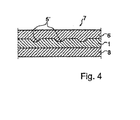
- Figure 4 shows layer-structured products made using the invention: a three-layer board 7, in which the middle layer 1 fiber material differs from the fiber material of outer layers 6 and 8.
- the material used for the middle layer could be, for example, CTMP and the outer layers 6 and 8 could be, for example, bleached sulfate pulp.
- the identification marks inside the layer-structure are hollows 5' engraved on the surface of the middle layer 1.
- the laser marking of the middle layer 1 and join to the outer layer 6 covering the marks 5' take place as per Figures 1-3 .
- the second outer layer 8 may have been joined to the middle layer 1 before the marking phase or after the phases described in the figures 1-3 .
- the hollows 5' fill with the material of the outer layer 6 in such a way that the board 7 rendered as the final product is essentially uniform in thickness and density.
- the marks formed by the hollows 5' are still detectable using a detector.
- the CTMP may be darker than the sulfate pulp, shown by raying as lighter than the surrounding area.
Landscapes
- Wrappers (AREA)
- Paper (AREA)
- Laminated Bodies (AREA)
- Laser Beam Printer (AREA)
- Laser Beam Processing (AREA)
Abstract
Description
- The invention involves a method for producing identification marks on layered paper or board made in a continuous web. In addition, the invention also concerns layered paper or board made with this method, containing identification marks.
- Visible marks can be made on consumer packages at the packing phase, for the purpose of informing the consumer about the packaging date or the "consume by" date of the product. In addition, marks which may be partially or entirely invisible are used as product identifiers, which identifies the origin of the product and ensuring its authenticity.
- Well-known package marking methods include ink printing, embossings and cuttings or perforations made in the packaging material by pressing or cutting. However, laser package marking is used increasingly. With this method, the marks are made with a laser beam without physically touching the packaging material or leaving printing ink or any other extra substance on the packaging.
- With a laser beam, it is possible to affect fiber-based material, such as paper or board, in a number of ways. As is well-known, a laser beam burns through thin paper. To prevent this,
US patent publication 6306493 presents a fine polymer additive to be mixed in with the paper to act as absorbent and char, thus leaving a dark, distinguishable mark on the paper. According to the knowledge and experience of the applicant, it is, however, possible to burn the surface fiber layer of the paper with a laser beam to produce a mark, without any through-burning of the paper and without the need to add polymer or other additives to the pulp, as described in the publication. - Other possible fiber-layer laser working methods are cutting the surface of the layer or engraving using an inert gas to prevent the burning of the material. The marks made in this manner are hollow on the surface of the fiber-layer, where no significant material color alteration takes place. A mark can also be produced by changing the structure of the fiber-layer by reacting one of its components with a laser beam or by vaporizing it. The mark can be detected so it can be used as an identifier.
- A laser-marked paper or board similar to
US patent 6306493 has been put forward for use as packaging material, labels or wrapping papers for various consumer packages marked by targeting the laser beam on the surface of the material. The laser marking is thus essentially related to the packaging process of the products.US patent publication 5340628 describes a laser-marked layered packaging material where the paper base is introduced with a polymer layer of polyester or polypropylene, which the laser beam later penetrates, leaving a mark on the paper layer below. The material was designed for labels attached to product packages where the laser marks contain package-specific information about the product. - According to the publications mentioned earlier, known fiber-based laser-marked materials are meant mainly for making marks serving consumers in the product packaging phase. Their applicability is not the best possible to identifier marks to prove the authenticity of the product, i.e. where the marking is mainly intended to prevent or complicate product forgery. A forger who copies the product with the package naturally tries to produce the laser marks on the package.
- The objective of the invention presented is to provide a solution by marking paper or board used particularly as packaging material with a suitable laser mark, which is significantly more difficult to forge. The starting point of the invention is that in the packaging phase instead of making marks on the ready-made package or the package being manufactured, the mark is included in the packaging material itself, in the paper or board, which is layer-structured. Characteristic for the method according to the invention is that the marks are made with a laser beam on a moving web form fiber layer, by engraving hollows on the fiber layer, and a second layer of material is overlaid on said fiber layer in such a way that the marks remain inside the layer structure of the moving web.
- With this invention, identification marks are produced in a moving web on an on-line principle with a paper or board machine or with a paper or board coating unit. The laser heads can be located, for example, in a stationary beam installed crosswise to the web, which would produce a suitably covering regular figure in the moving web. Any figure can be used as identification mark, for example, a logo or a trademark of the paper or board manufacturer or the product manufacturer, or, significantly, a mark specific to the product being packaged. As the identification remains inside the layer structure of the paper or board, it cannot be tampered with or easily reproduced by a forger. To succeed, the forger would need to copy the product and package including the packaging material, which, even if technically possible, would make the activity unprofitable.
- The laser markings can be made by engraving the surface of the fiber layer by using a higher power density CO2 laser beam (as opposed to low power density CO2 laser beam which burns the surface of a fiber layer). By using a CO2 laser beam of higher power density and an inert gas preventing oxidation hollows can be engraved by vaporizing material from the fiber layer. The hollow relief works as identification marks identified by a detector on raying.
- The applications of the invention include a board containing two or more overlaid fiber layers. The marks are created on the surface of the web form fiber layer before the layers are joined together. At the joining stage, the fiber webs may still be moist, in which case the marks are made before the final drying of the joint web with a board machine, and are inseparably integrated into the final board. As the marks are hollows formed in the fiber layer, moist or elastic fiber layers overlaid fill the hollows in such a way that the board takes on an even thickness and density. If different materials are used for the layers, the marks formed by the hollows are still recognizable in the final board. If the materials differ in darkness and the hollows were made in the darker layer, the figures formed by the hollows can be seen (by raying) in the board as lighter than the surrounding area. Correspondingly the hollows made in the lighter layer show up as darker than their surroundings. Chemical and chemical/mechanical or mechanical pulps, and particularly unbleached pulps, such as brown kraft pulp, and bleached pulps, have these kinds of darkness or color differences sufficient for identification purposes.
- In paper or board manufactured by the method used in the invention, the material layer placed on the fiber layer and marked online may be formed by a coating paste or glue layer, applied during the manufacturing process with a paper or board machine, or on a fiber layer, for example, by extruding the polymer coating to be joined. With a transparent polymer coating the identification marks can be left visible, while at the same time they are protected against being tampered with by the coating. The identification marks and subsequent coating takes place, according to the invention, as a continuous process without interrupting the movement of the web.
- With this method, products contain a paper or a board in the form of a layered web containing identification marks, and the paper or board is equipped with marks made by a laser beam that are embedded inside the layer structure of the web. A marked product such as this can be manufactured in large scale in a paper or board factory, from where it is delivered in rolls to a customer who then uses it for individual product packages. The material may be multi-layered board, coated paper or board or polymer-coated paper or board; and the marks may be hidden under the coating or a layer of fiber, where they can be detected by raying or with a detector, or the marks may be left visible under a transparent polymer coating.
- As an example of the application of the invention, laser-marked packaging cartons may be made of a three-layered folded carton form having outer pulp layers of sulfate and the middle layer made of chemical-thermo-mechanic pulp (CTMP). In this carton the marks are burned darker in the interface of the sulfate and CTMP layers or the marks are hollows engraved in either layer, detectable due to differences in the composition of the pulp.
- The invention is explained in more detail below with examples by reference to a drawing, depicting:
-
figure 1 : the laser marking of a fiber material web and subsequent joining to another web to produce a layer-structured web format -
figure 2 : laser marking according tofigure 1 and the joining of the webs, seen from the side -
figure 3 : marking of the web as a III-III intersection offigure 2 -
figure 4 : the layer structure of a laser-marked carton using the invention -
Figures 1-3 show the fiber material web 1; its route has been introduced with a beam 2 in a crosswise direction to the web. From the laser heads 3 beside the beam, identifyingmarks 5 are produced on the surface of the web with the aligned laser beams 4. The marks may be any figure 5, such as a company or product name, logo or trademark, and in the case ofFigure 1 they form crosswise lines spaced at even intervals on the web. The web should include enough coverage for themarks 5 in such a way that there are enough marks for each sheet or packaging preform later to be separated from the layer-structured web. - The laser heads 3 in
Figures 2 and 3 may comprise higher density CO2 laser heads 3, and inert gas is directed simultaneously so that the surface of the web 1 is engraved with hollows as identification marks, based on vaporizing the material. - After the marking phase, as the web 1 continues its movement, another moving material web 6 is brought against it, as shown in
Figures 1 and 2 , in such a way that together the webs form a layer-structured, web format 7. Wherever necessary, adhesives can be used to join the webs 1 and 6. The product 7 delivered as a continuous web is rolled (not presented) and after further converting phases - if any - it is delivered in the form of a roll, sheets or preform to be used as individual product packages containing identification marks 5. - Fiber material can also be used as the second web 6 to be joined to the fiber material web 1 equipped with
marks 5. In this case, multilayered board is produced as the web form product 7. In the schematicfigures 1 and 2 , only two layers 1 and 6 are presented, but boards may have more layers, and if needed, identification marks 5 can be produced on the extra fiber layers or on the opposite sides of the same layer. - The second material layer to be introduced on the marked fiber material web 1 may also comprise, for example, a polymer sheeting or a single- or multi-layered extruded polymer coating to be laminated with the web. It is possible to laser-mark the fiber material web 1 with a paper or board machine, in which case, in the next phase the web is introduced with a coating paste covering the identification marks.
- When another fiber material web 6 is brought onto the fiber marked material web 1, the identification marks 5 remain hidden inside the obtained layer-structured board 7 from which the marks however can be detected with a suitable device. If the layers are thin enough, the
marks 5 are visible to the naked eye when the material is held up against the light. If the marked fiber material web 1 is equipped with a transparent polymer coating, the burnedmarks 5 can be seen through the polymer layer. -
Figure 4 shows layer-structured products made using the invention: a three-layer board 7, in which the middle layer 1 fiber material differs from the fiber material of outer layers 6 and 8. The material used for the middle layer could be, for example, CTMP and the outer layers 6 and 8 could be, for example, bleached sulfate pulp. The identification marks inside the layer-structure are hollows 5' engraved on the surface of the middle layer 1. The laser marking of the middle layer 1 and join to the outer layer 6 covering the marks 5' take place as perFigures 1-3 . The second outer layer 8 may have been joined to the middle layer 1 before the marking phase or after the phases described in thefigures 1-3 . - If the marking was made with a board machine while the fiber material layers 1 and 6 were still moist, the hollows 5' fill with the material of the outer layer 6 in such a way that the board 7 rendered as the final product is essentially uniform in thickness and density. When the materials of middle and outer layers 1, 6 differ, the marks formed by the hollows 5' are still detectable using a detector. For example, in one case, the CTMP may be darker than the sulfate pulp, shown by raying as lighter than the surrounding area.
- For professionals, clearly, many other examples of the invention could be used. The relevant claims are set out below:
Claims (13)
- A method for producing identification marks (5) in a layer-structured paper or board (7) to be manufactured as a continuous web, characterized in that the marks (5) are made with a laser beam (4) on a moving web form fiber layer (1), by engraving hollows (5') on the fiber layer, and a second layer of material (6) is overlaid on said fiber layer in such a way that the marks remain inside the layer structure (7) of the moving web.
- A method according to claim 1, characterized in that after the marking phase, the moving fiber layer (1) is laid against another moving, web form fiber layer (6).
- A method according to claim 2, characterized in that the marking takes place with a paper or board machine as the fiber layer (1) contains moisture originating from pulp, in which case the web (7) is dried after the joining of the layers (1, 6).
- A method according to claim 3, characterized in that the materials of the fiber layers (1, 6) to be joined differ from one another.
- A method according to claim 4, characterized in that one fiber layer to be joined is of chemical pulp and the other of mechanical or chemical/mechanical pulp.
- A method according to claim 4 or 5, characterized in that one of the fiber layers to be joined is of unbleached pulp and the other of bleached pulp.
- A method according to one of the previous claims, characterized in that the marked web form fiber layer (1) is applied with a coating layer, covering the marks (5).
- Layer-structured paper or board (7) containing identification marks produced by a method according to one of the previous claims, characterized in that the web form paper or board (7) contains marks, which are hollows (5') engraved on a fiber layer (1) by means of a laser beam, and these marks are embedded inside the layer-structure.
- A paper or board according to claim 8, characterized in that the web is rolled around a drum or core.
- A board according to claim 8, characterized in that the board contains marks (5') made with a laser beam, and the marks are embedded inside the structure formed by a series of fiber layers (6, 1, 8) of the board.
- Board according to claim 10, characterized in that the marks are hollows (5') cut with a laser beam on the fiber layer (1) and that these hollows are filled with a different type of material present in the next fiber layer (6).
- A board according to claim 11, characterized in that one of the fiber layers is of chemical pulp and the other of mechanical or chemical/mechanical pulp.
- A board according to one of the claims 10-12, characterized in that it is a fold-carton formed of sulfate and CTMP layers.
Priority Applications (1)
| Application Number | Priority Date | Filing Date | Title |
|---|---|---|---|
| PL12188525T PL2548742T3 (en) | 2004-01-05 | 2005-01-04 | A method for producing identification marks on paper or board and a marked material made with the method |
Applications Claiming Priority (2)
| Application Number | Priority Date | Filing Date | Title |
|---|---|---|---|
| FI20040006A FI119391B (en) | 2004-01-05 | 2004-01-05 | Process for producing identification marks in paper or cardboard and a marked material created by the method |
| EP05701721A EP1701850B1 (en) | 2004-01-05 | 2005-01-04 | A method for producing identification marks on paper or board and a marked material made with the method |
Related Parent Applications (2)
| Application Number | Title | Priority Date | Filing Date |
|---|---|---|---|
| EP05701721.2 Division | 2005-01-04 | ||
| EP05701721A Division EP1701850B1 (en) | 2004-01-05 | 2005-01-04 | A method for producing identification marks on paper or board and a marked material made with the method |
Publications (2)
| Publication Number | Publication Date |
|---|---|
| EP2548742A1 true EP2548742A1 (en) | 2013-01-23 |
| EP2548742B1 EP2548742B1 (en) | 2014-03-19 |
Family
ID=30129316
Family Applications (2)
| Application Number | Title | Priority Date | Filing Date |
|---|---|---|---|
| EP12188525.5A Expired - Lifetime EP2548742B1 (en) | 2004-01-05 | 2005-01-04 | A method for producing identification marks on paper or board and a marked material made with the method |
| EP05701721A Expired - Lifetime EP1701850B1 (en) | 2004-01-05 | 2005-01-04 | A method for producing identification marks on paper or board and a marked material made with the method |
Family Applications After (1)
| Application Number | Title | Priority Date | Filing Date |
|---|---|---|---|
| EP05701721A Expired - Lifetime EP1701850B1 (en) | 2004-01-05 | 2005-01-04 | A method for producing identification marks on paper or board and a marked material made with the method |
Country Status (8)
| Country | Link |
|---|---|
| US (1) | US20080295984A1 (en) |
| EP (2) | EP2548742B1 (en) |
| JP (1) | JP5068078B2 (en) |
| CA (1) | CA2552407C (en) |
| ES (2) | ES2461546T3 (en) |
| FI (1) | FI119391B (en) |
| PL (2) | PL2548742T3 (en) |
| WO (1) | WO2005065956A1 (en) |
Families Citing this family (11)
| Publication number | Priority date | Publication date | Assignee | Title |
|---|---|---|---|---|
| FR2897077B1 (en) * | 2006-02-03 | 2008-04-25 | Cascades Sa Sa | LAYER CARDBOARD WITH MARKING ELEMENT AND METHOD FOR MARKING SAID CARDBOARD |
| FI20060382A0 (en) * | 2006-04-21 | 2006-04-21 | Stora Enso Oyj | Procedure for labeling paper or paperboard and materials that are labeled using the procedure |
| WO2011046973A1 (en) * | 2009-10-14 | 2011-04-21 | Xyleco, Inc. | Marking paper products |
| FI123957B (en) * | 2009-02-20 | 2014-01-15 | Laminating Papers Oy | Process for the preparation of an impregnated marking, a plate coated with the impregnate and the use of the impregnate in a mold for casting concrete |
| JP5740921B2 (en) * | 2010-11-05 | 2015-07-01 | 大日本印刷株式会社 | Laser processing equipment, laser processing system |
| EP2890846B1 (en) * | 2012-08-30 | 2017-08-02 | UPM-Kymmene Corporation | Security-marked web |
| EP3167117A4 (en) | 2014-07-08 | 2018-02-28 | Xyleco, Inc. | Marking plastic-based products |
| EP3215083B1 (en) | 2014-11-07 | 2019-08-07 | The Procter & Gamble Company | Process and apparatus for manufacturing an absorbent article using a laser source |
| WO2017160701A1 (en) | 2016-03-15 | 2017-09-21 | The Procter & Gamble Company | Methods and apparatuses for separating and positioning discrete articles |
| US12434504B2 (en) * | 2021-10-27 | 2025-10-07 | Footprint International, LLC | Marking systems and methods for fiber-based products |
| PL441970A1 (en) * | 2022-08-08 | 2024-02-12 | Plast-Farb Spółka Z Ograniczoną Odpowiedzialnością Spółka Komandytowa | Security tape and method of producing security tape |
Citations (4)
| Publication number | Priority date | Publication date | Assignee | Title |
|---|---|---|---|---|
| DE3431577A1 (en) * | 1984-08-28 | 1986-03-13 | Heinr. Aug. Schoeller Söhne GmbH & Co KG, 5160 Düren | Method for producing genuine watermarks in paper |
| US5340628A (en) | 1992-11-05 | 1994-08-23 | Ccl Label, Inc. | Laser markable laminated sheet |
| DE19822605A1 (en) * | 1998-05-20 | 1999-11-25 | Zanders Feinpapiere Ag | Durable marking of paper or cardboard for a watermark effect or a security measure |
| US6306493B1 (en) | 1997-07-30 | 2001-10-23 | Merck Patent Gesellschaft | Laser-markable paper and board products |
Family Cites Families (22)
| Publication number | Priority date | Publication date | Assignee | Title |
|---|---|---|---|---|
| US4552617A (en) * | 1984-06-13 | 1985-11-12 | Crane & Co. | Security features in paper |
| AT386159B (en) * | 1985-10-11 | 1988-07-11 | Oesterr Nationalbank | METHOD AND DEVICE FOR PRODUCING REALITY (CODING) CHARACTERISTICS ON SECURITIES |
| GB8903525D0 (en) * | 1989-02-16 | 1989-04-05 | Wiggins Teape Group Ltd | Treatment of a surface by laser energy |
| DE4036637A1 (en) * | 1990-11-16 | 1992-05-21 | Gao Ges Automation Org | SECURITIES AND METHOD FOR THE PRODUCTION THEREOF |
| DE4101301A1 (en) * | 1991-01-17 | 1992-07-23 | Gao Ges Automation Org | SECURITY DOCUMENT AND METHOD FOR THE PRODUCTION THEREOF |
| AU4258093A (en) * | 1992-04-24 | 1993-11-29 | Vadeko International Incorporated | Apparatus and method of making an authenticated web formed of fibrous material |
| SE500384C2 (en) * | 1992-11-11 | 1994-06-13 | Tumba Bruk Ab | Process for producing paper and value printing produced therefrom |
| EP0687324B2 (en) * | 1993-03-02 | 2005-12-07 | Arjowiggins Security | Security paper comprising localised areas with reduced thickness and opacity, and method for making same |
| CA2210623A1 (en) * | 1995-01-17 | 1996-07-25 | W. L. Gore & Associates, Inc. | Method for making and using an improved durable printable sheet |
| JPH10236000A (en) * | 1997-02-27 | 1998-09-08 | Toppan Forms Co Ltd | Watermark image forming method |
| GB9828770D0 (en) * | 1998-12-29 | 1999-02-17 | Rue De Int Ltd | Security paper |
| DE19907940A1 (en) * | 1999-02-24 | 2000-08-31 | Bundesdruckerei Gmbh | Process for the production of multi-layer security products and a security product produced by the process |
| AUPQ125999A0 (en) * | 1999-06-28 | 1999-07-22 | Securency Pty Ltd | Method of producing a diffractive structure in security documents |
| DE19962790A1 (en) * | 1999-12-23 | 2001-06-28 | Giesecke & Devrient Gmbh | Security paper, for secure documents, comprises veining fibers with differing luminescent properties to discourage document forgery, and is coded according to their disposition |
| JP4649603B2 (en) * | 2001-06-29 | 2011-03-16 | 独立行政法人 国立印刷局 | Multi-layered paper, its manufacturing method, and multi-layer paper-making apparatus |
| US7207494B2 (en) * | 2001-12-24 | 2007-04-24 | Digimarc Corporation | Laser etched security features for identification documents and methods of making same |
| WO2003082583A1 (en) * | 2002-03-22 | 2003-10-09 | Ap Technoglass | Laser marking system |
| WO2003095745A1 (en) * | 2002-05-08 | 2003-11-20 | Leonhard Kurz Gmbh & Co. Kg | Multilayer body with a laser-sensitive layer |
| FR2839917B1 (en) * | 2002-05-22 | 2004-10-08 | Arjo Wiggins | ARTICLE FORMED FROM AT LEAST ONE JET OF FIBROUS MATERIAL COMPRISING AT LEAST ONE ZONE OF ZERO THICKNESS AND METHOD FOR MANUFACTURING SAID ARTICLE |
| GB2390056B (en) * | 2002-06-25 | 2005-08-31 | Rue Internat Ltd De La | Improvements in substrates |
| DE10252007A1 (en) * | 2002-11-06 | 2004-05-27 | Merck Patent Gmbh | Laser-markable pigments |
| EP1607234A1 (en) * | 2004-06-17 | 2005-12-21 | Kba-Giori S.A. | Process and apparatus for providing markings on security papers |
-
2004
- 2004-01-05 FI FI20040006A patent/FI119391B/en not_active IP Right Cessation
-
2005
- 2005-01-04 ES ES12188525.5T patent/ES2461546T3/en not_active Expired - Lifetime
- 2005-01-04 ES ES05701721T patent/ES2400184T3/en not_active Expired - Lifetime
- 2005-01-04 CA CA2552407A patent/CA2552407C/en not_active Expired - Fee Related
- 2005-01-04 US US10/585,191 patent/US20080295984A1/en not_active Abandoned
- 2005-01-04 PL PL12188525T patent/PL2548742T3/en unknown
- 2005-01-04 WO PCT/FI2005/000005 patent/WO2005065956A1/en not_active Ceased
- 2005-01-04 JP JP2006546213A patent/JP5068078B2/en not_active Expired - Fee Related
- 2005-01-04 PL PL05701721T patent/PL1701850T3/en unknown
- 2005-01-04 EP EP12188525.5A patent/EP2548742B1/en not_active Expired - Lifetime
- 2005-01-04 EP EP05701721A patent/EP1701850B1/en not_active Expired - Lifetime
Patent Citations (4)
| Publication number | Priority date | Publication date | Assignee | Title |
|---|---|---|---|---|
| DE3431577A1 (en) * | 1984-08-28 | 1986-03-13 | Heinr. Aug. Schoeller Söhne GmbH & Co KG, 5160 Düren | Method for producing genuine watermarks in paper |
| US5340628A (en) | 1992-11-05 | 1994-08-23 | Ccl Label, Inc. | Laser markable laminated sheet |
| US6306493B1 (en) | 1997-07-30 | 2001-10-23 | Merck Patent Gesellschaft | Laser-markable paper and board products |
| DE19822605A1 (en) * | 1998-05-20 | 1999-11-25 | Zanders Feinpapiere Ag | Durable marking of paper or cardboard for a watermark effect or a security measure |
Also Published As
| Publication number | Publication date |
|---|---|
| CA2552407A1 (en) | 2005-07-21 |
| US20080295984A1 (en) | 2008-12-04 |
| FI119391B (en) | 2008-10-31 |
| ES2461546T3 (en) | 2014-05-20 |
| JP5068078B2 (en) | 2012-11-07 |
| PL1701850T3 (en) | 2013-04-30 |
| EP1701850B1 (en) | 2012-11-28 |
| CA2552407C (en) | 2013-05-21 |
| JP2007526142A (en) | 2007-09-13 |
| EP1701850A1 (en) | 2006-09-20 |
| WO2005065956A1 (en) | 2005-07-21 |
| EP2548742B1 (en) | 2014-03-19 |
| PL2548742T3 (en) | 2014-06-30 |
| FI20040006A0 (en) | 2004-01-05 |
| ES2400184T3 (en) | 2013-04-08 |
| FI20040006L (en) | 2005-07-06 |
Similar Documents
| Publication | Publication Date | Title |
|---|---|---|
| EP2548742B1 (en) | A method for producing identification marks on paper or board and a marked material made with the method | |
| Kirwan | Handbook of paper and paperboard packaging technology | |
| EP0870089B1 (en) | Surface treated security paper and method and device for producing surface treated security paper | |
| ES2305517T3 (en) | MULTI-PAD LAMINATE. | |
| CA2342227C (en) | Paper or paperboard laminate and method to produce such a laminate | |
| JP2017521287A (en) | Method for manufacturing laminated packaging material and laminated packaging material | |
| CA2040298A1 (en) | Security paper and method of manufacturing same | |
| WO2000006462A1 (en) | Laminated package with enhanced interior and exterior | |
| CN103249891A (en) | Anti-counterfeiting component, anti-counterfeiting special paper and their manufacturing method | |
| CA2672752A1 (en) | Security film comprising a fibrous substrate | |
| CA2123986A1 (en) | A method for manufacturing a fabric-like laminate and a product manufactured according to said method | |
| JP2010035659A (en) | Sanitary tissue product and method for manufacturing the same | |
| JP2010035659A5 (en) | ||
| RU2265098C2 (en) | Paper/cardboard with protection means and method for producing of paper/cardboard with protection means | |
| JP6947319B1 (en) | Cardboard material and cardboard boxes using it | |
| WO2007122284A1 (en) | Method for marking paper or board and material marked by the method | |
| WO2005035258A2 (en) | Packaging material with embedded security mechanisms | |
| EP1765601B1 (en) | Layered security material and method of manufacturing such | |
| JP2006052488A (en) | Multilayer laminated paper | |
| CA2226746A1 (en) | Lignin-based vapor barrier formulations | |
| KR100277221B1 (en) | Safety paper and its manufacturing method | |
| CN218812889U (en) | Pinhole type anti-counterfeiting paperboard for carton | |
| JP2016043551A (en) | Peel-resistant printed matter | |
| JP2006305857A (en) | 籤, its manufacturing method and manufacturing equipment | |
| CA2344497A1 (en) | Process for making cardboard having safety means |
Legal Events
| Date | Code | Title | Description |
|---|---|---|---|
| PUAI | Public reference made under article 153(3) epc to a published international application that has entered the european phase |
Free format text: ORIGINAL CODE: 0009012 |
|
| AC | Divisional application: reference to earlier application |
Ref document number: 1701850 Country of ref document: EP Kind code of ref document: P |
|
| AK | Designated contracting states |
Kind code of ref document: A1 Designated state(s): AT BE BG CH CY CZ DE DK EE ES FI FR GB GR HU IE IS IT LI LT LU MC NL PL PT RO SE SI SK TR |
|
| 17P | Request for examination filed |
Effective date: 20130722 |
|
| RBV | Designated contracting states (corrected) |
Designated state(s): AT BE BG CH CY CZ DE DK EE ES FI FR GB GR HU IE IS IT LI LT LU MC NL PL PT RO SE SI SK TR |
|
| GRAP | Despatch of communication of intention to grant a patent |
Free format text: ORIGINAL CODE: EPIDOSNIGR1 |
|
| RIC1 | Information provided on ipc code assigned before grant |
Ipc: B41M 5/24 20060101AFI20130829BHEP |
|
| INTG | Intention to grant announced |
Effective date: 20130919 |
|
| RIN1 | Information on inventor provided before grant (corrected) |
Inventor name: RAESAENEN, JARI Inventor name: TEVAE, ERKKI Inventor name: MIIKKI, NINA |
|
| GRAS | Grant fee paid |
Free format text: ORIGINAL CODE: EPIDOSNIGR3 |
|
| GRAA | (expected) grant |
Free format text: ORIGINAL CODE: 0009210 |
|
| AC | Divisional application: reference to earlier application |
Ref document number: 1701850 Country of ref document: EP Kind code of ref document: P |
|
| AK | Designated contracting states |
Kind code of ref document: B1 Designated state(s): AT BE BG CH CY CZ DE DK EE ES FI FR GB GR HU IE IS IT LI LT LU MC NL PL PT RO SE SI SK TR |
|
| REG | Reference to a national code |
Ref country code: GB Ref legal event code: FG4D |
|
| REG | Reference to a national code |
Ref country code: CH Ref legal event code: EP |
|
| REG | Reference to a national code |
Ref country code: SE Ref legal event code: TRGR |
|
| REG | Reference to a national code |
Ref country code: AT Ref legal event code: REF Ref document number: 657399 Country of ref document: AT Kind code of ref document: T Effective date: 20140415 |
|
| REG | Reference to a national code |
Ref country code: IE Ref legal event code: FG4D |
|
| REG | Reference to a national code |
Ref country code: DE Ref legal event code: R096 Ref document number: 602005043060 Country of ref document: DE Effective date: 20140430 |
|
| REG | Reference to a national code |
Ref country code: ES Ref legal event code: FG2A Ref document number: 2461546 Country of ref document: ES Kind code of ref document: T3 Effective date: 20140520 |
|
| REG | Reference to a national code |
Ref country code: PL Ref legal event code: T3 |
|
| PG25 | Lapsed in a contracting state [announced via postgrant information from national office to epo] |
Ref country code: LT Free format text: LAPSE BECAUSE OF FAILURE TO SUBMIT A TRANSLATION OF THE DESCRIPTION OR TO PAY THE FEE WITHIN THE PRESCRIBED TIME-LIMIT Effective date: 20140319 |
|
| REG | Reference to a national code |
Ref country code: NL Ref legal event code: VDEP Effective date: 20140319 |
|
| REG | Reference to a national code |
Ref country code: LT Ref legal event code: MG4D |
|
| PG25 | Lapsed in a contracting state [announced via postgrant information from national office to epo] |
Ref country code: CY Free format text: LAPSE BECAUSE OF FAILURE TO SUBMIT A TRANSLATION OF THE DESCRIPTION OR TO PAY THE FEE WITHIN THE PRESCRIBED TIME-LIMIT Effective date: 20140319 |
|
| PG25 | Lapsed in a contracting state [announced via postgrant information from national office to epo] |
Ref country code: BG Free format text: LAPSE BECAUSE OF FAILURE TO SUBMIT A TRANSLATION OF THE DESCRIPTION OR TO PAY THE FEE WITHIN THE PRESCRIBED TIME-LIMIT Effective date: 20140619 Ref country code: NL Free format text: LAPSE BECAUSE OF FAILURE TO SUBMIT A TRANSLATION OF THE DESCRIPTION OR TO PAY THE FEE WITHIN THE PRESCRIBED TIME-LIMIT Effective date: 20140319 Ref country code: IS Free format text: LAPSE BECAUSE OF FAILURE TO SUBMIT A TRANSLATION OF THE DESCRIPTION OR TO PAY THE FEE WITHIN THE PRESCRIBED TIME-LIMIT Effective date: 20140719 Ref country code: EE Free format text: LAPSE BECAUSE OF FAILURE TO SUBMIT A TRANSLATION OF THE DESCRIPTION OR TO PAY THE FEE WITHIN THE PRESCRIBED TIME-LIMIT Effective date: 20140319 Ref country code: RO Free format text: LAPSE BECAUSE OF FAILURE TO SUBMIT A TRANSLATION OF THE DESCRIPTION OR TO PAY THE FEE WITHIN THE PRESCRIBED TIME-LIMIT Effective date: 20140319 Ref country code: CZ Free format text: LAPSE BECAUSE OF FAILURE TO SUBMIT A TRANSLATION OF THE DESCRIPTION OR TO PAY THE FEE WITHIN THE PRESCRIBED TIME-LIMIT Effective date: 20140319 Ref country code: BE Free format text: LAPSE BECAUSE OF FAILURE TO SUBMIT A TRANSLATION OF THE DESCRIPTION OR TO PAY THE FEE WITHIN THE PRESCRIBED TIME-LIMIT Effective date: 20140319 |
|
| PG25 | Lapsed in a contracting state [announced via postgrant information from national office to epo] |
Ref country code: SK Free format text: LAPSE BECAUSE OF FAILURE TO SUBMIT A TRANSLATION OF THE DESCRIPTION OR TO PAY THE FEE WITHIN THE PRESCRIBED TIME-LIMIT Effective date: 20140319 |
|
| REG | Reference to a national code |
Ref country code: DE Ref legal event code: R097 Ref document number: 602005043060 Country of ref document: DE |
|
| PG25 | Lapsed in a contracting state [announced via postgrant information from national office to epo] |
Ref country code: PT Free format text: LAPSE BECAUSE OF FAILURE TO SUBMIT A TRANSLATION OF THE DESCRIPTION OR TO PAY THE FEE WITHIN THE PRESCRIBED TIME-LIMIT Effective date: 20140721 |
|
| PLBE | No opposition filed within time limit |
Free format text: ORIGINAL CODE: 0009261 |
|
| STAA | Information on the status of an ep patent application or granted ep patent |
Free format text: STATUS: NO OPPOSITION FILED WITHIN TIME LIMIT |
|
| PG25 | Lapsed in a contracting state [announced via postgrant information from national office to epo] |
Ref country code: DK Free format text: LAPSE BECAUSE OF FAILURE TO SUBMIT A TRANSLATION OF THE DESCRIPTION OR TO PAY THE FEE WITHIN THE PRESCRIBED TIME-LIMIT Effective date: 20140319 |
|
| 26N | No opposition filed |
Effective date: 20141222 |
|
| PG25 | Lapsed in a contracting state [announced via postgrant information from national office to epo] |
Ref country code: IT Free format text: LAPSE BECAUSE OF FAILURE TO SUBMIT A TRANSLATION OF THE DESCRIPTION OR TO PAY THE FEE WITHIN THE PRESCRIBED TIME-LIMIT Effective date: 20140319 |
|
| REG | Reference to a national code |
Ref country code: DE Ref legal event code: R097 Ref document number: 602005043060 Country of ref document: DE Effective date: 20141222 |
|
| PG25 | Lapsed in a contracting state [announced via postgrant information from national office to epo] |
Ref country code: SI Free format text: LAPSE BECAUSE OF FAILURE TO SUBMIT A TRANSLATION OF THE DESCRIPTION OR TO PAY THE FEE WITHIN THE PRESCRIBED TIME-LIMIT Effective date: 20140319 |
|
| REG | Reference to a national code |
Ref country code: CH Ref legal event code: PL |
|
| PG25 | Lapsed in a contracting state [announced via postgrant information from national office to epo] |
Ref country code: LU Free format text: LAPSE BECAUSE OF FAILURE TO SUBMIT A TRANSLATION OF THE DESCRIPTION OR TO PAY THE FEE WITHIN THE PRESCRIBED TIME-LIMIT Effective date: 20150104 |
|
| PG25 | Lapsed in a contracting state [announced via postgrant information from national office to epo] |
Ref country code: MC Free format text: LAPSE BECAUSE OF FAILURE TO SUBMIT A TRANSLATION OF THE DESCRIPTION OR TO PAY THE FEE WITHIN THE PRESCRIBED TIME-LIMIT Effective date: 20140319 |
|
| PG25 | Lapsed in a contracting state [announced via postgrant information from national office to epo] |
Ref country code: LI Free format text: LAPSE BECAUSE OF NON-PAYMENT OF DUE FEES Effective date: 20150131 Ref country code: CH Free format text: LAPSE BECAUSE OF NON-PAYMENT OF DUE FEES Effective date: 20150131 |
|
| REG | Reference to a national code |
Ref country code: IE Ref legal event code: MM4A |
|
| REG | Reference to a national code |
Ref country code: FR Ref legal event code: PLFP Year of fee payment: 12 |
|
| PG25 | Lapsed in a contracting state [announced via postgrant information from national office to epo] |
Ref country code: IE Free format text: LAPSE BECAUSE OF NON-PAYMENT OF DUE FEES Effective date: 20150104 |
|
| PG25 | Lapsed in a contracting state [announced via postgrant information from national office to epo] |
Ref country code: GR Free format text: LAPSE BECAUSE OF FAILURE TO SUBMIT A TRANSLATION OF THE DESCRIPTION OR TO PAY THE FEE WITHIN THE PRESCRIBED TIME-LIMIT Effective date: 20140620 |
|
| REG | Reference to a national code |
Ref country code: FR Ref legal event code: PLFP Year of fee payment: 13 |
|
| PG25 | Lapsed in a contracting state [announced via postgrant information from national office to epo] |
Ref country code: HU Free format text: LAPSE BECAUSE OF FAILURE TO SUBMIT A TRANSLATION OF THE DESCRIPTION OR TO PAY THE FEE WITHIN THE PRESCRIBED TIME-LIMIT; INVALID AB INITIO Effective date: 20050104 |
|
| PG25 | Lapsed in a contracting state [announced via postgrant information from national office to epo] |
Ref country code: TR Free format text: LAPSE BECAUSE OF FAILURE TO SUBMIT A TRANSLATION OF THE DESCRIPTION OR TO PAY THE FEE WITHIN THE PRESCRIBED TIME-LIMIT Effective date: 20140319 |
|
| REG | Reference to a national code |
Ref country code: FR Ref legal event code: PLFP Year of fee payment: 14 |
|
| PGFP | Annual fee paid to national office [announced via postgrant information from national office to epo] |
Ref country code: FR Payment date: 20210122 Year of fee payment: 17 Ref country code: FI Payment date: 20210121 Year of fee payment: 17 |
|
| PGFP | Annual fee paid to national office [announced via postgrant information from national office to epo] |
Ref country code: GB Payment date: 20210121 Year of fee payment: 17 Ref country code: ES Payment date: 20210326 Year of fee payment: 17 Ref country code: DE Payment date: 20210120 Year of fee payment: 17 Ref country code: AT Payment date: 20210121 Year of fee payment: 17 Ref country code: SE Payment date: 20210120 Year of fee payment: 17 |
|
| PGFP | Annual fee paid to national office [announced via postgrant information from national office to epo] |
Ref country code: PL Payment date: 20201230 Year of fee payment: 17 |
|
| REG | Reference to a national code |
Ref country code: DE Ref legal event code: R119 Ref document number: 602005043060 Country of ref document: DE |
|
| REG | Reference to a national code |
Ref country code: FI Ref legal event code: MAE |
|
| REG | Reference to a national code |
Ref country code: SE Ref legal event code: EUG |
|
| REG | Reference to a national code |
Ref country code: AT Ref legal event code: MM01 Ref document number: 657399 Country of ref document: AT Kind code of ref document: T Effective date: 20220104 |
|
| GBPC | Gb: european patent ceased through non-payment of renewal fee |
Effective date: 20220104 |
|
| PG25 | Lapsed in a contracting state [announced via postgrant information from national office to epo] |
Ref country code: SE Free format text: LAPSE BECAUSE OF NON-PAYMENT OF DUE FEES Effective date: 20220105 Ref country code: GB Free format text: LAPSE BECAUSE OF NON-PAYMENT OF DUE FEES Effective date: 20220104 Ref country code: FI Free format text: LAPSE BECAUSE OF NON-PAYMENT OF DUE FEES Effective date: 20220104 Ref country code: DE Free format text: LAPSE BECAUSE OF NON-PAYMENT OF DUE FEES Effective date: 20220802 Ref country code: AT Free format text: LAPSE BECAUSE OF NON-PAYMENT OF DUE FEES Effective date: 20220104 |
|
| PG25 | Lapsed in a contracting state [announced via postgrant information from national office to epo] |
Ref country code: FR Free format text: LAPSE BECAUSE OF NON-PAYMENT OF DUE FEES Effective date: 20220131 |
|
| REG | Reference to a national code |
Ref country code: ES Ref legal event code: FD2A Effective date: 20230224 |
|
| PG25 | Lapsed in a contracting state [announced via postgrant information from national office to epo] |
Ref country code: ES Free format text: LAPSE BECAUSE OF NON-PAYMENT OF DUE FEES Effective date: 20220105 |
|
| PG25 | Lapsed in a contracting state [announced via postgrant information from national office to epo] |
Ref country code: PL Free format text: LAPSE BECAUSE OF NON-PAYMENT OF DUE FEES Effective date: 20220104 |