EP2546408A1 - Softener composition - Google Patents
Softener composition Download PDFInfo
- Publication number
- EP2546408A1 EP2546408A1 EP11753332A EP11753332A EP2546408A1 EP 2546408 A1 EP2546408 A1 EP 2546408A1 EP 11753332 A EP11753332 A EP 11753332A EP 11753332 A EP11753332 A EP 11753332A EP 2546408 A1 EP2546408 A1 EP 2546408A1
- Authority
- EP
- European Patent Office
- Prior art keywords
- quaternary ammonium
- represent
- group
- different
- same
- Prior art date
- Legal status (The legal status is an assumption and is not a legal conclusion. Google has not performed a legal analysis and makes no representation as to the accuracy of the status listed.)
- Withdrawn
Links
- 239000000203 mixture Substances 0.000 title claims abstract description 76
- 150000003242 quaternary ammonium salts Chemical class 0.000 claims abstract description 64
- 125000004432 carbon atom Chemical group C* 0.000 claims description 37
- 125000001183 hydrocarbyl group Chemical group 0.000 claims description 30
- -1 polyoxyethylene chain Polymers 0.000 claims description 28
- 238000000034 method Methods 0.000 claims description 18
- 125000006353 oxyethylene group Chemical group 0.000 claims description 18
- 239000000835 fiber Substances 0.000 claims description 17
- 125000002887 hydroxy group Chemical group [H]O* 0.000 claims description 13
- 150000001450 anions Chemical class 0.000 claims description 10
- 241000894007 species Species 0.000 description 27
- 150000001875 compounds Chemical class 0.000 description 23
- 239000000047 product Substances 0.000 description 23
- 150000001412 amines Chemical class 0.000 description 15
- LFQSCWFLJHTTHZ-UHFFFAOYSA-N Ethanol Chemical compound CCO LFQSCWFLJHTTHZ-UHFFFAOYSA-N 0.000 description 14
- 238000002360 preparation method Methods 0.000 description 14
- XLYOFNOQVPJJNP-UHFFFAOYSA-N water Substances O XLYOFNOQVPJJNP-UHFFFAOYSA-N 0.000 description 14
- 230000000694 effects Effects 0.000 description 13
- 239000006185 dispersion Substances 0.000 description 12
- 235000014113 dietary fatty acids Nutrition 0.000 description 11
- 239000000194 fatty acid Substances 0.000 description 11
- 229930195729 fatty acid Natural products 0.000 description 11
- 239000007788 liquid Substances 0.000 description 11
- BAVYZALUXZFZLV-UHFFFAOYSA-N Methylamine Chemical compound NC BAVYZALUXZFZLV-UHFFFAOYSA-N 0.000 description 10
- 150000004665 fatty acids Chemical class 0.000 description 10
- IAYPIBMASNFSPL-UHFFFAOYSA-N Ethylene oxide Chemical compound C1CO1 IAYPIBMASNFSPL-UHFFFAOYSA-N 0.000 description 9
- HEMHJVSKTPXQMS-UHFFFAOYSA-M Sodium hydroxide Chemical compound [OH-].[Na+] HEMHJVSKTPXQMS-UHFFFAOYSA-M 0.000 description 9
- GOOHAUXETOMSMM-UHFFFAOYSA-N Propylene oxide Chemical compound CC1CO1 GOOHAUXETOMSMM-UHFFFAOYSA-N 0.000 description 7
- HUTXVUPGARJNHM-UHFFFAOYSA-N 1-(2-chloroethoxy)ethanol Chemical compound CC(O)OCCCl HUTXVUPGARJNHM-UHFFFAOYSA-N 0.000 description 6
- CSCPPACGZOOCGX-UHFFFAOYSA-N Acetone Chemical compound CC(C)=O CSCPPACGZOOCGX-UHFFFAOYSA-N 0.000 description 6
- VEXZGXHMUGYJMC-UHFFFAOYSA-N Hydrochloric acid Chemical compound Cl VEXZGXHMUGYJMC-UHFFFAOYSA-N 0.000 description 6
- KFZMGEQAYNKOFK-UHFFFAOYSA-N Isopropanol Chemical compound CC(C)O KFZMGEQAYNKOFK-UHFFFAOYSA-N 0.000 description 6
- 125000000217 alkyl group Chemical group 0.000 description 6
- 125000002947 alkylene group Chemical group 0.000 description 6
- 238000006243 chemical reaction Methods 0.000 description 6
- 239000003795 chemical substances by application Substances 0.000 description 6
- KRKNYBCHXYNGOX-UHFFFAOYSA-N citric acid Chemical compound OC(=O)CC(O)(C(O)=O)CC(O)=O KRKNYBCHXYNGOX-UHFFFAOYSA-N 0.000 description 6
- 239000011541 reaction mixture Substances 0.000 description 6
- 150000003839 salts Chemical group 0.000 description 6
- PEDCQBHIVMGVHV-UHFFFAOYSA-N Glycerol Natural products OCC(O)CO PEDCQBHIVMGVHV-UHFFFAOYSA-N 0.000 description 5
- WYURNTSHIVDZCO-UHFFFAOYSA-N Tetrahydrofuran Chemical compound C1CCOC1 WYURNTSHIVDZCO-UHFFFAOYSA-N 0.000 description 5
- 239000002253 acid Substances 0.000 description 5
- 239000002304 perfume Substances 0.000 description 5
- IJGRMHOSHXDMSA-UHFFFAOYSA-N Atomic nitrogen Chemical compound N#N IJGRMHOSHXDMSA-UHFFFAOYSA-N 0.000 description 4
- UXVMQQNJUSDDNG-UHFFFAOYSA-L Calcium chloride Chemical compound [Cl-].[Cl-].[Ca+2] UXVMQQNJUSDDNG-UHFFFAOYSA-L 0.000 description 4
- TWRXJAOTZQYOKJ-UHFFFAOYSA-L Magnesium chloride Chemical compound [Mg+2].[Cl-].[Cl-] TWRXJAOTZQYOKJ-UHFFFAOYSA-L 0.000 description 4
- 235000021355 Stearic acid Nutrition 0.000 description 4
- 150000003973 alkyl amines Chemical class 0.000 description 4
- 230000000844 anti-bacterial effect Effects 0.000 description 4
- 239000001110 calcium chloride Substances 0.000 description 4
- 229910001628 calcium chloride Inorganic materials 0.000 description 4
- NEHMKBQYUWJMIP-UHFFFAOYSA-N chloromethane Chemical compound ClC NEHMKBQYUWJMIP-UHFFFAOYSA-N 0.000 description 4
- 239000013078 crystal Substances 0.000 description 4
- 238000001035 drying Methods 0.000 description 4
- IPCSVZSSVZVIGE-UHFFFAOYSA-N hexadecanoic acid Chemical compound CCCCCCCCCCCCCCCC(O)=O IPCSVZSSVZVIGE-UHFFFAOYSA-N 0.000 description 4
- QIQXTHQIDYTFRH-UHFFFAOYSA-N octadecanoic acid Chemical compound CCCCCCCCCCCCCCCCCC(O)=O QIQXTHQIDYTFRH-UHFFFAOYSA-N 0.000 description 4
- OQCDKBAXFALNLD-UHFFFAOYSA-N octadecanoic acid Natural products CCCCCCCC(C)CCCCCCCCC(O)=O OQCDKBAXFALNLD-UHFFFAOYSA-N 0.000 description 4
- 239000003921 oil Substances 0.000 description 4
- 229920001296 polysiloxane Polymers 0.000 description 4
- SQGYOTSLMSWVJD-UHFFFAOYSA-N silver(1+) nitrate Chemical compound [Ag+].[O-]N(=O)=O SQGYOTSLMSWVJD-UHFFFAOYSA-N 0.000 description 4
- 239000000243 solution Substances 0.000 description 4
- 239000008117 stearic acid Substances 0.000 description 4
- 238000003756 stirring Methods 0.000 description 4
- 239000000126 substance Substances 0.000 description 4
- 239000008399 tap water Substances 0.000 description 4
- 235000020679 tap water Nutrition 0.000 description 4
- QTBSBXVTEAMEQO-UHFFFAOYSA-N Acetic acid Chemical compound CC(O)=O QTBSBXVTEAMEQO-UHFFFAOYSA-N 0.000 description 3
- VEXZGXHMUGYJMC-UHFFFAOYSA-M Chloride anion Chemical compound [Cl-] VEXZGXHMUGYJMC-UHFFFAOYSA-M 0.000 description 3
- LYCAIKOWRPUZTN-UHFFFAOYSA-N Ethylene glycol Chemical compound OCCO LYCAIKOWRPUZTN-UHFFFAOYSA-N 0.000 description 3
- DNIAPMSPPWPWGF-UHFFFAOYSA-N Propylene glycol Chemical compound CC(O)CO DNIAPMSPPWPWGF-UHFFFAOYSA-N 0.000 description 3
- 239000000654 additive Substances 0.000 description 3
- 150000001298 alcohols Chemical class 0.000 description 3
- 235000015278 beef Nutrition 0.000 description 3
- 239000002738 chelating agent Substances 0.000 description 3
- 230000000052 comparative effect Effects 0.000 description 3
- 230000018044 dehydration Effects 0.000 description 3
- 238000006297 dehydration reaction Methods 0.000 description 3
- 239000000975 dye Substances 0.000 description 3
- 238000011156 evaluation Methods 0.000 description 3
- 239000004744 fabric Substances 0.000 description 3
- 125000002960 margaryl group Chemical group [H]C([*])([H])C([H])([H])C([H])([H])C([H])([H])C([H])([H])C([H])([H])C([H])([H])C([H])([H])C([H])([H])C([H])([H])C([H])([H])C([H])([H])C([H])([H])C([H])([H])C([H])([H])C([H])([H])C([H])([H])[H] 0.000 description 3
- CRVGTESFCCXCTH-UHFFFAOYSA-N methyl diethanolamine Chemical compound OCCN(C)CCO CRVGTESFCCXCTH-UHFFFAOYSA-N 0.000 description 3
- 125000002958 pentadecyl group Chemical group [H]C([*])([H])C([H])([H])C([H])([H])C([H])([H])C([H])([H])C([H])([H])C([H])([H])C([H])([H])C([H])([H])C([H])([H])C([H])([H])C([H])([H])C([H])([H])C([H])([H])C([H])([H])[H] 0.000 description 3
- 238000010561 standard procedure Methods 0.000 description 3
- 239000003760 tallow Substances 0.000 description 3
- WRIDQFICGBMAFQ-UHFFFAOYSA-N (E)-8-Octadecenoic acid Natural products CCCCCCCCCC=CCCCCCCC(O)=O WRIDQFICGBMAFQ-UHFFFAOYSA-N 0.000 description 2
- ZNQVEEAIQZEUHB-UHFFFAOYSA-N 2-ethoxyethanol Chemical compound CCOCCO ZNQVEEAIQZEUHB-UHFFFAOYSA-N 0.000 description 2
- 229940093475 2-ethoxyethanol Drugs 0.000 description 2
- LQJBNNIYVWPHFW-UHFFFAOYSA-N 20:1omega9c fatty acid Natural products CCCCCCCCCCC=CCCCCCCCC(O)=O LQJBNNIYVWPHFW-UHFFFAOYSA-N 0.000 description 2
- QSBYPNXLFMSGKH-UHFFFAOYSA-N 9-Heptadecensaeure Natural products CCCCCCCC=CCCCCCCCC(O)=O QSBYPNXLFMSGKH-UHFFFAOYSA-N 0.000 description 2
- ROSDSFDQCJNGOL-UHFFFAOYSA-N Dimethylamine Chemical compound CNC ROSDSFDQCJNGOL-UHFFFAOYSA-N 0.000 description 2
- KCXVZYZYPLLWCC-UHFFFAOYSA-N EDTA Chemical compound OC(=O)CN(CC(O)=O)CCN(CC(O)=O)CC(O)=O KCXVZYZYPLLWCC-UHFFFAOYSA-N 0.000 description 2
- DBVJJBKOTRCVKF-UHFFFAOYSA-N Etidronic acid Chemical compound OP(=O)(O)C(O)(C)P(O)(O)=O DBVJJBKOTRCVKF-UHFFFAOYSA-N 0.000 description 2
- AEMRFAOFKBGASW-UHFFFAOYSA-N Glycolic acid Chemical compound OCC(O)=O AEMRFAOFKBGASW-UHFFFAOYSA-N 0.000 description 2
- CSNNHWWHGAXBCP-UHFFFAOYSA-L Magnesium sulfate Chemical compound [Mg+2].[O-][S+2]([O-])([O-])[O-] CSNNHWWHGAXBCP-UHFFFAOYSA-L 0.000 description 2
- 239000005642 Oleic acid Substances 0.000 description 2
- ZQPPMHVWECSIRJ-UHFFFAOYSA-N Oleic acid Natural products CCCCCCCCC=CCCCCCCCC(O)=O ZQPPMHVWECSIRJ-UHFFFAOYSA-N 0.000 description 2
- 235000021314 Palmitic acid Nutrition 0.000 description 2
- NBIIXXVUZAFLBC-UHFFFAOYSA-N Phosphoric acid Chemical compound OP(O)(O)=O NBIIXXVUZAFLBC-UHFFFAOYSA-N 0.000 description 2
- WCUXLLCKKVVCTQ-UHFFFAOYSA-M Potassium chloride Chemical compound [Cl-].[K+] WCUXLLCKKVVCTQ-UHFFFAOYSA-M 0.000 description 2
- FAPWRFPIFSIZLT-UHFFFAOYSA-M Sodium chloride Chemical compound [Na+].[Cl-] FAPWRFPIFSIZLT-UHFFFAOYSA-M 0.000 description 2
- 229920002125 Sokalan® Polymers 0.000 description 2
- QAOWNCQODCNURD-UHFFFAOYSA-N Sulfuric acid Chemical compound OS(O)(=O)=O QAOWNCQODCNURD-UHFFFAOYSA-N 0.000 description 2
- GSEJCLTVZPLZKY-UHFFFAOYSA-N Triethanolamine Chemical compound OCCN(CCO)CCO GSEJCLTVZPLZKY-UHFFFAOYSA-N 0.000 description 2
- ZVQOOHYFBIDMTQ-UHFFFAOYSA-N [methyl(oxido){1-[6-(trifluoromethyl)pyridin-3-yl]ethyl}-lambda(6)-sulfanylidene]cyanamide Chemical compound N#CN=S(C)(=O)C(C)C1=CC=C(C(F)(F)F)N=C1 ZVQOOHYFBIDMTQ-UHFFFAOYSA-N 0.000 description 2
- 238000010521 absorption reaction Methods 0.000 description 2
- 230000000996 additive effect Effects 0.000 description 2
- 125000003342 alkenyl group Chemical group 0.000 description 2
- 125000005907 alkyl ester group Chemical group 0.000 description 2
- VSCWAEJMTAWNJL-UHFFFAOYSA-K aluminium trichloride Chemical compound Cl[Al](Cl)Cl VSCWAEJMTAWNJL-UHFFFAOYSA-K 0.000 description 2
- 238000004458 analytical method Methods 0.000 description 2
- 239000003242 anti bacterial agent Substances 0.000 description 2
- 230000002421 anti-septic effect Effects 0.000 description 2
- 239000007864 aqueous solution Substances 0.000 description 2
- 239000003899 bactericide agent Substances 0.000 description 2
- 150000001732 carboxylic acid derivatives Chemical class 0.000 description 2
- 235000015165 citric acid Nutrition 0.000 description 2
- ZBCBWPMODOFKDW-UHFFFAOYSA-N diethanolamine Chemical compound OCCNCCO ZBCBWPMODOFKDW-UHFFFAOYSA-N 0.000 description 2
- 235000013870 dimethyl polysiloxane Nutrition 0.000 description 2
- 238000009826 distribution Methods 0.000 description 2
- 125000003438 dodecyl group Chemical group [H]C([H])([H])C([H])([H])C([H])([H])C([H])([H])C([H])([H])C([H])([H])C([H])([H])C([H])([H])C([H])([H])C([H])([H])C([H])([H])C([H])([H])* 0.000 description 2
- 229960004585 etidronic acid Drugs 0.000 description 2
- 125000000524 functional group Chemical group 0.000 description 2
- 238000005984 hydrogenation reaction Methods 0.000 description 2
- 125000004356 hydroxy functional group Chemical group O* 0.000 description 2
- 125000002768 hydroxyalkyl group Chemical group 0.000 description 2
- QXJSBBXBKPUZAA-UHFFFAOYSA-N isooleic acid Natural products CCCCCCCC=CCCCCCCCCC(O)=O QXJSBBXBKPUZAA-UHFFFAOYSA-N 0.000 description 2
- JVTAAEKCZFNVCJ-UHFFFAOYSA-N lactic acid Chemical compound CC(O)C(O)=O JVTAAEKCZFNVCJ-UHFFFAOYSA-N 0.000 description 2
- 229910001629 magnesium chloride Inorganic materials 0.000 description 2
- YIXJRHPUWRPCBB-UHFFFAOYSA-N magnesium nitrate Chemical compound [Mg+2].[O-][N+]([O-])=O.[O-][N+]([O-])=O YIXJRHPUWRPCBB-UHFFFAOYSA-N 0.000 description 2
- 238000005259 measurement Methods 0.000 description 2
- 125000005641 methacryl group Chemical group 0.000 description 2
- 229940050176 methyl chloride Drugs 0.000 description 2
- WQEPLUUGTLDZJY-UHFFFAOYSA-N n-Pentadecanoic acid Natural products CCCCCCCCCCCCCCC(O)=O WQEPLUUGTLDZJY-UHFFFAOYSA-N 0.000 description 2
- 229910052757 nitrogen Inorganic materials 0.000 description 2
- 125000001196 nonadecyl group Chemical group [H]C([*])([H])C([H])([H])C([H])([H])C([H])([H])C([H])([H])C([H])([H])C([H])([H])C([H])([H])C([H])([H])C([H])([H])C([H])([H])C([H])([H])C([H])([H])C([H])([H])C([H])([H])C([H])([H])C([H])([H])C([H])([H])C([H])([H])[H] 0.000 description 2
- 239000002736 nonionic surfactant Substances 0.000 description 2
- 235000019198 oils Nutrition 0.000 description 2
- ZQPPMHVWECSIRJ-KTKRTIGZSA-N oleic acid Chemical compound CCCCCCCC\C=C/CCCCCCCC(O)=O ZQPPMHVWECSIRJ-KTKRTIGZSA-N 0.000 description 2
- 235000021313 oleic acid Nutrition 0.000 description 2
- 125000000963 oxybis(methylene) group Chemical group [H]C([H])(*)OC([H])([H])* 0.000 description 2
- SECPZKHBENQXJG-FPLPWBNLSA-N palmitoleic acid Chemical compound CCCCCC\C=C/CCCCCCCC(O)=O SECPZKHBENQXJG-FPLPWBNLSA-N 0.000 description 2
- 229920000435 poly(dimethylsiloxane) Polymers 0.000 description 2
- 239000004584 polyacrylic acid Substances 0.000 description 2
- SCVFZCLFOSHCOH-UHFFFAOYSA-M potassium acetate Chemical compound [K+].CC([O-])=O SCVFZCLFOSHCOH-UHFFFAOYSA-M 0.000 description 2
- 238000000746 purification Methods 0.000 description 2
- YGSDEFSMJLZEOE-UHFFFAOYSA-N salicylic acid Chemical compound OC(=O)C1=CC=CC=C1O YGSDEFSMJLZEOE-UHFFFAOYSA-N 0.000 description 2
- 238000007127 saponification reaction Methods 0.000 description 2
- 229910001961 silver nitrate Inorganic materials 0.000 description 2
- VWDWKYIASSYTQR-UHFFFAOYSA-N sodium nitrate Chemical compound [Na+].[O-][N+]([O-])=O VWDWKYIASSYTQR-UHFFFAOYSA-N 0.000 description 2
- 239000007858 starting material Substances 0.000 description 2
- 125000004079 stearyl group Chemical group [H]C([*])([H])C([H])([H])C([H])([H])C([H])([H])C([H])([H])C([H])([H])C([H])([H])C([H])([H])C([H])([H])C([H])([H])C([H])([H])C([H])([H])C([H])([H])C([H])([H])C([H])([H])C([H])([H])C([H])([H])C([H])([H])[H] 0.000 description 2
- 238000012360 testing method Methods 0.000 description 2
- 230000008719 thickening Effects 0.000 description 2
- 238000004448 titration Methods 0.000 description 2
- JOXIMZWYDAKGHI-UHFFFAOYSA-N toluene-4-sulfonic acid Chemical compound CC1=CC=C(S(O)(=O)=O)C=C1 JOXIMZWYDAKGHI-UHFFFAOYSA-N 0.000 description 2
- OYHQOLUKZRVURQ-NTGFUMLPSA-N (9Z,12Z)-9,10,12,13-tetratritiooctadeca-9,12-dienoic acid Chemical compound C(CCCCCCC\C(=C(/C\C(=C(/CCCCC)\[3H])\[3H])\[3H])\[3H])(=O)O OYHQOLUKZRVURQ-NTGFUMLPSA-N 0.000 description 1
- BJEPYKJPYRNKOW-REOHCLBHSA-N (S)-malic acid Chemical compound OC(=O)[C@@H](O)CC(O)=O BJEPYKJPYRNKOW-REOHCLBHSA-N 0.000 description 1
- DYLIWHYUXAJDOJ-OWOJBTEDSA-N (e)-4-(6-aminopurin-9-yl)but-2-en-1-ol Chemical compound NC1=NC=NC2=C1N=CN2C\C=C\CO DYLIWHYUXAJDOJ-OWOJBTEDSA-N 0.000 description 1
- CRSBERNSMYQZNG-UHFFFAOYSA-N 1 -dodecene Natural products CCCCCCCCCCC=C CRSBERNSMYQZNG-UHFFFAOYSA-N 0.000 description 1
- UJSBDRNPLDBTRZ-UHFFFAOYSA-N 1-[2-(2-chloroethoxy)ethoxy]ethanol Chemical compound CC(O)OCCOCCCl UJSBDRNPLDBTRZ-UHFFFAOYSA-N 0.000 description 1
- JFJGLBXWOKLNTP-UHFFFAOYSA-N 1-[2-[2-(2-chloroethoxy)ethoxy]ethoxy]ethanol Chemical compound CC(O)OCCOCCOCCCl JFJGLBXWOKLNTP-UHFFFAOYSA-N 0.000 description 1
- PEFINNCLUHFYSJ-UHFFFAOYSA-N 1-[2-[2-[2-[2-(2-chloroethoxy)ethoxy]ethoxy]ethoxy]ethoxy]ethanol Chemical compound CC(O)OCCOCCOCCOCCOCCCl PEFINNCLUHFYSJ-UHFFFAOYSA-N 0.000 description 1
- CWXQYEALBBFIDI-UHFFFAOYSA-N 2-[1-aminopropyl(2-hydroxyethyl)amino]ethanol Chemical compound CCC(N)N(CCO)CCO CWXQYEALBBFIDI-UHFFFAOYSA-N 0.000 description 1
- XXTUSEHFZSZFJR-UHFFFAOYSA-N 2-[1-aminopropyl(methyl)amino]ethanol Chemical compound CCC(N)N(C)CCO XXTUSEHFZSZFJR-UHFFFAOYSA-N 0.000 description 1
- QTWJRLJHJPIABL-UHFFFAOYSA-N 2-methylphenol;3-methylphenol;4-methylphenol Chemical compound CC1=CC=C(O)C=C1.CC1=CC=CC(O)=C1.CC1=CC=CC=C1O QTWJRLJHJPIABL-UHFFFAOYSA-N 0.000 description 1
- QCMHUGYTOGXZIW-UHFFFAOYSA-N 3-(dimethylamino)propane-1,2-diol Chemical compound CN(C)CC(O)CO QCMHUGYTOGXZIW-UHFFFAOYSA-N 0.000 description 1
- JHGANGDIYRLEJL-UHFFFAOYSA-N 3-[2-hydroxyethyl(methyl)amino]propanenitrile Chemical compound OCCN(C)CCC#N JHGANGDIYRLEJL-UHFFFAOYSA-N 0.000 description 1
- CYDQOEWLBCCFJZ-UHFFFAOYSA-N 4-(4-fluorophenyl)oxane-4-carboxylic acid Chemical compound C=1C=C(F)C=CC=1C1(C(=O)O)CCOCC1 CYDQOEWLBCCFJZ-UHFFFAOYSA-N 0.000 description 1
- WKBOTKDWSSQWDR-UHFFFAOYSA-N Bromine atom Chemical compound [Br] WKBOTKDWSSQWDR-UHFFFAOYSA-N 0.000 description 1
- OKTJSMMVPCPJKN-UHFFFAOYSA-N Carbon Chemical group [C] OKTJSMMVPCPJKN-UHFFFAOYSA-N 0.000 description 1
- ZAMOUSCENKQFHK-UHFFFAOYSA-N Chlorine atom Chemical compound [Cl] ZAMOUSCENKQFHK-UHFFFAOYSA-N 0.000 description 1
- 229920000742 Cotton Polymers 0.000 description 1
- SNRUBQQJIBEYMU-UHFFFAOYSA-N Dodecane Natural products CCCCCCCCCCCC SNRUBQQJIBEYMU-UHFFFAOYSA-N 0.000 description 1
- KIWBPDUYBMNFTB-UHFFFAOYSA-N Ethyl hydrogen sulfate Chemical compound CCOS(O)(=O)=O KIWBPDUYBMNFTB-UHFFFAOYSA-N 0.000 description 1
- IMQLKJBTEOYOSI-GPIVLXJGSA-N Inositol-hexakisphosphate Chemical compound OP(O)(=O)O[C@H]1[C@H](OP(O)(O)=O)[C@@H](OP(O)(O)=O)[C@H](OP(O)(O)=O)[C@H](OP(O)(O)=O)[C@@H]1OP(O)(O)=O IMQLKJBTEOYOSI-GPIVLXJGSA-N 0.000 description 1
- OKKJLVBELUTLKV-UHFFFAOYSA-N Methanol Chemical group OC OKKJLVBELUTLKV-UHFFFAOYSA-N 0.000 description 1
- OPKOKAMJFNKNAS-UHFFFAOYSA-N N-methylethanolamine Chemical compound CNCCO OPKOKAMJFNKNAS-UHFFFAOYSA-N 0.000 description 1
- 235000019482 Palm oil Nutrition 0.000 description 1
- 235000021319 Palmitoleic acid Nutrition 0.000 description 1
- SJEYSFABYSGQBG-UHFFFAOYSA-M Patent blue Chemical compound [Na+].C1=CC(N(CC)CC)=CC=C1C(C=1C(=CC(=CC=1)S([O-])(=O)=O)S([O-])(=O)=O)=C1C=CC(=[N+](CC)CC)C=C1 SJEYSFABYSGQBG-UHFFFAOYSA-M 0.000 description 1
- ABLZXFCXXLZCGV-UHFFFAOYSA-N Phosphorous acid Chemical compound OP(O)=O ABLZXFCXXLZCGV-UHFFFAOYSA-N 0.000 description 1
- IMQLKJBTEOYOSI-UHFFFAOYSA-N Phytic acid Natural products OP(O)(=O)OC1C(OP(O)(O)=O)C(OP(O)(O)=O)C(OP(O)(O)=O)C(OP(O)(O)=O)C1OP(O)(O)=O IMQLKJBTEOYOSI-UHFFFAOYSA-N 0.000 description 1
- 239000004721 Polyphenylene oxide Substances 0.000 description 1
- PMZURENOXWZQFD-UHFFFAOYSA-L Sodium Sulfate Chemical compound [Na+].[Na+].[O-]S([O-])(=O)=O PMZURENOXWZQFD-UHFFFAOYSA-L 0.000 description 1
- VMHLLURERBWHNL-UHFFFAOYSA-M Sodium acetate Chemical compound [Na+].CC([O-])=O VMHLLURERBWHNL-UHFFFAOYSA-M 0.000 description 1
- 229920002472 Starch Polymers 0.000 description 1
- KDYFGRWQOYBRFD-UHFFFAOYSA-N Succinic acid Natural products OC(=O)CCC(O)=O KDYFGRWQOYBRFD-UHFFFAOYSA-N 0.000 description 1
- QAOWNCQODCNURD-UHFFFAOYSA-L Sulfate Chemical compound [O-]S([O-])(=O)=O QAOWNCQODCNURD-UHFFFAOYSA-L 0.000 description 1
- 239000006096 absorbing agent Substances 0.000 description 1
- 235000011054 acetic acid Nutrition 0.000 description 1
- 150000008065 acid anhydrides Chemical class 0.000 description 1
- 239000000980 acid dye Substances 0.000 description 1
- 239000003513 alkali Substances 0.000 description 1
- 125000005210 alkyl ammonium group Chemical group 0.000 description 1
- 150000001350 alkyl halides Chemical class 0.000 description 1
- 150000008051 alkyl sulfates Chemical class 0.000 description 1
- 125000005233 alkylalcohol group Chemical group 0.000 description 1
- BJEPYKJPYRNKOW-UHFFFAOYSA-N alpha-hydroxysuccinic acid Natural products OC(=O)C(O)CC(O)=O BJEPYKJPYRNKOW-UHFFFAOYSA-N 0.000 description 1
- DTOSIQBPPRVQHS-PDBXOOCHSA-N alpha-linolenic acid Chemical compound CC\C=C/C\C=C/C\C=C/CCCCCCCC(O)=O DTOSIQBPPRVQHS-PDBXOOCHSA-N 0.000 description 1
- 235000020661 alpha-linolenic acid Nutrition 0.000 description 1
- 229910000147 aluminium phosphate Inorganic materials 0.000 description 1
- 125000003368 amide group Chemical group 0.000 description 1
- 125000003277 amino group Chemical group 0.000 description 1
- 125000001204 arachidyl group Chemical group [H]C([*])([H])C([H])([H])C([H])([H])C([H])([H])C([H])([H])C([H])([H])C([H])([H])C([H])([H])C([H])([H])C([H])([H])C([H])([H])C([H])([H])C([H])([H])C([H])([H])C([H])([H])C([H])([H])C([H])([H])C([H])([H])C([H])([H])C([H])([H])[H] 0.000 description 1
- 125000003710 aryl alkyl group Chemical group 0.000 description 1
- 239000002585 base Substances 0.000 description 1
- 239000000981 basic dye Substances 0.000 description 1
- 125000002511 behenyl group Chemical group [H]C([*])([H])C([H])([H])C([H])([H])C([H])([H])C([H])([H])C([H])([H])C([H])([H])C([H])([H])C([H])([H])C([H])([H])C([H])([H])C([H])([H])C([H])([H])C([H])([H])C([H])([H])C([H])([H])C([H])([H])C([H])([H])C([H])([H])C([H])([H])C([H])([H])C([H])([H])[H] 0.000 description 1
- 235000010233 benzoic acid Nutrition 0.000 description 1
- 150000001559 benzoic acids Chemical class 0.000 description 1
- GDTBXPJZTBHREO-UHFFFAOYSA-N bromine Substances BrBr GDTBXPJZTBHREO-UHFFFAOYSA-N 0.000 description 1
- 229910052794 bromium Inorganic materials 0.000 description 1
- KDYFGRWQOYBRFD-NUQCWPJISA-N butanedioic acid Chemical compound O[14C](=O)CC[14C](O)=O KDYFGRWQOYBRFD-NUQCWPJISA-N 0.000 description 1
- 239000006227 byproduct Substances 0.000 description 1
- 235000013877 carbamide Nutrition 0.000 description 1
- 150000004649 carbonic acid derivatives Chemical class 0.000 description 1
- 125000003178 carboxy group Chemical group [H]OC(*)=O 0.000 description 1
- 150000001735 carboxylic acids Chemical class 0.000 description 1
- 230000015556 catabolic process Effects 0.000 description 1
- 239000001913 cellulose Chemical class 0.000 description 1
- 229920002678 cellulose Chemical class 0.000 description 1
- 239000000460 chlorine Substances 0.000 description 1
- 229910052801 chlorine Inorganic materials 0.000 description 1
- 150000001805 chlorine compounds Chemical class 0.000 description 1
- NEHMKBQYUWJMIP-NJFSPNSNSA-N chloro(114C)methane Chemical compound [14CH3]Cl NEHMKBQYUWJMIP-NJFSPNSNSA-N 0.000 description 1
- SECPZKHBENQXJG-UHFFFAOYSA-N cis-palmitoleic acid Natural products CCCCCCC=CCCCCCCCC(O)=O SECPZKHBENQXJG-UHFFFAOYSA-N 0.000 description 1
- 230000001143 conditioned effect Effects 0.000 description 1
- 229930003836 cresol Natural products 0.000 description 1
- 238000002425 crystallisation Methods 0.000 description 1
- 230000008025 crystallization Effects 0.000 description 1
- 230000003247 decreasing effect Effects 0.000 description 1
- 238000006731 degradation reaction Methods 0.000 description 1
- 239000004205 dimethyl polysiloxane Substances 0.000 description 1
- 239000000982 direct dye Substances 0.000 description 1
- 238000004821 distillation Methods 0.000 description 1
- 229940069096 dodecene Drugs 0.000 description 1
- 125000005066 dodecenyl group Chemical group C(=CCCCCCCCCCC)* 0.000 description 1
- 125000003700 epoxy group Chemical group 0.000 description 1
- 125000004185 ester group Chemical group 0.000 description 1
- 230000032050 esterification Effects 0.000 description 1
- 238000005886 esterification reaction Methods 0.000 description 1
- 150000002148 esters Chemical class 0.000 description 1
- 238000002474 experimental method Methods 0.000 description 1
- 239000003925 fat Substances 0.000 description 1
- 235000019197 fats Nutrition 0.000 description 1
- 239000000796 flavoring agent Substances 0.000 description 1
- 235000019634 flavors Nutrition 0.000 description 1
- 125000003709 fluoroalkyl group Chemical group 0.000 description 1
- 239000011521 glass Substances 0.000 description 1
- 229910052736 halogen Inorganic materials 0.000 description 1
- 125000005843 halogen group Chemical group 0.000 description 1
- 150000002367 halogens Chemical class 0.000 description 1
- 125000000755 henicosyl group Chemical group [H]C([*])([H])C([H])([H])C([H])([H])C([H])([H])C([H])([H])C([H])([H])C([H])([H])C([H])([H])C([H])([H])C([H])([H])C([H])([H])C([H])([H])C([H])([H])C([H])([H])C([H])([H])C([H])([H])C([H])([H])C([H])([H])C([H])([H])C([H])([H])C([H])([H])[H] 0.000 description 1
- 125000004435 hydrogen atom Chemical group [H]* 0.000 description 1
- 239000012433 hydrogen halide Substances 0.000 description 1
- 229910000039 hydrogen halide Inorganic materials 0.000 description 1
- 238000007654 immersion Methods 0.000 description 1
- PNDPGZBMCMUPRI-UHFFFAOYSA-N iodine Chemical compound II PNDPGZBMCMUPRI-UHFFFAOYSA-N 0.000 description 1
- 238000010409 ironing Methods 0.000 description 1
- 239000004310 lactic acid Substances 0.000 description 1
- 235000014655 lactic acid Nutrition 0.000 description 1
- 229960004488 linolenic acid Drugs 0.000 description 1
- KQQKGWQCNNTQJW-UHFFFAOYSA-N linolenic acid Natural products CC=CCCC=CCC=CCCCCCCCC(O)=O KQQKGWQCNNTQJW-UHFFFAOYSA-N 0.000 description 1
- 229910052943 magnesium sulfate Inorganic materials 0.000 description 1
- 235000019341 magnesium sulphate Nutrition 0.000 description 1
- 239000001630 malic acid Substances 0.000 description 1
- 235000011090 malic acid Nutrition 0.000 description 1
- 238000004519 manufacturing process Methods 0.000 description 1
- 239000000463 material Substances 0.000 description 1
- QSHDDOUJBYECFT-UHFFFAOYSA-N mercury Chemical compound [Hg] QSHDDOUJBYECFT-UHFFFAOYSA-N 0.000 description 1
- 229910052753 mercury Inorganic materials 0.000 description 1
- 229910052751 metal Inorganic materials 0.000 description 1
- 239000002184 metal Substances 0.000 description 1
- 229910000000 metal hydroxide Inorganic materials 0.000 description 1
- 150000004692 metal hydroxides Chemical class 0.000 description 1
- 229910052914 metal silicate Inorganic materials 0.000 description 1
- 125000002496 methyl group Chemical group [H]C([H])([H])* 0.000 description 1
- 239000004292 methyl p-hydroxybenzoate Substances 0.000 description 1
- 235000010270 methyl p-hydroxybenzoate Nutrition 0.000 description 1
- JZMJDSHXVKJFKW-UHFFFAOYSA-N methyl sulfate Chemical compound COS(O)(=O)=O JZMJDSHXVKJFKW-UHFFFAOYSA-N 0.000 description 1
- JZMJDSHXVKJFKW-UHFFFAOYSA-M methyl sulfate(1-) Chemical compound COS([O-])(=O)=O JZMJDSHXVKJFKW-UHFFFAOYSA-M 0.000 description 1
- LXCFILQKKLGQFO-UHFFFAOYSA-N methylparaben Chemical compound COC(=O)C1=CC=C(O)C=C1 LXCFILQKKLGQFO-UHFFFAOYSA-N 0.000 description 1
- 229960002216 methylparaben Drugs 0.000 description 1
- 150000007522 mineralic acids Chemical class 0.000 description 1
- 239000000983 mordant dye Substances 0.000 description 1
- 125000001421 myristyl group Chemical group [H]C([*])([H])C([H])([H])C([H])([H])C([H])([H])C([H])([H])C([H])([H])C([H])([H])C([H])([H])C([H])([H])C([H])([H])C([H])([H])C([H])([H])C([H])([H])C([H])([H])[H] 0.000 description 1
- 230000003472 neutralizing effect Effects 0.000 description 1
- 125000001400 nonyl group Chemical group [H]C([*])([H])C([H])([H])C([H])([H])C([H])([H])C([H])([H])C([H])([H])C([H])([H])C([H])([H])C([H])([H])[H] 0.000 description 1
- 125000005064 octadecenyl group Chemical group C(=CCCCCCCCCCCCCCCCC)* 0.000 description 1
- 150000007524 organic acids Chemical class 0.000 description 1
- SMYREFDDLSTNKQ-UHFFFAOYSA-N oxocan-2-ol Chemical compound OC1CCCCCCO1 SMYREFDDLSTNKQ-UHFFFAOYSA-N 0.000 description 1
- 239000002540 palm oil Substances 0.000 description 1
- 125000000913 palmityl group Chemical group [H]C([*])([H])C([H])([H])C([H])([H])C([H])([H])C([H])([H])C([H])([H])C([H])([H])C([H])([H])C([H])([H])C([H])([H])C([H])([H])C([H])([H])C([H])([H])C([H])([H])C([H])([H])C([H])([H])[H] 0.000 description 1
- FJKROLUGYXJWQN-UHFFFAOYSA-N papa-hydroxy-benzoic acid Natural products OC(=O)C1=CC=C(O)C=C1 FJKROLUGYXJWQN-UHFFFAOYSA-N 0.000 description 1
- 150000002989 phenols Chemical class 0.000 description 1
- 125000001997 phenyl group Chemical group [H]C1=C([H])C([H])=C(*)C([H])=C1[H] 0.000 description 1
- WVDDGKGOMKODPV-ZQBYOMGUSA-N phenyl(114C)methanol Chemical compound O[14CH2]C1=CC=CC=C1 WVDDGKGOMKODPV-ZQBYOMGUSA-N 0.000 description 1
- 239000000467 phytic acid Substances 0.000 description 1
- 235000002949 phytic acid Nutrition 0.000 description 1
- 229940068041 phytic acid Drugs 0.000 description 1
- 239000000049 pigment Chemical class 0.000 description 1
- 229920000570 polyether Polymers 0.000 description 1
- 229920000642 polymer Polymers 0.000 description 1
- 235000015277 pork Nutrition 0.000 description 1
- 235000011056 potassium acetate Nutrition 0.000 description 1
- 239000001103 potassium chloride Substances 0.000 description 1
- 235000011164 potassium chloride Nutrition 0.000 description 1
- OTYBMLCTZGSZBG-UHFFFAOYSA-L potassium sulfate Chemical compound [K+].[K+].[O-]S([O-])(=O)=O OTYBMLCTZGSZBG-UHFFFAOYSA-L 0.000 description 1
- 229910052939 potassium sulfate Inorganic materials 0.000 description 1
- 235000011151 potassium sulphates Nutrition 0.000 description 1
- FIJPWGLOBMXXSF-UHFFFAOYSA-M potassium;2-hydroxyacetate Chemical compound [K+].OCC([O-])=O FIJPWGLOBMXXSF-UHFFFAOYSA-M 0.000 description 1
- QQONPFPTGQHPMA-UHFFFAOYSA-N propylene Natural products CC=C QQONPFPTGQHPMA-UHFFFAOYSA-N 0.000 description 1
- 125000004805 propylene group Chemical group [H]C([H])([H])C([H])([*:1])C([H])([H])[*:2] 0.000 description 1
- 238000005956 quaternization reaction Methods 0.000 description 1
- 239000012429 reaction media Substances 0.000 description 1
- 230000035484 reaction time Effects 0.000 description 1
- 239000000985 reactive dye Substances 0.000 description 1
- 239000008237 rinsing water Substances 0.000 description 1
- 230000000630 rising effect Effects 0.000 description 1
- 229960004889 salicylic acid Drugs 0.000 description 1
- 230000001953 sensory effect Effects 0.000 description 1
- 238000002791 soaking Methods 0.000 description 1
- 239000001632 sodium acetate Substances 0.000 description 1
- 235000017281 sodium acetate Nutrition 0.000 description 1
- 239000011780 sodium chloride Substances 0.000 description 1
- 229940023144 sodium glycolate Drugs 0.000 description 1
- 239000001540 sodium lactate Substances 0.000 description 1
- 235000011088 sodium lactate Nutrition 0.000 description 1
- 229940005581 sodium lactate Drugs 0.000 description 1
- 239000004317 sodium nitrate Substances 0.000 description 1
- 235000010344 sodium nitrate Nutrition 0.000 description 1
- 229910052938 sodium sulfate Inorganic materials 0.000 description 1
- 235000011152 sodium sulphate Nutrition 0.000 description 1
- KVCGISUBCHHTDD-UHFFFAOYSA-M sodium;4-methylbenzenesulfonate Chemical compound [Na+].CC1=CC=C(S([O-])(=O)=O)C=C1 KVCGISUBCHHTDD-UHFFFAOYSA-M 0.000 description 1
- 239000002904 solvent Substances 0.000 description 1
- 239000003381 stabilizer Substances 0.000 description 1
- 235000019698 starch Nutrition 0.000 description 1
- 239000004094 surface-active agent Substances 0.000 description 1
- TUNFSRHWOTWDNC-HKGQFRNVSA-N tetradecanoic acid Chemical compound CCCCCCCCCCCCC[14C](O)=O TUNFSRHWOTWDNC-HKGQFRNVSA-N 0.000 description 1
- 125000005063 tetradecenyl group Chemical group C(=CCCCCCCCCCCCC)* 0.000 description 1
- 125000000383 tetramethylene group Chemical group [H]C([H])([*:1])C([H])([H])C([H])([H])C([H])([H])[*:2] 0.000 description 1
- 125000003396 thiol group Chemical group [H]S* 0.000 description 1
- 125000002469 tricosyl group Chemical group [H]C([*])([H])C([H])([H])C([H])([H])C([H])([H])C([H])([H])C([H])([H])C([H])([H])C([H])([H])C([H])([H])C([H])([H])C([H])([H])C([H])([H])C([H])([H])C([H])([H])C([H])([H])C([H])([H])C([H])([H])C([H])([H])C([H])([H])C([H])([H])C([H])([H])C([H])([H])C([H])([H])[H] 0.000 description 1
- 125000005040 tridecenyl group Chemical group C(=CCCCCCCCCCCC)* 0.000 description 1
- 125000002889 tridecyl group Chemical group [H]C([*])([H])C([H])([H])C([H])([H])C([H])([H])C([H])([H])C([H])([H])C([H])([H])C([H])([H])C([H])([H])C([H])([H])C([H])([H])C([H])([H])C([H])([H])[H] 0.000 description 1
- UNXRWKVEANCORM-UHFFFAOYSA-N triphosphoric acid Chemical compound OP(O)(=O)OP(O)(=O)OP(O)(O)=O UNXRWKVEANCORM-UHFFFAOYSA-N 0.000 description 1
- JEJAMASKDTUEBZ-UHFFFAOYSA-N tris(1,1,3-tribromo-2,2-dimethylpropyl) phosphate Chemical compound BrCC(C)(C)C(Br)(Br)OP(=O)(OC(Br)(Br)C(C)(C)CBr)OC(Br)(Br)C(C)(C)CBr JEJAMASKDTUEBZ-UHFFFAOYSA-N 0.000 description 1
- 125000005065 undecenyl group Chemical group C(=CCCCCCCCCC)* 0.000 description 1
- 125000002948 undecyl group Chemical group [H]C([*])([H])C([H])([H])C([H])([H])C([H])([H])C([H])([H])C([H])([H])C([H])([H])C([H])([H])C([H])([H])C([H])([H])C([H])([H])[H] 0.000 description 1
- 150000003672 ureas Chemical class 0.000 description 1
- 238000005406 washing Methods 0.000 description 1
Classifications
-
- D—TEXTILES; PAPER
- D06—TREATMENT OF TEXTILES OR THE LIKE; LAUNDERING; FLEXIBLE MATERIALS NOT OTHERWISE PROVIDED FOR
- D06M—TREATMENT, NOT PROVIDED FOR ELSEWHERE IN CLASS D06, OF FIBRES, THREADS, YARNS, FABRICS, FEATHERS OR FIBROUS GOODS MADE FROM SUCH MATERIALS
- D06M13/00—Treating fibres, threads, yarns, fabrics or fibrous goods made from such materials, with non-macromolecular organic compounds; Such treatment combined with mechanical treatment
- D06M13/322—Treating fibres, threads, yarns, fabrics or fibrous goods made from such materials, with non-macromolecular organic compounds; Such treatment combined with mechanical treatment with compounds containing nitrogen
- D06M13/46—Compounds containing quaternary nitrogen atoms
- D06M13/463—Compounds containing quaternary nitrogen atoms derived from monoamines
-
- C—CHEMISTRY; METALLURGY
- C11—ANIMAL OR VEGETABLE OILS, FATS, FATTY SUBSTANCES OR WAXES; FATTY ACIDS THEREFROM; DETERGENTS; CANDLES
- C11D—DETERGENT COMPOSITIONS; USE OF SINGLE SUBSTANCES AS DETERGENTS; SOAP OR SOAP-MAKING; RESIN SOAPS; RECOVERY OF GLYCEROL
- C11D1/00—Detergent compositions based essentially on surface-active compounds; Use of these compounds as a detergent
- C11D1/38—Cationic compounds
- C11D1/62—Quaternary ammonium compounds
-
- C—CHEMISTRY; METALLURGY
- C11—ANIMAL OR VEGETABLE OILS, FATS, FATTY SUBSTANCES OR WAXES; FATTY ACIDS THEREFROM; DETERGENTS; CANDLES
- C11D—DETERGENT COMPOSITIONS; USE OF SINGLE SUBSTANCES AS DETERGENTS; SOAP OR SOAP-MAKING; RESIN SOAPS; RECOVERY OF GLYCEROL
- C11D3/00—Other compounding ingredients of detergent compositions covered in group C11D1/00
- C11D3/0005—Other compounding ingredients characterised by their effect
- C11D3/001—Softening compositions
Definitions
- the present invention relates to a softener composition, and more particularly a liquid softener composition.
- JP-A-2010-159529 discloses a softener composition containing a quaternary ammonium salt having a bis(polyalkoxyalkanol) group.
- the present invention relates to a softener composition, containing a quaternary ammonium salt (I) represented by formula (I) and a quaternary ammonium salt (II) represented by formula (II) at a weight ratio of quaternary ammonium salts (I) to (II), (I):(II), of 50.1: 49.9 to 99.99 : 0.01:
- R 1 and R 2 which may be the same as or different from each other, represent a hydrocarbon group having 11 to 23 carbon atoms
- R 3 and R 4 which may be the same as or different from each other, represent a hydrocarbon group having 1 to 4 carbon atoms that may be substituted with a hydroxy group
- k and 1 which may be the same as or different from each other, represent an integer showing the mole number of added oxyethylene group ranging from 1 to 4
- X - represents an anion
- R 5 and R 6 which may be the same as or different from each other, represent a hydrocarbon group having 11 to 23 carbon atoms
- R 7 and R 8 which may be the same as or different from each other, represent a hydrocarbon group having 1 to 4 carbon atoms that may be substituted with a hydroxy group
- m and n which may be the same as or different from each other, represent an integer showing the mole number of added oxyethylene group ranging from 5 to 10
- X' - represents an anion.
- the present invention further provides a method for softening a fiber product, containing treating the fiber product with the composition of the present invention, and use of the composition of the present invention for softening a fiber product.
- the present invention provides a softener composition, and more in details a liquid softener composition, that has both effects for softening and imparting water-absorbability which is generally hardly imparted by a softener, and has good properties for easy handling, such as no thickening with time and a good dispersion of components.
- a softener composition that has both good effects for softening and imparting water-absorbability, and has good properties for easy handling, having a high fluidity at a room temperature and a good dispersion of components.
- hydrocarbon group examples include species of undecyl group, species of dodecyl group, species of tridecyl group, species of tetradecyl group, species of pentadecyl group, species of hexadecyl group, species of heptadecyl group, species of octadecyl group, species of nonadecyl group, species of icosyl group, species of henicosyl group, species of docosyl group, species of tricosyl group, species of undecenyl group, species of dodecenyl group, species of tridecenyl group, species of tetradecenyl group, species of pentadecenyl group, species of hexadecenyl group, species of heptadecenyl group, species of octadecenyl group, species of nonadecenyl group, species of icosenyl group, species of heneicos
- the term "species" refers to both a linear group and a branched chain group.
- R 3 and R 4 each independently represent a hydrocarbon group having 1 to 4 carbon atoms that may be substituted with a hydroxy group.
- the hydrocarbon group is preferably selected from alkyl and hydroxyalkyl groups. From the viewpoints of dispersibility, R 3 and R 4 each preferably represent an alkyl or hydroxy alkyl group having 1 to 3, more preferably 1 to 2 carbon atoms, and even more preferably a methyl or hydroxyethyl group.
- R 1 and R 2 are separately connected to the nitrogen via polyoxyethylene chains represented in formula (I) as (OC 2 H 4 ) k and (OC 2 H 4 ) l , respectively.
- k and 1 represent an integer showing the mole number of added oxyethylene group of the respective polyoxyethylene chains ranging and are 1 to 4, which may be the same as or different from each other. From the viewpoints of ease of handling and effect of imparting water-absorbability of the softener composition of the present invention, k and l each preferably represent 2 or 3.
- X - represents an anion selected from those suitable for softener. Examples of the anion include halogens such as chlorine, bromine, and iodine, and sulfate ions such as methylsulfate and ethylsulfate. Particularly preferred are a chloride ion and a methylsulfate ion.
- the quaternary ammonium salt (II) is a compound represented by formula (II).
- R 5 and R 6 are the same examples and preferences as R 1 and R 2 .
- R 7 and R 8 are the same examples and preferences as to R 3 and R 4 .
- X' - is the same examples and preferences as to X - in formula (I).
- m and n which may be the same as or different from each other, represent an integer showing the mole number of added oxyethylene group in the respective polyoxyethylene chains, ranging from 5 to 10. From the viewpoints of effects of softening and imparting water-absorbability of the softener composition of the present invention, m and n each preferably represent 6 to 8, more preferably 6 to 7, and even more preferably 6.
- the softener composition of the present invention contains the quaternary ammonium salt (I) represented by formula (I) and the quaternary ammonium salt (II) represented by formula (II) at a weight ratio of quaternary ammonium salts (I) to (II), (I) : (II), of 50.1 : 49.9 to 99.99 : 0.01.
- the weight ratio (I) : (II) is preferably 60 : 40 to 99.9 : 0.1, more preferably 70 : 30 to 99 : 1, and even more preferably 70 : 30 to 99.9 : 0.1.
- the softener composition of the present invention preferably contains the quaternary ammonium salts (I) and (II) in the total amount of 1 to 40% by weight, more preferably 2 to 30% by weigh, even more preferably 3 to 20% by weight, still even more preferably 4 to 10% by weight, and yet still even more preferably 5 to 8% by weight.
- the total content not less than 1% by weight can provide a softener composition having higher performances, and the total content not more than 40% by weight provides a stable solution of a softener composition and therefore makes production of the softener composition easier.
- the softener composition of the present invention preferably contains two or more quaternary ammonium salts represented by formula (I).
- two or more quaternary ammonium salts represented by formula (I) are preferably different from each other in the total number of moles of oxyethylene group added, that is, the total of k and 1 in formula (I).
- a number-average value of the addition mole number of oxyethylene groups per polyoxyethylene chain of quaternary ammonium salts (I) and (II), that is, an average of numbers k, l, m, and n in the formulae (I) and (II), is preferably the number from 1 to 4, more preferably the number more than 1 and not more than 4, and even more preferably the number from 2 to 3.5.
- the average of numbers k, l, m, and n is a value calculated according to the equation [(k + l) * x I + (m + n) * x II ]/2 (x I + x II ), in which x I and x II represent a molar ratio of quaternary ammonium salts (I) to (II) x I : x II .
- the softener composition of the present invention further contains water.
- the water generally makes up the rest part.
- the softener composition of the present invention preferably has a pH value of 1.5 to 6 at 20°C.
- the lower pH is more suitable from the viewpoint of antiseptic and bactericidal effects, but increases a risk of degradation of components generally blended in the composition.
- the pH is more preferably 1.5 to 5, and even more preferably 2 to 4.5.
- any inorganic or organic acid or alkali can be used.
- agent for adjusting pH examples include hydrochloric acid, sulfuric acid, phosphoric acid, alkylsulfuric acid, p-toluenesulfonic acid, carboxylic acids, such as acetic acid, citric acid, malic acid, succinic acid, lactic acid or glycolic acid, carboxylic acid-containing polymers, such as polyacrylic acid, hydroxyethanediphosphonic acid, tripolyphosphoric acid, phytic acid, ethylenediaminetetraacetic acid, short-chain amine compounds (e.g., triethanolamine, diethanolamine, dimethylamine, N-methylethanolamine, N-methyldiethanolamine, N-methyl-N-(2-hydroxyethyl)-N-(2-cyanoethyl)amine, N-methyl-N-(2-hydroxyethyl)propanediamine, 2,3-dihydroxy-N,N-dimethylpropylamine, and N,N-di(2-hydroxyethyl)propanediamine
- agents may be used in a salt form.
- examples of the agent also include alkaline metal hydroxides, alkaline metal carbonates, and alkaline metal silicates. Among them exemplified, preferred are hydrochloric acid, methylsulfuric acid, sodium hydroxide, diethanolamine, and triethanolamine.
- the softener composition of the present invention is easy to handle. Moreover an alkylene oxide adduct to an alcohol, amine or a fatty acid may be used to improve properties of dispersing quaternary ammonium salts (I) and (II). The amount of such an additive, however, may be significantly decreased, compared with the usual amount when used, due to ease of handling of the softener composition of the present invention.
- a hydrocarbon chain may be linear or branched optionally with unsaturation. The hydrocarbon chain may have a distribution of carbon chain lengths.
- the hydrocarbon chain preferably has 6 to 20 carbon atoms, and more preferably 8 to 18 carbon atoms.
- the hydrocarbon chain preferably has 6 to 14 carbon atoms, more preferably 8 to 12 carbon atoms, and even more preferably 8 to 10 carbon atoms.
- the hydrocarbon chain preferably has 6 to 17 carbon atoms, more preferably 9 to 17 carbon atoms, and even more preferably 13 carbon atoms.
- a starting material for the adduct examples include Exxsol (ExxonMobil Chemical), Lutensol TO (BASF), and Oxocol C13 (KH Neochem Co. , Ltd.).
- a starting alcohol may be primary or secondary, but preferably primary, because a primary alcohol-alkylene oxide adduct provides better dispersibility of components in the softener composition.
- An alcohol having 13 carbon atoms is produced from dodecene, a starting material of which may be butylene or propylene.
- the hydrocarbon chain has an unsaturated bond, it preferably has 18 carbon atoms .
- a steric structure of the unsaturated bond may be cis- or trans-form.
- the hydrocarbon chain may be a mixture of both cis-form and trans-form.
- a ratio of cis-isomer/trans-isomer is more preferably 25/75 to 100/0 (weight ratio).
- the alkylene oxide is preferably ethylene oxide (EO).
- Ethylene oxide may be added together with propylene oxide (PO) or butylene oxide (BO).
- An average number of moles of EO added is 10 to 100, more preferably 20 to 80, and even more preferably 30 to 60. If PO or BO is added together with EO, an average number of moles of added PO or BO is 1 to 5, preferably 1 to 3. In this case, PO or BO may be added before or after addition of EO.
- Examples of the EO adduct include a nonyl alcohol-EO (9) PO(1), a primary isononyl alcohol-EO(40), a primary isodecyl alcohol-EO(20), a lauryl alcohol-EO(20), a primary isohexadecyl alcohol-EO(60), a primary isotridecyl alcohol-EO(40), a beef tallow alkyl amine-EO(60), a beef tallow alkyl amine-EO(60), an oleylamine-EO(50), and a lauric acid-EO(20) adducts, in which "EO(X)" refers to that EO is added in an average number X of moles, and the same applies to PO.
- EO(X) refers to that EO is added in an average number X of moles, and the same applies to PO.
- the alkylene oxide adduct of an alcohol, amine, or fatty acid is preferably blended in an amount of 0 to 5% by weight, more preferably 0 to 2% by weight, and even more preferably 0 to 1% by weight of the whole composition.
- an inorganic or organic salt (except for the quaternary ammonium salt (I) or (II)) can be used in a small amount.
- the other salt include sodium chloride, potassium chloride, calcium chloride, magnesium chloride, aluminum chloride, sodium sulfate, magnesium sulfate, potassium sulfate, sodium nitrate, magnesium nitrate, sodium p-toluenesulfonate, sodium glycolate, sodium acetate, potassium acetate, potassium glycolate, and sodium lactate.
- the salt is added in an amount of 0 to 2% by weight, more preferably 0 to 1% by weight, and even more preferably 0 to 0.5% by weight.
- the composition can further contain one or more silicones at any proportion, alone or a mixture thereof, selected from dimethylpolysiloxane and a modified dimethylpolysiloxanes having an organic functional group, in order to make the fiber product stiff and improve smoothness of the product in ironing.
- Examples of the organic functional group include an amino group, an amide group, an alkyl group, an aralkyl group, a carboxyl group, a fluoroalkyl group, an ester group derived from a higher alcohol, a polyether group, an epoxy group, a carbinol group, a mercapto group, a phenyl group, a methacryl group, and groups having two or more functionalities such as aminopolyether, amidopolyether, and alkyl alcohol.
- the silicone is preferably selected from dimethylsilicone, polyoxyethylene-modified silicones, silicones having a hydrogen atom or a hydroxy group, and emulsified products thereof.
- the softener composition can further contain a perfume.
- the perfume include various natural and synthetic perfumes commonly used in softener compositions such as those described in " Gousei Kouryou, Kagaku To Shouhin Chishiki (synthetic perfume, chemistry and knowledge on products)", Indo Motoichi, Chemical Daily Co.,Ltd., 1996 , and “ Perfume and Flavor Chemicals", Steffen Arctander, MONTCLAIR, N.J., 1969 .
- the composition can further contain at least one water-soluble dye selected from acid dyes, direct dyes, basic dyes, reactive dyes, and acid mordant dyes. Specific examples of the dye are found in " Senryou Binran (dye handbook) " (Society of Synthetic Organic Chemistry, Japan eds., Maruzen, issued on July 20, 1970 ).
- the softener composition of the present invention can further contain at least one agent selected from common antibacterial and bactericidal agents.
- the common antibacterial or bactericidal agent include alcohols having 1 to 8 carbon atoms, benzoic acids, and phenols. Specific Examples thereof include ethanol, propylene glycol, benzyl alcohol, salicylic acid, methyl parahydroxybenzoate, and cresol.
- the softener composition of the present invention can further contain a common chelating agent, including phosphonic acid chelating agents such as hydroxyethanediphosphonic acid and carboxylic acid chelating agents such as ethylenediaminetetraacetic acid, citric acid, and polyacrylic acid.
- phosphonic acid chelating agents such as hydroxyethanediphosphonic acid
- carboxylic acid chelating agents such as ethylenediaminetetraacetic acid, citric acid, and polyacrylic acid.
- the softener composition of the present invention can further contain, as an optional component, any other known additive generally blended in softener compositions in addition to those described above within the range that does not impair the effects of the present invention.
- the optional component and a preferred amount thereof are as follows: higher fatty acids such as stearic acid, oleic acid and palmitic acid and derivatives thereof such as an ester formed with a lower alcohol in an amounts of 0 to 2% by weight; nonionic surfactants such as fatty acid glycerol ester (e.g., stearic acid glycerol ester) in an amount of 0 to 1% by weight; higher alcohols such as stearyl, palymityl, and oleyl alcohols in an amount of 0 to 3% by weight; and low temperature stabilizers such as ethylene glycol and glycerol in an amount of 0 to 10% by weight.
- ureas, pigments, cellulose derivatives, UV absorbers, and fluorescent brighteners may also
- the softener composition of the present invention is suitably used for softening fiber products such as clothes and bedclothes.
- the softener composition of the present invention is used at various concentrations depending on the application and the form to be used.
- the composition is preferably diluted such that the total concentration of quaternary ammonium salts (I) and (II) of the present invention is 0.001 to 3% by weight, and preferably 0.01 to 1% by weight to a treatment medium, preferably water such as rinsing water in a washing process.
- the quaternary ammonium salt (I) of the present invention can be produced, for example, by a method containing the following steps 1 and 2.
- the halopolyethoxyethanol (III) is preferably used in an amount of stoichiometrically 0.3 to 2 equivalents, and more preferably 0.4 to 1.8 equivalents to the amine represented by formula (IV) [i.e., halopolyethoxyethanol (III)/amine (IV)].
- a reaction medium water and alcohols such as ethanol may be used.
- a reaction temperature is preferably 70 to 110°C, and more preferably 80 to 100°C.
- a reaction time is preferably 1 to 5 hours.
- step 1 the following two-stage reaction will produce the bis(polyethoxyethanol)alkylamine or the bis(polyethoxyethanol) hydroxyalkylamine with a higher yield:
- Excess halopolyethoxyethanol and unreacted amine and the like can be removed through purification such as distillation.
- the bis(polyethoxyethanol)alkylamine or bis(polyethoxyethanol)hydroxyalkylamine (hereinafter, referred to as intermediate amine) produced in the step 1 is esterified with a fatty acid or a derivative thereof and the obtained amine is quaternized with a quaternizing agent.
- a higher fatty acid having 12 to 24 carbon atoms, preferably 16 to 22 carbon atoms, and more preferably 16 to 18 carbon atoms or a derivative thereof is used.
- the fatty acid include myristic acid, palmitic acid, palmitoleic acid, stearic acid, oleic acid, linoleic acid, linolenic acid, and those prepared from natural fats and oils such as beef tallow, pork lard, palm oil, and soy oil by purification and hydrogenation or partial hydrogenation.
- the derivative of fatty acid include alkyl esters, acid chlorides, and acid anhydrides of fatty acids described above.
- the produced amine is quaternized.
- a standard method using a quaternizing agent such as an alkyl halide having 1 to 4 carbon atoms that may have a hydroxy group (e.g., methyl chloride) and an alkylsulfate can be employed.
- the quaternary ammonium salt (II) can also be produced by the same method as above except for replacing a halopolyethoxyethanol (V) represented by formula (V) for the halopolyethoxyethanol (III) and an amine represented by formula (IV') for the amine represented by formula (IV): R 7 -NH 2 (IV') wherein, R 7 represents a hydrocarbon group having 1 to 4 carbon atoms that may have a hydroxy group, Z - (C 2 H 4 O) p - C 2 H 4 OH (V) wherein, Z represents the same meanings as in formula (III); and p represents an integer from 4 to 9.
- the method of the present invention can efficiently and selectively produce the quaternary ammonium salts (I) and (II), having added oxyethylene chains with no distribution of the mole number by an appropriate selection of a halopolyethoxyethanol used in the step 1.
- Quaternary ammonium salts (I) and (II) produced by the method can be appropriately purified by standard methods such as crystallization.
- the produced quaternary ammonium salts (I) and (II) can be used as components to produce the softener composition of the present invention.
- a composition containing the produced quaternary ammonium salts (I) and (II) at a weight ratio (I) : (II) of 50.1 : 49.9 to 99.99 : 0.01 is used for softening fiber products.
- a treatment with the composition containing the produced quaternary ammonium salts (I) and (II) at a weight ratio (I) : (II) of 50.1 : 49.9 to 99.99 : 0.01 can soften fiber products.
- a method of treating a fiber product or fabric preferably contains immersing the fiber product or fabric in an aqueous dispersion containing the composition of the present invention diluted to an adequate concentration.
- a temperature in the treatment is preferably 0°C to 40°C, and more preferably 5°C to 30°C.
- the treatment can be conducted in a settled state, but preferably in a stirred state.
- a treating time is preferably 30 seconds to 10 minutes, and more preferably 1 to 5 minutes.
- a concentration of effective components, or the total concentration of quaternary ammonium salts (I) and (II) is preferably 15 ppm to 60 ppm, and more preferably 25 ppm to 40 ppm.
- a bath ratio is preferably 5 to 40 L/kg (fiber product). After the immersion, a standard method of dehydration and dry can provide a softened fiber product.
- the reaction mixture was aged for 30 minutes. Then, the solvent and the salt were removed. The product was distilled to isolate a di-substituted compound, (bis(2-ethoxyethanol)methylamine).
- the di-substituted compound was identified by NMR (400 MHz, 1 H, Varian, Mercury 400). Then, 113 g of the di-substituted compound was reacted with 326 g of stearic acid for 23 hours at 180 to 200°C under 180 to 200 Torr (24.0 to 26.7 kPa) to obtain a diesterified compound of bis(2-ethoxyethanol)methylamine. 44 g of the diesterified compound was dissolved in 50g of isopropyl alcohol.
- a quaternary ammonium salt [compound (I-2)] represented by formula (I) was prepared by the same method as in Preparation Example 1, except that 2-(2-chloroethoxy)ethoxyethanol was used instead of 2-chloroethoxyethanol.
- the compound (I-2) was identified by the same method as in Preparation Example 1.
- a structure of the compound (I-2) is shown in Table 1.
- a quaternary ammonium salt [compound (I-3)] represented by formula (I) was prepared by the same method as in Preparation Example 1, except that 2- (2- (2-chloroethoxy) ethoxy) ethoxyethanol was used instead of 2-chloroethoxyethanol.
- the compound (I-3) was identified by the same method as in Preparation Example 1.
- a structure of the compound (I-3) is shown in Table 1.
- N-methyldiethanolamine (Sigma-Aldrich Corp.) was reacted with 700 g of stearic acid for 23 hours at 180 to 200°C under 180 to 200 Torr (24.0 to 26.7 kPa) to obtain a diesterified compound of N-methyldiethanolamine.
- 198 g of the di-esterified compound was dissolved in 200 g of isopropyl alcohol. The solution was fed into a pressure-resistant reaction vessel and 19 g of methyl chloride was added, and the mixture was reacted for 5.5 hours at 88°C to quaternize. The reaction mixture was added in cold acetone to form crystals.
- a quaternary ammonium salt [compound (II-I)] represented by formula (I) was prepared by the same method as in Preparation Example 1, except that 2-(2-(2-(2-(2-chloroethoxy)ethoxy) ethoxy)ethoxy)ethoxyethanol was used instead of 2-chloroethoxyethanol.
- the compound (II-1) was identified by the same method as in Preparation Example 1. A structure of the compound (II-1) is shown in Table 1.
- Dispersibility was evaluated, based on ease in preparing a dispersion. More specifically, a quaternary ammonium salt (I) or mixture of quaternary ammonium salts (I) and (II) in a predetermined amount was added to hot water at about 70°C containing a predetermined amount of calcium chloride, and vigorously stirred. From the start of stirring, a mixture that became homogeneous within 3 minutes was judged as easy-to-disperse, and a mixture that took over 3 minutes to become homogeneous was judged as hard-to-disperse. Dispersions were then observed for thickening after preparation.
- a quaternary ammonium salt (I) or mixture of quaternary ammonium salts (I) and (II) in a predetermined amount was added to hot water at about 70°C containing a predetermined amount of calcium chloride, and vigorously stirred. From the start of stirring, a mixture that became homogeneous within 3 minutes was judged as easy-to-
- a dispersion having fluidity refers to that when a cylindrical glass bottle having a diameter of 25 mm and a height of 55 mm and containing 15 ml of the dispersion was quickly laid horizontally at 25°C, the dispersion moved its liquid level within 30 seconds, and a dispersion "in the liquid state” refers that the dispersion had a horizontal liquid level within 30 seconds.
- Towels were dried, and treated for 5 minutes with each liquid softener composition in Table 2 in such amount as that the total amount of quaternary ammonium salts in the composition was 0.1% by weight to the towels in tap water with stirring at 20°C at a bath ratio of 30 L/kg (weight of towels). These towels were dried for 24 hours at 25°C and 40%RH in a thermo-hygrostat. These towels were separately evaluated for softness and water-absorbability according to the following ratings. Results are also collectively shown in Table 2.
- Treated towels were sensory evaluated by 5 special panelists.
- a towel treated with the liquid softener composition of Comparative Example 1 were used as a control (standard).
- Towels were ranked for softness according to the following scale. +2: much softer than the control +1: softer than the control 0: as soft as the control -1: the control is softer -2: the control is much softer Averages of rates ranked by 5 panelists are shown in Table 2.
- a towel (Takei Towel K.K., #3700, white) was treated according to the above process and conditioned at 25°C and 40%RH in a thermo-hygrostat. From a plain-woven part of the towel, a test piece having dimensions of 2.5 cm by 25 cm was cut out. The test piece was soaked at the bottom thereof in water at 25°C. After 30 seconds from soaking, a height of water rising was measured. For towels treated with Examples 1 to 9 and Comparative Example 2, a height was again measured after 15 minutes. The experiment was repeated three times, and an average of measured heights was considered as a height of water absorption (cm). The higher height of water absorption means that a treated fabric has the higher water-absorbability.
Landscapes
- Chemical & Material Sciences (AREA)
- Engineering & Computer Science (AREA)
- Life Sciences & Earth Sciences (AREA)
- Chemical Kinetics & Catalysis (AREA)
- Oil, Petroleum & Natural Gas (AREA)
- Wood Science & Technology (AREA)
- Organic Chemistry (AREA)
- Textile Engineering (AREA)
- Treatments For Attaching Organic Compounds To Fibrous Goods (AREA)
- Organic Low-Molecular-Weight Compounds And Preparation Thereof (AREA)
Abstract
Description
- The present invention relates to a softener composition, and more particularly a liquid softener composition.
- For softening and finishing fibers and clothes, quaternary di-long-chain alkyl ester di-short-chain alkyl ammonium salts have been conventionally used in softener compositions. In order to provide softener compositions that have effects of imparting water-absorbability as well as softening and disperse a softener better, there have been known methods, including addition of various additives and use of a base material having an alkenyl group (see, for example,
JP-A-07-18575 JP-A-2001-192966 JP-B-2003-519294 -
JP-A-2010-159529, published on July 22, 2010 - The present invention relates to a softener composition, containing a quaternary ammonium salt (I) represented by formula (I) and a quaternary ammonium salt (II) represented by formula (II) at a weight ratio of quaternary ammonium salts (I) to (II), (I):(II), of 50.1: 49.9 to 99.99 : 0.01:
-

- wherein, R1 and R2, which may be the same as or different from each other, represent a hydrocarbon group having 11 to 23 carbon atoms; R3 and R4, which may be the same as or different from each other, represent a hydrocarbon group having 1 to 4 carbon atoms that may be substituted with a hydroxy group; k and 1, which may be the same as or different from each other, represent an integer showing the mole number of added oxyethylene group ranging from 1 to 4; and X- represents an anion; and
-
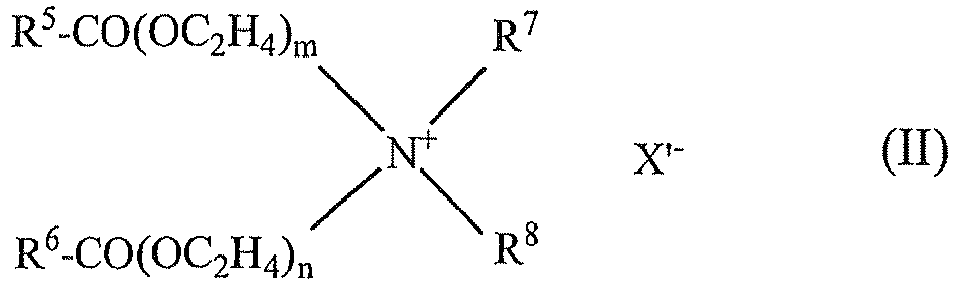
- wherein, R5 and R6, which may be the same as or different from each other, represent a hydrocarbon group having 11 to 23 carbon atoms; R7 and R8, which may be the same as or different from each other, represent a hydrocarbon group having 1 to 4 carbon atoms that may be substituted with a hydroxy group; m and n, which may be the same as or different from each other, represent an integer showing the mole number of added oxyethylene group ranging from 5 to 10; and X'- represents an anion.
The present invention further provides a method for softening a fiber product, containing treating the fiber product with the composition of the present invention, and use of the composition of the present invention for softening a fiber product. - The present invention provides a softener composition, and more in details a liquid softener composition, that has both effects for softening and imparting water-absorbability which is generally hardly imparted by a softener, and has good properties for easy handling, such as no thickening with time and a good dispersion of components.
- According to the present invention, provided is a softener composition that has both good effects for softening and imparting water-absorbability, and has good properties for easy handling, having a high fluidity at a room temperature and a good dispersion of components.
- The quaternary ammonium salt (I) is a compound represented by formula (I). In formula (I), from the viewpoint of effect of softening, R1 and R2 each preferably represent a hydrocarbon group having 11 to 23, more preferably 15 to 21, and even more preferably 15 to 17 carbon atoms. The hydrocarbon group is preferably selected from alkyl and alkenyl groups. Specific examples of the hydrocarbon group include species of undecyl group, species of dodecyl group, species of tridecyl group, species of tetradecyl group, species of pentadecyl group, species of hexadecyl group, species of heptadecyl group, species of octadecyl group, species of nonadecyl group, species of icosyl group, species of henicosyl group, species of docosyl group, species of tricosyl group, species of undecenyl group, species of dodecenyl group, species of tridecenyl group, species of tetradecenyl group, species of pentadecenyl group, species of hexadecenyl group, species of heptadecenyl group, species of octadecenyl group, species of nonadecenyl group, species of icosenyl group, species of heneicosenyl group, species of docosenyl group, and species of tricosenyl groups. Preferred are all variations of pentadecyl, heptadecyl, nonadecyl, heneicosanyl, pentadecenyl, heptadecenyl, nonadecenyl, heneicosenyl groups, and more preferred are all variations of pentadecyl, heptadecyl, pentadecenyl, and heptadecenyl groups. As used herein, the term "species" refers to both a linear group and a branched chain group.
- In formula (I), R3 and R4 each independently represent a hydrocarbon group having 1 to 4 carbon atoms that may be substituted with a hydroxy group. The hydrocarbon group is preferably selected from alkyl and hydroxyalkyl groups. From the viewpoints of dispersibility, R3 and R4 each preferably represent an alkyl or hydroxy alkyl group having 1 to 3, more preferably 1 to 2 carbon atoms, and even more preferably a methyl or hydroxyethyl group. R1 and R2 are separately connected to the nitrogen via polyoxyethylene chains represented in formula (I) as (OC2H4)k and (OC2H4)l, respectively. In formula (I), k and 1 represent an integer showing the mole number of added oxyethylene group of the respective polyoxyethylene chains ranging and are 1 to 4, which may be the same as or different from each other. From the viewpoints of ease of handling and effect of imparting water-absorbability of the softener composition of the present invention, k and l each preferably represent 2 or 3. X- represents an anion selected from those suitable for softener. Examples of the anion include halogens such as chlorine, bromine, and iodine, and sulfate ions such as methylsulfate and ethylsulfate. Particularly preferred are a chloride ion and a methylsulfate ion.
- The quaternary ammonium salt (II) is a compound represented by formula (II). In formula (II), R5 and R6 are the same examples and preferences as R1 and R2. R7 and R8 are the same examples and preferences as to R3 and R4. X'- is the same examples and preferences as to X- in formula (I). m and n, which may be the same as or different from each other, represent an integer showing the mole number of added oxyethylene group in the respective polyoxyethylene chains, ranging from 5 to 10. From the viewpoints of effects of softening and imparting water-absorbability of the softener composition of the present invention, m and n each preferably represent 6 to 8, more preferably 6 to 7, and even more preferably 6.
- The softener composition of the present invention contains the quaternary ammonium salt (I) represented by formula (I) and the quaternary ammonium salt (II) represented by formula (II) at a weight ratio of quaternary ammonium salts (I) to (II), (I) : (II), of 50.1 : 49.9 to 99.99 : 0.01. From the viewpoints of effects of imparting water-absorbability and ease of handling of the softener composition of the present invention, the weight ratio (I) : (II) is preferably 60 : 40 to 99.9 : 0.1, more preferably 70 : 30 to 99 : 1, and even more preferably 70 : 30 to 99.9 : 0.1.
- The softener composition of the present invention preferably contains the quaternary ammonium salts (I) and (II) in the total amount of 1 to 40% by weight, more preferably 2 to 30% by weigh, even more preferably 3 to 20% by weight, still even more preferably 4 to 10% by weight, and yet still even more preferably 5 to 8% by weight. The total content not less than 1% by weight can provide a softener composition having higher performances, and the total content not more than 40% by weight provides a stable solution of a softener composition and therefore makes production of the softener composition easier.
- From the viewpoint of effects of imparting water-absorbability, the softener composition of the present invention preferably contains two or more quaternary ammonium salts represented by formula (I). In this case, two or more quaternary ammonium salts represented by formula (I) are preferably different from each other in the total number of moles of oxyethylene group added, that is, the total of k and 1 in formula (I).
- In the softener composition of the present invention, from the viewpoint of effects for softening of the softener composition, a number-average value of the addition mole number of oxyethylene groups per polyoxyethylene chain of quaternary ammonium salts (I) and (II), that is, an average of numbers k, l, m, and n in the formulae (I) and (II), is preferably the number from 1 to 4, more preferably the number more than 1 and not more than 4, and even more preferably the number from 2 to 3.5. The average of numbers k, l, m, and n is a value calculated according to the equation [(k + l) * xI + (m + n) * xII]/2 (xI + xII), in which xI and xII represent a molar ratio of quaternary ammonium salts (I) to (II) xI: xII.
- The softener composition of the present invention further contains water. The water generally makes up the rest part. The softener composition of the present invention preferably has a pH value of 1.5 to 6 at 20°C. The lower pH is more suitable from the viewpoint of antiseptic and bactericidal effects, but increases a risk of degradation of components generally blended in the composition. As thus, the pH is more preferably 1.5 to 5, and even more preferably 2 to 4.5. To adjust pH, any inorganic or organic acid or alkali can be used. Specific examples of the agent for adjusting pH include hydrochloric acid, sulfuric acid, phosphoric acid, alkylsulfuric acid, p-toluenesulfonic acid, carboxylic acids, such as acetic acid, citric acid, malic acid, succinic acid, lactic acid or glycolic acid, carboxylic acid-containing polymers, such as polyacrylic acid, hydroxyethanediphosphonic acid, tripolyphosphoric acid, phytic acid, ethylenediaminetetraacetic acid, short-chain amine compounds (e.g., triethanolamine, diethanolamine, dimethylamine, N-methylethanolamine, N-methyldiethanolamine, N-methyl-N-(2-hydroxyethyl)-N-(2-cyanoethyl)amine, N-methyl-N-(2-hydroxyethyl)propanediamine, 2,3-dihydroxy-N,N-dimethylpropylamine, and N,N-di(2-hydroxyethyl)propanediamine) and alkylene oxide-adducts thereof, and long-chain amine compounds in which a chain connecting to the nitrogen has 8 to 36 carbon atoms and alkylene oxide-adducts thereto. These agents may be used in a salt form. Examples of the agent also include alkaline metal hydroxides, alkaline metal carbonates, and alkaline metal silicates. Among them exemplified, preferred are hydrochloric acid, methylsulfuric acid, sodium hydroxide, diethanolamine, and triethanolamine.
- The softener composition of the present invention is easy to handle. Moreover an alkylene oxide adduct to an alcohol, amine or a fatty acid may be used to improve properties of dispersing quaternary ammonium salts (I) and (II). The amount of such an additive, however, may be significantly decreased, compared with the usual amount when used, due to ease of handling of the softener composition of the present invention. In the alkylene oxide adduct to an alcohol, an amine or a fatty acid, a hydrocarbon chain may be linear or branched optionally with unsaturation. The hydrocarbon chain may have a distribution of carbon chain lengths. From the viewpoints of an effect of softening of the softener composition and dispersibility of quaternary ammonium salts in the softener composition, the hydrocarbon chain preferably has 6 to 20 carbon atoms, and more preferably 8 to 18 carbon atoms. In cases of linear chains, the hydrocarbon chain preferably has 6 to 14 carbon atoms, more preferably 8 to 12 carbon atoms, and even more preferably 8 to 10 carbon atoms. In cases of branched chains, the hydrocarbon chain preferably has 6 to 17 carbon atoms, more preferably 9 to 17 carbon atoms, and even more preferably 13 carbon atoms. Examples of a starting material for the adduct include Exxsol (ExxonMobil Chemical), Lutensol TO (BASF), and Oxocol C13 (KH Neochem Co. , Ltd.). In cases of alcohol-alkylene oxide adducts, a starting alcohol may be primary or secondary, but preferably primary, because a primary alcohol-alkylene oxide adduct provides better dispersibility of components in the softener composition. An alcohol having 13 carbon atoms is produced from dodecene, a starting material of which may be butylene or propylene. In the case of the hydrocarbon chain has an unsaturated bond, it preferably has 18 carbon atoms . A steric structure of the unsaturated bond may be cis- or trans-form. The hydrocarbon chain may be a mixture of both cis-form and trans-form. A ratio of cis-isomer/trans-isomer is more preferably 25/75 to 100/0 (weight ratio). The alkylene oxide is preferably ethylene oxide (EO). Ethylene oxide may be added together with propylene oxide (PO) or butylene oxide (BO). An average number of moles of EO added is 10 to 100, more preferably 20 to 80, and even more preferably 30 to 60. If PO or BO is added together with EO, an average number of moles of added PO or BO is 1 to 5, preferably 1 to 3. In this case, PO or BO may be added before or after addition of EO. Examples of the EO adduct include a nonyl alcohol-EO (9) PO(1), a primary isononyl alcohol-EO(40), a primary isodecyl alcohol-EO(20), a lauryl alcohol-EO(20), a primary isohexadecyl alcohol-EO(60), a primary isotridecyl alcohol-EO(40), a beef tallow alkyl amine-EO(60), a beef tallow alkyl amine-EO(60), an oleylamine-EO(50), and a lauric acid-EO(20) adducts, in which "EO(X)" refers to that EO is added in an average number X of moles, and the same applies to PO. Commercial products can also be used, including Emalex series of Nihon Emulsion Co., Ltd., Emulmin series of Sanyo Chemical Industries, Ltd., TDA series and Esomin series of Lion Co.,Ltd., Softanol series including Softanol 300 of Nippon Shokubai Co. , Ltd. , and Lutensol series of BASF. The alkylene oxide adduct of an alcohol, amine, or fatty acid is preferably blended in an amount of 0 to 5% by weight, more preferably 0 to 2% by weight, and even more preferably 0 to 1% by weight of the whole composition.
- In order to further decrease the viscosity of the composition, an inorganic or organic salt (except for the quaternary ammonium salt (I) or (II)) can be used in a small amount. Specific examples of the other salt include sodium chloride, potassium chloride, calcium chloride, magnesium chloride, aluminum chloride, sodium sulfate, magnesium sulfate, potassium sulfate, sodium nitrate, magnesium nitrate, sodium p-toluenesulfonate, sodium glycolate, sodium acetate, potassium acetate, potassium glycolate, and sodium lactate. Preferred are calcium chloride and magnesium chloride. The salt is added in an amount of 0 to 2% by weight, more preferably 0 to 1% by weight, and even more preferably 0 to 0.5% by weight.
- In cases of applying the liquid softener composition of the present invention to fiber products such as cloths, the composition can further contain one or more silicones at any proportion, alone or a mixture thereof, selected from dimethylpolysiloxane and a modified dimethylpolysiloxanes having an organic functional group, in order to make the fiber product stiff and improve smoothness of the product in ironing. Examples of the organic functional group include an amino group, an amide group, an alkyl group, an aralkyl group, a carboxyl group, a fluoroalkyl group, an ester group derived from a higher alcohol, a polyether group, an epoxy group, a carbinol group, a mercapto group, a phenyl group, a methacryl group, and groups having two or more functionalities such as aminopolyether, amidopolyether, and alkyl alcohol. The silicone is preferably selected from dimethylsilicone, polyoxyethylene-modified silicones, silicones having a hydrogen atom or a hydroxy group, and emulsified products thereof.
- In order to make a user conscious of using the softener composition, the softener composition can further contain a perfume. Examples of the perfume include various natural and synthetic perfumes commonly used in softener compositions such as those described in "Gousei Kouryou, Kagaku To Shouhin Chishiki (synthetic perfume, chemistry and knowledge on products)", Indo Motoichi, Chemical Daily Co.,Ltd., 1996, and " Perfume and Flavor Chemicals", Steffen Arctander, MONTCLAIR, N.J., 1969.
- In order to improve the appearance of the softener composition, the composition can further contain at least one water-soluble dye selected from acid dyes, direct dyes, basic dyes, reactive dyes, and acid mordant dyes. Specific examples of the dye are found in "Senryou Binran (dye handbook) " (Society of Synthetic Organic Chemistry, Japan eds., Maruzen, issued on July 20, 1970).
- In order to enhance antiseptic and bactericidal capacity, the softener composition of the present invention can further contain at least one agent selected from common antibacterial and bactericidal agents. Examples of the common antibacterial or bactericidal agent include alcohols having 1 to 8 carbon atoms, benzoic acids, and phenols. Specific Examples thereof include ethanol, propylene glycol, benzyl alcohol, salicylic acid, methyl parahydroxybenzoate, and cresol.
- The softener composition of the present invention can further contain a common chelating agent, including phosphonic acid chelating agents such as hydroxyethanediphosphonic acid and carboxylic acid chelating agents such as ethylenediaminetetraacetic acid, citric acid, and polyacrylic acid.
- The softener composition of the present invention can further contain, as an optional component, any other known additive generally blended in softener compositions in addition to those described above within the range that does not impair the effects of the present invention. Examples of the optional component and a preferred amount thereof are as follows: higher fatty acids such as stearic acid, oleic acid and palmitic acid and derivatives thereof such as an ester formed with a lower alcohol in an amounts of 0 to 2% by weight; nonionic surfactants such as fatty acid glycerol ester (e.g., stearic acid glycerol ester) in an amount of 0 to 1% by weight; higher alcohols such as stearyl, palymityl, and oleyl alcohols in an amount of 0 to 3% by weight; and low temperature stabilizers such as ethylene glycol and glycerol in an amount of 0 to 10% by weight. In addition, ureas, pigments, cellulose derivatives, UV absorbers, and fluorescent brighteners may also be blended.
- The softener composition of the present invention is suitably used for softening fiber products such as clothes and bedclothes.
- The softener composition of the present invention is used at various concentrations depending on the application and the form to be used. In cases of applying to fiber products such as clothes, the composition is preferably diluted such that the total concentration of quaternary ammonium salts (I) and (II) of the present invention is 0.001 to 3% by weight, and preferably 0.01 to 1% by weight to a treatment medium, preferably water such as rinsing water in a washing process.
- The quaternary ammonium salt (I) of the present invention can be produced, for example, by a method containing the following steps 1 and 2.
- Step 1: reacting a halopolyethoxyethanol (III) represented by formula (III):
Z- (C2H4O)o-C2H4OH (III)
wherein, Z represents a halogen atom; and o represents an integer from 0 to 3,
with an amine represented by formula (IV):
R3-NH2 (IV)
wherein, R3 represents a hydrocarbon group having 1 to 4 carbon atoms that may have a hydroxy group,
to obtain a bis(polyethoxyethanol)alkylamine or bis(polyethoxyethanol) hydroxyalkylamine. - Step 2: esterifying the bis(polyethoxyethanol)alkylamine or the bis(polyethoxyethanol) hydroxyalkylamine, produced in the step 1, with a fatty acid or a derivative thereof and quaternizing the resultant.
- In the step 1, the halopolyethoxyethanol (III) is preferably used in an amount of stoichiometrically 0.3 to 2 equivalents, and more preferably 0.4 to 1.8 equivalents to the amine represented by formula (IV) [i.e., halopolyethoxyethanol (III)/amine (IV)]. As a reaction medium, water and alcohols such as ethanol may be used. A reaction temperature is preferably 70 to 110°C, and more preferably 80 to 100°C. A reaction time is preferably 1 to 5 hours.
- In the step 1, the following two-stage reaction will produce the bis(polyethoxyethanol)alkylamine or the bis(polyethoxyethanol) hydroxyalkylamine with a higher yield:
- ● first stage: reacting 0.3 to 0.6eq. of halopolyethoxyethanol (III) with the amine represented by formula (IV) (preferably for 1 to 5 hours at 90 to 110°C), neutralizing a hydrogen halide generated as a by-product and removing it in a salt form, and distilling off excess monomethylamine; and
- ● second stage: to a mixture of a bis(polyethoxyethanol) and a mono(polyethoxyethanol) products, adding the halopolyethoxyethanol (III) in an additional amount of 0.5 to 0.9 eq. to the mono(polyethoxyethanol) product, and reacting in water or an alcohol for 1 to 3 hours at 70 to 90°C, and distilling.
- Excess halopolyethoxyethanol and unreacted amine and the like can be removed through purification such as distillation.
- In the step 2, the bis(polyethoxyethanol)alkylamine or bis(polyethoxyethanol)hydroxyalkylamine (hereinafter, referred to as intermediate amine) produced in the step 1 is esterified with a fatty acid or a derivative thereof and the obtained amine is quaternized with a quaternizing agent.
- In the esterification, a higher fatty acid having 12 to 24 carbon atoms, preferably 16 to 22 carbon atoms, and more preferably 16 to 18 carbon atoms or a derivative thereof is used. Specific examples of the fatty acid include myristic acid, palmitic acid, palmitoleic acid, stearic acid, oleic acid, linoleic acid, linolenic acid, and those prepared from natural fats and oils such as beef tallow, pork lard, palm oil, and soy oil by purification and hydrogenation or partial hydrogenation. Examples of the derivative of fatty acid include alkyl esters, acid chlorides, and acid anhydrides of fatty acids described above.
- The produced amine is quaternized. For quaternization, a standard method using a quaternizing agent such as an alkyl halide having 1 to 4 carbon atoms that may have a hydroxy group (e.g., methyl chloride) and an alkylsulfate can be employed.
- The quaternary ammonium salt (II) can also be produced by the same method as above except for replacing a halopolyethoxyethanol (V) represented by formula (V) for the halopolyethoxyethanol (III) and an amine represented by formula (IV') for the amine represented by formula (IV):
R7-NH2 (IV')
wherein, R7 represents a hydrocarbon group having 1 to 4 carbon atoms that may have a hydroxy group,
Z - (C2H4O)p - C2H4OH (V)
wherein, Z represents the same meanings as in formula (III); and p represents an integer from 4 to 9. - As described above, the method of the present invention can efficiently and selectively produce the quaternary ammonium salts (I) and (II), having added oxyethylene chains with no distribution of the mole number by an appropriate selection of a halopolyethoxyethanol used in the step 1.
- Quaternary ammonium salts (I) and (II) produced by the method can be appropriately purified by standard methods such as crystallization. The produced quaternary ammonium salts (I) and (II) can be used as components to produce the softener composition of the present invention.
- A composition containing the produced quaternary ammonium salts (I) and (II) at a weight ratio (I) : (II) of 50.1 : 49.9 to 99.99 : 0.01 is used for softening fiber products. A treatment with the composition containing the produced quaternary ammonium salts (I) and (II) at a weight ratio (I) : (II) of 50.1 : 49.9 to 99.99 : 0.01 can soften fiber products. A method of treating a fiber product or fabric preferably contains immersing the fiber product or fabric in an aqueous dispersion containing the composition of the present invention diluted to an adequate concentration. A temperature in the treatment is preferably 0°C to 40°C, and more preferably 5°C to 30°C. The treatment can be conducted in a settled state, but preferably in a stirred state. A treating time is preferably 30 seconds to 10 minutes, and more preferably 1 to 5 minutes. In the treatment, a concentration of effective components, or the total concentration of quaternary ammonium salts (I) and (II), is preferably 15 ppm to 60 ppm, and more preferably 25 ppm to 40 ppm. A bath ratio is preferably 5 to 40 L/kg (fiber product). After the immersion, a standard method of dehydration and dry can provide a softened fiber product.
- The following examples further describe and demonstrate embodiments of the present invention. The examples are given solely for the purpose of illustration and are not to be construed as limitations of the present invention.
- In Examples, unless otherwise noted, "%" refers to "% by weight".
- In a pressure-resistant reaction vessel, 244 g of 41% monomethylamine in water, 182 g of 2-chloroethoxyethanol, and 80 g of water were reacted for 4 hours at 110°C. To the reaction mixture was added an aqueous solution of sodium hydroxide (the equivalent amount to the chloro-compound) to neutralize generated hydrochloric acid. Excess monomethylamine was distilled off under reduced pressure. The reaction mixture was transferred to a new reaction vessel. To this was added further 86 g of 2-chloroethoxyethanol, and reacted for 1 hour at 80°C. To the reaction mixture was added dropwise an aqueous solution of sodium hydroxide in an equivalent amount to the additional 2-chloroethoxyethanol over 30 minutes. The reaction mixture was aged for 30 minutes. Then, the solvent and the salt were removed. The product was distilled to isolate a di-substituted compound, (bis(2-ethoxyethanol)methylamine). The di-substituted compound was identified by NMR (400 MHz, 1H, Varian, Mercury 400). Then, 113 g of the di-substituted compound was reacted with 326 g of stearic acid for 23 hours at 180 to 200°C under 180 to 200 Torr (24.0 to 26.7 kPa) to obtain a diesterified compound of bis(2-ethoxyethanol)methylamine. 44 g of the diesterified compound was dissolved in 50g of isopropyl alcohol. In a pressure-resistant reaction vessel, to the solution was added 4.5 g of methyl chloride, and reacted for 5.5 hours at 88°C to quaternize. The reaction mixture was added in cold acetone to form crystals. These crystals were dried to obtain a quaternary ammonium salt [compound (I-1)] represented by formula (I). The product was identified by NMR (400MHz, 1H) and fat-and-oil analysis (acid value (JIS K 0070), saponification value (JIS K 0070), hydroxy value (JIS K 0070), amine value (ASTM D 2074), chloride ion concentration (silver nitrate titration), measurement of loss on drying (drying method)). A structure of the compound (I-1) is shown in Table 1.
- A quaternary ammonium salt [compound (I-2)] represented by formula (I) was prepared by the same method as in Preparation Example 1, except that 2-(2-chloroethoxy)ethoxyethanol was used instead of 2-chloroethoxyethanol. The compound (I-2) was identified by the same method as in Preparation Example 1. A structure of the compound (I-2) is shown in Table 1.
- A quaternary ammonium salt [compound (I-3)] represented by formula (I) was prepared by the same method as in Preparation Example 1, except that 2- (2- (2-chloroethoxy) ethoxy) ethoxyethanol was used instead of 2-chloroethoxyethanol. The compound (I-3) was identified by the same method as in Preparation Example 1. A structure of the compound (I-3) is shown in Table 1.
- 133 g of N-methyldiethanolamine (Sigma-Aldrich Corp.) was reacted with 700 g of stearic acid for 23 hours at 180 to 200°C under 180 to 200 Torr (24.0 to 26.7 kPa) to obtain a diesterified compound of N-methyldiethanolamine. 198 g of the di-esterified compound was dissolved in 200 g of isopropyl alcohol. The solution was fed into a pressure-resistant reaction vessel and 19 g of methyl chloride was added, and the mixture was reacted for 5.5 hours at 88°C to quaternize. The reaction mixture was added in cold acetone to form crystals. These crystals were dried to obtain a quaternary ammonium salt [compound (I-4)] represented by formula (I). The product was identified by NMR (400MHz, 1H) and fat-and-oil analysis (acid value (JIS K 0070), saponification value (JIS K 0070), hydroxy value (JIS K 0070), amine value (ASTM D 2074), chloride ion concentration (silver nitrate titration), measurement of loss on drying (drying method)). A structure of the compound (I-4) is shown in Table 1.
- A quaternary ammonium salt [compound (II-I)] represented by formula (I) was prepared by the same method as in Preparation Example 1, except that 2-(2-(2-(2-(2-chloroethoxy)ethoxy) ethoxy)ethoxy)ethoxyethanol was used instead of 2-chloroethoxyethanol. The compound (II-1) was identified by the same method as in Preparation Example 1. A structure of the compound (II-1) is shown in Table 1.
- Compounds (I-1) to (I-4) and (II-1) prepared in Preparation Examples 1 to 5 and calcium chloride were used in proportions shown in Table 2 and dispersed in ion-exchanged water to obtain respective liquid softener compositions. These compositions were evaluated for (1) dispersibility and ease in handling, and (2) effects of softening and imparting water-absorbability, according to the following methods of evaluation.
- Dispersibility was evaluated, based on ease in preparing a dispersion. More specifically, a quaternary ammonium salt (I) or mixture of quaternary ammonium salts (I) and (II) in a predetermined amount was added to hot water at about 70°C containing a predetermined amount of calcium chloride, and vigorously stirred. From the start of stirring, a mixture that became homogeneous within 3 minutes was judged as easy-to-disperse, and a mixture that took over 3 minutes to become homogeneous was judged as hard-to-disperse. Dispersions were then observed for thickening after preparation. When cooled to a room temperature after preparation, a dispersion having fluidity was judged as easy-to-handle, a dispersion in the liquid state was judged as very easy-to-handle. Results are collectively shown in Table 2. In the evaluation, a dispersion "having fluidity" refers to that when a cylindrical glass bottle having a diameter of 25 mm and a height of 55 mm and containing 15 ml of the dispersion was quickly laid horizontally at 25°C, the dispersion moved its liquid level within 30 seconds, and a dispersion "in the liquid state" refers that the dispersion had a horizontal liquid level within 30 seconds.
- 24 cotton towels (marketed product, Takei Towel K.K., #3700, white) were stirred for 10 minutes in 45 L of tap water dissolving 4.5 g of Emulgen 108 (Kao Corporation, nonionic surfactant) at 20°C, rinsed twice, and dehydrated for 6 minutes. A process from stirring in the surfactant solution to dehydration was repeated twice. Then, these towels were stirred for 10 minutes in 45 L of tap water at 20°C, rinsed twice, and dehydrated for 6 minutes. A process from stirring in tap water to dehydration was repeated three times. Starches on towels were thus removed. Towels were dried, and treated for 5 minutes with each liquid softener composition in Table 2 in such amount as that the total amount of quaternary ammonium salts in the composition was 0.1% by weight to the towels in tap water with stirring at 20°C at a bath ratio of 30 L/kg (weight of towels). These towels were dried for 24 hours at 25°C and 40%RH in a thermo-hygrostat. These towels were separately evaluated for softness and water-absorbability according to the following ratings. Results are also collectively shown in Table 2.
- Treated towels were sensory evaluated by 5 special panelists. A towel treated with the liquid softener composition of Comparative Example 1 were used as a control (standard). Towels were ranked for softness according to the following scale.
+2: much softer than the control
+1: softer than the control
0: as soft as the control
-1: the control is softer
-2: the control is much softer
Averages of rates ranked by 5 panelists are shown in Table 2. - A towel (Takei Towel K.K., #3700, white) was treated according to the above process and conditioned at 25°C and 40%RH in a thermo-hygrostat. From a plain-woven part of the towel, a test piece having dimensions of 2.5 cm by 25 cm was cut out. The test piece was soaked at the bottom thereof in water at 25°C. After 30 seconds from soaking, a height of water rising was measured. For towels treated with Examples 1 to 9 and Comparative Example 2, a height was again measured after 15 minutes. The experiment was repeated three times, and an average of measured heights was considered as a height of water absorption (cm). The higher height of water absorption means that a treated fabric has the higher water-absorbability.
-


- In Table 2, in the column of (I) : (II) (weight ratio), numbers in parenthesis [ ] represent proportions of (Ia) and (Ib) or (Ia), (Ib), and (Ic), in this order. The amount % by weight of the quaternary ammonium salt is the total of (I) and (II). The rest part of a liquid softener is water.
Claims (10)
- A softener composition, comprising a quaternary ammonium salt (I) represented by formula (I) and a quaternary ammonium salt (II) represented by formula (II) at a weight ratio of quaternary ammonium salts (I) to (II), (I) : (II), of 50.1 : 49.9 to 99.99 : 0.01:


- The softener composition according to claim 1, wherein the quaternary ammonium salt (I) is represented by formula (I) in which k and l, which may be the same as or different from each other, represent an integer showing the mole number of added oxyethylene group ranging from 2 to 3.
- The softener composition according to claim 1 or 2, comprising at least two quaternary ammonium salts represented by formula (I).
- The softener composition according to any one of claims 1 to 3, comprising at least two quaternary ammonium salts represented by formula (I), wherein the quaternary ammonium salts are different from each other in the total mole number of added oxyethylene group, represented as (k + 1).
- The softener composition according to any one of claims 1 to 4, wherein the quaternary ammonium salt (II) is represented by formula (II) in which m and n, which may be the same as or different from each other, represent an integer showing the mole number of added oxyethylene group ranging from 6 to 8.
- The softener composition according to any one of claims 1 to 5, comprising the quaternary ammonium salt (I) represented by formula (I) and the quaternary ammonium salt (II) represented by formula (II) at a weight ratio of quaternary ammonium salts (I) to (II), (I) : (II), of 70 : 30 to 99.9 : 0.1.
- The softener composition according to any one of claims 1 to 6, wherein the number-average addition mole number of oxyethylene group per polyoxyethylene chain of the quaternary ammonium salts (I) and (II) is a number of more than 1 and not more than 4.
- The softener composition according to any one of claims 1 to 7, wherein the number average addition mole number of oxyethylene group per polyoxyethylene chain of the quaternary ammonium salts (I) and (II) is a number of from 2 to 3.5.
- A method for softening a fiber product, comprising treating the fiber product with a composition comprising a quaternary ammonium salt (I) represented by formula (I) and a quaternary ammonium salt (II) represented by formula (II) at a weight ratio of the quaternary ammonium salts (I) to (II), (I) : (II), of 50.1 : 49.9 to 99.99 : 0.01:


- A use of a composition for softening a fiber product, wherein the composition comprises a quaternary ammonium salt (I) represented by formula (I) and a quaternary ammonium salt (II) represented by formula (II) at a weight ratio of quaternary ammonium salts (I) to (II), (I) : (II), of 50.1 : 49.9 to 99.99 : 0.01:


Applications Claiming Priority (2)
| Application Number | Priority Date | Filing Date | Title |
|---|---|---|---|
| JP2010051770 | 2010-03-09 | ||
| PCT/JP2011/055290 WO2011111674A1 (en) | 2010-03-09 | 2011-03-08 | Softener composition |
Publications (2)
| Publication Number | Publication Date |
|---|---|
| EP2546408A1 true EP2546408A1 (en) | 2013-01-16 |
| EP2546408A4 EP2546408A4 (en) | 2015-08-19 |
Family
ID=44563475
Family Applications (1)
| Application Number | Title | Priority Date | Filing Date |
|---|---|---|---|
| EP11753332.3A Withdrawn EP2546408A4 (en) | 2010-03-09 | 2011-03-08 | Softener composition |
Country Status (5)
| Country | Link |
|---|---|
| US (1) | US8778865B2 (en) |
| EP (1) | EP2546408A4 (en) |
| JP (1) | JP5681003B2 (en) |
| CN (1) | CN102791921B (en) |
| WO (1) | WO2011111674A1 (en) |
Families Citing this family (4)
| Publication number | Priority date | Publication date | Assignee | Title |
|---|---|---|---|---|
| CA2928436A1 (en) * | 2013-11-15 | 2015-05-21 | The Procter & Gamble Company | Fabric softener composition |
| JP7051538B2 (en) * | 2018-03-30 | 2022-04-11 | ライオン株式会社 | Fiber treatment agent composition |
| CN113185713B (en) * | 2021-03-30 | 2022-05-24 | 中山大学 | A preparation method of flexible hydrogel and its application in high-performance medical protective equipment |
| CN116332776B (en) * | 2023-03-17 | 2024-01-26 | 上海艺妙达生物科技有限公司 | Cationic lipid compound, and composition and application thereof |
Family Cites Families (15)
| Publication number | Priority date | Publication date | Assignee | Title |
|---|---|---|---|---|
| JP2970132B2 (en) | 1991-10-04 | 1999-11-02 | ライオン株式会社 | Liquid softener composition |
| JPH0718577A (en) | 1993-06-30 | 1995-01-20 | Lion Corp | Liquid softener composition |
| JP3183755B2 (en) | 1993-06-30 | 2001-07-09 | ライオン株式会社 | Liquid softener composition |
| DE4402852C1 (en) * | 1994-01-31 | 1995-02-16 | Henkel Kgaa | Detergent mixtures and the use thereof |
| DE4437032A1 (en) * | 1994-10-17 | 1996-04-18 | Henkel Kgaa | Textile softener concentrates |
| DE19916027A1 (en) * | 1999-04-09 | 2000-10-19 | Goldwell Gmbh | Method for treating hair |
| EP1196372A1 (en) * | 1999-07-01 | 2002-04-17 | The Procter & Gamble Company | Quaternary nitrogen compound, fabric care composition containing same, and process for forming same |
| DE19962874A1 (en) | 1999-12-24 | 2001-06-28 | Cognis Deutschland Gmbh | Transparent fabric or hair conditioner composition comprises an esterquat and an additive |
| JP4256552B2 (en) | 1999-12-28 | 2009-04-22 | ライオン株式会社 | Liquid softener composition |
| US6838427B2 (en) | 2001-06-08 | 2005-01-04 | Kao Corporation | Softener composition |
| JP3822531B2 (en) | 2001-06-08 | 2006-09-20 | 花王株式会社 | Softener composition |
| CN1680278A (en) | 2005-01-10 | 2005-10-12 | 上海高维科技发展有限公司 | Quaternary ammonium salt and preparation thereof |
| CN101020644A (en) * | 2006-10-01 | 2007-08-22 | 江苏飞翔化工股份有限公司 | Synthesis process of ester quaternary ammonium salt |
| JP5394215B2 (en) | 2008-12-11 | 2014-01-22 | 花王株式会社 | Softener composition |
| CN101575299A (en) | 2009-06-18 | 2009-11-11 | 江南大学 | Method for synthesizing dual-long-chain ester based quaternary ammonium salt |
-
2011
- 2011-03-08 US US13/579,614 patent/US8778865B2/en not_active Expired - Fee Related
- 2011-03-08 WO PCT/JP2011/055290 patent/WO2011111674A1/en not_active Ceased
- 2011-03-08 CN CN201180013158.7A patent/CN102791921B/en not_active Expired - Fee Related
- 2011-03-08 EP EP11753332.3A patent/EP2546408A4/en not_active Withdrawn
- 2011-03-09 JP JP2011051587A patent/JP5681003B2/en not_active Expired - Fee Related
Non-Patent Citations (1)
| Title |
|---|
| See references of WO2011111674A1 * |
Also Published As
| Publication number | Publication date |
|---|---|
| US20120329702A1 (en) | 2012-12-27 |
| WO2011111674A1 (en) | 2011-09-15 |
| JP2011208345A (en) | 2011-10-20 |
| US8778865B2 (en) | 2014-07-15 |
| EP2546408A4 (en) | 2015-08-19 |
| CN102791921A (en) | 2012-11-21 |
| JP5681003B2 (en) | 2015-03-04 |
| CN102791921B (en) | 2015-04-22 |
Similar Documents
| Publication | Publication Date | Title |
|---|---|---|
| EP2809758B1 (en) | Fabric softener active composition | |
| RU2423415C2 (en) | Non-rinse fabric softener | |
| US8778865B2 (en) | Softener composition | |
| CN105209589A (en) | Fabric softener compositions | |
| JPH0598571A (en) | Liquid softener composition | |
| US4948520A (en) | Softener composition | |
| JPH0718571A (en) | Softener composition | |
| CN102245828B (en) | Softener composition | |
| JPH04333667A (en) | Liquid softening agent composition | |
| JPH07268773A (en) | Textile product softening finish composition and method for preparing the same | |
| JP3160937B2 (en) | Liquid softener composition | |
| JPH024710B2 (en) | ||
| JPH0718569A (en) | Softener composition | |
| JP3194640B2 (en) | Softener composition | |
| JPH07102479A (en) | Liquid softener composition | |
| JP2994898B2 (en) | Liquid soft finish | |
| JP2970975B2 (en) | Soft finish | |
| CN121794357A (en) | Active substances for cleaning compositions | |
| JP2994894B2 (en) | Liquid soft finish | |
| JP2851686B2 (en) | Liquid soft finish | |
| JPH0657632A (en) | Softening finish agent | |
| JP2002266242A (en) | Softener composition | |
| JP2018016910A (en) | Liquid softener composition | |
| JPH10259574A (en) | Fabric softener | |
| JP2012144812A (en) | Method for inhibiting hydrolysis of silicic acid ester |
Legal Events
| Date | Code | Title | Description |
|---|---|---|---|
| PUAI | Public reference made under article 153(3) epc to a published international application that has entered the european phase |
Free format text: ORIGINAL CODE: 0009012 |
|
| 17P | Request for examination filed |
Effective date: 20120823 |
|
| AK | Designated contracting states |
Kind code of ref document: A1 Designated state(s): AL AT BE BG CH CY CZ DE DK EE ES FI FR GB GR HR HU IE IS IT LI LT LU LV MC MK MT NL NO PL PT RO RS SE SI SK SM TR |
|
| DAX | Request for extension of the european patent (deleted) | ||
| RA4 | Supplementary search report drawn up and despatched (corrected) |
Effective date: 20150717 |
|
| RIC1 | Information provided on ipc code assigned before grant |
Ipc: D06M 13/463 20060101AFI20150713BHEP |
|
| 17Q | First examination report despatched |
Effective date: 20151201 |
|
| STAA | Information on the status of an ep patent application or granted ep patent |
Free format text: STATUS: THE APPLICATION IS DEEMED TO BE WITHDRAWN |
|
| 18D | Application deemed to be withdrawn |
Effective date: 20170607 |