EP2546226B1 - 1-methoxyl-2,6,10-trimethyl-1,3,5,9-undec-tetraene and preparation method and uses thereof - Google Patents
1-methoxyl-2,6,10-trimethyl-1,3,5,9-undec-tetraene and preparation method and uses thereof Download PDFInfo
- Publication number
- EP2546226B1 EP2546226B1 EP11765048.1A EP11765048A EP2546226B1 EP 2546226 B1 EP2546226 B1 EP 2546226B1 EP 11765048 A EP11765048 A EP 11765048A EP 2546226 B1 EP2546226 B1 EP 2546226B1
- Authority
- EP
- European Patent Office
- Prior art keywords
- solvent
- aldehyde
- reaction
- double bond
- enol ether
- Prior art date
- Legal status (The legal status is an assumption and is not a legal conclusion. Google has not performed a legal analysis and makes no representation as to the accuracy of the status listed.)
- Active
Links
Classifications
-
- C—CHEMISTRY; METALLURGY
- C07—ORGANIC CHEMISTRY
- C07C—ACYCLIC OR CARBOCYCLIC COMPOUNDS
- C07C43/00—Ethers; Compounds having groups, groups or groups
- C07C43/02—Ethers
- C07C43/03—Ethers having all ether-oxygen atoms bound to acyclic carbon atoms
- C07C43/14—Unsaturated ethers
- C07C43/15—Unsaturated ethers containing only non-aromatic carbon-to-carbon double bonds
- C07C43/16—Vinyl ethers
-
- C—CHEMISTRY; METALLURGY
- C07—ORGANIC CHEMISTRY
- C07C—ACYCLIC OR CARBOCYCLIC COMPOUNDS
- C07C41/00—Preparation of ethers; Preparation of compounds having groups, groups or groups
- C07C41/01—Preparation of ethers
- C07C41/18—Preparation of ethers by reactions not forming ether-oxygen bonds
- C07C41/30—Preparation of ethers by reactions not forming ether-oxygen bonds by increasing the number of carbon atoms, e.g. by oligomerisation
-
- C—CHEMISTRY; METALLURGY
- C07—ORGANIC CHEMISTRY
- C07C—ACYCLIC OR CARBOCYCLIC COMPOUNDS
- C07C45/00—Preparation of compounds having >C = O groups bound only to carbon or hydrogen atoms; Preparation of chelates of such compounds
- C07C45/42—Preparation of compounds having >C = O groups bound only to carbon or hydrogen atoms; Preparation of chelates of such compounds by hydrolysis
Definitions
- the invention relates to an intermediate 1-methoxyl-2, 6, 10-trimethyl-1, 3, 5, 9-undec-tetraene, and a preparation method and uses thereof.
- pseudoionone (2) reacts with acetylene anion to obtain tertiary alcohol (7) (3, 7, 11-trimethyl-4, 6, 10-dodecyl triene-1-alkynyl-3-alcohol):
- propadiene pentadec-carbon phosphonate (6) (3, 7, 11-trimethyl-1, 2, 4, 6, 10-pentaene-dodecyl diethyl phosphonate):
- pentadec-carbon phosphonate (5) and decadialdehyde (8) (2, 7-dimethyl-2, 4, 6-trieneoctane-1, 8-dialdehyde) are condensed under the catalysis of base to prepare lycopene (1):
- the new compound 2, 4, 6, 10-tetra-double bond pentadec-carbon phosphonate (5) is used as key intermediate, which avoids the use of triphenylphosphine; besides, with the pseudoionone as raw material, the target product lycopene can be obtained only by four reactions, so the route is simple and convenient and tremendous progress is achieved compared with previous methods.
- this route has some problems: first, it is difficult, to a certain extent, to obtain (6) by means of the reaction between (7) and dialkyl chlorophosphite; and second, it is difficult to grasp the reduction technology for selectively reducing (6) into (5).
- the technical problem to be solved by the invention is to overcome the defects in the prior art and provide a new compound 1-methoxyl-2, 6, 10-trimethyl-1, 3, 5, 9-undec-tetraene, and pure 2-pos double bond C-14 aldehyde can be prepared by hydrolyzing and refining the compound.
- the synthetic route is simplified and great suitability for industrial production is achieved.
- the new compound 1-methoxyl-2, 6, 10-trimethyl-1, 3, 5, 9-undec-tetraene provided by the invention, C-14 enol ether for short, has the structural formula below:
- a preparation method of the C-14 enol ether comprises the following steps:
- the condensation reaction is performed at the presence of base.
- the base may be organic base, such as alkali metal salt of alcohols or lithium alkylide, strong bases like sodium alcoholate, sodium tert-butoxide, potassium tert-butoxide and butyl lithium are preferred, and other strong bases are acceptable due to no particular restriction.
- the molar weight of base is 1.0-1.2 times as much as that of C-4 phosphate ester (6), preferably 1.02-1.1 times.
- the molar weight of citral (5) is 0.8-1.2 times as much as that of C-4 phosphate ester (6), preferably 0.9-1.0 times.
- reaction raw material above i.e. C-4 phosphate ester (6)
- C-4 phosphate ester (6) is either commercially available, or can be prepared in accordance with relevant documents ( Bulletin de la Societe Chimique de France, (11), 4186-94; 1967 )
- reaction raw material C-4 phosphate ester (6) and the base are firstly subjected to rearrangement dissociation reaction to form corresponding carbanions, and then the reaction raw material citral (5) is added for condensation reaction; this way is beneficial not only for the sufficient dissociation of the raw material C-4 phosphate ester (6) into carbanions, but also for controlling the reaction better.
- the temperature for the rearrangement dissociation reaction and the condensation reaction of C-4 phosphate ester (6) is -40°C to 30°C, preferably -20°C to 10°C.
- the organic solvent above is any of or the mixture of more than two of ether solvent, dipolar aprotic solvent, aromatic hydrocarbon solvent and alkane solvent
- the ether solvent is ether, tetrahydrofuran or ethylene glycol dimethyl ether
- the dipolar aprotic solvent is dimethyl formamide DMF, dimethyl sulfoxide DMSO or hexamethylphosphoric triamide HMPTA
- the aromatic hydrocarbon solvent is methylbenzene and the like
- the alkane solvent is n-hexane and the like.
- a method for preparing lycopene intermediate 2-pos double bond C-14 aldehyde from the C-14 enol ether comprises the following steps:
- the acid catalyst that can be used in the hydrolysis of C-14 enol ether (7) is sulfuric acid, p-toluenesulfonic acid, trifluoroacetic acid or aminosulfonic acid due to no particular restriction, the homogeneous phase solvent may be tetrahydrofuran or acetone, etc.
- the amount of the acid catalyst is 5-10% of the weight of C-14 enol ether (7); the amount of water is 1-3 times as much as the weight of C-14 enol ether (7); the addition amount of the homogeneous phase solvent is 5-10 times as much as the weight of C-14 enol ether (7).
- the temperature for hydrolysis is from 10°C to 35°C, and gas chromatography is used for tracking the reaction.
- a method for refining the crude product of 2-pos double bond C-14 aldehyde (3) comprising the following refining steps: a) crude product of C-14 aldehyde reacts with sodium bisulfite aqueous solution to obtain an adduct, i.e.
- sodium bisulfite salt and excessive amount of sodium bisulfite is used to guarantee smooth salt forming reaction; 2) layering is performed upon sufficient salt forming, an organic solvent is used for extracting an aqueous layer to remove residual organic impurities, and the product sodium bisulfite salt is contained in the aqueous layer for future use; c) the aqueous layer and the organic solvent are stirred together, sodium carbonate or base is added in batches for treatment, or the aqueous layer is firstly treated with sodium carbonate or base and then added with the organic solvent for extraction; the amount of the sodium carbonate or the base is more than that of the sodium bisulfite in the step a) to guarantee the complete dissociation of sodium bisulfite salt; and d) layering is performed, the resultant organic layer is water-rinsed and dried, and the solvent is removed by distillation to obtain pure 2-pos double bond C-14 aldehyde.
- the organic solvent used in the salt forming and dissociation reactions is methylene dichloride, cyclohexane or methylbenzene, and the temperature is from 10°C to 40°C.
- aldehyde is purified by removing other organic impurities in a way of separation; besides, 3-pos double bond C-14 aldehyde (3A) can also be directly rearranged as 2-pos double bond C-14 aldehyde (3), and the mechanism is as follows:
- the invention can obtain the key intermediate of lycopene, i.e. 2-pos double bond C-14 aldehyde (3), from the raw material citral (5) only by two reactions (condensation, hydrolysis), so the invention has the advantages of simple and convenient process route, easily available raw materials, low cost and great industrial value.
- the raw material citral is a cis-trans isomer mixture
- the condensation product C-14 enol ether (7), the hydrolysis product 2-pos double bond C-14 aldehyde (3) and 1, 3, 6, 10-tetra-double bond pentadec-carbon phosphonate (4) are all cis-trans isomer mixtures; however, the cis-trans isomers contained in these intermediates have no impact on the all-trans structure of the final product lycopene (1), this is because the final product all-trans lycopene can be obtained only after the crude product of lycopene is subjected to cis-trans isomerism purification.
- the analysis instruments and equipment used in the embodiments are as follows: gas chromatography-mass spectrometry MS5973N-GC6890N (Agilent Technologies); nuclear magnetic resonance instrument, AVANCE DMX 400M (TMS Internal Label); infrared spectrometer, NICOLET 360FT-IR; and gas chromatography, SHANGHAI TECHCOMP 7890F.
- DEPT135 144.91, 144.85, 126.68, 125.22; 125.88, 125.53; 124.15, 124.09; 123.24, 123.14; 59.78; 40.10(D); 32.68(D); 26.86, 26.67(D); 25.71; 24.01; 17.63; 16.81; 14.49.
- a fixed amount of base and 20ml certain solvent are added to a 250ml three-necked bottle under the protection of nitrogen, the temperature of cold bath is maintained, 20ml certain solvent (the same as the solvent above) with a fixed amount of C-4 phosphate ester (6) (see the table below for molar weight) dissolved therein is dropwise added under mechanical stirring, the addition can be finished about half an hour later while a particular temperature is maintained, and stirring is continued for about 1 hour while the temperature is maintained, so that sufficient dissociation reaction of carbanions is realized; afterwards, a solvent (the same as the solvent above) with 7.6g citral (5) (0.05mol, cis-trans mixture) dissolved therein is dropwise added while the temperature above is maintained, the addition can be finished about 1 hour later, stirring is continued for half an hour while the temperature is maintained, gas chromatography is used for tracking the reaction, 30ml water and 50ml ether are added and stirred for 10 minutes, layering is performed, the
Landscapes
- Chemical & Material Sciences (AREA)
- Organic Chemistry (AREA)
- Chemical Kinetics & Catalysis (AREA)
- Organic Low-Molecular-Weight Compounds And Preparation Thereof (AREA)
Description
- The invention relates to an intermediate 1-methoxyl-2, 6, 10-trimethyl-1, 3, 5, 9-undec-tetraene, and a preparation method and uses thereof.
- In nature, there are approximately 600 types of carotenoids, but only six of them can be used for industrial production by manufacturers including Roche Company and BASF Company, and lycopene, as an important product among them, plays a key role in free radical removal, anti-aging, tumor inhibition, treatment for heart disease and the like and is widely applied to drugs, food additives and feed additives. Roche Company has developed a Wittig reaction-featured synthetic route in which expensive and toxic raw material triphenylphosphine is used, and triphenylphosphine is used in a variety of other early synthesis methods as well.
- Babler J.H. et al. reported a novel Wittig-Horner reaction-featured method for the synthesis of lycopene in
WO 0031086 - At first, pseudoionone (2) reacts with acetylene anion to obtain tertiary alcohol (7) (3, 7, 11-trimethyl-4, 6, 10-dodecyl triene-1-alkynyl-3-alcohol):

- Then, the tertiary alcohol (7) reacts with diethyl chlorophosphite to obtain propadiene pentadec-carbon phosphonate (6) (3, 7, 11-trimethyl-1, 2, 4, 6, 10-pentaene-dodecyl diethyl phosphonate):

- Afterwards, (6) is partially reduced and converted into pentadec-carbon phosphonate (5) (3, 7, 11-trimethyl-2, 4, 6, 10-tetraene-dodecyl diethyl phosphonate)

- Finally, pentadec-carbon phosphonate (5) and decadialdehyde (8) (2, 7-dimethyl-2, 4, 6-trieneoctane-1, 8-dialdehyde) are condensed under the catalysis of base to prepare lycopene (1):

- In the method above, the new compound 2, 4, 6, 10-tetra-double bond pentadec-carbon phosphonate (5) is used as key intermediate, which avoids the use of triphenylphosphine; besides, with the pseudoionone as raw material, the target product lycopene can be obtained only by four reactions, so the route is simple and convenient and tremendous progress is achieved compared with previous methods. However, this route has some problems: first, it is difficult, to a certain extent, to obtain (6) by means of the reaction between (7) and dialkyl chlorophosphite; and second, it is difficult to grasp the reduction technology for selectively reducing (6) into (5).
- SHEN Runbo et al. have recently reported a new process in their research findings (patent application number:
CN 201010120583.3 
- The synthesis method for its key intermediate C-14 aldehyde (3) (2, 6, 10-trimethyl-2, 5, 9-undecane triene-1-aldehyde) is described in
US4000131 , in which pseudoionone (2) reacts with sulfonium chloride to obtain epoxide (9), ring opening is then performed under catalysis to obtain 3-pos double bond C-14 aldehyde (3A) (2, 6, 10-trimethyl-3, 5, 9-undecane triene-1-aldehyde), and finally, 3-pos double bond C-14 aldehyde (3A) is subjected to base catalysis and rearrangement to obtain 2-pos double bond C-14 aldehyde (3). Expensive methyl iodide, polluting dimethyl sulphide and dangerous strong base, i.e. DMSO sodium salt, are needed in this method, so that the method is hardly applied to industrial production. - The technical problem to be solved by the invention is to overcome the defects in the prior art and provide a new compound 1-methoxyl-2, 6, 10-trimethyl-1, 3, 5, 9-undec-tetraene, and pure 2-pos double bond C-14 aldehyde can be prepared by hydrolyzing and refining the compound. The synthetic route is simplified and great suitability for industrial production is achieved.
- The new compound 1-methoxyl-2, 6, 10-trimethyl-1, 3, 5, 9-undec-tetraene provided by the invention, C-14 enol ether for short, has the structural formula below:

- A preparation method of the C-14 enol ether comprises the following steps:
- 1) C-4 phosphate ester, shown as Formula (6), is subjected to rearrangement dissociation reaction under the protection of inert gas and at the presence of organic solvent and base, wherein the reaction temperature is from -40°C to 30°C;
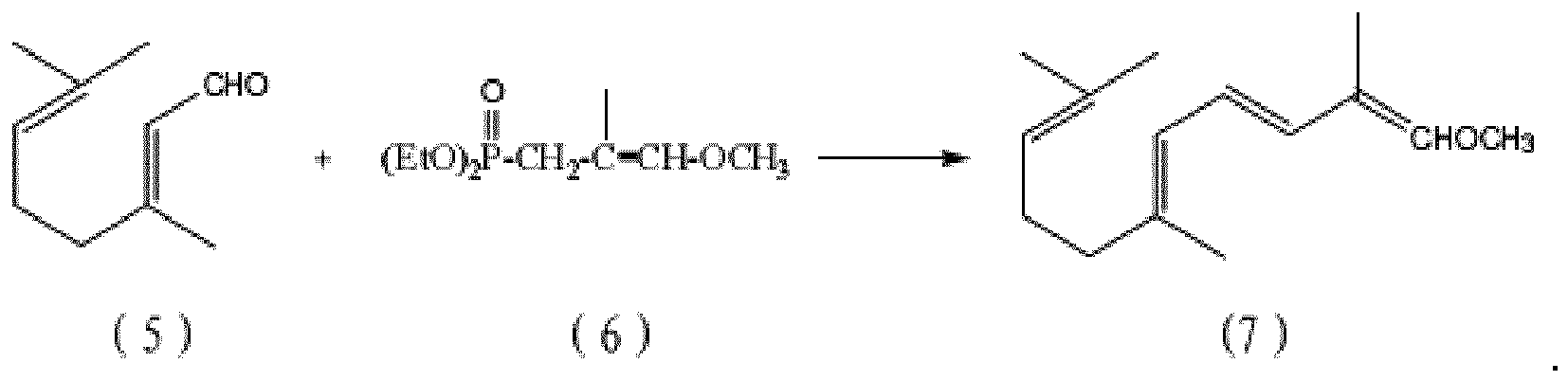
- 2) citral, shown as Formula (5), is then added to the substance derived from the step 1) to perform Wittig-Horner condensation reaction at the presence of base and organic solvent, thus C-14 enol ether shown as Formula (7) is obtained, wherein the reaction temperature is from -40°C to 30°C and the synthetic route is as follows:

- The condensation reaction is performed at the presence of base. The base may be organic base, such as alkali metal salt of alcohols or lithium alkylide, strong bases like sodium alcoholate, sodium tert-butoxide, potassium tert-butoxide and butyl lithium are preferred, and other strong bases are acceptable due to no particular restriction.
- The molar weight of base is 1.0-1.2 times as much as that of C-4 phosphate ester (6), preferably 1.02-1.1 times. The molar weight of citral (5) is 0.8-1.2 times as much as that of C-4 phosphate ester (6), preferably 0.9-1.0 times.
- The reaction raw material above, i.e. C-4 phosphate ester (6), is either commercially available, or can be prepared in accordance with relevant documents (Bulletin de la Societe Chimique de France, (11), 4186-94; 1967)

- In the above condensation reaction, the reaction raw material C-4 phosphate ester (6) and the base are firstly subjected to rearrangement dissociation reaction to form corresponding carbanions, and then the reaction raw material citral (5) is added for condensation reaction; this way is beneficial not only for the sufficient dissociation of the raw material C-4 phosphate ester (6) into carbanions, but also for controlling the reaction better.
- The temperature for the rearrangement dissociation reaction and the condensation reaction of C-4 phosphate ester (6) is -40°C to 30°C, preferably -20°C to 10°C.
- The organic solvent above is any of or the mixture of more than two of ether solvent, dipolar aprotic solvent, aromatic hydrocarbon solvent and alkane solvent, the ether solvent is ether, tetrahydrofuran or ethylene glycol dimethyl ether, the dipolar aprotic solvent is dimethyl formamide DMF, dimethyl sulfoxide DMSO or hexamethylphosphoric triamide HMPTA, the aromatic hydrocarbon solvent is methylbenzene and the like, and the alkane solvent is n-hexane and the like.
- Upon the completion of condensation reaction, water and organic solvent are added for the purpose of layering, a byproduct, i.e. diethyl phosphate sodium salt, is dissolved in water and a product, i.e. C-14 enol ether (7), exists in organic phase, and the target product, i.e. C-14 enol ether (7), can be obtained by removing the solvent in a manner of organic phase distillation.
- A method for preparing lycopene intermediate 2-pos double bond C-14 aldehyde from the C-14 enol ether comprises the following steps:
- step 1), C-14 enol ether, acid catalyst, water and homogeneous phase solvent are mixed for hydrolysis under the protection of nitrogen in order to obtain a crude product mixture containing 2-pos double bond C-14 aldehyde (3) and 3-position double bond C-14 aldehyde (3A), and the reaction route is as follows:

- step 2), upon the completion of hydrolysis, sodium bicarbonate aqueous solution is firstly added to adjust the reaction system to be neutral, solvent is then distilled out under reduced pressure, a water-immiscible organic solvent is added for extraction, layering is performed and crude product of C-14 aldehyde is then obtained by drying the solvent by distillation at organic layer, the crude product contains a small amount of 3-pos double bond C-14 aldehyde (3A), a large amount of 2-pos double bond C-14 aldehyde (3) and some other impurities, and pure 2-pos double bond C-14 aldehyde (3) needs to be prepared by refining, which aims at removal of 3-pos double bond C-14 aldehyde (3A).
- The acid catalyst that can be used in the hydrolysis of C-14 enol ether (7) is sulfuric acid, p-toluenesulfonic acid, trifluoroacetic acid or aminosulfonic acid due to no particular restriction, the homogeneous phase solvent may be tetrahydrofuran or acetone, etc. The amount of the acid catalyst is 5-10% of the weight of C-14 enol ether (7); the amount of water is 1-3 times as much as the weight of C-14 enol ether (7); the addition amount of the homogeneous phase solvent is 5-10 times as much as the weight of C-14 enol ether (7). The temperature for hydrolysis is from 10°C to 35°C, and gas chromatography is used for tracking the reaction.
- In the invention, a method for refining the crude product of 2-pos double bond C-14 aldehyde (3) is found by accident, comprising the following refining steps: a) crude product of C-14 aldehyde reacts with sodium bisulfite aqueous solution to obtain an adduct, i.e. sodium bisulfite salt, and excessive amount of sodium bisulfite is used to guarantee smooth salt forming reaction; 2) layering is performed upon sufficient salt forming, an organic solvent is used for extracting an aqueous layer to remove residual organic impurities, and the product sodium bisulfite salt is contained in the aqueous layer for future use; c) the aqueous layer and the organic solvent are stirred together, sodium carbonate or base is added in batches for treatment, or the aqueous layer is firstly treated with sodium carbonate or base and then added with the organic solvent for extraction; the amount of the sodium carbonate or the base is more than that of the sodium bisulfite in the step a) to guarantee the complete dissociation of sodium bisulfite salt; and d) layering is performed, the resultant organic layer is water-rinsed and dried, and the solvent is removed by distillation to obtain pure 2-pos double bond C-14 aldehyde.
- The organic solvent used in the salt forming and dissociation reactions is methylene dichloride, cyclohexane or methylbenzene, and the temperature is from 10°C to 40°C.
- Typically, preparation of adduct from aldehyde and sodium bisulfite and then hydrolysis is the common purification method for aldehydes. In the invention, after such treatments, aldehyde is purified by removing other organic impurities in a way of separation; besides, 3-pos double bond C-14 aldehyde (3A) can also be directly rearranged as 2-pos double bond C-14 aldehyde (3), and the mechanism is as follows:
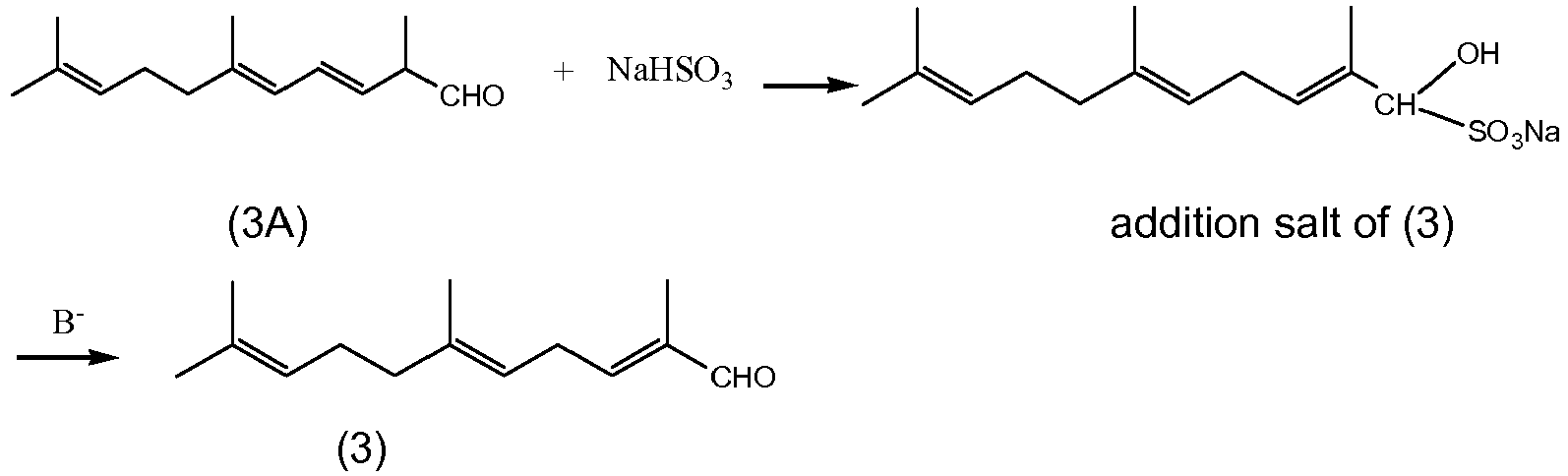
- That is to say, double bond migration has occurred at the time of addition, and the driving force is the double bond migration caused by anion stabilization during the addition of aldehyde group and bisulfite. After such treatments, the rearranged target product 2-pos double bond C-14 aldehyde (3) is obtained, and the purification effect is achieved, the purity of product is quite high after simple removal of solvent by distillation, thus the requirements in the next reaction can be met; however, the current common purification method has no purification effect, so rectification is indispensable.
- As discussed above, the invention can obtain the key intermediate of lycopene, i.e. 2-pos double bond C-14 aldehyde (3), from the raw material citral (5) only by two reactions (condensation, hydrolysis), so the invention has the advantages of simple and convenient process route, easily available raw materials, low cost and great industrial value.
- 2-pos double bond C-14 aldehyde (3) and tetraethyl methylenediphosphonate are subjected to Wittig-Horner condensation reaction to prepare 1, 3, 6, 10-tetra-double bond pentadec-carbon phosphonate (4), and 1, 3, 6, 10-tetra-double bond pentadec-carbon phosphonate (4) and decadialdehyde are subjected to condensation reaction to obtain lycopene (1), and specific synthesis method can be seen in related documents, so detailed description is unnecessary (application number:
20101020583.3 - It shall be noted that, the raw material citral is a cis-trans isomer mixture, so the condensation product C-14 enol ether (7), the hydrolysis product 2-pos double bond C-14 aldehyde (3) and 1, 3, 6, 10-tetra-double bond pentadec-carbon phosphonate (4) are all cis-trans isomer mixtures; however, the cis-trans isomers contained in these intermediates have no impact on the all-trans structure of the final product lycopene (1), this is because the final product all-trans lycopene can be obtained only after the crude product of lycopene is subjected to cis-trans isomerism purification.
- Further description is made below to the invention with reference to the embodiments.
- The analysis instruments and equipment used in the embodiments are as follows: gas chromatography-mass spectrometry MS5973N-GC6890N (Agilent Technologies); nuclear magnetic resonance instrument, AVANCE DMX 400M (TMS Internal Label); infrared spectrometer, NICOLET 360FT-IR; and gas chromatography, SHANGHAI TECHCOMP 7890F.
- 12.3g potassium tert-butoxide (0.11mol) and 50ml mixture of tetrahydrofuran and dimethyl sulfoxide based on a ratio of 8:1 (volume ratio) are added to a 250ml three-necked bottle under the protection of nitrogen, the temperature of cold bath is maintained, 22.2g C-4 phosphate ester (6) (0.1 mol) is dropwise added under mechanical stirring, the addition can be finished about half an hour later while the temperature is maintained at -30°C to -25°C, and stirring is continued for about 1 hour while the temperature is maintained, so that sufficient dissociation reaction of carbanions is realized; afterwards, 15.2g citral (5) (0.1mol, cis-trans mixture) is dropwise added while the temperature is maintained at -30°C to -25°C, the addition can be finished about 1 hour later, stirring is continued for about half an hour while the temperature is maintained, gas chromatography is used for tracking the reaction, 50ml water and 100ml ether are added and stirred for 10 minutes, layering is performed, the ether layer is rinsed by sodium chloride aqueous solution with the concentration of 5% 3 times (25ml for each time), the organic layer is dried by magnesium sulfate and filtered, the solvent in filtrate is removed by distillation under reduced pressure to obtain crude product, the residues are distilled under reduced pressure to obtain 12.8g 97-101 °C/1mmHg fraction, which is transparent liquid, there are four peaks with similar sizes in product according to GC analysis, the total content is 93.5% and the yield is 54.5%. The four products are 1-pos methoxyl cis-trans isomers and 5, 6-pos double bond cis-trans isomers respectively.
- Structural Confirmation of Products (1-methoxyl cis-trans; 5, 6-double bond cis):

- Structural Confirmation of Products (1-methoxyl cis-trans; 5, 6-double bond trans):

- 1HNMR(δ, ppm, 400MHz, CDCl3): 1.606(s, 3H, C13-H), 1.685(s, 6H, C11-H, C12-H),1.782(s, 3H, C14-H), 2.049-2.171(m, 4H, C7-H, C8-H), 3.619(s, 3H,O-CH3), 5.057-5.164(m, 1 H, C9-H), 5.870(s, 1 H, C1-H), 5.940(dd, J=11.2Hz, 5.6Hz 1 H, C4-H), 6.287(dd, J=15.2Hz, 11.2Hz 1 H, C5-H), 6.625(dd, J=15.2Hz, 12.4Hz 1 H, C3-H);

- DEPT135: 144.91, 144.85, 126.68, 125.22; 125.88, 125.53; 124.15, 124.09; 123.24, 123.14; 59.78; 40.10(D); 32.68(D); 26.86, 26.67(D); 25.71; 24.01; 17.63; 16.81; 14.49.
- A fixed amount of base and 20ml certain solvent (see the table below for the type of base and solvent) are added to a 250ml three-necked bottle under the protection of nitrogen, the temperature of cold bath is maintained, 20ml certain solvent (the same as the solvent above) with a fixed amount of C-4 phosphate ester (6) (see the table below for molar weight) dissolved therein is dropwise added under mechanical stirring, the addition can be finished about half an hour later while a particular temperature is maintained, and stirring is continued for about 1 hour while the temperature is maintained, so that sufficient dissociation reaction of carbanions is realized; afterwards, a solvent (the same as the solvent above) with 7.6g citral (5) (0.05mol, cis-trans mixture) dissolved therein is dropwise added while the temperature above is maintained, the addition can be finished about 1 hour later, stirring is continued for half an hour while the temperature is maintained, gas chromatography is used for tracking the reaction, 30ml water and 50ml ether are added and stirred for 10 minutes, layering is performed, the ether layer is rinsed by 15ml sodium chloride aqueous solution with the concentration of 5%, dried by magnesium sulfate and filtered, the solvent in filtrate is removed by distillation under reduced pressure to obtain crude product, the residues are distilled under reduced pressure to collect 97-101°C/1mmHg fraction, .the GC content is measured, the yield is calculated, and the results are shown in the table below.
Table 1: Potassium tert-butoxide, tetrahydrofuran and dimethyl sulfoxide are replaced by different bases and solvents and the amount of base is adjusted, the results are shown in the table below: (Note: n-butyl lithium is 2.5mol/l n-hexane solution) Embodi ment Type of Base Amount of Base (Mol) Solvent Amount of C-4 Phosphate Ester (Mol) Reaction Temperature(°C) Amount of Obtained Product (g) and Product Content (%) Yield (%) 2 sodium ethoxide 0.06 methylbenzene 0.050 5 6.0; 91.2 49.7 3 sodium tert-butoxide 0.05 ethylene glycol dimethyl ether 0.045 -10 7.2; 91.5 59.8 4 potassium tert-butoxide 0.055 dimethyl formamide 0.048 -20 9.0; 92.3 75.5 5 n-butyl lithium 0.051 tetrahydrofuran/n-hexan e 0.050 -40 9.1; 93.6 77.4 6 sodium methoxide 0.052 ether 0.055 15 3.7; 89.9 30.2 7 potassium tert-butoxide 0.054 dimethyl sulfoxide 0.060 20 7.4; 91.3 61.4 8 potassium tert-butoxide 0.054 hexamethylphosphoric triamide 0.056 30 6.7; 91.4 58.4 - The products obtained are mixed to obtain 49g crude product of enol ether, which is used for the experiments under the condition of hydrolysis in the embodiments 10 to 16 below.
- 11.0g C-14 enol ether (7) (0.05mol) prepared in the embodiment 1, 100g solvent tetrahydrofuran and 1.5g paratoluenesulfonic acid are added to a 250ml three-necked bottle under the protection of nitrogen and are then uniformly stirred, afterwards, 22g water is dropwise added for reaction for 1 day under stirring and at the temperature from 20°C to 25°C; after the reaction is basically completed according to the tracking of gas chromatography, solution prepared from 2g sodium bicarbonate and 20ml water is added for neutralization, tetrahydrofuran is distilled out under reduced pressure by a water pump and then 100ml cyclohexane is added, layering is performed, the organic layer is rinsed by 30ml water and dried by anhydrous magnesium sulfate, afterwards, the solvent is recovered under reduced pressure to obtain 9.5g crude product of C-14 aldehyde, and according to GC analysis, the product is a mixture containing a fixed amount of 3-pos double bond C-14 aldehyde (3A) and a fixed amount of 2-pos double bond C-14 aldehyde (3), and its total content is 77%; the mixture is added with 9.5g sodium bisulfite, then dissolved in 80ml aqueous solution and magnetically stirred for 120 minutes under the protection of nitrogen to result in substantial removal of organic matters; 20ml cyclohexane is added and stirred for 15 minutes, and layering is then performed; the aqueous layer is added with 80ml cyclohexane and then added with 12g potassium carbonate under stirring to acquire alkality, and these additions are followed by stirring for 10 minutes and layering; the organic layer is then rinsed by 20ml sodium chloride aqueous solution with the concentration of 10%, dried by magnesium sulfate and filtered, the solvent is dried by distillation under reduced pressure to obtain 7.8g pure 2-pos double bond C-14 aldehyde, and the product has the content of 93.1 % and the yield of 70.5% according to GC analysis.
- Structural Confirmation of Products (1-methoxyl cis-trans; 5, 6-double bond cis):
- GC-MS (m/e): 206, 191, 177, 163, 150, 135, 123, 109, 95, 81, 69(100%), 53, 41 29;

- 5.5g C-14 enol ether (7) (0.025mol) prepared in the embodiments 2-8, a fixed amount of solvent and a fixed amount of catalyst (see the table below for molar weight) are added to a 250ml three-necked bottle under the protection of nitrogen and are then uniformly stirred, afterwards, a fixed amount of water is dropwise added for reaction under stirring at a particular temperature; after the reaction is basically completed according to the tracking of gas chromatography, solution prepared from 1.5g sodium bicarbonate and 15ml water is added for neutralization, the solvent is distilled out under reduced pressure by a water pump and then 50ml cyclohexane is added, layering is performed, the organic layer is rinsed by 20ml water and dried by anhydrous magnesium sulfate, afterwards, the solvent is recovered under reduced pressure to obtain crude product of C-14 aldehyde; the GC content is measured, the yield is calculated, and the results are shown in the table below.
Table 2: Different acid catalysts and solvents are adopted and the amount of acid and water is adjusted, the results are shown in the table below: Embodi ment Type of Acid Amount of Acid (Weight) Solvent and Amount (ml) Amount of Water (Weight) Reaction Temperature(°C) Amount of Obtained Product (g) and Product Content (%) Yield (%) 10 sulfuric acid 0.025 tetrahydrofuran, 25 5.0 15 3.3; 65.5 42.0 11 sulfuric acid 0.045 acetone, 30 6.0 10 4.3; 72.1 60.2 12 trifluoroacetic acid 0.055 tetrahydrofuran, 55 20.0 20 5.3; 75.3 79.0 13 trifluoroacetic acid 0.050 acetone, 45 15.5 30 5.5; 73.5 78.5 14 paratoluenesulfo nic acid 0.030 tetrahydrofuran, 35 12.0 15 5.8; 71.8 80.9 15 paratoluenesulfo nic acid 0.040 acetone, 40 12.0 25 5.7; 76.1 84.2 16 aminosulfonic acid 0.025 tetrahydrofuran, 25 8.0 30 5.5; 79.4 84.8 - 35.4g crude products of C-14 aldehyde derived from the above experiments under various conditions are mixed, the mixture is added with 55g sodium bisulfite, then dissolved in 400ml aqueous solution and magnetically stirred for 120 minutes under the protection of nitrogen to result in substantial removal of organic matters; 100ml cyclohexane is added and stirred for 5 minutes, and layering is then performed; the aqueous layer is added with 300ml cyclohexane and then added with 60g potassium carbonate under stirring to acquire alkality, and these additions are followed by stirring for 40 minutes and layering; the organic layer is then rinsed by 50ml sodium chloride aqueous solution with the concentration of 10%, dried by magnesium sulfate and filtered, the solvent is dried by distillation under reduced pressure to obtain 25.5g pure 2-pos double bond C-14 aldehyde (3). According to GC analysis, the product has the content of 93.1 % and the total yield of 65.7% in the case of hydrolysis seven times.
- 1.1g (0.0275mol) sodium hydride (60% content) is added to a 100ml three-necked bottle under the protection of nitrogen, paraffin oil is removed by rinsing twice with 10ml n-hexane each time; then, 10ml methylbenzene is added, 8.6g tetraethyl methylenediphosphonate (0.03mol) is dropwise added to 20ml methylbenzene solution under magnetic stirring, the temperature of cold water bath is maintained at 10 to 15°C while addition, a large amount of gas is discharged, the addition can be finished about half an hour later, and stirring is continued for reaction for half an hour; afterwards, 5.1g 2-pos double bond C-14 aldehyde (3) (prepared in the embodiment 9, 0.025mol) is dropwise added and dissolved in 20ml methylbenzene solution, the temperature of cold water bath is maintained at 10 to 15°C while addition, the addition can be finished about half an hour later, and stirring is continued for reaction for half an hour. 20ml water is added to the reaction mixture solution, which is followed by stirring for 10 minutes and layering, the organic layer is rinsed by 20ml sodium hydride aqueous solution with the concentration of 10%, dried by magnesium sulfate and filtered, and the solvent is dried by distillation under reduced pressure to obtain 7.5g crude product of 1, 3, 6, 10-tetra-double bond pentadec-carbon phosphonate (4), which is light brown liquid and has the GC content of 93.2% and the yield of 88.5%.
- GC-MS (m/e): 340, 325, 284, 271, 243, 217(100%), 205, 192, 159, 105, 79

- 6.8g (0.02mol) 1, 3, 6, 10-tetra-double bond pentadec-carbon phosphonate (4) prepared in the embodiment 17 and 30ml mixture of tetrahydrofuran and dimethyl sulfoxide based on a ratio of 8:1 (volume ratio) are added to a 250ml three-necked bottle under the protection of nitrogen, 2.3g (0.021mol) potassium tert-butoxide is added at about 5°C (ice water bath) under mechanical stirring, stirring is performed for 2 hours while the temperature is maintained, then 1.6g decadialdehyde (8) (0.0098mol) is dropwise added to 10ml mixture of tetrahydrofuran and dimethyl sulfoxide based on a ratio of 8:1 (volume ratio) (for the preparation of 8, see Embodiment XIV in
US 5061819 ), the addition can be finished about 20 minutes later, stirring is continued for 15 minutes while the temperature is maintained, and the temperature then rises to a range from 20-25°C for reaction for 1 hour. Addition of 100ml chloroform upon complete reaction is followed by rinsing three times with sodium hydride aqueous solution with the concentration of 10% (75ml for each time), the organic layer is dried by magnesium sulfate and filtered, the filtrate is refluxed and rearranged for 2 hours under the protection of nitrogen and the solvent is then removed by distillation under reduced pressure to obtain crude product, and the crude product is re-crystallized with 30ml methylene dichloride to obtain 2.8g (the yield is 52.3%) product. -

- 13CNMR(400MHz, CDCl3) δ(ppm): 139.52(C5); 137.37(C12); 136.56(C13); 136.19(C9); 135.42(C10); 132.66(C14); 131.76(C1); 131.58(C8); 130.09(C15); 125.73(C11); 125.17(C2); 124.82(C6); 123.96(C7); 40.25(C4); 26.69(C3); 25.72(C20); 18.42(C19); 16.97(C18); 12.91(C17); 12.81 (C16)
- There are 13 peaks between δ(ppm)120 and δ(ppm)140; there are 7 peaks between δ(ppm)10 and δ(ppm)45, thus determining the all-trans structure and high purity of product.
- DEPT135: 137.37; 135.42; 132.66; 131.58; 130.09; 125.73; 125.17; 124.82; 123.96;
- 58.48(D); 40.25(D); 26.69(D); 25.72; 18.42; 16.97; 12.91; 12.81
Claims (10)


Applications Claiming Priority (2)
| Application Number | Priority Date | Filing Date | Title |
|---|---|---|---|
| CN2010101397975A CN101792374B (en) | 2010-04-06 | 2010-04-06 | 1-methoxyl-2,6,10-trimethyl-1,3,5,9-undecene tetraene and preparation method and application thereof |
| PCT/CN2011/072472 WO2011124130A1 (en) | 2010-04-06 | 2011-04-06 | 1-methoxyl-2,6,10-trimethyl-1,3,5,9-undec-tetraene and preparation method and uses thereof |
Publications (3)
| Publication Number | Publication Date |
|---|---|
| EP2546226A1 EP2546226A1 (en) | 2013-01-16 |
| EP2546226A4 EP2546226A4 (en) | 2014-01-01 |
| EP2546226B1 true EP2546226B1 (en) | 2015-01-21 |
Family
ID=42585320
Family Applications (1)
| Application Number | Title | Priority Date | Filing Date |
|---|---|---|---|
| EP11765048.1A Active EP2546226B1 (en) | 2010-04-06 | 2011-04-06 | 1-methoxyl-2,6,10-trimethyl-1,3,5,9-undec-tetraene and preparation method and uses thereof |
Country Status (4)
| Country | Link |
|---|---|
| US (1) | US8697919B2 (en) |
| EP (1) | EP2546226B1 (en) |
| CN (1) | CN101792374B (en) |
| WO (1) | WO2011124130A1 (en) |
Families Citing this family (8)
| Publication number | Priority date | Publication date | Assignee | Title |
|---|---|---|---|---|
| CN102140117B (en) * | 2010-02-02 | 2012-10-17 | 绍兴文理学院 | 1,4,6,10-tetradouble-bond pentadecyl phosphonate and its preparation method and method for preparing lycopene |
| CN101824051B (en) * | 2010-03-09 | 2012-07-18 | 浙江医药股份有限公司新昌制药厂 | Lycopene intermediate 1,3,6,10-4-pentadienyl phosphonate as well as preparation method and application thereof |
| CN101792374B (en) * | 2010-04-06 | 2012-11-28 | 绍兴文理学院 | 1-methoxyl-2,6,10-trimethyl-1,3,5,9-undecene tetraene and preparation method and application thereof |
| CN102180774B (en) * | 2011-04-02 | 2013-06-12 | 绍兴文理学院 | Preparation method of C-14 enol ether |
| CN102249871B (en) * | 2011-06-13 | 2013-11-06 | 绍兴文理学院 | Preparation method of lycopene intermediate 2,6,10-trimethyl-1,1-docosane oxygroup-3,5,-undecane triene |
| CN102924246B (en) * | 2012-11-08 | 2014-06-04 | 绍兴文理学院 | A kind of preparation method of 2,6,10-trimethyl-2,5,9-undecatriene-1-al |
| CN104418713A (en) * | 2013-09-06 | 2015-03-18 | 绍兴文理学院 | 1-methoxy-2-methyl-4-(2,6,6-trimethyl-2-cyclohexene-1-yl)-1,3-butadiene and preparation method thereof |
| CN104592076A (en) * | 2013-10-30 | 2015-05-06 | 浙江医药股份有限公司新昌制药厂 | Preparation method of α-carotene |
Family Cites Families (7)
| Publication number | Priority date | Publication date | Assignee | Title |
|---|---|---|---|---|
| US4000131A (en) | 1974-05-10 | 1976-12-28 | Hoffmann-La Roche Inc. | Process for preparing epoxide-cyclohexyl compound and resultant compound |
| DE3505654A1 (en) * | 1985-02-19 | 1986-08-21 | Degussa Ag, 6000 Frankfurt | METHOD FOR PRODUCING 2-ALKYL-1,4-BUTANDIAL |
| US5061819A (en) * | 1988-10-31 | 1991-10-29 | Loyola University Of Chicago | Methods for synthesizing phosphonate reagents and retinoids |
| US5973179A (en) | 1998-11-19 | 1999-10-26 | Loyola University Of Chicago | C-15 phosphonate reagent compositions for the manufacture of compounds such as lycopene and methods of synthesizing the same |
| CN1172910C (en) * | 2001-01-05 | 2004-10-27 | 浙江医药股份有限公司新昌制药厂 | Process for preparing VA derivative |
| CN101544668B (en) * | 2009-03-30 | 2011-11-30 | 浙江医药股份有限公司维生素厂 | Method for preparing 3-methyl-5-(2,6,6-trimethyl-1- cyclohexene-1-yl)2,4-Pentadienyl-diethyl phosphonate |
| CN101792374B (en) * | 2010-04-06 | 2012-11-28 | 绍兴文理学院 | 1-methoxyl-2,6,10-trimethyl-1,3,5,9-undecene tetraene and preparation method and application thereof |
-
2010
- 2010-04-06 CN CN2010101397975A patent/CN101792374B/en active Active
-
2011
- 2011-04-06 EP EP11765048.1A patent/EP2546226B1/en active Active
- 2011-04-06 WO PCT/CN2011/072472 patent/WO2011124130A1/en not_active Ceased
- 2011-04-06 US US13/639,852 patent/US8697919B2/en active Active
Also Published As
| Publication number | Publication date |
|---|---|
| EP2546226A4 (en) | 2014-01-01 |
| WO2011124130A1 (en) | 2011-10-13 |
| CN101792374B (en) | 2012-11-28 |
| CN101792374A (en) | 2010-08-04 |
| EP2546226A1 (en) | 2013-01-16 |
| US8697919B2 (en) | 2014-04-15 |
| US20130046114A1 (en) | 2013-02-21 |
Similar Documents
| Publication | Publication Date | Title |
|---|---|---|
| US8697919B2 (en) | 1-methoxyl-2, 6, 10-trimethyl-1, 3, 5, 9-undec-tetraene, and preparation method and uses thereof | |
| EP2551272B1 (en) | Lycopene intermediate 1, 3, 6, 10-tetra-double bond pentadec-phosphonate, preparation method and application thereof | |
| CN102190565B (en) | Method for preparing intermediate of vitamin A, namely tetradecanal | |
| US8536361B2 (en) | 1,4,6,10-tetra-double bond pentadec-carbon phosphonate, preparation method thereof, and preparation method of lycopene using the same | |
| CN102180774A (en) | Preparation method of C-14 enol ether | |
| CN102249871B (en) | Preparation method of lycopene intermediate 2,6,10-trimethyl-1,1-docosane oxygroup-3,5,-undecane triene | |
| Shen et al. | A novel and practical synthetic route for the total synthesis of lycopene | |
| EP2578564B1 (en) | Preparation method of an intermediate for the preparation of lycopene | |
| Milas et al. | Synthesis of Products Related to Vitamin A. VI. The Synthesis of Biologically Active Vitamin A Ethers1 | |
| Mayer et al. | Total syntheses | |
| EP2578563B1 (en) | Intermediate of lycopene and preparation method of intermediate thereof | |
| CN102311320B (en) | Method for preparing 2,6,10-trimethyl-1,1-dialkoxyl-3,5,9-undecatriene | |
| DE102004006579A1 (en) | 2,7-Dimethyl-octa-2,4,6-trienedial is prepared by double enolether condensation of a butenedial-bisacetal, hydrolysis, dialdehyde conversion and crystallization with all steps effected in an organic solvent | |
| CN102617639A (en) | Lycopene intermediate 3,7-dimethyl-1,6-octadiene-1-phosphonic acid dialkyl ester, and preparation method and application thereof | |
| US2524778A (en) | butadiene-methylal addition | |
| US3920746A (en) | Preparation of tertiary-butyl aryl ethers | |
| US8563780B2 (en) | Allyl and propargyl ethers | |
| US12410114B2 (en) | Process for the preparation of α-functionalized ketones | |
| Ridley et al. | Preparations of 6-substituted 6H-Dibenzo [b, d] thiopyrans and their S-oxides through nucleophilic additions to 6H-dibenzo [b, d] thiopyran-6-one | |
| Balquist et al. | Cyclialkylation of phenol with 1, 5-hexadiene | |
| England et al. | Fluorovinylketones from perfluoropentene-2 | |
| CN111484510A (en) | Preparation method of (2,6, 6-trimethyl-1-cyclohexenyl) aldehyde |
Legal Events
| Date | Code | Title | Description |
|---|---|---|---|
| PUAI | Public reference made under article 153(3) epc to a published international application that has entered the european phase |
Free format text: ORIGINAL CODE: 0009012 |
|
| 17P | Request for examination filed |
Effective date: 20121012 |
|
| AK | Designated contracting states |
Kind code of ref document: A1 Designated state(s): AL AT BE BG CH CY CZ DE DK EE ES FI FR GB GR HR HU IE IS IT LI LT LU LV MC MK MT NL NO PL PT RO RS SE SI SK SM TR |
|
| DAX | Request for extension of the european patent (deleted) | ||
| A4 | Supplementary search report drawn up and despatched |
Effective date: 20131203 |
|
| RIC1 | Information provided on ipc code assigned before grant |
Ipc: C07C 41/30 20060101ALI20131127BHEP Ipc: C07C 43/16 20060101AFI20131127BHEP Ipc: C07C 45/42 20060101ALI20131127BHEP Ipc: C07C 47/21 20060101ALI20131127BHEP |
|
| 17Q | First examination report despatched |
Effective date: 20140221 |
|
| GRAP | Despatch of communication of intention to grant a patent |
Free format text: ORIGINAL CODE: EPIDOSNIGR1 |
|
| INTG | Intention to grant announced |
Effective date: 20141016 |
|
| GRAS | Grant fee paid |
Free format text: ORIGINAL CODE: EPIDOSNIGR3 |
|
| GRAA | (expected) grant |
Free format text: ORIGINAL CODE: 0009210 |
|
| AK | Designated contracting states |
Kind code of ref document: B1 Designated state(s): AL AT BE BG CH CY CZ DE DK EE ES FI FR GB GR HR HU IE IS IT LI LT LU LV MC MK MT NL NO PL PT RO RS SE SI SK SM TR |
|
| REG | Reference to a national code |
Ref country code: GB Ref legal event code: FG4D |
|
| REG | Reference to a national code |
Ref country code: CH Ref legal event code: EP |
|
| REG | Reference to a national code |
Ref country code: IE Ref legal event code: FG4D |
|
| REG | Reference to a national code |
Ref country code: DE Ref legal event code: R096 Ref document number: 602011013374 Country of ref document: DE Effective date: 20150305 |
|
| REG | Reference to a national code |
Ref country code: AT Ref legal event code: REF Ref document number: 709094 Country of ref document: AT Kind code of ref document: T Effective date: 20150315 |
|
| REG | Reference to a national code |
Ref country code: DE Ref legal event code: R082 Ref document number: 602011013374 Country of ref document: DE Representative=s name: 2K PATENTANWAELTE BLASBERG KEWITZ & REICHEL PA, DE |
|
| RIN2 | Information on inventor provided after grant (corrected) |
Inventor name: SUN, XIONGSHENG Inventor name: LIU, LUO Inventor name: HU, SIPING Inventor name: WU, CHUNLEI Inventor name: YE, WEIDONG Inventor name: SONG, XIAOHUA Inventor name: SHEN, RUNPU Inventor name: LAO, XUEJUN |
|
| REG | Reference to a national code |
Ref country code: NL Ref legal event code: VDEP Effective date: 20150121 |
|
| REG | Reference to a national code |
Ref country code: AT Ref legal event code: MK05 Ref document number: 709094 Country of ref document: AT Kind code of ref document: T Effective date: 20150121 |
|
| REG | Reference to a national code |
Ref country code: LT Ref legal event code: MG4D |
|
| PG25 | Lapsed in a contracting state [announced via postgrant information from national office to epo] |
Ref country code: ES Free format text: LAPSE BECAUSE OF FAILURE TO SUBMIT A TRANSLATION OF THE DESCRIPTION OR TO PAY THE FEE WITHIN THE PRESCRIBED TIME-LIMIT Effective date: 20150121 Ref country code: HR Free format text: LAPSE BECAUSE OF FAILURE TO SUBMIT A TRANSLATION OF THE DESCRIPTION OR TO PAY THE FEE WITHIN THE PRESCRIBED TIME-LIMIT Effective date: 20150121 Ref country code: NO Free format text: LAPSE BECAUSE OF FAILURE TO SUBMIT A TRANSLATION OF THE DESCRIPTION OR TO PAY THE FEE WITHIN THE PRESCRIBED TIME-LIMIT Effective date: 20150421 Ref country code: SE Free format text: LAPSE BECAUSE OF FAILURE TO SUBMIT A TRANSLATION OF THE DESCRIPTION OR TO PAY THE FEE WITHIN THE PRESCRIBED TIME-LIMIT Effective date: 20150121 Ref country code: BG Free format text: LAPSE BECAUSE OF FAILURE TO SUBMIT A TRANSLATION OF THE DESCRIPTION OR TO PAY THE FEE WITHIN THE PRESCRIBED TIME-LIMIT Effective date: 20150421 Ref country code: LT Free format text: LAPSE BECAUSE OF FAILURE TO SUBMIT A TRANSLATION OF THE DESCRIPTION OR TO PAY THE FEE WITHIN THE PRESCRIBED TIME-LIMIT Effective date: 20150121 Ref country code: FI Free format text: LAPSE BECAUSE OF FAILURE TO SUBMIT A TRANSLATION OF THE DESCRIPTION OR TO PAY THE FEE WITHIN THE PRESCRIBED TIME-LIMIT Effective date: 20150121 |
|
| PG25 | Lapsed in a contracting state [announced via postgrant information from national office to epo] |
Ref country code: AT Free format text: LAPSE BECAUSE OF FAILURE TO SUBMIT A TRANSLATION OF THE DESCRIPTION OR TO PAY THE FEE WITHIN THE PRESCRIBED TIME-LIMIT Effective date: 20150121 Ref country code: IS Free format text: LAPSE BECAUSE OF FAILURE TO SUBMIT A TRANSLATION OF THE DESCRIPTION OR TO PAY THE FEE WITHIN THE PRESCRIBED TIME-LIMIT Effective date: 20150521 Ref country code: LV Free format text: LAPSE BECAUSE OF FAILURE TO SUBMIT A TRANSLATION OF THE DESCRIPTION OR TO PAY THE FEE WITHIN THE PRESCRIBED TIME-LIMIT Effective date: 20150121 Ref country code: RS Free format text: LAPSE BECAUSE OF FAILURE TO SUBMIT A TRANSLATION OF THE DESCRIPTION OR TO PAY THE FEE WITHIN THE PRESCRIBED TIME-LIMIT Effective date: 20150121 Ref country code: NL Free format text: LAPSE BECAUSE OF FAILURE TO SUBMIT A TRANSLATION OF THE DESCRIPTION OR TO PAY THE FEE WITHIN THE PRESCRIBED TIME-LIMIT Effective date: 20150121 Ref country code: PL Free format text: LAPSE BECAUSE OF FAILURE TO SUBMIT A TRANSLATION OF THE DESCRIPTION OR TO PAY THE FEE WITHIN THE PRESCRIBED TIME-LIMIT Effective date: 20150121 Ref country code: GR Free format text: LAPSE BECAUSE OF FAILURE TO SUBMIT A TRANSLATION OF THE DESCRIPTION OR TO PAY THE FEE WITHIN THE PRESCRIBED TIME-LIMIT Effective date: 20150422 |
|
| REG | Reference to a national code |
Ref country code: DE Ref legal event code: R097 Ref document number: 602011013374 Country of ref document: DE |
|
| PG25 | Lapsed in a contracting state [announced via postgrant information from national office to epo] |
Ref country code: CZ Free format text: LAPSE BECAUSE OF FAILURE TO SUBMIT A TRANSLATION OF THE DESCRIPTION OR TO PAY THE FEE WITHIN THE PRESCRIBED TIME-LIMIT Effective date: 20150121 Ref country code: EE Free format text: LAPSE BECAUSE OF FAILURE TO SUBMIT A TRANSLATION OF THE DESCRIPTION OR TO PAY THE FEE WITHIN THE PRESCRIBED TIME-LIMIT Effective date: 20150121 Ref country code: RO Free format text: LAPSE BECAUSE OF FAILURE TO SUBMIT A TRANSLATION OF THE DESCRIPTION OR TO PAY THE FEE WITHIN THE PRESCRIBED TIME-LIMIT Effective date: 20150121 Ref country code: DK Free format text: LAPSE BECAUSE OF FAILURE TO SUBMIT A TRANSLATION OF THE DESCRIPTION OR TO PAY THE FEE WITHIN THE PRESCRIBED TIME-LIMIT Effective date: 20150121 Ref country code: SK Free format text: LAPSE BECAUSE OF FAILURE TO SUBMIT A TRANSLATION OF THE DESCRIPTION OR TO PAY THE FEE WITHIN THE PRESCRIBED TIME-LIMIT Effective date: 20150121 |
|
| PLBE | No opposition filed within time limit |
Free format text: ORIGINAL CODE: 0009261 |
|
| STAA | Information on the status of an ep patent application or granted ep patent |
Free format text: STATUS: NO OPPOSITION FILED WITHIN TIME LIMIT |
|
| PG25 | Lapsed in a contracting state [announced via postgrant information from national office to epo] |
Ref country code: LU Free format text: LAPSE BECAUSE OF FAILURE TO SUBMIT A TRANSLATION OF THE DESCRIPTION OR TO PAY THE FEE WITHIN THE PRESCRIBED TIME-LIMIT Effective date: 20150406 Ref country code: MC Free format text: LAPSE BECAUSE OF FAILURE TO SUBMIT A TRANSLATION OF THE DESCRIPTION OR TO PAY THE FEE WITHIN THE PRESCRIBED TIME-LIMIT Effective date: 20150121 |
|
| REG | Reference to a national code |
Ref country code: CH Ref legal event code: PL |
|
| 26N | No opposition filed |
Effective date: 20151022 |
|
| PG25 | Lapsed in a contracting state [announced via postgrant information from national office to epo] |
Ref country code: IT Free format text: LAPSE BECAUSE OF FAILURE TO SUBMIT A TRANSLATION OF THE DESCRIPTION OR TO PAY THE FEE WITHIN THE PRESCRIBED TIME-LIMIT Effective date: 20150121 |
|
| PG25 | Lapsed in a contracting state [announced via postgrant information from national office to epo] |
Ref country code: CH Free format text: LAPSE BECAUSE OF NON-PAYMENT OF DUE FEES Effective date: 20150430 Ref country code: LI Free format text: LAPSE BECAUSE OF NON-PAYMENT OF DUE FEES Effective date: 20150430 |
|
| PG25 | Lapsed in a contracting state [announced via postgrant information from national office to epo] |
Ref country code: SI Free format text: LAPSE BECAUSE OF FAILURE TO SUBMIT A TRANSLATION OF THE DESCRIPTION OR TO PAY THE FEE WITHIN THE PRESCRIBED TIME-LIMIT Effective date: 20150121 |
|
| REG | Reference to a national code |
Ref country code: FR Ref legal event code: PLFP Year of fee payment: 6 |
|
| PG25 | Lapsed in a contracting state [announced via postgrant information from national office to epo] |
Ref country code: IE Free format text: LAPSE BECAUSE OF NON-PAYMENT OF DUE FEES Effective date: 20150406 |
|
| PG25 | Lapsed in a contracting state [announced via postgrant information from national office to epo] |
Ref country code: BE Free format text: LAPSE BECAUSE OF FAILURE TO SUBMIT A TRANSLATION OF THE DESCRIPTION OR TO PAY THE FEE WITHIN THE PRESCRIBED TIME-LIMIT Effective date: 20150121 |
|
| PG25 | Lapsed in a contracting state [announced via postgrant information from national office to epo] |
Ref country code: MT Free format text: LAPSE BECAUSE OF FAILURE TO SUBMIT A TRANSLATION OF THE DESCRIPTION OR TO PAY THE FEE WITHIN THE PRESCRIBED TIME-LIMIT Effective date: 20150121 |
|
| REG | Reference to a national code |
Ref country code: FR Ref legal event code: PLFP Year of fee payment: 7 |
|
| PG25 | Lapsed in a contracting state [announced via postgrant information from national office to epo] |
Ref country code: HU Free format text: LAPSE BECAUSE OF FAILURE TO SUBMIT A TRANSLATION OF THE DESCRIPTION OR TO PAY THE FEE WITHIN THE PRESCRIBED TIME-LIMIT; INVALID AB INITIO Effective date: 20110406 Ref country code: SM Free format text: LAPSE BECAUSE OF FAILURE TO SUBMIT A TRANSLATION OF THE DESCRIPTION OR TO PAY THE FEE WITHIN THE PRESCRIBED TIME-LIMIT Effective date: 20150121 |
|
| PG25 | Lapsed in a contracting state [announced via postgrant information from national office to epo] |
Ref country code: CY Free format text: LAPSE BECAUSE OF FAILURE TO SUBMIT A TRANSLATION OF THE DESCRIPTION OR TO PAY THE FEE WITHIN THE PRESCRIBED TIME-LIMIT Effective date: 20150121 |
|
| PG25 | Lapsed in a contracting state [announced via postgrant information from national office to epo] |
Ref country code: PT Free format text: LAPSE BECAUSE OF FAILURE TO SUBMIT A TRANSLATION OF THE DESCRIPTION OR TO PAY THE FEE WITHIN THE PRESCRIBED TIME-LIMIT Effective date: 20150521 |
|
| PG25 | Lapsed in a contracting state [announced via postgrant information from national office to epo] |
Ref country code: TR Free format text: LAPSE BECAUSE OF FAILURE TO SUBMIT A TRANSLATION OF THE DESCRIPTION OR TO PAY THE FEE WITHIN THE PRESCRIBED TIME-LIMIT Effective date: 20150121 |
|
| REG | Reference to a national code |
Ref country code: FR Ref legal event code: PLFP Year of fee payment: 8 |
|
| PG25 | Lapsed in a contracting state [announced via postgrant information from national office to epo] |
Ref country code: MK Free format text: LAPSE BECAUSE OF FAILURE TO SUBMIT A TRANSLATION OF THE DESCRIPTION OR TO PAY THE FEE WITHIN THE PRESCRIBED TIME-LIMIT Effective date: 20150121 |
|
| PG25 | Lapsed in a contracting state [announced via postgrant information from national office to epo] |
Ref country code: AL Free format text: LAPSE BECAUSE OF FAILURE TO SUBMIT A TRANSLATION OF THE DESCRIPTION OR TO PAY THE FEE WITHIN THE PRESCRIBED TIME-LIMIT Effective date: 20150121 |
|
| P01 | Opt-out of the competence of the unified patent court (upc) registered |
Effective date: 20230530 |
|
| PGFP | Annual fee paid to national office [announced via postgrant information from national office to epo] |
Ref country code: FR Payment date: 20250213 Year of fee payment: 15 |
|
| PGFP | Annual fee paid to national office [announced via postgrant information from national office to epo] |
Ref country code: DE Payment date: 20250411 Year of fee payment: 15 |
|
| PGFP | Annual fee paid to national office [announced via postgrant information from national office to epo] |
Ref country code: GB Payment date: 20250417 Year of fee payment: 15 |