EP2544630B1 - Interlocking reverse hip and revision prosthesis - Google Patents
Interlocking reverse hip and revision prosthesis Download PDFInfo
- Publication number
- EP2544630B1 EP2544630B1 EP11753783.7A EP11753783A EP2544630B1 EP 2544630 B1 EP2544630 B1 EP 2544630B1 EP 11753783 A EP11753783 A EP 11753783A EP 2544630 B1 EP2544630 B1 EP 2544630B1
- Authority
- EP
- European Patent Office
- Prior art keywords
- cup
- acetabular
- femoral
- stem
- ball
- Prior art date
- Legal status (The legal status is an assumption and is not a legal conclusion. Google has not performed a legal analysis and makes no representation as to the accuracy of the status listed.)
- Active
Links
Images




Classifications
-
- A—HUMAN NECESSITIES
- A61—MEDICAL OR VETERINARY SCIENCE; HYGIENE
- A61F—FILTERS IMPLANTABLE INTO BLOOD VESSELS; PROSTHESES; DEVICES PROVIDING PATENCY TO, OR PREVENTING COLLAPSING OF, TUBULAR STRUCTURES OF THE BODY, e.g. STENTS; ORTHOPAEDIC, NURSING OR CONTRACEPTIVE DEVICES; FOMENTATION; TREATMENT OR PROTECTION OF EYES OR EARS; BANDAGES, DRESSINGS OR ABSORBENT PADS; FIRST-AID KITS
- A61F2/00—Filters implantable into blood vessels; Prostheses, i.e. artificial substitutes or replacements for parts of the body; Appliances for connecting them with the body; Devices providing patency to, or preventing collapsing of, tubular structures of the body, e.g. stents
- A61F2/02—Prostheses implantable into the body
- A61F2/30—Joints
- A61F2/40—Joints for shoulders
-
- A—HUMAN NECESSITIES
- A61—MEDICAL OR VETERINARY SCIENCE; HYGIENE
- A61F—FILTERS IMPLANTABLE INTO BLOOD VESSELS; PROSTHESES; DEVICES PROVIDING PATENCY TO, OR PREVENTING COLLAPSING OF, TUBULAR STRUCTURES OF THE BODY, e.g. STENTS; ORTHOPAEDIC, NURSING OR CONTRACEPTIVE DEVICES; FOMENTATION; TREATMENT OR PROTECTION OF EYES OR EARS; BANDAGES, DRESSINGS OR ABSORBENT PADS; FIRST-AID KITS
- A61F2/00—Filters implantable into blood vessels; Prostheses, i.e. artificial substitutes or replacements for parts of the body; Appliances for connecting them with the body; Devices providing patency to, or preventing collapsing of, tubular structures of the body, e.g. stents
- A61F2/02—Prostheses implantable into the body
- A61F2/28—Bones
-
- A—HUMAN NECESSITIES
- A61—MEDICAL OR VETERINARY SCIENCE; HYGIENE
- A61F—FILTERS IMPLANTABLE INTO BLOOD VESSELS; PROSTHESES; DEVICES PROVIDING PATENCY TO, OR PREVENTING COLLAPSING OF, TUBULAR STRUCTURES OF THE BODY, e.g. STENTS; ORTHOPAEDIC, NURSING OR CONTRACEPTIVE DEVICES; FOMENTATION; TREATMENT OR PROTECTION OF EYES OR EARS; BANDAGES, DRESSINGS OR ABSORBENT PADS; FIRST-AID KITS
- A61F2/00—Filters implantable into blood vessels; Prostheses, i.e. artificial substitutes or replacements for parts of the body; Appliances for connecting them with the body; Devices providing patency to, or preventing collapsing of, tubular structures of the body, e.g. stents
- A61F2/02—Prostheses implantable into the body
- A61F2/30—Joints
-
- A—HUMAN NECESSITIES
- A61—MEDICAL OR VETERINARY SCIENCE; HYGIENE
- A61F—FILTERS IMPLANTABLE INTO BLOOD VESSELS; PROSTHESES; DEVICES PROVIDING PATENCY TO, OR PREVENTING COLLAPSING OF, TUBULAR STRUCTURES OF THE BODY, e.g. STENTS; ORTHOPAEDIC, NURSING OR CONTRACEPTIVE DEVICES; FOMENTATION; TREATMENT OR PROTECTION OF EYES OR EARS; BANDAGES, DRESSINGS OR ABSORBENT PADS; FIRST-AID KITS
- A61F2/00—Filters implantable into blood vessels; Prostheses, i.e. artificial substitutes or replacements for parts of the body; Appliances for connecting them with the body; Devices providing patency to, or preventing collapsing of, tubular structures of the body, e.g. stents
- A61F2/02—Prostheses implantable into the body
- A61F2/30—Joints
- A61F2/32—Joints for the hip
-
- A—HUMAN NECESSITIES
- A61—MEDICAL OR VETERINARY SCIENCE; HYGIENE
- A61F—FILTERS IMPLANTABLE INTO BLOOD VESSELS; PROSTHESES; DEVICES PROVIDING PATENCY TO, OR PREVENTING COLLAPSING OF, TUBULAR STRUCTURES OF THE BODY, e.g. STENTS; ORTHOPAEDIC, NURSING OR CONTRACEPTIVE DEVICES; FOMENTATION; TREATMENT OR PROTECTION OF EYES OR EARS; BANDAGES, DRESSINGS OR ABSORBENT PADS; FIRST-AID KITS
- A61F2/00—Filters implantable into blood vessels; Prostheses, i.e. artificial substitutes or replacements for parts of the body; Appliances for connecting them with the body; Devices providing patency to, or preventing collapsing of, tubular structures of the body, e.g. stents
- A61F2/02—Prostheses implantable into the body
- A61F2/30—Joints
- A61F2/32—Joints for the hip
- A61F2/34—Acetabular cups
-
- A—HUMAN NECESSITIES
- A61—MEDICAL OR VETERINARY SCIENCE; HYGIENE
- A61F—FILTERS IMPLANTABLE INTO BLOOD VESSELS; PROSTHESES; DEVICES PROVIDING PATENCY TO, OR PREVENTING COLLAPSING OF, TUBULAR STRUCTURES OF THE BODY, e.g. STENTS; ORTHOPAEDIC, NURSING OR CONTRACEPTIVE DEVICES; FOMENTATION; TREATMENT OR PROTECTION OF EYES OR EARS; BANDAGES, DRESSINGS OR ABSORBENT PADS; FIRST-AID KITS
- A61F2/00—Filters implantable into blood vessels; Prostheses, i.e. artificial substitutes or replacements for parts of the body; Appliances for connecting them with the body; Devices providing patency to, or preventing collapsing of, tubular structures of the body, e.g. stents
- A61F2/02—Prostheses implantable into the body
- A61F2/30—Joints
- A61F2/32—Joints for the hip
- A61F2/36—Femoral heads ; Femoral endoprostheses
- A61F2/3609—Femoral heads or necks; Connections of endoprosthetic heads or necks to endoprosthetic femoral shafts
-
- A—HUMAN NECESSITIES
- A61—MEDICAL OR VETERINARY SCIENCE; HYGIENE
- A61F—FILTERS IMPLANTABLE INTO BLOOD VESSELS; PROSTHESES; DEVICES PROVIDING PATENCY TO, OR PREVENTING COLLAPSING OF, TUBULAR STRUCTURES OF THE BODY, e.g. STENTS; ORTHOPAEDIC, NURSING OR CONTRACEPTIVE DEVICES; FOMENTATION; TREATMENT OR PROTECTION OF EYES OR EARS; BANDAGES, DRESSINGS OR ABSORBENT PADS; FIRST-AID KITS
- A61F2/00—Filters implantable into blood vessels; Prostheses, i.e. artificial substitutes or replacements for parts of the body; Appliances for connecting them with the body; Devices providing patency to, or preventing collapsing of, tubular structures of the body, e.g. stents
- A61F2/02—Prostheses implantable into the body
- A61F2/30—Joints
- A61F2/32—Joints for the hip
- A61F2/36—Femoral heads ; Femoral endoprostheses
- A61F2/3607—Femoral heads ; Femoral endoprostheses including proximal or total replacement of the femur
-
- A—HUMAN NECESSITIES
- A61—MEDICAL OR VETERINARY SCIENCE; HYGIENE
- A61F—FILTERS IMPLANTABLE INTO BLOOD VESSELS; PROSTHESES; DEVICES PROVIDING PATENCY TO, OR PREVENTING COLLAPSING OF, TUBULAR STRUCTURES OF THE BODY, e.g. STENTS; ORTHOPAEDIC, NURSING OR CONTRACEPTIVE DEVICES; FOMENTATION; TREATMENT OR PROTECTION OF EYES OR EARS; BANDAGES, DRESSINGS OR ABSORBENT PADS; FIRST-AID KITS
- A61F2/00—Filters implantable into blood vessels; Prostheses, i.e. artificial substitutes or replacements for parts of the body; Appliances for connecting them with the body; Devices providing patency to, or preventing collapsing of, tubular structures of the body, e.g. stents
- A61F2/02—Prostheses implantable into the body
- A61F2/30—Joints
- A61F2002/30001—Additional features of subject-matter classified in A61F2/28, A61F2/30 and subgroups thereof
- A61F2002/30108—Shapes
- A61F2002/30199—Three-dimensional shapes
- A61F2002/30242—Three-dimensional shapes spherical
- A61F2002/30245—Partial spheres
-
- A—HUMAN NECESSITIES
- A61—MEDICAL OR VETERINARY SCIENCE; HYGIENE
- A61F—FILTERS IMPLANTABLE INTO BLOOD VESSELS; PROSTHESES; DEVICES PROVIDING PATENCY TO, OR PREVENTING COLLAPSING OF, TUBULAR STRUCTURES OF THE BODY, e.g. STENTS; ORTHOPAEDIC, NURSING OR CONTRACEPTIVE DEVICES; FOMENTATION; TREATMENT OR PROTECTION OF EYES OR EARS; BANDAGES, DRESSINGS OR ABSORBENT PADS; FIRST-AID KITS
- A61F2/00—Filters implantable into blood vessels; Prostheses, i.e. artificial substitutes or replacements for parts of the body; Appliances for connecting them with the body; Devices providing patency to, or preventing collapsing of, tubular structures of the body, e.g. stents
- A61F2/02—Prostheses implantable into the body
- A61F2/30—Joints
- A61F2002/30001—Additional features of subject-matter classified in A61F2/28, A61F2/30 and subgroups thereof
- A61F2002/30316—The prosthesis having different structural features at different locations within the same prosthesis; Connections between prosthetic parts; Special structural features of bone or joint prostheses not otherwise provided for
- A61F2002/30329—Connections or couplings between prosthetic parts, e.g. between modular parts; Connecting elements
- A61F2002/30331—Connections or couplings between prosthetic parts, e.g. between modular parts; Connecting elements made by longitudinally pushing a protrusion into a complementarily-shaped recess, e.g. held by friction fit
- A61F2002/30332—Conically- or frustoconically-shaped protrusion and recess
-
- A—HUMAN NECESSITIES
- A61—MEDICAL OR VETERINARY SCIENCE; HYGIENE
- A61F—FILTERS IMPLANTABLE INTO BLOOD VESSELS; PROSTHESES; DEVICES PROVIDING PATENCY TO, OR PREVENTING COLLAPSING OF, TUBULAR STRUCTURES OF THE BODY, e.g. STENTS; ORTHOPAEDIC, NURSING OR CONTRACEPTIVE DEVICES; FOMENTATION; TREATMENT OR PROTECTION OF EYES OR EARS; BANDAGES, DRESSINGS OR ABSORBENT PADS; FIRST-AID KITS
- A61F2/00—Filters implantable into blood vessels; Prostheses, i.e. artificial substitutes or replacements for parts of the body; Appliances for connecting them with the body; Devices providing patency to, or preventing collapsing of, tubular structures of the body, e.g. stents
- A61F2/02—Prostheses implantable into the body
- A61F2/30—Joints
- A61F2002/30001—Additional features of subject-matter classified in A61F2/28, A61F2/30 and subgroups thereof
- A61F2002/30316—The prosthesis having different structural features at different locations within the same prosthesis; Connections between prosthetic parts; Special structural features of bone or joint prostheses not otherwise provided for
- A61F2002/30535—Special structural features of bone or joint prostheses not otherwise provided for
- A61F2002/30604—Special structural features of bone or joint prostheses not otherwise provided for modular
- A61F2002/30614—Sets comprising both primary and revision endoprostheses
-
- A—HUMAN NECESSITIES
- A61—MEDICAL OR VETERINARY SCIENCE; HYGIENE
- A61F—FILTERS IMPLANTABLE INTO BLOOD VESSELS; PROSTHESES; DEVICES PROVIDING PATENCY TO, OR PREVENTING COLLAPSING OF, TUBULAR STRUCTURES OF THE BODY, e.g. STENTS; ORTHOPAEDIC, NURSING OR CONTRACEPTIVE DEVICES; FOMENTATION; TREATMENT OR PROTECTION OF EYES OR EARS; BANDAGES, DRESSINGS OR ABSORBENT PADS; FIRST-AID KITS
- A61F2/00—Filters implantable into blood vessels; Prostheses, i.e. artificial substitutes or replacements for parts of the body; Appliances for connecting them with the body; Devices providing patency to, or preventing collapsing of, tubular structures of the body, e.g. stents
- A61F2/02—Prostheses implantable into the body
- A61F2/30—Joints
- A61F2002/30001—Additional features of subject-matter classified in A61F2/28, A61F2/30 and subgroups thereof
- A61F2002/30316—The prosthesis having different structural features at different locations within the same prosthesis; Connections between prosthetic parts; Special structural features of bone or joint prostheses not otherwise provided for
- A61F2002/30535—Special structural features of bone or joint prostheses not otherwise provided for
- A61F2002/30604—Special structural features of bone or joint prostheses not otherwise provided for modular
- A61F2002/30616—Sets comprising a plurality of prosthetic parts of different sizes or orientations
-
- A—HUMAN NECESSITIES
- A61—MEDICAL OR VETERINARY SCIENCE; HYGIENE
- A61F—FILTERS IMPLANTABLE INTO BLOOD VESSELS; PROSTHESES; DEVICES PROVIDING PATENCY TO, OR PREVENTING COLLAPSING OF, TUBULAR STRUCTURES OF THE BODY, e.g. STENTS; ORTHOPAEDIC, NURSING OR CONTRACEPTIVE DEVICES; FOMENTATION; TREATMENT OR PROTECTION OF EYES OR EARS; BANDAGES, DRESSINGS OR ABSORBENT PADS; FIRST-AID KITS
- A61F2/00—Filters implantable into blood vessels; Prostheses, i.e. artificial substitutes or replacements for parts of the body; Appliances for connecting them with the body; Devices providing patency to, or preventing collapsing of, tubular structures of the body, e.g. stents
- A61F2/02—Prostheses implantable into the body
- A61F2/30—Joints
- A61F2002/30001—Additional features of subject-matter classified in A61F2/28, A61F2/30 and subgroups thereof
- A61F2002/30621—Features concerning the anatomical functioning or articulation of the prosthetic joint
- A61F2002/30649—Ball-and-socket joints
-
- A—HUMAN NECESSITIES
- A61—MEDICAL OR VETERINARY SCIENCE; HYGIENE
- A61F—FILTERS IMPLANTABLE INTO BLOOD VESSELS; PROSTHESES; DEVICES PROVIDING PATENCY TO, OR PREVENTING COLLAPSING OF, TUBULAR STRUCTURES OF THE BODY, e.g. STENTS; ORTHOPAEDIC, NURSING OR CONTRACEPTIVE DEVICES; FOMENTATION; TREATMENT OR PROTECTION OF EYES OR EARS; BANDAGES, DRESSINGS OR ABSORBENT PADS; FIRST-AID KITS
- A61F2/00—Filters implantable into blood vessels; Prostheses, i.e. artificial substitutes or replacements for parts of the body; Appliances for connecting them with the body; Devices providing patency to, or preventing collapsing of, tubular structures of the body, e.g. stents
- A61F2/02—Prostheses implantable into the body
- A61F2/30—Joints
- A61F2002/30001—Additional features of subject-matter classified in A61F2/28, A61F2/30 and subgroups thereof
- A61F2002/30667—Features concerning an interaction with the environment or a particular use of the prosthesis
- A61F2002/3069—Revision endoprostheses
-
- A—HUMAN NECESSITIES
- A61—MEDICAL OR VETERINARY SCIENCE; HYGIENE
- A61F—FILTERS IMPLANTABLE INTO BLOOD VESSELS; PROSTHESES; DEVICES PROVIDING PATENCY TO, OR PREVENTING COLLAPSING OF, TUBULAR STRUCTURES OF THE BODY, e.g. STENTS; ORTHOPAEDIC, NURSING OR CONTRACEPTIVE DEVICES; FOMENTATION; TREATMENT OR PROTECTION OF EYES OR EARS; BANDAGES, DRESSINGS OR ABSORBENT PADS; FIRST-AID KITS
- A61F2/00—Filters implantable into blood vessels; Prostheses, i.e. artificial substitutes or replacements for parts of the body; Appliances for connecting them with the body; Devices providing patency to, or preventing collapsing of, tubular structures of the body, e.g. stents
- A61F2/02—Prostheses implantable into the body
- A61F2/30—Joints
- A61F2/30767—Special external or bone-contacting surface, e.g. coating for improving bone ingrowth
- A61F2/30771—Special external or bone-contacting surface, e.g. coating for improving bone ingrowth applied in original prostheses, e.g. holes or grooves
- A61F2002/30772—Apertures or holes, e.g. of circular cross section
- A61F2002/30784—Plurality of holes
-
- A—HUMAN NECESSITIES
- A61—MEDICAL OR VETERINARY SCIENCE; HYGIENE
- A61F—FILTERS IMPLANTABLE INTO BLOOD VESSELS; PROSTHESES; DEVICES PROVIDING PATENCY TO, OR PREVENTING COLLAPSING OF, TUBULAR STRUCTURES OF THE BODY, e.g. STENTS; ORTHOPAEDIC, NURSING OR CONTRACEPTIVE DEVICES; FOMENTATION; TREATMENT OR PROTECTION OF EYES OR EARS; BANDAGES, DRESSINGS OR ABSORBENT PADS; FIRST-AID KITS
- A61F2/00—Filters implantable into blood vessels; Prostheses, i.e. artificial substitutes or replacements for parts of the body; Appliances for connecting them with the body; Devices providing patency to, or preventing collapsing of, tubular structures of the body, e.g. stents
- A61F2/02—Prostheses implantable into the body
- A61F2/30—Joints
- A61F2/32—Joints for the hip
- A61F2/34—Acetabular cups
- A61F2002/3401—Acetabular cups with radial apertures, e.g. radial bores for receiving fixation screws
-
- A—HUMAN NECESSITIES
- A61—MEDICAL OR VETERINARY SCIENCE; HYGIENE
- A61F—FILTERS IMPLANTABLE INTO BLOOD VESSELS; PROSTHESES; DEVICES PROVIDING PATENCY TO, OR PREVENTING COLLAPSING OF, TUBULAR STRUCTURES OF THE BODY, e.g. STENTS; ORTHOPAEDIC, NURSING OR CONTRACEPTIVE DEVICES; FOMENTATION; TREATMENT OR PROTECTION OF EYES OR EARS; BANDAGES, DRESSINGS OR ABSORBENT PADS; FIRST-AID KITS
- A61F2/00—Filters implantable into blood vessels; Prostheses, i.e. artificial substitutes or replacements for parts of the body; Appliances for connecting them with the body; Devices providing patency to, or preventing collapsing of, tubular structures of the body, e.g. stents
- A61F2/02—Prostheses implantable into the body
- A61F2/30—Joints
- A61F2/32—Joints for the hip
- A61F2/34—Acetabular cups
- A61F2002/348—Additional features
- A61F2002/3483—Additional features having a convex shape, e.g. hemispherical heads
-
- A—HUMAN NECESSITIES
- A61—MEDICAL OR VETERINARY SCIENCE; HYGIENE
- A61F—FILTERS IMPLANTABLE INTO BLOOD VESSELS; PROSTHESES; DEVICES PROVIDING PATENCY TO, OR PREVENTING COLLAPSING OF, TUBULAR STRUCTURES OF THE BODY, e.g. STENTS; ORTHOPAEDIC, NURSING OR CONTRACEPTIVE DEVICES; FOMENTATION; TREATMENT OR PROTECTION OF EYES OR EARS; BANDAGES, DRESSINGS OR ABSORBENT PADS; FIRST-AID KITS
- A61F2/00—Filters implantable into blood vessels; Prostheses, i.e. artificial substitutes or replacements for parts of the body; Appliances for connecting them with the body; Devices providing patency to, or preventing collapsing of, tubular structures of the body, e.g. stents
- A61F2/02—Prostheses implantable into the body
- A61F2/30—Joints
- A61F2/32—Joints for the hip
- A61F2/36—Femoral heads ; Femoral endoprostheses
- A61F2/3609—Femoral heads or necks; Connections of endoprosthetic heads or necks to endoprosthetic femoral shafts
- A61F2002/3611—Heads or epiphyseal parts of femur
- A61F2002/3615—Heads or epiphyseal parts of femur having a concave shape, e.g. hemispherical cups
-
- A—HUMAN NECESSITIES
- A61—MEDICAL OR VETERINARY SCIENCE; HYGIENE
- A61F—FILTERS IMPLANTABLE INTO BLOOD VESSELS; PROSTHESES; DEVICES PROVIDING PATENCY TO, OR PREVENTING COLLAPSING OF, TUBULAR STRUCTURES OF THE BODY, e.g. STENTS; ORTHOPAEDIC, NURSING OR CONTRACEPTIVE DEVICES; FOMENTATION; TREATMENT OR PROTECTION OF EYES OR EARS; BANDAGES, DRESSINGS OR ABSORBENT PADS; FIRST-AID KITS
- A61F2/00—Filters implantable into blood vessels; Prostheses, i.e. artificial substitutes or replacements for parts of the body; Appliances for connecting them with the body; Devices providing patency to, or preventing collapsing of, tubular structures of the body, e.g. stents
- A61F2/02—Prostheses implantable into the body
- A61F2/30—Joints
- A61F2/40—Joints for shoulders
- A61F2002/4011—Joints for shoulders including proximal or total replacement of the humerus
-
- A—HUMAN NECESSITIES
- A61—MEDICAL OR VETERINARY SCIENCE; HYGIENE
- A61F—FILTERS IMPLANTABLE INTO BLOOD VESSELS; PROSTHESES; DEVICES PROVIDING PATENCY TO, OR PREVENTING COLLAPSING OF, TUBULAR STRUCTURES OF THE BODY, e.g. STENTS; ORTHOPAEDIC, NURSING OR CONTRACEPTIVE DEVICES; FOMENTATION; TREATMENT OR PROTECTION OF EYES OR EARS; BANDAGES, DRESSINGS OR ABSORBENT PADS; FIRST-AID KITS
- A61F2/00—Filters implantable into blood vessels; Prostheses, i.e. artificial substitutes or replacements for parts of the body; Appliances for connecting them with the body; Devices providing patency to, or preventing collapsing of, tubular structures of the body, e.g. stents
- A61F2/02—Prostheses implantable into the body
- A61F2/30—Joints
- A61F2/40—Joints for shoulders
- A61F2/4014—Humeral heads or necks; Connections of endoprosthetic heads or necks to endoprosthetic humeral shafts
- A61F2002/4018—Heads or epiphyseal parts of humerus
- A61F2002/4022—Heads or epiphyseal parts of humerus having a concave shape, e.g. hemispherical cups
-
- A—HUMAN NECESSITIES
- A61—MEDICAL OR VETERINARY SCIENCE; HYGIENE
- A61F—FILTERS IMPLANTABLE INTO BLOOD VESSELS; PROSTHESES; DEVICES PROVIDING PATENCY TO, OR PREVENTING COLLAPSING OF, TUBULAR STRUCTURES OF THE BODY, e.g. STENTS; ORTHOPAEDIC, NURSING OR CONTRACEPTIVE DEVICES; FOMENTATION; TREATMENT OR PROTECTION OF EYES OR EARS; BANDAGES, DRESSINGS OR ABSORBENT PADS; FIRST-AID KITS
- A61F2/00—Filters implantable into blood vessels; Prostheses, i.e. artificial substitutes or replacements for parts of the body; Appliances for connecting them with the body; Devices providing patency to, or preventing collapsing of, tubular structures of the body, e.g. stents
- A61F2/02—Prostheses implantable into the body
- A61F2/30—Joints
- A61F2/40—Joints for shoulders
- A61F2/4014—Humeral heads or necks; Connections of endoprosthetic heads or necks to endoprosthetic humeral shafts
- A61F2002/4029—Necks
- A61F2002/4033—Necks with an integral complete or partial peripheral collar at its base
-
- A—HUMAN NECESSITIES
- A61—MEDICAL OR VETERINARY SCIENCE; HYGIENE
- A61F—FILTERS IMPLANTABLE INTO BLOOD VESSELS; PROSTHESES; DEVICES PROVIDING PATENCY TO, OR PREVENTING COLLAPSING OF, TUBULAR STRUCTURES OF THE BODY, e.g. STENTS; ORTHOPAEDIC, NURSING OR CONTRACEPTIVE DEVICES; FOMENTATION; TREATMENT OR PROTECTION OF EYES OR EARS; BANDAGES, DRESSINGS OR ABSORBENT PADS; FIRST-AID KITS
- A61F2/00—Filters implantable into blood vessels; Prostheses, i.e. artificial substitutes or replacements for parts of the body; Appliances for connecting them with the body; Devices providing patency to, or preventing collapsing of, tubular structures of the body, e.g. stents
- A61F2/02—Prostheses implantable into the body
- A61F2/30—Joints
- A61F2/40—Joints for shoulders
- A61F2/4081—Glenoid components, e.g. cups
- A61F2002/4085—Glenoid components, e.g. cups having a convex shape, e.g. hemispherical heads
-
- Y—GENERAL TAGGING OF NEW TECHNOLOGICAL DEVELOPMENTS; GENERAL TAGGING OF CROSS-SECTIONAL TECHNOLOGIES SPANNING OVER SEVERAL SECTIONS OF THE IPC; TECHNICAL SUBJECTS COVERED BY FORMER USPC CROSS-REFERENCE ART COLLECTIONS [XRACs] AND DIGESTS
- Y10—TECHNICAL SUBJECTS COVERED BY FORMER USPC
- Y10S—TECHNICAL SUBJECTS COVERED BY FORMER USPC CROSS-REFERENCE ART COLLECTIONS [XRACs] AND DIGESTS
- Y10S623/00—Prosthesis, i.e. artificial body members, parts thereof, or aids and accessories therefor
- Y10S623/902—Method of implanting
- Y10S623/908—Bone
Definitions
- the present invention relates generally to hip prostheses and more specifically to an interlocking reverse hip prosthesis allowing increased range of motion and stability during excessive range of motion.
- the closest prior art is US 6749637 B1 , which defines the preamble of claim 1.
- hip implants have been in use for years.
- conventional hip implants comprise a femoral component having an articulated femoral ball attached to a stem.
- a femoral stem is inserted into the medullary canal of the femur after preparation and reaming using appropriate reamers by the operating surgeon.
- the stem can be secured with bone cement or press fit.
- An acetabular component having the shape of a cup is inserted into an acetabular socket after preparation and appropriate reaming and secured with cancellous screws through holes in the cup. It can also be secured with bone cement or press fit or a combination thereof.
- the acetabular cup is metallic and it is internally lined with high-density polyethylene or ceramic. Said lining is secured into the acetabular cup by a press-fit mechanism.
- the interlocking reverse hip prosthesis according to the present invention substantially departs from the conventional concepts and designs of the prior art because the articulated femoral ball of the prior art is replaced with an articulated femoral cup and the acetabular cup is provided with an acetabular ball.
- an apparatus is provided which is primarily developed for the purpose of reducing the risk of dislocation of hip implants at extreme ranges of motion.
- the present invention provides a new interlocking reverse hip prosthesis construction wherein an acetabular ball is solidly and concentrically attached to a central protrusion or stem of the acetabular cup via Morse taper.
- a metallic acetabular cup is used in the preferred embodiment.
- a femoral cup also referred to herein as a hemispherical femoral cup or an articulated femoral cup, is preferably solidly attached to a femoral implant by means of a Morse taper. Other means of attachment known to those in the art can be used.
- a Morse taper is referred to herein, it is intended to describe a preferred embodiment.
- the Morse taper can be replaced by other suitable means of attachment as will be apparent to those having skill in the art.
- the acetabular cup is implanted in an acetabular socket constructed by the surgeon in the pelvic bone to which it is firmly secured by one or more fasteners through one or more openings in the acetabular cup.
- the fasteners can be cancellous screws or biocompatible resorbable studs of variable number.
- the femoral implant is then inserted and impacted into the femoral medullary canal which has been prepared and hollowed by the surgeon using appropriate reamers.
- the articulated femoral cup edge or lip will glide conformably and concentrically into a space located between the acetabular ball and the acetabular cup.
- the articulated surface of the femoral cup is fully in contact at all times with the articulated surface of the acetabular ball. This improves the weight distribution, decreases the wear of the surfaces in contact and reduces the risk of wear particles being released in the joint.
- applicant has addressed the rare possibility that soft tissue may get lodged in the implant in the space between the acetabular cup and the acetabular ball.
- a protective sheath can be used to avoid this possibility. As discussed in more detail below, the sheath is disposed in the space between the acetabular cup and the acetabular ball and is allowed to glide freely therein.
- a novel feature of this invention is that the location of the articulated surfaces of the hip joint, namely the ball and socket, is reversed. This results in a new reverse hip implant which is not anticipated, rendered obvious, suggested or even implied by any prior hip prosthesis when considered alone or in any combination.
- FIG. 1 is a perspective view of the interlocking reverse hip prosthesis of the invention.
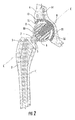
- FIG. 2 is a section view of the interlocking reverse hip prosthesis.
- FIG. 3 is a section view of the interlocking reverse hip prosthesis in extension and external rotation.
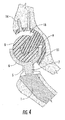
- FIG. 4 is a section view of the interlocking reverse hip prosthesis in flexion and internal rotation.
- FIG. 5 is a perspective view of the prosthesis of the invention illustrating an optional soft tissue protective sheath.
- FIG. 5A is a perspective view of the protective sheath by itself.
- FIG. 6 is a section view of the embodiment of FIG. 5 .
- FIG. 7 is a section view illustrating a femoral cup having a recess instead of a stem for connection to a femoral implant.
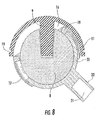
- FIG. 8 is a section view of the embodiment of FIG. 7 which has been articulated to an extreme position.
- FIGS. 1-4 illustrate an interlocking reverse hip prosthesis, which comprises an acetabular cup (11) having a smooth concave surface and a convex non-articulated surface.
- the convex non-articulated surface abuts a socket in the pelvic bone when the acetabular cup is implanted in a patient and provides a porous surface with multiple asperities and micro-voids to allow bone ingrowth.
- the acetabular cup (11) provides one or more holes (12) at different locations for the purpose of using one or more fasteners (14).
- the fasteners (14) can be screws or resorbable nonmetallic and biocompatible studs of different diameters and lengths.
- the studs which can be called orthobiologic resorbable studs, will secure the acetabular cup (11) during the initial phase of bone ingrowth and will resorb within one year, being replaced by newly generated bone and become part of the host pelvic bone. During that period, the acetabular cup (11) becomes solidly attached to the acetabular socket in the pelvic bone (4) by bone ingrowth.
- the acetabular cup (11) has a concave hemispherical surface in which a large acetabular cup stem (9) is disposed.
- the acetabular cup stem (9) has a male Morse taper for assembly to the acetabular ball (8) by means of the acetabular ball recess (10) which has a female Morse taper.
- the femoral cup (6) has a femoral cup stem (7) with a male Morse taper while the femoral implant (1) has a cooperating femoral implant recess (5) having a female Morse taper located in neck (3).
- FIGS. 7 and 8 illustrate a femoral cup (20) with a neck (22) and a femoral cup recess (21) having a female Morse taper.
- a modular system is used in a kit according to the invention wherein the femoral cup stem (7) or neck (22) can come in different lengths to accommodate the sizing needs of a patient. Therefore, in a kit of the invention, two or more femoral cups are provided having different stem lengths.
- the length of the neck (3) of femoral implant (1), or the femoral implant stem (not shown) can also have various lengths to accommodate patient sizing needs and in a kit comprising this embodiment two or more neck or stem components having different lengths will be included. Other variations on the design to meet different sizing needs will be apparent to those having skill in the art.
- An important advantage of the present invention is that the greater the interdigitation the more stability of the implant as opposed to conventional ball and socket hip implants, where increased range of motion is usually associated with increased risk of dislocation.
- the proximal femoral bone (2) is reamed in the usual fashion to accept a femoral implant (1) that can be cemented or press fitted in the femoral medullary canal.
- the acetabular socket in the pelvic bone (4) is reamed to the appropriate size to accept the acetabular cup (11), which is impacted for press fit at the correct angle of inclination and anteversion.
- Fasteners (14) in the form of fixation screws or biocompatible resorbable studs are then inserted in place to secure the acetabular cup (11).
- the acetabular ball (8) is then affixed onto the acetabular cup stem (9).
- FIG. 2 also illustrates center line (C-C).
- the center line (C-C) passes through the center of the acetabular cup (11), the longitudinal center line of the acetabular cup stem (9), the center of acetabular ball (8), the longitudinal center line of femoral cup stem (7) and the longitudinal center line of femoral implant recess (5).
- the center line associated with the femoral components will not be colinear with the center line of the acetabular components. The line is simply illustrated in this way for convenience.
- FIGS. 3 , 4 and 8 when the femoral cup (6) or (20) articulates on the acetabular ball (8), the edges of the femoral cup (6) or (20) move into and out of hemispherical space (16) and the articulated surface of the femoral cup (6) or (20) maintains the same area of contact with the acetabular ball (8) over the entire range of motion. In other words, 100% of the articulated contact area of the femoral cup (6) or (20) is maintained over the entire range of motion.
- FIG. 3 illustrates the prosthesis of the invention in extension and external rotation.
- FIG. 4 illustrates the prosthesis in flexion and internal rotation and
- FIG. 8 illustrates an extreme articulation position of the femoral cup (20) on the acetabular ball (8).
- the articulated surface of the femoral cup (6) or (20) contains a high molecular weight polyethylene lining of varying thickness, but no less than 4 mm.
- the lining could be porcelain, ceramic or a metallic alloy.
- An important feature of the present invention is the ability to place acetabular ball (8) in a position that minimizes or eliminates tortional forces on the acetabular cup and acetabular stem. This is illustrated in FIG. 3 wherein the acetabular ball (8) is affixed on acetabular cup stem (9) in a position wherein the equatorial plane (P-P) of the acetabular cup passes through the center (15) of the acetabular ball.
- FIGS. 5-8 An optional embodiment of the invention illustrated in FIGS. 5-8 adds a soft tissue protective sheath (17) to the embodiments described above.
- the protective sheath also illustrated by itself in perspective in FIG. 5A , addresses the rare cases wherein soft tissue might get lodged in the space (16) as a result of articulation of the prosthetic joint of the invention.
- the sheath (17) extends beyond the circular outer edge of the acetabular cup (11) and has a retaining ring (18).
- the sheath (17) is installed by placing it into the acetabular cup (11) before the acetabular ball (8) is installed.
- the sheath (17) can have a solid surface as illustrated or it can be perforated with holes, slots or the like having the same or different shapes and dimensions as may be desired.
- the sheath (17) is allowed to move freely within the space (16), restrained only by the acetabular ball (8) and acetabular cup stem (9).
- the sheath (17) also is moved by contact of retaining ring (18) with the outer edge of femoral cup (6) or (20).
- the retaining ring (18) will, for example, contact the outer edge of femoral cup (6) or (20) particularly in positions of extreme articulation of the prosthetic joint as illustrated in FIG. 8 .
- the acetabular cup (11) is designed for use in revision surgery of the hip. Revisions are surgical procedures where the existing implant is removed. This most frequently requires removal of the acetabular cup and it is associated with a high level of morbidity. The removal of a previously implanted acetabular cup may be quite difficult surgically, especially when the cup has metallic beads for bone ingrowth. In these cases, the removal is also associated with iatrogenic bone loss leading to difficulty in inserting another conventional acetabular cup.
- Another important advantage of the present invention is that the angle of inclination and retroversion are not critical since the interlocking mechanism of applicant's implant will compensate for the misalignment of a previously implanted acetabular cup.
- the acetabular cup (11) of applicant's interlocking reverse hip prosthesis can optionally be provided with a thin circumferential groove (19) located in proximity of the equatorial plane of said cup as illustrated in FIGS. 6-8 .
- the components of the reverse hip prosthesis of the invention are made from biocompatible materials commonly used in the art and suitable materials will be apparent to those skilled in the art based upon the disclosures herein.
- Metals or metallic alloys such as titanium or cobalt chrome are suitable.
- metals or ceramics can be used.
- High density polyethylene is also suitable for some components, for example the protective sheath or an optional lining for the concave portion of the femoral cup.
- Other biocompatible materials or combinations thereof can be used for various components as will be apparent to those having skill in the art.
- the dimensions of the various components of the reverse hip prosthesis of the invention can be readily determined by those skilled in the art based upon the disclosures herein.
- the acetabular cup which is hemispherical, an outer diameter from about 35 millimeters (mm) to about 65 mm will be suitable for most applications.
- the spherical acetabular ball should have a diameter from about 28 mm to about 45 mm.
- the diameter of the acetabular ball should be from about 7 mm to about 12 mm smaller than the inner diameter of the acetabular cup, thus creating a hemispherical space or gap having a width from about 7 mm to about 12 mm to allow articulation of the femoral cup therein.
- the concave, hemispherical, articulated surface of the femoral cup will be sized compatibly with the acetabular ball to allow for smooth articulation.
- Highly polished cobalt chrome is an excellent material for the articulated surface of the femoral cup but other materials such as biocompatible metallic alloys can be used.
- the femoral cup also may contain a lining fabricated from high-density polyethylene, ceramic or biocompatible metallic alloys.
Landscapes
- Health & Medical Sciences (AREA)
- Orthopedic Medicine & Surgery (AREA)
- Cardiology (AREA)
- Oral & Maxillofacial Surgery (AREA)
- Transplantation (AREA)
- Engineering & Computer Science (AREA)
- Biomedical Technology (AREA)
- Heart & Thoracic Surgery (AREA)
- Vascular Medicine (AREA)
- Life Sciences & Earth Sciences (AREA)
- Animal Behavior & Ethology (AREA)
- General Health & Medical Sciences (AREA)
- Public Health (AREA)
- Veterinary Medicine (AREA)
- Prostheses (AREA)
Abstract
Description
- The present invention relates generally to hip prostheses and more specifically to an interlocking reverse hip prosthesis allowing increased range of motion and stability during excessive range of motion. The closest prior art is
US 6749637 B1 , which defines the preamble of claim 1. - It can be appreciated that several hip implants have been in use for years. Typically, conventional hip implants comprise a femoral component having an articulated femoral ball attached to a stem. A femoral stem is inserted into the medullary canal of the femur after preparation and reaming using appropriate reamers by the operating surgeon. The stem can be secured with bone cement or press fit. An acetabular component having the shape of a cup is inserted into an acetabular socket after preparation and appropriate reaming and secured with cancellous screws through holes in the cup. It can also be secured with bone cement or press fit or a combination thereof.
- The acetabular cup is metallic and it is internally lined with high-density polyethylene or ceramic. Said lining is secured into the acetabular cup by a press-fit mechanism.
- The main problem with conventional hip implants is the instability of the prosthesis at the extreme range of motion, thereby allowing the articulated femoral ball to dislodge and dislocate. Prior art teaches constrained and preassembled ball and cup devices or devices wherein the ball and cup members are implanted separately whereupon the ball element is forced into a resilient opening in the cup and thereafter held in place by the resilient material. Other constrained acetabular cups may include a locking ring such as the one described by
Albertorio et al. U.S. Pat. 6,527,808 . In the case of cup elements having retaining rings, the ball member is forcefully inserted into the cup after the two elements are implanted. This constitutes a weak link where forces exerted on the prosthesis by ambulatory motion may exceed the forces used to assemble the implant thereby causing the ball to be separated from the cup. - While these devices may be suitable for the particular purpose which they address, they do not provide an interlocking mechanism as in the reverse hip implant design of the present invention. The very nature of applicant's design allows increased range of motion and increased stability at extreme ranges of motion thereby reducing the risk of dislocation.
- In these respects, the interlocking reverse hip prosthesis according to the present invention, which is defined in claim 1, substantially departs from the conventional concepts and designs of the prior art because the articulated femoral ball of the prior art is replaced with an articulated femoral cup and the acetabular cup is provided with an acetabular ball. Thus an apparatus is provided which is primarily developed for the purpose of reducing the risk of dislocation of hip implants at extreme ranges of motion.
- Furthermore, since the articulated surface of the femoral cup of the invention is fully in contact 100% of the time with the surface of the acetabular ball, it is clear that this will improve tribology because the weight bearing distribution is improved on the articulated surfaces, thus decreasing the wear of the surfaces in contact and reducing the risk of wear particles being released in the joint. The later, being very detrimental to the proper function of the joint.
- The present invention provides a new interlocking reverse hip prosthesis construction wherein an acetabular ball is solidly and concentrically attached to a central protrusion or stem of the acetabular cup via Morse taper. A metallic acetabular cup is used in the preferred embodiment. A femoral cup, also referred to herein as a hemispherical femoral cup or an articulated femoral cup, is preferably solidly attached to a femoral implant by means of a Morse taper. Other means of attachment known to those in the art can be used. And whenever a Morse taper is referred to herein, it is intended to describe a preferred embodiment. The Morse taper can be replaced by other suitable means of attachment as will be apparent to those having skill in the art.
- The acetabular cup is implanted in an acetabular socket constructed by the surgeon in the pelvic bone to which it is firmly secured by one or more fasteners through one or more openings in the acetabular cup. The fasteners can be cancellous screws or biocompatible resorbable studs of variable number. The femoral implant is then inserted and impacted into the femoral medullary canal which has been prepared and hollowed by the surgeon using appropriate reamers. During ambulation, the articulated femoral cup edge or lip will glide conformably and concentrically into a space located between the acetabular ball and the acetabular cup. As will be apparent to those having skill in the art, the geometrical configuration of applicant's invention makes it very difficult for the femoral cup to dislocate when the range of motion increases since it becomes constrained in the locking space between the acetabular cup and the acetabular ball.
- As noted above, the articulated surface of the femoral cup is fully in contact at all times with the articulated surface of the acetabular ball. This improves the weight distribution, decreases the wear of the surfaces in contact and reduces the risk of wear particles being released in the joint.
- In an optional embodiment of the invention, applicant has addressed the rare possibility that soft tissue may get lodged in the implant in the space between the acetabular cup and the acetabular ball. A protective sheath can be used to avoid this possibility. As discussed in more detail below, the sheath is disposed in the space between the acetabular cup and the acetabular ball and is allowed to glide freely therein.
- There has thus been outlined the more important features of the invention in order that the detailed description may be better understood, and so that the present contribution to the art may be better appreciated. A novel feature of this invention is that the location of the articulated surfaces of the hip joint, namely the ball and socket, is reversed. This results in a new reverse hip implant which is not anticipated, rendered obvious, suggested or even implied by any prior hip prosthesis when considered alone or in any combination.
- In this respect, before explaining at least one embodiment of the invention in detail, it is to be understood that the invention is not committed in its application to the details of construction and arrangements of the components set forth in the following description or illustrated in the drawings. The invention is capable of other embodiments and of being practiced and carried out in various ways as will be apparent from the description herein to those having skill in the art. Also, it is to be understood that the terminology employed herein are for the purpose of the description and should not be regarded as limiting.
- To the accomplishment of the above and related objects, this invention may be embodied in the form illustrated in the accompanying drawings. However, the drawings are elicited only and changes may be made into any specific construction illustrated without departing from the principles of the invention.
- Various other objects, features and advantages of the present invention will become fully appreciated as the same becomes better understood when considered in conjunction with the accompanying drawings, in which like reference characters designate the same or similar elements throughout the several views, and wherein:
-
FIG. 1 is a perspective view of the interlocking reverse hip prosthesis of the invention. -
FIG. 2 is a section view of the interlocking reverse hip prosthesis. -
FIG. 3 is a section view of the interlocking reverse hip prosthesis in extension and external rotation. -
FIG. 4 is a section view of the interlocking reverse hip prosthesis in flexion and internal rotation. -
FIG. 5 is a perspective view of the prosthesis of the invention illustrating an optional soft tissue protective sheath. -
FIG. 5A is a perspective view of the protective sheath by itself. -
FIG. 6 is a section view of the embodiment ofFIG. 5 . -
FIG. 7 is a section view illustrating a femoral cup having a recess instead of a stem for connection to a femoral implant. -
FIG. 8 is a section view of the embodiment ofFIG. 7 which has been articulated to an extreme position. - Turning now to the drawings, in which the reference characters denote the same or similar elements throughout the several views,
FIGS. 1-4 illustrate an interlocking reverse hip prosthesis, which comprises an acetabular cup (11) having a smooth concave surface and a convex non-articulated surface. The convex non-articulated surface abuts a socket in the pelvic bone when the acetabular cup is implanted in a patient and provides a porous surface with multiple asperities and micro-voids to allow bone ingrowth. Furthermore, the acetabular cup (11) provides one or more holes (12) at different locations for the purpose of using one or more fasteners (14). The fasteners (14) can be screws or resorbable nonmetallic and biocompatible studs of different diameters and lengths. The studs, which can be called orthobiologic resorbable studs, will secure the acetabular cup (11) during the initial phase of bone ingrowth and will resorb within one year, being replaced by newly generated bone and become part of the host pelvic bone. During that period, the acetabular cup (11) becomes solidly attached to the acetabular socket in the pelvic bone (4) by bone ingrowth. The acetabular cup (11) has a concave hemispherical surface in which a large acetabular cup stem (9) is disposed. The acetabular cup stem (9) has a male Morse taper for assembly to the acetabular ball (8) by means of the acetabular ball recess (10) which has a female Morse taper. Referring toFIGS. 2-4 and6 , the femoral cup (6) has a femoral cup stem (7) with a male Morse taper while the femoral implant (1) has a cooperating femoral implant recess (5) having a female Morse taper located in neck (3).FIGS. 7 and8 illustrate a femoral cup (20) with a neck (22) and a femoral cup recess (21) having a female Morse taper. This cooperates with a femoral implant stem having a male Morse taper (not shown). In a preferred embodiment, a modular system is used in a kit according to the invention wherein the femoral cup stem (7) or neck (22) can come in different lengths to accommodate the sizing needs of a patient. Therefore, in a kit of the invention, two or more femoral cups are provided having different stem lengths. In a less preferred embodiment, the length of the neck (3) of femoral implant (1), or the femoral implant stem (not shown) can also have various lengths to accommodate patient sizing needs and in a kit comprising this embodiment two or more neck or stem components having different lengths will be included. Other variations on the design to meet different sizing needs will be apparent to those having skill in the art. - An important advantage of the present invention is that the greater the interdigitation the more stability of the implant as opposed to conventional ball and socket hip implants, where increased range of motion is usually associated with increased risk of dislocation.
- Referring to
FIG. 2 , the proximal femoral bone (2) is reamed in the usual fashion to accept a femoral implant (1) that can be cemented or press fitted in the femoral medullary canal. The acetabular socket in the pelvic bone (4) is reamed to the appropriate size to accept the acetabular cup (11), which is impacted for press fit at the correct angle of inclination and anteversion. Fasteners (14) in the form of fixation screws or biocompatible resorbable studs are then inserted in place to secure the acetabular cup (11). The acetabular ball (8) is then affixed onto the acetabular cup stem (9).FIG. 2 also illustrates center line (C-C). In the position shown, the center line (C-C) passes through the center of the acetabular cup (11), the longitudinal center line of the acetabular cup stem (9), the center of acetabular ball (8), the longitudinal center line of femoral cup stem (7) and the longitudinal center line of femoral implant recess (5). Obviously, when the femoral cup is articulated on the ball the center line associated with the femoral components will not be colinear with the center line of the acetabular components. The line is simply illustrated in this way for convenience. - Referring to
FIGS. 3 ,4 and8 , when the femoral cup (6) or (20) articulates on the acetabular ball (8), the edges of the femoral cup (6) or (20) move into and out of hemispherical space (16) and the articulated surface of the femoral cup (6) or (20) maintains the same area of contact with the acetabular ball (8) over the entire range of motion. In other words, 100% of the articulated contact area of the femoral cup (6) or (20) is maintained over the entire range of motion.FIG. 3 illustrates the prosthesis of the invention in extension and external rotation.FIG. 4 illustrates the prosthesis in flexion and internal rotation andFIG. 8 illustrates an extreme articulation position of the femoral cup (20) on the acetabular ball (8). - In one embodiment, the articulated surface of the femoral cup (6) or (20) contains a high molecular weight polyethylene lining of varying thickness, but no less than 4 mm. In a different embodiment the lining could be porcelain, ceramic or a metallic alloy.
- An important feature of the present invention is the ability to place acetabular ball (8) in a position that minimizes or eliminates tortional forces on the acetabular cup and acetabular stem. This is illustrated in
FIG. 3 wherein the acetabular ball (8) is affixed on acetabular cup stem (9) in a position wherein the equatorial plane (P-P) of the acetabular cup passes through the center (15) of the acetabular ball. - An optional embodiment of the invention illustrated in
FIGS. 5-8 adds a soft tissue protective sheath (17) to the embodiments described above. The protective sheath, also illustrated by itself in perspective inFIG. 5A , addresses the rare cases wherein soft tissue might get lodged in the space (16) as a result of articulation of the prosthetic joint of the invention. - Referring to
FIGS. 6-8 , the sheath (17) extends beyond the circular outer edge of the acetabular cup (11) and has a retaining ring (18). The sheath (17) is installed by placing it into the acetabular cup (11) before the acetabular ball (8) is installed. The sheath (17) can have a solid surface as illustrated or it can be perforated with holes, slots or the like having the same or different shapes and dimensions as may be desired. - As can be seen from
FIGS. 6-8 , the sheath (17) is allowed to move freely within the space (16), restrained only by the acetabular ball (8) and acetabular cup stem (9). The sheath (17) also is moved by contact of retaining ring (18) with the outer edge of femoral cup (6) or (20). The retaining ring (18) will, for example, contact the outer edge of femoral cup (6) or (20) particularly in positions of extreme articulation of the prosthetic joint as illustrated inFIG. 8 . - In another embodiment of the present invention, also illustrated in
FIGS. 6-8 , the acetabular cup (11) is designed for use in revision surgery of the hip. Revisions are surgical procedures where the existing implant is removed. This most frequently requires removal of the acetabular cup and it is associated with a high level of morbidity. The removal of a previously implanted acetabular cup may be quite difficult surgically, especially when the cup has metallic beads for bone ingrowth. In these cases, the removal is also associated with iatrogenic bone loss leading to difficulty in inserting another conventional acetabular cup. - There are instances where the acetabular cup was not implanted correctly or where the lining of the existing implant becomes worn out and needs to be replaced. Recurrent dislocations of the hip implant are usually secondary to surgical misplacement of a conventional acetabular cup. For example, if during the initial procedure, the cup was placed either too vertical or retroverted (e.g., facing backward instead of forward).
- To remedy the above cited complication, there are times where the surgeon simply cements a conventional revision cup into the previously implanted acetabular cup using conventional bone cement. However, problems arise if the initial position of the previously implanted acetabular cup is too vertical or retroverted, preventing a conventional revision cup from being glued in the previously implanted acetabular cup. As a result, removal of the previously implanted acetabular cup becomes necessary - entailing significant risk and possible morbidity to the patient as described above.
- Another important advantage of the present invention is that the angle of inclination and retroversion are not critical since the interlocking mechanism of applicant's implant will compensate for the misalignment of a previously implanted acetabular cup.
- The acetabular cup (11) of applicant's interlocking reverse hip prosthesis can optionally be provided with a thin circumferential groove (19) located in proximity of the equatorial plane of said cup as illustrated in
FIGS. 6-8 . - In revision surgery using the hip prosthesis of applicant's invention, the plastic polyethylene insert of the previously implanted acetabular cup is removed. The circumferential groove (19) of the interlocking reverse hip prosthesis will host a retaining "o-ring" of the previously implanted acetabular cup being revised thereby providing solid fixation of applicant's revision interlocking reverse hip prosthesis to the previously implanted acetabular cup.
- The components of the reverse hip prosthesis of the invention are made from biocompatible materials commonly used in the art and suitable materials will be apparent to those skilled in the art based upon the disclosures herein. Metals or metallic alloys such as titanium or cobalt chrome are suitable. For some components, such as the acetabular ball, metals or ceramics can be used. High density polyethylene is also suitable for some components, for example the protective sheath or an optional lining for the concave portion of the femoral cup. Other biocompatible materials or combinations thereof can be used for various components as will be apparent to those having skill in the art.
- The dimensions of the various components of the reverse hip prosthesis of the invention can be readily determined by those skilled in the art based upon the disclosures herein. For the acetabular cup, which is hemispherical, an outer diameter from about 35 millimeters (mm) to about 65 mm will be suitable for most applications. The spherical acetabular ball should have a diameter from about 28 mm to about 45 mm. The diameter of the acetabular ball should be from about 7 mm to about 12 mm smaller than the inner diameter of the acetabular cup, thus creating a hemispherical space or gap having a width from about 7 mm to about 12 mm to allow articulation of the femoral cup therein. Of course, the concave, hemispherical, articulated surface of the femoral cup will be sized compatibly with the acetabular ball to allow for smooth articulation. Highly polished cobalt chrome is an excellent material for the articulated surface of the femoral cup but other materials such as biocompatible metallic alloys can be used. The femoral cup also may contain a lining fabricated from high-density polyethylene, ceramic or biocompatible metallic alloys.
- It is therefore the object of the present invention to provide a new and improved interlocking and restrained reverse hip prosthesis system, where two conventional articulated surfaces of the hip joint are reversed and interlocked. The system described in the present invention, which has all of the advantages of the prior art designs, none of the disadvantages, and numerous improvements over the prior art, particularly in respect of remarkably increased range of motion and reduced risk of wear particles being released into the joint.
- With respect to the above description then, it is to be realized that the optimum dimensional relationships for the parts of the invention, to include variations in size, materials, shape, form, function and manner of operation, assembly and use, are deemed readily apparent to those skilled in the art, and all equivalent relationships to those illustrated in the drawings and described in the specification are intended to be encompassed by the present invention. Therefore, the foregoing is considered as illustrative only of the principles of the invention. Further, since numerous modifications and changes will readily occur to those skilled in the art, it is not desired to limit the invention to the exact construction and operation shown and described, and accordingly, all suitable modifications and equivalents may be resorted to, falling within the scope of the invention, as defined by the claims.
Claims (13)
- A prosthesis comprising
an acetabular cup (11) having a surface for attachment to an acetabular socket in a pelvic bone (4) and a concave surface located opposite to the surface for attachment to an acetabular socket, the concave surface having an acetabular cup stem (9) therein and projecting outwardly therefrom,
an acetabular head part (8) affixed to the acetabular cup stem (9), the acetabular head part (8) having a surface,
the concave surface of the acetabular cup (11) and the surface of the acetabular head part (8) are spaced from one another, thereby defining a gap (16) therebetween,
a femoral implant (1) for implantation in a medullary canal of a proximal end of a femur, and
a femoral cup (6;20) affixed to a proximal end of the femoral implant (1), the femoral cup (6;20) sized for articulation in the gap (16), such that the femoral cup (6; 20) has a concave surface sized for articulation on the surface of the acetabular head part (8),
characterized in that the acetabular cup stem (9) is affixed to the concave surface of the acetabular cup (11),
in that the prosthesis is a reverse hip prosthesis,
in that the acetabular head part (8) is a ball,
and in that the gap (16) is adapted to constrain the femoral cup (6) within the gap (16), thereby reducing the risk of dislocation. - The prosthesis according to claim 1, wherein the concave surface of the acetabular cup (11) is hemispherical, wherein the acetabular ball (8) is spherical and wherein the concave surface of the femoral cup (6; 20) is hemispherical.
- The prosthesis according to claim 1 or 2, wherein the concave surface of the acetabular cup (11) has a center and the acetabular cup stem (9) is affixed in the center.
- The prosthesis according to any of previous claims, wherein the acetabular ball (8) has an acetabular ball recess (10) sized to receive the acetabular cup stem (9).
- The prosthesis according to any of previous claims, wherein the femoral cup (6; 20) has a femoral cup stem (7) projecting outwardly therefrom in a direction opposite the concave surface thereof and the femoral implant (1) has at its proximal end a recess (5) sized to receive the femoral cup stem (7).
- The prosthesis according to any of previous claims, wherein the femoral implant (1) has a femoral implant stem extending proximally therefrom and wherein the femoral cup (6; 20) has a recess (21) sized to receive the femoral implant stem.
- The prosthesis according to any of previous claims, wherein the acetabular ball (8) has a center, the acetabular cup stem (9) has a longitudinal center line and the acetabular ball recess (10) has a longitudinal center line, both longitudinal center lines being colinear and passing through the center of the acetabular ball (8).
- The prosthesis according to any of previous claims, wherein the femoral cup (6; 20) has a concave hemispherical portion having a center line, the femoral cup stem (7) has a longitudinal center line and the femoral implant recess (5) has a longitudinal center line, wherein all of the center lines are colinear.
- The prosthesis according to claim 6 or according to claims 7 or 8 when depending on claim 6, wherein the femoral cup (6;20) has a concave hemispherical portion having a center line, the femoral implant stem has a longitudinal center line and the femoral cup recess (21) has a longitudinal center line, wherein all of the center lines are colinear.
- The prosthesis according to any of previous claims, wherein the acetabular cup (11) further comprises a circumferential groove (19) in the convex surface, said circumferential groove (19) being located in proximity to a circumferential edge of the acetabular cup (11).
- The prosthesis according to any of previous claims, further comprising a hemispherical protective shield (17) moveably disposed in the gap (16), the protective shield (17) having a retaining ring (18) for engagement with a circumferential outer edge of the femoral cup (6; 20), whereby articulation of the femoral cup (6;20) on the acetabular ball causes movement of the protective shield.
- A kit comprising the prosthesis according to claim 5 or according to any of claims 6 to 11 when depending on claim 5, further comprising one or more additional femoral cups (6;20), wherein the femoral cup stems (7) have different lengths.
- A kit comprising the prosthesis according to claim 6 or according to any of claims 7 to 11 when depending on claim 6, wherein the femoral cup recess (21) is disposed in a neck (22) projecting outwardly from the femoral cup (6;20) in a direction opposite the concave surface thereof, further comprising one or more additional femoral cups (6;20), wherein the femoral cup necks (22) have different lengths.
Applications Claiming Priority (4)
| Application Number | Priority Date | Filing Date | Title |
|---|---|---|---|
| US33968010P | 2010-03-08 | 2010-03-08 | |
| US12/799,609 US8313531B2 (en) | 2010-03-08 | 2010-04-28 | Interlocking reverse hip prosthesis and method |
| US13/024,381 US8540779B2 (en) | 2010-03-08 | 2011-02-10 | Product and methods for interlocking reverse hip and revision prosthesis |
| PCT/US2011/025790 WO2011112353A1 (en) | 2010-03-08 | 2011-02-23 | Interlocking reverse hip and revision prosthesis |
Publications (3)
| Publication Number | Publication Date |
|---|---|
| EP2544630A1 EP2544630A1 (en) | 2013-01-16 |
| EP2544630A4 EP2544630A4 (en) | 2013-05-22 |
| EP2544630B1 true EP2544630B1 (en) | 2013-12-04 |
Family
ID=44532007
Family Applications (1)
| Application Number | Title | Priority Date | Filing Date |
|---|---|---|---|
| EP11753783.7A Active EP2544630B1 (en) | 2010-03-08 | 2011-02-23 | Interlocking reverse hip and revision prosthesis |
Country Status (10)
| Country | Link |
|---|---|
| US (6) | US8313531B2 (en) |
| EP (1) | EP2544630B1 (en) |
| JP (1) | JP5769320B2 (en) |
| KR (1) | KR101658266B1 (en) |
| CN (1) | CN102905649B (en) |
| AU (1) | AU2011224714B2 (en) |
| CA (1) | CA2791856C (en) |
| ES (1) | ES2444395T3 (en) |
| WO (1) | WO2011112353A1 (en) |
| ZA (1) | ZA201205921B (en) |
Families Citing this family (52)
| Publication number | Priority date | Publication date | Assignee | Title |
|---|---|---|---|---|
| MX391890B (en) * | 2009-07-10 | 2025-03-21 | Implantica Patent Ltd | DEVICE AND METHOD FOR HIP AND FEMORAL JOINT. |
| US11039929B2 (en) * | 2009-07-10 | 2021-06-22 | Peter Mats Forsell | Hip joint device and method |
| EP3092978A1 (en) * | 2009-07-10 | 2016-11-16 | Kirk Promotion LTD. | Hip joint device |
| WO2011005191A1 (en) * | 2009-07-10 | 2011-01-13 | Milux Holding S.A. | Hip joint device and method |
| EP3988056A1 (en) * | 2009-07-10 | 2022-04-27 | Implantica Patent Ltd. | Hip joint device |
| MX2012000518A (en) * | 2009-07-10 | 2012-06-28 | Milux Holding Sa | Hip joint device and method. |
| US20140156011A1 (en) * | 2010-03-08 | 2014-06-05 | Hip Innovation Techonology LLC | Modified Reverse Joint and Revision Prosthesis |
| US8313531B2 (en) | 2010-03-08 | 2012-11-20 | Hip Innovation Technology Llc | Interlocking reverse hip prosthesis and method |
| US8747481B2 (en) * | 2011-04-21 | 2014-06-10 | Brian Ted Maurer | Reverse joint replacement device and methods thereof |
| WO2013022586A1 (en) | 2011-08-08 | 2013-02-14 | Hip Innovation Technology Llc | Orthpedic instrument, system and method for implanting an acetabular cup |
| CN103906482B (en) * | 2011-08-13 | 2015-12-09 | Hip创新科技有限责任公司 | Interlocking acetabular fixation screws and their combination with inverted acetabular cups |
| US8945234B2 (en) * | 2012-04-26 | 2015-02-03 | Optimus Orthopedic Designs LLC | Prosthesis having a metaphyseal element |
| US11071635B2 (en) | 2013-03-08 | 2021-07-27 | Mayo Foundation For Medical Education And Research | Shoulder prosthesis with variable inclination humeral head component |
| BR112015022466B1 (en) * | 2013-03-15 | 2022-11-08 | The General Hospital Corporation | METHOD AND APPARATUS FOR INSPIRATORY SYNTHESIS OF NITRIC OXIDE |
| CN112168143A (en) * | 2013-03-15 | 2021-01-05 | 威廉·L·亨特 | Devices, systems, and methods for monitoring hip replacements |
| EP3013283B8 (en) | 2013-06-23 | 2021-03-03 | Canary Medical Inc. | Devices, systems and methods for monitoring knee replacements |
| AU2013397940B2 (en) * | 2013-08-15 | 2019-03-14 | George J. Haidukewych | Acetabular prosthetic device |
| EP2873392B1 (en) * | 2013-11-14 | 2016-03-30 | Arthrex, Inc. | Shoulder implant with stem |
| WO2016044651A1 (en) | 2014-09-17 | 2016-03-24 | Canary Medical Inc. | Devices, systems and methods for using and monitoring medical devices |
| US9597190B2 (en) | 2015-01-15 | 2017-03-21 | DePuy Synthes Products, Inc. | Modular reverse shoulder orthopaedic implant and method of implanting the same |
| ES2653538T3 (en) | 2015-02-04 | 2018-02-07 | Alessandro Melozzi | Enhanced hip prosthesis |
| US9597203B2 (en) | 2015-03-25 | 2017-03-21 | Tornier, Inc. | Modular humeral implant |
| EP3283014B1 (en) * | 2015-04-15 | 2019-08-07 | 41Hemiverse Ag | Artificial joint implant |
| CN104814813B (en) * | 2015-05-14 | 2017-01-04 | 青岛大学附属医院 | Medical acetabular bone compensates prosthese |
| EP3328320B1 (en) * | 2015-07-27 | 2022-01-05 | HIP Innovation Technology, LLC | Acetabular cup extractor |
| BR112018001597B1 (en) * | 2015-07-27 | 2022-12-06 | Hip Innovation Technology, LLC | SURGICAL TOOL AND KIT |
| HK1251433A1 (en) * | 2015-07-27 | 2019-02-01 | 黑普创新技术有限责任公司 | Femoral cup or femoral ball extractor |
| NZ770503A (en) * | 2015-07-27 | 2023-03-31 | Hip Innovation Technology Llc | Femoral cup impactor assembly and method and kit for femoral cup impactor |
| WO2017019325A1 (en) * | 2015-07-27 | 2017-02-02 | Hip Innovation Technology, LLC | Tool and method for separating a femoral cup from an acetabular ball in an implanted hip prosthesis |
| US10245149B2 (en) | 2015-08-03 | 2019-04-02 | Nicholas John Loffredo | Reverse total hip replacement |
| EP4209199A1 (en) * | 2015-08-21 | 2023-07-12 | HIP Innovation Technology, LLC | Trial acetabular cup for reverse hip prosthesis |
| EP3340939B1 (en) | 2015-08-27 | 2025-10-15 | HIP Innovation Technology, LLC | Surgical trays for removing components of a hip replacement prosthesis |
| IL294630B2 (en) | 2016-03-23 | 2023-12-01 | Canary Medical Inc | An implantable report processor for an alert implant |
| US10492929B2 (en) | 2016-08-02 | 2019-12-03 | Joint Innovation Technology, Llc | Tool and method for separating a femoral cup or a femoral ball from a femoral implant |
| US10709581B2 (en) | 2016-08-17 | 2020-07-14 | Joint Innovation Technology Llc | Thermally securing Morse taper |
| CA3046366A1 (en) * | 2016-12-06 | 2018-06-14 | Mayo Foundation For Medical Education And Research | Shoulder prosthesis with variable inclination, offset, and version of humeral component |
| EP3558171B1 (en) * | 2016-12-21 | 2021-11-03 | Biomet Manufacturing, LLC | Apparatuses for trialing a humeral head |
| US10335283B2 (en) | 2017-01-10 | 2019-07-02 | Tyler J Zajac | Reverse hip system and method |
| JP1621250S (en) | 2017-05-22 | 2018-12-25 | ||
| ES2947945T3 (en) * | 2018-03-26 | 2023-08-24 | Link Waldemar Gmbh Co | Active substance delivery device for a joint implant and joint implant with an active substance delivery device |
| US11571310B2 (en) | 2019-04-03 | 2023-02-07 | Catalyst Orthoscience Inc. | Stemmed implant |
| CA3176873A1 (en) | 2019-06-06 | 2020-12-10 | Canary Medical Inc. | Intelligent joint prosthesis |
| US20210366610A1 (en) | 2019-06-06 | 2021-11-25 | Canary Medical Inc. | Intelligent joint prosthesis |
| CN110876653A (en) * | 2019-11-28 | 2020-03-13 | 佛山市逸合生物科技有限公司 | Acetabular cup |
| US11090163B1 (en) * | 2021-01-09 | 2021-08-17 | Zafer Termanini | Interlocking reverse hip prosthesis with removable tapered central post |
| CN112842627B (en) * | 2021-02-05 | 2026-01-13 | 朱戈 | Trans-hip joint prosthesis for severe acetabulum defect |
| CN113367848A (en) * | 2021-05-22 | 2021-09-10 | 北京力达康科技有限公司 | Osteolysis treatment hip joint prosthesis |
| CN113456306B (en) * | 2021-06-21 | 2023-10-13 | 北京力达康科技有限公司 | Hip joint prosthesis |
| CN115227462B (en) * | 2022-07-05 | 2024-07-12 | 北京纳通医学研究院有限公司 | Acetabular screw and acetabular prosthesis |
| CN116439882A (en) * | 2023-04-19 | 2023-07-18 | 北京市春立正达医疗器械股份有限公司 | Reverse hip joint prosthesis system capable of reducing dislocation risk |
| US12591216B1 (en) | 2024-02-02 | 2026-03-31 | Restor3D, Inc. | Patient-specific medical devices based on bone density and processes for producing the same |
| US12605251B1 (en) * | 2025-03-28 | 2026-04-21 | Restor3D, Inc. | Patient-specific shoulder implants and processes for producing and using the same |
Family Cites Families (58)
| Publication number | Priority date | Publication date | Assignee | Title |
|---|---|---|---|---|
| US3506982A (en) * | 1965-06-21 | 1970-04-21 | Cleveland Clinic | Endoprosthetic joints |
| CH541962A (en) * | 1971-09-06 | 1973-09-30 | Sulzer Ag | Endo wrist prosthesis |
| US3868730A (en) * | 1973-09-24 | 1975-03-04 | Howmedica | Knee or elbow prosthesis |
| US3916451A (en) * | 1974-10-25 | 1975-11-04 | Frederick F Buechel | Floating center prosthetic joint |
| GB1544403A (en) * | 1975-01-31 | 1979-04-19 | Nat Res Dev | Endoprosthetic bone joint devices |
| US3978528A (en) * | 1975-06-26 | 1976-09-07 | Howmedica, Inc. | Bone and joint prosthesis |
| US4206517A (en) * | 1977-12-01 | 1980-06-10 | Biomedical Engineering Corp. | Floating center prosthetic joint |
| US4960427A (en) * | 1983-03-08 | 1990-10-02 | Joint Medical Products Corporation | Ball and socket bearing for artifical joint |
| FR2545352B1 (en) * | 1983-05-02 | 1990-01-19 | Gabard Jean Jacques | SHOULDER PROSTHESIS |
| FR2603476B1 (en) | 1986-09-09 | 1995-03-24 | Leclercq Sylvain | JOINT PROSTHESIS |
| US4846840A (en) * | 1986-09-09 | 1989-07-11 | Sylvain Leclercq | Joint prosthesis |
| EP0265712A1 (en) * | 1986-10-16 | 1988-05-04 | Protek AG | Acetabular component for a total hip prosthesis |
| JPH01175846A (en) | 1987-12-28 | 1989-07-12 | Shirubian Rukureerusekiyu | Artificial joint |
| US5092898A (en) * | 1988-05-31 | 1992-03-03 | Ngk Spark Plug Co., Ltd. | Artificial joint |
| GB2251795B (en) * | 1991-01-17 | 1995-02-08 | Minnesota Mining & Mfg | Orthopaedic implant |
| US6793681B1 (en) * | 1994-08-12 | 2004-09-21 | Diamicron, Inc. | Prosthetic hip joint having a polycrystalline diamond articulation surface and a plurality of substrate layers |
| CN2217965Y (en) * | 1994-12-12 | 1996-01-24 | 马忠泰 | Artificial cement hip joint |
| US20020143402A1 (en) * | 1995-09-04 | 2002-10-03 | Limber Ltd. | Hip joint prostheses |
| IL115168A0 (en) | 1995-09-04 | 1995-12-31 | Steinberg Gal | Joints |
| JPH1175846A (en) | 1997-09-02 | 1999-03-23 | Asahi Chem Ind Co Ltd | Slit-like polypeptide |
| US6010535A (en) * | 1998-04-30 | 2000-01-04 | Shah; Mrugesh K. | Joint replacement system |
| WO2001022905A1 (en) * | 1999-09-24 | 2001-04-05 | Baehler Andre | Endoprosthesis for a shoulder joint |
| FR2802799B1 (en) * | 1999-12-23 | 2002-08-16 | Depuy France | SHOULDER PROSTHESIS KIT |
| US6527808B1 (en) | 2000-10-11 | 2003-03-04 | Zimmer Technology, Inc. | Constrained socket for use with a ball-and-socket joint |
| US20020173853A1 (en) * | 2001-05-17 | 2002-11-21 | Corl Harry E. | Movable joint and method for coating movable joints |
| US6790234B1 (en) * | 2002-01-04 | 2004-09-14 | Frankle Mark A | Reverse shoulder prosthesis system |
| FR2841768B1 (en) * | 2002-07-05 | 2005-05-06 | Tornier Sa | SHOULDER OR HIP PROSTHESIS FACILITATING ABDUCTION |
| US7175663B1 (en) * | 2003-10-08 | 2007-02-13 | Biomet Manufacturing Corp. | Shoulder implant assembly |
| US6986792B2 (en) * | 2002-09-13 | 2006-01-17 | Smith & Nephew, Inc. | Prostheses |
| US7011686B2 (en) * | 2002-09-30 | 2006-03-14 | Depuy Products, Inc. | Reverse-type humeral prosthesis |
| ITUD20030094A1 (en) * | 2003-04-30 | 2004-11-01 | Lima Lto Spa | REVERSE PROSTHESIS FOR THE JOINT OF THE SHOULDER. |
| GB0320287D0 (en) | 2003-08-29 | 2003-10-01 | Stanmore Implants Worldwide | Shoulder joint prosthetic system |
| US8070820B2 (en) * | 2003-10-08 | 2011-12-06 | Biomet Manufacturing Corp. | Shoulder implant assembly |
| FR2863865B1 (en) * | 2003-12-19 | 2006-10-06 | Tornier Sa | SHOULDER OR HIP PROSTHESIS AND METHOD OF MOUNTING |
| FR2871371B1 (en) * | 2004-06-15 | 2007-04-06 | Tornier Sas | GLENOIDAL COMPONENT OF SHOULDER PROSTHESIS, SET OF COMPONENT ELEMENTS OF SUCH COMPONENT AND TOTAL SHOULDER PROSTHESIS INCORPORATING SUCH COMPONENT |
| FR2871368B1 (en) * | 2004-06-15 | 2006-08-25 | Tornier Sas | SET OF HUMERAL COMPONENTS FOR TOTAL SHOULDER PROSTHESIS |
| FR2872025B1 (en) * | 2004-06-28 | 2006-08-25 | Tornier Sas | PROSTHESIS OF SHOULDER OR HIP |
| US7241314B1 (en) * | 2004-09-16 | 2007-07-10 | Biomet Manufacturing Corp. | Reverse shoulder prosthesis |
| US7922769B2 (en) * | 2004-09-27 | 2011-04-12 | Depuy Products, Inc. | Modular glenoid prosthesis and associated method |
| CN101365387A (en) * | 2005-11-17 | 2009-02-11 | 皇家飞利浦电子股份有限公司 | Cpr guided by vascular flow measurement |
| US7854768B2 (en) * | 2006-01-20 | 2010-12-21 | Zimmer Technology, Inc. | Shoulder arthroplasty system |
| FR2900045B1 (en) * | 2006-04-21 | 2009-01-16 | Tornier Sas | PROSTHESIS OF SHOULDER OR HIP |
| WO2008058205A1 (en) * | 2006-11-07 | 2008-05-15 | Biomedflex, Llc | Medical implants |
| US20090287309A1 (en) * | 2007-01-30 | 2009-11-19 | Tornier Sas | Intra-articular joint replacement |
| ES2310129B1 (en) * | 2007-06-01 | 2009-10-02 | Juan Carlos Garcia Saban | NEW SURFACE OF METAL IMPLANTS BASED ON TITANIUM DESTINED TO BE INSERTED IN OSEO FABRIC. |
| US7777635B2 (en) * | 2007-10-29 | 2010-08-17 | Smiths Medical Asd, Inc. | Power failure management for respiratory system heater unit |
| GB0813093D0 (en) * | 2008-07-17 | 2008-08-27 | Invibio Ltd | Polymeric materials |
| GB0819055D0 (en) * | 2008-10-17 | 2008-11-26 | Invibio Ltd | Polymeric materials |
| US8123815B2 (en) * | 2008-11-24 | 2012-02-28 | Biomet Manufacturing Corp. | Multiple bearing acetabular prosthesis |
| MX2012000518A (en) | 2009-07-10 | 2012-06-28 | Milux Holding Sa | Hip joint device and method. |
| MX391890B (en) * | 2009-07-10 | 2025-03-21 | Implantica Patent Ltd | DEVICE AND METHOD FOR HIP AND FEMORAL JOINT. |
| IT1399347B1 (en) | 2009-07-17 | 2013-04-16 | Melozzi | NEW CONCEPTION PROSTHESIS. |
| US20110054628A1 (en) * | 2009-08-26 | 2011-03-03 | Banks Stephen A | Reflex fixation geometry revision and reconstruction system reverse articulation |
| TW201112966A (en) | 2009-10-08 | 2011-04-16 | Jin-Ming Lan | Production method of oral fruit tablet and products thereof |
| TWI397396B (en) | 2009-10-15 | 2013-06-01 | Spirit Spine Holdings Corp Inc | Artificial hip replacement system |
| US20140156011A1 (en) * | 2010-03-08 | 2014-06-05 | Hip Innovation Techonology LLC | Modified Reverse Joint and Revision Prosthesis |
| US8313531B2 (en) * | 2010-03-08 | 2012-11-20 | Hip Innovation Technology Llc | Interlocking reverse hip prosthesis and method |
| US8747481B2 (en) * | 2011-04-21 | 2014-06-10 | Brian Ted Maurer | Reverse joint replacement device and methods thereof |
-
2010
- 2010-04-28 US US12/799,609 patent/US8313531B2/en active Active
-
2011
- 2011-02-10 US US13/024,381 patent/US8540779B2/en active Active
- 2011-02-23 EP EP11753783.7A patent/EP2544630B1/en active Active
- 2011-02-23 KR KR1020127026277A patent/KR101658266B1/en active Active
- 2011-02-23 WO PCT/US2011/025790 patent/WO2011112353A1/en not_active Ceased
- 2011-02-23 JP JP2012557072A patent/JP5769320B2/en not_active Expired - Fee Related
- 2011-02-23 AU AU2011224714A patent/AU2011224714B2/en not_active Ceased
- 2011-02-23 CA CA2791856A patent/CA2791856C/en active Active
- 2011-02-23 ES ES11753783.7T patent/ES2444395T3/en active Active
- 2011-02-23 CN CN201180012883.2A patent/CN102905649B/en active Active
-
2012
- 2012-08-06 ZA ZA2012/05921A patent/ZA201205921B/en unknown
- 2012-10-12 US US13/650,397 patent/US8845743B2/en active Active
-
2013
- 2013-07-02 US US13/933,474 patent/US20130289734A1/en not_active Abandoned
- 2013-08-22 US US13/973,291 patent/US9119724B2/en not_active Expired - Fee Related
- 2013-08-22 US US13/973,192 patent/US8992627B2/en active Active
Also Published As
| Publication number | Publication date |
|---|---|
| CA2791856A1 (en) | 2011-09-15 |
| US20110218637A1 (en) | 2011-09-08 |
| US8540779B2 (en) | 2013-09-24 |
| AU2011224714B2 (en) | 2015-02-19 |
| EP2544630A4 (en) | 2013-05-22 |
| US9119724B2 (en) | 2015-09-01 |
| WO2011112353A1 (en) | 2011-09-15 |
| US20140128982A1 (en) | 2014-05-08 |
| HK1178419A1 (en) | 2013-09-13 |
| US8992627B2 (en) | 2015-03-31 |
| CA2791856C (en) | 2016-06-07 |
| KR101658266B1 (en) | 2016-09-20 |
| US20130289734A1 (en) | 2013-10-31 |
| KR20130004589A (en) | 2013-01-11 |
| JP2013521864A (en) | 2013-06-13 |
| ES2444395T3 (en) | 2014-02-24 |
| EP2544630A1 (en) | 2013-01-16 |
| US20130345823A1 (en) | 2013-12-26 |
| US20140025178A1 (en) | 2014-01-23 |
| AU2011224714A1 (en) | 2012-08-09 |
| JP5769320B2 (en) | 2015-08-26 |
| US20110218638A1 (en) | 2011-09-08 |
| US8313531B2 (en) | 2012-11-20 |
| US8845743B2 (en) | 2014-09-30 |
| ZA201205921B (en) | 2013-05-29 |
| CN102905649B (en) | 2015-11-25 |
| CN102905649A (en) | 2013-01-30 |
Similar Documents
| Publication | Publication Date | Title |
|---|---|---|
| CA2791856C (en) | Interlocking reverse hip and revision prosthesis | |
| US20140156011A1 (en) | Modified Reverse Joint and Revision Prosthesis | |
| US6096084A (en) | Modular ball and socket joint preferably with a ceramic head ball | |
| US20140303743A1 (en) | Inner acetabular liner for a dual mobility femoral head construct | |
| EP2421474B1 (en) | Acetabular cup | |
| US9393122B2 (en) | Mobile bearing hip assembly and method of performing an orthopaedic surgical procedure | |
| WO2003084432A2 (en) | Liner assembly for prosthetic components | |
| US20220331120A1 (en) | Acetabular orthopaedic prosthesis and method | |
| GB2496168A (en) | Prosthesis component | |
| EP2379015B1 (en) | Medical device | |
| US11090163B1 (en) | Interlocking reverse hip prosthesis with removable tapered central post | |
| HK1178419B (en) | Interlocking reverse hip and revision prosthesis |
Legal Events
| Date | Code | Title | Description |
|---|---|---|---|
| PUAI | Public reference made under article 153(3) epc to a published international application that has entered the european phase |
Free format text: ORIGINAL CODE: 0009012 |
|
| 17P | Request for examination filed |
Effective date: 20120803 |
|
| AK | Designated contracting states |
Kind code of ref document: A1 Designated state(s): AL AT BE BG CH CY CZ DE DK EE ES FI FR GB GR HR HU IE IS IT LI LT LU LV MC MK MT NL NO PL PT RO RS SE SI SK SM TR |
|
| A4 | Supplementary search report drawn up and despatched |
Effective date: 20130418 |
|
| RIC1 | Information provided on ipc code assigned before grant |
Ipc: A61F 2/34 20060101ALI20130412BHEP Ipc: A61F 2/36 20060101ALI20130412BHEP Ipc: A61F 2/32 20060101AFI20130412BHEP |
|
| DAX | Request for extension of the european patent (deleted) | ||
| GRAP | Despatch of communication of intention to grant a patent |
Free format text: ORIGINAL CODE: EPIDOSNIGR1 |
|
| RIC1 | Information provided on ipc code assigned before grant |
Ipc: A61F 2/34 20060101ALI20130830BHEP Ipc: A61F 2/32 20060101AFI20130830BHEP Ipc: A61F 2/36 20060101ALI20130830BHEP |
|
| INTG | Intention to grant announced |
Effective date: 20130927 |
|
| GRAS | Grant fee paid |
Free format text: ORIGINAL CODE: EPIDOSNIGR3 |
|
| GRAA | (expected) grant |
Free format text: ORIGINAL CODE: 0009210 |
|
| AK | Designated contracting states |
Kind code of ref document: B1 Designated state(s): AL AT BE BG CH CY CZ DE DK EE ES FI FR GB GR HR HU IE IS IT LI LT LU LV MC MK MT NL NO PL PT RO RS SE SI SK SM TR |
|
| REG | Reference to a national code |
Ref country code: GB Ref legal event code: FG4D |
|
| REG | Reference to a national code |
Ref country code: CH Ref legal event code: EP |
|
| REG | Reference to a national code |
Ref country code: IE Ref legal event code: FG4D Ref country code: AT Ref legal event code: REF Ref document number: 643204 Country of ref document: AT Kind code of ref document: T Effective date: 20140115 |
|
| REG | Reference to a national code |
Ref country code: DE Ref legal event code: R096 Ref document number: 602011004058 Country of ref document: DE Effective date: 20140130 |
|
| REG | Reference to a national code |
Ref country code: NL Ref legal event code: T3 |
|
| REG | Reference to a national code |
Ref country code: SE Ref legal event code: TRGR |
|
| REG | Reference to a national code |
Ref country code: ES Ref legal event code: FG2A Ref document number: 2444395 Country of ref document: ES Kind code of ref document: T3 Effective date: 20140224 |
|
| PG25 | Lapsed in a contracting state [announced via postgrant information from national office to epo] |
Ref country code: FI Free format text: LAPSE BECAUSE OF FAILURE TO SUBMIT A TRANSLATION OF THE DESCRIPTION OR TO PAY THE FEE WITHIN THE PRESCRIBED TIME-LIMIT Effective date: 20131204 Ref country code: HR Free format text: LAPSE BECAUSE OF FAILURE TO SUBMIT A TRANSLATION OF THE DESCRIPTION OR TO PAY THE FEE WITHIN THE PRESCRIBED TIME-LIMIT Effective date: 20131204 Ref country code: NO Free format text: LAPSE BECAUSE OF FAILURE TO SUBMIT A TRANSLATION OF THE DESCRIPTION OR TO PAY THE FEE WITHIN THE PRESCRIBED TIME-LIMIT Effective date: 20140304 Ref country code: LT Free format text: LAPSE BECAUSE OF FAILURE TO SUBMIT A TRANSLATION OF THE DESCRIPTION OR TO PAY THE FEE WITHIN THE PRESCRIBED TIME-LIMIT Effective date: 20131204 |
|
| REG | Reference to a national code |
Ref country code: LT Ref legal event code: MG4D |
|
| PG25 | Lapsed in a contracting state [announced via postgrant information from national office to epo] |
Ref country code: CY Free format text: LAPSE BECAUSE OF FAILURE TO SUBMIT A TRANSLATION OF THE DESCRIPTION OR TO PAY THE FEE WITHIN THE PRESCRIBED TIME-LIMIT Effective date: 20131204 Ref country code: LV Free format text: LAPSE BECAUSE OF FAILURE TO SUBMIT A TRANSLATION OF THE DESCRIPTION OR TO PAY THE FEE WITHIN THE PRESCRIBED TIME-LIMIT Effective date: 20131204 Ref country code: RS Free format text: LAPSE BECAUSE OF FAILURE TO SUBMIT A TRANSLATION OF THE DESCRIPTION OR TO PAY THE FEE WITHIN THE PRESCRIBED TIME-LIMIT Effective date: 20131204 |
|
| PG25 | Lapsed in a contracting state [announced via postgrant information from national office to epo] |
Ref country code: EE Free format text: LAPSE BECAUSE OF FAILURE TO SUBMIT A TRANSLATION OF THE DESCRIPTION OR TO PAY THE FEE WITHIN THE PRESCRIBED TIME-LIMIT Effective date: 20131204 Ref country code: IS Free format text: LAPSE BECAUSE OF FAILURE TO SUBMIT A TRANSLATION OF THE DESCRIPTION OR TO PAY THE FEE WITHIN THE PRESCRIBED TIME-LIMIT Effective date: 20140404 |
|
| PG25 | Lapsed in a contracting state [announced via postgrant information from national office to epo] |
Ref country code: SK Free format text: LAPSE BECAUSE OF FAILURE TO SUBMIT A TRANSLATION OF THE DESCRIPTION OR TO PAY THE FEE WITHIN THE PRESCRIBED TIME-LIMIT Effective date: 20131204 Ref country code: RO Free format text: LAPSE BECAUSE OF FAILURE TO SUBMIT A TRANSLATION OF THE DESCRIPTION OR TO PAY THE FEE WITHIN THE PRESCRIBED TIME-LIMIT Effective date: 20131204 Ref country code: PL Free format text: LAPSE BECAUSE OF FAILURE TO SUBMIT A TRANSLATION OF THE DESCRIPTION OR TO PAY THE FEE WITHIN THE PRESCRIBED TIME-LIMIT Effective date: 20131204 Ref country code: PT Free format text: LAPSE BECAUSE OF FAILURE TO SUBMIT A TRANSLATION OF THE DESCRIPTION OR TO PAY THE FEE WITHIN THE PRESCRIBED TIME-LIMIT Effective date: 20140404 Ref country code: CZ Free format text: LAPSE BECAUSE OF FAILURE TO SUBMIT A TRANSLATION OF THE DESCRIPTION OR TO PAY THE FEE WITHIN THE PRESCRIBED TIME-LIMIT Effective date: 20131204 |
|
| REG | Reference to a national code |
Ref country code: DE Ref legal event code: R097 Ref document number: 602011004058 Country of ref document: DE |
|
| PG25 | Lapsed in a contracting state [announced via postgrant information from national office to epo] |
Ref country code: MC Free format text: LAPSE BECAUSE OF FAILURE TO SUBMIT A TRANSLATION OF THE DESCRIPTION OR TO PAY THE FEE WITHIN THE PRESCRIBED TIME-LIMIT Effective date: 20131204 |
|
| PLBE | No opposition filed within time limit |
Free format text: ORIGINAL CODE: 0009261 |
|
| STAA | Information on the status of an ep patent application or granted ep patent |
Free format text: STATUS: NO OPPOSITION FILED WITHIN TIME LIMIT |
|
| PG25 | Lapsed in a contracting state [announced via postgrant information from national office to epo] |
Ref country code: DK Free format text: LAPSE BECAUSE OF FAILURE TO SUBMIT A TRANSLATION OF THE DESCRIPTION OR TO PAY THE FEE WITHIN THE PRESCRIBED TIME-LIMIT Effective date: 20131204 |
|
| 26N | No opposition filed |
Effective date: 20140905 |
|
| REG | Reference to a national code |
Ref country code: DE Ref legal event code: R097 Ref document number: 602011004058 Country of ref document: DE Effective date: 20140905 |
|
| PG25 | Lapsed in a contracting state [announced via postgrant information from national office to epo] |
Ref country code: SI Free format text: LAPSE BECAUSE OF FAILURE TO SUBMIT A TRANSLATION OF THE DESCRIPTION OR TO PAY THE FEE WITHIN THE PRESCRIBED TIME-LIMIT Effective date: 20131204 |
|
| REG | Reference to a national code |
Ref country code: FR Ref legal event code: PLFP Year of fee payment: 6 |
|
| PG25 | Lapsed in a contracting state [announced via postgrant information from national office to epo] |
Ref country code: MT Free format text: LAPSE BECAUSE OF FAILURE TO SUBMIT A TRANSLATION OF THE DESCRIPTION OR TO PAY THE FEE WITHIN THE PRESCRIBED TIME-LIMIT Effective date: 20131204 |
|
| PG25 | Lapsed in a contracting state [announced via postgrant information from national office to epo] |
Ref country code: SM Free format text: LAPSE BECAUSE OF FAILURE TO SUBMIT A TRANSLATION OF THE DESCRIPTION OR TO PAY THE FEE WITHIN THE PRESCRIBED TIME-LIMIT Effective date: 20131204 |
|
| PG25 | Lapsed in a contracting state [announced via postgrant information from national office to epo] |
Ref country code: GR Free format text: LAPSE BECAUSE OF FAILURE TO SUBMIT A TRANSLATION OF THE DESCRIPTION OR TO PAY THE FEE WITHIN THE PRESCRIBED TIME-LIMIT Effective date: 20140305 Ref country code: BG Free format text: LAPSE BECAUSE OF FAILURE TO SUBMIT A TRANSLATION OF THE DESCRIPTION OR TO PAY THE FEE WITHIN THE PRESCRIBED TIME-LIMIT Effective date: 20131204 |
|
| PG25 | Lapsed in a contracting state [announced via postgrant information from national office to epo] |
Ref country code: HU Free format text: LAPSE BECAUSE OF FAILURE TO SUBMIT A TRANSLATION OF THE DESCRIPTION OR TO PAY THE FEE WITHIN THE PRESCRIBED TIME-LIMIT; INVALID AB INITIO Effective date: 20110223 |
|
| REG | Reference to a national code |
Ref country code: FR Ref legal event code: PLFP Year of fee payment: 7 |
|
| REG | Reference to a national code |
Ref country code: FR Ref legal event code: PLFP Year of fee payment: 8 |
|
| PG25 | Lapsed in a contracting state [announced via postgrant information from national office to epo] |
Ref country code: MK Free format text: LAPSE BECAUSE OF FAILURE TO SUBMIT A TRANSLATION OF THE DESCRIPTION OR TO PAY THE FEE WITHIN THE PRESCRIBED TIME-LIMIT Effective date: 20131204 |
|
| PG25 | Lapsed in a contracting state [announced via postgrant information from national office to epo] |
Ref country code: AL Free format text: LAPSE BECAUSE OF FAILURE TO SUBMIT A TRANSLATION OF THE DESCRIPTION OR TO PAY THE FEE WITHIN THE PRESCRIBED TIME-LIMIT Effective date: 20131204 |
|
| PGFP | Annual fee paid to national office [announced via postgrant information from national office to epo] |
Ref country code: SE Payment date: 20211210 Year of fee payment: 12 |
|
| PGFP | Annual fee paid to national office [announced via postgrant information from national office to epo] |
Ref country code: DE Payment date: 20211230 Year of fee payment: 12 |
|
| PGFP | Annual fee paid to national office [announced via postgrant information from national office to epo] |
Ref country code: TR Payment date: 20220222 Year of fee payment: 12 Ref country code: IT Payment date: 20220111 Year of fee payment: 12 Ref country code: ES Payment date: 20220303 Year of fee payment: 12 |
|
| P01 | Opt-out of the competence of the unified patent court (upc) registered |
Effective date: 20230530 |
|
| REG | Reference to a national code |
Ref country code: DE Ref legal event code: R119 Ref document number: 602011004058 Country of ref document: DE |
|
| REG | Reference to a national code |
Ref country code: SE Ref legal event code: EUG |
|
| PG25 | Lapsed in a contracting state [announced via postgrant information from national office to epo] |
Ref country code: SE Free format text: LAPSE BECAUSE OF NON-PAYMENT OF DUE FEES Effective date: 20230224 |
|
| PG25 | Lapsed in a contracting state [announced via postgrant information from national office to epo] |
Ref country code: IT Free format text: LAPSE BECAUSE OF NON-PAYMENT OF DUE FEES Effective date: 20230223 Ref country code: DE Free format text: LAPSE BECAUSE OF NON-PAYMENT OF DUE FEES Effective date: 20230901 |
|
| PG25 | Lapsed in a contracting state [announced via postgrant information from national office to epo] |
Ref country code: ES Free format text: LAPSE BECAUSE OF NON-PAYMENT OF DUE FEES Effective date: 20230224 |
|
| REG | Reference to a national code |
Ref country code: ES Ref legal event code: FD2A Effective date: 20240426 |
|
| PG25 | Lapsed in a contracting state [announced via postgrant information from national office to epo] |
Ref country code: ES Free format text: LAPSE BECAUSE OF NON-PAYMENT OF DUE FEES Effective date: 20230224 |
|
| PGFP | Annual fee paid to national office [announced via postgrant information from national office to epo] |
Ref country code: FR Payment date: 20250820 Year of fee payment: 16 |
|
| REG | Reference to a national code |
Ref country code: CH Ref legal event code: U11 Free format text: ST27 STATUS EVENT CODE: U-0-0-U10-U11 (AS PROVIDED BY THE NATIONAL OFFICE) Effective date: 20260301 |
|
| PGFP | Annual fee paid to national office [announced via postgrant information from national office to epo] |
Ref country code: LU Payment date: 20260209 Year of fee payment: 16 Ref country code: NL Payment date: 20260218 Year of fee payment: 16 |
|
| PGFP | Annual fee paid to national office [announced via postgrant information from national office to epo] |
Ref country code: GB Payment date: 20260206 Year of fee payment: 16 |
|
| PGFP | Annual fee paid to national office [announced via postgrant information from national office to epo] |
Ref country code: IE Payment date: 20260206 Year of fee payment: 16 |
|
| PGFP | Annual fee paid to national office [announced via postgrant information from national office to epo] |
Ref country code: AT Payment date: 20260209 Year of fee payment: 16 |
|
| PGFP | Annual fee paid to national office [announced via postgrant information from national office to epo] |
Ref country code: BE Payment date: 20260218 Year of fee payment: 16 |
|
| PGFP | Annual fee paid to national office [announced via postgrant information from national office to epo] |
Ref country code: CH Payment date: 20260301 Year of fee payment: 16 |